Pacific
Islands
Monthly
September 18, 1944
Vol. Xv. No. 2.
Established 1930
[Registered at the G.P.0., JStadn^v/o a transmission by post as a newspaper ]
1/-
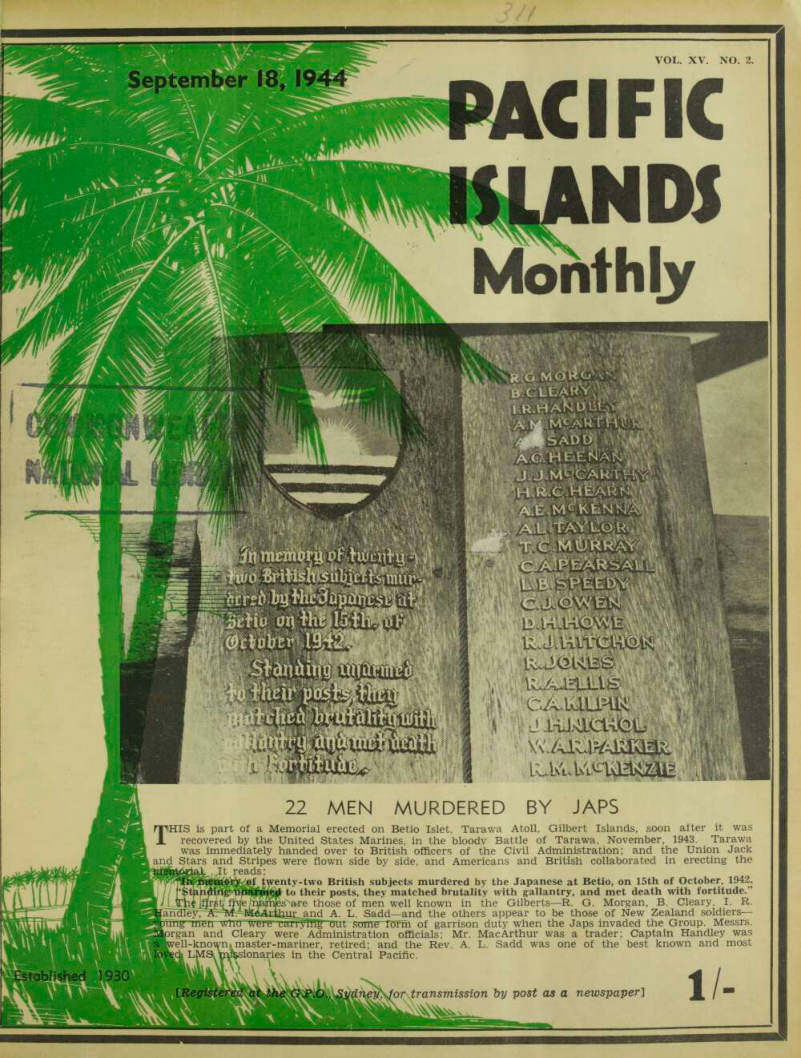
22 Men Murdered By Japs
THIS is part of a Memorial erected on Betio Islet, Tarawa Atoll, Gilbert Islands, soon after it was recovered by the United States Marines, in the bloody Battle of Tarawa, November, 1943. Tarawa was immediately handed over to British officers of the Civil Administration; and the Union Jack and Stars and Stripes were flown side by side, and Americans and British collaborated in erecting the memorial It reads: "In memory of twenty-two British subjects murdered by the Japanese at Betio, on 15th of October, 1942.
“Standing unarmed to their posts, they matched brutality with gallantry, and met death with fortitude.”
The first five names are those of men well known in the Gilberts-R. G. Morgan, B. Cleary, I. R.
Handley, A. M. McArthur and A. L. Sadd-and the others appear to be those of New Zealand soldiers young men who were carrying out some form of garrison duty when the Japs invaded the Group. Messrs.
Morgan and Cleary were Administration officials; Mr. MacArthur was a trader; Captain Handley was a well-known master-mariner, retired; and the Rev. A. L. Sadd was one of the best known and most loved LMS missionaries in the Central Pacific.
Roll Of Honour —Section Ii.
[Section I (Killed, Missing, Prisoners) and Section II (Wounded, Decorations, etc.), published in Alternate Months] (We try to assemble here the names of m,en of the United Nations, residents or former residents of the Pacific Territories, whose names appear in casualty lists or who receive decorations. We should be grateful if relations and friends would send us details of such men.)
Wounded
Sgt. Robert ASMUS, of the Fighting French Pacific Battalion. Wounded at Bir Hacheim and evacuated.
Rene AUFANT, of the Fighting French Pacific Battalion. Wounded at Bir Hacheim.
Cpl. Thomas BAMBRIDGE, of the Fighting French Pacific Battalion. Wounded at Bir Hacheim and evacuated.
BERBERE (alias ARESKY), of the Fighting French Pacific Battalion. Wounded at Bir Hacheim.
Henri BERTHELIN, of the Fighting French Pacific Battalion. Wounded at Bir Hacheim.
Pte. V. BLANCO, AIF Infantry, of Thursday Island. Wounded in action, July, 1941.
L/Cpl. J. P. BLENCOWE, AIF Infantry of Rabaul, TNG. Wounded in action, July, 1941.
Jean BRIAL, of the Fighting French Pacific Battalion. Wounded at Bir Hacheim Pte. George BUCKNELL, AIF, son of Mr. and Mrs. C. Bucknell, of Korolevu, Fiji. Wounded in action in Malaya, January, 1942.
Pte. Thomas BYERS, AIF infantry, of Thurs day Island. Wounded in action, May, 1941 Raymond CHAUTARD, of the Free French Pacific contingent from New Caledonia. Re ported a casualty In the Middle East, March 1942.
Pte. A. J. CORLASS, AIF, formerly of Rabaul.
Wounded in action.
Albert CUBADDA, of the Free French con tingent from New Caledonia. Reported a casualty in the Middle East, March, 1942.
Charles DEVEAUX, of Pacific Battalion of Fighting France. Wounded at battle of Bir Hacheim (Libya).
Sgt. EMERY, formerly of Lae, TNG. Wounded in New Guinea in October, 1942.
W/O P. N. ENGLAND, AIF, formerly of Bogia, TNG. Wounded in action January 27, 1944 Lieut. M. G. EVENSEN. AIF, formerly of Rabaul. Wounded in action.
V. PAIRHALL, 2nd NZEF, formerly of the Treasury Department, Western Samoa. Reported wounded in action, February, 1942.
Trooper Arthur T. FILEWOOD. formerly of Thursday Island. Reported wounded in action.
May, 1943.
Paroa FIU, of the Fighting French Pacific Battalion. Wounded at Bir Hacheim and evacuated.
Cpl. H. N. FORSYTH, formerly of New Guinea.
Reported wounded, June, 1944.
Acting Warrant-Officer V. M. I. GORDON AIP Infantry, of Wau. TNG. Wounded in action, February, 1942.
Henri GUILBAUD, of the Free French Pacific contingent from New Caledonia. Reported a casualty in the Middle East, March, 1942.
Sgt. C. HENDRICK, AIF infantry, of Rabaul, TNG. Wounded in action, July, 1941.
Stanley HIGGS, son of Mr. and Mrs. Gordon Higgs, of W. R. Carpenter and Co Ltd New Guinea. Member of an English Lancers’ regiment wounded during British evacuation from Dun kirk (Prance). May, 1940.
Pte. W. HOLMES, of the Fiji Military Forces.
Reported wounded in action, December 1943 Alexandre HUYARD, of the Free French Pacific contingent from New Caledonia. Reported a casualty in the Middle East, March, 1942. « c ‘ JEUNE ’ AIF - formerly of Morobe, TNG. Reported wounded, June, 15’44 Sgt.-Pilot Andrew KRONFELD, of the NZ Fighter Squadron attached to the RAF. Wounded IMl* dUring °P erations over France, December, Cpl. W. H. LANNEN, AIF artillery, of Rabaul, New Guinea. Wounded in action, June 1941 Gnr. E. G. LOBAN, AIP artillery, of’ Thursday S land ; ™ oUnded durin g campaign in Greece May, 1941; invalided home after having his left forearm amputated.
Auguste LUTA, of the Fighting French Pacific Evacuated, W ° U " ded *“ Blr Hachel ”
M laSt^ r . MACLEA N, AIF infantry, of »„sr:Sr ea - wounded in ic D - McCLYMONT, NZEF. son of Capt D. McClymont, Harbourmaster of Apia Western Sa “° a - ln action ’ November. 1941 Cpl. R. McKERLIE, AIP, of Yandina rqt m face by bomb explosion, April’. 194 L t. MANEA, of the Fighting French Pacific
Battalion. Wounded at Bir Hacheim and evacuated.
Jean MERIGNAC, of the Free French Pacific contingent from New Caledonia. Reported a casualty in the Middle East, March, 1942.
Henri MEYER, of the Free French Pacific contingent from New Caledonia. Reported a casualty in the Middle East, March, 1942.
S/Sgt. Graham B. MIRFIELD, AIF engineers, of Rabaul, New Guinea. Wounded in action.
Pte. Apisai NAIKA, of Fiji Military Forces.
Wounded in action in Solomons.
Pte. James O’DWYER, NZEF, formerly of Apia, W. Samoa. Wounded in action in Italy, December, 1943.
Joseph OTHUS, of Pacific Battalion of Fight ing France. Wounded in battle of Bir Hacheim (Libya).
Lieut. A. G. PEARCE, AIF, formerly of Salamaua, TNG. Wounded in action.
Pte. L. G. (“Mick”) REECE, AIF, of Bulolo, New Guinea. Wounded in action, July, 1941.
Henri RIVIERE, of the Free French Pacific contingent from New Caledonia. Reported a casualty in the Middle East, March, 1942.
Pte. H. St. George RYDER, AIF, formerly of Suva, Fiji. Wounded while serving in New Guinea.
Cpl. Luke SAILADA, of Fiji Military Forces.
Wounded in action in Solomons.
A/Opl. N. K. SAWYER, AIF infantry, of Rabaul, TNG. Wounded in action, July, 1941, July, 1941.
Pte. Frank M. SCHUSTER, NZEF, formerly of W. Samoa. Wounded in action in Tunisia, 1943.
Lieut. Jeffrey SEAGOE, serving with the British forces in the Far East, formerly of Vila, New Hebrides. Reported “wounded in action”.
March, 1942.
Pte. F. M. SCHUSTER, NZEF, formerly of W. Samoa. Wounded in action in Tunisia.
Pte. Lance STAMPER, AIF, formerly school master at Wau, New Guinea. Wounded In action, August, 1941.
Cpl. Esala TAWAKE, of Fiji Military Forces.
Wounded in action in Solomons.
Lieut.-Col. J. K. B. TAYLOR, of the Fiji Mili tary Forces. Wounded in action in Bougain ville, December, 1943.
Cpl. Raphael TEIHO, of the Fighting French Pacific Battalion. Wounded at Bir Hacheim and evacuated.
Cpl. Terli TERIITUA, of the Fighting French Pacific Battalion. Wounded at Bir Hacheim and evacuated.
Lieut. A. THOMPSON, of the Fiji Military Forces. Reported wounded in action, December, 1943.
Lieut. P. A. TUCKEY, infantry, formerly of New Guinea. Wounded in action.
Pte. Harold G. TURNER, AIF, of Samaral.
Eastern Papua. Wounded in action at Bardia (Libya), January, 1941.
Pte. F. D. TWISS, AIF infantry, of New Guinea. Wounded in action, August, 1941.
Camille VINCENT, of the Free French Pacific contingent from New Caledonia. Reported a casualty in the Middle East, March, 1942.
Driver Don F. WAUCHOPE, AIF. Formerly employed on his brother’s plantation in New Guinea. Wounded in action, July, 1942.
Lieut. F. R. G. WILSON, AIF, formerly of the Mandated Territory of New Guinea. Reported wounded in action, February, 1944.
Alex. WINCHESTER, of the Fighting French Pacific Battalion. Wounded at Bir Hacheim.
Pte. K. M. WHITE, AIF, formerly of Bulwa, TNG. Wounded in action.
Sgt.-Pilot W. WRIGHT, of the Australian Spitfire Squadron, attached to the RAF, for merly of New Guinea. Wounded in knee during aerial "dog-fight” over the English Channel March, 1942.
Decorations
Sgt. Jionc AGARA, Fiji Military Forces, formerly of Tonga. Awarded the American Sil ver Star for gallantry in action in New Georgia, July, 1943.
Squadron-Leader G. U. (“Scotty”) aLLEN, tIAAF, who is well-known in New Guinea and Papua, having been co-pilot on the “Faith in Australia”, on the first official air-mail flight to the Territories in 1934. Awarded the Air Force Cross for his work with Catalina flying boats in Australia and the Pacific.
Major H. T. ALLEN, ATF, formerly of Wau, Morobe District, TNG. Awarded the QBE.
Squadron-Leader C. A. BASKETT, formerly of Bulolo, TNG. Awarded Distinguished Plying Cross for raids over enemy territory while attached to Hampden bomber squadron In Eng land.
Sgt. Semisi BELO, of Fiji Military Forces.
Awarded DCM for services in South-ivest Pacific area.
Lieut. Charles BLAKE, of ANGAU. formerly of Wau, TNG. Awarded the Military Medal (while serving as a W/O) for bravery and devotion to duty during and after the landing at Arawe, New Britain, January, 1944.
Victor BRIAL, Fighting , French Pacific Battalion, formerly of New Caledonia. Awarded the Croix de Guerre and the Etoile d’Argent.
Major W. F. M. CLEMENTS, of the British Solomon Islands Defence Force. Awarded Military Cross for exceptional devotion to duty in a theatre of war.
Sgt. Henry C. S. COTTON, of the RNZAP, who was born in Samoa (his father was Secre tary of Native Affairs during the NZ military occupation). Awarded the Distinguished Flying Cross.
Fiight-Lieut. R, N. DALKIN, RAAP, formerly of W. R. Carpenter and Co., Ltd., Salamaua, TNG. Awarded the DFC for bombing raids against the Japanese in Koepang area, DEL FREDERIC DELAVEUVE, formerly of New Caledonia. Awarded Croix de Guerre, while serving with Fighting French volunteers in Egypt. 2/Lieut. Bruce Insham DENT, of Fiji Military Forces (killed in action, March 25, 1944).
Awarded Military Cross for services in South west Pacific.
Squadron-Leader R. A. DUNN, RAAF, formerly of Carpenter Airways New Guinea Service.
Awarded the Distinguished Flying Cross for bravery while leading his squadron against the Japanese.
Chaplain N. J. EARL, AMP, formerly of Papua. Awarded MBE for bravery shown during early Papuan campaign.
Sgt. R. EMERY, NGVR, formerly of Lae.
Awarded Military Medal for gallantry in New Guinea.
Flight-Lleut. Norman FADER, RAAF, formerly a commercial pilot in New Guinea. Awarded the Air Force Cross for exploits In Bismarck Sea Battle.
Rifleman H. W. FORRESTER, NGVR, formerly of Bulolo, TNG. Awarded the Military Medal for operations against Japanese in New Guinea.
Sgt. J. H. GILCHRIST, formerly of TNG.
Received Military Medal, April, 1944.
Squadron-Leader C. R. GURNEY, RAAF, for merly of Guinea Airways, Ltd., TNG. Posthu mously awarded the Air Force Cross, for bomb ing raids on Japanese-held ports in New Britain.
Major T. GRAHAMSLAW, AMF, formerly of Papua. Awarded OBE for conspicuous devotion to duty in the Buna area (Papua) during initial Japanese landings in the district.
Walter GRAND, Fighting French Pacific Battalion, formerly of Tahiti. Awarded Croix de Guerre, with one star, for bravery during the Battle of Bir Hacheim, 1942.
A./Sgt. B. W. G. HALL, formerly of TNG.
Received DCM in April, 19'44. Later promoted to rank of Lieutenant.
Squadron-Leader Godfrey HEMSWORTH, RAAF, formerly a well-known New Guinea pilot, who was killed in action against the Japanese In May. Posthumously awarded the Air Force Cross.
Capt. L. HENDERSON, AMP, formerly of Papua. Awarded MBE for courage displayed during the Oro Bay operations when he was in charge of small ships operating in those waters.
LUCIEN HERVOUET, formerly of New Cale donia. Awarded Croix de Guerre while serving with Fighting French volunteers in Egypt.
Lieut. Colin HILL, RANR, of the Australian destroyer, “Waterhen”, formerly second officer on the trans-Pacific liner “Niagara”. Awarded the OBE.
Lieut. D. C. HORTON, RANVR, formerly of District Services, BSI. Awarded the United States Silver Star for distinguished services in the Solomons.
Lieut. Gordon HOWE, RANR, formerly an offi cer in Burns Philp ships. Awarded the US Legion of Merit for meritorious service in lead ing a reconnaissance party to Russell Islands,
Bsi.
Lieut. H. E. JOSSELYN, RANVR, formerly of District Services, BSI. Awarded United States Silver Star, for distinguished services in the Solomons.
Capt. H. T. KIENZLE, ANGAU, formerly of
(Continued on Inside Back Cover)
Papua. Awarded MBE for devotion to duty during the .campaign in the Owen Stanley Tfcanees Wing-Commander C. J. N. LELAU, RAAF, formerly of Suva, Fiji. Awarded the OBE for distinguished service.
Pte. Viliame LAUTIKI, of Fiji Military Forces.
Awarded MM for services in South-west Pacific ai Sgt. T. McADAM, NGVR, formerly of New Guinea Forestry Dept. Awarded Military Medal for gallantry in New Guinea.
Lieut.-Commander A. W. R. McNICOLL, RAN, son of Sir Ramsay McNlcoll, Administrator of New Guinea, and Lady McNicoll. Awarded the <3>eorge Medal.
Petty-Officer PAUL MASON, RANVR, formerly a plantation inspector at Inus, Bougainville, TNG. Awarded American Distinguished Service ■Cross for “extraordinary heroism in action.”
HENRI MAYER, formerly of New Caledonia, Awarded Croix de Guerre while serving with Fighting French volunteers in Egypt.
Fit.-Lieut. George B. (Golly) MEIDECKE, RAAF, formerly of W. Samoa. Awarded the Distinguished Flying Cross.
Capt. J. K. MCCARTHY, formerly of TNG.
Received the MBE, April, 1944.
Lieut.-Commander H. A. MACKENZIE, RAN, formerly of Rabaul, TNG. Awarded the US Legion of Merit for exceptionally meritorious services at Guadalcanal.
Capt. John Malcolm METHVEN, AIF. Men tioned in despatches for distinguished services during the seige of Tobruk. Since reported killed in action. (See section “Killed.”) Sgt. Geoffrey MOORE, of the RNZAF, formerly •engineer on the NG inter-island vessel “Maiwara” and on the trans-Paciflc liner “Aorangi”. Awarded the Distinguished Flying Medal.
ANDRE MORNAGHINI, formerly of New Cale donia. Awarded Croix de Guerre while, serving -with Fighting French volunteers in Egypt, Flight-Lieut. G. B. MEIDECKE. RAAF, formerly of W. Samoa. Awarded the DFC for “courage, coolness and tenacity, and flying skill of the highest order.”
Flight-Lieut. M. O’CONNOR, RAAF, formerly of Suva, Fiji. Awarded the DFC for a “high record of success on operations” in the Middle East.
Flight-Lieut. H. G. PILLING, RAF, formerly of Suva, Fiji. Awarded the DFC, May, 1942. (Killed a few days later.) Lieut. W. T. READ, RANVR, formerly of Dis trict Services, TNG. Awarded American Distin guished Service Cross for “extraordinary heroism in action” while in South Pacific Waters.
Pilot-Officer Pat RICHARDSON. RAF. son of Mr. W. Richardson, formerly of Penang, Fiji.
Awarded the Distinguished Plying Cross.
Commander Alvord S. ROSENTHAL, RAN, son of Major-General Sir Charles Rosenthal. KCB.
CMG, DSO, VD, Administrator of Norfolk Island. Awarded the DSO, November, 1941; awarded the Bar to DSO. February, 1942.
W/O K. W. RYALL, of ANGAU, formerly of TNG. Awarded Military Medal for conspicuous service in the Arawe Peninsula area of New Britain.
Cpl. Manoa ROKO, of Fiji Military Forces.
Awarded MM for services in South-west Pacific area.
Lieut.-Colonel J. B. K. TAYLOR, Commander of Fiji Military Forces overseas. Awarded American Purple Heart, March, 1944.
Capt. A. T. TIMPERLEY, AMF, formerly of Papua. Awarded MBE for work on Good enough Island when he acted as a guide.
Major David TRENCH, formerly District Offi •cer in BSI. Awarded the Military Cross for distinguished service and gallantry in the South-west Pacific.
F/O Leigh G. VIAL, RAAF, formerly ADO in TNG. Awarded American DSC for outstand ing heroism in New Guinea in September, 1942.
Squadron-Leader Charles WIDDY, RAAF, formerly of BSI. Awarded the US Legion of Merit for meritorious service in leading a reconnaissance party to Russell Islands, BSI.
Lieut, (then W/O) Raymond WATSON, AIF, formerly of TNG. Awarded MBE for bravery and devotion to duty during the Papuan cam paign.
Sgt. Ilaitia WAQA, of Fiji Military Forces.
Awarded MM for services in South-west Pacific area.
Capt. D. E. WILLIAMS, of Fiji Military Forces.
Awarded American Silver Star for gallantry in action while leading patrols in Guadalcanal.
Lieut. G. K. WHITTAKER, NGVR, formerly of
Lae, TNG. Awarded MBE for gallantry jn New Guinea.
Lieut. George Raymond WORLEDGE. of the RANVR, formerly of Fiji. Awarded the MBE (Military).
Mentioned In Despatches
Rifleman G. R. Archer, TNG.
TNG. Corporal Malakai Mo, Captain A. H. Bald- Fiji: win, Papua. Corporal M. Marlay, Captain N. B. N. TNG.
Blood, TNG. Rifleman J. E. Mayos, Rifleman J. Cavanagh, TNG.
TNG. Corporal A. Moore, Rifleman J. W. Currie, TNG.
TNG. Captain J. J. Murphy, Warrant-Officer J. B. TNG.
Davies, Papua. Lieut. k. C. McMullen, Captain L. S. Dexter, TNG.
Papua. W O —. Neumann.
Major S. Elliott-Smith, TNG.
Papua. Captain N. Owers.
Capt. W. M. Edwards, Lieut. R. H. Phillips,
Tng. Tng -
Warrant-Officer P. R. Pte. A. A. Ramsden, N. England, TNG. Papua.
Rifleman H. W. For- Major D. G. Rice. rester, TNG. Pte s - M - Richie, Lieut. K. G. Fuller, Papua.
Tonga. Lieutenant J. I. Rae, Sergeant V. H. Gil- Papua.
Christ, TNG. Sergeant Akuila Sau- Lieut. S. G. Grimshaw, kura, Fiji.
TNG. Lieutenant C. H. Smith, Lieut. C. G. Harris, TNG.
TNG. Warrant-Officer R. A.
Lieut. L. F. Hewlett, Smith, Papua.
TNG. Pte. R. M. Stewart, Sgt. H. E. Jarrett, Papua.
Papua. Lieut. A. T. Timperly, Major E. W. Jenyns, Papua.
TNG. Captain L. N. Tribolet, Warrant-Officer I. F. TNG.
Jones. Papua. Lieutenant A. G. Vagg, Lieut. H. T. Kienzle, TNG.
Papua. Captain G. H. Vernon, Rifleman J. R. Kinsey, MC, Papua.
Pacific News-Review
Notes And Comment On
The Progress Of The War
From Aug. 16 To Sept. 15
Aug. 16: Five towns have been taken by the Allies since their landing in the south of France.
Aug. 17: Russians have launched a full scale offensive in the extreme south, and are advancing into Rumania on a wide front.
Aug: 16: Part of the German Seventy Army has escaped from the “Normandy pocket,” through the Falaise gap; but the whole Army is now being driven into the corner formed by the Seine and the coast, by the British and Canadians, driving north-east, and the Americans, wheeling in from the east. The enemy is hope lessly trapped, and is being wiped out by our air forces, now supreme and prac tically unchallenged. American columns from Alencon are now only 40 miles from Paris.
Aug. 20: The Allies, in the south of France, are now moving rapidly upon Marseilles, Toulon and Cannes. Enemy resistance is w r eak.
Aug. 21: Germans say they will declare Paris an open city. American forces are now only 22 miles from Paris. In the south, the Maquis have taken Toulouse, and Allied troops have reached Toulon.
Aug. 22: General Montgomery’s armies are closing the trap on all German troops south of the Seine, between Paris and the sea, by making a drive along the river to the sea. Montgomery told his troops yesterday that they have won a great victory, and appealed to them to finish the job off in record time.- Aug. 23: After four years of ’ German rule, Paris is free and in French hands. 50,000 French armed patriots, supported by several hundred thousand French un armed men and women, attacked the remaining German garrison on the 19th, and drove the Nazis out, after four days’ fighting.
Aug. 23: With Allied forces threatening the Pas de Calais launching areas of the flying-bombs, the Germans are stepping up their bomb attacks on London.
Aug. 23: Rumania, as the Russian armies were pouring into the country towards the oilfields and the capital, abandoned the Axis and decided to become one of the United Nations and fight against Germany. This announce ment was made by ‘King Michael from Bucharest, and broadcast repeatedly.
Aug. 25: Paris Radio —now under Allied control —announced that the last of the Nazis have been driven from the city.
General de Gaulle arrived in Paris to-day, and was welcomed enthusiastic ally.
Aug. 26: Red Army units are advancing into, and occupying, Rumania, mowing down disorganised units of Germans on the borders.
Aug. 27: Bulgaria is seeking surrender and has approached Britain and America regarding terms.
Aug. 28: Allied forces have advanced, in some points, 100 miles beyond Paris, towards the German frontier, Aug. 28: In Rumania, advancing Rus sian forces have occupied Galatz (im portant rail junction and Danube port).
Aug. 28: The Russians have seized a pass through the Carpathians and broken through to Hungary.
Aug. 29: French troops, in southern France, have crossed the Rhone at sev eral points near Avignon.
Aug. 30: Racing across the 1914-18 battlefields, with little resistance, Ameri can columns are only 30 miles from Bel gium an(J 50 miles from the Sedan gap.
British and Canadians are surging north eastward from their bridgeheads' on the Lower Seine, towards Belgium. They have “pocketed” the Pas de Calais areas,
and ended the flying-bomb attacks on England- Aug. 30: The Russians have reached the Ploesti area of Rumania. The retreat ing Nazis blew up and set fire to the, oil wells.
Aug. 31: British armies in northern France have advanced rapidly from the Seine towards the Somme.
Aug. 31: Russian forces have entered Bucharest.
Sept. 1: British and American troops are rapidly advancing upon the borders of Belgium and Germany, on a 300-miles front. British, troops are past Amiens and Villers Brettoneux.
Sept. 1: A full-scale Allied attack on the Gothic Line, in Northern Italy, has commenced.
Sept. 1: Russian troops have reached the borders of Bulgaria.
Sept. 1; American bombers from the SW Pacific to-day hammered airfields on Mindanao (southern Philippines).
Sept. 2; Most of the cities of southern France have been abandoned by the Ger mans or captured by the American and French invading armies, or by French partisan armies.
Sept. 3: Finland is entering upon peace talks with Russia, and demands that Germany remove her troops.
Sept. 3: To-day (five years after out break of war) Germans are everywhere in retreat from France. Their retreat in many places is almost a rout. They are abandoning immense equipment. French partisans’are everywhere arising and tak ing charge. The Americans from Nor mandy and from the south are already all over central and south-western France.
France generally is free.
Sept. 4: British troops entered and lib erated Brussels (capital of Belgium) and are also at Antwerp (10 miles from the Dutch border). The Belgians gave the British a tumultuous welcome.
Sept. 6: Fighting is in progress on Ger man soil around Saarbrucken (east of the Moselle River). US units are near Strasbourg (in German-occupied Alsace).
Sept. 6: Russia put an end to the anomalous situation regarding Bulgaria’s self-declared neutrality by declaring war on her. Bulgaria immediately sought an armistice.
Sept. 7: German resistance on the Ger man frontier and the Siegfried Line has stiffened considerably. Canadians are reported in Calais.
Sept. 10: On the Eastern Front, the Russians are trying to force the Narew River and advance on the former Polish Corridor. There are also powerful Red drives towards Yugoslavia, Hungary and
Czecho-Slovakia. Junction between Rus sian and Yugoslav armies is reported.
Sept. 11: British have broken from the bridgehead across the Albert Canal (Bel gium) and are across the Dutch frontier.
Further south, the Americans have lib erated Luxemburg.
Sept. 11; Mr. Churchill and President Roosevelt have met in Quebec for what is called a Victory Conference.
Sept. 12: The Allies now are fighting on German soil in strength. The Ger man fortress town of Aachen is threat ened. Le Havre (which held out for a fortnight) surrendered to Canadians.
Segt. 13: American task force, on the Bth, destroyed an entire Japanese convoy of 52 vessels and shot down 68 aircraft in the Philippines, Further US attacks were made on 10th. Tokio reports that other US planes raided Yap. RAF Beau fighters are ranging over hundreds of square miles of the Indian Ocean, and have attacked and left burning or beached 14 Japanese merchant ships in Indo- Burmese waters.
Sept. 13: Great Allied forces are now approaching the Siegfried Line on a 150miles front, from the Dutch border to the Ardennes.
Sept. 13: Russian troops have taken Lomza (northern Poland) after heavy fighting. They thus expose the southern flank of East Prussia.
Sept. 14: British and US forces have launched an offensive to pinch out Aachen, Siegfried Line fortress town and big railway junction.
Sept. 14: There has been another three days’ aerial onslaught on Japanese tar gets in the Philippines, beginning Sept. 12. Attacks were made from Allied car rier-based aircraft.
Sept. 15: American troops have-landed on Halmahera Island (Netherlands Indies).
One Month Of Allied
Victories
Aug. 13. —German 7th Army collapses in Normandy.
Aug. 15.—Americans and French armies land on Riviera coast.
Aug. 23.—Paris liberated.
Aug. 23. —Rumania surrenders and joins the Allies.
Aug. 28.—German 7th Army destroyed.
Aug. 30.—Flying-bomb region overwhelmed, and attacks on England cease.
Aug, 31.—Russians occupy Bucharest.
Sept. 3. —Finland repudiates Germany and commences peace talks with Russia.
Sept. 3.—British arrive in Brussels and Antwerp.
Sept. 6.—Bulgaria seeks armistice.
Sept. 10. —Russians junction with Yugo slavs.
Sept. 12.—Calais and Le Havre captured.
Sept. 12. —Allies across frontier and attacking Germans on German soil.
Cook Is. Handicrafts
New Volume by Peter Buck
A LARGE volume, published by the Bishop Museum in Hawaii, has just come to hand. Entitled “Arts and Crafts of the Cook Islands,” it is writ ten by Te Rangi Hiroa (Peter H. Buck), director of the Museum.
Dr. Buck’s experience in the Cooks dates back to 1910, when he spent six months on Rarotonga as a relieving medi cal officer. He re-visited the Cooks in 1926, and again in 1929, when he made a year’s survey of the Group for the Bishop Museum.
The volume, a large one of approxi mately 600 pages, is profusely illustrated with drawings and photographs, and cov ers the whole range of Cook Islands handicrafts.
Every aspect of the Islanders’ arts and crafts is described minutely, with all the anthropological and historical sidelights which make good reading for the layman student of Polynesia. An excellent index and bibliography make it a valuable book of reference.
NOUMEA, Sept. s.—The New Cale donian Administration is alloting a quarter of a million francs from this year’s budget to the fund for French prisoners of war and deportees in Ger many. This brings the total subscribed by the Colony to over two million francs.
Contents
Pacific .News-Review 1 Confusion and Lack of Planning in Australia’s Pacific Territories 3 Civil Administration in Papua—Res toration Early in New Year ... 5 US is Paying for Cutting Coconut Trees 5 Civilians Are Not Wanted —Bureaucracy and Brasshattery in Con trol in Papua 6 Pacific Frenchmen Celebrate Libera tion of Mother Country 7 New Hopes for French Oceania ... 8 No “Dollar Prosperity” in Pukapuka 9 Results of Fiji Election 9 Arrival of New Resident Commissioner in Tarawa 10 Tropica lities 11 For New Settlers in Papua—Possibili ties of Tropical Crops 12 From Cannibal to Commando ... 14 New Guinea’s Primitive Natives .. 16 Further Recollections of a Decade in Fiji 17 Post-war Plans for Noumea 21 A School for Castaways 22 This is the Solomon Islander in Peace 24 New Caledonian Soldiers Return .. 27 Nautical Interludes—Meandering With the “Threesis” 28 The Pacific Islands as They Will Be in 1950 29 “Dollar Prosperity” Now—Headaches for the Future—Report of the Methodist Mission 33 Trader’s Tale—Portrait of a Gentle man 34 Post-war Malaya 36 The Cook Islands and the American Occupation *,. 37 “Jesuits’ Bark”—The History of Quinine 41 “Exploited Natives” 45 Markets and Commercial 43
Advertisers
Aladdin Industries Pty., Ltd 35 Atkins Pty., Ltd., Wm 32 Australian Alumi nium Co. Pty., Ltd 39 Bergers Paints . . 15 Broomfield, Ltd. . . 33 Brown & Co., Ltd. 12 Brown, James ... 30 Brunton’s Flour . . 28 Burns, Phllp Trust Co., Ltd 13 BP (SS) Co. . . . 12 Campbell’s Paints . 39 Carlton & United Breweries, Ltd. . 19 Carpenter, Ltd., W.
R cov. iv.
Chivers & Sons, Ltd 24 Coleman Lamp & Stove Co 17 Colonial Wholesale Meat Co 29 Cox, Findlayson & Co 30 “Cystex” 46 Darvas & Co. ... 47 David Trading Co. . 33 Donaghy & Sons . . 32 Donald, Ltd., A. B. 24 Dorn, Paul ... 46 Dr. Williams Pink Pills 40 Electrolux Refrigerators . . 34 Excelsior Supply Co., Ltd 34 “Farbest” Cordials 47 Parnham, John R. . 38 “Flavorex” ... 20 Ford Sherington Pty., Ltd. . . / . 44 Foster, Clark, Ltd. 21 Garrett & Davidson 42 Gibson & Co., Ltd.,
J. A. D 37
Gillespie Pty., Ltd., Robert ... 42, 44 Gilbey’s Gin ... 27
Gillespie’s Flour . . 22 Gough & Co., E. J. 41 Grand Pacific Hotel 2 Grove & Sons, W.
H 14 Heinz & Co. Pty., Ltd., H. J 23 Horlicks Malted Milk 36 King’s Compo ... 45 Kopsen & Co., Ltd. 31 Maxwell Porter, Ltd. 40 “Mendaco” ... 44 Muir (Eastern) Ex port Co., Charles 45 Nelson & Robertson Pty., Ltd 16 “Nixpderm” ... 42 Noyes Bros., Ltd. . 41 Pacific Is. Society . 12 Pacific Territories Association ... 9 “Pinkettes” . ... 47 Queensland Insur ance Co 17 Radco Products ... 43 “Radiant” Lanterns 43 Ransomes, Sims & Jefferies, Ltd. . . 46 Riverstone Meat Co., Ltd. ... 25 Rose’s Eye Lotion . 34 Roliu, Sil 44 Scott, Ltd., J. ... 40 Steamships Trading Co., Ltd 28 Sullivan & Co., C. . 26 Swallow & Ariell . 20 Taylor & Co., A. . 45 “Tenax” Soap . . 14 Tillock & Co., Ltd. 22 Trinity Grammar School 43 Union Asurrance Society 41 Wright & Co., Ltd., E 38 Wunderlich, Ltd. . 39 Yorkshire Insurance Co., Ltd 33 Young Pty., Ltd., Harry, J 38
Advertisements & other items, p. 4 (3 items)
2
SEPTEMBER, 1944 BACIfIC ISLANDS MONTHLY
Useful Addresses
The following are the addresses of organisations set up to deal with Pacific Territories affairs:—
PAPUA, NEW GUINEA, NAURU,
NORFOLK IS.
Department of External Territories (Sydney Branch) (Lately the New Guinea Trade Agency), Australia House, Carrington Street, Sydney.
Telephone: BW 1776. (Dealing with all matters connected with the Australian Pacific Territories and also the Sydney representative of the New Guinea Copra Control Committee.)
FIJI, AND HIGH COMMISSION
FOR WESTERN PACIFIC
Sydney Office of Fiji and Associated Administrations. (In charge of Mr. B. F. Blackwell.) 72 Pitt Street, Sydney.
Telephone: BW 7724. *
BRITISH SOLOMON ISLANDS
Sydney Office of British Solomon Islands Government (In charge of Mr. F. E. Johnson, Treasurer of the Solomons Administration), 17 Castlereagh Street, Sydney.
Telephone: B 1710.
FOR PACIFIC TERRITORIES
EVACUEES GENERALLY
Pacific Territories Association (C. A. M. Adelskold, Secretary), c/o Robert Gillespie Pty,, Ltd., 54a Pitt Street, Sydney, Telephone: BW 4782.
WAR DAMAGE COMMISSION
Sydney Office: M.L.C. Buidling, Cnr. Martin Place and Castlereagh Street, Sydney, Telephone: BW 2361,
FOR CLAIMS AGAINST ARMY
Mr. H. Alderman, Darwin-Moresby Claims Section. Chief Finance Office (Army), Victoria Barracks, Melbourne.
Stav
V...
. VO ue ran A > UN,a *ntre ? ' attend® O6 t aW tarl « <** P*ceW eot r va^ s - {or tro9' cS ' rs ser r ,c” o **' ter kn\?^' V r d*Vper «3«ft
Pacific Islands Monthly
The Newspaper-Magazine of the South Seas
[Registered at the G.P.0., Sydney, for transmission by post as a newspaper .] Published Once Each Month and Circulated in Australia and New Zealand and in the following Pacific Territories and Islands Groups:
Australian Territory of Papua.
Mandated Territory (Australia) of New Guinea.
Australian Territory of Norfolk Island.
New Zealand Territory of Cook Islands.
Mandated Territory (NZ) of Western Samoa.
British Colony of Fiji.
Britlsh Solomon Islands Protectorate.
British Protectorate of lslands.
British Crown Colony of Gilbert and Ellice Islands.
Mandated Territory of Nauru.
British and Free French Condominium of New Hebrides.
Free French Colony of New Caledonia.
Free French Colony of Oceania (Tahiti, etc.).
American Territory of Eastern Samoa.
American Territory of Hawaiian Islands.
Owned and Produced by Pacific Publications Pty. Ltd., Union House, 247 George Street, Sydney.
rpTjrr ppiTAvr; l f Managing Director HW 503 T I Business and Editorial MA 4369
P.O. Box 3408 R
Registered Address of Telegrams, Radiograms, and Cables: “Pacpub”, Sydney.
Contributions.
Articles, Stories, and Photographs dealing with Pacific Islands subjects are invited and will be paid for on publication.
Subscription Rates.
Per Annum, within British Empire, Prepaid, Post Free 10/- Per Annum, elsewhere, Prepaid, Post Free 12/6 Single Copies 1/-
Edltor and Publisher:
R. W. Robson. P.R.G.S.
Advertising Manager: L. W. Bailey.
Advertising Office and Printing-House: 29 Alberta Street, Sydney.
Advertising rates furnished on application.
Representative In Fiji.
Pacific Publications (FIJI), Ltd., Bank of NSW Building. Suva (same office as W. H. Grove & Sons, Ltd.). Stocks of Pacific Islands Monthly and Pacific Islands Yearbook on hand.
Representative In London.
W. C, Harvey, Coronation House, 4 Lloyds Avenue, London, E.C.3, from whom may be obtained copies of Pacific Islands Monthly, Pacific Is. Year Book, advertising schedules, etc.
Agents.
The following are authorised to receive sub scriptions for Pacific Islands Monthly;— Burns, Phllp Sc Co., Ltd., and Burns Phllp (South Sea) Co., Ltd. All branches.
W. R. Carpenter Sc Co., Ltd. All branches.
Morris, Hedstrom, Ltd. All branches.
Steamships Trading Co., Papua. All branches.
B.N.G. Trading Co., Ltd., Port Moresby, Papua, J. Muir, Suva, FIJI.
Miss R. Castles, Suva, FIJI.
N. C. Mackenzie Hunt, Walnunu, Bua, FIJI.
Cook Islands Trading Co., Rarotonga, Cook Is.
A. C. Rowland, Papeete, Tahiti, Islands Branches and Representatives of W. H.
Grove & Sons, Ltd., Auckland, New Zealand.
Ed. Pentecost, Noumea, New Caledonia.
Kerr Sc Co., Noumea, New Caledonia.
Vol. Xv. No. 2.
September 18, 1944
Drlr-a f l/- Per COPy ‘ Knee [prepaid: 10/- p.a.
Pacific Territories
Confusion and Lack of Planning in Australia's Pacific Territories
rE bald newspaper announcement' —made on September 9, presum ably on information supplied by Mr.
Ward—that civil government will be restored in Papua early in 1945, while the Army will remain in command in the Mandated Territory, is typical of the confused planning and bumble footed administration of the Curtin Labour Government/ Which have brought Australia to the edge of economic and industrial chaos.
There is no indication of how the Papuan Administration and ANGAU (the respective personnel of which are now inextricably mixed) are go ing to sort themselves out; of whether they are going to function side by side—and, if so, how; of whether it is intended that ANGAU shall have its headquarters in Port Moresby (along side the civil government) and func tion only in New Guinea, or whether it will transfer its whole establish ment to the Mandated Territory.
If ANGAU and the Papuan Govern ment are to function independently, what is going to become of the Production Control Board, which now practically runs the planting industry and appears to have complete charge of such essentials as labour and transport? Is it to become part of the civil government? If so, how is it to be done?
IF the Board goes with its mother body, ANGAU, to the Mandated Territory, it will have very little pro duction to control, apart from min
ing, so long as the eastern end of New Britain, all’ New Ireland, all Buka, half of Bougainville, and the hinterland of northern New Guinea are full of isolated and wandering Japs.
Few people seem to realise that there is a formidable job of cleaning up to be done in the Mandated Territory before anything like organ ised agricultural production can be resumed. There may be 100,000 Japs loose in the coastal areas and the interior jungles, living miserably in the native villages or on the gardens they have established in the last two years; and the great majority will have to be hunted down by men skilled in jungle-craft.
The only areas which may be re garded as clear of Japanese are the Morobe goldfield, the Huon Peninsula and the Rai coast, as far west as the Madang-Bogia area, the western end of New Britain and a large part of the Manus district.
Americans and Australians, sweep ing westwards after the retreating enemy, have by-passed all the* other large districts, and the Japs within them. Our fighting forces are con cerned only with breaking up the enemy’s fighting organisation—which they have done most effectively in the New Guinea zone-but not with clearing him out of the jungles. That is a job for a later time; but, obviously, until that job is done civilian activities may not be resumed in the Mandated Territory.
F ““£5 m Pacific Territories, and any vision— which it notoriously has not—it would have foreseen this situation at the end of 1942 (when the Japs were be big thrown out of Papua) and would have acted accordingly. The essential elements of civil administration then would have been restored at once to Papua; and civil administration, collaborating wherever necessary with military organisations, would have controlled the restoration of native government, the return of civilians, the re-establishment of productive industries and the provision of essen tial things such as labour and transport. The change-over from military to civilian control would have been gradual, and harmonious, But, instead, those Curtin planners applied to the Territories the system wit l ? which they have burdened Aus tralia endless chains of commissions, boards and experts, directed by hordes of bureaucrats, whose delight
P. 9 discourage individualism, push
civilians around and kick private enterprise in the pants. In the Terri- A °n(?s, this policy is expressed in the ANGAU-Production Board set-up, directed by the Army through a Brass-hat liaison, in which the civil government (Department of External Territories) is recognised, but barely tolerated. Since February, 1942, the administration of Papua has been 100 P er cent military, and civilians have been treated as if they had no rights whatever.
Military authority should have ended as soon as the Territory was freed from the invaders; taut the
Amy has hung on to control for two years beyond that, and now is well dug in, and most reluctant to leave.
FROM the point of view of efficiency and service, there is little wrong with either ANGAU or the Production Control Board. It is simply that they are uneconomic, top-heavy and bur eaucratic, from the highest-ranking Brass-hat down to the humblest form-signing corporal. ANGAU is staffed with the best and brightest officials of the former administrative services of both Territories—men who know the country and know the job; the Board seems to be particularly well served by capable men. Prob ably, never in the history of the two Territories, has there been better administration—regarded purely as administration.
Then (someone will ask) why inter fere with a system that is working efficiently? Simply because the whole set-up belongs to wartime, and is abnormal, unreal and uneconomic.
Canberra’s professors, bureaucrats and socialistic planners think that Australia, under present conditions, is wonderful—they are quite incapable of appreciating the fact that the civilian population is carrying almost intolerable burdens and restrictions; that even the necessary wartime structure of totalitarianism is re sented; and that, if it were not that the need to win the war transcends everything else, the people would rise in revolt against*the intolerable complacency of their bureaucratic masters. We of the Anglo-Saxon nations are individualists, and we demand a world in which we shall enjoy personal freedom and the laws of competition—the way of life for which we fought for hundreds of years, and for which we are fighting now.
JUDGED on any other than wartime conditions, the administrative set-up in Papua now is ridiculously over-staffed and enormously expen sive. We accept it as part of the Army in wartime; but we know that it could not last a month in a free world, where a community, like an individual, must live within its in come.
In ANGAU and the Production Board, to-day, we have fifty men do ing what five would have done in peacetime; and enjoying larger emoluments and greater privileges ANGAU and its associates doubtless would like to continue their activities in Papua in peacetime—just as was forecast in this journal two years ago; but, while that might be in some ways an admirable thing for Papua, it done onl y at a cost of perhaps £200,000 per annum to the Australian taxpayer—and we can imagine how long the taxpayer would bear it!
ANGAU and the Production Board have aroused criticism because of their apparent lack of consideration for the rights of civilians—especially those unfortunate people who were hurriedly evacuated—and their ap parent hostility towards private enterprise, in any shape or form. Yet
there can be no future for the Terri tories unless both civilian rights and private enterprise are protected and encouraged.
We had hoped, even in 1944, that the Canberra Government would have found some way in which the civil government could work side by side with the military set-up, and har moniously arrange a change-over extending over many months, so that the Territory .could get the greatest possible permanent benefit from the lavish expenditures of the military era. But the military regime has shown such antagonism towards the civil regime, and such little con sideration for civilian rights, that nothing of that kind is to be ex pected. * We anticipate that civil govern ment and private enterprise soon will be restored in Papua, simply because Canberra dare not longer delay that necessary change-over; but, because of the hopeless incapacity of the Australian Government, and its Socialistic hates and prejudices, we anticipate that the change will be attended by much squabbling and confusion, and interference with private industry and property, and that Papuan civilians will have to suffer a great deal yet before they are restored to their homes and their rights.
All this is nothing new to Terri torians, however. For several de cades, they have suffered much from the ignorance and indifference of
Australian Governments. The only change which they now can see is that, whereas for 25 years their needs were ignored and forgotten, they now are likely to receive the ardent atten tions of reforming gentlemen, who wank to express their for “Fuzzy Wuzzy.” Their last condition promises to be worse than their first. In pre war years, they at least were left alone.
Scholarship Fund
For Fijians
£25,000 Donated by Morris Hedstrom Ltd.
SUVA, Sept. 15.
A SPECIAL general meeting of share holders in Morris Hedstrom Ltd. was held to consider the proposal of the directors that a sum of £25,000 be given from the company’s funds, for the pur pose of establishing an annual scholar ship for Fijians. Shareholders (repre senting £180,000) unanimously approved the plan.
The fund will provide, each year, a scholarship worth £2OO per annum, with a tenure of three years,.to assist selected members of the Fijian race to complete their education at a University.
The death, in Victoria, of the Rev. T.
Watt Leggatt, has been announced. He gave long service to the Presbyterian Overseas Mission in the New Hebrides, finally retiring because of ill-health. He was 85 when he died.
Cornered!
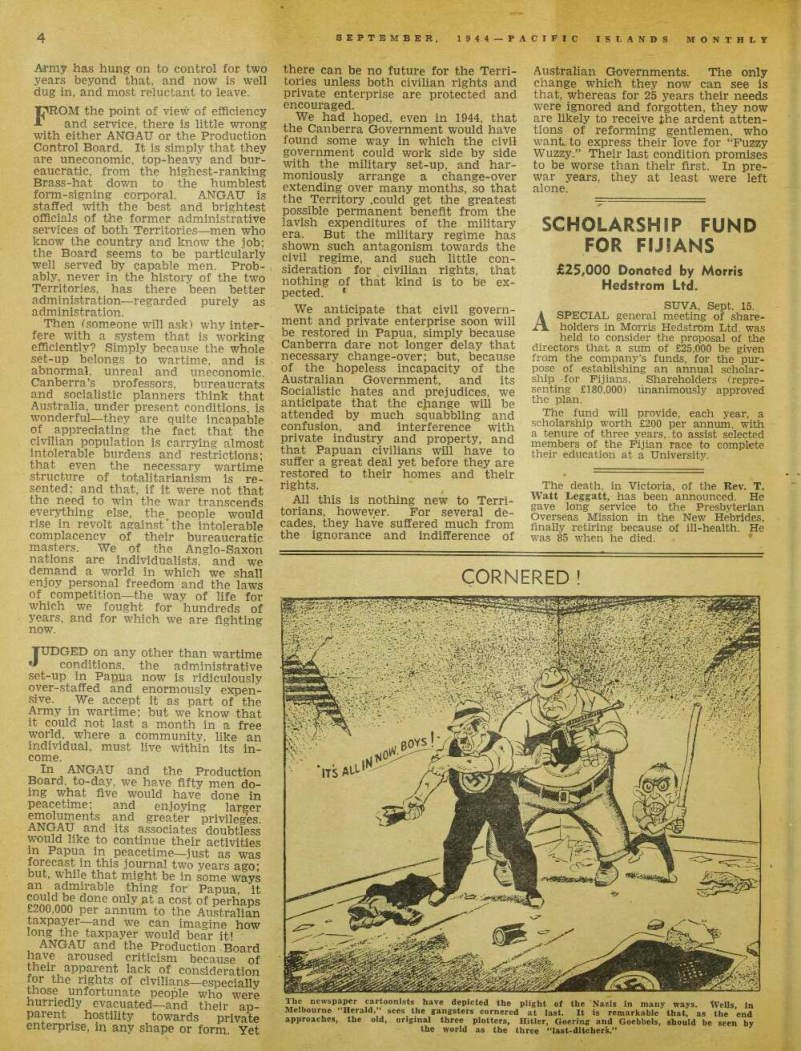
The newspaper cartoonists have depicted the plight of the Nazis in many ways. Wells, in Melbourne “Herald,” sees the gangsters cornered at last. It is remarkable that, as the end approaches, the old, original three plotters, Hitler, Goering and Goebbels, should be seen by the world as the three “last-ditchers.”
in Papua
Civil Administration in Papua Restoration Early in 1945
AFTER a delay of which there has been no explanation—except the indifference of the Australian Gov ernment towards all Pacific Territories matters—the Cabinet Sub-committee set up to deal with Territories administra tion met in Canberra on Friday, Septem ber 8, with Mr. Ward as chairman,- No official report was but, within the next tw’o days, various news papers published the following, as news from Canberra: .
Civil administration will be restored in the Territory of Papua early in 1945.
The administration of the Mandated Territory of New Guinea will remain the responsibility of the Army.
The Port Moresby branch of the Com monwealth Bank will soon be reopened.
The laws of the Territories will be con solidated and re-printed.
Special steps will be taken to ‘ meet the needs of 2,000 Chinese who have been liberated from the Japanese; and appro priate supplies, including food and cloth ing, will be provided for them.”
A plan for supplying Papua and New Guinea with labour, as an alternative to indentured native labour, is being pre pared. There will be stricter Government supervision over labour. Labour members are dissatisfied with the present system.
Another meeting of the Cabinet Sub committee will be held on Friday, Sep tember 15.
The foregoing statements were “un official,” but they appear to have been supplied to the reporters by Mr. Ward.
How their publication in this form created a situation that is as confusing as it is baffling is explained in an article on page 3.
Rubber Production In
Papua
rE following appeared in “Sydney Morning Herald” of September 13; “CANBERRA, Tuesday.—Rubber pro duction in New Guinea for 1943-44 increased by 30 per cent., but any surplus would have to go into the United Nations’ pool, the Minister for Supply and Ship ping, Mr. Beasley, said to-day.
“Mr. Beasley said that 1,816 tons of rubber were produced in New Guinea, according to a report from the Depart ment of External Territories.”
That is typical of modem journalistic blah-blah—especially when the reporter is trying to curry favour with a Minister.
It is written to suggest that (a) rubber production has increased 30 per cent, under the benevolent care of the Austra lian Labour Government; (b) Mr. Beas ley is in some way responsible for it.
Actually, credit for whatever increase there may be in rubber production goes to the enterprising planters who estab lished the new areas prior to the out break of war; there was bound to be an increase in production compared with the previous two years, during which the Territory was torn by invasion and war; there is not one word about the compara tive cost of production, under the present top-heavy Army set-up; and Mr. Beasley has nothing more to do with rubber pro duction in “New Guinea” than he has with tea production in Ceylon—as is clear from the fact that he talks about rubber coming from New Guinea, when every school-boy knows that it is Papua, not New Guinea, which produces rubber.
Death In New Guinea
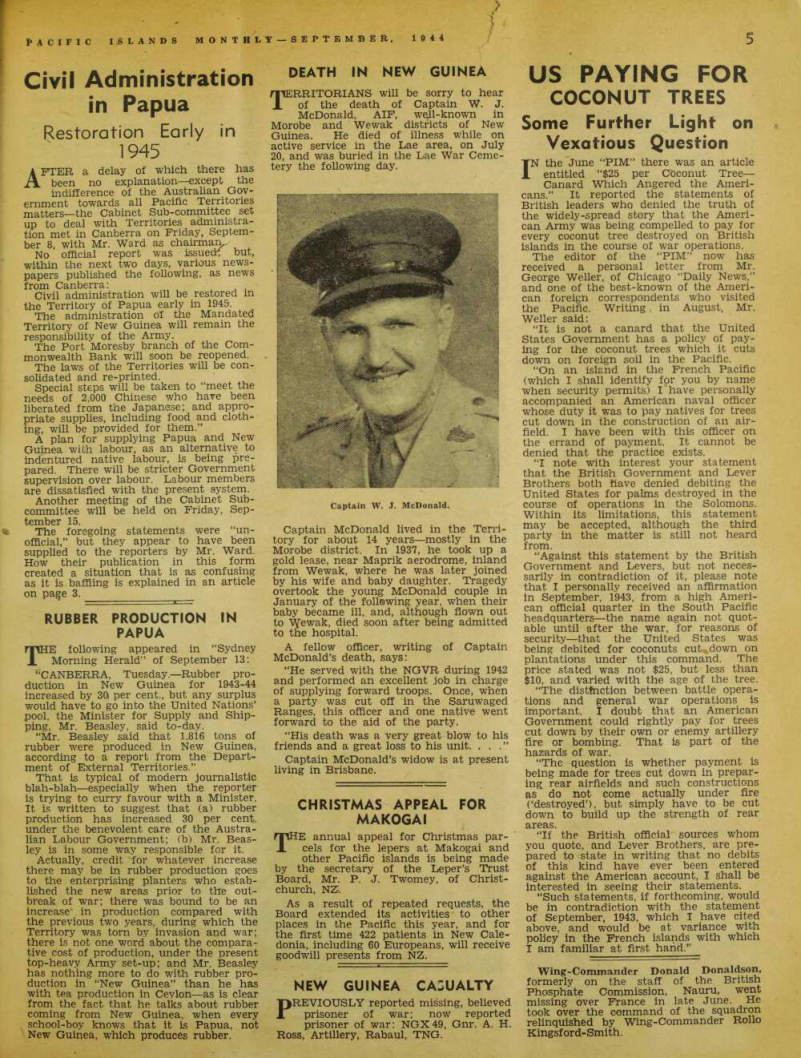
rRRITORIANS will be sorry to hear of the death of Captain W. J.
McDonald, AIF, well-known in Morobe and Wewak districts of New Guinea. He died of illness while on active service in the Lae area, on July 20, and was buried in the Lae War Ceme tery the following day.
Captain McDonald lived in the Terri tory for about 14 years—mostly in the Morobe district. In 1937, he took up a gold lease, near Maprik aerodrome, inland from Wewak, where he was later joined by his wife and baby daughter. Tragedy overtook the young McDonald couple in January of the following year, when their baby became ill, and, although flown out to \Yewak, died soon after being admitted to the hospital.
A fellow officer, writing of Captain McDonald's death, says: “He served with the NGVR during 1942 and performed an excellent job in charge of supplying forward troops. Once, when a party was cut off in the Saruwaged Ranges, this officer and one native went forward to the aid of the party.
“His death was a very great blow to his friends and a great loss to his unit. . . .”
Captain McDonald’s widow is at present living in Brisbane.
Captain W. J. McDonald.
Christmas Appeal For
Makogai
rE annual appeal for Christmas par cels for the lepers at Makogai and other Pacific islands is being made by the secretary of the Leper’s Trust Board, Mr. P. J. Twomey, of Christ church, NZ.
As a result of repeated requests, the Board extended its activities to other places in the Pacific this year, and for the first time 422 patients in New Cale donia, including 60 Europeans, will receive goodwill presents from NZ.
Advertisements & other items, p. 7 (1 item)
New Guinea Casualty
PREVIOUSLY reported missing, believed prisoner of war; now reported prisoner of war: NGX49, Gnr. A. H.
Ross, Artillery, Rabaul, TNG.
Us Paying For
Coconut Trees
Some Further Light on Vexatious Question
IN the June “PIM” there was an article entitled “$25 per Coconut Tree— Canard Which Angered the Ameri cans.” It reported the statements of British leaders who denied the truth of the widely-spread story that the Ameri can Army was being compelled to pay for every coconut tree destroyed on British islands in the course of war operations.
The editor of the “PIM” now has received a personal letter from Mr.
George Weller, of Chicago “Daily News,” and one of the best-known of the Ameri can foreign correspondents who visited the Pacific. Writing in August, Mr.
Weller said: “It is not a canard that the United States Government has a policy of pay ing for the coconut trees which it cuts down on foreign soil in the Pacific.
“On an island in the French Pacific (which I shall identify fpr you by name when security permits) I have personally accompanied an American naval officer whose duty it was to pay natives for trees cut down in the construction of an air field. I have been with this officer on the errand of payment. It cannot be denied that the practice exists.
“I note with interest your statement that the British Government and Lever Brothers both have denied debiting the United States for palms destroyed in the course of operations in the Solomons.
Within its limitations, this statement may be accepted, although the third party in the matter is still not heard from.
“Against this statement by the British Government and Levers, but not neces sarily in contradiction of it, please note that I personally received an affirmation in September, 1943, from a high Ameri can official quarter in the South Pacific headquarters—the name again not quot able until after the war, for reasons of security—that the United States was being debited for coconuts cut down on plantations under this command. The price stated was not $25, but less than $lO, and varied with the age of the tree.
“The distinction between battle opera tions and general war operations is important, I doubt that an American Government could rightly pay for trees cut down by their own or enemy artillery fire or bombing. That is part of the hazards of war.
“The question is whether payment is being made for trees cut down in prepar ing rear airfields and such constructions as do not come actually under fire (‘destroyed’), but simply have to be cut down to build up the strength of rear areas.
“If the British official sources whom you quote, and Lever Brothers, are pre pared to state in writing that no debits of this kind have ever been entered against the American account, I shall be interested in seeing their statements.
“Such statements, if forthcoming, would be in contradiction with the statement of September, 1943, which I have cited above, and would be at variance with policy in the French islands with which I am familiar at first hand.”
Wing-Commander Donald Donaldson, formerly on the staff of the British Phosphate Commission, Nauru, went missing over France in late June. He took over the command of the squadron relinquished by Wing-Commander Rollo Kingsford-Smith.
Advertisements & other items, p. 8 (1 item)
iSst E r.-
CIVILIANS ARE NOT
WANTED
Bureaucracy and Brasshattery Control Papua
BITTER resentment of the fact that Australian military bureaucracy is clinging to the Papuan Administra tion, and doing nothing to restore either civil government or civilian occupation, is general among Territorians who still are exiles in Australia.
Repeated appeals to the Australian Government bring neither re-assurance nor interest. A gang of professional politicians sit high in the seats of the mighty in Canberra; one of the least statesman-like of them, Mr. “Eddie”
Ward, is Minister for Territories; the Army appears to tell Mr. Ward what to do; Territorians have no votes, anyway; Australian public 'opinion, if one may judge from Australian newspapers, is quite indifferent to the wrongs being suffered by Territorians—so Territorians appear to be without a protector, and without any means of appeal against the treatment they are suffering.
The Pacific Terrtories Association, at its general meeting late in September, will again consider a motion that an appeal be made to Britain to remove, from Aus tralia, responsibility for the administra tion of Papua and New Guinea.
MEANWHILE, correspondents continue to write protests against the cruelty of Canberra’s treatment of evacuees.
Here, from an old Papuan resident, “OI,” is a typical letter:— “In Italy and France, where a large scale war was waged, civilians were encouraged to return immediately to their homes behind our advancing armies.
What a contrast to Papua, which has been a peaceful habitation now for twelve months!
“A proportion of the missionaries have managed to return—a few with their wives. A number of planters are back on their jobs. And hundreds of service women are in the country. Surely there is now no real reason for preventing the return of all Papuans? Or is it that some of the ANGAU personnel are afraid <pf iosmg the comfortable and highly-paid jobs they have made for themselves. It is up to old residents to get together and demand an explanation as Co why they are not allowed to return to their homes.
Our bureaucrats apparently do not realise that residents, after years of ef fort to win a livelihood from a very reluctant country regard Papua as their home. . . . All that Australian bureauc A r J c r y 4 5f n offe f*£, eir own kith and kin is ANGAU—an AMGGT that has “got” us, and of which we cannot be rid. And in * e hear of me n, return and lo ° te 3 ( ! at the best) homes lr f^ a . maged 4 . P lant ations, to try to their scattered fortunes, being charged heavy first-class fares for their transport back, and then compelled to l P ab y ou e n orbltant PriC6S for all st ° res and t 0,,:: t S hink an LH onder that we are in dined to think, and some even to say ‘Anv other country, but this to rule over us/”?
ANOTHER old resident of Papua, hav
iSst E r.-
cerned with the rights and wrongs of ?he ld most T^atl 0 d ianS ’ a K nd probabl y is now tne most hated member of the Labour
PapUan ’
He is not allowed to return to Papua.
His property had been seized by the Army, but the Army would pay only for what its officers admitted had been taken.
The Army said, however, that if he would produce further evidence for their guid ance, they might consider his claim further.
He could not produce evidence unless he was allowed to return—if only for a few days.
He has now been absent 2i years from his home, which has fallen steadily into ruin.
Other residents of the Territory, includ ing women, had been allowed to return, under military control.
Lautoka Districts
New Aerial Maps Of Suva
r provide accurate maps for use in connection with certain of Fiji’s post-war plans, an aerial photo graphic survey has been made of Suva and Lautoka and nearby areas.
The maps will be prepared by the New Zealand Lands and Survey Department, whose help has been extended to the Government of Fiji. Two members of the Department, Mr. C. R. Lyon and Mr.
C. Allen, have been at work in the Colony for a number of weeks. The photographic work, which is now complete, was done by a New Zealand firm which specialises in aerial photography and particularly in photography for use in the preparation of plans and maps.
The Rev. J. F. Goldie, of the Methodist Mission Society of NZ, is still in Mel bourne awaiting the opportunity to return to his station in the Solomons He recently spoke to the Caulfield Men’s Society.
Phillip Woodhill
"Mystery" Death Now Explained
RABAUL residents will remember Phillip Woodhill, who was Assistant Crown Law Officer to the Administration; but few know how he died in 1941, shortly after the evacuations of Greece and Crete, in which he played a distinguished part, was mentioned in despatches and pro moted to the rank of Temporary Major.
By a remarkable quirk of fate this man, who came through the hell of these Middle-eastern Dunkirks, practically un scathed, died as a result of a domestic accident that had its genesis in the labelling department of an American wholesaler.
Major Woodhill, after Crete, was sent to a “rest” job in Tobruk; and there, one afternoon, the mess cook baked scones and pakes for the officers’ tea. To make them he used what he believed to be bi carbonate of soda.
A few months earlier, a considerable stir had been caused in Melbourne, when it was discovered that bulk stores labelled “Bi-carbonate of Soda,” were, in actual fact, a certain poison wrongly labelled.
Through the press and over the air, pur chasers of bulk bi-carbonate were asked to return it to the place of purchase.
There were no fatalities in Australia.
Unfortunately, some of this poison had already been sent to the Middle East, and it was this that the Tobruk cook used the day. he baked scones for Phillip Woodhill and his fellow officers.
Seventeen officers were affected. They were violently ill; but all, except Major Phillip Woodhill, recovered.
The Rev. E. R. Fenn, of the LMS in Papua, has been spending a furlough in South Australia.
Home On Leave
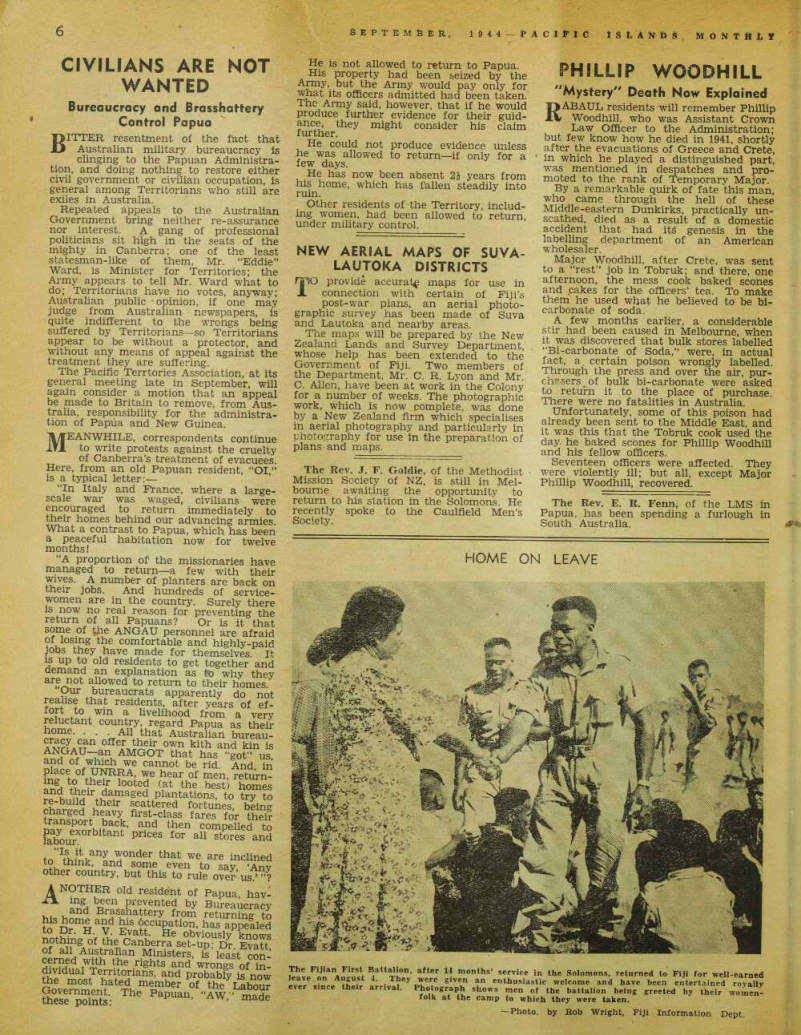
The Fijian First Battalion, after 14 months' service in the Solomons, returned to Fiji for well-earned leave on August 4. They were given an enthusiastie welcome and have been entertained royally ever since their arrival. Photograph shows men of the battalion being greeted by their women folk at the camp to which they were taken. —Photo. by Rob Wright, Fiji Information Dept.
Advertisements & other items, p. 8 (1 item)
6
SEPTEMBER, 1944 PACIFIC ISLANDS MONtiUt
Freedom!
Pacific Frenchmen Celebrate Liberation of Homeland
AUGUST 23, 1944, is likely to be an important date in the history of the South Pacific. For that appears to be the accepted date of the liberation of Paris from the Germans —which really means the liberation of France. And, in the South Pacific, the freedom of their Mother Country means much to the people of New Caledonia, French Oceania and New Hebrides. There have been joy ous demonstrations in Noumea, Tahiti, Vila —wherever Frenchmen have gathered together.
For four years, the French colonies have been cut off from their homeland.
At first, their administrative, financial and economic systems were in chaos; and, had it not been for the ready help of the British Pacific countries, and of the United States, their condition would have been calamitous.
They struggled along for nearly two years; and then the arrival of the Ameri cans in the South Pacific, and America’s expenditure of huge sums for war pur poses, changed everything—economically.
Since March, 1942, the French colomes have known “dollar prosperity”—in full measure and flowing over.
Now, as the Americans move north wards, in pursuit of the Japs, and the French colonies are finding the economic going a little tougher, there comes the restoration of France to the French people. This, of course, means that com munication between France and the South Pacific colonies will be restored.
This, in turn, means the restoration of trade—but not immediately—and there will be difficulties. France will need all the foodstuffs and raw materials that her Pacific colonies can supply; but. having been so completely and ruthlessly looted by the enemy, she will not be in a posi tion for some time to pay for imports, either in cash or goods.
Transport, also, will present a nroblem.
There probably will be no regular lines of ships between Europe and the Pacific until Germany collapses.
S-W Pacific Market Report
THE Americans, be they at peace or war, are commercially minded.
According to Newsweek, latest market reports from the South-west Pacific state that Jap souvenirs (gas masks, helmets, paper money, etc.) are still selling strongly in New Britain.
Favourite exchange mediums for these trinkets are fresh eggs, oranges, canned goods.
Wristlets and watch bands made from scrap plane duraluminium, stamped Guadalcanal or Tarawa, bring $B-$l5, according to craftsman ship. Necklaces of cat’s-eye shells $2O-$5O.
Shares have been sold to provide new officers’ clubs. One such, in the Hotel du Pacifique in Noumea—com plete with a long bar, slot machines and a mess—originally sold issued shares at $25. These shares are now quoted at $6OO, and have paid hand some dividends in cash—or grog.
Since the arrival of the US Forces in New Caledonia, 27 local girls have mar ried American soldiers and sailors Four of them recently left to make their homes in the United States.
Ngvr And The Returned
Soldiers' League
ALTHOUGH members of the NGVR still cannot officially join the RSSAILA, correspondence is still passing between the New Guinea branch of the League and the League. The NG branch has been advised that the case for the New Guinea Volunteer Rifles will be submitted when the Annual Federal Congress meets in November and that a ruling will then be given.
In the meantime, all applications by members of the NGVR are being ac cepted by the New Guinea branch and applicants are regarded as members.
Membership of the New Guinea branch now totals 161 —a number that is regarded as satisfactory from the branch’s point of view. This does not' include those who have applied for membership and who are still members of the Forces and have pot paid their subscriptions.
The Film-Star And The
Fuzzy-Wuzzy
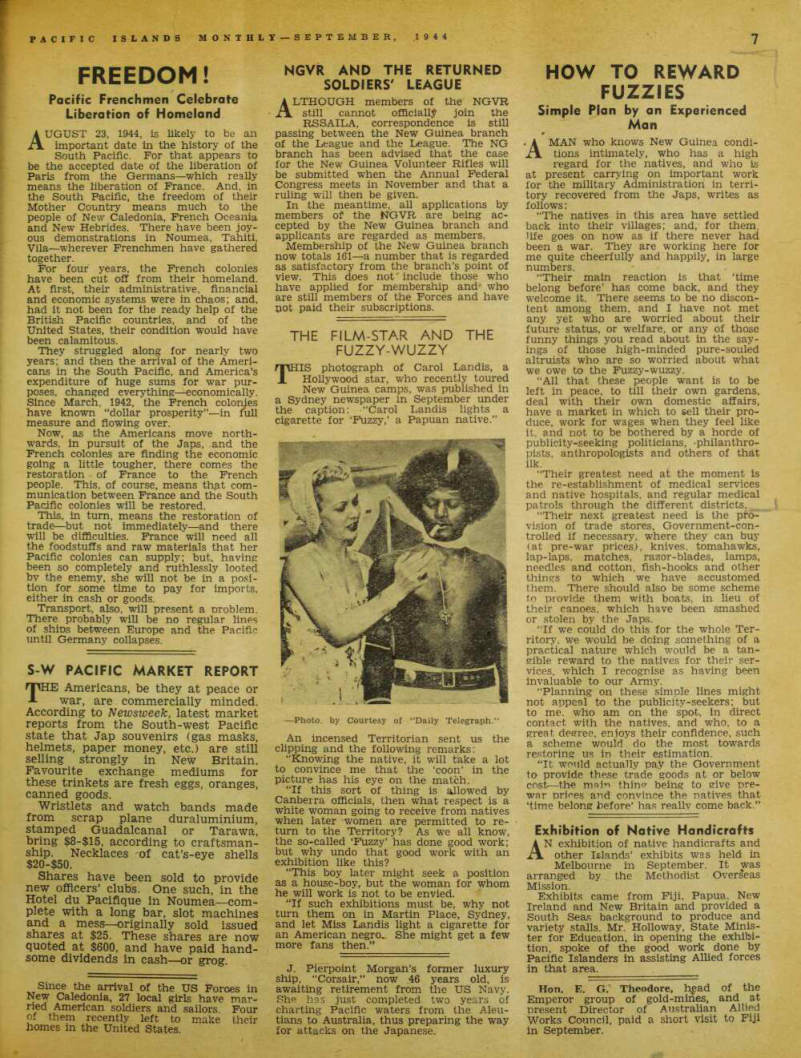
rIS photograph of Carol Landis, a Hollywood star, who recently toured New Guinea camps, was published in a Sydney newspaper in September under the caption: “Carol Landis lights a cigarette for ‘Fuzzy,’ a Papuan native.”
An incensed Territorian sent us the clipping and the following remarks: “Knowing the native, it will take a lot to convince me that the ‘coon’ in the picture has his eye on the match.
“If this sort of thing is allowed by Canberra officials, then what respect is a white woman going to receive from natives when later women are permitted to re turn to the Territory? As we all know, the so-called ‘Fuzzy’ has done good work; but why undo that good work with an exhibition like this?
“This boy later might seek a position as a house-boy, but the woman for whom he will work is not to be envied.
“If such exhibitions must be, why not turn them on in Martin Place, Sydney, and let Miss Landis light a cigarette for an American negro. She might get a few more fans then.”
J. Pierpoint Morgan’s former luxury ship, “Corsair,” now 46 years old, is awaiting retirement from the US Navy.
She has just completed two years of charting Pacific waters from the Aleu tians to Australia, thus preparing the way for attacks on the Japanese.
—Photo, by Courtesy of “Daily Telegraph.”
How To Reward
Fuzzies
Simple Plan by an Experienced Man
A MAN who knows New Guinea condi tions intimately, who has a high regard for the natives, and who is at present carrying on important work for the military Administration in terri tory recovered from the Japs, writes as follows: “The natives in this area have settled back into their villages; and, for them, Ufe goes on now as if there never had been a war. They are working here for me quite cheerfully and happily, in large numbers.
“Their main reaction is that ‘time belong before’ has come back, and they welcome it. There seems to be no discon tent among them, and I have not met any yet who are worried about their future status, or welfare, or any of those funny things you read about in the say ings of those high-minded pure-souled altruists who are so worried about what we owe to the Fuzzy-wuzzy.
“All that these people want is to be left in peace, to till their own gardens, deal with their own domestic affairs, have a market in which to sell their pro duce, work for wages when they feel like it, and not to be bothered by a horde of publicity-seeking politicians, -philanthro pists, anthropologists and others of that ilk.
“Their greatest need at the moment is the re-establishment of medical services and native hospitals, and regular medical patrols through the different districts.
“Their next greatest need is the pro vision of trade stores, Government-con trolled if necessary, where they can buy (at pre-war prices), knives, tomahawks, lap-laps, matches, razor-blades, lamps, needles and cotton, fish-hooks and other things to which we have accustomed them. There should also be some scheme to provide them with boats, in lieu of their canoes, which have been smashed or stolen by the Japs.
“If we could do this for the whole Ter ritory. we would be doing something of a practical nature which would be a tan gible reward to the natives for their ser vices, which I recognise as having been invaluable to our Army.
“Planning on these simple lines might not appeal to the publicity-seekers: but to me. who am on the spot, in direct contact with the natives, and who, to a great desrree, enjoys their confidence, such a scheme would do the most towards restoring us in their estimation.
“It would actually pay the Government to provide these trade goods at or below cost—the maio thino- being to give pre war prices and convince the natives that ‘time belong before’ has really come back.”
Exhibition of Native Handicrafts
AN exhibition of native handicrafts and other Islands’ exhibits was held in Melbourne in September. It was arranged by the Methodist Overseas Mission.
Exhibits came from Fiji, Papua. New Ireland and New Britain and provided a South Seas background to produce and variety stalls. Mr. Holloway, State Minis ter for Education, in opening the exhibi tion, spoke of the good work done by Pacific Islanders in assisting Allied forces in that Hon. E. G. Theodore, h£ad of the Emperor group of gold-mines, and at nresent Director of Australian Allied Works Council, paid a short visit to Fiji in September.
of Improvement
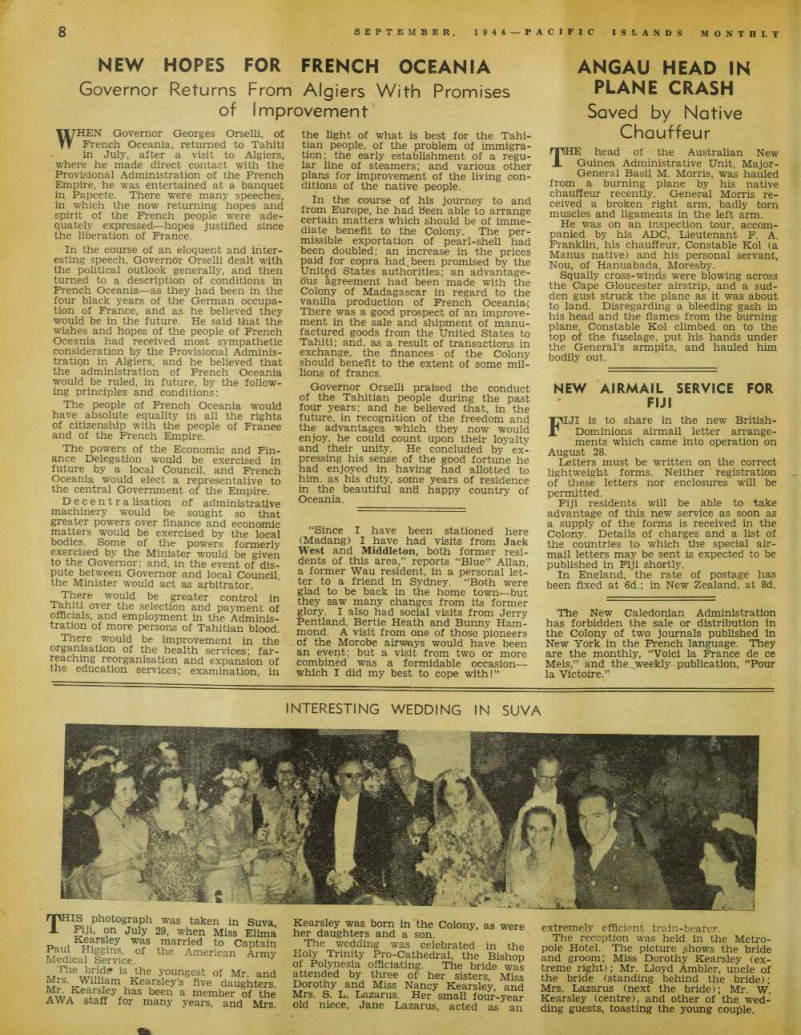
New Hopes For French Oceania
Governor Returns From Algiers With Promises of Improvement
WHEN Governor Georges Orselli, of French Oceania, returned to Tahiti in July, after a visit to Algiers, where he made direct contact with the Provisional Administration of the French Empire, he was entertained at a banquet in Papeete. There were many speeches, in which the now returning hopes and spirit of the French people were ade quately expressed—hopes justified since the liberation of France.
In the course of an eloquent and inter esting speech, Governor Orselli dealt with the political outlook generally, and then turned to a description of conditions in French Oceania —as they had been in the four black years of the German occupa tion of France, and as he believed they would be in the future. He said that the wishes and hopes of the people of French Oceania had received most sympathetic consideration by the Provisional Adminis tration in Algiers, and he believed that the administration of French Oceania would be ruled, in future, by the follow ing principles and conditions: The people of French Oceania would have absolute equality in all the rights of citizenship with the people of France and of the French Empire.
The powers of the Economic and Fin ance Delegation would be exercised in future by a local Council, and French Oceania would elect a representative to the central Government of the Empire.
Decentra lisation of administrative machinery would be sought so that greater powers over finance and economic matters would be exercised by the local bodies. Some of the powers formerly exercised by the Minister would be given to the Governor; and, in the event of dis pute between Governor and local Council the Minister would act as arbitrator.
There would be greater control in Tahiti over the selection and payment of officials, and employment in the Adminis tration of more persons of Tahitian blood.
There would be improvement in the organisation of the health services; far reaching reorganisation and expansion of the education services; examination, in
the light of what is best for the Tahi tian people, of the problem of immigra tion; the early establishment of a regu lar line of steamers; and various other plans for improvement of the living con ditions of the native people.
In the course of his journey to and from Europe, he had been able to arrange certain matters which should be of imme diate benefit to the Colony. The per missible exportation of pearl-shell had been doubled; an increase in the prices paid for copra had been promised by the United States authorities; an advantage ous agreement had been made with the Colony of Madagascar in regard to the vanilla production of French Oceania.; There was a good prospect of an improve ment in the sale and shipment of manu factured goods from the United States to Tahiti; and. as a result of transactions in exchange, the finances of the Colony should benefit to the extent of some mil lions of francs.
Governor Orselli praised the conduct of the Tahitian people during the past four years; and he believed that, in the future, in recognition of the freedom and the advantages which they now would enjoy, he could count upon their loyalty and their unity. He concluded by ex pressing his sense of the good fortune he had enjoyed in having had allotted to him. as his duty, some years of residence in the beautiful and happy country of Oceania.
“Since I have been stationed here (Madang) I have had visits from Jack West and Middleton, both former resi dents of this area,” reports “Blue” Allan, a former Wau resident, in a personal let ter to a friend in Sydney. “Both were glad to be back in the home town—but they saw many changes from its former glory. I also had social visits from Jerry Pentland, Bertie Heath and Bunny Ham mond. A visit from one of those pioneers of the Morobe airways would have been an event; but a visit from two or more combined was a formidable occasion— which I did my best to cope with!”
Saved by Native
Angau Head In
Plane Crash
Saved by Native Chauffeur
THE head of the Australian New Guinea Administrative Unit, Major- General Basil M. Morris, was hauled from a burning plane by his native chauffeur recently. General Morris re ceived a broken right arm, badly tom muscles and ligaments in the left arm.
He was on an inspection tour, accom panied by his ADC, Lieutenant F. A.
Franklin, his chauffeur, Constable Kol (a Manus native) and his personal servant, Nou, of Hanuabada, Moresby.
Squally cross-winds were blowing across the Cape Gloucester airstrip, and a sud den gust struck the plane as it was about to land. Disregarding a bleeding gash in his head and the flames from the burning plane, Constable Kol climbed on to the top of the fuselage, put his hands under the General’s armpits, and hauled him bodily out.
New Airmail Service For
Fiji
FJI is to share in the new British- Dominions airmail letter arrange ments which came into operation on August 28.
Letters must be written on the correct lightweight forms. Neither ' registration of these letters nor enclosures will be permitted.
Fiji residents will be able to take advantage of this new service as soon as a supply of the forms is received in the Colony. Details of charges and a list of the countries to which the special air mail letters may be sent is expected to be published in Fiji shortly.
In England, the rate of postage has been fixed at 6d.; in New Zealand, at Bd.
The New Caledonian Administration has forbidden the sale or distribution in the Colony of two journals published in New York in the French language. They are the monthly, “Void la France de ce Meis,” and the,weekly publication, “Pour la Victoire.”
Interesting Wedding In Suva
rIS photograph was taken in Suva, Fiji, on July 29, when Miss Elima K^ rs ! ey was married to Captain Paul Higgins, of the American Army Medical Service. y _, The is the youngest of Mr. and Mrs. William Kearsley’s five daughters. ¥TTVA Ke^ rs i ey^has been a member of the AWA staff for many years, and Mrs.
Kearsley was born in the Colony, as were her daughters and a son.
The wedding was celebrated in the Holy Trinity Pro-Cathedral, the Bishop of Polynesia officiating. The bride was attended by three of her sisters, Miss Dorothy and Miss Nancy Kearsley, and Mrs. S. L. Lazarus. Her small four-year old niece, Jane Lazarus, acted as an
extremely efficient train-bearer.
The reception was held in the Metro pole Hotel. The picture £hows the bride and groom; Miss Dorothy Kearsley (ex treme right); Mr. Lloyd Ambler, uncle of the bride (standing behind the bride); Mrs. Lazarus (next the bride); Mr. W.
Kearsley (centre), and other of the wed ding guests, toasting the young couple.
Tahitian Contingent
"Monty"-Father Of The
From Our Own Correspondent Papeete, June 6.
IN the days to come, those veterans of Australia, New Zealand, India and of every outpost of Empire who, beside the soldiers of Britain, fought that amaz ing campaign which turned the tide of war, and who wear on their shoulders the insignia of Montgomery’s Immortals, will form a comradeship of glory. And of that fellowship will be the soldiers of Tahiti.
On May 17, 49 of our Tahitian soldiers arrived at Papeete from the war area of Africa. Most of them wore Eighth Army insignia; many of them decorations for valour.
They tell of General Montgomery’s great kindness —how he kept them about him; how he constantly watched over their comfort and welfare, and after each battle praised their valour. The General, they say, was their “Metua” (father) as well as their honoured commander, and on the great day that the King of Eng land came to visit the Eighth Army, General Montgomery presented his Tahi tians, and the King took the hand of each of them and thanked him for his part in the great victory.
Australia, our Tahitians bear witness, also opened her heart to them in fullest measure.
The reception that was given the re turning contingent at Papeete was car ried out in “due and ancient form.” The veterans were received with full military honours by His Excellency, the Acting- Governor, Monsieur Louis Fournier.
From the landing place they were escorted to the church at Paofai, where a solemn service of thanksgiving was cele brated by the Rev. Charles Vernier, Pre siding Pastor of the Protestant Church in French Oceania. He spoke eloquently in the Tahitian language.
Every expression of honour and grati tude has been offered to these gallant soldiers of Tahiti by the dignitaries of the Colony, by their comrades in arms and by the population.
Adopt A War Orphan
A SMALL booklet called “Orphans of the War” has been published by the British Orphans’ Adoption Society of Australia, setting out the aims of the Society and the work it has already accomplished: The Society was formed in 1939. It claims that Australia is one of the logical homes for the war orphans of Britain and Europe, and plans to have private homes in readiness for legal adoption of overseas’ war orphans (the demand for children for adoption far exceeds the supply in Australia) when the seaways are clear. It prepares also for the chil dren’s reception and care in Australia pending legal adoption.
The Society renders a similar service to Australian war orphans, and it has a vigorous programme of wartime service to children generally.
Anyone interested in adoption of war orphans or in the work of the Society— which embraces every branch of welfare work for the children of the world —can join the Society for 5/- per annum; or can buy this little booklet for 1/- and thus augment the funds. Donations and communications to; British Orphans Adoption Society, 58 Pitt Street, Sydney.
The “flying-bomb appeal,” made re cently in Fiji, closed in early September.
On September 3, with many outlying dis trict’s contributions to come in, contri butions amounted to £7,500.
in Pukapuka
No "Dollar Prosperity" in Pukapuka And Definitely No Foxtrot
Prom Our Own Correspondent
Rarotonga, Aug. 15.
MUCH is heard these days of “dollar prosperity” in the Pacific Islands, but there is one island at least, where the natives do not wear khaki drill and sun helmets and live on pea nuts and chewing gum.
When Mr. R. Savage, the new Resident Agent of Pukapuka. arrived there with his wife and family, he found the natives wearing copra bags and odd bits of sack ing, while others less fortunate were wear ing the traditional kilt of coconut leaves.
The island was in a bad way for food.
A recent hurricane had destroyed the breadfruit, paw-paws and bananas, washed out the taro beds in the centre of the island, and taken a heavy toll of the coconuts. The natives were living almost entirely on a limited diet of coco nuts. Fish were scarce owing 'partly to a lack of fish-hooks—and partly to the extreme laziness of the Pukapuka male.
Pukapuka is a man’s Paradise: the men do little but sit around and smoke, dis cuss the food situation, sleep, and, in an occasional burst of energy, play cards.
Meanwhile, the women do most of the work—which largely consists of finding something for the men to eat and trying to raise a little money to provide them with tobacco.
As the men consider that the heavy tasks are the business of the women, the RA has neatly turned the tables on them by insisting that they clean up the houses while their wives' work in the taro beds.
REMEMBERING R. D. Frisbie’s romantic description of the dancing and love making of the young Pukapukans on the outer beach at night, it is surpris ing to find that they are shocked by the European foxtrot.
In an effort to lighten the monotony of life on this lonely atoll, Mr. Savage, with the aid pf his sons and the Raro tongan school-teacher, has organised a small guitar and accordeon band and in stituted evening dances.
He found, however, that introducing this pastime was not such an easy matter.
Love-making in the moonlight may be all very well; but this hugging each other and shuffling round a room in the glare of a benzine lamp, with a lot of people looking on, was too much for Pukapuka modesty.
On Sundays the pastor tried to assure his congregation of the innocence of this old English custom and appealed to them to support the RA in his earnest desire to brighten the night-life of Pukapuka.
The Cook Islands Administration is trying to encourage the Pukapukans to help themselves out of their depression.
The RA is doing goocUwork in this direc tion, and recently they were fortunate in getting away a shipment of several hundred pandanus mats which found a ready sale in New Zealand and will bring them much-needed clothing and food stuffs.
Mr. O. Bonnell and Mr. T. Pattle re cently purchased Mibu Plantation, Fly River, Papua, from Mrs. Sharrot Holland.
The necessary approvals having been given by the Production Control Board, the two men were on their way to the plantation at the end of August.
Mrs. Ida McComish, who has travelled extensively in the Pacific but who at present is living in Sydney, has been made a Fellow of the Royal Geographic Society.
Fiji Election
Constitution of New Council
Suva, Aug. 20.
RESULTS of the Fiji Legislative Council elections, which were held on July 29, have just been announced. De lay in declaring the poll was due to servicemen’s votes and Fiji law that re ouires all ballot boxes to be returned to the Returning Officer at a central point before any counting whatsoever begins.
Results: Southern (European) Ragg, Amie 451 Barker, Alport 265 Southern (Indian) Vishnu Deo returned.
North-west (European) Ragg, H. H 221 Bayly, J. P 195 North-west (Indian) Patel, A. D 1,841 Lakshman, B. D 554 Eastern (European) Gibson, H. B. (unopposed).
Eastern (Indian) Gyaneshwar, B. M 399 Tularam 201 Besides these elected members, the new Legislative Council will be the ex-officio members, the Colonial Secretary, the Attorney-General, and the 'Financial Sec retary; the official members, Dr. McGusty, Ratu Sukuna, Colonel Workman, Mr. N.
B. Casey, Mr. W. F. Hayward, Mr. J. L.
Brown, Mr. C. S. Reay, Mr. J. S. Smith, Mr. H. J. S. Allen, Mr. W. V. Banting, Mr. A. H. Phillips, Mr. W. H. B. Buck hurst, and Mr. C. Harvey; the European nominated members, Mr. J. A. Garnett and Mr. W. G. Johnson; the Indian nominated members, Lieut. K. B. Singh and Mr. A. R. Sahu Khan, and the Fijian members, Ratu George Tuisawau, Ratu Lala, Ratu Tiale Vuiyasawa, Ratu George Toganivalu, and Ratu Edward Cakobau.
Advertisements & other items, p. 11 (1 item)
Association
Notice of Meeting
PACIFIC TERRITORIES
A Quarterly General Meeting of members will be held in the Teachers 7 Federation Hall, 7th Floor, 166 Phillip Street, Sydney, on Tuesday, 26th September, 1944, at 8 p.m.
Business : (1) To receive a report of the Executive on activities to date. (2) To consider a resolution, copy of which has been forwarded to members, resubmitted from the General Meeting of 27th June, 1944.
C. A. M. ADELSKOLD,
Secretary.
Resources
New Guinea's Timber
Surrey by Experts
WHEN Dr. H. E. Dadswell, principal research officer of the forests divi sion of the Council of Scientific and Industrial Research recently returned to Australia from six weeks’ survey of New Guinea timber resources, he was en thusiastic about post-war prospects of timber in that area.
At present both Australian and Ameri can forestry units are milling timber in New Guinea, with the help of the Forests Division.
Dr. Dadswell said that some of the best forests were in the highlands round Wau but, as far as one could judge, timber was there in millable quantities throughout New Guinea and New Britain.
There were quantities of hoop pine and klmki pine in the highlands which would be of considerable value after the war The best timbers available for use were hardwoods, such as taun, kwila, walnut, rosewood, teak, kaeda and various mem bers of the mahogany family. ‘‘Prior to the war,” said Dr. Dadswell, “there was an Australian import duty on timber from New Guinea. The timber is there, but it is a matter of getting to it It would be chiefly a matter of building and maintaining roads. But if we do get timber from New Guinea after the war it will have to be cut intelligently and kept under suitable control, with forest advisers* co-operating.”
Zlv £s Uiatod t 0 Cover other than direct
Coco-Cola Is War Damage
—But Not Looting
rRRITORIANS who still hope that looting may be added to the list of ... war damage for which compensation will be paid by the Commission, might be interested in the case of a Mr C J Priebe, formerly of Darwin.
Mr. Priebe stated in September that, before the first air-raid on Darwin, he packed seven cases oi valuable crystal, nne linens, silverware and household treasures, but was unable to obtain ship ping space. However, he forwarded an inventory to the War Damage Commission when he was forced to come south.
Although he did not receive an im pressment order for any of his goods and, although none of them would have been use in cam P life - he has proof that the cases were opened, and the contents disappeared completely into min air.
The War Damage Commission advised him, as they invariably have done in pnHtLrf a f 6S ’ that he • is at P res ent not entitled to compensation, as this is “in war damage —but that they have noted the particulars in case any scheme Zlv £s Uiatod t 0 Cover other than direct Last month, says Mr. Priebe, a US bomber inadvertently dropped cases of champagne, beer wine and Coco-Cola on an Adelaide suburb. Residents whose property was damaged have already been compensated . Why, then, should nJt Darwins citizens be given promnt and sympathetic consideration? P pt and Mr. W. D. Mason, who was managing' Sangara Plantation, Papua, under the direction of the Australian New Guinea Production Control Board, died in Svd hnr, °rppt U fi USt \ 4, of black water fever. He had recently returned from Papua.
Mr. H. R. H. Chalmers, the genera 1 manager of the Bank of New zllfand visited Fiji in early September. ’
Late-But In Company
Arrival of New Resident Commissioner in Tarawa
By Harold Cooper
FTU3E arrival of a new Resident Com- J- missioner in the Gilbert and Ellice Islands Colony is usually an occasion for a stately ceremony of welcome Ther« was no such ceremony for Colonel Vivian Fox-Strangways’. His welcome, at his present headquarters at Tarawa, was a handshake from a battle-stained Marine officer whose words of greeting were almost drowned by the rattle of Jap machine-gun fire. y Colonel Fox-Strahgways was appointed Resident Commissioner of the G. & E Islands Colony as long ago as 1941, on promotion from Nigeria, but there was destined to be a long delay before he his new duties. By the time' he leached Suva, the headquarters of the Western Pacific High Commission, the Japs were in partial occupation of the Gilberts and the invasion of the Ellice Group was expected momentarily.
The majority of the European civil ser w^ h S d^ b u en with drawn, and Adminis rf™ n + had b ? en re duced to such skeleton proportions that even the Resident Com missioner was supernumerary to estab lishment. For a time Fox-Strangways was employed on a special mission in the Solomons, where he did what he could to organise a small defence force. That mis sion completed, he obtained permission to for. *1 Aus traha and join the RAAF, and mon i lls he was a humble air monwealth. 6 at 3 Station ln the Com ‘ an m % ent message from Suva that his presence was required there immediately, and an airman-trainee was flown at high speed from Melbourne, via Noumea, to Fiji. There the High Com missioner, Sir Philip Mitchell, told him ff ort A . was to be made to re estabiish the Administration in the Gil bert and Ellice Islands. that time was to set up headquarters in the Gilberts; but before nnl? 1 ?v, COl ? ld b £ fitted out for the Pur pose, the Japs had completed their occu-
pation of all but the most southerly mnge of that Group. 'i'he plan was accordingly changed and Fox-Srrangways went to Funafuti, in me Ellice Group arriving there a weeK before United states’ Marines and seabees landed to convert the island into an air and naval oase.
In the course of the next few months, the new Resident Commissioner man aged to make several tours of the Ellice Islands, despite the interest which Jap aircraft occasionally showed in his move ments (on one trip he took on the Lon ?,???. , Ml ?. sio^ ry Society's ship, “John Williams the old ship was heavily straffed, but fortunately suffered ornv minor damage). * LATE in 1943, Colonel Fox-Strangways was summoned to Pearl Harbour where he and other British officers gave what assistance they could in pre paring plans for the liberation of the .Gilberts. And when the Second Marine Division left on me voyage that was to end in the battle of Tarawa, Fox-Strang ways sailed with them.
He landed on Betio islet on D-Day plus two, and as the Marines were then still engaged in heavy fighting, it will be understood why the few natives left on the island could not organise the custom ary ceremony of welcome. There was no Residency for him to occupy either, and his first night in the Gilberts was spent in a fox-hole, where his sleep was dis turbed from time to time by stray Jap mortar bombs. But even while conduct ing one of the bloodiest operations of the Pacific war, the American Commanding General had time to observe international courtesies. Next day he made known to Fox-Strangways his wish that the British and American flags should be hoisted together at the beach-head. Fox-Strang ways produced a Union Jack from his paqk and, later that day, it was flying bravely from a bullet-scarred coconut tree alongside the Stars and Stripes.
A little late, but in very powerful com pany, the new Resident Commissioner had arrived.
Colonel v. Fox-Strangways pointing out the fox-hole where he spent his first night on Tarawa.
Decoration For Fijian
IN June “PIM,” Sergeant-Major Bob Hewlett, of the Fiji Military Forces, described how Private Sairusi Koto, a transport driver of the same unit, took a day off at the war.
Private Koto recently was awarded the American Silver Star for that day’s work.
The citation states: “While attached to an American unit as a member of a security and identifica tion party operating in front of the main line of resistance, Private Koto killed a Japanese machine-gunner and captured the machine-gun and an enemy knee mortar. . “Continuing the patrol through dense jungle growth, Private Koto observed and killed another Japanese with his rifle.
Further exposing himself to possible hos tile fire, he borrowed a Browning auto matic rifle from an American member of his patrol and fired on two Japanese apparently killing or wounding them.’
Private Koto’s superb scouting ability excellent marksmanship and fearless determination to eliminate the enemy reflect great credit upon himself and his service.”
Advertisements & other items, p. 12 (1 item)
10
SEPTEMBER, 1944-PA C I F 1 C ISLANDS MONTHLY
Tropiclities
rOM the “Sydney Morning Herald” of September 2: “Twenty-two months after the epic action at Milne Bay, seven Australian Diggers have voluntarily erected a per manent monument in honour of their fallen comrades, on the northern tip of Turnbull Airfield, where the Japanese had their first decisive defeat of the war.
“The monument, just erected, was designed and supervised by Lieutenant R.
E. G. Cunningham, of a works company, which served in the area. He and six Diggers of his platoon carried out the work'in their spare time. No official sup port or encouragement was received.
“The construction, which is 8 ft. 6 in. high, is made of reinforced concrete. Two brass plates are let into the side of the monument. One shows the rising sun and the other contains' the following inscription:— “In memory of the officers, NCO’s and men of the 7th and 18th Aust. Inf.
Bde’s who gave their lives in defend ing Turnbull Airfield.
“This marks the westernmost point in Milne Bay of the Jap advance, Aug.-Sept., ’42, also the southernmost point of the Jap advance in the S-W Pacific. Eighty-three unknown Jap Marines lie buried here.
“Erected as a tribute by Australian forces serving in this area, June, 1944.
“The graves of Squadron-Leader P. R. (Pete) Turnbull, DFC, commander and hero of one squadron of the defending air forces, in whose honour “The Strip” was named, along with those of Squadron- Leader C. R. Gurney, after whom another strip at Milne Bay was named, and Cor poral Jack French, Australia’s first VC winner in New Guinea, in Milne Bay War Cemetery, have been the scene of many a silent moment spent in admiration and respect of these three men whom Aus tralia proudly calls her heroes.” * IN August, 1943, the “PIM” published a photograph of the original memorial erected on Turnbull Field—a rough cairn of stones around a piece of coconut tree trunk, on which were nailed two inscriptions.
This cairn and the inscriptions were erected soon after the Milne Bay action, but a few months after they were put up the inscriptions were souvenired, and grass and jungle grew over the cairn. rE Christian names under which native children are registered in Mangaia continue to be of the same limited type—totally unsuited to modern island life. They are names of diseases (often of a repellent nature), misfortunes, and negative happenings of unedifying or uncheerful kind.
No child ever receives a European name, a floral or poetic one, or indeed anything attractive. The reason for this is native superstition and the belief in demoniac influences. A child with a name like Piles or Dysentry (two of the mildest!) need not fear demons—demons are unlikely to be attracted by such a pame!—E.G. ♦ SOLOMON Island cannibalism was head lined for the delectation of the New Yorkers’ literary palate in early August. A Solomon Islands native chief, it was stated, had told American officers that the Japs had brought a woman with them to the Solomons when they in vaded in 1942. An officer asked the chief: “How can you be so positive that there was a woman with the Japanese party?”
Answered the “chief,” with aplomb: “I
know, because I ate her.
Old residents of the Solomons are m clined to doubt this self-confessed canni balism. The Rev. A. H. Voyce of the Methodist Mission said he did not believe the press report from New York. Fully 90 per cent 0l the islanders were adherents of t he Christian faith. Cannibalism had long cea sed to exist, * * CCORDING to a correspondent in the Sydney “Mirror” some New Guinea native may write MD after his name some day . it may take two or three generations, but at least a beginning has been made in two medical schools of natives taking a three months’ medical course . The schools, the correspondent are one of the many ideas of
Angau.
Many Territorians will hasten to prove th£it someone thought of it before AN GAL —but it is a shame to spoil a good story.
Tlie regt it goes; “Approaching a small sago-thatched h U t i n New Guinea, you may hear an Australian speaking in Pidgin. He is describing the symptoms of a man with J “‘Suppose head he pain, skin he hot, backside he pain, man he no like kaikai. what name belong this fellow some thine'?’ “Like eager children the class of New Guinea y0 6 uths ansW ers, in a throaty
. ‘Malaria ’
“When the course is completed they wd i d e sent to villages, some far from the reacd 0 f W hite men, to cure the coughs f ailing children and diagnose beriberi, * A d » yaws ana aengue> * WW „ T ™ T TT .. . .. -c*.- 11/HEN Harold Cooper, of the Fiji TT Information Office, recently visited the Gilbert and Ellice Islands again he brought back some good stories. Two of them follow: When Gilbertese women decide to sup port the Allied war effort they don’t do things by halves. On the island of Abe mama, recently, I watched the British District Officer receive a deputation repre senting the “women’s committee” which had been formed only a week before in one village. The members of the depu tation filed past the DO’s desk and handed over various small sums which added up to the princely total of £lo— a year’s income for average fami lies in these parts. It was to be paid i nto the Colony’s war fund, i assumed that this was a special ges ture that, would not be repeated for some time, but to my surprise another deputa tion, with one or two changes in person nel, but representing the same women’s committee, turned up the next day and went through the same procedure.
These incidents are typical of the spirit i found among the womenfolk through out the Group. On one island I arrived a t Government headquarters just as a middle-aged woman and her daughter were handing a large mat to the District officer. I asked what price they wanted for so fine a specimen of native handi work. The DO smiled and unrolled the mat. Woven across it in bold letters was the inscription, “Our present for the war.”
The DO explained that the mat would be sold through American post-exchange and proceeds would be given to the Red Cross, * mHE Japanese who occupied the island X of Abemama, in the Gilberts, thought that they might be able to make a Quisling out of Tekinaiti, an hereditary High Chief of the island. The
dictatorial powers that had been enjoyed oy Teklnaiti’s forebears had been abro gated under British rule and the Japs jumped to the conclusion that he must therefore have long been nursing resent ment.
They changed their minds, however, the first tune they saw him without the white singlet which he almost invariably wore.
Tatooed across Tekinaiti’s chest was an enormous Union Jack.
After that, Tekinaiti, far from having special favours showered upon him by the Japs, was regarded with suspicion as bemg “probably pro-British.”
AN exhibition of 40 oil and water colours of island subjects attracted considerable attention in Auckland, NZ, in August. They were the work of Mr. A. H. Gouwe, a Dutchman living on the island of Raiatea, French Oceania.
The paintings were sent to the Dominion by the artist, who requested that the proceeds of their sale be devoted to the Netherlands Soldiers and Sailors Fund.
The fund should benefit substantially— half of the pictures were sold shortly after the exhibition opened.
The pictures are of native life and scenery near the artist’s home, and are described as having nothing of the “Hollywood South Seas” about them.
The wrapper in which the paintings came is also on display—for the 62 stamps which were used for postage. The stamps include Vichy and FF issues and the wrapper will be auctioned at the conclu sion of the exhibition —also towards the Netherlands Sailors and Soldiers Fund. * THE story of how Fred Narruhn won the American Silver Star decoration, for bravery and initiative, during the recapture of Makin (Butaritari) by the United States Marines, in November last, is told on page 23.
The Narruhns are an old Central Paci fic family. Fred’s grandfather, a Ger man, came into the Line Islands a long time ago, and his father* Robert Narruhn, married one of the well-known De Brunn family and settled in the Marshalls while they were still a Germany colony. But the Japanese, after 1914, hunted all Europeans out of the Marshalls, and Robert Narruhn settled at Butaritari. in the British Gilberts, and obtained British naturalisation. Until 1941, there was a Japanese firm trading in Butaritari, and Robert Narruhn and the Japanese mana ger were next-door neighbours. But they did not love each other. Robert Narruhn’s children had been deprived of consider able land rights in the Marshalls, by the Japanese.
When war came, the Narruhn family moved south into Fiji; and it was in Fiji that Fred enlisted. It is an interesting sidelight on racial trends in the Pacific that the sons of two former German ■families —the Narruhns and the Rey monds—should have distinguished them selves in the service of the Americans, while fighting against the Japanese to recapture the British Gilbert Islands. * rAT it is easier to bring up a young family in New Guinea, in spite of that land’s much-publicised draw backs, than in free, white Australia, is the opinion of Mrs. A. H. B. Beavis, for merly of Milne Bay, Papua. There is no help for mothers at all in Australia, she says.
Mrs. Beavis told a Sydney newspaper m August, that she had lived for 14 years in the Territory and used pigeon-post as a means of communication, particularly during times of sickness. High on her mountain-top above Milne Bay, she regu larly sent her grocery list* off to Samarai, 40 miles away, per bird.
Polynesian Club Farewells
Miss Ivy Buffett
AT the Polynesian Club recently, a re presentative gathering farewelled Miss Ivy Buffett, who has now re turned to her island home with her parents, Mr. and Mrs. Peter Buffett, of Longridge, Norfolk Island.
Ivy is a graceful exponent of the Poly nesian dance and a hard-working member of the Club's concert party, which works for the Army Education Service at camp and military hospitals.
At the same gathering, the engagement was announced of Rosita Maeva Hinano Goodman, daughter of Mr. and Mrs. W.
Goodman, of Ashbury, Sydney, to a young Australian airman, LAC Robert Hanover Murphy, of Brisbane.
Rosita is a grand-daughter of Mrs.
Marion Banner, of Tipaerui, Tahiti, and has been living in Sydney for some time.
Possibilities of Various Tropical Crops
For New Settlers In Papua
Part I
FIRST OF TWO ARTICLES FOR “PIM,” BY AN OLD RESIDENT—PXYZ
IT is very doubtful if settlement in Papua will be open to small landed proprietors for some years to come.
The country and its native labourers require a long rest before much active new development can be attempted; but, already, a few of the stalwart Australians who have fought in the land to free it from invasion have turned their thoughts to small plantations and farms in it when the war is over.
They should have priority in land grants over bigger enterprises that will make bigger demands on Papua’s depleted labour pool. They are the type of settler the Territory most wants, and will make better citizens than the handful of over seers who build up the big estates.
It needs an expert in tropical agricul ture to show the would-be soldier-settler how to make a success of his holding in Papua. But much in the way of avoid ing the common pitfalls and disappoint ments of a career on the land can be learnt from the ordinary man who has partially failed, profited by his experience, and to some extent achieved his original aim—an agricultural venture in the Ter ritory which will pay its way.
WITH some exceptions, chiefly in the case of the big companies who can command expert advice, amateurism is writ large over many of Papua’s plant ing enterprises. Especially has this been the case where the would-be planter has graduated from a trading store or Gov ernment post, or where lack of capital has prevented complete fulfilment of the task of transforming a piece of Papua in the raw into a profitable plantation.
Otherwise, how is it that the Territory is dotted with abandoned or unpayable patches of cultivation, or that the man who has made a success of his enterprise is so often discovered to have founded his prosperity on the work put in by some original owner who failed to make good?
Too often, men seem to, have just drifted on to the land in Papua, starting ventures without sufficient technical knowledge or even commonsense, bur dened also with the facts that Nature in the tropics is a particularly hard task mistress, and that Government, both in the Territory and in Australia, has never cared two hoots whether he failed or succeeded.
Experience has at least shown some of the previous settlers why they have par tially failed, and this article is intended to assist new ones from falling into the. same errors.
IN the first place—and it is a point of supreme importance—haste in selec tion of a suitable site and lack of careful planning have been the downfall of many hard-working pioneers. Too often, the man who has found himself comfortably settled in a trading post has begun to plant some crop or other on the first piece of land to hand. Others have made a half-hearted tour of the country, found and acquired the bit of Paradise they fancied, and then looked round for some sort of crop that might suit it. This is the classical Papuan example of put ting the cart before the horse.
The first point that might be impressed on land-seekers is to make up their minds definitely and finally what they want to grow before they begin to look for sites.
Decide upon the crop, be it coconuts, coffee, rubber, or one of the other tropical commodities that could be profitably grown in the Territory, but for various reasons have been neglected, learn its. requirements as regards soil, climate, and altitude, make sure that your market estimates are fool (and rogue) proof, and provide for transport and labour.
Then, and then only, go and look for the right piece of land and not the first
piece that takes your fancy. If you choose rubber, go to the rubber districts, where planters have already demonstrated that success in its culture is possible. Ask their advice—it will be freely given— enlist their help in the selection of land, and get as close to them as you can. It is saddening to see how some men have spent their time and money on an enter prise that was doomed to failure from the start because the land chosen was not suitable to the crop.
Similarly, with the other acknowledged crops—which at present seem to include only coconuts, coffee, kapok, and possibly cocoa.
THIS 4eads naturally to the question as to what hitherto neglected products Papua can supply. It is almost a disgrace that two primary commodities, rice and tobacco, for which there has always been a tremendous local demand, have not been established on a commer cial basis long ago.
Rice growing has been left to somewhat unwilling native cultivators and has been in abeyance for some time. This indus try is open- to white growers with pros pects of success.
In the case of tobacco, the choice of land is so much a matter for experts that no amateur should select it for himself.
Careful investigation into excise condi tions and, above all, markets, must be made. Past tobacco ventures in Papua have failed—first, through alleged inter ference by vested interests; and, secondly, by the Fuzzy-wuzzy’s preference for American trade tobacco. Both factors will probably operate in the future and both might be overcome by -would-be growers who took their case to a Govern ment that wished to see the Territory developed to its fullest extent. Tobacco is so essentially a crop by means of which the local native can climb into the posi tion of a peasant farmer that no righ+minded Government should hesitate to destroy any factors that tend to prevent the development of this industry.
COTTON, surely, has a future in Papua.
According to official reports, attempts in the past failed because unsuitable land was chosen. It can, and has, how ever, been grown to profit in Papua, and I recall the experience of one small land holder who staved off bankruptcy with the help of a hastily planted area of cot ton. Some of the lighter coastal lands in the Territory seem to actually cry out at one as one passes, “Try me for cotton!”
Kapok should be a payable sideline on a Papuan plantation and in the drier dis tricts yield and quality are fair. But the grower should make very particular inquiries into the way the product is mar keted in Australia, and not scruple to ask for Government aid in checking mono polistic abuses. The Commonwealth has encouraged its culture by offering a bonus of 2d. a pound: but some disappointed growers think the bonus money might have been better spent by establishing a selling bureau whose officers could have exposed certain unfair practices designed to keep Papuan kapok off the Australian market.
DERRIS root, a toxic product in demand as an agricultural insecti cide, is a more or less untried crop that seems to offer a return to small growers. It matures in two years and the culture presents no difficulty, but some technical knowledge of the type of stock to plant and its toxic content is required Quinine is practically untried, and its future, in the face of competition from synthetic substitutes for malaria, is un certain. It needs a high altitude, at least 3,000 feet, and is slow to come to matur ity. It has been grown in the main ranges of Papua and is being tried out
in the high-level plateaux of the Man dated Territory. At present it can hardly be considered as even of potential value to small settlers, but it may prove a win ner some day.
Sugar *and tea come under the same category: both can be grown but, for market reasons, cut no ice in Papua’s agricultural programme.
With the exception of certain quick crops like tobacco, rice, or cotton, the best counsel one can give newcomers is to grow what others are growing, and to grow it as close to the successful man as possible. The formation of group settlements will gradually lead to such commercial essentials as co-operative fac tories for rubber, copra, and coffee; and to provide roads, and plane services. Also such amenities as schools for white chil dren. facilities for games and sports, elec tric light, and libraries. The country is not overcrowded yet, and concentration of settlers is a wise policy to pursue.
OTHER small tropical crops are rather disillusionary; but might offer some help as sidelines where a member of the family can supervise their culture.
Among these are chillies and peanuts.
The former is a fiddling sort of crop, and a suitable drying oven needs devis ing, though a few trays placed in the copra drier for half a day or so may suffice. The product on the Australian market before the war came from Japan and China, and was far superior to any thing I have seen fi;om Papua.
Papuan peanuts, too, are inferior to the Australian product. Some years ago a small export trade was built up in the TNG but was dropped when the consign ments were condemned in Australia for mouldiness. This may have been what one might call “invisible mould,” a mythical sort of name that serves as an excuse to do the Territorian grower out of his profit. But when I saw samples of Queensland peanuts, mould or no mould,
visible or invisible, it became clear why Papuan peanuts did not hold their own on the Australian market. A remedy for this lies in the local production of oil on the estate, and this may set some small settlers thinking.
There is a flourishing home coconut oil industry on pocket farms outside Col ombo, worked in the most primitive way but rather productive of ideas as to what might be achieved in Papua.
Castor oil and various kinds of legumes, such as Mauritius beans or cowpea, used in the North Queensland canefields, are possible sidelines.
But the would-be planter in Papua really has to make up his mind to go in for one of the standard products, and only experiment in sidelines if he has the inclination and the cash to do so.
THERE remains the small mixed farm for soldier-settlers. In the past, Papua has no record of prosperous small white farmers, and in modern times, with the almost universal use of refrigerators and the increasing quality of tinned and dried foods, the prospect is no better. The reason why small farm ers close to Moresby and Samarai lost their opportunity in the past is not easily discernible. Even in such prehistoric times as 15 years ago, when most Anglo- Papuan families sat down to tasteless meals of bully, milk, and dried fruits, sup pliers of fresh dairy goods, meat, and vegetables made little headway. It is said that Moresby people cold-shouldered small local enterprises and that Sinau badas found it easier to send cookie down to the store to book up a tin than shell out cash for fresh foods to a local grower.
On the other hand, there is some truth in the allegation that the service was poor and the prices high.
Good local markets should eventually arise for milk, butter, poultry, and vege tables provided farms are run on business lines and town dwellers show a change of spirit embodied in the slogan, “Spend your money where you earn it.” (To be Continued) The New Guinea Lutheran lay mission ary. Mr. Paul Helbisr, is now in South Australia, and will give lectures at Mur ray Bridge, Adelaide, Berri, Loxton, Gomersal and Greenock.
Advertisements & other items, pp. 14-16 (3 items)
12
194'i—> A C 1 t 1 C ISLANDS MONTHLY
Burns Philp
PACIFIC ISLANDS SOCIETY
Visitors from the Islands to Sydney (or those interested in Islands affairs), are advised to communicate with the honorary secretary of the above Society, which has been formed to study the history, traditions, economics, and political developments of the Pacific Islands.
Regular monthly meetings are held at History House, 8 Young Street, Sydney.
Address for Correspondence:
THE PACIFIC ISLANDS SOCIETY,
Box 2434 MM., G.P.0., Sydney.
BURNS PHILP
(SOUTH SEA) CO. LTD.
Inc. in Fiji island Traders and Shipowners Registered Office :
SUVA
FIJI
Also Branches at: Fiji; Levuka, Lautoka, Labasa, Ba, Sigatoka, Rotuma.
Tonga; Nukualofa, Haapai, Vavau.
Samoa: Apia, Pago Pago (American Samoa).
Solomons: Makambo, Glzo, Faisi.
New Hebrides: Vila.
Code Address; Gilberts: Tarawa.
“Burnsouth". Norfolk Is. Niue. Wallis Is. Futuna Is.
George Brown & Co. Pty. Ltd.
Sole Australian Concessionaries :
267 Clarence Street, Sydney.
As the Ultimate factory is engaged in vital war production, the supply of Ultimate Commercial Receivers cannot be maintained at present.
SERVICE: Ultimate owners ore assured of continuity of service. Our Laboratory is situated at 267 Clarence Street,
Sydney.
Servicing of all kinds of radio sets or amplifiers, as well as Rola Speakers, is also undertaken at our laboratories.
THAT
ly
RELIEF
FROM A
MAJOR ANXIETY
Even the most expert and conscientious individual executor is subject to accident, illness and incapacitation. Continuity of administration and uninterrupted attention to your estate and your beneficiaries are of paramount importance. Both can be positively assured by appointing this Company your sole Executor or as co-Executor with your present appointee. An interesting explanatory booklet will be forwarded on request.
James Burns Lewis Armstronf
DIRECTORS :
MANAGER: C. H. Chester Robert John Nosworthy Joseph Mitchell
BURNS PHILP TRUST
COMPANY
LIMITED
7 BRIDGE STREET
PHONE: B 7701.
SYDNEY
Box 543 G.P.0., Sydney.
BP 6-44.
Refreshing
as a plunge
into a lagoon!
8
Germicidal
and fragrant
TENAX TOILET SOAP is
a rapid safeguard against external skin infections, yet it is soothing and kind to the most sensitive skin —even a baby’s!
ORDER TENAX FROM
YOUR ISLAND SUP-
PLIERS. STOCKS ARE
PLENTIFULLY AVAIL-
ABLE.
W. H. GROVE & SONS
Limited
AUCKLAND
Island Traders. p -°- ®° x 4W< Telegraphic and Cable Address: “Grove”, Auckland.
Shippers of all classes of New Zealand products.
Representing English Manufacturers throughout the Cook and Society Islands, Fiji, Tonga, Samoa, Niue, New Caledonia, New Guinea, etc.
In FIJI a«—W. H. Grove & Sens (Fiji) Ltd.
From Cannibal
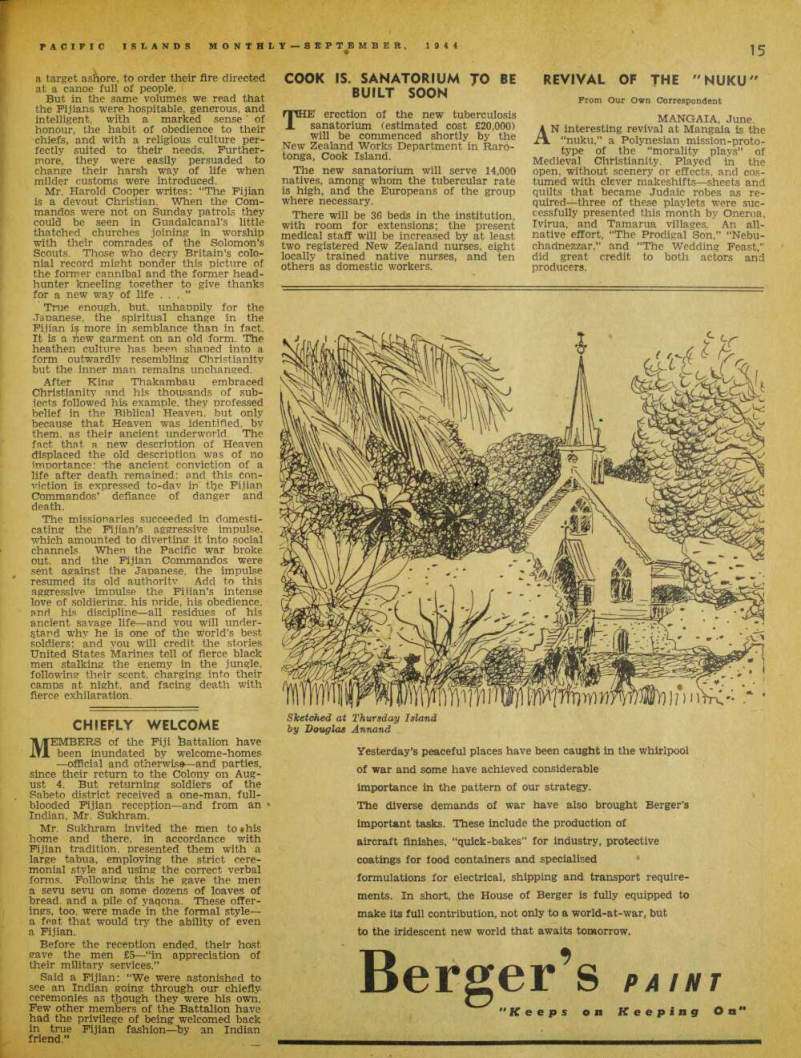
to Commando
By Robert Dean Frisbie
rpHE Fijian Commandos, now fighting X in the South-west Pacific, have won a reputation for bravery, discipline, and contempt of death. Their amazing achievements in Guadalcanal, Bougain ville, and elsewhere have become history.
The Fijian Commandos are Christians; but one hundred years ago their ances , tors were ruthless cannibals. Bearing in mind that racial traits are inherited, often in a disguised form, through many generations, the question is postulated: Is the Fijian Commando’s defiance of danger and death, his superb discipline, his nride in his unit, and his zest for sol diering a residue of his ancient heathen customs? I believe the reply is affirma tive.
The concept of physical death aroused little if any fear in the ancient Fijian.
More often than not he embraced the opportunity to die in the prime of life and viewed with chagrin the prospect of longevity; and this was because he believed he would enter his Hereafter in the same nhvsical state he was experienc ing immediately before his death.
In the early 19th century, a Fijian often demanded death by the hand of his near relative; and the relative com mitted murder, in taking the man’s life, only in the same degree that a civilised man would commit murder in hastening the death of his suffering and incurable friend. In the latter case the civilised man is saving his friend further pain; in the former case the relative is assuring the Fijian eternal happiness, as a man in his prime, in the Hereafter. fTIHERE is a reliable account by John X Jackson, published in the appendix of the “Journal” of Captain J. E.
Erskine, RN. of a Fijian chief who, hav ing decided to die, watched the strangu lation of his wives and their burial, listened to his own funeral service, lay in his grave, and submitted to being buried alive. Furthermore, Jackson reported the case of 30 women being ■willing to die and follow their husband into the after world on learning of his death by drown ing.
The dead man’s brother, Tui Kilakila. would not agree to this, but ordered that 15 of the women, who had borne children, be strangled, as was customary, while the remaining 15, who were childless, find new husbands.
Still again, Jackson told of a gift of uncooked food being presented to him and how he found a virgin had been supplied as part of the feast. When Jackson took the girl for his wife instead of his oven he-was ridiculed.
Barbarous customs. certainly, but nevertheless sunerb examples of a people’s unqualified faith in an after-life. Young women in that day and place offered no objection to marrying men older than themselves because it would doom them to early death on the passing of their husbands. This they looked forward to eagerly, for they wished to abide in the Hereafter as young and desirable women.
READING the accounts of ancient Fiji we are at first appalled by the ruth lessness of a savage people. We read of villages being segregated for the nurpose of supplying cannibalistic feasts for the chiefly people; of men being buried alive in the post-holes of a king’s new house; of slaves being used as rollers for launching a heavy war canoe; of King Thakambau begginsr Captain Erskine. when the latter’s gunners were firing at
a target ashore, to order their fire directed at a canoe full of people.
But in the same volumes we read that the Fijians were hospitable, generous, and intelligent, with a marked sense' of honour, the habit of obedience to their chiefs, and with a religious culture per fectly suited to their needs. Further more, they were easily persuaded to change their harsh way of life when milder customs were introduced.
Mr. Harold Cooper writes: “The Fijian is a devout Christian. When the Com mandos were not on Sunday patrols they could be seen in Guadalcanal’s little thatched churches joining in worship with their comrades of the Solomon’s Scouts. Those who decry Britain’s colo nial record mieht ponder this picture of the former cannibal and the former head hunter kneeling together to give thanks for a new way of life ...”
True enough, but. unhappily for the Japanese, the spiritual change in the Fijian is more in semblance than in fact.
It is a new garment on an old form. The heathen culture has been shaped into a form outwardly resembling Christianity but the inner man remains unchanged.
After King Thakambau embraced Christianity and his thousands of sub jects followed his example, they professed belief in the Biblical Heaven, but only because that Heaven was identified, by them, as their ancient underworld. The fact that a, new description of Heaven displaced the old description was of no importance: the ancient conviction of a life after death remained: and this con viction is expressed to-dav in tlje Fijian Commandos’ defiance of danger and death.
The missionaries succeeded in domesti cating the Fijian’s aggressive impulse, which amounted to diverting it into social channels. When the Pacific war broke out. and the Fijian Commandos were sent against the Japanese, the impulse resumed its old authority Add to this aggressive impulse the Fijian’s intense love of soldierine, his pride, his obedience, and his discipline—all residues of his ancient savage life—and you will under stand why he is one of the world’s best soldiers; and you will credit the stories United States Marines tell of fierce black men stalking the enemy in the jungle, following their scent, charging into their camps at night, and facing death with fierce exhilaration.
Chiefly Welcome
MEMBERS of the Fiji feattalion have been inundated by welcome-homes —official and otherwise —and parties, since their return to the Colony on Aug ust 4. But returning soldiers of the Sabeto district received a one-man, full blooded Fijian reception—and from an Indian, Mr. Sukhram.
Mr. Sukhram invited the men to this home and there, in accordance with Fijian tradition, presented them with a large tabua, employing the strict cere monial style and using the correct verbal forms. Following this he gave the men a sevu sevu on some dozens of loaves of bread, and a pile of yaqona. These offer ings, too, were made in the formal style— a feat that would try the ability of even a Fijian.
Before the reception ended, their host gave the men £5 —“in appreciation of their military services.”
Said a Fijian: “We were astonished to see an Indian going through our chiefly ceremonies as though they were his own.
Few other members of the Battalion have had the privilege of being welcomed back in true Fijian fashion—by an Indian friend.”
Cook Is. Sanatorium To Be
Built Soon
fTTHE erection of the new tuberculosis X sanatorium (estimated cost £20,000) will be commenced shortly by the New Zealand Works Department in Raro tonga, Cook Island.
The new sanatorium will serve 14,000 natives, among whom the tubercular rate is high, and the Europeans of the group where necessary.
There will be 36 beds in the institution, with room for extensions; the present medical staff will be increased by at least two registered New Zealand nurses, eight locally trained native nurses, and ten others as domestic workers.
Revival Of The "Nuku"
From Our Own Correspondent
Mangaia, June.
AN interesting revival at Mangaia is the "nuku,” a Polynesian mission-proto type of the “morality plays” of Medieval Christianity. Played in the open, without scenery or effects, and cos tumed with clever makeshifts—sheets and quilts that became Judaic robes as re quired—three of these playlets were suc cessfully presented this month by Oneroa, Ivirua, and Tamarua villages. An all native effort, “The Prodigal Son,” “Nebu chadnezzar,” and “The Wedding Feast,” did great credit to both actors and producers.
Advertisements & other items, p. 17 (1 item)
Berger’s paint
-hr I ( / ( Ct & Pt)
inn
Vi m w Sketched at Thursday Island by Douglas Annand Yesterday's peaceful places have been caught in the whirlpool of war and some have achieved considerable importance in the pattern of our strategy.
The diverse demands of war have also brought Berger’s important tasks. These include the production of aircraft finishes, “quick-bakes” for industry, protective coatings for food containers and specialised formulations for electrical, shipping and transport requirements. In short, the House of Berger is fully equipped to make its full contribution, not only to a world-at-war, but to the iridescent new world that awaits tomorrow.
Berger’s paint
"Keeps on Keeping On
New Guinea's Primitive
Natives Facts Drought Out by Invasion
r THE Rev. 1. Schwab, who was a well x known missionary on the Rai coast of New Guinea prior to the dnn rnnkpc *nrn p nnmmprtf nn /ece/tt. u/tccteo in, nm. / ii i x 4 (well known to me), in \J his realistic and interesting report about Jap-dodging in NG, seems to have the impression that mission-mflu ence changed the natives friendliness for Australians. He blames a catechist for having brought the report of the bomb ing of Madang to these natives.
That was impossible. The last cate chist stationed in Madang area arrived at the end of 1936. After that, no other catechist came home from Madang, because there was none. Latest war news was usually communicated by police-boys and FT’s.
“Old-timer” found signs of tension in the behaviour of the natives on the Little Ramu—especially, the natives of Banaro were “definitively hostile.” I did not sue ceed in 10 years in establishing cordial relations with these natives. There is no place suitable for a European’s settlement except a few grass hills in the back. And the natives are not anxious to have Europeans there, because they would spoil their great profit in trading with the bush-natives. However, there was some pro-Japanese underground propa ganda, apparently not controlled by any white man. It was the idea of a coming king and returning ancestors inculcated by the Japs, which seemed to stir them.
T N and Lambs,” Mrs. Judy Tudor j| cou ;fo no t fl nc j any refinement or improvement in native life due to missionary training. Well, I should like to mention only one improvement that benefited natives and white men. The late Rev. Fr. Kirschbaum stimulated the natives to plant the Indian corn (maize) ; and it proved a great success. I could bu y ons of corn from the natives, and it was a great help in the bad food situa tlon durin S the war - We could B rind corn in j- 0 goo fl flour and had corn-cakes, corn-porridge, and even corn-coffee. Even natives ground com and fried it with eggs i n recent years, many of the ex-mission pU piis planted peanuts.
Animal husbandry was improved by Australian fowls, ducks, and pigs and d o gs traded to natives by the late Fr Kirschbaum. Besides this they planted a j o t of vegetables, such as tomatoes French beans, pumpkins, cucumbers, the seeds being provided by the mission ’
After all, may I" ask Mrs Tudor were a fl these natives who gave essential ser vices to the Army, only bush-natives, or were some trained by the missions, too?
T SHOULD like to contribute a few facts A to the discussion on indentured labour. In the years 1936-7, out of a population of approximately 7,000 in my district, there were nearly 1.000 natives away as indentured labourers.
About 100 were married, who took their wives and children with them. Most of these natives returned, and seemed quite happy. Only a few complained about unjust* treatment aneft low wages. The married couples returned with some new born children, and all went back to their daily routine.
About 10% of the finish-timers of the grass country died of sdme illness. Never
theless, the population during this time increased well —one village, in 10 years, from 30 to 430. Of course, there were some illegitimate children. The statistics are fairly complete, but I quote from memory. All I fought against was that indentured labourers who were married were not kept more than three years away from their families so that they regarded their families as practically non-existent.
However, now our conscience is awakened, we should improve that aspect of the labour system.
1944 Is A Lean Year In
Mangaia
From Our Own Correspondent
Mangaia, June.
THE effects of the January cyclone are still to be seen on the island, in ver andah-less houses leaning askew, or propped-up; and in reduced food supplies.
The native chestnut crop, a standby between February and June, was totally obliterated, as was the breadfruit crop.
Neither is taro plentiful.
The “pupu”-bread money is carrying the natives on, but in spite of that, 1944 is a Spartan year.
The damage done by sea-water to recent imports of rice and flour has resulted in a new (and stringent) series of rules on lightering in boats. The old canoes very rarely damaged their freight; but with the boats (introduced in ’4l-’42) soaked foodstuffs seem more the rule than the exception! Boats are entirely unsuited to local reef-conditions. But they hold more, and, at 4/- per cwt., pay better dividends, than canoes that are too nar row to carry anything but “deck-cargo.”
There seems no answer to this problem that will suit both traders and native boatmen.
Advertisements & other items, p. 18 (1 item)
Nelson & Robertson Kl
NELSON and ROBERTSON Pty. Ltd.
Established 1895 \ .
Shipowners - Brokers and
islands Merchants
All classes merchandise purchased at Best Wholesale Prices. Original Invoices supplied to Island Clients.
Entrust your requirements to the firm with fifty years' practical experience in the Pacific Islands. ■ wiivmiivii yiTbii iw uii enquiries.
NELSON & ROBERTSON KL
12 SPRING STREET, SYDNEY, AUSTRALIA
Telegraphic Address: IVAN, SYDNEY.
Fiji

Further Recollections of a Decade in Fiji
By Na Matanivanua
Part I
FOUR Governors held office during my residence in Fiji—Sir Murchison Fletcher, Sir Arthur Richards, Sir Harry Luke, and the present Governor, Sir Philip Mitchell.
None of them had an easy time, for the joint office of Governor of Fiji and High Commissioner for the Western Pacific is no sinecure. The Governor who spent most of his time in Fiji was always accused by residents of the High Commission territories of neglecting their islands —what moans there have been from the Solomons in the past on that score!—whereas the Governor who spent much time touring in the High Commis sion islands earned the criticism of Fiji.
Sir Murchison Fletcher had the reins of office during an extended term at a most difficult period—that of the depres sion and the worst of the Indian political agitation. Though he was not popular with many sections of the community, Sir Murchison handled a difficult job with considerable ability. His was the thank less task of starting the ball rolling for the change in the Constitution (which cut down the number of elected members) and the abolition of the Municipal Coun cils of Suva and Levuka.
Rightly or wrongly, a section of the community took this as a retrograde step, not in the best interests of democracy, and to them, politically, Sir Murchison was an enemy of the deepest dye.
Through it all, Sir Murchison remained the perfect gentleman, always approach able, and always willing to listen, what ever the shade of one’s political opinions.
HIS successor, Sir Arthur Richards, immediately showed himself a man of strong character. He was a fine speaker, and quite obviously a man marked for promotion in the service.
That promotion came sooner than any expected, for industrial troubles in Jamaica, and the death in harness of the .Governor of that Colony, called for a I strong man.
Sir Arthur was selected, and left after a very short term in Fiji. He made a job of Jamaica, collected his GCMG, and went, on promotion, to govern Nigeria.
Sir Arthur was popular with the ser vice, largely because of his oft-proclaimed ideas of what conditions in the 'Civil Service should be; but whether he would have retained that popularity if he had been unable, owing to circumstances, to carry out his plans will never be known; his residence in Fiji was not long enough.
SIR HARRY LUKE came to Fiji from Malta with a brilliant scholastic and literary record, and his was the task of taking the Colony through the early period of the war. Like his predecessor, Sir Harry was something of a martinet, who never hesitated to apply a ruthless closure to an over-verbose member of the Legislative Council.
He had the difficult task of adjusting the Colony to a wartime economy. In addition, he had the cares of the High Commission territories, increased a hun dredfold when Japan invaded some of them. When the history of the war in the Pacific is written, Sir Harry will occupy a high- place, because of the bril liant diplomatic work he did when New Caledonia was hovering between allegiance to Vichy and Fighting France.
Much credit for the swing to Fighting France must go to Sir Harry Luke.
WHEN Sir Harry resigned, compara tively recently, to make way for a younger man, the choice fell on Major-General Sir Philip Mitchell.
Sir Philip is a war Governor, govern ing in extraordinary times, and it is yet too soon to say what the result of his stewardship will be. Present indications are that he is by no means neglecting the civil side of his post for the many war time duties it carries. Time alone will tell the full story of his rule.
CHIEF Justices are usually in office longer than Governors; and only two held that office in the period of which I write.
Captain Sir Maxwell Maxwell-Ander son, bluff retired naval officer, a martinet who ruled his Court in the manner of a quarterdeck court-martial, was one with an unequalled ability to quell, in torrid terms, any over-enthusiastic barrister. He was a stickler for Court etiquette, both as regards dress and deportment, and a judge with a wonderful flow of judicial invective on tap to apply to any unfor tunate prisoner whose crime particularly incensed him.
The second (and present) Chief Jus tice I refer to is Sir Owen Corrie, a quiet-spoken gentleman, who never raises his voice, appears at times to be lost to his surroundings in the Court, but never misses a point in the most wearisome of legal arguments. His summing up is
always a masterpiece of unbiased presen tation of fact and law. (His retirement was reported in August
“Pim.”)
MENTION of Governors and other offi cials recalls the Council of Chiefs, and the ceremonies and speeches attendant upon the official opening of this meeting.
The Council is now held in different parts of the Colony; but I recall one Council, at the historic island of Bau, some years ago. All the highest in the land, and their ladies, were present; and there was a magnificent luncheon spread for His Excellency and the official party.
The menu included oysters on the shell, which were attacked with gusto. The point is that those oysters were no respecters of exalted rank; and, 24 hours after the feast, all the best people were writhing in the throes of shellfish poison ing. There were sardonic chuckles among some lesser folk, officers of the Defence Force Guard of Honour and others, who had been at the Council opening, but not at the Vice-Regal luncheon. This com mon herd had dined apart—an excellent lunch, although it did not include oysters.
Historic Bau, with its beautiful rara , (village green), a natural ampitheatre, is a place to be remembered. Ancestral seat of the paramount chiefs of Fiji. King Cakobau and his descendants, it is sat urated with memories of other days—of the days when Tanoa and Cakobau Rex ruled, and when club law prevailed. On top of a little hill is the graveyard of the chiefs, from which one can look across to the island of Viwa, a mission station over a century ago, and where the first mission press was set up and that book lover’s rarity, the Viwa edition of the Hazelwood Fijian grammar, was printed.
The Methodist Mission has done much for Fiji, but why, oh why, did it plant a mon strosity of a church on the rara of Bau, so out of keeping with its surroundings.
Surely some building to blend more with the scene could have been designed.
SOME notable chiefs have ruled at Bau, and two of those of recent years come to mind. The late Ratu Pope Cakobau was a splendid, commanding figure of a man. with all the easy dignity of a Fijian gentleman—a fine sportsman and a wonderful host. Then there is the present Roko Tui Tailevu, Ratu Isireli Tawake, soldier of the last war, a sports man with a great sense of humour, and a lavish host.
One must not forget the ladies of Bau; and in that connection one thinks imme diately of that} grand old lady, Adi Cako bau, who has all the dignity of true breeding; a chieftainess of the first rank, and a power in the land of Fiji.
No mention of the chiefs of Fiji is com plete without reference to the most dis tinguished of them all—that courtly gentleman, brilliant scholar and fluent orator, Ratu J. L. V. Sukuna, a true leader of his race. Decorated with France’s Medaille Militaire for service In the French Foreign Legion in World War I, a graduate of Oxford University, a barrister-at-law, and a Commander of the Order of the British Empire, he has served his country through the years as clerk, cadet, District Commissioner, Native Land Commissioner, and now is Secretary for Fijian Affairs, the first native Fijian to rise to the charge of his department, a post where the best of his talents can be made. He has succeeded a long line of distinguished administra tors in the Native Affairs Department, in the decade of which I write—Messrs A A. Wright, A. L. Armstrong, H. C. Monck ton and C. E. de F. Pennefather—and it will be interesting to see who eventually
succeeds him. If it is desired to continue with a Fijian at the head of native affairs, it will indeed be difficult to find a man qualified and worthy to take over from him.
IN the years before the war put a stop to new building, the face of Suva was undergoing constant change—the old ramshackle town was gradually giving place to a small city of modern concrete buildings.
Naioaoi one time hot-sianf ntid tVip nearest Suva ever had to a red-light district, had its shacks torn down and its swamps filled in to make room for the costly new Government buildings, which rose on ground that was once a cesspit of humanity.
Government officials moved from the old buildings—that terrible old rabbit
warren of rambling wooden structures, some of them brought from Levuka when the capital was transferred in the 80’s— and instead; of huddling on a corner of a verandah or in a section of corridor, found themselves in spacious * offices.
Some were so spacious that an official seated at a desk in the middle of a huge room looked almost lost. Presumably, spacious surroundings were meant to pro duce spacious thinking; but the main result has been that the new buildings, so far as junior members of the staff are concerned, are rapidly becoming almost as crowded as the old.
In the business area of the town, the pre-war years saw many changes. The Union Steam Ship Company tore down its rickety old building and replaced it with a fine concrete structure, duly opened by a shipping magnate to the
tune of popping champagne corks. Brown & Joske, Ltd., became W. R. Carpenter (Fiji), Ltd., and blossomed out, the old dismal dungeon-like store giving place to a modern emporium. The Orange Crush bar and Swann’s old pharmacy disappeared to make way for the new Tolo uuildings, housing the pharmacy and Noel Levy’s curio shop. Then the Bank of New South Wales tore down its old building and outdid the opposition Bank of New Zealand with Suva’s most imposing block of offices.
Thp Tilar Thpatrp onened in the earlv butthe M uZfsal Si a barn-
Uk:p’ cfSShSp kS street stfll drew
Sn Satindav niShts
when occasfon and all the tediSs ThevstUl do th A shnmftk the olace of Universal There P was a me place of me universal, mere was a
third picture-show known successively as the Pacific and the Avalon, but it even tually disappeared.
Gumming Street, better known as All Nations Street—though I am told it is not a shadow of what it was before the great fire —still smelled of all the nations living and trading within its confines.
Nubukalou Creek, at the rear of Gum ming Street, used to look fine on a moon light night, quite a Venetian effect with the arches of Morris, Hedstrom’s building on one side; but the smell was a bit overpowering. Nubukalou is literally pool of the gods, and one can but assume that those particular gods were deficient, in their sense of smell. Or perhaps, in their day, the pool was not filled with punt-loads of odiferous dogo firewood or equally odiferous fishing boats,.
IT was unfortunately my lot to make only one visit to Levuka, the old capital, still living in the memories of its departed glory. In my day its many pubs had dwindled to two; and, since then, the old “Polynesian,” or the “Polly” as it was familiarly known, has gone, too, leaving only the “Royal.”
Levuka was a friendly town, quite devoid of the petty social distinctions of Suva, and the experience of a Levuka welcome of visitors is one never to be forgotten. Who can forget the beauty of Levuka, its houses perched on the hill side, its pretty little swimming pool and its super-hospitable inhabitants?
CONTRAST to Levuka is Lautoka, the Colony’s sugar capital, where the CSR Company (commonly, “The Company”) rules the social order with an iron hand. In Lautoka and the other sugar towns an officer of the company— that is to say, a member of the office staff or a field overseer—may not socially know one who is not an officer, say a skilled mill mechanic. In fact, the officer who dared to have a drink in a hotel
with a mechanic would probably be on the mat over it. It used to be a saying that in the sugar districts it was easier to buck the Government than the company.
Lautoka made criminal history in Fiji —no common murder, but a life-size bank robbery—when some unknown thief' lifted the mine’s payroll from the Bank of New South Wales and got clear away with it.
To-day the Lautoka bank robbery is just another unsolved crime.
THE mining boom of the thirties is another vivid memory. Bill Borth wick’s belief that there was gold in them thar hills was proved, and his backer, Pat Costello, who grub-staked the old prospector, made a fortune. So did others —and some lost them. Dave Riemenschneider sold a claim for £25, if I remember correctly, to Lawler, an Eng lishman, who made a fortune out of it and retired to live in the Old Country in affluence. That mine to-day is one of the Colony’s richest. Many were the wild cat companies floated. To-day, the names of most of them are forgotten; and the Vatukoula field has settled down to steady production from Emperor and Loloma. Now there is a flourishing town where, 10 years ago, were barren hills— in which, according to the “experts,” there was no payable gold.
Monsieur and Madame Maurice Berge, of Noumea, recently celebrated their dia mond wedding by a short religious cere mony at Noumea Cathedral, followed by a family reunion, where their health was drunk in champagne. They were married in France 60 years ago and came to New Caledonia in 1898, where M. Berge worked for the country’s largest store, until he retired in 1929. This store, Maison Bal landes of Bordeaux, also feted the occa sion; 300 people were present to drink the old couple’s health.
Advertisements & other items, pp. 19-22 (2 items)
Tomorrow
QUEENSLAND
INSURANCE
COMPANY
LIMITED
(Incorporated 1886 in Australia)
ASSETS EXCEED £3,500,000
Head Office:
PITT & BRIDGE STS.,
SYDNEY
Specialists in South Seos Fire,
Marine & Accident Insurances
Apply to:—
rui.
Branch Office: H. J. Moorhouse, Manager.
Burns Phllp (South Sea) Co., Ltd.
VILA.
Burns Phllp (South Sea) Oo. t Ltd.
Comptoirs Francals Des Nourelles Hebrides (Marine).
NOUMEA.
L. & W. Johnston.
PAGO PAGO.
Burns Phllp (South Sea) Co., Ltd.
G. H. C. Reid <fc Co.
OTHER SOUTH SEA ISLANDS.
Burns Phllp (South Sea) Co., Ltd.
Also to any of the Company’s Offices in Australia or Hew Zealand.
Coleman Stove of
TOMORROW
MODEL 520
BURNS ANY TYPE
OF GASOLINE (PETROL)
• Built for tough Army use, Colemfan’s new Model 520 will be a real sensation when it comes to you right after the war. Requires no priming, burns any kind of gasoline (petrol), is always safe and lights instantly even in sub-zero weather. Only 8% inches high,yet boils a pint of water in 4 to 5 minutes. • Folds into compact cylinder cone . . * light and easy to carry.
THE COLEMAN LAMP & STOVE CO. LTD,
TORONTO
CANADA
THE COLEMAN LAMP & STOVE CO., CHICAGO, ILL., U.S.A.
Modern Refrigeration for the South Sea Islands
The ELECTROLUX KEROSENE OPERATED
REFRIGERATOR
MARVEL
OF
MODERN
SCIENCE
THE
MIRACLE
OF
ICE
FROM
HEAT
ELECTROLUX OFFERS ECONOMICAL, modern and COMPLETELY EFFICIENT
REFRIGERATION FOR ISLANDS 7 HOMES.
FREEZES CONTINUOUSLY WHILE SMALL LAMP BURNS
Freezing controlled by simply regulating height of flame. Uses only , gallon of kerosene per week MOTORLESS ... NO PARTS TO GET OUT OF ORDER.
MODEL 122 MODEL L3BO
Capacity V) lac Illustrated) • 3.3 cubic feet. Capacity 4 cubic feet.
GUARANTEED FOR TWO YEARS.
• Write to your Local Distributor for prices and full details.
MODEL LKSSO
Capacity 6.5 cubic feet.
OBTAINABLE FROM ALL W. R. CARPENTER & CO. LTD.
BRANCHES THROUGHOUT THE ISLANDS
Representation in Papua and New Hebrides.
FOSTERS
LAGER
BREWED BY
CARLTON & UNITED BREWERIES LTD.
“Toujours les mailleures”
"FLAVOREX"
Real French Mustard and
"TOBASCO "
Sauce Both are Delicious and
APPETISING.
Enhance the Value of Good Meals, Soups, Cocktails, etc.
On Sale in the Islands.
0. F. MASSCHELEIN,
Sydney Export Distributor.
rjg
0 ?v
90 YEARS
' s^;
S WILLOW cIIIELL in
3 3 ■ tacts «r ••tram . mii mints . cans . vtTacta . ici cacaa ' CfeL VJ LnL V ivl
%UU Vx V» \V\ < >Vv_
u )
19
PACIFIC ISLANDS M ON TIILT SEPTEMBER, 1 9 4 4
Post-War Plans
For Noumea
Good Feeling Between French and "Kiwis"
Prom Our Own Correspondent
Noumea, Aug. 20.
AS the result of a meeting of business men, held at the Noumea Chamber of Commerce offices recently, it is proposed to form a hotel and tourist company in New Caledonia with the object of developing a flourishing tourist industry after the war. Prior to the war most of the foreign visitors—and they were not numerous—who arrived by ship, were Australians on the monthly “Pierre Loti” from Sydney.
Pan American Airways passengers for New Zealand and Australia scarcely counted as visitors, since they only stopped overnight. However, before the line was suspended (after Pearl Harbour) the American company had negotiated land options with the Noumea Munici pality with the idea of constructing a 100-bedroom hotel at one of the town’s beaches. Qantas Airways was also con templating a flying service from Sydney.
There is certainly room in Noumea for one or two good tourist hotels; and, out side the town, there should be a string of hotels at scenic spots on west and east coasts, whose farmsteads and townships need electric and other modern facilities.
A hill resort for Caledonians is con templated by the Government, on the Montagne des Sources, not too far from the capital.
Most New Zealand servicemen who have studied the coqntry with a mind un influenced by the monotony of camp life, say that there is nothing wrong with New Caledonia except reliance on coolie labour, a virtual mining monopoly, and the absence of modern conveniences. A few soldiers have bought land on the east coast, intending to return when the war is over. rrtHE Kiwis have been tremendously A popular with the French, as were Matheson’s Australian commandos.
The reputation of the NZ Division stands as high among the French here as it did among the locals in Fiji and Tongatabu. They have proved excellent ambassadors in the cause of South Pacific solidarity.
They leave 40 or 50 of their number behind here, in the little hilltop cemetery seen from the main road out of Bourail towards the Col de Boghen, The good wishes of the French go with the rest, wherever the fortunes of war may call them.
Last Word On The Use
Of "Kanaka"
Letter to the Editor IAM still of the opinion that the early missionary books are as good an authority as any of the so-called specialist works on the subject of Island dialects. I have perused my copies of certain dictionaries, and one, issued by the London Missionary Society, Malua, Samoa, in 1905, gives the word as “tan gata,” but splits it up as “ta-nga-ta.”
Later copies, issued during Mr. Griffin’s term as printer to the mission, gives the spelling as “tanata” and definitely de precates the use of the letter “k,” making special mention that using the letter, only tends to bring the language into the slovenly grove.
I am, etc.,
J. Nixon-Westwood.
Wellington, NZ, July 29, 1944.
Goldfields Encounter
By R. A. Vivian
IT was in the days of the Lakekamu goldfield, the last to be proclaimed in Papua (1909) that Jerry Ford, from Erin, and always “agin th’ gov’mint,” one morning left Nepa for Bulldog, on the river, to journey to the coast.
Along the bush track he encountered a tall individual who was loping his way towards Nepa. The stranger’s attire was simple in the extreme. Slouch hat, chequered shirt, red bandana round his neck, khaki pants and heavy brown boots.
Jerry eyed him with a good deal of in terest, trying to sum him up. Greetings being over, Jerry asked: “Coin’ to look f’r some gould?”
Looking down on Jerry, the stranger shook his head. “Ah-h,” went on Jerry, “I’ve just hear-rd that th’ gov'nor is ex
pected at th’ 'field. Did you happen to say th' ould at Bulldog?”
Again the stranger shook his head, although there came into his eyes a gleam of humour. Followed a few more verbal exchanges, and the pair went their respective ways.
Over a glass of whisky at Bulldog, Jerry was asked whether he had seen the Lieut- Governor, Judge Murray, along the track.
Jerry asked what he was like. He was told. Jerry stood petrified.
“Wha-at!” he exclaimed. “That ould, long ? Oh, hivins! W’en’s th’ larnch having f’r th' bache? Fill 'm up again, misther storekeeper.”
CWO H. W. Lee has been serving with the Royal Australian Navy in New Guinea waters since 1941. Formerly he was on W. R. Carpenter’s ships in that area.
Advertisements & other items, p. 23 (1 item)
Fosterclarks
.. here ’shelp ... and how
Cut lunches for the kiddies and your husband makes you wary of dessert recipes that include precious butter. So you’ll welcome Foster Clark’s Creamy Custard to your pantry shelf, and Foster Clark’s Creamy Custard recipe book, packed with scores of thrifty and tempting dishes made from non-rationed ingredients, will solve your problem Write now for your copy to Foster Clark (Aust.) Ltd., Dept. R. 8., Red fern, N.S.W., enclosing 2±d. postage
Territorians With The
American Red Cross
THESE Territorians are back in New Guinea, serving with the - Supply Department of the American Red Cross; Keith J. Munro, late Lindenhafen (Gasmata), and Kokopo; Colin Carpen ter. Kokopo; Arthur Browning, Kokopo; Stan Earley, Rabaul; Wm. Marshall, Salamaua; Bowen Jones, Salamaua; “Snow” Blackley, Wau; Bill Rowley, Wau; Sid. McDonald, one time at Maron; Wally Coutts, Salamaua: Bob Gofton, Bololo; Harold Cameron, Gili Gili. Milne Bay: George Pearce, Rabaul and Wau; Nevil McLean, Lae; Edwin Penfold, an old island traveller; Trevor Bruce, Kokopo; Stanley H. Chance, Papua,
A School For Castaways
Condensed from on Article in the Bishop Museum Report for 1943
By Peter H. Buck
rE Bishop Museum’s research through out Polynesia made possible the school for castaways which has been in progress since February, 1943, at the Museum.
Kenneth P. Emory of the Museum staff was detailed to devote his full time to giving instruction to groups of Army and Navy men at the Museum and certain camps in Hawaii; in June, Loring Hud son of the Kamehameha School volun teered his services to assist Mr. Emory;
and in December the Army supplied them with regular assistants to help in pre paring lectures and procuring and prepar ing material for demonstrations.
One of the exhibition halls of the Museum is entirely devoted to exhibits, illustrating the native foods which are found on islands and' coral atolls.
Atoll specimens include pigweed, pan danus fruit and coconuts. The foods of volcanic islands are represented by specimens such as sweet potatoes, taro, yam, breadfruit and bananas.
The marine foods are illustrated by casts of deep sea fish and rock-frequent ing fish that are found in the lagoons.
Specimens also of crayfish, crabs, sea centipedes, shrimps and land crabs. At tention is drawn to the poisonous animal of some cone shells and the danger of wounds inflicted by the worm shell, and to poisonous sea snakes and fish.
Implements used in procuring food are shown: fish spears, shell fish-hooks, nets, scoops, coconut-leaf torches for fishing, a model fish weir made of coral blocks.
There are also specimens of fibres made from coconut husk and the bark of the Hibiscus. Useful articles exhibited are eye-shades from coconut leaf, coconut leaf baskets, sandals of coconut husk and bark, climbing bandages, cups and water bottles from coconut shells, carrying poles and spades from pearl oyster shells.
Large photographs show the types of people inhabiting the southern and sputh-western islands of the Pacific— Polynesian, Melanesian, Papuan and Micronesian. A large central case con tains specimens of various species of sea birds and a chart gives the range of their flight from land—information that might prove useful to castaways on the open sea, PRACTICAL instruction is given in an open courtyard between Museum buildings. A native south sea setting has been created to form a fitting back ground, and a number of thatched huts are surrounded by food displays and cook ing equipment such as earth ovens, a husking stick, a three-legged coconut grater, and coconut-leaf platters. The methods of obtaining fluid from green coconuts by cutting with a machete or using a husking stick are taught. The mature nut is husked, cracked open with a stone and grated on the tripod grater to obtain the rich coconut cream which is expressed from the gratings. The sprouted nuts are hushed and cracked open to show the solid contents termed uto by the natives.
Instruction includes the technique of trimming husking stakes, and the mak ing of graters from pieces of mature coconut shell. They are taught also to plait roof sheets, mats, platters and coconut baskets from green coconut leaves. Roof sheets are used to demon strate building shelters and lean-tos. In struction is given in making sandals, spears, torches, in cooking food in the earth oven, in preservation of fire in a coconut husk and anything else that may be of practical use in the South Seas.
The introduction of a little anthro pological theory into the course gives the men an added interest. From their own difficulties they learn to respect the native peoples who can do so much with so little. The skill acquired by Army assistants and others is comparable to that of the natives themselves. In fact,
they would surpass many who have native blood in their veins.
A handbook, compiled by Mr. Emory and called “South Sea Lore,” embodying the information of the training course, had gone into a third edition before the end of the first year, and 23,772 copies were in circulation.
IT is gratifying to know that the Museum’s research work in Polynesian material culture, which once seemed purely academic, has been proved of prac tical value to people of a higher civi lisation. The knowledge acquired by these young soldiers and sailors may save lives or at least help to alleviate some of the inconveniences and hardships en countered in the jungles and atolls of the South-west Pacific.
Extraordinary as it may seem, the native crafts of a stone age culture have gone to war.
Advertisements & other items, p. 24 (1 item)
Art’S
GILLESPIE
The Flour
TRADE
MARK
-SYDNEY-
’S of the Islands
AUNT
ART’S
BAKING POWDER
• SUPPLIES ARE NOW AVAILABLE. If your local supplier is out of stock he will readily obtain Aunt Mary's Baking Powder for you. After all, quality is worth waiting for, especially when it is Aunt Mary's Baking Powder, which maintains the high quality which has stood the test for over 70 years.
Liberated France Will Purchase
Caledonian "Robusta" Coffee
Prom Our Own Correspondent
Noumea, Aug. 3.
AFTER four years completely cut off from trade with France, New Cale donia has contracted to sell her 1944-1945 harvest of Robusta coffee to the Provisional Government of the French Republic. It will be supplied to the people of liberated France at 11 francs a kilo f.o.b. Noumea.
The US Army already buys the. colony’s output of Arabica coffee, which is roasted locally for the troops. (It was reported in August “PIM” that no further purchases of Robusta coffee would be made by Noumea merchants after July 1. They stated that it was almost impossible to sell this grade over seas.)
Fijian Wins Us Silver Star
rE Commanding General of the United States Army Forces in the Central Pacific Area, by direction from Pre sident Roosevelt, has awarded the Silver Star to Private Fred Charles Narruhn, of the First Battalion, Fiji Infantry Regiment.
The citation states: “For gallantry in action at Makin Atoll, Gilbert Islands, November 20-22, 1943.
Private Narruhn was attached to the United States Army Forces as an inter preter, he landed with the second assault wave on Butaritari Island, and guided leading elements in establishing contact with another of our landing forces. Later, learning that it was urgent to obtain prisoners for questioning, Private Nar ruhn voluntarily and under hostile fire pursued and captured an enemy soldier.
Subsequently, he accompanied a recon naissance patrol to a nearby island, where he searched out friendly natives to secure urgently needed information concerning enemy strength and disposition. In pro viding accurate information for the land ing force commander, and by his ex cellent judgment and conduct under fire, Private Narruhn contributed materially to the success of the Makin operation.”
Information About Rev. D.
C. Alley Wanted
THE general secretary of the Methodist Missionary Society of New Zealand, the Rev. A. H. Scrivin, writes: “I was interested to learn from your July issue that news has been received of at least two men who were taken prisoner at Rabaul about January, 1942.
“A few weeks after that time, the Rev.
D. C. Alley, Methodist Missionary, was taken prisoner at Teop, North Bougain ville, and was later reported by a native to have been seen with our New Britain
missionaries in the Duke of York Group under Japanese guard.
“It is possible that these missionaries were removed to Saigon, and we shall be very grateful if you could seek infor mation for us through your magazine. It is possible that a certain amount of news is now filtering through and some infor mation may be gathered.
“Mrs. Alley and her two small boys and my Mission Board would be grateful for any help in this direction.”
The Bastile Day Fete
Disappointing
From Our Own Correspondent
Papeete, May 30.
OUR island Agricultural Fair this year is to be an occasion of major inter est. But the old and somewhat cele brated, Bastile Day Fete is, I believe, as dead as Julius Caesar.
Our younger generation of Tahitians look upon such artificial revivals of native dances and costumes as out moded. In former times, the celebra tions of that nature were spontaneous and represented customs which were in being.
During later years, the festivities have resembled Rider Haggard’s “She” in her attempts to bring the mummy of her antique lover to life.
The chorus singing this year was ghastly; the dances were without any real verve; the costumes were modelled after the Hawaiian grass-skirt seen in Hollywood honky-tonks. The town hood lums. tourists and miscellaneous specta tors got gloriously “tight” for eight days, and everybody praised Allah when the affair was over.
“Life is real, life is earnest,” these days, in the South Sea —as elsewhere: and the Agricultural Fair represents that serious and utilitarian purpose which befits present-day conditions.
Advertisements & other items, p. 25 (1 item)
Heinz
A Big Job in Hand
Heinz have a big job in hand. To help feed the fighting forces. That's why supplies and varieties are so limited But the 57 may still find a place in your store —limited supplies are available of those two fine pre-war quality sauces"' — Heinz TOMATO Sauce and Heinz 57 BEEFSTEAK Sauce.
5*7 VARIETIES
Troops first! That must be Heinz War-time motto.
H. J. HEINZ CO. PT Y. LTD
This Is The Solomon Islander In
Peace
By Donald Gilbert Kennedy
DARK-BROWN, wiry, straight-haired Micronesians of the little islands; honey-brown and honey-tongued Polynesians of the many islands; and art loving, cunning, crinkly-haired Melane sians of the black islands—that is the whole story of the Pacific’s mankind.
I use the term “black islands” advisedly in connection with Melanesia, for the word Melanesian (Greek melas—black) originated from the appearance of the islands themselves and not from the colour of the inhabitants. The islands, unlike those of Polynesia and Micronesia, stand out on approach, almost black against the horizon. This appearance is probably due to the complete cover of
dark-green foliage, much of it enclosed in sunless ravines on the steep mountain sides. It may be added, however, that, in point of cultural development towards civilisation, Melanesians are many thous ands of years behind the Polynesians, who may' be said to have attained, before they saw their first Europeans, the stage of the Germanic and Frankish tribes in Europe at the time of Charlemagne, The Polynesians were barbarians while the Melanesians were still savages.
The Solomon Islands form part of Melanesia, and determining the Solomon Islander’s place in the scheme of things is important to us in order to decide what is to be our post-war approach
towards these jungled islands and their primitive peoples who have been witness ing the magnificent spectacle of modern war as waged by the world’s most highly civilised people.
The adventurous sailors of our own breed who first touched at the Solomon Islands have rarely recorded their impres sions of the native people and their ways of life. From their accounts, we get a vague picture of unattractive, primitive men, dwelling in the depths of dark for est recesses, on steep, almost inaccessible hills, each eternally on the defensive, liv ing in trepidation, moving by stealth, attacking by treachery and killing, and robbing all those weaker or less wary than himself. That picture was true enough, but only as far as it went, and in our dealings with the present-day Solomon Islander, it is those primitive qualities which we must study carefully in order to use some of them to his and our advantage. rpHERE is no Melanesian tribal cohesion.
X Generally speaking, there is no wider social organisation than the village, which consists of a few leaf thatched and leaf-walled houses and in which live from 30 to 100 people. The chief of the village is such because of his superior strength or courage or cunning.
Neither his father nor any relative need necessarily have been chief before him.
It has been sometimes observed that a chief would be succeeded by one of his own sons, but this was only because a strong, cunning leader was likely to trans mit to at least one of his progeny those qualities of strength, skill, stealth and treachery which made him a leader.
Their food came mostly from garden farms made in small bush clearings, crop ped with yams and, in damper places, taro, followed by sweet potatoes, for three or four years in all, and then allowed to lie fallow and recover for another eight to 12 years.
Their diversions, like those of London and New York, were feasting, dancing, love-making and intrigue.
To-day, the soldier on reconnaissance patrol, walks unexpectedly out of a dark jungle track into a village clearing. His eye takes in the clipped green grass studded with a dozen or more brown leaf huts. On the margin of the clearing stand a few fruit trees, citrus, mango, paw-paw. canariam almond. The übi quitous domestic fowl pecks around the smaller huts near the bush line. These smaller huts are the kitchen. A lazy sow with a farrow at her dugs lies stretched by one of the houses.
There is a flutter of short dingy skirts as two or three “marys” shyly duck into the nearest kitchen. There is no crowd ing around, no squeals from the children, no smiling menfolk with the word of greeting or the outstretched hand of wel come such as our soldier might find in Polynesia. No bold, appraising glances, shy pretty eyes and furtive smiles, or debonair insouciance, which would be his lot in Micronesia.
He is here in dark, solemn Melanesia and he will have to break the ice of shy, or even sulky, indifference. There may be a man or two about. Unless they are of the sophisticated few, inhabiting villages near military camps and mixing daily with the soldiery to barter shoddy walking sticks and grass kilts for dollars and cents and items of personal equip ment, they will keep their distance. The visitor must make the approach.
Signs are exchanged, a grunt or two of Pidgin English, and our soldier goes on his way, probably unenlightened from the intercourse. It takes long to break down the average Solomon Islander’s indifference to strangers.
There are, of course, exceptions; plan
tation boys, mission boys, Government boys—glib, sophisticated confidence men ever alurk for the gullible stranger. But these are not ordinary Solomon Island ers. They may be 90 per cent, evident in obvious places and hence, perhaps, form 90 per cent, of your evidence as regards the Solomon Islanders; but they are probably less than 5 per cent, of the population.
The rest of the people live their conser vative lives in jungle or coastal villages.
They wear scanty raiment, usually rather soiled. They fish,* using many methods: they hunt, with axes, spears and bows, the wild pig, the opossum, the crocodile (which is eaten in some places), bush nigeons. wild duck and other edible birds. They gather thei canarium almond in season, and pack it in bamboo con tainers. They plant citrus fruits, paw paws, rose apples, mangoes and coconuts.
Each family builds its own house.
Skilled craftsmen make and sell canoes.
Others fashion wooden food vessels of many sizes and shapes, according to the requirements of the culinary art. They make love in devious but highly conven tional ways. They contract marriages with a bride price in strings of shell money, which is returnable in the event of breach of contract on the part of the bride. If it is the man who misbehaves, his “mary” may return to her people and he loses both money and bride. Except in Malaita, they are a matrilineal people —that is, they trace their descent and inherit property through the female line.
They adopt a form of Christianity and build a leaf church in the village. In Pidgin, this is called the “school.” Their mission, whether it be Roman Catholic, Seventh Day Adventist, South Sea Evan gelical, Baptist or Church of England (and all of these are to be heard in a chorus of little harmony) will train for them, a priest and send him to order their lives. The natives attend his ser vices, sing his songs, and try to appear devout. They adapt his version of Chris tianity into their old superstitious philos ophy and make, of the result, a two faced-Janus of a religion, which permits them to reconnoitre the present without losing sight of the past.
The Melanesian of the Solomon Islands is a slave to his imagination. His whole world is one of luck or magic. There is nothing else. The mundane philosophy of natural cause and effect is just too ridiculous for him to notice, Even if you could get a native to apply his mind to the possibility that this uninspiring philosophy does result in, for instance, the Flying Fortress, he would probably like to say to you, “Better a world with out Flying Fortresses if such things mean the loss of our rich, adventurous and unpredictable life of magic and chance.”
BUT western civilisation brought more than a village church with its enter taining ritual. It brought trade, with iron implements, cloth and tobacco, which desirable things might be had by turning surplus coconuts into copra and taking this to the nearest trader. Pearl and trochas shell also might be collected off the reefs and turned in for imported goods. Traders soon discovered that the Solomon Islander has no desire to amass wealth. When he has acquired his neces sary fish-hooks, fish-line, tobacco and calicoes for his family, he is content to pursue his own sweet way. He has no wish to hoard cash against the proverbial rainy day.
Uncle Sam’s over-generous doughboys have discovered, to their consternation, that doubling the monthly pay cheque of a Solomon “boy” will not only reduce his efforts to give satisfactory service, but will, in eight cases out of ten, induce him to ask for a month’s holiday at frequent
intervals in order to spend his unearned increment in gentlemanly leisure. Except in the poor areas of there are no Solomon Islanders living so close to the margin of starvation that they must work regularly in order to live. There are always coconuts to be had for the asking, fish to be caught, shell-fish to be gathered. Warm clothing is unnecessary.
“Then why accept tedious employment?” says our native friend not witoout logic.
DW’lre be?n‘ considered afThey wm
teTo ton the Solomon. Islander it the int ° mdUstnoUS ' pr °ductive citizen.
The vocabularies of the islands are legion. The island of Malaita, alone, is reputed to have so many different tongues
that, in the course of a day’s walk, you may pass through the areas of three or four groups of villages each using a speech which is not understood by the other groups. (I use the word “vocabu laries” rather than “dialects” for the difference is not one of pronunciation or irmection or idiom, but the use of differ ent words to signify the same common object.) mHROUGHOUT the Pacific, the minds 1 of ‘he philologists and linguists
slona^ha^e e
prTlem of flndin b g ee a coSspee'chta order to facilitate communication with, and between, natives over a relatively wide unit area. In several places, such as Fiji, the dominant tongue of one par
ticular place was chosen and agreed upon by all missions and the Government, and this became the lingua franca of the island group—the only written language and therefore the medium of all literary work.
In the Solomon Islands the impact of European influence came from dissociated bodies at widely separated places. One mission tried to introduce a Melanesian dialect of the New Hebrides as a lingua franca. Although this mission has per sisted in its efforts for 70 years or more, its only success has been with the hier archy of its own native priests and teach ers. The efforts of other missions have been equally fruitless.
Meanwhile, growing up sporadically within the islands, and unguided by any external influence, was a new “vocabu lary” using English words with distorted pronunciation and somewhat limited meaning. And the mysterious force which developed, and continues to develop, this new “vocabulary” adapted it, not to Eng lish, but to Melanesian grammar, so that “Pidgin English,” the only lingua franca of the Solomon Islands, is nothing but another Melanesian tongue.' Its idiom is wholly Melanesian. The words alone have an English derivation, and not necessarily the meaning they have in English. Some complementary phrases have reversed their meanings: some Melanesian dialects have six different words for the English personal pronoun “we.” Most have four. Pidgin follows the Melanesian, not the English usage.
This “inclusive” and “exclusive” use, as it is called, of the personal pronoun has certain social advantages not possessed by the inflexible English “we.” When a Melanesian says, in mixed company, “We shall go now,” meaning “Me and my pal (or me and my gal) are about to leave the comnany.” he says, “Me-two-fella go now.” which leaves no excuse for a third party to horn in, whereas the word “we” might be inconveniently interpreted as all-embracing.
Pidgin is the official language of the Solomons and often lends a spice of humour to the staid proceedings of His Britannic Majesty’s High Commissioner’s Court. rour way of thinking, Solomon Islanders may not be. superficially, a very attractive people. Neither, to their way of thinking, may we be attrac tive to them. But they have no more hking than we have for the fire-eating Sons of Nippon. In the last two years they have been invaluable with their canoe transport, their bush lore and their knowledge of tracks through the other wise impenetrable jungle. Wherever they have been able to understand our prob lems they have been sympathetic and readv to help; and whenever we have exerted ourselves enough to understand them, we have had no difficulty in get ting the best out of them. If our rela tions are continued in this spirit, the co-operation thus propitiously begun, need not cease with the downfall of the com mon enemy.
NOUMEA. August 20. —Travelling in New Caledonia these days one sees flourishing patches of green amid the grey, drab landscape. They are victory gardens planted by the American and New Zealand Forces. On this island alone the Seabees have recently harvested 2,862 lb. of green beans, 3,740 ears of sweet corn, and 2,370 lb. of cucumbers. The New Zealand gardens will be taken over, with NZ clubs and camps, by the Americans.
Advertisements & other items, pp. 26-28 (1 item)
Chi Vers
A. B. DONALD Ltd.
AUCKLAND
ISLAND TRADERS & GENERAL MERCHANTS
P.O. Box 1509. Cables Cr Telegrams, ''Kingdom", Auckland.
CHI VERS
FAMOUS ENGLISH PRODUCTS
CANNED ENGLISH VEGETABLES
CANNED ENGLISH FRUITS
OLDE ENGLISH MARMALADE
GOLD MEDAL JAMS
JELLY CRYSTALS, ETC.
Obtainable from all leading Grocery Stores
WRITE TO DEPARTMENT “A”
CHI VERS & SONS LTD.
Histon, Combs., Eng.
FOR ATTRACTIVE RECIPE BOOK
C m
SHIVERS
COLD
hmmukd
FRBSH
k (NCUftM a
PEAS
M £
ADD VARIEJ Y to your
HOT-WEATHER MEALS
Typical of the tasty, tempting, quick-serve foods offered by “Imperial” is “Meatreat.” This canned corned beef is prepared by the special “Imperial” process which seals in all the natural flavour, colour and rich nourishing juices of the meat. Served with salads, “Meatreat” makes an ideal hot-day dish.
Other “Imperial ” products which will help you add variety to your hot-weather meals are: "Imperial" Camp Pie.
"Imperial" Beef & Pork Sausages "Imperial" Sheep's Tongues.
"Imperial" Hampe— the meal-in-a-moment.
Every one of these H lmperial 99 products offers you the delightful flavour of fresh meats at their very best. Ask for them to-day.
PRODUCTS OF
RIVERSTONE MEAT CO. ES:
Fiji Representatives: Pearce & Co. Ltd., Suva.
Chateau D*or
(COGNAC VIEUX)
y
FINE LIQUEUR
BRANDY
The Standard of Excellence Distributors: C. SULLIVAN & CO., Sydney, N.S.W
Pahst Blue Ribbon
33 FINE BREWS BLENDED
INTO ONE GREAT BEER.
Agents: C. SULLIVAN & CO., 379 Kent Street, Sydney
C. SULLIVAN & CO.
GENERAL MERCHANTS ... ISLANDS AGENTS
REPRESENTING LEADING FIRMS IN 'in n; PACIFIC ISLANDS.
Islands Produce sold on Shippers’ Account—Liberal Advances against Consignments.
Buyers of all Islands’ Requirements on Commission—Original Invoices Furnished.
Bankers : Bank of New South Wales .. Bank of New Zealand .. Comptoir National d’Escompte de Paris.
Wartime Cable Address: Sullivan, Kentstreet, Sydney.
379 KENT STREET, SYDNEY, N.S.W.
New Caledonian Soldiers
Return
From Our Own Correspondent
Noumea, Aug. 3.
rIRTY of the 53 New Caledonian soldiers repatriated from North Africa have reached Noumea by plane from Melbourne. On July 14 they joined Melbourne’s French colony in placing a wreath on the Joan of Arc statue.
Those who returned are: Sous-Lieut.
Andre Armand, - Adjutant-Chef Andre Mornaghini; Sergent-Chef Charles Lec lerc; Sergents Andre Vernier, Paul Buard, Julien Letierce, Pierre Delarnaulds, Gas ton Lesson, Raymond O’Donoghue; Caporal-Chefs Andre Chapdeville and Andre Ragot; Caporaux Pierre Dupont, Alfred Volcy, Henri Derien, and Maurice Mercier; Ist Class Ptes. Camille Vincent, Roger Gadoffre, Georges Vincent, Emile Charley, Roger Trouillot, Alfred Gerard, Pierre Michelangeli, and Reginald Boul anger; and 2nd Class Ptes. Emile Dal stein, Edouard Goisavost, Johannes Salo mon, Gustave Mathieu, Auguste Reveillon, Jean Gerbet, Michel Clarque.
Noumea, Aug. 20.
FOURTEEN more New Caledonian volunteers have returned to Noumea
from North Africa. They are: Adjutant Magnier; Sergent-Chefs Thomas and Limousin; Sergents Le Carrour and Savoie; Caporal Colonna; and Ptes. Le Marrec, Malse, Hermant, Delaveuve, Galaud, Adriende, Geoffroy, Huyard, and Debien.
Chief Naisseline has received news that some of the native volunteers from the island of Mare, who left here with the second contingent, were wounded in the battle for Cassino. They are being looked after in American hospitals in Italy.
A letter to a grand chief on the Main land of the Colony from his brother with the French Forces in Italy refers to the attacks on the Gustave and Hitler lines, and mentions the death of several Cale donians.
NOUMEA, August 25. —A new adminis trative decree announces that in New Caledonia and dependencies, in the future, anybody condemned to death will be shot.
Between six and seven tons of un claimed trochus were recently sold to a Noumea trader for about £BB (Aust.) per ton —a record for New Caledonia.
Advertisements & other items, p. 29 (1 item)
Other Famous
GILBEY Products
CREME de MENTHE
CHERRY BRANDY
ADVOCAAT
ORANGE &
WHITE CURACAO
CREME de CACAO
APRICOT
BRANDY
ORANGE &
LEMON GIN
RUM
GILBEDENE
GIN SLING
BRONX &
MARTINI
COCKTAIL
SPEY ROYAL
SCOTCH WHISKY
GAUNTLET
WHISKY
Address all enquiries to:
W. A. GILBEY LTD.
33 ROSSLYN STREET, WEST MELBOURNE
Telegraphic and Cable Address:
"Gilbeys" Melbourne
109 REGENT STREET, SYDNEY
Telegraphic and Cable AddresS:
"Gilbeys" Sydney
G 4.1 -
Meandering With
Nautical Interludes Ii.:
The "Threesis"
By “Amel"
OUR neighbour, Matai Fong, is a very friendly, obliging little chap, and whenever his launch goes to Savu Savu he always inquires beforehand whether we would like to take a “tlip.”
Sometimes we do. That is how we came to be rolling home across the bay in Matai’s launch one sunny afternoon.
The engine chugged and wheezed, and occasionally stopped, but a brave wisp of a sail kept us on the move. We had not far to gOi and the afternoon was young.
But the sun was in our eyes, and there were reefs in the path. The tide was low, and Matai, who had paid a lengthy
visit to the Hot Springs Hotel, insisted on steering.
Not that he was drunk. Never have we seen Matai in that condition. Like most Chinese, he holds his liquor like a gentle man. But he was nicely wound up, and talkative. His mind was full of the war in his native land. Passionately, he spoke of the bitter battles that had been fought.
Eloquently, his hands gestured. . . . The fact that they should have been grasp ing the steering wheel meant nothing to Matai. The bow of the launch was aimed first at Wailevu and then at Kukulau, as if it were one of the big guns he was describing. One of the crew yelled “Bosso!” and Matai calmly re-adjusted the course.
“Tleesis all li’”, he murmured drowsily.
“Tleesis good boat.”
Tom remarked on the queer name.
“There’s quite a story attached to it,” I said. “Let me tell you. ...”
“H n CE there lived in Savu Savu a man named George Driver, with his wife and a family, which included three girls. He bought this launch and then tried to think of a suitable name for it.
Each of his daughters wanted her name to be given to the launch and George, a peace-loving man, did not see how he was to avoid jealousy and domestic dis cord. Then ... he had an inspiration.
He would not favour any one daughter.
He would give the launch a name that none of them could object to. So he did.
He called it the ‘Threesisters,’ which quickly became ‘Threesis.' “Several years later, George bought the ‘Rogovoka,’ and he and his wife perished with her when she was wrecked while travelling to Suva. But their daughters —the three sisters—had stayed at home, and were spared from such a tragic fate.”
Matai blinked, and said he could see the beacons near Dogo Dogo Island, and in half an hour we were home.
Facts About Filariasis
Are Well Known
Letter to the Editor IN August “PIM” I read with interest of the “great stride in the right direc tion” made in cure of filariasis and elenhantlasis by US Army doctors.
There is little of importance contained in this article which has not been known for about 40 years, and all of the infor mation given (excent reference to the day biting mosouito) plus a great deal more.
Is contained in W. E. Masters’ “Essentials of Tropical Medicine.” published in Lon don 24 years ago. No doubt, many books before that time, and every book on tropical medicine since, has contained the information.
The causal role of the day biting mos quito in filariasis in certain Pacific Islands was worked out by Manson- Bahr, O'Connor and others many years ago and is fully discussed in many edi tions of Manson-Bahr’s book.
While a medical assistant in Papua for a few years I performed dozens of these “amazing” operations, removing great masses of elephantoid tissue from all parts of the body, including scrotums that nearly touched the ground, and the slimming of legs that would not have looked out of place on an elephant, and other operations intended to give relief in certain cases of elephantiasis. I also experimented with elastic and other bandaging treatments, but later abandoned these as impracticable for use with natives.
When I first went to Papua I saw Dr.
P. J. Williams remove a huge elephantoid scrotum from a native of the Mamba dis trict, and while on patrol, a few years later, I contacted this native in his village and found that he had been made the village constable and that he had a young family.
I am, etc.,
Sydney,
E. J. Wright.
(Editorial Note: No doubt Mr. Wright is correct when he says that nothing new on the subject of filariasis came out of the article in July “PIM.” However, not many residents of the Pacific Islands have the advantage of Mr. Wright’s ex pert medical knowledge, and to this majority the article was interesting and informative.) M. Robineau, Noumea’s port director, recently warned navigators of a danger ous submerged rock which has been dis covered in the Uitoe region, about half way between Moro du Sud and an un named reef south-east of Moro.
August 30, 1944.
Advertisements & other items, p. 30 (1 item)
Fuur
PRODUCING UNIFORM GOOD RESULTS SINCE 1868
ALWAYS ASK FOR IT
Steamships Trading
Company Limited
PORT MORESBY
SAMARAI
PAPUA.
WHOLESALE & RETAIL MERCHANTS, SHIPOWNERS,
PLANTERS, ENGINEERS & SLIP PROPRIETORS.
Customs, Shipping, Insurance, and Forwarding Agents.
MANAGING AGENTS AND VISITING REPRESENTA-
TIVES FOR COCONUT AND RUBBER ESTATES.
SYDNEY REPRESENTATIVES: Nelson & Robertson Pty. Ltd., 12 Spring Street.
WARTIME ADDRESS
Until further notice, clients may address all communications as follows:
STEAMSHIPS TRADING COMPANY LIMITED,
C/o NELSON & ROBERTSON PTY. LTD.,
12 SPRING STREET, SYDNEY.
The Pacific Islands As They Will Be
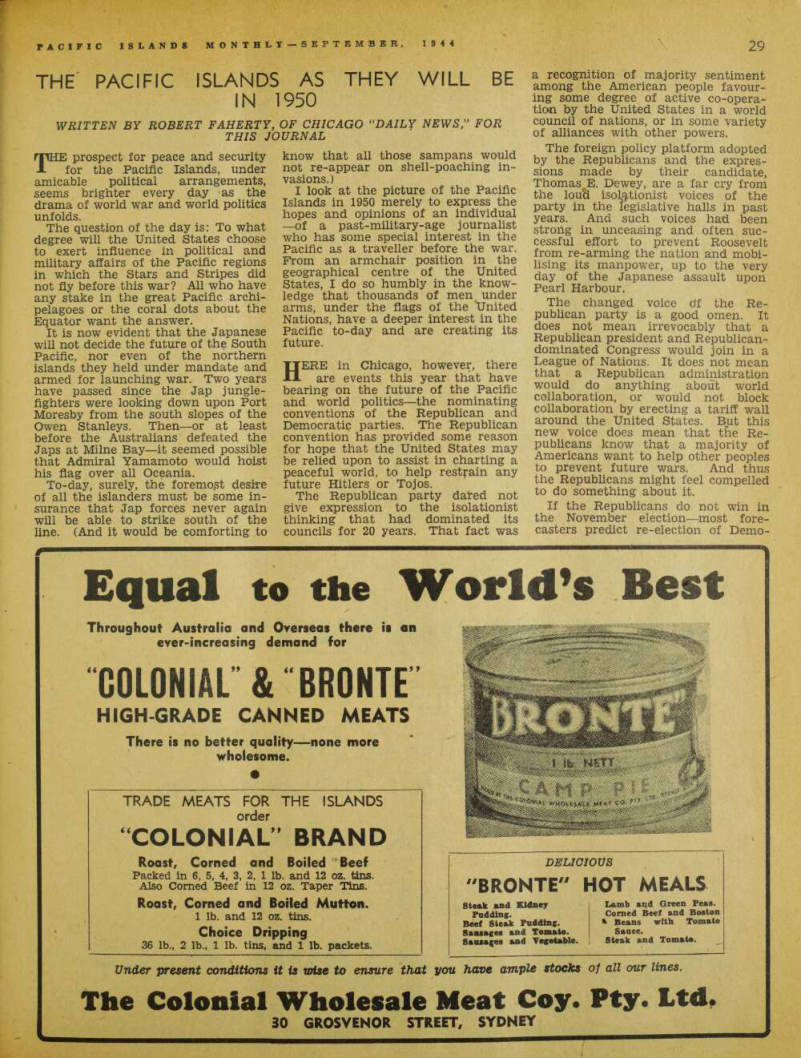
IN 1950
WRITTEN BY ROBERT FAHERTY, OF CHICAGO “DAILY NEWS,” FOR
This Journal
rjTHE prospect for peace and security JL for the Pacific Islands, under amicable political arrangements, seems brighter every day as the drama of world war and world politics unfolds.
The question of the day is: To what degree will the United States choose to exert influence in political and military affairs of the Pacific regions in which the Stars and Stripes did not fly before this war? All who have any stake in the great Pacific archi pelagoes or the coral dots about the Equator want the answer.
It is now evident that the Japanese will not decide the future of the South Pacific, nor even of the northern islands they held under mandate and armed for launching war. Two years have passed since the Jap jungle fighters were looking down upon Port Moresby from the south slopes of the Owen Stanleys. Then —or at least before the Australians defeated the Japs at Milne Bay—it seemed possible that Admiral Yamamoto would hoist his flag over all Oceania.
To-day, surely, the foremost desire of all the islanders must be some in surance that Jap forces never again will be able to strike south of the line. (And it would be comforting to
know that all those sampans would not re-appear on shell-poaching in vasions.) I look at the picture of the Pacific Islands in 1950 merely to express the hopes and opinions of an individual —of a past-military-age journalist who has some special interest in the Pacific as a traveller before the war.
From an armchair position in the geographical centre of the United States, I do so humbly in the know ledge that thousands of men under arms, under the flags of the “United Nations, have a deeper interest in the Pacific to-day and are creating its future.
HERE in Chicago, however, there are events this year that have bearing on the future of the Pacific and world politics—the nominating conventions of the Republican and Democratic parties. The Republican convention has provided some reason for hope that the United States may be relied upon to assist in charting a peaceful world, to help restrain any future Hitlers or Tojos.
The Republican party dared not give expression to the isolationist thinking that had dominated its councils for 20 years. That fact was
a recognition of majority sentiment among the American people favour ing some degree of active co-opera tion by the United States in a world council of nations, or in some variety of alliances with other powers.
The foreign policy platform adopted by the Republicans and the expres sions made by their candidate, Thomas E. Dewey, are a far cry from the loucl isolationist voices of the party in the legislative halls in past years. And such voices had been strong in unceasing and often suc cessful effort to prevent Roosevelt from re-arming the nation and mobi lising its manpower, up to the very day of the Japanese assault upon Pearl Harbour.
The changed voice Of the Re publican party is a good omen. It does not mean irrevocably that a Republican president and Republican dominated Congress would join in a League of Nations. It does not mean that a Republican administration would do anything about world collaboration, or would not block collaboration by erecting a tariff wall around the United States. But this new voice does mean that the Re publicans know that a majority of Americans want to help other peoples to prevent future wars. And thus the Republicans might feel compelled to do something about it.
If the Republicans do not win in the November election—most fore casters predict re-election of Demo
crat Roosevelt—it is nevertheless of great importance that the Republican party is aware of public sentiment for a collaboration of nations. Such awareness may, some day, be the deciding factor in a two-thirds vote of the US Senate for ratification of American entry into a world council.
IT is true that some isolationist voices have been within the Democratic all the American legislators who viewed Hitler complacency were not in
Republican ranks. But these Demo crats have been a small minority, and the Roosevelt policies won despite them.
In viewing American internal poli tics with relation to the Pacific, it is necessary to note an ominous development. The isolationists, who have recently decided to call them selves nationalists, include many who have become maudlinly chauvinistic, jingoistic, imperialistic.
Something About the Egocentric Colonel McCormick
ONE of the most strident of these voices, in print—for his speaking voice is somewhat a mumble—is that of the egocentric publisher of a notorious Chicago newspaper which has given this city an unfortunate reputation. (One hesitates to mention his name—Robert R. McCormick —or that of his so-called newspaper, the Chicago Tribune, for he vainly treasures every mention. Australia had the good sense to refuse to let him print an edition there.) This publisher says, now, in a manuscript he has read many times in public addresses and has printed flamboyantly in his newspaper: “We should retain air bases and radio stations wherever we have built them, and we should secure now, by treaty, the right to fly directly everywhere we want to go.” (American-built bases are now everywhere in the WOI *l d! ) Six weeks before Pearl Harbour, his newspaper said: “What vital interests of the United States can Japan threaten? She cannot attack us.
These now cry: America must seize bases all over the world. These men are the same who opposed every move by the President designed to check Hitler, who derided the President’s warnings of oncoming war, who tried to block the re-building of the Navy and the training of an army, who opposed the Lend-Lease law, who have persisted in denouncing Russia and Great Britain throughout this war.
That is a military impossibility. Even our base at Hawaii is beyond the effective striking power of her fleet.”
This man, and the editorial writers, Washington correspondents, cartoon ists and editors of his paper who accept his money to do such work, have waged an all-out verbal war against the Government of the United States, the Government of Great Britain, the Government of Russia, almost every day since the Govern ments of Germany and Japan launched the war upon us.
TT IS newspaper, three days before ** the Pearl Harbour attack, pub lished to the world a secret document of the United States Army which outlined a plan for deploying Ameri can troops from North Africa against a Hitler-occupied Europe. This docu ment, containing estimates of the forces that the US could muster, and much other information, was pub lished under the signature of Chesly Manly, a correspondent of the news paper. It interested Hitler so much
that it was referred to In Germany’s declaration of war upon the United States.
This newspaper earned even greater notoriety by an account of the Battle of Midway which was written in its office in Chicago. The first paragraph of the story flatly said that when the Japanese fleet steamed out of its bases to attack the Hawaiian islands, the United States Navy knew that the Japs’ ships had started out to sea.
That story was so startling that intelligence officers of the Navy called the editors to Washington instantly to demand an explanation of its publication.
Other newspapers later said that the Chicago story had informed the Japanese admirals that the US Navy had broken down the Japanese naval code. Actually, the movements of the Jap fleet had been known to the American admirals, and the Japanese radio communications were no secret whatever, Washington colum ists then reported. They said the Japanese immediately changed code after the Chicago revelation, and thus deprived the US Navy of a tremend ous advantage in the deadly sea war.
The Department of Justice sought a penalty for the offence, but the news paper responded by attacking the Department—and carried through by waging a two-years war of words against the Government’s efforts to prosecute a number of persons who are now on trial on sedition charges —among them confessed German agents and spies.
The Chicago newspaper greeted the Republican convention with a “nationalist” cartoon containing these words: “The United States, im mediately upon the successful con clusion of the present war, will announce that it will take no part in future European wars. This an nouncement effectually will end future world wars.”
The cartoonist did not say what the United States would announce if a fleet of bombers large as the B-29, from Europe, suddenly deposited a load of bombs upon New York.
TT is important to evaluate the voice of this publisher and his news paper. In past years he has intimi dated many politicians. He has fostered isolationist officials and law makers, has used them as stooges to raise outcries that he might publish.
He has dominated Republican politics in the Middle West. His views are spread to millions in two other news papers—one in Washington, one in New York.
But it is my opinion that now his influence is dying, that the record of his sins and his errors is so long tihat it will not be misconstrued by the people and their representatives in the charting of American policies.
Believe me, it will be favourable to the future of the people of the Pacific Islands, and to those of the rest of the world, if the forces of which he
has been the spokesman do not prevail in the post-war years.
Any diminution of power of that “nationalist” blow will mean less possibility of imperialist gestures by the United States in the Pacific—l use the word “imperialist” to mean a broad extension of the flag over'the Pacific for motives other than needed security.
It is clear to-day that the US Navy will seek to establish future security for itself when Japan is conquered, As to what positions the admirals will regard as needed for security, perhaps nobody can say definitely at this time; and at least I have no such specific knowledge.
Certainly, no commander of the US fleet, no President, could sleep at night, in the 1950’5, without knowing that the fleet was strongly based in
the Pacific, more strongly based than in December, 1941. current American conquest of A the mandated islands north of the Equator implies American mili tary rule for a considerable period, And there is significance in the fact that some American correspondents’ dispatches from the Marshalls said flatly that the United States would never relinquish those isles. Perhaps such dispatches were not authorised.
But they had a note of finality, The admirals, certainly, will wish to maintain strong bases in those Central Pacific Islands. And the Pacific powers and colonies that re gard the American Navy as an Ally might well desire that the mighty ships and planes of the United States (Continued Overleaf)
be there, aimed eternally at Japan.
Sir Keith Murdoch, of Melbourne, has expressed that wish in the United States.
It is likely that the admirals, and the generals, perhaps, would like to strengthen the general position of the US in the Pacific by maintaining an additional base or two in other zones—beyond Pago Pago.
IT is a mere guess that some admiral may suggest a large permanent base in the South-west—in the general neighbourhood of Rabaul or Bougainville—or suggest that the American forces have access to faci lities in those waters, with consent of other nations. Sir Keith Murdoch expressed it: “Joint British-American- Australian control of strategic posi tions; a regional Pacific council.”
Now, in the United States, one does not expect the admirals to be im perialistic. One does not expect that American warships will swagger about the Pacific. One does expect the admirals to demand a degree of security. And the Navy is now pre paring to have strong peacetime forces.
The danger of an American tend ency toward imperialism for the sake of mere chauvinism lies in the out cries of the isolationist “nation alists.” And the signs of the growing defeat of that bloc in American politics holds forth hope for the development of amicable co-operation of the great powers in the Pacific for mutual welfare.
In a picture of the future of the Pacific, however, I like to consider a personal vision—an impossible one, but pleasant.
I should like to sail again on the Makura of the Union Line (she was sold into the China coast trade, and I hope she still floats) with Captain McDonald and First Officer Bonetti and Chief Steward Smith and the Radio Officer Gough, for Papeete, and
breakfast with champagne at the Diademe, and a long, leisurely stay on the languorous French isle of Tahiti. My residence tax is paid— and I keep the receipt.
Advertisements & other items, pp. 31-34 (2 items)
Equal to the World’s Best
Throughout Australia and Overseas there is on ever-increasing demand for
COLONIAL & BRONTE
HIGH-GRADE CANNED MEATS
There is no better quality—none more wholesome. •
TRADE MEATS FOR THE ISLANDS
order
“COLONIAL” BRAND
Roast, Corned and Boiled Beef Packed in 6,5, 4,3, 2, 1 lb. ajid 12 oz. tins.
Also Corned Beef in 12 oz. Taper Tins.
Roast, Corned and Boiled Mutton. 1 lb. and 12 oz. tins.
Choice Dripping
36 lb., 2 lb., 1 lb. tins, and 1 lb. packets.
Under present conditions it is wise to ensure that I its METJ
DELICIOUS
BRONTE" HOT MEALS
Steak and Kidney Pudding.
Beef Steak Pudding.
Sausages and Tomato.
Sausages and Vegetable.
Lamb and Green Peas.
Corned Beef and Boston t Beans with Tomato Sauce.
Steak and TomaU. you have ample stocks of all our lines.
The Colonial Wholesale Meat Coy. Pty. Ltd.
30 GROSVENOR STREET, SYDNEY
ISLANDS
SOUVENIRS
Popular Pikake Shell Necklaces, Pearl-shell Brooches, Hula Skirts and Lei posted direct to any part of the world.
SPECIAL SAMPLE PARCEL
for 18/-, containing: 1 Genuine South Sea Skirt, Assorted Pikake Necklaces and Lei. (USA orders $3. Cheques — exchange extra ).
Send your Money Order or Bank Draft direct to—
JAMES BROWN
Merchant and Exporter of Island Produce.
P.O. Box 26, Rarotonga, Cook Is. 50,000 Beautiful Hula Skirts. 50,000 Pikake Shell Necklaces.
Wholesale Inquiries Invited.
Buy Direct and Save Money.
Ask COX, FINDLAY SON
ESSENTIAL OILS
AROMATIC CHEMICALS
PERFUME COMPOUNDS
FLAVOURING ESSENCES
If we cannot supply your exact requirements we may be able to suggest suitable replacements
COX, FINDLAYSON & CO.
Manufacturing Chemists, Distillers and Perfumers, 472-482 Harris Street, Sydney, N.S.W.
TILLEY Kerosene Lamps
300 C.P. Pressure Lamps, burning for 10 hours on 1 pint Kerosene. Easy to operate. Steady unflickering light under all conditions. Indispensable where electricity is not available.
Illustrated is the useful All-purpose Larqg and Lantern. Can be used indoors or out and is Stormproof.
Price 80/-, complete
Ask for Tilley leaflet.
SIMPLEX Marine Engines
Simplex , 4-cycle Marine Engines are the finest heavyduty marine engines made in Australia. 5 and 10/12 H.P., with built-in reverse gears, suitable for all boats up to 25 ft. long. Modern features include force-feed lubrication, S.K.F. main bearings, impulse starter magneto, Schebler carburettor. Ideal for fishing, work or patrol boats. Ask for Engine Catalogue.
PTY.
LTD.
W. KOPSEN & CO.
376-382 KENT STREET, SYDNEY
Shipchandlers and Hardware Merchants
Manufacturers of all classes of Boat-builders Materials and Boat Accessories. Copper Nails, Roves, Rods, Sheet. Galvanised Rods, Nails and Washers. Antifouling Paint, Caulking Cotton, Oakum, Marine Glue, Caulking Compounds, etc., Yacht Lavatories, Winches, Horns, Searchlights, Logs, Anchors, Chain, Rope, etc.
KANGAROO BRAND
Ropes,
Cordage,
and Twines for every purpose Backed by 86 years of service Manufactured hy:
M. DONAGHY AND SONS,
Pty. Ltd., Geelong and Sydney.
Fiji Representatives:
PEARCE AND CO.
LIMITED
P.O. BOX 237, SUVA
30
SEPTEMBER, 1944 ISLANDS MONTHLY
Professor Elkin's Criticism
Of Indentured Labour
Letter to the Editor BEHAVE yourself, Professor, or we’ll tell on you!
You see. Professor, we people of New Guinea did not take anthropologists too seriously, and did not really think that anybody else did, so we merely smiled when we saw them “at work” in their “fields of discovery,” and did not bother to deny their assertions —that is, when we had a chance to read about them.
But now the anthropologists are enter ing into politics—a most touchy subject for New Guinea people just now. As the time the anthropologists spent in New Guinea does not entitle them to write with authority on the subjects they write on, without studying the complex political situation, they would be well advised to keep quiet.
We have had about enough from the imaginations of anthropologists generally in their study of the New Guinea native, without the Professor “imagining” what forms of government we intend to have in the future.
Anthropologists should keep to their reading of heads, and other forms of scientific guessing, such as their particu lar study permits them to know some thing about, and not interfere in the politics of a country in which they do not intend living anyhow.
Brisbane.
I am, etc.,
Tuag.
Advertisements & other items, p. 34 (1 item)
Willia
I I
Atkins p*y. Ltd.
Head Office 449-451 KENT ST. f SYDNEY.
Iron & Steel Merchants-Engineers' Supplies
Coach Cr Motor Hardware
ESTABLISHED OVER 50 YEARS
Cable Address: WELATKIN, Sydney.
—-STEEL DEPARTMENT
MILD STEEL:
Rounds, Squares, Flats, Half-rounds, Hexagons, Bevel, Shoeing, Tyre, Angles, Tees, Sheets, Plates, Girder Plates, Chequer Plates, Channels, Hoops, Etc.
BRIGHT STEEL:
Rounds, Squares, Hexagons.
Extra Special High Speed Tool Steel, Mining Steel, Blister Steel and Spring Steel, Rounds, Flats & Squares.
Bar Iron—All sections and sizes.
Engineers' Supplies: Set Screws, Studs, Metal Thread Screws, Coach Screws, Piles, Cotter Pins, Bright and Black Bolts, Rivets, Etc., Hack Saw Blades.
Power Transmission Gear: Including Plummer Blocks, Couplings, Collars, Etc. 9 Coach and Motor Hardware: Axles, Springs, Wheelstuff, Duck, Paints.
Farriers' Supplies: Horse Nails, Anvils, Vices, Etc.
Motor-Trimmers and Motor Builders' & Motor Painters' Requirements
C. A. WILLEY'S
Quick-Drying Coach and Car Paints, Roughstuff, Elastic Gloss, Synflex Enamels, Lacquers.
DUCO Lacquers and DULUX Enamels—FAßßEX Motor Toppings and Leather Cloths, House Cr Decorators' Paints, Varnishes Cr Brushware.
Sole Distributors of CHAMPION'S Decorators Paint Products.
Distributing Agents ter BROUTE Lacquers, SYNFLEX Enamel* and "POLYGLOSS" Finish.
"Dollar Prosperity" Now —Headaches for the Future Report
Future Report of the Methodist Mission for 1943-44
'THE war, with its trail of disaster, ± desolation and discouragement seems to have overwhelmed us in so many places, and created problems that may take decades to solve.
Tonga, Samoa and Fiji escaped the
physical desolation of war; hut they
have been deeply affected by defence
preparations and in other ways. The spiritual damage of war can be even greater than the material damage, and as yet no full estimate is possible of the impact upon our people. —From the Methodist Mission Report for 1944. rE yearly report of the Methodist Overseas’ Mission for 1943-44 in dicates that, although financially the Mission is in a better position than ever before, wartime conditions have undone much of the good done previously among Pacific Islanders. The immediate post war period will hold some hazards for this, and other, missions.
Tonga
Tonga, a stronghold of Methodism now, as always, had a good year financially.
Not only did it rid itself of all debts, but it contributed £2,200 to the general mission fund in appreciation of the help of the Mission Board in past years.
The Tongan Church is, of course, self dependent and self-governing, and many of its native people have gone forth them selves to other mission stations in Fiji, New Guinea, BSI and Papua, as mis sionaries. Since the outbreak of the Pacific war, three Tongan ministers— Jionatane Meleke, David Mone and Isikeli Hau’ofa —have done yeoman service in Papua.
The report says that Tonga is in a critical stage in regard to education. For merly, the Methodist Church had a large share in the education of the Tongans; but the Tongan Government now has established its own schools, and whether the Tongans will, in future, be mission or Government educated is in some doubt.
The Rev. R. C. G. Page who, for 36 years, has had a great influence on Ton gans and Tongan affairs, is shortly to re tire. His retirement will be a great loss to the Methodist Church.
Samoa
With the general wave of “dollar pros perity,” the year was a good one for the Samoan Church (like Tonga, also self supporting). Donations from the Samoans amounted to £21,334 —part of which has been set apart for future needs when money, presumably, will not be so plenti ful. £l,OOO was donated to the general funds of the Mission Board; another £l,OOO was given for the Rehabilitation Fund.
During the year, the Rev. C. L. Williams completed the work of registration of mission lands. Some of the lands held by the mission in Samoa were still registered in the name of Dr. Brown and other missionaries of that era. Now all titles are stated to be in order.
Fiji
War conditions apparently have had more mission repercussions in the Colony of Fiji than in the two foregoing Poly nesian territories. Fiji has been a large Allied base; and it was necessary for the Government to take over many large buildings—some of them belonging to the missions—for the use of troops. This dis located educational and mission work.
The falling off of church attendances is also attributed, in the report, to the up setting conditions that have prevailed in the Colony since 1942.
Some educational changes are brewing in Fiji; but, unlike Tonga, where the Government is assuming more control, it appears that the new Fiji set-up will favour the missions, in that the Govern ment will find the cash and the missions the teaching personnel.
Finances here, too, have been swelled by the wartime prosperity wave. All mission debts have been paid off and there is a good balance.
The mission work in Fiji is divided in two: Fijian and the Indian. Although there are over 33,000 Fijians attending the Methodist Church, only about 2 per cent, of the 100,000 Fiji Indians profess Christianity; the progress of converting them is very slow, although the mission is resolved to spare no effort in con tinuing this work in the future.
Guinea. (Mandated)
As the Methodist Mission field of operations in the Mandated Territory was confined to the Rabaul district, no work at all coifid be done in the year just past. Only the scantiest information has been received from or about the six
teen men and women of the mission who were swallowed up in the invasion of the Gazelle Peninsula in January, 1942.
Letters were received from some of these missionaries in 1942; of others there was no information. It is hoped, however, that all are prisoners of war.
Papua
Although the fighting Jong since has receded from Papua, only a few mis sionaries have as yet been permitted to return to the field. The report states: “All our trained medical, technical and printing boys are now employed by the Army. Reports indicate that their ser vice has been of great value. Our hos pital at Salamo is controlled by ANGAU.
There are also about six village hospitals throughout the D’Entrecasteaux Group, where the natives are receiving better medical attention than ever before. Our boats, sawmill, and printing presses have been taken over by the Army. The Mission Cottage at Samarai was destroyed, following the evacuation of civilians.
Other house property has suffered very little damage. This is largely due to the fact that our SSI and native staff have taken great care of the houses and their contents, “From reports received, it appears that the greatest setback has been in the Kiriwina and Goodenough Island (Bwai doga) Circuits. In both these places wise and sympathetic leadership will be needed in the future.”
Advertisements & other items, pp. 35-36 (1 item)
B. DAVID Trading Co.
THE
YORKSHIRE
INSURANCE
CO. LTD.
(Incorporated in England)
FIRE
ACCIDENT
MARINE
FIRE POLICIES ISSUED
IN PAPUA
All information from —
E. A. JAMES,
TcL 86347. Attorney for Papua, 14 Spring St., Sydney.
Ship Chandlery Hardware
/Write for 7
Ship Chandlery /
Cataloaue J
Catalogue
Special “In Bond” Prlcea tor all Inlands enqulrlei quoted on application.
BROOMFIELDS LIMITED
152 SUSSEX STREET SYDNEY.
Cables: “Boom”, Sydney.
Large and Complete Stocks of
SHIP CHANDLERY
IRONMONGERY OF ALL KINDS, PAINTS,
WHITE LEAD AND OILS.
Sole Agents for: P. H. MUNTZ CO.’S 3-CROWN BRAND METAL SHEATHING.
PEACOCK & BUCHANS' ENGLISH READY-MIXED PAINTS.
B. DAVID Trading Co.
ISLAND TRADERS
EXPORT MERCHANTS
SHIPPERS OF ALL KINDS OF MERCHANDISE.
EXPORT REPRESENTATIVES OF LEADING
AUSTRALIAN MANUFACTURERS
Head Office:
31 Queen Street, Melbourne, Vic.
Branches and Agents in All Ports.
Direct Enquiries to Head Office. 4 Bankers: National Bank of Australasia.
Cable Address:
“DAVID TRADING
MELBOURNE”
OPEN TO APPOINT AGENCIES WHERE NOT REPRESENTED
SHEAFFER’S WORLD FAMOUS
Streamlined, Feather Touch PENS and PENCILS
If you want Design, Beauty and Quality buy
a SHEAFFER
All Lifetime Peng are guaranteed for the life of the user except against loss and wilful damage.
When serviced, they are subject to a small fee for insurance, postage and handling.
Beautiful and Useful Gifts for All Occasions.
SKRIP- The
Successor to Ink makes all Pens write better. 2 oz. 1/6, 4 oz. 2/6 Plus Postage Distributors Identify the Lifetime Pen by the white dot 74T
LTSC AA 3T
Lifetime Pencil Regular Pen Pencil 9 6 2bl- -55- ecu each each The working parts of the Sheaffer Pencil are guaranteed against wear for the lifetime of the user.
When serviced they are subject to a small fee for insurance, postage and handling.
All Sheaffer regular |>ens are guaranteed against defects of material and workmanship.
Obtainable from
Selected
Jewellers and}
Stationers
everywhere
CUUi CUt/I
EXCELSIOR SUPPLY CO. PTY. LTD.
278 Post Office Place.
MELBOURNE, VIC.
HEAD OFFICE)
160 BROADWAY.
SYDNEY, N.S.W.
50 Victoria Street,
WELLINGTON, N.Z,
15 Fijians Lost At Sea
FIFTEEN Fijian men and women lost their lives on August 11, when a small sailing boat, which was tak ing 27 of them from Lautoka to a small island off the coast, was swamped by heavy seas. All of them managed to cling to the overturned boat from noon until 2 o’clock next morning, but then the boat began to break up.
Six men and six women finally made their way, clinging to small pieces of wreckage, to the small island of Narara.
The rest were seen no more and presum ably were drowned.
M. Robert Kuter, French Resident Com missioner in the New Hebrides, has returned to Vila, after a vacation of some months in Australia. M. Fourcade, a young French-trained but Caledonian born official who came out with the d’Argenlieu Mission, took M. Xuter’s place during his absence, but has now gone to Noumea.
On the occasion of a recent visit to Pearl Harbour, the Governor of Fiji, Sir Philip Mitchell, presented Admiral Nimitz with an album made in the Fiji Govern ment Printing Office by the Government Printer, Mr. F. W. Smith, containing sets of stamps of Fiji and the territories of the Western Pacific High Commission.
Portrait of a Gentleman
Trader’S Tale:
By “Tukapa Koko”
rpHIS tale was told to me by a fellow- X trader, now deceased. He was a man of infinite jest, and I shall not see his like again.
On the seaward verandah of the store, with “the hospitables” aboard their bam boo table, his best memoirs found vent.
And he was a master, too. of mime—his little red face mirrored his narrations and, at each climax, he’d dig his chin into his collar-bone, elevate his brows, ogle his hearer roguishly, and purse-up his mouth.
We’ll call him X, and this was his tale: One summer’s day, X was approached by a fairly wealthy islander to order for him an object that was then highly novel in the Group. It was—to use nursery “clues” in concealing details as long as possible—partly made of pumice cement, nartly of galvanised iron, and partly of woorf New Zealand was the country of origin.
The artifact was, in fact, a chemical “nrivy.” Landed, and installed, it gave the native buyer great satisfaction.
Now, X was one of those Pacific traders who hold that service does not end at sale. So. a counle of weeks later, he strolled along to insnect the import, now installed in a fitting edifice; and the proud owner gave him a resume of the events of the preceding weeks.
X, examining the artifact out in its “sentry-box,” noticed, however, that a portion, to wit. the seat, was missing.
“Hey, Poti, what have you done with the seat?” he asked.
“T’e-rakau, Poss? Oh, I keep him.”
“But, dash my buttons, why?” X hated incompleteness.
“Oh, he prurry good, Poss—plenty shine t’e varnish.”
X didn’t see that that was any reason for an aesthetic reluctance to use the well-varnished, oval-apertured article as the makers had intended it to be used.
True, it did have brass hinges; but no Polynesian would be silly enough to take them, golden-new though they were, for a product of Ophir’s mines. The trader concluded that there must be some other reason.
“Don’t you find the cement cold, Poti? and . . . well. I mean, why the deuce didn’t you leave good enough alone?”
“He not good-enough; he better!” was the reply to that.
X was used to natives; and patientlv attempted to distil-out the meaning of this—for the exact quality of the “better ness” was not clear, and the simple declaration was full of ambiguities. At last, he determined to inquire directly, though such un-subtle information-seek ing was against all precedent.
“What the devil have you done with the damned thing, then?”
Poti the Civilised smiled coyly. “Why, I got t’e Prince-a-Whales in him, up on t’e front-room wall!”
Another member of the Fiji RAF con tingent has won a commission. He is Pilot-Officer Lance Bradnam.
Advertisements & other items, pp. 36-38 (1 item)
For Inflamod Ey#« and EyoHdo
SOLD EVEBTWHEIE
H ; A- » * *• L *- «H «- **»»*
DE NOUVEAU, IE CONTINENT AUSTRALIEN ASSURE
LE CONFORT DES ILES...
m Aladdin est un nouveau venu dans les iles. Les detaillants peuvent. saisir I'occasion d'en devenir vendeurs attitres ce qui entraine un decompte' special certains avantages, etc. Ecrivez aujourd' hui pour obtenir tousles renseignements. j!! 11 i.llii. i•; .J M 'J
SPi i
Ci-dessus: Le fourneau a petrole Aladdin a 5 bees —l’un des plus nouveaux membresode la famille Aladdin de reputation mondiale. Elegamment emoille, aerodynamiqoe a I'instar des fourneaux clectriques les plus modernes, d’un rendement excellent. et economique. Ecrivez pour obtenir tousles details.
A gauche: La fameuse lampe de table a petrole, Aladdm-qui fourmt une briilante lumiere blanche de 75 bougies, sons travail de pompe ou depression, au cout d’environ' 2 heures d'eclairage pour un penny. On I'allume aussi fccilement que la lampe a flamme d'autrefois. Ecrivez pour obtenir les details des modeles de guerre, les prix, etc...
A droite; La lampe-tempete Aladdin, egalement populaire, solidement construite pour etre tres resistante—elle fournit une vive lumiere blanche de 200 bougies en utilisant du petrole ordinaire au cout d'environ 5 penny I’heure. L’Armee et la Marine en font grand usage en temps de guerre.
Ecrivez pour obtenir les details.
A*
KEROSENt " - ebHS
m storw
USMI
(([(((I 1 Mi Les lampes de table a petrole, Aladdin, se font
egalement en appliques
murales et en gracieuses lampes -a - pied. Nous serons heureux de vous envoyer un prospectus vous donnant des renseignements complets sur toute la gamme de nos articles.
ALADDIN INDUSTRIES Pty. Ltd. - 61-71 Bourke Street, WATERLOO - SYDNE
Of special interest to
Nursing Mothers
Every mother wants to feed her baby naturally ... it is an instinct that expresses the strength of the bond between mother and child.
The mother’s diet, of course, must be planned to encourage lactation, and a cup of hot Horlicks between meals is extremely helpful. Mother and baby will both benefit from the first - class protein, essential carbohydrates, mineral salts, and vitamins in Horlicks. The system absorbs the goodness of Horlicks very quickly, a factor which helps the mother to maintain her strength. When she feels over-tired at the end of the day, a cup of Horlicks soothes nervous tension and encourages the sound, restful sleep which she needs.
It’s no trouble to make a cup of Horlicks, either, and this is something which the busy mother will particularly appreciate. Simply mix Horlicks with water only, and you have a delicious food drink, delicate in flavour and very easy to digest. Horlicks is sold in handy glass jars or in tins, price 3/-. (Prices slightly higher in the country.)
HORLICKS
the food drink that nourishes and sustains
Post-War Malaya
By G. O. Tease
ONE of the United Nations’ war aims is the preservation of the right of all nations to choose their own form of Government. The one limit insisted upon is that the chosen government shall not endanger the liberties of neighbouring peoples.
Malaya, with what wise counsel she needs from friendly Powers, must choose a form of government that will preserve the rights not of a minority or the majority of her people, but of .them all.
Malaya’s pre-war Federation Govern ment consisted of a Legislative Council and Federal Cabinet, and required the Governor-General of the Straits Settle ment to act as High Commissioner of the Federated States. It was not long before executive power was in the hands of an aristocratic bureaucracy whose merits and demerits are easily tabulated.
In a short space of time, it furnished Malaya with roads, electric power, hos pitals, law courts, telegraph, schools and water supplies. On the other hand, fol lowing bureaucracy’s fetish of rule by departmentalism, lack of co-operation and, worst of all, unconcealed contempt for the native population, bureaucracy produced the lack of native cohesion which the Japanese so successfully exploited. rR the sake of the future peace of the Pacific, there must be no post-war bureaucratic control in Malaya. As befitting the needs of the people and their future security as well as ours, a less autocratic and a more democratically co-operative system of government must be adopted.
The docile, law-abiding U million Chinese in Malaya, and the genial, friendly 5£ millions of Malayans, free from affectation and self-consciousness, present pliable material to be easily moulded into an indigenous democratic system of government. The remaining portion of the population, 50,000 Indians and 150,000 Europeans, ought not be an impediment to the experiment.
The wav is open for the Malayans to be guided to a new political destiny.
Former Japanese exploitation of the weaknesses of bureaucratic government, in creating dissatisfaction and division among the populace, should be sufficient guarantee that a repetition of such cir cumstances will not be permitted. We should not pay twice for bureaucracy’s folly.
It yet remains for the native civilisa tion of Malaya to be built up from exist ing rudiments. Malayans have a great love for the elementary arts of dancing and music. But like all such arts among primitive people, they still await the developmental stages dancing and music exoerience in civilised countries.
This is also true of the Malayan’s art in poetry and painting. Neither has pro gressed beyond the indigenous stage, because lacking creative contact with European art. Every nation which deve lops its art rises high above its primitive conception of life. mHE economics of the country will prove X a crucial factor in Malaya’s post-* war destiny. This war has given a new value to Malaya’s rubber production, so that it will take a larger place in Malaya’s future economics than it has done in the past. Something like the 1909-11 planting boom is likely to recur.
Vast tracts of rich jungle land await con version to rubber plantations.
Since the planting of 400 rubber tree seeds in Perak by Sir Frank Swettenham, in 1884, the rubber industry in Malaya
p^ ce s e u d p e p d iie?tk ev o e f peacetime requirements of one million tons annually.
In addition to rubber, the rich alluvial deposits and lode-bearing formations of tin oxide will continue to develop the wealth of Malaya. The tin-dredging industry which, within 20 years of its introduction into Malaya, produced most of the world’s reouirsments, is yet to make its greatest contribution to the economic life of the country.
Rubber and tin, with the huge untouched timber resources, the production of sugar cane and other agricultural products, are going to enhance the importance of the Malayan Peninsula, already strategically important as a western boundary of the Pacific.
AT first glance it is erroneously thought that the religious enthusiasm of the Malayans is superficial and confined to ceremonial display for its own sake It must be understood that their popular display of an adapted Mohammedanism rests lightly upon their shoulders. Their real religioii is a system of Animism which attributes a soul to all forms of vegetable life This notion gives a peculiar twist to the Malayan’s attitude towards agriculture. He gives the European reason to believe he is not a good agriculturist.
Why, he argues, should he produce more than his daily needs? Food production, though limited, is treated with a certain amount of veneration. His rice production. is accompanied. by religious cere-
no°t ma be honourably ‘the
improvement of his personal and national economic position' It is a factor that demands consideration in determining Malaya’s post-war destiny
s ?ores-three lafee Government
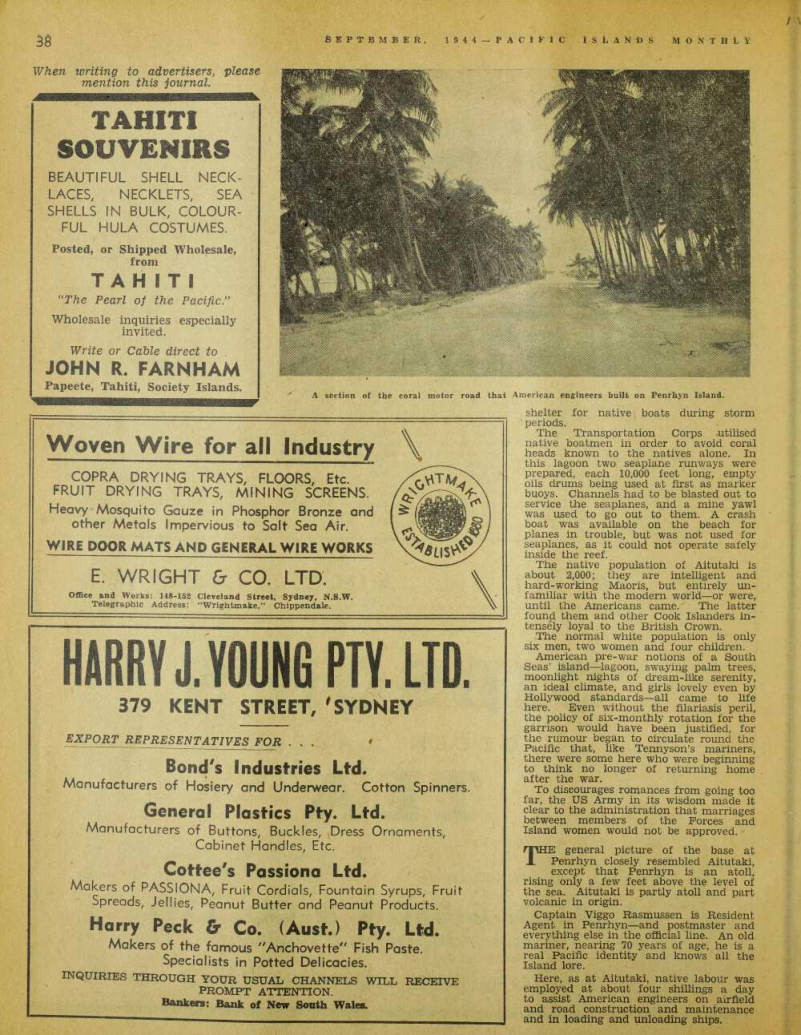
The Cook Islands—And The American
Occupation
By H. E. L. Priday
A ITUTAKI, in the Southern Cook Group, and Penrhyn, in the Northern Cooks, were occupied and developed by American garrisons in November, 1942, in order to provide staging points for land based aircraft on an alternate route from the United’ States to South-west Pacific and Australia, at a time when the primary line of communication was threatened by the Japs. It is reported that four and a half million dollars were spent on an air-base at Aitutaki. Rarotonga, the largest island and the administrative headquarters of the group, was by-passed. It was not at any time an American base.
Aitutaki is surrounded by a barrier reef so complete that only at one or two points can native boats and dories pass over at high tide. The total extent of the land is about seven square miles.
The main, island is generally triangular in shape but ends in a pronounced fishhook extension. It is in this low and partially swampy end that the trwo runways of the airport were constructed by New Zealand labour—one on the long finger of land curving along the reef on the eastern side of the island, the other across the island itself. Respectively, 6,000 and 5,000 feet long and 300 feet wide, they are surfaced with coral-sand-clay mixture brought up by drag-line from
is explained
by the necessity for filling in the salt water swamps and clearing the dense vegetation, including various types of palms, for the runways—work that re-
quired plenty of labour, energy and material.
The natives, who live principally along the western side of the island, had never dreamed of motor traffic, so the few exist ing trails had to be enlarged into pass able roads for small cars. The southern section of the island is nearly impene trable jungle, swampy in places, whose only elevation is a 60-foot hill, to the top of which a road was cut. Fortunately, it was found possible to pass round the southern end in a quarter-ton car by following the beach.
T>RIOR to the arrival of the Americans, JT the only landing on the island was the pier at Arutunga. Actually, only very small steamers were willing to anchor at the point shown on maps as Arutunga Anchorage, others preferring to sail up and down while unloading into barges. Many ship captains were cautious about approaching the reefs, so that long barge trips resulted, The main channel to the pier was widened and deepened, and yawls and barges were able to tie up.
Arnnnrt thp nipr thp isinnH’c
s ?ores-three lafee Government
warehouses two flfr sized Government office and a
whic” 1 taken' at
headquarters lor the American force, Dynamite was used to blast out toral heads in the magnificent lagoon formed on the east side by the reef running far out from the shore. This lagoon provides
When writing to advertisers, please mention this journal.
shelter for native boats during storm periods.
The Transportation Corps utilised native boatmen in order to avoid coral heads known to the natives alone. In this lagoon two seaplane runways were prepared, each 10,000 feet long, empty oils drums being used at first as marker buoys. Channels had to be blasted out to service the seaplanes, and a mine yawl was used to go out to them. A crash boat was available on the beach for planes in trouble, but was not used for seaplanes, as it could not operate safely inside the reef.
The native population of Aitutaki is about 2,000; they are intelligent and hard-working Maoris, but entirely un familiar with the modern world—or were, until the Americans came. The latter found them and other Cook Islanders in tensely loyal to the British Crown.
The normal white population is only six men, two women and four children.
American pre-war notions of a South Seas’ island—lagoon, swaying palm trees, moonlight nights of dream-like serenity, an ideal climate, and girls lovely even by Hollywood standards—-all came to life here. Even without the filariasis peril, the policy of six-monthly rotation for the garrison would have been justified, for the rumour began to circulate round the Pacific that, like Tennyson’s mariners, there were some here who were beginning to think no longer of returning home after the war.
To discourages romances from going too far, the US Army in its wisdom made it clear to the administration that marriages between members of the Forces and Island women would not be approved. rE general picture of the base at Penrhyn closely resembled Aitutaki, except that Penrhyn is an atoll, rising only a few feet above the level of the sea. Aitutaki is partly atoll and part volcanic in origin.
Captain Viggo Rasmussen is Resident Agent in Penrhyn—and postmaster and everything else in the official line. An old mariner, nearing 70 years of age, he is a real Pacific identity and knows all the Island lore.
Here, as at Aitutaki, native labour was employed at about four shillings a day to assist American engineers on airfield and road construction and maintenance and in loading and unloading ships.
A section of the coral motor road that American engineers built on Penrhyn Island.
Advertisements & other items, pp. 39-40 (1 item)
Gibson's
TRY IT . . . . YOU’LL LIKE IT!
GREEN LABEL
TEA
I 15 Blended and packed by— J. A. D. GIBSON & CO. LTD. : S 364 KENT STREET, SYDNEY. 'Phone: M 2328. J) Also GIBSON'S GREEN LABEL COFFEE and COFFEE ESSENCE
TAHITI
SOUVENIRS
BEAUTIFUL SHELL NECK-
LACES, NECKLETS, SEA
SHELLS IN BULK, COLOUR-
FUL HULA COSTUMES.
Posted, or Shipped Wholesale, from
TAHITI
“The Pearl of the Pacific Wholesale inquiries especially invited.
Write or Cable direct to
JOHN R. FARNHAM
Papeete, Tahiti, Society Islands.
Woven Wire for all Industry
COPRA DRYING TRAYS, FLOORS, Etc.
FRUIT DRYING TRAYS, MINING SCREENS.
Heavy Mosquito Gauze in Phosphor Bronze and other Metals Impervious to Salt Sea Air.
WIRE POOR MATS AND GENERAL WIRE WORKS
E. WRIGHT & CO. LTD.
Office and Works: 148-152 Cleveland Street, Sydney, N.S.W.
Telegraphic Address: “Wrlghtmake,” Chippendale.
O* T/^ Qr £
HARRY J. YOUNG PTV. LTD.
379 KENT STREET, 'SYDNEY
EXPORT REPRESENTATIVES FOR ... •
Bond's Industries Ltd.
Manufacturers of Hosiery and Underwear. Cotton Spinners.
General Plastics Pty. Ltd.
Manufacturers of Buttons, Buckles, Dress Ornaments, Cabinet Handles, Etc.
Cottee's Passiona Ltd.
Makers of PASSIONA, Fruit Cordials, Fountain Syrups, Fruit Spreads, Jellies, Peanut Butter and Peanut Products.
Harry Peck & Co. (Aust.) Pty. Ltd.
Makers of the famous "Anchovette" Fish Paste.
Specialists in Potted Delicacies. inquiries through your usual channels will receive
PROMPT ATTENTION.
Bankers: Bank of New South Wales.
Death of Gerbault
Famous Yachtsman and Writer
AFTER almost three years, it has only recently been revealed that that Pacific wanderer and writer, Alain Gerbauit, died in Dilli, Portuguese Timor, just before Allied forces landed there in December, 1941. Gerbauit was a French man, 39 years old.
He won fame first as an international tennis star in the early 20’s, but in 1923 he turned his back on civilisation to begin his restless wanderings. Single-handed, he sailed a small yacht across the Atlan tic, from Cannes to New York, in 142 days. In the US he built himself a 10tons ketch, the “Firecrest” and began to rove the Pacific in a long voyage that kept him outside the confines of civilisa tion for six years.
In two books, “The Flight of the Fire crest” and “In Quest of the Sim,” he left fascinating records of his voyagings in Pacific islands off the beaten track.
He returned to Europe in 1931; but soon announced that he would make another Pacific wander, this time in a new yacht, “Firecrest II.” “Firecrest II” was lost in a storm and he then built the “Alain Gerbauit.” He spent the rest of his life in the Pacific and in the late 30’s seemed to have settled in the Society Islands. He was on the wander again at the outbreak of war and, shortly before Pearl Harbour, announced that he had completed anQther book, but that it would not be published until after the war.
Death Of Old Fiji
Resident
AFTER 72 years’ residence in Fiji, Mrs.
Mary Ellen Louise Riemenschneider died in Suva at the end of July.
She leaves a family of three daughters and one son—Evelyn, widow of the late Captain Arthur Langton, a member of the Fiji Contingent, who was killed in the Great War of 1914-18; Viola, wife of Mr. W. G. Covell, at present in England; Sadie, wife of Captain A. Phelps, of Suva; and David M. Riemenschneider, of Suva.
The promotion of Major Ratu Sukuna to the rank of Lieutenant-Colonel was announced in Suva, in August.
Warrant-Officer A. F. Zacher, of the New Guinea Mission staff of the Evan gelical Lutheran Church, was recently married to Miss L. F. Noll, in St. John’s Lutheran Church, Crystal Brook, SA.
Information Wanted
Incidence of S. Pacific Hurricanes to be Studied
rE Director of Meteorological Services in Fiji, Flight-Lieutenant Ralph Dyer, intends to make an intensive study of the incidence of hurricanes in the South Pacific area. For this study, he is anxious to collect all possible details of past serious storms affecting Fiji or other Pacific islands.
He would like to enlist the aid of any residents of the South Pacific who could loan, for copying, any .photographs or written or printed details of past hurri canes and hurricane damage.
All documents and photographs re ceived will be treated with extreme care and will be returned as soon as copies are completed. All material should be registered and addressed to the Director of Meteorological Services, Box 288, Suva. The full addre&s of the sender should be enclosed in order to ensure safe* return.
Flight-Lieutenant Dyer asks particu larly for these details: :The date of the storm; the locality affected and the approximate track of the storm: its severity; damage done—illustrated by photographs, if possible—and, finally, any relevant weather observations made at the time.
Traders Have Their
Troubles
Prom Our Own Correspondent
Mangaia, June.
mHE small, independent storekeepers of J. this island find life difficult these days. Their lot, like that of Gilbert’s policeman, is a happy one.
The “small” store has to make, in order to survive, large profits on a very small stock. Usually the trader doesn’t benefit; it is the Administration that gets this money! And now, to make matters worse, profits are “fixed.”
Result: Several cases of alleged pro fiteering, and two of unlicensed selling of goods—one man being penalised to the extent of £l6/15/-.
Nobody holds a brief for the calculat ing profiteer. But the small traders could be assisted in legitimate business by a reduction in their licence fees (at present £5 yearly). Then, they could carry on without resorting to illegal stratagems of the kind described. .
Few complaints come from the native population, and where complaint is made, there is reason to believe that the person making it is often a “stool pigeon” of other interests.
The whole Cook Islands trading system is a mess, anyhow—the most insane forms of competition are indulged in, and there is still the old monopoly of inter island communications.
Sir Henry Milne Scott, of Suva, Fiji, expected to arrive in Sydney on a visit, in mid-September.
Advertisements & other items, pp. 41-42 (2 items)
39
Pacific islands monthlt—s e p t b m b e r , 1944
“ Paint It With Campbell’s ”
"C.A.P." Pre-war qualities were Tested and Approved in Singapore and Malaya.
"C.A.P/' Wartime permitted qualities are still making the better job.
NOW OBTAINABLE IN THE ISLANDS
"r ' Les peintures "C.A.P." sont et restent: "Toujours les meilleures"
0. F, MASSGHELEIN, SYDNEY, AUSTRALIA
Export Distributor.
This Company supplies Aluminium and its Alloys to all specifications and for every commercial application where these give better service over others metals.
PLATE . SHEET . STRIP
BAR WIRE . SECTIONS
SLABS . CIRCLES . TUBING . ROD .
FORGINGS . CASTINGS . ALLOY INGOT.
V'
PROPRIETARY LIMITED
(INCORPORATED IN THE STATE OF VICTORIA)
(GENERAL OFFICES AND FABRICATION DIVIS I O N: GRANV I L L E. SYDNEY, N. S. W.
Restlessness and sleeplessness, when due to run-down nerves, frequently respond to treatment with Dr. Williams" Pink Pills.
Dr. Williams’
PINK PILLS
help to enrich the blood, which has a beneficial and restorative effect upon the nervous system.
BITUMENOID ROOFING
MADE IN AUSTRALIA.
Bltumenold Roofings, Dampcourse and Insulating Pelts are made from the world’s best raw materials. Warranted to stand the most rigid tests.
BITUMENOID THE BEST
Roofing, l, 2, 3-ply; Flooring, Waterproof Materials; Saturated Pelt; Resilient Road Jointing; Natural Asphalt Dampcourse; 2 and 3-ply Dampcourse; 1-2 lb. Lead-core Dampcourse: Roofing Cement; Asphalt Paints; Roofing Compound. samples and price lists on application.
MAXWELL PORTER & SON LTD.
ESTABLISHED 1888. BUILDERS’ SUPPLIto
107 RED FERN ST.. REDFERN. SYDNEY, N.B.W. 'Phene: M 5157. Cables Bitnmeneid.
Scott’s “Renown” Brand Rope,
Cordage and
Binder
Twine
Cable Addreaa; Ropeyard, Sydney. m sfe!
of Every
Description
MANUFACTURED AT
MASCOT. N.S.W
J SCOTT
PTY. LTD.
Head Office and Store
163 CLARENCE STREET,
SYDNEY,
N.S.W.
Ff Contingent In
Melbourne
Reading Matter Wanted for Sick Tahitian
A SECOND returning contingent of Tahitian and New Caledonian sol diers, members of the Fighting French Pacific Battalion, arrived in Mel bourne on July 14—Bastille Day. They were on their way home from the Middle East after chasing the Hun across North Africa with General Montgomery’s Eighth Army.
The Caledonians stayed only a few days, but the unfortunate Tahitians had to en dure our cold, frosty Melbourne winter for three weeks.
When the first contingent was here last summer they made many friends, and hospitable Australians invited them to their homes. In particular was one, Mrs.
Nixon —who quickly became “Mammy” to the boys. She mothered the first con tingent, and when the second contingent arrived no trouble was too great for her to make the Tahitians welcome. At times there were 30 or 40 men at her home. On their last night in the city, she organised a party in a local hall. A huge banner, with the words; “In Honour of the Tahitian Battalion” was draped across one end of the room, and during the dance a collection was taken up among the Melbourne girls and residents who had gathered to give the boys a good
time, in order to buy a present for Cor poral Teni Gatata, who had to be left behind in a military hospital in Aus tralia, Teni will be in that hospital for at least eight months; and he is very lonely.
“Mammy’’ Nixon recently took the 200mile journey to visit him, but he would appreciate letters or reading matter from any “PIM” reader who is interested. His address is: Corporal Teni Gatata, Tahi tian Contingent, Fighting French Pacific Battalion, Ward 2, 106 AGH, Bonegilla (Victoria), via Albury, NSW. —TIHONI
Tamaiti.
The Pacific's Fighting
Sons Win Glory in Italy
Prom Our Own Correspondent
Noumea, Aug. 25.
FOLLOWING the North African cam pagn, the Bataillon du Pacifique was reconstituted as the Bataillon dTnfanterie de Marine du Pacifique, offi cers and men from the metropolis and from other French colonies being incor porated with the remaining Caledonian, Hebridean and Tahitian volunteers.
The battklion is now again in the news, and was cited in the following order of the day for its fighting in Italy:— “It is a battalion with a glorious past which, after fighting on all battlefields with the Free French Forces in Libya, Eritrea, at Bir Hakeim, El Alamein and in Tunisia, gave new proofs of its valour in Italy in May, 1944. On the slopes east of Girofano on June 19, 1944, the bat talion gave one of the decisive blows in breaking the enemy line and advancing as a spearhead of the expeditionary corps, attained its objective in the allotted time. Lost 89 killed, including Major Magny,', Chef du Corps, and two company commanders. Cited as an example among colonial troops for its forcefulness arid bravery.’’
Import Control Relaxed
In Fiji
THE import contrdl restrictions in Fiji have been relaxed in the case of 30 classes of goods which were enumer ated in a Royal Gazette published in early August. No import licences will be required from now on for goods in these classes, which include printed books and periodicals, articles of purely educational value, seeds, postage stamps, sports and other trophies, articles for use by the Boy Scouts and Girl Guides’ Associa tions and the St. John’s Ambulance Brigade, and material needed to main tain wireless or cable communications.
Residents of the Colony are advised that although they do not now need a Fiji import licence for goods for their personal use up to the value of £5, this does not necessarily mean that orders for such things as footwear and drapery can be sent to New Zealand or Australia with any certainty that the orders will be filled. The rationing restrictions in those two countries have to be taken into account. The Controller of Imports in Suva is able to give intending buyers information about these restrictions.
Mrs. Percy Goode, widow of Mr. Percy Goode, of Kessa Plantation, Buka (who was killed by the Japs when they visited there early in 1942), has returned to her profession, nursing, and is on the staff of the Royal Hospital for Women, Sydney.
Mrs. Goode escaped from New Guinea just before the invasion.
"Jesuits' Bark"

The History of Quinine
From the “Catholic Missions
Magazine”
LAST year thousands of saplings of cinchona trees were transplanted from special nurseries in Maryland, USA, to Central American countries. To day, 10,000 acres in Costa Rica are devoted to their growth. Guatemala boasts that in ten years it hopes to be one of the largest and best producers of quinine in the world. Brazil, not to be outdone, sent Dr. Roberto Souza Coelho to explain to Americans the extensive transplanting experiments in Sao Paulo.
It will take 10 years for these trees to yield in sufficient quantities their priceless contribution to the welfare of mankind. Meanwhile, literally hundreds of millions will suffer and many millions die because their product is not available.
The tree is no new discovery. It was known and its product used 400 years ago. The product of the cinchona tree is quinine, the best malaria remedy known. Its native habitat was originally South America, but to-day an estimated 98% of the world’s quinine comes from Java, which is completely controlled by the Japanese, and completely lost to us.
The once-flourishing hillsides of South America have been stripped bare.
Only now, when the scourge -of malaria attacks our own soldiers in the tropical war zones, are we taking steps to bring cinchona trees back to their first home.
Meanwhile we are seriously short of the precious quinine.
Quinine will be needed after the war.
In India alone some 3,000,000 die annually among 100,000,000 malaria sufferers.
Almost every tropical country needs the drug in great abundance.
CINCHONA is bound up with the his tory of the missions. No one would have suspected that a saint who never left Europe’s shores, would have so much to do with the story of a South American medicine, yet if Francis Borgia, third General of the Society of Jesus, had not sent Father Ruiz de Portillo and his little band of eight missionaries to Peru in 1567 to help undo the harm which the conquistadors had worked among the Indians, the whole history of quinine would be quite different.
The Spanish Jesuits first learned its medicinal qualities w 7 hen one of them was cured of malaria at Loxa by use of the bark as taught them by the natives.
Cinchona grew in abundance on the western slopes of the Peruvian Andes. The Jesuits gave it its first name, “Loxa bark.”
In 1630 Countess Chinchon, the wife of the Viceroy, just arrived from Europe, fell a victim of malaria. She was saved from death by some doses of the Loxa bark in crude powdered form, prepared
by the missionaries. In gratitude, she had large quantities brought from the mountains to the Jesuit dispensary of St.
Paul’s College in Lima, to be distributed to poor victims of the fever. The Fathers called her gift “Countess powder” and the tree to this day is known as the cin chona tree. But the natives insisted on calling the powder “Jesuit bark” after their benefactors, who saved their lives with it.
In 1632, Father de Cobo, SJ, shipped it to Europe. Eleven years later, Bartolome Tafur made it widely known in Spain, but because of strong anti-Jesuit feeling among Protestants, the so-called “Jesuit bark” was frowned upon by many of the medical profession.
Cardinal de Lugo wrote a defence of the cinchona bark after a favourable report by the Papal physician, De Lugo was followed by other Jesuit scientists, notably Honore Fabri, who is credited with answering Dr. Jean Jaques Chifflet’s anti-cinchona pamphlet. By 1658, Lon don chemists sold “Jesuit’s powder” in their apothecary shops.
Attempts to grow the seeds in European soil failed. The pioneers did not know that seeds would die unless packed in sealed containers, and kept under proper conditions of humidity and temperature.
Gradually quinine was transplanted to India and Ceylon in limited quantities, but one enterprising man succeeded in growing it in Java. Before the war, 98% of the quinine came from there.
WHAT happened in South America? In the sixteenth and seventeenth cen turies, the world’s whole supply came from Peru, Bolivia and Ecuador. In
the eighteenth century, with increasing demands, the hills were laid bare, and there was no reforestation. The Jesuits fought the destruction, and urged the American exploiters to lay out new plan tations. Their voices were lost in the mad scramble for the best cinchona bark at the least cost. Eventually no more was to be had.
Fortunately, some saplings had been transplanted elsewhere. World-wide mis sions conducted by Spaniards made quin ine known the world over. But the American supply was gone.
The American armies and the Filipino forces who saw the fall of Bataan learned this the hard way. When American Army doctors heard the nurses answer their request for more quinine with the words: “Sorry, we’re running low on quinine,” the long overdue process of reclaiming
quinine for America began.
But for the present, desperate measures were needed. Then Fathers Ewing and Doino, American Jesuits, one a scientist and the other a missionary, together with the chemistry laboratories of the college at Cagayan in Mindanao, were pressed into service to extract what they could from the relatively poor cinchona bark of the Philippines. It was inferior to the Javanese product, but it did help to stem the ravages of malaria in an hour of desperate need.
And now at last, cinchona and quinine are being brought back to South America mainly through the good, even if belated, efforts of the US.
It is expected that the Rev. J. W.
Dixon, of the Methodist Mission, will shortly be returning to Papua.
Advertisements & other items, pp. 43-44 (2 items)
41
PACIFIC ISLANDS MONTHLY—S E P T E M B E R , 1944
£, J. Gough S* Co. '*« *.Rzzxt""-
UNION
ASSURANCE SOCIETY LTD.
(Incorporated in England)
FIRE ACCIDENT
FIJI A. E. PEARCE & CO.
RABAUL COLYER WATSON
(New Guinea) Ltd.
N. S. WALES 109 PITT STREET.
SYDNEY.
S. Morrison, Mgr.
CONTROLLING OFFICE—
-413 Collins Sh, MELBOURNE
ALAN H. RUSSELL,
Resident Manager.
COmMTIKST-
Since the War began, the services and equipment of this Company have been made available expressly to firms wholly engaged in work for National Defence, Noyes Bros. greatly appreciate the long-standing business friendships in the Islands, and assure customers there of the closest attention to their requirements, to be filled when conditions permit a resumption of normal trading.
NOYES BROS. (SYDNEY) LTD
115 CLARENCE STREET. SYDNEY
Phone: B 7581 (10 lines)
11 WATT STREET. NEWCASTLE.
197 ELIZABETH STREET. BRISBANE
£, J. GOUGH S* CO. '*« *.rzzXT""- > SUPPLIERS OF GENERAL MERCHANDISE TO LEADING FIRMS THROUGHOUT THE
PACIFIC ISLANDS
Exporters ... Importers ... . Manufacturers' Representatives Bankers: Bank of N.S.W. Bank of Adelaide. Comptolr Nat. d’Escompte de Paris.
War Time Cable Address: GOUGH CO.. 1 BONDSTREET. SYDNEY.
Codes: Bentley’s, 2nd and Comp. Phrase; A.8.C., sth and 6th; Peterson, 2nd and 3rd; Banking; Acme.
BUYING AGENTS
FOR ALL PACIFIC TERRITORIES
Island Produce Sold on Commission
YOUR ORDERS RECEIVE PERSONAL ATTENTION
ROBERT GILLESPIE PTY. LIMITED
54a PITT STREET, SYDNEY
Cables: ROBERGILL. OP.O. BOX 137 CC.
Itching Skin Germs Killed in 3 Days
u , the dlscov ery of an American physician, it is now possible to kill and remove the true cause of most skin troubles. Your skin has nearly 50 million tiny seams and pores where invisible germs and parasites can hide and which are the true cause of terrible Itching. Cracking. Peeling, Burning. Ringworm, AC j C ’ sorlasis . Blackheads, Pimples, Foot Itch and other disfiguring blemishes.
Blemishes such as these make you look and ,, em £ a " asse «?’ una ttractive and handicapped in life, both socially and In business. You can’t di sflgurements with ordinary treatments, which give only temporary relief. d ° not kI P the B erms or parasites responsible for your trbuble. .
New Discovery Kills Cause
Former skin sufferers throughout the world are Nix ° derm - the discovery of a leading American skin specialist. This remarkne 7.S rep ff atlon dUlclcl y Penetrates into the pores of the skin and kills the germs and parasites responsible for your trouble in 7 minutes m e P l. th t hl ltCh * lm ? st instantly. At the th if * onderf ul preparation acts as a u, d Bkln food > 80 that as th e cause of your trouble is removed, your skin becomes soft nSii™ 9 lear - This clear, healthy comgj e J ou new charm and make It easy to win friends.
Praised by Doctors
Dr. T. A. Ellis, well-known physician of Toronto, Canada, recently stated: "Skin disorders caused by parasites, as many are, yield to Nixoderm. These parasites are invisible to the naked eye. They eat away the skin, forming ugly eruptions. Ordinary ointments or remedies fall completely, or give only temporary results because they do not reach the cause of the condition. It is this value about Nixoderm In attacking parasites which impresses me most favorably, and explains in large measure the success it enjoys over many stubborn cases."
Guaranteed Results
Get Nixoderm to-day. Put it to the test. In a few minutes you will find that the Itching has stopped, and in 24 hours you can see for yourself that your skin is clearer. And it is guaranteed that, within one week, Nixoderm must make your skin soft, clear, smooth and attractive or money back on return of empty package. Get Nixoderm from your chemist or store to-day. The guarantee protects you. So don’t delay. Get Nixoderm to-day.
Nixoderm 2/- & 4/-
For Skin Sores, Pimples and Itch.
Pan In Papua
LUANNI pipes upon the hill, Pipes a love-song, clear and shrill, Pipes a native melody, A reedy note of mystery; Swaying, as his fingers lift, To shake the reedpipe marred by rift.
A pause, and then a happy trill: Luanni pipes upon the hill.
Frigate birds fly—swooping low— Wheeling, turning, as they go, Darting o’er the green lagoon Where fish the women. And Talune, Who turns to wave; her heart stands still— Her new love greets her from the hill.
Alice Allen Innes.
Us Consul Leaves Noumea
Prom Our Own Correspondent
Noumea, Sept. 5.
MR. HENRY B. DAY, United States Consul in New Caledonia, has been recalled to Washington. The work of the Consulate will be continued by the Vice-consul, Mr. Edmond Barker, until Mr. Day’s successor arrives.
Mr. Day arrived in Noumea to succeed the first US Consul, Mr. Karl de G. Mac vittTr. on September 10, 1942. He had previously been Consul in Manila, Ade laide and Sydney.
Although his term here covered one of the most trying periods in the history of Franco-American relations, Mr. Day’s per sonal contacts with the French were always excellent. • Mr. H. (“Tex”) Archer, well known in northern New Guinea, is now on leave in Sydney, after a year in the north with the American Red Cross.
Advertisements & other items, p. 44 (1 item)
Gold
Purchasers at Full Market Prices on Assay Value of
SILVER
PLATINUM
And Platinum Group Metals
SOME OF OUR SERVICES
ASSAYERS & ANALYSTS—
Assays of Bullion, Ores, etc.
Analyses of Metals, Minerals, Alloys, etc.
SCIENTIFIC & INDUSTRIAL
METALLURGISTS—
Our range of precious metal manufactures covers all industries—Gold and Silversmiths, Electrical Trades, Dental Profession, Glass Sllverers, Electro-Platers, etc., etc.
REFINERS—
Purchasers and Refiners of Bullion, Scrap, Mining By-Products, and Trade Residues of every description carrying Precious Metals.
GARRETT Cr DAVIDSON
PTY. LTD.
824 George St., Sydney. Works: Surry Hills and Chippendale, N.S.W.
Official Assayers to the Bank of New South Wales. Gazetted Agents of the Commonwealth Bank of Australia, under the Gold Regulations of the National Security Act.
Madang Is Clean
Again
rOM an Australian officer, a former resident of New Guinea, who has been engaged on the job of restor ing Madang (after it was re-taken from the Japs) and establishing a base there: “Believe me, this has been a man-size job. In the beginning, there were only ruins. The Jap, as usual, had- done noth ing in the way of construction or road building, and our bombing, over many months, had been heavy and accurate.
The place, as I first saw it, was just a stinking ruin—the Jap had left every thing in an insanitary state, as he usually does when he vacates.
“However, the job has been done, and order has been restored. The roads have been re-covered, and the place is looking clean and wholesome once more.
“The old cricket oval was found with the concrete pitch intact, and is now in daily use for sports of all kinds.
“Horrible Experience”
“QOME of our fellows have had a rather >5 horrible experience. One of our units set up its camp in Madang’s former Chinatown —which had been obliterated —all but the concrete floors.
After about six weeks, some of the Chin ese, who had been rescued from the Nips further on, returned to Madang, to inspect their former homes.
“After probing around for a while—it was difficult to locate the sites of former buildings—they began to dig. Our fel lows got interested and hung around. The Chinese then unearthed various sums in silver, which they had buried before the blitz; and neither the Nips, who had been here in swarms, nor our fellows, who had literally lived on top of it, had sus pected its presence. Some of our bright est boys have been depressed ever since.”
The R«v. Father W. Hagen, American born member of the Society of the Divine Word Mission, Northern New Guinea, was recently in Melbourne conducting an ap peal for the mission. He spent 14 months in the Wewak area after the Jap occu pation; was later captured by the enemy and taken to Hollandia, from where he and others were rescued last April.
M. Lambert, a French Judge, has been assigned to the New Caledonian judicial
service. He will replace M. Jeanson, who has been transferred to Tahiti.
The Rev. W. Green, chairman of the Methodist Mission in Fiji, is in Australia at present on a six months’ furlough.
He is accompanied by Mrs. Green. Dur ing his absence, Mr, W. S. Pidgeon, of Taveuni, will act in Suva.
Advertisements & other items, pp. 45-46 (2 items)
43
pacific islands MONtfiit September., i&44
“Radiant”
TRINITY GRAMMAR SCHOOL
KEW, VICTORIA.
President of Council: Headmaster: A. O. HENTY, Esq. ALFRED BRIGHT, M.Sc., B.A.
The School is well equipped and splendidly situated. Its 1944 complement (about 70 boarders and 250 day boys) makes it possible for every boy to come into personal touch with the Head Master and a staff of 10 experienced and successful masters (Including seven University Graduates). The general life of the school is very varied and full of vigour. The Head Master will be pleased to send the Illustrated Year Book for 1943-4, on application, and to give full information about the school, which is approved by the University of Melbourne as a Class “A” School for Intermediate and School Leaving Examinations. 3 rd term commences 12th September, 1944. * Postal Address: Kew, E. 4, Victoria. Telephone: Hawthorn 412.
RAD CO
When shopping, insist on Radco quality products.
QUALITY
FOOD PRODUCTS
BAKING POWDER.
CUSTARD POWDER.
SOUP MIXTURE.
“Sure to Rise” Radco Baking Powder will Improve your baking. Pull directions on every tin.
Home flavoured Radco Custard Powder comes In two sizes: 4 oz. and 12 oz. packets. Economical to use and delicious to eat. Packed in 3 flavours: Banana, Lemon and Vanilla.
Made from the highest quality ingredients— makes a rich and nutritious soup.
JELLY CRYSTALS
BLANC MANGE.
JUNKET CRYSTALS.
All Radco Jellies have a full appetising flavour.
Made in 10 popular flavours to tempt your palate.
For a tasty and easy-to-make dessert, Radco Blanc Mange Powder appeals to all housewives.
Every packet contains four tempting flavours: Raspberry, Lemon, Vanilla, Strawberry.
Everyone knows Junkets—Radco Junket Crystals have three different flavours in every packet.
It’s a quick-selling and a tasty additional sweet.
Now Available in the Pacific Islands
Trade enquiries invited by Export Distributor :
0. F. MASSCHELEIN,
L- “Toujours les mailleures ”
“RADIANT”
Kerosene
STORM LANTERNS & TABLE LAMPS
Built-in Pump and Patent Generator.
Chromium-plated throughout.
A SAFE LANTERN for reliable, all-purpose and Stormproof lighting.
A BEAUTIFUL TABLE LAMP
suitable for the most Up-to-date Home.
Both Lamp and Lantern can be fitted with the latest design parchment shades.
For large Country Homes, instal the "GLORIA" Petrol Lighting System—2 to 1 5 lamps each 200 c.p. capacity.
O. F. MASSCHELEIN —Sydney, Australia.
Export Distributor.
(2ivtc/7ie£jdl&dd -wec^/ct
USE
TRAVEL CASES
War needs and conditions restrict supplies, but Globites will be made available whenever possible.
WANTED TO BUY—QUALITY GUNS AND RIFLES
HIGHEST PRICES GIVEN. WILL ALSO EXCHANGE GUNS.
New .303 Short Service Barrels, 25%”, without Sights and Platform, £2/15/- each.
Postage extra.
SI L RO H U Quality Firearms and Fishing Tackle. 143 ELIZABETH STREET (Near Market St.) SYDNEY. 'PHONE: MA 3540.
Asthma, Bronchitis Coughing, Curbed in 3 Minutes
Do you have attacks of Asthma or Bronchitis so bad that you can’t sleep? Do you feel weak, unable to work, and have to be careful not to take cold and can’t eat certain foods?
No matter how long you have suffered or what you have tried, there Is new hope for you in a doctor’s prescription called Mendaco.
No dopes, no smokes, no injections, no atomizer.
All you do Is take two tasteless tablets at meals and In 3 minutes Mendaco starts working through your blood, aiding nature to remove phlegm, promote free easy breathing and bring sound sleep the first night, so that you soon feel years younger and stronger.
No Asthma in 2 Years
Mendaco not only brings almost Immediate comfort and free breathing but builds up the system to ward off future attacks. For Instance. J. Richards, Hamilton, Ont., Canada, had lost 40 lbs., suffered coughing every night, couldn’t sleep. Mendaco stopped Asthma
spasms first night and he has had none since In over two years.
Money Back Guarantee
The very first dose of Mendaco goes right to work circulating through your blood and helping nature relieve you of the effects of Asthma. Try Mendaco under an Iron-clad money back gaurantee. You be the Judge. If you don’t feel fully satisfied after taking Mendaco Just return the empty package and the full purchase price will be refunded. Get Mendaco from your dhemist to-day and see how well you sleep to-night and how much better you feel to-morrow. The guarantee protects
yOU - RELIEVES ASTHMA
Mendaco
Now in 2 sizes ... 6/- and 12/-
America-Australia
"Good Fences Moke Good Neighbours"
C OME 'pertinent remarks on Austral- American relations by Mr. Philip H. Cummings {a well-known American lecturer and publicist, whose home is in Verona, New Jersey ), in a personal letter to the editor : IFIND that many people in Australia are making strong remarks about how popular the Americans are, and how much we shall always be friends.
An old remark or maxim comes to mind: “Friendship is never so thin as where it is thickly professed.” If we’d stop these love-feasts and, in mutual respect, work together, and not worry over each other’s sentiments, we’d flourish more exactly.
Robert Frost, the poet of my native New England, once wrote an excellent poem, “Good Fences Make Good Neigh bours,” from the old localism to that effect. It is very true. Nationalisms must have boundariesT but they must also be visible., and suggest only limitation and not isolation.
We iri the Pacific and you in the Paci fic have certain phases of destiny in common. No one has all the Pacific destiny as his bounden pleasure—unless it be our ugly enemy, the Japanese—and yet we callously ignored the Nanyan Boesho Kaisha for 40 years. That “South Seas Development Company” developed the project which had its first flowering at Pearl Harbour—and further flowers at Port Darwin, and in the miniature subs in between Sydney Heads.
It must be men standing, as the Aus tralians stood near Kuala Lumpur, in Malaya, and Americans standing as they stood at Tarawa and Guadalcanal, and Anzacs as they stood in Crete—in other words, men standing together in peace and in affairs of state as these men stood in affairs of war—that will prove our self-esteem to be less hollow. All this gushing fellowship for each other, and for the Soviet Union, and for Charles de Gaulle is a iip service which comes close to an unrealistic disservice.
You and I like the Islands, and we are concerned with Pacific peoples. I hope, one time, to be invited for a series of lectures in Australia; and on that occa sion I hope you and I may sit down to a long ale or a billy of tea and talk out some of these problems.
Advertisements & other items, p. 46 (2 items)
44
SEPTEMBER, 1941=-P A C I F 1 t ISIAKDS MONTHLY
Brush Ware
ISLAND DISTRIBUTORS :
E. DIXON & CO., manufacturers of Superior — D INO X— - Quality Cheaper D I Quality
BRUSHES, BROOMS and MOPS,
ROBERT GILLESPIE PTY. LIMITED
54a PITT STREET, SYDNEY
System
"Exploited" Natives
Old Resident is Emphatic on Indentured Labour System
By Leslie F. Gill
(who was a planter in BSI, until his plantations were destroyed in the Battle of Munda)
mo WARDS the end of his long reign, I that great native administrator, Sir Hubert Murray, of Papua, remarked that the time was probably coming when it would be necessary to protect the white man from the native —whilst giving jus tlCOn° another occasion, regarding the indentured labour system he gave as his considered opinion that it was the only just and workable system in the present stage of native development.
No one has ever accused Governor Mur ray of being other than a great friend of the native. He was a wise and just ruler of men—white and brown.
For the life of me I cannot understand what all the fuss is about concerning indentured native labour Rhetorical clap-trap by bishops and politicians—with axes to grind and eaually ignorant—leave me cold, because I know missionaries who share Sir Hubert Murray’s views on indentured labour.
Methodist Mission chief, Rev. John W.
Burton, has much to say in condemna tion of the indentured labour system and has also denied that his mission engages in trading. Before he assails those out side his church, he should be certain that his own brethren agree with his policies.
Some of them don’t— particularly those of the New Zealand Methodist Missionary Society—which emnloys indentured native labour, and carries on as licensed traders in the British Solomon's.
I would point out that native rights and development have for many years had priority in the policies of British Pacific Administrations; and the inden tured labour system is not “a legacy from the old German Government.” inasmuch as the svstem was in vogue in Panua and the British Solomons lopg before the Ger mans lost New Guinea in World War I I ‘can see little between the Island indentured labour system and that whereby men are recruited for the Roval and Australian Navies—except that the latter sign on for 12-year and five-year terms respectively, whereas the natives sign on for two.
Economic compulsion? Who is under the greater economic compulsion? The poor Jack Tar, who has to work to live, or the native who lives rent-free on his own land —a land of freedom and plenty?
Exploitation? I would ask the Reverend Bishops, rat-bag politicians, and theory crazed anthropologists to please inform me how it is possible to exploit a native subject of King George? If these gentry try to do so, please let them be explicit; let them abstain from hazy emotionalism and get, down to cases. The only way it is possible to exploit a people—white, brown or brindle—is under conditions where — (a) The people are landless, and/or (b) Compelled to work —by Authority, or bv economic stress. (c) There is no real competition—free and unrestricted.
The above conditions apply, wholly or in part, in so-called civilised countries — but apply not at all in New Guinea or the Solomons.
IN the Island Groups of my knowledge the native is confirmed in the rights to his own lands by British law. It is safe to say that not more than 8 per cent, of the land is owned or leased by
non-natives. The natives own the rest#millions of acres of rich, virgin, timber clad lands, with the abundant food sup ply that is obtainable for the tilling of their gardens—also the fish from the rivers and the varied sea-foods to be got from the seas of their coasts. (Think of this, and weep, O my brothers —ye poor landless wage-plugs or slum-dwellers of “free” Sydney, Melbourne, London, and New York!) The hoary old fiction of the native vil
lages being denuded of their youth to feed the labour demands of the planters —thus leaving old men, women, and chil dren to suffer undue hardship—is given another airing by the mission chiefs. Let them name those villages. The Govern ment would clamp down on. recruiting before such horrific conditions even tuated. The District Officers would soon see to that.
SEVEN per cent, of the total population is considered the safe maximum of recruits to be obtained from a primi tive community—if essential native food supply, services, and population increases are to be maintained. The pre-war inden tured labour figures of the Solomons averaged around 3,000-3,500 out of a population of 90,000 to 100,000. New Guinea and Papua would be on a par with this.
In a long Islands life in Papua, the
Gilberts and the Solomons, I have never seen the starving villagers bemoaned and wept over by the home-dwelling bishops, priests and deacons.
The village youths follow the urge of youth everywhere—adventure; to see the world; to escape from the boredom of village,life. They return, mentally alert and physically fit, filled with new ideas and stories of the wonders they have seen —thus stirring and quickening the slug gish stream of village life. They return rich with goods earned by their labours, to astonish their fellows and attract the maidens and marry them —and to fill their younger brethren with the desire to go and see and do likewise. That is the true picture of how recruiting affects a native village.
They may bring their wives to the plantations if they wish. If they do so, they are provided with a separate house
for their family by the planter—and also with a patch of ground for the family garden in most cases. Usually, however, the married men do not come, as the wives do not wish to leave the home vil lages—so mostly only the single men come.
EARLY in his career, the Rev. J. W.
Burton spent a few years in Fiji— £ and has never got over it. He saw —or imagined he saw—some shocking conditions amongst the indentured Indians there, twenty-odd years ago. He has been speaking as an authority on the Islands, and the indentured labour sys tem, ever since. What do they know of the Pacific, who only Fiji know?
The half-starved helot of the Indian dust-bowl, suffering from economic com pulsion, is not to be confounded with the well-fed, free and independent native of the Pacific Islands.
What went on—or did not go on—in the Indian coolie lines, in Fiji, in Mr.
Burton’s time does not—and never did— go on in the plantations of the Western Pacific under British rule. The Govern ments and the planters would not stand for that kind of thing—nor would the natives, because they would enthusiastic ally stay at home. Catch them going places to be down-trodden and exploited!
And no British Government has ever forced them—none will force them.
I trust Mr. Burton will not quote Mr.
Andrews the Indian “authority” be cause he knows less of the Pacific Islander and his conditions than Mr. Burton.
Self-centred, and immured in a very restricted and narrow orbit, the average missionary knows little of life on the plantations. Plantation life and mission station life are two worlds living apart Few men have knowledge of both. But that doesn’t stop some missionaries from climbing on the band-waggon, and—air ing a knowledge they don’t possess—tear ing the planter to pieces, and shouting about a New Order for “the poor, ex ploited. down-trodden natives.”
I notice these gentlemen usually reserve their opinions until they are at .a safe distance—in Sydney, say, in front of an ignorant audience. They say nothing here in the Islands, where they would have to prove their words to a knowledgeable audience.
ABOUT that “New Order,” so glibly spoken of—education, medical care, technical training, etc., for the native. By all means let the natives have them all. They deserve them, and the planters want to see them get them.
BuE; so far as I can see, there is not a new idea in the whole boiling of them —for, taken by and large, the natives are already getting them and have been get ting them for years—limited only by fin ance and the natives’ capacity to absorb and digest them., Keep on giving them— but for Heaven’s sake don’t call it a “New” Order. New! Shades of Mur ray and company and the mission edu cators !
As for the small wages the planters allegedly pay the natives—what have you* Show me the rich planter or trader in the Islands. Aren’t most of them mort gaged, or in debt to the eyes, to the big firms?
The issue is clear and simple for the planter. Give him a better yield in price on his copra, and he will gladly pay higher wages. Increase the wages with out an increase in copra prices, and he will simply fold up. That’s all. How much can you get out of an empty barrel? * J rE interests of the natives as copra producers and those of the planter sutlers are identical—iconoclastic as this may seem to the Burtons and Wards.
Reference to published, figures prove that the only concerns that do well in the Islands—in good times and in bad—in war and neace—are the Big Firms. They flourish like the green bay tree, while the small planters go down to ruin and despair.
Overseas combines like Unilever are attacked while the local combines are ignored. Yet. if the natives and the small planters could only get a fair proportion of what Unilever offers—and not what they have to take from the local com bines—they would be rich indeed.
But you never hear the brave, ignorant, publicity-hunting type of missionary attacking the local combines. Oh, no!— rather do they wprk in, and curry favour, with them, and reserve their attacks and diastribes for the small “exploiting, gin sodden trader and rapacious planters.” who have nothing to do with fixing local
prices, and would gladly pay more for copra, and give more wages, and sell more cheaply, if they could—that being good busmess.
In a word, it’s safer to attack the small fellow—he can’t hit back. Also, it is good propaganda to paint him as the big bad wolf to the natives. It shows them what a sympathetic, noble protector they have in yourself. But not a word about the Big Fellows! I ask; Is that just? Or is it, again, lack of guts; or just bad sports manship?
IS there free and real competition? I’ll say there is! Competition is not only free and real—but insensate. Euro pean, Chinese and native traders—and missionary traders also —all join in the free-for-all called trading in the Islands.
Service gone mad. Tied men financed by the Big Firms; Chinese and native trad ers cutting the heart out of the few white, independent (non-tied) traders; Chinese going bankrupt and others taking their places.
A merry hell of free and unrestricted competition. While the Big Firms look gleefully on, and, if the game lags, one of them will take a hand itself, just to make things interesting. If anyone wants a full life let him start trading in the Islands, with Europeans, Chinese, natives, missions and a Big Company as competi tors. Dolce far niente. I’ll say! Real Halcyon Days! i SIDELIGHT to illustrate what can, and is, happening—and how the natives are “exploited.”
After 25 years of struggle as a planter and trader, establishing a coconut plan tation and trading business in the Solo mons, my best pal was finally forced off his estate. “Broke to the wide,” he enlisted in the AIF, and was badly wounded by a bomb-burst in the face, in Libya. (Incidentally, I have not heard of any of the young BSI Chinese traders going to fight. In a British country it is OK for Asiatic aliens to oust British pioneers, who, old as they are, are good enough to fight, while their supplanters sit pretty and are looked after until it is safe to resume trading!) My pal’s plantation reverted to the native lessor. I now learn that my
friend’s two native cook-boys have bought the estate of their erstwhile master from the native lessor.
Full circle! These boys are to be com mended for their enterprise. Good luck to them. “Exploited”? No!
Advertisements & other items, pp. 47-49 (2 items)
- King’S Compo
IN TROPICAL AFRICA they cool their houses, factories, etc.,
the Special Roof-cooling Water Paint that Reduces Room
Temperature by 20%.
KING’S COMPO is the finest protective covering for Iron, Brick, Stucco, Fibrous-cement, Pla’ster and other surfaces.
IT IS PERMANENT—EFFECTIVE—ATTRACTIVE.
KING’S COMPO is easy to apply with brush or spray. High covering capacity. Packed in powder form—simply mix with water.
EXCEPTIONALLY LOW COST.
KING’S COMPO is definitely NOT A KALSOMINE.
Now Available in the Pacific Islands
ASK AT YOUR STORE ABOUT IT
Trade enquiries invited by Export Distributor : 0. F. MASSOHELEIN, A " s S SvltfvSw.'” 9
CHARLES MUIR (Eastern) EXPORT GO.
SYDNEY
EXPORT AGENTS AND
MANUFACTURERS
AJC & OK Jams, Canned Fruits, Sauces, Asparagus, etc, EEZEE Washing Blue in Bags, also Paper Wrapped—Baking Powder. Custard Powder, Jelly Crystals, etc.
StJNGLO Pickles, Chutney, Honey, Fruit Cordials, Jams in Glass Jars, Canned Vegetables, etc.
WINES, SPIRITS. BEERS.—
“Juberry,” “Royalty,” “Aulde Acquaintance,” “Private Seal”
Brands, etc.
IN SUGAR BAGS.— Pearl Barley, Oatmeal, Rolled Oats, etc.
We Specialise in All Kinds of Food Products. Enquiries Invited Through Your Usual Channels. ’Phones: B 2279, FA 2703.
FX4515 (Factory).
Cable Address;
MUIR—SYDNEY.
% Kin
Manufacturers, Distributors or Wholesalers who desire Australian products, write giving full details to Box 4081, GPO, Sydney, NSW.
Kidney Trouble
and Backache
Gone in 1 Week
Flush Kidneys With Cystex and Ton'll Feel Fine Cystex—the prescription of a famous doctor —improves faulty kidney action in double quick time, so, if you suffer from Rheumatism, Sciatica, Neuritis, Lumbago, Backache, Nervousness, Leg Pains, Dizziness, Circles under Eyes, frequent Headaches and colds, poor Energy and Appetite, Puffy Ankles or Interrupted Sleep, go to your chemist to-day for Cystex,
Cystex Helps Nature 3 Ways
The Cystex treatment is highly scientific being specially compounded to soothe, tone and clean kidneys and bladder and to remove acids and poisons from your system safely, quickly and surely, yet contains no harsh, harmful or dangerous drugs. Cystex wo-ks In these 3 ways to end your troubles:— 11) Starts killing the germs which are attacking your Kidneys, Bladder and urinary system in two hours, yet is absolutely harmless to human tissue. (2) Gets rid of health-destroying, deadly poisonous acids with which your system has become saturated. (3) Strengthens and reinvigorates the kidneys, protects you from the ravages of diseaseat , ta S del * cate filt er organism, and stimulates the entire system
Feels a Different Woman
hav ® be ®" taking Cystex for Kidney and J rouble and I* has made a different woman of me. I am feeling splendid, can do * T worb ’ ™ n abo «t and walk miles although lam 63 years of age. Cystex does all p m °L \t.’’-(Sgd.) M. L. Zessin, Thompson Estate. Brisbane p
Able to Walk Without Stick
I had Kidney and Bladder complaint nains b T acb > in I had to’use a walk!
V 1 have used two b °ttles of Cystex, now 1 have no pains anywhere. I consider SjJf* the * re »test medicine in the world for Kidney complaint.”—(Ssd ) T Nangeribone Station. N.S.W. Kherson,
Guaranteed to Satisfy or Money Back
it Get f£ ySteX t/ rom your chemist to-day. Give
W ZSS.
. Now ia 2 sizes—I/-, g/_ This is a
GUARANTEED ClTfifOV
Treatment J
for Your Kidneys, Bladder, Rheumatism
For perfect cutting
underlet! conditions
There is a Ransomes Mower for every lawn our range covers machines for every requirement from the smooth, even surface of the putting green to the sports ground, golf course or aerodrome.
The "MOON" Mower
I GANG
MOWERS
For grass such as couch, klkuyu, buffalo, etc., and grass longer than She average. 14-ln. and 18-ln. wide. 50 acres a day can easily be cut with a Ransomes Quintuple Mower drawn by a tractor and even larger outfits up to 25 ft. wide are available.
ansomes
Lawn Mowers
Write for illustrated literature and all information
MORRIS, HEDSTROM LTD.,
Suva, Lautoka, and Ba.
Mode by RANSOMES. SIMS & JEFFERIES LTD., IPSWICH. ENGLAND.
Allen Taylor & Co. Ltd.
COMMERCIAL ROAD, ROZELLE,
SYDNEY
Sawmillers and Wholesale Suppliers of Hardwoods for Constructional Purposes GIRDERS ... PILES .. . POLES . . . SLEEPERS, Etc.
EXPORTING TO PACIFIC” ISLANDS SINCE 1893
“Toujours les meilleurs.”
FARBEST
Pure Fruit
CORDIALS
DELICIO US—WHOLESOME—REFRESHING.
Contain all the Vitamins of Fresh Fruit.
PINEAPPLE—LEMON—ORANGE—GRAPE
FRUIT—PASSIONFRUIT—RASPBERRY
—STRAWBERRY—TROPICAL FRUIT
NECTAR.
GLACE CHERRIES
for Cocktails and Rich Cakes.
O. F. MASSCHELEIN
SYDNEY, AUSTRALIA
—Export Distributor —
Australian Foodstuffs Wines & Spirits . . Primary Products
If you want to ..
BUY
or equipment of any kind, food stuffs, spirits, manufactured goods W island produce or raw materials . . .
USE the market-knowledge and organisation of Darvas and Company for prompt service and effective safeguard of your interests.
With representatives in all Empire and overseas countries, Darvas qnd Company are organised for quickest and best possible results . . . buying or selling.
DARVAS and COMPANY
(Proprietors: R. Darvas, E. Klugman.) Head Office: 35 Pitt Street, Sydney. ’Phones: 8W4696, 8W6384. Cable Address: Darvas Company, Sydney.
Bankers: Bank of Australasia. Comptoir National d’Escompte de Paris.
Pharmaceutical Lines . Patent Medicines . Manufactured Goods.
After taking Pinkettes you should feel brighter, happier, and free from sick headaches, bilious attacks and liverishness. For
PINKETTES
are tiny laxative and liver pills, which painlessly exercise the digestive system.
46
SEPTEMBER, 1944 PACIFIC ISLANDS' MONTHLY
Islands Produce
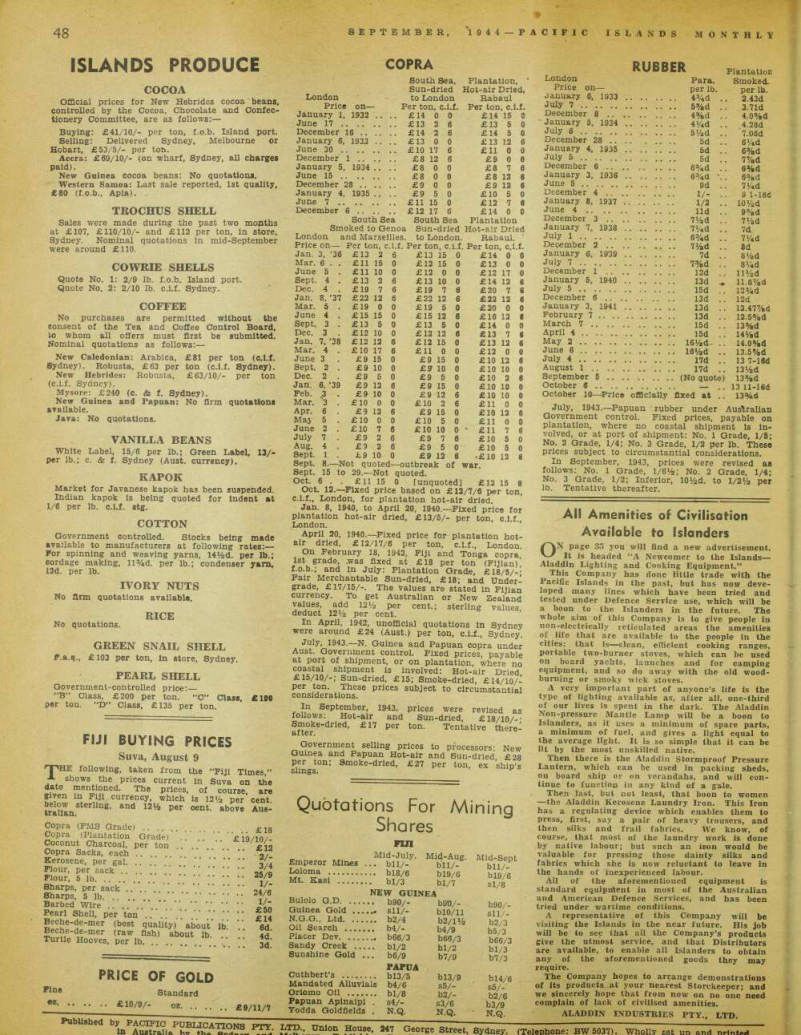
Cocoa
Official prices for New Hebrides cocoa beans, controlled by the Cocoa, Chocolate and Confec tionery Committee, are as follows: Buying: £4l/10/- per ton, f.o.b. Island port.
Selling: Delivered Sydney, Melbourne or Hobart, £53/5/- per ton.
Accra: £69/10/- (on wharf, Sydney, all charges paid).
New Guinea cocoa beans: No quotations.
Western Samoa: Last sale reported, Ist quality, £BO (f.0.b., Apia).
Trochus Shell
Sales were made during the past two mouths at £lO7, £llO/10/- and £ll2 per ton, in store, Sydney. Nominal quotations in mid-September were around £llO.
Cowrie Shells
Quote No. 1: 2/9 lb. f.o.b. Island port.
Quote No. 2: 2/10 lb. c.i.f. Sydney.
Coffee
No purchases are permitted without the consent of the Tea and Coffee Control Board, io whom all offers must first be submitted.
Nominal quotations as follows: — New Caledonian: Arabica, £Bl per ton (c.i.f.
Sydney). Robusta, £63 per ton (c.i.f. Sydney).
New Hebrides: Robusta, £63/10/- per ton (c.i.f. Sydney).
Mysore: £240 (C. & f. Sydney).
New Guinea and Papuan: No firm quotations available.
Java: No quotations.
Vanilla Beans
White Label, 15/6 per lb.; Green Label, 13/per lb.; c. & f. Sydney (Aust. currency).
Kapok
Market for Javanese kapok has been suspended.
Indian kapok is being quoted for Indent at 1/6 per lb. c.i.f. stg.
Cotton
Government controlled. Stocks being made available to manufacturers at following rates:— For spinning and weaving yarns, 14%d. per lb.; cordage making, ll%d. per lb.; condenser yam, 12d. per lb.
Ivory Nuts
No firm quotations available.
Rice
No quotations.
Green Snail Shell
F.a.q., £lO3 per ton, in store, Sydney.
Pearl Shell
Government-controlled price:— ”B” Class, £2OO per ton. “C” Class, £lBO per ton. “D” Class, £135 per ton.
Fiji Buying Prices
Suva, August 9
r P HE following, taken from the “Fiji Times,” * shows the P ric es current in Suva on the date mentioned. The prices, of course are given in Fiji currency, which is 12% per cent. trillln g ’ aDd UVz Per oentl above Aus ’
Copra (FMS Grade) £lB Copra (Plantation Grade) .. " ' Via /in/ Coconut Charcoal, per ton ’ “ Copra Sacks, each ... 9/ Kerosene, per gal ty.
Flour, per sack Flour. 5 lb 25/9 Sharps, per sack ' 9 Z“ Sharps, 5 lb 2 y. 6 Barbed Wire Pearl Shell, per ton .. ’. fr?
JS£rSl e ‘ mer < best qualit yi a bout' ib] 6d .
Beche-de-mer (raw fish) about lb 22 Turtle Hooves, per lb. .. .V .. .. .. ;; J d>
Price Of Gold
Oct. 6 . . £ll 15 0 [unquoted] £l2 15 6 Oct. 12.—Fixed price based on £l2/7/6 per ton, c.i.f., London, for plantation hot-air dried.
Jan. 8, 1940, to April 20, 1940.—Fixed price for plantation hot-air dried, £l3/5/- per ton cif London.
April 20, 1940.—Fixed price for plantation hot air dried, £l2/17/6 per ton. c.i.f., London On February 18, 1942, Fiji and Tonga copra Ist grade, was fixed at £lB per ton (Fijian)’ f.0.b.; and in July: Plantation Grade, £ 18/5/-’
Fair Merchantable Sun-dried, £18; and Under grade, £l7/15/-. The values are stated in Fijian currency. To get Australian or New Zealand values, add 12 % per cent.; sterling values, deduct 12% per cent.
In April, 1942, unofficial quotations in Sydney were around £24 (Aust.) per ton, c.i.f., Sydney.
July, 1943.—N. Guinea and Papuan copra under Aust. Government control. Fixed prices, payable at port of shipment, or on plantation, where no coastal shipment is involved: Hot-air Dried £l5/10/-; Sun-dried, £l5; Smoke-dried, £l4/10/per ton. These prices subject to circumstantial considerations.
In September, 1943. prices were revised as follows: Hot-air and Sun-dried, £lB/10/-afte? e ' dried ' £1? P6r ton ' Tentative there- Government selling prices to processors; New Guinea and Papuan Hot-air and Sun-dried £2B slings ton; Smoke-dried ’ £27 P er ton. ex ship’s
Flne Standard ® Z £10/9/- oz £9/11/7
Copra
South Sea, Plantation, Sun-dried Hot-air Dried, London to London Rabaul Price on- Per ton . c.i.f.
Per ton l. c.i.f.
January 1, 1932 £14 0 0 £14 15 C June 17 . £13 2 6 £13 5 0 December 16 .. £14 2 6 £14 5 0 January 6, 1933 £13 0 0 £13 12 6 June 30 . £10 17 6 £11 0 0 December 1 . . £8 12 6 £9 0 0 January 5, 1934 £8 0 0 £8 7 6 June 15 . £8 0 0 £8 12 6 December 28 .. £9 0 0 £9 12 6 January 4, 1935 £9 5 0 £10 5 0 June 7 .. £11 15 0 £12 7 6 December 6 .. £12 17 6 £14 0 0 South Sea South Sea Plantation Smoked to Genoa Sun-dried Hot-air Dried London and Marseilles, to London.
Rabaul. 1 Price on— Per ton, c.i.f. Per ton, c.i.f, . Per ton, c.i.f.
Jan. 3, ’36 £13 2 6 £13 15 0 £14 0 0 Mar. 6 . . £11 15 0 £12 15 0 £13 0 0 June 5 . £11 10 0 £12 0 0 £12 17 0 Sept. 4 . £13 2 6 £13 10 0 £14 12 8 Dec. 4 . £19 7 6 £19 7 6 £20 7 9 Jan. 8, ’37 £22 12 6 £22 12 6 £22 12 6 Mar. 5 . £19 0 0 £19 5 0 £20 0 0 June 4 . £15 15 0 £15 12 6 £16 12 C Sept. 3 . £13 5 0 £13 5 0 £14 0 0 Dec, 3 . £12 10 0 £12 12 6 £13 7 1 Jan, 7, ’38 £12 12 6 £12 15 0 £13 12 6 Mar. 4 . £10 17 6 £11 0 0 £12 0 0 June 3 £9 15 0 £9 15 0 £10 12 8 Sept. 2 . £9 10 0 £9 10 0 £10 10 0 Dec. 2 £9 5 0 £9 5 0 £10 2 a Jan. 6, ’39 £9 12 6 £9 15 0 £10 10 9 Feb. JJ . £9 10 0 £9 12 6 £10 10 0 Mar. '3 . £10 0 0 £10 2 6 £11 0 0 Apr. 6 £9 12 6 £9 15 0 £10 12 a May 5 . £10 0 0 £10 5 0 £11 0 0 June 2 . £10 7 6 £10 10 0 ‘ £11 7 6 July 7 . £9 2 6 £9 7 6 £10 5 0 Aug, 4 £9 2 6 £9 5 0 £10 5 0 Sept. 1 £9 10 0 £9 12 6 •£ 10 12 8 Sept. 8. —Not quoted— ■outbreak of war.
Sept. 15 to i 29.- -Not quoted.
Quotations For Mining
Shares
July, 1943.—Papuan rubber under Australian Government control. Fixed prices, payable on plantation, where no coastal shipment is in volved, or at port of shipment: No. 1 Grade, 1/5; No, 2 Grade, 1/4; No. 3 Grade, 1/2 per lb. These prices subject to circumstantial considerations.
In September, 1943, prices were revised as follows: No. 1 Grade, l/6Vfe; No. 2 Grade, 1/4; No. 3 Grade, 1/2; Inferior, 10y 2 d. to 1/2 Va per lb. Tentative thereafter.
FUl Emperor Mines .
Mid-July. .. bll/- Mid-Aug. bll/- Mid-Sept bll/- Loloma Mt. Kasl hi/"? bl9/6 Hi /n bl9/6 sl/8 ui/ /
New Guinea
Bulolo G.D .. b90/b9t)/- Hin/i i b90/sll/b2/3 b5/3 Guinea Gold ...
N.G.G., Ltd .. b2/4 t>lU/ 11 b2/iy 2 b4/9 Oil Search Placer Dev b66/3 b66/3 Sandy Creek .,. bl/2 bl/3 Sunshine Gold . .. b6/9
Papua
b7/9 b7/3 Cuthbert’s bl3/9 bl4/6 Mandated Alluvials b4/6 s5/s5/-' b2/6 b3/9 Oriomo Oil Papuan Aplnaipl . s4/- \JA/ “ s3/6 Yodda Goldfields . N.Q.
N.Q. ‘ N.Q.
London Price on— January 6, 1933 July 7
RUBBER Plantation
Para. Smoked, per lb. per lb.
December 8 .. . 4 f)5/.rt January 5, 1934 July 6 Tt.U /#u 4.28d 7 flfirl December 28 .. .
January 4, 1935 July 5 5d .. 1 .UOll 6‘Ad 6%d 77/ofi December 6 .. . 1 /8U 6%d January 3, 1936 6 3 /«d • 6 3 /ad 7‘Ad June 5 December 4 .. . l/_ 9 1-18<J 10 Mid 9 8 Ad 7‘Ad 7d 7‘Ad January 8, 1937 .
June 4 December 3 .. . 1/2 .. 7i/ a d January 7, 1938 .
July 1 December 2 .. .
January 6, 1939 .
July 7 8d 8Vad 8‘Ad December 1 .. .
January 5, 1940 .
July 5 11‘Ad 11.6 7 Ad 12 3 Ad December 6 .. ..
January 3. 1941 .
February 7 .. ..
March 7 12d 12.47y»d 12.5 5 Ad 13%d April 4 15d 14 Mad 14.0%d May 2 June 6 16*/ad 13!5 9 Ad 13 7-16d 13‘Ad 13 %d 13 il-l«d 13%d July 4 August 1 September 5 .. .
October 6 October 10—Price officially fixed at ..
All Amenities of Civilisation
Available to Islanders
ON page 35 you will find a new advertisement.
It is headed “A Newcomer to the Islands— Aladdin Lighting and Cooking Equipment.”
This Company has done little trade with the Pacific Islands in the past, but has now deve loped many lines which have been tried and tested under Defence Service use, which will be a boon to the Islanders in the future. The whole aim of this Company is to give people in non-electrically reticulated areas the amenities of life that are available to the people in the cities: that is—clean, efficient cooking ranges, portable two-burner stoves, which can be used on board yachts, launches and for camping equipment, and so do away with the old wood burning or smoky wick stoves.
A very important part of anyone’s life is the type of lighting available as, after all, one-third of our lives is spent in the dark. The Aladdin Non-pressure Mantle Lamp will be a boon to Islanders, as it uses a minimum of spare parts, a minimum of fuel, and gives a light equal to the average light. It is so simple that it can be lit by the most unskilled native.
Then there is the Aladdin Stormproof Pressure Lantern, which can be used in packing sheds, on board ship or on verandahs, and will con tinue to function in any kind of a gale.
Then last, but not least, that boon to women —the Aladdin Kerosene Laundry Iron. This Iron has a regulating device which enables them to press, first, say a pair of heavy trousers, and then silks and frail fabrics. We know, of course, that most of the laundry work is done by native labour; but such an iron would be valuable for pressing those dainty silks and fabrics which she is now reluctant to leave in the hands of inexperienced labour.
All of the aforementioned equipment is standard equipment in most of the Australian and American Defence Services, and has been tried under wartime conditions, A representative of this Company will be visiting the Islands in the near future. His job will be to see that all the Company’s products give the utmost service, and that Distributors are available, to enable all Islanders to obtain any of the aforementioned goods they may require.
The Company hopes to arrange demonstrations of its products at your nearest Storekeeper; and we sincerely hope that from now on no one need complain of lack of civilised amenities.
Aladdin Industries Pty., Ltd.
Advertisements & other items, p. 50 (1 item)
48
SEPTEMBER, 1944 PACIFIC ISLANDS MONTHLY
to AuBtran a P hv .^?H s . e * 24 J George Street, Sydney. (Telephone; 8W5037). Wholly set un and nrinted
Guardsmen
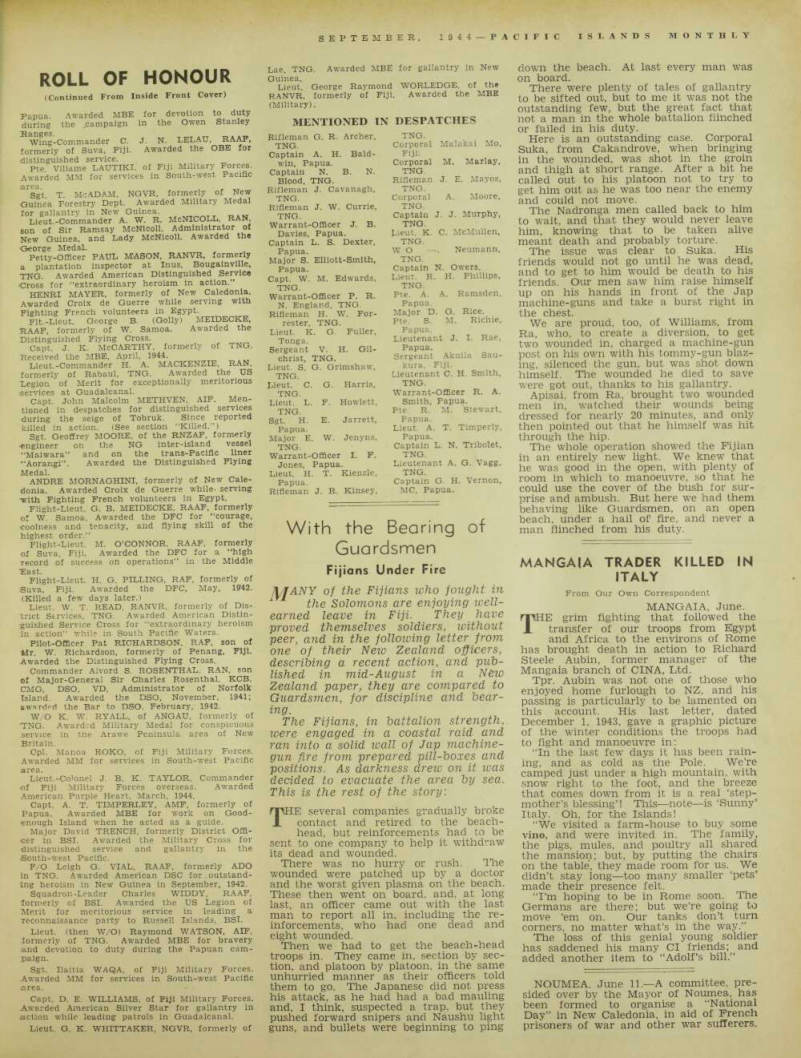
With the Bearing of Guardsmen Fijians Under Fire
JYJANY of the Fijians who fought in 1 the Solomons are enjoying well earned leave in Fiji. They have proved themselves soldiers, without peer, and in the following letter from one of their New Zealand officers, describing a recent action, and pub lished in mid-August in a New Zealand paper , they are compared to Guardsmen, for discipline and bear ing.
The Fijians, in battalion strength, were engaged in a coastal raid and ran into a solid wall of Jap machine gun fire from prepared pill-boxes and positions. As darkness drew on it was decided to evacuate the area by sea.
This is the rest of the story. rE several companies gradually broke contact and retired to the beach head, but reinforcements had to be sent to one company to help it withdraw its dead and wounded.
There was no hurry or rush. The wounded were patched up by a doctor and the worst given plasma on the beach.
These then went on board, and, at long last, an officer came out with the last man to report all in, including the re inforcements, who had one dead and eight wounded.
Then we had to get the beach-head troops in. They came in, section by sec tion, and platoon by platoon, in the same unhurried manner as their officers told them to go. The Japanese did not press his attack, as he had had a bad mauling and, I think, suspected a trap, but they pushed forward snipers and Naushu light guns, and bullets were beginning to ping
down the beach. At last every man was on board.
There were plenty of tales of gallantry to be sifted out, but to me it was not the outstanding few, but the great fact that not a man in the whole battalion flinched or failed in his duty.
Here is an outstanding case. Corporal Suka, from Cakandrove, when bringing in the wounded, was shot in the groin and thigh at short range. After a bit he called out to his platoon not to try to get him out as he was too near the enemy and could not move.
The Nadronga men called back to him to wait, and that they would never leave him, knowing that to be taken alive meant death and probably torture.
The issue was clear to Suka. His friends would not go until he was dead, and to get to him would be death to his friends. Our men saw him raise himself up on his hands in front of the Jap machine-guns and take a burst right in chest We are proud, too, of Williams, from Ra, who, to create a diversion, to get two wounded in, charged a machine-gun post on his own with his tommy-gun blaz ing, silenced the gun, but was shot down himself. The wounded he died to save were got out, thanks to his gallantry.
Apisai, from Ra, brought two wounded men in, watched their wounds being dressed for nearly 20 minutes, and only then pointed out that he himself was hit through the hip.
The whole operation showed the Fijian in an entirely new light. We knew that he was good in the open, with plenty of room in which to manoeuvre, so that he could use the cover of the bush for sur prise and ambush. But here we had them behaving like Guardsmen, on an open beach, under a hail of fire, and never a man flinched from his duty.
Mangaia Trader Killed In
Italy
From Our Own Correspondent
Mangaia, June.
rpHE grim fighting that followed the J. transfer of our troops from Egypt and Africa to the environs of Rome has brought death in action to Richard Steele Aubin, former manager of the Mangaia branch of GINA, Ltd.
Tpr. Aubin was not one of those who enjoyed home furlough to NZ, and his passing is particularly to be lamented on this account. His last letter, dated December 1, 1943, gave a graphic picture of the winter conditions the troops had to fight and manoeuvre in: “In the last few days it has been rain ing, and as cold as the Pole. We’re camped just under a high mountain, with snow right to the foot, and the breeze that comes down from it is a real ‘step mother’s blessing’! This —note —is ‘Sunny’
Italy. Oh, for the Islands!
“We visited a farm-house to buy some vino, and were invited in. The family, the pigs, mules, and poultry all shared the mansion; but, by putting the chairs on the table, they made room for us. We didn’t stay long—too many smaller ‘pets’ made their presence felt.
“I’m hoping to be in Rome soon. The Germans are there; but we’re going to move ’em on. Our tanks don’t turn corners, no matter what’s in the way.”
The loss of this genial young soldier has saddened his many Cl friends; and added another item to “Adolf’s bill.”
NOUMEA. June 11.—A committee, pre sided over by the Mayor of Noumea, has been formed to organise a “National Day” in New Caledonia, in aid of French prisoners of war and other war sufferers.
Advertisements & other items, pp. 51-52 (2 items)
Roll Of Honour
SEPTEMBER, 1944 PACIFIC ISLANDS MONTHLY
(Continued From Inside Front Cover)
W. R. Carpenter & Co. Ltd.
■' V • ■■■ ■' >i ■ - '
MM . M
. ll I * AtT • •/ ■ I i : ; & . ' . m
Travel by CARPENTER AIRLINES
Full particulars from Macdonald, Hamilton fir Co., or Howard Smith Ltd., Sydney.
W. R. CARPENTER & CO. LTD.
MERCHANTS, SHIPOWNERS AND AIRCRAFT OPERATORS
Agent* for Auitralian, European and American Manufacturers, and Distributors of Every Description of Merchandise.
Buyers and Shippers of Copra, Trocas, and all Classes of Islands Produce.
Ford Motor Company of Canada.
T. G. £r C. Bollnders (Engines).
AGENTS FOR :
Caterpillar Tractors.
Electrolux Refrigerators, etc., etc.
Dodge Brothers Inc.
Westinghouse Electrical Co.
Branches throughout the Pacific Islands
In London. W. R. Carpenter & Co. (London) Ltd., Coronation House, 4 Lloyds Avenue, London, EC.
Head Office: 16 O’CONNELL STREET, SYDNEY