Pacific
Islands
Monthly
||nwa j'if| - August 18, 1944
Vol. Xv. No. 1.
Established 1930
[Registered at the G.P.O.,Sydney, for transmission by post as a newspaper ]
II-
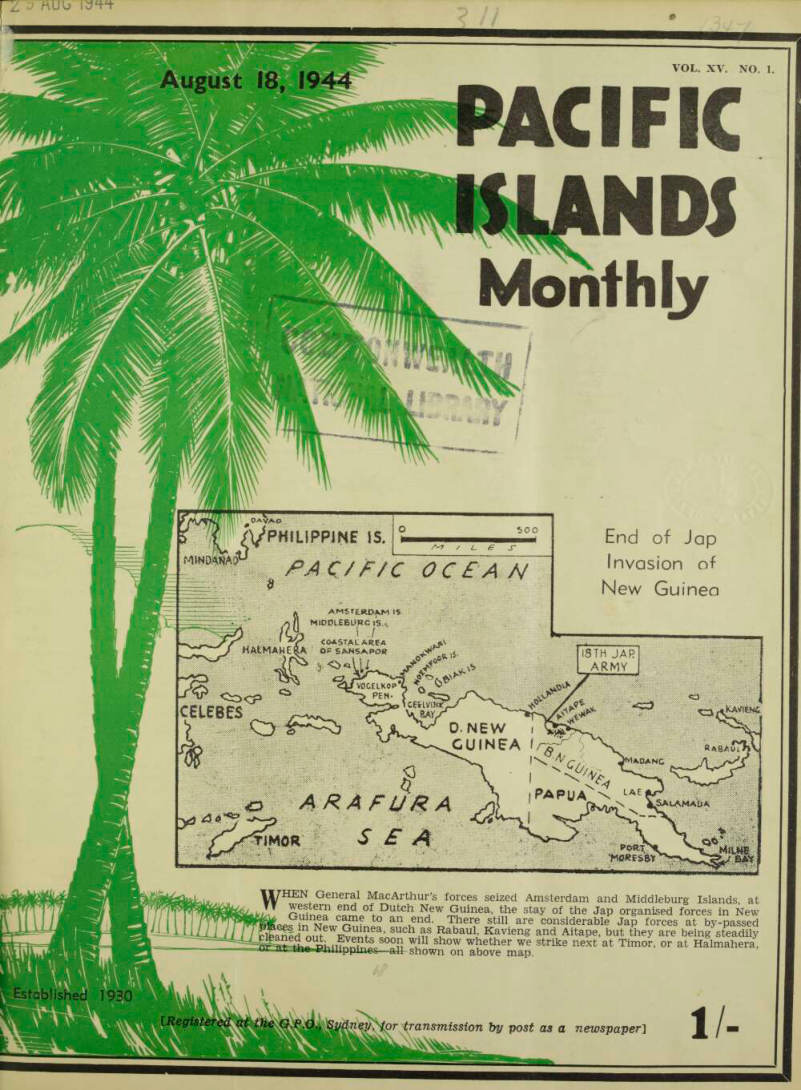
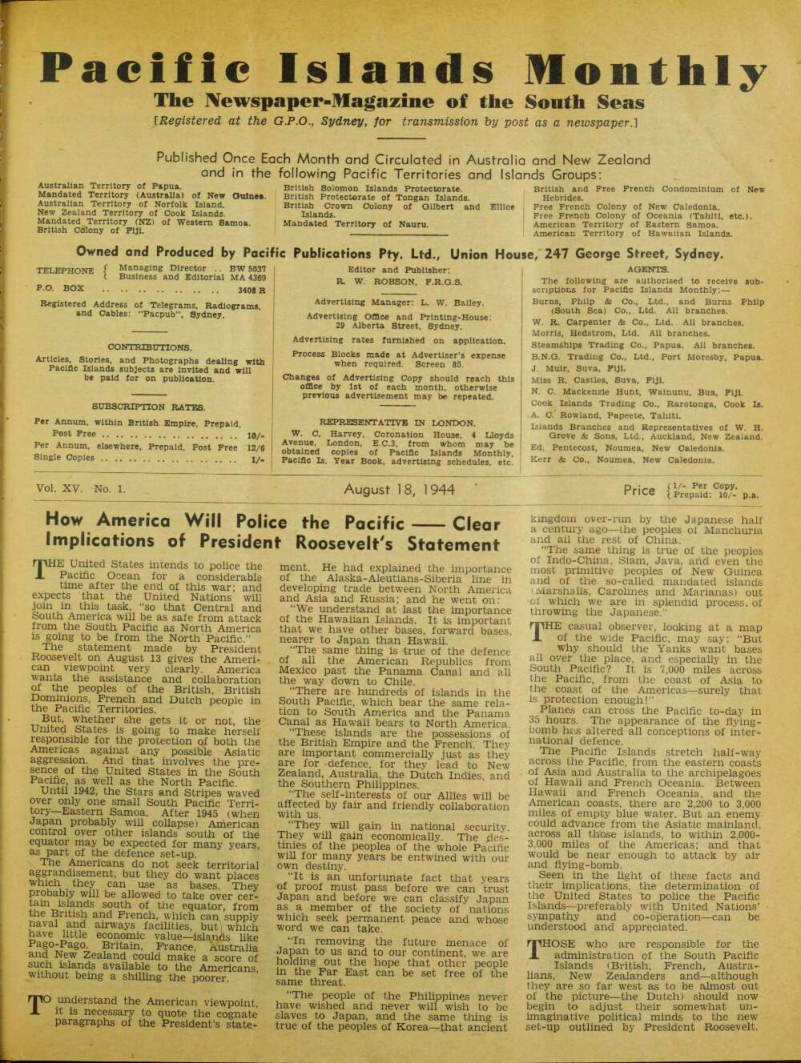
WHEN General MacArthur’s forces seized Amsterdam and Middleburg Islands, at western end of Dutch New Guinea, the stay of the Jap organised forces in New Guinea, came to end There still are considerable Jap forces at by-passed places in New Guinea, such as Rabaul, Kavieng and Aitape, but they are being steadily cleaned out. Events Soon Will show whether we strike next at Timor, or at Halmahera, or at the Philippines all shown on above map.
ROLL OF HONOUR—Section I.
[Section I (Killed, Missing, Prisoners) and Section II (Wounded, Decorations, etc.), published in Alternate Months] (We try to assemble here the names of men of the United Nations, residents or former residents of the Pacific Territories, whose names appear in casualty lists or who receive decorations. We should be grateful if relations and friends would send us details of such men.)
Killed
Sgt. Bert AITKEN, NZEF. formerly of Fiji.
Killed in action in Libya.
Eugene AUBRY (formerly of Tahiti), of the Air Force of Fighting France. Killed in an air accident in Great Britain.
Pte. Louis ASPINALL, NZEF, formerly of W.
Samoa. Killed in action in Italy in March, 1944.
Lieut. L. E. AUSTIN, AMF, formerly of Tan gara, Papua. Reported missing, believed killed, February, 1944.
Squadron-Leader Stan BALDIE, RAF, formerly of Wau, TNG. Killed in action in India.
Jean BARTHE, of FF Pacific Battalion, form erly of N. Caledonia. Killed in action.
Pilot-Officer Len BAYLISS, flying instructor in the RAAF, formerly of Rabaul, New Guinea.
Killed in Sydney, 18/11/1940, when he fell from a trainer aircraft in flight.
Lieut.-Colonel C. N. F. BENGOUGH, of BSI, Defence Forces, formerly Acting-Resident Com missioner of BSI. Killed when aircraft shot down into sea, August, 1943.
R. C. BENTLEY, NZEF, formerly of Fiji.
Killed in action, Middle East, June 27, 1942.
Victor BERNUT, of FF Pacific Battalion, form erly of N. Caledonia. Killed in action.
A/Bdr. Neville W. BERTWISTLE, AIF artillery (tank unit), formerly a clerk on the staff of W. R. Carpenter and Co. Ltd., of Rabaul, New Guinea. Killed in action, April, 1941.
P/O J. B. BOMFORD, RNZAF, formerly of CSR Co.’s staff, Fiji. Killed on active service In England.
Pte. W. R. M. BRADNAM, of the NZ Forces, formerly of Fiji. Reported killed in action in the Middle East, 25/11/1941.
Warrant-Officer R. F. BRECHIN, New Guinea Force. Killed in air accident, June 17, 1942.
Formerly of NG Department of Agriculture.
Anton BRINON, of Fighting French Pacific Battalion, formerly of La Foa, New Caledonia.
Killed in action in Libya, November, 1942.
Lieut.-Colonel Felix BROCHE, of the New Caledonian-New Hebridean contingent of the Fighting French Pacific Battalion. Killed in action in the battle of Bir Hacheim (Libya).
Sgt.-Observer Ross BUCKLEY, RNZAF, form erly of Fiji. Reported missing in air operations.
Presumed “dead” in January, 1944.
Pilot-Officer E. H. CANARD, of RAP, formerly of Fiji Civil Service. Killed in flying accident in South Africa in the course of his duty as flying instructor.
Pte. David C. GARLAND, AIF, formerly chief assayer at the Emperor gold mines, Fiji. Killed in action in New Guinea.
Pierre CHARPENTTER, of the Fighting French Pacific Battalion. Killed in action In the battle of Bir Hacheim.
Raymond CHAUTARD (formerly of New Cale donia), of the Fighting French Pacific Battalion.
Killed in action in Libya.
Flight-Lieutenant G. J. I. CLARKE, of the RAAF, formerly Assistant Flight Superintendent of Carpenter Airlines, New Guinea. Killed in action during operations off Dakar (French West Africa), while attached to HMAS "Aus tralia”, September, 1940.
Flying-Officer Jack R. COATH, of the RNZAF, formerly on the staff of the Bank of New Zealand, in Suva. Fiji. Killed October. 1941, when a training aircraft crashed in NZ.
Sqd.-Leader Lionel COHEN, RAF, formerly of Upper Watut, TNG. Killed when returning from a bomber raid on Berlin in 1942.
Sgt-Pilot Colin CRABBE, RAF, formerly of Suva, Fiji. Killed by enemy action in England in May. 1943.
Pte. Felix CRAIG, AIF, formerly of account* department, Australasian Petroleum Co., Port Moresby, Papua. Killed in action, June, 1941.
L. J. DAWES, of the NZ Forces, formerly Dis trict Officer of Savaii, Western Samoa. Reported killed in action, February, 1942.
Pilot-Officer V. L. DEARMAN, of the RAAF (observer), formerly overseer and clerk at the Colonial Sugar Refining Co., Ltd., Raraval, Fiji. Reported killed in action In the Middle East. October, 1941.
Lieut. Bruce Insham DENT, MC, of Fiji Mili tary Forces. Killed in action in S-W Pacific, March 25, 1944. (See "Decorations.”) Robert DFVAUX, of FF Pacific Battalion formerly of N. Caledonia. Killed in action.
Gustav GOGENMOS, of FF Pacific Battalion, formerly of N. Caledonia. Killed in action.
Cpl. Alec GIBB, NZEF, formerly of Apia, Western Samoa. Killed in action in Italy in early 1944.
Capt. Jean GILBERT, of the Naval Forces of Fighting Prance, and formerly of Tahiti. Killed air accident while on mission in South Pacific.
Captain Kenneth GARDEN, of the RAF Ferry Command, formerly of Guinea Airways Ltd., in New Guinea. Killed September, 1941, when a bomber he "ferried" from USA crashed on west coast of Britain.
Flying-Officer Moresby GOPTON. of the RAP, •on of Mrs. F. S. Stewart, of Wau, New Guinea.
Reported missing, 17/5/1940 —presumed killed in air operations.
Rifleman J. A. GOODWIN, AIF infantry, for merly of Bulwa. TNG. Reported "accidentally killed”. April. 1942 Ernest GOURNAC (formerly of Tahiti), of the Air Force of Fighting France. Killed in an air accident in Britain.
Pte. Wallace GRAHAM, of the NZ Force* (infantry), formerly on the staff of Morris Hedstrom Ltd., Fiji. Killed in action in the Middle East, November, 1941, Lieut. J. A. GRANT, AIF, formerly of Man dated Territory. Killed in action.
Lieut. L. B. GROVE, AIF, formerly of Madang, TNG. Killed in action.
Squadron-Leader C. R, GURNEY, RAAF, a former chief pilot of Guinea Airways, Ltd.
Killed in action in the New Guinea area, May, 1942.
Pte. B. HAMILTON, AIF, formerly of Auck land, NZ, and New Guinea. Killed in action.
Gerald T. J. HARPER, RAF, son of Major and Mrs. P. Harper, of Ra, Fiji. Killed in action while navigating a Whitley bomber dur ing a raid on the Continent.
Capt. G. C. HARRIS, AIF, formerly of Papua.
Reported killed in action, June, 1944.
J. HEAD, RAAF. formerly of Fiji. Killed in flying accident in Australia, 1941.
Captain L. T. HURRELL, infantry, Rabaul.
Killed in action.
Sqd.-Leader James R. HYDE, of the RAF, formerly a Patrol Office in Namatanai and Sepik Districts, TNG. Awarded the Distinguished Fly ing Cross, 1941. Killed in action while leading an attack on an enemy convoy off the coast of Greece, July 24, 1942.
Pte. Jack JOHNSON, formerly of Morris Hedstrom’s staff, Fiji. Killed in action on November 4, while serving with the AIF in New Guinea.
Flying-Officer Alan JOHNSTONE, of the RAF, who was born in Suva, Fiji, in 1915. Killed during bombing raid on Kristiansand, Norway, April, 1940.
Flying-Officer G. M. KEOGH, RAAF, form erly of Wewak, TNG. Killed in air operations in New Guinea, August 30, 1943.
LAC Douglas KIRBY, RAF, who left Suva, Fiji, with the first contingent of Air Force trainees. Reported killed in a flying accident in South Africa, March, 1942.
Marcel KOLLEN, of the Pacific Battalion of Fighting France. Killed in action in the battle of Bir Hacheim.
Marcellin LACABANNE, of the French Colonial Infantry Commandos. Holder of the Croix de Guerre, with Silver Star, and Medaills Militaire.
Formerly of N. Caledonia. Killed in action in Amiens, France, May 25, 1940.
C. D. LAMONT, RAF, formerly a master at Boys’ Grammar School, Suva, Fiji. Missing, be lieved killed on air operations over Germany.
Cpl. Gaston LESSON, of the Fighting French Pacific Battalion. Killed in battle of Bir Hacheim (Libya).
F/O Allan T. LEYDIN, RAAF, formerly of Papua and the Mandated Territory. Killed in flying operations over the Mediterranean, October 26, 1943.
James LEVY, of FF Pacific Battalion, form erly of N. Caledonia. Killed in action.
Capt. (now Lt.-Oolonel) Edward Tlwi LOVE, NZ Maori Battalion, husband of Mrs. Takau Rio Love, Ariki-nui of Rarotonga, Cook Islands. Re ported missing during campaign in Greece, May, 1941; later, June, 1941, reported “wounded and safe.” Officially announced, July 17, 1942, killed in action in Libya.
Flying-Officer John C. LOWE, RAAF, formerly
an overseer with the CSR Co. In Fiji. Reported, 11/4/1942, "took part in air defence of Rabaul, TNG, —missing, believed killed".
Pte. L. F. McCarthy, AIF infantry, form erly supercargo on W. R. Carpenter and Co.’« inter-island vessels "Desikoko” and "Mako”, In New Guinea. Reported “killed in action” in Syria, 30/10/1941.
Sgt. Kenneth MACGREGOR, AIF, formerly practising as a barrister and solicitor in Wau, TNG. Reported missing, believed killed, In Papua.
Sgt.-Pilot Ronald MACKAY, RAAF, formerly of Thursday Island. Killed in an aircraft accident in England.
Lieut. J. McCLYMONT, formerly of Apia, W.
Samoa. Reported killed in action.
Lance-Corporal A. D. MacPHEE, son of Mr.
R. D. MacPhee, Levuka, Fiji, He was 35, was a member of the AIF, and was killed in Greece, May, 1941.
Ernest MARTIAS, of FF Pacific Battalion, formerly of N. Caledonia. Killed in action.
Francois MASSON, of the Fighting French Pacific Battalion. Killed in action in the battle of Bir Hacheim.
Capt. John Malcolm METHVEN. Reported killed in action in Egypt on July 22, 1942, while serv ing with the AIF. He was born in Ocean Island, and is the youngest son of Mr. and Mrs.
Stuartson C. Methven, of Belgrave, Victoria.
P/O Officer Stuartson Charles METHVEN, born in Suva, Fiji, brother of the late Capt. J.
M. Methven. Killed in air operations over Germany on January 23, 1943.
Spr. A. L. MORANDINI, AIF Engineers, for merly of Konedobu, Papua. Reported killed in action, April, 1942.
F/O R. H. MORGAN, RAAF. Missing, now presumed dead, after flying operations on May 6, 1944.
Marc MOUTRY, of FF Pacific Battalion, formerly of N. Caledonia. Killed in action.
QM Sgt. Toby O’BRIEN, AIF, formerly of the Lands and Surveys Department, TNG. Killed in action at Lae in September, 1943.
F. R. J. NICHOLLS, Royal Artillery, formerly of Fiji. Killed in action, Burma, May, 1942.
W/O G. A. OBST, formerly a member of the Lutheran Mission, TNG. Joined Australian military forces in February, 1942. Killed in action in New Guinea on December 21, 1942.
J. L. C. OSBORN, NZEF, formerly of Fiji.
Killed in action, Middle East, June, 1942.
Pilot-Officer Ivan PALMER, RAF, formerly of Fiji. Killed in air operations over Malta.
Lieut. R. G. M. PEMBERTON, AIF, formerly of Rabaul, New Guinea. Killed in action.
O. PILLING, RAF. formerly of Fiji. Missing; believed killed.
Lieut. Tony PHELPS, Fiji Military Forces.
Killed in action in the South Pacific, January, 1944.
Flight-Lieut. H. G. PILLING, DFC, of the RAF, formerly of Suva, Fiji. Killed on air operations, May 19, 1942.
Pte. Edward Harold PRICE, 2nd NZEF (27th Machine Gun Battalion), youngest son of Mr. and Mrs. J. Price, Savu Savu West, Fiji. Killed in action during the Libyan campaign, Middle East. 27/11/1941.
Pte. Cecil PURCELL, NZEF, formerly of Aleipata, Samoa. First Samoan Euronesian to give his life in World War 11. Killed in action in Middle Bast.
P/O G. REES-JONES, RAAF, formerly of Labasa, Fiji. Killed in air operations over Ger many, August 16, 1942.
Captain W. H. ROBERTS, NZEF, who was Accountant in the Samoa Treasury Dept., dur ing 1934-35. Killed in action in Libya, Decem ber, 1941.
Pte. Kameli ROKOTUILOMA, of the Fiji Military Forces. Reported killed in action, December, 1943.
Major A. B. ROSS, NZEF, who, between 1923- 29 was successively, Assistant Secretary for Native Affairs. Assistant Secretary to the Administration, and ADC to the Administrator of Samoa. Killed in action in Libya.
Cpl. Alex. C. SCOTT, AIF, formerly manager at Kieta, TNG, for Burns, Philp and Co. Ltd.
Killed in action in the Middle East, 19/6/1941.
J. SIMPSON, RAAF, formerly of Fiji. Killed in action over Malta, July, 1941.
Sgt. R. R. SHORT, AIF, formerly of Port Moresby. Killed in action.
Lieut. G. STEVENSON, AIF. formerly a Patrol Officer in New Guinea. Killed in action in New Guinea, on June 26, 1943.
Lieutenant A. G. W. THOMAS, RANR, for merly master of Burns Philp & Company’s SB "Muliama.” Killed in action.
Pte. Popoare TANGHTI, of the NZ Force* (Maori Battalion), formerly of Mangala, Cook Islands. Reported "missing after Battle of
(Continued on Inside Back Cover)
Sgt. Robert GEMMELL-SMITH, RAF, formerly on CSR Co.’s staff, FIJI. Reported prisoner of war in Bengasi, Libya, in November, 1942.
W/O.n V. M. I. GORDON, A IF, formerly of Wau, TNG. Reported prisoner of war after Malayan campaign.
Pte. W. GOSSNER, AIF Infantry, formerly of the BNG Development Co., Port Moresby. Papua.
Reported prisoner of war, Sulmona, Italy, 6/7/1941.
J. P. GOUZENE, of Fighting French Pacific Battalion. Reported missing after battle of Blr Hacheim. Reported POW, May, 1944.
W/OI A. N. GRAY, AIF, formerly of Rabaul, TNG. Reported prisoner of war.
Chief-Sergeant Francois GRISCELLI, of Fight ing French Pacific Battalion. Reported missing in Libya in April. Formerly of New Caledonia.
Reported POW, May, 1944.
Lieut. J. M. HARCOURT, 2nd NZEF, son of Mr. H. W. Harcourt, formerly Deputy Treasurer in Fiji. Reported “captured in Libya and now prisoner of war’’, March, 1942.
Squadron-Leader Godfrey HEMSWORTH, of the RAAF, formerly a well-known commercial pilot in Morobe, TNG. Reported missing after an operational flight against the Japanese in the New Guinea area and presumed killed in action. Reported prisoner of war in Japanese hands in October, 1943.
S. D. C. KERKHAM, NZEF, son of Mr. R. C.
Kerkham, Suva, Fiji. Reported prisoner of war in September, 1942.
Lieut. JEFF KILNER, NGVR. Believed prisoner of war in Japan.
Gnr. A. L. B. KING, AIF artillery, of Rabaul, TNG. Reported prisoner of war, 29/7/1941.
Lieut. G. G. KINNER, New Guinea Forces, formerly of Rabaul. Reported prisoner of war.
Paul KLEIN, of FF Pacific Battalion, form erly of N. Caledonia. Reported POW.
Nura LETHEIZER, of FF Pacific Battalion, formerly of N. Caledonia. Reported POW.
Major E. G. A. LETT, of the East Surrey Regiment, and son of Mr. Lewis Lett, of Port Moresby, Papua. Reported prisoner of war in Libya.
P/O J. LXETKE, RAAF, formerly of Labasa,
Fiji. Reported prisoner of war In Germany, 1943.
A/Cpl. John H. LONERGAN, AIF, Supply and Transport, of New Guinea. Reported prisoner of war at Corinthia, Italy, 8/7/1941.
Pte. Ernest ("Paddy”) McGEADY, NZEF, son of Mrs. J. McGeady, of Suva, Fiji. Reported "missing, believed killed”, after fighting In Libya, January, 1942; reported prisoner of war m Italy, April, 1942.
Cpl. J. H. L. McGUIGAN, of the Field Ambulance, AIF, formerly of the Public Health Department, New Guinea. Officially reported missing at Singapore; 'unofficially reported a prisoner in Japanese hands. Reported prisoner of war in Malaya, May 24, 1943.
Observer Alex. McKAY, of the RAAF, formerly of the CSR Co.’s staff, at Penang sugar-mill, Fiji. Reported missing, 27/7/1941; reported prisoner oi war in Italy, 26/10/1941.
Pte. Harry MARCHINGTON, of the NZ Forces, formerly of Fiji. Reported prisoner of war after Battle of Crete, 2/12/1941.
Pte. F. C. MAYO, AIF, formerly of New Guinea. Reported a prisoner of war.
Camille MERCIER, of Fighting French Pacific Battalion. Reported missing after battle of Blr Hacheim. Reported POW, May, 1944.
Lieut. Jean MILLIARD, of French Artillery.
Formerly of N. Caledonia. POW in Germany since fall of France, June, 1940.
Emile MILLOT, of Pacific Battalion of Fight ing Prance. Taken prisoner in battle of Blr Hacheim (Libya).
Pte. J. F. MORRELL, formerly of TNG. Re ported missing believed prisoner of war, June 1, 1944.
Sgt. NAGLE, of French Colonial Infantry; formerly of N. Caledonia. POW in Germany since fall of France in June, 1940.
Pte. J. G. NEWTON, AIF, formerly of Papua.
Reported prisoner of war, June, 1944.
Henri PAYONNE, of Fighting French Pacific Battalion. Reported missing after battle of Blr Hacheim. Later reported POW, Italy. Later escaped and rejoined FF forces.
Pte. G. S. O’BRYAN, NZEF, formerly of Rarotonga, Cook Is. Missing after battle of Crete; now reported prisoner of war in Germany.
Gaetan OLLIVAUD, of French Colonial In fantry, formerly of N. Caledonia. POW in Ger many since fall of Prance, June, 1940.
Eugene POGNON, of FF Pacific Battalion,
formerly of N. Caledonia. Reported POW.
Pte. D. R. PHILLIPS, ALP engineers, formerly of Bulwa, 'TNG. Reported prisoner of war June, 1942.
A/Bdr. L. J. SMEETON, AIF, formerly of Rabaul, TNG. Reported prisoner of war In Malayan campaign.
Pte. John O. SMITH, of the NZ Forces, son of Captain Arthur Smith, of the Fiji inter-island vessel "Tul Kauvaro”. Missing after battle of Crete, May, 1941; reported prisoner of war in Germany, 21/10/1941.
Squadron-Leader L. C. SHOPPEE, DSO,
RAF, formerly of Edle Creek, New Guinea. Was in Java during Japanese invasion: now known to be a prisoner of war.
Gnr. D. M. SPENCE, A3P, formerly of Port Moresby. Reported prisoner of war after Malayan campaign.
LAC Charles SOLLITT, of the RAAF (wire less operator), son of Mr. and Mrs. C. H.
Sollitt, of Nausori, Fiji. Reported missing after air operations in New Guinea, January, 1942; later, March, 1942, reported rescued from sea by Japanese—now prisoner of war.
Pte. Fred SWAN, NZ Army Medical Corps, formerly of Apia, Western Samoa. Missing after Battle of Crete, August, 1941; reported prisoner of war in Germany, November, 1941.
Repatriated from a German prison camp to NZ in 1944.
Signalman J. C. E. SWINBOURNE, 6th Div.
Signals, A IF, formerly of Fiji and the Gilbert & Ellice Islands Colony. Taken prisoner at Crete, June, 1941, now in prison camp at Stalag, VILA, Germany.
Lieut. CLIFF WARREN, of NZEF, serving In the Middle East, and formerly of Morris Hed strom Ltd.’s staff at Ba and Lautoka, Fiji. Re ported prisoner of war.
Mjr. N. WATCH, formerly Dr. Watch, of Rabaul, missing after Japanese invasion of Rabaul. Believed prisoner of war in Japan. Now reported POW in Japan.
Gnr. D. S. WHITCOMBE, NZEF, formerly of Fiji and Tonga. Wounded in Crete and reported prisoner of war in Germany.
Pte, John D. WHITCOMBE, of the NZ Forces, formerly of Levuka, Fiji. Reported prisoner of war in Germany, November, 1941.
Greece—presumed dead”, July, 1941.
Derek TOVEY, NZEF, formerly of Suva, Fiji.
Killed in action in Tunisia in April, 1943.
Rifleman R. E. VERNON, AIF, formerly of X,ae TNG. Reported killed in action, June, 1944.
Capt A. F. J. WHITE, AIF. formerly a Dis trict Officer in Fiji, and BSI. Killed in action in New Guinea.
Died From Wounds
Pte. Roy lan BROWN, NZEF. formerly of Apia, W. Samoa. Died of wounds in Italy, April, 1.944 Pte. Ernest HENRY, AIF. formerly of the Rabaul (NG) staff of Burns, Phllp and Co Ltd. Died from wounds received in Battle ol Crete, 1/6/1941. . . .
Pte. Alec. MUNRO, NZ Forces, formerly of Norfolk Island. Died in Libya (Middle East).
December, 1941.
Adolphe Arthur LAHARRAGUE, formerly of Tahiti. Died of wounds received while serving in the Fighting French forces.
Pte. T. LAWRIE, AIF, son of Mr. Lawrle, for merly of Fiji. Died of wounds in Middle East.
Pte. Walter PEARSON, of first NG quota of AIF (infantry). Died from wounds received in action, 24/6/1941.
A/Bdr. W. R. SCOTT, AIF. of New Guinea.
Died from wounds, July, 1941.
Sgt. Charles SPITZ, of the Fighting French.
Pacific Battalion, and formerly of Tahiti. Died from wounds received at Bir Hacheim, on June •21, 1943.
Sgt -Pilot Peter Clarkson WISE, of the RAF, son of Mr. W. Wise, OBE, Director of Public Works, Fiji. Died from wounds received during bombing raid over Germany, January. 1941.
Accidentally Killed
Lieut.-Colonel C. C. JUDD, formerly of Morobe, TNG. Accidentally killed in Australia In January, 1943.
A/Cpl. P. A. McKEE, New Guinea forces, formerly of Bulolo. Died of injuries.
Major N. V. McKENNA, AIF, formerly of Wau, TNG. Accidentally killed, September 30, 1943.
F/O Lee VIAL, DSC, formerly ADO, Mandated Territory. Killed in April, 1943, in a plane crash in Sepik district while on a special mission.
Capt. F. E. WILLIAMS, formerly Government Anthropologist in Papua. Killed in a plane acci dent while on duty in New Guinea, in 1943.
Sgt. Edward WILSON, of Suva, serving in the Fiji Defence Force. Accidentally drowned In the Lami River, Fiji, April, 1942, Gnr. Robert J. WILSON, formerly of Port Moresby, Papua. Accidentally killed In troop train in Middle East in 1942.
Died From Illness
Pte. Lawrence BOYER, NZEF, formerly of Tonga and Fiji. Died on active service in Italy.
Pte. H. COOMBE, NZEF, formerly of Suva, Fiji. Died in Middle East, April, 1944.
Pte. Clarence A. HUTTON, AIF, formerly ol Edie Creek, TNG. Died from illness, April, 1941.
Pte. Manoa NAKARU, of the Fiji Military Forces. Reported died on active service, Decem ber, 1943.
Pte. Isikeli NABOKO, of the Fiji Military Forces. Reported died on active service, Decem ber, 1943.
Seaman Malvin NELSON, of Fiji Royal Naval Volunteer Service. Death reported in May, 1943.
Pte. Inikasio SERU, of the Fiji Military Forces. Reported died on active service, Decem ber, 1943.
A/Sgt. J. H. STANE, Royal Australian En gineers. formerly of Port Moresby, Papua. Died from illness. May, 1942.
Rifleman R. A. SMITH, HQ Unit. (Place of enlistment not stated.) Died of Illness.
Cpl. R. H. SUTTON, NGVR, formerly of Wau, TNG. Died from malaria and typhoid in October, 1942 Pte. Mateo TUIDALA, of the Fiji Military Forces. Reported died on active service, Decem ber. 1943.
Pte. Emosi WAQA, of the Fiji Military Forces.
Reported died on active service, December, 1943.
Major P J. WOODHLLL, AIF miantry, formerly legal assistant in the Crown Law Office, Rabaul, New Guinea. Reported "deceased”. December, 1941 Pte. F. WORK, of the Fiji Military Forces.
Reported died on active service, December, 1943.
Missing
Louis ANGER, of Fighting French Pacific Battalion. Reported missing after battle of Bir Hacheim.
Pte. P. F. BAILEY, AXP Infantry, of Rabaul, TNG. Reported missing, 17/2/1942. Now re ported prisoner of war.
Lieut. J. T. BARRACLUFF, AIF, formerly of New Guinea. Reported missing, December, 1943.
Cpl. Leon BARRENS, of Pacific Battalion of Fighting France. Missing after battle of Bir Hacheim (Libya).
Sgt.-Pilot Murray Waldon BENTLEY, RNZAF, formerly of Fiji. Reported missing in air operations in the Middle East, January, 1943.
P/O Robert Waldon BENTLEY, RNZAF, for merly of Fiji. Reported missing on air opera tions on May 5, 1943.
Alexandre BLACK, of Pacific Battalion, FF Forces. Reported missing after Battle of Bir Hacheim.
T. BLAKELOCK, BEF, formerly of Fiji. Miss ing.
Sgt. Ronald Arthur BROODBANK. formerly of Samarai, Papua, now serving with the RAAF overseas. Reported missing on May 31 while on air operations.
Sgt. Alexander BROWN, RNZAF, formerly of Rarotonga. Reported missing over Germany, on September 15, 1942.
Reginald BOULANGER, of Fighting French Pacific Battalion. Reported missing after battle of Bir Hacheim.
H. BUCKNELL, AIF, formerly of Fiji. Missing.
Andre CHITTY. of FF Pacific Battalion, form erly of N. Caledonia. Reported missing.
Pte. E. L. CHRISTIE. AIF Infantry, of Rabaul, TNG. Reported missing, 17/2/1942.
Georges CLEMEN, of FF Navy. Formerly of N. Caledonia. Missing in Mediterranean, March. 1942.
Victor DERVAUX, of Fighting French Pacific Battalion. Reported missing after battle of Bir Hacheim.
Lucien DEVAND, of Pacific Battalion of Fight ing Prance. Missing after battle of Bir Hacheim (Libya).
Pte. A. O. DICKSON, AIF infantry, of Rabaul, TNG. Reported “missing, believed wounded”, 17/2/1942.
Pilot-Officer Norman R. FRAZER, RAAF, formerly of Wau, TNG. Reported missing on air operations over Germany. August 30, 1943.
Eion FIELD, RNZAF, formerly of staff of Kasi Mines, Fiji. Missing in Java.
Gath GELDARD, NGVR. of New Britain.
Missing after the battle of Rabaul, January, 1942.
Georges GOVETCHE, of FF Pacific Battalion, formerly of N. Caledonia. Reported missing.
Acting Flight-Lieut. Don A. IRVING. RAAF, formerly chemist in CSR Co.. Labasa, Fiji. Miss ing, presumed dead, in air operations over Germany, February 27, 1942.
Pte. Andrew A. (Billo) Johnson. Ngvr.
Reported missing in New Guinea on October 29, 1942.
Georges KABAR. of Fighting French Pacific Battalion. Reported missing after battle of Bir Hacheim.
Henri T.ANGLOIS, of Pacific Battalion of Fighting France. Missing after battle of Bir Hacheim (Libya).
Numa LETHESER, of Pacific Battalion of Fighting France. Missing after battle of Bir Hacheim (Libya).
Rene LETOCART, of Fighting French Pacific Battalion. Reported missing after battle of Bir Hacheim.
Cpl. E G. MacADAM, NGVR, of Rabaul, TNG.
Reported missing after the battle of Rabaul, January 1, 1942.
Capt. J. J. MURPHY, AIF, formerly of New Guinea. Reported missing, December, 1943.
Pte. R. J. PASCOE, AIF Infantry, of Rabaul, TNG. Reported missing, 27/1/1942.
Pilot Tom PATTERSON. of the RNZAF. formerly of Levuka, Fiji. Reported missing, in November, 1941, after bombing raid on the Continent.
Eugene PENE, of Fighting French Pacific Battalion. Reported missing after battle of Bir Hacheim.
Andre PETRE, of Fighting French Pacific Battalion. Reported missing after battle of Bir Hacheim.
Eugene POGNON, of Fighting French Pacific Battalion. Reported missing after battle of Bir Hacheim.
Gnr. Allan H. ROSS, AIF artillery, formerly planter in New Britain, TNG. Reported "miss ing—believed prisoner of war”, 28/9/1941.
Pte. William RUPE, of the NZ Forces (Maori Battalion), formerly of Altutakl, Cook Islands.
Reported “missing after Battle of Greece”, July, 1941.
Pilot James SIMPSON, of the RAP, formerly of Vatukoula, Fiji. Reported missing after air operations over Malta, in the Mediterranean, 1/7/1941.
L/Bdr. G. G. SMITH, NZEF, formerly of Suva, Fiji. Reported missing.
Louis SALOMAN, of FF Pacific Battalion, formerly of N. Caledonia. Reported missing.
Charles STIERMANS, of FF Pacific Battalion, formerly of N. Caledonia. Taken POW in Libya, but missing after transport was sunk in Medi terranean.
Pilot-Officer Neville George STOKES, of the RAF, formerly a pilot with Guinea Airways, Ltd., in New Guinea. Reported missing after air operations in Europe, December, 1941.
Chas. STIERMANS, of FF Pacific Battalion, formerly of N. Caledonia. Reported missing.
Louis VINDOUX, of FF Pacific Battalion, formerly of New Caledonia. Reported missing.
Reported Missing
Malaya Casualty List, Published 23/7/1942.
ALEXANDRE BLACK, of Pacific Battalion of Fighting France. Reported killed in action at Bir Hacheim. Now reported missing.
Andre CHTTTY, of Pacific Battalion of Fight ing France. Missing at battle of Bir Hacheim (Libya).
Pte. E. L. CHRISTIE, infantry, Rabaul.
Pte. A. G. DICKSON, infantry, Rabaul.
Pte. J. M. HIRSCHEL, Infantry, Rabaul.
Pte. J. G. NEWTON, artillery, Port Moresby.
Australia and Island Stations, pte. S. W. HUNTER, infantry, Kokopo.
Prisoners Of War
Pte. J. H. ALLAN, AIF, formerly of Wau, TNG.
Formerly reported missing, now reported prisoner of war.
Gnr. N. H. AMOS, AIF, formerly of Port Moresby. Reported prisoner of war after Malayan campaign.
Lieut. CLARRIE ARCHER. NGVR. Believed prisoner of war in Japan. Reported prisoner of war in February, 1943, in prison camp on Island south of Japan.
Georges BEBERE, of FF Pacific Battalion, formerly of N. Caledonia. Reported POW.
Robert BLUM, of Fighting French Pacific Battalion. Reported missing after battle of Bir Hacheim. Reported POW, May, 1944.
Cpl. Jock BAIRD, AIF, formerly of Bank of NSW staff, Suva, Fiji. Reported missing in Malaya, February, 1942. Reported prisoner of war. September. 1943.
Mariel BARRAU, of French Infantry, formerly of N. Caledonia. Taken prisoner after fall of Prance, June, 1940.
A/Cpl. Peter W. BOSGARD, AIF Infantry, formerly of the Lands Department, Port Moresby, Papua. Reported prisoner of war at Sulmona, Italy, 29/6/1941; transferred to Bolzano prison camp, September, 1941.
Cpl. J. E. BROAD, NZEF, formerly of Suva, Fiji. Reported prisoner of war.
Lieut. John BROWN, formerly of Fiji. Re ported a prisoner of war in Italy.
Cpl. E. BOURKE, AIF, formerly of New Guinea. Prisoner of war in Germany.
Sgt. R. F. BUNTING, AIF, formerly of Samaral, Papua. Missing in Malaya. Now reported prisoner of war.
Henri CLEMENCEAU, of FF Pacific Battalion, formerly of N. Caledonia. Reported POW.
Sgt. Peter COGGINS, AIF. formerly of FIJI.
Taken prisoner in Malaya, and now reported prisoner of war in Borneo camp.
A/Sgt. A. A. S. COTMAN, AIF infantry, of Abau, Papua. Reported missing—believed prisoner of war, 5/5/1941; reported later, July, 1941, "wounded in chest and head by shrapnel— taken prisoner”.
Cpl. W. F. CULLEN, AIF, formerly of Thursday Island. Reported prisoner of war.
John Arnold CROCKETT, AIF, formerly of Bulolo, TNG. Reported prisoner of war In Osaka, Japan, September, 1943.
Pte. J. DALTON. AIF Transport and Supply, formerly of Thursday Island. Reported prisoner of war. April, 1942.
Victor DERVAUX, of FF Pacific Battalion.
Formerly a POW in Italy, but escaped and now interned in Switzerland.
Dick ELMOUR, formerly of New Caledonia, prisoner of war after Dunkirk. Repatriated to France in January, 1942, because of health reasons.
Pte. W. G. ECKBLADE, AIF, formerly of Rabaul. Previously reported missing; now re ported missing; believed prisoner of war.
Gnr. A. I. FOLEY, AIF, formerly of Papua.
Reported missing in Malayan campaign. Re ported prisoner of war in February, 1944.
Pilot-Officer George Beilby EVANS, RAAF, son of Mr. and Mrs. Beilby Evans, formerly of Buka Passage, TNG. Reported prisoner of war In Java.
Gaston GEILLER, of Fighting French Pacific Battalion. Reported missing after battle of Bir Hacheim. Reported POW, May, 1944.
(Continued on Page 37)
Pacific News-Review
Notes And Comment On
The Progress Of The War
From July 18 To Aug. 15
July 18: Tokio Radio to-day made the dramatic announcement that General Tojo has been removed as Chief of the Japanese General Staff.
July 18: Russian forces have entered Latvia, thus intensifying their campaign to free the Baltic States.
July 20: British and Canadian troops who broke through the German defences on the east bank of the Orne River, in Normandy, on Tuesday, are now within half a mile of Troarn and are driving for Vimont.
July 20: Following the resignation of Tojo as Chief of Japanese General Staff, the whole of the Japanese Cabinet has resigned. General Kuniaki Koiso, former Governor-General of Korea, and Admiral Mitsumasa Yonai, a former Premier, have been chosen to form a Cabinet.
July 20: An unsuccessful attempt to assassinate Hitler “by explosives” was made. Hitler was slightly, and several members of his staff seriously, injured.
July 21: US Army and Marine assault troops have landed on Guam (120 miles south of Saipan, in the Marianas). Beach-, heads have been established and the landing is going to programme. A heavy naval and aerial bombardment preceded and supported the landing.
July 23: Following the attack on Hitler, there are many reports of revolt in the Germany Army. The position is obscure.
July 23: The Germans’ east front now is collapsing, as the Red Army sweeps for ward on a 1,100-mile front. Russians are reported in the suburbs of Lwow.
July 23: Premier of the new Japanese Cabinet is General Kuniaki Koiso, former Governor-General of Korea. The new Cabinet has pledged itself to fight to the finish against the Allies.
July 24: The Russians, driving into Poland, are 50 miles from Warsaw. The German fortresses of Bialystok, Brest Litovsk, Lublin and Lwow have been by passed, miles behind the front lines, to be cleaned up by the second wave of Russians.
July 24 American troops have made another landing in the Marianas, at Tinian Island, 18 miles south of Saipan.
July 26: Warsaw is reported in flames as the Russians close in against the city from east and south. German resistance is broken everywhere along hundreds of miles of front.
July 26: Local advances have been made by the Americans west of St. Lo, in Nor mandy. German counter-attacks in the Tilly-Campagne sectors have forced the British to make slight withdrawals.
July 26: US troops have wiped out the last pockets of resistance around their beach-heads on Guam and have linked their two assault forces July 27: Russian infantry to-day swarmed across the Vistula, last natural German defence line before Warsaw.
They used thousands of amphibious trucks. The offensive towards East Prus sia has been resumed.
July 27: American armoured columns and infantry which broke through the enemy defences west of St. Lo are driv ing forward on a narrow front without serious opposition.
July 27: Three destroyers and a Nether lands cruiser went into Japanese-held Sabang Harbour (Sumatra) on Tuesday to engage targets at close range. They were supported by carrier-borne aircraft and left the port in flames.
July 30: The British are making pro gress in a new drive in Prance on a wide front east from Caumont.
July 30: New Zealand troons forming the spearhead of the Allied drive on
Florence (Italy) have inflicted heavy enemy losses.
July 31: In their twin drives in Nor mandy both British and the Americans have made rapid progress. The Ameri cans are in Avranches and the British troops are east of St. Martin-des-Besaces.
Aug. 1: The Allies are making rapid progress in France. American columns are across the border into Brittany; and the British bulge south-west of Caumont has almost doubled in 24 hours.
Aug. 1; Russian and Polish troops, under an umbrella of planes, are attack ing the Warsaw suburb of Praga.
Aug. 1: US forces landed unopposed in the Cape Sanapor area, at the extreme western tip ol Dutch New Guinea. They have cut off 15,000 Japs and are now 675 miles airline from Mindanao (Philip pines).
Aug. 2: Turkey has broken off diplo matic and economic relations with Ger many.
Aug. 2: Mr. Churchill announced that 4,735 people have lost their lives through flying-bombs and those injured total 14,000. Punishment of the Germans will be appreciably increased.
Aug. 3: Americans have taken Rennes (88,000, capital of Brittany).
Aug. 3: The Russians have reached the East Prussian border and are shelling German territory.
Aug. 4: Red Armies, driving for Silesia, have crossed the Vistula, 120 miles south of Warsaw. The Polish Underground Army has seized parts of Warsaw.
Aug. 6: Americans in northern France, racing across Brittany, have reached Brest (naval base at the western tip of the province). They are within 15 miles of Lorient and 18 miles of St. Nazaire.
Aug. 6: The battle for Guam is almost over. A gigantic man-hunt is being car ried out by US troops, as they move in on the battered remnants of the Japanese garrison.
Aug. 6: South African troops have penetrated to the centre of Florence, in Italy. Germans say their troops have been withdrawn “to spare the historic town.”
Aug. 9: British and Canadians launched a big offensive south-east of Caen. A German counter-attack, trying to reach the sea at the foot of Cherbourg Penin sula, was disastrously defeated. The Allies have moved in to pin the Germans against the River Seine.
Aug. 7: Americans in Brittany have wheeled left and are driving east towards Le Mans and Paris.
Aug. 7: US naval task force bombarded the Bonin Islands, 600 miles from Tokio; wiped out an enemy convoy and heavily damaged installations.
Aug. 9: The Canadians in France advanced 12 miles, smashing through the German “hinge” south of Caen. The Americans are near Le Mans.
Aug. 9: Moscow announces that the Russians have crossed into East Prussia and fierce fighting is in progress.
Aug. 9: The American flag flies again over Guam.
Aug. 10: Americans have reached Nantes (mouth of Loire). Other Ameri can units, beyond Le Mans, are only 87 miles from Paris. Canadian and British are advancing south and east, and the Germans are threatened with a gigantic pincer movement.
Aug, 10: President Roosevelt has been in Pearl Harbour conferring with his Pacific Service chiefs (including Admiral Nimitz and General MacArthur).
Aug. 11: Super-fortresses based on China attacked Japan for the third time.
They raided industrial targets in the
Nagasaki area, key centre of aircraft and war production. Other Fortresses from south-east Asia attacked targets near Palembang (Sumatra).
Aug. 13: With the elimination by the Russians of the German salient east of Warsaw, a new Russian threat to East Prussia has developed.
Aug. 13: The Germans, under a terrific and pitiless air bombardment, are retreat ing from the Normandy bulge, trying to escape encirclement by American troops driving north from Le Mans and British troops driving south past Falaise.
Aug. 15: The escape gap in Normandy between Falaise and Argentan is now only 10 miles wide. The Canadians have advanced to within three miles of Falaise and the Americans have entered Argen tan. The enemy’s position is critical.
Aug. 15: British, French and American troops landed on the Mediterranean coast of France to-day, on both sides of Toulon.
By mid-morning all landings were pro ceeding successfully against light onposi tion. The full weight of the Allied Medi terranean air force was used to blast a way for the landings. The largest air borne force ever used (over 14,000) was successfully landed two miles behind the enemy defences, and met little opposition.
New Guinea Casualty List
Missing, Believed Prisoner of War P 496, Sergt. W. A. H. Butteris; HQ Unit; Madang.
Removed From Seriously 111 List NGX4O3, Sergt. C. O. T. Hancock, HQ Unit; Newcastle, NSW.
Died of Illness NGX344, Lieut. W. J. McDonald, infantry; Ashgrove, Brisbane.
Died of Injuries Accidentally Received NGX4I7, Sergt. L. J. Higgins, HQ Unit; Yeerongpilly, Brisbane.
Missing. Believed Killed P 507. Pte. W. J. Hook, HQ Unit; Aitape,
Tng.
"Bomb Happy"
PASTOR A. J. CAMPBELL, now back at his missionary work in New Guinea, writes: Someone wants to know what Pidgin might be for “bomb happy.” “Please” is the word generally used for “happy” or “glad,” though the latter word is often used in Pidgin. It could be expressed this way, I think, and the Pidgin be quite in order; “Please along bomb”; or “Glad along bomb.”
Major E. G. A. Lett, son of Mr. Lewis Lett, of Port Moresby, who was taken prisoner after distinguished service with an English regiment in the Middle East, has not been heard of since the Germans, last year, took over the prison camp in Italy in which he was held.
Mr. C. W. Kirke, now doing a job for the Americans in New Guinea, reports that near him are men from the Bulolo Valley—“ Bill Cash, Ernest Bowden, Clarrie Momsen, McLean, of BGD., and many others.”
The Revs, Susie Rankin and Alan Bot toms. of the London Missionary Society, have returned to their mission stations in Papua.
Contents
Pacific News-Review 1 Editorial: How America Will Police the Pacific 3 Pacific Publications, Ltd. —New Com pany to Operate in Fiji 4 “Charley” Blake Wins the Military Medal 5 Death of Arthur Jewell, of Papua 5 Good-bye, Mr. To jo! 6 Stanley Greenland Retires From Papuan Service 7 Free Grant of £90,800 for Western Pacific ... 7 Scholarship Fund for Fijians 8 Tropicalities 9 ANGAU Increases Grip on Papua . . 10 Road to Wau—Engineering Feat in Markham-Wampit Valleys .. .. 11 Reunion in New Guinea .. 12 Where Two Races Mingle Happily— The Cook Islands 15 The Solomon Islander Wants to be Sophisticated 17 Father Tremblay’s Jubilee 18 Sister Susies From Fiji 19 Psalm-singers go to Town—Joy of Living in the Cook Is 21 “Govern or Get Out”—An Authorita tive Voice on ANGAU and Papua 22 Forgotten Vanua Levu—Development in Post-war Period 24 Evacuees and Australian Income Tax 28 Indentured Labour Again—Professor’s Attack 29 How War and the Americans Came to Tonga ... 30 The Cause, Prevention and Cure cf Filariasis 33 Tripping on the “Vai”—The Launch With the Reputation 36 Alice in Angauland 39 Men Who Made the Pacific—New Booklet Supplies Background 41 Papua’s Education System 43
Markets and Commercial 44 Honour Roll .. cov. ii, iii, and page 37
Advertisers
Atkins Pty., Ltd., Wm 34 AWA, Ltd 16 Australian Alumi nium Co. Pty., Ltd .41 Baker Pty., Ltd., W. Jno 43 Broomfield, Ltd. . . 30 Brown & Co., Ltd., G 13 Brunton’s Flour . . 42 Burns, Philp Trust Co., Ltd 27 BP (SS) Co. . . . 13 Business Notice . . 39 Campbell’s Paints . 41 Carlton & United Breweries, Ltd. . 21 Carpenter, Ltd., W.
R cov. iv.
Chivers & Sons, Ltd 35 Coleman Lamp & Stove Co. ... 17 Cox, Findlayson & Co 15 “Cystex” 29 Darvas & Co. . . 35 David Trading Co., B 33 Donaghy & Sons, Ltd 42 Donald. Ltd., A. B. 25 Dr. Williams Pink Pills 30 Electrolux Refrigerators . . 20 Farbest Cordials . . 37 “Flavorex” ... 24 Foster, Clark, Ltd. 23 Garrett & Davidson 14 Gilbey’s Gin ... 24 Gillespie Pty., Ltd..
Robert . . . 31-37 Gillespie’s Flour . . 36 Grand Pacific Hotel 2
Gough & Co., E.
J 25 Grove & Sons, W.
H 12 Heinz & Co. Pty., Ltd., H. J. . . . 22 King’s Compo . . 38 Kopsen & Co., Ltd. 32 Maxwell Porter, Ltd. 28 “Mendaco” ... 38 Muir (Eastern) Ex port Co., Charles 43 Nelson & Robertson Pty., Ltd 39 “Nixoderm” ... 28 Pacific Islands Souvenirs . . 24, 39 Pacific Is. Society . 13 Pacific Territories Association . . . t “Pinkettes” ... 40 Queensland Insur ance Co 17 Radco Food Pro ducts 33 “Radiant” Lanterns 29 Riverstone Meat Co., Ltd 19 Rose’s Eye Lotion . 43 Rohu, Sil . . . .40 Scott, Ltd., J. . .30 Steamships Trading Co., Ltd 14 Sullivan & Co., C. . 26 Swallow & Ariell . 18 Taylor & Co., A. . 31 “Tenax” Soap . . 12 Tillock & Co., Ltd. 36 Wright & Co. ... 39 Wright & Co., Ltd..
E 28 Wunderlich, Ltd. . 31 Young Pty., Ltd..
Harry. J 40 Yorkshire Insurance Co., Ltd. ... 15
Advertisements & other items, p. 4 (2 items)
Useful Addresses
The following are the addresses of organisations set up to deal with Pacific Territories affairs:—
PAPUA, NEW GUINEA, NAURU,
NORFOLK IS.
Department of External Territories (Sydney Branch) (Lately the New Guinea Trade Agency), Australia House, Carrington Street, Sydney.
Telephone: BW 1776. (Dealing with all matters connected with the Australian Pacific Territories and also the Sydney representative of the New Guinea Copra Control Committee.)
FIJI, AND HIGH COMMISSION
FOR WESTERN PACIFIC
Sydney Office of Fiji and Associated Administrations. (In charge of Mr. B. F. Blackwell.) 72 Pitt Street, Sydney.
Telephone: BW 7724.
BRITISH SOLOMON ISLANDS
Sydney Office of British Solomon Islands Government (In charge of Mr. F. E. Johnson, Treasurer of the Solomons Administration), 17 Castlereagh Street, Sydney.
Telephone: B 1710.
FOR PACIFIC TERRITORIES
EVACUEES GENERALLY
Pacific Territories Association (C. A. M. Adelskold, Secretary), c/o Robert Gillespie Pty., Ltd., B4a Pitt Street, Sydney. Telephone: BW 4782.
WAR DAMAGE COMMISSION
Sydney Office: M.L.C. Buidling, Cnr. Martin Place and Castlereagh Street, Sydney.
Telephone: BW 2361.
FOR CLAIMS AGAINST ARMY
Mr. H. Alderman, Darwin-Moresby Claims Section, Chief Finance Office (Army), Victoria Barracks, Melbourne.
%
v
Vft
4 r '~\ n<% “ *- C £ y ® . . ce nW« °' , ne a« e ° l (( , r o^ *• T»«» ifaW«“ Ca b\e. r daV- >l'
Pacific Islands Monthly
The Newspaper-Magazine of the South Seas
[Registered at the G.P.0., Sydney, for transmission by post as a newspaper .] Published Once Each Month and Circulated in Australia and New Zealand and in the following Pacific Territories and Islands Groups;
Australian Territory of Papua.
Mandated Territory (Australia) of New Guinea.
Australian Territory of Norfolk Island.
New Zealand Territory of Cook Islands.
Mandated Territory (NZ) of Western Samoa.
British Colony of Fiji.
British Solomon Islands Protectorate.
British Protectorate of Tongan Islands.
British Crown Colony of Gilbert and Ellice Islands.
Mandated Territory of Nauru.
British and Free French Condominium of New Hebrides.
Free French Colony of New Caledonia.
Free French Colony of Oceania (Tahiti, etc.).
American Territory of Eastern Samoa.
American Territory of Hawaiian Islands.
Owned and Produced by Pacific Publications Pty. Ltd., Union House, 247 George Street, Sydney.
TELEPHONE ( Mana gi n £ Director .. BW 5037 I Business and Editorial MA 4369
P.O. Box 3408 R
Registered Address of Telegrams, Radiograms, and Cables; “Pacpub”, Sydney.
Contributions.
Articles, Stories, and Photographs dealing with Pacific Islands subjects are invited and will be paid for on publication.
Subscription Rates.
Per Annum, within British Empire, Prepaid, Pest Free 10/- Per Annum, elsewhere, Prepaid, Post Free 12/6 Single Copies 1/.
Editor and Publisher:
R. W. Robson, F.R.G.S.
Advertising Manager: L, W. Bailey.
Advertising Office and Printing-House: 29 Alberta Street, Sydney.
Advertising rates furnished on application.
Process Blocks made at Advertiser’s expense when required. Screen 85.
Changes of Advertising Copy should reach this office by Ist of each month, otherwise previous advertisement may be repeated.
Representative In London.
W. C. Harvey, Coronation House, 4 Lloyds Avenue, London, E.C.3, from whom may be obtained copies of Pacific Islands Monthly, Pacific Is. Year Book, advertising schedules, etc.
Agents.
The following are authorised to receive sub scriptions for Pacific Islands Monthly;— Burns, Philp & Co., Ltd., and Burns Phllp (South Sea) Co., Ltd. All branches.
W. R. Carpenter & Co., Ltd, All branches.
Morris, Hedstrom, Ltd. All branches.
Steamships Trading Co., Papua. All branches.
B.N.G. Trading Co., Ltd., Port Moresby, Papua.
J. Muir, Suva, Fiji.
Miss R. Castles, Suva, Fiji.
N. C. Mackenzie Hunt, Walnunu, Bua, Fiji.
Cook Islands Trading Co., Rarotonga, Cook la.
A. O' Rowland, Papeete, Tahiti.
Islands Branches and Representatives of W. H.
Grove & Sons, Ltd., Auckland, New Zealand.
Ed. Pentecost, Noumea, New Caledonia.
Kerr & Co., Noumea, New Caledonia.
Vol. XV. No. 1.
August 18, 1944
Pri ra t l/ " per Copy rrice I Prepaid: 10/- p.a.
Implications of President Roosevelt's Statement
How America Will Police the Pacific Clear Implications of President Roosevelt's Statement
THE United States intends to police the Pacific Ocean for a considerable time after the end of this war; and expects that the United Nations will join in this task, “so that Central and South America will be as safe from attack from the South Pacific as North America is going to be from the North Pacific."
The statement made by President Roosevelt oh August 13 gives the Ameri can viewpoint very clearly. America wants the assistance and collaboration of the peoples of the British, British Dominions, French and Dutch people in the Pacific Territories.
But, whether she gets it or not, the United States is going to make herself responsible for the protection of both the Americas against any possible Asiatic aggression. And that involves the pre sence of the United States in the South Pacific, as well as the North Pacific.
Until 1942, the Stars and Stripes waved over only one small South Pacific Terri tory-Eastern Samoa. After 1945 (when Japan probably will collapse) American control over other islands south of the equator may be expected for many years, as part of the defence set-up.
The Americans do not seek territorial aggrandisement, but they do want places which they can use as bases. They probably will be allowed to take over cer tam isiands south of the equator, from the British and French, which can supply naval and airways facilities, but which have little economic value—islands like Pago-Pago Britain, France, Australia and New Zealand could make a score of such islands available to the Americans, without being a shilling the poorer. nno understand the American viewpoint, X it is necessary to quote the cognate paragraphs of the President’s state
ment. He had explained the importance of the Alaska-Aleutians-Siberia line in developing trade between North America and Asia and Russia; and he went on: “We understand at last the importance of the Hawaiian Islands. It is important that we have other bases, forward bases, nearer to Japan than Hawaii.
“The same thing is true of the defence of all the American Republics from Mexico past the Panama Canal and all the way down to Chile.
“There are hundreds of islands in the South Pacific, which bear the same rela tion to South America and the Panama Canal as Hawaii bears to North America.
“These islands are the possessions of the British Empire and the French. They are important commercially just as they are for defence, for they lead to New Zealand, Australia, the Dutch Indies, and the Southern Philippines.
“The self-interests of our Allies will be affected by fair and friendly collaboration with us.
“They will gain in national security.
They will gain economically. The des tinies of the peoples of the whole Pacific will for many years be entwined with our own destiny.
“It is an unfortunate fact that years of proof must pass before we can trust Japan and before we can classify Japan as a member of the society of nations which seek permanent peace and whose word we can take.
“In removing the future menace of Japan to us and to our continent, we are holding out the hope that other people in the Far East can be set free of the same threat.
“The people of the Philippines never have wished and never will wish to be slaves to Japan, and the same thing is true of the peoples of Korea—that ancient
kingdom over-run by the Japanese half a century ago—the peoples ol Manchuria and all the rest of China.
“The same thing is true of the peoples of Indo-China, Siam, Java, and even the most primitive peoples of New Guinea and of the so-called mandated islands (Marshalls, Carolines and Marianas) out of which we are in splendid process, of throwing the Japanese.”
THE casual observer, looking at a map of the wide Pacific, may say; “But why should the Yanks want bases all over the place, and especially in the South Pacific? It is 7,000 miles across the Pacific, from the coast of Asia to the coast of the Americas—surely that is protection enough!”
Planes can cross the Pacific to-day in 35 hours. The appearance of the flying bomb has altered all conceptions of inter national defence.
The Pacific Islands stretch half-way across the Pacific, from the eastern coasts of Asia and Australia to the archipelagoes of Hawaii and French Oceania. Between Hawaii and French Oceania, and the American coasts, there are 2,200 to 3,000 miles of empty blue water. But an enemy could advance from the Asiatic mainland, across all those islands, to within 2,000- 3,000 miles of the Americas; and that would be near enough to attack by air and flying-bomb.
Seen in the light of these facts and their implications, the determination of the United States to police the Pacific Islands—preferably with United Nations’ sympathy and co-operation—can be understood and appreciated.
THOSE who are responsible for the administration of the South Pacific Islands (British, French, Austra lians, New Zealanders and—although they are so far west as to be almost out of the picture—the Dutch) should now begin to adjust their somewhat un imaginative political minds to the new set-up outlined by President Roosevelt.
It is coming, whether we like it or not.
They would be wise to like it. The Americans are going to remain in the South Pacific for a long, long time.
After all, the Americans saved the •South Pacific Territories from the Japs.
Next to the British, there are no people whom we would rather see in these Paci fic Territories.
Association with the Americans, in the way indicated, will assist the British com mercially (.definitely) and culturally (probably), and it will not weaken the ties between Britain and her Colonies and Dominions; and it will be of great benefit to the French Colonies.
WHAT form is this American-United Nations collaboration in the Pacific Territories likely to take? In the opinion of this writer, this is what will happen; The United States will retain control of the Marshall, Caroline and Manana Islands, and establish bases there for purposes of defence. The Philippines, having been freed from the Japs, will soon be given complete independence; but United States probably will retain defensive bases there —and perhaps one or two in British Malaya and in the Netherlands Indies. These bases, with American ownership of Hawaii and the Aleutians, will give the United States complete control over the North Pacific.
There may be a North Pacific Regional Council to deal with necessary adjust ments affecting commerce, transport, air and radio communications, and political relationships generally between the vari ous countries and Territories.
SOUTH of the equator, the United States will seek naval and air defensive bases at several points between the Marquesas, in the extreme east, and New Guinea and the Nether lands Indies, in the west.
There almost certainly will be a South Pacific Regional Council, to non out differences and difficulties between the British, Australian, French, New Zealand, Dutch and United States territorial administrations —any other system would lead to bad feeling and confusion.
There will be administrative changes in several of the South Pacific Territories, Generally, however, they will retain their present national affiliations; but they will all be subject, in some degree, to the co-ordinating authority of a South Pacific Regional Council.
The accidental death of M. Maurice Schweb, a former member of the d’Ar genlieu “Cabinet Civil” in Noumea, has been announced in London. He spoke English well, but with an American accent, having lived a long time in the USA. His wartime duties took him to Australia, and in January, 1942, High Commissioner d’Argenlieu sent him to America on a trade mission to purchase wartime requirements. Later, he was attached to the Free French headquarters in England.
Mr. W. W. Bolton, well-known British resident of Tahiti, celebrated his 86th birthday in June by a coastal hike of about 40 miles. Needless to say, his health is excellent.
The Rev. Dennis Taylor, of the New Guinea Anglican Mission, recently came to Brisbane for medical advice. Arrange ments are now being made for his return to Papua.
A son has been bom to Flight-Lieuten ant and Mrs. Tim Nicholls, at Bulawayo, Southern Rhodesia. Flight-Lieutenant Nicholls is a son of Mr. and Mrs. Warne Nicholls, of Sigatoka, Fiji, and was one of the Fiji RAF contingent who did their training in Rhodesia.
Pacific Publications Ltd.
New Company to Operate in Fiji
IN order to handle more efficiently the overseas distribution of the Pacific Islands Year 800k —now established throughout the world as the standard reference book on the Pacific Islands —a company called Pacific Publications (Fiji) Ltd. has been registered in Suva. For the present, it will share the offices of W. H.
Grove & Sons (Fiji) Ltd., in the Bank of New South Wales Building, Suva. The directors of the new company are Mr. R.
W. Robson (managing director of Pacific Publications Pty., Ltd., Sydney), Mr. J. B.
Grove (Auckland) and Miss M. S. Bridges (Sydney).
Pacific Publications Pty., Ltd., of Syd ney, will, as heretofore, handle the dis tribution of the “Pacific Islands Monthly” and the Pacific Islands Year Book, in Australia; while the Fiji company will be responsible for Fiji distribution of the publications. The Suva office also will take care of Year Book oversea distribu tion arrangements generally.
Pacific Islands Year Book
The publication rights of the Pacific Islands Year Book, for North and South America, have been sold to the MacMil lan Company, of New York. It will be published, on September 26, as “The Paci fic Islands Handbook,” for distribution in North and South America only.
The 1944 edition of the Pacific Islands Year Book was published in June by Pacific Publications (Fiji), Ltd., and is being distributed by both the Sydney and Suva companies. The demand for the book is far in excess of the supplies com ing forward, which are limited by the wartime shortage of manpower and materials in the workrooms of the book binders. The publishers regret the delay being caused by these and transportation difficulties in fulfilling orders for the book; but every effort is being made to hasten production.
War Damage In
N. Guinea
Property of Lucky Morobe Owners is “Scorched"
SIX weeks have passed since the chair man and other members of the Australian War Damage Commission returned from New Guinea, after an inspection of the Bulolo Valley and some parts of the North Coast.
We have applied to the Commission for a statement which might give to the patient and long-suffering Territorians some indication of the conclusions reached by the tourists, more especially in rela tion to the reinstatement of civilians on the goldfields; but we are informed that investigations are not yet complete.
The chairman (Mr. Coles) told news papers on July 4 that the “scorched earth” policy had been applied to the whole of the Wau and Bulolo areas (which appar ently means that owners of all damaged property there will get compensation); but, while losses had been less than he had anticipated, it would take a consider able time to restore equipment. Township properties in Madang and elsewhere on the North Coast were a total loss.
The Commission appears to have reported to the Federal Treasurer (Mr.
Chifley) concerning “the reinstatement of civilians.”
The first wedding to take place in the Convent Chapel at Vatukoula, Fiji, was performed by Rev. Father Verlingue, on June 24, when Miss Peggy Florence Whittle, second daughter of Mr. J.
Whittle, of Loloma, was married to Wal ter John Mayger, of Perth, Western Australia.
Mr. Minchin Rudd, well known before his retirement as the assistant manager of the Union Steam Ship Company in Auckland, NZ, and formerly manager in Suva, Fiji, died in Auckland in July.
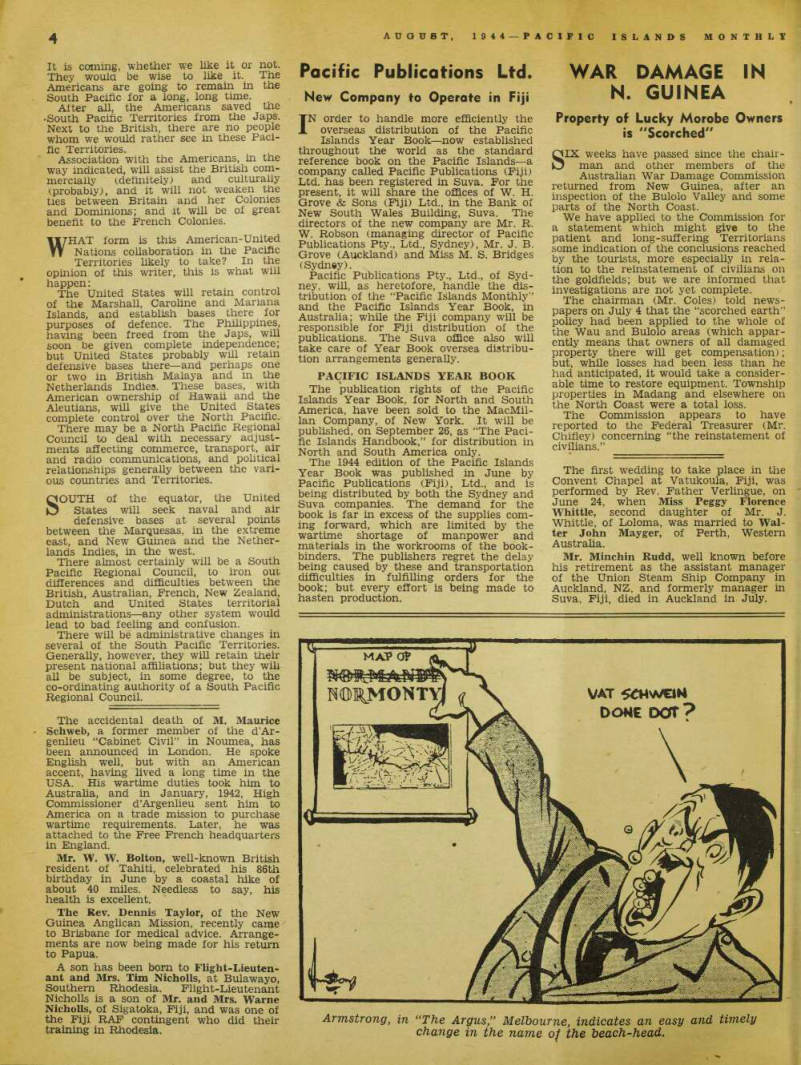
Armstrong, in “The Argus," Melbourne, indicates an easy and timely change in the name of the beach-head.
"Charley" Blake
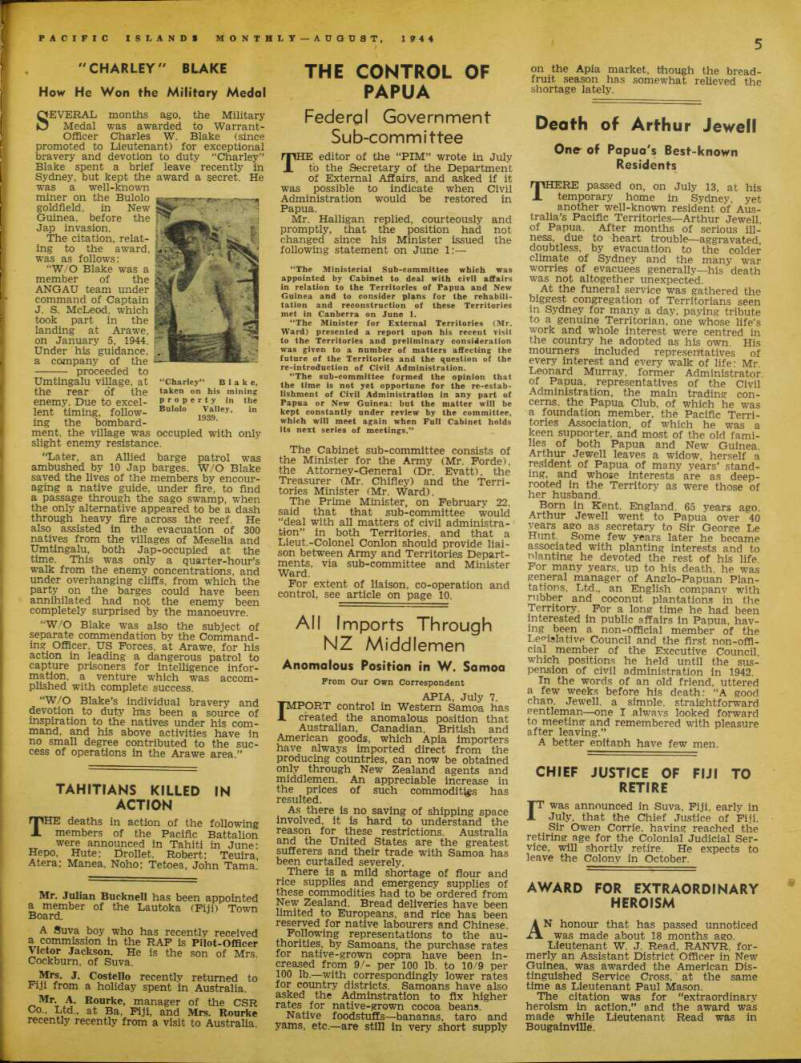
How He Won the Military Medal
SEVERAL months ago, the Military Medal was awarded to Warrant- Officer Charles W. Blake (since promoted to Lieutenant) for exceptional bravery and devotion to duty “Charley”
Blake spent a brief leave recently in Sydney, but kept the award a secret. He was a well-known
miner on the Bulolo goldfield, in New Guinea, before the Jap invasion.
The citation, relat ing to the award, was as follows: “W/O Blake was a member of the ANGAU team under command of Captain J. S. McLeod, which took part in the landing at Arawe, on January 5, 1944.
Under his guidance, a company of the proceeded to Umtingalu village, at the rear of the enemy. Due to excel lent timing, follow ing the bombard-
ment. the village was occupied with only slight enemy resistance.
“Later, an Allied barge patrol was ambushed by 10 Jap barges. W/O Blake saved the lives of the members by encour aging a native guide, under fire, to find a passage through the sago swamp, when the only alternative appeared to be a dash through heavy fire across the reef. He also assisted in the evacuation of 300 natives from the villages of Meselia and Umtingalu, both Jap-occupied at the time. This was only a quarter-hour’s walk from the enemy concentrations, and under overhanging cliffs, from which the party on the barges could have been annihilated had not the enemy been completely surprised by the manoeuvre.
“W/O Blake was also the subject of separate commendation by the Command ing Officer, US Forces, at Arawe. for his action in leading a dangerous patrol to capture prisoners for intelligence infor mation, a venture which was accom plished with complete success.
“W/O Blake’s individual bravery and devotion to duty has been a source of inspiration to the natives under his com mand, and his above activities have in no small degree contributed to the suc cess of operations in the Arawe area.”
“Charley” Blake, taken on his mining property in the Bulolo Valley, in 1939.
Action
Tahitians Killed In
THE deaths in action of the following members of the Pacific Battalion were announced in Tahiti in June: Hepo, Hute; Drollet. Robert; Teuira, Atera; Manea, Noho; Tetoea, John Tama.
Mr. Julian Bucknell has been appointed a member of the Lautoka (Fiji) Town Board.
A Suva boy who has recently received a commission in the RAF is Pilot-Officer Victor Jackson. He is the son of Mrs.
Cockburn, of Suva.
Mrs. J. Costello recently returned to Fiji from a holiday spent in Australia.
Mr. A. Rourke, manager of the CSR Co.. Ltd., at Ba. Fiji, and Mrs. Rourke recently recently from a visit to Australia.
Sub-committee
The Control Of
Papua
Federal Government Sub-committee
THE editor of the “PIM” wrote in July to the Secretary of the Department of External Affairs, and asked if it was possible to indicate when Civil Administration would be restored in Papua.
Mr. Halligan replied, courteously and promptly, that the position had not changed since his Minister issued the following statement on June 1: “The Ministerial Sub-committee which was appointed by Cabinet to deal with civil affairs in relation to the Territories of Papua and New Guinea and to consider plans for the rehabili tation and reconstruction of these Territories met in Canberra on June 1.
“The Minister for External Territories (Mr.
Ward) presented a report upon his recent visit to the Territories and preliminary consideration was given to a number of matters affecting the future of the Territories and the question of the re-introduction of Civil Administration.
“The sub-committee formed the opinion that the time is not yet opportune for the re-estab lishment of Civil Administration in any part of Papua or New Guinea: but the matter will be kept constantly under review by the committee, which will meet again when Full Cabinet holds its next series of meetings.”
The Cabinet sub-committee consists of the Minister for the Army (Mr. Forde), the Attorney-General (Dr. Evatt), the Treasurer (Mr. Chifley) and the Terri tories Minister (Mr. Ward).
The Prime Minister, on February 22, said that that sub-committee would “deal with all matters of civil administra tion” in both Territories, and that a Lieut.-Colonel Conlon should provide liai son between Army and Territories Depart ments. via sub-committee and Minister Ward.
For extent of liaison, co-operation and control, see article on page 10.
All Imports Through
NZ Middlemen Anomalous Position in W. Samoa
Prom Our Own Correspondent APIA, July 7. rPORT control in Western Samoa has created the anomalous position that Australian, Canadian, British and American goods, which Apia importers have always imported direct from the producing countries, can now be obtained only through New Zealand agents and middlemen. An appreciable increase in the prices of such commodities has resulted.
As there is no saving of shipping space involved, it is hard to understand the reason for these restrictions. Australia and the United States are the greatest sufferers and their trade with Samoa has been curtailed severely.
There is a mild shortage of flour and rice supplies and emergency supplies of these commodities had to be ordered from New Zealand. Bread deliveries have been limited to Europeans, and rice has been reserved for native labourers and Chinese.
Following representations to the au thorities, by Samoans, the purchase rates for native-grown copra have been in creased from 9/- per 100 lb. to 10/9 per 100 lb.—with correspondingly lower rates for country districts. Samoans have also asked the Adminstration to flx higher rates for native-grown cocoa beans.
Native foodstuffs—bananas, taro and yams, etc—are still in very short supply
on the Apia market, though the bread fruit season has somewhat relieved the shortage lately.
Death of Arthur Jewell
One of Papua's Best-known Residents
fTIHERE passed on, on July 13, at his X temporary home in Sydney, yet another well-known resident of Aus tralia’s Pacific Territories—Arthur Jewell, of Papua. After months of serious ill ness, due to heart trouble—aggravated doubtless, by evacuation to the colder climate of Sydney and the many war worries of evacuees generally—his death was not altogether unexpected.
At the funeral service was gathered the biggest congregation of Territorians seen in Sydney for many a day, paying tribute to a genuine Territorian, one whose life’s work and whole interest were centred in the country he adopted as his own. His mourners included representatives of every interest and every walk of life: Mr Leonard Murray, former Administrator of Papua, representatives of the Civil Administration, the main trading con cerns. the Papua Club, of which he was a foundation member, the Pacific Terri tories Association, of which he was a keen supporter, and most of the old fami lies of both Papua and New Guinea.
Arthur Jewell leaves a widow, herself a resident of Papua of many years’ stand ing, and whose interests are as deep rooted in the Territory as were those of her husband.
Born in Kent, England. 65 years ago, Arthur Jewell went to Papua over 40 years ago as secretary to Sir George Le Hunt. Some few years later he became associated with planting interests and to nlanting he devoted the rest of his life For many years, up to his death, he was general manager of Anglo-Papuan Plan tations, Ltd., an English companv with rubber and coconut plantations in the Territory. For a long time he had been interested in public affairs in Papua, hav ing been a non-official member of the Legislative Council and the first non-offi cial member of the Executive Council which positions he held until the sus pension of civil administration in 1942.
In the words of an old friend, uttered a few weeks before his death: “A good chan. Jewell, a simple, straightforward gentleman—one I always looked forward to meeting and remembered with pleasure after leaving.”
A better epitaph have few men.
Chief Justice Of Fiji To
Retire
rwas announced in Suva, Fiji, early in July, that the Chief Justice of Fiji, Sir Owen Corrie, having reached the retiring age for the Colonial Judicial Ser vice, will shortly retire. He expects to leave the Colony in October.
Award For Extraordinary
Heroism
AN honour that has passed unnoticed was made about 18 months ago.
Lieutenant W. J. Read. RANVR, for merly an Assistant District Officer in New Guinea, was awarded the American Dis tinguished Service Cross, at the same time as Lieutenant Paul Mason.
The citation was for “extraordinary heroism in action,” and the award was made while Lieutenant Read was in Bougainville.
Non-Indentured
Papuan Labour
A Territorial! Clarifies the Position
IT does not seem to have occurred to those who have recently been disput ing the relative merits of indentured and so-called “free” labour, that from the inception of the Native Labour Ordinance of Papua, in 1911, there has always been provision made for non indentured labour.
Part II of this native labour ordinance is devoted to “free” labour, and was framed for the benefit of local labour and provided that, so long as certain limitations of distance from the home village were observed, both male and female natives could be employed, life long. without indenture.
In the indenture portion of the ordin ance, there is a section which again pro vides for non-indenture. Any male native who belongs to a settled labour district is permitted to be employed in any other settled labour district, for a period not exceeding 12 months; the terms and nature of the employment being without official cognisance. When that period has, or has not, expired, the native, as a “casual,” receives his dues and can go for a spell, anywhere he likes and for any period. Then he can again be employed at the same place, still as a “casual,” for as many “12 months” as he chooses.
These two forms of non-indenture, which really are interlocked, were availed of to an important extent —probably to about half of the number of indentured labour.
THE majority of natives prefer inden ture. They feel that thev know where they stand, and that they have the Government as a protector.
Indenture is a legal safeguard both for emplover and employee, and generally it is availed of when the villages of the latter are far distant from the places of pmnlovment. There is. at the same time, however, nothing to prevent any native from paving his own sea-passage to nlaces of work and then offering himself as a “casual”; or even to enter into an indenture. Quite a number have done this, taking the risk whether or not pmnlovwpnt. will be open to them. But preferably they accent the role of recruits in their viilacres. when they know that not onlv will their return sea-passage be paid, but that they are assured of employment.
Consecration Of New
Bishop Of Fiji
THE Right Rev. Victor Foley was consecrated as Vicar Apostolic of Fiji on August 6. The consecrating prelate was the Rieht Rev. Joseph Dar nand, Vicar Apostolic of Samoa.
The Vicar Apostolic of the Northern Solomons, the Right Rev. Thomas Wade, and the Vicar, Apostolic of New Cale donia, the Right Rev. Edward Bresson, also took part in the ceremony.
Miss L. Lawrence, of the Methodist Mission, at Dilkusha, Fiji, arrived in Melbourne on July 25. The Mission Board expressed its appreciation of the service given by Miss Lawrence.
Dr. Stephenson, of the Fiji Methodist Mission, who is at present on furlough in New Zealand, will be in charge of the Whangarei Church.
Good-Bye, Mr. Tojo!
Why a Gentleman Who Had Lost Face Went Into the Discard
By R. W. Robson
AS I see it, the dismissal of To jo and Company can be explained simply enough. I will admit, how ever, that international events now are moving with such rapidity that, by the time this is published, the whole set-up may have changed, and the following explanation may be unnecessary.
Within four months after Pearl Harbour, Japanese expeditions had occupied fifteen Territories, to which they had been allotted in the Japa nese Master-Plan; "and Radio Tokio was shouting gleefully that the Co- Prosperity Sphere was in being, and that Japan already was suprerrie mistress of South-east Asia, Indonesia and the Western Pacific, and soon would be ruler of the world. In that period, 2i years ago, I expressed these opinions: • The Japanese had defied the fundamental rules of war by spread ing themselves out over such a wide area; and long lines of vital com munications were exposed to attack. • It was evidently the belief of Tokio that Germany and Italy could hold all Britain’s strength and part of America’s strength, while Japan dug herself in in her new Empire; and that the task of overcoming and occupying hundreds of fortified islands would break the hearts of the remaining Americans, and induce them to seek peace, long before they reached the latitude of Tokio.
This was the plan of the Tokio war lords—and especially of General Tojo, the cunning soldier-politician of the Kwantung Army, and of Admiral Yamamoto, head of the Japanese Navy. I said, early in 1942, and re peated it many times afterwards, “Air-power is the thing that Mr. Tojo forgot.”
AND so it proved. Air-power broke Germany; air-power struck at the vital communications of the Jap defensive organisation, and exposed the fatal weaknesses of the Tojo- Yamamoto plan; by the end of 1942. air-power had forced the Japanese upon the defensive.
Yamamoto, early in the piece, rea lised that Japan would herself be strangled in the trap she had devised for the embarrassment of her enemies; and so Yamamoto, like a good Son of. Heaven, exterminated himself. Tokio reported that he had been killed while directing operations from a plane in the Solomon Islands.
If so, it was a singular coincidence that Yamamoto should have died just when it became plain to everyone, as the outcome of Guadalcanal, that the Yamamoto strategy would bring about Japan’s defeat.
Tokio spent all of 1943 floundering
about, and hoping for a miracle. The growth of Allied air-power, the suc cess of our North African campaign, the strength of the United States in dustrial potential, and the terrifying character and size of the forces be ing built up by America—these things must have been noted and appraised in Tokio; but Tokio still hoped that Hitler somehow would contrive to pull, a rabbit out of his hat.
Tokio thought that Germany might defeat Russia; and, when the Ger mans began the long, disastrous re treat from Stalingrad, Tokio still gambled on Hitler’s secret weapon.
Von Ribbentrop (who seems to have had a singular faculty for mes merising Japanese) probably con vinced Tokio’s representative, late in 1943, that Germany’s flying-bomb would destroy Britain and cripple American plans; but, just when the flying-bomb plan was full of promise, the RAF found the home of the new secret weapon, at Peenemunde, near the Baltic coast, and blew it to pieces.
It may be that that achievement altered the course of the war. The flying-bomb attack was disrupted, and could not be re-organised and launched until after the British and Americans had landed in France— too late to interfere with the Western invasion, and too late to avert the complete defeat of Germany.
Too late, also, to assist Mr. To jo in the delicate task of keeping his face on.
ACTUALLY, Tokio spent all of 1943 and some of 1944 in trying to save face—in desperately seeking a way out of the jam caused by the failure of the Jap Air Force and the impending collapse of Germany.
As long ago as June, 1943, I argued publicly that Mr. To jo of Tokio had only two courses open to him: He must either send out his fleet, in an attempt to regain control of the
(Continued on Page 42)
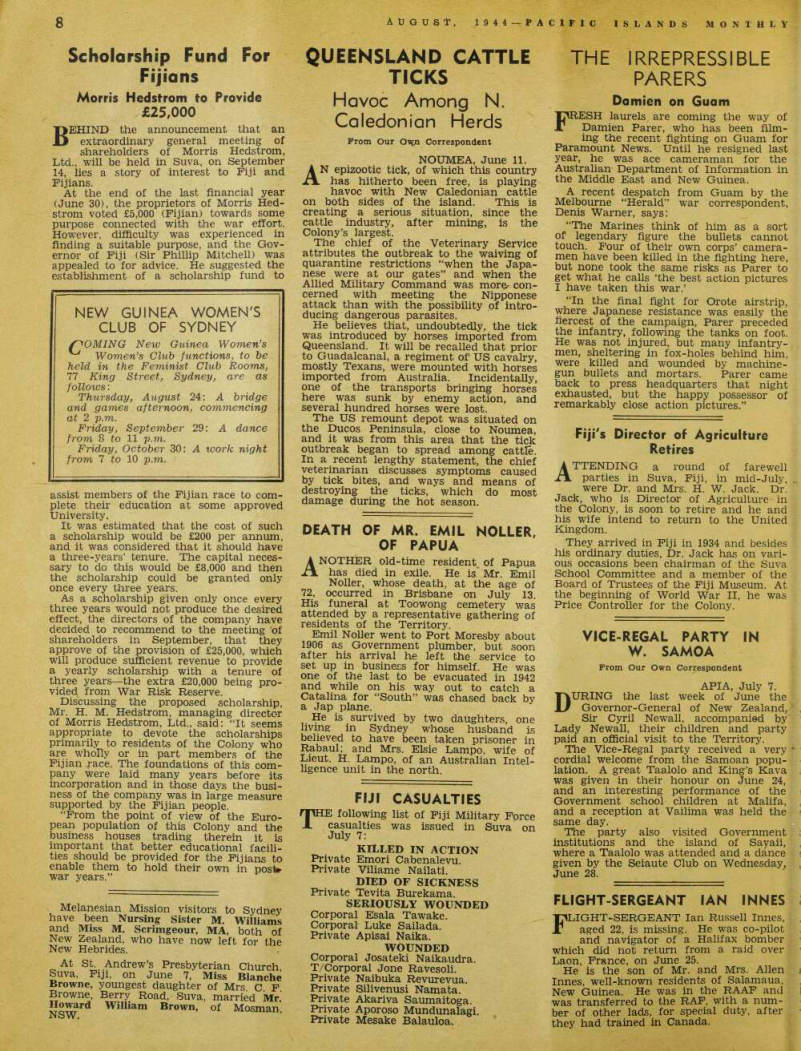
Loss of Face.
Cartoonist Armstrong’s comment in “The Argus,” on the disappearance of Mr. Tojo from the Government of Japan.
Western Pacific and protect the Japanese armies in Indonesia and South-east Asia; or he must with draw from the Netherlands Indies, South-east Asia, Philippines and South-west Pacific, It was apparent that Japan, lacking air cover, dare not send out her fleet.
The logical outcome of that situa tion—the northwards withdrawal of the Japs—did not happen—in fact, it actually has not happened yet. Why?
XT is all a matter of face. Tokio X could not bear the thought of withdrawing from the newly-won Em pire, and thus acknowledging defeat to the members of the precious “Greater East Asia Co-Prosperity Sphere.”
Ever since December, 1941, Japan has been driving the conquered peoples of Indonesia and South-east Asia into the “Sphere”—a set-up which, according to Tokio, is to be a sort of League in which all Asiatic nations will enjoy absolute equality and resist European exploitation; but which actually is a group of terrified peoples brought together under the Japanese whip, for ruthless exploi tation by Japan.
The nations already in the “Sphere” are Japan, Puppet China, Manchuria, Thailand and Burma; and the nations being “prepared” for inclusion are Philippines, Indo-China, Malaya and Netherlands Indies. For two years, more than 200,000,000 people were told that Japan is their friend and the mistress of the world. Some what difficult, after that, to go into reverse!
But it has to be done. Japan’s only hope of saving anythihg out of the wreck of her dreams is to withdraw her forces from all places southward of Indo-China, where they are being bled white, and concentrate them for a last-ditch stand in defence of the home-land.
The choice was plain. Either save the face of Mr. Tojo by hanging on
in Indonesia and elsewhere, and hop ing that Japan’s far-flung forces might not be trapped; or sack Mr.
Tojo, with face besmirched, and get ready for the northwards march.
And so Tokio said “Good-bye” to the calamitous Mr. Tojo. A new Cabinet has taken charge. Tokio Radio, in the best Goebbels style, says the newcomers will organise for vic tory the indomitable will of a united people, whose destiny it is to control the world.
TF the new Cabinet can see a chance of doing something spectacular, to demonstrate the Son of Heaven’s inflexible will to conquer, that will be done. But the facts of the present situation, read against the back ground of events since Pearl Har bour, indicate that the course of things, in the next few months, will be something like this: • The Japanese will concentrate available forces to hamper and delay the American plan of occupying all four southern Marianas (Saipan, Guam, Tinian and Rota), and estab lishing there a base from which it would be possible to attack either the Philippines or Japan itself. • Meanwhile, the Japanese will begin withdrawal from the Nether lands Indies, because they realise that, if the Americans get a footing in the Philippines, they will cut off all Japanese sea-borne communi cations with the Netherlands Indies and Malaya. • Japan will put every ounce of energy she has behind an attempt to make the “Co-Prosperity Sphere” fight. So far, the “Sphere” has been mostly hot air. But, if the people of Philippines, Indo-China, Malaya and South-east China can be induced to rally around the Japanese, and fight against the Americans, British and Dutch, Japanese face may be saved, anfl Japan (says Tokio) might yet be permitted to hang on to some part of her stolen Empire. • Meanwhile, far-reaching and drastic steps will be taken to prepare the islands of Japan itself to resist invasion. Plans will be made for the most effective use of the Japanese Navy, within the waters of Japan it self; and Japanese industrial strength will be concentrated upon the crea tion of an Air Force designed and trained specially to guard the shores of Japan and South-east China.
In a sentence: A new Cabinet has been brought in, so that Japan, with out unendurable loss of face, can abandon the no-longer-defendable Empire of Mr. Tojo and Admiral Yamamoto, and can make adequate preparations for the defence of the Japanese home country—in co operation with the “Co-Prosperity” peoples, if possible.
Mrs. Adelaide Clark, mother of Mr Hugh Clark, of Cable & Wireless, Ltd, Suva, Fiji, died in Suva on June 26, at the age of 76.
Stanley Greenland Retires
From Papuan Service
FOR Papuan residents, the evacuation period has been distinguished by the number of their high-ranking Government servants who have reached retirement. Latest to join the ranks of the retired is Mr. Stanley Greenland, who gave 30 years of service to the Territory, and who remained throughout, popular with white and brown residents.
He was appointed to the service in 1912, to serve under the then Government Secretary, the Hon. A. M. Campbell, who was reputed the strictest disciplinarian the Papuan service has ever known. With
Mr. Campbell, he travelled on tours of inspection as his secretary and general factotum, and under his tutelage learned his Papuan official alphabet.
Later, Mr. Greenland was Magistrate at loma, on the old German-British border and at Yule Island. In 1917 he was appointed to the Department of Native Affairs, Port Moresby, and until his recent retirement held administrative rank in that Department—as inspector, travelling inspector, chief inspector, act ing commissioner, etc. But interspersed between these positions, and under the direction of Sir Hubert Murray, he func tioned variously as Curator of Intestate Estates, Registrar-General, member of the Land Board, Papuan Government Agent in Sydney, and OC Headquarters Armed Native Constabulary. He was also a commissioned officer in the force now known as the Royal Papuan Constabu lary.
Mr. Greenwood, who insists that the Papuan service is only second to the Navy in traditional silence, could be persuaded to say only two things regarding his retirement: That far too much was heard about the old men of Papua these days, and far too little about the gallant women of the country; and that he had little claim to distinction other than being the uncle and god-father of that young naval officer, Lieut. R. T. G.
Greenland, who has made history as the commander of the “Human Torpedoes.”
In Mr. Greenland’s opinion, Lieut.
Greenland was able to achieve more for his country in a brief half-hour than he himself did in 30 years of life in
Papua. This opinion will hardly be endorsed by those who knew Mr. Green land of the Papuan service for three decades. Papua will be the poorer, when civil administration is resumed, for the loss of well-tried officers of his calibre, who learned to know Papua in her teeth ing stage, and in spite of her continued temperamental cussedness, grew a deep and abiding love for the land.
Mr. Stanley Greenland.
French Hearts Beat
High
Celebration in Tahiti
From Our Own Correspondent
Papeete, July 14.
HERE, on June 18, the people of this French Colony celebrated the fourth anniversary of that day in 1940 when General de Gaulle, having repudiated the surrender of the Bordeaux Government, and escaped to Great Britain, called upon Free Frenchmen everywhere to continue the fight beside Britain against the Ger mans. There was a review of troops, and wreaths were laid upon the Soldiers’
Memorial.
The proceedings were marked by restraint and dignity. Only 10 days before, we had learned of the successful landing of the Allies in Normandy; but the people’s joy in witnessing at last the beginning of the liberation of France, was tempered by memories of four years of horror and sacrifice.
There is no doubt about the place that de Gaulle holds in the hearts of these French people. To them, he is the expres sion of the will of Fighting France—the France that shall not die. France has surprised the world many times in the past, by her quick and full recovery from disaster. This virile and enlightened nation will surprise the world again.
Our Governor, Colonel Georges Orselli, has returned from his mission to Algiers.
He brings news that is good and inspiring.
We learn, with pleasure and pride, that our Pacific Battalion, having taken a glorious part in the advance on Rome, was given the place of honour at the head of the French forces, as the Allied armies marched into the Eternal City, after it had been abandoned by the defeated enemy.
Lloyd Pursehouse Killed
CAPTAIN Lloyd Pursehouse, who was a patrol officer in the New Guinea Administration, was killed in action soon after the Australian 9th Division landed in Lae. He carried out important duties in the Finschhaven district after the Jap invasion; subsequently got clear away to Australia; returned with the AIF; and apparently was killed by a stray Jap when out in the jungle near Finsch haven on special work.
Growth Of S. Pacific
Insurance
THE Southern Pacific Insurance Com pany, Ltd., established very modestly by W. R. Carpenter & Co., Ltd., in the middle thirties, has just issued its ninth annual balance sheet. After pro viding £3,500 for taxation, and £1,500 for investment fluctuation reserve, there is a net profit of £7,075. The subscribed capi tal of the company is £62,500. The gross premium income increased, in the year under review, from £108,986 to £135,528.
The company’s turnover and profits, year by year, have shown astonishing growth— a demonstration of the value of this type of business, especially when it is con nected with a large trading organisation.
Free Grant Of
£90,800 Fiji and Western Pacific Benefit
UNDER the Colonial Development and Welfare Act (which was passed by the British Parliament in 1940 i £90,800 was granted to the Western Pacific during the period April, 1943- March, 1944. This money is a free grant from the Imperial Government.
Of the total, £25,800 is to be used for a tuberculosis survey in Fiji -and the Western Pacific High Commission Terri tories of Solomon Islands Protectorate and Gilbert and Ellice Islands. It is believed that the necessity for determin ing the extent of this disease is urgent, and an expert will be obtained as soon as possible to make the preliminary sur vey of the effect of the disease in those islands.
The remaining £65,000 is to be spent on a scheme designed to prevent the intro duction of the anopheles (or malaria carrying) mosquito' into 'Fiji; or, alter nately, to prevent its establishing itself should it pass the quarantine barrier. A great deal of mosquito control work has already been carried out in Fiji.
Although anopheles mosquitoes—and malaria—are prevalent in the islands westward of Fiji they do not, exist in the Colony or any of the islands east of it.
Up to the outbreak of the Pacific war, quarantine measures were sufficient to ensure that the disease did not enter Fiji; but, due to the war and consequent speeding up of communications both by air and sea, and the movement of large bodies of troops in this area, something more was necessary. It has been decided that by eliminating mosquito-breeding places the Colony may be kept malaria free, and this grant is to be used for this purpose.
Through publicity campaigns, and by the work by the Agriculture and Public Health Departments, residents of Fiji have been made mosquito-conscious dur ing the last couple of years. With the help of this grant the good work should now continue.
Advertisements & other items, p. 9 (1 item)
Association
Notice of Meeting
PACIFIC TERRITORIES
A Quarterly General Meeting of members will be held in the Teachers' Federation Hall, 7th Floor, 166 Phillip Street, Sydney, on Tuesday, 26th September, 1944, at 8 p.m.
Business : (1) To receive a report of the Executive on activities to date. (2) To consider a resolution, copy of which has been forwarded to members, resubmitted from the General Meeting of 27th June, 1944.
C. A. M. ADELSKOLD,
Secretary.
Fijians
Scholarship Fund For Fijians Morris Hedstrom to Provide £25,000
BEHIND the announcement that an extraordinary general meeting of shareholders of Morris Hedstrom, Ltd., will be held in Suva, on September 14, lies a story of interest to Fiji and Fijians.
At the end of the last financial year (June 30), the proprietors of Morris Hed strom voted £5,000 (Fijian) towards some purpose connected with the war effort.
However, difficulty was experienced in finding a suitable purpose, and the Gov ernor of Fiji (Sir Phillip Mitchell) was appealed to for advice. He suggested the establishment of a scholarship fund to
assist members of the Fijian race to com plete their education at some approved University.
It was estimated that the cost of such a scholarship would be £2OO per annum, and it was considered that it should have a three-years’ tenure. The capital neces sary to do this would be £B,OOO and then the scholarship could be granted only once every three years.
As a scholarship given only once every three years would not produce the desired effect, the directors of the company have decided to recommend to the meeting of shareholders in September, that they approve of the provision of £25,000, which will produce sufficient revenue to provide a yearly scholarship with a tenure of three years—the extra £20,000 being pro vided from War Risk Reserve.
Discussing the proposed scholarship, Mr. H. M. Hedstrom, managing director of Morris Hedstrom, Ltd., said: “It seems appropriate to devote the scholarships primarily to residents of the Colony who are wholly or in part members of the Fijian race. The foundations of this com pany were laid many years before its incorporation and in those days the busi ness of the company was in large measure supported by the Fijian people.
“From the point of view of the Euro pean population of this Colony and the business houses trading therein it is important that better educational facili ties should be provided for the Fijians to enable them to hold their own in post* war years.”
Melanesian Mission visitors to Sydney have been Nursing Sister M. Williams and Miss M. Scrimgeour, MA, both of New Zealand, who have now left for the New Hebrides.
At St. Andrew’s Presbyterian Church, Suva. Fiji, on June 7, Miss Blanche Browne, youngest daughter of Mrs. C F Browne, Berry Road, Suva, married Mr.
Howard William Brown, of Mosman,
Nsw.
Queensland Cattle
Ticks
Havoc Among N.
Caledonian Herds
From Our Correspondent
Noumea, June 11.
AN epizootic tick, of which this country has hitherto been free, is playing havoc with New Caledonian cattle on both sides of the island. This is creating a serious situation, since the cattle industry, after mining, is the Colony’s largest.
The chief of the Veterinary Service attributes the outbreak to the waiving of quarantine restrictions “when the Japa nese were at our gates” and when the Allied Military Command was more- con cerned with meeting the Nipponese attack than with the possibility of intro ducing dangerous parasites.
He believes that, undoubtedly, the tick was introduced by horses imported from Queensland. It will be recalled that prior to Guadalcanal, a regiment of US cavalry, mostly Texans, were mounted with horses imported from Australia. Incidentally, one of the transports bringing horses here was sunk by enemy action, and several hundred horses were lost.
The US remount depot was situated on the Ducos Peninsula, close to Noumea, and it was from this area that the tick outbreak began to spread among cattle.
In a recent lengthy statement, the chief veterinarian discusses symptoms caused by tick bites, and ways and means of destroying the ticks, which do most damage during the hot season.
Death Of Mr. Emil Noller,
Of Papua
ANOTHER old-time resident of Papua has died in exile. He is Mr. Emil Noller, whose death, at the age of 72, occurred in Brisbane on July 13.
His funeral at Toowong cemetery was attended by a representative gathering of residents of the Territory.
Emil Noller went to Port Moresby about 1906 as Government plumber, but soon after his arrival he left the service to set up in business for himself. He was one of the last to be evacuated in 1942 and while on his way out to catch a Catalina for “South” was chased back by a Jap plane.
He is survived by two daughters, one living in Sydney whose husband is believed to have been taken prisoner in Rabaul; and Mrs. Elsie Lampo, wife of Lieut. H. Lampo, of an Australian Intel ligence unit in the north.
Fiji Casualties
rE following list of Fiji Military Force casualties was issued in Suva on July 7:
Killed In Action
Private Emori Cabenalevu.
Private Viliame Nailati.
Died Of Sickness
Private Tevita Burekama,
Seriously Wounded
Corporal Esala Tawake.
Corporal Luke Sailada.
Private Apisai Naika.
Wounded
Corporal Josateki Naikaudra.
T/Corporal Jone Ravesoli.
Private Naibuka Revurevua.
Private Silivenusi Namata.
Private Akariva Saumaitoga.
Private Aporoso Mundunalagi.
Private Mesake Balauloa.
The Irrepressible
Parers
Damien on Guam
FRESH laurels are coming the way of Damien Parer, who has been film ing the recent fighting on Guam for Paramount News. Until he resigned last year, he was ace cameraman for the Australian Department of Information in the Middle East and New Guinea.
A recent despatch from Guam by the Melbourne “Herald” war correspondent, Denis Warner, says: “The Marines think of him as a sort of legendary figure the bullets cannot touch. Four of their own corps’ camera men have been killed in the fighting here, but none took the same risks as Parer to get what he calls ‘the best action pictures I have taken this war.’
“In the final fight for Orote airstrip, where Japanese resistance was easily the fiercest of the campaign, Parer preceded the infantry, following the tanks on foot.
He was not injured, but many infantry men, sheltering in fox-holes behind him, were killed and wounded by machine gun bullets and mortars, Parer came back to press headquarters that night exhausted, but the happy possessor of remarkably close action pictures.”
Fiji's Director of Agriculture
Retires
ATTENDING a round of farewell parties in Suva, Fiji, in mid-July, were Dr. and Mrs. H. W. Jack. Dr.
Jack, who is Director of Agriculture in the Colony, is soon to retire and he and his wife intend to return to the United Kingdom.
They arrived in Fiji in 1934 and besides his ordinary duties, Dr. Jack has on vari ous occasions been chairman of the Suva School Committee and a member of the Board of Trustees of the Fiji Museum. At the beginning of World War 11, he was Price Controller for the Colony.
Vice-Regal Party In
W. Samoa
Prom Our Own Correspondent APIA, July 7.
DURING the last week of June the Governor-General of New Zealand, Sir Cyril Newall, accompanied by Lady Newall, their children and party paid an official visit to the Territory.
The Vice-Regal party received a very cordial welcome from the Samoan popu lation. A great Taalolo and King’s Kava was given in their honour on June 24, and an interesting performance of the Government school children at Malifa, and a reception at Vailima was held the same day.
The party also visited Government institutions and the island of Sayaii, where a Taalolo was attended and a dance given by the Seiaute Club on Wednesday, June 28.
Flight-Sergeant Lan Innes
FLIGHT-SERGEANT lan Russell Innes, aged 22, is missing. He was co-pilot and navigator of a Halifax bomber which did not return from a raid over Laon, France, on June 25.
He is the son of Mr. and Mrs. Allen Innes, well-known residents of Salamaua, New Guinea. He was in the RAAF and was transferred to the RAF, with a num ber of other lads, for special duty, after they had trained in Canada.
Advertisements & other items, p. 10 (1 item)
New Guinea Women's
CLUB OF SYDNEY
ZOOMING New Guinea Women’s Women’s Club functions, to be held in the Feminist Club Rooms 77 King Street, Sydney, are as follows : Thursday, August 24: A bridge and games afternoon, commencing at 2 p.m.
Friday, September 29: A dance from 8 to 11 p.m.
Friday, October 30: A work night from 7 to 10 p.m.
Tropicalities
THE fame of the American Seabees (naval construction battalion) is as great in the Gilberts as in the Solo mons, says Mr. Harold Cooper, back in Suva, Fiji, at the beginning of July, after a tour of the Gilbert and Ellice Islands.
It was the Seabees who cleaned up the mess on Betio (Tarawa) and converted it, within a few days, into a ready-for use American base. Betio to-day is so shorn of its coconuts as to be little more than a flat coral platform.
Lunching with some American officers, one day, Mr. Cooper said they complained bitterly of the monotonous flatness of the atoll upon which Fate and the Army had seen fit to cast them. "Hell,” was the comment of one bored officer, "why don’t we get the Seabees to build us a mountain?” ♦ ONE of the less lethal and more useful inventions of the 20th century is the zip-fastener. But on occasion even a zip-fastener can cause a lot of trouble.
A story, going the rounds in Suva, tells how a young officer, well-known in Fiji,' salvaged an American jungle hammock.
He was very proud of the contraption, and carried it with him through the jungle and over difficult country, until it was time to camp for the night. He selected two suitable trees, fixed all the pulleys and other gadgets on the ham mock, prepared to retire for the night, and then zippered himself in.
Later that night, when all was still, some Sons of Heaven began a grenade attack nearby. Our hero’s reactions to the sudden noise were violent —so violent that the zip fastener became locked tight and refused to unzip. There was the sol dier, done up as efficiently as an Indian papoose or a cocoon stuck to a twig; and there were the Nips. He swung furiously for what seemed to him to be a very long time, and in what he felt was far too exposed a position; and, eventually, one of the trees supporting the hammock, could stand the strain no longer. The tree broke and the officer landed with a thump on the ground, still done up in his Yankee hammock.
History does not tell of subsequent pro ceedings; it merely records that he there and then promised blasphemously that he would forego modem inventions and seek sleep, for the duration, on good Mother Earth. * rE hotel in Madang stood on a slight rise and was a landmark, insomuch as it was a quaint old building, with its small upper-storey windows, more suited to life in the mountains of Bavaria, perhaps, than to life in tropical Madang.
It was German-built, and the Germans then did not go for the open-air type of bungalow built by the British, who came after. The German concession to tropical heat was the cool, tiled floor of the hotel.
Territorians will fail, perhaps, to recog nise the Madang hotel, past or present, in the following description of it by A.
I. Murray, in the Melbourne "Herald,” but it will* interest them to know the old hotel’s fate: "The Grand Hotel, which overlooked the splendid panorama of the harbour, and was once thronged with tourists and plantation owners, is now razed to its concrete foundations. The hotel had been converted ihto Japanese Head quarters, and the area surrounding it is a mass of fox-holes, pill-boxes and dug outs—dugouts 30 feet deep, constructed pf two layers of tree trunks, 15 inches m diameter, criss-crossed below huge rocks of sturdy coral.”
rRRITORIANS, taking them by and large, take a poor view of anthro pologists—sometimes dismissing them as interfering theorists. The Territorian cannot always be right; but, as a tribe, he will be pleased to note that a new use for devotees of this branch of science has been found in the United States.
Latest advice from that quarter states that Harvard University’s anthropologist, Dr. Ernest A. Hooton, is hard at work at Boston’s north railway station, taking measurements of the American sitter, using a grim-looking contrivance like a dentist’s chair, and determining hip breadth, back height and shoulder width, so that the post-war United States rail way seat will be more comfortable. * AFTER a Japanese garrison on one of the Nissan Islands (200 miles east of Rabaul) was recently wiped out, Private A. E. Travers, of the New Zealand Expeditionary Force, discovered three keys and a medal attached to an enemy wireless set.
This silver medal, shaped like a Maltese Cross, was inscribed, "Five Miles Ordin ary Championship, C. R. Wilson. 1892.
New Zealand Cycling Alliance.” Numer ous inquiries were made and eventually it was discovered to be the property of Mr. G. L. Wilson, of Nambour, Queens land, formerly manager of Asalingi Plan tation, 35 miles from Rabaul, New Britain.
Mr. Wilson came to Brisbane with his wife and two sons, on furlough, in Nov ember, 1941, and during his absence, the Japanese over-ran New Britain, and pre vented his return. All of his personal belongings were in his home on the plan tation, the medal among them. Mr. John Stokie (whose exploits against the Jap anese and whose rescue, with some American airmen, were featured in the press last year) informed him that the house had been looted by natives.
Mr. Wilson says that the medal was given to him by his father, in 1909. and, at present, it is in the possession of his aunt, in Christchurch, NZ. who is for warding it to him. The ordinary cham
pionship referred to, on the medal, was won on a bicycle commonly known as a "penny-farthing.”—R. E. FEREDAY.
SHADES of Boram and the old "Blood house” and all that went with it!
How memories are revived by that article in May "PIM”! I remember when I came out of hospital there, and food could not be varied, however one tried; and how I coaxed some of the owner’s (Tom Ifould’s) fowls, by a trace of rice, to come and deposit their eggs in a box under the hut. I got two a day for some time—and then Tom came over for a cup of tea, one day, and the damned cockaroo cackled under his feet! But Jimmy Wil ton, who was nursing me, saved' the day and did the right thing by decapitating a bottle of VB.-CWK. ♦ IN a recent letter, Flying-Officer Don Aidney, of Fiji, describes how he went to London on leave; "Half a dozen of us went along to Veeraswamy’s in Regent Street, for sup per. I treated myself to curry and asked for a hot one. I have tasted some pretty strong stuff at home, but this effort was 90% raw chili and 10% prussic acid.
"I managed to struggle through it, although I lost about two gallons of perspiration and wept copiously. The other lads were rather amused—until they tasted it; but the waiters were awe struck.
"I think the concoction was a trap for unwary travellers.” * IHATE to mention it: but in some New Guinea dialects the word "Angau” (so familiar to us as the initial let ters of Australian New Guinea Adminis trative Unit) means "false,” or "fake,” or "pseudo.” “Pren angau” is "insincere friend”; "tamboram angau” is "imitation ghost”; "tok-tok angau” is "salesman’s talk”—and so on. However, tell the ANGAU lads not to be discouraged. Mr.
Tojo has gone; and the whole war set-up in New Guinea will not be far behind. — A.N.
The Rev. W. Pidgeon, of Suva. Fiji, has been appointed an Assistant Probation Officer, Suva.
Advertisements & other items, p. 11 (1 item)
Movies Come To Bougainville
Bougainville natives watch their first movie—completely entranced by Mickey Mouse. —US Army Photo.
Spoiled by Wet Weather
Tahiti's Fair
From Our Own Correspondent
Papeete, July 17.
OUR Agricultural Fair, held in July, was the most ambitious undertaking of that nature ever seen in this island. The group of buildings, on the grounds of the racecourse, were of the old Tahitian pattern and their erection was the work of the people of Papenoo dis trict, who are expert in that type of construction.
Unfortunately, the early days of both Fair and Bastile Lay ceremonies met very unpropitious weather. Prolonged rains turned the racecourse enclosure —where the Fair is situated —into a quaking morass. Those who did not have the fortitude to navigate the sea of mud were able, however, to hear the principal speakers and the singing by the district choirs, in the comfort of their homes— through the courtesy of the Marine radio service, which broadcast the most inter esting events.
The four choirs who sang the ancient paripari fenua (poetic chants) of their districts, revived memories of Tahiti’s Bastile Day in the period of its splen dour, when singing companies of all the islands came to Papeete to do honour to the great national festival.
The singing by the choirs of the Ra’iatea Colony and of the district of Faaone moved the listeners to enthusias tic applause and demands for as many repetitions as the committee would per mit. Paea and Pu-na’au-ia covered selves with glory, even though they did not achieve the standard set by Ra’iatea and Faaone.
To the Brown Boys of New Guinea
Hi there, brown boys of New Guinea!
Mighty proud I am of you, Standing by our fighting Aussies, who are soldiers through and through.
You are treading tracks of danger and you risk your lives as well, Bringing in our wounded soldiers from those pitted fields of hell.
You were once the common nigger, whom the white man might despise— Now you are the Fuzzy hero, whom the world should recognise.
You are giving faithful service to our gallant boys; perhaps You’ll be a means to victory, in our fights against the Japs.
Many are my years of travel, many are the tales I’ve told Of the services you rendered, in my ven tures seeking gold.
I can hear your voices calling, I still can hear the thud Of the big brown feet a-plodding, through the heavy, sticky mud.
When we wandered through the jungle on the narrow native track, You were rolling, slipping, sliding, with that load upon your back.
But you faced your hardships bravely, suffering hunger, fear and pain— How I wish I were a youngster, to be with you all again!
Carry on, my faithful comrades—keep on moving, do your stuff, Fighting with our Aussie soldiers, till the Japs have had enough.
Then all men may well acclaim you as a man of noble guise, As a dinkum jui gle hero, whom the world can recognise.
A. L, (Fiji) Cook.
Angau Increases Its Grip On Papua
But Mr. Ward "Knows Nothing About It"
rE continuance of military govern ment in Papua, 18 months after the last Jap had been thrown out of the Territory, is one of the remarkable political developments in the Pacific War.
The Australian Government, being little better than an unco-ordinated gang of bumble-footed blunderers, allows bureaucracy to do what it likes with the Territories; and, as the Australian public is completely indifferent to what happens there, there is no check on anyone. So the Australian Army, through a branch called ANGAU (Australian and New Guinea Administrative Unit) is running the Territories in its own way, irrespec tive of cost, and without any regard for the interests of the thousands of civilians who were compulsorily removed from both Territories when the Japs in vaded.
The Australian Department of External Territories sometimes goes through motions indicating that it regards itself as the administrative authority for the Territories. Actually, it is merely a cipher and a name.
The enemy had gone from Papua by the end of 1942, and there is no reason whatever why civil administration cannot be restored there—except that scores of worthy lads are not anxious to be dis turbed in the enjoyment of pay and privileges and military titles such as they never dreamed of prior to 1940, and which the over-burdened Australian taxpayer is providing. The enemy—battered and isolated and broken, but still potentially dangerous—remains in parts of the Mandated Territory, so the latter is not in the same position as Papua—although Morobe district seems quite safe.
ALL other South Pacific Territories re covered from the enemy—we refer particularly to the British Solomons, the British Gilbert Islands, and Dutch New Guinea—were handed over im mediately by the American commanders to British and Dutch officials of the re spective civil administrations. Those officials went in to such places as Tulagi, Tarawa and Hollandia with the first parties of liberating troops; and the Americans retained only such powers as were necessary for their military opera tions.
But the Americans took no such action in the Australian Territories x of Papua and New Guinea—they, quite correctly, left administration to their Allies, the Australian Army. The Aus tralian Army, unlike the American Army, made no effort to restore civil adminis tration in Papua; and, presumably, it will follow the same policy in New Guinea.
The Papuan civil administrative struc ture, headed by the competent and very experienced Administrator, Mr. Leonard Murray, is kept idle in Australia; while an elaborate and expensive organisation, headed by a full major-general and sprinkled liberally with colonels, majors and captains, is having a pleasant time in the Territory, being in no way re sponsible to the Australian Department and enjoying the unchecked authority and unlimited money available to the Army in wartime.
ONE might tolerate this thing, if the civilians of Papua were getting some benefit out of it—if the money were being spent for the development of the country, and the permanent benefit of the European settlers. But nothing like that, is in sight. ANGAU guards the Territory most jealously against civilian intrusion—while another lot of bureau
crats fights the homeless civilians in Australia over their claims for compen sation for war damage and for property seized by the Army. The high panjan drums of ANGAU know only too well that if civilians once got back to Papua, and brought the light of publicity upon what is happening there, their “cushy jobs” would not last very long.
A man who has known Papua for decades, and who lately had a chance of examining conditions there, was not blinded by Brass-hat effulgence. Here is what he says in a private letter; “I am tipping the biggest slump Papua ever has had—and very soon—and a good thing, too.
As soon as the Army withdraws, and expenditure according to Army standards ceases, Papua— and ANGAU—will have to subsist on charity from Canberra, “There is practically no local revenue here now. I don’t think that Canberra will be very generous; and I am sure that the Australian taxpayer will not stand for ANGAU employing 50 personnel in the administration of a district which, before the war, was quite well served by 5. I have just been into one of the more im portant district areas; and ANGAU is doing things there in magnificent style—regal, almost.
It is a Fool’s Paradise—a rotten set-up, because it is getting the whole administrative structure completely out of focus.”
BUT the best evidence of what is hap pening under ANGAU comes from ANGAU itself. On May 24, 1944, the officer commanding ANGAU informed the directors of the mission organisations in Papua that definite arrangements had been made to commence a training school at Port Moresby under the auspices of ANGAU. Some European teachers had been gathered from the Education Department of the former Territory of New Guinea, and it was hoped to supple ment their numbers from Australia. It was proposed to arrange for 200 young Papuans to come into training.
“The school will be absolutely un denominational and secular,” said the General, “although, of course, every care will be taken to inculcate what we, what ever our denominational tenets, claim to be the foundation and basic requirements of a true Christian faith. No religious instruction, as such, will be given at the school, but every facility will be afforded for visits by Chaplains of the various denominations.” The Missions were in vited to send students by Ist June, 1944.
This announcement came as a bomb shell to the Missions, who have been en trusted with native education in the Australian Pacific Territories for a very long time.
Its implications were disturbing. It showed (a) that ANGAU regards itself as so solidly established that it can plan for permanent administrative conditions in the Territory; (b) that it has sufficient authority—derived from Heaven knows where, but presumably from Army Head quarters—to organise a plan of native education and put it into operation; (c) that it thinks so little of the past record and present interests of the Mission bodies that it formulates a native education plan without any consultation with people who have devoted themselves to native education for many decades.
The impertinence of the invitation to the Missions to send students by June 1, 1944, was, of course, the impertinence of ignorance. But the directors of Missions may be excused if they did not see it that way. rE heads of the Missions made very urgent representations on the sub ject—and especially did they address themselves to Mr. E. J. Ward, Australian
Minister for External Territories. This brought a disclosure of peculiar piquancy.
Mr. Ward wrote to the head of the Methodist Mission, stating that he had not received any information regarding ANGAll’s native education plan; but he had immediately instituted inquiries, and he would let the director of the Mission know the result as soon as possible.
There, in a sentence, we have the essence of the whole ANGAU set-up in relation to the Territory of Papua. The Major-General in command announces a plan for the establishment of a training school for 200 native Papuans—which obviously ties in with a general plan of administration, and has certain per manent features, and must be part of administrative policy; and the Minister in charge of the Department of External Affairs knows as much about it as he knows about the native contract labour system, which he proposes arbitrarily to abolish.
HOW long, O Lord—how long is this ragtime set-up to continue!
We know that governmental and administrative conditions in Australia, due to the weakness and inefficiency of the professional politicians in Canberra, have become demoralised and almost chaotic. Reductio ad absurdum surely was reached in the first week of August, when we saw Australia’s Prime Minister pleading soulfully with the striking coal miners, and Central New South Wales industrially convulsed because a retail butcher sacked his office girl.
These conditions seem to have spread to the Territories, where an officer with out experience of tropical administration is introducing policy measures, while the responsible Minister “knows nothing about it”—and while the Territory’s own civil administration, which ought to have been back on the job a year ago, is standing by idly in Australia.
New Australian Verses
FOR those who like Australian verses of “The Man From Snowv River” type, the poems of Edward Harrington, in a small booklet called “The Kerrigan Boys—And Other Australian Verses.” will have some appeal. This booklet is put out by W. Andrade, of 276 Collins Street, Melbourne, and is priced at 1/6.
Harrington—who has had many of his poems published by the “Bulletin”—writes about such robust subjects as bush rangers, fossickers. stockmen and drovers; but his verses are more typically Aus tralian than the surrealistic tripe that is dished up these davs as the true poetrv of the age. and the manifestation of Australia’s “soul” gone cultural.
Ratu G. W. Lalabalavu, Mr. Arthur Groom and Mr. R. A. Crompton have been apnointed to act as members of the Com mittee of Management of the Fiji Ser vicemen’s After-care Fund, during the absence from the Colony of Captain E.
P. Cakobau, 2nd Lieut. P. Lobendahn and the Rev. S. G. Cowled, CF.
A Caledonian soldier. Sergeant Camille Mercier, captured at Bir Hacheim, recently managed to escape from an Italian prison camp, but he was recap tured and is now again a prisoner, this time in Germany, whence he writes that he is in good health. Some of his com patriots had better luck and managed to get over the Swiss frontier.
The Rev. C. S. Bull, of the Anglican Mission, who recently returned to Aus tralia from Polynesia, because of his wife’s bad health and subsequent death, is now anxious to return to the mission field.
Road To Wau
Remarkable Engineering Feat in Markham-Wampit Valleys
rE Australian and American armies, using unlimited engineering skill and labour, and enormous equip ment, have built a very good road from the mouth of the Markham River (south side), to the Bulolo Valley, in New Guinea- To-day, trucks make the jour ney from the sea coast to Wau at an average speed of at least 25 miles per hour. The road does not rise anywhere more than 4,000 feet.
The road follows the Markham to the mouth of the Wampit. Then it turns south-west up the Wampit Valley to Zenag, and thence to Bulwa, where it joins up with the old Bulolo Valley road, to Wau. The worst place on the high way is not on the new road, but on the old one—it is in the Bulolo Gorge, between Bulolo and Wau. There, the ground is so steep and friable that every effort to widen the existing road has caused landslides.
There is no port at the southern side of the mouth of the Markham. Goods intended for up-country are sent across from Lae (four or five miles away, on the north side of the Markham) in barges. It is expected that a bridge across the lower Markham will presently connect Lae with the new road.
A good road already goes from Lae up the Markham Valley, towards the Ramu, in the north-west, but it follows the northern bank of the big, shifting river.
There is a sheltered port at Salamaua; and it might have been supposed that, instead of using unsheltered Lae as a port, a road would have been built north wards out of Salamaua to the mouth of the Markham, 20 miles away. But the Army has taken another view altogether- Lae, right up in the corner of Huon Gulf, is regarded as sufficiently sheltered to permit the construction of harbour works which, in turn, will give ships sufficient protection to lie alongside wharves and discharge cargo.
Old residents of New Guinea will be interested in these developments. It has been shown, first, that a trafficable road, between Bulolo and the coast, via the Markham and the Wampit, is a practic able proposition—despite the 10 years of argument between 1930 and 1940. The two new roads (north and south of the Markham) provide the means, not only for giving a new lease of life to the Morobe goldfield, but also for opening up the Ramu-Mount Hagen tablelands, and the Markham Valley itself. ■ Lae, situated at the mouth of the Markham Valley, already noted for its fine airfield, and now to become also a sheltered seaport, is assured of a wonder ful future. General Griffith’s selection of Lae, in 1938, as the future capital of New Guinea, becomes justified.
In these circumstances, the future of Salamaua is obscure. Salamaua has no “back country”—it is surrounded by swamps and jammed against the moun tains. and its only reason for existence wqs its sheltered harbour, and its labori ously constructed airfield, so that it shared with Lae the duties of a nort of discharge for the Morobe goldfield. Lae, in pre-war davs, held out against Sala maua because it was the headquarters of Guinea Airways, Ltd., and possessed such a good airfield. If Lae is to have, in addition, a good road to the Bulolo, and sheltered berths for shipping, no appar ent reasons will exist for the re-building of Salamaua.
New Hebrides Pioneer
Passes Tragic Death of Mrs. C. E. Hill
WHILE still a comparatively young woman. Mrs. C. E. Hill, one of the real pioneers of the Pacific, died in Vila, New Hebrides, in mid-July. Few women of her calibre live to-day yet tragedy upon tragedy came her way.’
About 14 months ago, her husband, one of the best-known planters in the Group died in Vila, and since that time, Mrs’
Hill has been carrying on alone on her plantation on Emae Island, about 60 miles from Vila, completely isolated from all other Europeans. Only recently had she been successful in getting an overseer to take over the plantation, so that she might visit Sydney.
The Hills settled on Emae about 26 years ago, and through hard work and sacrifice built up a fine, profitable plan tation. In 1932, a hurricane almost wiped Emae out but the Hills set themselves rigorously to the task of rebuilding. In February, 1940. while they were on leave in Sydney, another hurricane—one of the worst ever experienced in the Group— completely wrecked their home and plan tation again. And the Hills, although sick at heart, applied themselves again to rebuilding. Mr. Hill died in 1943.
In February of this year, still another hurricane struck the island; and although not as severe as those experienced pre viously. it damaged the estate and Mrs.
Hill was seriously injured bv falling debris. The injuries she received on that occasion are believed to have led to her death.
After the death of her husband she wished to leave the plantation, but could find no one to take her place; so she resolved to run the place herself. This she did with only native help—a fact that doubtless contributed to her early death.
A charming,-.intelligent, and good-look ing woman, her passing is mourned not only by all who knew her, but by all who admire the Pacific pioneering breed.
Death Of French Patriot
In England
Prom Our Own Correspondent June 11.
NOUMEANS heard with regret of the recent death in England of Captain Fatoux.
Captain Fatoux came to Noumea in 1941 as aide-de-camp to Governor- General Brunot. He was a patriotic and outspoken officer, who had been wounded when blowing up a bridge under the noses of the advancing Germans during the retreat in France, and he was a Frenchman to whom the Colony took a liking.
Differences developed between him and Monsieur Brunot during their subsequent voyage to Tahiti, and he was arrested, together with a number of Tahitian officials and citizens—patriots and de Gaullists all—at the time when Brunot took it upon himself to dismiss the Governor (M. de Curton) and provisionally occupy his place.
But Captain Fatoux, quickly released, had returned to London long before the arrival at Papeete of Rear-Admiral (then Captain) d’Argenlieu, who replaced Governor-General Brunot with the present efficient and successful Governor (Colonel Orselli of the French Air Force).
Reunion In
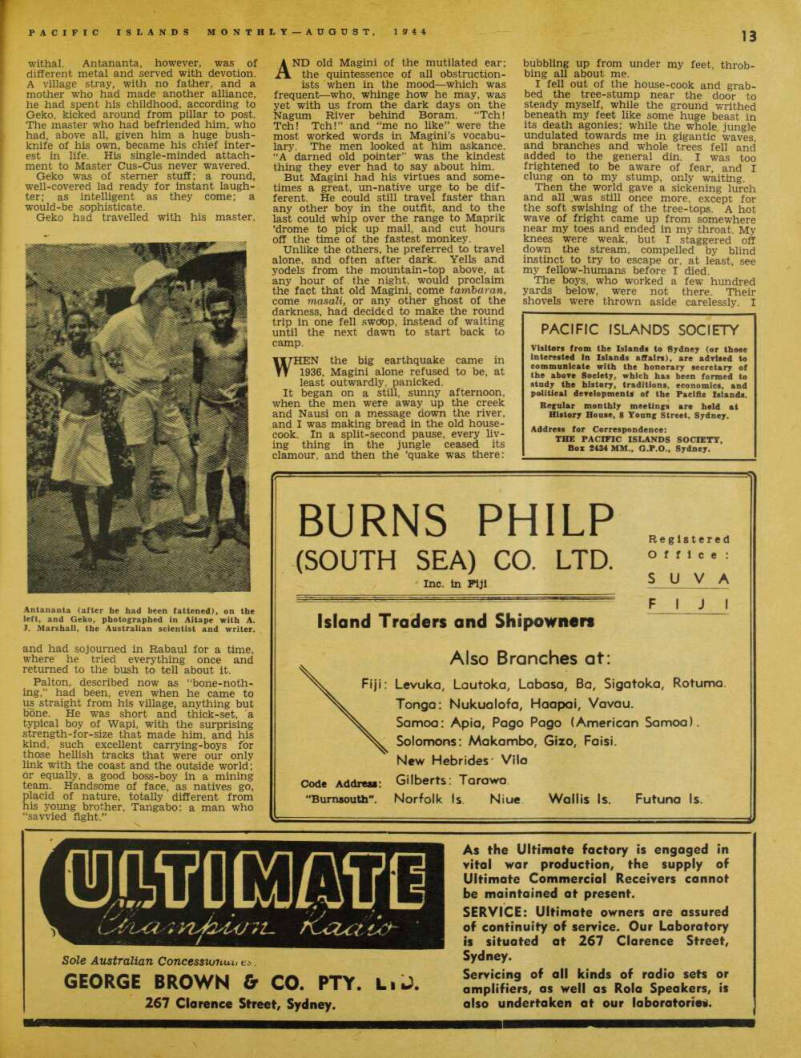
New Guinea
And Old Memories Stirred
By Judy Tudor
VOU will be interested to know that right now Geko and Antananta are with me—as pleased to see me after almost five years, as I was to see them.
They have been in their village all that time, not wishing to work for anyone else, and have had a pretty tough time during the past two years. But they are quite happy now, and a lap-lap, razor blade, some soap and a rice diet will soon have them back in their old shape.
Have just been talking to P alt on, Weihe, Samer and Tangabo; they are with a cafrier line and we are all in Geko’s country. Palton is “hone-nothing”; these Wapi boys, too, have had a bad time, hut before long they will all fill out again.
The boys asked for you and other of our friends of the good old Ulahau days.
All the other boys are back in their villages.
I expect the old names bring back memories to you, as they do to me; particularly of the early days with just Geko, Antananta, Nausi, Palton, Tulawai, Amoni and old Magini. Magini is still going strong in his village. I’ll bet he is one of the “lapuns” now.
THAT, from a recent letter from a friend “somewhere in New Guinea,” indeed brought the memories flow ing back. Several times since I said good bye to the Ulahau-back-of-But, I have decided that sort of life will never again be for me; but it needs only mention of those names to start nostalgic hanker ings for the “big bush”; for the musty, fusty smell of the New Guinea jungle which, once smelled is never forgotten; even for the mud and the leeches, and a sac-sac house, and food from a tin and bread sour with -weevils.
Possibly only a strong dose of this hair of-the-dog-that-bit-me will cure my chronic troppo-itis; that my line of ter
ritory fills the hearts of few people to overflowing, I am well aware. But it is for the few that this story is fashioned.
Geko and Antananta came from coun try inland and south of Aitape; probably from what has been described by A. J.
Marshall as the land of the “whistling talk” people; “new” country that had had little contact with Europeans before the war and which we had not seen “Have you heard these two holding whistling conversations with each other?” th ®£ r ? aster asked us one night at dinner No, said we. “How come?”
Antananta was in another house fur up the hill; Geko was therefore called m and instructed to “sell the talk ” per whistle, to his confrere—to instruct him to bring down his master’s tobacco and pipe.
Geko immediately coy, made several attempts to whistle his message, but each time, under the battery of three pairs of .interested eyes, his lips unpuckered and parted in a wide grin. Finally he turned J . T n us and pottering around with some dishes on a side table, got his mes sage off. Nothing extraordinary about if clear but not piercing, rather like the aimless, unmelodious whistle of an engrossed child.
“Antananta must be psychic if he can make anything out of that,” I said; but in two or three minutes the monkey came running down the steps and matter-of factly placed his master’s pipe and tobacco tin on the table.
“Fashion belong me fella,” was their only explanation of this purely native form of “walkie-talkie” wireless.
Antananta, even in a land of “bone-nothing” people, was definitely skmnv; to describe him merely as thin would have been to paint too inade quate a picture. He came in to us from the beach with a line of 20 new recruits from Wapi; his master and Geko to fol low later. The Wapis, with gusto, intro duced themselves; but, onlv after thev had finished their clamour, did we notice this poor, thin, little creature, sitting huddled on a fallen tree, a brand-new white lap-lap hitched around incredibly narrow bins in honour of this meeting and a bush knife, his one prized posses sion. and lately given him by his new master, clutched convulsively in his hands. He and the exuberant Wapis were not one-talks, and he sat alone, half petrified with fear.
“You bov belong who’s’at?” we asked “Me boy belong Master Cus-Cus. Behind ’e come look ’im me,” he hastened to assure us.
“Call ’im name belong you?” we said “Anfawanta,” he replied, running all the syllables together into an unintelli gible mess.
We didn’t get it at all. “Call ’im one time more!”
“Antananta,” he tried again, somehow adding even greater length to the jaw breaking name.
“Name belong ’im ‘Antananta.’ Tm ’e bov belong Master Cus-Cus!” shrilled the Wapis in chorus.
“OK OK. Name belong ’im ‘Anta nanta.’ ” we said. “Anta-nanta. vou go along house-cook, one-time Nausi.”
Antananta needed no second bidding.
Still clutching the large knife, almost as thick through as he was himself, he scuttled into the sanctuary of the house cook; and, until his master appeared a few days later, could scarcely be per suaded to leave it, “Holy smoke!” we exclaimed. “Where on earth does Ted get them? Those pipe-stem legs . . . !”
NAUSI, too, was one of Master Cus- Cus’ waifs; a mission monkey, edu cated at But, but a pain in the neck
withal. Antananta, however, was of different metal and served with devotion.
A village stray, with no father, and a mother who had made another alliance, he had spent his childhood, according to Geko. kicked around from pillar to post.
The master who had befriended him, who had, above all, given him a huge bush knife of his own, became his chief inter est in life. His single-minded attach ment to Master Cus-Cus never wavered.
Geko was of sterner stuff: a round, well-covered lad ready for instant laugh ter; as intelligent as they come; a would-be sophisticate.
Geko had travelled with his master.
and had sojourned in Rabaul for a time, where he tried everything once and returned to the bush to tell about it.
Palton, described now as “bone-noth ing,” had been, even when he came to us straight from his village, anything but bone. He was short and thick-set, a typical boy of Wapi, with the surprising strength-for-size that made him, and his kind, such excellent carrying-boys for those hellish tracks that were our only link with the coast and the outside world; or equally, a good boss-boy in a mining team. Handsome of face, as natives go, placid of nature, totally different from his young brother, Tangabo: a man who “savvied fight.”
AND old Magini of the mutilated ear; the quintessence of all obstruction ists when in the mood —which was frequent—who, whinge how he may, was yet with us from the dark days on the Nagum River behind Boram. “Tch!
Tch! Tch!” and “me no like” were the most worked words in Magini’s vocabu lary. The men looked at him askance.
“A darned old pointer” was the kindest thing they ever had to say about him.
But Magini had his virtues and some times a great, un-native urge to be dif ferent. He could still travel faster than any other boy in the outfit, and to the last could whip over the range to Maprik ’drome to pick up mail, and cut hours off the time of the fastest monkey.
Unlike the others, he preferred to travel alone, and often after dark. Yells and yodels from the mountain-top above, at any hour of the night, would proclaim the fact that old Magini, come tambaran, come masali, or any other ghost of the darkness, had decided to make the round trip in one fell swdbp, instead of waiting until the next dawn to start back to camp.
WHEN the big earthquake came in 1936, Magini alone refused to be, at least outwardly, panicked.
It began on a still, sunny afternoon, when the men were away up the creek and Nausi on a message down the river, and I was making bread in the old house cook. In a split-second pause, every liv ing thing in the jungle ceased its clamour, and then the 'quake was there:
bubbling up from under my feet, throb bing all about me.
I fell out of the house-cook and grab bed the tree-stump near the door to steady myself, while the ground writhed beneath my feet like some huge beast in its death agonies: while the whole jungle undulated towards me in gigantic waves and branches and whole trees fell and added to the general din. I was too frightened to be aware of fear, and I clung on to my stump, only waiting.
Then the world gave a sickening lurch and all .was still once more, except for the soft swishing of the tree-tops. A hot wave of fright came up from somewhere near my toes and ended in my throat. My knees were weak, but I staggered off down the stream, compelled by blind instinct to try to escape or, at least, see my fellow-humans before I died.
The boys, who worked a few hundred yards below, were not there. Their shovels were thrown aside carelessly. I
Antananta (after he had been fattened), on the left, and Geko, photographed in Aitape with A.
J. Marshall, the Australian scientist and writer.
yelled to them, and they came straggling out of the bush, looking even more scared than I felt, and yellow about the gills.
I sat down on the bank (so that they could not see my knees knocking) and told them off in straight English—my Pidgin had gone with the ’quake— demanding to know why, if they must run, they had run to the bush. “Big fella
guria! Big fella guria,” they chanted, by way of an answer.
But old Magini said: “Boy ’e got big fella fright. ’E like run-run-run too,” with the emphasis on the “too” and a sidelong look in my direction as if to say; “Just how come you here, lady, if you also did not run-run-run?” rAT night, the gurias were still roll ing up on a two or three-minute schedule, yet the men of our various establishments declared for bed and sleep notwithstanding.
But not for me! I, unfortunately, am cursed with an imagination; I had lived in earthquaky New Zealand; but, above all else, I had seen plenty of the local results of their infernal gurias: moun tains with huge slices taken neatly off their sides; valleys filled with a rubble of dead coconuts, trees and native houses; huge rivers blocked and turned into lakes. How, then, could anyone turn in and sleep peacefully in a grass hut, clinging to a mountain-side and sur rounded by tall, ridiculously small-rooted trees?
If trees did fall and kill me, I com forted myself sourly, or lopped off half my legs, then it would be someone else’s fault. I could picture myself maimed or dead and the gruesome details of the scene very easily on that grim night, with the darkness and rumble of the ’quakes without, and the dim light of the hurricane lantern within. I tried to read a two-months-old newspaper, but my mind kept returning to relish the fancied fury of my mother when she knew that her favourite daughter had been exposed to such a death, and so wantonly, by the male members of the concern.
The boys had been given permission to go to an open piece of ground down the river, and all but Magini had done so without hesitation. Magini stopped, for some weird reason of his own; but he did not sleep, either. At intervals throughout that night he let out loud whoops and yells to encourage himself; and I felt a great, un-British, un-white woman’s burdenish desire to go down and join him. At least we could have whooped together.
Advertisements & other items, pp. 14-16 (2 items)
W. H. Grove & Sons
Refreshing
as a plunge
into a lagoon!
Germicidal
and fragrant
TENAX TOILET SOAP is
a rapid safeguard against external skin infections, yet it is soothing and kind to the most sensitive skin —even a baby’s!
ORDER TENAX FROM
YOUR ISLAND SUP-
PLIERS. STOCKS ARE
PLENTIFULLY AVAIL-
ABLE.
W. H. GROVE & SONS
Limited
AUCKLAND
island Traders. p.o. Box 490.
Telegraphic and Cable Address: “Grove”, Auckland.
Shippers of oil classes of New Zealand products.
Representing English Manufacturers throughout the Cook and Society Islands, Fiji, Tonga, Samoa, Niue, New Caledonia, New Guinea, etc.
In FIJI as—W. H. Grove & Sons (Fiji) Ltd.
Burns Philp
PACIFIC ISLANDS SOCIETY
Visitors from the Islands to Sydney (or these interested in Islands affairs), are advised to communicate with the honorary secretary of the above Society, which has been formed to study the history, traditions, economics, and political developments of the Pacific Islands.
Regular monthly meetings are held at History House, 8 Young Street, Sydney.
Address for Correspondence:
THE PACIFIC ISLANDS SOCIETY,
Box 2434 MM., G.P.0., Sydney.
BURNS PHILP
(SOUTH SEA) CO. LTD.
Inc. In Fiji
Island Traders and Shipowners
Registered Office :
SUVA
FIJI
Also Branches at: \Fiji: Levuka, Lautoka, Labasa, Ba, Sigatoka, Rotuma.
Tonga: Nukualofa, Haapai, Vavau.
Samoa: Apia, Pago Pago (American Samoa). nv Solomons: Makambo, Gizo, Faisi.
New Hebrides' Vila Code Address: Gilberts: Tarawa "Burnsouth". Norfolk Is Niue Wallis Is. Futuna Is.
Sole Australian Concesswiiui, t*.
GEORGE BROWN & CO. PTY
267 Clarence Street, Sydney.
As the Ultimate factory is engaged in vital war production, the supply of Ultimate Commercial Receivers cannot be maintained at present.
SERVICE: Ultimate owners are assured of continuity of service. Our Laboratory is situated at 267 Clarence Street, Sydney.
Servicing of all kinds of radio sets or amplifiers, as well as Rola Speakers, is also undertaken at our laboratories
Purchasers at Full Market Prices on Assay Value of
GOLD
SILVER
PLATINUM
And Platinum Group Metals
SOME OF OUR SERVICES
AS SAYERS & ANALYSTS—
Assays of Bullion, Ores, etc.
Analyses of Metals, Minerals, Alloys, etc.
SCIENTIFIC & INDUSTRIAL
METALLURGISTS—
Our range of precious metal manufactures covers all Industries—Gold and Silversmiths, Electrical Trades, Dental Profession, Glass Sllverers, Electro-Platers, etc., etc.
REFINERS—
Purchasers and Refiners of Bullion, Scrap, Mining By-Products, and Trade Residues of every description carrying Precious Metals.
GARRETT & DAVIDSON
PTY. LTD.
824 George St., Sydney. Works: Surry Hills and Chippendale, N.S.W.
Official Assayers to the Bank of New South Wales. Gazetted Agents of the Commonwealth Bank of Australia, under the Gold Regulations of the National Security Act.
Steamships Trading
Company Limited
PORT MORESBY SAMARA I PAPUA.
WHOLESALE & RETAIL MERCHANTS, SHIPOWNERS,
PLANTERS, ENGINEERS & SLIP PROPRIETORS'
Customs, Shipping, Insurance, and Forwarding Agents.
MANAGING AGENTS AND VISITING REPRESENTA-
TIVES FOR COCONUT AND RUBBER ESTATES.
SYDNEY REPRESENTATIVES: Nelson & Robertson Pty. Ltd., 12 Spring Street.
WARTIME ADDRESS
Until further notice, clients may address all communications as follows;
STEAMSHIPS TRADING COMPANY LIMITED,
C/o NELSON & ROBERTSON PTY. LTD.,
12 SPRING STREET, SYDNEY.
Joy of the Liberated
Gilbertese
Jl SONG, written by Lakobo, of
Kuria Island, in the Gilberts, and sung by the people of Kuria at a special ceremony, on the occasion of the first visit of the British District
Officer, Major F. J. Holland, OBE,
GM, after his landing on nearby
Abemama with counter - invading American Forces. (Translated from the Gilbertese) We are in merry mood.
The warships are now safely at anchor.
Their crews roam our shores.
Chorus: Men, women and children, Fear no more.
All enemy forces have been annihilated.
A secure life to everyone is now assured And freedom is ours.
The warships are from America.
Which is now protecting us.
Merrily, merrily they sail along. (Chorus repeated) We have heard the glad news.
The capture of Tarawa is confirmed.
Abemama and Makin have been liberated. (Chorus repeated) Our friend Major Holland was with the Americans When they landed at Tarawa.
Be happy! For our cause is victorious. (Chorus repeated) The fortifications on Betio were very strong.
Every part of the island was guarded Coastal defence guns surrounded it. (Chorus repeated) The brave Americans made their landings Under heavy gunfire from the beaches They fought until all the atoll was theirs. * (Chorus repeated) Our hearts are filled with joy Because the Allied Forces have come among us.
We thank our liberators a thousand times. (Chorus repeated) Miss Eleanor Rose Stansfield, younger daughter of Mr. and Mrs. Harry Allen, of Suva, Fiji, was married on June 14 in Suva, to Staff-Sergeant Reginald Graham Morten (NZEF). son of Mrs. L. E. Mor ten, of Auckland.
Mrs. Gertrude May Leask died in the Colonial War Memorial Hospital, Suva Fiji, on July 8. She was the widow of Mr. George Leask, a civil engineer in the service of the Fiji Government, who died in the Colony 25 years ago. Mrs. Leask resided in Australia for many years, but six months ago she returned td Fiji to live with her daughter, Mrs. E. W. Har ness, of Suva.
The Chinese Vice-Consul, Mr. Y. S.
Chen, was transferred to Chungking, at the end of July, where he will work in the Ministry of Foreign Affairs. His suc cessor in Suva is Mr. V. C. Tsang, who was formerly Vice-Consul in the Chinese Consulate-General at Calcutta.
Happily
Where Two Races Mingle Happily New Zealand's Good Record in Cook Islands
From Our Own Correspondent
Rarotonga, June 6.
A GOOD deal has been said recently about “the dead hands of Canberra and Wellington” and their effect on the development of Pacific Territories.
The Cook Islands are not often men tioned in these discussions—they are small, unimportant, and probably do not weigh the scale one way or the other.
The Mandated Territory of Western Samoa is New Zealand’s largest tropical administration, and has grabbed most of the publicity, which would suggest that this has been ignorant and inefficient.
The 15 small and widely-scattered islands of the Cook Group have been administered by Wellington since 1901.
For 43 years the 14,000 native inhabitants of these islands have lived with dignity and security in co-operation with this Administration.
This period has been immune from any suggestion of serious disaffection. In fact, the loyalty of the Cook Islanders is a source of considerable pride to them; and this is evidenced by their whole hearted participation in both world wars.
At the present day, two main factors emerge as examples of wise and tolerant government. These are:— (a) Every acre of land, barring a few small sites for Government buildings, is owned by the natives of the Cook Islands.
It is impossible to purchase land, and leases are now restricted to terms of 60 years. At first glance this might seem seriously to retard the development of the Territory, but it is a long-term policy which is expected to reap a just reward when the natives, are sufficiently advanced
to make the best possible use of their own resources for their own benefit. (b) Nowhere, perhaps, in the world, is race prejudice less apparent. Natives and Europeans abide by one code of laws.
They mix freely in social and business contacts and it may be said that, barring a few transitory malcontents, each race has a proper and discriminating regard for the other’s “way of life.” The half caste is not a social misfit, but a valued and responsible member of the com munity. rE New Zealand Government has provided an average of £24,000 annually for many years for the upkeep of free educational and medical services. The population is steadily on the increase. Yaws and hookworm, once prevalent, are now practically wiped out, and a campaign is at present being waged against the remaining enemy, tubercu losis.
Economically, conditions have been stable. The Maori has never been com pelled by circumstances to desert his traditional attitude of dignified indepen dence. No European business has become bankrupt or has withdrawn for economic reasons during the past 20 years.
Much, of course, remains to be done; but it is realised that the Polynesian people, of all peoples, cannot be hurried.
Remarkable adaptability in the Maori character is matched by a stubborn con servatism which cannot be over-ridden.
The rapid development of the aeroplane and its attendant modernisation will probably force the New Zealand Govern ment to readjust, in some degree, this policy of a native reservation. However, discounting outside interference, it may be expected that this will be done with out disregard for the primary interest of New Zealand’s past administration of the Cook Islands—the welfare of the kindly Polynesian folk who inhabit them.
Captain Thomas H. Switzer, well-known Port of Brisbane, pilot and formerly an officer on the old Papuan Government ship, “Merrie England,” died in Brisbane on June 18, aged 81. He took part in the survey of the boundary of Dutch New Guinea, and a reef between the Cape Melville and Howick Groups was named after him. He is survived by a daughter and five sons.
Advertisements & other items, pp. 17-18 (1 item)
Cox, Findlayson & Co.
THE
YORKSHIRE
INSURANCE
CO. LTD.
(Incorporated in England)
FIRE
ACCIDENT
MARINE
FIRE POLICIES ISSUED
IN PAPUA
All information from —
E. A. JAMES,
TeL 86347. Attorney for Papua, 14 Spring St., Sydney
Ask COX, FINDLAYSON for .. .
ESSENTIAL OILS
AROMATIC CHEMICALS
PERFUME COMPOUNDS
FLAVOURING ESSENCES
If we cannot supply your exact requirements we may be able to suggest suitable replacements
COX, FINDLAYSON & CO.
Manufacturing Chemists, Distillers and Perfumers, 472-482 Harris Street, Sydney, N.S.W.
7 JL '
“Submarine on the starboard quarter” ...
In his book "Heroes of Fighting R.A.F.”, Leonard Gribble tells a thrilling story of the rescue of thirty-four of a ships crew by flying boats of the British Coastal Command.
The freighter "Kensington Court”, deep
laden with wheat, was ploughing through heavy seas towards the British coast.
Suddenly the cry: "Submarine on the
starboard quarter”.
The "Kensington Court”, unarmed, ran for it. And out went an S.O.S.
Overhauling the freighter, the U-boat began shelling at short range. The "Kensington Court” was doomed. As the crew was taking to the boats, two flying boats roared out of the clouds. The U-boat crash-dived.
Within minutes of the sending of the S.O.S. the rescue of the "Kensington Court's” crew was being staged in a fresh sea. The sailors in an inflated rubber boat were hauled from their lifeboats to the
tossing ’planes.
Another chapter in the history of the part radio plays in this war. * * * Aeroplanes, ships, guns and radio. Australian industry to-day is producing everything for her own defence. But radio makes them into one powerful striking force. We owe much to the Australian resourcefulness and courage which made possible the building of all such equipment in Australia.
Whilst Australian enterprise is free to build and plan we need never fear being cut off from our sources of supply. —Amalgamated Wireless (A/asia) Ltd.
Sophisticated !
The Solomon Islander Wants To Be
An Account of Events in ESI During and After the Jap Occupation
By Donald Gilbert Kennedy
rjIHE Japanese, having established them- X selves at Tulagi and Guadalcanal, in May, 1942, began to explore and patrol the coastal areas in proximity to their main camps, wherever they went, they endeavoured to contact the natives, to make friends and to spread propa ganda. Acting apparently under strict orders, they made no attempt to molest the people. But their whole propaganda set-up failed. It failed dismally, and it failed through ignorance of one particu lar aspect of native mentality: No native could be friends with a man who had stolen his pig, or who had coun tenanced the stealing of his pig, or who had partaken of his stolen pig. And every Japanese on patrol had offended in one of these ways. The exponents of the propaganda of co-prosperity were ignor ant of this basic principle of native life.
A man’s pigs were his money in the bank, his title deeds to rank, the gift with which he capped the marriage feasts of the daughters of the clan. The ignorant Japanese officers allowed their men to rob, not only pig-styes, but also fowl runs, gardens and even clothes-lines and clothes-boxes for the scanty, worn and pitiful raiment of a native’s wardrobe. In the gardens, they often destroyed valuable plants by pulling them out of the ground, merely to ascertain whether there were edible tubers at the roots.
In the offences committed by white men in the past, these things had never been included. Although the white men had lost some prestige in native eyes, the Japanese had certainly put themselves completely beyond the pale. The coastal natives had lost their pigs, poultry and growing crops. The Japanese had lost whatever tolerance that may have come their way. Their loss was our gain and it behoves us not to forget that it was at some cost to many coastal villages.
Furthermore, in areas where the Jap anese made permanent camps—in Gua dalcanal, Florida, at Viru, Munda, Ren dova and Gatukai in the New Georgia Group, and in other places—the natives were forced to evacuate their villages, the houses of which were promptly torn down by the ant-like heirs of the Sun God to make bivouac shelters and roofs for gun pits and fox-holes. The natives moved to less accessible places and made new vil lages and gardens. They suffered from fever and other sickness in the damp jungle while their new homes were being prepared; they went on short rations until their new gardens came into bear ing. But there was surprisingly little grumbling and there was no talk of appealing to the Japanese for aid. They laid their material losses to the fortunes of war. fTIHE United States Forces captured Jl Tulagi and Guadalcanal in August, 1942, without great losses. The natives had been living and enjoying a semi-independent life of action. But with the occupation of their respective areas, from Guadalcanal to Bougainville, by our victorious forces, many left to seek em ployment in the Native Labour Corps, to sell curios and souvenirs to the forces v and to gaze, in awe, at all the astonish ing war paraphernalia of a machine-age civilisation.
Yet less than 10 per cent, of the people have had the privilege of so gazing. The remaining 90 per cent, will continue to live their humdrum lives in their remote
villages, to listen to the tales of their returned adventurers and to take their share of the spoils which accompany these on their home-coming. Many of the Solomon Islanders will never see an American. Such is their remoteness over steep mountain trail and deep ravine.
To natives who have rarely seen more than one 3,000-ton ship, at one and me same time, between themselves and the horizon, the appearance of a whole con voy of 10,000-ton transports, flanked by the long, low, creeping grey shadows of its naval escort, is a sight to hold them spell-bound.
On that memorable morning of August 7, 1942, from the high mountain villages of Guadalcanal, many an old man and shy “mary” who might never see an American in the flesh, gazed iii “wild surmise” at those forbidding grey shapes creeping silently along their coastal waters to deliver the first amphibious attack on the arrogant Nips who were then preparing to operate an airfield at Lunga.
After a few weeks, reports began to trickle back from the natives who had succeeded in establishing contact with the Marines, telling of shattering bombs dropped out of the sky, by day or night, of men tumbling into fox-holes, of men killed and men wounded, of coconut groves withered by the blast of war, of ’planes hurtling from the sky; of strange looking ships which opened at the bow and spewed on to the foreshore a rolling
traffic of trucks and bulldozers and half tracks and tanks and every variety of macnme Known to mechanised war. rE effect on the natives was stunning.
What the Japanese, or the labourers for the white man of the old, peace ful plantation days, had taxen weeks to perform with picK and shovel, the white men direct from the very homes of white men, were performing instantly, with miraculous, new, mechanical servants, which obeyed their every behest. Hills were swept away, rocks flattened, rivers bridged, houses erected, great holes exca vated in a matter of minutes. Our Melanesian watchers slipped back to the awe their grandfathers had known when the first great, white-winged canoes appeared over their horizon.
The white man had regained his pres tige. There was no explaining these astonishing things and this unheard-of mass-energy in the simple vocabularies of the islands. The eloquent know-alls would have to go to school again. And the pic ture was the same with every fresh land ing—the Russell Islands, Sege and Munda, Vila and Vella Lavella, Treasury Island and Empress Augusta Bay.
The Melanesian does not understand the significance of these things. He is caught in the vortex of something entirely strange and new, like his ancestors before him. But he hates to appear unsophis ticated, and so you see him to-day, on Guadalcanal, nearly two years after the first Americans landed and captured what is now the famous Henderson field, jostling his fellow-humans, in the round about of camp life, and imitating care fully their every look of worldly wisdom.
Here, on the main trunk road which parallels the beach, are unbroken lines of traffic roaring through the daylight hours.
There are lorries full of Uncle Sam’s men of all services; trucks packed with negroes; groups of Marines, sailors and soldiers, in twos and threes, going their
various ways with hopeful hitch-hike gestures. Here and there are groups of Solomon Islanders sauntering unconcernedly by the wayside, each dressed as
“s-a leatherneck's
doughboy’s trousers with nothing in between but a small, wiry, coal-black bod y and a face striving to look as sophisticated as that of any negro around.
Most of them seem to attach great importance to the magical charm of the identity disc, and there are few who have not a coin-shaped bit of bright aluminium, scratched with hieroglyphics and dangling from a string necklet. , .
an^C erT by’profS l artTste They
tov e sm S mar-
"enld 1“ thl technique of HawSfan
guitar an( i ukulele bands with their pi on king rhythmical tunes dear to the hearts of all islanders. When a cinema story 15 unintelligible through their failure to follow the speech, there is always an American buddy ready to interpret for them -
Advertisements & other items, p. 19 (1 item)
Coleman
QUEENSLAND
INSURANCE
COMPANY
LIMITED
(Incorporated 1886 in Australia)
ASSETS EXCEED £3,500,000
Head Office:
PITT & BRIDGE STS.,
SYDNEY
Speciolists in South Seas Fire,
Marine Cr Accident Insurances
Apply to: —
FIJI.
Branch Office: H. J. Moorhouse, Manager.
Burns Phllp (South Sea) Co., Ltd.
VILA.
Burns Phllp (South Sea) Co., Ltd.
Comptolrs Francals Des Nouvelles Hebrides (Marine).
NOUMEA.
L. & W. Johnston.
PAGO PAGO.
Burns Philp (South Sea) Co., Ltd.
G. H. C. Reid & Co.
OTHER SOUTH SEA ISLANDS.
Burns Phllp (South Sea) Co., Ltd.
Also to any of the Company’s Offices in Australia or New Zealand.
Coleman
IS SERVING THE ARMED FORCES
WITH THREE ESSENTIALS OF
LIFE . . .
Light—Heat-Warm Food
Hi Wherever the Armed Forces of the United Nations need quick heat and bright light you’ll find Coleman Lanterns and Stoves. On board steamers, at landing fields, in mobile canteens, emergency hospitals, air-raid shelters, and in actual combat, Coleman appliances are providing invaluable service.
We regret any inconveniences caused through shortage of new stock for civilian requirements, and suggest you keep your present Stove and Lantern in good repair by contacting your local Distributor.
THE COLEMAN LAMP & STOVE CO. LTD.
TORONTO CANADA
Possible Cure For Malaria
AMERICAN scientists think that they might have discovered a cure for malaria. For security reasons, the nature of the drug is extremely hush hush, and it is believed that at this stage the new treatment contains an element of danger.
The scientists have been aided in their research by volunteers from the Atlanta (Georgia) penitentiary, who allowed themselves to be infected by anopheles mosquitoes. These experiments were con sidered necessary because neither quinine nor atebrin effect a complete cure for malaria, and the new drug might revo lutionise treatment in combat areas.
Father Tremblay's Jubilee
Celebrated In Haapai
From a Special Correspondent HAA p AI , Tongi, June 27.
T H E 19th day of thl s month was a red -1 letter day at Lifuka, Haapai. Mem bers of the Catholic Church, as well a s hundreds of other churches, crowded the IVlission Onmnnunri fn ppiphmfp flip silver Slee of the Rev Father E Tremblay SM a native of the USA ■ Lr^ ***■> a i a “ ve 01 tne USA.
Since Father Tremblay came to Tonga 5, e .r a I s . made many friends amongst the Catholics and other denominations. His kindness and generosity are bywords in these isla^s.
The Sisters of the convent issued an invitation to a dinner, and when the S uests arrived they found a table over 10 .° lon S laid out, Tonga fashion, with edibles fit for the greatest epicure.
In the evening the children of the con vent gave a concert, which was a great success. Thanks are due to the Sisters for the great P atience they took in train mg these chfldren so that they were able to P erfo ™ their task 50 admirably, The hope was expressed by everyone that Father Tremblay would see 1969, and his Golden Jubilee as a shepherd of his flock and a servant of his Church.
Mr. Sydney H. Chance, formerly of the Papuan Public Service, who has been living in Brisbane for two years, returned to Pa P ua > in July, in the uniform of the American Red Cross Society, as a field editor, Sir Phillip Mitchell, Governor of Fiii and a party under the leadership of Mr!
Pat Costello, recently took a four-dav horseback trip into the interior of Viti Levu, from Tavua across the ranges to the upper reaches of the Sigatoka River
Advertisements & other items, p. 20 (1 item)
90 Years
S WALLOWi ARIE LL m.
I iscaus • nai mboiics . cuts . micia . ici ciua >jyt»
Sister Susies From
Fiji
By Dorothy Weaver
SOUTH Sea Susies knit socks for South Sea soldiers! Sounds fantastic, but these brown-skinned, fuzzy-haired lasses from Fiji and their achievement are far removed from fantasy. In 13 short weeks a small band of European ladies, resident in Suva, taught over 230 native women—all but five of whom had never held knitting needles in their hands before —to knit.
These native women, many widely acclaimed for their fine needlework and embroidery, took quickly to the art of purling 2 plaining 2. Needles and wool were purchased for them and instructions were translated into the Fijian language.
To them, to knit is “talitali”; plain becomes “peleni,” and a row is “yatu.”
They then went ahead to disprove the statement, made when it was first sug gested that the native women could be taught to knit, that it would be a “waste of wool.” Turning the heel pre sented a problem for many, but with the aid of Circle sympathisers, dropped stitches were recovered, heels turned and toes cast off. What one Fijian girl learned she was only too eager to pass on to two or three of her friends—and the knitting craze was on!
Nurse-girls kept one eye on the baby and one eye on the ribbing; cooks cast on while the pie browned; cronies squat ted on curbstones mingling their chit chat with the cheerv click, click, click of busy needles.
The idea quickly spread and women in the outlying districts of Suva became members of the unique Knitting Circle.
Many of them have relatives and friends serving with the Fiji Infantry Battalions and Commando Forces in the Solomon Islands area. The husband of one was recently killed in action. One old lady is 60. Another is blind in one eye. They are an ordinary small-town community of wives, sisters and friends, and they know that many of the Fijian boys, the majority of whom have been accustomed to go bare-footed, are finding those Army boots a trial—even for world-renowned jungle fighters!
WITHIN 13 weeks from the commence ment of the Circle’s activities, they gave a display of their work—2lo pairs of socks, and four long-sleeved pullovers. Several women continued to knit as they sat crosslegged on the floor listening to the speech of congratulation given by a senior chief at this display.
This first consignment of socks will now be sent on to the native troops in a forward area, each native woman supply ing the name and address of a soldier to whom she wished her socks to be sent.
And so these native women have become members of the “Sisterhood of Susies who knit socks for soldiers,” and until their boys come marching home from the war-blasted jungles of the tropical battle-fronts, they intend to keep up the good work of “peleni 4, peleni vata 2, peleni 1, saumaka.”
Ratu Dovi Komaisava, a member of one of the special contingents of RAF trainees from Fiji and the only Fijian in the RAF. has been seriously ill in hospital in England for several months. Admitted originally with an attack of pleurisy which the doctors expected to clear up within a few days, complications devel oped which have put Ratu Dovi on the ‘seriously ill” list for a considerable time.
Latest advice is that he is improving.
"Penal Sanctions"—And
Indentured Labour
By Mollie Lett
rE abolition of labour contracts, that is, indentured labour, was a mea sure Sir Hubert Murray feared would be introduced before the natives were ready for it. Sir John Harris, of the Anti-Slavery and Aborigines Society, Lon don, wrote, only in May, 1939, to Sir Hubert that the whole subject of labour contracts was being considered, and that abolition of indentured labour and penal sanctions was possible.
With the abolition of penal sanctions, settlers will have to be prepared to allow natives to break contracts with impunity;
for, as a defendant in a civil action, a native is worthless. Having no money except his wages, and his lands being secure, he can do as he chooses. Sir Hubert wrote on the subject only a short time before he died. “Personally,” he stated, “I should be glad to see inden tured labour replaced by free labour, but I do not think that this will come about until the native has developed a sense of responsibility that will hold him to his contract without penal sanctions; and it appears to me that when we can do with out penal sanctions, we can do without indentured labour altogether.”
The Rev. J. W. Dixon, of the Methodist Mission, is expected to leave for Papua shortly.
Advertisements & other items, pp. 21-22 (1 item)
Riverstone Meat Co. Ffi:
fA , m
ADD VARIETY to your
HOT-WEATHER MEALS
Typical of the tasty, tempting, quick-serve foods offered by “Imperial” is “Meatreat.” This canned corned beef is prepared by the special “Imperial” process which seals in all the natural flavour, colour and rich nourishing juices of the meat. Served with salads, “Meatreat” makes an ideal hot-day dish.
Other “ Imperial ” products which will help you add variety to your hot-weather meals are : "Imperial" Camp Pie.
"Imperial" Beef & Pork Sausages "Imperial" Sheep's Tongues.
"Imperial" Hampe— the meal-in-a-moment.
Every one of these “ Imperial ” products offers you the delightful flavour of fresh meats at their very best. Ask for them to-day.
PRODUCTS OF «
RIVERSTONE MEAT CO. ffi:
Fiji Representatives: Pearce & Co. Ltd., Suva.
Modern Refrigeration for the South Sea Islands
The ELECTROLUX
KEROSENE OPERATED
REFRIGERATOR
MARVEL
OF
MODERN
SCIENCE
m
THE
MIRACLE
OF
ICE
FROM
HEAT
ELECTROLUX OFFERS ECONOMICAL, modern and completely efficient
REFRIGERATION FOR ISLANDS' HOMES.
FREEZES CONTINUOUSLY WHILE SMALL LAMP BURNS.
Freezing controlled by simply regulating height of flame. Uses only gallon of kerosene per week.
MOTOBLESS ... NO PARTS TO GET OUT OF ORDER.
MODEL 121
Capacity 2.3 cubic fact.
MODEL L3BO
(as illustrated) Capacity A cubic leet.
MODEL LKSSO
Capacity 5.5 cubic feet.
GUARANTEED FOR TWO YEARS.
• Write to your Local Distributor for prices and full details.
OBTAINABLE FROM ALL W. R. CARPENTER & CO. LTD.
BRANCHES THROUGHOUT THE ISLANDS
Representation in Papua and New Hebrides.
Psalm-singers Go To Town!
Town!
Joy of Living in the Cooks
Prom Our Own Correspondent
Rarotonga, June 6.
WHEN first we came to the Cook Islands, we went to live in a little house cosily situated 50 yards from an “are uipa anga” (village hall).
This “are” is the centre of local village life. Under its galvanised-iron roof the elders gather to discuss such weighty problems as the next church outing or the coffin insurance fund. The village football team regularly gathers there to offer up a short prayer, with one eye on the silver cup which they trust will con tinue to adorn their “are” for yet another year. Each Sabbath the children gather for Sunday School and render Sankey and Moody’s melodious hymns in sweet childish trebles. But chief among its many virtues, the “are uipa anga” is the scene of the oddest Sunday evening psalminising that we have yet been privileged to see (and hear).
The psalms of the Cook Island Maoris must be unique both in harmony and verse. The former might be compared to that which Gauguin might have com posed had he been a musician. The mighty drone of the men’s voices is imnressive, but fails to comnete success fully with the harsh and blood-curdling shrieks of the supuosedly weaker sex.
The words of the psalms are taken from Biblical texts but sometimes modi fied to suit present-day conditions. For instance, one that we are Quite familiar with deals with the well-known bout between “Koria” (Goliath) and “Davida,” and “Davida” is made to eventually down his enemy with a well-directed burst of machine-gun fire.
The music has a certain rhythm, and as this “hots up,” a little discreet hula hula is permissible, although not, of course, encouraged by fanatical deacons and suchlike.
The whole scene is lively and colourful and at first we felt rejoiced that we could thus observe, at close quarters, the quaint spiritual life of our kindly neighbours.
Then the fly in the ointment reared its ugly head —in the shape of the annual church festival. In three months’ time all the nsalm-singers in Rarotonga would gather for a knock-out competition, win ner take all.
Of course, this necessitated a little practice, and it was quickly borne in upon us that the lively and colourful scene would henceforth be with us not weekly, but nightly.
WE r too, are fond of a little music now and again, and it was not until we proposed to create some that the full horror of the situation dawned upon us.
Our gramophone, the trusted companion of many years, was a shocking second in the unequal struggle.
After hearing Goliath being bumped off 37 times in the first fortnight our nerves, although usually subservient, began to demand their rights. In less than a month our friends edged perceptibly away on meeting us in the street, and we decided it was time to quit. Not being able to wangle the traditional long sea voyage, we recuperated slowly at the mountain lair of a sympathetic friend.
We now live in a little house cosily situated about two miles from the nearest “are uipa anga” and it would be three if we could ever, by rugged determination, climb to such a hallowed spot.
N. Guinea Photographs Aid
War Damage Commission
mHE War Damage Commission reports X that, following the request for photographs of Chinatown, Rabaul, in “PIM” for June, a number of photo graphs were received by them. These proved most useful in connection with the assessment of property in that area.
However, the Commission is still with out a photographic record of certain parts of Chinatown, and any reader who has photos of this area but has not yet sent them to the Commission, is urged to do so. Every care will be taken of the ori ginals and they will be promptly returned.
It is also of interest to Papuan and
New Guinea property-owners who are insured against war damage, to note that photographs of their property—or pic tures of any other buildings in New Guinea—are useful to the Commission in assessing fixed property claims.
Name and address of sender, a descrip tion of the picture and, if possible, the date it was taken, should be written on the back of each photograph. They should be addressed to the War Damage Com mission, MLC Building, 44 Martin Place, Sydney.
Miss D. Rogerson, who was appointed to the office of the chairman of the Metho dist Mission in Suva, Fiji, three months ago, is still awaiting transport in Sydney.
Advertisements & other items, p. 23 (1 item)
A
“Govern Or Get Out!”
Authoritative Voice on ANGAU and Papua
Written for “PIM” by a Former Member of Papuan Public Service
RECENTLY, in a Boston (USA) publi cation, there appeared under the heading of “What Will We Do With the Marshalls?” the following pregnant paragraph: “Military occupation in Mandated Ter ritory has no precedent, as the mandate is a new thing in the modern world.
Under international law, a military occu pation, during wartime, is not supposed to initiate any changes, unless required by the necessities of war. Once order is restored, the rule for the civilian popula tion is ‘business as usual.’ ”
In principle, does not the final sentence now apply to the Territory of Papua— although it is an integral part of the Commonwealth? A Commonwealth mili tary force remains in occupation after order has been restored.
Were the matter tested in the Courts it almost certainly would be ruled that the continued contumacy by the military, in continuing to completely occupy the Ter ritory, under the guise of ANGAU. is an illegality.
The obvious course for ANGAU is to vacate Port Moresby as its headquarters, and occupy Lae, the formerly-decided-on capital of the Mandated Territory of New Guinea. Portions of the Mandated Ter ritory are still in enemy hands —Bougainville, Rabaul, Wewak, etc.—although well bottled up.
PAPUA, on the other hand, has been free of enemy occupation for about U years, with a very remote chance of its being re-occupied by the enemy in this war. That one or two garrisons, or supply stations, will still be necessary, is
a safe but they would not feature in the administration of the Ter ritory, which again would become civil.
'yn’ERE ANGAU to-day gracious enough T? to permit every former resident to return, and even to admit new comers, it could not lawfully govern them, it not having been invested with the necessary powers, as laid down under the Constitution of the Territory of Papua (Papua Act, 1905-24) which pro vides. inter alia, for the possession of the Public Seal, which most certainly should not be held by ANGAU.
Furthermore, whatever “changes it initiated” during occupation which should be solely for the purpose of resist ing. and driving the enemy from the Ter ritory—must come to an end “once order has been restored.” Its continuance of occupation after this happening does not permit it to exercise functions which were relegated to the properly constituted civil administration, which It ousted.
Nor can it legally repeal any laws and regulations relating to natives which were enacted by that Administration, or insti tute laws and regulations of its own “once order has been restored.”
Consequently, ANGAU can do no other than twiddle its thumbs and preserve order where necessary—or die of ennui.
It does not even have the legal power to dispense justice outside its own mili tary orbit. Not all “the authority” of the Commonwealth (except that might is right) can alter this condition. It would require an Act of Parliament to perfect it.
Although rights of transfer are on broad lines they do not go so far as to
furnish an open cheque without a limit.
Transfer is a means and not an end.
THERE is this about it, however: that were the military in Papua an invading conquering force, it could substitute laws and regulations for the populace. But ANGAU, as its appella tion denotes, never was such a force; it simply assumed protective guardianship.
That responsibility ended positively with the eviction of enemy forces, about the end of 1942, when “the rule for the civilian population was ‘business as usual.’ ” By retaining possession of the Territory, ANGAU assumes a dog-in-the manger attitude, and behaves against the best interests of the Commonwealth as a whole which, to give it its due, it has worthily protected.
Cannot it now come off its high horse and, in short, rest sweetly on its laurels, with the reflection of veni, vidi, vicit It would be most unwise for the Army authorities to remain in “administrative” possession “for the duration,” because that' period may be much longer than generally is anticipated. It would mean that, in the long interval, the Territory would slowly be strangled into a state of unconsciousness.
THE whole matter has to be looked at along broad lines, in the common interests of the Australian taxpay ers, and subscribers to loans. Papua, in 1925-26, totalled its imports and exports with £1,120.147. It should be capable of repeating this record, if given the chance, and so becoming less of a burden to the Commonwealth.
At this juncture, 1944, the production of the Territory is confined to the littoral between Daru, in the west, and Abau, in the east—a distance of only 500 miles, out of 1,728 miles on the mainland. This does not include 1,936 miles on the adjoining islands, which latter, of con siderable number, have an area of about 2.754 square miles.
These islands, between 1921 and 1926, in fishing products alone (beche-de-mer, pearl-shell, pearls, trochus-shell, turtle shell and shell NED yielded £161,233 in export value; copra, gold and gums (£5,275) being excluded. Total exports for those years were: Gold, £145,442, and copra, £713,519.
Such pearl-shells, gold and gums Aus tralia requires very badly just now. But the exiled residents of those islands, and of the east and north-east coast of the mainland, are debarred from returning to the Territory.
ANOTHER important matter ,is that the island of Samarai —the former warehouse for these exports—was razed in 1942, to baulk the Japanese, who twice had bombed it, and is no more now than a convalescent retreat for some members of the Forces.
Is it going to be re-established as an entrepot for the whole of the north, north-east, east and south-east divisions, or is another site to be selected?
Without something immediatelv being done, the valuable products of all these large magisterial divisions will have to remain sick and feeble, and they will represent a national loss of hundreds of thousands of pounds.
This is a good example of how a part of the Territory is already being strangled, when there is no necessity for it—not even a vestige of commonsense. rpHERE is the probability of newcomers JL to the Territory, such as ex-Service men, who may well be appalled at the prospect of nerhaps having to wait until the end of the two wars before they can ffo (or return as civilians) to Papua, to try their luck and help to again put it on its economic feet.
A cruel wrong is being done to exiled residents who. most of them no longer young men, are refused the opportunity to try and restore their fallen fortunes.
If the Commonwealth is going to play an important part in the Pacific Islands at its doors, it will have to do better than what is going on in Papua now—or else it will earn an unfavourable reputa tion abroad. Both Parliament and the Army will have to take the blame.
If Australia really aims at socialising the Papuans, it ought to be urged to leave well alone, because 60 years of trial and error have provided a common mean in regard to the natives who were insis tentlv told bv the late Sir Hubert Mur ray that in their callings they were “free agents.” Must we break faith with the Papuans who have been extolled for their aid in a national crisis?
Rudvard Kipling describes his meeting with Theodore Roosevelt, not long after ttsa had acquired the Philippines; and Roosevelt was inclined to advise England on colonial administration.
“His views on Egypt were sound,” writes Kipling, “and his text was ‘govern or get out.’”
ANGAU cannot “govern,” because it has not the necessary constitutional powers, so there is no alternative for it.
The present stalemate should be ended without delay. It is not only ludicrous but chaotic in practice, and in principle. True Australians may Well blush for it.
Mr. Lloyd Smythe, who spent his youth in Suva, and who recently graduated in Science at Sydney University, has announced his engagement to Miss Jill Haynes, only daughter of Mr. and Mrs.
L. T. Haynes, of Cremorne, Sydney. Mr.
Smvthe is the eldest son of Mr. and Mrs.
H. E. Smythe, of Suva, who are at present on vacation leave in Sydney.
Advertisements & other items, p. 24 (1 item)
]
] v\ r t K i % <Vr r —\ v&m.
Wj ( L*r' k ee 7^ /t ;
"Black Gang" In
W. Samoa
Prom Our Own Correspondent • APIA, July 7.
PETTY thefts and burglaries have been a common occurrence lately and have kept the Apia High Court busy.
The beach “wireless” reports that a mysterious “black gang” of young Samoans is responsible for many of these offences. They are said to paint their faces black and to roam the Apia suburbs, particularly the Motootua district, where a number of burglaries have occurred.
Several prisoners have escaped from Apia gaol recently; some of whom have been recaptured.
One of these prisoners, Vainu’u, escaped to his home in Savaii, crossing from Upolu in a canoe. His father surrendered him to the police, but>—probably as a result of his adventurous trip—he devel
oped typhoid fever and died before he could be transported back to Apia.
On June 14 a Samoan native, Ovaleni, of Vailu’utai, who, in the course of an argument, had stabbed to death another Samoan, Sio, was sentenced by the Chief Judge and a jury of four, to 12 years’ imprisonment for manslaughter.
No More Robusta Coffee
In New Caledonia
prom our Own correspondent xrnrnvnrA i„r,a in T , TrTlPn „_ .. NOUMEA, June 10.
A BITTER blow for New Caledonian I\. coffee planters is the announcement by Noumea traders that they are finding it so difficult to sell Robusta coffee overseas that, as from July 1, they are obliged to suspend purchases.
The American Army’s local demand is also for Arabica coffee only. This is a finer—indeed, an excellent—quality.
Mr. S. Bennett, manager in the Cook Islands for A. B. Donald, Ltd., and Euro pean member of the Rarotonga Island Council, will leave the Cook Islands at the end of the year. He will act as the company’s island inspector in place of Mr. H. H. Hemus, who has been well known in the Eastern Pacific for 40 years and is now due to retire.
Advertisements & other items, pp. 25-26 (1 item)
Creamy Custard
o. o.
A m o You’ll find that Foster Clark's Creamy Custard will give a wonderfully rich flavour to all your cold sweets. It also gives added nourishment and is an economy that will help keep your housekeeping budget well within its limits. Save every penny you can to invest in War Savings Certificates.
SUMMER SWEETS. You’ll
find many intriguing, original recipes in Elizabeth Craig’s FREE Recipe Book. Write to Foster Clark ( Aust.) Ltd., Dept. R. 8., Redfern, NS.W., for your copy, enclosing 2\d. in stamps to cover postage. oS>
FOSTEkuLARK’S
Creamy Custard
“Toujours les mailleures.”
"FLAVOREX"
Real French Mustard and
"TOBASCO "
Sauce Both are Delicious and
APPETISING.
Enhance the Value of Good Meals, Soups, Cocktails, etc.
On Sale in the Islands.
0. F. MASSCHELEIN,
Sydney Export Distributor.
* SPEY ROYAL SCOTCH AND GAUNTLET
2 3
WHISKY *
O < < o o > o < * B R
Otfat (jUfay PunUtcte~
CREME DE MENTHE ★ ★ CHERRY BRANDY ADVOCAAT ★ ★ ORANGE & WHITE CURACAO CREME DE CACAO ★ ★ APRICOT BRANDY ORANGE & LEMON GIN * RUM ★ GILBEDENE GIN SLING * BRONX & MARTINI COCKTAIL
SPEY ROYAL SCOTCH & GAUNTLET WHISKY
Address all enquiries to;
W. A. GILBEY LTD.
33 ROSSLYN STREET, WEST MELBOURNE.
Telegraphic and Cable Address: "Gilbey's," Melbourne.
109 REGENT STREET, SYDNEY.
Telegraphic and Cable Address: "Gilbey's," Sydney. G 2
t MARTINI COCKTAIL
12 *
* CREME 0 E CACAO
Forgotten Vanua Levu
Scope for Great Development in the Post-war Period
By “Hiereus”
VTEARLY seven years have passed since Sir Arthur Richards, then Governor of Fiji, said, to Legislative Council, For too long has Vanua Levu remained the Cinderella of the Pacific’— and yet, during those years, little has been done to develop the resources of the island.
I have been studying the statistics of the Census, and have learned that, while Vanua Levu contains nearly one third of the land area of Fiji, its popula tion was, at that time, only 32,000 slightly over one-sixth of the total popu lation, averaging 15 people to the square mi if-. , ~,,, £ probable that the present popula tion is smaller than that of 1936, owing to enlistments in the military forces and drift to employment in Viti Levu. There is an acute labour shortage * n Vanua Levu, especially in the copra producing districts.
Yet, as one explores this island of 2,163
a^ ar^c(^e^ e f’or^^^opment,^°i^%nly m its
resources were made more widely known and more inducements were offered to settlers.
Labasa, in the centre of the northern province of Macuata, is the only township on the island, and this would not exist either, if it were not for its sugar mill.
Cane is grown extensively for several miles around, and recently the area under cultivation has been extended and could be extended even further.
The south side of the island is almost entirely taken up with the production of copra. Some years ago, banana growing was started, but came to nothing, owing to marketing difficulties. The efforts of an American company to grow pineapples near Naduri were ended in the depression.
In the Wainunu district, in the south west of the island, tea, coffee, cocoa, betel nuts and rubber are grown in a small area centring on Davutu.
The Mt. Kasi gold mine ceased to oper ate in 1943, owing to wartime difficulties.
Gold has been discovered in payable Quantities at Waimotu, in Natewa Bav. also, but nothing will be done there until after the war. There are sawmills at Dreketi and Buca Bay. Rice is grown by Indians, in many parts of the island, but chiefly at Wainikoro, Seaqaqa, Lekutu and Bua.
SUCH, briefly, is what is being done, or has been attempted. Under a pro gressive administration and with funds available, more could be done, new industries developed, and the island made to support a much larger population.
No one can predict the future of copra: but on the whole, copra planters seem optimistic and disinclined to believe that copra will slump after the war, as in the past.
The copra districts of Vanua Levu have been so drained of mannower, owing to wartime demands, that planters are unable to keep their estates weeded, and cut sufficient copra to make a livelihood.
Wages are high, and there is no guaran tee that recruited labour, for which a heaw deposit has to be made, will remain.
Some planters are carrying on without any labour: while others allow an Indian family to settle, plant rice and cut copra on a share basis. Some homesteads have been abandoned, and the jungle allowed to creep back again.
Fview of these things, the time is opportune for discovering whether some other crops cannot be grown to supplement conra production. As I have already stated, rubber, tea. coffee and cocoa are grown on the island, thoueh only in small quantities in the Wainunu district. Hitherto, the world’s supply of these commodities was obtained chiefly in East Asia, Brazil and West Africa. But this war has taught us the need of having our raw materials widely dispersed, and not concentrated in one area. If pro ducers were given a reasonable assurance of markets probably these and other crops would be grown.
In the past two years the Colony has faced an acute shortage of meat. Here, too, much more use could be made of large areas of Vanua Levu for stock raising.
With regard to the mineral wealth of the island, I have been told by an expert that it is nrobably greater than that of Viti Levu, but as yet it has hardly been tapped.
SUCH are a few of the possibilities of the island, but some sort of policy is needed if Vanua Levu is ever to come into its own and cease to be allowed to progress haphazardly.
Firstly, more interest and attention should be given the island by Governors and departmental heads in Suva, some of whom never visit the island at all. One Governor, on his only visit during four years of office, arrived in Labasa after dark and departed at 10 ajn. the follow ing morning. In other cases, the day of the official visit is usually taken up with local ceremonies involving obsequious speeches and platitudinous replies.
This applies also to visits of other high officials: a few pleasant hours and then off again, feeling that the best is being done in the best of all possible worlds, and that the local officer will always sup ply any information needed.
But the local officer is himself a bird of passage, liable at any time to be trans ferred to another district, and usually too burdened with routine matters to have time to devote to the future.
What is really needed is someone with good eyesight who is not afraid to get out of the car when it reaches the end of the metalled road and, complete with note book. walk on for a bit by himself.
Secondly, more opportunities to express their points of view, should be afforded the inhabitants. At present, the whole group of islands to the east of Viti Levu, including Vanua Levu, Taveuni. Ovalau, Rotuma, and Lau, are grouped in one constituency, entitled to return one European and one Indian member to the Legislative Council. This district is far too large and scattered for one member to meet all his constituents. Vanua Levu at least, should be entitled to its own representative.
AT present, the District Commissioner selects his own personnel for local advisory boards, such as hospital, price control, roads, local authority, etc., and he is at liberty to over-rule their decisions. There is a tendency, also, for the same neople to be appointed to each of the different boards. Neither is the public informed of their proceedings.
Furthermore, the District Commissioner or District Officer may summon meetings at his own discretion, or dispense com pletely with the services of such boards, as one District Officer admitted to doing.
Residents should be permitted to elect their own representatives and be kept informed of their proceedings.
Vanua Levu has at present three centres of administration; but the south’ ern centre, at Savu Savu. has a large and unwieldy district to govern. A fourth centre should be established for the Natewa Peninsula and Natewa Bay. rANSPORT and communications, both external and internal, are urgent needs for the island. At present, Labasa is served by one small and aged passenger vessel, calling once a fortnight
and taking three to five days to accom plish the 200 miles to Suva, the return fare for which is £l3/10/-. Conditions at Savu Savu are not much better. Most of us hope that, after the war, a regular plane service will be available, or at least a faster and more spacious boat service at less exorbitant rates.
A few metalled roads, generally in a disgraceful condition, exist round Labasa; there is also one stretch of road at Savu Savu. For the rest of the island, there are only bush tracks.
To cross the island, one climbs a moun tain of muddy soapstone with a gradient of about one-in-one, pushes on through weeds five feet high, which sometimes conceal the track completely, wades through almost incessant slush and across innumerable creeks—in one stretch of three miles crossing the same creek 17 times. For years, a trans-island road has been talked about, but to-day nothing has been accomplished.
The road from Labasa to Naduri, fea tured in a former issue of “PIM.” when seen by this writer last January, had been washed away and the bridges had fallen in. Something better is needed to span the island.
VANUA Levu at present has the ser vices of one qualified doctor, who resides in Labasa. For a time, in 1939-41, a doctor was stationed at Savu Savu; but, in spite of the urgent requests of the people, that district has been with out proper medical supervision since then.
A travelling dentist should also be pro
vided. Few of us can afford the expen sive fares to Suva when our teeth are in need of attention.
WHEN communications have been im proved, a good central school for European and part-European chil dren should be provided. At present such schools as there are (three operating and one closed owing to present lack of teach ers) are small. Junior schools are widely scattered, and many children live too far away to attend school at all.
At Labasa, a public telephone system should be instituted, and a considerable extension made to the existing water supply. The township of Nasea needs a proper recreation ground and a clubroom and library for the lads of different races, who have no diversions for their leisure time other than gambling and the local saloon. Much more housing is required.
Given decent road communications throughout the island, there is every rea son to suppose that Nakama, in the Savu Savu district, could be developed into a busy port. It already has a good harbour.
It is to be hoped that those charged with the task of rehabilitation will remember the possibilities of Vanua Levu.
Mr. J. J. Murray, a trader and planter in the Cook Islands for many years, recently returned to Rarotonga. He served with the Australian Forces in World War I, being severely wounded and has been with the Second N7.EF and the American Forces in the Solomons during the past four years.
Advertisements & other items, pp. 27-28 (1 item)
A. B. Donald Ltd.
AUCKLAND
ISLAND TRADERS & GENERAL MERCHANTS
P.O. Box 1509. Cables & Telegrams, "Kingdom", Auckland.
f** A \ 1 Bond Street, Sydney, Australia.
J. bUUVafI O L\J. Tel 84167. Box 3615 GP.O.
SUPPLIERS OF GENERAL MERCHANDISE TO LEADING FIRMS THROUGHOUT THE
PACIFIC ISLANDS
Exporters ... Importers ... . Manufacturers' Representatives Bankers: Bank of N.S.W. Bank of Adelaide. Comptoir Nat. d’Escompte de Paris.
War Time Cable Address: GOUGH CO., 1 BONDSTREET, SYDNEY.
Codes: Bentley’s, 2nd and Comp. Phrase; A.8.C., sth and 6th; Peterson, 2nd and 3rd; Banking; Acme.
r
USE BEST
A\ T /''' T~v r~> ” LAUNDRY
IN C K h soap
Manufactured specially for the Pacific Islands FOR PRICES, ETC., APPLY EITHER THROUGH YOUR
USUAL BUYING CHANNELS, OR DIRECT TO:
G.P.O. Box 3373, Sydney
C. SULLIVAN & CO.
GENERAL MERCHANTS ISLANDS AGENTS
REPRESENTING LEADING FIRMS IN THE PACIFIC ISLANDS.
Islands Produce sold on Shippers' Account-Liberal Advances against Consignments.
Buyers of all Islands’ Requirements on Commission—Original Invoices Furnished.
Bankers: Bank of New South Wales .. Bank of New Zealand .. Comptoir National d’Escompte de Paris.
Wartime Cable Address: Sullivan, Kentstreet, Sydney.
379 KENT STREET, SYDNEY, N.S.W.
Tuberculosis
Bad Housing Causes
Medical Opinion in Cook Islands
From Our Own Correspondent
Rarotonga, June 6.
MUCH of the high incidence of tuber culosis in Rarotonga is ascribed by medical authorities, to unhealthy housing conditions, particularly in the township of Avarua.
Unfortunately, the building of the best type of native house is almost a lost art in Rarotonga. During the early and most prosperous days of the fruit trade, some 40 years ago, a great many timber and lime-walled houses, with corrugated-iron roofs, were built.
The possession of such a house was the hallmark of respectability and the native mind became enamoured of tin shanties, however decrepit, in place of the plea sant but all-too-familiar thatched “are.”
Now those halcyon days are gone, and the native income is consumed in buying such everyday necessaries as clothing and tin ned meats.
Most of these tin-roofed houses are damp, dark and unventilated. They have not been scrubbed or even whitewashed for years. Many are in the worst stages of dilapidation. Some years ago, the Chief Medical Officer, Dr. E. P. Ellison, issued a warning that these old buildings must go. It was unheeded, and it seems that they will never be vacated until they finally disintegrate from sheer disrepair. rERE is an alternative, however. The offending houses are all built on tiny lots surrounding each village church.
These lots were granted a century ago by the Arikis, in order that the missionaries might be able to keep a vigilant eye on their flocks.
The tendency in these more enlightened days is to live on plantations away from the villages, but this is largely frustrated by bad roads and, most particularly, lack of a water supply. If a water supply sys tem could be installed right along the Ara Metua (ancient inland road encircling the island) there is no doubt that many natives now living in the squalid villages would remove to their plantations. Road improvements would follow as a natural result.
At the same time, the art of native house building should be revived and adapted in order to provide the most healthy conditions possible from the material available.
This would lead to a gradual de-popu lation of the villages, which are mostly situated on low, swampy land near the sea; but it would not only produce hous ing which is more acceptable to modern medical knowledge but certainly would increase care and cultivation of planta tions.
Dr. E. P. Ellison, chief medical officer of the Cook Islands, returned recently from New Zealand, after conferring with health authorities on the proposed tuber culosis sanatorium to be established at Rarotonga.
Mr. J. D. Campbell, of Rarotonga, a veteran officer of World War I, who joined up in this one as aircraftsman, has been gazetted Pilot-Officer, and is now on the staff of the RNZAF officers’ training school.
Mr. J. N. Falvey has been appointed District Officer, Southern District, and Assistant Provincial Commissioner of Rewa, Fiji.
Scratching
CONG oj a Serviceman in New
Guinea:
What a joint!
What an itchy, twitchy, scratchy joint, With everything that crawls and flies and bites, Giving me rashes, lumps and itches.
Till my skin revolts and twitches, And I scratch!
The RAP fellow (Not a bad fellow) Paints me all over, Purple, green and yellow, But despite his best, I can get no rest, For it itches.
They give it names, Such as tinea or erythema; But that doesn’t help a piesta When the itch begins to fester, ’Cos I still scratch.
I start at my head, Go down my arms and legs and ankles.
Then start again, All over again.
Tearing, Swearing, Itching, Scratching, Instinctively, Persistently, From head to hot, Till I’ve got the lot Well scratched.
When the sand fly and the mossies Return again to mock us, Return again to bite us, Return again to blight us With a Pharoah’s curse, Only ten times worse— Dermatitis!
And it leaves me itching, Which I can’t help scratching Like a dog With a flea.
Poor cow!
That’s me,
Scratching.
Advertisements & other items, p. 29 (1 item)
Burns Philp Trust
'THAT
<0 the
RELIEF
FROM A
MAJOR ANXIETY
Even the most expert and conscientious individual executor is subject to accident, illness and incapacitation. Continuity of administration and uninterrupted attention to your estate and your beneficiaries are of paramount importance. Both can be positively assured by appointing this Company your sole Executor or as co-Executor with your present appointee. An interesting explanatory booklet will be forwarded on request.
James Burns Lewi* Armstrong
DIRECTORS :
MANAGER: C. H. Chester Robert John Nosworthy Joseph Mitchell
BURNS PHILP TRUST
COMPANY
LIMITED
7 BRIDGE STREET, SYDNEY
PHONE: B 7901. Bo * 543 B, G.P.0., Sydney.
BP 5-44.
Language Study
Two books, “A Study of the Leuangius Language” (spoken in a large coral atoll NE of the Solomon Islands), and “A Dic tionary of the Mailu or Magi Language” (spoken on the south coast of the East ern Division of Papua), both by Peter A.
Lanyon-Orgill, PhD., have been published recently by Luzac & Co., 46 Great Rus sell Street, London, WC1.
Tomato Growing Booms
in Cook Is.
From Out Own Correspondent
H Rarotonga, June 6.
IGH prices realised last year by Rarotonga tomato growers have resulted in large plantings this sea son. Shipments commenced in earnest with 4,000 boxes in June, and if shipping space can be provided, a record season is expected. Prices received so far this year have been between 15/- and 20/- per box of approximately 20 lb., as against an
average of about 6/- in pre-war years.
This phenomenal increase has, of course, been largely offset by increased living costs, but the fact remains that tomatoes are by far the best paying crop in the Cook Islands to-day, in spite of the risk of heavy loss through non-shipment.
The rich volcanic soil and cool winter climate of the Southern Cooks are very favourable to the cultivation of tomatoes.
Crops are repeated within three months of planting and this is an added attrac tion t 9 the Maori grower, who has become proficient in the delicate task of raising the young seedlings. It is apparent that a canning or dehydrating plant would be of tremendous value to the islands and should be of profit to the operator.
A more remote, though rele'vant, aspect of the business is the effect which air transport will have on the islands’ fruit trade. Tomatoes, in perfect condition, could be landed in New Zealand, by air,’ throughout the winter months. The weight of a box of tomatoes in relation to its value is such that the obstacle of high freight rates could be overcome.
Much would depend, of course, on New Zealand’s consuming capacity; but with more efficient distribution, and consump tion increased accordingly, the supply of New Zealand’s winter requirements of tomatoes alone would bring prosperity to island growers.
With orange and banana growing, how ever, the position is far from satisfactory Prices of Government-controlled oranges and bananas in 1939 were 3/9 and 3/6 per case respectively; now they are 5/6 and 5/- per case—a small rise considering wartime conditions. Practically no inter est is now taken by growers in these products; the banana industry, particu larly, having come to a dead-end.
Evacuees—And Australian
Income Tax
SOME evacuees from New Guinea and Papua seem still to be not clear as to how they stand with the Com monwealth Income Tax Department. One reader writes to say that: “Your ‘PIM’ and the Brisbane papers last year, pub lished a statement saying that evacuees were exempt from taxation up until the year 1943. This is not borne out by what I have been told by the Taxation Depart ment.”
At no time has the “PIM” made such a statement; but this is what we did publish in October, 1942; An evacuee is liable for income tax if his income from all sources in Australia was more than £156 during the year ending June 30, 1942.
Returns must be furnished for total income when it exceeds £156.
Even if total income were not in excess of £156 during the year ending June 30, 1942, and the taxpayer is now earning more than £3 per week, it is necessary to lodge a return in the prescribed form in order to receive an Exemption Cer tificate.
Evacuees should note that these Exemp tion Certificates merely exempt them from having their taxation taken out of their weekly wages by their employ ers. If they earn over £156 they will have to lodge a return and pay tax when the appropriate time arrives.
We have now checked this with the Pacific Territories Association, which states that the amount of £156 was sub sequently reduced to £lO4.
In other words—as far as income tax is concerned, Territorians are treated like other residents of Australia.
Advertisements & other items, p. 30 (1 item)
Fought in 24 Hours
When writing to advertisers, please mention this journal.
BITUMENOID ROOFING
MADE IN AUSTRALIA,
Bltumenold Roofings, Dampcourse and Insulating Pelts are made from the world’s beet raw materials. Warranted to stand the most rigid tests.
BITUMENOID THE BEST
\ 2 ' , 3 : pl r ; Waterproof Materials: Saturated Pelt; Resilient Road Jointing, Natural Asphalt Dampcourse; 2 and 3-ply Dampcourse; 1-2 lb Lead-core Dampcourse; Roofing Cement; Asphalt Paints; Roofing Compound, SAMPLES and price lists on application.
MAXWELL PORTER & SON LTD.
ESTABLISHED 1888.
101 BEDFERN ST., REDFERN, SYDNEY, N.S.W.
BUILDERS’ RTTPPT.ru>.
’Phone: M 3157. Coblen
Woven Wire for all Industry
COPRA DRYING TRAYS, FLOORS, Etc,
FRUIT DRYING TRAYS, MINING SCREENS.
Heavy Mosquito Gauze in Phosphor Bronze and other Metals Impervious to Salt Sea Air.
WIRE DOOR MATS AND GENERAL WIRE WORKS
E. WRIGHT & CO. LTD.
Office and Works: 148-152 Cleveland Street, Sydney, N.S.W.
Telegraphic Address: “Wrlghtmake,” Chippendale.
Pimples and Bad Skin Fought in 24 Hours
Since the discovery of Nlxoderm by an American physician It is no longer necessary for anyone to suffer from ugly, disgusting and disfiguring skin blemishes such as Eczema, Pimples, Rash, Ringworm, Psoriasis, Acne, Blackheads, Scabies and Red Blotches. Don’t let a bad skin make you feel inferior and cause you to lose your friends. Clear your skin this new scientific way.
A New Discovery
Nixoderm is an ointment, but different from any ointment you have ever seen or felt. It is a new discovery, and is not greasy but feels almost like a powder when you apply it. It penetrates rapidly into the pores and fights the cause of surface skin blemishes. Nlxoderm contains 9 ingredients which fight skin troubles in these 3 ways. I.—lt fights and kills the microbes or parasites often responsible for skin disorders. 2.—lt stops itching, burning and smarting in 7 to 10 minutes, and cools and soothes the skin. 3.—lt helps nature heal the skin clear, soft and velvety smooth.
Works Fast
Because Nixoderm is scientifically compounded to fight skin troubles, it works fast.
It stops the itching, burning and smarting in a few minutes, then starts to work immediately. clearing and healing your skin, making it softer, whiter and velvety smooth.
In just a day or two your mirror will tell you that here at last is the scientific treatment you have been needing to clear your skin—the treatment to make you look more attractive to help you win friends. Nixoderm has brought clearer, healthier skins to thousands, such as Mr. Bob Weedon, Edmund Street, Fremantle, who writes: “I was troubled with pimples ever since I was 13, and have spent pounds and pounds on so-called cures without results. I then tried Nixoderm with astounding efiect.
The pimples seemed to fade away, and after a week there was not the slightest trace of them."
Satisfaction Guaranteed
Get Nixoderm from your chemist or store to-day. Look in the mirror in the morning and you will be amazed at the improvement.
Then just keep on using Nixoderm for one week and at the end of that time it must have made your skin soft, clear, smooth and magnetically attractive—must give you the kind of skin that will make you admired wherever you go, or you simply return the empty package and your money will be refunded in full. Get Nixoderm from your chemist or store to-day.
The guarantee protects you.
Nixoderm 2/-&4Z-
For Skin Sores, Pimples and Itch.
University Professor's
Indentured Labour
Again
University Professor's Attack
THE invasion of New Guinea by Japan ese had severely disrupted native life, and very many natives had been killed by enemy action and by introduced diseases, said Professor Elkin (Professor of Anthropology) in an address to students at Sydney University. New Guinea employers, seeking indentured labour after the war, might find that the labour pool was not available, even if the system were retained.
The question of whether the natives would have confidence in us again would depend upon how we treated them. He advocated honesty and frankness and an admission of our earlier failures. Our future NG administration should be based on: (a) Gratitude towards the native population; (b) strict adherence to all the principles of the Atlantic Charter. He said we should help the natives stand on their own feet, particu larly economically.
The question arose, What part will the planters play in such a new set-up—those who have given years of their lives to wards building a livelihood in the islands?
The professor explained that he did not wish to attack the planters, and there was no objection to their work in NG, so long as it did not jeopardise the develop ment of the natives. This could only be a success if: (a) The alienation of land is prevented. This fortunately, has never been a great problem in NG. (b) The indentured labour system is abol ished, the reasons for this being: (1) The natives are away from their homes for an extended period and consequently lose touch with the folks at home; (2) the natives learn little of future value to them.
Professor Elkin believed that force of circumstances would condemn the con tinuation of the indentured labour sys tem after the war. It would then be necessary for planters to employ natives by personal arrangements, on suitable terms to the natives.
It had lately been suggested that NG should have some form of self-govern ment. He could well imagine the kind
of self-government that that would be — the representatives of 6,000 Europeans governing a million natives.
Professor Elkin expressed the hope that New Guinea and Papua would become part of a regional mandate, these regional mandates being in the hands of good-thinking nations.
Editorial Note.
THIS report is published to show the kind of comment one hears and reads all over Australia to-day, and which, presumably, is calculated to influence the Australian Government when it gets around to fixing a policy for the future administration of Papua and New Guinea. Is it any wonder the Territories people seek separation from Australia!
It is comment informed by excellent intentions: but it is so impractical, and so divorced from realities in a world that is geared to the most selfish considera tions, that it is useless.
Professor Elkin is a distinguished scientist. In relation to the future of New Guinea, he insists on remaining a scientist. If he were a realist, he would step down into the common market place, and help us to find a solution of the New Guinea native and labour prob lems. There is no solution in his vague suggestions that New Guinea should remain a native preserve (everyone bar red out except missionaries and anthro pologists) and that the work of the Ter ritorian plantations, mines, etc., should be carried on by free labour.
Australia has to be protected; Austra lian security requires organised settlement in New Guinea; organised settlement requires dependable labour; and there is no such labour available except (a) indentured native labour or (b) imported Asiatic labour.
The indentured labour system is not enslavement—it is only a method, evolved in some 40 years of trial and error, by which the primitive hatives are compelled to observe a labour contract into which they enter freely and without compulsion.
The system can be employed for the definite benefit of the natiyes, under wise administration.
We have no record of even one person, who really knows and understands the Territories conditions, ' condemning the system in the manner of recent Austra lian critics. None of the latter appears to know anything whatever of the prac tical side of the problem.
Back-Numbers Of "Pim"
WOULD any reader who has unwanted copies of July and October issues for 1943, contact the Rev. I. Schwab, of 99 Barrack Street, Hobart, Tasmania. He requires these copies urgently.
Advertisements & other items, pp. 31-32 (1 item)
“Radiant”
Slop Kidney
Poisoning To-day
If you suffer from Rheumatism, Sciatica, Neuritis, Lumbago, Pains in Back, Nervousness, Dizziness, Circles under Eyes, Leg Pains, Poor Appetite and Energy, Puffy Ankles, or broken rest, etc., you should know that your system Is being poisoned because germs, acids and wastes are impairing the vital functioning process of your kidneys.
Take care! Ordinary medicines can’t, help much and you must stop these troubles by removing the cause with Cystex which starts benefit in 2 hours and is offered on generous terms—No Benefit—No Pay. Cystex—the doctor’s prescription—ls approved by doctors and chemists in 73 countries, and over 90,000 people have written to say how pleased they are to have found the right medicine for their troubles.
One-time Sufferers Praise This Medicine Mr. R. T., Townsville, Queensland, recently wrote: “My joints were all stiff, I had leg pains, my back used to ache day and night. My bladder was weak. I had headaches and no appetite. The first dose of Cystex helped me and before I finished three boxes my health and strength came back.”
Mrs. M. L. Z., Thompson Estate, Brisbane: “I have been taking Cystex for Kidney and Bladder trouble and it has made a different woman of me. I am feeling splendid, can do all my work, run about and walk miles although I am 63 years of age. Cystex does all you claim for it.”
Cystex Helps Nature 3 Ways
Gets rid of health-destroying, deadly poisonous acids. Kills the germs which are infecting kidneys, bladder and urinary system. Helps nature to strengthen and reinvigorate kidneys and protects against further attack.
Guaranteed to Satisfy or Money Back
Get Cystex from your chemist to-day. Give It a thorough test. Cystex is guaranteed to make you feel younger, stronger, better in every way, in 24 hours, and to be completely well in 1 week or your money back if you return the empty package. Act now! Now in 2 sizes—4/-, 8/-.
GUARANTEED
Treatment J ®
for Your Kidneys, Bladder, Rheumatism.
Lit “Toujours les mailleures.”
“RADIANT”
Kerosene
STORM LANTERNS & TABLE LAMPS
Built-in Pump and Patent Generator.
Chromium-plated throughout.
A SAFE LANTERN for reliable, all-purpose and Stormproof lighting.
A BEAUTIFUL TABLE LAMP
suitable for the most Up-to-date Home.
Both Lamp and Lantern can he fitted with the latest design parchment shades.
For large Country Homes, instal the "GLORIA" Petrol Lighting System—2 to 1 5 lamps each 200 c.p. capacity.
O. F. MASSCHELEIN— Sydney, Australia.
Export Distributor.
Restlessness and sleeplessness, when due to run-down nerves, frequently respond to treatment with Dr. Williams' Pink Pills.
Dr. Williams'
PINK PILLS
help to enrich the blood, which has a beneficial and restorative effect upon the nervous system.
Ship Chandlery Hardware
/Write for j
Ship Chandlery /
Catalogue J
BROOMFIELDS
152 SUSSEX STREET
Special “In Bond” Prices for all Islands enquiries quoted on application.
Sole Agents for:
BROOMFIELDS LIMITED
SHIP CHANDLERY
IRONMONGERY OF ALL KINDS, PAINTS,
WHITE LEAD AND OILS.
P. H. MUNTZ CO.’s 3-CROWN BRAND METAL SHEA THING.
PEACOCK & BUCHANS’ ENGLISH READY-MIXED PAINTS.
Cables: “Boom", Sydney.
Large and Complete Stocks of
SYDNEY.
Scott’s “Renown” Brand Rope,
Cable Add: Ropeyard Sydney.
.^Kggtwwwgfc
Cordage and
Binder
Twine
of Every
Description
MANUFACTURED AT
MASCOT. N.S.W.
By
J. SCOTT
PTY. LTD.
Head Office and Store
163 CLARENCE STREET,
SYDNEY,
N.S.W.
How War And The Americans Came
To Tonga
By H. E. L. Friday
THE native kingdom of Tonga, in par ticular the island of Tongatabu, came into the war picture in Feb ruary, 1942, when Admiral King, Com mander-in-Chief of the United States Fleet, decided to establish a garrison there.
But it was not until May 9, 1942, that a large US convoy dropped anchor off Nukualofa and an advance echelon went ashore to make arrangements for land ing §ind to start the work of unloading.
Their arrival made a great impression on the natives, who gave them an enthusias tic reception, the entire population of the little town, from babes in arms to grand mothers, turning out in welcome. The arrival of Abel Tasman in 1643 can hardly have caused more excitement. On that occasion the great Dutch navigator also left it on record that he was hos pitably received and that the Tongans are a noble and a likeable people.
Americans can ecl}o his remarks, for they found themselves in a friendly atmosphere amid a population of well governed and co-operative Polynesians, alert and intelligent and for the greater
part able to speak English, so that understanding was well based and mutual.
No depressed, disease-ridden islanders these, but generally muscular, handsome men and comely, smiling women—free dom-loving people whose welcome came straight from the heart. Their eyes grew wide with wonder, as guns and jeeps, and command cars and men in khaki streamed ashore. More activity was crowded into a day or two than they had ever dreamed would happen in all their lives.
Few of the Americans had more than hazy ideas about the Tongan Group, apart from Tin Can Island, and its swim ming postman—an Englishman who served in the First Auckland (NZ) Bat talion in the last war. His name was C. S. Ramsay, and his job was to take mail to and from liners waiting half a mile off shore.
An island trader, he went to Niuafo’ou m 1921, and noticed that in the hurricane season the people were deprived of communications for six months of the year. Some years previously, mail had been sent from ships with rockets, but the mail was burned and the rockets set fire to the bush. “At first,” said Mr.
Ramsay, “I swam during a bad season.
But owing to the great interest shown by tourists, the captain of a ship asked me to keep it up, and for 10 years I continued the ‘Tin Can’ mail all the year round.”
WHEN the Americans arrived at Ton gatabu and for some time after wards, a strong enemy attack on the Samoa-Fiji-New Caledonia stretch of the vital American-Australasian supply line (officially known as the Anzac-American line) seemed probable. As long as that line held firm, it was considered unlikely that Tonga would be attacked by major enemy forces. But it was felt that both Army and Navy forces there should be strong enough to protect navy and air bases against raids, as well as to deny the Group to forces attempting to attack Fiji or Samoa from the south.
VAST amounts of money, men, equip ment and effort were thrown into the construction of such bases as Tonga, which the war to-day has left so far behind. But once the Allied South Pacific campaign had started, these islands served as reinforcement areas and as supporting points for aircraft operat ing over an area of thousands of miles.
Even to-day, their usefulness has not entirely lapsed, for they offer alterna tive staging points on the busy South Pacific air-ferry route.
There were a number of alerts on Ton gatabu even after the Solomons offensive had got under way. During the naval battle of Santa Cruz, in October, 1942, naval and air patrols from Tonga were especially active, while infantry and artillery manned specially prepared beach and gun positions. During this alert, the 15th Squadron, RNZAF, arrived on Ton gatabu. There were further alerts on November 12. when a hostile cruiser was sighted south-west of the Ellice Islands area; and at the end of December, when an enemy destroyer and two submarines were spotted in the vicinity of Norfolk Island.
AS is usual with them, the Americans put a road improvement scheme into operation soon after their arrival on Tongatabu. They found two good-sur faced roads bisecting the island, narrower
dirt roads linking them up with outlying parts; but the latter, though generally accessible in dry weather, turned into a morass when it rained and had to be made fit for heavy military traffic.
Of health problems, the chief was water supply, for the island is without streams or surface water and therefore dependent on stored rainwater and shallow wells.
But even wells freshly dug by the troops were found to be contaminated with the colon bacillus, indicating a common cen tral underground source. So water had to be decontaminated. Had permanent occupation been contemplated, it would have been possible to tap underground freshwater streams which run into the sea at or below sea-level.
A second handicap to be overcome was native disregard of sanitary precautions, not due to ignorance but indifference. A senior American medical officer observed that though plenty of Tongans would have been capable of writing excellent papers on hygiene, acting up to them was quite another matter. At his request, the local Administration readily agreed to a system of constant inspection and prompt punishment through the local Courts.
Dispensaries and prophylactic stations were set up and camp sites developed, while a permanent hospital was erected at Houma, near the sea. The island is syphilis-free; nor does prostitution as such exist. Efforts were therefore made to keep the island free from a milder form of venereal disease.
The civil authorities readily got the police to round up, tactfully, the few women known to be of loose character, and there was no difficulty whatever in getting their consent to being examined, or in getting them to report for follow-up treatment of their own accord in the cases where treatment was necessary.
The Americans also dissuaded the local Government from the custom of dis charging from the local defence force, soldiers who had contracted this disease; instead, they were transferred to hospital and cured without loss of caste. The result has been almost complete elimina tion of venereal disease.
One danger still threatened from out side. Troops and sailors were constantly passing through and to meet situations like this US Army doctors became quar antine officers and were able to board all visiting vessels to inspect crews and pas sengers. Only men who could show a clean bill of health were allowed ashore.
On Tonga, mosquitos are little more than a nuisance, but 90 per cent, of all mosquito-breeding on the island was eliminated by putting a comparatively small amount of metal screening around the cisterns and insect-proof covers on the wells. Flea and rat problems were similarly—and successfully—dealt with.
To keep flies from increasing, a cleanli ness campaign was instituted. It took a novel turn when the local Government was again called in. They gave publicity to the campaign not only in the official native news-sheet, but bv means of town and village criers; and Tongan Board of Health inspectors were assigned to accom pany military inspectors on their jour neyings.
Under treaty obligations and the Allied Chief of Staffs’ agreement, the United States had asrreed to take care of any civilian casualties that might result from enemy activity, if the local medical ser vice should be unable to handle them.
This obligation was complicated bv the local custom, by which a patient’s family is responsible for his food and for un skilled care while he is in hospital. The result was that a sick person reporting for treatment would arrive accompanied by most of his relatives. This local set-up would have been quickly overwhelmed in
the event of hostile invasion, and a method had to be worked out so that a rush to the nearest military hospital of a large proportion of the population would not clog the roads and interfere with mili tary requirements.
The solution was to start clinics in the larger villages in sufficient numbers to be within reach of everybody, and town criers were sent around announcing that only in those village clinics would civilian injuries be treated. To accustom Tongans to these clinics, weekly consultations were started, and within a brief period the response was gratifying. Native prac titioners—graduates of the Fiji Medical School —supervised, consulting American doctors about specially interesting or dif ficult cases. In addition, two native first aid classes were started, Queen Salote selecting the candidates herself. rE arrival of butter from New Zea land and frozen meat was welcome to the US troops after the first 40 days of tropical type B ration, supple mented by local bananas and oranges, but still there was a complete lack of fresh milk and eggs, these not being native articles of diet. However, some of the European residents had milking cows, and on the estate of an interned alien, the makings of a milking herd were found. The Tongan Government was approached and agreed to rent the estate to the US Forces.
“We enticed a number of half-wild chickens into a wired enclosure and started our egg producing plant,” said the officer in charge. “We also purchased a number of young pigs and fed them on
hospital garbage. A small garden was started and in a short while our increasing supplies of milk, eggs and garden produce were more than adequate for our immediate needs, and small sales of fresh milk, cream and eggs were made to one or two officers’ messes.
“As the cattle were fed entirely on grass, effort was made to increase their milk productivity by importing meal cake from New Zealand Much to our surprise. we could not get the cattle to eat this; neither would they eat salt. The calves, however, gave us no trouble in this regard. As warmer and drier weather came on there was a falling-off in the milk production, the cows drying up. We saw then that they were incapable of producing milk for any length of time, as ‘hey'iadto depend on what grass they 1d . T forag u TN November, 1942, ,the status of the A force seemed so uncertain that it was decided to give up the farm. Early in the previous month the need for addi-
tional troops on Guadalcanal was indi cated and the New Zealand War Cabinet was therefore asked to provide replace ments for Tonga from the Division then preparing to move to New Caledonia Though already called upon to garrison Norfolk Island, and reluctant to split up the Division still more, the request was acceded to.
In February 1943 therefore Admiral Halsey recommended the removal rt? US Forces from Toneatabu— “the stratee-ir situat i o n having changed materfally in recent months °, lth th s e occupation and mnsniidatiAn r,f b,. u.CiT; I,"
caStare“<s ™Liand
thf Aust?Lln advame ta New Gu nea "
“eVZealand was“ted tosSsume full
responsibility for Tonga's defence and
accordingly Brigadier-General Lckwwd
of the US Army, left to become island commander at Espiritu Santo, and on March 2. Brigadier F. L. Hunt, of the New Zealand Army, took over at Nukualofa.
Advertisements & other items, pp. 33-34 (1 item)
BLUES PIE Service
HANGARS
HUTS
War-time
Construction
of defence structures, munition annexes, war workers’accommodation, calls for hundreds of thousands of Wunderlich “ Durabestos ” flat and corrugated asbestos-cement sheets.
Supplies are also available for essential civil construction.
WUNDERLICH
“DURABESTOS”
sold locally by Island Merchants in Pacific groups.
Allen Taylor 81 Co. Ltd.
COMMERCIAL ROAD, ROZELLE,
SYDNEY
Sawmillers and Wholesale Suppliers of Hardwoods for Constructional Purposes GIRDERS . . . PILES . . . POLES . . . SLEEPERS, Etc.
EXPORTING TO PACIFIC ISLANDS SINCE 1893
BLUES PIE Service
"V
BUYING AGENTS
FOR ALL PACIFIC TERRITORIES
Island Produce Sold on Commission
YOUR ORDERS RECEIVE PERSONAL ATTENTION
ROBERT GILLESPIE PTY. LIMITED
540 PITT STREET, SYDNEY
Cables: ROBERGILL. GP.O. BOX 137 CC.
TILLEY Kerosene Lamps
300 C.P. Pressure Lamps, burning for 10 hours on 1 pint Kerosene. Easy to operate. Steady unflickering light under all conditions. Indispensable where electricity is not available.
Illustrated is the useful All-purpose Lamp and Lantern. Can be used indoors or out and is Stormproof.
Price 80/-, complete
Ask for Tilley leaflet.
SIMPLEX Marine Engines
Simplex 4-cycle Marine Engines are the finest heavyduty marine engines made in Australia. 5 and 10/12 H.P., with built-in reverse gears, suitable for all boats up to 25 ft. long. Modern features include force-feed lubrication, S.K.F. main bearings, impulse starter magneto, Schebler carburettor. Ideal for fishing, work or patrol boats. Ask for Engine Catalogue.
W. KOPSEN & CO.
PTY.
LTD.
376-382 KENT STREET, SYDNEY
Shipchandlers and Hardware Merchants
« I ™oSf act;urer s. all cia sses of Boat-builders Materials and Boat Co ? p s» N , alls> Roves, Rods, Sheet. Galvanised Rods, Nails r-«r,itu?™ h r^ s ' AntJ i oulm S Paint, Caulking Cotton, Oakum, Marine Glue, Compounds, etc., Yacht Lavatories, Winches, Horns, Searchlights, Logs, Anchors, Chain, Rope, etc.
Return By Air
Planter-Airman Visits His Bougainville Estate
From a Special Correspondent
South Pacific Base, July 9.
rfly over the plantation where he was assistant manager in peacetime, was the recent experience of an Austra lian airman, Pilot-Officer N. C. Sandford.
He joined the AIF in Sydney soon after the outbreak of war, transferred to the RAAF, and is now attached to the US Forces.
His plantation was Numa Numa estate, belonging to Buka Plantations & Trading Co., an Australian concern which has also a large plantation at Bonis, where the Japanese built an aerodrome.
Sandford told me that he was glad to get another look at Bougainville and had for long tried to get up there with the Allied Forces. While on the perimeter he was loaned to the Fijians by the US XIV Corps as an interpreter for local natives and to carry out reconnaissance patrols in the area. One of these patrols was along the Numa Numa trail, but they did not quite get to the plantation, as they encountered an enemy ambush.
Later, Pilot-Officer Sandford was chosen to make a photographic flight for the bomber strike on the sector which included his old plantation. He is of the opinion that, apart from bomb damage, the plantation could be brought into operation again within a year, as the secondary growth has not yet smothered the palms.
“We had 800 cattle, 600 pigs, and at least 5,000 fowls on this 5,000-acre estate,” he said; “also some peacocks, to add an ornamental touch to the place.”
He added that many of their old plantation boys were to-day working with
Angau. "
Although missionaries had for a time tried to end the custom, it was still the way of unmarried Bougainvillians to wear their hair stuffed up inside initia tion hats for a year or two after puberty, so that their hair grew into an enormous mop. A tremendous sing-sing was held when the hats were removed.
Before going to Bougainville, Pilot- Officer Sandford saw service at Milne Bay, Goodenough Island, and Kiriwina, north of Goodenough. He mentioned the names of several old Territorians who have been doing sterling individual work with the Services, including a Mr. Mason, former general manager of Inus Planta tion, Bougainville.
Death Of Mrs. Jane
Beddoes
AFTER a residence in Fiji of over 50 years, Mrs. Jane Beddoes, widow of the late Ernest Beddoes, died in Suva on June 18. The Bishop of Polynesia conducted her burial service.
Mrs. Beddoes was born in New Zealand 81 years ago and came to Fiji Tn 1888, marrying three years later, and living with her husband on a plantation on the Rewa River. Later they settled in Suva.
She is survived by two daughters and two sons: Carl (of Wellington); Phyllis (Mrs. Tretheway, of Sydney); Zena (Mrs.
Michel, Fiji); Percy, of Australia; and three sisters: Mrs. John Rennie, of Suva; one in Vancouver, and one in South Africa.
The Rev. H. V. R. Reynolds, of the Melanesian Mission, is on three months’ furlough, which he is spending in New Zealand.
The Cause, Prevention And Cure Of
Filariasis
Many Aspects of This South Seas' Curse Explained by US Army Medicoes
r\F great interest to residents of the Pacific Islands generally, and par ticularly to certain adversely affected areas of Polynesia, is this report sent to us by Mr. R. 8. Ridgley, headmaster of Araura School, Aitutaki, Cook Islands.
The report is of an address to the native people, by a visiting American Army doctor, Major* Knett, and deals with that baffling disease, Filariasis — or, as it is sometimes called, Elephantiasis.
“This may not be the final solution,” writes Mr. Ridgley, “but it is a great stride in the right direction. We now know something definite about the causes of it; and we have seen for our selves on this island recently the amazing operations performed by doctors of the US Army. Enormous swellings of breasts, testicles and knees have been reduced to normal by operation; lower limbs have been reduced to normal by special bandaging.”
SOME kinds of sickness are caused by worms. We know the round worm, Ascaris, which the children have and which they pass in the faeces after we give them worm medicine. But there is another worm which we never see.
This is the filarial worm. It is very small —only one inch long and no larger around than a silk thread. We never see it. for it does not live in the intestine like Ascaris, but deep in the tissues. As with other worms, a person can have a few of them and not feel ill in any way. But if a person has a large number of any kind of worms he will become sick.
This is true with filarial worm. Chil dren can have a few of these worms and not appear ill. But if they continue to get more and more of them, as the years go by, they may become sick.
We see this here in Aitutaki. We see big legs due to filarial worm sickness only in older people. Yet in the blood exami nation which I made here last month (May, 1944) on 540 children in the school, I found 100 children to have the filarial worm. None of these children show any signs of the worm sickness yet, for they do not have enough of the worms.
BLOOD-TESTS tell immediately if a person has filarial worms. Under the microscope the baby filarial worm can be seen wiggling in the blood.
Examining the blood is the only way one can tell if a person is infected in the early stages.
A person with a large number of worms may have attacks of fever. He may have swellings of the legs, the arms or the tes ticles. Or he may have nodules in the groin or in the arm. just above the elbow.
Persons with filarial worms often develop deep abscesses.
THE baby filarial * worm is born with a thin sack around it. which can be seen easily under the microscope He cannot break out of this sack by him self, and as long as he is inside he can not grow into an adult. His only hope is the mosquito.
If the mosquito takes a blood meal and sucks un the baby worm along with the blood, then the worm has his chance of life. In the stomach of the mosquito the sack around the worm is dissolved. But the little worm cannot grow into an adult worm in the mosquito. It must get back into the bodv of a man. Therefore, it crawls into the biting tube of the mos
quito. Then, when the mosquito next bites a man. the little worm passes from the mosquito’s biting tube into the skin of the man. Now it can grow into an adult worm, find a mate and live to a ripe old age. It is very important to understand that it is impossible to get filarial worms from another person except through the bite of a mosquito.
Since the baby worms cannot get out of their sacks themselves and, therefore, cannot grow into adult worms, the num
ber of adult worms in a person’s body cannot increase without the help of a mosquito. This is important, for it is only the adult worm that causes sickness.
The filarial worm, like every living thing, lives a certain time only. If the baby worms are not taken up by a mos quito and liberated from their sacks, they perish as infants. New baby worms will go on being born, of course, as long as there are fecund females still alive.
The adult worms live several years.
Therefore, although a person may have filarial worms in his body, if he is not bitten by any more infected mosquitoes, in time the worms in his body will all die, and he will never develop filarial sickness. It can be seen, then, that it is possible to get rid of the worms with
out taking medicine—by protecting oneself from mosquitoes.
IF wp wish in nrntprt ourselves against . . .. , this worm we must attack the mosquite that carries it from man to man Only one mosquito carries the fllanal worm—the common “Aedes,” daybiting mosquito that can easily be recogbed by the white band down the centre of its back, and the white spots on its sides and its legs. It breeds only m small collections of rainwater, such as are found in coconut shells, rotted holes in trees where branches have broken off, in
tin cans, bottles, etc. This mosquito can survive drought, because when the water dries up in the coconut shells, the mos quito eggs dry out, too, and remain until the next rain comes. “Aedes” does not breed in streams or pools or in holes in the ground. Nor does it hide in the house, although it may enter the house to take blood. It lurks outside the house in the grass and in the shrubs and bushes nearby. This mosquito may be attacked in two ways: 1. By destroying all containers which might hold rainwater, so that it can find no place to breed. 2. By removing all tall grass, weeds, bushes, shrubs, hedges, etc., from around the hoise, so there is no suitable place for the mosquito to hide.
Although “Aedes” is a bush mosquito, we do not have to worry about the ones found away from settlements, as they cannot carry the worms unless they first take blood from someone who has the baby worms in his blood. The chances of contracting filariasis is many times greater in a village.
Each year more persons in Aitutaki are developing the filarial swellings. Old people say that the sickness is more com mon now than it was when they were children. This is explained, of course, by the fact that the more people who have the worms the easier it is* for the mos quitoes to pass them to another person.
Persons with swollen limbs may not have any baby worms in their blood— they may have all died. A healthy appearing young adult may have many worms in his blood and infect all the mos quitoes that bite him, and so transmit the disease to others.
Prevention
IN Major Knett’s opinion, Filariasis can be removed from Aitutaki (and pre
sumably any infected area) by educa tion of the people as to the cause and the results of such infection by mos quitoes; by a change in living conditions, so that all village sites are kept clean and all breeding-places destroyed; and by yearly blood-testing of the school chil dren, so that cases of Filariasis are caught early and the victim and his par ents are instructed what to do.
Cure
NO drug or medicine has been discov ered to kill the Filaria worms. They die of their own accord in t*wo or three years ancl, if a victim stays away from infected areas, or protects himself from infected mosquitoes, his body will become free of worms, usually within this period.
The treatments for swelling are various.
Expert bandaging will reduce and hold in check the swellings of the leg. This must be continued for the rest of the patient’s lifetime, but the results are well worth while. Not only does it keep the leg a normal size, but prevents the attacks of fever that so often accompany the swell ing. Bandaging of swollen arms, how ever, is not satisfactory.
Swollen testicles may be due to a sack of water around the testicle. In some instances this can be treated by an injec tion; in other cases, operation is required.
Filarial abscesses can be treated by inserting a hollow needle and removing the pus. This should be done early, before the abscess becomes large.
Rev. W. Green, chairman of the Metho dist Mission in Fiji, left the Colony recently for Australia, on six months’ furlough. He is accompanied by Mrs.
Green. During his absence, Mr. W. S.
Pidgeon, of Taveuni, will act in Suva.
Advertisements & other items, pp. 35-36 (1 item)
Rad Co
When shopping, Insist on Radco quality products.
QUALITY
FOOD PRODUCTS
BAKING POWDER.
CUSTARD POWDER.
SOUP MIXTURE.
“Sure to Rise” Radco Baking Powder will Improve your baking. Pull directions on every tin.
Home flavoured Radco Custard Powder comes In two sizes: 4 oz. and 12 oz. packets. Economical to use and delicious to eat. Packed in 3 flavours: Banana, Lemon and Vanilla.
Made from the highest quality ingredients— makes a rich and nutritious soup.
JELLY CRYSTALS
BLANC MANGE.
JUNKET CRYSTALS.
All Radco Jellies have a full appetising flavour.
Made in 10 popular flavours to tempt your palate.
For a tasty and easy-to-make dessert, Radco Blanc Mange Powder appeals to all housewfves.
Every packet contains four tempting flavours: Raspberry, Lemon, Vanilla, Strawberry.
Everyone knows Junkets—Radco Junket Crystals have three different flavours in every packet.
It’s a quick-selling and a tasty additional sweet.
Now Available in the Pacific Islands
0. F.
Trade enquiries invited by Export Distributor ;
MASSGHELEIN, &£•
B. DAVID Trading Co.
ISLAND TRADERS
EXPORT MERCHANTS
SHIPPERS OF ALL KINDS OF MERCHANDISE.
EXPORT REPRESENTATIVES OF LEADING
AUSTRALIAN MANUFACTURERS
Head Office:
31 Queen Street, Melbourne, Vic.
Branches and Agents in All Ports.
Direct Enquiries to Bankers: Cable Address: Head Office. National Bank of “DAyiD TRADING Australasia. MELBOURNE”
OPEN TO APPOINT AGENCIES WHERE NOT REPRESENTED
TAHITI
SOUVENIRS
BEAUTIFUL SHELL NECK-
LACES, NECKLETS, SEA
SHELLS IN BULK, COLOUR-
FUL HULA COSTUMES.
Posted, or Shipped Wholesale, from
* TAHITI
“The Pearl of the Pacific?’
Wholesale inquiries especially invited.
Write or Cable direct to
JOHN R. FARNHAM
Papeete, Tahiti, Society Islands.
William Atkins Pty. Ltd. ESTABLISHED OVER 50 YEARS
Head Office 449-451 KENT ST., SYDNEY.
Iron & Steel Merchants-Engineers' Supplies
Coach & Motor Hardware Cable Address: WTLATKIN, Sydney.
STEEL DEPARTMENT-
MILD STEEL:
Rounds, Squares, Flats, Half-rounds, Hexagons, Bevel, Shoeing, Tyre, Angles, Tees, Sheets, Plates, Girder Plates, Chequer Plates, Channels, Hoops, Etc.
BRIGHT STEEL:
Rounds, Squares, Hexagons.
Extra Special High Speed Tool Steel, Mining Steel, Blister Steel and Spring Steel, Rounds, Flats & Squares.
Bar Iron—All sections and sizes.
Engineers' Supplies: Set Screws, Studs, Metal Thread Screws, Coach Screws, Piles, Cotter Pins, Bright and Black Bolts, Rivets, Etc., Hack Saw Blades, Power Transmission Gear: Including Plummer Blocks, Couplings, Collars, Etc.
Coach and Motor Hardware: Axles, Springs, Wheelstuff, Duck, Paints, Farriers' Supplies: Horse Nails, Anvils, Vices, Etc.
Motor-Trimmers and Motor Builders' & Motor Painters' Requirements
C. A. WILLEY'S
Quick-Drying Coach and Car Paints, Roughstuff, Elastic Gloss, Synflex Enamels, Lacquers.
DUCO Lacquers and DULUX Enamels—FAßßEX Motor Toppings and Leather Cloths, House & Decorators' Paints, Varnishes & Brushware.
Sole Distributors of CHAMPION'S Decorators Paint Products.
Distributing Agents for BROLITE Lacquers, SYNFLEX Enamels and "POLYGLOSS" Finish.
How the Chinese Came
to the Marquesas
By “Fae Hoko”
MANY years ago, when taking a stroll in Atuona Valley, on Hiva-Oa Island, home of the once savage Pailsi tribe, I came across an old China man, Ah Foo. He had passed some years in California before coming down to the islands, and he could speak quite a lot of ‘Meniki’ in his own quaint way; and so I was able to draw from him the reasons for coming to islands that, at that time, had quite a reputation as the habitat of ferocious cannibals.
It seems that during the war between the States, Captain Hart, an Englishman, had received large land concessions at Anaho on the island of Nukuhiva and at Tahauku, in Traitors’ Bay, on the island of Hiva-Oa, for the production of Sea Island cotton. But upon his arrival in these islands he had found that there was not sufficient reliable labour to work his plantations, and he had returned to California to recruit Chinese.
Ah Foo had been recommended to the Captain as a good recruiter and, looking into his crafty old face, I could quite understand why he had been chosen. He did his task so well that nothing would suit Hart, but that the old Celestial should go along to the islands as No. 1 labourer. rEY sailed from San Francisco on one of the sailing ships that were at that time running mails and pas sengers to Tahiti, via Nukuhiva. ’ When they arrived they found at anchor a trading schooner just in from Hiva-Oa Island, and shortly some of the native crew came to visit them. Upon hearing that the destination of the Chinamen was Tahauku, the rascally sailors started working on them with horror stories, giving the poor Chinks terrible accounts —mostly by gestures—of what they might expect from the Hamans and Naikis.
At that time there was a war going on between the Naikis (the tribe living in Atuona Valley immediately to the west of Tahauku) and the Haman tribe (living in the valleys of Punae Hauamate and Hanahehe, just to the east). Thus Hart’s Valley was a sort of “No Man’s Land” between them.
But for the most part their battles were verbal ones, each side vying with the other as to who could hurl the most damaging insults from their respective ridges. Very seldom did they come to close quarters and, from all the infor mation I have been able to gather, most Marquesan tribal wars were fought in this manner; the only casualties occur ring when one side or the other sent out a patrol to waylay some straggler in the bush, who would be carried off in great triumph as proof of their resounding victory.
However, the sailors, according to old Ah Foo, so played on the nerves of the labourers that before long, as he put it, “All Chineeman he too much kly, he tellem me, you lookee out you, suppose one Chineeman go make kai-kai kanaka, all Chineeman killum you.”
I asked him what he thought about it all, and his answer was; “Oh, me, too much flaid, me speakee Capinee Hart more better me go back Flisco.”
HART would not hear of his going back, and, as they worked on the plantations, during this period of tribal troubles, Ah Foo said that they could hear the blood-curdling yelps of the warriors on the ridges above—and
then all the labourers would work like the devil to keep their minds off the horrible noise. This last piece of infor mation, old Ah Foo told me with a crafty twinkle in his eyes, and I have grave doubts as to the seriousness of the tribal warfare—at least after the arrival of the sons of Cathay on the Tahauku plan tations. It certainly served its purpose as an incentive to the labourers to clear "the bush from their valley as quickly as possible; and, as well, any thought of desertion must have seemed to them suicidal.
The Rev. Oliver J. Brady, of the Angli can Mission and Principal of St. Aidan’s Training College, Dogura, Papua, will be leaving in the near future to resume his work after furlough in Australia.
The death of Mr. Frank (“Bill”) Bailey, well known in Nausori, Fiji, occurred in New Zealand on June 22. He was form erly employed on the staff of the CSR Co., at Nausori, but since retiring has been living in the King Country, NZ.
Dr. G. R. Baxter, MOH, and Mr. C. M.
Teulon, Acting Senior Executive Engineer, both of Suva, Fiji, have been appointed official members of the Suva Town Board.
The Yen. Archdeacon A. E. Teall, of the Anglican Mission, who has been in Australia for some months for furlough and medical attention, returned to the New Hebrides about the middle of July.
Mr. H. E. Maude, of the Western High Pacific Commission staff, was recently appointed by the Suva Town Board a trustee of the Fiji Museum.
Advertisements & other items, p. 37 (2 items)
35
PACIFIC ISLANBS MONTHLY AUGUST, 1544
D Ar V As.»
(Proprietors: R. DARVAS, E. KLUGMAN)
35 PITT STREET, SYDNEY
EXPORTERS :IMPORTERS
GENERAL MERCHANTS
ISLANDS TRADERS
SHIPPERS OF ALL KINDS OF MERCHANDISE
SPECIALISING IN FOODSTUFFS AND SPIRITS
m & Ltd E. 76
VCRS
PURE
FOODS
GOLD MEDAL JAMS
CANNED ENGLISH FRUITS
CANNED ENGLISH
VEGETABLES
CUSTARD POWDER
OLD ENGLISH MARMALADE
JELLY CRYSTALS, ETC.
Obtainable from all Leading Grocery Stores.
Write to Department A., Chivers and Sons Histon, Cam bridge, England, for attractive Recipe Book.
Tripping On The
Nautical Interludes
"Vai"
The Launch With the Reputation
By “Amel”
rE sun was fast disappearing. The western sky was tinged a faint pink, and the rugged mountains looked black against it as the “Vai” sped past the tiny rocky isle at the mouth of the Yanawai River and followed a line of beacons to the blue water outside.
Many people, in Fiji and in Australia, perhaps still have memories of the “Vai”
-r-the large, fast launch belonging to the Mount Kasi Mining Co. —and some of those memories will be far from sweet.
For the “Vai” has the reputation of being a lively so-and-so of a boat. And she usually lives up to it.
But on this particular evening she was behaving very well, for the sea was like a meadow pond. On a seat in the cockpit, a sick child, who was being rushed to the hospital at Na Bauto, lay wrapped in blankets. It slept fitfully, watched by its mother. But when it awoke and whimp ered, it called for its father, who hurried down to gather the child in his arms and hush it to sleep again.
The sun had gone now, and, in a short while, darkness was closing in. Out of the dimness up forrard came the captain’s
gruff voice speaking to us: “We will lose a lot of time if we drop you at your place to-night. Would you mind coming on to Savu Savu, and I will bring you back early to-morrow?”
We agreed, with inward qualms. There would be darkness, as black as pitch, no beacons or landmarks visible to guide us, the lighthouse was blacked-out and the course beset with hundreds of reefs. Only the rising tide was in our favour. For the rest, we had to depend on Waisake’s compass, his clock and his instinct. His instinct was probably the most reliable of the three. rE “Vai” went on into the inky pall without slackening speed. We talked with Enoke, the father of the sick child. A Fijian NMP, trained at the Suva Medical School, he remembered Dr. Lam bert well, and above the roar of the “Vai’s” engine he waxed enthusiastic about the “Yankee Doctor in Paradise.”
“I read it twice,” he said simply. “And my wife read it, too. We liked it.”
Occasionally a faint glow in the wheel house illuminated Waisake’s impassive face as he consulted his navigating in struments. After making mysterious calculations, he decided we had better alter course. So the launch swerved to avoid an invisible reef, and we went merrily on our way. Having seen the course in daylight, and knowing the num ber of reefs we were avoiding, my heart nearly failed me..
When the “Vai” finally drew alongside the wharf at Savu Savu, I could only feel thankful that the compass had hot dithered, the clock had not stopped, and Waisake’s instinct had not failed him.
It was an amazing fun of luck—but too good to last. rE next morning, two miles out of Nakama, heading for home, we ran into a fine southerly breeze and a beam sea which gave the “Vai” a chance to show what she really could do.
She met the first waves with a whoop, threw them over herself and tried to imitate a porpoise. Failing this, she did her famous roll, which is startling, even to the initiated. She teetered on the crest of a wave, then, with a reckless lurch, she was over! I breathed a silent prayer, and my past went by in a flash.
Tom removed his hat and got a firmer grip with his toe-nails.
What a relief to find, three seconds later, that Waisake was still caressing the wheel, the deck-hand’s snoring was un disturbed, and that the “Vai” had some how returned to normal!
“Take it easy!” I said, hoarsely. “The first five hundred are the worst. This is only the ‘Vai’ upholding her reputation!”
The Rev. Frere T. Lane
Dies In Brisbane
rE Rev. Prere T. Lane, of the New Guinea Anglican Mission, and well known in that area, died suddenly at the end of July.
He was formerly stationed at Menapi with his wife, until the women were evacuated in October, 1942. Mr. Lane stayed on at Menapi, but came south early in 1944 for a much needed fur lough. He was waiting in Brisbane for a steamer to take him back to New Guinea when he suffered a slight attack of influenza, but his condition did not cause any anxiety.
Later, on arrival at St. Martin’s Hos pital, some internal trouble caused his sudden collapse.
At the time, Mrs. Lane was also in Brisbane awaiting passage to New Guinea.
Advertisements & other items, pp. 38-40 (3 items)
Marys
G I L L E S PI E’S The Flour
TRADE
MARK
of the Islands
- SYD NEY -
AUNT
MARYS
BAKING POWDER
• SUPPLIES ARE NOW AVAILABLE. If your local supplier is out of stock he will readily obtain Aunt Mary's Baking Powder for you. After all, quality is worth waiting for, especially when it is Aunt Mary's Baking Powder, which maintain s the high quality which has stood the test for over 70 years.
37
HONOUR ROLL
(Continued from Inside Back Cover)
PACIFIC ISLANDS MONTHLY AUGUST, 1944
Brushware
“Toujours les meilleurs.”
FARBEST
Pure Fruit
CORDIALS
DELICIOUS WHOLESOME
—REFRESHING.
Contain all the Vitamins of Fresh Fruit.
PINEAPPLE LEMON
—ORANGE—GRAPE FRUIT—
PASSIONFRUIT—
RASPBERRY —STRAWBERRY
—TROPICAL FRUIT NECTAR.
GLACE CHERRIES
for Cocktails and Rich Cakes.
O. F. MASSCHELEIN
SYDNEY.
—Export Distributor —
and all Toilet Brushes.
BRUSHWARE
E. DIXON & CO., manufacturers of Superior DIN O X — - Quality
Cheaper D I Quality
BRUSHES, BROOMS and MOPS,
■ advise their many Island Clients that Limited Supplies are now available.
ISLAND DISTRIBUTORS:
ROBERT GILLESPIE PTY. LIMITED
54a PITT STREET, SYDNEY
IN TROPICAL AFRICA thfey cool their houses, factories, etc.,
with KING’S COMPO
the Special Roof-cooling Water Paint that Reduces Room
Temperature by 20%.
KING S COMPO is the finest protective covering for Iron, Brick, Stucco Fibrous-cement, Plaster and other surfaces.
IT IS PERMANENT—EFFECTIVE—ATTRACTIVE.
KING’S COMPO is easy to apply with brush or spray. High covering capacity. Packed in powder form—simply mix with water.
EXCEPTIONALLY LOW COST.
KING’S COMPO is definitely NOT A KALSOMINE.
Now Available in the Pacific Islands
ASK AT YOUR STORE ABOUT IT
Trade enquiries invited by Export Distributor : 0. F. MASSCHELEIN, SXtVs°w K :" 3
Asthma Curbed In 3 Minutes
Since the discovery of Mendaco by a famous physician sufferers can get relief from Asthma. Mendaco does away with expensive injections and offensive smokes All you do is to take 2 tasteless tablets with meals and Mendaco starts circulating through the blood in 10 minutes. You breathe easily and freely. Your nerves relax, you get good, fresh, pure air into your lungs, and, vigour returns.
Sleep Like a Baby
Thousands of former sufferers from Asthma say that the very first dose of Mendaco brought them glorious ease and comfort, and that they slept soundly the very first night Then their vigour returned and they felt healthier and stronger, and 5 to 10 years younger. The reason for this is that Mendaco acts in natural ways to overcome the effects of Asthma. (1) It removes the mucus or phlegm; (2) It relaxes thousands of tiny muscles in your bronchial tubes so that the air can get in and out of your lungs; (3) It promotes body vigour, and stimulates the building of rich, revitalised blood.
No Asthma for Five Years
Mendaco not only brings almost immediate results, free breathing and comfort and enables you to sleep, but also builds up the system to ward off future attacks. Mr.
J. R. writes: “I was almost dead with Asthma. Had lost 40 lbs. In weight, snf-
fered coughing every night—couldn’t sleep.
Mendaco stopped spasms first night. I have had no Asthma since in over 2 years.”
Mrs. A. W. writes: “I had Asthma for 25 years. After using Mendaco I can sleep all night and have not had an attack since taking it.” Mrs. G. E. C. writes: “I bless the day I first heard of Mendaco. What a godsend it is to a poor woman like me who for 35 years never knew what it was to have a good night’s rest. The constant fight between Asthma and sleep was wearing me down, but I feel now I want to forget my past suffering.”
Benefits Immediate
The very first dose of Mendaco goes right to work circulating through your blood and helping nature rid you of the effects of Asthma. Try Mendaco under an iron-clad money back guarantee. You be the judge.
If you don’t feel fully satisfied after taking Mendaco just return the package and the purchase price will be refunded. Get Mendaco from your chemist to-day and see how well you sleep to-night and how much better you will feel.
RELIEVES ASTHMA
Mendaco
Now in 2 sizes 6/- and 12/-
Where Did Shark-Eye Park
Get His Name?
By R. A. Vivian
IT is difficult to say to-day how the Papuan prospector, Bill Park, the discoverer of the Morobe goldfield, earned the sobriquet of “Shark-eye.”
Bill Park had kindly brown eyes, while those of sharks are slate-coloured, as a rule. Perhaps it was because he had a lean, hungry look—although actually a most bashful chap.
Billy was slightly built, about 10i stone in weight and 5 feet 8 inches tall. If possible, he preferred to move about with unlaced, heavy boots. In the bush he was also no light dancer—certainly no Red Indian.
He was in his glory with the use of the great Australian adjective. It crop ped up in nearly every one of his sen tences. On one occasion, when he was introduced to a Sydney magnate and was asked by him how he was, Billy said he felt fine; then added cheerfully, “How’s your b self?”
It has been remarked how light in weight these old-time miners were, in spite of several of them being big-framed men. It is to be doubted whether Matt Crowe, 6 feet 4 inches in height, weighed even 12 stone; he being all big bones and gristle. The Pryke brothers were more stockily built, and looked their weights of 12 stone.
Anfong the smaller type of digger, figured Bill Ivory and Arthur Darling, the latter being a Canadian, and being wall-eyed, which made him a wonderful rifle shot.
It was Darling who made the first valiant attempt to locate what after wards became the Morobe goldfield, by surreptitiously entering German territory and, in 1908, went up the Markham River in a whaleboat. But at a certain point on the river he was attacked by natives and speared. He had to retreat, despite the fact that his native crew also were armed with shotguns.
From the time (1903) when penny weight slugs of gold were found in Fish Creek, it was realised definitely that on the head-waters of the Waria River, and beyond, was an El Dorado. It was left for Bill Park, about 15 years later, to place it on the map.
Advertisements & other items, p. 40 (1 item)
Fuel
CONTROLLER
i it r
An Attempt to Explain the Inexplicable
Alice In Angauland
An Attempt to Explain the Inexplicable BY "W” - WITH APOLOGIES TO THE MEMORY OF LEWIS CARROLL
ALICE’S Magic Plane landed at Moresby, and she was met by the Truthful Spirit, a form shadowy and tenuous, made of something like ectoplasm.
Alice was a bit scared at first, but was reassured when she saw the Spirit’s tools of trade —namely, a little hatchet and a half-cut-down cherry-tree.
“Winnie Churchill told me to come out here and see what you are doing about the Nugins,” she said, pleasantly. “He wants to know if you are applying the Four Freedoms, and British justice, to them. He was quite angry at my last report!”
“Gracious, child! Don’t blame me for what’s happened! I’m the real Truth; the proper one to take the blame is the Kangaroo!” replied the Spirit, as he chipped a bit off the cherry-tree with his little hatchet.
“Well, are the poor Nugins back yet in their homes here?” queried Alice, anxiously.
“A few planters have been allowed back, and so have the missionaries, including ladies,” replied the Spirit. “We have also had many visitors here from Australia —politicians and officials, and even some lady visitors. All had a most pleasant trip. Everything was arranged nicely for them, and they had none of the difficulties that the ordinary Nugins had when they lived here!” The Spirit gave a reminiscent shake of his head.
“They were taken by plane over the mountains, and thus were able to see the country over which the old Nugins had to travel per boot in the old days, when they hadn’t an Army, nor an Army’s transport and commissariat, behind them.
But. of course, no one ever heard of that, so it didn’t matter much! They saw the fever-swamps through which the Nugins had to trek, with the nearest doctor a fortnight or three weeks away!”
“ A NYBODY knows that, if they think a little!” citied Alice, impatiently.
“I want to mow if the Nugins are back in their homes yet?” .
“Well, you the Spirit, “some few selected ones are; but we haven’t yet allowed, say, the wives of planters to return. Frankly, I don’t know why: you see, I’m Truth, and I am emphatically not a politician. They are the only people who know why. But many people are beginning to form theories!”
“But I don’t understand!” said Alice.
“If lady missionaries have returned, why not the wives of planters? And why not the other men and women of the coun
try? What are these theories you speak of?”
“Why, my child, some Nugins and others think that ANGAU is on too good a thing to let go its hold very easily,” said the Truthful One. “For example, ANGAU has the monopoly of trading with the natives; and many people believe that the natives are being exploited by being charged much more for their trade goods than they would be by private enterprise.”
“I must make some notes for Winnie Churchill!” cried Alice, as she brought out a huge pocket-book and a pencil. “Go on, please!”
“Then, again, you see, ANGAU, by keeping the Nugins out, is able to use their properties for trading, or for the use of the soldiers, without paying for them. Someone suspended all leases (I don’t know if that was legal or not) and therefore ANGAU holds that no rent is payable to anybody for its use of their property!”
“But that’s robbery!” cried Alice, aghast. “Do you mean to tell me that this horrible ANGAU. or whatever you call it, stops people from coming back to their homes, and seizes their property without any recompense?” child!” said Truth, sadly. “But X there’s worse than that! Some men owned small plantations, which thev had planted to provide a competency for themselves in later life. ANGAU has passed some of them over to the care of larger nlantations, and all expenses have to be paid by the owner, even though he could do the work more cheaply himself.
If the expenses are greater ,than the income, for any reason , a lien is held on the property by ANGAU, and if this is
not satisfied, the owner loses his property!”
Alice looked startled. “If ever Winnie Churchill hears about this ” she began, but the Spirit interrupted her.
“I have heard of a case where a man was planting up some small acreage with rubber or somesuch. He was evacuated with all the rest; and, while in Sydney, he was notified by ANGAU that it was estimated that it would cost £5OO per annum to upkeep the place, mainly weeding, etc., and they suggested he
should pay them monthly ir> advance, £4O a month, for this work. He was earning only a few pounds a week down there in Sydney.
“Under the terms on which some plant ers were allowed to return, such a man could easily lose his plantation, if he
didn’t pay up. They’d simply allow the debt to accumulate, until the place was swamped in debt, and then grab the lot!”
Alice started to weep. “The whole thing is wicked!” she sobbed. “A man’s lifework gone in a flash like that! And you say the politicians are to blame for such an awful state of things?”
MANY Nugins believe that the politi cians and the ANGAU section-of the Army are working in together in this matter,” said the Spirit, gravely.
“You see, the Minister for the Army spoke over the wireless and said that Civil Administration would soon be restored in a large part of this land, and that ANGAU would be removed else where!”
Alice brightened up, on hearing this.
But the Spirit continued: “However, when the Minister for this land returned to Kangaroo-land after a visit here, that was all wiped out, and everything seems to have been postponed indefinitely!
“There have been dark whispers that a new Administration will be set up, with someone from Canberra as Administrator, who will be simply a rub ber stamp for the Canberra Experi mentalists!”
Alice opened her eyes wide. “What do you mean by Experimentalists?”
The Spirit felt the edge of his little hatchet, as he replied, solemnly: “There is to be a Referendum over extra powers in Kangaroo-land; and many people think that if these powers are granted, then the politicians will use Angauland simply as a huge experiment in Social ism. You see. by squashing all the little men, only the big companies remain here;
then the politicians use that as an argu ment for the abolition of what they would then call monopolies, and would intro duce legislation resulting in the socialisa tion of Angauland, as the first step towards its introduction into Kangaroo land! ”
“THEN you think that the .politicians M. never had any intention of allowing the Nugins back until this Referen after that? PoSSibly not f ° r a long time “It certainly looks like it, to many people, said the Spirit. “There cannot be any military reason for stopping the ueoplefrom returning, seeing that women have been allowed to go back. It can for po i tical rea sons. To bolster up their case, the politicians have, thrown smo £ e “ scree n over the position a lo V of untrue twaddle about indentured native labour. But most Nugms believe this is only camouflage l ”
T was so incensed, that she would not stay to hear any more sh7mn r t^ edoms ' , and Brltish justice!” she muttered savagely, as she entered her Ma,gic Plane. “We’ll see how all this fits Winnie Churchill’s speeches, when flew t Sfl Eng,and! " And she ind *-
Advertisements & other items, pp. 41-42 (1 item)
Souvenirs
NELSON & ROBERTSON
PTY., LTD.
Established 1895.
Islands Merchants
All classes of merchandise purchased at wholesale prices and original invoices supplied to Islands clients.
Cocoa Beans, Rubber and other Islands' produce sold on commission.
Nelson & Robertson
Pty. Ltd. 12 Spring Street, Sydney, Australia.
ISLANDS
SOUVENIRS
Popular Pikake Shell Necklaces, Pearl-shell Brooches, Hula Skirts and Lei posted direct to any part of the world.
SPECIAL SAMPLE PARCEL
for 18/-, containing: 1 Genuine South Sea Skirt, Assorted Pikake Necklaces and Lei. (USA orders $3. Cheques — exchange extra ).
Send your Money Order or Bank Draft direct to—
JAMES BROWN
Merchant and Exporter of Island Produce.
P.O. Box 26, Rarotonga, Cook Is. 50,000 Beautiful Hula Skirts. 50.000 Pikake Shell Necklaces.
Wholesale Inquiries Invited.
Buy Direct and Save Money.
Islands Hairdressing Salon
A WAR widow (a former Islands resident) who is an experienced and expert Ladies’ Hairdresser, would like to make contact with someone who may be interested in a plan for establishing a Ladies’ Hairdressing Salon in one of the Pacific Islands Territories. Correspondence invited. Write to “Hairdresser,” Box 2890, G.P.0., Sydney.
w =; Because of its outstanding strength, toughness and corrosionresistance, Monel in all forms—sheet, rod, tube, wire, etc.—is under the control of our Ministry of Munitions and is being released solely for Defence and essential purposes.
For approved applications however, we have adequate stocks and we welcome your enquiries.
WRIGHT AND COMPANY, 81 CLARENCE STREET,
SOLE AUSTRALIAN DISTRIBUTORS OF MONEL
Monel is a registered trade mark covering a rich nickel alloy, mined in Canada and rolled In Great Britain.
SYDNEY
After taking Pinkettes you should feel brighter, happier, and free from sick headaches, bilious attacks and liverishness. For
PINKETTES
are tiny laxative and liver pills, which painlessly exercise the digestive system.
Wanted to Buy—Quality Guns and Rifles HIGHEST PRICES GIVEN. WILL ALSO EXCHANGE GUNS.
SI L RO H U Quality Firearms and Fishing Tackle. 148 ELIZABETH STREET (Near Market Si.) SYDNEY. 'PHONE: MA 3540.
HARRV J. YOUNG PTY. LTD.
379 KENT STREET, SYDNEY
EXPORT REPRESENTATIVES FOR . . .
Bond's Industries Ltd.
Manufacturers of Hosiery and Underwear. Cotton Spinners.
General Plastics Pty. Ltd.
Manufacturers of Buttons, Buckles, Dress Ornaments, Cabinet Handles, Etc.
Cottee's Passiona Ltd.
Makers of PASSIONA, Fruit Cordials, Fountain Syrups, Fruit Spreads, Jellies, Peanut Butter and Peanut Products.
Harry Peck fir Co. (Aust.) Pty. Ltd.
Makers of the famous "Anchovette" Fish Paste.
Specialists in Potted Delicacies.
INQUIRIES THROUGH YOUR USUAL CHANNELS WILL RECEIVE
PROMPT ATTENTION.
Bankers: Bank of New Sooth Wales.
Reside in BSI
Permits to Enter or Reside in BSI
A SPECIAL regulation, gazetted on " ~6 > Provides for the issue of IslanSfSJS H ent . er the British Solomon Se therein OT e ' f ° r Permlts to No person other than a native mav enter or reside in the Protectorate with hu? to P d 0 •!?’ ? ny person wish -It“° ®?A er or reside in the BSI must pply 6 *i he r the Resident Commis sioner, Mr. Owen Cyril Noel, or to the Secretary of the Western Pacific High Commission, in Suva, Fiji Applicants must give, in writing, name age resi dence and occupation and set out fully the S protictorate linS t 0 enter ° r The Resident Commissioner may in his permH^hf o " l refuse to Sto 0 he may grant either under conditions set by himself. hnf P ? are valid for one month but may be renewed at the EC’s discre urosecnHnn 1S n in the regulation for prosecution of those entering without permission and for deportation of anyone issuld P Whom a de P or ‘ation orde?“
Records
New Guinea's Lost Records Canberra Acts After 2½ Years
AFTER a lapse of 2i years, the Com monwealth Government has at last done something about the statistical records of the Mandated Territory of New Gumea that were lost when the Japanese invaded the Territory.
During the invasion period, all records —including those of births, deaths and marriages—were lost. This caused trouble and inconvenience to many Territorians; but, although Canberra promised action on several occasions, nothing was done until August 14 of this year. Regulations issued on that date, under the National Security Act, authorise the opening of duplicate registers and the entry in them under certain conditions, of such particu lars as may reasonably be presumed to have been entered in the lost registers.
Men Who Made the
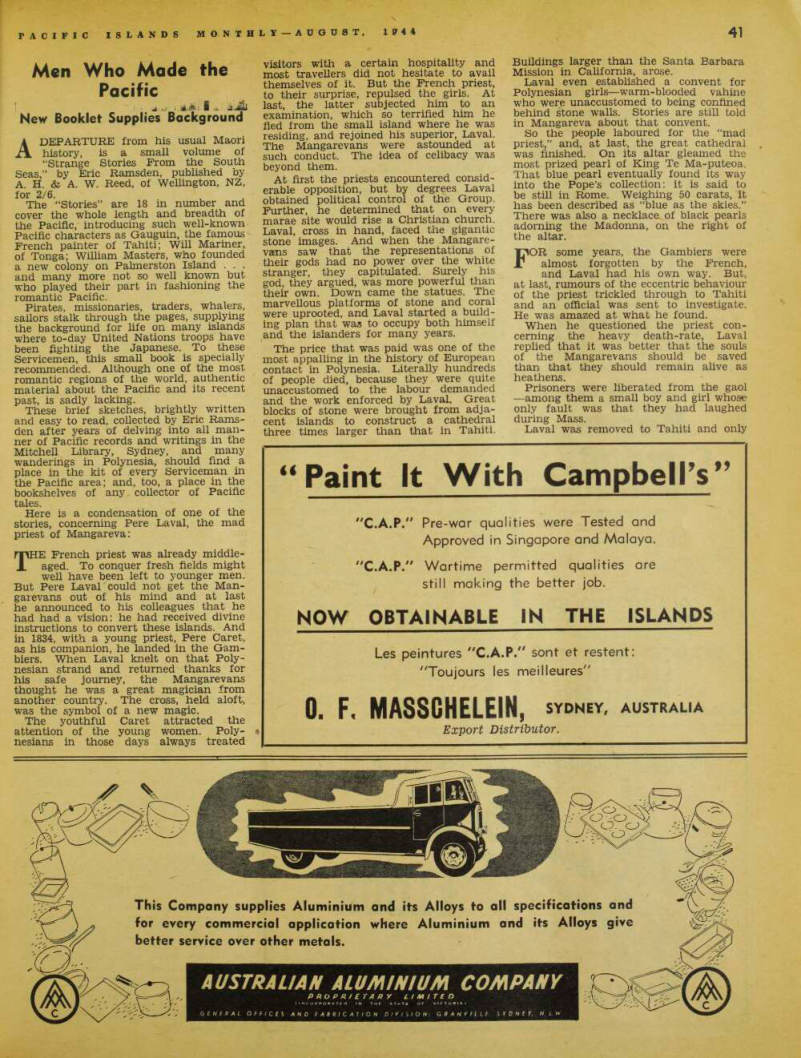
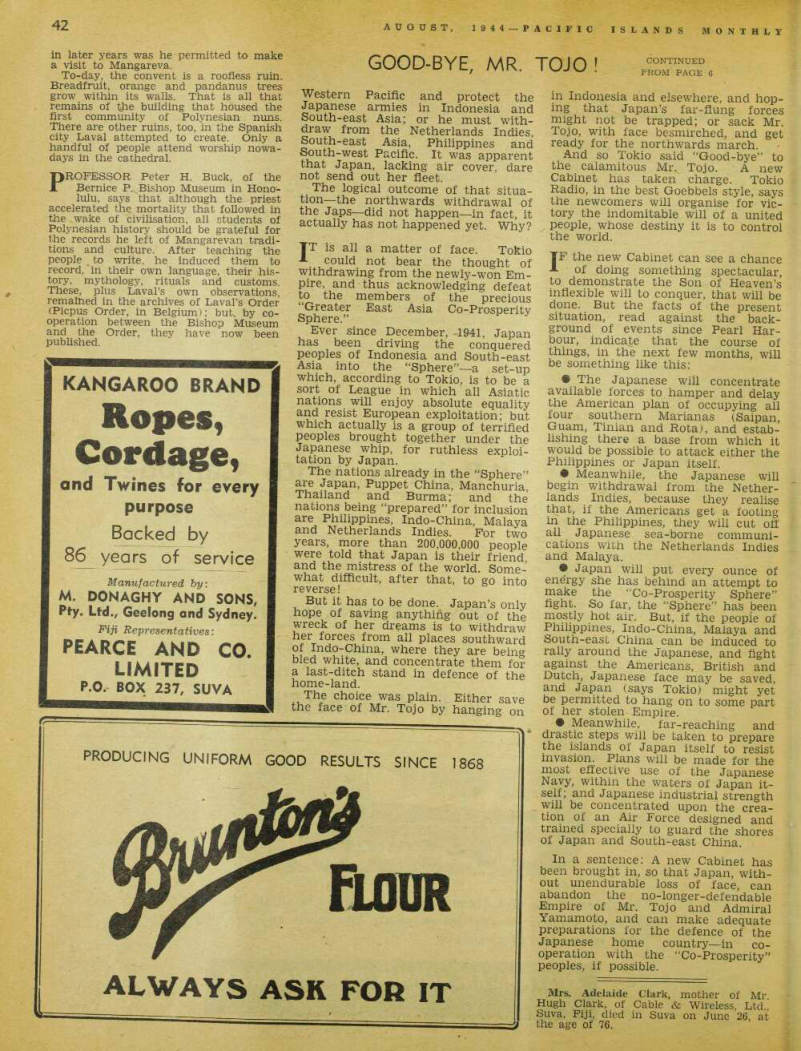
Pacific New Booklet Supplies Background
A DEPARTURE from his usual Maori history, is a small volume of “Strange Stories Prom the South Seas,” by Eric Ramsden, published by A H. & A. W. Reed, of Wellington, NZ, for 2/6.
The “Stories” are 18 in number and cover the whole length and breadth of the Pacific, introducing such well-known Pacific characters as Gauguin, the famous French painter of Tahiti; Will Mariner, of Tonga; William Masters, who founded a new colony on Palmerston Island . . . and many more not so well known but who played their part in fashioning the romantic Pacific.
Pirates, missionaries, traders, whalers, sailors stalk through the pages, supplying the background for life on many islands where to-day United Nations troops have been fighting the Japanese. To these Servicemen, this small book is specially recommended. Although one of the most romantic regions of the world, authentic material about the Pacific and its recent past, is sadly lacking.
These brief sketches, brightly written and easy to read, collected by Eric Rams den after years of delving into all man ner of Pacific records and writings in the Mitchell Library, Sydney, and many wanderings in Polynesia, should find a place in the kit of every Serviceman in the Pacific area; and, too, a place in the bookshelves of any collector of Pacific tales.
Here is a condensation of one of the stories, concerning Pere Laval, the mad priest of Mangareva: rE French priest was already middle aged. To conquer fresh fields might well have been left to younger men.
But Pere Laval could not get the Man garevans out of his mind and at last he announced to his colleagues that he had had a vision: he had received divine instructions to convert these islands. And in 1834, with a young priest, Pere Caret, as his companion, he landed in the Gam biers. When Laval knelt on that Poly nesian strand and returned thanks for his safe journey, the Mangarevans thought he was a great magician from another country. The cross, held aloft, was the symbol of a new magic.
The youthful Caret attracted the attention of the young women. Poly nesians in those days always treated
visitors with a certain hospitality and most travellers did not hesitate to avail themselves of it. But the French priest, to their surprise, repulsed the girls. At last, the latter subjected him to an examination, which so terrified him he fled from the small island where he was residing, and rejoined his superior, Laval.
The Mangarevans were astounded at such conduct. The idea of celibacy was beyond them.
At first the priests encountered consid erable opposition, but by degrees Laval obtained political control of the Group.
Further, he determined that on every marae site would rise a Christian church.
Laval, cross in hand, faced the gigantic stone images. And when the Mangare vans saw that the representations of their gods had no power over the white stranger, they capitulated. Surely his god, they argued, was more powerful than their own. Down came the statues. The marvellous platforms of stone and coral were uprooted, and Laval started a build ing plan that was to occupy both himself and the islanders for many years.
The price that was paid was one of the most appalling in the history of European contact in Polynesia. Literally hundreds of people died, because they were quite unaccustomed to the labour demanded and the work enforced by Laval. Great blocks of stone were brought from adja cent islands to construct a cathedral three times larger than that in Tahiti.
Buildings larger than the Santa Barbara Mission in California, arose.
Laval even established a convent for Polynesian girls—warm-blooded vahine who were unaccustomed to being confined behind stone walls. Stories are still told in Mangareva about that convent.
So the people laboured for the “mad priest,” and, at last, the great cathedral was finished. On its altar gleamed the most prized pearl of King Te Ma-puteoa.
That blue pearl eventually found its way into the Pope’s collection: it is said to be still in Rome. Weighing 50 carats, it has been described as “blue as the skies.”
There was also a necklace of black pearls adorning the Madonna, on the right of the altar.
FOR some years, the Gamblers were almost forgotten by the French, and Laval had his own way. But, at last, rumours of the eccentric behaviour of the priest trickled through to Tahiti and an ofiicial was sent to investigate.
He was amazed at what he found.
When he questioned the priest con cerning the heavy death-rate, Laval replied that it was better that the souls of the Mangarevans should be saved than that they should remain alive as heathens.
Prisoners were liberated from the gaol —among them a small boy and girl whose only fault was that they had laughed during Mass.
Laval was removed to Tahiti and only
in later years was he permitted to make a visit to Mangareva.
To-day, the convent is a roofless ruin.
Breadfruit, orange and pandanus trees grow within its walls. That is all that remains of the building that housed the first community of Polynesian nuns.
There are other ruins, too, in the Spanish city Laval attempted to create. Only a handful of people attend worship nowa days in the cathedral.
PROFESSOR Peter H. Buck, of the Bernice P. Bishop Museum in Hono lulu, says that although the priest accelerated the mortality that followed in the wake of civilisation, all students of Polynesian history should be grateful for the records he left of Mangarevan tradi tions and culture. After teaching the people to write, he induced them to record, in their own language, their his tory, mythology, rituals and customs.
These, plus Laval’s own observations, remained in the archives of Laval’s Order (Picpus Order, in Belgium); but, by co operation between the Bishop Museum and the Order, they have now been published.
Advertisements & other items, pp. 43-44 (2 items)
41
PACIFIC ISLANDS MONTHLY— A U G U S T , IffiA
“ Paint It With Campbell^”
"C.A.P." Pre-war qualities were Tested and Approved in Singapore and Malaya.
"C.A.P." Wartime permitted qualities are still making the better job.
NOW OBTAINABLE IN THE ISLANDS
Les peintures "C.A.P." sent et restent: "Toujours les meilleures"
0. F, MASSCHELEIN, SYDNEY, Australia
Export Distributor.
This Company supplies Aluminium and its Alloys to all specifications and for every commercial application where Aluminium and its Alloys give better service over other metals.
AUSTRALIAN ALUMINIUM COMPANY
PROPRIETARY LIMITED
I rro in Tmc sr.Ti or victoniai GfNfMl Off ICfS AND FABRICATION DIVISION: GRANV rL L f. 5fON f r, N.i.W
KANGAROO BRAND
Ropes,
Cordage,
and Twines for every purpose Backed by 86 years of service Manufactured by:
M. DONAGHY AND SONS,
Pty. Ltd., Geelong and Sydney.
Fiji Representatives:
PEARCE AND CO.
LIMITED
P.O. BOX 237, SUVA
PRODUCING UNIFORM GOOD RESULTS SINCE 1868
Flour
ALWAYS ASK FOR IT
Usa And The
Islands
Future of the Mandates
"THERE are three Mandated Terri tories in the Pacific-New Guinea, Western Samoa and the Caroline, Marshall and Mariana Islands. The United States now holds most of the latter, and will continue to do so.
But what of the other Mandated Territories? The following, published recently by “The Argus,” Melbourne, from its New York Correspondent, suggests interesting possibilities. See ■also article on page 3. rpHE United States, after the first World 1 War. tried to have the Caroline, Marshall, Mariana, and Samoan Islands returned to Germany so that it could then bargain with Germany for their outright acquisition, says the United Press Washington correspondent.
The proposal, which was made to the Peace Conference by the American re presentatives, came to nought, and the Islands were mandated to Japan.
The plan for returning the islands was published recently in State Department papers relating to the Paris Peace Con ference, but was overlooked because of the vast amount of other material simultaneously released for publication.
Mr. Breckinridge Long, Assistant Secre tary of State under President Wilson, was the author of the plan. He sent it to Paris with instructions to convey it, with its “very confidential thoughts,” to Colonel House, then acting as adviser to Wilson.
Long suggested that if USA took up the position during the Peace Conference that some of the islands should be re turned to Germany she could, after the Peace Conference was adjourned, come to some arrangement with Germany to transfer the Marianas, Carolines, Yap, the Palau Islands, and the Samoan Group to USA.
If a war indemnity were obtained from Germany, Mr. Long said, the payment of it might be offset by the transfer of these.
The United Press correspondent adds that the proposal has been "brought to light to-day, as American officials are agreed that those Pacific Islands must be kept by USA after the war. They are concerned with searching for a way to reconcile such acquisition with the pledges of the Atlantic Charter and the Cairo Declaration against territorial ex pansion.
Pitcairn Government
Appointments
THE annual elections held in Pitcairn Island have resulted in the various Government offices, for 1944, being filled as follows: Chief Magistrate: Mr. Parkin Christian.
Assessors: Mr. Christie Warren; Mr.
Warren Christian.
Chairman of Internal Committee: Mr.
Theodore Young.
Government appointments for the same period were; Members of the Internal Committee; Melville Christian; Mr. Henry Young.
Police Constables: Mr. Vernon Young; Mr. Virgil Christian.
It was announced in the Gazette of the Western Pacific High Commission for June 6 that Captain R. S. Taylor, Chief Wireless Officer of the BSI Protectorate, died on May 1.
Papua's Education
System Defence of the Missions' Record
IN reply to certain statements made in a letter to the editor, by “RHF.” pub lished in July, on the subject of “Government or Mission Education in Papua?”, in which the record of the mis sion schools was criticised, we have received a flood of correspondence, for which it is impossible to find space.
This journal does not subscribe to the anti-mission opinions of “RHF.'’ But that writer represents a school of thought, which is entitled—like everyone else—to express its views in these pages.
The following are points from some of the letters received.
Rev. John W. Burton (Methodist Over seas Missions) agrees that it should be possible for the Government to greatly extend the education system, for the good of the Papuan natives: but he cannot understand why ANGAU should be given the task of inaugurating a new system.
That, surely, should be the duty of a restored Civil Administration, endowed with larger funds than the pre-war Administration ever knew.
Rev. Maurice Nixon, of the London Missionary Society, says that much of the Papuans’ good war record is due to the sound, good training of the Missions’ schools: that secular instruction was not displaced, to any degree, by religious instruction: that it was the missionaries who reduced some of the Papuan language to writing and made education possible; that very remarkable progress was made, considering the language difficulties and the limited school hours: that there were no sterner critics of the Papuan educa tion service (handicapped by lack of funds and facilities) than the missionaries themselves; and that the missionaries, out of a half-century’s practical experi ence, have much to contribute to an extended education plan, and should be consulted.
The Fiji Indian War Effort Committee has sent to the Governor of Fiji, Sir Phillip Mitchell, a cheque for £367, to be forwarded to India for the Viceroy’s War Purposes Fund. The Committee asked that the donation be applied to the relief of famine sufferers in Bengal.
An epidemic of dengue fever and gastric influenza occurred in Apia and the country districts of Western Samoa in early July. Though not dangerous, the epidemic incapacitated numbers of office workers and put whole families on the sick list.
Advertisements & other items, p. 45 (1 item)
Charles Muir (Eastern) Export Go.
5 E SO s
LOTI
For Inflamed Eyaa and EyaUda
SOLD EVERYWHERE
H A. FU»a Sl Ca. rty. Ltd., Klm St., Syrfnay
Your old SCISSORS, RAZORS
and KNIVES can be
SHARPENED and REPAIRED
L_3 n Send them to—
W. JNO. BAKER SS:
3 HUNTER STREET.
SYDNEY.
CHARLES MUIR (Eastern) EXPORT GO.
SYDNEY
EXPORT AGENTS AND
MANUFACTURERS
AJC & OK Jams, Canned Fruits, Sauces, Asparagus, etc.
EEZEE Washing Blue in Bags, also Paper Wrapped—Baking Powder, Custard Powder, Jelly Crystals, etc.
SUNGLO Pickles, Chutney, Honey, Fruit Cordials, Jams in Glass Jars, Canned Vegetables, etc.
WINES, SPIRITS, BEERS.—
“Juberry,” “Royalty,” “Aulcle Acquaintance,” “Private Seal”
Brands, etc.
IN SUGAR BAGS.—Pearl Barley, Oatmeal, Rolled Oats, etc.
We Specialise in All Kinds of Food Products. Enquiries Invited Through Your Usual Channels.
Phones: B 2279. FA 2703.
FX 4515 (Factory).
Cable Address:
MUIR—SYDNEY.
I \ 4? jfsaanc
Islands Produce
Cocoa
Official prices for New Hebrides cocoa beans, controlled by the Cocoa, Chocolate and Confec tionery Committee, are as follows: — Buying: £4l/10/- per ton, f.o.b. Island port.
Selling: Delivered Sydney, Melbourne or Hobart, £53/5/- per ton.
Accra: £69/10/- (on wharf, Sydney, all charges paid).
New Guinea cocoa beans: No quotations.
Western Samoa: Last sale reported, Ist quality, £BO (f.0.b., Apia).
Trochus Shell
Sales were reported in July at prices ranging from £lO7 to £ll2 per ton, in store Sydney.
Cowrie Shells
Quote No. 1: 2/9 lb. f.o.b. Island port.
Quote No. 2: 2/10 lb. c.i.f. Sydney.
Coffee
No purchases are permitted without the consent of the Tea and Coffee Control Board, to whom all offers must first be submitted.
Nominal quotations as follows: — New Caledonian: Arabica, £Bl per ton (c.i.f.
Sydney). Robusta, £63 per ton (c.i.f. Sydney).
New Hebrides: Robusta, £63/10/- per ton (c.i.f. Sydney).
Mysore: £240 (c. & f. Sydney).
New Guinea and Papuan: No firm quotations available.
Java: No quotations.
Vanilla Beans
White Label, 15/6 per lb.; Green Label, 13/per lb.; c. & f. Sydney (Aust. currency).
Kapok
Market for Javanese kapok has been suspended.
Indian kapok is being quoted for Indent at 1/6 per lb. c.i.f. stg.
Cotton
Government controlled. Stocks being made available to manufacturers at following rates:— For spinning and weaving yarns, 14%d. per lb.; cordage making, ll%d. per lb.; condenser yam, 12d. per lb.
Ivory Nuts
No firm quotations available.
Rice
No quotations.
Green Snail Shell
F.a.q., £lO3 per ton, in store, Sydney.
Pearl Shell
Government-controlled price:— **B” Class, £2OO per ton. “C” Class, £l9B per ton. “D” Class, £135 per ton.
Fiji Buying Prices
Suva, July 15
following, taken from the “FIJI Times,” 1 >*• shows the prices current in Suva on the date mentioned. The prices, of course are given in Fiji currency, which is 12% per cent, below sterling, and 12% per cent, above Aus tralian.
Copra (PMS Grade) .. ..
Copra (Plantation Grade) Coconut Charcoal, per ton Copra Sacks, each .
Kerosene, per gal Flour, per sack .. ..
Flour, 5 lb. . . .
Sharps, per sack Sharps, 5 lb Barbed Wire .. ..
Pearl Shell, per ton ..
Beche-de-mer (best quality) about Beche-de-mer (raw fish) about lb Turtle Hooves, per lb. lb. .. 6d. ... 4d.
Price Of Gold
* ,ne Standard oz £lO/9/- oz £9/11/7
April 20, 1940.—Fixed price for plantation hot air dried, £ 12/17/6 per ton, c.1.f., London.
On February 18, 1942, Fiji and Tonga copra.
Ist grade, was fixed at £lB per ton (Fijian), f.0.b.; and In July; Plantation Grade, £lB/8/-; Fair Merchantable Sun-dried, £18; and Under grade, £l7/15/-. The values are stated in Fijian currency. To get Australian or New Zealand values, add 12 Vi per cent.; sterling values, deduct 12Vi per cent.
In April, 1942, unofficial quotations in Sydney were around £24 (Aust.) per ton, c.i.f., Sydney.
July, 1943.—N. Guinea and Papuan copra under Aust. Government control. Fixed prices, payable at port of shipment, or on plantation, where no coastal shipment is involved: Hot-air Dried £l5/10/-; Sun-dried, £l5; Smoke-dried, £l4/10/per ton. These prices subject to circumstantial considerations.
In September, 1943. prices were revised as follows; Hot-air and Sun-dried, £lB/10/-; Smoke-dried, £l7 per ton. Tentative there after.
Government selling prices to processors: New Guinea and Papuan Hot-air and Sun-dried, £2B per ton; Smoke-dried. £27 per ton, ex ship’s slings.
Copra
South Sea, Plantation, Sun-dried : Hot-air Dried.
London to London Rabaul Price on- Per ton, c.i.f.
Per ton. c.i.f.
January 1, 1932 . . £14 0 0 £14 15 0 June 17 . £13 2 6 £13 5 0 December 16 .. £14 2 6 £14 5 0 January 6, , 1933 £13 0 0 £13 12 6 June 30 . £10 17 6 £11 0 0 December 1 .. £8 12 6 £9 0 0 January 5 , 1934 . . £8 0 0 £8 7 6 June 15 . £8 0 0 £8 12 6 December 28 .. £9 0 0 £9 12 6 January 4, 1935 £9 5 0 £10 5 0 June 7 ., £11 15 0 £12 7 6 December 6 . . £12 17 6 £14 0 0 South Sea South Sea Plantation Smoked to Genoa Sun-dried Hot-air Dried London and Marseilles. to London.
Rabaul.
Price on— Per ton, ( c.i.f.
Per ton, c.i.f.
Per ton. c.i.f.
Jan. 3, ’36 £13 2 6 £13 15 0 £14 0 0 Mar. 6 . . £11 15 0 £12 15 0 £13 0 0 June 5 £11 10 0 £12 0 0 £12 17 0 Sept. 4 . £13 2 6 £13 10 0 £14 12 8 Dec. 4 £19 7 6 £19 7 8 £20 7 1 Jan. 8, ’37 £22 12 6 £22 12 6 £22 12 6 Mar. 5 . £19 0 0 £19 5 0 £20 0 0 June 4 £15 15 0 £15 12 6 £16 12 « Sept. 3 . £13 5 0 £13 5 0 £14 0 0 Dec. 3 £12 10 0 £12 12 6 £13 7 8 Jan. 7. ’38 £12 12 6 £12 15 0 £13 12 8 Mar. 4 £10 17 6 £11 0 0 £12 0 8 June 3 £9 15 0 £9 15 0 £10 12 8 Sept. 2 . £9 10 0 £9 10 0 £10 10 0 Dec. 2 £9 5 0 £9 5 0 £10 2 8 Jan. 6, ’39 £9 12 6 £0 15 0 £10 10 8 Feb. 3 . £9 10 0 £9 12 6 £10 10 0 Mar. 3 . £10 0 0 £10 2 6 £11 0 0 Apr. 6 £9 12 6 £9 15 0 £10 12 8 Maj 5 . £10 0 0 £10 5 0 £11 0 0 June 2 £10 7 6 £10 10 0 £11 7 8 July 7 . £9 2 6 £9 7 8 £10 9 0 Aug. 4 £9 2 6 £9 5 0 £10 5 0 Sept. 1 , £9 10 0 £9 12 6 £10 12 8 Sept. 8.—Not quoted—outbreak of war.
Sept. 15 to 29.— •Not quoted.
Oct. 6 . . £11 15 0 [unquoted] £12 15 8 Oct. 12.— -Fixed price based on £12/7/6 per ton. c.i.f., London, for plantation hot-air dried.
Jan. 8, 1940, to April 20, 1940.—Fixed price for plantation hot-air dried, £13/5/- per ton. c.i.f..
London.
Quotations For Mining
Shares
July, 1943.—Papuan rubber under Australian Government control. Fixed prices, payable on plantation, where no coastal shipment is in volved, or at port of shipment: No. 1 Grade, 1/5; No. 2 Grade, 1/4; No. 3 Grade, 1/2 per lb. Theses prices subject to circumstantial considerations.
In September, 1943, prices were revised as follows: No. 1 Grade, l/eVfe: No. 2 Grade, 1/4; No. 3 Grade, 1/2; Inferior, 10y 2 d. to 1/2 Vb pec lb. Tentative thereafter.
Government selling prices: No. 1 Grade, 1/11; No. 2 Grade, 1/10; No. 3 Grade, 1/8; Inferior,, 1/3 to 1/7 per lb., “Ex-Bond” in Australia.
Emperor Mines .
Fiji
Mid-June. .. bll/- Mid-July. bll/- Mid-Aug. bll/- Loloma bl8/6 bl9/6 Mt. Kasi bl/3 bl/3 bl/7 Bulolo G.D
New Guinea
• • b90/- b90/b90 - Guinea Gold Sll/blO/11 N.G.G.. Ltd .. b2/l% b2/4 b2/l Vz Oil Search b4/b4/9 Placer Dev ... b66/3 b66/3 b(j6/3 Sandy Creek ... .. sl/6 bl/2 bl/2 Sunshine Gold . .. b6/b6/9 b7/9 Cuthbert’s
Papua
bl3/5 bl3/g Mandated Alluvials s4/3 b4/6 s5 - Orlomo Oil ... bl/8 b2/- Papuan Aplnaipl . b4/s4/s3/6 Vodda Goldfields bl/9 N.Q.
N.Q.
RUBBER Plantation
London Para.
Smoked.
Price on— per lb. per lb.
January 6, 1933 . 4%d .. 2.43d July 7 3.71d December 8 .. . 4%d .. 4.0%<6 January 5, 1934 . 4‘Ad .. 4.28d July 6 7.06d December 28 .. . 5d .. 6Vid January 4, 1935 . 5d .. 6%d July 5 7 7 /sd December 6 . . . 6%d .. 6%d January 3, 1936 . 6%d .. 6%d June 5 9d .. 7‘Ad December 4 . . . 1/- .. 9 i-i8«a January 8, 1937 . 1/2 .. lOVad June 4 9*Ad December 3 .. . 7*/ad January 7. 1938 . 7‘Ad .. 7d July 1 7Vid, December 2 .. . 7‘/ad .. 8d January 6. 1939 . 7d .. sy«d July 7 sy 4 d December 1 .. . 12d .. livid January 5, 1940 . 13d .. 11.6%<P July 5 12 %d December 6 .. .. 12d January 3, 1941 . 13d .. 12.47 7 A<S February 7 .. .. , 12.5 a /«d March 7 13%d April 4 14V«d May 2 14.0%d June 6 13.5%d July 4 13 7-lfcfc August 1 13‘Ad September 5 .. . 13%d October 6 13 ll-l*d October 10—Price officially fixed at .. 13Kd
Exchange Rates
r T'HB following exchange quotations show th®> A rates existing in Sydney in mid-July;—
Fiji
Through Bank of NSW and Bank of New Zealand:—Australia on FIJI on basis of £lo® Fiji: Buying, £ All 1/2/6; selling. £AII3. PIJI - on basis of £lOO London:—
New Guinea And Papua
Only nominal at present.
Free French Pacific Colonies
Buying, 160; selling, 163; francs to Aust. £.
Buying.
Selling. £ s. d. to a a Telegraphic transfer ... 110 15 0 112 0 0 On demand HO 12 6 111 17 ft
Western Samoa
Through Bank of New Zealand;—Australia oik Western Samoa on basis of £100 Samoa: Butmg. £ A99/12/6; selling. £A100/2/6.
Samoa oa London on basis of £100 In London: — Buying.
Selling. £ s. d. £ s. d.
Telegraphic transfer — £125 10 ft On Demand £122 18 9 125 7 ft 30 days 122 8 9 125 2 ft 60 days 121 18 9 124 17 ft 90 days 121 8 9 124 12 ft 120 days 120 18 9
Australian Short Wave
Broadcast
AN Australian radio programme is broadcast daily on short wave from Lyndhurst (Vie~ toria) for listeners In the Western Pacific:—
Call.
Wave Sign.
Time.
Length.
Frequency.
Vlr8.
6.30-10.15 a.m. 25.51 metres 11,760 M/ca.
Vlr3.
12.00-6.15 p.m. 25.25 metres
11,880 M/Cs-
Vlr.
8.45-11.30 p.m. 31.32 metres 9,580 M/ca Power: 2 kilowatts.
Advertisements & other items, pp. 46-48 (4 items)
44
AUGUST, 1944 PACIFIC ISLANDS MONTHLY
Published PTY. LTD., Union House, 247 George street. Sydney. (Telephone: BW 5037). Wholly set up and printed in Australia by the Sydney and Melbourne Publishing 00. Ptv. LtJ.. 29 Alberta street /T*eier>b™- tuta
Roll Of Honour
AUGUST, 1944 PACIFIC ISLANDS MONTHLY
(Continued From Inside Front Cover)
I/Kci F I C Islands Monthly August, Is’ 44
W. R. Carpenter & Co. Lth
IMP t—MMi t HM
■■■«■ ■'" ■■■• ’ * m mmm .
ipr, m
ik .
M '■ % - , , ;4* j £- : *». ' «lfflSj'<St 5 ?« i» '■ ' » Jl_ * Cft **'lN TF -« AIBUH» .
rag
4L.
P M if ' " •■' .A ' I 11 ? C. ■■■l '
» v V V *L
■ $5? ' % m mk i -. \
(£i;il
m3m ■ , . 0^
Travel by CARPENTER AIRLINES
Full particulars from Macdonald, Hamilton fir Co., or How- ’ Smith Ltd., Sydney.
W. R. CARPENTER & CO. LTH
MERCHANTS, SHIPOWNERS AND AIRCRAFT OPERATORS
Agents for Australian, European and American Manufacturers, and Distributors of Every Description of Merchant Buyers and Shippers of Copra, Troeas, and all Classes of Islands Produce.
Ford Motor Company of Canada.
T. G. & C. Bolinders (Engines).
AGENTS FOR:
Caterpillar Tractors. Dodge Brothers Inc.
Electrolux Refrigerators. Westinghouse Electrical Co. etc,, etc.
Branches throughout the Pacific Islands
n London. W. R. & Co. (London) Ltd., Coronation House, 4 Lloyds Avenue, London, EC.
iead Office: 16 O’CONNELL STREET, SYDNEY