Pacific
Islands
Monthly
July 19, 1944
Vol. Xiv. No. 12.
Established 1930
IRegistered at the i rnnftmission P os * 03 a n ™ s vav e r l
i/-
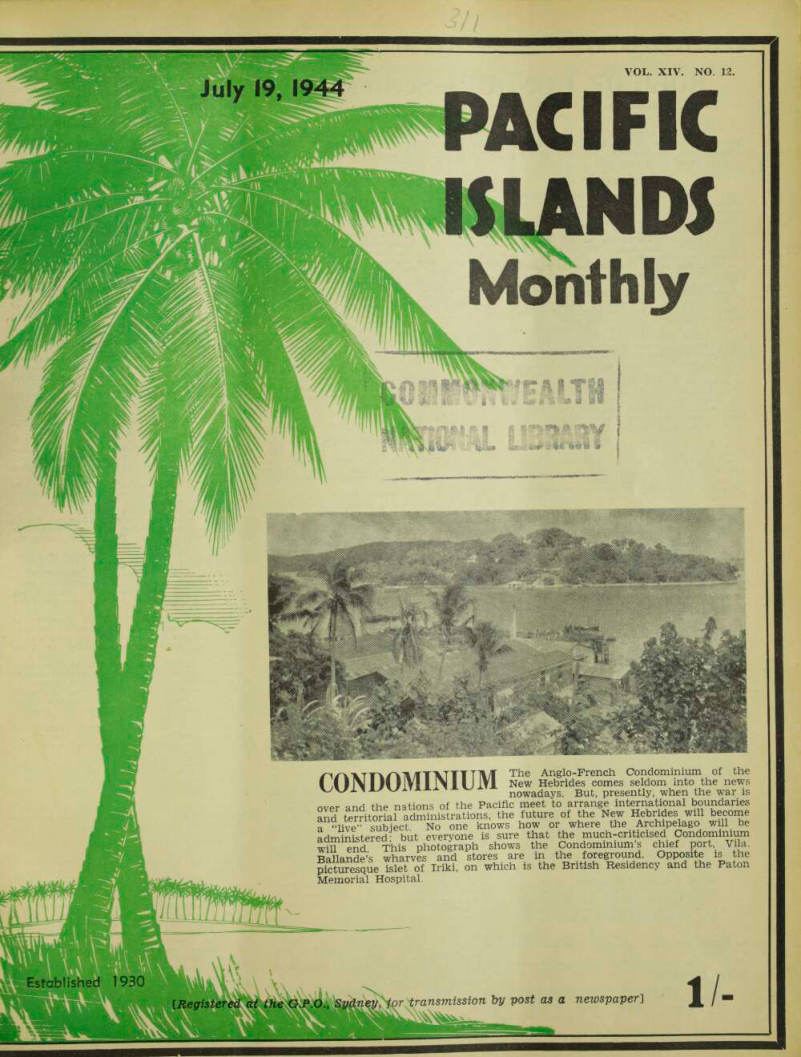
Condominium
The Anglo-French Condominium of the
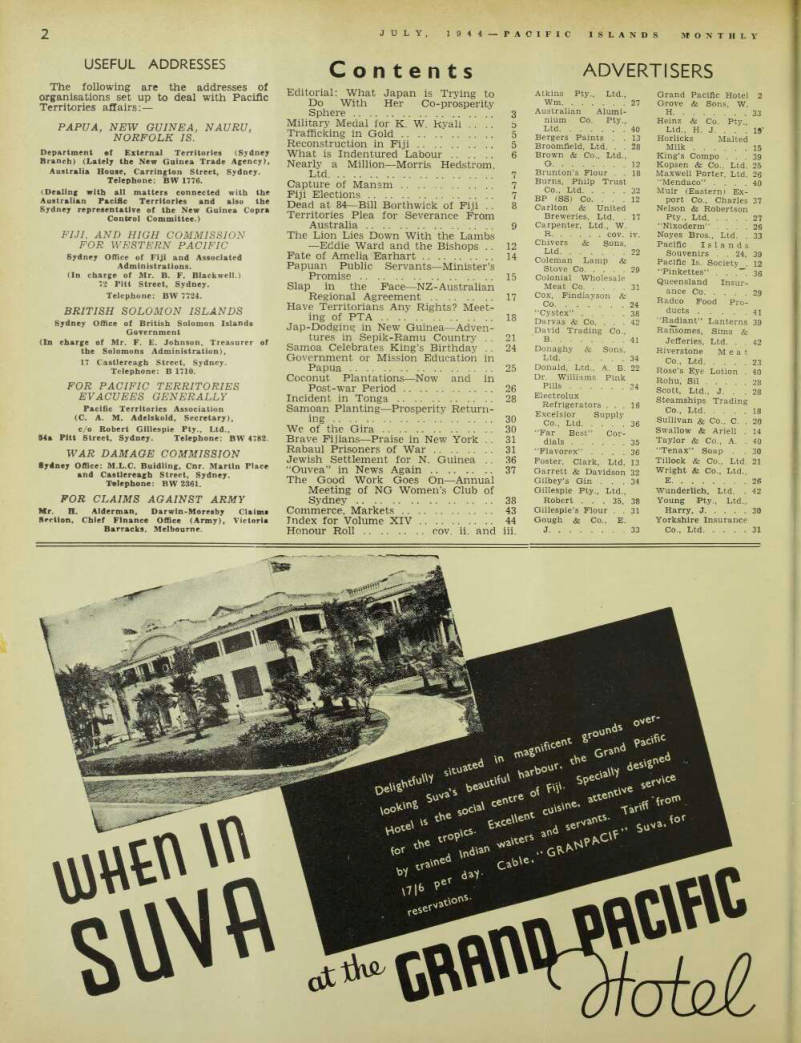
New Hebrides comes seldom into the news nowadays. But, presently, when the war is over and the nations of the Pacific meet to arrange international boundaries and territorial administrations, the future of the New Hebrides will become a “live” subject No one knows how or where the Archipelago will be administered; but everyone is sure that the much-criticised Condominium will end. This photograph shows the Condominium’s chief port, Vila.
Balllande’s wharves and stores are in the foreground. Opposite is the picturesque islet of Iriki, on which is the British Residency and the Paton Memorial Hospital.
Roll Of Honour—Section Ii.
[Section 1 (Killed, Missing, Prisoners) and Section II (Wounded, Decorations, etc.), published in Alternate Months] (We try to assemble here the names of n*en of the United Nations, residents or former residents of the Pacific Territories, whose names appear in casualty lists or s * lou * c * grateful if relations and friends would send
Wounded
Sgt. Robert ASMUS, of the Fighting French Pacific Battalion. Wounded at Bir Hacheim and evacuated.
Rene AUFANT, of the Fighting French Pacific Battalion. Wounded at Bir Hacheim.
Cpl. Thomas BAMBRIDGE, of the Fighting French Pacific Battalion. Wounded at Bir Hacheim and evacuated.
BERBERE (alias ARESKY), of the Fighting French Pacific Battalion. Wounded at Bir Hacheim.
Henri BERTHELLN, of the Fighting French Pacific Battalion. Wounded at Bir Hacheim.
Pte. V. BLANCO, AIF infantry, of Thursday Island. Wounded in action, July, 1941.
L/Cpl. J. P. BLENCOWE, AIF Infantry, of Rabaul, TNG. Wounded in action, July, 1941.
Jean BRIAL, of the Fighting French Pacific Battalion. Wounded at Bir Hacheim.
Pte. George BUCKNELL, ATP, son of Mr. and Mrs. C. Bucknell, of Korolevu, Fiji. Wounded in action in Malaya, January, 1942.
Pte. Thomas BYERS, AIF infantry, of Thurs day Island. Wounded in action, May, 1941.
Raymond CHAUTARD, of the Free French Pacific contingent from New Caledonia. Re ported a casualty in the Middle East, March 1942.
Pte. A. J. CORLASS, ALP, formerly of Rabaul.
Wounded in action.
Albert CUBADDA, of the Free French con tingent from New Caledonia. Reported a casualty in the Middle East, March, 1942.
Charles DEVEAUX. of Pacific Battalion of Fighting France. Wounded at battle of Bir Hacheim (Libya).
Sgt. EMERY, formerly of Lae, TNG. Wounded in New Guinea in October, 1942.
W/O P. N. ENGLAND, AIF, formerly of Bogia, TNG. Wounded in action January 27, 1944.
Lieut. M. G. EVENSEN. AIF, formerly of Rabaul. Wounded in action.
V. PAIRHALL, 2nd NZEF, formerly of the Treasury Department, Western Samoa. Reported wounded in action, February, 1942.
Trooper Arthur T. FILEWOOD, formerly of Thursday Island. Reported wounded in action, May, 1943.
Paroa FIU, of the Fighting French Pacific Battalion. Wounded at Bir Hacheim and evacuated.
Cpl. H. N. FORSYTH, formerly of New Guinea.
Reported wounded, June, 1944.
Acting Warrant-Officer V. M. I. GORDON, AIF Infantry, of Wau, TNG. Wounded in action, February, 1942.
Henri GUTLBAUD, of the Free French Pacific contingent from New Caledonia. Reported a casualty in the Middle East, March, 1942.
Sgt. C. HENDRICK. AIF infantry, of Rabaul, TNG. Wounded in action, July, 1941.
Stanley HIGGS, son of Mr. and Mrs. Gordon Higgs, of W. R. Carpenter and Co. Ltd., New Guinea. Member of an English Lancers’ regiment, wounded during British evacuation from Dun kirk (Prance) May, 1940.
Pte. W. HOLMES, of the Fiji Military Forces.
Reported wounded in action, December, 1943.
Alexandre HUYARD. of the Free French Pacific contingent from New Caledonia. Reported a casualty in the Middle East, March, 1942.
Pte. P. C. JEUNE, AIF, formerly of Morobe, TNG. Reported wounded, June, 1944.
Sgt.-Pilot Andrew KRONFELD, of the NZ Fighter Squadron attached to the RAP. Wounded In knee during operations over France, December, 1941.
Cpl. W. H. LANNEN, AIF artillery, of Rabaul, New Guinea. Wounded in action, June, 1941.
Gnr. E G. LOBAN, AIF artillery, of Thursday Island. Wounded during campaign in Greece.
May, 1941; invalided home after having his left forearm amputated.
Auguste LUTA, of the Fighting French Pacific Battalion. Wounded at Bir Hacheim and evacuated.
A/Sgt. Alastalr MACLEAN, AIF Infantry, of Rabaul, New Guinea. Wounded In action, 1c Libya, June, 1941.
Sgt. J. D. McCLYMONT, NZEF, son of Capt.
D. McClymont, Harbourmaster of Apia, Western Samoa. Wounded in action, November, 1941 Cpl. R. McKERLIE, AIF, of Yandina, BSL wounded in face by bomb explosion, April. 1941 T. MANEA, of the Fighting French Pacific
Battalion. Wounded at Bir Hacheim and evacuated.
Jean MERIGNAC, of the Free French Pacific contingent from New Caledonia Reported a casualty in the Middle East, March, 1942.
Henri MEYER, of the Free French Pacific contingent from New Caledonia. Reported a casualty in the Middle East, March, 1942.
S/Sgt. Graham B. MIRFIELD. ALP engineers, of Rabaul, New Guinea. Wounded in action, Pte. James O’DWYER, NZEF, formerly of Apia, W. Samoa. Wounded in action in Italy, December, 1943.
Joseph OTHUS, of Pacific Battalion of Fight ing France. Wounded in battle of Bir Hacheim (Libya).
Lieut. A. G. PEARCE, AIT, formerly of Salamaua, TNG. Wounded in action, Pte. L. G. (“Mick”) REECE, AIF, of Bulolo, New Guinea. Wounded in action, July, 1941.
Henri RIVIERE, of the Free French Pacific contingent from New Caledonia. Reported a casualty in the Middle East, March, 1942.
Pte. H. St. George RYDER, AIF, formerly of Suva, Fiji. Wounded while serving in New Guinea.
A/Opl. N K. SAWYER, ALP infantry, of Rabaul, TNG. Wounded in action, July, 1941.
July, 1941.
Pte. Frank M. SCHUSTER, NZEF, formerly of W. Samoa. Wounded in action in Tunisia, 1943.
Lieut. Jeffrey SEAGOE, serving with the British forces in the Far East, formerly of Vila, New Hebrides. Reported “wounded in action”, March. 1942.
Pte. F. M. SCHUSTER. NZEF, formerly of W. Samoa. Wounded in action in Tunisia.
Pte. Lance STAMPER, ALP, formerly school master at Wau, New Guinea. Wounded In action, August, 1941.
Lieut.-Col. J. K. B. TAYLOR, of the Fiji Mili tary Forces. Wounded in action in Bougain ville, December, 1943.
Cpl. Raphael TEIHO, of the Fighting French Pacific Battalion. Wounded at Bir Hacheim and evacuated.
Cpl. Terli TERIITUA, of the Fighting French Pacific Battalion. Wounded at Bir Hacheim and evacuated.
Lieut. A. THOMPSON, of the Fiji Military Forces. Reported wounded in action, December, 1943.
Lieut. P. A. TUCKEY, infantry, formerly of New Guinea. Wounded in action.
Pte. Harold G. TURNER. AIF. of Samaral, Eastern Papua. Wounded in action at Bardla (Libya), January, 1941.
Pte. P. D. TWISS, AIP infantry, of New Guinea. Wounded in action, August, 1941.
Camille VINCENT, of the Free French Pacific contingent from New Caledonia. Reported a casualty in the Middle East. March, 1942.
Driver Don F. WAUCHOPE, AIF. Formerly employed on his brother’s plantation in New Guinea. Wounded in action. July, 1942.
Lieut. F. R. G. WILSON. ALP, formerly of the Mandated Territory of New Guinea. Reported wounded in action, February, 1944.
Alex. WINCHESTER, of the Fighting French Pacific Battalion. Wounded at Bir Hacheim.
Pte. K. M. WHITE, AIF. formerly of Bulwa, TNG. Wounded in action.
Sgt.-Pilot W. WRIGHT, of the Australian Spitfire Squadron, attached to the RAF, for merly of New Guinea. Wounded in knee during aerial “dog-fight” over the English Channel, March. 1942.
Decorations
Sgt. Jione AGARA, Fiji Military Forces, formerly of Tonga. Awarded the American Sil ver Star for gallantry in action in New Georgia, July, 1943.
Squadron-Leader G. U. (“Scotty”) ALLEN, RAAF, who is well-known in New Guinea and Papua, having been co-pilot on the “Faith in Australia”, on the first official air-mail flight to the Territories in 1934. Awarded the Air Force Cross for his work with Catalina flying boats in Australia and the Pacific.
Major H. T. ALLEN, AIF, formerly of Wau, Morobe District, TNG. Awarded the OBE.
Squadron-Leader C. A. BASKETT, formerly of Bulolo, TNG. Awarded Distinguished Flying Cross for raids over enemy territory while attached to Hampden bomber squadron in Eng land.
Victor BRIAL, Fighting French Pacific Battalion, formerly of New Caledonia. Awarded the Croix de Guerre and the Etolle d’Argent.
Major W. F. M. CLEMENTS, of the British Solomon Islands Defence Poroe. Awarded Military Cross for exceptional devotion to duty in a theatre of war.
Sgt. Henry C. S. COTTON, of the RNZAF, who was bom in Samoa (his father was Secre tary of Native Affairs during the NZ military occupation). Awarded the Distinguished Flying Cross.
FREDERIC DELAVEUVE, formerly of New Caledonia. Awarded Croix de Guerre, while serving with Fighting French volunteers in Egypt.
Plight-Lieut. R. N. DALKIN, RAAF, formerly of W. R. Carpenter and Co., Ltd., Salamaua, TNG. Awarded the DFC for bombing raids against the Japanese in Koepang area, DEL Squadron-Leader R. A. DUNN, RAAF, formerly of Carpenter Airways New Guinea Service.
Awarded the Distinguished Flying Cross for bravery while leading his squadron against the Japanese.
Chaplain N. J. EARL, AMF, formerly of Papua. Awarded MBE for bravery shown during early Papuan campaign.
Sgt. R. EMERY, NGVR, formerly of Lae.
Awarded Military Medal for gallantry in New Guinea.
Flight-Lleut. Norman FADER, RAAF, formerly a commercial pilot in New Guinea. Awarded the Air Force Cross for exploits in Bismarck Sea Battle.
Rifleman H. W. FORRESTER, NGVR, formerly of Bulolo, TNG. Awarded the Military Medal for operations against Japanese in New Guinea.
Sgt. J. H. GILCHRIST, formerly of TNG.
Received Military Medal, April, 1944.
Squadron-Leader C. R. GURNEY, RAAF, for merly of Guinea Airways, Ltd., TNG. Posthu mously awarded the Air Force Cross, for bomb ing raids on Japanese-held ports in New Britain.
Major T. GRAHAMSLAW, AMF, formerly of Papua. Awarded OBE for conspicuous devotion to duty in the Buna area (Papua) during initial Japanese landings in the district.
Walter GRAND, Fighting French Pacific Battalion, formerly of Tahiti. Awarded Croix de Guerre, with one star, for bravery during the Battle of Bir Hacheim, 1942.
A./Sgt. B. W. G. HALL, formerly of Papua.
Received DCM in April, 1944.
Squadron-Leader Godfrey HEMSWORTH, RAAF, formerly a well-known New Guinea pilot, who was killed in action against the Japanese in May. Posthumously awarded the Air Force Dross.
Capt. L. HENDERSON, AMF, formerly of Papua. Awarded MBE for courage displayed during the Oro Bay operations when he was in charge of small ships operating in those waters.
LUCIEN HERVOUET, formerly of New Cale donia. Awarded Croix de Guerre while serving with Fighting French volunteers in Egypt.
Lieut. Colin HILL, RANR, of the Australian destroyer, “Waterhen”, formerly second officer on the trans-Pacific liner “Niagara". Awarded the OBE.
Lieut. D. C. HORTON, RANVR, formerly of District Services, BSI. Awarded the United States Silver Star for distinguished services in the Solomons.
Lieut. Gordon HOWE, RANR, formerly an offi cer in Burns Philp ships. Awarded the US Legion of Merit for meritorious service in lead ing a reconnaissance party to Russell Islands,
Bsi.
Lieut. H. E. JOSSELYN, RANVR, formerly of District Services, BSI. Awarded United States Silver Star, for distinguished services in the Solomons.
Capt. H. T. KIENZLE, ANGAU, formerly of Papua. Awarded MBE for devotion to duty during the campaign in the Owen Stanley Ranges.
Wing-Commander C. J. N. LELAU, RAAF, formerly of Suva, Fiji. Awarded the OBE for distinguished service.
Sgt. T. McADAM. NGVR, formerly of New Guinea Forestry Dept. Awarded Military Medal for gallantry in New Guinea.
Lieut.-Commander A. W. R. McNICOLL, RAN, son of Sir Ramsay McNicoll, Administrator of New Guinea, and Lady McNicoll. Awarded the George Medal.
Petty-Offlcer PAUL MIASON, RANVR, formerly a plantation inspector at Inus, Bougainville, TNG. Awarded American Distinguished Service Cross for “extraordinary heroism in action.”
HENRI MAYER, formerly of New Caledonia.
Awarded Croix de Guerre while serving with Fighting French volunteers in Egypt.
(Continued on Inside Back Cover)
(Continued From Inside Front Cover) Fit.-Lieut. George B. (Golly) MEIDECKE, RAAF, formerly of W. Samoa. Awarded the Distinguished Flying Cross.
Capt. J. K. MCCARTHY, formerly of TNG.
Received the MBE, April, 1944.
Lieut.-Commander H. A. MACKENZIE, RAN, formerly of Rabaul, TNG. Awarded the US Legion of Merit for exceptionally meritorious services at Guadalcanal.
Capt. John Malcolm METHVEN, AIF. Men tioned in despatches for distinguished services during the seige of Tobruk. Since reported killed in action. (See section “Killed.”) Sgt. Geoffrey MOORE, of the RNZAF, formerly engineer on the NG inter-island vessel “Maiwara” and on the trans-Paciflc liner "Aorangi”. Awarded the Distinguished Plying Medal.
ANDRE MORNAGHINI, formerly of New Cale donia. Awarded Croix de Guerre while serving with Fighting French volunteers in Egypt.
Flight-Lieut. G. B. MEIDECKE. RAAF, formerly of W. Samoa. Awarded the DPC for “courage, coolness and tenacity, and flying skill of the highest order.”
Flight-Lieut. M. O’CONNOR, RAAF, formerly of Suva, Fiji. Awarded the DFC for a “high record of success on operations” In the Middle East.
Flight-Lieut. H. G. PILLING, RAF, formerly of Suva, Fiji. Awarded the DFC, May, 1942. (Killed a few days later.) Pilot-Officer Pat RICHARDSON. RAF, son of Mr. W. Richardson, formerly of Penang, Fiji.
Awarded the Distinguished Flying Cross.
Commander Alvord S. ROSENTHAL, RAN, son of Major-General Sir Charles Rosenthal, KCB, CMG, DSO, VD, Administrator of Norfolk Island. Awarded the DSO, November, 1941; awarded the Bar to DSO, February, 1942.
Lieut.-Colonel J. B. K. TAYLOR, Commander of Fiji Military Forces overseas. Awarded American Purple Heart, March, 1944.
Capt. A. T. TIMPERLEY, AMF, formerly of Papua. Awarded MBE for work on Good enough Island when he acted as a guide.
Major David TRENCH, formerly District Offi cer in BSI. Awarded the Military Cross for distinguished service and gallantry in the South-west Pacific.
F/O Leigh G. VIAL, RAAF. formerly ADO in TNG. Awarded American DSC for outstand ing heroism in New Guinea in September, 1942.
Squadron-Leader Charles WIDDY, RAAF, formerly of BSI. Awarded the US Legion of Merit for meritorious service in leading a reconnaissance party to Russell Islands, BSI.
Lieut, (then W/O) Raymond WATSON, AIF, formerly of TNG. Awarded MBE for bravery and devotion to duty during the Papuan cam paign.
Lieut. G. K. WHITTAKER, NGVR, formerly of Lae, TNG. Awarded MBE for gallantry in New Guinea.
Lieut. George Raymond WORLEDGE, of the RANVR. formerly of Fiji. Awarded the MBE (Military).
Mentioned In Despatches
Rifleman G. R. Archer, Rifleman J. R. Kinsey,
Tng. Tng.
Captain A. H. Bald- Corporal M. Marlay, win, Papua. TNG.
Captain N. B. N. Rifleman J. E. Mayos, Blood, TNG. TNG.
Rifleman J. Cavanagh, Corporal A. Moore,
Tng. Tng.
Rifleman J. W. Currie, Captain J. J. Murphy,
Tng. Tng
Warrant-Officer J. B. fueut. K. C. McMullen, Davies, Papua. TNG.
Captain L. S. Dexter, W/O —. Neumann, Papua. TNG.
Capt. W. M. Edwards, Captain N. Owers.
TNG. Lieut. R. H. Phillips, Warrant-Officer P. R. TNG.
N. England, TNG. Pte. A. A. Ramsden, Rifleman H. W. For- Papua. rester, TNG. Major D. G. Rice.
Lieut. K. G. Fuller, Pte. S. M. Richie, Tonga. Papua.
Major S. Elliott-Smith, Lieutenant J. I. Rae, Papua. Papua.
Sergeant V. H. Gil- Lieutenant C. H. Smith, Christ, TNG. TNG.
Lieut. S. G. Grimshaw, Warrant-Officer R. A.
TNG. Smith, Papua, tieut. C. G. Harris, Pte. R. m. Stewart, TNG. Papua.
Lieut. L. F. Hewlett, Lieut. A. T. Timperly, TNG. Papua.
Sgt. H. E. Jarrett, Captain L. N. Tribolet, Papua. TNG.
Major E. W. Jenyns, ‘ Lieutenant A. G. Vagg,
Tng. Tng.
Warrant-Officer I. F. Captain G. H. Vernon, Jones, Papua. MC, Papua.
Lieut. H. T. Kienzle, Papua.
Pacific News-Review
Notes And Comment On
The Progress Of The War
From June 15 To July 16
June 15: Hitler to-day began to use his “secret weapon.” Small planes, without a crew, loaded with a heavy bomb, pro pelled by the rocket type of engine, are coming over southern England from the Calais coast at intervals of a few minutes, falling haphazardly, exploding, and caus ing casualties and damage. They will net affect the course of the war: but they have a great nuisance value. The plane is called “Robot plane” and ‘‘Flying bomb.”
June 18; Americans cut off the north ern half of the Cherbourg Peninsula and isolated the port of Cherbourg, with 25,000 Germans.
June 18: The Americans who landed on Saipan Island (Marianas) have advanced eastwards across the southern part of the island against bitter Japanese resistance.
Beach-head positions have been consoli dated and the important airstrip seized.
June 19: In a terrific air battle over the Marianas the Japanese lost 300 planes.
Americans on Saipan have captured the Aslito airfield and driven across the southern end of the island to Magicienne Bay.
June 19: In an engagement between the Marianas and the Philippines, the US Fifth Fleet made a surprise attack on the Japanese Grand Fleet, and carrier based planes sank four and possibly five enemy warships, including an aircraft carrier. The US force suffered no ship losses and only 49 planes. The battle lasted until nightfall. The Japanese fleet now seems to be avoiding surface action.
June 20: Three thousand Allied aircraft are engaged on an assault on the Robot plane bases. A super-Robot, which travels at about 600 miles per hour, is reported.
June 21: Berlin was attacked by 2,000 planes to-day, in the biggest raid of the war. Berlin Radio is threatening “repri sals with big and more powerful explosives than the pilotless bomber.”
June 22: The Americans are closing in on Cherbourg and have seized an arc of high ground near the port.
June 22: The final battle for Cher bourg began to-day after a terrific air attack by 1,000 bombers. US forces have penetrated the outer-south-west defences.
June 22: Russian forces on the third anniversary of Hitler’s attack on Russia launched a great offensive in White Rus sia, and have swept vast Vitebsk, vir tually isolating that German-held town.
June 23: The Japanese on Saipan (Marianas) have been deserted by their Grand Fleet and abandoned to their fate.
June 25: The British have commenced an attack on their sector in France and advanced after a fierce fight. On the other flank, the final stage of the battle for Cherbourg has begun.
June 26: British and Canadian troops on the eastern sector in Normandy have launched a large-scale tank and infantry attack to the south, under the biggest barrage yet seen in Normandy.
June 26: Russian spearheads are inside the town of Vitebsk, northern bastion of the German so-called “Fatherland” line.
June 27: Cherbourg has been taken by the Americans. Lieut.-General Carl Wil helm von Schlieven, German commander of the garrison, and Rear-Admiral Hen necke, sea defence commander of Nor mandy, were captured. The enemy, in the battle, lost some four infantry divi sions and numerous naval and marine units.
June 27: The Russians are storming on in the East, and have captured Vitebsk and Jlobin. The next big battle will be for Minsk.
June 27: Swift advances have been
made by Allied forces in Italy. The Fifth Army, on the west coast, is now half-way from Piombino to Cecina (20 miles south of Leghorn).
June 28: British forces made a wide breach in the enemy line in the eastern section of the Normandy bridgehead.
They have crossed the Odon River, south of Caen.
June 28: The Red Army offensive has developed into a vast pincers movement against Minsk—hundreds of thousands of Germans are threatened with encircle ment.
June 29: The whole of the German front in White Russia is collapsing and the Nazis face the biggest defeat in their history.
June 30: The Allied forces in Italy have made a wide advance and are now near Leghorn.
July 2: Minsk, last German stronghold east of the 1939 Polish border, is threat ened. The Russians have advanced over 100 miles in a week.
July 2: Great German counter-attacks against the British line in Normandy have been beaten back. He has suffered heavily in tanks and infantry.
July 3: Two Russian armies now are racing to complete the encirclement of the German armies at Minsk.
July 3: The Americans have started a new offensive on the west coast of Nor mandy, on a 20-miles front.
July 3: Americans on Saipan Island (Marianas) have advanced along the whole front, and are less than five miles from the northern tip of the island.
July 4: Powerful Russian forces took Minsk yesterday and are now pursuing 12 broken German divisions.
July 4; The Americans have landed and seized airfields on Noemfoor Island, off the coast of Dutch New Guinea.
July 5: The Canadians, who began an offensive in the eastern Normandy sec tor, are now within 2\ miles of the key German base of Caen. The Americans, in the western sector, are two miles from the railway junction of La Haye-du- Puits.
July 5; US Marines, after bitter fight ing, took Garapan (Saipan), capital of the Marianas.
July 6: Mr. Churchill announced that the flying bombs in Southern England have already killed 2,752 people, and injured 8,000. Most of these casualties were in the London area. “It would be a mistake to under-rate the seriousness of these flying-bombs,” Mr. Churchill told the House of Commons.
July 6: The Nazis are making a bid to hold the Red Army in White Russia and have launched two counter-attacks.
July 8: American Super-Fortresses last night bombed targets on Kyushu, the most southerly of the main islands of Japan. Main attack was on the naval base at Sasebo and war plants at Yawata and Omura.
July 8: In the Marianas, the Jap gar rison on Saipan is now confined to the northern tip, and attempts at evacuation have been frustrated.
July 9: British and Canadian troops have captured Caen. There is general progress on other French sectors.
July 9: The Russians, still rapidly advancing, have taken the important Polish rail junction of Baranovichi and have fought their way into the streets of Vilna, capital of Lithuania.
July 10: Following immediately on their capture of Caen, British troops launched a new offensive against the new enemy line on the east bank of the Orne River.
July 10: The Russians are driving for
the Baltic Sea and huge German forces now are threatened with encirclement.
July 10: Japanese resistance on Saipan has now ended, and the Americans have a valuable base only 1,500 miles from Japan.
July 12: The Germans are counter attacking strongly in Normandy, but all thrusts have been held by the Allies. At St. Lo the Nazis are bitterly resisting the American drive.
July 12: Australia House, in London, has been damaged by a flying bomb.
July 13: Russian long-range guns have moved up to shell the frontier of East Prussia, after the break-through of tanks and mobile units which has brought the Red Army within 35 miles of German territory.
July 13: A Jap force of 45,000, trapped between the Allied forces in the Wewak- Aitape area of New Guinea, is concentrat ing for an attempt to break through, having apparently decided that it is bet ter to fight than starve to death.
July 14: The Russians are sweeping on to East Prussia, and disrupting the Ger man retreat on the central sector. Vilna has fallen and Pinsk has been evacuated by the Germans.
July 16: British troops in Normandy captured the village of Esquay; American troops are making a steady advance in the western sector. It is believed that a large-scale Allied drive in Normandy is imminent.
July 16: America and the Allied world is shocked at Tokio’s grim threat to kill all Allied airmen who bail out or are shot down over Japan. Americans who bailed out of Super-Portresses in June have been executed.
Trobriand Yams
Mr. A. H. Vegan's Experiment
MRS. C. E. CAMERON, well known in Tonga and Fiji, called at the “PIM” office this month on an unusual mission. Could we tell her where she could get some of those giant yams brought from the Trobriand Islands about 1932 by Mr. A. H. Vogan, and handed over to certain sub-tropical planters in Australia? One of her sons (all four are in the armed services) intends to become a planter in Queensland, and believes that something could be done with yam cultivation.
Mrs. Cameron said that the story of Mr. Vogan’s yams was published in the ‘ PIM” over 10 years ago, and she thought that some of the yams had been handed over to the Queensland Department of Agriculture for experiment. While in Brisbane, she had interviewed the Depart ment, but officials there seemed blankly ignorant of yams—Trobriand, or any other variety.
We turned up old “PIM” hies and dis covered, from the issue of December 1934, that Mr. Vogan gave yams to Mr A. H. Joubert, of the Tweed River, New South Wales; and that Mr. Joubert dis tributed seed yams, later, to about 70 different people.
So then we telephoned Mr. Vogan. This virile old gentleman (he is now 86 years of age, and lives in Sydney) was very happy to think that his attempt to make an excellent foodstuff better known had been remembered by someone. Mr. Jou bert is dead; but the giant yams are still being grown, and Mr. Vogan undertook to send details to Mrs. Cameron.
Contents
Editorial: What Japan is Trying to Do With Her Co-prosperity Sphere 3 Military Medal for K. W. Ryall ... 5 Trafficking in Gold 5 Reconstruction in Fiji 5 What is Indentured Labour 6 Nearly a Million —Morris Hedstrom, Ltd 7 Capture of Manam 7 Fiji Elections 7 Dead at 84—Bill Borthwick of Fiji .. 8 Territories Plea for Severance From Australia 9 The Lion Lies Down With the Lambs —Eddie Ward and the Bishops .. 12 Fate of Amelia Earhart 14 Papuan Public Servants—Minister’s Promise 15 Slap in the Face—NZ-Australian Regional Agreement 17 Have Territorians Any Rights? Meet ing of PTA 18 Jap-Dodging in New Guinea—Adven tures in Sepik-Ramu Country .. 21 Samoa Celebrates King’s Birthday .. 24 Government or Mission Education in Papua 25 Coconut Plantations —Now and in Post-war Period 26 Incident in Tonga 28 Samoan Planting—Prosperity Return ing 30 We of the Gira 30 Brave Fijians—Praise in New York .. 31 Rabaul Prisoners of War 31 Jewish Settlement for N. Guinea .. 36 “Ouvea” in News Again 37 The Good Work Goes On —Annual Meeting of NG Women’s Club of Sydney 38 Commerce, Markets 43 Index for Volume XIV 44 Honour Roll cov. ii. and iii.
Advertisers
Atkins Pty., Ltd., Wm 27 Australian Alumi nium Co. Pty., Ltd 40 Bergers Paints . . 13 Broomfield, Ltd. . . 28 Brown & Co., Ltd., G 12 Brunton’s Flour . . 18 Burns, Philp Trust Co., Ltd 32 BP (SS) Co. . . . 12 Carlton & United Breweries, Ltd. . 17 Carpenter, Ltd., W.
R cov. iv.
Chivers & Sons, Ltd 22 Coleman Lamp & Stove Co 29 Colonial Wholesale Meat Co 31 Cox, Findlayson & Co 24 “Cystex” 38 Darvas & Co. ... 42 David Trading Co., B 41 Donaghy & Sons, Ltd 34 Donald, Ltd., A. B. 22 Dr. Williams Pink Pills 24 Electrolux Refrigerators ... 16 Excelsior Supply Co., Ltd 36 “Far Best” Cor dials 35 “Flavorex” ... 36 Foster, Clark, Ltd. 13 Garrett & Davidson 32 Gilbey’s Gin ... 34 Gillespie Pty., Ltd., Robert ... 35, 38 Gillespie’s Flour . .31 Gough & Co., E.
J 33
Grand Pacific Hotel 2 Grove & Sons. W.
H 33 Heinz & Co. Pty., Ltd., H. J. . . . is’
Horlicks Malted Milk 15 King’s Compo ... 39 Kopsen & Co., Ltd. 25 Maxwell Porter, Ltd. 26 “Mendaco” ... 40 Muir (Eastern) Ex port Co., Charles 37 Nelson & Robertson Pty., Ltd 27 “Nixoderm” ... 26 Noyes Bros., Ltd. . 33 Pacific Islands Souvenirs . . 24, 39 Pacific Is. Society . 12
“Pinkettes” . . 3&
Queensland Insur ance Co 29 Radco Food Pro ducts 4i “Radiant” Lanterns 39 Ransomes, Sims & Jefferies, Ltd. . . 42 Riverstone Meat Co., Ltd 23 Rose’s Eye Lotion . 40 Rohu, Sil 28 Scott, Ltd., J. . .28 Steamships Trading Co., Ltd 18 Sullivan & Co., C. . 20 Swallow & Ariell . 14 Taylor & Co., A. . 40 “Tenax” Soap . . 30 Tillock & Co., Ltd. 21 Wright & Co., Ltd..
E 26 Wunderlich, Ltd. . 42 Young Pty., Ltd., Harry, J 30 Yorkshire Insurance Co., Ltd 31
Advertisements & other items, p. 4 (2 items)
Useful Addresses
The following are the addresses of organisations set up to deal with Pacific Territories affairs; —
PAPUA, NEW GUINEA, NAURU,
NORFOLK IS.
Department ef External Territories (Sydney Branch) (Lately the New Guinea Trade Agency), Australia House, Carrington Street, Sydney.
Telephone: BW 1776. (Dealing with all matters connected with the Australian Pacific Territories and also the Sydney representative of the New Guinea Copra Control Committee.)
FIJI, AND HIGH COMMISSION
FOR WESTERN PACIFIC
Sydney Office of Fiji and Associated Administrations. (In charge of Mr. B. F. Blackwell.) 72 Pitt Street, Sydney.
Telephone: BW 7724.
BRITISH SOLOMON ISLANDS
Sydney Office of British Solomon Islands Government (In charge of Mr. F. E. Johnson, Treasurer of the Solomons Administration), 17 Castlereagh Street, Sydney.
Telephone: B 1710.
FOR PACIFIC TERRITORIES
EVACUEES GENERALLY
Pacific Territories Association (C. A. M. Adclskold, Secretary), c/o Robert Gillespie Pty., Ltd., S4a Pitt Street, Sydney. Telephone: BW 4782.
WAR DAMAGE COMMISSION
Sydney Office: M.L.C. Buidling, Cnr. Martin Place and Castlereagh Street, Sydney.
Telephone: BW 2361.
FOR CLAIMS AGAINST ARMY
Mr. H. Alderman, Darwin-Moresby Claims Section, Chief Finance Office (Army), Victoria Barracks, Melbourne.
m
\iiw^
\v\ I As ove^ r oU^ s * A pac^ c s«^ ed M ** . , w *&** ** 's b-** , *»• Ce \« l " 4 t*c e " e ° se <°r *e . \v\A' a ° . “ G^ tra'° e ° e ' .r A * 1 ' i|b ? e <0*
Pacific Islands Monthly
The Newspaper-Magazine of the South Seas [Registered at the G.P.0., Sydney, for transmission by post as a newspaper .]
Published Once Each Month and Circulated in Australia and New Zealand and in the following Pacific Territories and Islands Groups:
Australian Territory of Papua.
Mandated Territory (Australia) of New Guinea.
Australian Territory of Norfolk Island. *ew Zealand Territory of Cook Islands.
Mandated Territory (NZ) of Western Samoa.
British Colony of FIJI.
British Solomon Islands Protectorate, British Protectorate of Tongan Islands.
British Crowm Colony of Gilbert and Ellice Islands.
Mandated Territory of Nauru.
British and Free French Condominium of New Hebrides.
Free French Colony of New Caledonia.
Free French Colony of Oceania (Tahiti, etc.).
American Territory of Eastern Samoa.
American Territory of Hawaiian Islands.
Owned and Produced by Pacific Publications Pty. Ltd., Union House, 247 George Street, Sydney.
FELEPHONE [ Managing Director .. BW 5037 (. Business and Editorial MA 4369
P.O. Box 3408 R
Registered Address of Telegrams, Radiograms, and Cables: “Pacpub”, Sydney.
Contributions.
Articles, Stories, and Photographs dealing with Pacific Islands subjects are invited and will be paid for on publication.
Subscription Rates.
Per Annum, within British Empire, Prepaid, Post Free 10/- Per Annum, elsewhere, Prepaid, Post Free 12/6 Single Copies 1/-
Editor and Publisher:
R W. Robson, F.R.G.S.
Advertising Manager: L. W. Bailey.
Advertising Office and Printing-House: 29 Alberta Street, Sydney.
Advertising rates furnished on application.
Process Blocks made at Advertiser’s expense when required. Screen 85.
Changes of Advertising Copy should reach this office by Ist of each month, otherwise previous advertisement may be repeated.
Representative In London.
W. C. Harvey, Coronation House, 4 Lloyds Avenue, London, E.C.3, from whom may be obtained copies of Pacific Islands Monthly, Pacific Is. Year Book, advertising schedules, etc.
Agents. ..
The following are authorised to receive sub scriptions for Pacific Islands Monthly:— Burns, ■ Philp & Co., Ltd., and Burns Phllp (South Sea) Co., Ltd. All branches.
W. R. Carpenter & Co., Ltd. All branches.
Morris, Hedstrom, Ltd. All branches.
Steamships Trading Co., Papua. All branches.
B.N.G. Trading Co., Ltd., Port Moresby, Papua.
J. Muir, Suva, Fiji.
Miss R. Castles, Suva, Fiji.
N. C. Mackenzie Hunt, Wainunu, Bua, Fiji.
Cook Islands Trading Co., Rarotonga, Cook Is.
A. C. Rowland, Papeete, Tahiti.
Islands Branches and Representatives of W. H.
Grove & Sons, Ltd., Auckland, New Zealand.
Ed. Pentecost, Noumea, New Caledonia.
Kerr & Co., Noumea, New Caledonia.
Vol. XIV. No. 12.
July 19, 1944
Prirp [ l/- Per Copy ’ ••ice fprepaid; 10/- p.a.
Se common destfny of the Axis*
What Japan is Trying to Do With "Co-prosperity"
Sphere"
rHE bombing of Southern Japan by Super-Fortresses in June and July, and seizure by American forces 3f Saipan (only 1,500 miles south of Japan) mark the opening of a new strategic stage in the Pacific war. „ , .
Events are moving swiftly to the tter defeat of Japan, and to the annihilation of the power which Droke the Pacific peace. The subi urn an people of this nation will to the death, like any savage Deast that has been cornered; but ;hat will not long delay the destruc- ;ion of their accursed nation, once bp full weip-ht nf thp Allies can be turned unon it ' ’ It was on March 27, 1941, that the growing Nazi Foreign Minister, von Ribbentrop, welcoming to Berlin the Japanese plenipotentiary Yosuke Matmoka, used these words: “We all know that the three great °owers which have united in the Tri- Partite Pact, and the States which 'iave joined them, are united in a community of destiny. The destiny Germany and Italy is also the iestiny of Japan; and the destiny of Japan is the destiny of Germany and Italy!’ of A/TotcnntQ One wonder Matsuoka,
Se common destfny of the Axis*
rtaly is gone; Germany is going; and :he fate of Japan already is written
clear across the skies. The message which Dolittle’s sky-raiders gave Tokio in April, 1942, has been confirmed by the Super-Fortresses of June, 1944. . 07 IQAI rormnnv March 27, 1941, Germany and Lf Italy seemed literally to have the world at their feet. All Western Europe was prostrate before them; they had thrown back the British in Libya; they had beaten the British in Greece and occupied all the Balkans.
Their a ttack upon Russia was slated f or June and they were supremely confident su P remei y connaenu.
Little Matsuoka was spell-bound by what he saw in the throbbing capitals of the Axis; he was intoxicated by Hitler’s promise of Japanese dominion from the Persian Gulf to Hawaii and from Siberia to Australia. He carried his intoxication back to Tojo in Tokio.
Japan prepared eagerly for The Day; on The Day (December 7, 1941) we saw the calculated treachery of Pearl Harbour. Swiftly, out from Japan, north, east, south and west, there went the well-prepared Jap expeditions, which in four months occupied all South-east Asia, all Indonesia, nearly all the islands of Melanesia In those days of 30 months ago, Germans and their satellites swept on in Russia; Germans and Italians
swept on in North Africa; Japanese swept on throughout all the Western Pacific. It did seem to them that the Axis Powers were “united in a community of destiny.”
December 7, 1941, was a day big with destiny; but it was not the des tiny that von Ribbentrop foresaw.
That day, Japan brought into the war the world’s greatest Power, the United States, more angry and more united than ever had been known be fore. That day, also, the German drive at Moscow was stopped and broken —the Germans never got nearer than that to the heart of Russia.
That day, while the battered, heroic British still held the line in Western Europe, the world’s two largest Re publics, United States and Russia, turned with grim fury to the colossal task of restoring peace and sanity to the world. Since that day, the wheel of fate has turned nearly full circle.
For Germany and Japan, the doom that is their destiny is very near.
TO-DAY, the Japanese curse the day they entered into alliance with Germany and Italy. They attribute to many European factors—not least of them the “intuitions” of Adolf Schickelgruber—the disasters which now are falling upon them.
“The alliance was never popular in Japan or in Germany,” said United States Admiral Harry E. Yarnell re cently. “It was a marriage of con venience, an uneasy and suspicious fellowship of greedy men.
“The Japanese have felt the patron ising arrogance of the German military and diplomatic corps, and have been thoroughly aware of Ger man attempts to manipulate Japa nese policy for German ends. And Japan has been as cynical as Ger many in her utilisation of her Allies, and in her treatment of them when they are no longer useful to her.”
THOSE Super-Fprtress attacks are only the beginning of a power ful assault, to be unleashed presently against every girder of Japan’s in dustrial structure. The same relent less, unremitting and undiminishing air power which has been raining bombs from the skies over Germany, and demolishing German industrial production and transport, soon will be felt all over Japan.
Japan is more helpless than Ger many in meeting this attack on her industrial potential. From Japan’s islands it is impossible for her indus trialists to disperse their plants beyond the reach of our air power.
Manchuria, the only area to which Japan has brought any measure of industrialisation, affords no area for escape. Manchuria is less protected against air attack than Japan, and is within the range of our aircraft.
WHILE it is possible to foresee the defeat of the armed forces of Japan, it would be unwise to assume that the Allies will be welcomed as liberators in East and South-east Asia, and that the many Asiatic nations there will turn gladly from Japanese domination to co-operation with the United States, Great Britain and Nationalist China. The contrary may be the case.
Ever since Japan got possession of South-east Asia and Indonesia, over two years ago, she has been feverishly developing her “Greater East Asia Co-Prosperity Sphere”; and her ac complishments appear to have been considerable. On June 26, 1943, Wang Ching-Wei, puppet ruler of Japanese controlled China, described the “Sphere” as a League of Asiatic Countries based upon four principles: Political independence; military al liance for joint defence; economic collaboration; cultural interchange.
This Sphere or League now consists of the following countries, which Tokio insists are independent and self-governing:
Now In The “Sphere”
Country Population, etc.
Japan, with Korea and Formosa . .. 100,000,000, Occupied China, with capital at Nanking. Claimed by Japs to be at least 150,000,000. Re cognised as an indepen dent nation by 12 countries, including Ger many, Fascist Italy, Spain, Bulgaria, Vichy France.
Manchuria 40,000,000; governed by Jap puppet.
Thailand 16,000,000. Entered into close alliance with Japan in December, 1941.
Burma , 17,000,000; Japan granted independence on August 1, 1943, to Burma, which Total population, then declared war on 223,000,000. Britain and USA.
Being Prepared By Japan For
Inclusion In ‘•Sphere”
Philippines 16,000,000. Japan late in 1943 granted the Filipinos an independent govern ment, which now is functioning under Jap puppets.
Indo-China .. .. .. 24,000,000. Japan is try ing to create two or three new “independent”
States from the French colony, but has met opposition of Vichy France, to which Indo- China nominally ad heres.
Malaya 5,000,000. Japan here is trying to create one or two States which will join the “Sphere.”
Netherlands Indies .. <0,000,000. Japan an nounced that she is pre- Total population, paring the Javanese for 115,000,000. “independence.”
The grand total of people already in the League, or being prepared for inclusion, is 338.000,000.
The policy employed by Japan in dealing witn tnese “puppet” coun tries curing the past two years is clear-cut and definite, independence is being tnrust upon them; they are oemg encouraged to develop tneir own resources and trade with each otner, and with Japan; they are being given international status, and their own defence forces; Japanese con cessionaires, who have been enrich ing themselves in these various con quered countries, are befiig osten tatiously withdrawn, and the money making machines they controlled are as ostentatiously handed over to the nationals concerned.
I’fiis has been particularly marked in the case of Nanking or Occupied China (as distinct from the indepen dent or Nationalist China, ruled by Cniang Kai Shek at Chungking). The Japs nave been lavish in their gifts to Nanking. They have transferred to Nanking all the territorial conces sions formerly held by European nations in Shanghai, Tientsin, Can ton, Hankow, Hangchow, Amoy, and other cities: they claim that, through Japanese power, Nanking China now is more completely independent than it ever was or could be under Chiang Kai Shek. Even as this is written, Jap armies are taking large sections of Honan Province from the armies of Chiang Kai Shek in order (as they say) to hand them over to the Gov ernment of Nanking.
THIS “Co-Prosperity Sphere” plan was announced before 1942; but in 1943 and 1944 it has been driven forward in haste and vigorously pro pagandised by Tokio. Why? the reason is clear enough.
Japan has seen Italy collapse, and sees the imminent defeat of Germany.
She knows what is coming to her. Her one hope of avoiding complete defeat, and of creating a situation in which she may obtain some sort of com promise peace, is to arouse against the Anglo-American Allies a great section of Asia.
The Japanese had planned to con quer and occupy a great Asiatic and Indonesian Empire, which they would exploit and enslave as they have ex ploited and enslaved Korea and Man churia. They have no more regard
for the equality of man and the in dependence of other nations than they have for the doctrines of Christianity. They are, as a nation, utterly ruthless, selfish and greedy.
But they also are realists, and very cunning. If they can persuade 100,000,000 or 200,000,000 Asiatic people to fight against the oncoming Europeans, passively if not openly, and continue the passive fight even if Japan is defeated, it is worth the postponement, for the present, of all their luscious dreams of empire.
IN this brief outline of what Japan is doing with her Co-Prosperity Sphere may be found some explana tion of present Japanese strategy in the Pacific War. It is Japan’s pur pose to delay the advance of the Anglo - American forces by every means in her power, while she tries to do these things: • Organise an aggressive nation alist sentiment in all the countries named as present and possible* “Sphere” members. • Stimulate, at the same time, the utmost productive effort in the vari ous countries. • Induce “defensive” action against the British and Americans by at least a section of the peoples of China, Manchuria, Indo-China, Philippines, Burma, Malaya and Thailand, and possibly Netherlands Indies. • Strongly attack the forces of Chiang Kai Shek in Central China, with a view to occupying as much of Eastern and Central China as pos sible, so as to (a) deny to the Allies airfields from which they might bomb China, and (b) possibly knock in dependent China out of the war.
That is why Japan so furiously defended Saipan against the north wards-thrusting Americans. Saipan is too close to the heart of the “Co- Prosperity Sphere”; and the estab lishment there of a force of American bombers threatens the development of Japan’s defensive plan.
Seen with the eye of Tokio—from the inside, looking out—it is a good and promising plan. 338,000,000 Asiatics, fired with anti-European zeal, might do an awful lot of damage.
Seen with the Anglo-American eye— from the outside, looking in—it does not appear very formidable. It took the purposeful Japanese over 80 years of hard planning and doing to convert their nation into something mili taristically formidable. It will take longer to create a fighting machine out of the less aggressive peoples of South-east Asia and Indonesia.
The latter may not be very co operative when the Allies arrive. But the two things they want most on earth are peace and a sufficiency of food. They will not seriously oppose the enormous military machine upon which the Americans and British will return to the Orient—provided we get there reasonably soon.
Lady Mitchell, Mrs. B. H. Marks, Mr. G.
H. Spark and Ratu G. W. Lalabalavn have been appointed members of the Fiji War Fund Board.
Military Medal For
K. W. Ryall
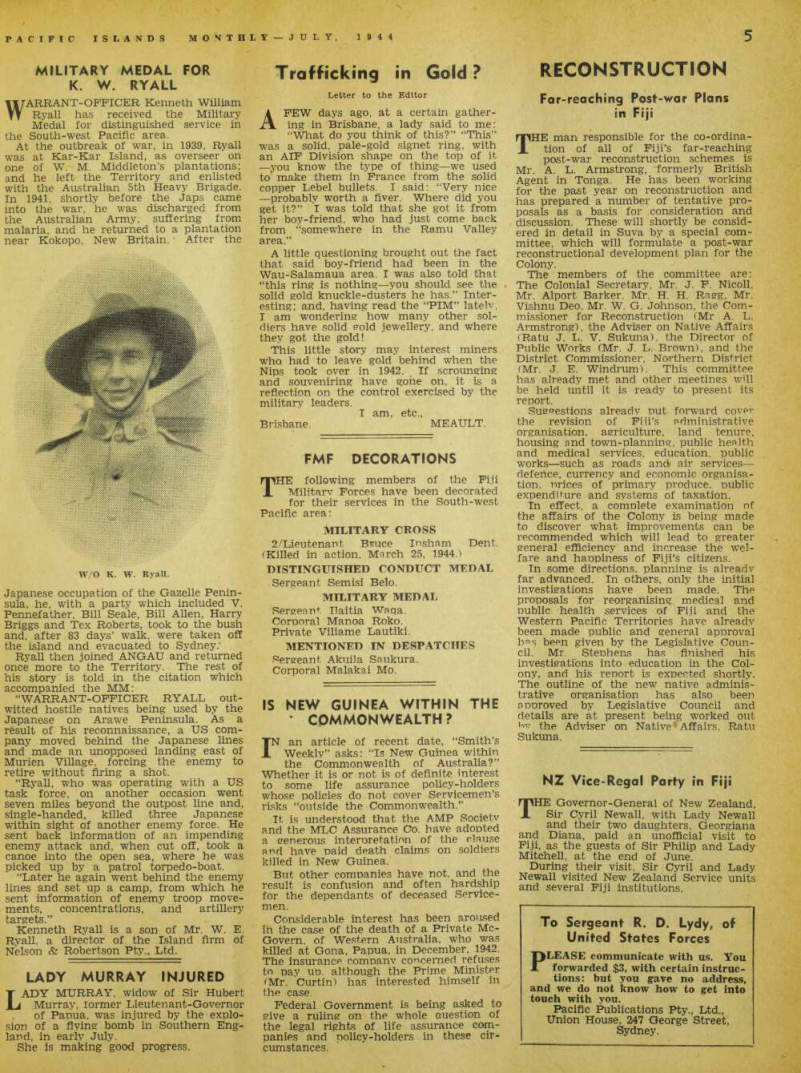
WARRANT-OFFICER Kenneth William Ryall has received the Military Medal for distinguished service in the South-west Pacific area.
At the outbreak of war, in 1939, Ryall was at Kar-Kar Island, as overseer on one of W. M. Middleton’s plantations; and he left the Territory and enlisted with the Australian sth Heavy Brigade.
In 1941, shortly before the Japs came into the war, he was discharged from the Australian Army, suffering from malaria, and he returned to a plantation near Kokopo, New Britain. ’ After the
Japanese occupation of the Gazelle Penin sula, he, with a party which included V.
Pennefather, Bill Seale, Bill Allen, Harry Briggs and Tex Roberts, took to the bush and, after 83 days’ walk, were taken off the island and evacuated to Sydney.
Ryall then joined ANGAU and returned once more to the Territory. The rest of his story is told in the citation which accompanied the MM:
“Warrant-Officer Ryall Out
witted hostile natives being used by the Japanese on Arawe Peninsula. As a result of his reconnaissance, a US com pany moved behind the Japanese lines and made an unopposed landing east of Murien Village, forcing the enemy to retire without firing a shot.
“Ryall, who was operating with a US task force, on another occasion went seven miles beyond the outpost line and, single-handed, killed three Japanese within sight of another enemy force. He sent back information of an impending enemy attack and, when cut off, took a canoe into the open sea, where he was picked up by a patrol torpedo-boat, “Later he again went behind the enemy lines and set up a camp, from which he sent information of enemy troop move ments, concentrations, and artillery targets.”
Kenneth Ryall is a son of Mr. W. E.
Ryall, a director of the Island firm of Nelson & Robertson Pty., Ltd.
W/O K. W. Ryall.
Lady Murray Injured
LADY MURRAY, widow of Sir Hubert Murray, former Lieutenant-Governor of Panua, was injured by the explo sion of a flying bomb in Southern Eng land, in early July.
She Is making good progress.
Trafficking in Gold?
Letter to the Editor A FEW days ago, at a certain gather ing in Brisbane, a lady said to me: “What do you think of this?” “This” was a solid, pale-gold signet ring, with an AIF Division shape on the top of it —you know the type of thing—we used to make them in France from the solid copper Lebel bullets. I said: “Very nice —probably worth a fiver. Where did you get it?” I was told that she got it from her boy-friend, who had just come back from “somewhere in the Ramu Valley area.”
A little questioning brought out the fact that said boy-friend had been in the Wau-Salamaua area. I was also told that “this ring is nothing—you should see the solid gold knuckle-dusters he has.” Inter esting: and, having read the “PIM” latelv, I am wondering how many other sol diers have solid gold jewellery, and where they got the gold!
This little story may interest miners who had to leave gold behind when the Nips took over in 1942. If scrounging and souveniring have gone on, it is a reflection on the control exercised by the military leaders.
I am, etc.,
Brisbane.
Meault.
Fmf Decorations
THE following members of the Fiji Military Forces have been decorated for their services in the South-west Pacific area:
Military Cross
2/Lieutenant Bruce Insham Dent. (Killed in action, March 25, 1944.)
Distinguished Conduct Medal
Sergeant Semisi Belo.
Military Medal
Sergeant Ilaitia Waqa.
Corporal Manoa Roko.
Private Viliame Lautiki.
Mentioned In Despatches
Sergeant Akuila Saukura.
Corporal Malakai Mo.
Commonwealth?
Is New Guinea Within The
IN an article of recent date, “Smith’s Weekly” asks: “Is New Guinea within the Commonwealth of Australia?”
Whether it is or not is of definite interest to some life assurance policy-holders whose policies do not cover Servicemen’s risks “outside the Commonwealth.”
It is understood that the AMP Societv and the MLC Assurance Co. have adopted a generous interpretation of the clause and have paid death claims on soldiers killed in New Guinea.
But other companies have not, and the result is confusion and often hardship for the dependants of deceased Service men.
Considerable interest has been aroused in the case of the death of a Private Mc- Govern. of Western Australia, who was killed at Gona, Papua, in December, 1942.
The insurance comoanv concerned refuses to pay up. although the Prime Minister fMr. Curtin) has interested himself in the case Federal Government is being asked to give a ruling on the whole Question of the legal rights of life assurance com panies and policy-holders in these cir cumstances.
Reconstruction
Far-reaching Post-war Plans in Fiji
THE man responsible for the co-ordina tion of all of Fiji’s far-reaching post-war reconstruction schemes is Mr. A. L. Armstrong, formerly British Agent in Tonga. He has been working for the past year on reconstruction and has prepared a number of tentative pro posals as a basis for consideration and discussion. These will shortly be consid ered in detail in Suva by a special com mittee, which will formulate a post-war reconstructional development plan for the Colony.
The members of the committee are: The Colonial Secretary, Mr. J. F. Nicoll, Mr. Alport Barker. Mr. H. H. Ragg, Mr.
Vishnu Deo. Mr. W. G. Johnson, the Com missioner for Reconstruction (Mr A. L.
Armstrong), the Adviser on Native Affairs (Ratu J. L. V. Sukuna). the Director of Public Works (Mr. J. L. Brown), and the District Commissioner, Northern District (Mr. J. E. Windrum). This committee has already met and other meetings wfil be held until it is ready to present its report.
Suggestions already put forward cover the revision of Fiii’s administrative organisation, agriculture, land tenure, housing and town-planning, public health and medical services, education, public works—such as roads and air services— defence, currency and economic organisa tion. nrices of primary produce, public expenditure and systems of taxation.
In effect, a complete examination of the affairs of the Colony is being made to discover what improvements can be recommended which will lead to greater general efficiency and increase the wel fare and happiness of Fiji’s citizens.
In some directions, planning is already far advanced. In others, only the initial investigations have been made. The proposals for reorganising medical and public health services of Fiji and the Western Pacific Territories have already been made public and general approval has been given by the Legislative Council. Mr. Stephens has finished his investigations into education in the Col ony, and his report is expected shortly.
The outline of the new native adminis trative organisation has also been approved by Legislative Council and details are at present being worked out by the Adviser on Native Affairs, Ratu Sukuna.
NZ Vice-Regal Party in Fiji
THE Governor-General of New Zealand, Sir Cyril Newall, with Lady Newall and their two daughters, Georgiana and Diana, paid an unofficial visit to Fiji, as the guests of Sir Philip and Lady Mitchell, at the end of June.
During their visit, Sir Cyril and Lady Newall visited New Zealand Service units and several Fiji institutions.
Advertisements & other items, p. 7 (1 item)
To Sergeant R. D. Lydy, of
United States Forces PLEASE communicate with us. You forwarded $3, with certain instructions: but you grave no address, and we do not know how to gret into touch with you.
Pacific Publications Pty., Ltd., Union House, 247 George Street, Sydney.
Singapore
"Inside Story" of Singapore
AN “inside explanation” of the fall of Singapore was given to members of the Pacific Islands Society by Major- General Gordon Bennett, at their June meeting. This distinguished Australian soldier was in charge of much of the defensive fighting against the Japs advancing in the Malay Peninsula early in 1942; and here are some of the points he emphasised: • The British military forces "were hopelessly outnumbered, comprising only two divisions of Indians, the Australian division, and some English and Scottish formations. • Our troops were neither trained nor equipped for jungle fighting. A propor tion of the Indians were practically with out training; the men from Britain were equipped as if for a cold country.
All formations fought with magnificent courage. The English officers in charge of the Indian troops died almost to a man. The Australians, having suffered terrible losses in the retreat, because they preferred to fight their way out, again and again, rather than surrender, were so distressed when told that the capitu lation of Singapore was decided on that General Bennett could not recall the incident without emotion.
The British air force consisted only of a few old crates; while Japanese aircraft filled the skies.
Singapore was not a fortress—and cer tainly not a fortress capable of resisting land attack. Singapore consisted of a great naval dockyard, with a very small number of big guns pointing out to sea, and an open, defenceless city.
Vastly out-numbered, ill-equipped, with water supply cut off. without air cover, with hundreds of thousands of helpless Asiatics open to slaughter, it was impos sible to plan any kind of effective resistance.
Awarded Efficiency
Medal
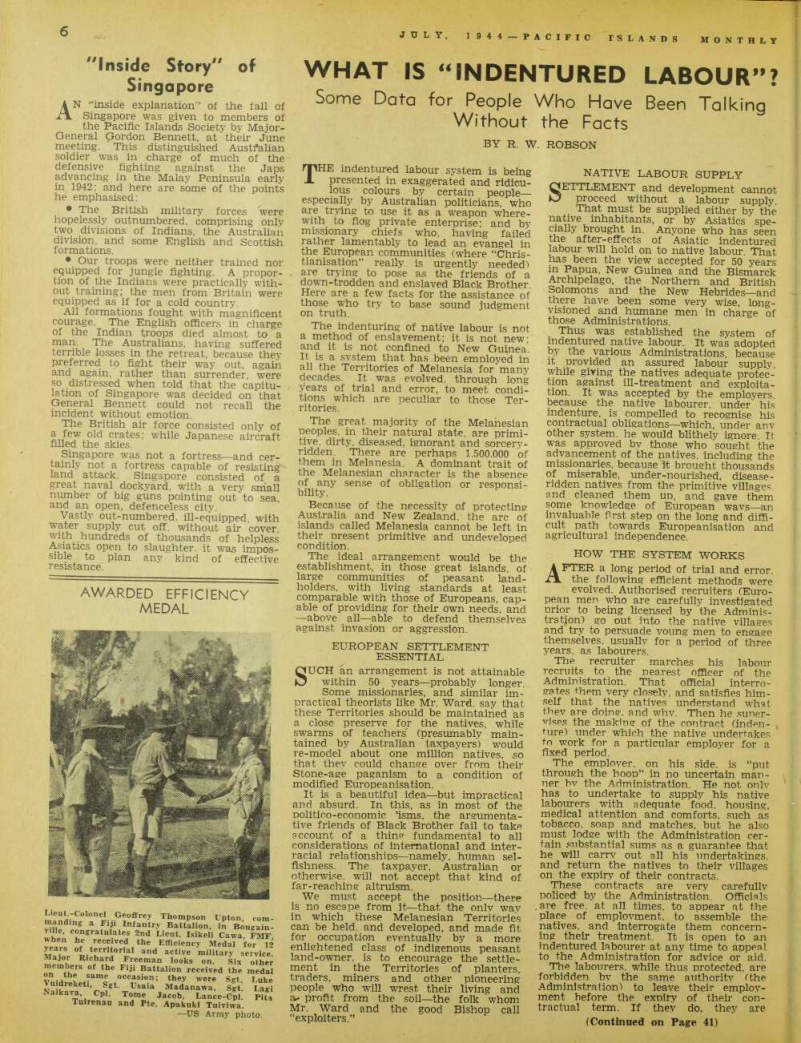
Lieut.-Colonel Geoffrey Thomp son Upton, com manding: a Fiji Infantry Battalion, in Bougain ville, congratulates 2nd Lieut. Isikeli Cawa, FMF, when he received the Efficiency Medal for 12 years of territorial and active military service.
Major Richard Freeman looks on. Six other members of the Fiji Battalion received the medal on the same occasion; they were Sgt. Luke Vuidreketi, Sgt. Usaia Madanawa, Sgt. Lagi Naikava Cpl. Tome Jacob, Lance-Cpl. Pita Tuirenau and Pte. Apakukl Tuiviwa.
US Army photo.
What Is “Indentured Labour”?
Some Data for People Who Have Been Talking Without the Facts
By R. W. Robson
rE indentured labour system is being presented in exaggerated and ridicu lous colours by certain people— especially by Australian politicians, who are trying to use it as a weapon where with to flog private enterprise; and by missionary chiefs who, having failed rather lamentably to lead an evangel in the European communities (where “Chris tianisation” really is urgently needed) are trying to pose as the friends of a down-trodden and enslaved Black Brother.
Here are a few facts for the assistance of those who try to base sound judgment on truth.
The indenturing of native labour is not a method of enslavement; it is not new: and it is not confined to New Guinea.
It is a system that has been employed in all the Territories of Melanesia for many decades. It was evolved, through long years of trial and error, to meet condi tions which are peculiar to those Ter ritories.
The great majority of the Melanesian peoples, in their natural state, are primi tive. dirty, diseased, ignorant and sorcery ridden. There are perhaps 1.500.000 of them in Melanesia. A dominant trait of the Melanesian character is the absence of any sense of obligation or responsi bility.
Because of the necessity of protecting Australia and New Zealand, the arc of islands called Melanesia cannot be left in their present primitive and undeveloped condition.
The ideal arrangement would be the establishment, in those great islands, of large communities of peasant land holders, with living standards at least comparable with those of Europeans, cap able of providing for their own needs, and —above all —able to defend themselves against invasion or aggression.
European Settlement
Essential
SUCH an arrangement is not attainable within 50 years—probably longer.
Some missionaries, and similar im practical theorists like Mr. Ward, say that these Territories should be maintained as a close preserve for the natives, while swarms of teachers (presumably main tained by Australian taxpayers) would re-model about one million natives, so that they could chansre over from their Stone-age paganism to a condition of modified Europeanisation.
It is a beautiful idea—but impractical and absurd. In this, as in most of the politico-economic ’isms, the argumenta tive friends of Black Brother fail to take account of a thine fundamental to all considerations of international and inter racial relationships—namely, human sel fishness. The taxpayer, Australian or otherwise, will not accept that kind of far-reachine altruism.
We must accept the position—there is no escape from it—that the only way in which these Melanesian Territories can be held, and developed, and made fit for occupation eventually by a more enlightened class of indigenous peasant land-owner, is to encourage the settle ment in the Territories of planters, traders, miners and other pioneering people who will wrest their living and a- profit from the soil—the folk whom Mr. Ward and the good Bishop call “exploiters.”
Native Labour Supply
SETTLEMENT and development cannot proceed without a labour supply That must be supplied either by the native inhabitants, or by Asiatics spe cially brought in. Anyone who has seen the after-effects of Asiatic indentured labour will hold on to native labour. That has been the view accepted for 50 years in Papua, New Guinea and the Bismarck Archipelago, the Northern and British Solomons and the New Hebrides—and there have been some very wise, long visioned and humane men in charge of those Administrations.
Thus was established the system of indentured native labour. It was adopted by the various Administrations, because it provided an assured labour supply, while giving the natives adequate protec tion against ill-treatment and exploita tion. It was accepted by the employers, because the native labourer, under his indenture, is compelled to recognise his contractual obligations—which, under anv other system, he would blithely ignore It was approved by those who sought the advancement of the natives, including the missionaries, because it brought thousands of miserable, under-nourished, disease ridden natives from the primitive villages, and cleaned them un, and gave them some knowledge of European wavs—an invaluable first step on the long and diffi cult path towards Europeanisation and agricultural independence.
How The System Works
AFTER a long period of trial and error, the following efficient methods were evolved. Authorised recruiters (Euro pean men who are carefully investigated prior to being licensed by the Adminis tration) go out into the native villages and try to persuade young men to engage themselves, usually for a period of three years, as labourers.
The recruiter marches his labour recruits to the nearest officer of the Administration. That official interro gates them very closely, and satisfies him self that the natives understand what they are doing, and why. Then he .super vises the making of the contract (inden ture') under which the native undertakes to work for a particular employer for a fixed period.
The employer, on his side, is “put through the hoop” in no uncertain man ner bv the Administration. He not only has to undertake to supply his native labourers with adequate food, housing, medical attention and comforts, such as tobacco, soap and matches, but he also must lodge with the Administration cer tain substantial sums as a guarantee that he will carry out all his undertakings, and return the natives to their villages on the expiry of their contracts.
These contracts are very carefully policed by the Administration. Officials are free, at all times, to appear at the place of employment, to assemble the natives, and interrogate them concern ing their treatment. It is open to an indentured labourer at any time to appeal to the Administration for advice or aid.
The labourers, while thus protected, are forbidden by the same authority (the Administration) to leave their employ ment before the exoiry of their con tractual term. If they do, they are
(Continued on Page 41)
brought back by the police, and punished.
Harsn and cruel employers, and msolent and disobedient employees, are punished, impartially.
The overwhelming majority of employ ers treat their indentured labourers very well—some because they are naturally kind, and some because it pays. The recruiting fee is from £lO to £l5 per boy.
If time-expired boys like their conditions of service so well that they desire a renewal of their contracts —and many do —the employer saves the recruiting fee.
Most employers take pride in having a healthy and happy “line” of boys.
Receiving a regular, well-balanced diet and medical attention, the boys soon appear in better health, and almost always put on weight. They usually return to their villages looking sleek and well.
Rates Of Wages
PERSONS accustomed to European standards get a shock to learn that the wage of these labourers runs from 10/- to 20/- or 30/- per month (according to the Territory). But that by no means represents the total cost to the employer. When recruiting fee, trans portation, food, housing, lap-lap, medi cine, tobacco and so on are added, the cost per boy per annum is substantial.
The natives do not give labour service on a European scale —in most occupa tions, two or three or more boys are only equal to one European labourer.
The labour unit (the monthly cost of one native boy) is an integral part of the economic structure of the Territories. If the wage rate were doubled, it would dis locate all industries in the Territories, but It would not benefit the natives one iota: their standards of living are not yet adjusted even to the present wage rates.
Even now, many time-expired labourers, returning to their villages with their accumulated wages, do not seem to know what to do with the money.
As the natives make progress to a bet ter standard of living, and need more European money to support that stan dard, they should get higher rates; and that turnover of money, in turn, would benefit the country as a whole. But this must be part of a gradual process.
Good And Bad Employers
THERE are bad employers; and, in their hands, the indentured labour system is a shame and a reproach. On occasions, in the Territories, I have seen boys treated cruelly—beaten, cowed, ill sheltered and inadequately fed. But these cases were so much the exception that I could only wonder why those par ticular employers were not dealt with by the usually alert Administration officials.
There are certain kinds of Europeans who never should be allowed to employ indentured labour —morose, or irrespon sible, or drunken fellows who either should be compelled to use only free (unindentured) labour (which could run away if abused), or they should be kept out of the Territories. Men who do not know how to treat their native labourers do not last long in the Territories, any way.
Considering that there were 40,000 indentured labourers in New Guinea and perhaps 10,000 in Papua, there were astonishingly few labour scandals. On the contrary, the great majority of labourers seemed quite happy and contented, and the relationship between them and their white masters was friendly and good.
Proof of this is seen in the way in which the boys, who simply had to be abandoned and left to their own devices when the Japs came in, have been flock
ing back to the returning Europeans, and eagerly seeking out their old masters.
Again and again, reading letters from Territorians in the forces up there, I have been struck by their expressions of delight at having found the boys from whom they were separated two years ago.
There cannot be much wrong with a system which produces that relationship; and I believe that that system, properly supervised and used, will achieve more in the sound Europeanisation of primitive Melanesia than some of the fumbling work of the not-so-well-organised missions.
A well-policed indenture system creates a disciplinary and directive force among the natives, which is valuable in this primitive region. The experience of the very wise Murray regime, in Papua, is
that the natives preferred the indentured system, which gave them protection and security, to the free labour system, which was the established policy of officialdom, Everything, of course, depended on the “master." A good employer never lacked indentured labour; a bad employer soon became known. wwat nu pot vmttc-taq
Whai Of Polynebia)
A RGUMENTATIVE people will say: Why is there no indenture system in Fiji and Polynesian territories?
How do they manage there?
The Micronesian and Polynesian peoples are much more advanced than the Mela nesian; they very quickly accept Euro pean standards of living; they are not cursed with Melanesia’s endless diversity of tongues; they definitely have a sense
of obligation and responsibility. They, generally, are at the stage of independent peasant land-ownership which the Melanesians may reach in a few decades, under European tutelage.
Forced labour (“blackbirding”) during last century depopulated large areas of Polynesia and nearly destroyed the Polynesian race. The splendid, self-sacrificing work of the Christian missions during 70 years, together with the firm policy of the various Governments, saved the Polynesians from ruthless exploitation and extinction.
Some of our missionary friends, eager to raise the fiery crosg, seem to think there is a similar set-up in Melanesia today. The cases are not parallel in any way. The “blackbirding” in Polynesia was uncontrolled, ruthless, and murderous; and the Polynesians were a cultured,
sensitive people. The Melanesian system is Government-controlled and strictly policed, and should help in the advance ment of the primitive natives, The labour problem in Micronesia and Polynesia is more acute than in Mela nesia; but, because of the different char acter of the people, it can be solved— to an extent. „ ,
Where Reform Is Needed
T CAN think of several aspects of the 1 indentured labour system which should have the attention of high authority. The wage rates may be due for revision—upwards; there should be a stricter definition of the class of man who is permitted to use indentured labour; the Administration and the employers, jointly, should be given responsibility for seeing that the natives, during their
three years’ service, are taught something useful; the practice of taking companies of men away from their villages and isolating them in labour barracks for three years, should certainly be reviewed.
But all these things already have been discussed by the New Guinea Commis sion on Native Labour, whose report, pre sented in 1941, has been conveniently for gotten by everyone.
I believe that the system itself, in the present condition of the Territories, is worth preservation, for the present, because it solves several problems that otherwise defy solution.
We must occupy and Europeanise those Melanesian Territories. Thus, we must accept responsibility for the natives. Our obligation to assist the natives across the gap between primitive savagery and the useful husbandry and industry which bespeak independence, should be woven into the pattern of our administration— and it is in that way that the indenture system can be made to serve a good and useful purpose.
Return To Manam
MANAM Island, off the Madang coast of New Guinea, is almost entirely active volcanic mountain. But it carries a native population; and before the war, when Manam, not infrequently, erupted, recruiters hurried there hot-foot to engage native labour, before the in habitants once more could forget their island’s unpleasantness. Manam went the way of all New Guinea territory in 1942; but recently it was reoccupied— bloodlessly—by the Allies. This is how Sergeant Roy McGregor, of Madang, described the event, in a private letter recently received: “The landing was done by a single PT boat, with 10 ratings, under Lieutenant Broadhead, of Melbourne, and with my self acting as pilot. We nosed into the beach on the western side of the island, with all guns trained on the shore. A few natives appeared in response to signs and, as we almost hit the beach, we got the welcome news: ‘Not got Nippon.’
“As the PT’s nose touched the steep beach I dropped off into arm-pit deep water, followed by the rest of the party— and that was all there was to it. But we had cleared up another uncertainty, and Manam was added to our recaptured territory.
“We landed at Awar the same after noon; and landings were made at Blup Blup and Bam Island a few days later,”
Fiji Elections This
Month
SUVA, June 29.
THE Fiji Legislative Council was dis solved on June 10. The election of the new Council will be held on July 29; nomination of candidates closed on July 6.
An ordinance passed recently, provides that members of the Fiji military forces serving overseas or any civil servant attached to the armed forces who would normally be resident Fiji, are entitled to vote at the elections. A special Regis tration Officer, Lieutenant J. R. Hawkes, has been touring forward areas in order to enrol members of battalions serving overseas.
In the Southern Division, Mr. Alport Barker, who has served a number of terms, is being opposed by Mr. Amie Ragg, who contested this electorate un successfully against Mr. Barker at the last election. A close result is anticipated.
In the North-western Division, Mr. H.
H. Ragg, who has served a number of terms, is being opposed by Mr. J. P.
Bayly, who has been out of the political arena for some time, but who was pre viously a member of Legislative Council.
Mr. Ragg is regarded as well “dug in,” and is popular in his electorate.
In the Eastern Division, Mr. H. B. Gib son, who has served a number of terms, will probably be unopposed.
For the Indian seats in the Southern Electorate, Mr. Vishnu Deo, who has served previously, will probably be un opposed. In the Western Electorate the candidates were expected to be Mr. B. D.
Lakshman (who has just served a term in Legislative Council), Mr. R. D. Patel (a lawyer), and Mr. Chattur Singh (a planter). Later, the last-named withdrew in favour of Mr. Patel.
In the Eastern Division, it is expected that Mr. Tularam, who has held the seat, will be opposed by Mr. Jafer Khan (a planter) and Mr. Ganishwar (a lawyer).
Nearly A Million!
How Morris Hedstrom's Huge Stocking May Benefit Central Pacific Territories
THE annual balance-sheet of Morris Hedstrom, Limited, of Fiji, was issued in June. This company is still suffering the embarrassments of riches —it has been so prudently and effi ciently managed during the past couple of decad3s, and especially during the war, that now it literally does not know what to do with its money.
Its subscribed capital is £739,613; accu mulated profits kept in reserve and used in the business are £387,969; and these, with some smaller items, bring share holders’ funds to well over £1,350,000.
Assets include; Plantations and land and buildings, £200,020; merchandise, stock and equipment, £253,324; sundry debtors, £96,857; cash and investments, £948,727.
What a stocking! And the £948,727 includes no less than £270,000 cash at the bank. The company is in the posi tion that it could repay every share holder 30/- for every 20/- subscribed, and still remain completely equipped for carrying on its large and profitable busi ness. There are lew big companies like that in the world.
In the year just ended, the company made a profit of £85,839 (£80,747 in 1943).
Having paid its usual dividends, it made gifts to war funds in the following Ter ritories: Fiji, £5,000; Samoa, £1,000; Tonga, £l,OOO.
At the annual meeting on June 30, the chairman, Sir Maynard Hedstrom (re cently returned from America) said the investment of £486,446 in Government and municipal stocks at low interest was not very profitable; that the present pos sibilities of expansion in Fiji, Samoa and Tonga were limited; and that the pos sibility of finding more profitable use of surplus funds was under consideration by the directors.
THIS directs attention to another unique angle of Morris Hedstrom, Ltd. Five powerful corporations now operate in Fiji and adjoining Territories —Morris Hedstrom, Colonial Sugar Refin ing Co., Burns Philp (South Seas), W. R.
Carpenter & Co., and the Theodore group of goldmining companies; but only the first-named can keep its profits and accumulations of funds within the Col ony without trouble —the managements of the others, being owned in Australia and elsewhere, are obliged to send con siderable funds overseas. Normally, the Morris Hedstrom funds, lacking employ ment in Fiji, also would go overseas; but, under present conditions, they remain in Fiji, so as to escape the punishing war time taxation in other countries. Fiji taxation is heavy, but not crushing.
Actually, that is a very good thing, and shows the wisdom of both the Fiji Government and the MH directors. It is embarrassing, at present, to have so much unemployed money on hand; but, when peace comes, and all countries are seeking rehabilitation, the presence of so much sheltering money in Fiji will create in Fiji many opportunities for settlement and development. It will not flow away when peace comes, because punitive taxation is likely to cpntinue in all other countries for a considerable time after peace.
“Cash and investments, £948,727,” may be bringing grey hairs into the heads of MH directors; but residents of Fiji, Samoa and Tonga should worry! If post-war markets for tropical products are going to be of any use at all, much of that stored-up credit in the MH
coffers is going to do a power of good in the three Territories.
Pension Fund
rE Morris Hedstrom Pension Fund was established in Suva by the dir ectors 17 years ago, and it now amounts to £118,502, all soundly invested.
Last year it received £2,747 from mem bers’ contributions, £4,635 from invest ments and £8,434 in contributions from the company. It paid out £1,773 in pen sions. At the present rate of growth, the fund should be able, soon, to provide an average of £3OO p.a. for 25 or 30 pensioners.
Position of Burns Philp (SS) Co.
FINANCIAL strength, though in a lesser degree, is seen also in the accounts of Burns Philp (South Seas), Ltd., in the year ended January 31, 1944. The company is registered in Suva and trades in the same Territories as Morris Hedstrom, Ltd., plus the New Hebrides and Norfolk, Niue, Wallis and Futuna.
Here are the figures for the year ended January 31, 1944, compared with the last year before the war (to January 31, 1940):
This company, as a war precaution, has increased its reserves by nearly £200,000 since 1939. Its funds, available for any developmental opportunities in the Cen tral Pacific, are in the vicinity of £500,000 —less whatever sum is tied up oversea in associated companies.
Fiji Birthday Honours
BIRTHDAY Honours announced in Fiji, on June 8, were as follows:
Qbe (Civil Divison)
Mr. W. N. Caldwell, Assistant Commis sioner of Inland Revenue:
Mbe (Civil Division)
Mr. F. I. Ryan, a Suva journalist who has acted as secretary of the Fiji Civil Defence organisation since the outbreak of war.
Mbe (Military Division)
Major Arthur Lewis, of Fiji Labour Corps, serving overseas.
British Empire Medal
Savenca Veikoso, NMP, for outstanding service over many years.
Colonial Police Medal
♦Inspector J. A. Moore.
Mr. Stanley A. Greenland, who had charge of the Department of Native Affairs, Papua, when evacuation was ordered 'in 1942, has now retired, after giving 32 years’ service to the Territory.
He is the uncle and godfather of that famous young naval officer, Lieutenant R.
T. G. Greenland, who made naval his tory (and got the DSO) as commander of “the human torpedoes.”
1944 1940 £ £ Sundry creditors 268,428 55,708 Issued capital 750,000 750,000 Total reserves 312,216 130,000 Real and shipping property 145,513 384,546 Investments 408,764 258,096 Cash 94,595 65,714 Merchandise 691,807 98,803 Book debts 69,196 165,005 Net profit 112,589 49’,353
Dead At 84
Bill Borthwick, Discoverer of Goldfield in Fiji
rE discoverer of the Tavua Goldfield, Mr. William Borthwick known affectionately throughout Fiji as “Old Bill Borthwick” —died in Lautoka on June 3, at the age of 84. He has been described as the “best prospector in three countries” (Australia, New Zealand and Fiji). He seemed to smell, gold.
Many people had suspected the presence of gold in Viti Levu; but all had failed to find it—except “Old Bill.” He kept on fossicking around in the region of the Nasivi River, on country which all the experts flatly insisted was, geologically, incapable of bearing gold. In 1931-32 he got prospects among the low Tavua hills which satisfied him that there was rich gold there.
But the only man who believed him was Mr. Pat Costello, well-known Suva
merchant. Mr. Costello backed his faith m “Old Bill” by “grub-staking” him to the limit, and by going personally to New Zealand and Australia in an attempt to interest some of the gallant adventurers of Pitt and Collins Streets. Certain groups of investors were sufficiently interested to send their expert advisers; but the advisers generally were not favourable to the new “find.”
When visiting geologists' and mining engineers condemned the Tavua goldfields in 1933, Bill confidently answered: “They may be good men in Australia, but they know nothing of the conditions under which gold exists in andesite.”
Then a group headed by E. G. Theo dore, of Melbourne, decided that Tavua really represented something, and it leased some of the country. That started a rush: during 1933-4, very large numbers of gold-seekers spread themselves over that part of Viti Levu, and pegged wide areas of country.
But the rich area was very limited— and it was also very rich. Upon it are now operating the famous mines of Emperor and Loloma, and alongside are one or two other mines, owned mostly by the Costello interests. All the other Tavua leases proved worthless. Both I
Borthwick and Costello benefited substan tially from the developments carried out by the Theodore group—as they deserved to do. This new gold industry enriched Fiji, just at a time when something was needed to take the place of copra and other industries which were not doing very well.
Borthwick was apprenticed to civil engineering, in Scotland, over 70 years ago; but, while still a lad, he stowed away on a sailing ship and went adventuring across the world. He landed in Towns ville, went prospecting, and found good gold in Queensland, New South Wales and New Zealand; became a skilled builder in New Zealand and Fiji; and, at the age of 72, discovered Tavua.
William Borthwick.
Topicalities
EXTRACTS from a letter from an American serviceman “somewhere in the New Hebrides” ;- “You told me that once the island virus got into me I would find it hard to get out. Well, I think it has got me now.
No foolin’. When the time comes for us to go home I’m going to be a sorry lad.
I have made one or two good friends among the Europeans here and have gotten along well with the natives. I have investigated the various means oi earning a living and find that several would be suitable —there’s just one thing has me stumped. And that’s the ‘Pan demonium,’ Such a balled-up mess that is! What I’m wondering now is—what would be their policy towards an Ameri can? All of the Britishers to whom I have spoken seem to be taking a beat ing, while the French prosper. What the hell kind of a business is that?” * A FORMER resident of Papua, who feels strongly for certain “dumped"
Public Servants, writes to suggest that an alternative to ANGAU might be AUPAP (“Papua” in reverse) and that it could be taken to mean “Australian Unit of Papuan Administrative Piracy”! * AN “ it-can-now-be-revealed ” story comes from Fiji concerning the defences of Suva in the early days of the Pacific war. These were con spicuously absent.
For one particular battery, although sites had been prepared, there were no guns. The authorities decided to fool the enemy and, one dark night, two cylindrical objects were unloaded from a ship. There was a lot of fuss about get ting the traffic off certain carefully dark ened Suva streets, along which the “guns” were to be hauled, and the town buzzed with rumour and suppressed excitement.
A climax was reached when a lorry driver, while the procession was in the centre of the town, “inadvertently” turned on his headlamps, revealing the unmis takable shape of the weapons to the gathering multitudes.
History does not say whether the infor mation leaked through to the enemy; but it does seem a pretty cumbersome way of fooling old Tojo. Were there so many Fifth Columnists in Fiji at the begin ning of the war? * Lieutenant-colonel j. b. k.
TAYLOR, OC Fiji Military Forces, tells how, during all the months they were waiting in the Solomons to go into action in Bougainville, they did not see a drink. Then, one afternoon, Major Dick Freeman rang up Colonel Taylor to ask him to come to afternoon tea. The Colonel went; and, after he arrived, Major Freeman said that for some unaccountable reason someone had
sent him a cake. However, all the other officers also had cakes and this one had been lying around for weeks—tossed about from pillar to post. “But,” said Freeman, “we’ll open it this afternoon and give it a go.”
He gave the parcel to the boys and, after a while, one of them returned and said: “This isn’t cake, sir.”
“Well, what is it?” asked the Major.
“It’s whisky, sir.”
Colonel Taylor thus concludes his story: “I wish you could have seen Free man’s face!”
HOW this civilisation gets them! There seems nothing for it but to coin another word—“Civ vo“—being the direct antithesis of “Troppo.” A nostal gic extract from a case-hardened Terri torian of long standing: “When I read that Wewak article of Judy Tudor’s, I thought of the many nice walks I had had around that country— along the pretty beach, and then off the road to Waganara, up and over the mountains to Aletoa, upwards and down wards, and so on to Kabiliwop, How I'd like to be there to-day! I would walk it, and like it. If I ever get back again’
I’ll never moan about bad roads, kunai, dirty house-kiaps, etc. In fact, I might even apologise to the natives for having gone crook at them ‘along before.’ ” * DR. THOMAS WOOD is remarkable in many ways. He is a composer and conductor; but, unlike some top ranking English musicians who toured Australia, he did not, when departing hurl abuse or make loud remarks about “colonial lack of culture.*’ Instead, he wrote two books—“Cobbers” and “Cobbers Campaigning"—which were as popular on this side of the globe as in England.
Recently, he re-visited Australia, and made a tour of New Guinea, where he conducted the brass band of the Royal Papuan Constabulary, Picturesque in their blue and red uniforms, the boys played Handel’s “iargo,” “O Sole Mio” and (of course) “Colonel Bogey.” It is reported that Dr. Wood was delighted with the performance.
He later visited some of their villages, where they sang some of their songs for him. He scribbled down the scores, and in one instance, recognised a German folk-song. Inquiries brought the informa tion that it had been taught to the village many years ago by a Polynesian mission teacher who came from the former Ger man territory of Western Samoa. * RAPE-VINE wireless transmitted this story from New Guinea to the “PIM Two natives are standing on the beach, watching a procession wading ashore from a ship’s boat. The prqcession is led by a dishevelled gentleman, in a very new solar topee, and with trousers rolled up to his knees.
First native: This big fella Minista ’e come when?
Second native: No got. ’E no come.
First native (indicating gentleman now splashing ashore with wet and muddy trousers): What name this fella?
Second native: O ’im, ’e something nothing—’im ’e kanaka belong Sidinee, The Rev. J. FI Metcalfe, of the Methodist Mission in the Solomons, expects to take up duty in New Zealand while waiting to return to his overseas work.
Australia
Territories' Plea For Severance From
Motion Deferred After a Lively Discussion
RESIDENTS of Papua and the Man- V dated Territory, weary of being “pushed arolmd,” or ignored, by ustralian Ministers and officials, made move, in June, which possibly may'have tr-reaching effects. They have pre ired, for submission to all Territorians ho are members of their Association, a otion that they appeal to Great Britain ir the removal of the Territories of apua and New Guinea from Australia’s iministration.
This motion will be dealt with at the 3xt general meeting of the Territories ssociation —probably in September. If is passed, a committee of the Associa- Dn will prepare, for submission to En in, a detailed case to prove that Aus alia, through past neglect of, and pre nt indifference towards the interests of □ropean residents, should no longer be emitted to exercise administrative ithority.
At the annual meeting of the Terri fies Association in Sydney, on June 27, te following motion was moved by Mr. . A. Laws and seconded by Mr. A. T. allins: IHIS Association, representing over 75 per cent, of the European popu lation of the Territories of Papua id Mandated New Guinea, having iled to secure any promise of just eatment at the hands of the Govern ent of the Commonwealth of Australia, ESOLVE that urgent representations be ade forthwith to the Government of reat Britain in the hope that, in what rer arrangements are made for the Iministration of the Pacific Territories ter the war, due consideration shall be ven to (a) the claims of Papuan and ew Guinea evacuees for assistance in ie re-establishment of their homes and isinesses; (b) their plea that Papua id the Mandated Territory of New uinea shall no longer be Territories of ustralia; (c) their appeal for some easure of self-government.
This Association instructs the Exe itive Committee 'to proceed accordingly, id prepare, for submission to the ritish Government, a statement of our ise in which the following points may ; clearly set forth: I.—Although it had ample warning, the ustralian Government failed to prepare r the Japanese invasion, and the vilian populations of both Territories 3re so hurriedly evacuated that the ajority of people arrived in Australia ithout any property other than what iey carried upon their persons. 2—The Australian Government paid a nail sustenance allowance to persons bo were without resources; but it was ade clear in every case that this was it a gift, but was to be regarded as a an and was to be repaid out of any ims received through Governmental •encies in- the future, such as war dam re insurance, payment for Pool copra, c. 3. Although the great majority of r acuees arrived without even adequate othing, the greatest difficulty was ex ;rienced in inducing the Australian overnment to even slightly relax the othes rationing system, so as to allow lese people to obtain sufficient clothes wear. 4. —Although the Australian Govern ent, by means of a special tax on build gs, described as compulsory war damage surance. created a War Damage Com msatlon Fund, the Government has
refused to admit liability for “indirect” war damage. It is contended that all Territories’ residents who were driven out hurriedly by the invasion, and com pelled to abandon their properties to the ravages of weather, looting and uncon trolled jungle growth, are as fully entitled to war damage compensation as those residents who were fortunate enough to have their properties blown to pieces by shells. The Australian Government, although frequently appealed to, will not permit any change to be made in its definition, announced in 1942, of “direct” and “indirect” war damage. The present position is that a large proportion of the former residents of the Territories will suffer complete economic ruin unless they receive compensation for what is called “indirect war damage.” 5. Although a year has passed since Papua was cleared of the enemy, the Australian Government has not restored civil administration to Papua, but has left administration solely in the hands of a branch of the Army. Consequently, the channels through which civilians cus tomarily approach the administrative authority have been closed to us. 6. —Our representations, made to the only authority available to us—namely, the Australian Department of External Territories —have been regularly and consistently ignored or side-stepped for two years. We have sought information and assistance concerning innumerable matters connected with our present and future condition; but we seldom, if ever, have been given, by any of the three Ministers who have held office since the evacuation, or by the Departmental heads, any information which would en courage us to believe that our rehabili tation in the Territories is a matter of any concern to the Australian Govern ment. Not by one single official word or deed has the Australian Government ex pressed sympathy with the Territories evacuees, or eagerness to assist in their rehabilitation. 7. —Much of our property in the Terri tories was taken possession of and used by the Australian Forces; and we were assured that full and proper compen sation would be allowed to us by the Australian Government. Instead of that the Australian Army, in order to handle claims for compensation, created a Special Branch that constituted itself judge and jury respecting all claims, in accordance with a set of rules which it framed for itself; and against which there was no appeal. The result was that the majority of our claims were “chiselled down” to awards that were offered to us on a “Take-it-or-leave-it” basis; and many of our people, being hard-pressed for funds on which to live, were forced to accept a settlement that was generally unfair and often cruel. Our appeals to the Departments of the Army and of Ex ternal Territories were either ignored or side-stepped. 8. —Although the Australian Govern ment has set up a Sub-Committee of Cabinet “to deal with matters affecting the future policy of the Australian Terri tories,” the Government has refused to give former Territories residents any opportunity to make representations in connection therewith. The present Minister, Mr. Ward, refused in May to receive a deputation from this Association; and, on being again appealed to, side stepped the issue. 9. As an indication of the way m which we have been treated for two
years, we may cite the subject of native policy and native labour. It is clear that the Australian Government is formu lating a new policy in relation thereto.
Two professional anthropologists have been given high military rank and sent to the Territories to report concerning the future treatment of natives —while scores of former Territories residents, who prob ably have a better practical understand ing of the native problem than all the anthropologists south of the Line, have been completely ignored. Two Australian Ministers (Mr. Beasley, in America, and Mr. Ward, in New Guinea) have an nounced that the system of indentured native labour in the Australian Terri tories is to be abolished —quite irrespective of the fact that that system was evolved during 25 years by practical men to meet .the needs of the Territories, and that its abolition would make necessary very far reaching economic and industrial re adjustments, and ruin the majority of industrial enterprises in the Territory.
Although such a change would pro foundly affect the livelihood and future of every Territories resident, the Aus tralian Government made its announce ment without in any way consulting the views of Territories residents. This Association is entirely sympathetic towards plans for the betterment of the natives —a thing essential to the future welfare of the Territories —but we cannot see why there should be so much concern for the welfare of the natives, while the plight of the European residents is ignored, and their appeals treated with contempt. 10.—Because of the inability of the Australian Government, both now, and during the past 25 years, to appreciate the needs of the Pacific Islands Terri tories, and to understand the principles
of administration which should be applied there, and because of the expressed deter mination of the present Australian Government to discourage and abolish private enterprise in the Territories, it is the wish of a large section of the European residents that the administra tion of these Territories should become the direct responsibility of Great Britain, so that our interests may be better under stood and properly protected.
MOVER and seconder made a number of effective points against Austra lian administration, as experienced in the past by the Territories.
Mr. Laws pointed out that Australian Ministers generally were indifferent to the welfare of the Territorians, Decause they had no vote. New Guinea, several years ago, was promised a measure oi self-government—but what happened?
Represen tauves of various non-official classes were appomted, on the nomina tion of the Administrator, to the Legis lative Council, where they were com pletely out-voted by the official members (mostly heads of Departments). Nearly ail the Territories residents were Aus tralians, with Australian connections, and with a warm regard for Australia; but they felt that, if their past experiences were any indication, they had nothing to hope for in the future from Canberra control.
Proposed Appeal To America
MR. R. W. ROBSON supported the motion; but moved, as amend ment to it, that certain: words be added, the effect of which would be that the appeal would be made, not only to Great Britain, but also to the United States as well. Mrs. Wilmott seconded the amendment.
Mr, Robson said that the policy of some Australian Ministers was to destroy the principle pf private enterprise. “Ii these Ministers cannot do it openly in Australia,” he said, “they are trying to do it by subterfuge in the voteless Ter ritories, and that is why they are attack ing the indentured labour system.” It was essential that the system of inden tured labour in the Territories be con tinued. There was nothing wrong with the system, as it had brought about a better standard of living for the natives.
The discussion that followed was lively and, when it touched on the question of appealing to America, somewhat acri monious.
The president (Mr. E. A. James) and members of the executive opposed the motion, expressing the belief that evacu ees would yet receive some fair considera tion from the Australian Government; and they strongly condemned the amend ment.
All speakers, however, expressed their bitter disappointment with the treatment they had received in Australia. They emphasised that they did not seek char ity, or expect any more«consideration than that given to unlucky wartime suf ferers everywhere. But they did feel that they had been treated with indifference, almost amounting at times to contempt, by the only authority to which they could appeal—namely, the Australian Government. The Government’s high handed action in planning the abolition of the indentured labour system, without any consultation of the wishes or inter ests of European residents, was especially referred to as an example of the treat ment residents were receiving from the Australian Government.
Mr, Robson, replying, said he was not advocating anything anti-British. On the contrary, it would be a happy day for the Territories if they could get away from Canberra control, and be placed in
the care of the British Colonial Office.
The personnel of the Papuan and New Guinea administrative services would bear comparison with anything in the Pacific —there was no complaint on that score.
The seat of all their troubles was Can berra control—a Canberra dominated by professional politicians, who know noth ing and care less about the tropical territories.
He said he urged the appeal to the United States because he was a realist.
The dominant power in the Pacific now, and probably for a very long time, was America—and all who had been saved from the Jap invasion could thank God for American power. Britain and America would control the post-war world—why, then, should their appeal not be directed to the two Powers, jointly, instead of to one?
The amendment was defeated, the vot ing being about 2 to 1 against.
Discussion of the motion continued at length. The executive, having given all members a chance to blow off steam, wished to reject the motion; but it was clear that a majority of those present were in favour of the motion; so a sug gestion by Mr. Tex Thomas, that the pro posal be deferred for consideration by all members, was accepted.
Enter Mr. Ward And
Missionaries
fl\HE proposal that the Territories should X be taken from Australian adminis tration was reported at length in the Australian newspapers, and referred to in Britain and the United State; and it naturally stirred up the Australian Government—which had been trying to ignore Territorians for many months.
The Minister for External Territories (Mr. Ward) came into the newspapers forthwith as the champion of the Gov ernment. He ignored practically every thing that had been said about Terri tories adminstration, except Mr. Robson’s references to the plan for the abolition of indentured labour. Mr. Ward attacked Mr. Robson with the invective and innuendo of the typical politician. He suggested that Mr. Robson was disloyal even seditious—and that Mr. Robson had defended the labour system merely be cause he was “the mouthpiece of the capitalistic interests which had been exploiting New Guinea.” He said that the Australian Government would see that the exploitation of the Territories ceased, and that the natives were properly pro tected in future, and given a fair deal.
It was obvious that Mr. Ward was using the opportunity for purposes of extremist propaganda, and that he has no more regard for the primitive natives of New Guinea than for the Llamas of Thibet.
Therefore, it was with astonishment that Territorians saw that Bishop Cranswick, of the Anglican Mission, and Rev. J. W.
Burton, of the Methodist Missionary Society, had decided to make common cause with Mr. Ward —they supplied the “Sydney Morning Herald” with the fol lowing letter. It is republished in full hereunder, so that Territorians may clearly understand the viewpoint of people with whom they may be closely associated in future: Without taking any political attitude, we wish to support the declared intention of the Federal Government, as stated by the Hon. E. J. Ward, Minister for External Territories, in your issue of, yesterday, “of giving just treatment to all residents of the Australian Territories, including the native inhabitants.” We would go further and, in the terms of the Mandate, declare that the well-being and development of the native peoples should have priority and be regarded as a sacred trust. It is this conviction which leads us to support the avowed policy of the present Government to abandon the indentured native labour system as soon as possible and to sub stitute a more humane method.
We strongly dissent from Mr. Robson’s view, which favours the retention of this effete, noxious, and discredited labour arrangement in the interests of a handful of Europeans. This is a legacy from the old German Government, and of an inhumanity that is now alien to our modern thought. We are not suggesting that all employers of natives have been personally unjust or cruel; it is the system itself, of which they also are victims, to which we object. It denies the right of private enterprise to tens of thou sands in order to bolster up the private enter prise of a few. The arguments used by Mr Robson are precisely those advanced against the abolition of slavery, and they ignore the ele mental human rights of defenceless people.
We submit that the system is a great social injustice, in that it seriously disrupts native life, drawing away the best young men, and potential fathers, from the villages, thus leaving the heavy work to be done by old men, women, and children. It is also a great economic in justice in that it is a blind alley, and condemns the brown man, for all time, to be a mere serf of the white man, instead of being given the opportunity, by training and encouragement, to cultivate his own soil in modern and more productive ways. We could wish that the im petuous pen of Mr. Robson would attack this monstrous injustice of paying labourers less than threepence per day in New Guinea and less than flvepence a day in Papua. Even though food, shelter, and rudimentary medical care are in cluded, surely here is “responsibility to fight against injustice.”
There are serious moral dangers that cannot be dissociated from the system, but of these we can only hint. We would point out that all the more enlightened Governments of the world have abolished this system, and we trust that, in spite of opposition from vested interests, the Federal Government will stand firm by its declared policy.
G. H, Cranswick,
Bishop, Chairman, Australian Board of Missions;
John W. Burton,
General Secretary, Methodist Overseas Missions.
It is not necessary to reply to this remarkable document. The answer to every point made by the reverend gentle men is known to every man or woman who has lived in the Territories and handled native labour.
The arguments for and against the sys tem are published elsewhere in this issue.
Royal Commission Is Possible
IN public replies to the Australian Minis ter, Mr. Robson said the indentured labour question was only one of many grievances which the Territorians had against Australia, but Mr. Ward ignored or side-stepped all the others; that proof of Mr. Ward’s political cunning was seen when he chose to weep loudly over the so-called ill-treament of , the natives, while ignoring the plight of thousands of his fellow-Australians, who had been compulsorily evacuated from the Terri tories and economically ruined; that any administration would be better than that received at the hands of Canberra poli ticians; and that it was useless to argue with Mr. Ward, anyhow, because Mr.
Ward actually has no administrative power in the Territories —all power lies with ANGAU, under Army control.
Many Territorians, burning with indig nation at Ward mis-statements and the one-eyed missionary views, sent letters in to the “SM Herald,” but only one or two were published—further evidence that the Australian public is not interested in Territories affairs, and is quite indiffer ent to the fate of Territorians.
The discussion probably will be revived when the motion for severance comes again before the Pacific Territories Asso ciation, or if it should be brought up in the Commonwealth Parliament.
There is some possibility that the whole situation in relation to future Territories administration (including indentured labour), will be investigated by a Royal Commission.
Bagged Two Zeros Over
Biak
In the news for having bagged two Zeros over Biak Island (Dutch New Guinea) is Flight- Lieutenant D. R. (Danny) Raker (pictured above), younger son of Mr. and Mrs. E. L. Baker, now of Manly, NSW, but formerly of Fiji. Until retiring about five years ago, Mr. Baker, Snr., was a District Commissioner in Fiji, and a member of the Legislative Council. There are two other Baker boys besides Danny—Mr. Arthur Baker, of the Colonial Secretariat in Fiji, and Bruce, who is a Flying-Officer in the RAAF, stationed in Canada.
Advertisements & other items, pp. 11-13 (4 items)
9
ACIFIC ISLANDS MONTHLY JULY, 1944
10
JULY, 1944 YACIFIC ISLANDS M| ONf H L f
11
* A C I F I C ISLANDS MONTHLY JULY, 1944
Put your
ADVERTISEMENT
is 1 1 £J9. ★lf you sign you give away your natural right to y6ur own way of life. You become an index-number in a bureaucrat’s file. ★ You place yourself in peace time under the controls you have endured in war. ★ You endanger your right to run your own business, own your own farm, or choose your own job. You can be man - powered
for good.
★ You put tremendous but unspecified powers into the hands of a central authority at Canberra, with an evergrowing army of aca-
demic regimenters
living on the job. i
Put your
Your Soldier is fighting for freedom. Don’t YOU sign it away in his absence!
THE Bottom Square
Authorised by John Hedge, Australian Constitutional League, Australia House, Sydney
Fiji Sugar
Industry Returning to Normal
SUVA, June 29.
CANE crushing commenced about the third week in June, at all the Colonial Sugar Refining Company’s mills. Ample mill labour is reported to have been offered.
The political situation seems to be quiet.
The investigation by Professor Shep hard is proceeding. The section of the Indian community interested in cane has come forward and Professor Shephard has been well received wherever he has car ried out his investigations.
Five German residents of Samoa who were interned in New Zealand at the end of 1939, have now been repatriated to their homes in Western Samoa. They are either in ill health or of advanced age.
The Lion Lies Down With The Lambs
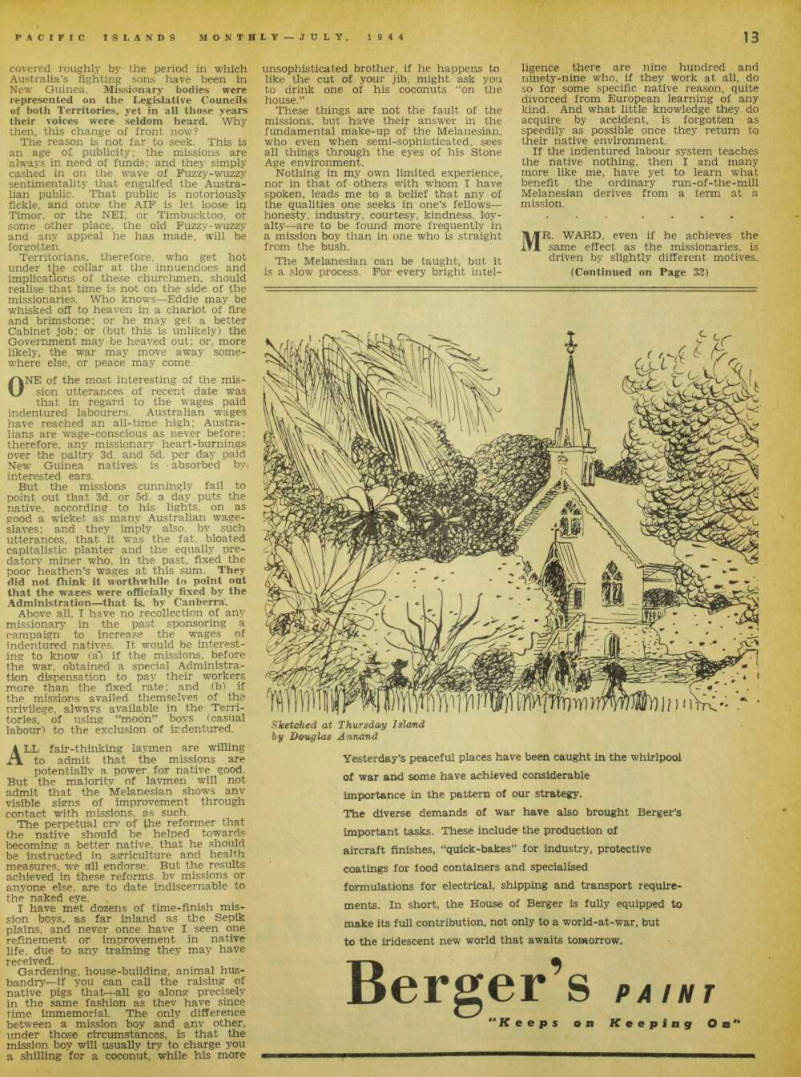
"Our Eddie" and the Bishops Get Together
By Judy Tudor
WHEN a member of the Australian (Labour) Cabinet opens his mouth too wide and puts both feet in it, he is not sacked but is given the port folio of External Territories. It was thus, after the Australian general elec tion of 1943, that the New Guinea Ter ritories were given into the tender keep ing of Mr. E. J. Ward.
Eddie J,, until shortly before the elec tion, was engaged in dragging skeletons from the cupboards of the War Depart ment, and his “Brisbane Line” disclo sures led to a Royal Commission and the demoting of Eddie. But Eddie is a hardy plant and, although then lopped off at the roots, later, with the help of the Darlinghurst electorate and a friendly Labour Caucus, he again made Cabinet grade, this time, to the consternation of good Territorians, disguised as the Fuzzy wuzzies’ friend.
Now, the administration of the Terri tories to-day is, to quote any Australian politician, a ’ollow sham. The Army is in possession, all administration takes place in the realms of theory and it is darned hard to whip up any vote-catch ing campaign under existing conditions.
But we all know —having read about it in the papers—that New Guinea is fabulously rich. Gold can be picked up; coconuts and rubber and quinine and
tobacco and tall timber, plus all the spices of the Indies —only better —cocoa and coffee and tea and sisal hemp and cot ton and oil —all are there or grow prac tically without any attention at all; and now that the Yanks have made us air fields and roads —well, what the heck is to stop us?
All Australians know these things. Like everything else even distantly connected with Australia, New Guinea is the best thing of its kind in the world—like Our Harbour Bridge, and Our Climate and Our Wool and Our Labour Conditions and Our Land Flowing with Milk and Honey.
“Reconstruction” therefore has pro vided the fuel for the demanding fires of Mr. Ward’s crusading spirit.
The Australian Government, he says, has post-war plans well in hand for New Guinea. New Guinea is to be “developed,” and God help anyone who tries to stop it!
Just how this is to be done, is, at this writing, being kept a deep, dark secret.
Possibly even the Labour Party, being traditionally adept at blasting established institutions to blazes without arranging a workable substitute, does not know either.
But we can rest assured that it will not be along the lines employed before the evacuation, when “there existed a system of native slavery for the benefit of private enterprise.” Of all the iniquitous practices of the pre-war New Guinea capitalist, this slavish system of “indentured” labour sticks most in Eddie’s gullet, to be regurgitated with good effect, for public benefit, whenever any aspect of New Guinea is mentioned. And in espousing this cause, he is not alone.
POLITICS make strange bed-fellows.
The political gymnastics witnessed by Territorians over the last 2h years have conditioned them for almost anything—even the Sydney spectacle of July 1, when Eddie J.. political red ragger, and Bishop Cranswick, of. the Anglican Mission, and the Rev. J. W.
Burton, of the Methodist Mission, climbed onto the same band-waggon under the same banner—“ Down With the Capitalis tic Slavers of New Guinea.”
Now, the estimable Mr. Ward, having spent the best years of his life being a politician—and product of the Trades Hall, to boot—can perhaps be pardoned, on the ground that he could not know very much about New Guinea or New Guinea natives.
But these mission chiefs cannot pro duce the same alibi. To be sure, mis sionary and layman have never seen eye to eye in Melanesia; but there was never this concerted mission wail that we have heard over the last two years—a period
covered roughly by the period in which Australia’s fighting sons have been in New Guinea. Missionary bodies were represented on the Legislative Councils of both Territories, yet in all those years their voices were seldom heard. Why then, this change of front now?
The reason is not far to seek. This is an age of, publicity; the missions are always in need of funds; and they simply cashed in on the wave of Fuzzy-wuzzy sentimentality that engulfed the Austra lian public. That public is notoriously fickle, and once the AIF is let loose in Timor, or the NET, or Timbucktoo, or some other place, the old Fuzzy-wuzzy and any appeal he has made, will be forgotten.
Territorians. therefore, who get hot under the collar at the innuendoes and implications of these churchmen, should realise that time is not on the side of the missionaries. Who knows —Eddie may be whisked off to heaven in a chariot of fire and brimstone; or he may get a better Cabinet job; or (but this is unlikely) the Government may be heaved out; or, more likely, the war may move away some where else, or peace may come.
ONE of the most interesting of the mis sion utterances of recent date was that in regard to the wages paid indentured labourers. Australian wages have reached an all-time high; Austra lians are wage-conscious as never before; therefore, any missionary heart-burnings over the paltry 3d. and sd. per day paid New Guinea natives is ■ absorbed by. interested ears.
But the missions cunningly fail to point out that 3d. or sd. a day puts the native, according to his lights, on as good a wicket as many Australian wage slaves; and they imply also, by such utterances, that it was the fat. bloated capitalistic planter and the equally pre datory miner who, in the past, fixed the poor heathen’s wages at this sum,_ They did not think it worthwhile to point out that the wages were officially fixed by the Administration—that is, by Canberra.
Above all, I have no recollection of any missionary in the past sponsoring a campaign to increase the wages of indentured natives. It would be interest ing to know (a") if the missions, before the war. obtained a special Administra tion dispensation to pay their workers more than the fixed rate; and (b) if the missions availed themselves of the privilege, always available in the Terri tories, of using “moon” boys (casual labour) to the exclusion of indentured.
ALL fair-thinking laymen are willing to admit that the missions are potentially a power for native good.
But the majority of laymen will not admit that the Melanesian shows any visible signs of improvement through contact with missions, as such.
The perpetual crv of the reformer that the native should be helped towards becoming a better native, that he should be instructed in agriculture and health measures, we all endorse. But the results achieved in these reforms, bv missions or anyone else, are to date indiscernable to the naked eye.
I have met dozens of time-finish mis sion boys, as far inland as the Sepik plains, and never once have I seen one refinement or improvement in native life, due to any training they may have received.
Gardening, house-building, animal hus bandry—if you can call the raising of native pigs that—all go along precisely in the same fashion as thev have since time immemorial. The only difference between a mission boy and anv other, under those circumstances, is that the mission boy will usually try to charge you a shilling for a coconut, while his more
unsophisticated brother, if he happens to like the cut of your jib, might ask you to drink one of his coconuts “on the house.”
These things are not the fault of the missions, but have their answer in the fundamental make-up of the Melanesian, who even when semi-sophisticated, sees all things through the eyes of his Stone Age environment.
Nothing in my own limited experience, nor in that of others with whom I have spoken, leads me to a belief that any of the qualities one seeks in one’s fellows — honesty, industry, courtesy, kindness, loyalty—are to be found more frequently in a mission boy than in one who is straight from the bush.
The Melanesian can be taught, but it is a slow process. For every bright intel-
ligence there are nine hundred and ninety-nine who, if they work at all, do so for some specific native reason, quite divorced from European learning of any kind. And what little knowledge they do acquire by accident, is forgotten as speedily as possible once they return to their native environment, If the indentured labour system teaches the native nothing, then I and many more like me, have yet to learn what benefit the ordinary run-of-the-mill Melanesian derives from a term at a mission. ... ... 11/fR. WARD, even if he achieves the same effect as the missionaries, is driven b y slightly different motives,
(Continued on Page 32)
He belongs to a group of theorists who presume that all men are born equal, and that if. after 30 years, some of them are down and out while others have improved their status—well, it is just a dirty capitalistic trick. He believes that if a man rises an hour earlier than his fel lows and works two hours later at night, so that in a few years he can afford to buy a car, then he is just a traitor to his kind: the fact that he has accom plished something is a matter of luck; and he should be kicked in the pants as often as possible for his presumption.
If, on the other hand, a man spends every Saturday at the races, and con sistently loses his wages, so that his wife and kids become a charge on the State and the man goes on the dole—then that’s just bad luck. He’s one of the down-trodden masses towards whom all social services should be orientated, and for whom the capitalist should be made
to cough up his iU-gotten gains.
By the same token, if a man goes to a primitive country like New Guinea with about ten shillings in his pocket and, through initiative and fortitude, makes good—then, again, the whole affair stinks. In Eddie’s simple philosophy, one can rise only on the necks of other humans.
The New Guinea native, as seen by Eddie, represents the down-trodden masses. He therefore must be freed from the bonds of “slavery.” If the Melanesian shows a strange reluctance to shake him self out of his bemused state, then he must be agitated a bit. He must be urged to unite, strike, show what he is made of. His *brown .hide, with which the good Lord saw fit to equip him, doesn’t mean a darned thing—unless he is silly enough to cherish an ambition to come to Australia.
And, come the revolution, he’ll call the tune while the planters dance. If they are lucky, some planters might get jobs as agricultural instructors. (See Mr. Bur
ton in May “PIM” on “What to Do With Planters When the Natives Take Over.’’) But, for the rest —well, we should worry.
OUR King’s Cross Minister has the well-known Australian complex that there is nothing to be learned out side the Commonwealth three-mile limit.
What’s good in The Cross is certainly good anywhere else. And it was with this in his mind that Eddie recently went cruising to New Guinea.
Even allowing for our Minister’s Bohemian habits, it has been a cause of some wonder just why he felt it neces sary to meet the natives with his pants rolled up and sans boots (May “PIM”); but now the reasons can be revealed!
It has been the custom in those parts, for long enough, that when ships anchor out, one is taken ashore in a surf boat, and carried the last few yards by a couple of not-unwilling natives. But, when a couple of brown sinewy arms were pre sented to Eddie, he is reported to have struck an attitude and said, “What —be carried ashore by a couple of my breth ren? Like a slave-driving planter? Me?
Not plurry likely! I’ll walk, like any decent, self-respecting Unionist.”
Thereupon, rumour hath it, he sat down on the gun’ales of the boat, peeled off his shoes and socks, rolled up his pants, and plunged into the surf.
Eddie is an anachronism. He sees himself, not as a perambulating profes sional politician, as we do, but as a Crusader with a fiery sword; or as an Australian Abe Lincoln, freeing slaves.
Fate and John Curtin unfortunately cast him for this role when he could have been better employed tending to his knitting or making further military “disclosures.”
Now. there appears to be nothing to save the “slaves being freed” and Territorians from going completely nuts unless (1) Eddie is sent to New Guinea to spend a year working native labour; or (2) he is given another job.
The second seems the more likely
course, although there is small comfort in this for Territorians. Judging solely by public faux pas of recent months — which seem to be the only qualification necessary for the job of External Terri tories’ Minister —next in line is Minister for Information Calwell, whose control of censorship got Australia into world head lines a few months ago.
Mr. Calwell is as militantly “pink” as Edward J. Ward, and any truck with capitalists of the New Guinea order can scarcely be expected from that quarter, either.
IT might well be that Territorians, in view of all these besetting worries, should be bowed down under a load of woe. But they are an indestructible lot, having been exposed to the evil machinations of politicians from an early age, and grown some immunity. To-day. they realise, is the era of talk and hot air: to-morrow still may well be theirs.
Shorn of its wartime glamour. New Guinea is more than likely to be left to ffet on with the job of growing up; and this is a process that will require, not the advice of woolly-haired theorists, but the service of plain, ordinary citizens who can roll up their sleeves and get down to work.
Advertisements & other items, pp. 14-15 (2 items)
Burns Philp
PACIFIC ISLANDS SOCIETY
Visitors from the Islands to Sydney (or those interested in Islands affairs), are advised to communicate with the honorary secretary of the above Society, which has been formed to study the history, traditions, economics, and political developments of the Pacific Islands.
Regular monthly meetings are held at History House, 8 Young Street, Sydney.
Address for Correspondence:
THE PACIFIC ISLANDS SOCIETY,
Box 2434 MM., G.P.0., Sydney.
Registered Office :
SUVA
FIJI
BURNS PHILP
(SOUTH SEA) CO. LTD.
Inc. in Fiji Island Traders and Shipowners Also Branches at; Levuka, Lautoka, Labasa, Ba, Sigatoka, Rotuma.
Tonga: Nukualofa, Haapai, Vavau.
Samoa: Apia, Pago Pago (American Samoa).
Solomons: Makambo, Gizo, Faisi.
New Hebrides: Vila.
Code Address; Gilberts: Tarawa.
"Bumsouth". Norfolk Is. Niue. Wallis Is. Futuna Is.
Fij
Sole Australian Concessionaires :
GEORGE BROWN & CO. PTY. LTD.
267 Clorence Street, Sydney.
As the Ultimate factory is engaged in vital war production, the supply of Ultimate Commercial Receivers cannot be maintained at present.
SERVICE: Ultimate owners are assured of continuity of service. Our Laboratory is situated at 267 Clarence Street, Sydney.
Servicing of all kinds of radio sets or amplifiers, as well as Rola Speakers, is also undertaken at our laboratories.
Berger’s paint
f tI l y>
& & mm II mh==
' A. - - -V'-V
- 9
mrnffrm
mv
J?)M>fC'- * •
Sketched at Thursday Island hy Douglas Annand Yesterday’s peaceful places have been caught in the whirlpool of war and some have achieved considerable importance in the pattern of our strategy.
The diverse demands of war have also brought Berger’s important tasks. These include the production of aircraft finishes, “quick-bakes” for industry, protective coatings for food containers and specialised formulations for electrical, shipping and transport requirements. In short, the House of Berger is fully equipped to make its full contribution, not only to a world-at-war, but to the iridescent new world that awaits tomorrow.
Berger’s paint
"Keeps on Keeping On “
Fate Of Earhart
May Have Come Down in Jap Territory
11THEN the United States Marines cap- Tt tured a Japanese position on Saipan in June, they came upon an album of photographs connected with the round the-globe flight of Amelia Earhart; and this has aroused new interest in the fate of the aviatrix.
It has been many times suggested that Earhart and her navigator, Fred Noonan, when they left Lae (New Guinea) in 1937 for Howland Island (Central Pacific), got astray and came down in Japanese ter ritory and were “liquidated” as spies.
The map shows how such a possibility comes under discussion.
Earhart was aiming at Howland, which is slightly north-east of east from Lae; the nearest Jap islands would have been the Marshalls, which are considerably north of north-east. If the American fliers failed to locate Howland—a tiny dot with a vast empty ocean beyond it— they almost certainly would have turned away north-westward, knowing that, if they had enough fuel, this would inevit ably bring them over the widely-spread and innumerable atolls of the Gilbert (British) or Marshall (Jap) archipelagoes.
There have been several ugly stories concerning the fate of Europeans who. for one reason or another, apneared among the Marshall and Caroline’ Islands after about 1933. After the Japs seized Man churia, in 1931. and defied the European world, they began to fortify the Caroline and Marshall Islands, and all their acti vities there became a very jealously guarded secret. If Earhart and Noonan came down in the Marshalls, they prob ably were murdered.
Value Of Franc
N. Caledonia's "Windfall"
Noumea, May 27.
rnHE recent devaluation of the franc to X the basis of 200 to the English pound and 160 to the Australian pound, has raised the value of foreign currency controlled by the Office des Changes on behalf of New Caledonia by 42,679,062 francs. The Governor stated recently that this sum has been credited to a special account at the Bank of Indo china held at the disposal of the public authorities.
"Bulolo" At The Invasion
riIHE New Guinea Territories were repre- A sented, in the invasion of Europe, on June 6. by the new Burns Philp ship, “Bulolo” which, between 1938-39, supplied the nearest thing to a luxury liner the Territories had then seen.
A few weeks after the outbreak of World War 11, in September, 1939, the “Bulolo” was taken over by the Admiralty as an armed merchant cruiser, in which capacity she travelled 250,000 miles. She was in the Allied landing in North Africa, in November, 1942, and a recent despatch from a representative of the British press, date-lined “HMS Bulolo,” tells of her role in the opening of the second front in Europe.
Several Burns Philp ships have found a watery grave since the war began, but the “Bulolo,” although in the thick of things throughout, has had a charmed life.
Lieut.-Col. A. T. Newboult, recently Colonial Secretary of Fiji, and now in London, broadcast from the BBC in the “Calling the Islands” programme on June 14.
Brave Solomons Mission
Nurse Decorated
A MEMBER of the Methodist Mission nursing service in the Solomons. Sis ter Merle Farland, who refused to leave her post during the Japanese occupation, has been created a Member of the Order of the British Empire.
Sister Farland joined the Methodist Mission in the Solomon Islands as a nurs ing sister in 1938. When the evacuation of Europeans from the group was organ ised about March, 1942, she refused to leave, and remained in sole charge of the mission’s medical activities in the area where she was stationed. She spent 18 months in the Group, nursing in a num ber of hospitals, mainly on Vella, Lavella and New Georgia, and for nine months was the only nurse remaining in New Georgia.
Located by United States forces, Sister Farland was evacuated by them to Guadalcanal, where she spent three months before returning to New Zealand.
While with the Americans, she gave a number of lectures to their men and nurses.
Later. Sister Farland was one of six nurses who went to the Solomons with the New Zealand forces, and she is now an Army nursing sister in New Caledonia.
to Papua
Women Missionaries to Return to Papua
SOME women missionaries, evacuated from Papua in early 1942, have been given permission to return. Mrs. A.
J. Thompson (wife of Archdeacon Thomp son, of the Anglican Mission) and Miss Doris Downing and Mrs. Raymond Nich olas (of the same mission) are at present in Sydney awaiting transport to the Territory.
Advertisements & other items, p. 16 (1 item)
90 Years
iiSS(SfiSSS^SS
0 &r~
13 *2 a 4
SWALLOWs ABIE IL
3 ■•acts » iiiciki • mi fnmst (lid • flllCfl . I ' i*Ji vj v ivi. 1 Jj/k. J^ff, er?
Servants
Papuan Public
Recent Promise By Minister
Letter to the Editor IREAD with interest your article in the June PIM, under the title “The future of aNuaU,” wnerem a mem ber of tne Papuan Public service, witn a line war record, asks • . . . are the ngnts of officers who, like myself, volun teered for military service , . . being preserved . . . ", The Minister for External Territories promised the Secretary and myself, at an interview, that tne rights of ALL members 01 the Papuan civil adminis tration would be protected; ana that after ALL those members who returned to Papua had been placed in their correct positions according to their ability, ex perience and service, then members of ANGAL, by virtue of whatever exper ence they nad had in Papua, would be allowed to join the Papuan Government in the ordinary manner—just as we all joined, at the bottom, working upwards according to ability and service.
Definite assurances were given that no leap-frogging by members of ANGAU, would be countenanced. The Minister was most emphatic on this.
In reply to further enquiries, the Minister said that the time had not yet arrived to consult members of the Civil Administration. Up to date, consul tations had been of a military nature.
However, when the time did arrive to discuss civil control, senior members of the .Papuan Administration would not be ignored. \At the moment, however, no indication of a likely date of return to Papua could be given.
Early in this war, when many mem bers of the Papuan Administration volunteered for active service with the Forces, my Association took up many matters with the Lieut-Governor and, later, with the present Administrator — the Hon. H. L. Murray, CBE. The main concern was to preserve full rights, status, seniority, etc., to all those who were dealing with the enemy.
Our several requests were very sym pathetically received and dealt with.
When finalised, my Council and myself considered that everything possible had been done in the interests of those volunteers. Certain assurances were readily given, and I hope I still have sufficient faith in the British Crown to believe that those promises made by the Administrator—some of them in Council —will not be reversed by Canberra. That would be a monstrous action.
A Circular has been issued containing most of the foregoing information — with some other facts—and is available to all members.
Looking at your enquirer’s letter generally, I agree that many oppor tunists are created in every walk of life.
It appears to me, however, it would be ridiculous to allow military service— including ANGAU —to count with a view to jockeying into good positions in a civil administration or vice versa. Other wise, men from the last war—or maybe even the Boer War —must be allowed to count their military service for the same purpose. And it is not forgotten by many that several members of the Pap uan Government had fine records of service in the last war, whilst they were in contact with the enemy of those days.
I am, etc.,
A. W. Marshall,
President, Public Service PO Box 3365, Association of Papua.
Sydney
Advertisements & other items, pp. 17-18 (1 item)
restoring
A valuable
help in
physical
strength after
illness
During convalescence the
patient’s appetite is often
capricious ... he doesn’t like this and doesn’t fancy that. Yet it is most important that he has the right food to build up m mOPHIfTAi* marked revivifying effect of Horlicks. health and strength. In this respect Horlicks is invaluable.
Patients enjoy the delicious flavour of Horlicks, and it has the additional advantage of being very easy to digest.
Horlicks is a complete food drink. It creates warmth and energy almost at once, since the natural sugars it contains are
quickly absorbed by
the blood-stream. This is the reason for the As a tissue-repairer Horlicks is of definite value. It contains a valuable proportion of
readily - assimilable protein,
also a percentage of mixed carbohydrates. This makes Horlicks a very real factor in
restoring bodily strength. It’s
no trouble at all to prepare Horlicks. Simply mix it with water only, hot or cold. Its natural sugars make Horlicks sweet enough for most tastes.
Horlicks is sold in handy l ‘“" irs, or in tins, price 3/-.
(Prices slightly higher
in the country.)
HORLICKS
Modern Refrigeration for the South Sea Islands
The ELECTROLUX KEROSENE OPERATED
REFRIGERATOR
MARVEL
OF
MODERN
SCIENCE
THE
MIRACLE
OF
ICE
FROM
HEAT
ELECTROLUX OFFERS ECONOMICAL, modern and completely efficient
REFRIGERATION FOR ISLANDS' HOMES.
FREEZES CONTINUOUSLY WHILE SMALL LAMP BURNS.
Freezing controlled by simply regulating height of flame. Uses only I gallon of kerosene per week MOTORLESS ... NO PARTS TO GET OUT OF ORDER.
MODEL L 22
Capacity 2.3 cubic feet.
MODEL L3BO
(as Illustrated) Capacity 4 cubic feet.
MODEL LKSSO
Capacity 5.5 cubic feet.
GUARANTEED FOR TWO YEARS.
• Write to your Local Distributor for prices and full details.
OBTAINABLE FROM ALL W. R. CARPENTER Cr CO. LTD.
BRANCHES THROUGHOUT THE ISLANDS
Representation in Papua and New Hebrides.
Slap In The Face
American View of the Australian- NZ Regional Agreement
From a resident of the United States, who undertakes a great deal
of 'publicity work — lectures, radio
commentaries, and so forth : THE agreement signed, in January between New Zealand and Australia is a tremendous slap in the face to those of us who have held the attitude of our essential co-operation as para mount.
In the vernacular of the comic strip, “Is my face red!’’ I realise the colour of my face has no interest for the peoples or Governments of Australia and New Zealand. But complete disregard of the place or interests of the people across the Pacific suggests a lack of vision.
Ail our words and efforts to friendship have been badly sabotaged by this British- Commonwealth-of-Nations attitude. Of course, you are British, with loyalty and dignity, but can you be exclusive in this attitude? Have we in our relations proved so unworthy that we may not sit with you—but rather be outsiders, against whom prejudicial action may be taken as regards Pacific bases in the Pacific, inter national airways and so on?
If this were believed, in final analysis, to be the only possible official attitude — which I deny—certainly January 21 was not the time to swagger with bravado and “who gives a damn” down the high ways of the Pacific. I know this will seem absurd; but to carry out, at this time, a reciprocal attitude, the United States would have to withdraw all troops from the combat areas of the Solomons, New Guinea, etc. No such idiocy is contem plated.
I have no slightest interest personally in Pan American Airways. But it seems manifestly unfair that the exploratory work of this business organisation should be accepted without any sense of liability to that company. Your new regional agreement has indicated that, if within the two countries international airways. cannot be set up, they shall be set up within the framework of the British Commonwealth of Nations.
WHAT is happening to Australian thought? Is it possible that the American has been found quite good enough to co-operate with fully in battle, but not satisfactory to live with when that war shall have come to its bloody finale?
No American is unmindful of the recip rocal lend-lease afforded us by the Aus tralian and New Zealand people. Every American must be grateful for the bases, the tropical training bases, the hospitals and the personal hospitality of the peoples of Australia and New Zealand.
The very foundation for your own excellent (I cannot exaggerate my belief in its excellence) plan for future Pacific control, as outlined* in the “Pacific Islands Monthly” of January 17, must be , a Pacific Council of Australian, New Zea land, French and United States compe tent authorities. For this to have been apparently outlawed by an action signed by New Zealand and Australia, within four days of your date of publication, is irony.
To put it rather bluntly (and Austra lians always seemed to me in those days when I enjoyed the sun of Australia to like honest directness) this matter of mutual exclusiveness seems to me the sort of thing which, at least partially, has the responsibility for starting the war.
No people offended more than the
Americans by their isolationism. We were late for our military duties because of this. That has been largely defeated as an attitude in America. There are insular remnants of this attitude, but few of them are official and they are unimport ant.
Now, Australia and New Zealand in a very blunt (and but thinly friendly to other Powers) agreement, seem to be try ing on the glove of isolationism from other Pacific Powers. It is a very un comfortable and embarrassing glove, we may tell you—we, who have worn it restlessly.
Petty-Officer Freeman Jackson, younger son of Mr. and Mrs. Rayne Jackson, of Sabu Sabu, Fiji, was recently married in Auckland to Miss Jessie Doherty.
Tribute To Papuan
Natives
THE “PIM” has received from Mrs. A.
G. Smyth, of Apia, Western Samoa, the sum of £5 for transmission to the Pacific Territories Association.
Mrs. Smyth read of the good work done by the- natives of Papua in assisting Aus tralian troops against the Japanese invaders and sent this donation in token of her appreciation. She hopes that the PT Association will be able to do some thing which will be of service to the native Papuan.
The cheque has been handed to the Association.
The Rev. L. G. B. Whitehead, new minister to St. Andrew’s Church, Suva, recently arrived in Fiji from NZ.
Advertisements & other items, p. 19 (1 item)
Brewed By
CARLTON & UNITED BREWERIES LTD.
Have Territorians Any Rights?
Attitude of Commonwealth Attacked at Annual Meeting of Pacific Territories Association
rAT continual and dogged endeavour but paucity of achievement were the keynotes of the Pacific Territories Association’s second year of life was the opinion expressed in the Executive's re port at the second annual general meet ing of the Association in Sydney on June 27, 1944. The Executive believed that they had done everything possible to present the case of Territories’ residents to the Commonwealth authorities, and in such a way as to impress any reasonable individuals favourably. But the authori ties concerned, either from lack of interest or because of preconceived and ill-founded ideas, had refused to recognise that European residents in the New
Guinea Territories had any rights at all.
During the latter part of the year, the Executive felt that in the best interests of Territorians generally, it was best to concentrate on two major propositions to the Commonwealth Government although not, of course, to the exclusion of all else. These were: (1) The reintroduction of civil adminis tration in the Territories at the earliest possible moment compatible with the military situation. (2) The right of representation of European residents of the Terri tories in any discussions on post war policy and administration for
the Territories and of direct re presentation in such administration.
No success had been achieved in this direction to date —the reply to the first proposal being that the time was not ripe and that the Army was doing a good job; and to the second —merely letters of evasive official verbiage.
The Executive, in spite of all these failures, did not feel despondent or pessi mistic —but they did feel that push and stronger support for the Association and its objects was required from all quarters if Territorians were to gain any measure of justice now or in the future.
OTHER matters dealt with in the report, which was submitted by Mr.
C. A. M. Adelskold, were as follows:
Mining Industry
During the year the question of loss assessment and preservation of mining assets in the Territories was again taken up with the Government and a proposal made that qualified men be allowed to re turn to the Territories for these purposes; we were informed that the military authorities would not permit this.
Later, however, we were informed that a party would go forward to investigate losses sustained by mining interests, and the personnel approved included a repre sentative of this Association, Mr. J. W.
Hinks, mining representative on the Executive and chairman of the Mining Sub-Committee. This party is now in New Guinea.
Expropriated Properties
Negotiations have been proceeding with the Government for some time concerning its attitude in connection with the re habilitation of owners of properties in which the Custodian of Expropriated Pro perties has an interest. The negotiations so far have reached no finality, but a conference on the matter in the near future is expected.
Evacuees’ Gold
The question of payment for the parcels of gold taken over by the Administration of New Guinea upon the evacuation of miners in 1942 has been under considera tion throughout the year. Recently, the Department of the Army, after an in vestigation which has been going on for nearly two years, advised us that they now understood this gold had been des patched to Australia, consigned to the Bank of New South Wales. However, our inquiries still have failed to locate the gold or its proceeds, and the matter is being further investigated.
Pow And Internees
Your Executive has continued to watch this matter. Representations to the Government for the treatment of civilian internees and their dependents on the 1 same basis as prisoners of war so far have been unsuccessful, but the matter is not being allowed to rest. In May our secre tary, Mr. Adelskold, represented the PTA in Melbourne at a conference of interested organisations called together by the Aus tralian Red Cross. The Red Cross gave an assurance that the Society was looking after the interests of internees exactly as they were looking after prisoners of war. (A full report of the Red Cross conference was available to members at the PTA meeting.)
Copra Pool Payments
After lengthy negotiations the Govern ment agreed to make further advances against copra held by the Pool, but only in necessitous cases. We have again protested against this discrimination, claiming that all owners concerned are entitled to payment irrespective of their present financial position. So far this claim has not been approved.
Meantime, any member having a claim for copra in the Pool, and in necessitous circumstances, should make application to the Department of External Territories for an advance against copra delivered to the Pool.
War Damage Insurance
The assessment of war damage claims is being handled as expeditiously as possible by the War Damage Commission, and representatives of the Commission have been in both Territories during the past year, making inspections and in vestigations with a view to more ex peditious handling of claims. While still unable to obtain certain amendments to the War Damage Regulations, which we believe should be passed in fairness to residents of the Territories, the matter is being allowed to rest at the moment, and we hope that further consideration of the special claims of Territorial residents may be given when the assessment of claims is nearer completion.
Production Control Board
We regret to report that all efforts to secure direct representation of the pro ducers on this Board, controlling the planters in Papua, have been unsuccess ful. We have not been given any definite reason for this refusal —except that it was not considered necessary.
The Association was successful during the year in obtaining a reduction in the freight rate on copra from Port Moresby to Australia, and this reduction of £l/3/per ton has been passed on to the planters.
Complaints were received regarding the prices charged by the Copra Production Control Board for necessary goods, and the Association took this matter up on behalf of the planters. Later, price re ductions were made, which considerably reduced the production costs of copra and rubber. (As an example: the item wheat meal which was reduced in price from sd. per lb. to 3d. per lb.)
Affiliations
A pleasing feature of the year’s work has been the unanimous support of all kindred organisations. All bodies ap proached in the matter have affiliated, where their constitutions permitted, and all appointed representatives to the Exe cutive of this Association. Their assist ance has proved of very great value.
General
It is with deep regret that the Exe cutive has to report the death of the following: Mr. J. R. Clay—a member of the Executive since the inception of the Association; and Mr. D. R. Bertie- Honorary Solicitor to the Association.
A number of changes have taken place in the personnel of the Executive during the year as follows: Resignations: T. L. Sefton, H. Taylour, E. J. O’Donnell (Treasurer), and A. W.
Lussick (Auditor), who were replaced by G. Aumuller, G. Bellamy, G. A. Moore, and Robert Gillespie respectively.
Mr. C. I. H. Campbell was, early in the year, appointed to the Executive as re presentative of the North Solomon Islands planters, and his knowledge of this dis trict and the Territory of New Guinea generally has been of great help to the Executive.
Among many visitors to the Executive meetings were: Captain Kendall, Mrs. W.
M. Haslam, and Mrs. D. R. Booth, all of the Queensland New Guinea Association; Mr. Sullivan, of Thursday Island Associa tion, Captain Fitch, and Lieut.-Colonel
Mullaly.
Finances
The financial report was read by the treasurer, Mr. G. J. Moore, and disclosed a satisfactory position. Receipts for the year ending May 31, 1944, were £6OO/9/3 (including £164/13/3 balance from previous year). Expenditure for the same period was £354/18/9, leaving a credit balance of £245/10/6.
Election Of Officers
The following officers were elected un opposed: President, Mr. E. A. James; Vice-president, Mr. N. Nelson; Treasurer, Mr. G. J. Moore. Committee: Messrs. E.
V. O’Brien, G. Bellamy, R. A. Lawes (re presenting New Guinea); and Messrs. G.
E. Aumuller, J. W. Hinks, and E. J.
O’Donnell (representing Papua).
Discussion BOTH the general and financial reports were accepted with little or no com ment, and the meeting was thrown open to general business.
Practically the whole of the time at the disposal of the meeting was taken up in the discussion of a motion, moved by Mr.
R. A. Lawes, a full report' of which appears elsewhere in this issue.
Commander G. B. Nasmyth, who has been Harbourmaster at Suva, Fiji, for a considerable time, has received the im portant appointment of Port Captain at Gibraltar, and already has left for Europe. Captain Edward Harness, mem ber of a well-known Fiji family, has been appointed Acting Harbourmaster at Suva.
In 1940 and 1941, Captain Harness was master of the “Nimanoa,” the handsome* auxiliary yacht with which the Gilbert and Ellice Colony Administration main tained communications in the Group.
Captain and Mrs. Harness, a popular couple, lived at Tarawa, and they were there when the Japs struck in 1941. Mrs.
Harness got her child away to Fiji in November; but Captain Harness was with the “Nimanoa” in Tarawa when the Japs arrived in December. The officers deliber ately cast away the “Nimanoa” on the reef, to prevent her falling into enemy hands. Several weeks later, they escaped from Tarawa to the Southern Gilberts, in an open boat.
Advertisements & other items, pp. 20-22 (1 item)
Flour
PRODUCING UNIFORM GOOD RESULTS SINCE 1868
ALWAYS ASK FOR IT
Steamships Trading
Company Limited
PORT MORESBY
SAMARA!
PAPUA.
WHOLESALE & RETAIL MERCHANTS, SHIPOWNERS,
PLANTERS, ENGINEERS & SLIP PROPRIETORS.
Customs, Shipping, Insurance, and Forwarding Agents.
MANAGING AGENTS AND VISITING REPRESENTA-
TIVES FOR COCONUT AND RUBBER ESTATES.
SYDNEY REPRESENTATIVES: Nelson & Robertson Pty. Ltd., 12 Spring Street.
WARTIME ADDRESS
Until further notice, clients may address all communica tions as follows:
STEAMSHIPS TRADING COMPANY LIMITED,
C/o NELSON & ROBERTSON PTY. LTD.,
12 SPRING STREET, SYDNEY.
v\ M? e ur }}f rtti [ **u & V ft n o^7
Chateau D’or
(COGNAC VIEUX)
FINE LIQUEUR
BRANDY
The Standard of Excellence Distributors: C. SULLIVAN & CO., Sydney,
N.S . W
USE
"ANCRE
BEST
LAUNDRY
SOAP
Manufactured specially for the Pacific Islands FOR PRICES, ETC., APPLY EITHER THROUGH YOUR
USUAL BUYING CHANNELS, OR DIRECT TO:
G.P.O. Box 3373, Sydney
C. SULLIVAN & CO.
GENERAL MERCHANTS ... ISLANDS AGENTS
REPRESENTING LEADING FIRMS IN THE PACIFIC ISLANDS.
Islands Produce sold on Shippers’ Account—Liberal Advances against Consignments.
Buyers of all Islands’ Requirements on Commission —Original Invoices Furnished.
Bankers’. Bank of New South Wales Bank of New Zealand .. Comptoir National d’Escompte de Paris.
Wartime Cable Address: Sullivan, Kentstrect, Sydney.
379 KENT STREET, SYDNEY, N.S.W.
Sepik-Ramu Country
Jap-Dodging In New Guinea
The Personal Experiences of "Old-timer" in the Sepik-Ramu Country
WHEN war hit New Guinea in January, 1942, I was on a plantation on the Madang coast. In April, 1943, I got my marching orders from GHQ and was ordered to Australia. This is the story of the intervening 16 months.
On January 21. 1942, I had intended to go to Madang for stores, but there was a heavy sea, and the trip was post poned. At 11.30 that morning Madang was bombed for the first time by the Japs; and, by 8 o’clock next morning, a long line of refugee natives was filing past the plantation, having walked ail night from blitzed Madang.
Varied and weird were the tales they told —most of them proved subsequently to be wide of the truth —and my own boys’ eyes bulged out in horrified inter est as they drank in the gory details. I expected trouble from them on this account, even after I had tried to explain the position to them as well as I could, but they all stood by until dismissed by me later in the month.
My stores position prevented delaying the trip to Madang any longer, so off I set in the pinnace. But, off Mugil mis sion station, I was flagged in by Brother James, master of the Catholic Mission schooner, “Stella Maris.” Brother James, too. had much to say on the chaotic con ditions in Madang. and persuaded me not to go on. I returned to the plantation and stayed by the wireless, honing for some news from the Administration. But not until 4 p.m. on Saturday did any thing come through, and then it was not cheering. “Suggest you make your own arrangements.” said the voice. “District Officer absent.”
But Charles, my neighbour, and I got together, and felt a bit better. We had a good meal and a couple of cold bottles, decided to wait a few days longer and then, if necessary, go bush with all the stores and trade goods. We came to the conclusion that we would do well to stick together.
The following morning more boys came through—ofie from Sek (saying Madang was being evacuated—wrong again, many civilians and members of the NGVR were there for some time), and a party from Lae. The boys from Lae had bolted from the Japs, for whom they had been working, putting up barbed wire and carrying cargo. Some of them had Jap money.
As the days went on we still heard no news from Madang and began to wonder if, except for the missionaries, we were the only ones left in the district.
There were plenty of Jap planes about but no other sign of activity, and the bovs were getting very restive. Finally Charles and I decided to try the Ramu or the Sepik—the bush in the wet season, then in full swing, making travel difficult and carriers hard to obtain. Our adventures of the next few weeks are told in my diary:— WEDNESDAY, Jan. 28: The cooks were up at daylight without being called, and coffee was ready. We ate a hurried breakfast before sunrise and. after a final look around in silent farewell, prenared to depart in the two pinnaces, which were loaded to the gun’ales. But Fate decided otherwise.
My pinnace would not start and, in trying to make it start, the distributor was broken. But no panic! Another was unearthed after three hours’ wait.
We preoare to depart for the second time —and Charles kicks the water inlet pipe
off the engine. So there is nothing to do but unload both boats, reshuffle the cargo, and leave my boat behind with all the “unessentials” •(including some kero sene and fuel) hoping that the mission schooner can pick it up later.
Jan. 29-31; We start again, this time together in one pinnace, and after a great deal of bother arrive at Banara, where we meet Brother James in the “Stella Maris.” He agrees to pick up our jetti soned cargo and take it to Marienberg on the Sepik. On the 31st I woke up with a bad dose of gastric fever, but the sea was calm and we pushed on to Bogia.
Here we meet J., move on to Awar, and hold a parley as to whether it is to be the Ramu or the Sepik was us. J. decides for us. “Your boat is under-powered.” he said. “You have too much cargo and you’ll never make the Ramu. Try the Sepik if you like.”
Feb. 1; Left Awar for the Sepik. I felt a great deal better, but still sore and weak from vomiting. We watched J. fight the tide and current for three-quarters of an hour before he got into the Ramu.
He was right. Our chances of doing like wise would be just nil. We went on and anchored at Kopah. a village just inside the mouth of the Sepik.
FEB. 2-3: No news at Kopah, and natives hereabouts very sticky and not at all pleased to see us. They say that a party from Wewak went up the river a few days ago. Five planes have just gone in the same direction; we could hear them but could dhly guess to whom they belong. Push on to Marien berg, where we buy fresh meat from Father de Bruyn; and here we leave our boat’s crew to be returned home on the first boat down river. Charles thus auto matically becomes skipper-engineer, and I fall for the job of cook-steward. We go on up to Angoram.
Feb. 4: Called on the DO this morn ing, who advised us to join the other “refugees” higher up the river. But not for us, thank you! We told him we were making for high ground at the head of the Little Ramu. He wished us luck, but could not give us any information about the country.
So on again for the Little Ramu. We arrived at Bobanaran about 5 p.m. and here our dog got us in Dutch. Bonzo is a bull-terrier who “savvies fight.” As soon as hje landed he took one look at a kanaka hound and chased it to the river, in they both skidded, and it looked for a few minutes that both were to be written off. But they were fished out, and then the ungrateful Bonzo took to the Luluai’s pet pig. Diplomatic rela tions were thus very badly strained, but a sheet of newspaper for smoke paper and a couple of razor blades restored the entente cordiale, and before long Bonzo was being appraised with respect, and fancy prices being offered for him. But Bonzo was not for sale.
Feb. 5-10: We proceeded slowly up the river, the natives everywhere showing the same signs of tension and arrogance.
What is wrong with them? Only a few months ago these folk were very friendly.
Many of the villages are deserted when we arrive, but the garamuts beat all night.
Finally, we arrived here at Banaro. Here the natives are definitely hostile; they say “No got kai-kai”; they won’t trade ahd won’t talk to us if they can avoid it. But they have indicated that thev don’t want us near, and also that we cannot go any further, as the river is blocked by logs higher up. This we don’t believe, but we cannot do anything about it, as we have only one boy and cannot risk leaving the launch to explore the river by canoe, even if the natives would rent us one. The Luluai is away, but is expected back to-morrow.
Feb. 11: The Luluai came to see us to-day. But he is not pleased and has roundly cussed the Tul-tul for our pre sence. He indicates that our welcome has now worn right out. However, we stay the day. Charles and the Tul-tul
go shooting pigeons, but have no luck. I try to bake a damper, but the damper ends in the Sepik, and fried scones are the order of the day again. We decide to make for Korongapa, which is north west of here, on a tributary of the Sepik. rB. 13: We have reached Korongapa, where we were expected and, for once, where our welcome was a little more cordial. When I went ashore I found an ex-cook boy from Madang who knew me—he is the local Luluai’s son.
The weather cleared up about four, after heavy rain since daybreak, and the whole village has been along to look us over.
The high ground is in sight, but we can not reach it as there is not enough water to take the launch.
Night and the nat-nats close down.
Charles and I lie in our bunks and decide to return to the coast and go bush from there, if necessary. “If this is the
Sepik,” says Charles, “the coast will do me.”
From where I lie I can see the moon rising over the palms, and throwing long shadows on the lagoon. It is quite a pretty .sight—and with the soft music from the radio it makes one think of the “Blue Lagoon”—a book I read long, long ago. “Blue Lagoon”—hell!
Feb. 14: The sun shines to-day, To morrow we make for £he coast. And we have learned from the ex-cook boy why the natives have so changed their atti tude. It appears that a week before our arrival a Catechist (native preacher) arrived back from Madang across coun try, said Madang had been bombed, and that the civilians and Administration had cleared out and that if the natives helped us they would be bombed by the Japs.
Fri. 17: We did not intend to stop at Angoram, but, as we approached, men lined the river bank and flagged us in.
We pulled in, asking, “Has Madang been invaded?” But it appeared not. They were Senik-Wewak fellows, all anxious to go with us. Would we consider a charter to Australia?
Feb. 18: A day of meeting and plan ning. J. arrived from Madang and Charles and a party decided to “give it a px>” for Australia. Would I go? No—all r own is here —and here I stay. Charles is a bit sick about it —says it seems as though he is running out on me. But I pointed out that it was otherwise. And so to bed.
Feb. 25: The party for Australia left on the 20th, and I decided to return home to Nubia. After some scrounging, I persuaded the DO to let me have 16 gal lons of petrol and, with this, the skip per of the “Exel” guarantees to trans port Dan Power, W. F. Scannell and myself to Nubia.
SO in early March I was back where I started, this time with two com panions. We settled ourselves in and were later visited by ADO Black (now Captain Black). I lost one of my companions to him —Dan. who joined up with ANGAU, then in its infancy. I. too, offered to join, but was told that I was more use where I was. I therefore became “papa” to a few thousand coastal and bush natives.
April, 1942, was on the wane when some natives brought news of the Sepik tragedy and the death of ADO Ellis. And it was May before Father Lutmer came bv and told me the sequel to this—when Ellis’ renegade police-boys murdered Patrol-Officer Studwick and the . miners Beckett. Mitchell and Eichorn. (See “PIM.” May, 1944). I went bush about this time to recruit bovs, but was caught up bv a boy with a letter from J. S. Rei<i to sav that Ellis’ police-bovs were still on the war-path, and to return. I returned forthwith, and in June the second member of my party left me; Scan went off with J. for evacuation. My radio broke down and I had no news whatever at this period, except from J.
He was continually up and down the coast, and never failed to look in.
In 'August. 1942. Bill McGregor and Stan Bell who. at one period, were thought murdered by the PB’s, turned up. Bill staved a week with me. It was wonderful.
In September, the first of thousands of natives from Wau and Bulolo began to come along the road on their wav home.
Their tales, regarding the position in general, were fantastic.
During October and November, 1942, two Chinamen and I made a new pin nace out of the old one. and my spirits rose when, about the middle of Novem ber, our Fortresses and Liberators started to roar overhead. On November 18. I went to Ulamba for the week-end. Our heavies were overhead all day. and a bov arrived with a letter to say that Jap ships had been off the coast the previous day. This was disturbing, and we waited bv the radio for the 11.30 news—but none came. My diary from this date reads: NOV. 20, 1942: AV “Edith” arrived at 3 a.m., but the boys knew nothing, having left Sek Friday night. All the village headmen have been called here from miles around to hear a talk by the base OC. J. Reid.
D. Power arrived, too, to say that J. had left Sek for here on Friday. What could have happened to him? Captured or run down at night? He would not pass without calling in. This was rot ten news, and a gloomy atmosphere pre vailed. But at 8.30 a native sentry yelled to sav that a pinnace was approaching— and there was J He had been at Kar Kar Island and had had a box seat at the bombing of the Jap convoy. Every
one then felt a lot better—but there was still Madang. At 9 p.m. VLR told us: “It is thought that the enemy has landed a garrison at Madang.”
So that was that —just 90 miles away.
NOV. 21-23: It was decided that it was time we evacuated to the bush—J. to be in charge of the boats and I second in command. I therefore returned to Nubia, got my pinnace into the water and loaded all my goods and chattels.
We left. Nubia for Awar to meet J. Our fleet now consisted of four boats and two big dinghies and we left again at 2.30 a.m. in order to be off the Ramu mouth at dawn —we are now fine game for friend or foe.
At dawn on the 23rd we were near the mouth—J. with his launch towing his dinghy, “Bluebell” next, and I with the “Edith,” towing my pinnace.
I waited at the entrance for J. to pilot me in. It took half an hour to start the cranky “Edith,” and I had just cleared Awar Point when the biggest thing in Liberators tore down the fairway. Did it give me the elevation of the breeze?
Or did it! I kept on with J. just in sight, but then lost sight of him and, knowing the danger of waiting around outside decided to give the entrance a try. Then out came J., frothing at the mouth, and. when he got near enough, he shouted that the Liberator had shot him up—but, thank God, they were crook shots!
We went on un to ramp at Bolivar.
Jan. 1, 1943: We held a full council meeting to-day and decided to move up river to a place J. had already picked out.
Jan. 30: The trip finished. Hell on floats. Mv pinnace caused most of the trouble. The rest of the month was occupied in building the camp. To-day Father Kloortubar arrived to tell us that the Japs wrre on the coast, having arrived at Booria Mission on the 24th. and had left for the Ramu. He had heard also that Mr. V. Johnson, of Bom Plantation, had been taken prisoner.
The Father was followed by a native with the news that Japs were on the Ramu right enough—at Bosman— roughly a day from here by road. So we decided to move again to a camp on a lagoon, up-river from here.
ON February 1, therefore, J. started to move the first load of cargo for the new camp site, and he had gone only an hour when natives arrived with the news that natives were leading the Japs up to us. The boys beat it for the bush and I was left. So I decided to leg it out with them, too.
What a day that was—through virgin jungle, and the boys refusing to keep to cut tracks. After eight hours’ walk we came again to the river—for me to dis cover that we were precisely one and a half hours’ pinnace travel from where I was that morning. At dawn only five boys were with me—the rest had bolted in the night.
I could not leave the river, because J. was expected back; so, about 11, I camped on the bank, and at three he arrived.
It was decided to run down for a look see. I didn’t feel too happy about it— but there seemed nothing else to do. We arrived at 6.30 —covering in two and a half hours the distance I had walked in 14. There was no one about except the natives, who had arrived the day before —which relieved me considerably, but at the same time made me ashamed of my bolt. We worked throughout that night, loading cargo, and were off at dawn.
Throughout February our new camp took shape. J. ran the gauntlet down the river to pick up our stuff and, by March, the whole of the cargo had been brought up. I had the gardens going by then, too, and we seemed settled, No Jap could
get near us. Only one native, except the locals, knew where we were and how to get to us via a small creek into the lagoon. J. had told that one boy in case any Allied airmen—whom we could hear flying over daily—got into trouble.
Then one day in March, 1943, the quiet of the afternoon was broken —two big canoes were sighted. J. was away and I thought half a dozen things at once: “Who are they?” “How did they find this place?” “What do they want?” —but mostly “What do I do now?”
I had no glasses; but a telescopic sight off a rifle helped some. There appeared to be two men sitting, one each to a canoe, besides five native paddlers.
Then the person in the leading canoe opened a big umbrella. “’Strewth!”
thought I, “At least Nips don’t have brollies.” It was the CO of a forward base, seeking a loan of benzine. He brought, also, an offer of evacuation— which I refused.
In April, everything was going well.
The potatoes and corn were almost ready and the fowls were laying. Then right into the middle of our peace, shattering it to bits, came my evacuation orders.
I protested, but vainly. This was the final word of GHQ, and I was for it. By May 1, all was ready for my return to a life I had left 20 years before, and on May 6—my birthday—we started on the big hike.
BUT here Fate took another hand, and held up the works again for another two weeks. Just after leaving the
dinner camp I staked my foot. J. was ahead, and I hobbled on quickly to catch up with him and ask him to cut it out for me; but he said to carry on to the base camp. So I carried on— hours through mud and slush.
Once there, the CO wanted to operate —but I’d had enough for one day, and declined with thanks. In the morning my leg was too swollen for anything except hot foments. This interesting process was carried out forthwith —and thereafter at intervals for nine days and nights of pain and misery.
But on May 15, the stake broke through where it had entered. The CO brought his forceps to bear on it, while four of
the boys sat on my chest and I hollered.
The stake—two inches long and a quar ter of an inch thick—was finally extracted and, as a result of it, plus nine sleep less night, plus a large nip of whisky, I fell immediately into a round-the-clock sleep.
By May 19. my foot had made such good progress that it was considered that my “evacuation” could be proceeded with.
We started off—l sitting in state in the CO’s chair attached to poles and man handled by a team of natives. But, when the track became too narrow, the chair was returned to base and I continued on foot, a journey that ended some weeks later—in the comparative civilisation of wartime Sydney.
Advertisements & other items, pp. 23-26 (1 item)
Marys
AUNT
BAKING POWDER
• SUPPLIES ARE NOW AVAILABLE. If your local supplier is out of stock he will readily obtain Aunt Mary's Baking Powder for you. After all, quality is worth waiting for, especially when it is Aunt Mary's Baking Powder, which maintains the high quality which has stood the test for over 70 years.
A. B. DONALD Ltd.
AUCKLAND
ISLAND TRADERS & GENERAL MERCHANTS
P.O. Box 1509. Cables & Telegrams, "Kingdom", Auckland.
CHI VERS
FAMOUS ENGLISH PRODUCTS
CANNED ENGLISH VEGETABLES
CANNED ENGLISH FRUITS
OLDE ENGLISH MARMALADE
GOLD MEDAL JAMS
JELLY CRYSTALS, ETC.
Obtainable from all leading Grocery Stores
WRITE TO DEPARTMENT “A”
CHI VERS & SONS LTD.
Histon, Combs., Eng.
FOR ATTRACTIVE RECIPE BOOK
C«T atfrjll
CfllV£RS
CdLO
•TAMO** O
fresh
k INOUOW i
PEAS
J -•-I
ADD VARIETY to your
HOT-WEATHER MEALS
Typical of the tasty, tempting, quick-serve foods offered by “Imperial” is “Meatreat.” This canned corned beef is prepared by the special “Imperial” process which seals in all the natural flavour, colour and rich nourishing juices of the meat. Served with salads, “Meatreat” makes an ideal hot-day dish.
Other “Imperial” products which will help you add variety to your hot-weather meals are: "Imperial" Camp Pie.
"Imperial" Beef & Pork Sausages "Imperial" Sheep's Tongues.
"Imperial" Hampe— the meal-in-a-moment.
Every one of these “Imperial ” products offers you the delightful flavour of fresh meats at their very best. Ask for them to-day.
PRODUCTS OF
RIVERSTONE MEAT CO. Ill:
Fiji Representatives: Pearce & Co. Ltd., Suva.
TAHITI
SOUVENIRS
BEAUTIFUL SHELL NECK-
LACES, NECKLETS, SEA
SHELLS IN BULK, COLOUR-
FUL HULA COSTUMES.
Posted, or Shipped Wholesale, from
TAHITI
“The Pearl of the Pacific.”
Wholesale inquiries especially invited.
Write or Cable direct to
JOHN R. FARNHAM
Papeete, Tahiti, Society Islands.
News Of Peter Bosgard
y 7 HE following letter, dated January 30, which will he of interest to Papuan residents, was received lately by Mrs. J. Wyatt from Cpl. Peter Bosgard, who is now a prisoner of war in Austria. Cpl. Bosgard was one of the first men to enlist in Papua. 117 E have been in Austria for three \r months now, and are doing well.
The Red Cross is still looking after us, and the Germans are treating us decently. I was very glad to get your letters while I was in Italy, which gave me news of the Papuans.
I was sixteen days at large after Italy threw it in, and it was a most interesting time. I was recaptured near the Swiss border, and am now quite reconciled to my second captivity. It is three years in April since I became a POW —a long time without leave! I feel like an Israelite in bondage. However, it will not be much longer, and the boys are still cheerful.
I hope all our PX’s have come safely through the storm. All my best regards to my Papuan friends.
Samoa Celebrates
King's Birthday
And the Second Front
From Our Own Correspondent APIA, June 7.
KING’S Birthday was celebrated in W.
Samoa on Monday, June 5. The usual annual official function was held at the Apia Court House, and a representative gathering of Europeans and Samoans listened to speeches of the Administrator, the Hon. Tamasese and Hon. A. Stowers, MLC. Amid cheers, the Administrator announced that British and American troops had entered Rome.
In beautiful Samoan sunshine, the Apia Turf Club held its race meeting at Apia Sports Park in the afternoon. Pro ceeds go towards the Returned Soldiers’
Fund, which should benefit substantially.
In the evening, the “Mothers’ Club” held a dance at the Catholic Club Hall, which was crowded by a truly inter national crowd, in which bluejackets, New Zealand soldiers and members of the Samoan Defence Force predominated. At 11 p.m. “God Save the King” was played and it was announced from the stage that British and American troops had landed on the north coast of France.
The Second Front at last! Cheer after cheer rang to the rafters and the crowd went frantic with enthusiasm when Bri tish and American patriotic tunes were played by the band. “Rule Britannia,”
“The Yanks Are Coming” and the “Mar ines’ Hymn” were sung with great fer vour—the enthusiasm lasting until the end of the most enjoyable and successful entertainment.
The Rev. Father Foley has been appointed a member of the Fiji Board of Education,
Advertisements & other items, p. 26 (1 item)
Ask Cox, Findlayson
ESSENTIAL OILS
AROMATIC CHEMICALS
PERFUME COMPOUNDS
FLAVOURING ESSENCES
If we cannot supply your exact requirements we may be able to suggest suitable replacements
COX, FINDLAYSON & CO.
Manufacturing Chemists, Distillers and Perfumers, 472-482 Harris Street, Sydney, N.S.W.
Government or Mission
Education for Papua ?
Letter to the Editor AMONG the many changes wrought in Papua by the impact of war is the substitution of the military govern ment of ANGAU for that of the civil administration, many of whose members remained to serve in ANGAU.
At the outset, ANGAU was fully occu pied in organising the natives to render maximum assistance to the Allied Ser vices in their tasks, a job which all con cede was done magnificently: but, lately, ANGAU has been able to devote more of its energies to administration and the rehabilitation of the natives, with a very full sense of the debt owed to the Papuan by all Australians.
Those (and their names are legion) whose criticism is solely destructive, may scoff at this: but everyone privileged to see the directives issued by HQ. ANGAU. know how conscious the staff members are of 'their duty to do all they can to improve the Papuan’s chance to survive.
ANGAU has at least as great a feeling for the natives’ welfare as had the civil administration, but it enjoys several decided advantages in implementing this, for it can obtain adequate staff, is un hampered by financial considerations, and has the services of technical experts of the various Army services at its disposal.
ANGAU is therfore building up as strong and complete an administrative machine as possible so that, when civil government is re-instituted, there shall be no slackening of rehabilitation and Aus tralia will find it hard to repudiate or reduce anv of the administrative activi ties. In all the chief departments of gov ernment this has been done, with par ticular emphasis on medical services, but so far one major need has not been met.
This is Native Education.
In pre-war times, Native Education was not a Governmental service, the Adminis tration limiting its efforts to subsidising the various mission bodies who undertook this work. It is hard to criticise the early Administrations for this state of affairs, since the desire of the missions to undertake education undoubtedly eased the burden on the miserly stipend doled out bv Canberra for Papua, and so a youthful, struggling land had to accept everv form of assistance offered. Our gratitude is due the mission bodies for their early efforts.
But now the time has come to re examine this question without prejudice; and in fact, a body of anthropologists and others have been asked to investigate Native Education and make an advisory report.
Whatever principles for Native Educa tion mav be recommended by these experts, it is of paramount importance that the teaching of such principles be carried out bv a Civil Education Board and not by the missions, who in some instances have failed lamentably to edu cate the natives. In one particular dis trict no native of Standard V could be obtained for the kind of clerical Dost now being onened to natives by ANGAU. The indisoutable fact is that, with the mis sions. religion comes first, as is only to be expected, and other matters after wards. so that to allow them to handle any affairs other than their own spe cialty. religion, is to secure second-class facilities, at the best.
To secure the best results and maxi mum efficiency, teaching, and not merely examinations, must be standardised throughout the country, so that teachers trained in a central college can be posted
to any part of. the land and find the pupils on the same curriculum. There can be no doubt that State education, so successful in other countries, can be equally so in Papua, and the pupils, doing nothing but learning during the school hours, Will assimilate far more than in schools where much of their time is spent on religious subjects.
Under the present system of mission education, children of the same genera tion may vary vastly in their knowledge as between the different areas served by each mission, in the proportion that each mission leavens its primary religious teaching with secular subjects. Another point not to be overlooked is the more complete enrolment which would take place in State schools, due to the superior prestige and authority of the Administra tion.
Many people regard the native solely as a “coon,” and fail to realise his intellec tual capacity and technical capabilities in
manual and vocational subjects. At pre sent. any technical training a native may receive is usually given so that he can apply it to the service of a European, whereas the goal should be to teach them primarily things which they can apply to improve their own way of life.
It seems imperative that missions shall no longer handle secular education; for, whatever they may profess, in practice they are more concerned to save a native’s soul by making him word-perfect in religious ceremonial than to raise his standards of life.
I am, etc., Papua, RHF.
June, 1944.
Lieutenant John W. Cox, DCM. MM and Bar, Mentioned in Despatches, is Camp Commandant of a large ANGAU camp in New Guinea. He was formerly in the Public Works Department of the New Guinea Administration.
Advertisements & other items, p. 27 (1 item)
w. kopsen & co.
TILLEY
Kerosene Lamps
300 C.P. Pressure Lamps, burning for 10 hours on 1 pint Kerosene. Easy to operate. Steady unflickering light under all conditions. Indispensable where electricity is not available.
Illustrated is the useful All-purpose Lamp and Lantern. Can be used indoors or out and is Stormproof.
Price 80/-, complete
Ask for Tilley leaflet .
SIMPLEX Marine Engines
Simplex 4-cycle Engines* are the finest heavyduty marine engines made in Australia. 5 and 10/12 H.P., with built-in reverse gears, suitable for all boats up to 25 ft. long. Modern features include force-feed lubrication, S.K.F. main bearings, impulse starter magneto, Schebler carburettor. Ideal for fishing, work or patrol boats. Ask for Engine Catalogue.
w. kopsen & co.
376-382 KENT STREET, SYDNEY
Shipchandlers and Hardware Merchants
Manufacturers of all classes of Boat-builders Materials and Boat Accessories. Copper Nails, Roves, Rods, Sheet. Galvanised Rods, Nails and Washers. Antifouling Paint, Caulking Cotton, Oakum, Marine Glue, Caulking Compounds, etc., Yacht Lavatories, Winches, Horns, Searchlights, Logs, Anchors, Chain, Rope, etc. *
Death Of Mr. R. J. (Jack)
Smith
Mr. Richard John Smith (Known
throughout the eastern end of Papua as Jack Smith) died on June 27, in Tully, Queensland. He had been seriously ill for some time. Jack Smith was a gold miner, and was born in North Queensland. He went to Papua about 1908, and spent most of the ensuing 30 years on Misima and Woodlark Islands.
He was a man held in high esteem by all who knew him.
The Rev. C. W. J. Mannering, of the Methodist Mission, is doing deputation work in Victoria..
Coconut Plantations
Discussion of Present Copra Prices and Probable Market Factors
BECAUSE copra now is at a high price, and because world conditions in dicate that some considerable time may elapse after the war before full pro duction is restored, many people at present are inclined to take an optimistic view Of the industry and put a high value on coconut plantations.
This is unwise. The outlook for copra is obscure and difficult to apprise. High
prices will remain for the present, and for some little time after the war; but, beyond that, the circumstances suggest low rather than high rates.
Comparison with the wartime and post war conditions of World War I is not a safe guide. In 1914-18, the copra produc ing countries of the world were not affected by war; and most of the nations which customarily consume copra were open to receive it. Conditions between 1914 and 1918, and again in the early 1920’5, were such that vegetable oil of the coconut class was greatly in demand; and, as most people know, in those years copra, reacting to an unrestricted law of supply and demand, rose to prices seldom known before—and which certainly never will be known again.
IN this war, everything is different. The only countries which normally buy copra in a big way, and which are still open to buy, are the British nations, the United States and Mexico. Practically all Europe is in Nazi occupation, and block aded.
It is just as well, because the produce of the two great copra-producing regions of the world, the Netherlands Indies and the Philippines, is not now available. The Netherlands Indies and the Philippines are in Japanese occupation, and most of their coconuts probably now are rotting on the ground—for it is certain that Japan, and the units of the “Co-Prosperity Sphere,” cannot absorb them.
The copra now available from countries unaffected by the Jap invasion is at present quite insufficient to take care of the Anglo-American-Mexican demand; and so prices are very high.
When the European war is over, un questionably there will come from the European countries now occupied by the Germans a sharp demand for vegetable oils, to be added to the present Anglo- American demand. By then, or soon after, the Netherlands Indies and the Philippines will be freed from the Japs, and perhaps will be ready to take care of the European demand.
But this is very unlikely. The coconut plantations and copra production mach inery of those countries almost certainly will be seriously out of order. Probably, there will have been no new planting since 1941. The job of restoring normal pro duction may occupy two or three years.
IT seems reasonable to suppose that demand will exceed supply for two or three years after the war, and that every ton of South Pacific copra will be profitably sold. But the fantastic prices which followed World War I will not rule.
Evidence is accumulating that the United Nations intend to keep ceiling prices on all products—primary as well as secondary, and especially foodstuffs —in the hope that they can, prevent the economic pendulum swinging too wildly.
This is only a guess—but it will be sur prising if the post-war price of copra ex ceeds the present price. After two or three post-war years, production will build up, under the stimulus of present prices—and, when demand is overtaken, rates will tend to drop. rERE will be, in this post-war situa tion, a factor that was not present after World War I. Then, coconut oil was wanted for certain specific pur poses, and there was little that could replace it.
Since about 1928, however, there have
been half a dozen alternatives to coconut oil—and, notably, soya bean oil and whale oil. Everyone knew, for ten years before World War 11, how the international vegetable-oil combine (Unilever), played one commodity against the other, and kept all producers poor, and under its monopolistic thumb.
The new factor, which plays right into the hands of the ruthless Unilever, is the extended use of the processes of deodori sation and purification, so that certain oil-seeds which formerly could not com pete with coconut oil, now can compete.
Two seeds which now are freely used as a substitute for coconut oil are linseed and cottonseed.
The sudden shutting out of copra sup plies in 1942 was a great embarrassment to the United States; and America’s in dustrial chemists proceeded to make the most of all available substitutes. The cultivation of the soya bean and the ground nut (peanut) has been enormously extended —and the oil from either becomes an excellent substitute for coconut oil, with very little treatment.
Linseed oil came in for closer scrutiny, and it was found possible to get rid of certain qualities which formerly made it unsuitable as a foodstuff. Cottonseed oil, in 1939, already was on the way to becom ing a rival of the coconut. Now, these processes have been extended and deve loped, and coconut oil definitely is challenged, in 1944, by two new sub stances which come from oil-seeds pro duced on a huge scale. rpHE gioral is plain for anyone to read.
I Copra production, in the future, will not be a hit-or-miss affair, but must be a matter of close calculation, in re lation to the production costs of soya beans, palm kernels, linseed, cotton seed, whale oil, ground nuts, and so forth.
Many factors will enter the comparative
calculation—labour costs, transport costs, land costs are only a few of them.
If copra production, in the future, is to be a 100 per cent, economic proposition— that is, if its value as an industry is to be measured strictly against the production costs of other alternative substances — then it is possible to imagine the partial* disappearance of the coconut-growing industry. But if the United Nations in troduce —as they threaten to do —a' planned world economy, then they may allot to coconut-growing a guaranteed market and a definite place in the post war world.
There are very large sections of the Pacific Territories which are of little use other than for coconut-growing; and, apart from Europeans, there are millions of native peoples who, if they are to have any economic structure at all, must base their economy on copra production.
MANY millions of pounds are invested in tens of thousands of plantations in the South Pacific Islands. That investment appears safe now. and it should remain safe for a little while after the war. But, beyond that, the copra outlook is obscure.
Present plantation-owners should pro ceed with caution, while making the most of the immediate certain demand. Any immediate post-war tendency to rush in and plant up new coconut plantations, on the assumption that more than £8 per ton will be available when the trees begin to bear, should be sternly discouraged.
Mr. E. W. J. (Teddy) Mears, remem bered by all Papuan residents as the jovial master and engineer of the Administration vessel “Elevata,” is at present dangerously ill at Newmarket Private Hospital, Brisbane.
Advertisements & other items, p. 28 (1 item)
Itching .Skin Germs
BITUMENOID ROOFING
MADE IN AUSTRALIA.
Bltumenold Roofings, Dampcourse and Insulating Pelts are made from the world’s beat raw materials. Warranted to stand the most rigid tests.
BITUMENOID THE BEST
Rooflng, 1,2, 3-ply; Flooring, Waterproof Materials: Saturated Pelt; Resilient Road Jointing; Natural Asphalt Dampcourse: 2 and 3-ply Dampcourse; 1-2 lb. Lead-core Dampcourse: Rooflng Cement; Asphalt Paints; Rooflng Compound.
SAMIPLES AND PRICE LISTS ON APPLICATION.
MAXWELL PORTER & SON LTD.
ESTABLISHED 1888. BUILDERS’ SUPPLIES.
UO7 RJEDFERN ST., RED FERN, SYDNEY, N.S.W. Phone: M 8157. Cables Bltnmeneld.
Woven Wire for all Industry'
COPRA DRYING TRAYS, FLOORS, Etc.
FRUIT DRYING TRAYS, MINING SCREENS.
Heavy Mosquito Gauze in Phosphor Bronze and other Metals Impervious to Salt Sea Air. 9 WIRE DOOR MATS AND GENERAL WIRE WORKS
E. WRIGHT & CO. LTD.
Office and Works: 148-152 Cleveland Street, Sydney, N.S.W.
Telegraphic Address: "Wrlghtmake,” Chippendale. f: Or £ & I?
Itching .Skin Germs Killed in 3 Days
Thanks to the discovery of an American physician, it is now possible to kill and remove the true cause of most skin troubles. Your skin has nearly 50 million tiny seams and pores where invisible germs and parasites can hide, and which are the true cause of terrible Itching, Cracking, Peeling, Burning, Ringworm, Acne, Psoriasis, Blackheads, Pimples, Foot Itch and other disfiguring blemishes.
Blemishes such as these make you look and feel embarrassed, unattractive and handicapped In life, both socially and in business. You can’t get rid of these disfigurements with ordinary treatments, which give only temporary relief, because they do not kill the germs or parasites responsible for your trouble.
New Discovery Kills Cause
Former skin sufferers throughout the world are now praising Nixoderm, the discovery of a leading American skin specialist. This remarkable new preparation quickly penetrates into the pores of the skin and kills the germs and parasites responsible for your trouble in 7 minutes, stopping the itch almost instantly. At the same time, this wonderful preparation acts as a tonic and skin food, so that as the cause of your trouble is removed, your skin becomes soft, smooth and clear. This clear, healthy complexion will give you new charm and make it easy to win friends.
Praised by Doctors
Dr. T. A. Ellis, well-kn(fwn physician of Toronto, Canada, recently stated; “Skin disorders caused by parasites, as many are, yield to Nixoderm. These parasites are invisible to the naked eye. They eat away the skin, forming ugly eruptions. Ordinary ointments or remedies fail completely, or give only temporary results because they do' not reach the cause of the condition. It is this value about Nixoderm in attacking parasites which impresses me most favorably, and explains in large measure the success it enjoys over many stubborn cases.”
Guaranteed Results
Get Nixoderm to-day. Put It to the test. In a few minutes you will find that the Itching has stopped, and in 24 hours you can see for yourself that your skin is clearer. And it is guaranteed that, within one week, Nixoderm must make your skin soft, clear, smooth and attractive or money back on return of empty package. Get Nixoderm from your chemist or store to-day. The guarantee protects you. So don’t delay. Get Nixoderm to-day.
Nixoderm v- & 4/-
For Skin Sores, Pimples and Itch.
New Valor Badge For Ng
Native Police
ANEW badge, known as the Papuan- New Guinea Native Police Valor Badge, can in future be awarded by the C-in-C, Australian Military Forces to a native member of the Royal Papuan Constabulary for conspicuous bravery involving the risk of his life. It will replace the native constabulary valor badge formerly awarded to police boys in the Mandated Territory for bravery.
The new badge is a circular medallion of sterling silver, bearing on its face the words “For Bravery,” surrounded by the words “Papuan-New Guinea Native Police.
Advertisements & other items, p. 29 (1 item)
William Atkins p«y. m.
NELSON & ROBERTSON
PTY., LTD.
Established 1895.
Islands Merchants
All classes of merchandise purchased at wholesale prices and original invoices supplied to Islands clients.
Cocoa Beans, Rubber and other Islands 7 produce sold on commission.
Nelson & Robertson
Pty. Ltd. 12 Spring Street, Sydney, Australia.
William Atkins p«y. m.
Head Office 449-451 KENT ST., SYDNEY.
Iron & Steel Merchants-Engineers' Supplies
ESTABLISHED OVER 50 YEARS
Coach & Motor Hardware Cable Address: WILATKIN, Sydney.
STEEL DEPARTMENT
MILD STEEL:
Rounds, Squares, Flats, Half-rounds, Hexagons, Bevel, Shoeing, Tyre, Angles, Tees, Sheets, Plates, Girder Plates, Chequer Plates, Channels, Hoops, Etc.
BRIGHT STEEL:
Rounds, Squares, Hexagons.
Extra Special High Speed Tool Steel, Mining Steel, Blister Steel and Spring Steel, Rounds, Flats & Squares.
Bar Iron—All sections and sizes.
Engineers' Supplies: Set Screws, Studs, Metal Thread Screws, Coach Screws, Files, Cotter Pins, Bright and Black Bolts, Rivets, Etc., Hack Saw Blades.
Power Transmission Gear: Including Plummer Blocks, Couplings, Collars.
Etc.
Coach and Motor Hardware: Axles, Springs, Wheelstuff, Duck, Paints.
Farriers' Supplies: Horse Nails, Anvils, Vices, Etc.
Motor-Trimmers and Motor Builders' & Motor Painters' Requirements
C. A. WILLEY'S
Quick-Drying Coach and Car Paints, Roughstuff, Elastic Gloss, Synflex Enamels, Lacquers, DUCO Lacquers and DULUX Enamels—FAßßEX Motor Toppings and Leather Cloths, House & Decorators' Paints, Varnishes & Brushware.
Sole Distributors of CHAMPION'S Decorators Paint Products.
Distributing Agents for BROLITE Lacquers, SYNFLEX Enamels and "POLYGLOSS" Finish.
Buying Of Charcoal To
Cease In Fiji
FOR some time past the CSR Co. of Fiji has been buying coconut char coal on behalf of the Australian Government. This was used for war purposes. It was announced in Suva at the end of June that further purchases would not be made, because of the generally improved condition on the Pacific war front.
W. R. Carpenter and Co. (Fiji), Limited, who have been acting as purchasing agents, advised that any coconut shell charcoal on hand at plantations would be accepted, provided it was of the usual standard quality and was forwarded as early as possible. Surplus sacks must also be returned, but the drums which were issued as kilns were not required.
Lady Ellis recently returned to Suva, Fiji, after a long holiday in New Zealand,
Incident In Tonga In 1900
By F. T. Goedicke
IN 1900, affairs in Tonga were not at all to the liking of Europeans and .Tongans.
The Premier was under the evil influ ence of an Austrian Jew, who had only his own ends and aims in view. There fore, when the report came to hand that His Excellency the Governor of New Zea land was expected, a public meeting was held in the Royal Hotel. Nukualofa, at which an address welcoming His Excel lency was submitted and approved, and a deputation appointed to present the same on the arrival of HMS “Mildura."
The following was the text of the address in full, as approved at the meet ing. Apart from two Jewish traders, it was signed by all the firms and traders —in fact, by all to whom it was pre sented.
“The Right Honourable the Earl of Ranfurly, KCMG,
“Governor of New Zealand.
“Your Excellency,—We, the under signed, although foreigners to Tonga, have made the country our home and desire to express the pleasure we feel at your visit, and to heartily welcome you.
“The Englishmen who are signatories to this address are, and of course always will be, enthusiastically loyal. As a body, whatsoever our nationality, we cordially welcome Your Excellency, both yourself as a visitor, and as a representative of Her Majesty the Queen of England.
“We have watched with interest the endeavours which are being made to bring about an improved state of Gov ernment in this group of islands.
“Our feelings on this subject are natur ally acute, and we find great pleasure in having this opportunity of assuring Your Excellency, as Governor of one of the Colonies with which we are intimately associated in business —to say nothing of the relationship of many of us, and of its propinquity—that we are as a body in complete sympathy with any measures which your Government may find advis able to take, to bring a closer connection between New Zealand and Tonga.
“We have the honour to be, Your Excellency, “Your most obqdient and humble servants ”
WHEN this text of the address *of wel come, as approved at the public meeting, was submitted by the British Vice-Consul to His Excellency on his arrival, for his approval before public presentation, the Governor declined to receive it, or any address into which politics might be introduced; but he stated that he would be pleased to accept any address of welcome from which poli tics were entirely excluded.
The deputation waited on His Excel lency when the address, amended as requested, was presented, being read by Mr. Hanslip, and was, in courteous and pleasant terms, accepted by the Earl of Ranfurly, who expressed his pleasure at meeting the Europeans of Tonga.
From the two rejected paragraphs of the address, the condition and temper of the Europeans could be fairly gauged and judged. Until that time, the majority of Europeans would have preferred that Tonga should have been left to govern itself and fly its own flag. But, as mat ters stood, of the two evils, they would have chosen the lesser —annexation to New Zealand, even with many great drawbacks.
This was the condition of affairs in 1900 in Tonga. Since then, we have had Matsalini, Tuivaflanva, Tugi and Ata, as Premiers of Tonga, with the advice of the British Consul and Agent, and there is not one European or Tongan who would like to see Tonga annexed by any outside Government. All are happy and content to live in Tonga under Queen Salote and under the flag of Tonga.
In a mission church, the Papuan Con stabulary Band recently gave its first performance outside Port Moresby. Over 1,000 natives and a number of white officials were crowded into the building.
Next day the band gave an exhibition pf marching to music. Bandmaster David Crawley is repeating in Papua his achievement in the Mandated Territory, before the war, and is transforming simple villagers into smart, efficient bandsmen in a few months.
Advertisements & other items, p. 30 (1 item)
Cordage and
Wanted to Buy—Quality Guns and Rifles HIGHEST PRICES GIVEN. WILL ALSO EXCHANGE GUNS.
SI L RO H U Quality Firearms and Fishing Tackle. 148 ELIZABETH STREET (Near Market St.) SYDNEY. PHONE: MA 3540,
Ship Chandlery Hardware
Write for
/Trrire ror j
Ship Chandlery /
Catalogue J
BROOMFIELDS LIMITED
152 SUSSEX STREET :: SYDNEY.
Cables: “Boom”, Sydney.
Special “In Bond” Prices for all Islands enquiries quoted on application.
Sole Agents for; Large and Complete Stocks of
SHIP CHANDLERY
IRONMONGERY OF ALL KINDS, PAINTS,
WHITE LEAD AND OILS.
P. H. MUNTZ & CO.’S 3-CROWN BRAND METAL SHEATHING.
PEACOCK <fe BUCHANS’ ENGLISH READY-MIXED PAINTS.
Scott’s “Renown” Brand Rope,
Cordage and
Cable Addreu Ropeyard Sydney.
Binder
Twine
of Every
Description
MANUFACTURED AT
MASCOT, N.S.W.
By
J. SCOTT
PTY. LTD.
Head Office and Store
Ifi3 CLARENCE STREET.
SYDNEY,
N.S.W.
Tongan Men Of The Nzef
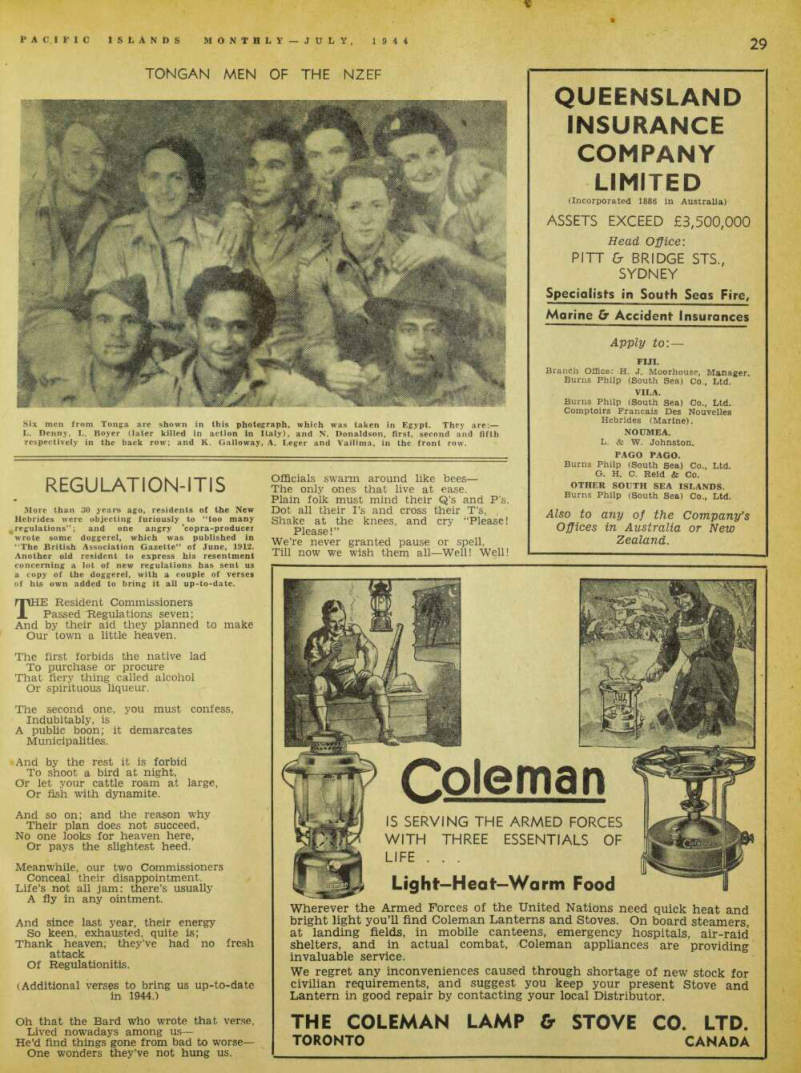
Six men from Tonga are shown in this photograph, which was taken in Egypt. They are:— L. Denny, L. Boyer (later killed in action in Italy), and N. Donaldson, first, second and fifth respectively in the back row; and K. Galloway, A. Leger and Vailima, in the front row.
Regulation-Itis
More than 30 years ago, residents of the New Hebrides were objecting furiously to “too many regulations”; and one angry ‘copra-producer wrote some doggerel, which was published in “The British Association Gazette” of June, 1912.
Another old resident to express his resentment concerning a lot of new regulations has sent us a copy of the doggerel, with a couple of verses of his own added to bring it all up-to-date. rE Resident Commissioners Passed Regulations seven; And by their aid they planned to make Our town a little heaven.
The first forbids the native lad To purchase or procure That fiery thing called alcohol Or spirituous liqueur.
The second one, you must confess, Indubitably, is A public boon; it demarcates Municipalities.
And by the rest it is forbid To shoot a bird at night, Or let your cattle roam at large, Or fish with dynamite.
And so on; and the reason why Their plan does not succeed, No one looks for heaven here, Or pays the slightest heed.
Meanwhile, our two Commissioners Conceal their disappointment.
Life’s not all jam: there’s usually A fly in any ointment.
And since last year, their energy So keen, exhausted, quite is; Thank heaven, they’ve had no fresh attack Of Regulationitis. (Additional verses to bring us up-to-date in 1944.) Oh that the Bard who wrote that verse, Lived nowadays among us— He’d find things gone from bad to worse— One wonders they’ve not hung us.
Officials swarm around like bees— The only ones that live at ease.
Plain folk must mind their Q’s and P's.
Dot all their I’s and cross their T’s, Shake at the knees, and cry ‘‘Please!
Please!”
We’re never granted pause or spell, Till now we wish them all—Well! Well!
Advertisements & other items, pp. 31-32 (1 item)
Coleman
QUEENSLAND
INSURANCE
COMPANY
LIMITED
(Incorporated 1886 in Australia)
ASSETS EXCEED £3,500,000
Head O :
PITT & BRIDGE STS.,
SYDNEY
Specialists in South Seas Fire,
Marine Cr Accident Insurances
Apply to: —
FIJI.
Branch Office: H. J. Moorhouse, Manager.
Burns Philp (South Sea) Co., Ltd.
VILA.
Burns Philp (South Sea) Co., Ltd.
Comptoirs Francais Des Nouvelles Hebrides (Marine).
NOUMEA.
L. & W. Johnston.
PAGO PAGO.
Burns Philp (South Sea) Co., Ltd.
G. H. C. Reid & Co.
OTHER SOUTH SEA ISLANDS.
Burns Philp (South Sea) Co., Ltd.
Also to any of the Company’s Offices in Australia or New Zealand.
sJ». i
Coleman
IS SERVING THE ARMED FORCES
WITH THREE ESSENTIALS OF
LIFE . . .
Light-Heat-Warm Food
Wherever the Armed Forces of the United Nations need quick heat and bright light you’ll find Coleman Lanterns and Stoves. On board steamers, at landing fields, in mobile canteens, emergency hospitals, air-raid shelters, and in actual combat, Coleman appliances are providing invaluable service.
We regret any inconveniences caused through shortage of new stock for civilian requirements, and suggest you keep your present Stove and Lantern in good repair by contacting your local Distributor.
THE COLEMAN LAMP & STOVE CO. LTD.
TORONTO CANADA
Refreshing
as a plunge
into a lagoon!
Germicidal
and fragrant
TENAX TOILET SOAP is
a rapid safeguard against external skin infections, yet it is soothing and kind to the most sensitive skin —even a baby’s!
ORDER TENAX FROM
YOUR ISLAND SUP-
PLIERS. STOCKS ARE
PLENTIFULLY AVAIL-
ABLE.
HARRY J.YOUNG PTY. LTD.
. 379 KENT STREET, SYDNEY
EXPORT REPRESENTATIVES FOR . . .
Bond's Industries Ltd.
Manufacturers of Hosiery and Underwear. Cotton Spinners.
Cottee's Passiona Ltd.
Makers of PASSIONA, Fruit Cordials, Fountain Syrups, Fruit Spreads, Peanut Butter and Peanut Products.
Harry Peck & Co. (Aust.) Pty. Ltd.
Makers of the famous "Anchovette" Fish Paste.
Specialists in Potted Delicacies.
INQUIRIES THROUGH YOUR USUAL CHANNELS WILL RECEIVE
PROMPT ATTENTION.
Bankers: Bank of New South Wales.
N. Caledonian Casualties
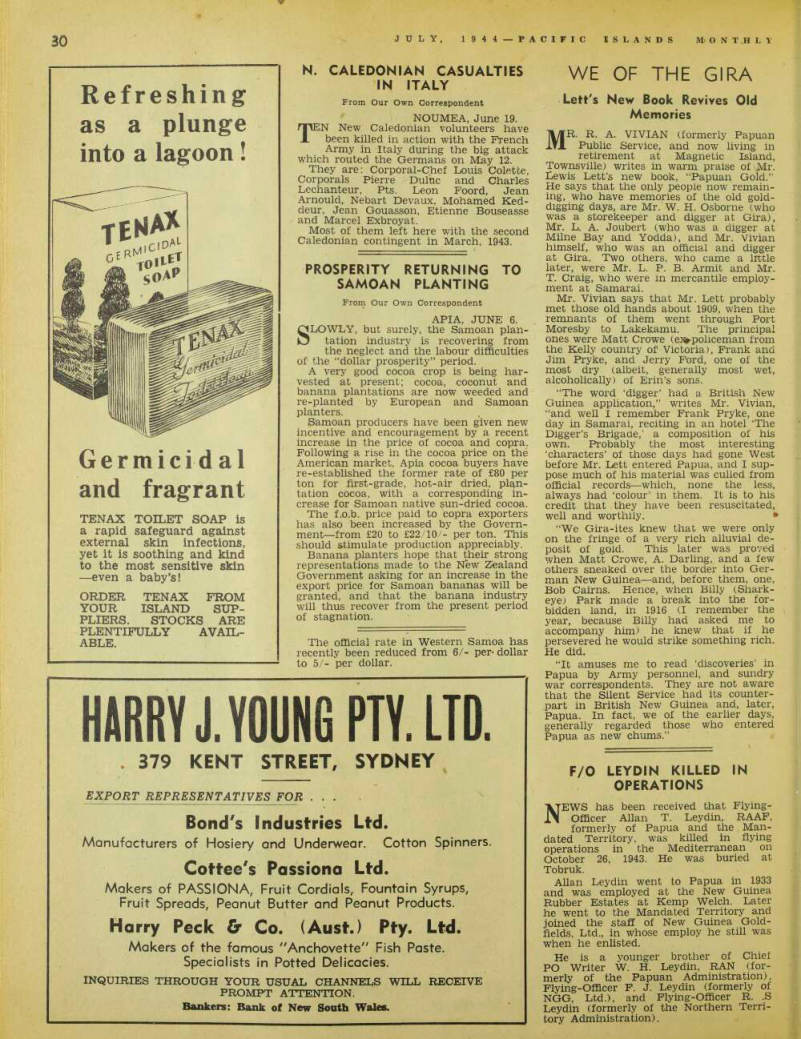
In Italy
From Our Own Correspondent
Noumea, June 19.
rN New Caledonian volunteers have been killed in action with the French Army in Italy during the big attack which routed the Germans on May 12.
They are: Corporal-Chef Louis Colette, Corporals Pierre Duluc and Charles Lechanteur, Pts. Leon Foord, Jean Arnould, Nebart Devaux, Mohamed Ked deur, Jean Gouasson, Etienne Bouseasse and Marcel Exbroyat.
Most of them left here with the second Caledonian contingent in March, 1943.
Prosperity Returning To
Samoan Planting
From Our Own Correspondent
Apia, June 6.
SLOWLY, but surely, the Samoan plan tation industry is recovering from the neglect and the labour difficulties of the “dollar prosperity” period.
A very good cocoa crop is being har vested at present; cocoa, coconut and banana plantations are now weeded and re-planted by European and Samoan planters.
Samoan producers have been given new incentive and encouragement by a recent increase in the price of cocoa and copra.
Following a rise in the cocoa price on the American market, Apia cocoa buyers have re-established the former rate of £BO per ton for first-grade, hot-air dried, plan tation cocoa, with a corresponding in crease for Samoan native sun-dried cocoa.
The f.o.b. price paid to copra exporters has also been increased by the Govern ment—from £2O to £22/10/- per ton. This should stimulate production appreciably.
Banana planters hope that their strong representations made to the New Zealand Government asking for an increase in the export price for Samoan bananas will be granted, and that the banana industry will thus recover from the present period of stagnation.
The official rate in Western Samoa has recently been reduced from 6/- per* dollar to 5/- per dollar.
We Of The Gira
Lett's New Book Revives Old Memories
MR. R. A. VIVIAN (formerly Papuan Public Service, and now living in retirement at Magnetic Island, Townsville) writes in warm praise of Mr.
Hewis Lett’s new book, “Papuan Gold.”
He says that the only people now remain ing, who have memories of the old gold digging days, are Mr. W. H. Osborne (who was a storekeeper and digger at Gira), Mr. L. A. Joubert (who was a digger at Milne Bay and Yodda), and Mr. Vivian himself, who was an official and digger at Gira. Two others, who came a little later, were Mi. L. P. B. Armit and Mr.
T. Craig, who were in mercantile employ ment at Samarai.
Mr. Vivian says that Mr. Lett probably met those old hands about 1909, when the remnants of them went through Port Moresby to Lakekamu. The principal ones were Matt Crowe from the Kelly country of Victoria), Frank and Jim Pryke, and Jerry Ford, one of the most dry (albeit, generally most wet, alcoholically) of Erin’s sons.
“The word ‘digger’ had a British New Guinea application,” writes Mr. Vivian, “and well I remember Frank Pryke, one day in Samarai, reciting in an hotel ‘The Digger’s Brigade,’ a composition of his own. Probably the most interesting ‘characters’ of those days had gone West before Mr. Lett entered Papua, and I sup pose much of his material was culled from official records —which, none the less, always had ‘colour’ in them. It is to his credit that they have been resuscitated, well and worthily, * “We Gira-ites knew that we were only on the fringe of a very rich alluvial de posit of gold. This later was proved when Matt Crowe, A. Darling, and a few others sneaked over the border into Ger man New Guinea —and, before them, one, Bob Cairns. Hence, when Billy (Shark eye) Park made a break into the for bidden land, in 1916 (I remember the year, because Billy had asked me to accompany him) he knew that if he persevered he would strike something rich.
He did.
“It amuses me to read ‘discoveries’ in Papua by Army personnel, and sundry war correspondents. They are not aware that the Silent Service had its counter part in British New Guinea and, later, Papua. In fact, we of the earlier days, generally regarded those who entered Papua as new chums.”
F/O Leydin Killed In
Operations
NEWS has been received that Flying- Officer Allan T. Ley din, RAAF, formerly of Papua and the Man dated Territory, was killed in flying operations in the Mediterranean on October 26, 1943. He was buried at Tobruk.
Allan Leydin went to Papua in 1933 and was employed at the New Guinea Rubber Estates at Kemp Welch. Later he went to the Mandated Territory and joined the staff of New Guinea Gold fields, Ltd., in whose employ he still was when he enlisted.
He is a younger brother of Chief PO Writer W. H. Leydin, RAN (for merly of the Papuan Administration), Flying-Officer F. J. Leydin (formerly of NGG, Ltd.), and Flying-Officer R. .S Leydin (formerly of the Northern Terri tory Administration).
News Of Rabaul Prisoners
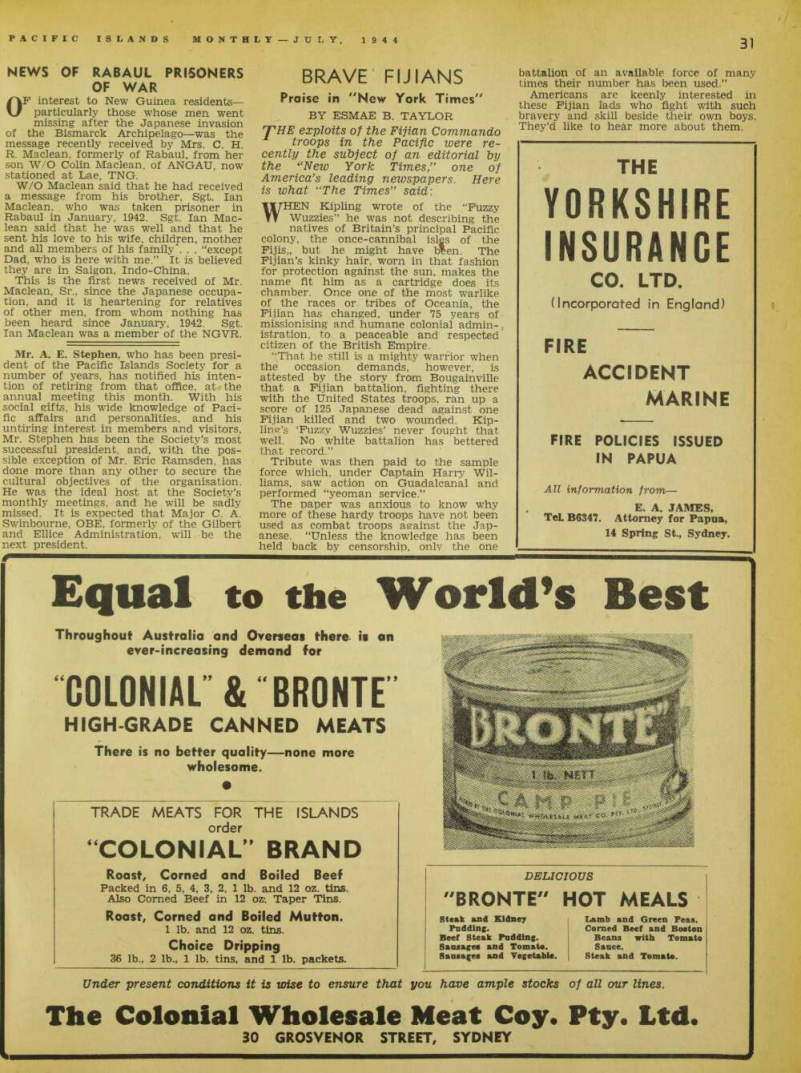
Of War
OF interest to New Guinea residents— particularly those whose men went missing after the Japanese invasion of the Bismarck Archipelago—was the message recently received by Mrs. C. H.
R. Maclean, formerly of Rabaul, from her son W/O Colin Maclean, of ANGAU, now stationed at Lae, TNG.
W/O Maclean said that he had received a message from his brother, Sgt. lan Maclean, who was taken prisoner in Rabaul in January, 1942. Sgt. lan Mac lean said that he was well and that he sent his love to his wife, children, mother and all members of his family'. . . “except Dad, who is here with me.” It is believed they are in Saigon, Indo-China.
This is the first news received of Mr.
Maclean, Sr., since the Japanese occupa tion, and it is heartening for relatives of other men, from whom nothing has been heard since January, 1942. Sgt. lan Maclean was a member of the NGVR.
Mr. A. E. Stephen, who has been presi dent of the Pacific Islands Society for a number of years, has notified his inten tion of retiring from that office, at the annual meeting this month. With his social gifts, his wide knowledge of Paci fic affairs and personalities, and his untiring interest in members and visitors, Mr. Stephen has been the Society’s most successful president, and, with the pos sible exception of Mr. Eric Ramsden, has done more than any other to secure the cultural objectives of the organisation.
He was the ideal host at the Society’s monthly meetings, and he will be sadly missed. It is expected that Major C. A.
Swinbourne, OBE, formerly of the Gilbert and Ellice Administration, will be the next president.
Brave Fijians
Praise in "New York Times"
By Esmae B. Taylor
T 'HE exploits of the Fijian Commando troops in the Pacific were re cently the subject of an editorial hy the “New York Times” one of America’s leading newspapers. Here is what “The Times” said : WHEN Kipling wrote of the “Fuzzy Wuzzies” he was not describing the natives of Britain’s principal Pacific colony, the once-cannibal isles of the Fijis,, but he might have blen. The Fijian’s kinky hair, worn in that fashion for protection against the sun, makes the name fit him as a cartridge does its chamber. Once one of the most warlike of the races or tribes of Oceania, the Fijian has changed, under 75 years of missionising and humane colonial admin-, istration, to a peaceable and respected citizen of the British Empire.
“That he still is a mighty warrior when the occasion demands, however, is attested by the story from Bougainville that a Fijian battalion, fighting there with the United States troops, ran up a score of 125 Japanese dead against one Fijian killed and two wounded. Kip line’s ‘Fuzzy Wuzzies’ never fought that well. No white battalion has bettered that record.”
Tribute was then paid to the sample force which, under Captain Harry Wil liams, saw action on Guadalcanal and performed “yeoman service.”
The paper was anxious to know why more of these hardy troops have not been used as combat troops against the Jap anese. “Unless the knowledge has been held back by censorship, only the one
battalion of an available force of many times their number has been used.”
Americans are keenly interested in these Fijian lads who fight with such bravery and skill beside their own boys.
They’d like to hear more about them.
Joseph Mitchell
Advertisements & other items, pp. 33-34 (2 items)
Insurance
THE
YORKSHIRE
CO. LTD.
(Incorporated in England)
FIRE
ACCIDENT
MARINE
FIRE POLICIES ISSUED
IN PAPUA
All information from —
E. A. JAMES,
TeL 86347. Attorney for Papua, 14 Spring St., Sydney.
Equal to the World's Best
Throughout Australia and Overseas there is an ever-increasing demand for
COLONIAL & BRONTE
HIGH-GRADE CANNED MEATS
There is no better quality—none more wholesome. 9 9
TRADE MEATS FOR THE ISLANDS
order
“COLONIAL” BRAND
Roast, Corned and Boiled Beef Packed in 6,5, 4,3, 2, 1 lb. and 12 oz. tins.
Also Corned Beef in 12 oz-. Taper Tins.
Roast, Corned and Boiled Mutton. 1 lb. and 12 oz. tins.
Choice Dripping 36 lb., 2 lb., 1 lb. tins, and 1 lb. packets.
Under present conditions it is wise to ensure that you have ample stocks of all our lines.
The Colonial Wholesale Meat Coy. Pty. Ltd.
30 GROSVENOR STREET, SYDNEY
HAVE YOU
CONSIDERED
THIS CODICIL?
By adding a simple codicil to your Will you can guard against difficulties and loss which might arise should your Executor die or become incapacitated.
By means of such a codicil you can name Bums Philp Trust Co. Ltd. as joint Executor with your present appointee or, if you wish, as sole Executor. In this way you gain positive assurance of continuous and sound administration and are relieved of a serious anxiety. The Company will willingly forward full particulars.
DIRECTORS :
James Burns Robert John Nosworthy L«wi« Armstrong Joseph Mitchell MANAGER: C. H. Chester
BURNS PHILP TRUST
C O M P A N Y LIMITED
7 BRIDGE STREET, SYDNEY
PHONE: B 7901. Box 543 B, G.P.0., Sydney.
BP 10-44. that* the
Purchasers at Full Market Prices on Assay Value of
GOLD
SILVER
PLATINUM
And Platinum Group Metals
SOME OF OUR SERVICES
ASSAYERS & ANALYSTS—
Assays of Bullion, Ores, etc.
Analyses of Metals, Minerals, Alloys, etc.
SCIENTIFIC & INDUSTRIAL
METALLURGISTS—
Our range of precious metal manufactures covers all Industries —Gold and Silversmiths, Electrical Trades, Dental Profession, Glass Silverers, Electro-Platers, etc., etc.
REFINERS—
Purchasers and Refiners of Bullion, Scrap, Mining By-Products, and Trade Residues of every description carrying Precious Metals.
GARRETT & DAVIDSON
PTY. LTD.
824 George St., Sydney. Works: Surry Hills and Chippendale, N.S.W.
Official Assayers to the Bank of New South Wales. Gazetted Agents of the Commonwealth Bank of Australia, under the Gold Regulations of the National Security Act.
32
JULY, 1 9 4 4 PACIFIC ISLANDS MONTHLY
LION AND THE LAMBS
(Continued from Page 131
Samoan Boys Fight On
Both Sides
Prom Our Own Correspondent APIA. June 6.
WHEN World War II broke out a number of Euronesians—the chil dren of Germans who had settled in Western Samoa—were living in Ger many and, in spite of Hitler’s much publicised racial prejudices, a number of these Euronesian boys were recruited for the Nazi armies. Only recently word was received here that two of them—a son of Mrs. Matthes. who was an officer in the Luftwaffe, and a son of an old and well known German planter. Mr. E. Retzlaff— have been killed in action while fighting on the Russian front.
As in the last war, boys of Samoan blood are fighting and dyin£ far from their homeland, in the two opposing armies in Europe.
Dr. Stephenson, of the Methodist Mis sion. who is on furlough from Fill, will be in charere of the church at Whangarei (NZ) for three months.
Miss Lila Vatiram Ramsamuj. a daugh ter of Mr. and Mrs. Ramsamui. of Suva.
Fiii. is row Matron of a large military hospital in India.
The death occurred at Williamstown, Victoria, in June, of Mrs. Lucy Bull, wife of the Rev. C. S. Bull, of Fiii. Mrs. Bull had been associated with her husband in missionary work among the Melanesians in Fiji, by whom she was much liked.
Surgeon-Lieute-nant A. Fagot has been appointed Condominium Medical Officer for the Northern District of the New Hebrides.
Pastor Nagel, of the Lutheran Mission, has made application for permission to resume work in the island mission field of New Guinea.
Advertisements & other items, pp. 35-36 (1 item)
W. H. Grove & Sons
COTm f/KST-
Since the War began, the services and equipment of this Company have been made available expressly to firms wholly engaged in work for National Defence.
Noyes Bros. greatly appreciate the long-standing business friendships in the Islands, and assure customers there of the closest attention to their requirements, to be filled when conditions permit a resump* tion of normal trading.
NOYES BROS.
115 CLARENCE STREET. SYDNEY.
(SYDNEY) LTD.
Phone : B 7581 (10 lines)
11 WATT STREET. NEWCASTLE
197 ELIZABETH STREET. BRISBANE
W. H. GROVE & SONS
Limited
AUCKLAND
Island Traders. F.o. Box 49* Telegraphic and Cable Address: “Grove”, Auckland.
Shippers of all classes of New Zealand products.
Representing English Manufacturers throughout the Cook and Society Islands, Fiji, Tonga, Samoa, Niue, New Caledonia, New Guinea, etc.
In FIJI as—W. H. Grove & Sens (Fiji) Ltd.
? k L| 2* 1 Bond Street Sydney, Australia.
J. b'JUbrl LU TeL 84167. 80, 3615 G.P.O.
SUPPLIERS OF GENERAL MERCHANDISE TO LEADING FIRMS THROUGHOUT THE
PACIFIC ISLANDS
r Exporters . . .. Importers ... . Manufacturers' Representatives Bankers: Bank of N.S.W. Bank of Adelaide. Comptoir Nat. d’Escompte de Paris.
War Time Cable Address: GOUGH CO., 1 BONDSTREET, SYDNEY.
Codes: Bentley’s. 2nd and Comp, Phrase; A.8.C., sth and 6th; Peterson, 2nd and 3rd; Banking; Acme.
KANGAROO BRAND
Ropes,
Cordage,
and Twines for every purpose Backed by 86 years of service Manufactured by:
M. DONAGHY AND SONS,
Pty. Ltd., Geelong and Sydney.
Fiji Representatives:
PEARCE AND CO.
LIMITED
P.O. BOX 237, SUVA
In N. Hebrides
Heavy War Taxes
A DEFENCE Regulation issued by the New Hebrides Condominium, in March, 1944, “to impose surtaxes on certain businesses,” provides for the fol lowing annual imposts:— Merchants, with liquor licenses, each branch £2OO Traders, retailers, with liquor licenses, each £2OO Hotelkeepers, each £2OO Laundries, under 10 employees, each ... £ 120 Laundries, 10 employees or over £2OO Each single launderer (including Tonkinese and natives) £3O Each merchanical laundry £2OO Each establishment, other than hotel, serving food and drink .. £2OO Each pastrycook £5O Each taxi £5O The obvious purpose of the tax is to secure, for the Administration, some rea sonable share of the flood of money from the fighting Services, from which these establishments have been making huge profits.
Critics, however, are complaining that the method employed is clumsy and unfair—that honest traders are being heavily penalised, while the dishonest ones have gone underground and are making more profits (untaxed) than ever.
Missionaries
News of New Britain Missionaries
AN extract from a letter in the “Mis sionary Review,” from Etuat Matbit, a native of New Ireland, who was a teacher-in-training at the Methodist George Brown College, at Vunairima, New Britain, at the time of the Japan ese invasion: “The missionary who was. in charge of the college at Vunairima was put in prison by the Japanese; the Sister, Miss Beale, also. We did not see their faces again. They had gone amongst the people and were not able to return to Vunairima because the fighting had come. The Sister, Miss Beale, was put in prison at Vunapopi. Other missionaries, Mr. Linggood, Mr. Pearson, Mr. Wayne, and our chairman, who lived at Mala kuna, were also imprisoned. We did not see them, we only heard this word.
“The headmaster of the college, Mr.
Trevitt, and the technical instructor, Mr.
Beazley, took care of us all when Mr.
Pearson and Miss Beale went amongst the people and did not return.
“We have had no news of the other Sisters.
“The soldiers of Japan have come to Rabaul, and there are no pigs or fowls, the bananas and all other foods have all been spoilt. Now the people lack food, and when it was finished they made the people prisoners. There were 35 of us from Kavieng in the prison.
“Peni Vonana and I are now working at .the town they call Port Moresby.
There are a great number of us here who came from Rabaul. The Japanese took us prisoners to carry cargo. To-day Port Moresby is full of us. The place I work at is FELO, Port Moresby.
“Another thing the Government wished some of us to see the things of the war in Australia. They sent us from Port Moresby to Brisbane. The boys we were amongst have gone to some other place I do not know of, and I am by myself here in Brisbane. I am waiting until a ship comes that is going to Port Moresby, then I will go on it.
“Another thing I forgot to tell you about concerning the college at Vunai rima. The Japanese completely destroyed it and the house of Mr. Trevitt, too.”
Advertisements & other items, p. 36 (2 items)
.'.V.V.V.V.Vaw.V.
Other GILBEY
PRODUCTS:
★ CREME DE MENTHE *
★ ★ CHERRY BRANDY ★ ★
ORANGE & WHITE CURACAO
CREME DE CACAO ★ ADVOCAAT
APRICOT BRANDY * GILBEDENE
ORANGE & LEMON GIN
★ ★ ★ GIN SLING ★ ★ ★
BRONX & MARTINI COCKTAIL
★ ★ ★ RUM ★ ★ ★
SPEY ROYAL SCOTCH AND
GAUNTLET WHISKY
• ••• *.V. • • • • • • • G 1.12 * 0 '.V.V. lOC • • • • • • • • ..v.y. • •••
.'.V.V.V.V.VAW.V.
Pink Pills
Restlessness and sleeplessness, when due to run-down nerves, frequently respond to treatment with Dr. Williams 1 Pink Pills.
Dr. Williams’
help t<*enrich the blood, which has a beneficial and restorative effect upon the nervous system.
The Future Of The
Native
Anthropology Has its Place
Letter to the Editor IREAD the story of the Sepik tragedy (May “PIM”’) with great interest. I am sorry that I, too, did not keep a diary at that time, but I remember well how the PB’s reported the event right after the “battle”; “All master long-long fire —me fella long-long fire. All master run away along pinnace—me fella run away along canoe.
Me fella bruk ’im leg belong one fella master —all master break ’im leg belong one fella police-boy. Talk ’e die.”
The tragic death of ADO Ellis puzzled them and they expected that revenge would be taken on them. (The old law of native justice—eye for an eye, tooth for a tooth, leg for a leg—and man for man.) I should like to send the editor of “PIM” the regards of Dr. G. Hoeltker, former editor of “Anthropos International Review of Ethnology and Linguistics.” Dr.
Hoeltker was well known in scientific and anthropological circles and was in New Guinea between 1936-39, as assistant to the Rev. J. F. Kirschbaum when they were preparing for an expedition into the interior of Central New Guinea. The expedition was to be undertaken by mem bers of Harvard University, under the auspices of the generous Cornelius Crane, but unfortunately the Administration of the Mandated Territory would not give the necessary permission to proceed.
Dr. Hoeltker did* some scientific field work among the coastal tribes and on islands off the coast, and by harmonious co-operation with the staff of mission aries was able to collect a large box of
manuscripts on anthropological and lin guistic matters. These he took with him to the safety of Switzerland.
At present he is working on a series of anthropological and linguistic works called “Supplementary volumes of the ethnography of New Guinea,” which will be in 12 volumes contributed by different missionaries, and deal mainly with native customs, social rites, cultures, myths and songs, grammars and vocabularies of the coastal natives from the Rai Coast to the Dutch border. The first volume dealing with the Gende, a tribe in the Bismarck Range in Central New Guinea, has already appeared.
Unfortunately, these books are written in German; but the Americans who are now re-occupying those areas may be able to obtain an English translation.
To find the right solution for the ques tion of post-war treatment of the natives, a study of the past should not be neglected. Almost all our missionaries were trained for anthropological field work by members of the staff of “Anthropos”—all internationally approved authorities.
I am, etc.,
Hobart, Tas.
July 10, 1944.
(Rev.) I. Schwab.
Justice For Territorial
Letter to the Editor fIIHANKS for your stand for justice for A the people of the Territories, in the face of opposition you ought not to have met. I was saddened to see so many people, who have suffered so much, pre pared to accept a beating from Canberra, and raise such little protest. These Aus tralian Ministers are talking a great deal about reconstruction for Australia: why can’t we fight on and force them to think of some reconstruction for the Territories?
If we cannot get reform, then by all means let us appeal to America—at least, we then should have energy and go ahead methods. The action of people in casting doubts on your loyalty, because you have the courage to demand decent consideration for those who have suffered so much loss in the invasion, has only made many of us more determined to fight.
I am, etc.,
Sydney.
W. Herbert-Hughes.
Advertisements & other items, p. 37 (1 item)
Bbushwabe
“Toujours les meilleurs.”
FARBEST
Pure Fruit
CORDIALS
DELICIOUS WHOLESOME
—REFRESHING.
Contain all the Vitamins of Fresh Fruit.
PINEAPPLE LEMON
—ORANGE—GRAPE FRUIT—
PASSIONFRUIT—
RASPBERRY—STRAWBERRY
—TROPICAL FRUIT NECTAR.
GLACE CHERRIES
for Cocktails and Rich Cakes.
0. F. MASSCHELEIN
SYDNEY
—Export Distributor —
and all Toilet Brushes.
BBUSHWABE
E. DIXON & CO., manufacturers of Superior DINOX - Quality
Cheaper' D I Quality
BRUSHES, BROOMS and MOPS,
advise their many Island Clients that Limited Supplies are now available.
ISLAND DISTRIBUTORS:
ROBERT GILLESPIE PTY. LIMITED
540 PITT STREET, SYDNEY
New Director For Misima
rE Board of Cuthbert’s Misima Gold mine Ltd., has appointed Mr.
Charles C. Bown a director of the company. His appointment follows the death of Mr. Edward Bull Wareham.
Mr. Bown has been secretary of the company since its inception and will continue to hold that office.
N. Guinea
Jewish Settlement for N. Guinea Another Post-war "Plan"
Letter to the Editor ONCE again the problem of settling Europe’s persecuted Jews is in the news. This time Plying-Officer J.
Cassel, RAAF, himself a Jew, and described as a former resident of New Guinea of 19 years standing, suggests (vide “Army News”) that New Guinea would be a suitable place to settle them.
I should like to know just what part of New Guinea F O Cassel thinks suitable— but no doubt he has the position well in hand.
I, for one. cannot see how (or why) this should be done, and for these reasons : • There is a very large native popula tion to take into consideration. • A goodly proportion of the country is perpendicular—some say that four fifths is a conservative estimate. • There are many of our fighting men who may want to settle in the country at a later date. • The ex-residents, most of whom have had heavy wartime losses, should be given consideration before any so-called refu gees, who would be another burden on
the country, as most of them are city folk. • Markets in New Guinea are the big gest problem. This has been pointed out before. It is easy to produce vast quan tities of different kinds of produce which cannot be sold. (But I suppose this is where the good old subsidy comes in— paid by over-taxed Australians.) I have had over 20 years’ tropical experience and have seen many “money makers” go on the scrap-heap in New Guinea through lack of markets for the produce produced.
As I, for one, will have to start out again I would like to say aloud, and right now, that charity, as always, begins at home. Those of us who have lived and worked—pioneered, if you like —in the Territory of New Guinea should fight any invasion from Europe until ex-residents are on their feet again. I have every sympathy for the unfortunate refugees of Europe, and no doubt their problem is a world problem. But we have one of our own—and a big one for a nation of only seven million people to solve.
I think that as their various home lands seem to be continually in their thoughts, many Jewish people will make their way back to Europe when its libera tion is completed, and thus they will help to solve their own problem.
I am, etc.,
H. (Tex) Archer.
June 28, 1944.
Melanesian Mission Press
At Work Again
THE Melanesian Mission Press, blown to atoms in ther Battle of Guadal canal, British Solomon Islands, has been temporarily re-established at 138 Smith Street, Summer Hill, Sydney.
Mr. Fred. R. Isom, who so proudly pro duced newspapers, pamphlets and neatly bound books with native labour and some modest machinery, under the coconut trees in Guadalcanal, will carry on the good work in Sydney, until the way is clear for the re-erection of his printery in the Solomons.
Mr. J. N. Falvey, who has been on secondment to the Gilbert and Ellice Islands Colony service, recently returned to duty in Fiji.
Advertisements & other items, p. 38 (3 items)
36
JUL¥, i944—P A Ol f t d ISLANDS MONTHLY
Limewashing And
“Toujours les mailleures”
"FLAVOREX "
Real French Mustard and
"TOBASCO "
Sauce Both are Delicious and
APPETISING.
Enhance the Value of Good Meals, Soups, Cocktails, etc.
On Sale in the Islands.
0. F. MASSCHELEIN,
Sydney Export Distributor.
The Most Extensive Manufacturers in the British Empire of
RUBBER STAMPS.
INKS, STENCILS,
Marking Devices,
ACME STAMP PADS
OFFICE & STATIONERY SUPPLIES
We also Manufacture & Supply a Complete Line of
LIMEWASHING AND
SPRAYING MACHINES
for all purposes.
Let us know your requirements and we will quote by return.
WRITE FOR OUR GENERAL CATALOGUE
Limewashing Machine
EXCELSIOR SUPPLY CO. PTY. LTD.
278 host Office Place,
MELBOURNE, VIC.
HEAD OFFICE :
160 BROADWAY,
Former I u known as George St.. West,
SYDNEY,® N.S.W.
50 Victoria Street,
WELLINGTON, N.Z.
Pinkettes
After taking Pinkettes you should feel brighter, happier, and free from sick headaches, bilious attacks and liyerishness. For
are tiny laxative and liver pills, which painlessly exercise the digestive system.
Again
"Ouvea" in the News Again
From Our Own Correspondent
Noumea, June 20.
ANOTHER exciting, and perhaps hnal, chapter was added to the eventful life of the lormer Jap sampan “Ouvea the other day, when her two ton boiler oiew up while she was docked for repairs in Noumea. The boiler flew 40 yards through the air and came down on the house of Mr. Hubbard, a New Zealander who has lived long in the Colony. The explosion set fire to the “Ouvea”; and five Javanese and a native, who were near, were injured by scalding vapour and scattered fire.
The “Ouvea” was formerly owned by Monsieur Houssard, of this Colony, who acquired her in this manner; Early in July, 1936, as he, on board his ketch “Caledonian,” wa!s returning from a trading trip up north, he noticed a sus picious vessel off the small reef near the Havannah Passage, through which large vessels clearing the south coast make their way to the Loyalties and Vila. It proved to be a sampan, and it was evi dently fishing trochus in waters reserved for the New Caledonian fishing fleet.
Capt. Houssard is a man of action, so he decided to board and seize the sam pan, which he later brought to Noumea.
When she was put up for auction as a prize, he bought her for 5,000 francs.
IN 1940 the “Ouvea” was one of the first ships in Noumea Harbour to hoist the de Gaulle flag—an act of defiance which angered Temporary Governor Col onel Denis and Commander Toussaint de Quievrecourt, who were trying to bully the Colony into following Marshal Petain.
A week or two later the “Ouvea” bore Monsieur Houssard (who is now overseas with the Free French naval forces) to Port Vila, in the New Hebrides, following instructions from General de Gaulle, in London. The General’s instructions were that the sampan’s owner should ask Henri Sautot (then Resident Commissioner at Vilaj to come to Noumea as Free French Governor of New Caledonia.
Colonel Denis knew the sampan’s mis sion, and he believed Monsieur Sautot would arrive back with Capt. Houssard, whereupon he would have Sautot arrested.
But Sautot, with the connivance of his colleague, Mr. Blandy (British Resident at Vila) and the Australian Government, left on a Norwegian steamer, escorted by HMAS “Adelaide.” On his arrival, it was Denis, and not Sautot, who was arrested, and this not by the military but by the good people of the Colony who had formed their own militia—later nick named “Sautot’s bodyguard.”
Death Of Tropical Medical
Expert
mHE man who introduced the study of A tropical medicine to Australia, Dr.
Anton Breinl, died in Sydney on June 28.
A graduate of Prague University, he joined the staff of the Liverpool School of Tropical Medicine in 1904, went to Brazil in 1906, and came to Australia in 1909, joining the Australian Institute of Tropical Medicine at Townsville. He retired in 1919.
He undertook several expeditions to Papua and the Northern Territory while at Townsville.
As a result of Dr. Breinl’s work, the School of Public Health and Tropical Medicine was established at the Univer sity of Sydney and the Townsville school was transferred to Sydney.
Wealthy Time-Finish
Boys
A MELBOURNE “Herald” war corres pondent says that 1,500 New Guinea natives are returning to their homes, carrying what is to them a fortune.
Each native will receive up to £l5 each when they are paid off at Yule Island, north-west from Moresby.
Between them they also have about £2,000 from sales of souvenirs to Austra lian troops.
Natives have been serving for two and a half years as carriers and stretcher bearers on the Kokoda trail and as road builders on the famous Bulldog Road over the Owen Stanleys. The newly-rich
natives will get a “Hero’s” welcome in their villages.
ANGAU officers are wondering how trading stores near the villages will be able to cope with the demands for mer chandise with their limited stocks when the wives and families descend on them.
In charge of this migration back to the villages is Lieutenant K. F. Marley, of Brisbane, who spent eight years in Papua and New Guinea before the war.
With him is a team of experienced men including Corporal R. W. Campbell and Corporal D. J. Peterson, both of Queens land.
Miss M. P. Barry, who arrived in Fiji in June, has been appointed a Child Wel fare Nurse.
Advertisements & other items, p. 39 (1 item)
I L L E S Pi E’S
CHARLES MUIR (Eastern)
SYDNEY
EXPORT AGENTS AND
MANUFACTURERS
AJC & OK Jams, Canned Fruits, Sauces, Asparagus, etc.
EEZEE Washing Blue in Bags, also Paper Wrapped—Baking Powder, Custard Powder, Jelly Crystals, etc.
SUNGLO Pickles, Chutney, Honey, Fruit Cordials, Jams in Glass Jars, Canned Vegetables, etc.
WINES, SPIRITS, BEERS.—
“Jubeny,” “Royalty,” “Aulde Acquaintance,” “Private Seal”
Brands, etc.
IN SUGAR BAGS.—Pearl Barley, Oatmeal, Rolled Oats, etc.
We Specialise in All Kinds of Food Products. Enquiries Invited Through Your Usual Channels. ’Phones: B 2279, FA 2703. Cable Address: FX4515 (Factory). MUIR—SYDNEY.
G * The Flour I L L E S PI E’S of the Islands
-SYDNEY-
IRADE
MARK
The Good Work Goes On
Third Annual General Meeting of NG Women's Club of Sydney
ONE of the brighter aspects of the evacuee period for New Guinea residents has been the way in which the women of New Guinea have banded together in Sydney and elsewhere for mutual help and comfort. Without talk, fuss or publicity they got down to a job of work after the general evacuation of the New Guinea Territories, and the report presented at the third annual meeting of the New Guinea Women’s Club of Sydney, on July 8, by the presi dent, Mrs. H. H. Page, showed that efforts had not been allowed to flag in the year just past.
EXTRACTS from the president’s report on the year’s activities are as follow:
Membership
We commenced with a very small band of 16 workers. To-day our membership totals 173.
Our continued address has been the Feminist Club, where we gather together each Thursday to work and exchange all items of Territorial news so welcome to us all.
Service Parcels
Mrs. McMullen, in charge of the Service par cels, reports having distributed 597 parcels; 593 being posted to our Servicemen in England, Middle East, New Guinea and Australia, and to our Servicewomen in Australia. Four parcels were handed to soldiers on leave.
We were able to remember our Service men and women at Christmas time by sending a cake to each—27o in all, that being the number of names we had on our list at that time. Since then we have received a list of names of our Servicemen in New Guinea alone, which com prises 397 names—all ex-residents of the Ter ritory.
We made a special feature of a parcel to our 13 Servicewomen. We would be pleased if mem bers could hand in names and addresses of Ser vicewomen whom we may not have on our list.
We treasure letters from our Service men and women which all express their pleasure and gratitude in very generous terms. A hearty invi tation is issued to all to visit us any Thursday morning. They are assured of a warm welcome and we think they would enjoy the atmosphere that bespeaks New Guinea.
Knitting
Miss Mills, who has taken a keen interest in the knitting section, which is under her con trol, reports that 286 articles were knitted dur ing the year. Clothes rationing has made it imperative for people to knit more garments for themselves and therefore they have less time to knit for the club; but we have an adequate sup ply of wool, owing to the generosity of members.
Entertainments
Mrs. Foxcroft is to be congratulated for the capable manner in which she has coped with club entertainments and with hospital visiting.
There were eight entertainments during the year; Travelogue by Mrs. Dalgarnow (August, 1943); Pacific Territories Association Social (September, IS'43); Games Night (November, 1943); Children’s Christmas Party (December, 1943); Adult Party (December, 1943); Social Evening (February, 1944); Polynesian Concert (April, 1944); and Variety Concert (June, 1944).
A feature of the year was the Christmas party for the children, when 150 children gathered together and had a truly wonderful afternoon.
Each child received a gift and a bag of sweets.
There was a Christmas cake lit by candles and Mrs. Cameron, of the Feminist Club, arranged a delightful programme of children’s dancing.
The grown-ups get-together party which fol lowed was voted a marvellous success. Never has the Feminist room accommodated so many —it seemed elastic!
Members of the club have visited the 113th AGH each week and distributed cake and fruit amongst 120 New Guinea men, and pyjamas and socks were given where needed. At Christmas time, canteen orders were given to the men and the VAD’s who prepare a weekly list for us.
Evacuees’ Fund
Mrs. Foxcroft has distributed many parcels of
clothing to our people, who were most grateful for these timely gifts, and she would be glad of any clothing, particularly children’s clothing, which is in good order.
It has been a source of pleasure to us to be able to assist many of our New Guinea women, but we feel there may be others who are in need and hesitate to contact us. We have a fund for this purpose and consider it a privilege to help.
General
We have contributed to the Red Cross Prisoner of War Fund, the Australian Comforts Fund and the Merchant Navy.
We have worked hard to have the Common wealth Government’s loans to evacuees made grants; also that women be allowed to take a position without the allowance ceasing. Much correspondence has passed between the Minister and the club and although we have not yet achieved our purpose, we have reason to believe something will be settled in the near future.
Again this year, on January 23 and April 25 we assembled at the Cenotaph to pay homage to our glorious dead. May we be worthy of the ideals for which they gave their lives. Our heartfelt sympathy goes out to all who have lost their loved ones. May they be comforted.
I would like to place on record the very fine work of our secretary, Mrs. J. H. McDonald, and our appreciation of our treasurer, Mrs. H.
Adams, whose work is arduous but is carried out most efficiently.
Our thanks are due to Miss Grant, who has audited our books since the inception of the club; Mrs. Ormunde, who has been responsible for our floral tributes and posies; Mrs. Cam eron, the president of the Feminist Club, for her wonderful interest and generous advice; Mr. Foxcroft, who is always a tower of strength to us; and the “Pacific Islands Monthly” for its generous support.
Mrs. McDonald wishes to express her appre ciation of the help given her with the circulars by Mrs. Saunders, Mrs. Allan and Miss Pamela Page.
In conclusion, I wish to thank the committee and all members for their courtpsy to me at all times and their whole-hearted co-operation, which has spelt success for the New Guinea Women’s Club.
Finance
THE financial statement presented by
Mrs. H. Adams, treasurer of the club, showed that receipts for the
year ending June 30, 1944, were
£1,131/17/2 (including a carry-over of
£603/15/8 from the previous year). Ex
penditure to June 30, 1944, was £Bl5/14/11, leaving a credit balance of £316/2/3.
Expenditure included: Purchase of goods
for Service parcels, £215/1/7; assistance to evacuees, £240/2/2; and Pacific Territories
Association affiliation fees, £2l/12/-.
Discussion MRS. EDGELL, supported by Mrs.
McMullen and Miss Mills, spoke on the desirability of increasing the knitted goods output. It was resolved that until further notice, knitting-bees would be held each Thursday morning.
Mrs. Doyle suggested that the Prisoners of War Relatives Association, through which all radio messages to POW must be sent, should be asked the reason for its recent decision that relatives of civi lian POW be debarred from sending such messages. This motion was agreed to.
Mrs. Page said that it had been sug gested by Mrs. Cameron, of the Feminist Club, that the NG Women’s Club should seek affiliation with the National Coun cil of Women. Several members spoke on the desirability of this and it was resolved that the National Council of Women be approached in the matter.
Office-Bearers, 1944-45
THE following office-bearers were elected for 1944-45: Patron: Lady McNicoll.
President: Mrs. H. H. Page.
Vice-presidents. Mrs. C. H. R. Maclean, Mrs. N. H. Foxcroft.
Secretary: Mrs. J. H. McDonald.
Treasurer: Mrs. H. Adams.
Auditor; Miss I Grant.
Leader of Entertainment Committee: Mrs. N. H. Foxcroft.
Leader of Service Parcels Committee; Miss Mills.
Committee: Mesdames Edgell, Allan.
McMullen. Meldrum. Forsayth. Ormunde, launders, Orde, Wallace-Brown and Miss Mills.
Advertisements & other items, p. 40 (1 item)
GJiLESPii'W
Kidney Trouble
and Backache
Gone in 1 Week
Flush Kidneys With Cystex and You’ll Feel Fine Cystex—the prescription of a famous doctor —improves faulty kidney action in double quick time, so, if you suffer from Rheumatism, Sciatica, Neuritis, Lumbago, Backache, Nervousness, Leg Pains, Dizziness, Circles under Eyes, frequent Headaches and colds, poor Energy and Appetite, Puffy Ankles or Interrupted Sleep, go to your chemist to-day for Cystex.
Cystex Helps Nature 3 Ways
The Cystex treatment is highly scientific, being specially compounded to soothe, tone and clean kidneys and bladder and to remove acids and poisons from your system safely, quickly and surely, yet contains no harsh, harmful or dangerous drugs. Cystex wo-ks in these 3 ways to end your troubles:— (1) Starts killing the germs which are attacking your Kidneys, Bladder and urinary system in two hours, yet is absolutely harmless to human tissue. (2) Gets rid of health-destroying, deadly poisonous acids with which your system has become saturated. (3) Strengthens and reinvigorates the kidneys, protects you from .the ravages of diseaseattack on the delicate filter organism, and stimulates the entire system.
Feels a Different Woman
have been takin s Cystex for Kidney and Bladder trouble and it has made a different woman of me. I am feeling splendid, can do all my work, run about and walk miles although I am 63 years of age. Cystex does all you claim for it.”—(Sgd.) M. L. Zessin, Thompson Estate, Brisbane.
Now Able to Walk Without Stick
“I had Kidney and Bladder complaint, pain m leg and back; in fact, I had to use a walk mg stick. I have used two bottles of Cystea now I have no pains anywhere. I conslde Cystex the greatest medicine in the world fo £** ney com P lai “t.”—(Sgd.) J. McPhersor Nangenbone Station, N.S.W.
Guaranteed to Satisfy or Money Bad
it G a et fh? SteX T, fr f m your che mist to-day. Giv make t , fL teSt ' Cystex is guaranteed t( wav S L y ° Unger> stron S er - better h r your moi iey back if you retun the empty package. Act now!
Now in 2 sizes—4/-, 8/-
This is a
guaranteed
Treatment
for Your Kidneys, Bladder, Bheumatisi
« ow.cs */-, o/-.
Cystex
GJiLESPii'W
BUYING AGENTS
FOR ALL PACIFIC TERRITORIES
Island Produce Sold on Commission
YOUR ORDERS RECEIVE PERSONAL ATTENTION
ROBERT GILLESPIE PTY. LIMITED
54a PITT STREET, SYDNEY
Cables: ROBERGILL. GP.O. BOX 137 CC.
Ng Branch Of Cwa
Entertains
r spite of torrential rain, many Ter ritorians attended the party given by the New Guinea Branch of the Coun try Women’s Association in Sydney on July 1. Guests gathered in informal parties over refreshments, to chat and exchange news; and they clearly indi cated—by that well-known Territorian 'eluctance to leave when time to leave lad arrived—that they enjoyed them-i selves. Sales of gifts, and competitions, lelped to augment club funds.
Samoa's Chief Judge
JJROM a gentleman in Western Samoa whose opinion is entitled to respect : IDO not at all agree with certain refer ences made in the “PIM” to the Chief Judge in Samoa. He is an extremely kind and unassuming man, who is the soul of fairplay. Decisions some times may seem to the layman to be unfair; but please remember that it is
the responsibility of a Judge to deal with the facts that are presented to him, and with the law in relation to those facts.
If certain things are known to the com munity, but are not presented as formal evidence to the Judge, you cannot expect the Judge to become clairvoyant. Our Chief Judge knows his job. and he appears to me to be most conscientious in doing it . . . Incidentally, that funny story about the ducks had nothing what ever to do with our Judge—but it would be a shame to spoil a good yam!
Mr. P. W. Glover, B.Sc.. of Apia, has been appointed to the Finance Commit tee of Western Samoa. Mr. Glover has lived 14 years in Samoa, and for seven years has been secretary of the Cham ber of Commerce.
Advertisements & other items, pp. 41-42 (1 item)
“Radiant”
GENUINE PEARL SHELL BROOCHES
Beautifully hand made by native craftsmen from genuine pearl shell from the Lagoon of Penryn Island. Designs: Tiare Aroa (Love flower of Tahiti), Birds. Coral fish, etc.
Price: 16/6 per brooch, cash. (U.S.A., 3.50 dollars.) When ordering, please write name and address clearly in block letters.
ENTERPRISE INC., P.O. Box 51, Avarua, Rarotonga, Cook Islands.
IN TROPICAL AFRICA they cool their houses, factories, etc.,
- KING’S COMPO
the Special Roof-cooling Water Paint that Reduces Room Temperature by 20%.
KING’S COMPO is the finest protective covering for Iron, Brick. Stucco Fibrous-cement, Plaster and other surfaces.
IT IS PERMANENT—EFFECTIVE— ATTRACTIVE.
KING’S COMPO is easy to apply with brush or sprav. Hieh covering capacity. Packed in powder form—simply mix with water
EXCEPTIONALLY LOW COST.
KING’S COMPO is definitely NOT A KALSOMINE.
Now Available in the Pacific Islands
ASK AT YOUR STORE ABOUT IT
Trade enquiries invited by Export Distributor:
0. F. MASSCHELEIN, A tr,
“Toujours les mailleures.”
“RADIANT”
Kerosene
STORM LANTERNS & TABLE LAMPS
Built-in Pump and Patent Generator.
Chromium-plated throughout.
A SAFE LANTERN for reliable, all-purpose and Stormproof lighting.
A BEAUTIFUL TABLE LAMP
suitable for the most Up-to-date Home.
Both Lamp and Lantern can he fitted with the latest design parchment shades.
For large Country Homes, instal the "GLORIA" Petrol Lighting System—2 to 1 5 lamps each 200 c.p. capacity.
O. F. MASSCHELEIN— Sydney. Australia.
Export Distributor.
E m s
LOTI
For Inflamed Eyes and Eyelids
SOLD EVERYWHERE
H. A. Ro«# & C». Pty. Ltd.. Klm St. Sydway
Allen Taylor & Co. Ltd.
COMMERCIAL ROAD, ROZELLE,
SYDNEY
Sawmillers and Wholesale Suppliers of Hardwoods for Constructional Purposes GIRDERS .. . PILES .. : POLES . . SLEEPERS, Etc.
EXPORTING TO PACIFIC ISLANDS SINCE 1893
Asthma. Bronchitis Coughing.
Curbed in 3 Minutes
Do you have attacks of Asthma or Bronchitis so bad that you can’t sleep? Do you feel weak, unable to work, and have to be careful not to take cold and can’t eat certain foods?
No matter how long you have suffered or what you have tried, there is new hope for you In a doctor’s prescription called Mendaco.
No dopes, no smokes, no injections, no atomizer.
All you do is take two tasteless tablets at meals and In 3 minutes Mendaco starts working through your blood, aiding nature to remove phlegm, promote free easy breathing and bring sound sleep the first night, so that you soon feel years younger and stronger.
No Asthma in 2 Years
Mendaco not only brings almost immediate comfort and free breathing but builds up the system to ward off future attacks. For instance, J. Richards, Hamilton, Ont., Canada, had lost 40 lbs., suffered coughing every night, couldn’t sleep. Mendaco stopped Asthma
spasms first night and he has had none since in over two years.
Money Back Guarantee
The very first dose of Mendaco goes right to work circulating through your blood and helping nature relieve you of the effects of Asthma. Try Mendaco under an iron-clad money back gaurantee. You be the judge. If you don’t feel fully satisfied after taking Mendaco just return the empty package and the full purchase price will be refunded. Get Mendaco from your chemist to-day and see how well you sleep to-night and how much better you feel to-morrow. The guarantee protects
you - RELIEVES ASTHMA
Mendaco
Now in 2 sizes . . . 6/- and 12/-
Native Labour
Another Missionary on Native Labour
(See Mission Letter on Page 10) THE following is from a Pacific Islands missionary of long experience, now resident in Sydney, on the subject of indentured native labour; “I was perturbed to read that letter in the 'Sydney Morning Herald,’ signed by two missionary leaders who should have known better.
“Mr. Ward was just a passer-through, who knew all about everything in a five minutes’ visit, and therefore feels he is capable of dictating the policies of the Territories.
“The indentured system is not ideal, but it does not exploit the natives They get a fair deal. Wages are not high, but no doubt must rise nQW They haye tQ be cared for and treated properly, and, provided the Government, the DO’s and RM’s do their job properly, there is no cause for complaint. The white employ e rs must have rights as well as the indentured labourers.
“ X , f or one, feel that the system could possibly be improved; injustices possibly modified or removed: but I do feel most strongly that it would be a real calamity if the indentured system is done away wit h. Mr. Ward could never formulate a scheme to adequately take its place.”
Bishop v. Planter
THROUGH the columns of the “North ern Daily Leader,” published in Tamworth, NSW, Mr. A. E. Grid land, formerly a Resident Magistrate in Papua, and a rubber planter on the north-east coast until the invasion, has been carrving on a lively controversy with the Right Rev. J. S. Moyes, Bishop of Armidale.
The Bishop, several months ago, speak ing in St. Andrew’s Cathedral, sharply criticised the Australian system of inden turing native labourers; and. when his statements were published. Mr. Cridland challenged them. The discussion, as it developed, showed that the Bishop was arguing from general principles, and baling much of what he said on the pub lished opinions of Professor Elkin, the Svdney University anthropologist ’ Mr.
Cridland was not concerned with theories and ideals: he ouoted the actual exneri ences of a practical man, who had been 25 years in Panua as an administrative officer and planter.
The Bishop accepted many of Mr.
Cridland’s facts, and their implications; and admitted that “indentured labour, with its honest effort to ensure fair treatment, is better than free labour.”
But. he said that we have no right to °o in and exploit these Territories simple because the natives are not strong enough to ston us; and that we should train them to become a self-supporting and self-governing people.
So the discussion ended as all such dis cussions must end. People with their feet on the earth say that we must occupy and hold, the Territories, for our own protection; the Bishops sav we should keen out. and leave the natives to mis sionary care. The only possible compro mise, of course, is to use the labour svs tem fairlv for the betterment of the native peoples.
Advertisements & other items, pp. 42-44 (2 items)
Australian Aluminium Company
ALUMINIUM and its ALLOYS
OUR HOUSE FLAG IS FLYING and our production is flowing into the stream of Defence requirements exclusively—in the forms of Aluminium Alloy INGOT, Rolled Aluminium Alloy PLATE, SHEET, STRIP, also as Extruded Aluminium Alloy ROD, BAR, WIRE, TUBING AND SECTIONS.
We look forward to the time when civilian demands can be satisfied by us, to meet the growing applications for our metal in Australia and the South Seas.
AUSTRALIAN ALUMINIUM COMPANY
PROPPIET A RY LIMITED
(INCORPORATED IN THE STATE OF VICTORIA)
GENERAL OFFICES AND FABRICATION DIVISION : J GRANVILLE. SYDNEY, N.S. W.
HAD CO
When shopping, insist on Badco quality products.
QUALITY
FOOD PRODUCTS
BAKING POWDER.
CUSTARD POWDER.
SOUP MIXTURE.
"Sure to Rise" Radco Baking Powder will Improve your baking. Pull directions on every tin.
Home flavoured Radco Custard Powder comes in two sizes: 4 oz. and 12 oz. packets. Economical to use and delicious to eat. Packed in 3 flavours: Banana, Lemon and Vanilla.
Made from the highest quality ingredients— makes a rich and nutritious soup.
JELLY CRYSTALS
BLANC MANGE.
JUNKET CRYSTALS.
All Radco Jellies have a full appetising flavour.
Made in 10 popular flavours to tempt your palate.
For a tasty and easy-to-make dessert, Radco Blanc Mange Powder appeals to all housewives. , Every packet contains four tempting flavours: Raspberry, Lemon, Vanilla, Strawberry.
Everyone knows Junkets—Radco Junket Crystals have three different flavours in every packet.
It’s a quick-selling and a tasty additional sweet.
Now Available in the Pacific islands
Trade enquiries invited by Export Distributor :
0. F. MASSCHELEIN, £,{?■•
B. DAVID Trading Co.
ISLAND TRADERS
EXPORT MERCHANTS
SHIPPERS OF ALL KINDS OF MERCHANDISE.
EXPORT REPRESENTATIVES OF LEADING
AUSTRALIAN MANUFACTURERS
Head Office:
31 Queen Street, Melbourne, Vic.
Branches and Agents in All Ports.
Direct Enquiries to Bankers: Cable Address: Head Office. National Bank of “DAVID TRADING Australasia. MELBOURNE”
OPEN TO APPOINT AGENCIES WHERE NOT REPRESENTED
DARVAS
(Proprietors; R. DARVAS, E. KLUGMAN)
35 PITT STREET, SYDNEY
EXPORTERS ::IMPORTERS
GENERAL MERCHANTS
ISLANDS TRADERS
SHIPPERS OF ALL KINDS OF MERCHANDISE
SPECIALISING IN FOODSTUFFS AND SPIRITS
PROMPT ATTENTION GIVEN TO ALL ENQUIRIES
Bankers: Wartime Cable Address: Bank of Australasia. DARVAS COMPANY SYDNEY Comptoir DTSscompte . phones: 8w4696 8 W6384.
Perfect
results
The Illustration shows the “Victory”, a popular light ail - steel plough, combining maximum strength with minimum weight and draught. in any class of soil can be obtained with one implement or other in the wide selection which we offer Our range covers share and disc ploughs for animal and tractor draught, cultivators, disc harrows, planters, etc.
ansomes
PLOUGHS and
IMPLEMENTS
o wrt r to m fS^^J n^S^^\TiXSns?o‘S r la ™ * er<,drome n * p -
MORRIS, HEDSTROM LTD.,
Suva Lautoka Ba.
Made by: RANSOMES, SIMS & JEFFERIES, LTD., IPSWICH, ENG.
41
INDENTURED LABOUR
(Continued from Page 6)
PACIFIC ISLANDS MONTHLY JULY, 1944
Fiji Commander Decorated
By Americans
fTIHE commander of the first party of J. Fijian troops to go to the Solomons, Captain D. E. Williams, has been awarded the American Silver Star for gallantry in action while leading patrols of native scouts on numerous dangerous missions in the Marovovo sector of Guadalcanal from January 1 to February 1, 1943.
Captain Williams already holds the Military Cross for gallantry on Guadal canal. He also fought in New Georgia as commander of a party of Fijians detailed to cover the landing of a party of Americans.
Official messages from the New Cale donian Government to London and else where during 1943 cost over 2 million francs. The Legislative Council is ask ing that these expenses be curtailed in the future.
Advertisements & other items, p. 44 (1 item)
do yourself!
For those jobs
you
\o s h & !o> v<i & & 6* v>e O* ✓ o* 0° spP o*> e e 1* e* «* la.mvaiUbl* from
ISLANDS’ DISTRIBUTORS.
Islands Produce
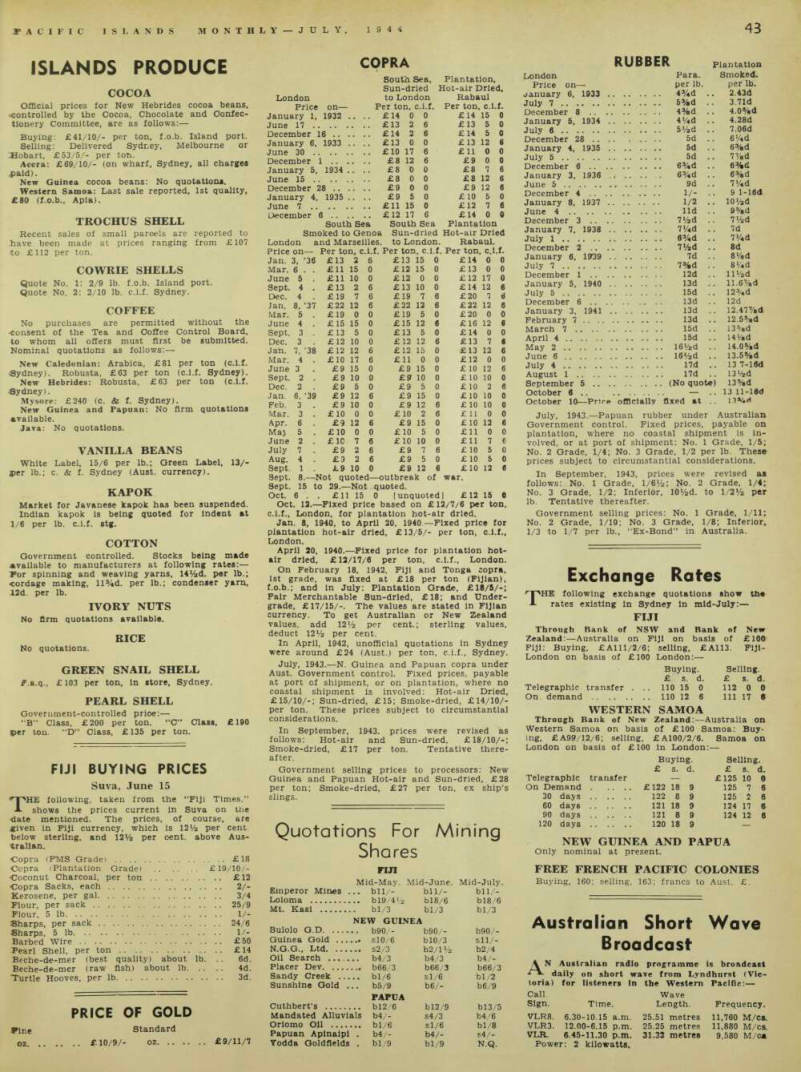
Cocoa
Official prices for New Hebrides cocoa beans, by the Cocoa, Chocolate and Confec tionery Committee, are as follows; — Buying: £4l/10/- per ton, f.o.b. Island port.
Selling: Delivered Sydney, Melbourne or IHobart, £53/5/- per ton.
Accra: £69/10/- (on wharf, Sydney, all charges .paid).
New Guinea cocoa beans: No quotations.
Western Samoa; Last sale reported, Ist quality, £BO (f.0.b., Apia).
Trochus Shell
Recent sales of small parcels are reported to have been made at prices ranging from £lO7 to £ll2 per ton.
Cowrie Shells
Quote No. 1: 2/9 lb. f.o.b. Island port.
Quote No. 2; 2/10 lb. c.i.f. Sydney.
Coffee
No purchases are permitted without the consent of the Tea and Coffee Control Board, to whom all offers must first be submitted.
Nominal quotations as follows: — New Caledonian: Arabica, £Bl per ton (c.l.f. •Sydney). Robusta, £63 per ton (c.i.f. Sydney).
New Hebrides: Robusta, £63 per ton (c.l.f.
Sydney).
Mysore: £240 (c. & f. Sydney).
New Guinea and Papuan: No firm quotations available.
Java: No quotations.
Vanilla Beans
White Label, 15/6 per lb.; Green Label, 13/per lb.; c. & f. Sydney (Aust. currency).
Kapok
Market for Javanese kapok has been suspended.
Indian kapok is being quoted for Indent at 1/6 per lb. c.i.f. stg.
Cotton
Government controlled. Stocks being made available to manufacturers at following rates;— Por spinning and weaving yarns, 14Vfcd. per lb.; cordage making, ll%d. per lb.; condenser yarn, 12d. per lb.
Ivory Nuts
No firm quotations available.
Rice
No quotations.
Green Snail Shell
F.a.q., £lO3 per ton, in store, Sydney.
Pearl Shell
Government-controlled price:— “B” Class, £2OO per ton, “C” Class, £l9O per ton "D” Class, £135 per ton.
Fiji Buying Prices
Suva, June 15 THE following, taken from the “Fiji Times,” shows the prices current in Suva on the ■date mentioned. The prices, of course, are *iven in Fiji currency, which is 12Va per cent, below sterling, and 12Va per cent, above Aus tralian.
Copra (FMS Grade) £lB Copra (Plantation Grade) £l9/10/- Coconut Charcoal, per ton £l2 Copra Sacks, each 2/- Kerosene, per gal 3/4 Flour, per sack 25/9 Flour, 5 lb 1/- Sharps, per sack 24/6 Sharps, 5 lb 1/- Barbed Wire £5O Pearl Shell, per ton £l4 Beche-de-mer (best quality) about lb. .. 6d.
Beche-de-mer (raw fish) about lb 4d.
Turtle Hooves, per lb 3d.
Price Of Gold
In April, 1942, unofficial quotations in Sydney were around £24 (Aust.) per ton, c.i.f., Sydney.
July, 1943. —N. Guinea and Papuan copra under Aust. Government control. Fixed prices, payable at port of shipment, or on plantation, where no coastal shipment is involved: Hot-air Dried, £15/10/-; Sun-dried, £15; Smoke-dried, £14/10/per ton. These prices subject to circumstantial considerations.
In September, 1943. prices were revised as follows: Hot-air and Sun-dried, £18/10/-; Smoke-dried, £17 per ton. Tentative there after.
Government selling prices to processors: New Guinea and Papuan Hot-air and Sun-dried, £28 per ton; Smoke-dried, £27 per ton, ex ship’s slings.
Fine Standard 02. . . . . .. £ 10/9/- oz .. £9/11/7
Copra
South Sea, Plantation, Sun-dried Hot-air Dried, London to London Rabaul Price on— Per ton, c.i.f.
Per ton, c.l.f.
January 1, 1932 . £14 0 0 £14 15 0 June 17 . £13 2 6 £13 5 0 December 16 .. £14 2 6 £14 5 0 January 6, 1933 £13 0 0 £13 12 6 June 30 . £10 17 6 £11 0 0 December 1 .. £8 12 6 £9 0 0 January 5, 1934 £8 0 0 £8 7 6 June 15 . £8 0 0 £8 12 6 December 28 .. £9 0 0 £9 12 6 January 4, 1935 £9 5 0 £10 5 0 June 7 £11 15 0 £12 7 6 December 6 . . £12 17 6 £14 0 0 South Sea South Sea Plantation Smoked to Genoa Sun-dried Hot-air Dried London and Marseilles, to London.
Rabaul.
Price on— Per ton, c.l.f. Per ton, c.l.f. Per ton, c.l.f.
Jan. 3. ’36 £13 2 6 £13 15 0 £14 0 0 Mar. 6 . . £11 15 0 £12 15 0 £13 0 0 June 5 . £11 10 0 £12 0 0 £12 17 0 Sept. 4 . £13 2 6 £13 10 0 £14 12 6 Dec. 4 . £19 7 6 £19 7 6 £ 20 7 6 Jan. 8, ’37 £22 12 6 £22 12 6 £22 12 6 Mar. 5 . £19 0 0 £19 5 0 £20 0 0 June 4 . £15 15 0 £15 12 6 £16 12 6 Sept. 3 . £13 5 0 £13 5 0 £14 0 0 Dec. 3 . £12 10 0 £12 12 6 £13 7 6 Jan. 7, ’38 £12 12 6 £12 15 0 £13 12 6 Mar, 4 . £10 17 6 £11 0 0 £12 0 0 June 3 £9 15 0 £9 15 0 £10 12 6 Sept. 2 . £9 10 0 £9 10 0 £10 10 0 Dec. 2 £9 5 0 £9 5 0 £10 2 6 Jan. 6, ’39 £9 12 6 £9 15 0 £10 10 0 Feb. 3 . £9 10 0 £9 12 6 £10 10 0 Mar. 3 . £10 0 0 £10 2 6 £110 0 Apr. 6 £9 12 6 £9 15 0 £10 12 6 Maj 5 . £10 0 0 £10 5 0 £110 0 June 2 £10 7 6 £10 10 0 £117 6 July 7 . £9 2 6 £9 7 6 £ 10 5 0 Aug. 4 £3 2 6 £9 5 0 £10 5 0 Sept. 1 . £9 10 0 £9 12 6 £10 12 6 Sept. 8. —Not quoted—outbreak of war.
Sept. 15 to 29.- -Not quoted.
Oct. 6 . £11 15 0 [unquoted] £ 12 IS 0 Oct. 12.- -Fixed price based on £12/7/6 per ton, c.l.f., London, for plantation hotair dried.
Jan. 8, 1940, to April 20. 1940 - -Fixed price for plantation hot-air dried, £13/5/per ton, c.l.f..
London.
April 20, 1940.- -Fixed price for plantation hotair dried. £12/17/6 per ton, c.l.f., London.
On February 18, 1942, FIJI and Tonga copra, 1st grade. was fixed at £18 per ton (Fijian), f.o.b.; and In July; Plantation Grade, £18/5/-; Pair Merchantable Sun-dried, £18; : and Undergrade, £17/15/-.
The values are stated in Fijian currency.
To get Australian or New Zealand values, add 12*/ 2 per cent.; sterling values, deduct 12y 2 per cent.
Quotations For Mining
Shares
July, 1943. —Papuan rubber under Australian Government control. Fixed prices, payable on plantation, where no coastal shipment is in volved, or at port of shipment: No. 1 Grade, 1/5; No. 2 Grade, 1/4; No. 3 Grade, 1/2 per lb. These prices subject to circumstantial considerations.
In September, 1943, prices were revised as follows: No. 1 Grade, I/6V2; No. 2 Grade, 1/4; No. 3 Grade, 1/2; Inferior, lOVad. to 1/2Va per lb. Tentative thereafter.
Government selling prices: No. 1 Grade, 1/11; No. 2 Grade, 1/10; No. 3 Grade, 1/8; Inferior, 1/3 to 1/7 per lb., “Ex-Bond” in Australia.
rui Mid-May.
Mid-June.
Mid-July.
Emperor Mines . .. bll/bll/bll/- Loloma .. bl9 4la bl8/6 bl8/6 Mt. Kasl bl/3 bl/3 bl/3 Bulolo G.D
New Guinea
.. b90 - b90/b90/- Guinea Gold .slO/6 blO/3 sll/- N.G.G., Ltd b2/iy 2 b2/4 Oil Search b4/3 b4/- Placer Dev b66/3 b66/3 Sandy Creek ... .. bl/6 sl/6 bl/2 Sunshine Gold . .. b5/9 b6/b6/9 Cuthbert’s
Papua
.. bl2/6 bl2 9 bl3/5 Mandated Alluvials b4 s4/3 b4/6 Orlomo Oil sl/6 bl/8 Papuan Aplnalpl . b4/b4/s4/- Yodda Goldfields . bl/9 bl/9 N.Q.
RUBBER Plantation
London Para.
Smoked.
Price on— per lb. per lb.
January 6, 1933 . 4 3 Ad . 2.43d July 7 3.71d December 8 . . . 4.0 9 Ad January 5, 1934 . 4.28d July 6 5‘Ad . 7.06d December 28 .. . 5d . 6*Ad January 4, 1935 . 5d . 6 3 Ad July 5 5d . 7 7 Ad December 6 .. . 6 3 Ad January 3, 1936 6 3 Ad June 5 9d . 7‘Ad December 4 . . . . 1/- . 9 l-16d January 8, 1937 . 1/2 . lOVad June 4 lid . 9 5 Ad December 3 .. . 7‘Ad . 7‘Ad January 7, 1938 . 7‘Ad . 7d July 1 7‘Ad December 2 .. . 7‘Ad . 8d January 6, 1?39 . 7d . 8‘Ad July 7 8‘Ad December 1 .. . 12d . 11‘Ad January 5, 1940 . 13d . 11.6 7 /«d July 5 15d . 12 3 /4d December 6 .. . , 13d . 12d January 3, 1941 . 13d . 12.47’Ad February 7 .. .. 13d . 12.5*/,d March 7 15d . 13 s /ad April 4 15d . 14 Vtd May 2 16‘/ad . i4.oy.d June 6 16*/ad . 13.5 s /«d July 4 17d . 13 7-16d August 1 17d . 13‘Ad September 5 .. . (No quote) 13%d October 6 .. ... 13 11-lfld October 10—Price officially fixed at .
Exchange Rates
THE following exchange quotations show the rates existing In Sydney In mid-July:—
Fiji
Through Bank of NSW and Rank of New Zealand:—Australia on FIJI on basis of £lOO FIJI: Buying, £Alll/2/6: selling. £AII3. PIJI - on basis of £lOO London:—
Western Samoa
Through Bank of New Zealand:—Australia on Western Samoa on basis of £lOO Samoa: Buy ing, £ A99/12/6; selling, £AIOO/2/6. Samoa on London on basis of £lOO In London:—
New Guinea And Papua
Only nominal at present.
Free French Pacific Colonies
Buying, 160; selling, 163; francs to Aust. £.
Buying.
Selling. £ s. d. £ s. d.
Telegraphic transfer . .. 110 15 0 112 0 0 On demand .. 110 12 8 111 17 e
Buying.
Selling. £ s. d. £ s. d.
Telegraphic transfer — £125 10 0 On Demand £122 18 9 125 7 6 30 days 122 8 9 125 2 6 60 days 121 18 9 124 17 6 90 days 121 8 9 124 12 6 120 days 120 18 9 —
Australian Short Wave
Broadcast
\ N Australian radio programme is broadcast daily on short wave from Lyndhurst (Vic toria) for listeners in the Western Pacific:—
Call Wave Sign.
Time.
Length.
Frequency.
Vlr8.
6.30-10.15 a.m. 25.51 metres 11,760 M/cs.
Vlr3.
12.00-6.15 p.m. 25.25 metres 11,880 M/cs.
Vlr.
6.45-11.30 p.m. 31.32 metres 9,580 M/c* Power; 2 kilowatts.
Index to Volume XIV.
August, 1943, To July, 1944, Inclusive
[First numeral indicates number of issue and second numeral gives the page®
ANGAU. —(See War Section.) Armstrong, A. L.—l-6.
Ayson, Judge.—4-3.
BADDELEY, Bishop of Melanesia. —3-38.
Burns Philp & Co.—lo-43.
Burns Philp (SS) Ltd. —12-7.
Carpenter, W. R., & Co.—2-40.
Champion, H. W.—2-40, 4-11.
Christmas Island, Stamps.—l-34.
Caroline and Vostock Islands.—l-35.
Cook Islands. —Planting, 2-17, 10-19, 10-35; “Dollar-Prosperity,” 2-19; Mangaia, 2-35, 8-7, 8-17, 8-28, 8-35; Judge Ayson Retires, 4-3; Pearl Shell Brooches, 4-4; “Viggo” Rasmussen, 4-8; J. Rennie, NMP, 6-6; Cyclone. 6-9, 7-7, 9-3; Port of Ngatangua, 9-8; Sanatorium for TB, 10-39.
Copra and Coconuts, 1-5, 2-6, 4-9, 10-30, 11-4, 11-25, 12-26.
NG Copra Pool, 10-10.
DEATHS.—Mrs. Pansy Smith, 1-12; Dr. F. F.
Williams, 1-13; Lieut.-Col. J. S. Gamble, 2-4; Col. J. W. Hutchen, 2-4; W/O H. Lumb, 2-4; Pte. M. K. Lynch, 2-4; Lieut.-Col. C. N. F. Ben gough, 2-6; Lieut. B. Masefield, 2-7; Dr. D. C. M.
Macpherson, 2-8; Capt. H. P. (Dick) Reynolds, 2- Mrs. Hannah M. Chance, 2-17; Frank Shann. 2-25; C. J. Haskoll, 2-31; R. D. Bertie, 3- Mrs. Gwendolyn Rachel Ragg, 3-5; Thomas Platt, 3-6; Mrs. Frances Olivia Livingston, 3-6; Judge D. S. Wanliss, 3-7; Vincent George Smith, 3-8; Lieut. G. Stevenson, 3-9; Sgt. Charles Spitz, 3- Capt. Trask, 3-14; J. T. Swanson, 3-15; Squadron-Leader Stan Baldie, 3-32; Sgt. R. R.
Short; T/Major N. V. MlcKenna; Mons. Ernest Massoubre, 4-5; J. S. Meek, 4-6; F/O G. Keogh, 4- James E. Wallace, 4-10; Mdlle. Julie Lep rado, 4-19; C. J. Bucknell, 4-28; T. H. T. Blake loch, 4-28; Capt. OsCar Svenson, 5-8; Capt. J.
D. Lundie, 5-15; Mons. Pourcher; Charles Duchatel, 6-9; Rev. A. E. Hunt, 6-23; W. S.
Cooper, 6-23; Mrs. F. Gore, 6-33; E. P. Taylor, 6-35; L. J. St. Julian, 6-35; J. R. Clay, 7-1; Lieut. L. E. Austin, 7-5; R. B. Howard, 7-8; A.
E. Bailey, 7-21; Dr. J. W. Hunt, 7-21; H. I.
Harding, 8-5; O. F. Nelson, 8-10; Mons. Ratard, 8- J. D. Williams, 8-33; Gnr. R. J. Wilson, 9- A. A. Laharrague, 9-9; “Toby” O’Brien, 9- Robert Bruce, 10-5; C. W. Southey, 10-7; Pte. L. Aspinall, 10-7; Pte. L. Boyer, 10-11; F/O B. F. Lawler, 10-10; Rev. W. Bernard Moore, 10- Mrs. Lurline Marama, 10-37; M. Emile Mouldous, 10-38; Rfn. R. E. Vernon, 11-4; Capt.
G. G. Harris, 11-4; Lieut. J. McClymont. 11-21; R. J. (Jack) Smith, 12-26; F/O A. T. Levdin, 12-30. 5-11, 11-9.
Derris Root as a Tropical Crop.—4-29.
Du Pont, Max. —2-7.
EARHART. Amelia.—l 2-14.
Easter Island.—ll-32.
FIJI (See also under War Section).—Black Markets, 1-7; Labour, 1-34; Ratu Sukuna Joins Council, 2-5; Sugar Cane and Disputes, 2-8, 4-8, 5- 7-8, 7-17, 9-7, 11-7, 12-12; Colonial War Memorial Hospital, 2-8; Manpower, 2-10; Banana Export. 2-18; “Trading Trip.” 2-26; Rotuma, 2-35, 9-12; New Colonial Secretary, 3-9; Fiji Indian. 3-10; Soldier Settlement, 3-27; Soil Erosion, 4-33; Shooting a Dinner. 4-34- Currency Shortage, 4-38; Food Production, 6-21; Sydney Office, 7-8; Administration, 5-10, 7-9, 8-34, 9-34; Timber, 7-18; New Year’s Honours. 7-29: Medi cal School and Medical Services, 5-37, 8-6 9-5 9-35, 11-23, 11-35; Gold, 8-17, 12-8; Missions. 8-24; Cost of Living Increases for Indians, 9-27; Trade Report, 1943, 10-2; Mixed Farming, 10-13; A Decade in Fiji, 10-31, 11-17; Fiji Women in Sydney, 10-35; New Vicar Apostolic, 11-4; Recon struction, 12-5: Morris Hedstrom & Co., Ltd., 12-7; Death of Bill Borthwick, 12-8; Charcoal Buying Ceases, 12-28.
Prisbie, Robert Dean.—l-19.
GAUGUIN’S Story.—3-40, 6-22.
Garvey, R. H.—9-4.
Glover, Fr.—l-9, 4-23.
Grove, W., & Sons.—6-19.
Guild, Eastham.—s-23.
HONOUR ROLL of Pacific Island Residents Killed, Wounded, POW, Missing, Decorations, etc., appears inside cover each month.
Howard, R. 8.—4-12.
Indentured Labour.—7-12, 8-5, 9-2 10-3
12-6. ...
JAPANESE River Fever.—4-3, 5-5, 8-5.
LEPROSY—Treatment.— l-15, 7-34, 10-11, 10-12.
Malaria.—B-31.
Marchant, Lieut.-Col. W. S. 4-3.
Mordvinoff, Nicolai. —9-23.
Morris Hedstrom & Co., Ltd.—l 2-7.
NAURU Boys in Australia.—4-15.
Nelson, O. F.—B-10, 10-41, 11-42.
Netherlands Indies.—4-13, 5-13, 6-13.
Newboult, A. T.—2-7.
New Caledonia (See also War Section). — Money, 2-6; Administration, 2-9, 5-9; Shipping, 2-28; Governor Laigret Arrives, 3-7; US Senators Offend, 5-33; Another Governor —M. Jacques Tal lec, 6-11; “Wedding and War in Loyalties,” 6-25; History, 6-31; Cyclone, 7-15; Dutch Consulate, 7- Mining, 7-20, 11-40; Future, 8-18, 9-38; M.
Laigret Departs, 9-31; Commonwealth Represen tative, 10-40; Netherlands Consul, 10-40; Value of Franc, 12-14; “Ouvea” in News Again, 12-37.
New Guinea (See also War Section). —Returned Soldiers, 1-1, 7-7, 9-9; Missions, 1-5, 1-22, 5-10; Education, 1-14; Women’s Associations, 1-16, 3-9, 4- 4-36, 5-7, 6-29, 7-33, 8-2; 12-cov. iii, 12-39, 12-40; Wasps, 1-19; “Flash-back,” 1-23; Jungle Poods, 1-32; Future Prospects, 1-30, 2-3, 4-2, 8- 9-25, 12-9, 12-36; Judge Wanliss, 3-7; “Nos talgia—And a Maruk,” 3-21; “Hymn of Hens and Cucumbers—Army Farmers,” 4-20; New Guinea Natives and Future: “Bishops and Anthropolo gists,” 5-10; General, 7-23; “Geoff.” Hemsworth, 5- Will “Kanaka” Become a “Boong”?, 6-10; Police-boys’ Record, 7-17; Profit From Pennies, 7-31: Gold, 4-3, 6-11, 7-4, 8-13, 10-11, 12-5; Bulldog-Wau Road. 9-6; Sepik Tragedy, 9-10; Public Service Association, 9-12; Residents Serv ing in Army, 9-15; Wewak-Aitape, 10-17; N.G.
Association of Queensland, 10-19; “Los Negros Nostalgia,” 10-35; Guinea Airways, Ltd., 10-43: This Was Rabaul, 11-12; Through N. Zealander’s Eyes, 11-28: Native Medical Services, 11-35; Warrant-Officer K. W. Ryall, 12-5; “Jap-Dodging in New Guinea,” 12-21; Valour Badge of Native Police, 12-27.
New Hebrides.—Palolo, 3-19, 4-29; Regulations, 9- Norfolk Island.—l-27, 8-36.
PAClFlC.—Pacific Territories Association 2-11, 5-11, 6-9, 8-9, 11-1, 12-9, 12-18; War’s Effect on Natives, 2-30; Future in Pacific, 3-3, 4-7, 5-3, 6-3, 7- 7-10, 8-1, 9-5; E. J. Ward, Minister for External Territories, 3-8, 10-7, 12-12; Natives’
Future, 3-11, 4-17, 5-10, 7-23, 10-25, 10-41, 12-12, 12-40; Pacific Affairs, 3-15; Australian Pacific Policy, 4-1, 4-11, 8-3, 9-4, 10-5, 12-9, 12-17; Aus tralian Pacific Territories Ministers, 4-5; Mis sions, Future of, 5-4; South Pacific Confedera tion, 5-28, 9-3, 9-39: Indentured Labour, 7-12, 8- 9-2, 10-3, 12-6, 12-40; “Kanaka” Origin, 2- 7-34, 10-14, 10-26, 11-25; Polynesia’s Future, 8-20; Medical Services, 9-5; Phosphate, 5-9, 9-7; Unilever Menace, 10-23; Australian Government and BSI, 11-9.
Papua (See also War Section). —Dr. F. E. Wil liams, 1-13; Natives, 2-34, 12-37; “What Does ‘P’ Stand For?”, 3-11; History, 3-28, 4-4, 5-7, 5-36, 6-34, 8-29; New Roads and Airports, 4-3; “Through American Eyes,” 5-20; Peak Rubber Production by Returned Planters, 6-9; Future Prospects, Native, 5-37, 9-35, 10-11, 12-25; Gen eral, 9-3, 11-38; Public Service Association, 8-7, 12-15; Cost of a Rubber Estate, 8-29; Gold, 9-9, 11- Bulldog-Wau Road, 9-6; Sydney H. Chance Retires, 10-5; Lett’s Book, “Papuan Gold,” 11-6, 12- News of Peter Bosgard, 12-24; Valour Badge for Native Police, 12-27.
Parer, Ray.—2-11.
Phoenix Islands. —6-17.
Pidgin, 2-6, 2-16, 3-16.
Pitcairn Islands. —7-27.
Polynesians.—Sydney Club, 2-33, 7-33, 8-2, 8- 9-36, 11-18; Economic Debauchery by Allied Troops, 6-19: Future, 10-37.
Rougier, Fr —B-32.
Rubber.—l-29, 1-36, 2-6, 3-29, 6-9, 8-28.
SALOTE, Queen of Tonga.—4-5, 5-19, 10-12.
Samoa, W.—Sly Grog, 3-17; Food Prices, 3- “Dollar-Prosperity,” 4-30, 7-6, 9-18; Fono of Faipule, 6-7; “Bed of Roses,” 7-31; Mata’afa as Third Fautua, 8-3; Planting, 9-27, 11-37, 12-30; Administrator’s Daughter Marries, 11-8; Imports Controlled, 10-7, 11-15; Local Artists, 11- Samoan Boys on Both Sides, 12-33.
Sautot, M. Henri.—l-25, 5-19.
Ships (See also War Section). —“Bulolo,” 1-33, 12- “Manureva,” 1-21; “Cimba,” 2-25; “Haur aki,” 10-33.
Smith, “Vince”. —3-8.
Solomon Islands. —New Resident Commissioner, 2-7; Future, 3-16, 7-32; Resident Commissioner Marchant Goes to Kenya, 4-3; Native Canoe, 9- Oldest Resident, 11-21; Melanesian Press, 12-36.
Sulphanilamide—Use in Tropics.—4-36.
TOBACCO Growing.—9-20.
Tahiti. —Mau’u Passes, 2-31; “Tahiti Garden,’” 3-30; History, 2-28, 5-5, 5-32, 7-9, 7-35, 10-40; Work of Eastham Guild, 5-23; “Fame—Andt Tahiti,” 5-27; Chinese, 7-5; Travel Ban, 7-5; Elephantiasis, 7-9; “No Pareu,” 7-28; Black Mar ket, 8-25, 10-25; Mr. F. Hanak Returns, 8-35; Nott Centenary, 9-i., 11-11; Nicoli Mordvinoff_ 9-23; Art of Cooking, 11-22; Ecole Pastorale^ 11- Tonga.—Queen Salote’s Jubilee, 4-5, 8-24; Eruption on Niuafoou, 5-7; Jap Sword for Palace, 5-15; Drowning Tragedy in Nukualofa*. 7-5; Tongan Decorated, 8-5; “Incident, 1900,” 12- “Trade Winds,” 2-32.
Torres Islands. —“Men of Torres Islands,” 3-20_ Treasury Island.—B-21.
Vernon, Dr.—2-13.
Vial, Lee.—9-3.
WADE.—Bishop T.—l-33.
War In The Pacific
General. —Tonga’s War Fund, 2-11; Effect ora Pacific Islanders, 2-30; Two Nations Wooing.- Filipinos, 3-5; ANGAU, 3-13, 4-6, 9-3, 11-8, 11-41; Jap Air Strength, 3-33; Jap Co-prosperity Sphere,. 5-8; War Comes to Atolls, 5-16; Tojo, 8-4; Defeat of Japan in S-W Pacific, 9-1; News of “Notou’s” Crew, 9-17; Sinking of “Hauraki,” 10- What Japan is Trying to Do With Co prosperity Sphere, 12-1; “Inside Story” of Sin gapore, 12-6; “Bulolo” at Invasion, 12-14.
Escapes and Rescues. —1-9, 4-23, 8-6, 10-15, 11- 12-21.
Fighting French Colonies and Forces. —1-6, 1-8, 1-25, 2-5, 3-9, 5-11, 11-9.
Evacuees and Their Problems. — (See Pacific Territories Association).
War Damage Insurance and Claims.—ln N..
Guinea, 1-5, 3-4, 5-6, 9-34, 9-36, 11-1, 11-39; Mr. Alderman (See also Pacific Territories Asso ciation), 4-5, 7-7; Reported $25 Per Coconut Tree in BSI, 11-7.
Gilbert Islands.—Reymond Family, 6-39; Well known Men Missing, 7-7; Butaritari and the Japs, 8-7; Jap Co-prosperity, 9-29; Officials Return, 9-41; Butaritari a Grim Battle for Tojo, 10-29; Tarawa —Shrine of US Valour, 11-39.
Nauru. —Men Who Stayed, 3-5; Japs Nee(2 Phosphates, 5-9, 9-7.
N. Hebrides.—Wartime Rules for Native Labour, 4- Local Military Unit, 5-6.
War in Fiji.—Fijians in Battle, 2-7, 3-12, 4-5, 5- ii., 8-26, 9-24, 10-27, 10-35, 11-26, 11-28; War Preparedness, 2-7, 7-36; War Bonds, 3-6, 9- War Funds, 3-8; Restless Natives, 4-19; Remembering US Dead, 5-6; Blackout Relaxed, 6- Food Front, 3-37, 6-21, 8-33, 10-36; Travel Priorities, 8-26; War’s Effect, 10-6; Returnee?
Servicemen, 11-11.
War in New Guinea.—Unsung Heroes of Evacuation, 1-8; Battle for Salamaua, 1-11; Chinese in Sydney, 1-36; Prisoners of War and Missing, 3-cov. ii., 3-5, 3-7, 4-39, 11-37; “Army- Farmers,” 4-20; Fr. Glover and Central NG Evacuation, 1-9, 4-23; Territorians Serving, 5-5; Anniversary of Fall of Rabaul, 6-7, 7-6; Police Force Record. 6-36; Native Decorated, 7-5, 9-30; “Is Jap Breaking?”, 7-5; Fate of Missionaries, 8-6, 10-15, 10-23, 11-5; Resume of Campaign,. 10- Bougainville Patrol, 11-26.
War in Papua.—Where Japs Were Stopped, 1-29; Owen Stanley Campaign, 2-21; Missionaries Murdered, 2-24; Natives’ War Effort, 4-4; Buna- Gona Invasion, 4-32; Papuans Decorated, 6-29, 10-12; “Assault on Buna,” 7-19; “Total War,” 8-23; Resume of Campaign, 10-8.
War In Solomons.—Missionaries Murdered, 1-7; Effect on Natives, 2-29; Transformation of Guadalcanal, 2-36; Story of Bishop Baddeley* 3-38; “Village Churchill,” 5-10; Chinese Rescued, 5- Impression of Coral Sea and Guadalcanal Battles, 6-27; “Deserted El Dorado,” 7-27; “Tulagi’s Scars Healing,” 7-36; “Lambeti,” 8-8; Battle of Marovo Lagoon, 8-34; Landing on Ren dova, 9-8; Siota Cathedral, 10-36; What Army is Doing for Natives, 11-29; “Making Way for Army—Nissan Islanders,” 11-43.
War in N. Caledonia—Effect of War, 3-24, 6- 6-36; Feeding Americans, 4-8; More Police, 6-15; “War in Loyalties,” 6-25; US-French Co operation, 7-25; Travel Permits, 8-26; News of “Notou’s” Crew, 9-17; Casualties, 11-22, 12-30.
Advertisements & other items, p. 46 (1 item)
44
JULY, 1944 PACIFIC ISLANDS MONTHLY'
Published by PACIFIC PUBLICATIONS PTY. LTD.. Union House, 247 George Street, Sydney. (Telephone: BW 5037). Wholly set up and printed In Australia by the Sydney and Melbourne Publishing Co. Pty. Ltd., 29 Alberta Street. Sydney. (Telephone: MA 7101).
The Fortune Of
War
American "Invasion" Helps Young Caledonians
By Captain Homer A. Dye,
Us Army
HERE in New Caledonia are two brothers, Philippe and Stephane de St. Quentin who, from an idea that originated on a summer horseback vaca tion-trip across the island, built a busi ness that has been supplying oxygen to the US forces in this area.
Their trip was to the century-old, but sparsely-inhabited, settlement at Touho, and on to the Cascade de Ba, which tumbles down a mountain crag into the sea.
When the brothers went back to their studies in Noumea that summer, they spent long hours tinkering with the hand propelled electric generator, the Leyden jar, and the paraphernalia imported from France a half-century ago, with which the Frere, instructeur de physique, demon strated his lectures to his classes. They took a. post-graduate course in such ele mentary engineering courses as the island afforded, and subscribed to technical journals from France and America.
A few years ago, starting with the materials they found on the spot at Cas cade de Ba, the two brothers began build ing an electrical plant. Improvising from old machinery procured from abandoned mines, and importing the essential parts, they built a generator and compressors.
Largely by their own labour, and with occasional assistance from the Kanakas from neighbouring tribes, they dragged heavy iron pipes up the mountain to make a flume.
It was a gala day when the natives from the coffee plantations, the colonists of the east coast, and the padres of the mission assembled to see the first cours ing of the hydraulic power through the turbines, and the first ray of electric light in the old settlement.
Then they began the manufacture of oxygen and hydrogen for the acetylene used in the mining mills of the island.
Every franc they could save from their sales, they invested again in machinery and added factory space. To get their product over the mountain trails across the island, or to the port on the coast and the little monthly steamer, was a major transportation problem, and a grievous absorption of their hard-won profits.
THEN came the war, and the Americans . occupied the island as a base. The big Army trucks literally beat a pathway to their door. The two young engineers found an American loan thrust into their hands, and they were exhorted to build bigger and to produce more. The Army needed oxygen, and huge truck loads of the big steel cylinders rumbled over the mountains and down to the air base on the plain of Tontouta.
The brothers de St. Quentin, revelling in the gift of war prosperity, have visions of bigger things to be done. But when the Army goes, what then? Other oxygen producers on the island, including plants which the Army itself has installed, will find that the oxygen business has liter ally vanished into thin air.
But there is the new motor highway
along the east coast that has opened up the natural wealth and beauty of the dis trict that has hitherto been isolated for lack of adequate communication.
The brothers hope that there will be a great amount of traffic on the road — prospectors and financiers to develop the newly-opened resources, and tourists to view the beauties —and that there will be a need for hotels and tourist camps. They plan to erect a big straw-thatched lodge and de luxe native huts of bamboo and woven palm leaves. Wired with elec tricity, and with neat little enamelled electric stoves, tourists’ wives will endure the hardships of a fishing trip with a proper flair of Ritziness. For there will be electricity to burn, after the American Army leaves.
Doughboy And
Arcady
A YANKEE doughboy, with pep terrific, Has just discovered the grand Pacific!
He swears it reminds him of Pastoral Greece, And, “hellbent now for some primitive peace,”
When he’s cleaned up the war, he is coming right back To build him, in Moresby, a cute grass shack.
He guesses he’ll sprawl and twiddle a flute — Attired in some sunlight, or rami, to suit.
Time being no object, as Thessaly; But here one adds palm trees and reef to the sea.
Our sheep are weary and thin, I’m afraid, And sophisticated the dusky maid.
Though ever so dusky, no Grecian she, And a bit absentminded about your tea.
This tropical life where ones plays on a flute, A fallacy is, though the idea’s cute; For Island-ites work—or grow hungry as sin; Food’s rather monotonous, out of a tin; Whilst the odour of oil from the maiden’s hair Would drive any lover to dull despair.
For any success you must work much harder (Nor may you dither in Hanuabada!) I’d hate to know you were ill-advised— But Moresby was horribly civilised.
Twittle and tootle! Ah, Doughboy free, There’s no such country as Arcady.
Alice Allen Innes .
The New Guinea Women's
Association of Melbourne
AS a result of a successful function, held in a Toorak home recently, the New Guinea Women’s Association of Melbourne realised over £l7O. Among the 160 Territorians who attended was New Guinea’s former Judge (now Wing- Commander) “Monty” Phillips and his wife (they were married while Wing- Commander Phillips was in London last year), Mr. and Mrs. Chinnery and their daughters, Captain Noel Barrie, Mr. and Mrs. Bill Royal, and Mr. and Mrs.
Ferguson Shannon.
TThe greater proportion of the amount raised has been earmarked for prisoner of war funds.
Wife: Who was that on the ’phone?
Dumb husband (puzzled): It must have been some sailor on the wrong number— he wanted to know if the coast were clear
Advertisements & other items, p. 48 (1 item)
W. R. Carpenter & Co
■:0 ■n ■ Us. 2551 :|g| ■m \ 'V ■ k.
fc $ la. i
PI ■ r-
T'S .y V -
♦■ €AM6*T*ft AMUMI
J 'V '-3 ■ m mm f< - 1 . ■■ ;-. /Sy , ~--S ' v x ...
' r* c;
■MBMI
■> a
Travel by CARPENTER AIRLINES
Full particulars from Macdonald, Hamilton Cr Co., or Howard Smith Ltd., Sydney. i
W. R. CARPENTER & CO
MERCHANTS, SHIPOWNERS AND AIRCRAFT OPERATORS
Agenti for Australian, European and American Manufacturers, and Distributors of Every Description of Merchanor Buyers and Shippers of Copra, Trocas, and all Classes of Islands Produce.
Ford Motor Company of Canada.
T. G. Gr C. Bolinders (Engines).
AGENTS FOR :
Caterpillar Tractors.
Electrolux Refrigerators, etc., etc.
Dodge Brothers Inc.
Westinghouse Electrical Co.
Branches throughout the Pacific Islands
In London: W. R. Carpenter & Co, (London) Ltd., Coronation House, 4 Lloyds Avenue, London, EC.
Head Office: 16 O’CONNELL STREET, SYDNEY