Pacific
Islands
Monthly
■ Fia Ia A A
June 19, 1944
Vol. Xiv. No. 11.
Established 1930
[Registered the or transmission fry post as a newspaper
1/-
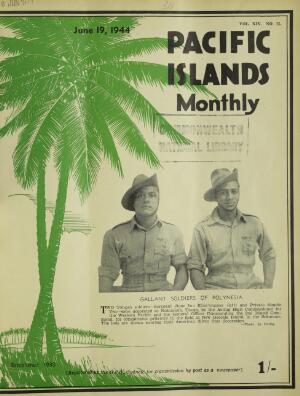
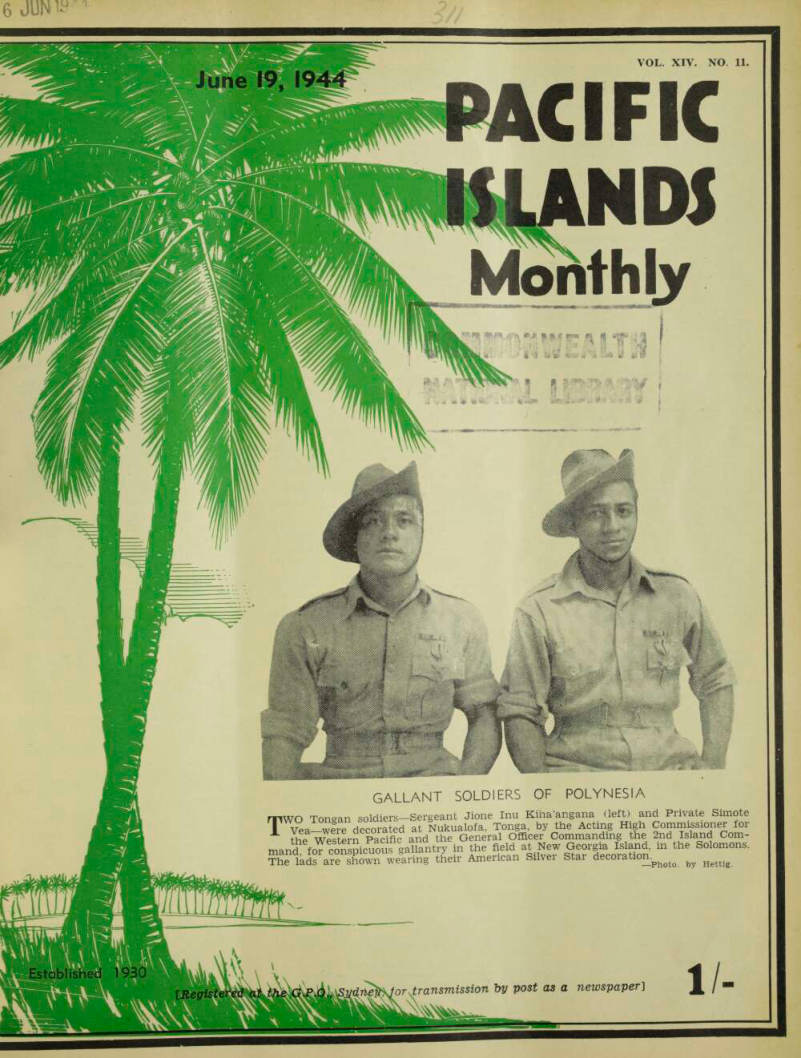
Gallant Soldiers Of Polynesia
TWO Tongan soldiers— Sergeant Jione Inu Kiha’angana (left) and Private Simote yea—wire decorated at Nukualofa, Tonga, by the Acting High Commissioner for Astern Pacific and the General Officer Commanding the 2nd Island Com mand gaUantry in the field at New Georgia Island, in the Solomons.
The lads are shown wearing their American Silver Star decoration Photo by Heţting
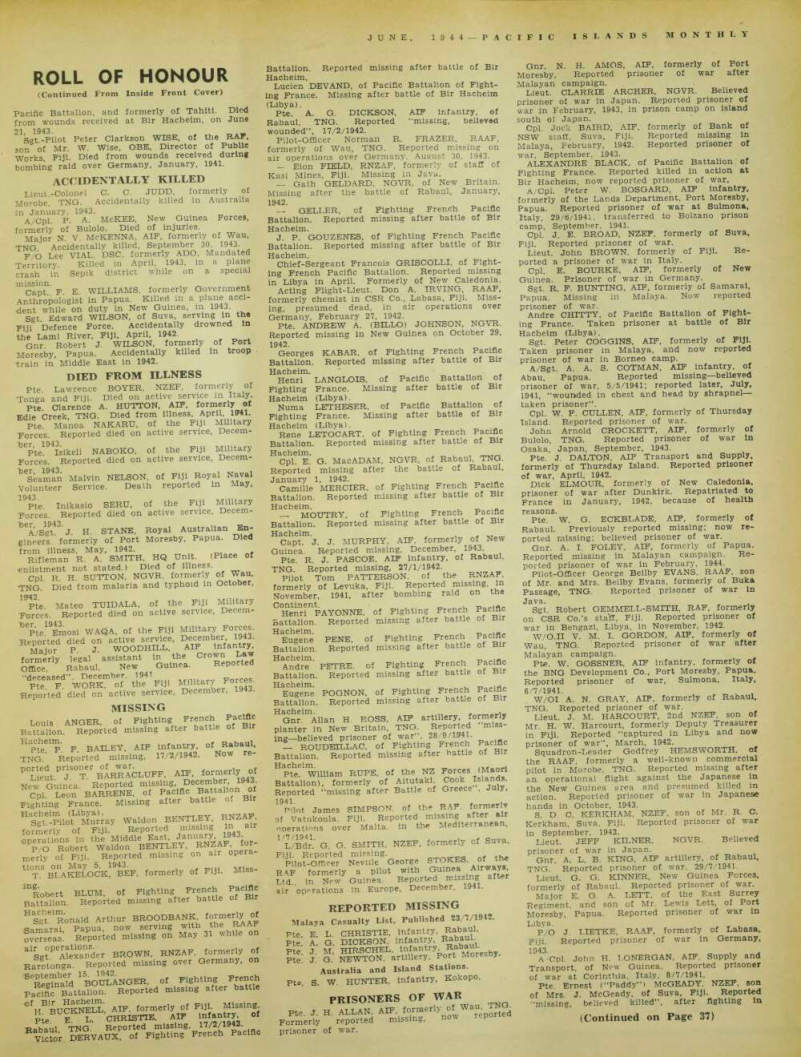
ROLL OF HONOUR—Section I.
[Section I (Killed, Missing, Prisoners) and Section II (Wounded, Decorations, etc.), published in Alternate Months] (We try to assemble here the names of men of the United Nations, residents or former residents of the Pacific Territories, whose names appear in casualty lists or who receive decorations. We should be grateful if relations and friends would send us details of such men.)
Killed
Sgt. Bert AITKEN, NZEF, formerly of Fiji.
Killed in action in Libya.
Eugene AUBRY (formerly of Tahiti), of the Air Force of Fighting France. Killed in an air accident in Great Britain.
Pte. Louis ASPINALL, NZEF, formerly of W.
Samoa. Killed in action in Italy in March, 1944.
Lieut. L. E. AUSTIN, AMF, formerly of Tan gara, Papua. Reported missing, believed killed, February, 1944.
Squadron-Leader Stan BALDIE, RAP, formerly of Wau, TNG. Killed in action in India.
Pilot-Officer Len BAYLISS, flying Instructor In the RAAF, formerly of Rabaul, New Guinea.
Killed in Sydney, 18/11/1940, when he fell from a trainer aircraft in flight.
Lieut.-Colonel C. N. F. BENGOUGH. of BSI, Defence Forces, formerly Acting-Resident Com missioner of BSI. Killed when aircraft shot down into sea, August, 1943.
R. C. BENTLEY, NZEF, formerly of Fiji.
Killed in action, Middle East, June 27, 1942.
A/Bdr. Neville W. BERTWISTLE, ALP artillery (tank unit), formerly a clerk on the staff of W. R. Carpenter and Co. Ltd., of Rabaul, New Guinea. Killed in action, April, 1941.
P/O J. B. BOMFORD, RNZAP, formerly of CSR Co.’s staff, Fiji. Killed on active service in England.
Pte. W. R. M. BRADNAM, of the NZ Forces, formerly of Fiji. Reported killed in action in the Middle East, 25/11/1941.
Warrant-Officer R. F. BRECHIN, New Guinea Force. Killed in air accident, June 17, 1942.
Formerly of NO Department of Agriculture.
Anton BRINON, of Fighting French Pacific Battalion, formerly of La Foa, New Caledonia.
Killed in action in Libya, November, 1942.
Lieut.-Colonel Felix BROCHE, of the New Caledonian-New Hebridean contingent of the Fighting French Pacific Battalion. Killed in action in the battle of Bir Hacheim (Libya).
Sgt.-Observer Ross BUCKLEY, RNZAF, form erly of Fiji. Reported missing in air operations.
Presumed “dead” in January, 1944.
Pilot-Officer E. H. CANARD, of RAP, formerly of Fiji Civil Service. Killed in flying accident In South Africa in the course of his duty as flying instructor.
Pte. David C. GARLAND, AIF, formerly chief assayer at the Emperor gold mines, Fiji. Killed In action in New Guinea.
Pierre CHARPENTTER, of the Fighting French Pacific Battalion. Killed in action in the battle of Bir Hacheim.
Raymond CHAUTARD (formerly of New Cale donia), of the Fighting French Pacific Battalion.
Killed in action in Libya.
Flight-Lieutenant G. J. I. CLARKE, of the RAAF, formerly Assistant Plight Superintendent of Carpenter Airlines, New Guinea. Killed In action during operations off Dakar (French West Africa), while attached to HMAS “Aus tralia”, September, 1940.
Georges CLEMENS, of the Free French Pacific contingent from New Caledonia. Reported killed in action in the Middle East, March, 1942.
Flying-Officer Jack R. COATH, of the RNZAP, formerly on the staff of the Bank of New Zealand, in Suva, Fiji. Killed October, 1941, when a training aircraft crashed in NZ.
Sqd.-Leader Lionel COHEN, RAF, formerly of Upper Watut, TNG. Killed when returning from a bomber raid on Berlin in 1942.
Sgt-Pilot Colin CRABBE, RAF, formerly of Suva, Fiji. Killed by enemy action in England in May, 1943.
Pte. Felix CRAIG, AIF, formerly of accounts department, Australasian Petroleum Co., Port Moresby, Papua. Killed in action, June, 1941.
L. J. DAWES, of the NZ Forces, formerly Dis trict Officer of Savaii, Western Samoa. Reported killed in action, February, 1942.
Pilot-Officer V. L. DEARMAN, of the RAAF (observer), formerly overseer and clerk at the Colonial Sugar Refining Co., Ltd., Raravai, Fiji. Reported killed in action in the Middle East, October. 1941.
Cpl. Alec GIBB, NZEF, formerly of Apia, Western Samoa. Killed in action in Italy in early 1944.
Capt. Jean GILBERT, of the Naval Forces of Fighting Prance, and formerly of Tahiti Killed
in action.
Captain Kenneth GARDEN, of the RAF Ferry Command, formerly of Guinea Airways Ltd., In New Guinea. Killed September, 1941, when a bomber he “ferried” from USA crashed on west coast of Britain.
Flying-Officer Moresby GOFTON, of the RAF, «on of Mrs. F. S. Stewart, of Wau, New Guinea.
Reported missing, 17/5/1940 —presumed killed in air operations.
Rifleman J. A. GOODWIN, AIF infantry, for merly of Bulwa, TNG. Reported "accidentally killed”. April, 1942.
Ernest GOURNAC (formerly of Tahiti), of the Air Force of Fighting France. Killed in an air accident in Britain.
Pte. Wallace GRAHAM, of the NZ Forces (infantry), formerly on the staff of Morris Hedstrom Ltd., Fiji. Killed In action in the Middle East. November. 1941 Lieut. J. A. GRANT. AIF, formerly of Man dated Territory. Killed in action.
Lieut. L. B. GROVE, AIF. formerly of Madang, TNG. Killed in action.
Squadron-Leader C. R. GURNEY, RAAF, a former chief pilot of Guinea Airways, Ltd.
Killed in action in the New Guinea area. May, 1942.
Pte. B. HAMILTON. AIF, formerly of Auck land, NZ, and New Guinea. Killed in action.
Gerald T. J. HARPER, RAF, son of Major and Mrs. P. Harper, of Ra, Fiji. Killed in action while navigating a Whitley bomber dur ing a raid on the Continent.
J. HEAD, RAAF. formerly of Fiji. Killed in flying accident in Australia, 1941.
Captain L. T. HURRELL, Infantry, Rabaul.
Killed in action.
Sqd.-Leader James R. HYDE, of the RAF, formerly a Patrol Office in Namatanai and Sepik Districts, TNG. Awarded the Distinguished Fly ing Cross, 1941. Killed in action while leading an attack on an enemy convoy off the coast of Greece, July 24, 1942.
Pte. Jack JOHNSON, formerly of Morris Hedstrom’s staff, Fiji. Killed in action on November 4, while serving with the AIF In New Guinea.
Flying-Officer Alan JOHNSTONE, of the RAF, who was born In Suva, Fiji, in 1915. Killed during bombing raid on Kristlansand, Norway, April, 1940.
Flying-Officer G. M. KEOGH, RAAF, form erly of Wewak, TNG. Killed in air operations in New Guinea, August 30, 1943.
LAC Douglas KIRBY, RAF, who left Suva.
Fiji, with the first contingent of Air Force trainees. Reported killed in a flying accident in South Africa. March. 1942.
Marcel KOLLEN. of the Pacific Battalion of Fighting France. Killed in action in the battle of Bir Hacheim.
C. D. LAMONT, RAF, formerly a master at Boys’ Grammar School, Suva, Fiji. Missing, be lieved killed on air operations over Germany.
Emile LESSON (formerly of New Caledonia), of the Fighting French Pacific Battalion. Killed in action in Libya.
Cpl. Gaston LESSON, of the Fighting French Pacific Battalion. Killed in battle of Bir Hacheim (Libya).
Capt. (now Lt.-Oolonel) Edward Tiwi LOVE, NZ Maori Battalion, husband of Mrs. Takau Rio Love, Ariki-nui of Rarotonga, Cook Islands. Re ported missing during campaign in Greece, May, 1941; later, June, 1941. reported “wounded and safe.” Officially announced, July 17, 1942, killed in action in Libya.
Flying-Officer John C. LOWE. RAAF, formerly an overseer with the CSR Co. in Fiji. Reported, 11/4/1942, “took part in air defence of Rabaul, TNG,—missing, believed killed”.
Pte. L. F. MCCARTHY, AIF infantry, form erly supercargo on W. R. Carpenter and Co.’s inter-island vessels “Desikoko” and “Mako”, in New Guinea. Reported “killed in action” in Syria, 30/10/1941.
Sgt. Kenneth MACGREGOR, ALP, formerly practising as a barrister and solicitor in Wau, TNG. Reported missing, believed killed, in Papua.
Sgt.-Pilot Ronald MACKAY, RAAF, formerly of Thursday Island. Killed in an aircraft accident in England.
Lance-Corporal A. D. MacPHEE, son of Mr.
R. D. MacPhee, Levuka, Fiji. He was 35, was
a member of the AIF, and was killed in Greece, May, 1941.
Francois MASSON, of the Fighting French Pacific Battalion. Killed in action in the battle of Bir Hacheim.
Capt. John Malcolm METHVEN. Reported killed in action in Egypt on July 22, 1942, while serv ing with the AIF. He was born in Ocean Island, and is the youngest son of Mr. and Mrs.
Stuartson O. Methven, of Belgrave. Victoria.
P/O Officer Stuartson Charles METHVEN, born in Suva, Fiji, brother of the late Capt. J.
M. Methven. Killed in air operations over Germany on January 23, 1943.
Spr. A. L. MORANDINI, AIF Engineers, for merly of Konedobu, Papua. Reported killed In action, April, 1942.
QM Sgt. Toby O’BRIEN, AIF, formerly of the Lands and Surveys Department, TNG. Killed in action at Lae in September, 1943.
F. R. J. NICHOLLS, Royal Artillery, formerly of Fiji. Killed in action, Burma, May, 1942.
W/O G. A. OBST, formerly a member of the Lutheran Mission, TNG. Joined Australian military forces in February, 1942. Killed in action In New Guinea on December 21, 1942.
J. L. C. OSBORN, NZEF, formerly of FIJI.
Killed in action, Middle East, June, 1942.
Pilot-Officer Ivan PALMER, RAF, formerly of Fiji. Killed in air operations over Malta.
Lieut. R. G. M. PEMBERTON, AIF, formerly of Rabaul, New Guinea. Killed in action.
O. PILLING, RAF. formerly of Fiji. Missing; believed killed.
Lieut. Tony PHELPS, Fiji Military Forces.
Killed in action in the South Pacific, January, 1944.
Flight-Lieut. H. G. PILLING. DFC, of the RAF, formerly of Suva, Fiji. Killed on air operations, May 19, 1942.
Pte. Edward Harold PRICE, 2nd NZEF (27th Machine Gun Battalion), youngest son of Mr, and Mrs. J. Price, Savu Savu West, Fiji. Killed in action during the Libyan campaign, Middle East, 27/11/1941.
Pte. Cecil PURCELL, NZEF, formerly of Aleipata. Samoa. First Samoan Euronesian to give his life in World War 11. Killed in action in Middle East.
P/O G. REES-JONES, RAAF, formerly of Labasa, Fiji. Killed in air operations over Ger many, August 16, 1942.
Captain W. H. ROBERTS. NZEF, who wa« Accountant in the Samoa Treasury Dept., dur ing 1934-35. Killed in action in Libya, Decem ber. 1941.
Pte. Kameli ROKOTUILOMA, of the Fiji Military Forces. Reported killed in action, December, 1943, Major A. B. ROSS, NZEF, who, between 1923- 29 was successively, Assistant Secretary for Native Affairs, Assistant Secretary to the Administration, and ADC to the Administrator of Samoa. Killed in action in Libya.
Cpl. Alex. C. SCOTT, AIF, formerly manager at Kieta, TNG, for Burns, Philp and Co. Ltd.
Killed in action in the Middle East, 19/6/1941.
J. SIMPSON, RAAF, formerly of FIJI. Killed in action over Malta, July, 1941.
Sgt. R. R. SHORT, AIF, formerly of Port Moresby. Killed in action.
Lieut. G. STEVENSON, AIF, formerly a Patrol Officer in New Guinea. Killed in action in New Guinea, on June 26, 1943.
Lieutenant A. G. W. THOMAS, RANR, for merly master of Burns Philp & Company’s SB ‘Muliama.” Killed in action.
Pte. Popoare TANGIITI, of the NZ Force* (Maori Battalion), formerly of Mangaia, Cook Islands. Reported “missing after Battle of Greece—presumed dead”. July. 1941.
Derek TOVEY, NZEF, formerly of Suva, Fiji.
Killed in action in Tunisia in April, 1943.
Capt. A. F. J. WHITE, AIF, formerly a Dis trict Officer in Fiji, and BSI. Killed in action in New Guinea.
Died From Wounds
Pte. Ernest HENRY, AIF, formerly of the Rabaul (NG) staff of Burns, Philp and Co Ltd. Died from wounds received in Battle of Crete, 1/6/1941.
Pte. Alec. MUNRO, NZ Forces, formerly of Norfolk Island. Died in Libya (Middle East), December, 1941.
Adolphe Arthur LAHARRAGUE, formerly of Tahiti. Died of wounds received while serving in the Fighting French forces.
Pte. T. LAWRIE, AIF, son of Mr. Lawrie, for merly of Fiji. Died of wounds in Middle East.
Pte. Walter PEARSON, of first NG quota of AIF (infantry). Died from wounds received In action, 24/6/1941.
A/Bdr. W. R. SCOTT. AIF, of New Guinea.
Died from wounds. July, 1941.
Sgt. Charles SPITZ, of the Fighting French, (Continued on Inside Back Cover)
Libya, January, 1942; reported prisoner of war in Italy, April. 1942.
Cpl. J. H. L. McGUIGAN, of the Field Ambulance, AIF, formerly of the Public Health Department, New Guinea. Officially reported missing at Singapore; unofficially reported a prisoner in Japanese hands. Reported prisoner of war in Malaya, May 24, 1943.
Observer Alex. McKAY, of the RAAF, formerly of the CSR Co.’s staff, at Penang sugar-mill, Fiji. Reported missing, 27/7/1941; reported prisoner of war in Italy, 26/10/1941.
Pte. Harry MARCHINGTON, of the NZ Forces, formerly of Fiji. Reported prisoner of war after Battle of Crete, 2/12/1941.
Pte. F. C. MAYO, AIF, formerly of New Guinea. Reported a prisoner of war.
Emile MILLOT, of Pacific Battalion of Fight ing France. Taken prisoner in battle of Bir Hacheim (Libya).
Pte. G. S. O’BRYAN, NZEF, formerly of Rarotonga, Cook Is. Missing after battle of Crete; now reported prisoner of war in Germany.
Pte. D. R. PHILLIPS, AIF engineers, formerly of Bulwa, TNG. Reported prisoner of war, June, 1942.
A/Bdr. L, J. SMEETON, AIF, formerly of Rabaul, TNG. Reported prisoner of war in Malayan campaign.
Pte John O. SMITH, of the NZ Forces, son of Captain Arthur Smith, of the Fiji inter-island vessel “Tul Kauvaro". Missing after battle of Crete, May. 1941; reported prisoner of war in Germany, 21/10/1941.
Squadron-Leader L. C. SHOPPEE, RAF, formerly of Edie Creek, New Guinea. Was In Java during Japanese invasion; now known to be a prisoner of war. „ .
Gnr. D. M. SPENCE, AIF, formerly of Port Moresby. Reported prisoner of war after Malayan campaign.
LAC Charles SOLLITT, of the RAAF (wire less operator), son of Mr. and Mrs. C. H.
Sollitt, of Nausori, Fiji. Reported missing after air operations in New Guinea, January, 1942, later, March, 1942, reported rescued from sea by Japanese—now prisoner of war.
Pte. Fred SWAN, NZ Army Medical Corps, formerly of Apia, Western Samoa. Missing after Battle of Crete, August, 1941; reported prisoner of war in Germany, November, 1941.
Repatriated from a German prison camp to NZ in 1944.
Signalman J. C. E. SWINBOURNE, 6th Div.
Signals, AIF. formerly of Fiji and the Gilbert & Ellice Islands Colony. Taken prisoner at Crete, June, 1941, now in prison camp at Stalag, VIIA, Germany.
Lieut. CUFF WARREN, of NZEF, serving in the Middle East, and formerly of Morris Hed strom Ltd.’s staff at Ba and Lautoka, Fiji. Re ported prisoner of war.
Mjr, N. WATCH, formerly Dr. Watch, of Rabaul, missing after Japanese invasion of Rabaul. Believed prisoner of war in Japan. Now reported POW in Japan, Gnr. D. S. WHITCOMBE, NZEF, formerly of Fiji and Tonga. Wounded in Crete and reported prisoner of war in Germany.
Pte. John D. WHITCOMBE, of the NZ Forces, formerly of Levuka, Fiji. Reported prisoner of war in Germany, November, 1941.
Pacific Battalion, and formerly of Tahiti. Died from wounds received at Bir Hacheim, on June 21 1943.
Set -Pilot Peter Clarkson WISE, of the RAP, son of Mr. W. Wise, OBE, Director of Public Works Fiji. Died from wounds received during bombing raid over Germany, January, 1941.
accidentally killed
Lieut. -Colonel C. C. JUDD, formerly of Morobe, TNG. Accidentally killed in Australia in January, 1943.
A/Cpl p. A. McKEE, New Guinea Forces, formerly of Bulolo. Died of injuries.
Major N V. McKENNA, AIP, formerly of Wau, TNG Accidentally killed, September 30, 1943.
F/O Lee VIAL. DSC, formerly ADO, Mandated Territory. Killed in April, 1943, in a plane crash in Sepik district while on a special mi Capt! F. E. WILLIAMS, formerly Government Anthropologist in Papua. Killed in a plane acci dent while on duty in New Guinea, in 1943.
Sgt Edward WILSON, of Suva, serving in the Fiji Defence Force. Accidentally drowned In the Lami River, Fiji, April. 1942.
Gnr Robert J. WILSON, formerly of Port Moresby, Papua. Accidentally killed In troop ■train in Middle East in 1942. died from illness Pte. Lawrence BOYER, NZEF, formerly of Tonga and Fiji. Died on active service in Italy.
Pte. Clarence A. HUTTON. AIP, formerly of Edie Creek, TNG. Died from Illness, April. 1941.
Pte Manoa NAKARU, of the Fiji Military Forces. Reported died on active service, Decem *6 pte l94 lsikeli NABOKO. of the Fiji Military Forces. Reported died on active service, Decem * Seamtn Malvin NELSON, of Fiji Royal Naval Volunteer Service. Death reported in May,
Iq4I
Pte. Inikasio SERU. of the Fiji Military Porces. Reported died on active service, Decem be A/5g 943 J. H. STAKE. Royal Australian En gineers. formerly of Port Moresby, Papua. Died from illness, May, 1942. f Rifleman R. A. SMITH, HQ Unit. (Place of enlistment not stated.) Died of illness Cpl. R. H. SUTTON, NGVR. formerly of Wau, TNG. Died from malaria and typhoid in October, i qr 42 Pte. Mateo TUIDALA, of the Fiji Military Porces. Reported died on active service, Decem- WAOA, of the Fiji Military Forces.
Reported died on active service, Dec ember Major P. J. WOODHILL, AIF Infantry, formerly legal assistant in the Crown Law Office, Rabaul, New Guinea. Reported “deceased”. December. 1941 Porces Pte F WORK, of the Fiji Military Forces.
Reported died on active service, December, 1943.
missing
Louis ANGER, of Fighting French Pacific Battalion. Reported missing after battle of B -Hacheim. BArLEY , AIF infantry. of Rabaul ; TNG Reported missing, 17/2/1942. No P uiut Pr J S0 T er BlRH”cLU FF . AIF, formerly of New Guinea. Reported missing, December 1943.
Cpl. Leon BARRENS, of Pacific BattaUon of Fighting Prance. Missing after battle of Bir Hacheim (Libya). nvunfrvv "RNZAP Sgt.-Pilot Murray Waldon BENTLEY RNZ . formerly of Fiji. Reported missing to air operations in the Middle East- January P/O Robert Waldon BENTLEY, RNZA merly of Fiji. Reported missing on air oper tions on May 5, 1943.
T. BLAKELOCK, BEF, formerly of Fiji- Mlss BLUM, of Fighting French Pacific Battalion. Reported missing after battle of B Ha Sg h t ei ßonald Arthur BROODBANK formerly of camarai Papua, now serving with the RAAF Overseas! Reported missing on May 31 while on ai Lt Pe Ale t x 0 an S der BROWN. RNZAF, formerly of Rarotonga. Reported missing over Germany, on Se SnaTd of Fighting French Pacific Battalion. Reported missing after battle AIF. formerly of Fiji. Missing ?te E L. CHRISTIE. AIF Infantry, of Rabaul TNG Reported missing, 17/2/1942.
Victor DERVAUX, of Fighting French Pacific
Battalion. Reported missing after battle of Bir Hacheim.
Lucien DEVAND, of Pacific Battalion of Fight ing France. Missing after battle of Bir Hacheim (Libya).
Pte. A. G. DICKSON, AIF Infantry, of Rabaul, TNG. Reported "missing, believed wounded”, 17/2/1942.
Pilot-Officer Norman R. FRAZER, RAAF, formerly of Wau, TNG. Reported missing on air operations over Germany. Auerust 30, 1943.
Eion FIELD, RNZAF, formerly of staff of Kasi Mines, Fiji. Missing in Java, Gath GELDARD, NGVR, of New Britain.
Missing after the battle of Rabaul, January, 1942.
GELLER, of Fighting French Pacific Battalion. Reported missing after battle of Bir Hacheim.
J. P. GOUZENES, of Fighting French Pacific Battalion. Reported missing after battle of Bir Hacheim.
Chief-Sergeant Francois GRISCOLLI, of Fight ing French Pacific Battalion. Reported missing in Libya in April. Formerly of New Caledonia.
Acting Flight-Lieut. Don A. IRVING, RAAF, formerly chemist in CSR Co., Labasa, Fiji. Miss ing, presumed dead, in air operations over Germany, February 27, 1942.
Pte. Andrew A. (Billo) Johnson, Ngvr.
Reported missing in New Guinea on October 29, 1942.
Georges KABAR, of Fighting French Pacific Battalion. Reported missing after battle of Bir Hacheim.
Henri LANGLOIS, of Pacific Battalion of Fighting France. Missing after battle of Bir Hacheim (Libya).
Numa LETHESER, of Pacific Battalion of Fighting France. Missing after battle of Bir Hacheim (Libya).
Rene LETOCART, of Fighting French Pacific Battalion. Reported missing after battle of Bir Hacheim. , Cpl. E. G. MacADAM, NGVR. of Rabaul, TNG.
Reported missing after the battle of Rabaul, January 1, 1942. ._ Camille MERCIER, of Fighting French Pacific Battalion. Reported missing after battle of Bir Hacheim. , MOUTRY, of Fighting French Pacific Battalion. Reported missing after battle of Bir Hacheim. , , Capt. J. J. MURPHY, AIF, formerly of New Guinea. Reported missing, December, 1943.
Pte. R. J. PASCOE, AIF infantry, of Rabaul, TNG. Reported missing, 27/1/1942.
Pilot Tom PATTERSON. of the RNZAF. formerly of Levuka, Fiji. Reported missing, in November, 1941. after bombing raid on the Continent. „ , Henri PAYONNE, of Fighting French Pacific Battalion. Reported missing after battle of Bir Hacheim. „ , „ Eugene PENE, of Fighting French Pacific Battalion. Reported missing after battle of Bir Hacheim. „ , Andre PETRE. of Fighting French Pacific Battalion. Reported missing after battle of Bir Hacheim. , Eugene POGNON. of Fighting French Pacific Battalion. Reported missing after battle of Bir H Gnr. im Allan H. ROSS, AIF artillery, form" l * planter in New Britain. TNG. Reported miss ing-believed prisoner of war”, 28/9/1941.
ROUDEILLAC, of Fighting French Pacific Battalion. Reported missing after battle of Bir H pS ei Willlam RUPE, of the NZ Forces (Maori Battalion), formerly of Aitutakl. Cook Istends.
Reported “missing after Battle of Greece . July, 19 piiot James SIMPSON, of the RAF. R> of Vatukoula. Fiji. Reported missing aft " operations over Malta, in the Mediterranean.
1/7 /Iq4I
L/Bdr.’ G. G. SMITH. NZEF, formerly of Suva, Fiji. Reported missing. nf th* Pilot-Officer Neville George STOKES of the RAF formerly a pilot with Guinea Ltd., in New Guinea. Reported missing after air operations in Europe, December,
Reported Missing
Malaya Casualty List. Published 23/7/1942.
Pte. E. L. CHRISTIE, infantry, Rabaul.
Pte. A. G. DICKSON, gantry Rabaul Pte J. M. HIRSCHEL. infantry. R ab^ l ' .
Pte. J. G. NEWTON, artillery. Port Moresby.
Australia and Island Stations.
Pte. S. w. HUNTER, infantry, Kokopo.
Prisoners Of War
Pte. J. H. ALLAN, AIF, f ?™ er^' w Formerly reported missing, now prisoner of war.
Gnr. N. H. AMOS, AIF, formerly of Port Moresby. Reported prisoner of war after Malayan campaign.
Lieut. CLARRIE ARCHER. NGVR. Believed prisoner of war in Japan. Reported prisoner of war in February, 1943, in prison camp on island south of Japan.
Cpl. Jock BAIRD, AIF, formerly of Bank of NSW staff, Suva, Fiji. Reported missing in Malaya, February, 1942. Reported prisoner of war, September, 1943.
ALEXANDRE BLACK, of Pacific Battalion of Fighting France. Reported killed in action at Bir Hacheim, now reported prisoner of war.
A/Cpl. Peter W. BOSGARD, AIF infantry, formerly of the Lands Department, Port Moresby, Papua. Reported prisoner of war at Sulmona, Italy, 29/6/1941, transferred to Bolzano prison camp, September, 1941.
Cpl. J. E. BROAD, NZEF, formerly of Suva, Fiji. Reported prisoner of war.
Lieut. John BROWN, formerly of FIJI. Re ported a prisoner of war in Italy.
Cpl. E. BOURKE, AIF, formerly of New Guinea. Prisoner of war in Germany.
Sgt. R. F. BUNTING, AIF, formerly of Samaral, Papua. Missing in Malaya. Now reported prisoner of war.
Andre CHITTY, of Pacific Battalion of Fight ing Prance. Taken prisoner at battle of Bir Hacheim (Libya).
Sgt. Peter COGGINS, AIF, formerly of FIJI.
Taken prisoner in Malaya, and now reported prisoner of war in Borneo camp.
A/Sgt. A. A. S. COTMAN, AIF infantry, of Abau, Papua. Reported missing—believed prisoner of war, 5/5/1941; reported later, July, 1941, “wounded in chest and head by shrapnel— taken prisoner”.
Cpl. W. F. CULLEN, AIF, formerly of Thursday Island. Reported prisoner of war.
John Arnold CROCKETT, AIF. formerly of Bulolo, TNG. Reported prisoner of war In Osaka, Japan, September, 1943.
Pte. J. DALTON, AIF Transport and Supply, formerly of Thursday Island. Reported prisoner of war, April, 1942.
Dick ELMOUR, formerly of New Caledonia, prisoner of war after Dunkirk. Repatriated to France in January, 1942, because of health reasons.
Pte. W. G. ECKBLADE, AIF, formerly of Rabaul. Previously reported missing; now re ported missing: believed prisoner of war.
Gnr. A. I. FOLEY, AIF, formerly of Papua.
Reported missing in Malayan campaign. Re ported prisoner of war in February, 1944.
Pilot-Officer George Beilby EVANS, RAAF, son of Mr. and Mrs. Beilby Evans, formerly of Buka Passage, TNG. Reported prisoner of war in Java.
Sgt. Robert GEMMELL-SMITH, RAF, formerly on CSR Co.’s staff, Fiji. Reported prisoner of war in Bengazi, Libya, in November, 1942.
W/0.11 V. M. I. GORDON, AIF, formerly of Wau, TNG. Reported prisoner of war after Malayan campaign.
Pte. W. GOSSNER, AIF infantry, formerly of the BNG Development Co., Port Moresby, Papua.
Reported prisoner of war, Sulmona, Italy, 6/7/1941. „ . , W/OI A. N. GRAY, AIF, formerly of Rabaul, TNG. Reported prisoner of war.
Lieut. J. M. HARCOURT, 2nd NZEF, son of Mr. H. W. Harcourt, formerly Deputy Treasurer in Fiji. Reported “captured in Libya and now prisoner of war”, March, 1942.
Squadron-Leader Godfrey HEMSWORTH, of the RAAF, formerly a well-known commercial pilot in Morobe, TNG. Reported missing after an operational flight against the Japanese in the New Guinea area and presumed killed in action. Reported prisoner of war in Japanese hands in October, 1943.
S D C. KERKHAM, NZEF, son of Mr. R. C.
Kerkham, Suva, Fiji. Reported prisoner of war in September, 1942.
Lieut. JEFF KILNER, NGVR. Believed prisoner of war in Japan.
Gnr. A. L. B. KING, AIF artillery, of Rabaul.
TNG. Reported prisoner of war. 29/7/1941.
Lieut. G. G. KINNER, New Guinea Forces, formerly of Rabaul. Reported prisoner of war.
Major E. G. A. LETT, of the East Surrey Regiment, and son of Mr. Lewis Lett, of Port Moresby, Papua. Reported prisoner of war in Libya. , , .
P/O J. LIETKE, RAAF, formerly of Labasa, Fiji. Reported prisoner of war in Germany, 1943 A Cpl. John H. LONERGAN, AIF, Supply and Transport, of New Guinea. Reported prisoner of war at Corinthia. Italy, 8/7/1941.
Pte. Ernest (“Paddy”) McGEADY. NZEF, son of Mrs. J. McGeady, of Suva, Fiji. Reported “missing, believed killed”, after fighting in
(Continued on Page 37)
Pacific News-Review
May 16: Allied armies in Italy have maintained their pressure against the southern sector of the Gustav Line, and the Eighth Army’s break-through of the line across the Rapido River has been extended.
May 16: Chinese forces in their large scale offensive in the Yunnan Province, have penetrated eight miles into enemy territory, towards Eastern Burma.
May 18: The German front in Italy is collapsing. Cassino is now isolated and the enemy’s only escape route is under Allied fire. All enemy positions in the Gustav Line, south of Liri River, have been over-run. The Fifth Army is near ing the Adolf Hitler Line.
May 19; Allied Headquarters in the SW Pacific report that co-ordinated attacks by American, British, Dutch, Aus tralian and French aircraft were made on the Japs in Sourabaya (Java) on May 17. Complete surprise was achieved; 10 ships were sunk; two floating dry-docks were damaged; the Wonokromo oil refin ery was destroyed; the Braat engineering works were demolished; and 21 planes destroyed.
May 19: Allied forces have secured the Wakde airstrip (Dutch New Guinea), 100 miles west of Hollandia.
May 23: Canadians of the Eighth Army have penetrated a section of the Hitler Line (in the Liri Valley area, in Italy).
May 25; Patrols from the Fifth Army bridgehead at Anzio, in Italy, have now linked up with the Fifth Army front on the west coast.
May 29: Violent battles are in progress for positions in the German defences.
Their fall is believed imminent.
May 29: American troops landed on Biak Island (Schouten Group) off the coast of Dutch New Guinea, at the entrance of Geelvink Bay.
This, according to the Allied communi que, marks the virtual end of the New Guinea campaign. There will be further fighting, here and further west, in Dutch New Guinea, but that will be part of the Japanese defence of the Netherlands Indies. The Japs have virtually aban doned all their men and equipment now isolated in Australian New Guinea, New Britain, New Ireland and Bougainville.
May 29: Allied forces, in a surprise advance from the Anzio beach-head, are now only 17i miles from Rome.
May 30: Over 2,000 planes—heavy bombers and escorting fighters—con tinued the renewed Allied air offensive over Europe, which began four days ago.
It is believed to presage the Invasion.
May 30: American troops have ad vanced six miles towards the airstrip on Biak Island (Dutch New Guinea). The Japanese are resisting fiercely.
May 31: British troops are established in strength 15 miles due south of Rome.
The Americans are on the outskirts of Villa Crose, about 20 miles south-east.
June 1; The battle for Biak Island (Dutch New Guinea) has developed into the first tank battle in the South-west Pacific area. Further Allied landmgs— with the object of blocking enemy escape routes —have been made off Tanahmerah Bay.
June 4: Australians on Friday, without opposition, landed on Kar-kar Island, on the north coast of New Guinea, near Madang. US troops landed on two more small islands in the Schouten Group (Dutch New Guinea).
June 4: Allied forces this morning entered Rome, with little opposition, and were deliriously welcomed by P 0 P“" lace. The city was left intact by the retreating Germans, who now are being
pursued rapidly on the north side of the Tiber River. 7 June 5: The Allied air attack on Ger man communications throughout western Europe continues on a vast scale, June 6: Last night and early this morn ing the Allied Expeditionary Force launched a huge sea and air borne inva sion of the Normandy coast of France.
Four thousand ships and several thou sand smaller craft were used, supported by 11,000 front-line aircraft.
Air-borne troops, “on a scale far larger than ever seen before,” have been landed behind the enemy’s lines in France.
June 7: The grim “second front” battle for Normandy has begun. Men and supplies are pouring in to reinforce the Allies, whose progress is officially regarded as satisfactory, although the Germans are counter-attacking strongly.
Allied forces have penetrated as much as 12 miles inland from their beach-heads, which extend 40 miles northwards from the base of Cherbourg Peninsula.
June 8: Great infantry and tank battles are raging in France, as Allied Invasion troops push resolutely inland. Bayeux has been captured, and the road between Bayeux and Caen (15 miles from coast) has been crossed at several points.
June 8: In Italy, the Fifth Army has continued its advance and is now 40 miles north-west of Rome, in pursuit of the Germans. The Eighth Army has taken Subiaco and also is advancing in the Adriatic area.
June 12: The Americans in Normandy have bitten deeply into the German defences in the centre of the Allied bridge-head, and at some points they are 25 miles inland. On the western end of the bridge-head, they are within 17 miles of Cherbourg. Heavy fighting is taking place with German armoured units around Caen (eastern end of beach head).
June 12: The Russians have launched an offensive against Finland. Red infan try and tanks are pouring through a 25miles gap and have advanced 15 miles towards Viipuri, key-town of the Karelian Isthmus.
June 12: Allied armies in Italy now are approaching Orbetello —on the west coast. 75 miles north of Rome. The whole Allied front across Italy is in motion.
June 12; Allied carrier-based aircraft from a powerful task-force heavily raided on June 10 Japanese positions at Saipan, Tinian and Guam (Mariana Islands).
June 13: That there has been no major German counter-attack in Normandy yet is regarded as an indication of German confusion, and inability to calculate the Allies’ real intentions. The Allies are steadily consolidating their beach-head, now 80 miles long, and over 20 miles deep, in places. .
June 13; Allied carrier-based aircraft again raided the Marianas on June 11 and 12. , ..
June 14: There has been a marked Brit ish advance in Northern Prance and there is now possibility of a decisive Allied break-through in the centre of the Allied bridge-head. But the Germans are intensifying their counter-blows.
June 14: Thirteen enemy ships were sunk and 16 damaged, and 141 aircraft destroyed in the American raids on the Marianas on June 10, 11 and 12 June 14; Allied forces are now 100 miles north-west of Rome. , June 15: American forces have landea on Mariana Islands of Saipan and Tinian.
The Japanese are resisting bitterly.
This is one of the most important and dramatic moves of the Pacific War. it (a) places Americans within 1,000 miles
Notes And Comment On
The Progress Of The War
From May 16 To June 16
of Philippines (west) and 1,250 miles of Japan (north); (b) isolates the great Jap bases at Truk, Ponape and Kusaie, in the eastern Carolines (south); and (c) places the Americans, who started their drive north-westwards in November, half way to the China coast.
June 16: American super-Fortresses, from bases in South-east Asia, have bombed cities in Japan.
Preliminary Skirmishing
in N. Guinea War Damage Investigators Go North
EVEN with the greatest will in the world, the march of time —and peace —is forcing the Army to unbend a little with regard to the New Guinea Territories.
It is understood that a semi-official party representing New Guinea mining interests left for the Territories about three weeks ago to investigate damage to mines and equipment and to survey the whole mining situation there. The idea appears to have been fathered by Mr. H.
Alderman, Army Claims Officer —but not without some pressure from mining interests —and the party includes repre sentatives of the large mining companies as well as the Pacific Territories Associa tion representative, Mr. C. J. Hinks.
Members of the party will stay in the Territories from four to six weeks.
Another party, this time to investigate war damage to property, and headed by the chairman of the War Damage Com mission, Mr. Coles, left for New Guinea about June 10. They will inspect war damage in both Papua and the Mandated Territory.
Appeal for Photographs of Chinatown, Rabaul
Chinatown, Rabaul
JJROM War Damage Commission : Owing to only a small number of the Chinese community in Rabaul having reached Australia, the War Damage Commission has received very little information about buildings in China town, Rabaul.
To assist in establishing records of these buildings pending contact with the owners, the Commission appeals to any one holding photographs of any section of Chinatown, to make them available for copying purposes. Every care will be taken of the originals and they will be promptly returned.
The photographs should be addressed to the War Damage Commission, MLC Building, 44 Martin Place, Sydney; and, if possible, the approximate date the photographs were taken should be indi cated.
The name and full address of the sender are required to ensure safe return.
The Bishop of New Guinea, the Right Rev. P. N. W. Strong, arrived in England on Easter Monday, and is at present with his people at Oxford. The Bishop hopes to return to Australia in time for the General Synod in October.
Contents
Pacific News-Review i Editorial: The Invasion—As Seen From the Pacific 3 Copra—Higher Rates in Fiji 4 Fate of NG Missionaries 5 Gold and Fight—Lewis Lett’s New Book on Early Papua 6 Fiji Sugar Planting Reduced—Gover nor’s Plain Warning to Planters 7 $25 Per Coconut Tree! y What Now in New Guinea? PTA Continues the Fight 8 Was Discourtesy Intended—Australia and Events in BSI 9 d’Argenlieu—Good Service to French Pacific Colonies 9 Tropicalities 10 Henry Paid to His Memory n This Was Rabaul—But What of the Future? 12 Harking Back—A Decade in Fiji .. ..' 17 Polynesian Club Visitors 18 The Future of ANGAU 19 Art in W. Samoa—Two Local Painters 21 Tahiti Restored 22 New Caledonian Casualties 22 Publicity for Suva Medical School .. 23 Bougainville Patrol With the FMF .. 26 One-day Campaign—A Fijian Goes to War 28 Neighbours! A Wail From Polynesia 30 “Ecole Pastorale”—Missionary Record of the Verniers 31 Life on Mysterious Easter Island .. 32 Medical Care of NG Natives 35 A New Guinea Friend 36 Papua in Prospect and Retrospect .. 38 Tarawa—American Shrine of Valour 39 Will New Caledonia Have a Nickel- Chrome Economy After the War? 40 Samoan Patriot 42 Making Way for the Army 43
Commercial, Markets, etc 44 Honour Roll covs. i, iv. & page 37
Advertisers
Atkins Pty., Ltd., Wm 22 AWA, Ltd 16 Australian Alumi nium Co. Pty., Ltd 27 Baker Pty., Ltd., W. Jno. ... 25 Broomfield, Ltd. . . 36 Brown & Co., Ltd., G 11 Brunton’s Flour . . 26 Burns, Philp Trust Co., Ltd is BP (SS) Co. . . . 11 Carlton & United Breweries, Ltd. . 21 Carpenter, Ltd., W.
R cov. iv.
Chivers & Son£ Ltd 32 Coleman Lamp & Stove Co 17 Cox, Findlayson & Co 14 “Cystex” 3i “Current Digest” . 25 Darvas & Co. . . 43 David Trading Co., B 35 Donaghy & Sons, Ltd 35 Donald, Ltd., A. B. 38 Dr. Williams Pink Pills 36 Electrolux Refrigerators . . 20 “Flavorex” ... 39 Foster, Clark, Ltd. 13 Garrett & Davidson 34 Gilbey’s Gin ... 28 Gillespie Pty., Ltd., Robert . . . 33-37 Gillespie’s Flour . . 25 Gough & Co., E.
J 38 Grand Pacific Hotel 2
Grove & Sons, W.
H 12 Heinz & Co. Pty., Ltd., H. J. . . .29 King’s Compo . . 27 Kopsen & Co., Ltd. 23 Masschelin, O. F. . 42 Maxwell Porter, Ltd. 30 “Mendaco” ... 34 Muir (Eastern) Ex port Co., Charles 39 Nelson & Robertson Pty., Ltd 22 “Nixoderm” ... 30 Pacific Islands Souvenirs . . 27, 35 Pacific Is. Society . 11 Pacific Territories Association ... 9 “Pinkettes” ... 40 Queensland Insur ance Co 17 Radco Food Pro ducts 41 “Radiant” Lanterns 31 Riverstone Meat * Co., Ltd 19 Rose’s Eye Lotion . 38 Rohu, Sil 40 Scott, Ltd., J. . . 36 Steamships Trading Co., Ltd 26 Sullivan & Co., C. . 24 Swallow & Ariell . 18 Taylor & Co., A. . 37 “Tenax” Soap . . 12 Tillock & Co., Ltd. 32 Union Assurance Co., Ltd 14 Wright & Co. ... 42 Wright & Co., Ltd., E 30 Wunderlich, Ltd. . 37 Young Pty., Ltd., Harry, J 40 Yorkshire Insurance Co., Ltd. ... 18
Advertisements & other items, p. 4 (1 item)
eser^'
USEFUL ADDRESSES
The following are the addresses of organisations set up to deal with Pacific Territories affairs:—
PAPUA, NEW GUINEA, NAURU ,
NORFOLK IS.
Department of External Territories (Sydney Branch) (Lately the New Guinea Trade Agency), Australia House, Carrington Street, Sydney.
Telephone: BW 1776. (Dealing with all matters connected with the Australian Pacific Territories and also the Sydney representative of the New Guinea Copra Control Committee.) Fiji j and High Commission
for Western Pacific.
Sydney Office of Fiji and Associated Administrations. (In charge of Mr, B. F. Blackwell.) 72 Pitt Street, Sydney.
Telephone: BW 7724.
BRITISH SOLOMON ISLANDS
Sydney Office of British Solomon Islands Government (In charge of Mr. F. E. Johnson, Treasurer of the Solomons Administration), 17 Castlereagh Street, Sydney.
Telephone: B 1710.
FOR PACIFIC. TERRITORIES
EVACUEES GENERALLY
Pacific Territories Association (C. A. M. Adelskold, Secretary), c/o Robert Gillespie Pty., Ltd., 54a Pitt Street, Sydney. Telephone: BW 4782.
WAR DAMAGE COMMISSION
Sydney Office: M.L.C. Buidling, Cnr. Martin Place and Castlereagh Street, Sydney.
Telephone: BW 2361.
FOR CLAIMS AGAINST ARMY
Mr. H. Alderman, Darwin-Moresby Claims Section, Chief* Finance Office (Army), Victoria Barracks, Melbourne.
*% m m oV er ' 2,r ° U A ?ac\^ c n . Gr*° d a slt o»* ed l " .. w ies'6" ed *** o( fn- spe W e ce » $ t > ce " we t CO— ** ,*** .be «*** . Suv»-'° r 4 Ca b ' e ’ r «W- Jb 9 ef
eser^'
Pacific Islands Monthly
The Newspaper-Magazine of the South Seas
[Registered at the G.P.0., Sydney, tor transmission by post as a newspaper A Published Once Each Month and Circulated in Australia and New Zealand and in the following Pacific Territories and Islands Groups:
Australian Territory of Papua.
Mandated Territory (Australia! of New Guinea.
Australian Territory of Norfolk Island.
New Zealand Territory of Cook Islands.
Mandated Territory (NZ) of Western Samoa.
British Colony of Fiji.
British Solomon Islands Protectorate, British Protectorate of Tongan Islands.
British Crown Colony of Gilbert and Ellice Islands.
Mandated Territory of Nauru.
British and Free French Condominium of New Hebrides. , J , Free French Colony of New Caledonia.
Free French Colony of Oceania (Tahiti, etc.) American Territory of Eastern Samoa.
American Territory of Hawaiian Islands.
Owned and Produced by Pacific Publications Pty. Ltd., Union House, 247 George Street, Sydney.
f Managing Director .. BW 5037 TELHir'rUJw a Business and Editorial MA 4369
P.O. Box 3408 R
Registered Address of Telegrams, Radiograms, and Cables: “Pacpub”, Sydney.
Contributions.
Articles, Stories, and Photographs dealing with Pacific Islands subjects are invited and will be paid for on publication.
Subscription Rates.
Per Annum, within British Empire, Prepaid, Post Free 10/- Per Annum, elsewhere, Prepaid, Post Free 12/6 Single Copies I/ -
Editor and Publisher:,
R. W. Robson, F.R.G.S.
Advertising Manager: L. W. Bailey.
Advertising Office and Printing-House; 29 Alberta Street, Sydney. , Advertising rates furnished on application.
Process Blocks made at Advertiser’s expense when required. Screen 85.
Changes of Advertising Copy should reach this office by Ist of each month, otherwise previous advertisement may be repeated.
Representative In London.
W. C. Harvey, Coronation House, 4 Lloyds Avenue, London, E.C.3, from whom may be obtained copies of Pacific Islands Monthly, Pacific Is. Year Book, advertising schedules, etc.
Agents.
The following are authorised to receive sub scriptions for Pacific Islands Monthly;— Burns, Phflp & Co., Ltd., and Burns Phllp (South Sea) Co., Ltd. All branches.
W. R. Carpenter & Co., Ltd. All branches.
Morris, Hedstrom, Ltd. All branches.
Steamships Trading Co., Papua. All branches.
B.N.G. Trading Co., Ltd., Port Moresby, Papua.
J. Muir, Suva, Fiji.
Miss R. Castles, Suva, Fiji.
N. C. Mackenzie Hunt, Wainunu, Bua. Fiji.
Cook Islands Trading Co., Rarotonga. Cook Is.
A, C. Rowland, Papeete, Tahiti.
Islands Branches and Representatives of W. H.
Grove & Sons, Ltd., Auckland, New Zealand.
Ed. Pentecost, Noumea, New Caledonia.
Kerr & Co., Noumea, New Caledonia.
Vol. XIV. No. 11.
June 19, 1944
fV- Per Copy * KriCe Prepaid: 10/- p.a.
The Invasion—As Seen From The Pacific
THE last four weeks have been filled with great events. The Anglo- American Allies have successfully in vaded France, and have broken the German line in Italy and occupied Rome; Japanese armies in the South west Pacific and in Burma have been defeated; the Russians are poised for a new offensive in Eastern Europe.
We should know definitely, by the end of July, whether this global war is likely to end soon; or whether it will continue for a further period of years. The progress of the long awaited Western Invasion will give us the measure of events to come.
If, at* the end of July, the Invasion forces are as strong, aggressive and confident as they are to-day, there will be a reasonable possibility of the war in Europe ending in 1944. That should mean the end of the war against Japan in 1945; it certainly would mean the rapid reduction of the area in which the war against Japan is being fought, and the re turn of the rest of the Pacific world to something approaching peacetime conditions.
If the Invasion does not go well within the next few weeks, the Euro pean war probably will continue into 1945, thus creating, throughout the world, economic, social and political conditions which will be very, very dangerous. rpHE situation, at the moment, gives A ground for hope and sober con-* fidence. It probably will be found that the Invasion, originally, was timed for early May; but the all-out air blitz on Germany then was going so well, and achieving such remark
able results, that our leaders, in their wisdom, decided upon another month of “softening-up.” The extraordinary early success of the Invasion seems to have justified that decision. The complete failure of the Germans to stop the Allies on the beaches of Normandy, the lack of backbone in their resistance behind the beach heads, and their slowness in organis ing the counter-attack which is to drive the Allies back into the sea— these unexpected features of the Invasion could all be explained by the bombing of Germany’s industrial towns and the very complete smash ing of her transport systems.
It is far too soon for optimism. The Germans have not yet developed their counter-attack; and. when it comes, it will be terrific. It may be taken as certain that we shall suffer some grave disasters. But the out standing features of the Invasion, up to date, are encouraging. They are: • The marked supremacy of the Allies in the air, which enables them to cripple the enemy’s organisation for counter attack, and clears the way for our further advance. • The marked supremacy of the Allies on the sea, which has had three very notable results —(a) The inability of the enemy to attack the thousands of vessels we employed in the actual Invasion: (b) assurance of complete .and regular sup plies to our armies in France-; (c) the assistance of naval bombardment <a thing of supreme importance) m tne establishment of our bridge-heads. • The absence, up to date, of Mr.
Hitler’s “secret weapon.” • The enormous scale and proved efficiency of the Allied plans, which have permitted the Invasion to go ahead with
clockwork precision—and, apparently, to a time-table. • The high spirit and superb fighting qualities of all the Allied troops.
THERE probably will be two im portant new developments at a very early date. Another landing on the Atlantic coast by Anglo-American armies may be expected; and the Russians will launch their summer offensive against the Germans, in the Also, we may witness interesting events in the Mediterranean area.
The Anglo-American armies which defeated Kesselring in Italy, and now are pursuing his broken armies to wards Florence, are not going to sit idle. Their arrival in Northern Italy may be the signal for the landing of Allied forces on the Riviera coast of France. And something certainly will happen soon in the Balkans. It is not to be expected that the army of the Yugoslav Partisans, or the British armies in the Levant region, will take no part in this concentrated attack upon the Nazi empire.
There are three supremely critical operations in this final, all-in assault upon Germany—the actual Invasion; the German counter-attack to the Invasion; and the Russian summer offensive. One, the Invasion, is past; our armies, in great strength and with full equipment, are firmly estab lished on the Continent. The counter attack is due—and overdue. And the Russian offensive should come soon.
EVENTS in the Pacific necessarily wait upon events in Europe. If Germany is defeated in 1944, air. sea and land forces of enormous strength will be assembled quickly for the destruction of the Japanese bar • t
barians, and the restoration of peace and tranquility to countries which have known neither for very many years. For the people of the Pacific, like the people of Europe, have lived for more than a decade under the threat of war. Not only were all our peacetime activities affected by the growth of aggressive Nazi-dom in Europe—we were always conscious, .also, of the menace in the north, where a queer, half-crazy generation of Japanese emperor - worshippers were plotting and planning for world-domination.
Japan is contained, in this Pacific war, within a front which is shaped like a triangle, each side of -which is about 4,000 miles long. The top is in the far north, near the Kurile Islands.
The eastern side runs down to a point southwards of the eastern Caroline Islands. The southern front runs westwards from the Marshall and Caroline Islands, along the northern shores of New Guinea and the south western shores of the Netherlands Indies, into Burma. The western front runs from Burma, through Cen tral China, back to the Kurile Islands.
There are four operational areas on those vast fronts—the Central Pacific, where very powerful American sea and .air forces are giving the Jap bases in the Carolines and Marianas a terrific battering; the South-west Pacific, where General MacArthur’s forces are hammering the Japs on the northern coast of Dutch New Guinea; Burma, where the Japanese recently have been heavily defeated; and in China.
In the first three of these fighting areas, everything is going well. The Allies have complete air and sea ascendancy over the enemy, and un doubtedly he is taking a great beat ing. He has either been thrown out of or has abandoned his forces in the
Gilberts, the Marshalls, the Solomons the Bismarck Archipelago. Papua and New Guinea; his bases in the Nether lands Indies are being attacked from the air; his armies are being broken up in Burma; and his sea-borne traffic is being steadily wiped out |>UT the situation in China is not -O nearly so good The Japanese have put large and powerful armies into Honan Province, and they are taking possession of wide areas there, Their Pun»se is three-fold: To tha “■na inus deny to the Allies the only land area from which Japan may be bombed; to deprive China er ?* lie^v/ ood roducing areas and tSeTar “S her ° f war, and to get possession of the railw f y systeln there and use « for maintaining communications with South-east Asia, in place of the Jap systemaUcaUv 3 destroying' B Am ® S is the pacific *° Tf h f t , sses ln the
I l>a^| UCCeedS ’ Xt 35,°"
long the Pacific war considerably.
Yet ’ a ? th ? a S h has m ade rapid pro gress m the P ast six weeks > and the p^ 6 scor ® d many successes over tk® Chinese, it is almost entirely by the le « newspapers, supposed to present a plcture of the progress of in Europe, allowing y S an c °ncentration against Ja P an > Wlll effectively answer what uver success Japan may have in China. But if the war goes badly in Europe, the gravity of this develop “raid” Chma C ° Uld not be 6Xag ' gcidieu.
Flying-Officer R. H. Morgan, RAAF, who was reported missing on May « and who now is presumed dead. His wife was Marie Isobel Scannell, daughter of Mr. and Mrs. W. F.
Scannell, well-known residents of Wewak. TNG.
Highlights of Pacific
War
FW people realise the immense diffi culties and great risks that are being taken by the Allies in the Pacific War, said Mr. Henry Keyes, war correspondent for the London “Daily Express,” in an address to the Pacific Islands Society on May 17.
Mr. Keyes has been with the Americans in the Pacific for two years and has a profound admiration of the work done by our Allies in this area. He described vividly the landing of US Marines on Guadalcanal, BSI, in August, 1942, and their subsequent taking of Henderson Airfield against superior Japanese forces.
The landing on Tarawa by units of this same Marine Corps, after great sacrifices, over a year later, is considered by Mr.
Keyes to be the epic of the Pacific war to date.
The Rev. J. D. Bodger, of the Anglican Mission, Papua, left Australia in Novem ber for furlough in England. Arrange ments were made for him to travel via America, where he undertook a lecture tour under the auspices of the Protestant Episcopal Church. The New Guinea campaign and Mr. Bodger’s contacts with the US troops provided him with much valuable information for the American people. The New Guinea Mission will also benefit financially, and the visit should help greatly towards co-operative work in the Pacific after the war.
Copra
Higher Rotes in Fiji
IT was officially announced on May 20, in Suva, that the f.o.b. price of copra, in Suva or Levuka, as from May 21 / would be increased by 45/-, plus 15/-, Fijian (60/- altogether) per ton. The new rates are: Fijian Australian or Currency. N Z Currency.
Per Ton. Per Ton.
Plantation grade £2O 5 0 £22 15 7 FMS grade ... 18 15 0 21 2 0 These rates, presumably, now will gov ern the price of copra in other Pacific Territories.
The British Ministry of Food controls the price paid in Fiji for copra, and the world price generally. Fiji copra is taken over and shipped by the Fiji Supply and Production Board, the chief executive officer of which is Dr. Jack, now Con troller of Production and Marketing, and normally head of the Department of Agriculture. The Board represents the British Ministry in Fiji,-and thus deals with sugar, as well as copra.
The price of copra in Fiji, for the past two years, has borne no relation to the law of supply and demand. Ever since Japan over-ran the Philippines and Netherlands Indies, the world has been desperately short of copra. The British Ministry, after consultation with the United States, now has agreed that the price allowed planters in Fiji should be raised 45/- per ton, to £l9/10/- for First and £lB for Second Grade.
The Fiji Supply and Production Board, having bought at the old fixed prices, and sold in a very hungry market, has accu mulated a surplus of £15,000, during the past two years. It has decided to dis pose of this by adding a further 15/per ton to the newly-announced prices, thus bringing the rates up to those shown in the above table. It is thought that the Board will be able to pay the 15/bonus for about 12 months.
At first glance, this method of dispos ing of the accumulated surplus seems unfair. It should go to the producers of the past two years, rather than to future producers. But practical difficulties make the first method impossible. Much of the 1942-44 copra came from small native producers, who sold it in very small amounts to Fijian and Chinese buyers, who in turn sent it on to the bigger firms in the towns. The extra money could not be got back to the actual producers.
It is hoped that the widening of the margin between the two grades of copra, from 20/- to 30/- per ton, will encourage the production of the better grade.
Advertisements & other items, p. 6 (1 item)
Fiji Vicar Apostolic
rTHER VICTOR FOLEY, of Suva, has been appointed Vicar Apostolic of Fiji. He succeeds the late Bishop Nicolas.
Ng Casualty List
(Issued June, 1944)
Previously reported missing believed killed, now reported killed in action: NGX2OO3, Rfn. R. E.
Vernon, Infantry, Lae, NG.
Removed from seriously ill list: NG2229, A/WO 11. R. W. Doyle, Infantry, Beaudesert, Q.
Missing believed prisoner of war: NG4052, Pte.
J. F. Morrell, Infantry, Brisbane.
Killed in action: PX9B, Captain G. O. Harris, HQ Units, Port Moresby.
Previously reported missing, now reported prisoner of war: PX23, Pte. J. G. Newton, Artil lery, Kaki, Papua.
Wounded in action: NG2157, Cpl. H N. For syth, HQ Units, Earlwood, Sydney.
Wounded in action: NGX2SS, Pte. P. C. Jeune, HQ Units, Morobe, New Guinea,
Papua
New Guinea And
Future May be Discussed at PTA Meeting
IT is expected that a proposal of a somewhat startling character, which may result in a movement for chal lenging Australia’s title to the Pacific Territories of Papua and New Guinea, will be placed before the annual general meeting of members of the Pacific Ter ritories Association, which will be held in Sydney on June 27.
The executive committee probably will oppose the proposal, which is being advanced by a section of the members.
The business may be of international importance, and the executive has urgently requested the attendance of all available members.
Memories Of A Happier
Age
From Our Correspondent
Papeete, May 5.
A SHIP laden with petrol and onions has arrived from the United States; and we now shall return to a life of peril and suffocation, after a season of tranquiltiy and the enjoyment of Nature’s fragrance.
Tranquility, I fear, has departed for ever from our planet. When you read Mr. James Norman Hall’s new book you will comprehend how the poor, wretched human race is contriving a future of universal insanity.
We elders have a priceless compensa tion in the possession of our memories of a happier age. If our worst fears eventuate, we at least can have our ear drums destroyed by a surgeon, and with draw ourselves into a dream world which we shall be able to summon from the actual experiences of the past!
Anzocs and Americans on Nissan
Nissan
In the presence of United States and New Zea land soldiers, Warrant-Officer W. L. Clarke, of ANGAU, interprets a speech made by a native headman on Nissan Island (near Bougainville) during the recent dedication of an Allied cemetery there.
Fate Of N.G. Missionaries
About 90 Rescued by Allies: But Over 100 Dead or Missing on North Coast
ONE of the greatest tragedies in flicted' by war upon the Christian missionary organisations was dis closed in May, when the United States forces drove the Japanese out of Hollandia, and occupied that primi tive settlement on the north coast of Dutch New Guinea.
There, they found and succoured about 90 men and women missionaries who had been suffering severely from
imprisonment, cruelty, sickness and
starvation. They also gained tidings of some 65 North Coast missionaries who had died or been killed, and were told that about 50 have com
pletely disappeared.
MOST of these missionaries are Roman Catholics, members of the Society of the Divine Word. They were distributed in mission stations along the north coast of New Guinea, in two Vicariates—Eastern New Guinea, under Bishop Francis Wolf (killed) with head quarters at Alexishafen; and Central New Guinea, under Bishop Joseph Lorks (missing) with headquarters at Wewak.
The remainder were Lutherans, mostly members of the American Lutheran Church, and their headquarters were at Madang.
Although the Japanese invaded New Guinea in January, 1942, they paid little attention to the north coast until the end of that year; and the European mis sionaries there elected to continue their work, confident that tne Japanese would recognise them as non-belligerents and would not interfere with them. Perhaps they thought that the fact that they were mostly people of German blood would carry weight with the Asiatic partner of the Axis. Too late, they learned some thing of the true character of the Japs.
The Japs occupied the Madang-Wewak coast in January, 1943. It does not appear that, at first, they seriously interfered with the missionaries: but, as General Mac Arthur’s forces drove northwards, and defeated the invaders in battle after battle, the Japs began to treat the mis sionaries with harshness, and much delib erate cruelty.
When, finally, at the end of 1943, the Japanese were forced to retreat west wards, towards Dutch New Guinea, they rounded up all the missionaries—priests, nuns, brothers and Lutherans alike — forced them onto their small ships, and took them along. The purpose of this wholesale kidnapping is not clear: what is clear is that many of these unfortunate people were killed by the Japanese, or by the attacks of Allied planes upon Jap ships, or died of hardship.
The Sydney representative of the Divine Word has very kindly made avail able to us the following data relating to the personnel in the two Vicariates over whelmed by the enemy invasion:—
Rescued In Hollandia
FATHERS.—Bohm, Fuchs, Hempelmann, Jischke, Kemmerling, Meiser, Laurenz, Mey, Noss, Nowak, Schorr. Stefanskl, Tschauder, Becker, Bias, Fastehrath, Gerstner, Kunisch, Schafer.
Tropper, Donkers, Clerkin, Hagan, Wiesenthal, Kunze, Scfimidt, Ladener, van Baar.
BROTHERS. —Sylvester, Modestus, Venantius, Bodo, Emil. Emmerich, Gregor, Wenzeslaus, Edelfried, Serenus, Wendalin, Cletus, Otto, Leonhard, Gerhoch, Heribert, Aventinus, Chry sostomus, Ambrosius, Januarius, Berchmans, Otgerus, Sylvester, Bonfllius, Nyssenus, Beda, Beatus, Bogumil, Isidor.
SISTERS. —Eurista, Baltildis, Milreda, Elreda, Billetrud, Siglinda, Arsenia, Christiana, Alma, Xaverine, Vincentiana, Nazaria, Hadwina, Francis, Monulpha, Herona, Irmingardis, Ottonia, Lisa, Nomitia, Mathilda. Christophera, Nicola, Rigoberta, Alexis, Petroca.
Missing—Fate Unknown
BISHOP. —Lorks.
FATHERS. —Ketrba, Bernd, de Bruyn, Hansen, Manion, Gehberger, Otto, May, Meyer, Muller, Prinz, Reif, Romanski, Wachter, Wlnzenhorlem, Derowski.
BROTHERS. —Siegbert, Heldemar, Ananias.
Fabian, Hyazinth, Bartholomaus, Andreas, Augus tinus, Melchior, Michael, Benignus, Viktor, Bonosus, Ansgar, Ephrem, Raphael, Rupert, Joachim.
SISTERS. —Heriberta, Übaldine, Aquina, Mac huta, Arildis, Adelaide, Criscentia, Monika, Angeline, Kunigundis, Zeta, Itaberga, Helde mara, Alphonsa, Perpetua, Imeldine, Imata, Hildegunda.
Dead
Bishop.—Woif.
FATHERS.—Baumert, Felzmann, Horsch, Konen, Luttmer, Schebesta, Tranel, Dingels, Jakob.
BROTHERS.—Firmatus, Baldomer, Symphorian, Arbogast, Metellus, Jason, Jakobus, Syrus, Lucidius, Matthias, Vos, Fabian, Cornelius, Cleophas, Matthias, Seimetz, Aloisius, Edelbert, Marcolinus, Emmanuel, Aufridus.
SISTERS. —Imelda, Hedwig, Gertraud, Matritia, Milita, Ferdinanda, Constantine, Festina, Dionera, Aquirina, Emiliana, Rotrudis, There sildis, Bernreda. Basiella, Annetta, Annacrescenz, Theophane, Hermingardis, Barnaba, Isbalda, Deotilla, Gudulana, Dolrosia, Adulpha, Melasia, Domitiana. Valentine, Layolina, Theodoriana, Egilberta, Ehrentrudis, Cunera, Almaria, Code berta, Klaria.
So far as is known, the above lists account for every one of the Roman Catholic missionaries who were still on the stations when the Japs invaded. If the names of missionaries who were known to have been on those stations in 1942 &re not in the lists, it means that they probably are safe. A small num ber of men and women did manage to get out just in time, and they were taken safely to Australia.
Missionaries Lost Elsewhere
THE foregoing does not end the list of missionaries lost in New Guinea.
The rapid Jap invasion of New Britain and New Ireland cut off nearly all mission personnel there, and men of all denominations are still among the
missing.
The Roman Catholics were by far the heaviest losers. In the Vicariate of Rabaul (in charge of Bishop Scharmach, at Kokopo), which included New Britain.
New Ireland and the Admiralty Islands.
There were approximately 1 Bishop, 57 Priests, 50 Brothers and 77 Sisters—a total of 185. All became prisoners.
In the Gilbert Islands Vicariate (in cluding Nauru) when it was over-run by the Japs in 1941. there were Bishop Ter rienne, 13 Priests, 9 Brothers and 30 Sisters, Rev. Father Theil, Procurator of the Sacred Heart Mission, in Sydney (both Rabaul and Gilbert Islands belong to the Sacred Heart Order) advised us in May that he had no information about the
Priests. Brothers. Sisters. Total.
Rescued .. .. 27 29 26 8~ Missing 15 16 9 Dead 9 19 36 64 TOTAL .. .. 51 66 81 198
(Continued From Page 5)
185 Rabaul missionaries—it is assumed th ey aje being held prisoners somewhere.
AU missionaries who were in the Gilbert Islands, occupied recently by the Americans, are safe, says the Procurator
—except Father Lebeau, who died during the Jap occupation, and Fathers Marquis and Durand, who were last heard of as beine in the hands of the Japanese in the Marshall Islands
GOLD AND FIGHT— lewis Lett's New Book on Early Papua
rpHE exploits of the early gold-seekers X of Papua have been dwarfed by those of men who came a genera tion later and founded the Morobe field in the Mandated Territory during the 1920’5. There is reason, of sorts, for this, in that the old diggers who prospected in Papua during the 80’s and 90’s found mighty little reward for the risks they took; while Morobe yielded gold enough to provide many with fortunes.
Lewis Lett’s new book, “Papuan Gold,” tells for the first time the story of these old-time diggers of Papua, whom he describes as “hard-working, hard-living, open and honest, tolerant and law-abid ing . . . representing the best human value that Australia can produce” and their incredible struggle to find gold in the interior of Papua—mainly up the Mambare, the Gira and, later, the Yodda Valley.
The reviewers’ hackneyed catchword, “timely,” can with real meaning be applied to “Papuan Gold”: it is timely in this wartime spate of “new” literature on the subject of New Guinea and its future.
Lett’s book, apart from the fact that it tells an interesting story, should have a niche in Pacific history, because of the account it gives, of this earliest of Papuan
pioneering. The true story of Matt Crowe, Bill Ivory, Darling, “Sharkeye”
Park, the Elliotts and many more, would be lost in a coating of 20th century glamour if writers such as Lett, who have the necessary knowledge and ability, did not record it.
THE book makes a two-fold impression.
Firstly: The hardships these miners accepted, not in order to make for tunes, but, in most cases, scarcely to pay their way. Matt Crowe discovered gold on the Yodda about 1898. and the field lasted about 10 years in all. It has been estimated that the annual amount of gold won from the whole area was about 5,000 ounces per annum, which gave each miner at work on the field about £3OO per annum. And for what?
Prospecting began on the Mambare about 1895; but here, as in Papua gener ally, although many streams carried colours, rarely did early promise pay expected dividends. Conditions must have been tough in Australia in those years, to send men chasing so frantically after so few golden grains into a country of Papua’s unknown qualities. In 1896, when a party under a man named Simp son returned from a creek that flowed
into the upper Mambare with news that it carried payable gold, it caused a rush from Queensland and New South Wales.
This is how Lett describes it: “Gold-seekers came in hundreds to Port Moresby and Samarai. A few of them were more or less experienced miners properly equipped and accustomed to hard travel, if not in the trying tropical climate of Papua, at least in the less exacting conditions of Australia.
“But the great majority had no experi ence. Hundreds of them came to the country without money, without equip ment of any kind, without food or the means of procuring any. And they set out for the golden valley confident that their eagerness and physical strength would suffice to carry them to the field where they appeared to believe that for tunes were to be picked up.”
Dozens of these men died at Tamata (the Government station on the Mam bare) , of malaria and cfcysentry, which had been aggravated by poor food, the eternal wet of the jungle, the physical hardships they had to endure on the track and at the diggings, plus the fact that they lived “on their nerves” in the midst of hostile natives, whose chief entertainment came from picking off straggling ear ners—miners, too. if possible—who were forced frequently to return to the coast, and, later on, Tamata. for supplies.
Continually, they had to contend with this matter of transportation of supplies: and the further inland they penetrated the more acute this problem became.
Native carriers were unwilling, and few of the miners had the means to employ them. It was grim, hard toil with little reward, yet the majority of these men stuck it out. As Lett puts it—they either got some measure of order into their lives —or died.
SECONDLY— “Papuan Gold” impresses upon the reader a picture of the Papuan native as he is with the thin veneer of semi-civilisation removed.
The fighting natives of the Mambare - Yodda killed, not because of European interference—there seems to have been remarkably little of that —but because they were by nature treacherous, and murdered and massacred for the pure love of blood-spilling. It is the grand sons of such people—who practised all manner of grisly horrors —who are caus ing heart-pangs to many would-be reformers to-lay.
An hour or two with “Papuan Gold” might cause those who advocate such rarified products of civilisation as trade unionism for the Fuzzy-wuzzy Angels to consider that a bare half-century has nassed since such conditions prevailed in Papua. Even since the Pacific War.' cer tain natives of this same north-eastern area have shown that same treachery in their character Tn “PTM” of June, 1943 it was reported that they had murdered or handed over to the Japs Allied service men and European women missionaries.
Few of the breed of Europeans whose story is told in Lett’s book survive to-day. «nl as the author says, Papua is poorer for their passing.
The Military Cross has been awarded to Maior J>. C. C. Trench, of the Solo mon Islands Defence Force, for “p-allant and distinguished services in the South west Pacific.”
Mr. Leo Austen, formerly a senior official in the Administration of Papua, and who has served over two years in ANGAU (latterly with the rank of Major), has retired from military service.
He has joined the New South Wales Pro tection of Aborigines Department, as a welfare officer, and will be stationed at Casino, NSW.
Jap Cruelty Revealed To Lutherans
gINCE we published, in the May
issue of “PIM,” an account of
how a large party of missionaries
were rescued by the Americans at Hollandia, Dutch New Guinea, we have had the following details from the Rev. F. O. Theile, Director of the New Guinea Lutheran Mission. This
is what Japanese “co-prosperity”
meant to members of his mission : AMONG the missionaries rescued were eight members of the Lutheran Mission at Madang: Dr. Braun and Mrs. Braun, Rev. J. F. Mager, Rev. J.
Hafermann, Mr. A. Mild, Mr. W. Siemers, Mr. R. Barker, and Mr. A. Bertelsmeier.
The last twp are Australians, and the others are Americans. I have been able to contact five of them, and they tell a story of much hardship and tragedy.
About Christmas, 1942, they were all imprisoned by the Japanese, who then had landed at Madang. Rev. P. Fliehler was taken away and was neither seen nor heard of again. Rev. Dott and Mr.
Wenz were at the time in the Bogadjim area, but were never brought in to the others; and nothing was heard of them.
Mr. A. Bertelsmeier was tied to a tree near the Madang aerodrome and the rope pinioned his arms to his side just above the elbow. He had to stand thus for a fortnight.
Rev. Ander had to suffer the same treatment for six weeks. For food they got mouldy biscuits and, after much begging and pleading, they would, now and again, get a mouthful of water. Tied as they were, they were unable to protect themselves against the mosquitoes and had to suffer intense agony.
In February, 1943. the Lutherans were all brought together and interned on Ragetta Island. In March, Rev. F.
Henkelmann was taken away and he was not seen again. There were then fifteen left of the original nineteen who had
originally fallen into the hands of the enemy.
IN February of this year, 1944, the Japanese were conveying their prisoners—140 Roman Catholic mis sionaries and 15 Lutherans—towards Hollandia. On the 6th of February the ship on which they were travelling was, in the vicinity of Wewak, attacked bv bomber and fighter planes. The result was tragic and disastrous. About 60 per sons were killed, among them seven Lutherans: Sisters Klotzbuecher and Kroeger, Revs. Welsch and Ander, and Messrs. Radke, Kuehn and Krebs. Of the remaining eight Lutherans, seven were wounded, and only Mrs. Braun, the wife of Dr. T. G. Braun, remained un hurt.
Dr. and Mrs. Braun are much praised by all who are still alive, Roman Catholics and Lutherans alike, for the unremitting care and kindness they showed to all of them in their suffering and trials. One Roman Catholic priest tells how Dr.
Braun amputated his leg, which had been badly shattered by machine-gun bullets.
Only after much begging did the Japa nese hand Dr. Braun half a dose of novocain. There were no instruments, but the doctor found a handsaw and used that. With such primitive and in adequate means, the operation was successfully performed.
Among those killed was Bishop Wolf, of the Alexishafen Mission. He died about two weeks after he had been in jured on the boat.
There are two Australians among those rescued. One of them, Mr. A. Bertel smeier, of Temora, NSW, is a cot case.
His thigh was fractured on the tragic occasion described above.
At present all are in a military hos pital and are being well cared for. As soon as they have sufficiently recovered they will be permitted to go home.
Fiji Sugar Planting Reduced
Governor's Plain Warning to Indians
IT was stated in Suva, Fiji, at the end of April, that Professor C. Y. Shep hard would shortly visit the Colony to conduct an independent inquiry on behalf of the Secretary of State for the Colonies into the sugar industry.
This is the result of the recent strike of Indian cane-growers, who demand higher rates, ne will report on the existing agree ments between the Colonial Sugar Refin ing Company and cane farmers, and also recommend (a) whether any, and if so, what, modifications are desirable in the public interest in the arrangements em bodied in these agreements; and (b) what measures should be adopted to insure that the Government should at all times be in a position fully to discharge its responsibilities in this regard.
A Government notice to farmers said that Professor Shephard had asked that the parties to the recent dispute should prepare a statement of their case for him to study on arrival. He had stressed the importance of such a statement being kept strictly relevant to his terms of re ference. In order to assist farmers who may not have the necessary facilities at their disposal for the preparation of a statement of their case, the Government is making available the services of Mr, C.
Harvey, Senior Agricultural Officer.
Mr. Harvey made a tour of Viti Levu in early May in order to consult cane farmers regarding the preparation of their statements.
Professor Shephard Arrives To
Conduct Inquiry
Suva, May 26.
IN the Legislative Council to-day, the Governor (Sir Philip Mitchell) announced that Professor Shephard had arrived, and would visit all the
sugar-growing centres between June 3 and 21.
The Governor said that, whatever the result of this inquiry, the private and public duty of those previously engaged in sugar-cane production was to continue to produce, in order to meet the needs of a hungry world. He expressed doubt as to whether anything he might say now would have any more effect on those responsible for causing trouble than had any of his utterances in the past; but he warned growers that the sources of income which had assisted them when they failed to harvest their crops last season would not be available in future.
His Excellency referred to the present state of plantings for the 1945 harvest, which ranged from 15 per cent, planted at Lautoka, to 100 per cent, planted at Labasa; and giving the estimated Colony wide production of only 50 per cent, of the normal crop.
There is keen interest in Fiji in Pro fessor Shephard’s investigations; and the presence in the Colony of Dr. Harman, of the Colonial Sugar Refining Co., Ltd., raises hopes that the fullest considera tion will be given to the problem.
Any disturbance now is likely to come only from a few Indian leaders, and aspirants for political and other forms of prominence. They do not have much success in a contented community, so they may try to find something wrong with whatever conclusions are reached.
Governor Reviews
Troops
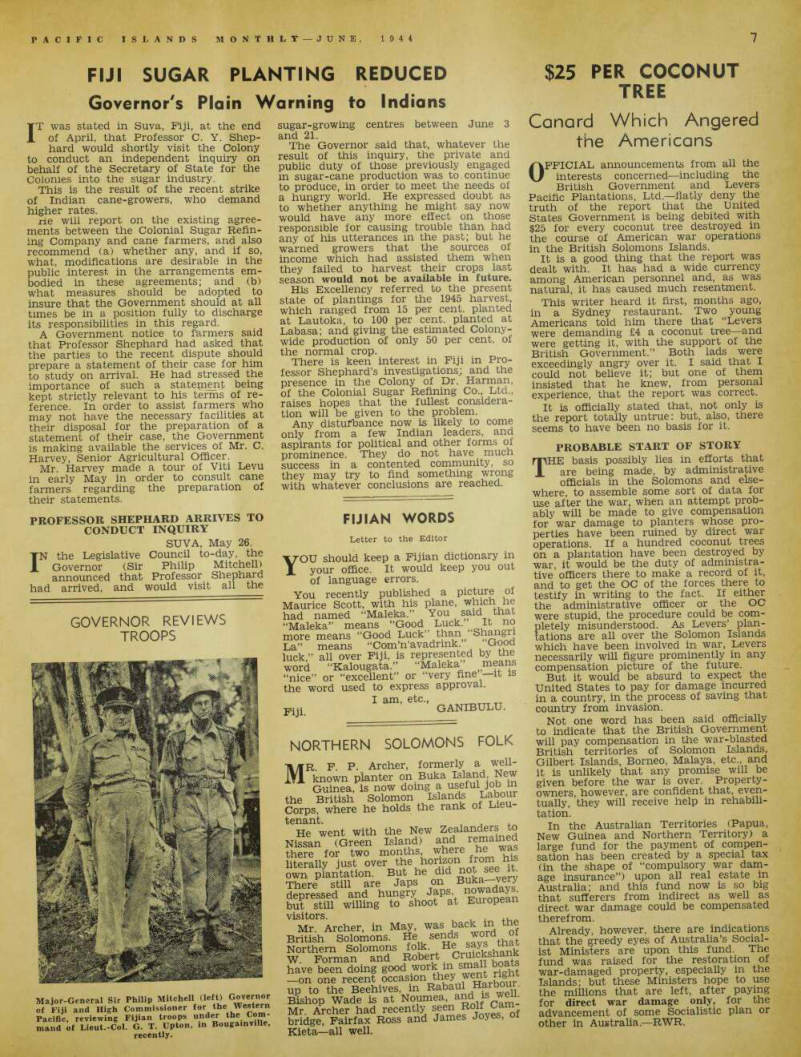
Major-General Sir Philip Mitchell (left) Governor of Fiji and High Commissioner for the Western Pacific, reviewing Fijian troops under the mand of Lieut.-Col. G. T. Upton, m Bougainville, recently.
Fijian Words
Letter to the Editor YOU should keep a Fijian dictionary in your office. It would keep you out of language errors.
You recently published a picture of Maurice Scott, with his plane, which he had named “Maleka.” You said that “Maleka” means “Good Luck. It no more means “Good Luck” than Shangri La” means “Com’n’avadrmk Good luck,” all over Fiji, is represented by the word “Kalougata.” “Maleka means “nice” or “excellent” or “very fine —it is the word used to express approval.
I am, etc.,
Fiji.
Ganibulu.
Northern Solomons Folk
MR. F. P. Archer, formerly a well known planter on Buka Island, New Guinea, is now doing a useful job m the British Solomon Islands Labour Corps, where he holds the rank of Lieu tenant. , . .
He went with the New Zealanders to Nissan (Green Island) and remaine there for two months, where he wa literally just over the horizon from his own plantation. But he did not see it.
There still are Japs on Buka very depressed and hungry Japs but still willing to shoot at European visitors. , . ..
Mr. Archer, in May, was back in British Solomons. He sente ™° rd th ° t Northern Solomons folk. He saysQwt W. Forman and Robert Cr ni have been doing good work: in °9 a^ —on one recent occasion they went right up to the Beehives, in Raba^ ri H f s rb °efi Bishop Wade is at Noumea, and is we l.
Mr. Archer had recently seen Rolf Csim bridge, Fairfax Ross and James Joyes, oi Kieta—all well.
$25 Per Coconut
Tree
Canard Which Angered the Americans
OFFICIAL announcements from all the interests concerned —including the British Government and Levers Pacific Plantations, Ltd—flatly deny the truth of the report that the United States Government is being debited with $25 for every coconut tree destroyed in the course of American war operations in the British Solomons Islands, It is a good thing that the report was dealt with. It has had a wide currency among American personnel and, as was natural, it has caused much resentment.
This writer heard it first, months ago, in a Sydney restaurant. Two young Americans told him there that “Levers were demanding £4 a coconut tree—and were getting it, with the support of the British Government,” Both lads were exceedingly angry over it. I said that I could not believe it; but one of them insisted that he knew, from personal experience, that the report was correct.
It is officially stated that, not only is the report totally untrue: but, also, there seems to have been no basis for it.
Probable Start Of Story
THE basis possibly lies in efforts that are being made, by administrative officials in the Solomons and else where, to assemble some sort of data for use after the war, when an attempt prob ably will be made to give compensation for war damage to planters whose pro perties have been ruined by direct war operations. If a hundred coconut trees on a plantation have been destroyed by war, it would be the duty of administra tive officers there to make a record of it, and to get the OC of the forces there to testify in writing to the fact. If either the administrative officer or the OC were stupid, the procedure could be com pletely misunderstood. As Levers’ plan tations are all over the Solomon Islands which have been involved in war, Levers necessarily will figure prominently in any compensation picture of the future.
But it would be absurd to expect the United States to pay for damage incurred in a country, in the process of saving that country from invasion.
Not one word has been said officially to indicate that the British Government will pay compensation in the war-blasted British territories of Solomon Islands, Gilbert Islands, Borneo, Malaya, etc., and it is unlikely that any promise will be given before the war is over. Property owners, however, are confident that, even tually, they will receive help in rehabili tation.
In the Australian Territories (Papua, New Guinea and Northern Territory) a large fund for the payment of compen sation has been created by a special tax (in the shape of “compulsory war dam age insurance”) upon all real estate in Australia; and this fund now is so big that sufferers from indirect as well as direct war damage could be compensated therefrom.
Already, however, there are indications that the greedy eyes of Australia’s Social ist Ministers are upon this fund. The fund was raised for the restoration of war-damaged property, especially in the Islands; but these Ministers hope to use the millions that are left, after paying for direct war damage only, for the advancement of some Socialistic plan or other in Australia. —RWR.
Pacific Territories Association Continues the Fight
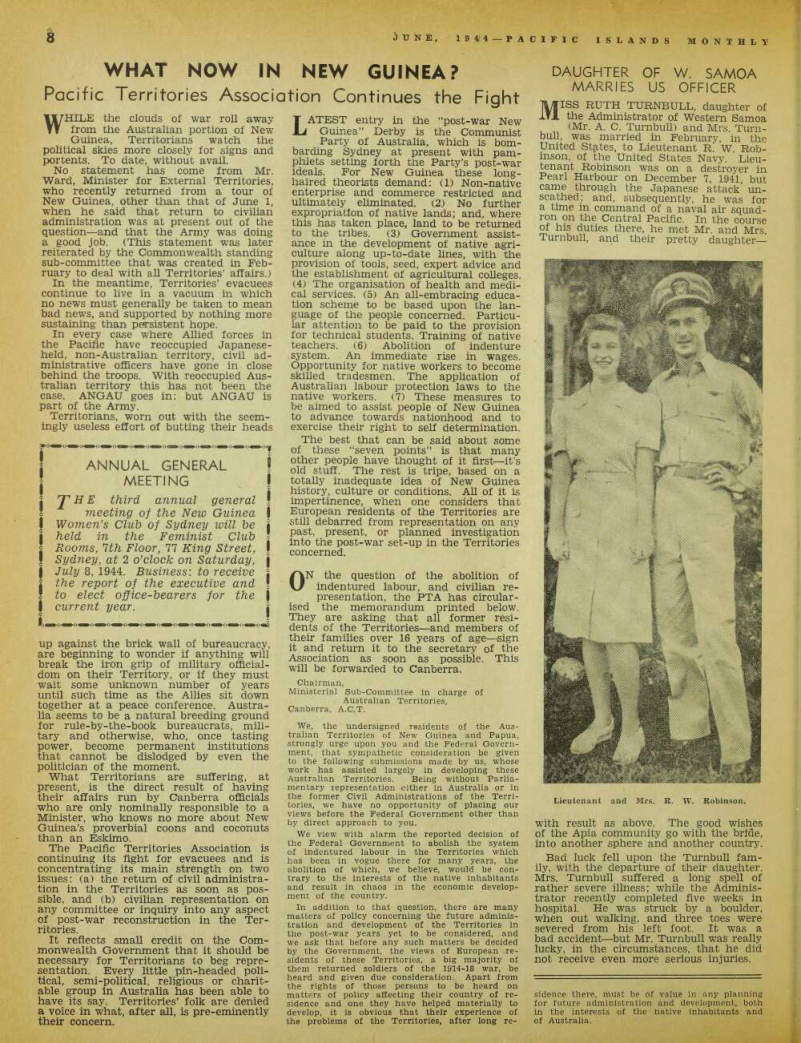
What Now In New Guinea?
WHILE the clouds of war roll away from the Australian portion of New Guinea, Territorians watch the political skies more closely for signs and portents. To date, without avail.
No statement has come from Mr.
Ward, Minister for External Territories, who recently returned from a tour of New Guinea, other than that of June 1, when he said that return to civilian administration was at present out of the question—and that the Army was doing a good job. (This statement was later reiterated by the Commonwealth standing sub-committee that was created in February to deal with all Territories’ affairs.) In the meantime, Territories’ evacuees continue to live in a vacuum in which no news must generally be taken to mean bad news, and supported by nothing more sustaining than persistent hope.
In every case where Allied forces in the Pacific have reoccupied Japaneseheld, non-Australian territory, civil administrative officers have gone in close behind the troops. With reoccupied Australian territory this has not been the case. ANGAU goes in: but ANGAU is part of the Army.
Territorians, worn out with the seemingly useless effort of butting their heads
up against the brick wall of bureaucracy, are beginning to wonder if anything will break the iron grip of military official dom on their Territory, or if they must wait some unknown number of years until such time as the Allies sit down together at a peace conference. Austra lia seems to be a natural breeding ground for rule-by-the-book bureaucrats, mili tary and otherwise, who, once tasting power, become permanent institutions that cannot be dislodged by even the politician of the moment.
What Territorians are suffering, at present, is the direct result of having their affairs run by Canberra officials who are only nominally responsible to a Minister, who knows no more about New Guinea’s proverbial coons and coconuts than an Eskimo.
The Pacific Territories Association is continuing its fight for evacuees and is concentrating its main strength on two issues: (a) the return of civil administra tion in the Territories as soon as pos sible, and (b) civilian representation on any committee or inquiry into any aspect of post-war reconstruction in the Ter ritories.
It reflects small credit on the Com monwealth Government that it should be necessary for Territorians to beg repre sentation. Every little pin-headed poli tical, semi-political, religious or charit able group in Australia has been able to have its say. Territories’ folk are denied a voice in what, after all, is pre-eminently their concern.
LATEST entry in the “post-war New Guinea” Derby is the Communist Party of Australia, which is bom barding Sydney at present with pam phlets setting forth the Party’s post-war ideals. For New Guinea these long haired theorists demand: (1) Non-native enterprise and commerce restricted and ultimately eliminated. (2) No further expropriation of native lands; and, where this has taken place, land to be returned to the tribes. (3) Government assist ance in the development of native agri culture along up-to-date lines, with the provision of tools, seed, expert advice and the establishment of agricultural colleges. (4) The organisation of health and medi cal services. (5) An all-embracing educa tion scheme to be based upon the lan guage of the people concerned. Particu lar attention to be paid to the provision for technical students. Training of native teachers. (6) Abolition of indenture system. An immediate rise in wages.
Opportunity for native workers to become skilled tradesmen. The application of Australian labour protection laws to the native workers. (7) These measures to be aimed to assist people of New Guinea to advance towards nationhood and to exercise their right to self determination.
The best that can be said about some of these “seven points” is that many other people have thought of it first—it’s old stuff. The rest is tripe, based on a totally inadequate idea of New Guinea history, culture or conditions. All of it is impertinence, when one considers that European residents of the Territories are still debarred from representation on any past, present, or planned investigation into the post-war set-up in the Territories concerned.
ON the question of the abolition of indentured labour, and civilian re presentation, the PTA has circular ised the memorandum printed below.
They are asking that all former resi dents of the Territories—and members of their families over 16 years of age—sign it and return it to the secretary of the Association as soon as possible. This will be forwarded to Canberra.
Chairman, Ministerial Sub-Committee in charge of Australian Territories, Canberra, A.C.T.
We, the undersigned residents of the Aus tralian Territories of New Guinea and Papua, strongly urge upon you and the Federal Govern ment, that sympathetic consideration be given to the following submissions made by us, whose work has assisted largely in developing these Australian Territories. Being without Parlia mentary representation either in Australia or in the former Civil Administrations of the Terri tories, we have no opportunity of placing our views before the Federal Government other than by direct approach to you.
We view with alarm the reported decision of the Federal Government to abolish the system of indentured labour in the Territories which has been in vogue there for many years, the abolition of which, we believe, would be con trary to the interests of the native inhabitants and result in chaos in the economic develop ment of the country.
In addition to that question, there are many matters of policy concerning the future adminis tration and development of the Territories in the post-war years yet to be considered, and we ask that before any such matters be decided by the Government, the views of European re sidents of these Territories, a big majority of them returned soldiers of the 1&14-18 war, be heard and given due consideration. Apart from the rights of those persons to be heard on matters of policy affecting their country of re sidence and one they have helped materially to develop, it is obvious that their experience of the problems of the Territories, after long re
sidence there, must be of value in any planning for future administration and development, both in the interests of the native inhabitants and of Australia.
Daughter Of W. Samoa
Marries Us Officer
MISS RUTH TURNBULL, daughter of the Administrator of Western Samoa (Mr. A. C. Turnbull) and Mrs. Turn bull, was married in February, in the United States, to Lieutenant R. W. Rob inson, of the United States Navy. Lieu tenant Robinson was on a destroyer in Pearl Harbour on December 7, 1941, but came through the Japanese attack un scathed; and, subsequently, he was for a time in command of a naval air squad ron on the Central Pacific. In the course of his duties there, he met Mr. and Mrs Turnbull, and their pretty daughter—
with result as above. The good wishes of the Apia community go with the bride, into another sphere and another country.
Bad luck fell upon the Turnbull fam ily, with the departure of their daughter.
Mrs. Turnbull suffered a long spell of rather severe illness; while the Adminis trator recently completed five weeks in hospital. He was struck by a boulder, when out walking, and three toes were severed from his left foot. It was a bad accident—but Mr. Turnbull was really lucky, in the circumstances, that he did not receive even more serious injuries.
Lieutenant and Mrs. R. W. Robinson,
Advertisements & other items, p. 10 (1 item)
Annual General
MEETING
'J' H E third annual general meeting of the New Guinea Women’s Club of Sydney will he held in the Feminist Club Rooms, Ith Floor, 77 King Street, Sydney, at 2 o’clock on Saturday, July 8, 1944. Business : to receive the report of the executive and to elect office-bearers for the current year.
Was Discourtesy
Intended?
Australia and Events in Solomon Is.
From a Special Correspondent
Tulagi, May 31.
rERE has been comment among officials here concerning the some what extraordinary methods of the Australian Departments responsible for the administration of the Territories of New Guinea and Papua.
Solomon Islands “proper” are adminis tered by the British Colonial Office, through Suva. The Solomons are oc cupied by United States combatant forces; and, by an amicable arrangement with Suva, British administrative officials carry on alongside the Americans.
The Northern Solomon Islands (Bou gainville and Buka), are part of the Mandated Territory of New Guinea, and therefore under the civil administration of Australia.
When the Americans, moving north, commenced the re-occupation of Bou gainville (at Empress Augusta Bay) they, scrupulously following their wartime policy, asked the civil administration to return and look after the natives as soon as practicable. Accordingly, Australia sent a party of ANGAU officials to Guadalcanal, to await re-entry into Bougainville.
Believe it or not, although it is some time since those Australians arrived in Guadalcanal, Australia has not com municated in any way with the British Solomon Islands Administration, either directly or through Suva. Actually, the Australians have been made welcome, and given all necessary help. Officially, they are unidentified: so far as Can berra is concerned, they might be men from Mars.
British officials have been similarly embarrassed by the arrival in the British Solomons of about 1,000 natives who had to be sent south when American forces occupied Nissan (Green Islands), which is in the Australian Mandated Territory.
These people were an Australian re sponsibility. But Australia was extra ordinarily reticent concerning them —so the British officials just went ahead on their own, and made the best arrange ments possible for the help and accom modation of the Nissan natives.
Editorial Note:
mHE failure of Canberra to observe X official courtesies in relations with Colonial Office Territories, next door, is not deliberate. It is merely a sign of the most unsatisfactory relation ship that exists between the Australian Department of External Territories and the Australian Army—to which refer ence is made in other articles in this issue.
In the Solomons, the Gilberts, and elsewhere, the United States Army, on re-occupying Pacific Territories, invites the civil administration to return and take over: and procedure thereafter is simple. But in Papua and New Guinea the Australian Army, for reasons best known to itself, has kept the civil administrative authority out of the pic ture, and has created its own “Australian New Guinea Administrative Unit (ANGAU), and seems determined to carry on indefinitely with ANGAU.
The Australian Department of External Affairs, Canberra, which actually is the Department responsible for the adminis tration of Papua and New Guinea seems to have no official standing in relation to these Territories —the Army, through
ANGAU, is hanging on to and controll ing everything. The Minister (Mr.
Ward) went along to those Territories the other day, on an “official” visit. Actually, it appeared that he had no official stand ing whatever: he was there only with the permission of the Army.
There is some sort of “sub-committee,” of the Australian Cabinet charged with “consideration of affairs relating to the future of the Territories.” Actually, it
appears to be little more than a name on a Cabinet minute: the Army is running the show.
That explains Canberra’s apparent lack of courtesy to BSI. Australian Terri tories’ administration is in charge of the Army, through ANGAU; and either the Army, or ANGAU, and not Canberra, should deal with BSI.
It is just another example of Australia’s wartime muddling.
Dargenlieu-GÒD Service To French
Pacific Colonies
KEEN interest in Pacific affairs still is
being shown by Rear-Admiral G.
d’Argenlieu, Commander-in-Chief of
the French Naval Forces in Europe. He was High Commissioner in the Pacific for the de Gaullist French Government,
between July, 1941, and. mid-1943, durmg
a period of great political difficulty and military danger; and it was due, in large measure, to his work that the large French Colonies of New Caledonia and French Oceania are tranquil and pros perous. He became Naval Commander in-Chief in November, 1943; and he then
received the following letter from General
de Gaulle;
Dear Admiral, —At the moment when, in agree ment with you and owing to the duties of your present command, the Commissioner for the Colonies has proposed to the French Committee of National Liberation to suppress the High Commissariat of France in the Pacific of which you were the chief since July 9, 1941, I want to express my gratitude and that of the French Committee of National Liberation for the ser vices rendered by you to France in the Pacific.
The conditions in which you had to assume command in this part of our Empire on the eve of the Japanese aggression were dramatic.
As for myself, who have personally followed every one of the stages of your mission, I shall always remember with emotion the period dur ing which, having to rely solely upon the exist ing forces in New Caledonia, with an insufficient and obsolete armament, you were making pre parations to resist the Japanese attack, until the supreme sacrifice.
When all military danger disappeared, it feu upon you, in order to defend French interests in the Pacific, to develop a diplomatic activity which largely contributed, at some particularly delicate moments, to safeguard the position of France in New Caledonia.
You have well deserved the gratitude of your country. Believe, dear Admiral . • • (Signed) C. DE GAULLE.
History Of French Colonies,
1939-44 AS a matter of history, it is worth noting that the French Colonies in the Pacific were affected by the following events: Sept., 1939: Outbreak of European War.
June, 1940: France over-run by enemy.
July, 1940-June, 1941: French Pacific Colonies completely isolated, and torn between pro- Vichy and anti-Vichy factions; and economic ally dependant upon British Dominions, which furnished all possible help.
July, 1941: D’Argenlieu arrives, and confirms and establishes the Fighting French Govern ment.
Dec., 1941-March, 1942: Japan attacks; and New Caledonia, already economically penetrated by Japanese, is in deadly danger of Jap invasion.
Japan hopes that New Caledonia will co operate with Vichy, and will not resist. Pre parations for defence made by French settlers under d’Argenlieu and Sautot, with some help from small Australian force.
March, 1942: Large American expeditionary force lands in New Caledonia, and military and economic position thenceforward improves.
Mrs. Robert Cooper has been elected president of the New Guinea Women’s Association of Melbourne, Mrs. Geoffrey Bliss, honorary secretary, and Mrs. Stan ley Best, honorary treasurer. At a suc cessful party, recently, £2OO was raised for prisoners of war.
Lieut. H. E. Josselyn, RANVR, and Lieut. D. C. Horton, RANVR, have both been awarded the United States decora tion, Silver Star, for distinguished ser vice in the Solomons. Prior to war, both men were District officials in the BSI Colonial Administrative Service.
Advertisements & other items, p. 11 (1 item)
Pacific Territories Association
ThP cjprond Annual General Meeting of members will be held on Tuesday, Jlth S w at the Teachers’ Federation Hall, 7th Floor, 166 Phillip Street, Sydney, at 8 p.m.
BUSINESS :
(1) To receive the Report of the Executive. (2) To receive the Financial Statements and Auditors’ Report for the year ended 31/5/44. (3) Election of office-bearers for the ensuing twelve months.
Nominations for the following,°® c d e :^ e Stog- andS 01 ** Secretary at least seven (7) clear days before the meeting.
President
Vice-president
Treasurer EiehtTs) Executive members consisting of: — 2 Commercial Representatives 2 Planters’ 2 Mining >» 2 Civil Service (being one each for Papua and the Territory of New Guinea.)
C. A. M. ADELSKOLD,
Tropicalitils
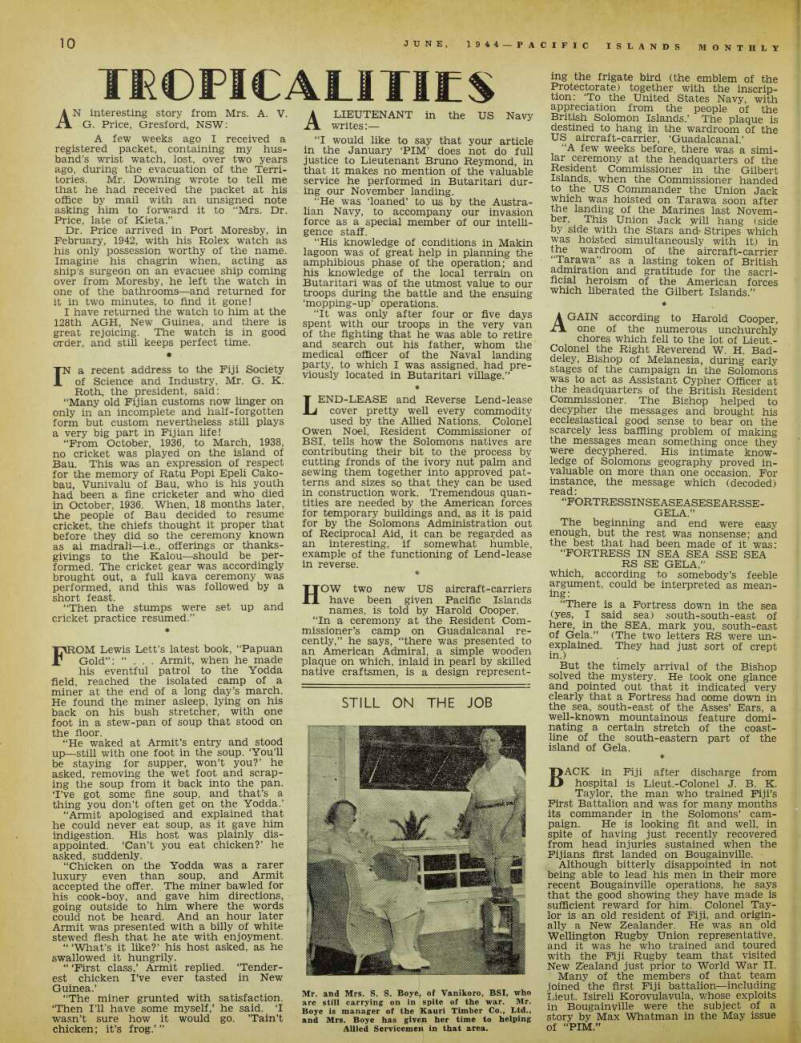
AN interesting story from Mrs. A. V.
G. Price, Gresford, NSW: A few weeks ago I received a registered packet, containing my hus band’s wrist watch, lost, over two years ago, during the evacuation of the Terri tories. Mr. Downing wrote to tell me that he had received the packet at his office by mail with an unsigned note asking him to forward it to “Mrs. Dr.
Price, late of Kieta.”
Dr. Price arrived in Port Moresby, in February, 1942, with his Rolex watch as his only possession worthy of the name.
Imagine his chagrin when, acting as ship’s surgeon on an evacuee ship coming over from Moresby, he left the watch in one of the bathrooms —and returned for it in two minutes, to find it gone!
I have returned the watch to him at the 128th AGH, New Guinea, and there is great rejoicing. The watch is in good order, and still keeps perfect time. • IN a recent address to the Fiji Society of Science and Industry, Mr. G. K.
Roth, the president, said: “Many old Fijian customs now linger on only in an incomplete and half-forgotten form but custom nevertheless still plays a very big part in Fijian life!
“From October, 1936, to March, 1938, no cricket was played on the island of Bau. This was an expression of respect for the memory of Ratu Popi Epeli Cako bau, Vunivalu of Bau, who is his youth had been a fine cricketer and who died in October, 1936. When, 18 months later, the people of Bau decided to resume cricket, the chiefs thought it proper that before they did so the ceremony known as ai madrali—i.e., offerings or thanks givings to the Kalou—should be per formed. The cricket gear was accordingly brought out, a full kava ceremony was performed, and this was followed by a short feast.
“Then the stumps were set up and cricket practice resumed.” * rOM Lewis Lett’s latest book, “Papuan Gold”: “ . . . Armit, when he made his eventful patrol to the Yodda field, reached the isolated camp of a miner at the end of a long day’s march.
He found the miner asleep, lying on his back on his bush stretcher, with one foot in a stew-pan of soup that stood on the floor.
“He waked at Armit’s entry and stood up—still with one foot in the soup. ‘You’ll be staying for supper, won’t you?’ he asked, removing the wet foot and scrap ing the soup from it back into the pan. ‘l’ve got some fine soup, and that’s a thing you don’t often get on the Yodda.’
“Armit apologised and explained that he could never eat soup, as it gave him indigestion. His host was plainly dis appointed. ‘Can’t you eat chicken?’ he asked, suddenly.
“Chicken on the Yodda was a rarer luxury even than soup, and Armit accepted the offer. The miner bawled for his cook-boy, and gave him directions, going outside to him where the words could not be heard. And an hour later Armit was presented with a billy of white stewed flesh that he ate with enjoyment.
“ ‘What’s it like?’ his host asked, as he swallowed it hungrily.
“ ‘First class,’ Armit replied. ‘Tender est chicken I’ve ever tasted in New Guinea.’
“The miner grunted with satisfaction. ‘Then I’ll have some myself,’ he said. T wasn’t sure how it would go. ’Tain’t chicken; it’s frog.’”
A LIEUTENANT in the US Navy writes:— “I would like to say that your article in the January ‘PIM’ does not do full justice to Lieutenant Bruno Reymond, in that it makes no mention of the valuable service he performed in Butaritari dur ing our November landing.
“He was ‘loaned’ to us by the Austra lian Navy, to accompany our invasion force as a special member of our intelli gence staff.
“His knowledge of conditions in Makin lagoon was of great help in planning the amphibious phase of the operation; and his knowledge of the local terrain on Butaritari was of the utmost value to our troops during the battle and the ensuing ‘mopping-up’ operations.
“It was only after four or five days spent with our troops in the very van of the fighting that he was able to retire and search out his father, whom the medical officer of the Naval landing party, to which I was assigned, had pre viously located in Butaritari village.” * LEND-LEASE and Reverse Lend-lease cover pretty well every commodity used by the Allied Nations. Colonel Owen Noel, Resident Commissioner of BSI, tells how the Solomons natives are contributing their bit to the process by cutting fronds of the ivory nut palm and sewing them together into approved pat terns and sizes so that they can be used in construction work. Tremendous quan tities are needed by the American forces for temporary buildings and, as it is paid for by the Solomons Administration out of Reciprocal Aid, it can be regarded as an interesting, if somewhat humble, example of the functioning of Lend-lease in reverse. * HOW two new US aircraft-carriers have been given Pacific Islands names, is told by Harold Cooper.
“In a ceremony at the Resident Com missioner’s camp on Guadalcanal re cently,” he says, “there was presented to an American Admiral, a simple wooden plaque on which, inlaid in pearl by skilled native craftsmen, is a design represent-
Still On The Job
mg the frigate bird (the emblem of the Protectorate) together with the inscrip tion; ‘To the United States Navy, with appreciation from the people of the British Solomon Islands.’ The plaque is destined to hang in the wardroom of the US aircraft-carrier, ‘Guadalcanal.’
“A few weeks before, there was a simi lar ceremony at the headquarters of the Resident Commissioner in the Gilbert Islands, when the Commissioner handed to the US Commander the Union Jack which was hoisted on Tarawa soon after the landing of the Marines last Novem ber. This Union Jack will hang (side by side with the Stars and- Stripes which was hoisted simultaneously with it) in the wardroom of the aircraft-carrier “Tarawa” as a lasting token of British admiration and gratitude for the sacri ficial heroism of the American forces which liberated the Gilbert Islands.” * AGAIN according to Harold Cooper, one of the numerous unchurchly chores which fell to the lot of Lieut.- Colonel the Right Reverend W. H. Bad deley, Bishop of Melanesia, during early stages of the campaign in the Solomons was to act as Assistant Cypher Officer at the headquarters of the British Resident Commissioner. The Bishop helped to decypher the messages and brought his ecclesiastical good sense to bear on the scarcely less baffling problem of making the messages mean something once they were decyphered. His intimate know ledge of Solomons geography proved in valuable on more than one occasion. For instance, the message which (decoded) read:
“Fortressinseaseasesearsse
Gela.”
The beginning and end were easy enough, but the rest was nonsense; and the best that had been made of it was:
“Fortress In Sea Sea Sse Sea
Rs Se Gela,”
which, according to somebody’s feeble argument, could be interpreted as mean ing: “There is a Portress down in the sea (yes, I said sea) south-south-east of here, in the SEA, mark you, south-east of Gela.” (The two letters RS were un explained. They had just sort of crept in.) But the timely arrival of the Bishop solved the mystery. He took one glance and pointed out that it indicated very clearly that a Fortress had come down in the sea, south-east of the Asses’ Ears, a well-known mountainous feature domi nating a certain stretch of the coast line of the south-eastern part of the island of Gela, * BACK in Fiji after discharge from hospital is Lieut.-Colonel J. B. K.
Taylor, the man who trained Fiji’s First Battalion and was for many months its commander in the Solomons’ cam paign. He is looking fit and well, in spite of having just recently recovered from head injuries sustained when the Fijians first landed on Bougainville.
Although bitterly disappointed in not being able to lead his men in their more recent Bougainville operations, he says that the good showing they have made is sufficient reward for him. Colonel Tay lor is an old resident of Fiji, and origin ally a New Zealander. He was an old Wellington Rugby Union representative, and it was he who trained and toured with the Fiji Rugby team that visited New Zealand just prior to World War 11.
Many of the members of that team joined the first Fiji battalion —including Lieut. Isireli Korovulavula, whose exploits in Bougainville were the subject <pf a story by Max Whatman in the May issue of “PIM.”
Mr, and Mrs. S. S. Boye, of Vanikoro, BSI, who are still carrying on in spite of the war. Mr.
Boye is manager of the Kauri Timber Co., Ltd., and Mrs. Boye has given her time to helping Allied Servicemen in that area.
Henry Nott
Homage Paid to Great Missionary by Men of All Races
From Our Own Correspondent
Papeete, May 5.
STATELY ceremonies at Outu Aiai and at Ahu-toru, in the district of Arue, on Tahiti, on May 2, marked the centenary of the death of the great pioneer missionary of the London Mis sionary Society, the Rev. Henry Nott, who worked in Tahiti for 47 years. These ceremonies, likewise, marked the re awakening of the Tahitian people to their debt of gratitude to this illustrious ser vant of the Divine Master.
Present-day knowledge of the inestim able services by Henry Nott to the people of the South Pacific Islands has come to us through the researches of the late Mr.
J. L. Philips, of Mr. W. W. Bolton, and of the Rev. Charles Vernier, Presiding Pastor of the Protestant Mission in French Oceania.
They have established beyond contro versy that the imperishable foundation upon which the superstructure of the Church in Polynesia has been erected, was well and truly laid—during the early years of the 19th Century—by Henry Nott. To quote from Mr. Bolton’s memorial oration, on May 2, 1944, at Ahu-toru, where is Nott’s resting-place: “He is not famous in Christian circles, as are John Williams of Ra’iatea, Chalm ers of New Guinea, or Paton of the New Hebrides; but we who know his worth and work rank him amongst the greatest missionaries who ever landed on the islands of the Great South Sea.”
The distinguished company who assembled, on May 2, at the church on Outu Aiai, to pay homage to the memory of Henry Nott, listened with emotion to the eloquent eulogy in the classic lan guage of old Tahiti, by the Rev. Charles Vernier. The sincerity of that emotion was expressed in the oration, at Ahu toru, by the Rev. Tearo (Pastor of Arue) on behalf of the Royal Pomare Family: in the impassioned eloquence of the Rev.
Tapao (Pastor of Haapiti, Mo’orea) as he laid a wreath of fragrant flowers, the symbol of the homage of his people of Mo’orea, on the tomb of Henry Nott; in the reception accorded to Mr. Bolton’s memorial oration, which was interpreted, both in word and spirit, into the Tahi tian, by Monsieur Vernier.
Perhaps, the measure of that sincerity was best revealed by the Rev. Tapao: “Our great teacher, Nott: the fragrance of these flowers will fade away; but the fragrance of your name and of your great service to our people, shall remain a per petual and precious memory for us and for our descendants, forever.”
The people of Arue had practised, for this occasion, some beautiful old hymn tunes, and we heard the finest church singing this writer has heard for many a long day.
Mr. Bolton delighted his hearers when he described the coronation ceremony, when Nott crowned the boy king Pomare 111, at the very spot where the Arue Church now stands.
Both the historic point of land, Outu Aiai, and Ahu-toru (the burial place of old Tahitian royalty) are within sight of Matavai Bay, the place where Henry Nott landed on Tahiti in 1797.
That part of the centenary ceremony which was conducted in the French lan guage was ably carried out by the Pastor of Papeete, the Rev. Rey-Lescure.
This tribute, with which Mr. Bolton closed his eulogy of Henry Nott—scholar, pioneer, translator of the Bible into the Tahitian language, founder of the Church in Polynesia—is worthy of remembrance: “Here, you have laid a wreath, and rightly so. Wreaths are for remembrance: tokens of love, of esteem, of admiration, the whole world over. But this wreath is a token of more than admiration: it is a token, from one and all of us, of Homage. Homage to a man who gave lifelong service to his fellows, though of other race than his own; Homage to a man of noble character; Homage to a most worthy son of his homeland, Beretania, true to type, indomit able, not knowing the word ‘defeat,’ be the clouds ever so lowering, be the task ever so great; and above all, and this the climax, Homage to a man who, from early manhood till his death, was a devoted, faithful and most able servant of his Lord and Master, Jesus Christ.”
the?r oiace of’ residing to toin the sa?d
Fiji Servicemen's After
Care Dill
fTTHE Fiji Servicemen’s After-care Fund Bill was passed by the Fiji Legis lative Council on May 19.
The Bill provides for three trustees for the fund of £45,588/0/9 to be used “for the aid and care (not being welfare work among persons still in the armed forces) of Persons who are serving or shall have served at any time during the war in or with the Fiji naval or military forces or an y branch of the Allied armed forces or in any Allied merchant service or any nursing service attached to any of the the?r oiace of’ residing to toin the sa?d SrcL P or se4lces were either resident i n the Colony or, being resident else where, were domiciled in the Colony; and for the aid and care of the wives, widows, children and other dependents of suc h persons.”
Advertisements & other items, pp. 13-14 (1 item)
Burns Philp
PACIFIC ISLANDS SOCIETY
Visitors from the Islands to Sydney tor those interested in Islands affairs), are advised to communicate with the honorary secretary of the above Society, which has been formed to study the history, traditions, economics, and political developments of the Pacific Islands.
Regular monthly meetings are held at History House, 8 Young Street, Sydney.
Address for Correspondence:
THE PACIFIC ISLANDS SOCIETY,
Box 2434 MM., G.P.0., Sydney.
BURNS PHILP
(SOUTH SEA) CO. LTD.
Inc. In Fiji
Island Traders and Shipowners
Registered Office :
SUVA
FIJI
Also Branches at: Fiji- Levuka, Lautoka, Labasa, Ba, Sigatoka, Rotumo X V Tonga: Nukualofa, Haapai, Vavau.
Samoa: Apia, Pago Pago (American Samoa).
Solomons; Makambo, Gizo, Faisi.
New Hebrides - Vila.
Code Address: Gilberts: Tarawa "Burnsouth”. Norfolk Is. N.ue Wallis Is. Futuna Is.
Sole Australian Concessionaires :
GEORGE BROWN & CO. PTY. LTD.
267 Clarence Street, Sydney.
As the Ultimate factory is engaged in vital war production, the supply of Ultimate Commercial Receivers cannot be maintained at present.
SERVICE: Ultimate owners are assured of continuity of service. Our Laboratory is situated at 267 Clarence Street, Sydney.
Servicing of all kinds of radio sets or amplifiers, as well as Rola Speakers, is also undertaken at our laboratories.
Refreshing
as a plunge
into a lagoon!
TEN**
m
Germicidal
and fragrant
TENAX TOILET SOAP is
a rapid safeguard against external skin infections, yet it is soothing and kind to the most sensitive skin —even a baby’s!
ORDER TENAX FROM
YOUR ISLAND SUP-
PLIERS. STOCKS ARE
PLENTIFULLY AVAIL-
ABLE.
W. H. GROVE & SONS
Limited
AUCKLAND
Island Traders. po B °* 490 Telegraphic and Cable Address: “Grove”, Auckland.
Shippers of all classes of New Zealand products.
Representing English Manufacturers throughout the Cook and Society Islands, Fiji, Tonga, Samoa, Niue, New Caledonia, New Guinea, etc.
In FIJI as—W. H. Grore & Sons (Fiji) Ltd.
This Was Rabaul
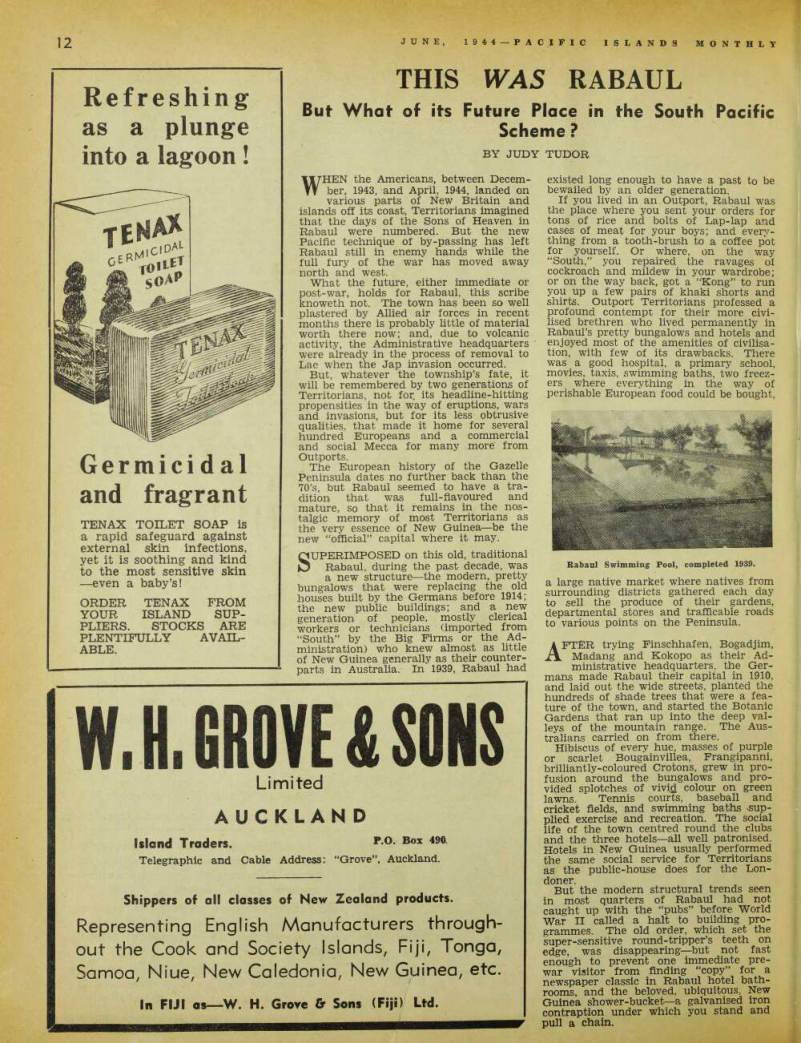
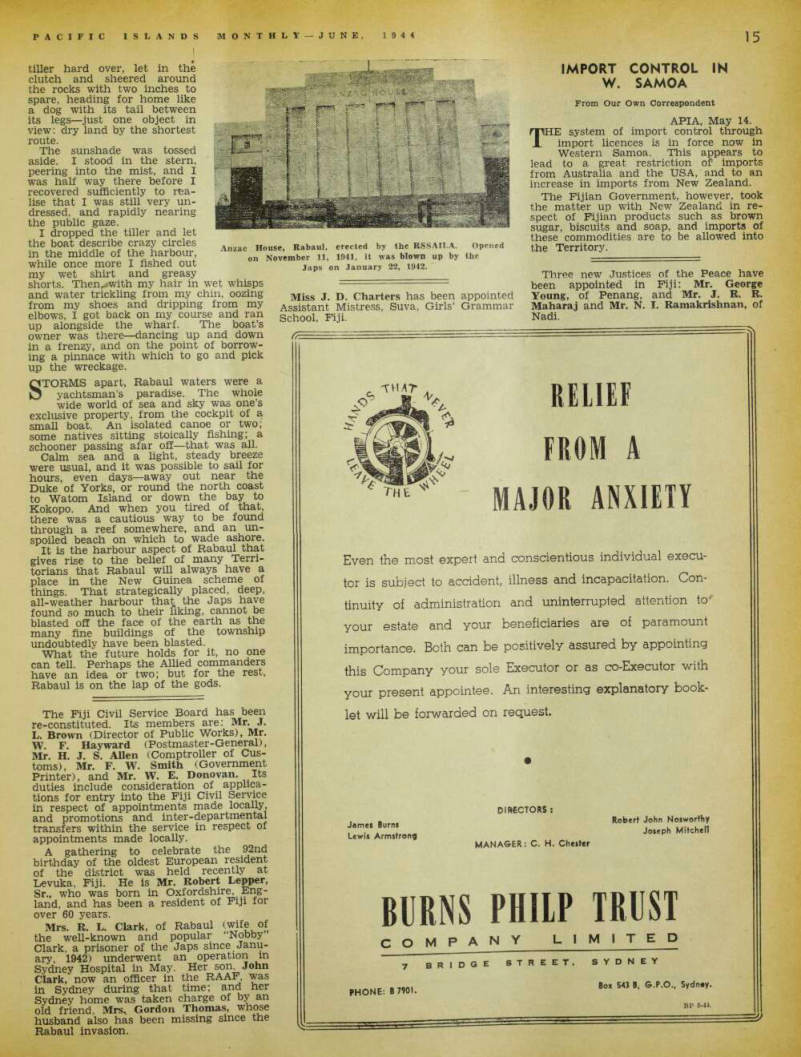
But What of its Future Place in the South Pacific Scheme ?
By Judy Tudor
WHEN the Americans, between Decem ber, 1943, and April, 1944, landed on various parts of New Britain and islands off its coast, Territorians imagined that the days of the Sons of Heaven in Rabaul were numbered. But the new Pacific technique of by-passing has left Rabaul still in enemy hands while the full fury of the war has moved away north and west.
What the future, either immediate or post-war, holds for Rabaul, this scribe knoweth not. The town has been so well plastered by Allied air forces in recent months there is probably little of material worth there now; and, due to volcanic activity, the Administrative headquarters were already in the process of removal to Lae when the Jap invasion occurred.
But, whatever the township’s fate, it will be remembered by two generations of Territorians, not for. its headline-hitting propensities in the way of eruptions, wars and invasions, but for its less obtrusive qualities, that made it home for several hundred Europeans and a commercial and social Mecca for many more from Outports.
The European history of the Gazelle Peninsula dates no further back than the 70’s, but Rabaul seemed to have a tra dition that was full-flavoured and mature, so that it remains in the nos talgic memory of most Territorians as the very essence of New Guinea —be the new “official” capital where it may.
Superimposed on this old, traditional Rabaul, during the past decade, was a new structure —the modern, pretty bungalows that were replacing the old houses built by the Germans before 1914; the new public buildings; and a new generation of people, mostly clerical workers or technicians (imported from “South” by the Big Firms or the Ad ministration) who knew almost as little of New Guinea generally as their counter parts in Australia. In 1939, Rabaul had
existed long enough to have a past to be bewailed by an older generation.
If you lived in an Outport, Rabaul was the place where you sent your orders for tons of rice and bolts of Lap-lap and cases of meat for your boys; and every thing from a tooth-brush to a coffee pot for yourself. Or where, on the way “South,” you repaired the ravages of cockroach and mildew in your wardrobe; or on the way back, got a “Kong” to run you up a few pairs of khaki shorts and shirts, Outport Territorians professed a profound contempt for their more civi lised brethren who lived permanently in Rabaul’s pretty bungalows and hotels and enjoyed most of the amenities of civilisa tion, with few of its drawbacks. There was a good hospital, a primary school, movies, taxis, swimming baths, two freez ers where everything in the way of perishable European food could be bought,
a large native market where natives from surrounding districts gathered each day to sell the produce of their gardens, departmental stores and trafficable roads to various points on the Peninsula.
AFTER trying Finschhafen, Bogadjim, Madang and Kokopo as their Ad ministrative headquarters, the Ger mans made Rabaul their capital in 1910, and laid out the wide streets, planted the hundreds of shade trees that were a fea ture of the town, and started the Botanic Gardens that ran up into the deep val leys of the mountain range. The Aus tralians carried on from there.
Hibiscus of every hue, masses of purple or scarlet Bougainvillea, Frangipanni, brilliantly-coloured Crotons, grew in pro fusion around the bungalows and pro vided splotches of vivid colour on green lawns. Tennis courts, baseball and cricket fields, and swimming baths sup plied exercise and recreation. The social life of the town centred round the clubs and the three hotels—all well patronised.
Hotels in New Guinea usually performed the same social service for Territorians as the public-house does for the Lon doner.
But the modern structural trends seen in most quarters of Rabaul had not caught up with the “pubs” before World War II called a halt to building pro grammes. The old order, which set the super-sensitive round-tripper’s teeth on edge, was disappearing—but not fast enough to prevent one immediate pre war visitor from finding “copy” for a newspaper classic in Rabaul hotel bath rooms, and the beloved, übiquitous, New Guinea shower-bucket —a galvanised iron contraption under which you stand and pull a chain.
Rabaul Swimming Pool, completed 1939.
To minds that run on coloured tiles and chromium fittings, the old shower bucket is primitive, but it has its points.
With a boy usually on hand to “cook” up some water when necessary, it does away with expensive hot water services.
And it also adds zip and zest to a dull routine job: you never know, until naked and underneath and pulling, whe ther you are to be scalded to death, or just frozen —it depends upon the methods of the “boy belong wash-wash.”
Occasionally, too, when you have spent five minutes soaping yourself all over, and are ready for a fresh deluge by way of a rinse, something comes* adrift in the
interior workings of the thing and it refuses to yield another drop. If you are of the male sex the remedy is simple— you bellow for the boy. If not, you are forced to lower the whole arrangement by a series of ropes and pulleys and do running repairs on the floor; or pack up and retire, still in your coating of soap, which sets harder and harder, and threatens to embalm you.
A fairly adequate supply of native labour, an import duty that put such luxuries as cars within the reach of all, and freedom from malaria in the town ship area, combined with the rest to make Rabaul a very happy half-way house between Australian suburbia and the often grim existence of New Guinea Out ports.
TO the north of the town, distinguished by the treelessness of its streets, and the uniformity of its wooden shops, was Chinatown. Here lived the bulk of the Territory’s Chinese population —
descendants of the original labourers brought into the Territory by the Ger man Administration. There were 2,199 Chinese in the- Territory in 1941. Their small shops, tlmt lined the dusty roads, stocked a jumblfe of goods. Silks, linens, curios, embroidered kimonas, camphor wood boxes and jide, were cheek by jowl with ginger and pickled eggs, dried fish,
lacquer ware, brass trays, cheap Japanese bicycles, trade goods, Australian gro ceries, sweets, an’d local bread —any or all of these things—the lot usually attached to a tailoring business where a good Sai gon linen or khaki drill suit could be turned out in a matter of hours for a couple of pounds.
AND thronging the tree-lined roads of the town, or the small wooden shops of Chinatown, kaleidoscopic and bright-hued in violently-coloured or white, starched lap-laps, were the natives of every skin shade from Buka black to the yellow-brown of the people from the north-west islands.
These Rabaul natives had been longest in contact with Europeans and were classed as “sophisticated.” They knew the uses of electricity, drove pinnaces, cars and lorries, and did other semi skilled mechanical work. Here, too, you saw the cream of the domestic brew house-boys capable of directing the “missus’” tea-party; or doing up the
“master’s” pants with the right consis tency of starch to withstand that clothes wilting climate. They had seen over seas liners and cruise ships, international airliners and visiting notables. They had
been introduced to Hollywood through the local picture theatre, where, once weekly, “boys’ night” provided them with a programme of news-reels and short
Home of the manager of Burns Philp & Co.
Destroyed by Jap bombs in January, 1942.
The Masonic Temple.
One of Rabaul’s modern bungalows.
features, nicely calculated to improve their minds without acquainting them of the grosser facts of European life as lived beyond their own horizon.
Each of the three sections of the com munity lived a complete life within itself; yet all were inter-dependent, and fitted together into a neat harmonious whole.
Rabaul, with its rim of volcanoes, its high green back-cloth of mountains, flanked by coconut plantations, was beau tiful; but it was on its harbour that its life seemed to ebb and flow—the native canoes, bringing produce to market,
inter-island steamers, overseas vessels, all played a large part in the town’s exist ence.
Occasionally a storm whistled in from the mouth of Blanche Bay, ruffling the waters of both the inner and outer har bours into a choppy grey sea; but, on most days, it lay calmly blue, its surface disturbed only by the long lines of drift ing yellow pumice from Matupi, the bam boo poles of the native fish-traps and the two large rocks known as the Beehives, which are reputed to have been thrust up during a volcanic disturbance sometime during last century.
THE Beehives, in 1941, had a covering of grass and shrubs, and a couple of stunted coconuts. The larger one had a small bay at one side and a grassy ledge, where I have often picnicked and fished in the “days along before”; and a series of nicks cut in the sheer rock wall, up which I was once reluctantly urged by an impatient companion to “see the view from on top.”
The Beehives were a fine playground for the boat-minded —which, in general, Rabaul citizens were not. I went there many times with a sailing pal; and once alone —complete with bathing suit, sail ing-boat with a two-popper engine, a pile of magazines, a Japanese sunshade and my lunch done up in a parcel.
It was brilliantly fine when I left; but, by the time I reached the usual anchor age (after a trip around the harbour) the sky was clouded over and huge waves were roaring in from the open sea and, between the two large rocks, like a mill race. My subsequent actions must have been extremely entertaining.
Rain began to come down in a solid wall, so I took off my shirt and shorts and stowed them in the locker and, hop ping from one foot to the other, while the boat drifted nearer and nearer the rocks, dragged on my bathing-suit.
Home and mother were obviously the best
bet, before worse befell me.
I found an oar and frantically pushed the boat clear; and then I set to work on the engine. By this time, there were gallons of water ip and around it, and everything, including the magazines and my sandwiches, was awash. I swung the flywheel until I almost burst, but not a darned thing happened. 1 STOOD up and surveyed the scene.
My bathing suit! In a financial period I had paid three guineas for those few square inches of silver lastex plus pattern of green palm trees, and, with repairs in the offing, it appeared even to my floundering brain that it was more desirable to have grease on me, than on them. Off they came!
And by then the boat was back on the rocks. I pulled it well out, by heaving the anchor overboard and pulling on the cable —until the anchor fouled a piece of coral. Overboard I had to go, down 10 feet, to free it—and then spend five hec tic minutes trying to get back into that bobbing boat.
What a sight for the volcanoes!
Clothed in a pair of old sandshoes and a bathing cap, crouched under a sodden paper umbrella, in water that swirled over my ankles, with the sea heaving and the wind howling like ten thousand angry devils, and the rain blotting out everything that was more than a few feet distant, I cleaned and dried the engine’s one spark plug. The job fin ished and the plug replaced, I swung the flywheel with everything I had; the engine gave one convulsive cough—and charged the whole boat, the water, and me standing in the water, with what seemed to be a million volts of elec tricity !
I staggered back and groped in the locker for my still slightly dry shirt and. using that as an insulator, and after a few minor explosions and shocks, the engine roared into action. I swung the
tiller hard over, let in the clutch and sheered around the rocks with two inches to spare, heading for home like a dog with its tail between its legs—just one object in view: dry land by the shortest route.
The sunshade was tossed aside. I stood in the stern, peering into the mist, and I was half way there before I recovered sufficiently to rea lise that I was still very un dressed, and rapidly nearing the public gaze.
I dropped the tiller and let the boat describe crazy circles in the middle of the harbour, while once more I fished out my wet shirt and greasy
shorts. my hair in wet whisps and water trickling from my chin, oozing from my shoes and dripping from my elbows, I got back on my course and ran up alongside the wharf. The boat’s owner was there —dancing up and down in a frenzy, and on the point of borrow ing a pinnace with which to go and pick up the wreckage.
STORMS apart, Rabaul waters were a yachtsman’s paradise. The whole wide world of sea and sky was one’s exclusive property, from the cockpit of a small boat. An isolated canoe or two; some natives sitting stoically fishing; a schooner passing afar off —that was all.
Calm sea and a light, steady breeze were usual, and it was possible to sail for hours, even days—away out near the Duke of Yorks, or round the north coast to Watom Island or down the bay to Kokopo. And when you tired of that, there was a cautious way to be found through a reef somewhere, and an un spoiled beach on which to wade ashore.
It is the harbour aspect of Rabaul that gives rise to the belief of many Terri torians that Rabaul will always have a place in the New Guinea scheme of things. That strategically placed, deep, all-weather harbour that the Japs have found so much to their liking, cannot be blasted off the face of the earth as the many fine buildings of the township undoubtedly have been blasted.
What the future holds for it, no one can tell. Perhaps the Allied commanders have an idea or two; but for the rest, Rabaul is on the lap of the gods.
The Fiji Civil Service Board has been re-constituted. Its members are: Mr. J.
L. Brown (Director of Public Works), Mr.
W. F. Hayward (Postmaster-General), Mr. H. J. S. Allen (Comptroller of Cus toms), Mr. F. W. Smith (Government Printer), and Mr. W. E. Donovan. Its duties include consideration of applica tions for entry into the Fiji Civil Service in respect of appointments made locally, and promotions and inter-departmental transfers within the service in respect of appointments made locally.
A gathering to celebrate the 92nd birthday of the oldest European resident of the district was held recently at Levuka. Fiji. He is Mr. Robert Lepper, Sr., who was born in Oxfordshire, Eng land, and has been a resident of Fiji for over 60 years.
Mrs. R. L. Clark, of Rabaul (wife of the well-known and popular “Nobby Clark, a prisoner of the Japs since Janu ary, 1942) underwent an operation in Sydney Hospital in May. Her son, John Clark, now an officer in the RAAF, was in Sydney during that time; and her Sydney home was taken charge of by an old friend, Mrs.. Gordon Thomas, whose husband also has been missing since the Rabaul invasion.
Miss J. D. Charters has been appointed Assistant Mistress, Suva, Girls’ Grammar School, Fiji.
Anzac House, Rabaul, erected by the RSSAILA. Opened on November 11, 1941, it was blown up by the Japs on January 22, 1942.
Advertisements & other items, pp. 15-16 (2 items)
Foster Clark’S
C £tAMV. %#
fC & V N> v ♦ There are so many ways in which you can use Foster Clark’s Creamy Custard. In addition to the usual custard, it can be used as a basic ingredient to give a perfect tlavour to many unusual dishes. Foster Clark’s Creamy Cus tard is extremely nourishing and every canny housewife on a wartime budget will appreciate its full value for money.
PIMFAPPT F FRITTERS; Just one of the original recipes In FREE illustrated Recipe B°ok Obtain vour copy by writing to Foster Clark (Aust.) Ltd Dept.
R. 8., Redfern, NSW., enclosing 2ld. in stamps for postage. %
VIJ"
FOSTER CLARK’S
UNION
ASSURANCE SOCIETY LTD.
(Incorporated in England)
FIRE ACCIDENT
FIJI A. E. PEARCE & CO.
RABAUL COLYER WATSON
(New Guinea) Ltd.
N. S. WALES 109 PITT STREET.
SYDNEY.
S. Morrison, Mgr.
CONTROLLING OFFICE—
-413 Collins St., MELBOURNE
ALAN H. RUSSELL.
Resident Manager.
Ask COX, FINDLAYSON for .. .
ESSENTIAL OILS
AROMATIC CHEMICALS
PERFUME COMPOUNDS
FLAVOURING ESSENCES
If we cannot supply your exact requirements we may be able to suggest suitable replacements
COX, FINDLAYSON & CO.
Manufacturing Chemists, Distillers and Perfumers, 472-482 Harris Street, Sydney, N.S.W.
14
JUNE, 1944 P ACIFIC ISLANDS MONTHLY
Import Control In
W. Samoa
From Our Own Correspondent
Apia, May 14.
rpHE system of import control through X import licences is in force now in Western Samoa. This appears to lead to a great restriction of imports from Australia and the USA, and to an increase in imports from New Zealand.
The Fijian Government, however, took the matter up with New Zealand in re spect of Fijian products such as brown sugar, biscuits and soap, and imports of these commodities are to be allowed into the Territory.
Three new Justices of the Peace have been appointed in Fiji: Mr. George Young, of Penang, and Mr. J. R. R.
Maharaj and Mr. N. I. Ramakrishnan, of Nadi.
Advertisements & other items, pp. 17-18 (1 item)
Burns Phiip Trust
'THAT*
mm
THE
RELIEF
FROM A
MAJOR ANXIETY
Even the most expert and conscientious individual executor is subject to accident, illness and incapacitation. Con tinuity of administration and uninterrupted attention to' your estate and your beneficiaries are of paramount importance. Both can be positively assured by appointing this Company your sole Executor or as co-Executor with your present appointee. An interesting explanatory booklet will be forwarded on request.
James Burns Lewis Armstrong
DIRECTORS :
MANAGER: C. H. Chester Robert John Nosworthy Joseph Mitchefl
BURNS PHIIP TRUST
COMPANY LIMI TED
PHONE: B 7901.
BRIDGE STREET. SYDNEY
Box 543 B, G.P.0., Sydney.
BP 5-44.
/' /. £ m Vs£ CM m
“Submarine on the starboard quarter” ...
In his book "Heroes of Fighting R.A.F.”, Leonard Gribble tells a thrilling story of the rescue of thirty-four of a ship’s crew by flying boats of the British Coastal Command.
The freighter "Kensington Court”, deep laden with wheat, was ploughing through heavy seas towards the British coast.
Suddenly the cry: "Submarine on the starboard quarter”.
The "Kensington Court”, unarmed, ran for it. And out went an S.O.S.
Overhauling the freighter, the U-boat began shelling at short range. The "Kensington Court” was doomed. As the crew was taking to the boats, two flying boats roared out of the clouds. The U-boat crash-dived.
Within minutes of the sending of the S.O.S. the rescue of the "Kensington Court’s” crew was being staged in a fresh sea. The sailors in an inflated rubber boat were hauled from their lifeboats to the
tossing ’planes.
Another chapter in the history of the part radio plays in this war. * * * Aeroplanes, ships, guns and radio. Australian industry to-day is producing everything for her own defence. But radio makes them into one powerful striking force. We owe much to the Australian resourcefulness and courage which made possible the building of all such equipment in Australia.
Whilst Australian enterprise is free to build and plan we need never fear being cut off from our sources of supply. —Amalgamated Wireless (A/asia) Ltd.
Harking Back —A Decade In Fiji
The second article by “NA MATANIVANUA” who spent the 30’s and early 40’s in Suva, Fiji.
IN the middle thirties, Fiji woke up to the possibilities of the tourist trade, and started to flood neighbouring countries with blurb extolling the winter sunshine of the islands and the romance of the tropics. In due course, this sucker-bait was taken, and cruise-ships from Australia and New Zealand began to call regularly. Orient and P. & O. liners each brought upwards of 1,000 people from Australia —all of them out for a good time during their week-end in Fiji. The “Katoomba” brought smaller crowds, and some of the Union Company’s vessels, too, cruised from New Zealand to the islands.
Local residents looked forward to these visits, for apart from the chance of meeting friends from overseas, the cruise ships meant a round of festivities. While Suva-ites were blase concerning fire walking and native mekes, a dance at the Grand Pacific Hotel, with hundreds of new faces about, was always a welcome break in the monotony.
One annual cruise visitor will always be remembered in Suva—the beautiful little Norwegian ship, the “Stella Polaris.”
With her yacht-like lines, she had been built especially for luxury cruising. Every year she included Suva in her de-luxe, world itinerary, and every year Suva people flocked to the Grand Pacific for the pleasure of dancing to the ship’s justly-famous Viennese orchestra. rpOURIST ships were a novelty, but one X must not forget the affectionately regarded old regulars which kept the Colony in touch with the outside world and made Suva the crossroads of the Pacific in the years of peace.
The Matson liners, “Mariposa” and “Monterey,” came and went with the regularity of clockwork, berthing on the tick of eight in the morning and letting go as the clock struck five in the after noon. In contrast, there were the “Aorangi” and the beloved old-timer, the “Niagara,” rarely running to time, but nonetheless welcome and looked upon as old friends by Fiji people.
Remember their skippers—“ Micky” Hill, “Bill” Martin and J. F. Spring-Brown, to mention only three? Who can ever forget the sadness that was felt through out the Colony on that May morning in 1940 when news came through that the “Niagara” had gone?
Or the cargo ships which called regu larly—the “Karetu,” “Waihemo,” “Haur aki” and the “Waipahi,” the latter sub sequently replaced by the “Matua,” which was built specially for the Islands trade.
And the Shell Oil Company’s tanker, the “Pinna,” running back and forth from Singapore and Balikpapan year after year, so that her skipper, Captain Thomas, became quite an Islands insti tution.
FIJI had her own little ships, too. The old “Pioneer,” first yacht to be fit ted with diesel engines, which came to Fiji as the Government yacht. She had been built for a sewing-machine millionaire and later did honourable war service. The cost of her upkeep and fre quent engine overhauls was a constant bone of contention with elected members of the Legislative Council, but Fiji resi dents had a very soft spot for the old “Pioneer,” her genial skipper, Paddy Mul lins, and his officers, and it was with real regret that they saw her hull stripped, towed out to sea and sunk. Her suc cessor, the “Viti,” built in Hongkong, may be practical, but she is ugly and
lacks the beautiful lines of her pre decessor.
When “Viti” first came out and tied up alongside the old “Pioneer” berth, she was something of a show-piece with her modern fittings, and one Govern ment officer “borrowed” her, so to speak, for a cocktail party. Was it that which earned for her the sobriquet of Fiji’s “pocket bottleship”?
Then there was the “Degei,” built by the Public Works Department, and which, when completed, showed a strange reluctance to enter her natural element.
Though she was a work-boat, official dom decided that she should have her great day, so when the tide was suitable the slipway was bedecked with flags and everything made ready for a pukka launching. His Excellency the Governor grasped the traditional beribboned bottle, crashed it against the ship’s bows, named her, and —nothing happened. “Degei” remained stubbornly on the stocks, and nothing that the engineers or their help ers could do would shift her. The tide was dropping, so she was left there to be unceremoniously heaved in, a few days later, without the benefit of a dis tinguished audience.
WAR in the Pacific made Fiji aircraft conscious, but it is not so long since Suva’s entire population gazed sky ward when a visiting man-o’-war launched a plane. There were private planes in Fiji—Alf Marlow had a Dor nier, C. G. Fenton had a small seaplane,
and I believe there were others. But I think I am correct in saying that the first commercial air venture was that of Fiji Airways, when Alan Cross, formerly of New Guinea, and his colleagues oper ated two small seaplanes between Suva and Lautoka (before the road was opened) and between Suva and Levuka and Taveuni. The venture was short lived, however, and lack of business saw
the exit of Fiji Airways soon after philatelists had collected their quota of first-day covers from the inter-island air mails.
Just before the war in the Pacific, Pan American Airways put Fiji on the air map when its giant clippers made Suva a port of call between Canton Island and Noumea. Suva’s Town Board gave a reception for the crew of the first clipper to make a scheduled stop, and the ser vice was just getting to be routine when Japanese bombs on Pearl Harbour caused its suspension. Wartime air development in Fiji must remain a forbidden subject till after the war; but this can be said —it must inevitably have its effect on the future of air transport in the Colony.
IN recalling flying in Fiji, one cannot forget the late Sir Charles Kingsford- Smith. His visit in the old “South ern Cross” on his pioneering trans pacific flight was before my time, but I saw him land the much smaller “Lady Southern Cross” on Albert Park a few years later; and, seeing that, I have never ceased to wonder how he ever put the “old bus” down in safety on that pocket-handkerchief of park. Those were the days when “Smithy” was blazing the trail across the Pacific for the air-liners of later years.
A good story about the great Austra lian air-pioneer went the rounds in Suva a few years ago. Sir Charles was pass ing through Suva as a liner passenger, and the Governor’s ADC called on him.
The ADC, an affected young man, inclined to be patronising, chattered away for some time to the tune of “Smithy” this and “Smithy” that, till it got too much for the Australian. Interrupting the flow of chatter, Sir Charles inquired of his visitor his military rank, and on being told by the ADC that he was a captain (local), and a lieutenant (reserve of officers), he is reported to have replied: “Well, young man, I happen to be an Air Commodore, which, in case you don’t
know it, is equal to a Brigadier in the British Army; so please say ‘Sir’ when you address me.”
Advertisements & other items, pp. 19-20 (1 item)
roleman
QUEENSLAND
INSURANCE
COMPANY
LIMITED
(Incorporated 1886 in Australia)
ASSETS EXCEED £3,500,000
Head Office:
PITT Gr BRIDGE STS.,
SYDNEY
Speciolists in South Seas Fire,
Marine & Accident Insurances
Apply to: —
FIJI.
Branch Office: H. J. Moorhouse, Manager.
Burns Philp (South Sea) Co., Ltd.
VILA.
Burns Philp (South Sea) Co., Ltd.
Comptoirs Francais Des Nouvelles Hebrides (Marine).
NOUMEA.
L. <fe W. Johnston.
PAGO PAGO.
Burns Philp (South Sea) Co., Ltd.
G. H. C. Reid & Co.
OTHER SOUTH SEA ISLANDS.
Burns Philp (South Sea) Co., Ltd.
Also to any of the Company’s Offices in Australia or Hew Zealand.
roleman
/mantles
AND GLOBES
For Efficient Service
and Best Light
Coleman Mantles, Heat Resisting Globes and Reflector Rings for Coleman Lamps and Lanterns and many European Types, are still available and are still made from the same first quality materials.
See your nearest Coleman Dealer, who will be supplied to the best of our ability with these important accessories.
FOR BEST SERVICE INSIST
ON COLEMAN
THE COLEMAN LAMP & STOVE CO. LTD.
TORONTO - - CANADA'
CORPORATION, CHICAGO, ILL, U.S.A,
/, 3f N s Pvoix Coleman
THE
YORKSHIRE
INSURANCE
CO. LTD.
(Incorporated in England)
FIRE
ACCIDENT
MARINE
FIRE POLICIES ISSUED
IN PAPUA
All information from —
E. A. JAMES,
TcL 86347. Attorney for Papua, 14 Spring St., Sydney.
fagpffipflfr
s Mi uo < m l' LU >" |S o o Ml » * M M/U .'
Polynesian Club
Visitors
A T a Sydney Polynesian Club social A gathering, in May, an enthusiastic welcome was given to Lance-Bomba dier Peter Cowan, of Papeete, Tahiti, back from overseas, after two years with the AIF. Peter probably is the only Tahitian serving with the Australian Forces—he is the son of Jack Cowan, a well-known resident and businessman of Papeete.
Pita, as the club people know him, was decorated with a floral lei by the Matron of the club, Chieftainess Katarina Nehu, and a special programme of Polynesian dances was presented for him. He was greeted with cheers when he joined in the “ori Tahiti” with Cora Young of Norfolk Island.
On the same occasion another interest ing visitor was Corporal D. K. Lee, of Honolulu, Hawaii, who has been conduct ing programmes of his own compositions on the National Broadcasting Stations, Corporal Lee is of Hawaiian blood.
Recently some of his compositions were played before General Douglas Mac- Arthur. Corporal Lee conducted the orchestra and the General accepted the score as a momento.
Three charming Tahitian girls recently passed through Sydney en route to Fight ing French outposts, with their Service men husbands, and called on the presi dent of the club. They were: Madame du Bois, formerly Minu Aramu; Madame Divin, who was Rose Martin, daughter of an influential Papeete businessman, Emile Martin; and Madame Roleau, form erly Cecelia Frogier, sister of Bouzou Frogier, the owner of “Quinns,” the well known cabaret in Papeete.
The Future Of
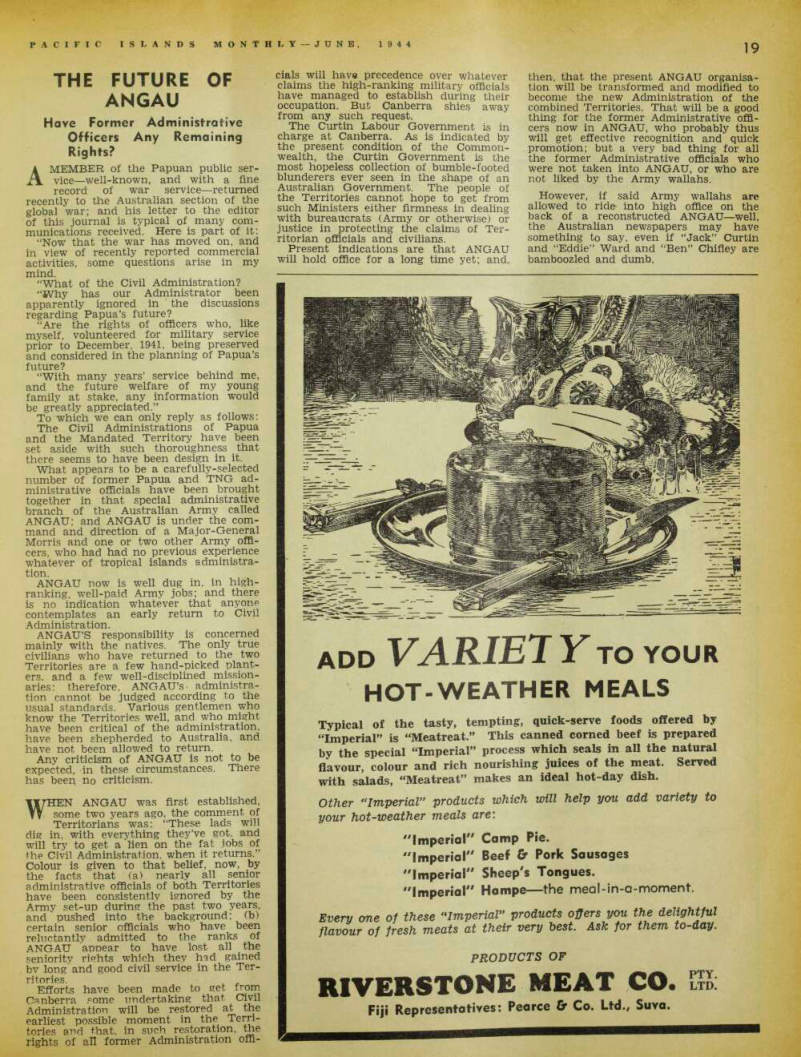
Angau
Have Former Administrative Officers Any Remaining Rights?
A MEMBER of the Papuan public ser vice—well-known, and with a fine record of war service—returned recently to the Australian section of the global war; and his letter to the editor of this journal is typical of many com munications received. Here is part of it: “Now that the war has moved on, and in view of recently reported commercial activities, some questions arise in my mind.
“What of the Civil Administration?
“Why has our Administrator been apparently ignored in the discussions regarding Papua’s future?
“Are the rights of officers who, like myself, volunteered for military service prior to December, 1941, being preserved and considered in the planning of Papua’s future?
“With many years’ service behind me, and the future welfare of my young family at stake, any information would be greatly appreciated.”
To which we can only reply as follows: The Civil Administrations of Papua and the Mandated Territory have been set aside with such thoroughness that there seems to have been design in it.
What appears to be a carefully-selected number of former Papua and TNG ad ministrative officials have been brought together in that special administrative branch of the Australian Army called ANGAU; and ANGAU is under the com mand and direction of a Major-General Morris and one or two other Army offi cers, who had had no previous experience whatever of tropical islands administra tion.
ANGAU now is well dug in, in high ranking, well-paid Army jobs; and there is no indication whatever that anyone contemplates an early return to Civil Administration.
ANGAU’S responsibility is concerned mainly with the natives. The only true civilians who have returned to the two Territories are a few hand-picked plant ers, and a few well-disciplined mission aries: therefore, ANGAU’S' administra tion cannot be Judged according to the usual standards. Various gentlemen who know the Territories well, and who might have been critical of the administration, have been shepherded to Australia, and have not been allowed to return.
Any criticism of ANGAU is not to be expected, in these circumstances. There has been no criticism.
WHEN ANGAU was first established, some two years ago, the comment of Territorians was: “These lads will die: in, with everything they’ve got, and will try to get a lien on the fat jobs of the Civil Administration, when it returns.”
Colour is given to that belief, now, by the facts that (a) nearly all senior administrative officials of both Territories have been consistently ignored by the Army set-up during the past two years, and pushed into the background; (b) certain senior officials who have been reluctantly admitted to the ranks of ANGAU apnear to have lost all the seniority rights which they had gained bv long and good civil service in the Ter ritories.
Efforts have been made to get from Canberra some undertaking that Civil Administration will be restored at the earliest possible moment in the Terri tories and that, in such restoration, the rights of all former Administration offi
dais will have precedence over whatever claims the high-ranking military officials have managed to establish during their occupation. But Canberra shies away from any such request.
The Curtin Labour Government is in charge at Canberra, As is indicated by the present condition of the Commonwealth, the Curtin Government is the most hopeless collection of bumble-footed blunderers ever seen in the shape of an Australian Government. The people of the Territories cannot hope to get from such Ministers either firmness in dealing with bureaucrats (Army or otherwise) or justice in protecting the claims of Territorian officials and civilians.
Present indications are that ANGAU will hold office for a long time yet; and,
then, that the present ANGAU organisa tion will be transformed and modified to become the new Administration of the combined Territories. That will be a good thing for the former Administrative offi cers now in ANGAU, who probably thus will get effective recognition and quick promotion; but a very bad thing for all the former Administrative officials who were not taken into ANGAU, or who are not liked by the Army wallahs.
However, if said Army wallahs are allowed to ride into high office on the back of a reconstructed ANGAU—well, the Australian newspapers may have something to say, even if “Jack” Curtin and “Eddie” Ward and “Ben” Chifley are bamboozled and dumb.
Advertisements & other items, pp. 21-22 (1 item)
Add Variej Yto Your
1a I JUI. w v.-Pw f
HOT-WEATHER MEALS
Typical of the tasty, tempting, quick-serve foods offered by “Imperial” is “Meatreat.” This canned corned beef is prepared by the special “Imperial” process which seals in all the natural flavour, colour and rich nourishing juices of the meat. Served with salads, “Meatreat” makes an ideal hot-day dish.
Other “Imperial” products which will help you add variety to your hot-weather meals are: "Imperial" Camp Pie.
"Imperial" Beef tj Pork Sausages "Imperial" Sheep's Tongues.
"Imperial" Hampe— the meal-in-a-moment.
Every one of these “Imperial” products offers you the delightful flavour of fresh meats at their very best. Ask for them to-day.
PRODUCTS OF
RIVERSTONE MEAT CO. S:
Fiji Representatives; Pearce Cr Co. Ltd., Suva.
Modern Refrigeration for the South Sea Islands
The ELECTROLUX
KEROSENE OPERATED
REFRIGERATOR
MARVEL
OF
MODERN
SCIENCE
THE
MIRACLE
OF
ICE
FROM
HEAT
ELECTROLUX offers economical, modern and completely efficient
REFRIGERATION FOR ISLANDS' HOMES,
FREEZES CONTINUOUSLY WHILE SMALL LAMP BURNS.
Freezing controlled by simply regulating height of flame. Uses only f gallon of kerosene per week.
MOTORLESS ... NO PARTS TO GET OUT OF ORDER.
MODEL L 22 MODEL L3BO MODEL LKSSO Capacity 36 (as Illustrated) Capacity 2.3 cubic feet. Capacity 4 cubic feet. 5.5 cubic feet.
GUARANTEED FOR TWO YEARS.
• Write to your Local Distributor for prices and full details.
OBTAINABLE FROM ALL W. R. CARPENTER & CO. LTD.
BRANCHES THROUGHOUT THE ISLANDS
Representation in Papua and New Hebrides.
Art In W. Samoa
Two Local Artists Find an Outlet for Their Work
From Our Own Correspondent
Apia, May 13.
IT is a truly remarkable fact that the beautiful landscapes and the hand some and attractive inhabitants of the South Seas have found compara tively few interpreters amongst the great artists. Only the name of Gauguin, whose work has made the beauties of Tahiti immortal, comes to mind.
Until recent years Samoa had no such interpreter of her landscape and of her native life, although quite a number of artists have visited the islands and stayed for short periods, painting native scenery and life. Now, however, two permanent European residents have come to the fore and attracted attention overseas with their artistic and attractive creations.
Both of them have found a ready and profitable market for their work amongst American servicemen serving in the Terri tory.
One of these is Mr. Charles MacPhee.
He was born in Albany, Western Aus tralia, in 1910, and showed an aptitude for drawing at an early age, but did not follow it up. Instead, he led an adven turous life as a prospector, goldminer, station hand and farmer—even living for some time as a self-styled beachcomber on the islands of the Great Barrier Reef.
Suddenly remembering his artistic ability he started as a showcard and pictorial artist in Perth and Melbourne, and later as a designer for the Ray Neon Co. in Sydney, which transferred him to their new Auckland, NZ, branch. From Auck land, in 1937, he came to Samoa.
He stayed in Samoa only for a short time before he returned to Australia to work for a year as a display artist. But, already the lure of the South Seas had caught him, and he came back to Samoa in 1938 and settled here permanently. He tried his hand at a number of varied jobs before his artistic success finally convinced him of his true vocation and he became a professional artist.
His oil paintings as well as water colours have been greatly acclaimed for their full and vivid colour, their lighting effects and their superior drawn lines.
The subjects of his paintings are ex clusively Samoan scenery, particularly beach scenes with houses and village life; he also does portraits of Samoan people some particularly attractive paintings of Samoan children in the possession of Miss Downs, formerly Head Mistress of LMS Papauta Girls’ School, were last year published by her in the Children’s Magazine of the London Missionary Society.
MacPhee’s work has also been ac claimed by art experts and critics in Auckland, where he was last year elected a working member of the Auckland Society of Arts, and was strongly advised to continue his career.
Three paintings, “Western Samoa,”
“Samoa” and “Vaiala, Western Samua,” were exhibited in the Auckland Society of Arts’ summer exhibition, during De cember, and found favourable mention in the Auckland press and in a special illus trated article in “Art in New Zealand,”
December, 1943, issue.
Mr. MacPhee’s work has also been praised by the well-known artist, Will Ashton, director of the National Art Gallery of NSW.
ANOTHER Samoan artist who has turned a hobby into a profitable side-line is well-known to “PIM’ readers as a contributor on natural
science and other subjects. He is Mr.
Charles Reed, of Apia, an old resident of the Territory, whose specialised work is drawing Samoan scenery—particularly beach scenes with fales amidst palms— on Samoan tapa cloth. His creations have also found a ready market amongst the American defence forces, and many hundreds of these tapa drawings have found their way to America as souvenirs from the South Seas.
Lieut. J. McClymont, son of the former Harbourmaster of Apia, Commander D. S.
McClymont, DSO, has been killed in action. Lieut. J. McClymont served in the Samoan Administration before he en listed.
Oldest European Resident of BSI
rE Rev. J. F. Goldie, who is returning to his post in the Solomons, as head there of the Methodist Missionary Society of New Zealand, has just com pleted 43 years’ service as Superintendent of the Mission. He claims to have lived in the Group longer than any other European ordinarily resident there.
After functioning for 35 years, the branch of the Bank of New South Wales at Levuka, Fiji, closed on May 23, and its business was removed to Suva. This is only one of many branches that have had to close in the Colony due to man power difficulties.
Advertisements & other items, p. 23 (1 item)
Victoria
BITTER
BREWED BY
CARLTON & UNITED BREWERIES LTD.
v.l
Tahiti Restored
The Lost Art of Cooking
By A. C. Rowland
WITH the exception of that residence section lately transformed by Sino- Teutonic-Celtic industry into a shrieking slum, Papeete has recovered some of its quiet and picturesque aspect of former days.
The waterfront no longer resembles the stockyard district of Kansas City—as it did when pigs were hurled from inter island schooners and from around-the island lorries, in masses of squealing confusion upon the quay. To-day, when pork is doled out with the same scrupu lous economy as is caviar at a cover charge Hollywood honky-tonk, pigs are cherished like peacocks.
Reduced supplies of petrol have eli minated the endless procession of empty lorries bound on no other errand than to permit the driver and attendants to “take the air.” People who have not walked for years are re-leaming the use of their legs and are discovering anew that the countryside is composed of objects of sur passing beauty, instead of being a smudgy blur—as they hitherto have viewed it through the port-holes of a speeding hearse-like box.
Aching and congested livers are becom ing less troublesome; with a consequent improvement in the social qualities of their owners.
An eminent French doctor-of-medicine once told us. quite seriously, that were he autocrat of the Islands he would—in the interest of public health—follow the precedent of the Bermuda Islands, by excluding motor cars. In addition, he said, he would confiscate every frying pan in the colony, pack them 50 miles out to sea, and jettison the lot into 3,000 fathoms of water. Then, and only then, could he hope to restore the people of the Islands to some measure of good health.
The Centenary of the Introduction of the Frying-pan into the Islands should be observed as a day of mourning, with the tolling of bells. The ancient ahimaa (the native oven), whence came well cooked food that was tasty and whole some, has been cast into oblivion by the rrying-pan.
An heraldic coat-of-arms for the Islands would, very properly, exhibit: The crest, a frying-pan. Rampant; the shield, bearing these several devices: a 5 lb. tin of beef, Gules; a fried fish, Azure; a pork chop, Or; an onion, Vert; adorning the four quarters around a central device of a tin of beef dripping, Argent. A translation of the motto, “Tei roto te mate i te pani,” may be found in Second
Kings IV.. 40, just before the final sen tence. (“There is death in the pot.”) We do not know the heraldic symbol for Blatta-flavoured rum, which is, therefore, omitted from its proper place in this grisly confection.
There are, nevertheless, manv things good to eat and a few people who know how to cook them. So there is some health in us.
New Caledonian
Casualties
After Three Years of War
From Our Own Correspondent
Noumea, May 6.
YESTERDAY was the third anniversary of the departure overseas of the French Pacific Battalion of Cale donians, Hebrideans and Tahitians. The day was celebrated by a simple ceremony, when wreaths were placed on the Monu ment des Morts—returned soldiers of this war and World War I participating.
The following is a list of Caledonian dead, missing and prisoners, since May 5, KILLED IN ACTION: Marcel Kollen, Raymond Chautard, Gustave Gogemnos, Antoine Brinon, Victor Bernut, Ernest Martias, Emile Lesson, James Levy, Fran cois Masson, Marc Moutry, Robert Devaux, Pierre Charpentier, Jean Barthe.
MISSING: Andre Chitty, Georges Govetche, Georges Kabar, Emile Millot, Louis Salomon, Charles Stiermans, Alex andre Black, Louis Vindeouz.
PRISONERS OF WAR: Henri Clemen ceau, Nuna Letheizer, Victor Dervaux, Eugene Pognon, Jean-pierre Gouzenes, Gaston Geiller, Francois Griscelli, Robert Blum, Camille Mercier, Georges Berbere, Paul Klein.
Advertisements & other items, p. 24 (2 items)
Islands Merchants
NELSON & ROBERTSON
PTY., LTD.
Established 1895.
Islands Merchants
All classes of merchandise purchased at wholesale prices and original invoices supplied to Islands clients.
Cocoa Beans, Rubber and other Islands' produce sold on commission.
Nelson & Robertson
Pty. Ltd. 12 Spring Street, Sydney, Australia.
William Atkins Pty. Ltd.
Head Office 449-451 KENT ST., SYDNEY.
Iron & Steel Merchants—Engineers' Supplies
ESTABLISHED OVER 50 YEARS
Coach & Motor Hardware Cable Address: WTLATKIN, Sydney.
-STEEL DEPARTMENT
MILD STEEL:
Rounds, Squares, Flats, Half-rounds, Hexagons, Bevel, Shoeing, Tyre, Angles, Tees, Sheets, Plates, Girder Plates, Chequer Plates, Channels, Hoops, Etc.
BRIGHT STEEL:
Rounds, Squares, Hexagons.
Extra Special High Speed Tool Steel, Mining Steel, Blister Steel and Spring Steel, Rounds, Flats £r Squares.
Bar Iron—All sections and sizes.
Engineers' Supplies: Set Screws, Studs, Metal Thread Screws. Coach Screws, Files, Cotter Pins, Bright and Black Bolts, Rivets, Etc., Hack Saw Blades, Power Transmission Gear: Including Plummer Blocks, Couplings, Collars, Etc.
Coach and Motor Hardware: Axles, Springs, Wheelstuff, Duck, Paints.
Farriers' Supplies: Horse Nails, Anvils, Vices, Etc.
Motor-Trimmers and Motor Builders' Cr Motor Painters' Requirements
C. A. WILLEY'S
Quick-Drying Coach and Car Paints, Roughstuff, Elastic Gloss, Synflex Enamels, Lacquers.
DUCO Lacquers and DULUX Enamels—FAßßEX Motor Toppings and Leather Cloths, House & Decorators' Paints, Varnishes fir Brushwore.
Sole Distributors of CHAMPION'S Decorators Paint Products.
Distributing Agents for BROLITE Lacquers, SYNFLEX Enamels and "POLYGLOSS" Finish.
Publicity for Suva
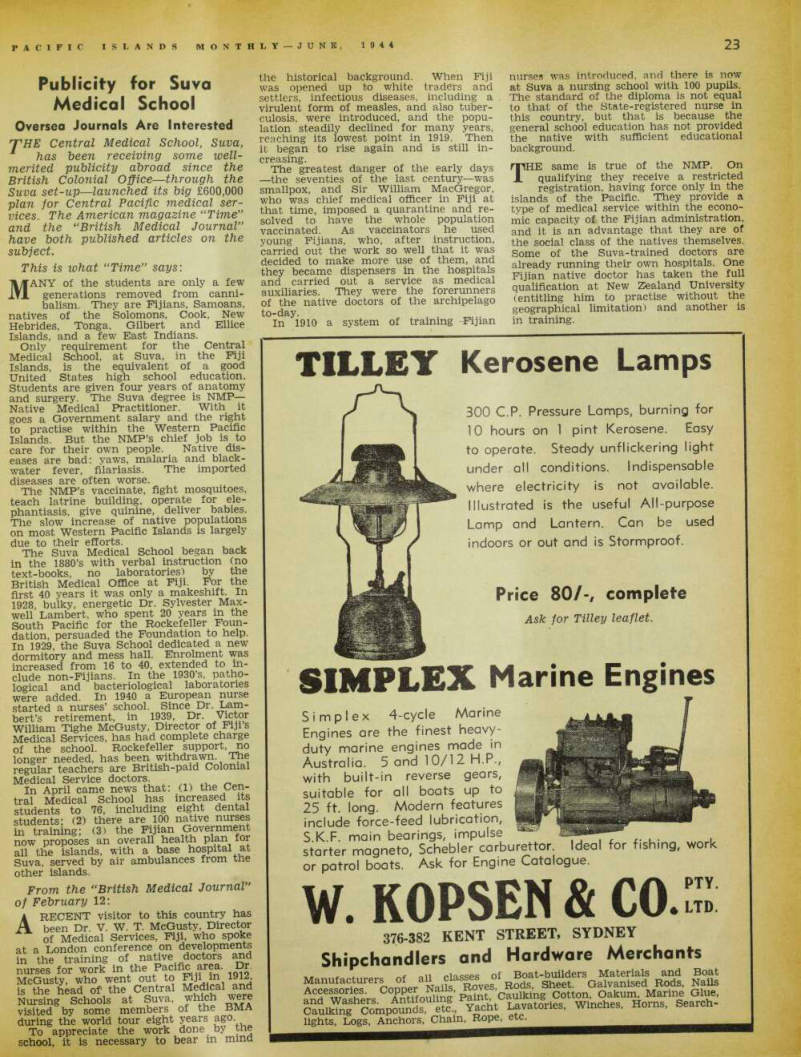
Medical School Oversea Journals Are Interested
T I HE Central Medical School, Suva, 1 has been receiving some well merited publicity abroad since the British Colonial Office —through the Suva set-up—launched its big £600,000
plan for Central Pacific medical ser
vices. The American magazine “Time” and the “British Medical Journal” have both published articles on the
subject.
This is what “Time” says : MANY of the students are only a few generations removed from canni balism. They are Fijians, Samoans, natives of the Solomons, Cook, New Hebrides, Tonga, Gilbert and Ellice Islands, and a few East Indians.
Only requirement for the Central Medical School, at Suva, in the Fiji Islands, is the equivalent of a good United States high school education.
Students are given four years of anatomy and surgery. The Suva degree is NMP— Native Medical Practitioner. With it goes a Government salary and the right to practise within the Western Pacific Islands. But the NMP’s chief job is to care for their own people. Native dis eases are bad: yaws, malaria and black water fever, filariasis. The imported diseases are often worse.
The NMP’s vaccinate, fight mosquitoes, teach latrine building, operate for ele phantiasis, give quinine, deliver babies.
The slow increase of native populations on most Western Pacific Islands is largely due to their efforts.
The Suva Medical School began back in the 1880’s with verbal instruction (no text-books, no laboratories) by the British Medical Office at Fiji. For the first 40 years it was only a makeshift. In 1928, bulky, energetic Dr. Sylvester Max well Lambert, who spent 20 years in the South Pacific for the Rockefeller Foun dation, persuaded the Foundation to help.
In 1929, the Suva School dedicated a new dormitory and mess hall. Enrolment was increased from 16 to 40, extended to in clude non-Fijians. In the 1930’5, patho logical and bacteriological laboratories were added. In 1940 a European nurse started a nurses’ school. Since Dr. Lam bert’s retirement, in 1939, Dr. Victor William Tighe McGusty, Director of Fiji s Medical Services, has had complete charge of the school. Rockefeller support, no longer needed, has been withdrawn. The regular teachers are British-paid Colonial Medical Service doctors In April came news that: (1) the Cen tral Medical School has increased its students to 76, including eight dental students; (2) there are 100 native nurses in training; (3) the Fijian Government now proposes an overall health plan lor all the islands, with a base hospital at Suva, served by air ambulances from the other islands.
From the “British Medical Journal ” of February 12: A RECENT visitor to this country has been Dr. V. W. T. McGusty, Director of Medical Services, Fiji, who spoke at a London conference on developments in the training of native doctors and nurses for work in the Pacific area. Dr McGusty, who went out to 191 A is the head of the Central Medical and Nursing Schools at Suva, which were visited by some members of the bma during the world tour eight years ago.
To appreciate the work done by tne school, it is necessary to bear in mind
the historical background. When Fiji was opened up to white traders and settlers, infectious diseases, including a virulent form of measles, and also tuberculosis, were introduced, and the population steadily declined for many years, reaching its lowest point in 1919. Then it began to rise again and is still increasing.
The greatest danger of the early days —the seventies of the last century—was smallpox, and Sir William MacGregor, who was chief medical officer in Fiji at that time, imposed a quarantine and resolved to have the whole population vaccinated. As vaccinators he used young Fijians, who, after instruction, carried out the work so well that it was decided to make more use of them, and In 1910 a system of training Fijian
nurses was introduced, and there is now at Suva a nursing school with 100 pupils, The standard of the diploma is not equal to that of the State-registered nurse in this country, but that is because the general school education has not provided the native with sufficient educational background, rpHE same is true of the NMP. On JL qualifying they receive a restricted registration, having force only in the islands of the Pacific. They provide a type of medical service within the econo miC capacity of the Fijian administration, an( j it is an advantage that they are of t he social class of the natives themselves, gome of the Suva-trained doctors are a i re ady running their own hospitals. One in training.
Advertisements & other items, pp. 25-26 (1 item)
W.Ropsew&Co.S
TILLEY Kerosene Lamps
300 C.P. Pressure Lamps, burning for 10 hours on 1 pint Kerosene. Easy to operate. Steady unflickering light under all conditions. Indispensable where electricity is not available.
Illustrated is the useful All-purpose Lamp and Lantern. Can be used indoors or out and is Stormproof.
Price 80/-, complete
Ask for Tilley leaflet.
SIMPLEX Marine Engines
Simplex 4-cycle Marine Engines are the finest heavyduty marine engines made in Australia. 5 and 10/12 H.P., with built-in reverse gears, suitable for all boats up to 25 ft. long. Modern features include force-feed lubrication, S.K.F. main bearings, impulse . starter magneto, Schebler carburettor. Ideal for fishing, work or patrol boats. Ask for Engine Catalogue,
W.ROPSEW&CO.S
376-382 KENT STREET, SYDNEY
Shipchandiers and Hardware Merchants
* . . Qll piqccpc of Boat-builders Materials and Boat Manufacturers of all Roves Ro ds, Sheet. Galvanised Rods, Nails Accessories. o PPf ifnlllir , £r ’ p a mt Caulking Cotton, Oakum, Marine Glue, wlnches - Horns - search lights, Logs, Anchors, Chain, Rope, etc.
EDGELL
QUALITY CANNED
t
Vegetables 8c Soups
AUSTRALIA'S BEST
DEFENCE requirements take up the whole of the Edgell production to-day—consequently only a small proportion of civilian needs is occasionally made available by the Australian Defence Foodstuffs Control and exports are heavily restricted.
As soon as possible, Island consumers can rely on Edgell high quality products being made available to them once more.
Meanwhile, to take advantage of the limited quantities periodically released, please send your inquiries either through your usual channels or direct to the Island distributors .
C. SULLIVAN & CO. 379 Kent Street, Sydney, Australia.
"EDGELL QUALITY CANNED GOODS"
C. SULLIVAN & CO.
GENERAL MERCHANTS ISLANDS AGENTS
REPRESENTING LEADING FIRMS IN THE PACIFIC ISLANDS.
Islands Produce sold on Shippers’ Account-Liberal Advances against Consignments.
Buyers of all Islands’ Requirements on Commission—Original Invoices Furnished.
Bankers : Bank of New South Wales .. Bank of New Zealand .. Comptoir National d’Escompte de Paris.
Wartime Cable Address: Sullivan, Kentstreet, Sydney.
379 KENT STREET, SYDNEY, N.S.W.
"Kanaka"
Letter to the Editor I WAS interested in your issue of February last, in which appeared a letter from Mr. Leopold G. Blackman, of Paea, Tahiti, wherein he correctly contends that “ kanaka“ as a name is not now regarded as approbrious for Poly nesian or Melanesian mankind.
In many parts of the Pacific, these people ( kanakas , or men) were engaged as labourers, voluntarily or by conscrip tion. The term thus became synonymous of a labourer, and kanaka lost its actual meaning. In the same way the national name of the Slavonic people of Europe means the “Free people,” but in the course of misfortune of a large section of this nation, they became the serfs of their conquerers. And thus arose the term “Slave” —a person no longer free, but a forced worker, a person in servitude.
Now, as to the term kanaka , it means a man, and in its fullest sense conveys the meaning that he is an intelligent human being—as distinct from the lower orders of biological creation. The word kanaka is, therefore, fully the equivalent of the English term man, or in its adjectival sense, manly, or endowed with human dignity. Hence such an expression as <( noho-tangata” —to live a dignified human life; also the term “hoo-kanaka” (Hawaii), “faka~tagata” (Tonga), and the Maori “whaka-tangata”— all meaning to be or act manly or with dignity. The Maori form is, in fact, the motto of the famous school, Te Aute College, and also of this Association It may interest those who are students of the Pacific Islands languages—that the word tangata or kanaka, in many variant dialectical forms, is traceable throughout the Pacific. The well-known Polynesian philologist, E. Tregear, sets forth in his “Polynesian Comparative Dictionary” that a similar word, with the primary mean ing of “man or human being” is traceable even beyond Polynesia, and westward through Melanesia, to Malaya, the Celebes, Philippines, and even to Formosa.
I am, etc.,
George Graham.
Te Akanana Maori Association.
Auckland, NZ, May 4, 1944.
Letter to the Editor KANAKA is a purely Hawaiian word.
Early missionaries to the group forced the sound and spelling of “k” on Hawaiian speech, while eliminating altogether the “t” sound, then in use in the Hawaiian Islands.
When the first syllable is accented, kanaka means Hawaiian —e.g., wahine kanaka, an Hawaiian woman. With the
accent on the second syllable it means man.
My people may be reduced to 30 full bloods, but they are still Hawaiians. The above remarks on the word kanaka are facts. Your previous correspondents showed that they knew nothing whatso ever of the Hawaiian language.
I am, etc.,
Hoapili Wahine.
Polynesian Club, 250 George St., Sydney.
May 30, 1944.
Cost Of Producing Copra
In Fiji
THROUGH members of the Fiji Copra Advisory Committee, an inquiry was made last December into the present costs of producing copra in the Colony. (First-grade Fiji copra has a fixed sell ing price of £l6/12/6 Fijian.) Few planters keep detailed accounts, but the majority of the Committee agreed that the following figures are fairly representative of costs of production per ton, on the beach:
These figures are based on present con ditions when labour is scarce. If labour were available, it is considered that more weeding would be done and that weeding costs would be in the vicinity of 9/- per ton. Neither do the above prices include interest on capital—which could be placed at approximately £l/5/ —making the total £9/6/- per ton on the beach.
During the past few years, labour shortages have meant that weeding and general maintenance of estates has fallen into arrears; planting has been entirely neglected. Therefore, as soon as labour does become available, these items will require considerable costly attention if the estates are to be adequately main tained.
£ s. d.
Collecting and cutting 1 18 6 Transport 13 0 Drying 7 6 Bags and twine 9 0 Bagging and shipping 2 0 Sirdars, cooks, milkman, etc. .. 17 6
Supervision
1 0 0 Weeding 3 0 Maintenance, fences, roads, tools, etc 10 0 Fire insurance on buildings and copra 2 6 Lahd rent 10 0 Depreciation of buildings, driers, etc 9 0 Depreciation of palms 10 0 General expenses 2 0 Total £7 14 0
"Current Problems
Digest"
Edited by R. W. Robson A Pocket-size Magazine, News Review and Digest. Contains, in Summarised Form, much information relating to the Current Problems of the Day, especially those arising out of the War.
Special Features
Selections from Broadcast Talks by Mr. A. M.
Pooley, and other exclusive articles, provide readers of “Current Problems” with Invaluable “background material,” and explain many things about World War II which otherwise may be puzzling and obscure.
Magazine Features
Each issue contains a Selection of Material likely to interest the average, well-informed reader—especially articles about the outstanding personalities of the Combatant Nations.
Advertisements & other items, p. 27 (2 items)
G I L L E S Pi E’S
THIS FORM MAY BE USED :
The Manager, “Current Problems,
PO Box 3829 T., GPO,
Sydney.
Herewith please find the sum of 12/6, being subscription (plus postage) to “Current Problems,” for one year. The magazine is to be addressed as follows:— [Please write plainly] Signature of person ordering
G I L L E S PI E’S The Flour of the Islands
SYDNEY -
MARK
TRADE
W. Jno. Baker Ltd
Your old SCISSORS, RAZORS
and KNIVES can be
SHARPENED and REPAIRED
Send them to—
W. JNO. BAKER ltd
3 HUNTER STREET,
SYDNEY.
Bougainville
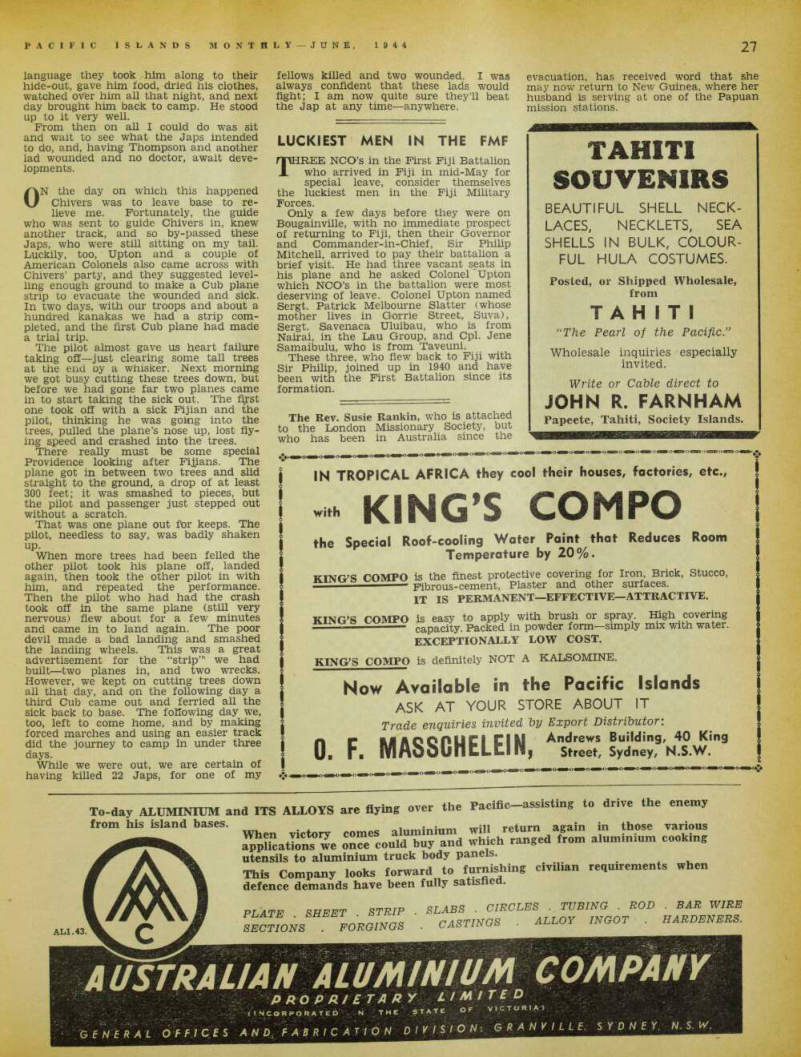
Patrol
Adventures With a Fijian Battalion
By Major Dick Freeman, F.M.F.
Bougainville, Feb.
IHAVE just returned from the back of beyond. For some unaccountable reason the “Powers that be” wished to know what was happening on the other side of this island, and I was chosen to lead my company across to find out.
A spot on the map was picked for me to make my headquarters, and we were to work out on to the beach from there.
According to map measurement this place was only 32 miles away and the beach another eight miles further on.
However, the map was far from accurate, and the paths and villages we encountered were not even shown. We had believed
that we would do the distance easily in three days, and decided to travel on halt rations in order to carry surplus am munition.
So—we started out. I have never in all my life been over such rough country: the highest point we crossed was only 3,000 feet, but every day we struck at least two, and often three gorges, where we went straight down a thousand feet, followed a creek at the bottom for a hundred yards or so and then went straight up a thousand feet on the other side. We kept plugging along, making camp just where nightfall found us, and on the sth morning, having travelled the last few hours with no food, made what became our main base camp.
Our wireless had broken down, and as a result we had not been able to make contact with supply planes. However, half an hour after making the base camp planes passed over still searching, and this time we contacted them and down
floated enough food to last us a fort night.
MY job, briefly, was to send patrols down to the beach to find the Japa nese. I sent the first patrol, under Rea, out one day with orders to return the next, but, again thanks to the won derful map, instead of the place being about 8 miles away, as shown, it was seven hours’ march. Rea’s patrol met three Japs who, fortunately they killed, and although the noise of shooting dis turbed a hornets’ nest, they got back into the heavy bush and later to our camp.
As a result of Rea’s experiences, I gave the next two patrols one day to go, two days on the job, and one day to return.
Off they went, and all I could do was sit and await their return.
We had contacted some natives who had remained loyal all through the Jap occupation, and they gladly did every thing they could to help us. Nothing was too much trouble for them and they were, and still are, invaluable to us. They know all the trails and short cuts, and did good work bringing the natives back over to our side. On the third day, after my second party had left for the beach, I got information through one of these boys that the Japs had apparently found out we were there, and 300 of them had moved up into the hills by another track and were sitting on the trail by which I had moved in. I promptly sent a platoon out back along the trail for a couple of miles to where, on my way in, I had noted a good spot for holding out, and early next morning went out myself to check up. I was just leaving to return when a messenger arrived to say that my patrols on their return journey had been am bushed by the Japs, that George Thompson was wounded and missing, that there were three Fijians missing, and one Fijian and a native boy had been killed. I spent a couple of very worrying hours, but in due course the patrols came back.
The missing Fijians had been cut off, so made into the bush, and after wander ing around all night had eventually struck the trail again next morning and so made their way back to camp. But no Thomp son. This put me in a hole —I couldn’t send any more men out to look for him, and, with the Japs sitting on the trail, risk losing more lives. I finally got four natives to go out to try to find him—or to get his body, because I felt certain that there was no possible chance of finding him still alive. But I was wrong in this, and subsequently he was found still alive, but badly shaken up. He had been wounded very early in the afternoon when his party jumped and killed six Japs, but one Jap had got him, the bullet passing from his left shoulder blade just under the skin, missing his spine by a miracle and coming out over his right kidney.
DUE to the blood from the wound he looked worse than he actually was.
Two boys were helping him along when they walked into the Jap ambush.
They, as soon as the Japs opened fire, threw him off the trail into the bush and the war was on. Two of the boys were sticking to him when half a dozen Japs rushed them. They dropped Thomp son again to meet this attack and in the scuffle got separated. This was when my Fijian was killed. Thompson lay doggo all that night with Japs onlv a couple of yards awav, and at about 5 in the morning sneaked off and took to the hills He wandered all that morning; about mid-day he heard voices, hid again and along came a couple of natives look ing for food (These natives had gone bush when the Japs came and were hid ing in the hills.) After a lot of sign
language they took him along to then hide-out, gave him food, dried his clothes, watched over him all that night, and next day brought him back to camp. He stood up to it very well.
From then on all I could do was sit and wait to see what the Japs intended to do, and, having Thompson and another lad wounded and no doctor, await deve lopments.
ON the day on which this happened Chivers was to leave base to re lieve me. Fortunately, the guide who was sent to guide Chivers in, knew another track, and so by-passed these Japs, who were still sitting on my tail.
Luckily, too, Upton and a couple of American Colonels also came across with Chivers’ party, and they suggested level ling enough ground to make a Cub plane strip to evacuate the wounded and sick.
In two days, with our troops and about a hundred kanakas we had a strip com pleted, and the first Cub plane had made a trial trip.
The pilot almost gave us heart failure taking off—just clearing some tall trees at the end by a whisker. Next morning we got busy cutting these trees down, but before we had gone far two planes came in to start taking the sick out. The fijst one took off with a sick Fijian and the pilot, thinking he was going into the trees, pulled the plane’s nose up, lost fly ing speed and crashed into the trees.
There really must be some special Providence looking after FijLians. The plane got in between two trees and slid straight to the ground, a drop of at least 300 feet; it was smashed to pieces, but the pilot and passenger just stepped out without a scratch.
That was one plane out for keeps. The pilot, needless to say, was badly shaken up.
When more trees had been felled the other pilot took his plane off, landed again, then took the other pilot in with him, and repeated the performance.
Then the pilot who had had the crash took off in the same plane (still very nervous) flew about for a few minutes and came in to land again. The poor devil made a bad landing and smashed the landing wheels. This was a great advertisement for the “strip”' we had built—two planes in, and two wrecks.
However, we kept on cutting trees down all that day, and on the following day a third Cub came out and ferried all the sick back to base. The following day we, too, left to come home, and by making forced marches and using an easier track did the journey to camp in under three days.
While we were out, we are certain of having killed 22 Japs, for one of my
fellows killed and two wounded. I was always confident that these lads would fight; I am now quite sure they’ll beat the Jap at any time—anywhere.
Advertisements & other items, p. 28 (1 item)
Steamships Trading
PRODUCING UNIFORM GOOD RESULTS SINCE 1868
ALWAYS ASK FOR IT
Company Limited
PORT MORESBY SAMARAI PAPUA.
WHOLESALE & RETAIL MERCHANTS, SHIPOWNERS,
PLANTERS, ENGINEERS & SLIP PROPRIETORS.
Customs, Shipping, Insurance, and Forwarding Agents.
MANAGING AGENTS AND VISITING REPRESENTA-
TIVES FOR COCONUT AND RUBBER ESTATES.
SYDNEY REPRESENTATIVES: Nelson & Robertson Pty. Ltd., 12 Spring Street.
WARTIME ADDRESS
Until further notice, clients may address all communica tions as follows:
STEAMSHIPS TRADING COMPANY LIMITED,
C/o NELSON & ROBERTSON PTY. LTD.,
12 SPRING STREET, SYDNEY.
Luckiest Men In The Fmf
rpHREE NCO’s in the First Fiji Battalion ± who arrived in Fiji in mid-May for special leave, consider themselves the luckiest men in the Fiji Military Forces.
Only a few days before they were on Bougainville, with no immediate prospect of returning to Fiji, then their Governor and Commander-in-Chief, Sir Philip Mitchell, arrived to pay their battalion a brief visit. He had three vacant seats in his plane and he asked Colonel Upton which NCO’s in the battalion were most deserving of leave. Colonel Upton named Sergt. Patrick Melbourne Slatter (whose mother lives in Gorrie Street, Suva), Sergt. Savenaca Uluibau, who is from Nairai, in the Lau Group, and Cpl. Jene Samaibulu, who is from Taveuni.
These three, who flew back to Fiji with Sir Philip, joined up in 1940 and have been with the First Battalion since its formation.
The Rev. Susie Rankin, who is attached to the London Missionary Society, but who has been in Australia since the
evacuation, has received word that she may now return to New Guinea, where her husband is serving at one of the Papuan mission stations.
Advertisements & other items, pp. 29-30 (2 items)
King’S Compo
TAHITI
SOUVENIRS
BEAUTIFUL SHELL NECK-
LACES, NECKLETS, SEA
SHELLS IN BULK, COLOUR-
FUL HULA COSTUMES.
Posted, or Shipped Wholesale, from
TAHITI
“The Pearl of the Pacific”
Wholesale inquiries especially invited.
Write or Cable direct to
JOHN R. FARNHAM
Papeete, Tahiti, Society Islands.
IN TROPICAL AFRICA they cool their houses, factories, etc.. with
KING’S COMPO
the Special Roof-cooling Water Paint that Reduces Room Temperature by 20%.
KING'S COMPO is the finest protective covering for Iron, Brick, Stucco, Fibrous-cement, Plaster and other surfaces.
IT IS PERMANENT-EFFECTIVE—ATTRACTIVE.
KING’S COMPO is easy to apply with brush or spray. High covering capacity. Packed in powder form—simply mix with water.
EXCEPTIONALLY LOW COST.
KING’S COMPO is definitely NOT A KALSOMINE.
Now Available in the Pacific Islands
ASK AT YOUR STORE ABOUT IT
Trade enquiries invited by Export Distributor.
Or lIAOOnUCI CIM Andrews Building, 40 King ■ li mAobUhELtlNj Street, Sydney, N.S.W.
To-day ALUMINIUM and ITS ALLOYS are flying over the Pacific-assisting to drive the enemy from his island bases. . . aluminium will return again in those various applications we on“e could buy and which ranged from alum.n.um cookmg utensils to aluminium truck body panels.
This Company looks forward to furnishing civilian reqmrcments when defence demands have been fully satisfied.
AL1.43.
PTATF *HFET STRIP SLABS . CIRCLES . TUBING . ROD . BAR WIRE PLATE . SHEET . S CASTINGS . ALLOY INGOT . HARDENERS.
SECTIONS
forgings
company
PROPRIETARY LIMITED
(INCORPORATED N THE STATE OF VICTORIA)
GENERAL OFFICES AN D, FABR I C A TIO N DIVISION: GRANVILLE. SYDNEY. N.S.W.
1 Ttmis
HOW A NEW ZEALANDER
SEES NEW GUINEA
/I MjrMDn? r.-f at 7 -t 7
J± MEMBER of ANGAU, formerly of
Atew Zealand, and new to his medical work in New Guinea, writes thus of the fertile central highlands’ rpis is truly a great place, where you h a v Junkets at night i where by day the conditions are temperate and invigorating. There.is a small hospital here over which I have sole care, being the only European around are a daily education to me, and provide continual amusement, Thcyhave seen very few white men and, possibly to some, I am the first ‘doctor.’
To them the white man is capable of do mg anything and handling any situation with complete confidence and self sure, and thus, at times, I must do Everything IfT bncrh TSTuT* 1 sreat interest: if I laugh, they laugh—my interest is ... . reactlbn to my radio was the funniest thing I have ever witnessed, When the announcer spoke one of the influential men jumped back in horror.
Then with open mouth and bulging eyes, he cautiously crept forward, looking under my house, around either side of the radio,
up on the roof, and, in desperation, at “?• Thi , s continued for some minutes, tIU ?at exasperated on the ground and waved his arms as a sign of resignation “A man’s voice was all right, but then a lady announcer spoke. Two voices from the one box? That was unbelievable! All were called to hear another female voice, but it was too much for them and they ran back to their houses. y “rpHERE is plenty of work, and my time
1 tTMIS
general sickness. Can you beat this? A father arrived with his son of about six or seven years to tell me that he is insf ‘sick.’ Through about three interpreters I ask just where the trouble lies—in the head, chest, or stomach To every oues tion comes the inevitable reply that he is just ‘sick.’ In various ways he Tasked if he has any symptoms of malaria or other tropical disease, and by this time native is quite a little disturbed, be ginning to think I am mentally deficient for not understanding that the patient is ‘sick.’ Finally, I givl an aspirin and an atebrin tablet, hoping for the best. Next day, to my complete surprise, the patient is running around fueling quite fit These are the thrills of diagnostic work.”’
One-Day Campaign
A Fijian Goes to War
HOW Private Sairusi Koto, of a Fiji
infantry regiment on Bougainville,
took a day off at the front, was told recently in Suva by Sergeant-Major Bob Hewlett, of the Fiji Military Forces.
Private Koto was a driver, and his part in the war up until that day had merely required him to transport troops up to the front line, then take his truck back and wait for orders to go out and bring the men home at the end of each opera tion. This kind of life would be quite agreeable to some, but it didn’t suit Sairusi: he cursed the fate that had made him a driver. However, Sairusi finally got his chance when a call came for a small security party from those in camp to go out to the front line.
On arriving at the front he was de tailed with two Americans to take up positions on the perimeter, and on in structions from a sergeant they moved out to the edge of a small clearing beyond a minefield. Before returning to the perimeter, the sergeant warned them of the proximity of two Nip machine-gun posts, and pointed out their approximate positions. Sairusi and his companions settled down to wait.
AFTER a few minutes of waiting Koto told his two American companions that he was going to have a look at those Jap machine-gun posts, and then crawled out to a small hollow. Just as he arrived in the hollow he noticed a movement in the bush on his left, and after a few seconds he made out the figure of a Jap with a machine-gun.
He raised his rifle and fired. The Jap dropped. Sairusi then went over and brought the machine-gun and a knee mortar back to his two companions who, in the meantime, had spotted a sniper in the treetops.
Once again Sairusi’s rifle went into action and the sniper fell and rolled down to a small creek. While he was watching the dead sniper rolling down the bank he spotted another Nip sitting beside the water. Crack! went the rifle again, and Sairusi’s tally rose to three dead Nips.
Soon after, one of the American boys sighted two Japs through the clearing and pointed these out to Sairusi, who decided they were too far away for effec tive rifle fire and borrowed a Browning automatic rifle. He set up his new weapon and sent a burst into them—and they dropped. But, whether killed or only wounded, Sairusi’s party was unable to find out. As they were moving in to check the results of this fire they spotted another Nip creeping along a small creek.
At the same time Sairusi saw Private Vetaia Sadranu, a member of another battalion security patrol, on the far side of the creek and he yelled out to Vetaia in Fijian to close in on the Nip.
The Jap heard the cry, turned to his left and saw Sairusi, swung around to his risrht and saw Vetaia. He shot his hands up hurriedly. Sairusi closed in on him and brought him back, and the party, complete with prisoner, returned to the perimeter.
Sairusi Koto is reported to be quite satisfied with life at present: three Nips definitely killed, .two possibles, and one prisoner, a machine-gun and a knee mortar.
A former member of the Bank of NZ, Suva, Fiji, Mr. Hugh Coombe, has died of sickness while on active service in the Middle East with the NZEF. He had many friends in the Colony.
Advertisements & other items, p. 30 (1 item)
Other GILBEY
PRODUCTS:
★ CREME DE MENTHE *
★ ★ CHERRY BRANDY ★ ★
ORANGE & WHITE CURACAO
CREME DE CACAO ★ ADVOCAAT
APRICOT BRANDY * GILBEDENE
ORANGE & LEMON GIN
★ ★ ★ GIN SLING ★ ★ ★
BRONX & MARTINI COCKTAIL
★ * ★ RUM ★ ★ ★
SPEY ROYAL SCOTCH AND
GAUNTLET WHISKY
G 1.12
Brilliant Young
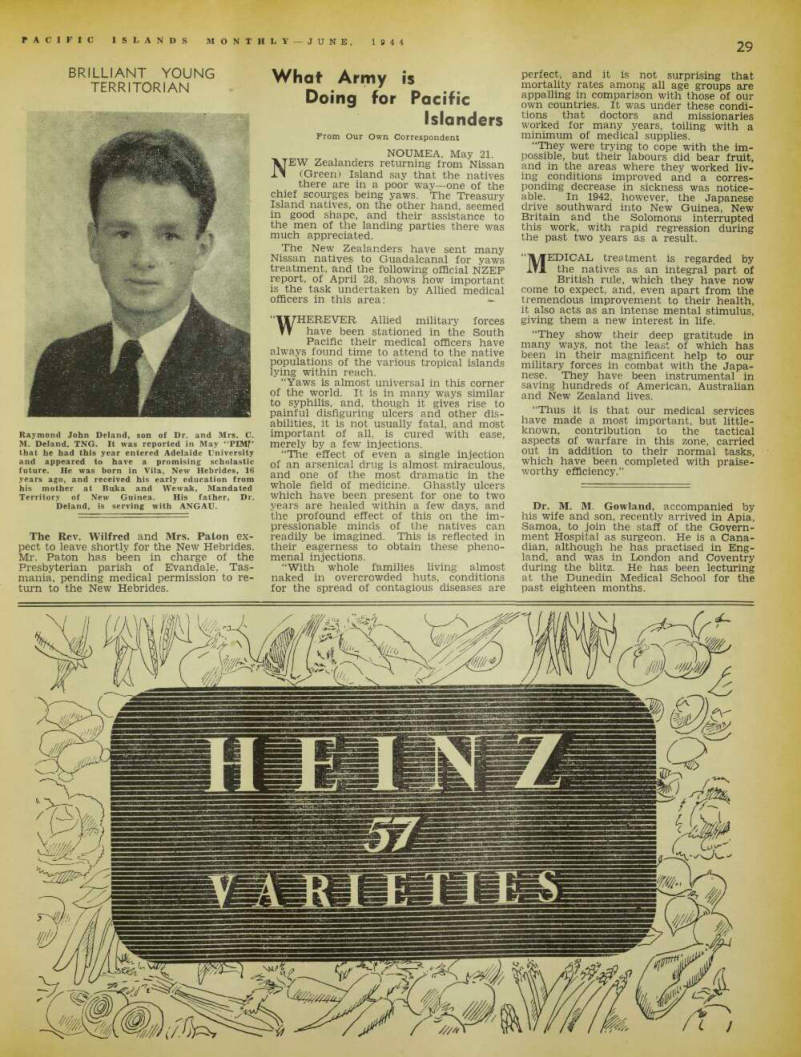
Territorian
The Rev. Wilfred and Mrs. Paton ex pect to leave shortly for the New Hebrides.
Mr. Paton has been in charge of the Presbyterian parish of Evandale, Tas mania, pending medical permission to re turn to the New Hebrides.
Raymond John Deland, son of Dr. and Mrs. C.
M. Deland, TNG. It was reported in May “PIMP" that he had this year entered Adelaide University and appeared to have a promising scholastic future. He was born in Vila, New Hebrides, 16 years ago, and received his early education from his mother at Buka and Wewak, Mandated Territory of New Guinea. His father, Dr.
Deland, is serving with ANGAU.
Doing for Pacific
What Army is Doing for Pacific Islanders
From Our Own Correspondent
Noumea, May 21.
NEW Zealanders returning from Nissan (Green) Island say that the natives there are in a poor way—one of the chief scourges being yaws. The Treasury Island natives, on the other hand, seemed in good shape, and their assistance to the men of the landing parties there was much appreciated.
The New Zealanders have sent many Nissan natives to Guadalcanal for yaws treatment, and the following official NZEF report, of April 28, shows how important is the task undertaken by Allied medical officers in this area: -
WHEREVER Allied military forces
have been stationed in the South Pacific their medical officers have always found time to attend to the native populations of the various tropical islands lying within reach.
“Yaws is almost universal in this corner of the world. It is in many ways similar to syphilis, and, though it gives rise to painful disfiguring ulcers and other dis abilities, it is not usually fatal, and moist important of all, is cured with ease, merely by a few injections.
“The effect of even a single injection of an arsenical drug is almost miraculous, and one of the most dramatic in the whole field of medicine. Ghastly ulcers which have been present for one to two years are healed within a few days, and the profound effect of this on the im pressionable minds of the natives can readily be imagined. This is reflected in their eagerness to obtain these pheno menal injections.
“With whole families living almost naked in overcrowded huts, conditions for the spread of contagious diseases are
perfect, and it is not surprising that mortality rates among all age groups are appalling in comparison with those of our own countries. It was under these condi tions that doctors and missionaries worked for many years, toiling with a minimum of medical supplies.
“They were trying to cope with the im possible, but their labours did bear fruit, and in the areas where they worked liv ing conditions improved and a corres ponding decrease in sickness was notice able. In 1942, however, the Japanese drive southward into New Guinea, New Britain and the Solomons interrupted this work, with rapid regression during the past two years as a result.
“Tt/fEDICAL treatment is regarded by ITA the natives as an integral part of British rule, which they have now come to expect, and, even apart from the tremendous improvement to their health, it also acts as an intense mental stimulus, giving them a new interest in life.
“They show their deep gratitude in many ways, not the least of which has been in their magnificent help to our military forces in combat with the Japa nese. They have been instrumental in saving hundreds of American, Australian and New Zealand lives.
“Thus it is that our medical services have made a most important, but little known, contribution to the tactical aspects of warfare in this zone, carried out in addition to their normal tasks, which have been completed with praise worthy efficiency.”
Dr. M. M. Gowland, accompanied by his wife and son, recently arrived in Apia, Samoa, to join the staff of the Govern ment Hospital as surgeon. He is a Cana dian, although he has practised in Eng land, and was in London and Coventry during the blitz. He has been lecturing at the Dunedin Medical School for the past eighteen months.
Advertisements & other items, p. 31 (1 item)
1
;cl as. e (rt l^ iM** s«S V ft /< c / /
Bougainville's Sawmill
Bougainville now has a sawmill, going full-blast and putting out be tween 15,000 and 17,000 feet of timber daily. It is run by a special American division, who are finding that “lumbering was never like this back home.” Apart from the facts that a continual watch must be kept for shell fragments and bullets, that are apt to fly out of virgin logs when they come in contact with the saws, and that much repair work has been necessary, as the whole of the equipment was sunk near the beach, the men are finding many
other difficulties in handling some of the hardest timber in the world: teak and mahogany.
The whole of the sawmill’s production is used for bridges, mess halls, flooring, runways, and other military needs.
Mr. Alexander Anderson, who for many years was head carpenter with the Melanesian Mission in the South-west Pacific, died at his home in Auckland, NZ, in April. He was 83 years old and is survived by his wife, five sons and four daughters.
Neighbours !
A Wail From Polynesia
ANYONE who has read “Vailima Let ters” may have noticed that Mrs.
Stevenson’s headaches, frequently mentioned in letters to Sydney Colvin, usually coincided with those periods when the great Tusitala consoled him self with his flagolet.
So, peace and order in many a house hold and neighborhood is often wrecked by some piercing, monotonous noise. A friend of ours has told of a typical example that turned a scene of tropical splendour into a hell of shrieking horror.
Not so very far from Vailima a num ber of quiet-loving people set up a com munity. They builded their houses in the centre of half-acre parcels of land, planted fruit trees about their dwellings and for years enjoyed the felicity they had hoped to establish.
But, when buying their land, the founders of this little community had neglected a strip of territory bordering a river bank, hard by, having regarded it as wasteland liable to inundation. One morning they awoke to discover three individuals had taken possession—a Chinaman, an Euronesian of Teutonic ancestry, and one of De Valera’s merry men.
Established side-by-side, this Sino- Teutonic-Celtic Confederation became a goading thorn in the side of the hitherto peaceful community. The Chinaman kept guinea-fowl, whose raucous cries echoed through the night. He was also a merchant of bootleg fiery waters, and the clamors of thirsty revellers about his door through the small hours of the night disturbed the slumbers of the neighborhood.
The De Valera man made his presence known by the most poisonous of gramo phones, that bellowed “On the Road to Mandelay” until the neighbours prayed fervently that both the singer and the De Valera man would arrive speedily not only at Mandelay but at a much more celebrated place, glowing with fire and brimstone.
It remained for the Teutonic Eurone sian, however, to devise a species of tor ture worthy of the Gestapo of his ancestors. He had, first, to get the con sent of his Chinese and Celtic neigh bours—which was readily given.
Suddenly the quiet of the once peace ful community was shattered by a metal lic shriek which instantly put the rental value of every residence within a quar ter of a mile to exactly zero. The Teu tonic Euronesian had installed a saw mill, operated by a petrol motor!
The peace of that community has gone forever and it will probably degenerate into a slum. The outcome will probably be that the authorities will introduce a zoning system to protect this and other residence districts from outrage by sel fish and inconsiderate people.
Sir Maynard and Lady Hedstrom have recently returned to Fiji after two and a-half years’ stay in the United States.
Sir Maynard had gone to USA, seeking expert medical assistance, late in 1941: and, when Pacific services were dislocated by the Japanese invasion, they were unable to return, and so made a tem porary home in California.
Mr. H. S. Wynne, formerly of the Vacuum Oil Company in Rabaul, TNG, is now with the same company in Towns ville, Queensland. He was recently “re leased for industry,” after three years’ service with the Australian Military Forces.
Advertisements & other items, p. 32 (1 item)
Pimples and Bad Skin
BITUMENOID ROOFING
MADE IN AUSTRALIA.
Bltumenold Roofings, Dampcourse and Insulating Pelts are made from the world’s beat raw materials. Warranted to stand the most rigid tests.
BITUMENOID THE BEST
Rooting, l, 2, 3-ply; Flooring, Waterproof Materials; Saturated Pelt; Resilient Road Jointing; Natural Asphalt Dampcourse: 2 and 3-ply Dampcourse; 1-2 lb. Lead-core Dampcourse: Roofing Cement; Asphalt Paints; Roofing Compound.
SAMPLES AND PRICE LISTS ON APPLICATION.
MAXWELL PORTER & SON LTD.
ESTABLISHED 1888. BUILDERS’ SUPPLTfco
107 REBFERN ST.. REDFERN, SYDNEY, N.S.W. Phone: M 8157. Cablea Bitoaeaald.
Woven Wire for all Industry
COPRA DRYING TRAYS, FLOORS, Etc.
FRUIT DRYING TRAYS, MINING SCREENS.
Heavy Mosquito Gauze in Phosphor Bronze and other Metals Impervious to Salt Sea Air.
WIRE DOOR MATS AND GENERAL WIRE WORKS
E. WRIGHT & CO. LTD.
Office and Works: 148-152 Cleveland Street, Sydney, N.S.W.
Telegraphic Address; “Wrightmake,” Chippendale.
Pimples and Bad Skin Fought in 24 Hours
Since the discovery of Nixoderm by an American physician it is no longer necessary for anyone to suffer from ugly, disgusting and disfiguring skin blemishes such as Eczema, Pimples, Rash, Ringworm, Psoriasis, Acne, Blackheads, Scabies and Red Blotches. Don’t let a bad skin make you feel inferior and cause you to lose your friends. Clear your skin this new scientific way.
A New Discovery
Nixoderm is an ointment, but different from any ointment you have ever seen or felt. It is a new discovery, and is not greasy but feels almost like a powder when you apply it. It penetrates rapidly into the pores and fights the cause of surface skin blemishes. Nixoderm contains 9 ingredients which fight skin troubles in these 3 ways. I.—lt fights and kills the microbes or parasites often responsible for skin disorders. 2.—lt stops itching, burning and smarting in 7 to 10 minutes, and cools and soothes the skin. 3, —It helps nature heal the skin clear, soft and velvety smooth.
Works Fast
Because Nixoderm is scientifically compounded to fight skin troubles, it works fast.
It stops the itching, burning and smarting in a few minutes, then starts to work immediately, clearing and healing your skin, making it softer, whiter and velvety smooth.
In just a day or two your mirror will tell you that here at last is the scientific treatment you have been needing to clear your skin —the treatment to make you look more attractive, to help you win friends. Nixoderm has brought clearer, healthier skins to thousands, such as Mr. Bob Weedon, Edmund Street, Fremantle, who writes: “I was troubled with pimples ever since I was 13, and have spent pounds and pounds on so-called cures without results. I then tried Nixoderm with astounding effect.
The pimples seemed to fade away, and after a week there was not the slightest trace of them.”
Satisfaction Guaranteed
Get Nixoderm from your chemist or store to-day. Look in the mirror in the morning and you will be amazed at the improvement.
Then just keep on using Nixoderm for one week and at the end of that time it must have made your skin soft, clear, smooth and magnetically attractive —must give you the kind of skin that will make you admired wherever you go, or you simply return the empty package and your money will be refunded in full. Get Nixoderm from your chemist or store to-day.
The guarantee protects you. =*
Nixoderm 2/- & 4/-
For Skin Sores, Pimples and Itch.
"Ecole Pastorale"
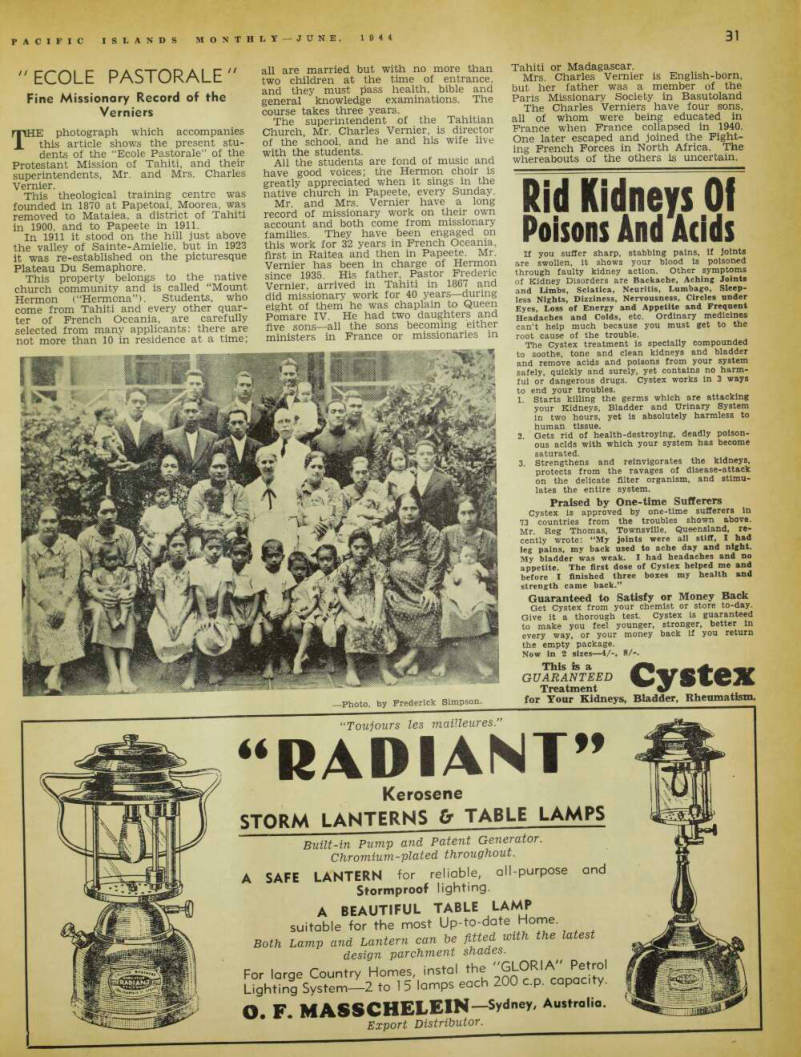
Fine Missionary Record of the Verniers
rE photograph which accompanies
this article shows the present stu dents of the “Ecole Pastorale” of the Protestant Mission of Tahiti, and their superintendents, Mr. and Mrs. Charles Vernier.
This theological training centre was founded in 1870 at Papetoai, Moorea, was removed to Mataiea, a district of Tahiti in 1900, and to Papeete in 1911.
In 1911 it stood on the hill just above the valley of Sainte-Amielie, but in 1923 it was re-established on the picturesque Plateau Du Semaphore.
This property belongs to the native church community and is called “Mount Hermon (“Hermona”). Students, who come from Tahiti and every other quar ter of French Oceania, are carefully selected from many applicants: there are not more than 10 in residence at a time;
all are married but with no more than two children at the time of entrance, and they must tfass health, bible and general knowledge examinations. The course takes three years.
The superintendent of the Tahitian Church, Mr. Charles Vernier, is director of the school, and he and his wife live with the students.
All the students are fond of music and have good voices; the Hermon choir is greatly appreciated when it smgs in the native church in Papeete, every Sunday, Mr. and Mrs. Vernier have a long record of missionary work on their own account and both come from missionary families. They have been engaged on this work for 32 years in French Oceania, first in Raitea and then m Pa P ee^ o Vernier has been in charge of Hermon since 1935. His father. Pastor Fredenc Vernier, arrived m Tahiti in 1867 and did missionary work for 40 years humig eight of them he was chaplain to Queen Pomare IV. He had two daughters and five sons—-all the sons becoming either ministers in France or missionaries
Tahiti or Madagascar.
Mrs. Charles Vernier is English-born, but her father was a member of the Paris Missionary Society in Basutoland The Charles Verniers have four sons, all of whom were being educated in France when France collapsed in 1940.
One later escaped and joined the Fight ing French Forces in North Africa. The whereabouts of the others is uncertain.
Photo, by Frederick Simpson.
Mr. Gideon Bish, for many years a resident of Fiji, died in Auckland, NZ, on May 3. He was born in Brighton England, 80 years ago, and emigrated to New Zealand when a young man. In the late ’nineties he went to Fiji under engagement to the CSR Company at Rarawai. Later, he started business on his own account in Suva, subsequently buying the blacksmithing and engineering firm of W. H. Terry & Co., which was moved to Walu Bay, where Bish Limited is still carrying on business. Mr. Bish is survived by five sons and one daughter; Messrs. John Edward Bish and Albert Bish, in the Public Works Department, Suva; Prank G. Bish, Auckland; Leslie Alfred Bish, present manager of Bish Limited, Walu Bay; Leonard Oswald Bish, in business in Suva; and Mrs.
Grace Winifred Beatty, now in Auckland
Advertisements & other items, pp. 33-34 (1 item)
“Radiant
Rid Kidneys 01
Poisons And Adds
If you suffer sharp, stabbing pains, if Joints are swollen, it shows your blood is poisoned through faulty kidney action. Other symptoms of Kidney Disorders are Backache, Aching Joints and Limbs, Sciatica, Neuritis, Lumbago, Sleepless Nights, Dizziness, Nervousness, Circles under Eyes, Loss of Energy and Appetite and Frequent Headaches and Colds, etc. Ordinary medicines can’t help much because you must get to the root cause of the trouble.
The Cystex treatment is specially compounded to soothe, tone and clean kidneys and bladder and remove acids and poisons from your system safely, quickly and surely, yet contains no harmful or dangerous drugs. Cystex works in 3 ways to end your troubles. 1. Starts killing the germs which are attacking your Kidneys, Bladder and Urinary System in two hours, yet is absolutely harmless to human tissue. 2. Gets rid of health-destroying, deadly poisonous acids with which your system has become saturated. 3. Strengthens and reinvigorates the kidneys, protects from the ravages of disease-attack on the delicate filter organism, and stimulates the entire system.
Praised by One-time Sufferers
Cystex is approved by one-time sufferers in 73 countries from the troubles shown above.
Mr. Reg Thomas, Townsville, Queensland, recently wrote: “My joints were all stiff, I had leg pains, my back used to ache day and night.
My bladder was weak. I had headaches and no appetite. The first dose of Cystex helped me and before I finished three boxes my health and strength came back.”
Guaranteed to Satisfy or Money Back
Get Cystex from your chemist or store to-day.
Give it a thorough test. Cystex is guaranteed to make you feel younger, stronger, better in every way, or your money back if you return the empty package.
Now in 2 sizes—4/-, 8/-.
GUARANTEED QVStCX
Treatment W
for Your Kidneys, Bladder, Rheumatism,
“Toujours les mailleures. 99
“RADIANT
Kerosene
STORM LANTERNS & TABLE LAMPS
and Built-in Pump and Patent Generator.
Chromium -plated throughout.
A SAFE LANTERN for reliable, all-purpose Stormproof lighting.
A BEAUTIFUL TABLE LAMP
suitable for the most Up-to-date Home Both Lamp and Lantern can he fitted with the latest design parchment shades.
For large Country Homes, instal the "GLORIA" Petrol Lighting System—2 to 1 5 lamps each 200 c.p. capacity.
O. F. MASSCHELEIN-Sydney, Australia. rmnr-t nistributor.
CnIV £ R s
Obtainable from all Leading Grocery Stores. drivers and Sons, Ltd., Histon, Cambridge, E. 76.
PURE
FOODS
GOLD MEDAL JAMS
CANNED ENGLISH FRUITS
CANNED ENGLISH
VEGETABLES
CUSTARD POWDER
OLD ENGLISH MARMALADE
JELLY CRYSTALS, ETC.
’ " - - - Write to Department A., England, for attractive Recipe Book,
AUNT
MARYS
BAKING POWDER
SUPPLIES ARE NOW AVAILABLE. If your local supplier is out of stock he will readily obtain Aunt Mary's Baking Powder for you. After all, quality is worth waiting for, especially when it is Aunt Mary's Baking Powder, which maintains the high quality which has stood the test for over 70 years.
Theory of a Submerged Archipelago
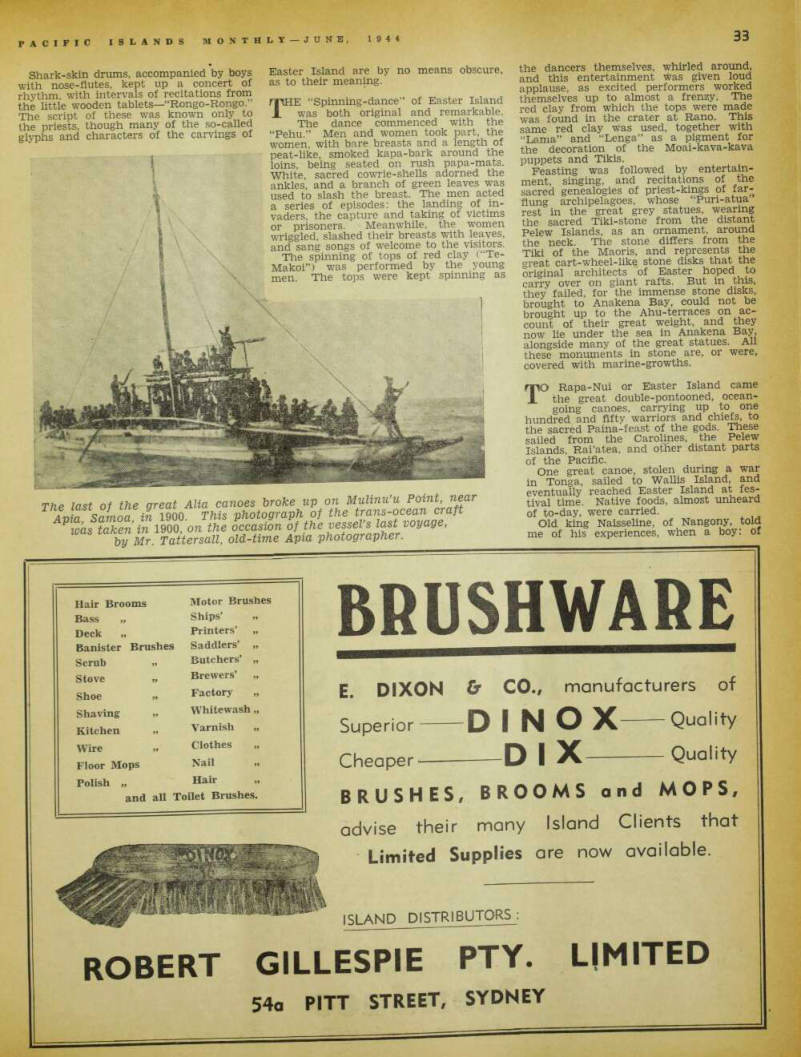
Life On Mysterious Easter Island
a great deal of data relating to Easter Island.
ON Easter Sunday, in 1722, the great Dutch navigator, Roggeveen, landed at Rapa-Nui, called Easter Island from that day. This remote, small, vol canic island, of about 34 miles circum ference, is among the most barren, yet the most remarkable islands known.
Easter is distant from Chile (to which country it belongs) by about 2,000 miles.
Its scanty flora is sub-tropical, and quite
world 6 any other island in the Ever since Captain Cook landed on the shores of Rapa-Nui, and beheld the hun dreds of huge, grey statues (representing the human-bust), set up on great stone terraces of basaltic prisms, and coral slabs, the world has marvelled at the tremendous work of some past race Despite the efforts of scientific investi gators, who have, from time to time, en deavoured to delve into the mysteries, its glyphs and its extraordinary carvings of stone and wood, its meaning remains undeciphered.
Easter Island is believed to be all that remains of an archipelago, which was submerged at the time of the great earth quake which submerged Tuaniki Island, with all its inhabitants. At this time several islands, large and small, including Ocean Island, and two in the Tonga Group (Late and Niuafou) were reported to have submerged, to the west of Easter Island.
At the time of the great earthquake of Callao, in 1687, which “pitchforked” ships at sea, as far away as 12° 30’ deg. south much of the land, which extended be tween Easter Island and the Carolines, disappeared. To-day, a long line of mountain and volcano-tops extends from the south-east to the north-west of this landless area of the Pacific Ocean.
Captain Cook, on his second voyage to the South Seas, took along with him in the “Resolution,” an artist, William Hodges. Hodges, at Tahiti, and at Easter Island, faithfully depicted, on canvas, striking pictures of the great stone statues, arrayed on the “Ahu,” or raised basalt-slab-terraces. These pictures be came the property of the Admiralty, and later were in the Maritime Museum, London.
Entertainments, differing from those of other Polynesian peoples, were provided on occasions, and to these entertainments —which followed the great “Paina” feasts of Easter Island—came Chiefs and Arikhs in the big, ocean-going, double-pontooned canoes. Polynesian visitors of rank, accompanied by servitors of humble birth, came to “Rapa-Nui” to attend the con ciliatory feasts to the living, and to join the “Rongo-Rongo” ceremony, given by the Easter Island priests, in honour of the dead. Each great statue represents one of the kings, priests, or rulers, whose soul, ages ago, “jumped” the “osonga” or jumping-off-stone, on its final journey westward.
A NOTABLE' feature of these entertain ments was a marionnette show.
Carved wooden puppets, “Moai-kava kava” (which were supposed to be able to talk) were manipulated in life-like man ner, to twist and turn. Each was fitted with a bole of hardwood (Tuanavi) which revolved in a socket, representing an “Ahu” in miniature. The “Ahu” was about fourteen inches in length and could accommodate several puppet figures at one time. Each of the figures was fitted with a hat of red “Tufa.”
These curious puppets were known as the “Moai-kava-kava-te-Hotu-Matua.” To the right of the “Whare-Mato,” or enter tainment-house, where these puppet shows were given, a kind of enclosure was built in rushes. Within this enclosure, two priests attired in weird masks, half animal, half-bird, chanted the dirges of Easter Island.
Shark-skin drums, accompanied by boys with nose-flutes, kept up a
th^lMe'wood'e^tablets—“ltongo-Rongo."
glyphs and characters of the carvings of
Easter Island are by no means obscure, as to their meaning. rE “Spinning-dance” of Easter Island was both original and remarkable.
The dance commenced with the “Pehu.” Men and women took part, the women, with bare breasts and a length of peat-like, smoked kapa-bark around the loins, being seated on rush papa-mats.
White, sacred cowrie-shells adorned the ankles, and a branch of green leaves was used to slash the breast. The men acted a series of episodes: the landing of in vaders, the capture and taking of victims or prisoners. Meanwhile, the women wriggled, slashed their breasts with leaves, and sang songs of welcome to the visitors.
The spinning of tops of red clay (“Te- Makoi”) was performed by the young men. The tops were kept spinning as
the dancers themselves, whirled around, and this entertainment was given loud applause, as excited performers worked themselves up to almost a frenzy. The red clay from which the tops were made was found in the crater at Rano. This same red clay was used, together with “Lama” and “Lenga” as a pigment for the decoration of the Moai-kava-kava puppets and Tikis.
Feasting was followed by entertain ment, singing, and recitations of the sacred genealogies of priest-kings of far flung archipelagoes, whose “Puri-atua rest in the great grey statues, wearing the sacred Tiki-stone from the distant Pelew Islands, as an ornament, around the neck. The stone differs from the Tiki of the Maoris, and represents the great cart-wheel-like stone disks that the original architects of Easter hoped to carry over on giant rafts. But in this, they failed, for the immense stone disks, brought to Anakena Bay, could not be brought up to the Ahu-terraces on ac count of their great weight, and they now lie under the sea in Anakena Bay, alongside many of the great statues. All these monuments in stone are, or were, covered with marine-growths. mo Rapa-Nui or Easter Island came X the great double-pontooned, ocean going canoes, carrying up to one hundred and fifty warriors and chiefs, to the sacred Paina-feast of the gods. These sailed from the Carolines, the Pelew Islands, Rai’atea, and other distant parts of the Pacific.
One great canoe, stolen during a war in Tonga, sailed to Wallis Island, and eventually reached Easter Island at fes tival time. Native foods, almost unheard of to-day, were carried.
Old king Naisseline, of Nangony, told me of his experiences, when a boy: of
The last of the great Alia canoes broke up on Mulinu’u Point, near Avia Samoa in 1900 This photograph of the trans-ocean craft AP was taken in 1900, on the occasion of the vessel’s last voyage, by Mr Tattersall, old-time Apia photographer.
the Tufungas,” who alone might build these ocean-going canoes, and of his voy ages, as a hard-working youth, to the dis tant archipelagoes.
A great cargo of foodstuffs had to be
earned for, although there was plenty of Camote-roots or comeras, at Easter Popo,” in the form of rafts of twto hundred coconuts each, were strung to gether. These yielded, not only drink, but the needful “sua,” from the grated meat or kernel. This was strained through a bundle of fibre, and heated up m a “tanoa” or hardwood vessel, by put ting in stones, heated in a charcoal fire.
The sua” was made into a thick, creamy custard, by adding a handful of pia, or arrowroot. Thus a nourishing relish was made that was eaten with coconut or other food.
Bamboo-sections were filled with the jelly made from the large immature “niu vai,” or “drinking-nuts.” The soft, egg like pulp was heated with “talavy,” the sugar obtained by severing the flowering spathe of a dwarf coconut-palm, collect ing the “sua” in a shell, and boiling it down to a honey-like, thick syrup, which is added to the coconut jelly. The relish is then filled into the bamboo-jars ready for the voyage. Water, of course, was carried to some extent, filled into the largest of the coconut-shells, in plaited, basket-work carriers.
Shark-meat and live turtles formed the main articles of food on these long voy ages. Sharks were easily caught by the “ato” canoes, working in pairs, and troll ing a huge mop of silky banana-fibre, covering a giant hook. The big fish, split in half, sun-dried and sometimes smoked, would keep wholesome for many months.
The meat was generally wrapped up, like “long-pig” in sheaves of coconut-leaves.
At Rapa-Nui, as the visitors well knew, there would be a feast of the largest cray fish known in the waters of the Pacific.
The Easter Island natives had a rather cute method of capturing these great
three-feet-long creatures.
A piece of rock, to which a cord is tied, is taken in the left hand. A small spear, and a stick of some hardwood with a short section of strong fibre, ending in a
loop, is carried down by the diving native.
The crayfish has tough, projecting eyes and over one of the creature’s eyes the loop is twisted, and the prize captured and hauled up.
A STRANGE malignity seems to attend the scrutiny of these sacred statues of' Easter Island.” Rocks close to the hidden caves, at Cooks Bay, bear the sacred symbol of the “Komari” (Tabu).
It was in these caves that some twenty eight of the script-tablets had been hid den. These had evidently escaped the hut-to-hut search for “finds” made by Father Gaspar, who is said to have col lected for museums, with great profit to himself. Father Gaspar established a school at Vaihu, on the south coast, for young Easter Islanders; but, later, sent these students to work on his sugar plan tation, at Tahiti.
Maurata, the last king of Easter Island, left a son, Gregorio, in the care of the French missionaries. Maurata, and one other man, were conversant with the symbols and sacred glyphs and carvings of Easter Island. They recited from the “Rongo-Rongo,” from time to time.
“Tau” was the word used for reciting the tablets.
But there was no man able to record the translations of the script, even if it should be deciphered, at the time of the slave raids. King Maurata was forced on to a ship and carried off to Peru.
Cyraud, a French priest from Tahiti, examined the script on these tablets in 1864. He endeavoured to find a native of Easter who could decipher it, but those around him were commoners, and knew nothing of the hieroglyphs or the tablets.
It was too late. The sixty odd tablets, with their “glyphs,” still hold then secret.
ONE by one, as successive volcanic dis turbances occurred, the great statues on Easter Island have toppled over, under the weight of the huge red tur bans. The long, passive, carved faces, without the crowning-hat, and with rope like ears, stare into space; others lie buried in debris.
In the Marquesas, the chiefs in the Carolines and the men of Easter Island once cut their ear-lobes, to hang as rope like appendages, reaching to the shoulder.
In this manner are carved the ears of the great stone statues. These were Polynesians.
ON rocks and caves at Easter Island there are curious carvings of a strange animal. I learned that the local name for this mystic creature is “Te- Manaia.” Visitors to Easter Island have given scientific study to these sub jects, include Mr. and Mrs. Scoresby Routledge, and the late Professor Mac- Millan-Brown. The weird animal carving is described as akin to the “Tasmanian Devil” (now extinct).
The word “manaia” occurs in about seven of the dialects of Polynesia, and has a somewhat elastic meaning. In Samoa, the son of a high chief is a “manaia.” The Maori has two forms of manaia. One of these is a bestial type, and may be seen, carved as a humanised animal, with human-hand-like claws, on the now famous “Whata,” the food-store house of “Wi Tako.”
The Wi Tako “Whata,” according to Mr. W. J. Phillipps, cost £3,000 to build, and was exhibited in London, where this writer examined the remarkable figures and carvings thereon. The collective ex hibit of unique curios from Samoa and other parts, sent to the Wembley Ex hibition, afforded this writer, who had charge of the exhibit, a few months of opportunity to discuss Maori subjects, while seated in Wi Tako’s Whata.
rpHE men who carved those great stone X statues and rocks had no hard, greenstone adzes, as used by the Maoris. The adzes, or Toki, found at Easter Island, around the quarries, were of obsidian.
It may have happened that among the men who undertook this monumental work were some “tufungas,” or Maori craftsmen, who were skilled in this pecu liar manner of carving. The work of carving the “manaia” on the hard surface of rock, with such poor tools as were available (adzes of obsidian, or volcanic glass) was no easy task. There is little wonder that these patterns of “manaia” do not appear the same on rock, and carved from memory, as the examples of the “pare” or manaia,” cleverly carved of wood by the Maoris of New Zealand.
DURING a year I spent in Nangony (one of the Loyalty Group) the white-haired, battle-scarred, aged king Naisseline, gave me a legend, ob tained during his youth, and which has some bearing on Rapanui. Here is the legend: , Years ago, a great Tongan canoe sailed from Vavau to Wallis Island. There arose a dispute and trouble among the chiefs over some matter; and the “Alia-canoe,” with a fresh “Niu-Afa” (human head) on board, sailed for Savaii.
At the village of I’opo, on Savan, a great feast and Talolo was given in honour of one, Mui-Mui, a high chief. During the Talolo (dance of the Toupou), a loud noise was heard, and the sky was filled with fire and ashes.
Tofua, the great volcano on Savaii, had blown up.
Red hot lava poured over the country, and the Samoans fled, in terror. The chiefs rushed to the canoe and put 9ut to sea. Sailing for two moons, during which time many sharks were caught for food, the island of Raiatea was sighted.
At Raiatea, the head of Lima-malosi was buried. His body is said to be buried on a small islet off Manono (Samoa) and Lima-malosi was said to have a chest of solid bone. . .. .
There was a “Fono’ or council of Ariki’s and rulers from Motu Arenga, Kusaie, Ponape, and Lu. Priests and orators talked and talked during many days. Then it was decided that the Tikis on board one of the great rafts of Tomano-trees should be sailed to Pito
te-Henua,” Rapa-Nui—later, to be known as Easter Island.
The “Tikis” were not the “Moai” (the great statues of Easter Island) often re ferred to as “Tikis.” These were a small, red clay image, made by the inhabitants of Raiatea—but with the same type of long, passive face as the Easter statues.
These Tikis stood on maraes of stone, as guardians of the sacred dead.
Advertisements & other items, pp. 35-37 (1 item)
Brushvabe
E. DIXON & CO., manufacturers of Superior - — DIN O X— Quality
Cheaper' —D I Quality
BRUSHES, BROOMS and MOPS,
advise their many Island Clients that Limited Supplies are now available.
ISLAND DISTRIBUTORS :
ROBERT GILLESPIE PTY. LIMITED
54a PITT STREET, SYDNEY
Purchasers at Full Market Prices on Assay Value of
GOLD
SILVER
PLATINUM
And Platinum Group Metals
SOME OF OUR SERVICES
ASSAYERS & ANALYSTS—
Assays of Bullion, Ores, etc.
Analyses of Metals, Minerals, Alloys, etc.
SCIENTIFIC & INDUSTRIAL
METALLURGISTS—
Our range of precious metal manufactures covers all industries—Gold and Silversmiths, Electrical Trades.
Dental Profession, Glass Sllverers.
Electro-Platers, etc., etc.
REFINERS—
Purchasers and Renners of Bullion, Scrap, Mining By-Products, and Trade Residues of every description carrying Precious Metals.
GARRETT & DAVIDSON
PTY. LTD.
824 George St., Sydney. Works: Surry Hills and Chippendale, N.S.W.
Official Assayers to the Bank of New South Wales. Gazetted Agents of the Commonwealth Bank of Australia, under the Gold Regulations of the National Security Act.
Asthma Curbed In 3 Minutes
Since the discovery of Mendaco by a famous physician sufferers can get relief from Asthma. Mendaco does away with expensive injections and offensive smokes.
All you do is to take 2 tasteless tablets with meals and Mendaco starts circulating through the blood in 10 minutes. You breathe easily and freely. Your nerves relax, you get good, fresh, pure air into your lungs, and vigour returns.
Sleep Like a Baby
Thousands of former sufferers from Asthma say that the very first dose of Mendaco brought them glorious ease and comfort, and that they slept soundly the very first night. Then their vigour returned and they felt healthier and stronger, and 5 to 10 years younger. The reason for this is that Mendaco acts in natural ways to overcome the effects of Asthma, (1) It removes the mucus or phlegm; (2) It relaxes thousands of tiny muscles in your bronchial tubes so that the air can get in and out of your lungs; (3) It promotes body vigour, and stimulates the building of rich, revitalised blood.
No Asthma for Five Years
Mendaco not only brings almost immediate results, free breathing and comfort and enables you to sleep, but also builds up the system to ward off future attacks. Mr.
J. R. writes: “I was almost dead with Asthma. Had lost 40 lbs. In weight, snf-
fered coughing every night—couldn’t sleep.
Mendaco stopped spasms first night. I have had no Asthma since in over 2 years.”
Mrs. A. W. writes: “I had Asthma for 25 years. After using Mendaco I can sleep all night and have not had an attack since taking it.” Mrs. G. E. C. writes: “I bless the day I first beard of Mendaco. What a godsend it is to a poor woman like me who for 35 years never knew what it was to have a good night’s rest. The constant fight between Asthma and sleep was wearing me down, but I feel now I want to forget my past suffering.”
Benefits Immediate
The very first dose of Mendaco goes right to work circulating through your blood and helping nature rid you of the effects of Asthma. Try Mendaco under an iron-clad money back guarantee. You be the judge.
If you don’t feel fully satisfied after taking Mendaco just return the package and the purchase price will be refunded. Get Mendaco from your chemist to-day and see how well you sleep to-night and how much better you will feel.
RELIEVES ASTHMA
Mendaco
Now in 2 sixes 6/- and 12/-
KANGAROO BRAND
Ropes,
Cordage,
and Twines for every purpose Backed by 86 years of service Manufactured by:
M. DONAGHY AND SONS,
Pty, Ltd., Geelong and Sydney.
Fiji Representatives :
PEARCE AND CO.
LIMITED
P.O. BOX 237, SUVA
Working
Medical Care Of
Ng Natives
How System Was Working
Letter to the Editor YOU have stimulated a healthy interest in the question of medical training for natives.
The idea of sending natives from New Guinea to the Suva School is by no means new; I “listened-in” to discus sions when I first arrived in New Guinea about 10 years ago, when it was advo cated by some, as an ideal to be aimed at.
As an interested onlooker —for the most part—i claim to have seen a definite growth in the native’s interest in the medical care of his own people.
It probably took years to get the system of village medical tultuls to the stage it was at when I first saw something of it.
A medical tultul was a selected native who was given an elementary training in medical principles, such as would fit him for the care of minor ailments and to help implement and carry out a pub lic health programme for his village. He would have charge of medical equipment and be required to renew his supplies at intervals from the District Native Hos pital, thus giving the medical officer or European medical assistant an oppor tunity of questioning him about his work and helping with any problems.
In about 1938-39, this system was extended by the appointment of Super vising Medical Orderlies. They were recruited from the ranks of hospital orderlies, known as “doctor boys,” who had completed several terms at the hos
pital, and wanted to return to their vil lages. It was part of the duty of these Supervising Orderlies to make regular tours of inspection of each village in their group, and to make a report at regular intervals to the medical officer in charge of the district. From these areas a steady stream of patients, needing treat ment, came to the District Native Hos pital for admission.
There were probably no more than half a dozen medical tultuls in the Ter ritory in 1921; and yet, by June, 1936, there were approximately 3,385 —these are the latest figures available, from the New Guinea Handbook of that year.
Knowing that to “hasten slowly” gov erns a lot of medical procedure, I venture to suggest that upon these lines the Administration was getting somewhere in its effort to educate the native in the care of his own people.
I am, etc.,
Thelma Price, Atna.
Gresford, NSW.
Advertisements & other items, pp. 37-38 (1 item)
B. DAVID Trading Co.
PACIFIC
ISLANDS
SOUVENIRS
POSTAGE PAID TO ANY
ADDRESS
One big parcel ISLANDS SOUVENIRS, containing one beautiful Hula Grass Skirt and assorted Islands Strung Shell-bead Necklaces.
PRICE, 18/- per parcel, cash.
(U.S.A., $4.00)
Write . . .
Enterprise, Box 51, Avarua, Rarotonga, Cook Islands.
B. DAVID Trading Co.
ISLAND TRADERS
EXPORT MERCHANTS
shippers of all kinds of merchandise.
EXPORT REPRESENTATIVES OF LEADING
AUSTRALIAN MANUFACTURERS
Head Office;
31 Queen Street, Melbourne, Vic.
Branches and Agents in All Ports.
Direct Enquiries to Head Office.
Bankers: National Bank of Australasia.
Cable Address:
“DAVID TRADING
MELBOURNE”
OPEN TO APPOINT AGENCIES WHERE NOT REPRESENTED
Restlessness and sleeplessness, when due to run-down nerves, frequently respond to treatment with Dr. Williams' Pink Pills.
Dr. Williams 1
PINK PILLS
help to enrich the blood, which has a beneficial and restorative effect upon the nervous system.
Ship Chandlery Hardware
Write for
r Vt me ror 7
/ Ship Chandlery j
L Catalogue J
Special “In Bond” Prices, for all Islands enquiries quoted on application.
Sole Agents lor:
BROOMFIELDS LIMITED
152 SUSSEX STREET :: SYDNEY.
Cables: "Boom”, Sydney.
Large and Complete Stocks of
SHIP CHANDLERY
IRONMONGERY OF ALL KINDS, PAINTS,
WHITE LEAD AND OILS.
P. H. MUNTZ <fe CO.’S 3-CROWN BRAND METAL SHEATHING.
PEACOCK <fe BUCHANS’ ENGLISH READY-MIXED PAINTS.
Scott’s “Renown” Brand Rope,
Cable Address: Ropeyard.
Sydney,
Cordage and
Binder
Twine
of Every
Description
MANUFACTURED AT
MASCOT, N.S.W.
By
J. SCOTT
PTY. LTD.
Head Office and Store-
-163 CLARENCE STREET,
SYDNEY,
N.S.W.
A New Guinea
Friend
From Brian Stein, of the “PIM” staff —now a Lieutenant in the AIF BY the way, I met a New Guinea friend the other evening. I was bowling along the road with my convoy on a particularly hot day and a utility pulled alongside and asked permission to pass.
As the vehicle passed, I noticed a man m the back whose face seemed familiar I pondered, but could not strike the cor rect chord in the old memory. The luncheon stop was in a little tin shed and as I looked at my “bully” a voice at my elbow asked whether I would like “a stick or two of celery.” Would I I’ll say!
The good Samaritan turned out to be the lad whose name escaped me. One thing led to another, and he told me he was an “R. McEwan”—Lieut. R. McEwan Hah, I knew who he was, then—the managing director of the Bulolo Bakery!
If I remember correctly you took a photograph of his bakery at Salamaua on one of your visits to the Mandated Territory prior to the war, and we pub lished it in the “PIM.” I think he had a bakery in Rabaul, one at Salamaua and another at Wau.
Lieut. McEwan (or “Jock” as he is more
familiarly known in these parts) was in Rabaul when the Japs came into the show; and was one of the last to fly out with Dick Mant, of Carpenter Airways.
Jock winged his way over to Salamaua, and when the isthmus was bombed he walked across the ranges to Wau. Here he joined the NGVR; but soon saw that a job could be done in supplying the people congregated there with bread.
With this end in view he tackled the job in his Wau bakery, and continued with this work for some months. 111-health overtook him eventually, and the doughty Scot left Wau by plane for Port Moresby.
As the plane neared Papua’s capital, it could be seen that things were not as peaceful as they could have been—a force of Jap planes was raiding the town! Undisturbed, Jock’s nlane side stepped the affray and continued' on to the Australian mainland.
Jock was admitted to hospital in Aus tralia, but after a few weeks he decided that it was near time he got back into the war. Next we hear of him as an officer in the baking section of the Army, testing youthful aspirants to the trough and peel. This was in the south, and it was not long before he was on the move again—this time to the far north. It was there that I found him, busy inspecting the bakeries of the unit to which he belongs.
Jock McEwan is one of the most popu lar officers in the particular branch of the Service to which he belongs. Though not a young man, he has seen a good deal of the work of the little “Sons of Heaven.”
One might imagine that he would be content to sit back and take things easy until the Japs were driven from the Mandated Territory. Not Jock. Though he has a plentiful supply of grey hairs, he is as fit as a fiddle and as keen as mustard to get a bit closer to the Japs— but more than anything, he is looking forward to the time when he can return to his own show in New Guinea.
WE talked awhile about the future of the Pacific Territories. He agreed that nothing short of the present war could have created the intense inter est now prevailing in Australia on the future of the Mandate and the Papuan Territory. Of course, the tripe being printed in yards about “exploitation,” etc., of the “poor” natiyes, by unscrupu lous planters and businessmen, was bound to come; but I wonder whether any tangible and sustaining changes will be made?
The whole thing rests, I think, on whether the Australian public will forget about the Solomons, New Guinea, Papua, etc., as they apparently have forgotten about Greece, Crete, and (until recently) the Dutch islands to the north, as the spotlight of events moves away.
It might be that, if the vulnerability of Australia without that screen of islands can be made to stick in the people’s minds —as surely it must have done in the dark days of 1942-43 —the people, and the Government, will do something about re-orienting their Pacifiic Territories policy.
Lieut.-Col. the Hon. Camilla H. Wedg wood, while she was in Papua, recently, was the guest of the Rev. Harold Short, of the LMS, for a fortnight. She took intense interest in the school and church life of the Papuans in that centre, and gave an address at one of the services, and visited several out-stations.
Miss Florence Vio Walcot, daughter of Mr. and Mrs. H. D. Walcot, of Suva, Fiji, was married at Holy Trinity Pro-Cathe dral, Suva, on April 28, to Warrant-Offi cer G. A. Robertson, of Palmerston North, NZ.
Native Foods Still Short
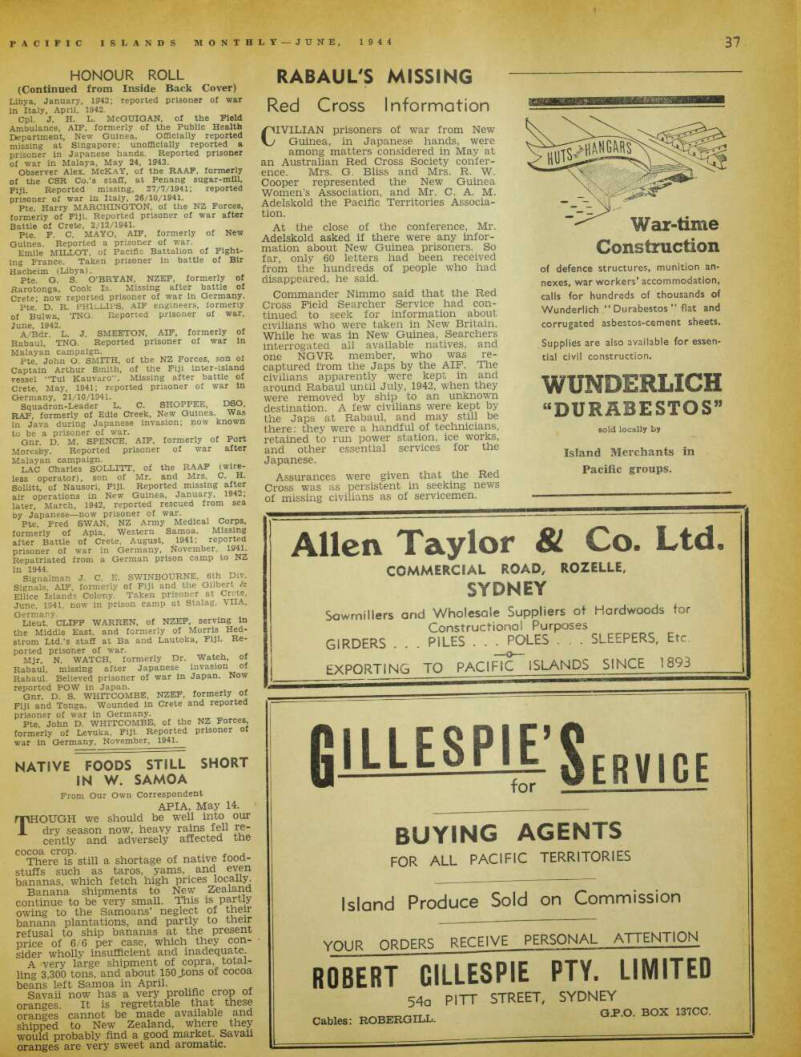
In W. Samoa
From Our Own Correspondent
Apia, May 14.
rOUGH we should be well into our dry season now, heavy rains fell re cently and adversely affected the cocoa crop. , There is still a shortage of native food stuffs such as taros, yams, and even bananas, which fetch high prices locally.
Banana shipments to New Zealand continue to be very small. This is partly owing to the Samoans’ neglect of their banana plantations, and partly to their refusal to ship bananas at the present price of 6/6 per case, which they con sider wholly insufficient and inadequate.
A very large shipment of copra, total ling 3,300 tons, and about 150Jtons of cocoa beans left Samoa in April.
Savaii now has a very prolific crop of oranges. It is regrettable that these oranges cannot be made available and shipped to New Zealand, where they would probably find a good market. Savaii oranges are very sweet and aromatic.
Rabaul's Missing
Red Cross Information
CIVILIAN prisoners of war from New Guinea, in Japanese hands, were among matters considered in May at an Australian Red Cross Society confer ence. Mrs. G. Bliss and Mrs. R. W.
Cooper represented the New Guinea Women’s Association, and Mr. C. A. M.
Adelskold the Pacific Territories Associa tion.
At the close of the conference, Mr.
Adelskold asked if there were any infor mation about New Guinea prisoners. So far, only 60 letters had been received from the hundreds of people who had disappeared, he said.
Commander Nimmo said that the Red Cross Field Searcher Service had con tinued to seek for information about civilians who were taken in New Britain.
While he was in New Guinea, Searchers interrogated ail available natives, and one NGVR member, who was re captured from the Japs by the AIF. The civilians apparently were kept in and around Rabaul until July, 1942, when they were removed by ship to an unknown destination. A few civilians were kept by the Japs at Rabaul, and may still be there: they were a handful of technicians, retained to run power station, ice works, and other essential services for the Japanese.
Assurances were given that the Red Cross was as persistent in seeking news of missing civilians as of servicemen.
Advertisements & other items, p. 39 (2 items)
37
HONOUR ROLL
(Continued from Inside Back Cover)
PACIFIC ISLANDS MONTHLY JUNE, 1944
jILLESPIj. Service
hangars
huts
War-time
Construction
of defence structures, munition annexes, war workers’ accommodation, calls for hundreds of thousands of Wunderlich “ Durabestos ” flat and corrugated asbestos-cement sheets.
Supplies are also available for essential civil construction.
WUNDERLICH
“DURABESTOS”
sold locally by Island Merchants in Pacific groups.
Allen Taylor & Co. Ltd.
COMMERCIAL ROAD, ROZELLE,
SYDNEY
Sowmillers and Wholesale Suppliers of Hardwoods tor Constructional Purposes GIRDERS . . . PILES . . . POLES , . . SLEEPERS, Etc,
EXPORTING TO PACIF~ic~ ISLANDS SINCE 1893
jILLESPIj. Service
buying agents
FOR ALL PACIFIC TERRITORIES
Island Produce Sold on Commission
YOUR nRDFRS RECEIVE PERSONAL ATTENTION^
ROBERT GILLESPIE PTY. LIMITED
54a Cables: ROBERGILL.
PITT STREET,
SYDNEY
GP.O. BOX 137 CC.
Exhibition In Tahiti
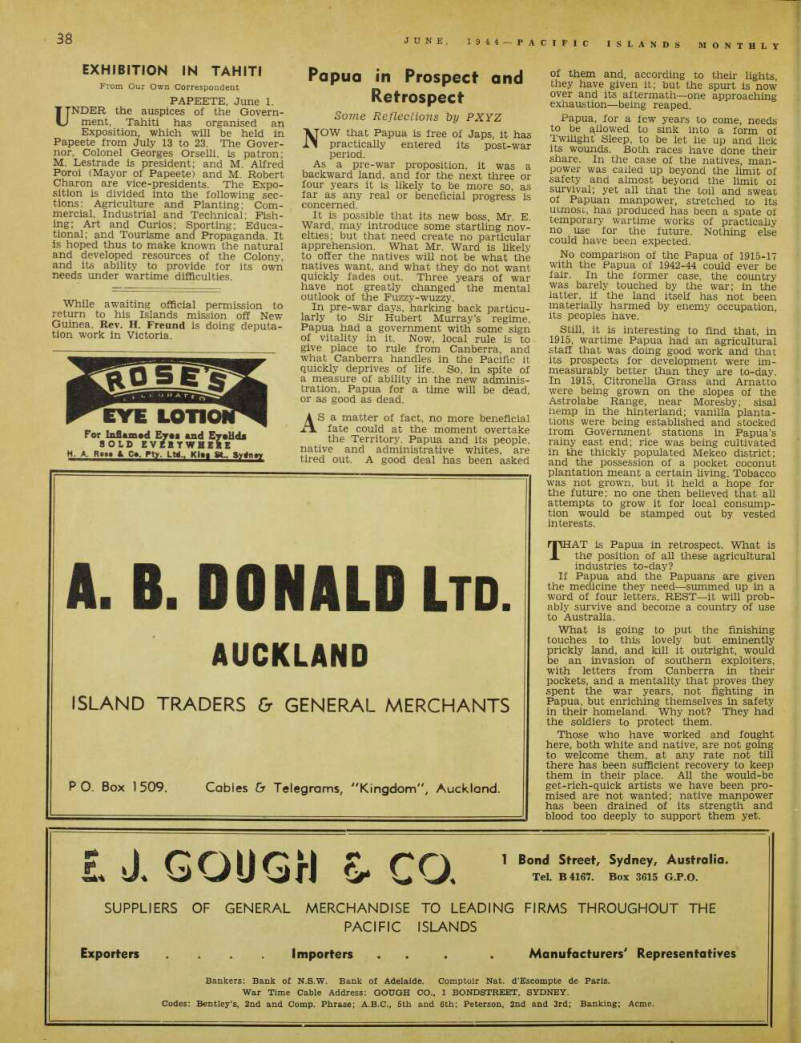
From Our Own Correspondent
Papeete, June 1.
UNDER the auspices of the Govern ment, Tahiti has organised an Exposition, which will be held in Papeete from July 13 to 23. The Gover nor, Colonel Georges Orselli, is patron; M. Lestrade is president; and M. Alfred Poroi (Mayor of Papeete) and M. Robert Charon are vice-presidents. The Expo sition is divided into the following sec tions: Agriculture and Planting: Com mercial, Industrial and Technical; Fish ing; Art and Curios; Sporting; Educa tional; and Tourisme and Propaganda. It is hoped thus to make known the natural and developed resources of the Colony, and its ability to provide for its own needs under wartime difficulties.
While awaiting official permission to return to his Islands mission off New Guinea, Rev. H. Freund is doing deputa tion work in Victoria.
Retrospect
Papua in Prospect and Retrospect
Some Reflections by PXYZ NOW that Papua is free of Japs, it has practically entered its post-war period.
As a pre-war proposition, it was a backward land, and for the next three or four years it is likely to be more so, as far as any real or beneficial progress is concerned.
It is possible that its new boss, Mr. E.
Ward, may introduce some startling nov elties; but that need create no particular apprehension. What Mr. Ward is likely to offer the natives will not be what the natives want, and what they do not want quickly fades out. Three years of war have not greatly changed the mental outlook of the Fuzzy-wuzzy.
In pre-war days, harking back particu larly to Sir Hubert Murray’s regime, Papua had a government with some sign of vitality in it. Now, local rule is to give place to rule from Canberra, and what Canberra handles in the Pacific it quickly deprives of life. So, in spite of a measure of ability in the new adminis tration, Papua for a time will be dead, or as good as dead.
AS a matter of fact, no more beneficial fate could at the moment overtake the Territory. Papua and its people, native and administrative whites, are tired out. A good deal has been asked
of them and, according to their lights, they have given it; but the spurt is now over and its aftermath—one approaching
exhaustion—being reaped.
Papua, for a few years to come, needs to be allowed to sink into a form of Twilight' Sleep, to be let he up and lick its wounds. Both races have done their share. In the case of the natives, man power was called up beyond the limit of safety and almost beyond the limit oi survival; yet all that the toil and sweat of Papuan manpower, stretched to its utmost, has produced has been a spate of temporary wartime works of practically no use for the future. Nothing else could have been expected.
No comparison of the Papua of 1915-17 with the Papua of 1942-44 could ever be fair. In the former case, the country was barely touched by the war; in the latter, if the land itself has not been materially harmed by enemy occupation, its peoples have.
Still, it is interesting to find that, in 1915, wartime Papua had an agricultural staff that was doing good work and that its prospects for development were im measurably better than they are to-day.
In 1915, Citronella Grass and Arnatto were being grown on the slopes of the Astrolabe Range, near Moresby; sisal hemp in the hinterland; vanilla planta tions were being established and stocked from Government stations in Papua’s rainy east end; rice was being cultivated in the thickly populated Mekeo district; and the possession of a pocket coconut plantation meant a certain living. Tobacco was not grown, but it held a hope for the future; no one then believed that all attempts to grow it for local consump tion would be stamped out by vested interests. rAT is Papua in retrospect. What is the position of all these agricultural industries to-day?
If Papua ahd the Papuans are given the medicine they need —summed up in a word of four letters, REST—it will prob ably survive and become a country of use to Australia.
What is going to put the finishing touches to this lovely but eminently prickly land, and kill it outright, would be an invasion of southern exploiters, with letters from Canberra in their pockets, and a mentality that proves they spent the war years, not fighting in Papua, but enriching themselves in safety in their homeland. Why not? They had the soldiers to protect them.
Those who have worked and fought here, both white and native, are not going to welcome them, at any rate not till there has been sufficient recovery to keep them in their place. All the would-be get-rich-quick artists we have been pro mised are not wanted; native manpower has been drained of its strength and blood too deeply to support them yet.
Advertisements & other items, p. 40 (1 item)
A. B. Donald Ltd.
US
ftS
LOTI
For Influnod Eras and Erolids
EVEBTWHEIE
SOLD
A. Res* L C« Pty. Ltd.. K)m 9L, Sy#n>y
A. B. DONALD Ltd.
AUCKLAND
ISLAND TRADERS & GENERAL MERCHANTS
P O. Box 1509. Cables £r Telegrams, "Kingdom", Auckland.
S I I I pi 2* 1 Bond Street, Sydney, Australia. |L J. O m TeL 84167. Box 3615 G.P.O.
SUPPLIERS OF GENERAL MERCHANDISE TO LEADING FIRMS THROUGHOUT THE
PACIFIC ISLANDS
Exporters ... Importers ... Manufacturers' Representatives Bankers: Bank of N.S.W. Bank of Adelaide. Comptoir Nat. d’Escompte de Paris.
War Time Cable Address: GOUGH CO., 1 BONDSTREET, SYDNEY.
Codes: Bentley’s, 2nd and Comp. Phrase: A.8.C., sth and 6th; Peterson, 2nd and 3rd; Banking; Acme.
Tarawa American Shrine Of Valor
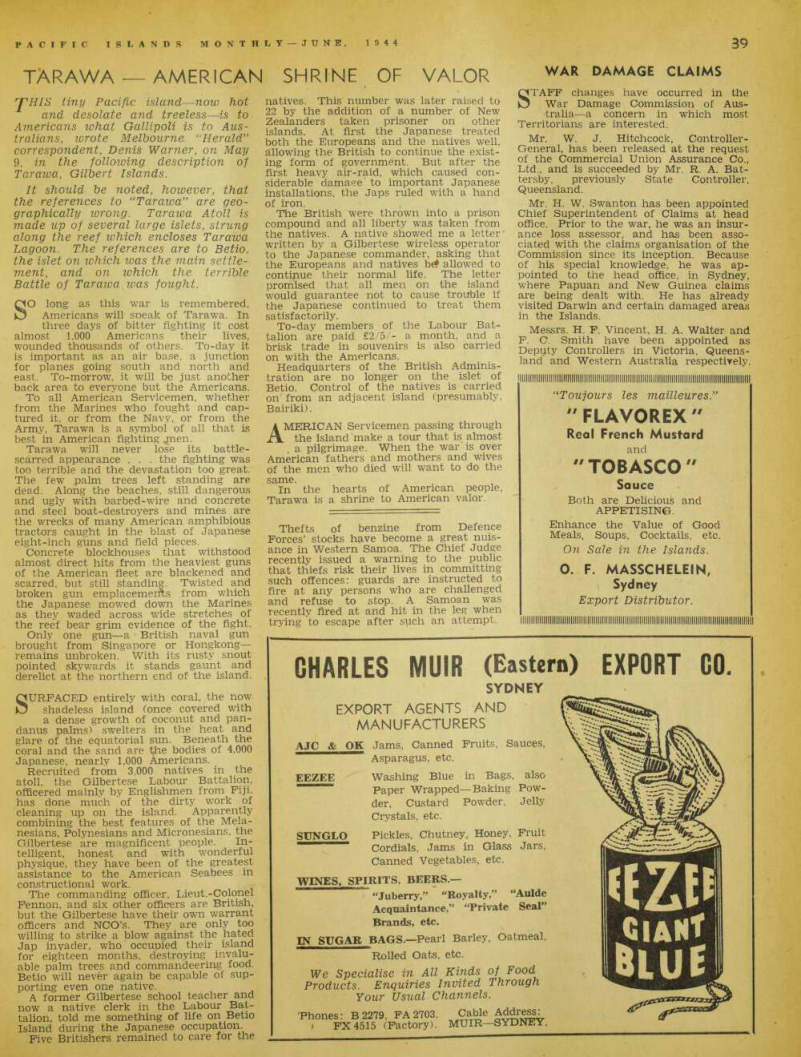
r FHIS tiny Pacific island—now hot and desolate and treeless—is to Americans what Gallipoli is to Aus tralians, wrote Melbourne “Herald” correspondent, Denis Warner, on May
9, in the following description of
Tarawa, Gilbert Islands.
It should be noted, however, that the references to “Tarawa ” are geo graphically wrong. Tarawa Atoll is made up of several large islets, strung along the reef which encloses Tarawa Lagoon. The references are to Betio, the islet on which was the main settle ment, and on which the terrible Battle of Taraiva was fought.
SO long as this war is remembered, Americans will sneak of Tarawa. In three days of bitter fighting it cost almost 1,000 Americans their lives, wounded thousands of others. To-day it is important as an air base, a junction for planes going south and north and east. To-morrow, it will be just another back area to everyone but the Americans.
To all American Servicemen, whether from the Marines who fought and cap tured it, or from the Navy, or from the Army, Tarawa is a symbol of all that is best in American fighting jnen.
Tarawa will never lose its battle scarred appearance . . . the fighting was too terrible and the devastation too great.
The few palm trees left standing are dead. Along the beaches, still dangerous and ugly with barbed-wire and concrete and steel boat-destroyers and mines are the wrecks of many American amphibious tractors caught in the blast of Japanese eight-inch guns and field pieces.
Concrete blockhouses that withstood almost direct hits from the heaviest guns of the American fleet are blackened and scarred, but still standing. Twisted and broken gun emplacements from which the Japanese mowed down the Marines as they waded across wide stretches of the reef bear grim evidence of the fight.
Only one gun—a British naval gun brought from Singapore or Hongkong— remains unbroken. With its rusty snout pointed skywards it stands gaunt and derelict at the northern end of the island.
SURFACED entirely with coral, the now shadeless island (once covered with a dense growth of coconut and pan danus palms'* swelters in the heat and glare of the equatorial sun. Beneath the coral and the sand are tyie bodies of 4,000 Japanese, nearly 1,000 Americans.
Recruited from 3,000 natives in the atoll, the Gilbertese Labour Battalion, officered mainly by Englishmen from Fiji, has done much of the dirty work of cleaning up on the island. Apparently combining the best features of the Mela nesians, Polynesians and Micronesians, the Gilbertese are magnificent people. In telligent, honest and with wonderful physique, they have been of the greatest assistance to the American Seabees in constructional work.
The commanding officer, Lieut. -Colonel Fennon, and six other officers are British, but the Gilbertese have their own warrant officers and NCO’s. They are only too willing to strike a blow against the hated Jap invader, who occupied their island for eighteen months, destroying invalu able palm trees and commandeering food.
Betio will never again be capable of sup porting even one native.
A former Gilbertese school teacher and now a native clerk in the Labour Bat talion, told me something of life on Betio Island during the Japanese occupation Five Britishers remained to care for the
natives. This number was later raised to 22 by the addition of a number of New Zealanders taken prisoner on other islands. At first the Japanese treated both the Europeans and the natives well, allowing the British to continue the exist ing form of government. But after the first heavy air-raid, which caused con siderable damage' to important Japanese installations, the Japs ruled with a hand of iron.
The British were thrown into a prison compound and all liberty was taken from the natives. A native showed me a letter written by a Gilbertese wireless operator to the Japanese commander, asking that the Europeans and natives allowed to continue their normal life. The letter promised that all men on the island would guarantee not to cause trouble if the Japanese continued to treat them satisfactorily.
To-day members of the Labour Bat talion are paid £2/5/- a month, and a brisk trade in souvenirs is also carried on with the Americans.
Headquarters of the British Adminis tration are no longer on the islet of Betio. Control of the natives is carried on from an adjacent island (presumably, Bairiki).
AMERICAN Servicemen passing through the island make a tour that is almost a pilgrimage. When the war is over American fathers and mothers and wives of the men who died will want to do the same.
In the hearts of American people, Tarawa is a shrine to American valor.
Thefts of benzine from Defence Forces’ stocks have become a great nuis ance in Western Samoa. The Chief Judge recently issued a warning to the public that thiefs risk their lives in committing such offences: guards are instructed to fire at any persons who are challenged and refuse to stop. A Samoan was recently fired at and hit in the leg when trying to escape after such an attempt.
War Damage Claims
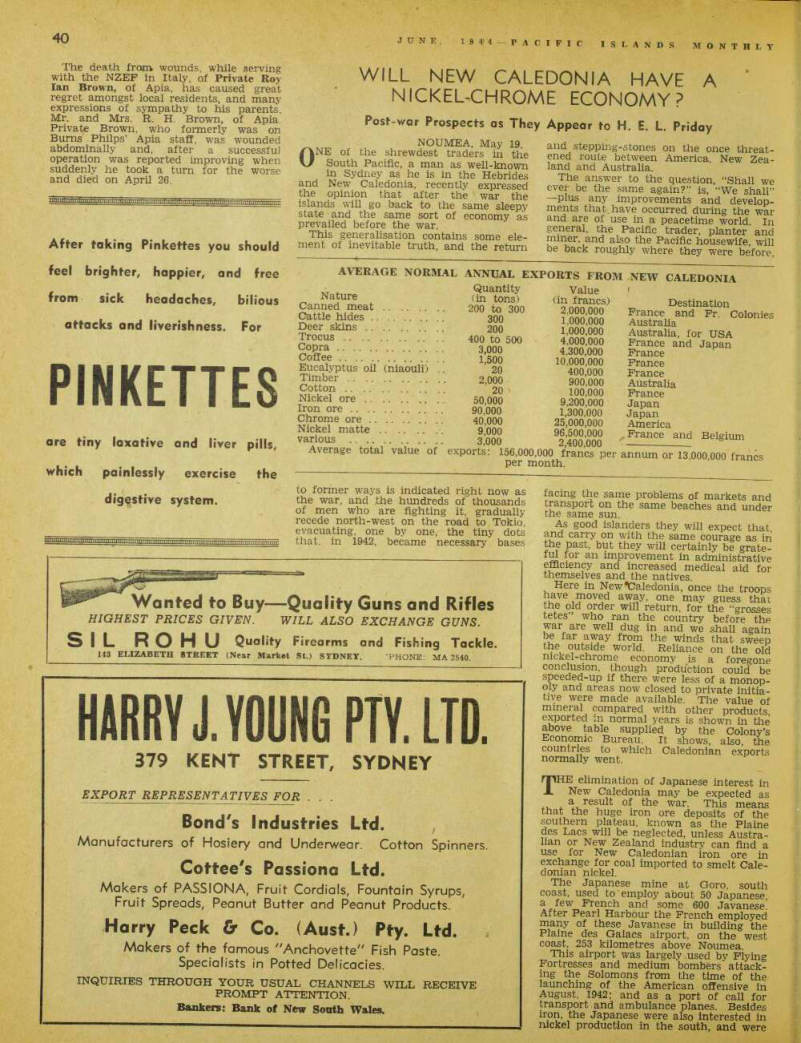
STAFF changes have occurred in the War Damage Commission of Aus tralia —a concern in which most Territorians are interested.
Mr. W. J. Hitchcock, Controller- General, has been released at the request of the Commercial Union Assurance Co., Ltd., and is succeeded by Mr. R. A. Bat tersby, previously State Controller, Queensland.
Mr. H. W. Swanton has been appointed Chief Superintendent of Claims at head office. Prior to the war, he was an insur ance loss assessor, and has been asso ciated with the claims organisation of the Commission since its inception. Because of his special knowledge, he was ap pointed to the head office, in Sydney, where Papuan and New Guinea claims are being dealt with. He has already visited Darwin and certain damaged areas in the Islands.
Messrs. H. F. Vincent, H. A. Walter and F. C. Smith have been appointed as Deputy Controllers in Victoria, Queens land and Western Australia respectively.
The death from wounds, while serving with the NZEF in Italy, of Private Roy lan Brown, of Apia, has caused great regret amongst local residents, and many expressions of sympathy to his parents, Mr. and Mrs. R. H. Brown, of Apia.
Private Brown, who formerly was on Bums Philps’ Apia staff, was wounded abdominally and, after a successful operation was reported improving when suddenly he took a turn for the worse and died on April 26.
Advertisements & other items, pp. 41-42 (1 item)
Charles Muir (Eastern) Export Co.
“Toujours les mailleures.”
" FLAVOREX"
Real French Mustard and
"TOBASCO"
Sauce Both are Delicious and
APPETISING.
Enhance the Value of Good Meals, Soups, Cocktails, etc.
On Sale in the Islands.
O. F. MASSCHELEIN,
Sydney Export Distributor.
CHARLES MUIR (Eastern) EXPORT CO.
SYDNEY
EXPORT AGENTS AND
MANUFACTURERS
AJC & OK Jams, Canned Fruits, Sauces, " Asparagus, etc.
EEZEE Washing Blue in Bags, also Paper Wrapped—Baking Powder. Custard Powder, Jelly Crystals, etc.
SUNGLO Pickles, Chutney, Honey, Fruit Cordials, Jams in Glass Jars, Canned Vegetables, etc.
WINES, SPIRITS, BEERS.—
“Juberry,” “Royalty,” “Aulde Acquaintance,” “Private Seal”
Brands, etc.
IN SUGAR BAGS.— Pearl Barley, Oatmeal, Rolled Oats, etc.
We Specialise in All Kinds of Food Products. Enquiries Invited Through Your Usual Channels.
Phones: B 2279, FA 2703. i FX 4515 (Factory).
Cable Address:
MUIR—SYDNEY.
K
After taking Pinkettes you should feel brighter, happier, and free from sick headaches, bilious attacks and liverishness. For
PINKETTES
are tiny laxative and liver pills, which painlessly exercise the digestive system.
Wanted to Buy—Quality Guns and Rifles HIGHEST PRICES GIVEN. WILL ALSO EXCHANGE GUNS.
SI L RO H U Quality Firearms and Fishing Tackle. 143 ELIZABETH STREET (Near Market St.) SYDNEY. 'PHONE; MA 3540.
HARRY J, YOUNG PTY. LTD.
379 KENT STREET, SYDNEY
EXPORT REPRESENTATIVES FOR . .
Bond's Industries Ltd.
Manufacturers of Hosiery and Underwear. Cotton Spinners.
Cottee's Passiono Ltd.
Makers of PASSIONA, Fruit Cordials, Fountain Syrups, Fruit Spreads, Peanut Butter and Peanut Products.
Harry Peck Cr Co. (Aust.) Ltd.
Makers of the famous "Anchovette" Fish Paste.
Specialists in Potted Delicacies.
INQUIRIES THROUGH YOUR USUAL CHANNELS WILL RECEIVE
PROMPT ATTENTION.
Bankers: Bank of New South Wales.
Nickel-Chrome Economy ?
Will New Caledonia Have A
Post-war Prospects as They Appear to H. E. L. Friday
Noumea, May 19
of the shrewdest traders in the \J South Pacific, a man as well-known in Sydney as he is in the Hebrides and New Caledonia, recently expressed the opinion that after the war the islands will go back to the same sleepy state ■ and the same sort of economy as prevailed before the war.
This generalisation contains some ele ment of inevitable truth, and the return
and stepping-stones on the once threat ened route between America, New Zea land and Australia.
The answer to the question, “Shall we ever be the same again?” is, “We shall” —plus any improvements and develop ments that, have occurred during the war and are of use in a peacetime world. In general, the Pacific trader, planter and miner, and also the Pacific housewife, will be back roughly where they were before,
Average Normal Annual Exports From New Caledonia
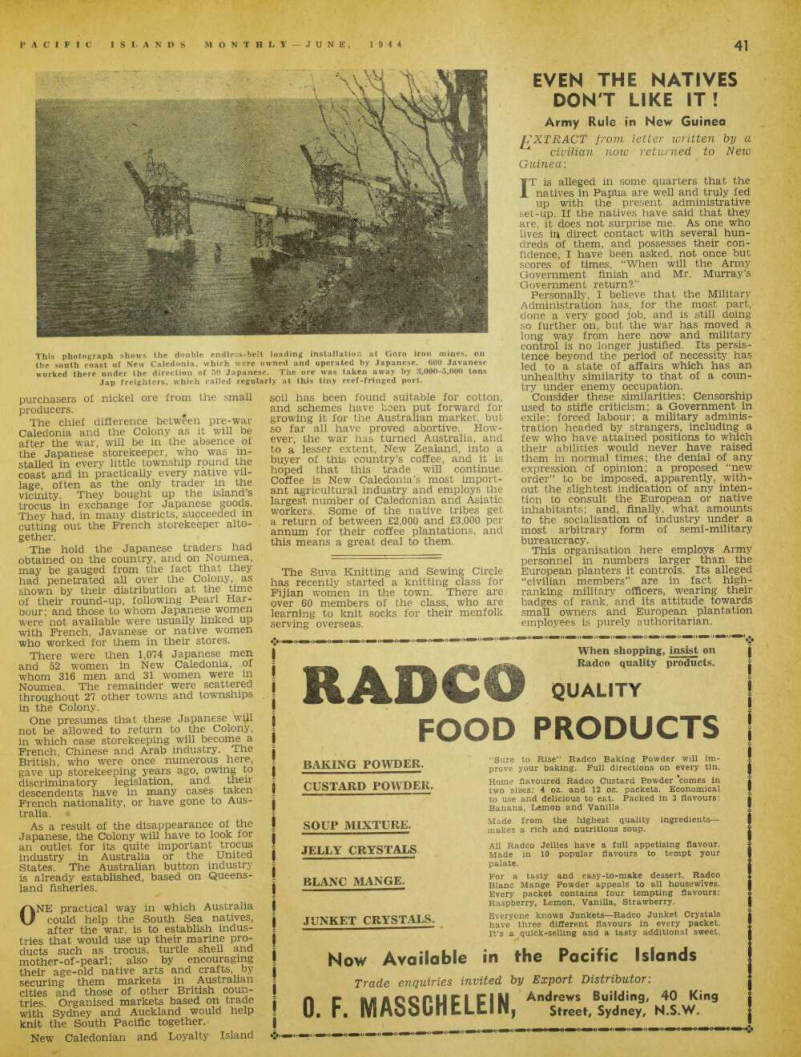
to former ways is indicated right now as the war, and the hundreds of thousands of men who are fighting it, gradually recede north-west on the road to Tokio, evacuating, one by one, the tiny dots that, in 1942, became necessary bases
facing the same problems of markets and transport on the same beaches and under the same sun.
As good islanders they will expect that, and carry on with the same courage as in the past, but they will certainly be grate ful f . or an improvement in administrative efficiency and increased medical aid for themselves and the natives.
Here in New •Caledonia, once the troops have moved away, one may guess that the old order will return, for the “grosses tetes who ran the country before the war are well dug in and we shall again be far away from the winds that sweep the outside world. Reliance on the old nickel-chrome economy is a foregone conclusion, though production could be speeded-up if there were less of a monop oly and areas now closed to private initia tive were made available. The value of mineral compared with other products exported in normal years is shown in the above table supplied by the Colony’s Economic Bureau. It shows, also, the countries to which Caledonian exports normally went.
THE elimination of Japanese interest in New Caledonia may be expected as , a result of the war. This means that the huge iron ore deposits of the southern plateau, known as the Plaine des Lacs will be neglected, unless Austra lian or New Zealand industry can find a use for New Caledonian iron ore in exchange for coal imported to smelt Cale donian nickel.
The Japanese mine at Goro, south coast, used to employ about 50 Japanese, a few French and some 600 Javanese.
After Pearl Harbour the French employed many of these Javanese in building the Plaine des Gaiacs airport, on the west coast, 253 kilometres above Noumea.
This airport was largely used by Flying Fortresses and medium bombers attack ing the Solomons from the time of the launching of the American offensive in August, 1942; and as a port of call for transport and ambulance planes. Besides iron, the Japanese were also interested in nickel production in the south, and were
Nature Canned meat Quantity (in tons) 200 to 300 Value (in francs) 2,000,000 1.000,000 1,000,000 4,000,000 4.300.000 10.000,000 400.000 900.000 100.000 9.200.000 1.300.000 25,000,000 96,500,000 o Ann nnn 1 Destination France and Fr. Colonies Australia Australia, for USA France and Japan Prance France France Australia France Japan Japan America y , France and Belgium Cattle hides Deer skins 300 L 200 400 to 500 3.000 1,500 20 2.000 20 50.000 90.000 40.000 9,000 a.nnn Trocus Copra Coffee Eucalyptus oil (niaouli) .
Timber Cotton Nickel ore Iron ore Chrome ore Nickel matte various Average total value of exports: 156,000,000 francs per annum or 13.000 000 francs per month.
purchasers of nickel ore from the small producers.
The chief difference between pre-war Caledonia and the Colony as it will be after the war, will be in the absence of the Japanese storekeeper, who was in stalled in every little township round the coast and in practically every native vil lage, often as the only trader in the vicinity. They bought up the island’s trocus in exchange for Japanese goods.
They had, in many districts, succeeded in cutting out the French storekeeper alto gether.
The hold the Japanese traders had obtained on the country, and on Noumea, may be gauged from the fact that they had penetrated all over the Colony, as shown by their distribution at the time of their round-up, following Pearl Har bour; and those to whom Japanese women were not available were usually linked up with French, Javanese or native women who worked for them in their stores.
There were then 1,074 Japanese men and 52 women in New Caledonia, of whom 316 men and 31 women were in Noumea. The remainder were scattered throughout 27 other towns and townships in the Colony.
One presumes that these Japanese will not be allowed to return to the Colony, in which case storekeeping will become a French, Chinese and Arab industry. The British, who were once numerous here, gave up storekeeping years ago, owing to discriminatory legislation, and then descendents have in many cases taken French nationality, or have gone to Aus tralia.
As a result of the disappearance of the Japanese, the Colony will have to look for an outlet for its quite important trocus industry in Australia or the United States. The Australian button industry is already established, based on Queens land fisheries.
ONE practical way in which Australia could help the South Sea natives, after the war, is to establish indus tries that would use up their marine pro ducts such as trocus, turtle shell and mother-of-pearl: also by encouraging their age-old native arts and crafts, by securing them markets in Australian cities and those of other British coun tries. Organised markets based on trade with Sydney and Auckland would help knit the South Pacific together.
New Caledonian and Loyalty Island
soil has been found suitable for cotton, and schemes have been put forward for growing it for the Australian market, but so far all have proved abortive. How ever, the war has turned Australia, and to a lesser extent, New Zealand, into a buyer of this country’s coffee, and it is hoped that this trade will continue.
Coffee is New Caledonia's most import ant agricultural industry and employs the largest number of Caledonian and Asiatic workers. Some of the native tribes get a return of between £2,000 and £3,000 per annum for their coffee plantations, and this means a great deal to them.
The Suva Knitting and Sewing Circle has recently started a knitting class for Fijian women in the town. There are over 60 members of the class, who are learning to knit socks for their menfolk serving overseas.
This photograph shows the double endless-belt loading installation at Goro iron mines, on the south coast of New Caledonia, which were owned and operated by Japanese. 600 Javanese worked there under the direction of 50 Japanese. The ore was taken away by 3,000-5,000 tons Jap freighters, which called regularly at this tiny reef-fringed port.
Even The Natives
Don't Like It!
Army Rule in New Guinea
JJXTRACT from letter written by a
civilian now returned to New Guinea : IT is alleged in some quarters that the natives in PapUa are well and truly fed up with the present administrative set-up. If the natives have said that they are, it does not surprise me. As one who lives in direct contact with several hun dreds of them, and possesses their con fidence, I have been asked, not once but scores of times, “When will the Army Government finish and Mr. Murray’s Government return?”
Personally, I believe that the Military Administration has, for the most part, done a very good job, and is still doing so further on, but the war has moved a long way from here now and military control is no longer justified. Its persis tence beyond the period of necessity has led to a state of affairs which has an unhealthy similarity to that of a coun try under enemy occupation.
Consider these similarities: Censorship used to stifle criticism; a Government in exile: forced labour; a military adminis tration headed by strangers, including a few who have attained positions to which their abilities would never have raised them in normal times; the denial of any expression of opinion; a proposed “new order” to be imposed, apparently, with out the slightest indication of any inten tion to consult the European or native inhabitants: and, finally, what amounts to the socialisation of industry under a most arbitrary form of semi-military bureaucracy.
This organisation here employs Army personnel in numbers larger than the European planters it controls. Its alleged “civilian members” are in fact high ranking military officers, wearing their badges of rank, and its attitude towards small owners and European plantation employees is purely authoritarian.
Advertisements & other items, p. 43 (1 item)
Radco
When shopping, insist on
Radco quality products.
QUALITY
FOOD PRODUCTS
BAKING POWDER.
CUSTARD POWDER.
SOUP MIXTURE.
“Sure to Rise” Radco Baking Powder will improve your baking. Pull directions on every tin.
Home flavoured Radco Custard Powder ‘comes in two sizes: 4 oz. and 12 oz. packets. Economical to use and delicious to eat. Packed in 3 flavours: Banana, Lemon and Vanilla.
Made from the highest quality ingredients— makes a rich and nutritious soup.
JELLY CRYSTALS
BLANC MANGE.
JUNKET CRYSTALS.
All Radco Jellies have a full appetising flavour.
Made in 10 popular flavours to tempt your palate.
For a tasty and easy-to-make dessert, Radco Blanc Mange Powder appeals to all housewives.
Every packet contains four tempting flavours: Raspberry, Lemon, Vanilla, Strawberry.
Everyone knows Junkets—Radco Junket Crystals have three different flavours in every packet.
It’s a quick-selling and a tasty additional sweet.
Now Available in the Pacific Islands
Trade enquiries invited by Export Distributor :
0. F. MASSGHELEIN,
Samoan Patriot
The Early Life of the Late O. F. Nelson
JYJUCH has been written of the 'political life of the late Mr. O.
F. Nelson, of Western Samoa, who died on February 21, this year. But little has been recorded of his early life, or the background against which he developed the passionate love of country that was to cause him untold suffering and great material sacri fices, and which undoubtedly/ con tributed to his long illness and early death.
The following notes from our Apia
correspondent supply something of
the early life of young Nelson, and the Samoa in which he grew up.
AT Safune, on the Samoan island of Savaii, on February 24, 1883, was born O. F. Nelson, son of a Swedish father and a Samoan mother.
His father, the late August Nelson, had run away to sea at an early age, and during his wanderings had made a small fortune on the Australian goldfields. He was on his way to the Klondyke rush, when another passenger on his ship persuaded him to land in Samoa instead.
Nelson, Snr., had no previous knowledge of trading, but he set up a trade store at Salailua, on the south coast of Savaii.
Shortly after, he married Sina Tugaga, a Samoan woman of high birth, and trans ferred his business to his wife’s village, Faleolo, Safune.
Young “Fred” Nelson lived with his parents in Faleolo until he was eight, and then he was sent for five years to the Marist Brothers’ School at Apia. At 13 he was apprenticed to the DH & PG, the famous German “long handle” firm, at that time enjoying a virtual monopoly of South Pacific trade. He spent 4 years in its service before returning to Savaii, and during this time undoubtedly laid the foundation for his later successful busi
ness career, which was to make him, at one time, one of the wealthiest men in the South Pacific.
It was said that even as an apprentice his thirst for knowledge was such that he could not file business letters without first carefully perusing and assimilating their contents.
While still an apprentice he formed and led the first brass band in Samoa. The late H. J. Moors, a wealthy American merchant and friend of Robert Louis Stevenson, who later became his father in-law, donated the uniforms for the band.
At the age of 17, young Nelson returned to Safune and took over his father’s business. This had fallen on evil times, and had only £315 worth of goods on hand, and an imposingly large list of bad debts. Two or three years later, it was necessary to open a station in Apia, which later became headquarters for the firm of A. Nelson & Son. Messrs. O. F. Nelson & Co., Ltd., are operating in the same premises to this day.
HIS work as a trader led him to all parts of the Samoan Islands, and it was probably at this time that his lifelong love for his people and country was first awakened and his very keen in terest in Samoan genealogy, mythology, traditions, customs, and language deve loped. His thirst for knowledge often led to all-night sessions with the old Samoan chiefs and orators, and the knowledge thus obtained made him the greatest authority on all things Samoan—it is doubtful whether anybody else will ever again be able to gather such a fund of knowledge and understanding.
The fruitful study of the history of his own people led him later to the study of the history of almost all other peoples, and his command of world history was often a source of amazement to cele brities he met.
It is a matter of great sorrow to his family and his friends, and particularly to students of Polynesian history, that during his intensely full life he never found time to convey his knowledge to paper—apart from one small book on
mythology—and thus his valuable know ledge is irretrievably lost to the world.
His extraordinary command of the Samoan language and knowledge of folk lore, plus a marvellous memory, Ivere contributing factors to the very deep and sincere respect which the Samoans un failingly showed to him during his life time.
When his father died, in 1909, he divided the estate between his younger brother and two sisters, made full pro vision for his mother, and took complete control of the firm. It was in that same year that he married the second daughter of Mr. H. J. Moors. In 1915 he bought a property at Tuaefu for his only son, where he later built one of the most beautiful mansions in the Pacific in order, as he impressed upon his children, to contribute to the respect for, and the uplifting of, the Samoan people.
Misfortune struck at his family, as well as many other Samoan families during the influenza epidemic of 1918-19: He lost his mother, his only brother and a sister, and he himself was seriously ill for almost a year. After his illness he and his wife left for a short trip to New Zealand to recuperate—and returned 'just a few weeks before their only son died.
WITH this fresh loss, Mr. Nelson seri ously considered selling out all his Samoari interests and leaving his country, but he finally decided to re main, and in 1920 he began building the home he occupied until his death. His son lies buried there, and now he, too.
In the' same year he left Samoa with his wife on a year’s world tour, during which he bought the furnishings for his new home, “Tuaefu.” On his return he made it a by-word for lavish hospitality; and it was about this time that he started to take a keen interest in the political situation in the Territory.
In 1922, the firm of A. Nelson &’ Son amalgamated with that of the late Mr.
H. J. Moors, his father-in-law, and the present firm of O. F. Nelson & Co., Ltd., was incorporated. At that time, no other company existed in the Samoan Islands, and the late Hon. O. F. Nelson was thus responsible for bringing to the Territory the laws for the registration of com panies—the reason why O. F. Nelson & Co., Ltd., is known to-day as the “senior” firm.
IN 1923 he was elected senior European member of the Legislative Council (the late G. E. L. Westbrook and Mr.
A. Williams were elected to the Council at the same time). He was the first per son to hold this “senior” office, which he kept for two successive periods, and was still holding in 1927, when he was first deported from the country.
The Rev, A. P. Jennings, of the Angli can Mission, has arrived in Australia after many weeks in the RAAF Hospital at Milne Bay. He is now convalescing in Melbourne.
Advertisements & other items, p. 44 (1 item)
0. F. Massghelein
WORLD-WIDE EXPORT AGENT SINCE 1919
Late of Antwerp (Belgium). Established in Sydney 1928.
OFFERS RELIABLE and EFFICIENT SERVICE
to all Australian and Oversea Manufacturers Inquiries from Oversea Buyers are Welcomed.
Correspondence: English, Dutch, French. Spanish.
ANDREWS BUILDINGS, 40 KING STREET, SYDNEY
c !v
PROPELLER SHAFTING
like all other forms of Monel, is to-day controlled by the Ministry of Munitions so that its outstanding qualities shall be available first and foremost for the War Effort. For Defence and essential purposes however, we have adequate stocks and will value your enquiries.
WRIGHT AND COMPANY, 81 CLARENCE STREET, SYDNEY
SOLE AUSTRALIAN DISTRIBUTORS OF MONEL
Monel is a registered trade mark covering a rich nickel alloy, mined in Canada and rolled in Great Britain.
Making Way For
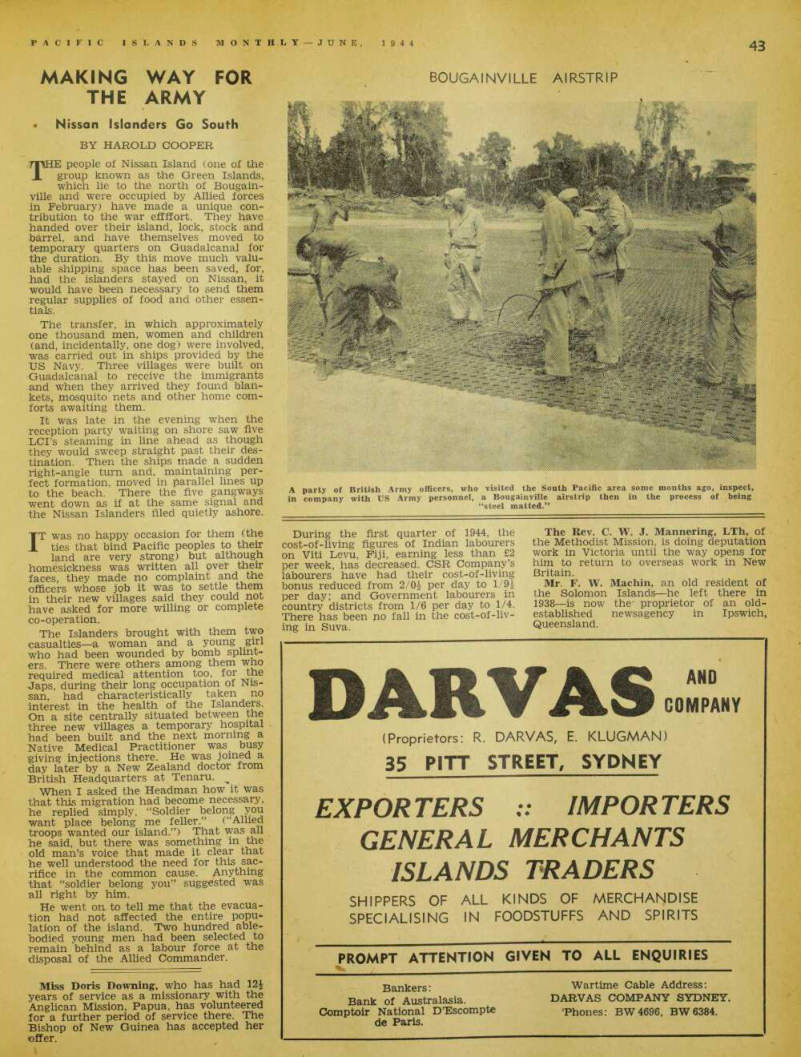
The Army
Nissan Islanders Go South
By Harold Cooper
rE people of Nissan Island Cone of the group known as the Green Islands, which lie to the north of Bougain ville and were occupied by Allied forces in February) have made a unique con tribution to the war effffort. They have handed over their island, lock, stock and barrel, and have themselves moved to temporary quarters on Guadalcanal for the duration. By this move much valu able shipping space has been saved, for, had the islanders stayed on Nissan, it would have been necessary to send them regular supplies of food and other essen tials.
The transfer, in which approximately one thousand men, women and children (and, incidentally, one dog) were involved, was carried out in ships provided by the US Navy. Three villages were built on Guadalcanal to receive the immigrants and when they arrived they found blan kets, mosquito nets and other home com forts awaiting them.
It was late in the evening when the reception party waiting on shore saw five LCl’s steaming in line ahead as though they would sweep straight past their des tination. Then the ships made a sudden right-angle turn and, maintaining per fect formation, moved in parallel lines up to the beach. There the five gangways went down as if at the same signal and the Nissan Islanders filed quietly ashore.
IT was no happy occasion for them (the ties that bind Pacific peoples to their land are very strong) but although homesickness was written all over their faces, they made no complaint and the officers whose job it was to settle them in their new villages said they could not have asked for more willing or complete co-operation.
The Islanders brought with them two casualties —a woman and a young girl who had been wounded by bomb splint ers. There were others among them who required medical attention too, for the Japs, during their long occupation of Nis san, had characteristically taken no interest in the health of the Islanders.
On a site centrally situated between the three new villages a temporary hospital had been built and the next morning a Native Medical Practitioner was busy giving injections there. He was joined a day later by a New Zealand doctor from British Headquarters at Tenaru.
When I asked the Headman how it was that this migration had become necessary, he replied simply. “Soldier belong you want place belong me feller.” (“Allied troops wanted our island.”) That was all he said, but there was something in the old man’s voice that made it clear that he well understood the need for this sac rifice in the common cause. Anything that “soldier belong you” suggested was all right by him.
He went on to tell me that the evacua tion had not affected the entire popu*lation of the island. Two hundred able bodied young men had been selected to remain behind as a labour force at the disposal of the Allied Commander.
Miss Doris Downing, who has had 12£ years of service as a missionary with the Anglican Mission, Papua, has volunteered for a further period of service there. The Bishop of New Guinea has accepted her offer.
Bougainville Airstrip
During the first quarter of 1944, the cost-of-living figures of Indian labourers on Viti Levu Fiji, earning less than £2 per week, has decreased. CSR Company’s labourers have had their cost-of-living bonus reduced from 2/0i per day to 1/9 h per day; and Government labourers in country districts from 1/6 per day to 1/4.
There has been no fall in the cost-of-living in Suva.
The Rev. C. W. J. Mannering, LTh, of the Methodist Mission, is doing deputation work in Victoria until the way opens for him to return to overseas work in New Britain.
Mr. F. W. Machm, an old resident of the Solomon Islands—he left there in 1938—is now the proprietor of an old established newsagency m Ipswich, Queensland.
A party of British Army officers, who visited the South Pacific area some months ago, inspect, in company with US Army personnel, a Bougainville airstrip then in the process of being “steel matted.”
Advertisements & other items, p. 45 (1 item)
D Ar V As -1
(Proprietors: R. DARVAS, E. KLUGMAN)
35 PITT STREET, SYDNEY
EXPORTERS :IMPORTERS
GENERAL MERCHANTS
ISLANDS TRADERS
SHIPPERS OF ALL KINDS OF MERCHANDISE
SPECIALISING IN FOODSTUFFS AND SPIRITS
PROMPT ATTENTION GIVEN TO ALL ENQUIRIES
Bankers: Wartime Cable Address: Bank of Australasia. DARVAS COMPANY SYDNEY, Comptoir National D’Escompte ’Phones: 8W4696, 8W6384. de Paris.
Islands Produce
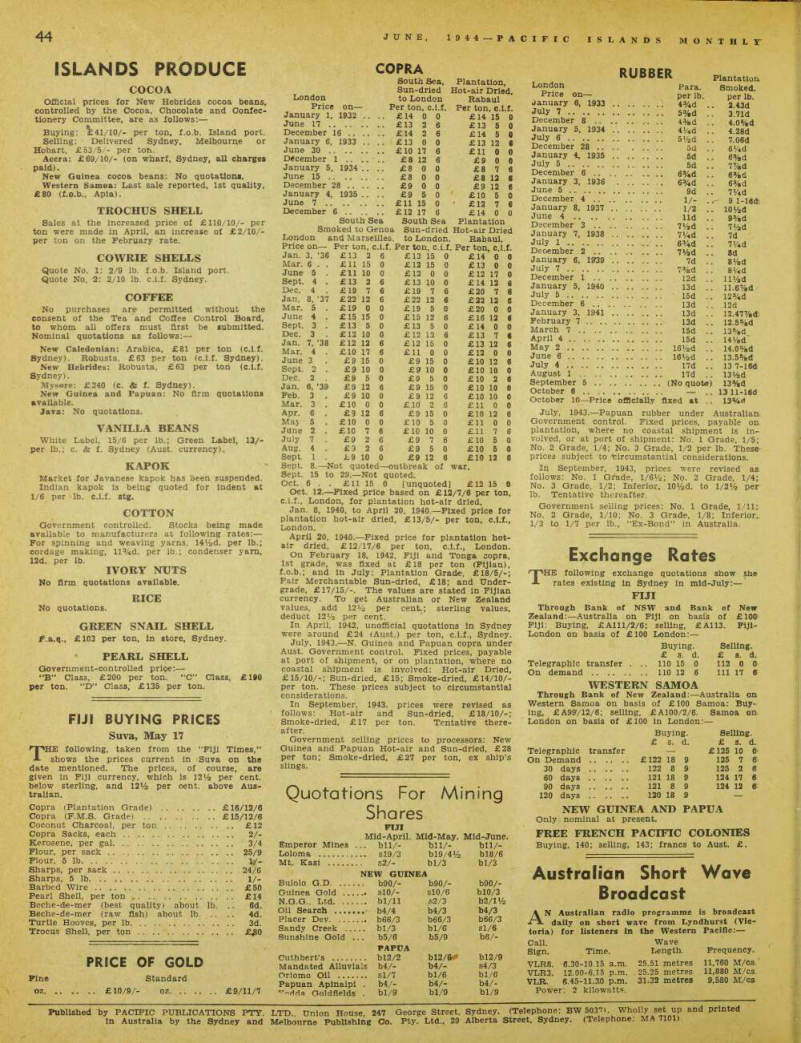
Cocoa
Official prices for New Hebrides cocoa beans, controlled by the Cocoa, Chocolate and Confec tionery Committee, are as follows: Buying; k4l/10/- per ton, f.o.b. Island port.
Selling: Delivered Sydney, Melbourne or Hobart, £53/5/- per ton.
Accra: £69/10/- (on wharf, Sydney, all charges paid).
New Guinea cocoa beans: No quotations.
Western Samoa: Last sale reported, Ist quality, £BO (f.0.b., Apia).
Trochus Shell
Sales at the increased price of £llO/10/- per ton were made in April, an increase of £2/10/per ton on the February rate.
Cowrie Shells
Quote No. 1: 2/9 lb. f.o.b. Island port.
Quote No. 2: 2/10 lb. c.i.f. Sydney.
Coffee
No purchases are permitted without the consent of the Tea and Coffee Control Board, to whom all offers must first be submitted.
Nominal quotations as follows: New Caledonian: Arabica, £Bl per ton (c.i.f.
Sydney). Robusta, £63 per ton (c.i.f. Sydney).
New Hebrides: Robusta, £63 per ton (c.i.f.
Sydney).
Mysore: £240 (c. & f. Sydney).
New Guinea and Papuan: No firm quotations available.
Java: No quotations.
Vanilla Beans
White Label, 15/6 per lb.; Green Label, 13/per lb.; c. & f. Sydney (Aust. currency).
Kapok
Market for Javanese kapok has been suspended.
Indian kapok is being quoted for indent at 1/6 per lb. c.i.f. stg.
Cotton
Government controlled. Stocks being made available to manufacturers at following rates;— For spinning and weaving yarns, HVfed. per lb.; cordage making, ll 3 Ad. per lb.; condenser yam, 12d. per lb.
Ivory Nuts
No firm quotations available.
Rice
No quotations.
Green Snail Shell
F.a.q., £lO3 per ton, in store, Sydney.
Pearl Shell
Government-controlled price:— “B” Class, £2OO per ton. “C” Class, £l9O per ton. "D” Class, £135 per ton.
Fiji Buying Prices
Suva, May 17
HpHE following, taken from the “Fiji Times,”
J- shows the prices current in Suva on the date mentioned. The prices, of course, are given in Fiji currency, which is 12y 2 per cent, below sterling, and 12V 2 per cent, above Aus tralian.
Copra (Plantation Grade) . . £ 16/12/6 Copra (F.M.S. Grade) . . £ 15/12/6 Coconut Charcoal, per ton . . .. £ 12 Copra Sacks, each 2/- Kerosene, per gal ... 3/4 Flour, per sack . . .. 25/9 Flour, 5 lb ... V- Sharps, per sack Sharps, 5 lb ... 1/- Barbed Wire Pearl Shell, per ton ... £14 Beche-de-mer (best quality) about lb. .. 6d.
Beche-de-mer (raw fish) about lb. ... 4d.
Turtle Hooves, per lb 3d.
Trocus Shell, per ton ... £^0
Price Of Gold
Pine Standard oz £lO/9/- oz £9/11/7
Oct. 6 . . £ll 15 0 [unquoted] £l2 15 0 Oct. 12.—Fixed price based on £l2/7/6 per ton, c.i.f., London, for plantation hot-air dried.
Jan. 8, 1940, to April 20, 1940. —Fixed price for plantation hot-air dried, £l3/5/- per ton, c.i.f., London.
April 20, 1940. —Fixed price for plantation hot air dried, £l2/17/6 per ton, c.i.f., London.
On February 18, 1942, Fiji and Tonga copra, Ist grade, was fixed at £lB per ton (Fijian), f.0.b.; and in July: Plantation Grade, £lB/5/-; Fair Merchantable Sun-dried, £18; and Under grade, £l7/15/-. The values are stated in Fijian currency. To get Australian or New Zealand values, add 12y 2 per cent.; sterling values, deduct 12V2 per cent.
In April, 1942, unofficial quotations in Sydney were around £24 (Aust.) per ton, c.i.f., Sydney.
July, 1943. —N. Guinea and Papuan copra under Aust. Government control. Fixed prices, payable at port of shipment, or on plantation, where no coastal shipment is involved: Hot-air Dried, £l5/10/-; Sun-dried, £l5; Smoke-dried, £l4/10/per ton. These prices subject to circumstantial considerations.
In September, 1943. prices were revised as follows: Hot-air and Sun-dried, £lB/10/-; Smoke-dried, £l7 per ton. Tentative there after.
Government selling prices to processors: New Guinea and Papuan Hot-air and Sun-dried, £2B per ton; Smoke-dried, £27 per ton, ex ship’s slings.
Copra
South Sea, Plantation, Sun-dried Hot-air Dried.
London to London Rabaul Price on— Per ton, c.i.f.
Per ton. c.i.f.
January 1 1932 . £14 0 0 £14 15 0 June 17 . £13 2 6 £13 5 0 December 16 .. . £14 2 6 £14 5 0 January 6 1933 . £13 0 0 £13 12 C June 30 . £10 17 6 £11 0 0 December 1 .. . £8 12 6 £9 0 0 January 5, 1934 . £8 i 0 0 £8 7 6 June 15 . £8 < 0 0 £8 12 6 December 28 .. . £9 i 0 0 £9 12 6 January 4 1935 . £9 : 5 0 £10 5 0 June 7 . £11 15 0 £12 7 6 December 6 . . £12 17 6 £14 0 0 South Sea South Sea Plantation Smoked to Genoa Sun-dried Hot-air Dried London and Marseilles to London.
Rabaul.
Price on— Per ton c.i.f. Per ton, c.i.f. Per ton. c.i.f.
Jan. 3, ’36 £13 2 6 £13 15 0 £14 0 0 Mar. 6 . . £11 15 0 £12 15 0 £13 0 0 June 5 £11 10 0 £12 0 0 £12 17 0 Sept. 4 . £13 : 2 6 £13 10 0 £14 12 6 Dec. 4 . £19 ' 7 6 £19 7 6 £20 7 6 Jan. 8, '37 £22 12 6 £22 12 6 £22 12 6 Mar. 5 . £19 ( ) 0 £19 5 0 £20 0 0 June 4 . £15 15 0 £15 12 6 £16 12 6 Sept. 3 . £13 S 0 £13 5 0 £14 0 0 Dec. 3 £12 10 0 £12 12 6 £13 7 6 Jan. 7. ’38 £12 12 6 £12 15 0 £13 12 6 Mar. 4 . £10 17 6 £11 0 0 £12 0 0 June 3 £9 15 0 £9 15 0 £10 12 6 Sept. 2 . £9 10 0 £9 10 0 £10 10 0 Dec. 2 £9 5 0 £9 5 0 £10 2 6 Jan. 6, ’39 £9 12 6 £9 15 0 £10 10 0 Peb. 3 . £9 10 0 £9 12 6 £10 10 0 Mar, 3 . £10 0 0 £10 2 6 £11 0 0 Apr. 6 £9 12 8 £9 15 0 £10 12 6 May 5 . £10 0 0 £10 5 0 £11 0 0 Jane 2 . £10 1 r e £10 10 0 £11 7 6 July 7 . £9 2 ! 6 £9 7 6 £10 5 0 Aug. 4 £3 2 6 £9 5 0 £10 5 0 Sept. 1 . £9 10 0 £9 12 6 £10 12 S Sept. 8. —Not quoted—outbreak of war.
Sept. 15 to 29.—Not quoted.
Quotations For Mining
Shares
July, 1943. —Papuan rubber under Australian.
Government control. Fixed prices, payable on plantation, where no coastal shipment is in volved, or at port of shipment: No. 1 Grade, 1/5; No. 2 Grade, 1/4; No. 3 Grade, 1/2 per lb. These prices subject to '■circumstantial considerations.
In September, 1943, prices were revised as follows: No. 1 Grade, 1/6V 2 ; No. 2 Grade, 1/4; No. 3 Grade, 1/2; Inferior, lOVad. to per lb. Tentative thereafter.
Government selling prices; No. 1 Grade, 1/11; No. 2 Grade, 1/10; No. 3 Grade, 1/8; Inferior, 1/3 to 1/7 per lb., “Ex-Bond” in Australia.
Fiji
Mid-April.
Mid-May.
Mid-June.
Emperor Mines . .. bll/bll/bll/- Loloma .. sl9/3 bl9/4V 2 bl8/6 Mt. Kasl s2/bl/3 bl/3 Bulolo G.D
New Guinea
b90/- b90/b90/- Guinea Gold .- slO/slO/6 blO/3 N.G.G.. Ltd .. bl/11 s2/3 b2/lV 2 Oil Search b4/3 b4/3 Placer Dev .. b66/3 b66/3 b66/3 Sandy Creek . .. .. bl/3 bl/6 sl/6 Sunshine Gold ., ,. b5/6 b5/9 b6/- Cuthbert’s
Papua
.. bl2/2 bl2/&* bl2/9 Mandated Alluvials b4/b4/s4/3 Oriomo Oil bl/6 bl/6 Papuan Aplnaipi . b4/b4/b4/- ■''ortdn Goldfields . bl/9 bl/9 bl/9
Rubber
Plantation London Para.
Smoked.
Price on— per lb. per lb.
January 6, 1933 2.43d July 7 3.71d December 8 .. . 4.0*/ad January 5, 1934 . 4V 4 d 4.28d July 6 7.06d December 28 .. . 5d 6 Vad January 4, 1935 . 5d 6%d July 5 7 Vad December 6 .. . 6 3 /» d January 3. 1936 6 3 Ad 6 3 /ad June 5 7V*d December 4 . . . . , 9 l-16d; January 8, 1937 . 10 Vad June 4 9 s /ad December 3 .. . 7 Vad January 7, 1938 . 7d July 1 7 Vad December 2 .. . 8d January 6, 1939 . 7d 8 Vad July 7 8‘Ad December 1 .. . 12d 11 Vad January 5, 19.40 . 13d 11.6 7 /ad July 5 12 3 Ad December 6 .. .. 12d January 3, 1941 . 12.47Vad February 7 12.5*4d March 7 13^ad April 4 14 Vad May 2 14.0%d June 6 13.5 s /ad July 4 13 7-16d August 1 17d 13Vfed September 5 .. ., 13%d October 6 13 ll-16d October 10—Price officially fixed at 13%d
Exchange Rates
THE following exchange quotations show the rates existing in Sydney in mid-July:—
Fiji
Through Bank of NSW and Bank of New Zealand; —Australia on Fiji on basis of £lOO Fiji: Buying, £Alll/2/6; selling, £AII3. Pijl- London on basis of £lOO London: —
Western Samoa
Through Bank of New Zealand: —Australia on Western Samoa on basis of £lOO Samoa: Buy ing, £A99/12/6; selling, £AIOO/2/6. Samoa on London on basis of £lOO in London:—
New Guinea And Papua
Only nominal at present.
Free French Pacific Colonies
Buying, 140; selling, 143; francs to Aust. £.
Buying.
Selling. £ s. d. £ s. d.
Telegraphic transfer . .. 110 15 0 112 0 C On demand .. 110 12 6 111 17 9
Buying.
Selling. £ s. d. £ s. d.
Telegraphic transfer — £125 10 0 On Demand £122 18 9 125 7 6 30 days 122 8 9 125 2 6 60 days 121 18 9 124 17 6 90 days 121 8 9 124 12 6 120 days 120 18 9 —
Australian Short Wave
Broadcast
AN Australian radio programme is broadcast daily on short wave from Lyndhurst (Vic toria) for listeners in the Western Pacific:—
Call.
Wave Sign.
Time.
Length.
Frequency.
Vlr8.
6.30-10.15 a.m. 25.51 metres 11,760 M/cs.
Vlr3.
12.00-6.15 p.m. 25.25 metres 11,880 M/cs.
Vlr.
6.45-11.30 p.m. 31.32 metres 9,580 M/cs Power: 2 kilowatts.
Advertisements & other items, pp. 46-48 (3 items)
44
JUNE, 1944 PACIFIC ISLANDS MONTHLY"
Published by PACIFIC PUBLICATIONS PTY. LTD. Union House, 247 George Street, Sydney. (Telephone: BW 503 7 >. Wholly set up and printed in Australia by the Sydney and Melbourne Publishing Co. Pty. Ltd.. 29 Alberta Street, Sydney. (Telephone: MA 7101)
Roll Of Honour
JUNE, 1944 PACIFIC ISLANDS MONTHLY
(Continued From Inside Front Cover)
W. R. Carpenter & Co. Ltd.
A . m " ’ f m: m #l|| j i 5-'•? : m m . m^m > i . ■ :; m enter
BtIHE
' - ■ mm m m i ■ ■■■; ...
SSL:
I Bi p X II
felt' v My|
m
Travel by CARPENTER AIRLINES
Full particulars from Macdonald, Hamilton & Co., or Howard Smith Ltd., Sydney. 1 i r ■ I L *
W. R. CARPENTER & CO. LTD.
MERCHANTS, SHIPOWNERS AND AIRCRAFT OPERATORS
Agents for Australian, European and American Manufacturers, and Distributors of Every Description of Merchandise.
Buyers and Shippers of Copra, Trocas, and all Classes of Islands Produce.
AGENTS FOR :
Ford Motor Company of Canada. Caterpillar Tractors. Dodge Brothers Inc.
T. G. & C. Bollnders (Engines). Electrolux Refrigerators. Westinghouse Electrical Co. etc., etc.
Branches throughout’ the Pacific Islands
In London: W. R. Carpenter & Co. (London) Ltd., Coronation House, 4 Lloyds Avenue, London, EC.
Head Office: 16 O’CONNELL STREET, SYDNEY