Pacific
Islands
Monthly
May 17, 1944
Vol. Xiv. No. 10.
Established 1930
[Registered ot the OJ*.o.> Sydney, for -transmission post as a ]
1/-
In The News
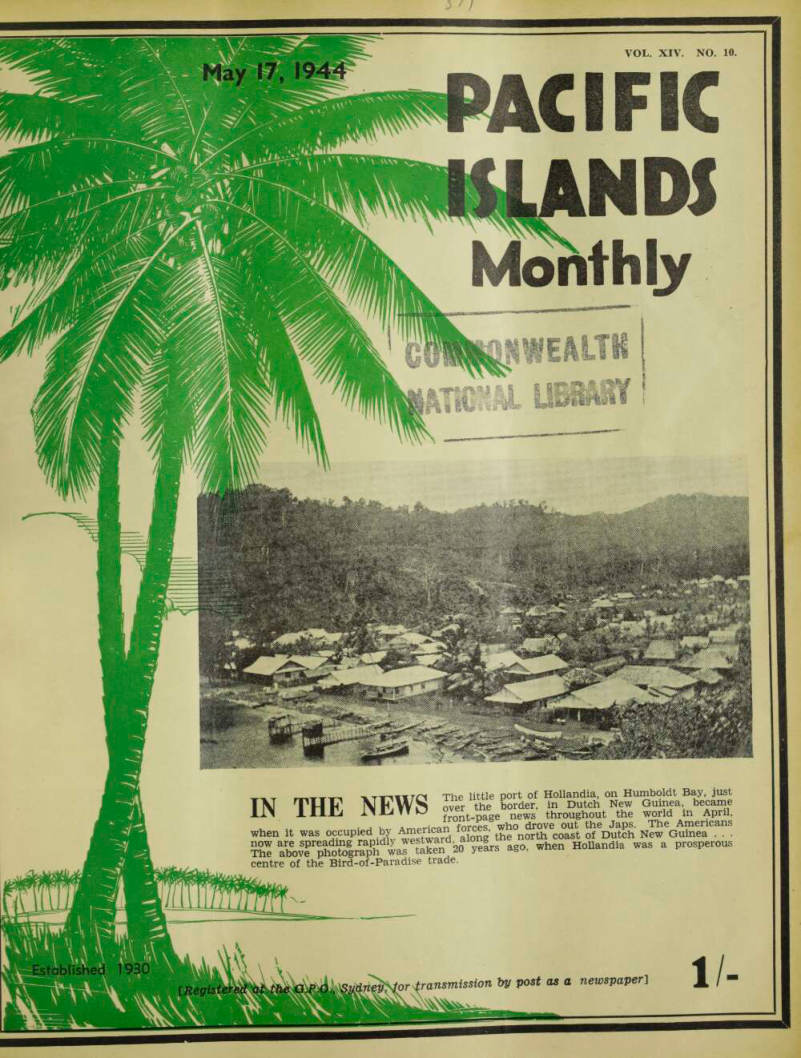
The little port of Hollandia, on Humboldt Bay, just over the border, in Dutch New Guinea, became front-page news throughout the world in April, when it was occupied by American forces, who drove out the Japs. The Americans now are spreading rapidly westward, along the north coast of Dutch New Guinea...
The above photograph was taken 20 years ago, when Hollandia was a prosperous centre of the Bird-of-Paradise trade.
Roll Of Honour—Section Ii.
[Section I (Killed, Missing, Prisoners) and Section II (Wounded, Decorations, etc.), published in Alternate Months] form ( eY^Lm s a nf ei ?h» e p h c, er - e fl 0f ““ of the United Nations, residents or lormer residents of the Pacific Territories, whose names appear in casualty lists nr us o deS‘ V o e f?u C c ohrameS 0 h ra meS We Sh ° Uld be grateful if relation *and“iends would send
Wounded
Sgt. Robert ASMUS, of the Fighting French Pacific Battalion. Wounded at Bir Hacheim and evacuated.
Rene AUFANT, of the Fighting French Pacific Battalion. Wounded at Bir Hacheim.
Cpl. Thomas BAMBRIDGE, of the Fighting French Pacific Battalion. Wounded at Bir Hacheim and evacuated.
BERBERE (alias ARESKY). of the Fighting French Pacific Battalion. Wounded at Bir Hacheim.
Henri BERT HELEN, of the Fighting French Pacific Battalion. Wounded at Bir Hacheim.
Pte. V. BLANCO, AIF infantry, of Thursday Island. Wounded in action, July, 1941.
L/Cpl. J. P. BLENCOWE. AIF Infantry, of Rabaul, TNG. Wounded in action, July, 1941.
Jean BRIAL, of the Fighting French Pacific Battalion. Wounded at Bir Hacheim.
Pte. George BUCKNELL, AIF, son of Mr. and Mrs. C. Bucknell, of Korolevu, Fiji. Wounded in action in Malaya. January, 1942.
Pte. Thomas BYERS, ALP Infantry, of Thurs day Island. Wounded in action, May, 1941 Raymond CHAUTARD, of the Free French Pacific contingent from New Caledonia. Re ported a casualty in the Middle East, March 1942.
Pte. A. J. CORLASS, AIF, formerly of Rabaul.
Wounded in action.
Albert CUBADDA, of the Free French con tingent from New Caledonia. Reported a casualty in the Middle East, March, 1942.
Charles DEVEAUX, of Pacific Battalion of Fighting France. Wounded at battle of Bir Hacheim (Libya).
Sgt. EMERY, formerly of Lae, TNG. Wounded in New Guinea in October, 1942.
W/O P. N. ENGLAND, AIF, formerly of Bogia, TNG. Wounded in action January 27, 1944.
Lieut. M. G. EVENSEN. AIF. formerly of Rabaul. Wounded in action.
V. PAIRHALL, 2nd NZEF, formerly of the Treasury Department, Western Samoa. Reported wounded in action, February, 1942.
Trooper Arthur T. FILEWOOD, formerly of Thursday Island. Reported wounded in action.
May, 1943.
Paroa FIU. of the Fighting French Pacific Battalion. Wounded at Bir Hacheim and evacuated.
Acting Warrant-Officer V. M. I. GORDON. AIP infantry, of Wau, TNG. Wounded in action, February, 1942.
Henri GUXLBAUD, of the Free French Pacific contingent from New Caledonia. Reported a casualty in the Middle East, March, 1942.
Sgt. C. HENDRICK, AIF infantry, of Rabaul, TNG. Wounded in action, July, 1941.
Stanley HIGGS, son of Mr. and Mrs. Gordon Higgs, of W. R. Carpenter and Cos. Ltd., New Guinea. Member of an English Lancers’ regiment, wounded during British evacuation from Dun kirk (Prance). May, 1940.
Pte. W. HOLMES, of the Fiji Military Forces.
Reported wounded in action, December, 1943.
Alexandre HUYARD, of the Free French Pacific contingent from New Caledonia. Reported a casualty in the Middle East, March, 1942.
Sgt.-Pilot Andrew KRONFELD, of the NZ Fighter Squadron attached to the RAF. Wounded In knee during operations over France, December, 1941.
Cpl. W. H. LANNEN, AIP artillery, of Rabaul, New Guinea. Wounded in action, June, 1941.
Gnr. E. G. LOBAN, AIP artillery, of Thursday Island. Wounded during campaign in Greece, May, 1941; invalided home after having his left forearm amputated.
Auguste LUTA, of the Fighting French Pacific Battalion. Wounded at Bir Hacheim and evacuated.
A/Sgt. Alastalr MACLEAN, ALP infantry, of Rabaul. New Guinea. Wounded in action, in Libya, June, 1941.
Sgt. J. D. McCLYMONT, NZEF, son of Capt.
D. McClymont, Harbourmaster of Apia, Western Samoa. Wounded in action, November, 1941.
Cpl. R. McKERLIE, ALP, of Yandina, BSL wounded in face by bomb explosion. April, 1941.
T. MANEA, of the Fighting French Pacific Battalion. Wounded at Bir Hacheim and evacuated.
Jean MERIGNAC, of the Free French Pacific contingent from New Caledonia. Reported a
casualty in the Middle East, March, 1942.
Henri MEYER, of the Free French Pacific contingent from New Caledonia. Reported a casualty in the Middle East, March, 1942.
S/Sgt. Graham B. MIRFIELD, AIF engineers, of Rabaul, New Guinea. Wounded In action’
Pte. James O'DWYER, NZEF, formerly of Apia, W. Samoa. Wounded in action in Italy, December, 1943.
Joseph OTHUS. of Pacific Battalion of Fight ing France. Wounded in battle of Bir Hacheim (Libya).
Lieut. A. G. PEARCE, AIF, formerly of Salamaua, TNG. Wounded in action.
Pte. L. G. (“Mick”) REECE, AIF, of Bulolo, New Guinea. Wounded in action, July, 1941.
Henri RIVIERE, of the Free French Pacific contingent from New Caledonia. Reported a casualty in the Middle East, March, 1942 Pte. H. St. George RYDER, AIF, formerly of Suva, Fiji. Wounded while serving in New Guinea.
A/Cpl. N. K. SAWYER, AIF infantry, of Rabaul, TNG. Wounded In action, July, 1941, July, 1941.
Pte. Frank M. SCHUSTER. NZEF, formerly of W. Samoa. Wounded in action in Tunisia, 1943.
Lieut. Jeffrey SEAGOE, serving with the British forces in the Far East, formerly of Vila, New Hebrides. Reported “wounded in action”, March, 1942.
Pte. F. M. SCHUSTER, NZEF, formerly of W. Samoa. Wounded in action in Tunisia.
Pte. Lance STAMPER, AIF, formerly school master at Wau, New Guinea. Wounded in action, August, 1941.
Lieut.-Col. J. K. B. TAYLOR, of the Fiji Mili tary Forces. Wounded in action in Bougain ville, December, 1943.
Cpl. Raphael TEIHO, of the Fighting French Pacific Battalion. Wounded at Bir Hacheim and evacuated.
Cpl. Terli TERIITUA, of the Fighting French Pacific Battalion. Wounded at Bir Hacheim and evacuated.
Lieut. A. THOMPSON, of the Fiji Military Forces. Reported wounded in action, December, 1943.
Lieut. P. A. TUCKEY, infantry, formerly of New Guinea. Wounded in action.
Pte. Harold G. TURNER. AIF. of Samaral, Eastern Papua. Wounded in action at Bardia (Libya), January, 1941.
Pte. F. D. TWISS, AIF infantry, of New Guinea. Wounded in action, August, 1941.
Camille VINCENT, of the Free French Pacific contingent from New Caledonia. Reported a casualty in the Middle East, March, 1942.
Driver Don F. WAUCHOPE. AIF. Formerly employed on his brother’s plantation in New Guinea. Wounded in action. July. 1942.
Lieut. F. R. G. WILSON, AIF, formerly of the Mandated Territory of New Guinea. Reported wounded in action, February, 1944.
Alex. WINCHESTER, of the Fighting French Pacific Battalion. Wounded at Bir Hacheim.
Pte. K. M. WHITE, AIF, formerly of Bulwa, TNG. Wounded in action.
Sgt.-Pilot W. WRIGHT, of the Australian Spitfire Squadron, attached to the RAF, for merly of New Guinea. Wounded in knee during aerial “dog-fight” over the English Channel, March, 1942.
Decorations
Sgt. Jione AGARA, Fiji Military Forces, formerly of Tonga. Awarded the American Sil ver Star for gallantry in action in New Georgia, July, 1943.
Squadron-Leader G. U. (“Scotty”) ALLEN, RAAF, who is well-known in New Guinea and Papua, having been co-pilot on the “Faith in Australia”, on the first official air-mail flight to the Territories in 1934. Awarded the Air Force Cross for his work with Catalina flying- Doats in Australia and the Pacific.
Major H. T. ALLEN, AIF, formerly of Wau, Morobe District, TNG. Awarded the OBE.
Squadron-Leader C. A. BASKETT. formerly of Bulolo, TNG. Awarded Distinguished Flying Cross for raids over enemy territory while attached to Hampden bomber squadron in Eng land.
Victor BRIAL, Fighting French Pacific Battalion, formerly of New Caledonia. Awarded the Croix de Guerre and the Etoile d’Argent.
Major W. F. M. CLEMENTS, of the British Solomon Islands Defence Force. Awarded Military Cross for exceptional devotion to duty in a theatre of war.
Sgt. Henry C. S. COTTON, of the' RNZAP who was born in Samoa (his father was Secre tary of Native Affairs during the NZ military occupation). Awarded the Distinguished Flying Cross.
FREDERIC DELA VEUVE, formerly of New Caledonia. Awarded Croix de Guerre, while serving with Fighting French volunteers in Egypt.
Flight-Lieut. R. N. DALKIN, RAAF, formerly ° f W. Car Pen and Cos.. Ltd., Salamaua, TNG. Awarded the DFC for bombing raids against the Japanese in Koepang area, DEI Squadron-Leader R. A. DUNN, RAAF, formerly of Carpenter Airways New Guinea Service.
Awarded the Distinguished Flying Cross for bravery while leading his squadron against the Japanese. - Chaplain N. J. EARL, AMP, formerly of Papua. Awarded MBE for bravery shown during early Papuan campaign.
Sgt. R. EMERY, NGVR, formerly of Lae Awarded Military Medal for gallantry in New Guinea.
Flight-Lieut. Norman FADER, RAAF, formerly a commercial pilot in New Guinea. Awarded the Air Force Cross for exploits in Bismarck Sea Battle.
Rifleman H. W. FORRESTER. NGVR. formerly of Bulolo, TNG. Awarded the Military Medal for operations against Japanese in New Guinea Squadron-Leader C. R. GURNEY. RAAF, for merly of Guinea Airways, Ltd., TNG. Posthu mously awarded the Air Force Cross, for bomb ing raids on Japanese-held ports in New Britain.
Major T. GRAHAMSLAW, AMP, formerly of Papua. Awarded OBE for conspicuous devotion to duty in the Buna area (Papua) during initial Japanese landings in the district.
Walter GRAND, Fighting French Pacific Battalion, formerly of Tahiti. Awarded Croix de Guerre, with one star, for bravery during the Battle of Bir Hacheim, 1942.
Squadron-Leader Godfrey HEMSWORTH, RAAF, formerly a well-known New Guinea pilot, vho was killed in action against the Japanese In May. Posthumously awarded the Air Force Dross.
Capt. L. HENDERSON. AMF, formerly of Papua. Awarded MBE for courage displayed during the Oro Bay operations when he was in charge of small ships operating in those waters.
LUCIEN HERVOUET, formerly of New Cale donia. Awarded Croix de Guerre while serving with Fighting French volunteers in Egypt.
Lieut. Colin HILL, RANR, of the Australian destroyer, “Waterhen”, formerly second officer on the trans-Pacific liner “Niagara". Awarded the OBE.
Lieut. Gordon HOWE, RANR, formerly an offi cer in Burns Philp ships. Awarded the US Legion of Merit for meritorious service in lead ing a reconnaissance party to Russell Islands,
Bsi.
Capt. H. T. KIENZLE, ANGAU, formerly of Papua. Awarded MBE for devotion to duty during the campaign in the Owen Stanley Ranges.
Wing-Commander C. J. N. LELAU, RAAF, formerly of Suva, Fiji. Awarded the OBE for distinguished service.
Sgt. T. McADAM. NGVR, formerly of New Guinea Forestry Dept. Awarded Military Medal for gallantry in New Guinea.
Lieut.-Commander A. W. R. McNICOLL, RAN, son of Sir Ramsay McNicoll, Administrator of New Guinea, and Lady McNicoll. Awarded the George Medal.
Petty-Officer PAUL MASON, RANVR, formerly a plantation inspector at Inus, Bougainville, TNG. Awarded American Distinguished Service Cross for “extraordinary heroism in action.”
HENRI MAYER, formerly of New Caledonia.
Awarded Croix de Guerre while serving with Fighting French volunteers in Egypt.
Fit.-Lieut. George B. (Golly) MEIDECKE, RAAF, formerly of W. Samoa. Awarded the Distinguished Flying Cross.
Lieut.-Commander H. A. MACKENZIE, RAN, formerly of Rabaul, TNG. Awarded the US Legion of Merit for exceptionally meritorious services at Guadalcanal.
Capt. John Malcolm METHVEN, AIF. Men tioned in despatches for distinguished services during the seige of Tobruk. Since reported killed in action. (See section “Killed.”) Sgt. Geoffrey MOORE, of the RNZAF, formerly engineer on the NG inter-island vessel “Maiwara” and on the trans-Pacific liner “Aorangi”. Awarded the Distinguished Flying Medal.
(Continued on Inside Back Cover)
ANDRE MORNAGHINI, formerly of New Cale donia. Awarded Croix de Guerre while serving with Fighting French volunteers in Egypt.
Flight-Lieut. G. B. MEIDECKE. RAAF, formerly of W. Samoa. Awarded the DFC for “courage, coolness and tenacity, and flying skill of the highest order.”
Flight-Lieut. M. O’CONNOR, RAAF, formerly of Suva, Fiji. Awarded the DFC for a ‘‘high record of success on operations” in the Middle East.
Flight-Lieut. H. G. PILLING. RAF, formerly of Suva, Fiji. Awarded the DFC, May, 1342. (Killed a few days later.) Pilot-Officer Pat RICHARDSON. RAF, son of Mr. W. Richardson, formerly of Penang, Fiji.
Awarded the Distinguished Flying Cross.
Commander Alvord S. ROSENTHAL, RAN, son of Major-General Sir Charles Rosenthal. KCB, CMG, DSO, VD, Administrator of Norfolk Island. Awarded the DSO, November, 1941; awarded the Bar to DSO. February, 1942.
Capt. A. T. TIMPERLEY, AMF, formerly of Papua. Awarded MBE for work on Good enough Island when he acted as a guide.
Major David TRENCH, formerly District Offi cer in BSI. Awarded the Military Cross for distinguished service and gallantry in the South-west Pacific. • F/O Leigh G. VIAL. RAAF, formerly ADO In TNG. Awarded American DSC for outstand ing heroism in New Guinea in September, 1942.
Squadron-Leader Charles WIDDY, RAAF, formerly of BSI. Awarded the US Legion of Merit for meritorious service in leading a reconnaissance party to Russell Islands, BS .
Lieut, (then W/O) Raymond WATSON, Al*. formerly of TNG. Awarded MBE for bravery and devotion to duty during the Papuan cam- Pa Li”ut. G. K. WHITTAKER. NGVR, formerly of Lae, TNG. Awarded MBE for gallantry in New G Lieut’. George Raymond WORLEDGE of the RANVR. formerly of Fiji. Awarded the MBE (Military).
Mentioned In Despatches
Captain A. H. Bald- Corporal M. Marlay.
Captain PaP N a B. N. Captain J. J. Murphy.
Blood, TNG. ..TNG Warrant-Officer J. B. Captain N. Owers.
Davies, Papua. Major D. G R ice - Captain L. S. Dexter, Lieutenant J. i- «ae, Papua Papua.
Warrant-Officer P. R. Lieutenant C. H. Smith, N. England. TNG.. TNG.
Lieut K G. Fuller, Warrant-Officer R. a.
Tonea Smith, Papua.
Major s’. Elliott-Smith, Captain L. N. Tribolet, Papua. TNG.
Sergeant V. H. Gil- Lieutenant A. G. Vagg, Christ, TNG. TNG.
Warrant-Officer I. F. Captain G. H. Vernon, Jones, Papua. MC, Papua.
Pacific News-Review
Notes And Comment On
The Progress Of The War
From April 15 To May 16
Apl 15’ Europe has had 150 hours of non-stop air blitz, and it is assumed that this is preparatory to the long-awaited invasion It is estimated that 22,000 tons of bombs have been dropped on the enemy’s railway communications.
Apl 17' The Crimea battle is ending in mass slaughter for the trapped Axis army (Germans and Rumanians). There is no escape for the enemy.
Apl 17' General MacArthur has announced that he will not seek the Pre sidency of the United States.
Apl 19 • As a precautionary “invasion premde ” all diplomatic privileges have been withdrawn in Britain. No foreign diplomats may leave the country and diplomatic despatches and cables cannot be sent without censorship.
Apl. 19: Australians are advancing on Madang (New Guinea) and crushing air attacks are being launched against Hol landia (Dutch New Guinea).
Apl. 22: The Allied air offensive over Europe goes on without pause. The RAF and US Air Force, by night and day, using 5,000 planes, are blasting vital rail way junctions and communication centres Apl 24; The Japanese again are try ing to take Imphal (Burma)—this time from the south-west. Their attempt from the north-east was a failure, but they got close enough to shell the towns air strip with mountain guns. The Com mander-in-Chief, Admiral Mountbatten, says that the Japanese have already failed in their primary objective.^ Apl. 24: American troops seized the Humboldt Bay area, on the north coast of Dutch New Guinea, on Saturday. Land ings were made at Hollandia and Tanah merah, and also at Aitape (Mandated Territory). It is estimated that 60,000 Japs, on the northern coast of Mandated New Guinea, have been cut off by this move. , Apl. 27: The air-strip area near Hol landia is on the point of capture by American troops, under cover of the RAAF, operating from Tadji aerodrome, in the Aitape sector. Australian troops have advanced 14 miles up the coast from Bogadjim. towards Madang.
Apl. 27: The British have now taken the initiative at both ends of the Mani pur Road, in Assam, and it is doubtful n the Japanese protecting this vital supply route can hold out much longer.
Apl. 27: Australian troops captured Madang and its aerodrome on April 24.
The Japanese abandoned large quantities of ammunition, equipment and supplies.
Apl. 28; Colonel Knox, US Secretary of the Navy, 70, died suddenly. .
Apl. 29: Australians, advancing quickly from Madang, captured Alexishafen, miles north. Apl. 29: The whole Japanese counter offensive, 50 miles into India, is faltering and probably will peter out altogether after the monsoon breaks, very shortly.
May 1: Air blows on Europe continue relentlessly. Berlin suffered the most devastating daylight attack of the war on April 29, when 1,000 US bombers dropped 2.000 tons of bombs on the city.
May 3: German agents within spam are being rounded up; agreement with the United Nations, exports of wolfram (to harden steel) to Germany are to be drastically re ducech May 4: Truk, Satawan and Ponape, Japanese bases in the Carolines, were attacked by US carrier-based aircraft and surface craft on Saturday, Sunday and Monday. More than 800 tons of bombs were drooped on Truk. One hun dred and twenty Japanese planes were destroyed in combat or on the ground.
May 6: A Japanese communique says that Admiral Mineichi Koga, Comman der-in-Chief of the combined Japanese Fleet, was killed in action in March, while directing operations from a plane.
May 7: This morning very strong forces of US bombers, escorted by fighters, attacked Berlin in force. About 2,000 planes took part in this heaviest day light raid on the German capital.
May 8: Very strong forces of American heavy bombers returned to Berlin within 24 hours, while Liberators attacked Brunswick, further west.
May 10: The Russians have cleared most of the Germans from the streets of Sebastopol, and the fall of the city is imminent. .
May 11: The Russians have occupied Sebastopol, and captured two German and Rumanian divisions. It is estimated that the enemy has lost over 100,000 men in this phase of the Crimea campaign.
May 12: Six hundred and twenty-one prisoners, including Australians, Ameri cans, Dutch, Chinese, Filipinos. Poles, Czechs, and 462 Sikhs, who were captured in the Malayan campaign, have been rescued in the Hollandia area by the US Forces.
May 12: An all-out offensive was launched in Italy last night by the Allied Eighth and Fifth Armies, against the
Gustav line, from the Cassino area to the west coast of Italy.
May 14: Advances have been made against very stiff resistance by the Eighth Army, in the Liri Valley, south of Cas sino, and beyond the Rapido River, north of Cassino. Desperate German counter-attacks have failed to break the Allies’ offensive.
May 14: The Japanese in Honan pro vince (China) having completed the occu pation of the whole of the Peiping-Han kow railway, are striking west towards Sian, at great speed.
Military observers regard this as a great disaster. It is believed that Japan is now embarked upon a far-reaching cam paign to knock China out of the war; and that she will try to do this before the Allies’ campaigns in Burma and the Pacific can challenge her position in Indonesia and Asia.
May 15: While Anglo-American air fleets pound Hitler’s Europe ceaselessly, many signs indicate the imminence of the invasion, for which the whole world is tensely waiting. , .. , May 16: It is announced that the British and American armies, attacking in Italy, have broken the German defence line.
About Islands People
Miss Mary Clipstone, of Kamva, a missionary nurse who was evacuated from the New Hebrides after being there for nearly two years, will shortly return to the field and resume her missionary work under the Federal Overseas Mis sionary Board of Churches of Christ.
Mrs. W. Waterman, who spent years m missionary service in China, will accom pany her.
The Rev. R. A. O’Brien, while on active service, has built a church in Dutch New Guinea. It will accommodate 120 men on coconut log forms, and is to be dedi cated by the Bishop of Carpentaria. It was built by the men under the direction of Padre O’Brien in their spare time, and is called St. John’s in the Swamps. Mr.
O’Brien was also responsible for the building of St. John’s in the Woods, at Port Moresby.
Mr. Cyril King has been elected Chair man ol the Levuka Township Board— the third unofficial chairman of_ this local body to be appointed within the last year: Mr. Alport Barker is Chairman of the Suva Town Board, and Mr. David Ragg is Chairman of the Lautoka Town Board.
Anyone who has any knowledge fate of Mr. M. R. Pickering, formeriy of the Administration staff at Rabaul. who has not been heard of since the lesion in January, 1942, is requested to kmdiy communicate with his brother, Mr. W. • Pickering, 348 South Terrace, Adelaide, South Australia.
The Rev. Cecil Cohen. Nurse E. Field, and Nurse W. Mannmg have left for Melanesia. The former has joined the staff temporarily to relieve the Archdeacon A. E. Teall, who must come out for medical treatment e and Miss Manning have had experienc in Melanesia and are returning to hospital work in the Solomons.
The Rev. Harold Thompson, of'the Melanesian Mission, arrived m Sydney on January 25 from the Solomon where he had been engaged
establishing the mission school at Mara vovo, which had been completely des troyed through enemy action.
A young Papuan minister, Reautau, has been appointed by the London Mission ary Society, in co-operation with the war administration, as padre to Papuan labourers in Army service.
Mr. F. W. Huggins, who temporarily joined the Gilbert and Ellice Islands Administration in February, has been assigned the Phoenix Islands District, and also is the British Administrative Officer in the Canton and Enderbury Islands (Anglo-American Condominium).
Mr. F. R. Dayman has gone to Canton Island as Wireless Officer, to relieve Mr.
A. S. Cookson, who left on long furlough, prior to retirement.
Mr. V. Fox-Strangways, Resident Com missioner of the Gilbert and Ellice Islands Colony, has been promoted from Lieut.-Colonel to Colonel, and Mr. D. C.
I. Wemham, Administrative Officer, from Captain to Acting-Major, in the G. and E.
Defence Force.
Tropical Planting
A NYONE with a Practical, All - round knowledge of Tropical Agriculture, who has some ability as a w r jt& r invited to write to the Editor of Pacific Islands Monthly,” Bov 3408, GPO, Sydney.
The publication of a Handbook on Tropical Planting in the South Pacific Territories is contemplated. It will pro vide data and guidance relating to the production of the various kinds of crops which may be grown in the Territories (from New Guinea eastward to French Oceania) ; and it should cover such allied subjects as Soil and Climate, Labour Problems, Local and General Pests, Land Laws, Availability of Markets, etc.
The publishers need some practical help in this project. Knowledge of Tropical Planting is more important than Literary Ability.
Contents
Pacific News Review i Editorial: Indentured Labour, ’ *tlie King’s Cross Minister and America’s Future in the Pacific 3 Basis of Future Government in the Territories 5 Sydney H. Chance Retires 5 on Fi j i>s Communities 6 NZ Trade Regulations for Samoa . 7 Ebb-tide in New Guinea—Two and a Half Year’s Campaign . r Tropicalities * ’ ‘ 9 Where Are Copra Pool Funds? ” 10 New Guinea Gold—Hopes for Re sumption of Industry ... n Tonga—And Its Queen ‘ ’ 22 Fiji For Mixed Farming .. .. * ’ 13 Rescued by the Americans ... 15 Introduction to the Jungle—Wew’akl Aitape District “Along Before” . 16 Rarotongan Food Position Unsatis factory 19 Fiji Trade Report for 1943 .’. V. " 21 Unilever Menace 23 Black Markets in Tahiti .. . . V. 25 Lieutenant Isireli Korovulavula— Fijian Makes American History .. 27 Tarawa Was a Grim Lesson for Tojo 29 Harking Back—A Decade in Fiji 31 Los Negros Nostalgia 34 Last Patrol ’ 35 Fate of Siota Cathedral 35 The Future of the Polynesians .. ’37 One Short-Lived Strike 33 Pomare’s Bible 40 New Australian Representative for Noumea 49 Culture Clashes in the Pacific—The Rev, Burton Makes Another “Brown versus White” Study 41 Commercial and Markets 43-44
Advertisers
Atkins Pty., Ltd., Wm 26 Australian Alumi nium Co. Pty..
Ltd 29 Berger’s Paints . . 15
Broomfield, Ltd. . . 28
Brown & Co., Ltd., G 13 Brunton’s Flour . . 37 Burns, Philp Trust Co , Ltd 14 BP (SS) Co. . . . 13 Carlton & United Breweries, Ltd. . 19 Carpenter, Ltd., W.
R cov. iv.
Chivers & Sons, Ltd 30 Coleman Lamp & Stove Co. ... 25 Colonial Wholesale Meat Co., Ltd. . 31 “Current Prob lems” 43 “Cystex” ... 40 Darvas & Co. . . 33 David Trading Co., B 29 Donaghy & Sons, Ltd. ... 39 Donald, Ltd., A. B. 35 Dr. Williams Pink Pills ...*. 43 Electrolux Refrigerators . . 20 Excelsior Supply Co., Ltd 32 Garrett & Davidson 41 Gilbey’s Gin ... 17 Gillespie Pty., Ltd., Robert 43 Gillespie’s Flour . 42 Gough & Co., E.
J 16 Grand Pacific Hotel 2 Grove & Sons, W.
H 16 Heinz & Co. Pty., Ltd., H. J. . . .18
Horlicks Malted Milk 21 King’s Compo . . 33 Kopsen & Co., Ltd. 27 Masschelin, O. F. . 38 Maxwell Porter, Ltd. 34 “Mendaco” ... 36 Miller & Co. Pty., Ltd 36 Nelson & Robertson Pty., Ltd. ... 26 “Nixoderm” ... 34 Noyes Bros. Pty., Ltd 38 Pacific Islands Souvenirs . . .41 Pacific Is. Society . 13 Pacific Territories Association . . . n “Pinkettes” ... 32 Queensland Insur ance Co 25 Radco Food Pro ducts 37 “Radiant” Lanterns 39 Ransoms, Sims & Jefferies, Ltd. . . 40 Riverstone Meat Co., Ltd. ... 23 Rose’s Eye Lotion . 33 Rohu, Sil . . . .28 Scott, Ltd., J. . .28 Steamships Trading Co., Ltd. . . , 39 Sullivan & Co., C. . 24 Swallow & Ariell . 22 Tahiti Souvenirs For Sale ... 38 Taylor & Co., A. . 35 “Tenax” Soap . . 42 Tillock & Co., Ltd. 30 Wright & Co., Ltd., E 34 Wunderlich Pty., Ltd 35 Young Pty., Ltd., Harry J 41 Yorkshire Insurance Co., Ltd. ... 22
Advertisements & other items, p. 4 (2 items)
Useful Addresses
The following are the addresses of organisations set up to deal with Pacific Territories affairs:—
PAPUA, NEW GUINEA, NAURU,
NORFOLK IS.
Department of External Territories (Sydney Branch) (Lately the New Guinea Trade Agency), Australia House, Carrington Street, Sydney.
Telephone: BW 1776. (Dealing with all matters connected with the Australian Pacific Territories and also the Sydney representative of the New Guinea Copra Control Committee.)
Fiji, and High Commission
for Western Pacific.
Sydney Office of Fiji and Associated Administrations. (In charge of Mr. B. F. Blackwell.) 72 Pitt Street, Sydney.
Telephone: BW 7724.
BRITISH SOLOMON ISLANDS
Sydney Office of British Solomon Islands Government (In charge of Mr. F. E. Johnson, Treasurer of the Solomons Administration), 17 Castlereagh Street, Sydney.
Telephone: B 1710.
FOR PACIFIC TERRITORIES
EVACUEES GENERALLY
Pacific Territories Association (C. A. M. Adelskold, Secretary), c/o Robert Gillespie Pty., Ltd., 64» Pitt Street, Sydney. Telephone: BW 4782.
WAR DAMAGE COMMISSION
Sydney Office: M.L.C. Buidling, Cnr. Martin Place and Castlereagh Street, Sydney.
Telephone: BW 2361.
FOR CLAIMS AGAINST ARMY
Mr. H. Alderman, Darwin-Meresby Claims Section, Chief Finance Office (Army), Victoria Barracks, Melbourne.
ViiWtCV w
S\VW
, ro aois o'- 6 " w . te<S harbor th .vw d«'S , ' ed be »ot« u ' fIV ,. SpeC ' S e s erV ' <:e - «**?* >* »■ rs aob Suv- <0f C^ e ' »Y-
Pacific Islands Monthly
The Newspaper-Magazine of the South Seas [Registered at the G.P.0., Sydney, for transmission by post as a newspaper .]
Owned and Produced by Pacific Publications Pty. Ltd., Union House, 247 George Street, Sydney.
TELEPHONE I Managing Director .. BW 5037 I Business and Editorial MA 4369
P.O. Box 3408 R
Registered Address of Telegrams, Radiograms, and Cables: “Pacpub”, Sydney.
Contributions.
Articles, Stories, and Photographs dealing with Pacific Islands subjects are invited and will be paid for on publication.
Subscription Rates.
Per Annum, within British Empire, Prepaid, Post Free 10/- Per Annum, elsewhere, Prepaid, Post Free 12/6 Single Copies 1/-
Editor and Publisher:
R. W. Robson, F.R.G.S.
Advertising Manager: L. W. Bailey.
Advertising Office and Printing-House: 29 Alberta Street, Sydney.
Advertising rates furnished on application.
Process Blocks made at Advertiser’s expense when required. Screen 85.
Changes of Advertising Copy should reach this office by Ist of each month, otherwise previous advertisement may be repeated.
Representative In London.
W. C. Harvey, Coronation House, 4 Lloyds Avenue, London, E.C.3, from whom- may be obtained copies of Pacific Islands Monthly, Pacific Is. Year Book, advertising schedules, etc.
Agents.
The following are authorised to receive sub scriptions for Pacific Islands Monthly:— Burns, Philp & Co., Ltd., and Burns Phllp (South Sea) Co., Ltd. All branches.
W. R. Carpenter & Co., Ltd. All branches.
Morris, Hedstrom, Ltd. All branches.
Steamships Trading Co., Papua. All branches.
B.N.G. Trading Co., Ltd., Port Moresby, Papua.
J. Muir, Suva, Fiji, Miss R. Castles, Suva, Fiji.
N. C. Mackenzie Hunt, Walnunu, Bua, Fiji.
Cook Islands Trading Co., Rarotonga, Cook Is.
A. C. Rowland, Papeete, Tahiti. ** Islands Branches and Representatives of W. H.
Grove & Sons, Ltd., Auckland, New Zealand.
Ed. Pentecost, Noumea, New Caledonia.
Kerr & Co., Noumea, New Caledonia.
Vol. XIV. No. 10.
May 17, 1944
Prir-o Per Copy rrice (prepaid: 10/- p.a.
Indentured Labour, the King's Cross Minister and
the Future of America in the Pacific
BECAUSE newspaper reporting of the present-day is unreliable, the purport of the statements made recently by Australian Ministers Beasley and Ward about indentured native labour is not clear.
Mr. Ward was reported to have said that indentured labour would be abolished in the Australian Territories, and the context suggested that this change would operate at once. But the “Sydney Morning Herald” report made Mr. Ward say, in New Guinea, on April 22, that Mr. Beasley had been authorised to support, at the International Labour Conference in USA, the abolition of the indentured labour system. One USA report was that Mr. Beasley had advocated the abolition of the system throughout the world, but the Conference gener ally was not favourable; another made Mr. Beasley say that Australia intended to abolish the system “as soon as possible”; while still another said “as soon as another policy be comes practicable.”
The Australian Territories of Papua and Mandated New Guinea are under military, and not civil administration, and the Australian Labour Govern ment is not, therefore, directly in control. The only private employers in the two Territories now usihg native labour are the few planters who have been returned to Papua— and they get their labour from ANGAU. Thousands of native labourers are employed by the armed services and by ANGAU; but the system of engagement used, while ensuring sufficient labour, does not appear to be the indenture system of civil administration. It is a tem porary measure, required by the time and the circumstances; it works quite well; and the military administration is not likely to allow Messrs. Ward
and Beasley, in developing the pet theories of the Trades and Labour - Council, to interfere with it.
If this change is to be enforced by Canberra, it will be attempted when civil administration is restored. If, between now and then, Territories interests sit quiet and say nothing, indentured labour may be wiped out.
But if, through the newspapers and by any other means available, they make it clear to the Australian public that the abolition of indentured labour will (a) finally destroy what ever commercial structure still re mains in the Territories, (b) render future commercial development and settlement there by private enterprise impossible, and (c) make it difficult for Australia to hold the Territories in the future, except at enormous expense to the Australian taxpayers— if this is done, the Ward-Beasley clique may hold their hands, and the indentured labour system may be allowed to continue until the inevit able removal of Australia’s weak and fumbling Labour Administration.
Mr. Ward and Mr. Beasley appear to have left open a way of retreat; but they will not retreat unless Territories interests yell loud enough to awaken Australian public opinion to the real character of what these politicians are trying to do.
STUPID, one-eyed and very mislead ing attacks upon the indentured labour system have been made by various odd people; and the place to defend it is in the Australian news papers, in an appeal to a public that now is both ignorant and indifferent.
It is unnecessary to defend the system here; because 99 per cent, of this journal’s readers are completely familiar with it. They know its de fects and its qualities; they know
that it was evolved by planters, traders, miners, Administration of ficials and missionaries through a long period of trial and they know that such a system, properly policed, is the most effective practical way of bringing these primitive Melanesians from their Stone-Age existence to a standard of living wherein they may become peasant farmers and survive the impact of “Europeanisation ” and some day, maybe, become capable of some mea sure of self-government. Above all, they know that, if Australia is to hold these Territories, there is only one alternative to indentured native labour and that is indentured Asiatic labour.
Everyone appears to have forgotten that the indentured labour system of New Guinea was examined by a Commission in 1938-39, and its com prehensive and valuable report was submitted to Canberra just before the Japanese invasion. There actually is no excuse for Canberra’s blundering ignorance.
BUT there really is far more to this particular issue than the opinions of class-conscious Australian Minis ters. It goes right to the root of post war reconstruction in the Pacific, and the future of Australia as a European nation. Unless men like Mr. Beasley and Mr. Ward-typical products of the now degenerate democratic sys tem, which gives us the queer things that masquerade as Governments— can see such matters as this against an Asiatic and Pan-Pacific back ground, and can get Australia’s present obligations into true focus in relation to Australia’s future, the outlook becomes very ugly and de pressing.
Why cannot these men read the plain indications of the map? Here are Australia and New Zealand, carrying between them a white popu lation of only 9,000,000. There, just
across the Indonesian land-bridge, only 18 hours’ air journey from North-west Australia, is South-east Asia, desperately over-crowded with one thousand million people—half the human race. Australia, New Zealand and the Islands south of the equator could provide a comfortable home for scores of millions of Asiatics.
For a century, while . we were leisurely settling and developing these South Pacific lands, ignorance, disunity, dirt and disease, plus a sea voyage of thirty days, kept those swarming millions in Asia. To-day, under the imperative demands of war, they are becoming united nations, capable of using every art and every machine of modern Europe. Is it too much to suppose—and to fear!—that when this war is over an awakened and powerful Asia will pointedly re mind us of the moral of our own Bible story of the unused talents— that if we do not make full use of the good things which have been given to us, we must make way for those who will? That is not mere preaching—that is a law of nature, as old as the jungle itself. If Aus tralia, NZ, and the South Pacific Territories are not adequately popu lated and protected, they cannot hope to survive as European nations.
AUSTRALIA and New Zealand are too lazy and indifferent, too pre occupied with the things of the present, to try to save themselves by (a) making their countries suitable for the settlement of tens of millions more Europeans, and (b) creating around their northern waters a de fensive arc of developed and Euro peanised Islands Territories. Their only hope of escaping engulfment lies in the future strength and good will of Britain and the United States.
They can depend always upon the goodwill of Britain; but heaven alone knows what dangers may arise in the Europe of the future, to engage fully the strength of their natural protector. They dare not forget the lesson of Singapore. In all this dis quieting prospect, there seems to be only one factor which can give us, the European communities of the South Pacific, a guarantee of security and survival, and that is the friend ship and protection of the United States, that mighty nation of 135,000,000 people.
AGAINST this background — which is so clear that it cannot be denied or challenged—let us look again at the absurd and fatuous posturings of the so-called leaders of Australia and New Zealand.
The armed forces of the United States came into the South Pacific in 1942, so swiftly and in such strength that all the British and French communities south of the equator, except those in primitive Melanesia, were saved from the in describable horrors of Japanese in vasion.
What was the Australian and New Zealand reaction to that? A national testimonial of gratitude and thanks?
No, sir! Mr. Curtin and Dr. Evatt,
as heads of the Australian Govern ment, and Mr. Fraser, as head of the New Zealand Government, got to gether late in 1943 and, without any consultation of London or Washing ton, framed the notorious Anzac Agreement, in which they virtually told the United States that not only must the Americans keep their hands off the titles of the Islands of the South Pacific, but also that, if the Americans desired to retain possession of the Japanese Mandated Islands (Caroline, Marshalls, etc.) they first must consult Australia and New Zealand.
American reaction was exceedingly bitter. Pro-British people were ap palled. The anti-British elements screamed. Here is typical comment, from the “New York Daily News”: The Netherlands reassumption of control of Hollandia after American conquest is only part of a larger picture developing in the Pacific.
Our Marines took Tarawa at terrible cost, and our Government at once handed over the atoll’s civil confirol to Britain, which owned the place before the Japs took it.
We gave back civilian control of Guadalcanal to the British after our men recaptured it from Japan.
In short, our men and materials have fought by far the most of the Pacific war to date, and seem fated to go on doing so. But we seem scheduled to get nothing tangible from it for ourselves.
Indeed, Mr. Curtin visiting this country, said bluntly that of course Australia expects to get back all Island Territories it held to the north before the Japanese arrived.
All this appears to be contemplated by the Atlantic Charter in the phrase, “their countries (Roosevelt’s and Churchill’s) seek no aggrandise ment, territorial or othpr.”
The catch in this statement is easy to spot.
If the British regain Burma, Malaya, or Hong kong as a partial result of our fighting they will say it isn’t aggrandisement for them because they used to hold those places. But if we get any new territory anywhere it will be aggrandise ment for us and contrary to the Atlantic Charter. The same applies to Dutch, French, or Portuguese possessions recovered from Japan wholly or partly by our efforts.
Is all this in keeping with commonsense and essential justice, especially since we are bleeding ourselves of enormous quantities of irreplaceable natural resources to fight this war?
It is vicious stuff; but it shows the importance of studying and under standing the public opinion of the great friendly United States.
The Anzac Agreement, and the Curtin utterances in America, are typical of the short-sighted, blunder ing people who now control the af fairs of the little nations of the South Pacific. Australia and New Zealand, instead of making ridiculous suggestions regarding American in terest in the South Seas Islands, and antagonising American public opinion, should rather be seeking Washing ton’s goodwill, and moving heaven and earth to induce the United States to completely and permanently occupy some of these empty and undeveloped groups near their vulnerable shores.
Thus, they could ensure for our future generations at least some neighbourly interest and perhaps the formal pro tection of the United States.
NEXT to happen was that Mr.
Beasley, with the status of a senior Minister, carried the Trades and Labour Council’s half-baked economic theories of colonial adminis tration and industrial relationships to the International Labour Conference in America, where he got completely
across the necks of the British and United States representatives. The latter, also were Labour men; but, unlike the Australians, they were realists, recognising their world-wide obligations and facing up squarely to the immediate problems of a pretty grim world.
If ever we had, in the realm of international politics, an example of a precocious child trying to teach its grandmother to suck eggs, it is here, in the attempts of the Australian and NZ Labour Governments to show two great Powers how to deal with inter national problems.
“I do not agree with a word you say—but I will fight to the death for your right to say it,” said Voltaire.
That is the basis of democracy, A member of a Conference, no matter how insignificant, has a right to offer his opinions, no matter how ridiculous.
But the democratic system is far off the rails when it permits men like Mr. Beasley and Mr. Ward to take their uninformed and class-coloured ideas to other countries, and present them as the considered opinions of Australia—which, emphatically, they are not.
That is why we say that the attitude of the Curtin Labour Government towards indentured native labour is not a thing that stands out by itself. It is part of the whole Australian Labour Government set-up, and that set-up will re main while Australian Labour holds power.
It is a dismal outlook for the people of Australia’s Pacific Territories. They clearly are regarded in Canberra as social excresences—as the agents of exploitation—as the head and front of individualistic offending—and Mr.
Ward and his henchmen probably would cheer like anything to see all of them, big firms and gold com panies and planters and small traders alike, emptied out of Papua and New Guinea.
On the facts, no other reading of the situation -is possible. We have, as Ministers, a King’s Cross gentle man* who weeps publicly over the wrongs of the “Fuzzy-Wuzzies”; but not one high official, from the Aus tralian Prime Minister downwards, has expressed one word of sympathy for the thousands of men and women, European pioneers of the Territories, who have been economically ruined by the Jap invasion and thrown broken and hopeless upon a world that is quite indifferent to their fate.
Nothing better could happen for the European and native people of the Territories in Melanesia (British Solomons, Bismarck Archipelago, and Eastern New Guinea) than that these Islands should be taken over and per manently occupied by the United States. And, if they only could see it, that would be the best possible thing for the people of Australia, too.
* Mr. Ward is Australia’s Federal member for East Sydney, which includes famous King’s Cross.
Sydney H. Chance Retires
From Papuan Service
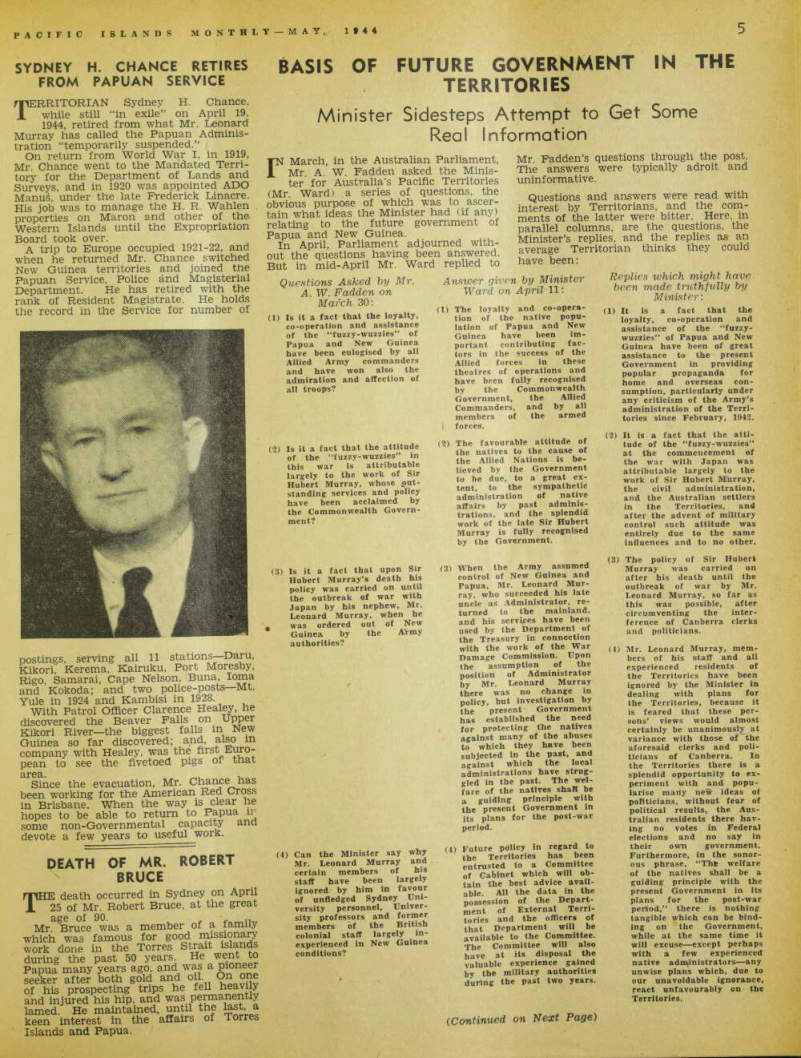
rRRITORIAN Sydney H. Chance, while still “in exile” on April 19. 1944, retired from what Mr. Leonard Murray has called the Papuan Adminis tration “temporarily suspended.”
On return from World War I, in 1919, Mr. Chance went to the Mandated Terri tory for the Department of Lands and Surveys, and in 1920 was appointed ADO Manus, under the late Frederick Linacre.
His job was to manage the H. R. Wahlen properties on Maron and other of the Western Islands until the Expropriation Board took over.
A trip to Europe occupied 1921-22, and when he returned Mr. Chance switched New Guinea territories and joined the Papuan Service, Police and Magisterial Department. He has retired with the rank of Resident Magistrate. He holds the record in the Service for number of
postings, serving all 11 stations—Darn, Kikori, Kerema, Kairuku, Port Moresby, Rigo, Samarai, Cape Nelson, Buna, loma and Kokoda; and two police-posts—Mt.
Yule in 1924 and Kambisi in 1928.
With Patrol Officer Clarence Healey, he discovered the Beaver Falls on Upper Kikori River—the biggest falls in New Guinea so far discovered; and, also in company with Healey, was the first Euro pean to see the fivetoed pigs of that Since the evacuation, Mr. Chance has been working for the American Red cross in Brisbane. When the way is clear he hopes to be able to return to Papua ir some non-Governmental capacity and devote a few years to useful work.
Death Of Mr. Robert
Bruce
rE death occurred in Sydney on April 25 of Mr. Robert Bruce, at the great
Qcto Q Qq
Mr Bruce was a member of a family which was famous for good nu s sionary work done in the Torres Strait islands during the past 50 years He went to Papua many years ago, and was a seeker after both gold and oil On one of his prospecting trips he fell heavily and injured his hip, and was permanently lamed. He maintained, until the last, a keen interest in the affairs of Torres Islands and Papua.
Territories
Basis Of Future Government In The
Minister Sidesteps Attempt to Get Some Real Information
IN March, in the Australian Parliament, Mr A. W. Fadden asked the Minis ter for Australia’s Pacific Territories (Mr. Ward) a series of questions, the obvious purpose of which was to ascer tain what ideas the Minister had (if any) relating to the future government of Papua and New Guinea.
In April, Parliament adjourned with out the questions having been answered.
But in mid-April Mr. Ward replied to
Mr Fadden’s questions through the post.
The answers were typically adroit and uninformative.
Questions and answers were read with interest by Territorians, and the com ments of the latter were bitter. Here, in parallel columns, are the questions, the Minister’s replies, and the replies as an average Territorian thinks they could have been;
Questions Asked by Mr.
A. W. Fadden on March 30: (1) Is it a fact that the loyalty, co-operation and assistance of the “fuzzy-wuzzies” of Papua and New Guinea have been eulogised by all Allied Army commanders and have won also the admiration and affection of all troops? (2) Is it a fact that the attitude of the “fuzzy-wuzzies” in this war is attributable largely to the work of Sir Hubert Murray, whose put standing services and poficy have been acclaimed by the Commonwealth Govern ment? (3) Is it a fact that upon Sir Hubert Murray’s death his policy was carried on until the outbreak of war with Japan by his nephew, Mr.
Leonard Murray, when he was ordered out of New Guinea by the Army authorities? ✓ (4) Can the Minister say why Mr. Leonard Murray and certain members of his staff have been largely ignored by him in favour of unfledged Sydney Uni versity personnel, Univer sity professors and former members of the British colonial staff largely in experienced in New Guinea conditions?
Answer given by Minister
War'd on April 11:
(1) The loyalty and co-opera tion of the native popu lation of Papua and New Guinea have been im portant contributing fac tors in the success of the Allied forces in these theatres of operations and have been fully recognised by the Commonwealth Government, the Allied Commanders, and by all members of the armed forces. (2) The favourable attitude of the natives to the cause of the Allied Nations is be lieved by the Government to be due, to a great ex tent, to the sympathetic administration of native affairs by past adminis trations, and the splendid work of the late Sir Hubert Murray is fully recognised by the Government. (3) When the Army assumed control of New Guinea and Papua, Mr. Leonard Mur ray, who succeeded his late uncle as Administrator, re turned to the mainland, and his services have been used by the Department of the Treasury in connection with the work of the War Damage Commission. Upon the assumption of the position of Administrator by Mr. Leonard Murray there was no change in policy, but investigation by the present Government has established the need for protecting the natives against many of the abuses to which they have been subjected in the past, and against which the local administrations have strug gled in the past. The wel fare of the natives shall be a guiding principle with the present Government in its plans for the post-war
period.
(4) Future policy in regard to the Territories has been entrusted to a Committee of Cabinet which will ob tain the best advice avail able. All the data in the possession of the Depart ment of External Terri tories and the officers of that Department will be available to the Committee.
The Committee will also have at its disposal the valuable experience gained by the military authorities during the past two years.
Replies which might have
been made truthfully by
Minister : (1) It is a fact that the loyalty, co-operation and assistance of the “fuzzy wuzzies” of Papua and New Guinea have been of great assistance to the present Government in providing popular propaganda for home and overseas con sumption, particularly under any criticism of the Army’s administration of the Terri tories since February, 1942. (2) It is a fact that the atti tude of the “fuazy-wuzzies” at the commencement of the war with Japan was attributable largely to the work of Sir Hubert Murray, the civil administration, and the Australian settlers in the Territories, and after the advent of military control such attitude was entirely due to the same influences and to no other. (3) The policy of Sir Hubert Murray was carried on after his death until the outbreak of war by Mr.
Leonard Murray, so far as this was possible, after circumventing the inter ference of Canberra clerks and politicians. (4) Mr. Leonard Murray, mem bers of his staff and all experienced residents of the Territories have been ignored by the Minister in dealing with plans for the Territories, because it is feared that these per sons’ views would almost certainly be unanimously at variance with those of the aforesaid clerks and poli ticians of Canberra. In the Territories there is a splendid opportunity to ex periment with and popu larise many new ideas of politicians, without fear of political results, the Aus tralian residents there hav ing no votes in Federal elections and no say in their own government.
Furthermore, in the sonor ous phrase, “Thfe welfare of the natives shall be a guiding principle with the present Government in its plans for the post-war period,” there is nothing tangible which can be bind ing on the Government, while at the same time it will excuse—except perhaps with a few experienced native administrators —any unwise plans which, due to our unavoidable ignorance, react unfavourably on the Territories.
(Continued on Next Page )
(5) Is it a fact that the Honourable Camilla Wedg wood will, under the Minister’s policy, become responsible for post-war native education in New Guinea, and that the Government, at the Minis ter’s request, has ap pointed her a Colonel in the Australian Women’s Army Service for this pur pose?
(6) If so, will the Minister say whether it is the policy of the Government to exclude, in favour of his present advisers, the former ad ministrative staff of the New Guinea service, in cluding Mr. Leonard Murray, both in an advis ory capacity and from the post-war viewpoint of the New Guinea administration service?
(5) Lieut. - Colonel the Hon.
Camilla Wedgwood is not responsible for post-war native education in New Guinea. That is a Gov ernment responsibility, but any views which she or others may express will be fully considered by the Government. Appointments to any position in the Army are determined by the Department of the Army and no request was made by the Minister for External Territories for the appointment of the Hon. Camilla Wedgwood, or for her to be given any particular rank. (6) See answer to Question 4.
(5) Lieut. - Colonel the Hon.
Camilla Wedgwood is not responsible for post-war native education in New Guinea m so far as the Minister at present is aware of any such plan. In fact, the Minister has no knowledge of Lieut. Colonel Wedgwood, nor the object of her appointment in New Guinea. Such appointment , was made by the Depart ment of the Army, doubt less for reasons of security and the defence of the Commonwealth which, of course, is intended to be its sole function.
(6) It is always the policy of the Government to exclude from the ranks of its advisers those whom it has reason to believe will ten der advice contrary to the Government’s own inclina tions. From long experi ence the Government has found that it is best served by inviting and acting upon the advice tendered by its paid Public Servants and such other experts, profes sorial and otherwise, as are known to hold views similar to those of the Government.
Forecast of Changed Industrial Conditions and
War's Effect On Fiji's Communities
Forecast of Changed Industrial Conditions and Closer Government Control
By W. G. Johnson
(Mr. W. G. Johnson, now managing director of Messrs. W. R. Carpenter & Co. (Fiji), Ltd., was a visitor to Sydney early in May. He has lived a long time in Fiji, and his opinions about the present and future condition of the Colony, in an economic and political sense, are interest ing. At our invitation, Mr. Johnson courteously supplied us with the following article.) mHE opinion is widely held that the J. Fijian natives will be unsettled in the post-war period—especially those who have been removed from communal village life and who have served with the Forces.
Undoubtedly, the Fijian will have somewhat changed views and a changed sense of monetary values; but this change is world-wide, and its relative difference to the Fijian will be not much more than to the Australian, the Ice lander or the South African.
There have been “incidents” in which the behaviour of individual Fijians has been open to criticism—there may be others—but the Fijian is amenable to discipline. He respects the authority of his chiefs, he knows the law and, pro vided he finds authority doing its job properly and warranting his respect, he will not be found rebellious, but will be a law-abiding person, and always loyal, as he has been in the past.
Many will be only too glad to try to return to the life which they have lived.
Altered economic standards and a higher living level will demand of them a greater effort, and they will fit into a sound economic plan. Past rates for service will not prevail in'the future.
Plans for the future must be based on improved levels, which can possibly be
brought about by conference with the Mother Country and other parts of the Empire, in the first instance, and assisted by international co-operation, particularly between those interested in the Pacific’s problems.
THERE will be more regulation by Gov ernment than there has been in the past; but that is not undesirable, provided it is sound.
Part of our troubles have arisen from lack of planning and control; but the development of sound commercial pur suits is the basis on which any success ful reconstruction plans, envisaging the economic advancement of the Fijians, must be based. I feel sure that com mercial enterprise, working in good liaison with the Administration, is cap able of producing reasonable results.
HERE, a word must be said of the relationship between the Adminis tration and commercialism. I am not for the moment considering com mercialism in the sense of shopkeeping, and buying and selling, but in the wider sense of development.
There is frequently jealousy between commercial and Government circles, to the disadvantage of both. Those in com merce are envied because they are said to have greater opportunities for gain. But, for the relative few who are large share holders in a successful commercial enter prise, there are many on fixed incomes.
They are important members of the com munity, who contribute their share in direct and indirect taxation, while they are in steady employment, or who, in the course of their daily work, provide ser vices essential to the support and supply of the Colony. Such commercial people frequently are not protected in their later
years by pension schemes, etc., such as are provided for Government servants.
There are advantages and disadvan tages on both sides. The point I wish to make is that jealousy and dispute over such things serve no useful purpose—and that co-operation and the general good are the things to be considered.
Those in commerce might well pause to reflect that they have some advan tages. Their successes or failures are mainly measured in terms of money Their failures are largely buried with the closing of annual accounts—provided the successes exceed the failures in a satis factory sum remaining in the profit and loss account at the end of a year. Their decisions, when taken and tried, can most times be closed off with the annual balance.
ON the other hand, many important decisions by Government continue to affect the people; and a decision to-day can still be, a matter of import ance for the community for a long time to come. True, Governments can bury their mistakes, and the people pay for them; but, measured in terms of political peace or disturbance, the decisions of Government can live to a ripe old age and continue to rise from time to time.
Many important and at times unex pected situations demand rapid decisions, the effects of which can continue for a long time. But at least the commercial man, most times, pays for his experience and is done with the incident—except to keep it in mind, to prevent his falling into the same error again.
If commercial enterprise is not ham pered and works in co-operation with the Administration, a large part of the eco nomic problems of the Fijian will be solved. This doesn’t mean that the coco nut planter will get labour in small or large numbers, at rates paid in the past, but suggests that co-operation can bring rates of pay, and returns for primary
products, and the output of industry, nearer together—particularly if Empire wide consultation and co-operation is achieved.
AND what of the Indians?
I cannot subscribe to the view set out in your publication, some time ago, that the Indians might be moved to some other part of the world, with advantage to Fiji. Population in our Islands will never prove a disadvantage.
The recent disturbance in the sugar industry, and those before it, have mostly been the result of a struggle for power between-a few Indians, all seeking to be leaders. They have influenced the masses to a greater or lesser degree. To achieve their ends they have suggested higher prices for the products of the land than reasonable economic organisation can pay.
These people cannot be deported or
(Continued on Page 39)
restrained to any great degree, because they are cunning enough to evade the law.
The Indians in Fiji are far removed from India. For most of them, Fiji is their birthplace—and for them the tales of India, and its lore and living condi tions are glamourised.
In sober mood, the Indian people appre ciate the conditions under which they live in Fiji, and the opportunities they have there. Efforts to convince them of this, and counter-measures against the few disturbers, would be amply repaid.
There is a lot of room in commercial development schemes for the Indian population, provided they realise that agriculture is their best bet, that many are fitted for industry and that the law and the civil service can absorb only relatively few.
THE partly-coloured people—the Euro
nesians—are another nroblem. Plan ned development and readiness on their part to engage in new activities— to give good work for fair pay—to show enterprise and confidence in themselves, with improved technical educational facilities, will go a long way to helping them.
But they must not lose confidence in themselves or try to go the easy way.
Those who wish to succeed must try by studv and work to fit themselves for bet ter positions. There is scope for social organisations, combining technical sub jects. among the partly-coloured people.
The latter, however, are sensitive about sympathy, or any over-emphasis of their status * With wise planning, control, co-opera tion, and readiness to accept the present and be ready for the future, and to put away some of the past, Fiii can look forward with reasonable confidence to a fair share in the New Order to which the Colonies feel they have a right.
Dr. John W. Burton, son of Rev. J. W.
Burton (secretary general of the Metho dist Overseas Mission), has been ap pointed one of the-advisers to the Govern ment representatives to the 20th Inter national Labour Conference just com pleted at Philadelphia, USA.
Advertisements & other items, p. 8 (2 items)
6
MAY, 1944 PACIFIC ISLANDS MONTHLY
Questions —And a Minister's Replies
(CONTINUED FROM PRECEDING PAGE)
Variety Entertainment
A VARIETY show by prominent radio artists, compered by Mr.
Harry Yates of 2UE, Sydney, in aid of comforts for New Guinea service men and women, will be held on Friday, June 16, at Sydney Radio Theatre, Ist Floor, Crystal Palace Arcade, 590 George Street, Sydney (near Century Theatre). Tickets are obtainable from the New Guinea Women’s Club, 77 King Street, Sydney; or by ringing Mrs. Foxcroft, LX 1778, or Mrs. McDonald, XM 3500.
Mr. Ward Arrives
This photograph (supplied by the Aus tralian Department of Information) shows Australia’s Minister for External Territories as he landed on a beach somewhere in New Guinea, and is greeted by an Australian officer.
This Minister has displayed so little knowledge and understanding of Terri tories’ conditions (his attempt to abolish the indentured labour system is referred to elsewhere) that it is not surprising to find him performing in this fashion on the beach.
The New Guinea natives are primitive folk and, in their view, a “master’s” offi cial status is indicated by his behaviour and appearance. Ordinary “masters” may do much as they please; but Minis ters and Governors, and high-ranking official people of that ilk, if they want to make upon natives an impression favourable to the Government, and gain respect and obedience, must bear them selves with dignity, and exhibit at least some of the panoply of office.
A Minister who arrives in the condition pictured above, like a sand-boy pursuing worms, must not be unhappy if he is regarded by scornful Fuzzy- Wuzzies as “something nothing.”
Among the recent New Zealand casual ties on the Italian front are two boys from Western Samoa. They are Private Roy lan Brown, son of Bums Philp’s Apia manager, who has been seriously wounded, but who, after a successful operation, is improving; and Private Louis Aspinall, who was killed in action at the end of March.
NZ Trade Regulations
for Samoa “Turnover Tax" Hits Big Firms
From Our Own Correspondent APIA, April 15.
COINCIDING with a considerable trade decrease in Western Samoa, the war emergency regulations already in force in New Zealand (regu lating all imports and exports, and pro viding for special import licences), have now been introduced into the Territory.
A special Import Control Officer has been appointed and all import licences have to be approved by licensing officers.
At the same time, “Foreign Currency Regulations” have been announced.
Under these, all foreign currency, shares, securities, etc., owned by the inhabitants of the Territory have to be declared and offered to the Administration for con version into Samoan currency. The regu lations aim mainly at the large amounts of USA currency now in the hands of Europeans and Samoans. Strange to say, a rumour has been current amongst the Samoans, for some time, that there is a possibility that the value of the Ameri can dollar, which stands at present at 6/- Samoan, will drop. Consequently, the Samoans are frantically trying to get rid of the dollars they have hoarded.
Prospects for the cocoa industry have improved of late, with better weather conditions and a satisfactory offering of plantation labour. The cocoa price, which dropped for several months past to £65 per ton, has now improved, too: £BO per ton is now offered, for hot-air dried plan tation cocoa.
Though the banana industry is still suffering from a period of labour short age and consequent neglect of planta tions, Europeans and Samoans, respond ing to appeals from the Administration, are now beginning to clean and replant their holdings. It is hoped that the pre sent small exports of the fruit to New Zealand will, in a few months, again reach normal proportions. If the New Zealand Government can see its way clear to increase the purchasing rate in accordance with the higher cost of living in the Territory, it should hasten this return to normalcy.
THE Administration, with the unani mous consent of the Samoan Legis lative Council, has imposed a new and higher “Turnover Tax” on the busi ness establishments of Western Samoa and made this tax retrospective for the past “boom” year. The new tax pro vides for a rate of h per cent, for a turn over up to £3,000, increasing by 5 hundred thousandth per £ for all turnover above £3,000, and reaching a maximum of 5 per cent, for a turnover of £93,000. Thus the larger business concerns are hit much harder than the smaller firms.
Protests by the Apia Chamber of Com merce against the conditions and the rate of the new tax were unavailing.
The death of Mr. C. W. Southey, a resident of the Ba district, Fiji, for 42 years, occurred in Rawawai hospital on March 9. With the exception of some years when he took over Navata estate on his own account, he was with the CSR Company for the whole of his residence in the Colony. He had a wide circle of friends and is survived by his widow and the following children: Mrs.
Robinson, of Suva; Mr. R. Southey, of CSR Co., Nausori; Mr. Jack Southey, marine engineer; Mrs. Fawcett, of Auck land; Mr. C. Southey, of the Public Works Department, Fiji; and Mrs.
Owens, of Ba.
No More Wooden
Houses
Tahiti's New Law
From Our Own Correspondent A REGULATION which will save the remnant of forest trees on Tahiti and thus prevent our rivers and brooks from becoming bone-dry courses at one period and raging torrents when ever rain falls in the mountains, has just been announced.
It has been enacted that, henceforth, the erection of wooden buildings is inter dicted in any part of Papeete. Building permits will be granted only for buildings of brick, stone or cement.
This excellent regulation has come just in time. Already a great number of the finest trees on the island have been sacrificed. Wood-choppers and those who employ them know little, and care less, of the effect of forest destruction on the water supply and the fertility of a region.
NG Planters
Dismal Outlook for the NG Planters Politicians Can Think Only of Fuzzy-wuzzy
rOM the wife of a New Guinea planter, who has not been heard of since he was caught in the Jap invasion of New Britain over two years ago; “Every paper one reads is full of what is to be done after the war for the natives of New Guinea. They keep harp ing on about exploitation of the natives.
We have not heard anything at all of what is to be done after the war for the planters. Aren’t they the ones who ought to be saved from exploitation and victimisation?
“Everyone who knows the Territory knows that boys who have undergone a labour contract on a properly-run plan tation are better physically, mentally and morally than the primitive natives of the jungle. The fact that so many of them sign on again, time after time, of their own free will, speaks for itself.
“There doesn’t seem to be any chance of fair compensation for us. Many planters invested their all in the Ter ritory, and spent the best years of their life there —and in some cases even lost their lives —and all for what? No one seems to think that Australia owes them anything for having developed the Territory.”
Territorians Decorated
Mbe
Capt. J. K. McCarthy (TNG).
W/O G. K. Whittaker (TNG), later promoted to the rank of Lieutenant, and “Mentioned in Despatches.”
Dcm
A/Sgt. B. W. G. Hall (P).
MM Sgt. V. H. Gilchrist (TNG).
Mentioned In Despatches
Lieutenant (Temp. Captain) L. F.
Hewlett (TNG). (Posthumously).
Major E. W. Jenyns; Captain W. M.
Edwards; Lieutenants C. G. Harris, R.
H. Phillips, K. C. McMullen, S. G. Crim son; W/Officer Neumann; Cpl. A. Moore; Riflemen G. R. Archer, J. Cavanagh, J.
W. Currie, H. W. Forrester, J. R. Kinsey, and J. E. Mayos (all of New Guinea).
Lieutenants H. T. Kienzle, A. T. Tim perly, A. H. Baldwin; Sgt. H. E. Jarrett; Privates A. A. Ramsden, S. M. Richie, and R. M. Stewart (from Papua).
Ebb-Tide In New Guinea
Two and a Half Years' Campaign Ending as Japs Are Chased Over the Border
MILITARY activity on the New Guinea mainland has been reduced prac tically to mopping-up operations in the Maaang-WewaK-But area. Attention is focused over the border, in Hollandia, and the tide of war has receded so aoruptiy from former active bases fur ther south, m Papua and the old Man dated Territory, that much comment has come from correspondents. Said “Sydney Morning Herald correspondent, H. J.
Summers, on May 4; "Hundreds of miles of road built round bases that were humming with activity only weeks ago are now carrying but a small fraction of their former traffic.
“Miles of air-strips laid down a few months ago have already served their purpose, and are deserted. Camps that covered, altogether, scores of square miles have been left by departing troops to be over-run by the swiitly-growing tropical vegetation.’
After almost years of the bitterest campaignmg in the history of modern warfare, New Guinea, as a theatre of active land operations, will soon become a matter of mere recorded history. The scene has changed greatly since those dark days of early 1942, when, with the tide running strongly against us, a few men, badly equipped for jungle fighting and knowing nothing of New Guinea, stood between the sons of Nippon and the completion of their southward march.
With the Battle of the Coral Sea, and the first land defeat of the Japs at Milne Bay, the tide, almost imperceptibly, turned. At that time, enemy forces were across the Owen Stanleys and only 32 miles airline from Port Moresby, but that marked the beginning of a retreat that brought the Japs in April, 1944, across the border into Netherlands New Guinea, to Hollandia; and that retreat has not stopped yet. rE two years since the turning of that tide have been bitter ones. No worse arena for war than New Guinea could be found.
In the days of peace it was considered sufficient to fight the country: its fevers, its incredible, heart-breaking terrain, its torrid, wet climate. Men had to be “tough” to get along there. It seemed too much to add to these natural obstacles war of the grimmest nature, against an enemy who was scarcely human. Yet it was done.
Hopelessly unprepared, in the begin ning. for this kind of jungle-sneaking war-craft, our men learned the country, and learned the Jap, and were able to outwit and outfight the fanatical little yellow men. New equipment, new health measures, new tactics, new food and even new clothing were devised to help win the battle.
And, with more naval and air power at his disposal, General MacArthur was able to evolve, in the closing months of 1943, new amphibious, leap-frogging tac tics that revolutionised Pacific strategy.
Already, observers are wondering if such places as the Philippines may be captured with no greater effort than other seemingly strong* bases have been in the South-west Pacific in the last few months.
NOW, with New Guinea a stepping stone to other places, it is of interest to see how the years’ campaign has gone in this area: Dec. (1941). —All women and children evacuated from Mandated Territory and Papua.
Jan. 4-19 (1942). —Sporadic raids on Rabaul.
Jan. 21. —Japs bomb Lae, Salamaua, Morobe.
Jan. 23. —Japs occupy Rabaul.
Feb. B.—Samara! (Papua) bombed.
Feb. 10.—Japs land at Gasmata (New Britain).
Feb. 24.—Japs bomb Port Moresby.
Mar. 19. —General Douglas MacArtbur appointed supreme Allied commander in South-west Pacific.
Apl. B.—Japanese occupy Lorengau (Admiralties).
May 9-11. —Battle of Coral Sea. Japanese lose 12 vessels, including two aircraft carriers and two heavy cruisers. Defeated, they withdraw northwards.
July 22,—Small Jap force lands at Gona Mission (north-east Papua) and penetrates inland towards Kokoda Valley.
Aug. 18.—Japs around Gona and Buna re inforced; they renew their advance into foot hills of Owen Stanley Ranges.
Aug. 26. —Japs land at Milne Bay; meet re sistance from Australian forces.
Sept. I.—Japs fall into trap at Milne Bay, driven into northern peninsula and systematically exterminated by Australians.
Sept. 2-9. —Persistent Japanese infiltration in Owen Stanleys. Japs reach the Gap, beyond Kokoda.
Sept. 14.—Japs cross Owen Stanleys, and are on southern slopes, 40 miles from Port Moresby.
Sept, 18. —Japs within 32 miles (air-line) of Port Moresby. Heavy fighting at loribaiwa.
Oct. I.—Australians have taken loribaiwa Ridge and are advancing—the Japs falling back.
Oct. 5. —Australians back over the Gap, chasing retreating Japs.
Nov. 4.—Australians capture Kokoda. Jap con voy, with 7,000 reinforcements, driven from Buna.
Nov. B.—US forces landed in north-west Papua by air in October have now penetrated to near Buna.
Nov. 17. —American and Australian forces in Buna-Gona area link up.
Dec. 11. —Australians occupy Gona.
Jan. 4 (1943). —Buna at last captured.
Jan. 13. —Fighting in Papua reaches climax with fierce fighting at Sanananda Point) activity then moves north. Madang and Wewak have been occupied by Japanese during December- January, and are placed on Allied bombing schedule. At end of January Japs attack Wau, in Morobe, with ground forces.
Feb. 2. —Japs retreat, Australians in pursuit, from Wau through jungles to Mubo.
Mar. 2-3. —Battle of Bismarck Sea; Japs lost 22 ships, 15,000 troops, 63 aircraft.
July . —US forces occupy Trobriands and Wood lark Island (off coast of Papua). Other US forces land at Nassau Bay (15 miles from Salamaua), and march inland to join up with Australians, who are fighting in that area. All landings unopposed.
July 17.—Americans and Australians capture Mubo and press on to Komiatum, overlooking Salamaua.
Aug. 4.—Allied artillery, manhandled up the coast from Nassau, now shelling Jap position at Salamaua.
Aug. 19-23.—Heavy air blitz on Wewak air fields; over 200 enemy planes destroyed.
Aug. 25. —Allied warships shell Finschhafen.
Sept. 4.—Allied heavy bombers attack Wewak. and Alexishafen, near Madang. Alexishafen cathedral, apparently used as enemy am munition dump, exploded from direct hit.
Sept. 4.—AIF Ninth Division lands near Lae.
Another special AIF force, after five days’ forced march through jungle, links up with American and Australian paratroops in Markham Valley. All forces advancing on Lae-Salamaua area.
Sept. 12. —Salamaua is captured by mixed Allied force.
Sept. 20. —Australians capture Lae; Japs who escaped to the mountains are being mopped up.
Sept. 24.—Australian troops land six miles north of Finschhafen.
Oct. 2. —Australians capture Finschhafen. Other Australians, pressing over Markham-Ramu divide, are now 90 miles from Madang.
Oct. 23. —The Japs now isolated behind Finsch hafen make desperate effort to reach sea, but have been driven back to Satelberg.
Nov. 1. —American troops land at Empress, Augusta Bay, Bougainville.
Nov. s.—Rabaul is being bombed continually; 11 enemy ships and 85 planes destroyed.
Nov. 25.—Australians capture Satelberg; Japs in retreat.
Dec. 14. —After heaviest Allied blitz yet made in New Britain, American troops landed and occupied Arawe, between Gasmata and Cape Gloucester.
Dec. 28.—Successful new landings made by Americans in Cape Gloucester area, New Britain.
Jan. 4 (1944). —Americans land at Saidor (New Guinea mainland), 60 miles south-east of Madang. Japs now between Australians advancing from east, and Americans.
Feb. 16. —Allied troops land on Rooke Island, between New Britain and New Guinea.
Teb. 17.—New Zealand and US troops land and occupy Green Islands ((Nissan).
Feb. 27.—Allied destroyers have shelled Kavieng (New Ireland) and Rabaul (New Britain).
Mar. I.—American troops land on Los Negros (Admiralty Islands).
Mar. 9.—American Marines land at Talasea, 180 miles from Rabaul, on north coast of New Britain.
Mar. 20.—US Marines land at Emirau and Elo musao Island, north-west of Kavieng, New Ireland.
Mar. 30.—Daily air-blitz on Kavieng and Rabaul continues.
Apl. I.—llB Japanese planes destroyed at Hol landia, Dutch New Guinea.
Apl. 6.—290 Japanese planes destroyed at Hollandia.
Apl. 12.—Major portion of New Britain now in Allied hands; Japs withdrawing for final stand in Rabaul.
Apl. 14. —Australians have captured Bogadjim, Jap base on northern New Guinea coast.
Apl. 22.—Allied landings at Aitape (Australian New Guinea), and Humbolt Bay, Hollandia and Tanahmerah (Dutch New Guinea).
Apl. 24.—Australians capture Madang; and, a few days later, Alexishafen. rE campaign in the South and South west Pacific (Solomons, Bismarck Archipelago and New Guinea) is ended. The Jap lines of organised defence are broken and gone. There are no Jap bases capable of aggressive action nearer than the Netherlands Indies and the Caroline Islands. There are thousands of Japs still in the areas mentioned; but they are only the broken remnants of enemy divisions, and they are wandering, foodless and hopeless, in the jungles of New Guinea, New Britain, New Ireland
and Bougainville,
Now that the campaign there is over, many people hope that civilians soon may be permitted to return to the Mandated Territory. There is little chance of that.
A few selected miners and planters may go back; but it is plain that the New Guinea area, for some considerable time, will be used as a base for operations westwards and northwards, and there fore it may remain under military administration.
If the authorities really wished for civilian re-occupation, they could arrange it easily enough, once the Jap remnants have been mopped up. But it is not expected that the military administra tion will take a favourable view of civilian
re-occupation, in any circumstances,
before the end of the war.
The Japs’ farthest south —the long, long trail over the Owen Stanley Mountains.
thankf the’ native Tace for thereat
Tropicalities
rE mystery of Amelia Earhart Put nam’s disappearance may have some light thrown upon it if the story of natives in the Marshall Islands is true.
Reports • from Washington, USA, on March 22, quoted two Navy lieutenants as saying that natives in captured Mar shall Islands told a story of a white woman who crashed in a plane there several years ago.
The natives said that the woman had been taken to Japan by Nipponese who picked her up. It will be remembered that at the time of her disappearance, the Japanese Government refused permission for search parties to enter the Jap-man dated , islands, saying that the “natives were too wild.”
The aviatrix disappeared on July 2, 1937, after leaving Lae, New Guinea. Her last message was that she was over the Pacific with a half-hour’s fuel supply and not in sight of land. * BOYS” are still very much “boys” in New Guinea, when it comes to kai kai (if not other things) in spite of Mr. Eddie (Fuzzy-Wuzzy) Ward’s appar ent urge to bump up their vitamin intake with canned tomato juice, three pounds of meat per week, etc., etc.: — “Old-timer” was in charge of a small patrol boat off the coast of New Guinea.
His crew consisted of five Navy lads, one of whom acted as cook. One dawn the lookout sighted a canoe containing two natives who were duly picked up. It transpired that they had escaped, by aevious means, from the Japs.
The crew was about to sit down to breakfast —boiled rice and prunes, fried potatoes and bacon —so “Old-timer” instructed the cook to “give the boys a feed.” The cook set up a table on the hatch, with all the trimmings, and put the food down. The boys looked it over for a long time and then gingerly picked the piece of “pig” off the plate and ate it, leavihg the rest.
“Old-timer” took it all in; he got up, collected an enamel wash-basin, then to the galley, emptied the rice-pot into the dish, plus a tin of “Libby’s best,” shoved two spoons in the rice and handed the lot to the boys.
A short while later the boys brought the empty dish and spoons back to “Old timer,” who asked, “Kai-kai enough?”
The boys answered, “Yes, master. Bell ’e full up true. Number-one kai-kai too mus!”
The Navy cook was heard to mutter in his beard: “Well, wouldn't that rock yer!”—“TEX.” ♦ AND talking of food! Due to the rigid line of demarcation between Euro pean and native eats, in the days along before, even the most gem-like cook-boy was liable to commit harassing culinary faux pas, with somewhat mixed results. Recently a resident of New Guinea, who possessed (1) a Buka cook boy who allegedly “understood almost straight English” and (2) an all-purpose recipe for batter which went variously round banana fritters, apple ditto, fried fish, etc., told us the following story: Buka’s memory had momentary break downs, so it was her custom to make him repeat precisely what he intended to do in the cooking line. However, one day an unexpected visitor turned up at lunch-time and hurriedly she went into the store, dug out a tin of whitebait and said to Buka: “Make ’im all the same banana fritters —you savvy?” Yes, Buka savvied; so she returned to her guest.
Half an hour later, lunch was served.
The platter was placed in front of “missus”—a mound of fluffy, white, mashed potatoes and golden-brown frit ters. The guest was served and the meal began But-Buka had got his wires crossed again. He had made up the whitebait “all the same banana fritters” —but had clean forgotten to leave out the bananas! * IIIE can vouch for the authenticity of ?? that one; but maybe not for the hoary old Salamaua “sausage” story, which, however, might bear repeating here: • After the first freezer came to the dis trict, a resident bought some sausages and took them home to the cook-boy.
These were the first un-canned sausages the boy had ever seen, so the “master" thought a few instructions were called for; briefly, therefore, he told the boy to get a pan and “work ’im all the same fish.” Some time later the meal made its appearance—vegetables and a pile of frizzled sausage skins.
“Master” called the boy to him and asked him what in heaven’s name he’d done.
The boy replied, “You talk-talk work ’im all the same pish. Alright, me work ’im all the same pish. Me catchim’ knife, now me cuttim skin, now me rouse ’im bel belong ’im, now me cook ’im skin —all the same pish!” • an article by Harold Cooper, Jf describing a journey by PT boat in Solomons waters; “After a while I went below. Like Miss Garbo, but for ’somewhat different rea
sons, 1 wanted to be alone. 1 half walked, was half thrown, into the bunk the skip per had said I might use if weariness (to give it the least humiliating description) rest of that niaht mare ioumey clutching a wooden bar whlch a thoughtful designer had Glared alone the wall iust above mv head and SSS* ut the LchorLf of which I should have been,flung at frequer^inter vals aga i ns t the roof “ Th fate of the * boat had ceased to concern me. For once in my leftish life j felt a cer t a i n kinship with General Franco He too knows what it is tn he so pre-occupied with threatened internal convulsions that one comes to listen with jaundiced indifference to the thunder rolling and crashing in the world Gut side” * OAID Ratu J. L. V. Sukuna, CBE, Sec- O retary for Fijian Affairs, addressing the Governor of Fiji in February, during the debate in the Legislative Council on the new Native Affairs Bill, which aims to give Fijians a bigger share in their administration: “Across the sea, beyond the Lau Islands, there lies the Kingdom of Traga. For nearly 40 years the Tohgans, with a more democratic form of govern ment than the one provided for in this Bill, have carried on their government with credit to themselves and with suc cess to their country and I see no reason why, with the goodwill of the Indians and the Europeans, the sympathetic co operation of this Council, and the benign control of the Government, Fijians should not succeed in the same . to vou sir T wlsh to exDress the
thankf the’ native Tace for thereat
tnanks 01 native race for the great
(Continued on Page 10)
part you have taken in introducing this measure. You framed it; you looked after it in its early stages; you are greatly interested in it. I have to thank you, too, sir, for the trust you are placing in the chiefs and for your faith in the devotion and loyalty of our people.”
WHEN the Governor of Fiji, Sir Philip Mitchell, was in New Zealand, in mid-April, he told Press representa tives that the patriotism of the native Fijians had been so intense that the Government had had to go into “reverse conscription” and ban further enlist ments, after they had formed a brigade and a labour corps.
“One of the best stories of the recruit ing period,” said Sir Philip, “concerned three grey-haired residents of an island some miles to the south of Fiji. One day they arrived on my doorstep, demanded to see me, and indignantly inquired why they had not been asked to join the labour corps. They pointed out that they had been members of the Fiji labour corps in France in the last war. They made light of their grey hairs, and pointedly suggested that the corps could not function without them. They were duly enlisted.” * ALL Territorians of late thirties vin tage, in the Wewak area knew Dr. and Mrs. C. M. Deland and their fine brood of young sons. European children in that part of the Territory were rare, and of educational facilities there were none; so *Mrs. Deland held “school” for her children each day. It is interesting to note therefore, that Raymond Deland—now 16 years old — appears to be on the threshold of a bril liant scholastic career. He was recently awarded a bursary for four years at the University Adelaide; a year ago he was awarded the Angas Engineering Exhibi tion; and in the Intermediate, Leaving and Leaving Honours examinations he obtained honours in mathematics and physics. •
T Leut.-Colonel G. Warner
NICHOLAS, provost marshal with the US forces in Fiji since Novem ber, 1942, has received from members of the Fiji Police Department the “tabua” or whale’s tooth, as a mark of esteem.
The presentation was made by Sub- Inspector Ratu Bosi, who fought with the Fijians on Guadalcanal, and in the presence of Fiji Police Commissioner Col.
E. J. Workman, European, Indian and Fijian members of the Force, and US Army and Navy officers. Following the presentation, a Fijian dance was executed.
According to ancient Fijian lore, the “tabua” was used on all special occasions such as the acquiring of property, win ning the hand of a girl of high birth, at the birth of a child and to honour noted visitors. It was also used at the installa tion of Fijian chiefs and was sometimes thrown at a certain tree near the entrance to the . spirit world.
The “tabua” presented to the Ameri can colonel was approximately five •by two inches and suspended from a decora tive rope made of coconut fibre.
Americans consider that they have had splendid co-operation from the Fiji Police Department, and this was referred to by the colonel in his speech of thanks.
—H.E.L.P.
Mr. Harold Cooper, of Fiji, has been appointed Acting Assistant Colonial Secretary (War) for the Colony. As a Rehabilitation Officer, he also becomes a member of the War Pensions Board.
"Dollar Prosperity"
A scene in the main street of Apia, Western Samoa, during the “dollar prosperity’’ period when curio sellers reaped a rich harvest. The boom is now over and Samon has returned to normal. —US Army Corps Photo.
Where Are Copra
Pool Funds?
SOME New Guinea planters are com plaining that they have received • from the “New Guinea Copra Pool” (brought into operation in 1941, and put out of business by the Japanese invasion early in 1942) no payment for their copra beyond the £4 per ton originally allowed to them.
It will be remembered that the Man dated Territory planters were forced into the Pool by the Federal authority, but the Papuan planters were not. The Federal authority has paid at least £B/10/- per ton to all Papuan planters from whom copra was taken over in that 1941-42 period; but the New Guinea planters, although definitely promised some further payment (which they anticipated would at least bring the total up to £8 or £9 per ton) have received nothing.
Immediately prior to Pearl Harbour, copra was a drug in the market; but, from the moment the Pacific war broke out, copra became exceedingly valuable.
It is known that the copra in that Aus tralian-New Guinea Pool in December, 1941, and afterwards, was sold at high prices; but neither the interested plant ers nor their representatives have been able to get any statement of accounts, although more than two years have passed. It appears to be the usual story of a Government Department engaged in commerce: dilatoriness, and the utmost reluctance to distribute moneys.
One Australian firm says that it sold to the Pool copra from its own planta tions at £4 per ton, and later bought copra from the Pool, in Australia, at a price more than twice that figure; but it never has had any further dividend from the Pool. Probably, like most Gov ernment-controlled funds, all the balance has been eaten up in expenses.
Memories
fIIHERE was an Islands world I knew, X and loved, Where shadows flirted shyly with the sun, And filigreed through palms, to dance and sway In trembling traceries, as day begun.
There was the murmuring laughter when boys swam, The taunting jests of “Maries” on the shore, And through the surf’s song stole a sense of peace (A lullaby to haunt one evermore).
There were a hundred pleasant daily tasks, No haste nor speed of traffic smote my soul— Those lotus years in which I garnered much, From village lore to native humour droll.
That Islands world we knew and loved is gone. ’Twas written on the winds of North and East, \ Yet now and then, in friendly gatherings Come wind-blown leaves, on which our memories feast,
Alice Allen Innes.
Vaucluse.
Mr. S. G. Marshall, at the end of March, was appointed Assistant Pro vincial Commissioner of Bua, Fiji.
Henry Nott Centenary
From Our Own Correspondent PAPEETE, April 20.
MAY 2 will be the one hundredth anni versary of the death of that famous South Seas missionary, Henry Nott; and Mr. W. W. Bolton, whose work as a historian is well known, has taken measures to have a fitting service of remembrance.
The late Mr. J. L. Phillips, in his time, and now Mr. Bolton and myself, have striven to hold in honour and remem brance this great architect of South Sea missionary achievement, and to remind the younger generation of Tahitians of the measureless debt they owe him. In this undertaking we have the hearty support of the present head of the French Pro testant Mission in French Oceania.
In earlier times, some of our friends among the clergy were inclined to—let us say—a rather provincial attitude toward Henry Nott, and we did not enjoy the cordial understanding accorded us to-day.
Death On Operations
Presumed
NEWS has recently been received of the death, while on operations, of Flying-Officer Bryan Francis Law ler, formerly of the Post Office staff in Rabaul, New Guinea. This young man was well known to many Territorians and took a prominent part in the sporting and social life of the town. Early in the war he came South to enlist in the RAAF, and was serving in the Mediterranean theatre of operations when he died.
It appears that early in the morning of April 8, 1944, the aircraft in which he was flying was shot down while about 20 miles from the coast of Gorgona Island (off Italy). The crew of six took to the rubber dinghy, which drifted for some days, and eventually the men became so weak from exposure and starvation that four of them (of whom Flying-Officer Lawler was one) fell off and were seen no more. Two of the crew finally man aged to reach the island.
Advertisements & other items, p. 12 (1 item)
10
MAY, 1944 PACIFIC ISLANDS MONTHLY
TROPICALITIES
(Continued from Page 9)
of Industry
New Guinea Gold
Hopes for Resumption of Industry
HOPES are entertained that, at an early date, the gold-mining industry in the Morobe district will be resumed. A great deal of damage has been done in the gold-mining centres since the invasion in January, 1942 especially at Wau and Bulolo—but the mining people have both the will and the facilities to re-commence operations, and they are pressing for permission to return.
So far, the military authorities have given them little encouragement. The Mandated Territory is under military government, and is likely to remain so for a long time after the last of the Japs have been rooted out of the jungles.
The chief problem is supply. If the goldfields people returned, it would be necessary to provide them with regular transport and communications; and, even if there is no longer any danger from Jap bombers from the northern New Guinea coast, the establishment of a regular shipping service would be diffi cult.
The most enterprising and efficient company operating on the Morobe field, Bulolo Gold Dredging, Ltd. (it won 1,297,416 ounces of gold and 575,726 ounces of silver, between 1932 and 1942, inclusive) is ready to go back to New Guinea, and it has its enormous equip ment, and between £1,000,000 and £1,500.000 Australian, in cash, all ready for employment. Its two hydro-electric power stations were wrecked, soon after the invasion, and its eight dredges dam aged; but it is believed that the latter damage is light. The replacement of the heavy duty hydro-electric machinery will be a difficult task under wartime con ditions, however.
The company’s 13th annual report, just issued, said that civilians had not been allowed to enter the Territory in the year ended May 31, 1943, and it was impos sible to make a survey of war damage and complete a war insurance claim. “It is certain, however, that the preliminary claim of £538,426, lodged in 1942 with the Australian War Damage Commission, will have to be supplemented,” said the directors.
The present BGD directors are: W. A.
Freeman (chairman), C. A. Banks (man aging). Frank R. Short. Leslie V. Water house, C. O. Lindberg. Karl F. Hoffmann, Raymond E. Franklin, H. A. Gould.
Lieut.-Colonel Franklin is on active ser vice with the American Army.
Death of Pte. Lawrence Boyer
on Active Service
RELATIVES in Suva, Fiji, have been notified of the death of Private Lawrence Bover, while serving with NZEF in Italy. He was born in Tonga and came to Fiji with his family at an early age. He went to school at St. Felix College and later joined the staff of Morris Hedstrom, Ltd. He was an outstanding football and hockey player, and had many friends in the Colony.
Pte. Boyer was a member of a large family. His mother is Mrs. Mary Boyer, of Suva, and he has eight sisters and two brothers; Miss Tippina Boyer and Mrs.
Lena Brusowitz, of Sweden; Mrs. W.
Ostermann, Mrs. W. Edwards. Mrs. P.
Tito, and Mrs. L. Pearson, Auckland; Mrs. W. Briggs. Tonga; and Mrs. M. B.
Wright, Suva; Messrs. Joe and Jim Boyer, Suva.
Natives And Medical
Training
Letter to the Editor I HAVE read with interest (“PIM,”
December) Mr. E. J. Wright’s argu ments against the wisdom of having New Guinea natives trained at the Suva Medical School. But some 30 years’ experience of the New Guinea native leads me to the conclusion that Mr.
Wright may know more about medicine than he does about the mentality of what Jie rather inaccurately terms his “Mela nesian” friends.
He stresses his difficulty in getting the Papuans to accept European medical ser vices. But in the Trobriands, in 1931, while carrying out routine medical work, I had the experience of finding, each Monday morning, at least 200 natives of both sexes anxiously awaiting the open ing of the surgery, where later they would receive health-giving “needles” and other medical care.
It is all a matter of gaining the con fidence of these people, and of their observing results.
The difficulties in achieving satisfac tory results by sending Papuans overseas for medical training arise from two fac tors, both domestic—for the personal aspect is of tremendous importance to the native mind. The first is the diffi culty in inducing many intelligent and educated local natives to proceed far overseas, for four years, away from their kith and kin. The second is the almost certainty that when such refined and highly-trained natives return from the Suva School, they would be treated by the average local officials and residents as mere natives, without special privilege.
Their education finalised, their ambitions stirred by travel overseas, they would be brought up with a jolt that would wound their sensitive nature and discourage them, probably for good.
As for intelligence; the fortunes of war have brought me to the New Hebrides for the time being, and I can inform Mr.
Wright that my experience here with these much older “civilised” Melanesians has convinced me that the much more primitive natives of New Guinea can more than hold their own, so far as initiative and intelligence are concerned, with the natives of these dually-controlled isles.
The loneliest soul in the tropics is the half-caste. He is admitted to the com pany of neither the whites nor the natives. Intensive education of intelli gent natives will set up a class equally remote. That is why, on the whole, I would prefer to see the future Medical Service of New Guinea staffed by white doctors keen on their job, assisted by natives trained locally in primary medi cal work. The time has not yet come for any more ambitious plan.
I am, etc.,
Alexander Rentoul.
Vila, NH.
No Successor Yet To
O.F. Nelson
From Our Own Correspondent APIA, April 15.
AFTER the recent death of Mr. O. F.
Nelson, senior elected European member of the Western Samoan Legislative Council, representations were made to the Administration to have another European elected in his place; or for the appointment of one of the candidates from the last election.
However, although the Administration has immediately filled the places of offi cial members who have left the Territory, so far no successor has been appointed to Mr. Nelson —and this in spite of the fact that the Council met recently and will do so again shortly.
Chaulmoogra Oil
IT was suggested in Fiji in December that as local Chaulmoogra oil was favoured at Makogai Leper Station for the cure of leprosy, Fiji planters might care to grow a few Hydnocarpus trees, from which the oil is obtained, and so help this worthy cause. Seeds were available from the Agricultural Depart ment.
It is stated in the March issue of the Fiji “Agricultural Journal” that only four inquiries had been received in response to the suggestion; but planters and others were reminded that seed was still avail able at the Department of Agriculture, Suva, and from Agricultural Officers at Naduruloulou and Sigatoka.
Advertisements & other items, p. 13 (1 item)
Pacific Territories Association
T u p qppnnri Annual General Meeting of members will be held on Tuesday, 27th at the Teachers’ Federation Hall. 7th Floor, 166 Phillip Street, Sydney, at 8 p.m.
BUSINESS :
(1) Xo receive the Report of the Executive. (2) To receive the Financial Statements and Auditors' Report for the year ended 31/5/44. ... (3) Election of office-bearers for the ensuing twelve months. s-srs ““ - “ President
Vice-president
Treasurer Executive members consisting of: 2 Commercial Representatives 2 Planters’ 2 Mining 2 Civil Service - . .. (being one each for Papua and the Territory of New Guinea.)
C. A. M. ADELSKOLD,
Queen
Tonga—And Its
Misleading Twaddle in Australian Paper
r ROUGH the medium of Australia’s “luxury” periodical, the “ABC Weekly”—which Australian radio listeners keep floating in red ink to the tune of about £BO,OOO per annum—Mjss Beatrice Grimshaw has been “round trinping” again. This time to Tonga.
The popular writer portrays Tonga as a comic-opera kingdom which “ . . . under better circumstances would be a health resort for people from many other countries desiring rest and change in one of the most attractive of South Sea lands.”
Why Tonga should be turned into a health resort for ailing Europeans we can’t imagine—unless it is the Europeans’ divine belief that even sick members of their race can confer untold benefits on more benighted folk.
The article, mostly a fanciful disser tation on Queen Salote’s immediate fore bears, describes Tonga as “celebrated as the scene of Mariner’s great travel book.”
We have always understood that, far from being a round-tripper of the cruise age, Mariner was wrecked, pr marooned, on Tonga nearly two hundred years ago; and that the book he wrote after his escape is looked upon by historians and anthropologists as the classic on Tonga as it was before the European era. fIIHE article continues: X “These islands for a long time have been considered politically important, on account of their situation, which makes them a kind of stepping-stone between two great colonies. Up till 1900. Germany had considerable influence there. King George Tubou 11. father of the present Queen, when bent upon marriage applied first to the Kaiser for the hand of any eligible German princess ‘before settling upon a more suitable match at home.
“Tn 1900. however. Britain established a Protectorate. The Queen is allowed con siderable local powers, and as much state
as she wants. A Consul, supplied by Britain, is supposed to ‘advise’ on matters °i importance, and most of the officials ol the Tongan Public Service are white men from New Zealand.
“A Civil Service of white, employed and paid by coloured people, is an anomaly, but it appears to work well on the whole, although somewhat handicapped by the prevailing Tongan attitude towards white people. The Tongans have always con sidered themselves divine, and therefore superior to any other people. The cour tesy and kindness of other Pacific races are wanting in Tonga. Passing travellers of standing, who have come with hand some gifts to the Royal Family, have been amazed by the Royal custom of receiv ing all such without acknowledgment or thanks. ‘lt is done’ that way in the palace.
“The principal island. Tongatabu (“Holy Tonga”), is flat, which makes it prac tically a natural aerodrome. The same can be said of most of Haapai, the next important island. But Vavau, nearer Fiji, has one of the finest harbours in the Pacific, nerfectly protected on all sides by high hills, and very deep.
“Tofoa is known as Tin-Can Island, because mails are taken out to sea and brought in by a swimmer carrying a sealed can. The island is difficult of ap proach, barren and volcanic, and has only what one might call journalistic import ance.
“Tourists have never been encouraged in Tonga, and there is little accommo dation for them.”
IN a subsequent issue of the “Weekly,” two ex-residents of Tonea, E. E V Collocott, of Kiama, NSW. and C.
Moore, of Fairfield West, NSW, express themselves vigorously in letters to the editor. They were residents for J 3 years and 8 years resnectively and the article is variously described as “twaddle,” and the author as a “typical tourist who spends a few hours in one of the ports of Tonga, makes notes of a few yarns told on the boat, and then ‘educates’ the Australian public on Pacific matters.”
The Australian public to-day will swallow anything that is dished out by
the growing number of self-appointed Pacific “experts.” It is to be regretted that there is not always at hand, people who can refute their misleading state ments, as there was in this case: Prom Mr. Collocott’s letter: “The late King George Tubou II and his daughter, the present Queen Salote are distinguished by fine intelligence, dignified courtesy, and an endearing kindliness and charm. The heir to the Tongan Crown, besides having proved himself as athlete and sportsman, is a graduate in Law and Arts of Sydney University.
“There are topographical errors in the ABC article. Tofoa —presumably Tofua is meant—is not the island where the mails are taken out and brought in by a swimmer with a sealed can. This is done at Niua Po’ou, 150 miles or so to the north. Haapai is not the name of an island, but of an archipelago of many small islands.”
From Mr. Moore: "One word about ‘ingratitude of the Palace’: to my personal knowledge there have been boat days when a succession "of white tourists walked, uninvited, into the Queen's residence, and even invaded her private apartment. How scathingly a Tongan might write of the lack of politeness of Europeans.
“There are many in this country who know the Queen of Tonga to be a graci ous lady, and a very wise ruler of her little kingdom.”
Lepers Trust Board Extends
Its Work
From Our Own Correspondent NOUMEA. April 17. mHE New Zealand Lepers’ Trust Board.
X which over a number of years has done so much for leper colonies in the South Pacific, has donated to the French leper station at Ducos Peninsula.
New Caledonia. £5OO worth of men’s and women’s clothing, foodstuffs, sweets, tobacco, toilet and other useful articles.
A portion of the gift, which reached the island in 40 large packing cases, will be reserved for lepers in the Loyalty Group.
The gift makes a particularly friendly impression on our French and native allies, and the Governor (M. Tallec) and the head of the local Health Depart ment (Dr. Sellier) have expressed their thanks to the Board’s secretary.
The Ducos settlement has a history going back to the 1870’s —when the penin sula on which it stands was the home -of many hundred transportees of the Paris Commune, and it was from here that the noted pamphleteer, the Comte de Rochefort, with two or three companions, made his dramatic escape to Australia and so caused the dismissal of the island’s Governor as well as of many penitentiary officials. As a leper colony, however, the Ducos settlement dates back
only to the early days of the present century. fItHE New Zealand Lepers’ Trust Board X assists lepers irrespective of creed and colour, and has hitherto made it a practice to function through the well-known Fiji Government central sta tion at Makogai. Last year, a special appeal was made for lepers outside Makogai, and as no central leper hos pitals existed in the British South Solo mons and the New Hebrides, the Board made grants of £5OO each to the follow ing religious bodies doing medical work in these areas; the grants being ear marked to provide and equip dispensaries for the treatment of patients and not for religious purposes: The Melanesian Mis sion (Anglican), the Presbyterian Mis sion, the Methodist Mission, the Seventh Day Adventist Mission, and the Marist Mission (Catholic). In 1942 a grant of £250 to provide Christmas comforts for lepers under their care was made to some of the largest bodies working in the Solomons.
That the Board is extending its work in the South Pacific is evident from the first goodwill present from New Zealand to the 422 patients in New Caledonia (including 60 Europeans),
Misima Medical Orderly
Decorated
Prom a Special Correspondent AN impressive little ceremony was per formed at Misima on March 16. when Corporal of the ANGAU medical section, was' presented with the Loyal Service Medal by the officer commanding the station.
Many Papuans have received such military honours and many more have richly deserved them. With few excep tions, their conduct during the war has been such as to reflect great credit on those great Australians, esnecially Sir Hubert Murray, who were charged with the preservation and development of the primitive Papuan race, and whose work has resulted in loyalty and steadfastness during the present war.
Corporal Ebenezer was in charge of the native hospital at Misima when hostili ties with Japan broke out. Though given an opportunity to leave, he remained at his post and gave useful service through out the troubled times that followed the withdrawal of the Government and the white community. The award of the medal has crowned his work and brought home to the fifteen hundred natives present, the fact that loyal and plucky conduct does not pass unnoticed.
Following the presentation and the singing of “God Save the King” by a native choir, a big kai kal and sports were held, and the whole proceedings was marked by the happy and contented mood of the natives under the resumed adminis tration by ANGAU.
Old hands from Misima will be glad to learn that the island is little changed.
The bush tracks may be a little more overgrown and deserted, and the absence of the lorries and gaiety of “steamer days” has made the island quieter, but it is still the same old Misima (without the beer, perhaps).
The “Fuzzies” are awaiting the master’s return. Prom the look of things they will offer a warm welcome home to their old friends of the mining community.
Remarkable Possibilities of High Country
Fiji For Mixed Farming
A DISCUSSION on a proposal by the Fiji Returned Soldiers and Sailors' Association, thaj; steps now be taken to prepare for the settlement on the land of suitable ex-servicemen, has brought to light interesting information about the possibilities of Fiji as a home for Euro pean and part-European mixed farmers.
The Association, in its 1943 report, pointed out that, although Fiji’s two chief industries are sugar-growing and gold-mining (measured in terms of pro duction and export), only part of the income from sugar and none from gold remain in the Colony. It was urged, therefore, that every encouragement should be given to the settlement of individual farmers and planters; and the claims of coconut-planting, banana growing and dairying were mentioned, in that order. It was suggested that a wider market could be found for Fiji bananas, possibly in western Canada.
This brought an interesting rejoinder from Mr. Theo D. Riaz. who has lived in Fiji for 40 years, and who is a successful farmer and planter in Nadarivatu, in the Colo North (western) section of Viti Levu. He is a practical man. who under stands agricultural life in Fiji.
Mr. Riaz has prepared, for the RSS Association (of which, as a Boer War veteran, he is a member) a detailed plan for the establishment of settlements for ex-servicemen; and the following are extracts from his covering letter.
“fIIHE president has placed considerable JL t stress upon the coconut and banana growing industries as avenues for the settlement of ex-servicemen, whilst the dairying industry is dismissed with something akin to contempt.
“As coconut-planting has been given pride of place, I will deal with that first.
Let us assume that a man takes up an area of 300 acres—less than that would be of no use—and that the trees are all in full bearing; that he and his family (if he has one) perform the bulk of the plantation work. We will assume further that he obtains a yield of one ton of copra to every four acres; also that he averages £lO per ton for his copra on the beach Cthouah both of the foregoing esti mates are high). Then he will earn a gross income of £750 per annum, out of which he will have to meet the following charges;— £ £
“Two hundred and ten pounds does not seem much on which to live, and even that income is likely not to be realised because of the facts already stated—viz., the high estimate of copra yield and price on the beach. If the victim, hoping thereby to increase his income, were to take up a larger area than 300 acres, his expenses would rise considerably, with a by no means commensurate increase in his net annual income.
“Our president, when dealing with the dairying industry says, inter alia, that ‘after 20 years no appreciable export market has been built up’; which, he claims, demonstrates that the market is a purely local one. With all due defer ence, I disagree with him. I find it diffi cult to understand how an export market can be built up when there are no sur pluses to export. Besides, the first con sideration is the provision of a decent livelihood for a man and his family— which means that he has an abundance of milk, cream, butter, cheese, eggs, poul try. pork, bacon, beef, vegetables and fruit. All of these things can be pro duced in abundance in my district of Colo North.
“The president suggests that bananas be grown in three zones of approximately 10,000 acres each, by which system of zoning he claims that the export trade will not become entirely disorganised through one zone being blown out by
hurricanes—though what is to become of those growers who are so unfortunate as to be farming in the devastated zone or zones he does not reveal.
“It seems to me that in order to make the zoning scheme a success it will be necessary to institute some system of crop insurance, by means of which the farmer can be insured against loss through the destruction of his crops by hurricane. Whether such an insurance scheme can be made to work I am not prepared to say. Diversified farming is a good assurance to the farmer that he will not be brought to bankruptcy, or to the verge of destitution through bad markets, or hurricane, both of which he is sure to have to face if he is so ill advised as to place all his eggs in one basket.
“The author of the settlement plan is in effect asking the Association to induce ex-servicemen to place all their eggs in one basket, one of which eggs (copra) is,
By income <50 To Rent and sinking fund 300 „ Sacks and twine ... 75 „ Interest on outlay for vatas, tools, etc 75 „ Fire and hurricane insurance 30 .. Hire of casual labour .. 60 Balance 210 £750 £750
in my opinion, already badly addled. I think that there are possibilities in bananas—not as a major crop, but as an adjunct to dairying; and the maximum area which any one farmer should have under bananas ought not to exceed 10 acres—and this should be worked on a 25 per cent, rotation basis.
“■pvAIRYING, in my opinion, embraces U banana-growing, the breeding of pigs for pork and bacon curing, cattle for butcher’s meat, the production of milk for the manufacture of cheese as well as butter, together with the growing of potatoes and other vegetables.
“I am writing this on November 20, 1943, and I am looking out on a good bed of cauliflower, magnificent Ponderosa tomatoes, and good English cabbage, also parsnips and beetroot. The seeds for these were sown on July 12, 1943. This morning, I dug one hill of potatoes which yielded 12 well-shaped tubers, not one of which weighed less than 8 oz. I may mention, in passing, that the potatoes
were planted on August 28, 1943—and this is the off-season for all these vege tables on the coastal areas, “European women have lived for long periods in this (Navai) Valley without suffering any ill-effects, and these women do most of their own housework. Euro pean children born and living here all have ros y cheeks.
“European men have been living here for years on end doing heavy work, log ging in the bush and toiling in the saw mill without loss of efficiency or suffering in health, and you may believe me when I say that these men toil here for nine hours per day as hard as they do at simi lar work in New Zealand—whence they all come—or Australia.”
TN his detailed plan for a soldiers’
JL settlement, Mr. Riaz bases his cal culations on areas, which he calls Na Dala No, 1 and No. 2, in the Colo North district of Viti Levu. There are there 15,000 acres of freehold and 5,000 acres
of native-owned land. The following are extracts: “The area has a mean elevation of 2,300 feet above sea-level, the land is rich, and the climate cannot be bettered in any part of the world. The tempera ture falls as low as 35 degrees Fahr. dur ing June-July-August, and 35 degrees Fahr. was recorded in the middle of November, 1942, 90 degrees being maxi mum summer heat. The area is heavily timbered and well watered.
“Cattle, horses, pigs, and poultry do exceptionally well. Bananas also do well, whilst the soft-skinned purple passion fruit grows wild in the bush and bears prolific crops of fruit of excellent flavour.
Citrus fruit does' well, lemons crrow wild throughout the area, and coffee bears heavy crops of large-sized beans. Pota toes and most other European vegetables grow well, and yield fairly good crops Maize yields goods crops of grain and paspalum dilatatum is grown on most of the cleared areas, and spreads rapidly throughout the area. Cocksfoot grass will grow satisfactorily.
“The land should be surveyed into suitable sized blocks of from 60 to 120 acres each, and thrown open for selec tion on 99 years’ lease with the right of renewal.
“The farms should be ballotted for, and only approved ex-servicemen of European and mixed Euronean-Fijian descent should be accented as three or four civilians with a practical knoweldge of farming on bush land, who should act as mentors. Rent should be from 6d. to 1/- per acre per annum.”
Advertisements & other items, pp. 15-16 (1 item)
Burns Philp
PACIFIC ISLANDS SOCIETY
Visitors from the Islands to Sydney (or those interested in Islands affairs), are advised to communicate with the honorary secretary of the above Society, which has been formed to study the history, traditions, economics, and political developments of the Pacific Islands.
Regular monthly meetings are held at History House, 8 Young Street, Sydney.
Address for Correspondence:
THE PACIFIC ISLANDS SOCIETY,
Box 2434 MM., G.P.0., Sydney.
BURNS PHILP
(SOUTH SEA) CO, LTD.
Inc. in Fiji Registered Office;
SUVA
FIJI
Islond Traders and Shipowner*
Also Branches at;
Levuka, Lautoka, Labasa, 80, Sigatoka, Rotuma.
Tonga: Nukualofa, Haapai, Vavau.
Samoa: Apia, Pago Pago (American Samoa).
Solomons: Makambo, Gizo, Falsi.
New Hebrides; Vila, code Addre»: Gilberts: Tarawa.
"Bumsouth". Norfolk Is. Niue, Wallis Is. Futuna Is,
Sole Australian Concessionaires :
GEORGE BROWN & CO. PTY. LTD.
26&Clorence Street,
Sydney.
As the Ultimate factory is engaged in vital war production, the supply of Ultimate Commercial Receivers cannot be maintained at present.
SERVICE: Ultimate owners are assured of continuity of service. Our Laboratory is situated at 267 Clarence Street, Sydney.
Servicing of all kinds of radio sets or amplifiers, as well as Rola Speakers, is also undertaken at our laboratories.
THAT
ethe
HAVE YOU
CONSIDERED
THIS CODICIL?
By adding a simple codicil to your Will you can guard against difficulties and loss which might arise should your Executor die or become incapacitated.
By means of such a codicil you can name Bums Phlip Trust Co. Ltd. as joint Executor with your present appointee or, if you wish, as sole Executor. In this way you gain positive assurance of continuous and sound administration and are relieved of a serious anxiety. The Company will willingly forward full particulars.
DIRECTORS :
James Burns Robert John Nosworthy Lewis Armstrong Joseph Mitchell MANAGER: C. H. Chester
BURNS PHIIP TRUST
COMPANY LIMITED
7 BRIDGE STREET. SYDNEY
PHONE: B 7901. Box 543 B. G.P.0., Sydney.
BP 10-44.
Origin Of "Kanaka"
Letter to the Editor Fyour February issue I note that your correspondent in Tahiti writes re origin of “Kanaka.”
I am certainly not Qualified to speak finally, but I desire to give you some data which may be of assistance.
It is undoubted that among the Mela nesians the appelation of “Kanaka” is looked upon as a slur—infra dignitatem.
It has not, for me. a Polynesian origin.
Likewise, in the Melanesian languages, there is nothing in any way close to it, indicating “man.” See R. H. Codrington, the great authority.
I remember reading in Captain Thomas Forrest’s “Voyages to New Guinea and the Molucca Islands. 1774/76” (a very interesting book published in London in 1779) a description of a reception held by one of the Sultans of Mindanao, wherein it was related that first came the high officials, then others, and. lastly, came the Kanakans, otherwise the serfs, low people, who had no right to stand, but had to ramp in on the floor. Thus, it is evident that the Kanakans were serfs— “the low people.”
The early trading in the Pacific was made by trepang (beche de mer) fisher men and sandalwood cutters, who came from the East. Hence, they would have probably termed the natives Kanakans, and treated them as such. Traces of this remained; and, for me, this would account for the general dislike among the Melanesians of being called Kanaka.
When a Melanesian is asked why he dislikes the term, he says: “Me no savee ’em, ’e no goot.”
I am, etc.,
N. Hagen.
Noumea. 31/3/44. (Another letter on the same subject appears on page 26, this issue.)
Jap Hands
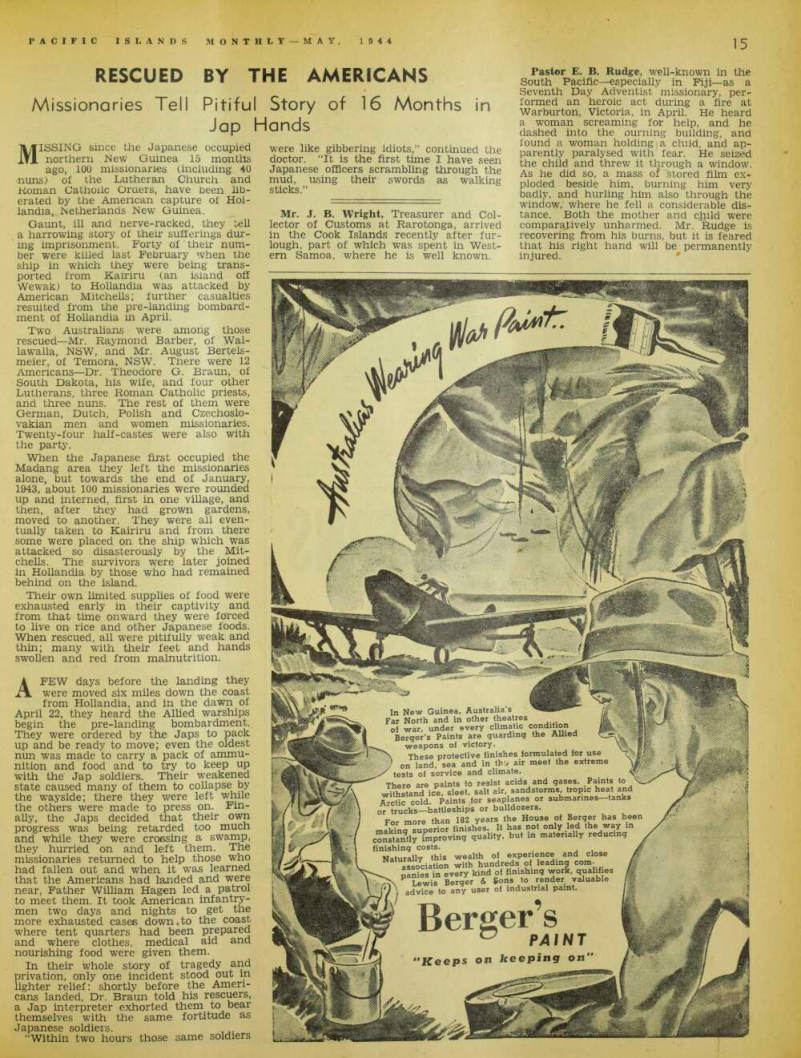
Rescued By The Americans
Missionaries Tell Pitiful Story of 16 Months in Jap Hands
MISSING since the Japanese occupied northern New Guinea 15 months ago, 100 missionaries (including 40 nuns) of the Lutheran Church and Homan Catholic Orders, have been lib erated by the American capture of Hoi landia, Netherlands New Guinea.
Gaunt, ill and nerve-racked, they tell a harrowing story of their sufferings dur ing imprisonment. Forty of their num ber were killed last February when the ship in which they were being trans ported from Kairiru (an island off Wewak) to Hollandia was attacked by American Mitchells; further casualties resulted from the pre-landing bombard ment of Hollandia in April.
Two Australians were among those rescued—Mr. Raymond Barber, of Wal lawalla, NSW, and Mr. August Bertels meier, of Temora, NSW. There were 12 Americans —Dr. Theodore G. Braun, of South Dakota, his wife, and four other Lutherans, three Roman Catholic priests, and three nuns. The rest of them were German, Dutch, Polish and Czechoslo vakian men and women missionaries.
Twenty-four half-castes were also with the party.
When the Japanese first occupied the Madang area they left the missionaries alone, but towards the end of January, 1943, about 100 missionaries were rounded up and interned, first in one village, and then, after they had grown gardens, moved to another. They were all even tually taken to Kairiru and from there some were placed on the ship which was attacked so disasterously by the Mit chells. The survivors were later joined in Hollandia by those who had remained behind on the island.
Their own limited supplies of food were exhausted early in their captivity and from that time onward they were forced to live on rice and other Japanese foods.
When rescued, all were pitifully weak and thin; many with their feet and hands swollen and red from malnutrition.
A FEW days before the landing they were moved six miles down the coast from Hollandia, and in the dawn of April 22, they heard the Allied warships begin the pre-landing bombardment.
They were ordered by the Japs to pack up and be ready to move; even the oldest nun was made to carry a pack of ammu nition and food and to try to keep up with the Jap soldiers. Their weakened state caused many of them to collapse by the wayside; there they were left while the others were made to press on. Fin ally, the Japs decided that their own progress was being retarded too much and while they were crossing a swamp, they hurried on and left them. The missionaries returned to help those who had fallen out and when it was learned that the Americans had landed and were near, Father William Hagen led a patrol to meet them. It took American infantry men two days and nights to get the more exhausted cases down.to the coast where tent quarters had been prepared and where clothes, medical aid and nourishing food were given them.
In their whole story of tragedy and privation, only one incident stood out in lighter relief: shortly before the Ameri cans landed, Dr. Braun told his rescuers, a Jap interpreter exhorted them to bear themselves with the same fortitude as Japanese soldiers.
“Within two hours those same soldiers
were like gibbering idiots,” continued the doctor. “It is the first time I have seen Japanese officers scrambling through the mud, using their swords as walking sticks.”
Mr. J. B. Wright, Treasurer and Col lector of Customs at Rarotonga, arrived in the Cook Islands recently after fur lough, part of which was spent in West ern Samoa, where he is well known.
Pastor E. B. Rudge, well-known in the South Pacific —especially in Fiji—as a Seventh Day Adventist missionary, per formed an heroic act during a fire at Warburton, Victoria, in April. He heard a woman screaming for help, and he dashed into the ourning building, and found a woman holding a child, and ap parently paralysed with fear. He seized the child and threw it through a window.
As he did so, a mass of stored film ex ploded beside him, burning him very badly, and hurling him also through the window, where he fell a considerable dis tance. Both the mother and child were comparatively unharmed. Mr. 'Rudge is recovering from his burns, but it is feared that his right hand will be permanently injured.
Advertisements & other items, p. 17 (1 item)
Berger’s
f^fr.
/ i K m *** In New Guinea, Australia s /| Far North and in other theatres of war, under every climatic condition £ Berger's Paints are guarding the AUied Q weapons of victory.
N These protective finishes formulated for use ) on land, sea and in tbc* air meet the extreme tests of service and climate.
There are paints to resist acids and gases. Paints to withstand ice, sleet, salt air sandstorms, tropic heat and Arctic cold. Paints for seaplanes or submarines—tanks or trucks— battleships or bulldozers.
For more than 182 years the House of Berger has been makina*superior finishes. It has not only led the way in constantly improving quality, but in materially reducing finishing costs.
Naturally this wealth of experience and close association with hundreds of leading comoanies in every kind of finishing work, qualifies P Tewis Berger & Sons to render valuable advice to any user of industrial paint.
Berger’s
° PAINT
Keeps on keeping on
Introduction To The Jungle
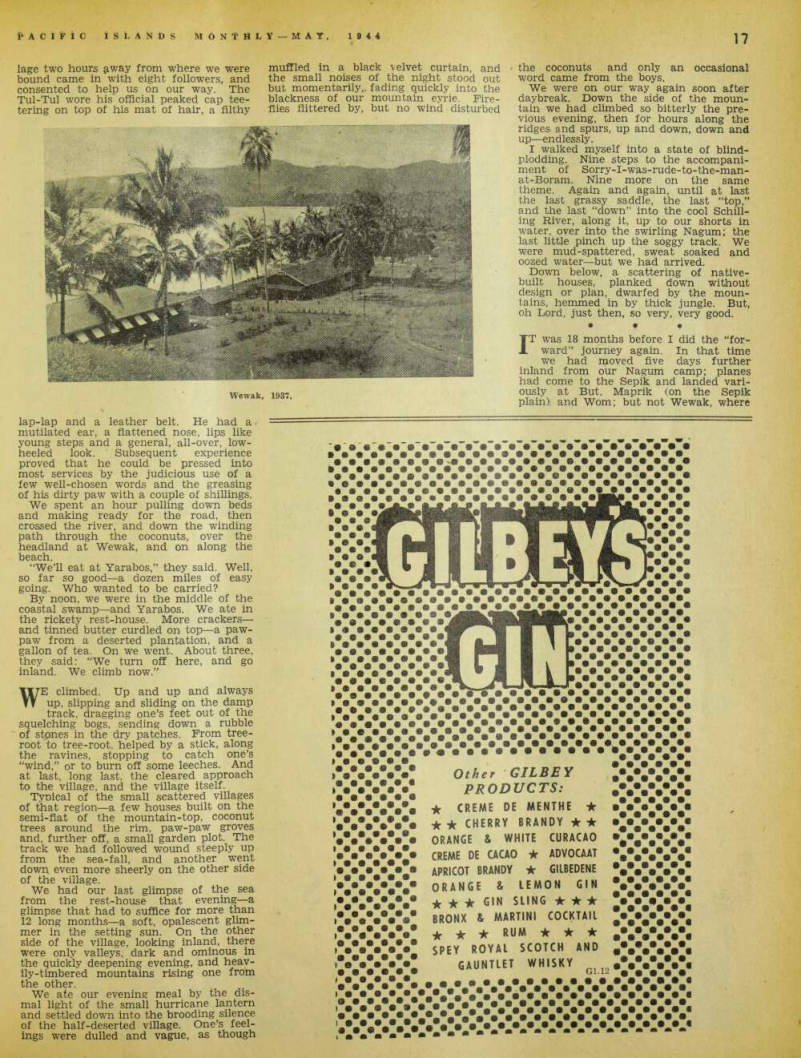
The Wewak-Aitape District in the Time Along Before
By Judy Tudor
rE steps of the house were shaded by a huge hibiscus bush as I sat there, kicked my heels, counted my money, and wondered when, where and if I ate.
Somewhere out in front of me, hidden by the coconuts and garden that clustered around the house of Boram plantation was the “Macdhui” which I had left an hour before. Away over to the left, vaguely, across the shimmering water I could glimpse through more trees, was Wewak. And behind me, somewhere even more vaguely, “in the bush” or coming over those green hulks of mountains, was, I sincerely hoped, my immediate family.
In Australia, Wewak and beyond had meant little except a foreign, outlandish spot, to anyone. On the “Macdhui,”
Wewak had meant a number of things to everyone—and none of them pleasant. It was “no fit place for women.” And this being the general attitude, I wanted to tear off into the bush without delay and start being a pioneer, just to prove it could be done. The sort of delay I was suffering right then—caused by the early arrival of the “Macdhui” and the nonarrival of the men—irritated me unreasonably.
I had examined the house into which I had been thrust by the plantation people (who, in the throes of “boat day”
and consequent copra-loading, seemed to be hitting an all-time low in hospitality); all of it—the central room for disrobing, the protuberance at one end fitted with a black, wheezy stove, and the tiny, screened-off piece of verandah furnished with a shower bucket. Scattered around the verandah were some grass mats and cane furniture—making altogether, had I but known it, a palace in comparison with the buildings I would call house and home from that time onwards, I had also examined, through the reed curtains, another and larger residence, separated from this by a few feet of bare brown earth. There was life in this place: a great coming and going of assorted natives, in and out of the attached kitchen where smoke belched perpetually in a grey cloud. A line of bed-sails and mosquito nets and white men in various stages of pyjama-ed, or short-and-singleted undress, all unaware that a member of the sex who had no place thereabouts was examining them from a distance of a few feet. Most interesting: that place had atmosphere!
I learned later that this was the rest house—known locally as the “Blood House.” Most men stayed there at some stage of their lives in the district, and when it was mentioned always said, off
handedly, “Oh yes, the Blood House ha-ha! The Blood House was where men were men; and no-women-by-request.
ISAT and pondered, while the natives walked by, and listened to the mur mur of voices from the Blood House and an occasional outburst of profanity from the same direction. Noon came and went. It was afternoon —and still no sight of the men. As I became pro gressively emptier physically, so I men tally became more fed up. Finally I got very mad.
Then the men appeared, in a lather of perspiration, having sighted the “Mac dhui” from a distant point. I was beyond caring whether they came or not, I did not even permit myself to inquire: “Where the devil have you been?” I merely said “Hullo,” and evaded being kissed.
Half a dozen boys, of varying sizes and degrees of ugliness, hung round in the background, until dismissed to search out some poles for the bed-sails. We retreated to the district’s one store, selected what we needed from the shelves, bailed up a man who seemed to have some connec tion with the concern, and asked him to write it down in a docket-book.
This man succeeded in shaking me considerably. He looked me up and down, evidently comparing me (unfavourably) with the chunks of muscle and brawn I had seen for myself in the Blood House, and said: “How are you going to get out to the Nagum? Be carried?”
In the last, brief half-hour I had had a resume of the troubles of the Tudor clan—consisting mainly of labour, lack of labour, lack of carriers in that coastal district, and all allied subjects. Could the family labdur-line be diverted from carry ing goods to carrying me about the country? No—my stay would be short, and I knew it.
“Certainly not!” I replied. “I’ll walk— I’m a good walker.”
“H’mm,” he snorted, “You don’t look it! Well—you’ll get in, I suppose, but you’ll probably have to be carried out.”
What a pig of a man, I thought—must have one of these tropical livers. I made certain inquiries about the state of the terrain and was informed that it was a bit rough—but “alright,”
BACK in the house, bed-construction went on around us, while a boy slapped down on the table three enamel mugs, a collection of plates, a tin of milk and one of butter, some crackers and cheese, a great black billy of tea and a bottle of beer. We talked among the remnants until it was dark and another meal, on the same general pattern, but greater by the addition of two tins of “army rations” and one tin of peaches, made an abrupt appearance. Someone had suggested sending to the mission for bread, but no one had got round to it.
We helped out the meal with more cr a ckers Next morning, a Tul-Tul, from a vil
lage two hours away from where we were bound came in with eight followers, and consented to help us on our way. The Tul-Tul wore his official peaked cap teetering on top of his mat of hair, a filthy
lap-lap and a leather belt. He had a mutilated ear, a flattened nose, lips like young steps and a general, all-over, low heeled look. Subsequent experience proved that he could be pressed into most services by the judicious use of a few well-chosen words and the greasing of his dirty paw with a couple of shillings.
We spent an hour pulling down beds and making ready for the road, then crossed the river, and down the winding path through the coconuts, over the headland at Wewak, and on along the beach “Well eat at Yarabos,” they said. Well, so far so good—a dozen miles of easy going. Who wanted to be carried?
By noon, we were in the middle of the coastal swamp—and Yarabos. We ate in the rickety rest-house. More crackers — and tinned butter curdled on top—a paw paw from a deserted plantation, and a gallon of tea. On we went. About three, they said: “We turn off here, and go inland. We climb now.”
WE climbed. Up and up and always up, slipping and sliding on the damp track, dragging one’s feet out of the squelching bogs, sending down a rubble of stpnes in the dry patches. From tree root to tree-root, helped by a stick, along the ravines, stopping to catch one’s “wind,” or to burn off some leeches. And at last, long last, the cleared approach to the village, and the village itself.
Typical of the small scattered villages of that region—a few houses built on the semi-flat of the mountain-top, coconut trees around the rim, paw-paw groves and, further off, a small garden plot. The track we had followed wound steeply up from the sea-fall, and another went down even more sheerly on the other side of the village.
We had our last glimpse of the sea from the rest-house that evening—a glimpse that had to suffice for more than 12 long months—a soft, opalescent glim mer in the setting sun. On the other side of the village, looking inland, there were only valleys, dark and ominous in the quickly deepening evening, and heav ily-timbered mountains rising one from the other.
We ate our evening meal by the dis mal light of the small hurricane lantern and settled down into the brooding silence of the half-deserted village. One’s feel ings were dulled and vague, as though
muffled in a black velvet curtain, and the small noises of the night stood out but momentarily,, fading quickly into the blackness of our mountain eyrie. Fire flies flittered by, but no wind disturbed
the coconuts and only an occasional word came from the boys.
We were on our way again soon after daybreak. Down the side of the moun tain we had climbed so bitterly the pre vious evening, then for hours along the ridges and spurs, up and down, down and up—endlessly.
I walked myself into a state of blind plodding. Nine steps to the accompani ment of Sorry-I-was-rude-to-the-man at-Boram. Nine more on the same theme. Again and again, until at last the last grassy saddle, the last “top,” and the last “down” into the cool Schill ing River, along it, up- to our shorts in water, over into the swirling Nagum; the last little pinch up the soggy track. We were mud-spattered, sweat soaked and oozed water —but we had arrived.
Down below, a scattering of native built houses, planked down without design or plan, dwarfed by the moun tains, hemmed in by thick jungle. But, oh Lord, just then, so very, very good. * ♦ * IT was 18 months before I did the “for ward” journey again. In that time we had moved five days further inland from our Nagum camp; planes had come to the Sepik and landed vari ously at But, Maprik (on the Sepik plain), and Worn; but not Wewak, where
Wewak, 1937.
the ’drome had yet to be built. There was a W. R. Carpenter store at But, and on this trip I travelled like a.lady. From Boram to But, eight hours m the plantation schooner: But to Mapnk, half an hour by plane, and the last four hours over the range by boot.
At Boram, perched on top of a pile of gear, painfully, slowly against the makmg tide, we were rowed out and hauled ourselves on board this typical Islands schooner: a clayed-in stove, two camp stretchers under an awning, a sentrybox dangling over the stern half-sized and ominous. I reconnoitred this last contrivance from afar and decided that, come what may, it was not for me.
It was on this trip that I committed the social faux pas of sleeping with good old .r~: l*>e sha U be nameless). It was m this fashion: I kicked off my shoes and crawled into the one unoccupied bed as soon as we got aboard and, hours later, when we sailed out on a full tide, silvered with moonlight, I went to sleep.
Came the dawn. I awoke, turned, fCe D «ir of fST MvTert wlri ta someone’s I oneriedone eve and peered ove? the edge of the c?tton bllSkerkindW nrovideri b? 1 thp nant of the P bed Behold—a bed mate P At some time in the semi darkmfif’ of the „ S £ht a™d Tn ‘an aftomathTf °a Boram celebration, he must have spied knowing Cl whn d mplfNbp hirin’ hnff in top h lf ’ h crawled in at the bottom.
I had disturbed him, and he woke, lifted his head, and automatically surveyed the scene. Then his eyes met mine.
Sleep melted miraculously; amazement gave place to horrified embarrassment.
His head flopped back for a moment, while he digested this strange thing, then it popped up again for another look.
This time, sure that I was no part of a hang-over, he cautiously disentangled himself from the blanket, groped for his shoes on the deck and beat a retreat.
The whole drama, occupying in all about two minutes, had been carried out in complete and heavy silence.
We were off But at eight. But, like the whole of that northern coast, is open to the full blast of the north-west sea son; but on that morning there was little but a lacy frill of white on the reef, and the mountains behind, standing like green sentinels between us and home, were clear of their early mists. The yel low beach, bordered by a thick fringe of coconuts, was swept clean by the tide.
Inland from Aitape the mountains rise again to towering peaks, but along this Wewak-Aitape coast, the formidable mountain giants do not stand perpen dicularly up from the sea in seven or eight thousand feet peaks, as they do further south. It is bad enough coun try to negotiate, but its problems of ter rain and transport are less in degree if not in number. mO-DAY, as this is being written, Aus- J[ tralian units are pressing along the „ coast from Madan| ilSafen 6 A bed forces have occu P ied Hollandia and Altape ’ and RAAF ™ its ar e using Tadji anstnp, close to Aitape, from which to bomb Jap posts between there and JJadang. It is obvious that the hours of f^, tt J ,? panese are numbered in that Not qn «drant?p nnw npi-hnnc +n this northern district as a great poten tial AlUed base— a hopping-off place for some other milestone nearer Tokio But viewed in the cold light of their pre-war isolation, it is strange indeed to see these backwaters assuming world-wide import ance. y Wewak and its hinterland mustered a population of perhaps a couple of hun dred Europeans: Aitape fluctuated around the half-dozen mark. Wewak had a gold industry, but Aitape, with a bad anchor age, thin native population, soil too poor and transport too difficult to make it a profitable copra producing centre, was on
the map merely as a hopping-off place for recruiters, who found a fertile field for their labours in the well-populated districts over on the landward fall of the ranges.
The coastal natives certainly and probably many from the hinterland, have had 16 months of Jap “co-prosperity” in this area. Here, then, will be a job for the men of ANGAU. But what of the future?
As the Americans and Australians have progressed in New Guinea, so have the public, through the Press, become aware of the country’s “vast potentialities”
Rubber for Papua; coffee tea quinine for the Upper Ramu What is in store for the Sepik-Aitape district? Before the war, hundreds of thousands of pounds had been spent on oil-search in that area, and residents had high hopes that petroleum would be found. It will be strange, indeed, if the Army, and the newshounds who have done some pretty sizable discovering in New Guinea in the last two years, do not re-orientate Aitape as a “vast potential oil-producer.”
And with the Army’s amazing capacity for producing vast quantities of money and equipment at will—a trick beyond the Powers of peacetime private enterprise or Territories Administrations—there may be a great deal in the idea, at that, A skipper well known in the Pacific over a number of years, Captain D. H.
Cambridge, has retired from the sea because of ill-health and will live per manently at Rarotonga. Captain Cam bridge was formerly master of the Mela nesian Mission ship, “Southern Cross,” and has commanded three schooners in Cook Islands waters during recent years.
“ Under a new contract, made recently, the French Colony of Tahiti has agreed to sell the United States a further 10,000 tons of copra at the maximum price of 67.54 dollars per ton f.o.b. Papeete.
Advertisements & other items, pp. 18-20 (1 item)
W. H. Grove & Sons
Limited
AUCKLAND
Island Traders. P.o. Box 490< Telegraphic and Cable Address: “Grove”, Auckland.
Shippers of all classes of New Zealand products.
Representing English Manufacturers throughout the Cook and Society Islands, Fiji, Tonga, Samoa, Niue, New Caledonia, New Guinea, etc.
In FIJI as—W. H. Grove fir Sons (Fiji) Ltd.
I \| I 4T** I £ 1 Bond Street Sydney, Australia.
JL J. IjVjUljrJ OLU TeL 84167. Box G.P.O.
SUPPLIERS OF GENERAL MERCHANDISE TO LEADING FIRMS THROUGHOUT THE
PACIFIC ISLANDS
Exporters ... Importers ... . Manufacturers' Representatives Bankers: Bank of N.S.W. Bank of Adelaide. Comptoir Nat. d’Escompte de Paris.
War Time Cable Address: GOUGH CO., 1 BONDSTREET, SYDNEY.
Codes: Bentley’s, 2nd and Comp. Phrase: A.8.C., sth and 6th; Peterson, 2nd and 3rd; Banking; Acme.
Other GILBEY
PRODUCTS:
* CREME DE MENTHE ★
★ * CHERRY BRANDY ★ ★
ORANGE & WHITE CURACAO
CREME DE CACAO ★ ADVOCAAT
APRICOT BRANDY ★ GILBEDENE
ORANGE & LEMON GIN
* * * GIN SLING ★ ★ ★
BRONX & MARTINI COCKTAIL
★ ★ ★ RUM ★ ★ ★
SPEY ROYAL SCOTCH AND
GAUNTLET WHISKY qi u
HEINZ
VAR
lETIE S
cf£> <le> Q%g> Ca^>
"Unsatisfactory"
Rarotongan Food Production
From Our Own Correspondent
Rarotonga, April 11.
IN view of the unsatisfactory state of food production in Rarotonga, the Island Council has decided to revive the old law regarding the planting of domestic crops. This compels each family to plant a certain amount of food each year.
At a meeting of the Council on Feb ruary 4th concern was expressed at the lack of food planting on the island since the hurricane last year. For several months after the hurricane the people were occupied in repairing or re-building their homes. Then the hula skirt in dustry got into full swing, and most of the island busied itself with this work to the detriment of crop cultivation.
The prices of kumaras and taro, which used to be 1/- and 2/- per kit, respec tively, has risen to 2/- and 4/- in Avarua.
The people in Avarua now rush the buggies coming in from the outer villages with native foods.
The “wandering pig” problem was also tackled by the Council, which proposes to enforce a local ordinance requiring all pigs to be in pens or styes by August 1.
Hitherto pigs have been a menace to plantations or were tethered by means of a rope attached to the 16g of the un fortunate animal. If this new law is enforced a real step towards increased planting will have been made.
Assistance for the reparation of banana, plantations after the recent hurricane was also considered. A recommendation (sub sequently approved) was made to the New Zealand Government.
A COMMITTEE has been set up to delve into the vexed question of citrus re-planting, which has made very slow progress, due mainlv to the fact that the basis of the Administration’s re-planting scheme is not broad enough to cope with the land title problem.
Hitherto only sole owners of a section of land have been allowed assistance under the scheme, but as most native lands are held bv the family and not by the in dividual, only 45 growers have been able to take advantage of the scheme during the past four years. .
It is evident that whereas land is still held communally, initiative has become, most definitely, individual. As it is highly improbable that the Rarotongan Maoris could, even if they wished to. revert to their original basis of communal production it follows that a:n adjustment of the system of land tenure to suit changed conditions must take place be fore real development of the agricultural resources of the island can be under taken.
Methodist Missionaries To
Return To The Solomons
SINCE stating in the April issue of “PIM” that Methodist Mission per sonnel had not, to that date, been permitted to return to the Solomons, we have had the following communication from the Rev. J. F. Goldie, at present in Melbourne: , ,_ “You will be interested to learn that I now have the assurance of Sir Philip Mitchell, the High Commissioner for the Western Pacific, that he will get me to the Solomons within the next two or three weeks, and that others of our Mission staff will be able to follow in a few months. , “This is good news for me, and will be welcomed by the native people in the western part of the Group.”
Annual Meeting
New Guinea Assn. of Queensland — Annual Meeting
fpHE first annual meeting of the Queens- X land New Guinea Association was held on March 11, in Brisbane.
Seventy-five members were present, and the following office-bearers were elected for the year 1944; President, Captain R. Kendall, RNR; vice-president, Mr. F. O. Moody; secretary and treasurer, Mrs. W. M. Haslam; com mittee, Mrs. D. Booth, Mrs. G. Thorn thwaite, Miss M. Byron, Mr. E. P. Holmes, and Mr. F. H. Conroy.
Meetings are held (as previously) on the second Saturday in each month at the Lyceum Club, 270 Queen Street, Bris bane, and visitors who may be passing
through Brisbane are always welcome. s Association is unique in that both men and women are admitted to member ship, whereas all the other clubs are essentially “women’s” clubs. The Queens land association recently affiliated with the Pacific Territories Association, and its representative gn the Executive of that body is Captain Kendall, who attends meetings on his periodical visits to Sydney There have been recent inquiries for the addresses of Mr. J. S. Reid, formerly of Asanamba Plantation, New Guinea; and Mr E j Symthe 0 f Ulamba Plan tation. Should any Territorian know the whereabouts of these two men would they communicate with the Secretary of the Queensland New Guinea Association, 160 Bowen Terrace, New Farm, Brisbane.
Advertisements & other items, pp. 21-22 (1 item)
Brewed
CARLTON & UNITED
BY
BREWERIES LTD.
Modern Refrigeration for the South Sea Islands
The ELECTROLUX kerosene OPERATED
REFRIGERATOR
MARVEL
OF
MODERN
SCIENCE
THE
MIRACLE
OF
ICE
FROM
HEAT
ELECTROLUX OFFERS ECONOMICAL, -modern and completely efficient
REFRIGERATION FOR ISLANDS' HOMES.
FREEZES CONTINUOUSLY WHILE SMALL LAMP BURNS.
Freezing controlled by simply regulating height of flame. Uses only gallon of kerosene per week.
MOTORLESS ... NO PARTS TO GET OUT OF ORDER.
MODEL L 22
Capacity 2.3 cubic feet.
MODEL L3BO
(as illustrated) Capacity 4 cubic feeti
GUARANTEED FOR TWO YEARS.
Write to your Local Distributor for prices and full details.
OBTAINABLE FROM ALL W. R. CARPENTER & CO. LTD.
BRANCHES THROUGHOUT THE ISLANDS
Representation in Papua and New Hebrides.
MODEL LKSSO
Capacity 5.6 cubic feet.
Interesting Sidelight on
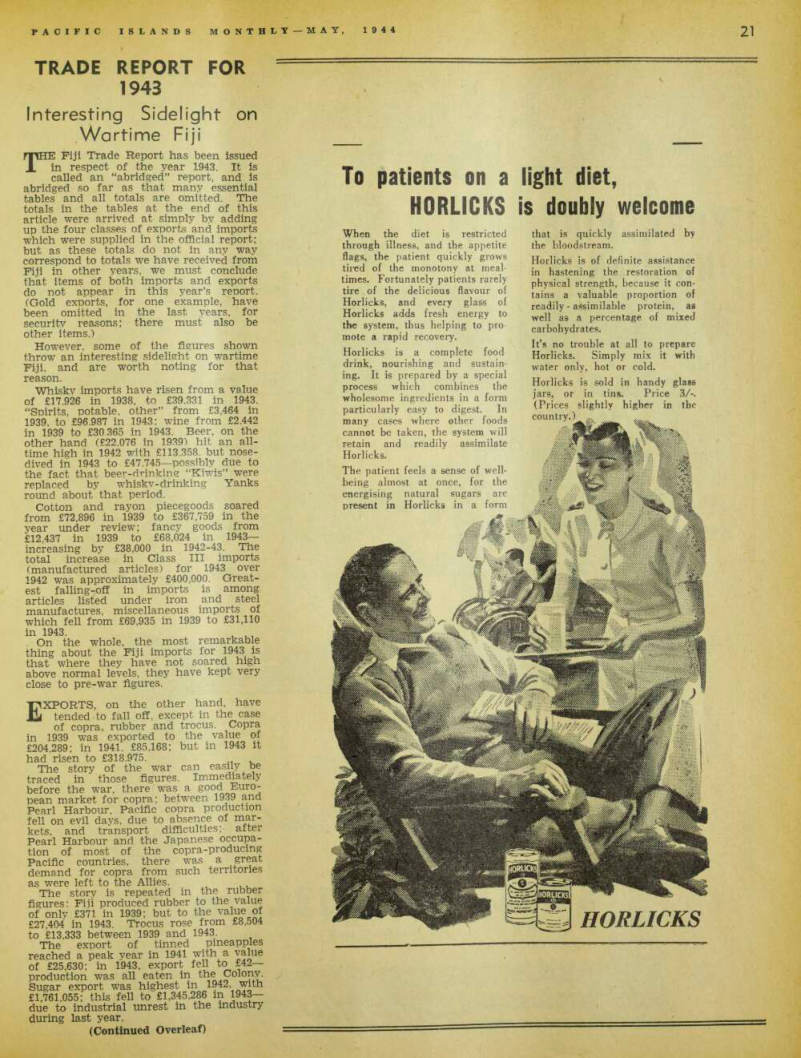
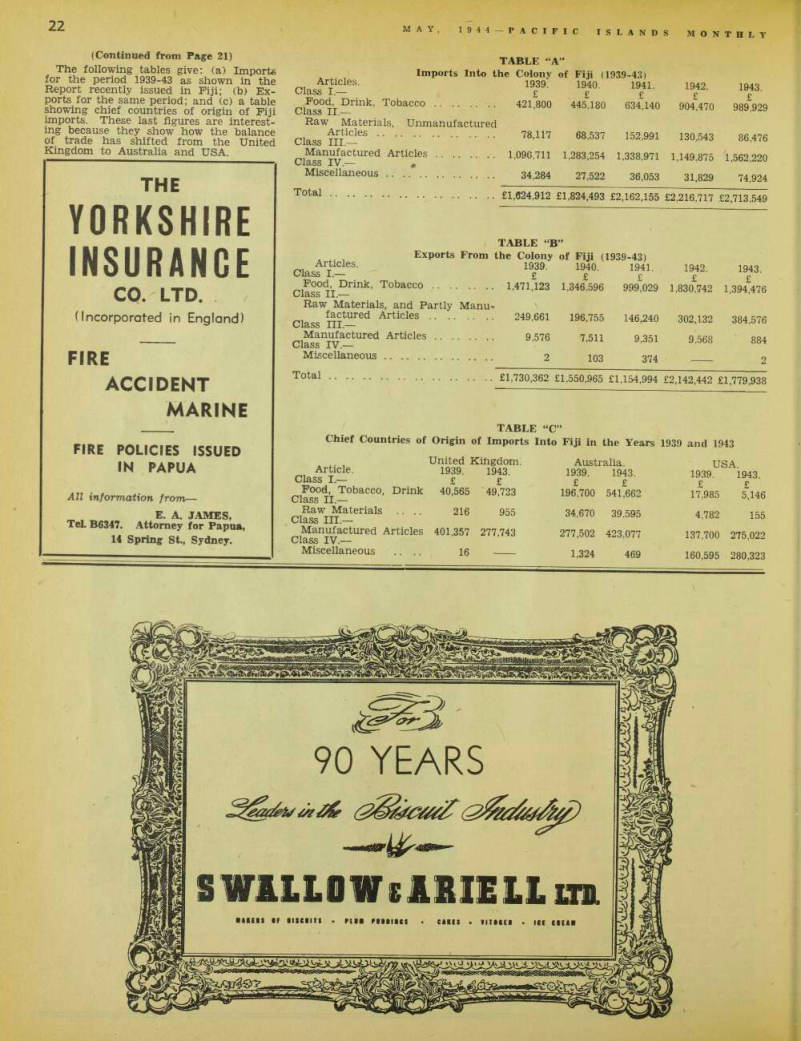
Trade Report For
1943 Interesting Sidelight on Wartime Fiji
mHE Fiji Trade Report has been issued X in respect of the year 1943. It is called an “abridged” report, and is abridged so far as that many essential tables and all totals are omitted. The totals in the tables at the end of this article were arrived at simply by adding up the four classes of exports and imports which were supplied in the official report; but as these totals do not in any way correspond to totals we have received from Fiji in other years, we must conclude that items of both imports and exports do not appear in this year’s report. (Gold exports, for one example, have been omitted in the last years, for security reasons; there must also be other items.) However, some of the figures shown throw an interesting sidelight on wartime Fiji, and are worth noting for that reason.
Whiskv imports have risen from a value of £17.926 in 1938, to £39.331 in 1943.
“Spirits, potable, other” from £3,464 in 1939. to £96.987 in 1943: wine from £2.442 in 1939 to £30365 in 1943. Beer, on the other hand (£22.076 in 1939) hit an all time high in 1942 with £113.358. but nose dived in 1943 to £47.74s—possibly due to the fact that beer-drinkine “Kiwis” were replaced by whiskv-drinking Yanks round about that period.
Cotton and rayon piecegoods soared from £72,896 in 1939 to £367,759 in the year under review; fancy goods from £12,437 in 1939 to £68,024 in 1943 increasing by £38,000 in 1942-43. The total increase in Class 111 imports (manufactured articles) for 1943 over 1942 was approximately £400,000. Great est falling-off in imports is among articles listed under iron and steel manufactures, miscellaneous imports of which fell from £69,935 in 1939 to £31,110 in 1943. , On the whole, the most remarkable thing about the Fiji imports for 1943 is that where they have not soared high above normal levels, they have kept very close to pre-war figures.
EXPORTS, on the other hand, have tended to fall off, except in the case of copra, rubber and trocus. Copra in 1939 was exported to the value of £204,289; in 1941. £85,168; but in 1943 it had risen to £318.975.
The story of the war can easily be traced in those figures. Immediately before the war, there was a good Euro pean market for copra; between 1939 and Pearl Harbour, Pacific copra production fell on evil days, due to absence of mar kets. and transport difficulties: after Pearl Harbour and the Japanese occupa tion of most of the copra-producing Pacific countries, there was a great demand for copra from such territories as were left to the Allies.
The story is repeated in the rubber figures: Fiji produced rubber to the value of only £371 in 1939; but to the value of £27,404 in 1943. Trocus rose from £8,504 to £13,333 between 1939 and 1943.
The export of tinned pineapples reached a peak year in 1941 with a value of £25,630; in 1943, export fell to £42— production was all eaten in the Colony.
Sugar export was highest in 1942 with £1,761.055; this fell to £1,345,286 in 1943due to industrial unrest in the industry during last year. (Continued Overleaf)
(Continued from Page 21)
The following tables give: (a) Imports for the period 1939-43 as shown in the Report recently issued in Fiji; (b) Ex ports for the same period; and (c) a table showing chief countries of origin of Fiji imports. These last figures are interest ing because they show how the balance of trade has shifted from the United Kingdom to Australia and USA.
Table “A”
Imports Into the Colony of Fiji (1939-43) Articles. 1939 Class I.— £ 1940. £ 1941. £ 1942. £ 1943. £ Food, Drink, Tobacco 421 800 Class II.— 445.180 634,140 904,470 989,929 Raw Materials, Unmanufactured Articles 78 117 Class III.— 68,537 152,991 130,543 86,476 Manufactured Articles 1,090,711 1,283,254 Class IV.— * 1,338,971 1,149,875 1,562,220 Miscellaneous 34 284 27,522 36,053 31,829 74,924 £2,713,549
Table “B”
Exports From the Colony of Fiji (1939-43) Articles.
Class I.— 1939. £ 1940. £ 1941. £ 1942. £ 1943. £ Food. Drink, Tobacco .. ..
Class II. — .. .. 1,471,123 1,346.596 999,029 1.830.742 1,394,476 Raw Materials, and Partly Manufactured Articles .. ..
Class III.— • . .. 249,661 196,755 146,240 302,132 384,576 Manufactured Articles .. . 9 576 7,511 9,351 9,568 884 Class IV.— Miscellaneous 2 103 374 o Z Total ’ ’ ’ ’ 9 X/i,i iy,yuo
Table “C
> Chief Countries of Origin of Imports Into Fiji in the Years 1939 and 1943 Article.
Class I.— United Kihgdom.
Australia.
Its A
1939. £ 1943. £ 1939. £ 1943. £ 1939. £ 1943. £ Food, Tobacco, Drink Class II.— 40,565 49.723 196,700 541,662 17,985 5,146 Raw Materials ..
Class III.— 216 955 34,670 39,595 4,782 155 Manufactured Articles Class IV.- 401,357 277,743 277,502 423,077 137,700 275,022 Miscellaneous .. .. 16 — 1,324 469 160,595 280,323
Advertisements & other items, pp. 23-24 (1 item)
To patients on a light diet,
HORLICKS is doubly welcome
When the diet is restricted through illness, and the appetite flags, the patient quickly grows tired of the monotony at mealtimes. Fortunately patients rarely tire of the delicious flavour of Horlicks, and every glass of Horlicks adds fresh energy to the system, thus helping to pro mote a rapid recovery.
Horlicks is a complete food drink, nourishing and sustaining. It is prepared by a special process which combines the wholesome ingredients in a form particularly easy to digest. In many cases where other foods cannot be taken, the system will retain and readily assimilate Horlicks.
The patient feels a sense of wellbeing almost at once, for the energising natural sugars are present in Horlicks in a form that is quickly assimilated by the bloodstream.
Horlicks is of definite assistance in hastening the restoration of physical strength, because it contains a valuable proportion of readily - assimilable protein, as well as a percentage of mixed carbohydrates.
It’s no trouble at all to prepare Horlicks. Simply mix it with water only, hot or cold.
Horlicks is sold in handy glass jars, or in tins. Price 3/-. (Prices slightly higher in the
country,)^
rV .• m
te^IhORLICKsI
HORLICKS
THE
YORKSHIRE
INSURANCE
CO. LTD.
(Incorporated in England)
FIRE
ACCIDENT
MARINE
I '
FIRE POLICIES ISSUED
IN PAPUA
All information from —
E. A. JAMES,
Tel. 86347. Attorney for Papua, 14 Spring St., Sydney.
90 YEARS
S WILLOWS ABIE LI in
■ anas ir iiseiifs met caics . iiiacca . ice cnaa
Unilever Menace
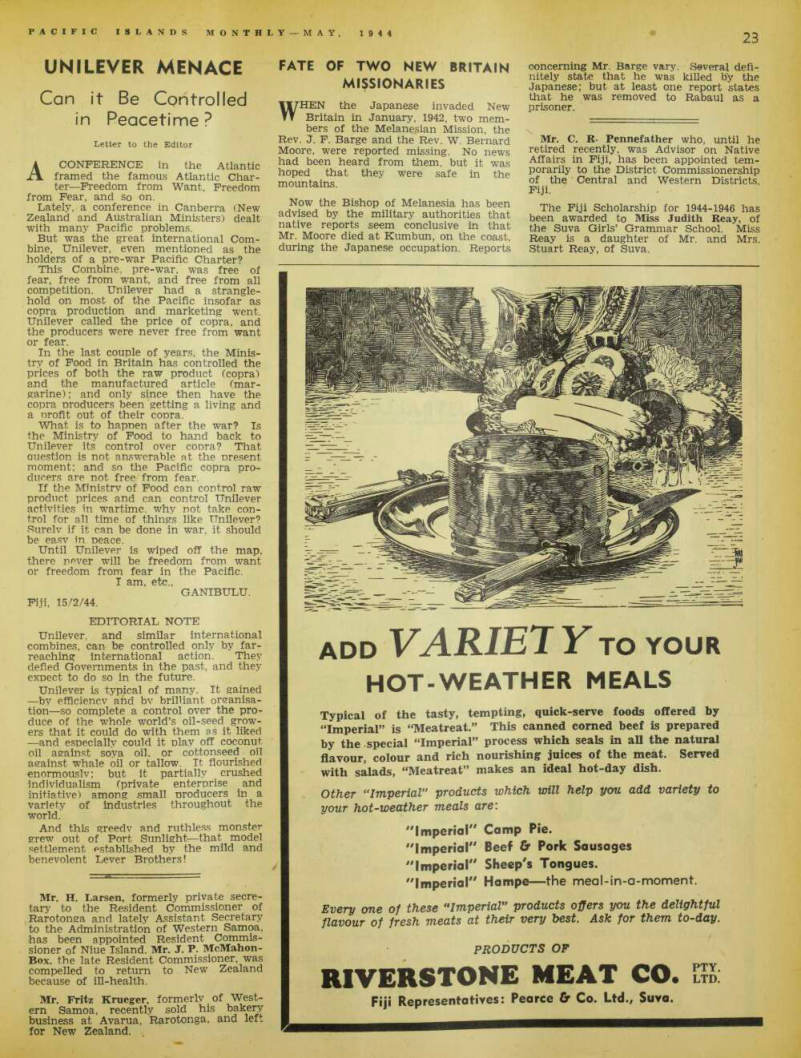
Can it Be Controlled in Peacetime?
Letter to the Editor A CONFERENCE in the Atlantic framed the famous Atlantic Char ter—Freedom from Want, Freedom from Fear, and so on.
Lately, a conference in Canberra (New Zealand and Australian Ministers) dealt with many Pacific problems.
But was the great international Com bine, Unilever, even mentioned as the holders of a pre-war Pacific Charter?
This Combine, pre-war, was free of fear, free from want, and free from all competition. Unilever had a strangle hold on most of the Pacific insofar as copra production and marketing went.
Unilever called the price of copra, and the producers were never free from want or fear.
In the last couple of years, the Minis try of Food in Britain has controlled the prices of both the raw product (copra) and the manufactured article (mar garine); and only since then have the copra producers been getting a living and a nrofit out of their conra.
What is to hapnen after the war? Is the Ministry of Food to hand back to Unilever its control over conra? That Question is not answerable at the nresent moment; and so the Pacific copra pro ducers are not free from fear.
If the Ministry of Food can control raw product prices and can control Unilever activities in wartime, why not take con trol for all time of things like Unilever?
Surelv if it can be done in war, it should be easy in peace.
Until Unilever is wiped off the map, there never will be freedom from want or freedom from fear in the Pacific.
I am, etc.,
Ganibulu.
Fiji, 15/2/44.
Editorial Note
Unilever, and similar international combines, can be controlled only by far reaching international action. They defied Governments in the past, and they expect to do so in the future.
Unilever is typical of many. It gained —by efficiencv and bv brilliant organisa tion —so complete a control over the pro duce of the whole world’s oil-seed grow ers that it could do with them as it liked —and especially could it play off coconut oil against soya oil, or cottonseed oil against whale oil or tallow. It flourished enormouslv; but it partially crushed individualism (private enterprise and initiative) among small nroducers in a variety of industries throughout the world.
And this greedv and ruthless monster grew out of Port Sunlight—that model settlement established by the mild and benevolent Lever Brothers!
Mr. H. Larsen, formerly private secre tary to the Resident Commissioner of Rarotonga and lately Assistant Secretary to the Administration of Western Samoa, has been appointed Resident Commis sioner of Niue Island. Mr. J. P. McMahon- Box, the late Resident Commissioner was compelled to return to New Zealand because of ill-health.
Mr. Fritz Krueger, formerly of West ern Samoa, recently sold his bakery business at Avarua, Rarotonga, and lef.for New Zealand.
Fate Of Two New Britain
Missionaries
WHEN the Japanese invaded New Britain in January, 1942, two mem bers of the Melanesian Mission, the Rev. J. F. Barge and the Rev. W. Bernard Moore, were reported missing. No news had been heard from them, but it was hoped that they were safe in the mountains.
Now the Bishop of Melanesia has been advised by the military authorities that native reports seem conclusive in that Mr. Moore died at Kumbun, on the coast, during the Japanese occupation. Reports
concerning Mr. Barge vary. Several defi nitely state that he was killed by the Japanese; but at least one report states that he was removed to Rabaul as a prisoner.
Mr. C. R- Pennefather who, until he retired recently, was Advisor on Native Affairs in Fiji, has been appointed tem porarily to the District Commissionership of the Central and Western Districts, Fiji.
The Fiji Scholarship for 1944-1946 has been awarded to Miss Judith Reay, of the Suva Girls’ Grammar School. Miss Reay is a daughter of Mr. and Mrs.
Stuart Reay, of Suva.
Advertisements & other items, pp. 25-26 (1 item)
Hot-Weather Meals
fl T — - 3
ADD VARIET Y to your
Typical of the tasty, tempting, quick-serve foods offered by “Imperial” is “Meatreat.” This canned corned beef is prepared by the special “Imperial” process which seals in all the natural flavour, colour and rich nourishing juices of the meat. Served with salads, “Meatreat” makes an ideal hot-day dish.
Other “Imperial” products which will help you add variety to your hot-weather meals are : "Imperial" Camp Pie.
"Imperial" Beef Gr Pork Sausages "Imperial" Sheep's Tongues.
"Imperial" Hampe— the meal-in-a-moment.
Every one of these “ Imperial» products offers you the delightful flavour of fresh meats at their very "best. Ask for them to-day.
PRODUCTS OF
RIVERSTONE MEAT CO.
Fiji Representatives; Pearce Gr Co. Ltd., Suva.
EDGELL
QUALITY CANNED
Vegetables & Soups
AUSTRALIA'S BEST
DEFENCE requirements take up the whole of the Edgell production to-day—consequently only a small proportion of civilian needs is occasionally made available by the Australian Defence Foodstuffs Control and exports are heavily restricted.
As soon as possible. Island consumers can rely on Edgell high quality products being made available to them once more.
Meanwhile, to take advantage of the limited quantities periodically released, please send your inquiries either through your usual channels or direct to the Island distributors . . .
C. SULLIVAN & CO. 379 Kent 1 Street, Sydney, Australia.
"EDGELL QUALITY CANNED GOODS"
C. SULLIVAN & CO.
GENERAL MERCHANTS ISLANDS AGENTS
REPRESENTING LEADING FIRMS IN THE PACIFIC ISLANDS.
Islands Produce sold on Shippers’ Account-Liberal Advances against Consignments.
Buyers of all Islands’ Requirements on Commission—Original Invoices Furnished.
Bankers : Bank of New South Wales .. Bank of New Zealand .. Comptoir National d’Escompte de Paris.
Wartime Cable Address: Sullivan, Kentstreet, Sydney.
379 KENT STREET, SYDNEY, N.S.W.
Black Markets In
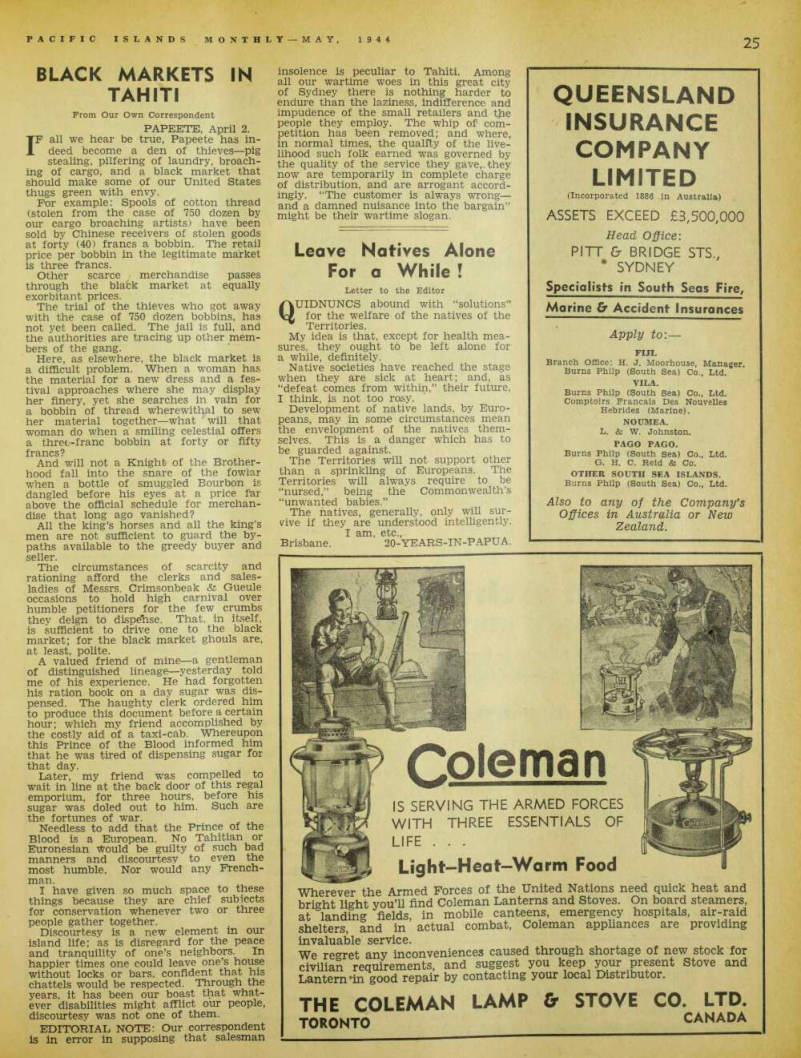
Tahiti
Prom Our Own Correspondent PAPEETE, April 2.
IF all we hear be true, Papeete has in deed become a den of thieves —pig stealing, pilfering of laundry, broach ing of cargo, and a black market that should make some of our United States thugs green with envy.
For example: Spools of cotton thread (stolen from the case of 750 dozen by our cargo broaching artists) have been sold by Chinese receivers of stolen goods at forty (40) francs a bobbin. The retail price per bobbin in the legitimate market is three francs.
Other scarce merchandise passes through the black market at equally exorbitant prices.
The trial of the thieves who got away with the case of 750 dozen bobbins, has not yet been called. The jail is full, and the authorities are tracing up other mem bers of the gang.
Here, as elsewhere, the black market is a difficult problem. When a woman has the material for a new dress and a fes tival approaches where she may display her finery, yet she searches in vain for a bobbin of thread wherewithal to sew her material together—what will that woman do when a smiling celestial offers a three-franc bobbin at forty or fifty francs?
And will not a Knight of the Brother hood fall into the snare of the fowlar when a bottle of smuggled Bourbon is dangled before his eyes at a price far above the official schedule for merchan dise that long ago vanished?
All the king’s horses and all the king’s men are not sufficient to guard the by paths available to the greedy buyer and seller.
The circumstances of scarcity and rationing afford the clerks and sales ladies of Messrs. Crimsonbeak & Gueule occasions to hold high carnival over humble petitioners for the few crumbs they deign to dispense. That, in itself, is sufficient to drive one to the black market; for the black market ghouls are, at least, polite.
A valued friend of mine—a gentleman of distinguished lineage—yesterday told me of his experience. He had forgotten his ration book on a day sugar was dis pensed. The haughty clerk ordered him to produce this document before a certain hour; which my friend accomplished by the costly aid of a taxi-cab. Whereupon this Prince of the Blood informed him that he was tired of dispensing sugar for that day.
Later, my friend was compelled to wait in line at the back door of this regal emporium, for three hours, before his sugar was doled out to him. Such are the fortunes of war.
Needless to add that the Prince of the Blood is a European. No Tahitian or Euronesian Would be guilty of such bad manners and discourtesy to even the most humble. Nor would any French man.
I have given so much space to these things because they are chief subjects for conservation whenever two or three people gather together.
Discourtesy is a new element in our island life; as is disregard for the peace and tranquility of one’s neighbors. In happier times one could leave one’s house without locks or bars, confident that his chattels would be respected. Through the years, it has been our boast that what ever disabilities might afflict our people, discourtesy was not one of them.
EDITORIAL NOTE: Our correspondent is in error in supposing that salesman
insolence is peculiar to Tahiti. Among all our wartime woes in this great city of Sydney there is nothing harder to endure than the laziness, indifference and impudence of the small retailers and the people they employ. The whip of com petition has been removed; and where, in normal times, the quality of the live lihood such folk earned was governed by the quality of the service they gave,.they now are temporarily in complete charge of distribution, and are arrogant accord ingly. “The customer is always wrong— and a damned nuisance into the bargain” might be their wartime slogan.
Leave Natives Alone
For a While!
Letter to the Editor Quidnuncs abound with “solutions” for the welfare of the natives of the Territories.
My idea is that, except for health mea sures, they ought to be left alone for a while, definitely.
Native societies have reached the stage when they are sick at heart; and, as “defeat comes from within,” their future, I think, is not too rosy.
Development of native lands, by Euro peans, may in some circumstances mean the envelopment of the natives them selves. This is a danger which has to be guarded against.
The Territories will not support other than a sprinkling of Europeans. The Territories will always require to be “nursed,” being the Commonwealth’s “unwanted babies.”
The natives, generally, only will sur vive if they are understood intelligently.
I am, etc.,
Brisbane.
20-Years-In-Papua.
Advertisements & other items, p. 27 (1 item)
Coleman
QUEENSLAND
INSURANCE
COMPANY
LIMITED
(Incorporated 1886 in Australia)
ASSETS EXCEED £3,500,000
Head Office'.
PITT & BRIDGE STS.,
* SYDNEY
Speciolists in South Seas Fire,
Marine & Accident Insurances
Apply to: —
FIJI.
Branch Office: H. J. Moorhouse, Manager.
Burns Philp (South Sea) Co., Ltd.
VILA.
Burns Philp (South Sea) Co., Ltd.
Comptoirs Francais Des Nouvelles Hebrides (Marine).
NOUMEA.
L. & W. Johnston.
PAGO PAGO.
Burns Philp (South sea) Co., Ltd.
G. H. C. Reid & Co.
OTHER SOUTH SEA ISLANDS.
Burns Philp (South Sea) Co., Ltd.
Also to any of the Company's Offices in Australia or New Zealand.
Coleman
IS SERVING THE ARMED FORCES
WITH THREE ESSENTIALS OF
LIFE . . .
Light-Heat-Warm Food
Wherever the Armed Forces of the United Nations need quick heat and bright light you’ll find Coleman Lanterns and Stoves. On board steamers, at landing fields, in mobile canteens, emergency hospitals, air-raid shelters, and in actual combat, Coleman appliances are providing invaluable service.
We regret any inconveniences caused through shortage of new stock for civilian requirements, and suggest you keep your present Stove and Lantern-in good repair by contacting your local Distributor.
THE COLEMAN LAMP & STOVE CO. LTD.
TORONTO CANADA
"Kanaka"
Letter to the Editor MAY I refer to Mr. L. G. Blackman’s letter (February “PIM”), concern ing the term “Kanaka”?
If Mr. Blackman desires to convey that the term “Kanaka” is permitted, and ac cepted with good grace in Hawaii, then that, to me, is sufficient to give the term an “invidious application” when used in connection with a real Polynesian. Surely, if Mr. Blackman has lived forty years in that melting-pot of the Pacific, he will realise that there are not thirty pure blooded Hawaiians left. The Right Rev.
John D. La Mothe, Bishop of Hawaii, at a meeting of the Rotary Club in Hono lulu in the year 1930, not only gave these figures, but satisfied the meeting as to their authenticity.
The printing office of the LMS at Malua in Western Samoa, issues a book on the Polynesian language, and deprecates the slovenly methods which have been allowed to creep into the most beautiful language known.
If we allow “downtown New York” sloppy pronunciations to creep into the Samoan and other Polynesian languages, and accept and agree with them, then I suppose I must bow to Mr. Blackman. I still refuse to call a Samoan or any other Polynesian anything but Tanata, and leave the slip-shod manner to the slip shod methods of Hawaii residents.
I am, etc.,
J. Nixonwestwood.
Wellington, NZ, April 11, 1944.
Who Invented The
"Boong"?
Letter to the Editor WHILE quite agreeing with Sydney Chance that the term “Boong” (“PIM,” April, 1944), was in use long before the war, I note that he gives no suggestion as to the derivation.
Amongst ex-Territorians it is accepted that the word is from Mandated Terri tory Pidgin English. To “boong” together is Pidgin for to “bring” together a num ber of natives, and the term was in use in the old German days.
For the past 20 years it has been used to denote a native market —i.e., a place where natives gather. From this it is an easy step to use the word as a term mean ing “native.”
I am, etc.,
Brisbane, April 26, 1944.
Roy Kendall.
News Of Gilberts People
MR. BRUNO REYMOND, of the Gilbert Islands Colony, who was loaned by Australia to show the Americans the way into Butaritari Atoll last Nov ember, is at present in Sydney, under going special training. He expects to be back in operational areas before long.
Mr. Reymond brings news of various people who were overtaken by the Japanese invasion of the Gilberts in December, 1941. Mr. Williams, Adminis trative officer at Butaritari, was taken prisoner by the Japanese, and his where abouts are unknown. The Roman Catho lic missionaries (mostly French men and women of the Sacred Heart Order) in the Gilberts were not mistreated by the Japanese, and Bishop Terrienne is well.
As officially reported from Suva, some weeks ago, the Japanese made prisoners of Captain I. R. Handley (Tarawa), Rev.
A. L. Sadd (Beru), Mr. A. M. MacArthur (a trader at Nonouti), Mr. R. G. Morgan (of the King George School, Tarawa), and Mr. B. P. Cleary (Government Hos pital, Tarawa), and all of them were eventually killed by the Japs. Mr. Rey mond says that the Japs proposed to “honourably” behead the whole five; but Captain Handley and one other put up such a fight against decapitation that they were'shot.
The fate of men of the New Zealand forces, who were coast-watching in the Gilberts until December, 1941, and who were taken prisoners, is not known.
Mr, Fritz Reiher, one of the three well known Reiher brothers (William. Fritz and Henry), lost his life during the Jap occupation. He went out fishing, in a canoe; and, later, his canoe and his mangled body were found. He evidently had been taken by a shark.
Advertisements & other items, p. 28 (2 items)
Islands Merchants
NELSON & ROBERTSON
PTY., LTD.
Established 1895.
Islands Merchants
All classes of merchandise purchased at wholesale prices and original invoices supplied to Islands clients.
Cocoa Beans, Rubber and other Islands 7 produce sold on commission.
Nelson & Robertson
Pty. Ltd. 12 Spring: Street, Sydney, Australia.
William Atkins Pty. Ltd.
Head Office 449-451 KENT ST., SYDNEY.
Iron & Steel Merchants-Engineers' Supplies
ESTABLISHED OVER 50 YEARS
rW' Coach & Motor Hardware Cable Address: WILATKIN, Sydney.
STEEL DEPARTMENT
MILD STEEL:
Rounds, Squares, Flats, Half-rounds, Hexagons, Bevel, Shoeing, Tyre, Angles, Tees, Sheets, Plates, Girder Plates, Chequer Plates, Channels, Hoops, Etc.
BRIGHT STEEL:
Rounds, Squares, Hexagons.
Extra Special High Speed Tool Steel, Mining Steel, Blister Steel and Spring Steel, Rounds, Flats £r Squares.
Bar Iron—All sections and sizes.
Engineers' Supplies: Set Screws, Studs, Metal Thread Screws, Coach Screws, Files, Cotter Pins, Bright and Black Bolts, Rivets, Etc., Hack Saw Blades.
Power Transmission Gear: Including Plummer Blocks, Couplings, Collars, Etc.
Coach and Motor Hardware: Axles, Springs, Wheelstuff, Duck, Paints.
Farriers' Supplies: Horse Nails, Anvils, Vices, Etc.
Motor-Trimmers and Motor Builders' & Motor Painters' Requirements
C. A. WILLEY'S
Quick-Drying Coach and Car Paints, Roughstuff, Elastic Gloss, Synflex Enamels, Lacquers.
DUCO Lacquers and DULUX Enamels—FAßßEX Motor Toppings and Leather Cloths, House & Decorators' Paints, Varnishes & Brushware.
Sole Distributors of CHAMPION'S Decorators Paint Products.
Distributing Agents for BROLITE Lacquers, SYNFLEX Enamels and "POLYGLOSS" Finish.
American History
Lieutenant Isireli Korovulavula
The Bravery of a Fijian Soldier Makes American History
By Max Whatman
Solomon Is., March 28.
Subject: COMMENDATION.
To: 2/Lieutenant Isireli Korovulavula. (1) The officers and enlisted men of this unit join me in expressing our deep gratitude for the effort you made to bring back to this station 2/Lieuten ant Charles W. Cross, of this com mand, after the plane in which you both flew to Ebu was forced down in the jungle. (2) I have had many years of service in our Army, and have participated in two wars. Your actions in this inci dent are one of the most outstanding acts of sacrifice, determination and bravery I know, and it shall always remain in my memory as the great est example of personal sacrifice to a comrade-in-arms in our records. (3) With all other members of the United States Forces on this island, admira tion of the officers and men of the Fijian Forces is paramount in all ranks. By this act you have epito mised the tradition your unit upholds. (4) I desire to express to you my com mendations with the hope that I shall have the honour to serve with you and your unit in future operations. mHIS message is signed by an American X General with the formation to which Fijian troops are attached on Bougainville in the Western Solomons.
To it is added the following note from 2/Lieutenant Isireli’s Commanding Offi cer, Lieut.-Col. G. T. Upton, a New Zea lander: “My sincere congratulations on a splendid job.”
Behind it is one of the most dramatic stories of fortitude and courage in the face of terrible hardships in a campaign in which personal bravery and initiative are the principal factors.
In January, Lieut.-Col. Upton’s bat talion, in which Isireli is a platoon com mander, carried out a spectular feat in crossing Bougainville Island through enemy territory to the coast opposite Empress Augusta Bay. During the opera tion, Isireli, on reconnaissance, found a concentration of Japanese considered to be a bomber’s dream. A light aircraft landed on a landing strip carved by Fijians from the jungle with bayonets and cane-knives, and Isireli was flown back to the American beach-head" to guide the bombers.
The bombing operation was a success and Isireli, piloted by 2/Lieutenant C. W.
Cross, left to return to his unit far across the lofty mountains of Bougainville.
Engine trouble forced the machine down and it dived into the dense forest.
Freakishly, the plane remained wedged in the tops of tall trees, 50 feet above the ground. Neither man was injured, and there, looking out over an unbroken sea of tree-tops, they took stock of their position: only a general idea of their location, no compass, no food, no arms except Isireli’s sheath knife, no clothing, no blankets, no mosquito nets, and 50 feet above the ground in a wrecked aircraft.
First problem was to reach the ground.
Their tree had a thick, bushy top, but no branches to afford a means of descent.
No great difficulty for Isireli, as the Fijian’s ability in scampering up and down the smooth boles of branchless trees is almost uncanny. To the American pilot, however, the ground looked far off
and his chances of reaching it uninjured just as distant.
The answer to that particular problem was simple. Isireli manoeuvred his com rade on to his back and climbed down the tree with him. rE story of the next two weeks is easily told, for, with brief alarms when enemy patrols were encoun tered, it was simply a succession of grim days, battling through clinging bush, still without food and continually drenched with an unceasing rain which dripped through the dense mass of foliage above
to the steaming, murky jungle growth below. Nights were cold; Bougainville’s mountains rise to more than 10,000 feet.
Gardens grow only in the coastal areas and fruit is scarce. Nothing edible, even the most unpalatable roots, can be found in the forests of the interior. A lost man could wander indefinitely on this large, grim island.
Six times, the two men hid while Japanese patrols passed within a few feet of where they hugged the ground. For tunately, the Japanese, contrary to belief, do not patrol in silence. The high pitched chatter of their voices gives ample warning of approach, and to such an accomplished bushman as Isireli, con cealment presented no problems. Each time a patrol passed, the Fijian waited, tense, his knife drawn, ready to spring on any man who lagged behind. Such a stroke would have meant a rifle, ammu nition, and possibly food. However, that opportunity never arrived.
After many days, the strength of both
men was ebbing, and Isireli decided to make an effort, while he still could, to learn their whereabouts. Painfully, he swarmed to the top of the highest tree.
He saw the blue waters of the Pacific, and across a narrow strait, another island. He recognised the waterway as Buka Passage. They were at the north ern tip of Bougainville, close to the big gest concentration of Japanese on the island.
There was nothing for it but to retrace their steps. Isireli now had some idea of the direction in which safety lay.
He decided to make for the mountains, thus avoiding the enemy, and marking a more definite line of march.
THEN came the day when the pilot could go no further. He implored the Fijian to leave him. At length they argued the question, until Isireli prevailed, and hoisting the exhausted man to his broad shoulders, resumed the struggle against the fever-ridden jungle.
For four days, Isireli carried his com panion. They had been lost for 14 days —l4 days without food or shelter, fight ing the dense growth for every inch of progress.
On the fifteenth morning, Isireli again eased Cross to his shoulders. He stood, he swayed, his knees crumpled beneath him, and he fell to the ground. This time the American was adamant. It was obvious that the Fijian could carry him no further. The only chance was for him to struggle on alone and send back help when he found friends.
“Just build me a shelter of boughs,” he asked. “If I am dead when they find me, send my watch to my mother, my identification wristlet to my father, and this ring to my girl.”
“I broke down and cried,” Isireli con fessed. “For hours I argued with Char lie. Several times, I started off, only to return to him after going a hundred yards, but it was no use. The only course was to go on, so I left him.”
From then on, the journey was a nightmare. He had left his slacks and shirt with Cross as some protection against the night chills of the mountains.
At night, he huddled on the ground, bit terly cold in his tattered underwear. By day, he pushed wearily forward. At one stage he found his way blocked by the sheer drop of a waterfall which gashed the face of the mountain so deeply that he could not cross but must find a way above or below. So sheer was the ground that he could make progress only by climbing trees and swinging himself to the lower branches of other trees above him. Thus, by dragging himself up this natural ladder, he passed the obstacle.
By this time, his strength had nearly gone. The muscles which had served him so well on the Rugby fields of Fiji were slow to obey his will. He does not remember much of those last days, but he knows that he crawled on gashed and bleeding knees. rEN, he reached a clearing. It was a native garden. His bemused intel ligence sent him this last message before he slumped forward, unconscious.
There the natives found him, and the next thing Isireli recalls is waking on a bed in a native hut, fuzzy heads bending over him. anxiously, and a voice asking him who he was, where he came from.
It was fortunate for Isireli that in this remote , village there was a mission trained native teacher, who had suffi cient English, though of the “Pidgin” variety, to be able to understand what he was anxious to tell them. Immediately, a party left to look for Cross.
The natives nursed Isireli back to health, and after a few days, he set out again through the jungle to the hidden refuge of an Australian coastwatcher, one of that gallant band of men who have risked torture and death for the Allied cause. From there, another hazardous journey, this time along the coast, until Isireli—long given up—rejoined his unit.
It was the twentieth day when he reached that native garden. His 14 stone of healthy muscle had shrunken to 10 stone.
Cross has not yet been found.
Advertisements & other items, pp. 29-30 (1 item)
W. Kopsen & Co.
TILLEY Kerosene Lamps
A 300 C.P. Pressure Lamps, burning for 10 hours on 1 pint Kerosene. Easy to operate. Steady unflickering light under all conditions. Indispensable where electricity is not available.
Illustrated is the useful All-purpose Lamp and Lantern. Can be used indoors or out and is Stormproof.
Price 80/-, complete
Ask for Tilley leaflet.
SIMPLEX Marine Engines
Simplex 4-cycle Marine Engines are the finest heavyduty marine engines made in Australia. 5 and 10/12 H.P., with built-in reverse gears, suitable for all boats up to 25 ft. long. Modern features include force-feed lubrication, S.K.F. main bearings, impulse —starter magneto, Schebler carburettor. Ideal for fishing, work or patrol boats. Ask for Engine Catalogue.
W. KOPSEN & CO.
PTY.
LTD.
376-382 KENT STREET, SYDNEY
Shipchandlers and Hardware Merchants
Manufacturers of all classes of Boat-builders Materials and Boat Accessories Copper Nails, Roves, Rods, Sheet. Galvanised Rods, Nails and Washers Antifouling Paint, Caulking Cotton, Oakum, Marine Glue, Caulking Compounds, etc., Yacht Lavatories, Winches, Horns, Searchfights, Logs, Anchors, Chain, Rope, etc.
•o
Wanted to Buy—Quality Guns and Rifles
HIGHEST PRICES GIVEN. WILL ALSO EXCHANGE GUNS.
SI L RO H U Qualify Firearms and Fishing Tackle. 143 elizabe TH STREET (Near Market St.) SYDNEY. ’PHONE: MA 3540.
Ship Chandlery Hardware
/Write for 7
Ship Chandlery /
Catalogue J
BROOMFIELDS LIMITED
152 SUSSEX STREET SYDNEY.
Cables: “Boom”, Sydney.
Special “In Bond” Prices for all Islands enquiries quoted on application.
Sole Agents for: Large and Complete Stocks of
SHIP CHANDLERY
IRONMONGERY OF ALL KINDS,
WHITE LEAD AND OILS.
PAINTS,
P. H. MUNTZ & CO.’S 3-CROWN BRAND METAL SHEATHING.
PEACOCK & BUCHANS’ ENGLISH READY-MIXED PAINTS.
Scott’s “Renown” Brand Rope,
Cordage and
Cable Address; Ropeyard, Sydney. 5? 9
Binder
Twine
of Every Description
MANUFACTURED AT
MASCOT, N.S.W.
J. SCOTT
PTY. LTD.
Head Office and Store
163 CLARENCE STREET.
SYDNEY,
N.S.W.
Raiatea Builds In Tahiti
From Our Own Correspondent PAPEETE, April 2.
HERE and there about Papeete are colonies of Polynesians from distant islands —from Rimatara, Rurutu, the Cook Islands, the Tuamotu atolls, and from the several islands of the Leeward Group, the chief of which is Raiatea.
Each settlement has its meeting-house where its people assemble for Sunday evening service or week-day singing prac tice. The Leeward Island colony is by far the most numerous. There are con tinual comings and going between that archipelago and Tahiti.
Some of the other colonies have erected new meeting-houses. This has moved the Raiatea people to build a structure worthy of the ancient prestige of their island group. The new edifice will be of stone; the roof supports of iron-wood contributed by the people of Huahine; other interior woodwork of redwood from the old Rougier mansion.
The stately ceremony of laying the corner-stone was celebrated on March 23 by the Rev. Charles Vernier, Presiding Pastor of the Protestant Mission, in the presence of a large assemblage.
The new building, when completed a few months hence, will be the largest and most costly Fareputuputu Raa in the islands: a fitting memorial of the vener able aristocrat, Punuarii Taie, who for nearly half a century was the beloved patriarch and counsellor of the Raiatea community on Tahiti.
Tarawa Was A Grim Lesson
For Tojo
By Harold Cooper
THE battle of the Gilberts in November was, for the Japanese, one of the most significant of the war, for it demolished a theory on which their whole Pacific strategy had been based.
Until Tarawa fell, the master minds of To jo’s High Command had be lieved that it was possible to fortify small islands so strongly as to make them virtually impregnable, and had conjured up gratifying pictures of the American foe squandering his superior strength in a series of costly and vain assaults against positions on the outermost fringe of the Japanese de fences.
THERE is ample evidence that the Jap Admiral in command at Tarawa expected to hold out against all-comers. And he had some ex cuse for being cocksure.
The tiny islet of Betio, which was the key to the enemy’s defence system in this area and on which the most savage fighting of the brief but bloody campaign took place, was quite literally a floating fortress. Not a single device prescribed by the text books of modern warfare had been overlooked.
On the seaward side its shores were protected by row after row of barbed wire and behind the wire was a thickly sown minefield. The island was trisected by two colossal anti tank ditches and between them, built on a site wfcich was obviously regarded as being one of the safest spots in the Central Pacific, stood the Jap battle headquarters, a massive concrete structure looking as though it might have been borrowed from the Maginot Line. .
Betio is roughly triangular in shape and at its three corners were formid able batteries of six and eight inch guns—two of them made by Vickers, though whether they were acquired by pre-war purchase or salvaged from
. .. some fallen Asiatic bastion such as Singapore is not known. defend this miniature Gibraltar I fth h that . js D erhans a false
Betfo TsTs flat as
a billiard table) the Japs had a garnf more than 4 000 nicked men between a thousand and Korean labourers available as somewhat dubious reserves This meant a ne ten to the acre that wherever the Marines landed were b?Sd to find the Japs -Z underfoot before very long. wS ammun ition and food including many thousands of tins of British pmpwpnpv rations cantured in emergency rations Ldyiuieu
Malaya. They were ready for a long siege and were confident of their ability to survive it.
This supposedly shell-proof, bomb proof, invasion-proof citadel, on the fortification of which such particular care and such generous expenditure of resources of all kinds had been lavished, was brought under complete American control after a battle last ing only five days. Whatever else Betio might claim to be, events have certainly shown that it was not Marine-proof.
THE important feature of the Betio victory is that the circumstances in which it was achieved justify the assumption that it can be and will be repeated over and over again. There was no fluke about it, no lucky break which could be said to have swayed the teetering fortunes of battle and decided the issue in favour of the Marines.
The Marines won on their merits;
and, indeed, what mischances oc curred were to the benefit of the defenders.
Thus, at the end of the first day’s fighting, two out of the three Marine bridgeheads had been lost and the third was held so thinly that the Japs may well have calculated that one last spirited counter-attack would suffice to fling the remnants of the invasion force back into the sea.
That night there prevailed on the corpse-strewn beaches of Betio a crisis. precisely similar in nature though not comparable in scale to that which General Mark Clark’s sth Army had to live through at Salerno.
By all the rules of warfare that last flimsy toe-hold was doomed to swift effacement.
But the Marines have rules of their own and those rules required that there should be no further retreat That final perimeter, buckling at half a dozen points and exposed to every conceivable variety of crossfire from a murderous concatenation of Japa nese guns, had to be held. And held it was, until tight-lipped reinforce ments came ashore in the half light of dawn to plug the gaps in a line that sagged and swayed but never broke.
THE crisis had passed, but the battle had yet to be won. According to Japanese anticipations, that battle was to have been a long-drawn-out affair, with the defenders exacting such a sickening toll of the attackers that the assault would at length be broken off from sheer exhaustion.
But, in the event the frenzied fanaticism of soldiers who believed that death in action would earn for them rare privileges in some warriors’
Valhalla proved no match for the cold-blooded courage of boys who hated to die, but who were serenely determined that nothing should dis tract them from the fulfillment of their sombre duty.
In four days of furious carnage on Betio the Japs learned the fateful lesson that fanaticism is not enough and that a nation which is collec tively prepared to disembowel itself should its Emperor give the signal is not thereby necessarily qualified for the role of conqueror of the world.
In a bloody, slogging contest with grenades, knives, bayonets and tommy guns as the chief weapons, the Marines gave nearly 4,000 Japs their passports to Valhalla and would have issued more had not the supply of applicants run out.
Five days after the ramp of the first American landing barge touched Betio’s shining coral beach the im pregnable fortress had been subdued; and, inside his concrete battle head quarters, the Japanese Admiral lay dead, with the bodies of 300 of his countrymen sprawled round him.
THE booty seized was fascinating in its variety, and included im pressive stacks of paper money which the paymaster had accumulated in anticipation of cpmmitments which were destined never to be incurred.
The story is told of one Marine who, the day after the battle had ended, was asked by an officer: “How are things going?”
“Fine,” he replied. “I won 10,000 yen at poker last night.”
The Japanese war-lords can have no illusions left, confronted as they now are by these two disturbing facts: the fortresses with which they have ringed their eastern Empire are vul nerable, and the soldiers who garrison those fortresses are very/very mortal.
Advertisements & other items, pp. 31-32 (1 item)
B. DAVID Trading Co.
ISLAND TRADERS
EXPORT MERCHANTS
SHIPPERS OF ALL KINDS OF MERCHANDISE.
EXPORT REPRESENTATIVES OF LEADING
AUSTRALIAN MANUFACTURERS
Head Office:
31 Queen Street, Melbourne, Vic.
Branches and Agents in All Ports.
Direct Enquiries to Head Office.
Bankers; National Bank of Australasia.
Cable Address;
“DAVID TRADING
MELBOURNE”
OPEN TO APPOINT AGENCIES WHERE NOT REPRESENTED
ALUMINIUM Now for Defence Purposes
After Victory ... for Civilian requirements
AUSTRALIAN ALUMINIUM COMPANY
nor,Da/ f T A a Y LIMITtU AL Offices AND fAI R I C AT I
ON DIVIH on SR
AN V ILL f. SYDNEY. N.S.W.
AUNT
MARYS
BAKING POWDER
SUPPLIES ARE NOW AVAILABLE. If your local supplier is out of stock he will readily obtain Aunt Mary's Baking Powder for you. After all, quality is worth waiting for, especially when it is Aunt Mary's Baking Powder, which maintains the high quality which has stood the test for over 70 years.
CHI VERS
FAMOUS ENGLISH PRODUCTS
CANNED ENGLISH VEGETABLES
CANNED ENGLISH FRUITS
OLDE ENGLISH MARMALADE
GOLD MEDAL JAMS
JELLY CRYSTALS, ETC.
Obtainable from all leading Grocery Stores
WRITE TO DEPARTMENT “A”
CHI VERS Cr SONS LTD.
Histon, Combs., Eng.
FOR ATTRACTIVE RECIPE BOOK
c< nwj
CHIV£RS
COLO
standard
fresh
I INGUSH A
PEAS
Reconditioning Copra
Decision of Fiji Production Board
fT\HE Fiji Supply Production Board JL has decided that, in future, all copra graded at 40 points or less, under the grading system now in opera tion, will be reconditioned at the expense of the owner and then re-graded.
Reconditioning is estimated to cost not more than 12/- a ton and the re-grading fee will be £1 a ton. Reconditioning includes drying, sieving, picking over and re-bagging after re-grading- Any copra which the grader considers cannot be re conditioned will be rejected as unsale able.
This procedure has the approval of the majority of the Copra-Advisory Commit tee and the scheme came into operation on March 31, 1944. There has been evi dence, recently, the Production Board alleges, of undue carelessness in copra drying.
Harking Back—A Decade In Fiji
The first of two articles by “NA MATANIVANUA” who spent the 30’s and early 40’s in Suva , Fiji.
HARKING back to that sticky Decem ber day when I arrived in Suva, my thoughts go to the first Fiji official I chanced to meet—the late Sub-Inspec tor William Flower, of the Fiji Con stabulary, as it was then. Flower’s job was a combination traffic officer-immi gration officer; he was a man with a very strict sense of duty, and a gentleman to his fingertips. He was Commonly known by the Fijian name of Ratu Senikau and was so incredibly tall that the fact that he was very powerfully built was liable to escape notice.
But despite his size, officialdom decreed that Flower should use a car of the “baby” type, and to see him jacknifing himself into that diminutive vehicle was a never-to-be-forgotten sight. So also was the sight of that same car turning a comer with the driver’s huge hand meticulously signalling his intention. On one such occasion an American seaman could not resist the temptation to shake the hand so temptingly waved in front of him.
William Flower was far too good a man for the Fiji Constabulary. His sense of duty was too high, and the fact that he was no respecter of persons so far as his duty went did not make him popular in official circles. No matter who broke a traffic regulation, he would be informed, with the utmost courtesy, that he would be reported and prosecution recom mended. Official influence was usually too strong, however, and prosecutions of the higher Government set rarely even tuated. It is alleged that that was one
of the reasons why Flower resigned and returned to England, where he became Chief Constable of Rutlandshire. He died a few years later at an early age. r INKING of the old Constabulary reminds me of the wife of a one time Inspector-General, who could never park her car within the regulation 18 inches of the footpath. More often than not, the vehicle was closer to the middle of the road than the kerb—a con stant thorn in Flower’s side, for he could never successfully institute proceedings against his chief’s wife!
THOSE were the piping days of peace; days also of depression, when Gov ernor (Road Builder) Fletcher ruled Fiji. Fiji’s reading programme went on, despite the depression, and to-day the roads of Viti Levu are a perpetual monu ment to the foresight of Sir Murchison Fletcher. His name is commemorated at a point on the Queen’s Road (Suva to Sigatoka), which is known as Fletcher’s Lookout.
IN the pre-war years, before Fiji was “occupied” by those “impossible colo nials” from New Zealand, who were followed by even more “impossible” people from the great United States, the Colony, was insularly English, with English offi cials doing their utmost to reproduce the atmosphere of their upbringing. To them, anyone who did not come from Great Britain was a “colonial”—a senti ment liable to rouse the worst in Austra
lian and New Zealand residents. The local-born was an even greater outsider, in most cases.
However there were some locals, who, in the old days of easy promotion in the Civil Service —before the Reorganisation Committee forever blasted the hopes of anyone who was not appointed from England—had risen quite high in the Service; and, in the rising, tried desper ately hard to forget that they had been born in the Colony. It was their sincere hope that others, in the effluxion of time, would forget it also. Which calls to mind the classic case of one such official: With his very carefully tended accent he was speaking to a junior clerk, who happened to be English-born, but had joined the Service locally. Learning the facts of his junior’s birth for the first time, the graduate of “Oxford on the Rewa” was thunderstruck. “But you don’t talk like I do,” he bleated.
LOYALTY has been the keynote of Fijian life since Cession in 1874, and the King’s birthday was always an occasion for visible expression of that loyalty. On the great day, the native troops, resplendent in scarlet and white (which they have since exchanged for jungle battledress in the Solomons), and the European “conscripts” in khaki, paraded at Albert Park, fired a feu de joie (usually someone’s rifle went off too soon), cheered His Majesty to the echo and, led by officers in full dress, com plete with clanking swords and spurs, marched past, while His Excellency took tllo SB/llltG “Led by their officers” is perhaps not quite accurate. More often than not the parade was led by one of Suva’s inevit able stray dogs.
A levee at Government House always
followed this ceremonial parade Then dutiful citizens—Civil Servants because they ought to, and got a black mark if they did not—trooped up to Government House, joined the queue and filed through the ballroom, where they had their names mutilated by a bored ADC, speaking as though he had a plum in his mouth shook hands with the Governor, signed the visitors’ book, and departed.
Usually, the day’s functions did not end with the levee. In the afternoon those who had been bidden by a gilt edged, embossed card, presented them selves again at Government House were perfunctorily greeted by His Excellency and proceeded to the grounds to sip tea munch uninteresting cake, and indulge in the small-talk of a garden party.
FROM Vice-Regal functions to the Royal' visit is. figuratively, but a step. Early in 1934 Prince Henrv, Duke of Gloucester (now Governor- General designate of Australia) stooped off for a few days on his way home from Australia and New Zealand. For our little “England of the Pacific” it was indeed an occasion. There was a tre mendous flurry both in official and socially-minded, unofficial circles. Various edicts went forth on what would be considered correct dress for the main social function—the grand ball to be given by the Government at the Grand
Pacific Hotel. First it was to be white tie and tails, and nothing but; but prob ably due to the fact that this would have debarred many otherwise quite eligible another decree was issued to the effect that the übiquitous white “shell’ jacket would be permissible dress in which to hobnob with Royalty. However, white gloves must be worn.
Local retailers had not had such a demand for white gloves for generations and many were the curses of male Suva on that hot and sticky February even ing as, with perspiring hands, they bor rowed wife’s or girl friend’s powder and struggled into recalcitrant gloves.
The ball was a great success. When the first arrangements were made it was planned that all guests should be pre sented to HRH, but evidently he had had enough of that sort of thing elsewhere for mass presentation was vetoed and only half a dozen or so of Suva’s bright young things made their bows to Royalty as debutantes. There being, of course, no little parental heart-burning over the selection of the debs so honoured.
HRH himself, seemed to enjoy the function. After formal duty dances with the “leading ladies” of the official and social world, his eye lighted on one of the younger set—a quite junior stenog rapher in the Civil Service—but tall dark, and not hard to look at. withal' An ADC quickly disengaged her from her partner (was it not a Royal Command?) and she had the satisfaction of dancing several numbers with HRH. while others who. perhaps, considered themselves much socially superior looked on with envy. Neither that, nor the fact that he was keeping his host, the Governor waiting for supper, meant anything to Prince Henry. There was an extra, and unexpected, suest at the exclusive Roval supper party, too HRH’s dancing partner.
On one evening during the Royal visit there was a small private dance at Gov ernment House—all very proper and exclusive. But towards its close, some one dropped a hint to the Prince that a party was to follow in the Cadets’ quar ters. a short distance away. HRH was all for it: and after being seen safelv to his bedroom by his guardian angel, elderly Major-General Howard-Vyse, he locked the door of his room and went out via the fire escape to the party, the main feature of which appeared to be bacon and eggs. This was the memorable occa sion when the young ladv presiding at the frying-pan, asked by HRH for another helping, cheerfully informed the scion of the ruling house that if he wanted any more he could damn well cook it himself. This, so the story goes, Royalty proceeded to do. Another tale of that same party relates that HRH high spiritedly broke a plate over the head of an ADC just to demonstrate how it could be done without injuring the victim That it was heavy, crested Government House china was immaterial.
On the occasion of his visit to Fiji the Duke travelled in HMAS “Australia,” and many people in Fiji will remember what grand fellows there were in that ship’s company, both among the officers and other ranks. I wonder how many Fiji residents remember the very bright cock tail-party the officers gave on board.
NAVAL .parties used to be a tradition in Suva in pre-war years. Every winter, the ships from the New Zea land naval station came over on their annual island cruise, “showing the flag.”
In the early 30’s the ships were the “Dunedin,” “Diomede,” and “Veronica”: they were later succeeded bv the now famous “Achilles,” “Leander.”
“Leith” and “Wellington.”
The smaller naval fry always gave
cocktail-parties. Jolly shows, with the officer hosts all out to give every guest a good time, and hard-working officers’ stewards, whose main object in life seemed to be to keep everyone’s glass filled.
Apart from the formal parties given by the ships of the Navy, there were those pleasant, informal stag affairs in the wardroom, usually about 11 a.m„ when the ships were in port, when the locals used to call on their Navy friends and swop yarns over pink gins.
The days of peace saw also visits from the ships of those nations now our enemies. In 1933, the German cruiser ‘ Koin” spent a week in Suva in the course of a “goodwill” cruise. Local residents were impressed by the spick and span turnout of the ship and her company. They were also impressed with the fine qualities of good Munich lager.
When antique hulks of Japanese train ing ships visited and entertained, guests were served with tiny cups of sake while little yellow men swarmed round the town clicking cameras and poking their inquisi tive noses in wherever they wished. Jap ships were anything but spick and span.
Their obvious filth—and smell—was much commented upon.
Our allies visited us, too: the USS “Astoria,” just out of the builders’ hands, on a shakedown cruise, and now, like the German “Koln,” at the bottom of the sea. French sloops from the nearby French possessions were quite frequent visitors.
IN the days before the fear of future Indian domination caused Sir Mur chison Fletcher to make a change, Suva was a municipality, complete with Mayor and Councillors, mayoral robes and chain and a mayoral hat, which no one ever saw donned by his Worship. On the few occasions when the Mayor wore the robes and chain, he carried the hat in his hand.
Several worthy citizens held the chief civic office at various times, with more or less dignity. Sad to relate, Govern ment officials did not always give the Mayor and Councillors all the deference the latter thought their due. On one memorable occasion the Mayor and Mayoress were invited to a school prize giving in the Town Hall. Someone in the Education Department blundered. His Worship and his good lady were assigned seats in the second row; the front row was occupied by some senior Government officials, and if memory serves me. some members of the Board of Education.
His Worship was insulted. Accom panied by the Lady Mayoress, he stalked out of the function, complaining bitterly that he had been put in the second row instead of the front, and “in his own Town Hall.” . , .
Suva’s mayoral robes and chain later made local legal history: when the Muni cipal Council gave place to the nomi nated Town Board, a final meeting of the Council was held and a majority of the Councillors voted to present the chain, robes and hat to their Mayor, the last of his line.
The Town Board, nominated by the Government, took over, and a stock taking revealed that certain assets of the town —a mayoral chain, robes and hat, to wit—had been disposed of illegally, the Government, represented by the new Town Board, claimed. Writs were issued aerainst the Councillors who had voted the assets away, and the Magistrate decided against them.
Faced with paying the value of the sil ver bauble and the old clothes out of their own pockets, the worthy Councillors appealed to the Supreme Court, and after much learned legal argument, the Chief Justice decided in their favour. The local
press, very vocally on the side of the Councillors, screamed the triumph in big headlines, and, as far as I know, Suva’s last Mayor still* has the badges of his defunct office, including the hat he never wore in public.
Advertisements & other items, pp. 33-34 (1 item)
Colonial & Bronte
Equal to the World’s Best
Throughout Austrolio and Overseas there is an ever-increasing demand for
HIGH-GRADE CANNED MEATS
There is no better quality—none more wholesome.
TRADE MEATS FOR THE ISLANDS
order
“COLONIAL” BRAND
Roast, Corned and Boiled Beef Packed in 6. 5,4, 3,2, 1 lb. and 12 oz tins.
Also Corned Beef in 12 oz. Taper Tins.
Roast, Corned and Boiled Mutton. 1 lb. and 12 oz. tins.
Choice Dripping
36 lb., 2 lb., 1 lb. tins, and 1 lb. packets.
C M a wMk* «HO *
DELICIOUS
"BRONTE" HOT MEALS
Steak and Kidney Padding.
Beef Steak Pudding.
Sausages and Tomato.
Sausages and Vegetable.
Lamb and Green Peas.
Corned Beef and Boston Beans with Tomato Sauce.
Steak and Tomato.
Under present conditions it is wise to ensure that you have ample stocks of all our lines.
The Colonial Wholesale Mcat Coy. Pty. Ltd.
30 GROSVENOR STREET, SYDNEY
After taking Pinkettes you should feel brighter, happier, and free from sick headaches, bilious attacks and liverishness. For
PINKETTES
are tiny laxative and liver pills, which painlessly exercise the digestive system.
: SHEAFFER’S WORLD FAMOUS
J Streamlined, Feather Touch PENS and PENCILS If you want
Design, Beauty
and Quality buy
a SHEAFFER
All Lifetime Pena are guaranteed for the life of the user except against loss and wilful damage.
When serviced, they are subject to a small fee for insurance, postage and handling.
Beautiful and Useful Gifts for All Occasions.
SKRIP - The
Successor to Ink makes all Pens write better. 2 oz. 1/6, 4 oz, 2/6 Plus Postage Distributors 74 T Feather Touch Lifetime Pen 76/- each
LTSC AA 3T
Lifetime Pencil Regular Pen Pencil 9,6 2b/- 35/- ea. each each The working parts of the Sheaffer Pencil are guaranteed against wear for the lifetime of the user.
When serviced they are subject to a small fee for insurance, postage and handling.
All Sheaffer regular pens are guaranteed against defects of ! material and work- \ manship.
Obtainable from Selected Jewellers and • 9 btationers everywhere
EXCELSIOR SUPPLY CO. PTY. LTD.
278 Post Office Place,
MELBOURNE, VIC.
HEAD OFFICE J
160 BROADWAY,
SYDNEY, N.S,W.
50 Victoria Street,
WELLINGTON, N.Z.
The Fate Of The "Hauraki"
Long Silence Broken
THE fate of the Union Steamships Com pany’s motorship “Hauraki” (7,113 tons) which disappeared in the Indian Ocean in 1942, has just been re vealed after a long silence.
This ship and members of her crew were well-known in the Central Pacific before the war when she was on the Sydney-North America run. She was intercepted by the Japanese in darkness, while on her way from Sydney to India,
and it is believed that her crew, mostly Australians, have been interned. She also carried a few passengers whose fate is unknown.
She was commanded by Captain A. W.
Creese, of Melbourne, a well-known cap tain in the service. Other officers were: Chief Engineer W. Falconer, Chief Officer Todd, Chief Steward Higginson, all of Sydney, and Purser I. Back, of New Zealand.
Advertisements & other items, p. 35 (1 item)
D Altv As -=»
For Inflamed Eye* and Eyolida
SOLD EVERYWHERE
H. A. Ros» 4 C>. Pty. LU.. Klm BL. Sydney
IN TROPICAL AFRICA they cool their houses, factories, etc.,
- KING’S COMPO
the Special Roof-cooling Water Painrt that Reduces Room Temperature by 20%.
KING’S COMPO is the finest protective covering for Iron. Brick, Stucco, Fibrous-cement, Plaster and other surfaces.
IT IS PERMANENT—EFFECTIVE—ATTRACTIVE.
KING’S COMPO is easy to apply with brush or spray. High covering capacity. Packed in powder form—simply mix with water.
EXCEPTIONALLY LOW COST.
KING’S COMPO is definitely NOT A KALSOMINE.
Now Available in the Pacific Islands
ASK AT YOUR STORE ABOUT IT
Trade enquiries invited by Export Distributor : OC lIJI COOLS Cl CSM Andrews Building, 40 King . r. mAOOunELLIN, street, Sydney, N.S.W.
D AltV AS -=»
(Proprietors: R. DARVAS, E, KLUGMANi
35 PITT STREET, SYDNEY
EXPORTERS ;; IMPORTERS
GENERAL MERCHANTS
ISLANDS TRADERS
SHIPPERS OF ALL KINDS OF MERCHANDISE
SPECIALISING IN FOODSTUFFS AND SPIRITS
42 Years' Mission Service
rE Rev. C. E. Fox, of the Melanesian Mission has just completed 42 years of service in the Solomons. Re cently, he has been isolated on Malaita and out of touch with other Europeans and the outside world.
Furlough, which is due to him, has been flatly rejected. His reasons are: (1) the difficulty of obtaining a passage; and (2) that “if he went out he might not be able to get back.” Therefore, he intends to stay at his post indefinitely. He appears to be well and happy, and states that he is making progress with his Lau dic tionary of 12,000 words.
Again
N. Caledonian Election Postponed Again
I NOUMEA, April 12.
THE elections for the Administrative Council, which have been talked about for well over a year, and which were tentatively fixed some months ago to take place last month, have been postponed indefinitely. At all events, there has been no talk of them since the arrival of Governor Tallec in March.
Miss E. D. Wallace, of the Methodist Mission, is waiting in NZ until transport to Samoa is available.
Los Negros Nostalgia
By Mrs. R.C.W.
11THEN I realised that Los Negros ▼ T Island, on which the American Forces landed, in the Admiralty Islands, was what we know as Papitalai, it brought back memories of my only visit there —perhaps the jnost amusing night I spent during the time we were stationed in the isolated, sleepy district of Manus.
We were guests of the hospitable cap tain of the NDL ship “Freiderun” for two or three days while it was loading at the various plantations in See Adler Hafen. (This captain had had an adven turous trip during the last war; in South America, when war broke out, he and two others bought a cutter and sailed it back to Germany through the British blockade.) On this particular night, gloriously moonlight, we danced till midnight on the deck, then gathered up beer and sandwiches and descended into one of the string of whale-boats being towed to Papitalai plantation to load copra. We were accompanied by the only two pas sengers on board —an English doctor's wife from Hong Kong, and a German who had recently been a Secretary of State in the Stresemann Administration (I am writing of 1933).
On landing, we proceeded by lorry to the bungalow and danced to a gramo phone and our host’s accordion until 4 am Little did we think, that night, when seated on that bungalow verandah, look ing out at the vast expanse of silvery water which is Hyane Harbour, that a mighty fleet would one day sail in there, and American Marines land on the beach below us.
We piled back into the lorry and were driven at broak-neck speed back to the landing stage—our host standing on the swaying lorry, still playing his accordion.
We were just seated in the plantation pinnace, waiting for the petrol tank to be filled and the rudder fitted, when the big pinnace from the ship came to pick us up. However, as the manager had to go out to the ship, we decided to stay where we were, and the ship’s pinnace moved off.
Then “Sailor” (our host) had the bril liant idea of trying to race the other back to the “Freiderun.” With cries of “Get up ’im, engine” (start the motor), “Put ’em n’eil” (needle), “’e go down” (accelerator), “Put ’im n’eil ’e go down more, put ’im n’eil ’e go down alter getter,” we raced neck and neck down the long, narrow, winding channel and across See Adler Hafen to the ship. How we escaped collision, I do not know; nor can I remember who won.
Aboard ship we repaired to the cap tain’s cabin, where he mixed some special drinks for us, and then at 5.30 am, just as dawn was breaking, all except the captain, who went up to the bridge to start his day’s work by moving the ship to Pitalu, went sleepily off to their cabins.
Three members of the LMS from Paci fic Territories were on leave in Sydney in April. They were the Rev. Maurice Nixon, of New Guinea, the Rev. Henry Whyte, who is returning to Samoa, and the Rev. J. H. Spivey, of the Gilbert Islands.
The Rev. R. L. Challis, of the LMS, Rarotonga, while on furlough in New Zealand, has been holding a weekly ser vice, immediately following the usual service, in the Terrace Church, Welling ton (NZ), for Rarotongans living in that city.
Advertisements & other items, p. 36 (1 item)
Pimples and Bad Skin
BITUMENOID ROOFING
MADE IN AUSTRALIA.
Bltumenold Roofings, Dampcourse and Insulating Pelts are made from the world's best raw materials. Warranted to stand the most rigid tests.
BITUMENOID THE BEST
Roofing, 1,2, 3-ply; Flooring, Waterproof Materials; Saturated Felt; Resilient Road Jointing; Natural Asphalt Dampcourse: 2 and 3-ply Dampcourse; 1-2 lb. Lead-core Dampcourse: Roofing Cement; Asphalt Paints; Roofing Compound.
SAMPLES AND PRICE LISTS ON APPLICATION.
MAXWELL PORTER & SON LTD.
ESTABLISHED 1888. BUILDERS’ SUPPLIES.
107 BEDFERN ST., REDFEBN, SYDNEY, N.S.W. 'Phone: M 5157. Cables Bttuneaeid.
Woven Wire for ail Industry
COPRA DRYING TRAYS, FLOORS, Etc.
FRUIT DRYING TRAYS, MINING SCREENS.
Heavy Mosquito Gauze in Phosphor Bronze and other Metals Impervious to Salt Sea Air.
WIRE DOOR MATS AND GENERAL WIRE WORKS
E. WRIGHT & CO. LTD.
Office and Works: 148-152 Cleveland Street, Sydney, N.S.W.
Telegraphic Address; “Wrightmake,” Chippendale. *5
Pimples and Bad Skin Fought in 24 Hours
In just a day or two your mirror will tell you that here at last is the scientific treatment you have been needing to clear your skin—the treatment to make you look more attractive, to help you win friends. Nixoderm has brought clearer, healthier skins to thousands, such as Mr. Bob Weedon, Edmund Street, Fremantle, who writes: “I was troubled with pimples ever since I was 13, and have spent pounds and pounds on so-called cures without results. I then tried Nixoderm with astounding effect.
The pimples seemed to fade away, and after a week there was not the slightest trace of them.”
Satisfaction Guaranteed
Get Nixoderm from your chemist or store to-day. Look in the mirror in the morning and you will be amazed at the improvement.
Then just keep on using Nixoderm for one week and at the end of that time it must have made your skin soft, clear, smooth and magnetically attractive—must give you the kind of skin that will make you admired wherever you go, or you simply return the empty package and your money will be refunded in full. Get Nixoderm from your chemist or store to-day.
The guarantee protects you.
Nixoderm 2/- & 4/-
For Skin Sores, Pimples and Itch.
Since the discovery of Nixoderm by an American physician it Is no longer necessary for anyone to suffer from ugly, disgusting and disfiguring skin blemishes such as Eczema, Pimples, Rash, Ringworm, Psoriasis, Acne, Blackheads, Scabies and Red Blotches. Don’t let a bad skin make you feel inferior and cause you to lose your friends. Clear your skin this new scientific way.
A New Discovery
Nixoderm is an ointment, but different from any ointment you have ever seen or felt. It is a new discovery, and is not greasy but feels almost like a powder when you apply it. It penetrates rapidly into the pores and fights the cause of surface skin blemishes. Nixoderm contains 9 ingredients which fight skin troubles in these 3 ways. I.—lt fights and kills the microbes or parasites often responsible for skin disorders. 2.—lt stops itching, burning and smarting in 7 to 10 minutes, and cools and soothes the skin. 3. —It helps nature heal the skin clear, soft and velvety smooth.
Works Fast
Because Nixoderm is scientifically compounded to fight skin troubles, it works fast.
It stops the itching, burning and smarting in a few minutes, then starts to work immediately, clearing and healing your skin, making it softer, whiter and velvety smooth.
Last Patrol
'THIS is the story of the last patrol 1 of two brothers —Tony and Cliff Phelps, sons of Mr. and Mrs. A. I.
Phelps, of Suva, Fiji. Tony joined the Fiji Military Forces when he was a year under age. Cliff was still a schoolboy, but as soon as he was able he, too, joined up. Tony was killed in January this year; Cliff has since been promoted to the rank of Second Lieutenant. This story is from a Harold Cooper despatch from the Northern Solomons.
LAST year the two brothers left the Colony for service overseas with the First Battalion, Tony as a Lieuten ant and Cliff as a Sergeant, both in the same company.
In the Northern Solomons, recently, I heard the story of their last patrol to gether. Tony was leading it and his scouts detected a Japanese machine-gun post on a spit of land which jutted out into the river along whose bank the patrol was moving. Plans were made for eliminating this obstacle, but as Tony and his men moved forward other Japs on their flank suddenly opened fire with machine-guns, mortars and grenades.
Tony was wounded. As he fell he ordered his men to “Attack on the left and then withdraw.”
Sergeant Phelps now took command of the patrol, and the first thing he did was to call for volunteers to help him bring in his brother, who was lying in an ex posed position in what had become No Man’s Land. Two Fijians volunteered and with them Cliff, after twice being driven back by heavy fire, succeeded in retrieving his brother’s body—because, by then, Tony was dead.
What happened next is thus described in Cliff's resolutely unemotional report to his Commanding Officer: “We buried Mr.
Phelps in the sand by the side of the river. We then proceeded to carry out his order to attack on the left and re tire.”
Before retiring, Cliff and his men silenced two machine-guns and one light machine-gun, making it possible for the rest of the patrol to escape safely from the Japanese ambush.
Declining Fruit Industry
In Cook Is.
From Our Own Correspondent
Rarotonga, April 10.
rE orange season in the Cook Islands commenced in April with a ship ment of 9,000 cases from Rarotonga There will probably be one further small shipment from this island. The total estimated crop of the entire Group is approximately 60,000 cases.
An average of 70,100 cases of oranges was exported annually from R a J°tonga alone, during the years 1921 to the average for the whole Group being 12 cases. This fell to 55,058 cases in 1939.
Crops in the islands of Rarotonga and Aitutaki are declining rapidly, but the trees at Atiu, Mauke and Mangaia are not so badly affected.
During 1921-30 the average total trade figures (imports and exports) amounted to £248,400 per annum. In 1939 the total was £130,248 and in 1942, £138,092.
Exports of bananas in 1943 amounted to 4,805 cases as against an average of 60,340 cases yearly during the years 1921 to 1930, and 46,265 cases in 1939.
Fiji Women In Sydney
AN interesting function took place in Sydney early in May, when Mrs. E.
W. Fenner, at David Jones’ tea rooms, entertained former women resi dents of Fiji. The function indicated that an astonishing number of former Fiji women live in or near Sydney. The guests included: Mesdames Baker, Bannister, Rolfe, Wilkinson, Hart, Diekson/ Lee-Smith, Kemmis, Freeman, L. Freeman.
Mesdames Emery, Thomas, Smiles, Mathews, Miss Allen.
Mesdames Carver, Lovejoy, Mackinson, Gore-Jones, Stevenson, Stephens, C.
Monckton, Pratt, Baker, Norman Fenner, E. Dalton, Ferriday, Snodgrass, Wager, Speight.
Mesdames Helm, Raymond, Bavin, Bannister, Allen, Rowley, G. Brookes, G.
Lord, Good, Robinson, Allen Innes, Wittens, Snodgrass.
Mesdames R. Garrick, Brandine, Batchelor, Abseil, Seymour, Grahame, Craddick, Bonamy, Goa, McOwan, Dun stan, Miss Dunstan.
Mesdames Worledge, P. Lord, Bellamey, Upton, Gillett, Makinsen, N. Fenner, Colahan.
Also present were Messrs. Guy Gillett, Morris, Lord.
Lieut. Colonel J. B. K. Taylor, command ing the Fijian troops overseas, has been awarded the decoration of the Purple Heart by President Roosevelt. Colonel Taylor was wounded in Bougainville in January.
Advertisements & other items, p. 37 (1 item)
A. B. Donald Ltd.
For those jobs
you do yourself!
6° ev >o® r sc* v<i 60 W *° 6 e< S) e X> & <O% o'* Z* iV &
JJK
X>e & *>*
WUNDERLICH
DURABESTOS
is svsilsbls from
ISLANDS’ DISTRIBUTORS.
Allen Taylor & Co. Ltd.
COMMERCIAL ROAD, ROZELLE,
SYDNEY
Sowmillers and Wholesale Suppliers of Hardwoods for Constructional Purposes GIRDERS . . . PILES . . . POLES . . . SLEEPERS, Etc.
EXPORTING TO PACIFIC ISLANDS SINCE 1893
A. B. DONALD Ltd.
AUCKLAND
ISLAND TRADERS & GENERAL MERCHANTS
P.O. Box 1509. Cables & Telegrams, "Kingdom", Auckland.
Cathedral
Fate Of Siota
7 'HE following report on the fate of the Selwyn Memorial Cathedral of St. Luke, at Siota, BSI, is given in the “Southern Cross Log” and is com
piled from information supplied by
the Rt. Rev. Walter Baddeley. Bishop of Melanesia : WHEN the Japanese had advanced as far south as Rabaul in January. 1942, and in view of possible air raids on Government and mission centres in the Solomons, or even of a Japanese occupation of the Solomons, the Bishop removed the following irreplaceable trea sures from the cathedral to the bush village of Tantalau, on Malaita: The Bishop Patteson Mat—the sleep ing mat in which the people of Nukapu wrapped the dead body of the Bishop before placing it in the canoe which they thrust out from the shore across the
lagoon towards the off-lying “Southern Cross. ’ This mat has been kept in a casket on the sanctuary of the cathedral.
The Bishop Selwyn Pastoral Staff. This very beautiful piece of craftsmanship— m ebony and silver—was bequeathed to Melanesia after Selwyn’s death, and normally stands by the Bishop’s throne in Siota Cathedral. It is used only in services held in the cathedral, it being deemed too valuable a relic to be carried about by the Bishop in his wanderings by schooner or launch. The Bishop nor mally uses a staff made and inlaid throughout its entire length with trocus (or mother-o’-pearl) shell—a very fine piece of Melanesian art.
The Cathedral Altar vessels. These were given, in the first place, to Bishop Patteson in 1861 for the use of “The Bishop of the Western Isles of the Pacific.”
WHEN the Japanese landed at Tulagi in May, and began to patrol through the Gela villages, other valuable fittings and furniture were re moved from the cathedral and scattered
in churches at Belaga, Boromoli, Vata pura and elsewhere. These included the very fine inlaid cross which has for years been the centrepiece of the reredos, the standard candle-sticks from the sanc tuary, and the cathedral vestments.
The Japanese did not occupy Siota, but patrols occasionally passed through the station.
On one evening, early in July, a Japanese plane dropped three small bombs, one of which “blew in" the north east corner of the cathedral, and pieces of shell also damaged the altar, some of the fine wooden pillars in the nave, and the Bishop’s throne.
On August 7, when the US forces made their first big landings in the Central Solomons, Siota was heavily bombed and machine-gunned. It is said that nine large bombs were dropped. Most of the newly-re-built mothercraft buildings were blasted or burnt, and the cathedral itself suffered badly.
After the " American occupation, the main body of the cathedral was used as a hospital, and it is much to be regretted that a certain amount of vandalism took place within the walls of the shattered cathedral. Some of our friends with the “scribbling on the wall” mentality, even prised out much of the shell-work from altar, font and lectern. rE “powers that be” later made some amends by thoroughly cleaning up the cathedral: Mr. Reynolds super vised the replacement of the bamboo walls by leaf and some of the larger holes in the roof were repaired; an artist in a US construction battalion did some very fine re-decoration of the ahar; and the Bishop re-hallowed the cathedral, and it has now long since been again in regular use for worship—one of the Gela clergy being now “in residence.”
Demand For Local-Grown
Produce Declines In Fiji
ALTHOUGH orders for the supply of fresh fruit and vegetables to the military forces in Fiji fell off con siderably towards the end of 1943, the following heavy deliveries were made for the whole of that year;
Fijians produced approximately 85 per cent, of the fruit; Chinese and Indians 12 per cent.; and the balance came from the CSR Company and the Wainiloka (Ovalau) pineapple estates.
Indians supplied 45 per cent, of the vegetables; Chinese 35 per cent.; and Fijians 20 per cent. Fijians produced 90 per cent, of the root vegetables; the bal ance being grown by Indian farmers.
When orders fell off at the end of 1943, the Ba collecting depot was closed; the Sigatoka depot also closed down, in January, except for fruit. Contraction of demand coincided with the season when vegetable production declines, naturally, and Agricultural Officers were able to give early notices of cancellation to growers who were working under the scheme of guaranteed markets and prices.
Where produce has been dejivered to depots where a demand no longer exists, it has been almost impossible to find alternate outlets for it. Diversion to hotels has been attempted in the Western Division, and agricultural officials are trying to arrange a municipal market in Lautoka, where good vegetables are in demand.
lb. £ Fruit 5,678,338 35,000 Vegetables 5,336,428 40,000 Root Vegetables .. 4,509,830 15,000 Total 15,524,596 £90,000
Advertisements & other items, p. 38 (1 item)
Asthma> Bronchitis Coughing,
Curbed in 3 Minutes
Do you have attacks of Asthma or Bronchitis so bad that you can't sleep? Do you feel weak, unable to work, and have to be careful not to take cold and can t eat certain foods?
No matter how long you have suffered or what you have tried, there is new hope for you in a doctor’s prescription called Mendaco.
No dopes, no smokes, no injections, no atomizer.
All you do is take two tasteless tablets at meals and in 3 minutes Mendaco starts' working through your blood, aiding nature to remove phlegm, promote free easy breathing and bring sound sleep the first night, so that you soon feel years younger and stronger.
No Asthma in 2 Years
Mendaco not only brings almost Immediate comfort and free breathing but builds up the system to ward off future attacks. For instance. J. Richards, Hamilton, Ont., Canada, had lost 40 lbs., suffered coughing every night, couldn’t sleep. Mendaco stopped Asthma
spasms first night and he has had none since in over two years.
Money Back Guarantee
The very first dose of Mendaco goes right to work circulating through your blood and helping nature relieve you of the effects of Asthma. Try Mendaco under an iron-clad money back gaurantee. You be the judge. If you don’t feel fully satisfied after taking Mendaco just return the empty package and the full purchase price will be refunded. Get Mendaco from your chemist to-day and see how well you sleep to-night and how much better you feel to-morrow. The guarantee protects
RELIEVES ASTHMA
Mendaco
Now in 2 sizes ... 6/- and 12/-
Bt <^ c °aW \he7 \es J s\ed =O. \ Ma nui°cW iets s=- *' S ' ftnd ■« “'"til »>■ llltL'
IAELB'
2
U H6TH-
a u
The Future Of The
Polynesians
They Should Not be Tied Up With Melanesians
By A. C. Rowland
ONE residing in the area is interested, naturally, in the growing volume of literature concerning the future of the Pacific Islands, in the post-war period.
This writer is not competent to ex press an opinion on matters affecting the islands of Melanesia; but he ventures modestly to suggest that the problem for Polynesia differs so radically from that for Melanesia, that the two should not, under any circumstances, be interwoven.
The islands of Polynesia are not, nor have they ever been, inhabited by a jungle-prowling, head-hunting people.
There are no jungles on these islands.
During un-numbered centuries, every hectare of arable land has been culti vated or utilised for purposes of the common weal —under hereditary owner ship protected by the most rigid safe guards.
The history of the passing of so many of these hereditary acres into alien hands should be carefully studied by those who earnestly desire justice for, and the sur vival of, the Polynesian peoples of the South Pacific Ocean.
In this connection, they should not neglect to concentrate their scrutiny on that type of South Sea trader we have designated at Crimsonbeak and Gueule — Crimsonbeak who tears the flesh of the victim; Gueule who crunches his bones.
The method nas been to create and foster a vicious system of credit —beyond the legitimate means of the native, land owner.
During the period of incubation, Mr.
C’s beak and Mr. G’s molars were equipped with caoutchouc shock-absorbers; their voices modulated to the soft purr of the contented tiger—as they enticed their victim deeper into the jungle of debt. When they pounced, the prey was beyond all hope of aid from any quarter.
Another shade had joined the pitiful company of landless waifs.
THE word “missionary” is an anachron ism in Polynesia. With the passage of a century and a half, the missions have established themselves in then several spheres after the manner of other self-supporting church organisations in civilised lands.
Politics —the pastime of functionaries and commercial interests at the centres of administration —is as comprehensible to the average Polynesian as is the Einstein Theory of Relativity. After long observation, this writer is persuaded that island politics is equally incompre hensible to the politicians themselves.
Hope of survival for the Polynesian does not reside in self-government. They had self-government in Hawaii!!
A colonial service, absolutely apart from the influence of political vagaries, would be, in my judgment, the only solutiop.
We have a grim example of the ghastly tragedy of the North American Indian under the administration of a Bureau which was the happy hunting ground of politicians during many de cades. One of our great Civil War generals (General W. T. Sherman or General U. S. Grant; I have forgotten which—both of them hated and despised politicians) made this remark: “Through out the whole period of relationship of the United States Government with the
Indians, the Indians never dishonoured a treaty; the United States Government never kept one.” • Service, not expediency, should be the watchword of colonial administration, if that great world tree—planted by Mr.
Churchill and Mr. Roosevelt for the healing of the nations—shall not wither at its roots.
Death Of Lurline Marama
From Our Own Correspondent
Rarotonga, April 10.
THE news of the death of Mrs. Lurline Marama in New Zealand, recently, came as a shock to her many friends in Rarotonga, where she had lived for the past twenty years.
“Lurline” was one of the best-loved personalities on the island. She was a famous cook and loved to attend to the commissary arrangements of any “umu kai” (feast) thrown by friend or relative.
Hers was the charm of the French- Tahitian —although her father was an Englishman. She spoke always with a cheerful and voluble French accent.
Mr. Manu Marama went to New Zea land last year and, in November. Mrs.
Marama left her home at Nikao to join him. It was with misgivings that her friends heard that Lurline, always so stout and good-natured, had been put on a diet by her doctor. It was an unhappy presentiment, for in three months she was dead.
Mr. Carl Jacobsen, well-known as a planter and farmer in the Lae district of New Guinea, is now back in Sydney, and in “civvies,” after two years of useful and interesting service with the United States forces.
Advertisements & other items, pp. 39-40 (1 item)
Flour
PRODUCING UNIFORM GOOD RESULTS SINCE 1868
ALWAYS ASK FOR IT
RADCO QUALITY
FOOD PRODUCTS
BLANC MANGE.
JUNKET CRYSTALS.
BAKING POWDER.
FRUIT JELLY CRYSTALS
CUSTARD POWDER.
SOUP MIXTURE.
For a tasty and easy-to-make dessert, Radco Blanc Mange Powder appeals to all housewives.
Every packet contains four tempting flavours: Raspberry, Lemon, Vanilla, Strawberry.
Everyone knows Junkets —Radco Junket Crystals have three different flavours in every packet.
It’s a quick-selling and a tasty additional sweet.
“Sure to Rise” Radco Baking Powder will improve your baking. Full directions on every tin.
All Radco Jellies have a full appetising flavour.
Made in 10 popular flavours to tempt your palate.
Home flavoured Radco Custard Powder comes in two sizes: *4 oz. and 12 oz. packets. Economical to use and delicious to eat. Packed in 3 flavours: Banana, Lemon and Vanilla.
Made from the highest quality ingredients— makes a rich and nutritious soup.
Now Available in the Pacific Islands
When shopping* insist on Radco quality products.
Trade enquiries invited by Export Distributor : OP HA AOOPUCI CIM Andrews Building, 40 King
.F. MAobUntLtlN, Street, Sydney, N.S.W.
TAHITI
SOUVENIRS
BEAUTIFUL SHELL NECK-
LACES, NECKLETS, SEA
SHELLS IN BULK, COLOUR-
FUL HULA COSTUMES.
Posted, or Shipped Wholesale, from
TAHITI
“The Pearl of the Pacific.”
Wholesale inquiries especially invited.
Write or Cable direct to
JOHN R. FARNHAM
Papeete, Tahiti, Society Islands.
0. F. MASSGHELEIN
WORLD-WIDE EXPORT AGENT SINCE 1919
Late of Antwerp (Belgium). Established in Sydney 1928,
OFFERS RELIABLE and EFFICIENT SERVICE
to all Australian and Oversea Manufacturers Inquiries from Oversea Buyers are Welcomed.
Correspondence: English, Dutch, French, Spanish.
ANDREWS BUILDINGS, 40 KING STREET, SYDNEY
corm fixsT*
Since the War began, the services and equipment of this Company have been made available expressly to firms wholly engaged in work for National Defence.
Noyes Bros, greatly appreciate the long-standing business friendships in the Islands, and assure customers there of the closest attention to their requirements, to be filled when conditions permit a resumption of normal trading.
NOYES BROS. (SYDNEY) LTD.
115 CLARENCE STREET. SYDNEY. Phone: B 7581 (10 lines). 11 WATT STREET. NEWCASTLE. 197 ELIZABETH STREET. BRISBANE.
One Short-lived Strike
From Our Own Correspondent PAPEETE, April 21.
LTERE is the story of how a United XI States Commander on a South Pacific island (which must be nameless) solved one of his problems.
When the armed forces came to the island the Commander resolved that the normal life of the native people should be disturbed as little as possible. The encampments were located at consider able distances from native settlements, members of the armed forces were for bidden to enter a native house on any pretext whatsoever, and all civil affairs were left in the hands of the authorities of the Colony of which the island is a part.
To the considerable number of native workmen who volunteered, the Comman der gave terms that were just, but not lavish. Their pay was to be that of a United States private soldier; they could buy supplies at the Army stores at Army prices: they could attend the Army cinema shows, gratis. This was very acceptable to the native workmen (espe cially the free cinema shows) and, for a season, all went well.
Then, suddenly, without warning, all the native workmen went on strike.
This was something without precedent in the islands. An individual native workman will stop work and evaporate into a vacuum at any time, if he is fed
up or has accumulated enough “faufaa” (worldly goods) to carry him through a period of rest and refreshment. But an organised strike for higher pay had never been heard of, on this or any other island of the archipelago, since time began.
The Commander, fully aware of the identity of the European instigator of this procedure, said nothing and awaited developments. They came in the form of a delegation of native workmen, accompanied by an interpreter.
The Commander listened patiently to a long harangue, which ended with a demand for an increase in pay, amount ing to 100 per cent.
The Commander’s reply was brief. “A very interesting speech,” he said. “Now you can go home and take every one of your native workmen with you. Hence forth not one of you may come near any of our encampments, nor may you buy anything at an Army store, nor attend a cinema show. That is all.”
They went. After a short time they returned.
Would the Commander reconsider his ultimatum (they inquired) if the work men should come back at the old rate of pay, with the privilege of attending the cinema shows?
The Commander looked sternly at them for a moment, and then smiled. “If you think you can carry on like good sol diers,” he said, “you may come back on the old terms.”
Peace, tranquility and cordial amity again reign on Nameless Island. The Commander is a better psychologist than is the European who stirred up this little tempest.
Death Of M. Mouledous
Link With Caledonia's Past
From Our Own Correspondent NOUMEA, April 6.
ONE of New Caledonia’s outstanding citizens, M. Emile Mouldous, is dead, at the age of 58~ He was a leader when the Colony rallied to the Fighting French Movement in 1940.
A member of the old General Council, he became, on the nomination of Gov ernor Sautot, a member of the Adminis trative Council when this new body took over from the old Council in December, 1940, and continued in this capacity until the time of his death.
He served with the first New Cale donian contingent in World War I at Salonica, Monastir and the Dardenelles, and returned to New Caledonia in 1918 in time to take part in a small local “war” which ended in the revolt led by Chief Noel of Koniambo, and in which 16 white settlers were massacred.
News Of Territorians
AN old. resident, of the Mandated Ter ritory, now serving with the Ameri can Red Cross, somewhere in the north, gives the following news of other Territorians; : “Warrant-Officer Neuman is here, too.
He was formerly a member of the New Guinea Lutheran Mission, was running ‘A. V. Umboi’ and was mentioned in despatches for good work after the bal loon went up.
“Bill Butross, late of WRC plantation staff, was taken prisoner at the same time that W/O Obst (also of the Lutheran Mission staff, Finschhafen) was killed, in December, 1942.
“I have heard, too, that W. L. Tupling (ex-WRC) and Lincoln Bell (of Kavieng) were reported missing last July. Both, I understand, were attached to the Navy, with Lieut. E. Feldt.”
Sanatorium For Tubercular
Sufferers
New Health Measure in Cook Is.
From Our Own Correspondent
Rarotonga, April 10.
PLANS are now under way in Raro tonga for the erection of a sana torium for tubercular sufferers. The incidence of tuberculosis in the Cook Islands is heavy, although decreasing owing to extended medical attention over the past few years.
The site selected for the building is on a small hill at Pokoinu, and the con struction of a road to it has already been commenced. Dr. E. P. Ellison, OBE, Chief Medical Officer in the Cook Islands, has pushed the scheme for some years, and it is understood that the necessary funds have now been provided by the New Zealand Government.
New Guinea Described
A FINE descriptive address on “The Mandated Territory of New Guinea” was given by Brig.-General Sir Walter McNicoll, KBE, CB, DSO, at the monthly meeting of the Pacific Islands Society in April. Sir Walter, who was Administrator of the Territory when the Japanese invaded, described the geo graphical features of the Territory (which is 1,000 miles east to west, and 400 miles south to north); the various types of natives; and the progress made in the administration up to the invasion. The address was illustrated with lantern slides.
Dr. C. J. Magee, biologist, described the problems of the military campaign in New Guinea. He showed by lantern slides the serious effect of the damp cli mate and of vegetable moulds on stores and equipment.
Advertisements & other items, p. 41 (2 items)
39
EFFECT OF WAR
(Continued from Page 6)
PACIFIC ISLANDS MONTHLY MAY, 1944
Steamships Trading
RADIANT
Kerosene STORM LANTERN
Built-in pump and self-pricking type generator, chromium-plated throughout.
Burns 12 hours on 1 pint of kerosene — 200 candle-power.
A SAFE LANTERN for reliable, allpurpose and STORMPROOF lighting.
LIMITED quantities for export.
PRIORITY orders receive first preference.
For larger Country Homes, instal the “GLORIA” Pelrol Lighting System—2 to 15 lamps, each 200 c.p., equipment.
Export Distributor :
O. F. MASSCHELEIN
SYDNEY, N.S.W.
Steamships Trading
Company Limited
PORT MORESBY
SAMARA!
PAPUA.
WHOLESALE & RETAIL MERCHANTS, SHIPOWNERS,
PLANTERS, ENGINEERS & SLIP PROPRIETORS.
Customs, Shipping, Insurance, and Forwarding Agents.
MANAGING AGENTS AND VISITING REPRESENTA-
TIVES FOR COCONUT AND RUBBER ESTATES.
SYDNEY REPRESENTATIVES: Nelson & Robertson Pty. Ltd.,
WARTIME ADDRESS
Until further notice, clients may address all communications as follows: —
STEAMSHIPS TRADING COMPANY LIMITED,
C/o NELSON & ROBERTSON PTY. LTD.,
12 SPRING STREET, SYDNEY.
KANGAROO BRAND
Ropes,
Cordage,
and Twines for every purpose Backed by 86 years of service Manufactured by:
M. DONAGHY AND SONS,
Pty. Ltd., Geelong and Sydney.
Fiji Representatives:
PEARCE AND CO.
LIMITED
P.O. BOX 237, SUVA
Shakespeare Played By
Makogai Students
A CONCERT which was given recently by the schoolboy patients at Mako gai Leper Station, has raised £l3 for the Red Cross Fund for the relief of necessitous children in Britain. The pro gramme consisted mainly of a series of scenes from the “Merchant of Venice,” translated into Fijian by Mr. Ernest Wolfgramm, assisted by Paulo Howailagi.
The Sisters at the Station helped to dress the boys in elaborate costumes made almost entirely of paper.
The main parts in the “Merchant of Venice” were taken by four Fijians, three Cook Islanders, and three Gilbert Island ers. The Duke was a Gilbert Islander.
Antonia, Shylock and Bessanio were Fijians, and Portia was a Cook Islander.
Mr. Les Russell and Mr. Desmond Carew, former residents of Fiji, who were cap tured at Singapore, and Sister Maureen Carew, who was taken prisoner at Hong kong, were all reported in April to be alive and well.
Pomare's Bible
The following note has been received from Mr. W. W. Bolton , of Tahiti: IT is well to be accurate, especially as regards heirlooms. Queen Pomare’s Bible, referred to in the “PIM” of February last, was not (as rumour per sistently held) the gift of Queen Victoria, but of a leading Tahitian of the island, great-uncle to a present-day resident.
Nott’s first edition remained his to the end. Queen Victoria’s copy, received from Nott’s hands, likewise remained with her. That was in 1838.
Upon Queen Pomare’s death, the book passed to her son, Pomare V. Upon his death, it passed to his adopted son and heir. Prince Hinoi, from whom it was secured by its present owner’s father.
The following is how the title-page of the treasured possession of Queen Pomare reads, in the Queen’s handwriting, in Tahitian: Pomare Vahine Queen of Tahiti, Moorea, etc., etc., etc. 1849 (Year of gift) (The rest in print) London 1846 (Year of printing) (There follows in Tahitian) Printed at William Watts for the British and Foreign Bible Society, founded at London in the year 1804. 1847 (Year of issue for sale) On the back leaves entries are made in the Queen’s handwriting, in Tahitian, of the births and names of her six children, and four of her eight grand children.
The Governor of French Oceania, Colonel Georges Orselli, left Tahiti in March for Algiers, to which point he had been summoned for consultation with the French Committee of National Libera tion. He expects to return in July. M.
Louis Fournier, Secretary-General, is Acting Governor. After much political turmoil, French Oceania has enjoyed two years of peace and tranquility under Colonel Orselli.
Representative
New Commonwealth
For Noumea
From Out Own Correspondent NOUMEA, April 14.
LEAVING this week for an appoint ment in Canberra, is Mr. Bertram Ballard, who has been Australian representative in Noumea since August 1940, and before that, was in the New Hebrides. He was born in Melbourne, and is a law graduate from the univer sity of that city.
He is succeeded in Noumea by Mr. Noel St. Clair Deschamps, who arrived in the Colony at the end of March. Mr. Des champs has been attached to the Aus tralian Commonwealth’s Department of External Affairs since 1937 and has spent the last four years in Ottowa as secre tary to the Australian High Commis sioner in Canada. He was there when Admiral d’Argenlieu arrived to explain de Gaulle’s Free French Movement to the French-Canadians, on whom d’Argenlieu made an excellent impression, partly because of his religious background.
Mr. Deschamps is a Queenslander, but he has spent a total of 13 years in Europe. After leaving school in Mel bourne, he went to Rome and Brussels for a few years before going on to Cam bridge University. Later travels included a year in Germany and, immediately before joining the External Affairs De partment, he was teaching at a well known public school in Northern Wales.
Netherlands Consul
NOUMEA, April 6.
DR. J. van Beusekom. accompanied by the Netherlands Consul-General for Australia (Mr. J. B. D. Pennink), arrived in New Caledonia this week to take over the office of Netherlands Con sul.
Mr. Pennink. interviewed together with Dr. van Beusekom and his vice-consular predecessor, M. Carlo Leoni, said that it was the first time a regular Consul had been appointed to the French Colony.
The appointment was justified because of the presence in New Caledonia of 7,240 Javanese, of whom 988 were free resi dents and 6,364 indentured labourers.
Advertisements & other items, p. 42 (3 items)
40
1 1944 PACIFIC ISLANDS MOINTHLT
Kidney Trouble
and Backache
Gone in 1 Week
Flush Kidneys With Cystex and You’ll Feel Fine Cystex—the prescription of a famous doctor —improves faulty kidney action in double quick time, so, if you suffer from Rheumatism, Sciatica, Neuritis, Lumbago, Backache, Nervousness, Leg Pains, Dizziness, Circles under Eyes, frequent Headaches and colds, poor Energy and Appetite, Puffy Ankles or Interrupted Sleep, go to your chemist to-day for Cystex.
Cystex Helps Nature 3 Ways
The Cystex treatment is highly scientific, being specially compounded to soothe, tone and clean kidneys and bladder and to remove acids and poisons from your system safely, quickly and surely, yet contains no harsh, harmful or dangerous drugs. Cystex wo-ks in these 3 ways to end your troubles:— (1) Starts killing the germs which are attacking your Kidneys, Bladder and urinary system in two hours, yet is absolutely harmless to human tissue. (2) Gets rid of health-destroying, deadly poisonous acids with which your system has become saturated. (3) Strengthens and reinvigorates the kidneys, protects you from the ravages of diseaseattack on the delicate filter organism, and stimulates the entire system.
Feels a Different Woman
"I have been taking Cystex for Kidney and Bladder trouble and it has made a different woman of me. I am feeling splendid, can do all my work, run about and walk miles although I am 63 years of age. Cystex does all you claim for it.”—(Sgd.) M. L. Zessin, Thompson Estate, Brisbane.
Now Able to Walk Without Stick
“I had Kidney and Bladder complaint, pains in leg and back; in fact, I had to use a walking stick. I have used two bottles of Cystex, now I have no pains anywhere. I consider Cystex the greatest medicine In the world for Kidney complaint.”—(Sird.) J. McPherson, Nangeribone Station, N.S.W.
Guaranteed to Satisfy or Money Back Get Cystex from your chemist to-day. Give it a thorough test. Cystex is guaranteed to make you feel younger, stronger, better in every way, or your money back if you return the empty package. Act now!
Now in 2 sizes—4/-, 8/-.
GUARANTEED CVStfiX
Treatment
for Your Kidneys, Bladder, Rheumatism
Ransomes
PLOUGHS for EVERY PLANTER
There is a Ransomes Plough for every planter. For nearly 150 years Ransomes have been leaders in plough design, and to-day they offer a range for animal and tractor draught covering all possible requirements. Whether a light steel plough or a tractor disc plough weighing more than 3 tons is required, there is a Ransomes model which will give complete satisfaction.
THE
1/
CUB
PLOUGH
Ransomes
Write for illustrated catalogues and all information. Ask also for particulars of our lawn mowers, aerodrome equipment, etc
MORRIS, HEDSTROM LTD.
Suva, Lautoka and Ba.
Made by: RANSOMES, SIMS & JEFFERIES LTD., IPSWICH, ENG.
Culture Clashes In The Pacific
Another "Brown Versus White" Study by the Rev. J. W. Burton
IT will he recognised that it is im * possible, even were it desirable, to exclude the European settler from the Pacific. He has come to stay. So long as his activities do not infringe or injure native welfare, he should be welcomed; but when his money-making schemes, on any long view, are likely to disrupt and to maim native life, then he should be promptly dealt with by a wise and courageous administration. Commercial activity can greatly benefit native life, but it must be controlled. rE above is from a provocative pam phlet—one of a series issued under the auspices of the Australian Insti tute of International Affairs, “to pronupte informed discussion of the issues with which Australia will be faced in the post war period.” It is called “Brown and White in the South Pacific—a Study in Culture Conflict,” and is by the Rev v J.
W. Burton, general secretary of the Methodist Overseas Missions.
Mr. Burton is well known in the South Pacific, both for his work in the mis sionary field and, lately, for the several booklets and articles he has written on the natives of this area and their prob lems. It is in the last aspect that he has successfully trod on the toes of many employers of native labour. This booklet, too, will give those with commercial interests in the South Pacific furiously to think, but as all European residents of the countries bordering the Pacific Ocean will have to think, sooner or later, or perish in the flood of 1,000 million coloured people who border its shores, to-day is as good a time as any to begin.
The spate of literature on native wel fare, and what we are to do for the so called Fuzzy-wuzzies after the war has, in the last 18 months, become extremely tiresome and tedious —at least, from the reviewer’s viewpoint. But it appears that native problems have gripped the imagination of thousands of people not previously concerned with either the Pacific Islands or their people, and in sheer self-defence the actual resident of the Pacific Territories has to sit up and grapple with them, whether he likes it or not. rE people who went into the Pacific during the last half-century were much the same type who colonised Australia, America, New Zealand, Africa and other colonial countries.
But, whereas time has hallowed the activities of these “early pioneers” whom we now venerate as a race apart, the unfortunate pioneer of the Pacific Islands finds himself held up as an example of all that is double-dyed in villains and, into the bargain, as a man (or woman) who goes to those Territories for the one purpose of making a quick fortune and then retiring to civi lisation to spend the rest of his or her life in comfort.
It is strange indeed that there has yet been no pen powerful or virile enough to portray the ordinary residents of the Pacific Territories as people—in the majority, anyhow—who love those lands, and, although they would rather be flayed alive than admit it, who have a depth of affection for their native serr vants that they would be incapable of feeling for any European retainer, bound to them only by the tie of the weekly
pay-envelope.
BUT be that as it may, we one and all must realise that this is an age in which the great Powers are entirely reactionary where colonising is concerned and where such a Government as that of the Commonwealth of Australia is more concerned about providing Papuans with 12 ounces of tomato-juice per week than it is in seeing that Australian mothers and children have oranges or eggs or milk.
Mr. Burton traces the Pacific natives’ contacts with outside influences, as they came to the Pacific. First, the early navi gators and discoverers; then the beach combers and blackbirders; then the mis sionaries; then the traders and commer cial interests, law and order in the form of settled Government, and more or less permanent settlers.
This background is sketched in accur ately and well. He then turns to the present—and the future —and tries to reconcile brown with white.
He sees no good whatever in the in dentured labour system and believes that, come what may, this is on its way out.
He lists the abuses at length, and con vincingly enough; and states that, as far as the New Guinea natives are concerned, at all events, due to the revealing experi ences they have had during this war, it is unlikely that they will be willing to return to labour for 3d.-sd. per day, for 10 hours’ work.
(Continued overleaf)
MR. BURTON quotes various authori ties to support his claim that not more than 7 per cent, of the adult native population can be employed away from their villages without disrupting the whole native culture; and, as this figure would be ridiculously below the pre-war demand for native labour in the New Guinea Territories, it is obvious that “commercial interests” automatically would come to a standstill.
Neither does Mr. Burton think favour ably of imported Asiatic labour, having had practical experience of that during the era of the Indian indenture system in Fiji. He cannot see any Australian Government countenancing any scheme of that sort. rpHE following measures are advocated X for the native peoples, to fit them to run their own affairs and to become, not hired helpers of Europeans but peasant farmers: elementary educa tion, agricultural education, technical education, business training and academic education for the more brilliant, greater health measures and, gradually, a greater share in their own administration.
In spite of Mr. Burton’s—and others’— declaration that they believe that com mercial enterprise by Europeans should flourish in these native territories, this writer simply fails to see how it could even breathe—let alone flourish—under conditions where the natives are to be the sole producers of agricultural pro ducts, to be marketed by the Govern ment; where they are to be educated to take jobs as clerks and in Government and commercial employment, and where, indeed, they are ultimately to take over control of their own administrative affairs, 'pie whole of the measures advo cated, it is asserted, could be financed by the British Empire and USA for about £5,000,000 per annum. Nothing, how ever, is said of the millions of Indians, Chinese, Japanese, Malays, etc., who fringe the Pacific basin, and it appears rather strange to the internationally minded that the Pacific Island Territories, in the South Pacific, should be kept as native paradises at the expense of Euro pean taxpayers in this area, while many million other human beings look on. with envy, from their crowded homelands around the Pacific sea-board of Asia.
But that appears to be the way many people are thinking, and Pacific Terri tories’ residents should read into this writing on the wall a lesson to them selves and make their adjustments accordingly.
IN conclusion, and in order to encourage employers of native labour in the South Pacific, we quote from “Brown and White in the Pacific”: “Obviously, we cannot at once get rid of the indenture system without causing some hardship to planters who have invested so much in their holdings; but, as the village agriculture and native plantations make progress, they will inevitably restrict the labour supply and planters will be forced to cast about for other sources of income. It may be that some of them will be engaged by the Government as agricultural instructors and, for many, this will be, from an eco nomic standpoint, better than their pre sent precarious position.”
“Brown and White in the Pacific” is priced at 1/-, and may be obtained from the Australian Institute of International Affairs, 369 George Street, Sydney; or wholesale from Walter Standish & Sons, 156 Castlereagh Street, Sydney.—JT.
Advertisements & other items, pp. 43-44 (1 item)
Harry J. Young Pty. Ltd.
Purchasers at Full Market Prices on Assay Value of
GOLD
SILVER
PLATINUM
And Platinum Group Metals
SOME OF OUR SERVICES
ASSAYERS & ANALYSTS—
Assays of Bullion, Ores, etc.
Analyses of Metals, Minerals, Alloys, etc.
SCIENTIFIC & INDUSTRIAL
METALLURGISTS—
Our range of precious metal manufactures covers all Industries—Gold and Silversmiths, Electrical Trades, Dental Profession, Glass Silverers, Electro-Platers, etc., etc.
REFINERS—
Purchasers and Refiners of Bullion, Scrap, Mining By-Products, and Trade Residues of every description carrying Precious Metals.
GARRETT Cr DAVIDSON
PTY. LTD.
824 George St., Sydney. Works: Surry Hills and Chippendale, N.S.W.
Official Assayers to the Bank of New South Wales. Gazetted Agents of the Commonwealth Bank of Australia, under the Gold Regulations of the National Security Act.
GENUINE PEARL SHELL BROOCHES
Beautifully hand made by native craftsmen from genuine pearl shell from the Lagoon of Penryn Island. Designs: Tiare Aroa (Love flower of Tahiti), Birds, Coral fish, etc.
Price: 16/6 per brooch, cosh. (U.S.A., 3.50 dollars.) When ordering, please write name and address clearly in block letters.
ENTERPRISE INC., P.O. Box 51, Avarua, Rarotonga, Cook Islands.
HARRY J. YOUNG PTY. LTD.
379 KENT STREET, SYDNEY
EXPORT REPRESENTATIVES FOR . . .
Bond's Industries Ltd.
Manufacturers of Hosiery and Underwear. Cotton Spinners.
Cottee's Passiona Ltd.
Makers of PASSIONA, Fruit Cordials, Fountain Syrups, Fruit Spreads, Peanut Butter and Peanut Products.
Harry Peck & Co. (Aust.) Pty. Ltd.
Makers of the famous "Anchovette" Fish Paste.
Specialists in Potted Delicacies.
INQUIRIES THROUGH YOUR USUAL CHANNELS WILL RECEIVE
PROMPT ATTENTION.
Bankers: Bank of New South Wales.
Refreshin g
as a plunge
into a lagoon!
TtMA*
i
Germicidal
and fragrant
TENAX TOILET SOAP is
a rapid safeguard against external skin infections, yet it is soothing and kind to the most sensitive skin —even a baby’s!
ORDER TENAX FROM
YOUR ISLAND SUP-
PLIERS. STOCKS ARE
PLENTIFULLY AVAIL-
ABLE.
GILLESPIE
The Flour
TRADE
MARK
-SYDNEY-
’S of the Islands
To Return To Missionary
Service
Two Priests From Milne Boy
rpHE first missionaries in Papua to be X discharged from the Australian Army are returning to their stations this week. They are Rev. Fathers N. Earl and J. Dwyer, who were formerly at the Sacred Heart Monastery, Kensington, Sydney.
Both young men, they have led adven turous lives since the Japanese inter rupted their missionary work more than two years ago. Headquarters of their East Papuan mission is at Sidela Island, near Milne Bay. When the enemy in vaded Rabaul in January, 1942, Father Earl, with three others, anticipated their arrival at Milne Bay, and set out for Cairns in a launch with the school atlas to assist in navigation. A storm blew them in to Port Moresby, and they arrived on the night of the first air raid.
Meeting an officer in the street that night, Father Earl offered to join the Army, and was accepted within a few minutes. As chaplain he was with the 39th Battalion when it scaled the Owen Stanleys, and faced the Japanese at Kokoda in the first battle in Papua in August, 1942. For distinguished service in that campaign Father Earl was awarded the MBE.
Once he insisted on going out under enemy fire to recover a badly wounded man. When he returned, the party of seven, which had tried to dissuade him, had been wiped out.
He is returning to Sideia, where one priest, Father Baldwin, and a lay brother remained, although at one stage the Jap anese were only 35 miles away at Milne Bay.
Father Dwyer, who served five years in the Trobriands, was in Australia on leave when the Japanese attacked. Un able to return to the mission, he decided that Darwin was the best field for his work, and was on his way there when he enlisted at Alice Springs. After 18 months in the Darwin area he returned to New Guinea. He is on his way back to the Trobriands.—From the Melbourne “Age,” 10/5/44.
Burns Philp
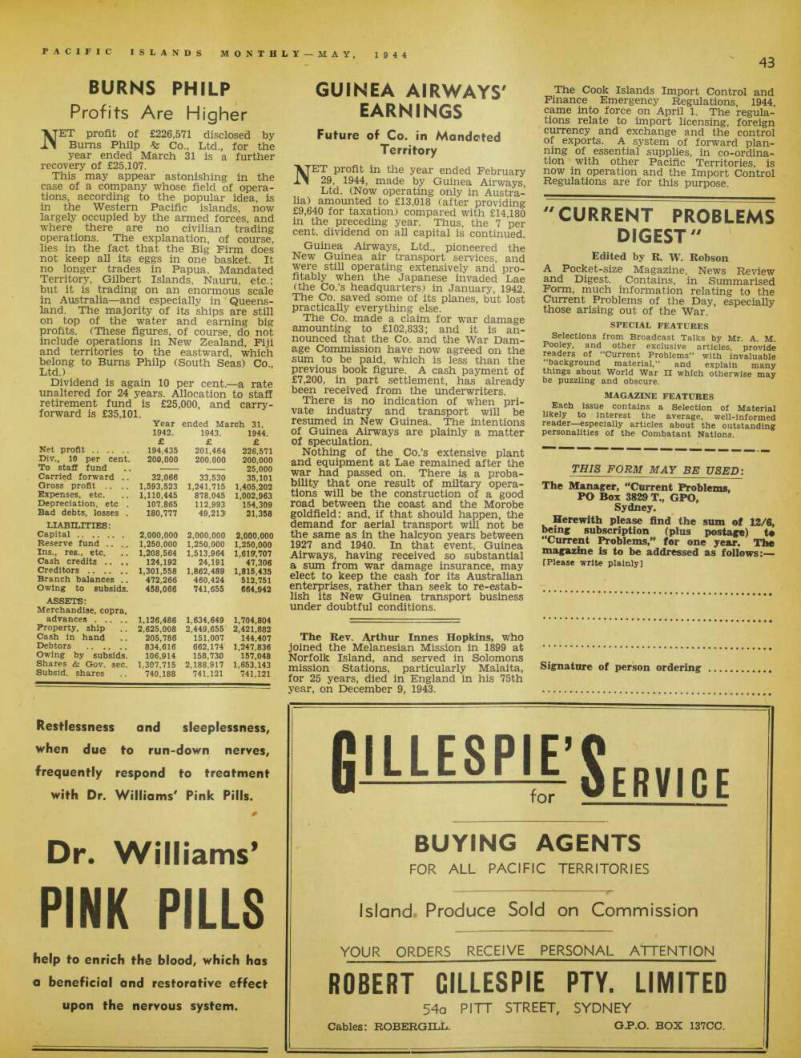
Profits Are Higher
NET profit of £226,571 disclosed by Bums Philp * Co., Ltd., for the year ended March 31 is a further recovery of £25,107.
This may appear astonishing in the case of a company whose field of opera tions, according to the popular idea, is in the Western Pacific islands, now largely occupied by the armed forces, and where there are no civilian trading operations. The explanation, of course, lies in the fact that the Big Firm does not keep all its eggs in one basket. It no longer trades in Papua. Mandated Territory, Gilbert Islands, Nauru, etc.; but it is trading on an enormous scale in Australia —and especially in Queens land. The majority of its ships are still on top of the water and earning big profits. (These figures, of course, do not include operations in New Zealand, Fiji and territories to the eastward, which belong to Burns Philp (South Seas) Co., Ltd.) Dividend is again 10 per cent.—a rate unaltered for 24 years. Allocation to staff retirement fund is £25,000, and carry forward is £35,101.
Year ended March 31, 1942. 1943. 1944. £ £ £ Net profit 194,435 201,464 226,571 Div., 10 per cent. 200,000 200,000 200,000 To staff fund 25,000 Carried forward .. 32,066 33,530 35,101 Gross profit .. .. 1,593,523 1,241,715 1,405,202 Expenses, etc. 1,110,445 878,045 1,002,963 Depreciation, etc . 107,865 112,993 154,309 Bad debts, losses . 180,777 49,213> 21,358
Liabilities:
Capital 2,000,000 2,000,000 2,000,000 Reserve fund .. 1,250,000 1,250,000 1,250,000 Ins., res., etc. 1,208.564 1,513,964 1,619^,707 Cash credits .. .. 124,192 24,191 47,306 Creditors 1,301,558 1,862.489 1,815,435 Branch balances .. 472,266 460,424 512,751 Owing to subsids. 458,066 741,655 664,942
Assets:
Merchandise, copra, advances 1,126,486 1,634,649 1,704.804 Property, ship 2,625,008 2,449,655 2,421,882 Cash in hand 205,786 151,007 144,407 Debtors 834,616 662,174 1,247,836 Owing by subsids. 106,914 158,730 157,048 Shares & Gov. sec. 1,307,715 2,188,917 1,653,143 Subsid. shares 740,188 741,121 741,121
Guinea Airways'
Earnings
Future of Co. in Mandated Territory
NET profit in the year ended February 29, 1944, made by Guinea Airways, Ltd. (Now operating only in Austra lia) amounted to £13,018 (after providing £9,640 for taxation) compared with £14,180 in the preceding year. Thus, the 7 per cent, dividend on all capital is continued.
Guinea Airways, Ltd., pioneered the New Guinea air transport services, and were still operating extensively and pro fitably when the Japanese invaded Lae (the Co.’s headquarters) in January, 1942, The Co. saved some of its planes, but lost practically everything else.
The Co. made a claim for war damage amounting to £102,833; and it is an nounced that the Co. and the War Dam age Commission have now agreed on the sum to be paid, which is less than the previous book figure. A cash payment of £7,200, in part settlement, has already been received from the underwriters.
There is no indication of when pri vate industry and transport will be resumed in New Guinea. The intentions of Guinea Airways are plainly a matter of speculation.
Nothing of the Co.’s extensive plant and equipment at Lae remained after the war had passed on. There is a proba bility that one result of miltary opera tions will be the construction of a good road between the coast and the Morobe goldfield: and, if that should happen, the demand for aerial transport will not be the same as in the halcyon years between 1927 and 1940. In that event, Guinea Airways, having received so substantial a sum from war damage insurance, may elect to keep the cash for its Australian enterprises, rather than seek to re-estab lish its New Guinea transport business under doubtful conditions.
The Rev. Arthur Innes Hopkins, who joined the Melanesian Mission in 1899 at Norfolk Island, and served in Solomons mission Stations, particularly Malaita, for 25 years, died in England in his 75th year, on December 9, 1943.
The Cook Islands Import Control and Finance Emergency Regulations, 1944, came into force on April 1. The regula tions relate to import licensing, foreign currency and exchange and the control of exports. A system of forward plan ning of essential supplies, in co-ordina tion with other Pacific Territories, is now in operation and the Import Control Regulations are for this purpose.
"Current Problems
Digest"
Edited by R. W. Robson A Pocket-size Magazine, News Review
and Digest. Contains, in Summarised
Form, much information relating to the
Current Problems of the Day, especially
those arising out of the War.
Special Features
Selections from Broadcast Talks by Mr. A. M.
Pooley, and other exclusive articles, provide readers of “Current Problems” with invaluable “background material,” and explain many things about World War II which otherwise may be puzzling and obscure.
Magazine Features
Each issue contains a Selection of Material likely to interest the average, well-informed reader—especially articles about the outstanding personalities of the Combatant Nations.
Advertisements & other items, p. 45 (2 items)
6Illespi£’S Er „C
THIS FORM MAY BE USED:
The Manager, “Current Problems,
PQ Box 3829 T., GPO,
Sydney.
Herewith please find the sum of 12/6, being subscription (plus postage) te “Current Problems,” for one year. The magazine is to be addressed as follows: [Please write plainly] Signature of person ordering
6iLLESPi£’S ER „c
a
BUYING AGENTS
FOR ALL PACIFIC TERRITORIES
Island Produce Sold on Commission
YOUR ORDERS RECEIVE PERSONAL ATTENTION
ROBERT GILLESPIE PTY. LIMITED
54a PITT STREET, SYDNEY
Cables: ROBERGILL. G.P.O. BOX 137 CC.
Pink Pills
Restlessness and sleeplessness, when due to run-down nerves, frequently respond to treatment with Dr. Williams' Pink Pills.
Dr. Williams’
help to enrich the blood, which has a beneficial and restorative effect upon the nervous system.
Islands Produce
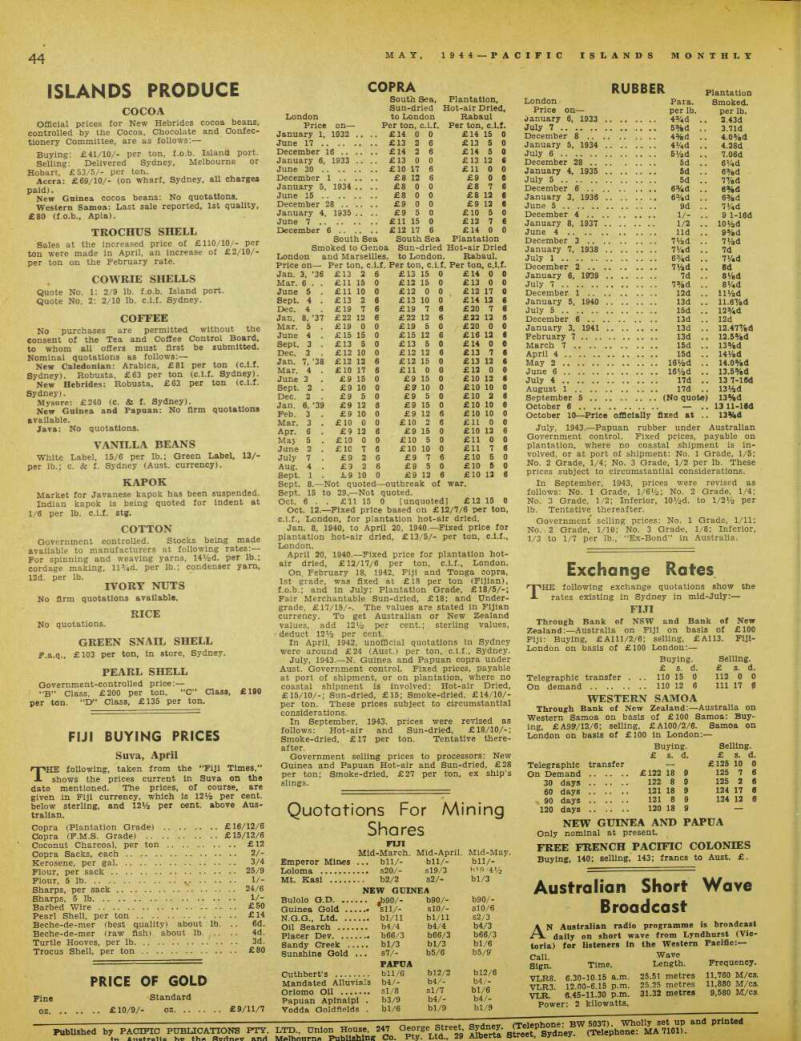
Cocoa
Official prices for New Hebrides cocoa beans, controlled by the Cocoa, Chocolate and Confec tionery Committee, are as follows; — Buying: £4l/10/- per ton, f.o.b. Island port.
Selling: Delivered Sydney, Melbourne or Hobart, £53/5/- per ton.
Accra: £69/10/- (on wharf, Sydney, all charges paid).
New Guinea cocoa beans: No quotations.
Western Samoa: Last sale reported, Ist quality, £BO (f.0.b., Apia).
Trochus Shell
Sales at the increased price of £llO/10/- per ton were made in April, an increase of £2/10/per ton on the February rate.
Cowrie Shells
Quote No. 1: 2/9 lb. f.o.b. Island port.
Quote No. 2: 2/10 lb. c.i.f. Sydney.
Coffee
No purchases are permitted without the consent of the Tea and Coffee Control Board, to whom all offers must first be submitted.
Nominal quotations as follows: — New Caledonian; Arabica, £Bl per ton (c.i.f.
Sydney). Robusta, £63 per ton (c.i.f, Sydney).
New Hebrides: Robusta, £63 per ton (c.i.f.
Sydney).
Mysore: £240 (C. & f. Sydney).
New Guinea and Papuan: No firm quotations available.
Java: No quotations.
Vanilla Beans
White Label, 15/6 per lb.; Green Label, 13/per lb.; c. & f. Sydney (Aust. currency).
Kapok
Market for Javanese kapok has been suspended.
Indian kapok is being quoted for indent at 1/6 per lb. c.i.f. stg.
Cotton
Government controlled. Stocks being made available to manufacturers at following rates:— For spinning and weaving yarns, 14V 2 d. per lb.; cordage making, ll 3 /id. per lb.; condenser yam, 12d. per lb.
Ivory Nuts
No firm quotations available.
Rice
No quotations.
Green Snail Shell
F.a.q., £lO3 per ton, in store, Sydney.
Pearl Shell
Government-controlled price:— “B” Class, £2OO per ton. “C” Class, £l9O per ton. “D” Class, £135 per ton.
Fiji Buying Prices
Suva, April
THE following, taken from the “Fiji Times,” shows the prices current in Suva on the date mentioned. The prices, of course, are given in Fiji currency, which is 12 V2 per cent, below sterling, and 12V2 per cent, above Aus tralian.
Copra (Plantation Grade) .. £16/12/6 Copra (F.M.S. Grade) .. £15/12/6 Coconut Charcoal, per ton ... £ 12 Copra Sacks, each ... 2/- Kerosene, per gal Flour, per sack .. .. 25/9 Flour, 5 lb Sharps, per sack 24/6 Sharps, 5 lb Barbed Wire Pearl Shell, per ton ... £14 Beche-de-mer (best quality) about lb. .. 6d.
Beche-de-mer (raw fish) about lb. ... 4d.
Turtle Hooves, per lb 3d.
Trocus Shell, per ton £80
Price Of Gold
Oct. 6 . . £ll 15 0 [unquoted] £l2 15 0 Oct. 12. —Fixed price based on £l2/7/6 per ton, c.i.f., London, for plantation hot-air dried.
Jan. 8, 1940, to April 20, 1940.—Fixed price for plantation hot-air dried, £l3/5/- per ton, c.i.f., London.
April 20, 1940. —Fixed price for plantation hot air dried, £l2/17/6 per ton, c.i.f., London.
On. February 18, 1942, Fiji and Tonga copra, Ist grade, was fixed at £lB per ton (Fijian), f.0.b.; and in July: Plantation Grade, £lB/5/-; Fair Merchantable Sun-dried, £18; and Under grade, £l7/15/-. The values are stated in Fijian currency. To get Australian or New Zealand values, add 12 V 2 per cent.; sterling values, deduct 12V 2 per cent.
In April, 1942, unofficial quotations in Sydney were around £24 (Aust.) per ton, c.i.f., Sydney.
July, 1943. —N. Guinea and Papuan copra under Aust. Government control. Fixed prices, payable at port of shipment, or on plantation, where no coastal shipment is Involved: Hot-air Dried, £l5/10/-; Sun-dried, £l5; Smoke-dried, £l4/10/per ton. These prices subject to circumstantial considerations.
In September, 1943. prices were revised as follows: Hot-air and Sun-dried, £lB/10/-; Smoke-dried, £l7 per ton. Tentative there after.
Government selling prices to processors: New Guinea and Papuan Hot-air and Sun-dried, £2B per ton; Smoke-dried, £27 per ton, ex ship’s slings.
Pine Standard oz. .. . . £10/9/- oz .. £9/11/7
London
Copra
South Sea, Sun-dried to London Plantation, Hot-air Dried, Rabaul Price i on— Per ton, c.i.f Per ton, c.i.f.
January 1, 1932 • • , , £14 0 0 £14 15 0 June 17 . £13 2 6 £13 5 0 December 16 .. £14 2 6 £14 5 0 January 6, 1933 , £13 0 0 £13 12 6 June 30 . £10 17 6 £11 0 0 December 1 .. £8 12 6 £9 0 0 January 5, , 1934 . . £8 0 0 £8 7 6 June 15 . £8 0 0 £8 12 6 December 28 .. £9 0 0 £9 12 6 January 4, , 1935 . . £9 5 0 £10 5 0 June 7 .. £11 15 0 £12 7 6 December 6 South Sea £12 17 6 South Sea £14 0 Plantation 0 Smoked to Genoa Sundried Hot-air Dried London and Marseilles, to London.
Rabaul.
Price on— Per ton, c.i.f. Per ton, c.i.f.
Per ton, c.i.f.
Jan. 3, *36 £13 2 6 £13 15 0 £14 0 0 Mar. 6 . . £11 15 0 £12 15 0 £13 0 0 June 5 . £11 10 0 £12 0 0 £12 17 0 Sept. 4 . £13 2 6 £13 10 0 £14 12 6 Dec. 4 . £19 7 6 £19 7 6 £20 7 6 Jan. 8, ’37 £22 12 6 £22 12 6 £22 12 6 Mar, 5 . £19 0 0 £19 5 0 £20 0 0 June 4 , £15 15 0 £15 12 6 £16 12 1 Sept. 3 . £13 5 0 £13 5 0 £14 0 0 Dec. 3 . £12 10 0 £12 12 6 £13 7 6 Jan. 7, '38 £12 12 6 £12 15 0 £13 12 6 Mar. 4 . £10 17 6 £11 0 0 £12 0 0 June 3 £9 15 0 £9 15 0 £10 12 6 Sept. 2 . £9 10 0 £9 10 0 £10 10 0 Dec. 2 . £9 5 0 £9 5 0 £10 2 6 Jan. 6, '39 £9 12 6 £9 15 0 £10 10 6 Feb. 3 . £9 10 0 £9 12 6 £10 10 0 Mar. 3 . £10 0 0 £10 2 6 £11 0 0 Apr. 6 . £9 12 6 £9 15 0 £10 12 6 May 5 . £10 0 0 £10 5 0 £11 0 0 June 2 . £10 7 6 £10 10 0 £11 7 6 July 7 . £9 2 6 £9 7 6 £10 5 0 Aug, 4 . £9 2 6 £9 5 0 £10 6 0 Sept. 1 . £9 10 0 £9 12 6 £10 12 6 Sept. 8. —Not quoted—outbreak of Sept. 15 to 29. —Not quoted. war.
Quotations For Mining
Shares
July, 1943. —Papuan rubber under Australian Government control. Fixed prices, payable on plantation, where no coastal shipment is in volved, or at port of shipment: No. 1 Grade, 1/5; No. 2 Grade, 1/4; No. 3 Grade, 1/2 per lb. These prices subject to circumstantial considerations.
In September, 1943, prices were revised as follows; No. 1 Grade, I/6V2 ; No. 2 Grade, 1/4; No. 3 Grade, 1/2; Inferior, lOVad. to I/2V2 per lb. Tentative thereafter.
Government selling prices: No. 1 Grade, 1/11; No., 2 Grade, 1/10; No. 3 Grade, 1/8; Inferior, 1/3 to 1/7 per lb., “Ex-Bond” in Australia.
Fiji
Mid-March.
Mid-April.
Mid-May.
Emperor Mines ... bll/bll/bll/- Loloma s20/- S19/3 bi 9/41/2 Mt. Kasi b2/2 s2/bl/3
New Guinea
Bulolo G.D sll/b90/b90/- Guinea Gold « slO/slO/6 N.G.G., Ltd bl/11 bl/11 s2/3 Oil Search b4/4 b4/4 b4/3 Placer Dev b66/3 b66/3 b66/3 Sandy Creek bl/3 bl/3 bl/6 Sunshine Gold ... s7/b5/6 h5/9 Cuthbert’s
Papua
bll/6 bl2/2 bl2/6 Mandated Alluvials b4/b4/b4/- Orlomo Oil sl/8 sl/7 bl/6 Papuan Apinaipi . b3/9 b4/b4/- Yodda Goldfields . bl/6 bl/9 bl/9
RUBBER Plantation
London Para.
Smoked.
Price on— per lb. per lb.
January 6, 1933 . 4%d .. 2.43d July 7 3.71d December 8 .. .. 4%d .. 4.0 5 /sd January 5, 1934 . 4V 4 d .. 4.28d July 6 7.06d December 28 .. . 5d .. 6y»d January 4, 1935 . 6%d July 5 7 7 /ad December 6 .. .. 6%d .. 6Hd January 3, 1936 . 6%d June 5 7y 4 d December 4 .. .. 1/- .. 9 l-16d January 8, 1937 . 1/2 .. ioy a d June 4 9%d December 3 .. ., 7y*d .. 7»/ a d January 7, 1938 . 7Vad ., 7d July 1 6%d ..
December 2 .. ., 7ttd .. 8d January 6, . 7d ..
SVsd July 7 8*/4d December 1 .. ., 12d ..
ID/ad January 5, 1940 . 13d .. 11.6 7 /ad July 5 15d ., 123/4d December 6 .. .. 13d .. 12d January 3, 1941 . 12.47 7 /ad February 7 .. .. 13d .. 12.5»/ad March 7 13%d April 4 14y a d May 2 16Vsd ..
H.OVad June 6 16y a d .. 13.5 s /ad July 4 17d .. 13 7-16d August 1 17d .. 13%d September 5 ., . 13%d October 6 .. .. 13 11-lSd October 10—Price officially fixed at .. l3%d
Exchange Rates
THE following exchange quotations show the rates existing in Sydney in mid-July:—
Fiji
Through Bank of NSW and Bank of New Zealand:—Australia on Fiji on basis of £lOO Fiji; Buying, £Alll/2/6; selling. £AII3. Fiji- London on basis of £lOO London; —
Western Samoa
Through Bank of New Zealand:—Australia on Western Samoa on basis of £lOO Samoa: Buy ing, £ A99/12/6; selling, £AIOO/2/6. Samoa on London on basis of £lOO in London:—
New Guinea And Papua
Only nominal at present.
Free French Pacific Colonies
Buying, 140; selling, 143; francs to Aust. £.
Buying.
Selling. £ s. d. £ s. d.
Telegraphic transfer . .. 110 15 0 112 0 0 On demand .. 110 12 6 111 17 8
Buying.
Selling. £ s. d. £ s. d.
Telegraphic transfer — £125 10 0 On Demand £122 18 9 125 7 6 30 days 122 8 9 125 2 6 60 days 121 18 9 124 17 6 90 days 121 8 9 124 12 6 120 days 120 18 9 —
Australian Short Wave
Broadcast
AN Australian radio programme is broadcast daily on short wave from Lyndhurst (Vic toria) for listeners in the Western Pacific:—
Call.
Wave Sign.
Time, Length.
Frequency.
Vlr8.
6.30-10.15 a.m. 25.51 metres 11,760 M/cs.
Vlr3.
12.00-6.15 p.m. 25.25 metres 11,880 M/cs.
Vlr.
6.45-11.30 p.m. 31.32 metres 9,580 M/cs.
Power: 2 kilowatts.
Macarthur-The Man Japan Fears
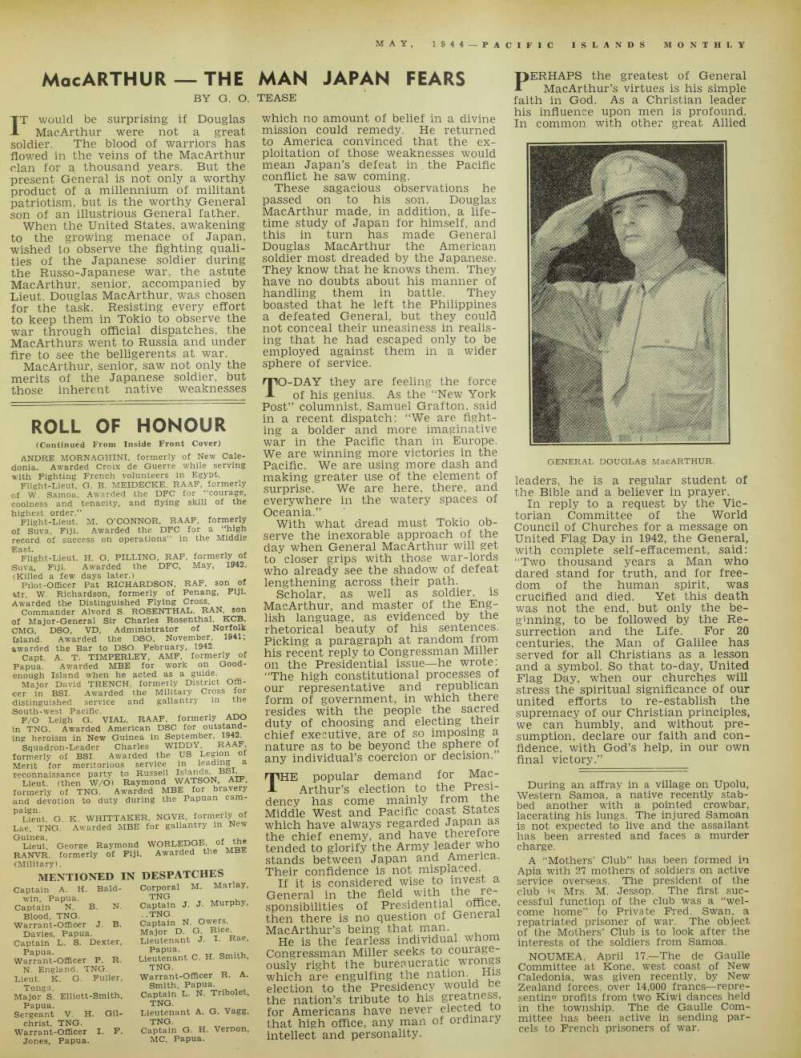
By G. O. Tease
IT would be surprising if Douglas MacArthur were not a great soldier. The blood of warriors has flowed in the veins of the MacArthur clan for a thousand years. But the present General is not only a worthy product of a millennium of militant patriotism, but is the worthy General son of an illustrious General father.
When the United States, awakening to the growing menace of Japan, wished to observe the fighting quali ties of the Japanese soldier during the Russo-Japanese war, the astute MacArthur, senior, accompanied by Lieut. Douglas MacArthur, was chosen for the task. Resisting every effort to keep them in Tokio to observe the war through official dispatches, the MacArthurs went to Russia and under fire to see the belligerents at war.
MacArthur, senior, saw not only the merits of the Japanese soldier, but those inherent native weaknesses
which no amount of belief in a divine mission could remedy. He returned to America convinced that the ex ploitation of those weaknesses would mean Japan’s defeat in the Pacific conflict he saw coming.
These sagacious observations he passed on to his son. Douglas MacArthur made, in addition, a life time study of Japan for himself, and this in turn has made General Douglas MacArthur the American soldier most dreaded by the Japanese.
They know that he knows them. They have no doubts about his manner of handling them in battle. They boasted that he left the Philippines a defeated General, but they could not conceal their uneasiness in realis ing that he had escaped only to be employed against them in a wider sphere of service. rpo-DAY they are feeling the force A of his genius. As the “New York Post” columnist, Samuel Grafton, said in a recent dispatch: “We are fight ing a bolder and more imaginative war in the Pacific than in Europe.
We are winning more victories in the Pacific. We are using more dash and making greater use of the element of surprise. We are here, there, and everywhere in the watery spaces of OcCQilliQj With what dread must Tokio ob serve the inexorable approach of the day when General MacArthur will get to closer grips with those war-lords who already see the shadow of defeat lengthening across their path.
Scholar, as well as soldier, is MacArthur, and master of the Eng lish language, as evidenced by the rhetorical beauty of his sentences.
Picking a paragraph at random from his recent reply to Congressman Miller on the Presidential issue—he wrote: “The high constitutional processes of our representative and republican form of government, in which there resides with the people the sacred duty of choosing and electing their chief executive, are of so imposing a nature as to be beyond the sphere of any individual’s coercion or decision.”
THE popular demand for Mac- Arthur’s election to the Presi dency has come mainly from the Middle West and Pacific coast States which have always regarded Japan as the chief enemy, and have therefore tended to glorify the Army leader who stands between Japan and America.
Their confidence is not misplaced.
If it is considered wise to invest a General in the field with the re sponsibilities of Presidential office, then there is no question of General MacArthur’s being that man.
He is the fearless individual whom Congressman Miller seeks to courage ously right the bureaucratic wrongs which are engulfing the nation. His election to the Presidency would be the nation’s tribute to his greatness, for Americans have never elected to that high office, any man of ordinal y intellect and personality.
PERHAPS the greatest of General MacArthur’s virtues is his simple faith in God. As a Christian leader his influence upon men is profound.
In common with other great Allied
leaders, he is a regular student of the Bible and a believer in prayer.
In reply to a request by the Vic torian Committee of the World Council of Churches for a message on United Flag Day in 1942, the General, with complete self-effacement, said: “Two thousand years a Man who dared stand for truth, and for free dom of the human spirit, was crucified and died. Yet this death was not the end, but only the be ginning, to be followed by the Re surrection and the Life. For 20 centuries, the Man of Galilee has served for all Christians as a lesson and a symbol. So that to-day, United Flag Day, when our churches will stress the spiritual significance of our united efforts to re-establish the supremacy of our Christian principles, we can humbly, and without pre sumption, declare our faith and con fidence, with God’s help, in our own final victory.”
During an affray in a village on Upolu, Western Samoa, a native recently stab bed another with a pointed crowbar, lacerating his lungs. The injured Samoan is not expected to live and the assailant has been arrested and faces a murder charge.
A “Mothers’ Club” has been formed in Apia with 27 mothers of soldiers on active service overseas. The president of the club is Mrs. M. Jessop. The first suc cessful function of the club was a “wel come home” to Private Fred. Swan, a repatriated prisoner of war. The object of the Mothers’ Club is to look after the interests of the soldiers from Samoa.
NOUMEA, April 17.—The de Gaulle Committee at Kone, west coast of New Caledonia, was given recently, by New Zealand forces, over 14,000 francs—repre sentino profits from two Kiwi dances held in the township. The de Gaulle Com mittee has been active in sending par cels to French prisoners of war.
General Douglas Macarthur.
Advertisements & other items, pp. 47-48 (2 items)
Roll Of Honour
MAY, 1944 PACIFIC ISLANDS MONTHLY
(Continued From Inside Front Cover)
W. E. Carpenter & Co. Ltd.
■m v . 1 - -i: i ■ ; ■ I i i . t . ; - ■- -■: ' ' W ' :ss- sc;^J -. ' ' sa Ajßj i I ■• V n : H a ■ m m V: * 5% I K i v- ' ■ ' — ! msm -. ■ :^S , " ib I H I-' f jfc«. mm • ;
w% -%>'4fbUtS
■m % j m sm 4 * w<sig
Ra "J**? iy
jwfi
Travel by CARPENTER AIRLINES
Full particulars from Macdonald, Hamilton Cr Co., or Howard Smith Ltd., Sydney. . |Sm 1 . : mM H m
W. E. CARPENTER & CO. LTD.
MERCHANTS, SHIPOWNERS AND AIRCRAFT OPERATORS
Agents for Australian, European and American Manufacturers, and Distributors of Every Description of Merchandise.
Buyers and Shippers of Copra, Trocas, and all Classes of Islands Produce.
Dodge Brothers Inc.
Westinghouse Electrical Co.
Branches throughout the Pacific Islands
In London; W. R. Carpenter & Co. (London) Ltd., Coronation House, 4 Lloyds Avenue, London, EC.
Head Office: 16 O’CONNELL STREET, SYDNEY
AGENTS FOR:
Ford Motor Company of Canada. Caterpillar Tractors.
T. G. & C. Bolinders (Engines). Electrolux Refrigerators. etc., etc.