Pacific
Islands
Monthly
April 17, 1944
Vol. Xiv No. 9.
Established 1930
[Registered at the G.P.0., transmission by post as a newspaper]
1/-
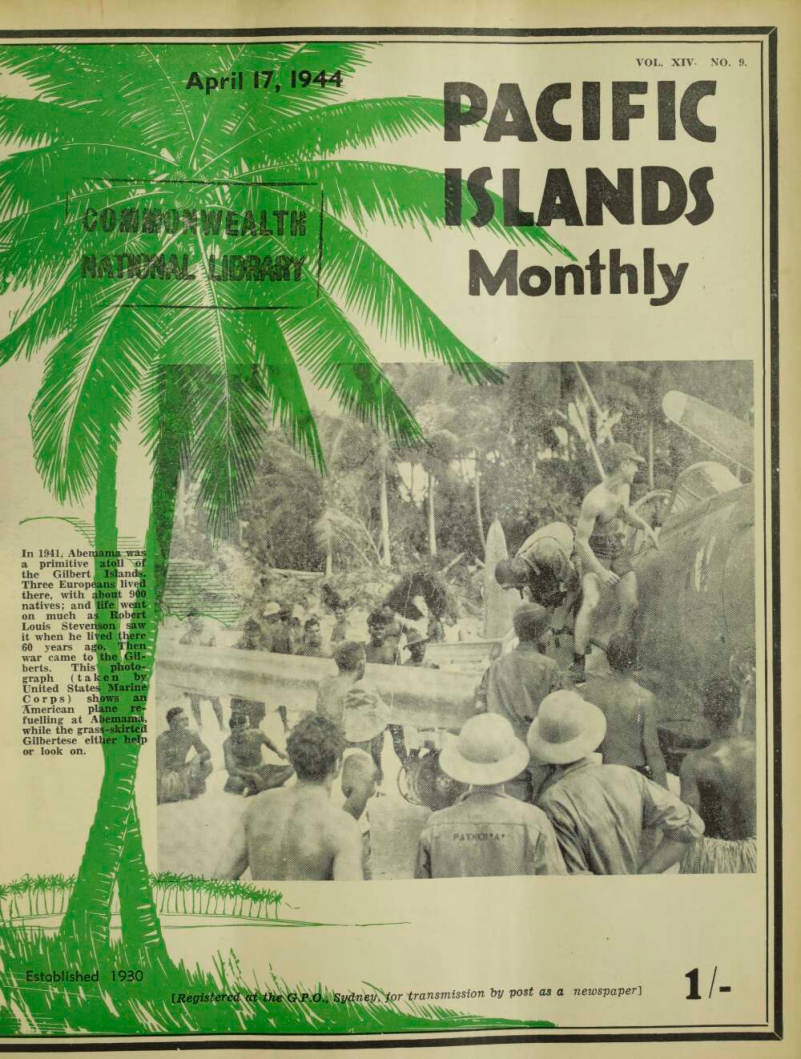
In 1941, Abemama was a primitive atoll of the Gilbert Three Europeans lived there, with 900 natives; and life went on much as Robert Louis Stevenson saw it when he lived thure 60 years ago. Then war came to the Gil berts. This photo graph (taken by United States Marine Corps) American plane fuelling at Abemama, while the grass-skirted Gilbertese either help or look on.
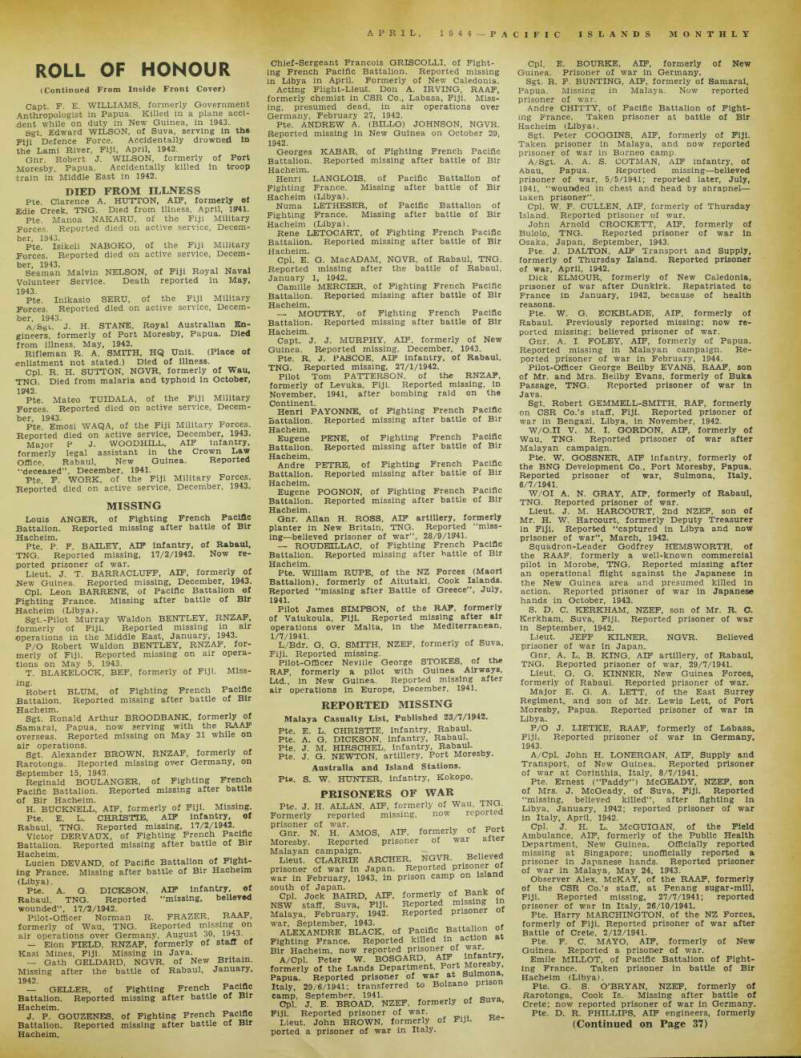
ROLL OF HONOUR—Section I.
[Section I (Killed, Missing, Prisoners) and Section II (Wounded, Decorations, etc.), published in Alternate Months] (We try to assemble here the names of ir*en of the United Nations, residents or former residents of the Pacific Territories, whose names appear in casualty lists or who receive decorations. We should be grateful if relations and friends would send us details of such men.)
Killed
Sgt. Bert AITKEN, NZEF, formerly of Fiji.
Killed in action in Libya.
Eugene AUBRY (formerly of Tahiti), of the Air Force of Fighting Prance. Killed in an air accident in Great Britain, Lieut. L. E. AUSTIN, AMF, formerly of Tan gara, Papua. Reported missing, believed killed, February, 1944.
Squadron-Leader Stan BALDIE, RAP, formerly of Wau, TNG. Killed in action in India.
Pilot-Officer Len BAYLISS, flying Instructor in the RAAF, formerly of Rabaul, New Guinea.
Killed in Sydney, 18/11/1940, when he fell from a trainer aircraft in flight.
Lleut.-Colonel C. N. F, BENGOUGH, of BSI, Defence Forces, formerly Acting-Resident Com missioner of BSI. Killed when aircraft shot down into sea, August, 1943.
R. C. BENTLEY, NZEF, formerly of Fiji.
Killed in action, Middle East, June 27, 1942.
A/Bdr. Neville W. BERTWISTLE, AIF artillery (tank unit), formerly a clerk on the staff of W. R. Carpenter and Co. Ltd., of Rabaul. New Guinea. Killed in action, April, 1941.
P/O J. B. BOMFORD, RNZAF, formerly of CSR Co.'s staff, Fiji. Killed on active service in England.
Pte. W. R. M. BRADNAM, of the NZ Forces, formerly of Fiji. Reported killed in action in the Middle East, 25/11/1941.
Warrant-Officer R. F. BRECHIN, New Guinea Force. Killed in air accident, June 17, 1942.
Formerly of NG Department of Agriculture.
Anton BRINON, of Fighting French Pacific Battalion, formerly of La Foa, New Caledonia.
Killed in action in Libya, November, 1942.
Lleut.-Colonel Felix BROCHE, of the New Caledonian-New Hebridean contingent of the Fighting French Pacific Battalion. Killed in action in the battle of Bir Hacheim (Libya).
Sgt.-Observer Ross BUCKLEY, RNZAF, form erly of Fiji. Reported missing in air operations.
Presumed “dead” in January, 19’44.
Pilot-Officer E. H. CANARD, of RAP, formerly of Fiji Civil Service. Killed in flying accident in South Africa in the course of his duty as flying instructor.
Pte. David C. GARLAND, AIF, formerly chief assayer at the Emperor gold mines, Fiji. Killed in action in New Guinea.
Pierre CHARPENTTER, of the Fighting French Pacific Battalion. Killed in action In the battle of Bir Hacheim.
Raymond OHAUTARD (formerly of New Cale donia), of the Fighting French Pacific Battalion.
Killed in action In Libya.
Flight-Lieutenant G. J. I. CLARKE, of the RAAF, formerly Assistant Plight Superintendent of Carpenter Airlines, New Guinea. Killed In action during operations off Dakar (French West Africa), while attached to HMAS "Aus tralia”, September, 1940.
Georges CLEMENS, of the Free French Pacific contingent from New Caledonia. Reported killed in action in the Middle East, March, 1942.
Flying-Officer Jack R. COATH, of the RNZAF, formerly on the staff of the Bank of New Zealand, in Suva, Fiji. Killed October, 1941, when a training aircraft crashed in NZ.
Sqd.-Leader Lionel COHEN, RAF, formerly of Upper Watut, TNG. Killed when returning from a bomber raid on Berlin in 1942.
Sgt-Pilot Colin CRABBE, RAF, formerly of Suva, Fiji. Killed by enemy action in England in May, 1943.
Pte. Felix CRAIG, AIF, formerly of accounts department, Australasian Petroleum Co., Port Moresby, Papua. Killed in action, June, 1941.
L. J. DAWES, of the NZ Forces, formerly Dis trict Officer of Savaii, Western Samoa. Reported killed in action, February, 1942.
Pilot-Officer V. L. DEARMAN, of the RAAF (observer), formerly overseer and clerk at the Colonial Sugar Refining Co., Ltd., Raraval, Fiji. Reported killed in action In the Middle East, October, 1941.
Capt. Jean GILBERT, of the Naval Forces of Fighting Prance, and formerly of Tahiti. Killed in action.
Captain Kenneth GARDEN, of the RAP Ferry Command, formerly of Guinea Airways Ltd., in New Guinea. Killed September, 1941, when a bomber he "ferried” from USA crashed on west coast of Britain.
Flying-Officer Moresby GOFTON, of the RAF, *on of Mrs. F. S. Stewart, of Wau, New Guinea.
Reported missing, 17/5/1940—presumed killed in air operations.
Rifleman J. A. GOODWIN, AIF infantry, for merly of Bulwa, TNG. Reported “accidentally Killed”, April, 1942.
Ernest GOURNAC (formerly of Tahiti), of the Air Force of Fighting France. Killed in an air accident in Britain.
Pte. Wallace GRAHAM, of the NZ Forces (infantry), formerly on the staff of Morris Hedstrom Ltd., Fiji. Killed in action in the Middle East, November, 1941.
Lieut. J. A. GRANT, AIF, formerly of Man dated Territory. Killed in action.
Lieut. L. B. GROVE, AIF, formerly of Madang, TNG. Killed in action.
Squadron-Leader C. R. GURNEY, RAAF, a former chief pilot of Guinea Airways, Ltd.
Killed in action in the New Guinea area. May, 1942.
Pte. B. HAMILTON. AIF, formerly of Auck land, NZ, and New Guinea. Killed in action.
Gerald T. J. HARPER, RAF, son of Major and Mrs. P. Harper, of Ra, Fiji. Killed In action while navigating a Whitley bomber dur ing a raid on the Continent.
J. HEAD, RAAF, formerly of Fiji. Killed in flying accident in Australia, 1941.
Captain L. T. HURRELL, Infantry, Rabaul.
Killed in action.
Sqd.-Leader James R. HYDE, of the RAF, formerly a Patrol Office in Namatanai and Sepik Districts, TNG. Awarded the Distinguished Ply ing Cross, 1941. Killed in action while leading an attack on an enemy convoy off the coast of Greece, July 24, 1942.
Pte. Jack JOHNSON, formerly of Morris Hedstrom’s staff, Fiji. Killed in action on November 4, while serving with the AIF in New Guinea.
Flying-Officer Alan JOHNSTONE, of the RAP, who was born in Suva, Fiji, In 1915. Killed during bombing raid on Kristlansand, Norway, April, 1940.
Flying-Officer G. M, KEOGH, RAAF, form erly of Wewak, TNG. Killed in air operations in New Guinea, August 30, 1943.
LAC Douglas KIRBY, RAP. who left Suva.
Fiji, with the first contingent of Air Force trainees. Reported killed in a flying accident in South Africa, March, 1942.
Marcel KOLLEN. of the Pacific Battalion of Fighting France. Killed in action in the battle of Bir Hacheim.
C. D. LAMONT, RAF, formerly a master at Boys’ Grammar School, Suva, Fiji. Missing, be lieved killed on air operations over Germany.
Emile LESSON (formerly of New Caledonia), of the Fighting French Pacific Battalion. Killed in action in Libya.
Cpl. Gaston LESSON, of the Fighting French Pacific Battalion. Killed in battle of Bir Hacheim (Libya).
Capt. (now Lt.-Colonel) Edward Tiwi LOVE, NZ Maori Battalion, husband of Mrs. Takau Rio Love, Ariki-nui of Rarotonga, Cook Islands. Re ported missing during campaign in Greece, May, 1941; later, June, 1941, reported “wounded and safe.” Officially announced, July 17, 1942, killed in action in Libya.
Flying-Officer John C. LOWE, RAAF, formerly an overseer with the CSR Co. in Fiji. Reported, 11/4/1942, “took part in air defence of Rabaul, TNG, —missing, believed killed”.
Pte. L. F. McCarthy, AIF infantry, form erly supercargo on W. R. Carpenter and Co.’s inter-island vessels “Desikoko” and “Mako”, in New Guinea, Reported “killed in action” in Syria, 30/10/1941.
Sgt. Kenneth MACGREGOR, AIF, formerly practising as a barrister and solicitor in Wau, TNG. Reported missing, believed killed, In Papua.
Sgt.-Pilot Ronald MACKAY, RAAF, formerly of Thursday Island. Killed in an aircraft accident in England.
Lance-Corporal A. D. MacPHEE, son of Mr.
R. D. MacPhee, Levuka, Fiji. He was 35. was a member of the AIF, and was killed in Greece, May, 1941.
Francois MASSON, of the Fighting French Pacific Battalion. Killed in action in the battle of Bir Hacheim.
Capt. John Malcolm METHVEN. Reported killed
In action in Egypt on July 22, 1942, while serv ing with the AIF, He was born in Ocean Island, and is the youngest son of Mr. and Mrs.
Stuartson O. Methven, of Belgrave, Victoria.
P/O Officer Stuartson Charles METHVEN, born in Suva, Fiji, brother of the late Capt. J.
M. Methven. Killed in air operations over Germany on January 23, 1943.
Spr. A. L. MORANDINI, AIF Engineers, for merly of Konedobu, Papua. Reported killed in action, April, 1942.
F. R. J. NICHOLLS, Royal Artillery, formerly of Fiji. Killed in action, Burma, May, 1942.
W/O G. A. OBST, formerly a member of the Lutheran Mission, TNG. Joined Australian military forces in February, 1942. Killed in action In New Guinea on December 21, 1942.
J. L. C. OSBORN, NZEF, formerly of Fiji.
Killed in action, Middle East, June, 1942, Pilot-Officer Ivan PALMER, RAP, formerly of Fiji. Killed in air operations over Malta.
Lieut. R. G. M. PEMBERTON, AIF, formerly of Rabaul, New Guinea. Killed in action.
O. PILLING, RAF, formerly of Fiji. Missing; believed killed.
Lieut. Tony PHELPS, Fiji Military Forces.
Killed in action in the South Pacific, January, 1944.
Flight-Lieut. H. G. PILLING, DPC, of the RAF, formerly of Suva, Fiji. Killed on air operations, May 19, 1942.
Pte. Edward Harold PRICE, 2nd NZEF (27th Machine Gun Battalion), youngest son of Mr. and Mrs. J. Price, Savu Savu West, FIJI. Killed in action during the Libyan campaign, Middle East, 27/11/1941.
Pte. Cecil PURCELL, NZEF, formerly of Aleipata. Samoa. First Samoan Euroneslan to give his life in World War 11. Killed in action in Middle East.
P/O G. REES-JONES, RAAF, formerly of Labasa, Fiji. Killed in air operations over Ger many, August 16, 1942.
Captain W. H. ROBERTS, NZEF, who was Accountant in the Samoa Treasury Dept., dur ing 1934-35. Killed in action in Libya, Decem ber. 1941.
Pte. Kameli ROKOTUILOMA, of the Fiji Military Forces. Reported killed in action, December, 1943.
Major A. B. ROSS, NZEF, who, between 1923- 29 was successively, Assistant Secretary for Native Affairs, Assistant Secretary to the Administration, and ADC to the Administrator of Samoa. Killed in action in Libya.
Cpl. Alex. C. SCOTT, AIF, formerly manager at Kieta, TNG, for Burns, Philp and Co. Ltd.
Killed in action in the Middle East, 19/6/1941.
J. SIMPSON, RAAF, formerly of FIJI. Killed in action over Malta, July, 1941.
Sgt. R. R. SHORT, AIF, formerly of Port Moresby. Killed in action.
Lieut. G. STEVENSON, AIF, formerly a Patrol Officer in New Guinea. Killed in action in New Guinea, on June 26, 1943.
Lieutenant A. G. W. THOMAS, RANR, for merly master of Burns Philp & Company’s S 3 “Muliama.” Killed in action.
Pte. Popoare TANGIITI, of the NZ Forces (Maori Battalion), formerly of Mangala, Cook Islands. Reported “missing after Battle of Greece—presumed dead”. July, 1941.
Derek TOVEY, NZEF, formerly of Suva, Fiji.
Killed in action in Tunisia in April, 1943.
Capt. A. F. J. WHITE, AIF, formerly a Dis trict Officer in Fiji, and BSI. Killed in action in New Guinea.
Died From Wounds
Pte. Ernest HENRY, AIF, formerly of the Rabaul (NG) staff of Burns, Philp and Co.
Ltd. Died from wounds received in Battle of Crete, 1/6/1941.
Pte. Alec. MUNRO, NZ Forces, formerly of Norfolk Island. Died in Libya (Middle East), December, 1941.
Pte. T. LAWRIE, AIF, son of Mr. Lawrie, for merly of Fiji. Died of wounds in Middle East.
Pte. Walter PEARSON, of first NG quota of AIF (infantry). Died from wounds received In action, 24/6/1941.
A/Bdr. W. R. SCOTT, AIF, of New Guinea.
Died from wounds. July. 1941.
Sgt. Charles SPITZ, of the Fighting French, Pacific Battalion, and formerly of Tahiti. Died from wounds received at Bir Hacheim, on June 21, 1943.
Sgt.-Pilot Peter Clarkson WISE, of the RAF, son of Mr. W. Wise, OBE, Director of Public Works, Fiji. Died from wounds received during bombing raid over Germany, January, 1941.
Accidentally Killed
A/Cpl. P. A. McKEE, New Guinea Forces, formerly of Bulolo. Died of injuries.
Major N. V. McKENNA, AIF, formerly of Wau, TNG. Accidentally killed, September 30, 1943.
(Continued on Inside Back Cover)
of Bulwa, TNG. Reported prisoner of war, June, 1942.
A/Bdr. L. J, SMEETON, AIF, formerly of Rabaul, TNG. Reported prisoner of war in Malayan campaign.
Pte. John O. SMITH, of the NZ Forces, son of Captain Arthur Smith, of the Fiji inter-island vessel “Tui Kauvaro”. Missing after battle of Crete, May, 1941; reported prisoner of war in Germany, 21/10/1941, Squadron-Leader L. C. SHOPPEE, DSO, RAF, formerly of Edie Creek, New Guinea. Was in Java during Japanese invasion; now known to be a prisoner of war.
Gnr. D. M. SPENCE, AIF, formerly of Port Moresby. Reported prisoner of war after Malayan campaign.
LAC Charles SOLLITT, of the RAAF (wire less operator), son of Mr. and Mrs. C. H.
Sollitt, of Nausori, Fiji. Reported missing after air operations in New Guinea, January, 1942; later, March, 1942, reported rescued from sea by Japanese—now prisoner of war.
Pte. Fred SWAN, NZ Army Medical Corps, formerly of Apia, Western Samoa. Missing after Battle of Crete, August, 1941; reported prisoner of war in Germany, November, 1941.
Signalman J. C. E. SWINBOURNE, 6th Div.
Signals, AIF, formerly of Fiji and the Gilbert & Ellice Islands Colony. Taken prisoner at Crete, June, 1941, now in prison camp at Stalag, VIIA, Germany.
Lieut. CLIFF WARREN, of NZEP, serving in the Middle East, and formerly of Morris Hed strom Ltd.’s staff at Ba and Lautoka, Fiji. Re ported prisoner of war.
Mjr. N. WATCH, formerly Dr. Watch, of Rabaul, missing after Japanese invasion of Rabaul. Believed prisoner of war in Japan. Now reported POW in Japan.
Gnr. D. S. WHITCOMBE, NZEP, formerly of Fiji and Tonga. Wounded in Crete and reported prisoner of war in Germany.
Pte. John D. WHITCOMBE, of the NZ Forces, formerly of Levuka, Fiji. Reported prisoner of war in Germany, November, 1941.
Capt. F. E. WILLIAMS, formerly Government Anthropologist in Papua. Killed in a plane acci dent while on duty in New Guinea, in 1943.
Sgt. Edward WILSON, of Suva, serving in the Fiji Defence Force. Accidentally drowned in the Lami River, Fiji. April, 1942.
Gnr. Robert J. WILSON, formerly of Port Moresby, Papua. Accidentally killed in troop "train in Middle East in 1942.
Died From Illness
Pte. Clarence A. HUTTON, AIF, formerly of Edie Creek, TNG. Died from illness. April, 1941.
Pte. Manoa NAKARU, of the Fiji Military Porces. Reported died on active service, Decem ber, 1943.
Pte. Isikeli NABOKO, of the Fiji Military Porces. Reported died on active service, Decem ber, 1943.
Seaman Malvin NELSON, of Fiji Royal Naval Volunteer Service. Death reported in May, 1943.
Pte. Inikasio SERU, of the Fiji Military Porces. Reported died on active service, Decem ber, 1943.
A/Sgi. J. H. STANE, Royal Australian En gineers, formerly of Port Moresby, Papua. Died from illness, May, 1942.
Rifleman R. A. SMITH. HQ Unit. (Place of enlistment not stated.) Died of Illness.
Cpl. R. H. SUTTON, NGVR, formerly of Wau, TNG. Died from malaria and typhoid in October, 1942.
Pte. Mateo TUIDALA, of the Fiji Military Porces. Reported died on active service, Decem ber, 1943.
Pte. Emosi WAQA, of the Fiji Military Forces.
Reported died on active service, December, 1943.
Major P J. WOODHILL, AIF Infantry, formerly legal assistant in the Crown Law Office, Rabaul, New Guinea. Reported “deceased”. December, 1941.
Pte. F. WORK, of the Fiji Military Forces.
Reported died on active service, December, 1943,
Missing
Louis ANGER, of Fighting French Pacific Battalion. Reported missing after battle of Bir Hacheim.
Pte. P. F. BAILEY, AIF infantry, of Rabaul, TNG. Reported missing, 17/2/1942. Now re ported prisoner of war.
Lieut. J. T. BARRACLUFF, AIF. formerly of New Guinea. Reported missing, December, 1943.
Cpl. Leon BARRENS, of Pacific Battalion of Fighting France. Missing after battle of Blr Hacheim (Libya).
Sgt.-Pilot Murray Waldon BENTLEY, RNZAF, formerly of Fiji. Reported missing in air operations in the Middle East, January, 1943.
P/O Robert Waldon BENTLEY, RNZAF, for merly of Fiji. Reported missing on air opera tions on May 5, 1943.
T. BLAKELOCK, BEF, formerly of Fiji. Miss ing.
Robert BLUM, of Fighting French Pacific Battalion. Reported missing after battle of Bir Hacheim.
Sgt. Ronald Arthur BROODBANK, formerly of Samarai, Papua, now serving with the RAAF overseas. Reported missing on May 31 while on air operations.
Sgt. Alexander BROWN. RNZAF, formerly of Rarotonga. Reported missing over Germany, on September 15, 1942.
Reginald BOULANGER, of Fighting French Pacific Battalion. Reported missing after battle of Bir Hacheim.
H. BUCKNELL, AIF, formerly of Fiji. Missing.
Pte. E. L. CHRISTIE, AIF infantry, of Rabaul, TNG. Reported missing, 17/2/1942.
Victor DERVAUX, of Fighting French Pacific Battalion. Reported missing after battle of Bir Hacheim.
Lucien DEVAND, of Pacific Battalion of Fight ing Prance. Missing after battle of Bir Hacheim (Libya).
Pte. A. G. DICKSON, AIP infantry, of Rabaul, TNG. Reported “missing, believed wounded”, 17/2/1942.
Pilot-Officer Norman R. FRAZER, RAAP, formerly of Wau, TNG. Reported missing on air operations over Germany, August 30, 1943.
Eion FIELD, RNZAF, formerly of staff of Kasi Mines, Fiji. Missing in Java.
Gath GELDARD, NGVR, of New Britain.
Missing after the battle of Rabaul, January, 1942. „ IJt GELLER, of Fighting French Pacific Battalion. Reported missing after battle of Bir Hacheim.
J. P. GOUZENES, of Fighting French Pacific Battalion. Reported missing after battle of Blr Hacheim.
Chief-Sergeant Francois GRISCOLLI, of Fight ing French Pacific Battalion. Reported missing in Libya in April. Formerly of New Caledonia.
Acting Plight-Lieut. Don A. IRVING, RAAF, formerly chemist in CSR Co., Labasa, Fiji. Miss ing, presumed dead, in air operations over Germany, February 27, 1942.
Pte. Andrew A. (Billo) Johnson, Ngvr.
Reported missing in New Guinea on October 29, 1942.
Georges KABAR, of Fighting French Pacific Battalion. Reported missing after battle of Blr Hacheim.
Henri LANGLOIS, of Pacific Battalion of Fighting France. Missing after battle of Bir Hacheim (Libya).
Numa LETHESER, of Pacific Battalion of Fighting France. Missing after battle of Bir Hacheim (Libya).
Rene LETOCART, of Fighting French Pacific Battalion. Reported missing after battle of Bir Hacheim.
Cpl. E. G. MacADAM, NGVR, of Rabaul, TNG.
Reported missing after the battle of Rabaul, January 1, 1942.
Camille MERCIER, of Fighting French Pacific Battalion. Reported missing after battle of Blr Hacheim.
MOUTRY, of Fighting French Pacific Battalion. Reported missing after battle of Blr Hacheim.
Capt. J. J. MURPHY, ATP, formerly of New Guinea. Reported missing, December, 1943.
Pte. R. J. PASCOE, AIP Infantry, of Rabaul, TNG. Reported missing. 27/1/1942.
Pilot Tom PATTERSON. of the RNZAF, formerly of Levuka. Fiji. Reported missing, in November, 1941, after bombing raid on the Continent.
Henri PAYONNE, of Fighting French Pacific Battalion. Reported missing after battle of Bir Hacheim.
Eugene PENE, of Fighting French Pacific Battalion. Reported missing after battle of Bir Hacheim.
Andre PETRE, of Fighting French Pacific Battalion. Reported missing after battle of Bir Hacheim.
Eugene POGNON, of Fighting French Pacific Battalion. Reported missing after battle of Bir Hacheim.
Gnr. Allan H. ROSS, AIF artillery, formerly planter in New Britain, TNG. Reported “miss ing—believed prisoner of war”, 28/9/1941.
ROUDEELLAC, of Fighting French Pacific Battalion. Reported missing after battle of Blr Hacheim.
Pte. William RUPE, of the NZ Forces (Maori Battalion), formerly of Aitutaki, Cook Islands.
Reported “missing after Battle of Greece”, July, 1941.
Pilot James SIMPSON, of the RAF, formerly of Vatukoula, Fiji. Reported missing after air operations over Malta, in the Mediterranean, 1/7/1941.
L/Bdr. G. G. SMITH, NZEF, formerly of Suva, Fiji. Reported missing.
Pilot-Officer Neville George STOKES, of the RAF, formerly a pilot with Guinea Airways.
Ltd., in New Guinea. Reported missing after air operations in Europe, December, 1941.
Reported Missing
Malaya Casualty List, Published 23/7/1942.
Pte. E. L. CHRISTIE, infantry, Rabaul.
Pte. A. G. DICKSON, infantry, Rabaul.
Pte. J. M. HIRSCHEL, infantry, Rabaul.
Pte. J. G. NEWTON, artillery. Port Moresby.
Australia and Island Stations.
Pta. S. W. HUNTER, infantry, Kokopo.
Prisoners Of War
Pte. J. H. ALLAN, AIF, formerly of Wau, TNG.
Formerly reported missing, now reported prisoner of war. , , Gnr. N. H. AMOS, AIF, formerly of Port Moresby. Reported prisoner of war after Malayan campaign. .
Lieut. CLARRIE ARCHER, NGVR. Believed prisoner of war in Japan. Reported prisoner of war in February, 1943, in prison camp on island south of Japan. . . - Cpl. Jock BAIRD, AIF, formerly of Bank of NSW staff, Suva, Fiji. Reported missing in Malaya, February, 1942. Reported prisoner of war, September, 1943. .
ALEXANDRE BLACK, of Pacific Battalion or Fighting France. Reported killed in action at Bir Hacheim, now reported prisoner of w! *r
A/Cpl. Peter W. Bosgard, Aif
formerly of the Lands Department, Port Moresby, Papua. Reported prisoner of war at Sulmona, Italy, 29/6/1941; transferred to Bolzano prison camp, September. 1941. a , IM Cpl. J, E. BROAD, NZEF, formerly of Suva, Fiji. Reported prisoner of war.
Lieut. John BROWN, formerly of Fiji. re ported a prisoner of war in Italy.
Cpl. E. BOURKE, AIF, formerly of New Guinea. Prisoner of war in Germany.
Sgt. R. F. BUNTING, AIF, formerly of Samaral, Papua. Missing in Malaya. Now reported prisoner of war.
Andre CHITTY, of Pacific Battalion of Fight ing France. Taken prisoner at battle of Blr Hacheim (Libya).
Sgt. Peter COGGINS, AIF, formerly of Fiji.
Taken prisoner in Malaya, and now reported prisoner of war in Borneo camp.
A/Sgt. A. A. S. COTMAN, AIF infantry, of Abau, Papua. Reported missing—believed prisoner of war, 5/5/1941; reported later, July, 1941, “wounded in chest and head by shrapnel— taken prisoner”.
Cpl. W. F. CULLEN, AIF, formerly of Thursday Island. Reported prisoner of war.
John Arnold CROCKETT, AIF, formerly of Bulolo, TNG. Reported prisoner of war in Osaka, Japan, September, 1943.
Pte. J. DALTON. AIF Transport and Supply, formerly of Thursday Island. Reported prisoner of war, April, 1942.
Dick ELMOUR, formerly of New Caledonia, prisoner of war after Dunkirk. Repatriated to Prance in January, 1942, because of health reasons.
Pte. W. G. ECKBLADE, AIF, formerly of Rabaul. Previously reported missing; now re ported missing; believed prisoner of war.
Gnr. A. I. FOLEY, AIF, formerly of Papua.
Reported missing in Malayan campaign. Re ported prisoner of war in February, 1944.
Pilot-Officer George Beilby EVANS, RAAP, son of Mr. and Mrs. Beilby Evans, formerly of Buka Passage, TNG. Reported prisoner of war in Java.
Sgt. Robert GEMMELL-SMITH, RAP, formerly on CSR Co.’s staff, Fiji. Reported prisoner of war in Bengazi, Libya, in November, 1942.
W/O.n V. M. I. GORDON, AIF, formerly of Wau, TNG. Reported prisoner of war after Malayan campaign.
Pte. W. GOSSNER, AIF infantry, formerly of the BNG Development Co., Port Moresby, Papua.
Reported prisoner of war, Sulmona, Italy, 6/7/1941.
W/OI A. N. GRAY, AIP, formerly of Rabaul, TNG. Reported prisoner of war.
Lieut. J. M. HARCOURT, 2nd NZEF, son of Mr. H. W. Harcourt, formerly Deputy Treasurer in Fiji. Reported “captured in Libya and now prisoner of war”, March, 1942.
Squadron-Leader Godfrey HEMSWORTH, of the RAAP, formerly a well-known commercial pilot in Morobe, TNG. Reported missing after an operational flight against the Japanese in the New Guinea area and presumed killed in action. Reported prisoner of war in Japanese hands in October, 1943.
S. D. C. KERKHAM, NZEF, son of Mr. R. C.
Kerkham, Suva, Fiji. Reported prisoner of war in September, 1942.
Lieut. JEFF KILNER, NGVR. Believed prisoner of war in Japan.
Gnr. A, L. B. KING, AIP artillery, of Rabaul, TNG. Reported prisoner of war, 29/7/1941.
Lieut. G. G. KINNER, New Guinea Forces, formerly of Rabaul. Reported prisoner of war.
Major E. G. A. LETT, of the East Surrey Regiment, and son of Mr. Lewis Lett, of Port Moresby, Papua. Reported prisoner of war in Libya.
P/O J. LIETKE, RAAF, formerly of Labasa, Fiji. Reported prisoner of war in Germany, 1943.
A/Cpl. John H. LONERGAN, AIF, Supply and Transport, of New Guinea. Reported prisoner of war at Corinthia, Italy, 8/7/1941, Pte. Ernest (“Paddy”) McGEADY, NZEF, son of Mrs. J. McGeady, of Suva, Fiji. Reported “missing, believed killed”, after fighting in Libya, January, 1942; reported prisoner of war in Italy, April, 1942.
Cpl. J. H. L. McGUIGAN, of the Field Ambulance, AIF, formerly of the Public Health Department, New Guinea. Officially reported missing at Singapore; unofficially reported a prisoner in Japanese hands. Reported prisoner of war in Malaya, May 24, 1943.
Observer Alex. McKAY, of the RAAP, formerly of the CSR Co.’s staff, at Penang sugar-mill, Fiji. Reported missing, 27/7/1941; reported prisoner of war in Italy, 26/10/1941, Pte. Harry MARCHINGTON, of the NZ Forces, formerly of Fiji. Reported prisoner of war after Battle of Crete, 2/12/1941.
Pte. F. C. MAYO, AIP, formerly of New Guinea. Reported a prisoner of war.
Emile MILLOT. of Pacific Battalion of Fight ing France. Taken prisoner in battle of Bir Hacheim (Libya).
Pte. G. S. O’BRYAN. NZEF. formerly of Rarotonga, Cook Is. Missing after battle of Crete; now reported prisoner of war in Germany.
Pte. D. R. PHILLIPS, AIF engineers, formerly
(Continued on Page 37)
Pacific News-Review
Notes And Comment On
The Progress Of The War
From Mar. 16 To Apr. 14
Mar. 16: The whole German front in the Ukraine is collapsing. The Red Army has crossed the middle reaches of the River Bug, leaving Marshal von Man stein no option but to continue the costly German retreat to the Rumania border.
Mar. 16: The Japanese have suffered further heavy losses over the Wewak area. They lost 65 planes in three days.
In the Talasea area (New Britain) there iiave been new landings by US Marines.
Mar. 17: After 3,000 sorties were flown by Allied planes over Cassino (Italy) fierce infantry fighting developed near the town (75 miles south-east of Rome).
Mar. 17: In New Guinea, the Austra lians are near Bogadjim (main enemy base east of Madang).
Mar. 18: New Zealanders (spearhead of the assault) have fought their way through the town of Cassino, Italy, to its south-western outskirts.
Mar. 20: Great Russian forces, in a far reaching break-through on the Ukraine front, have crossed the River Dniester, which marks the 1939 Rumanian border.
Stalin has announced the destruction of the second German Sixth Army (the first Sixth Army was liquidated at Stalingrad last year).
Mar. 20: British air-borne troops have landed behind the Japanese in Burma and have established airstrips and a supply base.
Mar. 21: The Germans reinforced their positions at Cassino in Italy, and after fierce fighting recaptured one hill. New Zealand and Indian troops in one sector have advanced beyond the town.
Mar. 21: The Russians now are pour ing through a 30-miles gap in the Ger man Dniester defences, and tanks, infan try and guns are being rushed up for a drive across the River Pruth (1940 Rumanian border).
Mar. 22: The German Army has occu pied the Axis country of Hungary and has seized hostages, including the Regent, Admiral Horthy and the Prime Minister, Dr. Nicolas Kallay.
The Germans, of course, must occupy both Hungary and Rumania if they are to successfully defend the Carpathians line.
Mar. 22: Russian armies are fanning out into Bessarabia from their Dniester bridgehead. It is apparent, from the speed of the Russian advance that Ger man and Rumanian resistance was dis organised and weak.
Mar. 22: Finland has rejected the peace terms offered by Russia.
Mar. 23: Following swiftly their occu pation of Hungary, German troops have seized key positions in Rumania and Bulgaria.
Mar. 23: Japanese patrols have crossed the frontier Into Assam (eastern India) from north-west Burma.
Mar. 23: United States Marines, from Solomons bases, landed at Emirau and Elomusao Islands, just north-west of Kavieng, in New Ireland, on Monday.
Mar. 25: In 24 hours, 5,000 Allied planes raided targets in western Germany and northern France, and dropped an aver age of four tons of bombs per minute.
Mar. 25: Marshal Zhukov’s armies, 100 miles north of where the Russians crossed the Dniester last week, are advancing on a 40-miles front, and are nearing the upper reaches of the Dniester.
Mar. 27; The Germans have now had five days of intensive, unabated air-war.
Berlin is a mass of flames. Kiel suffered heavily. On Friday night alone, 73 RAF bombers failed to return. London’s heaviest raid for some time also occurred on Friday night. About 100 enemy bomb ers were over the city in an apparent
attempt to cause widespread fires.
Mar. 27: Three large Bessarabian towns fell to the Russians over the week-end, including Nikolaev (important port at the mouth of the Bug). The Germans are retreating blindly as Marshal Koniev’s forces advance on Rumania.
Mar. 26: In a world broadcast, Mr.
Churchill said that the hour of invasion was coming near. He stated that he believed that the end of the war in the Pacific would not be so long after the downfall of Germany as he had thought last year.
Mar. 28: With the Russians preparing to enter Rumania, Russian shells are, for the first time in this war, falling on soil that is not Russian. Red Army units are lined up along the River Pruth (pre-war boundary of Rumania).
Mar. 29: In an advance of 40 miles, Marshal Zhukov’s forces have reached the River Pruth (Rumania). Marshal Koniev’s forces reached the Pruth, fur ther south, on Sunday. Large German forces have been cut off between these two Russian forces.
Mar. 29: Some Army journals describe the recent Allied operations at Cassino, in Italy, as a total failure.
Mar. 30: Kavieng and Rabaul are being pounded almost daily by the Allied air forces, operating in force from the Solo mons and from Emirau Island (which we occupied 10 days ago).
Mar. 31: The Russians reached the Carpathians (Hungarian border), thus cutting off the Germany Army in south ern Russia from that in lower Poland.
Apl. 1: US naval and air forces raided the important Japanese naval base, Palau (western Carolines). Heavy bomb ers caused severe damage and destroyed 54 planes at Truk: US Navy Catalmas started large fires in the Carolines (Woleai Island) and 118 enemy planes were destroyed at Hollandia (Dutch New r Guinea). , ..
Apl 3: The Germans are looting the great Black Sea city of Odessa, as the Red Army draws near. .
Apl 3: The Japanese who were driv ing against Imphal (capital of the Indian State of Manipur, in Assam), have been halted by RAF bombings.
Apl. 4: The Germans are rapidly evacuating Odessa sector, through a narrowing escape gap. . .
Apl. 4: In Assam, a substantial Japan ese force is moving on the important junction of the Assam railway and the road from Imphal. This directly threat ens British communications.
Apl. 5: The Russians are pouring into Rumania on a 60-miles front. They have penetrated 15 miles inside the border.
Apl. 5: Washington announces that the naval raids last week sank or damaged all the Jap ships anchored at Palau, Woleao and Yap. , Apl. 6: 300 aircraft on Monday dropped 400 tons of bombs on Hollandia (Dutch New Guinea). The entire Japanese force of about 290 aircraft concentrated in this area now has been wiped out.
Apl. 8: Stalin announced that the Kea armies have reached Czecho-Slovakia, along 132-miles front, where it meets Rumania, after having routed the enemy forces in the Carpathian foothills.
Apl. 9; Japanese attempts to make outflanking landings along the Bay Bengal coast, to reinforce their drive on India, are forecast. A large British fleet is believed to have congregated in the Indian Ocean, to counter any move m this direction. . , . .
Apl 10: US task-force which attackea enemy bases in the western Carolines and Palau Group, between March 28 ana
March 31, sank 25 ships and destroyed 126 planes. Seventeen other ships were damaged and 54 planes were probably destroyed. The Americans lost 25 planes and no surface craft.
Apl. 10: Allied destroyers attacked Japanese bases along the northern New Guinea coast —at Hansa Bay, Alexishafen and Madang. Large bombers made a co-ordinated attack on the same bases.
Apl. 11: The Red armies have captured Odessa, the last big Russian city to be freed. Loss of the city is admitted by Berlin.
Apl. 12: The major portion of New Britain is now in Allied hands, and the Japanese forces are withdrawing quickly to the Gazelle Peninsula, and preparing for a final defence at Rabaul.
Apl. 13: An air attack upon Germany and German-occupied countries has been proceeding for five days and nights. RAF and American air forces are keeping up a non-stop offensive against the railway systems on which Germany must rely to supply the defenders of the Continent.
Apl. 14: More than one-third of the Crimea now has been recaptured by the Russians, who are virtually at the gates of Sebastopol fortress.
Apl. 14: Australians have captured Bogadjim, near Madang, the most east erly enemy base on the northern coast of New Guinea. The Japanese are with drawing westward.
Centenary Of Pioneer
Ims Missionary
From Our Own Correspondent
Papeete, Mar. 10.
MAY 2, 1944, will be the centenary of the passing of the great Henry Nott, pioneer missionary and scholar.
Our well-known historical writer, Mr.
W. W. Bolton, is determined that the memory of this illustrious apostle shall not fade in the minds of the people to whom he brought the gift of the Gospel.
He is preparing a memorial of the Rev.
Henry Nott’s services, to be delivered at the ceremony, at the place of Nott’s burial, on the day of remembrance.
Book, 1944
Pacific Islands Year
rE production of tire Pacific Islands Year Book, 1944, commenced four months ago. has been delayed very much owing to inability to obtain suffi cient supplies of paper. Stocks of all materials needed in book production, and especially paper, have been almost un procurable in Australia for many months.
Major difficulties have been overcome, however, and the Year Book now is being printed. Supplies should be available early next month.
The publishers much regret the recur rent, exasperating delays; but, in the circumstances created by the war, they were unavoidable.
Information Wanted
fIIHE Red Cross Bureau, 3rd Floor, X Ocean House, 34 Martin Place, Sydney, is appealing for infor mation concerning the whereabouts of Mrs. Evelyn M. Burchfield and her son James, who are said to have been evacuated from the South-west Pacific Islands to Australia.
Contents
Pacific News-Review i.
The Defeat of Japan in the South Pacific i Stop Press 2 Lee Vial, ADO—Story of Remarkable Achievements 3 Battered Again—Cook Island Hurri canes 3 Australian Territories and Military Administration 4 £600,000 for Medical Services in Central Pacific 5 Trans-New Guinea—lncredible New Road 6 Fiji Sugar—British Expert to Inquire Into Dispute 7 Pacific Phosphate—Australasia’s Vital Need 7 Landing on Rendova 8 The Sepik Tragedy—What Really Happened at Angorm in March, 1942 10 Tropicalities 11 Will There Be A Peace Conference .. 13 Territorians Into Battle 15 German Raiders Exploits Recalled— Chance Meeting in Algiers Brings News of “Notou’s” Crew 17 Samoa’s Buoyant Finances 18 Tribute to the Native Canoe 19 Tobacco as a Tropical Crop 20 The Work of Nicolai Mordvinoff ... 23 Fijians on Patrol 24 NevjrGuinea of the Future 25 Cost of Living Increases for Fiji 27 The Gilbertese had Enough of Jap “Co-Prosperity” 29 Why Not Suva—Medical School Advo cated for Papua 35 War Damage Commission Moves Ponderously 36 Need For Colonial Reform 38
Plan for Pacific Islands Dominion .. 39 Polynesia and New Guinea Meet — Women’s Club Function 40 Markets, Commercial 42
Advertisers
Atkins Pty., Ltd., Wm 24 AWA, Ltd 22 Australian Alumi nium Co. Pty., Ltd 37 Baker Pty., Ltd., W. Jno 30 Berger’s Paints . . 12 Broomfield, Ltd. . . 25 Brown & Co., Ltd., G 13 Brunton’s Flour . . 36 Burns, Philp Trust Co., Ltd. ... 15 BP (SS) Co. . . . 13 Carlton & United Breweries, Ltd. . 17 Carpenter, Ltd., W.
R cov. iv.
Chivers & Sons, Ltd 26 Coleman Lamp & Stove Co. ... 29 Colonial Wholesale Meat Co., Ltd. . 18 “Current Prob lems” 23 “Cystex” ... 30 X)arvas & Co. . . 35 %avid Trading Co., B 41 Donaghy & Sons, Ltd 41 Donald, Ltd., A. B. 34 Dr. Williams Pink Pills .40 Electrolux Refrigerators . . 16 Foster, Clark, Ltd. 19 Garrett & Davidson 31 Gilbey’s Gin ... 34 Gillespie Pty., Ltd., Robert ... 39 Gillespie’s Flour .27
Gough & Co., E.
J 33 Grand Pacific Hotel ii.
Grove & Sons, W.
H 14 Heinz & Co. Pty., Ltd., H. J. . . . 31 King’s Compo . . 39 Kopsen & Co., Ltd. 40 Masschelin, O. P. . 33 Maxwell Porter, Ltd. 32 “Mendaco” ... 32 Miller & Co. Pty., Ltd 38 Nelson & Robertson Pty., Ltd. ... 32 “Nixoderm” ... 36 Pacific Islands Souvenirs ... 33 Pacific Is. Society . 13 “Pinkettes” ... 34 Queensland Insur ance Co. ... 24 Radco Food Pro ducts 35 “Radiant” Lanterns 37 Riverstone Meat Co., Ltd. ... 21 Rose’s Eye Lotion . 40 Rohu, Sil . . . . 25 Scott, Ltd., J. . . 25 Steamships Trading Co., Ltd. ... 27 Sullivan & Co., C. . 28 Swallow & Ariell . 20 Taylor & Co., A. . 38 “Tenax” Soap . . 14 Tillock & Co., Ltd. 26 Wright & Co. . . 38 Wright & Co., Ltd., E 33 Young Pty., Ltd., Harry, J 30 Yorkshire Insurance Co., Ltd. ... 29
Advertisements & other items, p. 4 (2 items)
Useful Addresses
The following are the addresses of organisations set up to deal with Pacific Territories affairs:—
PAPUA, NEW GUINEA, NAURU,
NORFOLK IS.
Department of External Territories (Sydney Branch) (Lately the New Guinea Trade Agency), Australia House, Carrington Street, Sydney.
Telephone: BW 1776. (Dealing with all matters connected with the Australian Pacific Territories and also the Sydney representative of the New Guinea Copra Control Committee.)
Fiji, and High Commission
for Western Pacific.
Sydney Office of Fiji and Associated Administrations. (In charge of Mr. B. F. Blackwell.) 72 Pitt Street, Sydney.
Telephone: BW 7724.
BRITISH SOLOMON ISLANDS
Sydney Office of British Solomon Islands Government (In charge of Mr. F. E. Johnson, Treasurer of the Solomons Administration), 17 Castlereagh Street, Sydney.
Telephone: B 1710.
FOR PACIFIC TERRITORIES
EVACUEES GENERALLY
Pacific Territories Association (C. A. M. Adelskold, Secretary), c/o Robert Gillespie Pty., Ltd., 64a Pitt Street, Sydney. Telephone: BW 4782.
WAR DAMAGE COMMISSION
Sydney Office: M.L.C, Buidling, Cnr. Martin Place and Castlereagh Street, Sydney.
Telephone: BW 2361.
FOR CLAIMS AGAINST ARMY
Mr. H. Alderman, Darwin-Moresby Claims Section, Chief Finance Office (Army), Victoria Barracks, Melbourne.
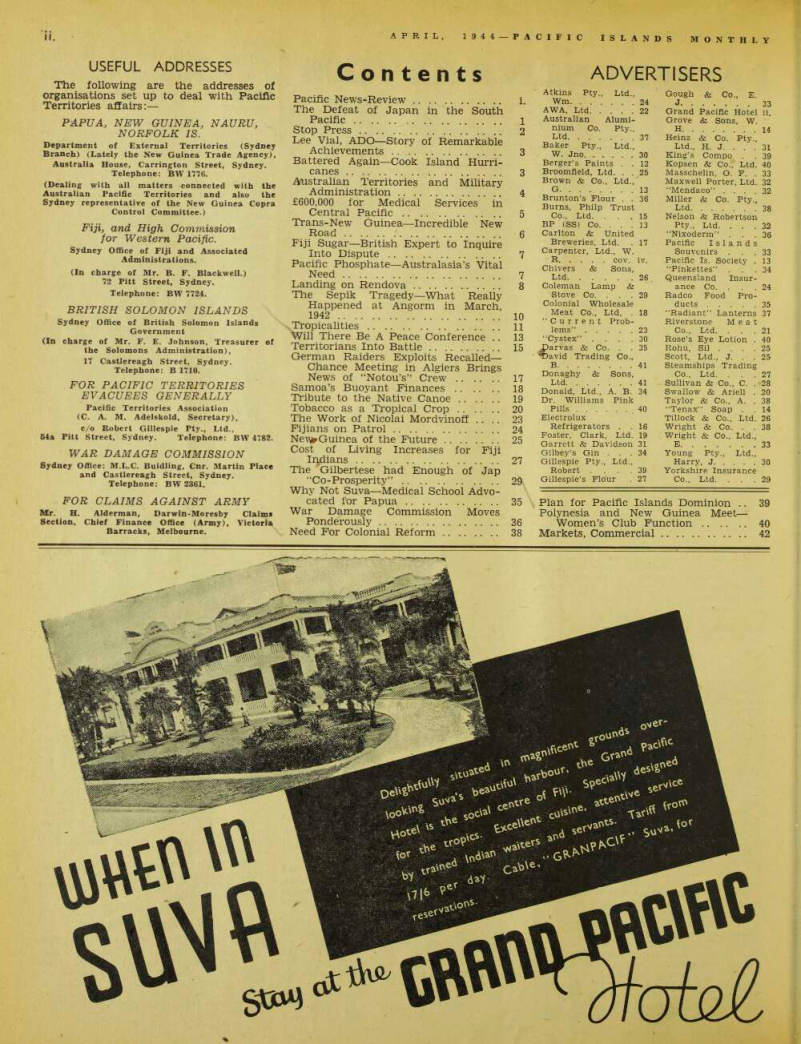
r ese^
% w As ° V
oroM^ S
.r. c et' 1 1 a ?ac\V' c .„ . , Gr»° d a ~to»i ed ' . , r bo» r ’ 1 ...w « U< *“ w * “ o "
„ su v>.' or
* e «*•* 1 »r ,7l<> pC $
r ese^
Pacific Islands Monthly
The Newspaper-Magazine of the South Seas [Registered at the G.P.0., Sydney, for transmission by post as a newspaper .]
Published Once Each Month and Circulated in Australia and New Zealand and in the following Pacific Territories and Islands Groups;
Australian Territory of Papua.
Mandated Territory (Australia) of New Guinea.
Australian Territory of Norfolk Island.
New Zealand Territory of Cook Islands.
Mandated Territory (NZ) of Western Samoa.
British Colony of Fiji.
British Solomon Islands Protectorate.
British Protectorate of Tongan Islands.
British Crown Colony of Gilbert and Ellice Islands.
Mandated Territory of Nauru.
British and Free French Condominium of New Hebrides.
Free French Colony of New Caledonia.
Free French Colony of Oceania (Tahiti, etc.).
American Territory of Eastern Samoa.
American Territory of Hawaiian Islands.
Owned and Produced by Pacific Publications Pty. Ltd., Union House, 247 George Street, Sydney.
T ( Managing Director .. BW 5037 • L£ ' I Business and Editorial MA 4369
P.O. Box 3408 R
Registered Address of Telegrams, Radiograms, and Cables: “Pacpub”, Sydney.
Contributions.
Articles, Stories, and Photographs dealing with Pacific Islands subjects are invited and will be paid for on publication.
Subscription Rates.
Per Annum, within British Empire, Prepaid, Post Free 10/- Per Annum, elsewhere, Prepaid, Post Free 12/6 Single Copies 1/-
Editor and Publisher;
R. W. Robson, P.R.G.S.
Advertising Manager: L. W. Bailey.
Advertising Office and Printing-House: 29 Alberta Street, Sydney, Advertising rates furnished on application.
Process Blocks made at Advertiser’s expense when required. Screen 85.
Changes of Advertising Copy should reach this office by Ist of each month, otherwise previous advertisement may be repeated.
Representative In London.
W. C. Harvey, Coronation House, 4 Lloyds Avenue, London, E.C.3, from whom may be obtained copies of Pacific Islands Monthly, Pacific Is. Year Book, advertising schedules, etc.
Agents.
The following are authorised to receive sub scriptions for Pacific Islands Monthly:— Burns, Philp & Co., Ltd., and Burns Philp (South Sea) Co., Ltd. All branches.
W. R, Carpenter & Co., Ltd. All branches.
Morris, Hedstrom, Ltd. All branches.
Steamships Trading Co., Papua. All branches.
B.N.G. Trading Co., Ltd., Port Moresby, Papua.
J. Muir, Suva, Fiji.
Miss R. Castles, Suva, Fiji.
N. C, Mackenzie Hunt, Wainunu, Bua, Fiji.
Cook Islands Trading Co., Rarotonga, Cook Is.
A. C. Rowland, Papeete, Tahiti.
Islands Branches and Representatives of W. H.
Grove & Sons, Ltd., Auckland, New Zealand.
Ed. Pentecost, Noumea, New Caledonia. & Co., Noumea, New Caledonia.
Vol. XIV. NO. i.
April 17, 1944
Pr\ra Per Copy rrice (Prepaid: 10/- p.a.
West Pacific
THE DEFEAT OF JAPAN IN THE SOUTH
THE second phase of the Pacific War is ended. The third phase, in which the military and naval might of Japan is to be challenged and broken, now is opening. This third phase probably will be fought north of the equator, in the waters around the Philippines, off the coast of China, and on the Asiatic main land. The South Pacific soon should be clear of the Jap.
The first phase of the Pacific War extended from the treachery of Pearl Harbour into the middle of 1942.
During those months the Japanese, attacking the surprised and ill prepared Territories of Britain, United States and the Netherlands, had matters all their own way. The second phase opened when the in vaders came up against the slowly gathering forces of the United States and Australia, in the South-west Pacific.
Only as the weeks pass are we getting into true focus the extent of the defeat that has been inflicted upon the Japanese in what might be called the battle of the Bismarck Archipelago. That battle covered the whole of the South-west and South Pacific areas and lasted from August, 1942 (when Americans and Australians struck back at the southwards thrusting enemy), until March, 1944, when his elaborately organised de fences collapsed.
AND now the Japanese in New Britain actually are on the run —they are abandoning the western and central sections of the 300-miles
long island, and apparently are planning to concentrate their forces in, and defend, the extreme eastern part—that is, Gazelle Peninsula and the port of Rabaul. That develop ment, like others of a similar kind, became inevitable from the time that American expeditions, taking full advantage of their air and naval supremacy, “leap-frogged” their way into the Admiralty Islands and into Emirau Island (at the northern end of New Ireland), and thus boxed in the large Japanese forces which have been isolated in the jungles of: Eastern New Guinea mainland; New Britain; New Ireland; Bougainville and Buka. The fate that is over taking the Japs in New Britain to day is similar to what is happening to the Jap forces in those other great islands.
NEW BRITAIN is 300 miles long, and up to 60 miles wide. There is considerable settlement in the Gazelle Peninsula, especially around Rabaul, but otherwise it is primitive and in hospitable jungle and mountains. The Americans who landed at the western end three months ago have been hammering away at the Japs, driving them deeper into the eyen more in hospitable centre. Having air and sea supremacy, they have been regularly supplied, but the Japs have been deprived of even the precarious sup plies brought to them by their night sneaking coastal barges.
There was accumulating evidence that these Japs were literally starv ing. There are 90,000 natives in New
Britain, but they depend for their food, not upon game or jungle pro duce, but upon fish and their jealously-guarded gardens—they have little food to spare for thousands of hungry Japs.
An enemy decision to retire swiftly from this hopeless country, either by evacuation through some of the small ports on the north or south coasts, or by withdrawing along the full length of the completely unroaded island to Rabaul, was bound to come.
Their adoption of the latter, and more painful, course is due to two things—the Allied command of air and sea now is so complete that the Japs dare not send transports through the Bismarck Sea to the coasts of New Britain; and, during their two years in Rabaul, the Japs undoubtedly have cultivated large gardens in that fertile region, to augment their food supply.
WEST of Gazelle Peninsula there is little in the jungles and moun tains to sustain life in even the frugal Japanese.
Under present conditions, the Japanese cannot hope to maintain shipping services between Rabauhand their domains in the north. But they probably do hope to concentrate their New Britain forces (estimated at 20,000 or 30,000) around Rabaul and, with the limited food supply there, hang on and constitute themselves a nuisance for as long as possible. It is reported that they have already lost 5,000 dead in those New Britain jungles—they will lose many more before they struggle through to Rabaul.
AUSTRALIA looks on grimly, and without sympathy. Australians
Hunters of 1942 Are the Hunted of 1944
and Territorians do not forget what happened in Rabaul in January, 1942, when some 20,000 arrogant and triumphant Japs swarmed in upon one Australian militia battalion, one six-inch battery, an air force of five unwieldy old Wirraway machines, and some 72 members of the New Guinea Volunteer Rifles, many of them last war veterans. While this tiny force heroically opposed the landing of ten thousand Japs, most of Rabaul’s civilians fled into New Britain’s jungles. There they pre sently were joined by the remnants of Rabaul’s defenders; and, in succeed ing weeks, those unfortunate fugitives, foodless and malaria-ridden, were relentlessly hunted down by Jap patrols in the jungles and Jap destroyers along the coasts.
Now, the wheel has turned full circle. The gallant hunters of 1942 are the hunted of 1944; and the Jap invaders of New Britain, as they flee from the gathering hosts of America, are experiencing all the horrors of jungle starvation and jungle disease, which they forced upon the un offending citizens of Rabaul two years ago.
In the same way that they are withdrawing themselves from the New Britain jungles upon Rabaul, so the Japs in the New Ireland and Bougainville and north-east New Guinea jungles probably will try to concentrate upon one or two districts in each of those islands, formerly settled by Europeans, where there may be some food supplies.
A YEAR ago the Japanese, fearing what was happening in the south—in Guadalcanal and in Papua —turned feverishly to the building of what was then called “the volcano line of bases.” It followed the earth fault (or earthquake and volcano belt) along the north coasts of New Guinea and New Britain, through the northern Solomons, into the British Solomons.
To-day, there is nothing left of the “volcano line” except the smashed and useless bases at Rabaul, Kavieng, Madang and Wewak, the semi paralysed base at Hollandia, and the miserable remnants of ten or twelve Jap divisions, now dodging helplessly and hopelessly through the jungles.
Six weeks have passed since we began to suspect that Jap power in the South-west Pacific had been broken; and now, as time passes, and there is no sign of any Japanese naval counter-attack, the measure of the Japanese defeat becomes clearer.
THE Japanese defeat in the Central Pacific is equally impressive— and it is not coincidental. The re capture of the Gilbert Islands, the destruction of Japanese power in the Marshall Islands and, now, the singe ing of To jo’s beard from one end of the heavily-fortified Caroline Islands to the other by an unchallenged American fleet—these events have
been so timed that they have not doubled, but have quadrupled the Japanese embarrassments all over their Pacific Ocean fronts. All this occurs, also, just at a time when they wanted all their energies clear for their new Burma adventure, and wished to retain all possible “face” for the encouragement of the Indo nesian peoples who have been dragooned into the “Greater East Asia Co-Prosperity Sphere,”
AMERICANS and Australians in the South-west Pacific, after two years of campaigning under the worst possible conditions, in which they have completely beaten the Japanese in every department of this strange amphibious and jungle war fare, now watch with confident anticipation the development of the Burma and Assam campaign. They know neither Burma nor Assam; but they do know the jungle and the Japanese, and the ineradicable weak nesses of Tokio planning.
Again and again, in the course of the campaigns in the South-west Pacific, we saw how Japanese expedi tions, with light equipment and light rations, struck at us across mountains and through trackless jungles, with either a child-like belief in their in vincibility, or with the assumption that our men would run as soon as they saw these mighty fighters emerge unexpectedly from the jungle.
Again and again—and notably at Milne Bay, at Guadalcanal, in the Owen Stanley Ranges, at Wau, in Bougainville and, finally, on the Rai coast of New Guinea—we caught those over-ambitious enemy expedi tions and completely smashed them, and drove the Japs into the jungles— where far more have died from star vation than from our armaments.
American and Australian observers in the South Pacific believe that what happened in the great islands of the Pacific will happen again in Burma and Assam.
It almost would seem that the Tokio war-lords, in their ten years of treacherous planning prior to Pearl Harbour, tried to evolve a new kind of warfare, which would make them invincible in the deep tropical forests and the endless, primitive islands which were to form a perimeter around the Indonesian and Pacific Empire they proposed to grab. Japan was to present something new to a world accustomed always to think in terms of vast armies marching across European plains, or great warships operating from nearby bases. Japan was protected by thousands of miles of salt water and by almost im penetrable tropical forests. There fore, Japan would fight differently.
And Japan did fight differently— and, for a considerable time, it seemed that Japan might get away with it. Then, as the months passed, it became clear that the one war time factor for which Japan made no provision—namely, the enormous in
dustrial potential of America and Britain, which gave them overwhelm ing supremacy in the air had exposed the fundamental weakness of Japanese strategy. That weakness is .. Japan’s inability to protect her neces sarily long-drawn lines of communi cation.
It is that weakness which primarily has led to Japan’s great defeat in the South-west Pacific. That weakness may cripple her plan to invade India.
That weakness, unless she can counter it with something new and unforeseen, will cost her the war and her place as a maritime power.
Stop Press!
page 4, reference is made to questions V-J asked in the Australian Parliament about the future government of Papua and New Guinea, and not answered. We learn, after going to press, that on April 11, Mr. Ward replied by post to Mr. Fadden’s questions. The following extract from Mr. Ward’s letter will interest Territorians: UPON the assumption of the position of Administrator of Papua by Mr.
Leonard Murray there was no change in policy; but investigation by the present Government has established the need for protecting the natives against many abuses to which they have been subjected in the past, and against which the local administrations have struggled in the past. The welfare of the natives shall be a guiding principle with the present Government in its plans for the post-war period.
“Future policy in regard to the Terri tories has been entrusted to a Committee of Cabinet which will obtain the best advice available. All the data in the possession of the Department of External Territories and the officers of that De partment will be available to the Com mittee. The Committee will also have at its disposal the valuable experience gained by the military authorities during the past two years.
“Lieut.-Colonel the Hon. Camilla Wedg wood is not responsible for post-war native education in New Guinea. That is a Government responsibility: but any views which she or others may express will be fully considered.”
By way of contrast, here are a few lines from a well-known Territorian, now doing a war job in the NG jungle : “I heard a slice of hot-air on the radio to-day regarding ‘the protection of the natives from exploitation after the war.’
This place is full of ‘experts’ who spend a whole month ‘examining’ the natives and their conditions and then report to and ‘guide’ the Government’s post-war policy. These high-ranking ‘officers’ (an insult to the rank held by such fine soldiers as Blue Allan and Normie Neal) will attempt to shape the course of our and the natives’ lives here after the war.
“It would be amusing, if it were not so serious. What the hell can these people know about these things when everything is provided for them? They don’t walk a yard, carry an ounce, or have one prob lem of the country to solve regarding their own comfort or transport. They are akin to the ‘round-trippers’ of peace time, who rushed into print the day after the ‘Macdhui’ got back to Sydney.
“The joke is that the least worried about ‘Post-war sets ups’ is the native himself, who has furnished repeated evidence of his pleasure in the return of the ‘Masta’ who allegedly had been ex ploiting him all those pre-war years.”
Lee Vial, A.D.O.
Story of a Remarkable Achievement
HERE is the story of Lee G. Vial, formerly Assistant District Officer in New Guinea. It has been known, generally, for some time; but only recently has it been released for publica tion.
When the Jap invaders came, young Vial was in Rabaul. He assisted in the evacuation, and got away just in time onto the south coast of Gazelle Penin sula, where he was picked up by a Catalina.
Vial immediately joined the RAAF and offered his services as a spotter. He was given a commission and sent to Port Moresby. It was evident that his know ledge of the Mandated Territory, gained during years of service as a patrol officer, would be useful.
In February, 1942, it was anticipated that the Japs would attack the Huon Gulf region. A bomber flew Vial to Salamaua, where the officer in charge of the New Guinea Volunteer Rifles was instructed to give him all possible help in establishing an outpost. Shortly afterwards (early in March) Vial went into the jungle, and into the mountains which overlook Salamaua from the west and south-west. Thirty natives carried his radio equipment and supplies for six months.
Pilot-Officer Vial, after careful search, established his post on a high hill within six miles of Salamaua, at the foot of a tall tree. He was well hidden in the jungle, and he had a magnificent clear view from the top of his tree.
ON March 8, 1942, the Japs swarmed into Salamaua, and the handful of defenders disappeared into the forests, en route for Wau. Vial began his long, lonely vigil. Here is how SM Herald” correspondent Summers described his invaluable work: “For six long months to the day Vial stayed at his post. From a tall tree he peered down at Japanese activity through binoculars. When a flight of bombers took off from th£ aerodrome beneath, his voice, concise and clear, carried through the roar of the engines, giving details of numbers, type, time, altitude, and direc tion. At Port Moresby a man sitting in a hut with headphones clamped over his ears picked up the message and warned the defences. .
“The Japanese were puzzled. Then land forces controlled the area, but they could never surprise the Moresby de fences. The fighters were always wait ing, the ack-ack defences always man ned. They were so puzzled that only now has it been considered safe to release the story of Vial’s watch on their activities.
Vial also watched and reported ship ping movements: and, as our air forces increased, Jap ships in Huon Gulf were strafed with increasing success. .
The Japs, knowing they were being observed, searched ceaselessly for Vials post. They got near him once, and he moved to another position; but he never was more than six miles from Salamaua.
He was not only very lonely, but he suffered intense discomfort, there in the rain-soaked jungle; and he was semi blind for a while —probably the result of too much quinine. He said afterwards that he had “a bad scare” about once a week. He did not fear the Japs so nrucn as that some wandering native might betray him to the Japs. Many knew where he was, because he bouerht food from them; but they were loyal.
Vial was there from March, 1942, when
the Japs arrived at Salamaua, until the end of August, when Australian and American forces began to arrive in suffi cient force to throw them out of the Owen Stanley Ranges and out of Milne Bay. The value of the work he did in those critical months is beyond computa tion.
Finally, this young Australian became so ill that he had to leave. Somehow, he made his way over the mountains into Wau. There, a plane flew him to Port Moresby. General MacArthur per sonally decorated him with the Ameri can Distinguished Flying Cross, and he was promoted to Flight-Lieutenant.
Lee Vial was killed in April, 1943, when a plane in which he was travelling on a special mission crashed in the Sepik dis trict of New Guinea.
Editorial Note
11HIEN the full story of the war services ff performed by men of the South Pacific Territories can be told, it will be found that there is nothing finer in the history of World War 11. Whether it is something in Islands life which develops unusual quality, or whether Islands conditions are such that - only men of a special type can survive there, is difficult to say; but the story of Lee Vial is typical of what has been done by Islands men—details of which are well known, but which, for obvious rea sons, may not be published.
Most of the Islands men under 45 — and an astonishing number over 45 — have given valuable and distinguished service, based not only on their special knowledge of the tropical territories, but also on their remarkable qualities of initiative and enterprise. Their numbers have not been great; but, in the job of beating the Jap. nearly every man has been worth more than a battalion.
Beware Of Pacific Islands
Federation!
Letter to the Editor IT is reported that Mr. Nash has been advocating the federation of the Pacific Island Territories under a five-power control. Federation is an excellent suggestion, for such an arrange ment could, if properly managed, bring all kinds of desirable and beneficial results.
Obviously, though, the control must be in the hands of one sovereign power.
This, no one with any practical know ledge of the Islands can seriously dis pute. The suggestion for a five-power control, however, shows clearly that the lessons of history and experience have been forgotten, or else have been ignored.
These lessons are to be found in the unhappy narrative of tri-partite control in Samoa during the latter part of the nineteenth century, and in the weird story of the Anglo-French Condominium of the New Hebrides.
These two unfortunate experiments in the governance of Pacific Island Terri tories should be carefully studied by all who are interested in the future of the Islands. The idea of international con trol, which is the worst of all kinds of government, would then be to retire quietly into well-merited oblivion.
I am, etc-.
P. W. Glover, Bsc, Eras.
Apia, Western Samoa, Feb. 7. 1944.
(See Other Comment on Pages 38 and 39)
Battered Again
Cook Islands in Series of Bad Hurricanes
From Our Own Correspondent
Rarotonga, Feb. 7.
ON March 10, 1943, Rarotonga suffered its worst hurricane for a century.
For three consecutive years previ ously, heavy storms, during the hurricane season, had damaged orange, banana and coconut crops. Each island in the Cook Group suffered in turn.
Now, two further hurricanes have swept the Group, within the past two months.
In mid-December, high winds and heavy seas prevailed at all the islands of the Lower Group, except Rarotonga and Mangaia. An inter-island schooner, with a party of officials (including the Acting Resident Commissioner) making an inspection trip, caught the weather while lying off the island of Atiu, and was blown over 50 miles away. The officials had to spend six days on the island.
Meanwhile, a wireless message from Mitiaro, which was badly hit in March, reported that the island was again stricken and the food position serious- The schooner immediately returned to Mitiaro and the position was alleviated.
Considerable damage was also done at both Manuae, in the Hervey Group, and Aitutaki. Manuae, a privately-leased coconut plantation, lost several hundreds of trees and a large proportion of the crop.
A storm warning was received on January 30, and everything was quickly battened down in readiness. By 9 a.m. on the 31st, a strong northerly wind and high seas had sprung up. The hurricane reached its full force at 1 p.m., swung round from northerly to westerly, and was all over by 5 p.m.
The chief excitement of that day was when a schooner, lying in the exposed Avatiu anchorage, broke her anchor chain and two mooring ropes. With huge waves nouring in through the gap in the reef, the position was critical. A boat put out in the boiling sea and succeeded in makinsr fast additional moorings; but, even so, the situation was only saved by the wind suddenly veering to the west- Only slight damage was actually sus tained by the ship.
RAROTONGA suffered a 60 per cent, setback in the maturing banana crop and a large proportion of the oranges was blown off the trees. Bread fruit were a total loss. Owing to the direction of the wind, only slight dam age to housing occurred. This was mostly wrought by heavy seas on the beach side of the road at Arorangi.
Of the outer islands, Mangaia suffered worst, damage to houses, Government buildings and the dispensary being heavy.
The tiny atoll of Palmerston, which had been reckoned as directly in the path of the storm, escaped without severe damage.
Not within the memory of living man have the Cook Islands suffered such an unfortunate series of hurricanes. The natives believe that there must be some thing seriously wrong with the mission aries’ prayers these days; and that seems as likely an explanation as any.
Lieut—Colonel H, T. Allan is at present enjoying furlough in Sydney. He for merly was a well-known resident of Wau, Ne'w Guinea. He joined the AIF in 1940; saw much service in the Middle East; and, in the past year, he has been on active service in New Guinea, actually within comparatively short distance of his own mining property.
May Do
Australian Territories And Military
Administration
What Mr. Ward May Find, And What He May Do
AUSTRALIA S Minister for External Territories, Mr. E. Ward, accompanied by the Secretary of the Department, Mr. J. R. Halligan. and his private secretary, Mr. John Donovan, is about to make his first official visit to the Territories of Papua and New Guinea.
Territorians hope that, on his return, they may be given some decisions upon Territories questions which have been under consideration for many long months, but concerning which they can get from Mr. Ward no more information than they were able to get from Mr.
Ward’s innumerable undistinguished predecessors.
When Mr. Ward became Minister, the Territories people thought that they might see some action. He had a reputation for disturbing traditions and defying bureaucrats. But Mr. Ward, in six months’ occupancy of the Territories office, has done very little.
Territories people say now that that is what they might have expected. They have no votes. In the view of the average professional politician, they are simply a pain in the neck.
But there may be another reason.
After all. the Territories are under military control. Mr. Ward may have little authority.
Am i. r T present, the Mandated Territory of New Guinea, and the old Australian Territory of Papua, are being governed as one unit, under an admmistration (Australian New Guinea Administrative Unit—ANGAU') that is completely military The head of ANGAU, and therefore the virtual administrator of the combmed Territories, is a comparatively unknown military officer. Major-General Morris.
Associated with him are one or two other high-ranking military officers who, like General Morris appear to have had no experience whateyer in tropical terntories’ administration.
Ranking after those gentlemen are some scores of former officials from the Administrations of New Guinea and Papua, who have been given various military titles, from Corporals to Colonels.
These officials were selected arbitrarily bv the military heads. Most of the officials were taken—but many were not.
Aiv/rrvNTr' 1 fv, Q po i o „ fD j MONG the men not selected were the ty civil Admmistra tors—Mr. Leonard Murray. Administrator of Papua, and Sir Walter McNicoll, Admmistrator of New Guinea. Why were ignored and less distinguished men pU */r in t° Places? No one knows. . Leonard Murray spent all his life in Papua mostly as assistant to his famous uncle the late Sir Hubert Murray, and latterly as chief. He is a youngish, fit and healthy man, and there is no one south of the Equator if any- W^her^ who - h , as a mor f expe ? k n . o fledge of Melanesia’s complex administrative problems. The Americans, for a time, made good and effective use of Mr. Murray’s specialised knowledge and training; but he has been practically ignored by Australia.
There was every justification for the action of Mr. Fadden, in the Australian Parliament recently, asking the Government a series of questions concerning Mr.
Murray. Why, asked Mr. Fadden, should the Government select Miss Camilla
Wedgwood, an anthropologist, and send her off to the Territories with the rank of Lieut.-Colonel, to advise regarding native education, when there was avail able a man like Leonard Murray who had devoted a lifetime to the subject rwwrtm xxt ™ t* rpHEN there is Sir Walter McNicoll, 9 r less idl . e ir * Australia. Sir Wainers appointment to, and his r ecord m New Guinea were criticised because, although he had had no experi encf of tropical administration, he was 80 *r }°, direct a government in which expert knowledge was called for. But came, Sir Walter had had mor . e than six years’ experience in Territory, and could have been very useful in many ways But he, also, seems a y e |? een completely ignored, o a PP arentl y> cannot bear to appoint anyone to a high administrative Post under wartime conditions- unless he 18 a k”^ ad y a high-ranking military offi- SiL wrong with Briga ™V/r?en^ako Sll o Mcls [icoll. CB, KCMG. there enough hl £h mi htary rank and distinguished military service there to satisfy the most cautious. Sir Walters 1914-18 record wIP bear comparison with that of any
one -
|TOWEVER, there is the position: XX Although ANGAU is staffed bv former Administration officials (with military titles), it actually is controlled by a group of high-ranking military offi- C ers (who have had no previous experi ence of tropical islands administration); and those gentlemen are responsible to Australian Army Headquarters, and not directly to the Australian Government, As a matter of fact, the liaison between the Department of External Territories (now presided over by Mr Ward and Mr Halligan) and ANGAU is obscure. There seems to be regular communication between the two. and ANGAU appears to carry out the Department’s wishes re garding policy, as well as administration: but, officially. ANGAU’s official channel of communication with the Department of External Territories should be through the Minister for the Armv, and thence to the Minister for Territories A s a result of his tour, Mr. Ward prob ablv will return to Sydney with his head bursting with ideas (mostly imnractic able) for the better administration of the Territories. Every Australian poli tician who became Territories Minister made this tour; and practically every one was afflicted in the same way, and had t o be handled tactfullv by the more ex perienced officials, until some of his more vivid impressions had faded.
The situafion following Mr. Ward’s visit probably will be more difficult—not only because Mr. Ward is Mr. Ward, and liable to fieftt with high-ranking “military blokes” on sight, but also because Mr. ward really has no jurisdiction over the ANGAU government, TTOWEVER, this Ministerial visit may XX force some decisions regarding the future of the Territories, The Japs now are so far away from Papua, and so broken.• that there really is no reason whv Papua should not return to civil administration. The Army, of course, will resist the idea, with tooth and claw. But is there any more reason why Papua should be militarily-controlled than that North Queensland should be?
There are so many Japs at large in the northern part of New Guinea mainland and in the Bismarck Archipelago—where their extermination will probably occupy months—that there is no possibility of the Mandated Territory being freed from military control for a long time to come.
Carrying out the expressed wishes of the Americans, the British authorities have sent administrative officers into the Solomons and the Gilbert and Ellice Colony, which were recovered from the Japs. Those officials, acting in co-opera tion with the American commanders, are carrying on civil administration—and are responsible to the civil authority (the British High Commission for the West ern Pacific). Why should not the same system be employed in Papua?
Mr. R. H. Garvey
Administrator of St. Vincent, West Indies
MR. RONALD H. GARVEY, recently a District Commissioner in Nyassa land, Central Africa, has been appointed Administrator of St. Vincent, in the Windward Islands, West Indies, and he was in London in March, en route to his new office.
Mr. Garvey was in the South Pacific Territories for many years, in the ser sce of the High Commissioner for the Western Pacific, and became one of the best-known and highly-regarded public officials in this part of the world. He was Assistant British Commissioner in the New Hebrides in 1941; then he was sent to Ocean Island as Acting Resident Commissioner of the Gilbert and Ellice Colony, and he was there in December, 1941, when the Japs came over and blew the Residency to pieces. Mr. Garvey was among those who escaped to Australia in 1942; and. later in that year, he went to Nyassaland.
Mrs. Garvey is a daughter of Dr- V. W.
T. McGusty, Director of Medical Services and Secretary for Indian Affairs, in Fiii.
Mr. Garvey, in his new post, will be associated with his old chief. Sir Harry Luke, formerly Governor of Fiji. Sir Harry is now Chief Representative of the British Council in the West Indies and Bermuda —a new position which carries a supervising and co-ordinating authority over nine separate colonies.
The British Council, which is a new thing, with headouarters in London, is regarded with interest, because it mav be the precursor of the system of Regional Councils, by which it is honed to estab lish a form of international co-oneration against war, at the conclusion of World War IT.
Mandoliana, Bsi
M. I. Harper, Of
'Y'HE following is from an American
Camp Newspaper, issued in the Solomon Islands on March 23, 1944: M. I. HARPER, Warrant Officer, of the RANR. who was a member of our mess here for several months, was decorated by Admiral Haisey last Satur day.
Harper received the Lesion of Merit for his work as a pilot in every Solomons Islands campaign to date.
Harper is now helping put a finish to the Solomons camnaign—a job he started at Guadalcanal. It is a nleasure to hear that he will be back with us when his present assignment is over.
Reeeived a from a friend on munition work. He wrotp- “Having a wonderful time and a half.”
£600,000 For Central Pacific
Medical Services
Great Plan of Public Health and Native Training Based on Suva
THE biggest plan yet made in con nection with native health, medical services and hospital estab lishments in the Pacific Territories is now being put into operation by the British Colonial Office, through Major- General Sir Philip Mitchell, Governor of Fiji and High Commissioner for the Western Pacific.
In this matter, the Governments of Fiji, Tonga, Gilbert and Ellice Colony, Solomon Islands and New Hebrides are acting in co-operation with the Government of New Zealand, which controls the administrations of Western Samoa and the Cook Islands.
Sir Philip Mitchell has been in New Zealand, in consultation with the authorities there.
The plan is thus summarised: Medical Group Centre There is to be built, in or near Suva, on a new site: A new hospital, with an Obstetric Department; A Medical School, where the present system of training Native Medical Practitioners for all the Pacific Ter ritories may be carried on and extended, both as to number of pupils trained, and the extent of training; A Nursing School, where the system of training young native women as nurses for the native communities may be greatly extended, especially in relation to obstetrics.
Public Health Centre The present War Memorial Hospital in Suva, opened in 1923, to serve the needs of Suva town; to provide new administrative headquarters for the Medical Department of Fiji, where the whole machinery of public health in Fiji and adjacent islands will be controlled and organised; to provide an Out-patients Department.
Isolation Hospital Facilities to be provided for the treat ment of infectious diseases by tak ing over one of the existing military hospitals.
Regional Hospitals There are to be established four regional hospitals in Fiji—one each at Lautoka, Labasa, Taveuni and Levuka. The old Provincial hospitals are to be kept “usable,’’ for handling epidemics and for the general assist ance of the Fijian people- For the above purposes, the Imperial Government has provided a free grant of nearly £500,000 from the Colonial Development and Welfare Fund.
Anti-tuberculosis Preliminary investigations are to com mence at once; and as soon as experts are available, a complete survey is to be made of the position in rela tion to TB in Fiji and all the West ern Pacific Commission Territories, so as to decide upon the most effec tive steps .to be taken. To cover the costs of this investigation, the Imperial Government, from the same Fund, has made a free grant of £28,600..
Anti-malaria Owing to development of air transport, the risk of the anopheles mosquito, and malaria, being introduced to Fiji
has greatly increased. A campaign to control mosquito breeding-places in Fiji, and especially to keep out the anopheles, will be instituted.
To cover the cost of this work, the Imperial Government has made available, from the same Fund, a free grant of £64,000 sterling. mHE foregoing announcements repre- JL sent developments of plans which have been under consideration in Fiji and in the British Colonial Office for some time.
In 1943, at the request of Sir Philip Mitchell, Dr, M. H. Watt, New Zealand Director-General of Health, and Miss M.
I. Lambie, New Zealand Director of Nursing, made an investigation of the public health and medical services in Fiji. They submitted, in August, 1943, a valuable report, in which they exam ined every aspect of the medical services, medical education, public health educa tion and probable future medical develop ments in the South Pacific- Their com ments on the system of training native medical practitioners and native nurses in Suva, for service in all the South Paci fic Territories, were particularly helpful.
Their report was submitted to the Gov ernor of Fiji at the end of August, 1943.
That quick-moving gentleman lost no time. Within a few weeks, Dr. V. W.
T. McGusty, CMG (who, as Director of Medical Services in Fiji, has had much to do with the development of this plan) was on his way to London with a copy of the Watt-Lambie report. He spent some weeks in London.
It was reported, when he passed through the United States in January last, on his return to Fiji, that the Imperial Government might make £600,000 available for a great public health plan in the South Pacific. The figures then appeared fantastic. How could John Bull, fighting hard in the
greatest war in history, find £600,000 for nealth services for Pacific natives?
But the report was true. Speaking in the Legislative Council of Fiji on Feb ruary 23, Dr. McGusty gave the fore going details of his extraordinarily suc cessful mission- At the same time, he explained the whole of the proposals in detail,, and supplied a valuable history of the Fiji Medical School and Nurses School, where native medical practition ers and nurses have been trained.
Dr. McGusty’s address has been printed and copies should be available at the Government Printing Office, Suva. rE plan necessarily is in two divi sions—the part which provides for the domestic requirements of Fiji; and the part which maxes the Fiji medi cal organisation and institutions avail able for the training of medical officers and nurses for the whole of the Pacific Territories. The first part affects only Fiji; the second part is of the greatest interest to every Pacific Administration.
The plans which have been made —and which now, in spite of the handicaps of wartime conditions, are being given effect to —mean that Fiji must become a not able centre of specialised training in tropical medicine and public health hygiene, and it should be the place to which every South Pacifio Administra tion will turn, as a matter of course, when it needs assistance in relation to the health of the native peoples. Suva will make available to all the South Pacific Administrations the services of the following three institutions —namely— The Central Medical School, where Native Medical Practitioners will be trained; The Nursing School, for the training of Native Nurses; The Leper Hospital at Makogai, where lepers from all over the Pacific are received and cared for; and these institutions, under the plan outlined, now will have the benefit of (a) the best available type of modern buildings, (b) the most modern equip ment, (c) specialists who are to be selected on account of their knowledge of tropical diseases, (d) men who have long experience in teaching selected native men and women to become medical practitioners and nurses.
New Caledonia's New Governor
Brig.-Gen. R. L. Owens (1st Island Command), Bishop Thomas Wade (of Bougainville), Monsieur Jacques Tallec (New Governor of New Caledonia), and Rear-Admiral J. F. Shafroth, photographed at Government House, Noumea, on the occasion of M. Tallec’s arrival in the Colony, in February.
Trans-New Guinea
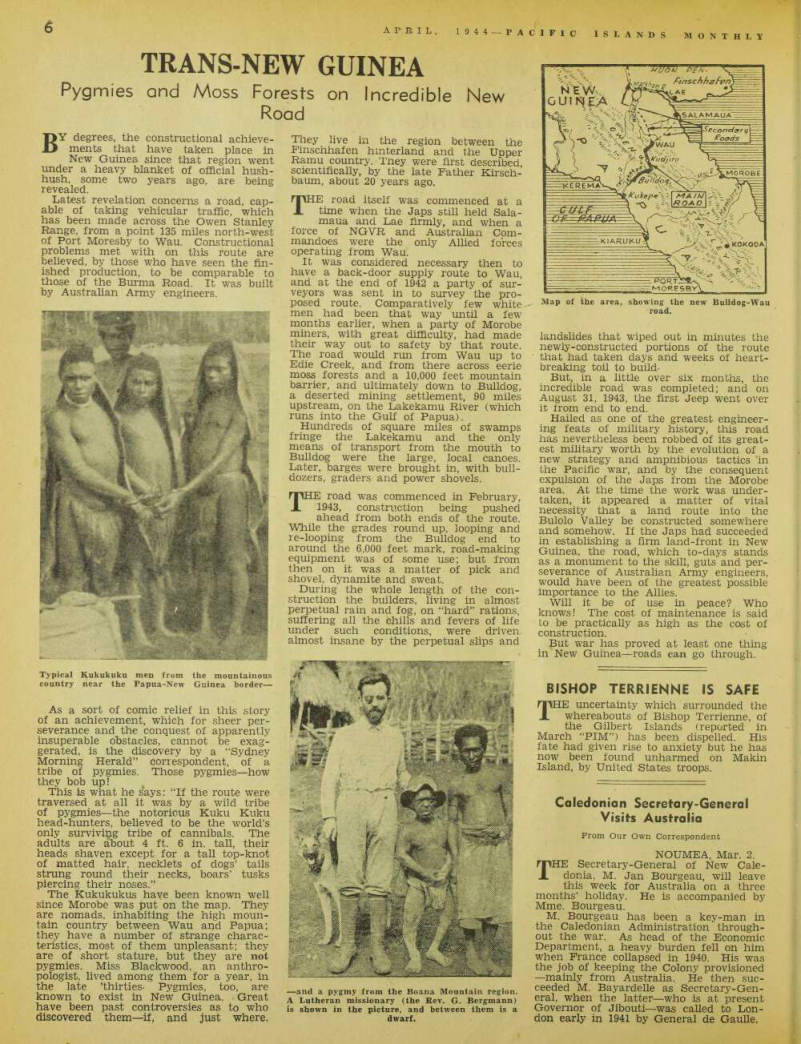
Pygmies and Moss Forests on Incredible New Road
BY degrees, the constructional achieve ments that have taken place in New Guinea since that region went under a heavy blanket of official hush hush, some two years ago, are being revealed.
Latest revelation concerns a road, cap able of taking vehicular traffic, which has been made across the Owen Stanley Range, from a point 135 miles north-west of Port Moresby to Wau. Constructional problems met with on this route are believed, by those who have seen the fin ished production, to be comparable to those of the Burma Road. It was built by Australian Army engineers.
As a sort of comic relief in this story of an achievement, which for sheer per severance and the conquest of apparently insuperable obstacles, cannot be exag gerated, is the discovery by a “Sydney Morning Herald” correspondent, of a tribe of pygmies. Those pygmies—how they bob up!
This is what he says: “If the route were traversed at all it was by a wild tribe of pygmies—the notorious Kuku Kuku head-hunters, believed to be the world’s only surviving tribe of cannibals. The adults are about 4 ft. 6 in. tall, their heads shaven except for a tall top-knot of matted hair, necklets of dogs’ tails strung round their necks, boars’ tusks piercing their noses.”
The Kukukukus have been known well since Morobe was put on the map. They are nomads, inhabiting the high moun tain country between Wau and Papua; they have a number of strange charac teristics, most of them unpleasant; they are of short stature, but they are not pygmies. Miss Blackwood, an anthro pologist, lived among them for a year, in the late ’thirties- Pygmies, too, are known to exist in New Guinea. Great have been past controversies as to who discovered them—if, and just where.
They live in the region between the Pinschhafen hinterland and the Upper Ramu country. They were first described, scientifically, by the late Father Kirsch baum, about 20 years ago. rpHE road itself was commenced at a i. time when the Japs still held Sala maua and Lae firmly, and when a force of NGVR and Australian Com mandoes were the only Allied forces operating from Wau.
It was considered necessary then to have a back-door supply route to Wau, and at the end of 1942 a party of sur veyors was sent in to survey the pro posed route. Comparatively few white men had been that way until a few months earlier, when a party of Morobe miners, with great difficulty, had made their way out to safety by that route.
The road would run from Wau up to Edie Creek, and from there across eerie moss forests and a 10,000 feet mountain barrier, and ultimately down to Bulldog, a deserted mining settlement, 90 miles upstream, on the Lakekamu River (which runs into the Gulf of Papua).
Hundreds of square miles of swamps fringe the Lakekamu and the only means of transport from the mouth to Bulldog were the large, local canoes.
Later, barges were brought in, with bull dozers, graders and power shovels. rpHE road was commenced in February, A. 1943, construction being pushed ahead from both ends of the route.
While the grades round up, looping and re-looping from the Bulldog end to around the 6,000 feet mark, road-making equipment was of some use; but from then on it was a matter of pick and shovel, dynamite and sweat.
During the whole length of the con struction the builders, living in almost perpetual rain and fog, on “hard” rations, suffering all the chills and fevers of life under such conditions, were driven, almost insane by the perpetual slips and
landslides that wiped out in minutes the newly-constructed portions of the route that had taken days and weeks of heart breaking toil to build- But, in a little over six months, the incredible road was completed; and on August 31, 1943, the first Jeep went over it from end to end.
Hailed as one of the greatest engineer ing feats of military history, this road has nevertheless been robbed of its great est military worth by the evolution of a new strategy and amphibious tactics ‘in the Pacific war, and by the consequent expulsion of the Japs from the Morobe area. At the time the work was under taken, it appeared a matter of vital necessity that a land route into the Bulolo Valley be constructed somewhere and somehow. If the Japs had succeeded in establishing a firm land-front in New Guinea, the road, which to-days stands as a monument to the skill, guts and per severance of Australian Army engineers, would have been of the greatest possible importance to the Allies.
Will it be of use in peace? Who knows! The cost of maintenance is said to be practically as high as the cost of construction.
But war has proved at least one thing in New can go through.
Typical Kukukuku men from the mountainous country near the Papua-New Guinea border—
—and a pygmy from the Boana Mountain region.
A Lutheran missionary (the Rev. G. Bergmann) is shown in the picture, and between them is a dwarf.
Map of the area, showing the new Bulldog-Wau road.
Bishop Terrienne Is Safe
rE uncertainty which surrounded the whereabouts of Bishop Terrienne, of the Gilbert Islands (reported in March “PIM”) has been dispelled. His fate had given rise to anxiety but he has now been found unharmed on Makin Island, by United States troops.
Caledonian Secretary-General
Visits Australia
From Our Own Correspondent
Noumea, Mar. 2.
THE Secretary-General of New Cale donia, M. Jan Bourgeau, will leave this week for Australia on a three months’ holiday. He is accompanied by Mme. Bourgeau.
M. Bourgeau has been a key-man in the Caledonian Administration through out the war. As head of the Economic Department, a heavy burden fell on him when France collapsed in 1940. His was the job of keeping the Colony provisioned —mainly from Australia. He then suc ceeded M. Bayardelle as Secretary-Gen eral, when the latter—who is at present Governor of Jibouti—was called to Lon don early in 1941 by General de Gaulle.
Fiji Sugar
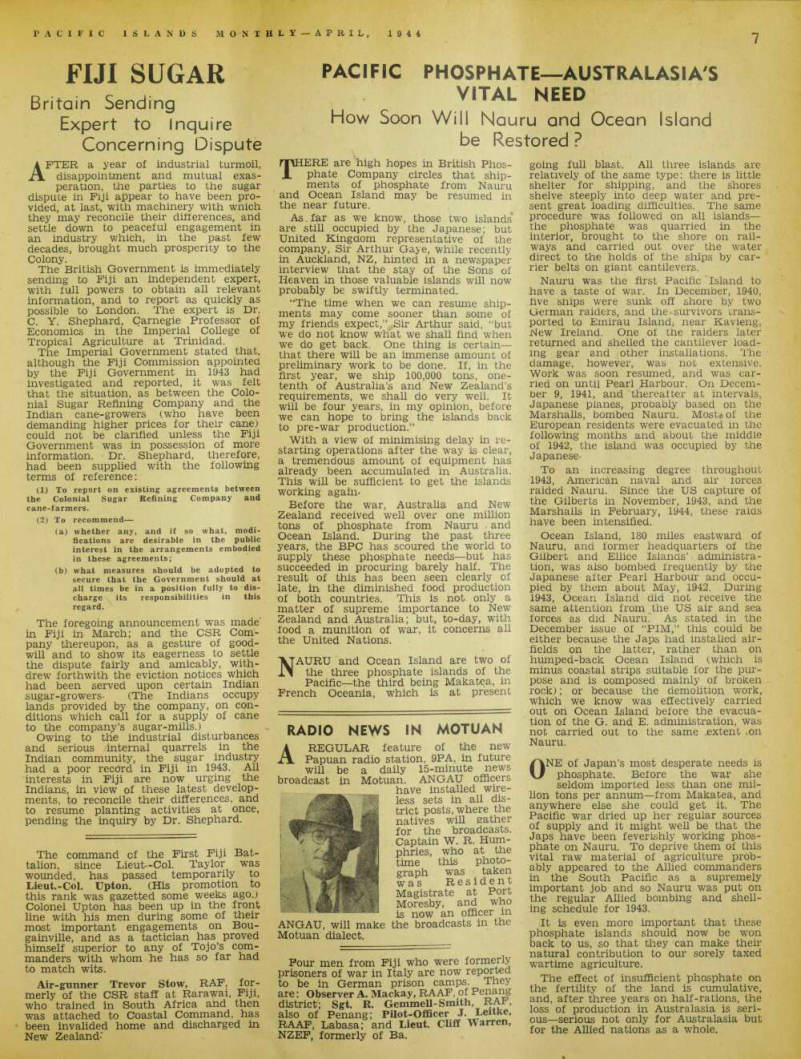
Britain Sending Expert to Inquire Concerning Dispute
AFTER a year of industrial turmoil, disappointment and mutual exas peration, the parties to the sugar dispute in Fiji appear to have been pro vided, at last, with machinery with wnich they may reconcile their differences, and settle down to peaceful engagement in an industry which, in the past few decades, brought much prosperity to the Colony.
The British Government is immediately sending to Fiji an independent expert, with full powers to obtain all relevant information, and to report as quickly as possible to London. The expert is Dr.
C. Y. Shephard, Carnegie Professor of Economics in the ‘ Imperial College of Tropical Agriculture at Trinidad.
The Imperial Government stated that, although the Fiji Commission appointed by the Fiji Government in 1943 had investigated and reported, it was felt that the situation, as between the Colo nial Sugar Refining Company and the Indian cane-growers (who have been demanding higher prices for their cane) could not be clarified unless the Fiji Government was in possession of more information. Dr. Shephard, therefore, had been supplied with the following terms of reference; (1) To report on existing agreements between the Colonial Sugar Refining Company and cane-farmers. (2) To recommend— (a) whether any, and if so what, modi fications are desirable in the public interest in the arrangements embodied in these agreements; (b) what measures should be adopted to secure that the Government should at all times be in a position fully to dis charge its responsibilities in this regard.
The foregoing announcement was made' in Fiji in March; and the CSR Com pany thereupon, as a gesture of good will and to show its eagerness to settle the dispute fairly and amicably, with drew forthwith the eviction notices which had been served upon certain Indian sugar-growers- (The Indians occupy lands provided by the company, on con ditions which call for a supply of cane to the company’s sugar-mills.) Owing to the industrial disturbances and serious internal quarrels in the Indian community, the sugar industry had a poor record in Fiji in 1943. All interests in Fiji are now urging the Indians, in view of these latest develop ments, to reconcile their differences, and to resume planting activities at once, pending the inquiry by Dr. Shephard.
The command of the First Fiji Bat talion, since Lieut—Col, Taylor was wounded, has passed temporarily to Lieut.-Col. Upton. (His promotion to this rank was gazetted some weeks ago.) Colonel Upton has been up in the front line with his men during some of their most important engagements on Bou gainville, and as a tactician has proved himself superior to any of Tojo’s com manders with whom he has so far had to match wits.
Air-gunner Trevor Stow, RAF, for merly of the CSR staff at Rarawai, Fiji, who trained in South Africa and then was attached to Coastal Command, has been invalided home and discharged in New Zealand'
Radio News In Motuan
A REGULAR feature of the new Papuan radio station, 9PA, in future will be a daily 15-minute news broadcast in Motuan. ANGAU officers
have installed wire less sets in all dis trict posts, where the natives will gather for the broadcasts.
Captain W. R. Hum phries, who at the time this photo graph was taken was Resident Magistrate at Port Moresby, and who is now an officer in
ANGAU, will make the broadcasts in the Motuan dialect.
Pour men from Fiji who were formerly prisoners of war in Italy are now reported to be in German prison camps. They are: Observer A. Mackay, RAAF, of Penang district; Sgt. R. Gemmell-Smith, RAF, also of Penang; Pilot-Officer J. Leitke, RAAF, Labasa; and Lieut. Cliff Warren, NZEF, formerly of Ba.
Pacific Phosphate—Australasia's
Vital Need
How Soon Will Nauru and Ocean Island be Restored?
rERE are high hopes in British Phos phate Company circles that ship ments of phosphate from Nauru and Ocean Island may be resumed in the near future.
As far as we know, those two islands* are still occupied by the Japanese; but United Kingdom representative of the company, Sir Arthur Gaye, while recently in Auckland, NZ, hinted in a newspaper interview that the stay of the Sons of Heaven in those valuable islands will now probably be swiftly terminated.
“The time when we can resume ship ments may come sooner than some of my friends expect,” ,Sir Arthur said, “but we do not know what we shall find when we do get back. One thing is certain — that there will be an immense amount of preliminary work to be done. If, in the first year, we ship 100,000 tons, one tenth of Australia’s and New Zealand’s requirements, we shall do very well. It will be four years, in my opinion, before we can hope to bring the islands back to pre-war production.”
With a view of minimising delay in re starting operations after the way is clear, a tremendous amount of equipment has already been accumulated in Australia.
This will be sufficient to get the islands
working again-
Before the war, Australia and New Zealand received well over one million tons of phosphate from Nauru , and Ocean Island. During the past three years, the BPC has scoured the world to supply these phosphate needs —but has succeeded in procuring barely half. The result of this has been seen clearly of late, in the diminished food production of both countries. This is not only a matter of supreme importance to New Zealand and Australia; but, to-day, with food a munition of war, it concerns all the United Nations.
NAURU and Ocean Island are two of the three phosphate islands of the Pacific—the third being Makatea, in French Oceania, which is at present
going full blast. All three islands are relatively of the same type: there is little shelter for shipping, and the shores shelve steeply into deep water and pre sent great loading difficulties. The same procedure was followed on all islands — the phosphate was quarried in the interior, brought to the shore on rail ways and carried out over the water direct to the holds of the ships by car rier belts on giant cantilevers.
Nauru was the first Pacific Island to have a taste of war. In December, 1940, five ships were sunk off shore by two German raiders, and the survivors trans ported to Emirau Island, near Kavieng, New Ireland. One of the raiders later returned and shelled the cantilever load ing gear and other installations. The damage, however, was not extensive.
Work was soon resumed, and was car ried on until Pearl Harbour. On Decem ber 9, 1941, and thereafter at intervals, Japanese planes, probably based on the Marshalls, bombed Nauru. Most* of the European residents were evacuated in the following months and about the middle of 1942, the island was occupied by the Japanese- To an increasing degree throughout 1943, American naval and air forces raided Nauru. Since the US capture of the Gilberts in November, 1943, and the Marshalls in February, 1944, these raids have been intensified.
Ocean Island, 180 miles eastward of Nauru, and former headquarters of the Gilbert and Ellice Islands’ administra tion, was also bombed frequently by the Japanese after Pearl Harbour and occu pied by them about May, 1942. During 1943, Ocean Island did not receive the same attention from the US air and sea forces as did Nauru. As stated in the December issue of “PIM,” this could be either because the Japs had installed air fields on the latter, rather than on humped-back Ocean Island (which is minus coastal strips suitable for the pur pose and is composed mainly of broken rock); or because the demolition work, which we know was effectively carried out on Ocean Island before the evacua tion of the G. and E. administration, was not carried out to the same extent .on Nauru.
ONE of Japan’s most desperate needs is phosphate. Before the war she seldom imported less than one mil lion tons per annum —from Makatea, and anywhere else she could get it. The Pacific war dried up her regular sources of supply and it might well be that the Japs have been feverishly working phos phate on Nauru. To deprive them of this vital raw material of agriculture prob ably appeared to the Allied commanders in the South Pacific as a supremely important job and so Nauru was put on the regular Allied bombing and shell ing schedule for 1943.
It is even more important that these phosphate islands should now be won back to us, so that they can make then natural contribution to our sorely taxed wartime agriculture.
The effect of insufficient phosphate on the fertility of the land is cumulative, and, after three years on half-rations, the loss of production in Australasia is seri ous—serious not only for Australasia but for the Allied nations as a whole.
Landing On
Rendova
The American Armada's Attack
HTHE following account of how the American forces approached and landed on Rendova Island, as a prelimin ary to their capture of Munda, in New Georgia, BSI, was written for the “PIM” by Mr. Leslie F. Gill. Mr. Gill is a Solo mon Islands planter, whose home was on Roviana Lagoon, practically at Munda; and he joined up with the United States forces soon after the Jap invasion. rE three weeks prior to the Munda operations were an orgy of confer ences at Amphibious Force Head quarters on Guadalcanal.
Admirals Nimitz and Halsey visited, to confer with Admirals Turner and Wilkin son and their staffs—the elite of the South Pacific Services, Naval, Air, Marine and Army.
Night and day, seven days a week, the conferences went on, finalising the mul titudinous details of operations, supply, transport and ordnance. We men of the Islands—Rhoades, Rawson, Harper, Wick ham and Gill —were constantly on tap for information on anchorages, passages, reefs, beaches, jungle trails, and terrain, and we attended many of the confer ences.
At last all was finished; orders were issued, and date and hour of sailing fixed.
I was to go with the GOC and once again was to sail in the old “M ,” a veteran of many “dirty jobs,” with a long string of Jap dive-bombers to the credit of her gun crews.
I felt I was going home at last. After months of homesickness in Australia and the Pacific, I was going back to my own country—the Western Solomons —to Lam beti, my home in the lovely Roviana Lagoon of New Georgia; and thereafter I hoped to see my places and native friends on Gizo, Vella Lavella, Rendova and Kolobangara, It was to be a kinglike and majestic home-coming—escorted by an Army in a procession of great transports, a fleet of warships, and a cloud of planes. I was quietly elated, happy and serene. The long heart-ache, anxiety, and struggle to get back were over. I was going home. rpHE great ships and their escort left JL Guadalcanal on a golden afternoon.
Savo and Cape Esperance were abeam in their rugged grandeur as we moved through a steel-blue sea of oil into the sunset. The sun was dying in glory among the western clouds. Lovely islands lit by the evening glow floated on the indigo flood. The troops, in their massed thousands, muted and worshipping, drank of the glory of the evening—and thought their thoughts—Home, Loved Ones, To morrow. Night fell.
Battened down in the dimly-lit trans port, the hours were oppressive and long.
Armed, helmeted men in fantastically spangled jungle suits looked Dantesque in the half light as they sprawled on the floors or stood, or sat in groups around the tables. Those who could, slept—on chairs, tables or floors.
But most of us spent the night awake, slumped in chairs, or drinking coffee or iced water —and talking.
Tension and strain pervaded the ship.
Had our leaving been signalled to the enemy? Did he know, or guess, our des tination? Would we be intercepted and
attacked by planes or submarines? Or the Tokio Express? Or all of them?
DAWN came in a blanket of rain which screened us from the enemy. Our experienced eyes noted the loom of Tetipari and Rendova Islands to port, and New Georgia to starboard, with Roviana Lagoon dead ahead. We knew we were in Blanche Channel and approaching The Landing. Ugeli passed on our port, and Rendova Plantation and its screen of harbour islets slid into view.
The transports slowed and stopped. We had arrived. The rain poured steadily, limiting visibility to a few hundred yards, for which we were grateful.
The towering hulls of the transports came alive with organised activity.
Magically, the sea swarmed with landing crait dropped from the ships. Troops in jungle suits, armed, and laden with equipment, swarmed over the gunwales and dropped crablike down the nets into the plunging landing barges, far below. rAT slippery, dizzy, dangerous descent down the cliff-sided liners into the crazy, leaping boats daunted some of the heavily-laden men, but they were carried along, willy-nilly, by their swarm ing mates behind.
Everyone went via the nets—general and staff, war correspondents, officers and men. Everyone wanted to “get to hell out of there before the Japs came over.”
The troops ached to get safely ashore and dug in—while the ships frenziedly discharged their cargoes of men and munitions and guns in order not to be caught like sitting ducks in restricted waters by enemy planes.
Anxiously, in the background, cruised the destroyers, guarding their unwieldy flock. Overhead roared the fighter cover.
Blanche Channel was a rash of land ing boats roaring in long lines away from the vomiting transports. Everywhere could be seen lines of racing barges, crowded with troops, converging on the Rendova Harbour entrance, between two of the islets. Once inside, they fanned out to their assigned beaches.
WE of the “M ” were spewed ashore over the landing flap of our barge and ran into the precincts of a battle going on about 100 yards away.
One hundred and twenty Japs were resisting our Baracuda raiding party, sent to clear the beach-head.
A merry machine-gun and small arms battle was being waged in the planta tion as we landed. Two hours sufficed to wipe out the Jap resistance.
A couple of hours after landing, our transports finished discharging and pulled out for home.
Then the Jap planes came. We had no foxholes, so we just flattened out any where. I was unlucky to drop into an ants’ nest as the planes screamed over.
The ants gave me such hell that I chanced the shrapnel and plunged away to a better location.
But the Japs were not after us that time. Their meat was our fleet of now empty transports and destroyers. A fierce air-battle raged over this fleet. The transports and fighters filled the air with everything they had. They fought fero ciously, and so did the Japs, till they were driven off with heavy losses. We lost but one ship—our faithful old “M .” A brave ship, which died gallantly, fighting like a tiger.
Mrs. V. R. Cleary, of Suva, Fiji, died in the Colonial War Memorial Hospital in Suva, on March 25.
Mr, E. H. Pritchard, who recently arrived in Fiji from New Zealand, has been appointed temporary Crown Counsel for the Colony.
Ngatangiia
Some Old Glory is Restored
FOR over 40 years the little harbour at Ngatangiia, in Rarotonga, has saen nothing but fishing canoes and the craft of the local sailing club.
It is a beautiful spot, protected by four small islets, with a large gap in the reef through which the tide swirls with con siderable force. The little stream which, running down the Avena Valley from the hills, first formed this gap has, during the century since the surrounding bush was cleared, silted up the lagoon- It is from Ngatangiia (named for Tan giia, the Samoan warrior) that the Maoris are reputed to have sailed on their voyages to New Zealand. It was here that the infamous Captain Good enough, the first European to visit the island, put ashore. Near Ngatangiia, natives will show you the glade where some of the rioting ship’s crew were killed.
The first church on the island was built at the water’s edge and subsequently destroyed by a terrific hurricane. Here, Queen Pa held sway in the days of the federal government, fining illicit sweet hearts and dilatory church-goers with equal impartiality.
On the reef, for many years, lay the bones of the village schooner, “Taki tumu,” which was abandoned in disgust when the local treasurer made off with the cash.
NGATANGIIA fell on bad days. The seat of government was established at Avarua, on the other side of the island, and the harbour became so shal low that it was no longer used by the schooners. The villagers resorted to fish ing and the cultivation of their over worked lands.
It was with agreeable surprise, there fore, that the village folk heard that a ketch would shortly enter the harbour for beaching and overhaul, during the hurri cane season.
The great day arrived. Hundreds of people lined the shore, while the older folk reminisced of bygone days. As the ketch entered the reef her auxiliary engine failed- For a moment, things looked bad; but four fishing canoes sped to the rescue, and towed the little vessel through to safety.
A feast was prepared to celebrate the occasion, and the crew was presented with, a surfeit of chickens and native foods.
The port of Ngatangiia had re-opened for business. —RI.
The Changing Face Of
The Solomons
GREAT changes have occurred in the Solomons since his last visit there in July-August, 1943, Mr. Harold Cooper, of the Suva Information Office, said in early March. He had just returned from a 6,000-miles air journey into the South Pacific war zone.
In Bougainville, he saw with amaze ment, the comfort in which Allied troops were living inside their perimeter de fences at Empress Augusta Bay. The ' Seabees there had built some of the finest roads in the Solomons, within a few months. It would be impossible to believe that the Japanese were only a few miles away, if it were not for the recurrent rumble of American artillery, reminding one of that fact.
Mr. Cooper said that the enemy still makes an occasional jab at the perimeter, but it is very strongly held and there are not enough Jap troops on the whole of Bougainville to make even a small dent in it.
After Four Tough
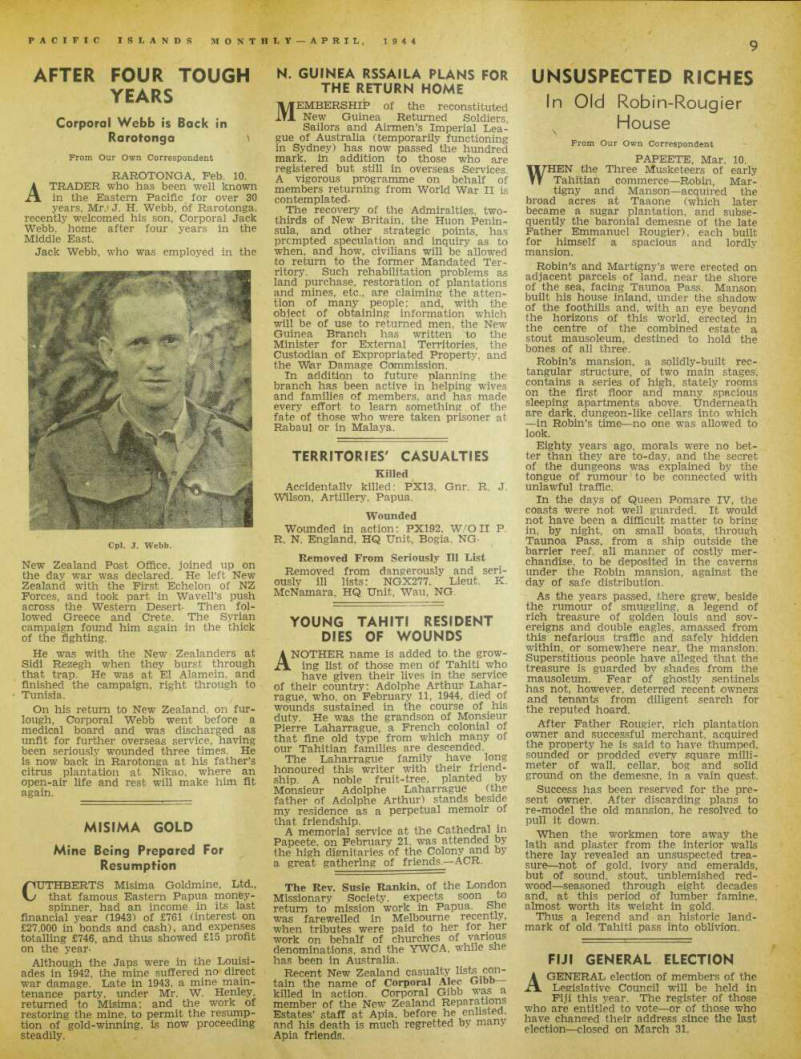
Years
Corporal Webb is Back in Rarotonga
Prom Our Own Correspondent
Rarotonga, Feb. 10.
A TRADER who has been well known in the Eastern Pacific for over 30 years, Mr. 1 J. H. Webb, of Rarotonga, recently welcomed his son, Corporal Jack Webb, home after four years in the Middle East.
Jack Webb, who was employed in the
New Zealand Post Office, joined up on the day war was declared. He left New Zealand with the First Echelon of NZ Forces, and took part in Wavell’s push across the Western Desert- Then fol lowed Greece and Crete. The Syrian campaign found him again in the thick of the fighting.
He was with the New Zealanders at Sidi Rezegh when they burst through that trap. He was at El Alamein, and finished the campaign, right through to Tunisia.
On his return to New Zealand, on fur lough, Corporal Webb went before a medical board and was discharged as unfit for further overseas service, having been seriously wounded three times. He is now back in Rarotonga at his father’s citrus plantation at Nikao, where an open-air life and rest will make him fit again.
Cpl. J. Webb.
Resumption
Misima Gold
Mine Being Prepared For Resumption
CUTHBERTS Misima Goldmine, Ltd., that famous Eastern Papua money spinner, had an income in its last financial year (1943) of £761 (interest on £27.000 in bonds and cash), and expenses totalling £746, and thus showed £l5 profit on the year- Although the Japs were in the Louisi ades in 1942, the mine suffered no direct war damage. Late in 1943, a mine main tenance party, under Mr. W. Henley, returned to Misima; and the work of restoring the mine, to permit the resump tion of gold-winning, is now proceeding steadily.
N. Guinea Rssaila Plans For
The Return Home
MEMBERSHIP of the reconstituted New Guinea Returned Soldiers.
Sailors and Airmen’s Imperial Lea gue of Australia (temporarily functioning in Sydney) has now passed the hundred mark, in addition to those who are registered but still in overseas Services.
A vigorous programme on behalf of members returning from World War II is contemplated- The recovery of the Admiralties, two thirds of New Britain, the Huon Penin sula, and other strategic points, has prompted speculation and inquiry as to when, and how, civilians will be allowed to return to the former Mandated Ter ritory. Such rehabilitation problems as land purchase, restoration of plantations and mines, etc., are claiming the atten tion of many people: and, with the object of obtaining information which will be of use to returned men, the New Guinea Branch has written to the Minister for External Territories, the Custodian of Expropriated Property, and the War Damage Commission.
In addition to future planning the branch has been active in helping wives and families of members, and has made every effort to learn something of the fate of those who were taken prisoner at Rabaul or in Malaya.
Territories' Casualties
Killed Accidentally killed: PXI3, Gnr. R. J.
Wilson, Artillery, Papua.
Wounded Wounded in action; PXI92, W/011 P R. N. England, HQ Unit, Bogia, NG- Removed From Seriously HI List Removed from dangerously and seri ously ill lists: NGX277. Lieut. K.
McNamara, HQ Unit, Wau, NG.
Young Tahiti Resident
Dies Of Wounds
ANOTHER name is added to the grow ing list of those men of Tahiti who have given their lives in the service of their country: Adolphe Arthur Lahar rague, who. on February 11, 1944, died of wounds sustained in the course of his duty. He was the grandson of Monsieur Pierre Laharrague, a French colonial of that fine old type from which many of our Tahitian families are descended.
The Laharrague family have long honoured this writer with their friend ship. A noble fruit-tree, planted by Monsieur Adolphe Laharrague (the father of Adolphe Arthur) stands beside my residence as a perpetual memoir of that friendship.
A memorial service at the Cathedral in Papeete, on February 21, was attended by the high dignitaries of the Colony and by a great gathering of friends ACR.
The Rev. Susie Rankin, of the London Missionary Society, expects soon to return to mission work in Papua. She was farewelled in Melbourne recently, when tributes were paid to her for her work on behalf of churches of various denominations, and the YWCA, while she has been in Australia.
Recent New Zealand casualty lists con tain the name of Corporal Alec Gibb killed in action. Corporal Gibb was a member of the New Zealand Reparations Estates’ staff at Apia, before he enlisted, and his death is much regretted by many
Apia friends.
Unsuspected Riches
In Old Robin-Rougier House
From Our Own Correspondent
Papeete, Mar. 10.
WHEN the Three Musketeers of early Tahitian commerce—Robin, Mar tigny and Manson—acquired the broad acres at Taaone (which later became a sugar plantation, and subse quently the baronial demesne of the late Father Emmanuel Rougier), each built for himself a spacious and lordly mansion, Robin’s and Martigny’s were erected on adjacent parcels of land, near the shore of the sea, facing Taunoa Pass. Manson built his house inland, under the shadow of the foothills and, with an eye beyond the horizons of this world, erected in the centre of the combined estate a stout mausoleum, destined to hold the bones of all three.
Robin’s mansion, a solidly-built rec tangular structure, of two main stages, contains a series of high, stately rooms on the first floor and many spacious sleeping apartments above. Underneath are dark, dungeon-like cellars into which —in Robin’s time—no one was allowed to look.
Eighty years ago, morals were no bet ter than they are to-day, and the secret of the dungeons was explained by the tongue of rumour to be connected with unlawful traffic.
In the days of Queen Pomare IV, the coasts were not well guarded. It would not have been a difficult matter to bring in, by night, on small boats, through Taunoa Pass, from a ship outside the barrier reef, all manner of costly mer chandise. to be deposited in the caverns under the Robin mansion, against the day of safe distribution.
As the years passed, there grew, beside the rumour of smuggling, a legend of rich treasure of golden louis and sov ereigns and double eagles, amassed from this nefarious traffic and safely hidden within, or somewhere near, the mansion.
Superstitious people have alleged that the treasure is guarded by shades from the mausoleum. Fear of ghostly sentinels has not, however, deterred recent owners and tenants from diligent search for the reputed hoard.
After Father Rougier, rich plantation owner and successful merchant, acquired the property he is said to have thumped, sounded or prodded every square milli meter of wall, cellar, bog and solid ground on the demesne, in a vain quest.
Success has been reserved for the pre sent owner. After discarding plans to re-model the old mansion, he resolved to pull it down.
When the workmen tore away the lath and plaster from the interior walls there lay revealed an unsuspected trea sure—not of gold, ivory and emeralds, but of sound, stout, unblemished red wood—seasoned through eight decades and, at this period of lumber famine, almost worth its weight in gold.
Thus a legend and an historic land mark of old Tahiti pass into oblivion.
Fiji General Election
A GENERAL election of members of the Legislative Council will be held in Fiji this year. The register of those who are entitled to vote—or of those who have changed their address since the last election—closed on March 31.
The Sepik Tragedy
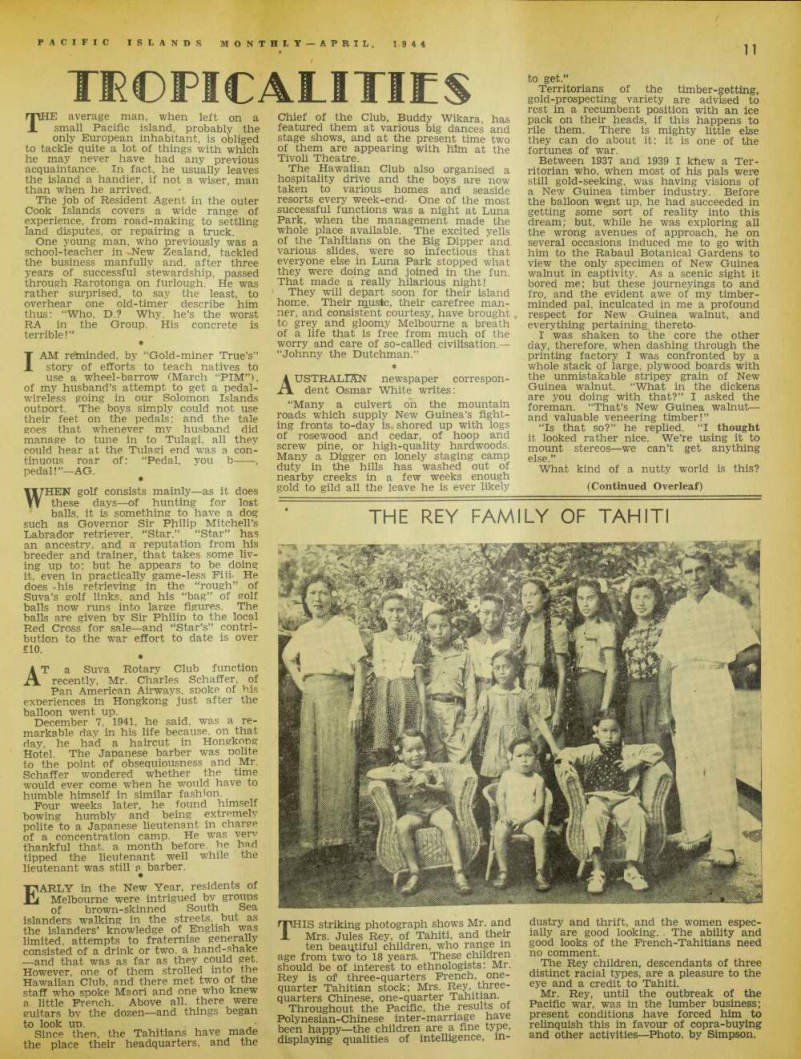
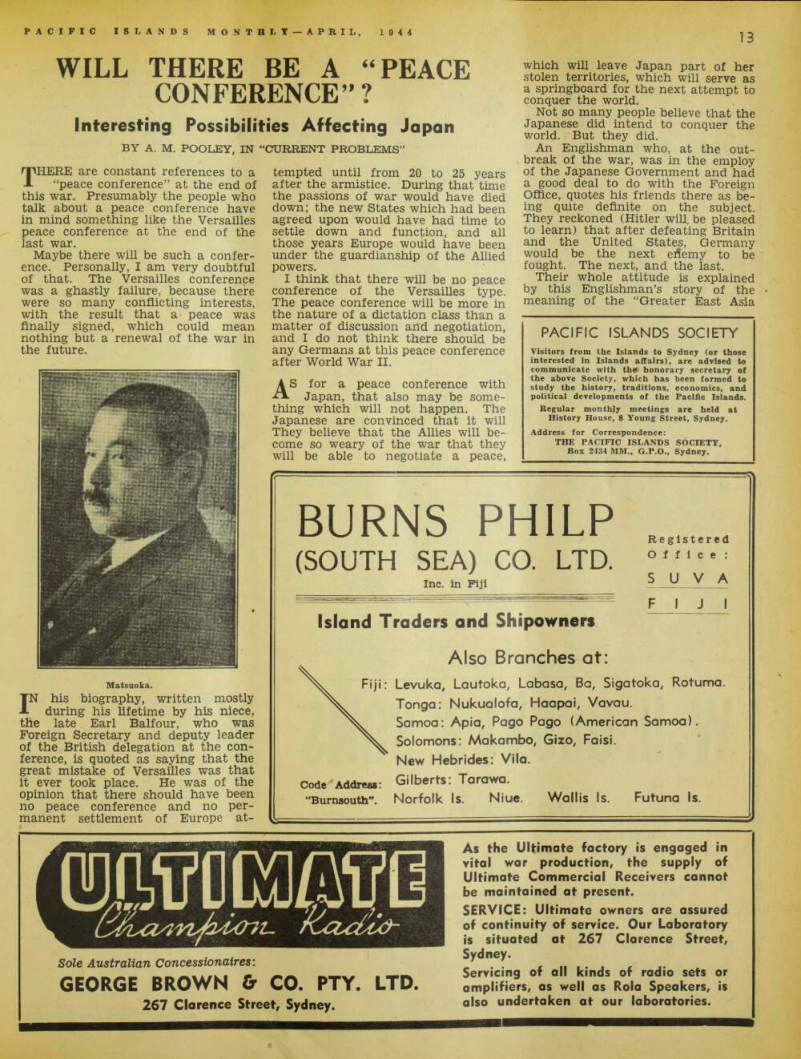
What Really Happened at Angoram in March, 1942
IN the “PIM” of February, 1943, we printed an account of a tragedy which occurred on the Sepik River, New Guinea, almost a year previously: a number of white men had lost their lives in a clash with native police, and Assistant District Officer G. Ellis, of Angoram, had taken his own life, appar ently while of unsound mind.
Details of the tragedy, when they did seep through to Australia, were vague and misleading, and it was evident, even then, that our version had little relation to what actually happened. Now, over two years later, one of the men who was present at the time, and who kept an account of proceedings during the whole eight or nine months in which he was getting himself out of the Sepik district and into Papua, has given us permission to use part of his diary. Extracts from this tell their own tale, but the follow ing facts also should be borne in mind: About mid-January, 1942, the miners of the Wewak district were informed that the Government was establishing a base camp at Yimas, on the Karriwarri River (a tributary of the Sepik). It was apparently left for these men to work out frcm this brief statement whether or not they were expected to evacuate the dis trict. Residents of Wewak township, on the other hand, who also made for Sepik bases, were given definite instructions about evacuation.
At one time or another, between Janu ary and March that year, practically every resident of the Wewak-Sepik dis trict was waiting somewhere on the Sepik River—at Yimas, or at Angoram, or some camp in between, and the whole period appears to have been one of con fusion, dithering, order and counter order.
The original Government plan—if plan it could be called—was that tlje men should make for the highlands above the Karriwarri River, construct a landing field—and hope that they could be taken off by air. In the ensuing weeks, this plan was scrapped in favour of many others: they, in turn, to be scrapped also.
All schooners and boats, at one stage, were ordered to Madang. Subsequently, one or two of these returned- Some men, who refused this high-handed order to give up their boats, finally got away in them. Eventually it became evident that the men must shift for themselves—or else!
AS a line on ADO Ellis, the central figure of the subseouent strange shooting affray, we will quote from the diary: “Angoram, March 9: Ellis has re affirmed his intention of going on his own if a plane does not pick us up. From underground sources we have learned that he has the police-boys all ready to clean up any man, white or black, who attempts to stop his getting away. That is good!
“There are two pinnaces here now—the ‘Osprey,’ belonging to the Administra tion, and Burns Philos’ ‘Fanny.’ Both are calaboosed by Ellis. No fuel for anv boat, according to him; but we knew that he has fuel planted, and that he had PB’s guarding it.
“A query at the ‘House-paper’ yester day brought forth the fact (from Ellis) that the Administration has ceased to function. Therefore, what right has he
to anything on this station? We must find out how far these PB’s will obey him.”
There followed more plans, and changes of plans. Finally, all civilians and over-age officials were to go down river and to a point on the coast where they could get inland, and it was hoped, to safety.
A party elected to go overland, and were to be helped some considerable dis tance upstream in the Government schooner, “Thetis.”
And so we come to the entry of: “ A NGORAM, Friday, March 20.—Here is a day that will make New Guinea history!
“All preparations for the departure of the ‘Nereus’ downstream, and the ‘Thetis’ with our party upstream, were completed about 10-30 a.m. The ‘Thetis’ pulled up stream about 400 yards to pick up the balance of our cargo, and while we were loading. Bates (Patrol Officer) came along, white with excitement, to tell us that Ellis had all the police-boys, with loaded rifles, behind him and had given Bates and ADO J. L. Taylor (who had arrived at Angoram some days previ ously to take charge of evacuation arrangements) half an hour to get off the station. We noticed, then, that the 16 PB’s who had been with us on the ‘Thetis’ had disappeared. The bugler rushed down and we all armed ourselves —some with .44’s. some with .303, or whatever they could get.
“Two men were left as a boat guard— the rest rushed for the station. The ‘Nereus’ was pushing off when the trouble started, and any firearms on her —very few—were locked away.
“When the PB’s saw an advance by the Euroneans, shooting began straight away, and the nosition got verv hot. The PB’s opened fire on the ‘Nereus’ and then retreated to Ellis’ house. This had a lot of drainage trenches around it, and is on the crest of the hill.
“It would have been impossible for our small mob, badlv armed, to defeat 46 Police-boys, all with -303’s and plenty of ammunition, and after about two hours of it our blokes made their way back to the boats. The police were very silent for a time—thev are not used to having their fire backed by anything more lethal than native spears, and had little guts for this sort of fighting.
“Back on the ‘Thetis’ we got all the boys on board ahd headed downstream for Marienberg. When we got opposite the ‘Nereus’ they signalled for us to pull in and we discovered that they could not get their engine to go. Up to this stage we had not been fired on while on the ‘Thetis.’
“We put a line on the ‘Nereus,’ but it Darted and we had to circle for another try. We were successful, this time, but had just got round into the current when we were fired on again. Now we were absolutely defenceless and had to take it. Tavlor collected one in the groin. The PB’s must have been driven well back, but our circling about gave them time to get back into position.
“Downstream we went, and made Marienberg about 4 o.m. The ‘Nereus’ had collected a shot in the water-jacket of the engine- No other damage.
(Continued on Page 30)
MARCH 22: Jones, DO at Wewak, arrived at Marienberg yesterday.
Last night two boys arrived from Angoram by road and told us that some of the PB’s had deserted Ellis, and that Ellis had been sitting in his house since we left, without food. • He has plenty to think about, I guess! We agreed to accompany Jones back —we civilians being sworn in as Special Constables.
The party consisted of Jones, Thurston, Hindwood, Mason, Petterson, Bates and Odgers. We had 10 PB’s whom Jones had brought from Wewak.
“Upstream to Angoram—and, having sand-bagged the ‘Thetis,’ we felt better.
The station looked deserted, but we con tinued on to Angoram village and after dark sent out scouts. They reported that there were no lights in the houses, but that they saw matches being struck in one of the avenues of trees.
“We have decided to have a go in the morning, but it will be a helluva turn out if they have the place trenched.
“March 23. —Back now at Marienberg.
We landed at Angoram station as plan ned. The party split in two to circle round Ellis’ house and come in on two sides- We all got within 100 yards of the house —and waited. Nothing hap pened—so we ventured the rest of the way. We got in and found Mr. Ellis among the dear departed. Evidently suicide. He was shot right through the forehead and had left a note for his people—only the address, and no details of the business. A happy ending for all of us.
“All the renegade PB’s had left, but they took with them all the muskets and all the ammunition they could find—we calculate about 4.000 rounds. What a menace they will be if they stick together!”
WITHIN a day or so of this entry, the party, which later went overland from the Sepik to the Fly River, returned up-river on the ‘Thetis’; and, subsequently, set out on their incredible journey, that was to bring them, six months later, to Papua and safety. And. from this point, our original account of the tragedy is substantially correct.
A grouo of deserting police-boys entrenched themselves on an island in
the Chambrai Lakes, about three days upstream from Angoram, but not before they had ambushed and killed Patrol- Officer R. B- Strudwick, at Timbunku, on the Sepik, had shot several natives molested women, plundered gardens and generally terrorised the whole district between them and Angoram. Allegedly their intention was to kill every European whom they could find. This, they said they had been told to do by Ellis.
Later, they made their way through a channel from Chambrai and surrounded a party of miners who had gone from their claims up the Karriwarri The police-boys surprised the ihiners while they were at a meal and killed G Eichorn, Sr., J. Mitchell. R. J. Beckett’ and a Chinese carpenter. Two other miners, J. Wilton, and Eichorn Jr escaped.
It was reported, later, that the whole of this unsavoury Sepik situation had been cleared up and that an official inquiry had been held. The real facts of the case, however, have never seen the light of day. It was, presumably, one of those minor incidents which might have been lost in the maze of larsrer events stemming out from the Pacific w * r - We are glad, therefore, to be able —belated thousrh it is—to present an eve-witness’s account of what actuallv happened on the Senik in March. 1942 and which, to date, has been “shrouded in mystery.”
Solomons Methodist
Missions No Return of Personnel
A STRENUOUS campaign to restore the Solomon Islands organisation of the Methodist Missionarv Society of New Zealand is being carried on by the society’s chairman, the well-known Rev.
J. F. Goldie, who at present is in Aus tralia.
By the sheer bad luck of war, the Japanese who invaded the Solomons established one of their most important bases at Munda. in New Georgia, in the cultivated country beside Roviana Lagoon,, occupied by the Methodist Society as their headquarters, and by Mr.
Leslie F. Gill’s Lambeti Plantation. By the time the Americans had thrown the Japs out of Munda, there was nothing left of Mr Goldie’s well-eouipped mission station- Other Methddist mission sta tions in the Group also were destroyed.
Mr. Goldie appealed for funds to his church in New Zealand: and he has had what he calls a “remarkable response,”
There is no “War Damage Insurance” plan in the British Solomons, so pre sumably the Mission Society must depend for rehabilitation upon its own resources.
But its mission stations in Bougainville and Buka Coart of the Mandated Ter ritory) are under the Australian insur ance plan, and some re-establishment funds should come from that quarter.
Having made provision for finance, Mr.
Goldie has been trying to persuade the nowers-that-be to allow the Methodist missionaries to return to the Solomons; but, so far, without success.
The civil authority—who is the British High Commissioner for the Western Pacific—appears to be eaeer to send to the Solomons all men who may assist the native neoples there to recover from the nsvchological shock of war, and mis sionaries clearly are in that category.
Moreover, large meetings of mission educated natives have been appealing for the return of their teachers. But. up to the present, no decision appears to have been reached by the military authorities in relation to the return of civilians— whether they are missionaries, traders or planters.
The society’s medical superintendent, Dr. Rutter, has returned; but as a tem porary Government doctor, and not as a missionary doctor.
The "Winston Churchill"
Hospital
rE reorganisation of medical and health services in Flu and in the South Pacific (referred to elsewhere) provides for the establishment of a new general hospital in Suva.
In a despatch to the Secretary of State for the Colonies, the Governor. Sir Philip Mitchell, described this hospital as the most important of the institutions pro posed and he said: “Our freedom to plan the establishment of such an institution in undisturbed security and with confi dence of fulfilment, is due to the mag nificent leadership and indomitable cour age of the Prime Minister and I shall be glad if his permission may be sought to name this hospital ‘The Winston Chur chill South Pacific Hospital.’ ”
The Secretary of State replied, later, that the Prime Minister gratefully accepted the proposal.
Tiopicalities
rE average man, when left on a small Pacific island, probably the only European inhabitant, is obliged to tackle quite a lot of things with which he may never have had any previous acquaintance. In fact, he usually leaves the island a handier, if not a wiser, man than when he arrived.
The job of Resident Agent in the outer Cook Islands covers a wide range of experience, from road-making to settling land disputes, or repairing a truck.
One young man, who previously was a school-teacher in -New Zealand, tackled the business manfully and. after three years of successful stewardship, passed through Rarotonga on furlough. He was rather surprised, to say the least, to overhear one old-timer describe him thus: “Who, D.? Why, he’s the worst RA in the Group. His concrete is terrible!” ♦ I AM retninded, by “Gold-miner True’s” story of efforts to teach natives to use a wheel-barrow (March “PIM”), of my husband’s attempt to get a pedal wireless going in our Solomon Islands outport. The boys simply could not use their feet on the pedals; and the tale goes that whenever my husband did manage to tune in to Tulagi, all they could hear at the Tulagi end was a con tinuous roar of; “Pedal, you b , pedal!”—AG.
WHEN golf consists mainly—as it does these days—of hunting for lost balls, it is something to have a dog such as Governor Sir Philip Mitchell’s Labrador retriever, “Star.” “Star” has an ancestry, and a: reputation from his breeder and trainer, that takes some liv ing up to; but he appears to be doing it, even in practically game-less Fiji- He does >his retrieving in the “rough” of Suva’s golf links, and his “bag” of eolf balls now runs into large figures. The balls are given by Sir Philin to the local Red Cross for sale—and “Star’s” contri bution to the war effort to date is over £lO. * AT a Suva Rotary Club function recently, Mr. Charles Schaffer, of Pan American Airways, snoke of his experiences in Hongkong just after the balloon went up.
December 7. 1941, he said, was a re markable day in his life because, on that day, he had a haircut in Hongkong Hotel. The Japanese barber was oolite to the point of obsequiousness and Mr.
Schaffer wondered whether the time would ever come when he would have to humble himself in similar fashion.
Four weeks later, he found himself bowing humbly and being extremely polite to a Japanese lieutenant in charge of a concentration camp. He was verv thankful that, a month before, he had tipped the lieutenant well while the lieutenant was still a barber. * EARLY in the New Year, residents of Melbourne were intrigued by groups of brown-skinned South Sea islanders walking in the streets, but as the islanders’ knowledge of English was limited, attempts to fraternise generally consisted of a drink or two. a hand-shake •—and that was as far as they could get.
However, one of them strolled into the Hawaiian Club, and there met two of the staff who spoke Maori and one who knew a little French. Above all. there were euitars by the dozen —and things began to look up.
Since then, the Tahitians have made the place their headquarters, and the
Chief of the Club, Buddy Wikara, has featured them at various big dances and stage shows, and at the present time two of them are appearing with him at the Tivoli Theatre.
The Hawaiian Club also organised a hospitality drive and the boys are now taken to various homes and seaside resorts every week-end- One of the most successful functions was a night at Luna Park, when the management made the whole place available. The excited yells of the Tahitians on the Big Dipper and various slides, were so infectious that everyone else in Luna Park stopped what they were doing and joined in the fun.
That made a really hilarious night!
They will depart soon for their island home. Their music, their carefree man ner, and consistent courtesy, have brought to grey and gloomy Melbourne a breath of a life that is free from much of the worry and care of so-called civilisation.— “Johnny the Dutchman.” * AUSTRALIAN newspaper correspon dent Osmar White writes: “Many a culvert on the mountain roads which supply New Guinea’s fight ing fronts to-day is shored up with logs of rosewood and cedar, of hoop and screw pine, or high-quality hardwoods.
Many a Digger on lonely staging camp duty in the hills has washed out of nearby creeks in a few weeks enough gold to gild all the leave he is ever likely
to get.”
Territorians of the timber-getting, gold-prospecting variety are advised to rest in a recumbent position with an ice pack on their heads, if this happens to rile them. There is mighty little else they can do about it: it is one of the fortunes of war.
Between 1937 and 1939 I ktiew a Ter ritorian who, when most of his pals were still gold-seeking, was having visions of a New Guinea timber industry. Before the balloon wqnt up, he had succeeded in getting some sort of reality into this dream; but, while he was exploring all the wrong avenues of approach, he on several occasions induced me to go with him to the Rabaul Botanical Gardens to view the only specimen of New Guinea walnut in captivity. As a scenic sight it bored me; but these journeyings to and fro, and the evident awe of my timber minded pal, inculcated in me a profound respect for New Guinea walnut, and everything pertaining thereto- I was shaken to the core the other day, therefore, when dashing through the printing factory I was confronted by a whole stack of large, plywood boards with the unmistakable stripey grain of New Guinea walnut. “What in the dickens are you doing with that?” I asked the foreman. “That’s New Guinea walnut— and valuable veneering timber!”
“Is that so?” he replied. “I thought it looked rather nice. We’re using it to mount stereos —we can’t get anything else.”
What kind of a nutty world is this?
(Continued Overleaf)
World sources of veneering timber were fast drying up before World War 11, yet, to-day, priceless quantities of these materials are being used to back adver tising stereos so that the merits of Some one’s Rosy-hued Pills for Listless Ladies, or Somebodyelse’s Vitaminised Breakfast Foods for Vim and Vigour might be belaboured in the magazines and periodi cals of Australia.—JT. • A WELL-KNOWN resident of Morobe before the war, who is now back in that area as a high-ranking AIF officer, foresees a great future for the Jeep and the helicopter in the New Guinea of the future. So sure is he of the large part they are destined to play he has already placed orders for these two wartime inventions in the appropriate quarters.
“The helicopter in particular should be of immense value,” he writes. “Prospec tors. recruiters, patrol officers and others seeking the back country should be able to make use of this machine to pene trate areas formerly inaccessible by rea sons of distance, rivers, and all other trials and troubles incidental to foot travel in the high mountain country.
“The Jeep has proved its ability to go almost anywhere, carrying sizable loads, and without the necessity of costly road construction. Even with mules, a track of sorts had to be cut, and a Jeep will
go practically anywhere a mule can go, and carry a much greater pay-load ” * FROM an Australian internment camp comes a brief note from an old Ter ritories resident, Mr. O. Soltwedel, who is known to most of the old-timers.
“I cannot complain,” he says, “except for the unnecessary loss of years of my life.
Everything has an end, and we hope that there will be a change soon. Please remember me to old New Guinea-ites.” • IT was stated some time ago in one of our issues that Mr. A. G. Smyth was present in Samoa during the riots of December, 1929. when High Chief Tama sese lost his life. An old resident of Fiji says: “This is incorrect. A. G. Smyth and Mrs. Smyth were my. guests here in Fiji on the day that the news of Tama sese’s death came through. A. G. Smyth shed tears when he learned of the tragic end of his old friend,” • A ROMAN Catholic missionary who escaped from the Japanese on the North Coast of New Guinea has sent us some interesting information about events there in 1942-3. For National Security reasons, most of it may not now be published. It is worth not ing, however, that the missionary says: In addition to the party of five Sisters, two Fathers and one Brother, whose escape was described in the March “PIM,” another party of seven mission aries got safely away. Referring to this, the missionary writes: “Lieutenant E.
Fulton is a brave, courageous soldier. He risked his own life to save that of mine and six other missionaries.” “Ted” Ful ton, former Administration officer and Sepik gold-miner, probably will resent bitterly being called a “brave soldier”— but honour where honour is due!
Mr. Wainwright Abbott, who has been United States Consul-General in Fiji for a number of years, is to leave shortly on transfer. His successor will be Mr.
Thomas S. Home.
The Rey Family Of Tahiti
rIS striking photograph shows Mr. and Mrs. Jules Rey, of Tahiti, and their ten beautiful children, who range in age from two to 18 years. These children should be of interest to ethnologists: Mr.
Rey is of three-quarters French, one quarter Tahitian stock; Mrs. Rey, three quarters Chinese, one-quarter Tahitian.
Throughout the Pacific, the results of Polynesian-Chinese inter-marriage have been happy—the children are a fine type, displaying qualities of intelligence, m
dustry and thrift, and the women espec ially are good looking. The ability and good looks of the Prench-Tahitians need no comment.
The Rey children, descendants of three distinct racial types, are a pleasure to the eye and a credit to Tahiti.
Mr. Rey, until the outbreak of the Pacific war, was in the lumber business; present conditions have forced him to relinquish this in favour of copra-buying and other activities —Photo, by Simpson.
"Native Life In Fiji And
Rotuma"
Interesting Address to PI Society
AN interesting and instructive address, illustrated by lantern slides, was given to the Pacific Islands Society at History House, on March 15, by the Rev. Dr- Churchward. He spoke of native life in Fiji and Rotuma, where he has lived for over 16 years.
Dr. Churchward explained the study of the native idiom, and how the lan guages of these people were given a writ ten form—including an elaborate gram mar, It was in connection with his work on these languages that he gained his Doctorate of Literature at Melbourne University. He is the author of several books in Fijian and Rotuman, and the editor of papers published in these two tongues, and read by most of the natives.
Knowledge of a native language, he said, is often a guide to native origin, and facilitates an understanding of native customs.
Dr. Churchward expects to leave shortly for the Northern Territory, where he will tackle other native language problems.
New Guinea Public Service
Association
WITH a view to interesting themselves actively in matters relating to the rehabilitation and reconstruction in the Territory, a meeting of the Public Service Association of New Guinea was called for February 9, 1944. The meet ing was held in Sydney and a good repre sentation of officers residing in NSW attended: letters were received from many officers residing in other States.
To conduct the business of the Asso ciation until the return of a more nor mal state, the following provisional coun cil was elected: President, Mr. J. L. Frog gatt; vice-president, Mr. H. L Downing; hon. secretary, Mr. L. Odgers: hon. trea surer, Mr. J. C. Goad; committee, Messrs.
J. P. L. Burke. H- J. Hutchinson, A. J.
Long, W. M. Marshall, R. Melrose, C.
W. Thomas and G. T. Wells.
It was resolved, at this first meeting, to approach the Minister for External Territories regarding the rights, privi leges and future of members of the Ser vice, irrespective of whether that future lies only in New Guinea or in any com bined service that may be set up.
A high Fijian chief, Ratu Luke Raiwa lui, Tui Nakelo, died on January 31. at the age of 49. He was a great-grandson of Cakobau. and in his early 20’s went overseas with the Fiji Labour Corps in the 1914-18 war. A few years after he returned to Fiji he was appointed Buli of the large Nakelo district, in Taileva pro vince. When the present Labour Corps was being organised. Ratu Luke, an early volunteer, was granted a commission, and held this until a few months ago when ill-health compelled him to resign it. He was a man of deep loyalty and high integrity and his death is a loss to Fijian administration.
In addition to the women of the Angli can Mission who were evacuated from Papua, and who are now returning to teaching duties, two new women mission aries will join the staff in that area.
They are Mrs. Raymond Nicholls and Miss Edith Cates.
Miss A. M. Smaill, who has been teach ing for a number of years at Labasa, Fiji, has been appointed supervisor of the correspondence classes.
Advertisements & other items, p. 16 (1 item)
Cigarette LIGHTERS
Anthropology
mHE Anthropoligical Society of New South Wales has for its objects the study of the native peoples of the Pacific Islands. East Indies and Australia. Bi-monthly meetings are held, and the journal, “Mankind,” is published twice per annum. The subscription is ten shillings. Particulars of membership may be obtained from the Honorary Secretary, 164 Prince’s Highway, Amcliffe. or he may be communicated with by telephone, -number LX2OIO-
v V Slightly larger than illustration
Available Notv!
POSTED FREE TO ANY ADDRESS.
Flints, too—the best English make. Extra quantities of these good flints are included at 3 for 6d.
This Cigarette Lighter is Australian made. It gives you an immediate, safe light, which can be extinguished in a jiffy. It is easy to operate, made of all metal, and is nickel-finished. Has close fitting cap to keep wick clean and always ready for use.
PRICE: 15/6
A grand gift for the boy “up north.” We will engrave his Name and Number on it for 1/- extra.
WE REMIND YOU—
THESE LIGHTERS POSTED FREE TO ANY
ADDRESS.
Angus & Coote Ltd!
500 George St., Sydney ’Phone: msosi.
* When ordering, please mention the “P.I.M ”
Will There Be A “Peace
Conference”?
Interesting Possibilities Affecting Japan
BY A. M. POOLEY, IN “CURRENT PROBLEMS”
THERE are constant references to a “peace conference” at the end of this war. Presumably the people who talk about a peace conference have in mind something like the Versailles peace conference at the end of the last war.
Maybe there will be such a confer ence. Personally, I am very doubtful of that. The Versailles conference was a ghastly failure, because there were so many conflicting interests, with the result that a peace was finally signed, which could mean nothing but a renewal of the war in the future.
IN his biography, written mostly during his lifetime by his niece, the late Earl Balfour, who was Foreign Secretary and deputy leader of the British delegation at the con ference, is quoted as saying that the great mistake of Versailles was that it ever took place. He was of the opinion that there should have been no peace conference and no per manent settlement of Europe at
tempted until from 20 to 25 years after the armistice. During that time the passions of war would have died down; the new States which had been agreed upon would have had time to settle down and function, and all those years Europe would have been under the guardianship of the Allied powers.
I think that there will be no peace conference of the Versailles type.
The peace conference will be more in the nature of a dictation class than a matter of discussion and negotiation, and I do not think there should be any Germans at this peace conference after World War 11.
AS for a peace conference with Japan, that also may be some thing which will not happen. The Japanese are convinced that it will They believe that the Allies will be come so weary of the war that they will be able to negotiate a peace,
which will leave Japan part of her stolen territories, which will serve as a springboard for the next attempt to conquer the world.
Not so many people believe that the Japanese did intend to conquer the world. But they did.
An Englishman who, at the out break of the war, was in the employ of the Japanese Government and had a good deal to do with the Foreign Office, quotes his friends there as be ing quite definite on the subject.
They reckoned (Hitler will, be pleased to learn) that after defeating Britain and the United States, Germany would be the next ertemy to be fought. The next, and the last.
Their whole attitude is explained by this Englishman’s story of the meaning of the “Greater East Asia
Matsuoka.
Co-Prosperity Sphere.” Asking just what this meant, he was cynically told that it might be described as “the British Empire under new owner ship.”
It is not known whether at the “Strip Japan” conference between President Roosevelt, Chiang Kai Shek and Mr. Churchill at Cairo, any other peace terms were discussed. But it is at least suggested by the decision to strip Japan of all her stolen terri tories that no idea of a formal peace conference entered the minds of the three leaders. rERE is one point on that decision worth mentioning. Though the Japanese Government might sur render, when Japan is brought under air, sea and land assault, it is highly improbable that the Kwantung army, which since 1941 has been a law unto itself, would accept surrender from Tokio.
The Kwantung army—which signi fies the army in Manchuria—is Japan’s crack military force. It numbers more than half a million excellently trained and disciplined troops. These troops are being re inforced by troops which have served in various areas of the Pacific opera tions.
The Kwantung army, therefore, consists of tough, experienced and fanatical fighters. They have never been particularly loyal to the Tokio Governments. In 1931 they occupied Manchuria without the permission or knowledge of the Tokio authorities.
The present military set-up in Tokio is drawn from the Kwantung army.
To jo was its Chief-of-Staff in suc cession to Ttagaki, who is now Home Minister. The deputy Chief-of-Staff, lida, is also out of that nest.
Not loyal to the Tokio Governments, the Kwantung army pays only lip service to the Emperor. He is merely a means to their ends.
VTEVERTHELESS, the Japs do t.hinir that there will be a negotiated peace. To that end they are Keeping in reserve their top diplomats. Mat suoka, who led the Japanese dele gallon out of the Assembly of the league of Nations when the vote of censure was passed on Japan over the seizure of Manchuria, who became Foreign Minister, signed the Russ'o- Japanese pact of non-aggression, and took Japan back into the Axis, is probably slated to lead that Japanese delegation at the expected peace conference. Born in America, speak ing very fluent English, educated at an American University, there is a belief in Tokio that he could “put it across” British and American nego tiators. Certainly he would try his best. Matsuoka has only one affec tion . . . that is, Matsuoka.
That affection is the only one he has never changed. Success at a peace conference would give him his greatest ambition . . . the Premier
shiP*
Before Shigemitsu was appointed For eign Minister, there were rumours Japan that Matsuoka would be re called to the Foreign Office. I said at the time that whe 4 that happened, JRPRR would be fishing for a peace conference. That is still worth re membering. He is not so young now 62 or He drink h ard of CoU rse he mav not last th/rniir?/ ™ U t S But his future fs
X watchine for if wifi inSStP
the course of mind Jinan’s Inne?
pf rP ip? f d J P s mner with Tanari a PrTrmTW T hopethatthere Su^eno^eSn 1
Snce “ a -K
in tSf troublTofefaVn
snan nave an tne trouoie over again
Advertisements & other items, pp. 17-18 (1 item)
Burns Philp
PACIFIC ISLANDS SOCIETY
Visitors from the Islands to Sydney (or those interested in Islands affairs), are advised to communicate with the honorary secretary of the above Society, which has been formed to study the history, traditions, economics, and political developments of the Pacific Islands.
Regular monthly meetings are held at History House, 8 Young Street, Sydney.
Address for Correspondence:
THE PACIFIC ISLANDS SOCIETY,
Box 2434 MM., G.P.0., Sydney.
BURNS PHILP
(SOUTH SEA) CO. LTD.
Inc. in Fiji Island Traders and Shipowners Registered Office :
SUVA
FIJI
Also Branches at: \Fiji: Levuka, Lautoka, Labasa, Ba, Sigatoka, Rotuma.
Tonga: Nukualofa, Haapai, Vavau.
Samoa: Apia, Pago Pago (American Samoa).
Solomons: Makambo, Gizo, Faisi.
New Hebrides: Vila, code Address: Gilberts: Tarawa.
“Bumsouth”. Norfolk Is. Niue. Wallis Is. Futuna Is.
Sole Australian Concessionaires :
GEORGE BROWN & CO. PTY. LTD.
267 Clarence Street, Sydney.
As the Ultimate factory is engaged in vital war production, the supply of Ultimate Commercial Receivers cannot be maintained at present.
SERVICE: Ultimate owners are assured of continuity of service. Our Laboratory is situated at 267 Clarence Street, Sydney.
Servicing of all kinds of radio sets or amplifiers, as well as Rola Speakers, is also undertaken at our laboratories.
Refreshing
as a plunge
into a lagoon!
tENA* I
fO $0A p
Germicidal
and fragrant
TENAX TOILET SOAP is
a rapid safeguard against external skin infections, yet it is soothing and kind to the most sensitive skin —even a baby’s!
ORDER TENAX FROM
YOUR ISLAND SUP-
PLIERS. STOCKS ARE
PLENTIFULLY AVAIL-
ABLE.
W. H. GROVE & SONS
Limited
AUCKLAND
Island Traders. P.o. Box 490.
Telegraphic and Cable Address: “Grove”, Auckland.
Shippers of all classes of New Zealand products.
Representing English Manufacturers throughout the Cook and Society Islands, Fiji, Tonga, Samoa, Niue, New Caledonia, New Guinea, etc.
In FIJI as—W. H. Grove & Sons (Fiji) Ltd.
Hasty Regulation—And
Hastier Repentance
(From a New Hebrides Correspondent) YOU instanced some samples of Con dominium Regulations relating to native wages, some months ago.
Here is a prime sample. We will entitle
it “Hasty Regulation and Hastier Repent
ance.”
New Hebrides Condominium —No. 1, 1944.
A joint Regulation to prohibit the manufacture and sale of native curios. (1) The manufacture and sale of native curios (e.g., grass skirts, canoes, clubs, bracelets, etc.), except as authorised by the Resident Commissioner, is hereby prohibited. (2) Infraction of this Regulation shall be punish able by a fine not exceeding £5O and by imprisonment not exceeding six months, or by one or other of these penalties. (3) This Regulation may be cited as the New Hebrides Prohibition of Manufacture and Sale of Native Curios Joint (Defence) Regulation No. 1 of 1944 and shall come into force on the day after the date thereof.
Dated 14th' January, 1944.
A. Fourcade, F.C. R. D. Blandy, H.B.M.C.
On February 24, 1944 —10 days later: Joint Regulation No. 1, 1944 (Prohibition, etc., of Native Curios), has been repealed.
This is a sample of the kind of legisla tion dealt out to us by our joint dicta tors. Few are repealed so hastily.
Nuff said!
Mr. M. Maginnity, formerly of Apia, W. Samoa, staff of the Bank of New Zealand, has been promoted to the rank of lieutenant in the RNZNVR.
Advertisements & other items, p. 18 (1 item)
14
APRIL. 194 4 -1 ACItIC ISLANDS MONTHLY
Territorians Into
Battle
Post-war Visions in New Guinea
in the various armed services in New Guinea are at last beginning to see the changed face of the country in terms of post-war utility. A correspondent in the Finschhafen area tells us of the satisfaction in building new roads , wharves, bridges and buildings— when it is felt that these are the first steps towards reconstruction in the Terri tory. He gives also the following news of Territorians who have crossed his trail recently. Some of the men mentioned have seen over four years of war, in the Middle East and elsewhere. Others of them were caught up by the Japs and made incredible escapes. All of them are doing a number-one job in New Guinea at the present time. rE scene has changed hereabouts in the last five months. It is difficult to realise that so short a time ago we were scrambling ashore in the grey light of early morning on Scarlet Beach —with no roads, or houses—only destruc tion all around.
Now there are roads, wharves, bridges and buildings; the natives are back in their villages, living peacefully, with new gardens planted. Law and order has been established once more.
Many men, well-known in New Guinea, have blown through here of late: Major Ayris, who is a purser on a ship, came in to see me a few days ago. He is as sprightly as ever, and, to his ever lasting credit, was able to do the right thing by Ted Jenyns and myself by pro ducing a bottle of “Nelson’s blood”—an amazing feat in these parts!
Ernie Hitchcock, after another fine stunt with his company of PIB, is here in hospital with a dose of fever —fortunately mild. Ken McMullen, Niall, McCarthy, Les Bell, Jack Thurston, Hector Wales, Snow Blakely, Tom Flowers, Bob Emery, Normie Neal, Richards (of the old Expro.
Board), Hector Maclean, Middleton and West (of Kar Kar), Blue Davis, Bird, Stewart and Carl Jacobssen —all have been through here in recent months. The majority of them are serving in an active capacity with ANGAU.
Bill Macgregor, for many years in Kavieng, and later recruiting, mining and prospecting, between Wewak and the Sepik, is now near here with District Services. He is one of the real tough old Expro. Board men—and one who knows as much about the country and the natives as any man living. K. T. Allan is also here with ANGAU.
I have heard that Charles Blake was wounded in the Arawe show; and that Lee Ashton was in the landing at Cape Gloucester. 11THILE I was over in Moresby a few Tf weeks ago I chanced to meet Nor man Wilde, who did such great work evacuating the» women and children from Wau by air, when the balloon went up. He was fit and well—and still doing good work.
I met Frank Leydon and Jerry Owers, late of NGG, there, too; and Harold Kock, schooner captain and planter of Rabaul, now resplendent in gold braid.
Kock has done, and is still doing, very important work wherein his great local knowledge of tides, reefs and passages has been of the greatest value.
I ran into the one and only James McGregor Dowsett also; and Geoff Cook, busy supervising the loading of “biscuit bombers.”
Kingdom
Sale Of Fiji War Bonds
Large Sums Loaned to United Kingdom
SINCE Fiji war bonds were first offered for sale about last September, two large sums have been made avail able for the war effort: £216,000 has been paid to the Reciprocal Aid Officer in Fiji, on behalf of the government of the United Kingdom; and a further sum of £47,000 has been paid towards Reciprocal Aid expenses incurred in the territories under the control of the Western Pacific High Commission. Thgce amounts repre sent loans to Britain by the purchasers of the war bonds.
There are two series of bonds: “A” series, each of which costs £100; and “B” series, which cost £5. Interest is 2\ per cent, and is payable half-yearly. The bonds are redeemable in 1951. Bonds may be purchased through the Treasury Department in Suva, at the Government
Savings Bank, and at all branches of the Banks of New South Wales and New Zealand.
Monsieur Olivier Jean Iker, of New Caledonia, recently heard through the Australian Red Cross, who had made inquiries through Geneva, that his three children who were in Paris at the time of the German occupation, are safe —and “as well as children can be these days in occupied Paris.”
Captain L. C. Ingle, of the New Guinea Coastal Small Boats Service, who was in hospital in Australia for a time, has now recovered and is returning to New Guinea. Captain Ingle was closely asso ciated, for a considerable time, with Captain L. Henderson, who recently was decorated for his services in piloting small ships along the north-east coast of Papua during the Buna-Gona advance.
Both men were commended for dis tinguished service.
Advertisements & other items, pp. 19-20 (1 item)
Burns Philp Trust
"TH^T"
/,y * TniT' 5 *
RELIEF
FROM A
MAJOR ANXIETY
Even the most expert and conscientious individual executor is subject to accident, illness and incapacitation. Continuity of administration and uninterrupted attention to your estate and your beneficiaries are of paramount importance. Both can, be positively assured by appointing this Company your sole Executor or as co-Executor with your present appointee. - An interesting explanatory booklet will be forwarded on request. • James Burns Lewis Armstrong
DIRECTORS :
MANAGER: C. H. Chester Robert John Nosworthy Joseph Mitchell
BURNS PHILP TRUST
C ° MPANY LIMITED
7 BRIDGE STREET, SYDNEY
PHONE: B 7901. Box 543 B - SPO - S V dne *- BP 5-44.
Modern Refrigeration for the South Sea Islands
The ELECTROLUX
KEROSENE OPERATED
REFRIGERATOR
MARVEL
OF
MODERN
SCIENCE
THE
MIRACLE
OF
ICE
FROM
HEAT
ELECTROLUX OFFERS ECONOMICAL, modern and completely efficient
REFRIGERATION FOR ISLANDS' HOMES.
FREEZES CONTINUOUSLY WHILE SMALL LAMP BURNS.
Freezing controlled by simply regulating height of flame. Uses only gallon of kerosene per week, MOTORLESS ... NO PARTS TO GET OUT OF ORDER.
MODEL L 22 MODEL L3BO
Capacity • (as illustrated) 2.2 cubic feet. Capacity 4 cubic feet.
GUARANTEED FOR TWO YEARS.
• Write to your Local Distributor for prices and full details.
OBTAINABLE FROM ALL W. R. CARPENTER & CO. LTD.
BRANCHES THROUGHOUT THE ISLANDS
Representation in Papua and New Hebrides.
MODEL LKSSO
Capacity 5.5 cubic feet.
Chance Meeting in Algiers Brings News
German Raider's Exploits Recalled
Chance Meeting in Algiers Brings News of "Notou's" Crew
From Our Own Correspondent
✓ Noumea, Mar. 20.
IN a roundabout way, news has reached here of the crew of the French Nickel Co.’s 3,000-ton ship, “Notou,” which was sunk on August 16, 1940, by a Ger man raider between Sydney and Noumea.
Not long ago a New Caledonian soldier, on leave in Algiers, recognised a passer-by whom he had last seen on the Noumea docks. It was Emile Hamon, second engineer of the “Notou,” who told a remarkable story of eight months spent on the raider after his ship was sunk.
When they eventually got through the English blockade and were landed in Bordeaux, he and others were sent as prisoners to Germany, but were freed after six months. Hamon then worked for a time at La Rochelle, but eventually got on a shin on the African run. He spent some time in Dakar, and then he managed to get to Algiers, and here, after the Allied landings, he joined the Fight in sr French.
At the time of meeting with the Cale donian soldier, he had just received a letter from his wife in Noumea—the first news from home since 1940.
HAMON was able to give news of the captain and crew of the “Notou,” and of M Paul Vois, Noumea mana ger of the Nickel Co., who was the onlv passenger on board when the ship was captured. He had been returning from a business trio to Svdney. during which he had discussed nickel nroduotion ques tions with Commonwealth officials.
At that time, M. Vois was preatlv wor ried about the fate of his wife, an Aus tralian. and his two children, who had been holidaying in Normandy at the time of the fall of France, and from whom nothing had been heard for some time.
Eventually they made their way to Bor deaux.
Hamon says that M. Vois is now managing Barclays, the big Paris clothing store, havinsr accepted this post because the Nickel Co. has been obliged to place its employees on half-pay. With him is M. Pelicier, who was Governor of New Caledonia at the time the Petain regime was set up at Bordeaux, but who left the Colony by Pan-American plane after disagreement with the General Council a fortnight before the country rallied to General de Gaulle. Hamon adds that M.
Pelicier is a brother-in-law of the head of the firm. Barclay, an Englishman.
Capt. Jego, of the “Notou,” a well known figure in Australian East Coast ports, is now running a ship on France’s extensive inland waterways. Other mem bers of the crew, Chatelain, Philippe, Charles, and Millet, have been sitting for merchant marine exams; Guy Noveri is working on a farm, and Andre Ulm is at Dakar; Legarion is at La Rochelle. The Loyalty natives of the crew were set ashore at Emirau and later evacuated to Sydney. mo understand something of French X bitterness and sufferings, it is neces sary to have lived in a French coun try at the time of France’s collapse. I went from Noumea to Sydney on the “Notou’s” second-last trip, to explain to the Australian Prime Minister, at M.
Pelicier’s request, the difficulties of New Caledonia and to thank him for Austra lia’s promise to help; also to tell, in a series of articles through the Australian newspapers, and talks over the air, some
thing of the reactions of Pacific French men and their determination to continue the struggle alongside the British Empire.
During that trip I spent an evening in Capt. Jego’s cabin, listening to a radioed report of the destruction of French war ships at Oran and other places by ships of the Royal Navy, Capt. Jego did not say much, but his thoughts turned to his native Britanny, and he told me how worried he was about his old mother and father at one of the
little Breton ports frequented by seamen and painters.
In Sydney I went along (August, 1940) to interview M. Vois and book my return passage by the “Notou,” but M Vois dissuaded me and instead I booked by the “Cagou,” another Nickel Co. col lier which sailed a fortnight later—other wise I would—and for the second time in my life—be a prisoner in Germany to-day.
As it happened, the “Cagou” was sunk a year or so later, by enemy action, between Sydney and Noumea.
Madame Tallec, wife oL the new Gov ernor of New Caledonia, arrived in Nou mea by air in March. She was accom panied by her 17-year-old daughter Jacqualine, and 16-year-old son Yves.
Advertisements & other items, p. 21 (1 item)
o
*
BREWED BY
CARLTON & UNITED BREWERIES LTD.
Survey
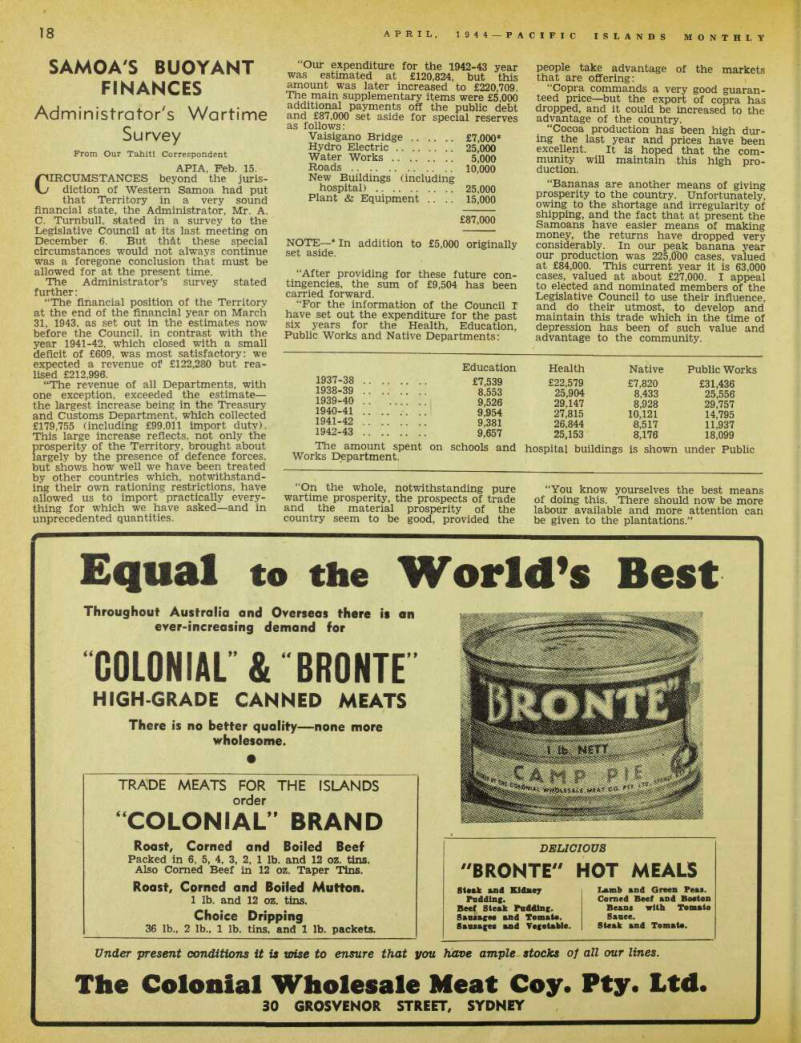
Samoa's Buoyant
Finances
Administrator's Wartime Survey
From Our Tahiti Correspondent
Apia, Feb. 15.
CIRCUMSTANCES beyond the juris diction of Western Samoa had put that Territory in a very sound financial state, the Administrator, Mr. A.
C. Turnbull, stated in a survey to the Legislative Council at its last meeting on December 6. But that these special circumstances would not always continue was a foregone conclusion that must be allowed for at the present time.
The Administrator's survey stated further: “The financial position of the Territory at the end of the financial year on March 31, 1943, as set out in the estimates now before the Council, in contrast with the year 1941-42, which closed with a small deficit of £609, was most satisfactory: we expected a revenue of £122,280 but rea lised £212,996.
“The revenue of all Departments, with one exception, exceeded the estimate — the largest increase being in the Treasury and Customs Department, which collected £179,755 (including £99,011 import duty).
This large increase reflects, not only the prosperity of the Territory, brought about largely by the presence of defence forces, but shows how well we have been treated by other countries which, notwithstand ing their own rationing restrictions, have allowed us to import practically every thing for which we have asked—and in unprecedented quantities.
“Our expenditure for the 1942-43 year was estimated at £120,824, but this amount was later increased to £220,709 The main supplementary items were £5,000 additional payments off the public debt and £87,000 set aside for special reserves as follows:
NOTE—* In addition to £5,000 originally set aside.
“After providing for these future con tingencies, the sum of £9,504 has been carried forward.
“For the information of the Council T have set out the expenditure for the past six years for the Health, Education, Public Works and Native Departments:
people take advantage of the markets that are offering: “Copra commands a very good guaran teed price—but the export of copra has dropped, and it could be increased to the advantage of the country.
“Cocoa production has been high dur ing the last year and prices have been excellent. It is hoped that the com munity will maintain this high pro duction.
“Bananas are another means of giving prosperity to the country. Unfortunately, owing to the shortage and irregularity of shipping, and the fact that at present the Samoans have easier means of making money, the returns have dropped very considerably. In our peak banana year our production was 225,000 cases, valued at £84,000. This current year it is 63,000 cases, valued at about £27,000. I appeal to elected and nominated members of the Legislative Council to use their influence, and do their utmost, to develop and maintain this trade which in the time of depression has been of such value and advantage to the community.
“On the whole, notwithstanding pure wartime prosperity, the prospects of trade and the material prosperity of the country seem to be good, provided the
“You know yourselves the best means of doing this. There should now be more labour available and more attention can be given to the plantations.”
Vaisigano Bridge £7,000* Hydro Electric 25,000 Water Works 5,000 Roads 10,000 New Buildings (including hospital) 25,000 Plant & Equipment .. .. 15,000 £87,000
Education Health Native Public Works 1937-38 £7,539 £22,579 £7,820 £31,436 1938-39 8,553 25,904 8,433 25,556 1939-40 9,526 29,147 8,928 29,757 1940-41 9,954 27,815 10,121 14,795 1941-42 9,381 26,844 8,517 11,937 1942-43 9,657 25,153 8,176 18,099 The amount spent on Works Department. schools and hospital buildings is shown under Public
Advertisements & other items, p. 22 (1 item)
Equal to the World’s Best
Throughout Australia and Overseas there ii on ever-increasing demand for
COLONIAL & BRONTE
HIGH-GRADE CANNED MEATS
There is no better quality—none more wholesome. •
TRADE MEATS FOR THE ISLANDS
order
“COLONIAL" BRAND
Roast, Corned and Boiled Beef Packed in 6,5, 4,3, 2, 1 lb. and 12 oz. tins.
Also Corned Beef in 12 oz. Taper Tins.
Roast, Corned and Boiled Mutton. 1 lb. and 12 oz. tins.
Choice Dripping 36 lb., 2 lb., 1 lb. tins, and 1 lb. packets. mr
P ■ pit
***r so.
Under present conditions it is wise to ensure that you have ample stocks of all our lines.
The Colonial Wholesale Meat Coy. Pty. Ltd.
30 GROSVENOR STREET, SYDNEY
Canoe
A Tribute to the Native Canoe Western Solomons Craftsmanship
Letter to the Editor I NOTICE in your issue of January, an interesting reference by Harold Cooper to the Solomon Islands canoe.
This reference is somewhat misleading —although not, of course, intentionally so. Mr. Cooper writes: “The canoe used by the Solomon Islanders has few refine ments. It is of the primitive dug-out type.”
Many of their dug-out canoes are very skilfully constructed and perfectly bal anced; but the true Solomon Island canoe is not a dug-out canoe at all, such as we find in New Guinea, but is a clever and remarkable piece of work manship.
What I call the real Solomon Islands canoe is found in the Western Solomons and Choiseul. They are made from pieces of selected and treated timber, shaped specially in each case for its par ticular position in the finished craft.
Each timber is thin and light, with a bevelled edge; the average width is nine inches, but tapers to allow of clever fit ting. The bevelled edge of one board is sewn to the bevelled edge of its neigh bour. The bow and stern pieces, along with the keel, are very cleverly fitted. A most effective glue, known as “sita” and like a thick tan, is obtained from a root, and is used to seal thoroughly all joints, and the holes through which the thou sands of stitches have passed. The out side of the canoe is then given a pro tective outer coat of this same glue, which also has the effect of colouring it black. rE craft is excellently buttressed and reinforced from within —always with a view to correct balance. The clev erly carved reinforcing boards are actually part of the sewn-in planks, which are left for this purpose.
The completed canoe has a fine stream lined appearance and is wonderfully bal anced. It is light and free moving— leaving our own type of rowing-boat in the shade in this regard.
These finely-wrought canoes are works of art, with both bow and stern parts rising high and symmetrically from the body of the canoe itself. Often they are worked with various pearl-shell inset designs. The larger, sea-going craft will accommodate a crew of 30 to 40 men.
They are things of balance and beauty, these canoes of the Western Solomons (New Georgia, Vella Lavella, Rendova and other associated islands) and neigh bouring Choiseul. It is a thrill to ride in one of the larger ones, with its score or more of paddlers working in perfect, powerful unison. The smaller ones need to be handled by balancing specialists— as a novice very quickly realises.
There are dug-out canoes in these parts, as well, these days—and it is feared that there is an unfortunate ten dency to have them replace the finer, more cleverly-wrought craft. I have heard it said that, in grace and charm, these real Solomon Island canoes outdo the gondolas of Venice.
Mr. Cooper’s article was excellent and extremely interesting, and it is good to know that Solomons canoes have been so effectively and ably used in this time of crisis; but his mention of only the “dug out” type of canoe will give a wrong impression of the real skill of these people.
I am, etc.,
A. J. Campbell.
SDA Mission, Aroma, Papua. 2/3/44.
"Toby" Obrien
Killed in Action at Lae
Prom a Special Correspondent YOU have not recorded the death of one of the old-timers of the New Guinea goldfield Toby O’Brien, killed in action.
Toby was in the Air Force in the 1914- 18 show, with a commission, and he received serious wounds from a phos phorous bullet. He went to New Guinea, and was for years in the Administration survey, being engaged in later years with Bulham, Ecclestone and the others, on the survey of the Salamaua-Wau road.
I remember, just before the war, flying over his camp, which was perched up near the “Summit.”
He came down to Sydney early in 1940 and enlisted in the 17th Battalion, as a
private. He rapidly rose to become Company QM Sergeant, and he went through the siege of Tobruk then Tel el-Bisa and El Alamein, and he saw the whole Middle East show through.
He felt that he should be back in the country that he knew, and where his knowledge should be of value, I met him the day he arrived, and he was full of joy, greeting me with: “Well, old man, we made it at last—it’s good to be home.”
He was killed the first day at Lae, when his company area was bombed—a great loss, as he was one of the old team and was also one of the most popular men in the battalion.
Private F. Swan, of Apia, who went overseas in the NZ Medical Corps and was taken prisoner in Greece, has now been repatriated from a German prison camp, and recently returned to Samoa.
Advertisements & other items, p. 23 (1 item)
Creamy
o o. ip A o You’ll find that Foster Clark's Creamy Custard will give a wonderfully rich flavour to all your cold sweets. It also gives added nourishment and is an economy that will help keep your housekeeping budget well within its limits. Save every penny you can to invest in War Savings Certificates.
SUMMER SWEETS. You'll
find many intriguing, original recipes in Elizabeth Craig’s FREE Recipe Book. Write to Foster Clark ( Aust .) Ltd., Dept. R. 8., Redfern, N.S.W., for your copy, enclosing 2ld. in stamps to cover postage.
FOSTER
Creamy
Qp m 1 *
LARK'S
Tobacco As A Tropical Crop
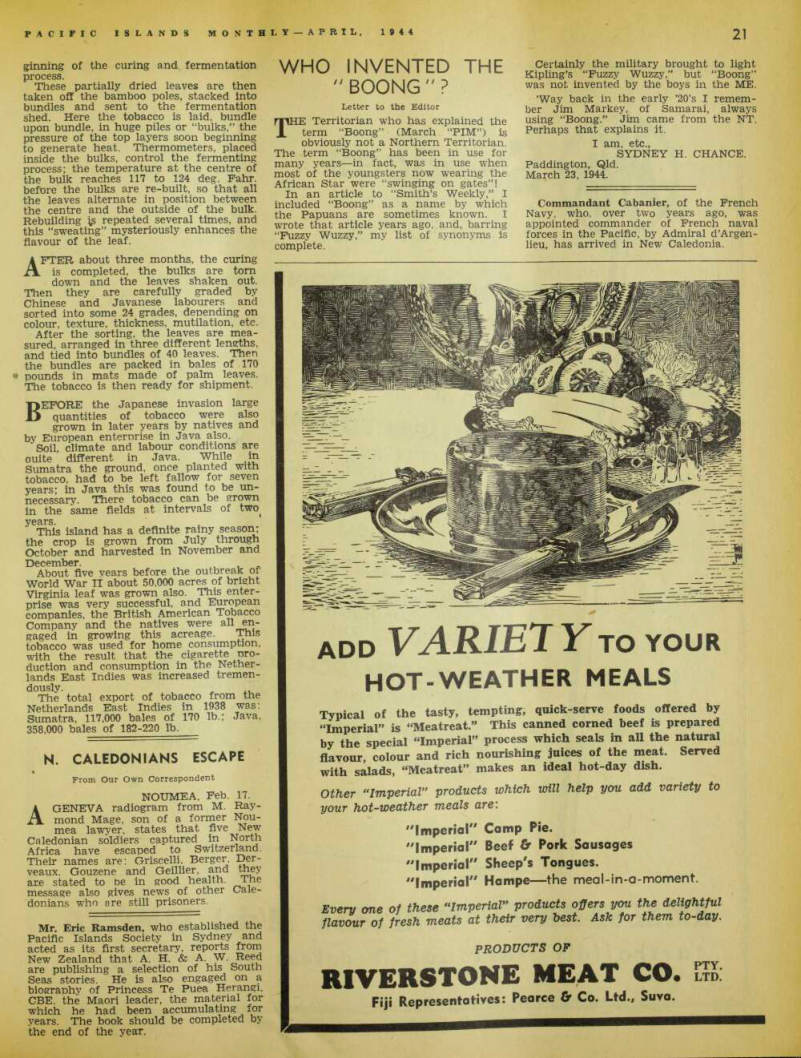
Sumatran Lesson Might be Applied to New Guinea
11/ITHIN a 25 miles radius of the town of Medan, in north-east Sumatra, a narrow strip of land between moun tains and sea, produced a type of tobacco that made the finest cigar wrappers in the world—the colour, smooth surface and aroma that is calculated to make cigar smokers roll their eyes in ecstasy.
A happy combination of circumstances made this district suited to the culti vation of tobacco: the correct amount of rainfall, sunshine, humidity and a vol canic soil. After absorbing the climatic and agricultural statistics relating to this Sumatran district, a good Territorian is struck by the thought: “What has Sumatra that New Guinea has not?”
The answer might well be: “Plenty!”— but, for what it is worth, a condensation of an article which appears in “Knicker bocker Weekly” (the journal of Free Netherlands, published in New York) follows. It is of interest to Territorians who can foresee a world where copra is no longer king. fIIHE soils of this tobacco growing dis- X trict of Sumatra are primarily of volcanic origin, rich in minerals and underlaid with older marine rocks or sediments. They vary in colour from red to brown, and from grey to black, and in texture from clay loams to sandy loams.
The temperature in the district is uni form throughout the year and the daily range is small. The yearly average is 78 deg. Fahr., varying only 4 deg. between the coolest and hottest months. The daily fluctuations throughout the year average about 15 deg. Fahr.
Particularly important, from the tobacco growing angle, is the relatively
high humidity throughout the year. It averages 84 per cent, and varies only from 82 to 85 per cent. Another im portant factor is the sunshine, averaging 60 per cent, for the year.
The rainfall is relatively heavy: a yearly average of about 103 inches.
There are no definite wet and dry seasons. (Compare this with New Guinea: Average rainfall 100-125 inches, according to district; average temperature (coastal areas), 79 to 81 deg.—humidity approxi mately the same; no definite wet or dry season.) Experience has proved that it is only practicable to grow one crop every eight years in the same area in Sumatra, be cause the tobacco plant, which grows to maturity in three months, takes so much nourishment out of the soil. Even then, although the land is allowed to lie fallow for seven years, the soil does not regain all its nutritive qualities, and artificial fertilisers have to be used extensively.
In the tropics, where jungle foliage seems to spring up overnight, a great deal of work is necessary to prepare a new area of land for planting. This in volves chopping down the tall trees, burning the trunks and all the under brush, digging out the larger roots left in the ground, and finally installing a drainage system. It takes about six months to prepare a 700-acre, entirely new section for planting, and about three months to clear a section which has not been disturbed for seven years and has been allowed to grow back to jungle. fIIHE tobacco seeds are first sown in beds X built up on newly cleared land, about one foot above the original level.
These beds are covered with a light muslin about three feet high to prevent damage to the young plants by heavy rains and sunshine and to keep off the insects. Often the soil is treated with steam for disease control. After 40 to 45 days, the seedling is developed and strong enough to be transplanted to the open field.
The seedlings are placed in the ground in rows 40 inches apart with a distance of U feet between each plant. Once the plant is firmly imbedded in the field, it grows rapidly and 60 days after the transplanting, harvesting can be started.
During the first 25 years of tobacco growing in Sumatra, the whole stalk was cut off and hung upside down in a dry ing shed. This method proved to be most unsatisfactory, making the leaves thick, dark and oily. After years of experi menting, it was found that the only way to obtain a ripe and thin leaf—so neces sary for a good cigar wrapper—was to pick the leaves individually as they ripened. Picking begins with the three or four “sand leaves” nearest the ground, then progresses upwards at intervals of several days until 18 or 20 leaves have been picked from a particular stalk.
Generally, the top leaves are not picked, as they are too thick and heavy for the cigar wrappers. It has been discovered that by picking them in the early morn ing when still wet from the dew, a finer texture and better coloured leaf was ob tained after the curing process.
The harvested leaves are placed in baskets and carried to the drying sheds where the lengthy process of curing be gins. The leaves are carefully examined for defects and insects and then strung on string, each end of which is tied to a bamboo pole. The leaves are kept for 18 to 22 days in the drying sheds, and by the end of this period have partially dried out and have become light greenish or yellow in colour, which marks the be
ginning of the curing and fermentation process.
These partially dried leaves are then taken off the bamboo poles, stacked into bundles and sent to the fermentation shed. Here the tobacco is laid, bundle upon bundle, in huge piles or “bulks,” the pressure of the top layers soon beginning to generate heat. Thermometers, placed inside the bulks, control the fermenting process; the temperature at the centre of the bulk reaches 117 to 124 deg. Fahr. befbre the bulks are re-built, so that all the leaves alternate in position between the centre and the outside of the bulk.
Rebuilding repeated several times, and this “sweating” mysteriously enhances the flavour of the leaf.
AFTER about three months, the curing is completed, the bulks are tom down and the leaves shaken out.
Then they are carefully graded by Chinese and Javanese labourers and sorted into some 24 grades, depending on colour, texture, thickness, mutilation, etc.
After the sorting, the leaves are mea sured, arranged in three different lengths, and tied into bundles of 40 leaves. Then the bundles are packed in bales of 170 pounds in mats made of palm leaves.
The tobacco is then ready for shipment.
BEFORE the Japanese invasion large quantities of tobacco were also grown in later years by natives and by European enterprise in Java also.
Soil, climate and labour conditions are ouite different in Java. While in Sumatra the ground, once planted with tobacco, had to be left fallow for seven years; in Java this was found to be un necessary. There tobacco can be grown in the same fields at intervals of tWO ( years.
This island has a definite rainy season; the crop is grown from July through October and harvested in November and December.
About five years before the outbreak of World War II about 50,000 acres of bright Virginia leaf was grown also. This enter prise was very successful, and European companies, the British American Tobacco Company and the natives were all en gaged in growing this acreage. This tobacco was used for home consumption, with the result that the cigarette pro duction and consumption in the Nether lands East Indies was increased tremen dously.
The total export of tobacco from the Netherlands East Indies in 1938 was; Sumatra, 117,000 bales of 170 lb.; Java, 358,000 bales of 182-220 lb.
Advertisements & other items, p. 24 (1 item)
90 Years
4 m 0 I «
t) % m SB 5^5 y^
SWALLOWs ABIE LI Lm
cm t • tiiccca . ici cmi ■mis ir tisciiit iVuJotl*» >\ VI $>S / i
N. Caledonians Escape
Prom Our Own Correspondent
Noumea, Feb. 17.
A GENEVA radiogram from M. Ray mond Mage, son of a former Nou mea lawyer, states that five -New Caledonian soldiers captured in North Africa have escaped to Switzerland.
Their names are: Griscelli. Berger, Der veaux. Gouzene and Geillier, and they are stated to be in good health. The message also gives news of other Cale donians who are still prisoners.
Mr. Eric Ramsden, who established the Pacific Islands Society in Sydney and acted as its first secretary, reports from New Zealand that A. H. & A. W. Reed are publishing a selection of his South Seas stories. He is also engaged on a biography of Princess Te Puea Herangi, CBE. the Maori leader, the material for which he had been accumulating for years. The book should be completed by the end of the year.
"Boong"?
Who Invented The
Letter to the Editor rE Territorian who has explained the term “Boong” (March “PIM”) is obviously not a Northern Territorian.
The term “Boong” has been in use for many years—in fact, was in use when most of the youngsters now wearing the African Star were “swinging on gates”!
In an article to “Smith’s Weekly,” I included “Boong” as a name by which the Papuans are sometimes known. I wrote that article years ago, and, barring “Fuzzy Wuzzy,” my list of synonyms is
complete.
Certainly the military brought to light Kipling’s “Fuzzy Wuzzy,” but “Boong” was not invented by the boys in the ME. ’Way back in the early ’2o’s I remem ber Jim Markey, of Samarai, always using “Boong.” Jim came from the NT.
Perhaps that explains it.
I am, etc.,
Sydney H. Chance.
Paddington, Qld.
March 23, 1944.
Commandant Cabanier, of the French Navy, who, over two years ago, was appointed commander of French naval forces in the Pacific, by Admiral d’Argen lieu, has arrived in New Caledonia.
Advertisements & other items, pp. 25-26 (1 item)
Hot-Weather Meals
£
add VARIETY to your
Typical of the tasty, tempting, quick-serve foods offered by “Imperial” is “Meatreat.” This canned corned beef is prepared by the special “Imperial” process which seals in all the natural flavour, colour and rich nourishing juices of the meat. Served with salads, “Meatreat” makes an ideal hot-day dish.
Other “Imperial” products which will help you add variety to your hot-weather meals are: "Imperial" Camp Pie.
"Imperial" Beef fir Pork Sausages "Imperial" Sheep's Tongues.
"Imperial" Hampe— the meal-in-a-moment.
Every one of these “ Imperial ” products offers you the delightful flavour of fresh meats at their very best. Ask for them to-day.
PRODUCTS OF
RIVERSTONE MEAT CO. Em
Fiji Representatives: Pearce Cr Co. Ltd., Suva.
Services
COMMUNICATIONS
BEAM wSS &KAM SERVICE
COASTAL RAO'OSERVICEe
r.BC " S WIREEESS SERVICE
manufacturing
wireless Instruments
SSSJ BROADCAST RECEIVERS
BROADCASTING
OWNERS
ARISES
" ECHAN ' C
— NS • OEVEEOBMENV
AMALGAMATED WIRELESS (A'sia) LIMITED
Australia’s National Wireless Organisation
Mordvinoff
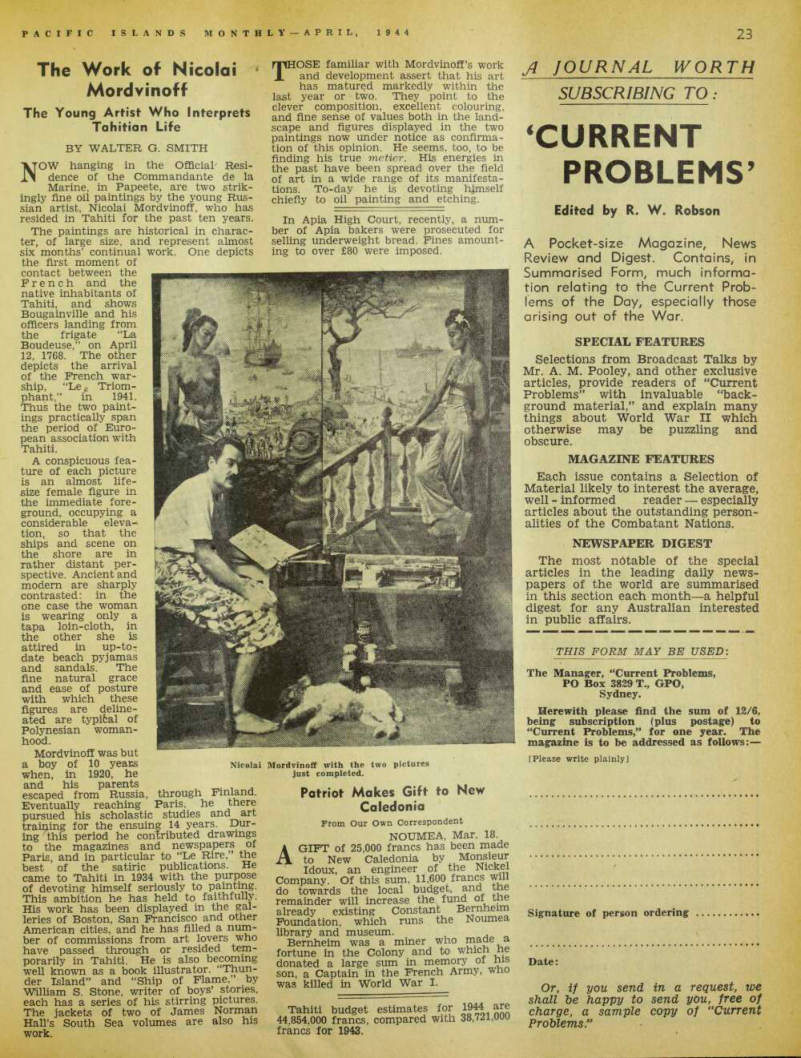
The Work of Nicolai Mordvinoff The Young Artist Who Interprets Tahitian Life
By Walter G. Smith
NOW hanging in the Official Resi dence of the Commandante de la Marine, in Papeete, are two strik ingly fine oil paintings by the young Rus sian artist, Nicolai Mordvinoff, who has resided in Tahiti for the past ten years.
The paintings are historical in charac ter, of large size, and represent almost six months’ continual work. One depicts
the first moment of contact between the French and the native inhabitants of Tahiti, and shows Bougainville and his officers landing from the frigate “La Boudeuse,” on April 12, 1768. The other depicts the arrival of the French war ship, “Le t Triom phant,” in 1941.
Thus the two paint ings practically span the period of Euro pean association with Tahiti.
A conspicuous fea ture of each picture is an almost life size female figure in the immediate fore ground, occupying a considerable eleva tion, so that the ships and scene on the shore are in rather distant per spective. Ancient and modem are sharply contrasted: in the one case the woman is wearing only a tapa loin-cloth, in the other she is attired in up-to date beach pyjamas and sandals. The fine natural grace and ease of posture with which these figures are deline ated are typifcal of Polynesian woman hood.
Mordvinoff was but a boy of 10 years when, in 1920, he
and his parents , , escaped from Russia, through Finland.
Eventually reaching Paris, he there pursued his scholastic studies and art training for the ensuing 14 years. Dur ing this period he contributed drawings to the magazines and newspapers of Paris, and in particular to “Le Rire,” the best of the satiric publications. He came to Tahiti in 1934 with the purpose of devoting himself seriously to painting.
This ambition he has held to faithfully.
His work has been displayed in the gal leries of Boston, San Francisco and other American cities, and he has filled a num ber of commissions from art lovers who have passed through or resided tem porarily in Tahiti. He is also becoming well known as a book illustrator. “Thun der Island” and “Ship of Flame,” by William S. Stone, writer of boys’ stones, each has a series of his stirring pictures.
The jackets of two of James Norman Hall’s South Sea volumes are also his work.
rOSE familiar with Mordvinoff’s work and development assert that his art has matured markedly within the last year or two. They point to the clever composition, excellent colouring, and fine sense of values both in the land scape and figures displayed in the two paintings now under notice as confirma tion of this opinion. He seems, too, to be finding his true metier. His energies in the past have been spread over the field of art in a wide range of its manifesta tions. To-day he is devoting himself chiefly to oil painting and etching.
In Apia High Court, recently, a num ber of Apia bakers were prosecuted for selling underweight bread. Fines amount ing to over £BO were imposed.
Nicolai Mordvinoff with the two pictures just completed.
Caledonia
Patriot Makes Gift to New Caledonia
From Our Own Correspondent
Noumea, Mar. 18.
A GIFT of 25,000 francs has been made to New Caledonia by Monsieur Idoux, an engineer of the Nickel Company. Of this sum, 11,600 francs will do towards the local budget, and the remainder will increase the fund of tne already existing Constant Bernheim Foundation, which runs the Noumea library and museum.
Bernheim was a miner who made a fortune in the Colony and to which he donated a large sum in memory or nis son, a Captain in the French Army, who was killed in World War I.
Tahiti budget estimates for 1944 are 44,854,000 francs, compared with 38,72i,0uu francs for 1943.
Subscribing To:
A Journal Worth
Current
Problems’
Edited by R. W. Robson
A Pocket-size Magazine, News Review and Digest. Contains, in Summarised Form, much informa tion relating to the Current Prob lems of the Day, especially those arising out of the War.
Special Features
Selections from Broadcast Talks by Mr. A. M. Pooley, and other exclusive articles, provide readers of “Current Problems” with invaluable “back ground material,” and explain many things about World War II which otherwise may be puzzling and obscure.
Magazine Features
Each issue contains a Selection of Material likely to interest the average, well - informed reader especially articles about the outstanding person alities of the Combatant Nations.
Newspaper Digest
The most notable of the special articles in the leading daily news papers of the world are summarised in this section each month—a helpful digest for any Australian interested in public affairs.
This Form May Be Used :
The Manager, “Current Problems,
Po Box 3829 T., Gpo,
Sydney.
Herewith please find the sum of 12/6, being subscription (plus postage) to “Current Problems,” for one year. The magazine is to be addressed as follows: [Please write plainly] Signature of person ordering Date: Or, if you send in a request, we shall be happy to send you, free of charge, a sample copy of “Current Problems”
Fijians On Patrol
Much Feared by the Japs in Bougainville
Prom a Special Correspondent
* Bougainville, March 14.
TN little more than two months, a X Fijian battalion assisting the US i *ii Forces on Bougainville has jailed, at a conservative estimate, more than 155 Japs to one Fijian killed and two wounded. These Fijians are greatly feared by the Japs.
The following are examples of the sort of job taken on by the battalion: °n January 31, a routine patrol started up the east coast and encountered sniper fire from jungle trees. The Fijians de ployed, advanced and shot three sniners.
Lieut. Bent, their commanding officer found they were ideally situated on a bluff overlooking a native village oc cupied by the Japs and that their shots had aroused the enemy. The Japs, how ever. were disorganised, running from grass huts and attempting to climb trees The Fijians mowed them down with a terrific crossfire. The Fijians then ceased fire and waited until what enemy remained thought they had withdrawn and were cautiously moving out of their shelters. Many more Japs were killed.
Pte. Jolame Ratu, a 17-year-old Fijian, crept forward and threw grenades at a hut which the patrol believed to be the Jap headquarters. Altogether 50 Jap dead were counted, although as the Fijians count only casualties killed by rifle and machine-gun fire, Ratu’s grenade casual ties could not be added to their score.
IN another sector a Fijian patrol was returning to Kameli, an outpost named in honour of the only Fijian
so far killed, when they surprised 25 Japs preparing to ambush them in a narrow ravine. The Japs blazed away, but the Fijians proceeded steadily up the ravine in an orderly fashion, emerging past the ambush with only two casualties.
On yet another occasion, friendly natives told a patrol commanded by Capt.
E. A. Chivers, formerly a shipping agent m Suva, that 300 Japs were waiting for them on a hill. The patrol made a new trail through uncharted jungle and by passed the ambush.
Second-Lieut, Iqkoro Vula Vula, known in New Zealand as “the smiling full back” when the Fijian Rugby team toured the Dominion shortly before the war, then went with 30 men to inspect the 300 Japs in ambush. He left his patrol at a hill base and made his way over open ground up a fire-break to within 25 ft. of a Jap machine-gun. He lay there for about 40 minutes watching the Japs come and go. When he started to withdraw Iqkoro discovered that his entire platoon had sneaked up the same route un detected. Later this intrepid Fijian per sonally lead a dive-bombing attack on the Japs he had located.
Possibly one of the most remarkable of the Fijians’ feats was their building, in two days, a small airfield at Kameli outpost to accommodate “Cub” planes.
These “Cubs” later kept the outpost in rations and helped evacuate casualties. rE Fijians on Bougainville are ruth less, splendidly-trained fighting men. who think nothing of walking 15 miles off a trail to kill a handful of Japs.
Their commanding officers have no trouble with discipline—the mere threat to keep a Fijian from going on patrol constitutes all the discipline necessary.
An average Fijian carries a 40 lb. pack in addition to a share of mortars, heavy machine-guns and extra ammunition. In command of the battalion is Lieut.-Col.
Geoffrey Upton, of Auckland. The ori ginal commander, Lieut.-Colonel J. B. K.
Taylor, a New Zealander, living in Fiji, who helped organise the force, was wounded by a personnel bomb, December 21—the day of the battalion’s arrival in Bougainville.
Advertisements & other items, p. 28 (2 items)
Queensland
INSURANCE
COMPANY
LIMITED
(Incorporated 1886 in Australia)
ASSETS EXCEED £3,500,000
Head Office :
PITT Gr BRIDGE STS.,
SYDNEY
Specialists in South Seas Fire,
Marine & Accident Insurances
Apply to: —
FIJI.
Branch Office: H. J. Moorhouse, Manager.
Burns Philp (South Sea) Co., Ltd.
VILA.
Burns Philp (South Sea) Co., Ltd.
Comptoirs Prancais Des Nouvelles Hebrides (Marine).
NOUMEA.
L. & W. Johnston.
PAGO PAGO.
Burns Philp (South Sea) Co., Ltd.
G. H. C. Reid & Co.
OTHER SOUTH SEA ISLANDS.
Burns Philp (South Sea) Co., Ltd.
Also to any of the Company’s Offices in Australia or New Zealand.
William Atkins Pty. Ltd.
Head Office 449-451 KENT ST., SYDNEY.
Iron & Steel Merchants—Engineers' Supplies
Coach & Motor Hardware
ESTABLISHED OVER 50 YEARS
Cable Address: WILATKIN. Sydney.
STEEL DEPARTMENT
MILD STEEL:
Rounds, Squares, Flats, Half-rounds, Hexagons, Bevel, Shoeing, Tyre, Angles, Tees, Sheets, Plates, Girder Plates, Chequer Plates, Channels, Hoops, Etc.
BRIGHT STEEL;
Rounds, Squares, Hexagons.
Extra Special High Speed Tool Steel, Mining Steel, Blister Steel and Spring Steel, Rounds, Flats £r Squares.
Bar Iron—All sections and sizes.
Engineers' Supplies: Set Screws. Studs, Metal Thread Screws. Coach Screws. Files, Cotter Pins, Bright and Black Bolts, Rivets, Etc., Hack Saw Blades.
Power Transmission Gear: Including Plummer Blocks, Couplings, Collars, Etc.
Coach and Motor Hardware: Axles, Springs, Wheelstuff, Duck, Paints.
Farriers' Supplies: Horse Nails, Anvils, Vices, Etc.
Motor-Trimmers ond Motor Builders' Cr Motor Painters' Requirements
C. A. WILLEY'S
Quick-Drying Coach and Car Paints, Roughstuff, Elastic Gloss, Synflex Enamels, Lacquers.
DUCO Lacquers and DULUX Enamels—FAßßEX Motor Toppings and Leather Cloths, House & Decorators' Paints, Varnishes & Brushware.
Sole Distributors of CHAMPION'S Decorators Point Products.
Distributing Agents for BROLITE Lacquers, SYNFLEX Enamels ond "POLYGLOSS" Finish.
New Guinea of the
Future War Opens Vast Areas
IX/JANY Australians are, for the first time, seeing New Guinea as poten tially—even fabulously — rich. This is how Osmar White, correspondent for the Melbourne “Herald ,} views the situa tion —but he sagely prefaces his remarks by reminding the public at large that economic and political obstacles can be just as potent handicaps to development as geography.
WHEN Moresby became a great war base and troops had to be put on to the Owen Stanleys behind it, Australian and American military engin eers built a highway leading into the Rouna tableland, which has opened up thousands of acres of the most promis ing rubber country in Papua.
Even before the war, when that area was served only by a hair-raising, pre cipitous mule track, there were already* established a number of prosperous plan tations which produced, at economical cost, a fair proportion of the 100 tons of raw rubber (one-sixteenth of Australia’s pre-war consumption) grown annually in Papua.
Even with such lamentable communi cations as then existed, it was officially estimated that this rubber land could be brought to a rate of production in from five to eight years, sufficient to pay 17£ per cent, on capital invested.
In addition to its rubber lands, the region has considerable tracts of country suitable for coffee, tea, cocoa, cinchona, tobacco and kapok.
At the eastern end of the island, about Milne Bay and along the coast westward to the mouth of the Mambare River, military works have also provided com munications in extensive areas which could be developed for the production of copra, millet, sugar, soya bean, rice and other tropical food crops.
IN the former Mandated Territory, an era of energetic experiment and development, made possible by the prosperity of the Morobe goldfields, pre ceded the war. The campaign to hold the Bulolo Valley and evict the Japanese from Salamaua, the Huon Peninsula and the valley of the Ramu River, drove arbitrary airfield and road wedges into some of the most difficult country in the incidentally provided access to thousands of square miles of rich country, both in mineral resourced and agricultural potential.
Near Wau, plantations produce Arabian coffee as fine in quality as any in the world, including the famous product of the Blue Mountains of Jamaica, whence the original seed came. Production costs before the war, however, were trebled because all freights had to'be carried by air.
Tobacco (equal in quality to the best Sumatran cigar leaf), kapok, cocoa, cotton, hemp, nutmeg, vanilla, rice and peanuts had been grown on a scale sufficent to indicate that the land could produce them economically.
The road which followed the Australian advance through the Upper Ramu may not yet be a high-speed, heavy-duty highway, but it at least permits entry of wheeled traffic into valleys of magnificent high-altitude pastures and to stands of hoop pme, screw pine, cedar and hardwoods sufficient to supply the island’s lumber requirements for more than a century.
Whatever eventually happens to the roads, harbors and aerodromes, the knowledge of how to live in the tropics, won from experience of war in the Western Pacific, will never be lost. And it is inconceivable that this knowledge should fail to have a very profound effect upon tropical colonisation and tropical economy in the future
Names of Rooks-An
Answer to Inquiries
A N indication of the interest in New Guinea aroused by the war in that area, is the number of letters from servicemen received in this office during the last 18 months, asking for informa tion about one or another of New Guinea’s industries, past or potential, Typical of these inquiries is one from a young New Zealand serviceman, serv ing in the Middle East. He expresses a desire to settle in Papua after the war and to know the names of any books or publications dealing with the following subjects: growing and care of rubber, coffee, cocoa, kapok, cotton, ivory nuts, tea; how to find and work gold; the timber resources of Papua; books and pamphlets dealing with the peoples of Western and Central Papua, Fly and Strickland areas—notably any by the late Dr. F. E. Williams; and books and pam
phlets on tropical diseases. In addition, he asked if the “Government Year Book of Papua” were still available.
To answer this inquiry was to answer many. Therefore, his letter was for warded to the Mitchell Library, Sydney (which specialises in all aspects of life in, and the history of, the Pacific). The following answer—an example of the courteous service always supplied by this famous institution has now been received: most of his inquiries the best sources are 4- the following:—Official Handbook of the Territory of New Guinea, from the Government Printer, Canberra. Handbook of the Territory of Papua, Government Printer, Port Moresby.
These deal with the natural resources of the two Territories and cover agriculture, flora, lands and land titles, cultivable crops, forestry.
fauna, livestock and mineral resources. They should answer most of your serviceman’s ques tions under the heads of rubber, coffee, cocoa kapok, cotton, timber, gold, tea and plantation care. The following publications (showing place of issue and publishers) might also be useful- COTTON: Harding, Richard.—Cotton in Aus tralia. Brisbane. Government Printer, 1923. (Queensland Dept, of Agriculture.) COFFEE; Jackson, H. V.—The Cultivation of Coffee. Sydney. Government Printer, 1909. (NSW Dept, of Agriculture, Farmers’ Bulletin No. 4.) CACAO: Green, E. C. D.—The Possibility of Developing an Economic Cacao Industry in the Mandated Territory of New Guinea Canberra Government Printer, 1934. (Territory of New Guinea, Dept, of Agriculture, Bulletin No. 2 ) TROPICAL AGRICULTURE: New Guinea Agri cultural Gazette, 1935.—Territory of New Guinea Dept, of Agriculture, leaflets.
TIMBER: Poole, C. E. Lane.—Forest Resources
of the Territories of Papua and New Guinea.
Melbourne. Government Printer, 1925.
GENERAL: Books and Pamphlets, by Dr. F.
E. Williams, on the People of Western and Central Papua—Anthropological Reports, Nos. 4-10, 12-14, 16-17; and Population and Education in Papua. Issued in Port Moresby by the Government Printer, 1933. Archbold, R., and Rand, A. L.—“ New Guinea Expedition—Fly River Area, igse-m?.” NY. Mcßride, 1940. Cham pion, Ivan F.—“ Across New Guinea from the Fly to the Sepik.” London. Constable, 1932 Macdonell, S. G.—“ Quest of the Golden Fly.’’
Quality Press, 1938. (There are many books of course dealing with the land and peoples of Papua in general— these are only a selection.) HEALTH, DISEASE: Cilento, R. W.—“ Tropical Diseases in Australasia.” A Handbook. Bris bane. Smith & Paterson, 1940. Strong, W. M.
Handbook on the Treatment and Prevention of Disease in Papua when medical advice is un obtainable. Port Moresby. Government Printer. 1917.
The latest edition of the Official Handbook of Papua (the sth) was published in 1938. I doubt if it is obtainable now. The Official Handbook of the Territory of New Guinea may be obtain able from the Government Printer at Canberra.
The pamphlets by F. E. Williams may or may not be procurable from Canberra, and. it is un likely that copies of the New Guinea Agricultural Gazette or its Department of Agriculture leaflets will be available. The pamphlet on cacao by Green should be procurable from Canberra, as it was issued by the Government Printer there, and the Queensland Department of Agriculture may be able to supply Wells’s publication on cotton cultivation. Dr. Cilento’s work on tropical disease should be available.
It is hoped that this list will be of assistance to other readers; but it should be pointed out that it is one * thing to have a list of these publications—quite another, these days, to be able to pur chase them. However, it is perhaps of interest to know that such information
does exist—somewhere.
Advertisements & other items, pp. 29-30 (1 item)
Cordage and
Wanted to Buy—Quality Guns and Rifles
HIGHEST PRICES GIVEN. WILL ALSO EXCHANGE GUNS.
SI L RO H U Quality Firearms and Fishing Tackle. 14S ELIZABETH STREET (Near Market St.) SYDI
•PHONE: MA 3540.
Ship Chandlery Hardware
Write for
/▼▼nre ror 7
Ship Chandlery /
Catalogue J
Special "In Bond” Prices for all Islands enquiries quoted on application.
Sole Agents for:
BROOMFIELDS LIMITED
153 SUSSEX STREET ::
Cables: "Boom”,. Sydney.
Large and Complete Stocks of
SHIP CHANDLERY
SYDNEY.
IRONMONGERY OF ALL KINDS, PAINTS,
WHITE LEAD AND OILS.
P. H. MUNTZ <& CO.’S 3-CROWN BRAND METAL SHEATHING.
PEACOCK <fe BUCHANS’ ENGLISH READY-MIXED PAINTS.
Scott’s “Renown” Brand Rope,
Cordage and
Binder
Cable Addrea: Ropeyard, Sydney. * 5S m J'r S
Twine
of Every
Description
MANUFACTURED AT
MASCOT, N.S.W.
J. SCOTT
PTY. LTD.
Head Office and Store:
163 CLARENCE STREET,
SYDNEY,
N.S.W.
c ri i v
S
E R S
PURE
FOODS
GOLD MEDAL JAMS
CANNED ENGLISH FRUITS
CANNED ENGLISH
VEGETABLES
CUSTARD POWDER
OLD ENGLISH MARMALADE
JELLY CRYSTALS, ETC.
Obtainable from all Leading Grocery Stores.
Chivers and Sons, Ltd., Histon, Cam E. 76. * " ’ " ■ - - Write to Department A., o.ia£,c, England, for attractive Recipe Book.
AUNT
MARYS
BAKING POWDER
• SUPPLIES ARE NOW AVAILABLE. If your local supplier is out of stock he will readily obtain Aunt Mary's Baking Powder for you. After all, quality is worth waiting for, especially when it is Aunt Mary's Baking Powder, which maintains the high quality which has stood the test for over 70 years.
Old Wives' Song
(From the Fijian ) Ere you girls a husband take “Malua vaka lailai.”* Men, you maids o’er-estimate; Later on, you blame poor Fate. (Many a wife I’ve heard of late Sigh Malua vaka lailai).
Consider, when Simeli’s old. (Malua vaka lailai).
He indeed a lover bold, Strongly you his arms enfold— But his love may soon grow cold!
Malua vaka lailai.
Hence I always maidens warn, Malua vaka lailai; Tyrant ways, of hero born.
Once-loved wives may sit forlorn — Men are lovers in life’s morn — So, Malua vaka lailai!
Joni many gifts may send; Malua vaka lailai.
Every wife knows this will end; Knows how soon her will may bend!
A lover makes a better friend!
Hence — malua vaka lailai. * Malua vaka lailai Don’t be in a hurry.
Alice Allen Innes.
Lieutenant C. W. Seton, who was a well-known planter In the Solomons Islands before the war, is spending long leave in Sydney. After the Japanese invasion, Mr. Seton proceeded to Sydney and joined the AIF as a private. Soon afterwards, he was “borrowed” by the Royal Australian Navy and the Ameri can Forces; and for 18 months he was away in the Pacific, engaged on special and hazardous work —during which he was awarded a commission.
Advertisements & other items, p. 30 (1 item)
26
APRIL, j. 944 P ACIFIC ISLANDS MONTHLY
Cost Of Living Increases
For Fiji Indians
SINCE me war commenced in 1939, the cost or living oi certain classes of piji-lndiaii wononen nas increased by 72.0 per cent. lor touva, and by ii4.d per cent. lor me rest of Viti Levu.
This is me finding of Mr. C. H. Came, of t>uva, wno was appomted some monms ago oy the Fiji Labour and National ;oer vice Board to inquire into me cost of liv ing of Indians earning less man OU/- per week.
Mr. Came is a resident of the Colony of 35 years’ standing and in the course oi ms ousiness life has always been in touch with the class of workmen under consideration. His report is comprenen sive and is the result of exnaustive inquiries among workers’ families, among storekeepers and others. The report may be oought at the Government Print ing Office, lor 1/-.
As a result of Mr. Game’s findings, the Government has revised its wage rates and will in future pay 6d. per day war bonus to country labourers, bringing the wages for Indian labourers in the country to 4/- per day. This cost of living report was also the basis of an award made in January by the National Arbitration Tri bunal to labourers of the CSR Company on Viti Levu. The Tribunal awarded a cost of living bonus of 2£d. per day above the 1939 award rates, and this is con sidered to cover all increases. The labourers appealed to the Tribunal, in addition, for improved conditions and also that the present concessions in kind or services, as allowed to employees in Lautoka, should be extended to all employees of the company throughout the Colony. The Tribunal was of the opinion that during a war was not the time for increasing wages (other than cost of living adjustments), or improv ing working conditions. As for the extension of concessions, the Tribunal was of the opinion that concessions granted to labourers by the Colonial Sugar Refining Company in 1939 must have affected the pre-war standard of living and therefore, the concessions should continue, in order that the 1939 standard of living be maintained. But it was not within the power of the Tri bunal to recommend or order any exten sion of the concessions. The Colonial Sugar Refining Company has undertaken to continue the concessions, subject to the possible wartime necessity of reduc ing the quantity of sugar sold to their employees. The Tribunal was of the opinion, also, that sugar supplied to labourers at a reduced price was supplied for their own use, and not for sale to others.
Samoan Plantations—A
War Casualty
From Our Own Correspondent
Apia, Feb. 15.
rnHE Samoan plantation industry, with X its main products, copra, cocoa and bananas, has, during the past ypar or so, been working under great handi caps—due mainly to the shortage of plantation labour, which had been diverted to war work.
Though there is now ample labour available, the plantations have been neglected and it will take a considerable time to clean and replant plantation areas.
Trade in the Territory has dropped very considerably of late months and conse quently a number of trading stations, stores, bakeries, restaurants and enter tainment places may have to close down.
Another Caledonian
Escapes
From Our Own Correspondent
Noumea, Mar. 18.
ANOTHER Caledonian soldier has escaped from an Italian prison camp and reached the Allied lines safely.
He is M. Henri Payonne, formerly on the staff of the Noumea College de la Perouse. M. Payonne, who had taught in English schools and had—for a Frenchman —an unusual knowledge of and liking for the English and their literature, joined the Free French Army at the first opportunity and was captured in Libya. He is now in Algiers. His wife, an Englishwoman, is living in Noumea.
Rev. Wilfred F. Paton, a well-known Presbyterian missionary of the New Heb rides, who was compelled, owing to ill health, to return to Australia in May, 1943, and who has .had a temporary charge at Evandale, Tasmania, is now recovered. He and Mrs. Paton hope to return to Ambryn by the middle of 1944. , r , . an yo ne has any information con t*lo fate John Downs, of Bay, Kokopo, Rabaul he is re es^ d ir 7 t °TT CO^ m «^ 1C + te T 3 w i tl l / r^f rs ' M ‘ I f ea th Street, Port Melbourne, Victoria, who is urgently seeking news, Mr - Downs, at the time of the Japanese invasion, was employed by T. C. Wee & Co.’s sawmills at Adler Bay, and nothing has been heard of him since.
Advertisements & other items, pp. 31-32 (1 item)
Steamships Trading
GILLESPIE’S
The Flour
TRADE
MARK
of the Islands
- SYD NEY -
Steamships Trading
Company Limited
PORT MORESBY SAMARAI PAPUA.
WHOLESALE fr RETAIL MERCHANTS, SHIPOWNERS,
PLANTERS, ENGINEERS & SLIP PROPRIETORS.
Customs, Shipping, Insurance, and Forwarding Agents.
MANAGING AGENTS AND VISITING REPRESENTA-
TIVES FOR COCONUT AND RUBBER ESTATES.
SYDNEY REPRESENTATIVES: Nelson & Robertson Pty. Ltd., 12 Spring Street.
WARTIME ADDRESS
Until further notice, clients may address all communica tions as follows: —
STEAMSHIPS TRADING COMPANY LIMITED,
C/o NELSON & ROBERTSON PTY. LTD.,
12 SPRING STREET, SYDNEY.
/ / A /
EDGELL
QUALITY CANNED
Vegetables & Soups
AUSTRALIA'S BEST
DEFENCE requirements take up the whole of the Edgell production to-day—consequently only a small proportion of civilian needs is occasionally made available by the Australian Defence Foodstuffs Control and exports are heavily restricted.
As soon as possible. Island consumers can rely on Edgell high quality products being made available to them once more.
Meanwhile, to take advantage of the limited quantities periodically released, please send your inquiries either through your usual channels or direct to the Island distributors . . .
C. SULLIVAN & CO. 379 Kent Street, Sydney, Australia.
"EDGELL QUALITY CANNED GOODS"
C. SULLIVAN & CO.
GENERAL MERCHANTS ISLANDS AGENTS
REPRESENTING LEADING FIRMS IN THE PACIFIC ISLANDS.
Islands Produce sold on Shippers’ Account-Liberal Advances against Consignments.
Buyers of all Islands’ Requirements on Commission—Original Invoices Furnished.
Bankers : Bank of New South Wales .. Bank of New Zealand .. Comptoir National d’Escompte de Paris.
Wartime Cable Address: Sullivan, Kentstreet, Sydney.
379 KENT STREET, SYDNEY, N.S.W.
./ 1
Co-Prosperity
The Gilbertese Had Enough Of Jap
'THE following article Toy Mr. Harold 1 Cooper, is based on an interview with Mr. Maurice Reymond, who is at present living in Suva, Fiji, but who formerly lived in Butaritari in the Gilbert Islands and who was on Makin Island, of that Group, through out the Japanese occupation.
The Reymond family are ivell-known in the Pacific—Mr. Reymond’s son, Lieut. Bruno Reymond, vkis among the first men ashore when the Americans re-captured Butaritari on November 21, 1943. The Reymond girls have married and made homes in many of the Pacific Islands; two of them have been members of Sydney's Polynesian Club for many years.
Mr. Reymond, through Mr. Harold Cooper, has a number of interesting things to say about the Japanese “Co-
Prosperity sphere.”
rE Japs talked endlessly of the joys of their New Order and of the pride which the natives should feel in being admitted to the Co-Prosperity Sphere But nothing was done to make this New Order seem attractive and cer tainly the advent of the Japs brought no prosperity to Makin. On the contrary, it meant the immediate abandonment of the standard of living to which they had been accustomed under British rule.
Every able-bodied male was brusquely mobilised to work for the Japs. The hours were long, but no wages were paid.
The labourers were rewarded only with daily rations on the same meagre scale as that with which the Jap soldiers themselves had to be cohtent. Any native who was thought not to be showing suffi cient interest in his work was taken aside and given a thorough flogging with heavy sticks, which the Jap overseers earned for the purpose, and which they delighted to use on the flimsiest pretext.
HAVING been in the Solomons, I was not surprised to hear Reymond say that the Makin islanders had com plained vehemently of the wanton man ner in which the Japs had rifled their tafo patches (taro is to the Gilberts what the potato is to Ireland), stripped their breadfruit trees and, not satisfied with cutting down 15,000 palm-trees for the construction of defence works, had daily gorged themselves on the island s limited remaining supply of coconuts On Makin, as in the Solomons, the natives summed up the difference between the Jap invaders and the Ameri can counter-invaders by.saying. The Japs stole our food. The Americans brought us food.” , ...
Jap greed and Jap stupidity dragged the islanders down perilously c *ose to starvation level. Before the Jap occupa tion. fish were plentiful in the waters round Makin. Now they have sought other breeding grounds, thanks to the indiscriminate use by the Japs of dyna mite as a convenient labour-saving method of ensuring a satisfactory catch Nor are the islanders likely to forget the procedure by which the Japs exacted what they deemed appropriate vengeance for the help given to the Americans dur ing a Commando raid several ago. The Japs had learned that nine Americans of the raiding party had been left behind and were living m a native village. It would have been an easy mat ter for the Japs to round up these unfor tunate stragglers, who could scarcely have put up any resistance But the Jap Commander decided that the natives
needed to be taught a lesson, and he ordered that the village should be destroyed by aerial bombing. The Jap bombardiers did the job well.
They flew low over the target and, in a few minutes, -had killed 47 natives, wounded many others and razed every house in the village to the ground. When they returned to base they were momen tarily disturbed to find that an otherwise perfect performance had been marred by one slight mistake. They had bombed the wrong village.
WITH this reckless savagery, said Rey mond, the islanders compared the scrupulous regard which the Ameri cans, in their November attack on Makin, paid to the safety of the civil population.
So carefully were the targets picked out and so successfully was fire concentrated on exclusively military objectives that during the heavy and prolonged bom bardment which preceded and accom nanied the landings, only seven natives lost their lives.
The opportunity to serve the Allied cause was welcomed by the Gilbertese.
They were soon working side by side with the Seabees on the construction of new installations. Nor was there any need this time for the overseers to carry sticks. The natives worked with a will and there were no slackers. For they now had a double inducement—good wages and the knowledge that this time thev worked, not as slaves in the nower of a cruel foe, but as free men offering their services gladly to a generous ally. rAT was the story at Makin. It was also the story in the Solomons. It will be the story all along the road
that leads to Tokio. The subject races of the Co-Misery Sphere, dawdling to-day over the work set them by their hated taskmasters from Japan, will to-morrow be sweating cheerfully in the service of a cause which they know to be their own.
The enemy must extort co-operation. We have only to accept it.
Mr. J. J. Real has been appointed Acting Resident Magistrate in the Central and Western Districts of Fiji. He will be stationed in the Lautoka area, aiad replaces Mr. R. C. G. D. Higginson, who has been transferred to Suva.
Advertisements & other items, pp. 33-34 (1 item)
Pole man
THE
YORKSHIRE
INSURANCE
CO. LTD.
(Incorporated in England)
FIRE
ACCIDENT
MARINE
FIRE POLICIES ISSUED
IN PAPUA
All information from —
E. A. JAMES,
TeL 86347. Attorney for Papua, 14 Spring St., Sydney.
Pole man
IS SERVING THE ARMED FORCES
WITH THREE ESSENTIALS OF
LIFE . . .
Light-Heat-Warm Food
the Armed Forces of the United Nations need quick heat and bright light you’U find Coleman Lanterns and Stoves. On board steamers, at landing fields in mobile canteens, emergency hospitals, air-raid shelter,% and in actual combat, Coleman appliances are providing invaluable service. , . . . . .
We regret any inconveniences caused through shortage of new stock for cMlimTrequirements, and suggest you keep your present Stove and Lantern in good repair by contacting your local Distributor.
THE COLEMAN LAMP & STOVE CO. LTD.
TORONTO CANADA
Rid Kidneys Of
Poisons And Adds
If you suffer sharp, stabbing pains, if joints are swollen, it shows your blood is poisoned through faulty kidney action. Other symptoms of Kidney Disorders are Backache, Aching Joints and Limbs, Sciatica, Neuritis, Lumbago, Sleepless Nights, Dizziness, Nervousness, Circles under Eyes, Loss of Energy and Appetite and Frequent Headaches and Colds, etc. Ordinary medicines can’t help much because you must get to the root cause of the trouble.
The Cystex treatment is specially compounded to soothe, tone and clean kidneys and bladder and remove acids and poisons from your system safely, quickly and surely, yet contains no harmful or dangerous drugs. Cystex works in 3 ways to end your troubles. 1. Starts killing the germs which are attacking your Kidneys, Bladder and Urinary System in two hours, yet is absolutely harmless to human tissue. 2. Gets rid of health-destroying, deadly poisonous acids with which your system has become saturated. 3. Strengthens and reinvigorates the kidneys, protects from the ravages of disease-attack on the delicate filter organism, and stimulates the entire system.
Praised by One-time Sufferers
Cystex is approved by one-time sufferers in 73 countries from the troubles shown above.
Mr. Reg Thomas, Townsville, Queensland, recently wrote: “My joints were all stiff, I had leg pains, my back used to ache day and night.
My bladder was weak. I had headaches and no appetite. The first dose of Cystex helped me and before I finished three boxes my health and strength came back.”
Guaranteed to Satisfy or Money Back Get Cystex from your chemist or store to-day.
Give it a thorough test. Cystex is guaranteed to make you feel younger, stronger, better in every way, or your money back if you return the empty package.
Now in 2 sizes—4/-, 8/-.
GUARANTEED CVStCX
Treatment
for Your Kidneys, Bladder, Rheumatism.
HARRY J. YOUNG PTY. LTD.
379 KENT STREET, SYDNEY
EXPORT REPRESENTATIVES^. . .
Bond's Industries Ltd.
Manufacturers of Hosiery and Underwear. Cotton Spinners
Cottee's Passiona Ltd.
Makers of PASSIONA, Fruit Cordials, Fountain Syrups, Fruit Spreads, Peanut Butter and Peanut Products.
Harry Peck & Co. (Aust.) Pty. Ltd.
Makers of the famous "Anchovette" Fish Paste.
Specialists in Potted Delicacies.
INQUIRIES THROUGH YOUR USUAL CHANNELS WILL RECEIVE
PROMPT ATTENTION.
Bankers: Bank of New South Wales.
George Medal
Another Ng Native Wins
rE George Medal has been awarded to Sereeant Taking Iwagu, of the Royal Papuan Constabulary, for out standing courage and devotion to duty during operations against Finschhafeii, New Guinea.
The citation states that during onera tions against Pinschhafen our forces made a landing on the enemy-held beach near the Song River. The craft in which the company commander and Iwagu were being conveyed failed to reach the beach and the company commander, followed by Iwagu. jumped into the water in an attempt to swim ashore, and was seri ouslv wounded. Iwagu, seeing him sink, went to his aid. and, although ujider heaw fire, succeeded in brinering the wounded officer ashore and staved with him on the beach until the arrival of stretcher bearers.
Residents of Samoa who recently departed to New Zealand are: Mr. and Mrs. I. H. Carnithers, Mr. and Mrs. H. I.
James and Mr. W. M. Burnett.
Advertisements & other items, p. 34 (2 items)
30
APRIL, 1944 PACIFIC ISLANDS MONTHLY
THE SEPIK TRAGEDY
(Continued from Page 10)
W. Jno. Baker
Your old SCISSORS, RAZORS
and KNIVES can be
SHARPENED and REPAIRED
Send them to—
W. JNO. BAKER
3 HUNTER STREET,
SYDNEY.
Red Cross
With the American Red Cross Morobe Resident-in N. Caledonia
A FORMER well-known resident of the Morobe district, New Guinea, Mrs.
Alice Bowring, went to New Cale donia for the American Red Cross about last September. She writes enthusiastic* ally of her work there.
“The Americans are fine to work with,” she says, “and this club—one of the many on this island—supplies just about every thing the serviceman could require: club room, cafeteria —where there is everything from doughnuts and ice cream to Coco- Cola at a fraction of the price charged outside—reading room, an information bureau which will try to trace anything from a lost wallet to a ‘buddy’ serving somewhere in the South Pacific, a games room, shower rooms, and weekly dances and variety shows. Uncle Sam looks after his children very well.
“A group of patriotic French women attend the club regularly to mend tom uniforms and sew on buttons—a service that is much in demand.
“An ‘ingenuity contest’ is in full blast at the present time—and an amazing col lection of useful and beautiful things has been made by the men from ‘mater ials at hand’: shell cases, coconut shells, sea-shells, native woods,. etc. —even unto a picture painted with house paint!
“One of the judges is Bishop Wade.
I was pleased to see him again—I met him when he visited Wau in 1939.
“The American soldiers have a tremen dous respect for the Anzacs. I get a lump in my throaty when I occasionally see a ‘brown felt hat with the side turned up,’ and I have adopted the Kiwis too —great lads, all of these.
“I am happy here; but I will be glad when it is all over and we can all return to New Guinea. I don’t know what it is that calls one back—but it was a happy land.”
New Caledonia
M. Laigret Leaves New Caledonia
From Our Own Correspondent
Noumea, Feb. 24.
SHORTLY after the arrival of the new Governor, M. Tallec, earlier this month, ex-Governor Christian Laig ret left by plane for Algiers, travelling via Australia. Although in the Colony for only five months, he proved one of the most active and efficient Governors New Caledonia has had. He had many difficult problems to handle and his masterly report, covering all aspects of the Colony’s economic existence, made with the avowed intention of laying the foundation for a constructive programme of development in the future, met with local approval and, it is hoped, will prove a guide to the French administration in planning the Colony’s post-war set-up.
M. Laigret is due for an important appointment with the French Algiers administration, and his successor, M.
Tallec. who holds higher rank in the colonial hierarchy, forecasts for him a brilliant career.
M. Laigret was accompanied by Adju tant Duval, a battle-scarred Legionnaire who has been acting as head of the French Militarv Police in Noumea.
Meanwhile the bi-weekly “Bulletin de Commerce” asks, “Why this perpetual change of Governors?” There have been 30 in the past 47 years.
The Rt. Rev. P. N. W. Strong, Bishop of New Guinea, arrived in Melbourne on February 25, on his way to England, after an absence of 8 years.
Mr. Clem Palmer, formerly of Suva and until recently manager for Messrs. W. H.
Grove & Sons, Ltd., at Rarotonga, has left Rarotonga for New Zealand, with his family. Messrs. Grove have sold their retail business in the Cook Islands, and Mr- Palmer will represent the firm else where.
In addition to the 12 Western Samoan youths who are to be sent to New Zea land for higher education (see “PIM,”
March, 1944), one Euronesian is to be selected for the same purpose and under the same conditions.
Born in Apia, Samoa, in 1860, octo genarian twin sisters recently died in Brisbane within twelve days of each other. They were Mrs. M. I. W. Jensen and Mrs. C. Schrey, who left Western Samoa with their parents when still children.
Advertisements & other items, pp. 35-36 (1 item)
Gold
Purchasers at Full Market Prices on Assay Value of
SILVER
PLATINUM
And Platinum Group Metals
SOME OF OUR SERVICES
ASSAYERS & ANALYSTS—
Assays of Bullion, Ores, etc.
Analyses of Metals, Minerals, Alloys, etc.
SCIENTIFIC & INDUSTRIAL
METALLURGISTS—
Our range of precious metal manufactures covers all industries—Gold and Silversmiths, Electrical Trades, Dental Profession, Glass Silverers, Electro-Platers, etc., etc.
REFINERS—
Purchasers and Refiners of Bullion, Scrap, Mining By-Products, and Trade Residues of every description carrying Precious Metals.
GARRETT €r DAVIDSON
PTY. LTD.
824 George St., Sydney. Works: Surry Hills and Chippendale, N.S.W.
Official Assayers to the Bank of New South Wales. Gazetted Agents of the Commonwealth Bank of Australia, under the Gold Regulations of the National Security Act.
K\{ 'V l#l s*s y i f/¥i , ,^7 y>v
NELSON & ROBERTSON
PTY., LTD.
Established 1895.
Islands Merchants
All classes of merchandise purchased at wholesale prices and original invoices supplied to Islands clients.
Cocoa Beans, Rubber and other Islands 7 produce sold on commission.
Nelson & Robertson
Pty. Ltd. 12 Spring Street, Sydney, Australia.
BITUMENOID ROOFING
MADE IN AUSTRALIA.
Bltumenold Roofings, Dampcourse and Insulating Pelts are made from the world's best raw materials. Warranted to stand the most rigid tests. worms best
BITUMENOID THE BEST
*’ 3 ,‘ pl * : Floorin S, Waterproof Materials; Saturated Pelt; Resilient Road Jointing, Natural Asphalt Dampcourse; 2 and 3-ply Dampcourse; 1-2 lb Lead-core Dampcourse: Roofing Cement; Asphalt Paints; Roofing Compound Lead core
SAMPLES AND PRICE LISTS ON APPLICATION.
MAXWELL PORTER & SON LTD.
ESTABLISHED 1888.
I*7 RED FERN ST.. RED FERN, SYDNEY, N.S.W.
BUILDERS’ SUPPLIES,
'Phone: M 3167. Cables
Asthma Curbed In 3 Minutes
Since the discovery of Mendaco by a famous physician sufferers can get relief from Asthma. Mendaco does away with expensive injections and offensive smokes.
All you do is to take 2 tasteless tablets with meals and Mendaco starts circulating through the blood in 10 minutes. You breathe easily and freely. Your nerves relax, you get good, fresh, pure air into your lungs, and vigour returns.
Sleep Like a Baby
Thousands of former sufferers from Asthma say that the very first dose of Mendaco brought them glorious ease and comfort, and that they slept soundly the very first night. Then their vigour returned and they felt healthier and stronger, and 5 to 10 years younger. The reason for this is that Mendaco acts in natural ways to overcome the effects of Asthma. (1) It removes the mucus or phlegm; (2) It relaxes thousands of tiny muscles in your bronchial tubes so that the air can get in and out of your lungs; (3) It promotes body vigour, and stimulates the building of rich, revitalised blood.
No Asthma for Five Years
Mendaco not only brings almost immediate results, fre-e breathing and comfort and enables you to sleep, but also builds up the system to ward off future attacks. Mr.
J. R. writes: “I was almost dead with Asthma. Had lost 40 lbs. In weight, suf-
fered coughing every night—couldn’t sleep.
Mendaco stopped spasms first night. I have had no Asthma since in over 2 years.”
Mrs. A. W. writes: “I had Asthma for 25 years. After using Mendaco I can sleep all night and have not had an attack since taking it.” Mrs. G. E. C. writes: ‘‘l bless the day I first beard of Mendaco. What a godsend it is to a poor woman like me who for 35 years never knew what it was to have a good night’s rest. The constant fight between Asthma and sleep was wearing me down, but I feel now I want to forget my past suffering,”
Benefits Immediate
The very first dose of Mendaco goes right to work circulating through your blood and helping nature rid you of the effects of Asthma. Try Mendaco under an iron-clad money back guarantee. You be the judge.
If you don’t feel fully satisfied after taking Mendaco just return the package and the purchase price will be refunded. Get Mendaco from your chemist to-day and see how well you sleep to-night and how much better you will feel,
RELIEVES ASTHMA
Mendaco
Now in 2 sizes 6/- and 12/-
Hybrid Beauty
New Guinea Of
The Future
(Condensed Jrom an article by the Rev. G. J. Patten in the Methodist Missionary Review.”)
rnHREE great Eereema trees still, per ± haps, grace our head station in New Britain. But, if so, they are the sole survivors of a host of mighty trees which gave their name to that part of the Weberhaven foreshore which we selected to become the educational centre of our New Guinea District. Long before the coming of the European, those giants of the primeval forest were caressed by the south-east trade winds and were gather ing the strength of the north-west mon soons which thundered over the Baining Mountains and roared across the open bay to Vunairima—“the home of the Eereemas.” * But even before the war those lovely trees were slowly pining away, and per haps war has now destroyed them, since the blast of bombs shows no discrimina tion, and bull-dozers are no respecters of beauty, as the uprooting of far-famed Norfolk Islands pines elsewhere testifies.
And yet, even if war has left those stately landmarks unscathed, their fate
was sealed merely by our peaceful coming.
WHEN Vunairima was chosen, in 1926, as the new site of our George Brown College, the whole area was called “Blackwater-fever Bay,” because of the prevalence of that dreaded form of malaria. In fear, the natives had avoided the area. Only thus was its virgin land available for us.
As a prelude to progress, fetid malarial swamps had to be drained and the jungle had to be cleared to make room for houses and gardens, for schools and hos pitals, and also to admit the sun and the ground breezes for “wind-drainage.” This was the first essential if men and women were to live and to prepare themselves as pastor-teachers and mother-and-child welfare nurses.
But as soon as we hacked away the close, steamy jungle, those trees began to die. Unfortunately, such is the nature of the Eereema, that once it stands divorced from the jungle, and light and air play all around, it is doomed to pass away.
In their solitary and passing grandeur, those Eereema trees symbolise some aspects of native life. Although some of the unique and picturesque things in Melanesian society are entirely desirable in themselves, they are bound to pass away. It is beyond our power to save them once they are dissociated from the jungle-growth of primitive belief.
Here Vunairima is a parable of warning.
In performing the first essential task, we made a serious mistake. No one with understanding was there to direct the students who cleared the site. Their enthusiasm was tremendous. And not only the jungle with its fierce-thorned creepers, and not only the sensitive Eereemas, which would inevitably go in time, but, with few exceptions, all the great trees which could have braved the changes of the years also fell before un bounded zeal. The tall, straight Iting canoe-trees, the mighty Calophylum nut trees, whose leaves at times turn blood red, the gigantic Kamarerees, whose trunks often yield mill-logs nearly 200 feet in length, were hewn down.
The birds and butterflies retired in pro test. Fire-flies no longer bespangled their favourite trees, flashing rhythmic ally through the night. And no restful shade refreshed the first generation of scholars as they/planted and tended and struggled to prevent the coarse kunai grass from taking possession. Headache and sun-lethargy were their lot. If only zeal had been tempered with discretion, rows and groups of the finest native trees could have been spared to blend with the lovely things we brought in, to create a hybrid beauty now beyond our power to create or to recall.
AND so it was in the romantic life of the Pacific. Although some things, by their very nature, could not be saved even by foresight, nevertheless, much of the loss sustained could have been avoided.
A fact we sometimes overlook, how ever, is that natives themselves frequently inflict serious injury upon the pattern of the primitive. New converts, especially of the first generation, find it difficult to distinguish between the undesirable and the worthy elements in their cul ture. Naturally, the spectacular achieve ments of modern science tend to make them disparage their own admirable handcrafts. In a steamy, tropical cli
mate their light-chocolate coloured bodies, and massaged with oil, are becomingly clothed with merely a loin cloth or neat grass skirt. A false sense of shame makes them despise their ‘nakedness” and hustles them, unless we restrain them, into our garments, which are ugly and unsuitable in the tropics.
In their new zeal, some natives would make a clean sweep of everything which is distinctively theirs. For example, about the year 1920, a tremendous enthu siasm for a new and better way of life swept through the Gulf Division of Papua. The Government Anthropologist, Dr. F. E. Williams, whose death on Empire service occurred recently, in calm judgment called the movement ‘‘The Vailala Madness” because of the wilful “destruction of the existent culture,” which accompanied it. “Ceremonial and material emblems of the religious life,” he says, “drums and dancing . . . and many other things were cast away in the fury of revivalism.” To that “suicidal urge” many things fell victim just because they happened to be “New Guinea fashion.”
Williams added that although there were sporadic attempts at restoration, many things in the ceremonial life received their death blow in almost every village which experienced that wave of fanaticism.
IN view of the new opportunity that will soon be ours in the war-devastated areas of New Britain and New Ire land, it is wise to review the wide and varied experience of our Church, includ ing our mistakes, so that, in the rebuild ing, all the lessons of the past will be borne in mind. And as we think of the days that lie ahead, Vunairima then comes to us as a parable of hope.
After the schoolboys had made a clean sweep of the new site, they set fire to the place and completed the task. When the new station was black and bare, the architect-builder and the landscape gardener came. Hundreds of feathery Casuarinas, brilliant Cape African Tulips, flaming Poinciana Regias, pink and mauve Rain-trees and other spreading Acacias, besides occasional Jacarandas, Cedars, Mangoes and Coral trees, quickly grew in that volcanic soil and moist heat.
In an incredibly short time they became magnificent avenues. Velvety lawns soon clothed the undulating landscape. Colour ful crotons, hibiscus of almost every known variety, and splashes of zinnias and balsams completed a picture of entrancing loveliness. Tourists found the station, while still yet young, resembling a botanical garden beside a cobalt sea.
OUTSIDE contacts, in the future, are likely to be increasingly more and varied; but we shall seek to blend only such compatible strains as will pro duce desirable combinations and lovelier varieties. The new synthesis is bound to include also the people’s physical inherit ance. Most of the children bom there to-day are probably half-Japanese. Ulti
mately, this, too, may not be a misfor tune to the race. In the past it was noticed that often half-European children had a beauty and vitality possessed by neither of the forebears in a full tropical and malarial climate.
What will be the result of the present contact, however, is beyond us to deter mine and remains yet to be seen. But soon, ours will be the privilege and responsibility of seeing that only the best in our way of life will blend with their way of life so that there may yet emerge a thoroughly Christian culture of a hybrid beauty and vigour which will blossom abundantly in the waste places of New Guinea.
Young Caledonians To
Train In Algiers
From Our Own Correspondent
Noumea, Mar. 10.
FOUR young Caledonian soldiers and one Tahitian have left to undergo courses at the French Army Officers School at Cherchel, Algiers. They are: Roger Dalaveuve, Jean Guinnon, Augusta Denene, Andre Courtet (Caledonians) and Jules Helma (Tahitian).
Another Caledonian, Jules Holland, has entered a cadet school for the training of administration officials.
Mr. A. J. Morgan, Registrar of Courts at Rarotonga, recently left for New Zea land on furlough.
Advertisements & other items, p. 37 (1 item)
0. F. Massghelein
PACIFIC
ISLANDS
SOUVENIRS
POSTAGE PAID TO ANY
ADDRESS
One big parcel ISLANDS SOUVEN I RS, containing one beautiful Hula Grass Skirt and assorted Islands Strung Shell-bead Necklaces.
PRICE, 18/- per parcel, cash.
(U.S.A., $4.00)
Write . . .
Enterprise, Box 51, Avarua, Rarotonga, Cook Islands.
0. F. MASSGHELEIN
WORLD-WIDE EXPORT AGENT SINCE 1919
Late of Antwerp (Belgium). Established in Sydney 1928.
OFFERS RELIABLE and EFFICIENT SERVICE
to all Australian and Oversea Manufacturers Inquiries from Oversea Buyers are Welcomed.
Correspondence: English, Dutch, French, Spanish.
ANDREWS BUILDINGS, 40 KING STREET, SYDNEY
Woven Wire for all Industry
COPRA DRYING TRAYS, FLOORS, Etc.
FRUIT DRYING TRAYS, MINING SCREENS.
Heavy Mosquito Gauze in Phosphor Bronze and other Metals Impervious to Salt Sea Air.
WIRE DOOR MATS AND GENERAL WIRE WORKS
E. WRIGHT & CO. LTD.
Office and Works: 148-152 Cleveland Street, Sydney, N.S.W.
Telegraphic Address; “Wrightmake,” Chippendale.
1 J. GOUGH CO,
1 Bond Street, Sydney, Australia.
Tel. B 4167. Box 3615 G.P.O.
SUPPLIERS OF GENERAL MERCHANDISE TO LEADING FIRMS THROUGHOUT THE
PACIFIC ISLANDS
. Manufacturers' Representatives Exporters Importers Bankers: Bank of N.S.W. Bank of Adelaide. Comptoir Nat. d’Escompte de Paris.
War Time Cable Address; GOUGH CO., 1 BONDSTREET, SYDNEY.
Codes: Bentley’s, 2nd and Comp. Phrase; A.8.C., sth and 6th; Peterson, 2nd and 3rd; Banking; Acme.
and”nSSfM’S.toTovSf
Fiji Native Affairs
Administrative Reorganisation
A BILL passed by the Fiji Legislative Council in February, 1944, reorgan ised the administration of Fiji native affairs.
The principal changes are: The Native Regulations Board is replaced by a Fijian Affairs Board, consisting of the Secretary for Fijian Affairs (new name for the Adviser on Native Affairs), the Fijian members of the Legislative Council, and a legal adviser. The Board will make (subject to Legislative Council approval) laws for the government of all Fijians, and control the finances and staff of the Fiji Administrative Service. District Councils, Provincial Councils and Dis trict Courts function as before; but Pro vincial Courts now will consist of either three Fijian magistrates, or two Fijian magistrates and a District Commissioner;
and this Court’s decisions may be revised by the Legal Adviser of the Board.
The general effect of the Bill is that
and”nSSfM’S.toTovSf
native government- All Fijian revenue will be administered, and all native appointments (except those of Rokos and Magistrates) will be made by the Board; and the Rokos and Magistrates will be appointed by the Governor, generally on the advice of the Board, District Commissioners will be the representatives of the Secretary for Fijian Affairs in their respective districts, to supervise native local government where necessary. District Officers will have no authority over native Fijian local bodies or officials, except by report to the Dis trict Commissioner.
It was evident, from a masterly analy sis of the Fijian native administrative
system, and of the history of the system, made by that remarkable man, Ratu Sukuna (now Secretary for Fijian Affairs), that the system, as now estab lished, retains certain elements of feudalism, but is yet a step forward in the general direction of giving to the Fijian natives complete control of their own government.
Ratu Sukuna said: “The purpose of this Bill is to train the chiefs and people in sound and progressive government so that they may be better able in the future to participate in democratic institutions.”
Territorian Appointed To
War Damage Commission
GOOD news comes to New Guinea property-owners in the form of Territorian H. L. (Les) Clark’s appointment to the War Damage Com mission. He has been seconded from the Army for this purpose and will act as an expert on the costs and construction of New Guinea buildings.
Before the Jap war he was an execu tive officer of the well-known New Guinea building firm of Bay Loo Com pany (his brother “Nobby” was managing director) and in this capacity he travelled extensively throughout the Territory wherever his firm had a building under construction.
Such fine buildings as the New Guinea Club and the Masonic Temple in Rabaul were designed and erected by the Bay Loo firm, and the experience Mr.
Clark gained in the Territory is now available to the War Damage Commis sion.
As a corporal in the NGVR he had a miraculous escape after the Japanese occupation of Rabaul—an escape which, in the light of his present appointment, Territory property-owners may well count fortunate.
Mr. R. C. Macpherson, who left Fiji in November, after 11 years on the literary staff of the “Fiji Times and Herald,” to take up an appointment on the staff of the “Daily Mercury,” Mackay, Queens land, arrived in Mackay early in March.
Mrs. Macpherson, with her two sons and infant daughter, is remaining in Sydney for a time.
Advertisements & other items, p. 38 (2 items)
mains
A. B. DONALD Ltd.
AUCKLAND
ISLAND TRADERS & GENERAL MERCHANTS
P.O. Box 1509. Cables Gr Telegrams, "Kingdom", Auckland.
mains
BUY cm
Distilleries at London . . . England Toronto . . . Canada Moorabbin . . Victoria Cincinnati . . . U.S.A.
Pinkettes
After taking Pinkettes you should feel brighter, happier, and free from sick headaches, bilious attacks and liverishness. For
are tiny laxative and liver pills, which painlessly exercise the digestive system.
Why Not Suva?
Medical School Advocated For Papua
JI/ITH 35 years of South Pacific mission work to his credit, Pastor A. G.
Stewart, of the Australian Union Confer ence of the Seventh Day Adventists, was visiting Perth, WA, on conference work in March. Interviewed by the Perth “Daily News,” he had several interesting things to say about the “Fuzzy Wuzzies” —particularly in regard to medical and technical instruction for these natives in the post-war set-up.
“T AM a strong believer in the principles X recently voiced by General Smuts when he said, ‘Fundamentally the world needs honest and courageous appli cation of the historical Christian idea/ ” said Pastor Stewart.
“Whatever post-war plans are made for the people of the South Pacific they must include a full-time missionary programme “Much is being said of the Fuzzy- Wuzzies being worthy of the best that we can give them. Whatever form of gov ernment is to take control of this primi tive people, it should aid the missionary activities in every legitimate way pos sible, subsidising their educational and medical work, “Medical and technical schools should be established and the natives taught how best to help their own people.”
Pastor Stewart, stressing the need for making the natives self-reliant, pointed out that the force of example is much stronger when it comes from their own countrymen.
He referred to the medical school established at Suva, to train the natives as general practitioners. Such a school, he said, should be established in Papua.
Trained native nurses to travel the vil lages would save hundreds of young lives. The natives had no idea of hygiene and sanitation, and the infant mortality rate was very high.
“It is the same with education work, for which there are vast opportunities,” he said, “Natives make very effective teachers, and I have seen villages where, 12 months after the advent of a native teacher, better houses, gardens and gen eral living conditions are apparent.
“They look on the. way a white man lives as just ‘white man’s ideas.' When they see one of their own people adopt that .standard of living they will follow his example.”
The natives, he said, were keen, and quick to learn- They were very fond of music and loved to sing hymns translated for them into Pidgin English.
They were keen on games, such as cricket, football and rounders, were quick to grasp the principles of sportsman ship.
They were affectionate, reliable, and rated very highly the ideals of friendship.
Editorial Note
PASTOR STEWART’S ideas are valu able and interesting. But we can only reiterate what has already been said in the December, 1943, issue of this journal: there seems to be no good rea son why medical schools for the train ing of native medical practitioners should be set up in Papua (or anywhere else in the South Pacific) when a school for doing just that already exists, and has existed for many years, in Suva, Fiji.
Of all the Territories in the South Pacific, the Australian Territories alone did not play ball when the Suva Medical School was inaugurated. As the native health services provided in the New Guinea Territories by Australia, in place
of Suva-trained NMP\ did not exactly tower up as an imposing monument for the world to see, many people have won dered what reasons prompted Australia’s reluctance to participate in the benefits enjoyed by the other Territories. To date, no one has been able to give a satisfactory answer. Perhaps it is just a naive, natural wish to “be different.”
The argument that the New Guinea natives are “at a different stage of development” does not hold water. They are Melanesians; and, fundamentally, no different from other Melanesians in the New Hebrides, Solomons or, for that matter, Fiji. Any Territorian of any per ception whatsoever, should be able to recall at least one or two natives who,
within the scope of their limited environ ment, were 100 per cent, intelligent- It is this type of native who, with the requisite training, could bring immense benefits to his fellows.
There is only one way to see if the Suva scheme works: send a few chosen New Guinea natives there for training.
If, as appears possible, a South Pacific Regional Council is set up to .keep a steadfast, democratic eye on such gen eral matters as native health, it is unlikely that Australia will continue in her somewhat ridiculous isolationism of the past. (See article, page 5, this issue.) Two cards have recently been received in Levuka, Fiji, from Pte. Henry March ington, NZEF, who has been a prisoner of war in Germany for three years. He states that he is fit and well and is work ing in a lime quarry.
Advertisements & other items, pp. 39-40 (1 item)
D Ar Vas
RADCO QUALITY
FOOD PRODUCTS
BLANC MANGE. For a tasty and easy-to-make dessert, Radco ■ Blanc Mange Powder appeals to all housewives.
Every packet contains four tempting flavours: Raspberry, Lemon, Vanilla, Strawberry.
JUNKET CRYSTALS. Everyone knows Junkets —Radco Junket Crystals ■ i.- .in-' have three different flavours in every packet.
It’s a quick-selling and a tasty additional sweet.
BAKING POWDER.
FRUIT JELLY CRYSTALS
CUSTARD POWDER.
SOUP MIXTURE.
“Sure to Rise” Radco Baking Powder will improve your baking. Full directions on every tin.
All Radco Jellies have a full appetising flavour.
Made in 10 popular flavours to tempt your palate.
Home flavoured Radco Custard Powder comes in two sizes: 4 oz. and 12 oz. packets. Economical to use and delicious to eat. Packed in 3 flavours: Banana, Lemon and Vanilla.
Made from the highest quality ingredients— makes a rich and nutritious soup.
Now Available in the Pacific Islands
When shopping, insist on Radco quality products.
Trade enquiries invited by Export Distributor ; 0. F. MASSCHELEIN, A " d s r:,AS'
D AR VAS
(Proprietors: R. DARVAS, E. KLUGMAN)
35 PITT STREET, SYDNEY
EXPORTERS ::IMPORTERS
GENERAL MERCHANTS
ISLANDS TRADERS
SHIPPERS OF ALL KINDS’OF MERCHANDISE
SPECIALISING IN FOODSTUFFS AND SPIRITS
PROMPT ATTENTION GIVEN TO ALL ENQUIRIES
Bankers: Wartime Cable Address: Bank of Australasia. DARVAS COMPANY SYDNEY.
Comptoir National D’Escompte ’Phones: 8W4696, 8W6384. de Paris.
PRODUCING UNIFORM GOOD RESULTS SINCE 1868
Floor
ALWAYS ASK FOR IT
Pimples and Bad Skin Fought in 24 Hours
Since the discovery of Nixoderm by an American physician it is no longer necessary for anyone to suffer from ugly, disgusting and disfiguring skin blemishes such as Eczema, Pimples, Rash, Ringworm, Psoriasis, Acne, Blackheads, Scabies and Red Blotches. Don’t let a bad skin make you feel inferior and cause you to lose your friends. Clear your skin this new scientific way.
A New Discovery
Nixoderm is an ointment, but different from any ointment you have ever seen or felt. It is a new discovery, and is not greasy but feels almost like a powder when you apply It. It penetrates rapidly into the pores and fights the cause of surface skin blemishes. Nixocfcerm contains 9 ingredients which fight skin troubles in these 3 ways. I.—lt fights and kills the microbes or parasites often responsible for skin disorders. 2. —It stops itching, burning and smarting in 7 to 10 minutes, and cools and soothes the skin. 3.—lt helps nature heal the skin clear, soft and velvety smooth.
Works Fast
Because Nixoderm Is scientifically compounded to fight skin troubles, it works fast.
It stops the itching, burning and smarting in a few minutes, then starts to work immediately, clearing and healing your skin, making It softer, whiter and velvety smooth.
In just a day or two your mirror will tell you that here at last is the scientific treatment you have been needing to clear your skin—the treatment to make you look more attractive, to help you win friends. Nixoderm has brought clearer, healthier skins to thousands, such as Mr. Bob Weedon, Edmund Street, Fremantle, who writes: “I was troubled with pimples ever since I was 13, and have spent pounds and pounds on so-called cures without results. I then tried Nixoderm with astounding effect.
The pimples seemed to fade away, and after a week there was not the slightest trace of them.”
Satisfaction Guaranteed
Get Nixoderm from your chemist or store to-day. Look in the mirror in the morning and you will be amazed at the improvement.
Then just keep on using Nixoderm for one week and at the end of that time it must have made your skin soft, clear, smooth and magnetically attractive—must give you the kind of skin that will make you admired wherever you go, or you simply return the empty package and your money will be refunded in full. Get Nixoderm from your chemist or store to-day.
The guarantee protects you.
Nixoderm 2/- & 4/-
For Skin Sores, Pimples and Itch.
Administrative Organisation is Costing £80,000
War Damage Commission Moves
Ponderously
Administrative Organisation is Costing £80,000 Per Annum
Canberra, Mar. 31.
MR. A. W. COLES, chairman of the War Damage Commission, will make another trip to New Guinea, during the Parliamentary recess, in company with the two other members of the Com mission, Messrs. H. W. Chancellor and A. W. B. Vance. The fund pays the cost.
“The intention of the Commission,”
Mr. Coles said, in an interview, “is to establish a claims assessment organisa tion on a full-time basis. We have made two visits already to the Islands, and an almost complete assessment of the
damage in the Moresby area has been made. The investigation work is going on continuously per medium of local com mittees, and the object of the Commis sion is to bring the records up to such a stage as to enable us to effect imme diate rehabilitation as soon as the Gov ernment decides that such a course is practicable.”
Commission’S Report
The annual report of the Commission for the year ended December 31 last states that the absence of owners’ records and the lack of evidence of war damage render the investigation of claims in New Guinea and Papua a mat ter of considerable difficulty. A commit tee of review has been set up in respect of 15 districts in which claims have arisen. These committees comprise re presentatives with local knowledge, as well as experts in the particular types of property and goods involved in the claims.
An amendment to the Regulations gazetted last September provides that interest on compensation assessed and recorded accrues from the date of occur rence of war damage, instead of the date of assessment of compensation. Claim ants are therefore no longer at a dis advantage owing to time taken in pro ducing evidence in support of their claims. New claims notified during the year 1943, in respect of New Guinea and Papua, total 412 and involve property and goods valued by the owners at £1,677,339. The total of all claims re ceived in the various areas is as follows:
The total amount standing to the credit of the War Damage Fund is £14,088,675.
The cost of administration for the year 1943 amounted to £179,641, or 2.42 of the revenue for the year. It included £100,628 paid to local government authorities, which represented 2.89 per cent, of fixed property contributions. Insurance com panies and insurance brokers again gaye their services without charge, and paid all the costs of collection of contributions in respect of other than fixed property.
Is the Administration Too Costly?
Editorial Note
rpHERE are indications that a top- X heavy organisation has been set up to administer this Australian War Damage Commission. How else could the noble sum of £79,013 be spent in one year on “Commission’s administration—Head Office and branches”?
Just think of the number of war ruined planters and traders in the Ter ritories who could be rehabilitated with half of £79,ooo—but who, under the pre sent outrageous War Damage Regula tions, have no chance whatever of get ting any compensation at all! And £79,000 is only one year’s expenses.
It seems to be the usual story of a Government Commission. The thing was established for a worthy public purpose.
Then it becomes cluttered up with high
New Guinea . £8,761,954 Papua 1,966,527 Northern Territory . 81,157 Western Australia 5,751 Others 2,875 Total . £10,818,264
salaried gentlemen, complete with elabo rate offices, private secretaries, staffs of accountants and clerks, and all the elaborate and expensive machinery with which the holders of well-paid Govern mental jobs love to surround them selves. The whole job of assessing and paying damage could have been done at a quarter of the cost, if only efficiency, commonsense and patriotism had been employed.
In Australia, to-day, there are hun dreds of former Territories residents for whom the future holds very little—their life-work and property were destroyed in the Japanese invasion—but officialdom says it was not “direct war damage.” In Australia, also, there may be a million or two people who, in 1943, paid compul sory war-damage insurance on their properties, and said to themselves: “Well, the money will go to help those poor Territories blighters, anyway.” They* should know, now. that one of the chief objects of the War Damage Commission apparently is to see that no claim for war damage is accepted unless the pro perty concerned was directly damaged by war—by a shell, or scorched earth, or something of the sort.
Well, over £lOO,OOO has been paid out in administration costs since January, 1942. How much has been paid out in war-damage compensation?
Ruined Territorians and Australian taxpayers can comfort themselves, if they wish, by visiting the offices of the Commission, and admiring the beautiful furniture and fittings, and the imnressive array of staff. There is an office in every State. The head office, in the beautiful and exnensive MLC Building. Martin Place. Svdney, is well worth a visit by any aesthetic soul.
Polynesian Club
DESCRIBED as the “most lively and entertaining bunch seen in the club for many a day.” a groun of Fieht inff French sailors have been frequent visitors to Sydney’s Polynesian Club recently. All are from French Oceania — Gerald Varnev. Alfred Helm. Albert Otaha. Louis Alexandre. Jack Chapman, Valentin Teissier. Willv Robson. and Leon Tenira Tamuera—from Tahiti; and William Buch'in, from Bora Bora.
All v»ave been in England and Africa with the French Navy. It was hoped that they would stay in Sydney long enough to give a Tahitian item at the concert the Polynesian Club put on on April 14, in aid of the New Guinea Women’s Club—but they are on their way again.
Book By Solomon Islands
Resident
A NOVEL with a Solomon Islands set ting, entitled “Bring Another Glass,” and written by Mrs. K. W. Seton, wife of Lieutenant C. W. Seton, for merly a Solomon Islands planter, is at present running as a serial in the Aus tralian publication, “Woman.” It is hoped that this story will soon be pub lished in book form.
The first annual meeting of the newly formed Fiji Public Servants’ Association was held in early February. The follow ing council was elected: A. B. Ackland, E. C. Woodward, H. J. Hulek, R. C. Caton, D. A. Pitman, Odin Ramrakha, C. S. Fil ial. Z. K. Dean. B. Raghvanand, A. G.
Sahu Khan, Ravcama Vunivalu, P. V.
Dannibau, U. Vosabulavo, J. Bogidrau, and Peni Rawalui.
Advertisements & other items, p. 41 (2 items)
37
HONOUR ROLL
(Continued fropi Inside Back Cover)
PACIFIC ISLANDS MONTHLY APRIL, 1944
Australian Aluminium Company
tt« radian Tirt
RADIANT
Kerosene STORM LANTERN
Built-in pump and self-pricking type generator, chromium-plated throughout.
Burns 12 hours on 1 pint of kerosene— 200 candle-power.
A SAFE LANTERN for reliable, allpurpose and STORMPROOF lighting.
LIMITED quantities for export.
PRIORITY orders receive first % preference.
For larger Country Homes, instal the "GLORIA” Petrol Lighting System—2 to 15 lamps, each 200 c.p., equipment.
Export Distributor :
0. F. MASSCHELEIN
SYDNEY, N.S.W.
ALUMINIUM and its ALLOYS
OUR HOUSE FLAG IS FLYING and our production is flowing into the stream of Defence requirements exclusively—in the forms of Aluminium Alloy INGOT, Rolled Aluminium Alloy PL^ SHEET, also « Extruded Aluminium Alloy ROD, BAR, WIRE, TUBING AND SECTIONS.
We look forward to the time when civilian demands can be satisfied by us, to meet the growing applications for our metal in Australia and the South Seas.
AUSTRALIAN ALUMINIUM COMPANY
P PO P PI ETA RY LIMITED C . ( INCORPORATED IN THE STATE OF VICTORIA) GENERAL OFFICES AND FABRICATION DIVISION: SYDNEY, N.S. W.
Need For Colonial
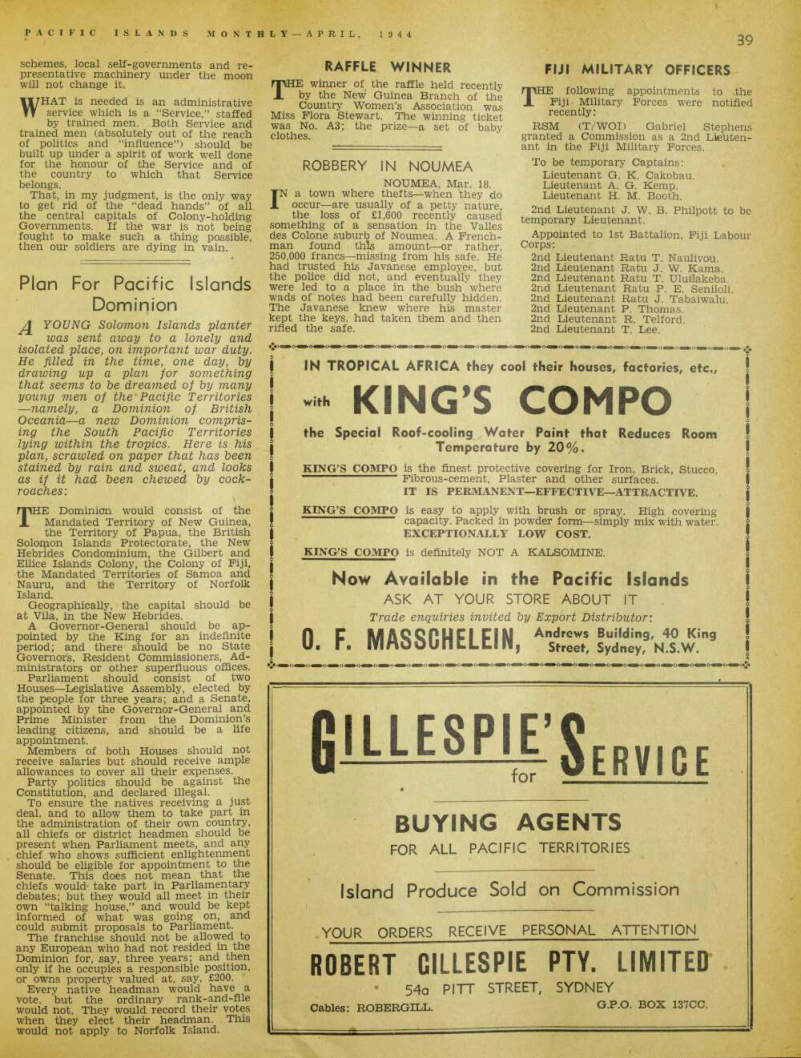
Reform
Plan For French Post-war Federation
THE French Provisional National Com mittee, at Algiers, in January last, debated plans for the post-war reconstruction of the French Colonies.
One plan would provide for the creation of a Federation of French Colonies, with an elected Assembly—such Federation to work in close co-operation with a recon stituted France, through a representative organisation which would be at once inter-colonial and imperial.
Most speakers urged that extended privileges should be given to the French Colonies, in recognition of the fact that they had rallied to the cause of freedom in the blackest hours in the history of the French Empire, and helped create a new and honourable class within the French Empire—the men of Free Prance Discussions showed arguments both for and against the idea of a French Colonial Federation; and it was apparent that such plans could not be carried very far until France is clear of the invader and capable of entering into the discus sion. It was evident that speakers expected New Caledonia and French Oceania to take a place in the reorganised colonial empire of France; and that Frenchmen expect to regain Indo-China.
The following comments have been
made by a friend of France, who has followed both political and colonial developments for nearly half a century.
If one who is a sympathetic observer may be permitted to express an opinion, the only possible procedure for colonial administration would be to establish a college of specialists, who would be required: • To learn the native languages of the several Colonies to which they are destined to be sent; • To study the economic, sanitary and cultural aspects of each particular region; • To then be assigned to their posts for a long term of years, their tenure of appointment to be absolutely divorced from the vagaries of politics or of politicians.
Federations of wholly dissimilar peoples are destined to end in chaos and failure.
One of the most pernicious obstacles to successful colonial administration is the local politician, and his coadjutors, whose chief objective is, apparently, to trans form the orderly procedure of adminis tration into a pathway of thorns.
So far as I have observed, political agitation has led only to confusion and retrogression. Why an experi ment. on the principle of trial and error —undertake for the Colonies a system of unpolitical administrative organisation, composed of specialists?
Naturally, neither this nor any other form of administration would please everybody; but it would have the virtue of opening the real interests of the native peoples to inspection and study by the highest authorities in the Government. rE average colonial administrator of pre-war days was amply satisfied if he balanced his budget, was received with honour at a few native “kava” ceremonies, kept small-pox out of his Colony, and had received the congratu lations of the eminent Mr. John Crimson beak, managing director of the great trading institution of Crimsonbeak and Gueule, Ltd.
But what did the Administrator know about the accuracy of the scales in C. & G.’s outer-island copra sheds, or the clever little ways of getting around the legally established rates of interest, or the delightful little pourboirs added to the prices of foodstuffs and raiment delivered at distant islands? Who was there to inform him of the skulduggery in native land deals the furtive Mr.
Teredo was carrying on behind the screen of equally furtive Euronesians whom Mr.
Teredo holds in the hollow of his hand?
If the Administrator suspected and began to look into such matters, Messrs.
Crimsonbeak and Teredo had powerful friends at Court, and the Administrator was suddenly shifted to another Colony, “for the good of the service.”
This is an absolutely accurate picture, and all the federations, dominion
schemes, local self-governments and re presentative machinery under the moon will not change it.
WHAT is needed is an administrative service which is a “Service,” staffed by trained men. Both Service and trained men (absolutely out of the reach of politics and “influence”) should be built up under a spirit of work well done for the honour of the Service and of the country to which that Service belongs.
That, in my judgment, is the only way to get rid of the “dead hands” of all the central capitals of Colony-holding Governments. If the war is not being fought to make such a thing possible, then our soldiers are dying in vain.
Advertisements & other items, p. 42 (1 item)
_ STfe
Allen Taylor & Co. Ltd.
COMMERCIAL ROAD, ROZELLE,
SYDNEY
Sawmillers and Wholesale Suppliers of Hardwoods for Constructional Purposes GIRDERS . , . PILES . . . POLES . . . SLEEPERS, Etc.
EXPORTING TO PACIFIC” ISLANDS SINCE 1893
Bt an< ■u;
STfe
Manuta^-
, A Suva
\ JkqenVs
P.o. BOX S». w . : Sydney T.
E V.- - . OTW -
& co. *• S - Vnd <“ W““$S. 161.
IN WAR-TIME
Sole Australian Distributors of Monel : Monel finds a place in a wide range of essential industries; in fact in many cases there is no substitute—that is why to-day our'stocks of Monel are strictly reserved for Defence and essential purposes. For such applications, however, we have adequate stocks and will value your enquiries.
STRENGTH + TOUGHNESS + CORROSION-RESISTANCE = MONEL WRIGHT AND COMPANY, 81 Clarence Street, Sydney Monel is a registered trade mark covering a rich nickel alloy, mined in Canada and rolled in Great Britain.
Plan For Pacific Islands
Dominion
YOUNG Solomon Islands planter was sent away to a lonely and
isolated place, on important war duty.
He filled in the time, one day, by
drawing up a plan for something
that seems to be dreamed of by many young men of the r Pacific Territories — namely, a Dominion of British Oceania—a new Dominion compris ing the South Pacific Territories lying within the tropics. Here is his plan, scrawled on paper that has been stained by rain and sweat, and looks as if it had been chewed by cock roaches: rE Dominion would consist of the Mandated Territory of New Guinea, the Territory of Papua, the British Solomon Islands Protectorate, the New Hebrides Condominium, the Gilbert and Ellice Islands Colony, the Colony of Fiji, the Mandated Territories of Samoa and Nauru, and the Territory of Norfolk Island.
Geographically, the capital should be at Vila, in the New Hebrides.
A Governor-General should be ap pointed by the King for an indefinite period; and there should be no State Governors, Resident Commissioners, Ad ministrators or other superfluous offices.
Parliament should consist of two Houses —Legislative Assembly, elected by the people for three years; and a Senate, appointed by the Governor-General and Prime Minister from the Dominion’s leading citizens, and should be a life appointment.
Members of both Houses should not receive salaries but should receive ample allowances to cover all their expenses.
Party politics should be against the Constitution, and declared illegal.
To ensure the natives receiving a just deal, and to allow them to take part in the administration of their own country, all chiefs or district headmen should be present when Parliament meets, and any chief who shows sufficient enlightenment should be eligible for appointment to the Senate. This does not mean that the chiefs would' take part in Parliamentary debates: but they would all meet in their own “talking house,” and would be kept informed of what was going on, and could submit proposals to Parliament.
The franchise should not be allowed to any European who had not resided in the Dominion for, say, three years; and then only if he occupies a responsible position, or owns property valued at, say, £2OO.
Every native headman would have a vote, but the ordinary rank-and-file would not. They would record their votes when they elect their headman. This would not apply to Norfolk Island.
Raffle Winner
mHE winner of the raffle held recently J. by the New Guinea Branch of the Country Women’s Association was Miss Flora Stewart. The winning ticket was No. A 3; the prize—a set of baby clothes.
Robbery In Noumea
Noumea, Mar. 18.
IN a town where thefts—when they do occur—are usually of a petty nature, the loss of £1,600 recently caused something of a sensation in the Valles des Colone suburb of Noumea. A French man found this amount—or rather, 250,000 francs —missing from his safe. He had trusted his Javanese employee, but the police did not, and eventually they were led to a place in the bush where wads of notes had been carefully hidden.
The Javanese knew where his master kept the keys, had taken them and then rifled the safe.
Fiji Military Officers
fIIHE following appointments to the J. Fiji Military Forces were notified recently: RSM (T/WOI) Gabriel Stephens granted a Commission as a 2nd Lieliten ant in the Fiji Military Forces.
To be temporary Captains: Lieutenant G. K. Cakobau.
Lieutenant A. G. Kemp.
Lieutenant H. M. Booth. 2nd Lieutenant J. W. B. Philpott to be temporary Lieutenant.
Appointed to Ist Battalion, Fiji Labour Corps: 2nd Lieutenant Ratu T. Naulivou. 2nd Lieutenant Ratu J. W. Kama. 2nd Lieutenant Ratu T. Uluilakeba. 2nd Lieutenant Ratu P. E. Seniloli, 2nd Lieutenant Ratu J. Tabaiwalu. 2nd Lieutenant P. Thomas. 2nd Lieutenant R. Telford. 2nd Lieutenant T. Lee.
Advertisements & other items, p. 43 (1 item)
fil LLESPI E_ Service
IN TROPICAL AFRICA they cool their houses, factories, etc.,
- KING’S COMPO
the Special Roof-cooling Water Paint that Reduces Room
Temperature by 20%.
KING’S COMPO is the finest protective covering for Iron, Brick, Stucco, Fibrous-cement, Plaster and other surfaces.
IT IS PERMANENT—EFFECTIVE—ATTRACTIVE.
KING’S COMPO is easy to apply with brush or spray. High covering capacity. Packed in powder form—simply mix with water.
EXCEPTIONALLY LOW COST.
KING’S COMPO is definitely NOT A KALSOMINE.
Now Available in the Pacific Islands
ASK AT YOUR STORE ABOUT IT
Trade enquiries invited by Export Distributor: 0. F. MASSCHELEIN, A S^S 9 '^ n 9
fil LLESPI E_ Service
ft
BUYING AGENTS
FOR ALL PACIFIC TERRITORIES
Island Produce Sold on Commission
YOUR ORDERS RECEIVE PERSONAL ATTENTION
ROBERT GILLESPIE PTY. LIMITED
54a PITT STREET, SYDNEY
Cables: ROBERGILL. G.P.O. BOX 137 CC.
Do Not Post Mail For US
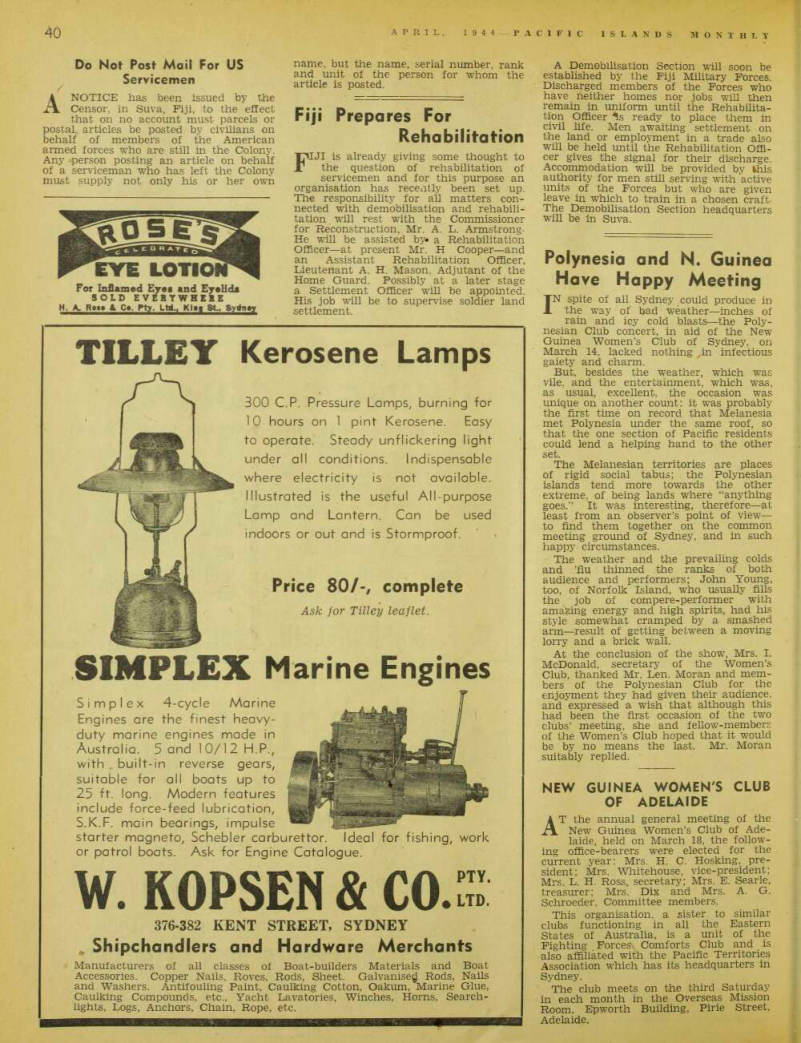
Servicemen
A NOTICE has been issued by the Censor, in Suva, Fiji, to the effect that on no account must parcels or postal articles be posted by civilians on behalf of members of the American armed forces who are still in the Colony.
Any person posting an article on behalf of a serviceman who has left the Colony must supply not only his or her own
name, but the name, serial number, rank and unit of the person for whom the article is posted.
Fiji Prepares For Rehabilitation
Rehabilitation
FJI is already giving some thought to the question of rehabilitation of servicemen and for this purpose an organisation has recently been set up.
The responsibility for all matters con nected with demobilisation and rehabili tation will rest with the Commissioner for Reconstruction, Mr. A. L. Armstrong- He will be assisted by* a Rehabilitation Officer —at present Mr. H Cooper—and an Assistant Rehabilitation Officer, Lieutenant A. H. Mason, Adjutant of the Home Guard. Possibly at a later stage a Settlement Officer will be appointed.
His job will be to supervise soldier land settlement.
A Demobilisation Section will soon be established by the Fiji Military Forces.
Discharged members of the Forces who have neither homes nor jobs will then remain in uniform until the Rehabilita tion Officer *is ready to place them in civil life. Men awaiting settlement on the land or employment in a trade also will be held until the Rehabilitation Offi cer gives the signal for their discharge.
Accommodation will be provided by this authority for men still serving with active units of the Forces but who are given leave in which to train in a chosen craft- The Demobilisation Section headquarters will be in Suva.
Have Happy Meeting
Polynesia and N. Guinea Have Happy Meeting
IN spite of all Sydney could produce in the way of bad weather—inches of rain and icy cold blasts—the Poly nesian Club concert, in aid of the New Guinea Women’s Club of Sydney, on March 14, lacked nothing ,in infectious gaiety and charm.
But, besides the weather, which was vile, and the entertainment, which was, as usual, excellent, the occasion was unique on another count; it was probably the first time on record that Melanesia met Polynesia under the same roof, so that the one section of Pacific residents could lend a helping hand to the other set.
The Melanesian territories are places of rigid social tabus; the Polynesian islands tend more towards the other extreme, of being lands where “anything goes.” It was interesting, therefore —at least from an observer’s point of view— to find them together on the common meeting ground of Sydney, and in such happy circumstances.
The weather and the prevailing colds and ’flu thinned the ranks of both audience and performers; John Young, too, of Norfolk Island, who usually fills the job of compere-performer with amazing energy and high spirits, had his style somewhat cramped by a smashed arm —result of getting between a moving lorry and a brick wall.
At the conclusion of the show, Mrs, I.
McDonald, secretary of the Women’s Club, thanked Mr. Len. Moran and mem bers of the Polynesian Club for the enjoyment they had given their audience, and expressed a wish that although this had been the first occasion of the two clubs’ meeting, she and fellow-members of the Women’s Club hoped that it would be by no means the last. Mr. Moran suitably replied.
New Guinea Women's Club
Of Adelaide
AT the annual general meeting of the New Guinea Women’s Club of Ade laide, held on March 18, the follow ing office-bearers were elected for the current year: Mrs. H. C. Hosking, pre sident; Mrs. Whitehouse, vice-president; Mrs. L. H. Ross, secretary; Mrs. E. Searle, treasurer; Mrs. Dix and Mrs. A. G.
Schroeder, Committee members.
This organisation, a sister to similar clubs functioning in all the Eastern States of Australia, is a unit of the Fighting For cess Comforts Club and is also affiliated with the Pacific Territories Association which has its headquarters in Sydney.
The club meets on the third Saturday in each month in the Overseas Mission Room, Epworth Building, Pirie Street.
Adelaide.
Advertisements & other items, p. 44 (2 items)
40
APRIL, 1944 P ACIFIC ISLANDS MONTHLY
W. Ropsen & Co.™
5 e ho s
LOTIO
For Inflamed Eye* end Eyelid*
SOLD EVEHYWHEIE
H. A. Rot* L C». Pty. Ltd.. Kl*| St, Sydney
TILLEY Kerosene Lamps
SIMPLEX Marine Engines
Simplex 4-cycle Marine Engines are the finest heavyduty marine engines made in Australia. 5 and 10/12 H.P., with built-in reverse gears, suitable for all boats up to 25 ft. long. Modern features include force-feed lubrication, S.K.F. main bearings, impulse starter magneto, Schebler carburettor. Ideal for fishing, work or patrol boats. Ask for Engine Catalogue.
W. ROPSEN & CO.™
376-382 KENT STREET, SYDNEY
, Shipchandlers and Hardware Merchants
Manufacturers of all classes of Boat-builders Materials and Boat Accessories. Copper Nails, Roves, Rods, Sheet. Rods, Nails and Washers. Antifouling Paint, Caulking Cotton, Oakum, Marine Glue, Caulking Compounds, etc., Yacht Lavatories, Winches, Horns, Searchlights, Logs, Anchors, Chain, Rope, etc. 300 C.P. Pressure Lamps, burning for 10 hours on 1 pint Kerosene. Easy to operate. Steady unflickering light under all conditions. Indispensable where electricity is not available.
Illustrated is the useful All-purpose Lamp and Lantern. Can be used indoors or out and is Stormproof.
Price 80/-, complete
Ask for Tilley leaflet.
Late O. F. Nelson
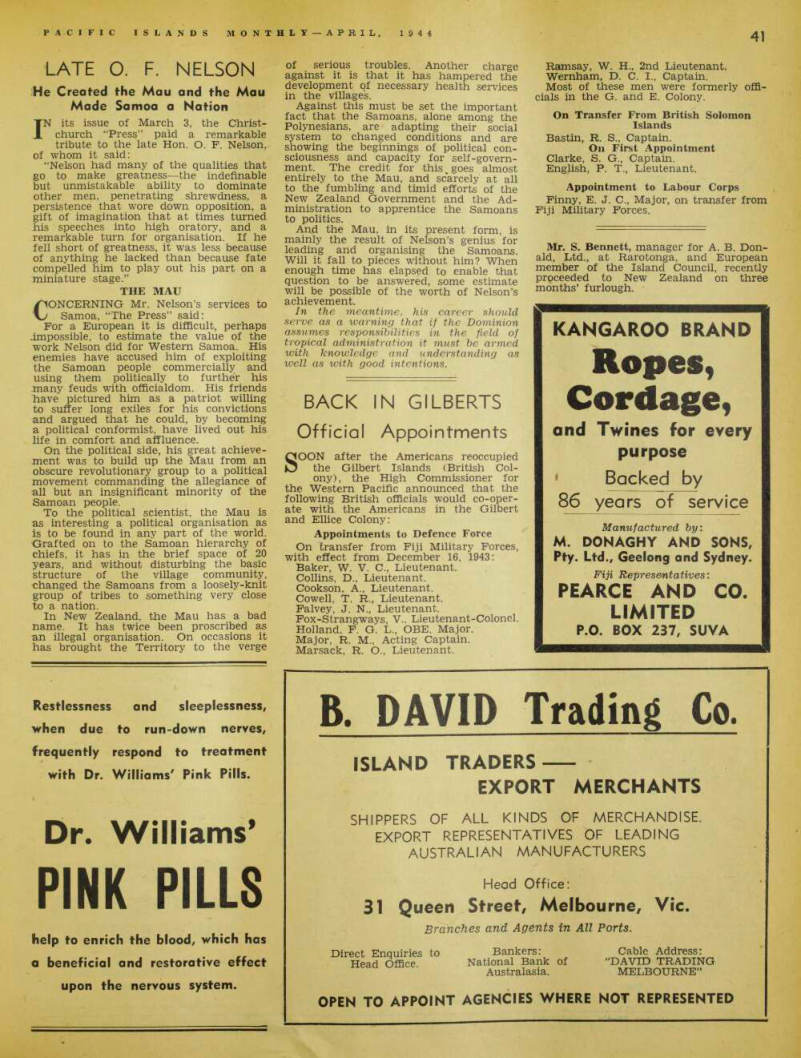
He Created the Mau and the Mau Made Samoa a Nation
IN its issue of March 3, the Christ church “Press” paid a remarkable tribute to the late Hon. O. F. Nelson, of whom it said; “Nelson had many of the qualities that go to make greatness—the indefinable but unmistakable ability to dominate other men. penetrating shrewdness, a persistence that wore down opposition, a gift of imagination that at times turned his speeches into high oratory, and a remarkable turn for organisation. If he fell short of greatness, it was less because of anything he lacked than because fate compelled him to play out his part on a miniature stage.”
The Mau
CONCERNING Mr. Nelson’s services to Samoa, “The Press” said: For a European it is difficult, perhaps impossible, to estimate the value of the work Nelson did for Western Samoa. His enemies have accused him of exploiting the Samoan people commercially and using them politically to further his many feuds with officialdom. His friends have pictured him as a patriot willing to suffer long exiles for his convictions and argued that he could, by becoming a political conformist, have lived out his life in comfort and affluence.
On the political side, his great achieve ment was to build up the Mau from an obscure revolutionary group to a political movement commanding the allegiance of all but an insignificant minority of the Samoan people.
To the political scientist, the Mau is as interesting a political organisation as is to be found in any part of the world.
Grafted on to the Samoan hierarchy of chiefs, it has in the brief space of 20 years, and without disturbing the basic structure of the village community, changed the Samoans from a loosely-knit group of tribes to something very close to a nation.
In New Zealand, the Mau has a bad name. It has twice been proscribed as an illegal organisation. On occasions it has brought the Territory to the verge
of serious troubles. Another charge against it is that it has hampered the development qf necessary health services in the village's.
Against this must be set the important fact that the Samoans, alone among the Polynesians, are adapting their social system to changed conditions and are showing the beginnings of political con sciousness and capacity for self-govern ment. The credit for this % goes almost entirely to the Mau, and scarcely at all to the fumbling and timid efforts of the New Zealand Government and the Ad ministration to apprentice the Samoans to politics.
And the Mau, in its present form, is mainly the result of Nelson’s genius for leading and organising the Samoans.
Will it fall to pieces without him? When enough time has elapsed to enable that question to be answered, some estimate will be possible of the worth of Nelson’s achievement.
In the meantime , his career should serve as a warning that if the Dominion assumes responsibilities in the field of tropical administration it must be armed with knowledge and understanding as well as with good intentions.
Official Appointments
Back In Gilberts
SOON after the Americans reoccupied the Gilbert Islands (British Col ony), the High Commissioner for the Western Pacific announced that the following British officials would co-oper ate with the Americans in the Gilbert and Ellice Colony; Appointments to Defence Force On transfer from Fiji Military Forces, with effect from December 16, 1943; Baker, W. V. C., Lieutenant.
Collins. D., Lieutenant.
Cookson, A., Lieutenant.
Cowell, T. R., Lieutenant.
Falvey, J. N„ Lieutenant.
Fox-Strangways, V.. Lieutenant-Colonel.
Holland, F. G. L., OBE, Major.
Major, R. M.. Acting Captain.
Marsack, R. 0., Lieutenant.
Ramsay, W. H., 2nd Lieutenant.
Wernham, D. C. 1., Captain.
Most of these men were formerly offi cials in the G. and E. Colony.
On Transfer From British Solomon Islands Bastin, R. S., Captain.
On First Appointment Clarke, S. G., Captain.
English, P. T., Lieutenant.
Appointment to Labour Corps Finny, E. J. C., Major, on transfer from Fiji Military Forces, Mr. S. Bennett, manager for A. B. Don ald, Ltd., at Rarotonga, and European member of the Island Council, recently proceeded to New Zealand on three months’ furlough.
Advertisements & other items, p. 45 (2 items)
B. DAVID Trading Co.
KANGAROO BRAND
Ropes,
Cordage,
and Twines for every purpose Backed by 86 years of service Manufactured by:
M. DONAGHY AND SONS,
Pty. Ltd., Geelong and Sydney.
Fiji Representatives :
PEARCE AND CO.
LIMITED
P.O. BOX 237, SUVA
B. DAVID Trading Co.
ISLAND TRADERS
EXPORT MERCHANTS
SHIPPERS OF ALL KINDS OF MERCHANDISE.
EXPORT REPRESENTATIVES OF LEADING
AUSTRALIAN MANUFACTURERS
Head Office:
31 Queen Street, Melbourne, Vic.
Branches and Agents in All Ports.
Direct Enquiries to Head Office.
Bankers: National Bank of Australasia.
Cable Address:
“DAVID TRADING
MELBOURNE”
OPEN TO APPOINT AGENCIES WHERE NOT REPRESENTED
Pink Pills
Restlessness and sleeplessness, when due to run-down nerves, frequently respond to treatment with Dr. Williams' Pink Pills.
Dr. Williams’
help to enrich the blood, which has a beneficial and restorative effect upon the nervous system.
Islands Produce
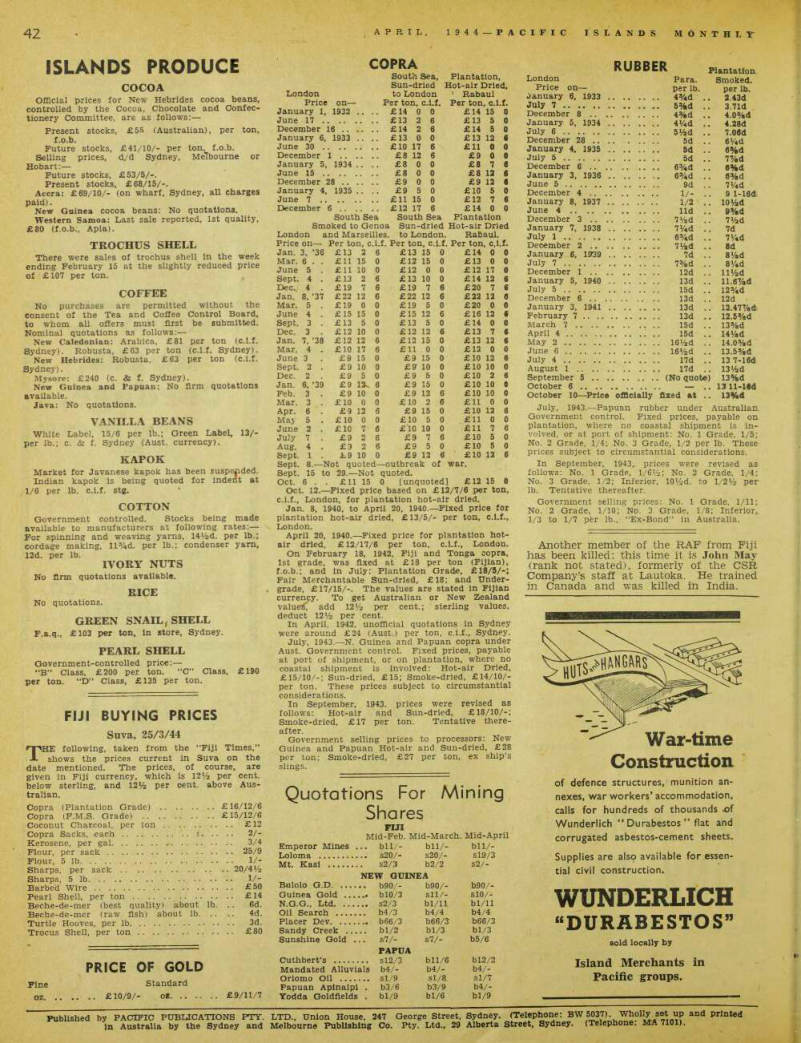
Cocoa
Official prices for New Hebrides cocoa beans, controlled by the Cocoa, Chocolate and Confec tionery Committee, are as follows: — Present stocks, £55 (Australian), per ton, f.o.b.
Future stocks, £4l/10/- per ton, f.o.b.
Selling prices, d/d Sydney, Melbourne or Hobart; — Future stocks, £53/5/-.
Present stocks, £6B/15/-.
Accra: £69/10/- (on wharf, Sydney, all charges paid).
New Guinea cocoa beans: No quotations.
Western Samoa: Last sale reported, Ist quality, £BO (f.0.b., Apia).
Trochus Shell
There were sales of trochus shell in the week ending February 15 at the slightly reduced price of £lO7 per ton.
Coffee
No purchases are permitted without the consent of the Tea and Coffee Control Board, to whom all offers must first be submitted.
Nominal quotations as follows: New Caledonian: Arabica, £Bl per ton (c.i.f.
Sydney). Robusta, £63 per ton (c.i.f. Sydney).
New Hebrides: Robusta, £63 per ton (c.i.f.
Sydney).
Mysore: £240 (c. & f. Sydney).
New Guinea and Papuan: No firm quotations available.
Java: No quotations.
Vanilla Beans
White Label. 15/6 per lb.; Green Label, 13/per lb.; c. & f. Sydney (Aust. currency).
Kapok
Market for Javanese kapok has been suspended.
Indian kapok is being quoted for indent at 1/6 per lb. c.i.f. stg.
Cotton
Government controlled. Stocks being made available to manufacturers at following rates: — For spinning and weaving yarns, 14V 2 d. per lb.; cordage making, ll%d. per lb.; condenser yam, 12d. per lb.
Ivory Nuts
No firm quotations available.
Rice
No quotations.
Green Snail, Shell
F.a.q., £lO3 per ton, in store, Sydney,
Pearl Shell
Government-controlled price:— “B” Class, £2OO per ton. “C” Class, £l9O per ton. “D” Class, £135 per ton.
Fiji Buying Prices
Suva, 25/3/44
THE following, taken from the “Fiji Times,” shows the prices current in Suva on the date mentioned. The prices, of course, are given in Fiji currency, which is 12y 2 per cent, below sterling, and 12y 2 per cent, above Aus tralian.
Copra (Plantation Grade) .. £16/12/6 Copra (F.M.S. Grade) .. £15/12/6 Coconut Charcoal, per ton ... £ 12 Copra Sacks, each :. 2/- Kerosene, per gal ... 3/4 Flour, per sack .. .. 25/9 Flour, 5 lb Sharps, per sack Sharps, 5 lb Barbed Wire £50 Pearl Shell, per ton ... £14 Beche-de-mer fbest quality) about lb. .. 6d.
Beche-de-mer (raw fish) about lb. ... 4d.
Turtle Hooves, per lb 3d.
Trocus Shell, per ton £80
Advertisements & other items, p. 46 (1 item)
Price Of Gold
Pine Standard oz £10/9/- oz £9/11/7
Copra
Oct. 6 . . £ll 15 0 [unquoted] £l2 15 ® Oct. 12.—Fixed price based on £l2/7/6 per ton, c.i.f., London, for plantation hot-air dried.
Jan. 8, 1940, to April 20, 1940.—Fixed price for plantation hot-air dried, £l3/5/- per ton, c.i.f., London.
April 20, 1940. —Fixed price for plantation hot air dried, £l2/17/6 per ton, c.i.f., London.
On February 18, 1942, Fiji and Tonga copra, Ist grade, was fixed at £lB per ton (Fijian), f.0.b.; and in July: Plantation Grade, £lB/5/-; Fair Merchantable Sun-dried, £18; and Under grade, £l7/15/-. The values are stated in Fijian currency. To get Australian or New Zealand values' add 12 y 2 per cent.; sterling values, deduct 12y 2 per cent.
In April, 1942, unofficial quotations in Sydney were around £24 (Aust.) per ton, c.i.f., Sydney.
July, 1943. —N. Guinea and Papuan copra under Aust. Government control. Fixed prices, payable at port of shipment, or on plantation, where no coastal shipment is involved; Hot-air Dried, £l5/10/-; Sun-dried, £l5; Smoke-dried, £l4/10/per ton. These prices subject to circumstantial considerations.
In September, 1943. prices were revised as follows: Hot-air and Sun-dried, £lB/10/-; Smoke-dried, £l7 per ton. Tentative there after.
Government selling prices to processors; New Guinea and Papuan Hot-air and Sun-dried, £2B per ton; Smoke-dried, £27 per ton, ex ship’s slings.
South Sea, Plantation, Sun-dried Hot-air Dried, London to London Rabaul Price on— Per ton, c.i.f.
Per ton, c.i.f.
January 1, 1932 . . .. £14 0 0 £14 15 0 June 17 . £13 2 6 £13 5 0 December 16 .. £14 2 6 £14 5 0 January 6, 1933 . . . £13 0 0 £13 12 6 June 30 . £10 17 6 £11 0 0 December 1 .. £8 12 6 £9 0 0 January 5, , 1934 • • • . £8 0 0 £8 7 6 June 15 . £8 0 0 £8 ia 6 December 28 .. £9 0 0 £9 12 6 January 4, , 1935 . . . • £9 5 0 £10 5 0 June 7 ., £11 15 0 £12 7 6 December 6 .. £12 17 6 £14 0 0 South Sea South Sea Plantation Smoked to Genoa Sun-dried Hot-air Dried London and Marseilles, to London.
Rabaul.
Price on— Per ton, c.i.f. Per ton, c.i.f.
Per ton . c.i.f.
Jan. 3, ’36 £13 2 6 £13 15 0 £14 0 0 Mar. 6 . . £11 15 0 £12 15 0 £13 0 0 June 5 . £11 10 0 £12 0 0 £12 17 0 Sept. 4 . £13 2 6 £13 10 0 £14 12 6 Dec. 4 £19 7 6 £19 7 6 £20 7 6 Jan. 8. ’37 £22 12 6 £22 12 6 £22 12 6 Mar, 5 . £19 0 0 £19 5 0 £20 0 0 June 4 £15 15 0 £15 12 6 £16 12 6 Sept. 3 . £13 5 0 £13 5 0 £14 0 0 Dec. 3 . £12 10 0 £12 12 6 £13 7 c Jan. 7, ’38 £12 12 6 £12 15 0 £13 12 s Mar. 4 . £10 17 6 £11 0 0 £12 0 0 June 3 £9 15 0 £9 15 0 £10 12 6 Sept. 2 . £9 10 0 £9 10 0 £10 10 0 Dec. 2 £9 5 0 £9 5 0 £10 2 6 Jan. 6, ’39 £9 12- 6 £9 15 0 £10 10 0 Feb. 3 , £9 10 0 £9 12 6 £10 10 0 Mar. 3 . £10 0 0 £10 2 6 £11 0 0 Apr. 6 £9 12 6 £9 15 0 £10 12 6 May 5 . £10 0 0 £10 5 0 £11 0 0 June 2 . £10 7 6 £10 10 0 £11 7 6 July 7 . £9 2 6 £9 7 6 £10 5 0 Aug. 4 . £9 2 6 £9 5 0 £10 5 0 Sept. 1 . £9 10 0 £9 12 6 £10 12 6 Sept. 8.—Not quoted- -outbreak of war.
Sept. 15 to 29.- -Not ( quoted.
Quotations For Mining
Shares
Fiji
Mid-Feb. Mid-March. Mid-April Emperor Mines . .. bll/bll/bll/- Loloma s20/- S19/3 Mt. Kasi S2/3 b2/2 s2/- Bulolo G.D
New Guinea
.. b90/- b90/b90/- Guinea Gold ... blO/3 sll/slO/- N.G.G., Ltd bl/11 bl/11 Oil Search .. b4/3 b4/4 b4/4 Placer Dev b66/3 b66/3 Sandy Creek ... .. bl/2 bl/3 bl/3 Sunshine Gold .. ,. s7/s7/b5/6 Cuthbert’s
Papua
.. S12/3 bll/6 bl2/2 Mandated Alluvials b4/b4/b4/- Oriomo Oil si/a sl/7 Papuan Aplnaipl . b3/6 b3/9 b4/- Yodda Goldfields , bl/9 bl/6 bl/9
Rubber
Plantation
July, 1943.—Papuan rubber under Australian Government control. Fixed prices, payable on plantation, where no coastal shipment is in volved, or at port of shipment: No. 1 Grade, 1/5; No. 2 Grade, 1/4; No. 3 Grade, 1/2 per lb. These prices subject to circumstantial considerations.
In September, 1943,. prices were revised as follows: No. 1 Grade, l/6y 2 ; No. 2 Grade, 1/4; No. 3 Grade, 1/2; Inferior, 10y 2 d. to 1/2Va per lb. Tentative thereafter.
Government selling prices: No. 1 Grade, 1/11; No. 2 Grade, 1/10; No. 3 Grade, 1/8; Inferior, 1/3 to 1/7 pfer lb., “Ex-Bond” in Australia.
Another member of the RAF from Fiji has been killed: this time it is John May (rank not stated), formerly of the CSR Company’s staff at Lautoka. He trained in Canada and was killed in India.
London Para.
Smoked.
Price on— per lb. per lb.
January 6, 1933 4%d . 2.43d July 7 . 5%d . 3.71d December 8 4%d . 4.0 s / a d January 5, 1934 4»/ 4 d . 4.28d July 6 . SVad . 7.06d December 28 5d . 6V 4 d January 4, 1935 5d . 6%d July 5 5d . 7%d December 6 6%d . 6%d January 3, 1936 . 6%d . 6%d June 5 9d . 7V 4 d December 4 1/- . 9 l-16d January 8, 1937 1/2 . lOVad June 4 lid . 9%d December 3 7‘/ad . 7Vad January 7, 1938 . 7Vid . 7d July 1 . , ?y 4 d December 2 . 7Vad . 8d January 6, 1939 7d . 8y a d July 7 7%d . sy 4 d December 1 12d . ny 2 d January 5, 1940 13d . 11.6 7 /«d July 5 15d . 123/ 4 d December 6 13d . 12d January 3, 1941 13d . 12.47 7 /ed February 7 13d . 12.5%d March 7 15d . 13%d April 4 15d . 14y a d May 2 . leVad . 14.0%d June 6 . 16Vad . 13.5%d July 4 17d . 13 7-16d August 1 17d . 13Vid September 5 . (No quote) 13%d October 6 — , 13 11-lld October 10—Price officially fixed at . 13%d
Advertisements & other items, pp. 46-48 (3 items)
42
APRIL, 1944 PACIFIC ISLANDS MONTHLY
Published by PACIFIC PUBLICATIONS PTY. LTD., Union House. 247 George Street, Sydney. (Telephone: BW 5 ® 3 , 7) - wholl y . s ®!j “f and prlnted In Australia by the Sydney and Melbourne Publishing Co. Pty. Ltd., 29 Alberta Street, Sydney. (Telephone: MA 7101).
Wunderlich
hangars
HUT
War-time
Construction
of defence structures, munition annexes, war workers’accommodation, calls for hundreds of thousands of Wunderlich “ Durabestos ” flat and corrugated asbestos-cement sheets.
Supplies are alsp available for essential civil construction.
WUNDERLICH
“DURABESTOS”
sold locally by Island Merchants in Pacific groups.
■ a Hi A m M > m m ma '
Travel by CARPENTER AIRLINES
Full particulars from Macdonald, Hamilton fir Co., or Howard Smith Ltd., Sydney.
W. R. CARPENTER & CO. LTD.
MERCHANTS, SHIPOWNERS AND AIRCRAFT OPERATORS
gents for Australian, European and American Manufacturers, and Distributors of Every Description of Merchandise.
Buyers and Shippers of Copra, Trocas, and all Classes of Islands Produce.
Ford Motor Company of Canada.
T. G. Gr C. Bollnders (Engines).
AGENTS FOR :
Caterpillar Tractors.
Electrolux Refrigerators, etc., etc.
Dodge Brothers Inc.
Westinghouse Electrical Co.
Branches throughout' the Pacific Islands
In London: W. R. Carpenter & Co. (London) Ltd., Coronation House, 4 Lloyds Avenue, London, EC.
Head Office; 16 O’CONNELL STREET, SYDNEY
Roll Of Honour
APRIL, 1944 PACIFIC ISLANDS MONTHLY
(Continued From Inside Front Cover)