Islands
Pacific
Monthly
March 20, 1944
Vol. Xiv. No. 8.
Established 1930
[Registered at th* &fcansmission P oB * 08 a newspaper ]
1/-
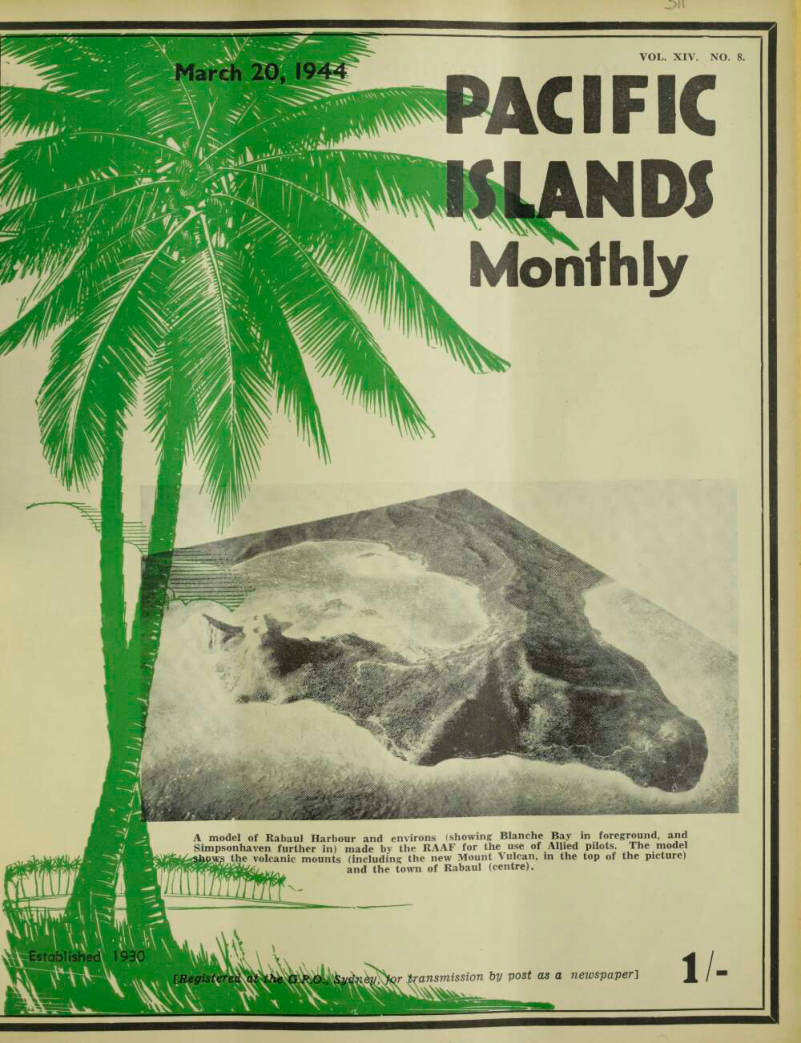
A model of Rabaul Harbour and environs (showin Blanche Bay in foreground, and Simpsonhaven further in) made by the RAAF for the use of Allied pilots. The model shows the volcanic mounts (including the new Mount Vulcan, in the top of the picture) and the town of Rabaul (centre).
Roll Of Honour
(We try to assemble here the names of m,en of the United Nations, residents or former residents of the Pacific Territories, whose names appear in casualty lists or who receive decorations. We should be grateful if relations and friends would send us details of such men.)
Killed
Sgt. Bert AITKEN, NZEF. formerly of Fiji.
Killed in action in Libya.
Eugene AUBRY (formerly of Tahiti), of the Air Force of Fighting France. Killed in an air accident in Great Britain.
Lieut. L. E. AUSTIN, AMF, formerly of Tan gara, Papua. Reported missing, believed killed, February, 1944.
Squadron-Leader Stan BALDIE, RAF, formerly of Wau, TNG. Killed in action in India.
Pilot-Officer Len BAYLISS, flying instructor in the RAAF, formerly of Rabaul, New Guinea.
Killed in Sydney, 18/11/1940, when he fell from a trainer aircraft in flight.
Lieut.-Colonel C. N. F. BENGOUGH, of BSI, Defence Forces, formerly Acting-Resident Com missioner of BSI. Killed when aircraft shot down into sea, August, 1943.
R. C. BENTLEY, NZEF, formerly of Fiji.
Killed in action, Middle East, June 27, 1942.
A/Bdr. Neville W. BERTWISTLE, AIF artillery (tank unit), formerly a clerk on the staff of W. R. Carpenter and Co. Ltd., of Rabaul, New Guinea. Killed in action, April, 1941.
P/O J. B. BOMFORD, RNZAF, formerly of CSR Co.’s staff, Fiji. Killed on active service In England.
Pte. W. R. M. BRADNAM, of the NZ Forces, formerly of Fiji. Reported killed in action in the Middle East. 25/11/1941.
Warrant-Officer R. F. BRECHIN, New Guinea Force. Killed in air accident, June 17, 1942.
Formerly of NG Department of Agriculture.
Anton BRINON, of Fighting French Pacific Battalion, formerly of La Foa, New Caledonia.
Killed in action in Libya, November, 1942.
Lieut.-Colonel Felix BROCHE, of the New Caledonian-New Hebridean contingent of the Fighting French Pacific Battalion. Killed in action in the battle of Bir Hacheim (Libya).
Pilot-Officer E. H. CANARD, of RAF, formerly of Fiji Civil Service. Killed in flying accident In South Africa in the course of his duty as flying instructor.
Pte. David C. GARLAND, AIF, formerly chief assayer at the Emperor gold mines, Fiji. Killed In action in New Guinea.
Pierre CHARPENTIER, of the Fighting French Pacific Battalion. Killed in action in the battle of Bir Hacheim.
Raymond CHAUTARD (formerly of New Cale donia), of the Fighting French Pacific Battalion, Killed in action in Libya.
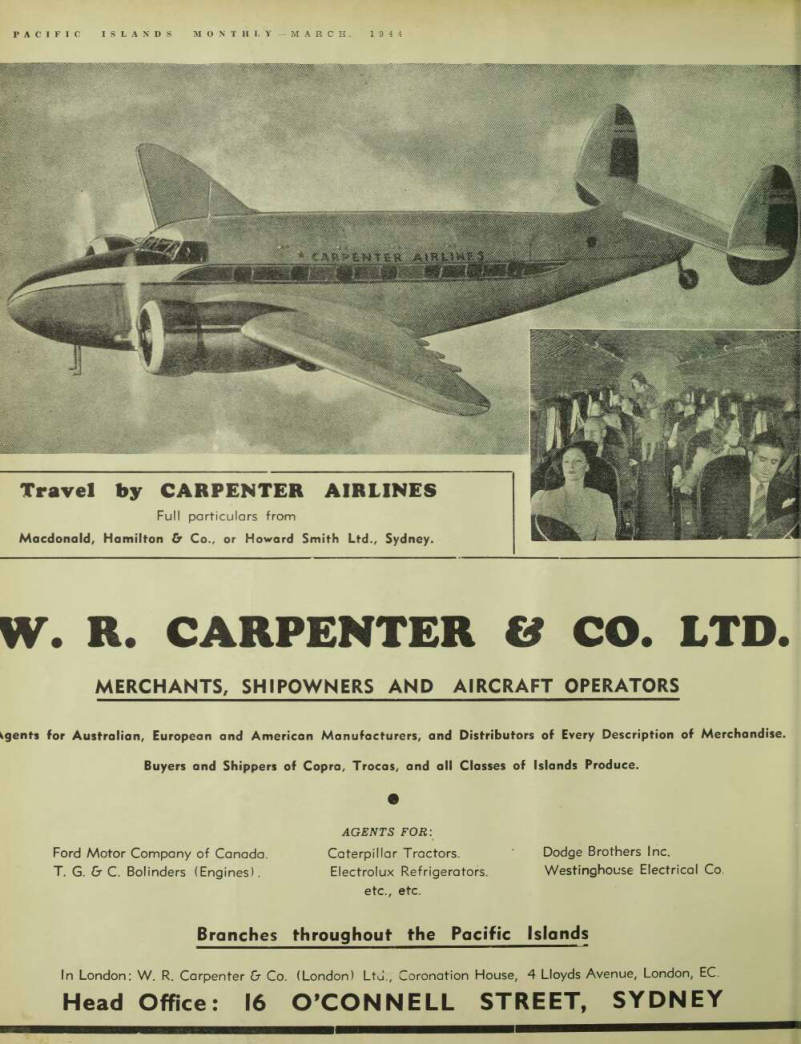
Flight-Lieutenant G. J. I. CLARKE, of the RAAF, formerly Assistant Flight Superintendent of Carpenter Airlines, New Guinea. Killed in action during operations off Dakar (French West Africa), while attached to HMAS "Aus tralia”, September, 1940.
Georges CLEMENS, of the Free French Pacific contingent from New Caledonia. Reported killed in action In the Middle East, March, 1942.
Flying-Officer Jack R. COATH, of the RNZAF, formerly on the staff of the Bank of New Zealand, in Suva, Fiji. Killed October, 1941, when a training aircraft crashed in NZ.
Sqd.-Leader Lionel COHEN, RAF, formerly of Upper Watut, TNG. Killed when returning from a bomber raid on Berlin in 1942.
Sgt-Pilot Colin CRABBE, RAF, formerly of Suva, Fiji. Killed by enemy action in England in May, 1943 u Pte. Felix CRAIG, AIF, formerly of accounts department, Australasian Petroleum Co., Port Moresby, Papua. Killed in action, June, 1941.
L. J. DAWES, of the NZ Forces, formerly Dis trict Officer of Savaii, Western Samoa. Reported killed in action, February, 1942.
Pilot-Officer V. L. DEARMAN, of the RAAF (observer), formerly overseer and clerk at the Colonial Sugar Refining Co., Ltd., Raraval, Fiji. Reported killed in action in the Middle East. October, 1941.
Capt. Jean GILBERT, of the Naval Forces of Fighting France, and formerly of Tahiti. Killed in action.
Captain Kenneth GARDEN, of the RAP Ferry Command, formerly of Guinea Airways Ltd., in New Guinea. Killed September, 1941, when a bomber he "ferried” from USA crashed on west coast of Britain.
Flying-Officer Moresby GOPTON, of the RAP, son of Mrs. P. S. Stewart, of Wau, New Guinea.
Reported missing, 17/5/1940 —presumed killed in air operations.
Rifleman J. A. GOODWIN, AIF infantry, for merly of Bulwa, TNG. Reported "accidentally killed”, April, 1942.
Ernest GOURNAC (formerly of Tahiti), of the Air Force of Fighting France. Killed in an air accident in Britain.
Pte. Wallace GRAHAM, of the NZ Forces (infantry), formerly on the staff of Morris Hedstrom Ltd., Fiji. Killed in action in the Middle East, November, 1941.
Lieut. J. A. GRANT, AIF, formerly of Man dated Territory. Killed in action.
Lieut. L. B. GROVE, AIF, formerly of Madang, TNG. Killed in action.
Squadron-Leader C. R. GURNEY, RAAF, a former chief pilot of Guinea Airways, Ltd.
Killed in action in the New Guinea area, May, 1942.
Pte. B. HAMILTON, AIF, formerly of Auck land, NZ, and New Guinea. Killed in action.
Gerald T. J. HARPER, RAF, son of Major and Mrs. P. Harper, of Ra, Fiji. Killed In action while navigating a Whitley bomber dur ing a raid on the Continent.
J. HEAD, RAAF, formerly of Fiji. Killed in flying accident in Australia, 1941.
Captain L. T. HURRELL, Infantry, Rabaul.
Killed in action.
Sqd.-Leader James R. HYDE, of the RAF, formerly a Patrol Office in Namatanai and Sepik Districts, TNG. Awarded the Distinguished Fly ing Cross, 1941. Killed in action while leading an attack on an enemy convoy off the coast of Greece, July 24, 1942.
Pte. Jack JOHNSON, formerly of Morris Hedstrom’s staff, Fiji. Killed in action on November 4, while serving with the AIF in New Guinea.
Flying-Officer Alan JOHNSTONE, of the RAF, who was born in Suva, FIJI, In 1915. Killed during bombing raid on Kristlansand, Norway, April, 1940.
Flying-Officer G. M. KEOGH, RAAF, form erly of Wewak, TNG. Killed in air operations in New Guinea, August 30, 1943.
LAC Douglas KIRBY. RAF, who left Suva, Fiji, with the first contingent of Air Force trainees. Reported killed in a flying accident in South Africa, March, 1942.
Marcel KOLLEN, of the Pacific Battalion of Fighting France. Killed in action in the battle of Hir Hacheim.
C. D. LAMONT, RAF, formerly a master at Boys’ Grammar School, Suva, Fiji. Missing, be lieved killed on air operations over Germany.
Emile LESSON (formerly of New Caledonia), of the Fighting French Pacific Battalion. Killed in action in Libya.
Cpl. Gaston LESSON, of the Fighting French Pacific Battalion. Killed in battle of Bir Hacheim (Libya).
Capt. (now Lt.-Oolonel) Edward Tiwi LOVE, NZ Maori Battalion, husband of Mrs. Takau Rio Love, Ariki-nui of Rarotonga, Cook Islands. Re ported missing during campaign in Greece, May, 1941; later, June, 1941, reported “wounded and safe.” Officially announced, July 17, 1942, killed in action in Libya.
Flying-Officer John C. LOWE, RAAF, formerly an overseer with the CSR Co. in Fiji. Reported, 11/4/1942, "took part in air defence of Rabaul, TNG, —missing, believed killed”.
Pte. L. F. MCCARTHY, ATP infantry, form erly supercargo on W. R. Carpenter and Co.’s Inter-island vessels "Desikoko” and "Mako”, in New Guinea. Reported "killed in action” in Syria, 30/10/1941.
Sgt. Kenneth MACGREGOR, AIF, formerly practising as a barrister and solicitor in Wau, TNG. Reported missing, believed killed, in Papua.
Sgt.-Pilot Ronald MACKAY, RAAF, formerly of Thursday Island. Killed in an aircraft accident in England.
Lance-Corporal A. D. MacPHEE, son of Mr.
R. D. MacPhee, Levuka, Fiji. He was 35, was a member of the AIF, and was killed in Greece, May, 1941.
Francois MASSON, of the Fighting French Pacific Battalion. Killed in action in the battle of Bir Hacheim.
Capt. John Malcolm METHVEN. Reported killed in action in Egypt on July 22, 1942, while serv ing with the AIF. He was born in Ocean Island, and is the youngest son of Mr. and Mrs.
Stuartson C. Methven, of Belgrave, Victoria.
P/O Officer Stuartson Charles METHVEN, born in Suva, Fiji, brother of the late Capt. J.
M. Methven. Killed in air operations over Germany on January 23, 1943.
Spr. A. L. MORANDINI, AIF Engineers, for merly of Konedobu, Papua. Reported killed in action, April, 1942.
F. R. J. NICHOLLS, Royal Artillery, formerly of Fiji. Killed in action, Burma, May, 1942.
W/O G. A. OBST, formerly a member of the Lutheran Mission, TNG. Joined Australian military forces in February, 1942. Killed in action In New Guinea on December 21, 1942.
J. L. C. OSBORN, NZEF, formerly of FIJI.
Killed in action, Middle East, June, 1942.
Pilot-Officer Ivan PALMER, RAF, formerly of Fiji. Killed in air operations over Malta.
Lieut. R. G. M. PEMBERTON, A IF, formerly of Rabaul, New Guinea. Killed in action.
O. PILLING, RAF, formerly of Fiji. Missing; believed killed.
Flight-Lieut. H. G. PILLING, DFC, of the RAF, formerly of Suva, Fiji. Killed on air operations, May 19, 1942.
Pte. Edward Harold PRICE, 2nd NZEF (27th Machine Gun Battalion), youngest son of Mr. and Mrs. J, Price, Savu Savu West, Fiji. Killed in action during the Libyan campaign, Middle East, 27/11/1941.
Pte. Cecil PURCELL, NZEF, formerly of Aleipata. Samoa. First Samoan Euroneslan to give his life in World War 11. Killed in action in Middle East.
P/O G. REES-JONES, RAAF, formerly of Labasa, Fiji. Killed in air operations over Ger many, August 16, 1942.
Captain W. H. ROBERTS, NZEF, who was Accountant in the Samoa Treasury Dept., dur ing 1934-35. Killed in action in Libya, Decem ber. 1941.
Pte. Kameli ROKOTUILOMA, of the Fiji Military Forces. Reported killed in action, December, 1943, Major A. B. ROSS, NZEF, who, between 1923- 29 was successively, Assistant Secretary for Native Affairs, Assistant Secretary to the Administration, and ADC to the Administrator of Samoa. Killed in action in Libya.
Cpl. Alex. C. SCOTT, ATP, formerly manager at Kieta, TNG, for Burns, Philp and Co. Ltd.
Killed in action in the Middle East. 19/6/1941.
J. SIMPSON, RAAF, formerly of Fiji. Killed in action over Malta, July, 1941.
Sgt. R. R. SHORT, AIF, formerly of Port Moresby. Killed in action.
Lieut. G. STEVENSON, AIF, formerly a Patrol Officer in New Guinea. Killed in action in New Guinea, on June 26, 1943.
Lieutenant A. G W. THOMAS, RANR, for merly master of Burns Philp & Company’s SS “Muliama.” Killed in action.
Pte. Popoare TANGIITI, of the NZ Force* (Maori Battalion), formerly of Mangaia, Cook Islands. Reported "missing after Battle of Greece—presumed dead”, July, 1941, Derek TOVEY, NZEF, formerly of Suva, Fiji.
Killed in action in Tunisia in April, 1943.
Capt. A. F. J. WHITE, AIF, formerly a Dis trict Officer in Fiji, and BSI. Killed in action in New Guinea.
Died From Wounds
Pte. Ernest HENRY, AIF, formerly of the Rabaul (NG) staff of Burns, Philp and Co.
Ltd. Died from wounds received in Battle of Crete, 1/6/1941.
Pte. Alec. MUNRO, NZ Forces, formerly of Norfolk Island. Died in Libya (Middle East), December, 1941.
Pte. T. LAWRIE, AIF, son of Mr. Lawrle, for merly of Fiji. Died of wounds in Middle East.
Pte. Walter PEARSON, of first NG quota of AIF (infantry). Died from wounds received In action, 24/6/1941.
A/Bdr. W. R. SCOTT, AIF, of New Guinea.
Died from wounds. July. 1941.
Sgt. Charles SPITZ, of the Fighting French, Pacific Battalion, and formerly of Tahiti. Died from wounds received at Bir Hacheim, on June 21, 1943.
Sgt.-Pilot Peter Clarkson WISE, of the RAF, son of Mr. W. Wise, OBE, Director of Public Works, Fiji. Died from wounds received during bombing raid over Germany, January, 1941.
Accidentally Killed
A/Cpl. P. A. McKEE, New Guinea Forces, formerly of Bulolo. Died of injuries.
Major N. V. McKENNA, AIF, formerly of Wau, TNG. Accidentally killed, September 30, 1943.
Capt. F. E. WILLIAMS, formerly Government Anthropologist in Papua. Killed in a plane acci dent while on duty in New Guinea, in 1943.
Sgt. Edward WILSON, of Suva, serving in the Fiji Defence Force. Accidentally drowned in the Lami River, Fiji. April, 1942.
Gnr. Robert J. WILSON, formerly of Port Moresby, Papua. Accidentally killed in troop train in Middle East in 1942.
Died From Illness
Pte. Clarence A. HUTTON, AIF, formerly of Edie Creek, TNG. Died from Illness. April. 1941.
Pte. Manoa NAKARU, of the Fiji Military
(Continued on Inside Back Cover)
Lieut. A. THOMPSON, of the Fiji Military Forces. Reported wounded in action, December. 1943.
Lieut. P. A. TUCKEY, infantry, formerly of New Guinea. Wounded in action.
Pte. Harold G. TURNER, AIF, of Samaral, Eastern Papua. Wounded in action at Bardla (Libya), January, 1941.
Pte. F. D. TWISS, AIP infantry, of New Guinea. Wounded in action, August, 1941.
Camille VINCENT, of the Free French Pacific contingent from New Caledonia. Reported a casualty in the Middle East, March, 1942.
Driver Don P. WAUCHOPE, AIP. Formerly employed on his brother’s plantation in New Guinea. Wounded in action, July, 1942.
Lieut. F. R. G. WILSON, AIF, formerly of the Mandated Territory of New Guinea. Reported wounded in action, February, 1944.
Alex. WINCHESTER, of the Fighting French Pacific Battalion. Wounded at Bir Hachelm.
Pte. K. M. WHITE, AIP, formerly of Bulwa, TNG. Wounded in action.
Sgt.-Pilot W. WRIGHT, of the Australian Spitfire Squadron, attached to the RAP, for merly of New Guinea. Wounded in knee during aerial “dog-fight” over the English Channel, March, 1942.
Prisoners Of War
Pte. J. H. ALLAN, AIF, formerly of Wau, TNG.
Formerly reported missing, now reported prisoner of war.
Gnr. N. H. AMOS, AIP, formerly of Port Moresby. Reported prisoner of war after Malayan campaign.
Lieut. CLARRIE ARCHER, NGVR. Believed prisoner of war in Japan. Reported prisoner of war in February, 1943, in prison camp on Island south of Japan.
Cpl. Jock BAIRD, AIP, formerly of Bank of NSW staff, Suva, Fiji. Reported missing in Malaya, February, 1942. Reported prisoner of war, September, 1943.
ALEXANDRE BLACK, of Pacific Battalion of Fighting France. Reported killed in action at Bir Hacheim, now reported prisoner of war, A/Cpl, Peter W. BOSGARD, AIF Infantry, formerly of the Lands Department, Port Moresby, Papua. Reported prisoner of war at Sulmona, Italy, 29/6/1941; transferred to Bolzano prison camp, September, 1941.
Cpl. J. E. BROAD, NZEP, formerly of Suva, Fiji. Reported prisoner of war.
Lieut. John BROWN, formerly of Fiji. Re ported a prisoner of war in Italy.
Cpl. E. BOURKE, AIP, formerly of New Guinea. Prisoner of war in Germany.
Sgt. R. P. BUNTING, AIP, formerly of Samaral, Papua. Missing in Malaya. Now reported prisoner of war.
Andre CHTTTY, of Pacific Battalion of Fight ing Prance. Taken prisoner at battle of Bir Hacheim (Libya).
Sgt. Peter COGGINS, AIP, formerly of Fiji.
Taken prisoner in Malaya, and now reported prisoner of war in Borneo camp.
A/Sgt. A. A. S. COTMAN, AIP infantry, of Abau, Papua. Reported missing—believed prisoner of war, 5/5/1941; reported later, July, 1941, “wounded in chest and head by shrapnel— taken prisoner”.
Cpl. W. F. CULLEN, AIF, formerly of Thursday Island. Reported prisoner of war, John Arnold CROCKETT, AIP, formerly of Bulolo, TNG. Reported prisoner of war in Osaka, Japan, September, 1943.
Pte. J. DALTON, AIP Transport and Supply, formerly of Thursday Island. Reported prisoner of war, April, 1942.
Dick ELMOUR, formerly of New Caledonia, prisoner of war after Dunkirk. Repatriated to Prance in January, 1942, because of health reasons.
Pte. W. G. ECKBLADE, AIP, formerly of Rabaul. Previously reported missing; now re ported missing: believed prisoner of war.
Gnr. A. I. FOLEY, AIF, formerly of Papua.
Reported missing in Malayan campaign. Re ported prisoner of war in February, 1944.
Pilot-Officer George Beilby EVANS, RAAP, son of Mr. and Mrs. Beilby Evans, formerly of Buka Passage, TNG. Reported prisoner of war in Java.
Sgt. Robert GEMMELL-SMITH, RAF, formerly on CSR Co.’s staff, Fiji. Reported prisoner of war in Bengazi, Libya, in November, 1942. w/o.n V. M. I. GORDON, AIP, formerly of Wau, TNG. Reported prisoner of war after Malayan campaign.
Pte. W. GOSSNER. AIF Infantry, formerly of the BNG Development Co., Port Moresby. Papua.
Reported prisoner of war, Sulmona, Italy, 6/7/1941.
W/OI A. N. GRAY, AIF, formerly of Rabaul.
TNG. Reported prisoner of war.
Lieut. J. M. HARCOURT, 2nd NZEP, son of Mr. H. W. Harcourt, formerly Deputy Treasurer in Fiji. Reported ‘‘captured in Libya and now prisoner of war”, March, 1942.
Squadron-Leader Godfrey HEMSWORTH of the RAAP, formerly a well-known commercial pilot in Morobe, TNG. Reported missing after an operational flight against the Japanese in the New Guinea area and presumed killed in action. Reported prisoner of war in Japanese hands In October, 1943.
S. D. C. KERKHAM. NZEF, son of Mr R c Kerkham, Suva, Fiji. Reported prisoner of war in September, 1942.
Lieut. JEFF KILNER. NGVR. Believed prisoner of war In Japan.
Gnr. A. L, B. KING, AIP artillery, of Rabaul, » TNG. Reported prisoner of war, 29/7/1941 Lieut. G. G. KINNER, New Guinea Forces, formerly of Rabaul. Reported prisoner of war.' Major E. G. A, LETT, of the East Surrey Regiment, and son of Mr. Lewis Lett, of Port Moresby, Papua. Reported prisoner of war in Libya.
P/O J. LIETKE, RAAF, formerly of Labasa, Fiji, Reported prisoner of war in Germany, 1943.
A/Cpl. John H. LONERGAN, AIP, Supply and Transport, of New Guinea. Reported prisoner of war at Corinthla, Italy, 8/7/1941.
Pte. Ernest (“Paddy”) McGEADY, NZEF, son of Mrs. J. McGeady, of Suva, Fiji. Reported “missing, believed killed”, after fighting in Libya, January, 1942; reported prisoner of war in Italy, April, 1942.
Cpl. J. H. L. McGUIGAN, of the Field Ambulance, A IF, formerly of the Public Health Department, New Guinea. Officially reported missing at Singapore; unofficially reported a prisoner in Japanese hands. Reported prisoner of war in Malaya, May 24, 1943,
Observer Alex. McKAY, of the RAAP, formerly of the CSR Co.’s staff, at Penang sugar-mill, Fiji. Reported missing, 27/7/1941; reported
prisoner of war in Italy, 26/10/1941.
Pte. Harry MARCHINGTON, of the NZ Forces, formerly of Fiji. Reported prisoner of war after Battle of Crete, 2/12/1941.
Pte. F. C. MAYO, AIP, formerly of New Guinea. Reported a prisoner of war.
Emile MILLOT. of Pacific Battalion of Fight ing Prance. Taken prisoner in battle of Bir Hacheim (Libya).
Pte. G. S. O’BRYAN, NZEP, formerly of Rarotonga, Cook Is. Missing after battle of Crete; now reported prisoner of war in Germany.
Pte. D. R. PHILLIPS, AIF engineers, formerly of Bulwa, TNG. Reported prisoner of war, June, 1942.
A/Bdr. L, J. SMEETON, AIP, formerly of Rabaul, TNG. Reported prisoner of war in Malayan campaign.
Pte. John O. SMITH, of the NZ Forces, son of Captain Arthur Smith, of the Fiji inter-island vessel "Tul Kauvaro”. Missing after battle of Crete, May, 1941; reported prisoner of war in Germany, 21/10/1941.
Squadron-Leader L. C. SHOPPEE, DSO, RAF. formerly of Edle Creek, New Guinea. Was in Java during Japanese invasion; now known to be a prisoner of war.
Gnr. D. M. SPENCE, AIP, formerly of Port Moresby, Reported prisoner of war after Malayan campaign.
LAC Charles SOLLITT, of the RAAF (wire less operator), son of Mr. and Mrs. C. H.
Sollltt, of Nausori, Fiji. Reported missing after air operations in New Guinea, January, 1942; later, March, 1942, reported rescued from sea by Japanese—now prisoner of war.
Pte. Fred SWAN, NZ Army Medical Corps, formerly of Apia, Western Samoa. Missing after Battle of Crete, August, 1941; reported prisoner of war in Germany, November, 1941.
Signalman J. C. E. SWINBOURNE, 6th Div.
Signals, AIF, formerly of Fiji and the Gilbert & Ellice Islands Colony. Taken prisoner at Crete, June, 1941, now in prison camp at Stalag, VIIA, Germany.
Lieut. CLIFF WARREN, of NZEP, serving in the Middle East, and formerly of Morris Hed strom Ltd.’s staff at Ba and Lautoka, Fiji. Re ported prisoner of war.
Mjr. N. WATCH, formerly Dr. Watch, of Rabaul, missing after Japanese invasion of Rabaul. Believed prisoner of war in Japan, Now reported POW in Japan.
Gnr. D. S. WHTTCOMBE, NZEP, formerly of Fiji and Tonga. Wounded in Crete and reported prisoner of war in Germany.
Pte. John D. WHITCOMBE, of the NZ Forces, formerly of Levuka, Fiji. Reported prisoner of war in Germany, November, 1941.
Decorations
Squadron-Leader G. U. ("Scotty”) ALLEN, SAAF, who is well-known in New Guinea and Papua, having been co-pilot on the "Faith in Australia”, on the first official air-mail flight to the Territories in 1934. Awarded the Air Force Cross for his work with Catalina flying ooats in Australia and the Pacific.
Major H. T. ALLEN, AIP, formerly of Wau, Morobe District, TNG. Awarded the QBE.
Squadron-Leader C. A. BASKETT, formerly of Bulolo, TNG. Awarded Distinguished Plying Cross for raids over enemy territory while attached to Hampden bomber squadron in Eng land.
Victor BRIAL, Fighting French Pacific Battalion, formerly of New Caledonia. Awarded the Croix de Guerre and the Etoile d’Argent.
Major W. P. M. CLEMENTS, of the British Solomon Islands Defence Force. Awarded Military Cross for exceptional devotion to duty in a theatre of war.
Sgt. Henry C. S. COTTON, of the RNZAF, who was born in Samoa (his father was Secre tary of Native Affairs during the NZ military occupation). Awarded the Distinguished Plying Cross.
FREDERIC DEL A VEUVE, formerly of New Caledonia. Awarded Croix de Guerre, while serving with Fighting French volunteers in Egypt.
Flight-Lieut. R, N. DALKIN, RAAF, formerly of W. R. Carpenter and Co., Ltd., Salamaua, TNG. Awarded the DFC for bombing raids against the Japanese in Koepang area, DEI.
Squadron-Leader R. A. DUNN, RAAF, formerly of Carpenter Airways New Guinea Service.
Awarded the Distinguished Flying Cross for bravery while leading his squadron against the Japanese.
Chaplain N. J. EARL, AMF, formerly of Papua. Awarded MBE for bravery shown during early Papuan campaign.
Sgt. R. EMERY, NGVR, formerly of Lae.
Awarded Military Medal for gallantry in New Guinea.
Flight-Lieut. Norman FADER, RAAF, formerly a commercial pilot in New Guinea. Awarded the Air Force Cross for exploits in Bismarck Sea Battle.
Rifleman H. W. FORRESTER, NGVR, formerly of Bulolo, TNG. Awarded the Military Medal for operations against Japanese in New Guinea.
Squadron-Leader C. R. GURNEY, RAAF, for merly of Guinea Airways, Ltd., TNG. Posthu mously awarded the Air Force Cross, for bomb ing raids on Japanese-held ports in New Britain.
Major T. GRAHAMSLAW, AMP, formerly of Papua. Awarded OBE for conspicuous devotion to duty in the Buna area (Papua) during initial Japanese landings in the district.
Walter GRAND, Fighting French Pacific Battalion, formerly of Tahiti. Awarded Croix de Guerre, with one star, for bravery during the Battle of Bir Hacheim, 1942.
Squadron-Leader Godfrey HEMSWORTH, RAAF, formerly a well-known New Guinea pilot, who was killed in action against the Japanese In May. Posthumously awarded the Air Force Dross.
Capt. L. HENDERSON, AMF, formerly of Papua. Awarded MBE for courage displayed during the Oro Bay operations when he was in charge of small ships operating in those waters.
LUCIEN HERVOUET, formerly of New Cale donia. Awarded Croix de Guerre while serving with Fighting French volunteers in Egypt.
Lieut. Colin HILL, RANR, of the Australian destroyer, “Waterhen”, formerly second officer on the trans-Pacific liner “Niagara”. Awarded the OBE.
Lieut. Gordon HOWE, RANR, formerly an offi cer in Burns Philp ships. Awarded the US Legion of Merit for meritorious service in lead ing a reconnaissance party to Russell Islands,
Bsi.
Capt. H. T. KIENZLE, ANGAU, formerly of Papua. Awarded MBE for devotion to duty during the campaign in the Owen Stanley Ranges.
Wing-Commander C. J. N. LELAU, RAAF, formerly of Suva, Fiji. Awarded the OBE for distinguished service.
Sgt. T. McADAM, NGVR, formerly of New Guinea Forestry Dept. Awarded Military Medal for gallantry in New Guinea.
Lieut.-Commander A. W. R. McNICOLL, RAN, son of Sir Ramsay McNlcoll, Administrator of
New Guinea, and Lady McNicoll. Awarded the George Medal.
Petty-Officer PAUL MiASON, RANVR, formerly a plantation inspector at Inus, Bougainville, TNG. Awarded American Distinguished Service Cross for “extraordinary heroism in action.”
HENRI MAYER, formerly of New Caledonia.
Awarded Croix de Guerre while serving with Fighting French volunteers in Egypt.
Flt.-Lieut. George B. (Golly) MEIDECKE, RAAP, formerly of W. Samoa. Awarded the Distinguished Flying Cross.
Lieut.-Commander H. A. MACKENZIE, RAN, formerly of Rabaul, TNG. Awarded the US Legion of Merit for exceptionally meritorious services at Guadalcanal.
Capt. John Malcolm METHVEN, A IF. Men tioned in despatches for distinguished services during the seige of Tobruk. Since reported killed in action. (See section “Killed.”) Sgt. Geoffrey MOORE, of the RNZAF, formerly engineer on the NG inter-island vessel “Maiwara” and on the trans-Paciflc liner “Aorangi”. Awarded the Distinguished Flying Medal.
ANDRE MORNAGHLNI, formerly of New Cale donia. Awarded Croix de Guerre while serving with Fighting French volunteers in Egypt.
Flight-Lieut. G. B. MEIDECKE, RAAF, formerly of W. Samoa. Awarded the DFC for “courage, coolness and tenacity, and flying skill of the highest order.”
Flight-Lieut. M. O’CONNOR, RAAF, formerly of Suva, Fiji. Awarded the DFC for a “high record of success on operations” in the Middle East.
Flight-Lieut. H. G. PILLING, RAF, formerly of Suva, Fiji. Awarded the DFC, May, 1542. (Killed a few days later.) Pilot-Officer Pat RICHARDSON, RAF, son of Mr. W. Richardson, formerly of Penang, Fiji.
Awarded the Distinguished Flying Cross.
Commander Alvord S. ROSENTHAL, RAN, son of Major-General Sir Charles Rosenthal, KCB, OMG, DSO, VD, Administrator of Norfolk Island. Awarded the DSO, November, 1941; awarded the Bar to DSO, February, 1942.
Capt. A. T. TIMPERLEY, AMF, formerly of Papua. Awarded MBE for work on Good enough Island when he acted as a guide.
F/O Leigh G. VIAL, RAAF, formerly ADO in TNG. Awarded American DSC for outstand ing heroism in New Guinea in September, 1942.
Squadron-Leader Charles WIDDY, RAAF, formerly of BSI. Awarded the US Legion of Merit for meritorious service in leading a reconnaissance party to Russell Islands, BSI.
Lieut, (then W/O) Raymond WATSON, ALP, formerly of TNG. Awarded MBE for bravery and devotion to duty during the Papuan cam paign.
Lieut. G. K. WHITTAKER, NGVR, formerly of Lae, TNG. Awarded MBE for gallantry in New Guinea.
Lieut. George Raymond WORLEDGE, of the RANVR, formerly of Fiji. Awarded the MBE (Military),
Mentioned In Despatches
Captain A. H. Bald- Corporal M. Marlay, win, Papua. TNG.
Captain N. B. N. Captain J. J. Murphy, Blood, TNG. ..TNG.
Warrant-Officer J. B. Captain ] N ‘ „ - Major D. G, Rice.
Davies Papua. LieJitenant J. I. Rae, Captain L. S. Dexter, Papua.
Papua. Lieutenant C. H. Smith, Warrant-Officer P. R. TNG.
N. England, Papua. Warrant-Officer R. A.
Major S. Elliott-Smith, Smith, Papua.
Papua. Captain L. N. Tribolet, H ‘ Gil " Lieutenant A. G. Vagg, Christ, TNG. TNG.
Warrant-Officer I. F. Captain G. H. Vernon, Jones, Papua. MC, Papua.
The Department of Agriculture in Fiji
recently received an American order for 5,000 cuttings of ornamental trees. These cuttings will be used for landscaping the American cemetery at Guadalcanal, BSI.
Figures for the Patriotic Fete held in Fiji in October were not quite complete at the end of January. But it was ex pected that the total returns for the appeal would be between £45,000 and £46,000. A public meeting will be held in Suva during March, when matters connected with the disposal of the money will be discussed.
Forces. Reported died on active service, Decem ber, 1943.
Pte. Isikeli NABOKO, of the Fiji Military Forces. Reported died on active service, Decem ber, 1943.
Seaman Malvin NELSON, of Fiji Royal Naval Volunteer Service. Death reported in May, 1943.
Pte. Inikasio SERU, of the Fiji Military Forces. Reported died on active service, Decem ber, 1943.
A/Sgt. J. H. STANE, Royal Australian En gineers, formerly of Port Moresby, Papua. Died from illness, May, 1942.
Rifleman R. A. SMITH, HQ Unit. (Place of enlistment not stated.) Died of illness.
Cpl. R. H. SUTTON, NGVR, formerly of Wau, TNG. Died from malaria and typhoid in October, 1942.
Pte. Mateo TUIDALA, of the Fiji Military Forces. Reported died on active service, Decem ber, 1943.
Pte. Emosi WAQA, of the Fiji Military Forces.
Reported died on active service, December, 1943.
Major P J. WOODHILL, AIF infantry, formerly legal assistant in the Crown Law Office, Rabaul, New Guinea. Reported “deceased” December, 1941 Pte. F. WORK, of the Fiji Military Forces.
Reported died on active service, December, 1943.
Missing
Louis ANGER, of Fighting French Pacific Battalion. Reported missing after battle of Bir Hacheim.
Pte. P. F. BAILEY, AIF infantry, of Rabaul, TNG. Reported missing, 17/2/1942. Now re ported prisoner of war, Lieut. J. T. BARRACLUPF, AIF, formerly of New Guinea. Reported missing, December, 1943.
Cpl. Leon BARRENE, of Pacific Battalion of Fighting France. Missing after battle of Bir Hacheim (Libya).
Sgt.-Pilot Murray Waldon BENTLEY, RNZAF, formerly of Fiji. Reported missing in air operations in the Middle East, January, 1943.
P/O Robert Waldon BENTLEY, RNZAF, for merly of Fiji. Reported missing on air opera tions on May 5, 1943.
T. BLAKELOCK, BEF, formerly of Fiji. Miss ing.
Robert BLUM, of Fighting French Pacific Battalion. Reported missing after battle of Bir Hacheim.
Sgt. Ronald Arthur BROODBANK, formerly of Samarai, Papua, now serving with the RAAF overseas. Reported missing on May 31 while on air operations.
Sgt. Alexander BROWN, RNZAF, formerly of Rarotonga. Reported missing over Germany, on September 15, 1942.
Reginald BOULANGER, of Fighting French Pacific Battalion. Reported missing after battle of Bir Hacheim.
Ross BUCKLEY, RNZAF, formerly of Fiji.
Reported missing on air operations.
H. BUCKNELL, AIF, formerly of Fiji. Missing.
Pte. E. L. CHRISTIE, AIF infantry, of Rabaul, TNG. Reported missing, 17/2/1942.
Victor DERVAUX, of Fighting French Pacific Battalion. Reported missing after battle of Bir Hacheim.
Lucien DEVAND, of Pacific Battalion of Fight ing France. Missing after battle of Bir Hacheim (Libya).
Pte. A. G DICKSON, AIF Infantry. of Rabaul, TNG. Reported “missing, believed wounded”, 17/2/1942.
Pilot-Officer Norman R. FRAZER, RAAF, formerly of Wau, TNG. Reported missing on air operations over Germany, August 30, 1943.
Eion FIELD, RNZAF, formerly of staff of Kasi Mines, Fiji. Missing in Java.
Gath GELDARD, NGVR, of New Britain.
Missing after the battle of Rabaul, January, 1942. „ .
GELLER, of Fighting French Pacific Battalion. Reported missing after battle of Bir Hacheim.
J. P. GOUZENES, of Fighting French Pacific Battalion. Reported missing after battle of Bir Hacheim.
Chief-Sergeant Francois GRISCOLLI, of Fight ing French Pacific Battalion. Reported missing In Libya in April. Formerly of New Caledonia.
Acting Flight-Lieut. Don A. IRVING, RAAF, formerly chemist in CSR Co., Labasa, Fiji. Miss ing, presumed dead, in air operations over Germany, February 27, 1942.
Pte. Andrew A. (Billo) Johnson, Ngvr.
Reported missing in New Guinea on October 29, 1942.
Georges KABAR, of Fighting French Pacific
Battalion. Reported missing after battle of Bir Hacheim.
Henri LANGLOIS, of Pacific Battalion of Fighting France. Missing after battle of Bir Hacheim (Libya). * Numa LETHESER, of Pacific Battalion of Fighting France. Missing after battle of Bir Hacheim (Libya).
Rene LETOCART, of Fighting French Pacific Battalion. Reported missing after battle of Bir Hacheim.
Cpl. E. G, MacADAM, NGVR, of Rabaul, TNG.
Reported missing after the battle of Rabaul, January 1, 1942.
Camille MERCIER, of Fighting French Pacific Battalion. Reported missing after battle of Bir Hacheim.
MOUTRY, of Fighting French Pacific Battalion. Reported missing after battle of Bir Hacheim.
Capt. J. J. MURPHY, AIF, formerly of New Guinea. Reported missing, December, 1943.
Pte. R. J. PASCOE, AIF infantry, of Rabaul, TNG. Reported missing, 27/1/1942.
Pilot Tom PATTERSON, of the RNZAF, formerly of Levuka, Fiji. Reported missing, in November, 1941, after bombing raid on the Continent.
Henri PAYONNE, of Fighting French Pacific Battalion. Reported missing after battle of Bir Hacheim.
Eugene PENE, of Fighting French Pacific Battalion. Reported missing after battle of Bir Hacheim.
Andre PETRE, of Fighting French Pacific Battalion. Reported missing after battle of Bir Hacheim.
Eugene POGNON, of Fighting French Pacific Battalion. Reported missing after battle of Bir Hacheim.
Gnr. Allan H. ROSS, AIF artillery, formerly planter in New Britain, TNG. Reported “miss ing—believed prisoner of war”, 28/9/1941.
ROUDEILLAC, of Fighting French Pacific Battalion. Reported missing after battle of Bir Hacheim.
Pte. William RUPE, of the NZ Forces (Maori Battalion), formerly of Altutaki, Cook Islands.
Reported “missing after Battle of Greece”, July, 1941.
Pilot James SIMPSON, of the RAF, formerly of Vatukoula, Fiji. Reported missing after air operations over Malta, in the Mediterranean, 1/7/1941.
L/Bdr. G. G. SMITH, NZEF. formerly of Suva, Fiji. Reported missing.
Pilot-Officer Neville George STOKES, of the RAF, formerly a pilot with Guinea Airways, Ltd., in New Guinea. Reported missing after air operations in Europe, December, 1941.
Reported Missing
Malaya Casualty List, Published 23/7/1942.
Pte. E. L. CHRISTIE, infantry, Rabaul.
Pte. A. G. DICKSON, infantry, Rabaul.
Pte. J. M. HIRSCHEL, infantry, Rabaul.
Pte. J. G. NEWTON, artillery. Port Moresby.
Australia and Island Stations.
Pte. s. W. HUNTER, infantry, Kokopo,
Wounded
Sgt. Robert ASMUS, of the Fighting French Pacific Battalion. Wounded at Bir Hacheim and evacuated.
Rene AUFANT, of the Fighting French Pacific Battalion. Wounded at Bir Hacheim.
Cpl. Thomas BAMBRIDGE, of the Fighting French Pacific Battalion. Wounded at Bir Hacheim and evacuated.
BERBERS (alias ARESKY), of the Fighting French Pacific Battalion. Wounded at Bu Hacheim.
Henri BERTHELIN, of the Fighting French Pacific Battalion. Wounded at Bir Hacheim.
Pte. V. BLANCO. AIF infantry, ol Thursday Island. Wounded in action, July, 1941.
L/Cpl. J. P. BLENCOWE, AIF Infantry, ol Rabaul. TNG. Wounded in action, July, 1941.
Jean BRIAL, of the Fighting French Pacific Battalion.- Wounded at Bir Hacheim.
Pte. George BUCKNELL, AIF, son of Mr. and Mrs. C. Bucknell, of KoroLevu, Fiji. Wounded in action in Malaya, January, 1942.
Pte. Thomas BYERS, AIF infantry, of Thurs day Island. Wounded in action, May, 1941.
Raymond CHAUTARD, of the Free French Pacific contingent from New Caledonia. Re ported a casualty in the Middle East, March, !942. . .
Pte. A. J. CORLASS, ATP, formerly of Rabaul.
Wounded in action.
Albert CUBADDA, of the Free French con tingent from New Caledonia. Reported a cas y in the Middle East, March, 1942.
Charles DEVEAUX, of Pacific Battalion oi Fighting France. Wounded at battle of Hacheim (Libya).
Sgt. EMERY, formerly of Lae, TNG. Wounded in New Guinea in October, 1942.
Lieut. M. G. EVENSEN, A IF, formerly of Rabaul. Wounded in action.
V. FAIRHALL, 2nd NZEF, formerly of the Treasury Department, Western Samoa. Reported wounded in action, February, 1942.
Trooper Arthur T. FILEWOOD, formerly of Thursday Island. Reported wounded in action, May, 1943.
Paroa FIU, of the Fighting French Pacific Battalion. Wounded at Bir Hacheim and evacuated.
Acting Warrant-Officer V. M. I. GORDON, AIF Infantry, of Wau, TNG. Wounded in action, February, 1942.
Pte. John GRANT, AIF infantry, of New Guinea. Wounded in neck and thigh, September, 1941; later, reported “rejoined unit”.
Henri GUILBAUD, of the Free French Pacific contingent from New Caledonia. Reported a casualty in the Middle East, March, 1942.
Sgt. C. HENDRICK, AIF infantry, of Rabaul, TNG. Wounded in action, July, 1941.
Stanley HIGGS, son of Mr. and Mrs. Gordon Higgs, of W. R. Carpenter and Co. Ltd., New Guinea. Member of an English Lancers’ regiment, wounded during British evacuation from Dun kirk (Prance), May, 1940.
Pte. W. HOLMES, of the Fiji Military Forces.
Reported wounded in action, December, 1943.
Lieut. Lloyd T, HURRELL, AIF infantry, of Rabaul, TNG. Wounded in action, July, 1941.
Alexandre HUYARD, of the Free French Pacific contingent from New Caledonia. Reported a casualty in the Middle East, March, 1942.
Sgt.-Pilot Andrew KRONFELD, of the NZ Fighter Squadron attached to the RAP. Wounded in knee during operations over France, December, 1941.
Cpl. W. H. LANNEN, AIF artillery, of Rabaul, New Guinea. Wounded in action, June, 1941.
Gnr. E. G. LOBAN, AIF artillery, of Thursday Island. Wounded during campaign in Greece, May, 1941, invalided home after having his left forearm amputated.
Auguste LUTA, of the Fighting French Pacific Battalion. Wounded at Bir Hacheim and evacuated.
A/Sgt. Alastair MACLEAN, AIF infantry, of Rabaul, New Guinea. Wounded in action, in Libya, June, 1941.
Sgt. J. D. McCLYMONT, NZEF, son of Capt.
D. McClymoni, Harbourmaster of Apia, Western Samoa. Wounded in action, November, 1941.
Cpl. R. McKERLIE, AIF, of Yandina, BSI, wounded in face by bomb explosion, April, 1941.
T. MANEA, of the Fighting French Pacific Battalion. Wounded at Bir Hacheim and evacuated.
Jean MERIGNAC, of the Free French Pacific contingent from New Caledonia. Reported a casualty in the Middle East, March, 1942.
Henri MEYER, of the Free French Pacific contingent from New Caledonia. Reported a casualty in the Middle East, March, 1942.
S/Sgt. Graham B. MIRFIELD, AIF engineers, of Rabaul, New Guinea. Wounded in action.
Pte. James O’DWYER, NZEF, formerly of Apia, W. Samoa. Wounded in action in Italy, December, 1943.
Joseph OTHUS, of Pacific Battalion of Fight ing Fiance. Wounded in battle of Bir Hacheim (Libya).
Lieut. A. G. PEARCE, AIF, formerly of Salamaua, TNG. Wounded in action, Pte. L. G. (“Mick”) REECE, AIF, of Bulolo, New Guinea. Wounded in action, July, 1941.
Henri RIVIERE, of the Free French Pacific contingent from New Caledonia. Reported a casualty in the Middle East, March, 1942.
Pte. H. St. George RYDER, AIF, formerly of Suva, Fiji. Wounded while serving in New Guinea.
A/Cpl. N. K. SAWYER, AIF infantry, of Rabaul, TNG. Wounded in action, July, 1941.
July. 1941.
Pte. Frank M. SCHUSTER, NZEF, formerly of W. Samoa. Wounded in action in Tunisia, 1943.
Lieut. Jeffrey SEAGOE, serving with the British forces in the Far East, formerly of Vila, New Hebrides. Reported “wounded in action”, March, 1942.
Pte. F. M. SCHUSTER, NZEF, formerly of W. Samoa. Wounded in action in Tunisia.
Pte. Lance STAMPER, AIF, formerly school master at Wau, New Guinea. Wounded in action, August. 1941 Lieut.-Col. J. K. B. TAYLOR, of the Fiji Mili tary Forces. Wounded in action in Bougain ville, December, 19'43.
Cpl. Raphael TEIHO, of the Fighting French Pacific Battalion. Wounded at Bir Hacheim and evacuated.
Cpl. Terii TERIITUA, of the Fighting French Pacific Battalion. Wounded at Bir Hacheim and evacuated.
(Continued on Page 37)
Pacific News-Review
Notes And Comment On
The Progress Of The War
From Feb. 15 To Mar. 14
Feb. 15: A triple Russian thrust towards the Baltic States, East Prussia and deeper into Poland, appears to be developing.
Pskov and Vitebsk are threatened. In an endeavour to rescue his forces trapped in the Kanev pocket, Marshal von Manstein has thrown in wave after wave of Ger man tanks and Panzer units.
Feb. 16; The Allied perimeter defences in the Anzio beach-head, south of Rome, are being maintained in the face of the second German large-scale counter- Ett^ck Feb. 16: Allied troops have landed, without opposition, on Rooke Island, situated in Bitiaz Strait, between New Britain and New Guinea.
Feb. 17: RAF bombers last night launched the heaviest raid of all time against Berlin; 2,500 tons of bombs were dropped on the city in 20 minutes. More than 1,000 bombers were over enemy ter ritory during the night; 45 of them failed to return.
Feb. 17: General MacArthur’s head quarters report that American and New Zealand forces seized Green Islands —of which the most important is Nissan— last Monday. This move will seal the fate of 22,000 Japanese dispersed through the Choiseul, Shortlands, Bougainville and Buka Islands, who are now isolated from their supply base at Rabaul.
Feb. 18: In Russia a mighty battle is raging in the Vitbsk sector where the Russians have assembled large numbers of troops and equipment to co-operate with their northern groups on their drive to the Baltic States.
Feb. 19: A large US Naval force has attacked Truk, the Japanese base in the Carolines. Surface units shelled the base and carrier-based aircraft blasted it.
Further details are not yet available.
Feb. 20: In the heaviest German air raid on London since the blitz of 1940-41, the Nazis last night, in a short, fierce, raid, attempted to set London aflame.
London civil defence units dealt with outbreaks and brought them under control.
Feb. 21; Light Allied Naval units made daring sorties at dawn on Friday on the Japanese bases at Kavieng and Rabaul.
Simultaneously, US forces in the Mar shalls, 1,400 miles to the north-east, cap tured the enemy air base on Eniwetok atoll, which brings the US air forces nearer to Truk by 200 miles (400 miles saved on the round trip), than they are at present when they use Kwajalien (Marshalls) as an aircraft base.
Feb. 21: 2,300 tons of bombs were drop ped by the RAF on Leipzig on Saturday night. Large fires were started, but 79 of our aircraft failed to return. This is the heaviest loss in aircraft ever sus tained by the RAF in one night’s opera tions.
Feb. 22: Simultaneously with the Jap anese admission that the American Fleet had struck a devastating blow at Truk (19 ships of various descriptions sunk, 8 probably sunk, 201 aircraft destroyed in combat and 50 damaged on the ground), it was announced from Tokio that Jap anese Army and Navy chiefs had been relieved of their jobs: Chief of the Army General Staff, Field-Marshal Sugiyama, has been replaced by Japanese Premier General To jo; Chief of the Naval Staff, Fleet Admiral Nagano, has been replaced by Admiral Shimada.
Feb. 23; In a statement to the House of Commons. Mr. Churchill said that the Allied air-offensive is the foundation on which the plans for oversea invasion is based—in the past 48 hours 4,000 aircraft have been used in Allied raids over Europe. He revealed, further, that since
the war began, Britain, excluding Domi nions and Allied personnel working with the RAF, had lost 38,300 members of air crew killed, and 10,400 missing. More than 10,000 planes have been lost.
Feb. 23: Russian troops are storming Krivoi Rog, last German stronghold in the Dnieper Bend. The retreating Ger man armies in Russia are threatened with two new major Russian break throughs: on the southern front to wards the Rumanian border and on the Baltic front where the Russians are clearing the approaches to Pskov.
Feb. 25: A US Pacific Fleet task force, including several hundred carrier-based planes, stuck at Saipan and Tinian Islands in the Marianas on Tuesday. At the same time, US troops completed the capture of Eniwetok atoll in the Mar shalls by occupying Parry Island. Another Japanese convoy has been attacked in the Kavieng area.
Feb. 25: American heavy bombers, based on Italy, have raided targets in Austria, 95 miles from Vienna.
Feb. 26: The Anglo-American air-war against Germany reached new violence within the last 48 hours. Centres of the enemy’s aircraft industry in Germany and Austria had not recovered from mass daylight attacks when 1,000 night-bomb ers of the RAF reappeared on February 24 and continued the havoc.
Feb. 26: The Red Army has surged for ward on another sector of the eastern front and captured Vitebsk and Rogachev and 100 villages. German withdrawal to a new line in northern Russia is indi cated. The new line appears to be from Pskov south to Polotsk and Bobruisk, but swift Russian successes are likely to dis locate the enemy’s plans for an orderly retreat.
Feb. 27: Allied destroyers again shelled Kavieng, New Ireland, during the week end, silencing shore batteries and sinking a ship in the harbour. Allied planes heavily bombed Rabaul (New Britain), Wewak (New Guinea) and Lorengau (Admiralty Islands).
Feb. 27; Since the German “blitz” on London was renewed on February 20, Lon doners have had only one raid-free night —last Friday. The raids are thought to be for propaganda purposes and as an attempt to disrupt invasion preparations.
Mar. 1: On the Arakan front in Burma, the British forces, with ample air-cover from the Eastern Air Command, have forced back the Japanese to the line of their original positions which they left three weeks ago to send a formidable force through the jungle in an attempt to cut off British lines of communication and sweep on into India.
Mar. 2: Yesterday, American troops made a surprise landing on the Admiralty Islands, 240 miles north of Madang, New Guinea. This has tightened the Allied blockade of the remaining Japanese bases in the South-west Pacific, and has also relieved the Allied supply-line from the constant threat of a flank attack.
Mar. 3: The battle for the Baltic States is now in full swing as three Russian armies advance on a 300-miles front stretching south from Narva. Fighting continues around Pskov, but some Rus sian units threaten to outflank the town, and pour over the Latvian border. Des perate German efforts are being made to stem the Russian flood, but without avail.
Mar. 3: On Wednesday the Japanese on Los Negros Island (Admiralties) made a fierce counter-attack against the newly landed American forces. The attack was repulsed and Allied GHQ announces that the airstrip on the island will soon be in full use by Allied aircraft.
Mar. 4: Hard fighting has been going on in the Anzio beach-head in Italy, where the Germans launched a strong attack directed at the central position of the British lines.
Mar. 4: Hitler’s northern winter line from Narva to Vitebsk is breaking before the greatest Russian offensives of the war. Meanwhile, in Finland, the Finnish Cobinet is still deliberating on the Rus sian peace terms, and no answer has been given to Russia as yet. It is re ported that Finland has until March 8 to decide. The Red Army is preparing to launch an offensive if the terms are refused.
Mar. 6: In a desperate effort, on Friday night, to regain the Momote airstrip on Los Negros Island (Admiralties), the Japanese lost 3,000 dead and wounded in fierce hand-to-hand fighting with Allied forces. This Japanese counter-attack was
completely defeated.
Mar. 7: Led by the Deputy Commander in-Chief of the Red Army, Marshal Zhukov, a new Russian offensive in the Ukraine threatens all the German forces west of the Lower Dnieper with an encirclement far greater than that of Stalingrad.
Mar. 9: United States Marines landed five miles north-west of Talasea, on the north coast of New Britain, on Monday.
There was little enemy opposition. Tala sea is 180 miles from Rabaul. In the Admiralties, the whole of Los Negros Island is now under American control.
Mar. 10: The Russian drive to Rumania has not been halted, in spite of the Ger man Marshal von Manstein’s attempt to hold it with picked tank and infantry divisions. The front has now broadened to 130 miles as the Russians press for ward through a sea of mud; they have already crossed the upper reaches of the River Bug and are threatening Prokurov from three sides. The Finns are reported to have refused the main armistice terms offered by Russia but are seeking further discussions.
Mar. 10: Berlin had the greatest fire raid of the war on March 8, when more than 1,000 US bombers dropped 350,000 incendiaries in a daylight attack; 100,000 explosive bombs were also dropped.
Mar. 10: A Japanese attempt to land several barge-loads of troops on Los Negros Island (Admiralties) has been frustrated. The American Marines who 1 landed near Talasea, New Britain, at the beginning of the week, are consolidating their positions against strong enemy opposition from the direction of Talasea.
Mar. 14: Sweeping the Germans back over the River Bug along a broad front west of Uman. which they captured after a five-days’ battle, yesterday the Red Armv advanced to within 50 miles of the old Rumanian border.
Miss Leonie Edmunds, formerly of the staff of Rotorua primary school, New Zealand, has been appointed to the school at Levuka, Fiji.
The New Colonial Secretary of Fiji, Mr. J. F. Nicoll, took his seat in the Legis lative Council for the first time when it met for formal business on February 18.
Mr. D. M. Lazarus, formerly of the British Solomon Islands, is now first mate on a Liberty ship attached to the Ameri can Army Transport Service. He was married recently, and his wife is at pre sent living at 2 Augusta Road, Manly, Sydney.
Contents
Pacific News-Review i.
Anzac Agreement Under Fire 1 To Govern New Guinea—New Set-up for Present and Post-war Period 3 Mata’afa as Third Fautua ... 3 Dictator—or What? Delicate Position of Mr. Tojo 4 The River Call 4 Employers of N/Labour Defended by Papuan Administrator 5 Beware of “Puff Fungus”! 5 How New Guinea Missionaries Escaped the Japs 6 Butaritari and the Japanese 7 Lambeti How Solomons Planter Returned Home g Evacuees Are “Befogged”—Quarterly Meeting of PTA 9 Death of Mr. O. F. Nelson, of Samoa 10 Sowing Seeds of Brotherly Love .. 10 Tropical! ties 11 The Goldminer True 13 No “Dollar Prosperity” in Mangaia .. 17 New Caledonia’s Post-war Claims in French Set-up ig Isa Lei 19 Has Polynesia a Future Without a “Copra-economy”? 20 Total War 23 Strange Case of the Sewing Thread— Tahiti’s Thieves and Black Marketeers 25 Evolution of a Fiji Commando ... 2 r ?
Cost of a Rubber Estate 28 Papua in 1888 29 The War Against Mosquitoes .. .. 31 Father Rougier 32 Battle of Marovo Lagoon 34 Army Picnic—NZ Garrison on Nor folk Island 36 Commercial and Markets 42 Honour Roll cov. i., vi., and p. 37
Advertisers
Atkins Pty. Ltd., Wm 24 Australian Alumi nium Co. Pty., Ltd 29 Baker Pty., Ltd., W. Jno 41 Berger’s Paints . . 12 Broomfield, Ltd. . . 28 Brown & Co., Ltd., G 13 Brunton’s Flour . . 40 Burns, Philp Trust Co., Ltd 15
B.P. (S.S.) Co. . . 13
Carlton & United Breweries, Ltd. . 17 Carpenter, Ltd., W.
R cov. iv.
Chivers & Sons, Ltd 37 Coleman Lamp & Stove Co 23 Colonial Wholesale Meat Co., Ltd. . 31 “Cystex” 40 Darvas & Co. ... 41 David Trading Co., B 33 Donaghy & Sons, Ltd 32 Donald, Ltd,, A. B. 34 Dr. Williams Pink Pills 41 Electrolux Refrigerators . . 16 Excelsior Supply Co., Ltd 36 Garrett & Davidson 31 Gilbey’s Gin ... 14 Gillespie Pty., Ltd., Robert 39 Gillespie’s Flour . . 30 Gourock Rope Co., Ltd 34 Gough & Co., E.
J 35 Grand Pacific Hotel ii.
Grove & Sons, W.
H 14 Heinz & Co. Pty., Ltd., H. J. . . . 18 Horlicks Malted Milk 19 King’s Compo ... 29 Kopsen & Co., Ltd. 25 Masschelin, O. F. . 37 Maxwell Porter, Ltd. 38 “Mendaco” ... 34 Miller & Co. Pty., Ltd 38 Nelson & Robertson Pty., Ltd 25 “Nixoderm” ... 32 Noyes Bros., Ltd. . 35 Pacific Is. Society . 13 “Pinkettes” ... 26 Position Wanted . 41 Queensland Insur ance Co 24 Radco Food Pro ducts 33 Ransomes, Sims & Jefferies, Ltd. . . 37 Riverstone Meat Co., Ltd 21 Rose’s Eye Lotion . 39 Rohu, Sil . . . .28 Scott, Ltd., J. ... 28 Steamships Trading Co., Ltd so Sullivan & Co., C. . 32 Swallow & Ariell . 20 Taylor & Co., A. . 38 “Tenax” Soap ... 26 Tillock & Co., Ltd. 27 Trinity Grammar School 39 Union Assurance Co., Ltd 37 Wright & Co., Ltd., E 32 Wunderlich, Ltd. . . 35 Young Pty., Ltd., Harry J 26 Yorkshire Insurance Co., Ltd 23
Advertisements & other items, p. 4 (2 items)
Useful Addresses
The following are the addresses of organisations set up to deal with Pacific Territories affairs:
PAPUA, NEW GUINEA, NAURU,
NORFOLK IS.
Department of External Territories (Sydney Branch) (Lately the New Guinea Trade Agency), Australia House, Carrington Street, Sydney.
Telephone: BVV 177(5. (Dealing with all matters connected with the Australian Pacific Territories and also the Sydney representative of the New Guinea Copra Control Committee.)
Fiji, and High Commission
for Western Pacific.
Sydney Office of Fiji and Associated Administrations. (In charge of Mr. B, F. Blackwell.) 72 Pitt Street, Sydney.
Telephone: BW 7724.
BRITISH SOLOMON ISLANDS
Sydney Ofilce of British Solomon Islands Government (In charge of Mr. F. E. Johnson, Treasurer of the Solomons Administration), 17 Castlereagh Street, Sydney.
Telephone: B 1710.
FOR PACIFIC TERRITORIES
EVACUEES GENERALLY
Pacific Territories Association (C. A. M. Adelskold, Secretary), c/o Robert Gillespie Pty., Ltd., B4a Pitt Street, Sydney. Telephone; BVV 4782.
WAR DAMAGE COMMISSION
Sydney Office: M.L.C. Buidling, Cnr. Martin Place and Castlereagh Street, Sydney.
Telephone: BW 2361.
FOR CLAIMS AGAINST ARMY
Mr. H. Alderman, Darwin-Moresby Claims Section, Chief Finance Office (Army), Victoria Barracks, Melbourne.
W^ : z fm
\tt e S °f ** I f»it' e ° C»'°' e ’ r M- |6 9 er ese^^ OOS ' *** \<Mi
Pacific Islands Monthly
The Newspaper-Magazine of the South Seas
[Registered at the G.P.0., Sydney , for transmission by post as a newspaper .] Published Once Each Month and Circulated in Australia and New Zealand and in the following Pacific Territories and Islands Groups:
Australian Territory of Papua.
Mandated Territory (Australia) of New Guinea.
Australian Territory of Norfolk Island.
New Zealand Territory of Cook Islands.
Mandated Territory (NZ) of Western Samoa.
British Colony of Fiji.
British Solomon Islands Protectorate.
British Protectorate of Tongan Islands.
British Crown Colony of Gilbert and Ellice Islands.
Mandated Territory of Nauru.
British and Free French Condominium of New Hebrides.
Free French Colony of New Caledonia.
Free French Colony of Oceania (Tahiti, etc.).
American Territory of Eastern Samoa.
American Territory of Hawaiian Islands.
Owned and Produced by Pacific Publications Pty. Ltd., Union House, 247 George Street, Sydney.
TELEPHONE ( Managing Director .. BW 5037 I Business and Editorial MA 4369
P.O. Box 3408 R
Registered Address of Telegrams, Radiograms, and Cables: “Pacpub”, Sydney.
Contributions.
Articles, Stories, and Photographs dealing with Pacific Islands subjects are invited and will be paid for on publication,
Subscription Rates.
Per Annum, within British Empire, Prepaid, Post Free 10/- Per Annum, elsewhere, Prepaid, Post Free 12/6 Single Copies 1/-
Editor and Publisher:
R. W. Robson, P.R.G.S.
Advertising Manager: L. W. Bailey.
Advertising Office and Printing-House: 29 Alberta Street, Sydney.
Advertising rates furnished on application.
Process Blocks made at Advertiser’s expense when required. Screen 85.
Changes of Advertising Copy should reach this office by Ist of each month, otherwise previous advertisement may be repeated.
Representative In London.
W. C. Harvey, Coronation House, 4 Lloyds Avenue, London, E.C.3, from whom may be obtained copies of Pacific Islands Monthly, Pacific Is. Year Book, advertising schedules, etc.
Agents.
The following are authorised to receive sub scriptions for Pacific Islands Monthly:— Burns, Philp & Co., Ltd., and Burns Phllp (South Sea) Co., Ltd. All branches.
W. R. Carpenter & Co., Ltd. All branches.
Morris, Hedstrom, Ltd. All branches.
Steamships Trading Co., Papua. All branches.
B.N.G. Trading Co., Ltd., Port Moresby, Papua.
J. Muir, Suva, Fiji.
Miss R. Castles, Suva, Fiji.
N. C. Mackenzie Hunt, Wainunu, Bua, Fiji.
Cook Islands Trading Co., Rarotonga, Cook Is.
A. C. Rowland, Papeete, Tahiti.
Islands Branches and Representatives of W. H.
Grove & Sons, Ltd., Auckland, New Zealand.
Ed. Pentecost, Noumea, New Caledonia.
Kerr & Co., Noumea, New Caledonia,
Vol. XIV. No. 8.
March 20, 1944
O r \ra f l/- Per Copy ' f ICS Prepaid: 10/- p.a.
SnSed* States''of'“oreat VTtMn *or
Anzac Agreement Under Fire
A R . EMA ? K A? LE 1 and , Pi<iu ant Slt ua- A tion has developed following the recent Anzac Agreement. Dr. H V.
Evatt Australian Minister for External Affairs has been defending himself querulously against attacks made upon him by various critics of external affairs, most prominent of whom is Sir Keith Murdoch.
Back in October, Dr. Evatt made a statement concerning the present and future political set-up in the South Pacific. It was a wide-visioned and statesman-like survey of a rather complex situation. There are so many different, criss-crossing interests involved in any survey of South Pacific Territories control (there are 14 separate administrations, controhed in different ways from London, Washington, Paris, Canberra, Weilington and Suva) that practically every “public man” who has tried to discuss them in recent years has made an ass of himself. Dr. Evatt did net. His outline of the situation, and his discussion of it, were clear and authnritativp auinomauve.
The arrangement of the conference between Australia and New Zealand was the next logical step in what Dr.
Evatt was seeking to accomplish. The conference took place in January. A summary of the Agreement was published in February “PIM.” It fitted in neatly and logically with the various statements made by Dr.
Evatt.
But the Agreement was no sooner signed and published than criticism began to be heard, not in Australia or New Zealand—where public opinion
concerning Pacific affairs is too dull and uninformed to be worth noting. anyway —but in Washington and London. , , It appeared that the somewhat elaborate Anzac plan for dealing with South Pacific affairs had been drawn up by Australia and New Zealand
SnSed* States''of'“oreat VTtMn *or
l d hp S {£ to ph ( National Committee French National
*m wSt if not
of S the Anzac those ° f 0 outsnoken comment in Th P Americans the United. States. The Terri- ° f t £p o horrible enemy w^EuroDSn^evS have known were Z the wav in t ,^ al A 1 ic ! fvau^ tf^nH ot isrPw Zealand
reference to
dispose of S p*pVß° American Australians and New Zealanders, had treea ana freeing There was some similar comment f n London London, of d « ourse deeply interested—so many f arP British 01 tne ferntones are T£UT little was said in Australia until O that exceedingly able journalist, sir Keith Murdoch, head of the Melbourne Herald group, published an article in which he’ criticised the action of the two Dominions in holding the conference without prior consultation with Britain and the United States, and pointed out that the terms of the Agreement “had been
widely criticised and censured in America.”
Sir Keith, quite correctly, said the worst features of the Agreement were its assumption that all existing sovereignties are immutable except those of enemy possession; and, with regard to the Carolines and Mar shalls, its demand that no change should be made without Australian and New Zealand consent.
Sir Keith proceeded to suggest that, so far from existing boundaries being maintained, the island of New Britain (whereon is the good port of Rabaul) and the French island of New Caledonia might pass into the possession of the United States, as part of a plan which would make available to the United States all possible facilities for the future polic ing of the Pacific. Sir Keith can see —as any man of vision can see—that there is no future in the South Pacific for the white communities, including Australia and New Zealand, unless they have the protection of the United States and/or whatever inter national body is set up by the United Nations after World War II to guar antee world peace.
According to newspaper reports, Dr. Evatt replied angrily that “no Australian Government would enter tain for one moment the suggestion that Australia should hand over the Australian territory of New Britain to the United States”; and he said that Australia had guaranteed, in 1940, the sovereignty of France in New Cale donia.
DR. EVATT evidently was caught unprepared. The stupidity of his statement is not worthy of him. New
Britain is not an “Australian terri tory”—it is part of the Mandated Territory of New Guinea. Australia probably will be given administrative authority over the islands covered by that Mandate; but, for that, they must await the end of the war and certain international conferences— and no one knows that better than Dr. Evatt himself.
The Australian promise about New Caledonia was given in 1940, long before the whole Pacific situation was altered by the American-Japanese war.
Surely Dr. Evatt, and his co- Ministers, can see that the future of all these South Pacific Territories will be decided, not by little Australia and even littler New Zealand, but by Washington and London, in con sultation; and that the wishes of the United States most certainly will be the final, determining factor. The American system is based on the same kind of justice that rules in Australia and New Zealand; and so the South Pacific decisions will be made by Washington and London, finally, after consulting the wishes of Aus tralia and New Zealand. It is palp ably ridiculous that Australia and New Zealand should proceed to arrange the future set-up in the South Pacific, without consultation of United States or Great Britain. Can these small-time politicians of Can berra and Wellington not realise that the total population of Australia and New Zealand, together, is barely equal to the population of London or of New York?
IT is an astonishing thing that a man with Dr. Evatt’s reputation for adroitness should have placed himself in such a position. It was assumed by everyone interested that, when he convened his Anzac Confer ence and proceeded to formulate the Anzac Agreement, all the proposed steps had been personally explained by Dr. Evatt, in 1943, in London and
Washington. As he apparently acted without consultation, and presumably for the glory of Evatt, he has placed himself off-side in regard to South Pacific post-war consultations, and has made Australia and New Zealand look ridiculous.
The incident gives point to the oft repeated argument that, from the administrative viewpoint, it is a wrong thing that the Pacific Territories should be tied to the tails of little people in Canberra and Wellington.
The politicians of Australia and New Zealand, especially the political products of the trade unions, have a most exaggerated idea of their own stature, and love to strut as “states men of the young nations.” The only time they ever got themselves into correct focus was in those black months of early 1942. The unfor tunate thing is that nowadays, while Washington and London remember us still in terms of 1942, Canberra and Wellington like to imagine them selves as the equals of London and Washington, and even think they are competent to go ahead by themselves —as per the Anzac Agreement.
Captain R. O. Freeman, of the First Battalion, Fiji Defence Forces, has been gazetted temporary Major.
Second-Lieut. M. T. Khan (Honorary Captain) has resigned his commission in the Fiji Military Forces.
Sgt. Observer Ross Buckley, formerly of Fiji, who was reported missing on air operations some months ago, has now been “presumed dead” by the RNZAF Headquarters. The body of a fellow crew member was found washed up on the coast of Denmark.
Lieutenant Tony Phelps, son of Mr. and Mrs. A. I. Phelps, of Suva, Fiji, has been reported killed in action while serving with the First Fijian Battalion. He was only 23 years old and his cheerful good nature had endeared him to many. News of his death was received with sincere regret by a large circle of friends.
Melanesian Evacuees
Polynesians Will Help
rpERRITORIANS are asked to keep free JL the evening of April 14, when the Polynesian Club of Sydney will give one of their popular concerts in aid of Sydney New Guinea Women’s Club funds. At the time of going to press, the hall where this concert will be held had not been fixed, but all members will be circularised and a notice stating time and place will appear in the daily papers before April 14, All are asked to attend this function.
These Polynesian concerts are deservedly popular and have been delighting Syd ney audiences in hundreds of charity performances since World War II began.
The majority of the cast are engaged on full-time war-work, but are giving un reservedly of their spare time to help Red Cross and Comforts Funds. This concert should be of particular interest to residents of Melanesia who know only the Melanesian way of things: it will afford them the opportunity of seeing something of the culture of their Poly nesian neighbours from New Zealand and the Eastern Pacific.
N. Guinea Films Screened
rE first meeting of the Pacific Islands Society for 1944 was held at Shell House, Carrington Street, Sydney, on Wednesday, February 16.
There was a large attendance of mem bers and some notable guests, including members of the New Guinea Women’s Club, Canon Bell, secretary of the Aus tralian Board of Missions, Lieut.-Col. J.
T. B. Sharpe, the Hon. T. D. Mutch, and others.
The 'beautiful films taken by Mr. L. V.
Waterhouse, of the Bulolo Gold Dredg ing Co., Ltd., were shown, and a running commentary was given by Mr. Tom Yeo mans, in the unavoidable absence of Mr.
Waterhouse, who was in hospital.
During supper some excellent violin solos and recitations were given by the talented Miss Dawn Bodley, and a song by Mr. Hawke.
Mr. R. W. Robson moved a vote of thanks to Mr. Waterhouse, Mr. Yeomans and the entertainers. The Shell Com pany also was thanked for the use of its theatrette for an instructive and enjoy able evening.
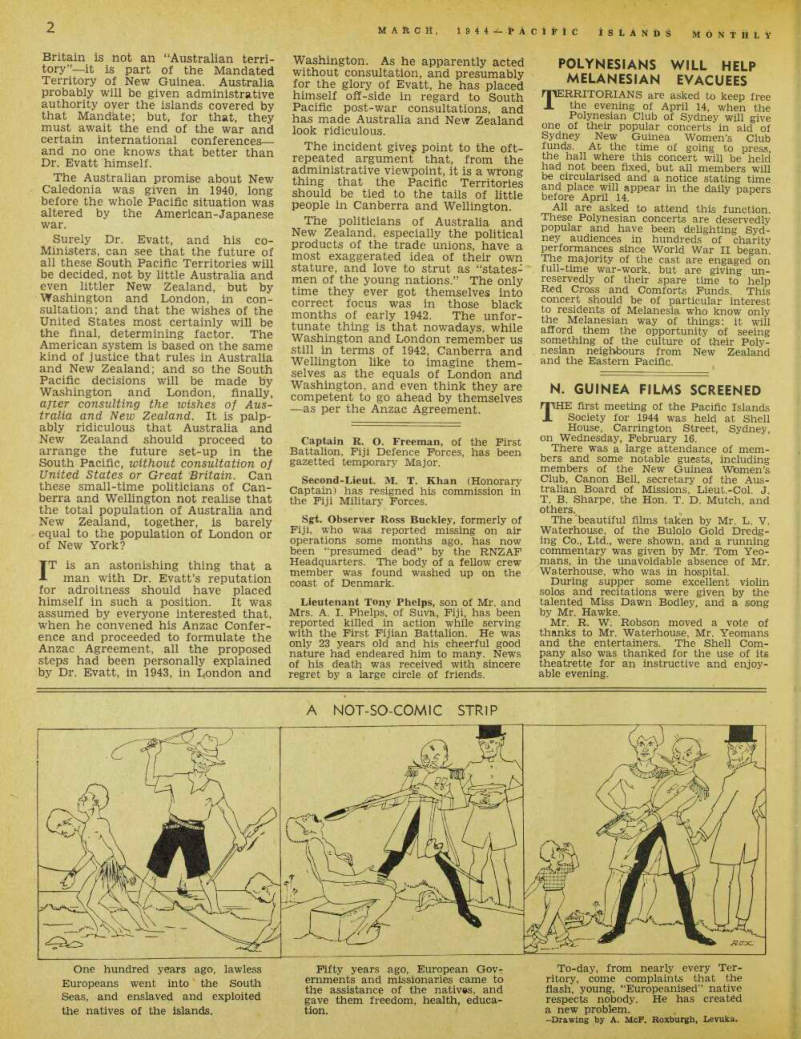
A Not-So-Comic Strip
One hundred years ago, lawless Europeans went into the South Seas, and enslaved and exploited the natives of the islands.
Fifty years ago, European Gov ernments and missionaries came to the assistance of the natives, and gave them freedom, health, educa tion.
To-day, from nearly every Ter ritory, come complaints that the flash, young, “Europeanised” native respects nobody. He has created a new problem. -Drawing by A. McF. Roxburgh, Levuka.
To Govern New Guinea
A New Set-up for Present and Immediate Post-war Period
rE creation of a standing sub-commit tee to deal with all future civil administration in Papua and New Guinea, was announced by the Australian .
Prime Minister, Mr. Curtin, on February ' 22. The standing sub-committee will consist of the Minister for the Army (Mr.
Forde), the Attorney-General (Dr. Evatt), the Treasurer (Mr. Chifley) and the Minister for External Territories (Mr.
Ward).
That day, Mr. Curtin stated, Full Cabi net had considered a report by this sub committee on a conference with the Com mander-in-Chief of the Allied Land Forces, Sir Thomas Blarney, as to the future administration of these Territories, and Cabinet had adopted the views and conclusions expressed in the sub-commit tee’s report, with which Sir Thomas Blarney had also concurred.
These conclusions were as follows: • That the Ministerial sub-committee be a standing sub-committee to deal with all matters of civil administration in the territories of Papua and New Guinea; • That there be the closest possible col laboration and direct communication between the Department of External Territories and the Army (through the Director of Research, Lieut.-Col.
Conlon); • That the Department of External Ter ritories be the secretariat for the Cabinet sub-committee; • That the Minister for External Ter ritories be the responsible Minister in all matters relating to civil adminis tration in Papua and New Guinea, whether for immediate or post-war application; • That when War Cabinet discussed matters affecting the territories, the Minister for External Territories should attend and that submissions should be presented through him.
OTHER agreements arrived at by the sub-committee and Sir Thomas Blarney were also approved by Cabinet: The present administrative unit, the Australian New Guinea Administration Unit, although of a military nature, should carry on the training of staff for native administration in that unit (ANGAU) and later on, personnel for appointment to the reconstituted ad ministration. A school of administration will be established under the control of the Director of Research, Lieut.-Col.
Conlon.
The Commander-in-Chief agreed that approved civilians be allowed entry into parts of the Territory declared by the military authorities to be available. All applications for entry are to be approved by the General Officer Commanding the New Guinea Forces and the Department of External Territories.
Female missionary teachers will be allowed entry into the Territories in view of the need to resume native primary education. But other females, including wives of planters, will not be permitted to enter the Territories.
With regard to the future of the Ter ritories, while it was realised that it was too early to form estimates, it was agreed that substantial financial provi
sion for these Territories would have to be made available by the Commonwealth Government.
Territorians' Reaction
rRRITORIES’ evacuees, at present in Australia, were bewildered at this sudden bolt from the blue, and viewed the “conclusions and views” approved by Cabinet with consternation.
Immediately Mr. Curtin’s statement was released, the Pacific Territories Associa tion sent a telegram to Mr. Ward, asking for clarification. His reply, and discus sion arising therefrom, is reported in an account of the PTA quarterly meeting, on page 9, this issue.
Anthropologists For
New Guinea
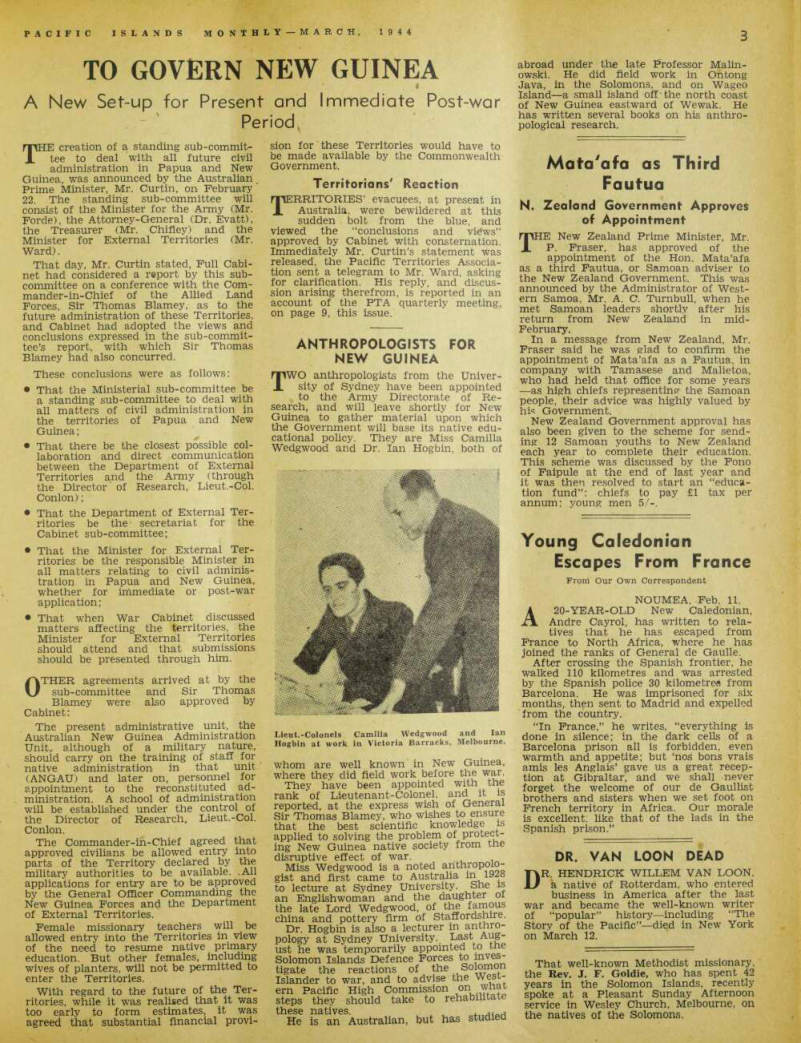
rO anthropologists from the Univer sity of Sydney have been appointed to the Army Directorate of Re search, and will leave shortly for New Guinea to gather material upon which the Government will base its native edu cational policy. They are Miss Camilla Wedgwood and Dr. lan Hogbin, both of
whom are well known in New Gumea, where they did field work before the war.
They have been appointed with the rank of Lieutenant-Colonel, and it is reported, at the express wish of General Sir Thomas Blarney, who wishes to ensure that the best scientific knowledge is applied to solving the problem of protect ing New Guinea native society from the disruptive effect of war.
Miss Wedgwood is a noted anthropolo gist and first came to Australia in i 920 to lecture at Sydney University. She is an Englishwoman and the daughter oi the late Lord Wedgwood, of the famous china and pottery firm of Staffordshire.
Dr. Hogbin is also a lecturer in anthro pology at Sydney University. Last ust he was temporarily appointed to tne Solomon Islands Defence Forces to inves tigate the reactions of the So J9p°. n Islander to war, and to advise the west ern Pacific High Commission on what steps they should take to rehabilitate these natives. . H He is an Australian, but has studied
abroad under the late Professor Malin owski. He did field work in Ontong Java, in the Solomons, and on Wageo Island —a small island off the north coast of New Guinea eastward of Wewak. He has written several books on his anthro pological research.
Lieut.-Colonels Camilla Wedgwood and Ian Hogbin at work in Victoria Barracks, Melbourne.
Mata'afa as Third
Fautua N. Zealand Government Approves of Appointment
rE New Zealand Prime Minister, Mr.
P. Fraser, has approved of the appointment of the Hon. Mata’afa as a third Fautua, or Samoan adviser to the New Zealand Government. This was announced by the Administrator of West ern Samoa, Mr. A. C. Turnbull, when he met Samoan leaders shortly after his return from New Zealand in mid- February.
In a message from New Zealand, Mr.
Fraser said he was glad to confirm the appointment of Mata’afa as a Fautua, in company with Tamasese and Malietoa, who had held that office for some years —as high chiefs representing the Samoan people, their advice was highly valued by his Government.
New Zealand Government approval has also been given to the scheme for send ing 12 Samoan youths to New Zealand each year to complete their education.
This scheme was discussed by the Fono of Faipule at the end of last year and it was then resolved to start an “educa tion fund”: chiefs to pay £1 tax per annum; young men 5/-.
Young Caledonian
Escapes From France
From Our Own Correspondent
Noumea. Feb. 11.
A 20-YEAR-OLD New Caledonian, Andre Cayrol, has written to rela tives that he has escaped from France to North Africa, where he has joined the ranks of General de Gaulle.
After crossing the Spanish frontier, he walked 110 kilometres and was arrested by the Spanish police 30 kilometres from Barcelona. He was imprisoned for six months, then sent to Madrid and expelled from the country.
“In France,” he writes, “everything is done in silence; in the dark cells of a Barcelona prison all is forbidden, even warmth and appetite; but ‘nos bons vrais amis les Anglais’ gave us a great recep tion at Gibraltar, and we shall never forget the welcome of our de Gaullist brothers and sisters when we set foot on French territory in Africa. Our morale is excellent, like that of the lads in the Spanish prison.”
Dr. Van Loon Dead
Dr. Hendrick Willem Van Loon,
a native of Rotterdam, who entered business in America after the last war and became the well-known writer of “popular” history—including “The Story of the Pacific” —died in New York on March 12.
That well-known Methodist missionary, the Rev. J. F. Goldie, who has spent 42 years in the Solomon Islands, recently spoke at a Pleasant Sunday Afternoon service in Wesley Church, Melbourne, on the natives of the Solomons.
Dictator—Or What?
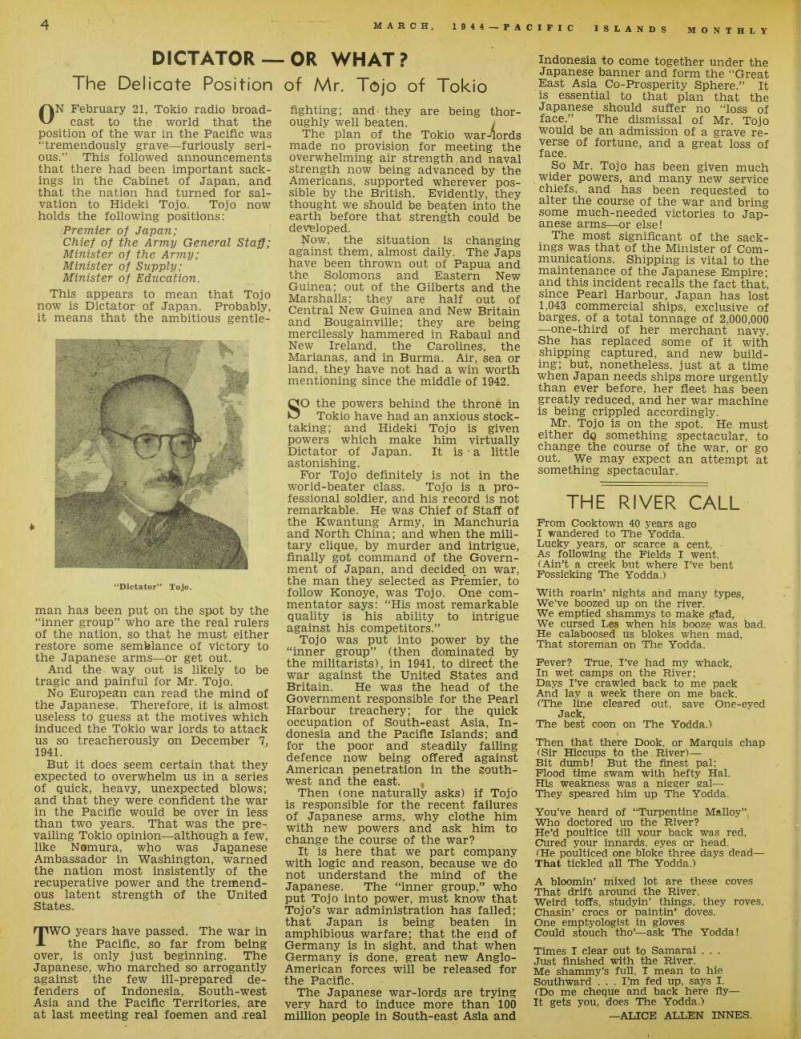
The Delicate Position of Mr. Tojo of Tokio
ON February 21, Tokio radio broad cast to the world that the position of the war in the Pacific was “tremendously grave—furiously seri ous.” This followed announcements that there had been important sack ings in the Cabinet of Japan, and that the nation had turned for sal vation to Hideki Tojo. Tojo now holds the following positions; Premier of Japan; Chief of the Army General Staff; Minister of the Army; Minister of Supply; Minister of Education.
This appears to mean that Tojo now is Dictator of Japan. Probably, it means that the ambitious gentle-
man has been put on the spot by the “inner group” who are the real rulers of the nation, so that he must either restore some semblance of victory to the Japanese arms—or get out.
And the way out is likely to be tragic and painful for Mr. Tojo.
No European can read the mind of the Japanese. Therefore, it is almost useless to guess at the motives which induced the Tokio war lords to attack us so treacherously on December 7, 1941.
But it does seem certain that they expected to overwhelm us in a series of quick, heavy, unexpected blows; and that they were confident the war in the Pacific would be over in less than two years. That was the pre vailing Tokio opinion—although a few, like Nomura, who was Japanese Ambassador in Washington, warned the nation most insistently of the recuperative power and the tremend ous latent strength of the United States.
TWO years have passed. The war in the Pacific, so far from being over, is only just beginning. The Japanese, who marched so arrogantly against the few ill-prepared de fenders of Indonesia, South-west Asia and the Pacific Territories, are at last meeting real foemen and Teal
fighting; and they are being thor oughly well beaten. / The plan of the Tokio war-lords made no provision for meeting the overwhelming air strength and naval strength now being advanced by the Americans, supported wherever pos sible by the British. Evidently, they thought we should be beaten into the earth before that strength could be developed.
Now, the situation is changing against them, almost daily. The Japs have been thrown out of Papua and the Solomons and Eastern New Guinea; out of the Gilberts and the Marshalls; they are half out of Central New Guinea and New Britain and Bougainville; they are being mercilessly hammered in Rabaul and New Ireland, the Carolines, the Marianas, and in Burma. Air, sea or land, they have not had a win worth mentioning since the middle of 1942.
SO the powers behind the throne in Tokio have had an anxious stock taking; and Hideki Tojo is given powers which make him virtually Dictator of Japan. It is • a little astonishing.
For Tojo definitely is not in the world-beater class. Tojo is a pro fessional soldier, and his record is not remarkable. He was Chief of Staff of the Kwantung Army, in Manchuria and North China; and when the mili tary clique, by murder and intrigue, finally got command of the Govern ment of Japan, and decided on war, the man they selected as Premier, to follow Konoye, was Tojo. One com mentator says: “His most remarkable quality is his ability to intrigue against his competitors.”
Tojo was put into power by the “inner group” (then dominated by the militarists), in 1941, to direct the war against the United States and Britain. He was the head of the Government responsible for the Pearl Harbour treachery; for the quick occupation of South-east Asia, In donesia and the Pacific Islands; and for the poor and steadily failing defence now being offered against American penetration in the south west and the east. * Then (one naturally asks) if Tojo is responsible for the recent failures of Japanese arms, why clothe him with new powers and ask him to change the course of the war?
It is here that we part company with logic and reason, because we do not understand the mind of the Japanese. The “inner group,” who put Tojo into power, must know that To jo’s war administration has failed; that Japan is being beaten in amphibious warfare; that the end of Germany is in sight, and that when Germany is done, great new Anglo- American forces will be released for the Pacific.
The Japanese war-lords are trying very hard to induce more than 100 million people in South-east Asia and
Indonesia to come together under the Japanese banner and form the “Great East Asia Co-Prosperity Sphere.” It is essential to that plan that the Japanese should suffer no “loss of face.” The dismissal of Mr. Tojo would be an admission of a grave re verse of fortune, and a great loss of face.
So Mr. Tojo has been given much wider powers, and many new service chiefs, and has been requested to alter the course of the war and bring some much-needed victories to Jap anese arms—or else!
The most significant of the sack ings was that of the Minister of Com munications. Shipping is vital to the maintenance of the Japanese Empire; and this incident recalls the fact that, since Pearl Harbour, Japan has lost 1,043 commercial ships, exclusive of barges, of a total tonnage of 2,000,000 —one-third of her merchant navy.
She has replaced some of it with shipping captured, and new build ing; but, nonetheless, just at a time when Japan needs ships more urgently than ever before, her fleet has been greatly reduced, and her war machine is being crippled accordingly.
Mr. Tojo is on the spot. He must either dq something spectacular, to change the course of the war, or go out. We may expect an attempt at something spectacular.
“Dictator” Tojo.
The River Call
From Cooktown 40 years ago I wandered to The Yodda.
Lucky years, or scarce a cent, As following the Fields I went. (Ain’t a creek but where I’ve bent Fossicking The Yodda.) With roarin’ nights and many types, We’ve boozed up on the river.
We emptied shammys to make glad, We cursed Les when his booze was bad.
He calaboosed us blokes when mad, That storeman on The Yodda.
Fever? True, I’ve had my whack, In wet camps on the River; Days I’ve crawled back to me pack And lay a week there on me back. (The line cleared out, save One-eyed Jack, The best coon on The Yodda.) Then that there Dook, or Marquis chap (Sir Hiccups to the River)— Bit dumb! But the finest pal; Flood time swam with hefty Hal.
His weakness was a nigger gal— They speared him up The Yodda.
You’ve heard of ‘'Turpentine Malloy”
Who doctored un the River?
He’d poultice till your back was red, Cured your innards, eyes or head. (He poulticed one bloke three days dead — That tickled all The Yodda.) A bloomin’ mixed lot are these coves That drift around the River.
Weird toffs, studyin’ things, they roves, Chasin’ crocs or paintin’ doves.
One emptyologist in gloves Could stouch tho’ —ask The Yodda!
Times I clear out to Samarai . , .
Just finished with the River.
Me shammy’s full, I mean to hie Southward . . . I’m fed up, says I. (Do me cheque and back here fly— It gets you, does The Yodda.)
Alice Allen Innes.
Employers Of Native
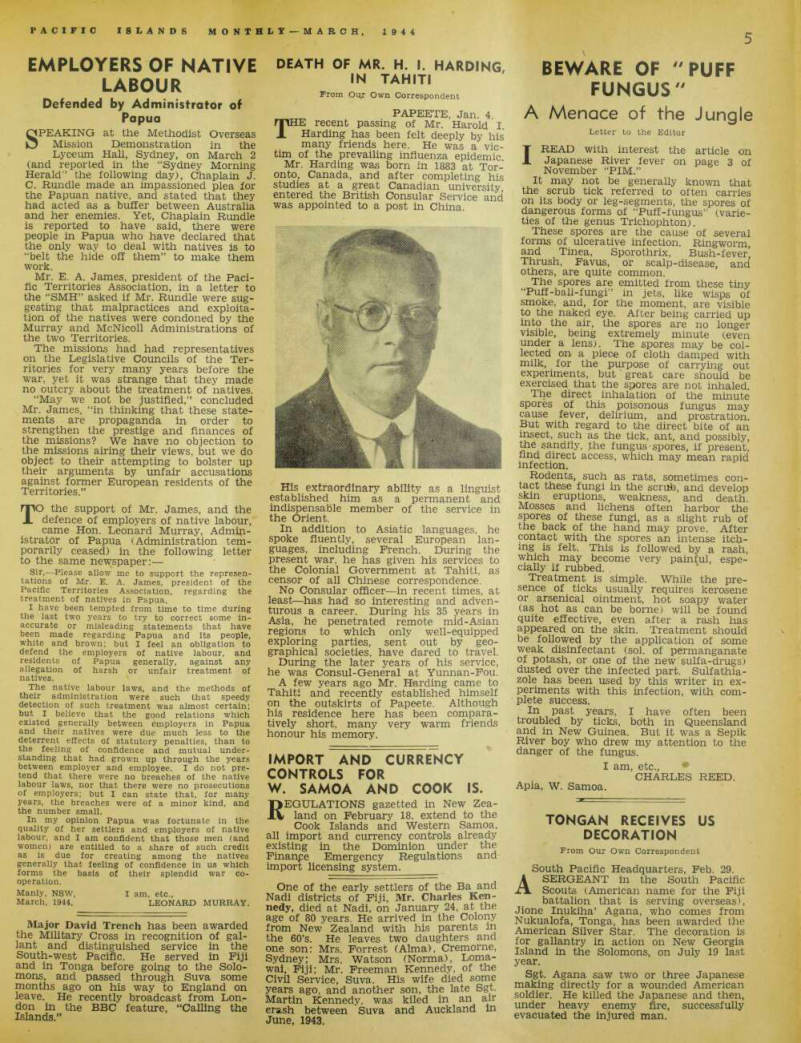
Labour
Defended by Administrator of Papua
SPEAKING at the Methodist Overseas Mission Demonstration in the Lyceum Hall, Sydney, on March 2 (and reported in the “Sydney Morning Herald” the following day), Chaplain J.
C. Rundle made an impassioned plea for the Papuan native, and stated that they had acted as a buffer between Australia and her enemies. Yet, Chaplain Rundle is reported to have said, there were people in Papua who have declared that the only way to deal with natives is to “belt the hide off them” to make them work.
Mr. E. A. James, president of the Paci fic Territories Association, in a letter to the “SMH” asked if Mr. Rundle were sug gesting that malpractices and exploita tion of the natives were condoned by the Murray and McNicoll Administrations of the two Territories.
The missions had had representatives on the Legislative Councils of the Ter ritories for very many years before the war, yet it was strange that they made no outcry about the treatment of natives.
“May we not be justified,” concluded Mr. James, “in thinking that these state ments are propaganda in order to strengthen the prestige and finances of the missions? We have no objection to the missions airing their views, but we do object to their attempting to bolster up their arguments by unfair accusations against former European residents of the Territories.” rpo the support of Mr. James, and the X defence of employers of native labour, came Hon. Leonard Murray, Admin istrator of Papua (Administration tem porarily ceased) in the following letter to the same newspaper;— Sir, —Please allow me to support the represen tations of Mr. E. A. James, president of the Pacific Territories Association, regarding the treatment of natives in Papua.
I have been tempted from time to time during the last two years to try to correct some in accurate or misleading statements that have been made regarding Papua and its people, white and brown; but I feel an obligation to defend the employers of native labour, and residents of Papua generally, against any allegation of harsh or unfair treatment of natives.
The native labour laws, and the methods of their administration were such that speedy detection of such treatment was almost certain; but I believe that the good relations which existed generally between employers in Papua and their natives were due much less to the deterrent effects of statutory penalties, than to the feeling of confidence and mutual under standing that had grown up through the years between employer and employee. I do not pre tend that there were no breaches of the native labour laws, nor that there were no prosecutions of employers; but I can state that, for many years, the breaches were of a minor kind, and the number small.
In my opinion Papua was fortunate in the quality of her settlers and employers of native labour, and I am confident that those men (and women) are entitled to a share of such credit as is due for creating among the natives generally that feeling of confidence in us which forms the basis of their splendid war co operation.
Manly, NSW, I am, etc.,
March, 1944. Leonard Murray.
Major David Trench has been awarded the Military Cross in recognition of gal lant and distinguished service in the South-west Pacific. He served in Fiji and in Tonga before going to the Solo mons, and passed through Suva some months ago on his way to England on leave. He recently broadcast from Lon don in the BBC feature, “Calling the Islands.”
Death Of Mr. H. I. Harding,
In Tahiti
From Our Own Correspondent
Papeete, Jan. 4
THE recent passing of Mr. Harold I X Harding has been felt deeply by his many friends here. He was a vic tim of the prevailing influenza epidemic Mr. Harding was born in 1883 at Tor onto, Canada, and after completing his studies at a great Canadian university entered the British Consular Service and was appointed to a post in China.
His extraordinary ability as a linguist established him as a permanent and indispensable member of the service in the Orient.
In addition to Asiatic languages, he spoke fluently, several European lan guages, including French. During the present war, he has given his services to the Colonial Government at Tahiti, as censor of all Chinese correspondence.
No Consular officer—in recent times, at least—has had so interesting and adven turous a career. During his 35 years in Asia, he penetrated remote mid-Asian regions to which only well-equipped exploring parties, sent out by geo graphical societies, have dared to travel.
During the later years of his service, he was Consul-General at Yunnan-Fou.
A few years ago Mr. Harding came to Tahiti and recently established himself on the outskirts of Papeete. Although his residence here has been compara tively short, many very warm friends honour his memory.
Import And Currency
Controls For
W. Samoa And Cook Is.
REGULATIONS gazetted in New Zea land on February 18, extend to the Cook Islands and Western Samoa, all import and currency controls already existing in the Dominion under the Finanpe Emergency Regulations and import licensing system.
One of the early settlers of the Ba and Nadi districts of Fiji, Mr. Charles Ken nedy, died at Nadi, on January 24, at the age of 80 years. He arrived in the Colony from New Zealand with his parents in the 60’s. He leaves two daughters and one son: Mrs. Forrest (Alma), Cremorne, Sydney; Mrs. Watson (Norma), Loma wal, Fiji; Mr. Freeman Kennedy, of the Civil Service, Suva. His wife died some years ago, and another son, the late Sgt.
Martin Kennedy, was kiled in an air crash between Suva and Auckland in June, 1943.
A Menace of the Jungle
Beware Of “ Puff
Fungus"
Letter to the Editor IREAD with interest the article on Japanese River fever on page 3 of November “PIM.”
It may not be generally known that the scrub tick referred to often carries on its body or leg-segments, the spores of dangerous forms of “Puff-fungus” (varie ties of the genus Trichophton).
These spores are the cause of several forms of ulcerative infection. Ringworm, and Tinea, Sporothrix, Bush-fever, Thrush, Favus, or scalp-disease, and others, are quite common.
The spores are emitted from these tiny “Puff-ball-fungi” in jets, like wisps of smoke, and, for the moment, are visible to the naked eye. After being carried up into the air, the spores are no longer visible, being extremely minute (even under a lens). The spores may be col lected on a piece of cloth damped with milk, for the purpose of carrying out experiments, but great care should be exercised that the spores are not inhaled.
The direct inhalation of the minute spores of this poisonous fungus may cause fever, delirium, and prostration.
But with regard to the direct bite of an insect, such as the tick, ant, and possibly, the sandfly, the fungus spores, if present, find direct access, which may mean rapid infection.
Rodents, such as rats, sometimes con tact these fungi in the scrub, and develop skin eruptions, weakness, and death.
Mosses and lichens often harbor the spores of these fungi, as a slight rub of the back of the hand may prove. After contact with the spores an intense itch ing is felt. This is followed by a rash, which may become very painful, espe cially if rubbed.
Treatment is simple. While the pre sence of ticks usually requires kerosene or arsenical ointment, hot soapy water (as hot as can be borne) will be found quite effective, even after a rash has appeared on the skin. Treatment should be followed by the application of some weak disinfectant (sol. of permanganate of potash, or one of the new sulfa-drugs) dusted over the infected part. Sulfathia zole has been used by this writer in ex periments with this infection, with com plete success.
In past years, I have often been troubled by ticks, both in Queensland and in New Guinea. But it was a Sepik River boy who drew my attention to the danger of the fungus.
I am, etc.,
Charles Reed.
Apia, W. Samoa.
Decoration
Tongan Receives Us
From Our Own Correspondent South Pacific Headquarters, Feb. 29.
A SERGEANT in the South Pacific Scouts (American name for the Fiji battalion that is serving overseas), Jione Inukiha’ Agana, who comes from Nukualofa, Tonga, has been awarded the American Silver Star. The decoration is for gallantry in action on New Georgia Island in the Solomons, on July 19 last year.
Sgt. Agana saw two or three Japanese making directly for a wounded American soldier. He killed the Japanese and then, under heavy enemy fire, successfully evacuated the injured man.
Advertisements & other items, p. 9 (1 item)
5
PACIFIC ISLANDS M O N T H L T M A R C H , 1944
New Guinea Missionaries Escape Japs
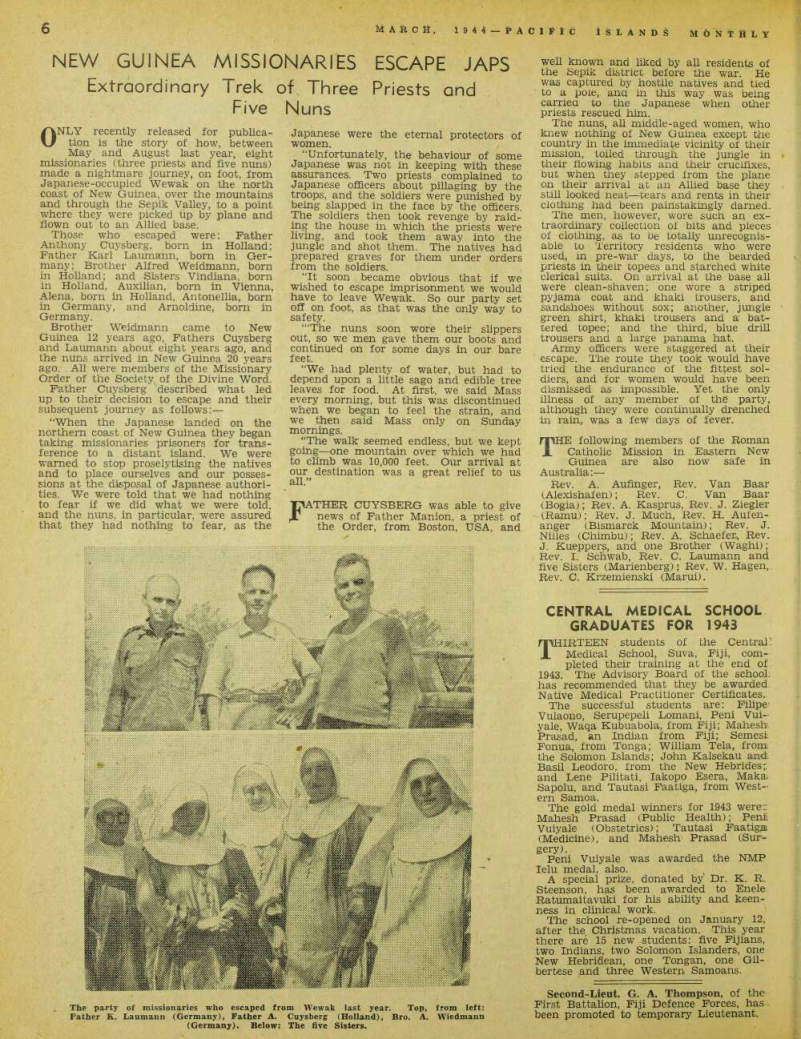
Extraordinary Trek of Three Priests and Five Nuns
ONLY recently released for publication is the story of how, between May and August last year, eight missionaries (three priests and five nuns) made a nightmare journey, on foot, from Japanese-occupied Wewak on the north coast of New Guinea, over the mountains and through the Sepik Valley, to a point where they were picked up by plane and flown out to an Allied base.
Those who escaped were: Father Anthony Cuysberg, born in Holland; Father Karl Laumann, born in Germany; Brother Alfred Weidmann, born in Holland; and Sisters Vindiana, born in Holland, Auxilian, born in Vienna, Alena, born in Holland, Antonellia, born in Germany, and Arnoldine, bom in Germany.
Brother Weidmann came to New Guinea 12 years ago, Fathers Cuysberg and Laumann about eight years ago, and the nuns arrived in New Guinea 20 years ago. All were members of the Missionary Order of the Society of the Divine Word.
Father Cuysberg described what led up to their decision to escape and their subsequent journey as follows: “When the Japanese landed on the northern coast of New Guinea they began taking missionaries prisoners for transference to a distant island. We were warned to stop proselytising the natives and to place ourselves and our possessions at the disposal of Japanese author!ties. We were told that we had nothing to fear if we did what we were told, and the nuns, in particular, were assured that they had nothing to fear, as the
Japanese were the eternal protectors of women.
“Unfortunately, the behaviour of some Japanese was not in keeping with these assurances. Two priests complained to Japanese officers about pillaging by the troops, and the soldiers were punished by being slapped in the face by the officers The soldiers then took revenge by raid ing the house in which the priests were living, and took them away into the jungle and shot them. The natives had prepared graves for them under orders from the soldiers.
“It soon became obvious that if we wished to escape imprisonment we would have to leave Wewak. So our party set off on foot, as that was the only way to safety.
“‘The nuns soon wore their slippers out, so we men gave them our boots and continued on for some days in our bare feet.
“We had plenty of water, but had to depend unon a little sago and edible tree leaves for food. At first, we said Mass every morning, but this was discontinued when we began to feel the strain, and we then said Mass only on Sunday mornings.
“The walk seemed endless, but we kept going—one mountain over which we had to climb was 10,000 feet. Our arrival at our „ destination was a great relief to us a ”*” 171ATHER CUYSBERG was able to give f? news of Father Manion, a priest of the Order, from Boston, USA, and
well known and liked by all residents of the Sepik district before the war. He was captured by hostile natives and tied to a pole, ana in this way was being carried to the Japanese when other priests rescued him.
The nuns, all middle-aged women, who knew nothing of New Guinea except the country in the immediate vicinity of their mission, toiled through the jungle in their flowing habits and their crucifixes, but when they stepped from the plane on their arrival at an Allied base they still looked neat—tears and rents in their clothing had been painstakingly darned„ The men, however, wore such an ex traordinary collection of bits and pieces of clothing, as to be totally unrecognis able to Territory residents who were used, in pre-war days, to the bearded priests in their topees and starched white clerical suits. On arrival at the base all were clean-shaven; one wore a striped pyjama coat and khaki trousers, and sandshoes without sox; another, jungle green shirt, khaki trousers and a bat tered topee; and the third, blue drill trousers and a large panama hat.
Army officers were staggered at their escape. The route they took would have tried the endurance of the fittest sol diers, and for women would have been dismissed as impossible. Yet the only illness of any member of the party, although they were continually drenched in rain, was a few days of fever. rE following members of the Roman Catholic Mission in Eastern New Guinea are also now safe in Australia: — Rev. A. Aufinger, Rev. Van Baar (Alexishafen); Rev. C. Van Baar (Bogia); Rev. A. Kasprus, Rev. J. Ziegler (Ramu); Rev. J. Much, Rev. H. Aufen anger (Bismarck Mountain); Rev. J.
Nilles (Chimbu); Rev. A. Schaefen, Rev.
J. Kueppers, and one Brother (Waghi); Rev. I. Schwab, Rev. C. Laumann and five Sisters (Marienberg); Rev. W. Hagen, Rev. C. Krzemienski (Marui).
The party of missionaries who escaped from Wewak last year. Top, from left: Father K. Laumann (Germany), Father A. Cuysberg (Holland), Bro. A. Wiedmann (Germany). Below: The five Sisters.
Central Medical School
Graduates For 1943
rIRTEEN students of the Central' Medical School, Suva, Fiji, com pleted their training at the end of 1943. The Advisory Board of the school, has recommended that they be awarded Native Medical Practitioner Certificates.
The successful students are: Pilipe Vulaono, Serupepeli Lomani, Peni Vui yale, Waqa Kubuabola, from Fiji; Mahesh Prasad, an Indian from Fiji; Semest Fonua, from Tonga; William Tela, from the Solomon Islands; John Kalsekau and.
Basil Leodoro, from the New Hebrides,-; and Lene Pilitati, lakopo Esera, Maka.
Sapolu, and Tautasi Faatiga, from West ern Samoa.
The gold medal winners for 1943 were"
Mahesh Prasad (Public Health); Penii Vuiyale (Obstetrics); Tautasi Faatiga (Medicine), and Mahesh Prasad (Sur gery).
Peni Vuiyale was awarded the NMP lelu medal, also.
A special prize, donated by Dr. K. R.
Steenson, has been awarded to Enele Ratumaitavuki for his ability and keen ness in clinical work.
The school re-opened on January 12, after the Christmas vacation. This year there are 15 new students; five Fijians, two Indians, two Solomon Islanders, one New Hebridean, one Tongan, one Gil bertese and three Western Samoans.
Second-Lieut. G. A. Thompson, of the First Battalion, Fiji Defence Forces, has been promoted to temporary Lieutenant.
New Monetary
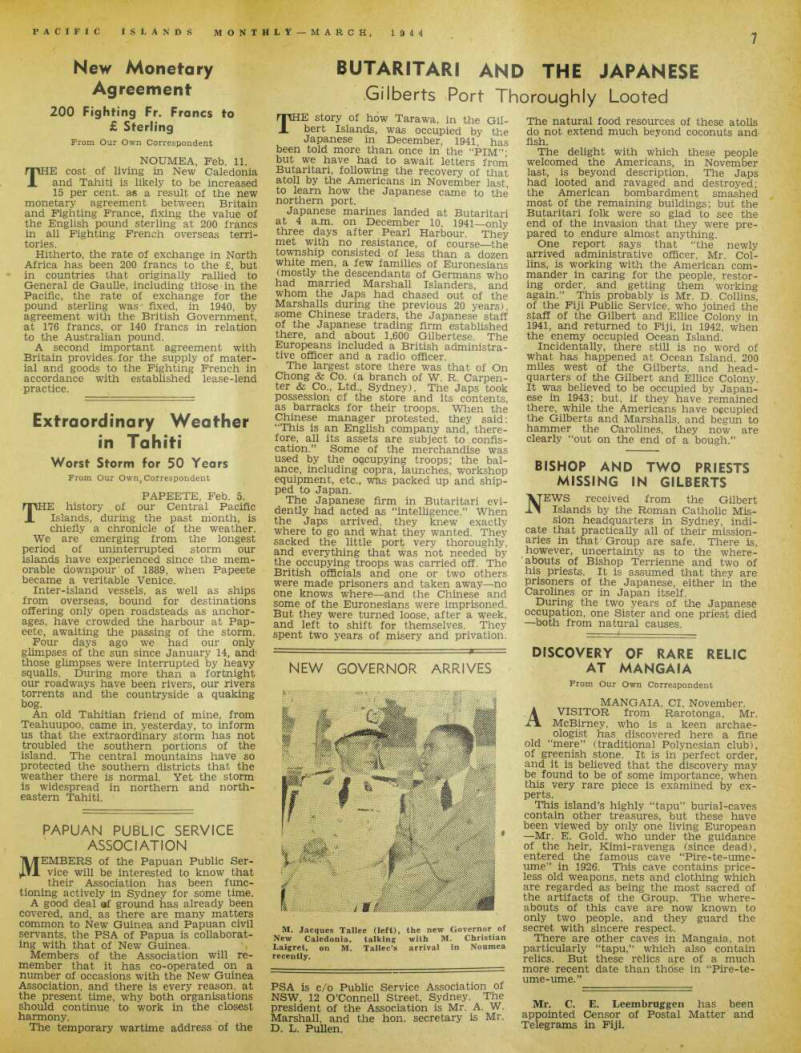
Agreement 200 Fighting Fr. Francs to £ Sterling
From Our Own Correspondent
Noumea, Feb. 11.
rE cost ,of living in New Caledonia and Tahiti is likely to be increased 15 per cent, as a result of the new monetary agreement between Britain and Fighting France, fixing the value of the English pound sterling at 200 francs in all Fighting French overseas terri tories.
Hitherto, the rate of exchange in North Africa has been 200 francs to the £, but in countries that originally rallied to General de Gaulle, including those in the Pacific, the rate of exchange for the pound sterling was- fixed, in 1940, by agreement with the British Government, at 176 francs, or 140 francs in relation to the Australian pound.
A second important agreement with Britain provides for the supply of mater ial and goods to the Fighting French in accordance with established lease-lend practice.
Extraordinary Weather
in Tahiti Worst Storm for 50 Years
From Our Own, Correspondent
Papeete, Feb. 5.
rE history of our Central Pacific Islands, during the past month, is chiefly a chronicle of the weather.
We are emerging from the longest period of uninterrupted storm our islands have experienced since the mem orable downpour of 1889, when Papeete became a veritable Venice.
Inter-island vessels, as well as ships from overseas, bound for destinations offering only open roadsteads as anchor ages, have crowded the harbour at Pap eete, awaiting the passing of the storm.
Four days ago we had our only glimpses of the sun since January 14, and' those glimpses were interrupted by heavy squalls. During more than a fortnight our roadways have been rivers, our rivers torrents and the countryside a quaking bog.
An old Tahitian friend of mine, from Teahuupoo, came in, yesterday, to inform us that the extraordinary storm has not troubled the southern portions of the island. The central mountains have so protected the southern districts that the weather there is normal. Yet the storm is widespread in northern and north eastern Tahiti.
Papuan Public Service
Association
MEMBERS of the Papuan Public Ser vice will be interested to know that their Association has been func tioning actively in Sydney for some time, A good deal of ground has already been covered, and, as there are many matters common to New Guinea and Papuan civil servants, the PSA of Papua is collaborat ing with that of New Guinea.
Members of the Association will re member that it has co-operated on a number of occasions with the New Guinea Association, and there is every reason, at the present time, why both organisations should continue to work in the closest harmony.
The temporary wartime address of the
PSA is c/o Public Service Association of NSW. 12 O’Connell Street, Sydney. The president of the Association is Mr. A. W.
Marshall, and the hon. secretary is Mr.
D. L. Pullen.
Gilberts Port Thoroughly Looted
Butaritari And The Japanese
rE story of how Tarawa, in the Gil bert Islands, was occupied by the Japanese in December, 1941, has been told more than once in the “PIM”but we have had to await letters from Butaritari, following the recovery of that atoll by the Americans in November last to learn how the Japanese came to the northern port.
Japanese marines landed at Butaritari at 4 a.m. on December 10, 1941—only three days after Pearl Harbour. They met with no resistance, of course—the township consisted of less than a dozen white men, a few families of Euronesians (mostly the descendants of Germans who had married Marshall Islanders, and whom the Japs had chased out of the Marshalls during the previous 20 years) some Chinese traders, the Japanese staff of the Japanese trading firm established there, and about 1,600 Gilbertese. The Europeans included a British administra tive officer and a radio officer.
The largest store there was that of On Chong & Co. (a branch of W. R. Carpen ter & Co., Ltd., Sydney). The Japs took possession of the store and its contents, as barracks for their troops. When the Chinese manager protested, they said: “This is an English company and, there fore, all its assets are subject to confis cation.” Some of the merchandise was used by the occupying troops; the bal ance, including copra, launches, workshop equipment, etc., was packed up and ship ped to Japan.
The Japanese firm in Butaritari evi dently had acted as “intelligence.” When the Japs arrived, they knew exactly where to go and what they wanted. They sacked the little port very thoroughly, and everything that was not needed by the occupying troops was carried off. The British officials and one or two others were made prisoners and taken away—no one knows where—and the Chinese and some of the Euronesians were imprisoned.
But they were turned loose, after a week, and left to shift for themselves. They spent two years of misery and privation.
The natural food resources of these atolls do not extend much beyond coconuts and fish.
The delight with which these people welcomed the Americans, in November last, is beyond description. The Japs had looted and ravaged and destroyed; the American bombardment smashed most of the remaining buildings; but the Butaritari folk were so glad to see the end of the invasion that they were pre pared to endure almost anything.
One report says that “the newly arrived administrative officer, Mr. Col lins, is working with the American com mander in caring for the people, restor ing order, and getting them working again.” This probably is Mr. D. Collins, of the Fiji Public Service, who joined the staff of the Gilbert and Ellice Colony in 1941, and returned to Fiji, in 1942, when the enemy occupied Ocean Island.
Incidentally, there still is no word of what has happened at Ocean Island, 200 miles west of the Gilberts, and head quarters of the Gilbert and Ellice Colony.
It was believed to be occupied by Japan ese in 1943; but, if they have remained there, while the Americans have occupied the Gilberts and Marshalls, and begun to hammer the Carolines, they now are clearly “out on the end of a bough.”
Bishop And Two Priests
Missing In Gilberts
NEWS received from the Gilbert Islands by the Roman Catholic Mis sion headquarters in Sydney, indi cate that practically all of their mission aries in that Group are safe. There is, however, uncertainty as to the where abouts of Bishop Terrienne and two of his priests. It is assumed that they are prisoners of the Japanese, either in the Carolines or in Japan itself.
During the two years of the Japanese occupation, one Sister and one priest died —both from natural causes.
Advertisements & other items, p. 11 (1 item)
New Governor Arrives
M. Jacques Tallec (left), the new Governor of New Caledonia, talking with M. Christian Laigret, on M. Tallec’s arrival in Noumea recently.
Discovery Of Rare Relic
At Mangaia
Prom Our Own Correspondent AMANGAIA, Cl, November.
VISITOR from Rarotonga, Mr.
Mcßirney, who is a keen archae ologist has discovered here a fine old “mere” (traditional Polynesian club), of greenish stone. It is in perfect order, and it is believed that the discovery may be found to be of some importance, when this very rare piece is examined by ex perts.
This island’s highly “tapu” burial-caves contain other treasures, but these have been viewed by only one living European —Mr. E. Gold, who under the guidance of the heir, Kimi-ravenga (since dead), entered the famous cave “Pire-te-ume ume” in 1926. This cave contains price less old weapons, nets and clothing which are regarded as being the most sacred of the artifacts of the Group. The where abouts of this cave are now known to only two people, and they guard the secret with sincere respect.
There are other caves in Mangaia, not particularly “tapu,” which also contain relics. But these relics are of a much more recent date than those in “Pire-te ume-ume.”
Mr. C. E. Leembruggen has been appointed Censor of Postal Matter and Telegrams in Fiji.
Lambeti-How A Solomons Planter
Returned Home
J-lERE is a despatch probably unique in the Pacific War. The owner of a Pacific plantation, who happens to be a skilled writer, was with tne American forces when they attacked and threw out the Japs. He watched his plantation being freed from the invaders — and he saw it, in the freeing, blown to pieces.
The writer is Mr. Leslie F. Gill, owner of famous Lambeti Plantation, once one of the show places of Roviana Lagoon, in Hew Georgia, British Solomons. When the Japs, in August-0 ctober, 1942, were thrown out of Guadalcanal, they immediately built up a new base, with a good airfield, at Munda, at the northern end of Roviana Lagoon. They seized the Methodist Mission station there, and Lambeti Plantation, alongside ; and there, and in the hills immediately behind, they constructed innumerable fortifications.
The Americans beat them by seizing Rendova Island, lying some five miles off the coast, opposite Munda and Lambeti.
Mr. Gill was with them when they landed on Rendova. It took many weeks to clear the enemy out of the maze of islands of which Munda was the centre, and Mr. Gill witnessed much of the fighting.
In this article, written for the “PIM he vividly describes some of his early impressions. mHE days following the landing on A Rendova of the American Army come back to me as memories of men, guns and transport toihng gigantically in an ocean of mud, It rained until the coconut plantation became a quagmire, and the road a horror. The heavy guns went through, followed by the loaded ten-wheel trucks.
Then the road ceased to exist.
Ruts became chasms, along the edges of which the Jeeps crawled and pushed with their bellies on the mud. It rained.
The Jeeps bogged at last and were pulled by cats.—then only the cats, (caterpillars) could move.
More rain. For hours even the cats. could not claw their way through the mud. By some miracle, which only those supermen of the Seabees and the Artillery can explain, the 155’s had been lugged into position, and commenced barking at Munda and Lambeti, seven miles away. x , We camped, and dug our foxholes in the slush. Jungle troops, laden like packhorses with sodden equipment, awaiting their turn to go into the line, filled the area. No cover for them. They just scratched shallow, inadequate foxholes and lay down in the mud and the rain, Rendova then was the answer to an air bomber’s prayer—a small harbour stuffed with shipping, and beached LST’s pouring men and supplies into a small, congested area—surmounted by heavy artillery. A bomb dropped anywhere must surely hit something. How the Japs hated those 155’s! And how they went after them!
Day and night they raided. The alert would go—sometimes it didn’t, and we would be caught with our pants down, and would dive for our foxholes. Overhead would be heard the unsynchronised engine drone of the Jap planes, while we dug our noses and toes into the bottom of our foxholes and held our breaths.
Then it started. With the noise of a thunderclap, the first bomb exploded near us—growing to a shattering crescendo of hideous scrunching, as plane after plane peeled off and added its “stick” to the pattern of bombs that was rocking us.
From the islets and ships and from the whole area our flak roared into the
sky. The ground shuddered and shook with the monstrous reverberations of the bombs. The air palpitated with the pro digious pulsation of our flak. It was Hell.
We sweated and quivered in our fox holes. Pattern bombing or strafing as they went, the enemy planes swept along the plantation, out to sea, turned, came back, repeating it all again.
Suddenly, silence. Followed by the sweet, silken swish of American fight ers’ engines as they swept in to our res cue. Blessed sound. Relief unutterable!
We breathed again.
Shakily we emerged to see a gigantic black pall of smoke rapidly filling the sky, and to hear a long continued crackle of explosions. Three great fires had been started in dumps of fuel, stores and ammunition. Then, grimmest and sad dest of all sights, came the wounded and dead, carried or helped by their com rades.
After one such raid our area was a shambles. Twenty killed and 100 wounded.
But through it all —raid after raid —the troops carried on, and the “heavies” con tinued to pound Munda and Lambeti from indomitable Rendova.
ANIGHT air raid is a beautiful sight when the long, 'silver fingers of the searchlights are interwoven with the bewitching patterns of the flak’s coloured tracers across the dark sky. But a night naval bombardment excells all as a magnificent spectacle. Its transcendent power and terrible beauty is War at its loveliest. Multi-coloured lights and gor geous streamers arch across the black sky from unseen warships. Thunderous detonations roll across the water as the guns of the fleet open their throats out there in the darkness.
Coloured star-shells burst in the air and spread an effulgent beauty in the sky. The black void of night is canopied and laced with streaming shells and tracers speeding on their rainbow-col oured way from the blooming rosettes at the mouths of the guns. Mighty explo sions shake the shore, and sheets of flames illumine the area where the shells are bursting. The earth, sea and sky are ablaze with a terrible grandeur of colour, and athrob and shuddering with the gigantic thud of the guns.
Suddenly, the show is over. The lights go out. Somewhere out there in the darkness great phantom shapes alter course, gather speed, and leave. The -naval task force has completed its mission.
MUNDA suffered several such bom bardments. In addition, it was pounded night and day for a month from Rendova by heavy artillery—the 155’s, For months of “softening,” Ameri can bombers had had the area on an almost-daily bombing schedule. Munda • was tough.
Finally, the American Air Forces really turned on the heat. From Rendova could be heard the prolonged scrunch of burst ing bombs, day after day, as the great fleets of bombers carried out their strikes on “the most bombed area in the Pacific.”
Over 500 tons of bombs fell on Lam beti in less than a week. Then the Navy took a hand, and poured 5,000 shells into 500 square yards of my Lambeti planta tion. Even then the ground forces had to employ tanks, flame-throwers, mortars, and hand grenades before they could capture that strpngpost.
My feelings may be imagined as I listened and looked towards lovely Lam beti, and realised that my beloved home was being annihilated. Thus I came home —to dust and ashes. I brought with
me liberation, death, and destruction.
Lambeti is no more!
WHEN the history of this war is writ ten it will probably be said that the Japanese made a major mistake in not holding Rendova in force, thereby denying the American forces a vantage point from which to shell Munda, a valu able harbour in which to land men, stores and equipment, and also a beach head from which to deploy troops for the attack on the airfield. Tough and pro longed as the Munda operations unex pectedly proved to be, the task might have proved impossible had Rendova been as strongly held as Munda.
Fortunately for us, only an outpost of about 120 Japs held Rendova island and harbour—with no fortifications, installa tions or artillery whatsoever.
Properly equipped and garrisoned, I consider the Kolombangara-Munda-Ren dova set-up could have been an impreg nable fortress. Snugly tucked away behind, and protected by the southward seaward maze of reefs of the Roviana Lagoon, the Munda airfield was safe from a frontal landing from the sea. Rendova guards the only sea approach from the east, Kolombangara that from the west— leaving only the long approach from the north coast across the highest mountains of the widest part of New Georgia open to land forces. Fortify those northern approaches—a simple task —and Munda is virtually impregnable.
Mr. F. R. Charlton, Director of Lands, Mines and Surveys in Fiji since 1935, resigned from active duty at the end of January. He came to Fiji in 1921 and during his period of service in the Colony has been at various times a member of the Suva Town Board and the Central Board of Health. He was chairman of the Town Planning Board and a mem ber of the 1936 Public Service Re-organi sation and Revision Committee. Ap pointed Commissioner of Lands in 1935, the title of the office was subsequently changed to Director of Lands, Mines and Surveys. Mr. W. H. B. Buckhurst now succeeds him as Director.
Mentioned In Despatches
Lientenant K. G. Fuller, formerly of Tonga, where his father was Government surveyor for 22 years, now of the AIF, has been mentioned in despatches for rendering gallant and distin guished service in the South-west Pacific area.
Decoration For
Governor-Elect
But Still Has Not Arrived in N. Caledonia
From Our Own Correspondent
Noumea, Feb. 4.
rE recently-appointed Governor of New Caledonia. M. Jaques Tallec, the date of whose arrival in the Colony is still unknown, has been awarded the French Medaille de la Resistance with the following citation published in Algiers:— “Animated with an ardent spirit of patriotism, he took a leading part in the movement in Syria for resisting the armistice with Germany. Dismissed from office when the local authorities rallied to the Vichy Government, he was expelled to France, separated from his family and placed under close police sur veillance. He succeeded in escaping from France in 1942 in the face of innumer able difficulties, and placed himself at the disposition of the Free French Forces.”
M. Tallec’s military rank is that of Chef de Batallion.
In a radiogram to the president of the local Administrative Council, the Commissaire des Colonies at Algiers. M.
Pleven, promises that Governor Tallec “will continue the policy of confident and fruitful collaboration with the Adminis trative Council, that has been adopted by M. Laigret. whose work I much appre ciate for the happy manner in which he has conducted the mission entrusted to him.” [ED. NOTE.—M. Tallec has since arrived in New Caledonia.]
What Was The Meaning
Of This Flag?
Letter to the Editor COULD any New Guinea reader en lighten me on the following matter: On November 26, 1884, I left Port Moresby by HBMS “Swinger” for New castle. on board I passed the house (a hut erected on posts on the water-edge) of Boi-Vagf, who had been appointed King of the Port Moresby tribe by the Deputy Commissioner, Mr. Rom illy, on the Rev. Chalmers’ recommenda r tion, and noticed that on Boi-Vagi’s hut was a small flagpole attached to which a flae was flying.
The flag was blue with a white square on the upper part near the pole and in this white square was a bird of paradise of a brown colour.
Was this flag an official flag (Royal Standard), or just a recognition of Boi- Vagi’s position?
Some old Port Moresby residents might be able to trace this affair. I have only this note about it in my day-book, which I came across recently.
I am, etc.,
F. T. Goedicke.
Lotofoa, Haapai, Tonga. 21/1/44.
Mr. J. A. Kirpal, of Suva, Fiji, formerly managing clerk to Messrs. Hasan and Hasan, barristers and» solicitors, who is at present in New Zealand, has joined the Auckland University College with a view to qualifying for the Bar.
Mr. R. Crompton, CBE, KC, has been appointed chairman of the Fiji National Arbitration Tribunal, in place of Mr. E.
E. Jenkins (Attorney-General).
Evacuees Are “Befogged”
Pacific Territories Assn. Discusses Commonwealth Reoccupation Proposals
SMALL as was the Territorian’s voice in the administration of either of the two New Guinea Territories before the war, indications were that it would be a “thundering sight less” in the post-war set-up apparently being consid ered by the Commonwealth Government.
This view was expressed by Mr. E. A.
James at the quarterly meeting of the Pacific Territories Association in Sydney, on March 14, when, as president, he dis cussed the Government’s proposals for the civil reoccupation of the Territories. (The text of these proposals and the machinery set up to govern the Terri tories appears on page 3 of this issue.) In Mr. James’s opinion, the Common wealth was preparing to hand the administration of the Territories, lock, stock and barrel, now and forever, over to the External Territories Department.
When the Commonwealth’s proposals were published in the Press on February 23. the PTA immediately telegraphed Mr.
Ward, asking for fuller details. Mr.
Ward’s reply confused rather than threw any light on the subject, and consisted mainly in a reiteration ,of the Press release given by Mr. Curtin on February 22.
The PTA Executive confesses to being “befogged” and therefore advises all members who are desirous of returning to the Territory of Papua to make appli cation immediately, and. if possible, to acquaint the PTA of the replies they receive, as this appears to be the only way of ascertaining who are considered by the Commonwealth to have “essential” work to do in the Territory.
Regarding the return of womenfolk, a letter has already been forwarded to the Minister asking that further considera tion be given to this matter at the earliest opportunity.
The Executive has requested also that the earliest possible consideration be given to the re-introduction of civil administration to the Territory of Papua and other places as they lose their status as operational areas.
The Government’s proposals were dis cussed at length—and. with heat—by the large meeting, particularly with regard to the “conclusions” reached by the Com mander-in-Chief, Sir Thomas Blarney, and the Standing Sub-committee, that although female missionary teachers were to be allowed to return to the Territory, other females, including wives of plant ers, were not.
Mr. R. A. Laws asked if it were more important to educate natives than it was for planters and others to have the care and help of their wives? Mr. J. C. Mullaly proposed that the meeting express to the Commonwealth Government its thorough disapproval of its recent decision to allow class-distinction in the return of females to the Territory, and considers that it is quite improper that any dif ferentiation between various sections of residents of the Territories should be made in the granting of approval to return, and that such approval should be granted on the merits of each appli cation, irrespective of the section of the community to Which the applicant belongs.
This motion was seconded by Mr. G.
Bellamy and supported by Mr. C. I. H.
Campbell, who said that women had proved themselves worthy of taking their place alongside their men and that their
return would have a most wholesome effect on the natives.
The motion was carried unanimously.
OTHER matters dealt with in the Executive’s report, submitted by Mr. C. A. M. Adeskold, were as follows: —
Mining Sub-Committee
The Mining Sub-Committee has held a number of meetings since it was ap pointed to look after the interests of the mining community of the Territories. As a .result of such meetings proposals in regard to the sending forward of a main tenance unit to the Territories, in order •to preserve and save as much as possible of the assets, has been placed before the Minister of External Territories, and we now await his advice.
War Damage Insurance
Following on inquiries regarding the insurance of trees, your Executive on the 25th January, 1944, circularised all plan tation owners whose addresses could be ascertained, advising them to insure their trees for the current period at the reduced rate of 2/- per centum. In tak ing this action your Executive took into consideration the possibility of consider able damage when invasion and land operations took place. Inquiries made showed that these operations would cause much greater damage than bombing.
Regarding amendments to the regu lations which your Executive recom mended to the Federal Treasurer, a reply has been received agreeing to some of such amendments, but unfortunately one of the most important—the insurance of plantation boats —has not been agreed to and the Minister for Territories has been requested to again take up this matter with Mr. Chifley.
A new ruling has been given on the question of cattle. Previously, the regu lation allowed for payment only when it could be proved that the cattle were killed; now it is defined that “if live stock is removed by the enemy and not recovered, total loss can be presumed, and it would be so treated under the scheme.
The same conditions apply to livestock removed to prevent it falling into the hands of the enemy.”
Internees
Your Executive has continued in its efforts to obtain certain privileges for civilian internees and their dependants, but to date no definite reply has been received from the Government. In this connection we have requested all affiliated bodies and the New Guinea Branch of the RSSAILA to also take up the matter.
This has been done, and we hope by con centrated attack that we may be able to obtain a decision in the near future.
Custodian Of Expropriated
Properties
The position of plantation owners, who are purchasing their properties from the Custodian, in regard to War Damage In surance claims has exercised the minds of your Executive, and it has attempted to obtain from the Custodian a statement defining his attitude, but up to date this has not been obtained. Under the War Damage to Property Regulations all charges against insured property must be noted, and we contend that if the Custodian intends to exercise his rights he should be prepared to pay his pro portion of the contribution.
(Continued on Page 39)
Copra Payments
We have made representations to the Department of External Territories and the Treasurer that portion of the assessed amount of War Damage Insurance on copra insured by the Copra Pool be made available to the owners, and we have now received advice that a decision may be expected at an early date.
Mobile Unit
We have found it impossible to obtain the attendance of a majority of the com mittee elected at the last quarterly meet ing to investigate the proposals for the formation of a Mobile Unit for native welfare. This matter will again be brought up for direction.
Production Control Board
Efforts are still being made to have representatives of the producers ap pointed to the Board and, whilst the Minister expressed his agreement with the principle of such representation, at our delegation on December 2nd, 1943, to date we have not succeeded in over coming the prejudice which appears to exist in other quarters to any represen tation of other than Government Depart ments, and from a communication, dated the Ist March, received from the Minister, it appears that the Government are not desirous of agreeing to such represen tation. Your Executive will, however, continue its efforts in this direction.
With regard to the prices paid by the
Board for produce from plantations, every effort is being made to obtain from the authorities all information as to the computing of the nett FOB plantation prices as compared with the market price by the Allied Nations control, and from information received by telegram from Canberra, these' particulars should be available at any moment and will then be fully investigated by your Executive.
In regard to the prices charged for stores, your Executive arranged some time ago for publicity in this matter through the medium of “Smith’s Weekly,” and one particular item objected to, namely, wheatenmeal, has been reduced from sd. per lb. to 3d. per lb., a fall of £l6/3/4 per ton. That such a reduction was possible does not reflect too highly on the administration of the selling department.
Affiliations
Your Executive has to report that Sydney, Brisbane and Adelaide Women’s Associations have completed their affilia tions, whilst Melbourne Association, it is anticipated, will complete affiliations within a few weeks. We have received
advice that the Country Women’s Associa tion constitution will not allow of the affiliation of their New Guinea Branch with the PTA.
Executive Changes
It is with very deep regret that we record the death of Mr.' J. R. Clay, who has been an Executive member since the inception of the Association. The Exe
cutive has not yet appointed any member to replace him as Papuan commercial
representative.
Since the last meeting, Mr. H. Taylour has tendered his resignation from the
Executive owing to his present employ
ment taking him away from Sydney the greater part of his time, and we have,
therefore, appointed Mr. G. Bellamy to
fill the vacancy caused—that of New
Guinea mining representative.
Other Business
THE recommendations made by the
Mining Subcommittee, which have
been submitted to the Minister, Mr.
Ward, were read to the meeting, as follows: L—The personnel of the unit to consist of a minimum of six men preferably to be nominated by the Pacific Territories Association and at least 50 per cent, of these are to be chosen from nominations of the above Association. The Association undertakes to nominate men with the necessary New Guinea experience and abilities to fit them to carry out the duties hereafter outlined. They would be selected from men above military age and as far as practicable from men not employed in reserve occupations. 2.—The duties of the unit would be to act as custodians of present plant, equipment and property, to visit all mining properties where required so to do by either the owner or other interested persons, to advise and recommend remedial steps necessary to prevent further loss of assets and the extent and probable cost of salvage operations. To take immediate steps, where necessary, to minimise weather and other damage, to protect plant, etc., from the elements, improper use, looting and vandalism. At the request of the owners, and/or the War Damage Commission, to carry out such preliminary salvage and repair work as required. 3.—ln the nomination of the personnel every endeavour will be made to include persons with intimate knowledge of all properties such as, Edie Creek, Wau, Black Cat, Sandy Creek, The Bulolo, Sunshine, Upper and Lower Watut, Misima, Sapphire Creek. 4. —The War Damage Commission to be ap proached to send representatives forward with the unit with full power to approve, or other wise, proposals put forward by the urfit for salvage and protective operations, etc. s.—To carry on the work of erecting suitable shelters for the rehabilitation of the white population, and particularly the reconstruction of the sawmill and timber working plants for the purpose of providing timber necessary for the housing of the European population. 6.—Tp report to owners as to the condition of then: properties, obtaining in advance par ticulars of replacements which will be required when peacetime conditions obtain, so that property owners will be able to resume activities with a minimum of delay and thereby provide immediate employment for many Australians. 7. —To take such steps as are possible for the planting of native foodstuffs and generally to
prepare for the return of the indentured labourers. 8- That the centre of operations of the pro posed unit will be at Wau and the unit will generally provide a service to the owners giving full information as to the state of their pro perties and generally act as their agents when requested so to do, to do all things possible to prepare in advance for the return of the population.
With regard to the request for infor mation relating to the price of copra paid to the plantation owners in Papua, made to the Department of External Territories by the PTA on January 10, a letter, dated March 11, was received from the Secre tary of the Department, Mr. J. R. Halli gan. The letter was submitted to the meeting. Relevant extracts are as follows: The Minister fixed the following price for copra to be purchased from plantations in Papua:— Hot Air—good quality . £l5/10/- per ton Sun Dried £l5/-/- „ „ Smoke Dried £l4/10/- „ (All subject to reclamation.) These were tentative prices fixed for 3 months from July 1, 1943. The prices have since been revised and have been fixed:— Hot Air and Sun Dried .. .. £lB/10/- Smoke Dried £l7/-/- These prices are final for period ending September 30, 1943, and tentative thereafter.
These prices will be reviewed from time to time having regard for changing circumstances and costs.
These prices are paid to plantation owners at usual plantation port of shipment or on plan tation where no coastal shipment is involved.
All copra coming into Australia is under Government control and price thereof is fixed by the controlling authorities.
The price paid to this Department for copra from Papua is £2B for Hot Air and Sun Dried, and £27 for Smoke Dried.
Similar conditions relate to the purchase of rubber.
From July 1, for three months, the tentative price was:— No. 1 Grade 1/5 per pound No. 2 Grade 1/4 „ No. 3 Grade .. 1/2 „ The following were the final prices fixed for the quarter ending September 30, 1943, and tentative thereafter:— No. 1 Grade .. l/6y 2 per pound No. 2 Grade .. l/SVss No. 3 Grade .. 1/3 V 2 Inferior .. .. 10y 2 to l/2y 2 „ Prices at which the rubber is now sold ex bond in Australia are:— No. 1 Grade .. .. 1/11 per pound No. 2 Grade .. .. 1/10 No. 3 Grade ... 1/8 Inferior 1/3 to 1/7 „ „
Discussion
rERE was some discussion on the Production Control Board. Mr.
James stated that the PTA origin ally proposed to the Minister for Exter nal Territories that the Production Con trol Board should consist of the GOC New Guinea Forces and three nominees of the producers. In actual fact, the Board consisted of one military officer — Brigadier Cleland (who incidentally was all that could be desired in such a posi tion) —and two Army officers, appointed by the External Territories Department.
These are on leave without pay but are subject to military discipline. A third member has not been appointed, as this apparently is considered unnecessary.
When a PTA delegation met Mr. Ward in December, the matter of having a producers’ representative on the Board was taken up with him, and he appeared to be sympathetic. Since that time, how ever. a letter has been received from the Minister, in which he states that this request cannot be granted. Mr. Tom Nevitt, a returned planter, has been co-opted to the Board but as far as can be ascertained he is not always invited to sit at meetings, his advice is rarely asked, and when given, it is not given much consideration. He then can scarcely be called a representative of the pro ducers.
A motion was moved by Mr. C. I. H.
Campbell, seconded by Mr. Mullaly, that: The strongest possible protest be made to the Government at the con tinual refusal of the Commonwealth authorities to appoint a representative of the producers to the ANGAU Produc tion Control Board —particularly in view of the Board’s far-reaching powers over industry in the Territories.
The motion was carried.
With regard to the refusal of the Com monwealth to pay rent or compensation on property taken over by the military authorities, or on gold handed over to the authorities by the miners on their evacuation and subsequently lost, Mr.
James stated that the PTA was wait ing legal opinion of their position. The meeting resolved that when such opinion was forthcoming, the Executive of the Association should have the power to act as it thought fit.
The motion put to the meeting that the committee elected to go into the mat ter of the mobile canteen for native wel fare, should be called again, was defeated.
The New Caledonian Administrative Council recently reduced the budget estimates for 1944 to 99,250,000 francs —a sum 2,227,000 francs less than the esti mates proposed by the Administration.
Death Of Mr. O. F. Nelson
Mau Leader Who Fought NZ Officialdom For 15 Years
NEWS of the death of Mr. O. F. Nelson, of Samoa, on February 21, though not unexpected, was received throughout the South Pacific with genuine regret. Mr. Nelson was the leader of the Mau (Samoan National Movement); and, if he had made errors, he also had made great personal sacrifices for the cause in which he believed, and he never ceased to fight for the Samoans against what he regarded as oppression.
“Fred” Nelson, as he was generally known, was the son of a Swedish sea captain and a Samoan lady a woman of chiefly rank. Although he grew up and was educated as a Euro pean, his attach ment to the Samoans, through his mother’s family, was very strong.
He was born in 1884, and therefore all his young and formative years were spent under the Ger man regime", which terminated with the occupation of Samoa by New Zealand
troops in 1914. He knew three languages —German, English and Samoan—and when the New Zealand administration took over in 1920, he was a prominent member of both the European and Samoan communities. He also was one of the richest men in the South Seas.
During World War I, and for some years afterwards, copra boomed, and Nelson proved himself a shrewd trader and manager. The war had killed the German firms, and O. F. Nelson & Co., Ltd., stepped quickly into the vacant field.
The firm opened branches or established traders in every Samoan village; and its enterprise and activity, combined with the popularity of Nelson himself among the natives, gave it almost a monopoly of native trade and a very large share of all oversea trade. When the New Zealand civil administration came to Samoa, Mr. Nelson, then in his late thirties, was sitting on top of the world.
His firm was big, and rich, and appar ently unassailable; and he himself had become increasingly the mouthpiece of the Samoans in their dealings with the British.
IT is a little difficult to form an opinion of the Nelson of this period. He has been represented as arrogant, and over-ambitious, and a profound hater of the new British administration. That is probably an exaggeration. Nelson was a very successful young man, and he loved power; but there is no real evidence (apart from the statements of very pre judiced New Zealand officials) that he was at that time anti-British, or that he had any motive other than a sincere desire to do the best he could for the Samoans under the new regime.
But. in that latter respect, he was doomed to utter failure and complete exasperation—and it was not his fault.
The primary blame for all the sorry his tory of Samoa in the ’twenties and ’thirties goes primarily to the blundering gentlemen who arranged the League of Nations Mandates, and the greater fools
who tried to administer the Mandate which had been issued to New Zealand in respect of Samoa.
The Samoan Mandate was “C” Class— that is, it assumed that the Samoans were a primitive people, incapable of governing themselves. That, in itself, was an insult to a proud people, with fine traditions of culture. True, under the German administration, they had had little share in the government, in an official sense; but, actually, the German administration had made itself thoroughly familiar with the native viewpoint, and understood Samoan ways, and the Samoans had actually a considerable voice in their own affairs, while the Germans were careful always to consider native wishes and native susceptibilities in all that they did. The majority of the Samoans were educated and quite capable of taking a part in local govern ment, at least.
THE new set-up provided for a Legis lative Council, and O. F. Nelson was one of the three European non official members thereon. The official members easily swamped the non-official; and trouble soon, developed.
It had its roofs in the New Zealand approach to the Samoan administrative problem. A party of New Zealand mem bers of Parliament, led by a very stubborn and one-eyed Minister named James Allen, was organised to go to Samoa and look the situation over and (the Samoans believed) recommend the form of govern ment to be adopted. The Samoan people made elaborate preparations to meet the Parliamentarians and confer with them.
To their utter discomfiture, the New Zealanders made no attempt to confer.
Instead, Mr. Allen simply told them the form of government which had been arranged for them (it included total pro hibition of liquor, which still endures, and which has been much criticised); while his Parliamentarians proceeded to disport themselves on what they regarded as a tropical picnic.
That was the beginning of unrest which lasted for 15 years, and which, among other things, showed the New Zealand administration in a very bad light. From his position on the Legis lative Council, Mr. Nelson began to argue with the New Zealanders, on behalf of the Samoans, who had many grievances in regard to native affairs. But the attitude of the Administrators (especially Sir George Richardson, 1923-28, and Colonel Stephen Allen, 1928-31) was that New Zealand could do no wrong, and that the Samoans must accept their dictates without question and obey at once.
They treated Nelson with contempt; and this aroused Nelson’s fighting spirit.
Within a very few years, the Samoans had organised the Mau, to fight for the national rights of the natives; and Nelson, whom they trusted, naturally be came their leader. He took their griev ances to New Zealand, and even to the League of Nations headquarters at Geneva; but, wherever he turned, he got up against stiff-necked, unimaginative officialdom—the kind of people who had control of the world between World War I and World War 11, and who made World War II inevitable.
There was the Nosworthy incident, for example. New Zealand appointed a
(Continued on Page 30)
Mr. O. F. Nelson.
Minister called Nosworthy to Samoa to settle the troubles there. The Samoans made elaborate preparations to meet him and discuss their grievances. Mr. Nos worthy delayed his visit for eight months.
Then he spent his time in Samoa mostly at pleasant Vailima (the official re sidence) and did not meet the Samoans until a few hours before his departure; and then his manner was harsh and over-bearing, and he achieved nothing, fTIHE Samoan position deteriorated X steadily. The heavy-booted, un compromising Richardson finally took action against the Europeans who were helping the Mau, and O. F. Nelson, A. G.
Smythe (a well-known merchant) and Judge Gurr (an American, with Eastern Samoan connections) were banished from the Territory for terms of years, without trial.
Mr. Nelson settled down in Auckland, and threw himself heart and soul into the fight of the Samoans against the high-handed authority of New Zealand.
He maintained close contact with the Mau, and he published in New Zealand a newspaper which carried on very vigorous propaganda. He spent his own money very freely for the cause he had espoused.
The period of his banishment (1928-33) corresponded with the depression, in which his firm, like all others, suffered greatly. There was a time when it was rumoured that O. F. Nelson & Co., Ltd.,
being without the directive hand of its chief, being under a sort of official ban, and suffering from the depression, was “going out”; but it weathered the storm, although its operations were considerably curtailed.
The Mau, led by Nelson and certain devoted Samoan chiefs, becanie more aggressive and noisy, the more official dom tried to suppress it. A chain of events led inevitably from the visit of the grim prohibitionist, James Allen, in 1920, to the riot of December 28, 1929, in which a European policeman and eleven Samoans were killed. After that, New Zealand used sterner measures. A war ship, early in 1929, landed parties which chased members of the Mau all over the central mountains of Upolu.
OFFICIALLY, the Mau was dispersed.
Actually, it remained actively in existence, and welcomed Nelson eagerly when, in 1933, he returned from his five years” banishment. By this time, a more reasonable man, Sir Herbert Hart, had come in as Administrator, after the disastrous regime of Richardson and Allen; and Hart got far along the road to a conference and settlement with the Mau. But a deadlock occurred when the Mau, quite properly, insisted that Mr.
Nelson be one of its delegates. Stiff necked Wellington, still trying to rule Samoa on . the do-as-you’re-told-you naughty-child principle, would not accept Nelson.
By now, the patience of Mr. Nelson and the Mau leaders had worn thin, and they acted foolishly and unwisely. They did things which, in a subsequent trial, officialdom was able to construe as sedi tion and plotting against the adminis tration. Several leaders were punished.
An over-zealous Court sentenced Nelson to eight months’ gaol, and ten years’ banishment. Nelson was taken to New Zealand, under humiliating conditions; but an Appeal Court there promptly quashed the sentence of imprisonment.
That sentence was an ugly episode; but only in line with New Zealand’s black record in Samoa.
The banishment lasted only eighteen months. One of the first acts of the new Labour Government in New Zealand, in 1936, was to cancel the decree, and send Mr. Nelson and his family back to Samoa, at the State’s expense, with full honours.
The Samoan administrative system was completely revised, so as to give the Samoans a much larger share in local government; and Mr. Nelson’s voice carried much weight in administrative affairs.
THUS did the most famous Euronesian of the South Pacific finally see success crown his 15 years of bitter fighting. But by now his health had failed; and, after 1936, he took less and less part in public affairs. He had many official enemies—but few personal foes.
Everyone liked the big, kindly, hospitable “Fred” —his friends, among both Euro peans and Samoans, were countless. He had some very human faults; but he was an outstanding, able man, and if only the New Zealand Government had had the wit to enlist his aid in the beginning, instead of ignoring and insulting him, one of the blackest chapters in Samoa’s chequered history need not have been written.
As it is, the name of Nelson always will be remembered in the Samoan Nationalist Movement —especially if, as now seems possible, the revision of the League Mandate system should give Samoa some definite measure of self government.
Mr. Nelson had a large family—mostly girls. All are well-known and popular, and some have attained distinction in the professions.
Brotherly Love
Sowing Seeds of Brotherly Love
By A. C. Rowland
LAST night, while listening to radio broadcasts, I heard one of the un dying race of optimists rejoicing over the myth that more rapid communi cation and the consequent mingling of peoples, will sow the seeds of brotherly love and, presently, the Millennium will dawn.
In Europe, during a thousand years of primitive communications, wars were Tittle more than raiding parties sent out by bored kings to stir up a little excite ment. So far as one can estimate, these expeditions troubled no one except the historians.
After half a century of more rapid communication and the consequent ming ling of peoples, whole nations hurl them selves against each other, their minds ablaze with murderous hatred.
If we are to believe Senator Butler, of the United States, the South American hates the “Gringo” with more intensity than ever before; and just before the outbreak of World War 11, responsible men who knew South America, were appealing, by broadcast and in the Press, for “goodwill” expeditions to that con tinent to cease lest whatever “goodwill” might lurk in odd corners, be destroyed.
IN civilian life, we should not love the most amiable of friends who barged in at all hours to instruct us how to carry on our household, peer into our closets, and examine our schedule of family prayers. Such procedure may be necessary in time of war; but how long will any self-respecting nation tolerate it when peace shall have come again?
The cry for self-determination that comes to our ears from all quarters of the globe is undoubtedly a desperate appeal for measures to keep such people at home.
The conduct of the war is in able hands. The crystal-gazers continue to intone their prophecies. We of less exalted attainments can exercise only our faith in the great men who will lead us to victory.
THE only forecast on which I care to stake my reputation as a prophet is that Mr. Roosevelt will be elected by an overwhelming majority, notwithstand ing the efforts of his enemies to dis franchise the men of our armed forces, who will vote in a body for their illus trious Commander-in-Chief.
The type of people who are Mr. Roose velt’s most bitter enemies are such as are described in America as “Cafe Society.” This is a fungus of recent growth, but is the natural heritage from the migration of newly-rich vulgarians who descended on New York from the Middle West at the lush period following the Spanish-American War. These extra ordinary people jpought their way into the Yellow Press to establish a Cult of Millionaire Worship which afflicted our United States until the memorable crash of 1929 dethroned the millionaire to give place to the clown, who has since reigned in his stead.
The Rev. A, P. Jennings, of the New Guinea Anglican % Mission, has been seriously ill. He spent many weeks in the RAAF Hospital at Milne Bay, and it will be necessary for him to come south for some months for furlough and recu peration. His work at Taupota. Papua, will be carried on by the Rev. Reyraond Nicholls.
Tropicalities
AN Allied soldier, writing from New Hebrides, says he has “acquired” (he didn’t say how) the Charm of Invisibility from a native chief there. The charm is a small woven bag a few inches long, with a short handle and it was carried into battle in the old days with the idea of making the wearer invisible and thus bringing him through unscathed. It had also the power of smelling out the enemy—and when it had smelled it or them out, it “sang out” and indicated the safe road to take.
“But,” says our American, “this charm was once almost my undoing in the way of a laundry boy. The boys who do our laundry knew that I had the thing, though I kept it away in my locker.
Then one day, for some damn fool rea son, I got it out and waved it at several boys who were at the tent. Well, they dam near tore out the door getting out of there. They were deathly afraid of it, and for weeks they would not come near the tent.
“So, finally, I told them I would burn it. Several of them came and stayed at a respectful distance while I ‘burned’ my charm. Actually, I burned only the box I had kept it in. But they were satisfied and we regained our laundry boys.
“But I couldn’t fool the chief. Shortly after the burning he came to me and said, ‘You fella gammon. You no burn ’im basket. Burn ’im bokis that’s all.
Basket ’e stap.’ Now, how the hell did he find that out?” * AWAY back in 1940, when the Ameri can invasion of New Caledonia was still a long way off, and when the inhabitants were suddenly forced to import Australian in place of French goods and the English language was less familiar than it is to-day, a shortage developed in all sorts of proprietary stock bearing Paris labels. Soaps and creams, and lipstick and rouges and other aids to feminine beauty, disappeared, and the men were wondering whether lack of shaving materials might not force them to grow beards for the duration.
In the middle of this anxiety, a ship load of highly necessary articles arrived from Sydney. The whole town soon knew about it Rnd the rush was on. One lady I met coming away from the per fume counter of “Maison X” carried a large tube of something that looked familiar. “Ah, Madame,” said I, “I see you’re shopping for your husband’s birth day!”
“No,” was the reply. “It is strictly for myself. Everybody’s buying it and they say it’s wonderful. You put a leetle beet on your brush, comme ca, rub it on your 'teeth —and it foams delicieusement!”
“It does,” I agreed. “I’ve been using it myself for years.” What I neglected to add was that the new tooth paste hap pened to be a well-known brand of Aus tralian shaving cream.—H.E.L.P. * rOSE of us who survive from the Vic torian Age can remember certain dear old ladies who derived mental excitement and refreshment from funer als. The Tahitians of the pre-radio, tourist, motor, clown-worship period, regarded funerals in somewhat the same light. The gathering of people, the sol emn pomp and ceremony, the hauntine music of the district choirs throughout the night, the feasting, the murmur of ouiet gossip, the eerie consciousness of the presence of the spirit of the departed —all aroused in the Tahitian an ecstasy of spirit.
My friend from Teahmipoo tells me a story of when such an occasion was in prospect. A very beloved personage of high degree became gravely ill. Hope had been abandoned. Friends, relatives and retainers from all the districts roundabout came bearing pigs, fowl, and comestibles of every sort; the trained choirs assembled from near and far; the chief men were there ready with sublime oratory to recount the virtues of their friend.
And then, to the amazement and (as my Teahuupoo friend affirmed), the con sternation of all, the patient rallied, took a fresh hold on life and proceeded to recover.
The assembly disbanded and returned to their several districts, bearing their pigs, fowl and comestibles. They never forgave the once-beloved personage of high degree: he had outraged the clear course of nature and had spoiled what promised to be one of the mdst memor able occasions of their lives.—A.C.R. • A TERRITORIAL serving in the AIP, gives this explanation of how the “kanaka” became a “Boong”: “In Palestine, the Arab fellahin or labourer was always known as a ‘Boong’ in just the same way as the Egyptian was uni versally known as a ‘Wog.’ Therefore, when the AIP returned to Australia and were sent to New Guinea, they, not being very discerning, just naturally took our ‘coons’ to be ‘Boongs’!” • DESCRIBED as a “type of dehydrated butter,” Australia is now turning out about 8,000 tons of tropical butter spread per annum. This “spread” is
designed for troops in Australia’s tropical north, as its melting point is about 100 degrees Fahrenheit as compared with 70 to 80 degrees for ordinary butter.
Bush Territorians will remember pre war tinned butter. This also could be described as a “type of”; and it, too, had a high melting point. In camp, it had an all-over consistency of warm axle-grease, but it rarely, if ever, melted completely away into oil. On the track, subjected to the stress and strain of travel per ruck sack attached to a native, it developed an upper stratum of white curds.
Presumably Territorians were too busy wringing wealth from .the elemental jungle or exploiting Fuzzy-wuzzies in those days, to have a care about minor food problems or to develop a butter consciousness. The butter was either warm or curdled, or both—so what?
Nonetheless, improvements will prob ably be appreciated apres la guerre.
Australian Minister for Commerce hopes the new processed butter will take the place of ordinary butter for export to tropical countries, including the East, the NEI, India and Ceylon, when peace returns. * MANY “PIM” readers will be interested to have news of Dr. J. S. Phillies, who, for three years prior to the outbreak of the present war, was engaged in research work in the Solomon Islands in connection with immature nutfall of coconuts. The story of his research into the intimate habits of Amblypelta coco phaga (the insect responsible for im • mature nutfall). and called “George” for convenience by Dr. Phillips, was told in his book. ‘“Coconut Quest,” published in 1940. (The publisher’s stocks of this book were destroyed in the London blitz, shortly after it came on to the market.)
(Continued Overleaf)
After completing his Solomons’ engage ment with Lever Bros., Dr. Phillips re turned to his home in England, and reached there shortly before World War 11, On the declaration of war, he tried to join the Army (he had won the Mili tary Cross and held the rank of captain in World War I) but was not accepted— entomology was regarded as a reserved occupation. However, no work could be found for him as an entomologist, so he did voluntary war work for over two years.
Early in 1942 he received a Govern ment appointment in West Africa; here he did anti-malarial research work among the Forces in Nigeria and Sierra Leone.
Writing from England on Christmas
Day, 1943, Dr. Phillips says: “West Africa cannot be compared with the Pacific in scenic beauty or general interest and the natives are very inferior to those of Polynesia and Indonesia; all the same, I had a very interesting time there .. .
After three months in England I have another engagement with the Unilever combine and I am going out to the Congo to do research work on a number of
interesting problems.-
J. D. Mcc.
SINCE American troops garrisoned some of the Cook Islands, a new market has arisen for the tiny snail-shells that the women of Mangaia make into necklaces, and also use for the ornamen tation of baskets, etc. At one time these
were so little esteemed that threepence a string was “good money.” To-day, they fetch 7/6 a dozen for yard-long neck laces, and the market is still rising. The present buyers are the Cook Island Trad ing Co., Ltd., and a European resident of Rarotonga.
It would be interesting to know who first saw in these tiny snails that swarm upon the rocks in wet weather, a bead of value! No record exists; and natives do not regard the art as ancient, or truly Polynesian. These snails are the size of a fruit-box nail head, and when boiled in caustic lye they turn yellow (the com monest colour), red, orange, or brown.
At one village a purple and a maroon shell are found.
The present shortage of needles and caustic soda is holding up this “pupu” trade; but in spite of difficulties, a large trade in the shells will later be possible.
E.G.
A YOUNG Government official in Suva, Fiji, before the war, Flying-Officer Ronald Crook, RAF, recently “made the news” when he completed his bomb run and led his formation of light bom bers back to their base in Central Italy, although dazed and wounded in the head by anti-aircraft shrapnel.
Three years ago he left Suva with 18 other young RAF recruits and Italy is the 24th country he has visited since leaving home. He trained in Southern Rhodesia and Kenya, and at present he is the only pilot among the air crews representing the United Nations in the Desert Air Force who wears Fiji shoulder titles. The other men who joined with him are now scattered to RAF squadrons throughout the world. • SAID to be the most decorated native in the South Pacific is Sergeant- Major Vooza of the Solomon Islands Native Constabulary. His refusal to divulge information valuable to the enemy when he was captured by the Japanese in the early days of the fight ing on Guadalcanal, earned him the George Medal from the British and the Silver Star from the Americans. From “along before” he had the Long Service and the Good Conduct medal—Sergeant Vooza had already retired from the Native Constabulary at the time of the Japanese invasion of the Solomons, but he voluntarily went back into service when the Americans landed. • OUR Mangaia correspondent informs us that there is a good opening for a dairy farmer there. “There were two cows on Mangaia in 1931,” he writes, “but one died and the other was killed.
We have seen no cattle since. The local goats are a poor lot—more interested in making pests of themselves than in re producing their kind and supplying milk.
Consequently much money is expended on ‘condensed’ —money that should go into the pockets of some enterprising dairy farmer as it does in progressive Rarotonga.”
The Secretary of State for the Colo nies has approved of the promotion of Mr. A. H. Phillips to be Director of Edu cation in Fiji, in succession to Mr. J.
Russell, who retired recently.
A new appointee to the Fiji War Fund Executive Committee is Mr. John Trotter, who will take the place of Mr. T. M.
Bryce, who has left the Colony.
A young Fiji resident who left the Col ony with the first RAF contingent, has just received his commission. He is Pilot-Officer G. Edwards, and he is sta tioned in England. He was married last September to Miss Maureen Mackie, of Salisbury, Rhodesia.
Wedding Group In Tahiti
This photograph shows the eldest daughter of the late Mr. Samuel Russell (author of “Tahiti and French Oceania”), on her wedding day on December 19, when she married Lieut.
Pettier, of Papeete. Her bridesmaids are: Miss Rose Martin, and five members of the Pambrun family—Misses Beci and Beco (twins), Angele, Martha and Ginetti. —Photo by Frederick Simpson.
Advertisements & other items, p. 16 (1 item)
Berger’s
mv
(fat:
* V' •'j g&l v .
In New Guinea, Australia's Far North and in other theatres of war, under every climatic condition Berger's Paints are guarding the Allied weapons of victory.
N These protective finishes formulated for use on land, sea and in the# air meet the extreme tests of service and climate.
There are paints to resist acids and gases. Paints to withstand ice, sleet, salt air, sandstorms, tropic heat and Arctic cold. Paints for seaplanes or submarines—tanks or trucks —battleships or bulldozers.
For more than 182 years the House of Berger has been making superior finishes. It has not only led the way in constantly improving quality, but in materially reducing finishing costs.
Naturally this wealth of experience and close association with hundreds of leading companies in every kind of finishing work, qualifies Lewis Berger & Jkms to render valuable advice to any user of industrial paint.
I
Berger’s
PA I
’Keeps on keeping on 1
NT !
The Gold-Miner True

What That Pioneering Spirit Has Done, and Yet May Do, For New Guinea
By Judy Tudor
rE New Guinea path that leads towards becoming a “gold-miner true” (i.e., a person who has been bitten by the gold bug early in life and thereafter knows no other peace) is as thorny as ever.
But whether the Army’s official re minder of the laws of Papua and New Guinea, which prohibit prospecting with out a miner’s right, will have effect on soldiers with good Australian blood in their veins is doubtful. New Guinea has a gold-mining history that is all-Aus tralian, except for a Spanish introduc tion, when Alvaro de Saavedra, in 1528, is alleged to have found traces of gold on the north coast of the New Guinea mainland, and a German interlude prior to World War I.
The Australian era began about the 1880’s, when gold was found in the Louisiade Archipelago, eastward of Samarai, and worked by Queensland miners according to laws of their own brewing. No Klondyke, Rand or Ballarat sketched such high-coloured romantic gold-mining adventure as did the con tinuous exploits of Australian miners in the New Guinea theatre of operations between that time and 1942, when the Japanese invasion suspended mining operations.
Prior to 1914, considerable border hopping went on between Papua and the then German Protectorate to the north east. Papuan prospectors shrewdly sus pected that there was more gold on the German side of the border than in Papua, and although many well-organ ised German mining expeditions tried to penetrate the Morobe district, it was left to the miners from the Australian Ter ritory to locate Morobe’s gold—and to work it.
WHEN the mining ordinances of the newly-constituted Mandated Terri tory came into operation about 1922, old “Sharkeye” Park, from Papua, was found to have employed the war years well, and was already working rich gold not far from where the township of Wau now stands. Neither hostile natives, lack of food and communication with the outside world, or the incredible moun tains he had had to cross had stopped him. With a newer knowledge of New Guinea conditions and terrain, it is now possible to appreciate more fully the things accomplished by the old-time prospector with nothing but his pig headed courage, his one-track mind, his own two legs for transport, a rifle for
defence and meat, and a few natives to carry his gear.
Air transport (which arrived in 1927) revolutionised the Morobe goldfield; and, when the richest alluvial deposits were worked out, dredges and hydro-electric plants supplanted the small miner, who then went further afield, and between 1931 and 1940 extended his search for new gold all over the Ramu and Sepik districts. In 1942, several hundred men were still making a living from these new districts, with nothing more elaborate in the way of equipment than a prospect ing dish, a sluice-box, a team of natives, or, at most, a sluice-pump. rE fact that gold is inaccessible has automatically sewn into a water tight compartment those who take the trouble to go after it. I should per haps state here that I am not a “gold miner true.” I was driven to New Guinea by a pioneering urge. I liked being there —when I could have been elsewhere and much more comfortable—for the same reason that people in another age wore hair shirts: it gave a warm glow to my ego to be living life the hard way. Fin
ally, New Guinea “got me,” and life else where seemed flabby. In other words, I became “troppo.” I absorbed gold-min ing lore because my associates were “gold-miners true,” and because I lived in an atmosphere where there was little else to absorb.
In the course of time, the perpetual seeker of gold becomes a very rugged individualist and the elasticity perishes from his ideas. One of his kinks con cerns women-kind. Antipathy for the female of the species—when she bobs up near a new mining field—survived long enough to dull my by then glowing ego when I encountered it in the raw in the early days on the Wewak goldfield.
Sporadic mining had gone on in the district for a couple of years before the first gold of any real worth was discov ered. Then, instead of the conventional claim, the discoverers pegged several miles of mining lease, and the rest of the mining fraternity—about ten, in
those days—arrived from far and wide to dispute it.
As a group, they had courage, intelli gence, good sense, a sense of fair play, and were all fundamentally honest men.
But because they suspected that piece of river to contain large quantities of gold they were prepared to do battle in good jungle style. Later, reason reasserted itself and they went their way, but while the hate was at its height, I unsuspect ingly walked into the area on the heels of my family. rE result was immediate. Here was something upon which they could all agree—a darned female to compli cate matters. A ledge on a high hill behind the creek on which they had camped was pointed out as a fine place for my tent-fly, and there I was banished.
But it was a technical error on the part of the banishers. In the still, heavy air all sounds rose to me clearly, and I
remember gratefully that opportunity they gave me, then, of acquiring an intimate knowledge of New Guinea pro fanity and at the same time an insight into the minds of men in the process of letting their back hair down. Neither experience might otherwise have come my way.
As we had all been pals together, in former mining camps, four days’ march nearer civilisation, I could not see what ailed them. So, in between reading on my bunk, I kept close watch on what transpired on the flat below, where my own men had joined in the fun.
On the third night, three natives appeared out of the bushes behind my tent and shoved three prospecting dishes, each containing more gold than I had seen before, under my nose. One of them said the master wanted me to hide it for him.
My eyes must have stuck out. All that gold impressed me, and that I should
again be considered of use to men floored me. “What name?” I asked.
One of the boys shrugged and pulled down the corners of his mouth: “Sup pose me take ’im along house, other master like look ’im.” He added that the master would be along later to col lect the gold.
The master did come and we sat on my bunk and discussed things. Life; gold—and the queer effect it had on humans; but not the undesirability of a woman on a new mining field. As he left he invited me to eat with them. ‘‘lt’s hell down there,” he said, “But if you are there, at least they won’t be able to wrangle at meal-times.” rME marched on. We established a camp further up the creek, on a ledge cut out of the mountain.
Other men came to Wewak by ship ana scnooner, scattered across the range and over large areas of country.
There followed a year of prospecting, trekking, lever and Pad fooa lor all oi us. But gradually the district passed irom its state of flux. Those who had prospected and lound nothing, departed.
The more fortunate got some semblance of order into their lives.
Our establishment was now divided into two; the old mining camp, up the mountain, and a new lease of our own, on the other side of the range. Ana towards the end of 1936 it fell to my lot to spend five weeks alone in the old camp, sampling all the joys of the lone prospector in tne raw jungle.
HAVING survived, in a more or less passive capacity, the life of a home less prospector living in perpetual rain and mist, damp clothes, musty bed ding, on a diet of tinned food and taro, and later sampled all the trials and tribulations incidental to establishing alluvial workings in the heart of New Guinea, it was considered that I might be capable of holding the fort alone for a couple of weeks. Could I?
I said, sure—hadn’t I lived and breathed mining for twelve months?
Surely Fate, with all her cussedness, could not think up any problem that we had not yet faced.
So with Nausi, who would do my domestic chores, and a boy to carry my gear back over the range, I went to relieve the member of our outfit who was beachwards bound. He was to be absent for two weeks; due to the usual New Guinea complications he was away five.
There are many men who will main tain, in the face of providence, that they like it; but I imagine there must be a mental kink in a person who genuinely prefers being alone in the bush.
When the sun went down, my world seemed to shrink until it was no bigger than the circle of light shed from the old, battered, hurricane lantern sitting on the table before me, and nothing was left except the tremendous all-envelop ing blackness. I was used to the bush, and the pitchy-blackness it took on with the setting sun, and the strange noises of the New Guinea night. It was not that —but that feeling of alone-ness, more mental than physical, that dark ness brought with it. The futile, soli tary meals, without being able to say as much as “Pass the salt”; the blank space of time between eating one’s evening meal and when it was decently possible to retire for the night . . .
I baked bread at week-ends and lived on it for the rest of the week. That, and tinned meat and boiled yam. The only culinary problem was Nausi’s nightly question—would I have my yams
“straight,” or would he “fight them” (i.e., mash them)?
IGOT up with the dawn, climbed into damp shorts and shirt and gum boots, lined the boys, and sent them on their way.
Nausi, by this time, had come suffi ciently awake to make me some toast and coffee and, during the eating of it, on nine mornings out of ten, the boss-boy would arrive to announce “Banis ’e bruk along namil!” (or “along hap”). Mean ing that the dam at the top of the creek, on which sluicing operations depended, had broken away at the middle, or sides, and that I should have to spend the rest of the morning in the boss-boy’s com pany, my shorts rolled up to their last decent limits, while we paddled around in the muddy water of the dam, tread ing down clay between the logs.
For most of the day I supervised work on the sluice-boxes, to the best of my ability, and in spare moments rounded up stray natives and tried by sheer elo quence, to persuade them to make the four-day journey to But to carry in stores for us. After the first week I checked in the cargo that was being sent from our partner on the beach.
At night I panned off the gold and weighed it; dressed two dozen assorted wounds, boils and tropical ulcers, for the boys; squinted down throats, peered into eyes, made feeling inquiries about the state of innards, and ladled out doses of castor oil, Epsom salts, quinine, aspirin and cough mixture where required.
DURING the first week, a visitor blew in on his way to his claim a day further on, and stayed the night.
He said he “didn’t like my colour.” (Malay yellow.) I didn’t care for it myself much—or what I could see of it in six inches of trade-mirror.
I replied that it was due to low fever, and he then entertained me with tales of people he had known, in Morobe and elsewhere, who had had persistent low fever like mine, and who had eventually “kicked the bucket” through an acute attack of blackwater.
Thereafter, my state of health added itself to my worries, and daily I expected the symptoms of blackwater to manifest themselves. In the middle of this period, a small bottle of Atebrin arrived from the new doctor at Wewak. Atebrin then was new, and the instructions that came with the bottle were as alarming as my fear of blackwater. I postponed the cure until such time as the men returned and they could witness the “toxic conditions” with which the doctor seemed to threaten me.
LASTLY, I was visited by one of the men from down the river who, with more generosity than sense, sug gested that I use one of their wheel barrows, which had somehow'been drag ged in over the ranges and were now resting in idleness.
I rather fancied the idea of getting a little mechanisation to bear on our min ing problems, and I had the boys cut two rough planks to stretch from the tailing dump to the face, where they were working. Then I called the two largest of them to me to explain what I wanted them to fetch from the lease down-river.
I know no Pidgin for wheel-barrow.
The nearest I could get was “wheely wheel”—a bicycle. But these lads were precisely five months removed from the stone-age, and had seen no wheels of any description.
So, when I said, “You savvy this fella wheely-wheel belong Master Harry?” they promptly replied, “No got!”
“Godammit—you all the same bush kanaka?” I queried. “Before you no
lookim this fella something belong Master Harry—’e got lik-lik wheel—now you push lm—now ’e work all the same?”
I ran up and down the bank, pushing imaginary wheel-barrows, to their great delight, but they still chorused “No got!”
Impasse! So I returned to my camp and wrote a note and, obligingly, the two trotted off down-stream. When, at long last, they returned, one wore a sheepish grin and the other, shiny with sweat carried the barrow on his back!
Until I saw that barrow in the hands of those boys, I should never have believed that one could be such an instrument of destruction, or have so wayward a disposition.
They grappled with it bravely, but it took complete control and bore them pro testingly along in its wake, or rose in its wrath like a half-broken colt and threw them. It fell off the planks, it capsized and it wobbled, and never once did they land a full load of clay and stones on
the other side —those working underneath received most of the dirt on their backs.
It became a riot. Waves of giggles rocked the lot of us— so I left them to it and went off to inspect the dam.
When I returned, they had abandoned all idea of wheeling the barrow. But one had the handles and another the wheel, and, so laden, they walked gravely across the planks and deposited the con tents on the tailing dump.
After five weeks our partner returned.
I took my Atebrin, turned a fine deep yellow—without toxic complications—and returned to the lease over the range. I had proved to the general public that I could manage a mine, if necessary; but I had proved to myself that it was more soul-comforting to be camp scribe and keeper of the petty cash in company, than general manager in lonely state.
THE beauty of progress is all in the eyes of the beholder. There is no lack of people to-day who become
easily eloquent on the subject of how civilised, and therefore “wonderful,” New Guinea will be after the war. Progress to these people is usually calculated on a basis of how many hot-dog stands and hamburger-joints there are to the acre; or how many billboards can be erected to the mile. When this sort of civilisa tion hits New Guinea there will be many new bemoaners of the “good old days”— and I amongst them.
Will the present-day passion for rationalisation sound the knell of the miner as we knew him in pre-war New Guinea?
With all his faults there was a great deal to be said for this man who, for saking the byways of civilisation, marched off into the blue to carve a life of his own choosing. When there is no longer room for him, the world will be a poorer place.
In Australia the gold-seeker laid the foundations of a nation: whatever lies ahead for New Guinea, the historians of the future must record that the same brand of gold-seeker performed the same service for that country.
Advertisements & other items, pp. 17-20 (1 item)
Burns Philp
PACIFIC ISLANDS SOCIETY
Visitors from the Islands to Sydney (or those interested in Islands affairs), are advised to communicate with the honorary secretary of the above Society, which has been formed to study the history, traditions, economics, and political developments of the Pacific Islands.
Regular monthly meetings are held at History House, 8 Young Street, Sydney.
Address for Correspondence:
THE PACIFIC ISLANDS SOCIETY,
Box 2434 MM., G.P.0., Sydney.
BURNS PHILP
(SOUTH SEA) CO. LTD.
Inc. in Fiji Island Traders and Shipowners Registered Office :
SU V A
FIJI
Also Branches at: \Fiji: Levuka, Lautoka, Labasa, Ba, Sigatoka, Rotuma.
Tonga: Nukualofa, Haapai, Vavau.
Samoa: Apia, Pago Pago (American Samoa).
Solomons: Makambo, Gizo, Faisi.
New Hebrides: Vila.
Code Address: Gilberts: Tarawa.
"Bumsouth”. Norfolk Is. Niue. Wallis Is. Futuna Is.
Sole Australian Concessionaires :
GEORGE BROWN & CO. PTY.
267 Clarence Street, Sydney.
LTD
As the Ultimate factory is engaged in' vital war production, the supply of Ultimate Commercial Receivers cannot be maintained at present.
SERVICE: Ultimate owners are assured of continuity of service. Our Laboratory is situated at 267 Clarence Street, Sydney.
Servicing of all kinds of radio sets or amplifiers, as well as Rola Speakers, is also undertaken at our laboratories.
W. H. GROVE & SONS
Limited
AUCKLAND
Island Traders. p o. Box 490.
Telegraphic and Cable Address: “Grove”, Auckland.
Shippers of all classes of New Zealand products.
Representing English Manufacturers throughout the Cook and Society Islands, Fiji, Tonga, Samoa, Niue, New Caledonia, New Guinea, etc.
In FIJI as—W. H. Grove & Sons (Fiji) Ltd.
BHBEYS
BUY DID
Distilleries at London . . . England Toronto . . . Canada Moorabbin . . Victoria Cincinnati . . . U.S.A.
If Executorship is
Burden, delegate the
duties to us
In 'these abnormal times, it is quite sufficient responsibility for you to have to look after your own affairs, without having the added care of an estate to administer.
You can hand over, this work to Burns Philp Trust Company Limited. Write or call for a free booklet, The Task that Few Men Want. It will show you how you can relieve yourself of the burden of executorship, and hand over the responsibility to a Company which is organised to give constant, competent, and conscientious service. Apply for this booklet, now. • «
, DIRECTORS:
James Burns Robert j ohn Nosworthy Lewis Armstrong j OS e ph Mitchell MANAGER—C. H. Chester.
Burns Philp Trust
COMPANY LIMITED
THAT-
/,r* m The
7 BRIDGE STREET, SYDNEY
PHONE: B 7901. Box 543 B, G.P.0., Sydney.
BP 46-43
Modern Refrigeration for the South Sea Islands
The ELECTROLUX
KEROSENE OPERATED
REFRIGERATOR
MARVEL
OF
MODERN
SCIENCE
THE
MIRACLE
OF
ICE
FROM
HEAT
ELECTROLUX OFFERS ECONOMICAL, modern and completely efficient
REFRIGERATION FOR ISLANDS' HOMES.
FREEZES CONTINUOUSLY •WHILE SMALL LAMP BURNS.
Freezing controlled by simply regulating height of flame. Uses only f gallon of kerosene per week.
MOTORLESS ... NO PARTS TO GET OUT OF ORDER.
MODEL L 22 MODEL L3BO MODEL LKSSO Capacity ® (as illustrated) Capacity 2.2 cubic feet. Capacity 4 cubic feet. 5.5 cubic feet.
GUARANTEED FOR TWO YEARS.
• Write to your Local Distributor for prices and full details.
OBTAINABLE FROM ALL W. R. CARPENTER Cr CO. LTD.
BRANCHES THROUGHOUT THE ISLANDS
Representation in Papua and New Hebrides.
No "Dollar-prosperity"
in Mangaia Traders and Others Just Grin and Bear It
From Our Own Correspondent MANGAIA, Cl, December. rE local native “tea-shops” (they sell coffee) are re-opening now that flour is available once more. On this isolated island, bread is still some thing of a foreign delicacy to the natives, who are very fond of “varaoa,” as they call it.
The price of a roll and a bowl of coffee is still 3d. —probably the cheapest in the world to-day.
Owing to wartime conditions, we Euro neans miss many things. Foreign gas lamps, stoves, etc., are quite useless until snare parts aeain become available.
Gramophones are valueless, too, as soon as springs break. There seems no solu tion to this situation, unless New Zea land or Australian manufacturers are able to produce these items. But so far, inquiries in these countries have met with no success.
However, these are some of the “hard shins” we can bear with a srin—the shortage of sewing needles, on the other hand, is less humorous.
One bv one the local “independent” traders are going out of business because they are unable to replenish their stocks.
Others are carrying on only under crush ing difficulties An anomalous situation exists in the fact that the same lieence fee (€5 per annum) is demanded of the “small” man as from the bier cornora tions. Thus, the struggling trader has to xnake £5 for the ‘Administration before he starts to make anvthing for himself.
The local-made boats which have re nlaced canoes for lightering cargo from the steamers, have not been a success.
Oargo is now received soaking wet. or at the best. damp. The big firms have had much loss as a consequence. The - old cargo canoes kept the cases out of the water, but the new boats tend to become half submerged in rough seas.
One of the oldest identities of the Savu Savu District of Fiji, Mrs. J. S. Dods, died in Suva in earlv January. She was born in Levuka in 1857. and spent all her life in the Colony. She is survived by six children, including Mr. M. J. Dods, of Savu Savu, and Mrs. J. White, of Suva.
Mines
Loloma Gold
Directors of Loioma (Fiji) Gold Mines, NL, reported, on February 3, that under the combined milling scheme entered into with Emperor Gold Mining Co., Ltd., 'the Loioma mill was closed down on December 24.
On December 28, a beginning was made with the dismantling of the Ed wards roaster, or drier, and other units which will form part of the combined mill. It is expected that treatment of Loioma ore at the new mill will begin after July next. Meanwhile, all ore mined will be stacked >for subsequent treatment in the new mill.
Since the publication of clean-up fig
ures for the 12 weeks to December 22, 1,208 oz. of fine gold have been recovered from slag and other material from the old mill. Further gold will be recovered from these sources from time to time as dismantling proceeds.
The Hon. Dr. V. W. McGusty, Director of Fiji Medical Services, returned to the Colony in January after a visit to London and America on official business.
Mr. and Mrs. H. Shelton-O’Reilly, for merly of Papua, are now living in Paea, Tahiti. Mr. Shelton-O’Reilly, some time ago, retired from the Lands and Survey Department, Port Moresby, and as soon as travelling circumstances permit he and his wife will return to England.
Their present address is: c/o Banque de LTndo-Chine, Papeete, Tahiti.
Advertisements & other items, p. 21 (1 item)
Carlton
BREWED BY
UNITED BREWERIES LTD.
"Bird of Passage" Officials
New Caledonia's Post-War Claims In
French Set-Up
Representative in Algiers Pleads For No More "Bird of Passage" Officials
From Our Ovrn Correspondent
Noumea, Feb. 4.
DURING the January -debate on colo nial affairs by the French Consultive Assembly, at Algiers, the New Caledonian representative, Roger Ger volino, a Pacific Battalion volunteer, referred to this Colony’s claims to more liberal treatment by Metropolitan France after the war. Similar claims have fre quently been made during sessions of the local Administrative Council, and not ably by the president, M. Berges.
In view of the misconceptions of a few American newspapermen, who come to Noumea with fixed ideas and prejudices about the French, and the French colo nials—ideas and prejudices that they do not usually trouble to check when they do arrive—M. Gervolino did well to re assert the Colony’s absolute attachment to the cause of French liberation. Fol lowers of Vichy in this country are prac tically non-existent; most of them took the opportunity of going to Indo-China in November, 1940, and hardly any of those were Caledonian-born. The bad press General de Gaulle has almost con sistently received in America, instead of turning the population here against the liberation leader, has helped to rally round him even those who formerly appeared “Giraud-minded.” Caledonians hope that one day General de Gaulle will find time to pay them a visit.
“If we had felt like separating from France,” M. Gervolino said, “all we needed to do was to follow Vichy. Our sentiments are unfortunately not always appreciated at their real value, but
France is our Patrie and there is no peaceful existence for us if France has not the same existence. The people I represent are grateful to the Allies for their magnificent help, but our whole endeavour is for the restoration of France and her complete sovereignty over the territories of the French Empire.”
M. Gervolino said that the first just claim of the Pacific colonies must be for parliamentary representation—a claim that dated back 25 years. It was incon ceivable that a colony like New Cale donia, with an electorate of French ori gin, had no right to representation in a French National Assembly. That right was to-day incontestable.
His second request was that France should stop sending out officials to administer the country who lacked inter est and stayed only a short time—some times invoking the traditional reasons of “health” for repatriation to France. A greater professional sense of duty was reeded before a programme could be for mulated and profitably carried out.
Greater use should be made of local ele ments, with overseas officials to guide the way.
Thirdly, the Colony demanded the suppression of the French quota and the revision (downward) of Customs barriers.
The avowed object had been to protect French products, but that object was not attained. What had happened was that a great proportion of the goods so “pro tected” did not arrive in a satisfactory state. Losses were such that Caledonians preferred to import foreign goods in
spite of heavy duties. In effect, the result was to boost the cost of living, particularly that of large families and the working population.
“Lastly,” said M. Gervolino, “we are hoping for the control of the big com panies who make millions of francs pro fit without being obliged to pay a cor responding amount of taxation. I believe that when these first reforms have been undertaken, we will have made a great step forward.”
AS a footnote to M. Gervolino’s speech, it may be added that Australia would gain most from any reduc tion in the French protective legislation and Customs dues; while New Zealand could possibly also develop a limited trade mainly in perishable goods, which in pre-war days were largely an Austra lian monopoly.
The overseas official question was a sore point long before the war; spokes men like M. Berges often severely criti cised the short-term officials—those who never stayed long enough to get an inti mate acquaintance with the country and its problems. ‘Not merely birds of oas sage, but birds of prey.” is how a Cale donian once described them in a French colonial magazine published in Paris.
The Question of the big international comnanies and their profits, and control of the mininsr industry, has more recently been much discussed. It is the custom of these companies to undemay their Cale donian emnloyees while little of the pro fits of the industry has hitherto remained in the country.
Flight-Lieutenant R. N. Leek, RAAF, formerly of Morris Hedstrom, Ltd., staff in Suva, Fiji, has been awarded the Dis tinguished Flying Cross. He went to Australia soon after the outbreak of war to join the RAAF. He has recently been stationed in the Middle East.
Advertisements & other items, p. 22 (1 item)
Heinz
, C iK 57
VARIETIES
<3S5> <s^> % c£S> t^£> c9&>
Isa Lei
“IX/TANY men who have served in Fiji during the last two years delight in singing ‘lsa Lei/ a song written in the vernacular by the bandmaster of the Fijian Band, some years ago, and now adopted as the national song of Fiji,” writes our Noumea correspondent. “I have taken these words of the song from ‘Kiwi News' newspaper of the New Zea land Expeditionary Force in the South Pacific, which states of the song: ‘lts infectious melody has led to requests for the words from men ivho are not “vet erans” of Fiji/”
Isa, Isa, you are my only treasure Must you leave me so lonely and forsaken?
As the roses will miss the sun at dawning Every moment my heart for you is yearning. i Chorus : Isa Lei, the purple shadows fall, Sad the morrow will dawn upon my sorrow, Oh, forget not when you’re far away.
Precious moments beside dear Suva Bay.
Isa, Isa, my heart was filled with pleasure From the moment I heard your tender
greeting;
’Mid the sunshine we spent the hours together, Now so swiftly those happy hours are fleeting. ( Chorus ) O’er the ocean your island home is calling; Happy country where roses bloom in splendour.
Oh, if I could but journey there with you, Then forever my heart would sing in rapture.
For those who wish to learn the song as it is sung in the native tongue here are the Fijian words for the first verse and chorus:— Isa, Isa, vulagi lasa dina Nomu lako au sana rarawa kina, Ava beka ko ya mai cakava Nomu lako au na sega ni lasa.
Chorus: Isa lei, nanoqu rarawa Miko sana vodo e na mataka Bau nonuma, na nodatau lasa Mai Suva, nonuma tikoga. (Pronunciation: “g” is pronounced “ng” as in long, “q” is “ng” as in longer, “d” is “nd,”
“b” is “mb,” and “c” is “th” as in the.)
Brings Honour and Tragedy
Devotion To Duty
From Our Own Correspondent
Noumea, Feb. 4.
A HUMBLE heroine of the Ducos leper colony here, Sister Othilde (Madame Lea Billaud), has recently been decorated by General de Gaulle, at the suggestion of Governor Laigret. She has received the Gold Medal “des Epidemics.”
For years past she has been caring for the lepers with simple devotion, and she has now contracted the drpad malady herself, although that has not been allowed to interfere with the accom plishment of her life’s work.
Advertisements & other items, p. 23 (1 item)
Horlicks
N
HE WANTS TO GROW UP
LIKE DAODY
He’s filled out so much lately, Daddy will scarcely know him for the same little boy he left at home. The credit for that belongs to Mummy. She knows how vitally important it is, in these days of recurring shortages, to guard against lack of essential food elements in a child’s diet.
Horlicks provides these necessary food elements in correct balance, Horlicks is a complete food in itself. It contains up to 15% of first-class protein so important for building up sturdy young bodies.
Calcium ... essential for the formation of sound teeth and strong bones ... is present in Horlicks to the extent of 77.2 mg. per ounce. In addition, the natural sugars in Horlicks produce extra energy almost at once.
These natural sugars pass into the bloodstream very quickly and do not overtax your child’s digestion. Children look forward to their regular Horlicks every day.
Its malty sweetness satisfies their natural craving for sweet things.
And mothers will find Horlicks economical in use. It is sold in handy glass jars, or in tins, price 3/-. (Prices slightly higher in the country).
For Your Emergency Store
HORLICKS
gives children
extra energy.
J 0 Horlicks is a complete food, sustaining and nourishing. It needs mixing with water only, and can be taken hot or cold.
Horlicks keeps indefinitely.
Always replace lid firmly when not in use.
"Copra-Economy"?
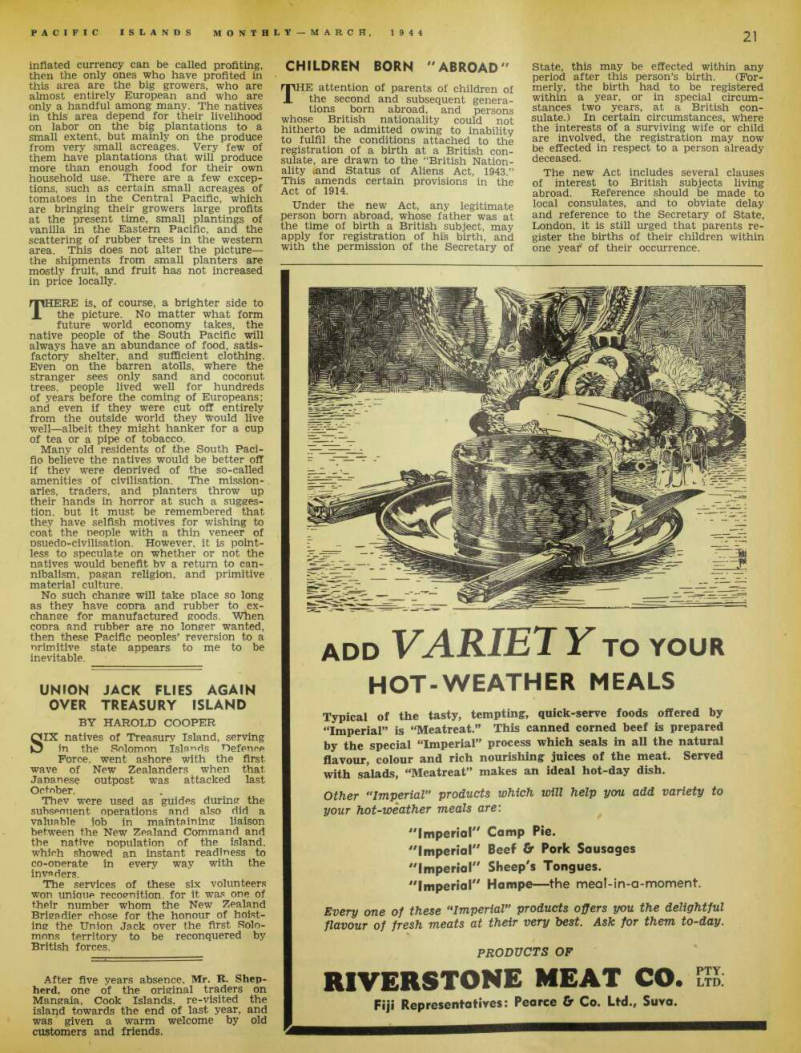
Has Polynesia A Future Without A
South Pacific Conditions as They Appear to Robert Dean Frisbie
UNLESS there is some unforeseen improvement in shipping facilities and the manufacture of civilian goods, at the end of World War II the entire South Pacific area will require a virtually complete restocking of con sumers’ goods, equipment, and con struction material.
The United States will probably be the country best equipped to manufacture and transport these goods, and she may be expected to do so if import restrictions do not prohibit trade. Trade restrictions may be anticipated, however—England, Australia, New Zealand, and India can not be asked to allow their own indus tries to suffer for the benefit of Ameri can exporters.
At the present time, most of'the tex tiles imported into the South-eastern Pacific come from India. These goods are often unsatisfactory in quality and are always exorbitant in price. Import ers state that the Indian manufacturers are bleeding the market for all it will stand; and the consumers, who are pay ing from 600 to 800 per cent, more for textiles than they did before the war, are losing patience. Perhaps India, through her own nearsightedness, is building up a mushroom trade that will collapse with the coming of peace: she is existing at present on a high-profit economy, and she may not be able to re organise her industry on a basis of smaller profits. Also, she may suffer from the resentment of her former customers.
It is deplorable that many of the
primitive and semi-primitive people in the South Pacific are recalling that Japan, in fcre-war years, supplied textile goods which were retailed at from six pence to ninepence a yard, and which were identical if not superior to the goods now supplied by India and retailed at from four to six shilling a yard.
Furthermore, there are persistent rum ours that the Japanese in occupied ter ritories are supplying the natives with good-quality merchandise at very low prices—probably in anticipation of many of the islands being retaken by the United Nations, and with an idea of educating the people to a pro-Japanese frame of mind.
The Europeans in the South Pacific do • not enter largely into this picture. They compose a very small minority that obtains its personal goods from England and America. These Europeans look upon the high price of Indian textiles as a temporary and unavoidable evil in the same way as they formerly looked upon the low price of Japanese textiles as a temporary, though not unavoidable, evil. But the native people understand only that a pound note will now buy four or five yards of shoddy print, while formerly it bought as much as 40 yards.
Though these Polynesians never heard of inflation, they know that their money is not worth as much as formerly.
WE who live in the South Pacific are naturally concerned about the economic future of this area. Even the optimists among us admit that the
outlook is gloomy. Before the war copra, on many of the islands, was not worth making. Few of the rubber plantations showed a profit. Cocoa was a risky gamble. Vanilla was profitable only to the small growers who tended their own vines. Pearl-shell was virtually unsale able. Now we wonder if, when munitions factories are closed down, there will be any sale whatsoever for copra. Will nat ural rubber find a market in countries overstocked with synthetic rubber? Will cocoa fall to its pre-war price? Will synthetic vanilla and nacre again force natural vanilla and pearl-shell out of the market?
If the South Pacific stores and ware houses are to be restocked, if the worn out trucks and automobiles are to be replaced, and equipment and construc tion material supplied, then a use must first be found for the produce which the South Pacific people produce.
To-day, the planters of the South Pacific area are receiving excellent prices for their produce. Copra is now bought, on the more accessible islands, for about £l4 (sterling) a ton, while the market price in Sydney, at this writing, is £24 Australian. This is approximately 300 per cent, higher than the pre-war price. Cocoa, Samoa’s most important produce, is now quoted in Australia at £BO (Australian) a ton, while the pre-war price was seldom half that amount.
Vanilla, pearl-shell, tortoise-shell, and rubber have jumped to phenomenal prices.
On the other hand, there has been no improvement in the market for fruit, and this is an important point, because it affects directly the small native growers, who are in the majority in these islands.
The above remarks would suggest that no one, except fruit-growers, should com plain of the high price of consumers’ goods, because prices obtained for pro duce have risen to a parallel degree.
This is not true. If accumulating
inflated currency can be called profiting, then the only ones who have profited in this area are the big growers, who are almost entirely European and who are only a handful among many. The natives in this area depend for their livelihood on labor on the big plantations to a small extent, but mainly on the produce from very small acreages. Very few of them have plantations that will produce more than enough food for their own household use. There are a few excep tions, such as certain small acreages of tomatoes in the Central Pacific, which are bringing their growers large profits at the present time, small plantings of vanilla in the Eastern Pacific, and the scattering of rubber trees in the western area. This does not alter the picture— the shipments from small planters are mostly fruit, and fruit has not increased in price locally. fTTHERE is» of course, a brighter side to X the picture. No matter what form future world economy takes, the native people of the South Pacific will always have an abundance of food, satis factory shelter, and sufficient clothing.
Even on the barren atolls, where the stranger sees only sand and coconut trees, people lived well for hundreds of years before the coming of Europeans; and even if they were cut off entirely from the outside world they would live well—albeit they might hanker for a cup of tea or a pipe of tobacco.
Many old residents of the South Paci fio believe the natives would be better off if they were deprived of the so-called amenities of civilisation. The mission aries. traders, and planters throw up their hands in horror at such a sugges tion. but it must be remembered that they have selfish motives for wishing to coat the people with a thin veneer of osuedo-civilisation. However, it is point less to speculate on whether or not the natives would benefit bv a return to can nibalism, pagan religion, and primitive material culture.
No such change will take place so long as they have copra and rubber to ex change for manufactured goods. When copra and rubber are no longer wanted, then these Pacific peoples’ reversion to a primitive state appears to me to be inevitable.
Advertisements & other items, p. 24 (1 item)
89 Years
m
'^Vf'VSV
m err*
89 YEARS
■3 % & 3t
SWIILiWsJLIIEIIin
3
. ICC (1(11
did
■ •KIS M BISCIIIt
>v t J >vi >j yMA Mv ;< MyAxh■<Vvm zLVCiIi Li
Union Jack Flies Again
Over Treasury Island
By Harold Cooper
SIX natives of Treasury Island, serving in the Solomon Islands Defence Force, went ashore with the first wave of New Zealanders when that Japanese outpost was attacked last October.
Thev were used as guides during the subsenuent operations and also did a valuable lob in maintaining liaison between the New Zealand Command and the native population of the island, which showed an instant readiness to co-operate in every way with the invaders.
The services of these six volunteers won unioue recognition, for it was one of their number whom the New Zealand Brigadier chose for the honour of hoist ing the Union Jack over the first Solo mons territory to be reconquered by British forces.
After five years absence, Mr. R. Shep herd, one of the original traders on Mangaia, Cook Islands, re-visited the island towards the end of last year, and was given a warm welcome by old customers and friends.
Children Born "Abroad"
THE attention of parents of children of the second and subsequent genera tions born abroad, and persons whose British nationality could not hitherto be admitted owing to inability to fulfil the conditions attached to the registration of a birth at a British con sulate, are drawn to the “British Nation ality .and Status of Aliens Act, 1943.”
This amends certain provisions in the Act of 1914.
Under the new Act, any legitimate person born abroad, whose father was at the time of birth a British subject, may apply for registration of his birth, and with the permission of the Secretary of
State, this may be effected within any period after this person’s birth. (For merly, the birth had to be registered within a year, or in special circum stances two years, at a British con sulate.) In certain circumstances, where the interests of a surviving wife or child are involved, the registration may now be effected in respect to a person already deceased.
The new Act includes several clauses of interest to British subjects living abroad. Reference should be made to local consulates, and to obviate delay and reference to the Secretary of State, London, it is still urged that parents re gister the births of their children within one year* of their occurrence.
Advertisements & other items, pp. 25-26 (1 item)
Hot-Weather Meals
ADD VARIE7 Y to your
Typical of the tasty, tempting, quick-serve foods offered by “Imperial” is “Meatreat.” This canned corned beef is prepared by the special “Imperial” process which seals in all the natural flavour, colour and rich nourishing juices of the meat. Served with salads, “Meatreat” makes an ideal hot-day dish.
Other “Imperial” products which will help you add variety to your hot-weather meals are: "Imperial" Camp Pie.
"Imperial" Beef fir Pork Sausages "Imperial" Sheep's Tongues.
"Imperial" Hampe— the meal-in-a-moment.
Every one of these “Imperial” products offers you the delightful flavour of fresh meats at their very best. Ask for them to-day.
PRODUCTS OF
RIVERSTONE MEAT CO. S:
Fiji Representatives: Pearce tr Co. Ltd., Suva.
EDGELL
QUALITY CANNED
Vegetables & Soups
AUSTRALIA'S BEST
D EFENCE requirements take up the whole of the Edgell production to-day—consequently only a small proportion of civilian needs is occasionally made available by the Australian Defence Foodstuffs Control and exports are heavily restricted.
As soon as possible. Island consumers can rely on Edgell high quality products being made available to them once more.
Mean while, to take advantage of the limited quantities periodically released, please send your inquiries either through your usual channels or direct to the Island distributors C. SULLIVAN & CO. 379 Kent Street, Sydney, Australia.
"EDGELL QUALITY CANNED GOODS"
C. SULLIVAN & CO.
GENERAL MERCHANTS ISLANDS AGENTS
REPRESENTING LEADING FIRMS IN THE PACIFIC ISLANDS.
Islands Produce sold on Shippers’ Account—Liberal Advances against Consignments.
Buyers of all Islands’ Requirements on Commission—Original Invoices Furnished.
Bankers : Bank of New South Wales . Bank of New Zealand .. Comptoir National d’Escompte de Paris.
Wartime Cable Address: Sullivan, Kentstreet, Sydney.
379 KENT STREET, SYDNEY, N.S.W.
Total War
By “Daika”
\U& parked our vehicles and the tired TT and dirty troops stumbled out. This town in Greece had not yet been bombed and the children crowded round us anxious to swop eggs for “conserva” (bully beef). We had not had eggs for days.
The women brought us hot water and we lay and rested under the pines which fringed the beautiful little town. Every where was peace, except for the large quantity of military traffic on the road, and we spoke and joked with the kiddies, who were just like kiddies anywhere in the world, although their country had been at war for months and most of the able bodied men were absent. The women wore strained faces and were thin, but they laughed at our attempts to speak Greek. We felt better as we looked at them.
Then over came some planes with the black cross of the Nazi on them. The sirens screamed and everyone crowded into the large shelters in the centre of the town, but when the shelters became too crowded the women and grown men left to make more room for the younger ones who still had most of their lives in front of them —they were to be given their chance to live whatever happened.
The planes circled once and then down crashed their load of death—on to the shelter. We looked at each other as we lay and waited. The planes unloaded all their bombs and left for more.
We ran down to help—if we could.
That sight will remain forever in my mind; many of us dreamt nightmarishly of it for months after, and that day we swore an oath of vengeance. Now most of those men who swore that oath are themselves dead —some in Crete, some in Syria, and some in New Guinea. The few who are left will still remember the moment when we came in sight of the main square of that town. fTTHE only sounds were the crackle of X flames and the subdued clatter of boots on the cobble stones. Seldom did anyone speak. The whole souare was covered in blood and mangled bits of human flesh which such a short time be fore had been living, romping children.
Some still lived, horribly broken, and their large eyes followed us piteously as we did our best to ease their soul’s flight to what we hope is a better world.
The mothers worked dry-eyed. They were stunned—their brains could not grasp such catastrophe. Some of them gathered up odd pieces of what had been flesh of their flesh: a boot with a little foot still in it. Yes—the patch on the side had been done by their hard-worked hands only a few days before. Never again would they cry shrilly for the lad who wore them to come quickly out of the rain and be answered by his child’s voice.
The pitiful little heaps grew on the pavements as the women searched. A hand and arm; a head, severed from its trunk and recognisable only by the hair and teeth. We cursed God that day as well as the Nazi butchers.
A woman’s body, torn open, lay in the track of a big military lorry. An old woman, holding the battered head in her arms, rocked to and fro, crooning to her self as she had done when her daughter had been a babe in arms. Now her daughter had gone—and her grand children too. But she could not realise it.
Many a tear was wiped surreptitiously away from a tough Aussie’s eye that day.
It was total war—but not a soldier had been hurt —physically. And yet we had scoffed at others for surrendering when
this was happening to them. Would we be able to continue the fight if this had happened in Australia? Would our union leaders, and politicians still rant and rave and keep their safe jobs? ♦ * * ALONG line of white planes droned across the Papuan sky, very high up. The sun flashed on the spinning props and the glass of the cockpits. We identified them as Japs.
Came the thunder of heavy explosions as their bombs landed. The rattle of machine-guns came from above as our planes—so few at that time—strove to break through the screen of enemy fighters and disperse the bombers. Soon a Jap plane slowly pulled out of the line and began its dive—to death. Its engines screeched and screamed; a wing came off. We on the ground stood with bated breaths. The engine left its mountings, but the scream went on and the air shook.
We watched—but not a Jap left that doomed plane. Faster and ever faster it came, until it went out of sight below the trees and a wisp of smoke drifted up —vanishing before the fluttering, side slipping wing reached earth. At least one Jap plane and crew had paid in full for this raid.
Up in the bombed area men worked feverishly. A hospital had been hit. The doctor eased pain and put broken bodies together. This, too, was war.
Many bombs had landed in the bush.
No one worried about them —too thank ful that they had not fallen closer—but in the bush were natives, who, driven from their villages by the cruelty and lust of a blood-mad world, had made small community houses in this secluded spot. They made new gardens, too, and lived frugally while waiting for the har
vest. Now one bomb had destroyed all.
There were no doctors here. No bandages, no medicines; just life—and death. There was crying as the flow of life ran out of bleeding little bodies. A young mother, dying, tried to give her
week-old child a last drink at her breast The baby’s tiny hands waved, and he gurgled in delight as he nuzzled her Soon her body would grow cold and he would cry—but there would be none to hear.
An old man, dragging himself along while trying to push back the intestines bulging from a gash across his abdomen, his dark skin glistening with the perspiration from the effort, at last lav down to die.
Two children, one with a broken leg and the other with a mangled arm, gazed about them with eyes glazed by shock and pain.
The sun rose higher, then began to sink. No movement or sound disturbed the solemn quiet. The baby began to cry and continued until exhaustion at last quieted him. The next day his cries grew less.
A week later a patrol of soldiers stood and looked at the scene. Just another episode in a total war, with its suffering innocents, differing from a thousand
such episodes on a dozen battle fronts only in location. This time it was a few “Fuzzy Wuzzies” who, knowing nothing of civilised conflicts, nor having ever heard of Germany or Japan, yet reaped the whirlwind of international hate and avarice.
We who see these sights are left wondering how long the world is to be allowed to remain steeped in such selfish ness and hypocrisy.
Advertisements & other items, pp. 27-28 (1 item)
Poleman
THE
YORKSHIRE
INSURANCE
CO. LTD.
(Incorporated in England)
FIRE
ACCIDENT
MARINE
FIRE POLICIES ISSUED
IN PAPUA
All information from —
E. A. JAMES,
TeL 86347. Attorney for Papua, 14 Spring St., Sydney.
c
PARTS
KEEP LANTERNS AND
STOVES WORKING
WITH GENUINE
Poleman
Hi To help you take care of your Coleman Lantern, Stove, Iron or other Appliance, the Coleman factory is doing everything possible to keep your Dealer supplied with Genuine Coleman Parts.
Ask his advice about making your Coleman appliance last longer. He will make repairs and keep it in satisfactory working order.
THE COLEMAN LAMP & STOVE CO. LTD.
TORONTO CANADA
THE COLEMAN EXPORT CORPORATION, CHICAGO, ILL, U.S.A*
NELSON & ROBERTSON
PTY., LTD.
Established 1895.
Islands Merchants
All classes of merchandise purchased at wholesale prices and original invoices supplied to Islands clients.
Cocoa Beans, Rubber and other Islands' produce sold on commission.
Nelson & Robertson
Pty. Ltd. 12 Spring Street, Sydney, Australia.
SHIPCHANDLERY
Yacht Gear, and Marine Engine Fittings. All classes of equipment for Boatbuilders working on defence. Gunmetal Dumps and Washers, Copper Nails and Roves, Sheathing Metal, Caulking Cotton, Anti-fouling Paint, Vents, Ports, Bilge Pumps, Common and Navy pattern galvanised Anchors, all sizes.
Motor Boat Horns—air and electric Navigation Lamps—oil and electrc.
SIMPLEX MARINE ENGINES, 3,5, and 10-12 H.P., 2 and 4 cycle, with built-in reverse gear. The best motors for work, patrol, or fishing boats. Heavy duty efficiency with economy and reliability. Ask for Simplex details.
SAFEGUARD YOUR WOODWORK WITH
DEKOL
Guards Wood from the ravages of White Ants, Borers Dry Rot, Mildew, etc. Penetrates deeply and permanently protects fabrics from Rot and attack from Fungi. Is simple to apply, and when dry can be painted and varnished. Prevents attack by Marine Borers on wood immersed in sea-water. Is insoluble in water. Has no unpleasant odour. Is not harmful to animals or vegetation, when dry.
Price: 12/- gallon (4-gal. tins); 14/6 gallon (1-gal. tins).
TRADE ENQUIRIES INVITED
W. KOPSEH & CO.™
380 KENT STREET, SYDNEY
Cables: “Kopsen,” Sydney. N.S.W. ’Phone: MA6336 (6 lines).
Queen Salote Silver
Jubilee Stamps
r commemorate the completion, on October 11 last year, of the 25th year of the reign of Queen Salote, special postage stamps were issued in Tonga on January 25.
The stamps are a replica of those issued in 1938 t 6 commemorate the 20th year of the Queen’s reign, with the exception that the years 1918-1943 are printed on the new issue.
The stamps are in five denominations, 1/-. 6d., 3d., 2d. and Id., each in a differ ent colour. They measure li in. x If in., and each denomination has the same attractive design, the centrepiece being a portrait of Queen Salote.
Missionaries
Good Work By Fijian
AT present on leave in the southern States of Australia, are two Fijians who are attached to the Methodist aboriginal missions in Northern Austra lia.
One of them is the Rev. Kolinio Sau kuru, who figured last year in the rescue of an Australian Beaufighter crew forced down in Northern Australia: and the other is Captain Aminiasi Ratulaveta, master of the Methodist Mission cutter.
“Larrapon,” stationed at Croker Island.
The Rev. Kolinio Saukuru is affection ately known as “Koi” by airmen in Northern Australia. He is a man of manv accomplishments, who has done great work amonsr the aborigines. He is an ordained minister, who was appointed to work in an aboriginal mission at Milline-imbi. off the coast of Northern Australia; he is a qualified teacher, marine engineer and captain, and his word is law among the natives for hun dreds of miles along the NW coast of Australia.
His portrait, painted by Mr. R. J.
Sheppard, was recently entered for the Archibald nrize Captain Ratulaveta has also done good work by rescuing airmen who have been forced down into the sea.
Death Of M. Ratard, Of
New Hebrides
From Our Own Correspondent
Noumea. Feb. 15.
rE death is announced of M. Ratard, one of the most successful Preneh planters in the New Hebrides. He arrived there in 1901. with no fortune other than the will to work, and built up a large property at Santo, which he had never left, and which is run on up-to date lines.
He is reported to have amassed a for tune of many millions of francs. His son has been working in recent years for the Nickel Company in Noumea, and his daughter-in-law is ehemistry professor at the College de la Perouse.
When he announced M. Retard’s death, Governor Laigret described him as one of that sroun of valiant French pioneers who created the important centre of French colonisation, the Segond Channel.
Strange Case Of The
Sewing Thread
Tahiti's Thieves and Black Marketeers
From Our Own Correspondent
Papeete, Feb. 5.
rERE is a great deal of petty thiev ing going on in and about Papeete.
Many Polynesians inherit from the old communal system of pre-European days the theory that anything that Nature produces—such as fruits, vegetables, and so forth —should be regarded as common property in cases of need; and the tak ing of anything of that category does not constitute thievery. (Some Europeans have also adopted that code and thrive on it.) Anything bought with the coin of the realm is, however, regarded, by natives, as property the filching of which is un lawful. In earlier times, therefore, one could leave one’s house unlocked and unguarded, confident that nothing of value would be disturbed or taken.
Now times have changed. The en lightenment of civilisation has instructed the predatory element of our people in the higher arts of plunder, so that any thing—from pigs to jewellery, from bed linen to thousand-franc notes —is in danger from prowling marauders.
The acquisitive elite, after observing a series of gangster films from Hollywood, have set about emulating these popular heroes of Chicago. The organisation has centred its operations on incoming cargo as the most remunerative objective. It is not yet clearly known how long the broaching of cargo has been going on; but in the earlier stages of their adven ture, the thieves were wise and consider ate enough to leave some merchandise in
the cases for the consignee. Their un doing was consequential to their taking the whole of the contents of a large case of sewing- thread. At the time, there had not been one spool of thread in the island for a long period. Therefore, the sudden merry chatter of sewing-mach ines, owned by the wives and sweethearts of the bandits, led the police by an easy path to the culprits.
A search of the premises of that select band of Chinamen who operate the Black Market, revealed the remainder of the plunder in some extraordinary hiding places.
The judicial inquiry into the whole affair is still going on at the time of this writing.
Many—not all—of our Tahiti China men are past-masters in the enterprise known as the Black Market. Some, indeed, are wise enough to “temper the wind to the shorn lamb”; others could give Torquemada lessons on how to clamp on the thumb-screws. They “get away with it” because most natives are dependent on the Chinese wayside shop for bread, coffee and various household supplies; and, in addition, are usually more or less in debt to this fountain of sundry favours. Naturally, they do not wish to stir up trouble which would dry up this well-spring.
Europeans, on their part, shrink from getting involved with Court proceedings.
Consequently, our judicial authorities never hear of these violations of the law, and the Black Market flourishes, notwith standing stringent regulations designed to prevent all such practices.
Mr. and Mrs. T. P. Nicholson, who went to Fiji from New Zealand in the early 80’s, celebrated their golden wedding in Suva on January 27.
Advertisements & other items, pp. 29-30 (1 item)
Atkins
QUEENSLAND
INSURANCE
COMPANY
LIMITED
(Incorporated 1886 in Australia)
ASSETS EXCEED £3,500,000
Head Office:
PITT & BRIDGE STS.,
SYDNEY
Specialists in South Seas Fire,
Marine & Accident Insurances
Apply to: —
FIJI.
Branch Office: H. J. Moorhouse, Manager.
Burns Philp (South Sea) Co., Ltd.
VILA.
Burns Philp (South Sea) Co., Ltd.
Comptoirs Francais Des Nouvelles Hebrides (Marine).
NOUMEA.
L. & W. Johnston.
PAGO PAGO.
Burns Philp (South Sea) Co., Ltd.
G. H. C. Reid & Co.
OTHER SOUTH SEA ISLANDS.
Burns Philp (South Sea) Co., Ltd.
Also to any of the Company’s Offices in Australia or New Zealand.
Willia
I I
Atkins
Pty. Ltd.
Head Office 449-451 KENT ST., SYDNEY.
Iron & Steel Merchants-Engineers' Supplies
Coach & Motor Hardware
ESTABLISHED OVER 50 YEARS
Cable Address: WILATKIN, Sydney.
STEEL DEPARTMENT
► f
MILD STEEL:
Rounds, Squares, Flats, Half-rounds, Hexagons, Bevel, Shoeing, Tyre, Angles, Tees, Sheets, Plates, Girder Plates, Chequer Plates, Channels, Hoops, Etc.
BRIGHT STEEL:
Rounds, Squares, Hexagons.
Extra Special High Speed Tool Steel, Mining Steel, Blister Steel and Spring Steel, Rounds, Flats £r Squares.
Bar Iron—All sections and sizes.
Engineers' Supplies: Set Screws, Studs, Metal Thread Screws, Coach Screws, Files, Cotter Pins, Bright and Black Bolts, Rivets, Etc,, Hack Saw Blades.
Power Transmission Gear: Including Plummer Blocks, Couplings, Collars, Etc.
Coach and Motor Hardware: Axles, Springs, Wheelstuff, Duck, Paints.
Farriers' Supplies: Horse Nails, Anvils, Vices, Etc.
Motor-Trimmers and Motor Builders' tj Motor Painters' Requirements
C. A. WILLEY'S
Quick-Drying Coach and Car Paints, Roughstuff, Elastic Gloss, Synflex Enamels, Lacquers.
DUCO Lacquers and DULUX Enamels—FAßßEX Motor Toppings and Leather Cloths, House & Decorators' Paints, Varnishes & Brushware.
Sole Distributors of CHAMPION'S Decorators Paint Products.
Distributing Agents for BROLITE Lacquers, SYNFLEX Enamels and "POLYGLOSS" Finish.
Refreshing
as a plunge
into a lagoon!
c |DA l
roll*:
soap
m
Germicidal
and fragrant
TENAX TOILET SOAP is
a rapid safeguard against external skin infections, yet it is soothing and kind to the most sensitive skin —even a baby’s!
ORDER TENAX FROM
YOUR ISLAND SUP-
PLIERS. STOCKS ARE
PLENTIFULLY AVAIL-
ABLE.
After taking Pinkettes you should feel brighter, happier, and free from sick headaches, bilious attacks and liverishness. For
PINKETTES
are tiny laxative and liver pills, which painlessly exercise the digestive system.
Fiji Now Rejoices in "Travel Priorities"
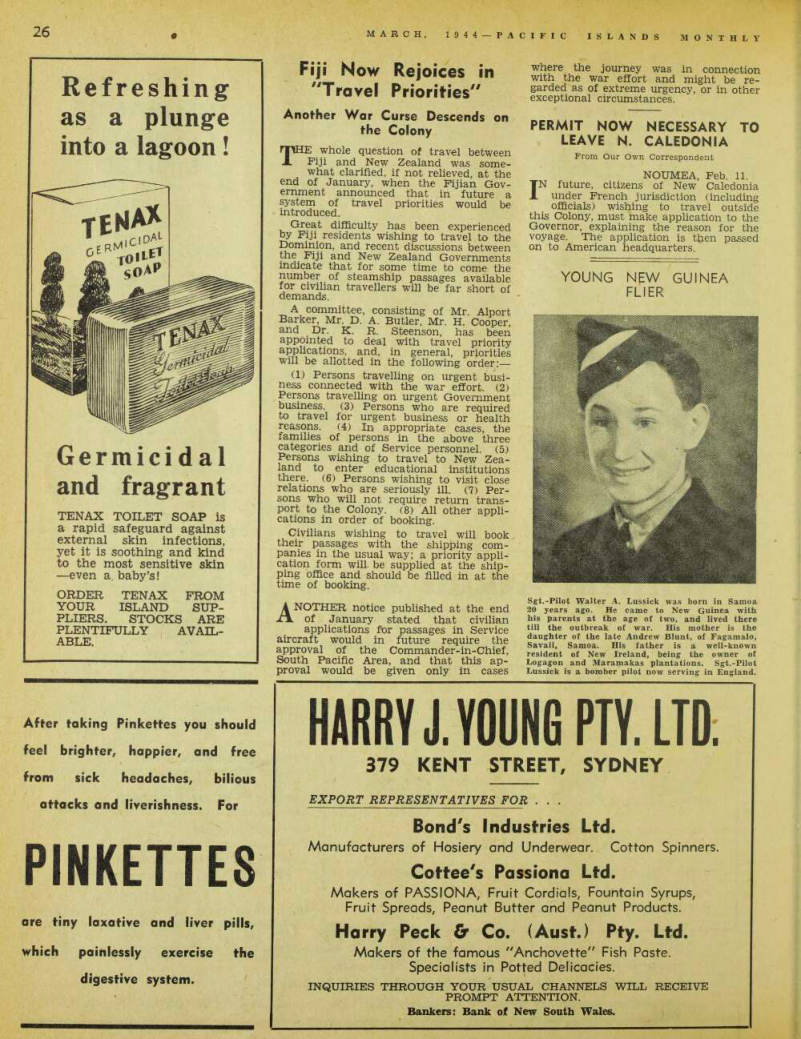
"Travel Priorities"
Another War Curse Descends on the Colony
rE whole question of travel between Fiji and New Zealand was some what clarified, if not relieved, at the end of January, when the Fijian Gov ernment announced that in future a system of travel priorities would be introduced.
Great difficulty has been experienced by Fiji residents wishing to travel to the Dominion, and recent discussions between the Fiji and New Zealand Governments indicate that for some time to come the number of steamship passages available for civilian travellers will be far short of demands.
A committee, consisting of Mr. Alport Barker, Mr. D. A. Butler, Mr. H. Cooper, and Dr. K. R. Steenson, has been appointed to deal with travel priority applications, and, in general, priorities will be allotted in the following order:— (1) Persons travelling on urgent busi ness connected with the war effort, (2) Persons travelling on urgent Government business. (3) Persons who are required to travel for urgent business or health reasons. (4) In appropriate cases, the families of persons in the above three categories and of Service personnel. (5) Persons wishing to travel to New Zea land to enter educational institutions there. (6) Persons wishing to visit close relations who are seriously ill. (7) Per sons who will not require return trans port to the Colony. (8) All other appli cations in order of booking.
Civilians wishing to travel will book their passages with the shipping com panies in the usual way; a priority appli cation form will be supplied at the ship ping office and should be filled in at the time of booking.
ANOTHER notice published at the end of January stated that civilian applications for passages in Service aircraft would in future require the approval of the Commander-in-Chief, South Pacific Area, and that this ap proval would be given only in cases
where the journey was in connection with the war effort and might be re garded as of extreme urgency, or in other exceptional circumstances.
Permit Now Necessary To
Leave N. Caledonia
From Our Own Correspondent
Noumea, Feb. 11.
IN future, citizens of New Caledonia under French jurisdiction (including officials) wishing to travel outside this Colony, must make application to the Governor, explaining the reason for the voyage. The application is then passed on to American headquarters.
Young New Guinea
Flier
Sgt.-Pilot Walter A. Lussick was born in Samoa 20 years ago. He came to New Guinea with his parents at the age of two, and lived there till the outbreak of war. His mother is the daughter of the late Andrew Blunt, of Fagamalo, Savaii, Samoa. His father is a well-known resident of New Ireland, being the owner of Logagon and Maramakas plantations. Sgt.-Pilot Lussick is a bomber pilot now serving in England.
Advertisements & other items, p. 30 (1 item)
Harry J. Young Pty. Ltd.
379 KENT STREET, SYDNEY
EXPORT REPRESENTATIVES FOR . . .
Bond's Industries Ltd.
Manufacturers of Hosiery and Underwear. Cotton Spinners.
Cottee's Passiona Ltd.
Makers of PASSIONA, Fruit Cordials, Fountain Syrups, Fruit Spreads, Peanut Butter and Peanut Products.
Harry Peck & Co. (Aust.) Pty. Ltd.
Makers of the famous "Anchovette" Fish Paste.
Specialists in Potted Delicacies.
INQUIRIES THROUGH YOUR USUAL CHANNELS WILL RECEIVE
PROMPT ATTENTION.
Bankers: Bank of New South Wales.
Evolution Of A
Fiji Commando
By Harold Cooper
COMMANDOS are made, not born, even in Fiji. Not so many months ago the Fijian men who won such a reputation on Guadalcanal were living quietly in remote villages and had never handled any weapon more complicated than an axe or a cane knife.
When they reported to their New Zea land instructors they were perhaps the rawest' recruits ever to don the King’s uniform. They could speak no English, and the New Zealanders no Fijian, so that early instruction had to be imparted painstakingly through interpreters.
The Fijians at first stood in some awe of the bullet, not because of its power to inflict injury, but because its flight was invisible. This initial nervousness, how ever, soon vanished and before long they were carrying out manoeuvres unper turbed by live ammunition bursting round them.
Their physique was excellent and they lost no time mastering all the devices of unarmed combat. The course of training was tough, but the Fijians were tougher, and they cheerfully survived many an exhausting trek over the worst terrain these rocky, forest-clad islands can provide.
The second quality which gave the Fijian recruit the hallmark of the fine soldier was his sense of discipline. From birth he had been taught to respect his Chiefs and obey the reasonable orders of his seniors in the village community; and he readily adapted himself to the severe routine of army life.
But all the instructors are agreed that the Fijian’s outstanding quality was his unbounded zest for soldiering. From the hour of enlistment his one desire was to learn how to fight and to learn so thor oughly that the opportunity to practice his skill in actual combat could not be long denied him.
Even before he was allowed to use ammunition he was completely absorbed in his rifle and would spend hours prac tising the modest preliminary art of holding and aiming. By way of relaxa tion he joined with his comrades in devising mekes (or ceremonial dances) in which the rifle was the chief stage pro perty and which gaily dramatised the successes to be achieved in future en gagements with the enemy. It is scarcely surprising that in the end this enthusiast became (as many a Japanese on Guadal canal had the misfortune to discover) a formidable marksman.
These Fijians were hand-picked men, selected from many volunteers for the honour of representing their various vil lages, and were the pride and envy of other islanders. Their enormous pres tige sometimes hampered training, for wherever they appeared they were wel comed and feted as heroes. This popu larity was a source of acute embarrass ment during periods when the Comman dos were out “on a stunt” with strict orders to “live on the country” and eat only wild food. The villagers would try to load them as usual with produce from their gardens and the officer in charge would find it difficult to explain that for once this generosity was entirely mis placed. rpHE Fijian has made a tremendous hit X with his American ally. In the transport on their way to the Solo mons the Commandos kept the crew and their fellow-passengers entertained with native songs to the accompaniment of the guitar. From the moment they landed
on the beach at Guadalcanal they struck up a firm friendship with the Marines hundreds of whom crowded round to welcome them as the first British Colonial reinforcements.
Provision had been made in the train ing curriculum for lectures to the Fijians on the origins of the war and the cause for which they would be fighting. But no such education was necessary. The Fijians knew the Japanese was on his way south and they wanted to turn him back before he could reach their own islands.
After they had observed him at close quarters on Guadalcanal they grew to loathe him for the bestial manner in which he lived and fought. They saw Japanese encampments which presented spectacles of appalling squalor, with un
buried corpses left to rot beside tents still occupied by living soldiers. They were filled with indignation and in credulity that this unclean and degen erate creature should dream of becoming master of the world.
The Fijian is a devout Christian.
When the Coihmandos were not on Sun day patrols they could be seen in Guadal canal’s little thatched churches joining in worship with their comrades of the Solomons Scouts. Those who decry Britain’s Colonial record might ponder this picture of the former cannibal and the former head-hunter kneeling together to give thanks for a new way of life which they, in common with millions of their fellows throughout the Empire, have found worth fighting and worth dying for.
Advertisements & other items, p. 31 (1 item)
Aunt
ERS
FAMOUS ENGLISH PRODUCTS
CANNED ENGLISH VEGETABLES
CANNED ENGLISH FRUITS
OLDE ENGLISH MARMALADE
GOLD MEDAL JAMS
JELLY CRYSTALS, ETC.
Obtainable from all leading Grocery Stores
WRITE TO DEPARTMENT “A”
CHIVERS & SONS LTD.
Histon, Combs., Eng.
FOR ATTRACTIVE RECIPE BOOK
c<: nntKi
ULLLft
CHIV£RS
COLO
*TOMD4W>
FRESH
i INGUSH J
PEAS
•• AM*
AUNT
ART’S
BAKING POWDER
WITS QUALITY NEVER VARIES 99
In war-time, as in peace-time, Aunt Mary’s Baking Powder gives the same “even rising” results. Limited supplies are being released, as opportunity affords, so use your purchase sparingly while precious ingredients in Aunt Marys Baking Powder are difficult to obtain for normal requirements. • AUNT MARY’S SCONES are always a luxury treat when good friends meet to accept your hospitality.
Mystery Epidemic In
Mangaia
From Our Own Correspondent MANGAIA, Cl, November. rnHE ancient custom ofc “fumigating”
JL ships’ passengers as they come ashore at Mangaia, by making them walk through smoke from a “kikau” fire is being discussed locally with a view to remtroduction should a wartime epidemic hit the outside world as it did in 1918.
Recently, after a schooner had called, a mysterious epidemic of vomiting dysen tery went the rounds of the island children being particularly affected. All mfants attacked by the complaint died The disease was unique in that starvation worked a cure, while patients, who were “fed to keep their strength up,” quickly got beyond all aid. Sad experience has taught the island that nourishment is
sometimes fatal. While the epidemic was at its height, all schools were closed for two weeks.
It is significant that with the coming of rain and southerly winds the epidemic abated; but the “Sunday silence” that hung over the place, and the entire absence of movement, recalled to the older people, the epidemics of 1918 and 1928, when influenza took severe toll.
Profiteering In Fiji
AN Indian wholesale storekeeper, P. J.
Patel, was sentenced to six months’ imprisonment and fined £4OO, on January 7, on a charge of having sold textile piecegoods at excessive prices, the excess profit being £7B.
Tulsi Shai, for a similar offence, was sent to gaol for three months and fined £3OO. The excess profit in this case was £1404.
Cost Of A Rubber
Estate
T R E following extract from the “PIM” of August, 1941, may be of interest to many who have already expressed a determination to return to New Guinea after the war and “start a rubber plantation” In mak ing any calculations it would be as well to remember the comparative prices of goods as they probably will be in the post-war period, as against those that prevailed in the seven years prior to 1941.
HOW much does it cost to bring a rubber plantation to the productive stage, in New Guinea and Papua?
Some estimates go to £5O and £6O per acre.
As the question often is asked, we have taken the liberty of extracting some figures from the annual report and balance sheet of Mororo Rubber Estates, Ltd., a small Papuan concern of which Mr. G. A. Loudon is chairman.
The estate comprises 579 acres of lease hold, held on 99 years’ lease; and 330 acres have been planted with rubber trees, and are densely cover-cropped with Centrosema. A nursery has been established, containing 10,000 plants.
There are suitable buildings and roads.
Details of costs up to date are as follow: The Company’s prospectus provided for estimates as under:— (1) Felling, planting and covercropping, £6 per acre. (2) Weeding and maintenance, £l/10/per acre. (3) Seven years to bring to production at total cost of £25 per acre.
The Co. now has arrived at the stage where it has expended £3,765 on 330 acres, equal to £ll/2/9 per acre.
How much money must it yet find to bring the 330 acres into production?
Here is the calculation:— £ 130 acres planted 1938/9 by Vendor will require 4 years’ weeding and maintenance at 30/- acre -780 100 acres planted in April, 1940, will require 6 years’ weeding and maintenance at 30/- acre ... 900 100 acres planted in April, 1941, will require 7 years’ weeding and maintenance at 30/- acre . .. 1,050 2,730 Plant, tools and sundries to bring to production 195 Total of money still to be spent .. 2,925 Already expended as per Balance Sheet at April, 1941 3,675 Total to bring plantation to production 6,600 Which is equal to cost of £2O per acre.
Mr. R. C. Savage, who has been wire less officer on Mangaia, Cook Inlands, since 1932, left recently, accompanied by his wife and family, to take up new duties as Resident Agent at Puka Puka in the Northern Cooks. He is the son of the late Mr. Stephen Savage, who was well-known as a Government official in Rarotonga.
Three sons of Mr. C. S. Gilfillan, for merly manager of the Qaranaqio rubber estates in Fiji, and now of New Zealand, are serving with the NZEF. All three of the boys were born in Fiji, and one of them, Pte. W. M. Gilfillan, was one of the first five to land on Mono Island, Treasury Group, BSI.
Advertisements & other items, p. 32 (1 item)
Cordage and
Wanted to Buy—Quality Guns and Rifles HIGHEST PRICES GIVEN. WILL ALSO EXCHANGE GUNS.
SI L RO H U Quality Firearms and Fishing Tackle. 143 ELIZABETH STREET (Near Market St.) SYDNEY. ’PHONE: MA 3540.
Ship Chandlery Hardware
/Write for j
Ship Chandlery /
Cataloaue J
Catalogue
Special “In Bond” Prices for all Islands enquiries quoted on application.
Sole Agents for:
BROOMFIELDS LIMITED
152 SUSSEX STREET :: SYDNEY.
Cables: “Boom”, Sydney.
Large and Complete Stocks of
SHIP CHANDLERY
IRONMONGERY OF ALL KINDS, PAINTS,
WHITE LEAD AND OILS.
P. H. MUNTZ & CO.’s 3-CROWN BRAND METAL SHEATHING.
PEACOCK & BUCHANS’ ENGLISH READY-MIXED PAINTS.
Scott’s “Renown” Brand Rope,
Cordage and
Binder
Cable Address: Ropeyard, Sydney.
Twine
of Every
Description
MANUFACTURED AT
MASCOT, N.S.W.
By
J. SCOTT
PTY. LTD.
Head Office and Store;
163 CLARENCE STREET.
SYDNEY,
NJS.W.
Papua In 1888
Louisiades Gold—And the First Execution
Letter to the Editor • MR. D. H. OSBORNE has expressed some doubt as to the year in which gold was found at Sudest Island. In my previous letter I stated the fact that gold had been first found there by a Government party in 1886. This is cor rect. The prospecting party who opened up the field were sent there by the Gov ernor (Hon, John Douglas) who remained in New Guinea only during the latter part of 1886—so there is no doubt about the year.
In 1888, after Sir William MacGregor (“Dr.” in those days) i took over the Administration of British New Guinea, he visited Sudest and, while there, some of the miners came on board and stated that the gold was being worked out in Sudest. The Governor at once offered to take a party of 12 miners round the other likely islands. This was agreed to at once, and within a day or two we sailed with the miners on board.
We visited Rossel, and found nothing.
Next we visited Misima, and we found gold there. Then on to the Woodlarks, where the miners were very well satis fied with their find, and decided to return there after replenishing stores.
We called at Goodenough, Ferguson, and Normanby Islands, but found no trace of gold. Then we sailed for Samarai.
On standing over for the mainland, we sighted a wreck on the east point of Cheddo Bay. We went ashore to inves tigate, and saw there had been foul play.
We then landed on the beach, but no natives were to be found, although we could hear them talking in the bush. We got under way and stood out to sea; but we returned at midnight, anchoring with a kedge anchor, to avoid making any noise.
We lowered the boats and made for the shore. Unfortunately, as we were rowing, an oar struck a dugong which was feeding in the shallow water. This caused a great disturbance in the water, as there must have been dozens of the creatures there. The result was that the watchers on the beach were aroused.
They rushed to the village, about a quar ter of a mile inland. We found no one in the village.
But, just at daybreak, two women were captured and, later, they gave us a full account of all that had happened, and named everyone implicated in the crime.
During the day we broke up into three parties. The miners were told off to go west. Unfortunately, a village was set
on fire in that direction, which meant the departure of the miners next morn ing for Samarai. That meant that the work had to be done by the Government party.
And it was done. We spent between two and three months over the job, but every one of the culprits was brought to trial. We were so long out of touch with Queensland that the Queensland Govern ment sent the small steamer “Albatross” to search for us; and just as we were finishing up our work she found us in Milne Bay, where we had gone to secure the last two men wanted.
When we arrived at Samarai there was no place to keep the prisoners, so the Governor decided to cut down the coco nut trees in the village, which was then situated on the south-west point of the island. A compound was soon erected and the prisoners safely housed. They were brought before Judge Winter and tried: four were sentenced to death, and the others to terms of imprisonment.
The four who were sentenced to death were taken to Cheddo Bay and hanged in the presence of all the natives that could be got together. They were the first natives to be executed in New Guinea (January, 1889).
During the whole of this tour (between five and six months) we had, as guest of the Governor, Captain Baden Powell, younger brother of Lord Baden Powell.
At that time he was inventing a balloon —which, I believe, is the type of defence
balloon used round the coasts of Britain to-day.
Mr. Osborne, in his last letter, said Mr.
M. Martin was Private Secretary to Sir William MacGregor, while he was Gov ernor of Queensland. So far as I know, he never held that position in Brisbane.
I am, etc.,
T. L. Craig.
Scotts Point, Moreton Bay, Q.
The South Sea Evangelical Mission, which operates in the Solomon Islands, was registered as a corporation on De cember 22, and the letters “Limited” are now added to its name.
Three lads from Moresby, aged 15, have passed the junior examination set by the University of Queensland, equi valent to the Intermediate of NSW.
They are: lan Chester, Ken Baldwin, and Gilbert Rogerson, all sons of well known residents. lan Chester is a grandson of the late Mr. H. M. Chester, and of Mr. J. G. Fowler. Ken Baldwin is a grandson of the late Mr. C. R.
Baldwin, and the late Mr. J. Graham slaw. All are well-known names in Moresby. These lads were born in Port Moresby, and started school together, and they have kept pace with each other right through the various grades.
They are continuing their education to the Senior standard.
Advertisements & other items, pp. 33-34 (2 items)
- King’S Compo
IN TROPICAL AFRICA they cool their houses, factories, etc.,
the Special Roof-cooling Water Paint that Reduces Room Temperature by 20%.
KING’S COMPO is the finest protective covering for Iron, Brick, Stucco, 11 Fibrous-cement, Plaster and other surfaces.
IT IS PERMANENT—EFFECTIVE—ATTRACTIVE.
KING’S COMPO is easy to apply with brush or spray. High covering capacity. Packed in powder form—simply mix with water.
EXCEPTIONALLY LOW COST.
KING’S COMPO is definitely NOT A KALSOMINE.
Now Available in the Pacific Islands
ASK AT YOUR STORE ABOUT IT
Trade enquiries invited by Export Distributor :
0. F. MASSCHELEIN,
Street, Sydney, N.S.W.
To-day ALUMINIUM and ITS ALLOYS are flying over the Pacific— assisting to drive the enemy from his island bases.
When victory comes aluminium will return again in those various applications we once could buy and which ranged from aluminium cooking utensils to aluminium truck body panels.
This Company looks forward to furnishing civilian requirements when defence demands have been fully satisfied.
PLATE . SHEET . STRIP . SLABS . CIRCLES . TUBING . ROD . BAR WIRE SECTIONS . FORGINGS . CASTINGS . ALLOY INGOT HARDENERS.
AUSTRALIAN ALUMINIUM COMPANY
PROPRIETARY LIMITED
(INCORPORATED IN THE STATE OF VICTORIA)
GENERAL OFFICES AND FABRICATION DIVISION: GRANVILLE. SYDNEY. N.S.W.
AL1.43. c
GILLESPIE’S
The Flour
TRADE
MARK
of the Islands
- SYD NEY -
Steamships Trading
Company Limited
PORT MORESBY
SAMARAI
PAPUA.
WHOLESALE £r RETAIL MERCHANTS, SHIPOWNERS,
PLANTERS, ENGINEERS & SLIP PROPRIETORS.
Customs, Shipping, Insurance, and Forwarding Agents.
MANAGING AGENTS AND VISITING REPRESENTA-
TIVES FOR COCONUT AND RUBBER ESTATES.
SYDNEY REPRESENTATIVES: Nelson & Robertson Pty. Ltd., 12 Spring Street.
WARTIME ADDRESS
Until further notice, clients may address all communications as follows:
STEAMSHIPS TRADING COMPANY LIMITED,
C/o NELSON & ROBERTSON PTY. LTD.,
12 SPRING STREET, SYDNEY.
30
MARCH, 1944 PACIFIC ISLANDS MONTHLY
DEATH OF MR. NELSON
(Continued from Page 10)
Mosquitoes
The War Against
New Ways of Dealing With Man's
Deadliest Enemy
THE United States Office of War Information has announced a war time development of an aerosol, or fine-fog method, of spreading insecticides that is disastrous to certain insect pests —notably mosquitoes.
This method is said to be far more effective, convenient and economical than the old-time spray and promises great things. The development consists mainly of an insecticide material mixed with an activator and dissolved in a highly volo tile solvent which propels and atomizes the insecticide into a fog—and all com pressed into a chamber that keeps the mixture under high pressure ready for instant use.
The solvent evaporates almost instantly, leaving the infinitesimal particles of the insecticide suspended in the air as an aerosol. More than a million containers, or “bombs,” of improved design, filled with this mixture, are on their way, or already in use, on the fighting fronts of Africa, the North Pacific and elsewhere, to protect Allied troops against the irri tations and dangers of mosquitoes, flies and other pests.
Malaria Control in Guadalcanal
Anti-malarial measures which have recently been adopted by the United States authorities in the South Pacific have reduced the malarial rate among troops there from 212 per thousand to 21 per thousand, it is offi cially stated.
The troops are issued with a skin lotion called indalone, which gives protection against mosquito bites for three or four hours after application. A liquid known as freon, commonly used in mechanical refrigerators, is used to spray dug-outs and tents; and on Guadalcanal a battery of anti-mosquito oil-spraying guns, mounted on jeeps, is in action—every pool within the area under military con trol being sprayed once a week. —“Crown Colonist,” August, 1943.
Anti-mosquito Ointment
IT is reported that Australian scientists have developed a new repellent for mosquitoes, in the form of an oint ment, which is superior to anything hitherto used in that it remains effec tive for at least 12 hours after applica tion-sufficient for the longest tropical night.
Medical and military authorities are said to be enthusiastic about this new preparation which, if it is as effective as claimed in preventing attacks by the malaria-carrying Anopheles, will reduce sickness casualties among troops in tropical areas to at least 50 per cent. —'“Crowri Colonist,” April, 1943.
The Royal Society of NSW has bestowed the Clarke Memorial Medal awarded for outstanding contributions to science—on Dr. W. L. Waterhouse, Reader in agriculture and lecturer in plant path ology at the Sydney University. Dr.
Waterhouse was in Fiji between 1909 and 1911 as headmaster and agricultural instructor of the Davuilevu Methodist Boys’ School. He served in World War I and won the MC. He is a member of the Waterhouse family that is famous in the
South Pacific for its outstanding contri butions to life in that area.
Advertisements & other items, pp. 35-36 (1 item)
Equal to the World’s Best
Purchasers at Full Market Prices on Assay Value of
GOLD
SILVER
PLATINUM
And Platinum Group Metals
SOME OF OUR SERVICES
ASSAYERS & ANALYSTS—
Assays of Bullion, Ores, etc.
Analyses of Metals, Minerals, Alloys, etc.
SCIENTIFIC & INDUSTRIAL
METALLURGISTS—
Our range of precious metal manufactures covers all industries—Gold and Silversmiths, Electrical Trades, Dental Profession, Glass Silverers, Electro-Platers, etc., etc.
REFINERS—
Purchasers and Refiners of Bullion, Scrap, Mining By-Products, and Trade Residues of every description carrying Precious Metals.
GARRETT & DAVIDSON
PTY. LTD.
824 George St., Sydney. Works: Surry Hills and Chippendale, N.S.W.
Official Assayers to the Bank of New South Wales. Gazetted Agents of the Commonwealth Bank of Australia, under the Gold Regulations of the National Security Act.
Equal to the World’s Best
Throughout Australia and Overseas there is an ever-increasing demand for
COLONIAL & BRONTE
HIGH-GRADE CANNED MEATS
There is no better quality—none more wholesome.
TRADE MEATS FOR THE ISLANDS
order
COLONIAL” BRAND
Roast, Corned and Boiled Beef Packed in 6,5, 4,3, 2, 1 lb. and 12 oz. tins.
Also Corned Beef in 12 oz. Taper Tins.
Roast, Corned and Boiled Mutton. 1 lb. and 12 oz. tins.
Choice Dripping
36 lb., 2 lb., 1 lb. tins, and 1 lb. packets. m
NETT
lb
c a mm
SB
DELICIOUS
"BRONTE" HOT MEALS
Steak and Kidney Pudding.
Beef Steak Pudding.
Sausages and Tomato.
Sausages and Vegetable.
Lamb and Green Peas.
Corned Beef and Boston Beans with Tomato Sauce.
Steak and Tomato.
Under present conditions it is wise to ensure that you have ample stocks of all our lines.
The Colonial Wholesale Meat Coy. Pty. Ltd.
30 GROSVENOR STREET, SYDNEY
KANGAROO BRAND
Ropes,
Cordage,
and Twines for every purpose Backed by 86 years of service Manufactured hy:
M. DONAGHY AND SONS,
Pty. Ltd., Geelong and Sydney.
Fiji Representatives :
PEARCE AND CO.
LIMITED
P.O. BOX 237, SUVA
Woven Wire for all Industry
COPRA DRYING TRAYS, FLOORS, Etc.
FRUIT DRYING TRAYS, MINING SCREENS.
Heavy Mosquito Gauze in Phosphor Bronze and other Metals Impervious to Salt Sea Air.
WIRE DOOR MATS AND GENERAL WIRE WORKS
E. WRIGHT & CO. LTD.
Office and Works: 148-152 Cleveland Street. Sydney, N.S.W.
Telegraphic Address: “Wrlghtmake,” Chippendale.
Or
Itching Skin Germs Killed in 3 Days
Thanks to the discovery of an American physician, it is now possible to kill and remove the true cause of most skin troubles. Your skin has nearly 50 million tiny seams and pores where invisible germs and parasites can hide, and which are the true cause of terrible Itching, Cracking, Peeling, Burning, Ringworm, Acne, Psoriasis, Blackheads, Pimples, Foot Itch and other disfiguring blemishes.
Blemishes such as these make you look and feel embarrassed, unattractive and handicapped in life, both socially and in business. You can’t get rid of these disfigurements with ordinary treatments, which give only temporary relief, because they do not kill the germs or parasites responsible for your trouble. .
New Discovery Kills Cause
Former skin sufferers throughout the world are now praising Nixoderm, the discovery of a leading American skin specialist. This remarkable new preparation quickly penetrates into the pores of the skin and kills the germs and parasites responsible for your trouble in 7 minutes, stopping the itch almost instantly. At the same time, this wonderful preparation acts as a tonic and skin food, so that as the cause of your trouble is removed, your skin becomes soft, smooth and clear. This clear, healthy complexion will give you new charm and make it easy to win friends.
Praised by Doctors
Dr. T. A. Ellis, well-known physician of Toronto, Canada, recently stated: “Skin disorders caused by parasites, as many are, yield to Nixoderm. These parasites are invisible to the naked eye. They eat away the skin, forming ugly eruptions. Ordinary ointments or remedies fail completely, or give only temporary results because they do not reach the cause of the condition. It is this value about Nixoderm in attacking parasites which impresses me most favorably, and explains in large measure the success it enjoys over many stubborn cases.”
Guaranteed Results
Get Nixoderm to-day. Put it to the test. In a few minutes you will find that the Itching has stopped, and in 24 hours you can see for yourself that your skin is clearer. And it is guaranteed that, within one week, Nixoderm must make your skin soft, clear, smooth and attractive or money back on return of empty package. Get Nixoderm from your chemist or store to-day. The guarantee protects you. So don’t delay. Get Nixoderm to-day.
Nixoderm 2/- & 4/-
For Skin Sores , Pimples and Itch.
Father Rougier

Interesting Fiji Memories of 40 Years Ago
PATHER ROUGIER, formerly a mis sionary in Fiji, died in Tahiti several years ago, after a very successful business career. He owned plantations and traded in certain of the Line Islands. He was reputed to be very rich. He gave away large sums to the church, and to charity, and he was held in very high regard in Tahiti. He left his property and his business to his nephew.
In the following article, H. W. Garnett tells the interesting story of Father Rougier*s early life in Fiji. rTHER Rougier was in charge of the Catholic Mission at Naililili, on the Rewa River, in the early 1900’s.
He was an outstanding type of man in those days, with his long, reddish beard and forceful nature. He had the welfare of the Mission very much at heart and his zeal for acquiring converts to the Catholic faith very nearly ended in a nice little tribal war.
It appears that the Chief of Namosi, with some 2.000 of his fdTTowers, wished to forsake the Wesleyan Church for the
Catholic, and Father Rougier proceeded to the Namosi district, where the baptism ceremony was to take place. After the ceremony, he pointed out that the natives should surrender all the Wesleyan Bibles, which he would replace with Catholic ones. These books were duly passed in; and some of them were in such a torn and dilapidated condition that he decided to have a bonfire on his return to Naili lili.
As he was poling his punt home, past the Wesleyan stronghold, his feelings overcame his sense of tact, and he derisively scattered pages from the torn Wesleyan Bibles along the banks of the river*: On his return to Naililili, he burned the old, torn books, along with other worn-out church gear, and he had a good fire. These acts of scorn, as the Wesleyan Missionaries saw them, caused a good deal of ill-feeling, and representa tions were made to the Governor, who publicly reprimanded Father Rougier. An explanation and apology were sent to the Wesleyan Mission.
ALASTING monument to the memory of Father Rougier is the picturesque church standing on the bank of the Rewa River, at Naililili, to-day. This
church took nearly four years to build, and is constructed entirely of limestone.
Each day, the Mission sisters, with their youthful charges, poled out to the reefs, and returned with their punts laden with coral, which was pounded, burnt and used for the erection of the church.
The man who had much to do the construction of the church—he might even have been the architect—was a Frenchman named Cecile, and his history is a strange one.
During one of Father Rougier’s period ical visits to Levuka, he came across this countryman of his, and when he returned to Naililili he took Cecile with him. Rumour has it that Cecile came of a noble and wealthy French family, and had been deported for life to New Cale donia for some political offence, but he had escaped from that island.
Whatever mystery obscured the origin of Monsieur Cecile, there is no doubt that his association with Father Rougier was colourful and greatly influenced that shrewd old gentleman’s later life.
The story current on the Rewa, in those early days, was that after Cecile had been at Naililili for some years, a letter came for him, from France, inform
Father Rougier.
ing him that he was heir to a large sum of money. Father Rougier opened this letter and, for some time, kept the contents to himself. However, Cecile had become attracted to a young Fijian girl, and he eventually married- her. Father Rougier then told him about the money waiting for him in France, and he per suaded Cecile to give him full authority to collect the money on his behalf.
Shortly afterwards, he left Fiji for France, accompanied by the young wife of Cecile, through whom perhaps he hoped to secure control of the fortune.
Father Rougier’s departure from Fiji was not made known to the Bishop in Suva. When the latter heard of it, and the circumstances surrounding this secre tive departure, he immediately suspended Father Rougier from exercising his privi leges as a priest; and this suspension, I believe, was in force for some years.
AFTER some time, the young wife returned to Fiji alone. Father Rougier, now in possession of the fortune, entered the business world. He purchased Fanning and Christmas Islands and, many years later, sold them at a very handsome profit. So far as is known, Father Rougier did not again visit Fiji.
A stipulation that Cecile made when giving Father Rougier full power to col lect the money, was that provision was to be made for his wife, Cecile himself died soon after her return from France, and she was left to fend for herself.
Later, she married a Fijian and, by him, she had several children; and it is to these children that she now looks for the care and comfort which Cecile intended she should gain from the mysterious fortune.
It is said that one reason for the eagerness of Father Rougier to obtain control of that money was his wish to restore his parents to their former grand estate, as for some time they had suffered financial misfortunes. At any rate, as soon as he got the money he patched up the family estates.
Money was an important factor in Father Rougier’s later life, and he cer tainly displayed financial o-enius. I have heard that he expended a good deal of his fortune on helping those in need, in outlying islands of the Pacific, and he won many friends throughout the Islands.
No doubt there. are many residents of Fiji to-day who will remember Father Rougier and it would be interesting to read of their memories of this interest ing and fiery character.
Guaranteed Prices For
Fiji Products
A GUARANTEED price for certain vegetable products has been in operation in Fiji since late in 1941 and has worked very satisfactorily.
“Guaranteed” prices are in no way “fixed prices” and producers are free to sell their products where they wish and at any price they can get (provided that price complies with the published legal maximum price where such has been im posed). The guaranteed price is to secure the grower against loss by sudden con traction of demand and to stimulate re gular production for military needs; In most cases the ruling market prices are half as high again as the guaranteed price.
In December, 1941, the following guar antees were offered: dalo, £5 per ton; kumalas, £4.10 per ton —both commodities delivered at Suva, Nausori, Korovou or
Sigatoka. Yams were.* guaranteed at £8 per ton at Suva; and £7 per ton at Nausori, Korovou and Sigatoka.
In 1942, guaranteed prices for yams, dalo and kumalas were raised to £9, £6, and £6 respectively at Suva, Nausori and Sigatoka. Guarantees have since been issued for the purchase of maize at £1 per four-bushel bag, naked, at Dobuilevu, Ra and Labasa, but only in respect of contracts with individual growers.
The Fiji Supply Board has now author ised a guaranteed price to rice growers.
Padi will be purchased at £l5 per ton, delivered in bags to any mill in Viti Levu.
This guarantee will be effective until December 31, 1944.
Mr. Jack Salzmann, of the New Guinea Anglican Mission, has been transferred to Menapi, Papua, to take charge of the station during the absence of the Rev. F.
H. T. Lane, who is at present in the south on furlough. Just before leaving his former station at Wanigela, Mr. Salz mann saw a volcanic eruption close inland. During the eruption smoke and debris were hurled up many thousands of feet.
Mr. J. D. (“Bilo”) Williams, of Levuka, Fiji, died in the Colonial War Memorial Hospital in Suva, on January 27, at the age of 59. He was an employee of Morris Hedstrom Limited, at Levuka. He is sur vived by a wife and a grown-up family.
The Rev. Oliver Brady, principal of St.
Aidan’s College (Anglican Mission), arrived from New Guinea at the end of January, on furlough. The college is now in charge of the Rev. Hugh Andrew.
Advertisements & other items, pp. 37-38 (1 item)
Radco Quality
FOOD PRODUCTS
« For a tasty and easy-to-make dessert, Radco Blanc Mange Powder appeals to all housewives.
Every packet contains four tempting flavours: Raspberry, Lemon, Vanilla, Strawberry.
Everyone knows Junkets —Radco Junket Crystals have three different flavours in every packet.
It’s a quick-selling and a tasty additional sweet.
“Sure to Rise” Radco Baking Powder will improve your baking. Full directions on every tin.
All Radco Jellies have a full appetising flavour.
Made in 10 popular flavours to tempt your palate.
Home flavoured Radco Custard Powder comes in two sizes: 4 oz. and 12 oz. packets. Economical to use and delicious to eat. Packed in 3 flavours: Banana, Lemon and Vanilla.
DISTRIBUTOR (EXPORT ONLY):
O. F. MASSCHELEIN
40 KING STREET, SYDNEY, AUSTRALIA
TeL MA 1242.
Trade Enquiries Invited.
BLANC MANGE.
JUNKET CRYSTALS.
BAKING POWDER.
FRUIT JELLY CRYSTALS
CUSTARD POWDER.
B. DAVID Trading Co.
ISLAND TRADERS
EXPORT MERCHANTS
SHIPPERS OF ALL KINDS OF MERCHANDISE.
EXPORT REPRESENTATIVES OF LEADING
AUSTRALIAN MANUFACTURERS
Head Office:
31 Queen Street’, Melbourne, Vic.
Branches and Agents in All Ports .
Direct Enquiries to Head Office.
Bankers: National Bank of Australasia.
Cable Address:
“DAVID TRADING
MELBOURNE”
OPEN TO APPOINT AGENCIES WHERE NOT REPRESENTED
In normal times we carry extensive stocks of
FLAX CANVAS
COTTON DUCKS
"BIRKMYRE'S "
WATERPROOF CANVAS
also
COTTON FISHING NETS
LINES & TWINES
GOUROCK ROPES
& CANVAS LTD.
257 CLARENCE ST., SYDNEY
A. B. DONALD Ltd.
AUCKLAND
ISLAND TRADERS & GENERAL MERCHANTS
P.O. Box 1509. Cables Gr Telegrams, "Kingdom", Auckland.
Asthma, Bronchitis Coughing, Curbed in 3 Minutes
Do you have attacks of Asthma or Bronchitis so bad that you can't sleep? Do you feel weak, unable to work, and have to be careful not to take cold and can’t eat certain foods?
No matter how long you have suffered or what you have tried, there is new hope for you in a doctor’s prescription called Mendaco.
No dopes, no smokes, no injections, no atomizer.
All you do is take two tasteless tablets at meals and in 3 minutes Mendaco starts working through your blood, aiding nature to remove phlegm, promote free easy breathing and bring sound sleep the first night, so that you soon feel years younger and stronger.
No Asthma in 2 Years
Mendaco not only brings almost immediate comfort and free breathing but builds up the system to ward off future attacks. For instance, J. Richards, Hamilton, Ont., Canada, had lost 40 lbs., suffered coughing every night, couldn’t sleep. Mendaco stopped Asthma
spasms first night and he has had none since in over two years.
Money Back Guarantee
The very first dose of Mendaco goes right to work circulating through your blood and helping nature relieve you of the effects of Asthma. Try Mendaco under an iron-clad money back gaurantee. You be the judge. If you don’t feel fully satisfied after taking Mendaco just return the empty package and the full purchase price will be refunded. Get Mendaco from your chemist to-day and see how well you sleep to-night and how much better you feel to-morrow. The guarantee protects
you> RELIEVES ASTHMA
Mendaco
Now in 2 sizes . . . 6/- and 12/-
Fiji Government
Appointments
rE following Government appoint
ments were gazetted in Fiji during the week ending February 20: Miss C. Barlass and Miss A. M. Walton, as Public Health Nurses; Miss J. S. Carson and Miss G. I. Petit, as Sisters in the Fiji Nursing Service; and Miss C. H.
Wadmore as a dietitian.
Miss K. D. Peake to be Sister-in- Charge at Labasa Hospital.
Miss Dorothy Forster to be Matron of the Boys’ Grammar School Hostel, and Mrs. Beryl Smith to be Matron of the Girls’ Grammar School Hostel.
Mrs. J. S. Manning, who has been supervisor of the correspondence classes, has been appointed a temporary relieving teacher at the Suva Grammar School.
Mr. S. R. Daniels and Superintendent G.
G. Kermode have been granted leave prior to retirement.
Mr. Thomas Smith, of Levuka, Fiji, died suddenly in Levuka Hospital, at the age of 35, on January 23. He leaves a wife and three young children.
Battle Of Marovo
Lagoon
Oddest Naval Engagement Ever Fought
is a story of how Major D. G.
Kennedy, of the Solomons Defence Force, fought—and won—the Battle of Marovo Lagoon. Major Kennedy, it will he remembered, was a District Officer in the Solomons before the war and be tween the Japanese invasion of that area and the landing of the Americans, he waged a private amphibious war with 32 native riflemen, captured Jap equipment and a 10-ton schooner.
Just before the Americans landed on New Georgia, Kennedy was in command of a small outpost at the southern end of that island, and he had orders to hang on till a US Marine force landed. The Japs had a strong force established at Wickham Anchorage on an island be tween Kennedy’s outpost and the Nearest Allied base—in the Russells. There was nothing much Kennedy could do about the Jarps at Wickham Anchorage, but he could deal with the Jap patrols that ven tured into Marovo Lagoon.
One such patrol was sighted one day, island-hopping through the palm studded islets in the lagoon, so Major Kennedy loaded 12 of his men into his schooner “Dadavata,” and set off. After some preliminaries, the Japs appeared to be taking up defensive positions on one islet and Kennedy prepared to land; but the Japs apparently thought better of it and loaded machine-guns and equipment into their whale-boat and tried to depart.
The rest of the story is told by Harold Cooper, of the Suva Information office: — KENNEDY with his men aboard the schooner edged out into the lagoon.
There was a fairly bright moon and he could see the dark hull of the whale boat moving south, about a mile and a quarter away. Kennedy headed towards his prey with his Browning ready for action. The Japs at first rowed fran tically in the opposite direction, but when they saw they were being over taken they turned about and made straight for the schooner, obviously deter mined to fight it out.
Kennedy got in the opening burst with his Browning at 500 yards. The Japs re turned his fire and machine-gun bullets spattered along the side of the “Dada vata.”
One of them hit Kennedy in the leg, but he kept blazing away with his Browning until, after he had fired three and a half drums, it jammed. By this time the Jap machine-guns were silent and Kennedy (who later owned that by this time he was “damned annoyed”) turned to the bosun of the “Dadavata” and gave this Nelsonian order: “Full speed ahead. We’re going to ram them.” rE schooner went bouncing through the water at a majestic seven knots, while the Japs in the whale-boat, their oars long discarded and most of their number already killed Or wounded, disputed the issue only with feeble and sporadic fire from Tommy guns.
As the “Dadavata’s” bows made lurch ing contact with the doomed whale-boat, native riflemen crouching on the deck tossed a shower of hand-grenades among the helpless Japanese. A few seconds later the Battle of Marovo Lagoon was over.
As the “Dadavata” put about to survey the results of her first taste of naval war fare ten Jap corpses could be seen bobbing forlornly in the water beside the capsized whale-boat. The bodies were brought
ashore that night for burial and next morning Kennedy’s men, diving to the bottom of the shallow lagoon, recovered the bulk of the Japanese equipment, which they were later to use with good effect in other brushes with the enemy.
At Wickham Anchorage, the Japanese Commander waited in vain for the return of his patrol, and doubtless drew the conclusion that the strength of the Allied forces in southern New Georgia had not been under-estimated by the official intelligence reports. Kennedy’s outpost remained unreduced, and when the Marines began their campaign in New Georgia he was able to welcome them at their only undisputed beach-head. mHE “Dadavata” is now back on duty JL as a humble inter-island ferry craft, but on her sides she still bears scars which serve to remind her passengers that once, for a few heroic minutes, she could claim to be counted among His Majesty’s men-of-war. As for the Battle of Marovo Lagoon—that deserves a little niche of its own in the history of amphibious warfare, not only because it culminated in one of the oddest naval actions ever fought, but because, trivial as were the numbers involved, its result probably had a significant effect on the development of the American campaign in New Georgia.
Tahiti Planter
Returns
Mr. F. Hanak's Four Years' Service
AFTER four years’ war service in Europe, Mr. F. Hanak, a Czecho slovakian, was recently in Auckland, NZ, on his way back to his coconut plan tation in Tahiti.
Early in the war he heard a broadcast appeal made by Dr. Benes in London, calling upon all Czech patriots. Mr.
Hanak immediately placed his planta tion in charge of Chinese employees and left Tahiti in February, 1940.
He landed in Prance and joined an artillery unit of the Czechoslovak Army, which had been formed there. France collapsed after he had seen about three months’ service, and, with a number of his fellow-countrymen, he made his way to the south coast of France. From there the party was taken by two small British cargo steamers to Gibraltar and they were later transferred to England.
Rejoining the Czechoslovak Army in England, Mr. Hanak was then trans ferred to the Czechoslovakian Ministry of National Defence.
Now discharged on medical grounds, he is on his way back to Tahiti, accom panied by his wife, a Czechoslovakian girl whom he married in London.
Musically-minded
Mangaians Are Bereft
From Our Own Correspondent MANGAIA, Cl, November.
WHEN Dr. John Numa left Mangaia some time ago, he took with him the island’s only piano. No one had ever heard a piano here, until the advent of this one, and it is not likely that another one will ever appear.
Pianos do not thrive on Mangaia’s damp climate.
The old harmonium presented by Par liament to the island about 1924, is still in a corner of the Court House; but it is unlikely that that will ever be played again either, owing to the combined ravages of insects and weather.
Most of our nocturnal melodies of late, have been provided by the village dogs, which at the Resident Agent’s orders, are now chained up at night.
The animals loudly resent this curtail ment of their liberty, and most village dog-owners, it is feared, do not provide sufficient length of rope for this tethering.
Sister D. Tomkins, of the Anglican Mission, who has been giving temporary service in Australia, will shortly return to New .Guinea.
Advertisements & other items, p. 39 (1 item)
c&rrm ffnsT-
For those jobs
you do yourself!
dP h >i p - V* 'O 0 60 A' 6^ 6 e 0° e'' ,6 e e e 56* & V> o* 4 &
WUNDERLICH
DURABESTOS
is available from
ISLANDS’ DISTRIBUTORS.
c&rrm ffnsT-
M ■ Since the War began, the services and equipment of this Company have been made available expressly to firms wholly engaged in work for National Defence.
Noyes Bros. greatly appreciate the long-standing business friendships in the Islands, and assure customers there of the closest attention to their requirements, to be filled when conditions permit a resumption of normal trading.
NOYES BROS. (SYDNEY) LTD.
115 CLARENCE STREET. SYDNEY. Phone; B 7581 (10 lines) 11 WATT STREET. NEWCASTLE. I*7 ELIZABETH STREET. BRISBANE
t J. GOUGH S. CO.
1 Bond Street, Sydney, Australia.
Tel. B 4167. Box 3615 G.P.O.
SUPPLIERS OF GENERAL MERCHANDISE TO LEADING FIRMS THROUGHOUT THE
PACIFIC ISLANDS
. Manufacturers' Representatives Exporters Importers ...
Bankers: Bank of N.S.W. Bank of Adelaide. Comptoir Nat. d’Escompte de Paris.
War Time Cable Address: GOUGH CO., 1 BONDSTREET, SYDNEY.
Codes: Bentley’s, 2nd and Comp. Phrase; A.8.C., sth and 6th; Peterson, 2nd and 3rd; Banking; Acme.
Army Picnic
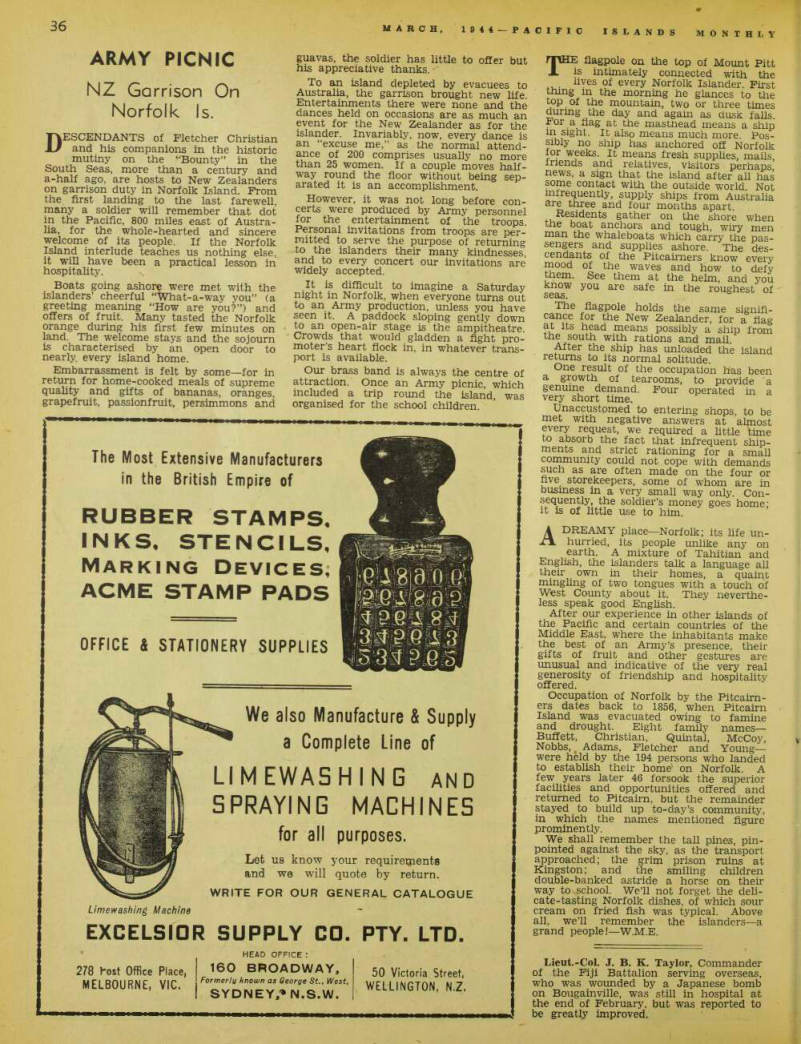
NZ Garrison On Norfolk Is.
DESCENDANTS of Fletcher Christian and his companions in the historic mutiny on the “Bounty” in the South Seas, more than a century and a-half ago, are hosts to New Zealanders on garrison duty in Norfolk Island. From the first landing to the last farewell, many a soldier will remember that dot in the Pacific, 800 miles east of Austra lia, for the whole-hearted and sincere welcome of its people. If the Norfolk Island interlude teaches us nothing else, it will have been a practical lesson in
hospitality.
Boats going ashore were met with the islanders’ cheerful “What-a-way you” (a greeting meaning “How are you?”) and offers of fruit. Many tasted the Norfolk orange during his first few minutes on land. The welcome stays and the sojourn is characterised by an open door to nearly every island home.
Embarrassment is felt by some—for in return for home-cooked meals of supreme quality and gifts of bananas, oranges, grapefruit, passionfruit, persimmons and
guavas, the soldier has little to offer but his appreciative thanks.
To an island depleted by evacuees to Australia, the garrison brought new life.
Entertainments there were none and the dances held on occasions are as much an event for the New Zealander as for the islander. Invariably, now, every dance is an “excuse me,” as the normal attend ance of 200 comprises usually no more than 25 women. If a couple moves half way round the floor without being sep arated it is an accomplishment.
However, it was not long before con certs were produced by Army personnel for the entertainment of the troops.
Personal invitations from troops are per mitted to serve the purpose of returning to the islanders their many kindnesses and to every concert our invitations are widely accepted.
It is difficult to imagine a Saturday night in Norfolk, when everyone turns out to an Army production, unless you have seen it. A paddock sloping gently down to an open-air stage is the ampitheatre.
Crowds that would gladden a fight pro moter’s heart flock in, in whatever trans port is available.
Our brass band is always the centre of attraction. Once an Army picnic, which included a trip round the island, was organised for the school children
THE flagpole on the top of Mount Pitt ± is intimately connected with the lives of every Norfolk Islander. First thing in the morning he glances to the top of the mountain, two or three times during the day and again as dusk falls.
For a flag at the masthead means a ship in sight. It also means much more. Pos sibly no ship has anchored off Norfolk for weeks. It means fresh supplies, mails, friends and relatives, visitors perhaps news, a sign that the island after all has some contact with the outside world. Not infrequently, supply ships from Australia are three and four months apart.
S a ther on the shore when the boat anchors and tough, wiry men man the whaleboats which carry the pas sengers and supplies ashore. The des cendants of the Pitcairners know every mood of the waves and how to defy them. See them at the helm, and you know you are safe in the roughest of seas.
The flagpole holds the same signifi cance for the New Zealander, for a flag at its head means possibly a ship from the south with rations and mail.
After the ship has unloaded the island returns to its normal solitude.
One result of the occupation has been a growth of tearooms, to provide a genuine demand. Four operated in a very short time.
Unaccustomed to entering shops, to be met with negative answers at almost every request, we required a little time to absorb the fact that infrequent ship ments and strict rationing for a small community could not cope with demands such as are often made on the four or five storekeepers, some of whom are in business in a very small way only. Con sequently, the soldier’s money goes home it is of little use to him.
A DREAMY place—Norfolk; its life un hurried, its people unlike any on earth. A mixture of Tahitian and English, the islanders talk a language all their own in their homes, a quaint mingling of two tongues with a touch of West County about it. They neverthe less speak good English.
After our experience in other islands of the Pacific and certain countries of the Middle East, where the inhabitants make the best of an Army’s presence, their gifts of fruit and other gestures are unusual and indicative of the very real generosity of friendship and hospitality offered.
Occupation of Norfolk by the Pitcairn ers dates back to 1856, when Pitcairn Island was evacuated owing to famine and drought. Eight family names— Buffett, Christian, Quintal, McCoy, Nobbs, Adams, Fletcher and Young— were held by the 194 persons who landed to establish their home' on Norfolk. A few years later 46 forsook the superior facilities and opportunities offered and returned to Pitcairn, but the remainder stayed to build up to-day’s community, in which the names mentioned figure prominently.
We shall remember the tall pines, pin pointed against the sky, as the transport approached; the grim prison ruins at Kingston: and the smiling children double-banked astride a horse on their way to school. We’ll not forget the deli cate-tasting Norfolk dishes, of which sour cream on fried fish was typical. Above all, we’ll remember the islanders—a
grand people!-
W.M.E.
Lieut.-Col. J. B. K. Taylor, Commander of the Fiji Battalion serving overseas, who was wounded by a Japanese bomb on Bougainville, was still in hospital at the end of February, but was reported to be greatly improved.
Advertisements & other items, pp. 40-45 (4 items)
Limewashing And
The Most Extensive Manufacturers in the British Empire of
RUBBER STAMPS,
INKS, STENCILS,
Marking Devices;
ACME STAMP PADS
OFFICE & STATIONERY SUPPLIES
We also Manufacture & Supply a Complete Line of
LIMEWASHING AND
SPRAYING MACHINES
for all purposes.
Let us know your requirements and we will quote by return.
WRITE FOR OUR GENERAL CATALOGUE
Li me washing Machine
EXCELSIOR SUPPLY CO. PTY. LTD.
278 Post Office Place,
MELBOURNE, VIC.
HEAD OFFICE :
160 BROADWAY,
Formerly known as George St., West,
SYDNEY,' 1 N.S.W.
50 Victoria Street,
WELLINGTON, N.Z.
UNION
ASSURANCE SOCIETY LTD.
(Incorporated in England)
FIRE ACCIDENT
FIJI A. E. PEARCE & CO.
RABAUL COLYER WATSON
(New Guinea) Ltd.
N. S. WALES 109 PITT STREET,
SYDNEY.
S. Morrison, Mgr.
CONTROLLING OFFICE—
-413 Collins St., MELBOURNE
ALAN H. RUSSELL,
Resident Manager.
0. F. MASSGHELEIN
WORLD-WIDE EXPORT AGENT SINCE 1919
Late of Antwerp (Belgium). Established in Sydney 1928.
OFFERS RELIABLE and EFFICIENT SERVICE
to all Australian and Oversea Manufacturers Inquiries from Oversea Buyers are Welcomed.
Correspondence: English, Dutch, French, Spanish.
ANDREWS BUILDINGS, 40 KING STREET, SYDNEY
indisf!
etisa 1
bjf
for
aerodromes
and other targe .
50 acres a day can easily be cut with a Ransomes Quintuple Mower drawn by a tractor, and even larger outfits up to 25 ft. wide are available. This enormous capacity makes Ransomes Gang Mowers indispensable to all controlling aerodromes, large sports grounds, etc., requiring frequent cutting. With no other machine could these large areas be kept in such good condition.
Sizes: Triple 7 ft.. Quintuple 11% ft., Septuple 16 ft., up to 11 units—2s ft. wide. Also a sulky mower 30 in. wide for hilly land.
Miansomes
GANG MOWEPS
We illustrate our standard machine.
For longer grass and heavier work, we offer the “ Magna - Gang ’* pattern.
Illustrated catalogue showing a complete range of hand, animal draught and motor lawn mowers will be sent on application.
MORRIS,
HBDSTROM, LTD.,
Suva, Lantoka and Ba.
RANSOMES, SIMS & JEFFERIES, LTD. Ipswich, England.
Allen Taylor & Co. Ltd.
COMMERCIAL ROAD, ROZELLE,
SYDNEY
Sawmillers and Wholesale Suppliers of Hardwoods for Constructional Purposes GIRDERS . . . PILES . , . POLES . . . SLEEPERS, Etc.
EXPORTING TO PACIFIC ISLANDS SINCE 1893
BITUMENOID ROOFING
MADE IN AUSTRALIA,
Bltumenold Roofings, Dampcourse and Insulating Pelts are made from the world’s best raw materials. Warranted to stand the most rigid tests.
BITUMENOID THE BEST
Roofing, 1,2, 3-ply; Flooring, Waterproof Materials; Saturated Pelt; Resilient Road Jointing; Natural Asphalt Dampcourse; 2 and 3-ply Dampcourse; 1-2 lb. Lead-oore Dampcourse: Roofing Cement; Asphalt Paints: Roofing Compound.
SAMPLES AND PRICE LISTS ON APPLICATION.
MAXWELL PORTER & SON LTD.
ESTABLISHED 1888. BUILDERS’ SUPPLIES*.
107 REDFERN ST., REDFERN, SYDNEY. N.S.W. ’Phone: M 3157. Cables BUwneneld,
You cau \iues. and este d ftieV ate CO. \ Vlanula c ' -ItitiHE. , r.
Stand I 0^ S aH
W *’Y=d“’ ,t ' ' ' „ 1 a **■&%
VAA» nt '
> Su va
' 5 Y?S““”,”v ><>] “ M—
MEEBO'
*.. S. ’
For Inflamed Eyes and Eyelids
SOLD EVERYWHERE
H. A. Rw L C>. Pty. Ltd.. Klei St. Sydney
TRINITY GRAMMAR SCHOOL
The School is well equipped and splendidly situated. Its 1944 complement (about 70 hoarders and 250 day boys) makes it possible for every boy to come into personal touch with the Head Master and a staff of 10 experienced and successful masters (including seven University Graduates). The general life of the school is very varied and full of vigour. The Head Master will be pleased to send the Illustrated Year Book for 1943-4, on application, and to give full information about the school, which is approved by the University of Melbourne as a Class “A” School for Intermediate and School Leaving Examinations.
KEW, VICTORIA.
President of Council:
A. O. HENTY, Esq.
Headmaster:
ALFRED BRIGHT, M.Sc., B.A.
2nd term commences .31 st May, 1944.
Postal Address: Kew, E. 4, Victoria.
Telephone: Hawthorn 412.
(jILLESPJI S ERV CE
BUYING AGENTS
FOR ALL PACIFIC TERRITORIES
Island Produce Sold on Commission
YOUR ORDERS RECEIVE PERSONAL ATTENTION
ROBERT GILLESPIE PTY. LIMITED
54a PITT STREET, SYDNEY
Cables: ROBERGILL. GP.O. BOX 137 CC.
Rid Kidneys Of
Poisons And Adds
If you suffer sharp, stabbing pains, if joints are swollen, it shows your blood is poisoned through faulty kidney action. Other symptoms of Kidney Disorders are Backache, Aching Joints and Limbs, Sciatica, Neuritis, Lumbago, Sleepless Nights, Dizziness, Nervousness, Circles under Eyes, Loss of Energy and Appetite and Frequent Headaches and Colds, etc. Ordinary medicines can’t help much because you must get to the root cause of the trouble.
The Cystex treatment is specially compounded to soothe, tone and clean kidneys and bladder and* remove acids and poisons from your system safely, quickly and surely, yet contains no harmful or dangerous drugs. Cystex works in 3 ways to end your troubles. 1. Starts killing the germs which are attacking your Kidneys, Bladder and Urinary System in two hours, yet is absolutely harmless to human tissue. 2. Gets rid of health-destroying, deadly poisonous acids with which your system has become saturated. 3. Strengthens and reinvigorates the kidneys, protects from the ravages of disease-attack on the delicate filter organism, and stimulates the entire system.
Praised by One-time Sufferers
Cystex is approved by one-time sufferers in 73 countries from the troubles shown above.
Mr. Reg Thomas, Townsville, Queensland, recently wrote: “My joints were all stiff, I had leg pains, my back used to ache day and night.
My bladder was weak. I had headaches and no appetite. The first dose of Cystex helped me and before I finished three boxes my health and strength came back.”
Guaranteed to Satisfy or Money Back Get Cystex from your chemist or store to-day.
Give it a thorough test. Cystex is guaranteed to make you feel younger, stronger, better in every way, or your money back If you return the empty package.
Now in 2 sizes—4/-, 8/-.
GUARANTEED CVStfiX
Treatment W for Your Kidneys, Bladder, Rheumatism.
PRODUCING UNIFORM GOOD RESULTS SINCE 1868
Floor
ALWAYS ASK FOR IT
Your old SCISSORS, RAZORS
and KNIVES can be
SHARPENED and REPAIRED
a Send them to—
W. JNO. BAKER
3 HUNTER STREET,
SYDNEY.
Restlessness and sleeplessness, when due to run-down nerves, frequently respond to treatment with Dr. Williams' Pink Pills.
Dr. Williams*
PINK PILLS
help to enrich the blood, which has a beneficial and restorative effect upon the nervous system.
37
HONOUR ROLL
(Continued from Inside Back Cover)
PACIFIC ISLANDS MONTHLY MARCH, 1944
39
PTA MEETS
(Continued from Page 9)
PACIFIC ISLANDS MONTHLY MARCH, 1944
40
March, i944-*»Aclfic islands monthly
Polynesian Concert
rE concert given by the Polynesian Club of Sydney, in aid of the Red Cross Younger Set, on March 3, was, as usual, excellent.
Directed by Mr. L. Moran, members presented songs and dances of New Zea land and Polynesia to a large, apprecia tive audience in the 2GB theatrette in Phillip Street, Sydney, and, as a result somewhere between £4O and £5O will be added to the funds of the Red Cross.
Members who took part were: Kata rina Nehua. Waikainga Tipene, Wikitoria Pairona, Marj. Ziele, Riro Light and Stella Darley, all from New Zealand: Rangi Wethered, from the Chatham Islands, NZ; Ngahuia Waugh, an Aus
tralian-born Maori; Ivy Buffett, Cora Young, Verle Young, Helen Quintal, Dora Buffett, Aldin Buffett, Barbara Christian and John Young, all from Norfolk Island; Salote Olsen, from Rotuma; Malia and Leli Colbert, from Hawaii; and Pera Williams, from Suva, Fiji.
The secretary of the Fiji War Fund Board has received letters of thanks from the following overseas organisations, to which the Board has donated money: Secretary of the Royal Air Force Bene volent Fund; Lady Cripps, president of the Aid to China Fund; general secre tary of Dr. Barnardo’s Homes; and Admiral Sir Aubrey Smith, chairman of King George’s Fund for Sailors.
Advertisements & other items, p. 45 (1 item)
D Ar Vas I
ISLAND TRADERS PLEASE NOTE
REHABILITATION
Discharged N.Z. Officer, rank Captain, age 47 years, self and 4 children, aged 8 to 15 years, desires to secure steady position with reliable Trading Concern, situate preferably Cook or Tongan Group, with climate suitable for children.
Advertiser has had 20 years’ varied experience in Argentine, Brazil, Canada, U.S.A. and N.Z., including many years’ Government Service (Clerical, Stores Control, and Administrative work). Has not required references. Present employment with N.Z. Public Service (Manpower Department).
Military Service equals 29i years (8 active, balance on Reserve of Officers).
Keen, conscientious, reliable and honest. Willing undertake long term contract where responsibility required and reasonable conditions and prospects exist and where opportunities exist for children to follow in his footsteps.
Are you requiring such an employee in your firm? If so, kindly contact the undersigned, stating full particulars and conditions of your vacancy.
Capt. J. D. Hicks,
P.O. Box 119, WANGANUI,
NEW ZEALAND.
D AR VAS i
(Proprietors: R. DARVAS, E. KLUGMAN)
35 PITT STREET, SYDNEY
EXPORTERS ::IMPORTERS
GENERAL MERCHANTS
ISLANDS TRADERS
SHIPPERS OF ALL KINDS OF MERCHANDISE
SPECIALISING IN FOODSTUFFS AND SPIRITS
Islands Produce
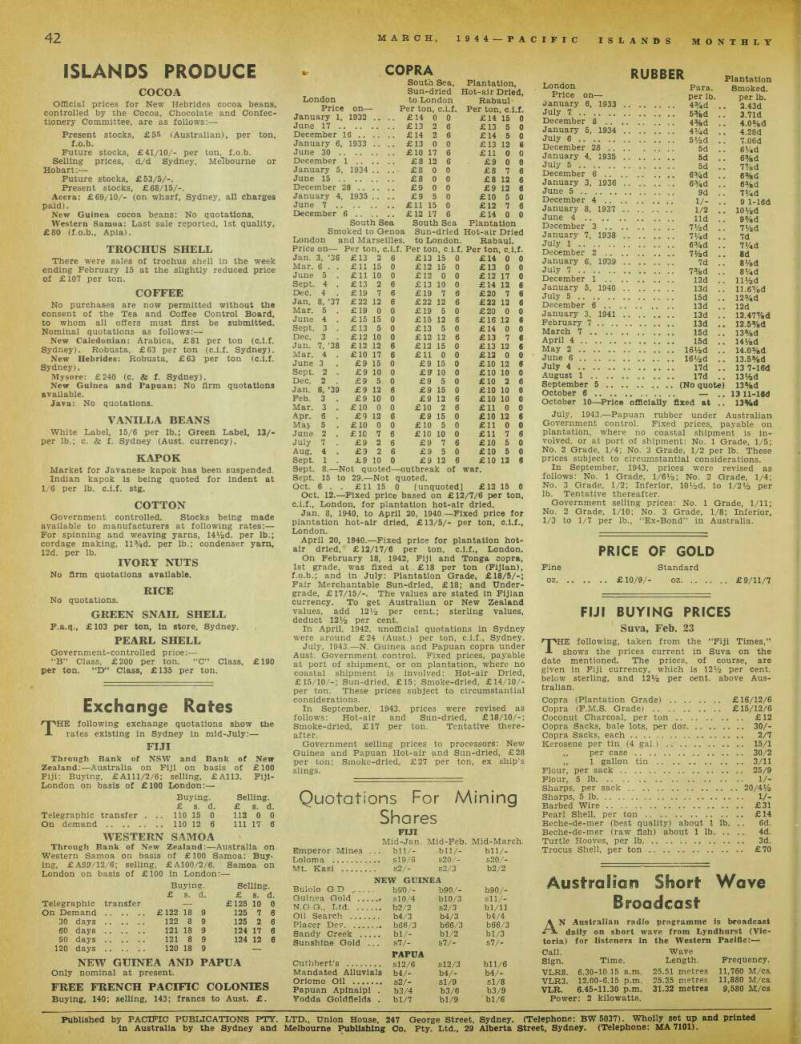
Cocoa
Official prices for New Hebrides cocoa beans, controlled by the Cocoa, Chocolate and Confec tionery Committee, are as follows: — Present stocks, £55 ( Australian), per ton, f.o.b.
Future stocks, £4l/10/- per ton. f.o.b.
Selling prices, d/d Sydney, Melbourne or Hobart: — Future stocks, £53/5/-.
Present stocks, £6B/15/-.
Accra: £69/10/- (on wharf, Sydney, all charges paid).
New Guinea cocoa beans: No quotations.
Western Samoa: Last sale reported, Ist quality, £BO (f.0.b., Apia).
Trochus Shell
There were sales of trochus shell in the week ending February 15 at the slightly reduced price of £lO7 per ton.
Coffee
No purchases are now permitted without the consent of the Tea and Coffee Control Board, to whom all offers must first be submitted.
Nominal quotations as follows: New Caledonian: Arabica, £Bl per ton (c.i.f.
Sydney). Robusta, £63 per ton (c.i.f. Sydney).
New Hebrides: Robusta, £63 per ton (c.i.f.
Sydney), Mysore: £240 (c. & f. Sydney).
New Guinea and Papuan: No firm quotations available.
Java: No quotations.
Vanilla Beans
White Label, 15/6 per lb.; Green Label, 13/per lb.; c. & f. Sydney (Aust. currency).
Kapok
Market for Javanese kapok has been suspended.
Indian kapok is being quoted for Indent at 1/6 per lb. c.i.f. stg.
Cotton
Government controlled. Stocks being made available to manufacturers at following rates:— For spinning and weaving yarns, 14y 2 d. per lb.; cordage making, 11 %d. per lb.; condenser yarn, 12d. per lb.
Ivory Nuts
No firm quotations available.
Rice
No quotations.
Green Snail Shell
F.a.q., £lO3 per ton, in store, Sydney.
Pearl Shell
Government-controlled price:— “B” Class, £2OO per ton. “C” Class, £l9O per ton. “D” Class, £135 per ton.
Exchange Rates
THE following exchange quotations show the rates existing in Sydney in mid-July:—
Fiji
Through Bank of NSW and Bank of New Zealand: —Australia on Fiji on basis of £lOO Fiji: Buying, £Alll/2/6; selling, £AII3. Fiji- London on basis of £lOO London:—
New Guinea And Papua
Only nominal at present.
Free French Pacific Colonies
Buying, 140; selling, 143; francs to Aust. £.
Oct. 6 . . £ll 15 0 [unquoted] £l2 15 0 Oct. 12. —Fixed price based on £l2/7/6 per ton, c.i.f., London, for plantation hot-air dried.
Jan. 8, 1940, to April 20, 1940. —Fixed price for plantation hot-air dried, £l3/5/- per ton, c.i.f., London.
April 20, 1940.—Fixed price for plantation hot air dried, £l2/17/6 per ton, c.i.f., London.
On February 18, 1942, Fiji and Tonga copra, Ist grade, was fixed at £lB per ton (Fijian), f.0.b.; and in July: Plantation Grade, £lB/5/-; Fair Merchantable Sun-dried, £18; and Under grade, £l7/15/-. The values are stated in Fijian currency. To get Australian or New Zealand values, add 12 y 2 per cent.; sterling values, deduct 12 y 2 per cent.
In April, 1942, unofficial quotations in Sydney were around £24 (Aust.) per ton, c.i.f., Sydney.
July, 1943. —N. Guinea and Papuan copra under Aust. Government control. Fixed prices, payable at port of shipment, or on plantation, where no coastal shipment is involved: Hot-air Dried, £l5/10/-; Sun-dried, £l5; Smoke-dried, £l4/10/per ton. These prices subject to circumstantial considerations.
In September, 1943. prices were revised as follows: Hot-air and Sun-dried, £lB/10/-; Smoke-dried, £l7 per ton. Tentative there after.
Government selling prices to processors: New Guinea and Papuan Hot-air and Sun-dried, £2B per ton; Smoke-dried, £27 per ton, ex ship’s slings.
Buying.
Selling. £ s. d. £ s. d.
Telegraphic transfer . .. 110 15 0 112 0 0 On demand 110 12 6 111 17 6
Western
Samoa
Through Bank of New Zealand:—Australia on Western Samoa on basis of £100 Samoa: Buying, £ A99/12/6; selling, £ A100/2/6.
Samoa on London on basis of £100 in London: Buying.
Selling. £ s. d. £ s. d.
Telegraphic transfer — £125 10 0 On Demand £122 18 9 125 7 6 30 days 122 8 9 125 2 6 60 days 121 18 9 124 17 6 90 days 121 8 9 124 12 6 120 days 120 18 9 —
L- London
Copra
South Sea, Plantation, Sun-dried Hot-air Dried, to London Rabaul Price on— Per ton, c.i.f.
Per ton, c.i.f.
January 1 1932 .. £14 0 0 £14 15 0 June 17 . £13 2 6 £13 5 0 December 16 .. £14 2 6 £14 5 0 January 6 1933 £13 0 0 £13 12 6 June 30 . £10 17 6 £11 0 0 December 1 .. £8 12 6 £9 0 0 January 5 1934 £8 0 0 £8 7 6 June 15 . £8 0 0 £8 12 6 December 28 .. £9 0 0 £9 12 6 January 4 1935 £9 5 0 £10 5 0 June 7 . £11 15 0 £12 7 6 December 6 South Sea £12 17 6 South Sea £14 0 Plantation 0 Smoked to Genoa Sun-dried Hot-air Dried London and Marseilles to London.
Rabaul.
Price on— Per ton, c.i.f.
Per ton, c.i.f. Per ton, c.i.f.
Jan. 3, ’36 £13 2 6 £13 15 0 £14 0 0 Mar. 6 . . £11 15 0 £12 15 0 £13 0 0 June 5 . £11 10 0 £12 0 0 £12 17 0 Sept. 4 . £13 2 6 £13 10 0 £14 12 6 Dec. 4 , £19 7 6 £19 7 6 £20 7 6 Jan. 8, ’37 £22 12 6 £22 12 6 £22 12 6 Mar. 5 . £19 0 0 £19 5 0 £20 0 0 June 4 . £15 15 0 £15 12 6 £16 12 6 Sept. 3 . £13 5 0 £13 5 0 £14 0 0 Dec. 3 . £12 10 0 £12 12 6 £13 7 6 Jan. 7, ’38 £12 12 6 £12 15 0 £13 12 6 Mar. 4 . £10 17 6 £11 0 0 £12 0 0 June 3 £9 15 0 £9 15 0 £10 12 6 Sept. 2 . £9 10 0 £9 10 0 £10 10 0 Dec. 2 . £9 5 0 £9 5 0 £10 2 6 Jan. 6, '39 £9 12 6 £9 15 0 £10 10 0 Feb. 3 . £9 10 0 £9 12 6 £10 10 0 Mar. 3 . £10 0 0 £10 2 6 £11 0 0 Apr. 6 . £3 12 6 £9 15 0 £10 12 6 May 5 . £10 0 0 £10 5 0 £11 0 0 June 2 . £10 7 6 £10 10 0 £11 7 6 July 7 . £9 2 6 £9 7 6 £10 5 0 Aug. 4 . £3 2 6 £9 5 0 £10 5 0 Sept. 1 . £9 10 0 £9 12 6 Sept. 8. —Not quoted—outbreak of Sept. 15 to 29. —Not quoted. £10 war. 12 6
Quotations For Mining
Shares
July, 1943. —Papuan rubber under Australian Government control. Fixed prices, payable on plantation, where no coastal shipment is in volved, or at port of shipment: No. 1 Grade, 1/5; No. 2 Grade, 1/4; No. 3 Grade, 1/2 per lb. These prices subject to circumstantial considerations.
In September, 1943, prices were revised as follows: No. 1 Grade, 1/6V 2 ; No. 2 Grade, 1/4; No. 3 Grade, 1/2; Inferior, 10y 2 d. to l/2y 2 per lb. Tentative thereafter.
Government selling prices; No. 1 Grade, 1/11; No. 2 Grade, 1/10; No. 3 Grade, 1/8; Inferior, 1/3 to 1/7 per lb., “Ex-Bond” in Australia.
Fiji
Mid-Jan.
Mid-Feb.
Mid-March.
Emperor Mines . .. bll/bll/bll/- Loloma .. si9/6 s20/s20/- Mt. Kasl s2/- S2/3 b2/2 Bulolo G D ...
New Guinea
b&'O/- b90/b90/- Guinea Gold ... blO/3 sll/- N.G G., Ltd .. b2/2 s2/3 bl/11 Oil Search .. b4/3 b4/3 b4/4 Placer Dev ,.. b66/3 b66/3 b66/3 Sandy Creek ... .. bl/bl/2 bl/3 Sunshine Gold . .. s7/- S7/s7/- Cuthbert’s
Papua
.. S12/6 S12/3 bll/6 Mandated Alluvials b4/b4/b4/- Oriomo Oil ... s2/sl/9 sl/8 Papuan Aplnaipi . b3/4 b3/6 b3/9 Vodda Goldfields . bl/7 bl/9 bl/6
RUBBER Plantation
London Para.
Smoked.
Price on— per lb. per lb.
January 6, 1933 . 43/ 4 d .. 2.43d July 7 3.71d December 8 .. . 4.0 s /sd January 5, 1934 . 4»Ad .. 4.28d July 6 7.06d December 28 .. . 5d .. 6V 4 d January 4, 1935 . 6%d July 5 7 7 /ad December 6 .. . 6%d January 3, 1936 . 6%d June 5 7>/ 4 d December 4 . . . 9 l-16d January 8, 1937 . 1/2 .. lOVad June 4 9%d December 3 .. . 7*/ad January 7, 1938 . 7d July 1 7V 4 d December 2 .. . 8d January 6, 1939 . 7d ..’ sy 8 d July 7 sy 4 d December 1 .. . 12d .. ny 2 d January 5, 1940 . 13d .. 11.6 7 /sd July 5 12 3 / 4 d December 6 .. .. 12d January 3, 1941 . 12.47Y8<I February 7 12.5%d March 7 13 5 /sd April 4 14y e d May 2 14,oy«d June 6 13.5%d July 4 13 7-16d August 1 13ted September 5 .. ., 13%d October 6 13 11-lSd October 10—Price officially fixed at .. 13%d
Advertisements & other items, p. 46 (1 item)
Price Of Gold
Fine Standard oz £lO/9/- oz £9/11/7
Fiji Buying Prices
Suva, Feb. 23 THE following, taken from the “Fiji Times,” shows the prices current in Suva on the date mentioned. The prices, of course, are given in Fiji currency, which is 12 y 2 per cent, below sterling, and 12V 2 per cent, above Aus tralian,
Copra (Plantation Grade) £16/12/6 Copra (F.M.S. Grade) . £15/12/6 Coconut Charcoal, per ton .. .. £12 Copra Sacks, bale lots, per doz ... 30/- Copra Sacks, each ... 2/7 Kerosene per tin (4 gal.) .. .. 15/1 ,, per case .. .. 30/2 „ i gallon tin .. .. 3/11 Flour, per sack .. .. 25/9 Flour, 5 lb ... 1/- Sharps, per sack .. .. 20/4% Sharps, 5 lb 1/- Barbed Wire ... £31 Pearl Shell, per ton .. .. £14 Beche-de-mer (best quality) about 1 lb. .. 6d.
Beche-de-mer (raw fish) about 1 lb. ... 4d.
Turtle Hooves, per lb ... 3d.
Trocus Shell, per ton ... £70
Australian Short Wave
Broadcast
AN Australian radio programme is broadcast daily on short wave from Lyndhurst (Vic toria) for listeners in the Western Pacific:—
Call.
Wave Sign.
Time.
Length.
Frequency.
Vlr8.
6.30-10.15 a.m. 25.51 metres
11,760 M/Cs.
Vlr3.
12.00-6.15 p.m. 25.25 metres 11,880 M/cs.
Vlr.
6.45-11.30 p.m. 31.32 metres 9,580 M/cs Power: 2 kilowatts.
Advertisements & other items, pp. 46-48 (3 items)
42
MARCH, 194 4 PACIFIC ISLANDS MONTHLY
Published by PACIFIC PUBLICATIONS PTY. LTD., Union House, 247 George Street, Sydney. (Telephone: BW 5037). Wholly set up and printed in Australia by the Sydney and Melbourne Publishing Co. Pty. Ltd., 29 Alberta Street, Sydney. (Telephone: MA7101).
Roll Of Honour
(Continued From Inside Front Cover)
W. R. Carpenter & Co. Ltd.
ifcrs
HHMHNI
HHI
-' ’ . .1 ■V- i I iHHfet. »» Hi I E* ;^s^' II H r: : iS s
BBSiM
iruhej. ■ -i'-V* :•'» • *«!
SSI?
1 m •■-■ Pis 'v m m
Travel by CARPENTER AIRLINES
Full particulars from Macdonald, Hamilton & Co., or Howard Smith Ltd., Sydney.
W. R. CARPENTER & CO. LTD.
MERCHANTS, SHIPOWNERS AND AIRCRAFT OPERATORS
agents for Australian, European and American Manufacturers, and Distributors of Every Description of Merchandise.
Buyers and Shippers of Copra, Trocas, and all Classes of Islands Produce.
Ford Motor Company of Canada.
T. G. & C. Bolinders (Engines).
AGENTS FOR :
Caterpillar Tractors.
Electrolux Refrigerators, etc., etc.
Dodge Brothers Inc.
Westinghouse Electrical Co
Branches throughout the Pacific Islands
In London: W. R. Carpenter Gr Co. (London) Ltd., Coronation House, 4 Lloyds Avenue, London, EC.
Head Office: 16 O’CONNELL STREET, SYDNEY