Islands
Pacific
Monthly
February I % fp|44
Vol. Xiv. No. 7.
Established 1930
[Registered at the n Orv, ,fe«Ar transmission by post as a newspaper ]
1/-
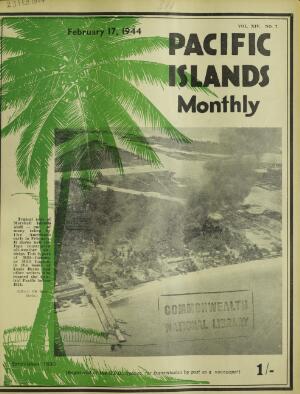
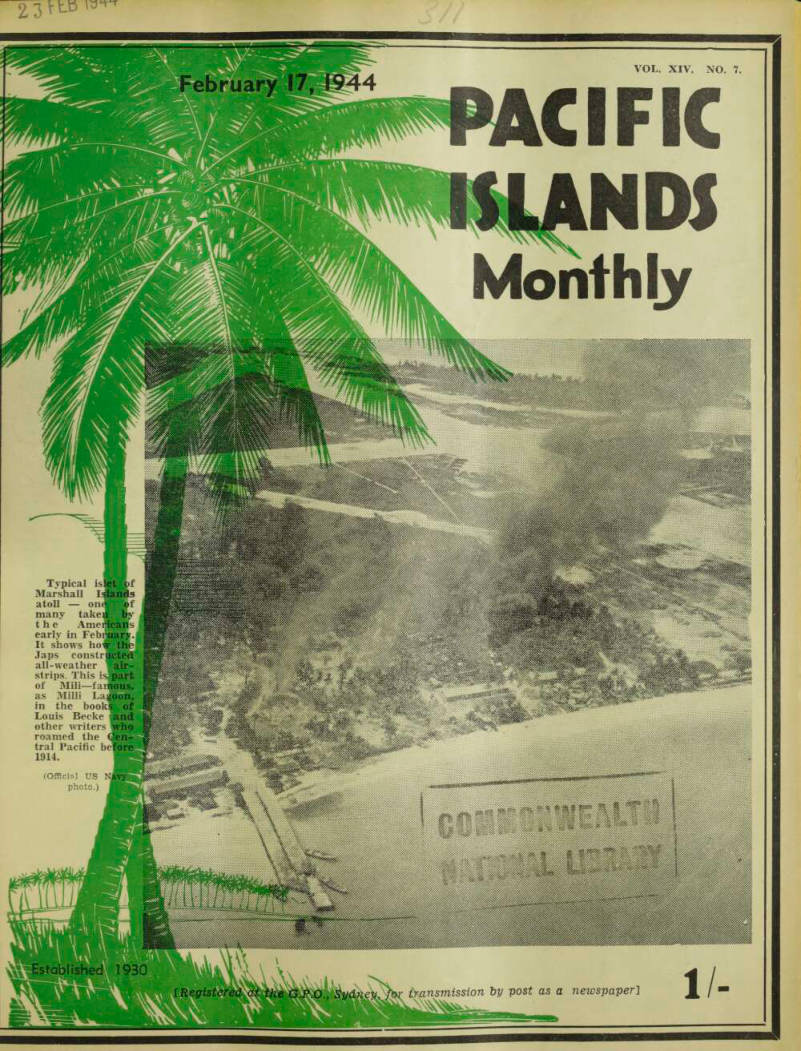
Typical islet of Marshall Islands atoll - one of many taken by the Americans early in February.
It shows how the Japs constructed all-weather air strips. This is part of Mili—famous, as Milli Lagoon, in the books of Louis Becke and other writers who roamed the Cen tral Pacific before 1914. (Official US Navy photo.)
Roll Of Honour
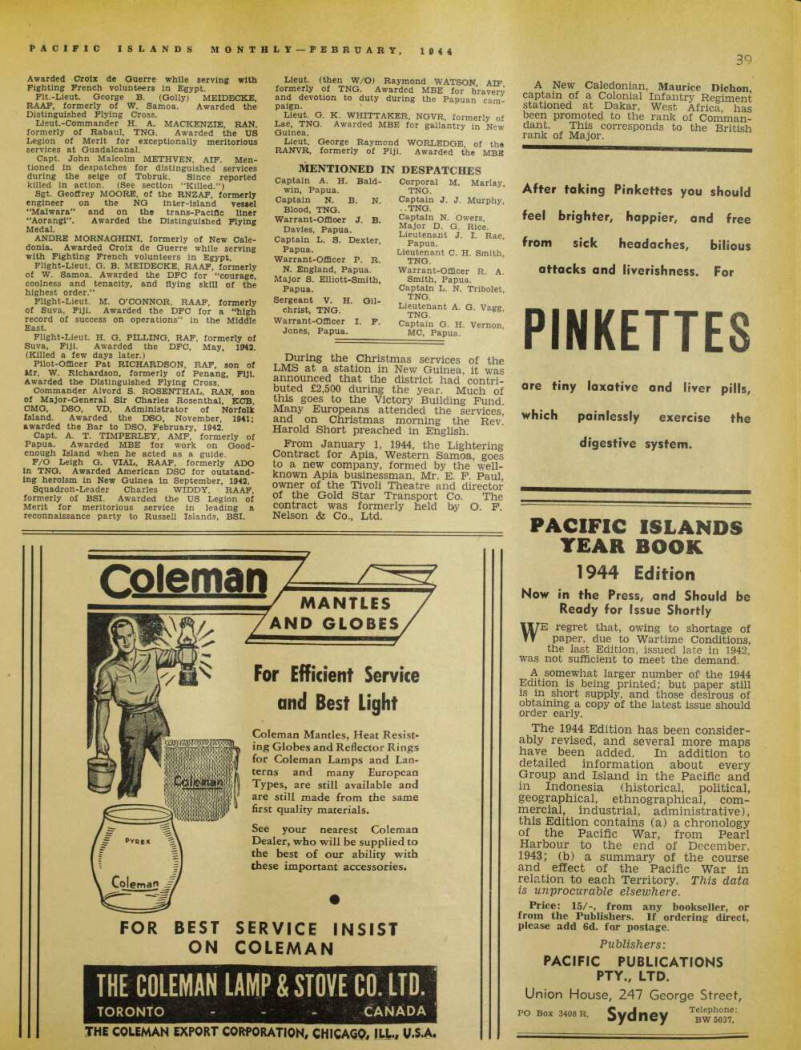
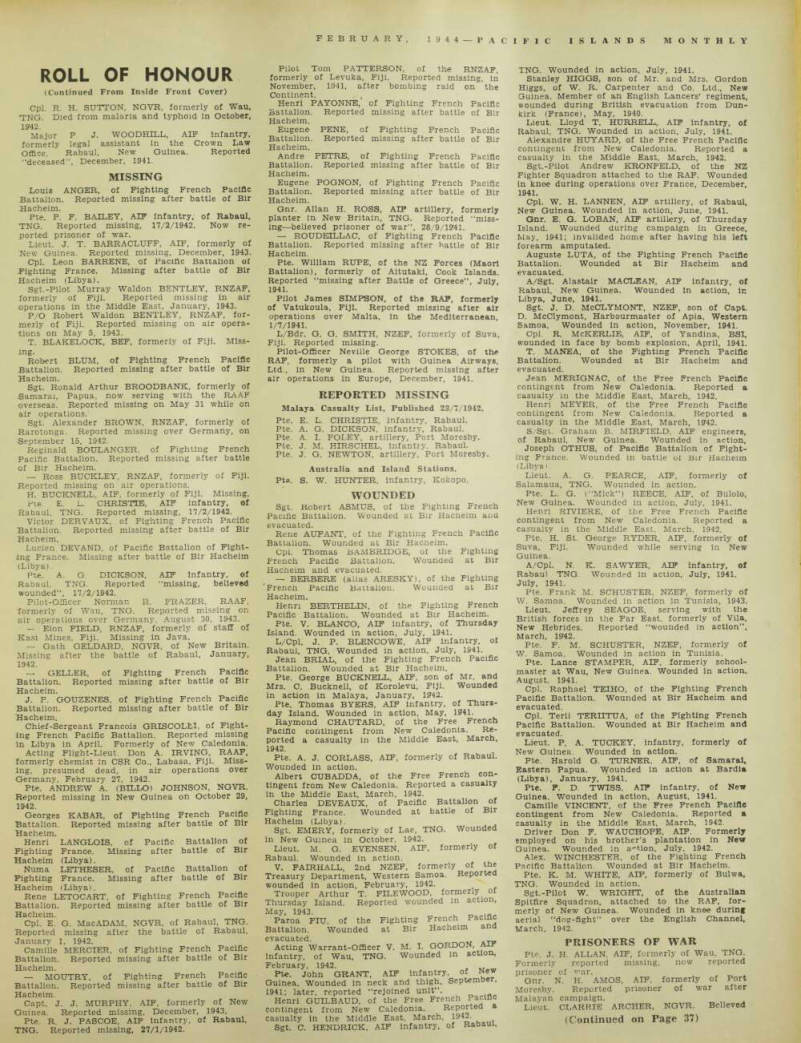
(We try to assemble here the names of men of the United Nations, residents or former residents of the Pacific Territories, whose names appear in casualty lists or who> receive decorations. We should be grateful if relations and friends would send us details of such men.)
Killed
Sgt. Bert AITKEN, NZEF, formerly of Fiji.
Killed in action in Libya.
Eugene AUBRY (formerly of Tahiti), of the Air Force of Fighting France. Killed in an air accident in Great Britain.
Squadron-Leader Stan BALDIE, RAF, formerly of Wau, TNG. Killed in action in India.
Pilot-Officer Len BAYLISS, flying instructor in the RAAF, formerly of Rabaul, New Guinea.
Killed in Sydney, 18/11/1940, when he fell from a trainer aircraft in flight.
Lieut.-Colonel C. N. F. BENGOUGH, of BSI, Defence Forces, formerly Acting-Resident Com missioner of BSI. Killed when aircraft shot down into sea, August, 1943.
R. C. BENTLEY, NZEF, formerly of Fiji.
Killed in action. Middle East, June 27, 1942.
A/Bdr. Neville W. BERTWISTLE, AIF artillery (tank unit), formerly a clerk on the staff of W. R. Carpenter and Co. Ltd., of Rabaul, New Guinea. Killed in action, April, 1941.
P/O J. B. BOMFORD, RNZAF, formerly of CSR Co.’s staff, Fiji. Killed on active service in England.
Pte. W. R. M. BRADNAM, of the NZ Forces, formerly of Fiji. Reported killed In action in the Middle East, 25/11/1941.
Warrant-Officer R. F. BRECHIN, New Guinea Force. Killed in air accident, June 17, 1942.
Formerly of NG Department of Agriculture.
Anton BRINON, of Fighting French Pacific Battalion, formerly of La Foa, New Caledonia.
Killed in action in Libya, November, 1942.
Lieut.-Colonel Felix BROCHE, of the New Caledonian-New Hebridean contingent of the Fighting French Pacific Battalion. Killed in action in the battle of Bir Hacheim (Libya).
Pilot-Officer E. H. CANARD, of RAF. formerly of Fiji Civil Service. Killed in flying accident in South Africa in the course of his duty as flying instructor.
Pte. David C. GARLAND, AIF, formerly chief assayer at the Emperor gold mines, Fiji. Killed In action in New Guinea.
Pierre CHARPENTIER, of the Fighting French Pacific Battalion. Killed in action in the battle of Bir Hacheim.
Raymond CHAUTARD (formerly of New Cale donia), of the Fighting French Pacific Battalion.
Sillied in action in Libya.
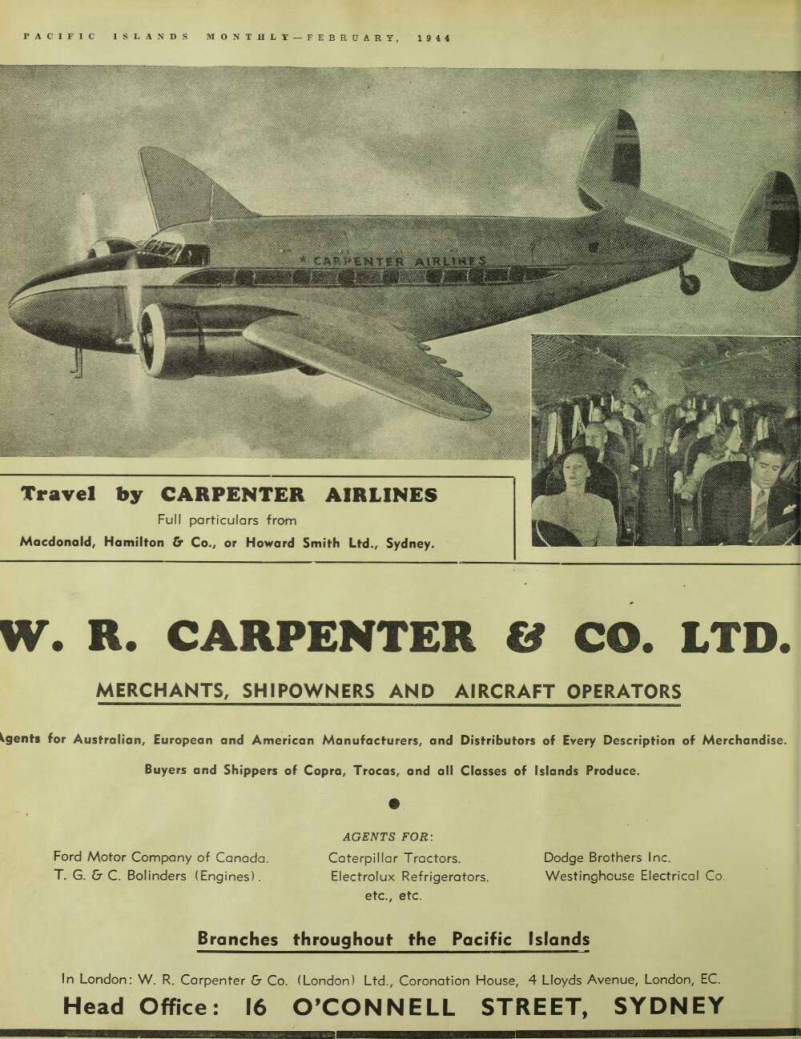
Flight-Lieutenant G. J. I. CLARKE, of the RAAF, formerly Assistant Flight Superintendent of Carpenter Airlines, New Guinea. Killed in action during operations off Dakar (French West Africa), while attached to HMAS “Aus tralia”, September, 1940.
Georges CLEMENS, of the Free French Pacific contingent from New Caledonia. Reported killed in action in the Middle East, March, 1942.
Flying-Officer Jack R. COATH, of the RNZAF, formerly on the staff of the Bank of New Zealand, in Suva, Fiji. Killed October, 1941, when a training aircraft crashed in NZ.
Sqd.-Leader Lionel COHEN, RAF, formerly of Upper Watut, TNG. Killed when returning from a bomber raid on Berlin in 1942.
Sgt-Pilot Colin CRABBE, RAF, formerly of Suva, Fiji. Killed by enemy action in England in May, 1943.
Pte. Felix CRAIG, AIF, formerly of accounts department, Australasian Petroleum Co., Port Moresby, Papua. Killed in action, June, 1941.
L. J. DAWES, of the NZ Forces, formerly Dis trict Officer of Savaii, Western Samoa. Reported killed In action, February, 1942.
Pilot-Officer V. L. DEARMAN, of the RAAF (observer), formerly overseer and clerk at the Colonial Sugar Refining Co., Ltd., Raraval, Fiji. Reported killed In action in the Middle East, October, 1941.
Capt. Jean GILBERT, of the Naval Forces of Fighting France, and formerly of Tahiti. Killed in action.
Captain Kenneth GARDEN, of the RAF Ferry Command, formerly of Guinea Airways Ltd., in New Guinea. Killed September, 1941, when a bomber he "ferried” from USA crashed on west coast of Britain.
Flying-Officer Moresby GOFTON, of the RAF, *on of Mrs. F. S. Stewart, of Wau, New Guinea.
Reported missing, 17/5/1940—presumed killed in air operations.
Rifleman J. A. GOODWIN, AIF infantry, for merly of Bulwa, TNG. Reported “accidentally killed”. April, 1942.
Ernest GOURNAC (formerly of Tahiti), of the Air Force of Fighting France. Killed in an air
accident in Britain.
Pte. Wallace GRAHAM, of the NZ Forces (infantry;, formerly on the staff of Morris Hedstrom Ltd., Fiji. Killed in action in the Middle East, November, 1941.
Lieut. J. A. GRANT, AIF, formerly of Man dated Territory. Killed in action.
Lieut. L. B. GROVE, AIF, formerly of Madang, TNG. Killed in action.
Squadron-Leader C. R. GURNEY, RAAF, a former chief pilot of Guinea Airways, Ltd.
Killed in action in the New Guinea area, May, 1942.
Pte. B. HAMILTON, AIF, formerly of Auck land, NZ, and New Guinea. Killed in action.
Gerald T, J. HARPER, RAF, son of Major and Mrs. P. Harper, of Ra, Fiji. Killed in action while navigating a Whitley bomber dur ing a raid on the Continent.
J. HEAD, RAAF, formerly of Fiji. Killed in flying accident in Australia, 1941.
Captain L. T. HURRELL, infantry, Rabaul.
Killed in action.
Sqd.-Leader James R. HYDE, of the RAF, formerly a Patrol Office in Namatanai and Sepik Districts, TNG. Awarded the Distinguished Fly ing Cross, 1941. Killed in action while leading an attack on an enemy convoy off the coast of Greece, July 24, 1942.
Pte. Jack JOHNSON, formerly of Morris Hedstrom’s staff, Fiji. Killed in, action on November 4, while serving with the AIF in New Guinea.
Flying-Officer Alan JOHNSTONE, of the RAF. who was born in Suva, FIJI, in 1915. Killed during bombing raid on Kristiansand, Norway, April, 1940.
Flying-Officer G. M. KEOGH, RAAF, form erly of Wewak, TNG. Killed in air operations in New Guinea, August 30, 1943.
LAC Douglas KIRBY, RAF, who left Suva, Fiji, with the first contingent of Air Force trainees. Reported killed in a flying accident in South Africa, March, 1942.
Marcel KOLLEN. of the Pacific Battalion of Fighting France. Killed in action in the battle of Bir Hacheim.
C. D. LAMONT, RAF, formerly a master at Boys’ Grammar School, Suva, Fiji. Missing, be lieved killed on air operations over Germany.
Emile LESSON (formerly of New Caledonia), of the Fighting French Pacific Battalion. Killed in action in Libya.
Cpl. Gaston LESSON, of the Fighting French Pacific Battalion. Killed in battle of Bir Hacheim (Libya).
Capt. (now Lt.-Oolonel) Edward Tiwi LOVE, NZ Maori Battalion, husband of Mrs. Takau Rio Love, Ariki-nui of Rarotonga, Cook Islands. Re ported missing during campaign in Greece, May, 1941; later, June, 1941, reported “wounded and safe.” Officially announced, July 17, 1942, killed in action in Libya.
Flying-Officer John C. LOWE, RAAF, formerly an overseer with the CSR Co. in Fiji. Reported, 11/4/1942, “took part in air defence of Rabaul, TNG, —missing, believed killed”.
Pte. L. P. McCarthy, AIF infantry, form erly supercargo on W. R. Carpenter and Co.’s inter-island vessels “Desikoko” and “Mako”, in New Guinea. Reported “killed in action” in Syria, 30/10/1941.
Sgt. Kenneth MACGREGOR, AIF, formerly practising as a barrister and solicitor in Wau, TNG. Reported missing, believed killed, in Papua.
Sgt.-Pilot Ronald MACKAY, RAAF, formerly of Thursday Island. Killed in an aircraft accident in England.
Lance-Corporal A. D. MacPHEE, son of Mr.
R. D. MacPhee, Levuka, Fiji. He was 35, was a member of the AIF, and was killed in Greece, May, 1941.
Francois MASSON, of the Fighting French Pacific Battalion. Killed in action in the battle of Bir Hacheim.
Capt. John Malcolm METHVEN. Reported killed in action in Egypt on July 22, 1942, while serv ing with the AIF. He was born in Ocean Island, and is the youngest son of Mr. and Mrs.
Stuartson C. Methven, of Belgrave, Victoria.
P/O Officer Stuartson Charles METHVEN, born in Suva, Fiji, brother of the late Capt. J.
M. Methven. Killed in air operations over Germany on January 23, 1943.
Spr. A. L. MORANDINI, AIF Engineers, for merly of Konedobu, Papua. Reported killed in action. April, 1942.
F. R. J. NICHOLLS, Royal Artillery, formerly
of Fiji. Killed in action, Burma, May, 1942.
W/O G. A. OBST, formerly a member of the Lutheran Mission, TNG. Joined Australian military forces in February, 1942. Killed in action In New Guinea on December 21, 1942.
J. L. C. OSBORN, NZEF, formerly of Fiji.
Killed in action, Middle East, June, 1942.
Pilot-Officer Ivan PALMER, RAF, formerly of Fiji. Killed in air operations over Malta.
Lieut. R. G. M. PEMBERTON, AIF, formerly of Rabaul, New Guinea. Killed in action.
O. PILLING, RAF, formerly of Fiji. Missing; believed killed.
Flight-Lieut. H. G. PILLING, DFC, of the RAF, formerly of Suva, Fiji. Killed on air operations, May 19, 1942.
Pte. Edward Harold PRICE, 2nd NZEF (27th Machine Gun Battalion), youngest son of Mr. and Mrs. J. Price, Savu Savu West, Fiji. Killed in • action during the Libyan campaign, Middle East, 27/11/1941.
Pte. Cecil PURCELL, NZEF, formerly of Aleipata. Samoa, First Samoan Euroneslan to give his life in World War n. Killed in action in Middle East.
P/O G. REES-JONES, RAAF, formerly of Labasa, Fiji. Killed in air operations over Ger many, August 16, 1942.
Captain W. H. ROBERTS, NZEF. who vai Accountant in the Samoa Treasury Dept., dur ing 1934-35. Killed in action in Libya, Decem ber, 1941, Major A. B. ROSS, NZEF, who, between 1923- 29 was successively, Assistant Secretary for Native Affairs, Assistant Secretary to the Administration, and ADC to the Administrator of Samoa. Killed in action in Libya.
Cpl. Alex. C. SCOTT, AIF, formerly manager at Kieta, TNG, for Burns, Philp and Co. Ltd.
Killed in action in the Middle East, 19/6/1941.
J. SIMPSON, RAAF, formerly of Fiji. Killed in action over Malta, July, 1941.
Sgt. R. R. SHORT, AIF, formerly of Port Moresby. Killed in action.
Lieut. G. STEVENSON, AIF, formerly a Patrol Officer in New Guinea. Killed in action in New Guinea, on June 26, 1943.
Lieutenant A. G. W. THOMAS, RANR, for merly master of Burns Philp & Company’s SS “Muliama,” Killed in action.
Pte. Popoare TANGnTI, of the NZ Forcet (Maori Battalion), formerly of Mangala, Cook Islands. Reported “missing after Battle of Greece—presumed dead”, July, 1941.
Derek TOVEY, NZEF, formerly of Suva, Fiji.
Killed in action in Tunisia in April, 1943.
Sgt. Edward WILSON, of Suva, serving in the Fiji Defence Force. Accidentally drowned in the Lami River, Fiji. April, 1942.
Capt. A. F. J. WHITE, AIF, formerly a Dis trict Officer in Fiji, and BSI. Killed in action in New Guinea.
Died From Wounds
Pte. Ernest HENRY, AIF, formerly of the Rabaul (NGi staff of Burns, Philp and Co.
Ltd. Died from wounds received in Battle of Crete, 1/6/1941.
Pte. Alec. MUNRO, NZ Forces, formerly of Norfolk Island. Died in Libya (Middle East), December, 1941.
Pte. T. LAWRIE, ALP, son of Mr. Lawrie, for merly of Fiji. Died of wounds in Middle East.
Pte. Walter PEARSON, of first NG quota of AIF (infantry). Died from wounds received in action, 24/6/1941.
A/Bdr. W. R. SCOTT, AIF, of New Guinea.
Died from wounds, July, 1941.
Sgt. Charles SPITZ, of the Fighting French, Pacific Battalion, and formerly of Tahiti. Died from wounds received at Bir Hacheim, on June 21, 1943.
Sgt.-Pilot Peter Clarkson WISE, of the RAF, son of Mr. W. Wise, OBE, Director of Public Works, Fiji. Died from wounds received during bombing raid over Germany, January, 1941.
Accidentally Killed
A/Cpl. P. A. McKEE, New Guinea Forces, formerly of Bulolo. Died of injuries.
Major N. V. McKENNA, AIF, formerly of Wau, TNG. Accidentally killed, September 30, 1943.
Gnr. Robert J. WILSON, formerly of Port Moresby, Papua. Accidentally killed in troop train in Middle East in 1942.
Died From Illness
Pte. Clarence A. HUTTON, AIF, formerly of Edie Creek, TNG. Died from Illness, April, 1941.
Seaman Malvin NELSON, of Fiji Royal Naval Volunteer Service. Death reported in May, 1943.
A/Sgt. J. H. STANE, Royal Australian En gineers formerly of Port Moresby, Papua. Died from illness. May, 1942.
Rifleman R. A. SMITH, HQ Unit. (Place of enlistment not stated.) Died of illness.
(Continued on Inside Back Cover)
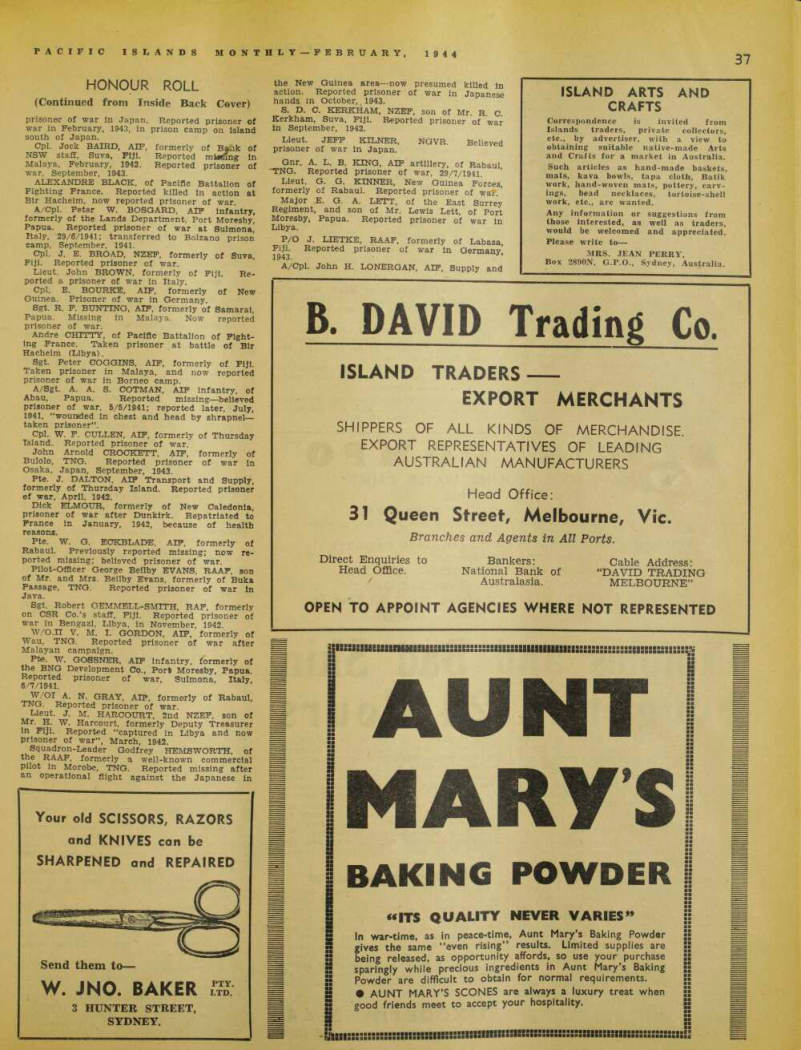
prisoner of war In Japan. Reported prisoner of war in February, 1943, in prison camp on Island south of Japan.
Cpl. Jock BAIRD, A IF, formerly of Bank of NSW staff, Suva, Fiji. Reported ln Malaya, February, 1942. Reported prisoner of war, September, 1943.
ALEXANDRE BLACK, of Pacific Battalion of Fighting France. Reported killed In action at Blr Hacheim, now reported prisoner of war.
A/Cpl. Peter W. BOSGARD, ATP infantry, formerly of the Lands Department, Port Moresby, Papua. Reported prisoner of war at Sulmona, Italy, 29/6/1941; transferred to Bolzano prison camp. September, 1941.
Cpl. J. E. BROAD, NZEP, formerly of Suva, Fiji. Reported prisoner of war.
Lieut. John BROWN, formerly of Fiji. Re ported a prisoner of war in Italy.
Cpl. E. BOURKE, AIP, formerly of New Guinea. Prisoner of war in Germany, Sgt. R. P. BUNTING, AIP, formerly of Samaral, Papua. Missing in Malaya. Now reported prisoner of war.
Andre CHITTY, of Pacific Battalion of Fight ing Prance. Taken prisoner at battle of Blr Hacheim (Libya).
Sgt. Peter COGGINS, A IF, formerly of Fiji.
Taken prisoner in Malaya, and now reported prisoner of war In Borneo camp.
A/Sgt. A. A. S. COTMAN, AIF infantry, of Abau, Papua. Reported missing—believed prisoner of war, 5/5/1941; reported later. July. 1941, “wounded in chest and head by shrapnel taken prisoner”.
Cpl. W. F. CULLEN, AIF, formerly of Thursday Island. Reported prisoner of war.
John Arnold CROCKETT, AIP, formerly of Bulolo. TNG. Reported prisoner of war In Osaka, Japan, September, 1943.
Pte. J. DALTON, AIP Transport and Supply, formerly of Thursday Island. Reported prisoner of war, April, 1942.
Dick ELMOUR, formerly of New Caledonia, prisoner of war after Dunkirk. Repatriated to Prance In January, 1942. because of health reasons.
Pte. W. G. ECKBLADE, AIF, formerly of Rabaul. Previously reported missing; now re ported missing; believed prisoner of war.
Pilot-Officer George Bellby EVANS. RAAP, son of Mr. and Mrs. Beilby Evans, formerly of Buka Passage, TNG. Reported prisoner of war In Java.
Sgt. Robert GEMMELL-SMITH, RAP, formerly on CSR Co.’s staff, Fiji. Reported prisoner of war in Bengazl, Libya, in November, 1942.
W/O.H V. M. I. GORDON, AIP, formerly of Wau, TNG. Reported prisoner of war after Malayan campaign.
Pte. W. GOSSNER, AIF Infantry, formerly of the BNG Development Co., Port Moresby, Papua.
Reported prisoner of war, Sulmona, Italy, 6/7/1941.
W/OI A. N. GRAY, AIF, formerly of Rabaul, TNG. Reported prisoner of war.
Lieut. J. M. HARCOURT, 2nd NZEP, son of Mr. H. W. Harcourt, formerly Deputy Treasurer In Fiji, Reported “captured in Libya and now prisoner of war”, March. 1942.
Squadron-Leader Godfrey HEMSWORTH, of the RAAP, formerly a well-known commercial pilot in Morobe, TNG. Reported missing after an operational flight against the Japanese In
the New Guinea area—now presumed killed In action. Reported prisoner of war in Japanese hands in October, 1 1943.
S. D. C. KERKHAM, NZEP, son of Mr R c Kerkham, Suva, Fiji. Reported prisoner of war In September, 1942.
Lieut. JEFF KILNER, NGVR. Believed prisoner of war in Japan.
Gnr, A. L, B. KING, AIP artillery, of Rabaul TNG. Reported prisoner of war, 29/7/1941.
Lieut. G. G. KINNER, New Guinea Forces formerly of Rabaul. Reported prisoner of war.’
Major E. G. A. LETT, of the East Surrey Regiment, and son of Mr. Lewis Lett, of Port Moresby, Papua. Reported prisoner of war in Libya.
P/O J. LIETKE, RAAP, formerly of Labasa, Fiji. Reported prisoner of war In Germany’ 1943.
A/Cpl. John H. LONERGAN, AIP, Supply and
Transport, of New Guinea. Reported prisoner of war at Corinthia, Italy, 8/7/1941.
Pte. Ernest ("Paddy”) McGEADY, NZEF, son of Mrs. J. McGeady, of Suva, Fiji. Reported “missing, believed killed", after fighting in Libya, January, 1942; reported prisoner of war in Italy, April, 1942.
Cpl. J. H. L. McGUIGAN, of the Field Ambulance, AIF, formerly of the Public Health Department, New Guinea. Officially reported missing at Singapore; unofficially reported a prisoner in Japanese hands. Reported prisoner of war in Malaya, May 24, 1943.
Observer Alex. McKAY, of the RAAF, formerly of the CSR Co.’s staff, at Penang sugar-mill, Fiji. Reported missing, 27/7/1941; reported prisoner of war in Italy, 26/10/1941.
Pte. Harry MARCHINGTON, of the NZ Forces, formerly of Fiji. Reported prisoner of war after Battle of Crete, 2/12/1941.
Pte. F. C. MAYO, AIF, formerly of New Guinea. Reported a prisoner of war.
Emile MILLOT, of Pacific Battalion of Fight ing Prance. Taken- prisoner in battle of Bir Hacheim (Libya).
Pte. G. S. O’BRYAN, NZEF, formerly of Rarotonga, Cook Is. Missing after battle of Crete: now reported prisoner of war in Germany.
Pte. D. R. PHILLIPS, AIF engineers, formerly of Bulwa, TNG. Reported prisoner of war, June, 1942.
A/Bdr. L. J. SMEETON, AIF, formerly of Rabaul, TNG. Reported prisoner of war In Malayan campaign.
Pte. John O. SMITH, of the NZ Forces, son of Captain Arthur Smith, of the Fiji inter-island vessel “Tul Kauvaro”. Missing after battle of Crete, May, 1941; reported prisoner of war in Germany, 21/10/1941.
Squadron-Leader L. C. SHOPPEE, DSO, RAF, formerly of Edle Creek, New Guinea. Was in Java during Japanese invasion; now known to be a prisoner of war.
Gnr. D. M. SPENCE, A IF, formerly of Port Moresby. Reported prisoner of war after Malayan campaign.
LAC Charles SOLLITT, of the RAAF (wire less operator), son of Mr. and Mrs. C. H.
Sollitt, of Nausori, Fiji. Reported missing after air operations in New Guinea, January, 1942; later, March, 1942, reported rescued from sea by Japanese—now prisoner of war.
Pte. Fred SWAN, NZ Army Medical Corps, formerly of Apia. Western Samoa. Missing after Battle of Crete, August, 1941; reported prisoner of war in Germany, November, 1941.
Signalman J. C. E. SWINBOURNE, 6th Div.
Signals, A IF, formerly of Fiji and the Gilbert & Ellice Islands Colony. Taken prisoner at Crete, June, 1941, now in prison camp at Stalag, VITA, Germany.
Lieut. CLIFF WARREN, of NZEF, serving In the Middle East, and formerly of Morris Hed strom Ltd.’s staff at Ba and Lautoka, Fiji. Re ported prisoner of war.
MJr. N. WATCH, formerly Dr, Watch, of Rabaul, missing after Japanese Invasion of Rabaul. Believed prisoner of war In Japan. Now reported POW in Japan.
Gnr. D. S. WHITCOMBE, NZEF, formerly of Fiji and Tonga. Wounded in Crete and reported prisoner of war in Germany.
Pte. John D. WHITCOMBE, of the NZ Forces, formerly of Levuka, Fiji. Reported prisoner of war in Germany, November, 1941.
Decorations
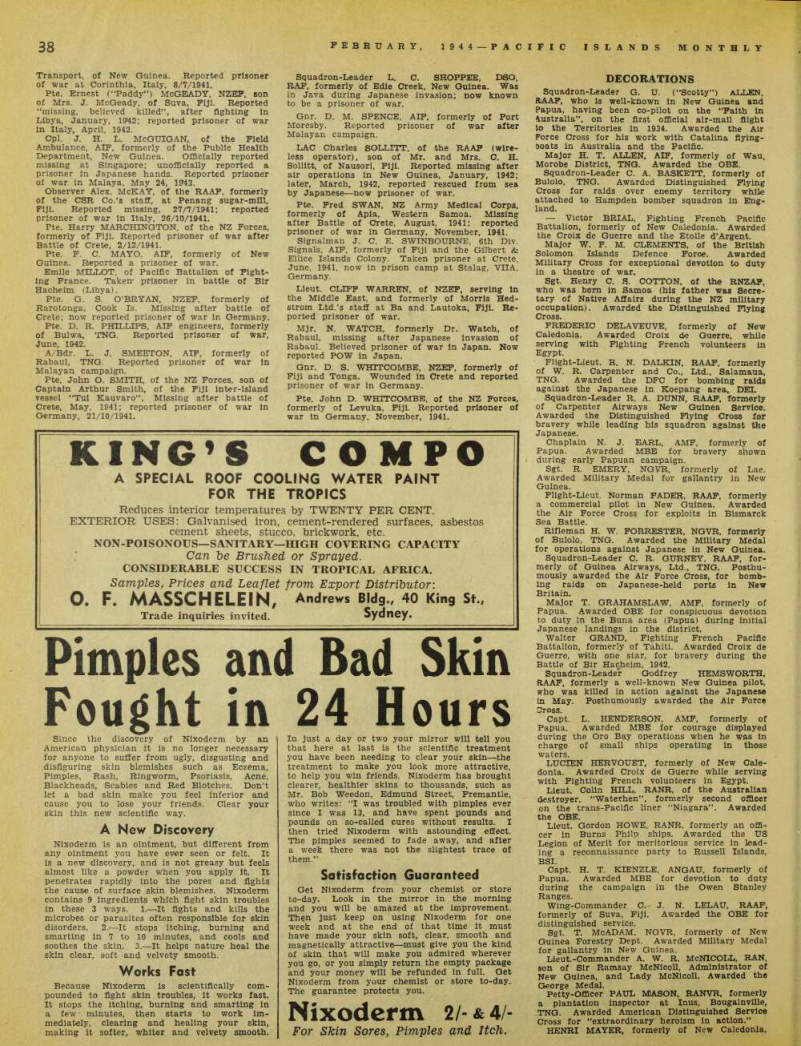
Squadron-Leader G. U. ("Scotty") ALLEN, RAAP, who is well-known in New Guinea and Papua, having been co-pilot on the "Faith in Australia", on the first official air-mall flight to the Territories in 1934. Awarded the Air Force Cross for his work with Catalina flying boats in Australia and the Pacific.
Major H. T. ALLEN, A IF, formerly of Wau, Morobe District, TNG. Awarded the OBE.
Squadron-Leader C. A. BASKETT, formerly of Bulolo, TNG. Awarded Distinguished Plying Cross for raids over enemy territory while attached to Hampden bomber squadron in Eng land.
Victor BRIAL, Fighting French Pacific Battalion, formerly of New Caledonia. Awarded the Croix de Guerre and the Etoile d’Argent.
Major W. F. M. CLEMENTS, of the British Solomon Islands Defence Force. Awarded Military Cross for exceptional devotion to duty in a theatre of war.
Sgt. Henry C. S. COTTON, of the RNZAF, who was born in Samoa (his father was Secre tary of Native Affairs during the NZ military occupation). Awarded the Distinguished Flying Cross.
FREDERIC DELAVEUVE, formerly of New Caledonia. Awarded Croix de Guerre, while serving with Fighting French volunteers in Egypt.
Flight-Lieut. R. N. DALKIN, RAAF, formerly of W. R. Carpenter and Co., Ltd., Salamaua, TNG. Awarded the DFC for bombing raids against the Japanese in Koepang area, DEL Squadron-Leader R. A. DUNN, RAAF, formerly of Carpenter Airways New Guinea Service.
Awarded the Distinguished Flying Cross for bravery while leading his squadron against the Japanese.
Chaplain N. J. EARL, AMF, formerly of Papua. Awarded MBE for bravery shown during early Papuan campaign.
Sgt. R. EMERY, NGVR, formerly of Lae.
Awarded Military Medal for gallantry in New Guinea.
Flight-Lieut. Norman FADER, RAAF, formerly a commercial pilot in New Guinea. Awarded the Air Force Cross for exploits in Bismarck Sea Battle.
Rifleman H. W. FORRESTER, NGVR. formerly of Bulolo, TNG. Awarded the Military Medal for operations against Japanese in New Guinea.
Squadron-Leader C. R. GURNEY, RAAF, for merly of Guinea Airways, Ltd., TNG. Posthu mously awarded the Air Force Cross, for bomb ing raids on Japanese-held ports in New Britain.
Major T. GRAHAMSLAW, AMP, formerly of Papua. Awarded OBE for conspicuous devotion to duty in the Buna area (Papua) during initial Japanese landings in the district.
Walter GRAND, Fighting French Pacific Battalion, formerly of Tahiti. Awarded Croix de Guerre, with one star, for bravery during the Battle of Bir Hacheim, 1942.
Squadron-Leader Godfrey HEMSWORTH, RAAF, formerly a well-known New Guinea pilot, who was killed in action against the Japanese In May. Posthumously awarded the Air Force Cross.
Capt. L. HENDERSON. AMF, formerly of Papua. Awarded MBE for courage displayed during the Oro Bay operations when he was in charge of small ships operating in those waters.
LUCIEN HERVOUET, formerly of New Cale donia. Awarded Croix de Guerre while serving with Fighting French volunteers in Egypt.
Lieut. Colin HILL, RANR, of the Australian destroyer, “Waterhen”, formerly second officer on the trans-Pacific liner "Niagara”. Awarded the OBE.
Lieut. Gordon HOWE, RANR, formerly an offi cer in Burns Philp ships. Awarded the US Legion of Merit for meritorious service in lead ing a reconnaissance party to Russell Islands,
Bsi.
Capt. H. T. KIENZLE, ANGAU, formerly of Papua. Awarded MBE for devotion to duty during the campaign in the Owen Stanley Ranges.
Wing-Commander C. J. N. LELAU, RAAF, formerly of Suva, Fiji. Awarded the OBE for distinguished service.
Sgt. T. McADAM. NGVR, formerly of New Guinea Forestry Dept. Awarded Military Medal for gallantry in New Guinea.
Lieut.-Commander A. W. R. McNICOLL, RAN, son of Sir Ramsay McNicoll, Administrator of New Guinea, and Lady McNicoll. Awarded the George Medal.
Petty-Officer PAUL MSASON, RANVR, formerly a plantation inspector at Inus, Bougainville, TNG. Awarded American Distinguished Service Cross for “extraordinary heroism in action.”
HENRI MAYER, formerly of New Caledonia.
Awarded Croix de Guerre while serving with Fighting French volunteers in Egypt.
Fit.-Lieut. George B. (Golly) MEIDECKE, RAAF, formerly of W. Samoa. Awarded the Distinguished Flying Cross.
Lieut.-Commander H. A. MACKENZIE, RAN, formerly of Rabaul, TNG. Awarded the US Legion of Merit for exceptionally meritorious services at Guadalcanal.
Capt. John Malcolm METHVEN, AIF. Men tioned in despatches for distinguished services during the seige of Tobruk. Since reported killed in action. (See section “Killed.”) Sgt. Geoffrey MOORE, of the RNZAP, formerly engineer on the NG inter-island vessel •■Malwara” and on the trans-Paclflc liner “Aorangi”. Awarded the Distinguished Plying Medal.
ANDRE MORNAGHINI, formerly of New Cale donia. Awarded Croix de Guerre while serving with Fighting French volunteers in Egypt.
Flight-Lieut. G. B. MEIDECKE, RAAF, formerly of W. Samoa. Awarded the DFC for “courage, coolness and tenacity, and flying skill of the highest order.”
Flight-Lieut. M. O’CONNOR, RAAF, formerly of Suva, Fiji. Awarded the DFC for a “high record of success on operations” in the Middle East.
Flight-Lieut. H. G. PILLING. RAF, formerly of Suva, Fiji. Awarded the DFC, May, 1942. (Killed a few days later.) Pilot-Officer Pat RICHARDSON, RAF, son of Mr. W. Richardson, formerly of Penang, Fiji, Awarded the Distinguished Flying Cross.
Commander Alvord S. ROSENTHAL, RAN, son of Major-General Sir Charles Rosenthal, KCB, OMG, DSO, VD, Administrator of Norfolk Island. Awarded the DSO, November, 1941; awarded the Bar to DSO, February, 1942.
Capt. A. T. TIMPERLEY, AMF, formerly of Papua. Awarded MBE lor work on Good enough Island when he acted as a guide.
P/O Leigh G. VIAL, RAAF. formerly ADO In TNG. Awarded American DSC for outstand ing heroism in New Guinea in September, 1942.
Squadron-Leader Charles WIDDY, RAAF, formerly of BSI. Awarded the US Legion of Merit for meritorious service in leading a reconnaissance party to Russell Islands, BSI.
Lieut, (then W/O) Raymond WATSON aIF formerly of TNG. Awarded MBE for bravery and devotion to duty during the Papuan cam paign.
Lieut. G. K. WHITTAKER, NGVR, formerly of Lae, TNG. Awarded MBE for gallantry in New Guinea.
Lieut. George Raymond WORLEDGE, of the RANVR, formerly of Fiji. Awarded the MBE
Mentioned In Despatches
Captain A. H. Bald- Corporal M. Marlay, win, Papua. TNG.
Captain N. B. N. Captain J. J. Murphy, Blood, TNG. ..TNG.
Warrant-Officer J. B. Captain N. Owers.
Davies, Papua. JwlLE;* R t C % Captain L. S. Dexter. L Papua. * J ‘ ‘ Papua * Lieutenant C. H. Smith, Warrant-Officer P. R. TNG.
N, England, Papua. Warrant-Officer R. A.
Major S. Elliott-Smith, Smith, Papua.
Papua. Captain L. N. Tribolet, Sergeant V. H. Oil- . Tl * G - Christ, TNG. Ll^£. nant A> G - Va &g> Warrant-Officer I. F. Captain G. H. Vernon Jones, Papua. MC, Papua.
During the Christmas services of the LMS at a station in New Guinea, it was announced that the district had contri buted £2,500 during the year. Much of this goes to the Victory Building Fund.
Many Europeans attended the services, and on Christmas morning the Rev.
Harold Short preached in English.
From January 1, 1944, the Lightering Contract for Apia, Western Samoa, goes to a new company, formed by the well known Apia businessman, Mr. E. F. Paul, owner of the Tivoli Theatre and director of the Gold Star Transport Co. The contract was formerly held by O. F.
Nelson & Co., Ltd.
A New Caledonian, Maurice Dichon, captain of a Colonial Infantry Regiment stationed at Dakar, West Africa, has been promoted to the rank of Comman dant. This corresponds to the British rank of Major.
Cpl. R. H. SUTTON, NGVR, formerly of Wau, TNG. Died from malaria and typhoid in October, 1942.
Major P J. WOODHILL, AIF Infantry, formerly legal assistant in the Crown Law Office, Rabaul, New Guinea. Reported “deceased”, December, 1941.
Missing
Louis ANGER, of Fighting French Pacific Battalion. Reported missing after battle of Bir Hacheim.
Pte. P. F. BAILEY, AIP Infantry, of Rabaul, TNG. Reported missing, 17/2/1942. Now re ported prisoner of war, Lieut. J. T. BARRACLUFF, AIF, formerly of New Guinea. Reported missing, December, 1943.
Cpl. Leon BARRENE, of Pacific Battalion of Fighting France. Missing after battle of Bir Hacheim (Libya).
Sgt.-Pilot Murray Waldon BENTLEY, RNZAF, formerly of Fiji. Reported missing in air operations in the Middle East, January, 1943.
P/O Robert Waldon BENTLEY, RNZAF, for merly of Fiji. Reported missing on air opera tions on May 5, 1943.
T. BLAKELOCK, BEF, formerly of Fiji. Miss ing.
Robert BLUM, of Fighting French Pacific Battalion. Reported missing after battle of Bir Hacheim.
Sgt. Ronald Arthur BROODBANK, formerly of Samarai, Papua, now serving with the RAAF overseas. Reported missing on May 31 while on air operations.
Sgt. Alexander BROWN, RNZAF, formerly of Rarotonga. Reported missing over Germany, on September 15, 1942.
Reginald BOULANGER, of Fighting French Pacific Battalion. Reported missing after battle of Bir Hacheim.
Ross BUCKLEY, RNZAF, formerly of Fiji.
Reported missing on air operations.
H. BUCKNELL, AIF, formerly of Fiji. Missing.
Pie. E. L. CHRISTIE, AIF infantry, of Rabaul, TNG. Reported missing, 17/2/1942.
Victor DERVAUX, of Fighting French Pacific Battalion. Reported missing after battle of Bir Hacheim.
Lucien DEVAND, of Pacific Battalion of Fight ing France. Missing after battle of Bir Hacheim (Libya).
Pte. A. G. DICKSON. AIF infantry, of Rabaul, TNG. Reported “missing, believed wounded”, 17/2/1942.
Pilot-Officer Norman R. FRAZER, RAAF, formerly of Wau, TNG. Reported missing on air operations over Germany, August 30, 1943.
Eion FIELD, RNZAF, formerly of staff of Kasi Mines, Fiji. Missing in Java.
Gath GELDARD, NGVR, of New Britain.
Missing after the battle of Rabaul, January, 1942.
GELLER, of Fighting French Pacific Battalion. Reported missing after battle of Bir Hacheim.
J. P. GOUZENES, of Fighting French Pacific Battalion. Reported missing after battle of Bir Hacheim.
Chief-Sergeant Francois GRISCOLEI, of Fight ing French Pacific Battalion. Reported missing In Libya in April. Formerly of New Caledonia.
Acting Flight-Lieut. Don A. IRVING, RAAF, formerly chemist in CSR Co., Labasa, Fiji. Miss ing, presumed dead, in air operations over Germany, February 27, 1942.
Pte. Andrew A. (Billo) Johnson, Ngvr.
Reported missing in New Guinea on October 29, 1942.
Georges KABAR, of Fighting French Pacific Battalion. Reported missing after battle of Bir Hacheim.
Henri LANGLOIS, of Pacific Battalion of Fighting France. Missing after battle of Bir Hacheim (Libya).
Numa LETHESER, of Pacific Battalion of Fighting France. Missing after battle of Bir Hacheim (Libya).
Rene LETOCART, of Fighting French Pacific Battalion. Reported missing after battle of Bir Hacheim.
Cpl. E. G. MacADAM, NGVR, of Rabaul, TNG.
Reported missing after the battle of Rabaul, January 1, 1942.
Camille MERCIER, of Fighting French Pacific Battalion. Reported missing after battle of Bir Hacheim.
MOUTRY, of Fighting French Pacific Battalion. Reported missing after battle of Bir Hacheim.
Capt. J. J. MURPHY, AIF, formerly of New Guinea. Reported missing, December, 1943.
Pte. R. J. PASCOE, AIP infantry, of Rabaul, TNG. Reported missing, 27/1/1942.
Pilot Tom PATTERSON, of the RNZAP, formerly of Levuka, Fiji. Reported missing, iii November, 1941, after bombing raid on the Continent. , Henri PAYONNE, of Fighting French Pacific Battalion. Reported missing after battle of Bir Hacheim.
Eugene PENE, of Fighting French Pacific Battalion. Reported missing after battle of Bir Hacheim.
Andre PETRE, of Fighting French Pacific Battalion. Reported missing after battle of Bir Hacheim.
Eugene POGNON, of Fighting French Pacific Battalion. Reported missing after battle of Bir Hacheim.
Gnr. Allan H. ROSS, AIF artillery, formerly planter in New Britain, TNG. Reported “miss ing—believed prisoner of war”, 28/9/1941.
ROUDEILLAC, of Fighting French Pacific Battalion. Reported missing after battle of Bir Hacheim.
Pte. William RUPE, of the NZ Forces (Maori Battalion), formerly of Altutaki, Cook Islands.
Reported “missing after Battle of Greece”, July, 1941.
Pilot James SIMPSON, of the RAF, formerly of Vatukoula, Fiji. Reported missing after air operations over Malta, in the Mediterranean, 1/7/1941.
L/Bdr. G. G. SMITH, NZEF, formerly of Suva, Fiji. Reported missing.
Pilot-Officer Neville George STOKES, of the RAF, formerly a pilot with Guinea Airways, Ltd., in New Guinea. Reported missing after air operations in Europe, December, 1941.
Reported Missing
Malaya Casualty List, Published 23/7/1942.
Pte. E. L. CHRISTIE, infantry, Rabaul.
Pte. A. G. DICKSON, infantry, Rabaul.
Pte. A. I. FOLEY, artillery. Port Moresby.
Pte. J. M. HIRSCHEL, infantry, Rabaul.
Pte. J. G. NEWTON, artillery. Port Moresby.
Australia and Island Stations.
Pte. S. W. HUNTER, infantry. Kokopo.
Wounded
Sgt. Robert ASMUS, of the Fighting French Pacific Battalion. Wounded at Bir Hacheim and evacuated.
Rene AUFANT, of the Fighting French Pacific Battalion. Wounded at Bir Hacheim.
Cpl. Thomas BAMBRIDGE, of the Fighting French Pacific Battalion. Wounded at Bir Hacheim and evacuated.
BERBERS (alias ARESKY), of the Fighting 'French Pacific Battalion. Wounded at Bir Hacheim, Henri BERTHELIN, of the Fighting French Pacific Battalion. Wounded at Bir Hacheim.
Pte. V. BLANCO. AIF Infantry, of Thursday Island. Wounded in action, July, 1941, L/Cpl. J. P. BLENCOWE, AIF Infantry, of Rabaul. TNG. Wounded in action, July, 1941.
Jean BRIAL, of the Fighting French Pacific Battalion. Wounded at Bir Hacheim.
Pte. George BUCKNELL, AIF, son of Mr. and Mrs. C. Bucknell, of Korolevu, Fiji. Wounded in action in Malaya, January, 1942.
Pte. Thomas BYERS, AIF Infantry, of Thurs day Island. Wounded in action, May, 1941.
Raymond CHAUTARD, of the Free French Pacific contingent from New Caledonia. Re ported a casualty in the Middle East, March, 1942.
Pte. A. J. CORLASS, AIF, formerly of Rabaul.
Wounded in action.
Albert CUBADDA, of the Free French con tingent from New Caledonia. Reported a casualty in the Middle East, March, 1942.
Charles DEVEAUX, of Pacific Battalion of Fighting France. Wounded at battle of Bir Hacheim (Libya).
Sgt. EMERY, formerly of Lae, TNG. Wounded in New Guinea in October, 1942.
Lieut. M. G. EVENSEN, AIF, formerly of Rabaul. Wounded in action.
V. PAIRHALL, 2nd NZEF, formerly of the Treasury Department, Western Samoa. Reported wounded in action, February, 1942.
Trooper Arthur T. PILEWOOD, formerly of Thursday Island. Reported wounded in action, May, 1943. „ Paroa FIU, of the Fighting French Pacific Battalion. Wounded at Bir Hacheim and evacuated. AT Acting Warrant-Officer V. M. I. GORDON, AIF Infantry, of Wau, TNG. Wounded in action, February, 1942.
Pte. John GRANT. AIP infantry, of New Guinea. Wounded in neck and thigh, September, 1941; later, reported “rejoined unit”.
Henri GUILBAUD, of the Free French Pacinc contingent from New Caledonia. Reported a casualty in the Middle East, March, 1942.
Sgt. C. HENDRICK, AIF infantry, of Rabaul.
TNG. Wounded in action, July, 1941.
Stanley HIGGS, son of Mr. and Mrs. Gordon Higgs, of W. R. Carpenter and Co. Ltd., New Guinea. Member of an English Lancers’ regiment, wounded during British evacuation from Dun kirk (France), May, 1940.
Lieut. Lloyd T. HURRELL, AIP Infantry, of Rabaul, TNG. Wounded in action, July, 1941.
Alexandre HUYARD, of the Free French Pacific contingent from New Caledonia. Reported a casualty in the Middle East, March, 1942.
Sgt.-Pilot Andrew KRONFELD, of the NZ Fighter Squadron attached to the RAF. Wounded In knee during operations over France, December, 1941.
Cpl. W. H. LANNEN, ATP artillery, of Rabaul, New Guinea. Wounded in action, June, 1941.
Gnr. E. G. LOBAN, AIF artillery, of Thursday Island. Wounded during campaign in Greece, May, 1941; invalided home after having his left forearm amputated.
Auguste LUTA, of the Fighting French Pacific Battalion. Wounded at Bir Hacheim and evacuated.
A/Sgt. Alastair MACLEAN, AIF Infantry, of Rabaul, New Guinea. Wounded in action, in Libya, June, 1941.
Sgt. J. D. McCLYMONT, NZEF, son of Capt.
D. McClymont, Harbourmaster of Apia, Western Samoa. Wounded in action, November, 1941.
Cpl. R. McKERLIE, AIP, of Yandina, BSI, wounded in face by bomb explosion, April, 1941.
T. MANEA, of the Fighting French Pacific Battalion. Wounded at Bir Hacheim and evacuated.
Jean MERIGNAC, of the Free French Pacific contingent from New Caledonia. Reported a casualty in the Middle East, March, 1942.
Henri MEYER, of the Free French Pacific contingent from New Caledonia. Reported a casualty in the Middle East, March, 1942.
S/Sgt. Graham B. MIRFIELD, AIF engineers, of Rabaul, New Guinea. Wounded in action, Joseph OTHUS, of Pacific Battalion of Fight ing Prance. Wounded in battle of Bir Hacheim (Libya■.
Lieut. A. G. PEARCE, AIF, formerly of Salamaua, TNG. Wounded in action.
Pte. L. G. (“Mick”) REECE, AIF, of Bulolo, New Guinea. Wounded in action, July, 1941.
Henri RIVIERE, of the Free French Pacific contingent from New Caledonia. Reported a casualty in the Middle East. March, 1942.
Pte. H. St. George RYDER, AIF, formerly of Suva, Fiji. Wounded while serving in New Guinea.
A/Cpl. N. K. SAWYER, AIF infantry, of Rabaul TNG. Wounded in action, July, 1941.
July, 1941.
Pte. Frank M. SCHUSTER, NZEF, formerly of W. Samoa. Wounded in action in Tunisia, 1943.
Lieut. Jeffrey SEAGOE, serving with the British forces in the Far East, formerly of Vila, New Hebrides. Reported “wounded in action”.
March, 1942.
Pte. F. M. SCHUSTER, NZEF, formerly of W. Samoa. Wounded in action in Tunisia.
Pte. Lance STAMPER, AIF, formerly school master at Wau, New Guinea. Wounded in action.
August. 1941.
Cpl. Raphael TEIHO, of the Fighting French Pacific Battalion. Wounded at Bir Hacheim and evacuated.
Cpl. Terii TERIITUA, of the Fighting French Pacific Battalion. Wounded at Bir Hacheim and evacuated.
Lieut. P, A. TUCKEY, infantry, formerly of New Guinea. Wounded in action.
Pte. Harold G. TURNER, AIP, of Samaral, Eastern Papua. Wounded in action at Bardla (Libya), January, 1941.
Pte. F. D. TWISS, AIF infantry, of New Guinea. Wounded in action, August, 1941.
Camille VINCENT, of the Free French Pacific contingent from New Caledonia. Reported a casualty in the Middle East, March, 1942.
Driver Don F. WAUCHOPE, AIF. Formerly employed on his brother’s plantation in New Guinea. Wounded in action, July, 1942.
Alex. WINCHESTER, of the Fighting French Pacific Battalion. Wounded at Bir Hacheim.
Pte. K. M. WHITE, AIP, formerly of Bulwa, TNG. Wounded in action.
Sgt.-Pilot W. WRIGHT, of the Australian Spitfire Squadron, attached to the RAF, for merly of New Guinea. Wounded in knee during aerial “dog-fight” over the English Channel, March. 1942.
Prisoners Of War
Pte. J. H. ALLAN, AIF, formerly of Wau, TNG.
Formerly reported missing, now reported prisoner of war.
Gnr. N. H. AMOS, AIF, formerly of Port Moresby. Reported prisoner of war after Malayan campaign.
Lieut. CLARRIE ARCHER. NGVR. Believed
(Continued on Page 37)
Pacific News-Review
Notes And Comment On
The Progress Of The War
From Jan. 14 To Feb. 14
Jan. 14; The whole of the German line, from the Black Sea to Leningrad, is breaking under the hammer blows of Russia’s great winter offensive. The Russians m the western Ukraine, are now advancing towards the River Bug.
Another Russian army, on the front near the Pripet Marshes, is attacking Mosir, a key-town.
Jan. 15; It is believed that new and large-scale British and American air raids on Europe are designed to wipe the Luftwafie out of the sky, as a pre lude to the Anglo-American mvasion of Europe.
Jan. 17: Fires started in Brunswick, Germany, after the RAF raid on Friday were still not under control on Sunday night. British Lancasters dropped 2,uuo tons of bombs on the town in 23 minutes.
Jan. 17; In New Guinea the Austra lians have reached Sio, chief enemy barge and supply base between them and the Americans at Saidor.
Jan. 18: The Russians have extended their offensive and begun a new drive opposite Latvia.
Jan. 18: Australians advanced three miles beyond Sio. At Cape Gloucester (New Britain) a key position was cap tured on the 14th by the Americans. The Japs lost another 29 aircraft over Rabaul.
Jan. 19: The Russians have launched a large-scale offensive along the 120-miles northern front between Leningrad and Lake Ilmen.
Jan. 21: The Germans evacuated Nov gorod, their large base 100 miles south of Leningrad and 20 miles north of Lake liman. The Russian break-through is so complete that the fall of Pskov (120 miles south-west of Novgorod) is imminent.
Jan. 22: After 18 days’ respite, Berlin was raided on Thursday night; 2,000 tons of bombs were dropped.
Jan. 22: A formal agreement between Australia and New Zealand, covering their common interests in the Pacific, was signed yesterday, after three days’ conference at Canberra.
Jan. 22: The Allied Fifth Army (Brit ish and Americans) have landed on the coast of Italy, 30 miles south of Rome, and is reported to be seriously threaten ing the enemy’s lines of communication.
It is hoped that the operation may cut off 100,000 German troops.
Jan. 23: Overcoming strong Japanese resistance in the rugged country above Faria River, Australians have made gains in the Ramu Valley, New Guinea main land.
Jan. 26: Allied patrols, operating from bridgeheads 30 miles south of Rome, cut the Appian Way and the main Naples- Rome electric railway beyond it.
Jan. 28: American troops in the Allied bridgehead, south of Rome, have made good progress, and have advanced well beyond the Mussolini Canal.
Jan. 28: Heavy fighting continues as the Russians steadily drive back 25 Ger man divisions between Leningrad and Novgorod.
Jan. 29: British Foreign Minister Eden, in the Commons, made a statement about British prisoners in the hands of the Japanese. Many thousands have been forced to work and to live under intolerable jungle conditions in Siam, without adequate shelter, clothing, food or medical attention. Coinciding with Mr. Eden’s revelations, a document, based on the testimony of three Ameri can officers who escaped from the Philip pines, has been issued by the US Army and Navy, and gives details of Jap brutalities against Americans and Fili pinos taken in the Philippines,
Jan. 31: The Russians, in their north ern offensive, are nearing the borders of the Baltic States. Leningrad is now completely free.
Jan. 31: In Italy, the Allies are 16 miles from Rome. They are striking at Albano, 13 miles from Rome, on the Appian Way.
Jan. 31: In the 40 hours ending noon Saturday the Allies dropped more than 5,000 tons of bombs on German indus trial centres. Berlin received 3,000 tons and Frankfurt 1,800 tons.
Feb. 1: After heavy attacks on the Marshall Islands by American aircraft carriers and warships, an invasion by American forces has begun.
Feb. 1: Another 1,500 tons of bombs have been dropped on Berlin—making 4,500 tons since last Thursday.
Feb. 2: The Russians are now 12 miles from the borders of Estonia.
Feb. 3: On January 31, 30,000 Ameri can Marines and infantry launched an attack on Kwajalein and Roi islets, on Kwajalein atoll, in the heart of the Marshall islands. They went in a con voy of unprecedented size—some say 2,000,000 tons. The Americans are meet ing stiff resistance.
Feb. 3: Australian and Netherlands troops, who have established outposts along the south coast of Dutch New Guinea, were in contact with the Japan ese, and routed a large force in the Eilanden River area.
Feb. 4; By the capture of Roi islet, the Americans have control of the best air field in the Marshalls, from which they could attack the great naval base of Truk, 1,100 miles away, in the Carolines.
Feb. 4: The Russians are across the Estonian border, and opened the battle for Narva yesterday. The Germans announce a German withdrawal in Poland, north-west of Kiev.
Feb. 5: In the biggest German disaster since Leningrad, 10 enemy divisions have been encircled in the Kanev salient, south of Kiev, and are being systematic ally wiped out.
Feb. 7: Twelve more islets have fallen to the Americans in the Marshalls.
Kwajalein has been cleared of enemy resistance, and two islets, Ebeye and Loi, have been captured. They have thus acquired another large airfield, tw<p sea plane bases, a radio station and shipping facilities.
Feb. 7: Vitebsk (northern White Rus sia, 300 miles west of Moscow) may have to be abandoned by the Germans. West of Leningrad, the Russians continue their drive into Estonia.
Feb. 7: Increasing numbers' of tanks and storm-troops are being used by the Germans in counter-attacks against the Allies in their beachhead south of Rome.
This Allied enterprise seems to have died away.
Feb. 8: United States warships have shelled the Kurile Islands, Japanese home territory, which extend from Kam chatka to Hokkaido. They are the most northerly of the islands comprising Japan proper.
Feb. 8; Two battles of annihilation are raging on the eastern front. South of Kanev, the remains of 10 German divi sions are fighting in a diminishing defence zone; and 200 miles south, at Nikopol, five enemy divisions are almost surrounded.
Feb. 9: Red Army forces have launched attacks against Nikopol (in the Dnieper Bend) and Narva (Estonia). They also are developing their offensive towards Vitebsk, in White Russia.
Feb. 9; Photographs of the Rabaul area show that the Japanese air strength there is shrinking.
Feb. 10; The Germans are retreating from the Dnieper Bend. Nikopol has been taken by the Russians, Feb. 10: In Italy, German tanks and infantry took the initiative all along the perimeter of the Allied beachhead, south of Rome. The Germans claim they advanced several miles and took 700 prisoners.
Feb. 11: The Japanese forces are reported to be abandoning Madang.
Alter a bombmg and straffing raid on Tuesday, Allied airmen reported no anti aircraft fire.
Feb. 8; It is alleged that 80 per cent, of German fighter strength is needed to protect occupied Europe under continual Allied air blasting. Without this large percentage, every German industrial centre would be wiped out in three months.
Feb. 12: Allied beachhead in Italy is now hard pressed in heavy defensive fighting.
Feb. 12; The 10 German divisions in the Kanev pocket have been split in two and their fate sealed. There are also indications that Germans delayed too long in the Krivoi Rog sector, farther south, and will lose heavily.
Feb. 14: British troops, in the beach head south of Rome, have regained most of the ground lost to the Germans.
The latter are still attacking but the British counter-attacks are making steady progress. Bad weather is pre venting adequate Allied air and sea support.
Feb. 14: Air attacks on Rabaul con tinue. The Wewak-Madang area was also hit. Seven hundred and twenty-two tons of bombs were dropped on the New Guinea area on two days last week; 67 enemy planes and between 50 and 100 large barges were destroyed.
Death Of Mr. J. R. Clay,
Of Papua
AFTER a short illness, Mr. Jeaffreson Rudolph Clay, well-known Papuan resident of over 20 years’ standing, died suddenly in his home in Oatley, Sydney, on January 19. He was manag ing director of the firm of J. R. Clay & Co., Ltd., merchants, of Port Moresby and Samarai. He had lived in Sydney since the evacuation of the Territory in 1942, and was a member of the executive of the Pacific Territories Association, representing Papuan commercial inter ests. Prominent Papuan residents attended the funeral service at Woronora Crema torium on January 20. He is survived by a wife and two children.
Mr. Elmer Wilson Smith (one of the Fletcher Christian family) and Mr.
Walter Brown (a descendant of Mid shipman Young) both of Pitcairn Island, arrived in Sydney in January. Brown, - aged 19, had not previously left his island. He had never before worn boots, the only animals he had seen were dogs, cats and goats, and he had never seen more than 200 people gathered together.
He found Sydney somewhat over powering.
Contents
Pacific News-Review .. i Anzac Plan for the South Pacific Territories 3 New Guinea Gold Losses .. . * * 4 Is Jap Breaking in N. Guinea? .! 5 Four Young Fiji Residents Drowned in Nukualofa 5 Fewer Dollars—Samoa Returning to Normal 6 Wreaths for Rabaul’s Dead ...! 6 Well-known Men Missing in the Gilberts 7 Fiji Sugar Troubles—May Drive CSR Out of Colony g Revision of Administrative System for Fiji Natives 9 Hidden Snake in Paradise—Elephan tiasis in Oceania 9 Fate of the Pacific Mandates .. 10 Tropicalities u N. Guinea Labour—And Amateurs .. 12 Idle Fijians Sent Home 12 Are the Japanese Last-ditch Fighters? 13 Cyclone in Noumea 15 Übiquitous “PB”—Good War Record 17 Fiji Timbers 18 Assault on Buna 19 Caledonian Mines—Another Wartime Casualty 20 Japan Fights for Negotiated Peace 21 Plan to Provide Trade Unions for “Fuzzy-Wuzzies” 23 Anglo-French Co-operation 25 A Deserted El Dorado 27 No Pareu—Wartime Tragedy in Poly nesia 28 Scouting the Hard Way 29 Samoa as a “Bed of Roses” 31 Future of the Solomons—Melanesia’s Inspiring Bishop in Australia .. 32 New Guinea Women’s Club Wants Hospital Visitors 33 Lost Treasure of Tahiti—Capt. Cook’s Portrait 35
Tulagi’s Scars Fast Healing 36 Commercial and Markets 40 Honour Roll ... cov. ii, iii, and page 37
Advertisers
A. Ltd. ... 22 Atkins Pty., Ltd., Wm 28 Australian Alumi nium Co. Pty., Ltd 25 Baker, Ltd., W.
Jno 37 Broomfield, Ltd. . . 24 Brown & Co., Ltd., G 13 Brunton’s Flour . 20 Burns, Philp Trust Co., Ltd 12
B. (S.S.) Co. . . 13
Carlton & United Breweries, Ltd. . 17 Carpenter, Ltd., W.
R cov. iv. drivers & Sons, Ltd 36 Coleman Lamp & Stove Co 39 “Current Problems” 23 “Cystex” ... 36 Darvas & Co. . . 35 Davis Trading Co., B 37 Donaghy & Sons, Ltd 37 Donald, Ltd., A. B. 32 Dr. Williams Pink Pills 28 Electrolux Refrigerators . . 16 Foster Clark, Ltd. 19 Garrett & Davidson 33 Gilbey’s Gin ... 14 Gillespie’s Pty., Ltd., Robert ... 25 Gillespie’s Flour . 18 Gough & Co., E.
J 18 Grove & Sons, W.
H 14
Grand Pacific Hotel 2 Heinz & Co. Pty., Ltd., H. J. . . 15 King’s Compo . . 38 Kopsen & Co., Ltd. 29 Masschelein, O. F. 33 Maxwell Porter, Ltd. 30 “Mendaco” ... 34 Miller & Co. Pty., Ltd 27 Nelson & Robertson Pty., Ltd. ... 29 “Nixoderm” ... 38 Pacific Is. Society 13 Pacific Islands Year 800k—1944 Edition 39 Pacific Territories Association ... 9 Perry, Mrs. J. . . 37 “Pinkettes” ... 39 Radco Pood Pro ducts 31 Rose’s Eye Lotion . 31 Queensland Insur ance Co., Ltd. . 27 Riverstone Meat Co., Ltd. ... 21 Rohu, Sil . . . . 24 Scott, Ltd., J. ... 24 Steamships Trading Co., Ltd, ... 31 Sullivan & Co., C. 26 Swallow & Ariell . 20 Taylor & Co., A. . 34 “Tenax” Soap . . 32 Tillock & Co., Ltd. 37 Wright & Co. . . 33 Wright & Co., Ltd., E 35 Wunderlich, Ltd. . 34 Young Pty., Ltd., Harry J 30 Yorkshire Insurance Co., Ltd. ... 30
Advertisements & other items, p. 4 (2 items)
Useful Addresses
The following are the addresses of organisations set up to deal with Pacific Territories affairs:—
PAPUA, NEW GUINEA, NAURU,
NORFOLK IS.
Department of External Territories (Sydney Branch) (Lately the New Guinea Trade Agency), Australia House, Carrington Street, Sydney.
Telephone: BW 1776. (Dealing with all matters connected with the Australian Pacific Territories and also the Sydney representative of the New Guinea Copra Control Committee.)
Fiji, and High Commission
for Western Pacific.
Sydney Office of Fiji and Associated Administrations. (In charge of Mr. B. F. Blackwell.) 72 Pitt Street, Sydney.
Telephone: BW 7724.
BRITISH SOLOMON ISLANDS
Sydney Office of British Solomon Islands Government (In charge of Mr. F. E. Johnson, Treasurer of the Solomons Administration), 17 Castlereagh Street, Sydney.
Telephone: B 1710.
FOR PACIFIC TERRITORIES
EVACUEES GENERALLY
Pacific Territories Association (C. A. M. Adelskold, Secretary), c/o Robert Gillespie Pty., Ltd., 54a Pitt Street, Sydney. Telephone: BW 4782.
WAR DAMAGE COMMISSION
Sydney Office: M.L.C. Buidling, Cnr. Martin Place and Castlereagh Street, Sydney.
Telephone; BW 2361.
FOR CLAIMS AGAINST ARMY
Mr. H. Alderman, Darwin-Moresby Claims Section, Chief Finance Office (Army), Victoria Barracks, Melbourne.
s s<s
Pacific Islands Monthly
The Newspaper-Magazine of the South Seas
[Registered at the G.P.0., Sydney, for transmission by post as a newspaper .] Published Once Each Month and Circulated in Australia and New Zealand and in the following Pacific Territories and Islands Groups:
Australian Territory of Papua.
Mandated Territory (Australia) of New Guinea.
Australian Territory of Norfolk Island.
New Zealand Territory of Cook Islands.
Mandated Territory (NZ) of Western Samoa.
British Colony of Fiji.
British Solomon Islands Protectorate.
British Protectorate of Tongan Islands.
British Crown Colony of Gilbert and Ellice Islands.
Mandated Territory of Nauru.
British and Free French Condominium of New Hebrides.
Free French Colony of New Caledonia.
Free French Colony of Oceania (Tahiti, etc.).
American Territory of Eastern Samoa.
American Territory of Hawaiian Islands.
Owned and Produced by Pacific Publications Pty. Ltd., Union House, 247 George Street, Sydney.
c Managing Director .. BW 5037 Business and Editorial MA 4369
P.O. Box 3408 R
Registered Address of Telegrams, Radiograms, and Cables: “Pacpub”, Sydney.
Contributions.
Articles, Stories, and Photographs dealing with Pacific Islands subjects are invited and will be paid for on publication.
Subscription Rates.
Per Annum, within British Empire, Prepaid, Post Free 10/- Per Annum, elsewhere, Prepaid, Post Free 12/6 Single Copies 1/-
Editor and Publisher:
R. W. Robson, P.R.G.S.
Advertising Manager: L. W. Bailey.
Advertising Office and Printing-House; 29 Alberta Street, Sydney.
Advertising rates furnished on application.
Process Blocks made at Advertiser’s expense when required. Screen 85.
Changes of Advertising Copy should reach this office by Ist of each month, otherwise previous advertisement may be repeated.
Representative In London,
W. C. Harvey, Coronation House, 4 Lloyds Avenue, London, E.C.3, from whom may be obtained copies of Pacific Islands Monthly, Pacific Is. Year Book, advertising schedules, etc.
Agents.
The following are authorised to receive sub scriptions for Pacific Islands Monthly:— Burns, Philp & Co., Ltd., and Burns Phllp (South Sea) Co., Ltd. All branches.
W. R. Carpenter & Co.. Ltd. All branches.
Morris, Hedstrom, Ltd. All branches.
Steamships Trading Co., Papua. All branches.
B.N.G. Trading Co., Ltd., Port Moresby, Papua.
J. Muir, Suva, Fiji.
Miss R. Castles, Suva. FIJI.
N. C. Mackenzie Hunt, Walnunu. Bua, FIJI.
Cook Islands Trading Co., Rarotonga, Cook Is.
A. C. Rowland, Papeete, Tahiti.
Islands Branches and Representatives of W. H.
Grove & Sons, Ltd., Auckland, New Zealand.
Ed, Pentecost, Noumea, New Caledonia.
Kerr <fe Co., Noumea, New Caledonia.
Vol. Xiv. No. 7.
February 17, 1944
Dr\ro i l/ Per Copy> rnce [prepaid; 10/- p.a.
Territories
Anzac Plan for the South Pacific Territories
THE terms of the Anzac Agreement were announced in Canberra on January 22. They provide a for mula, and machinery, under which Australia and New Zealand will act jointly in relation to all matters arising out of war or post-war conditions which affect their common interests. Such matters include defence, trade, aerial transport, migration, and so on; and especially do they include control over the Pacific Islands lying generally north wards of Australia and New Zealand.
The Anzac Agreement conforms in almost every detail with the forecast of “Plan for Future Pacific Control,” set out in this journal in January.
In general, the system envisaged by the gentlemen who made the plan provides that joint action by the two Govern ments on all matters of common interest shall be arranged by an Australian-New Zealand Secretariat, functioning in Can berra and Wellington under the respec tive Governments; the two Governments will continue to administer their present Pacific Territories, with the addition of any others handed over to their care; and they will co-ordinate their Pacific Islands administration according to the wishes of a South Pacific Regional Council.
The part of the plan relating to common action through a Secretariat can be put into operation immediately.
But much of the plan which relates to Pacific Territories affairs especially anything concerned with the co-ordina tion of administrations through a Regional Council —is still subject to: — (a) Discussion and agreement at a British Imperial Conference, to be held in London some time in 1944; (b) Discussions and agreements at peace conferences or international
conferences yet to be held in Europe and the Pacific; (c) The restoration of the League of Nations, or the creation of some body to take its place; (d) The creation by the League of Nations, or directly by the Gov ernments of Britain, United States, France, Holland, Portugal, Aus tralia and New Zealand, of a South Pacific Regional Council, which will be the controlling and co-ordinating authority for all the Territories of the South Pacific.
But it would be foolish to expect that plan to operate within five years.
The plan is the plan of the Labour Governments of Australia and New Zealand. Basing an estimate on long experience, this journal does not expect either of those two Governments to survive the post-war period. Both Dominions will swing back to non- Labour administration —and the letter may not like the Anzac Agreement in its present form. That may mean changes and delay.
BUT something like that plan almost certainly will come, eventually.
United States power and influence will be the strongest factor in the bourn Pacific for a long time after the war, and American opinion will demana something like the Regional Council or Dr. Evatt’s plan. Australia and New Zealand must accept that—and they should not quarrel with it, because it there had been no United States to come to their aid in the first half of 1942, Australia and New Zealand and their Pacific territories would have oeen almost as sorry a spectacle as is New •Guinea to-day.
Before turning to that part of the
Anzao Agreement covering the Pacific Territories, it should be noted that the Agreement covers many matters not connected with the Territories; and in those respects it will operate quickly. It is the part of the plan which relates to the Territories which will be subject to much delay . . . the part that is set out hereunder, with comment and ex planation. (5) The two Governments agree to act together in matters of common concern in the South-west and South Pacific areas. (13) The two Governments agree that, within the framework of a general system of world security, a regional zone of defence comprising the South-west and South Pacific areas shall be established, and that this zone should be based on Australia and New Zealand stretching through the arc of islands north and north east of Australia to western Samoa and the Cook Islands.
COMMENT: This, of course, is subject to agreement with other nations—espec ially the United States —after Pacific war is over. The system of defence will depend entirely upon the way in which the Pacific war ends.
Part of 15: It is agreed that it would be proper for Australia and New Zealand to assume full responsibility for policing, or sharing in policing, such areas in the South-west and South Pacific as may from time to time be agreed upon. (16) The two Governments accept as a recognised principle of international practice that the construction and use in time of war by any Power of naval, military, or air installations in any territory under the sove reignty or control of another Power does not in itself afford any basis for territorial claims or rights of sovereignty or control after the completion of hostilities .
COMMENT: This is clearly a reply to those mischievous gentlemen of the United States who have been insisting that, after the war is over, the United States should not move out of the several islands which it has occupied and developed as great bases for naval, military and air operations. Actually, there is no cause for worry. The United States is most unlikely to disclose any Imperial desires. In any event, if the continuance of United States occupation of those islands means continued United States protection of Australia and New Zealand. Australia and New Zealand should go around publicly thanking God for it. (24) Following the procedure adopted at the conference just concluded, the two Governments will regularly ex change information and views in regard to all developments in, or affecting the islands of the Pacific.
COMMENT: Hearty applause from the “PIM,” which has been ardently advo cating this very thing for at least ten years. (25) The two Governments take note of the intention of the Australian Government to resume administra tion at the earliest possible moment of those parts of its territories which have not yet been re occupied.
COMMENT: More applause! But may not the directors of the Pacific War (in other words, the High Command) have other views? If one may take 1914-18 as a precedent, it is unlikely that civil administration will be restored until after fighting has ceased, and after the armistice, and after a conference has decided upon the future of the re occupied territories. (26) The two Governments declare that the interim administration and ultimate disposal of enemy terri tories in the Pacific is of vital im portance to Australia and New Zealand, and that any such dis posal should be effected only with their agreement and as part of a general Pacific settlement.
COMMENT: The only enemy territories in the Pacific to be disposed of are the Caroline, Mariana and Marshall Islands.
It is hard to see how their fate can be any more “vital” to Australia and New Zealand than it is to United States (protector of the adjoining Philippines) and Holland (owner of the adjoining Netherlands Indies). (27) The two Governments declare that no change in the sovereignty or system of control of any of the islands of the Pacific should be effected except as a result of an agreement to which they are party, or in the terms of which they have both concurred. (28) The two Governments declare that, in applying the principles of the Atlantic Charter to the Pacific, the doctrine of ee trusteeship” (already applicable in the case of the Man dated Territories of which the two Governments are mandatory Powers) is applicable in broad principle to all colonial territories in the Pacific and elsewhere, and that the main purpose of the trust is the welfare of the native people and their special economic and political development.
COMMENT; Few will quarrel with that sentiment, so long as the two Governments are kept under the whip.
Their record in New Guinea and in Western Samoa respectively (under
trusteeship’), is one of dithering and stagnation. The prayer of all Terri torians is: “God save us from the dead hands of Canberra and Wellington!” (29) The two Governments agree that the future of the various territories of the Pacific and the welfare of their inhabitants cannot be success fully promoted without a greater measure of collaboration between the numerous authorities concerned in their control and that such col laboration is particularly desirable in regard to health, services, and communications, matters of major education, anthropological investi gations, assistance in native pro duction and material development generally.
COMMENT: We can only applaud. It is a principle which the “PIM” has been advocating for many years. (30) The two Governments agree to pro mote the establishment at the earliest possible date of a regional organisation with advisory powers which could be called the South Seas Regional Commission and on which, in addition to representatives of Australia and New Zealand, there might be accredited represen tatives of the Governments of the United Kingdom, the United States of America, and the French Com mittee of National Liberation.
COMMENT: As we have already ex plained, this admirable plan may be long in fulfilment. It must go to the British Imperial Conference, and then await the creation of whatever machinery is to re store or replace the League of Nations. (31) The two Governments agree that it shall be the function of such South Seas Regional Commission as may be established to secure a common policy on social, economic, and political development directed to wards the advancement and well being of the native peoples them selves, and that in particular the Commission should (a) recommend arrangements for the participation of natives in adminis tration in increasing measure with a view to promoting the ultimate attainment of self-government in the form most suited to the circum stances of the native peoples con cerned; (b) recommend arrangements for material development, including production, finance, communications, and marketing; (c) recommend arrangements for co ordination of health and medical services and education; (d) recommend arrangements for main tenance and improvement of stan dards of native welfare in regard to labour conditions and participation of natives in administration and social services; (e) recommend arrangements for colla boration in economic, social, medical, and anthropological research; it) make and publish periodical reviews of progress towards the develop m.ent of self-governing institutions in the islands of the Pacific, and in the improvement of standards of living, conditions of work, education, health, and general welfare.
COMMENT: In broad outline, an ex cellent plan. But —see comment on Clause 30. (34) The two Governments agree that as soon as practicable there should be
a frank exchange of views on the problems of security, post-war deve lopment, and native welfare between properly accredited representatives of the Governments with existing territorial interests in the South west Pacific area or in the South Pacific area, or in both — namely, in addition to the two Governments, his Majesty’s Government in the United Kingdom, the Government of the United States of America, the Government of the Netherlands, the French Committee of National Liberation, and the Government of Portugal; and his Majesty’s Govern ment in the Commonwealth of Australia should take the necessary steps to call a conference of the Governments concerned.
COMMENT; This, of course, might be done without awaiting developments in Europe. If it were done, and a measure of agreement reached, it would assist greatly in finding agreement and modus operandi at the European Peace Confer ence and other similar discussions; and such a conference might be an effective forerunner of the projected Regional Council.
All male British subjects of European descent between the ages of 18 and 36, and resident in the districts of Suva, Nausori, Lautoka, Ba and Vatukoula, Fiji, were required to register for military service before January 29, 1944,
Illegal Acts Reported
New Guinea Gold
Losses
rE. following statement was made by the chairman (Mr. J. Kruttschnitt) t at the annual meeting of New Guinea Goldfields, Ltd., in January ‘During 1943 we have had many con sultations with officers of the War Damage Commission and with- the adju dicator for the Army in connection with our claims for property destroyed by the enemy or in pursuance of a scorched earth policy and for other property taken over by the Army.
“At first, there existed some confusion in classifying the claims as between the two authorities, for in many cases of loss or damage it was found that both the Army and the War Damage Commission were involved. Close co-ordination be tween the two authorities was necessary for the handling of these problems There now exists a satisfactory liaison for dealing with overlapping liabilities and claims.
“The requirements of the War Damage Commission for evidence of loss of or damage to property could be met much more satisfactorily if a representative of the company were allowed to visit the property. Steps have been taken toward getting permission from the military authorities for such a visit, but so far civilians have not been allowed to return to the goldfields.
“Another reason for having a represen tative on the field is that we are reliably informed that quantities of gold are being illicitly brought from New Guinea to Australia, and sold bv members of the military forces. The fact that we are prevented from sending an officer to the goldfields to look after our property, and at the same time the military authorities are apparently not taking the necessary steps to prevent trafficking in gold, pre sents a rather discouraging situation.”
Tahiti Chinese
May Go to Help China
From Our Own Correspondent
Tahiti, Dec. 5.
IHAVE the idea that a lot of our younger Chinese will go to China after the war, to help rebuild that vast Empire.
The Chinese schools at Papeete now are teaching the Mandarin dialect — which has been designated as the official language by the Chunking Government.
Our younger Chinese are an intelligent lot, schooled in progressive ideas, and have been brought up In a cosmopolitan environment. They are of a type that could be of great service to their ances tral country during the period of recon struction.
Tragedy in Nukualofa
Four Young Fiji Residents Drowned
rE whole of Fiji was shocked, in December, when four young resi dents, returning from school in New Zealand, were drowned at Nukua lofa, Tonga. The victims were:— Pamela Corbett, aged 11, youngest daughter of Mr. and Mrs. C. F.
Corbett, Suva; Patricia Brown, aged 13, youngest daughter of Mr. and Mrs. L. M.
Brown, Suva; Peter Gittins, aged 11, son of Mr. and Mrs. J. Gittins, Sigatoka, Fiji; David Small, aged 9, son of Mr. and Mrs. A. Small, Navua, Fiji.
They were members of a party of 30 boys and girls returning home to Fiji for the Christmas holidays. Owing to the war, some of them were making their first trip in two years.
When the ship arrived in Nukualofa, a picnic was organised for the children.
They were accompanied by several adults, including some of the ship’s company.
When the party arrived at the beach, the young people were warned not to bathe at a certain place, which was considered dangerous. However, while the adults were preparing lunch, some of the chil dren went into the sea at that point, and were immediately in difficulties, and several were rescued. The body of Pat ricia Brown was recovered, but all attempts to recover the body of Pamela Corbett was unsuccessful. Both girls were good swimmers, and it is believed that the 'assistance they endeavoured to give others contributed largely to their own deaths.
Some time later, it was discovered that Peter Gittins and David Small were also missing. Reports by natives that the boys had been seen going into the bush held hopes that they were safe. Large forces of military and police units joined in the search, but without result. Clothing belonging to Peter Gittins was subse quently found, and it can only be assumed that both of these children were drowned.
The British Agent and Consul, on December 21, promised a full report and said that in the meantime a magisterial inquiry was being held.
Mrs. L. Hellescoe, of Apia, has been notified that her son, Private James O’Dwyer, of the NZEF, has been wounded in action in Italy, but is on the way of recovery.
Empire Medal For
N. Guinea Native
THE British Empire Medal (Civil Division) has been awarded to Constable Kalamsei, of the Royal Papuan Constabulary, for brave conduct and devotion to duty while assisting and acting as guide to Australian Army patrols in New Guinea.
Kalamsei guided a reconnaissance over the Ramu under the fire of armed hos tile natives, and penetrated to the road head to observe progress and find a route by which the road could be attacked.
When observation of enemy parties working on this road was completed, Constable Kalamsei guided back by a different track a patrol exhausted after six days’ march with little food and water.
Interdict On Tahiti
Travellers
From Our Own Correspondent
Tahiti, Dec. 5.
PASSENGER travel to and from the United States is now interdicted. No one can enter this French Colony without special permission from the Gov ernor. Any US citizen going from here to the States will have to remain there until the end of the war—a US regula tion.
Should this state of affairs be main tained until a new generation shall have arrived at maturity, the blight of 20 years of tourism may be eradicated, and the islands will have recovered a measure of their primitive charm.
Fiji Commander Wounded
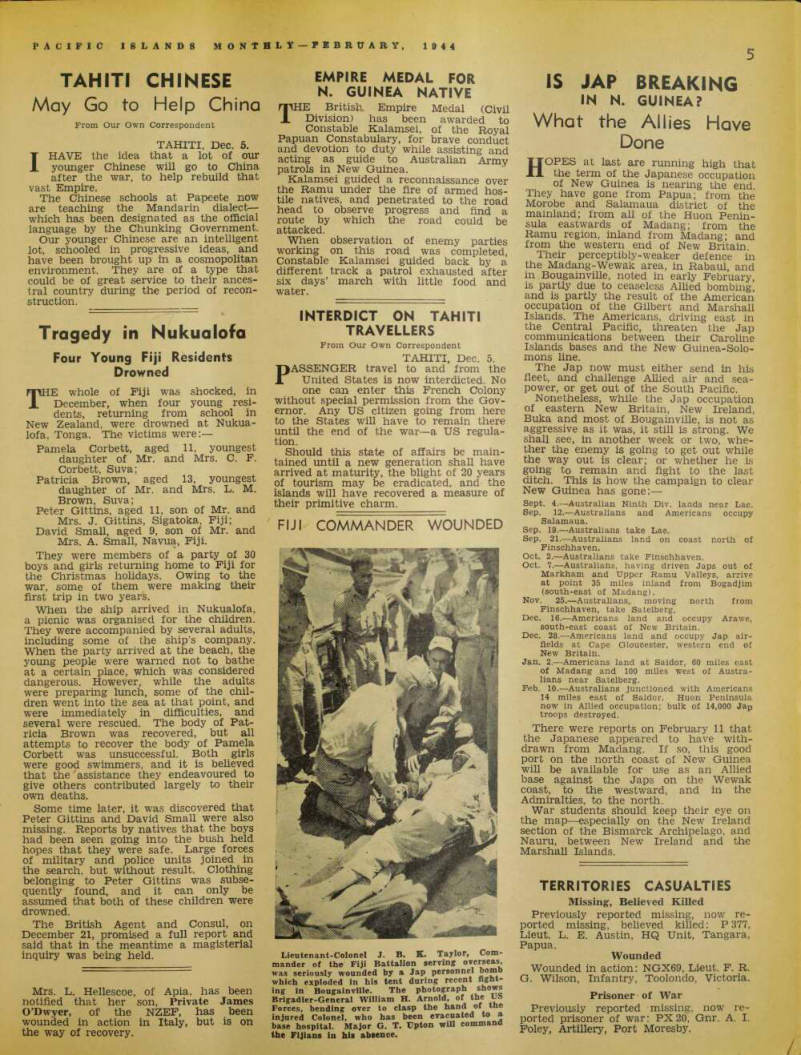
Lieutenant-Colonel J. B. K. Taylor, Com mander of the Fiji Battalion serving overseas, was seriously wounded by a Jap personnel bomb which exploded in his tent during recent fight ing in Bougainville. The photograph shows Brigadier-General William H. Arnold, of the US Forces, bending over to clasp the hand of the injured Colonel, who has been evacuated to a base hospital. Major G. T. Upton will command the Fijians in his absence.
What the Allies Have
Is Jap Breaking
In N. Guinea?
What the Allies Have Done
HOPES at last are running high that the term of the Japanese occupation of New Guinea is nearing the end They have gone from Papua; from the Morobe and Salamaua district of the mainland; from all of the Huon Penin sula eastwards of Madang; from the Ramu region, inland from Madang; and from the western end of New Britain Their perceptibly-weaker defence in the Madang-Wewak area, in Rabaul, and in Bougainville, noted in early February, is partly due to ceaseless Allied bombing, and is partly the result of the American occupation of the Gilbert and Marshall Islands. The Americans, driving east in the Central Pacific, threaten the Jap communications between their Caroline Islands bases and the New Guinea-Solo mons line.
The Jap now must either send in his fleet, and challenge Allied air and sea power, or get out of the South Pacific.
Nonetheless, while the Jap occupation of eastern New Britain, New Ireland, Buka and most of Bougainville, is not as aggressive as it was, it still is strong. We shall see, in another week or two, whe ther the enemy is going to get out while the way out is clear; or whether he is going to remain and fight to the last ditch. This is how the campaign to clear New Guinea has gone:— Sept. 4.—Australian Ninth Div. lands near Lae.
Sep. 12. —Australians and Americans occupy Salamaua.
Sep, 19.—Australians take Lae.
Sep, 21. —Australians land on coast north of Finschhaven.
Oct. 2. —Australians take Finschhaven.
Oct. 7.—Australians, having driven Japs out of Markham and Upper Ramu Valleys, arrive at point 35 miles inland from Bogadjim (south-east of Madang).
Nov. 25. —Australians, moving north from Finschhaven, take Satelberg.
Dec. 16. —Americans land and occupy Arawe, south-east coast of New Britain.
Dec. 28.—Americans land and occupy Jap air fields at Cape Gloucester, western end of New Britain.
Jan. 2. —Americans land at Saidor, 60 miles east of Madang and 100 miles west of Austra lians near Satelberg.
Feb. 10. —Australians junctioned with Americans 14 miles east of Saidor. Huon Peninsula now in Allied occupation; bulk of 14,000 Jap troops destroyed.
There were reports on February 11 that the Japanese appeared to have with drawn from Madang, If so, this good port on the north coast of New Guinea will be available for use as an Allied base against the Japs on the Wewak coast, to the westward, and in the Admiralties, to the north.
War students should keep their eye on the map—especially on the New Ireland section of the Bismarck Archipelago, and Nauru, between New Ireland and the Marshall Islands.
Advertisements & other items, p. 7 (2 items)
5
PACIFIC ISLANDS M OKtHLJ FEBRUARY, 1944
Territories Casualties
Missing, Believed Killed Previously reported missing, now reported missing, believed killed: P 377, Lieut. L. E. Austin, HQ Unit, Tangara, Papua.
Wounded Wounded in action: NGX69, Lieut. F. R.
G. Wilson, Infantry, Toolondo, Victoria.
Prisoner of War Previously reported missing, now reported prisoner of war: PX 20, Gnr. A. I.
Foley, Artillery, Port Moresby.
Fewer Dollars
Samoa Returning to Normal
From Our Own Correspondent
Apia, Jan. 6.
WESTERN Samoa’s boom prosperity is now definitely waning. Apia merchants, restaurant-keepers, en tertainers, curio-sellers, and other “dollar beneficiaries” are already complaining about diminishing returns, owing to the decreased spending power of Europeans and natives.
There is less war-work, less laundry and less purchasing of curios; and the prospects ara that, owing to the Pacific war moving to remoter regions, things will become worse—or rather, return to normal, in the near future.
Samoans have received a warning to clean and replant their food plantations, as otherwise they will be faced with a serious food shortage. At present, a plentiful breadfruit crop is providing food, but this will not last long.
Remarkable Effect On Revenue
Dollar-prosperity in Western Samoa —now, alas, ended boosted public finance to an unexpected extent in 1942-43. Figures submitted to the Legis lative Council when it met in Apia on December 6, showed that estimated re venue for the year ended March 31, 1943, had been exceeded by £90,716, Total re venue for the year was £212,996 —higher import duties and Port and Service Tax being mainly responsible for the in crease. The whole of this excess revenue has been placed to a Reserve Fund, for new works and buildings.
It is estimated that the revenue for the current year, which ends on March 31. 1944, will be approximately the same as that for 1943-44, i.e., well over £200,000.
Prohibition
At the same meeting, the Hon. A.
Stowers submitted two motions to the Council:— (1) That the Council recommend to the New Zealand Government that pro hibition of alcoholic liquor to Europeans in Western Samoa be abolished.
In support of this, he stated that on neither historic nor religious grounds were arguments in favour of prohibition supportable. Samoans, like other Poly nesians, had not taken to alcohol until it became a forbidden fruit. Then they had acquired a taste for it. Prohibition in Samoa —as elsewhere —had been a failure; it had brought many evils to the Territory, had caused many deaths and had made many good people into criminals.
After a debate, and' the word “amended” had been substituted for “abolished,” the motion was passed by the Council.
That £5O Deposit
(2) That the Council recommend the New Zealand Government to abolish the £5O deposit required before citizens of the Territory could emigrate to New Zealand. Mr. Stowers said that large numbers of boys and girls of European status left school in the Territory every year and they could not find work in Samoa owing to lack of opportunities and the growing competition of native Samoans. There was an outlet for these young people in New Zealand, which was the Mandatory Power administering Western Samoa, but the New Zealand Government treated them as aliens and demanded a deposit from them.
This motion was defeated.
Owing to continued ill-health, the Hon, O. F. Nelson was unable to attend the Council meeting.
Wreaths for Rabaul's
Dead Ceremonies at Sydney and Brisbane
AT a simple ceremony at Sydney’s Cenotaph on the morning of Janu ary 23, wreaths were laid in honour of the men of the NGVR and AIF who gave their lives in the defence of Rabaul two years previously.
A representative gathering of New Guinea people and relatives of the AIF garrison attended and wreaths were placed on the Cenotaph as follows: New Guinea Volunteer Rifles.—Brig.- General Sir Walter McNicoll (Civil Administrator of New Guinea).
New Guinea Branch of the RSSAILA. — Mr. A. J. Gaskin. 17th AA Battery.—Lieutenant Selby.
New Guinea Women’s Club. —Mrs. H. H.
Page.
New Guinea Branch of the CWA.—Mrs.
M. Peadon. 22nd Battalion AlF.—Sgt. J. D. Debney.
Australian Militia Forces. —Rifleman Les.
Clark.
Pacific Territories Association. —Mr. E. A.
James.
W. R. Carpenter & Company, Ltd.—Mr.
J. B. Sedges.
Nelson & Robertson Pty., Ltd. —Mr.
Harold Cooper.
Burns Philp &' Company, Ltd.—Mr. G. E.
Aumuller.
“Pacific Islands Monthly.”—Mr. R. W.
Robson.
Wreaths and flowers were placed there also by relatives and friends of men who fought in the engagement.
At the Cenotaph, in Anzac Square, Brisbane, on the same day, a service was conducted by Dean W. E. C. Barrett and wreaths laid in commemoration of New Guinea fallen and prisoners of war.
Wreaths were placed on the Cenotaph by Captain R. Kendall, RAN, president of the Queensland New Guinea Association, and by other old residents of the Terri tory.
Fiji Military Force
Casualties
Killed in Action Pte. Kameli Rokotuiloma.
Died on Active Service Pte. Emosi Waqa, Pte. Mateo Tuidala, Pte. Manoa Nakara, Pte. Isikeli Naboko, Pte. Inikasio Seru, and Pte. F. Work.
Wounded in Action Lieut.-Col. J. K. B. Taylor, Lieut. G.
A. Thompson, Pte, W. Holmes.
Call to Young Frenchmen
Noumea, Feb. 3.
FROM February 15, the French National Committee in Algiers is calling to the colours, young men in all Fighting French overseas territories belonging to
Cib'ss 1944
A recruiting office has recently been opened at Noumea Barracks for New Caledonian youths, not below the age of 18, who want to join the French Air Force.
Indian rice-growers in Fiji have been guaranteed a purchase price of £l5 per ton for padi delivered in bags at any mill in Viti Levu in the second half of 1944. Details of the conditions under which this guaranteed price is given have been made known by the Govern ment in Fiji.
Send Them To
Hawaii!
Tahiti Wails at Prospect of Indian Migration From Fiji
From Our Papeete Correspondent HERE, indeed, is the “most unkindest cut of all”
Just at the time we have cleared our islands of Scythians, Bactrians, Phili stines, anthropologists, crackpot writers, gargons, borogoves and the Frumious Bandersnatch, you voice the proposal (on page 35, October “PIM”) to ship the troublesome Indian community of Fiji to our Marquesas Islands!
Why not pour this torrent into Hawaii —our Sino-Japanese-Korean-Portuguese- Filipino-Hollywood Blonde Melting Pot; with a few Andaman Islanders for good measure? The Sugar Barons would rejoice. The Chamber of Commerce and the Booster Club would “point with pride” when the new census figures are published. And one must not forget the garden of delight which would be blos soming for the anthropologists, a few generations hence.
Those of us who hope for a happier post-war Pacific Islands would “view with alarm” the several schemes and propo sals which amalgamate Polynesia, Micro nesia and Melanesia in one problem.
There is as much difference between a Polynesian, a Micronesian, and a Mela nesian as there is between a college pro fessor, a Hollywood clown and a Farm- Block Congressman. The mentality, man ner of life and background of each are radically different.
Melanesia appears to offer large tracts of land suitable for European settlement.
Polynesia, on the contrary, is thickly settled, with every hectare of arable land in cultivation. Polynesia offers about the same opportunity to the settler from abroad as does Switzerland.
The problems of Polynesia are those of any civilized community—education, sani tation, markets for produce, and defence against burdening the archipelagoes with top-heavy Government machinery.
to Japan
An American Answer to Japan
Iff HE following forecast is sent in by a South Seas resident, who offsets his isolation and studies world affairs by spendnig considerable time at his radio.
THE purpose of the present phase of Japanese propaganda is self-evident.
Germany, having failed to sow dis cord among the United Nations, has delegated to Japan the task of aiding and abetting the political highbinders and hatchet-men at Wellington, the grimy Nibelungen of underground Fascism, who are undertaking siege operations against the citadel of Mr.
Roosevelt’s historic achievements.
The Japanese High Command has adopted the Hitlerian formula of the Colossal Lie—repeated and magnified.
The reply of the United States will be the re-election of Mr. Roosevelt to the Presidency, by an overwhelming majority.
The “Seven Dwarfs,” who are bravely posing as candidates against him, will be blown like chaff before the whirlwind.
The Rev. Frere Lane, of Manapi, New Guinea, arrived in Melbourne on leave in January. He has served with the Anglican Mission for 25 years, first in Northern Australia and then in New Guinea.
The Gilberts
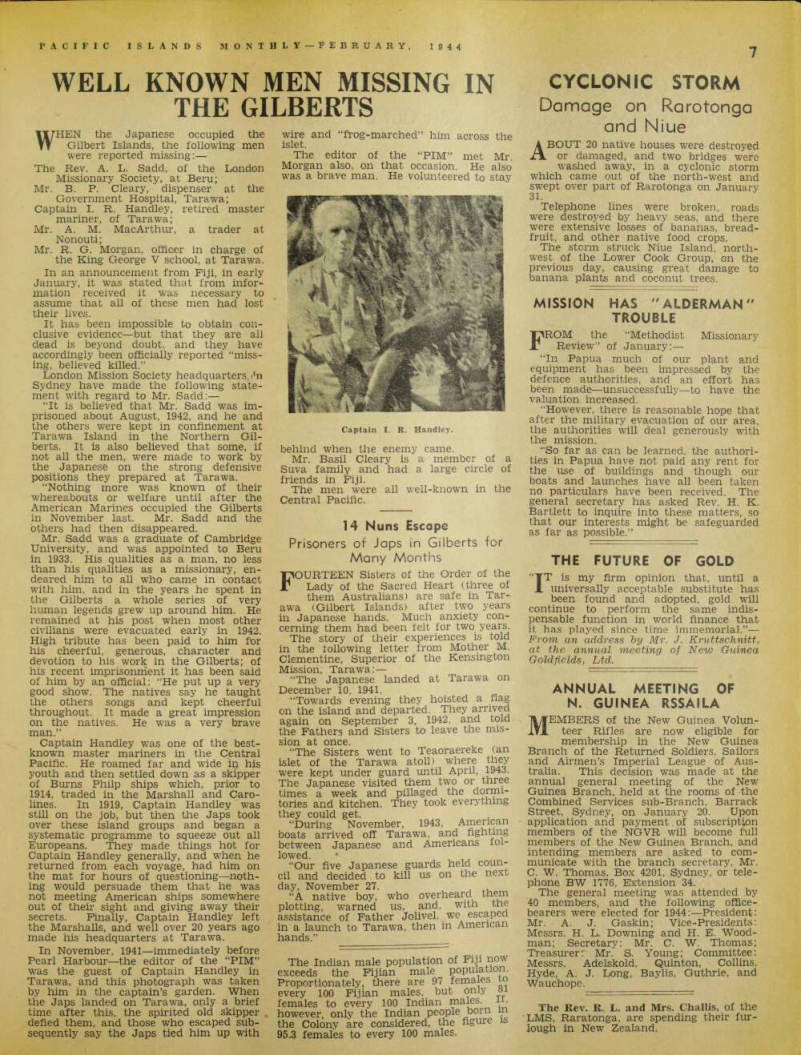
Well Known Men Missing In
WHEN the Japanese occupied the Gilbert Islands, the following men were reported missing:— The Rev. A. L. Sadd, of the London Missionary Society, at Beru; Mr. B. P. Cleary, dispenser at the Government Hospital, Tarawa; Captain I. R. Handley, retired master mariner, of Tarawa; Mr, A. M. MacArthur, a trader at Nonouti; Mr. R. G. Morgan, officer in charge of the King George V school, at Tarawa.
In an announcement from Fiji, in early January, it was stated that from infor mation received it was necessary to assume that all of these men had lost their lives.
It has been impossible to obtain con clusive evidence—but that they are all dead is beyond doubt, and they have accordingly been officially reported “miss ing, believed killed.”
London Mission Society headquarters, -’n Sydney have made the following state ment with regard to Mr. Sadd:— “It is believed that Mr. Sadd was im prisoned about August, 1942, and he and the others were kept in confinement at Tarawa Island in the Northern Gil berts. It is also believed that some, if not all the men, were made to work by the Japanese on the strong defensive positions they prepared at Tarawa.
“Nothing more was known of their whereabouts or welfare until after the American Marines occupied the Gilberts in November last. Mr. Sadd and the others had then disappeared.
Mr. Sadd was a graduate of Cambridge University, and was appointed to Beru in 1933. His qualities as a man, no less than his qualities as a missionary, en deared him to all who came in contact with him, and in the years he spent in the Gilberts a whole series of very human legends grew up around him. He remained at his post when most other civilians were evacuated early in 1942.
High tribute has been paid to him for his cheerful, generous, character and devotion to his work in the Gilberts; of his recent imprisonment it has been said of him by an official: “He put up a very good show. The natives say he taught the others songs and kept cheerful throughout. It made a great impression on the natives. He was a very brave man.”
Captain Handley was one of the best known master mariners in the Central Pacific. He roamed far and wide in his youth and then settled down as a skipper of Burns Philp ships which, prior to 1914, traded in the Marshall and Caro lines. In 1919, Captain Handley was still on the job, but then the Japs took over these island groups and began a systematic programme to squeeze out all Europeans. They made things hot for Captain Handley generally, and when he returned from each voyage, had him on the mat for hours of questioning—noth ing would persuade them that he was not meeting American ships somewhere out of their sight and giving away their secrets. Finally, Captain Handley left the Marshalls, and well over 20 years ago made his headquarters at Tarawa.
In November, 1941 —immediately before Pearl Harbour —the editor of the “PIM” was the guest of Captain Handley in Tarawa, and this photograph was taken by him in the captain’s garden. When the Japs landed on Tarawa, only a brief time after this, the spirited old skipper defied them, and those who escaped sub sequently say the Japs tied him up with
wire and “frog-marched” him across the islet.
The editor of the “PIM” met Mr.
Morgan also, on that occasion. He also was a brave man. He volunteered to stay
behind when the enemy came.
Mr. Basil Cleary is a member of a Suva family and had a large circle of friends in Fiji.
The men were all well-known in the Central Pacific.
Captain I. R. Handley.
Many Months
14 Nuns Escape Prisoners of Japs in Gilberts for Many Months
FOURTEEN Sisters of the Order of the Lady of the Sacred Heart (three of them Australians) are safe in Tar awa (Gilbert Islands) after two years in Japanese hands. Much anxiety con cerning them had been felt for two years.
The story of their experiences is told in the iollowing letter from Mother M.
Clementine, Superior of the Kensington Mission, Tarawa:— “The Japanese landed at Tarawa on December 10, 1941.
“Towards evening they hoisted a flag on the island and departed. They arrived again on September 3, 1942. and told the Fathers and Sisters to leave the mis sion at once.
“The Sisters went to Teaoraereke (an islet of the Tarawa atoll) where they were kept under guard until April, 1943.
The Japanese visited them two or three times a week and pillaged the dormi tories and kitchen. They took everything they could get.
“During November, 1943, American boats arrived off Tarawa, and fighting between Japanese and Americans fol lowed.
“Our five Japanese guards held coun cil and decided to kill us on the next day, November 27. , ..
“A native boy, who overheard them plotting, warned us, and. with the assistance of Father Jolivel, we escaped in a launch to Tarawa, then in American hands.”
The Indian male population of Fiji now exceeds the Fijian male population.
Proportionately, there are 97 females to every 100 Fijian males, but only oi females to every 100 Indian males, ii, however, only the Indian people born m the Colony are considered, the figure is 95.3 females to every 100 males.
Damage on Rarotonga
Cyclonic Storm
Damage on Rarotonga and Niue
ABOUT 20 native houses were destroyed or damaged, and two bridges were washed away, in a cyclonic storm which came out of the north-west and swept over part of Rarotonga on January 31.
Telephone lines were broken, roads were destroyed by heavy seas, and there were extensive losses of bananas, bread fruit, and other native food crops.
The storm struck Niue Island, north west of the Lower Cook Group, on the previous day, causing great damage to banana plants and coconut trees.
Mission Has "Alderman"
Trouble
FROM the “Methodist Missionary Review” of January;— “In Papua much of our plant and equipment has been impressed by the defence authorities, and an effort has been made —unsuccessfully—to have the valuation increased.
“However, there is reasonable hope that after the military evacuation of our area, the authorities will deal generously with the mission, “So far as can be learned, the authori ties in Papua have not paid any rent for the use of buildings and though our boats and launches have all been taken no particulars have been received. The general secretary has asked Rev. H. K.
Bartlett to inquire into these matters, so that our interests might be safeguarded as far as possible.”
The Future Of Gold
“TT is my firm opinion that, until a X universally acceptable substitute has been found and adopted, gold will continue to perform the same indis pensable function in world finance that it has played since time immemorial.” — From an address by Mr. J. Kruttschnitt, at the annual meeting of New Guinea Goldfields, Ltd.
Annual Meeting Of
N. Guinea Rssaila
MEMBERS of the New Guinea Volun teer Rifles are now eligible for membership in the New Guinea Branch of the Returned Soldiers, Sailors and Airmen’s Imperial League of Aus tralia. This decision was made at the annual general meeting of the New Guinea Branch, held at the rooms of the Combined Services sub-Branch, Barrack Street, Sydney, on January 20. Upon application and payment.of subscription members of the NGVR will become full members of the New Guinea Branch, and intending members are asked to com municate with the branch secretary, Mr.
C. W. Thomas, Box 4201, Sydney, or tele phone BW 1776, Extension 34.
The general meeting was attended by 40 members, and the following office bearers were elected for 1944: —President: Mr. A. J. Gaskin; Vice-Presidents: Messrs. H. L. Downing and H. E. Wood man; Secretary: Mr. C. W. Thomas; Treasurer: Mr. S. Young; Committee: Messrs. Adelskold, Quinton, Collins, Hyde, A. J. Long, Baylis, Guthrie, and Wauchope.
The Rev. R. L. and Mrs. Challis, of the LMS, Raratonga, are spending their fur lough in New Zealand.
Fiji Sugar Troubles
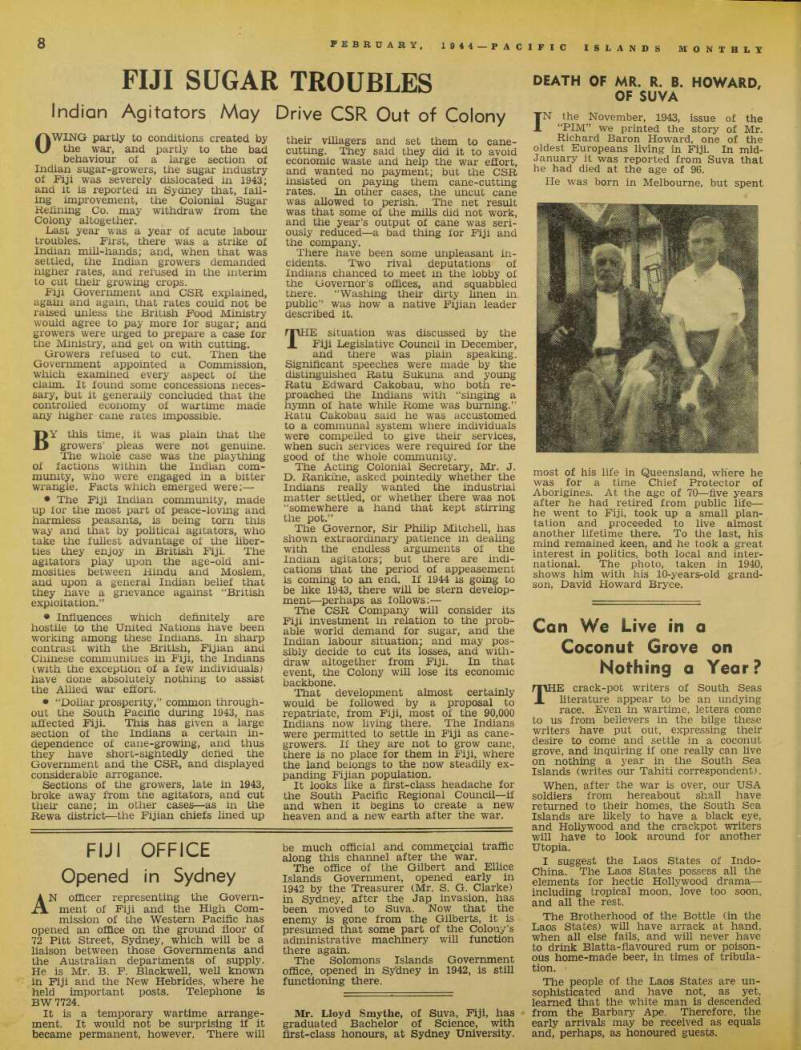
Indian Agitators May Drive CSR Out of Colony
OWING partly to conditions created by the war, and partly to the bad behaviour of a large section of Indian sugar-growers, the sugar industry of Fiji was severely dislocated in 1943; and it is reported in Sydney that, fail ing improvement, the Colonial Sugar Refining Co. may withdraw from the
Colony altogether.
Last year was a year of acute labour troubles. First, there was a strike of Indian mill-hands; and, when that was settled, the Indian growers demanded higher rates, and refused in the interim to cut their growing crops.
Fiji Government and CSR explained, again and again, that rates could not be raised unless the British Food Ministry would agree to pay more for sugar; and growers were urged to prepare a case for the Ministry, and get on with cutting.
Growers refused to cut. Then the Government appointed a Commission, which examined every aspect of the claim. It found some concessions neces sary, but it generally concluded that the controlled economy of wartime made any higher cane rates impossible.
BY this time, it was plain that the growers' pleas were not genuine.
The whole case was the plaything of factions within the Indian com munity, who were engaged in a bitter wrangle. Facts which emerged were;— • The Fiji Indian community, made up for the most part of peace-loving and harmless peasants, is being torn this way and that by political agitators, who take the fullest advantage of the liber ties they enjoy in British Fiji. The agitators play upon the age-old ani mosities between Hindu and Moslem, and upon a general Indian belief that they have a grievance against “British exploitation.” • Influences which definitely are hostile to the United Nations have been working among these Indians. In sharp contrast with the British, Fijian and Chinese communities in Fiji, the Indians (with the exception of a few individuals) have done absolutely nothing to assist the Allied war effort. • "Dollar prosperity,” common through out the South Pacific during 1943, has affected Fiji. This has given a large section of the Indians a certain in dependence of cane-growing, and thus they have short-sightedly defied the Government and the CSR, and displayed considerable arrogance.
Sections of the growers, late in 1943, broke away from the agitators, and cut their cane; in other cases —as in the Rewa district —the Fijian chiefs lined up
their villagers and set them to cane cutting. They said they did it to avoid economic waste and help the war effort, and wanted no payment; but the CSR insisted on paying them cane-cutting rates. In other cases, the uncut cane was allowed to perish. The net result was that some of the mills did not work, and the year’s output of cane was seri ously reduced —a bad thing for Fiji and the company.
There have been some unpleasant in cidents. Two rival deputations of Indians chanced to meet m the lobby of the Governor’s offices, and squabbled there. "Washing their dirty linen in public” was how a native Fijian leader described it. rE situation was discussed by the Fiji Legislative Council in December, and there was plain speaking.
Significant speeches were made by the distinguished Ratu Sukuna and young Ratu Edward Cakobau, who both re proached the Indians with "singing a hymn of hate while Rome was burning.”
Ratu Cakobau said he was accustomed to a communal system where individuals were compelled to give their services, when such services were required for the good of the whole community.
The Acting Colonial Secretary, Mr. J.
D. Ranki'ne, asked pointedly whether the Indians really wanted the industrial matter settled, or whether there was not "somewhere a hand that kept stirring the pot.”
The Governor, Sir Philip Mitchell, has shown extraordinary patience in dealing with the endless arguments of the Indian agitators; but there are indi cations that the period of appeasement is coming to an end. If 1944 is going to be like 1943, there will be stern develop ment —perhaps as follows: — The CSR Company will consider its Fiji investment in relation to the prob able world demand for sugar, and the Indian labour situation; and may pos sibly decide to cut its losses, and with draw altogether from Fiji. In that event, the Colony will lose its economic backbone.
That development almost certainly would be followed by a proposal to repatriate, from Fiji, most of the 90,000 Indians now living there. The Indians were permitted to settle in Fiji as cane growers. If they are not to grow cane, there is no place for them in Fiji, where the land belongs to the now steadily ex panding Fijian population.
It looks like a first-class headache for the South Pacific Regional Council—if and when it begins to create a new heaven and a new earth after the war.
Opened in Sydney
Fiji Office
AN officer representing the Govern ment of Fiji and the High Com mission of the Western Pacific has opened an office on the ground floor of 72 Pitt Street, Sydney, which will be a liaison between those Governments and the Australian departments of supply.
He is Mr. B. F. Blackwell, well known in Fiji and the New Hebrides, where he held important posts. Telephone is BW 7724.
It is a temporary wartime arrange ment. It would not be surprising if it became permanent, however. There will
be much official and commercial traffic along this channel after the war.
The office of the Gilbert and Ellice Islands Government, opened early in 1942 by the Treasurer (Mr. S. G. Clarke) in Sydney, after the Jap invasion, has been moved to Suva. Now that the enemy is gone from the Gilberts, it is presumed that some part of the Colony’s administrative machinery will function there again.
The Solomons Islands Government office, opened in Sydney in 1942, is still functioning there.
Mr. Lloyd Smythe, of Suva, Fiji, has graduated Bachelor of Science, with first-class honours, at Sydney University.
Death Of Mr. R. B. Howard,
Of Suva
IN the November, 1943, issue of the “PIM” we printed the story of Mr.
Richard Baron Howard, one of the oldest Europeans living in Fiji. In mid- January it was reported from Suva that he had died at the age of 96.
He was born in Melbourne, but spent
most of his life in Queensland, where he was for a time Chief Protector of Aborigines. At the age of 70—five years after he had retired from public life— he went to Fiji, took up a small plan tation and proceeded to live almost another lifetime there. To the last, his mind remained keen, and he took a great interest in politics, both local and inter national. The photo, taken in 1940, shows him with his 10-years-old grand son, David Howard Bryce.
Coconut Grove on
Can We Live in a Coconut Grove on Nothing a Year?
rE crack-pot writers of South Seas literature appear to be an undying race. Even in wartime, letters come to us from believers in the bilge these writers have put out, expressing their desire to come and settle in a coconut grove, and inquiring if one really can live on nothing a year in the South Sea Islands (writes our Tahiti correspondent).
When, after the war is over, our USA soldiers from hereabout shall have returned to their homes, the South Sea Islands are likely to have a black eye, and Hollywood and the crackpot writers will have to look around for another Utopia.
I suggest the Laos States of Indo china. The Laos States possess all the elements for hectic Hollywood drama — including tropical moon, love too soon, and all the rest.
The Brotherhood of the Bottle (in the Laos States) will have arrack at hand, when all else fails, and will never have to drink Blatta-flavoured rum or poison ous home-made beer, in times of tribula tion.
The people of the Laos States are un sophisticated and have not, as yet, learned that the white man is descended from the Barbary Ape. Therefore, the early arrivals may be received as equals and, perhaps, as honoured guests.
For Sale—Then
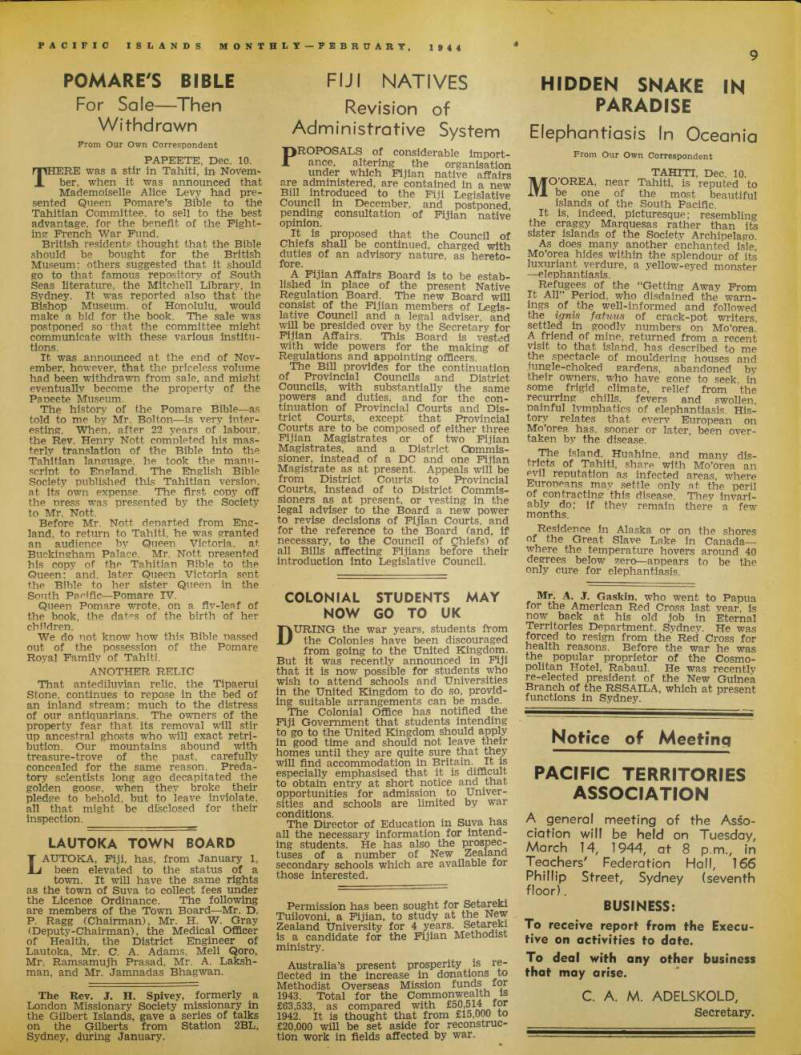
Pomare's Bible
For Sale—Then Withdrawn
Prom Our Own Correspondent
Papeete, Dec. 10.
fIIHERE was a stir in Tahiti, in J. ber, when it was announced that Mademoiselle Alice Levy had pre sented Queen Pomare’s Bible to the Tahitian Committee, to sell to the best advantage, for the benefit of the Fight ing French War Fund.
British residents thought that the Bible should be bought for the British Museum; others suggested that it should go to that famous repository of South Seas literature, the Mitchell Library, in Sydney. It was reported also that the Bishop Museum, of Honolulu, would make a bid for the book. The sale was postponed so that the committee might communicate with these various institu tions.
It was announced at the end of Nov ember, however, that the priceless volume had been withdrawn from sale, and might eventuallv become the property of the Paneete Museum.
The history of the Pomare Bible—as told to me by Mr. Bolton—is very inter esting. When, after 22 years of labour, the Rev. Henry Nott completed his mas terly translation of the Bible into the Tahitian language, he took the manu script to England. The English Bible Society published this Tahitian version, at its own expense. The first copy off the nress was presented by the Society to Mr. Nott.
Before Mr. Nott denarted from Eng land, to return to Tahiti, he was granted an audience by Queen Victoria, at Buckingham Palace. Mr. Nott nresented his copy of the Tahitian Bible to the Oueen; and. later Queen Victoria sent the Bible to her sister Queen in the South Pacific —Pomare IV.
Queen Pomare wrote, on a flv-leaf of the book, the dates of the birth of her children.
We do not know how this Bible nassed out of the possession of the Pomare Royal Family of Tahiti.
Another Relic
That antediluvian relic, the Tipaerui Stone, continues to repose in the bed of an inland stream; much to the distress of our antiquarians. The owners of the property fear that its removal will stir up ancestral ghosts who will exact retri bution. Our mountains abound with treasure-trove of the past, carefully concealed for the same reason. Preda tory scientists long ago decapitated the golden goose, when they broke their pledge to behold, but to leave inviolate, all that might be disclosed for their inspection.
Lautoka Town Board
LAUTOKA, Fiji, has, from January 1, been elevated to the status of a town. It will have the same rights as the town of Suva to collect fees under the Licence Ordinance. The following are members of the Town Board —Mr. D.
P. Ragg (Chairman), Mr. H. W. Gray (Deputy-Chairman), the Medical Officer of Health, the District Engineer of Lautoka, Mr. C. A. Adams, Meli Qoro, Mr. Ramsamujh Prasad, Mr. A. Laksh man, and Mr. Jamnadas Bhagwan.
The Rev. J. H. Spivey, formerly a London Missionary Society missionary in the Gilbert Islands, gave a series of talks on the Gilberts from Station 2BL, Sydney, during January.
Administrative System
Fiji Natives
Revision of Administrative System
PROPOSALS of considerable import ance, altering the organisation under which Fijian native affairs are administered, are contained in a new Bill introduced to the Fiji Legislative Council in December, and postponed, pending consultation of Fijian native opinion.
It is proposed that the Council of Chiefs shall be continued, charged with duties of an advisory nature, as hereto fore.
A Fijian Affairs Board is to be estab lished in place of the present Native Regulation Board. The new Board will consist of the Fijian members of Legis lative Council and a legal adviser, and will be presided over by the Secretary for Fijian Affairs. This Board is vested with wide powers for the making of Regulations and appointing officers.
The Bill provides for the continuation of Provincial Councils and District Councils, with substantially the same powers and duties, and for the con tinuation of Provincial Courts and Dis trict Courts, except that Provincial Courts are to be composed of either three Fijian Magistrates or of two Fijian Magistrates, and a District Commis sioner, instead of a DC and one Fijian Magistrate as at present. Appeals will be from District Courts to Provincial Courts, instead of to District Commis sioners as at present, or vesting in the legal adviser to the Board a new power to revise decisions of Fijian Courts, and for the reference to the Board (and, if necessary, to the Council of Qhiefs) of all Bills affecting Fijians before their introduction into Legislative Council.
Colonial Students May
Now Go To Uk
DURING the war years, students from the Colonies have been discouraged from going to the United Kingdom.
But it was recently announced in Fiji that it is now possible for students who wish to attend schools and Universities in the United Kingdom to do so, provid ing suitable arrangements can be made.
The Colonial Office has notified the Fiji Government that students intending to go to the United Kingdom should apply in good time and should not leave their homes until they are quite sure that they will find accommodation in Britain. It is especially emphasised that it is difficult to obtain entry at short notice and that opportunities for admission to Univer sities and schools are limited by war conditions.
The Director of Education in Suva has all the necessary information for intend ing students. He has also the prospec tuses of a number of New Zealand secondary schools which are available for those interested.
Permission has been sought for Setareki Tuilovoni, a Fijian, to study at the New Zealand University for 4 years. Setareki is a candidate for the Fijian Methodist ministry.
Australia’s present prosperity is re flected in the increase in donations to Methodist Overseas Mission funds for 1943. Total for the Commonwealth is £63,533, as compared with £50,514 for 1942. It is thought that from £15,000 to £20,000 will be set aside for reconstruc tion work in fields affected by war.
Paradise
Hidden Snake In
Elephantiasis In Oceania
From Our Own Correspondent
Tahiti, Dec. 10.
lITO’OREA, near Tahiti, is reputed to ITI be one of the most beautiful islands of the South Pacific.
It is, indeed, picturesque; resembling the craggy Marquesas rather than its sister islands of the Society Archipelago As does many another enchanted isle Mo’orea hides within the splendour of its luxuriant verdure, a yellow-eyed monster —elephantiasis.
Refugees of the “Getting Away From It All” Period, who disdained the warn ings of the well-informed and followed the ignis fatuus of crack-pot writers, settled in goodly numbers on Mo’orea A friend of mine, returned from a recent visit to that island, has described to me the spectacle of mouldering houses and jungle-choked gardens, abandoned by their owners, who have gone to seek, in some frigid climate, relief from the recurring chills, fevers and swollen, painful lymphatics of elephantiasis. His tory relates that everv European on Mo’orea has, sooner or later, been over taken by the disease.
The island. Huahine, and many dis tricts of Tahiti, share with Mo’orea an evil reputation as infected areas, where Euroneans may settle only at. the peril of contracting this disease. They invari ably do; if they remain there a few months.
Residence in Alaska or on the shores of the Great Slave Lake in Canada— where the temperature hovers around 40 degrees below zero—appears to be the only cure for elephantiasis.
Mr. A. J. Gaskin, who went to Papua for the American Red Cross last year, is now back at his old job in Eternal Territories Department. Sydney. He was forced to resign from the Red Cross for health reasons. Before the war he was the popular proprietor of the Cosmo politan Hotel, Rabaul. He was recently re-elected president of the New Guinea Branch of the RSSAILA, which at present functions in Sydney.
Advertisements & other items, p. 11 (1 item)
Notice of Meeting
PACIFIC TERRITORIES
ASSOCIATION
A general meeting of the Association will be held on Tuesday, March 14, 1944, at 8 p.m., in Teachers 7 Federation Hall, 166 Phillip Street, Sydney (seventh floor).
BUSINESS:
To receive report from the Executive on activities to date.
To deal with any other business that may arise.
C. A. M. ADELSKOLD,
Secretary.
Fate Of The Pacific Mandates
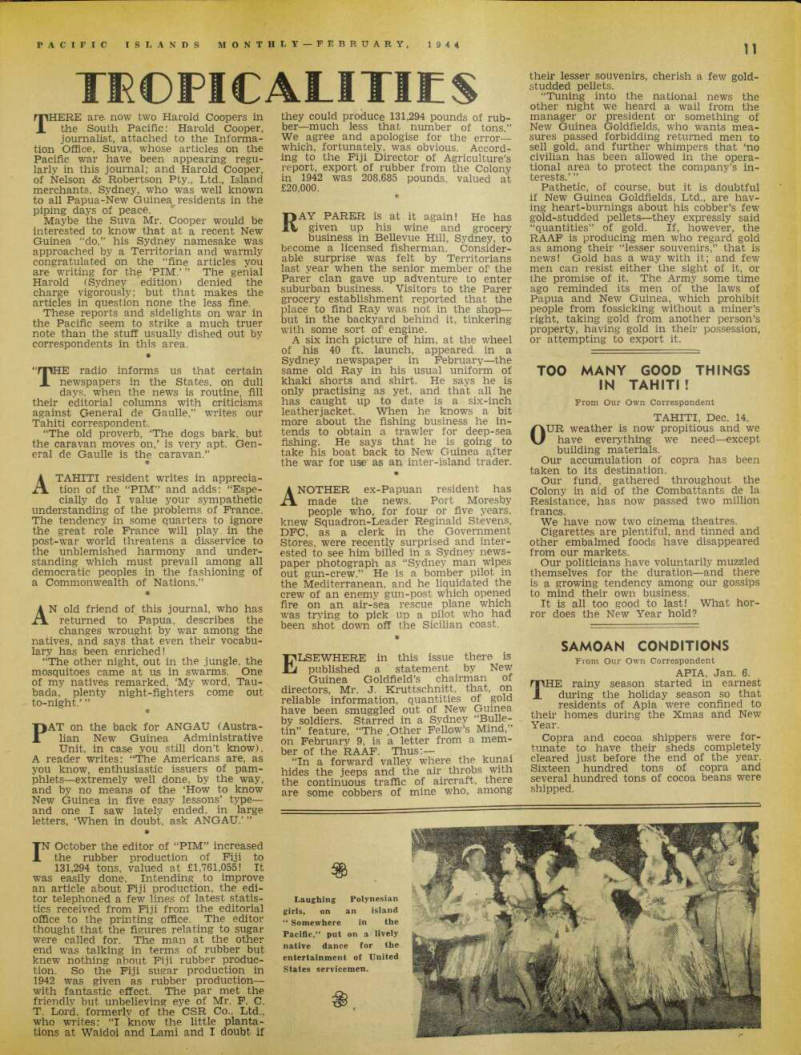
Legalistic Claim That They Must be Absorbed in Existing Empires—And its Refutation
suggestion, frequently put forward 1 in the “PIM,” that the Pacific Mandated Territories must go into the melting-pot at the end of the war, so that their status and constitution may he re-defined, is opposed vigorously by Mr. P. W. Glover, BSc., ERAS, of Apia, Western Samoa, who has devoted much study and research to the subject, and writes with considerable authority.
Mr. GlovePs letter is lengthy; but it has been printed with little reduction, because it will have value when the war is over, and these matters come forward for serious discussion.
But, as it makes claims which we be lieve to be unsound and dangerous, we have taken the liberty of presenting
another viewpoint.
A MANDATE is a moral obligation assumed by a sovereign State to govern, according to certain defined principles, the territory which it acquired by conquest, treaty, capitulation, grant, or other lawful means at the termination of the war with Germany in 1918. That is all.
It is commonly believed that the man dates constitute a limitation on sove reignty, but this is not so. This belief is strange, for the position has been made clear and put beyond all doubt by the Rt. Hon. Mr. L. S. Amery, in “The Ger man Colonial Claim”; and surely there is no one more qualified than he to explain this. I quote from pages 105 to 107.
“The League had nothing to do with the actual allocation of the territories. It did not even frame the mandates themselves, which were drawn up by the individual Allies, after consultation and agreement among themselves as to their general terms, and were then accepted by the League. A mandate constituted, on the one hand, a solemn undertaking on the part of the Mandatory Power to govern on certain lines, and, on the other, the blessing or moral authority of the League in favour of the retention of the territory already decided be tween the Allies. It differed only in detail and degree, and not in kind from any other obli gation registered with the League, such, for instance, as the Treaty of St. Germain. ...
The mandates have thus nothing to do with the sovereignty of the territories in question. The idea vaguely entertained in many quarters that these territories belong in some sense to the League and are only held on a kind of tenancy, subject to good behaviour, and transferable on the authority of the League, has no foundation whatever in fact. . . . What is certain is that, on the one hand, the division among the Allies was intended to be outright and permanent, and that, on the other hand, the United States, though not joining the League or ratifying the Treaty of Versailles, have insisted on a series of conventions with the Mandatory Powers that the terms of the mandates cannot be varied without American consent. . . . The Anglo- American mutual obligation in respect of these territories is, in fact, both antecedent and superior to any British obligation to the League. ...”
For Germany, the operative clause of the Treaty of Versailles was Article 119: “Germany renounces in favour of the principal Allied and Associated Powers all her rights and titles over her overseas possessions.” It was an absolute and unconditional surrender.
THE fact that Germany called all her overseas possessions Protectorates (Schutzgebiete) has led many people into the fallacy that the Allied and Asso ciated Powers were not in a position to pass on the complete sovereignty of those territories to those to whom they were distributed at the Peace Conference,
This thesis has been advanced with a good deal of pertinacity in regard to Samoa, but is without foundation in fact.
The position was explained long before the last war in Hall “On International Law,” at page 134 (footnote) wherein it was explained that German law provided for the so-called Protectorates an elabor ate organisation based on the unrestricted sovereignty of the Emperor, and pointed out that German Protectorates were only intended to be Protectorates in name.
As the second article of the (Imperial) German Constitution enumerated the territories of the German Empire, a legis lative enactment amending the Consti tution would have been necessary every time a Colony was added; that would have been not only inconvenient but constitutionally undesirable, so the expe dient was adopted of calling all the pos sessions Protectorates, despite their true colonial status. Undoubtedly, it was the intention ultimately to rectify the posi tion by one amendment, when Germany regarded her colonial expansion as rea sonably complete.
In the particular case of Samoa, I would quote the speech of Dr. Solf at the hoisting of the German flag on March 1, 1900 (translated from the German ver sion reported in the Samoa “Weekly Herald” of March 3, 1900): “Now, by command of His Majesty the Emperor, I declare these islands to be German territory; and as a sign of Ger man sovereignty there must henceforth wave over these islands the German flag which I have received from the appointed representative of the Reich and, assisted by the Commander of SMS ‘Cormoran,’ solemnly hoist.”
Ten years later, on March 1, 1910. Gov ernor Solf, in an address to the Samoans, said (I quote the version printed in “The NZ Samoa Guardian” of January 19, 1933 —Vol. V, No. 116, at page 4) ; “Samoans, do not listen to the wild talk in the streets, and the misleading remarks of some people: such as the idea that the authority of the Kaiser in Samoa is only for 10 years. That is a wrong idea; the Kaiser’s authority over Samoa shall remain for ever.”
The point of all this is that Germany acquired and exercised complete sove reignty, both internal and external; and that sovereignty must, in common-sense, be presumed to have passed to the Brit ish Crown, along with the territory itself.
The same type of argument applies to all the other former German overseas possessions.
In any case, the above argument, based on the alleged protectorate status of Samoa, is of no more than academic interest, for in practice a Protectorate is only a reservation for future annexation, or more rarely, to keep someone else out.
As Hall puts it (“On International Law,” at page 133): “Indeed, protection must be looked upon merely as a transitional form of relation between civilized and uncivi lized states, destined, in course of time, to develop and harden into effective sovereignty.”
Doubts have been raised in some quar ters about the right of Germany to assume the complete sovereignty of Samoa, and in support of that thesis, argument has been advanced based on the fact that the assent of Samoa was sought and obtained in the Final Act of the Berlin Conference on Samoan Affairs of 1889. But if we examine that Act, we
find that Article VIII gave the three Powers the exclusive right of amending the Act —and amending includes, of course, cancelling—without reference to Samoa: “The provisions of this Act shall continue in force until changed by the three Powers.’’ And Samoa assented to that: so the three Powers were perfectly within their rights when, by Article I of the Samoa Tripartite Convention of December, 1899, they annulled the Gen eral Act of the Berlin Conference and all previous treaties, conventions, and agreements, rE authority of New Zealand to gov ern Samoa does not derive from the League of Nations, nor yet from the Mandate: but from the Western Samoa Order in Council (Imperial) of March 11, 1920 (see the New Zealand “Gazette” of 1920, at page 1,819 for the text); and that Order was made, not bn the authority of the League, but under an Imperial Act of Parliament—the Foreign Jurisdiction Act, 1890.
It will be noted that the Order in Council which gave to New Zealand the full power to legislate for the peace, order, and good government of the Ter ritory of Western Samoa, antedated the Mandate by nine months, for the latter document was not registered with the League until December 17, 1920.
The only restriction on New Zealand’s jurisdiction in Samoa appears to be that contained in the Order in Council which reserves to His Majesty the right to revoke, alter, add to, or amend the Order; but it is unlikely that the Im perial Government would ever interfere, except for the most urgent and serious reasons of State, and then only in full consultation with and by consent of the New Zealand legislature.
Undoubtedly, like considerations apply in respect of all other territories man dated to the British Crown; so there does not appear to be much relevant objec tion to speaking of “Australian New Guinea”: and, for that matter, “British Samoa” would be a preferable and more accurate designation for “Western Samoa.” This would leave no doubt as to the true status of the territory involved.
Apart from these things, Samoa was to New Zealand for half a century a terra irredenta with much justification; and, in the same way, New Guinea stood in an identical relation to Australia. The territories were legitimately acquired, complete with full sovereignty, during the last war, and have, in fact, been con firmed to the Dominions in question.
The time has come when those facts should be given greater publicity by amending the names of the territories in conformity with their actual status.
SUCH action would have the effect of removing all doubts, and of putting an end to much confused thinking and fallacious and unprofitable argu ments which react to the detriment of the material and spiritual progress of those recently-acquired portions of our Empire. For they are British territory, and no foreign power has any right whatsoever in international law to claim jurisdiction in them.
As for the Japanese possessions in the Pacific, such as the Carolines and Mar shalls, they will fall as the fruits of con quest to one or more of the present Allied Powers —and internationally it does not matter very much which.
Apart from the Japanese possessions, the status quo ante, as it existed in the Pacific before the outbreak of this war. must be restored and maintained —unless, of course, the rules of international law are to be flagrantly disregarded: but are
(Continued on Page 30)
we not fighting for the preservation of those rules? Moreover, the Allied Pow ers are not waging war against their common enemies for the purpose of annexing one another’s Pacific terri
tories: that would be nonsense.
I am, etc.,
P. W. Glover, Bsc, Fras.
Apia, Samoa, Nov. 27, 1943.
Tropicalities
THERE are. now two Harold Coopers in the South Pacific: Harold Cooper, journalist, attached to the Informa tion Office, Suva, whose articles on the Pacific war have been appearing regu larly in this journal; and Harold Cooper, of Nelson & Robertson Pty., Ltd., Island merchants, Sydney, who was well known to all Papua-New Guinea, residents in the piping days of peace.
Maybe the Suva Mr. Cooper would be interested to know that at a recent New Guinea “do,” his Sydney namesake was approached by a Territorian and warmly congratulated on the “fine articles you are writing for the ‘PIM.’ ” The genial Harold (Sydney edition) denied the charge vigorously; but that makes the articles in question none the less fine.
These reports and sidelights on war in the Pacific seem to strike a much truer note than the stuff usually dished out by correspondents in this area. « “rjIHE radio informs us that certain JL newspapers in the States, on dull days, when the news is routine, fill their editorial columns with criticisms against General de Gaulle,” writes our Tahiti correspondent.
“The old proverb, ‘The dogs bark, but the caravan moves on,’ is very apt. Gen eral de Gaulle is the caravan.” ♦ A TAHITI resident writes in apprecia tion of the “PIM” and adds: “Espe cially do I value your sympathetic understanding of the problems of France.
The tendency in some quarters to ignore the great role France will play in the post-war world threatens a disservice to the unblemished harmony and under standing which must prevail among all democratic peoples in the fashioning of a Commonwealth of Nations.” * AN old friend of this journal, who has returned to Papua, describes the changes wrought by war among the natives, and says that even their vocabu lary has been enriched!
“The other night, out in the jungle, the mosquitoes came at us in swarms. One of my natives remarked. ‘My word, Tau bada, plenty night-fighters come out to-night.’ ” ♦ PAT on the back for ANGAU (Austra lian New Guinea Administrative Unit, in case you still don’t know).
A reader writes: “The Americans are, as you know, enthusiastic issuers of pam phlets—extremely well done, by the way, and by no means of the ‘How to know New Guinea in five easy lessons’ type— and one I saw lately ended, in large letters, ‘When in doubt, ask ANGAU.’ ” • IN October the editor of “PIM” increased the rubber production of Fiji to 131,294 tons, valued at £1,761,055! It was easily done. Intending to improve an article about Fiji production, the edi tor telephoned a few lines of latest statis tics received from Fiji from the editorial office to the printing office. The editor thought that the figures relating to sugar were called for. The man at the other end was talking in terms of rubber but knew nothing about Fiji rubber produc tion. So the Fiji sugar production in 1942 was given as rubber production— with fantastic effect. The par met the friendly but unbelieving eye of Mr. F. C.
T. Lord, formerly of the CSR Co., Ltd., who writes: “I know the little planta tions at Waidoi and Lami and I doubt if
they could produce 131,294 pounds of rub ber —much less that number of tons.”
We agree and apologise for the error— which, fortunately, was obvious. Accord ing to the Fiji Director of Agriculture’s report, export of rubber from the Colony in 1942 was 208,685 pounds, valued at £20,000. * RAY PARER is at it again! He has given up his wine and grocery business in Bellevue Hill, Sydney, to become a licensed fisherman. Consider able surprise was felt by Territorians last year when the senior member of the Parer clan gave up adventure to enter suburban business. Visitors to the Parer grocery establishment reported that the place to find Ray was not in the shop— but in the backyard behind it, tinkering with some sort of engine.
A six inch picture of him, at the wheel of his 40 ft. launch, appeared in a Sydney newspaper in February—the same old Ray in his usual uniform of khaki shorts and shirt. He says he is only practising as yet, and that all he has caught up to date is a six-inch leatherjacket. When he knows a bit more about the fishing business he in tends to obtain a trawler for deep-sea fishing. He says that he is going to take his boat back to New Guinea after the war for use' as an inter-island trader. * ANOTHER ex-Papuan resident has made the news. Port Moresby people who, for four or five years, knew Squadron-Leader Reginald Stevens, DFC, as a clerk in the Government Stores, were recently surprised and inter ested to see him billed in a Sydney news paper photograph as “Sydney man wipes out gun-crew.” He is a bomber pilot in the Mediterranean, and he liquidated the crew of an enemy gun-post which opened fire on an air-sea rescue plane which was trying to pick up a pilot who had been shot down off the Sicilian coast. ♦ ELSEWHERE in this issue there is published a statement by New Guinea Goldfield’s chairman of directors, Mr. J. Kruttschnitt, that, on reliable information, quantities of gold have been smuggled out of New Guinea by soldiers. Starred in a Sydney “Bulle tin” feature, “The .Other Fellow’s Mind,” on February 9, is a letter from a mem ber of the RAAF. Thus:— “In a forward valley where the kunai hides the jeeps and the air throbs with the continuous traffic of aircraft, there are some cobbers of mine who, among
their lesser souvenirs, cherish a few gold studded pellets.
“Tuning into the national news the other night we heard a wail from the manager or president or something of New Guinea Goldfields, who wants mea sures passed forbidding returned men to sell gold, and further whimpers that ‘no civilian has been allowed in the opera tional area to protect the company’s in terests.’ ”
Pathetic, of course, but it is doubtful if New Guinea Goldfields, Ltd., are hav ing heart-burnings about his cobber’s few gold-studded pellets—they expressly said “quantities” of gold. If, however, the RAAF is producing men who regard gold as among their “lesser souvenirs,” that is news! Gold has a way with it; and few men can resist either the sight of it, or the promise of it. The Army some time ago reminded its men of the laws of Papua and New Guinea, which prohibit people from fossicking without a miner’s right, taking gold from another person’s property, having gold in their possession, or attempting to export it.
Too Many Good Things
In Tahiti !
From Our Own Correspondent
Tahiti, Dec. 14.
OUR weather is now propitious and we have everything we need —except building materials.
Our accumulation of copra has been taken to its destination.
Our fund, gathered throughout the Colony in aid of the Combattants de la Resistance, has now passed two million francs.
We have now two cinema theatres.
Cigarettes are plentiful, and tinned and other embalmed foods have disappeared from our markets.
Our politicians have voluntarily muzzled themselves for the duration—and there is a growing tendency among our gossips to mind their own business.
It is all too good to last! What hor ror does the New Year hold?
Samoan Conditions
From Our Own Correspondent
Apia, Jan. 6.
THE rainy season started in earnest during the holiday season so that residents of Apia were confined to their homes during the Xmas and New Year.
Copra and cocoa shippers were for tunate to have their sheds completely cleared just before the end of the year.
Sixteen hundred tons of copra and several hundred tons of cocoa beans were shipped.
Laughing Polynesian girls, on an island “Somewhere in the Pacifie,” put on a lively native dance for the entertainment of United States servicemen.
Ng Labour And
Amateurs
A Disturbing Outlook
NATIVE labour conditions likely to be enforced in New Guinea after the war give rise to rather disturbing speculations.
In pre-war days the boys were virtually wards of the Administration, and were well catered for from an industrial, health and recreational standpoint. They received ample food and clothing allow ances, and sufficient wages to provide extras and some luxuries. It is common knowledge that the boys employed in industry so developed physically and mentally that one would hardly recognise them as the same race of natives.
It has been suggested in some quarters that Australian standards of wages and working conditions in modified forms be
introduced into the New Guinea native labour industrial pattern.
Usually, suggestions of this nature emanate from those who are quite ignor ant of the Melanesian psychology and scheme of life. If amateur social re formers are to be entrusted with the post-war control of the New Guinea native the doom of the development of the resources of the Territory is in sight, It is to be hoped and expected that time will suitably temper the impulsive enthu siasm of inexperienced reformers who neither appreciate nor understand the desiderata for social and economic con tentment of the native population, After years of experience and study, the capable Administrations of Papua and of New Guinea have devised a humanitarian formula, implemented by appropriate regulations, for the indus trialisation of the indigenous population.
That the former policy was satisfactory was evidenced by the growing develop ment of the agricultural and mining
resources of the island just prior to the war.
However, the fact that Allied Nations’ military forces are employing vast num bers of natives under varying circum stances dictated by the exigencies of war will undoubtedly present many local and individual cases for post-war adjustment.
The problem of restoring the highly sat isfactory pre-war conditions to the native boys should be entrusted to per sons thoroughly trained and experienced in such matters. —From the chairman’s address at the annual meeting of New Guinea Gold fields, Ltd., on January 14,
Idle Fijians Sent
Home
Firm Measures Taken
A RECENT announcement in the Fiji Government Gazette extended the application of the Defence Regula tion dealing with the evacuation of natives. The regulations now apply to areas within a three-miles radius of the Nausori Post Office, the Lautoka Post Office, the District Commissioner’s Courts at Nadi, Levuka and Ba, and, in the case of the Tavua gold-mines, all that area which has already been declared a pro tected area.
It was reported in November “PIM” that one of the first duties undertaken by Ratu J. L. V. Sukuna, on assuming the office of Adviser on Native Affairs, was to issue instructions to certain Fijians who had drifted to Suva, to leave the town and return to their villages.
One of the most serious aspects of war conditions in Fiji is the drift of native Fijians to Suva and large centres, where they spend their time idly. This latest regulation is also designed to force the natives back to a more normal mode of life, where they will be under the disci plinary care of their chiefs and their parents.
Since the announcement at the begin ning of September that the regulation was to be enforced in the Suva area, 450 evacuation orders have been issued. It is estimated that during the period a still larger number of natives left the area of their own accord. Some of them, however, when they left Suva, went to other centres and not to their homes.
The application of the regulation has therefore been extended to these centres, and selected Fijians are being appointed to obtain the information necessary for the issue of evacuation orders in the new areas.
Certain of those against whom evacua tion orders were issued have been medi cally examined, and some of these have been found to be infected with venereal disease. The number of cases is small compared with the total number of Fijians in the area, but it is hoped that the enforcement of the evacuation regulation will result in a still further reduction.
The general situation with regard to venereal disease in the Colony is regarded by the medical authorities as being rea sonably satisfactory. Since the war began, active steps have been taken by the Medical Department and the mili tary authorities to limit the spread of infection, and the present organisation which deals with this, is considered to be up-to-date and effective.
The London Missionary Society has appointed Reatau, one of the most promising Papuan students trained in Lawes College, to act as chaplain to the Papuan labourers in the service of the Army.
Advertisements & other items, p. 14 (1 item)
Uninterrupted
THAT"
the
Service...
constant, competent and conscientious
When you entrust the direction of your financial affairs, or the administration of an estate, to Burns Philp Trust Company Limited, you can depend upon the most efficient service, the most competent direction, the most trustworthy advice in all matters relating to the wise control of financial affairs. The service of this Company is continuous. It is a permanent institution commanding the cumulative knowledge of directors and executives of wide financial experience.
In your own interests, and the interests of your dependents and beneficiaries, you should investigate the service this Company offers. •
. „ DIRECTORS:
James Burns Robert John Nosworthy Lewis Armstrong Joseph Mitchell MANAGER-C. H. Chester.
Burns Philp Trust
COMPANY LIMITED
7 BRIDGE STREET, SYDNEY
PHONE: B 7901. Box 543 B, G.P.0.. Sydney.
BP 51-43.
Are The Japanese Last-Ditch Fighters?
What Will Happen When the Bombs Fall ?
By A. M. Pooley
In “Current Problems”
rE fact that Japanese troops stay in their foxholes until they are killed is largely due to dumbness, rather than to courage. They have been given the order to stay in the foxhole and, as they never get the order to come out, they just stay there.
Among three-quarters at least of the Japanese Army there is no initia tive. No man acts for himself in an emergency, if there is no officer there to give orders. This Prussian disci pline has been the hallmark of the Japanese Army since 1872, when the French Military Mission was sent home and the first German Military Mission arrived in Japan.
The question, “Are the Japanese last-ditch fighters?” applies to the governing authority in Japan and not to the common soldier. If Japan is invaded, her cities bombed, would Japan surrender, or would the Allies have to fight over every inch of Japan to secure final victory?
Opinion is divided on this subject.
Some say that the home front in Japan would collapse, and the Army, without a firm, productive home front, would also collapse. Others claim that, as Japan has never lost a major war, as Nippon’s sacred soil has never been invaded, the Japan ese would fight to the last ditch and never surrender.
It is open to anyone, who has lived in the country for any length of time, and who has had close contact with the people, to enter the discus sion. So I am entering it.
IN my opinion, under naval and air defeat, and Under heavy bombing, Japan would collapse.
Japan is an imitative nation. In 1854, when Commodore Perry lay with his frigates in Tokio Bay, he threat ened that, if Japan was not opened to the world, on his return he would blow down the fortifications of Tokio (then called Yeddo) with cannon, and land an armed force. The Shogun had no modern cannon. The land ing of an alien armed force would have meant the end of the Shogunate in dishonour. So the Shogun agreed to open Japanese ports to Western trade.
What happened then? The Japan ese had been proved to be a second or third-rate power, because they had not got modern equipment. So they set about getting it. They imitated the Western world by creating a modern army, a modern navy and, last of all, an air force. They imi tated the Western world by creating modern industries, including the necessary steel and armament works with which to produce the equipment on which modern military strength rests.
Therefore, being an imitative race, the Japanese have brought them selves into exactly the same category as the Germans.
What is the object of our intense air bombing of German cities? The destruction of the German ability to make war, by the destruction of the industries which enable the making of modem warfare.
Japan, therefore, when her indus trial and armament centres are bombed, will lose her ability to make war. Without the potential there can be no actual.
IT is not to be supposed that the Japanese will resort to a last-ditch defence in ancient armour and with two-handed swords. The Jap mili tarists delight in yapping about the Samurai and the Samurai spirit.
That is all boloney. There is no Samurai spirit left in Japan, and there are no Samurai.
One article says that Japan has never lost a major war. Will any one tell me which major war Japan has won? The war of 1894-5, against China, was not a major war. Japan was fighting a very inferior enemy.
She was using rifles and machine guns against ancient cannon, spears, bows and arrows, and umbrellas. In those days, when it rained in China, the Chinese Army stopped fighting.
It sat down on the job. That was no major war.
The Russian war was neither won nor lost by Japan. It was a draw.
The end came, not at the request of Russia, which was daily strengthening her forces, but at the request of Japan to President Roosevelt, asking him to intervene. That Japan did not win the war is clear from the refusal of Russia to pay one rouble of the 5,000,000,000 roubles demanded, “We pay nothing—you can continue the war if you wish” was the reply of the Russian plenipotentiary, Count Witte, to the Japanese plenipotentiary, Count Komura.
In the last world war, Japan’s part was important to us as Allies, but insignificant in the whole picture— the capture of Tsingtau, and finish.
rpHE only other war in which Japan A has been engaged, before Pearl Harbour, has been the war with China. When Prince Konoye launched the attack on China he informed the Japanese Diet and people that it would be over in six months, with the Chinese “beaten to their knees.”
That war with China, which com menced in 1937, has most certainly been a major war. It has been a major war, if only in the number of Japs killed in China—more than a million. But Japan has not only not won that war—she has lost it, just as surely as Italy and Germany have lost the war in Europe. To say that Japan has never lost a major war is not true.
The older people of Japan know well that Japan did not win the Rus
sian war, because they will remem ber the riots in Tokio, and in all the big cities, which broke out and lasted for days, with heavy loss of life, when the terms of the Treaty of Ports mouth were announced.
Believe me, when the Japs learn that they have lost this war and that they have been fed with lies by To jo and his gang, they will very certainly have something to say about it.
WILL bombing crack the morale of the Japanese people? It is claimed that, because the Japanese are fatalists, it will not. Death will take them the appointed hour, and nothing that they can do will prevent it.
There are limits to fatalism. If you had, as I have, seen the Japan ese ordinary people in a big earth quake, or in one of the great fires that ravage the wood and paper cities of Japan, you would realise that precept and practice do not always go hand in hand.
When there is an earthquake the Japs, men and women, do not stick at home to be engulfed in the tim bers of their houses, as they should do if good fatalists. They grab the children and the meagre family pos sessions and get away as fast as pos sible. In a big earthquake, it is really a panic.
The terrific loss of life in the Yoko hama earthquake and fire was largely due to panic, and the ineffi ciency of the police authorities.
I hold that bombing will break the morale of the people in the street — Suzuki San and O’Sai San and the rest.
ANOTHER point which has to be remembered is this. Food is short in Japan. That country has never been able to feed itself. Bomb ing will drive the people out of the cities into the country, where the food shortage will be considerably worse.
The fact that Japan has never been invaded has a certain significance to the Japanese, who are told to regard it as proof that the Sun Goddess looks down on Japan and protects the soil of Nippon. It is, however, not true, for a combined British and French force invaded Japan in 1868, where Kobe now stands, defeated the Japanese force sent by the Shogun, and a treaty was signed.
The early days of foreign inter course with Japan saw several clashes between foreign troops from the treaty ports, and Japanese forces.
Japan was literally prized open.
Certainly, these clashes were not battles in the usual sense of the word, but they were sufficiently important for the Japs to realise that the Western nations had the upper hand, becausei they had the weapons.
The Japs saved themselves then by agreeing to the foreigners’ demands, and set about preparing for the day when they would have the upper hand.
IT has to be remembered that Japan has been run for the 75 years of
its modern life by a military caste, just as Germany has been run by the Prussian Junker. That class is no more popular in Japan than the Junker caste has been in Germany.
The military caste in Japan, derived from the fighting men of the feudal clans, has built itself up on the doctrine of the sanctity of the Imperial line and, therefore, of the people and of the country.
Nobody really believes in this story or legend. The naval, air and mili tary defeat of Japan, the bombing of her cities, would end that doctrine once and for all. If a sacred land like Japan cannot be invaded, be cause of this myth of sanctity, then the sacred soil cannot be bombed. It has been bombed once, and will be repeatedly.
I personally am strongly of opinion that when the Japanese Navy has been defeated, her planes driven from the skies, her cities bombed, Japanese morale will crack and crumble very quickly. Bombing is dreaded by the Jap leaders, and I am quite certain also by the ordinary people.
There is another thing. Medical men who have practised in Japan claim that portions of the Japanese brain are differently balanced to those of other races, with the result that heavy bombardment creates a daze. It will have been noted in recent heavy bombardments in the Central Pacific and in the South-west Pacific, reports have stated that the Japanese appear to have been com pletely dazed.
Advertisements & other items, pp. 15-16 (1 item)
Burns Philp
PACIFIC ISLANDS SOCIETY
Visitors from the Islands to Sydney (or those interested in Islands affairs), are advised to communicate with the honorary secretary of the above Society, which has been formed to study the history, traditions, economics, and political developments of the Pacific Islands.
Regular monthly meetings are held at History House, 8 Young Street, Sydney.
Address for Correspondence: '
THE PACIFIC ISLANDS SOCIETY,
Box 2134 MM., G.P.0., Sydney.
BURNS PHILP
(SOUTH SEA) CO. LTD.
Inc. in Fiji
Island Traders and Shipowners
Registered Office :
SU V A
FIJI
Fij Code Address: "Bumsouth”.
Also Branches at:
Levuka, Lautoka, Labasa, Ba, Sigatoka, Rotuma.
Tonga: Nukualofa, Haapai, Vavau.
Samoa: Apia, Pago Pago (American Samoa).
Solomons: Makambo, Gizo, Faisi.
New Hebrides: Vila.
Gilberts: Tarawa.
Norfolk Is. Niue. Wallis Is. Futuna Is.
Sole Australian Concessionaires :
GEORGE BROWN & CO. PTY.
267 Clarence Street, Sydney.
LTD.
As the Ultimate factory is engaged in vital war production, the supply of Ultimate Commercial Receivers cannot be maintained at present.
SERVICE: Ultimate owners are assured of continuity of service. Our Laboratory is situated at 267 Clarence Street, Sydney.
Servicing of all kinds of radio sets or amplifiers, as well as Rola Speakers, is also undertaken at our laboratories.
W. H. GROVE & $
Limited
AUCKLAND
Island Traders. p o. Box 490 Telegraphic and Cable Address: “Grove”, Auckland.
Shippers of ail classes of New Zealand products.
Representing English Manufacturers throughout the Cook and Society Islands, Fiji, Tonga, Samoa, Niue, New Caledonia, New Guinea, etc.
In FIJI as—W. H. Grove & Sons (Fiji) Ltd.
DRY E!
London Moorobbin Distilleries at England Toronto Victoria Cincinnati Canada
. U.S.A.
Cyclone In Noumea
Native Cutter Lost
From Our Own Correspondent
Noumea, Jan. 19.
STARTING on Monday evening, Jan- O uary 17, and lasting until mid-day on Tuesday, when it ended with startling abruptness, the Noumea area has experienced one of New Caledonia’s seasonal cyclones.
Low-lying camps were flooded and hundreds of tents blown down and build ings wrecked, and the town itself suffered damage to property from high wind and falling trees. Although some discomfort was suffered, military areas were soon restored to normal and help given to clear up the debris which littered the town.
So far, the most serious incident re ported is the loss of the native-operated cutter, “Laura,” which, since she was built in 1935, has provided the Noumea market regularly with cargoes of fruit, vegetables and pigs from Mare, the most productive of the Loyalty Islands, where lives her owner, grand chief Naisseline.
The cutter has also brought over many native recruits for the Free French Army and Navy, and labourers for work at Noumea docks under the direction of the American Army.
When she went down, the “Laura” was approaching the Woodin Canal, which is named after an old English sandalwood trader of cannibal days. Fifteen of her occupants managed to swim ashore through raging seas, to reach Cap N’Dua, New Caledonia’s south-westernmost tip, where there is a lonely lighthouse. Three other people on board, including two native women, have not been found, and it is feared they were drowned.
The cyclone was in no way comparable
with the terrible hurricane which struck the island m April, 1933, or with other disastrous cyclones which occur, the locals say, roughly about every 10 years.
Helps Allies
Native Sense Of Smell
From Our Own Correspondent
A South Pacific Base. Jan. 9.
N Amenean officer in this area asserts that it is literally true that Solomon Islands natives can smell out the Japanese, not only in their bivouac areas, but men coming along a trail Without native help,” he says, “we would not get far. They will spot with cer tainty a trail and say if it is Japs who have used it, and how long—two hours or two days—before.”
This officer said also that most Bou gamvine natives are friendly, and de light in killing Japs. “On one recon naissance about 20 natives came up from our rear carrying part Jap and part American equipment, including Jap ammunition boxes. They had just killed six Japs. However, there are some natives who are friendly to the Japanese, to whom they give information as to what we are doing.
“They get their greatest thrill from the gift of a flashlight or a pipe. Though only wearing a G-string with a piece of loose hanging cloth, they are better look ing than Guadalcanal natives.
“I saw only four native women in one and a half months. Natives tell us that the Japs have taken all the women they can find and have put them in huts for the convenience of Japanese soldiers.
Other women have gone into hiding in the interior.”
Advertisements & other items, pp. 17-18 (1 item)
?3Si
Modern Refrigeration for the South Sea Islands The ELECTROLUX kerosene operated
REFRIGERATOR
MARVEL
OF
MODERN
SCIENCE
1 I
THE
MIRACLE
OF
ICE
FROM
HEAT
ELECTROLUX OFFERS ECONOMICAL, modern and completely efficient
REFRIGERATION FOR ISLANDS' HOMES.
FREEZES CONTINUOUSLY WHILE SMALL LAMP BURNS.
Freezing controlled by simply regulating height of flame. Uses only gallon of kerosene per week.
MOTORLESS ... NO PARTS TO GET OUT OF ORDER.
MODEL L 22 MODEL L3BO MODEL LKSSO Capacity ® (as illustrated) Capacity 2.3 cubic feet. Capacity 4 cubic feet. 5.5 cubic feet.
GUARANTEED FOR TWO YEARS.
• Write to your Local Distributor for prices and full details.
OBTAINABLE FROM ALL W. R. CARPENTER & CO. LTD.
BRANCHES THROUGHOUT THE ISLANDS
Representation in Papua and New Hebrides.
ÜBiquitous "Pb"
Good War Record
mo the New Guinea native, the police X boy was ever an object of awe, envy and admiration. It often appeared to Territorians that the PB received much more respect than the Kiap. ARM, RM. or whatever he happened to be called: understandable enough, perhaps, when the native in question could never hope to be one of those exclusively Euro pean beings, but could appreciate the subtle distinction of the khaki or blue uniform and peaked cap in which the brown person of his compatriot was encased.
It will interest Territorians, therefore, to know that the police boys of both New Guinea Territories are still on the job. and rendering as fine service now as they did in the davs of peace.
When the Jans overran the Mandated Territory, and Port Moresby became the focal point, the police forces of the two Territories were merged under the title of the Roval Papuan Constabulary. It is said that, at the time the merger was being effected, it was suggested that the name become Royal New Guinea Con stabulary. But it was noin ted out that there was the sticky little matter of Royal Letters Patent attached to the nre fix “Roval”—and. as Papua already had one. it ‘ had to be “Royal Papuan” or nothing.
Work of reorganising the new set-up was carried out by Maior Chris. Nor movle. well known in the Kokopo dis trict. TNG. and now commanding officer of the new composite outfit. “Sandv”
Sinclair and Dan Crawlev. respectively instructor of recruits and bandmaster in Rabaul before the war. are back on the same job in Panua; and W. Dix. R. Hicks.
R. Moncur L. Dean and others from the Mandated Territory are on the job.
It would appear, therefore, that in suite of its name, this force has a strong TNG flavour about it.
As far as native personnel is concerned, in the past the Papuan product probably had mor publicity, but we have it on good authority that there is little to choose between the natives of the two Territories in this respect. The follow ing extract from the remarks of a US infantry commander, in anpreciation to the commanding officer of the Panuan Infantry Battalion Ccomnosed mainly of police boys) tells its own tale: — “During the recent campaign in the 'Nassau Bay, Tambu Bay, Salamaua area it was the good fortune of this regiment to have attached to us a company of PIB. The work of the members of this company during the operations v;as out standing; and, without their valuable assistance, our troops would have had extreme difficulty in accomplishing their missions.
“The troops of our regiment, in daily contact with the members of this com pany, have developed an unusual respect and admiration for their prowess and soldierly qualities. I feel that in every operation of white troops in jungle coun try. the assistance of the members of the PIB would be an invaluable asset.
“Operating in twos or threes with our patrols and leading our small units along tracks. I feel that the PIB saved us many casualties and enabled us to move and obtain information in places which would otherwise have been Inaccessible to white troops. They have saved us many lives and it is our sincere that in any future operations in jungle country we may have the privilege of operating again with this excellent company.”
Court-Martialled For
Burning Cane-Field
JT would appear from the following extract from the Fiji “Times” of December 8, that one of our Allies in Fiji is mixing in local politics. Maybe this lad is a recent recruit to the “Black Devil Society” whose melo dramatic specialty is burning cane fields to prevent their being har vested:— At a United States court-martial, held recently at Nadi, an American private was convicted of the following offences:— Unlawfully entering a Court House, the property of the Government of the
Colony of Fiji, with intent to commit a criminal offence, to wit, larceny therein; wilfully and wrongfully attempting to burn a Court House, the property of the Government of the Colony of Fiji; wil fully and wrongfully burning a held of sugar-cane, the property of the Colonial Sugar Refining Co., Ltd. He was sentenced to dishonourable discharge, total forfeitures of all pay and allow ances due or to become due, and con finement at hard labour for five years.
Mr. G. M. Rodger, who was a public servant, before 1939, in Papua, is now Captain Rodger, of the New Zealand Forces. He had three years with the NZEF in the Middle East; and is now on duty in one of the Pacific Territories.
Advertisements & other items, p. 19 (1 item)
0
CARLTON
BREWED BY
UNITED BREWERIES
Fiji’S Timbers
Conservator Urges Immediate Action
IN his annual report, made early in December, the Fiji Conservator of Forests, Mr. J. S. Smith, said that, although the Colony had ample timber for present requirements, steps should be taken at the earliest moment to replace the timber being used. The report stated further;— “After nearly 5 years of official exist ence, forestry in Fiji, is still in a very early stage of development, where it necessarily remains for the time being.
“As I have pointed out in previous re ports, exploration surveys of the Colony's forests have frequently been disappoint ing—that is, the amount of merchantable and accessible timber is much less than is popularly believed.
“Practically nowhere in the Colony to day, where logging is in process, is the timber being replaced by natural means, nor will it be replaced unless positive steps are taken to insure it. In the southern district, for example, for some 60 years now, some of the largest and most valuable forests in* the Colony have been exploited without the slightest re gard for the future, and they have vir tually disappeared in consequence. Yet any silvicultural work which can be done now will not bring timber to maturity for
at least forty—and more probably sixty or even eighty—years, and the problem which faces the Colony is therefore to find sufficient forests to provide timber during this intervening period of what is virtually forest reconstruction.
“Not only should such reconstruction be pressed forward vigorously as soon as the appropriate moment arrives, but until a reasonably accurate statistical picture of the Colony’s forest resources and rates of timber growth can be built up, it would be improvident to expand the existing sawmilling industry and still more so to give way to demands for the establish ment of an export timber trade.”
Elsewhere in his report, Mr. Smith says that, although the main forestry activity must be the improvement of existing natural forests, and not the establish ment of plantations of species indigenous to other countries, such plantations will nevertheless have a place in future pro grammes, as they will be necessary if cheap timber is to be available in the dry zones of Viti Levu, where there are no natural forests.
The Department has, therefore, in collaboration with Forests Departments overseas, investigated experimentally the possibility of establishing, among other trees, mahogany, teak, balsa and a num ber of the eucalypts.
Mr. and Mrs. J. H. Spark have arrived in Fiji from Australia. Mr. Spark will relieve Mr. T. M. Bryce as manager in Fiji for the Bank of New South Wales.
Dutch Consulate for Noumea Will Care
Noumea Will Care for 7,000 Javanese
Prom Our Own Correspondent
Noumea, Jan. 24.
THE Netherlands Government has decided to establish a consulate at Noumea. The Consul will be a re gular member of the consular service and replace the vice-consular represen tative who has hitherto been a local businessman—in recent years Mr. Carlo Leoni.
The Japanese consulate has, of course, disappeared, but since the war, New Caledonia has acquired Mr. Henry Day, a United State Consul, and an Australian Commonwealth representative, Mr. R.
Ballard. Noumea’s present strategic position and importance as an Allied base, and its post-war possibilities for trans-Pacific air and shipping are the reasons for this.
But the Dutch have a more intimate and compelling reason for appointing a Consul; there are some 7,000 Javanese indentured workers in the Colony, in addition to about 1,000 Javanese “resi dents libres,” or time-expired engagees who are free to choose their employ ment, own and conduct businesses, and who have the right to apply for French citizenship. The latter generally settle down into contented and useful Pacific citizens.
New Caledonian mining and agricul tural industries could hardly get on without their ten or twelve thousand Javanese and Tonkinese labourers, whose over-populated homelands supplied all the volunteers required in times of peace; New Caledonia, of course, is experiencing a serious shortage of labour at present owing to the diversion of many to war work.
The new Consul is expected shortly; and it also seems likely that the Dutch Consul-General in Australia will soon pay Noumea a visit.
Under their agreement with the French, the Dutch have periodically sent inspectors to the island to investigate Javanese living and labour conditions.
Javanese first came to the island about 1910; and it was about the same time that New Caledonian settlers began to grow Robusta, a hardy, pest-resisting Javanese coffee, a highly productive plant, but one with a less delicate flavour than the Mocha or Arabica bean—also largely grown here.
Mr. W. V. C. Baker, acting Adminis trative Officer, G. & E. Islands Colony, has been transferred to the same posi tion, plus that of Customs Officer and Sanitary Inspector, on Fanning Island.
Advertisements & other items, p. 20 (2 items)
18
FEBRUARY, 1944 PACIFIC ISLANDS MiONTHLY
E. J. Gough & Co.
G I L L E S PI E’S The Flour
TRADE
MARK
of the Islands
- SYD NEY -
War Time Cable Address:
GOUGH CO.,
1 BONDSTREET,
SYDNEY.
Codes: Bentley 2nd and Comp. Phrase, Acme, A.8.C., Sth and 6th, Pelerson, 2nd and 3rd, Banking.
Telephone; B 4167.
P.O. Box. 3615.
SUPPLIERS OF GENERAL MERCHANDISE TO LEADING FIRMS
THROUGHOUT THE PACIFIC ISLANDS
E. J. GOUGH & CO.
1 BOND STREET, SYDNEY,
AUSTRALIA.
EXPORTERS . . . IMPORTERS . . . MANUFACTURERS' REPRESENTATIVES BANKERS: Bank of N.S.W. Comptolr National d’Escompte de Paris.
Assault On Buna
By “Daika”
AS the dawn grew into day, that morn ing in 1942, two small boats could be seen sailing slowly, closer and closer to shore. Were they ours or the enemy’s?
Some flags were up, but too far away to see. Suddenly, over came some planes with the white spot of the American Air Corps on them. They sailed right on.
We speculated: Were they out of bombs or did they not see the boats?
Then came another. It banked and swooped low over the luggers. Smoke and spray flew high, and in a minute the crash of, the explosion reached us, together with the rattle of machine-gun fire.
The boats circled madly, and the plane banked and came in for another run. Again, the smoke and spray flew high. A near-miss.
Again it came in—the machine guns roared.
The plane, after a final circle, flew towards Moresby. The boats came close to the beach again. Rigging was cut, and the hulls, and the deck-houses of one were riddled with shrapnel.
Six men were wounded. All were Allied troops—the first to come up the coast. And, of all our planes in the air, only one had not been notified of their trip: and it had seen and bombed them!
Bombed by their own plane as they landed was a good opening for the advance up the coast to Buna. But the war went on.
The sun shone through the clouds at lengthening intervals as the showers and clouds of the morning cleared away. The beach presented a busy scene. Assault boats (flat canvas dinghys), and canoes plied by natives, swarmed between the shore and several small boats at anchor as close in as they could get.
Cases and bags of stuff came ashore, to be dumped at the water’s edge and then carried by troops farther back into the bush. Piles grew at various places.
Ammunition dumps were dispersed. Food dumps made. Tents, clothing, all things for an army.
Never before had so much activity been seen in this previously almost unknown snot on the Papuan coast. Troops, as they came ashore, picked up their gear and tramped wearily away. Some came back for tents and other supplies. A party of doctors and orderlies set up in an old deserted native hut and issued medicines for various ills. A cook-house was well advanced towards completion.
Machine-guns, some mounted for ack ack, had sprung up everywhere. Guards were on duty on strategic heights and points.
The first of the troops to make thp advance up the coast towards Buna had landed. The war was being taken to the enemy—the pressure was being put on.
The fund opened in Fiji in November to provide Christmas presents for the personnel of a New Zealand ship that has served the Colony well throughout the war period, closed in November with a total of £555. In addition, the Govern ment donated £25 towards the cost of a commemorative plaque for the ship.
An English society matron, visiting a farm in her new WAAF uniform, and feeling very patriotic, coldly eyed a young farmer, busy milking a cow.
“And how is it. mv good man, that you are not at the front?”
The farmer took a straw out of his mouth, spat, and replied: “Because, mam, there ain’t no milk at that end!”
N. Caledonian Election
In March
From Our Own Correspondent
Noumea, Jan. 17.
PLANS for the election of a properly constituted Administrative Council, abandoned last year during the regime of Governor Montchamp, are be ing renewed under a promise made by French national headquarters in Algiers following the appointment of Monsieur Christian Laigret as director of the Cabinet Civil du Haut Commissariat.
M. Laigret was instructed to proceed with arrangements for “an election by referendum as proposed by the (existing) Administrative Council.”
At the time Governor Sautot nominated this Council, elections were impracticable, but it has always been understood that they would be held as soon as conditions permitted. Electoral lists are now being prepared, and election day will probably
be in March, by which time a new Governor, M. Tallac, is expected here.
M. Laigret’s association with his Council has been much more close and cordial than that of his predecessor, M.
Montchamp, and he has also made a strong impression on town and bush by the rapidity with which he got a grasp on local affairs.
The Commanding Officer of the First Fiji Battalion (serving overseas) recently sent extracts of the Battalion’s own paper, “Ai Matai,” to Suva, with a re quest that they might be made into booklet form and sold for the benefit of men from Fiji who are serving overseas.
The Commander’s suggestion was acted upon and an attractive booklet was pro duced by the Government Printer. These copies of “Ai Matai” may be purchased at 1/- at the large stores, and most of the newsagents, or may be obtained direct from the Suva Information Office.
Advertisements & other items, p. 21 (1 item)
Foster Clark's
0? % ' (2 •S'. o. % % « t* ®, Foster Clark’s smooth Creamy Custard gives perfect flavour to Summer sweets, enhancing the flavour of fruit and jellies.
There’s splendid nourish- . ment in Foster Clark’s Creamy Custard and practical housewives on wartime budgets find it truly economical. The pennies saved on your housekeeping budget will contribute to your War Savings Certificates.
CHERRY MOULD. You will solve your “what-shall-Ihave-for-a-sweet” problem if you have, a copy of Elizabeth Craig's FREE recipe book, zvhich gives so many unusual recipes. Write to Foster Clark (Aust.) Ltd., Dept. R. 8., Redfern, N.S.W., enclosing 2\d. in stamps to cover postage. s® V 0 *
FOSTER CLARK'S
Caledonian Mines
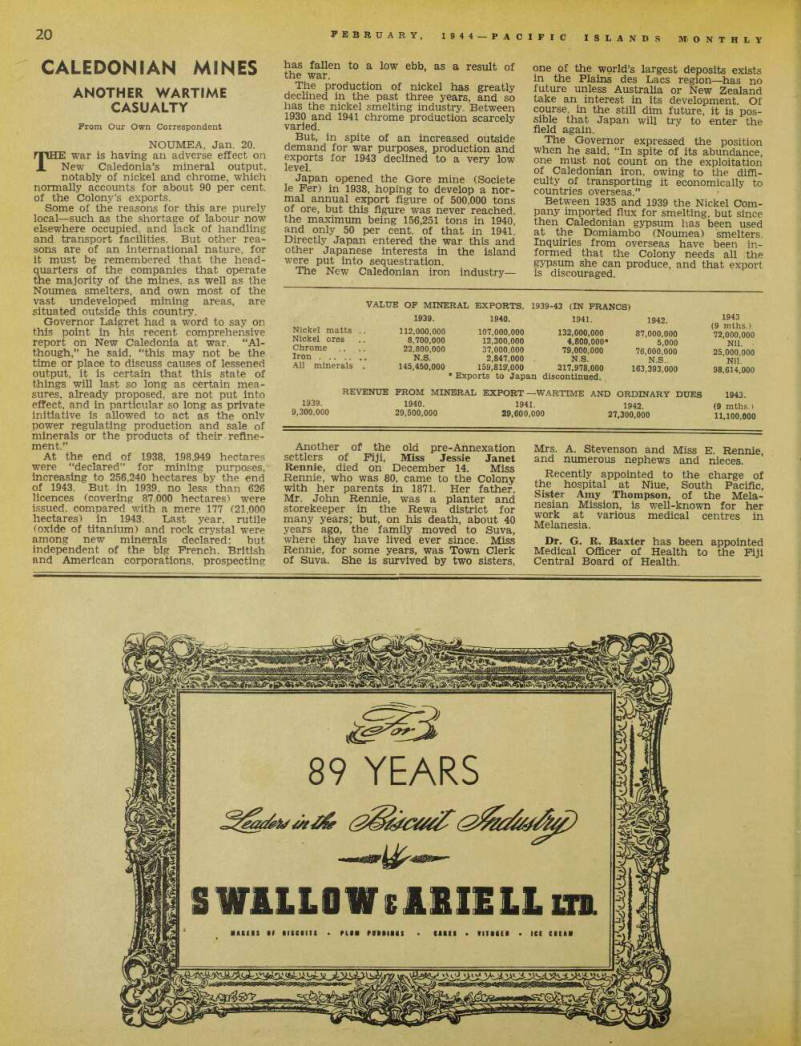
Another Wartime
Casualty
From Our Own Correspondent
Noumea, Jan. 20.
mHE war is having an adverse effect on X New Caledonia’s mineral output, notably of nickel and chrome, which normally accounts for about 90 per cent, of the Colony’s exports.
Some of the reasons for this are purely local —such as the shortage of labour now elsewhere occupied, and lack of handling and transport facilities. But other rea sons are of an international nature, for it must be remembered that the head quarters of the companies that operate the majority of the mines, as well as the Noumea smelters, and own most of the vast undeveloped mining areas, are situated outside this country.
Governor Laigret had a word to say on this point in his recent comprehensive report on New Caledonia at war. “Al though,” he said, “this may not be the time or place to discuss causes of lessened output, it is certain that this state of things will last so long as certain mea sures, already proposed, are not put into effect, and in particular so long as private initiative is allowed to act as the only power regulating production and sale of minerals or the products of their refine ment.”
At the end of 1938, 198,949 hectares were “declared” for mining purposes, increasing to 256,240 hectares by the end of 1943. But in 1939. no less than 626 licences (covering 87,000 hectares) were issued, compared with a mere 177 (21,000 hectares) in 1943. Last year, rutile (oxide of titanium) and rock crystal were among new minerals declared; but independent of the big French. British and American corporations, prospecting
has fallen to a low ebb, as a result of the war.
The production of nickel has greatly declined in the past three years, and so has the nickel smelting industry. Between 1930 and 1941 chrome production scarcely varied.
But, in spite of an increased outside demand for war purposes, production and exports for 1943 declined to a very low level.
Japan opened the Gore mine (Societe le Fer) in 1938, hoping to develop a nor mal annual export figure of 500,000 tons of ore, but this figure was never reached, the maximum being 156,251 tons in 1940, and only 50 per cent, of that in 1941.
Directly Japan entered the war this and other Japanese interests in the island were put into sequestration.
The New Caledonian iron industry—
Another of the old pre-Annexation settlers of Fiji, Miss Jessie Janet Rennie, died on December 14. Miss Rennie, who was 80, came to the Colony with her parents in 1871. Her father, Mr. John Rennie, was a planter and storekeeper in the Rewa district for many years; but, on his death, about 40 years ago, the family moved to Suva, where they have lived ever since. Miss Rennie, for some years, was Town Clerk of Suva. She is survived by two sisters,
<pne of the world’s largest deposits exists in the Plains des Lacs region—has no future unless Australia or New Zealand take an interest in its development. Of course, in the still dim future, it is pos sible that Japan will try to enter the field again.
The Governor expressed the position when he said, “In spite of its abundance, one must not count on the exploitation of Caledonian iron, owing to the diffi culty of transporting it economically to countries overseas.”
Between 1935 and 1939 the Nickel Com pany imported flux for smelting, but since then Caledonian gypsum has been used at the Domiambo (Noumea) smelters.
Inquiries from overseas have been in formed that the Colony needs all the gypsum she can produce, and that export is discouraged.
Mrs. A. Stevenson and Miss E. Rennie, and numerous nephews and nieces.
Recently appointed to the charge of the hospital at Niue, South Pacific, Sister Amy Thompson, of the Mela nesian Mission, is well-known for her work at various medical centres in Melanesia.
Dr. G. R. Baxter has been appointed Medical Officer of Health to the Fiji Central Board of Health.
Value Of Mineral Exports, 1939-43 (In Francs)
REVENUE FROM MINERAL EXPORT —WARTIME AND ORDINARY DUES 1943.
1939. 1940. 1941. 1942. 1943 Nickel matts .. 112,000,000 107,000,000 132,000,000 87,000,000 WlfofoOO Nickel ores .. 8,700,000 12,300,000 4,800,000* 5,000 ’ Nil Chrome .. .. 22.800,000 37,000,000 79,000,000 76,000,000 25 000 000 Iron N.S. 2,847,000 N.S. NS ’ Nil All minerals . 145,450,000 159,819,000 217,978,000 163,393,000 98,614 000 * Exports to Japan discontinued.
1939. 1940. 1941. 1942, (9 mths ) 9,300,000 29,500,000 29,600,000 27.300,000 11,100.000
Advertisements & other items, p. 22 (1 item)
89 Years
asa »
8 WILLOWS ABIE LL it
mils if meant . phi pooßiass • cans . vitbsei . ice . n
C BE
Japan Fights for a "Negotiated Peace"
"Negotiated Peace"
Explanation of Pacific Strategy
Reported from USA Toy Esmae
Taylor
rE Japanese are trying to bleed us into a “sickening of the war,” so we will give them a negotiated peace, and leave them enough empire to fatten on and thus attempt another conquest, next generation.”
So warned Ira Wolfert, correspondent for the North American Newspaper Alliance, recently returned from the Pacific area, at a dinner in New York for reporters from the battlefronts, on November 30, 1943.
“The Japanese,” Mr. Wolfert said, “are on the defensive. They have given up all hope of winning a peace of their own dictation in Washington. But if they retain enough of their empire, in sufficient time they would become a first class Power. Then it would be not only impossible to defeat Japan, but impos sible for the United States to survive on the other side of the Pacific from her.”
Mr. Wolfert said that it is to this policy and strategy that Japan has committed her troops. On islands which are mili tarily untenable, she has lodged garrisons of varying strengths—lo,ooo men here, 2,000 there, 1,000 elsewhere—and the aim of these Jap troops is to kill as many Americans as possible before they them selves die.
“This was true of garrisons in the Solomons, and in the Gilbert Islands.”
Mr. Wolfert said. “It was true, too, of Bougainville. In all cases, our strategy has been to avoid giving the Japanese the opportunity of killing American and Allied soldiers.”
In the Gilberts group, the correspon dent said, the Japanese, amply warned of the American attack, made no serious attempt to protect their garrisons. They gave them no ships or airplanes—“just put them there to prove that when you die you can take Americans with you.”
During his talk, Mr. Wolfert exploded the popular myth that paints the Jap anese soldier as a superman without fear, and willing, even anxious, to lay down his life for his Emperor. When Mr.
Wolfert was stationed in the Solomons, in New Georgia, he observed the Japan ese reaction to fear.
“They were willing to accept their assignment from their overlords to con quer or die,” he said, “but it was physi cally impossible for them to carry it out.
On occasions, in New Georgia, if you got to within 50 feet of a Jap, he would throw his gun away and scream. He wasn’t a soldier any more, just an hysterical man.
A sense of self-preservation is instinctive in everyone, and it is humanly impossible to overthrow the sense of survival.”
“Democracy,” Mr. Wolfert said, “has produced a kind of soldier and a kind of person who is able to meet the Fascist Jap on his own terms and beat him at his own game. Democracy gives a sol dier a sense of self-respect and respon sibility to his task. It prevents him from lying down on the job, no matter how repulsive it may be to him. This idea should be put into words and handed to the troops.”
Ira Wolfert. in May of this year, was awarded a Pulitzer prize for his de spatches from the Pacific front. He is the author of a highly successful book, “Torpedo 8,” which has its origin in the Battle of Midway.
Miss N. P. Talbot, of the Melanesian Mission, has returned to work again at the hospital at Fauabu, BSI.
The Solomons
Dr. J. D. Thomson Leaves
AFTER four’ eventful years as the Melanesian Mission’s medical officer at the central hospital, Fauabu ESI, Dr. J. D. Thomson has resigned and taken a private practice in Sumner Christchurch, NZ.
During his term in Melanesia, he and his wife, a trained nurse from New Zea land, carried out splendid work, but the future of their young family must now be considered.
Recently, Dr. Thomson acted as Senior Medical Officer for the British Solomon Islands Protectorate Government. En thusiastic reports have come to hand of the way in which he organised his work
under very difficult conditions during the Japanese occupation and his knowledge of the jungle was of great assistance to nurses and other members of the staff who were forced to retreat from the advancing enemy.
A former District Commissioner of Fiji, Mr. Alexander Edward Bailey, is dead, aged 80. He spent all his early years in the Colony, where he was associated with the sugar industry. He joined the Fiji Civil Service ih 1903, and retired in 1923.
Dr. John William Hunt, who spent 23 years in Fiji as a District Medical Officer, died in Gloucester, England, last August. He is survived by his wife and a daughter.
Advertisements & other items, pp. 23-24 (1 item)
Hot-Weather Meals
US
ADD VARIETY TO YOUR
Typical of the tasty, tempting, quick-serve foods offered by “Imperial” is “Meatreat.” This canned corned beef is prepared by the special “Imperial” process which seals in all the natural flavour, colour and rich nourishing juices of the meat. Served with salads, “Meatreat” makes an ideal hot-day dish.
Other “Imperial” products which will help you add variety to your hot-weather meals are : "Imperial" Camp Pie.
"Imperial" Beef tr Pork Sausages
"Imperial" Sheep's Tongues.
"Imperial" Hampe— the meal-in-a-moment.
Every one of these “ Imperial” products offers you the delightful flavour of fresh meats at their very best. Ask for them to-day.
PRODUCTS OF
RIVERSTONE MEAT CO. 55:
Fiji Representatives: Pearce fir Co. Ltd., Suva.
Services
-r
COMMUNICATIONS
SE * V,CE
Ehc "wSI serv.ce
manufacturing
" s IS " wireless d
S>u RRoSmt RECEIVERS
broadcasting
OWNERS RND OPERATOR TIONS
ARTISTS
,iechm " c iSSffISSi I • oeveeophent
AMALGAMATED WIRELESS (A'sia) LIMITED
Australia’s National Wireless Organisation
Plan To Provide Trade Unions For
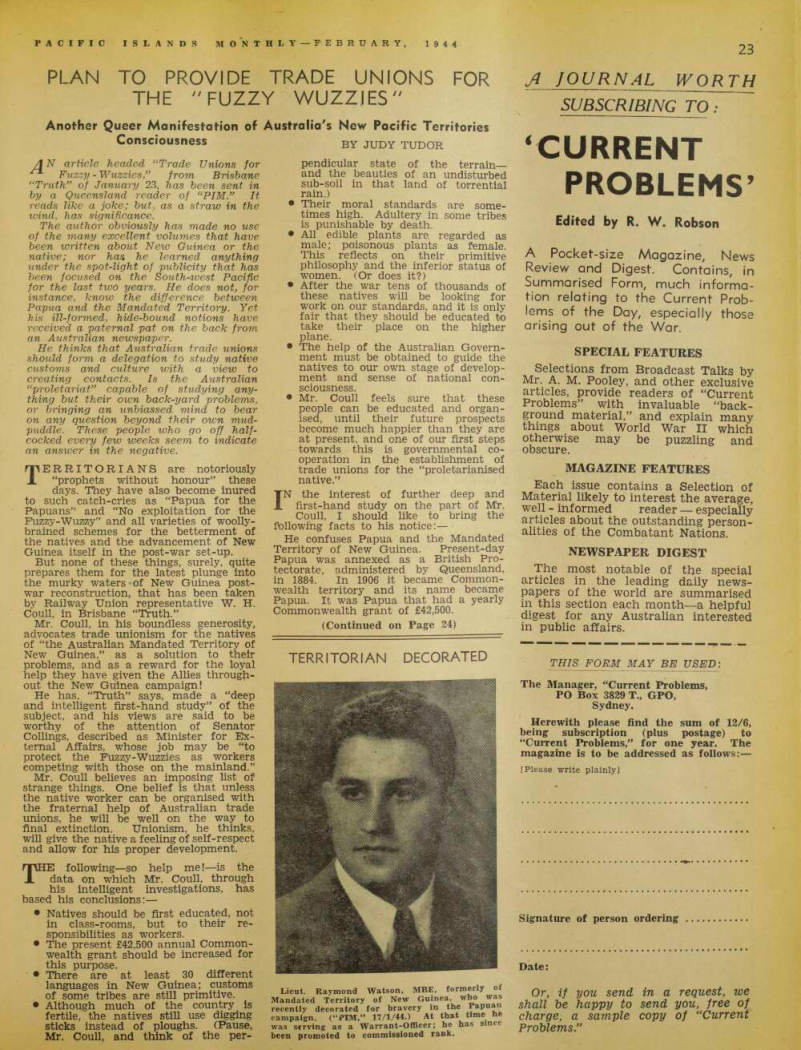
The "Fuzzy Wuzzies"
Another Queer Manifestation of Australia's New Pacific Territories
Consciousness
By Judy Tudor
A N article headed “Trade Unions for Fuzzy - Wuzzies,” from Brisbane “Truth” of January 23, has been sent in by a Queensland reader of “PIM” It reads like a joke; but, as a straw in the wind, has significance.
The author obviously has made no use of the many excellent volumes that have been written about New Guinea or the native; nor has he learned anything under the spot-light of publicity that has been focused on the South-west Pacific for the last two years. He does not, for instance, know the difference between Papua and the Mandated Territory. Yet his ill-formed, hide-bound notions have received a paternal pat on the back from an Australian newspaper.
He thinks that Australian trade unions should form a delegation to study native customs and culture with a view to creating contacts. Is the Australian “proletariat” capable of studying any thing but their own back-yard problems, or bringing an unbiassed mind to bear on any question beyond their own mud puddle. These people who go off half cocked every few weeks seem to indicate an answer in the negative.
TERRITORIANS are notoriously “prophets without honour” these days. They have also become inured to such catch-cries as “Papua for the Papuans” and “No exploitation for the Fuzzy-Wuzzy” and all varieties of woolly brained schemes for the betterment of the natives and the advancement of New Guinea itself in the post-war set-up.
But none of these things, surely, quite prepares them for the latest plunge into the murky waters of New Guinea post war reconstruction, that has been taken by Railway Union representative W. H.
Coull, in Brisbane “Truth.”
Mr. Coull, in his boundless generosity, advocates trade unionism for the natives of “the Australian Mandated Territory of New Guinea,” as a solution to their problems, and as a reward for the loyal help they have given the Allies through out the New Guinea campaign!
He has, “Truth” says, made a “deep and intelligent first-hand study” of the subject, and his views are said to be worthy of the attention of Senator Codings, described as Minister for Ex ternal Affairs, whose job may be “to protect the Fuzzy-Wuzzies as workers competing with those on the mainland.”
Mr. Coull believes an imposing list of strange things. One belief is that unless the native worker can be organised with the fraternal help of Australian trade unions, he will be well on the way to final extinction. Unionism, he thinks, will give the native a feeling of self-respect and allow for his proper development.
FT\HE following—so help me! —is the X data on which Mr. Coull, through his intelligent investigations, has based his conclusions:— • Natives should be first educated, not in class-rooms, but to their re sponsibilities as workers. • The present £42,500 annual Common wealth grant should be increased for this purpose. • There are at least 30 different languages in New Guinea; customs of some tribes are still primitive. • Although much of the country is fertile, the natives still use digging sticks instead of ploughs. (Pause, Mr. Coull, and think of the per
pendicular state of the terrain— and the beauties of an undisturbed sub-soil in that land of torrential rain.) • Their moral standards are some times high. Adultery in some tribes is punishable by death. • All edible plants are regarded as male; poisonous plants as female.
This reflects on their primitive philosophy and the inferior status of women. (Or does it?) • After the war tens of thousands of these natives will be looking for work on our standards, and it is only fair that they should be educated to take their place on the higher plane. • The help of the Australian Govern ment must be obtained to guide the natives to our own stage of develop ment and sense of national con sciousness. • Mr. Coull feels sure that these people can be educated and organ ised, until their future prospects become much happier than they are at present, and one of our first steps towards this is governmental co operation in the establishment of trade unions for the “proletarianised native.”
IN the interest of further deep and first-hand study on the part of Mr.
Coull, I should like to bring the following facts to his notice: — He confuses Papua and the Mandated Territory of New Guinea. Present-day Papua was annexed as a British Pro tectorate, administered by Queensland, in 1884. In 1906 it became Common wealth territory and its name became Papua. It was Papua that had a yearly Commonwealth grant of £42,500.
(Continued on Page 24)
The Mandated Territory was German until Rabaul was taken by the Australlans in 1914. It became a League of Nations Mandate in 1920, and until the Pacific war was administered by Australia (but quite independently of Papua).
The Mandated Territory had no Commonwealth grant of £42,500. Prior to the depression, £lO,OOO was made available by the Commonwealth for native welfare, but it was discontinued in the early thirties, and the New Guinea Adminis tration, from revenue, spent about £!00 000 per year on this purpose.
The Mandated Territory was unique in that even during the late and unlamented depression it had a balanced budget—due in no small measure to gold royalties. That fact should be dwelt on by both trade unionists and other kindhearted reformers: So-called “exploitation filled New Guinea coffers, when the rest of the world was rejoicing on the dole. To-day’s sentimentalists lose sight
of the fact that cold cash has Its place in the scheme of things, The natives have not changed since 1934—their need was as great then as it is now. But it is doubtful if either the Labour Party, the Australian Govern ment, or the Australian public of that day would have sat back on their heels and howled for the uplift of the New Guinea native if that uplift had to be financed from their own pockets mHE New Guinea native was well 1 established in New Guinea a few hundred years—maybe a few thou sand—before we got there. He has always been able to care for himself. In his village the necessities of life, as they saw them, were provided for all who cared to work. Therefore there is no need for him to come on to the labour market to compete with European labour, as Mr. Coull appears to imagine, The native works for a European for
some reason of his own: maybe he wants to speed-up the process of getting him self a wife and can’t wait until his family get around to helping him; maybe he has a “cross” with his uncle or his father and thinks work in foreign parts as good a solution as any. Maybe he just wants to try working away from his village, anyhow.
But, whatever the reasons, he comes to work for Europeans of his own free will; and, come depression, he can return to village life and soon take up the threads —which is more than the proletarian, white or brown, can do.
The most sophisticated of these natives is only two or three generations removed from the Stone Age—hundreds of thou sands of them have not yet emerged.
There seems no good reason why they should be expected to embrace 20th cen tury civilisation, with all its attendant flap-doodle in a month, or a year, or a generation, when it took our race a couple of thousand years to travel the same road.
MR. COULL apparently sees the New Guinea of the future as a highly developed machine for churning out tropical produce to flood the world’s markets, and brown and white people competing with one another for jobs. No one doubts that New Guinea could grow a great deal of produce; but there ts the everlasting question of markets, and the fact that, in the past, tropical produc tion was based on cheap native labour— Indonesian, Melanesian, African or Asiatic.
NEW GUINEA takes in a lot of terri tory. It is a land of paradox. It divided into rigid segments, each with its own social set-up, each with its own language. And there are hundreds of languages—not 30.
It is impossible to generalise. If one community has, to our standards, no morals, then the adjoining community, as like as not, has a moral code as stringent and unbending as that em braced by our Victorian grandmothers.
And so on, ad infinitum.
The ways of rewarding the native for his loyalty grow in variety and in strangeness, but inevitably tie in with the activities of the would-be reformer.
It is apparently impossible to take this loyalty for granted, or to assume that the New Guinea native will be loyal for the same reason that Australians are loyal. If the native is ready to em brace the more rarified embellishments of our civilisation, then he should be advanced enough to be loyal. That he has been, to a point, proves that the New Guinea Administration of the past was, on the whole, good. Contributory reasons are native recognition as to which side of his bread is buttered, and the fact that, past and present, there have been men strong enough to turn the native nose in the right direction and administer occasional prods in the rear to keep it in that direction.
There seems to be a hiatus in trade union circles between Mr. Coull’s pro posed native unionism and Mr. Ward’s “no exploitation.” Or is there? Will “No exploitation through unionism”? be the next phrase minted? Anything is possible in this world of regimentation and regulation run riot.
Miss Christine Woods, of the Mela nesian Mission, left for the Solomon Islands in December. She will be associated with Nurse Ada Moore, a re cent appointee of the mission, at a Solomons medical centre, which is be ing established. Miss Woods previously served at Kerepei Mission hospital.
Territorian Decorated
Lieut. Raymond Watson, MBE, formerly of Mandated Territory of New Guinea, who was recently decorated for bravery in the Papuan campaign. (“PIM,” 17/1/44.) At that time he was serving as a Warrant-Officer; he has since been promoted to commissioned rank.
Problems’
A Journal Worth
Subscribing To:
‘Current
Problems’
Edited by R. W. Robson A Pocket-size Magazine, News Review and Digest. Contains, in Summarised Form, much informa tion relating to the Current Prob lems of the Day, especially those arising out of the War.
Special Features
Selections from Broadcast Talks by Mr. A. M. Pooley, and other exclusive articles, provide readers of “Current Problems” with invaluable “back ground material,” and explain many things about World War II which otherwise may be puzzling and obscure.
Magazine Features
Each issue contains a Selection of Material likely to interest the average, well - informed reader especially articles about the outstanding person alities of the Combatant Nations.
Newspaper Digest
The most notable of the special articles in the leading daily news papers of the world are summarised in this section each month—a helpful digest for any Australian interested in public affairs.
Advertisements & other items, pp. 25-26 (1 item)
This Form May Be Used :
The Manager, “Current Problems,
PO Box 3829 T., GPO,
Sydney.
Herewith please find the sum of 12/6, being subscription (plus postage) to “Current Problems,” for one year. The magazine is to be addressed as follows:— [Please write plainly] Signature of person ordering Date: Or, if you send in a request, we shall he happy to send you, free of charge, a sample copy of “Current Problems”
Wonted to Buy—Quality Guns and Rifles HIGHEST PRICES GIVEN. WILL ALSO EXCHANGE GUNS.
SI L RO H U Quality Firearms and Fishing Tackle. 143 ELIZABETH STREET (Near Market St.) SYDNEY. ’PHONE: MA 3540.
Ship Chandlery Hardware
/Write for 7
Ship Chandlery /
Cataloaue J
Catalogue
Special “In Bond” Prices for all Islands enquiries quoted on application.
Sole Agents for:
BROOMFIELDS LIMITED
153 SUSSEX STREET SYDNEY.
Cables; “Boom”, Sydney.
Large and Complete Stocks of
SHIP CHANDLERY
IRONMONGERY OF ALL KINDS, PAINTS.
WHITE LEAD AND OILS.
P. H. MUNTZ & CO.’s 3-CROWN BRAND METAL SHEATHING.
PEACOCK Si BUCHANS’ ENGLISH READY-MIXED PAINTS.
Scott’s “Renown” Brand Rope,
Cable Addrats Ropeyard, Sydney, v ■■
Cordage and
Binder
Twine
of Every
Description
MANUFACTURED AT
MASCOT. N.S.W.
By
J. SCOTT
PTY. LTD.
Head Office and Store:
163 CLARENCE STREET.
SYDNEY,
NJI.W.
American-French
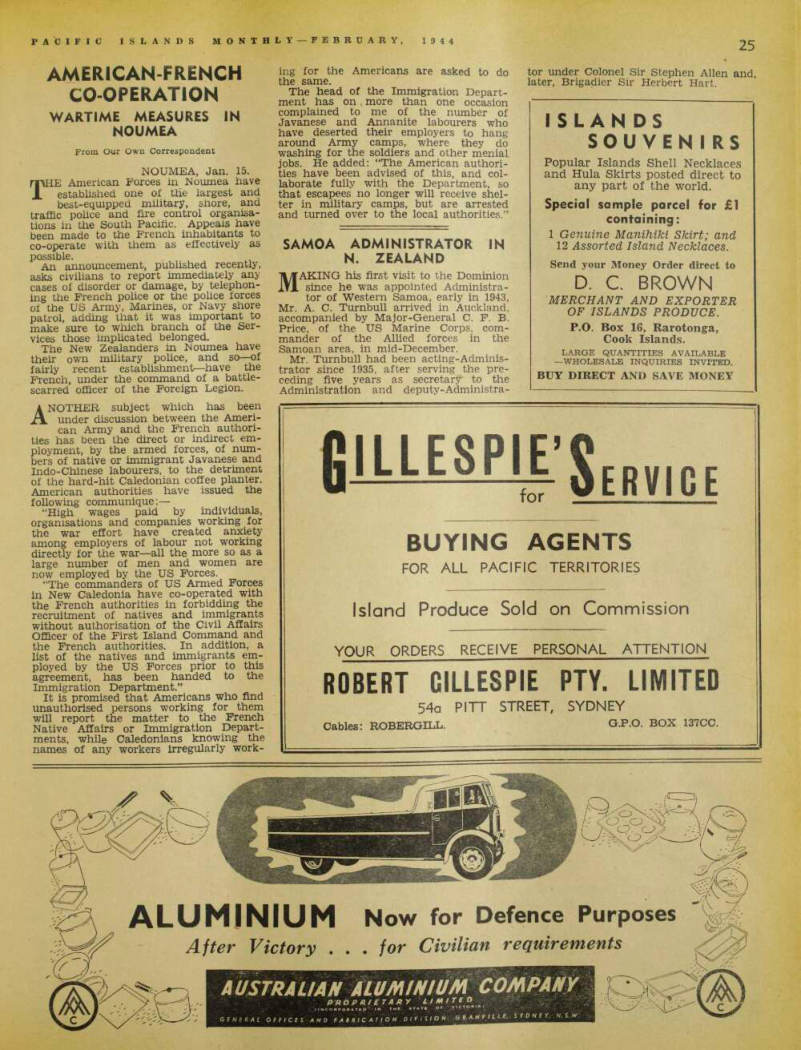
Co-Operation
Wartime Measures In
Noumea
Prom Our Own Correspondent
Noumea, Jan. 15.
rE American Forces in Noumea have established one of the largest and best-equipped military, shore, and traffic police and fire control organisa tions in the South Pacific. Appeals have been made to the French inhabitants to co-operate with them as effectively as possible.
An announcement, published recently, asks civilians to report immediately any cases of disorder or damage, by telephon ing the French police or the police forces of the US Army, Marines, or Navy shore patrol, adding that it was important to make sure to which branch of the Ser vices those implicated belonged.
The New Zealanders in Noumea have their own military police, and so —of fairly recent establishment—have the French, under the command of a battle scarred officer of the Foreign Legion.
ANOTHER subject which has been under discussion between the Ameri can Army and the French authori ties has been the direct or indirect em ployment, by the armed forces, of num bers of native or immigrant Javanese and Indo-Chinese labourers, to the detriment of the hard-hit Caledonian coffee planter.
American authorities have issued the following communique:— “High wages paid by individuals, organisations and companies working for the war effort have created anxiety among employers of labour not working directly for the war—all the more so as a large number of men and women are now employed by the US Forces.
“The commanders of US Armed Forces in New Caledonia have co-operated with the French authorities in forbidding the recruitment of natives and immigrants without authorisation of the Civil Affairs Officer of the First Island Command and the French authorities. In addition, a list of the natives and immigrants em ployed by the US Forces prior to this agreement, has been handed to the Immigration Department."
It is promised that Americans who find unauthorised persons working for them will report the matter to the French Native Affairs or Immigration Depart ments, while Caledonians knowing the names of any workers irregularly work
ing for the Americans are asked to do the same.
The head of the Immigration Depart ment has on more than one occasion complained to me of the number of Javanese and Annanite labourers who have deserted their employers to hang around Army camps, where they do washing for the soldiers and other menial jobs. He added: “The American authori ties have been advised of this, and col laborate fully with the Department, so that escapees no longer will receive shel ter in military camps, but are arrested and turned over to the local authorities.”
Samoa Administrator In
N. Zealand
MAKING his first visit to the Dominion since he was appointed Administra tor of Western Samoa, early in 1943, Mr. A. C. Turnbull arrived in Auckland, accompanied by Major-General C. F. B.
Price, of the US Marine Corps, com mander of the Allied forces in the Samoan area, in mid-December.
Mr. Turnbull had been acting-Adminis trator since 1935, after serving the pre ceding five years as secretary to the Administration and deputy-Administra
tor under Colonel Sir Stephen Allen and, later, Brigadier Sir Herbert Hart.
Advertisements & other items, pp. 27-28 (1 item)
Jillespie S Ervice
ISLANDS
SOUVENIRS
Popular Islands Shell Necklaces and Hula Skirts posted direct to any part of the world.
Special sample parcel for £1
containing:
1 Genuine Manihiki Skirt; and 12 Assorted Island Necklaces.
Send your Money Order direct to
D. C. BROWN
MERCHANT AND EXPORTER
OF ISLANDS PRODUCE.
P.O. Box 16, Rarotonga, Cook Islands.
LARGE QUANTITIES AVAILABLE
—WHOLESALE INQUIRIES INVITED.
BUY DIRECT AND SAVE MONEY
jILLESPIE S ERVICE
BUYING AGENTS
FOR ALL PACIFIC TERRITORIES
Island Produce Sold on Commission
YOUR ORDERS RECEIVE PERSONAL ATTENTION
ROBERT GILLESPIE PTY. LIMITED
54a piTT STREET, SYDNEY
Cables: ROBERGILL. G.P.O. BOX 137 CC.
ALUMINIUM Now for Defence Purposes After Victory . . . for Civilian requirements
EDGELL
QUALITY CANNED
Vegetables Soups
AUSTRALIA'S BEST
DEFENCE requirements take up the whole of the Edgell production to-day—consequently only a small proportion of civilian needs is occasionally made available by the Australian Defence Foodstuffs Control and exports are heavily restricted.
As soon as possible, Island consumers can rely on Edgell high quality products being made available to them once more.
Meanwhile, to take advantage of the limited quantities periodically released, please send your inquiries either through your usual channels or direct to the Island distributors . . .
C. SULLIVAN & CO. 379 Kent Street, Sydney, Australia.
"EDGELL QUALITY CANNED GOODS"
C. SULLIVAN & CO.
GENERAL MERCHANTS ISLANDS AGENTS
REPRESENTING LEADING FIRMS IN THE PACIFIC ISLANDS.
Islands Produce sold on Shippers’ Account—Liberal Advances against Consignments.
Buyers of all Islands’ Requirements on Commission—Original Invoices Furnished.
Bankers : Bank of New South Wales .. Bank of New Zealand .. Compton National d’Escompte de Paris.
Wartime Cable Address: Sullivan, Kentstreet, Sydney.
379 KENT STREET, SYDNEY, N.S.W.
Dorado
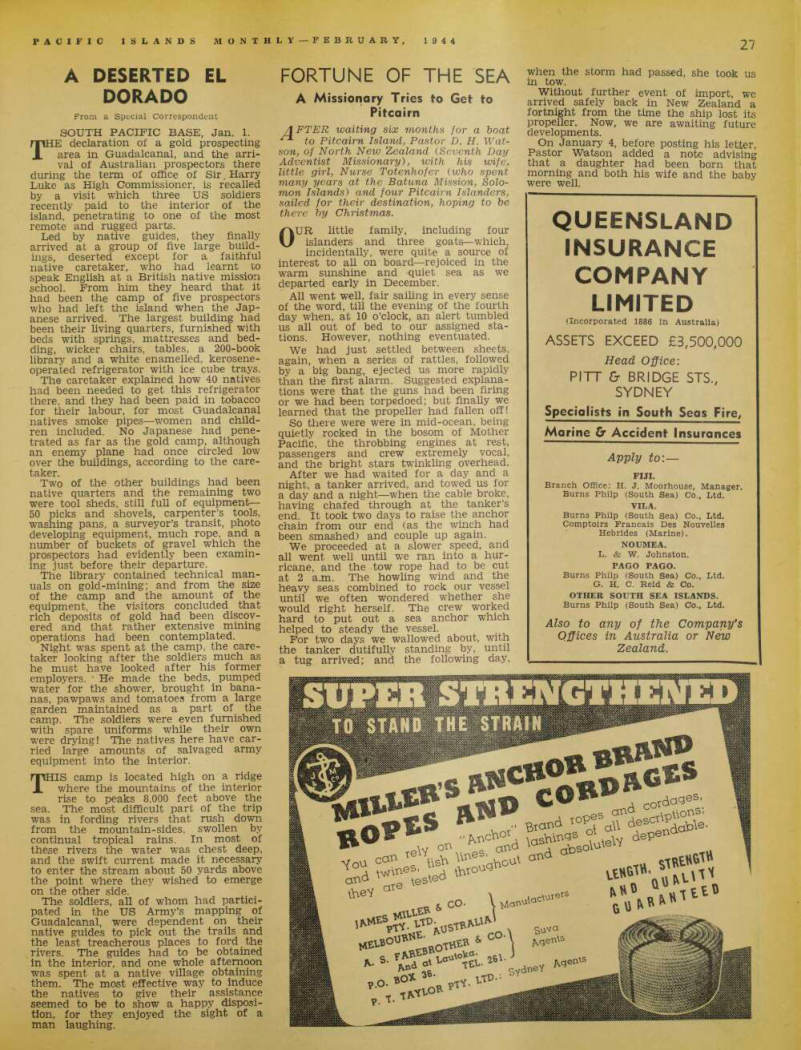
A Deserted El
Prom a Special Correspondent
South Pacific Base, Jan. 1.
rE declaration of a gold prospecting area in Guadalcanal, and the arri val of Australian prospectors there during the term of office of Sir, Harry Luke as High Commissioner, is recalled by a visit which three US soldiers recently paid to the interior of the island, penetrating to one of the most remote and rugged parts.
Led by native guides, they finally arrived at a group of five large build ings, deserted except for a faithful native caretaker, who had learnt fo speak English at a British native mission school. From him they heard that it had been the camp of five prospectors who had left the island when the Jap anese arrived. The largest building had been their living quarters, furnished with beds with springs, mattresses and bed ding, wicker chairs, tables, a 200-book library and a white enamelled, kerosene operated refrigerator with ice cube trays.
The caretaker explained how 40 natives had been needed to get this refrigerator there, and they had been paid in tobacco for their labour, for most Guadalcanal natives smoke pipes—women and child ren included. No Japanese had pene trated as far as the gold camp, although an enemy plane had once circled low over the buildings, according to the care- Two of the other buildings had been native quarters and the remaining two were tool sheds, still full of equipment— -50 picks and shovels, carpenter’s tools, washing pans, a surveyor’s transit, photo developing equipment, much rope, and a number of buckets of gravel which the prospectors had evidently been examin ing just before their departure.
The library contained technical man uals on gold-mining; and from the size of the camp and the amount of the equipment, the visitors concluded that rich deposits of gold had been discov ered and that rather extensive mining operations had been contemplated.
Night was spent at the camp, the care taker looking after the soldiers much as he must have looked after his former employers. He made the beds, pumped water for the shower, brought in bana nas, pawpaws and tomatoes from a large garden maintained as a part of the camp. The soldiers were even furnished with spare uniforms while their own were drying! The natives here have car ried large amounts of salvaged army equipment into the interior.
THIS camp is located high on a ridge where the mountains of the interior rise to peaks 8,000 feet above the sea. The most difficult part of the trip was in fording rivers that rush down from the mountain-sides, swollen by continual tropical rains. In most of these rivers the water was chest deep, and the swift current made it necessary to enter the stream about 50 yards above the point where they wished to emerge on the other side.
The soldiers, all of whom had partici pated in the US Army’s mapping of Guadalcanal, were dependent on their native guides to pick out the trails and the least treacherous places to ford the rivers. The guides had to be obtained in the interior, and one whole afternoon was spent at a native village obtaining them. The most effective way to induce the natives to give their assistance seemed to be to show a happy disposi tion, for they enjoyed the sight of a man laughing.
Fortune Of The Sea
A Missionary Tries to Get to Pitcairn
A FTER waiting six months for a boat to Pitcairn Island, Pastor D. H. Wat son, of North New Zealand (Seventh Day Adventist Missionary), with his wife, little girl, Nurse Totenhofer (who spent many years at the Batuna Mission, Solo mon Islands ) and four Pitcairn Islanders, sailed for their destination, hoping to he there by Christmas.
OUR little family, including four islanders and three goats—which, incidentally, were quite a source of interest to all on board —rejoiced in the warm sunshine and quiet sea as we departed early in December.
All went well, fair sailing in every sense of the word, till the evening of the fourth day when, at 10 o’clock, an alert tumbled us all out of bed to our assigned sta tions. However, nothing eventuated.
We had just settled between sheets, again, when a series of rattles, followed by a big bang, ejected us more rapidly than the first alarm. Suggested explana tions were that the guns had been firing or we had been torpedoed; but finally we learned that the propeller had fallen off!
So there were were in mid-ocean, being quietly rocked in the bosom of Mother Pacific, the throbbing engines at rest, passengers and crew extremely vocal, and the bright stars twinkling overhead.
After we had waited for a day and a night, a tanker arrived, and towed us for a day and a night—when the cable broke, having chafed through at the tanker’s end. It took two days to raise the anchor chain from our end (as the winch had been smashed) and couple up again.
We proceeded at a slower speed, and all went well until we ran into a hur ricane, and the tow rope had to be cut at 2 a.m. The howling wind and the heavy seas combined to rock our vessel until we often wondered whether she would right herself. The crew worked hard to put out a sea anchor which helped to steady the vessel.
For two days we wallowed about, with the tanker dutifully standing by, until a tug arrived; and the following day,
in tow.
Without further event of import, we arrived safely back in New Zealand a fortnight from the time the ship lost its propeller. Now, we are awaiting future developments.
On January 4, before posting his letter Pastor Watson added a note advising that a daughter had been born that morning and both his wife and the baby were well.
An extract from a letter from a resi dent of Fiji, Arthur McHugh, now serv ing with the AIF in New Guinea: “The Americans back in base areas are sou venir mad, and will pay practically any thing for something with Jap writing on it. Officers’ swords, for instance, are worth as much as £lOO. There will be a large number of our chaps spending their next leave buckshee.”
Advertisements & other items, pp. 29-30 (1 item)
sfSte
QUEENSLAND
INSURANCE
COMPANY
LIMITED
(Incorporated 1886 In Australia)
ASSETS EXCEED £3,500,000
Head Office:
PITT Cx BRIDGE STS.,
SYDNEY
Specialists in South Seas Fire,
Marine tr Accident Insurances
Apply to: —
FIJI.
Branch Office; H. J. Moorhouse, Manager.
Burns Philp (South Sea) Co., Ltd.
VILA.
Burns Philp (South Sea) Co., Ltd.
Comptoirs Francais Des Nouvelles Hebrides (Marine).
NOUMEA.
L. & W. Johnston.
PAGO PAGO.
Burns Philp (South Sea) Co., Ltd.
G. H. C. Reid & Co.
OTHER SOUTH SEA ISLANDS.
Burns Philp (South Sea) Co., Ltd.
Also to any of the Company's Offices in Australia or New Zealand.
*7 X > , cordage®'
sfSte
.J rooes *«» s . «
fttJ®
r dag 0S 1.1 /~\Y\ f-i
io** s
reW ° atid Bia nd f o l aft
«S^o W »W
. f 11 3UV*-* .dab 10 ' deP ell< B -rCf * , iVsb You 1 \hr° uC3
v.eh^«
A au 1 &H iheV
hhi
6 IH» co 1U«B» ” ?t*- r.' p,\3^ ir '*" * &eo0 *!«*o-n«* 4 K- 8- a> I® l ' k^3S' , A Suva • q en\s mei* q 1 M en« T&- 161 «c t .O. ®°* * « vt.O
Restlessness and sleeplessness, when due to run-down nerves, frequently respond to treatment with Dr. Williams' Fink Pills.
Dr. Williams*
PINK PILLS
help to enrich the blood, which has a beneficial and restorative effect upon the nervous system.
Willia
I I
Atkins Pty. Ltd.
Head Office 449-451 KENT ST., SYDNEY.
Iron & Steel Merchants—Engineers 1 Supplies
Coach Cr Motor Hardware
ESTABLISHED OVER 50 YEARS
Cable Address: WILATKIN, Sydney.
STEEL DEPARTMENT
MILD STEEL:
Rounds, Squares, Flats, Half-rounds, Hexagons, Bevel, Shoeing, Tyre, Angles, Tees, Sheets, Plates, Girder Plates, Chequer Plates, Channels, Hoops, Etc.
BRIGHT STEEL:
Rounds, Squares, Hexagons.
Extra Special High Speed Tool Steel, Mining Steel, Blister Steel and Spring Steel, Rounds, Flats & Squares.
Bar Iron-— All sections and sizes.
Engineers' Supplies: Set Screws, Studs, Metal Thread Screws, Coach Screws, Piles, Cotter Pins, Bright and Black Bolts, Rivets, Etc., Hack Saw Blades.
Power Transmission Gear: Including Plummer Blocks, Couplings, Collars, Etc.
Coach and Motor Hardware: Axles, Springs, Wheelstuff, Duck, Paints.
Farriers' Supplies: Horse Nails, Anvils, Vices, Etc.
Motor-Trimmers and Motor Builders' Cr Motor Painters' Requirements
C. A. WILLEY'S
Quick-Drying Coach and Car Paints, Roughstuff, Elastic Gloss, Synflex Enamels, Lacquers.
DUCO Lacquers and DULUX Enamels—FAßßEX Motor Toppings and Leather Cloths, House Cr Decorators' Paints, Varnishes Cr Brushware.
Sole Distributors of CHAMPION'S Decorators Paint Products.
Distributing Agents for BROLITE Lacquers, SYNFLEX Enamels and "POLYGLOSS" Finish.
in Polynesia
No Pareu !
Minor Wartime Tragedy in Polynesia
From Our Owh Correspondent
Papeete, Dec. 10.
rAT useful article of merchandise, variously known as the Lava-lava, the Sulu, the Laplap and, at Tahiti, as the Pareu, is doomed to disappear from Central and Eastern Polynesia, unless something is done speedily to search out a new source of supply.
Since the ancient Tapa was discarded for European cotton-cloth, Tahitian Pareu have not departed from three standard styles then established:— • A flaming scarlet, splashed with floral designs in white, for the young and the frivolous-minded. • A rich navy-blue, similarly adorned, for sober-minded elders. • A solemn, unblemished black for church-deacons.
Worn by Tahitians, these kilts are gar ments of grace and dignity. A Euro pean arrayed in a Pareu appears as ridiculous as does a Hollywood blonde girded with an Hawaiian grass-skirt.
Nevertheless, most Europeans in the islands wear Pareu in the privacy of their homes, because they are more comfort able than pyjamas.
Standards of decorum are, to say the least, weird in our little island metropolis.
No European may appear on the high ways of Papeete clad in a Pareu. Shorts, with sandals, and even an unclad torso, are perfectly acceptable.
Should one appear in a Pareu —even though his other apparel should be com plete as that of a Scottish grenadier— he would be pounced upon, wrapped in a
blanket and hurried out of the sight of an outraged populace.
In like manner, a blonde tourist (and those who imitate her) may, with perfect propriety, appear on the highways of Papeete in a costume which, if exhibited on the stage or on the streets of Man hattan, would cause the “Little Flower” to summon his riot squads. Should she, however, add to that costume a chaplet of fragrant island gardenia, she would be frowned upon as one of doubtful re spectability, and shunned as an outcast.
Pareu-cloth, of superior quality and textile, has always come from England.
That from other countries has been off colour, inferior in weave and of short lasting quality.
Long ago, the last Pareu disappeared from the shelves of island shops. Already we are wearing faded, patched and darned Pareu; and some have been reduced to wearing kilts made from old curtains, tablecloths and bedspreads.
And so it will continue until the war is over.
Fiji's New Mosquito
IT was officially reported recently, in Fiji, that the Mosquito Inspector, Mr. D. W. Amos, in carrying out a survey of the Nadi area, had discovered a new addition to the list of Fiji mos quitoes as recorded by Paine. (The spe cies was Taeniorrhyachus (Mansonioides) Uniformis.) The larvae of this mosquito (in com mon with Mansonia) are difficult to find because they do not come to the surface to breathe, but obtain their oxygen by piercing the roots of aquatic plants. The adult mosquitoes are vicious biters. The question whether this mosquito is a new comer is important, and investigations will be made to see if it can be found in streams distant from Nadi.
Scouting the Hard Way
Three Nights With A
Bomb-Happy Carrier
'~THE following story is from Noel Ott -1 way, Melbourne “Herald” corres pondent with the US Marines in New Britain. It concerns an officer who penetrated deep into enemy territory and a native carrier who had night mares. One wonders what the Pidgin for “bomb happy” really is (“alright along bomb” is the nearest we can get, because there seems to be no Pidgin for “happy”)—but it makes a good story for all that.
The officer took the native with him as a carrier and crossed a deep swamp to remote territory, where he believed he would be safe.
He knew that prowling natives would not carry word of his movements to the enemy, because the ground he had chosen as a hiding place had been cursed by native witch doctors as the “home of Tamboran” (evil spirits).
But he reckoned without the Japanese, who came within 50 yards of his hiding place to shoot pigeons.
And he reckoned without his native boy, who, at midnight, suddenly startled from his sleep and gave an unearthly shriek, rising to a shrill crescendo in the still jungle.
The officer sprang on him and, cover ing his mouth with his hand, pummelled the native into wakefulness.
“Why did you make that noise with the Japanese within earshot?” he de manded in a fierce whisper.
Shudderingly, the boy told him he had been captured by the Japanese in Rabaul, and had been sent by them as a carrier to Buna. There he had been bombed by the American fliers and bom barded by the Australian guns. Finally he had crept through the Japanese lines to the Allied positions.
“I am bomb happy,” he confessed.
“Every night I dream that Japanese are cutting my throat. I can’t help scream ing.”
“What a helluva time to tell me,” mut tered the officer. For three nights he remained there in concealment, unable to sleep at night.
“I had to remain on the alert all night,” he told me. “Every time Les (the native) started I had to kick him smartly, and put my hand over his mouth.
“I slept always beside him, and after three days we managed to get out, but I still cannot understand why the Japa nese did not hear that first frenzied cry.
“I thought it would have wakened even dead souls.”
To Care For Fijians In
Australia
CONSIDERABLE trouble has been experienced with Fijian crews who leave their ships in Australia, and some time ago the Board of the Metho dist Mission referred the matter to the Fiji Government with a request that steps be taken to care for these young men and that some one be given author ity to represent the Fijian (Government.
The chairman of the Board stated, in December that he had had a conference with Ratu Sukuna, the new Adviser of Native Affairs in Fiji, and the following names had been submitted as represen tatives of the Government in this regard; Rev. J. W. Burton, Sydney; Rev. R. H.
Green, Melbourne; Rev. W. R. Stead man, Adelaide; and Mr. A. E. Barker, Fremantle.
Three Fiji People In New
Year Honours
THREE well-known residents of Fiji were included in the list of honours bestowed by the King on New Year’s day. They were as follows: C.M.G.—Mr. A. L. Armstrong, OBE, who rendered distinguished service for several years as British Agent and Con sul in Tonga. Mr. Armstrong is now understood to be dealing with matters concerning post-war reconstruction in Fiji.
C.B.E. (Military Division) .—Colonel J P. Magrane. He has rendered notable service in connection with military mat ters in Fiji.
Mrs. R. Crompton, Senior. Mrs Crompton is a member of one of Fiji’s leading families, and this is well deserved recognition of much good work done to assist the Colony’s war effort.
Save money now to save everything.
Buy War Savings Certificates and £lO National Savings Bonds.
Advertisements & other items, pp. 31-32 (1 item)
W. Kopseh & Co.
NELSON & ROBERTSON
PTY., LTD.
Established 1895.
Islands Merchants
All classes of merchandise purchased at wholesale prices and original invoices supplied to Islands clients.
Cocoa Beans, Rubber and other Islands' produce sold on commission.
Nelson & Robertson
Pty. Ltd. 12 Spring Street, Sydney, Australia.
SHIPCHANDLERY
Yacht Gear, and Marine Engine Fittings. AM classes of equipment for Boatbuilders working on defence. Gunmetal Dumps and Washers, Copper Nails and Roves, Sheathing Metal, Caulking Cotton, Anti-fouling Paint, Vents, Ports, Bilge Pumps, Common and Navy pattern galvanised Anchors, all sizes.
Motor Boat Horns—air and electric Navigation Lamps—oil and electrc.
SIMPLEX MARINE ENGINES, 3,5, and 10-12 H.P., 2 and 4 cycle, with built-in reverse gear. The best motors for work, patrol, or fishing boats. Heavy duty efficiency with economy and reliability. Ask for Simplex details.
SAFEGUARD YOUR WOODWORK WITH
DEKOL
IT
PREVENTS
DECAY
Guards Wood from the ravages of White Ants, Borers, Dry Rot, Mildew, etc. Penetrates deeply and permanently protects fabrics from Rot and attack from Fungi. Is simple to apply, and when dry can be painted and varnished. Prevents attack by Marine Borers on wood immersed in sea-water. Is insoluble in water. Has no unpleasant odour. Is not harmful to animals or vegetation, when dry.
Price: 12/- gallon (4-gal. tins); 14/6 gallon (1-gal. tins)
TRADE ENQUIRIES INVITED
W. KOPSEH & CO.
PTY.
LTD.
380 KENT STREET, SYDNEY
N.S.W. ’Phone: MA6336 (6 lines), Cables: “Kopsen,” Sydney.
THE
YORKSHIRE
INSURANCE
CO. LTD.
(Incorporated in England)
FIRE
ACCIDENT
MARINE
FIRE POLICIES ISSUED
IN PAPUA
All information from —
E. A. JAMES,
TeL 86347. Attorney for Papua, 14 Spring St., Sydney.
BITUMENOID ROOFING
MADE IN AUSTRALIA.
Bltumenold Roofings, Dampcourse and Insulating Pelts are made from the world’s best raw materials. Warranted to stand the most rigid tests.
BITUMENOID THE BEST
Roofing, 1,2, 3-ply; Flooring, Waterproof Materials; Saturated Pelt; Resilient Road jointing; Natural Asphalt Dampcourse: 2 and 3-ply Dampcourse: 1-2 lb. Lead-core Dampcourse: Roofing Cement: Asphalt Paints; Roofing Compound.
SAMPLES AND PRICE LISTS ON APPLICATION.
MAXWELL PORTER & SON LTD.
ESTABLISHED 1888. BUILDERS’ SUPPTJBaa.
107 RED FERN ST., REDFERN, SYDNEY, N.S.W. ’Phone: M 8157. Cables Bliuseaeld.
HARRY J.YOUNG PTY. LTD.
379 KENT STREET, SYDNEY
EXPORT REPRESENTATIVES FOR . . .
Bond's Industries Ltd.
Manufacturers of Hosiery and Underwear. Cotton Spinners.
Cottee's Passiona Ltd.
Makers of PASSIONA, Fruit Cordials, Fountain Syrups, Fruit Spreads, Peanut Butter and Peanut Products.
Harry Peck & Co. (Aust.) Pty. Ltd.
Makers of the famous "Anchovette" Fish Paste.
Specialists in Potted Delicacies.
INQUIRIES THROUGH YOUR USUAL CHANNELS WILL RECEIVE
PROMPT ATTENTION.
Bankers: Bank of New South Wales.
Why Pacific Mandates Must Go Into Melting-pot
WE have printed Mr. Glover’s most informative letter, as he wrote it; but we emphatically disagree with the arguments of his last three paragraphs.
In 1914, the Territories of Western Samoa, New Guinea and Caroline and Marshall Islands were German posses sions, having become so in accordance with a whole series of international treaties and agreements made between 1860 and 1900. A greedy, Prussianised Germany forced war upon the world. As a result of that war, Germany was defeated—and deprived of her colonies, all over the world.
The international opinion, in 1918-20, was that Germany should undergo a period of punishment. She should pay reparations, and she should be deprived of her colonies, for the time being, at any rate. No undertakings whatever were given; but it was clearly understood at the time (and this writer has a very clear memory of the circumstance) that if Germany re-established herself as a trustworthy nation, she might be permit ted to regain certain of her colonies— where such return of colonies did not compromise or prejudice the fundamental rights of the indigenous peoples. That was the clear understanding, not of the slick politicians and writers of Britain
and France, but of the masses of our people, who want to see the causes of wars removed.
THE attempt was seriously made, then, to introduce into human and inter national affairs the principle that all peoples are entitled to the largest practicable measure of freedom; that no nation has the right, merely because it wants to hold colonies or territories, to keep smaller communities in subjection That was the idea behind the issue of League-of-Nations Mandates to certain nations in respect of the former German colonies; and (Mr. Glover carefully avoids this important point) behind the obligation imposed upon the Mandatories individually to report annually upon their trustee-ship, to the Council of the League of Nations. The Mandatories were ex pected to educate and train the indigen ous peoples for self-government.
If the Mandatories held sovereign rights in respect of those ex-German colonies, why were they obliged to grovel at Geneva, once a year?
The fact that the machinery of the League of Nations did not work has no bearing upon the history of the terri tories, or upon the argument. Neither does the fact that, to-day, the interests of the Mandatories (developed during the last 20 years without check or hindrance) are sunreme in the several territories they administer.
In 1914, German interests were supreme in all those German colonies. There was no real reason why those territories should have been absorbed into the Empires of Britain and France, any more than that they should have been handed over to any other nation. Britain and France already had enormous colonial possessions, and could need no more, for anv reason whatever. At that time (1919) defence was not a consideration, because the League of Nations was going to see to it that there would be no more wars.
If it had been proposed to add the ex- German colonies to the Empires of Britain and France, irrevocably, in 1920, there would have been a chorus of pro test from an outraged world—and rightly so.
THE Pacific Mandates were given to British Commonwealth nations, and to Japan, in trust, to be disposed of ultimately by the League—and it was hoped that, in each case, the people.con cerned would be taught to govern them selves, and ultimately would be granted independence (as was done in the case of the United States and the Philippines).
Mr. Glover has quoted what he believes to be authorities. We do not question his interpretations. According to the let ter of the law, they probably are sound.
But, on a basis of international moral ity, they not only are wrong—they are dangerous. Mr. Glover’s opinions are held by quite a number of old conserva tives, whose conception of what is right is based on precedent, tradition and facile argument. They cannot under stand that, in international affairs, the world is to be governed by a new code.
For the sake of the future peace of the world, and what may be called “the new order,” we hope that the voices of such gentlemen will be stilled, not only in the years immediately ahead, but for ever.
mOO many people are all too ready, X now, to paint the British and French Governments as land-hungry, greedy, insatiable. Actually, the Imperial devel opment of Britain and France is respon sible, more than any other factor, for the enormous progress in human affairs, and the raising of the average standard of living, throughout the world, during the nineteenth and twentieth centuries.
But that era is ended. Upon the nations with great colonial empires— Britain, France, Russia, Holland—is now thrown much of the responsibility of creating a new order, for all peoples, based upon the Four Freedoms. Mr.
Glover, and men who think with him, should try to align their opinions and their plans with those of the men who framed the Atlantic Charter, rather than seek to perpetuate the old order.
The question before us is not one of trying to extend our sovereignty over additional territories, but of trying to show justification of our sovereignty in the very many territories which we already occupy.
The Pacific Mandates will go back to the League of Nations, or whatever inter national organisation takes its place after the war. As Germany has forfeited, for at least a couple of generations, all right to be regarded as a Power entitled to hold colonies, the Pacific Mandated Territories will not go back to Germany.
Then, where shall they go?
Two questions will decide. First, are the peoples of the Territories capable of governing themselves, under the tutelage and protection of an international body?
If not, what country can show a para mount interest in the Territory concerned, and be entrusted with its administra tion. on behalf of the indigenous inhabitants?
Advertisements & other items, p. 32 (1 item)
30
FEBRUARY, 1944-PACIFIC ISLANDS M'ONTHLY
FATE OF THE PACIFIC MANDATES—From Page 10
£3,000 Profit !
Out of New Guinea Pennies
“171DWARD” pennies of the Mandated JLi Territory of New Guinea now are fetching from 2/- to 5/- each in some Brisbane shops. These, dated 1936, were issued during the short reign of Edward VIII, and his initials appear on the reverse side.
Fiji, British West Africa, British East Africa, and the Mandated Territory of New Guinea were the only countries in the British Empire to issue such coins.
In 1938. a young resident of Rabaul had £5O worth of them stowed away in a camphor-wood box —against the day when they would become valuable. He enlisted in 1939, and was killed in Crete.
What became of the pennies is not known; but at present prices those pen nies would be worth somewhere between £1,200 and £3,000!
A New Britain plantation manager who was going recruiting had to give the Administration a £5O bond, about 1937.
When it was refunded, he took it in “Ed ward” pennies. Later, he got another £3O worth—making 20.000 pennies in all.
He started selling the pennies in Austra lia in 1938 at 2'6 each. When the price dropped to 1/6 each he withdrew them from sale. Now they are selling readily at anything up to 5/-. If he is averag ing 3/- per penny, he is going to make a profit of nearly £3,000.
Roses"
Samoa as "A Bed of Roses"
UNDER “Sly Grog in Samoa,” in October, our Apia correspondent commented on the sly grog trade and said that Euronesians and Samoans had been given gaol while a wealthy Chinese resident escaped with a fine.
He said that another source of public irritation was the manner of price fixing, and the shortage of various commodities.
Mr. P. W. Glover, of Apia, in a letter to the editor, describes the article as “irresponsible, misleading and mischiev ous.” He fiercely defends the High Court of Samoa against what he calls “an ignorant attack charging . . . partiality in the administration of justice”; but he makes no attempt to explain the subject of our article —namely, an apparent extraordinary inconsistency in the ad ministration of justice.
In regard to price-fixing, Mr. Glover claims special knowledge, and he is, “con vinced that the regulations have been faithfully and impartially administered in Samoa —probably more rigidly than in any other country . . .
“Price Orders for specifically controlled goods have been published on 169 occa sions and deal with a total of 887 items inclusive of alterations to fixed prices.
The article implies that Samoan firms are openly flouting the regulations without fear of prosecution. Probably there are some unscupulous traders in Samoa, but your correspondent has no right to con demn all for the sins of the few.
“It is true that there is a shortage of rice; but before the war nearly all our rice came from Burma. The Administra tion quite properly gives the small quan tities now available to the Chinese. I am certain that any sick person could obtain rice on a medical certificate.
There is no general shortage of flour, biscuits, soap, and other essentials.
“During this war, Samoa has been one of the most favoured countries in the Pacific, and it is a pity that your cor
respondent has not something better to do than to complain so bitterly about the few crumpled petals in what is really a bed of roses.”
Advertisements & other items, pp. 33-34 (2 items)
Steamships Trading
R A D CO
QUALITY
FOOD PRODUCTS
BLANC MANGE.
For a tasty and easy-to-make dessert, Radco Blanc Mange Powder appeals to all housewives.
Every packet contains four tempting flavours: Raspberry, Lemon, Vanilla, Strawberry.
JUNKET CRYSTALS.
Everyone knows Junkets—Radco Junket Crystals have three differcent flavours in every packet. It’s a quick-setting and a tasty additional sweet.
BAKING POWDER.
“Sure to Rise” Radco Baking Powder will improve your baking.
Full directions §n every tin.
FRUIT JELLY CRYSTALS.
All Radco Jellies have a full appetising flavour. Made in 10 popular flavours to tempt your palate.
CUSTARD POWDER.
Home flavoured Radco Custard Powder comes in two sizes; 4 oz. and 12 oz. packets. Economical to use and delicious to eat. Packed in 3 flavours: Banana, Lemon and Vanilla.
DISTRIBUTOR (EXPORT ONLY):
0. F. MASSCHELEIN
40 KING ST., SYDNEY.
MA 1242.
Trade Inquiries Invited .
Steamships Trading
Company Limited
PORT MORESBY
SAMARAI
PAPUA.
WHOLESALE & RETAIL MERCHANTS, SHIPOWNERS,
PLANTERS, ENGINEERS & SLIP PROPRIETORS
Customs, Shipping, Insurance, and Forwarding Agents.
MANAGING AGENTS AND VISITING REPRESENTA-
TIVES FOR COCONUT AND RUBBER ESTATES.
SYDNEY REPRESENTATIVES; Nelson & Robertson Pty. Ltd..
WARTIME ADDRESS
Until further notice, clients may address alt communications as follows: —
STEAMSHIPS TRADING COMPANY LIMITED,
C/o NELSON & ROBERTSON PTY. LTD.,
12 SPRING STREET, SYDNEY.
Refreshing
as a plunge
into a lagoon!
“~S
Germicidal
and fragrant
TENAX TOILET SOAP is
a rapid safeguard against external skin infections, yet it is soothing and kind to the most sensitive skin —even a baby’s!
ORDER TENAX FROM
YOUR ISLAND SUP-
PLIERS. STOCKS ARE
PLENTIFULLY AVAIL-
ABLE.
A. B. DONALD Ltd.
AUCKLAND
ISLAND TRADERS & GENERAL MERCHANTS
P.O. Box 1509. Cables Gr Telegrams, "Kingdom", Auckland.
Eye Loti
For Inflamed Eyes and Eyelids
SOLD E VEHYWHEIE
H. A. Rom L C». Pty. LtS.. Kft St, Sydney
Future Of The Solomons
Melanesia's Inspiring Bishop Busy in Australia
AN extraordinary amount of good work for the Melanesian Mission (Solo mons and New Hebrides) has been done in Australia in recent weeks by the Bishop of Melanesia (Right Rev. W. H.
Baddeley, DSO, MC), who has spent a long overdue furlough in characteristic appeals for his native peoples—charac teristic in that they are refreshing, in spiring and cannot be ignored.
Dr. Baddeley is the Bishop who, as he himself expressed it, “lived like a rabbit" for many months, dodging the Japanese invaders of his primitive territories, but refusing to desert his people. For the second time in his life he smelt gun powder.
In World War I he was the com batant leader of a British battalion— that was where he won his decorations —and in World War II he saw the Japanese come into the Solomons at the end of April, 1942; he was there when their convoys raced away north again before the American planes in the Battle of the Coral Sea; he watched the Japs spread over the central islands between April and August, 1942; and he was seldom out of the hearing of the guns and bombs when the Americans, between August and December, 1942, drove them out of the Tulagi-Guadalcanal area. His simply-told stories of that bitter year are full of drama.
BECAUSE the Bishop is so deeply in terested in the future of the Solo mons—or, rather, in the future of the natives—his visit to Australia is timely, because the political halls are full of rumours relating to the Protectorate.
The Australian Government, through Dr. Evatt, has voiced a plea that the Solomons in future should be under Aus tralian administration. Another report has it that, as the Solomons, although one of the biggest, are about the least developed group in the Pacific, no im portant interest will be hurt if the present Protectorate should become an American territory—that is, if the Americans really want the group. Still others insist that the Americans will wish to hold the group at the disposal
of the South Pacific Regional Confer ence—or whatever international body should be set up to deal with Pacific affairs in the future.
The Bishop, questioned at an interested meeting in Sydney, said frankly that he was not competent to express an opinion. He added, however, that he had talked to hundreds of American servicemen, and most of them believed that, once these world troubles had been settled, a wave of isolationism would sweep the United States, and that the latter would be unwilling to undertatke any heavy responsibilities outside North America.
Training Natives—Suva
Medical School
DR. BADDELEY made an interesting statement to an Australian news paper. He said he was now in touch with the Episcopal Church of the United States, concerning the possibility of members of a teaching order coming to help to staff the Solomons mission schools, which are training native boys as teachers, medical practitioners and agriculturalists. At the moment, he said, fifteen lads were doing a four years' course at Suva medical school, and seven others were already at work in the Solo mons. Several of these remained during the Japanese occupation, and rendered valuable service, which was ’ greatly ap preciated by the American and New Zealand forces.
It was learned that Dr. Baddeley is a warm admirer of the Central Medical School, of Suva, which turns out well qualified native medical practitioners for most of the Territories of the South Pacific. This was interesting; because the Church of England authorities who conduct missions in Papua are urging the Australian Government to establish a Medical Training School for the natives of Papua and New Guinea, rather than send a selected number of New Guinea lads to the Central Medical School in Fiji for training. The argu ment against the latter plan is that of environment: they say that the New Guinea boys sent to Suva would so com pletely lose touch with their own people and country that more harm than good would be achieved.
It is to be hoped that the Australian Department interested has taken the chance to learn from Bishop Baddeley, first-hand, something of what the Suva Medical School has done for the natives of the Solomon Islands and New Hebrides, who are just as primitive as the natives of New Guinea.
THE Bishop told another newspaper that if we wished the Solomons to remain British —and it was the earnest wish of the natives that they should —we must be prepared to pay something more for Solomon Islands administration. Britain had administered the Protectorate somewhat too cheaply in the past, he said.
American Help
I HAVE had nothing but kindly help and encouragement from Americans on Guadalcanal," he said. “The medical officers, especially, seemed to revel in the opportunities for research.
We have an infant mortality rate of about 400 in 1,000 and the Americans are eager to help in reducing it."
Many white men and women who re mained in the Solomons throughout the past year, said the Bishop, owed their
lives to the simple Island folk, who gave splendid proof of loyalty.
After the war, more schools would be wanted to counteract the stupendous forces unleashed among his primitive people, who for two years had experi enced so much evil. To replace what had been destroyed would cost £25,000.
Help for Territories'
Men Women's Club Want Hospital Visitors
rE New Guinea Women’s Club of Sydney reopened on February 3, and they will hold their first social func tion for 1944 on the evening of Friday, February 25. It will be held in the Feminist Club, 77 King Street, as usual, and it is hoped that members and friends will make a special effort to attend and make this a successful start for the New Year.
After this function, it is intended to return to the former arrangement of having a club night on the second Fri day in each month. One such Friday night will be set aside for patriotic work and in the alternate month an enter tainment will be given to raise funds.
The executive of the club asks that members’ attention be directed to a spe cial branch of the work carried on by the club —hospital visiting—and the co-opera tion of all members is desired in this splendid work of visiting Territories’ sick and wounded in Sydney military hospi tals. At present, a comparatively few members are making repeated visits, and it would relieve the position consider ably if other members who have an occa sional afternoon to spare, would contact their secretary, Mrs. I. McDonald, XM3500, and have their names put on the roster for this work.
It should be unnecessary to point out that if there is one thing the Territorian, male or female, loves it is “visiting” in the strict American sense of the word, and that the boys in the hospital espe cially appreciate the visits of their own Territorian folk.
Affiliation With Pta
The Women’s Club affiliation with the Pacific Territories Association has now been completed, with the affiliation fees fixed at 3/- yearly for each member. It is hoped, therefore, that all club mem bers will show their interest in the future of the New Guinea Territories by attend ing the next quarterly meeting of the PTA, on March 14, in the Teachers’
Federation Hall, 166 Phillip Street, Sydney.
Sydney
Polynesian Club
Entertains
War Brings Many Islanders to Sydney
THE Polynesian Club, 250 George Street, Sydney, have had an influx of interesting visitors to their “open house” Tuesday evenings during January.
A visitor, who had been in the news lately, was Lieutenant Bruno Reymond, who came along with his sister, Mrs.
Queenie Wills. Both hail from Butari tari, Gilbert Islands. Lieutenant Rey mond had just returned from the Gil berts, where he had landed with the US Forces when they took Butaritari. (“PIM,” 17/1/44). He was able to locate his par ents, still alive after long imprisonment at the hands of the Japs. Mr. and Mrs.
Reymond, Sr., are now safe with their family in Suva, Fiji.
Mrs. Wills danced “fa’a Samoa” with all her well-remembered charm and grace.
Norfolk Island visitors were Mrs.
Charles Fysh—now returned to her island home; Mrs. Mapletoft, lately of BSI; Madame Jocteur, wife of Lieutenant J.
Jocteur, of the New Hebrides Defence Forces. Freddy Quintal and other NI soldiers were also present.
A Maori member of the Ngapuhi Tribe, North Auckland. ACI Chris Court, on leave from an RAAF station somewhere in Australia, made a return visit. Three others members of the same tribe, John Berghan (cousin of the club’s matron, Mrs. Katarina Nehua Darley). William Topia and James Ritete, called in on their way home to New Zealand from prison camp in Germany. They were taken prisoner during the campaign in Greece and were able to hearten many Maori members with news of missing friends and relatives, hitherto regarded
as dead, but now known to be well and alive in Germany, and elsewhere.
Hawaiian visitors, on leave from the US Forces, were Corporals Benny Kealoha (of the famous swimming family) and Greg Mauiola.
Advertisements & other items, p. 35 (1 item)
0. F. Massghelein
Purchasers at Full Market Prices on Assay Value of
GOLD
SILVER
PLATINUM
And Platinum Group Metals
SOME OF OUR SERVICES
ASSAYERS & ANALYSTS—
Assays of Bullion, Ores, etc.
Analyses of Metals, Minerals, Alloys, etc.
SCIENTIFIC & INDUSTRIAL
METALLURGISTS—
Our range of precious metal manufactures covers all industries—Gold and Silversmiths, Electrical Trades, • Dental Profession, Glass Silverers, Electro-Platers, etc., etc.
REFINERS—
Purchasers and Refiners of Bullion, Scrap, Mining By-Products, and Trade Residues of every description carrying Precious Metals.
GARRETT Cr DAVIDSON
PTY. LTD.
824 George St., Sydney. Works: Surry Hills and Chippendale, N.S.W.
Official Assayers to the Bank of New South Wales. Gazetted Agents of the Commonwealth Bank of Australia, under the Gold Regulations of the National Security Act.
0. F. MASSGHELEIN
WORLD-WIDE EXPORT AGENT SINCE 1919
Late of Antwerp (Belgium). Established In Sydney 1928.
OFFERS RELIABLE and EFFICIENT SERVICE
to all Australian and Oversea Manufacturers Inquiries from Oversea Buyers are Welcomed.
Correspondence: English, Dutch, French, Spanish.
ANDREWS BUILDINGS, 40 KING STREET, SYDNEY
mm m Sole Australian Distributors of Monel :
STRONG CORROSION-RESISTING RUSTLESS
is to-day controlled by the Ministry of Munitions so that its outstanding qualities shall be available first and foremost for the War Effort. Thus our stocks are reserved entirely for Defence and essential services—for such applications we will value your enquiries.
WRIGHT AND COMPANY, 81 Clarence Street, Sydney Monel is a registered trade mark covering a rich nickel " alloy, mined in Canada and rolled in Great Britain.
"Kanaka"
Not an Opprobrious Term
Letter to the Editor THERE is a letter in your September issue stating that the word “kanaka” is applied to the natives of the Sandwich Islands (sic) in a book writ ten by Mr. Marshall. Mr. J. Nixon- Westwood, the author of the letter, objects. As a resident of Hawaii for over 40 years may I contribute the fol
lowing?
The word “kanaka,” to a Hawaiian, simply denotes a male human being, and in Hawaii has no invidious application.
It is a word of dignity, rather than other wise, and never in my long association with those Hawaiian language authori ties. the Rev. Henry Judd or the late Joseph Emerson, have I heard it used in any other sense.
The late Prince Kuhio, himself a Hawaiian scholar and for some years Delegate from Hawaii to the United States Congress, used as his motto. “E hoo kanaka!”; that is. “Be a man!”— which he hardly would have done had it
implied any approbrious connotation.
It is, of course, well known in Hawaii that in some other parts of the Pacific the word “kanaka” is a term of con tempt, in some way connected with forced labour and black-birding, but beyond that, nothing.
I thoroughly concur with Mr. Nixon- Westwood in his detestation of the word “kanaka” when applied as a term of reproach, but hardly in his statement that it is a mutilation of the Samoan word “tanata.“ In Hawaii the letters K and T have the same phonetic value and are interchangeable, both forms, kanaka and tanata, occurring side by side.
If the aforesaid “mutilation” of the word “tanata” is believed to have been perpetrated by the white man, the T. following the transposition of consonants among European languages as illustrated by 1 Pimm’s law, would have been changed to D. a shift exemplified in the word “pardner,” where the clear T sound in the word “partner” has become obscured into a muddy D.
The above slurring of the consonant T is frequently to be observed in careless speakers who debase such words as “pretty” and “gentleman” into the uglier forms, “preddy” and “gennelmun,” which require less effort to articulate.
So far as my remarks on the Hawaiian language are concerned, I write as a pro vincial ‘‘Sandwich Islander” merely, and not from a pan-Polynesian point of view.
I am, etc.,
Leopold G. Blackman.
Paea. Tahiti, 28/12/1943.
Fiji Planters May Help
to Cure Leprosy
FJI planters now have an opportunity of assisting in the treatment of leprosy by growing Hydnocarpus trees, from which Chaulmoogra oil is derived.
In the Fiji Agricultural Journal of December, 1943, Dr. Austin, Medical Superintendent of Makogai leper station, states that with the aid of Chaulmoogra oil an average of 50 patients a year are discharged from Makogai. The oil is injected regularly and results appear to be influenced by the degree of fresh ness of the oil. In view of this, it was decided some years ago to try to produce oil locally, and several hundred Hydno carpus trees were planted at the station, with the result that Makogai now pro duces about half its annual requirements.
The oil so derived is preferred to the imported stuff by the patients, as it seems to have less irritant qualities. How ever, no more land is available on Mako gai and it has been suggested that planters and other residents of Fiji may be willing to assist this great work by planting a few trees.
The trees grow to a height of 20 to 30 feet and should be planted 15 feet apart.
Some trees bear after three years; all are bearing well at five years. The fruit should be collected as it falls and not be allowed to rot on the ground, and arrangements for transport will have to be made as supplies become available, as the fresher the fruit when crushed, the better will be the oil produced.
Those interested in playing a small part in the cure of leprosy may obtain seeds from the Director of Agriculture, Suva, and the Agriculture Officers at Sigatoka and Naduruloulou.
Advertisements & other items, p. 36 (2 items)
Asthma Curbed
Allen Taylor & Co. Ltd.
COMMERCIAL ROAD, ROZELLE,
SYDNEY
Sawmillers and Wholesale Suppliers of Hardwoods for Constructional Purposes GIRDERS . . . PILES . . , POLES . . . SLEEPERS, Etc.
EXPORTING TO PACIFIC ISLANDS SINCE 1893
Asthma Curbed In 3 Minutes
Since the discovery of Mendaco by a famous physician sufferers can get relief from Asthma. Mendaco does away with expensive injections and offensive smokes.
All you do is to take 2 tasteless tablets with meals and Mendaco starts circulating through the blood in 10 minutes. You breathe easily and freely. Your nerves relax, you get good, fresh, pure air into your lungs, and vigour returns.
Sleep Like a Baby
Thousands of former sufferers from Asthma say that the very first dose of Mendaco brought them glorious ease and comfort, and that they slept soundly the very first night. Then their vigour returned and they felt healthier and stronger, and 5 to 10 years younger. The reason for this is that Mendaco acts in natural ways to overcome the effects of Asthma. (1) It removes the mucus or phlegm; (2) It relaxes thousands of tiny muscles in your bronchial tubes so that the air can get in and out of your lungs; (3) It promotes body vigour, and stimulates the building of rich, revitalised blood.
No Asthma for Five Years
Mendaco not only brings almost immediate results, free breathing and comfort and enables you to sleep, but also builds up the system to ward off future attacks. Mr.
J. R. writes: “I was almost dead with Asthma. Had lost 40 lbs. in weight, suf-
fered coughing every night—couldn’t sleep.
Mendaco stopped spasms first night. I have had no Asthma since in over 2 years.”
Mrs. A. W. writes: “I had Asthma for 25 years. After using Mendaco I can sleep all night and have not had an attack since taking it.” Mrs. G. E. C. writes: “I bless the day I first heard of Mendaco. What a godsend it is to a poor woman like me who for 35 years never knew what it was to have a good night’s rest. The constant fight between Asthma and sleep was wearing me down, but I feel now I want to forget my past suffering.”
Benefits immediate
The very first dose of Mendaco goes right to work circulating through your blood and helping nature rid you of the effects of Asthma. Try Mendaco under an iron-clad money back guarantee. You be the judge.
If you don’t fieel fully satisfied after taking Mendaco just return the package and the purchase price will be refunded. Get Mendaco from your chemist to-day and see how well you sleep to-night and how much better you will feel.
RELIEVES ASTHMA
Mendaco
Now in 2 sizes 6/- and 12/-
Wunderlich
War-time
Construction
of defence structures, munition annexes, war workers’accommodation, calls for hundreds of thousands of Wunderlich “ Durabestos ” flat and corrugated asbestos-cement sheets.
Supplies are also available for essential civil construction.
WUNDERLICH
“DURABESTOS”
sold locally by Island Merchants in Pacific groups.
Lost Treasure Of
Tahiti
Captain Cook's Portrait
By W. W. Bolton, Ma
WHILST he was at Matavai, on his last visit to Tahiti, Captain Cook gave his portrait, painted by Web ber, the official artist aboard, to the natives, in return for their many kind nesses.
It was placed in charge of Haapai’i, the old-time Chief of Matavai, grand father of the then Boy Chief (later known as the Second Pomare). For sev eral years all vessels making that port had their names and that of their cap tain inscribed at the back, with the date.
That this portrait, painted in 1777, was in perfect condition and preserved with assiduous care in 1790, when the “Bounty’s” mutineers were dwelling on the island, is to be seen by Morrison’s account concerning it, which is of lively interest. He writes in his Journal; — “On the Ist of February, our attention was drawn from our work on the schooner by a Hira, to which all the inhabitants of the district were assembled.
Everything being ready, Captain Cook’s picture was brought out by an old man, who has the charge of it, and placed in front, and the cloth with which it was covered being removed, every person pre sent paid homage by stripping off their upper garments, Paitea, Chief of Mata vai, not excepted. The master of the ceremonies than made a long speech to the picture, acknowledging Captain Cook to be Chief of Matavai, and placing a young plantain tree with a sucking-pig tied to it before the picture, made a speech running to this purpose. ‘Hail! All hail! Cook, Chief of Air, Earth and Water. We acknowledge you chief from the beach to the mountains, over men, trees and cattle, over the birds of the air and fishes of the sea.’ After which they performed their dances.”
No mention is made of the picture by the missionaries of 1797, but this may possibly be explained by the fact that much of their earlier Daily Journal unfortunately never reached the Home land.
The portrait vanished. The most likely end to it came in that disastrous year, 1808, when Matavai was ravaged.
All went up in flames, as the heathen party from the south wiped out that settlement of both natives and white folk, Haapai’i’s home, and the precious portrait amongst the debris.”
Capt. S. Elder Now
"Nearer The Fun"
From Our Own Correspondent
Noumea, Jan. 1.
AN old Solomon Islands voyager of 25 years’ standing—and still on the active list—popped in to say farewell the other day. He is Captain (“Pansy”) Syd. Elder, who has been employed on small ships, working for the American Army in these waters for the past year or more. He came to say that at last his longing to get back “up North nearer the fun,” in the places he knows best, is to be fulfilled. He has exchanged his US employ for the badge of Australia’s merchant marine.
Captain Elder is a Londoner. Since he came to the Pacific, 25 years ago, adventure has always been his lot. He was in New Guinea, in the neighbour hood of Port Moresby, in January and
February, 1942, when the place was first bombed, and was occupied in taking stores to the Australians. He brought evacuees from Samarai to Australia. The Customs Department dealt him a hard blow in Sydney, when they killed off his two cats, Whiskey and Soda, and tried to seize his fox-terrier, Gunner. Gumtier was “too fly” for them —so they put a £5O bond on him, instead.
The skipper ran the Carpenter vessel “Desikoko,” with headquarters at Pondo, in New Britain. The “Desikoko,” like himself, is still on the job. He was also captain of the motor ketch “Rogeia,” which was in the Solomons trade for years, recruiting for Burns Philp. She was last heard of in the hands of the Japs in Rabaul.
When D. O. Bell and Cadet Lillys were murdered on Malaita in October, 1927, by Sinerango native chiefs, Noru and Basiano, 17 European volunteers, includ ing Captain Elder, played a large part in Basiano’s capture (Noru conveniently died of dysentery). Basiano was after wards strung up.
The natives were very fond of Bell, whom they used to call “Father Belongme Bello,” and they were so incensed when he was murdered that 200 armed with bows and arrows came down in canoes
from North Makaita to clean up the Sinerango people.
“We brought carriers up,” Elder told me, “but Captain Harrison of the cruiser ‘Adelaide’ said ‘no fighting,’ so strategy was used. It was a brain wave, attributable to Alan Campbell, BP in spector in the group, that sent a party round to the other side of the island to come across from there, and in this way the chief was captured. Campbell won the MC in the last war; he is now a lieutenant in the navy and back in the Solomons, I understand.”
The new Resident Commissioner of BSI, Mr. O. C. Noel, OBE, has been appointed Deputy Commissioner for the Western Pacific.
Mr. Henry Dexter, formerly a trader at Milne Bay, Papua, is still growing toma toes successfully (when weather per mits!) at Hay ling Island, Hampshire, England. He writes that another old time Papuan, Mr. Jack Maclaren, is engaged in the Department of Informa tion, in London.
Lieut. E. B. Lawson, of the Ist Bat talion Fiji Labour Corps, has been appointed Secretary of the Fiji Service men’s Welfare Committee. He replaces Mrs. M. L. Bernacchi, who has resigned.
Four Seventh Day Adventist mission aries, Pastors Mitchell, Brennan and Campbell, and Mr. Howell, are now back in service in the Papua-New Guinea region.
Advertisements & other items, pp. 37-38 (1 item)
Darvas
Woven Wire for ail Industry
COPRA DRYING TRAYS, FLOORS, Etc.
FRUIT DRYING TRAYS, MINING SCREENS.
Heavy Mosquito Gauze in Phosphor Bronze and other Metals Impervious to Salt Sea Air.
WIRE DOOR MATS AND GENERAL WIRE WORKS
E. WRIGHT & CO. LTD.
Office and Works: 148-152 Cleveland Street, Sydney, N.S.W.
Telegraphic Address; “Wrightxnake,” Chippendale.
DARVAS
(Proprietors; R. DARVAS, E. KLUGMAN)
35 PITT STREET, SYDNEY
EXPORTERS ::IMPORTERS
GENERAL MERCHANTS
ISLANDS TRADERS
SHIPPERS OF ALL KINDS OF MERCHANDISE
SPECIALISING IN FOODSTUFFS AND SPIRITS
Rid Kidneys Of
Poisons And Adds
If you suffer sharp, stabbing pains, if Joints are swollen, It shows your blood is poisoned through faulty kidney action. Other symptoms of Kidney Disorders are Backache, Aching Joints and Limbs, Sciatica, Neuritis, Lumbago, Sleepless Nights, Dizziness, Nervousness, Circles under Eyes, Loss of Energy and Appetite and Frequent Headaches and Colds, etc. Ordinary medicines can’t help much because you must get to the root cause of the trouble.
The Cystex treatment is specially compounded to soothe, tone and clean kidneys and bladder and remove acids and poisons from your system safely, quickly and surely, yet contains no harmful or dangerous drugs. Cystex works in 3 ways to end your troubles. 1. Starts killing the germs which are attacking your Kidneys, Bladder and Urinary System in two hours, yet is absolutely harmless to human tissue. 2. Gets rid of health-destroying, deadly poisonous acids with which your system has become saturated. 3. Strengthens and reinvigorates the kidneys, protects from the ravages of disease-attack on the delicate filter organism, and stimulates the entire system.
Praised by One-time Sufferers Cystex is approved by one-time sufferers in 73 countries from the troubles shown above.
Mr. Reg Thomas, Townsville, Queensland, recently wrote: “My joints were all stiff, I had leg pains, my back used to ache day and night.
My bladder was weak. I had headaches and no appetite. The first dose of Cystex helped me and before I finished three boxes my health and strength came back.”
Guaranteed to Satisfy or Money Back Get Cystex from your chemist or store to-day.
Give it a thorough test. Cystex is guaranteed to make you feel younger, stronger, better in every way, or your money back if you return the empty package.
Now in 2 sizes—4/-, 8/-.
GUARANTEED CVfitCX
Treatment Jf ® for Your Kidneys, Bladder, Rheumatism.
I XV
VCRS
PIKE
FOODS
GOLD MEDAL JAMS
CANNED ENGLISH FRUITS
CANNED ENGLISH
VEGETABLES
CUSTARD POWDER
OLD ENGLISH MARMALADE
JELLY CRYSTALS, ETC.
Obtainable from all Leading Grocery Stores.
Write to Department A., Chivers and Sons, Ltd., Hlston, Cam bridge, England, for attractive Recipe Book.
E. 76.
the Tropics
Tulagi's Scars
Quick Healing Hand of the Tropics
AN American correspondent has been A visiting Guadalcanal, Tulagi, and the other Solomons battlefields.
He described how discarded equipment is rotting in the jungles, how wrecked ships are rusting on the reefs, how the tropical vegetation is regaining posses- Sion Of trenches and foxholes. He proceeds:— The first War reminder to greet the eye in beautiful Tulagi Harbour is the . Ampripnn hillhnnrrl tvnP ir.
American billboard type, m Simple black and white, reading, Kill Japs, kill more Japs. You will help kill the little yellow so-and-so’s if you do your job well.” The sign is on a rocky cliff high above Government and Stur gj s docks Gliding into anrhnragp at Tnlnp-i thP J 1 q- an „ a 6 at lulagl, the ship passes Sing and Song Islands, two small islands named by the 150 Chin- CS6 Who had a Chinatown on the OUt skirts of Tulagi, a British settlement, before the Japs invaded. No Chinese are l e ft. Qnly one main building remains Gavutu and Tanambogo both look like scarred Wastelands sticking out of the Water across from Tulagi. About all that is left of them are coconut-stumps sticking bleakly into the sky. The Isle °f Palms nearby has only a few standing palms.
Gavutu and Tanambogo are connected by an unused causeway. On the former was o nce a beautiful South Seas planta tion headquarters. Former British over oniri Gnvntn was a virtual “trnniral SCOTS SaiQ LraVUWI Was a Virtual tropical fairyland.
Lever Bros., Ltd., a soap firm control ling 20>000 acres of copra plantations an d employing 8,000 natives on 21 plan tations and paddocks scattered through ± j j -u j this district Of hundreds Of islands, had its headquarters there and maintained a hospital, offices, homes, and clubs for 33 white employees, both men and women.
Nearby Makambo Island, which still has its pretty red-roofed houses and palm trees, was the headquarters of another huge firm, Burns, Philp, Ltd., of
Australia. It has suffered less from the war.
On Tulagi, seat of the British Resident Commissioner, who governed the British Solomons under the High Commissioner for the Western Pacific, at Suva, the cricket field has given way to Navy and Marine camps, and the nine-hole golf course to camp sites and an open-air picture show.
A RAMBLING eight-roomed English
hoiel is perched on a hillside a Dove the haroour. When the armed forces took over from the Japs only two mementoes of peaceful days remained — an English coo King range and an old fashioned framed picture of a ship named tne '‘Beiama,” which hangs in the dining room. The Japs built a shrine with pure brass roof and expertly joined timbers, on the hillside above the hotel, and it still stands. The Marines hang laundry there on rainy days.
Several months ago Marines were sur prised to find a shorts-clad Australian calmly digging away back of the hotel.
He unearthed a quantity of silverware and other valuables, explaining that he nad been a Lever overseer, and had buried the silverware when the Japs invaded.
Except for the scarred trees and scrap piles of Jap, American and Australian equipment along the quay, there is little outward evidence remaining of the Jap occupation. The war, however, still strikes heavily on Guadalcanal and Tulagi, which are subject to constant air raids on the military installations.
"Flying Bures"
How "Faith, Hope and Charity"
Guarded Fiji Shores
By Harold Cooper
THE citizens of Suva, as they take their Sunday afternoon stroll along the beaches near the capital, pause to stare reverently at the dismantled car cases of three ancient aircraft.
They* are the engineless, wingless re mains of a flight of Short “Singapores” which, for many months in the early stages of the war with Japan, formed Fiji’s only air force.
The three veterans came lumbering down from the north after seeing brief service in Malaya and the East Indies.
Compared with modern Catalinas and Sunderlands, they looked like a hang over from some previous war, but their New Zealand crews swore by them, and the people of Suva soon came to regard them as protecting angels, affectionately bestowing on them the inevitable names Faith, Hope and Charity.
Servicemen here christened them the “flying bures” —bures being the thatched huts in which Fijians live. For months this archaic but sturdy trio carried out tireless patrols over the limited area which their range would enable them to cover and, had communiques been issued from Suva in those days, each one would have ended with the thankful phrase, “All our Singapores returned safely.”
The copious flow of American equip ment has now transformed Fiji, in com mon with all' other South Pacific bases, into a humming hive of modern aircraft of all kinds; and Faith, Hope and Charity now provide spare parts and scrap metal for patching the wounds of more up-to-date machines. But neither they, nor the gallant band of New Zealanders who “kept them flying” in fair weather and foul when the safety of the Colony largely hung on their
vigilance, will be forgotten.
Advertisements & other items, pp. 39-41 (2 items)
37
PACIFIC ISLANDS MONTHLY FEBRUARY, 1944
HONOUR ROLL
(Continued from Inside Back Cover)
Marys
ISLAND ARTS AND
CRAFTS
Correspondence is invited from Islands traders, private collectors, etc., by advertiser, with a view to obtaining suitable native-made Arts and Crafts for a market in Australia.
Such articles as hand-made baskets, mats, kava bowls, tapa cloth. Batik work, hand-woven mats, pottery, carvings, bead necklaces, tortoise-shell work, etc., are wanted.
Any information or suggestions from those interested, as well as traders, would be welcomed and appreciated.
Please write to—
MRS. JEAN PERRY,
Box 2890 N, G.P.0., Sydney, Australia.
B. DAVID Trading Co.
ISLAND TRADERS
EXPORT MERCHANTS
SHIPPERS OF ALL KINDS OF MERCHANDISE.
EXPORT REPRESENTATIVES OF LEADING
AUSTRALIAN MANUFACTURERS
Head Office:
31 Queen Street, Melbourne, Vic.
Branches and Agents in All Ports.
Direct Enquiries to Bankers; Cable Address: Head Office. National Bank of “DAVID TRADING / Australasia. MELBOURNE”
OPEN TO APPOINT AGENCIES WHERE NOT REPRESENTED
AUNT
MARYS
BAKING POWDER
“ITS QUALITY NEVER VARIES”
In war-time, as in peace-time, Aunt Mary’s Baking Powder gives the same “even rising” results. Limited supplies are being released, as opportunity affords, so use your purchase sparingly while precious ingredients in Aunt Mary’s Baking Powder are difficult to obtain for normal requirements. • AUNT MARY’S SCONES are always a luxury treat when good friends meet to accept your hospitality. ishsbbbbssbbssbsbbbsbbbbbsssbbsbsbbbbsbsbbbbbsbbsbsssbsbbsbbbbbbbsbbbsbbsbbbbsbsbs
Your old SCISSORS, RAZORS
and KNIVES can be
SHARPENED and REPAIRED
Send them to—
W. JNO. BAKER 52:
3 HUNTER STREET,
SYDNEY.
KING'S COMPO
A SPECIAL ROOF COOLING WATER PAINT
FOR THE TROPICS
Reduces interior temperatures by TWENTY PER CENT.
EXTERIOR USES: Galvanised iron, cement-rendered surfaces, asbestos cement sheets, stucco, brickwork, etc.
NON-POISONOUS—SANITARY—HIGH COVERING CAPACITY
Can be Brushed or Sprayed.
CONSIDERABLE SUCCESS IN TROPICAL AFRICA.
Samples t Prices and Leaflet from Export Distributor : O. F. MASSCHELEIN, Andrews Bldg., 40 King St., Trade inquiries invited. Sydney.
Pimples and Bad Skin Fought in 24 Hours
Since the discovery of Nixoderm by an American physician it is no longer necessary for anyone to suffer from ugly, disgusting and disfiguring skin blemishes such as Eczema, Pimples, Rash, Ringworm, Psoriasis, Acne, Blackheads, Scabies and Red Blotches. Don’t let a bad skin make you feel inferior and cause you to lose your friends. Clear your skin this new scientific way.
A New Discovery
Nixoderm is an ointment, but different from any ointment you have ever seen or felt. It is a new discovery, and is not greasy but feels almost like a powder when you apply It. It penetrates rapidly into the pores and fights the cause of surface skin blemishes. Nixoderm contains 9 Ingredients which fight skin troubles in these 3 ways. I.—lt fights and kills the microbes or parasites often responsible for skin disorders. 2.—lt stops itching, burning and smarting In 7 to 10 minutes, and cools and soothes the skin. 3. —It helps nature heal the skin clear, soft and velvety smooth.
Works Fast
Because Nixoderm is scientifically compounded to fight skin troubles, it works fast.
It stops the itching, burning and smarting in a few minutes, then starts to work Immediately, clearing and healing your skin, making It softer, whiter and velvety smooth.
In just a day or two your mirror will tell you that here at last is the scientific treatment you have been needing to clear your skin—the treatment to make you look more attractive, to help you win friends. Nixoderm has brought clearer, healthier skins to thousands, such as Mr. Bob Weedon, Edmund Street, Fremantle, who writes; “I was troubled with pimples ever since I was 13, and have spent pounds and pounds on so-called cures without results. I then tried Nixoderm with astounding effect.
The pimples seemed to fade away, and after a week there was not the slightest trace of them.”
Satisfaction Guaranteed
Get Nixoderm from your chemist or store to-day. Look in the mirror in the morning and you will be amazed at the improvement.
Then just keep on using Nixoderm for one week and at the end of that time it must have made your skin soft, clear, smooth and magnetically attractive—must give you the kind of skin that will make you admired wherever you go, or you simply return the empty package and your money will be refunded in full. Get Nixoderm from your chemist or store to-day.
The guarantee protects you.
Nixoderm 2/- & 4/-
For Skin Sores , Pimples and Itch.
After taking Pinkettes you should feel brighter, happier, and free from sick headaches, bilious attacks and liverishness. For
PINKETTES
are tiny laxative and liver pills, which painlessly exercise the digestive system.
PACIFIC ISLANDS
TEAR BOOK
1944 Edition
Now in the Press, and Should be
Ready for Issue Shortly
WE regret that, owing to shortage of paper, due to Wartime Conditions, the last Edition, issued late in 1942, was not sufficient to meet the demand.
A somewhat larger number of the 1944 Edition is being printed; but paper still is in short supply, and those desirous of obtaining a copy of the latest issue should order early.
The 1944 Edition has been considerably revised, and several more maps have been added. In addition to detailed information about every Group and Island in the Pacific and in Indonesia (historical, political, geographical, ethnographical, commercial, industrial, administrative), this Edition contains (a) a chronology of the Pacific War, from Pearl Harbour to the end of December, 1943; (b) a summary of the course and effect of the Pacific War in relation to each Territory. This data is unprocurable elsewhere.
Price: 15/-, from any bookseller, or from the Publishers. If ordering direct, please add 6d. for postage.
Publishers :
PACIFIC PUBLICATIONS
PTY., LTD.
Union House, 247 George Street,
po box 3«Be, Sydney t bwm°3T
roleman L
' MANTLES
3 N
PYBEX i
Coleman
7
AND GLOBES
For Efficient Service
and Best Light
Coleman Mantles, Heat Resisting Globes and Reflector Rings for Coleman Lamps and Lanterns and many European Types, are still available and are still made from the same first quality materials.
See your nearest Coleman Dealer, who will be supplied to the best of our ability with these important accessories.
FOR BEST SERVICE INSIST
ON COLEMAN
THE COLEMAN LAMP & STOVE CO. LTD.
TORONTO - - - CANADA
THE COLEMAN EXPORT CORPORATION, CHICAGO, ILL., W.S.A.
Quotations For Mining
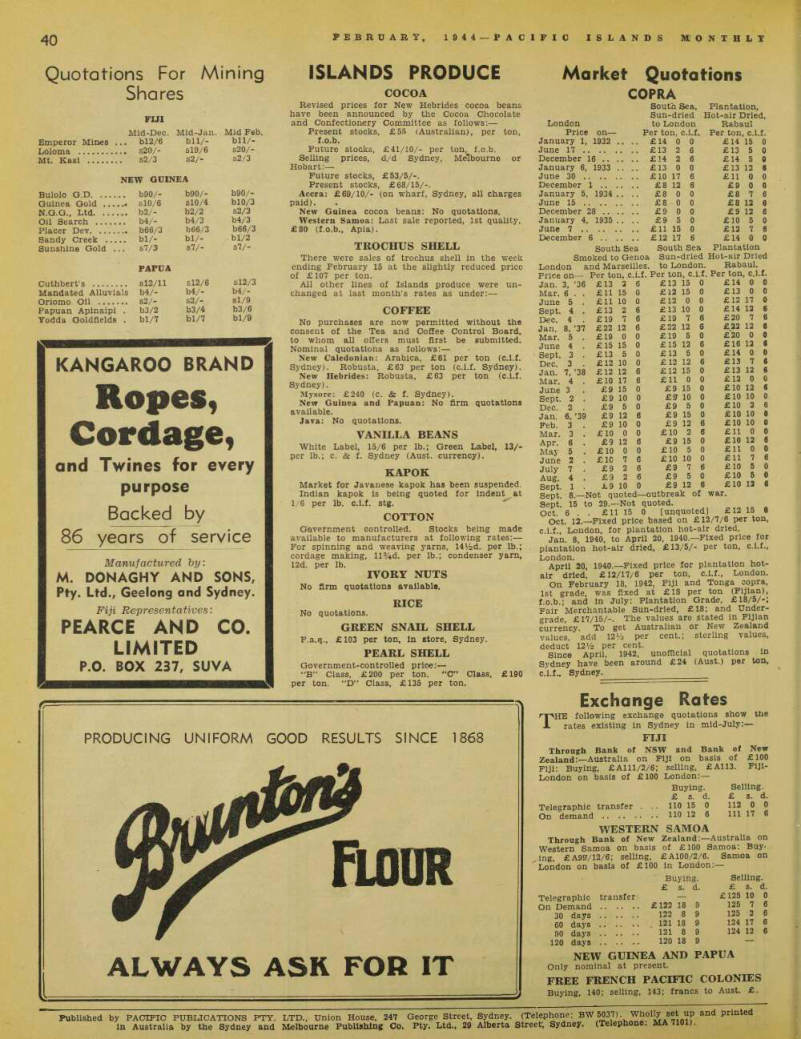
Shares
Fiji
Mid-Dec.
Mid-Jan.
Mid Feb.
Emperor Mines . .. bl2/6 bll/bll/- Loloma .. s20/- S19/6 s20/- Mt. Kasl s2/3 s2/s2/3
New Guinea
Bulolo G.D .. b90/b90/b90/- Guinea Gold ..., slO/4 blO/3 N.G.G., Ltd .. b2/b2/2 s2/3 Oil Search .. b4/b4/3 b4/3 Placer Dev b66/3 b66/3 Sandy Creek ... .. bl/bl/bl/2 Sunshine Gold . .. s7/3 S7/s7/- Cuthbert’s
Papua
.. S12/11 S12/6 S12/3 Mandated Alluvials b4/b4/b4/- Oriomo Oil s2/sl/9 Papuan Apinaipi . b3/2 b3/4 b3/6 Yodda Goldfields . bl/7 bl/7 bl/9
Islands Produce
Cocoa
Revised prices for New Hebrides cocoa beans have been announced by the Cocoa Chocolate and Confectionery Committee as follows: Present stocks, £55 (Australian), per ton, f.o.b.
Future stocks, £4l/10/- per ton, f.o.b.
Selling prices, d/d Sydney, Melbourne or Hobart: — Future stocks, £53/5/-.
Present stocks, £6B/15/-.
Accra: £69/10/- (on wharf, Sydney, all charges paid).
New Guinea cocoa beans: No quotations.
Western Samoa: Last sale reported, Ist quality, £BO (f.0.b., Apia).
Trochus Shell
There were sales of trochus shell in the week ending February 15 at the slightly reduced price of £lO7 per ton.
All other lines of Islands produce were un changed at last month’s rates as under: —
Coffee
No purchases are now permitted without the consent of the Tea and Coffee Control Board, to whom all offers must first be submitted.
Nominal quotations as follows: New Caledonian: Arabica, £Bl per ton (c.l.f.
Sydney). Robusta, £63 per ton (c.i.f. Sydney).
New Hebrides: Robusta, £63 per ton (c.i.f.
Sydney).
Mysore: £240 (c. & f. Sydney).
New Guinea and Papuan; No firm quotations available.
Java: No quotations.
Vanilla Beans
White Label, 15/6 per lb.; Green Label, 13/per lb.; c. & f. Sydney (Aust. currency).
Kapok
Market for Javanese kapok has been suspended, Indian kapok is being quoted for Indent at 1/6 per lb, c.i.f. stg.
Cotton
Government controlled. Stocks being made available to manufacturers at following rates;— For spinning and weaving yarns, 14y 2 d. per lb.; cordage making, ll 3 Ad. per lb.; condenser yarn, 12d. per lb.
Ivory Nuts
No firm quotations available.
Rice
No quotations,
Green Snail Shell
F.a.q., £lO3 per ton, In store, Sydney.
Pearl Shell
Government-controlled price:— “B” Class, £2OO per ton, “C” Class, £l9O per ton. “D” Class, £135 per ton.
Market Quotations
Copra
Oct. 6 . . £ll 15 0 [unquoted] £l2 15 0 Oct. 12. —Fixed price based on £l2/7/6 per ton, c.i.f., London, for plantation hot-air dried.
Jan. 8, 1940, to April 20, 1940.—Fixed price for plantation hot-air dried, £l3/5/- per ton, c.i.f., London.
April 20, 1940.—Fixed price for plantation hot air dried, £l2/17/6 per ton, c.i.f., London.
On February 18, 1942, Fiji and Tonga copra, Ist grade, was fixed at £lB per ton (Fijian), f.0.b.; and in July: Plantation Grade, £lB/5/-; Pair Merchantable Sun-dried, £18; and Under grade, £l7/15/-. The values are stated in Fijian currency. To get Australian or New Zealand values, add 12 y 2 per cent.; sterling values, deduct 12 Vz per cent.
Since April, 1942. unofficial quotations in Sydney have been around £24 (Aust.) per ton, c.i.f.. Sydney.
South Sea, Plantation, Sun-dried Hot-air Dried, London to London Rabaul Price on— Per ton, c.i.f.
Per ton, c.i.f.
January 1, 1932 . . . . £14 0 0 £14 15 0 June 17 . £13 2 6 £13 5 0 December 16 .. £14 2 6 £14 5 0 January 6, 1933 £13 0 0 £13 12 6 June 30 . £10 17 6 £11 0 0 December 1 .. £8 12 6 £9 0 0 January 5, 1934 , , , , , £8 0 0 £8 7 6 June 15 . £8 0 0 £8 12 6 December 28 .. £9 0 0 £9 12 6 January 4, 1935 . . . £9 5 0 £10 5 0 June 7 .. £11 15 0 £12 7 6 December 6 .. £12 17 6 £14 0 0 South Sea South Sea Plantation Smoked to Genoa Sun-' dried Hot-air Dried London and Marseilles, to London. Rabaul.
Price on— Per ton, c.i.f. Per ton, c.i.f. Per ton, c.i.f.
Jan. 3, ’36 £13 2 6 £13 15 0 £14 0 0 Mar. 6 . . £11 15 0 £12 15 0 £13 0 0 June 5 . £11 10 0 £12 0 0 £12 17 0 Sept. 4 . £13 2 6 £13 10 0 £14 12 6 Dec. 4 . £19 7 6 £19 7 6 £20 7 6 Jan. 8, ’37 £22 12 6 £22 12 6 £22 12 6 Mar. 5 . £19 0 0 £19 5 0 £20 0 0 June 4 . £15 15 0 £15 12 6 £16 12 C Sept. 3 . £13 5 0 £13 5 0 £14 0 0 Dec. 3 . £12 10 0 £12 12 6 £13 7 6 Jan. 7, ’38 £12 12 6 £12 15 0 £13 12 6 Mar. 4 . £10 17 6 £11 0 0 £12 0 0 June 3 £9 15 0 £9 15 0 £10 12 6 Sept. 2 . £9 10 0 £9 10 0 £10 10 0 Dec. 2 . £9 5 0 £9 5 0 £10 2 6 Jan. 6, ’39 £9 12 6 £9 15 0 £10 10 0 Feb. 3 . £9 10 0 £9 12 6 £10 10 0 Mar. 3 . £10 0 0 £10 2 6 £11 0 0 Apr. 6 . £9 12 6 £9 15 0 £10 12 6 May 5 . £10 0 0 £10 5 0 £11 0 0 June 2 . £10 7 6 £10 10 0 £11 7 6 July 7 . £9 2 6 £9 7 6 £10 5 0 Aug. 4 . £3 2 6 £9 5 0 £10 6 0 Sent. 1 . £9 10 0 £9 12 6 £10 12 6 Sept. 8. —Not quoted—i outbreak of war.
Sept. 15 to 29.- -Not quoted.
K n
Exchange Rates
THE following exchange quotations show the rates existing in Sydney in mid-July:—
Fiji
Through Bank of NSW and Bank of New Zealand; —Australia on Fiji on basis of £lOO Fiji: Buying, £Alll/2/6; selling, £AII3. Fiji- London on basis of £lOO London: —
Western Samoa
Through Bank of New Zealand: —Australia on Western Samoa on basis of £lOO Samoa: Buy ing, £ A99/12/6; selling, £AIOO/2/6. Samoa on London on basis of £lOO in London: —
New Guinea And Papua
Only nominal at present.
Free French Pacific Colonies
Buying, 140; selling, 143; francs to Aust. £.
Buying. Selling. £ s. d. £ s. d.
Telegraphic transfer . .. 110 15 0 112 0 0 On demand 110 12 6 111 17 6
Buying.
Selling. £ s. d. £ s. d.
Telegraphic transfer — £125 10 0 On Demand £122 18 9 125 7 6 30 days 122 8 9 125 2 6 60 days 121 18 9 124 17 6 90 days 121 8 9 124 12 6 120 days 120 18 9 —
Advertisements & other items, pp. 42-44 (4 items)
40
FEBRUARY, 1944 PACIFIC ISLANDS MONTHLY
Published by PACIFIC PUBLICATIONS PTY. LTD., Union House, 247 George Street, Sydney. (Telephone: BW M 37) Wholly set up and printed in Australia by the Sydney and Melbourne Publishing Co. Pty. Ltd., 29 Alberta Street, Sydney. (Telephone. MA 7 ).
Ropes,
KANGAROO BRAND
Cordage,
and Twines for every purpose Backed by 86 years of service Manufactured hy :
M. DONAGHY AND SONS,
Pty. Ltd., Geelong and Sydney.
Fiji Representatives:
PEARCE AND CO.
LIMITED
P.O. BOX 237, SUVA
PRODUCING UNIFORM GOOD RESULTS SINCE 1868
ALWAYS ASK FOR IT
Roll Of Honour
FEBRUARY, 1944 PACIFIC ISLANDS MONTHLY
(Continued From Inside Front Cover)
W. R. Carpenter & Co. Ltd.
mm m msm mmmmm vrS < m iBBa ■ mail m ■ « we 5, . pp I » : " ,v ■J m m
Travel by CARPENTER AIRLINES
Full particulars from Macdonald, Hamilton Cr Co., or Howard Smith Ltd., Sydney.
W. R. CARPENTER & CO. LTD.
MERCHANTS, SHIPOWNERS AND AIRCRAFT OPERATORS
Agents for Australian, European and American Manufacturers, and Distributors of Every Description of Merchandise.
Buyers and Shippers of Copra, Trocas, and ail Classes of Islands Produce.
AGENTS FOR :
Caterpillar Tractors. Dodge Brothers Inc.
Electrolux Refrigerators. Westinghouse Electrical Co. etc., etc.
Branches throughout the Pacific Islands
In London: W. R. Carpenter & Co. (London) Ltd., Coronation House, 4 Lloyds Avenue, London, EC.
Head Office: 16 O’CONNELL STREET, SYDNEY
Ford Motor Company of Canada.
T. G. & C. Bolinders (Engines).