Pacific
Islands
Monthly
January 17, 1944
Vol. Xiv. No. 6.
Established 1930
[Registered at the mi for transmission by post as a newspaper ]
l/-
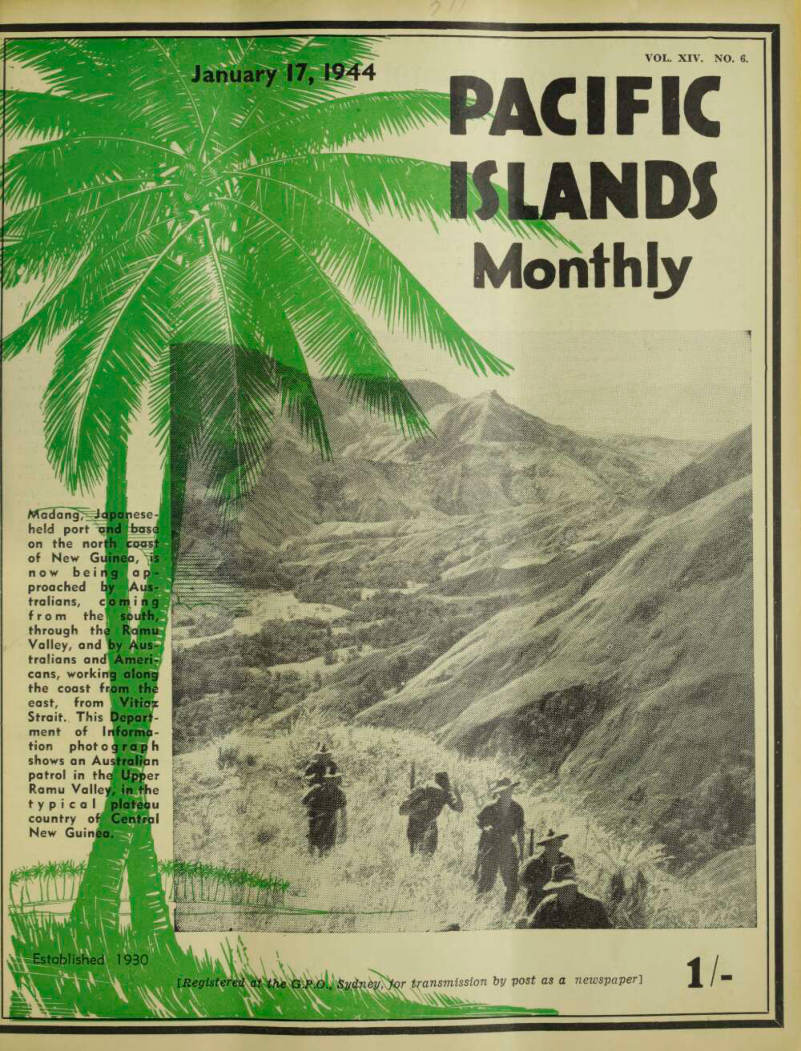
Madang, Japanese held port and base on the north coast of New Guinea, is now being ap proached by Aus tralians, coming from the south, through the Ramu Valley, and by Aus tralians and Ameri cans, working along the coast from the east, from Vitiaz Strait. This Deprat ment of Informa tion photograph shows an Australian patrol in the Upper Ramu Valley, in the typical plateau country of Central New Guinea.
Roll Of Honour
(We try to assemble here the names of men of the United Nations, residents or former residents of the Pacific Territories, whose names appear in casualty lists or who receive decorations. We should be grateful if relations and friends would send us details of such men.)
Killed
Sgt. Bert AITKEN, NZEP, formerly of Fiji.
Killed in action in Libya.
Eugene AUBRY (formerly of Tahiti), of the Air Force of Fighting France. Killed in an air accident in Great Britain.
Squadron-Leader Stan BALDIE, RAF, formerly of Wau, TNG. Killed in action in India.
Pilot-Officer Len BAYLISS, flying instructor in the RAAF, formerly of Rabaul, New Guinea.
Killed in Sydney. 18/11/1940, when he fell from a trainer aircraft in flight.
Lieut.-Colonel C. N. F. BENGOUGH, of ESI, Defence Forces, formerly Acting-Resident Com missioner of BSI. Killed when aircraft shot down into sea, August, 1943.
R. C. BENTLEY, NZEF, formerly of Fiji.
Killed in action, Middle East, June 27, 1942.
A/Bdr. Neville W. BERTWISTLE, AIP artillery (tank unit), formerly a clerk on the staff of W. R. Carpenter and Co. Ltd., of Rabaul, New Guinea. Killed in action, April, 1941.
P/O J. B. BOMFORD, RNZAF, formerly of CSR Co.’s staff, Fiji. Killed on active service in England.
Pte. W. R. M. BRADNAM, of the NZ Forces, formerly of Fiji. Reported killed in action in the Middle East, 25/11/1941.
Warrant-Officer R. F. BRECHIN, New Guinea Force. Killed in air accident, June 17, 1942.
Formerly of NG Department of Agriculture.
Anton BRINON, of Fighting French Pacific Battalion, formerly of La Foa, New Caledonia.
Killed in action in Libya, November, 1942.
Lieut.-Colonel Felix BROCHE, of the New Caledonian-New Hebridean contingent of the Fighting French Pacific Battalion. Killed in action in the battle of Bir Hacheim (Libya).
Pilot-Officer E. H. CANARD, of RAF, formerly of Fiji Civil Service. Killed in flying accident in South Africa in the course of his duty as flying instructor.
Pte. David C. GARLAND, AIF, formerly chief assayer at the Emperor gold mines, Fiji. Killed in action in New Guinea.
Pierre CHARPENTIER, of the Fighting French Pacific Battalion. Killed in action in the battle of Bir Hacheim.
Raymond CHAUTARD (formerly of New Cale donia), of the Fighting French Pacific Battalion.
Killed in action in Libya.
Flight-Lieutenant G. J. I. CLARKE, of the RAAF, formerly Assistant Flight Superintendent of Carpenter Airlines, New Guinea. Killed in action during operations off Dakar (French West Africa), while attached to HMAS "Aus tralia”, September, 1940.
Georges CLEMENS, of the Free French Pacific contingent from New Caledonia. Reported killed in action In the Middle East, March, 1942.
Flying-Officer Jack R. COATH, of the RNZAF, formerly on the staff of the Bank of New Zealand, in Suva, Fiji. Killed October, 1941, when a training aircraft crashed in NZ.
Sqd.-Leader Lionel COHEN, RAF, formerly of Upper Watut, TNG. Killed when returning from a bomber raid on Berlin in 1942.
Sgt-Pilot Colin CRABBE, RAF, formerly of Suva, Fiji. Killed by enemy action in England in May, 1943.
Pte. Felix CRAIG, AIF, formerly of accounts department, Australasian Petroleum Co., Port Moresby, Papua. Killed in action, June, 1941.
L. J. DAWES, of the NZ Forces, formerly Dis trict Officer of Savail, Western Samoa. Reported killed in action, February, 1942.
Pilot-Officer V. L. DEARMAN, of the RAAF (observer), formerly overseer and clerk at the Colonial Sugar Refining Co.. Ltd., Raraval, Fiji. Reported killed in action In the Middle East, October, 1941.
Capt. Jean GILBERT, of the Naval Forces of Fighting France, and formerly of Tahiti. Killed in action.
Captain Kenneth GARDEN, of the RAF Ferry Command, formerly of Guinea Airways Ltd., in New Guinea. Killed September, 1941, when a bomber he "ferried” from USA crashed on west coast of Britain.
Flying-Officer Moresby GOFTON, of the RAF, son of Mrs. F. S, Stewart, of Wau, New Guinea.
Reported missing, 17/5/1940 —presumed killed in air operations.
Rifleman J. A. GOODWIN, AIF infantry, for merly of Bulwa, TNG. Reported "accidentally killed”, April, 1942.
Ernest GOURNAC (formerly of Tahiti), of the Air Force of Fighting France. Killed in an air
accident in Britain.
Pte. Wallace GRAHAM, of the NZ Force* (infantry), formerly on the staff of Morris Hedstrom Ltd., Fiji. Killed in action in the Middle East, November, 1941.
Lieut. J. A. GRANT, AIF, formerly of Man dated Territory. Killed in action.
Lieut. L. B. GROVE, AIF, formerly of Madang, TNG. Killed in action.
Squadron-Leader C. R. GURNEY, RAAF, a former chief pilot of Guinea Airways, Ltd.
Killed in action In the New Guinea area, May, 1942.
Pte. B. HAMILTON, AIF, formerly of Auck land, NZ, and New Guinea. Killed in action.
Gerald T. J. HARPER, RAP, son of Major and Mrs. P, Harper, of Ra, Fiji. Killed In action while navigating a Whitley bomber dur ing a raid on the Continent.
J. HEAD, RAAF, formerly of Fiji. Killed in flying accident in Australia, 1941.
Captain L. T. HURRELL, infantry, Rabaul.
Killed in action.
Sqd.-Leader James R. HYDE, of the RAF, formerly a Patrol Office in Namatanai and Sepik Districts, TNG. Awarded the Distinguished Fly ing Cross, 1941. Killed in action while leading an attack on an enemy convoy off the coast of Greece, July 24, 1942.
Pte. Jack JOHNSON, formerly of Morris Hedstrom’s staff, Fiji. Killed in action on November 4, while serving with the AIF in New Guinea.
Flying-Officer Alan JOHNSTONE, of the RAF. who was born in Suva, Fiji, in 1915. Killed during bombing raid on Kristiansand, Norway, April, 1940.
Flying-Officer G. M. KEOGH, RAAF, form erly of Wewak, TNG. Killed in air operations in New Guinea, August 30, 1943.
LAC Douglas KIRBY, RAF, who left Suva, Fiji, with the first contingent of Air Force trainees. Reported killed in a flying accident In South Africa. March, 1942.
Marcel KOLLEN, of the Pacific Battalion of Fighting France. Killed in action in the battle of Bir Hacheim.
C. D. LAMONT, RAF, formerly a master at Boys’ Grammar School, Suva, Fiji. Missing, be lieved killed on air operations over Germany.
Emile LESSON (formerly of New Caledonia), of the Fighting French Pacific Battalion. Killed in action in Libya.
Cpl. Gaston LESSON, of the Fighting French Pacific Battalion. Killed in battle of Bir Hacheim (Libya).
Capt. (now Lt.-Oolonel) Edward Tiwi LOVE, NZ Maori Battalion, husband of Mrs. Takau Rio Love, Ariki-nui of Rarotonga, Cook Islands. Re ported missing during campaign in Greece, May, 1941; later, June, 1941, reported "wounded and safe.” Officially announced, July 17, 1942, killed in action in Libya.
Flying-Officer John C. LOWE, RAAF, formerly an overseer with the CSR Co. In Fiji. Reported, 11/4/1942, “took part in air defence of Rabaul, TNG, —missing, believed killed”.
Pte. L. P. MCCARTHY, AIF Infantry, form erly supercargo on W. R. Carpenter and Co.’s Inter-island vessels “Desikoko” and "Mako”, In New Guinea. Reported "killed in action” in Syria, 30/10/1941.
Sgt. Kenneth MACGREGOR, AIF. formerly practising as a barrister and solicitor In Wau, TNG. Reported missing, believed killed, In Papua.
Sgt.-Pilot Ronald MACKAY, RAAF, formerly of Thursday Island. Killed in an aircraft accident in England.
Lance-Corporal A. D. MacPHEE, son of Mr.
R. D. MacPhee, Levuka, Fiji. He was 35, was a member of the AIF, and was killed in Greece, May, 1941.
Francois MASSON, of the Fighting French Pacific Battalion. Killed in action In the battle of Bir Hacheim.
Capt. John Malcolm METHVEN. Reported killed in action in Egypt on July 22, 1942, while serv ing with the AIF. He was born in Ocean Island, and is the youngest son of Mr. and Mrs.
Stuartson C. Methven, of Belgrave, Victoria.
Flight-Sgt. Stuartson Charles METHVEN, born in Suva, Fiji, brother of the late Capt. J. M.
Methven. Killed in air operations over Ger many on January 23, 1943.
Spr. A. L. MORANDINI, AIF Engineers, for merly of Konedobu, Papua. Reported killed in action, April, 1942.
F. R. J. NICHOLLS, Royal Artillery, formerly
of Fiji. Killed in action, Burma, May, 1942.
W/O G. A. OBST, formerly a member of the Lutheran Mission, TNG. Joined Australian military forces in February, 1942. Killed in action In New Guinea on December 21, 1942.
J. L. C. OSBORN, NZEF, formerly of Fiji.
Killed in action, Middle East, June, 1942.
Pilot-Officer Ivan PALMER, RAF, formerly of Fiji. Killed in air operations over Malta.
Lieut. R. G. M. PEMBERTON, ALP, formerly of Rabaul, New Guinea. Killed in action.
O. PILLING, RAP, formerly of Fiji. Missing; believed killed.
Flight-Lieut. H. G. PILLING, DFC, of the RAP, formerly of Suva, Fiji. Killed on air operations, May 19, 1942.
Pte. Edward Harold PRICE, 2nd NZEF (27th Machine Gun Battalion), youngest son of Mr. and Mrs. J. Price, Savu Savu West, Fiji. Killed in action during the Libyan campaign, Middle East, 27/11/1941.
Pte. Cecil PURCELL, NZEF, formerly of Aleipata. Samoa. First Samoan Euronesian to give his life in World War 11. Killed in action in Middle East.
P/O G. REES-JONES, RAAF, formerly of Labasa, Fiji. Killed in air operations over Ger many, August 16, 1942.
Captain W. H. ROBERTS, NZEF, who wti Accountant in the Samoa Treasury Dept., dur ing 1934-35. Killed in action in Libya, Decem ber, 1941.
Major A. B. ROSS, NZEF, who, between 1923- 29 was successively, Assistant Secretary for Native Affairs, Assistant Secretary to the Administration, and ADC to the Administrator of Samoa. Killed in action in Libya.
Cpl. Alex. C. SCOTT, ALP, formerly manager at Kieta, TNG, for Burns, Philp and Co. Ltd.
Killed in action in the Middle East, 19/6/1941.
J. SIMPSON, RAAF, formerly of Fiji. Killed in action over Malta, July, 1941.
Sgt. R. R. SHORT, AIF, formerly of Port Moresby. Killed in action.
Lieut. G. STEVENSON, AIF, formerly a Patrol Officer in New Guinea. Killed in action in New Guinea, on June 26, 1943.
Lieutenant A. G. W. THOMAS, RANR, for merly master of Burns Philp & Company’s SS “Muliama.” Killed in action.
Pte. Popoare TANGim, of the NZ Forces (Maori Battalion), formerly of Mangala, Cook Islands. Reported "missing after Battle of Greece—presumed dead”, July, 1941.
Derek TOVEY, NZEF, formerly of Suva, Fiji.
Killed in action in Tunisia in April, 1943.
Sgt. Edward WILSON, of Suva, serving In the Fiji Defence Force. Accidentally drowned In the Lami River. Fiji, April, 1942.
Capt. A. F. J. WHITE, AIF, formerly a Dis trict Officer in Fiji, and BSI. Killed in action in New Guinea.
Died From Wounds
Pte. Ernest HENRY, AIF, formerly of the Rabaul (NG) staff of Burns, Philp and Co.
Ltd. Died from wounds received in Battle of Crete, 1/6/1941.
Pte. Alec. MUNRO, NZ Forces, formerly of Norfolk Island. Died in Libya (Middle East),
December, 1941.
Pte. T. LAWRIE, AIF, son of Mr. Lawrle, for merly of Fiji. Died of wounds in Middle East.
Pte. Walter PEARSON, of first NG quota of AIF (infantry). Died from wounds received in action, 24/6/1941.
A/Bdr. W. R. SCOTT, AIF, of New Guinea.
Died from wounds, July, 1941.
Sgt. Charles SPITZ, of the Fighting French, Pacific Battalion, and formerly of Tahiti. Died from wounds received at Bir Hacheim, on June 21, 1943.
Sgt.-Pilot Peter Clarkson WISE, of the RAF, son of Mr. W. Wise, OBE, Director of Public Works, Fiji. Died from wounds received during bombing raid over Germany, January, 1941.
Accidentally Killed
A/Cpl. P. A. McKEE, New Guinea Forces, formerly of Bulolo. Died of injuries.
Major N. V. McKENNA, AIF, formerly of Wau, TNG. Accidentally killed, September 30, 1943.
Gnr. Robert J. WILSON, formerly of Port Moresby, Papua. Accidentally killed in troop train in Middle East in 1942.
Died From Illness
Pte. Clarence A. HUTTON, AIF, formerly of Edie Creek, TNG. Died from Illness, April, 1941.
Seaman Malvin NELSON, of Fiji Royal Naval Volunteer Service. Death reported in May, 1943.
A/Sgt. J. H. STANE, Royal Australian En gineers, formerly of Port Moresby, Papua. Died from illness. May, 1942.
Rifleman R. A. SMITH, HQ Unit. (Place of enlistment not stated.) Died of Illness.
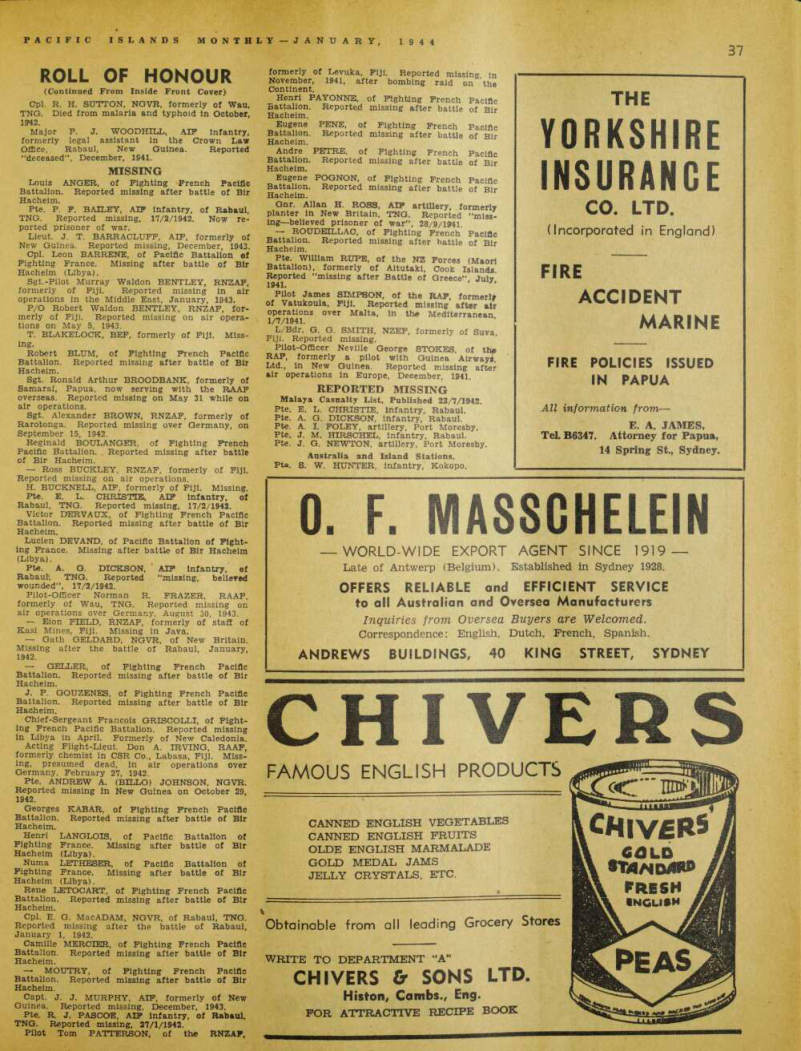
(Continued on Page 37)
Cpl. R. H. SUTTON, NGVR, formerly of Wau, TNG. Died from malaria and typhoid In October, 1942.
Major P. J. WOODHILL, ATP Infantry, formerly legal assistant in the Crown Law Office, Rabaul, New Guinea. Reported “deceased”, December, 1941.
Missing
Louis ANGER, of Fighting French Pacific Battalion. Reported missing after battle of Blr Hachelm.
Pte. P. P. BAILEY, AIF infantry, of Rabaul, TNG. Reported missing, 17/2/1942, Now re ported prisoner of war, Lieut. J. T. BARRACLUFF, AIF, formerly of New Guinea. Reported missing, December, 1943.
Cpl. Leon BARRENE, of Pacific Battalion of Fighting France. Missing after battle of Blr Hacheim (Libya).
Sgt.-Pilot Murray Waldon BENTLEY, RNZAF, formerly of Fiji. Reported missing in air operations in the Middle East, January, 1943.
P/O Robert Waldon BENTLEY, RNZAF, for merly of Fiji. Reported missing on air opera tions on May 5, 1943.
T. BLAKELOCK, BEF, formerly of Fiji. Miss ing.
Robert BLUM, of Fighting French Pacific Battalion. Reported missing after battle of Blr Hacheim.
Sgt. Ronald Arthur BROODBANK, formerly of Samaral, Papua, now serving with the RA_AF overseas. Reported missing on May 31 while on air operations.
Sgt. Alexander BROWN, RNZAF, formerly of Rarotonga. Reported missing over Germany, on September 15, 1942.
Reginald BOULANGER, of Fighting French Pacific Battalion. Reported missing after battle of Bir Hacheim.
Ross BUCKLEY, RNZAF, formerly of Fiji.
Reported missing on air operations.
H. BUCKNELL, AIF, formerly of Fiji. Missing.
Pte. E. L. CHRISTIE, AIF infantry, of Rabaul, TNG. Reported missing, 17/2/1942.
Victor DERVAUX, of Fighting French Pacific Battalion. Reported missing after battle of Bir Hacheim, Lucien DEVAND, of Pacific Battalion of Fight ing Prance. Missing after battle of Blr Hacheim (Libya).
Pte. A. G. DICKSON. AIF Infantry, of Rabaul, TNG. Reported “missing, believed wounded”, 17/2/1942.
Pilot-Officer Norman R. FRAZER, RAAP, formerly of Wau, TNG. Reported missing on air operations over Germany, August 30, 1943.
Eion FIELD, RNZAF, formerly of staff of Kasi Mines, Fiji. Missing in Java, Gath GELDARD, NGVR, of New Britain.
Missing after the battle of Rabaul, January, 1942.
GELLER, of Fighting French Pacific Battalion. Reported missing after battle of Blr Hacheim.
J. P. GOUZENES, of Fighting French Pacific Battalion. Reported missing after battle of Bir Hacheim.
Chief-Sergeant Francois GRISCOLLI, of Fight ing French Pacific Battalion. Reported missing in Libya in April. Formerly of New Caledonia.
Acting Flight-Lieut, Don A. IRVING, RAAF, formerly chemist in CSR Co., Labasa, Fiji. Miss ing, presumed dead, in air operations over Germany, February 27, 1942.
Pte. Andrew A. (Billo) Johnson, Ngvr.
Reported missing In New Guinea on October 29, 1942.
Georges KABAR, of Fighting French Pacific Battalion. Reported missing after battle of Blr Hacheim.
Henri LANGLOIS, of Pacific Battalion of Fighting France. Missing after battle of Blr Hacheim (Libya).
Numa LETHESER, of Pacific Battalion of Fighting Prance. Missing after battle of Bir Hacheim (Libya).
Rene LETOCART, of Fighting French Pacific Battalion. Reported missing after battle of Blr Hacheim.
Cpl. E. G. MacADAM, NGVR. of Rabaul, TNG.
Reported missing after the battle of Rabaul, January 1, 1942.
Camille MERCIER, of Fighting French Pacific Battalion. Reported missing after battle of Blr Hacheim.
MOUTRY, of Fighting French Pacific Battalion. Reported missing after battle of Blr Hacheim.
Capt. J. J. MURPHY, AIF, formerly of New Guinea. Reported missing. December, 1943.
Pte. R. J. PASCOE. AIF Infantry, of Rabaul, TNG. Reported missing, 27/1/1942.
Pilot Tom PATTERSON, of the RNZAF,
formerly of Levuka, Fiji. Reported missing in November, 1941, after bombing raid on ’the Continent.
Henri PAYONNE, of Fighting French Pacific Battalion. Reported missing after battle of Bir Hacheim.
Eugene PENE, of Fighting French Pacific Battalion. Reported missing after battle of Bir Hacheim.
Andre PETRE, of Fighting French Pacific Battalion. Reported missing after battle of Bir Hacheim.
Eugene POGNON. of Fighting French Pacific Battalion. Reported missing after battle of Bir Hacheim.
Gnr. Allan H. ROSS, AIF artillery, formerly planter in New Britain, TNG. Reported “miss ing—believed prisoner of war”, 28/9/1941.
ROUDEILLAC. of Fighting French Pacific Battalion. Reported missing after battle of Blr Hacheim.
Pte. William RUPE, of the NZ Forces (Maori Battalion), formerly of Altutakl, Cook Islands Reported “missing after Battle of Greece” July’ 1941. * Pilot James SIMPSON, of the RAF. formerly of Vatukoula, FIJI. Reported missing after air operations over Malta, In the Mediterranean 1/7/1941.
L/Bdr. G. G. SMITH, NZEF, formerly of Suva Fiji. Reported missing.
Pilot-Officer Neville George STOKES, of the RAP, formerly a pilot with Guinea Airways.
Ltd., in New Guinea. Reported missing after air operations In Europe, December, 1941.
Reported Missing
Malaya Casualty List, Published 23/7/1942.
Pte. E. L. CHRISTIE. Infantry, Rabaul.
Pte. A. G. DICKSON, infantry, Rabaul.
Pte. A. I. FOLEY, artillery. Port Moresby.
Pte. J. M. HIRSCHEL, Infantry, Rabaul.
Pte. J. G. NEWTON, artillery, Port Moresby.
Australia and Island Stations.
Pta. S. W. HUNTER, Infantry, Kokopo,
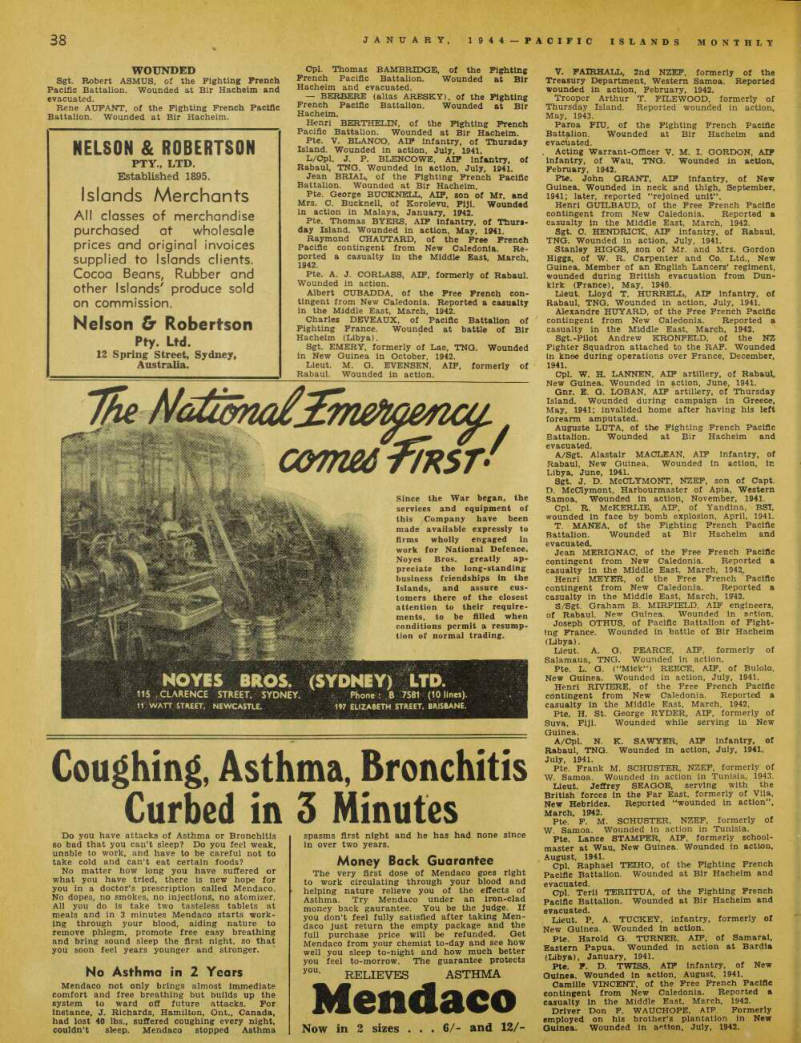
Wounded
Sgt. Robert ASMUS, of the Fighting French Pacific Battalion. Wounded at Bir Hacheim and evacuated.
Rene AUP ANT, of the Fighting French Pacific Battalion. Wounded at Bir Hacheim.
Cpl. Thomas BAMBRIDGE, of the Fighting French Pacific Battalion, Wounded at Bir Hacheim and evacuated.
BERBERS (alias ARESKY), of the Fighting French Pacific Battalion. Wounded at Bir Hacheim.
Henri BERTHELIN, of the Fighting French Pacific Battalion. Wounded at Bir Hacheim.
Pte. V. BLANCO, AIP Infantry, of Thursday Island. Wounded in action, July, 1941.
L/Cpl. J. P, BLENCOWE, AIF infantry, of Rabaul, TNG. Wounded in action, July, 1941.
Jean BRIAL, of the Fighting French Pacific Battalion. Wounded at Bir Hacheim.
Pte. George BUCKNELL, AIF, son of Mr. and Mrs. C. Bucknell, of Korolevu, Fiji, Wounded in action in Malaya, January, 1942.
Pte. Thomas BYERS, AIP infantry, of Thurs day Island. Wounded in action, May, 1941.
Raymond CHAUTARD, of the Free French Pacific contingent from New Caledonia. Re ported a casualty in the Middle East, March. 1942.
Pte. A. J. CORLASS, AIF, formerly of Rabaul.
Wounded in action, Albert CUBADDA, of the Free French con tingent from New Caledonia. Reported a casualty in the Middle East, March, 1942.
Charles DBVEAUX, of Pacific Battalion of Fighting France. Wounded at battle of Bir Hacheim (Libya).
Sgt. EMERY, formerly of Lae, TNG. Wounded in New Guinea in October, 1942.
Lieut. M. G. EVENSEN, AIF, formerly of Rabaul. Wounded in action.
V. PAIRHALL, 2nd NZEF, formerly of the Treasury Department, Western Samoa. Reported wounded in action, February, 1942.
Trooper Arthur T. PILEWOOD, formerly of Thursday Island. Reported wounded in action, May, 1943.
Paroa PIU, of the Fighting French Pacific Battalion. Wounded at Bir Hacheim and evacuated.
Acting Warrant-Officer V, M. I. GORDON, AIP infantry, of Wau, TNG. Wounded in action, February, 1942.
Pte. John GRANT, AIP infantry, of New Guinea. Wounded in neck and thigh, September, 1941; later, reported “rejoined unit”.
Henri GUTLBAUD, of the Free French Pacific contingent from New Caledonia. Reported a casualty in the Middle East, March, 1942.
Sgt. C. HENDRICK, AIF infantry, of Rabaul, TNG. Wounded in action, July, 1941.
Stanley HIGGS, son of Mr. and Mrs, Gordon Higgs, of W. R. Carpenter and Co. Ltd., New Guinea. Member of an English Lancers’ regiment, wounded during British evacuation from Dun kirk (France), May, 1940.
Lieut. Lloyd T, HURRELL, AIP Infantry, of Rabaul, TNG. Wounded in action, July, 1941, Alexandre HXJYARD, of the Free French Pacific contingent from New Caledonia. Reported a casualty in the Middle East, March, 1942.
Sgt.-Pilot Andrew KRONFELD, of the NZ Fighter Squadron attached to the RAF. Wounded In knee during operations over France, December, 1941.
Cpl. W. H. LANNEN, AIP artillery, of Rabaul, New Guinea. Wounded in action, June, 1941.
Gnr. E. G. LOBAN, AIF artillery, of Thursday Island. Wounded during campaign in Greece, May, 1941; invalided home after having his left forearm amputated.
Auguste LUTA, of the Fighting French Pacific Battalion. Wounded at Bir Hacheim and evacuated.
A/Sgt. Alastair MACLEAN, AIP Infantry, of Rabaul, New Guinea. Wounded in action, in Libya, June, 1941, Sgt. J. D. McCLYMONT, NZEP, son of Capt.
D. McClymont, Harbourmaster of Apia, Western Samoa, Wounded in action, November, 1941.
Cpl. R. McKERLIE, AIP, of Yandina, BSL wounded in face by bomb explosion, April, 1941.
T, MANEA, of the Fighting French Pacific Battalion. Wounded at Bir Hacheim and evacuated, Jean MERIGNAC, of the Free French Pacific contingent from New Caledonia. Reported a casualty in the Middle East, March, 1942.
Henri MEYER, of the Free French Pacific contingent from New Caledonia. Reported a casualty in the Middle East, March, 1942.
S/Sgt. Graham B. MIRPIELD, AIF engineers, of Rabaul. New Guinea. Wounded In action, Joseph OTHUS, of Pacific Battalion of Fight ing Prance. Wounded in battle of Bir Hacheim (Libya).
Lieut. A. G. PEARCE, AIF, formerly of Salamaua, TNG. Wounded in action.
Pte. L. G. (“Mick”) REECE, AIP, of Bulolo, New Guinea. Wounded in action, July, 1941, Henri RIVIERE, of the Free French Pacific contingent from New Caledonia. Reported a casualty in the Middle East, March, 1942.
Pte, H. St. George RYDER, AIF, formerly of Suva, Fiji. Wounded while serving in New Guinea.
A/Opl. N. K. SAWYER. AIP infantry, of Rabaul, TNG. Wounded in action, July, 1941, July, 1941.
Pte. Frank M. SCHUSTER, NZEF, formerly of W. Samoa. Wounded in action in Tunisia, 1943.
Lieut. Jeffrey SEAGOB, serving with the British forces in the Far East, formerly of Vila, New Hebrides. Reported “wounded in action”.
March, 1942.
Pte. P. M. SCHUSTER, NZEF, formerly of W. Samoa. Wounded in action in Tunisia.
Pte, Lance STAMPER, AIP, formerly school master at Wau, New Guinea. Wounded in action.
August, 1941.
Cpl. Raphael TEIHO, of the Fighting French Pacific Battalion. Wounded at Bir Hacheim and evacuated.
Cpl. Terll TERIITUA, of the Fighting French Pacific Battalion, Wounded at Bir Hacheim and evacuated.
Lieut. P. A. TUCKEY, infantry, formerly of New Guinea. Wounded in action.
Pte. Harold G. TURNER, AIF, of Samaral, Eastern Papua. Wounded in action at Bardla (Libya), January, 1941.
Pte. F. D. TWISS, AIP Infantry, of New Guinea. Wounded in action, August, 1941.
Camille VINCENT, of the Free French Pacific contingent from New Caledonia. Reported a casualty In the Middle East, March, 1942.
Driver Don F. WAUCHOPE, AIP. Formerly employed on his brother’s plantation in New Guinea. Wounded in action, July, 1942.
Alex. WINCHESTER, of the Fighting French Pacific Battalion. Wounded at Bit Hachelm.
Pte. K. M. WHITE, AIF, formerly of Bulwa, TNG. Wounded in action.
Sgt.-Pilot W. WRIGHT, of the Australian Spitfire Squadron, attached to the RAF, for merly of New Guinea. Wounded in knee during aerial "dog-fight” over the English Channel, March. 1942. (For space reasons, “Prisoner of War” and “Decorations” have been held over until next issue.)
Pacific News-Review
Notes And Comment On
The Progress Of The War
From Dec. 15 To Jan. 12
Dec, 15: The Russian advance in the Kiev sector continues. Cherkasy, the enemy’s main base on the Middle Dnie per, has fallen to the Russians.
It now is clear that the great counter offensive mounted by the enemy west of Kiev has petered out. The whole of the Russian forces, from White Russia (between Kiev and Petrograd) to the Lower Dnieper (near the Black Sea) are surging forward, over country rendered negotiable by the winter freeze-up.
Dec. 16: One hundred Allied bombers, escorted by fighters, dropped 248 tons of bombs on Gasmata, in New Britain, yes terday, while RAAF aircraft attacked Rabaul and other New Britain objectives.
Dec. 17: After the heaviest aerial attack yet made in New Britain had been launched against Arawe, on Tuesday, by over 100 Allied bombers, American troops landed and occupied the place. There was little opposition. Arawe is on the south-west coast of New Britain, between Gasmata and Cape Gloucester.
Dec. 17; The Prime Minister, Mr.
Churchill, who is still in the Middle East, has pneumonia and has been in bed for several days. His general condition is satisfactory.
Dec. 18: Seventeen Allied ships were sunk in a few minutes, and 1,000 persons killed or injured, when a German air raid, early in December, on the harbour of Bari (south-western Italy) exploded two ammunition ships.
This represented a serious set-back to the British Eighth Army campaign in Italy. Its new offensive was retarded and attack plans dislocated through lack of supplies. Allied reports say that the German raid was brilliantly conceived and executed, and took the Allies com pletely by surprise.
Dec. 18: Berlin again has been raided heavily; 1,500 tons of bombs were dropped on the target area.
Dec. 20; Americans who landed at Arawe, on December 15, have enlarged their bridgehead and captured a large quantity of enemy equipment.
Dec. 20: The Fifth Army in Italy has taken San Pietro, a village that the Ger mans had made a key position in the Garigliano River line.
Dec. 21: The Red Army, opening its third winter offensive, has broken through on a 50-miles front between Neval and Vitebsk.
Dec. 22: The main weight of the Allied air offensive in New Guinea has been switched to Cape Gloucester, where 414 tons of bombs were dropped in one day.
Dec. 24: The air pounding of Cape Gloucester area (New Britain) goes on.
More than 2,500 tons of bombs have been dropped here during the past month.
Dec. 24: For the fourth day in suc cession, hundreds of British and Allied bombers and fighters of all sizes, yester day pounded “military targets” near the Channel, in northern France. It is thought that batteries of the new Ger man rocket-guns may be taken seriously by the Allied commanders and are the objective.
Dec. 25: Wewak, enemy air base in northern New Guinea, was again attacked in force. Two direct hits were scored on two transport vessels and 15 planes were destroyed, Dec. 27: The invasion of western Europe is foreseen in the appointment of the American, General Eisenhower, as commander-in-chief of the “British and American Expeditionary Forces now be ing organised in the United Kingdom for the liberation of Europe”; and Gen eral Montgomery, famous fighting leader
of the British 'Eighth Army, as com mander of the invading armies.
Dec. 27: The German garrison at the important fortress of Vitebsk (White Russia) has been isolated by the Russian advance.
Dec. 28: Successful new landings have been made on New Britain, in the Cape Gloucester area, by American troops, with practically no loss to themselves. On the New Guinea mainland, the Australians, advancing along the coast, have captured Wandokai (25 miles north-west of Finsch haven).
These two moves mean that the Allies now are completely in control of the important straits between New Guinea and New Britain. The Japanese coastal barge traffic has been disrupted, and the way is clear for Allied naval forces to go through to attack the north coasts of New Guinea and New Britain.
Dec. 28: The German battleship, “Scharnhorst” (26,000 tons) was sunk by units of the British Home Fleet, near North Cape, Norway, in Arctic waters, on December 26.
Dec. 29: The Russians on the Kiev front have regained two-thirds of the ground lost to the Germans in their recent counter-attacks.
Dec. 30: The Japanese are being ham mered by Americans and Australians in all sectors of the New Guinea battle fields. The enemy suffered a crushing air-defeat and the loss of 34 planes over Arawe (New Britain).
Dec. 31: The battle of Berlin was re sumed last night after a lull of six days. 2,000 tons of bombs were dropped, and vast damage done.
Dec. 31: The Red Army has scored an important success on the railway west of Kiev, between Koresten and Jitomir, both of which were captured on December 29.
Jan. 1: US Marines who landed at Cape Gloucester on Sunday completed the occupation of their main objective—the two airfields—on December 30. Japs offered savage resistance.
Jan. 1: The steadily advancing Russians are now only 40 miles from the old Polish border.
There are references to three “borders” between Russia and Poland. There is the “old frontier,” which existed before, and for a little while after, World War I. Then there was the League of Nations border, considerably to the westward called the “Curzon Line,” because it was fixed by the Commission led by Lord Curzon. it took cognisance of the fact that most of the people between the old frontier and the Curzon Line are either Ukrainians or White Russians, and those areas therefore were awarded to Russia — much to the anger of Poland. Later, Poland succeeded in getting the frontier moved east again. When Stalin and Russia made a Pact in 1939, and Hitler attacked Poland, Stalin moved the Russian armies into the disputed terri tories in eastern Poland, and occupied a frontier which was not very different from the Curzon Line.
Jan. 3: The Russians west of Kiev are now only 15 miles from the old Polish border; while other Red Armies have made a deep drive towards the River Bug (last important natural barrier between them and Roumania).
Jan. 3: Berlin was again raided in great strength. Hamburg also was attacked.
Jan. 4; The Americans have made an other New Guinea landing—this time at Saidor, on the northern New Guinea coast, 60 miles south-east of Madang. The Japs on the north-east coast are now
between these Americans, and the Aus tralians, advancing from the eastward.
Jan. 4: RAF bombers hit Berlin again last night. Since November 18, 14,000 tons of bombs have been dropped on the Nazi capital by Bomber Command. Some estimates say that one-fifth of the city has been smashed.
Jan. 5: Russian forces yesterday entered Poland north-west of Kiev—an" advance of 130 miles since General Vatutin launched this attack 10 days ago.
Jan. 5: Two enemy heavy cruisers and a destroyer were damaged and set on fire, and 32 enemy planes were destroyed, in the Rabaul-Kavieng area on Saturday.
Jan. 6: While units of Gen. Vatutin’s Army are extending their hold on the old Polish border, along an 80 miles front, other Red forces in the south are threatening to encircle portion of the German army within the Dnieper Bend.
Jan. 6: Yesterday, forces of American bombers struck the German shipbuilding yards at Kiel and the railway marshalling yards at Munster.
Jan. 7: As the Reds bite deep into the Nazi lines, across the Polish border, ef forts are being made by British and American Governments to produce an understanding between Russia and the Polish Government, which claims that the “old border” should be observed. (See Note, Jan. 1.) The situation is tense.
Jan. 7; In the Cape Gloucester area (New Britain), Americans, supported by' artil lery, tanks, and aircraft, are heavily engaging the Japanese.
Jan. 8: The Nazi frontier defences, as far south-west as Ostrog, appear to be crumbling under the Russian blows. The Germans, in places, are in disorderly mass retreat.
Jan. 8: In New Guinea, the Americans at Saidor are in contact with the Japs, Australians, pushing westward along Huon Peninsula, to link up with the Americans, are now 10 miles from Sio.
Jan. 9: Kirovograd, most important communications centre in the Dnieper Bend, was captured by the Russians yesterday, with enormous losses to the Germans. This may force the Nazis rapidly to evacuate the whole Bend area.
Jan. 10: Saturday ended the most in tensive air-raid week over Europe by the Allies. Over 8,000 sorties were made by the Allied air forces.
Jan. 12: While Russians and Germans battle for the Smyela-Khristinovka rail way, which the Russians have cut, leav ing the Germans only one line of escape (south-west to Odessa), and the Russians are only 30 miles from the Odqssa- Warsaw trunk railway (lifeline of the whole German front). German military spokesmen have had an amazing attack of frankness, and admit their serious and worsening plight in Russia. In Moscow, the Soviet Government has of fered to negotiate with Poland regarding that country’s eastern borders.
Pastor V. Ekeroma, a Samoan mis sionary attached to the London Missionary Society, and stationed 43 miles from Milne Bay, Papua, is at present in Aus tralia on leave. Interviewed in Brisbane, he gave a graphic description of war as he saw it near his mission station during the past two years, and told how many Australian and American pilots, shot down in the jungle, were rescued by the efforts of the European missionary, the Rev. M. Nixon, and mission natives.
Contents
Pacific News-Review .. .. 1 Wartime Leaders’ Plan for the Future —Pacific Control 3 Australia and New Zealand Meet to Plan Our Future Pacific Ad ministration .. 5 Territories Men Decorated 6 J. Rennie, NMP, Now Soldier of Distinction 6 January 23 —Rabaul’s Tragic Anni versary 7 Fono of Faipule in Session 7 Solomon Islanders’ Tribute to Ameri can Dead 8 Prepare to Wage Peace!—Members Needed by PTA 9 Peak Rubber Production by Papuan Planters 9 Charles Duchatel Dead 9 Will the “Kanaka” Become a “Boong”? 10 Another Governor for N. Caledonia 11 Tropicalities 12 Dutch Rule in the Netherlands Indies 13 Phoenix Islands Transport—Ameri cans Solve British Problem ... 17 Dollar-prosperity Has Setback in W.
Samoa 18 Economic Debauchery of Polynesians by Friendly Troops 19 Fiji Food Front 21 Death of Gauguin’s Tahitian Mistress 22 Sly Grog and Black Markets 24 Weddings and War in the Loyalties 25 Rarotongan Boxer’s Death 26 From a Dress-circle Seat—Gold miner’s Impression of Coral Sea and Guadalcanal Battles 27 Territorian Roar—Hope and Confi dence at Christmas Parties ... 29 Empire Medal for Four Papuans .. 29 Tribute to Native Canoe 30 How the French Came to New Cale donia —Centenary Celebrations at Balade .. .. * 31
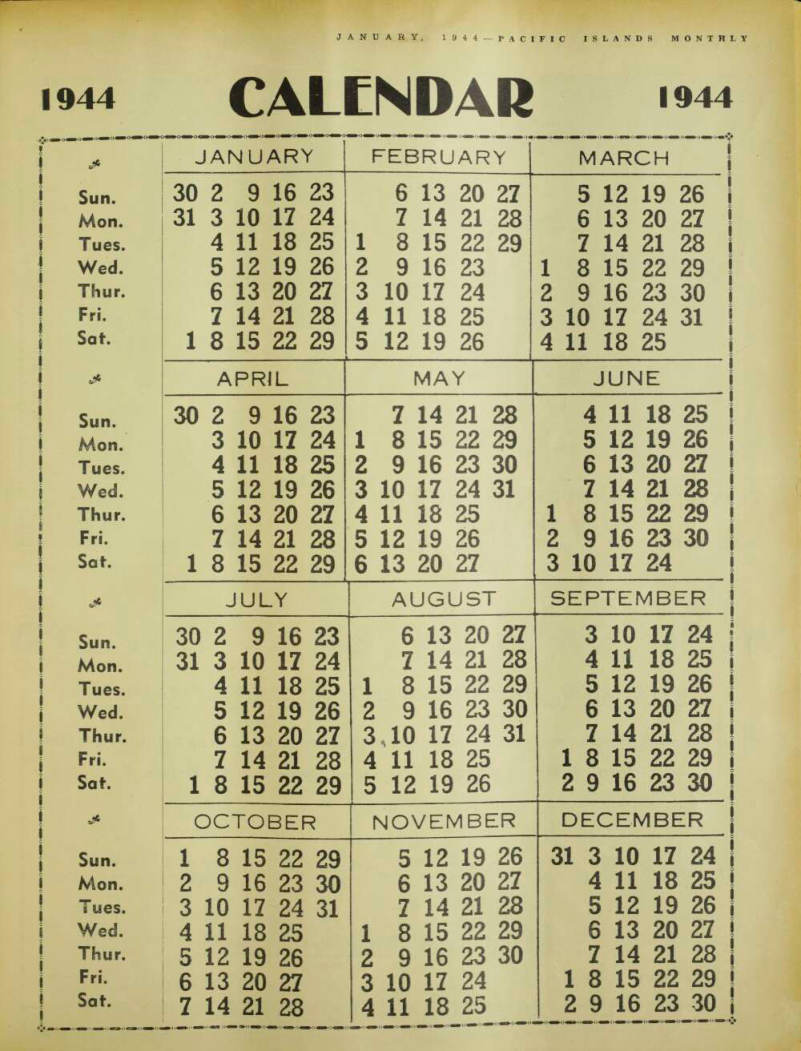
Luck in the Louisiades Early Memories of the Gold-seekers .. 34 Commercial and Markets 40 Honour Roll . . .. Cov. ii., pages 37-39 Calendar for 1944 Cov. iii.
Advertisers
Atkins Pty., Ltd., Wm 25 Australian Alumi nium Co. Pty., Ltd 31 Berger’s Paints . . 12 Broomfield, Ltd. . . 24 Brown, D. C. . . .31 Brown & Co., Ltd., G 13 Brunton’s Flour . . 36 Burns, Philp Trust Co., Ltd 15 B.P. (S.S.) Co. . . . 13 Carlton & United Breweries, Ltd. . 17 Carpenter, Ltd., W.
R cov. iv.
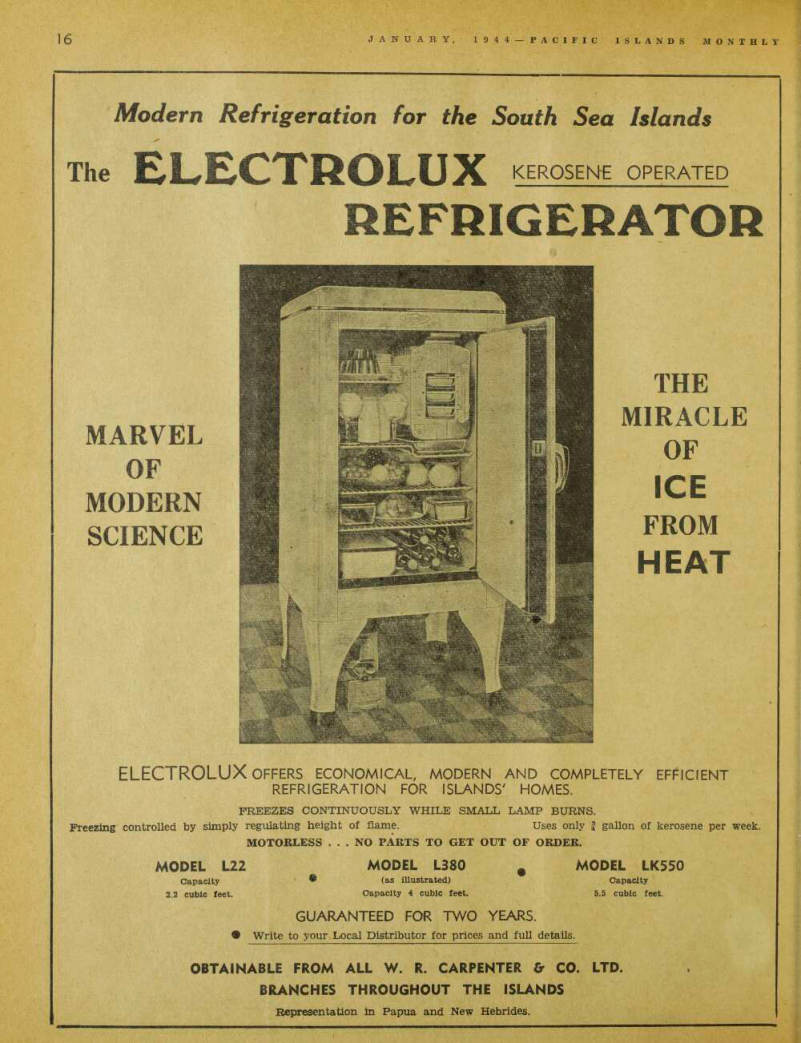
Chivers & Sons, Ltd 37 Coleman Lamp & Stove Co 23 ‘“Cystex” 36 Darvas & Co. ... 31 David Trading Co., B. . 39 Donaghy & Sons, Ltd 33 Donald, Ltd., A. B. 33 Dorn, Paul A. . . . 3t/ Dr. Williams Pink Pills 30 Electrolux Refrigerators ... 16 Excelsior Supply Co., Ltd 29 Garrett & Davidson 36 Gilbey’s Gin ... 14 Gillespie’s Pty., Ltd., Robert 28 Gillespie’s Flour . . 22 Gough & Co., E.
J 22 Grove & Sons, W.
H 14
Grand Pacific Hotel 2 Heinz & Co. Pty., Ltd., H. J. . . . 19 Horlicks Malted Milk 18 Kopsen & Co., Ltd. 35 Masschelin, O. F. . 37 Maxwell Porter, Ltd. 30 “Mendaco” ... 38 Miller & Co. Pty., Ltd 30 Nelson & Robertson Pty., Ltd 38 “Nixoderm” ... 34 Noyes Bros., Ltd. . 38 Pacific Is. Society . 13 Pacific Islands Sou venirs For Sale . 37 Pacific Islands Year 800k—1944 Edition 27 “Pinket-tes” ... 35 Ransomes, Sims & Jefferies, Ltd. . . 34 Rose’s Eye Lotion . 34 Queensland Insur ance Co., Ltd. . . 23 Riverstone Meat Co.
Ltd 20 Rohu, Sil 24 Scott, Ltd.. J. ... 24 Steamships Trading Co., Ltd 27 Sullivan & Co., C. . 32 Swallow & Ariell . 21 Taylor & Co., A. ."'26 “Tenax” Soap . . 28 Tillock & Co., ltd. 39 Union Assurance Co. Ltd 29 Wright & Co., Ltd., E 33 Wunderlich, Ltd. . 26 Young Pty., Ltd., Harry J 26 Yorkshire Insurance Co., Ltd 37
Advertisements & other items, p. 4 (2 items)
2
•January, 1944 pacific islands mon f b 1
Useful Addresses
The following are the addresses of organisations set up to deal with Pacific Territories affairs:—
PAPUA, NEW GUINEA, NAURU,
NORFOLK IS.
Department of External Territories (Sydney Branch) (Lately the New Guinea Trade Agency), Australia House, Carrington Street, Sydney.
Telephone: BW 1776. (Dealing with all matters connected with the Australian Pacific Territories and also the Sydney representative of the New Guinea Copra Control Committee.)
BRITISH SOLOMON ISLANDS
Sydney Office of British Solomon Islands Government (In charge of Mr. F. E. Johnson, Treasurer of the Solomons Administration), 17 Castlereagh Street, Sydney.
Telephone: B 1710.
GILBERT AND ELLICE , AND
OCEAN IS.
Sydney Office of Gilbert and Ellice Islands Colony (In charge of Mr. S. G. Clarke, Treasurer of the G. and E. Administration), Bank of New Zealand Building, George Street, Sydney. Telephone: B 2209.
FOR PACIFIC TERRITORIES
EVACUEES GENERALLY
Pacific Territories Association (C. A, M. Adelskold, Secretary), c/o Robert Gillespie Pty., Ltd., 54a Pitt Street, Sydney. Telephone: BW 4782.
WAR DAMAGE COMMISSION
Sydney Office: M.L.C. Buidling, Cnr. Martin Place and Castlereagh Street, Sydney.
Telephone; BW 2361.
FOR CLAIMS AGAINST ARMY
Mr. H. Alderman, Darwin-Moresby Claims Section, Chief Finance Office (Army), Victoria Barracks, Melbourne.
Pacific Islands Monthly
The Newspaper-Magazine of the South Seas [.Registered at the G.P.0., Sydney, for transmission by post as a newspaper .]
Published Once Each Month and Circulated in Australia and New Zealand and in the following Pacific Territories and Islands Groups;
Australian Territory of Papua.
Mandated Territory (Australia) of New Guinea.
Australian Territory of Norfolk Island.
New Zealand Territory of Cook Islands.
Mandated Territory (NZ) of Western Samoa.
British Colony of Fiji.
British Solomon Islands Protectorate.
British Protectorate of Tongan Islands.
British Crown Colony of Gilbert and Ellice Islands.
Mandated Territory of Nauru.
Brittsh and Free French Condominium of New Hebrides.
Free French Colony of New Caledonia.
Free French Colony of Oceania (Tahiti, etc.).
American Territory of Eastern Samoa.
American Territory of Hawaiian Islands.
Owned and Produced by Pacific Publications Pty. Ltd., Union House, 247 George Street, Sydney.
. p ov _, c Managing Director .. BW 5037 Business and Editorial MA 4369
P.O. Box 3408 R
Registered Address of Telegrams, Radiograms, and Cables: “Pacpub”, Sydney.
Contributions.
Articles, Stories, and Photographs dealing with Pacific Islands subjects are invited and will be paid for on publication.
Subscription Rates.
Per Annum, within British Empire, Prepaid, Post Free 10/- Per Annum, elsewhere, Prepaid, Post Free 12/6 Single Copies 1/-
Editor and Publisher:
R. W. Robson, P.R.G.S.
Advertising Manager; L. W. Bailey.
Advertising Office and Printing-House: 29 Alberta Street, Sydney.
Advertising rates furnished on application.
Process Blocks made at Advertiser’s expense when required. Screen 85.
Changes of Advertising Copy should reach this office by Ist of each month, otherwise previous advertisement may be repeated,
Representative In London.
W. C. Harvey, Coronation House, 4 Lloyds Avenue, London, EC.3, from whom may be obtained copies of Pacific Islands Monthly, Pacific Is. Year Book, advertising schedules, etc.
Agents.
The following are authorised to receive sub scriptions for Pacific Islands Monthly:— Burns, Philp & Co., Ltd., and Burns Phllp (South Sea) Co., Ltd. All branches.
W. R. Carpenter & Co., Ltd. All branches.
Morris, Hedstrom, Ltd. All branches.
Steamships Trading Co., Papua. All branches.
B.N.G. Trading Co., Ltd,, Port Moresby, Papua.
J. Muir, Suva, Fiji.
Miss R. Castles, Suva, Fiji.
N. C. Mackenzie Hunt, Wainunu, Bua, FIJI.
Cook Islands Trading Co., Rarotonga, Cook la.
A. C. Rowland, Papeete, Tahiti.
Islands Branches and Representatives of W. H.
Grove & Sons, Ltd., Auckland, New Zealand.
Ed. Pentecost, Noumea, New Caledonia.
Kerr <fe Co., Noumea, New Caledonia,
Vol. XIV. No. 6.
January 17, 1944
Priro f l/- Per Copy rnce £ Prepaid: 10/- p.a.
Pacific Control
Wartime Leaders’ Plan For Future
A Forecast
BY
R. W. Robson
SO much has happened in the sphere of international politics in recent weeks that it is possible to discern the shape of things to come in the Pacific.
The outline, in some directions, is misty and vague; but, basing my nouncements on and rlo on veTy'deffnUe trends seen in the views of the men who direct our destinies, expressed since the latest series of United Nations’ conferences, I think that the new political and administrative setup in the Pacific is going to be somewhat as fofiows.
The League of Nations will be resuscitated and re-modelled. It will be given a backbone, and some teeth; its teeth will compel all nations to subscribe to the primary purposes of the League, which will be (a) the largest practicable measure of justice for all races—which will include some startling innovations in regard to immigration laws, tariffs and the accessibility of raw materials; and (b) the outlawry of war.
The absurd and crippling arrangement of the 1920-39 period, under which all international difficulties were carried direct to the League, whether they had developed in Bolivia or Timbuctoo, will be replaced by the sound Churchill- Roosevelt plan of Regional Councils.
Each section of the earth with common interests and problems will send representatives to a Regional Council, which will seek solutions for its regional problems and hammer out
its differences in accordance wiifti principles and formulae adopted by the League of Nations. Only matters of common interest to the world, and matters incapable of treatment by the Regional Councils, will reach the supreme Council of the League.
Pacific Regional Council
THERE will be a Pacific Regional Council. There may be two — one for the North-west Pacific, which would deal with the problems of East and South-east Asia, and one for the South Pacific—that is, a Council to deal with all matters affecting, in common, the numerous Territories, including Australia and New Zealand, lying generally east of the Nether lands Indies and south of the Equator—but including Hawaii and the Marshall and Caroline Islands. If there is a North-west Pacific Re gional Council (or it might be called a South-east Asia Regional Council) —and I hope there will be, because the races and countries there have interests and problems that generally have little connection with the South Pacific—the affairs of the Nether lands Indies, Borneo, and the Philip pines would be the concern of that Council. ..
That Pacific Regional Council—which we hope will be a South Pacific Council—will take the place of what various speakers and newspapers have been referring to lately as a “South Pacific Federation.” I expect that it will have a co-ordinating authority in relation to the Common
wealth of Australia, the Dominion of New Zealand, the Territory of Hawaii, and the following South Pacific Territories:— Under AUSTRALIAN control — Papua; the present Mandated Territory of New Guinea; the British Solomon Islands and the Condominium of the New Hebrides (both to be transferred, with League of Nations and Regional Council approval, from their present control to the Commonwealth) ; Norfolk Island.
Under UNITED STATES control— Hawaii; Eastern Samoa; Caroline, Mariana and Marshall Islands.
Under BRITISH control — Fiji; Gil bert and Ellice Islands.
Under FRENCH control—New Cale donia; French Oceania ( Tahiti, etc.) .
Under NEW ZEALAND control—Cook Islands.
Independent Administrations, re sponsible directly to the Regional Councils — Tonga; Western Samoa.
Future Of The Mandates
THERE is guesswork, in that fore cast, in relation' to the future of the three Pacific Mandated Terri tories of New Guinea, Western Samoa and Caroline and Marshall Islands.
In the forecast, New Guinea is left under Australian control; Western Samoa is given virtual independence; and the Caroline and Marshall Islands are placed in the care of the United States.
Unquestionably, the League of
Nations Mandates system will be abolished, and will be replaced by what Mr. Walter Nash (New Zealand Minister in Washington) calls a “system of trusteeship,” which appar ently means that the country administering particular territories will be responsible to the Regional Council concerned.
Those three Pacific Mandates are “C” class Mandates, which pre suppose that the people to be ruled are primitive and undeveloped folk, incapable of governing themselves.
That is true in relation to New Guinea; but it is not true in relation to Western Samoa and the Caroline and Marshall Islands. The Samoans (now 60,000) are just as capable as are the Tongans—perhaps more cap able—of governing themselves, espec ially if there is a Regional Council to keep an eye on them, and prevent the struggles between high chiefs and rival kings, which besmirched the history of Samoa in the nine teenth century.
What is now the Mandated Terri tory of New Guinea will remain under Australian control—that is ensured by the importance of New Guinea in the plan of Australian defence, by the Australian blood now being shed there, and by the Aus tralian commercial interests already established there. Australia will be responsible for the future govern ment of New Guinea; but the Regional Council will see that there will be no reptition of the feeble and fumbling administrative policies of the past, that native rights are properly protected, and that a system is inaugurated to ensure that the present conglomeration of races and tribes is welded into a com posite little nation, capable eventually of some measure of self-government.
What Of Western Samoa?
NEW ZEALAND may resist the idea of giving independence and self government to Western Samoa. But there is no comparison between the position of New Guinea, in relation to Australia and that of Samoa, in relation to New Zealand. The New Guinea people are primitives, incap able of self-government, at present.
The Samoans are high-grade Poly nesians, and entitled to all the privileges enjoyed by the Tongans and the Maoris. Control of Samoa by New Zealand is no more necessary for purposes of defence than is con trol by New Zealand of Tonga or "Fiji.
New Zealand’s commercial interests in Samoa are insignificant.
The 50,000 Micronesian folk of the Caroline, Marshall and Mariana Islands are capable of self-govern ment; but they have had such a “doing over” during the past 25 years by Japan (who has swamped them by settling some 70,000 Japanese in their islands) that a period of “trustee ship” will be necessary before they can exercise self-governing powers.
There also will be the problem created by that Japanese immi gration. It looks like a “hand-out” for the altruistic Americans, who will have an almost similar proposition next door, in the Philippines.
Future Of Philippines
rpHE Filipinos had been trained over -*■ 40 years by the Americans to receive independent government in 1946. But very large numbers of Jap immigrants had gone in there in the ten years before the war; and, since the war, the invaders have shown almost furious energy in Japanising the whole group. It seems certain that the Filipinos will want years, with American protection and help, in which to rid themselves of those evil influences. It appears unlikely that the Filipinos will be in a con dition to receive the independence and new government which the United States had planned to give in 1946; yet, under sympathetic Regional Council control and assistance, re covery may be rapid. Much depends on the extent of the Quisling in fluence in the Philippines.
Throughout this forecast, emphasis is laid upon the need for making provision for self-government in the Territories, wherever self-government is practicable. That must be em phasised, because the voice and influence of the United States will be dominant on the Regional Council —and the United States, in all its foreign relations, has stood four square for the freedom and self government of small nations. This must be remembered whenever we begin to plan a modus operandi for the administration of the various South Pacific Territories by the dif ferent countries (Britain, France, United States, Australia, New Zea land), subject to check and super vision by the Regional Council.
Regional Council’S
Constitution
UP to this point, I think I have been on fairly secure ground. A correlation of all the plans and statements published by United Nations spokesmen during recent weeks makes it clear that the fore going is the general plan under consideration, and in favour. I do not say yet that it will be brought into operation—but I think it will.
But when I begin to visualise the system under which the adminis trative authorities will be supervised and checked by the Regional Council, I can make only an intelligent guess.
If there is to be a South Pacific Regional Council —as against a general Pacific Council—l think it may be composed of representatives of the Governments of the United States, Britain, France, Australia, and New Zealand; representatives of the communities governed by those countries in the various Territories, who either would be elected by the communities, or nominated by the Governments concerned; represen tatives of independent Territories, like Tonga and Samoa; and represen tatives of special interests.
I think the objects of the Regional Council, in their order of importance, will be the main objects of the League of Nations (see second paragraph of this article); the protection and assistance of the native communi ties; and the co-ordination of the tropical islands’ administrative con
ditions relating to native education and health, indentured labour, cur rency and exchange, control of pests, agricultural production, communi cations and transport, and so on.
Even had there been no war, and no Regional Council, the quick deve lopments in the use of radio and of air transport, breaking down the old barriers of distance, would have compelled some measure of co ordination between the various Pacific Territories. The new set-up will automatically take care of all such matters.
What Council Will Do
IF the grievous evils of the demo cratic regime of the 20 years after 1918 really are to be removed by a new world order after the Axis has been destroyed and • interred, some world-wide authority must con trol the production and distribution of foodstuffs and manufactured goods. Without such an authority, the finest schemes and sincerest ambitions of the Regional Councils will achieve little for the betterment of mankind. With such an authority, the standards of life all over the globe may be raised.
With such an authority, the South Pacific Regional Committee could control European settlement in the Pacific Territories, and make it good.
Beyond any question or doubt, there will be a great surge of Euro pean immigration and private enter prise to the Pacific Islands after the war. If that is to be uncontrolled, it may lead to great individual hard ship, grave danger to the natives, and much administrative confusion.
If it is controlled—that is, if a world authority supplies an undertaking that all production permitted in the Islands will find a profitable market and no other production is allowed— then there are happy homes and abundant opportunities in the Pacific Territories for hundreds of thousands of Europeans. European settlement, thus controlled, would not prejudice the rights or prospects of the native peoples. The West Indies, including Cuba and Haiti, have 85,000 square miles, 9,000,000 inhabitants, and an annual production (pre-war) of about £70,000,000. The Squth Pacific Islands have 216,000 square miles,' about 1,760.000 inhabitants (one million of whom are primitive jungle people) and an annual production of about £7,500,000.
A number of worthy folk, eager well-wishers of the Pacific Islands natives, are using up a lot of ink and energy just now in arguing that, in the new set-up, Europeans should be kept out of the Pacific Territories.
They are of the tribe of idealists and visionaries without whom there would have been less human progress; but they can no more stop post-war Islands immigration than they can block the movements of the tide and the sun. Far better to create effec tive machinery for the control of that immigration, for the benefit of white, brown and black. There should be a place—an important place—on the
(Continued on Next Page)
{Continued from Page 4)
Regional Council for the represen tative of the missionary organisations.
SUMMARISED, here is the new set up in the Pacific, as I think it will be:— All countries (except Japan) to continue to exercise administrative authority over the Islands Territories they now hold, but that authority to be subject to revision and check by a Pacific Regional Council; Each of such countries, and the Terri tories they govern, to be directly repre sented on the Regional Council; The power and the machinery for co ordination of the administrative mach inery of the several Territories—the lack of which has caused Govern mental inertia and commercial stagna tion in the past, and been our greatest weakness—to be supplied by the Regional Council; The Regional Councils to be responsible directly to a re-constituted League of Nations; A “new order,” designed to abolish causes of international friction, 'to be applied, by the League, through the Regional Councils.
As I have said, much of the fore going article is guesswork; but I am sure that the framework will be found approximately correct.
THIS, the new set-up visualised by our wartime leaders, will be sneered at by hard-boiled commercial interests, on the ground that it is pure idealism, and that the profit motive sooner or later must take charge of the world situation, just as it took charge of the League of Nations 20 years ago. It will be damned by idealists and visionaries as a com promise with commerce and ex ploitation.
Personally, I think the plan is sound; and, if the United States stands behind it—as she promises to do—it will achieve success, and ensure for us a secure future. But if there is a change of heart in America after this war, as there was in 1919 (when a Republican Senate repu diated the League of Nations) then our condition in the South Pacific will be worse than anything we can visualise now.
There are twelve European, or Europeanised, Territories in the South Pacific, existing in the shadow of two small European nations (Aus tralia, 7,500,000 people, and New Zealand, 1,500,000). If the United States creates and maintains an organisation for policing and pro tecting the Pacific, those 12 Terri tories and two nations may survive as European communities. If not, those European communities will be completely and irrevocably gone, within a century. Between empty Australia and one thousand millions of people in crowded South-east Asia there is a bridge of islands, 2,000 miles long, over which planes may fly in a few hours. It is against that somewhat terrifying background that we must consider the plans for a new political and administrative set-up in the Pacific.
Australia and New Zealand Meet to Plan Our
Future Pacific Administration Conversations To Lead to Series of All-Pacific Conferences
TO-DAY (January 17) New Zealand Ministers, led by the NZ Premier (Mr. Fraser) are meeting Australian Ministers (led by the Prime Minister and the Minister for External Affairs, Dr. Evatt), in a series of conferences which may provide the groundwork for the new political and administrative set-up in the Pacific.
These conferences naturally follow the important and far-reaching statement made by Dr. Evatt on October 14 (published in November
"Pim").
THE Australian and New Zealand Ministers will discuss a wide range of subjects, including post-war security zones, the welfare of native peoples, the administration of island territories, communications, and closer collaboration between Australia and New Zealand.
Dr. Evatt said on December 27 that it was hoped to arrange later a wider con ference in Australia of accredited repre sentatives of all Powers with territorial interests in the South-west Pacific. “The conversations in January will discuss common interests and problems of the two countries and their future policies in relation to both the South-west and South Pacific regions,” he said.
Nz Minister Urges
" Federation "
ON. December 24, a few days before Dr.
Evatt announced the conference, the New Zealand Deputy Prime Minister and Minister to Washington, Mr. Walter Nash, in a statement in Can berra (which he was visiting on his way to Washington) advocated a Pacific Islands Federation after the war under the trusteeship of the United States, France. Britain, and Australia.
Mr. Nash argued that the Federation, which should cover all the islands in the South Pacific from the Solomons east ward to the Marquesas; was necessary (a) in order to guard the security of Australia and New Zealand (b) to develop a higher standard of life for the natives, (c) to deal with post-war claims in rela tion to air-bases and landing-fields.
Mr. Nash said that such a trusteeship would function better than the mandates of the last peace settlement because the control would lie closer to the islands than the League of Nations had been.
Mr. Nash’s plan, as published, was vague and shadowy in certain directions.
His Prime Minister, the following day, said the idea was purely Mr. Nash’s own personal suggestion.
“Federation” Advocated By
“Pim” One Year Ago
The idea of a Pacific Islands Federa tion was advanced first 23 years ago, by Sir Henry Milne Scott, in the Legisla tive Council of Fiji (see “PIM” of May, 1943).
It was revived by this journal a year ago—see “Dominion of British Oceania, “PIM.” page 16, January. 1943; and Let Us Remove the Dead Hands of Can berra, Whitehall and Wellington,” “PIM, February, 1943. In that latter article, we said:—
“The communities of the South Pacific tropical territories will make a strong plea for the creation of a new British Dominion, or perhaps, a South Pacific Territories Federation . . . Only by the creation of such a self-governing Domin ion or Federation, functioning under the protection of Great Britain, or under an Anglo-American Union (or whatever body may be set up by the victorious United Nations for the policing of the post-war world) can the Pacific terri tories escape from the dead hands of Australia, Great Britain and New Zea land.”
We described the jumble of administra tive forms and policies in the South Pacific territories and showed how all territories had been retarded by the blight of remote control.
Significant Move In The
West Indies
THERE has been an interesting and significant development in the West Indies. In 1942, the British and American Governments established the British-American Caribbean Commission to deal with matters arising out of war conditions.
The two Governments announced, on January 5, 1944, in Washington, that they had created “a system of West Indies conferences,” to function as an advisory group under the British-American Carib bean Commission. The purpose of the group is to promote co-operative hand ling of social and economic problems in the West Indies.
Every United States territory, or Brit ish colony, or group, in the West Indies, is to send two delegates to the West Indian Conference.
The following has been published in Australian newspapers:— The State Department of the United States regards the project as possibly providing useful experience for handling other colonial problems arising from the war. The principle can be extended to any other areas where similar circum stances exist—for example, the East Indies and Pacific groups, where the political dominance of Britain, America, and other United Nations, will be still further extended after the dismember ment of the Japanese Empire. The sug gestion has already been made that the Japanese mandated islands, forming a geographical group with other British and Australian islands, be acquired by the United States after the war.
{Continued on Page 8)
A New Zealand Viewpoint
rE need for a plan dealing with the “pre-war conglomeration of inter ests” in the Pacific, to ensure the future safety of New Zealand and Aus tralia, was emphasised by the Leader of the New Zealand Opposition, Mr. S. G.
Holland, on his return from Australia, in December. “With the development of air transport, the importance of these widely scattered but strategically situated islands to the future safety of the Dominion and Australia must be patent to anyone,” he said.
He pointed out that, before the war, the Solomons were under the British Colonial Office; New Guinea, the Bis marck Archipelago and Papua were under Australia; France administered New Caledonia, Oceania and Tahiti; Tonga was a semi-independent State; New Zealand controlled the Cook Islands and held a mandate over Western Samoa; Eastern Samoa belonged to the United States; Fiji was a Crown Colony; the New Hebrides were controlled by a condominium; and Norfolk Island was an Australian possession. All these islands were outposts in the defence of Austra lia and New Zealand. The question of future control would also extend to the Micronesian Islands, in which were the Caroline and Marshall groups, former German possessions which had been held by Japan under mandate since the last war.
“The part that commercial aviation will play in the future world and the extent to which British interests will be represented in that field are questions of first importance to Australia and New Zealand,” said Mr. Holland. “There is an intense interest in the future of the Pacific, for the advent of modern avia tion has brought many important islands within a one-flight distance of Australia and New Zealand. The prime question is not only that of freedom of the air above the territory of any country, but that of the use, in the post-war period, of landing grounds constructed for war purposes.”
New Guinea Should be Australia's
by Right of Conquest
FROM a well-known. New Guinea man, now serving with the AIF:— I do not agree with the idea that the fate of the Territory of New Guinea should be decided by the great Powers after the war. I think that Australia should take a firm stand, despite all pacts and mandates, and say: “This is Austra lian—we hold it by right of conquest, by virtue of the blood of our youth, which has been shed to regain it.”
And, if there are those who doubt, the best answer is that they should come with me and see the graves of the AIF at Buna, at Salamaua, at Lae, at Finsch haven, and in the shade of Satelberg.
Although there has not been much publicity given to them, the taking of Finschhaven and the storming of Satel berg were two really great feats of arms. Standing on Satelberg, as I have done to-day, and looking down on Finsch Harbour and the intervening country, one is amazed that any troops could have thrown out a determined enemy from such naturally strong and commanding positions. But Australian troops did it.
Status of New Caledonia
From Our Own Correspondent
Noumea, Dec. 12.
SPECIAL interest is taken in the pro gramme outlined by M. Lapis,
rapporteur - general of the Colonial Commission at Algiers, suggesting the establishment, on Atlantic Charter lines, of a post-war French Federation, to replace the old colonial empire.
This would give each colony a status in accordance with its population, educa tional standard and general condition and requirements. For example, New Caledonia, being regarded as a French province rather than as an exploitation colony, would enter the same group as Algeria, or the old colonies of Martinique and Guadeloupe, or St. Pierre and Miqueleu. Indirectly-ruled countries, with princely heads, like Annam, Morocco and Tunisia, would form another group; and the black African colonies would form yet a third group.
Territories Men
Decorated
Heroism and Good Service
RECOGNITION ,of outstanding ser vices rendered during the military campaigns, in Papua, over a year ago, was contained in lengthy lists of decorations, etc., published in December.
The names of several Papua and New Guinea men appeared in those lists, and are published hereunder. But all who know the soldiers of the Pacific Terri tories, and anything about the cam paigns, will recall names which should have been in those lists, and are not.
Awarded Qbe
Lieut. (Temp. Major) T. Grahamslaw.
Major Grahamslaw was stationed at Awala when the initial Japanese land ing was effected at Buna. He was in contact with the enemy for several days, gaining valuable information. His excel lent bushcraft was the means of pre serving his life. He was later attached to Headquarters. His continued presence in the forward areas was an incentive and encouragement to the natives help ing our troops. •
Awarded Mbe
Chaplain (4th Class) N. J. Earl.
Chaplain Earl was continually with the forward troops, and risked his life recov ering bodies from forward positions.
Lieut, (now Temp. Capt.) L. Henderson.
This officer was in charge of the small ships operating in the Porlock and Oro Bay area, and while piloting the first ships had to contend with treacherous and reef-strewn waters as well as air attacks. It was due to his leadership and example that the supply line was so successful.
Lieut. (Temp. Capt.) H. T. Kienzle.
During the campaign in the Owen Stanley Ranges, Captain Kienzle was in charge of the native labour in his divi sion, and encountered numerous difficul ties. In conditions which were arduous and trying he cared for the natives, and his skill, patience, and perseverance were responsible for reducing the number of desertions to an absolute minimum.
Lieut. (Temp. Capt.) A. T. Timperley.
During action on Goodenough Island, Captain Timperley guided a force for 10 hours over a mountain range on a small and hazardous goat track.
Warrant-Officer R. Watson.
Warrant-Officer Watson, who con trolled a party of natives, took food to men in weapon pits and kept up the water supply under heavy mortar and machine-gun fire, holding the natives together despite direct hits from bombs.
His complete disregard of danger had a great effect on his troops, and enabled the evacuation of casualties to run smoothly.
Mentioned In Despatches
Major S. Elliott- Rae.
Smith. Lieutenant C. H.
Major D. G. Rice. Smith.
Captain L. N. Tri- Lieutenant A. G. bolet. Vagg.
Captain G. H. Warrant-Officer J.
Vernon, MC. B. Davies.
Captain L. S. Dex- Warrant-Officer P. ter. R. N. England.
Captain A. H. Warrant-Officer I.
Baldwin. P. Jones.
Captain N. B, N. Warrant-Officer R.
Blood. A. Smith.
Captain J. J. Sergeant V. H.
Murphy. Gilchrist.
Captain N. Owers. Corporal M. Mar- Lieutenant J, I. lay.
"Captain" Kenrick
Albert Joseph Patrick ken rick, 63, engineer, William Street, Roseville, Sydney, a South African by birth, was sentenced in December to six months’ imprisonment with hard labour on each of two charges of having falsely represented himself as a retired naval captain, and a retired captain of the Royal South African Naval Division.
He pleaded guilty.
It was stated that Kenrick secured employment in New Guinea by using the designation of captain. The US authori ties had directed attention to the matter.
He had told a Commonwealth officer, it was added, that he was a retired naval captain, and that during the last war he held rank in the intelligence section of the forces, but he later admitted, after questioning, that what he had said was untrue.
Kenrick, it was stated, had also said that because of his age—63—he was unable to secure work, and that he thought it would afford him a better opportunity to get employment if he represented himself as an officer.
Kenrick, addressing Mr. Atkinson, said he was very sorry for what he had done.
He had acted in that way because he was unemployed. He was now in work, however.
Mr. Atkinson: There is plenty of work for men willing to do it. Men more than 70 years of age are now on the job.
Mr. W. G. Johnson has been appointed Deputy Chairman of the Fiji Labour and National Service Board in place of Mr. H.
E. Snell, who has resigned.
Raaf's Youngest
Instructor
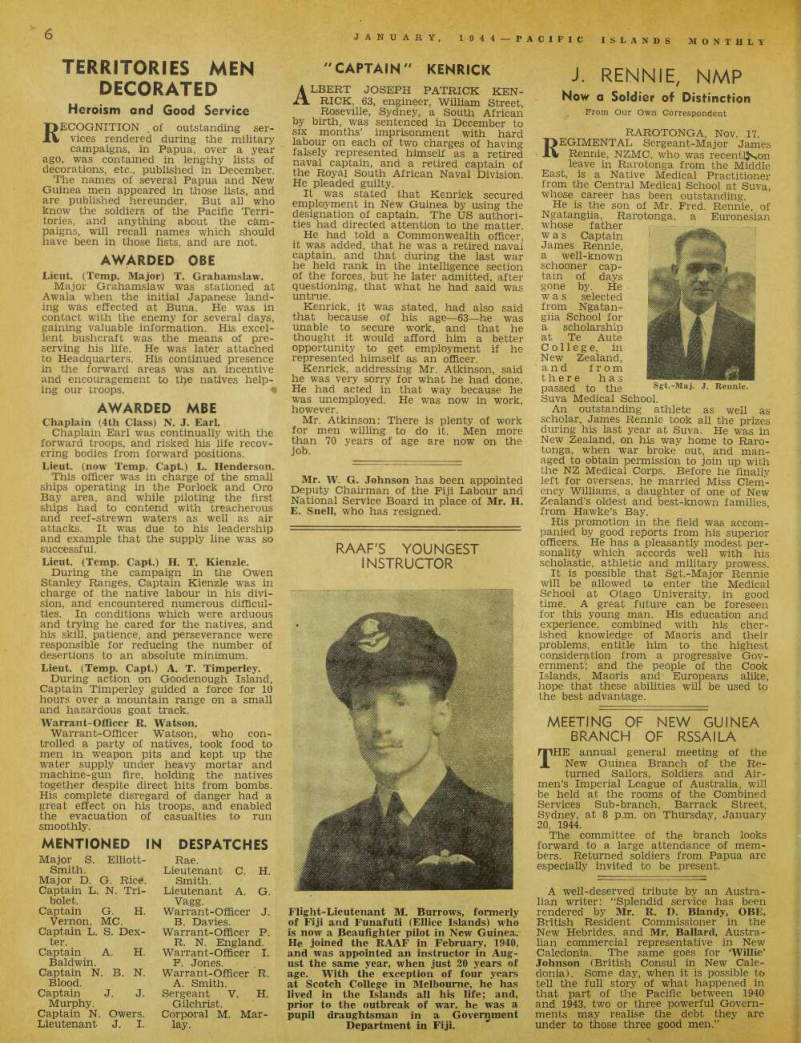
Flight-Lieutenant M. Burrows, formerly of Fiji and Funafuti (Ellice Islands) who is now a Beaufighter pilot in New Guinea.
He joined the RAAF in February, 1940, and was appointed an instructor in Aug ust the same year, when just 20 years of age. With the exception of four years at Scotch College in Melbourne, he has lived in the Islands all his life; and, prior to the outbreak of war, he was a pupil draughtsman in a Government Department in Fiji.
J. Rennie, Nmp
Now a Soldier of Distinction
From Our Own Correspondent
Rarotonga, Nov. 17.
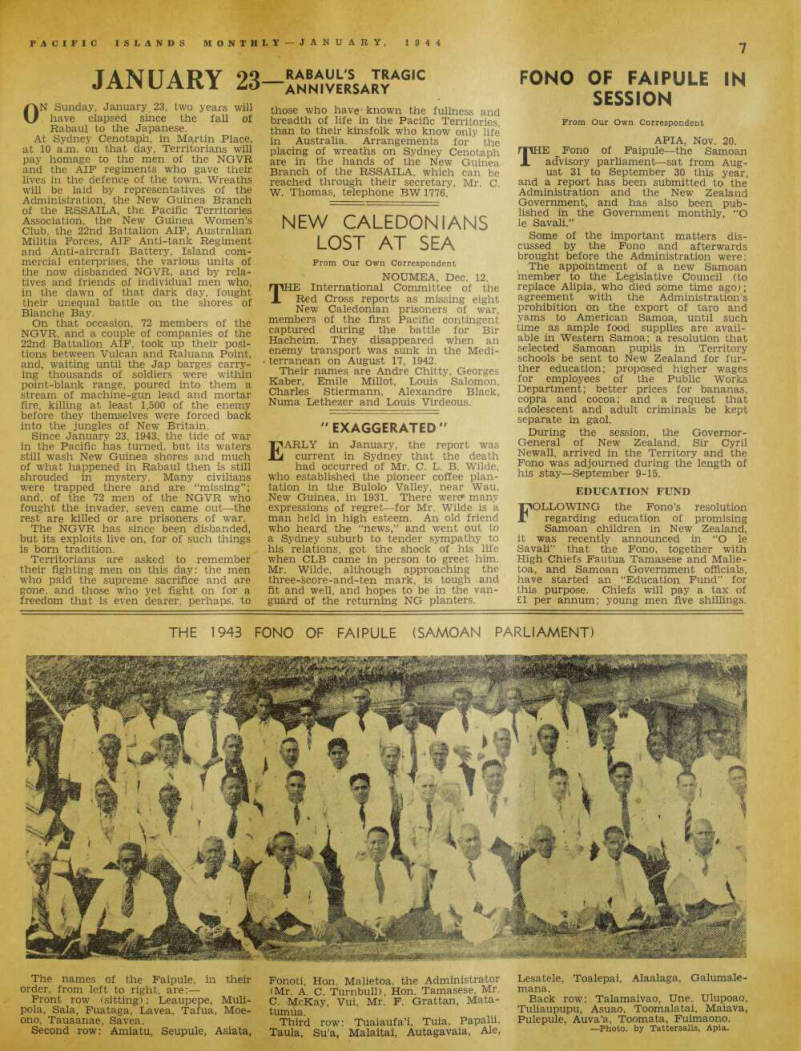
REGIMENTAL Sergeant-Major James Rennie, NZMC, who was recentlison leave In Rarotonga from the Middle East, is a Native Medical Practitioner from the Central Medical School at Suva, whose career has been outstanding.
He is the son of Mr. Fred. Rennie, of Ngatangiia, Rarotonga, a Euronesian
whose father was Captain James Rennie, a well-known schooner cap tain of days gone by. He was selected from Ngatan giia School for a scholarship at Te Ante College, in New Zealand, and from there has passed to the
Suva Medical School.
An outstanding athlete as well as scholar, James Rennie took all the prizes during his last year at Suva. He was in New Zealand, on his way home to Raro tonga, when war broke out, and man aged to obtain permission to join up with the NZ Medical Corps. Before he finally left for overseas, he married Miss Clem ency Williams, a daughter of one of New Zealand’s oldest and best-known families, from Hawke’s Bay.
His promotion in the field was accom panied by good reports from his superior officers. He has a pleasantly modest per sonality which accords well with his scholastic, athletic and military prowess.
It is possible that Sgt.-Major Rennie will be allowed to enter the Medical School at Otago University, in good time. A great future can be foreseen for this young man. His education and experience, combined with his cher ished knowledge of Maoris and their problems, entitle him to the highest consideration from a progressive Gov ernment; and the people of the Cook Islands, Maoris and Europeans alike, hope that these abilities will be used to the best advantage.
Sgt.-Maj. J. Rennie.
Meeting Of New Guinea
Branch Of Rssaila
THE annual general meeting of the New Guinea Branch of the Re turned Sailors, Soldiers and Air men’s Imperial League of Australia, will be held at the rooms of the Combined Services Sub-branch, Barrack Street, Sydney, at 8 p.m. on Thursday, January 20, 1944.
The committee of the branch looks forward to a large attendance of mem bers. Returned soldiers from Papua are especially invited to be present.
A well-deserved tribute by an Austra lian writer: “Splendid service has been rendered by Mr. R. D. Blandy, OBE, British Resident Commissioner in the New Hebrides, and Mr, Ballard, Austra lian commercial representative in New Caledonia. The same goes for ‘Willie’
Johnson (British Consul in New Cale donia). Some day, when it is possible to tell the full story of what happened in that part of the Pacific between 1940 and 1943, two or three powerful Govern ments may realise the debt they are under to those three good men.”
January 23 Rabaul's Tragic
Anniversary
ON Sunday, January 23, two years will have elapsed since the fall of Rabaul to the Japanese.
At Sydney Cenotaph, in Martin Place, at 10 a.m. on that day, Territorians will pay homage to the men of the NGVR and the AIF regiments who gave their lives in the defence of the town. Wreaths will be laid by representatives of the Administration, the New Guinea Branch of the RSSAILA, the Pacific Territories Association, the New Guinea Women’s Club, the 22nd Battalion AIF, Australian Militia Forces, AIF Anti-tank Regiment and Anti-aircraft Battery, Island com mercial enterprises, the various units of the now disbanded NGVR, and by rela tives and friends of individual men who, in the dawn of that dark day, fought their unequal battle on the shores of Blanche Bay.
On that occasion, 72 members of the NGVR, and a couple of companies of the 22nd Battalion AIF, took up their posi tions between Vulcan and Raluana Point, and, waiting until the Jap barges carry ing thousands of soldiers were within point-blank range, poured into them a stream of machine-gun lead and mortar fire, killing at least 1,500 of the enemy before they themselves were forced back into the jungles of New Britain.
Since January 23, 1943, the tide of war in the Pacific has turned, but its waters still wash New Guinea shores and much of what happened in Rabaul then is still shrouded in mystery. Many civilians were trapped there and are “missing”; and. of the 72 men of the NGVR who fought the invader, seven came out—the rest are killed or are prisoners of war.
The NGVR has since been disbanded, but its exploits live on, for of such things is bom tradition.
Territorians are asked to remember their fighting men on this day: the men who paid the supreme sacrifice and are gone, and those who yet fight on for a freedom that is even dearer, perhaps, to
those who have 1 known the fullness and breadth of life in the Pacific Territories, than to their kinsfolk who know only life in Australia. Arrangements for the placing of wreaths on Sydney Cenotaph are in the hands of the New Guinea Branch of the RSSAILA, which can be reached through their secretary, Mr. C.
W. Thomas, telephone BW 1776.
New Caledonians
Lost At Sea
From Our Own Correspondent
Noumea, Dec. 12.
THE International Committee of the Red Cross reports as missing eight New Caledonian prisoners of war, members of the first Pacific contingent captured during the battle for Bir Hacheim. They disappeared when an enemy transport was sunk in the Medi . terranean on August 17, 1942.
Their names are Andre Chitty, Georges Kaber, Emile Millot, Louis Salomon, Charles Stiermann, Alexandre Black, Numa Lethezer and Louis Virdeous.
"Exaggerated"
EARLY in January, the report was current in Sydney that the death had occurred of Mr. C. L. B. Wilde, who established the pioneer coffee plan tation in the Bulolo Valley, near Wau, New Guinea, in 1931. There many expressions of regret—for Mr. Wilde is a man held in high esteem. An old friend who heard the “news,” and went out to a Sydney suburb to tender sympathy to his relations, got the shock of his life when CLB came in person to greet him.
Mr. Wilde, although approaching the three-score-and-ten mark, is tough and fit and well, and hopes to be in the van guard of the returning NG planters.
Session
Fono Of Faipule In
From Our Own Correspondent
Apia, Nov. 20.
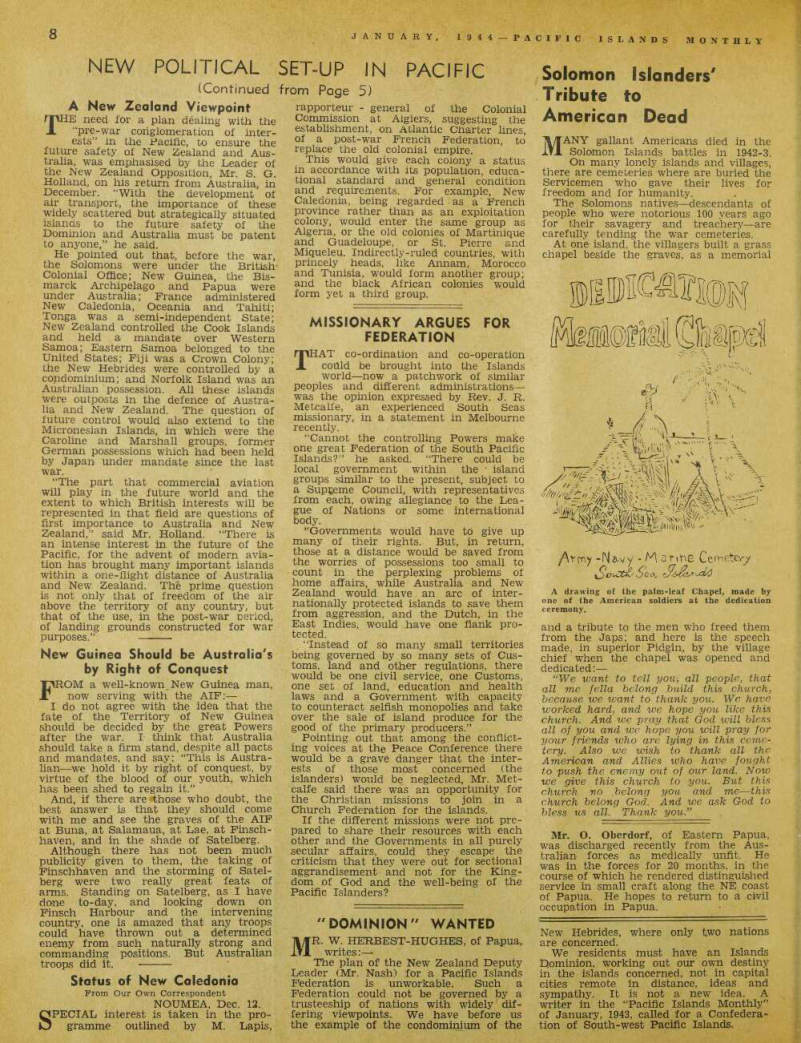
rE Fono of Faipule—the Samoan advisory parliament—sat from Aug ust 31 to September 30 this year, and a report has been submitted to the Administration and the New Zealand Government', and has also been pub lished in the Government monthly, “O le Savali.”
Some of the important matters dis cussed by the Fono and afterwards brought before the Administration were: The appointment of a new Samoan member to the Legislative Council (to replace Alipia, who died some time ago); agreement with the Administration’s prohibition on the export of taro and yams to American Samoa, until such time as ample food supplies are avail able in Western Samoa; a resolution that selected Samoan pupils in Territory schools be sent to New Zealand for fur ther education; proposed higher wages for employees of the Public Works Department; better prices for bananas, copra and cocoa; and a request that adolescent and adult criminals be kept separate in gaol.
During the session, the Governor- General of New Zealand, Sir Cyril Newall, arrived in the Territory and the Fono was adjourned during the length of his stay—September 9-15.
Education Fund
FOLLOWING the Fono’s resolution regarding education of promising Samoan children in New Zealand, it was recently announced in “O le Savali” that the Fono, together with High Chiefs Fautua Tamasese and Malie toa, and Samoan Government officials, have started an ‘‘Education Fund” for this purpose. Chiefs will pay a tax of £1 per annum; young men five shillings.
The 1943 Fono Of Faipule (Samoan Parliament)
The names of the Faipule, in their order, from left to right, are:— Front row (sitting); Leaupepe, Muli pola, Sala, Fuataga, Lavea, Tafua, Moe ono, Tauaanae, Savea.
Second row: Amiatu, Seupule, Asiata,
Fonoti, Hon. Malietoa, the Administrator (Mr. A. C. Turnbull), Hon. Tamasese, Mr.
C. McKay, Vui, Mr. F. Grattan, Mata tumua.
Third row: Tuaiaufa’i, Tuia. Papain, Taula, Su’a, Malaitai, Autagavaia, Ale,
Lesatele, Toalepai, Alaalaga, Galumale mana.
Back row: Talamaivao, Une, Ulupoao, Tuliaupupu, Asuao, Toomalatai, Maiava, Pulepule, Auva’a, Toomata, Fuimaono. —Photo, by Tattersalls, Apia.
Missionary Argues For
Federation
THAT co-ordination and co-operation could be brought into the Islands world —now a patchwork of similar peoples and different administrations— was the opinion expressed by Rev. J. R.
Metcalfe, an experienced South Seas missionary, in a statement in Melbourne recently.
“Cannot the controlling Powers make one great Federation of the South Pacific Islands?” he asked. “There could be local government within the • island groups similar to the present, subject to a Supreme Council, with representatives from each, owing allegiance to the Lea gue of Nations or some international body.
“Governments would have to give up many of their rights. But, in return, those at a distance would be saved from the worries of possessions too small to count in the perplexing problems of home affairs, while Australia and New Zealand would have an arc of inter nationally protected islands to save them from aggression, and the Dutch, in the East Indies, would have one flank pro tected.
“Instead of so many small territories being governed by so many sets of Cus toms, land and other regulations, there would be one civil service, one Customs, one set of land, education and health laws and a Government with capacity to counteract selfish monopolies and take over the sale of island produce for the good of the primary producers.”
Pointing out that among the conflict ing voices at the Peace Conference there would be a grave danger that the inter ests of those most concerned (the islanders) would be neglected, Mr. Met calfe said there was an opportunity for the Christian missions to join in a Church Federation for the islands.
If the different missions were not pre pared to share their resources with each other and the Governments in all purely secular affairs, could they escape the criticism that they were out for sectional aggrandisement and not for the King dom of God and the well-being of the Pacific Islanders?
"Dominion" Wanted
Mr. W. Herbest-Hughes, Of Papua,
writes:— The plan of the New Zealand Deputy Leader (Mr. Nash) for a Pacific Islands Federation is unworkable. Such a Federation could not be governed by a trusteeship of nations with widely dif fering viewpoints. We have before us the example of the condominium of the
New Hebrides, where only two nations are concerned.
We residents must have an Islands Dominion, working out our own destiny in the islands concerned, not in capital cities remote in distance, ideas and sympathy. It is not a new idea. A writer in the “Pacific Islands Monthly” of January, 1943, called for a Confedera tion of South-west Pacific Islands.
American Dead
Solomon Islanders' Tribute to American Dead
MANY gallant Americans died in the Solomon Islands battles in 1942-3.
On many lonely islands and villages, there are cemeteries where are buried the Servicemen who gave their lives for freedom and for humanity.
The Solomons natives—descendants of people who were notorious 100 years ago for their savagery and treachery—are carefully tending the war cemeteries.
At one island, the villagers built a grass chapel beside the graves, as a memorial
and a tribute to the men who freed them from the Japs; and here is the speech made, in superior Pidgin, by the village chief when the chapel was opened and dedicated: — “We want to tell you, all people, that all me fella belong build this church, because we want to thank you. We have worked hard, and we hope you like this church. And we pray that God will bless all of you and we hope you will pray for your friends who are lying in this ceme tery. Also we wish to thank all the American and Allies who have fought to push the enemy out of our land. Now we give this church to you. But this church no belong you and me—this church belong God. And we ask God to bless us all. Thank you.”
Mr. O. Oberdorf, of Eastern Papua, was discharged recently from the Aus tralian forces as medically unfit. He was in the forces for 20 months, in the course of which he rendered distinguished service in small craft along the NE coast of Papua. He hopes to return to a civil occupation in Papua.
A drawing of the palm-leaf Chapel, made by one of the American soldiers at the dedication ceremony.
Advertisements & other items, p. 10 (1 item)
New Political Set-Up In Pacific
8
944 PACIFIC ISLANDS MONTHLY
JANUARY, 1
NEW POLITICAL SET-UP IN PACIFIC
(Continued from Page 5)
Prepare To Wage
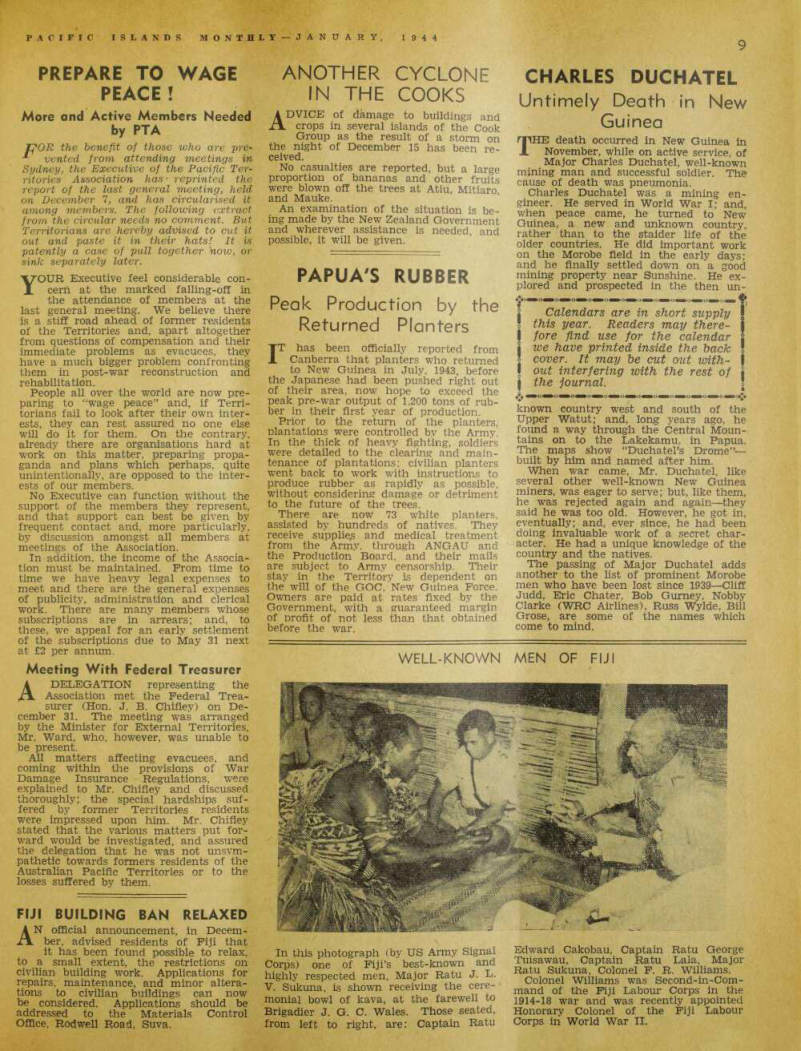
Peace!
More and Active Members Needed
by PTA
J?OR the benefit of those who are pre vented from attending meetings in Sydney, the Executive of the Pacific Ter ritories Association has ■ reprinted the report of the last general meeting, held on December 1, and has circularised it among members. The following extract from the circular needs no comment. But Territorians are hereby advised to cut it out and paste it in their hats! It is patently a case of pull together how, or sink separately later.
YOUR Executive feel considerable con cern at the marked falling-off in the attendance of members at the last general meeting. We believe there is a stiff road ahead of former residents of the Territories and, apart altogether from questions of compensation and their immediate problems as evacuees, they have a much bigger problem confronting them in post-war reconstruction and rehabilitation.
People all over the world are now pre paring to “wage peace” and, if Terri torians fail to look after their own inter ests, they can rest assured no one else will do it for them. On the contrary, already there are organisations hard at work on this matter, preparing propa ganda and plans which perhaps, quite unintentionally, are opposed to the inter ests of our members.
No Executive can function without the support of the members they represent, and that support can best be given by frequent contact and, more particularly, by discussion amongst all members at meetings of the Association.
In addition, the income of the Associa tion must be maintained. From time to time we have heavy legal expenses to meet and there are the general expenses of publicity, administration and clerical work. There are many members whose subscriptions are in arrears; and, to these, we appeal for an early settlement of the subscriptions due to May 31 next at £2 per annum.
Meeting With Federal Treasurer
A DELEGATION representing the Association met the Federal Trea surer (Hon. J. B. Chifley) on De cember 31. The meeting was arranged by the Minister for External Territories, Mr. Ward, who, however, was unable to be present.
All matters affecting evacuees, and coming within the provisions of War Damage Insurance Regulations, were explained to Mr. Chifley and discussed thoroughly; the special hardships suf fered by former Territories residents were impressed upon him. Mr. Chifley stated that the various matters put for ward would be investigated, and assured the delegation that he was not unsym pathetic towards formers residents of the Australian Pacific Territories or to the losses suffered by them.
Fiji Building Ban Relaxed
AN official announcement, in Decem ber, advised residents of Fiji that it has been found possible to relax, to a small extent, the restrictions on civilian building work. Applications for repairs, maintenance, and minor altera tions to civilian buildings can now be considered. Applications should be addressed to the Materials Control Office, Rod well Road, Suva.
Another Cyclone
In The Cooks
ADVICE of damage to buildings and crops in several islands of the Cook tbp P nf S nprpm I hPr lt is of v. a S i!: onn on iplved h December 15 has been re- No casualties are reported, but a large rrnrn^ b tt n eT^, an f d A ?- the LT Ults ° S the treeS at Atlu ’ Mltlaro - examination of the situation is be ing made by the New Zealand Government iS needed ’ and possible, it will be given.
Papua's Rubber
Peak Production by the Returned Planters
1T has been officially reported from Canberra that planters who returned to New Guinea in July, 1943, before the Japanese had been pushed right out of their area, now hope to exceed the peak pre-war output of 1,200 tons of rub ber in their first year of production.
Prior to the return of the planters, plantations were controlled by the Army.
In the thick of heavy fighting, soldiers were detailed to the clearing and main tenance of plantations; civilian planters went back to work with instructions to produce rubber as rapidly as possible, without considering damage or detriment to the future of the trees.
There are now 73 white planters, assisted by hundreds of natives. They receive suppliers and medical treatment from the Army, through ANGAU and the Production Board, and their mails are subject to Army censorship. Their stay in the Territory is dependent on the will of the GOC, New Guinea Force.
Owners are paid at rates fixed by the Government, with a guaranteed margin of profit of not less than that obtained before the war.
Charles Duchatel
Untimely Death in New Guinea
THE death occurred in New Guinea in November, while on active service, of Major Charles Duchatel, well-known mining man and successful soldier. The cause of death was pneumonia.
Charles Duchatel was a mining en gineer. He served in World War I; and, when peace came, he turned to New Guinea, a new and unknown country, rather than to the staider life of the older countries. He did important work on the Morobe field in the early days; and he finally settled down on a good mining property near Sunshine. He ex plored and prospected in the then un-
Calendars are in short supply this year. Readers may there fore find use for the calendar we have printed inside the back cover. It may be cut out with out interfering with the rest of the journal.
known country west and south of the Upper Watut; and, long years ago, he found a way through the Central Moun tains on to the Lakekamu. in Papua.
The maps show “Duchatel's Drome”— built by him and named after him.
When war came, Mr. Duchatel, like several other well-known New Guinea miners, was eager to serve; but, like them, he was rejected again and again—they said he was too old. However, he got in, eventually; and, ever since, he had been doing invaluable work of a secret char acter. He had a unique knowledge of the country and the natives.
The passing of Major Duchatel adds another to the list of prominent Morobe men who have been lost since 1939 —Cliff Judd, Eric Chater, Bob Gurney, Nobby Clarke (WRC Airlines), Russ Wylde, Bill Grose, are some of the names which come to mind.
Well-Known Men Of Fiji
In this photograph (by US Army Signal Corns) one of Fill’s best-known and T L highly respected men, Major Ra • • V. Sukuna, is shown receiving the ceremonial bowl of kava, at the farewell to Brigadier J. G. C. Wales. Those seated, from left to right, are; Captain Ratu
Edward Cakobau, Captain Ratu George Tuisawau, Captain Ratu Lala, Major R a tu Sukuna, Colonel F. R. Williams, Colonel Williams was Second-in-Com mancj 0 f the Fiji Labour Corps in the 1914-I8 war and was recently appointed Honorary Colonel of the Fiji Labour Corps in World War 11.
°to tve
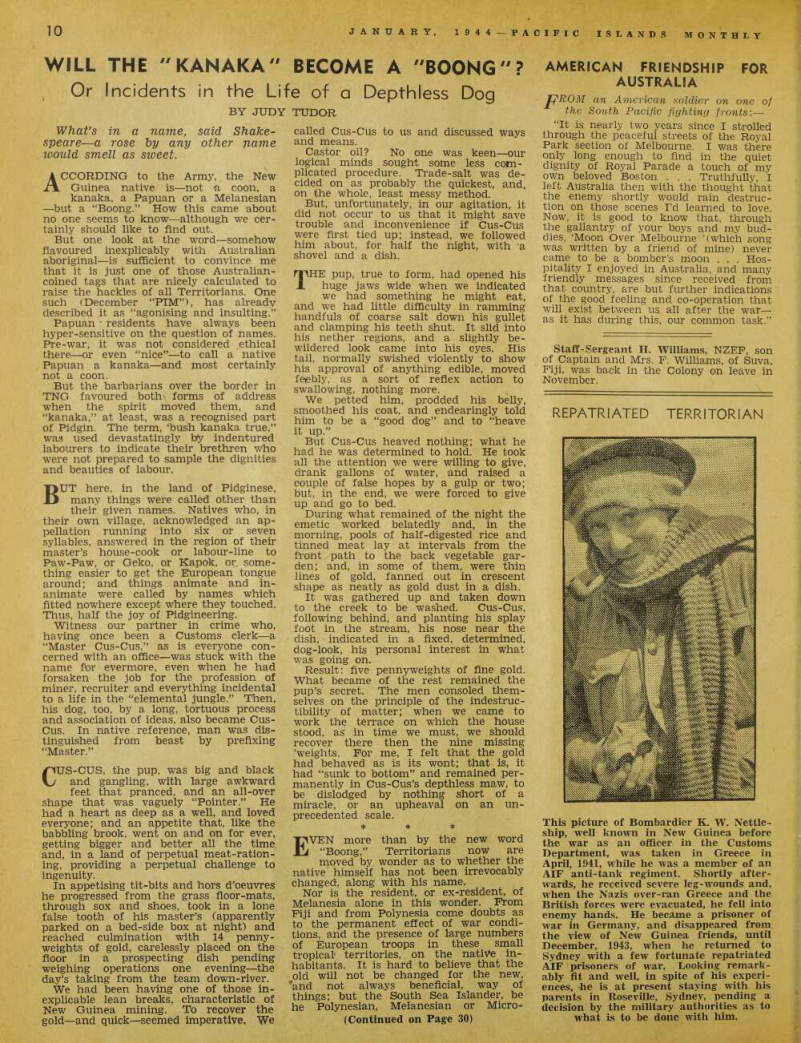
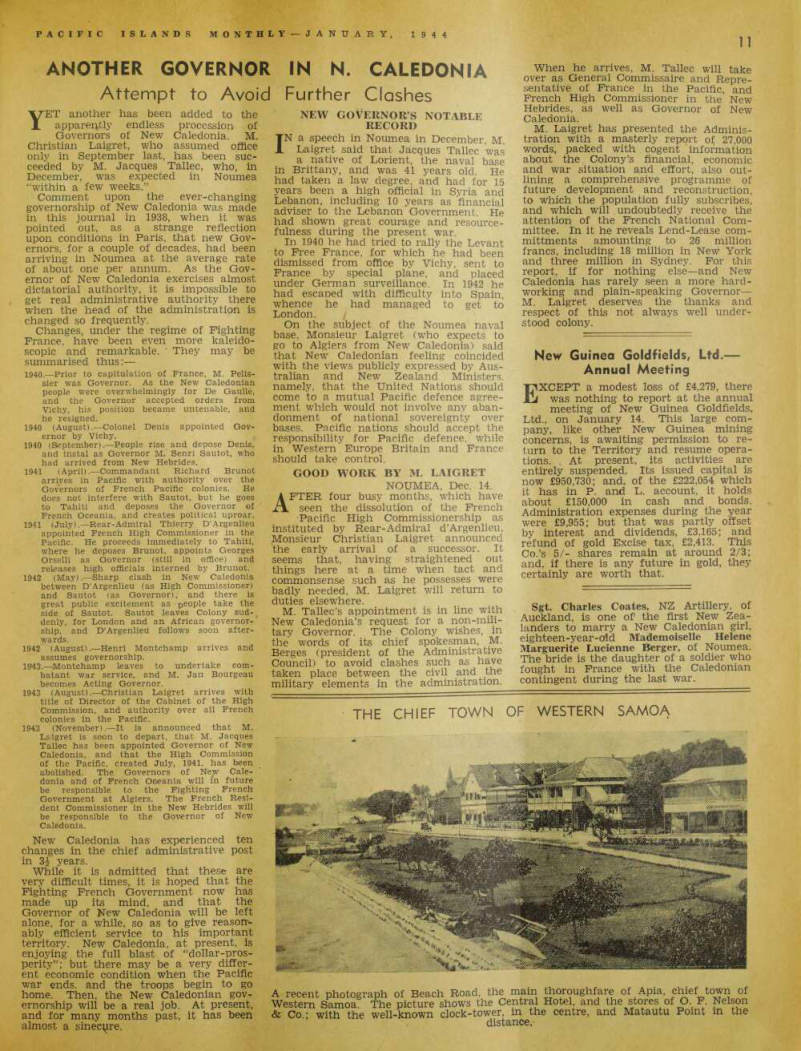
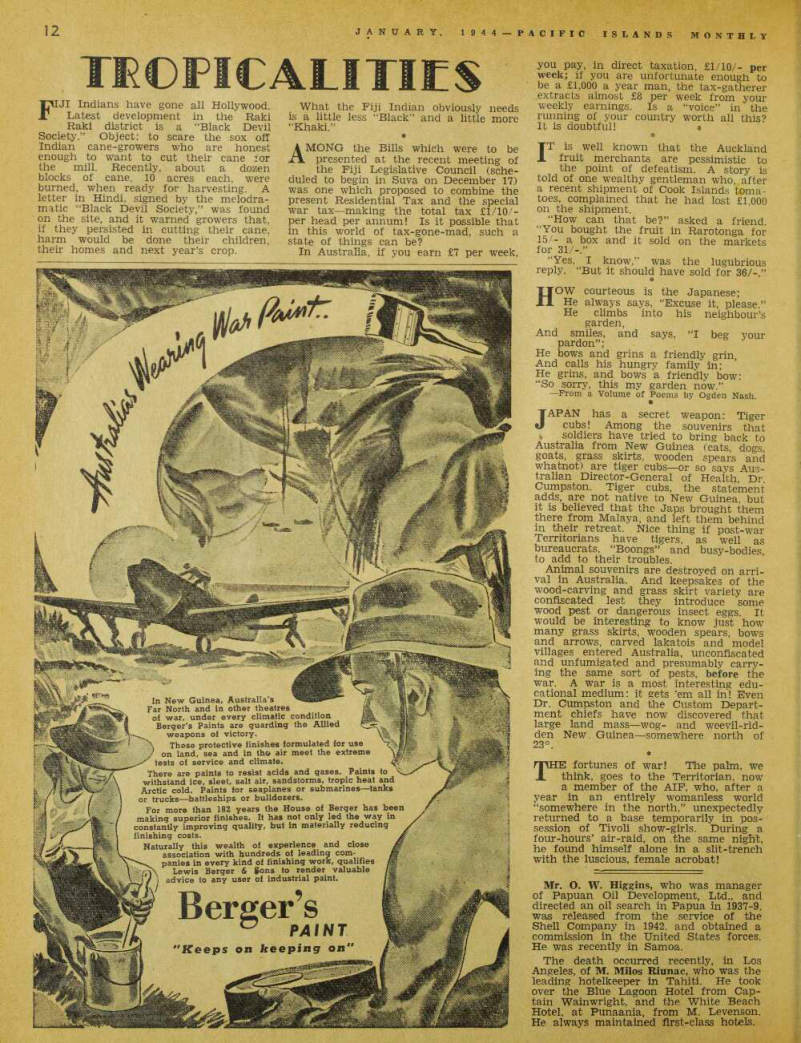
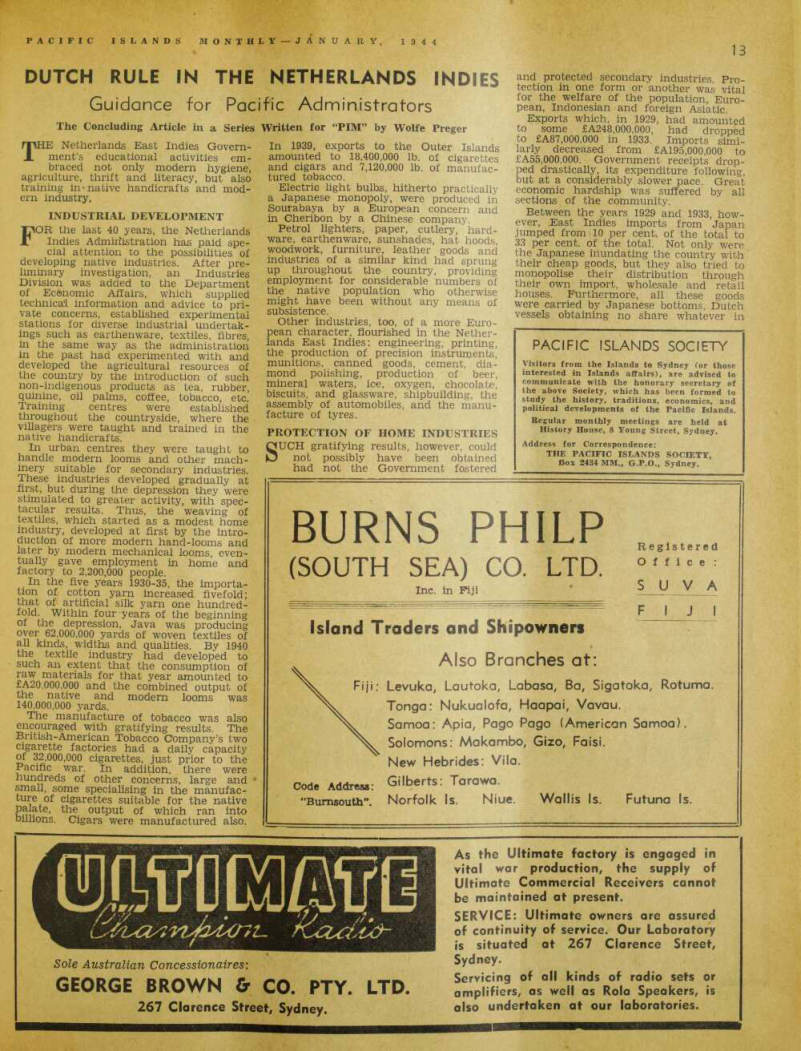
Will The "Kanaka" Become A "Boong"?
Or Incidents in the Life of a Depthless Dog
By Judy Tudor
What’s in a name, said Shakespeare—a rose by any other name would smell as sweet.
ACCORDING to the Army, the New Guinea native is-not a coon, a kanaka, a Papuan or a Melanesian —but a “Boong.” How this came about no one seems to know-although we certninlv should like to find out But one look at the word-somehow flavoured inexplicably with Australian aboriginal—is sufficient to convince me that it is just one of those Australianraise the hackles of all Territorians One such (December PIM ), has already described it as agonising and insulting.
Papuan - residents have always been hyper-sensitive on the question of names Pre-war, it not considered ethical there or even nice to call a native Papuan a kanaka and most certainly nc £ . . .. . , _®ut P l 6 bar J ar l J a J l s °7 er border in TNG favoured both forms of address when the spirit moved them, and kanaka, at least, was a recognised part of Pidgin. The term, ‘bush kanaka true,” was used by indentured labourers to indicate their brethren who were not prepared to sample the dignities and beauties of labour.
T>UT here, in the land of Pidginese, MJ many things were called other than their given names. Natives who, in their own village, acknowledged an appellation running into or seven syllables, answered in the region of their master s house-cook or labour-line to Paw-Paw, or Geko, or Kapok, or something easier to get the European tongue around; and things animate and inanimate were called by names which Sited nowhere except where they touched.
Thus, half the joy of Pidgmeermg.
Witness our partner in crime who, ?, a , vir l g °£ ce J? a 9 ustoms clerk a ‘ Master Cus-Cus, ’ as is everyone concerned with an office—was stuck with the name for evermore, even when he had forsaken the job for the profession of miner, recruiter and everything incidental to a life in the “elemental jungle.” Then, his dog, too, by a long, tortuous process and association of ideas, also became Cus- Cus. In native reference, man was distinguished from beast by prefixing “Master.”
C TT „ _, TTO , , . ~, .
US-CUS, the pup, was big and black and gangling, with large awkward feet that pranced, and an all-over shape that was vaguely “Pointer.” He had a heart as deep as a well, and loved everyone; and an appetite that, like the babbling brook, went on and on for ever, getting bigger and better all the time and, in a land of perpetual meat-rationing, providing a perpetual challenge to ingenuity.
In appetising tit-bits and hors d’oeuvres he progressed from the grass floor-mats, through sox and shoes, took in a lone false tooth of his master’s (apparently parked on a bed-side box at night) and reached culmination with 14 pennyweights of gold, carelessly placed on the floor in a prospecting dish pending weighing operations one evening—the day’s taking from the team down-river.
We had been having one of those inexplicable lean breaks, characteristic of New Guinea mining. To recover the gold—and quick—seemed imperative. We
called Cus-Cus to us and discussed ways a nd means.
Castor oil? No one was keen—our logical minds sought some less com plicated procedure Trade-salt was de °n „ as , the Q™£est. and, on «| e least messy method . agnation, it *5, °“ ur . ‘|“ t J lt ,™g ht trouble and inconvenience if Cus-Cus
nfm atam
alf the mght ’ wlth a snovel ana a dlsn mHE pup, true to form, had opened his 1 huge jaws wide when we indicated we had some thing he might eat, and we bad b ttle d ifft cu it y i n ramming handfuls of coarse salt down his gullet and c i amp ing his teeth shut. It slid into his nether ? eg ions, and a slightly be wildered look came into his eyes. His tail, normally swished violently to show his approval of anything edible, moved feebly, as a sort of reflex action to swallowing, nothing more.
We petted him> prodded his be n y , smoothed his coat, and endearingly told him to be a “good dog” and to “heave up » But C us-Cus heaved nothing; what he had he was determined to hold. He took a p the attention we were willing to give, drank gallons of water, and raised a
°to tve
So aAd go to bed During what remained of the night the emetic worked belatedly and, in the morning, pools of half-digested rice and tinned meat lay at intervals from the front path to the back vegetable gar den. and> j n some 0 f them, were thin lines of go i d> f anned ou t i n crescent shape as neatly as gold dust in a dish, it was gathered up and taken down to the creek to be washe d. Cus-Cus, following behind, and planting his splay foot j n the stream, his nose near the dish, indicated in a fixed, determined, dog-look, his personal interest in what wa g going on.
Result: five pennyweights of fine gold, what became of the rest remained the pup > s secret. The men consoled them selves on the principle of the indestruc tibility of matter; when we came to wor k the terrace on which the house s t oo d, as in time we must, we should recover there then the nine missing ’weights. For me, I felt that the gold had behaved as is its wont; that is, it had <‘ Simk to bottom” and remained per manently in Cus-Cus’s depthless maw, to be dislodged by nothing short of a miracle, or an upheaval on an un precedented scale, * * * T XT . t . .. „ arXT more than by the new word “Boong, Territorians now are moved by wonder as to whether the native himself has not been irrevocably changed, along with his name, Nor ls . the resident, or ex-resident, of Melanesia alone in this wonder. Prom Fiji and from Polynesia come doubts as Jo the permanent effect of war condi tions, and the presence of large numbers °t European troops in these small tropical territories, on the na tivte in habitants. It is hard to believe that the y old will not be changed for the new. a A d no J a Jways n So 18 ™ o uf things; but the South Islander, be be Polynesian, Melanesian or Micro
(Continued on Page 30)
nesian, has an infinite capacity for for getting, and a facility for returning and picking up the loose ends of an existence seemingly buried beneath a thick layer of civilisation and sophistication.
The Territorian’s agitation is under standable enough. Anyone who, in the days of peace, experienced the stay of a cruise-ship in an island port—the sudden decanting of hundreds of hot, perspiring, Europeans, products of their environment and oozing suburbia, into a world self-coloured by their preconceived ideas of “glamour” in the tropics and of the Islander himself—realises that the sudden arrival of thousands of service men as semi-permanent residents in these Territories must have reper cussions.
As for New Guinea, the whole position is perhaps best summarised by the old timer who came out of the Territory only towards the end of last year, and who has again returned to somewhere in the north. His observation of the natives working in Port Moresby who must have taken the full brunt of soldier-native contact, lead him to the belief that their attitude to Territorians, or those whom they had reason to re spect, was unchanged; and that their insolence, pig-headedness, stubborness and other forms of irritation, at which the Melanesian is past-master when in the mood, was saved exclusively for those who knew nothing of the workings of the Melanesian mind and less of his
background and pre-war place in the scheme of things.
Whether the old Papuan—native, kanaka or coon—is to turn permanently into a “Fuzzy Wuzzy” or a “Boong,” depends, not so much on the military rank and file, as on that nucleus who are men of ANGAU in these days, but who will be the men of the Adminis trations in the immediate post-war years.
They, by their specialised knowledge of the country and people, and by their own bearing and significance in the eyes of the Melanesian (who admires strength, moral, physical or mental, above all) will lead the native, bewildered now, maybe, back along the path, not to the old way of things, but to some half-way house, where in normal peace time surroundings and circumstances, he can be assisted to develop along the lines which suit him best.
American Friendship For
Australia
pROM an American soldier on one of the South Pacific fighting fronts: — “It is nearly two years since I strolled through the peaceful streets of the Royal Park section of Melbourne. I was there only long enough to find in the quiet dignity of Royal Parade a touch of my own beloved Boston . . . Truthfully, I left Australia then with the thought that the enemy shortly would rain destruc tion on those scenes I’d learned to love.
Now, it is good to know that, through the gallantry of your boys and my bud dies, ‘Moon Over Melbourne'’(which song was written by a friend of mine) never came to be a bomber’s moon . . . Hos pitality I enjoyed in Australia, and many friendly messages since received from that country, are but further indications of the good feeling and co-operation that will exist between us all after the war— as it has during this, our common task.”
Staff-Sergeant H. Williams, NZEF, son of Captain and Mrs. F. Williams, of Suva, Fiji, was back in the Colony on leave in November.
Repatriated Territorian
This picture of Bombardier K. W. Nettle ship, well known in New Guinea before the war as an officer in the Customs Department, was taken in Greece in April, 1941, while he was a member of an AIF anti-tank regiment. Shortly after wards, he received severe leg-wounds and, when the Nazis over-ran Greece and the British forces were evacuated, he fell into enemy hands. He became a prisoner of war in Germany, and disappeared from the view of New Guinea friends, until December, 1943, when he returned to Sydney with a few fortunate repatriated AIF prisoners of war. Looking remark ably fit and well, in spite of his experi ences, he is at present staying with his parents in Roseville, Sydney, pending a decision by the military authorities as to what is to be done with him.
Another Governor In N. Caledonia
Attempt to Avoid Further Clashes
YET another has been added to the apparently endless procession of Governors of New Caledonia. M.
Christian Laigret, who assumed office only in September last, has been suc ceeded by M. Jacques Tallec, who, in December, was expected in Noumea “within a few weeks.”
Comment upon the ever-changing governorship of New Caledonia was made in this journal in 1938, when it was pointed out, as a strange reflection upon conditions in Paris, that new Gov ernors, for a couple of decades, had been arriving in Noumea at the average rate of about one per annum. As the Gov ernor of New Caledonia exercises almost dictatorial authority, it is impossible to get real administrative authority there when the head of the administration is changed so frequently.
Changes, under the regime of Fighting France, have been even more kaleido scopic and remarkable. * They may be summarised thus: — 1940. —Prior to capitulation of France, M. Pelis sier was Governor. As the New Caledonian people were overwhelmingly for De Gaulle, and the Governor accepted orders from Vichy, his position became untenable, and he resigned. 1940 (August).—Colonel Denis appointed Gov ernor by Vichy, 1940 (September).—People rise and depose Denis, and instal as Governor M. Senri Sautot, who had arrived from New Hebrides. 1941 (April).—Commandant Richard Brunot arrives in Pacific with authority over the Governors of French Pacific colonies. He does not interfere with Sautot, but he goes to Tahiti and deposes the Governor of French Oceania, and creates political uproar. 1941 (July).—Rear-Admiral Thierry D’Argenlieu appointed French High Commissioner in the Pacific. He proceeds immediately to Tahiti, where he deposes Brunot, appoints Georges Orselli as Governor (still in office) and releases high officials interned by Brunot. 1942 (May).—Sharp clash in New Caledonia between D’Argenlieu (as High Commissioner) and Sautot (as Governor), and there is great public excitement as people take the side of Sautot. Sautot leaves Colony sud denly, for London and an African governor ship, and D’Argenlieu follows soon after wards. 1942 (August).—Henri Montchamp arrives and assumes governorship. 19'43.—Montchamp leaves to undertake com batant war service, and M. Jan Bourgeau becomes Acting Governor. 1943 (August).—Christian Laigret arrives with title of Director of the Cabinet of the High Commission, and authority over all French colonies in the Pacific. 1943 (November). —It is announced that M.
Laigret is soon to depart, that M. Jacques Tallec has been appointed Governor of New Caledonia, and that the High Commission of the Pacific, created July, 1941, has been abolished. The Governors of New Cale donia and of French Oceania will in future be responsible to the Fighting French Government at Algiers. The French Resi dent Commissioner in the New Hebrides will be responsible to the Governor of New Caledonia.
New Caledonia has experienced ten changes in the chief administrative post in 3£ years.
While it is admitted that these are very difficult times, it is hoped that the Fighting French Government now has made up its mind, and that the Governor of New Caledonia will be left alone, for a while, so as to give reason ably efficient service to his important territory. New Caledonia, at present, is enjoying the full blast of “dollar-pros perity”; but there may be a very differ ent economic condition when the Pacific war ends, and the troops begin to go home. Then, the New Caledonian gov ernorship will be a real job. At present, and for many months past, it has been almost a sinecure.
New Governor’S Notable
Record
IN a speech in Noumea in December, M.
Laigret said that Jacques Tallec was a native of Lorient, the naval base in Brittany, and was 41 years old. He had taken a law degree, and had for 15 years been a high official in Syria and Lebanon, including 10 years as financial adviser to the Lebanon Government. He had shown great courage and resource fulness during the present war.
In 1940 he had tried to rally the Levant to Free France, for which he had been dismissed from office by Vichy, sent to France by special plane, and placed under German surveillance. In 1942 he had escaped with difficulty into Spain, whence he had managed to get to London.
On the subject of the Noumea naval base, Monsieur Laigret (who expects to go to Algiers from New Caledonia) said that New Caledonian feeling coincided with the views publicly expressed by Aus tralian and New Zealand Ministers, namely, that the United Nations should come to a mutual Pacific defence agree ment which would not involve any aban donment of national sovereignty over bases. Pacific nations should accept the responsibility for Pacific defence, while in Western Europe Britain and France should take control.
Good Work By M. Laigret
Noumea, Dec. 14.
AFTER four busy months, which have seen the dissolution of the French ■Pacific High Commissionership as instituted by Rear-Admiral d’Argenlieu, Monsieur Christian Laigret announced the early arrival of a successor. It seems that, having straightened out things here at a time when tact and commonsense such as he possesses were badly needed, M. Laigret will return to duties elsewhere.
M. Tallec’s appointment is in line with New Caledonia’s request for a non-mili tary Governor. The Colony wishes, in the words of its chief spokesman, M.
Berges (president of the Administrative Council) to avoid clashes such as have taken place between the civil and the military elements in the administration.
When he arrives, M. Tallec will take over as General Commissaire and Repre sentative of France in the Pacific, and French High Commissioner in the New Hebrides, as well as Governor of New Caledonia.
M. Laigret has presented the Adminis tration with a masterly report of 27,000 words, packed with cogent information about the Colony’s financial, economic and war situation and effort, also out lining a comprehensive programme of future development and reconstruction, to which the population fully subscribes, and which will undoubtedly receive the attention of the French National Com mittee. In it he reveals Lend-Lease com mittments amounting to 26 million francs, including 18 million in New York and three million in Sydney. For this report, if for nothing else—and New Caledonia has rarely seen a more hard working and plain-speaking Governor — M. Laigret deserves the thanks and respect of this not always well under stood colony.
Annual Meeting
New Guinea Goldfields, Ltd.— Annual Meeting
EXCEPT a modest loss of £4,279, there was nothing to report at the annual meeting of New Guinea Goldfields, Ltd., on January 14. This large com pany, like other New Guinea mining concerns, is awaiting permission to re turn to the Territory and resume opera tions. At present, its activities are entirely suspended. Its issued capital is now £950,730; and, of the £222,054 which it has in P. and L. account, it holds about £150,000 in cash and bonds.
Administration expenses during the year were £9,955; but that was partly offset by interest and dividends, £3,165; and refund of gold Excise tax, £2,413. This Co.’s 5/- shares remain at around 2/3; and, if there is any future in gold, they certainly are worth that.
Sgt. Charles Coates, NZ Artillery, of Auckland, is one of the first New Zea landers to marry a New Caledonian girl, eighteen-year-oid Mademoiselle Helene Marguerite Lucienne Berger, of Noumea.
The bride is the daughter of a soldier who fought in France with the Caledonian contingent during the last war.
The Chief Town Of Western Samoa
A recent photograph of Beach Road, the main thoroughfare of Apia, chief town of Western Samoa. The picture shows the Central Hotel, and the stores of O. F. Nelson & Co.; with the well-known clock-tower, in the centre, and Matautu Point in the distance.
Tropicalities
FIJI Indians have gone all Hollywood.
Latest development in the Raki Raki district is a “Black Devil Society.” Object: to scare the sox off Indian cane-growers who are honest enough to want to cut their cane for the mill. Recently, about a dozen blocks of cane, 10 acres each, were burned, when ready for harvesting. A letter in Hindi, signed by the melodra matic “Black Devil Society,” was found on the site, and it warned growers that, if they persisted in cutting their cane, harm would be done their children, their homes and next year’s crop.
What the Fiji Indian obviously needs is a little less “Black” and a little more “Khaki.” * A MONO the Bills which were to be presented at the recent meeting of the Fiji Legislative Council (sche duled to begin in Suva on December 17) was one which proposed to combine the present Residential Tax and the special war tax—making the total tax £l/10/per head per annum! Is it possible that in this world of tax-gone-mad, such a state of things can be?
In Australia, if you earn £7 per week,
you pay, in direct taxation, £l/10/- per week; if you are unfortunate enough to be a £l,OOO a year man, the tax-gatherer extracts almost £8 per week from your weekly earnings. Is a “voice” in the running of your country worth all this?
It is doubtful! » IT is well known that the Auckland fruit merchants are pessimistic to the point of defeatism. A story is told of one wealthy gentleman who, after a recent shipment of Cook Islands toma toes, complained that he had lost £l,OOO on the shipment.
“How can that be?” asked a friend “You bought the fruit in Rarotonga for 15/- a box and it sold on the markets for 31/-.”
“Yes, I know,” was the lugubrious reply. “But it should have sold for 36/-.” ♦ HOW courteous is the Japanese; He always says, “Excuse it, please.”
He climbs into his neighbour’s garden, And smiles, and says, “I beg your pardon”; He bows and grins a friendly grin, And calls his hungry family in; He grins, and bows a friendly bow: “So sorry, this my garden now.” —From a Volume of Poems by Ogden Nash.
JAPAN has a secret weapon: Tiger cubs! Among the souvenirs that soldiers have tried to bring back to Australia from New Guinea (cats, dogs goats, grass skirts, wooden spears and whatnot) are tiger cubs—or so says Aus tralian Director-General of Health Dr Cumpston. Tiger cubs, the statement adds, are not native to New Guinea, but it is believed that the Japs brought them there from Malaya, and left them behind in their retreat. Nice thing if post-war Territorians have tigers, as well as bureaucrats, “Boongs” and busy-bodies, to add to their troubles.
Animal souvenirs are destroyed on arri val in Australia. And keepsakes of the wood-carving and grass skirt variety are confiscated lest they introduce some wood pest or dangerous insect eggs. It would be interesting to know just how many grass skirts, wooden spears, bows and arrows, carved lakatois and model villages entered Australia, unconfiscated and unfumigated and presumably carry ing the same sort of pests, before the war. A war is a most interesting edu cational medium: it gets ’em all in! Even Dr. Cumpston and the Custom Depart ment chiefs have now discovered that large land mass—wog- and weevil-rid den New Guinea—somewhere north of 23°. * rE fortunes of war! The palm, we think, goes to the Territorian, now a member of the AIP, who, after a year in an entirely womanless world “somewhere in the north,” unexpectedly returned to a base temporarily in pos session of Tivoli show-girls. During a four-hours’ air-raid, on .the same night, he found himself alone in a slit-trench with the luscious, female acrobat!
Mr. O. W. Higgins, who was manager of Papuan Oil Development, Ltd., and directed an oil search in Papua in 1937-9, was released from the service of the Shell Company in 1942. and obtained a commission in the United States forces.
He was recently in Samoa.
The death occurred recently, in Los Angeles, of M. Milos Riunac, who was the leading hotelkeeper in Tahiti. He took over the Blue Lagoon Hotel from Cap tain Wainwright, and the White Beach Hotel, at Punaania, from M. Levenson.
He always maintained first-class hotels.
Advertisements & other items, p. 14 (1 item)
(favt:
it/** 4/1 S 3?.
In New Guinea, Australia's Far North and in other theatres of war, under every climatic condition Berger's Paints are guarding the Allied weapons of victory.
These protective finishes formulated for use on land, sea and in tho air meet the extreme tests of service and climate.
There are paints to resist acids and gases. Paints to withstand ice, sleet, salt air, sandstorms, tropic heat and Arctic cold. Paints for seaplanes or submarines—tanks or trucks —battleships or bulldozers.
For more than 182 years the House of Berger has been making superior finishes. It has not only led the way in constantly improving quality, but in materially reducing finishing costs.
Naturally this wealth of experience and close association with hundreds of leading companies in every kind of finishing work, qualifies Lewis Berger & Sons to render valuable advice to any user of industrial paint.
Berger’s
° PAINT
Keeps on keeping on"
Dutch Rule In The Netherlands Indies
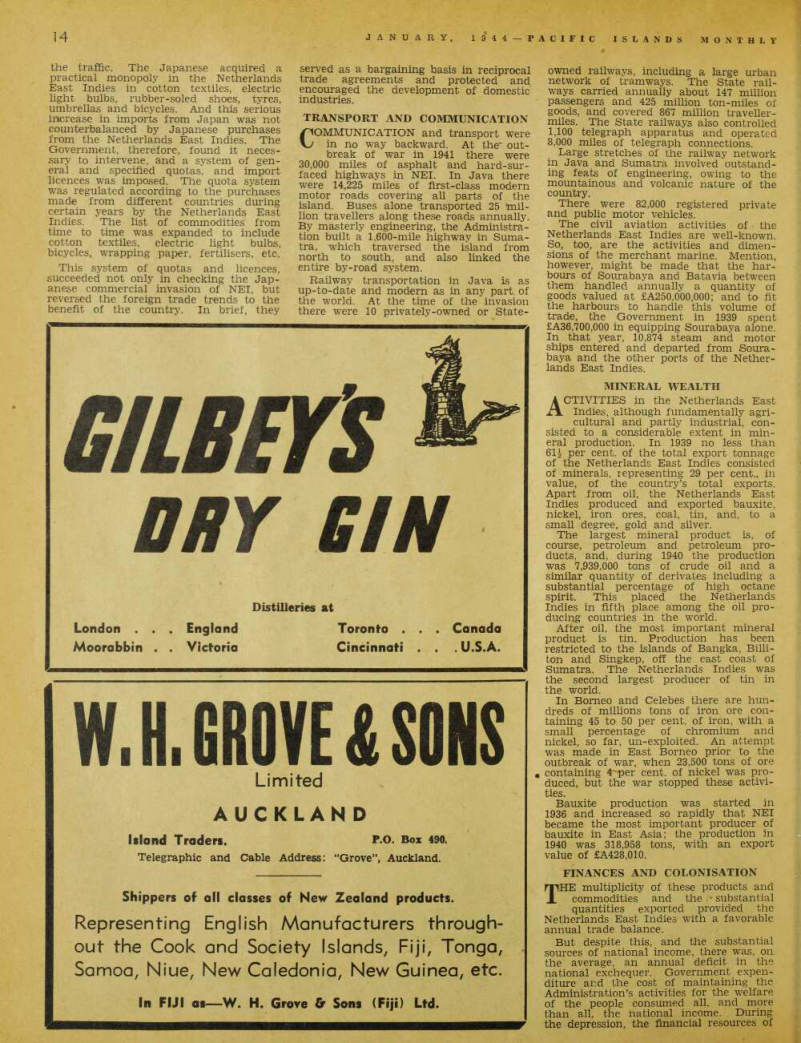
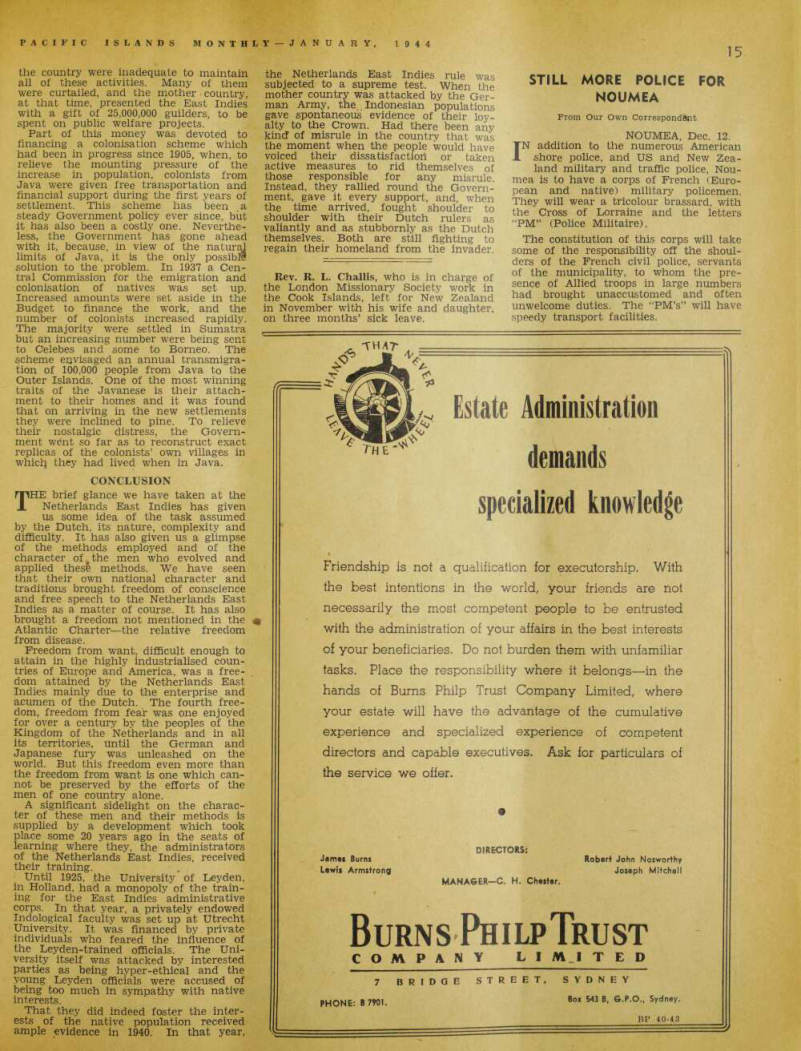
Guidance for Pacific Administrators The Concluding Article in a Series Written for “PIM” by Wolfe Preger
rE Netherlands East Indies Govern ment’s educational activities em braced not only modem hygiene, agriculture, thrift and literacy, but also training in*native handicrafts and mod ern industry.
Industrial Development
FOR the last 40 years, the Netherlands Indies Admiriistration has paid spe cial attention to the possibilities of developing native industries. After pre liminary investigation, an Industries Division was added to the Department of Economic Affairs, which supplied technical information and advice to pri vate concerns, established experimental stations for diverse industrial undertak ings such as earthenware, textiles, fibres, in the same way as the administration in the past had experimented with and developed the agricultural resources of the country by the introduction of such non-indigenous products as tea, rubber, quinine, oil palms, coffee, tobacco, etc.
Training centres were established throughout the countryside, where the villagers were taught and trained in the native handicrafts.
In urban centres they were taught to handle modern looms and other mach inery suitable for secondary industries.
These industries developed gradually at first, but during the depression they were stimulated to greater activity, with spec tacular results. Thus, the weaving of textiles, which started as a modest home industry, developed at first by the intro duction of more modern hand-looms and later by modern mechanical looms, even tually gave employment in home and factory to 2,200,000 people.
In the five years 1930-35, the importa tion of cotton yarn increased fivefold; that of artificial silk yarn one hundred fold. Within four years of the beginning of the depression, Java was producing oyer 62,000,000 yards of woven textiles of all kinds, widths and qualities. By 1940 the textile industry had developed to such an extent that the consumption of raw materials for that year amounted to £A20.000,000 and the combined output of the native and modern looms was 140,000,000 yards.
The manufacture of tobacco was also encouraged with gratifying results. The British-American Tobacco Company’s two cigarette factories had a daily capacity of 32,000,000 cigarettes, just prior to the Pacific war. In addition, there were hundreds of other concerns, large and small, some specialising in the manufac ture of cigarettes suitable for the native palate, the output of which ran into billions. Cigars were manufactured also.
In 1939, exports to the Outer Islands amounted to 18,400,000 lb. of cigarettes and cigars and 7,120,000 lb. of manufac tured tobacco.
Electric light bulbs, hitherto practically a Japanese monopoly, were produced in Sourabaya by a European concern and in Cheribon by a Chinese company.
Petrol lighters, paper, cutlery, ‘ hard ware, earthenware, sunshades, hat hoods, woodwork, furniture, leather goods and industries of a similar kind had sprung up throughout the country, providing employment for considerable numbers of the native population who otherwise might have been without any means of subsistence.
Other industries, too, of a more Euro pean character, flourished in the Nether lands East Indies: engineering, printing, the production of precision instruments, munitions, canned goods, cement, dia mond polishing, production of beer, mineral waters, ice, oxygen, chocolate, biscuits, and glassware, shipbuilding, the assembly of automobiles, and the manu facture of tyres.
Protection Of Home Industries
SUCH gratifying results, however, could not possibly have been obtained had not the Government fostered
and protected secondary industries Pro tection in one form or another was vital for the welfare of the population, Euro pean, Indonesian and foreign Asiatic Exports which, in 1929, had amounted to some £A248,000,000, had dropped to £A87,000,000 in 1933. Imports simi larly decreased from £A195,000,000 to £A55,000,000. Government receipts drop ped drastically, its expenditure following, but at a considerably slower pace. Great economic hardship was suffered by all sections of the community.
Between the years 1929 and 1933, how ever, East Indies imports from Japan jumped from 10 per cent, of the total to 33 per cent, of the total. Not only were the Japanese inundating the country with their cheap goods, but they also tried to monopolise their distribution through their own import, wholesale and retail houses. Furthermore, all these goods were carried by Japanese bottoms, Dutch vessels obtaining no share whatever in
the traffic. The Japanese acquired a practical monopoly in the Netherlands East Indies in cotton textiles, electric light bulbs, rubber-soled shoes, tyres, umbrellas and bicycles. And this serious increase in imports from Japan was not counterbalanced by Japanese purchases from the Netherlands East Indies. The Government, therefore, found it neces sary to intervene, and a system of gen eral and specified quotas, and import licences was imposed. The quota system was regulated according to the purchases made from different countries during certain years by the Netherlands East Indies. The list of commodities from time to time was expanded to include cotton textiles, electric light bulbs, bicycles, wrapping paper, fertilisers, etc.
This system of quotas and licences, succeeded not only in checking the Jap anese commercial invasion of NEI, but reversed the foreign trade trends to the benefit of the country. In brief, they
served as a bargaining basis in reciprocal trade agreements and protected and encouraged the development of domestic industries,
Transport And Communication
/COMMUNICATION and transport were I . in nn wav backward At th^nnt £ e £ k ° of W ar in 1941 there were 30 000 miles of asnhalt and hard-mir faced highways in NEI In Java there e c r e e a s22smili of first-class m^lrn motor roads covering all parts of the island. Buses alone transported 25 fnil non travellers along these roads annually.
Bv masterlv ensinperintr the Admini^tra tion built a i' 6oo " l ™ l6 highway in Suma tra which traversed the inland from north to south, and also linked the entire by-road system.
Railway transportation in Java is as up-to-date and modern as in any part of the world. At the time of the invasion there were 10 privately-owned or State
owned railways, including a large urban network of tramways. The State rail ways carried annually about 147 million passengers and 425 million ton-miles of goods, and covered 867 million traveller miles. The State railways also controlled 1,100 telegraph apparatus and operated 8,000 miles of telegraph connections.
Large stretches of the railway network in Java and Sumatra involved outstand ing feats of engineering, owing to the mountainous and volcanic nature of the country.
There were 82,000 registered private and public motor vehicles.
The civil aviation activities of the Netherlands East Indies are well-known.
So, too, are the activities and dimen sions of the merchant marine. Mention, however, might be made that the har bours of Sourabaya and Batavia between them handled annually a quantity of goods valued at £A250,000,000; and to fit the harbours to handle this volume of trade, the Government in 1939 spent £A36,700,000 in equipping Sourabaya alone.
In that year, 10,874 steam and motor ships entered and departed from Soura baya and the other ports of the Nether lands East Indies.
Mineral Wealth
ACTIVITIES in the Netherlands East Indies, although fundamentally agri cultural and partly industrial, con sisted to a considerable extent in min eral production. In 1939 no less than 61i per cent, of the total export tonnage of the Netherlands East Indies consisted of minerals, representing 29 per cent., in value, of the country’s total exports.
Apart from oil, the Netherlands East Indies produced and exported bauxite, nickel, iron ores, coal, tin, and, to a small degree, gold and silver.
The largest mineral product is, of course, petroleum and petroleum pro ducts, and, during 1940 the production was 7,939,000 tons of crude oil and a similar quantity of derivates including a substantial percentage of high octane spirit. This placed the Netherlands Indies in fifth place among the oil pro ducing countries in the world.
After oil, the most important mineral product is tin. Production has been restricted to the islands of Bangka, Billi ton and Singkep, off the east coast of Sumatra. The Netherlands Indies was the second largest producer of tin in the world.
In Borneo and Celebes there are hun dreds of millions tons of iron ore con taining 45 to 50 per cent, of iron, with a small percentage of chromium and nickel, so far, un-exploited. An attempt was made in East Borneo prior to the outbreak of war, when 23,500 tons of ore containing 4-per cent, of nickel was pro duced, but the war stopped these activi ties.
Bauxite production was started in 1936 and increased so rapidly that NEI became the most important producer of bauxite in East Asia; the production in 1940 was 318,958 tons, with an export value of £A428,010.
Finances And Colonisation
THE multiplicity of these products and commodities and the * substantial quantities exported provided the Netherlands East Indies with a favorable annual trade balance.
But despite this, and the substantial sources of national income, there was, on the average, an annual deficit in the national exchequer. Government expen diture and the cost of maintaining the Administration’s activities for the welfare of the people consumed all, and more than all, the national income. During the depression, the financial resources of
the country were inadequate to maintain all of these activities. Many of them were curtailed, and the mother country, at that time, presented the East Indies with a gift of 25,000,000 guilders, to be spent on public welfare projects.
Part of this money was devoted to financing a colonisation scheme which had been in progress since 1905, when, to relieve the mounting pressure of the increase in population, colonists from Java were given free transportation and financial support during the first years of settlement. This scheme has been a steady Government policy ever since, but it has also been a costly one. Neverthe less, the Government has gone ahead with it, because, in view of the natural limits of Java, it is the only possible solution to the problem. In 1937 a Cen tral Commission for the emigration and colonisation of natives was set up.
Increased amounts were set aside in the Budget to finance the work, and the number of colonists increased rapidly.
The majority were settled in Sumatra but an increasing number were being sent to Celebes and some to Borneo. The scheme envisaged an annual transmigra tion of 100,000 people from Java to the Outer Islands. One of the most winning traits of the Javanese is their attach ment to their homes and it was found that on arriving in the new settlements they were inclined to pine. To relieve their nostalgic distress, the Govern ment went so far as to reconstruct exact replicas of the colonists’ own villages in whiclj they had lived when in Java.
Conclusion
THE brief glance we have taken at the Netherlands East Indies has given us some idea of the task assumed by the Dutch, its nature, complexity and difficulty. It has also given us a glimpse of the methods employed and of the character of the men who evolved and applied these methods. We have seen that their own national character and traditions brought freedom of conscience and free speech to the Netherlands East Indies as a matter of course. It has also brought a freedom not mentioned in the Atlantic Charter —the relative freedom from disease.
Freedom from want, difficult enough to attain in the highly industrialised coun tries of Europe and America, was a free dom attained by the Netherlands East Indies mainly due to the enterprise and acumen of the Dutch. The fourth free dom, freedom from fear was one enjoyed for over a century by the peoples of the Kingdom of the Netherlands and in all its territories, until the German and Japanese fury was unleashed on the world. But this freedom even more than the freedom from want is one which can not be preserved by the efforts of the men of one country alone.
A significant sidelight on the charac ter of these men and their methods is supplied by a development which took place some 20 years ago in the seats of learning where they, the administrators of the Netherlands East Indies, received
their training.
Until 1925, the University of Leyden, in Holland, had a monopoly of the train ing for the East Indies administrative corps. In that year, a privately endowed Indological faculty was set up at Utrecht University. It was financed by private individuals who feared the influence of the Leyden-trained officials. The Uni versity itself was attacked by interested parties as being hyper-ethical and the young Leyden officials were accused of being too much in sympathy with native interests.
That they did indeed foster the inter ests of the native population received ample evidence in 1940. In that year,
the Netherlands East Indies rule was subjected to a supreme test. When the mother country was attacked by the Ger man Army, the , Indonesian populations gave spontaneous evidence of their loy alty to the Crown. Had there been any kind of misrule in the country that was the moment when the people would have voiced their dissatisfaction or taken active measures to rid themselves of those responsible for any misrule.
Instead, they rallied round the Govern ment, gave it every support, and, when the time arrived, fought shoulder to shoulder with their Dutch rulers as valiantly and as stubbornly as the Dutch themselves. Both are still fighting to regain their homeland from the invader.
Rev. R. L. Challis, who is in charge of the London Missionary Society work in the Cook Islands, left for New Zealand in November with his wife and daughter, on three months’ sick leave.
Advertisements & other items, pp. 15-16 (1 item)
Burns Philp
PACIFIC ISLANDS SOCIETY
Visitors from the Islands to Sydney (or those interested in Islands affairs), are advised to communicate with the honorary secretary of the above Society, which has been formed to study the history, traditions, economics, and political developments of the Pacific Islands, Regular monthly meetings are held at History House, 8 Young Street, Sydney.
Address for Correspondence:
THE PACIFIC ISLANDS SOCIETY,
Box 2434 MM., G.P.0., Sydney.
BURNS PHILP
(SOUTH SEA) CO. LTD.
Inc. In FIJI Island Traders and Shipowners Registered Office :
SU V A
FIJI
Also Branches at: \Fiji; Levuka, Lautoka, Labasa, Ba, Sigatoka, Rotuma.
Tonga: Nukualofa, Haapai, Vavau.
Samoa: Apia, Pago Pago (American Samoa).
Solomons: Makambo, Gizo, Faisi.
New Hebrides: Vila.
Code Address: Gilberts: Tarawa.
"Bumsouth”. Norfolk Is. Niue. Wallis Is. Futuna Is.
Sole Australian Concessionaires :
GEORGE BROWN & CO. PTY. LTD.
267 Clarence Street, Sydney.
As the Ultimate factory is engaged in vital war production, the supply of Ultimate Commercial Receivers cannot be maintained at present.
SERVICE: Ultimate owners are assured of continuity of service. Our Laboratory is situated at 267 Clarence Street, Sydney.
Servicing of all kinds of radio sets or amplifiers, as well as Rola Speakers, is also undertaken at our laboratories.
enters
ear ew
Distilleries at London . . . England Toronto . . . Canada Moorabbin . . Victoria Cincinnati . . . U.S.A.
W. H. GROVE & SONS
Limited
AUCKLAND
Island Traders. PO. Box 490< Telegraphic and Cable Address: “Grove”, Auckland.
Shippers of all classes of New Zealand products.
Representing English Manufacturers throughout the Cook and Society Islands, Fiji, Tonga, Samoa, Niue, New Caledonia, New Guinea, etc.
In FIJI as—W. H. Grove & Sons (Fiji) Ltd.
Still More Police For
Noumea
From Our Own Correspondent
Noumea, Dec. 12.
IN addition to the numerous American shore police, and US and New Zea land military and traffic police, Nou mea is to have a corps of French (Euro pean and native) military policemen.
They will wear a tricolour brassard, with the Cross of Lorraine and the letters "PM” (Police Militaire).
The constitution of this corps will take some of the responsibility off the shoul ders of the French civil police, servants of the municipality, to whom the pre sence of Allied troops in large numbers had brought unaccustomed and often unwelcome duties. The “PM’s” will have speedy transport facilities.
Advertisements & other items, pp. 17-18 (1 item)
Burns Philp Trust
THAT*
w /,y the
Estate Administration
demands
specialized knowledge
Friendship is not a qualification for executorship. With the best intentions in the world, your friends are not necessarily the most competent people to be entrusted with the administration of your affairs in the best interests of your beneficiaries. Do not burden them with unfamiliar tasks. Place the responsibility where it belongs—in the hands of Burns Philp Trust Company Limited, where your estate will have the advantage of the cumulative experience and specialized experience of competent directors and capable executives. Ask for particulars of the service we offer.
DIRECTORS:
James Burns Robert John Nosworthy Lewis Armstrong Joseph Mitchell MANAGER-C. H. Chester. 9
Burns Philp Trust
COMPANY LIMITED
7 BRIDGE STREET, SYDNEY
PHONE: B 7901. Box 543 B - SP O - s V dne y-
Modern Refrigeration for the South Sea Islands
The ELECTROLUX
KEROSENE OPERATED
REFRIGERATOR
MARVEL
OF
MODERN
SCIENCE
■ W:
THE
MIRACLE
OF
ICE
FROM
HEAT
ELECTROLUX OFFERS ECONOMICAL, modern and completely efficient
REFRIGERATION FOR ISLANDS' HOMES.
FREEZES CONTINUOUSLY WHILE SMALL LAMP BURNS.
Freezing controlled by simply regulating height of flame. Uses only J gallon of kerosene per week.
MOTORLESS ... NO PARTS TO GET OUT OF ORDER.
MODEL L 22 MODEL L3BO
Capacity ® (as illustrated) 2.2 cubic feet. Capacity 4 cubic feet.
GUARANTEED FOR TWO YEARS.
• Write to your Local Distributor for prices and full details.
OBTAINABLE FROM ALL W. R. CARPENTER fir CO. LTD.
BRANCHES THROUGHOUT THE ISLANDS
Representation in Papua and New Hebrides.
MODEL LKSSO
Capacity 5.5 cubic feet.
Phoenix Islands
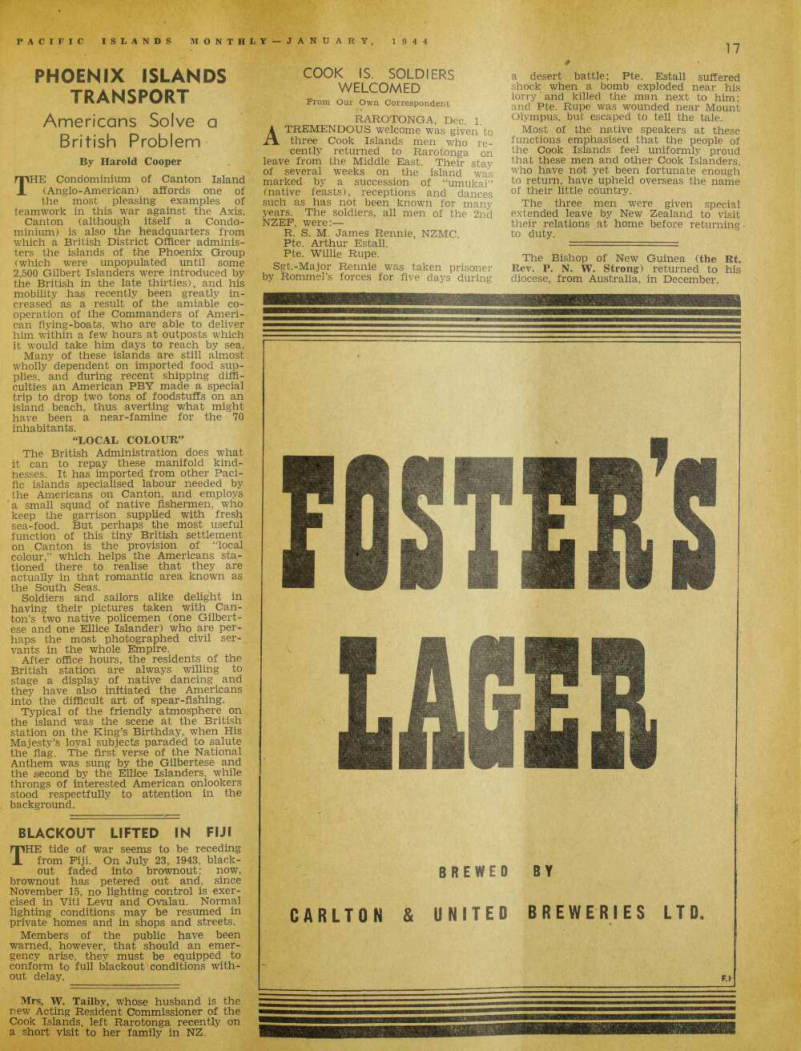
Transport
Americans Solve a British Problem
By Harold Cooper
THE Condominium of Canton Island (Anglo-American) affords one of the most pleasing examples of teamwork in this war against the Axis.
Canton (although itself a Condo minium) is also the headquarters from which a British District Officer adminis ters the islands of the Phoenix Group (which were unpopulated until some 2,500 Gilbert Islanders were introduced by the British in the late thirties), and his mobility has recently been greatly in creased as a result of the amiable co operation of the Commanders of Ameri can flying-boats, who are able to deliver him within a few hours at outposts which it would take him days to reach by sea.
Many of these islands are still almost wholly dependent on imported food sup plies, and during recent shipping diffi culties an American PBY made a special trip to drop two tons of foodstuffs on an island beach, thus averting what might have been a near-famine for the 70 inhabitants.
“Local Colour”
The British Administration does what it can to repay these manifold kind nesses. It has imported from other Paci fic islands specialised labour needed by the Americans on Canton, and employs a small squad of native fishermen, who keep the garrison supplied with fresh sea-food. But perhaps the most useful function of this tiny British settlement on Canton is the provision of “local colour.” which helps the Americans sta tioned there to realise that they are actually in that romantic area known as the South Seas.
Soldiers and sailors alike delight in having their pictures taken with Can ton’s two native policemen (one Gilbert ese and one Ellice Islander) who are per haps the most photographed civil ser vants in the whole Empire.
After office hours, the residents of the British station are always willing to stage a display of native dancing and they have also initiated the Americans into the difficult art of spear-fishing.
Typical of the friendly atmosphere on the island was the scene at the British station on the King’s Birthday, when His Majesty’s loyal subjects paraded to salute the flag. The first verse of the National Anthem was sung by the Gilbertese and the second by the Ellice Islanders, while throngs of interested American onlookers stood respectfully to attention in the background.
Blackout Lifted In Fiji
THE tide of war seems to be receding from Fiji. On July 23, 1943, black out faded into brownout; now, brownout has petered out and. since November 15, no lighting control is exer cised in Viti Levu and Ovalau. Normal lighting conditions may be resumed in private homes and in shops and streets.
Members of the public have been warned, however, that should an emer gency arise, they must be equipped to conform to full blackout conditions with out delay.
Mrs* W. Tailby, whose husband is the new Acting Resident Commissioner of the Cook Islands, left Rarotonga recently on a short visit to her family in NZ,
Cook Is, Soldiers
Welcomed
From Our Own Correspondent
Rarotonga, Dec 1
A TREMENDOUS welcome was given to three Cook Islands men who re cently returned to Rarotonga on leave from the Middle East. Their stay of several weeks on the island was marked by a succession of “umukai” (native feasts), receptions and dances such as has not been known for many years. The soldiers, all men of the 2nd NZEF, were:— R. S. M. James Rennie, NZMC.
Pte. Arthur Estall.
Pte. Willie Rupe.
Sgt.-Major Rennie was taken prisoner by Rommel’s forces for five days during
a desert battle; Pte. Estall suffered shock when a bomb exploded near his lorry' and killed the man next to him; and Pte. Rupe was wounded near Mount Olympus, but escaped to tell the tale.
Most of the native speakers at these functions emphasised that the people of the Cook Islands feel uniformly proud that these men and other Cook Islanders, who have not yet been fortunate enough to return, have upheld overseas the name of their little country.
The three men were given special extended leave by New Zealand to visit their relations at home before returning to duty.
The Bishop of New Guinea (the Rt.
Rev. P. N. W. Strong) returned to his diocese, from Australia, in December.
Advertisements & other items, pp. 19-20 (1 item)
Brewed
CARLTON & UNITED
BY
BREWERIES LTD.
m •
... so mother
guards
the home front
Hers is a responsible job. Looking after the children, seeing that their diet lacks none of the vital elements necessary for robust health and sturdy growth.
And periodic shortages make it more than ever difficult to maintain a correctly balanced diet.
Horlicks provides essential food elements in the correct balance necessary to maintain your child’s good health. It contains up to 15% of first-class protein, so important for building up sturdy young bodies.
The calcium in Horlicks —77.2 mg. per ounce —helps the formation of sound teeth and bones.
And the natural sugars in Horlicks produce extra energy almost
HORLICKS
gives children
extra energy. at once. Children look forward to their regular Horlicks. Its malty sweetness satisfies their natural craving for sweet things, without overtaxing their digestion.
Mothers will find Horlicks economical in use. It is sold in handy glass jars, or in tins, price 3/-. (Prices slightly higher in the country.) For Your Emergency Store Horlicks is a complete food, sustaining and nourishing. It needs mixing ] with water only, and can be taken hot or cold.
Horlicks keeps indefinitely.
Always replace lid firmly when not in use.
Dollar-prosperity Has
Setback in W. Samoa
From Our Own Correspondent
Apia, Nov. 20.
OWING to changed war conditions in . the Pacific, trade and industry in Western Samoa, though still pros perous, have slumped somewhat lately!
The curio, basket, mat, hula-skirt and— last, but not least—the bush-gin indus try are all suffering from a temporary depression. Restaurants, formerly verit able gold-mines, are not doing quite so well, either.
A certain foreign currency is no more bundled about in high stacks and— strange to behold—one occasionally meets Samoan maidens without uniformed company. Cash sales in Apia stores have dropped 50 per cent, lately, and store keepers, who have ordered huge quanti ties of goods while floating on the high wave of prosperity, are beginning to wonder what to do with their large stocks now, when things are not so rosy.
The labour situation on the plantations has not improved; but planters are patiently waiting for better times, when their strayed sheep of labourers may again be willing to do honest work for a fair wage. Possibly due to the impor tation of large shipments of West African cocoa into the USA, on transports return ing from North Africa and the Mediter ranean, the cocoa price offered to Samoan planters has dropped appre ciably, and stands now at about £65 per ton in Apia. Independent planters are consequently holding their cocoa for bet ter prices.
Residents of Apia—particularly banana growers—are pleased to note that the New Zealand press has taken up the problem of banana prices in Samoa and New Zealand. While the producer in Samoa is paid 5/6 per case, the New Zealand consumer is charged about 6d. per lb., and the middleman, in this case the New Zealand Government, is appar ently unable to explain who gets away with the huge margin between cost and selling price.
Meantime, as far as Samoa is con cerned. the banana industry is dying a natural death, as Samoans as well as Europeans, refuse to ship bananas at the price offered, as they actually get more on the local market or by shipping to Pago Pago.
W. H. Grove & Sons
Rarotonga Branch Sold
From Our Own Correspondent
Rarotonga, Nov. 17.
AFTER 50 years of trading in the Cook Islands, the well-known firm of W.
H. Grove & Sons, Ltd., has disposed of its business and property in the Cook Group to a recently-formed companv called United Island Traders. Their manager at Rarotonga, Mr. Clem. Palmer, who is well known in Suva, is returning to take up a position with the Fiji branch of the Grove business.
United Island Traders is an Auckland syndicate interested in developing an Islands business. Their renresentative in Rarotonga is Mr. W. H. Watson, who is acting as manager temporarily.
Mr. Watson has himself built up a suc cessful business in the Cook Islands dur ing the past few years, and it is under stood that there will shortly be a com pany formed to merge the two concerns and perhaps to acquire others, including an inter-island trading vessel—if and when available.
S be tha £ L 1
Economic Debauchery Of Polynesians
By Friendly Troops
By ROBERT DEAN FRISBIE, well-known American Author.
AMERICANS who have lived for many years in the South Pacific are aware that, albeit relations have always been amicable, never before have the people of United States and New Zea land understood each other with the sympathy and fraternity that exist to-day.
Recently, while speaking to the chief medical officer of this island, I men tioned an act of generosity performed by the Junior Red Cross of Hawaii on behalf of some distressed children in the South Seas.
“That’s just like the Americans!” the doctor exclaimed. “They do things spon taneously. No one had asked those Hawaiian children for help, but when they heard that some children in the South Seas were in need they came to their aid with impulsive goodwill.”
“Yes,” I commented, “you’ll' find the Americans are good people when you know them well. They are not as avari cious as they are made out to be.” • T never found them that way,” the doctor affirmed. “I consider my own people in New Zealand much worse in that respect.”
Then, like the Alfonso and Gaston of bygone comics, we each recounted inci dents disparaging to our own country men, finally to disagree courteously and change the subject.
THE other side of the picture—the side, incidentally, that one seldom hears commented on by the New Zealand ers—concerns the harm United States troops are doing to the cultural and economic life of the South Pacific people
among whom they are stationed. A well-informed Hawaiian correspondent writes me:— “I understand that a few men in charge of construction in the South Pacific have been very wise in paying and caring for native workers, but others
effect P °We Amerirans^re^rorf^
T* T Pr ° blem With money ’’ n 0 luch^Cultural 5, and^So P™°* ed ?s those that have been eroded hv H?f United StetA trL Tt S d k S y i h thellst vestfee of the hpaVftnfnirt Pnf? 4 nes i an wav S Hfp i<f na^^n^fnrpu^
S be tha £ L 1
dec nning into what Tails thl f e n a heen state in which the niS nnitiirp leavtot the neonle in spiritual staJnftion P P state 0 stagnation.
If such is the case, their material welfare may be improved, according to the standards of western civilisation: they ma y have more canned bully beef and tess fresh fish, more motion pictures and tess native dances, more religion and less faith. It will be a change for the worse: but, because it seems inevitable, there is no point in deploring it. Here I am concerned only with an objective discussion. . . mHERE is, obviously more than one X viewpoint to the question of improving the economic status of a native people—namely, that of the natives themselves; that of the white settlers; that (in this instance) of the United States troops who are obliged to occupy
the islands; and, finally, the viewpoint of the disinterested observer.
An officer from one of the islands where United States troops are stationed told me that he was one of 14 soldiers who landed there when construction commenced. His face glowed with plea sure when he described how hospitably the natives had received them. For some months they had received no pay, but this did not affect the hospitality of the islanders, who brought them fruit, fish, and fowls, washed their clothes, cele brated with feasts and dances.
Then, with the coming of the main body of troops and regular pay-days, the picture changed overnight.
“To-day,” the officer stated, “the natives do not think in terms of less than a dollar: a dollar to wash a shirt, a dol lar for a string of shells, a dollar to climb a coconut tree and throw down a couple of nuts.
“And they are getting fastidious,” the officer went on, smiling with a sort of amused tolerance. “For instance, one day I handed a native friend a carton of ABC cigarettes—a present, mind you.
He eyed the carton for a moment, almost contemptuously, then handed it back, saying, ‘Thanks, but I smoke only Lucky Strikes.’ That same man, a few months before, had been glad to trade a dozen coconuts for a stick of twist tobacco.
“It’s that way with everything. They refuse to work their plantations, but expect to eat European food. They refuse to go fishing—and about their only handicraft is the making of cheap curios for the soldiers. But don’t blame them,” the officer concluded. “It’s not their fault. We’ve spoilt them and we take all the blame.” 1 REPEATED the officer’s story to a trader from the same island. He was inclined to be vindictive, and I
could not blame him, albeit his attitude was wholly selfish.
“Yes,” he growled; “they can take all the blame, but a lot of good that does us! X used to be the snuggest little island in the Group, but now it's gone to blazes. Listen here,” and then he went on to tell me how, formerly, he had bought eggs for 1/- a dozen, a fowl for 1/6, and all the fruit and coconuts and fish he wanted for a stick of tobacco.
He had paid his store boy £1 a month and his cook 10/-.
Now, eggs were 3d. each, a fowl 6/-.
There were no fruit, coconuts, or fish, because all the local produce went to the soldiers. His store boy had left to work for the Army, his cook, too.
“Why in blazes can’t these Americans leave well enough alone; pay ’em like we
used to pay ’em?” he wanted to know, “They’ve ruined business and they’ve ruined the natives, too!”
T>RIEFLY, it must be mentioned that JD the Government officials have done their utmost to control this spate of inflated values; but they have been pow erless to prevent soldiers, with their pockets full of money, and no place to spend it, from giving a native a dollar for a coconut, or five dollars for a fake curio. Moreover, these administrative officials are a people with a highly developed sense of democracy, and there fore are inclined to submit to the wishes of the majority of the people, What those wishes are was expressed by my neighbour’s wife, a woman from the same island. "When I asked her how
her people liked the American soldiers, she could not find superlatives enough for their praise.
The natives did not have to work in the plantations any more, she said. They did not have to make copra or ship oranges and bananas. There was plenty of Army work, with big pay. There were free talkies twice a week. .When the young people gave a dance, ‘ the Armv men threw them “hundreds of dollar bills. When the soldiers walked through the village they handed out candy and chewing gum to the women and children cigarettes to the men. A soldier often paid as much as five dollars to wash a bundle of clothes, a dollar for a dozen oranges, 10 dollars for a hula skirt worth not over a dollar. On her island, every day was a feast day and no one was in want. ‘Yes,” I thought; “but to-morrow, when the troops are withdrawn, will every day be a feast day and will no one be in want? You have acquired a cham pagne appetite through the generosity of your friends. When you are obliged to return to your old way of life you will find your tastes perverted. Life will be repugnant to you when you go out to clear your long-neglected plantation, to repair your fishing canoe, to re-thatch your hut.
You will want to know why your own Government cannot spend its money on you as lavishly as did the United States soldiers. You will hate your old way of life. It will require many years to undo the harm caused by the unwise genero sity of a few kind-hearted soldiers.”
And when the soldiers return to their homes they will tell their people that the stories of primitive hosnitality in the South Seas are myths. They will state that the Polynesians are no better than the beggars of Cairo; only a few of them will realise that the soldiers have reaped a harvest of mendicancy because thev have sowed the seeds of extravagance.
Advertisements & other items, pp. 21-22 (1 item)
as
1
ADD VARIETY to your
HOT-WEATHER MEALS
Typical of the tasty, tempting, quick-serve foods offered by “Imperial” is “Meatreat.” This canned corned beef is prepared by the special “Imperial” process which seals in all the natural flavour, colour and rich nourishing juices of the meat. Served with salads, “Meatreat” makes an ideal hot-day dish.
Other “Imperial” products which will help you add variety to your hot-weather meals are: "Imperial" Camp Pie.
"Imperial" Beef & Pork Sausages "Imperial" Sheep's Tongues.
"Imperial" Hompe— the meal-in-a-moment.
Every one of these “ Imperial” products offers you the delightful flavour of fresh meats at their very best. Ask for them to-day.
PRODUCTS OF
RIVERSTONE MEAT CO.
Fiji Representatives: Pearce & Co. Ltd., Suva.
PTY.
LTD.
" Dollar-Prosperity " In
N. Caledonia
From Our Ovfn Correspondent
Noumea, Dec. 9.
rE New Caledonian Budget for 1944 has reached an all-time high with a total of 101,500,000 francs—an increase of 23,197,000 francs on 1943 figures. The Administrative Council is at present in session, deliberating on matters concerned with the Budget.
Treasury reports a favourable reserve of 20 million francs—a hundred per cent, increase on the reserve for 1942.
At the same time the Noumea Municipal Council has voted for a Budget of 5,270,000 francs, an increase of over a million francs on the current year. Major in crease in revenue is expected from mari time dues, which are estimated to bring in 21 million francs. Chief expenditure will be 300,000 francs towards education, 230,000 for transport and upkeep, 230,000 for public works, and 2,181,000 francs for wages of Municipal employees.
What Palolo Is
IN a note from the New Hebrides, Mr.
Ewan Corlette says: “The scientific name of the worm known as palolo is Eunice Viridis. It is the headless body of a coralline worm containing the sperm and eggs—the head remaining behind and growing another body.”
Mr. R. Crompton, C.8.E., K.C., has been appointed Chairman of the Fiji National Arbitration Tribunal.
Fiji Food Front
Report of Director of Agriculture
IN his annual report for the year 1942, Dr. H. W. Jack, Director of Agri culture in Fiji, stated that established agricultural industries such as sugar, copra, bananas and pineapples, had suffered severely under war conditions because of labour shortages, increased costs, shortage of tools, and transport difficulties. But notwithstanding diffi culties, the production of staple annual food crops had greatly increased. Over ten million pounds weight of vegetables had been officially supplied to the mili tary forces, who, however, consumed very much more in hotels, restaurants and private homes.
The position with regard to chief export crops in 1942 was as follows: — (It is not quite clear from the pub lished report whether the figures are for the financial year—July, 1941, to June, 1942—0 r for the calendar year 1942. The latter may be assumed. —Ed. “PIM.”) Sugar.—Labour and shipping difficul ties resulted in delays in crushing, and as a direct outcome of war conditions, a considerable reduction in the crop for 1943 is anticipated. The CSR Co. for the period July, 1941, to June, 1942, crop ped 52,879 acres, crushed 1,070,488 tons of cane, exported 90,778 tons of sugar.
Copra.—Exports amounted to 16,861 tons, valued at £252,544. Increased prices following the extension of the war to the Pacific, provided a stimulus to pro duction, the local buying price rose from £6/10/- to £l6 for plantation grade.
Before the close of the year a down ward tendency in production was evident, due to shortage and rising costs of labour and materials, and exports were only 2,000 tons over the 1941 figure.
The local purchase and export of copra
was taken over by the Government as from February 18.
A good price was offered for coconut shell charcoal, and the CSR Co. made kilns available-,- but production remained low owing to shortage of labour.
Bananas. —Exports amounted to 91,673 cases, valued at £42,400 —double the 1941 export in volume; 95 per cent, of the fruit was grown by Fijians.
Pineapples.—Labour and other diffi culties greatly restricted operations. Local demand for fresh and canned fruit and for juice provided an outlet for a good proportion of the crop, but much fruit was lost in the field, on account of labour shortage.
Citrus.—There was a bumper crop fol lowing the loss of crop in the hurricane of 1941. The export market was closed and an estimated surplus of 3,000 cases over local consumption could not be utilised.
Cotton.—No seed was issued and the ginneries did not operate. As the supply of kapok is cut off, it may be necessary to plant cotton again shortly in limited areas.
Rubber.—Estates that had been out of production for many years were opened up under the stimulus of rising prices.
Exports totalled 208,685 lb., valued at £20,000.
MOST crops grown for local consump tion showed a considerable increase under the stimulus of increased demand from the military forces and because of restricted imports. There was an extension in the acreage planted in rice, maize, groundnuts and pulses; dalo, tapioca and sweet potatoes were adequate for the needs of the armed forces and the public; an increased quantity of coffee was delivered for local consump tion, but tea production was maintained with difficulty, owing to labour short ages.
With regard to meat production, it was stated that owing to the greatly increased demand for beef, difficulty was experi enced by the butchering trade in obtain ing sufficient supplies. It was found necessary to search much further afield to obtain beef supplies for the Suva mar ket and greatly increased prices were paid to cattle-raisers. Slaughter had to be restricted in order to conserve sup plies as much as possible. Because of the increased prices being paid for cattle, beef production was more profitable to producers than formerly. The production of pigs for pork increased materially but demand was still far in excess of supplies.
Poultry supplies also dwindled some what during the year because of the heavy demand and because of difficulty in securing suitable food. The demand for breeding stock was heavy.
The following numbers of animals were slaughtered in registered slaughter houses: Cattle, 8,051; pigs, 2,571; and sheep, 112. 9,077 hides were exported, valued at £10,465.
Sub-Lieutenant A. M. Andresen, RANVR (formerly of British Solomon Islands) spent a few weeks’ leave in Aus tralia in November and December. He, with Messrs, McFarlane, Ken Hay, and F. M. Campbell, was gold-mining high up on Guadalcanal when the Japanese came into the Pacific; and they had a “dress circle seat” at the opening of the battles of the Coral Sea (early May, 1942) and Guadalcanal (August, 1942).
Then they all joined the armed forces, and subsequently saw much service, as the Americans drove the Japs out of the Solomons.
Colonel Benoit-Guyod has been ap pointed commandant superieur of French troops in New Caledonia. He is expected to arrive in Noumea shortly, from Africa.
Advertisements & other items, p. 23 (1 item)
Sisg
s 341 V co Qi < * as 532 >- O >1 oo *4 «8 s
Death Of Paul Gauguin's Tahitian
Mistress
ERIC RAMSDEN, well-known writer on Polynesian subjects, describes the unimpressive end of an Islands romance.
A BRIEF reference in a letter from my good friend, Oscar Nordman. of Tahiti, told me recently of the death of Taurua, the one-time vahine of Paul Gnuguin, the French painter.
It recalled a summer’s day at Punauuia when, with Oscar as my guide, I called on the old lady. Taurua’s passing is of interest to the many who have been either fascinated or repelled by the work of that strange genius, Gauguin (or Koke, as the Tahitians called him).
In the withered, sad-faced old woman, clad in a shabby black Mother Hubbard, it seemed difficult to reconcile Gauguin’s description of the golden-skinned, glam orous creature, his enchanting Tahitian mistress. One realises, of course, that beauty fades quickly in Tahiti, that love liness is soon gone. . . .
Taurua (The Evening Star) was the companion of the Frenchman in that dis trict for ten years. To remain with one’s lover in Tahiti for a decade is something of a record.
To-day, Punauuia is only a short motor drive from Papeete. But in Gauguin’s time it was comnletely rural. The cottage in which he dwelt with Taurua still stands on the shore, facing Moorea, a
truly enchanting spot. Robert Keable and Alec Waugh, the English writers, lived there in recent years.
It has long since reverted to its original owners, the family of Nordman. There is nothing to suggest that it was once occupied by a genius. But Oscar, volatile as ever, had ambitious plans for the “Villa Ventura.” ... As a boy he had helped collect some of the carvings left around the fale by the mad Frenchman.
For a time his father did not know what to do with them. Gauguin, by then, had left for the Marquesas: no one knew whether he would return to Punauuia.
Finally, the carvings were incorporated in a fence to keep the pigs out of the garden. As the posts rotted in the ground they were thrown by young Oscar on a fire, with other rubbish.
Long before he had departed for Hiva-Oa, the painter had been an admirer of the art of the Marquesans.
Hard wood of the type he required for carving was exceedingly difficult to pro cure in Tahiti. Therefore, he had ex perimented with staves from wine barrels.
In subsequent years, agents for col lectors searched the district for Marquesan designs touched by the magic fingers of
Paul Gauguin. “And we had nothing to show them,” Oscar confided to me. “Not a single piece of carving. I could have kicked myself for burning that stuff. But who, at that time, was to know that it possessed any commercial value?’’ * * * TAURUA had long since returned to her native village.
It is little more than a mile from the home that she shared with Koke (as she still referred to her old lover). It nestled among the niau palms at the foot of the mountains. We had to scramble through the undergrowth to approach it. Natur ally enough, Taurua objected to being an object of curiosity to tourists.
An old woman, her hair tightly scraped back from her wrinkled brow, appeared in the doorway of a thatched hut. Several pots stood on the open hearth outside.
Obviously, she had been disturbed at her cooking. Like any housewife in any part of the world she was not, I recall, in the best of humours that day. Yet like a true Polynesian she was not impolite to her visitors. . . . Her poverty was
pathetic.
If I had not been with Oscar it is possible that Taurua would not have ex changed more than a dozen words. Some of her visitors, she told me later, had asked impertinent questions. The old lady was glad to know that I was not French. The British, as a rule, she com mented, did not ask her to describe Koke’s love habits.
IT was apparent that time had softened the memory of Gauguin. Local tradition had it (and it is invariably correct in such matters in Tahiti) that Koke and Taurua were not on the best of terms when the former shook the dust of the Punauuia road from his feet and left his young mistjess for ever. But who was Koke to accuse Taurua of a flighty nature?
“Yes, Koke was kind,” remarked the old woman as she smoothed the folds of her threadbare black gown. “When he had money he gave it to us. More often than not he had no money at all. ... I always intended going to the Judiciary, and, in accordance with the law, declar ing myself as the wife of Koke. Yet, somehow, I did not do it. I do not know why. Now % it is too late.
“I often* wish that Marae-Atai and I had some of the many thousands of francs that I am told were received for Koke’s pictures. Just a few francs would have made all the difference to us. Life has been hard. It was difficult enough, even in those days when we had him with us. Always he would sit painting, paint ing. . . . But when he had money he would give it to us.”
WOMAN - LIKE, Taurua seemed anxious to protect the memory of the man she called her tane, the man who had deserted her and her small
son. The first child that she had to the Frenchman was a daughter: she had died in infancy. Marae-Atai (or Emile) was a mere toddler when his father left Punauuia. He had no recollection what soever of him. Though quite uneducated, Gauguin’s son, when I last saw him, was a fine physical specimen of the French- Tahitian cross. Then in his early thir ties, he strongly resembled the well known self-portrait of his famous father.
He speaks little French, and no English at all.
No, Taurua had never again heard from Koke. “He did not even send us a letter,” she said, dispassionately.
Marae-Atai, who resided not far from his mother, kept her supplied with fish.
He had a considerable reputation as a fisherman, “A good son? Indeed, he is a good son,” she replied.
No, he was unmarried; there were no grand-children of Taurua and Gauguin.
“Someday, perhaps,” the old woman smiled, displaying her decayed teeth. Like all Tahitians, she was sensitive on the point of teeth.
THOUGH Taurua was careful not to say so, it is apparent that Gauguin abandoned his little Tahitian family —Just as, in an earlier period of his life, he had left his French offspring.
It seems, too, that his departure for the Marquesas was not entirely of his own volition. One who had known him told me that, with his caricatures of prominent personalities in Papeete, and his vitriolic outbursts from his printing press, Gauguin had made himself so un popular in official quarters that Tahiti had become a little unhealthy for him.
Though Gauguin loved and understood the natives, with his own countrymen on the island he was anything but popular.
The majority, like poor Taurua, had never understood him. How could they?
Not one person with whom I spoke who had known him (with the solitary excep tion of his old mistress), had a good word to say concerning the painter.
“If he wanted anything from you he was servile in manner; if he did not want anything he was a bully and a braggart —just as it suited him. I did not care for Paul Gauguin!” The speaker, a Frenchman, told me how on one oc casion Gauguin had brought him a fuel stove to repair. As was so often the case, he was penniless when he called to collect it.
Gauguin, by way of payment, offered one of his pictures. “I told him to take the stove and get out of the shop,” my informant said. “I had seen some of his daubs and I did not care for them.
Neither did anyone else.” * * * THE following was written in my diary following the visit to Taurua with genial Oscar:— “Life moves along without much effort at Punauuia—just as it did in Gauguin’s day. The only apparent difference is that a honking motor-bus. crowded with sightseers or happy, laughing Tahitians, careers through the leafy lanes that- once knew Gauguin. The Tahitians pass the ‘Villa Ventura’ with a song on their lips.
For all they care he might never have existed. With the tourists it is different. . . . Over in the village in her hut beneath the mountain side an old woman sits before a fire stirring a pot. Does she still think of Koke, her strange French lover, or of the others that came after?
Does she think at all?
“Out on the reef a muscular, bronzed figure is fishing. He is silhouetted against the setting sun. Marae-Atai, the son of Taurua and Gauguin, is earning his daily bread. The sun is sinking behind Moorea, so lovely and remote, a thousand
pinnacles on fire, every crag outlined. The peace of the tropical evening descends Vahine, softly laughing, are returning from the evening bathe in the mountain fed stream.
“As the motor-bus, its passengers shrieking with delight as an old China man is forced off the road with his horse and cart, careers on towards Papeete, the girls pause and wait until the dust settles. ... In the distance can be heard the strumming of a guitar.”
“Yes, sir,” commented Oscar. “If any more people come here and ask to see the son of the French painter Paul Gauguin I am going to point to that!” By that he indicated a wizened, decrepit, ancient Chinaman who, balanced on his hams, was weeding the garden of the “Vila Ventura.”
Well known as a member of the LMS in the Pacific during the closing years of last century and the beginning of this, the Rev. A. E. Hunt died in Wel lington, NZ, on October 27, aged 82. He was born in the Channel Islands and was ordained in 1887, going immediately to New Guinea. Three years later, with Robert Louis Stevenson, a personal friend, he went to Samoa, there to learn the Samoan language with a view to taking charge of Samoan teachers serving in New Guinea. Later he returned to New Guinea and worked there until about 1911, when he settled in Timaru, New Zealand. He retired from the active ministry in 1933, after 46 years’ service.
The death has occurred in Wellington, NZ, of Mr. W. S. Cooper, aged 61. In he was appointed to the Cook Islands Administration, being Resident Agent at Mauke until 1918, and then at Aitutaki. He was for a period Assistant Secretary of Native Affairs, Samoa, and Resident • Commissioner at Savaii.
Advertisements & other items, pp. 24-25 (1 item)
E. J. Gough & Co.
đ
War Time Cable Address:
GOUGH CO.,
1 BONDSTREET,
SYDNEY.
Codes: Bentley 2nd and Comp. Phrase, Acme, A.8.C., sth and 6th, Peterson, 2nd and 3rd, Banking.
Telephone: B 4167.
P.O. Box. 3615.
SUPPLIERS OF GENERAL MERCHANDISE TO LEADING FIRMS
THROUGHOUT THE PACIFIC ISLANDS
E. J. GOUGH & CO.
1 BOND STREET, SYDNEY,
AUSTRALIA.
EXPORTERS . . . IMPORTERS . . . MANUFACTURERS' REPRESENTATIVES BANKERS: Bank of N.S.W. Comptolr National d’Escompte de Paris.
QUEENSLAND
INSURANCE
COMPANY
LIMITED
(Incorporated 1886 in Australia)
ASSETS EXCEED £3,500,000
Head Office :
PITT & BRIDGE STS.,
SYDNEY
Specialists in South Seos Fire,
Marine & Accident Insurances
Apply to: —
FIJI.
Branch Office: H. J. Moorhouse, Manager.
Burns Philp (South Sea) Co,, Ltd.
VILA.
Burns Philp (South Sea) Co., Ltd.
Comptoirs Francais Des Nouvelles Hebrides (Marine).
NOUMEA.
L. & W. Johnston.
PAGO PAGO.
Burns Philp (South Sea) Co., Ltd.
G. H. C. Reid & Co.
OTHER SOUTH SEA ISLANDS.
Burns Philp (South Sea) Co., Ltd.
Also to any of the Company’s Offices in Australia or New Zealand.
Light
p r- :
P.oleman
IS SERVING THE ARMED FORCES
WITH THREE ESSENTIALS OF
LIFE . . .
-Heat-Warm Food
Wherever the Armed Forces of the United Nations need quick heat and bright light you’ll find Coleman Lanterns and Stoves. On board steamers, at landing fields, in mobile canteens, emergency hospitals, air-raid shelters, and in actual combat, Coleman appliances are providing invaluable service.
We regret any inconveniences caused through shortage of new stock for civilian requirements, and suggest you keep your present Stove and Lantern in good repair by contacting your local Distributor.
THE COLEMAN LAMP & STOVE CO. LTD.
TORONTO CANADA
sly Grog and Black
Markets N.Calcdonian Governor Takes Action
From Our Own Correspondent t-v 11 It vine NOUMEA, Dec. 11.
T T has announced by Governor uaigret that a conference was held last month, with a view to putting an end to the sly grog traffic, which has assumed alarming proportions during the past 18 months Those who took part in the conference have asked the Court to apply the maximum penalty to offend ers. New measures of suppression will " in a SSa announcement, the Gov the^n^a^^nnfr’Whll^ n i. 0f th £ Pw liC ffi° that Hp S 2 f tra ® c v e P° lnts out that this traffic is greatly to the prejudice of hon
est traders and is likely to cause shorta £ e of supplies to the civil population.
“The Administration,” said M. Laigret “knows certain of these traffickers and possesses letters that they have impru dently written. When all the necessary proofs have been collected, severe mea sures will be taken. It should not be forgotten that the Allied Governments know the exact price of all primary materials at the time of their arrival and it is easy to keep track of the price at which goods are sold. I wish the general public to be informed as to the situa tion, and demand that everyone collabo rate to suppress black markets so that civilian supplies shall not suffer” a 1“^ can soldie ? s ’ t 0 15 da ys’ imprisonment ar £ a t? ne of 22 ' 000 francs (about £150) —the heaviest fine yet imposed in the Colony.
Rarotonga Visits
Tahiti
From Our Own Correspondent
Rarotonga, Dec. 1.
A LARGE party of people from Raro tonga recently went on a holiday trip to Tahiti by schooner, some 600 miles. The party, which included some Europeans on furlough, was the first of its kind t© visit Tahiti since the out break of war—although in the days when the mail-boats were running through to San Francisco, these affairs were fre quent.
They had a great reception by the people of Tahiti, many of whom are old friends and some even relations by virtue of the ancient ties between the two islands, now long lost in the jumble of Polynesian folk-lore, but nevertheless still cherished by the Maoris themselves.
The party reported that Tahiti is busy and prosperous. Most of the men are in uniform and, as these soldiers are paid at the usual European rates, their fami lies are generally well cared for'.
Copra and vanilla are being produced in large quantities and their prices are high. Supplies are now coming through regularly—in fact, the Rarotongans were pleased to buy certain articles, such as combs and perfume, which have been unobtainable here for some time.
A number of political prisoners are still under restraint at various islands, but these are apparently being released, from time to time, on parole, when vouched for by a responsible citizen.
" God's Day—We Stop !"
AN Army detail on one of the South Pacific Islands was making a forced march. The native cariers were members of one of the Seventh-day Adventist missions on the island. They were faithful, honest, dependable, and clean in their personal habits; all of which was much appreciated by the Army men.
Friday came, and they carried their burdens over the tortuous mountain trails until close to sunset. Then they stopped, set down their loads, even though it was not yet dark, and prepared to make camp.
The Army officers were in a hurry, naturally, and in consternation inquired what was happening, and why.
“Sun he go down,” the natives explained, pointing. “God’s day he come, we stop.”
And they stopped! There seemed to be nothing that the Army could do about it, even though they argued their case mightily.
“Sun he go down. God’s day he come.
We stop,” was the ultimatum.
So, at last, the Army decided that it might as well stop, too. And it rested from sunset on Friday to sunset on Sat urday. Then the carriers cheerfully took up their burdens and took to the trail, with right good will.
The military man telling the story smiled a reminiscent smile at the mem ory of an American Army stopped by a group of simple black men who had such a high regard for the Sabbath of the Bible that they absolutely refused to travel on that dav. —“Youth’s Instructor,”
Usa, 26/10/43.
The few thousand people of the Poly nesian Wallis Group, island dependency of New Caledonia, 900 miles north-east of Fiji, have subscribed 33.242 francs to the French Empire Fund for patriots resisting the Germans.
Advertisements & other items, p. 26 (1 item)
Cordage and
=3S»
Wanted to Buy—Quality Guns and Rifles
HIGHEST PRICES GIVEN. WILL ALSO EXCHANGE GUNS.
SI L RO H U Qualify Firearms and Fishing Tackle. 143 ELIZABETH STREET (Near Market St.) SYDNEY. ’PHONE; MA 3540.
Ship Chandlery Hardware
/Write for j
Ship Chandlery /
Catalogue J
Catalogue
Special “In Bond’’ Prices for all Islands enquiries quoted on application.
Sole Agents for:
BROOMFIELDS LIMITED
152 SUSSEX STREET ::
Cables; “Boom’’, Sydney.
Large and Complete Stocks cf
SHIP CHANDLERY
SYDNEY.
IRONMONGERY OF ALL KINDS, PAINTS,
WHITE LEAD AND OILS.
P. H. MUNTZ & CO.’S 3-CROWN BRAND METAL SHEATHING.
PEACOCK <& BUCHANS’ ENGLISH READY-MIXED PAINTS.
Scott’s “Renown” Brand Rope,
Cordage and
Binder
Twine
Cabl« Address; Ropeyard, Sydney. — * - .
of Every
Description
MANUFACTURED AT
MASCOT. N.S.W.
J. SCOTT
PTY. LTD.
Head Office and Store:
163 CLARENCE STREET,
SYDNEY,
N.S.W.
Weddsngs And War In The Loyalties
Natives Have Their Fun in Spite of Tojo
By H. E. L. Friday
IN joyous Lifou of the Loyalty group, where ancient laws still reign and each member of the community has a predetermined rank and duties according to his descent, the marriage was recently celebrated of Wagan Siwell, tall, young, petty chief of the tiny port of Chapenehe, and his smiling fiancee, Ginette Wagin.
Three large dining halls and nine kitchens were especially built for the occasion, and the many hundred native guests consumed 24 head of cattle, 19 pigs, 14 goats, 92 head of poultry, 1,100 lb. of fish, and immense quantities of yams, taros, and other vegetables and fruit.
The principal guest was grand chief Naisseline, of the neighbouring isle of Mare, who arrived with his royal family aboard his cutter “Laura,” with presents which included two tons of yams, 650 lb. of potatoes, two head of cattle, three pigs and many sacks of assorted vegetables, as well as 5,000 francs in money.
As a relative of the bridegroom, the honour of installing the newly-married couple in the chieftainship of Chepenehe fell to him. Altogether, the young people received 52,845 francs in money, of which 11.000 francs came as a gift from the bridegroom’s tribe, in addition to a huge contribution of foodstuffs, including 11 beasts. Other Lifou tribes brought similar contributions.
The wedding took place at the Protestant temple, in the presence of the French Resident and his wife (Dr. and Madame Languillon), the local gendarme
and his wife, and one or two of the very limited number of European inhabitants of this island, where white visitors are not encouraged and need a special permit from the Governor of New Caledonia.
These laughing, friendly, flowercrowned people, whom I recently visited as guest of Capt. H. R. Simms, now working for the American Army, on his ketch-rigged schooner, “Evaleeta.” began the festivities a fortnight before the wedding ceremony, and kept them up for two or three days afterwards. The first event was a re-union of the bride and bridegroom’s families, with an exchange of presents. Then, a week later, the young bride arrived at the place where the wedding was to take place, there to receive the good wishes of the native population.
The Loyalty natives are the great choral songsters of the South Pacific, and they can dance night after night and still go on dancing. Singing with them is an all-out performance, so willing that I know a Catholic priest who sometimes has to remind his parishioners that God is not deaf. They always stage a night’s entertainment whenever Capt. Simms arrives at any of their villages, and his crew of Papuan boys from Port Moresby region (they were on the “Lakatoi” when the BP steamer was sunk) are very popular with the Loyalty girls, who sing them eternal and extremely candid love songs and try to get them to sing in return — anything from “Tipnerary” in English to “Onward Christian Soldiers” in Papuan— and to dance their individual tap dances.
These islanders were formerly great cannibals divided on Lifore into three main clans who warred on one another in rotation to provide themselves with fresh meat, the island otherwise afford ing no flesh nourishment. They went to war as we go to market, and when the supply was sufficient, hostilities were suspended.
To-day all is friendly, and as a symbol of tribal goodwill the good ship “Trois Amis,” communally owned by the three grand chiefs, Boula, Clement and Zecula, on behalf of their respective peoples, puts to sea regularly to trade with Noumea, manned by a crew democratically elected at periodic election days by the village elders. Politically they are far from stupid, these Loyalty islanders, and they are some of the happiest people I know.
One remarkable thing about these islands is the giant size of the yams they can grow—l have seen them over six feet long. This is because they are individu ally planted in deep holes in the coral which are first scraped out with long bars and then filled with fine earth.
I found that three variations of the native language are still spoken—that of everyday life, that of grand and formal terms used in addressing the chiefs, and lastly a language of poetry and oratory.
Their languages—different on each island —were first written by the English Pro testant missionaries who were after wards replaced by the French. Thus the Old Testament God is called on Mare, Makase, meaning great sorcerer, and Our Lord is known as Retoe, or great chief.
When the Japanese first invaded the Solomons, the people of Mare spent a fortnight in their limestone caves, fear ing bombardment. Then veterans who had fought in France during the last war organised combat exercises. One tribe would represent the Japs and the rest
When writing to advertisers, please mention this journal.
would be the army of Mare. Machine guns were imitated by beating on pieces of corrugated iron, while sacksful of lemons took the place of bombs. When a man was hit with a lemon he was hors de combat and was supposed to lie dead where he was. These manoeuvres used to take place every Monday, start ing at 2 o’clock in the morning, and would end at about 10 a.m., when a conference was held, the last war veterans offering considered criticisms. Unfortunately, these exercises had been discontinued when I visited the island.
But last year, when a goodwill mission headed by Major John M. Cotton US Army medico, visited the group, Naisse line’s Home Guard put on a great show.
“You never saw anything like it,” Major Cotton remarked. “The natives, with more pride than can be imagined, marched past clad in their manou loincloth and tomahawk on shoulder, and went through all sorts of intricate military move ments. They even had a nurses’ corps dressed in white with white veils, proud as could be of their section. All the surviving Mare veterans of the last war were drawn up in ranks and saluted us in military style. Owing to religious differences one village, and only one, was unrepresented at the parade.”
That tough Australian, Capt. Simms, took this Franco-American mission to the island, and General Patch afterwards presented Naisseline with a baby Stan dard car as a goodwill gift on behalf of the American Army. It was in this car, a short time ago, that the chief’s native chauffeur drove Capt. Simms and me to Naisseline’s home at Netche, alongside which is the tomb of the wife of the
first English missionary, Susan Anne Creagh, who died in February, 1855.
At the present time, Naisseline is encouraging his people to grow vege tables to supply the Allied forces in New Caledonia. Several hundred Loyalty boys have also been regularly working on three-monthly contracts with the Allies, and, m addition, many are serving on the main island and overseas with the Free French Army and Navy.
Advertisements & other items, pp. 27-28 (1 item)
William Atkins pty. Ltd.
Head Office 449-451 KENT ST., SYDNEY.
Iron & Steel Merchants—Engineers' Supplies
ESTABLISHED OVER 50 YEARS
Coach & Motor Hardware Cable Address: WILATKIN, Sydney.
STEEL DEPARTMENT—
MILD STEEL:
Rounds, Squares, Flats, Half-rounds, Hexagons, Bevel, Shoeing, Tyre, Angles, Tees, Sheets, Plates, Girder Plates, Chequer Plates, Channels, Hoops, Etc.
BRIGHT STEEL:
Rounds, Squares, Hexagons.
Extra Special High Speed Tool Steel, Mining Steel, Blister Steel and Spring Steel, Rounds, Flats £r Squares.
Bar Iron—All sections and sizes.
Engineers' Supplies:
Set Screws, Studs, Metal Thread Screws, Coach Screws, Files, Cotter Pins, Bright and Black Bolts, Rivets, Etc., Hack Saw Blades.
Power Transmission Gear: Including Plummer Blocks, Couplings, Collars, Etc.
Coach and Motor Hardware: Axles, Springs, Wheelstuff, Duck, Paints.
Farriers' Supplies: Horse Nails, Anvils, Vices, Etc.
Motor-Trimmers and Motor Builders' £r Motor Painters' Requirements
C. A. WILLEY'S
Quick-Drying Coach and Car Paints, Roughstuff, Elastic Gloss, Synfiex Enamels, Lacquers.
DUCO Lacquers and DULUX Enamels—FAßßEX Motor Toppings and Leather Cloths, House & Decorators' Paints, Varnishes & Brushware.
Sole Distributors of CHAMPION'S Decorators Paint Products.
Distributing Agents for BROLITE Lacquers, SYNFLEX Enamels and "POLYGLOSS" Finish
For those jobs
you do yourself!
\o* h \0» >A X 6° VxO 'o e 6* X) e e e o> *1 W 5 & x>®
WUNDERLICH
DURABESTOS
U «T«ilable from
ISLANDS’ DISTRIBUTORS.
Allen Taylor & Co. Ltd.
COMMERCIAL ROAD, ROZELLE,
SYDNEY
Sawmillers and Wholesale Suppliers of Hardwoods for Constructional Purposes GIRDERS . . . PILES . . . POLES . . . SLEEPERS, Etc.
EXPORTING TO PACIFIC ISLANDS SINCE 1893
HARRY J. YOUNG PTY. LTD.
379 KENT STREET, SYDNEY
EXPORT REPRESENTATIVES^ FOR . . .
Bond's Industries Ltd.
Manufacturers of Hosiery and Underwear. Cotton Spinners.
Cottee's Passiona Ltd.
Makers of PASSIONA, Fruit Cordials, Fountain Syrups, Fruit Spreads, Peanut Butter and Peanut Products.
Harry Peck & Co. (Aust.) Pty. Ltd.
Makers of the famous "Anchovette" Fish Paste.
Specialists in Potted Delicacies.
INQUIRIES THROUGH YOUR USUAL CHANNELS WILL RECEIVE
PROMPT ATTENTION.
Bankers: Bank of New South Wales.
Boxer's Death
Round of Sports in Rarotonga
From Our Own Correspondent
T Rarotonga, Dec. 1.
HE Polynesian population of Raro tonga are great lovers of competi tive sports—but more, perhaps in enthusiastic spasms than as regular forms of exercise.
Football, tennis, cricket and table ten nis have swept the island during the last few years. The Rarotonga Sports Asso ciation, which has European officers, has long despaired of trying to institute sea sons for the various sports—football in mid-summer is considered quite correct if m vogue at that particular time.
The latest sport craze was boxing, in which four clubs vied for the recently presented shield. A European referee saw fair play, and the boxing, if a trifle wild, was clean and interesting.
Unfortunately, on the occasion of a match between the Muri and Avarua Clubs, on November 12, a young Muri Euronesian, Matia Dean, suffered injury to an artery in the head and died at 3 a.m, the next morning. The young man was well-liked by everybody and his untimely death is a real loss to the island.
A post-mortem examination was pro jected by the medical authorities; but the wife and relations of the dead man, adhering to their ancient Maori beliefs with regard to the hereafter, refused to allow this, and eventually no examina tion was made.
Whether the Boxing Association will be allowed to continue its activities is not known.
Real Camouflage
A PRETTY AWAS was strolling in a beautiful part of the country— graceful trees, a limpid lake, and no one around, as far as she could see.
In this idyllic spot she decided to go for a swim; so, carefully putting her uniform on the ground, she went in.
As she emerged, she noticed a jaunty lieutenant swinging along the road. Not having time to dress, the AWAS decided to hide behind a tree until the lieutenant had passed.
He approached, halted, and shouted: “Camouflage Company Number One— dismiss!”—and all the trees marched off.
Mr. Harold Gatty, who was the direct ing genius of the South Pacific section of Pan American Airways, until the Jap anese outbreak caused suspension of the service, has been doing war work, since December, 1941, in Auckland, Melbourne, Brisbane and New York. The book about early Pacific navigation, upon which he was engaged for years, was published in New York, under the title of “The Raft Book.” Mr. W. J. Mullahey, another well-known official of the airline, is now doing an important job in the South- West Pacific.
From A Dress-Circle Seat
Gold-miner's Lively Impression of Coral Sea and Guadalcanal Battles
r THE turning-point in the South Pacific War came in the week between July 31 and August 7, 1942. The Japanese , thrusting down the two prongs of the devil’s fork that was based on Rabaul, had reached two points—Milne Bay, in Eastern Papua, dangerously close to Aus tralia, and the Tulagi-Guadalcanal area of the Solomons, dangerously close to New Caledonia and New Zealand.
Australians trapped and exterminated the Japanese expedition in Milne Bay in a brilliant little action, on July 31; and, on August 6, the United States Navy struck in the Solomons, and the United States Marines inaugurated a push which did not cease until 15 months later, when the Japs were finally thrown out of the British Solomon Islands.
The two outstanding actions in the Solomons area were the Battle of the Coral Sea (May 4-8, 1942) and the First Battle of Guadalcanal ( August, 1942). A well-known planter and gold-miner, Mr.
A. M. Andresen, of Guadalcanal, saw both battles from the top of the ranges in the centre of Guadalcanal. He claims to have had “a dress-circle seat at the turn ing-point in the Pacific War.” He joined up in August, 1942, and he is now a sub lieutenant of the Royal Australian Naval Reserve. He told the following remark able story when in Sydney, recently, on leave.
IWAS one of a little party of gold miners, working an area in the mountains of Guadalcanal. We had a teleradio set; and on April 28, 1942, we learned that a convoy of 22 Japanese ships were 180 miles west, and proceed ing towards Tulagi. On the 29th, the convoy anchored in Thousand Ships Bay, at the southern end of Santa Isabel, and directly facing Indispensable Strait, between Malaita and Guadalcanal, in which the smaller islands of Gela, Tulagi and Savo are situated.
On May 1, from our hilltops, we saw those 22 ships come out of the north and go towards Tulagi Harbour. There were heavy and light cruisers, destroyers and transports.
ON May 4, we saw the start of the Coral Sea Battle. About 8.30, between 60 and 70 planes began to roar over us —they were heading straight for Tulagi. We learned afterwards that American warships were on the south side of Guadalcanal, and those planes were from the carrier “Lexington.”
Those Japs were caught like rats in a trap. The planes sank two ships in Tulagi Harbour, and two others failed to get away. But 18 came out in a tre mendous hurry, with their ack-ack guns blazing like mad. There, sitting on our hilltop, we saw one of the great spec tacles of history—between 9 and 11.30 o’clock we saw 14 of those enemy ships sunk before they could get out beyond Savo Island. The attack of those Ameri can planes was absolutely deadly—ship after ship was sunk, or was blown to pieces.
“We saw 14 ships destroyed; so that, with the two sunk in Tulagi Harbour, and two sunk out of bur sight, on the north ern side of Savo, 18 ships were sent to the bottom that morning.
We were on the verandah of Mr. E.
G. Theodore’s house —his Fiji-Australian interests had launched a gold-mining enterprise in Guadalcanal just before war came. There were four of us— Lieutenant McFarlane (since decorated by the Americans for special services), Ken Hay, F. M. Campbell and myself.
The Coral Sea Battle moved away north, and other Japanese fleets and convoys took similar punishment, during the next few days; but that was all we saw of it. The carrier “Lexington” was sunk —but she did a magnificent job.
THE Japs had landed a lot of men and equipment at Tulagi, and although their ships were sunk and driven away, they occupied the place strongly.
They were on Tulagi, Makambo, Tanam boga and Gavutu islets and they remained there for two months. They only came across to Guadalcanal when they wanted fresh meat —they raided the Lever plan tations, where there were cattle. We were pretty close to the enemy—but they did not come up into our hills, so we carried on with our gold-mining.
On July 6, we realised that there were a lot of Japanese patrols ashore on Guadalcanal. There was something brew ing—so we decided to move back into the mountains.
The Japanese actually started to build the Henderson Airfield, on Guadalcanal, at the end of June. It was on the fiat country between Lunga Point and the Tenaru River, and is usually called Lunga, The Japs used a lot of forced labour—some that they brought with them, and some that they grabbed locally—and they pushed on rapidly with the job during July. But they were not fast enough.
We were camping back in the moun tains, on the Sutakama River, and we did not like the outlook, much. The Japs seemed to have it all their own way.
BUT on August 6, a number of planes came from somewhere and began to bomb the Japs at the Henderson Field, as well as those over in Tulagi.
That night, we had a feeling th#t big things were afoot.
We were up early in the morning of
that glorious August 7; and, from our mountain, when the haze lifted, we counted no less than 64 of our warships and other vessels, to say nothing of smaller fry, lying between Koli Point and Savo Island, and dealing with the Japs in the Tulagi area, to the north, and the Guadalcanal shore, to the south. .It was a picture that looked good to us.
The Japs got an awful hammering from the warships. We learned that one can see a 14-inch shell flying through the air, from the gun to the target—and we saw plenty. When the Marines came ashore, they met little opposition, until they got to the forts.
But those who went the other way, to attack Tulagi. Gavutu, and Tanamboga, had a more difficult job, and the fighting there was tough. Even nine days after they landed, the Marines found Japs still fighting back, ha If-buried in their fox holes. on those little islands.
The main strength of the Japs was on Tulagi. Tanamboga, Gavutu, and Gua dalcanal. They had very few men over on the Gela shore, and only one patrol on the Malaita coast, at Cape Astrolabe.
Within a few days, the Japs had been driven from all their positions, except Guadalcanal: but they made a terrific effort to hang on there.
T7IARLY in September, there occurred JL the Battle of Tenaru, which really decided the fate of Guadalcanal.
The Tenaru River is the eastern boun dary of the Lever plantation at Lunga, on the north coast of Guadalcanal..
Aoout 10,000 Japanese reinforcements were landed to the eastward of this place —most of them at Tasimboka, near the middle of the island. They then crossed the Berande River and started to march westwards along ' the coast, towards Lunga, and the Henderson Airfield, now held by the Americans. Up on our moun tain, we were keeping a close watch on them.
Next day, they crossed the Balasuna River; by the third day, they were at the Medapona River; and on the fourth day after landing they crossed the Nalimbui River. By this time, we were worried.
The Japs had met little opposition, they were in great force, and we couldn’t imagine what the Yanks were doing.
But it came on the fifth day. The Japanese forces arrived at the Tenaru
River, where the Americans were wait ing behind carefully constructed defences.
At the same time, a force of American five-men tanks, which had worked through the country and around the flank of the Japanese forces, waded in.
The Japanese were caught between the charging tank forces, the Americans along the Tenaru stockades, and the sea.
It was just a massacre. The Americans literally mowed them down—they killed thousands. Large numbers of the Japs ran out into the sea, trying to escape— and they were killed there.
I believe that practically the whole of those 10,000 Japanese were wiped out.
The Marines were employed for days burying thousands of dead men.
The Japs made many more attacks on Guadalcanal after that, and the Ameri cans had some very hard fighting. But by this time the Yanks had got the mea sure of the little jokers from the north, and I don’t think they ever had any doubt about the outcome.
People here in Australia do not seem to realise the very heavy casualties inflicted on the Japs in the Solomons.
I told you about the Coral Sea Battle, where many transports were sunk and great numbers drowned; and about the Battle of Tenaru, where about 10,000 were wiped out; and it is reckoned that anything from 20,000 to 40,000 of them were drowned a few weeks later, when practically all the transports of a large convoy were sunk in the Stewart Island Battle.
Anyway, we ceased to be miners and spectators, when the Yanks arrived, and we all got into the fight, in some way or other. It’s been a great year.
Advertisements & other items, pp. 29-30 (1 item)
Steamships Trading
PACIFIC ISLANDS
YEAR BOOK
1944 Edition
Now in the Press, and Should be Ready for Issue by End of January, 1944 WE regret that, owing to shortage of paper, due to Wartime Conditions, the last Edition, issued a year ago, was not sufficient to meet the demand.
A somewhat larger number of the 1944 Edition is being printed; but paper still is in short supply, and those desirous of obtaining a copy of the latest issue should order early.
The 1944 Edition has been considerably revised, and several more maps have been added. In addition to detailed information about every Group and Island in the Pacific and in Indonesia (historical, political, geographical, ethnographical, commercial, industrial, administrative), this Edition contains (a) a chronology of the Pacific War, from Pearl Harbour to the end of .November, 1943; (b) a summary of the course and effect of the Pacific War in relation to each Territory. This data is unprocurable elsewhere.
Price: 15/-, from any bookseller, or from the Publishers. If ordering direct, please add 6d. for postage.
Publishers :
PACIFIC PUBLICATIONS
PTY., LTD.
Union House, 247 George Street,
po box 3403 r, Sydney T twso"i
Steamships Trading
Company Limited
SAMARAI
PAPUA.
PORT MORESBY
WHOLESALE £r RETAIL MERCHANTS, SHIPOWNERS,
PLANTERS, ENGINEERS & SLIP PROPRIETORS.
Customs Shipping, Insurance, and Forwarding Agents.
MAN AGING"aGENTS AND ViSITING REPRESENTA-
TIVES FOR COCONUT AND RUBBER ESTATES.
SYDNEY REPRESENTATIVES: Nelson & Robertson Pty. Lt<L, 12 Spring Street.
WARTIME ADDRESS
Clients are hereby notified that the company's temporary offices have now been transferred from Sydney to Papua.
Until further notice, all communications should be addressed — 4
STEAMSHIPS TRADING COMPANY LIMITED,
C/o PRODUCTION CONTROL BOARD,
PORT MORESBY . . . PAPUA.
Refreshing
as a plunge
into a lagoon!
, e rM |C|D c A t
°i t oH eT
§OA p
Germicidal
and fragrant
TENAX TOILET SOAP is
a rapid safeguard against external skin infections, yet it is soothing and kind to the most sensitive skin —even a baby’s!
ORDER TENAX FROM
YOUR ISLAND SUP-
PLIERS. STOCKS ARE
PLENTIFULLY AVAIL-
ABLE.
fiILLESPIE Service
BUYING AGENTS
FOR ALL PACIFIC TERRITORIES
Island Produce Sold on Commission
YOUR ORDERS RECEIVE PERSONAL ATTENTION
ROBERT GILLESPIE PTY. LIMITED
54a PITT STREET, SYDNEY
Cables: ROBERGILL. Q.P.O. BOX 137 CC.
Honoured by Fijians
Guadalcanal Veterans Honoured by Fijians
From Our Own Correspondent
Noumea, Dec. 9.
AT dusk on November 12, in a picturesque setting in a native village on an island base, “somewhere in the Pacific,” the American division which drove the Japs off Guadalcanal last year, were entertained at a Kava ceremony by Fijians; and, later, the Whale’s Tooth (Tabua), symbol of honour and respect, was presented to Colonel Joseph K. Bush.
Lieutenant Cakubau, of the Fiji Military Forces, acted as interpreter.
This Division has adopted the com posite name “Americal” (America-Cale donia) and has been longer in the Pacific than any other US division. They arrived in New Caledonia on March 12, 1942, and were trained in jungle fighting by 400 Australian veterans of Greece and Crete.
At the conclusion of the ceremony, Colonel Bush, through Lieutenant Caku bau, thanked the Fijians for the honour done him and for their gifts of fruit. He said the soldiers would never forget the friendship of the Fijians and the many kindnesses they had done them.
Mr. J. B. Wright, Treasurer of the Cook Islands Administration at Raro tonga, is a well-known public servant in NZ’s island territories. He and his wife and family recently left on furlough, part of which will be spent visiting his wife’s family in Western Samoa.
Mr. Max. Pool and Mrs. Pool-van Cleeff arrived in Melbourne in November, with their son, Erik. Mr. Pool, who has been an importer and exporter in Tahiti for six years, intends to work in Australia for the Netherlands cause. Their eldest son, Fred., is already serving with the Royal Netherlands Navy.
Territorian Roar
Hope and Confidence at Xmas Parties
WE salute the New Guinea Women’s Club of Sydney for their dual-event Christmas celebration: children’s party in the afternoon of December 23, and adult Territorians’ sherry party in the evening. If there ever has been a more successful Islands function than this, then we never have heard of it.
About 150 young Territorians gathered in the Feminist Club Rooms, King Street, Sydney, at 2.30, and were entertained by a troupe of children trained by Mrs.
Cameron, of the Feminist Club, per petual good friend and sort of patron saint of Territories’ evacuees.
A feast followed; a large Christmas cake with candles, sandwiches, soft drinks and ice cream by the gallon; and, to round off the afternoon, a distribution of gifts by their “old friend”—a refugee from Dedmanism, complete with tra ditional red gown and white beard. The club committee responsible for the child ren’s gifts must have been part-women, part-magicianesses: the quality of the toys distributed amazed those who had themselves been sweating blood for the past month, combing Sydney for gifts for small friends, but who had been thwarted in their best efforts by the ban put on Christmas by the Department of War Organisation of Industry.
Special credit goes to Mr. Foxcroft, who donned the robes of office and played the very hot part of Santa Claus.
THE sherry party followed the depart ure of the children. For two hours Territorians poured into the club rooms, until approximately 300 were packed in a solid mass inside the doors; and conversation, laughter and the tinkle of glasses, co-mingled into a roar ot sound, intense enough to lift the roof and dent the windows, signified without doubt that Territorians were happy, and could see the future more clearly.
The year 1943 saw many gatherings of New Guinea people, for social and busi ness purposes. This was the culminating point of all of them. If Territorians can get together like that for fun, they— together with their fighting men—should be able to move mountains the time comes to return to New Guinea.
No bureaucrat will be able to stop them.
The enthusiastic meeting together of these people gives the observer faith m their ability to surmount any obstacle attendant upon the evacuation, or upon the period of rehabilitation, which is not now, we hope, too far away.
All credit should be given to the execu tive of the Women’s Club, whose efforts on behalf of their fellow evacuees, at this function and throughout the year, have made a bright spot in a war-weary world.
Quinine
SERVICEMEN in the South Pacific will benefit from a quinine drive which was recently held in the United States. Contributors included chemists, wholesale druggists and hospitals. The goal was 100,000 ounces and the drive exceeded this mark by nearly 50 per cent. As a result, there are 11.000,000 five-grain doses being distributed, a quantity which should help very consid erably in the campaign against malaria in tropical islands where Servicemen are fighting the Japanese.
Empire Medal For Four
Papuans
FOR brave conduct, and in recognition of their services to the Australian Military Forces, four Papuans have been awarded the British Empire Medal.
It was announced on December 21, that the King had approved of the awards to Sergeant (then Corporal) Arwesor, and Corporal Merire—both members of the Royal Papuan Constabu lary—and to two natives, Sirip and Gomeri. The citations are as follows: Arwesor was taken prisoner by the enemy, who tortured and threatened him with death unless he revealed informa tion concerning Allied troops, but he doggedly refused to give any information and later, by his resourcefulness and cunning, he escaped.
Merire’s courage, determination, and resource have been outstanding. After a narrow escape, and believing a com panion had been killed, Merire continued the special work on which he was engaged.
Sirip, throughout all the hazardous undertakings for which he volunteered, displayed exceptional courage and out standing devotion to the Allied cause.
During a raid, Gomeri guided a mortar party right through the outer enemy defences. His remarkable loyalty to the Allied cause had an extremely beneficial
effect on all natives in the surrounding area.
Mr. Norman Neal, of Wau, New Guinea, who holds high rank in the Australian forces, has joined the ever-growing group of Territorians who, as active members of the AIF, are doing invaluable work on the actual battle-front in New Guinea.
Advertisements & other items, pp. 31-32 (1 item)
Union
ASSURANCE SOCIETY LTD.
(Incorporated in England)
FIRE ACCIDENT
FIJI A. E. PEARCE & CO.
RABAUL COLYER WATSON
(New Guinea) Ltd.
N. S. WALES 109 PITT STREET,
SYDNEY.
S. Morrison, Mgr.
CONTROLLING OFFICE—
-413 Collins St., MELBOURNE
ALAN H. RUSSELL,
Resident Manager.
SHEAFFER’S WORLD FAMOUS
Streamlined, Feather Touch PENS and PENCILS
If you want Design, Beauty and Quality buy
a SHEAFFEB
All Lifetime Peng are guaranteed for the life of the user except against loss and wilful damage.
When serviced, they are subject to a small fee for insurance, postage and handling.
Beautiful and Useful Gifts for All Occasions.
SKRIP - The
Successor to Ink makes all Pens write better. 2 oz. 1/6, 4 oz. 2/6 Plus Postage Distributors Identify the Lifetime Pen by the white dot
7 4T LTSC AA 3T
Feather Touch Lifetime Pencil Regular Pen Lifetime Pen Pencil 9 6 2b/- 761- each 361- ea. each each The working parts of the Sheaffer Pencil are guaranteed against wear for the lifetime of the user.
When serviced they are subject to a small fee for insurance, postage and handling.
All Sheaffer regular pens are guaranteed against defects of material and workmanship.
Obtainable from Selected Jewellers and Stationers everywhere
EXCELSIOR SUPPLY CO. PTY. LTD.
278 Post Office Place,
MELBOURNE, VIC.
head office j
160 BROADWAY,
SYDNEY, IM.S.W.
50 Victoria Street,
WELLINGTON, N.Z.
Restlessness and sleeplessness, when due to run-down nerves, frequently respond to treatment with Dr. Williams' Pink Pills.
Dr. Williams’
PINK PILLS
help to enrich the blood, which has a beneficial and restorative effect upon the nervous system.
BITUMENOID ROOFING
MADE IN AUSTRALIA.
Bltumenold Roofings, Dampcourse and Insulating Pelts are made from the world’* beet raw materials. Warranted to stand the most rigid tests.
BITUMENOID THE BEST
Roofing, 1. 2, 3-ply; Flooring, Waterproof Materials; Saturated Felt; Resilient Road Jointing; Natural Asphalt Dampcourse; 2 and 3-ply Dampcourse; 1-2 lb. Lead-core Dampcourse; Roofing Cement; Asphalt Paints; Roofing Compound.
SAMPLES AND PRICE LISTS ON APPLICATION.
MAXWELL PORTER & SON LTD.
ESTABLISHED 1888. BUILDERS’ SUPPLIES.
107 REDFERN ST., REDFERN, SYDNEY, N.S.W. ’Phone: M 5167. Cable* Bitnmetield.
PSlmSSsss
illit*'®' - CO 1 * , cordages
SSi^SSSSt
—tfS?
~„ “'.Witt
U V& i -« {, CO. s ca A- S - And «* W "'tS- * 6l - - A.q® nVs •'•• S ' Bnd^'- aU '°«i. Agents 8.0. ** 6 oR ?tY . tf».: Syd ° p . T.
A Tribute to the Native
Canoe
By Harold Cooper
WHEN the naval history of the war in the Solomons comes to be writ ten, sandwiched modestly between lengthy disquisitions on the part played by battleships, aircraft-carriers and other imposing units of the Allied fleet, there should be at least a few brief sentences of tribute to the humbler vessel—the native canoe.
The canoe used by the Solomon Islanders has few refinements. It is of a primitive dugout type and, as one Brit ish officer explained to me, “it’s like a bicycle—whether it works or not depends entirely on the person riding it.” And whereas the islanders themselves travel blithely to and fro in these frail craft with the unthinking skill of a cyclist, steering their few inches of freeboard safely through the roughest seas, the Japanese who have ventured to go avoyaging in floating stock stolen from the natives have almost invariably ended among the sharks.
Nowadays, if the Japanese use these canoes at all they lash two or more of them together, a precaution which gives added safety but means exchanging the knife-like motion of a giant fish for the wallowing gait of a turtle.
There is many an American soldier or sailor in the Solomons who has reason to be thankful for the strong arms and stout paddles which the crews of these tiny craft have always been ready to place at the disposal of the Allied cause.
Native owned and operated canoes have brought wounded pilots safely back to their bases through Japanese-patrolled waters, have carried supplies to ground forces temporarily isolated by the enemy and have maintained a regular mail ser vice to lonely outposts on the further fringe of the sprawling battle zone.
It is the proud claim of these native mariners that, of the many hundreds of European personnel they have carried on board their canoes, every man has been delivered safely at his destination. We have hailed the gallant exploits of the little ships of the Royal Navy. The even littler ships of the Solomons have also done their bit.
Gunner E. M. Keith Coates, of the AIF, is recovered from the wound he received at the Battle of Buna, and is still carry ing on in New Guinea. Keith Coates was in the New Hebrides—mostly Port Obry, Santo—for about 15 years. He joined up in September, 1940, and served in the AIF in the Middle East,
Advertisements & other items, p. 32 (1 item)
30
JANUARY, 1944 PACIFIC ISLANDS MONTHLY
"KANAKA" TO "BOONG"
(Continued from Page 10)
Caledonia
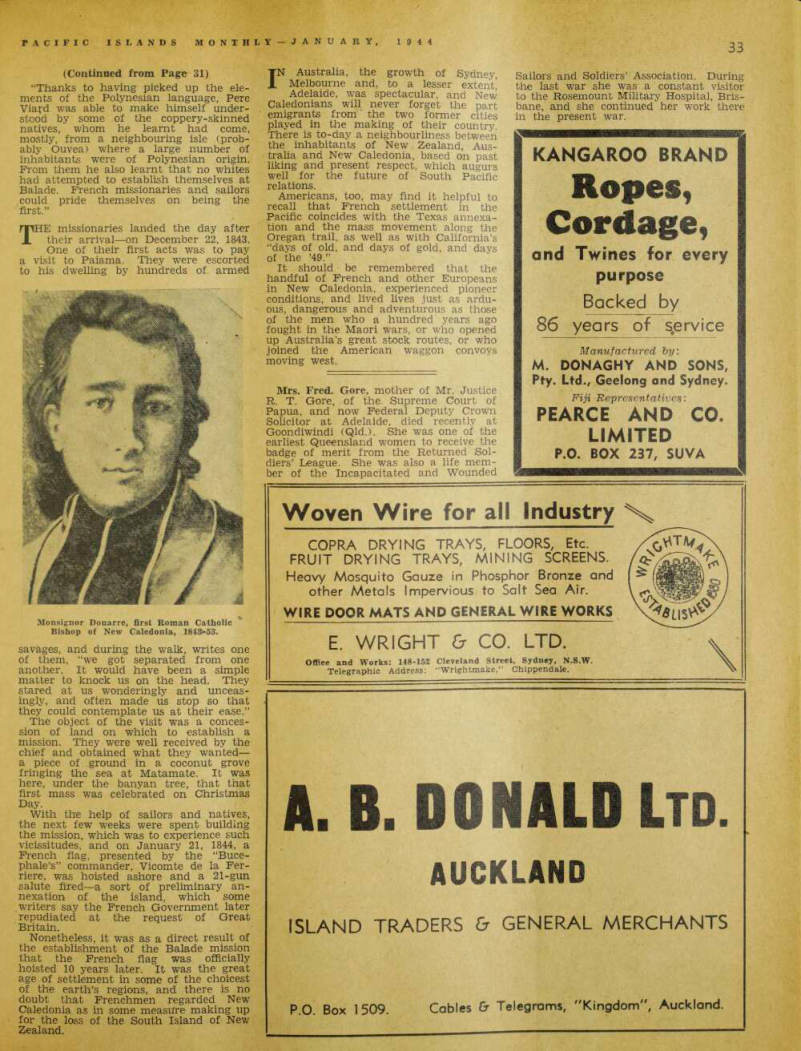
How The French Came To New
Centenary Celebrations at Balade
From Our Own Correspondent
Balade, New Caledonia, Dec. 22.
ASSOCIATED with the names of Cook, d’Entrecastreaux, Huon de Kerma dec, the first French Catholic fathers, and Admiral Febvrier-Des pointes, who proclaimed French posses sion in 1853, this isolated hamlet on the desolate north-east coast of New Cale donia is to-day the scene of centenary celebrations. Pontifical mass and native feasting and dancing are attended by the Governor, M. Christian Laigret, French officials and the three Catholic bishops of New Caledonia, New Hebrides and Solomon Islands, Yesterday, at Matamate beach, near Balade, where 100 years ago the first missionaries landed under Monsignor Douarre, the Magnificat was sung under the historic banyan tree where the first mass in the Colony was celebrated on Christmas Day, 1843.
In a speech broadcast throughout the island, the Governor’ praised the ten acity of the Marist fathers, thanks to whom New Caledonia was to-day a French country and recalled how they had thrice been driven from the country —to Sydney, to the Isle of Pines, to Anatom —and how one of their number had suffered martyrdom at the hands of the cannibals.
The official party will also visit other historic spots, including the tomb of Monsignor Douarre, and the tiny island of Poudie, where the navigator* Huon de Kermadec, commander of the “Esper ance,” was buried secretly and at night for fear the cannibals should discover his remains. It was on this islet, too, that Cook had set up his observatory. rE French man-o’-war, “Bucephale,” which brought the party to Balade 100 years ago, was the first war ves sel the natives had seen since the disas trous voyage of Bruny d’Entrecasteaux.
“Almost at once,” one of that party records, “the sea was covered with canoes expertly handled by picturesquely tattooed savages. They surrounded the ship, but dared not come too near. These canoes were from Balade and neighbour ing streams, whose inhabitants ran up en masse to look at the whites. It was curious to notice their different colour ing, some black, the majority of a dark red-brown colour, and others of the same bronzed skin as the Polynesians.
“Our least noise frightened them. It was a hard job to get them to climb aboard and they examined us with stupe faction, mixed with fear. Everything intrigued them—the sound of the bell, the roll of the drums, the loud com mands and the rapid and orderly move ments of the crew.
“Little by little, they grew bolder and it was a carved canoe that first drew alongside. Presently a much-tattooed native, for whom the others showed con siderable respect, climbed to the bridge, at the invitation of the officers. It was the Balade chief, Paiama. He was fol lowed by his escort, bringing gifts of yams, taros, coconuts, and all sorts of native weapons, spears and tomahawks.
In exchange, they were given glass beads and calico, with which they were delighted.
(Continued on Page 33)
(Continued from Page 31)
“Thanks to having picked up the ele ments of the Polynesian language, Pere Viafd was able to make himself under stood by some of the coppery-skinned natives, whom he learnt had come, mostly, from a neighbouring isle (prob ably Ouvea) where a large number of inhabitants were of Polynesian origin.
From them he also learnt that no whites had attempted to establish themselves at Balade. French missionaries and sailors could pride themselves on being the first.”
THE missionaries landed the day after their arrival —on December 22, 1843.
One of their first acts was to pay a visit to Paiama. They were escorted to his dwelling by hundreds of armed
savages, and during the walk, writes one of them, “we got separated from one another. It would have been a simple matter to knock us on the head. They stared at us wonderingly and unceas ingly, and often made us stop so that they could contemplate us at their ease.”
The object of the visit was a conces sion of land on which to establish a mission. They were well received by the chief and obtained what they wanted — a piece of ground in a coconut grove fringing the sea at Matamate. It was here, under the banyan tree, that that first mass was celebrated on Christmas Day.
With the help of sailors and natives, the next few weeks were spent building the mission, which was to experience such vicissitudes, and on January 21, 1844, a French flag, presented by the “Buce phale’s” commander, Vicomte de la Fer riere, was hoisted ashore and a 21-gun salute fired—a sort of preliminary an nexation of the island, which some writers say the French Government later repudiated at the request of Great Britain.
Nonetheless, it was as a direct result of the establishment of the Balade mission that the French flag was officially hoisted 10 years later. It was the great age of settlement in some of the choicest of the earth’s regions, and there is no doubt that Frenchmen regarded New Caledonia as in some measure making up for the loss of the South Island of New Zealand.
IN Australia, the growth of Sydney, Melbourne and, to a lesser Adelaide, was spectacular, and New Caledonians will never forget the part emigrants from the two former cities played in the making of their country.
There is to-day a neighbourliness between the inhabitants of New Zealand, Aus tralia and New Caledonia, based on past liking and present respect, which augurs well for the future of South Pacific relations.
Americans, too, may find it helpful to recall that French settlement in the Pacific coincides with the Texas annexa tion and the mass movement along the Oregan trail, as well as with California’s “days of old, and days of gold, and days of the ’49.’’
It should be remembered that the handful of French and other Europeans in New Caledonia, experienced pioneer conditions, and lived lives just as ardu ous, dangerous and adventurous as those of the men who a hundred years ago fought in the Maori wars, or who opened up Australia’s great stock routes, or who joined the American waggon convoys moving west.
Mrs. Fred. Gore, mother of Mr. Justice R. T. Gore, of the Supreme Court of Papua, and now Federal Deputy Crown Solicitor at Adelaide, died recently at Goondiwindi (Qld.). She was one of the earliest Queensland women to receive the badge of merit from the Returned Sol diers’ League. She was also a life mem ber of the Incapacitated and Wounded
Sailors and Soldiers’ Association. During the last war she was a constant visitor to the Rosemount Military Hospital, Bris bane, and she continued her work there in the present war.
Monsignor Douarre, first Roman Catholic Bishop of New Caledonia, 1843-53.
Frenchmen in the New Hebrides contri buted 427,649 francs (over £3,050) to the French Empire fund for patriots carrying on the underground warfare against the Germans in France.
Advertisements & other items, pp. 33-36 (1 item)
D Altv As ..Z.
ISLANDS
SOUVENIRS
Popular Islands Shell Necklaces and Hula Skirts posted direct to any part of the world.
Special sample parcel for £1
containing:
1 Genuine Manihiki Skirt; and 12 Assorted Island Necklaces.
Send your Money Order direct to
D. C. BROWN
MERCHANT AND EXPORTER
OF ISLANDS PRODUCE.
P.O. Box 16, Rarotonga, Cook Islands.
LARGE QUANTITIES AVAILABLE
—WHOLESALE' INQUIRIES INVITED.
BUY DIRECT AND SAVE MONEY
D AltV AS ..Z.
(Proprietors: R. DARVAS, E. KLUGMAN)
35 PITT STREET, SYDNEY
EXPORTERS IMPORTERS
GENERAL MERCHANTS
ISLANDS TRADERS
SHIPPERS OF ALL KINDS OF MERCHANDISE
SPECIALISING IN FOODSTUFFS AND SPIRITS
PROMPT ATTENTION GIVEN TO ALL ENQUIRIES
Bankers: Wartime Cable Address: Bank of Australasia. DARVAS COMPANY SYDNEY.
Comptoir National D’Escompte ’Phones: 8W4696, 8W6384, de Paris.
ALUMINIUM and its ALLOYS
OUR HOUSE FLAG IS FLYING and our production is flowing into the stream of Defence requirements exclusively—in the forms of Aluminium Alloy INGOT, Rolled Aluminium Alloy PLATE, SHEET, STRIP, also as Extruded Aluminium Alloy ROD, BAR, WIRE, TUBING AND SECTIONS.
We look forward to the time when civilian demands can be satisfied by us, to meet the growing applications for our metal in Australia and the South Seas.
AUSTRALIAN ALUMINIUM COMPANY
PROPRIETARY LIMITED
(INCORPORATED IN THE STATE OF VICTORIA)
GENERAL OFFICES AND FABRICATION DIVISION: GRANVILLE. SYDN E Y. N.S. W.
EDGELL
QUALITY CANNED
Vegetables & Soups
AUSTRALIA'S BEST
DEFENCE requirements take up the whole of the Edgell production to-day—consequently only a small proportion of civilian needs is occasionally made available by the Australian Defence Foodstuffs Control and exports are heavily restricted.
As soon as possible. Island consumers can rely on Edgell high quality products being made available to them once more.
Meanwhile, to take advantage of the limited quantities periodically released, please send your inquiries either through your usual channels or direct to the Island distributors .
C. SULLIVAN & CO. 379 Kent Street, Sydney, Australia.
. " EDGELL QUALITY CANNED GOODS"
C. SULLIVAN & CO.
GENERAL MERCHANTS ISLANDS AGENTS
REPRESENTING LEADING FIRMS IN THE PACIFIC ISLANDS.
Islands Produce sold on Shippers’ Account—Liberal Advances against Consignments.
Buyers of all Islands’ Requirements on Commission—Original Invoices Furnished.
Bankers'. Bank of New South Wales .. Bank of New Zealand .. Comptoir National d’Escompte de Paris.
Wartime Cable Address: Sullivan, Kentstreet, Sydney.
379 KENT STREET, SYDNEY, N.S.W.
KANGAROO BRAND
Ropes,
Cordage,
and Twines for every purpose Backed by 86 years of s.ervice Manufactured by:
M. DONAGHY AND SONS,
Pty. Ltd., Geelong and Sydney.
Fiji Representatives:
PEARCE AND CO.
LIMITED
P.O. BOX 237, SUVA
Woven Wire for ail Industry
COPRA DRYING TRAYS, FLOORS, Etc.
FRUIT DRYING TRAYS, MINING SCREENS.
Heavy Mosquito Gauze in Phosphor Bronze and other Metals Impervious to Salt Sea Air.
WIRE DOOR MATS AND GENERAL WIRE WORKS
E. WRIGHT & CO. LTD.
Office and Works: 148-152 Cleveland Street, Sydney, N.S.W.
Telegraphic Address: “Wrightmake,” Chippendale. f: £ £0
A. B. DONALD Ltd.
AUCKLAND
ISLAND TRADERS & GENERAL MERCHANTS
p O. Box 1509. Cables & Telegrams, "Kingdom", Auckland.
5 E s
LOTIO
For Inflamed Eyes and Eyelids
SOLD EVERYWHERE
H. A. Bess L Ce. Pty. Ltd.. Kim St. Sydney
The Illustration shows the “Victory”, a popular light all - steel plough, combining maximum strength with minimum weight and draught.
Perfect
results
in any class of soil can be obtained with 01 implement or other in the wide selection which we offer Our range covers share and disc ploughs for animal and tractor draught, cultivators, disc harrows, planters, etc.
ansomes
PLOUGHS and
IMPLEMENTS
Ransomes other manufactures include hand, horse and motor lawn mowers, aerodrome equipment, etc. Write for Illustrated literature and all Information.
MORRIS, HEDSTROM LTD.,
Suva Loutoka Ba.
Made by; RANSOMES, SIMS & JEFFERIES, LTD., IPSWICH, ENG.
Itching, Burning and Smarting of
ECZEMA
Stopped in Minutes
• Since the discovery of Nixoderm by an American physician it is no longer necessary for anyone to suffer from ugly, disgusting and disfiguring skin blemishes such as Eczema, Pimples, Rash, Ringworm, Psoriasis, Acne, Blackheads, Scabies and Red Blotches. Don’t let a bad skin make you feel inferior and cause you to lose your friends. Clear your skin this new scientific way.
A New Discovery
Nixoderm is an ointment, but different from any ointment you have ever seen or felt. It is a new discovery, and is not greasy but feels almost like a powder when you apply it. It penetrates rapidly into the pores and fights the cause of surface skin blemishes. Nixoderm contains 9 ingredients which fight skin troubles in 3 ways. 1. It fights and kills the microbes or parasites often responsible for skin disorders. 2. It stops itching, burning and smarting in 7 to 10 minutes, and cools and soothes the skin. 3. It helps nature heal the skin clear, soft and velvety smooth.
Works Fast
Because Nixoderm is scientifically compounded to fight skin troubles, it stops the itching, burning and smarting in a few minutes, then starts to work immediately, clearing and healing your skin, making it softer, whiter and velvety smooth. In just
a day or two your mirror will tell you that here at last is the scientific treatment you have been needing to clear your skin—the treatment to make you look more attractive, to help , you win friends. Nixoderm has brought clearer, healthier skins to thousands, such as Mr. R.K., who writes: “I suffered from terribly itching, burning and smarting Eczema for 12 years. Tried everything. At last, I heard of Nixoderm. It stopped the itching in 10 minutes. I could see my skin clearing up on the second day. All the red disfiguring blotches and scaly skin disappeared in 10 days.
My friends were amazed at the improvement in my appearance.”
Satisfaction Guaranteed
Get Nixoderm from your chemist to-day.
Look in the mirror in the morning and you will be amazed at the improvement. Use Nixoderm for one week and at the end of that time it must have made your skin soft, clear, smooth and magnetically attractive —or you simply return the empty package and your money will be refunded in full. Get Nixoderm from your chemist to-day. The guarantee protects you.
Nixoderm u- &v-
For Skin Sores, Pimples and Itch.
Luck In The Louisiades
Early Memories of the Gold-seekers
Letter to the Editor
IN writing in December “PIM,” Captain T. L. Craig gives much additional information about early gold pros pecting in Eastern Papua, and corrects some of my memories. I should like to make it clear that all my articles are based on memories of reports and dis cussions which occurred over 40 years ago.
In those days, in the mining camps, lights and reading-matter were scarce,
and it was the custom for the miners to gather around the fires, at night, and exchange news and experiences. Some of the news we gathered in that way may easily have been distorted—it was often hearsay.
On the Gira field, in 1899, there were a number of men who had worked on Sudest, Misima and Woodlark. I always heard that the reason the anchorage at Sudest was named Griffen Point was that the prospectors landed from the “Grif fen” there. That was where the main camp and warden’s office were built.
Most of the creeks and gullies, from the Four-mile River, east of Griffen ■Point, to West End, carried gold. At the West End, miners blind-stabbed out in the salt water, at low tide.
My first visit to Sudest was on Feb ruary 2. 1901. I remained there over a year, mining most of the time. Then I returned to the northern fields, until June, 1910. The folks mentioned by Captain Craig I knew. Matthew Morton was the first gold warden appointed by Sir William McGregor to the Misima goldfield. Afterwards, Sudest, Misima and Woodlark were under one warden.
A Mr. Heely was one of the early war dens on Sudest. I inquired why a Sudest native walked with a limp. Pat Carney said he had attacked Heely with a spear.
Heely drew his revolver and broke his thigh with a bullet. Sir William Mc- Gregor instructed his men, if attacked by natives, to try and avoid killing—to shoot at their legs.
BEFORE the discovery of gold on Sudest there was nothing for trad ers. Sudest is a large island about 50 miles long by 15 miles in the widest place, but the land is poor, producing little food. The natives were small in physique. They were raided by the natives from the west, as far as Test Island. Men were slain, women cap tured and villages looted. There are extensive reefs around the island. They were poor for trepang, and most of the fish was poor in quality. There was no other marine product of commercial value at that time.
Mahoney and Carney sent away a sample of gum in the early days of Sudest, The returns were poor. Noth ing more was done with gum until 1916 or 1917.
Pearling boats visited Sudest to fill their water tanks. The creek is named Watering Creek. The pearlshell beds were in the passages between Sudest and Janet and Nemo, and passages towards Dadahi. Other passages along the Cal vados Chain carried patches of shell.
Most of the islands of the Calvados Chain are small, with poor soil and little water, and most of the water is brackish.
The inhabitants boil yams in sea-water.
The yams absorb the salt and then they drink the water. Some seasons they depend solely on coconuts for drinking purposes. The Calvados Chain people smoke and dry fish and clams, and trade with Misima for yams and sago.
The water around Misima is very deep and there is only one small patch of reef near the east end.
Several prospecting parties visited Ros sel Island without finding any payable minerals. Rossel, Sudest and Piron natives traded with each other and were always friendly.
Billy Lamb took a party of Sudest boys to Rossel. Lamb stayed with the boat, while the boys went inland. At that
time it was risky for a white man to roam about Rossel. They spent weeks there, and returned with 3 dwts. of gold; worth about 10/-.
JACK ANDERSEN and Harry Williams were with a party of miners who sailed round Woodlark without anchoring. They considered the island too low to be mineral-bearing. They may have been much farther off the land than they realised, thus making the island appear lower than it is.
A botanist named Burke was collecting orchids. He collected a record number on Sudest. Like the late A. S. Meek, he did not bother about gold-mining. He saw specks of gold on a rocky bar in a creek on Woodlark, and directed Dick Ede and Charlie Lobb to it. They re ported it. That is how gold was dis covered on Woodlark.
Once, off Woodlark, Ede and Lobb were in a 10-days’ calm in a small cutter.
The current set them away north, towards Rabaul. Their water was down to a cup-full. Both were afraid to sleep, for fear the other would drink the water.
A heavy thunder-storm came, and, by lowering the sail and making a trough, they caught enough water to fill all their utensils and have a bath. Wind sprang up, and they sailed to Woodlark.
IDO not know who were th'e prospec tors of Misima. I heard Mr. Mor ton describing how he was sent by Sir William McGregor to act as warden, and build a station. He was supplied with galvanised iron and nails. While he was selecting a site for the station, several miners asked him to go inland and settle a dispute. He said, “Wait until I have a roof over my head.” The dis pute was forgotten when the station was built.
Afterward, Mr. Morton was RM in the Eastern Division. He later transferred to the SE Division. After retiring from the Papuan Service he was private sec retary to Sir William McGregor, in Brisbane.
If Captain Craig refers to Government records, he will probably find that gold was discovered in Sudest in 1888, not 1886.
Sir John Douglas visited Rossell Island to land repatriated natives from Queens land canefields. The only person named was Cholmondeley, in the Government report.
Nicholas Minister was an uneducated man. Most of his yarns were expurgated —though interesting. In most of the tales of his adventures he had to be care ful not to disturb a skeleton in the back ground.
The late Hon. G. J. Nelsson reported the discovery of gold on Maclachlan’s Creek, head of the Mambare, on the mainland, and the late Dick Ede reported the gold find on Woodlark, the same day.
I am, etc.,
D. H. Osborne
Brisbane, Jan., 1944.
Resident in Fiji since 1913, Mr. E. F.
Taylor, died in Suva, on November 10, after a short illness. He was a prominent member of the Masonic Lodge, and be fore his retirement a few years ago was well-known in the commercial life of the Colony. He leaves a widow and two sons, Mr. C. O. Taylor, Assistant Postmaster- General in Suva, and First Class Warrant- Officer F. A. Taylor, of the Australian
Army Medical Corps, formerly X-ray Technician at the Colonial War Memorial Hospital p i j V 69 ye ri ars . a ? 0 ’ fT Louis Joseph St. Julian, died in the S° lonia J War Memorial Hospital, Suva, on
her o? the famX o^sf/’rharip^qt’
° f tS.® SI J c , Charle . s i ulian ’ wh ° was Chief Justice of the 5 u £ r< E me Court of undfir King oaKooau.
Omitted from our list of New Guinea’s ' ™f 0 sbl S men l n I ?^!P lber ’ 1942, and re-published October, 1943) was the name of Mr. W. Haydon, plantation manager for W. R. Carpenter & Com pany, on an island off the coast of New Ireland. His name has been supplied to us by Lieut. G. D. Casbolt, formerly of New Guinea, now of ANGAU. Mr. Hay don was well-known as a planter of many years’ residence, and as a veteran of World War I. It is presumed that he fell into enemy hands when the Japanese in vaded New Ireland.
Mr. Eric W. Trebilcock, radio operator at the Salamaua aerodrome in 1941, is now engaged on radio duties in Queens land. He was one of a party of 28 which, under District Officer Penglase, walked from Salamaua to Wau, in Janu ary, 1942, after enemy bombings had made Salamaua untenable.
Advertisements & other items, pp. 37-38 (1 item)
Pinkettes
SHIPCHANDLERY
Yacht Gear, and Marine Engine Fittings. All classes of equipment for Boatbuilders working on defence. Gunmetal Dumps and Washers, Copper Nails and Roves, Sheathing Metal, Caulking Cotton, Anti-fouling Paint, Vents, Ports, Bilge Pumps, Common and Navy pattern galvanised Anchors, all sizes.
Motor Boat Horns—air and electric Navigation Lamps—oil and electrc.
SIMPLEX MARINE ENGINES, 3,5, and 10-12 H.P., 2 and 4 cycle, with built-in reverse gear. The best motors for work, patrol, or fishing boats. Heavy duty efficiency with economy and reliability. Ask for Simplex details.
SAFEGUARD YOUR WOODWORK WITH
DEKOL ”s?
Guards Wood from the ravages of White Ants, Borers, Dry Rot, Mildew, etc. Penetrates deeply and permanently protects fabrics from Rot and attack from Fungi. Is simple to apply, and when dry can be painted and varnished. Prevents attack by Marine Borers on wood immersed in sea-water. Is insoluble in water. Has no unpleasant odour. Is not harmful to animals or vegetation, when dry.
Price: 12/- gallon (4-gal. tins); 14/6 gallon (1 -gal. tins).
TRADE ENQUIRIES INVITED
W. KOPSEN & CO.
380 KENT STREET, SYDNEY
Cables; “Kopsen,” Sydney. N.S.W. -Phone: MA6336 (6 lines).
After taking Pinkettes you should feel brighter, happier, and free % from sick headaches, bilious attacks and liverishness. For
PINKETTES
are tiny laxative and liver pills, which painlessly exercise the digestive system.
Slop Kidney
Poisoning To-day
If you suffer from Rheumatism, Sciatica, Neuritis, Lumbago, Pains in Back, Nervousness, Dizziness, Circles under Eyes, Leg Pains, Poor Appetite and Energy, Puffy Ankles, or broken rest, etc., you should know that your system is being poisoned because germs, %cids and wastes are impairing the vital functioning process of your kidneys.
Take care! Ordinary medicines can’t help much and you must stop these troubles by removing the cause with Cystex which starts benefit in 2 hours and is offered on generous terms—No Benefit—No Pay. Cystex—the doctor’s prescription—is approved by doctors aftd chemists in 73 countries, and over 90,000 people have written to say how pleased they are to have found the right medicine for their troubles.
One-time Sufferers Praise This Medicine Mr. R. T., Townsville, Queensland, recently wrote: “My joints were all stiff, I had leg pains, my back used to ache day and night. My bladder was weak. I had headaches and no appetite. The first dose of Cystex helped me and before I finished three boxes my health and strength came back.’’
Mrs. M. L. Z., Thompson Estate, Brisbane: “I have been taking Cystex for Kidney and Bladder trouble and it has made a different woman of me. I am feeling splendid, can do all my work, run about and walk miles although I am 63 years of age. Cystex does all you claim for it.”
Cystex Helps Nature 3 Ways
Gets rid of health-destroying, deadly poisonous acids. Kills the germs which are infecting kidneys, bladder and urinary system. Helps nature to strengthen and reinvigorate kidneys and protects against further attack.
Guaranteed to Satisfy or Money Back Get Cystex from your chemist to-day. Give it a thorough test. Cystex is guaranteed to make you feel younger, stronger, better in every way, in 24 hours, and to be completely well in 1 week or your money back if you return the empty package. Act now! Now in 2 sizes—4/-, 8/-.
GUARANTEED C) VS tCX
Treatment W for Your Kidneys, Bladder, Rheumatism.
Purchasers at Full Market Prices on Assay Value of
GOLD
SILVER
PLATINUM
And Platinum Group Metals
SOME OF OUR SERVICES
ASSAYERS & ANALYSTS—
Assays of Bullion, Ores, etc.
Analyses of Metals, Minerals, Alloys, etc.
SCIENTIFIC & INDUSTRIAL
METALLURGISTS—
Our range of precious metal manufactures covers all industries—Gold and Silversmiths, Electrical Trades, Dental Profession, Glass Silverers, Electro-Platers, etc., etc.
REFINERS—
Purchasers and Refiners of Bullion, Scrap, Mining By-Products, and Trade Residues of every description carrying Precious Metals.
GARRETT Cr DAVIDSON
PTY. LTD.
824 George St., Sydney, Works: Surry Hills and Chippendale, N.S.W.
Official Assayers to the Bank of New South Wales. Gazetted Agents of the Commonwealth Bank of Australia, under the Gold Regulations of the National Security Act.
PRODUCING UNIFORM GOOD RESULTS SINCE 1868
ALWAYS ASK FOR IT
Bad Liquor
Wartime Evil in Pacific
r PHE following article was written by War Correspondent John Fairfax, on January 10, and printed in the “Sydney Morning Herald” on the follow ing day. As a portrayal of the other side of the sly grog traffic that is rife in all Pacific Territories affected by war, it is of interest. (See also u Sly Grog and Black Markets,” page 24, this issue.) To-day Captain Peters, American Pro vost Marshal in Noumea and Chief of Military Police, protested against the illegal sale of liquor, often dangerously bad. by French and New Caledonian civilians to Servicemen.
He maintains that the few cases of assault or molestation which had occur red between Servicemen and civilians are due to bad liquor sold illegally.
Captain Peters said: “Bootlegging of liquor is one of our greatest problems.
That liquor includes American or im ported wines and whiskies, also locally distilled spirits and liquors, such as wine brandy and the dangerous ‘butterfly rum.’ The sale of this liquor has been the major cause of any misconduct occurring among our troops and directed against the civilian population, but des pite the availability of this liquor, the conduct of our troops has been excep tionally good.” Captain Peters wishes that amendments could be made to French law against bootlegging and suggests a law allowing raids on boot leggers and confiscation and closing up of their establishments.
Governor Laigret stated two months ago that he would stamp out bootlegging, but there is no tangible evidence that his efforts, if any, have had effect.
Laigret said recently that the Ameri can Command had failed to co-operate with the French, and had also failed to control Negro troops, many of whom, he claimed, had molested women. Captain Peters showed me charge sheets of Ser vice personnel over the last four months.
There has been one case of rape, involv ing two Negroes, and one case of assault with intent, involving two whites and two coloured men. There have been only seven cases of assault by Servicemen oh civilians.
Captain Peters also denies the accuracy of the Governor’s statement that young civilians had formed bands to protect themselves against Negroes.
I can vouch for the excellent behaviour of American troops on this island, and the efficiency of their control.
War Record Of N. Guinea
Police Force
UNINFORMED Inferences to the con trary, New Guinea was a singu larly peaceful and quiescent land before the war. With an area of 91,000 sq. miles, a European-Asiatic population of about 6,000, and an indigenous popu lation of perhaps one million, law and order was kept by a handful of police and (before the arrival of the Rabaul garrison) nothing more lethal than ser vice rifles. The duties of the khaki-clad police-boys were manifold and did not stop at police work: it is doubtful if the blank, white spaces on the map of New Guinea would ever have been whittled down without the help of- the übiquitous “PB.” The following figures were sent to us by W/O L. Dean, now of ANGAU: At the time of the Japanese invasion of the Territory of New Guinea, the Police Force consisted of 36 European officers and 900 native armed constables. The policing of Rabaul was done by eight European officers and 40 natives (figures do not include Rabaul gaol or police depot supervision). In the invasion, nine European officers were captured and one of them is thought to have died while attempting to escape. The remainder, with one or two exceptions, are now serving with ANGAU.
Changes in the membership of Town ship Boards in the Colony of Fiji were announced in the Government Gazette in December. At Ba, Mr. D. Crowe and Mr. A. J. Abrahams were added to the Board. At Labasa, Mr. E. Sundin re placed Mr. D. C. Andrews, who has left the Colony. At Levuka, Mr, D. Watkins replaced Mr. R. Kaad, who has resigned.
Advertisements & other items, pp. 39-40 (2 items)
Roll Of Honour
37
PACIFIC ISLANDS MONTHLY JANUARY, 1944
(Continued From Inside Front Cover)
0. F. Massghelein
THE
YORKSHIRE
INSURANCE
CO. LTD.
(Incorporated in England)
FIRE
ACCIDENT
MARINE
FIRE POLICIES ISSUED
IN PAPUA
All information from —
E. A. JAMES,
TeL 86347. Attorney for Papua, 14 Spring St., Sydney.
0. F. MASSGHELEIN
-WORLD-WIDE EXPORT AGENT SINCE 1919
Late of Antwerp (Belgium). Established in Sydney 1928.
OFFERS RELIABLE and EFFICIENT SERVICE
to all Australian and Oversea Manufacturers Inquiries -from Oversea Buyers are Welcomed.
Correspondence: English, Dutch, French, Spanish.
ANDREWS BUILDINGS, 40 KING STREET, SYDNEY
CH
ERS
FAMOUS ENGLISH PRODUCTS
CANNED ENGLISH VEGETABLES
CANNED ENGLISH FRUITS
OLDE ENGLISH MARMALADE
GOLD MEDAL JAMS
JELLY CRYSTALS, ETC.
Obtainable from all leading Grocery Stores
WRITE TO DEPARTMENT “A”
CHI VERS fir SONS LTD.
Histon, Combs., Eng.
FOR ATTRACTIVE RECIPE BOOK
c m
CHIV£RS
COLD
FRESH
k tNCUSH A
PEAS
NELSON & ROBERTSON
PTY., LTD.
Established 1895.
Islands Merchants
All classes of merchandise purchased at wholesale prices and original invoices supplied to Islands clients.
Cocoa Beans, Rubber and other Islands' produce sold on commission.
Nelson & Robertson
Pty. Ltd. 12 Spring Street, Sydney, Australia.
cornu finsT-
Since the War began, the services and equipment of this Company have been made available expressly to firms wholly engaged in work for National Defence.
Noyes Bros. greatly appreciate the long-standing business friendships in the Islands, and assure customers there of the closest attention to their requirements, to be filled when conditions permit a resumption of normal trading.
NOYES BROS. (SYDNEY) LTD.
115 CLARENCE STREET. SYDNEY. Phone : B 7581 (10 lines) 11 WATT STREET, NEWCASTLE. 197 ELIZABETH STREET. BRISBANE
Coughing, Asthma, Bronchitis Curbed in 3 Minutes
Do you have attacks of Asthma or Bronchitis so bad that you can’t sleep? Do you feel weak, unable to work, and have to be careful not to take cold and can’t eat certain foods?
No matter how long you have suffered or what you have tried, there is new hope for you in a doctor’s prescription called Mendaco.
No dopes, no smokes, no injections, no atomizer.
All you do is take two tasteless tablets at meals and in 3 minutes Mendaco starts working through your blood, aiding nature to remove phlegm, promote free easy breathing and bring sound sleep the first night, so that you soon feel years younger and stronger.
No Asthma in 2 Years
Mendaco not only brings almost Immediate comfort and free breathing but builds up the system to ward off future attacks. For instance, J. Richards, Hamilton, Ont., Canada, had lost 40 lbs., suffered coughing every night, couldn’t sleep. Mendaco stopped Asthma
spasms first night and he has had none since in over two years.
Money Back Guarantee
The very first dose of Mendaco goes right to work circulating through your blood and helping nature relieve you of the effects of Asthma. Try Mendaco under an iron-clad money back gaurantee. You be the judge. If you don’t feel fully satisfied after taking Mendaco just return the empty package and the full purchase price will be refunded. Get Mendaco from your chemist to-day and see how well you sleep to-night and how much better you feel to-morrow. The guarantee protects
you - RELIEVES ASTHMA
Mendaco
Now in 2 sizes . . . 6/- and 12/-
In Butaritari
Reymond Family Has a Re-union
EVERYONE who knows the Gilbert Islands knows the Reymond family, of Butaritari. Some of the younger Reymonds have wandered far afield.
The Reymond girls are very pretty. Two of them, for years, have been members of the Sydney Polynesian Club.
As soon as the Pacific war came, the Japanese invaded Makin lagoon. Captain Reymond, master mariner, and head of the family, was cut off in Butaritari, and nothing was heard of him and the mem bers of his household for nearly two years.
Among the first men ashore, when the Americans recaptured Butaritari from the Japs on November 21, was Lieutenant Bruno Reymond. He rushed to his father’s house. It was nine years since he had seen his father —he had been a sailor until the war came, when he joined the Americans.
The old sea-captain, on his verandah, stared at the young officer. He could not see him clearly—he is 80, and his sight has failed, in recent years.
“Don’t you know me, dad —this is Bruno,” cried the young man—and when Captain Reymond had recovered from his amazement, he yelled for his wife. It was a family re-union worth seeing.
As far as is known, the few Europeans taken by the Japs in Butaritari in De cember, 1941, were sent away to the north, except old residents like Captain and Mrs. Reymond. They were allowed to occupy a small house there, under strict surveillance.
The relatives of Theo Hansen, who was a member of the first group of recruits who left Fiji to join the Royal Air Force, have received word by cable that he was injured in flying operations recently.
Many Island children have attended Trinity Grammar School in Kew, Vic toria. Parents will therefore be interested to know that Mr. Alfred Bright, MSc, BA, who has had many years of service with the school, has succeeded the late Mr.
Frank Shann as headmaster.
Troops' Gesture To
Solomon Islanders
A GIFT of 900 dollars has been made by the members of three New Zea land units in the Solomon Islands the Methodist Missionary Society of New Zealand to provide beds or a small ward in a new hospital which it is assumed the Society will provide for the natives of one of the islands after the war.
In a letter to the Rev. A. H. Scrivin, secretary of the Methodist Foreign Mis sion Board in New Zealand, the officer commanding the units said that the gift was from men of probably every creed, faith and church known in New Zealand and from many “non-performers.”
During the recent operations in which the units took part, stated the letter, the loyalty of the natives of the island was clearly demonstrated and their courage, fidelity, and will to serve the British Empire and the New Zealand Division were of great assistance and undoubtedly saved many New Zealand lives.
Rev. Martin Ackermann, formerly of the Lutheran Mission, Malalo, Salamua, New Guinea, has been engaged as a lec turer in the United States for many months past, and has travelled exten sively. He says that the Fuzzy-Wuzzy poem, “Tribute to New Guinea Natives,” published in the “PIM” in December, 1942, has received very wide publicity in the United States.
Advertisements & other items, p. 41 (3 items)
39
PACIFIC ISLANDS MONtHLI - JANUARY. 1944
Marys
B. DAVID Trading Co.
ISLAND TRADERS
EXPORT MERCHANTS
SHIPPERS OF ALL KINDS OF MERCHANDISE.
EXPORT REPRESENTATIVES OF LEADING
AUSTRALIAN MANUFACTURERS
Head Office;
31 Queen Street, Melbourne, Vic.
Branches and Agents in All Ports.
Direct Enquiries to Head Office.
Bankers: Cable Address: National Bank of “DAVID TRADING Australasia. MELBOURNE”
OPEN TO APPOINT AGENCIES WHERE NOT REPRESENTED
Ei3nniuißßumi««HiiußSiißG»:::i bbbbbsbbbbssss:::^
MARYS
baking powder
«|TS QUALITY NEVER VARIES’*
In war-time, as in peace-time, Aunt Mary's Baking Powder g"ve* the same "even rising" results. Limited supplies are being released, as opportunity affords, so use your purchase sparingly while precious ingredients in Aunt Mary s Baking Powder are difficult to obtain for normal requirements • AUNT MARY’S SCONES are always a luxury treat when good friends meet to accept your hospitality.
Islands Residents
WRITE ME regarding any matters requiring the personal attention of a reliable and interested agent here in the United States. Perhaps there is some information you want, or a book or magazine— whatever it may be, I am at your service. . . . Send me samples and prices of any islands products that you may have for sale in this vast market. I will be happy to act as— Your American Agent and Correspondent.
PAUL A. DORN
Box 1712 WEB, Los Angeles 36, California, U.S.A.
Wanted—“ Pacific Islands Monthly ” — All Issues.
Australian Short Wave
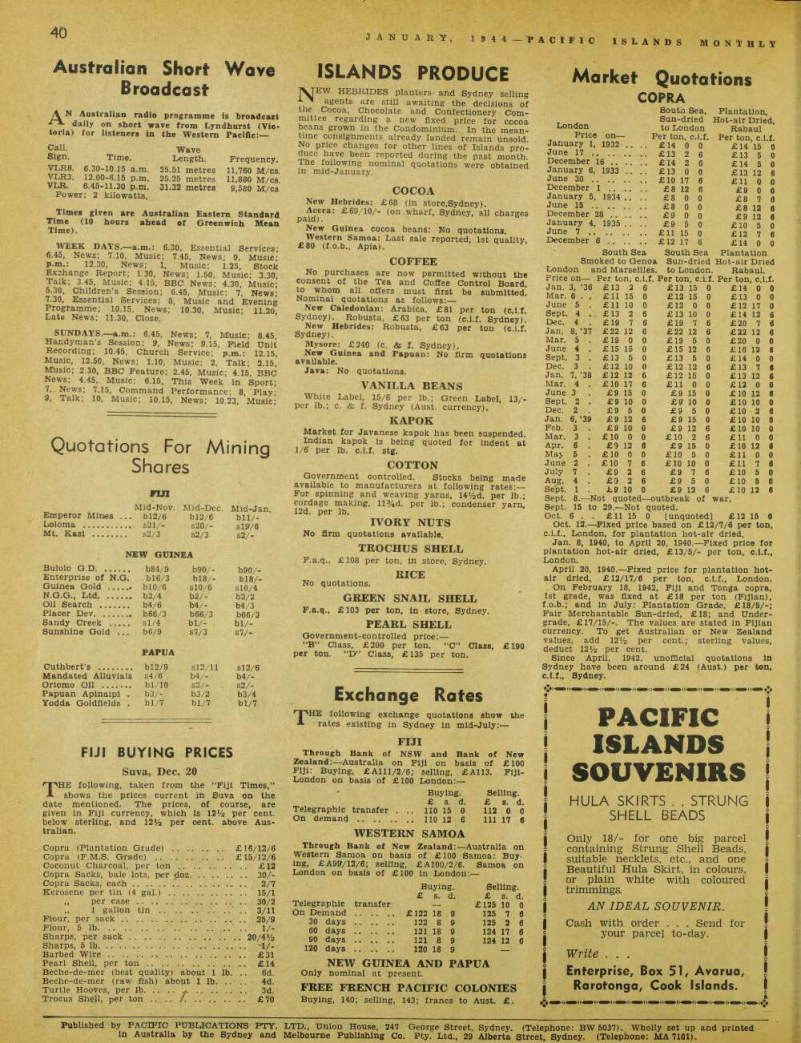
Broadcast
y\ N Australian radio programme is broadcast daily on short wave from Lyndhurst (Vic toria) for listeners in the Western Pacific:— Call. Wave Sign. Time. Length. Frequency.
VLRB. 6.30-10.15 a.m. 25.51 metres 11,760 M/cs.
VLR3. 12.00-6.15 p.m. 25.25 metres 11,880 M/cs.
VLR. 6.45-11.30 p.m. 31.32 metres 9,580 M/cs Power: 2 kilowatts.
Times given are Australian Eastern Standard Time (10 hours ahead of Greenwich Mean Time).
WEEK DAYS.—a.m.: 6.30, Essential Services; 6.45, News; 7.10, Music; 7.45, News; 9, Music; p.m.: 12.30, News; 1, Music; 1.25, Stock Exchange Report; 1.30, News; 1.50, Music; 3.30 Talk; 3.45, Music; 4.15, BBC News; 4.30. Music; 5.30, Children’s Session; 6.45, Music; 7, News; 7.30, Essential Services; 8, Music and Evening Programme; 10.15, News; 10.30, Music; 11.20.
Late News; 11.30, Close.
SUNDAYS.—a.m.; 6.45, News; 7, Music; 8.45, Handyman’s Session: 9, News; 9.15, Field Unit Recording; 10.45, Church Service: p.m.; 12.15, Music, 12.50, News; 1,10, Music; 2, Talk; 2.15,’
Music; 2.30, BBC Feature; 2.45, Music; 4.15, BBC News: 4.45, Music; 6.15, This Week in Sport; 7, News; 7.15, Command Performance; 8, Play; 9, Talk; 10, Music; 10.15, News; 10.23, Music;
Quotations For Mining
Shares
Fiji
Mid-Nov.
Mid-Dec.
Mid-Jan.
Emperor Mines ... bl2/6 bl2/6 bll/- Loloma s21/s20/- 519/6 Mt. Kasi s2/3 S2/3 s2/-
New Guinea
Bulolo G.D b84/9 b90/b90/- Enterprise of N.G. bl6/3 bl8/bl8/- Guinea Gold blO/6 slO/6 slO/4 N.G.G., Ltd b2/4 b2/b2/2 Oil Search b4/6 b4/b4/3 Placer Dev b66/3 b66/3 b66/3 Sandy Creek Sl/4 bl/bl/- Sunshine Gold .., b6/9 s7/3 57/- Cuthbert’s
Papua
bl2/9 S12/11 512/6 Mandated Alluvials s4/6 b4/b4/- Oriomo Oil bl/10 s2/s2/- Papuan Aplnaipi . b3/b3/2 b3/4 Yodda Goldfields . bl/7 bl/7 bl/7
Fiji Buying Prices
Suva, Dec. 20
THE following, taken from the “Fiji Times,” shows the prices current in Suva on the date mentioned. The prices, of course, are given in Fiji currency, which is 12Va per cent, below sterling, and 12*/ 2 per cent, above Aus tralian.
Copra (Plantation Grade) £l6/12/6 Copra (F.M.S. Grade) £l5/12/6 Coconut Charcoal, per ton £l2 Copra Sacks, bale lots, per doz 30/- Copra Sacks, each ’ 2/7 Kerosene per tin (4 gal.) 15/1 per case 30/2 1 gallon tin .. 3/11 Flour, per sack 25/9 Flour, 5 lb 1/- Sharps, per sack 20/4y 2 Sharps, 5 lb -1/- Barbed Wire £3l Pearl Shell, per ton £l4 Beche-de-mer (best quality) about 1 lb. .. 6d.
Beche-de-mer (raw fish) about 1 lb 4d.
Turtle Hooves, per lb 3d.
Trocus Shell, per ton .../. £7O
Islands Produce
IMEW HEBRIDES planters and Sydney selling X agents are still awaiting the decisions of the Cocoa, Chocolate and Confectionery Com mittee regarding a new fixed price for cocoa beans grown in the Condominium. In the mean time consignments already landed remain unsold.
No price changes for other lines of Islands pro duce have been reported during the past month.
The following nominal quotations were obtained in mid-January.
Cocoa
New Hebrides: £6B (in store,Sydney).
Accra: £69/10/- (on wharf, Sydney, all charges paid).
New Guinea cocoa beans: No quotations.
Western Samoa: Last sale reported, Ist quality. £BO (f.0.b., Apia).
Coffee
No purchases are now permitted without the consent of the Tea and Coffee Control Board, to whom all offers must first be submitted.
Nominal quotations as follows: New Caledonian: Arabica, £Bl per ton (c.i.f.
Sydney). Robusta. £63 per ton (c.i.f, Sydney).
New Hebrides: Robusta, £63 per ton (c.i.f Sydney).
Mysore: £240 (c. & f. Sydney).
New Guinea and Papuan: No firm quotations available.
Java: No quotations.
Vanilla Beans
White Label, 15/6 per lb.; Green Label, 13/per lb.; c. & f. Sydney (Aust. currency).
Kapok
Market for Javanese kapok has been suspended.
Indian kapok is being quoted for Indent at 1/6 per lb. c.i.f. stg.
Cotton
Government controlled. Stocks being made available to manufacturers at following rates:— For spinning and weaving yarns, 14V 2 d. per lb.; cordage making, ll 3 Ad. per lb.; condenser yarn, 12d. per lb.
Ivory Nuts
No firm quotations available,
Trochus Shell
F.a.q., £lOB per ton, in store, Sydney.
Rice
No quotations.
Green Snail Shell
F.a.q., £lO3 per ton, in store, Sydney.
Pearl Shell
Government-controlled price;— “B” Class, £2OO per ton. “C” Class, £l9O per ton. “D” Class, £135 per ton.
Exchange Rates
r F'HE following exchange quotations show the A rates existing in Sydney in mid-July:—
Fiji
Through Bank of NSW and Bank of New Zealand:—Australia on Fiji on basis of £lOO Fiji: Buying, £Alll/2/6; selling, £AII3. Fljl- London on basis of £lOO London:—
Western Samoa
Through Bank of New Zealand;—Australia on Western Samoa on basis of £lOO Samoa: Buy ing, £A99/12/6; selling, £AIOO/2/6. Samoa on London on basis of £lOO in London:—
New Guinea And Papua
Only nominal at present.
Free French Pacific Colonies
Buying, 140; selling, 143; francs to Aust. £.
• Buying.
Selling. £ s. d. £ s. d.
Telegraphic transfer . .. 110 15 0 112 0 0 On demand 111 17 6
Buying.
Selling. £ s. d. £ s. d.
Telegraphic transfer — £125 10 0 On Demand £122 18 9 125 7 6 30 days 122 8 9 125 2 6 60 days 121 18 9 124 17 6 90 days 121 8 9 124 12 6 120 days 120 18 9 —
Market Quotations
Copra
Oct. 6 . . £ll 15 0 [unquoted] £l2 16 0 Oct. 12. —Fixed price based on £l2/7/6 per ton, c.i.f., London, for plantation hot-air dried.
Jan. 8, 1940, to April 20, 1940.—Fixed price for plantation hot-air dried, £l3/5/- per ton, c.i.f., London.
April 20, 1940.—Fixed price for plantation hot air dried, £ 12/17/6 per ton, c.i.f., London.
On February 18, 1942, Fiji and Tonga copra, Ist grade, was fixed at £lB per ton (Fijian), f.0.b.; and in July: Plantation Grade, £lB/5/-; Pair Merchantable Sun-dried, £18; and Under grade, £l7/15/-. The values are stated in Fijian currency. To get Australian or New Zealand values, add 12 Vz per cent.; sterling values, deduct 12Va per cent.
Since April, 1942, unofficial quotations in Sydney have been around £24 (Aust.) per ton, c.i.f.. Sydney.
South Sea, Plantation, Sun-dried Hot-air Dried.
London to London Rabaul Price on- Per ton. c.i.f.
Per ton. c.l.f.
January 1, , 1932 . . , . £14 0 0 £14 15 0 June 17 . £13 2 6 £13 5 0 December 16 .. £14 2 6 £14 5 0 January 6, 1933 . . £13 0 0 £13 12 6 June 30 . £10 17 6 £11 0 0 December 1 . . £8 12 6 £9 0 0 January 5, 1934 £8 0 0 £8 7 6 June 15 . £8 0 0 £8 12 6 December 28 .. £9 0 0 £9 12 6 January 4, , 1935 . , £9 5 0 £10 5 0 June 7 .. £11 15 0 £12 7 6 December 6 .. £12 17 6 £14 0 0 South Sea South Sea Plantation Smoked to Genoa Sun-dried Hot-air Dried London and Marseilles, to London.
Rabaul.
Price on— Per ton, c.l.f. Per ton, c.i.f. Per ton. c.l.f.
Jan. 3, ’36 £13 2 6 £13 15 0 £14 0 0 Mar. 6 . . £11 15 0 £12 15 0 £13 0 0 June 5 . £11 10 0 £12 0 0 £12 17 0 Sept. 4 , £13 2 6 £13 10 0 £14 12 6 Dec. 4 . £19 7 6 £19 7 6 £20 7 6 Jan. 8, '37 £22 12 6 £22 12 6 £22 12 6 Mar. 5 . £19 0 0 £19 5 0 £20 0 0 June 4 . £15 15 0 £15 12 6 £16 12 6 Sept. 3 . £13 5 0 £13 5 0 £14 0 0 Dec. 3 . £12 10 0 £12 12 6 £13 7 « Jan. 7, ’38 £12 12 6 £12 15 0 £13 12 6 Mar. 4 . £10 17 6 £11 0 0 £12 0 0 June 3 £9 15 0 £9 15 0 £10 12 6 Sept. 2 . £9 10 0 £9 10 0 £10 10 0 Dec. 2 £9 5 0 £9 5 0 £10 2 6 Jan. 6, '39 £9 12 6 £9 15 0 £10 10 0 Feb. 3 . £9 10 0 £9 12 6 £10 10 0 Mar. 3 , £10 0 0 £10 2 6 £11 0 0 Apr. 6 . £9 12 6 £9 15 0 £10 12 6 May 5 . £10 0 0 £10 5 0 £11 0 0 June 2 . £10 7 6 £10 10 0 £11 7 6 July 7 £9 2 6 £9 7 6 £10 5 0 Aug. 4 . £9 2 6 £9 5 0 £10 6 0 Sept. 1 . £9 10 0 £9 12 6 £10 12 6 Sept. 8. —Not quoted—outbreak of war.
Sept. 15 to 29.— -Not quoted.
Advertisements & other items, pp. 42-44 (2 items)
40
January, 1944 pacific islands monihly
Published by PACIFIC PUBLICATIONS PTY. LTD., Union House, 247 George Street, Sydney. (Telephone; BW 5037). Wholly set up and printed in Australia by the Sydney and Melbourne Publishing Co. Pty. Ltd., 29 Alberta Street, Sydney. (Telephone: MA7101).
Islands
PACIFIC
SOUVENIRS
HULA SKIRTS . . STRUNG
SHELL BEADS
Only 18/- for one big parcel containing Strung Shell Beads, suitable necklets, etc., and one Beautiful Hula Skirt, in colours, or plain white with coloured trimmings.
AN IDEAL SOUVENIR.
Cash with order . . . Send for your parcel to-day.
Write . . .
Enterprise, Box 51, Avarua, Rarotonga, Cook Islands.
ď
' hG 3* t. . /Jk M ■ r ..
AlHtl nail . feSSlsi - : ! . ■ •V '>• V ■• . .:• .. ■I r* . t » m »
Travel by CARPENTER AIRLINES
Full particulars from Macdonald, Hamilton fir Co., or Howard Smith Ltd., Sydney. ■
W. R. CARPENTER & CO. LTD.
MERCHANTS, SHIPOWNERS AND AIRCRAFT OPERATORS
Agents for Australian, European and American Manufacturers, and Distributors of Every Description of Merchandise.
Buyers and Shippers of Copra, Trocas, and all Classes of Islands Produce.
AGENTS FOR :
Ford Motor Company of Canada. Caterpillar Tractors. Dodge Brothers Inc.
T. G. & C. Bolinders (Engines). Electrolux Refrigerators. Westinghouse Electrical Co. etc., etc.
Branches throughout the Pacific Islands
In London: W. R. Carpenter & Co. (London) Ltd., Coronation House, 4 Lloyds Avenue, London, EC,
Head Office: 16 O’CONNELL STREET, SYDNEY