Pacific
Islands
Monthly
Vol. Xiv. No. 5.
December 17, 1943
Established 1930
[Registered at the G.P.0., by post as a newspaper ]
1/-
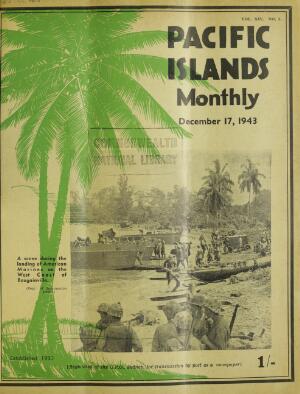
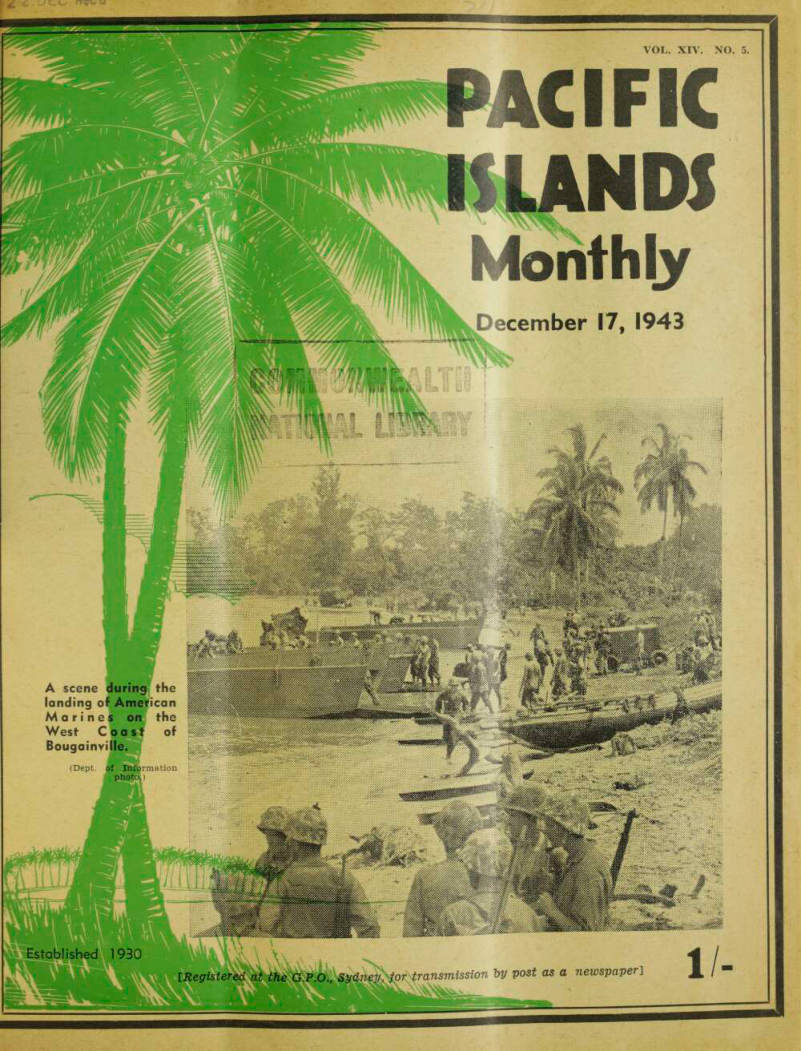
A scene during the landing of American Marines on the West Coast of Bougainville. (Dept. of Information photo,)
stSntth tbl oonsiderable
Fiji's Army
Praise From Brigadier
J. G. C. Wales
WHEN Brigadier J. G. C Wales Mr arrived in New Zealand in Novem ber, after relinquishing the coS mand of the Fijian Military Forces, he paid warm tribute to the part the people of Fiji are playing in the Pacific war.
Brigadier Wales went to Fiji when the resident forces, organised as a defensive force, consisted of one battalion. When he left, the force had been reconstituted as an offensive formation, trained in amphibious operations and jungle war lMtSl ay ja a p n an^ iVe P&rt ta the fi6ld The Veld fnEi k nnnr Ki
stSntth tbl oonsiderable
SOl i lGT f
g native Fijians, with some resident wrVta“Sraf^ f t ? a ic a rnactcn f( l rce £ a artlllery formation which Fijians have eagerly enlisted, and there are also two labour battalions.
E? 6 !® Ara L b n asis and num “ SSSf J? thar l 2,0 ?° P strength. inese nave set such a standard of work ™ dmg i unloacbng ships that they a ff S . regarded -as being the fast est wharf workers in the Pacific.
The majority of the officers are New Zealanders, but there are a number of Fijian commissioned officers, so far, up to captain in rank.
In the field force there are two guerilla or commando formations As early as last December a section of one
asm
as scouts right up to the conclusion of the Guadalcanal campaign. Their native talents, among which silence, almost magical bushcraft, cheerful endurance keenness of sight and excellence at snap shooting, stand out prominently, were so successfully used that they killed a large number of Japanese and notably fulfilled all their assignments without loss to themselves.
In addition to the commando unit, a battalion of the brigade has been in the Solomons for some time, carrying out an essential, but so far only protective, duty.
The rest of the field force is anxiously awaiting the day when it can go into the forward areas.
Before he left the Colony, Brigadier Wales was fare welled by many friends and organisations with whom he had identified himself during his stay in Fiji.
His name will long be remembered by many people in Fiji and will always be connected with the happy association between the New Zealand and Fiji Mili tary Forces, Miss Catherine Elizabeth Colombus died suddenly at the Colonial Memorial Hospital, Suva, on October 26. aged 23 She was a nurse in training at the Child Welfare Department of Suva and a mem ber of the Indian Stri Sewa Sabha.
Sergeant Bill Hallows, AIF, late of the NG Volunteer Rifles, Edie Creek, New Guinea, who recently returned from the Middle East with the Sixth Division, is now back again in New Guinea, serving with a machine-gun unit.
The death of Mr. Jack Thomas Elliot, son of Mr. Thomas Elliot, manager of Nasini Quarry, Fiji, occurred at Nasini on October 28. He was 23 years of age and had been in ill-health for some time.
Major Kennedy Decorated
A FORMER District Officer in the Solo mons, Major D. G. Kennedy, has been awarded the Distinguished Service Order m recognition of his gallant and distinguished service in the South-west Pacific. It will be remembered that Major Kennedy (then Captain), between the ln i e .L^k e Japs landed in the Solomons and the arrival of the Americans, “to re lieve him of the responsibility for the defence of his district,” ran a kind of private, amphibious war with the help of a 25 ft. whale boat and an “army” of 32 natives. In all he and his men accounted for 170 dead Japs and 22 prisoners.
Harold Cooper, who wrote the original Kennedy story in the October “PIM,” now reveals that Kennedy’s second-in-com mand was a Euronesian, William Billy Bennett. Billy had a varied career as cook-boy, medical dresser, and primary school teacher before he joined the Solomons Defence Force—but he soon proved expert in the kind of war dis pensed by Kennedy. He could speak, read and write English, and was a persuasive orator. Before each venture into Jap territory he and Kennedy would pore for hours over maps and plan the projected action down to the last detail. Then Billy would explain the plan to the men, end ing his discourse with a “pep talk” which, according to Kennedy, seemed to have an almost hypnotic effect on them.
In action and under lire he showed the highest courage—on one occasion board ing a silent enemy barge armed with a tommy-gun, although he realised that the silence was more than likely a Jap trick.
His mother is a New Georgia woman, and the longer the Japanese remained in occupation of that island the more he grew to hate them.
Advertisements & other items, p. 2 (2 items)
Pacific Islands Monthly-D E C E M B E R, 1943
Sffii
Pacific News-Review
Notes And Comment On
The Progress Of The War
From Nov. 16 To Dec. 14
Nov. 16: After hard fighting on the eastern front, the Red Army on the Gomel sector captured Demiche, thus cutting the railway to Gomel, where there is a large German garrison.
Nov. 17: American Liberator bombers attacked Japanese air bases in the Gil bert Islands and the Marshall Islands over the week-end. Their base has not been disclosed.
Nov. 16: The Allies made the New Guinea war’s heaviest raid on Madang.
There was no enemy interception.
Nov. 18: Leros (in the Dodecanese) captured from the British and Italian garrisons by the Germans.
Nov. 18: Rabaul again raided by RAAF Beaufort bombers, and an 8,000-ton transport sunk. In the Ramu Valley, 20 Japanese planes destroyed by Kitty hawk fighters.
Nov. 19: A great battle has opened along the tip of the Russian salient near Jitomir, where the Germans have launched large-scale counter-attacks de signed to halt the Russian advance west of Kiev, and south-west towards the River Bug.
Nov. 20: The Germans re-captured Jitomir, Further north, the Russians captured Ryechitsa and Koretsen, off setting the German gain, to some extent.
Nov. 20: In New Guinea, the Austra lians made further gains after heavy fighting in the area round Satelburg.
Nov. 20: In Bougainville, US forces enlarged the defence perimeter round Empress Augusta Bay, but are meeting stiff resistance.
Nov. 22: The Red Army made another crossing of the Dnieper, 160 miles to the south-east, at Cherkasy, and smashed a large gap in the enemy defences.
Nov, 22: Following up twin raids on Berlin on Thursday night, the RAF on Friday night smashed Leverkusen (centre of German poison gas produc tion). These raids are part of the Anglo-American plan to (a) hit German war-production where it is most effec tive; (b) stretch German fighter plane strength to snapping-point; and (c) destroy German morale.
Nov. 22: Australians, near Satelburg, New Guinea, surprised the Japanese by using “Matilda” tanks. The settlement is being approached from two sides, despite enormous difficulties of terrain.
Nov. 23: Covered by an “air umbrella” and powerful units of the US Fleet, US Marines landed on Makin and Tarawa Islands, Gilbert Islands, on Saturday, November 20. There was strong resis tance at Tarawa and fight resistance at Makin.
Nov. 24: American forces in the Gil berts occupied Abemama, south-east of Tarawa. Marines at Tarawa are still facing stiff opposition. Liberators on Sunday bombed Nauru, and the Marshall Islands, as a diversionary measure.
Nov. 24: Berlin had its heaviest RAF raid on Tuesday night, when nearly 2,000 tons of bombs were dropped. Vast fires were started.
Nov. 24: Important progress is being made by the Russians in their offensive south-west of Kremenchug.
Nov. 25: On Tuesday, Berlin had a second devastating raid within 24 hours, when 3,300 tons of bombs were dropped.
Sweden reports that parts of the city were “blown off the face of the earth.”
Nov. 26: The great tank battle west of Kiev is still going on. The Germans made a slight gain.
Nov. 26: The US Navy sank four small enemy warships off Bougainville, in the Solomons.
Nov. 26: US forces now have captured Betio islet (Tarawa atoll, Gilbert Islands) and are mopping up on Makin and Abemama atolls. They lost over 1,000 killed and 2,500 wounded on Betio. At least 6,000 Japanese defenders were wiped out.
Nov. 27: Gomel, the German fortress on the banks of the river Soj, has been captured by the Russians. The Russians are exploiting a break-through in White Russia, 120 miles north of Gomel. The Germans are bogged down in their coun ter-offensive west of Kiev.
Nov. 28: Berlin has been raided for five nights in succession by the RAF, and a third of the city is reported in ruins.
Casualties after the fourth raid were estimated at 81,000. The populations of two entire Dutch cities, Utrecht and Eindhoven, have been ordered to move out, in order to make way for bombed out Germans.
Nov. 29: The Japanese are retiring from Satelburg area, New Guinea, after the capture of the settlement on Novem ber 25. The Australians have cut their main supply and escape route on the Bonga-Wareo trail.
Nov. 30: The Eighth Army has launched a new attack in Italy. New Zealanders are in action there again.
Dec. 1: After 36 hours’ continuous fighting, the British Eighth Army in Italy has pierced the German winter defence line on the high ground north west of the river Sangro.
Dec. 1: The Russians are attacking on three fronts: North-west of Gomel, south of Kremenchug, and near Nikopol (inside the Dnieper Bend).
Dec. 2: President Roosevelt, General Chiang Kai-shek, and Mr. Churchill concluded a conference in Egypt, where plans against Japan were agreed on, and have left to confer with Marshal Stalin in Persia.
Dec. 4: Berlin again attacked by the RAF, and large fires started.
Dec. 4: British and Americans have made progress on their two separate fronts in Italy, against strong German resistance.
Dec. 7: An historic communique issued on the four days’ conference between Marshal Stalin, President Roosevelt and Mr. Churchill, at Teheran, says that the three leaders reached complete agreement on the scope and timing of operations against Germany, which will be under taken from the east, the west and the south. It was further stated that 1944 was meant to be “the definite year” in the war against Hitlerism.
Dec. 8: Mr. Churchill and President Roosevelt are now conferring with the President of Turkey (General Inonu) and the result is expected to be a more defi nite expression of Turkey’s friendship to the Allies in the form of war aid.
Dec. 8: The Russians have switched their main attack to the Dnieper “Bend and yesterday broke through the German lines south of Kremenchug and are now within reach of Snamenka (the key rail way junction through which enemy sup plies for the Dnieper Bend must come).
Dec. 8: Strong American force of car rier-based aircraft on Saturday attacked several Japanese bases in the Marshall Islands. They destroyed six Jap ships and 72 aircraft. .
Dec. 9: In biting snowstorms, two fierce battles are being waged in Russia one near Kremenchug. where the Rus sians are on the offensive, and the other where the Germans are making some gains in their second counter-attack, with 1,200 tanks, against the Kiev bulge.
Dec. 9: While the Australians push on
in the Huon Peninsula, in New Guinea, Allied bombers are maintaining their attacks on Cape Gloucester and the barge starting points along the New Britain coast.
Dec. 11: The Australians in the Huon area of New Guinea have taken Wareo, Japanese supply and communication centre.
Dec. 11: US Naval units in the Central Pacific attacked Nauru Island with naval guns and carrier-based aircraft.
Dec. 13: The Red Army is advancing in the northern part of the Dnieper Bend, following the capture of Sna menka. Fierce fighting is going on south of Malin, which the Germans have reached in their counter-attack against the Kiev bulge.
Dec. 13: In a daylight raid on the Emden naval base, in Germany, United States Air Force shot down 138 enemy fighters, for the loss of 17 bombers and three fighters.
Dec. 14: After a month on the defen sive, the Red Army has taken the offen sive in the great tank battle for the Kiev bulge, and thrown the Germans out of several villages near Malin.
General opinion is that the German counter-attack now is exhausted and, if the Russians produce the necessary reserve strength, the Germans on the eastern front may face grave disaster.
With the exception of those serving with the French military forces or employees of the Administration, all male French citizens in New Caledonia, between the ages of 18 and 45, were required to fill in a censorship form by December 1.
News has been received that former Noumea Magistrate, Andre Petre, an offi cer with the New Caledonian contingent of the Pacific Batallion, and son of one of the heads of departments at Noumea Post Office, has escaped from an Italian prison camp and rejoined the Allied forces. The Petre family played a lead ing part in rallying New Caledonia to General de Gaulle.
A New Caledonian soldier serving overseas has been appointed French Pacific representative of the assembly which has been formed in Algiers by the French National Liberation Committee to organise and support French metropoli tan resistance against the Germans. He is M. Roger Gervolino, who left Noumea with the first contingent, May, 1941.
Advertisements & other items, pp. 3-4 (1 item)
Christmas Party
JPERRITORIANS are reminded that the * New Guinea Women’s Club of Sydney is holding a Children’s Christmas Party in the Feminist Club Rooms, 77 King Street, Sydney, from 2 to 4.30 p.m. on December 23. There will be a distribution of gifts for kiddies up to thirteen years of age. (Parents were asked last month to send in names of their children to the secretary of the Club.) The children’s party will be followed by a get-together for adult Territorians (from 5 to 7.30) and all are cordially invited to attend.
USEFUL ADDRESSES
The following are the addresses of organisations set up to deal with Pacific Territories affairs:—
PAPUA, NEW GUINEA, NAURU,
NORFOLK IS.
Department of External Territories (Sydney Branch) (Lately the New Guinea Trade Agency), Australia House, Carrington Street, Sydney.
Telephone: BW 1776. (Dealing with all matters connected with the Australian Pacific Territories and also the Sydney representative of the New Guinea Copra Control Committee.)
BRITISH SOLOMON ISLANDS
Sydney Office of British Solomon Islands Government (In charge of Mr. F. E. Johnson, Treasurer of the Solomons Administration), 17 Castlereagh Street, Sydney.
Telephone: B 1710.
GILBERT AND ELLICE, AND
OCEAN IS.
Sydney Office of Gilbert and Elliee Islands Colony (In charge of Mr. S. G. Clarke, Treasurer of the G. and E. Administration), Bank of New Zealand Building, George Street, Sydney. Telephone: B 2209.
FOR PACIFIC TERRITORIES
EVACUEES GENERALLY
Pacific Territories Association (C. A. M. Adelskold, Secretary), c/o Robert Gillespie Pty., Ltd., 54a Pitt Street, Sydney. Telephone: BW 4782.
WAR DAMAGE COMMISSION
Sydney Office: M.L.C. Buidling, Cnr. Martin Place and Castlereagh Street, Sydney.
Telephone: BW 2361.
FOR CLAIMS AGAINST ARMY
Mr. H. Alderman, Darwin-Moresby Claims Section, Chief Finance Office (Army), Victoria Barracks, Melbourne.
Contents
Pacific News-Review 1 Editorial: Air Transport Will Open New Era in Pacific Islands ... 3 Melanesian Missions’ Task of Recon struction 4 How Old-timers Are Helping Cause in New Guinea 5 Pacific Problems—Plea for Co-opera tion 5 Scrub Typhus 5 War Damage Claims 6 Fiji Remembers American Dead .. 6 Eruption on Niuafoou 7 G, E. Hemsworth Reported POW .. 7 Co-prosperity Sphere Not Doing So Well —Japan Has Her Troubles .. 8 Japanese Need Phosphates 9 “Village Churchill” Goes to War .. 10 Bishops and Anthropologist to Rescue of Fuzzy-Wuzzy 10 Mr. Ward—A “Yes or No” Man—PTA Report at Quarterly Meeting .. 11 Dutch Rule in NEl—Second of Three Special Articles 13 War Comes to Atolls—And What Happened in Tarawa 16 Governor Sautot Marries in Africa . 19 New Guinea Seen Through Ameri can Eyes 20 Oversea Birds for Birdless Tahiti .. 23 Soldier’s Story 25 Fame—And Tahiti 27 South Pacific Confederation 28 Blissful Isles —Memories of 170 Years Ago 32 Gold in Sudest—How it Was Found 36 Medical Work in the New Papua .. 37 Commercial and Markets 40 Fiji’s Army—Praise by Brigadier Wales cov. ii.
Advertisers
A.W.A., Ltd. ... 22 Atkins Pty., Ltd., Wm 28 Australian Alumi nium Co. Pty., Ltd 25 Broomfield, Ltd. . . 24 Brown, D. C. . . .25 Brown & Co., Ltd., G 13 Brunton’s Flour . . 20 Burns, Philp Trust Co., Ltd 12
B.P.’(S.S.) Co. . . . 13
Carlton & United Breweries, Ltd. . 19 Carpenter, Ltd., W.
R cov. iv.
Chivers & Sons, Ltd 37 Coleman Lamp & Stove Co 23 “Current Problems” 29 “Cystex” 36 Darvas & Co. ... 39 Donaghy & Sons, Ltd . 37 Donald, Ltd., A. B. 33 Dorn, Paul A. . . .40 Dr. Williams Pink Pills ... cov. iv.
Electrolux Refrigerators ... 18 For Sale 37 Poster Clark, Ltd. , 17 Garrett & Davidson 30 Gilbey’s Gin ... 14 Gillespie’s Pty., Ltd., Robert 25 Gillespie’s Flour . . 29 Gough & Co., E.
J 35 Gourock Rope & Canvas Co. ... 38 Grove & Sons, W.
H 14 Grand Pacific Hotel 2 Heinz & Co. Pty,, Ltd., H. J. . . cov. ii.
Jantzen (Aust.), Ltd 15 Kopsen & Co., Ltd cov. iv.
“Lavex” Washing Compound . . . , 26 Maxwell Porter, Ltd. 35 Merrillees & Co., J- C 20 “Mendaco” ... 34 Miller & Co. Pty., Ltd 27 Nelson & Robertson Pty., Ltd 38 “Nixoderm” ... 32 Pacific Is. Society . 13 Pacific Islands Sou venirs For Sale . 37 Pacific Islands Year 800k—1944 Edition 35 Pearson, Russell . . 31 “Pinkettes” ... 40 Rose’s Eye Lotion . 38 Queensland Insur ance Co., Ltd. . . 27 Riverstone Meat Co., Ltd 21 Rohu, Sil 24 Russell, G. F. . . . 24 Scott, Ltd., J. ... 24 Steamships Trading Co., Ltd 30 Sullivan & Co., C. .*26 Swallow & Ariell . . 16 Taylor & Co, A . .33 “Tenax” Soap ... 34 Tillock & Co, Ltd . 38 Trinity Grammar School 32 “Van Kars”
Liqueurs 26 Wright & Co. ... 39 Wright & Co., Ltd., E 32 Wunderlich, Ltd. . . 33 Young Pty., Ltd., Harry J 36 Yorkshire Insurance Co., Ltd 23
Advertisements & other items, p. 4 (1 item)
A member of the central office of the Prices Branch, Canberra, Mr
Prices Branch, Canberra, Mr. R. W.
Parkinson, has been seconded to the Fiji Government as Prices Controller of Fiji.
% }r
Pacific Islands Monthly
The Newspaper-Magazine of the Sooth Seas L Registered at the G.P.0., Sydney, for transmission by post as a newspaper.']
Published Once Each Month and Circulated in Australia and New Zealand and in the following Pacific Territories and Islands Groups;
Australian Territory of Papua.
Mandated Territory (Australia) of New Guinea.
Australian Territory of Norfolk Island, New Zealand Territory of Cook Islands.
Mandated Territory (NZ) of Western Samoa.
British Colony of Fiji.
British Solomon Islands Protectorate.
British Protectorate of Tongan Islands.
British Crown Colony of Gilbert and Ellice Islands.
Mandated Territory of Nauru.
British and Free French Condominium of New Hebrides.
Free French Colony of New Caledonia.
Free French Colony of Oceania (Tahiti, etc.).
American Territory of Eastern Samoa.
American Territory of Hawaiian Islands.
Owned and Produced by Pacific Publications Pty. Ltd., Union House, 247 George Street, Sydney.
c Managing Director .. BW 5037 £ Business and Editorial MA 4389
P.O. Box * 3408 R
Registered Address of Telegrams, Radiograms, and Cables: “Pacpub”, Sydney,
Contributions.
Articles, Stories, and Photographs dealing with Pacific Islands subjects are invited and will be paid for on publication.
Subscription Rates.
Per Annum, within British Empire, Prepaid, Post Free 10/- Per Annum, elsewhere, Prepaid, Post Free 12/6 Single Copies 1/-
Editor and Publisher:
R. W. Robson, P.R.G.S.
Advertising Manager: L. W. Bailey.
Advertising Office and Printing-House: 29 Alberta Street, Sydney.
Advertising rates furnished on application.
Colours, etc., by arrangement.
Process Blocks made at Advertiser’s expense when required. Screen 100.
Changes of Advertising Copy should reach this office by Ist of each month, otherwise previous advertisement may be repeated.
Representative In London.
W. C. Harvey, Coronation House, 4 Lloyds Avenue, London, E.C.3, from whom may be obtained copies of Pacific Islands Monthly, Pacific Is. Year Book, advertising schedules, etc.
Agents.
The following are authorised to receive sub scriptions for Pacific Islands Monthly:— Burns, Philp & Co., Ltd., and Burns Phllp (South Sea) Co., Ltd. All branches.
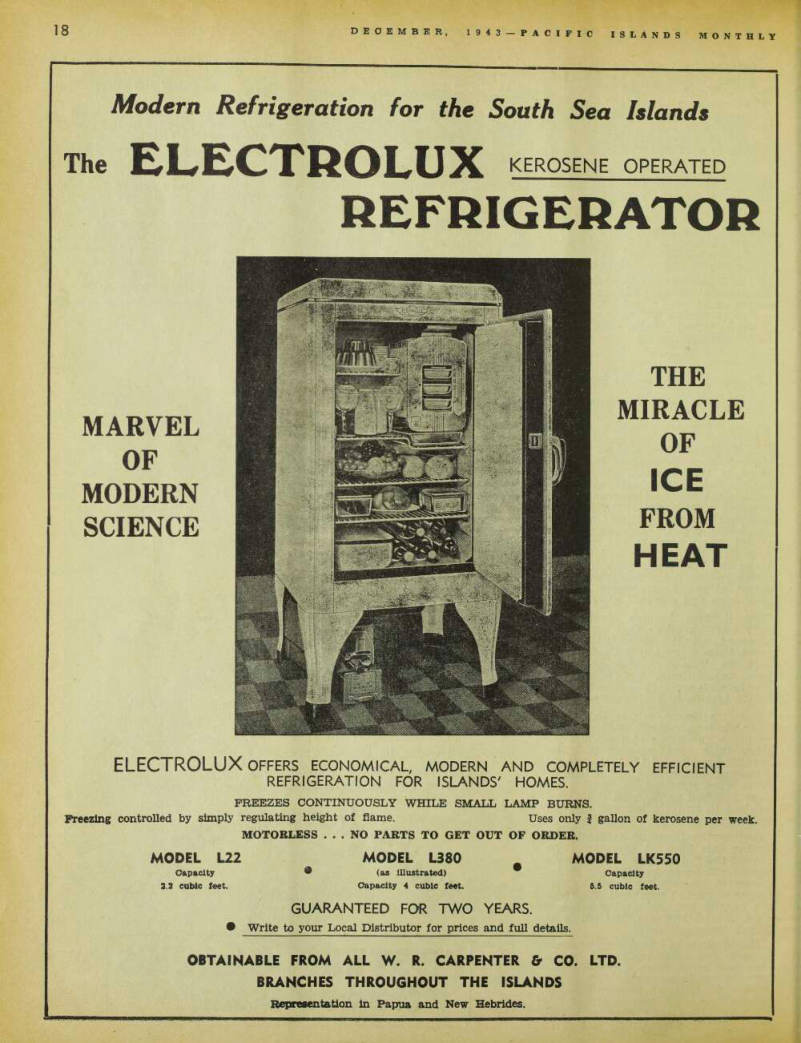
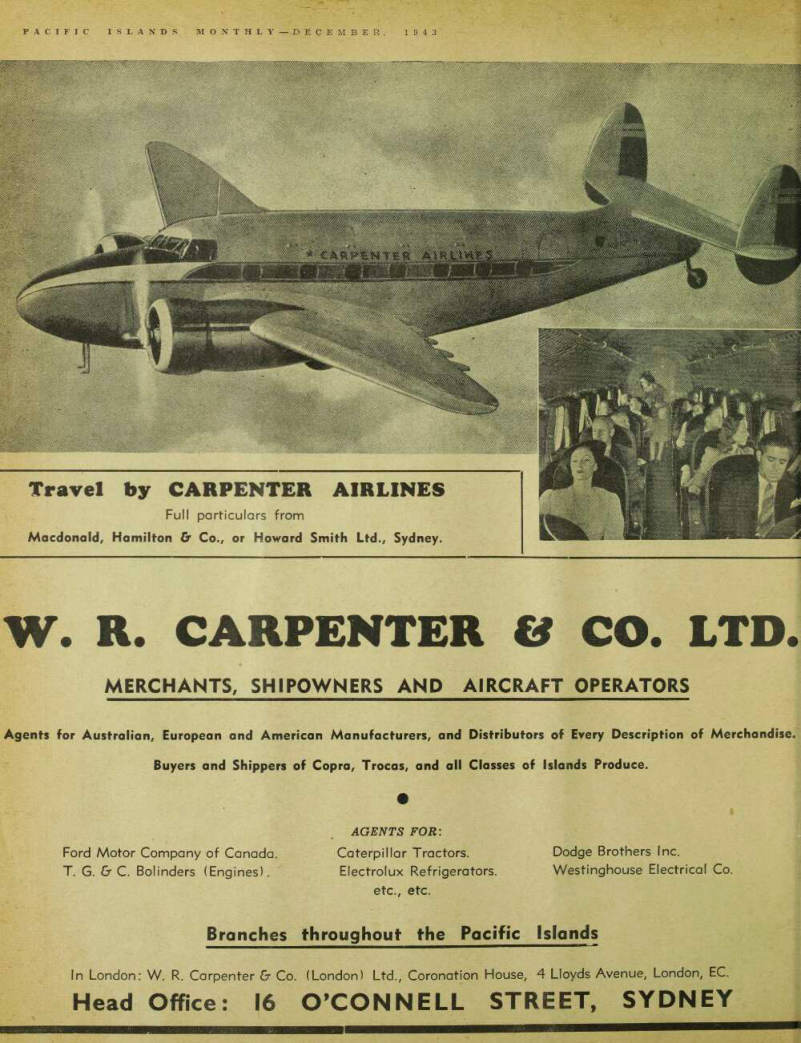
W. R. Carpenter & Co., Ltd. All branches.
Morris, Hedstrom, Ltd. All branches.
Steamships Trading Co., Papua. All branches.
B.N.G. Trading Co., Ltd., Port Moresby, Papua.
J. Muir, Suva, Fiji.
Miss R. Castles, Suva, Fiji.
N. C. Mackenzie Hunt, Wainunu, Bua, Fiji.
Cook Islands Trading Co., Rarotonga, Cook Ls.
A, C. Rowland, Papeete, Tahiti.
Islands Branches and Representatives of W. H.
Grove & Sons, Ltd., Auckland, New Zealand.
Ed. Pentecost, Noumea, New Caledonia.
Kerr & Co., Noumea. New Caledonia.
Vol. XIV. No. 5.
December 17, 1943
Prira i X/ Per Copy> rnce £ Prepaid; 10/- p.a.
Air Transport Will Open New Era in the Pacific
Islands
EVERY person with eyes and ears knows how the use of the aero plane has grown and developed since September 3, 1939. Little imagination is needed to show us what aerial transport is going to do when peace returns to the Pacific Territories.
Overwhelming air-power is blasting the Japs out of the Islands; the bombers and the fighters will go, but the innumerable airfields will remain, at the service of civil aviation.
“But,” someone will say, “there are not enough people to use or to pay for aerial transport on the scale suggested.” That is true. But if transport facilities are provided in habitable country, the people soon follow. We may remember the case of the Canadian Trans-Continental Railway, and of United States rail ways. The railway owners got con trol of large, good but uninhabited country, built their lines out into the heart of it, and then offered cheap lands and transport—and settlers flocked in. That will happen in the Pacific Islands.
AERIAL transport already was be ing used in the Pacific, before 1939. Pan American Airways ran a service across the North Pacific (San Francisco to Hongkong, via Midway, Wake, Guam and Philippine Islands) and across the South Pacific to Auck land (via Canton, Fiji, and New Caledonia Islands). Carpenter and Company ran a subsidised service from Sydney to Rabaul. The Japanese ran a subsidised service from Japan south to the Carolines, and on into
Portuguese Timor. There were in conspicuous inter-island services in the Philippines and in Hawaii. And there was the famous and efficient transport service of the New Guinea goldfields, pioneered in 1928 by Guinea Airways.
The only one of these Pacific services which really was successful, on a non-subsidised basis, was the New Guinea goldfields organisation.
That was because the goldfield was so rich it could carry the burden. In all other cases, the services were handicapped or crippled by the high cost of planes, the cost of the ground organisation needed to guarantee safety, and the comparatively small pay-load possible on long flights.
The war has altered all that. When peace returns, we shall have tens of thousands of airmen and technicians; mass-produced planes; airfields every where complete and waiting; planes designed to carry payable loads; schedules which will take people and goods right across the Pacific in 70 hours’ flying.
We shall have, in the Pacific, a magnificent aerial transport organi sation, with everything complete— except inter-island passengers and goods in - sufficient numbers and quantities to justify such services!
What does that mean? If private enterprise and commercial develop ment are not entirely wiped out by the Pink and the Red Governments which are to establish a New Order for Democracy, it means that power ful interests, connected with aerial transportation, both American and
British, are going to bend all their energies towards encouraging and helping new European settlement in the Pacific Territories.
THE prospect is almost breath taking. Air-power, in over whelming measure, is winning the war for the United Nations. Such air-power, having been invoked, is not going to disappear after the war, like a wraith. Air-power, in the shape of air transport, is going to dominate the re-arranged and re established world which will follow the peace.
Air transport is going to alter the nature and tempo of life in the Pacific Islands. Most of us will deplore it—but we may as well accept the fact and reconcile ourselves to it.
Will air transport interests, trying to encourage new settlement and indus tries in the Islands, find people ready to respond?
Undoubtedly, they will. Not only will there be tens of thousands of soldiers eager to renew their wartime acquaintance with the Islands: there will be other influences forcing people away from the European countries now immersed in war. Those coun tries are going to experience a difficult period—a period of continued high taxation, of vicious interference with social, industrial and economic affairs by Governments of the type of the Australian Labour Government —well-intentioned, but incredibly ill informed and stupid—incapable of national planning, yet driven on to seek a “new order” by the narrow visioned and class-conscious industrial masses. Thousands of men will try to leave such countries as United States, Canada, New Zealand, Aus
tralia, to seek places where taxation may be lower and living conditions less harassing, and where, in tropic quiet and beauty, they may escape the clamour and turmoil of ceaseless economic argument.
A LL this will happen; and, while it happens, it will create many new problems. The basis of life any , where is production from the soil. The new settlers of the Islands must be primary producers—secondary indus tries may come later. Primary pro ducers, if they are to survive, especially in the tropics, must have three things—some practical know ledge of Islands life and of planting, an adequate supply of labour, and dependable markets.
That is the simple ABC of settle ment in the tropical islands—yet how often it is neglected. Anyone who plans new settlements in the Pacific Islands must first of all provide for those three problems—and there is a headache in each of them.
If European settlement in the Islands is to be encouraged, does it not mean that the plan (now receiv ing much attention) of developing the Islands races as peasant-farmers, to be independent, in their own countries, cannot be fully developed?
Or is it possible to hold back Euro pean settlement? Or, if a native peasantry and new European settle ments are to grow together, where is the labour supply to come from? Is Asiatic indentured labour to be seriously considered, after the examples seen in Fiji, Hawaii, Tahiti, New Guinea?
How can there be a guaranteed market for tropical products unless there is widespread agreement and organisation among the principal countries of the world, so as to take care of the consumer end? New tropical settlers dare not undertake the expensive enterprise, involving years of time, of growing coconuts, coffee, rubber, and a dozen other things, unless they can be sure that they are going to get something more than a bread-line price for their pro ducts. The Pacific copra-producers, with harsh memories of the 1929-1939 period, can testify to that.
AUSTRALIANS will be eager appli cants for Islands lands—that may be taken as certain. But will the Australian Government permit such a thing?
Australia’s main problem, for many decades, will be population. If the European race cannot assemble an other thirty or forty million people in Australia within the next fifty years, Australia will be lost to the European race. The same factor, air transport, appears to make that a certainty.
There are now only a few hours’ fly ing time between the north-west Australian coast, and one thousand million people crowded into south-east Asia.
So Australians, probably, will not be allowed to come—although there are empty lands, offering a pleasant home for European people, on the high lands of New Guinea, in many of the Solomon Islands, in all the southern
islands of the New Hebrides, in the vast archipelago of Fiji, in the empty Marquesas groups, and in many other places. There are empty lands, too, in the attractive non-malarial terri tories of Samoa and Tonga; but the Samoans and Tongans, capable of self-government and rapid develop ment, probably will want all of their countries for themselves.
After 95 Years
Melanesian Mission Faces Gigantic Task of Reconstruction in Solomons and New Guinea.
PROBABLY nothing illustrates the difference between missionising then and now, as do the illustrations in a booklet recently published by the Melanesian Mission. A cover illustration reproduced from an old print, depicts natives of Gela, BSI, disporting them selves under the coconuts, done up to look like something from the “Old South”!
Mammy Lous, clothed decently in voluminous, heavy skirts from toes to waist, and in thick blouses from waist and wrist to neck; little boys in dark, sailor suits. The menfolk are conspicu ously absent—perhaps they had more sense, but one doubts it: to the old-time missionary, Christianity and clothes were synonymous.
Inside the booklet we have pictures of the natives with the minimum of cover ing from knee to waist, and good brown skin the rest of the way: the sensible modern fashion that offends no one with sense and good taste.
There is a record of almost a century of mission work in the Solomons.
Ninety-five years ago (in 1848), the Bishop of New Zealand, in the tiny “Undine,” made a first visit, and re turned to Auckland with five native lads for schooling. In the following year he returned the lads to their homes in the same vessel.
Later on, the Melanesian Mission was formed: and. right down through years of hopes, trials, hardships, disasters, deaths and mistakes, invasion and war, it has carried on with faith and unflag ging energy.
To-day, many old prejudices have been swept away and the aims of the Mission are three-fold: evangelical, educational and medical. Whatever the layman may think about the first aim, no one can deny the great good done by the mis sionaries through the second and third.
F 1941, came war to the Pacific; and. in 1942. the Jap and all his vile works, to the Solomons; later came the Americans to drive him out.
The mission staff stayed and carried on, but the present position of the mis sion is as follows: The mission’s beautiful church at Tulagi is completely destroyed, mission headquarters, including the Bishop’s house, staff houses, stores, etc., are all completely demolished. The site of the long-established school at Maravovo and the printing workshon and residence nearby is a collection of shell-holes. The school, houses, and equipment at Bunana are all gone. Much damage, and. in other places, complete loss, was sustained at Siota. The known losses are esti mated to be no less than £16.000.
The Northern Archdeaconry (New Britain and Northern Solomons) is still in enemy hands, and nothing is known of the state of affairs there. No word has been received from two priests there, the Rev. J. Barge and the Rev. Moore,
since the invasion of Rabaul. It is hoped that they are safe with natives in the hills. Probably all the mission property has gone, though here, unlike the Solo mons, it has been possible to insure against war damage.
Re-building, re-organisation, and re establishment of food gardens will entail much time, thought, energy and money.
An appeal is made in the booklet to any one interested in any or all of the three phases of this work to help the cause along.
Tahiti's Woes
No Dry Season and a Black Market
From Our Own Correspondent T tttw . PAPEETE, Oct. 20.
HERE is nothing extraordinary to report here except the weather. We are having a year-round rainy season, with the wind boxing the com pass—now hot, now cold—in a most exasperating fashion.
Our wily Chinese are carrying on a black market in several kinds of mer chandise which are in light supply.
For example, the coffee crop is below normal. The official price for unroasted coffee is nine francs a kilo—when avail able. A friend of mine told me recently that his Chinese grocer charged him forty francs for one kilogram of roasted coffee.
Samoa Also
From Our Own Correspondent
Apia, Nov. 19.
AFTER abnormally dry weather condi tions, the drought broke in October, and we are now having ample rain fall. July, 1943, was the driest month since 1930; and the June-August period this year had the lowest rainfall for any three months’ period since 1925. Fruit crops suffered appreciably.
The beginning of the rainy season coincided as usual with the rising of the “Palolo”—the famous coral-reef worm of the South Seas.
A New Zealand manufacturing firm has just sent its first shipment of peram bulators, sulkies, and children’s chairs to Fiji. This appears to be evidence of the growing population of white residents in the islands, says an Auckland paper.
More likely a case of population follow ing the flag—or something.
Advertisements & other items, p. 6 (1 item)
Jungle Rhythm—1944
Morse for “V”—for Victory—in 1944.
Old-Timers
How They Are Helping to Chase the Jap Out of New Guinea
AN old resident of the Morobe gold field, now an officer in the AIF, says in a private letter that he “got a tremendous kick” out of the recapture of Salamaua, Lae and Finschhaven. The Europeans had hated leaving those places when the Japs came in, and apparently deserting their well-trained “boys”; so their pleasure in going back, and chasing out the Japs, and regaining contact with the natives, was great.
“At Tambu Bay I met many old friends —Ted Jenyns, Ernie Hitchcock, George Clark, Les Ireland, George Whittaker—all doing sterling jobs, in which their knowledge of the country and the natives was most valuable,” he says.
“I was in some of the fighting around Finschhaven, accompanied by a number of my own natives. I had found them waiting for us in the bush at Lae. I hadn’t seen them for four years; but they were all there, and they were as pleased to see me as I was to find them.
“Their behaviour during the fighting amazed me. They were quite ready to go anywhere that I went, and I have had no desertions on account of bomb ing, or anything else. I was able to give some help at Finschhaven, as I knew the luluais and tultuls . . . The effect upon the natives of seeing their old masters returning was good; and it speaks well for our treatment of them in the past—both by the Administration and by private employers—that they have returned to us so readily and have done so much for us.
“In this area I found more old friends —Joe Taylor, Rube Hanrahan, Pauley, S. Ashton. Whalen, Jack Sutherland, and Ferris —all old-timers, Down in Lae I saw Niall, Keith Norris, Bill Heinickie, Jim Leahy, Jim Wright, Charlie Blake, Les Simpson and many others from the goldfields.
“It is a grand thing to find so many of the old Territorians here and playing such an important part in the recapture and restoration of our country. Their influence is the best guarantee we have that the effect upon the natives of the intrusion of so many troops, who do not understand natives, will not be harmful —or, if harmful, will be only temporary.
“What is needed now is someone to record the deeds of many of our New Guinea people—what reading they would make! It makes one proud to belong to such a mob, and to see how they have made good.
“The fine standard set by the New Guinea Volunteer Rifles is being main tained, and the work these chaps are doing, and the numbers who have taken part in the struggle, are the strongest argument we have to back our plea that they should be given an effective voice in the future government of this country.”
Territories Casualties
Reported Missing
NGX3IO, Capt. J. J. Murphy, Infantry, formerly of New Guinea (Australian address, Toowong, Brisbane). Re ported missing.
NGX4B, Lieut. J. T. Barracluff, HQ Unit, formerly of New Guinea (Australian address, North Sydney, NSW). Re ported missing.
Pacific Problems
Plea for Principle of International Co-operation
THERE are explosive elements in the Pacific situation,” said Mr. R. J.
Boyer, MA, in an address at the University of Sydney; but the Pacific may be made the proving-ground for international policy, and if there is a real spirit of international co-operation, there need be no danger.
Mr. Boyer argued that if an attempt were made to solve the problems of the Pacific on a regional basis, a dangerous form of Pacific nationalism would ulti mately develop; therefore, the Pacific settlement of the future must accord with fair principles and be on an international basis.
No plan could be considered without taking the United States into account.
Americans believed that the preservation of peace in the Pacific was a matter, vital to America, and that the United States must take a leading part in all Pacific dispositions.
Mr. Boyer thought there was need for a Pacific Charter (as well as an Atlantic Charter) to which all nations with colonial responsibilities in the Pacific could adhere.
If the standard of living in China (where dwelt one-quarter of the human race) could be raised, the economic prob lems of the world would be solved, to an extent.
Australia, in relation to the Pacific, dare not follow an isolationist policy. She could not maintain large defence forces, while at the same time working out her own developmental problems. Australia, of all countries, must subscribe to the principles of international co-operation in dealing with the problems presented by the Pacific—R.D.
Scrub Typhus
Cause is Clear But No Remedy in Sight
THE statement in the “PIM” recently that the Sydney School of Tropical Medicine has gone a long way towards finding a serum against the deadly scrub typhus of New Guinea (otherwise known as “Japanese river fever”) has been challenged by two or three people interested in the subject.
They say that the real investigation work is not being done in Sydney, but by the Eliza Hall Institute, in Melbourne; and they state that, although the cause of the disease has been clearly identified as the Trombicula mite, it would be wrong to suggest that any cure or pro tective serum has been discovered or is yet in sight.
The mite is not a tick, but it belongs to the tick family. Its life is in three stages; and it conveys the poison to man only in its larvae stage. Scrub typhus has been identified in Japan, Malaya, Dutch East Indies and New Guinea.
Tahiti Fifty Years Ago
WHEN the “Tropic Bird” arrived at Papeete, Tahiti, in January, 1894, the merchants of Tahiti pre’sented her with a rooster flag, because she had made the voyage in 17 days and 20 hours.
She had sailed 4,200 miles, although the “great circle is 3,656.”
In 1875, the “Glory of the Seas” sailed from San Francisco to Sydney in 35 days, a distance of 6,514 miles. In 1878, the British ship “Caitloch” sailed from Astoria to Queenstown in 89 days.
The Rev. A. H. Voyce, of the Metho dist Mission, has been appointed chap lain to New Zealand Forces serving in the Pacific.
Unique Meeting Of The Nations
/-kt 11 'i the New Zealand (Sir Cyril Newall) was in Noumea, New Galedonia; and. during public ceremonies, he inspected a parade of a womens unit u the New Zealand Army.
In this picture, he is seen (left) with the new Governor of New Caledonia.
Christian Laigret (on the right), ana accompanied by high-ranking American officers car rying out the ceremony,
Advertisements & other items, p. 7 (1 item)
5
PACIFIC ISLANDS MONTBLI-D E C E M B E K, 1943
Papua
War Damage
Claims
Official Inquiry in Papua
MR. W. J. HITCHCOCK, Controller- General of the Australian War Damage Commission, with Mr. H.
W. Swanton, assistant secretary, and Mr.
John F. N. Murray, FIS (Eng.), PCIV (whose services have been made avail able by the courtesy of the Federal Land Tax Department) are visiting Papua to obtain first-hand information regarding war damage claims lodged with the Commission.
The Commission is taking active steps to carry ,the investigation and recording of claims to a stage where payment can be made at short notice, when the time arrives for settlement.
The Commission has stated that, except in cases of distress, or where payment is necessary for war purposes, payment of war damage claims will not be made until after the war, in accord ance with the policy then to be deter mined by the Government. On this point, however, the Pacific Territories Association is making a special appeal to the Government.
Any claimants who have not sent in all available particulars of their claims have been requested to communicate with the Commission.
Truly International
Force New Unit in N. Hebrides
W E have heard a good deal of the various Defence Forces of most
Pacific Territories; now Harold
Cooper, who lately toured the South west Pacific . area, tells us of the “international” New Hebrides Defence Force.
IN the middle of 1941 a small party of Australian officers and NCO’s arrived in the New Hebrides to train the Condominium Defence Force, which was then being raised. To-day that small but efficient force is one of the most truly “international” armies in the world.
Its Commandant is a British subject, the son of an Australian father and a French mother. He was educated in French schools and until a few years ago French was his only language. Then he decided to learn English and soon became so fluent in it that he was appointed to a post in the British Administration.
His Second-in-Command is a French national, educated in Australia and com pletely bilingual. The officers and NCO’s of the force are other Britishers and Frenchmen.
The troops are natives, recruited almost entirely from a cluster of tiny atolls known as the Small Islands, which lie off the north-east coast of Malakula.
There were plenty of volunteers forth coming from other parts of the Group, but the Small Islanders were chosen because of their robust health and the fact that they all speak the same lan guage—an unusual circumstance in the Hebrides, where the casual traveller is perplexed to find that almost every vil lage seems to have its own dialect.
Although the troops share a common language, the medium of communication between them and their British and French officers is Pidgin English,
Fiji Remembers American Dead
IN the quiet of an Allied Nations cemetery in Fiji, on Armistice Day, a small group of men and women gathered to pay tribute to US Service men buried there, A warm tropical sun struck brightly on rows of crosses nestled at the foot of green hills, as poppies were placed on each grave.
Those participating in the ceremony were: Major-General C. F. Thompson, US Commanding General Second Island Command; Major-General Sir Phillip Mitchell, KCMG, Governor and High Commissioner for the Western Pacific; Mr. Alport Barker, editor of the “Fiji Times”; Mrs. Barker; Mrs. T. J. John son, chairman of the Yearly Poppy Asso ciation; Capt. Fred. H. Cantrell, ADC to
General Thompson; and Capt. J. S. Bid will, ADC to the Governor.
Addressing the group, Mrs. Barker said:— “We have set this day apart to honour those gallant men of the United States of America who made the supreme sac rifice that we might live. Our American cousins have given their lives in the hope that we may live in peace and comfort.
I ask that you will convey to the mothers, wives and relations of these men, the deepest sympathy of our women in their bereavement. I would like you to assure them that even 'after you have left these shores, this bit of America will not be neglected by our women . . . and this spot, to paraphrase a well-known poem, ‘shall be forever America.’ ” —H.E.L.P.
The party entering the Allied Nations Cemetery, preparatory to placing poppies on the graves.
Corporal Stuart Munro, AIF (late of the NGVR, Edie Creek, New Guinea, who was serving with the NGVR when the Japanese landed in New Guinea) was
recently invalided to Australia. He has now regained his health and is serving with an AIF signals unit somewhere in Australia.
Mrs. Alport Barker, wife of the editor of the “Fiji Times,” reading a memorial to the official party attending the Armistice Day ceremonies held at the Allied Nations Cemetery, Fiji.
Standing (left to right): Captain J. S. Bidwill, ADC to the Governor; Mrs. J. T. Johnson, chairman of the Yearly Poppy Association; Major-General Sir Phillip Mitchell, KCMG, Governor and High Commissioner for the Western Pacific; Major-General C. F. Thompson, Commanding General, Second Island Command; Captain Fred. H. Cantrell, ADC to General Thompson; Mrs. Alport Barker; Mr. Alport Barker.
Hoisting of British Flag
59 Years Ago
Hoisting of British Flag at Port Moresby
By F. T. Goedicke, of Haapai, Tonga
NOVEMBER 3 brings back to my mind a picture of a memorable scene which took place on the shore of Port Moresby Harbour in 1884. It was an extremely impressive one, both from the native point of view and from that of the white man, for it is still spoken of in the Territory by the early pioneers and the old men of the villages.
Five British warships were present—the Espiegle, the Raven, the Swinger and the Harrier—besides Commodore Erskine’s flagship, the Nelson. James Elphinstone Erskine, Commodore of the Australian Fleet, read the proclamation, surrounded by his staff, and the hoisting of the flag was performed by Flag-Lieut. Grant, an Australian.
Behind the Commodore stood the De puty Commissioner (Mr. Romilly), the missioners (Dr. Laws and his wife, and Rev. James Chalmers), and the leading trader, Mr. Andrew Goldie, who had arriyed in New Guinea as far back as 1874. In the background were crowded the natives of the district, headed by their chief, “Boi-Vagi,” attired in an old naval officer’s uniform, in recognition of his position as “king of his tribe.”
Many changes have taken place since that memorable day; but the British flag still flies over Port Moresby. In one more year, Port Moresby can celebrate its Diamond Jubilee.
News Of Rev. D. C. Alley
THE following letter containing news of the Rev. D. C. Alley, of the Methodist Mission, Bougainville, who has been “missing,” has come to the mission headquarters in Sydney from Chaplain John Churchill, of Fiji:— T visited our native school in Suva and met a Fijian woman, who recently arrived from Bougainville. She had news of Don Valley. He was reported to be in a prisoner-of-war camp at Rabaul. He was in a compound with other mission aries, gardening. He looks well, but lias grown a long beard.
Territorians Entertain
A LARGE number of New Guinea and Papuan folk attended the joint social effort of the New Guinea Branch of the Country Women’s Asso ciation and the Pacific Territories Asso ciation, in the Lyceum Club, 77 King Street, Sydney, on November 26.
Highlight of the evening was the entertainment group: Miss Minnie Love, well-known singer and comedienne; Mrs.
Franks, pianist; and Mrs. Bosisto, whose dramatic sketches, grave or gay, proved popular. Miss Love “Called in at the Old Apple-tree” with her accustomed verve and went down as well with Territorians as she always has done with Australian audiences. Entertainment arrangements were in the hands of Mrs. Peadon, pre sident of the branch, who has a genius for producing the right sort of amusing people.
Sale of flowers and sweets during the evening augmented branch funds.
Mr. W. Granger Johnson, managing director of W. R. Carpenter & Co. (Fiji), Ltd., has been appointed a member of the Fiji Legislative Council during the absence from the Colony of Sir Howard Ellis.
Return from the Dead
"Jeff" Hemsworth Reported Prisoner of War
WHEN Squadron-Leader Godfrey Ellard Hemsworth failed to return from an operational flight against the Japs in New Guinea, late in May, 1942, he was posted missing and later, “believed killed.” Territorians will be glad to know that his people in Sydney were officially notified, about eight weeks ago, that he
has now been re ported as a prisoner of war in Japanese hands presumably in Japan. Details are not available, but it is believed that he bailed out over enemy-occupied ter ritory and was later captured.
“Jeff” Hemsworth was well-known in the Territory in the early thirties when he flew for Guinea Airways and PAT.
He became assoc iated with Ray Parer and they flew to gether in the Lon don-Melbourne Cen tenary Air Race Later he came to Australia and flew for Ansetts and Air lines of Australia. He joined Quantas in 1938 and was first officer on one of their flying - boats running betweeu Sydney and Singa pore when war broke out and he joined the RAAF. Shortly before he went miss ing, he was promoted
to the rank of Squadron-Leader for his outstanding performances against the Japs.
Happy thought to know he is still on top and that after the war he will be on hand again to pilot Territorians across the skyways.
Squadron-Leader G. E. Hemsworth.
Thanks!
A SELF-EXPLANATORY note from Mr. Paul A. Dorn, Box 1712 WLB,. Los Angeles 36, USA: “To-day, I received in the mail a parcel containing five copies of ‘PIM,’ apparently as the result of my recent advertise ments for back issues of this magazine.
In the upper left-hand corner of the parcel appears the name of Pte. Richard P. McFall, No. 67315, ‘On Active Service,’ but there is no address given.
“That a man on active service should go to so much trouble for me, a total stranger, thousands of miles across the Pacific, touches me deeply. Not only would I like to express my appreciation to him, but I would also like to know if there is some way in which I can re ciprocate for his kindness. Would you be good enough to publish this letter in ‘PIM’ on the, chance that it will come to his attention so he may know how grate ful I am for his contribution?
“This is but another example of the splendid generosity shotom me by the people of your part of the world in my campaign to place complete files of your magazine in our American libraries, so that when our boys come home from down there they will find available the one publication that really covers the South Pacific area.”
Eruption On
Niuafoou
Crops Destroyed But No Lives Lost
AFTER a delay of two months, we have received information about the eruption on volcanic Niuafoou (Tin Can Island) at the end of September, There was no loss of life but there was widespread damage to food crops and vegetation.
The island is part of the Kingdom of Tonga. Mr. C. W. T. Johnson, British Agent and Consul for Tonga, visited the island before the disturbance had died down and the following is his report on conditions there: — “With the exception of the coconuts and an occasional mango tree all the foliage on the island that I was able to see, and even the grass, was browned and withered. The breadfruit trees, which were carrying heavy crops of immature fruit, had not one green leaf and all the root crops had been similarly destroyed.
“The main cause of this was the heavy deposits of salt which had fallen with the rains. It rained fairly steadily while I was on the island and the rain was still quite salt to taste. A certain amount of damage had also been done by the deposits of sulphur and ash. Although this eruption was stated to be less severe than the one of 1926, the wind in 1926 was blowing off the island, whereas this time it was blowing in the opposite direction, right across it.
“There was one main eruption followed by three subsidiary ones, all of them being concentrated in a comparatively small area some two miles from the south shore of the island and close to the scene of previous eruptions.
“Our ship passed about a mile from the shore and we had a grandstand view of an unforgettable sight. Masses of molten lava, glowing red even in the daylight, were being thrown up 150 to 200 feet into the air, while at the water’s edge was an enormous column of smoke rising thousands of feet from what appeared to be a new submarine erup tion. It was no doubt in this column of smoke that the salt deposits were car ried into the air, to be brought down again with the rains.
“It wag at night, however, when we again passed close by, that we learned what a volcanic eruption really looked like. There were the four main explo sions of glowing lava, with fires burning at innumerable points in the surround ing country, and the main flow of lava moving to the sea in a red-hot mass.
“But the most arresting sight at night was the immense, billowing column of smoke with its red glow at the centre, and its vivid blue streaks of what looked like fork lightning flashing continuously hundreds of feet up in the air.”
"Missing Men"
WHEN we reprinted our “New Guinea’s Missing Men,” in October, we listed Mr. W. G. Staley, road overseer, of New Britain, among the men of whom no information was available. We now have been informed by his family that he was seen in July, 1942, being evacu ated from Rabaul in a Japanese mer chantman. This information came from the Red Cross searcher in Port Moresby, but no further news or POW letters have been received. The death of Mrs.
W. G. Staley occurred on April 29, this year.
Fiji Sugar
Growers Get No Increase: Industry in Bad State
rpHE Commission which was set up in A Fiji to examine the cane-growing side of the sugar industry, and re port on the Indian cane-growers’ demand for increased rates (over and above the increases already granted by the CSR Co.), submitted its report in November.
It was signed by Mr, E. E. Jenkins (Attorney-General) and Mr. H. W. Jack (Director of Agriculture).
The Commission took, as concrete examples, the condition of a grower pro ducing 123 tons in 1939 and in 1943, and that of a 12-acres farm, in 1939 and 1943.
Setting total receipts against total costs in each year, it was found that the posi tion of the individuals concerned was substantially the same “Bearing in mind that bonuses are not necessarily designed to cover the whole of any increases in costs which have taken place during the war, we are of opinion that no further increase in the price of sugar-cane is justified,” concluded the Commission.
The sugar season is virtually over in Fiji; and, as a result of the strikes of operatives in the sugar mills, and the refusal of a large section of the Indian growers to cut their cane, it is likely that Fiji’s sugar export figures this year will show a heavy decline.
Meanwhile, the attitude of the Indians towards the sugar industry, towards the Government, and towards the United Nations generally has caused much con cern in Fiji, No surprise would be caused if this troublesome community were dealt with by the authorities in a drastic way.
If action is taken, it will be done with a view to the protection of the Fiji natives, whose attitude throughout the critical war years has been admirable.
Aged 81
Captain Svensen
Death in Brisbane — Aged 81
ALL former residents of the Solomon Islands, and hundreds of people in Australia and elsewhere, will learn with regret of the death of Captain Oscar Svensen, well-known pioneer planter, which occurred on November 12, in Brisbane, at the age of 81.
Captain Svensen was born in Larvik, Norway, and he was only 21 when he came to Australia, in 1883. For many years he followed the sea, and qualified as a master mariner. He established coconut plantations in the Solomon Islands soon after the British Protec torate was proclaimed, and he was more than usually successful. In his later years he was a director of Mamara Plan tations, Ltd., Solomon Islands Rubber Plantations, Ltd. (he was one of the first, if not the first, to cultivate rubber in the Solomons), and Domma Plantations Pty., Ltd.
Captain Svensen, in 1900, married Miss Henriette Schroder. In 1918 he was appointed Norwegian Consul in Brisbane, and in 1927 he was awarded, for his ser vices, the Royal (Norwegian) Order of St. Olaf, Ist Class. The seven daughters and one son of Captain and Mrs.
Svensen are: Mrs. N. V. Whitehouse, Holland Park; Mrs. T. J. Campbell, “Kolonga,” Gin Gin; Mrs. E. Palmer, Coolangatta; Mrs. A. D. Collins. North Queensland; Mrs. R. Tonks, Ipswich Road, South Brisbane; Mrs. E. G. Savage, “Belbri,” Roma; Miss L. R. Svensen; and Captain Oscar Svensen '(British Solomon Islands Forces).
"Co-Prosperity Sphere" Is Not Doing
Very Well
POUR months after they struck at Pearl Harbour, the Japanese found themselves in possession of 15 Territories. The Territories are listed, roughly, in the order in which the Japanese seized and occupied them:— Hongkong, British Colony.
Guam, American Territory.
Indo-China, French Colony Malaya, British Colony (in • eludes Singapore).
Malay States (British Protec torate) .
Thailand, independent king-, dom.
British North Borneo (includ ing Brunei and Sarawak).
Commonwealth of the Philip pines (United States Protec torate) .
Netherlands Indies (including Borneo but not Dutch New Guinea).
Portuguese Timor.
Burma, British Territory.
Mandated Territory of New Guinea ( Australia).
British Solomon Islands.
Mandated Territory of Nauru.
Gilbert Islands (including Ocean Island).
These Territories comprise the rich Indonesian and Pacific Empire for which Japan had hungered and planned for 40 years. She always in tended to seize it, but she had set no fixed time for the seizure. Then came Hitlerism, and the European war; and the Fascists and Imperial ists of Japan decided that this was their heaven-sent opportunity. France was helpless, Britain practically so.
They would grab while the grabbing was good. So far as the United States was concerned, they would take a chance. The wise men of Japan thought that probably the United States would either fight half heartedly or not at all . . . especially if their Pacific fleet were crippled.
NEVER by one syllable has Japan described these stolen Territories as her new Empire. No—according to the smooth-tongued gentlemen of Tokio radio—they are “the Co- Prosperity Sphere of East Asia,” liberated from the western yoke by Japan, encouraged to develop as independent nations by Japan—and, of course, in view of the loving kind ness shed over them by the Son of Heaven, expected to give full alle giance to Japan, and allow the Japanese the fullest access to their territories and resources.
Nearly two years have passed since the Japanese octopus thrust his ten T tacles over all these helpless coun tries; and it is interesting now to briefly survey the “Co-Prosperity Sphere,” and the progress being made by the Japs in their administration of loving kindness.
Reliable information is lacking. The Japanese are at great pains to pre vent communication between the
peoples imprisoned within the Jap sphere, and the outside world. The only source of regular news is the Japanese radio—and it is so men dacious that it has become a by-word throughout the civilised world.
ITONGKONG appears to be under “ a Jap military government.
There is famine there, and grave outbreaks of cholera and other plagues. The Japanese, for months past, have been busily removing a million or more of the poor Chinese from the Colony, and simply dumping them on the Chinese mainland, where a large proportion of them have died of starvation and disease.
There is little information about Indo-China. For a considerable time, Vichy officials were allowed nominally to carry on—but always with Jap officers at their shoulders. Now, probably, the Territory is . entirely under Jap military government. The Japs have been making some effort to establish puppet governments in the four chief States—Annam, Cam bodia, Laos and Tonking.
IN the Philippines, the enemy has A made a tremendous effort. First, they set up a military government; then they appointed selected Filipinos as provincial governors; next, they induced various prominent Filipinos to serve on an “executive commission,” which really was a puppet govern ment. Finally, claiming that they had received a large measure of Filipino co-operation, they an nounced in September that the Philippines would elect its own Par liament and organise its own Govern ment. On October 14, the Japanese proclaimed the “independence” of the group, under a puppet govern ment headed by Jose P. Laurel.
Indications are that the Filipinos— who are at least 85 per cent, literate —are generally under no delusions about the independence they can ex pect from Tokio. They are giving lip service to the Japanese; but the allegiance of their hearts is with the United States—the nation which de voted 40 years to educating them and preparing them for semi-independent Commonwealth Government which functioned from 1935; and for the independent republican government which was to function from July 4, 1946.
There is little news of what has happened in Malaya and Burma— except that the vast dislocation of trade and rice-growing caused by the invasion has brought about great dis tress among the masses, amounting in some places to famine.
AS a sidelight on Japanese good faith, it may be noted that the Japanese entered Thailand (which was under no western yoke, but was an independent kingdom) and forced the capitulation of that country be fore the end of December, 1941.
(Continued on Page 30)
A considerable proportion of the Thais were against capitulation; but it was brought about by a small clique of four quislings in the Thai Cabinet, including Premier Pibul himself. The Japanese promised great good things for Thailand; but, bv late 1943, the temper of the Thais was expressed by a leading Thai newspaper Sieng Thai : “Though Japan has established her self as the leading power in East Asia, this does not mean that Thai land will take orders from Tokio.”
For some time after the capitu lation, the Thai word mahamit, pro nounced slowly in three syllables, was frequently used, in reference to Japan. It meant “good friend.” Now it is being pronounced quickly, in two syllables, mamit. That means “dog of a friend,”
The Japanese have been celebrat ing their treaties with Thailand (such as the “Cultural Pact” of December, 1942) with great pomp and boast ings. But evidence grows that the Thai people nowadays are moved mostly by shame and indignation against their “Tokio bosses,” and that 90,per cent, of them will welcome the overthrow of Japan, so that they may regain their independence.
MUCH the same general policy has been followed by the Japanese in the East Indies. “We have come to free the people of Java from the oppressive rule of the Europeans,” said the invaders, “and to organise them as an independent nation.”
There always has been a strong nationalist section among the peoples of the Netherlands Indies, and the Japanese found plenty of takers. An excellent quisling was found in a Mr.
Soekarno, who was forthwith ap pointed by Japan as “leader of the people of Java.” At first, the Japanese were greeted, by at least a section of the people, with some enthusiasm and confidence.
But a great change has b§en taking place. The Javanese are waking up to the fact that, if Japan is not de feated, their condition in the future will be much worse than it was in the past.
For a long time now, the Dutch, excellent colonisers, have been giving to the native people an increasing measure of self-government, and have been seeking their co-operation and treating their co-operation with re spect. The Japanese actually are giving the native peoples less self governing powers, and they are treat ing them in an arrogant, condescend ing manner, which the natives resent.
The latter seem to be coming rapidly to the conclusion that they would rather co-operate with the Dutch, than with the objectionable gentle men from Tokio.
Both nations are eager to develop (in other words, exploit) the rich natural resources of the East Indies.
Having had experience of both, the East Indian folk have decided that, if they must choose between the two, they emphatically prefer the Dutch.
ALL the information available, though fragmentary, indicates that the “Co-Prosperity Sphere” is not doing very well. The Japs are receiving plenty of lip-service—as, for example, from the congress of Indo nesian newspaper-men assembled in Tokio in October—but the people generally realise that Japan’s chief interest in them is to centre all the activities and wealth of south-east Asia, Indonesia and the South Seas in Tokio.
Nobody has any love for the Jap— and, least of all, apparently, his fellow Asiatics.
In addressing Congress on Septem ber 17, President Roosevelt said that, not only would Japan lose the terri tories she had seized in China, but also would be deprived of her man date over the Marshall and Caroline Islands, which the Japs had used as stepping-stones towards Hawaii and New Guinea.
None will be happier to hear that than the native peoples of the Caro lines, Marshalls and Marianas. The Japanese developed the groups econo mically, with efficiency and thorough ness; but their treatment of the native peoples was consistent with the ruthlessness which they displayed in Korea and Formosa.
Mr. F. P. Archer, well known in Buka (Mandated Territory) as the owner of Yame plantation, has been gazetted Lieutenant in the Solomon Island Labour Corps. He was one of the people rescued early this year by an American sub marine. He spent a miserable six months in Australia, wondering why he had been “rescued,” and trying to persuade some one in authority to have him sent back again to where the temperatures are uniformly tropical. He succeeded in Sep tember. and left Australia for BSI with a happy heart.
Advertisements & other items, p. 10 (1 item)
8
DECEMBER, 1943-P A C I E I C ISLANDS MONTHLY
Fiji Gold Mines
Restricted Output Produces Less Profit
OPERATIONS of Fiji’s two big gold mines, Emperor and Loloma, were restricted in 1942-43, and the profits in the year ended July 31 last were:— Emperor, £A66,744, compared with £A141,795 in previous year.
Loloma, £A51,015, compared with £ A 151,138 in previous year.
A plan to merge the two companies has been under consideration but has not made much headway. The general manager, however, proposes to treat the ore from both mines in a combined mill ing plant. The Emperor milling plant, and the Loloma roaster equipment, with additions, will be used. The cost of the re-arrangement is estimated at £46,000 (Fijian), but it is expected to greatly reduce operating costs.
Administrative Council
New Caledonia Administrative Council Coffee Planters May Benefit
From Our Own Correspondent
New Caledonia, Nov. 25.
AN east coast planter from Cantala, Monsieur Louis Cagnon, has been appointed a member of the Adminis trative Council (which is now in session) to represent the interests of New Caledonian volunteers serving overseas.
He replaces M. Leon Kollen.
M. Kollen’s appointment by Governor Montchamp had been opposed by the president and other members of the Council, which also had its differences with High Commissioner d’Argenlieu, particularly at the time of and subse quent to Henri Sautot’s recall to London.
It is not without significance that the Council, re-nominated by the new Gover nor, M. Laigret, under a decree dated November 12, is practically the same as that originally nominated by Governor Sautot in 1940 to replace the General Council. Present members are—From Noumea: Jean Audrain, accountant; Just Mayet, retired businessman; M. Rapadzi, manager of the Nickel Co.; and hard working Dr. Trubert; from bush centres: Pierre Berges, of La Foa (president); Louis Cagnon, of Canala; Leon Devillers, of Houailou; Auguste Henriot, of Kone; Maurice Janisel, of Pouebo; Georges Morlet, of Bourail; and Henri Roily, of Gomen.
Most of the country members are cof fee planters and cattle raisers. Coffee growers are the hardest hit by war con ditions, and many plantations have not enough labour to keep them in full pro duction. Betterment of their lot may be expected from the Governor’s action, on the Council’s recommendation, in increas ing the guaranteed price of coffee —for which the American Army has become a customer—to 9.50 francs per kilogramme for Robusta and 14.05 francs for Arabica, delivered in Noumea. • Amongst recent departures from Samoa were the Rev. H. W. Whyte (of the LMS); Mr. Herbert Phineas (of the Union SS Co. staff, who is transferred to Lyttleton, NZ); Mr. A. McKenzie (Superintendent of Schools), and Mrs. McKenzie, and Miss Wallace (of the LMS Girls’ School at Papauta).
Japanese Urgently Need Phosphates
American Attacks on Nauru Island
THE frequency with which the Ameri cans are bombarding the phosphate island of Nauru, with planes, with light naval craft and—around December 10—with battleships, is directing atten tion to the conditions there, Nauru (Pleasant Island) is almost on the equator. Although it measures only about eight square miles, and has only some 1,700 natives, it is important and valuable, because it contains enormous and valuable deposits of high-grade phosphate rock. In 1920, the League of Nations gave Britain a mandate to gov ern Nauru la former German island): and Britain, Australia and New Zealand became jointly responsible for it. An Australian Administrator, Lieut.-Colonel F. R. Chalmers, was there when war came in 1939; he was there when the German raider bombarded the phos phate-working installation on December 27, 1940; and he was there when the Japanese came.
There are three valuable phosphate islands in the Pacific—Nauru, governed by Australia: Ocean Island, 180 miles eastward of Nauru, headquarters of the Gilbert and Ellice Islands (British Colony); and Makatea, away over to the east in French Oceania.
Before the war, the output of phos phate rock from Nauru and Ocear Islands was about 1.224,000 tons annually; and of this Australia got 800,000 tons, New Zealand 300,000, Britain 60,000. and the balance went to Japan Sweden and Finland. The Makatea out put was about 100,000 tons, and most bf this went to Pacific markets, especially Japan..
ONE of Japan’s most urgent needs is phosphate. Before the war, she seldom imported less than 1,000,000 tons per annum. Japan has no phos phates herself, and she was able to get only about 100.000 tons p.a. from her Mandated islands. For the rest, she went to Makatea, and anywhere else that phosphate could be bought. Apart from Russia, the world’s largest outputs of phosphate rock come from United States, Tunisia and Morocco. The Pacific out
put ranks fourth.
When the Pacific war came, Japan was cut off from her usual phosphate sources; and, as her agricultural need for this fer tiliser is paramount, the situation must have given Tokio some serious thought.
It is now possible to hazard a guess as to why the Americans have been giving so much attention to Nauru, and appar ently by-passing Ocean Island, which is between the Gilbert Islands (where the Americans now are established) and Nauru. It may be that the Japanese have been trying to work the phosphate deposits on Nauru.
From immediately after Pearl Har bour, Ocean Island and Nauru were fre quently bombed. European personnel were withdrawn from both islands about March or April, 1942, and Japanese moved in soon afterwards. The follow ing men volunteered and remained behind, on the two islands, to take care of the natives, and the mechanical installations;— On Nauru: Lieut.-Col. Chalmers (Ad ministrator), Dr. B. H. Quin, Mr. A. P.
Lloyd, Mr. F, F. Harmer, Mr. W. H.
Doyle.
On Ocean Island: Mr. C. G. F. Cart wright (Government Secretary) and three others.
It was reported, 18 months ago, that demolition work was carried out on Ocean Island, before the withdrawal, so as to make the equipment useless; but there was no report of similar demolition on Nauru. The German raider crippled part of the cantiliver loading system; but Nauru was producing and shipping phos phate at a great rate in 1941.
On the other hand, the Japs may have installed airfields on Nauru, rather than on Ocean, and this may have gained the attention of the Americans. There are some valleys and extensive coastal strips on Nauru which could easily have been made into airfields; whereas Ocean Island, a hump-backed mass of broken rock, and lacking coastal strips, would not be easily convertible.
The fact remains that, under present conditions, the Japs must be desperately short of phosphates.
Substantial Payment
"Steamships"
Carry On
Substantial Payment From Army
ALTHOUGH it was not trading in the year ended July 31, 1943—Papua being under military occupation and without civilians —Steamships Trad ing Co., Ltd., of Papua, made a net profit of £915.
The Co.’s issued capital is £143,633. of which £49,950 is in 7 per cent, prefer ences. In addition, there is a general reserve of £50.000, a war contingency reserve of £lO.OOO, and £5,379 in the P. and L. Account, or additional sharehold ers’ funds of £65,000. The assets include £43.195 for land, buildings and slipway; £28,817 for investments; £47,242 for plan tations; £15,545 for sundry debtors, etc. (balanced by £13,191 sundry creditors).
Claims lodged with the War Damage Commission, for property destroyed by enemy action total £38,223, and with the Army, for property taken over, £47,588.
The latter claim was originally £84,588,
but during the year the Army paid £37,000 of this.
The two active directors of the Com pany, Captain A. S. Fitch and Mr. E. V.
Crisp, were allowed to return to the Ter ritory when a number of plantations resumed operations in July, and those two energetic gentlemen may be expected to bring the Company back in operation just as soon as conditions permit.
The Co. went to its P. and L. accumu lation to pay a dividend of 7 per cent, on the prefs., and is now carrying for ward £1,591. The action of the Co., in paying the pref. dividend, in the cir cumstances, was certainly plucky. Any reasonable investor would not have cried if the dividend had been passed. Evi dently, “Gappy” Fitch and E. V. Crisp are confident that, in the current year, they can make a profit out of plantation operations.
Mr. J. Wright, with Mrs. Wright, and two children, arrived in Apia recently from Rarotonga, on a visit to Mrs.
Wright’s parents, Mr. and Mrs. P. C.
Fabricius, of Apia. Mr. Wright has been at the Rarotonga Customs Department for the last 5 years. He was transferred there from the APia Customs Office.
"Village Churchill" Goes
to War He Provides Men, Japs Provide Equipment
By Harold Cooper,
THIS is the story of a Solomon Islander, Seni, chief of the Mindi- Mindi Islands, off New Georgia, who was determined to go to war and didn’t mind working his passage.
As soon as the US Marines had lib erated southern New Georgia Seni applied for admission to the Solomon Islands Defence Force and was signed on as a scout and given a solitary rifle. A few days later he distinguished himself by ambushing a party of six Japanese and killing one. By this means he acquired a second rifle and persuaded his Commanding Officer to enrol another volunteer, whom he trained to use it.
Then he and this new recruit went out in quest of further victims. On patrol together in a canoe they met a canoe containing five Japs and immediately opened fire on them. The Japs were bet ter marksmen but Seni and his friend knew more about canoe management and a running fight which lasted several hours ended with Seni in possession of five more rifles.
Five more volunteers were signed on and given a hurried but thorough course of training.
This process was repeated until, at last report, Seni was in command of a scout ing force 32 strong—all of them armed with weapons captured from the Jap anese.
The British officer who told me of Seni’s exploits described him as “a vil lage Churchill,” and certainly there was nothing facetious about the comparison, for this obscure chieftain has proved himself not only a dauntless warrior but a born leader of men.
"Sly-Grogging" Made
Difficult
Fiji Has New Liquor
Regulations
FJI passed new liquor regulations, on November 1, with the object of making life a little more difficult for sly-groggers and others who are taking advantage of the presence of large numbers of troops in the Colony to make a dishonest penny.
Legislation relating to intoxicating liquor is now found scattered through Ordinances and numerous Defence Regulations and the new “Defence (Liquor) Regulations. 1943,” aim to con solidate such legislation, as many of the provisions are essentially wartime mea sures Principal additional provisions are: Power of entry and search without war rant of premises where it is believed members of the Forces have been ille gally supplied with liquor; power to issue prohibition orders in certain cases; and provision for the issue of restriction orders against persons who buy excessive quantities of liquor—regard being had for their reasonable requirements.
A Noumean taxi-driver recently had his licence suspended for charging 745 francs (£5 Australian) for a fare which was fixed at 160 francs.
Judy Tudor
Bishops And Anthropologists To The
Rescue Of Fuzzy Wuzzy!
Two Thousand Words of Territorian Cynicism by Judy Tudor
JJ/HOEVER it was who said the pen is rr mightier than the sword, certainly said a mouthful. Seems like this “paper war” is going to drag on into a c< paper peace”: the number of people who are drawing up Mandates, Charters and what not is increasing daily. There are enough of them now to start a good-sized Union; certainly sufficient of them to come under the rationalisation schemes of the Department of War Organisation of Industry. Probably rationalisation is what is needed.
LATEST addition to the collection is the “Christian Charter for Melane sian Peoples,” drawn up by Dr. A.
P. Elkin, Professor of Anthropology at Sydney University, and adopted by a conference of Anglican bishops and archbishops in late November.
The strange things about these “Native Charters” is that, apart from clauses dealing directly with the result of war on the natives, they introduce nothing radically different in principle from the native policies already working in Papua and New Guinea before the war. All they do is stress the need for intensifi cation of effort in native welfare work.
But, when the Australian newspapers devote a column of their precious space to setting them out, the Australian public, which hitherto did not care two hoots what went on above the 15th parallel, naturally sits up and takes notice. And, by the cussedness of Fate, Territorians are, also for the first time on record, sensitive to Australian public opinion.
But, fear not, gentle reader—this is no further dissertation on the pros and cons of Pacific post-war reconstruction.
This nerve storm was brought on by the following clipping from the “Australian Christian World,” which, in the parlance of the times, makes me go into a slow burn:— The Bishop of New Guinea, Rt. Rev. P. N.
W. Strong, speaking at a fair organised by the Sydney Women’s Auxiliary of the Australian Board of Missions, held in the Town Hall on November 12, said that after the war they would have to guard against the men who planned to make money in New Guinea because of the cheap native labour. Papua for the Papuans was the aim of the late Sir Hubert Murray, and that phrase must again be the watchword of Christians.
Naughty! Naughty! And if you aren’t a good boy, I’ll pall the bogey man to bite you!
It may be true; but it still sounds childish. As for “Papua for the Papuans” —Mr. H. W. Champion, the man behind Sir Hubert Murray’s policy from start to finish, interviewed in November “PIM.” stated that Sir Hubert believed th«t to be the dream of an impractical anthro pologist. Your witness, Mr. Champion!
I imagined, until the last few months, that I had a fine unbiassed opinion of New Guinea, as it was, and as it mierht be. Now I am not so sure. My mind has spun itself into a nice, tight, little knot and it will take a couple of bishops, an anthropologist and round half-dozen “men with commercial interests” to un-spin it. Here’s hoping.
PHASE One: I was tenderly nurtured in the general beliefs of the Euro pean worker of native labour. I realised that, without “boys.” our lot would be untenable, but I believed, and
still believe, that my mind was better equipped than theirs.
I did not ask myself why. I emphatic ally did not believe that I had a better right to a place in the sun than they, or that they had been produced by God for the edification of me and my kind Territorians, I believed, had a right to expect their labourers to abide by the conditions of contract which the Ad ministration, in its wisdom, had drawn up between them. Native villagers were afforded the usual British right of living according to their lights.
Exploitation? Maybe! At the end of 12 months those boys had dug enough gold to give me a trip South, and a squirrel coat with all the fixings. In the same period, they had earned about £6 apiece, and their keep. But who got the best of the deal is only a matter of opinion—and latitude. If it would ease Mr. (No Exploitation) Ward’s mind, he can have the coat. I’ve had it.
Was I interested in the future of the Melanesian? Nope—l guess I was not.
Like everyone else, I occasionally said the darned country was going to the dogs and just run for the “coons,” who were getting cheekier and more arrogant every year—and, very soon, where would we be at?
But life was pleasant, and everyone, including said “coons,” seemed happy enough. A frame of pre-war mind not exclusive to New Guinea.
But I did not sit around devising ways and means of raising the status of Brown Brother, or getting him a seat on the Legislative Council —or doing very much for him at all, except letting him be—which he seemed generally to appreciate. rME marched on, and came phase two; In the line of duty, over the past 18 months, I have met most of the Islands missionaries whose head quarters are in Sydney; and, also, in the line of duty, each month I read all the mission magazines—from one of which I clipped the foregoing literary gem.
Most of these missionary men are real people, earnest and sincere about their job and endowed with strong common sense. Their publications, although of necessity mission propaganda which the layman—especially the bloke with an axe to grind—finds hard to swallow, are, nevertheless, usually sound. But, when they step on lay toes, they certainly step.
It is probably the same old ’story—the missionary in the field being a slightly different bloke, with a slightly different outlook, from the missionary back home who only has to write about the trials of his brethren wrestling with the heathen in furrin parts. Close proximity to a Fuzzy Wuzzy is likely to bring the most exalted evangelist down to earth, PHASE three: Because war teaches us geography, and an idea that it might be as well to find out what makes the other fellow tick, and why, I began to wonder if there might be some thing in the scientific approach to the wily Melanesian.
So, during 1943, I went back to school —Department of Anthropology, Univer sity of Svdney, to be precise. I found myself rather in the position of the man
(Continued on Page 34)
who went to church to scoff, and remained on to pray.
Any Territorial! who thinks he has nothing to learn from the anthropologist is a fool. Conversely, any anthropologist who thinks he has all the answers is a half-wit. Reconciling theory with human beings, each one of whom has his or her idiosyncrasies, does not always give an answer according to the text-book. Field working anthropologists realise and stress that.
With this background I feel that I should have a nicely balanced mind on Pacific problems. As long as the various elements stay in their little compart ments, it is a cinch; it is when they come out and start getting across each other’s necks that the bishops, etc., are needed, with their unwinding apparatus.
Anthropology teaches that there are no primitive men—only primi tive societies. That these native societies are not inferior to ours (in the sense that they should be a slave race), but that they are simply different—and they are different because they are the product of their environments, isolation and lack of opportunity.
It teaches, also, that there are no men without religious beliefs. Belief in the supernatural, a god, spirits, a hereafter— whatever form it takes—practically amounts to a fourth “fundamental urge” (the Big Three being, of course, food, shelter and sex). Put the most rabid atheist alone on a raft in the middle of the Atlantic, with rescue a pretty remote possibility and, even if his mother was an atheist, too, and taught him nothing, he’ll pretty soon find a God to pray to.
OK. We all have religion; theirs is just different from ours, that is all. So the feeling is the thing. That urge within the breast of Homo sapiens that makes him rise above mortal surround ings to seek communion with the Infi nite. What matter what label it has — Christianity, Buddhism, or something that has evolved with the Melanesian?
Why, then, should Professor Elkin, whom I have heard lecture on the beauty of the beliefs and spiritual life of the Australian aborigines—their be wilderment and disillusion and lack of will to survive, when the Europeans desecrated their tribal and religious
grounds—why should he draw up a “Christian” charter for Melanesians?
One of the four Freedoms, of which people prattle, is freedom of worship.
Why should the Melanesian have Chris tianity poked down his gullet willy-nilly?
How many of us, after 2,000 years of Christianity, understand it in all its present ramifications. What, then, of the “primitive savage”?
BEFORE the missions take it upon themselves to tell the world that they alone are fitted to stand between the benighted heathen and the designing layman, they should go to work on the layman. Raise him from his present apathy towards active par ticipation in Christianity—get him to go to church and sing praises to the Lord.
Then turn him loose among the natives.
The Melanesian is a creature of dis • ceminent —he mighty soon saw that our steel axes were more efficient tools than his stone adze. Let him also learn his new religion, if he must, by example. At present, the fact that a native goes to church sets him apart from his “master,” who usually does not.
Secondly—let someone work out a basic Christianity. When the Anglicans, Roman Catholics, Methodists, Seventh Day Adventists, Presbyterians, Salvation ists, Lutherans and Congregationalists sit dow r n together in peace and goodwill and agree on a fixed'and single policy, then and only then are they entitled to say how the natives are to be preserved. All go to the mission field with one aim— native welfare. But each sect is deter mined that the heathen shall be saved, according to the customs of his sect, and none other.
At present we have in Australia sev eral sets of people whose interests are wholly bound up in the future of New Guinea, And a goodly number of men in New Guinea doing a job. Why can’t the people in Australia get together on something?
Maybe the missions would like to see the future New Guinea sans commercial interests; maybe the commercial inter ests would like to see New Guinea sans missionaries. Maybe the anthropologists would like to see something else again.
But I guess they will all be represented in post-war New Guinea —and the sooner they learn to live together the better.
THE Pacific Territories Association compiled a memorandum on post war reconstruction some months ago; Mr. Burton, of the Methodist Mis sion, drew up a document called “Atlan tic Charter and the Melanesian People”; now Professor Elkin has launched his 14-point broadside.
From what I have seen of the work ings of the PTA, they would welcome suggestions from anyone, including mis sionaries and anthropologists, providing the whole thing could be thrashed out in open debate. The missions and anthropologists, if sincere in “Not for getting commercial interests,” would find an avenue for giving real help there.
The atmosphere buzzes with appar ently unanswerable questions and an open mind seems a liability, and no asset, these days. So what? Mr. Ward is going to raise the status of the Fuzzy Wuzzy, although most of us liked the old native—coon —kanaka —call him what you like. We could ignore him, and he us.
But the great mass of our fellows, seen round us each morning in trams and buses, are of the obtruding kind: people whose interest is limited to what goes on inside them, who eat prawns out of paper parcels, and spit in the street; who spend their Saturday afternoons in pubs making SP bets; who train grey
hounds; who read nothing but the Sun day supplements and have no more idea than a brick of how to take advantage of the civilisation which men have fought and died for 2,000 years to pro duce. No—we didn’t have to take to anthropology to know that they were no master-race —or that the Melanesian had possibilities.
THERE is comfort in looking beyond our own mud-puddle to other prob lem-children: Britain has her Indians and Africans; Holland her Indonesians; and the great US her negroes. There were a few things the Civil War did not fix there.
Anthropologists have written many tomes to prove that the American negro is capable of the same degree of mental development as the average white American. Apparently, the average white American doubts this as fervently as the average Territorian entertains doubts as to the relative intelligence of his labour ers. A recent issue of “The Journal of the Polynesian Society’’ notes that Ameri can military regulations, passed since Pearl Harbour, provide for the segrega tion of white and coloured blood-banks, so that there is no danger of a white soldier receiving a transfusion of negro blood.
Lastly: take two men at random from the many fine men “with commercial interests” in pre-war Pacific Territories.
“Doc” Vernon, of Papua, medical man and planter, whose exploits before and during the war are well-known; and “Blue” Allen, OBE, miner, of the Man dated Territory, who did sterling work in the Middle East, and who is now carrying on the job in New Guinea.
Let those who want Charters draw them up if they must. For me, I put my faith in men of the “Doc” and “Blue” calibre, whose knowledge of their fellow men is based on hard experience, who have the gift of seeing the other fellow’s side of things, and a flair for getting things done. I miss my guess if. in the ultimate wash-up, the real job of shap ing the Pacific Territories nearer to the heart’s desire is not done by men like these. And while we still breed them— should we worry?
The name of Mr. H. R. Helm has been included in the list of civilians missing in New Guinea after the Japanese inva sion. This was an error. Mr. Helm left Bougainville to enlist in 1940. He was discharged from the AIF in 1942, and now is living in the Crookwell district, New South Wales.
Mr. H. Larsen, who was transferred to the Samoan Administration from Rarotonga six months ago, has been appointed Resident Commissioner of Niue (which is under Cook Islands Administration).
During their stay in Samoa he and his wife became very popular and residents are reluctant to see them go.
d'Argenlieu Relinquishes
Commissionership Pacific Decision by French National Committee
From Our Own Correspondent
Noumea, Nov. 7.
ON. the second anniversary of his arrival in New Caledonia (Novem ber 5), as the French Pacific High Commissioner, Admiral G. Thierry d’Argenlieu announced that he was relin quishing the post.
He was a simple monk at the com mencement of World War 11. but was recalled-to the French Navy, with which he had served in World War I. When France fell, in 1940, he escaped to Eng land, after some amazing adventures,
and became closely associated with de Gaulle and the Fighting French Move ment. He received his Pacific appoint ment in August, 1941, The Admiral, who now commands Free French Naval Forces in British waters, said that his withdrawal from the Paci fic scene is the result of a decision by the French National Liberation Commit tee, which has abolished the Pacific High Commissionership, as constituted on July 9, 1941.
The office, as then established, created a new form of government in the French Pacific, which is accustomed to seeing the posts of New Caledonian Governor and Pacific High Commissioner filled by one and the same person.
The powers given to Admiral d’Argen lieu allowed him to override French Pacific Governors in New Caledonia and French Oceania, and this led to unfore seen difficulties, particularly in New Caledonia, where the powers of the Com missioner were unpopular and where the extra expense entailed was not welcome.
These difficulties reached a head in they first week of May, 1942, when Noumea, for the first time in its history, went on strike, and large numbers of the popu lation demonstrated against the sudden recall Londonwards of “Papa” Sautot, the Governor called from the New Heb rides in September. 1940, to lead the country when it rallied to General de Gaulle.
Admiral d’Argenlieu.
Mr. Ward—A “Yes Or No” Man
New Territories' Minister Gives Evacuees Fresh Hope
THERE was something prophetic in the “PlM’s” October statement that Mr. Ward would either be the great est misfit ever seen in the role of Minis ter for Australian Territories—or the greatest success. According to the report of the Pacific Territories Association Executive,at the quarterly meeting of mem bers in Sydney, on December 7, he bids fair to being the best Minister so far encountered by Territorians, either before or after the evacuation.
A PTA delegation consisting of the president (Mr. E. A. James), vice-presi dent (Mr. N. C. Nelson), secretary (Mr.
C. A. M. Adelskold), and Messrs. Aumul ler, Campbell, Hinks, and Bellamy, met Mr. Ward on December 2, and all are agreed that it was the most satisfactory meeting with a Government representa tive yet held. Mr. Ward showed keen interest and appreciation of evacuees’ difficulties, and assured the delegation that they would receive a definite “yes” or “no” to their requests in future.
This can properly be regarded as the greatest progress yet made by the PTA: all they have been able to prize out of former Ministers and politicians was a stereotyped departmental, “We have re ceived your letter, etc. It is receiving attention and you will be advised at a later date.”
Mr. Ward also promised to make every endeavour to arrange for a PTA delega tion to meet the Prime Minister, in order that they might put certain matters, including those relating to civilian pri soners of war, before him; and he will arrange a meeting with Mr. Chiflev, Federal Treasurer, at an early date, to allow discussion on War Damage Insur ance, and plantation and rehabilitation matters Other matters dealt with in the Execu tive’s renort, submitted by Mr. James, were as follows: —
War Damage Insurance
Amendments to the regulations have been submitted to the Government and these, if adopted, will cover the main points affecting Territorians. The Minis ter is fully conversant with this subject and is submitting the amendments to the Federal Treasurer and has assured the Executive that we will receive a definite reply to our request.
Production Control Board
Our submissions for the appointing of an owners’ representative' have been continued and in this regard Mr. Ward has assured us that we have his support for our request and also that he is look ing into the matter of ALP representa tion on the Board.
Rents
Your Executive has placed full details in regard to rents of properties occupied by the Military, in the hands of Mr. Bar wick, KC, for his opinion as to the legal ity of our claim for rents, and the Minis ter had also promised to investigate the position, as well as the basis of valua tion of chattels as arrived at by Mr. H.
G. Alderman. The Minister agreed that the basis of valuation arrived at by the War Damage Commission would be a fair and reasonable basis.
Copra Pool
Your executive has asked that the amount of War Damage Insurance which has been assessed and recorded, approxi mately £BO,OOO, be made available for
distribution; and, after full explanation to Mr. Ward, he agreed that this was actually money owing to the planters, and stated that he would take the mat ter up with the Federal Treasurer with a view to arriving at some favourable decision.
Preservation Of Assets Of
Mining Industry
Your Executive has requested that qualified men be permitted to return to the Territories in order to carry out maintenance work and preserve what remains of the valuable assets.
The Minister pointed out that unfor tunately the Military would not at pre sent consider the return of civilians to the Territory, but he considered that there should be some way of arranging for a maintenance gang, covering all properties, to be allowed to return and he would go into the matter.
Post-War Reconstruction
Our submissions that men with experi ence in the Territories be included on any committee regarding post-war recon struction in the Territories was looked on favourably by the Minister and he stated that after the preliminary inves tigation of general policy, it would be the policy of the Government to allow those interested in the Territories to express their views.
, Rehabilitation
The Minister will endeavour to obtain a statement of the Federal Government’s intentions in regard to assistance, etc., to be given when rehabilitation takes place.
Gold Left At Wau
We have been advised by the Depart ment of the Army that the Common wealth Government’s legal advisers declare that the Commonwealth Government is in no way liable for the losses suffered by evacuees and others in this connec tion, and the matter has therefore been submitted to Mr. Barwick, KC, for his opinion.
Mr. Ward has promised to inquire into the matter and has suggested that it may be possible to allow the owners to include the value of this gold in their War Damage claims. He will advise us later in the matter.
Custodian Of Expropriated
Properties
The position of plantation-owners with the Custodian, in respect to War Damage Insurance, is being investigated and it is hoped to have a meeting with the Federal Treasurer regarding this matter in the near future.
Affiliations
In accordance with the amended con stitution, your Executive has extreme pleasure in announcing that the follow ing bodies have agreed to affiliate with the Pacific Territories Association: New Guinea Women’s Clubs of Sydney and Adelaide and the Queensland-New Guinea Association, Brisbane. It is anticipated that others will follow.
Social Activities
Since the last meeting, we have taken part in two joint social evenings, namely, on September 17 with the New Guinea Women’s Club and on November
26 with the New Guinea Branch of the Country Women’s Association.
Both nights have been a marked suecess and we all look forward to similar functions in the future. tvtobilf ftfi T> UNIT iviuciL*. , A proposal was submitted to the Association by Mrs E. Greenwood in regard to the organisation of a suitable scheme for public recognition of the services of the native population of the Territories I v!i ed f^ CaU f 6 ' rs ' Gr^ nw ™s proposed the formation of a mobile field oonsistmg of food, medical and rehabihtation services to the village peoples m evacuated and re-occupied areas, the unit to work behind the Army and to be responsible for the civilian native population. Such service to be financed by public subscription, if necessary with a Federal Government subsidv, to be administered by a Civilian Executive Committee and its officers to be chosen from people with experience of the natives of the Territories.
After consideration, your Executive were of the opinion that the proposal was a practical and necessary scheme for the assistance of the natives of the Ter ritories, and a most fitting way in which P e °pl e of Australia could give prac tical demonstration of their appreciation. it was decided, therefore, to support the proposal, and a committee consisting of Mrs. e. Greenwood, Messrs. E. A. James, e. V. O’Brien, W. H. Carpenter, Dr. E. t. Brennan and the secretary, was sug gested tentatively to go into the matter, The scheme was placed before Mr. Ward a t our interview, with a request for his support and assistance in obtaining necessary permission to inaugurate the fund. We have not yet learned his opinion and until we do we can do little except make plans for launching the fund should permission be given.
Mining Sub-Committee
A sub-committee to represent the min ing interest of the Territories and to advise the Executive on mining matters
has been formed by your mining repre sentatives on the Executive—Messrs.
Taylour and Hinks. Already this sub committee has done good work, espe cially in the preparation of a memo on the preservation of mining assets in the Territories, which was submitted to the Minister. The sub-committee consists of: Messrs. Taylour (chairman), Hinks, Adamson, T. Bayliss. G. Bellamy, Trav ers-Black, J. Melville, Don McDonald, Ray Parer, Lex Peadon, R. Staker, S. R.
Young and the secretary.
Thursday Is. Association
Close co-operation in all matters of mutual interest has been established with the Thursday Island Association and their representative in Sydney, Mr.
Cleveland, attends our meetings regu larly.
Discussion
APART from a question by Mr. A. Lus sick on the legal right of the Cus todian of Expropriated Property to claim war damage insurance, although the premiums were paid by the planter (he was assured that the planters’ sub committee was going into the matter), discussion centred around the proposed mobile unit.
Mr. Lussick spoke with some heat on the theme that the “kanaka does not understand gifts—he will only throw them away.”
In this sentiment he was backed up by Mr, Tex Thomas, Wau miner.
It was explained by Mr. James and Mr.
Adelskold that it was not proposed to provide a canteen, and nothing was going to be “thrown away” in the Pidgin Eng lish sense: it was a welfare unit, a sort of native Red Cross to follow the Army and ameliorate the lot of the natives who had been caught between two fires, as it were, and see to their welfare until such times as they were rehabilitated.
Mr. Thomas asked if this were not the job of the Government.
It was pointed out to him that although soldiers are a job for the Army, there was always a job for the Red Cross, and the various welfare units that followed the Army.
There was divided opinion on the part played by ANGAU in native welfare.
Major G. A. Loudon, in Sydney at the time of the meeting, stated that the natives had more food and medical attention than ever before, and he cited Yule Island as an example. Where there used to be one Magistrate, and an offi cial or two, now there were 15 officials.
Mr. Aumuller, seconded by Mr. Camp bell, finally moved that the Committee go into the question of a mobile unit, or any other scheme of native welfare.
Mr, Thomas was proposed as an addi tional member of the Committee already tentatively proposed by the Executive, and on the motion of Mr. G. Bellamy, seconded by Mr. Armit, this Committee was duly elected.
Best Way To Milk A
Coconut?
Letter to the Editor COULD you, or any of your readers, tell me how to extract the creamy milk out of the coconut, other than by scraping it and then squeezing the scrap ings? I do not wish to operate on a large scale—just for home use, on fruit salad, e£c.
I am, etc.,
(Mrs.) T. M. Pedder.
PO Box 328, Cairns, Q.
Advertisements & other items, p. 14 (1 item)
Burns Philp Trust
% Th e *
The Task that
4
few Men Want
If you are an Executor, this book will
interest you
No one welcomes the obligations imposed by executorship, especially in these days when exceptional conditions make financial and business matters particularly complicated. Bums Philp Trust Company Limited has produced for the guidance of executors and administrators a special brochure entitled "The Task that few Men Want," dealing with the Company's special service in connection with the execution of Wills and the administration of Estates. This is available to you on application. Write or call for your copy.
James Burns Lewis Armstrong
DIRECTORS:
MANAGER—C. H. Chester.
Robert John Nosworthy Joseph Mitchell
Burns Philp Trust
COMPANY
LIMITED
7 BRIDGE STREET, SYDNEY
PHONE: B 7901. Box 543 B, G.P.0., Sydney.
BP 35-43
Dutch Rule In Nei
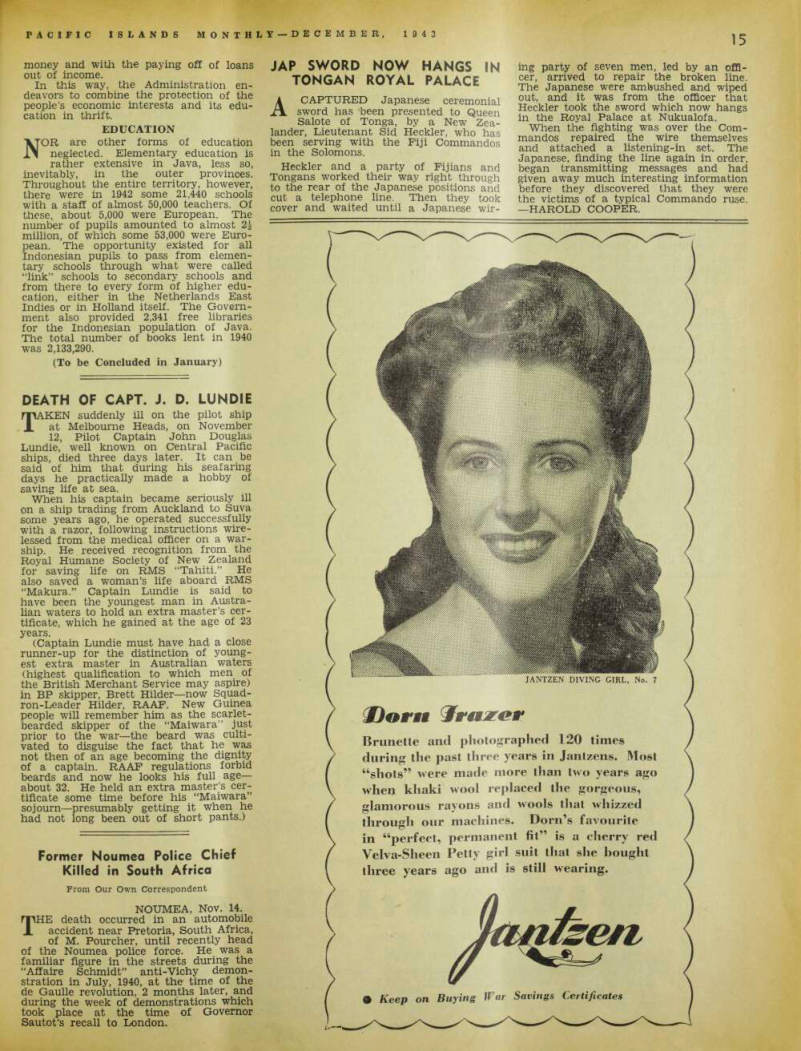
Guidance for Pacific Administrators The Second of Three Articles Written for “PIM” by Wolfe Preger.
ALMOST as difficult as maintaining the health of the people was the problem of feeding them. The insufficiency of arable land was a diffi cult enough problem and the native land laws did nothing to simplify the matter. The policy of the Government has had something of a chequered career, therefore the independent princes, European capital and the native people all had interests which had to be considered. Throughout, however, the law expressly provided that the rights under customary law of the native land owners had to be respected, although one of the greatest difficulties was that the supreme right of disposal never rested in an individual but in a tribe or a group of villages. There were many other contributory difficulties, and whatever the Government decreed it was sure to violate the established but unrecorded rights of one or other section of the rural community.
Nevertheless, through the studies and investigations of men like Professor van Vollenhoven, de Kat Angelino, and others, some kind of judicial order was attained, without destroying the flexi bility of native customary law. To-day, Indonesian rights to the soil are strongly protected.
No non-Indonesian is permitted to buy Indonesian-held land except small plots in or near the cities as building sites.
No land can be leased by non-Indone sians except on contracts subject to explicit legal conditions. For instance, the minimum rental must be equal to what the owner would have earned nor mally from the cultivation of his land.
Rice fields can only be leased and occu pied once every three years. The inter ests of the native landowners are, therefore, carefully safeguarded.
Contracts are not legal unless approved by the appropriate Government official.
To receive such approval, contracts must meet a number of protective con ditions, and there are other laws which protect the Indonesian landowners not only against non-Indonesians but also against themselves.
In 1927 some 75 per cent, of all arable land in Java was held in individual hereditary possession, 14 per cent, in communal possession with fixed shares, 5 per cent, in communal possession with periodical redistribution and about 6 or 7 per cent, between the independent States of which part was leased to European Estates and the Government. In this 6 per cent, is included the so-called “private lands” consisting of land grants
conferred in the old days on Europeans Arabs and Chinese. But for the last couple of decades the Government has been re-purchasing these lands for re distribution among the Indonesian people.
Over 1,645,000 acres have been re-pur chased at a cost of some £A14,000,000.
There is still an area of some 900,000 acres to be redeemed.
The total cultivated area in Java and Madura amounts approximately to 33,000,000 acres, of which 2,458,250 acres are assigned for estate agriculture among European, Indonesian and Chinese plan tations. The 2i million acres were ori ginally virgin forest leased for 75 years from the Government.
Population Problems
rE 33 million acres of land have to feed a population of 48 to 50 mil lion. Apart from feeding the popu lation, the soil of Java and the Outer Territories provided the world, among other agricultural and mineral products, with the following portions of its needs of such commodities: — Rubber .. .. 40% Kapok .. ..77% Tea 19% Tow fibres .. 33% Cinchona . ..91% Pepper .. ..92% Cocos products 29% Sugar 5% Tin 20% Bauxite .. .. 8% Practically 100 per cent, of the kapok, pepper, copra and coconut oil, and 50 per cent, of the rubber, coffee and tapioca produced was Indonesian-grown. West ern capital and enterprise was mainly devoted to the production of sugar, palm oil, cinchona, finer grade teas, hard fibres
and minerals. All these activities called for amounts of capital quite beyond native financial resources. These enter prises also demanded modern technical knowledge of a kind which few Indo nesians have so far acquired.
The problem of an increasing popula tion and the resultant inadequacy of the available area of arable land is no new one to the Dutch. They were faced with a similar problem in Holland, and solved it. And if part of the solution lay at times in exploiting the resources of the Netherlands East Indies, that very acti vity, when the need arose, helped to solve the problem of over-population and pov erty in Java. Originally the activities of the Dutch in the Indies were purely com mercial, through the medium of the East Indian Company. This company was liquidated just before the Napoleonic wars, but the State did not assume con trol of affairs in the Indies until after the Treaty of Vienna, In taking over the company’s assets and liabilities, the
Government also took over its bankrupt estates, which it had to carry on to con vert into an asset. In fact, the State was the only European party with invest ments in the country. It was not until about 1870 that private capital was attracted to the Netherlands Indies.
The resources and possibilities of the soil were then investigated, irrigation projects and land-reclamation schemes undertaken, new commercial agricultural growths investigated, experimented with, introduced and marketed.
Increasing Production
SINCE 1900, the Government has spent 250,000,000 florins, or £41,670,000, on irrigation works in Java alone, and by this means has added about 900,000 acres of the area of flooded fields or “Sawas” in which rice, the staple article ?f food, is grown. The following table indicates what has been done so far and what still remains to be done after the territory has been liberated:—
A Cre g Irrigated areas for which per manent works have been put into operation 2,600,000 Irrigated areas for which per manent works were under construction at the time of invasion 357,000 Irrigated grounds and grounds depending on rainfall for which plans have still to be made 7,100,000 Irrigated areas for which per manent works have been taken under investigation 1,262,500 A Dutch statistician some few years ago calculated that Java’s need of food supplies in relation to the rate of increase of the population was increas ing at the rate of 9 lb, 4 oz. per second.
Yet, every available acre is made to yield a maximum crop, some producing two and three crops per annum. The limits of agricultural extension have been
reached, both native and European.
Increased intensive culture may be of some little additional help. But every natural limit of expansion has been reached and every advantage taken of nature by the application of scientific knowledge and technique is neutralised by the very success of its results—an increase of the population.
There were, in Java alone, some 20 experimental stations for agriculture, under the control of the General Agri cultural Experimental Station. These were constantly occupied with experi ments to improve various annual or rotating crops, cocos palms, cotton, kapok, potatoes, rice, tomatoes, cabbage, tapioca, and a diversity of fruits and vegetables.
Since 1936, seed farms were established in numerous agricultural centres and their success in propagating higher yielding rice varieties and otner food stuff cultivations was spectacular. Many types were introduced from different nce-growing countries. Particularly suc cessful was the introduction of rice types from British India. Self-sufficiency in rice was attained for Java and there was even a surplus for export to the outer territories. Since the invasion by Japan, however, there is a shortage of rice throughout the Netherlands East Indies and this staple commodity on which the lives of so many millions depend is now drastically rationed.
The Rice Banks
IT used to be a common thing for farm ers to suffer a shortage of rice between seasons. One of the main reasons for this was the speculative manipulations of Asiatic rice dealers.
Wjhen a rice crop was harvested and the commodity plentiful they would hold back from purchasing, depress the mar ket, then buy up the crops at a low price.
They would then withhold supplies from the market and so bring about an arti ficial increase in the price throughout the country. To overcome this evil, and, at the same time, to teach the simple Indonesian farmer the advantage of thrift and to enable him to understand economic values, the Netherlands Ad ministration established the Popular Credit system.
At the base of this banking system are the village “loemboengs,” or Rice Banks.
And these, as soon as a need for rice developed, advanced the necessary amount of rice to the people. After the following harvest the loan was repaid with interest in kind. The Rice Banks kept the rice from passing too rapidly into the hands of the buyers, so main taining the price level on a fair and pro fitable average both for the producer and the distributor. This had a beneficial effect on wages, employment and on the general welfare of the rural population.
Side by side with these Rice Banks, money banks are established for the use of the rural population, operated and governed in the same way as the Rice Banks, that is, by the Governor of the regional area. Operating capital is, to a small extent, contributed by the people themselves, the remainder coming from the surplus of the Rice Banks in part, and part on loan from other banks. In the course of operations these loans are repaid from profits accrued. The results of this banking organisation are of con siderable benefit to the villager, who has a certain amount of participation in the control of the banks, and obtains what ever small loans he might need, whether of rice or money.
The most important result of this sys tem of banking is that it has made the Indonesian farmer’s struggle for exist ence very much easier and, in addition, he has become familiar with the use of
money and with the paying off of loans out of income.
In this way, the Administration en deavors to combine the protection of the people’s economic interests and its edu cation in thrift.
Education
NOR are other forms of education neglected. Elementary education is rather extensive in Java, less so, inevitably, in the outer provinces.
Throughout the entire territory, however, there were in 1942 some 21,440 schools with a staff of almost 50,000 teachers. Of these, about 5,000 were European. The number of pupils amounted to almost 2 \ million, of which some 53,000 were Euro pean. The opportunity existed for all Indonesian pupils to pass from elemen tary schools through what were called “link” schools to secondary schools and from there to every form of higher edu cation, either in the Netherlands East Indies or in Holland itself. The Govern ment also provided 2,341 free libraries for the Indonesian population of Java.
The total number of books lent in 1940 was 2,133,290. (To be Concluded in January)
Advertisements & other items, pp. 15-16 (1 item)
Burns Philp
PACIFIC ISLANDS SOCIETY
Visitors from the Islands to Sydney (or those interested in Islands affairs), are advised to communicate with the honorary secretary of the above Society, which has been formed to study the history, traditions, economics, and political developments of the Pacific Islands.
Regular monthly meetings are held at History House, 8 Young Street, Sydney.
Address for Correspondence:
THE PACIFIC ISLANDS SOCIETY,
Box 2434 MM., G.P.0., Sydney.
BURNS PHILP
(SOUTH SEA) CO. LTD.
Inc. in Fiji Island Traders and Shipowners Registered Office :
S U VA
FIJI
Also Branches at: \Fiji: Levuka, Lautoka. Labasa, Ba, Sigatoka, Rotuma.
Tonga: Nukualofa, Haapai, Vavau.
Samoa: Apia, Pago Pago (American Samoa).
Solomons: Makambo, Gizo, Faisi.
New Hebrides: Vila.
Code Addreu: Gilberts: Tarawa.
“Bumsouth”. Norfolk Is. Niue. Wallis Is. Futuna Is.
Sole Australian Concessionaires :
GEORGE BROWN & CO. PTY. LTD.
267 Clarence Street, Sydney.
As the Ultimate factory is engaged in vital war production, the supply of Ultimate Commercial Receivers cannot be maintained at present.
SERVICE: Ultimate owners are assured of continuity of service. Our Laboratory is situated at 267 Clarence Street, Sydney.
Servicing of all kinds of radio sets or amplifiers, as well as Rola Speakers, is also undertaken at our laboratories.
W.H.GROVE & SONS
Limited
AUCKLAND
Island Traders. P.O. Box 490.
Telegraphic and Cable Address: “Grove”, Auckland.
Shippers of all classes of New Zealand products.
Representing English Manufacturers throughout the Cook and Society Islands, Fiji, Tonga, Samoa, Niue, New Caledonia, New Guinea, etc.
In FIJI os—W. H. Grove & Sons (Fiji) Ltd.
snsm
BUY cm
Distilleries at London . . . England Toronto . . . Canada Moorabbin . . Victoria Cincinnati . . . U.S.A.
Death Of Cart. J. D. Lundie
rKEN suddenly ill on the pilot ship at Melbourne Heads, on November 12, Pilot Captain John Douglas Lundie, well known on Central Pacific ships, died three days later. It can be said of him that during his seafaring days he practically made a hobby of saving life at sea.
When his captain became seriously ill on a ship trading from Auckland to Suva some years ago, he operated successfully with a razor, following instructions wire lessed from the medical officer on a war ship. He received recognition from the Royal Humane Society of New Zealand for saving life on RMS “Tahiti.” He also saved a woman’s life aboard RMS “Makura.” Captain Lundie is said to have been the youngest man in Austra lian waters to hold an extra master’s cer tificate, which he gained at the age of 23 years. (Captain Lundie must have had a close runner-up for the distinction of young est extra master in Australian waters (highest qualification to which men of the British Merchant Service may aspire) in BP skipper, Brett Hilder —now Squad ron-Leader Hilder, RAAF. New Guinea people will remember him as the scarlet bearded skipper of the “Maiwara” just prior to the war—the beard was culti vated to disguise the fact that he was not then of an age becoming the dignity of a captain. RAAF regulations forbid beards and now he looks his full age— about 32. He held an extra master’s cer tificate some time before his “Maiwara” sojourn—presumably getting it when he had not long been out of short pants.)
Former Noumea Police Chief
Killed in South Africa
From Our Own Correspondent
Noumea, Nov. 14.
rE death occurred in an automobile accident near Pretoria, South Africa, of M. Pourcher, until recently head of the Noumea police force. He was a familiar figure in the streets during the “Affaire Schmidt” anti-Vichy demon stration in July, 1940, at the time of the de Gaulle revolution, 2 months later, and during the week of demonstrations which took place at the time of Governor Sautot’s recall to London.
"“thf Sal%aTat W Ntk h uaTo7a. hanßS
Jap Sword Now Hangs In
Tongan Royal Pa Lace
A CAPTURED Japanese ceremonial S *S! Tonga Pr by nt a d New Q 2 e e e a" lander, Lieutenant Sid Heckler, who has ?n e Sie 5 Solomons th FiJ Commandos in me tooiomons.
Heckler and a party of Fijians and Tongans worked their way right through to the rear of the Japanese positions and cut a telephone line. Then they took cover and waited until a Japanese wir
ing party of seven men, led by an offl cer, arrived to repair the broken line.
The Japanese were ambushed and wiped out, and it was from the officer that "“thf Sal%aTat W Ntk h uaTo7a. hanßS wire 6 ” themSlTOs and attached a listening-in Set The Japanese, finding the line again in order, began transmitting messages and had given away much interesting information before they discovered that they were the victims of a typical Commando ruse,
Harold Cooper.
Advertisements & other items, p. 17 (1 item)
In '{ken
JANTZEN DIVING GIRL. No. 7
Darts
Brunelle and photographed 120 times during the past three years in Janlzens. Most “shots” were made more than two years ago when khaki wool replaced the gorgeous, glamorous rayons and wools that whizzed through our machines. Dorn’s favourite in “perfect, permanent fit” is a cherry red Velva-Sheen Petty girl suit that she bought three years ago and is still wearing.
In '{ken
9 Keep on Buying War Savings Certificates
War Comes To The Atolls
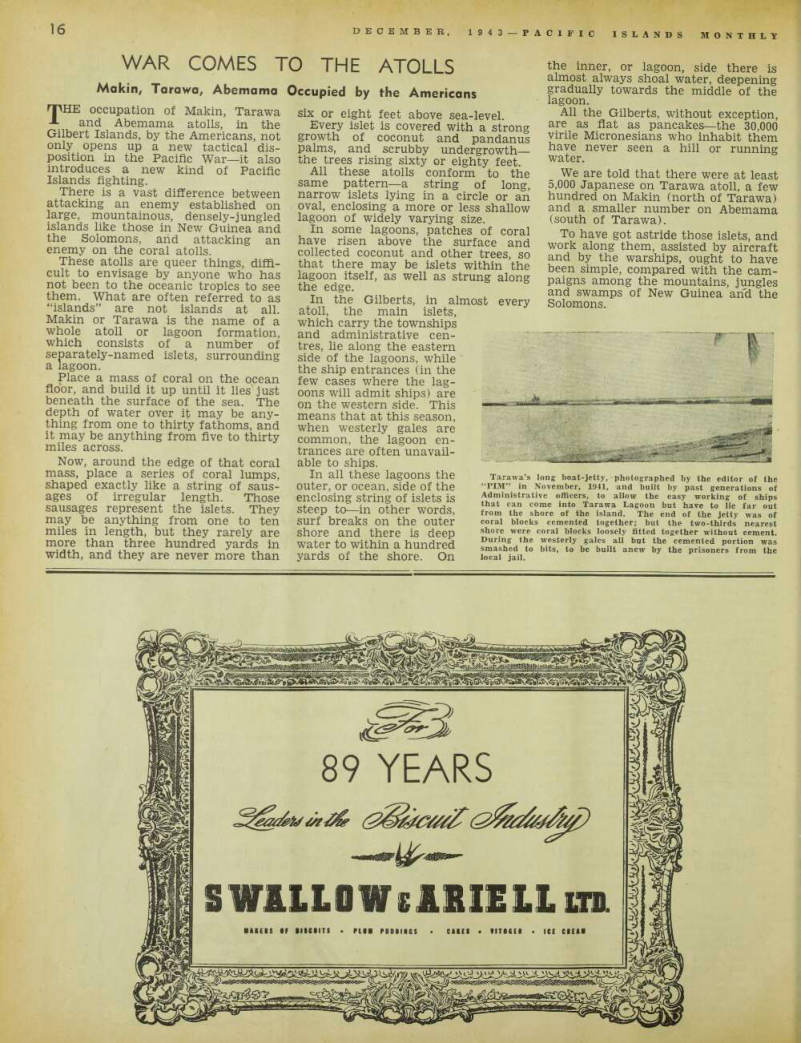
Makin, Tarawa, Abemama Occupied by the Americans
THE occupation of Makin, Tarawa and Abemama atolls, in the Gilbert Islands, by the Americans, not only opens up a new tactical dis position in the Pacific War—it also introduces a new kind of Pacific Islands fighting.
There is a vast difference between attacking an enemy established on large, mountainous, densely-jungled islands like those in New Guinea and the Solomons, and attacking an enemy on the coral atolls.
These atolls are queer things, diffi cult to envisage by anyone who has not been to the oceanic tropics to see them. What are often referred to as “islands” are not islands at all.
Makin or Tarawa is the name of a whole atoll or lagoon formation, which consists of a number of separately-named islets, surrounding
a lagoon.
Place a mass of coral on the ocean floor, and build it up until it lies just beneath the surface of the sea. The depth of water over it may be any thing from one to thirty fathoms, and it may be anything from five to thirty miles across.
Now, around the edge of that coral mass, place a series of coral lumps, shaped exactly like a string of saus ages of irregular length. Those sausages represent the islets. They may be anything from one to ten miles in length, but they rarely are more than three hundred yards in width, and they are never more than
six or eight feet above sea-level.
Every islet is covered with a strong growth of coconut and pandanus palms, and scrubby undergrowth— the trees rising sixty or eighty feet.
All these atolls conform to the same pattern—a string of long, narrow islets lying in a circle or an oval, enclosing a more or less shallow lagoon of widely varying size.
In some lagoons, patches of coral have risen above the surface and collected coconut and other trees, so that there may be islets within the lagoon itself, as well as strung along the edge.
In the Gilberts, in almost every atoll, the main islets,
which carry the townships and administrative cen tres, lie along the eastern side of the lagoons, while the ship entrances (in the few cases where the lag oons will admit ships) are on the western side. This means that at this season, when westerly gales are common, the lagoon en trances are often unavail able to ships.
In all these lagoons the outer, or ocean, side of the enclosing string of islets is steep to—in other words, surf breaks on the outer shore and there is deep water to within a hundred yards of the shore. On
the inner, or lagoon, side there is almost always shoal water, deepening gradually towards the middle of the lagoon.
All the Gilberts, without exception, are as flat as pancakes—the 30,000 virile Micronesians who inhabit them have never seen a hill or running water.
We are told that there were at least 5,000 Japanese on Tarawa atoll, a few hundred on Makin (north of Tarawa) and a smaller number on Abemama (south of Tarawa).
To have got astride those islets, and work along them, assisted by aircraft and by the warships, ought to have been simple, compared with the cam paigns among the mountains, jungles and swamps of New Guinea and the Solomons.
Tarawa’s long boat-jetty, photographed by the editor of the “PIM” in November, 1941, and built by past generations of Administrative officers, to allow the easy working of ships that can come into Tarawa Lagoon but have to lie far out from the shore of the island. The end of the jetty was of coral blocks cemented together; but the two-thirds nearest shore were coral blocks loosely fitted together without cement.
During the westerly gales all but the cemented portion was smashed to bits, to be built anew by the prisoners from the local jail.
Once the trees are cleared away, these flat islets of dry, hard-packed coral, make ideal landing fields.
The Marshall Islands, Japanese territory, are only some 300 miles to the north-west, and the Marshalls, also, are mostly coral atolls. It was reported in 1940 and 1941 that some of them had been fortified; but atolls are not easily defended, and it will be found that the really formidable Japanese bases are in the Carolines, still further north-west. There, the islands, instead of being merely low atolls, are a combination of atoll and volcanic mountain, and capable of being powerfully fortified. Truk and Ponape are of this description.
If the Japanese will not produce the air and naval strength to enable them to hold on to the Gilbert atolls, they may be in similar difficulty with the Marshall Island atolls, which are equally hard to defend.
Advertisements & other items, p. 18 (1 item)
89 Years
m 4%iVQi n
3 ST3 3
S WILLI Wc ABIE LL ltd.
■j' ItUIS If II SC lIT S . Pill POOOIH6S . CUES • VITO6EI . ICE CBEII zm «r
SO©S
/t;
What Happened in the Battle
Battle of Tarawa
By R. W. Robson
UNTIL November 30, there was a certain mystery about the oper ations in the Gilberts. It seemed that the flat, narrow islets, with deep water right up to the ocean side, presented a fairly simple problem for the attacking forces. It was assumed that while our air supremacy took care of enemy aircraft, our warships would lie fairly close in, and literally plaster the low terrain with high ex plosive, while the assaulting forces dashed ashore, under cover of the ships’ guns and our own aircraft.
But it soon became clear that, while something like that may have happened on Butaritari and Abe-, mama, there was an entirely different story on Tarawa. The operation there was difficult and protracted, and the atoll was not occupied before the US Marine had suffered severely.
Now we know what happened.
There was a sudden shift of the wind: the ocean currents and tides did not follow their usual course; and the assaulting parties of Marines, instead of landing on the edge of the islet of Betio, were stranded on coral reefs many hundred yards from the shore, and had to struggle forward through shallow water.
Further, the Japanese, evidently ex pecting this kind of operation, had covered the flat surface of Betio with cement pill-boxes, buried deep under masses of coconut logs and further masses of packed coral soil. The islet was heavily bombarded; but nothing but a direct hit from a big shell could disturb those pill-boxes.
The Marines had to struggle ashore through the coral reefs and heads, and there is no more difficult, pain ful and more poisonous walking in the world. As they advanced through the shallows, and then assaulted the pill-boxes, they were literally mown down. Yet they eventually rooted all
those Japs out of their innumerable pill-boxes, and occupied the islet of Betio. They hunted the Japs on to the next islet, Bairiki (site of the famous trainifig school for Micro nesian boys) and eventually wiped them out. It was a bloody affair, but it will stand as one of the finest achievements of this famous Corps.
IKNOW those treacherous tides of Tarawa. Only two years ago— almost to the day of the American assault —I was out on a schooner in the lagoon and, when I tried to re turn to Betio, I found that the tide had run out in a phenomenal way, so that there were only a few inches of water over half a mile of inter vening reefs, where big launches usually floated comfortably. The very
next day, the tide rose so high, at a time when it should have been low, that it flowed over the edges of the low atoll.
It was sheer bad luck that it should have happened at the moment of the American attack.
The manner in which the Japanese defended this Tarawa atoll gives a significant colour to the prospect of assaulting similar atolls in the near by Marshalls, which have been held by the Japs for 20 years, and towards which American faces now are turned.
It would appear that the Japs can so place concrete pill-boxes in the coral formation that they are almost wholly protected against the bombs of our planes or the shells of our ships.
Advertisements & other items, pp. 19-20 (1 item)
Fosteiryl Ark’S
\ o o IT A O You’ll find that Foster Clark’s Creamy Custard will give a wonderfully rich flavour to all your cold sweets. It also gives added nourishment and is an economy that will help keep your housekeeping budget well within its limits. Save every penny you can to invest in War Savings Certificates.
SUMMER SWEETS. You’ll
find many intriguing, original recipes in Elizabeth Craig’s FREE Recipe Book. Write to Foster Clark ( Aust .) Ltd., Dept. R. 8., Redfern, N.S.W., for your copy, enclosing 2 id. in stamps to cover postage. 9? a* *3^ %
FOSTEIryL ARK’S
Cre 1
Modern Refrigeration for the South Sea Islands
The ELECTROLUX kerosene operated
REFRIGERATOR
MARVEL
OF
MODERN
SCIENCE
m
THE
MIRACLE
OF
ICE
FROM
HEAT
ELECTROLUX OFFERS ECONOMICAL, modern and completely efficient
REFRIGERATION FOR ISLANDS' HOMES.
FREEZES CONTINUOUSLY WHILE SMALL LAMP BURNS.
Freezing controlled by simply regulating height of flame. Uses only gallon of kerosene per week.
MOTORLESS ... NO PARTS TO GET OUT OF ORDER.
MODEL L 22
Capacity 2.2 cubic feet.
MODEL L3BO
(as illustrated) Capacity 4 cubic feet.
MODEL LKSSO
Capacity 6.5 cubic feet.
GUARANTEED FOR TWO YEARS.
• Write to your Local Distributor for prices and full details.
OBTAINABLE FROM ALL W. R. CARPENTER & CO. LTD.
BRANCHES THROUGHOUT THE ISLANDS
Representation in Papua and New Hebrides.
Queen Salote's Message
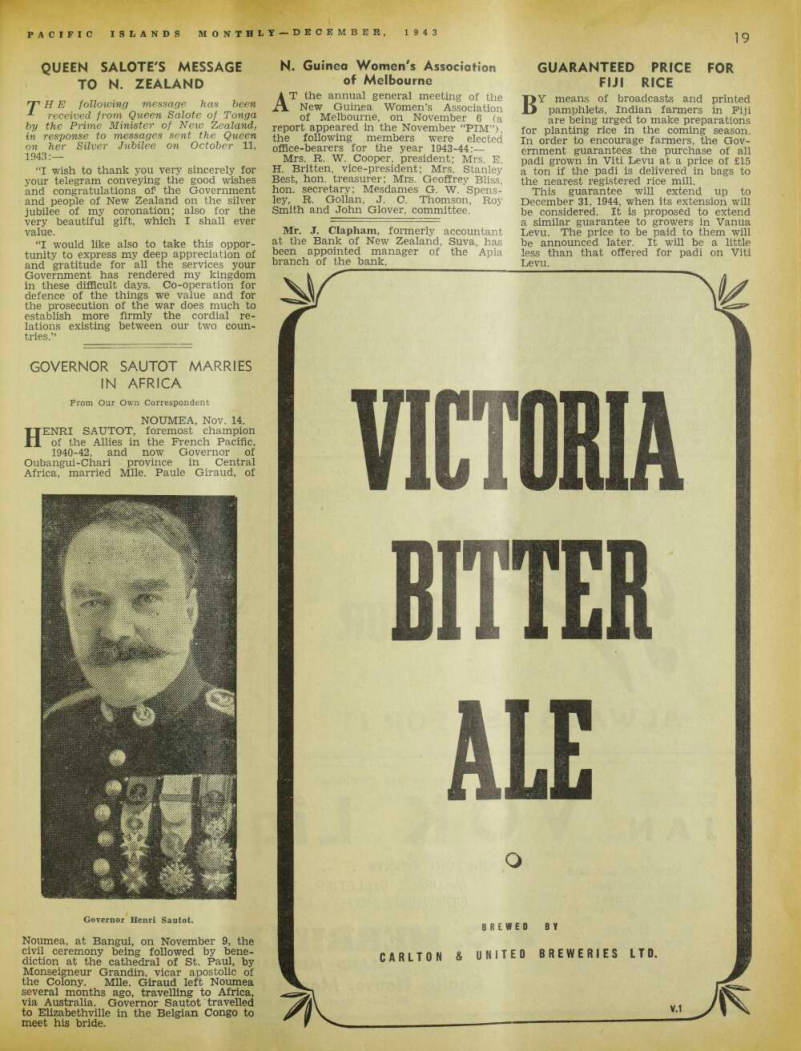
To N. Zealand
'J 1 H E following message has been received from Queen Salote of Tonga hy the Prime Minister of New Zealand, in response to messages sent the Queen on her Silver Jubilee on October 11, 1943: “I wish to thank you very sincerely for your telegram conveying the good wishes and congratulations of the Government and people of New Zealand on the silver jubilee of my coronation; also for the very beautiful gift, which I shall ever value.
“I would like also to take this oppor tunity to express my deep appreciation of and gratitude for all the services your Government has rendered my kingdom in these difficult days. Co-operation for defence of the things we value and for the prosecution of the war does much to establish more firmly the cordial re lations existing between our two coun tries.”
Governor Sautot Marries
In Africa
From Our Own Correspondent
Noumea, Nov. 14.
HENRI SAUTOT, foremost champion of the Allies in the French Pacific, 1940-42, and now Governor of Oubangui-Chari province in Central Africa, married Mile. Paule Giraud, of
Noumea, at Bangui, on November 9, the civil ceremony being followed by bene diction at the cathedral of St. Paul, by Monseigneur Grandin, vicar apostolic of the Colony. Mile. Giraud left Noumea several months ago, travelling to Africa, via Australia. Governor Sautot travelled to Elizabethville in the Belgian Congo to meet his bride.
Governor Henri Sautot.
N. Guinea Women's Association
of Melbourne
AT the annual general meeting of the New Guinea Women’s Association of Melbourne, on November 6 (a report appeared in the November “PIM”), the following members were elected office-bearers for the year 1943-44: Mrs. R. W. Cooper, president; Mrs. E.
H. Britten, vice-president; Mrs. Stanley Best, hon. treasurer; Mrs. Geoffrey Bliss, hon. secretary; Mesdames G. W. Spens ley, R. Gollan, J. C. Thomson, Roy Smith and John Glover, committee.
Mr. J. Clapham, formerly accountant at the Bank of New Zealand, Suva, has been appointed manager of the Apia branch of the bank.
Guaranteed Price For
Fiji Rice
BY means of broadcasts and printed pamphlets, Indian farmers in Fiji are being urged to make preparations for planting rice in the coming season.
In order to encourage farmers, the Gov ernment guarantees the purchase of all padi grown in Viti Levu at a price of £l5 a ton if the padi is delivered in bags to the nearest registered rice mill.
This guarantee will extend up to December 31, 1944, when its extension will be considered. It is proposed to extend a similar guarantee to growers in Vanua Levu. The price to be paid to them will be announced later. It will be a little less than that offered for padi on Viti Levu.
Advertisements & other items, p. 21 (1 item)
o
CARLTON
brewed by united breweries ltd.
American Eyes

New Guinea As Seen Through
(From Notes Mode by a United States Army Officer)
I HAVE made my first contact with one of the largest, wildest, most difficult islands left in the world. The dent of civilisation in New Guinea is small; and, if the fight against the jungle was not constantly maintained, all vestiges of white rule would disappear almost immediately.
The combination of fertile soil in the accessible areas, torrential rain, and humid tropical atmosphere make ideal growth conditions, and the tangle of vines and trees grows up to confound any attempt to beat it. Now that many of the missions and trading posts have been abandoned for over a year, one can see how quickly the country reverts to its wild state.
It may be different in the future. The armed forces are swarming over jungle trails which formerly discouraged white men; and new tactics for clearing, and building, and fighting tropical disease, are being learned.
A bulldozer, a steam shovel, a few trucks and a gravel pit can rip the jungle like a hurricane and the hard-packed coral or gravel roads defy the rain and jungle growth. The constant patrol of armed men over the rugged, jungle-covered mountains, which cover the country
except for the narrow coastal plain have introduced the unknown interior for the first time, They are learning of rock formations indicating gold, iron, coal and oil, and they are discovering high, temperate fertile plateaux which some day may provide Australia with all the rubber and tea she will ever need, There is water-power, too, in fantastic quantities, tumbling out of the moun tains, over falls of breath-taking beauty It has been proven that the natives can be taught to perform ordinary mechanical skilled jobs in a superior manner, indicating a large force of potential untapped manpower, fTIHIS brings up a discussion of the 1 native himself. He is distinctly above the Australian aboriginal; but the generosity of the country and the lassitude of the tropics make him satis fied to spend his life weaving mats, fish ing and just resting. In spite of this easy life, he does not grow fat, because the diet is not varied nor plentiful Even now, when the Australian Gov emment issues a fairly generous ration of bully beef, tea, biscuits and rice to the native, the children have pot bellies
indicative of malnutrition. Many times, this pot belly is caused by the constant presence of malaria, with its repeated flareups.
Perhaps this malarial condition con tributes to the weak heart and lungs which are universal. A stethoscope on a native gives a sound resembling a rolling barrel of tin cans, and their asthmatic breathing is tragic to hear. They are ready victims of lung ailments, and usually trivial diseases end up in fatal pneumonia. Measle epidemics are par ticularly feared, for this reason.
AND yet, in other ways, the natives are tough babies. They can go on travelling, over back-breaking hills and trails, day in and day out, on a minimum of food and rest. They proved themselves invaluable as carriers over the rough Kokoda Track. Their ability to recover from severe wounds, such as total penetration by spear, is phenom enal. Their feet are as tough as horses’ hooves, and they can walk on sharp coral or rock without complaint. A half-inch of colourless, bloodless, nerveless callous can be pared from the soles of the feet To watch a native run away from one in the dusk is laughable. All one sees are the alternate flashes of white feet.
Yaws is probably the worst curse of the natives. It is a spirochete disease, like some venereal diseases, and shows itself m skin lesions and terrible arthritic pain, that ties up the joints in a hor rible fashion. The treatment is injection of a bismuth compound and the imme diate reaction is spectacular.
To-day, bismuth has a stiff competi tor in the sulpha drugs. They work miracles on venereal diseases, most of which are not of the more serious types.
They are also saving countless lives which would otherwise be lost to pneu monia. Their use in salves, for the ugly, open, tropic ulcers, which grow to enormous size, is also impressive. All natives have large scars from previous ulcers on their bodies, and they show up brilliantly on their black skin.
NATIVE villages are strung along the coast and the jungle trails and rivers. Few amount to more than a clearing, and not more than eight or ten huts, usually less. Some are indescrib ably dirty, with wild hogs rooting about under the houses, while others have the ground spotlessly cleared, and swept in neat patterns, with a brush broom. Quite often transplanted, multi-coloured tropi cal shrubs and flowers are flourishing in the yard.
The Government furnishes extra rations and the effect can be seen on natives bv their sleek, healthy appear ance. Where this diet is lacking they
are scrawny and thin, and have repul sive, scaly skins. Their ordinary diet consists of taro root, yams, pineapple, banana, papaya, berries and, sometimes, corn. When they have community gar dens, they usually cultivate cleared areas on the sides of the hills, back from the coastal plain.
The natives are a peculiarly childlike race, with incomprehensible minds. A white man never completely understands them, and rarely feels that he can trust one.
THIS brings up a discussion on the half-caste, who is the connecting link. He understands both native and white, and his value as a plantation manager, teacher and missionary is extremely important. There are not nearly enough of them to fill the demand; and, now, most of them are working native labour for the armed forces and are unavailable for their peacetime work.
Their being away from home has had another unfortunate result, in that half caste women are losing their pride in their white blood and are reverting to marrying and breeding with natives. This is too bad: because the half-caste is an intelligent person, and is usually well mannered and quite easy to educate.
They consider themselves white, and live apart from the natives, but do not try to assert their equality with a full white.
The native, on the other hand, is inferior and subservient, and takes orders from either. Natives are smart in the way dogs, horses, and children are smart.
They will do a job not quite perfectly, or not quite fast enough, in order to test out the disciplinary efficiency of a new white overseer. If the boss, “Taubada,” sees through them and disciplines them, they work well, but otherwise they will take increased advantage.
NEW Guinea is unquestionably the worst fighting country in the world.
Our Aussie compatriots say the desert of Egypt is much preferable. The Buna campaign was really rougher than the more-publicised Guadalcanal cam paign.
It is so constantly hot, humid and exhausting. The coastal swamps and heavy underbrush contain swarms of malarial mosquitoes, which make life unbearable at night and cause more casualties than bullets. Each man must carefully hack his way through dense jungle, never seeing his neighbour or his enemy until he is on top of him. The mental strain is terrible.
Of necessity the supply of food and ammunition must be flown in by shuttling transnort or by small boats sneaking up the shore. For weeks at a time, no hot meals can be served, forcing the men to live on C ration or jungle ration. When they finally come out. both Jap and American look like skeletal ghosts.
On the other hand, to fly over the battle-zone, or cruise in a boat among the islands and coastline, is an unfor gettable experience. The palm-studded shores, the coral reefs, the clean beaches, the sheer, forbidding, jungle-covered mountains in the background: all pull and tug at one, luring him to the tropic lassitude and forgetfulness of time that we have all read about. One begins to think there may be something in this beachcomber stuff, after all.
However, a little experience teaches one to look at a lovely coral island and say, “Yes, it’s beautiful; but, underneath it, is a sinister fiend.” Of course, the South Seas belle is a disappointingly far cry from Dorothy Lamour; and I have yet to see any sign of them looking lighter. They sav it’s time to get out, when they start looking white.
1 SMILE to myself when I think back over my first month here. I regret ted volunteering for duty that made me give up my Australian apartment. I cursed the humid heat that made my clothes wet during the night, and rusted my automatic, and turned my shoes green. I hated the ants, spiders and mosquitoes. I found quinine made my skin itch until I could hardly stand it.
My athlete’s foot came back, and joint and gland aches returned, reminding me of injuries of childhood which I had long since forgotten. Canned food was mono tonously tasteless; no cool drinks, pow dered milk, canned butter and bully beef. There was no diversion, little to read, no movies, no adequate radio. Mail was slow. Dust and mud, rain and heat,
plus a frenzy of activity to help the troops up front with our inadequate equipment and personnel.
And yet we knew we were far luckier than the boys a few miles further up, who were suffering worse than we were.
These fpur months have seen an im provement in the malarial rate that makes the Panama Canal record look sick.
Our roads have been improved to defy the rain, and we have built better sani tary facilities. Kerosene refrigerators have come in, and even generators to give us light and power. A reefer ship comes up from Australia regularly and our portable refrigerators hold our fresh meat and vegetables until we want them.
(Continued on Page 24)
HOWEVER, our touch is light and transitory, and most of our occupied places and hand-made landing strips will revert back to their former wilder ness. No more five bob for a grass skirt or a bunch of bananas.
Ten bob ($1.65) is the normal monthly wage for a native, but I have seen a five-year-old boy make that much by selling two stalks of bananas, which he hacked off with his machete.
Each jungle trip is new. each gives something to remember. It is incon gruous to walk along a dark jungle trail, with a native cutting the entangling vines, and hear a P-40 snarl by unseen, overhead. I have seen a shallow, crystal-clear stream flash-flood into a roaring, muddy torrent, which com pletely submerged mv jeep in a few minutes and then subsided just as rapidly to its former state. I have fought my way through eight-foot grass and jungle, where ,my only guide was a compass.
Many of a recent consignment of Aus tralian eggs arrived in New Caledonia in a rotten or unusable condition. This must constitute a tragedy for the innum erable teashops that rely on Australian eggs. As stated in November. New Cale donian eggs are unobtainable, even at the equivalent of 9/- Aust., per dozen.
Advertisements & other items, pp. 22-24 (1 item)
jan VOK Liqueurs
PRODUCING UNIFORM GOOD RESULTS SINCE 1868
ALWAYS ASK FOR IT
Qualite par Excellence.
jan VOK Liqueurs
New Hebrides and New Caledonia: Fiji & Tonga:
DISTRIBUTING AGENTS
MAURICE PELLETIER, 16 BRIDGE STREET, SYDNEY.
NORTHERN HOTELS LTD., LAUTOKA & BA, FIJI.
TRADE
ENQUIRIES TO:
J. C. MERRILLEES & CO.
ISLAND MERCHANTS
Challis House, Martin Place, Sydney
Bonkers: Bonk of New South Woles.
ADD VARIETY Y to your
hot-weather meals
Typical of the tasty, tempting, quick-serve foods offered by “Imperial” is “Meatreat.” This canned corned beef is prepared by the special “Imperial” process which seals in all the natural flavour, colour and rich nourishing juices of the meat. Served with salads, “Meatreat” makes an ideal hot-day dish.
Other “Imperial” 'products which will help you add variety to your hot-weather meals are : "Imperial" Camp Pie.
"Imperial" Beef tr Pork Sausages "Imperial" Sheep's Tongues.
"Imperial" Hampe— the mea!-in-a-moment.
Every one of these “ Imperial ” products offers you the delightful flavour of fresh meats at their very "best. Ask for them to-day.
PRODUCTS OF
RIVERSTONE MEAT CO. Em
Fiji Representatives: Pearce & Co. Ltd., Suva.
Services
COMMUNICATIONS
SS S 5" SERV,CE
s?SS
WIRELESS TELEP ON ER$
wireless d RECTION ts S broadcast BEcavos
BROADCASTS H 6
owners and operaJo rs taTl ons RE CO°AD,r» N R AUA N A.T.TS * CH --" c • development
AMALGAMATED WIRELESS LIMITED
Australia’s National Wireless Organisation
Oversea Birds For Birdless Tahiti
The Remarkable Self-imposed Task of Eastham Guild
“An Englishman is in town, visiting our British Consul. A few days ago he came to the Consul, speaking to him in greatest confidence and ask ing him not to repeat it for fear the island people would think him crazy.
But he was sure he had seen a Hummingbird visiting his vanilla flowers! A Hummingbird in a bird less island! He himself thought the island was ‘getting him* “Undoubtedly, this is one of some ‘hummers * liberated over a month ago.
This man does know a ‘hummer* when he sees one.”
SO wrote Mr. Eastham Guild. Tahiti’s bird-man, in December, 1938.
Twenty years ago, when he came to the island it was birdless, except for a few sea and shore birds. A lover of nature, he had, as a child in Boston, learned his bird-lore from a naturalist friend of his father, and the inspiration to re-establish bird life in that tropical paradise came to him soon after he arrived in Tahiti.
The long and tedious correspondence necessary for permits to export birds from the various countries; the surveys made in Tahiti of indigenous seeds and small grains; the enormous expense of buying and shipping birds with proper care and equipment; importation of natural foods for the birds until such time as they could search for their own; the evolution of a card index system for keeping track of the birds after they had arrived; the careful checking of a variety before it was imported, so that there would be no violent economic repercussions should it adapt itself too readily to its new environ ment (e.g., the minah and the bul-bul of Asia, which introduced by interfering man into Fiji, have so upset the balance of Nature that the native birds have been driven right back into the moun tains)—all these things were necessary preliminaries to actually getting the birds to the island.
BUT, at last, the stage was set, and about 10 years ago Mr. Guild began importing. In all, he has imported about 8,000 birds, of 60 varieties. Most of the birds are waxbills and finches; all have been liberated, and 23 of the varie ties have reproduced themselves.
They were brought from countries with similar climates to Tahiti: finches from New Zealand, Australia, New Hebrides, New Guinea; waxbills, finches and weavers from Africa; tanagers and sugar birds from Central and South America; bluebirds, orioles, hummingbirds, meadow larks, tanagers, lazulie buntings, touhees, goldfinches from the United States and Mexico.
After the birds are imported, they are placed in conditioning aviaries until they are acclimatised. They are then liberated.
Mr. Guild established a feeding station at his home, where he fed the birds four times a day, and in this way the birds accustomed themselves to self-support in easy stages.
If the birds happen to be shipped from their home land at a season that is at odds with Tahiti’s, then they must be kept in the aviaries until their moulting and breeding period is changed. When the time is right for liberating, the birds are brought down to aviaries, close to the feeding station. The aviaries have feed ing platforms identical with those on the outside, and the birds acquaint them
selves with other birds on the outside, and with the feeding hours.
In a few days they are liberated, about ten or twelve at a time. This is done at the four o’clock feeding—at this hour the birds will not immediately fly away to find new fields, but will find a roosting spot nearby. The next morning at the six o’clock feeding they will find hundreds of others of their kind and accommodate themselves easily to their freedom.
It is interesting to note that birds do not interbreed —as do, for instance, dogs. (A Foxie will breed with a Bulldog; or an Alsatian with a Chow.) But no Fire finch breeds with a Cordon Bleu, no Sydney Waxbill with an African Waxbill —even though they are of the same classification.
IN selecting varieties for import, it was necessary to choose those that were not particularly migratory; even so, at times the migratory urge has proved too strong.
There was the case of the Western Bluebirds, five pairs of which came from the States in December, 1939. They changed their brooding and moulting season to accord with South Seas condi tions, nested and raised two families in early 1940; and then completely dis appeared. Where they went is not known—maybe north to the States or to greater warmth. In November, they re turned, nested, and brought up two more broods. In the following June they again disappeared. This has gone on for three
years now—leaving the island in June and returning about November.
The birds are known to be spreading about the island; but, although the French Government has passed laws pro tecting them, there are not many bird
minded people in Tahiti, and it is easy to lose track of them once liberated. Those that stay around the Guild’s house are propagating well—and it is assumed that those that have scattered to the far hills and valleys are doing likewise. It will probably be another five years before there is a real showing of bird-life in Tahiti.
GAME birds have also been brought in by Mr. Guild, and by Mr. Charles B Nordhoff (of Nordhoff and Hall fame). Wild ducks, geese, pheasant, quail, grouse, are among the varieties im
ported; but, because they nest on the ground where their eggs are a prey to rats, cats and dogs, they have not done well in populated areas. And, although there are now local game laws, the game birds have proved too great a temptation to the Tahitian, and most of them have ended in his stone oven.
One bird now firmly established in Tahiti was not introduced by Mr. Guild.
This is the Chestnut Breasted Waxbill— a finch common to Australia and shipped all over the world, from there, to bird fanciers.
The first Chestnut Breasters were in troduced into Tahiti when a shipment was passing through Papeete on its way to Chile.
Two drunks wandered on to the ship, sighted the cages. “Why, the pretty little birds! Why the pretty POOR little birds!
All caged up! It’s a shame. We’ll let ’em out, huh?” And they did.
Mrs. Geri von Bergmann, American business woman, of Tahiti, who is now
carrying on Mr. Guild’s work while he is in America doing a war job, says; “We have large flocks of them around our grounds—undoubtedly, some of the ori ginals flying over the island saw the birds on our station, and dropped in for a look see. They decided it was a soft spot and brought their friends and relations, and have proved a great nuisance as they eat out the other varieties who do not have such large broods, or so often. Mr. Guild has had to trap hundreds, and ship them to neighbouring islands and to Central America.”
THERE have been some amusing and heart-breaking instances attending Mr. Guild’s work.
There was the time when he was carry ing “live food” with a shipment from the States, and the mealy-worms ate through their cardboard boxes and invaded the ship; times when the birds got sick; or when a variety disappeared completely on liberation.
He has never been successful with pure yellow birds—Tahiti moonlight is bril liantly white, and while the birds sleep in the trees they are easily picked off by rats.
Eastham Guild disclaims all scientific knowledge of ornithology, but his know ledge is well-grounded, and his love of birds is all-sufficient. The war has brought a stop to his self-imposed task— the world has got a bigger job on at the moment: bird-collectors have gone out of business, shipping space is limited, per mits to import and collecting expeditions are off for the duration. But, after the war, when peace returns to the Pacific, it is hoped that the work will continue.
Right now, with things as they are— nothing written, nothing done that is not tied up to the war in some fashion—it is almost impossible to believe that there ever was a time when a man could spend his time simply aiding nature. It is even harder to believe that the day when we will have time and space to do as we wish will dawn again.
That Eastham Guild once had the time and employed it as he did, is a pretty happy thought in this war-torn world.
Advertisements & other items, pp. 25-26 (2 items)
Yorkshire
THE
INSURANCE
CO. LTD.
(Incorporated in England)
FIRE
ACCIDENT
MARINE
FIRE POLICIES ISSUED
IN PAPUA
All information from —
E. A. JAMES,
Tel. 86347. Attorney for Papua, 14 Spring St., Sydney.
KEEP LANTERNS AND
STOVES WORKING
WITH GENUINE
roleman
PARTS
To help you take care of your Coleman Lantern, Stove, Iron or other Appliance, the Coleman factory is doing everything possible to keep your Dealer supplied with Genuine Coleman Parts.
Ask his advice about making your Coleman appliance last longer. He will make repairs and keep it in satisfactory working order.
THE COLEMAN LAMP & STOVE CO. LTD.
TORONTO
CANADA
THE COLEMAN EXPORT CORPORATION, CHICAGO, ILL., U.S.A.
ISLAND SHELLS
and MARINE PRODUCTS
Inquiries invited from America, Australia, New Zealand, etc., re supply of Island Shells, Coral Shark’s Teeth, etc.
Write G. F. Russell, c/o P.O. Suva, Fiji.
Wanted to Buy—Quality Guns and Rifles HIGHEST PRICES GIVEN. WILL ALSO EXCHANGE GUNS.
SI L RO fH U Qualify Firearms and Fishing Tackle. 143 ELIZABETH STREET (Near Market St.) SYDNEY. ’PHONE: MA 3540.
Ship Chandlery Hardware
r Write for j
j Ship Chandlery /
* Catalogue J
BROOMFIELDS LIMITED
152 SUSSEX STREET :: SYDNEY.
Cables: “Boom”, Sydney.
Special “In Bond” Prices for all Islands enquiries quoted on application.
Sole Agents for: Large and Complete Stocks of
SHIP CHANDLERY
IRONMONGERY OF ALL KINDS, PAINTS,
WHITE LEAD AND OILS.
P. H. MUNTZ & CO.’S 3-CROWN BRAND METAL SHEATHING.
PEACOCK & BUCHANS’ ENGLISH READY-MIXED PAINTS.
Scott’s “Renown” Brand Rope,
Cable Addresa; Ropeyard, Sydney. ■ -
Cordage and
Binder
Twine
of Every
Description
MANUFACTURED AT
MASCOT, N.S.W.
By
J. SCOTT
PTY. LTD.
Head Office and Store:
163 CLARENCE STREET,
SYDNEY,
NJS.W.
24
THROUGH AMERICAN EYES
(Continued from Page 21)
DECEMBER, 1943 PACIFIC ISLANDS MONTHLY
Soldier's Story
By “Daika”
IMET him when I first went to camp, “Somewhere in Australia,” back in 1940. He was young and tough and cheery, and had just been married. No booze for him! I met his wife, too—she was pretty, and loved her soldier hus band. They were going to start a home after the war. I listened to their plans —the same as many have made. Just a nice couple of enthusiastic kids very much in love.
I met him on the “Mary” going “over there.” He was studying for promotion and was scrimping and saving. All the more for the wife, was his cry. He was keen and clean.
I met him in Alexandria. We had a meal together and he told me a kiddie was coming along soon and how he would have liked to be home. He was going back early to write to the wife. He was proud of two brand-new stripes on his arm. He was strong.
I met him in Greece: still smiling— still confident he would be OK—still wondering how his wife was and what the kiddie was. He did his job well, in spite of anxiety.
I met him on Crete. We were stumbling to the beach. He looked strained, but his eyes lit up when he saw me. We promised each other a celebra tion in Palestine. He was still sure that life was a rosy path.
I met him in Palestine. We didn’t celebrate: his kiddie had been still-born.
He looked older, but he was still keen and clean—a picture of what a soldier should be. He took a pride in himself— didn’t he have the best little wife in the world? And after the war — I met him in New Guinea. He had not been able to get home when he returned from the Middle East. The Japs were pushing hard. Someone had to go. We lay among the undergrowth and he told me of his wife’s letters.
There had been a delay somewhere, but she must be alright. He would have been told if she were sick. He was going back after this, but it was a Hell of a long time to be away. He was proud of the three stripes now on his arm and keen to tell his wife of his experiences.
IMET him in Sydney and hardly knew him. He was dirty, unshaven and bleary-eyed. He invited me to have a drink. I asked after his wife. He banged his glass down savagely. She had gone—he did not know where. Some one on the Home Front had sneaked in —he had been a long time away. But— and a puzzled look came into his eyes
—he had only done his duty. He had been a good soldier; he had offered his life to protect his birthright. It was not his fault that he couldn’t get home sooner. Anyway, to Hell with all women!
He was AWL and broke. His life had crashed about his ears.
As I watched him stagger up the street I wondered just how many men think this way. How many women get tired of waiting and listen to the Home Front er’s insidious story? There’s a war on— enjoy yourself while you can—he’ll never know!
The AIF has suffered more than battle casualties. When you see a man with three or four service stripes on his arm. just think of this. If you see him deliber ately getting drunk, there may be a good reason. He may want to forget just how his world has crashed about his ears while he served his country—and you.
The marriage of Mr. Charles Frederick Frost, only son of Mrs. A. Frost and the late Captain C. Frost, of New Guinea, to Miss Corrie M. Clayton, only daughter of Mr. and Mrs. H. Clayton, of Bondi, Syd ney, was celebrated at St. Phillips Church, Sydney, on November 6. Mr.
Frost was formerly on the staff of Guinea Airways, Lae, New Guinea.
Kopana, a Solomon Islander and boat swain of the ketch “Nanui,” has been awarded the OBE for meritorious service.
Advertisements & other items, pp. 27-28 (1 item)
fll LLESPIT Service
ISLANDS
SOUVENIRS
Popular Islands Shell Necklaces and Hula Skirts posted direct to any part of the world.
Special sample parcel for £1
containing:
1 Genuine Manihiki Skirt; and 12 Assorted Island Necklaces.
Send your Money Order direct to
D. C. BROWN
MERCHANT AND EXPORTER
OF ISLANDS PRODUCE.
P.O. Box 16, Rarotonga, Cook Islands.
LARGE QUANTITIES AVAILABLE
—WHOLESALE INQUIRIES INVITED.
BUY DIRECT AND SAVE MONEY
fll LLESPIT Service
BUYING AGENTS
FOR ALL PACIFIC TERRITORIES
Island Produce Sold on Commission
YOUR ORDERS RECEIVE PERSONAL ATTENTION
ROBERT GILLESPIE PTY. LIMITED
54a pur STREET, SYDNEY
cables: ROBERGILL. G.P.O. BOX 137 CC.
AL1.43.
To-day ALUMINIUM and ITS ALLOYS are flying over the Pacific— assisting to drive the enemy from his island bases. .
When victory comes aluminium will return again in those various applications we once could buy and which ranged from aluminium cooking utensils to aluminium truck body panels.
This Company looks forward to furnishing civilian requirements when defence demands have been fully satisfied.
PLATE . SHEET . STRIP . SLABS . CIRCLES . TUBING . ROD . BAR WIRE SECTIONS . FORGINGS . CASTINGS . ALLOY INGOT . HARDENERS. c
AUSTRALIAN ALUMINIUM
: ' :••• A' ■ *•••/ : ' -- " m m "m
PROPRIETARY LIMITED
(INCORPORATED IN THE STATE OF VICTORIA)
GENERAL OFFICES AND FABRICATION DIVISION: GRANVILLE. SYDNEY, N.S.W.
The Standard Excellence
A**
kaRS LiqueU
COMPOUNDED FROM PURE FRUIT
EXTRACTS AND HIGH-CLASS
MATURED SPIRITS.
IN 15 FLAVOURS
Advoeaat, Red Curacoa, White Curacoa, Forfait Amour, Maraschino, Chartreuse, Apricot Brandy, Cointreau, Cherry Brandy, Creme de Menthe, Creme de Cacao, Peach Brandy, Creme de Banana, Kummel, Friars Liqueur.
TRADE ENQUIRIES TO BOX 3373, G.P.0., SYDNEY.
LAVEX
The Oxygened Washing Compound
Wonderful for the Wash ... Harmless to the hands
NON-INJURIOUS TO THE FINEST FABRICS
packed in cartons containing 48 x Sox. pkts.
TRADE ENQUIRIES TO BOX 3373, G.P.0., SYDNEY.
C. SULLIVAN & CO.
GENERAL MERCHANTS ISLANDS AGENTS
REPRESENTING LEADING FIRMS IN THE PACIFIC ISLANDS.
Islands Produce sold on Shippers’ Account—Liberal Advances against Consignments.
Buyers of all Islands’ Requirements on Commission—Original Invoices Furnished.
Bankers : Bank of New South Wales .. Bank of New Zealand .. Compton National d’Escompte de Paris.
Wartime Cable Address: Sullivan, Kentstreet, Sydney.
379 KENT STREET, SYDNEY, N.S.W.
Fame—And Tahiti
From Captain Cook to Doug. Fairbanks
By Edward C. Snow
' 'TAHITI —“PearI of the Pacific” —has * brought fame to many men, and enhanced the fame of many more. Per haps it was just a happy accident that made this island stand out above all other Pacific lands in this respect; on the other hand, it may be something in the atmosphere of the island that changes the character of otherwise mediocre men.
In the following article, Edward C.
Snow, who lived in Polynesia for many years, tells us something of the men connected with Tahiti’s past and gives some reasons why that connection brought fame.
While men such as Captain Cook and William Bligh were, it is true, known and connected with other places besides Tahiti, their names and reputations were greatly enhanced by their sojourns in that tropic paradise.
But who would have heard of Fletcher Christian had there not been a mutiny?
Now, to quote his own prophetic utter ance: “My name will be associated with ‘Mutiny’ as long as the English tongue is spoken." Bligh’s second voyage to Tahiti, on the “Providence,” on the other hand, has received the smallest amount of publicity ever awarded a successful adventure, because it was an uneventful success: no Christian, no mutiny, no story!
During 150 years, Tahiti has experi enced at least one thousand ship hold ups and crew desertions involving from one to two hundred men. Some ships have had to wait weeks while the crew made hay, because union rules forbade sailing short handed, but many foreign ships on world cruise schedules hauled up their anchors and left the deserters behind for the police to deport.
To record all the mutinies, desertions, and tricks employed by sailors at Tahiti would fill a fair sized volume. None actually set their captain adrift, as did Christian, but the results were identical.
They jumped their ship and stayed at Tahiti, till captured, deported or sent to gaol.
THEN there was Pierre Loti, upon whom world limelight fell as the result of his Tahitian adventures seventy years ago. He visited many countries as Lieut. Viaud and wrote many books about his romances in them. However, it was Tahiti that married him, baptised and christened him with his famous name.
He lived until about twenty years ago in a grand French chateau, filled with art treasures collected on his many adven tures. He died an Admiral.
Paul Gauguin would probably have been a very obscure French artist on the strength of his European efforts alone, even though he may have lived many years longer. His departure for Tahiti changed the canvas completely. The price of glory was the grave, but the world now classes Gauguin with Turner, Gainsborough and Corot.
There are countless authors such as Herman Melville, Calderon, Keable and O’Brien whose books on the South Seas helped them emerge from obscurity into world fame. How one particular island, lavishly endowed by nature, has made a series of men world famous is a secret worth the telling. There are two reasons:— (1) Nothing is published in Tahiti in English, and very little in French, apart from a local bulletin of cables and adver
tisements and a Government “Hansard.”
For over a century all Tahiti’s publicity in newspapers, magazines and books has been printed in such foreign cities as Edinburgh, London, New York, San Francisco, Auckland, Wellington and Sydney. That meant that any individual mentioned in print was ensured world wide publicity as a matter of course. The result was obvious. (2) Tahiti’s seven natural wonders have attracted visitors from all over the earth —some of them, as did Captain Cook, went there many times. These wonders are: The Island landfall at dawn; the silhouette of Moorea at sunset; Tahitian wood Tau; Tahitian dance music; Tahi tian dances; Tahitian perfumes (potent and exotic, like an amiable drug); Tahitian pageant and church singing.
A South Sea Island which can suddenly speed up its tempo by about a thousand per cent, could not be anything but world famous. And it requires but one thing to do it —money! When from one to ten million francs are forthcoming from tourists, churches or Government, then things begin to move. Tourists usually confine their activities to bottle parties or floor shows varying in cost from two hundred to a thousand francs, and leave the “big stuff” to visiting warships and the Government.
On pageant occasions the cabarets in Chinatown close down and a more attrac tive series of “baraques forraines” are constructed a quarter of a mile away, for which 4,000 tons of timber are im ported from Canada. So great a trans formation in so short a time produces an ecstasy which, in the case of sailors, borders on frenzy. Every year brings its crop of desertions, rules and penalties notwithstanding. Fines, gaol and third degree bashings are no deterrent.
A LITTLE more than a decade ago the late Mr. Douglas Fairbanks, hero of the silent films, decided to try life in the idyllic Island, where there were no flies or malaria, sunstroke or snakes. A Mexican Jew by birth, as well as being a great acrobat and publicity man, he was full of ideas for doing things in a big American way. He had a string of super films such as; “Arizona," “Knickerbocker Buckeroo,” “Robin Hood,” “Mark of Zorro,” “Gaucho” and “The Black Pirate” to his credit, and possessed in addition
God’s greatest gift to a film star: an audience of every colour, race, class and creed, that understood and liked him.
His making of “Robinson Crusoe” at Tahiti, assisted by Max B. Dupont, was mentioned in the “PIM” of a decade ago, by Mr. A. C. Rowland.
Some time after the picture was finished Doug, decided to return to Tahiti, but not as a mere tourist. Oh, dear no!
He would go as a Tahiti Big Shot! Noth ing less than a steam-yacht would do.
So Doug, hired a three-decker, with elec tric lifts. From “The Black Pirate” effects he borrowed a brass cannon and mounted it on the fo’castle.
Thus he returned to Papeete after the manner of Captain Morgan sailing into the old pirate Babylon of Port Royal (submerged at Jamaica, 1692). He was on the fo’castle of the “Caroline,” hands on hips, foot on rail, gun firing a royal salute—the real thing! He landed, de clared every day at Tahiti was Xmas Day, and the toast was Champagne—on him!
Then he ran into it properly. He met aloof Americans of the intellect, and conservative English gentry. They told him exactly what they thought of Holly wood and its buffoonery; it was such and such a Barnum’s Circus.
His second visit brought about a sur prising metamorphosis in Mr. Fairbanks.
He slowed up, ceased to act native, or go “on location” at sixty miles an hour.
From his new-found associates he learned there were other things in life besides movies. He gradually developed a sense of true values which culminated in his “going British” and marrying Lady Ashley, with a measure of success.
Doug’s idea of making every day Xmas Day in Tahiti brought mixed results. He declared: “Peace and goodwill to all men” was possible there, “because, unlike life in big cities, men did not have to compete with each other for jobs.” And it proved practicable among tourists, who • for a decade, without formal introduction, greeted and behaved towards each other as real brothers, nationality proving no barrier.
Before he left Tahiti, Doug, taught not a few the secrets of his success; to think in world terms rather than in small town or purely local terms, and many profited by his tuition, both in arts and commerce.
Doug, gave his public a run for their money, the first principle to world fame.
Advertisements & other items, p. 29 (1 item)
Queensland
INSURANCE
COMPANY
LIMITED
(Incorporated 1886 in Australia)
ASSETS EXCEED £3,500,000
Head Office :
PITT & BRIDGE STS.,
SYDNEY
Speciolisfs in South Seas Fire,
Marine & Accident Insurances
Apply to:—
FIJI.
Branch Office: H. J. Moorhouse, Manager.
Burns Philp (South Sea) Co., Ltd.
VILA.
Burns Philp (South Sea) Co., Ltd.
Comptoirs Francais Des Nouvelles Hebrides (Marine).
NOUMEA.
L. & W. Johnston.
•PAGO PAGO.
Burns Philp (South Sea) Co., Ltd.
G. H, C. Held & Co.
OTHER SOUTH SEA ISLANDS.
Burns Philp (South Sea) Co., Ltd.
Also to any of the Company's Offices in Australia or New Zealand.
starvo *-* a \\ and !!.»•'- — a-»..55?i
.'i‘.’•Vv. , “’
iV fto-^rtuaJ^ 1 air —i i
OneY > su^ *** & ( Me "' S
South Pacific
Confederation
Australia Has Nothing to Lose
Letter to the Editor rE suggested Confederation of South Pacific Territories (Papua, New Guinea, British Solomon Islands, Fiji, Gilbert and Ellice Islands, Cook and other Island groups), suggested in the “PIM” of January, 1943, and again in May, 1943, has been of interest to many Island people.
What disadvantage would there be for Britain to hold Fiji, British Solomon Islands, Gilbert and Ellice, and sundry other islands now under the jurisdiction of the High Commissioner of the Western Pacific, as a Dominion rather than Crown Colonies and Protectorates?
Britain's policy is to grant her possessions freedom, and it is not doubted that she will be willing to do so in the South Pacific. New Zealand follows the policy and guidance of the Motherland closely, and it is believed she would be equally helpful:—New Zealand’s South Sea possessions have brought her little credit—for years we have read of trouble in Samoa—and must have cost her much.
The Condominium of the New Hebrides must surely terminate after this war; such a failure dare not continue and the division of the Group between Britain and France seems possible and indicated.
But Australia, it is thought, will be very unwilling to liberate the Territories of Papua and of New Guinea. Yet she
has the most to gain and the least to lose.
AUSTRALIAN taxpayers have spent a fortune on these Territories, Grants, loans, bonus’s, subsidies and prefer ences galore. These will increase, not decrease, after this war, and the luxury of primitive possessions run on a non paying basis will be an added burden. I say non-paying basis because Australia has a history of Government-controlled affairs on a non-paying basis dating back half a century.
Further, from reading Australian news papers and journals, it appears that it is Australia’s desire to keep Papua and the Territory of New Guinea as a public benevolent land for some excellent native peoples they designate “Fuzzy-Wuzzy Angels” or, more agonising and insulting, as “Boongs”—whatever they may be.
Anyone who cares may search the files of the Australian newspapers published in the last twelve months and find not one sound, constructive suggestion as to the future of the Australian Pacific Territories. One thing is constantly reiterated, “the exploitation of the natives must cease.” Australia has held these territories for over a quarter of a century, and I thought exploitation had ceased many years ago and Australia was proud of her record in the Territories. It is rather contradictory to find this pride ful boast linked with colums of maudlin sentimentality and demands about “ex ploitation.” This even appeared in “Salt” under authority of the Army Education Branch. They also advanced the soldiers’ education by displacing the correct and euphonious name of the Papuan in an article, “Salute to the Boong.”
MONEY, in peace or war, is of no consequence to Australian politi cians—we can blame Britain’s past
generosity for this. Now that the British financial fountain shows signs of running dry there is a murmur of “I think America should ‘take over’ Australia”— the ‘take over’ meaning, financially. Why anyone imagines the astute Yank will pour millions into a union-controlled country such as Australia —a country that never attempts to run anything national on a paying basis and un remittingly attacks all big, or successful, business as “exploitation” is beyond com prehension. An alternative suggestion that the Pacific Territories should pay for themselves causes gasps of horror in some quarters, “Keep New Guinea for the natives,” is a popular catchcry, but you cannot re tard progress. The world cannot afford it, and will not permit it. If Australia’s Pacific Territories are not to be retained as the world’s greatest native reserve (by one of the world’s poorest and weakest Powers) it must be put on a paying basis. The only suggestion so far forth coming in Australia is closer settlement, though how Australia can afford this when she so urgently needs population and closer settlement herself it is hard to see. This closer settlement means obviously the treatment of the Pacific possessions as another State which in turn brings a million natives in direct competition with the seven million people of the Commonwealth. Where then is the White Australia Policy? One can carry on brisk reciprocal trade with a sister Dominion, but a million natives in a White Australia Policy is going to be very indigestible.
Many Australians will say: “We fought for the Territories!” But is that true?
The fighting in Papua and New Guinea has been for Australia’s own safety, with never a thought for Papua or New Guinea.
Australians generally don’t care a damn for these Territories, except as a political playball or for their own defence.
An independent Dominion can provide for its own defence to a greater degree than Britain, Australia or New Zealand has, provided for the defence of their territories in the past, and an infant Dominion would almost certainly have special guarantees from Britain, and, we hope, USA.
This desire for freedom is no rebel move; Islands’ residents are passionately loyal to Britain and the Empire, but they feel that Westminster, Canberra and
Wellington are far too distant to under stand their special problems, and that their political “pull” is too small to be of importance in those capitals.
IF Britain, Australia and New Zealand will save money by giving the Islands their independence, how will the new Dominion carry on financially? Because distant disinterested Governments cannot run a multitude of small Territories economically, it does not follow that those Territories, moulded into one centralised self-governing Dominion, cannot be economically and financially sound. These islands are fertile, rich in raw materials and minerals, with ample rainfall and good harbours, but they must be governed by men who are interested in them and know them. feritain, Australia and New Zealand have only benefited by trade with these islands. That trade will not be lost to them; in fact, it would be increased a hundredfold by allowing the Islands to progress as they must under self-govern ment, Canberra, Whitehall and Wellington have all to gain and nought to lose in granting independence to their Pacific Territories, but independence will not be granted until the residents of these Terri tories raise their voices and demand it.
Now is obviously the time.
I am, etc.,
Island Soldier.
Sydney, October, 1943.
Mr. A. C. Rentoul, who was a Resident Magistrate in Papua, and was attached to the New Hebrides District Service after the evacuation, is now stationed in Malekula, after some months in Tanna.
Mrs. Rentoul joined him recently in the Condominium.
Mr. O. F. Bonnell, who served in the New Guinea Volunteer Rifles in Lae, and was later in the Australian forces at Port Moresby, was discharged from the forces as the result of an accident which smashed his knee. He is now a resident of Townsville, Queensland.
Flight-Lieut. Norman Fader, RAAF, well-known commercial pilot in the Mandated Territory of New Guinea before the war, has been awarded the Air Force Cross for his exploits in the Bismarck Sea Battle.
Eion Field, formerly of the staff of Kasi Mines, Fiji, was an accountant on a British tin mine in Thailand when the Pacific war came. He got away to Sin gapore, where he joined the RNZAF. He later escaped, with difficulty, to Java, and since has not been heard of. His brother, Staff-Sergeant R. O. Field, who was with the Shell Company in Fiji, is now with the. AIF in New Guinea. Both are sons cf Mr. Orton Field, a resident of Suva.
Advertisements & other items, pp. 30-33 (2 items)
Willia
I I
Atkins Pty. Ltd.
Head Office 449-451 KENT ST., SYDNEY.
Iron & Steel Merchants—Engineers' Supplies
Coach & Motor Hardware
ESTABLISHED OVER 50 YEARS
Cable Address: WILATKIN, Sydney.
STEEL DEPARTMENT
MILD STEEL:
Rounds, Squares, Flats, Half-rounds, Hexagons, Bevel, Shoeing, Tyre, Angles, Tees, Sheets, Plates, Girder Plates, Chequer Plates, Channels, Hoops, Etc.
BRIGHT STEEL:
Rounds, Squares, Hexagons.
Extra Special High Speed Tool Steel, Mining Steel, Blister Steel and Spring Steel, Rounds, Flats £r Squares.
Bar Iron-—All sections and sizes.
Engineers' Supplies: Set Screws, Studs, Metal Thread Screws, Coach Screws, Files, Cotter Pins, Bright and Black Bolts, Rivets, Etc., Hack Saw Blades.
Power Transmission Gear: Including Plummer Blocks, Couplings, Collars, Etc.
Coach and Motor Hardware: Axles, Springs, Wheelstuff, Duck, Paints.
Farriers' Supplies: Horse Nails, Anvils, Vices, Etc.
Motor-Trimmers and Motor Builders' & Motor Painters' Requirements
C. A. WILLEY'S
Quick-Drying Coach and Car Paints, Roughstuff, Elastic Gloss, Synflex Enamels, Lacquers.
DUCO Lacquers and DULUX Enamels—FAßßEX Motor Toppings and Leather Cloths, House & Decorators' Paints, Varnishes & Brushwore.
Sole Distributors of CHAMPION'S Decorators Paint Products.
Distributing Agents for BROLITE Lacquers, SYNFLEX Enamels and "POLYGLOSS" Finish.
A JOURNAL WORTH
SUBSCRIBING TO:
‘CURRENT
PROBLEMS’
Edited by R. W. Robson A Pocket-size Magazine, News Review and Digest. Contains, in Summarised Form, much information relating to the Current Problems of the Day, especially those arising out of the War,
SPECIAL FEATURES
Selections from Broadcast Talks by Mr. A. M. Pooley, and other exclusive articles, provide readers of “Current Problems” with invaluable “background material,” and explain many things about World War II which otherwise, may be puzzling and obscure.
MAGAZINE FEATURES
Each issue contains a Selection of Material likely to interest the average, well - informed reader especially articles about the outstanding personalities of the Combatant Nations.
NEWSPAPER DIGEST
The most notable of the leading articles in the leading daily newspapers of Australia are summarised in this section each month—a helpful digest for any Australian interested in public affairs.
THIS FORM MAY BE USED:
The Manager, “Current Problems,
PO Box 3829 T., GPO,
Sydney.
Herewith please find the sum of 12/6, being subscription (plus postage) to “Current Problems,” for one year. The magazine is to be addressed as follows: [Please write plainly] Signature of person ordering Date: Or, if you send in a request, we shall he happy to send you, free of charge, a sample copy of “Current Problems”
I L L E S P I E’S of the Islands
- SYDNEY -
TRADE
MARK
Purchasers at Full Market Prices on Assay Value of
GOLD
SILVER
PLATINUM
And Platinum Group Metals
SOME OF OUR SERVICES
ASSAYERS & ANALYSTS—
Assays of Bullion, Ores, etc.
Analyses of Metals, Minerals, Alloys, etc.
SCIENTIFIC & INDUSTRIAL
METALLURGISTS—
Our range of precious metal manufactures covers all industries—Gold and Silversmiths, Electrical Trades, Dental Profession, Glass Silverers, Electro-Platers, etc., etc.
REFINERS—
Purchasers and Refiners of Bullion, Scrap, Mining By-Products, and Trade Residues of every description carrying Precious Metals.
GARRETT & DAVIDSON
PTY. LTD.
824 George St., Sydney. Works: Surry Hills and Chippendale, N.S.W.
Official Assayers to the Bank of New South Wales. Gazetted Agents of the Commonwealth Bank of Australia, under the Gold Regulations of the National Security Act.
Steamships Trading
Company Limited
PORT MORESBY
SAMARAI
PAPUA.
WHOLESALE & RETAIL MERCHANTS, SHIPOWNERS,
PLANTERS, ENGINEERS & SLIP PROPRIETORS.
Customs, Shipping, Insurance, and Forwarding Agents.
MANAGING AGENTS AND VISITING REPRESENTA-
TIVES FOR COCONUT AND RUBBER ESTATES.
SYDNEY REPRESENTATIVES: Nelson & Robertson Pty. Ltd., 12 Spring Street.
WARTIME ADDRESS
Clients are hereby notified that the company's temporary offices have now been transferred from Sydney to Papua.
Until further notice, all communications should be addressed—
STEAMSHIPS TRADING COMPANY LIMITED,
C/o PRODUCTION CONTROL BOARD,
PORT MORESBY . . . PAPUA.
RUSSELL
PEARSON’S
Overseas
Division
Will intelligently handle your orders for
All Classes of Merchandise
Also introducing
I Reliable Buying Service for Sound,
Reconditioned and Guaranteed Cars,
Panel Vans, Trucks and Utilities
MAKES AVAILABLE INCLUDE:
Cars & Panel Vans ; « Bui c k, Cadillac, Chevrolet, Chrysler, De Soto, Dodge, Ford, Graham, Hudson, La Salle, Nash, Oldsmobile, Packard, Plymouth, Pontiac, Studebaker, Willys 77, Morris, Austin, Vauxhall, Hillman, Citroen, Renault, etc.
Trucks Gr Utilities : Chevrolet, Maple Leaf, Diamond T., Dodge, Fargo, Federal, Ford, G. M. C. Indiana, International, Reo, Stewart, Stu d ebaker. White, Willys, Bedford, Austin, Commer, Leyland, Albion, Dennis, etc.
All reconditioning faithfully carried out. A certificate stating clearly extent and nature of work is supplied with every
vehicle shipped.
Special Feature —
All vehicles are fitted
with Extra Good Tyres.
Mail your requirements stating type of vehicle required, also class of work vetnde wiU be expected to perform.
Remember, we are truck experts and our advisory service is available to you at all times.
BANKERS: Commonwealth Bank of Australia, Bank of N.S.W., Commercial Bank of Australia.
References exchanged.
RUSSELL PEARSON, export & import
167 ELIZABETH STREET, SYDNEY, N.S.W., AUSTRALIA
On Parle Francais.
30
DECEMBER, 1943 PACIFIC ISLANDS MONTHLY
CO-PROSPERITY SPHERE
(Continued from Page 8)
On The Track In New
Guinea
TOUGH babies, these gold-mining men of New Guinea.
Here is the case of Sid Ashton, of the Morobe goldfield. He was a veteran of World War I; but, when the trouble com menced in 1939, he enlisted as a private in the AIF, and went right through the Tobruk siege.
He came back to Australia with the AIF. He was given leave amounting to one whole week; and then he was bustled off to New Guinea with the other seasoned troops.
A former Sydney man met him on the track, in the bush at the back of Lae recently. He had been 15 months soldier ing in New Guinea, doing the roughest kind of jungle work, “and he looks as fit as a fiddle and as hard as nails.”
' . And he is only one of scores of hard bitten, middle-aged New Guinea men who are joyously helping the Jap along the homewards trail.
Mr. Eugene Paul, the well-known tourist agent, garage owner and picture theatre operator of Apia, Samoa, was the success ful tenderer for the Administration 3year stevedoring contract.
"Blissful Isles"
Quaint Memories of 170 Years Ago
A READER who peruses “An Account of a Voyage Round the World, by the Honourable Commodore Byron” may easily comprehend why Captain Wallis was received so enthusiastically by the natives of Tahiti, as he warped the good ship “Dolphin” into Matavai Bay on the morning of June 24, 1767.
The Honourable Commodore—after a brush with the natives, in which his sailors were the acknowledged aggressors and which resulted in the death and injury of a number of the “Indians”— landed on one of the Disappointment Islands (in the northern Tuamotu Archi pelago) on Tuesday, June 11, 1765, and explored the deserted settlement.
“Our people,” the narrator informs us, “in rummaging some of the huts, found the carved head of a rudder, which had manifestly belonged to a Dutch longboat, and was very old and worm-eaten. They found, also, a piece of hammered iron, a piece of brass, and some small iron tools, which the ancestors of the present inhabitants of this place probably obtained from the Dutch ship (since identified as Roggeveen’s ‘Africaansche Galey,’ wrecked on Takapoto in 1723) to which the longboat had belonged, all of which I brought away with me.”
This, of course, is equivalent to a partv of tourists- walking into our present-day domicile and carrying away our silver spoons and any pieces of jewelry they might find lying about, as souvenirs—ah experience not unknown during the hec tic 1920 and 1930 decades.
Commodore Byron did not rifle the burial places and carry off venerated ancestral skulls and bones—that pleasing pastime was reserved for latter-day scientists—but his rape of the most cherished possessions of the island natives bad become common knowledge throughout Central Polynesia by the time Wallis arrived off the coast of Tahiti.
We know that there were frequent voyages between Tahiti and Ra’iroa, in the northern Tuamotus, and the Tahi tians had heard a pretty accurate description of the “Dolphin.’ long before she actually appeared off Tautira from the direction of Mehetia.
THAT redoubtable old buccaneer, Lord Anson, was the first dispenser of South Sea romance and fairy tale.
His description of Tinian, in the Ladrone (Mariana) Archipelago, rivals the most ecstatic and rose-tinted dithyramb ever put out by the Hawaiian Tourist Bureau.
Thither, from the Disappointment Islands, Commodore Byron hopefully navigated his scurvy-haunted ship, HMS “Dolphin.” Here is Byron’s account of Tinian: — “After I had fixed upon a spot for the tents, six or seven of us endeavoured to push through the woods, that we might come at the beautiful lawns and meadows of which there is so luxuriant •a description in the Account of Lord Anson’s Voyage ... to our great surprise and disappointment, we found the coun try very different from the account we had read of it: the lawns were entirely overgrown with a stubborn kind of reed or brush, which continually entangled our legs and cut us like whipcord. Dur ing this march we were also covered with flies from head to foot, and whenever we offered to speak we were sure of having a mouthful, many of which never failed to get down our throats ... I had never felt any such heat as I felt here.
Besides the inconvenience which we suffered from the weather, we were incessantly tormented by the flies in the
day, and by the musquitos (sic) in the night. • “The island also swarms with centi pieds (sic) and scorpions, and a large black ant, scarcely inferior to either in the malignity of its bite.
“Besides these, there were venomous insects without number, altogether un known to us, by which many of us suf fered so severely that we were afraid to lie down in our beds.”
Although all this was published in 1773, it has a strange resemblance to accounts written from the shores of romantic lagoons in the South Pacific in 1943. Verily, there is nothing new under
The Sun.—Alfred Cooper Rowland.
Advertisements & other items, p. 34 (1 item)
fdfd
TRINITY GRAMMAR SCHOOL
President of Council:
A. O. HENTY, Esq.
The School is well equipped and splendidly situated boarders and 250 day boys) makes it possible for every with the Head Master and a staff of 10 experienced' seven University Graduates). The general life of the vigour. The Head Master will be pleased to send the on application, and to give full information about the University of Melbourne as a Class “A” School for Examinations.
KEW, VICTORIA.
Headmaster:
ALFRED BRIGHT. M.Sc., B.A,
Its 1944 complement (about 70 boy to come into personal touch and successful masters (including school is very varied and full of Illustrated Year Book for 1943-4, school, which is approved by the Intermediate and School Leaving New Year term commences February Sth, 1944.
Petal Address: Kew, E. 4, Victoria. Telephone: Hawthorn 412
fdfd
Itching Skin Germs Killed in 5 Days
Thanks to the discovery of an American physician, it is now possible to kill and remove the true cause of most skin troubles. Your skin has nearly 50 million tiny seams and pores where invisible germs and parasites can hide, and which are the true cause of terrible Itching, Cracking, Peeling, Burning, Ringworm, Acne, Psoriasis, Blackheads, Pimples, Foot Itch and other disfiguring blemishes.
Blemishes such as these make you look and feel embarrassed, unattractive and handicapped in life, both socially and in business. You can’t get rid of these disfigurements with ordinary treatments, which give only temporary relief, because they do not kill the germs or parasites responsible for your trouble. ,
New Discovery Kills Cause
Former skin sufferers throughout the world are now praising Nixoderm, the discovery of a leading American skin specialist. This remarkable new preparation quickly penetrates Into the pores of the skin and kills the germs and parasites responsible for your trouble in 7 minutes, stopping the itch almost instantly. At the same time, this wonderful preparation acts as a tonic and skin food, so that as the cause of your trouble is removed, your skin becomes soft, smooth and clear. This clear, healthy complexion will give you new charm and make it easy to win friends.
Praised by Doctors
Dr.' T. A. Ellis, well-known physician of Toronto, Canada, recently stated; “Skin disorders caused by parasites, as many are, yield to Nixoderm. These parasites are invisible to the naked eye. They eat away the skin, forming ugly eruptions. Ordinary ointments or remedies fail completely, or give only temporary results because they do not reach the cause of the condition. It is this value about Nixoderm in attacking parasites which impresses me most favorably, and explains in large measure the success it enjoys over many stubborn cases.”
Guaranteed Results
Get Nixoderm to-day. Put it to the test. In a few minutes you will find that the Itching has stopped, and in 24 hours you can see for yourself that your skin is clearer. And it is guaranteed that, within one week, Nixoderm must make your skin soft, clear, smooth and attractive or money back on return of empty package. Get Nixoderm from your chemist or store to-day. The guarantee protects you. So don’t delay. Get Nixoderm to-day.
Nixoderm v- &v-
For Skin Sores, Pimples and Itch.
Babbling Senators
Offence Given in N.
Caledonia
From Our Own Correspondent
Noumea, Nov. 30.
ILL-CONSIDERED remarks by US politicians regarding American post war Pacific plans have been badly received in New Caledonia as well as in other Pacific Territories.
Since, in the most sombre hours of the war, New Caledonians decided to con tinue to fight alongside the British, they have regarded the assurances of Mr.
Churchill, President Roosevelt, and the Commonwealth and New Zealand Gov ernments, guaranteeing their integrity as a French Colony, as binding.
With an outlook on South Pacific problems that is almost identical with that of Australians and New Zealanders, by whom they feel that their position is best understood, they are now planning to modernise and develop their country after the war, with the help of immigra tion from France. When France dropped suddenly out of the war, they honoured the collective defence decisions taken at the Wellington Conference and have applied the words spoken by Mr. Nash on that occasion to themselves. They are at all times willing to discuss with New Zealand, Australia, the United States, the Netherlands and Britain the question of the mutual use of bases to provide eco nomic transport and maintain security.
The emphasis, as the “Auckland Weekly” puts it, falls on the word “mutual,” and Caledonians would not like to see privileges granted to the United States that were not also shared by her closest neighbours. They would bitterly oppose any loss of French sove reignty or the handing over of any of their territory to be used as a naval base exclusively by one foreign country.
THEREFORE, the suggestion by one or two notorious American Senators that the United States should “take over” New Caledonia after the war is regarded here as unsporting, undemo cratic and unmindful of the real interests of the South Pacific. It is also a threat to Australian trade interests, since any exclusive privileges granted the United States would have the effect of dragging New Caledonia out of the Australian trade orbit in which it has hitherto revolved. Caledonians prefer Sydney, rather than San Francisco, to be their trading capital in the future as it has been in the past, both on account of proximity and because they know the Australians as a kindred people, geo graphically, economically and politically better fitted to understand and appreciate their own particular problems and needs than are the people of the United States, by whom, above all, they do not want to be “bossed.”
Information Wanted
Late Mr. Meek
Letter to the Editor THE death of Mr. J. S. Meek, on October 1, 1943, in a Sydney hos pital, was reported in November
“Pim.”
Can any of your readers enlighten me about the relationship between the late Mr. Meek and the late Mr. G. Eich horn? .They were partners for many years in butterfly and bird collecting for the London Tring Museum.
Mr. G. Eichhorn was my next-door neighbour for 10 years in NG (living within three miles of my house). He met a tragic death in the Sepik revolt, 1942 (see “PIM” of February and June, 1943).
Information of any kind concerning the relationship between these pioneers of New Guinea, or the address of their relatives, is of great importance, and would be highly appreciated.
I am, etc.,
I. Schwab.
126 Midson Rd., Epping, NSW.
Lieut.-Colonel W. S. Marchant, OBE, lately Resident Commissioner in the Solomon Islands, and recently transfer red to an important post abroad, was heard in a short-wave broadcast from the BBC, London, early in December. He spoke of conditions in the South Pacific.
Flight-Lieutenant M. Burrows, form erly a resident of Fiji, is a member of a Beaufighter squadron which recently destroyed 96 Jap barges in one month in New Guinea. He joined the RAAF in
1940, and was an instructor in Australia for two years.
The Rev. J. D. Bodger, of the Angli can Mission, who is on leave from his mission station at Dogura, Papua, visited Sydney in November.
Advertisements & other items, pp. 35-36 (2 items)
A. B. Donald Ltd.
For those jobs
you do yourself!
<o* P VP* 6° v° 6* * x> e & & x> e ;6 e c> & * &
WUNDERLICH
DURABESTOS
la available from
ISLANDS’ DISTRIBUTORS.
Allen Taylor & Co. Ltd.
COMMERCIAL ROAD, ROZELLE,
SYDNEY
Sawmillers and Wholesale Suppliers of Hardwoods for Constructional Purposes GIRDERS . . . PILES . . . POLES . . . SLEEPERS, Etc.
EXPORTING TO PACIFIC ISLANDS SINCE 1893
A. B. DONALD Ltd.
AUCKLAND
ISLAND TRADERS & GENERAL MERCHANTS
P.O. Box 1509. Cables & Telegrams, "Kingdom", Auckland.
Refreshing
as a plunge
into a lagoon!
CID^ L
■f a vm M m
Germicidal
and fragrant
TENAX TOILET SOAP is
a rapid safeguard against external skin infections, yet it is soothing and kind to the most sensitive skin —even a baby’s!
ORDER TENAX FROM
YOUR ISLAND SUP-
PLIERS. STOCKS ARE
PLENTIFULLY AVAIL-
ABLE.
Asthma, Bronchitis Coughing, Curbed in 3 Minutes
Do you have attacks of Asthma or Bronchitis so bad that you can’t sleep? Do you feel weak, unable to work, and have to be careful not to take cold and can’t eat certain foods?
No matter how long, you have suffered or what you have tried, there is new hope for you in a doctor’s prescription called Mendaco.
No dopes, no smokes, no injections, no atomizer.
All you do is take two tasteless tablets at meals and in 3 minutes Mendaco starts working through your blood, aiding nature to remove phlegm, promote free easy breathing and bring sound sleep the first night, so that you soon feel years younger and stronger.
No Asthma in 2 Years
Mendaco not only brings almost Immediate comfort and free breathing but builds up the system to ward off future attacks. For instance, J. Richards, Hamilton, Ont., Canada, had lost 40 lbs,, suffered coughing every night, couldn’t sleep. Mendaco stopped Asthma
spasms first night and he has had none since in over two years.
Money Back Guarantee
The very first dose of Mendaco goes right to work circulating through your blood and helping nature relieve you of the effects of Asthma. Try Mendaco under an iron-clad money back.gaurantee. You be the judge. If you don’t feel fully satisfied after taking Mendaco just return the empty package and the full purchase price will be refunded. Get Mendaco from your chemist to-day and see how well you sleep to-night and how much better you feel to-morrow. The guarantee protects
you ‘ RELIEVES ASTHMA
Mendaco
Now in 2 sizes . . . 6/- and 12/-
34
decembeb, 1943 pacific islands monthly
TO THE RESCUE OF
FUZZY-WUZZY
(Continued from Page 10)
Japs in Solomons
Five Out Of Five
Thousand
Chinese Rescued From Japs in Solomons
From Our Special Correspondent CHANG YOU believes that he and four others, rescued with him on Guadalcanal, are all that remain alive of about 5,000 Chinese whom the Japs took there as slaves.
Chang You was captured in 1940 in Central China. With many other cap tives, he was later shipped to Java to build airfields for the Jap Army. No pay, just enough food to keep them fit to work, killed if their health broke under the strain. Then, along with other Chinese termites—as the Japs called them —he was placed on a destroyer and sent to the Solomons.
Henderson Field, on Guadalcanal, was the last airfield he worked on, switch ing to the building of defences and carry ing supplies after the American forces -started operations. Food becoming scarce, many Chinese were starved to death.
When Chang You and his four com panions were rescued by a US infantry division, they were pitiful sights, sick and starving; but weeks of medical attention restored their health.
Mr. and Mrs. Luxmoore, formerly of the Rabaul Hotel, New Guinea, are now residing at Clayfield, Brisbane.
Mr. J. W. Liston, after 19 years’ resi dence in Western Samoa, has decided to settle in New Zealand. During recent years, Mr. Liston has been the editor and publisher of the “Western Samoa Mail” (the only newspaper published in Samoa) and owner of a printing, ruling and book binding plant; and this business, with the premises (which include a residential flat) are now being offered for sale. Mr. and Mrs. Liston have been highly respected and valuable residents of Samoa for a long time, and their depar ture will create a definite gap in the Apia community.
Advertisements & other items, p. 37 (1 item)
E. J. Gough & Co.
PACIFIC ISLANDS
YEAR BOOK
1944 Edition
Now in the Press, and Should be Ready for Issue by End of January, 1944 WE regret that, owing to shortage of paper, due to Wartime Conditions, the last Edition, issued a year ago, was not sufficient to meet the demand.
A somewhat larger number of the 1944 Edition is being printed; but paper still is in short supply, and those desirous of obtaining a copy of the latest issue should order early.
The 1944 Edition has been considerably revised, and several more maps have been added. In addition to detailed information about every Group and Island in the Pacific and in Indonesia (historical, political, geographical, ethnographical, commercial, industrial, administrative), this Edition contains (a) a chronology of the Pacific War, from Pearl Harbour to the end of November, 1943; (b) a summary of the course and effect of the Pacific War in relation to each Territory. This data is unprocurable elsewhere.
Price; 15/-, from any bookseller, or from the Publishers. If ordering direct, please add 6d. for postage.
Publishers :
PACIFIC PUBLICATIONS
PTY., LTD.
Union House, 247 George Street,
PO Box 3408 R, Svrlnpv Telephone: jyuney bwsobt.
BITUMENOID ROOFING
MADE IN AUSTRALIA-
Bltumenold Roofings, Dampcourse and Insulating Pelts are made from the world’s best raw materials. Warranted to stand the most rigid tests.
BITUMENOID THE BEST
Roofing 1 2 3-p.ly: Flooring, Waterproof Materials; Saturated Felt; Resilient Road Jointing; Natural Asphalt Dampcourse: 2 and 3-ply Dampcourse; 1-2 lb. Lead-core Dampcourse; Roofing Cement; Asphalt Paints; Roofing Compound.
SAMIPLES and price lists on application.
MAXWELL PORTER & SON LTD.
ESTABLISHED 1888. BUILDERS’ SUPPLTE&.
107 REDFERN ST., REDFERN, SYDNEY, N.S.W. ’Phone: M 8157. Cables Bitamenold.
SUPPLIERS OF GENERAL MERCHANDISE TO LEADING FIRMS
THROUGHOUT THE PACIFIC ISLANDS
E. J. GOUGH & CO.
1 BOND STREET, SYDNEY,
AUSTRALIA.
EXPORTERS . . . IMPORTERS . . . MANUFACTURERS' REPRESENTATIVES bankers; Bant ol N.S.W. Oomptolr National d’Escompta de Paris.
War Time Cable Address:
GOUGH CO.,
1 BONDSTREET,
SYDNEY.
Codes; Bentley 2nd and Comp. Phrase, Acme, A.8.C., sth and 6th, Peterson, 2nd and 3rd, Banking.
Telephone: B 4167.
P.O. Box. 3615.
Gold In Sudest
How it Was Found in 1886
By Captain T. L. Craig, Woody Point,
Moreton Bay, Queensland
PLEASE publish the following correc tion of statements made by Mr. D.
H. Osborne in your October issue.
In a former issue he described how gold had been discovered in Sudest and other places by traders. His accounts are misleading.
On May 3, 1886, I joined the “Governor Cairns,” which the Queensland Govern ment had fitted out as a yacht for the Governor of New Guinea, the Hon. John Douglas. We left for Cooktown and New Guinea. We had as passengers Hon. J.
Douglas, Bingham Heely (private secre tary), Mr. H. O. Forbes and his wife. On arriving in Cooktown, Mr. Mathew More ton, Mr. Cameron (a surveyor), and General Mclvor (a soldier of fortune) joined the ship, which sailed for Port Moresby, On arrival, the Governor landed to
take on his new duties. After everything was arranged, the Governor decided on making a tour of the East End of New Guinea, to get in touch with as many of the natives as possible, to give them to understand that the white men had come to them as friends.
We called at every anchorage of importance from Port Moresby to Sudest.
While there, one of the BP’s small trad ing steamers, the “Triganini,” came and anchored close to. Captain Runsey came on board the “Governor Cairns” to report.
Before he left, Mr. Douglas invited him to join our party for a tour of part of Sudest; the invitation was gladly accepted and next morning we were early astir.
After interviewing a number of natives who had come to meet the Governor, we arrived at a creek, where it was decided to lunch. While things were being pre pared, Captain Runsey had gone down into the creek with a small dish; and, to our amazement, on his return, he showed three small specks of gold, the largest the size of a small pea.
Next morning we sailed for Cooktown.
On arrival there, Mr. Douglas at once got in touch with Mr, Madden, one of the partners of Power, Thomas & Mad den—the largest dealers in the north, in those days. Mr. Douglas arranged to have a party of 15 or 16 miners got together, the New Guinea Government to charter a vessel and put stores on board sufficient for six months.
In a very fbw days the party sailed for Sudest, under the leadership of a man called White.
A short time after this, we made for Sudest again, to see how things were progressing. On arrival at Samarai we learned of the murder of Craig, the diver.
As it happened, Nicholas Minister was in port, and the Governor arranged with him to get 30 or 40 Test Island boys together and take them to Johanet Island, to endeavour to capture the chief or members of the tribe who took part in the murder.
We continued on to Sudest. After spending a few days there we sailed for the west. One afternoon, we anchored off Johanet, and a party landed. We climbed up to the village of the mur derers, but could not get in touch with them.
We returned to the ship and, just after dark, Nicholas and his boys arrived. Nex'
morning, we sailed for Samarai to pick up mails for Cooktown.
Before leaving the anchorage, I put Mr. Forbes on board of Nicholas’s cut ter, as he had been appointed the first Magistrate of the East End. During that night, Nicholas and a few of his boys landed, returning next morning.
Mr. Forbes went to the rail and asked Nicholas if he had met the chief. Nicho las handed up a basket with a head in it and said; “Yes, there’s the b ”
This is the head which Mr. Osborne refers to. This took place in October, 1886. Sir William McGregor was ap pointed in September, 1887.
After Sir William McGregor’s appoint ment we again visited Sudest. This time, some of the miners were beginning to think Sudest was being worked out. Sir William made an offer to take a party of 12 round the islands, to prospect.
In a few days, the party were on board, and we sailed for Rossel Island, with no luck. Next, to Misima, where things looked more promising; then on to the Woodlarks, where the party were very interested, and some of them returned there. Goodenough, Ferguson and Nor manby were also prospected but none had the attraction of the Woodlarks.
This is how the gold was found in the islands—not by traders.
The creek in which the gold was found was named Runsey’s Creek, by the Gov ernor, the day of the “find.”
These statements are all from contact, and personal experience of the events quoted.
Mr. Clem W. Kirke, of Wau, New Guinea, who has been filling a Common wealth engineering job in Queensland since the evacuation, is now in Sydney.
He hopes soon to be returning to the Territory.
Mr. H. W. Gridley (formerly a police official at Rabaul and Kieta), Mr. Paddy Draper (formerly of Wau), and Mr. W.
Bedser (formerly a police officer at Bulolo) are now members of the Com monwealth Investigation Bureau staff at Brisbane.
Flight-Lieutenant Lyn Brownlee, form erly of Ralabang Plantation, Kokopo, New Guinea, who was stationed for some time in Queensland, is now in a forward operations area in New Guinea.
Advertisements & other items, p. 38 (1 item)
Harry J. Young Pty. Ltd.
Kidney Trouble
and Backache
Gone in 1 Week
Flush Kidneys With Cystex and You’ll Feel Fine Cystex—the prescription of a famous doctor —improves faulty kidney action in double quick time, so, if you suffer from Rheumatism, Sciatica, Neuritis, Lumbago, Backache, Nervousness, Leg Pains, Dizziness, Circles under Eyes, frequent Headaches and colds, poor Energy and Appetite, Puffy Ankles or Interrupted Sleep, go to chemist to-day for Cystex.
Cystex Helps Nature 3 Ways
The Cystex treatment is highly scientific, being specially compounded to soothe, tone and clean kidneys and bladder and to remove acids and poisons from your system safely, quickly and surely, yet contains no harsh, harmful or dangerous drugs. Cystex in these 3 ways to end your troubles:— (1) Starts killing the germs which are attacking your Kidneys, Bladder and urinary system in two hours, yet is absolutely harmless to human tissue. (2) Gets rid of health-destroying, deadly poisonous acids with which your system has become saturated. (3) Strengthens and reinvigorates the kidneys, protects you from the ravages of diseaseattack on the delicate filter organism, and stimulates the entire system.
Feels a Different Woman
“I have been taking Cystex for Kidney and Bladder trouble and it has made a different woman of me. I am feeling splendid, can do all my work, run about and walk miles although I am 63 years of age. Cystex does all you claim for it.”—(Sgd.) M. L. Zessin, Thompson Estate, Brisbane.
Now Able to Walk Without Stick
“I had Kidney and Bladder complaint, pains in leg and back; in fact, I had to use a walking stick. I have used two bottles of Cystex, now I have no pains anywhere. I consider Cystex the greatest medicine in the world for Kidney complaint.”—(Sgd.) J. McPherson, Nangeribone Station, N.S.W.
Guaranteed to Satisfy or Money Back Get Cystex from your chemist to-day. Give it a thorough test. Cystex is guaranteed to make, you feel younger, stronger, better in «very way, or your money back if you return the empty package. Act now!
Now in 2 sizes—1/-, 8/-.
GUARANTEED
Treatment w for Your Kidneys, Bladder, Rheumatism
HARRY J. YOUNG PTY. LTD.
379 KENT STREET, SYDNEY
EXPORT REPRESENTATIVES FOR . . .
Bond's Industries Ltd.
Manufacturers of Hosiery and Underwear. Cotton Spinners.
Cottee's Passiona Ltd.
Makers of PASSIONA, Fruit Cordials, Fountain Syrups, Fruit Spreads, Peanut Butter and Peanut Products.
Harry Peck fir Co. (Aust.) Pty. Ltd.
Makers of the famous "Anchovette" Fish Paste.
Specialists in Potted Delicacies.
INQUIRIES THROUGH YOUR USUAL CHANNELS WILL RECEIVE
PROMPT ATTENTION.
Bankers: Bank of New South Wales.
Arguments Against the Suva Medical School
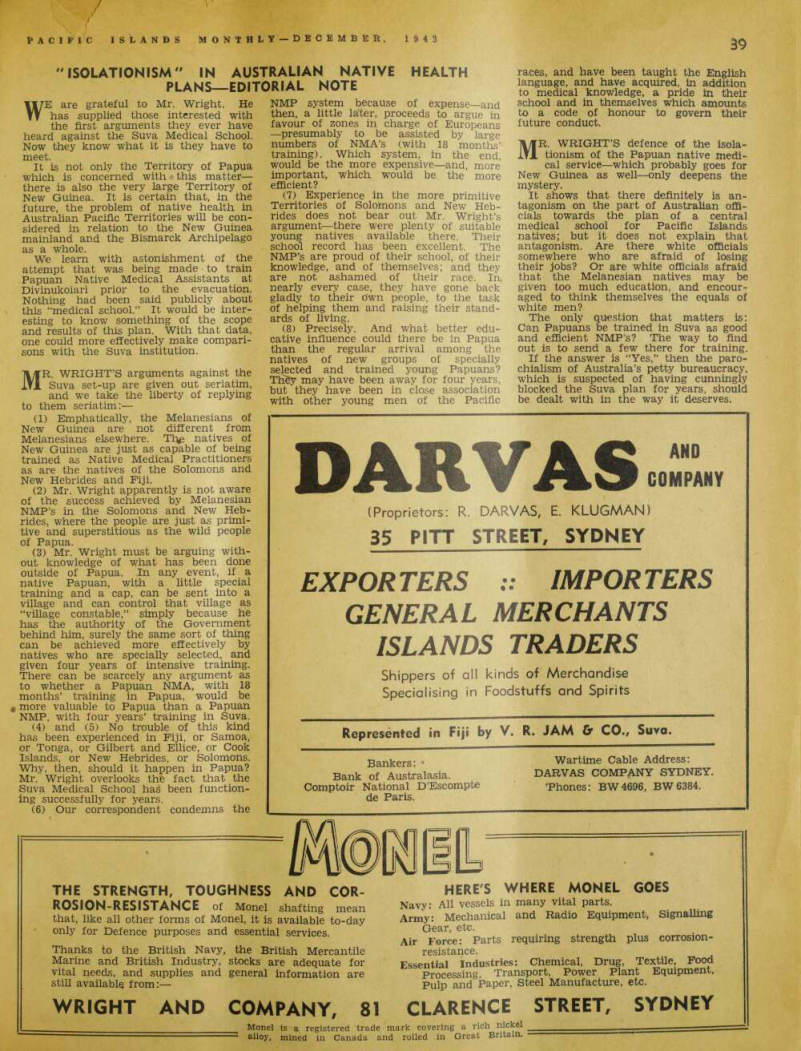
Medical Work In The New Papua
IT is easy to think, after reading Nov ember “PIM,” that nothing had been done in the matter of training Papuans to do medical work among their own people, other than sending a few of them to Sydney about 10 years ago. This is not so.
Dr. W. M. Strong pioneered the train ing of Papuans in medicine and he later inaugurated the much criticised scheme of sending natives to Sydney for train ing. The Sydney venture was in the nature of an experiment and as such it was very valuable. It was Dr. Strong’s intention to establish a medical school in Papua, but lack of funds and suitable officers prevented it.
Actually, the “Sydney boys” received far more, and longer, training in Papua than they did in Sydney, both from Dr.
Strong himself and in the Government native hospitals, and it was this train ing that enabled many of them to render very valuable service.
Many of the trainees were failures, and others left the Department to take up work elsewhere. But it was mainlv upon the experience gained by Dr. Strong that organised medical work amongst Papuans was being built. This work was inter rupted by the Japs.
Two years before the arrival of the Japs, a medical school was built in Papua, attached to a large inland native hospital. Many trainees, including those who had previously been in Sydney, completed courses of up to 12 months, and these trainees were distributed throughout Papua. However, the school was in its infancy when the Army took over, and it had not been given much publicity because (a) it was in control of an unqualified man and this was, like “Stomach Ills and Sulfa Drugs” (Nov ember “PIM”) —“unmedical and maybe unethical”; (b) lack of finance.
Both the Administrator, the Hon.
Leonard Murray, and the Chief Medical Officer, Dr. F. J. Williams, were vitally interested in the medical welfare of the Ppauans and the training of Papuans to work among their own people, but this was in the days prior to “Fuzzy Wuzzy” sentimentality and the Army’s discovery of New Guinea, and so these men had to
'THE writer of this article, Mr. E. * J. Wright, is at present com pleting a medical course at Sydney University. Previously he was an officer of the Papuan Medical Department, and in that capacity did many patrols in inland Papua, as well as the outer islands—some of these patrols were continuous treks of 1,500 miles. He is familiar with the medical work on every Government station, mission and plantation east of Port Moresby and, among other things, was tutor and inspector of Native Medical Assistants in Papua for two years.
He is therefore qualified to describe this side of the medical situation in Papua, as it existed before the war. He expresses the hope that, although his article is somewhat critical of the editorial in the November “PIM,” that criticism may be considered constructive.
work within the limits of economic possibility.
HERE are a few reasons why the Suva Medical School —the establishment of which is one of the outstanding achievements in the Pacific—cannot solve the medical problems of Papua even though it sounds an extremely easy way out of the difficulty and responsi
bility. These may be among the '‘rea sons unexplained and unknown” why the Governments of Papua “have held sternly aloof.” (1) New Guinea is the second largest island in the world. Things that apply
elsewhere, particularly in smaller islands, do not always apply here. The Mela
nesians of New Guinea are a different people, in a different stage of develop ment, to most of the other Pacific natives. (2) The greatest problem confronting medical services in Papua is not to pro vide medical services but to get the Papuans to accept Europeanised medical treatment even though it be free and brought to their dying bed (or mat). (3) To the ordinary Papuan, the Suva graduates would be just fellow “Papuan memero,” not singled out for any special respect or co-operation. The NMP would be without the prestige of a “white” Government Officer, and have neither his energy nor ambition and without the backing of an “alma” closer to home they might find that their high task was well beyond them and enough to break the heart of the graduate of any medical school, let alone a native of the happy race that gave to Papua the name of “the land of dohori.”
Under Papuan conditions, and with out an organisation built up in Papua, it is most doubtful if they would perform any more work than the present NMA’s who, with considerable skill, treat pneu monia, colds, venereal diseases, malaria, dysentery, hookworm, yaws, ulcers, and perform simple operations to the patients who chance their way. (4) If Native Medical Practitioners are sent to replace Native Medical Assist ants on Government Stations there is the very delicate question of relationship between the local Magistrate and other Europeans, and the Papuan doctors.
Such local conditions are liable to become acute and, combined with isola tion among unresponsive or enemy people it might prove tq be too much and it will take more than a Fijian Alma Mater to keep some of them on the job. (5) After an absence of years they would have to return to work with an Administration with which they are entirely unfamiliar. (6) Although it might be ridiculously cheap to maintain natives in Fiji it
would not be ridiculously cheap to maintain them when they return. They would have to be paid at least £lO a month plus improved housing, otherwise many of them would accept the tempt ing offers of private firms to act as doc tors, chief clerks, etc. Calculated on pre war standards—and the number of NMA’s was considered entirely inade quate to cover the vast territory—wages alone would run into at least £l,OOO a month: enough to give a headache to any island Treasurer. (7) It is not just a matter of hand picking the natives you want. Under the present system of education in Papua— by missions—the most promising students are likely to be guidqd along channels other than medical. Neither are the most promising Papuans always willing to spend years in training, so that they can spend the rest of their lives doing work among strange people. The call of village life—taking a wife, for instance— often crops up and will not stand post ponement for four or more years. (8) The medical training of large numbers of Papuan natives must go hand in hand with the education of the natives and is inseparable from it. As native education facilities improve, so will medical training. Education and medical training must advance together.
IN my opinion, the new Papua—as far as medical services are concerned should be built on the experience gained in the past by trial and error. A medical school should be set up in Papua in conjunction with an already estab lished hospital, and there suitable Papuans should receive intensive train ing, with the object of becoming, in 18 months or so, Native Medical Assistants.
Native girls should also be trained in nursing, with particular emphasis on midwifery and the care of infants.
Papua should be divided into medical zones, each to be in charge of a Euro pean .medical officer —although not neces sarily a qualified medical practitioner: a general medical course is not always good training for work in Papua. But such men should be properly trained for the work they will undertake.
The co-operation of all missionary bodies should be sought, and short courses in tropical medicine should be readily available to all who work among natives. Medical research should be undertaken on diseases prevalent in the Territory and steps taken, through lec tures, films, education, improved sanita tion and segregation to reduce the inci dence of preventable diseases. Health and hygiene should be taught in the schools and a special emergency staff be available to cope adequately with all epidemics as soon as they break out.
In most of these matters, the assist ance and guidance of the excellent and up-to-date School of Tropical Medicine in Sydney would be readily available. It appears to me that only along these, or similar, lines can the medical services of Papua be built; the main medical prob lems of Panua will have to be solved in Papua—and not in Suva or Sydney.
(Continued on Page 39)
WE are grateful to Mr. Wright. He has supplied those interested with the first arguments they ever have heard against the Suva Medical School.
Now they know what it is they have to meet.
It is not only the Territory of Papua which is concerned with < this matter — there is also the very large Territory of New Guinea. It is certain that, in the future, the problem of native health in Australian Pacific Territories will be con sidered in relation to the New Guinea mainland and the Bismarck Archipelago as a whole.
We learn with astonishment of the attempt that was being made to train Papuan Native Medical Assistants at Divinukoiari prior to the evacuation.
Nothing had been said publicly about this “medical school.” It would be inter esting to know something of the scope and results of this plan. With that data, one could more effectively make compari sons with the Suva institution.
MR. WRIGHT’S arguments against the Suva set-up are given out seriatim, and we take the liberty of replying to them seriatim:— (1) Emphatically, the Melanesians of New Guinea are not different from Melanesians elsewhere. The natives of New Guinea are just as capable of being trained as Native Medical Practitioners as are the natives of the Solomons and New Hebrides and Fiji. (2) Mr. Wright apparently is not aware of the success achieved by Melanesian NMP’s in the Solomons and New Heb rides, where the people are just as primi tive and superstitious as the wild people of Papua. (3) Mr. Wright must be arguing with out knowledge of what has been done outside of Papua. In any event, if a native Papuan, with a little special training and a cap, can be sent into a village and can control that village as “village constable,” simply because he has the authority of the Government behind him, surely the same sort of thing can be achieved more effectively by natives who are specially selected, and given four years of intensive training.
There can be scarcely any argument as to whether a Papuan NMA, with 18 months’ training in Papua, would be more valuable to Papua than a Papuan NMP, with four years’ training in Suva. (4) and (5) No trouble of this kind has been experienced in Fiji, or Samoa, or Tonga, or Gilbert and Ellice, or Cook Islands, or New Hebrides, or Solomons.
Why, then, should it happen in Papua?
Mr. Wright overlooks the fact that the Suva Medical School has been function ing successfully for years. (6) Our correspondent condemns the
NMP system because of expense— and then, a little later, proceeds to argue in favour of zones in charge of Europeans —presumably to be assisted by large numbers of NMA’s (with 18 months’ training). Which system, in the end, would be the more expensive—and, more imp9rtant, which would be the more efficient? (7) Experience in the more primitive Territories of Solomons and New Heb rides does not bear out Mr. Wright’s were plenty of suitable young natives available there. Their school record has been excellent. The NMP’s are proud of their school, of their knowledge, and of themselves; and they are not ashamed of their race. In nearly every case, they have gone back gladly to their own people, to the task of helping them and raising their stand ards of living. (8) Precisely. And what better edu cative influence could there be in Papua than the regular arrival among the natives of new groups of specially selected and trained young Papuans?
TliSy may have been away for four years, but the y have been in close association with other young men of the Pacific
races, and have been taught the English language, and have acquired, in addition t 0 medical knowledge, a pride in their school and in themselves which amounts a code of honour to govern their future conduct, 11/fR. WRIGHT’S defence of the isola -ITI tionism of the Papuan native medi cal service—which probably goes for New Guinea as well—only deepens the mystery.
It shows that there definitely is an tagonism on the part of Australian offi cials towards the plan of a central medical school for Pacific Islands natives; but it does not explain that antagonism. Are there white officials somewhere who are afraid of losing their jobs? Or are white officials afraid that the Melanesian natives may be given too much education, and encour aged to think themselves the equals of white men?
The only question that matters is: Can Papuans be trained in Suva as good and efficient NMP’s? The way to find out is to send a few there for training.
If the answer is “Yes,” then the paro chialism of Australia’s petty bureaucracy, which is suspected of having cunningly blocked the Suva plan for years, should be dealt with in the way it deserves.
Advertisements & other items, pp. 39-41 (2 items)
Eoods
For Sale
Western Samoa Mail
APIA, SAMOA
Printers, Publishers, Rulers,
and Bookbinders
THIS old-established business, being the only printing office in the territory, enjoys a steady flow of work all the year round, and has ample equipment for turning out an eightpage tabloid weekly newspaper, which, on account of war conditions, voluntarily ceased publication last year.
The building, which has a self-contained flat, well furnished, on top thereof, with 2 bedrooms, dining-room, sitting-room, verandah, kitchen, etc., and large refrigerator, stands on freehold land, on which is also built a garage at one of the entrances.
For health and family reasons, the proprietors, after 19 years’ residence in the territory, wish to dispose of this well-equipped business as a going concern.
Further particulars may be had on application being made to the Managing Director —
J. W. LISTON,
Apia, Western Samoa.
PACIFIC ISLANDS SOUVENIRS
HULA SKIRTS . . . STRUNG SHELL BEADS Only 18/- for one big parcel containing Strung Shell Beads, suitable necklets, etc., and one Beautiful Hula Skirt, in colours, or plain white with coloured trimmings.
AN IDEAL SOUVENIR.
Cash with order , . . Send for your parcel to-day.
Write . Enterprise, Box 51, Avarua, Rarotonga, Cook Islands.
I m
VERS
PURE
EOODS
GOLD MEDAL JAMS
CANNED ENGLISH FRUITS
CANNED ENGLISH
VEGETABLES
CUSTARD POWDER
OLD ENGLISH MARMALADE
JELLY CRYSTALS, ETC.
Obtainable from all Leading Grocery Store*. * --- Write to Department A., Chirers and Sons, Ltd., Alston, Cambridge, England, for attractive Recipe Book.
KANGAROO BRAND
Ropes,
Cordage,
and Twines for every purpose Backed by 86 years of service Manufactured by:
M. DONAGHY AND SONS,
Pty. Ltd., Geelong and Sydney.
Fiji Representatives:
PEARCE AND CO.
LIMITED
P.O. BOX 237, SUVA
NELSON & ROBERTSON
PTY., LTD.
Established 1895.
Islands Merchants
All classes of merchandise purchased at wholesale prices and original invoices supplied to Islands clients.
Cocoa Beans, Rubber and other Islands' produce sold on commission.
Nelson & Robertson
Pty. Ltd. 12 Spring: Street, Sydney, Australia.
In normal times we carry extensive stocks of
FLAX CANVAS
COTTON DUCKS
"BIRKMYRE'S "
WATERPROOF CANVAS
also
COTTON FISHING NETS
LINES & TWINES
GOUROCK ROPES
& CANVAS LTD.
257 CLARENCE ST., SYDNEY
AUNT
MARYS
BAKING POWDER
“ITS QUALITY NEVER VARIES 99
In war-time, as In peace-time. Aunt Mary’s Baking Powder gives the same “even rising’’ results. Limited supplies are being released, as opportunity affords, so use your purchase sparingly while precious ingredients in Aunt Mary’s Baking Powder are difficult to obtain for normal requirements. • AUNT MARY’S SCONES are always a luxury treat when good friends meet to accept your hospitality.
5 E SS s
LOTIO
For Inflamed Eyes and Eyelids
SOLD EVERYWHERE
H. A. Rm« 4 C». Pty. Ltd., King St, Sydney
D AR V AS -
(Proprietors: R. DARVAS, E. KLUGMAN)
35 PITT STREET, SYDNEY
EXPORTERS ;; IMPORTERS
GENERAL MERCHANTS
ISLANDS TRADERS
Shippers of all kinds of Merchandise Specialising in Foodstuffs and Spirits Represented in Fiji by V. R. JAM Cr CO., Suva.
Bankers 1 * Wartime Cable Address: Bank of Australasia. DARVAS COMPANY SYDNEY.
Comptoir National D’Escompte 'Phones: 8W4696, 8W6384. de Paris.
THE STRENGTH, TOUGHNESS AND COR
ROSION-RESISTANCE of Monel shafting mean that, like all other forms of Monel, it is available to-day only for Defence purposes and essential services.
Thanks to the British Navy, the British Mercantile Marine and British Industry, stocks are adequate for vital needs, and supplies and general information are still availably from: — A E| C Si
HERE'S WHERE MONEL GOES
Navy: All vessels in many vital parts.
Army: Mechanical and Radio Equipment, Signalling Gear, etc.
Air Force: Parts requiring strength plus corrosionresistance.
Essential Industries: Chemical, Drug, Textile. Food Processing, Transport, Power Plant Equipment, Pulp and Paper, Steel Manufacture, etc.
WRIGHT AND COMPANY, 81 CLARENCE STREET, SYDNEY Monel is a registered trade mark covering a rich nickel allnv ■ ■ ’ ' TJrit.om.
39
PACIFIC ISLANDS MONTHLY DECEMBER, 1943
"ISOLATIONISM" IN AUSTRALIAN NATIVE HEALTH
PI AKK EDITORIAL NOTE
rLAINi—tUIIUKiAL i>vic
Broadcast
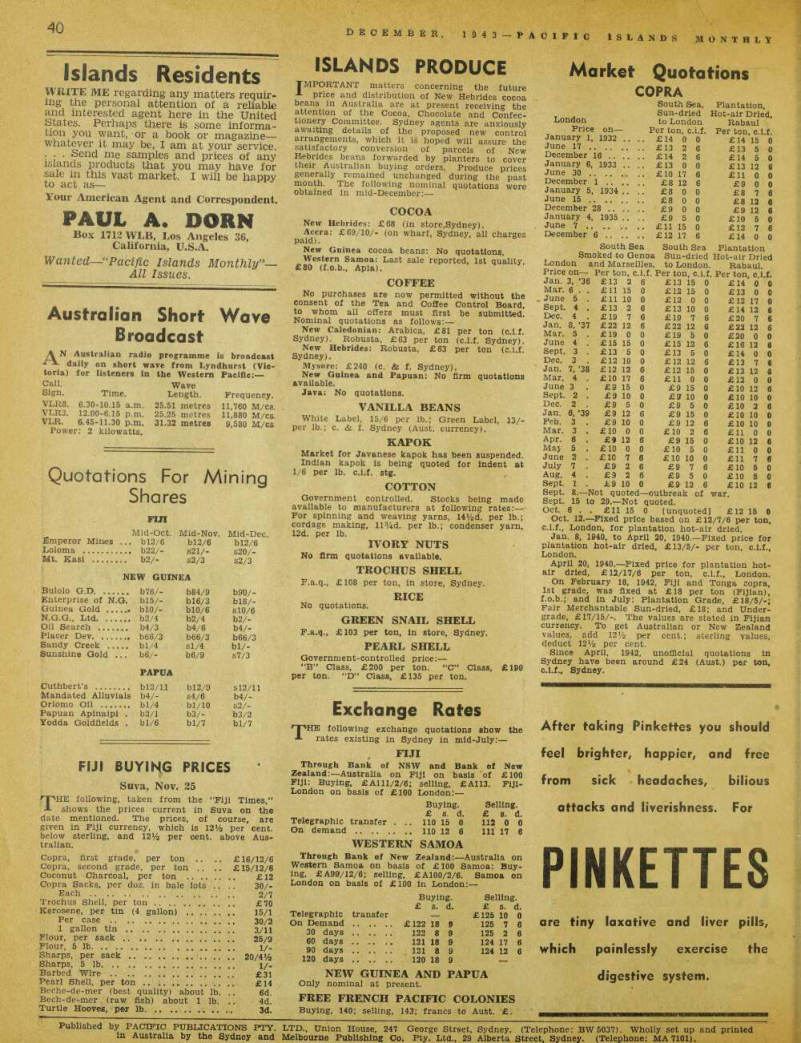
Australian Short Wave Broadcast
A N Australian radio programme is broadcast daily on short wave from Lyndhurst (Vic toria) for listeners in the Western Pacific:—
Call.
Wave Sign.
Time.
Length.
Frequency.
Vlr8.
6.30-10.15 a.m. 25.51 metres 11,760 M/cs.
Vlr3.
12.00-6.15 p.m. 25.25 metres 11,880 M/cs.
Vlr.
6.45-11.30 p.m. 31.32 metres 9,580 Mycs.
Power ; 2 kilowatts.
Quotations For Mining
Shares
Emperor Mines ,..
Fiji
Mid-Oct.
Mid-Nov.
Mid-Dec, bl2/6 bl2/6 bl2/6 Loloma b22/s21/s20/- Mt. Kasi b2/s2/3 S2/3
New Guinea
Bulolo G.D b76/b84/9 b9t)/- Enterprise of N.G. bl5/bl6/3 bl8/- Guinea Gold blO/blO/6 slO/6 N.G.G., Ltd b2/4 b2/4 b2/- Oil Search b4/3 b4/6 b4/- Placer Dev b66/3 b66/3 b66/3 Sandy Creek bl/4 sl/4 bl/- Sunshine Gold .,. b6/b6/9 s7/3 Cuthbert’s
Papua
bl2/ll bl2/9 S12/11 Mandated Alluvlals b4/s4/6 b4/- Oriomo Oil bl/4 bl/10 s2/- Papuan Aplnaipi , b2/l b3/b3/2 Yodda Goldfields . bl/6 bl/7 bl/7
Fiji Buying Prices
Suva, Nov. 25 THE following, taken from the “Fiji Times,’' shows the prices current in Suva on the date mentioned. The prices, of course, are given in Fiji currency, which is 12 x / 2 per cent, below sterling, and 12V 2 per cent, above Aus tralian.
Copra, first grade, per ton .. .. £ 16/12/6 Copra, second grade, per ton .. .. £l5/12/6 Coconut Charcoal, per ton £l2 Copra Sacks, per doz. in bale lots .. .. 30/- Each 2/7 Trochus Shell, per ton £7O Kerosene, per tin (4 gallon) 15/1 Per case 30/2 1 gallon tin 3yil Flour, per sack 25/9 Flour, 5 lb 1/.
Sharps, per sack 20/4Vfe Sharps, 5 lb l/_ Barbed Wire £3l Pearl Shell, per ton £l4 Beche-de-mer (best quality) about lb. .. 6d.
Bech-de-mer (raw fish) about 1 lb. 4d.
Turtle Hooves, per lb 3d.
Islands Produce
"IMPORTANT matters concerning the future price and distribution of New Hebrides cocoa beans in Australia are at present receiving the attention of the Cocoa, Chocolate and Confec tionery Committee. Sydney agents are anxiously awaiting details of the proposed new control arrangements, which it is hoped will assure the satisfactory conversion of parcels of New Hebrides beans forwarded by planters to cover their Australian buying orders. Produce prices generally remained unchanged during the past month. The following nominal quotations were obtained in mid-December:—
Cocoa
New Hebrides: £6B (in store,Sydney).
Accra: £69/10/- (on wharf, Sydney, all charges paid).
New Guinea cocoa beans: No quotations.
Western Samoa: Last sale reported, Ist quality, £BO (f.0.b., Apia).
Coffee
No purchases are now permitted without the consent of the Tea and Coffee Control Board, to whom all offers must first be submitted.
Nominal quotations as follows: New Caledonian: Arabica, £Bl per ton (c.i.f.
Sydney), Robusta, £63 per ton (c.i.f. Sydney).
New Hebrides: Robusta, £63 per ton (c.i.f.
Sydney).
Mysore: £240 (c. & f. Sydney).
New Guinea and Papuan: No firm quotations available.
Java: No quotations.
Vanilla Beans
White Label, 15/6 per lb.; Green Label, 13/per lb.; c. & f. Sydney (Aust. currency).
Kapok
Market for Javanese kapok has been suspended.
Indian kapok is being quoted for indent at 1/6 per lb. c.i.f. stg.
Cotton
Government controlled. Stocks being made available to manufacturers at following rates:— For spinning and weaving yarns, 14y 2 d. per lb.; cordage making, ll%d. per lb.; condenser yam, 12d. per lb.
Ivory Nuts
No firm quotations available.
Trochus Shell
F.a.q., £lOB per ton, in store, Sydney.
Rice
No quotations.
Green Snail Shell
F.a.q., £lO3 per ton, in store, Sydney.
Pearl Shell
Government-controlled price:— “B” Class, £2OO per ton. “C” Class, £l9O per ton. “D” Class, £135 per ton.
Exchange Rates
npHE following exchange quotations show the rates existing in Sydney in mid-July:—
Fiji
Through Bank of NSW and Bank of New Zealand:—Australia on Fiji on basis of £lOO FIJI: Buying. £ All 1/2/6; selling, £AII3. Flji- London on basis of £lOO London:—
Western Samoa
Through Bank of New Zealand:—Australia on Western Samoa on basis of £lOO Samoa: Buy ing, £A99/12/6; selling, £AIOO/2/6. Samoa on London on basis of £lOO in London:—
New Guinea And Papua
Only nominal at present.
Free French Pacific Colonies
Buying, 140; selling, 143; francs to Aust. £.
Buying.
Selling. £ s. d. £ s. d.
Telegraphic transfer . .. 110 15 0 112 0 0 On demand 111 17 6
Buying.
Selling. £ s. d. £ s. d.
Telegraphic transfer £125 10 0 On Demand £122 18 9 125 7 6 30 days 122 8 9 125 2 6 60 days 121 18 9 124 17 6 90 days 121 8 9 124 12 6 120 days 120 18 9 —
Market Quotations
Oct. 6 . . £ll 15 0 [unquoted] £l2 15 0 Oct. 12.—Fixed price based on £l2/7/6 per ton, c.i.f., London, for plantation hot-air dried.
Jan. 8, 1940, to April 20, 1940.—Fixed price for plantation hot-air dried, £l3/5/- per ton, c.i.f., London.
April 20, 1940.—Fixed price for plantation hot air dried, £l2/17/6 per ton, c.i.f., London.
On February 18, 1942, Fiji and Tonga copra, Ist grade, was fixed at £lB per ton (Fijian), f.0.b.; and in July: Plantation Grade, £lB/5/-; Fair Merchantable Sun-dried, £18; and Under grade, £l7/15/-. The values are stated in Fijian currency. To get Australian or New Zealand values, add 12 y 2 per cent.; sterling values, deduct 12 Va per cent.
Since April, 1942, unofficial quotations in Sydney have been around £24 (Aust.) per ton, c.i.f.. Sydney.
Copra
South Sea, Plantation.
Sun-dried ; Hot-air Dried.
London to London Rabaul Price on— Per ton. c.i.f.
Per ton. c.i.f.
January 1 1932 £14 i 0 0 £14 15 0 June 17 . £13 ; 2 6 £13 5 0 December 16 .. £14 : 2 6 £14 5 0 January 6 1933 £13 i 0 0 £13 12 6 June 30 . £10 17 6 £11 0 0 December 1 .. £8 12 6 £9 0 0 January 5 1934 £8 l 0 0 £8 7 6 June 15 . £8 l 0 0 £8 12 6 December 28 .. £9 l 0 0 £9 12 6 January 4 1935 £9 1 5 0 £10 5 0 June 7 . £11 15 0 £12 7 6 December 6 .. £ 12 17 6 £14 0 0 South Sea South Sea Plantation Smoked to Genoa Sun-dried Hot-air Dried London and Marseilles, to London.
Rabaul.
Price on— Per ton, c.i.f. Per ton. c.i.f. Per ton. c.l.f.
Jan. 3, ’36 £13 2 6 £13 15 0 £14 0 0 Mar. 6 . . £11 15 0 £12 15 0 £13 0 0 June 5 . £11 10 0 £12 0 0 £12 17 0 Sept. 4 . £13 2 6 £13 10 0 £14 12 6 Dec, 4 . £19 7 6 £19 7 6 £20 7 6 Jan. 8, ’37 £22 12 6 £22 12 6 £22 12 6 Mar. 5 . £19 0 0 £19 5 0 £20 0 0 June 4 . £15 15 0 £15 12 6 £16 12 6 Sept. 3 . £13 5 0 £13 5 0 £14 0 0 Dec. 3 . £12 10 0 £12 12 6 £13 7 6 Jan. 7, ’38 £12 12 6 £12 15 0 £13 12 6 Mar. 4 . £10 17 6 £11 0 0 £12 0 0 June 3 . £9 15 0 £9 15 0 £10 12 6 Sept, 2 . £9 10 0 £9T 10 0 £10 10 0 Dec. 2 . £9 5 0 £9 5 0 £10 2 6 Jan. 6, '39 £9 12 6 £9 15 0 £10 10 0 Feb. 3 . £9 10 0 £9 12 6 £10 10 0 Mar. 3 . £10 0 0 £10 2 6 £11 0 0 Apr. 6 . £9 12 6 £9 15 0 £10 12 6 May 5 . £10 0 0 £10 5 0 £11 0 0 June 2 . £10 7 6 £10 10 0 £11 7 6 July 7 . £9 2 6 £9 7 6 £10 5 0 Aug. 4 . £9 2 6 £9 5 0 £10 5 0 Sept. 1 . £9 10 0 £9 12 6 £10 12 6 Sept. 8.—Not quoted— ■outbreak of war.
Sept. 15 to 29.— -Not quoted.
Advertisements & other items, p. 42 (3 items)
40
DECEMBER. 1143-tJCIHC ISLANDS MONTHLY
Published by PACIFIC PUBLICATIONS PTY. LTD., Union House, 247 George Street, Sydney. (Telephone; BW 5037). Wholly set up and printed in Australia by the Sydney and Melbourne Publishing Co. Pty. Ltd., 29 Alberta Street. Sydney. (Telephone: MA7101).
Islands Residents
WRITE ME regarding any matters requiring the personal attention of a reliable and interested agent here in the United States. Perhaps there is some information you want, or a book or magazine— whatever it may be, I am at your service. . . . Send me samples and prices of any islands products that you may have for sale in this vast market. I will be happy to act as— Your American Agent and Correspondent.
PAUL A. DORN
Box 1712 WLB, Los Angeles 36, California, U.S.A.
Wanted—“ Pacific Islands Monthly”—
All Issues.
Pinkettes
After taking Pinkettes you should feel brighter, happier, and free from sick headaches, bilious attacks and liverishness. For
are tiny laxative and liver pills, which painlessly exercise the digestive system.
"This War, No
Nation Wins"
A YOUNG American officer, talking in Glasgow, said jokingly, in the
hearing of Noel Coward, “Well, we're
here to win this war for you”
Coward was so concerned about it that he wrote a poem, “Lines to an American Officerand it was pub lished in full by the “New York Times,” in the interests of Anglo- American friendship. Here is the latter part of the poem: NOW listen —I’m a Britisher.
I know my country’s faults. Its rather slow, Superior assumptions; its aloof Conviction of its destiny. The proof Of its true quality also I know, This lies much deeper. When we stood alone, Besieged for one long, agonising year, The only bulwark in our hemisphere Defying tyranny. In this was shown The temper of our people. Don’t forget That lonely year. It isn’t lease or lend, Or armaments, or speeches that defend The principles of living. There’s no debt Between your land and mine except that year.
All our past errors, all Ou. emissive sins Must be wiped out. This war no nation wins.
Remember that when you are over here.
Also remember that the future peace For which we’re fighting cannot be maintained By wasting time contesting who has gained Which victory. When all the battles cease, Then, if we’ve learned by mutual endur ance, By dangers shared, by fighting side by side.
To understand each other, then we’ll forge a pride, Not in ourselves, but in our joint assur ance To the whole world, when all the earnage ends.
That men can still be free and still be friends.
Caledonia
Javanese Amok in N.
From Our Own Correspondent
New Caledonia, Nov. 29.
A SHOCKING tragedy has been re ported from a lonely portion of the east coast road, 15 kilometres from the tiny port of Houailou. A Javanese labourer ran amok, and after attacking and wounding his employer, went farther afield the following day, entering a house where a Frenchwoman, Madame Andre Clavel, was reading with her two young children, Fernand, aged four, and Gisele, aged seven. He attacked the family with his long bush knife, terribly mutilating mother and daughter, while the little boy ran out to give the alarm to Javanese in the vicinity. The maniac then set fire to the house.
When doctors arrived, they found the two victims had managed to crawl out
side. A New Zealand Army ambulance took them to a NZ military hospital on the other side of the Central Chain, where unavailing efforts were made to save the life of the little girl. The mother’s condition is serious.
East coast gendarmes found the Java nese and brought him to Noumea hospi tal, suffering from gun-shot wounds in the chest.
Mr. C. E. de F. Pennefather, of Suva, has been appointed Censor of Postal Matter and Telegrams for Fiji, The Bishop of New Guinea, the Rt.
Rev. P. N. W. Strong, is at present in Tasmania. He has addressed meetings in Hobart and Launceston.
The Rev. W. F. Paton, well-known Presbyterian missionary in the New Heb rides, who returned to Tasmania recently for health reasons, has been appointed to the Tasmanian parish of Evandale-Long ford.
Advertisements & other items, pp. 43-44 (2 items)
W. Kopsen & Co.
SHIPCHANDLERY
Yacht Gear, and Marine Engine Fittings. All classes of equipment for Boatbuilders working on defence. Gunmetal Dumps and Washers, Copper Nails and Roves, Sheathing Metal, Caulking Cotton, Anti-fouling Paint, Vents, Ports, Bilge Pumps, Common and Navy pattern galvanised Anchors, all sizes.
Motor Boat Horns—air and electric Navigation Lamps—oil and electrc.
SIMPLEX MARINE ENGINES, 3,5, and 10-12 H.P., 2 and 4 cycle, with built-in reverse gear. The best motors for work, patrol, or fishing boats. Heavy duty efficiency with economy and reliability. Ask for Simplex details.
SAFEGUARD YOUR WOODWORK WITH
DEKOL
IT w
PREVENTS
DECAY
Guards Wood from the ravages of White Ants, Borers, Dry Rot, Mildew, etc. Penetrates deeply and permanently protects fabrics from Rot and attack from Fungi. Is simple to apply, and when dry can be painted and varnished. Prevents attack by Marine Borers on wood immersed in sea-water. Is insoluble in water. Has no unpleasant odour. Is not harmful to animals or vegetation, when dry.
Price: 12/- gallon (4-gal. tins); 14/6 gallon (1-gal. tins)
TRADE ENQUIRIES INVITED
W. KOPSEN & CO.
PTY.
LTD.
380 KENT STREET, SYDNEY
Jables; “Kopsen,” Sydney. N.S.W. 'Phone: MA6336 (6 lines).
I wssam 11 1 iii •a- I '■■s ? ■: V’
I ■: ■?
H 1 N Ml "; mss *HB ■ ■ ■:v mi mm m % . ■ m
Travel by CARPENTER AIRLINES
Full particulars from Macdonald, Hamilton & Co., or Howard Smith Ltd., Sydney.
W. R. CARPENTER & CO. LTD.
MERCHANTS, SHIPOWNERS AND AIRCRAFT OPERATORS
Agents for Australian, European and American Manufacturers, and Distributors of Every Description of Merchandise.
Buyers and Shippers of Copra, Trocas, and all Classes of Islands Produce.
Ford Motor Company of Canada.
T. G. & C. Bolinders (Engines).
AGENTS FOR :
Caterpillar Tractors.
Electrolux Refrigerators, etc., etc.
Dodge Brothers Inc.
Westinghouse Electrical Co.
Branches throughout the Pacific Islands
In London: W. R. Carpenter & Co. (London) Ltd., Coronation House, 4 Lloyds Avenue, London, EC.
Head Office: 16 O’CONNELL STREET, SYDNEY
Pink Pills
Restlessness and sleeplessness, when due to run-down nerves, frequently respond to treatment with Dr. Williams' Pink Pills.
Dr. Williams*
help to enrich the blood, which has a beneficial and restorative effect upon the nervous system.