Pacific
Islands
Monthly
Vol. Xiv. No. 4.
November 17, 1948
Established 1930
IRegistered at the G.P.0., Sydney, for transmission by post as a newspaper ]
8
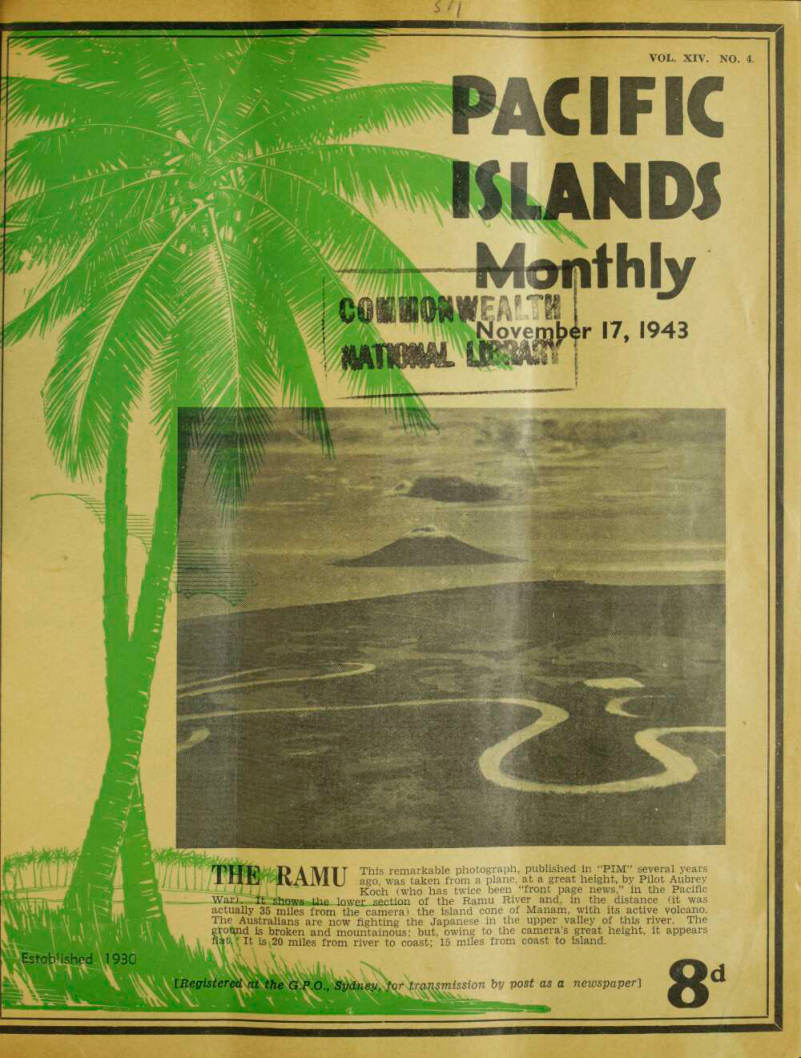
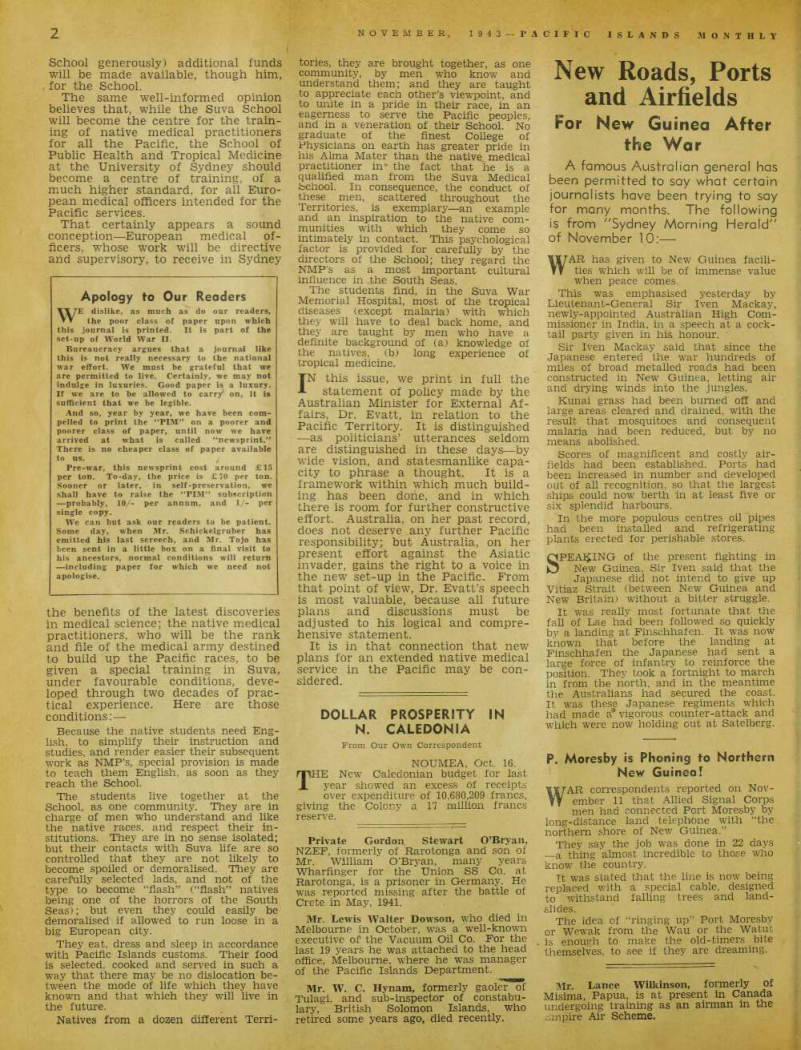
THE RAMU This remarkable photograph, published in “PIM” several years ago, was taken from a plane, at a great height, by Pilot Aubrey Koch (who has twice been “front page news,” in the Pacific War). It show the lower, section of the Ramu River and, in the distance (it was actually 35 miles from the camera) the island cone of Manam, with its active volcano.
The Australians are now fighting the Japanese in the upper valley of this river. The ground is broken and mountainous: but, owing to the camera’s great height, it appears flat. It is 20 miles from river to coast; 15 miles from coast to island.
Roll Of Honour
(We try to assemble here the names of men of the United Nations, residents or former residents of the Pacific Territories, whose names appear'in casualty lists or who receive decorations. We should be grateful if relations and friends would send us details of such men.)
Killed
Sgt. Bert AITKEN, NZEF, formerly of Fiji.
Killed in action in Libya.
Eugene AUBRY (formerly of Tahiti), of the Air Force of Fighting France. Killed in an air accident in Great Britain.
Squadron-Leader Stan BALDIE, RAF, formerly of Wau, TNG. Killed in action in India.
Pilot-Officer Len BAYLISS, flying instructor in the RAAF, formerly of Rabaul, New Guinea.
Killed in Sydney, 18/11/1940, when he fell from a trainer aircraft in flight.
Lieut.-Colonel C. N. F. BENGOUGH, of BSI, Defence Forces, formerly Acting-Resident Com missioner of BSI. Killed when aircraft shot down into sea, August, 1943.
R. C. BENTLEY, NZEF, formerly of Fiji.
Killed in action, Middle East, June 27. 1942.
A/Bdr. Neville W. BERTWISTLE, ALP artillery (tank unit), formerly a clerk on the staff of W. R. Carpenter and Co. Ltd., of Rabaul, New Guinea. Killed in action, April, 1941.
P/O J. B. BOMFORD, RNZAP, formerly of CSR Co.’s staff, Fiji. Killed on active service in England.
Pte. W. R. M. BRADNAM, of the NZ Forces, formerly of Fiji. Reported killed in action in the Middle East, 25/11/1941.
Warrant-Officer R. F. BRECHIN, New Guinea Force. Killed in air accident, June 17, 1942.
Formerly of NG Department of Agriculture.
Anton BRINON, of Fighting French Pacific Battalion, formerly of La Poa, New Caledonia.
Killed in action in Libya, November, 1942.
Lieut.-Colonel Felix BROCHE, of the New Caledonian-New Hebridean contingent of the Fighting French Pacific Battalion. Killed in action in the battle of Bir Hacheim (Libya).
Pilot-Officer E. H. CANARD, of RAF, formerly of Fiji Civil Service. Killed in flying accident in South Africa in the course of his duty as flying instructor.
Pte. David C. GARLAND, AIF, formerly chief assayer at the Emperor gold mines, Fiji. Killed in action in New Guinea.
Pierre CHARPENTIER, of the Fighting French Pacific Battalion. Killed in action in the battle of Bir Hacheim.
Raymond CHAUTARD (formerly of New Cale donia), of the Fighting French Pacific Battalion.
Killed in action in Libya.
Flight-Lieutenant G. J. I. CLARKE, of the RAAF, formerly Assistant Flight Superintendent of Carpenter Airlines, New Guinea. Killed in action during operations off Dakar (French West Afrioa), while attached to HMAS “Aus tralia”, September, 1940.
Georges CLEMENS, of the Free French Pacific contingent from New Caledonia. Reported killed in action in the Middle East, March, 1942.
Flying-Officer Jack R. COATH, of the RNZAP, formerly on the staff of the Bank of New Zealand, in Suva, Fiji. Killed October, 1941, when a training aircraft crashed in NZ.
Sqd.-Leader Lionel COHEN, RAF, formerly of Upper Watut, TNG. Killed when returning from a bomber raid on Berlin in 1942.
Sgt-Pilot Colin CRABBE, RAF, formerly of Suva, Fiji. Killed by enemy action in England in May, 1943.
Pte. Felix CRAIG, ALP, formerly of accounts department, Australasian Petroleum Co., Port Moresby, Papua. Killed in action, June, 1941.
L. J. DAWES, of the NZ Forces, formerly Dis trict Officer of Savaii, Western Samoa. Reported killed in action, February, 1942.
Pilot-Officer V. L. DEARMAN, of the RAAF (observer), formerly overseer and clerk at the Colonial Sugar Refining Co., Ltd., Raravai, Fiji. Reported killed in action in the Middle East, October, 1941.
Capt. Jean GILBERT, of the Naval Forces of Fighting France, and formerly of Tahiti. Killed in action.
Captain Kenneth GARDEN, of the RAP Ferry Command, formerly of Guinea Airways Ltd., in New Guinea. Killed September, 1941, when a bomber he “ferried” from USA crashed on west coast of Britain.
Flying-Officer Moresby GOFTON, of the RAP, *on of Mrs. F. S. Stewart, of Wau, New Guinea.
Reported missing, 17/5/1940 —presumed killed in air operations.
Rifleman J. A. GOODWIN, AIP infantry, for merly of Bulwa, TNG. Reported “accidentally killed”. April. 1942.
Ernest GOURNAC (formerly of Tahiti), of the Air Force of Fighting France. Killed in an air
accident in Britain.
Pte. Wallace GRAHAM, of the NZ Forces (infantry), formerly on the staff of Morris Hedstrom Ltd., Fiji. Killed in action in the Middle East, November, 1941.
Lieut. J. A. GRANT, AIF, formerly of Man dated Territory. Killed in action.
Lieut. L. B. GROVE, AIF, formerly of Madang, TNG. Killed in action.
Squadron-Leader C. R. GURNEY, RAAF, a former chief pilot of Guinea Airways, Ltd.
Killed in action in the New Guinea area, May, 1942.
P/O G. REES-JONES, RAAF, formerly of Labasa, Fiji. Killed in air operations over Ger many, August 16, 1942.
Pte. B. HAMILTON, AIP, formerly of Auck land, NZ, and New Guinea. Killed in action.
Gerald T. J. HARPER, RAF, son of Major and Mrs. P. Harper, of Ra, Fiji. Killed in action while navigating a Whitley bomber dur ing a raid on the Continent.
J. HEAD, RAAF, formerly of Fiji. Killed in flying accident in Australia, 1941.
Squadron-Leader Godfrey HEMSWORTH, of the RAAF, formerly a well-known commercial pilot in Morobe, TNG. Reported missing after an operational flight against the Japanese in the New Guinea area—now presumed killed in action.
Captain L. T. HURRELL, infantry, Rabaul.
Killed in action.
Sqd.-Leader James R. HYDE, of the RAF, formerly a Patrol Office in Namatanai and Sepik Districts, TNG. Awarded the Distinguished Fly ing Cross, 1941. Killed in action while leading an attack on an enemy convoy off the coast of Greece, July 24, 1942.
Pte. Jack JOHNSON, formerly of Morris Hedstrom’s staff, Fiji. Killed in action on November 4, while serving with the AIF in New Guinea.
Flying-Officer Alan JOHNSTONE, of the RAF, who was born in Suva, Fiji, In 1915. Killed during bombing raid on Kristiansand, Norway, April, 1940.
LAC Douglas KIRBY, RAP. who left Suva, Fiji, with the first contingent of Air Force trainees. Reported killed in a flying accident in South Africa, March, 1942.
Marcel KOLLEN, of the Pacific Battalion of Fighting Prance. Killed in action in the battle of Bir Hacheim.
C. D. LAMONT, RAF, formerly a master at Boys’ Grammar School, Suva, Fiji. Missing, be lieved killed on air operations over Germany.
Emile LESSON (formerly of New Caledonia), of the Fighting French Pacific Battalion. Killed in action in Libya.
Cpl. Gaston LESSON, of the Fighting French Pacific Battalion. Killed in battle of Bir Hacheim (Libya).
Capt. (now Lt.-Colonel) Edward Tiwi LOVE, NZ Maori Battalion, husband of Mrs. Takau Rio Love, Ariki-nui of Rarotonga, Cook Islands. Re ported missing during campaign in Greece, May, 1941; later, June, 1941, reported “wounded and safe.” Officially announced, July 17, 1942, killed in action in Libya.
Flying-Officer John C. LOWE, RAAF, formerly an overseer with the CSR Co. in Fiji. Reported, 11/4/1942, “took part in air defence of Rabaul, TNG, —missing, believed killed”.
Pte. L. P. MCCARTHY. AIF infantry, form erly supercargo on W. R. Carpenter and Co.’s inter-island vessels “Desikoko” and “Mako”, In New Guinea. Reported “killed in action” in Syria, 30/10/1941.
Sgt. Kenneth MACGREGOR, AIF, formerly practising as a barrister and solicitor in Wau, TNG. Reported missing, believed killed, In Papua.
Sgt.-Pilot Ronald MACKAY, RAAF, formerly of Thursday Island. Killed in an aircraft accident in England.
Lance-Corporal A. D. MacPHEE, son of Mr.
R D. MacPhee, Levuka, Fiji. He was 35, was a member of the AIP, and was killed in Greece, May, 1941.
Francois MASSON, of the Fighting French Pacific Battalion. Killed in action in the battle of Bir Hacheim.
Capt. John Malcolm METHVEN. Reported killed in action in Egypt on July 22, 1942, while serv ing with the AIF. He was born in Ocean Island, and is the youngest son of Mr. and Mrs.
Stuartson C. Methven, of Belgrave, Victoria.
Flight-Sgt. Stuartson Charles METHVEN, born in Suva, Fiji, brother of the late Capt. J. M.
Methven. Killed in air operations over Ger many on January 23, 1943.
Spr. A. L. MORANDINI, AIP Engineers, for merly of Konedobu, Papua. Reported killed in action, April, 1942.
F. R. J. NICHOLLS, Royal Artillery, formerly of Fiji. Killed in action, Burma, May, 1942.
W/O G. A. OBST, formerly a member of the Lutheran Mission, TNG. Joined Australian military forces in February, 1942. Killed in action In New Guinea on December 21, 1942.
J. L. C. OSBORN, NZEF, formerly of Fiji.
Killed in action, Middle East, June, 1942.
Pilot-Officer Ivan PALMER, RAF, formerly of Fiji. Killed in air operations over Malta.
Lieut. R. G. M. PEMBERTON, AIF, formerly of Rabaul, New Guinea. Killed in action.
O. PILLING, RAP, formerly of Fiji. Missing; believed killed.
Flight-Lieut. H. G. PILLING, DFC, of the RAF, formerly of Suva, Fiji. Killed on air operation, May 19, 1942.
Pte. Edward Harold PRICE, 2nd NZEF (27th Machine Gun Battalion), youngest son of Mr. and Mrs. J. Price, Savu Savu West, Fiji. Killed in action during the Libyan campaign, Middle East, 27/11/1941.
Pte. Cecil PURCELL, NZEF, formerly of Aleipata. Samoa. First Samoan Euronesian to give his life in World War n. Killed in action in Middle East.
Captain W. H. ROBERTS. NZEF, who was Accountant in the Samoa Treasury Dept., dur ing 1934-35. Killed in action in Libya, Decem ber, 1941.
Major A. B. ROSS, NZEF, who, between 1923- 29 was successively, Assistant Secretary for Native Affairs, Assistant Secretary to the Administration, and ADC to the Administrator of Samoa. Killed in action in Libya.
Cpl. Alex. C. SCOTT, AIF, formerly manager at Kieta, TNG, for Burns, Philp and Co. Ltd.
Killed in action in the Middle East, 19/6/1941."
J. SIMPSON, RAAF, formerly of Fiji. Killed in action over Malta, July, 1941.
Lieut. G. STEVENSON, AIF, formerly a Patrol Officer in New Guinea. Killed in action in New Guinea, on June 26, 1943.
Lieutenant A. G. W. THOMAS, RANR, for merly master of Burns Philp & Company’s SS “Muliama.” Killed in action.
Pte. Popoare TANGIITI, of the NZ Forcei (Maori Battalion), formerly of Mangala, Cook Islands. Reported ‘‘missing after Battle of Greece—presumed dead”, July, 1941.
Derek TOVEY, NZEF, formerly of Suva, Fiji.
Killed in action in Tunisia in April, 1943.
Sgt. Edward WILSON, of Suva, serving in the Fiji Defence Force. Accidentally drowned in the Lami River. Fiji. April, 1942.
Capt. A. F. J. WHITE, AIF, formerly a Dis trict Officer in Fiji, and BSI. Killed in action in New Guinea.
Died From Wounds
Pte. Ernest HENRY, AIP, formerly of the Rabaul (NG) staff of Burns. Philp and Co.
Ltd. Died from wounds received in Battle of Crete, 1/6/1941.
Pte. Alec. MUNRO, NZ Forces, formerly of Norfolk Island. Died in Libya (Middle East), December, 1941.
Pte. T. LAWRIE, AIF, son of Mr. Lawrie, for merly of Fiji. Died of wounds in Middle East.
Pte. Walter PEARSON, of first NG quota of AIF (infantry). Died from wounds received in action, 24/6/1941.
A/Bdr. W. R. SCOTT, AIP, of New Guinea.
Died from wounds. July, 1941.
Sgt. Charles SPITZ, of the Fighting French, Pacific Battalion, and formerly of Tahiti. Died from wounds received at Bir Hacheim, on June 21, 1943.
Sgt.-Pilot Peter Clarkson WISE, of the RAF. son of Mr. W. Wise, OBE, Director of Public Works, Fiji. Died from wounds received during bombing raid over Germany, January, 1941.
Accidentally Killed
A/Cpl. P. A. McKEE, New Guinea Forces, formerly of Bulolo. Died of injuries.
Gnr. Robert J. WILSON, formerly of Port Moresby, Papua. Accidentally killed in troop train in Middle East in 1942.
Died From Illness
Pte. Clarence A. HUTTON, AIF, formerly of Edie Creek, TNG. Died from Illness. April, 1941.
Seaman Malvin NELSON, of Fiji Royal Naval Volunteer Service. Death reported in May, 1943.
A/Sgt. J. H. STANE, Royal Australian En gineers. formerly of Port Moresby, Papua. Died from illness. May, 1942.
Rifleman R. A. SMITH, HQ Unit. (Place of enlistment not stated.) Died of illness.
Cpl. R. H. SUTTON, NGVR, formerly of Wau,
(Continued on Inside Back Cover)
Cpl. J. E. BROAD, NZEF, formerly of Suva, Fiji. Reported prisoner of war.
Lieut. John BROWN, formerly of Fiji. Re ported a prisoner of war in Italy.
Cpl. E. BOURKE, AIF, formerly of New Guinea. Prisoner of war in Germany.
Andre CHTTTY, of Pacific Battalion of Fight ing Prance. Taken prisoner at battle of Blr Hacheim (Libya).
Sgt. Peter COGGINS, AIP, formerly of Fiji.
Taken prisoner in Malaya, and now reported prisoner of war in Borneo camp.
A/Sgt. A. A, S. COTMAN, AIF infantry, of Abau, Papua. Reported missing—believed prisoner of war, 5/5/1941; reported later, July, 1941, “wounded in chest and head by shrapnel— taken prisoner”.
Cpl. W. P. CULLEN. AIF, formerly of Thursday Island. Reported prisoner of war.
John Arnold CROCKETT, AIF, formerly of Bulolo, TNG. Reported prisoner of war in Osaka, Japan, September, 1943.
Pte. J. DALTON, AIP Transport and Supply, formerly of Thursday Island. Reported prisoner of war, April, 1942.
Dick ELMOUR, formerly of New Caledonia, prisoner of war after Dunkirk. Repatriated to Prance In January, 1942, because of health reasons.
Pte. W. G. ECKBLADE, AIF, formerly of Rabaul. Previously reported missing; now re ported missing; believed prisoner of war.
Pilot-Officer George Beilby EVANS, RAAF, son of Mr. and Mrs. Beilby Evans, formerly of Buka Passage, TNG. Reported prisoner of war in Java.
Sgt. Robert GEMMELL-SMITH, RAF, formerly on CSR Co.’s staff, Fiji. Reported prisoner of war in Bengazi, Libya, in November, 1942.
W/0.11 V, M. I. GORDON, AIF, formerly of Wau, TNG. Reported prisoner of war after Malayan campaign.
Pte. W. GOSSNER, AIF infantry, formerly of the BNG Development Co., Port Moresby, Papua.
Reported prisoner of war, Sulmona, Italy, 6/7/1941.
W/OI A. N. GRAY, ATP, formerly of Rabaul, TNG. Reported prisoner of war.
Lieut. J. M. HARCOURT, 2nd NZEF. son of Mr. H. W. Harcourt, formerly Deputy Treasurer in Fiji. Reported “captured in Libya and now prisoner of war”, March, 1942.
S. D. C. KERKHAM, NZEP, son of Mr. R. C.
Kerkham, Suva, Fiji. Reported prisoner of war in September, 1942.
Lieut. JEFF KILNER, NGVR. Believed prisoner of war in Japan.
Gnr. A. L. B. KING, AIP artillery, of Rabaul, TNG. Reported prisoner of war, 29/7/1941.
Lieut. G. G. KINNER, New Guinea Forces, formerly of Rabaul. Reported prisoner of war.
Major E. G. A. LETT, of the East Surrey Regiment, and son of Mr. Lewis Lett, of Port Moresby, Papua. Reported prisoner of war in Libya.
P/O J. LIETKE, RAAF, formerly of Labasa, Fiji. Reported prisoner of war in Germany, 1943.
A/Cpl. John H. LONERGAN, AIP, Supply and Transport, of New Guinea. Reported prisoner of war at Corinthla, Italy, 8/7/1941.
Pte. Ernest (“Paddy”) McGEADY, NZEF, son of Mrs. J. McGeady. of Suva, Fiji. Reported “missing, believed killed”, after fighting in Libya, January, 1942; reported prisoner of war In Italy, April, 1942.
Cpl. J. H. L. McGUIGAN, of the Field Ambulance, AIF, formerly of the Public Health Department, New Guinea. Officially reported missing at Singapore; unofficially reported a prisoner in Japanese hands. Reported prisoner of war in Malaya, May 24, 1943.
Observer Alex. McKAY, of the RAAF, formerly of the CSR Co.’s staff, at Penang sugar-mill, Fiji. Reported missing, 27/7/1941; reported prisoner of war in Italy, 26/10/1941.
Pte, Harry MARCHINGTON, of the NZ Forces, formerly of Fiji. Reported prisoner of war after Battle of Crete, 2/12/1941.
Pte. F. C. MAYO, AIP, formerly of New Guinea. Reported a prisoner of war.
Emile MILLOT, of Pacific Battalion of Fight ing France. Taken prisoner in battle of Bir Hacheim (Libya), Pte. S. G. O’BRYAN, NZEF, formerly of Rarotonga, Cook Is. Missing after battle of Crete; now reported prisoner of war in Germany.
Pte. D. R. PHILLIPS, AIF engineers, formerly of Bulwa, TNG. Reported prisoner of war, June, 1942.
A/Bdr. L. J. SMEETON, AIF, formerly of Rabaul, TNG. Reported prisoner of war in Malayan campaign.
Pte. John O. SMITH, of the NZ Forces, son of
Captain Arthur Smith, of the Fiji inter-island vessel “Tul Kauvaro”, Missing after battle of Crete, May, 1941; reported prisoner of war in Germany, 21/10/1941.
Squadron-Leader L. C. SHOPPEE, DSO, RAF, formerly of Edfe Creek, New Guinea. Was in Java during Japanese invasion; now known to be a prisoner of war.
Gnr. D. M. SPENCE, AIP, formerly of Port Moresby. Reported prisoner of war after Malayan campaign.
LAC Charles SOLLITT, of the RAAF (wire less operator), son of Mr. and Mrs. C. H.
Sollitt, of Nausori, Fiji. Reported missing after air operations in New Guinea, January, 1942; later, March, 1942, reported rescued from sea by Japanese—now prisoner of war.
Pte. Fred SWAN, NZ Army Medical Corps, formerly of Apia, Western Samoa. Missing after Battle of Crete, August, 1941; reported prisoner of war in Germany, November, 1941.
Signalman J. C. E. SWINBOURNE, 6th Div, Signals, AIF, formerly of Fiji and the Gilbert & Ellice Islands Colony. Taken prisoner at Crete, June, 1941, now in prison camp at Stalag, VIIA, Germany.
Lieut. CLIFF WARREN, of NZEP, serving in the Middle East, and formerly of Morris Hed strom Ltd.’s staff at Ba and Lautoka, Fiji. Re ported prisoner of war.
Mjr. N. WATCH, formerly Dr. Watch, of Rabaul, missing after Japanese invasion of Rabaul. Believed prisoner of war in Japan. Now reported POW in Japan.
Gnr. D. S. WHITCOMBE, NZEP, formerly of Fiji and Tonga. Wounded in Crete and reported prisoner of war in Germany.
Pte. John D. WHITCOMBE, of the NZ Forces, formerly of Levuka, Fiji. Reported prisoner of war in Germany, November, 1941.
Decorations
Squadron-Leader G. U. (“Scotty”) ALLEN, RAAF, who is well-known in New Guinea and Papua, having been co-pilot on the “Faith In Australia”, on the first official air-mall flight to the Territories in 1934. Awarded the Air Force Cross for his work with Catalina flying boats in Australia and the Pacific.
Major H. T. ALLEN, AIF, formerly of Wau, Morobe District, TNG. Awarded the OBE.
Squadron-Leader C. A, BASKETT, formerly of Bulolo, TNG. Awarded Distinguished Flying Cross for raids over enemy territory while attached to Hampden bomber squadron in Eng land.
Major W. F.’ M. CLEMENTS, of the British Solomon Islands Defence Force. Awarded Military Cross for exceptional devotion to duty in a theatre of war.
Sgt. Henry C. S. COTTON, of the RNZAP, who was born in Samoa (his father was Secre tary of Native Affairs during the NZ military occupation). Awarded the Distinguished Flying Cross.
FREDERIC DELAVEUVE, formerly of New Caledonia. Awarded Croix de Guerre, while serving with Fighting French volunteers in Egypt.
Flight-Lieut. R. N. DALKIN, RAAF, formerly of W. R. Carpenter and Co., Ltd., Salamaua, TNG. Awarded the DPC for bombing raids against the Japanese in Koepang area, DEL
Squadron-Leader R. A. DUNN, RAAP, formerly of Carpenter Airways New Guinea Service.
Awarded the Distinguished Flying Cross for
bravery while leading his squadron against the Japanese.
Squadron-Leader C. R. GURNEY, RAAP, for merly of Guinea Airways, Ltd., TNG. Posthu mously awarded the Air Force Cross, for bomb ing raids on Japanese-held ports in New Britain.
Rifleman H. W. FORRESTER, NGVR, formerly of Bulolo, TNG. Awarded the Military Medal for operations against Japanese in New Guinea.
Walter GRAND, Fighting French Pacific Battalion, formerly of Tahiti. Awarded Croix de Guerre, with one star, for bravery during the Battle of Bir Hacheim, 1942.
Squadron-Leader Godfrey HEMSWORTH, RAAF, formerly a well-known New Guinea pilot, who was killed in action against the Japanese In May. Posthumously awarded the Air Force Dross.
LUCIEN HERVOUET, formerly of New Cale donia. Awarded Croix de Guerre while serving with Fighting French volunteers in Egypt.
Lieut. Colin HILL, RANR, of the Australian destroyer, “Waterhen”, formerly second officer on the trans-Pacific liner “Niagara”. Awarded the OBE.
Wing-Commander C. J. N. LELAU, RAAF, formerly of Suva, Fiji. Awarded the OBE for distinguished service.
Lieut.-Commander A. W. R. McNICOLL, RAN, son of Sir Ramsay McNicoll, Administrator of New Guinea, and Lady McNicoll. Awarded the George Medal.
Petty-Offlcer PAUL MSASON, RANVR, formerly a plantation inspector at Inus, Bougainville, TNG. Awarded American Distinguished Service Cross for “extraordinary heroism in action.”
HENRI MAYER, formerly of New Caledonia.
Awarded Croix de Guerre while serving with Fighting French volunteers in Egypt.
Fit.-Lieut. George B. (Golly) MEIDECKE, RAAP, formerly of W. Samoa. Awarded the Distinguished Flying Cross, Lieut.-Commander H. A. MACKENZIE, RAN, formerly of Rabaul, TNG. Awarded the US Legion of Merit for exceptionally meritorious services at Guadalcanal.
Sgt. Geoffrey MOORE, of the RNZAF, formerly engineer on the NG inter-island vessel “Maiwara” and on the trans-Pacific liner “Aorangi”. Awarded the Distinguished Flying Medal.
ANDRE MORNAGHINI, formerly of New Cale donia. Awarded Croix de Guerre while serving with Fighting French volunteers in Egypt.
Flight-Lieut. G. B. MEIDECKE, RAAP, formerly of W. Samoa. Awarded the DFC for “courage, coolness and tenacity, and flying skill of the highest order.”
Flight-Lieut. M. O’CONNOR, RAAF, formerly of Suva, Fiji. Awarded the DFC for a “high record of success on operations” in the Middle East.
Flight-Lieut. H. G. PILLING. RAF, formerly of Suva, Fiji. Awarded the DFC, May, 1942.
(Killed a few days later.) Pilot-Officer Pat RICHARDSON, RAF. son of Mr. W. Richardson, formerly of Penang, Fiji.
Awarded the Distinguished Plying Cross.
Commander Alvord S. ROSENTHAL, RAN, son of Major-General Sir Charles Rosenthal, KCB, CMG, DSO, VD, Administrator of Norfolk Island. Awarded the DSO, November, 1941; awarded the Bar to DSO, February, 1942.
P/O Leigh G. VIAL, RAAF, formerly ADO in TNG. Awarded American DSC for outstand ing heroism in New Guinea in September, 1942.
Lieut. George Raymond WORLEDGE, of the RANVR, formerly of Fiji, Awarded the MBE (Military)
(Continued From Inside Front Cover) TNG. Died from malaria and typhoid In October, 1942.
Major P. J. WOODH3LL, AIF Infantry, formerly legal assistant in the Crown Law Office, Rabaul, New Guinea. Reported “deceased”, December, 1941.
Missing
Louis ANGER, of Fighting French Pacific Battalion. Reported missing after battle of Bir Hacheim.
Pte. P. F. BAILEY, AIF infantry, of Rabaul, TNG. Reported missing, 17/2/1942. Now re ported prisoner of war.
Cpl. Leon BARRENS, of Pacific Battalion of Fighting France. Missing after battle of Bir Hacheim (Libya).
Sgt.-Pilot Murray Waldon BENTLEY, RNZAF, formerly of Fiji. Reported missing in air operations in the Middle East, January, 1943.
P/O Robert Waldon BENTLEY, RNZAF, for merly of Fiji. Reported missing on air opera tions on May 5, 1943.
T. BLAKELOCK, BEF, formerly of Fiji. Miss ing.
Robert BLUM, of Fighting French Pacific Battalion. Reported missing after battle of Bir Hacheim.
Sgt. Ronald Arthur BROODBANK, formerly of Samarai, Papua, now serving with the RAAF overseas. Reported missing on May 31 while on air operations.
Sgt. Alexander BROWN, RNZAF, formerly of Rarotonga. Reported missing over Germany, on September 15, 1942.
Reginald BOULANGER, of Fighting French Pacific Battalion. Reported missing after battle of Bir Hacheim.
Ross BUCKLEY, RNZAF, formerly of Fiji.
Reported missing on air operations.
H. BUCKNELL, AIF, formerly of Fiji. Missing.
Sgt. R. F. BUNTING, AIF, formerly of Samaral, Papua. Missing in Malaya.
Pte. E. L. CHRISTIE, AIF infantry, of Rabaul, TNG. Reported missing, 17/2/1942.
Victor DERVAUX, of Fighting French Pacific Battalion. Reported missing after battle of Bir Hacheim.
Lucien DEVAND, of Pacific Battalion of Fight ing France. Missing after battle of Bir Hacheim (Libya).
Pte. A. G. DICKSON. AIF infantry, of Rabaul, TNG. Reported “missing, believed wounded”. 17/2/1942.
Gath GELDARD, NGVR, of New Britain.
Missing after the battle of Rabaul, January, 1942.
GELLER, of Fighting French Pacific Battalion. Reported missing after battle of Bir Hacheim.
J. P. GOUZENES, of Fighting French Pacific Battalion. Reported missing after battle of Bir Hacheim.
Chief-Sergeant Francois GRISCOLLI, of Fight ing French Pacific Battalion. Reported missing in Libya in April. Formerly of New Caledonia.
Acting Flight-Lieut. Don A. IRVING, RAAF, formerly chemist in CSR Co., Labasa, Fiji. Miss ing, presumed dead, in air operations over Germany, February 27, 1942.
Pte. Andrew A. (Billo) Johnson, Ngvr.
Reported missing in New Guinea on October 29, 1942.
Georges KABAR, of Fighting French Pacific Battalion. Reported missing after battle of Bir Hacheim.
Henri LANGLOIS, of Pacific Battalion of Fighting France. Missing after battle of Bir Hacheim (Libya).
Numa LETHESER, of Pacific Battalion of Fighting France. Missing after battle of Bir Hacheim (Libya).
Rene LETOCART, of Fighting French Pacific Battalion. Reported missing after battle of Bir Hacheim.
Cpl. E. G. MacADAM, NGVR, of Rabaul, TNG.
Reported missing after the battle of Rabaul, January 1, 1942.
Camille MERCIER, of Fighting French Pacific Battalion. Reported missing after battle of Bir Hacheim.
MOUTRY, of Fighting French Pacific Battalion. Reported missing after battle of Bir Hacheim.
Pte. R. J. PASCOE, AIF infantry, of Rabaul.
TNG. Reported missing, 27/1/1942.
Pilot Tom PATTERSON. of the RNZAF. formerly of Levuka, Fiji. Reported missing, In November, 1941, after bombing raid on the Continent.
Henri PAYONNE, of Fighting French Pacific Battalion. Reported missing after battle of Bir Hacheim.
Eugene PENE, of Fighting French Pacific Battalion. Reported missing after battle of Bir Racheim.
Andre PETRE, of Fighting French Pacific
Battalion. Reported missing after battle of Bir Hacheim.
Eugene POGNON, of Fighting French Pacific Battalion. Reported missing after battle of Bir Hacheim.
Gnr. Allan H. ROSS, AIF artillery, formerly planter in New Britain, TNG. Reported “miss ing—believed prisoner of war”, 28/9/1941.
ROUDEILLAC, of Fighting French Pacific Battalion. Reported missing after battle of Bir Hacheim.
Pte. William RUPE, of the NZ Forces (Maori Battalion), formerly of Aitutakl, Cook Islands.
Reported “missing after Battle of Greece”, July, 1941.
Pilot James SIMPSON, of the RAF, formerly of Vatukoula, FIJI. Reported missing after air operations over Malta, In the Mediterranean, 1/7/1941.
L/Bdr. G. G. SMITH, NZEF, formerly of Suva, Fiji. Reported missing.
Pilot-Officer Neville George STOKES, of the RAP, formerly a pilot with Guinea Airways, Ltd., in New Guinea. Reported missing after air operations in Europe, December, 1941.
Reported Missing
Malaya Casualty List, Published 23/7/1942.
Pte. N. H. AMOS, artillery. Port Moresby.
Pte. E. L. CHRISTIE, infantry, Rabaul, Pte. A. G. DICKSON, infantry, Rabaul.
Pte. A. I. FOLEY, artillery, Port Moresby.
Pte. J. M. HIRSCHEL, infantry, Rabaul.
Pte. J. G. NEWTON, artillery, Port Moresby.
Australia and Island Stations.
Pte. S. W. HUNTER, infantry, Kokopo.
Wounded
Sgt. Robert ASMUS, of the Fighting French Pacific Battalion. Wounded at Bir Hacheim and evacuated.
Rene AUFANT, of the Fighting French Pacific Battalion. Wounded at Bir Hacheim.
Cpl. Thomas BAMBRIDGE, of the Fighting French Pacific Battalion. Wounded at Bir Hacheim and evacuated.
BERBERE (alias ARESKY), of the Fighting French Pacific Battalion. Wounded at Bir Hacheim.
Henri BERTHELIN, of the Fighting French Pacific Battalion. Wounded at Bir Hacheim.
Pte. V. BLANCO, AIF infantry, of Thursday Island. Wounded in action, July. 1941.
L/Cpl. J. P. BLENCOWE, AIF infantry, of Rabaul, TNG. Wounded in action, July, 1941.
Jean BRIAL, of the Fighting French Pacific Battalion. Wounded at Bir Hacheim.
Pte. George BUCKNELL, AIF, son of Mr. and Mrs. C. Bucknell, of Korolevu, Fiji. Wounded in action in Malaya, January, 1942.
Pte. Thomas BYERS, AIF Infantry, of Thurs day Island. Wounded in action, May, 1941.
Raymond CHAUTARD, of the Free French Pacific contingent from New Caledonia. Re ported a casualty in the Middle East, March, 1942.
Pte. A. J. CORLASS, AIF, formerly of Rabaul.
Wounded in action.
Albert CUBADDA, of the Free French con tingent from New Caledonia. Reported a casualty in the Middle East, March, 1942.
Charles DEVEAUX, of Pacific Battalion of Fighting France. Wounded at battle of Bir Hacheim (Libya).
Sgt. EMERY, formerly of Lae, TNG. Wounded in New Guinea in October, 1942.
Lieut. M. G. EVENSEN, AIF, formerly of Rabaul. Wounded in action.
V. FAIRHALL, 2nd NZEF, formerly of the Treasury Department, Western Samoa. Reported wounded in action, February, 1942.
Trooper Arthur T. FILEWOOD, formerly of Thursday Island. Reported wounded in action, May, 1943.
Paroa FIU, of the Fighting French Pacific Battalion. Wounded at Bir Hacheim and evacuated.
Acting Warrant-Officer V. M. I. GORDON, AIF infantry, of Wau, TNG. Wounded in action, February, 1942.
Pte. John GRANT, AIF infantry, of New Guinea. Wounded in neck and thigh, September, 1941; later, reported “rejoined unit”.
Henri GUILBAUD, of the Free French Pacific contingent from New Caledonia. Reported a casualty in the Middle East, March, 1942.
Sgt. C. HENDRICK, AIF infantry, of Rabaul, TNG. Wounded in action, July, 1941.
Stanley HIGGS, son of Mr. and Mrs. Gordon Higgs, of W. R. Carpenter and Co. Ltd., New Guinea. Member of an English Lancers’ regiment, wounded during British evacuation from Dun kirk (Prance), May, 1940.
Lieut. Lloyd T. HURRELL, AIF Infantry, or Rabaul, TNG. Wounded in action, July, 1941.
Alexandre HUYARD, of the Free French Pacific contingent from New Caledonia. Reported a casualty in the Middle East, March, 1942.
Sgt.-Pilot Andrew KRONFELD, of the NZ
Fighter Squadron attached to the RAF. Wounded in knee during operations over France, December, 1941.
Cpl. W. H. LANNEN, AEP artillery, of Rabaul, New Guinea. Wounded in action, June, 1941.
Gnr. E. G. LOBAN, AIF artillery, of Thursday Island. Wounded during campaign in Greece, May, 1941; invalided home after having his left forearm amputated.
Auguste LUTA, of the Fighting French Pacific Battalion. Wounded at Bir Hacheim and evacuated.
A/Sgt. Alastair MACLEAN, AIF infantry, of Rabaul, New Guinea. Wounded in action, in Libya, June, 1941.
Sgt. J. D. McCLYMONT, NZEF, son of Capt.
D. McClymont, Harbourmaster of Apia, Western Samoa Wounded in action, November, 1941.
Cpl R. McKERLIE, AIF, of Yandina, BSI, wounded in face by bomb explosion, April, 1941.
T. MANEA, of the Fighting French Pacific Battalion. Wounded at Bir Hacheim and evacuated.
Jean MERIGNAC, of the Free French Pacific contingent from New Caledonia. Reported a casualty in the Middle East, March, 1942.
Henri MEYER, of the Free French Pacific contingent from New Caledonia. Reported a casualty in the Middle East, March, 1942.
S/Sgt. Graham B. M3RFIELD, AIF engineers, of Rabaul. New Guinea. Wounded in action, Joseph OTHUS, of Pacific Battalion of Fight ing France. Wounded in battle of Bir Hacheim (Libya).
Lieut. A. G. PEARCE, AIF, formerly of Salamaua, TNG. Wounded in action.
Pte. L. G. (“Mick”) REECE, AIF, of Bulolo, New Guinea. Wounded in action, July, 1941.
Henri RIVIERE, of the Free French Pacific contingent from New Caledonia. Reported a casualty in the Middle East, March, 1942.
Pte. H. St. George RYDER, AIF, formerly of Suva, Fiji. Wounded while serving in New Guinea.
A/Cpl. N. K. SAWYER. AIF infantry, of Rabaul, TNG. Wounded In action, July, 1941.
July, 1941.
Pte. Frank M. SCHUSTER, NZEF, formerly of W. Samoa. Wounded in action in Tunisia, 1943.
Lieut. Jeffrey SEAGOE, serving with the British forces in the Far East, formerly of Vila, New Hebrides. Reported “wounded in action”, March, 1942.
Pte. F. M. SCHUSTER, NZEF, formerly of W. Samoa. Wounded in action in Tunisia.
Pte. Lance STAMPER, AIF, formerly school master at Wau, New Guinea. Wounded in action.
August, 1941.
Cpl. Raphael TEIHO, of the Fighting French Pacific Battalion. Wounded at Bir Hacheim and evacuated.
Cpl. Terii TERIITUA, of the Fighting French Pacific Battalion. Wounded at Bir Hacheim and evacuated.
Lieut. P. A. TUCKEY. infantry, formerly of New Guinea. Wounded in action.
Pte. Harold G. TURNER, AIF, of Samaral.
Eastern Papua. Wounded in action at Bardla (Libya), January, 1941.
Pte. F. D, TWISS, AIF infantry, of New Guinea. Wounded in action, August, 1941.
Camille VINCENT, of the Free French Pacific contingent from New Caledonia. Reported a casualty in the Middle East, March, 1942.
Driver Don F. WAUCHOPE, AIF. Formerly employed on his brother’s plantation in New Guinea. Wounded in action, July, 1942.
Alex. WINCHESTER, of the Fighting French Pacific Battalion. Wounded at Bir Hacheim.
Pte. K. M. WHITE, AIF, formerly of Bulwa, TNG. Wounded in action.
Sgt.-Pilot W. WRIGHT, of the Australian Spitfire Squadron, attached to the RAF, for merly of New Guinea. Wounded in knee during aerial “dog-fight” over the English Channel, March. 1942.
Prisoners Of War
Gnr. N. H. AMOS, AIF, formerly of Port Moresby. Reported prisoner of war after Malayan campaign.
Lieut. CLARRIE ARCHER. NGVR. Believed prisoner of war in Japan. Reported prisoner of war in February, 1943, in prison camp on island south of Japan.
Cpl. Jock BAIRD, AIF, formerly of Bank of NSW staff, Suva, Fiji. Reported missing in Malaya, February, 1942. Reported prisoner of war, September, 1943.
ALEXANDRA BLACK, of Pacific Battalion of Fighting France. Reported killed in action at Bir Hacheim, now reported prisoner of war.
A/Cpl. Peter W. BOSGARD. AIF Infantry, formerly of the Lands Department, Port Moresby, Papua. Reported prisoner of war at Sulmona, Italy. 29/6/1941; transferred to Bolzano prison camp, September, 1941.
(Continued on Page 37)
Pacific News-Review
Notes And Comment On
The Progress Of The War
From Oct. 15 To Nov. 15
Oct, 15: Continuing their extraordinary advance along the whole Russo-German front, from Kiev to the Black Sea, the Red armies have stormed the key town of Melitopol, and thus have launched a new offensive calculated to cut off the Germans’ escape from the Crimea via the Perekop isthmus.
Oct. 16: Yesterday, 60 Flying Fortresses were lost in a heavy daylight attack on Schweinlurt, Bavaria (the ball and roller-bearing manufacturing centre of Germany). This is the biggest loss yet sustained by the Allies in a single raid.
Oct. 18: The Germans are throwing in division after division, from Kiev to the Black Sea, in a terrible backs-to-the-wall fight, to save their line along the Dnieper River.
Oct. 18: Last week saw bitter fighting in the Ramu Valley, New Guinea, when advancing Australian troops pushed back the Jap rearguard. The Australians are now getting effective air-support.
Oct. 19: The Japanese have lost a fur ther 104 planes (and probably 43 more) in South-west Pacific operations, from Wewak to the Solomons.
Oct. 19: It is believed that the fate of the German lines in the Crimea and the western Ukraine has been sealed by a major Russian break-through on the western bank of the Dnieper.
Oct. 20: The Germans have been cleared from the Voltumo area, in Italy.
In a general advance yesterday, the Allies occupied 23 towns and villages.
Oct. 21: Swift and deep penetration by the Russian armies south of their Kre menchug bridgehead threatens the whole of the German armies in the Dnieper Bend with a crisis graver than any they have faced since Stalingrad.
Oct. 21; In a new Allied air blow at Rabaul, the Japanese lost 60 planes, a destroyer, a gun-boat and a 6,000 ton freighter. A corvette was left in flames and another 6,000 ton freighter was sinking.
Oct. 23; The Japanese isolated behind Finschhafen (New Guinea) have made a desperate bid to reach the sea, but have been driven back to the hills around Satelberg.
Oct. 25: The whole German position in the Dnieper Bend is crumbling, as the Red Army makes a new sidewise drive from the wedge they have already driven in the German lines west of the river.
Oct. 26: The Allies, in five attacks on the Wewak area, destroyed 23 Japanese aircraft, and sank two 1,000-ton ships, and damaged a third.
Oct. 26: 500 Italian-based Allied air craft yesterday raided targets in South ern Austria.
Oct. 27: Russians are systematically bombing the German army retreating from Dnepropetrovsk, captured on the 25th.
Oct. 27: In two attacks on Rabaul dur ing the week-end. Allied aircraft des troyed 123 enemy planes.
Oct. 29: A member of the Official Sta tistics Bureau. Berlin, states that 1,200,086 Germans civilians were killed, missing or believed killed as a result of Allied air raids up to October 1, 1943.
Oct. 29: In Italv, the Eighth Army captured Torello, after a stiff fight.
Oct. 29; It is reported that Japanese are evacuating Choiseul Island and with drawing to Bougainville. Allied planes made another large-scale raid on Rabaul.
Enemy plane losses in the last three days were 269 destnfyed or damaged.
Oct. 30: The Germans now are in headlong flight south of the Dnieper Bend, where the Red Army is racing for
the Crimea, after its spectacular break through in the' Melitopol area.
Oct. 30: Shielded by rain squalls and smoke screens, American and New Zea land troops on Wednesday landed and occupied Mono Island, in the Treasury Group (35 miles south of Bougainville).
Nov. 1: American commandos were landed on Choiseul Island on Wednesday and have been joined by paratroops, who landed near Vozo. New Zealanders and Americans on Mono Island have driven the Japs into the northern part of the island.
Nov. 2: The German retreat south wards of the Dnieper Bend is described as the most complete rout of German troops since 1918.
Nov. 2: In a heavy daylight raid on Rabaul last Friday, Allied airmen des troyed 45 Japanese planes, and 18 were probably destroyed.
Nov. 3: American troops, with air and sea support, landed at Empress Augusta Bay, Western Bougainville, at dawn on Nov. 1. The troops encountered little opposition, taking the Japanese by sur prise.
Nov. 3: It is announced that, in Mos cow on October 30, the United Nations formally reached agreement on the fol lowing matters:— (1) Continuation of hostilities until all enemies have laid down their arms in unconditional surrender. (2) United action after the war for the organisation and maintenance of peace and security, with the earliest pos sible formation of an international orga nisation to ensure this. (3) Joint action in all matters relating to the surrender and disarmament of the common enemy. (4) All measures necessary to provide against any violation of the terms imposed on the enemy. (5) An undertaking not to use military forces inside any State except for the purposes outlined in the agreements. (6) Regulation of armaments after the war to be achieved by international conference. (7) Immediate establishment in Lon don of a European Advisory Commission to study European questions as they arise during the war and make joint recommendations for their settlement. (8) Return for judgment and sentence to the countries in which crimes were committed of all war criminals and the trial by the covenanting Powers of the principal criminals. (9) Destruction in Italy of all remnants of Fascism and the restoration of Demo cracy to the Italian people. (10) Liberation of Austria from the German yoke, with account taken in the final settlement of Austria’s own contri bution to that liberation and her respon sibility for joining the war by the side of Germany.
Nov: 4: The Australian Commander, General Sir Thomas Blarney, says the Japanese are reinforcing the South west Pacific and, in his opinion, will put up a stiff fight for the remainder of New Guinea.
Nov. 4: The Crimea is now isolated by the Russian advance. Further north, the Germans are pouring heavy reinforce ments into the Krivoi Rog section—their intention apparently being to stabilise a front south-west from that town to the Dnieper, near Boroslav, and hence to Kherson. The Red Army has reached the Lower Dnieper, along a 50-miles front, at Kakhovka.
Nov. 5: Fifteen enemy ships were sunk and 11 damaged in an Allied air raid on Rabaul; 85 Japanese planes were
destroyed and 23 probably destroyed.
Tnese enemy forces apparently were intended for a counter-attack against the newly-landed Americans on Bougain ville.
Nov. 5: A 25-miles advance by Russian Cossacks south of the Dnieper has brought them within 12 miles of Kher son, near the mouth of the Dnieper.
Nov. 6: A Japanese cruiser and two destroyers were sunk and two other destroyers hit in a naval engagement off Bougainville. The rest of the Japanese turned and fled.
Nov. 6: Fifth Army units are now 66 miles from Rome. The campaign in Italy is going slowly, however, owing to very bad weather, and the strong German positions in the mountains, athwart the peninsula.
Nov. 6: The Russians have taken Kiev, third city of Russia, which has been in German hands for about two years. The Nazi leaders are speaking openly of the catastrophe threatening the whole of the German armies in the south of Russia..
Nov. 7: Japanese naval reinforcements in Rabaul harbour suffered a further blow on Friday (sth) when 100 carrier based Allied aircraft, and about the same number of land-based aircraft, attacked them. A Japanese cruiser was sunk, and ten other warships hit, and 24 enemy planes shot down, and 20 probably destroyed.
Nov. 9: Japanese losses in the South Pacific area at the hands of Allied bombers and fighters on November 7 and 8 were: 63 aircraft destroyed; 16 dam aged or probably destroyed; 9 barges, 5 cargo vessels and a corvette sunk; 25 barges damages; 2 destroyers damaged by possible hits or near-misses.
Nov. 10: In a speech in London yester day, Mr. Churchill set 1944 as the climax of the war in Europe; but he sees, before the end, great sacrifice of British and American lives.
Nov. 11: The United Nations Relief and Rehabilitation delegates (representing 44 nations) reached an agreement in Wash ington. President Roosevelt, broadcast ing, said: “We mean business in the poli tical and humanitarian sense, as surely as in the military sense.”
Nov. 11: General Giraud has resigned from the French National Committee of Liberation and, in future, will be solely Commander-in-Chief of the French Army. The reconstituted Committee has General de Gaulle as president. It is reported that General de Gaulle’s com plete nolitical victory is viewed with con cern in London and Washington.
Nov. 15: The Russians have captured the city of Jitomir and so have cut the vital Leningrad-Odessa railway. It is believed in London that this is a major calamity for the Germans.
Nov. 15; The Japanese have lost another cruiser, two destroyers and 88 planes in an Allied raid on Rabaul.
Reports have come to hand of the splendid conduct of Sergeant Mara Natapu, of Rurutu. French Oceania, when the bomber in which he was flying came down at sea. Sergeant Natapu, who is well known as a pearl-shell diver, in the Austral Islands, dived and rescued his pilot and also recovered the body of the observer. He then embarked in the plane’s rubber dinghy. At present he is in Britain, recovering from wounds, and is reported to be well. —From Tahiti s official newspaper.
Contents
Pacific News-Review Cover 111 Statement of Australian Pacific Policy And Pacific Medical Services i New Roads, Ports and Airfields for New Guinea 2 Judge Ayson Retires 3 “Tulagi Pete” . 3 Vaccine for Japanese River Fever .. 3 Papuans’ War Effort 4 Seventeen Ministers in 17 Years — Australian Territories’ Record .. 5 Mayor of Noumea Dead 5 Queen Salote’s Jubilee 5 No American Soldier Problem in Fiji 6 ANGAU is Improving 6 Fiji Sugar Strike 6 American Post-war Pacific Plans .. 7 NG Women’s Club and Pacific Territories Association Affiliate . 8 Tropicalities 9 Fine Career of W. H. Champion of Papua 10 Australian Relations With Pacific Territories 11 Mr. R. B. Howard of Fiji 12 Dutch Rule in NEI 13 War-trapped Island Boys Do Well in Australia 15 Future of Pacific Races 16 Anthropology in Demand 17 Restless Fijians 19 Hymn of Hens and Cucumbers—New Guinea “Rediscovered” 20 How Central New Guinea Was Evacuated 23 Alice in Kangaroo-Land 26 Western Samoa and “Dollar Prosperity” 30 Stomach Ills and Sulfa Drugs ... 36 When Sapi Was Troubled 32 Shooting a Dinner in Fiji 34 Missing Men in Melanesia —Roman Catholic and Lutheran Mission
aries 39 Markets and Commercial 42
Advertisers
Atkins Pty., Ltd., Wm 24 Australian Alumi nium Co. Pty., Ltd 27 Baker, Ltd., W.
Jno 39 Berger’s Paints . . 12 Broomfield, Ltd. . . 36 Brown, D. C. . . .20 Brown & Co., Ltd., G 13 Brunton’s Flour .20 Burns, Philp Trust Co., Ltd 33
B.P. (S.S.) Co. . . 13
Carlton & United Breweries, Ltd. . 19 Carpenter, Ltd., W.
R cov. vi.
Chivers & Sons, Ltd 35 Coleman Lamp & Stove Co 23 Colonial Wholesale Meat Co., Ltd. . 29' “Cystex” ... 38 Darvas & Co. ... 35 Donaghy & Sons, Ltd. 30 Donald, Ltd., A. B. 30 Dorn, Paul A. ... 37 Dr. Williams Pink Pills 40 Electrolux Refrigerators . . 18 Excelsior Supply Co., Ltd 28 Garrett & Davidson 32 Gilbey’s Gin ... 14 Gillespie’s Pty., Ltd., Robert ... 37 Gillespie’s Flour . 34 Gough & Co., E. J. 40 Grand Pacific Hotel 2 Grove & Sons, W.
H 14 Horlicks Malted Milk 17
Jantzen (Aust.), Ltd 15 Kopsen & Co., Ltd. 35 “ Lavex ” Washing Compound ... 22 Legal Notice ... 42 Maxwell Porter, Ltd. 39 Merrillees & Co., J- C 20 “Mendaco” ... 34 Miller & Co. Pty., Ltd 26 Nelson & Robertson Pty., Ltd. ... 35 “Nixoderm” ... 36 Noyes Bros., Ltd. . 39 Pacific Islands Souvenirs For Sale 30 Pacific Territories Association ... 3 Pacific Is. Society . 13 Pearson, Russell . . 31 “Pinkettes” ... 37 Ransomes, Sims & Jefferies, Ltd. . . 40 Rose’s Eye Lotion . 28 Queensland Insur ance Co., Ltd. . 29 Riverstone Meat Co., Ltd. ... 21 Rohu, Sil . . . . 32 Scott, Ltd., J. . . 38 Steamships Trading Co., Ltd. ... 32 Sullivan & Co., C. 22 Swallow & Ariell . 16 Taylor & Co., A. 26 "Tenax” Soap . . 34 Tillock & Co., Ltd. 41 “Van Kars”
Liqueurs . . . .22 Wright & Co., Ltd., E 36 Wunderlich, Ltd. . 26 Young, Pty., Ltd., Harry J. . . .27 Yorkshire Insurance Co. Ltd 23
Advertisements & other items, p. 4 (2 items)
Useful Addresses
The following are the addresses of organisations set up to deal with Pacific Territories affairs:—
PAPUA, NEW GUINEA, NAURU,
NORFOLK IS.
Department of External Territories (Sydney Branch) (Lately the New Guinea Trade Agency), Australia House, Carrington Street, Sydney.
Telephone; BW 1776. (Dealing with all matters connected with the Australian Pacific Territories and also the Sydney representative of the New Guinea Copra Control Committee.)
BRITISH SOLOMON ISLANDS
Sydney Office of British Solomon Islands Government (In charge of Mr. F. E. Johnson, Treasurer of the Solomons Administration), 17 Castlereagh Street, Sydney.
Telephone; B 1710.
GILBERT AND ELLICE, AND
OCEAN IS.
Sydney Office of Gilbert and Ellice Islands Colony (In charge of Mr. S. G. Clarke, Treasurer of the G. and E. Administration), Bank of New Zealand Building, George Street, Sydney. Telephone: B 2209.
FOR PACIFIC TERRITORIES
EVACUEES GENERALLY
Pacific Territories Association (C. A. M. Adelskold, Secretary), c/o Robert Gillespie Pty., Ltd., 54a Pitt Street, Sydney. Telephone: BVV 4782.
WAR DAMAGE COMMISSION
Sydney Office: M.L.C. Buidling, Cnr. Martin Place and Castlereagh Street, Sydney.
Telephone; BW 2361.
FOR CLAIMS AGAINST ARMY
Mr. H. Alderman, Darwin-Moresby Claims Section, Chief Finance Office (Army), Victoria Barracks, Melbourne.
n
H As °' ,e , r o')<' ds fit . f , c eo<- 1 . pac>'' c coated o , <r . * e a*®* 4
, s *** j.W
lt e\ *** L t^" e ° d ., so va, '° r v tra^ ed O b ' e ' da>- \7l 6 ? r ese f -^'
Pacific Islands Monthly
The Newspaper-Magazine of the South Seas
Registered at the G.P.0., Sydney, for transmission by post as a newspaper .] Published Once Each Month and Circulated in Australia and New Zealand and in the following Pacific Territories and Islands Groups:
Australian Territory of Papua.
Mandated Territory (Australia) of New Guinea.
Australian Territory of Norfolk Island.
New Zealand Territory of Cook Islands.
Mandated Territory (NZ) of Western Samoa.
British Colony of Fiji.
British Solomon Islands Protectorate.
British Protectorate of Tongan Islands.
British Crown Colony of Gilbert and Ellice Islands.
Mandated Territory of Nauru.
British and Free French Condominium of New Hebrides.
Free French Colony of New Caledonia.
Free French Colony of Oceania (Tahiti, etc.).
American Territory of Eastern Samoa.
American Territory of Hawaiian Islands.
Owned and Produced by Pacific Publications Pty. Ltd., Union House, 247 George Street, Sydney.
TELEPHONE ■f Managing Director .. BW 5037 I Business and Editorial MA 4369
P.O. Box 3408 R
Registered Address of Telegrams, Radiograms, and Cables: “Pacpub”, Sydney.
Contributions.
Articles, Stories, and Photographs dealing with Pacific Islands subjects are invited and will be paid for on publication.
Subscription Rates.
Per Annum, within British Empire, Prepaid, Post Free 8/> Per Annum, elsewhere, prepaid, Post Free. 10/- Single Copies Bd.
Editor and Publisher:
R. W. Robson, F.R.G.S.
Advertising Manager: L. W. Bailey.
Advertising Office and Printing-House: 29 Alberta Street, Sydney.
Advertising rates furnished on application.
Colours, etc., by arrangement.
Process Blocks made at Advertiser’s expense when required. Screen 100, Changes of Advertising Copy should reach this office by Ist of each month, otherwise previous advertisement may be repeated.
Representative In London.
W. C. Harvey, Coronation House, 4 Lloyds Avenue, London, E.C.3, from whom may be obtained copies of Pacific Islands Monthly, Pacific Is. Year Book, advertising schedules, etc.
Agents.
The following are authorised to receive sub scriptions for Pacific Islands Monthly:— Burns, Philp & Co., Ltd., and Burns Phllp (South Sea) Co., Ltd. All branches.
W. R, Carpenter & Co., Ltd. All branches.
Morris, Hedstrom, Ltd. All branches.
Steamships Trading Co., Papua. All branches.
B.N.G. Trading Co., Ltd., Port Moresby, Papua.
J. Muir, Suva, Fiji.
Miss R. Castles, Suva, Fiji.
N. C. Mackenzie Hunt, Wainunu, Bua, Fiji.
Cook Islands Trading Co., Rarotonga, Cook la.
A. C. Rowland, Papeete, Tahiti.
Islands Branches and Representatives of W. H.
Grove & Sons, Ltd., Auckland, New Zealand.
Ed. Pentecost, Noumea, New Caledonia.
Kerr & Co., Noumea, New Caledonia.
Vol. XIV. No. 4.
November 17, 1 943
Prirp f 8d - Per Copy r rice £ Prepaid: 8/- p.a.
Statement of Australian Pacific Policy—And
Pacific Medical Services
IN developing the theme of “What can we do for our Fuzzy-Wuzzies,” some well-meaning but ill-informed commentators have urged that selected natives of New Guinea should be sent to the University of Sydney, for training at the School of Tropical Medicine, so that they may go back and undertake health and hygiene service among the native communities of Papua and the Man dated Territory.
As set out on paper, among people who know nothing of the Islands background, this appears admirable.
Actually, it is not only a ridiculous but also a dangerous policy. Em phatically, selected natives should be trained to give medical service—but not in that way.
The selected natives should be sent to the Native Medical School, estab lished many years ago, in Fiji, and now doing magnificent service; and a small but carefully-selected corps of young European medical officers should be trained at Sydney’s fine School of Tropical Medicine, so that they may direct and instruct the native medical practitioners who qualify in Suva.
ESTABLISHED about 1930 by Dr. S.
M. Lambert (American) and Dr.
Aubrey Montague (British), the Suva Medical School, through conscien tious trial and error, has created a system under which Polynesian, Melanesian, Indian and Micronesian natives, even although they come with only a poor knowledge of Eng lish, are trained in a four-years’
course to act as physicians and sur geons, in simple cases. The record of all graduates of the School is amaz ingly good; and some have carried on Guinea ** eir st, i di^ s ’ aftel ! , th e Suva gradua tion, and become highly qualified.
The Governments of Fiji, Western Samoa, Tonga, Cook Islands, American Samoa, Gilbert and Ellice Colony, New Hebrides, Solomons, Nauru and even
S. aan i (American) have supported
the School, and sent to it their selected native youths for training; ft* ““ benefit P eaCh lerrI err tory ' aS J be y° ul ?g natlve u m , edlca i titioners have gone back and got to work in the villages, has been marked, and is growing.
R Ut
° of Papua and ?ew i* um ® a ’ for f ome re ason unexplained and un bave held sternly aloof from the °} he \ Governments, and have had 2°u H u ck with the Suva Medical Sc hool. Finance could have had nothing to do with it; the cost of maintaining native lads at the Suva School is ridiculously low.
Papua did experiment with a plan of training Papuan lads at Sydney University for medical service in Papua; but it had two grave objec tions. Unless special provision is made for their guidance and guar dianship, it is not desirable to allow Islands natives, destined to live in Papua and care for primitive peoples there, to live long in a city like Sydney; and it is not easy to prepare, from University resources, a special tropical medical course for young
Islanders, no matter how interested the University people may be.
All who know the South Pacific Territories and are eager to see better native medical services in Papua and New Guinea, hope that, in the “new set-up,” Australia will support the Suva institution. fj'AR-REACHING preparations are afoot, against the day when Pacific Territories administration will be planned on a more comprehensive and unified basis than in the past; and the medical training of natives has a high priority in considerations relating thereto. Not only will the European Governments’ obligations to the natives be more clearly defined than hitherto, but it seems likely that their territorial responsibilities will be extended.
When Japan is defeated, it is possible that Japan’s control over the Caroline, Marshall* and Mariana archipelagoes will cease. Japanese rule there, since 1914, has been of no value to anyone but Japanese; the native peoples have been so harshly treated that their numbers are be lieved to be decreasing. If they are to be given the same status and help as the other Pacific peoples, they must be removed from the govern ment of the Japanese.
THE Native Medical School in Fiji will be extended and developed, so that native medical services can be expanded, as the need is felt and the call grows. Dr. V. W. T. McGusty, Fiji’s very capable director of medical services, has gone to London; and it is believed that somewhere abroad, in Whitehall or in the treasury of the Rockefeller Foundation (which al ready has endowed the Medical
School generously) additional funds will be made available, though him, for the School.
The same well-informed opinion believes that, while the Suva School will become the centre for the train ing of native medical practitioners for all the Pacific, the School of Public Health and Tropical Medicine at the University of Sydney should become a centre of training, of a much higher standard, for all Euro pean medical officers intended for the Pacific services.
That certainly appears a sound conception—European medical of ficers, whose work will be directive and supervisory, to receive in Sydney
the benefits of the latest discoveries in medical science; the native medical practitioners, who will be the rank and file of the medical army destined to build up the Pacific races, to be
given a special training in Suva,
under favourable conditions, deve loped through two decades of prac tical experience. Here are those conditions: — Because the native students need Eng lish, to simplify their instruction and studies, and render easier their subsequent work as NMP’s, special provision is made to teach them English, as soon as they reach the School.
The students live together at the School, as one community. They are in charge of men who understand and like the native races, and respect their in stitutions. They are in no sense isolated; but their contacts with Suva life are so controlled that they are not likely to become spoiled or demoralised. They are carefully selected lads, and not of the type to become “flash” (“flash” natives being one of the horrors of the South Seas); but even they could easily be demoralised if allowed to run loose in a big European city.
They eat, dress and sleep in accordance with Pacific Islands customs. Their food is selected, cooked and served in such a way that there may be no dislocation be tween the mode of life which they have known and that which they will live in the future.
Natives from a dozen different Terri
tories, they are brought together, as one community, by men who know and understand them; and they are taught to appreciate each other’s viewpoint, and to unite in a pride in their race, in an eagerness to serve the Pacific peoples, and in a veneration of their School. No graduate of the finest College of Physicians on earth has greater pride in his Alma Mater than the native medical practitioner in % the fact that he is a qualified man from the Suva Medical School. In consequence, the conduct of these men, scattered throughout the Territories, is exemplary—an example and an inspiration to the native com munities with which they come so intimately in contact. This psychological factor is provided for carefully by the directors of the School; they regard the NMP’s as a most important cultural influence in the South Seas.
The students find, in the Suva War Memorial Hospital, most of the tropical diseases (except malaria) with which they will have to deal back home, and they are taught by men who have a definite background of (a) knowledge of the natives, (b) long experience of tropical medicine, IN this issue, we print in full the statement of policy made by the Australian Minister for External Af fairs, Dr. Evatt, in relation to the Pacific Territory. It is distinguished —as politicians’ utterances seldom are distinguished in these days—by wide vision, and statesmanlike capa city to phrase a thought. It is a framework within which much build ing has been done, and in which there is room for further constructive effort. Australia, on her past record, does not deserve any further Pacific responsibility; but Australia, on her present effort against the Asiatic invader, gains the right to a voice in the new set-up in the Pacific. From that point of view, Dr. Evatt’s speech is most valuable, because all future plans and discussions must be adjusted to his logical and compre hensive statement.
It is in that connection that new plans for an extended native medical service in the Pacific may be con sidered.
Apology to Our Readers
WE dislike, as much as do our readers, the poor class of paper upon which this journal is printed. It is part of the set-up of World War 11.
Bureaucracy argues that a journal like this is not really necessary to the national war effort. We must be grateful that we are permitted to live. Certainly, we may not indulge in luxuries. Good paper is a luxury.
If we are to be allowed to carry on, it is sufficient that we be legible.
And so, year by year, we have been com pelled to print the “PIM” on a poorer and poorer class of paper, until now we have arrived at what is called “newsprint.”
There is no cheaper class of paper available to us.
Pre-war, this newsprint cost around £l5 per ton. To-day, the price is £7O per ton.
Sooner or later, in self-preservation, we shall have to raise the “PIM” subscription —probably, 10/- per annum, and 1/- per single copy.
We can but ask our readers to be patient.
Some day, when Mr. Schickelgruber has emitted his last screech, and Mr. Tojo has been sent in a little box on a final visit to his ancestors, normal conditions will return —including paper for which we need not apologise.
Dollar Prosperity In
N. Caledonia
From Our Own Correspondent
Noumea, Oct. 16.
THE New Caledonian budget for last year showed an excess of receipts over expenditure of 10,680,209 francs, giving the Colony a 17 million francs reserve.
Private Gordon Stewart O’Bryan, NZEF, formerly of Rarotonga and son of Mr. William O’Bryan, many years Wharfinger for the Union SS Co. at Rarotonga, is a prisoner in Germany. He was reported missing after the battle of Crete in May, 1941.
Mr. Lewis Walter Dowson, who died in Melbourne in October, was a well-known executive of the Vacuum Oil Co. For the last 19 years he was attached to the head office, Melbourne, where he was manager of the Pacific Islands Department.
Mr. W. C. Hynam, formerly gaoler of Tulagi, and sub-inspector of constabu lary, British Solomon Islands, who retired some years ago, died recently.
New Roads, Ports
and Airfields For New Guinea After the War
A famous Australian general has
been permitted to say what certain
journalists have been trying to say
for many months. The following
is from "Sydney Morning Herald"
of November 10:
WAR has given to New Guinea facili ties which will be of immense value when peace comes.
This was emphasised yesterday by Lieutenant-General Sir Iven Mackay, newly-appointed Australian High Com missioner in India, in a speech at a cock tail party given in his honour.
Sir Iven Mackay said that since the Japanese entered the war hundreds of miles of broad metalled roads had been constructed in New Guinea, letting air and drying winds into the jungles.
Kunai grass had been burned off and large areas cleared and drained, with the result that mosquitoes and consequent malaria had been reduced, but by no means abolished.
Scores of magnificent and costly air fields had been established. Ports had been increased in number and developed out of all recognition, so that the largest ships could now berth in at least five or six splendid harbours.
In the more populous centres oil pipes had been installed and refrigerating plants erected for perishable stores.
SPEAKING of the present fighting in New Guinea. Sir Iven said that the Japanese did not intend to give up Vitiaz Strait (between New Guinea and New Britain) without a bitter struggle.
It was really most fortunate that the fall of Lae had been followed so quickly by a landing at Finschhafen. It was now known that before the landing at Finschhafen the Japanese had sent a large force of infantry to reinforce the position. They took a fortnight to march in from the north, and in the meantime the Australians had secured the coast.
It was these Japanese regiments which had made a* vigorous counter-attack and which were now holding out at Satelberg.
P. Moresby is Phoning to Northern
New Guinea!
WAR correspondents reported on Nov ember 11 that Allied Signal Corps men had connected Port Moresby by long-distance land telephone with “the northern shore of New Guinea.”
They say the job was done in 22 days —a thing almost incredible to those who know the country.
It was stated that the line is now being replaced with a special cable, designed to withstand falling trees and land slides.
The idea of ‘‘ringing up” Port Moresby or Wewak from the Wau or the Watut is enough to make the old-timers bite themselves, to see if they are dreaming.
Mr. Lance Wilkinson, formerly of Misima, Papua, is at present in Canada undergoing training as an airman in the empire Air Scheme.
Advertisements & other items, p. 6 (1 item)
2
NOVEMBER, 1943 f ACIFIC ISLANDS MONTHLY
Judge Ayson
III-health Causes Retirement From Cook Is.
From Our Own Correspondent Rarotonga, Sept. 23.
IT was officially announced in Rarotonga on August 27 that Judge H. F. Ayson, CMG, Resident Commissioner of the Cook Islands, had resigned.
Judge Ayson was born in 1884 and educated at Wellington University. After several years’ practice as a barrister and solicitor, he was appointed Judge of the Cook Islands Native Land Court and High Court. In 1922 he was appointed Resident Commissioner. In 1937 he was trans ferred to the Land Court in New Zealand
but, at the end of 1938, after some local unrest, he was re-appointed.
During the last two years, Judge Ayson’s health has been bad and, when it became clear that it probably would not improve, he resigned.
On his departure in 1937 many fine presents were made to him, including a handsomely-carved table of native wood and pearl-shell. He has made it clear now that no further presentations are desirable, but it was felt that he would not refuse a letter of thanks signed by all the residents of Rarotonga, and a committee has been set up to approve a suitable memorandum.
Mr. Tailby to Act as RC
MR. WILLIAM TAILBY, secretary of the newly-created Department of Island Territories at Wellington, has been appointed Acting-Resident Commissioner and is due to arrive in the Cook Islands shortly. Mr. Tailby is, of course, well-known in Rarotonga, where he was Treasurer to the Administration for many years before being transferred to New Zealand in 1938. He has been successively inspector, assistant secretary and secretary of the New Zealand De partment, and may be rated as a man who is thoroughly familiar with the af fairs of New Zealand’s tropical territories.
Mrs. Tailby, also, is well known in the Cook Islands.
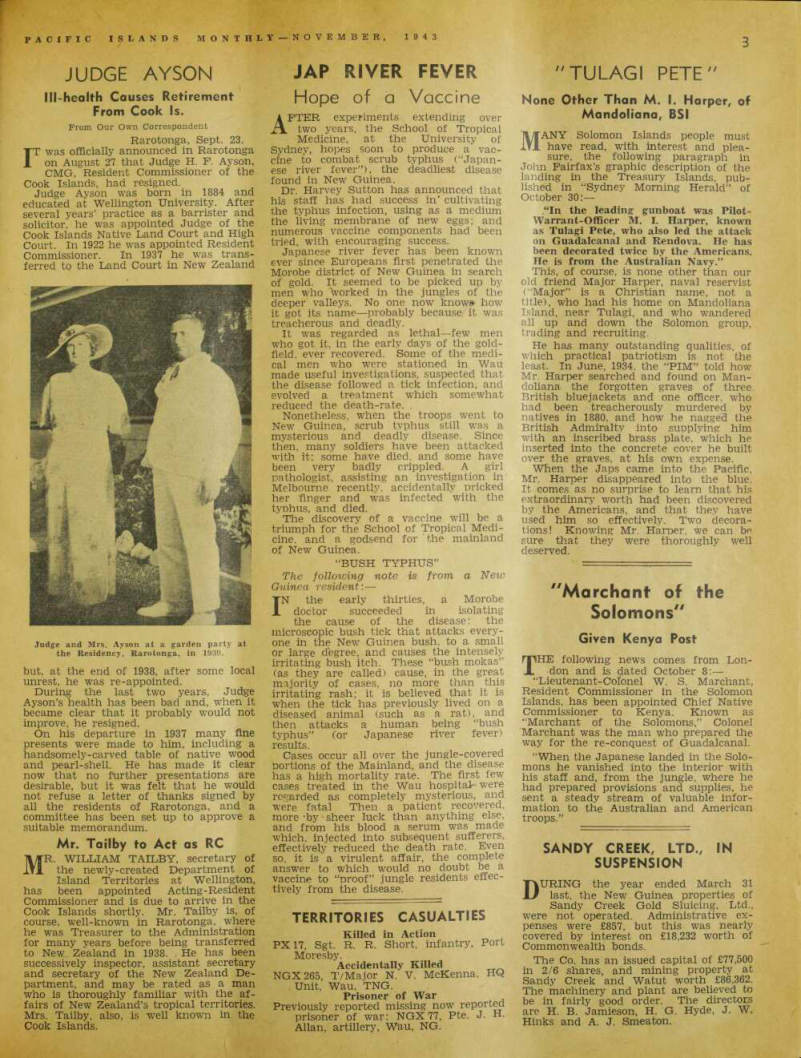
Judge and Mrs. Ayson at a garden party at the Residency, Rarotonga, in 1939.
Hope of a Vaccine
Jap River Fever
AFTER experiments extending over two years, the School of Tropical Medicine, at the University of Sydney, hopes soon to produce a vac cine to combat scrub typhus (“Japan ese river fever”), the deadliest disease found in New Guinea.
Dr. Harvey Sutton has announced that his staff has had success in’ cultivating the typhus infection, using as a medium the living membrane of new eggs; and numerous vaccine components had been tried, with encouraging success.
Japanese river fever has been known ever since Europeans first penetrated the Morobe district of New Guinea in search of gold. It seemed to be picked up by men who worked in the jungles of the deeper valleys. No one now knows how it got its name—probably because it was treacherous and deadly.
It was regarded as lethal—few men who got it, in the early days of the gold field, ever recovered. Some of the medi cal men who were stationed in Wau made useful investigations, suspected that the disease followed a tick infection, and evolved a treatment which somewhat reduced the death-rate.
Nonetheless, when the troops went to New Guinea, scrub tvphus still was a mysterious and deadly disease. Since then, many soldiers have been attacked with it; some have died, and some have been very badly crippled. A girl pathologist, assisting an investigation in Melbourne recently, accidentally pricked her finger and was infected with the typhus, and died.
The discovery of a vaccine will be a triumph for the School of Tropical Medi cine. and a godsend for the mainland of New Guinea.
“Bush Typhus”
The following note is from a New Guinea resident :— IN the early thirties, a Morobe doctor succeeded in isolating the cause of the disease: the microscopic bush tick that attacks every one in the New Guinea bush, to a small or large degree, and causes the intensely irritating bush itch. These “bush mokas” (as they are called) cause, in the great majority of cases, no more than this irritating rash; it is believed that it is when the tick has previously lived on a diseased animal (such as a rat), and then attacks a human being “bush typhus” (or Japanese river fever) results.
Cases occur all over the jungle-covered portions of the Mainland, and the disease has a high mortality rate. The first few cases treated in the Wau hospital- were regarded as completely mysterious, and were fatal Then a patient recovered, more -by sheer luck than anything else, and from his blood a serum was made which, injected into subsequent sufferers, effectively reduced the death rate. Even so. it is a virulent affair, the complete answer to which would no doubt be a vaccine to “proof” jungle residents effec tively from the disease.
Territories Casualties
Killed in Action PXI7, Sgt. R. R. Short, infantry, Port Moresby.
Accidentally Killed NGX26S, T/Maior N. V. McKenna, HQ Unit, Wau, TNG.
Prisoner of War Previously reported missing now reported prisoner of war: NGX 77, Pte. J. H.
Allan, artillery, Wau, NG.
"Tulagi Pete"
None Other Than M. I. Harper, of Mandoliana, BSI
MANY Solomon Islands people must have read, with interest and plea sure, the following paragraph in John Fairfax’s graphic description of the landing in the Treasury Islands, pub lished in “Sydney Morning Herald” of October 30; — “In the leading gunboat was Pilot- Warrant-Officer M. I. Harper, known as Tulagi Pete, who also led the attack on Guadalcanal and Rendova. He has been decorated twice by the Americans.
He is from the Australian Navy.”
This, of course, is none other than our old friend Major Harper, naval reservist • Major” is a Christian name, not a title), who had his home on Mandoliana Island, near Tulagi, and who wandered all up and down the Solomon group, trading and recruiting.
He has many outstanding qualities, of which practical patriotism is not the least. In June, 1934, the “PIM” told how Mr. Harper searched and found on Man doliana the forgotten graves of three British bluejackets and one officer, who had been treacherously murdered by natives in 1880, and how he nagged the British Admiraltv into supplying him with an inscribed brass plate, which he inserted into the concrete cover he built over the graves, at his own expense.
When the Japs came into the Pacific, Mr. Harper disappeared into the blue.
It comes as no surprise to learn that his extraordinary worth had been discovered by the Americans, and that they have used him so effectively. Two decora tions! Knowing Mr. Harper, we can be sure that they were thoroughly well deserved.
Solomons"
"Marchont of the Solomons"
Given Kenya Post
THE following news comes from Lon don and is dated October 8: “Lieutenant-Cofonel W. S. Marchant, Resident Commissioner in the Solomon Islands, has been appointed Chief Native Commissioner to Kenya. Known as “Marchant of the Solomons,” Colonel Marchant was the man who prepared the way for the re-conquest of Guadalcanal.
“When the Japanese landed in the Solo mons he vanished into the interior with his staff and, from the jungle, where he had prepared provisions and supplies, he sent a steady stream of valuable infor mation to the Australian and American troops.”
Sandy Creek, Ltd., In
Suspension
DURING the year ended March 31 last, the New Guinea properties of Sandy Creek Gold Sluicing, Ltd., were not operated. Administrative ex penses were £857, but this was nearly covered by interest on £18,232 worth of Commonwealth bonds.
The Co. has an issued capital of £77,500 in 2/6 shares, and mining property at Sandy Creek and Watut worth £86,362.
The machinery and plant are believed to be in fairly good order. The directors are H. B. Jamieson, H. G. Hyde, J. W.
Hinks and A. J. Smeaton.
Papuans’ War
Effort
How They Are Helping the Allies
(From the Commonwealth Department of Information ) THE history of the Papuan and Nevr Guinea campaigns against the Jap anese is partly a history of the loyalty of the New Guinea natives, their patient devotion to duty, and, more recently, their gallantry under fire For the past year, Papuan infantry led by white officers have been continually harassing the Japanese lines of com munication. In one area the Papuans killed 450 enemy troops for two of their own casualties. Their technique is based on surprise, darkness, and ambush.
Many of these natives have an old score to settle with the Japanese. Some of them have seen their villages sacked and burnt and their women raped.
Already many of them have won fame as warriors with modern weapons. Among them is Katue, a sergeant who won the Military Medal, coveted by soldiers black or white, English, Australian or Papuan, for conspicuous valour in the bloody fighting at Buna. Others have been recommended for decorations.
Sergeant Katue. MM. won his decora tion for his activities in the Buna area.
Amongst other things, he sneaked regu larly through the enemy’s lines to bring back valuable information. In addition, he, with a small party of Papuan sol diers, later killed 40 Japanese, burning their stores, and capturing their equip ment, in a series of small raids.
Sergeant Kari is also a mighty man in the Papuan Infantry. He shot 31 out of 54 Japanese killed in an action which denied the enemy the use of a vital road.
THE Papuan soldier has also beaten the Japanese at his own game of infiltration. Frequently they pene trate behind the Japanese lines and bring back vital intelligence. Occasionally they are ambushed themselves but they do not panic under fire.
During their training they mastered the use of rifles and light automatics with surprising ease, but their greatest difficulty was to stay in step. Within the battalions are men who are each other’s hereditary enemies. They have forgot ten their feuds to best the common foe Apart from organised military roles, great work has been done by the indi vidual police boys who often accompany the Australian patrols. One such was the police boy with Lieut. Reginald Boyan, of Sydney. He was walking dir ectly ahead of the officer, when suddenly he gave a shout and threw himself into the bushes. The Australians followed.
A slight detour and the police boy showed them what he had seen. A patrol of 15 armed Japs walking down the trail.
The Australians might never have seen them.
And what would have happened to US fighter pilot Second Lieut. Kimball if it had not been for the New Guinea natives? Lieut. Kimball baled out after a fight with Zeros, only to find himself left dangling high above the ground when his silken parachute caught in a tall tree. He hung there trapped and helpless until his arms and legs seemed paralysed. Then came some natives to his rescue. They' placed a long pole across from one tree to another. Lieut Kimball was able to crawl along it and then down one of the trees. He reached his base after eight days’ jungle hike.
MANY have seen the pictorial record of the horrible dangers and hard ships of the three-days’ carry of the wounded from the forward areas at Mubo to the base. Some of these pic tures show a young Middle East veteran wounded in the leg being carried along a track hewn out of the mountain side.
The natives are treading the path cautiously, handing the stretcher along almost in single file.
In May this year three of the inmates of a ward in a New Guinea hospital were wounded carriers. One of the natives was the boss boy of one of our forward supply columns when a Jap sol dier appeared on the track and opened fire. The native was slow in taking cover and was hit in the shoulder.
Another was wounded in similar circum stances, and the third was struck by shrapnel from a Japanese bomb during a raid on Wau.
The Australians who run a small boat service up and down the coast, con stantly overlooked by the Japanese Air Force, would be unable to function with out their native crews. These Austra lians experienced many nerve-racking strafing raids and speak highly of the courage of their native boys under this form of attack.
THE Papuan natives show their worth as much out of action as in the forward areas. A typical story is that of the West Australian signaller in the early days of Milne Bay who was given the task of laying 21 miles of line through rough country. He was given a party of native boys to help him. After he had gone a few miles he went down with malaria. He showed the boys how to lay the line from tree to tree and then stumbled along behind them. The natives laid the line. It still stands to-day. In addition, all that kept this West Aus
tralian going was quinine—quinine brought by a native boy who had to travel 30 miles to get it.
Stretcher-bearing difficulties in the fighting in the Mubo area were incred ible Normal carrying is 16 natives to each casualty. After one recent patrol clash it took 216 natives to carry out eight wounded. They might never have got out if it had not been for these natives.
Brooches
Pearl-Shell To
New Industry in Cooks
Prom Our Own Correspondent TWO small factories at Rarotonga are now engaged in the production of brooches, manufactured from local pearl-shell.
It is anticipated that these brooches, for which large orders have already been received from various parts of the Pacific, will have a tremendous run. New designs are continually being experimented with, but the original ‘Tiare Maori” (Tiare Tahiti) design is still the most favoured.
Anybody who has ever visited the Islands knows the Tiare Maori, the flower whose fragrance, they say, is haunting and un forgettable, and the shell of the pearl oyster lends itself particularly well to the shading of the white petals and darker coloured stem.
These brooches are the ideal gift for the folks back home, being at once artistic, delicate and durable.
It seems probable that a new industry has come to stay and that not only brooches but other articles, such as buttons and decorated woodwork, will soon be turned out in quantity.
In Port Moresby, 60 Years Ago
This photograph has considerable historical value. It was taken on November 3, 1884, by Commander Erskine, of HMS “Nelson,” on the verandah of the mission house in Port Moresby, occupied at that time by Rev. James Chalmers and Rev. Dr. Lawes, two famous missionaries.
The photograph shows Mr. F. T. Goedicke. then aged 22, surrounded by New Guinea artifacts.
Mr. Goedicke, now aged 81, is a resident of Haa nai, Tonga, and we are indebted to him for per mission to print this picture.
The plate was devel oped by Mr. Chalmers (who soon afterwards was killed and eaten by the Goaribaris. in the Gulf of Papua); the print was made by Ladv Carrington (wife of the Governor of NSW), at Government House, Syd ney, and mounted bv Mr. Schroeder. then a nhotogranher in George Street, Sydney.
Mayor Of Noumea
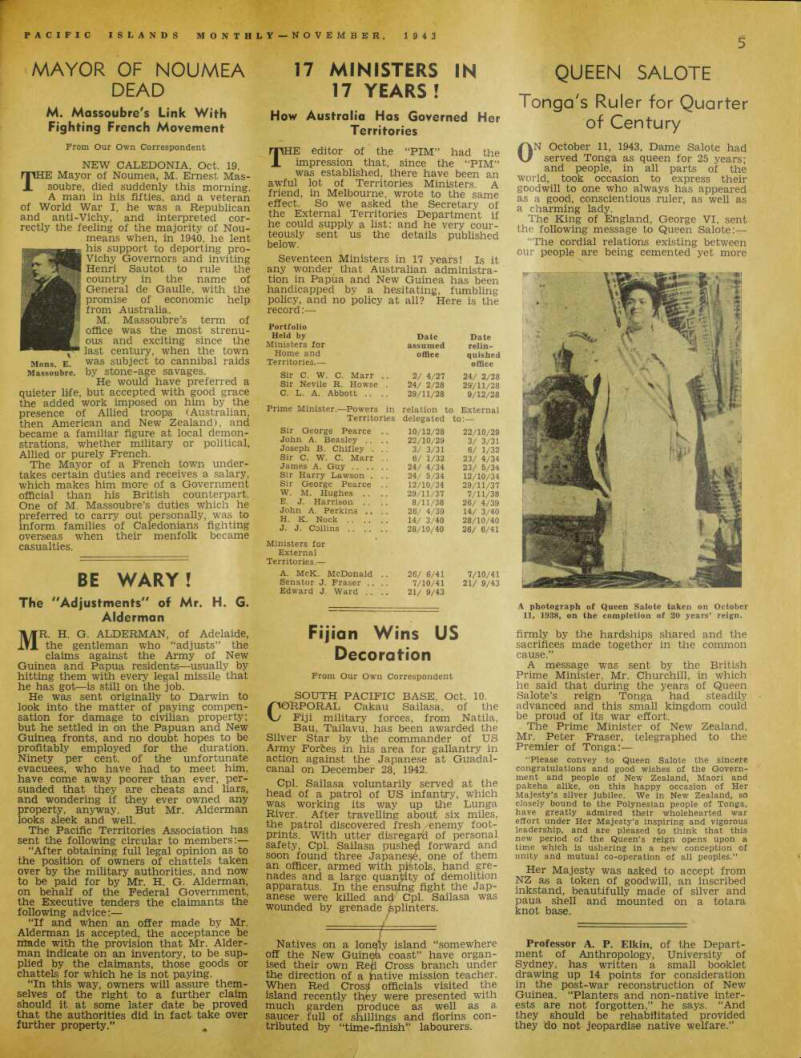
Dead
M. Massoubre's Link With Fighting French Movement
From Our Own Correspondent
New Caledonia, Oct. 19.
THE Mayor of Noumea, M. Ernest Mas soubre, died suddenly this morning.
A man in his fifties, and a veteran of World War I, he was a Republican and anti-Vichy, and interpreted cor rectly the feeling of the majority of Nou-
means when, in 1940, he lent his support to deporting pro- Vichy Governors and inviting Henri Sautot to rule the country in the name of General de Gaulle, with the promise of economic help from Australia.
M. Massoubre’s term of office was the most strenu ous and exciting since the last century, when the town was subject to cannibal raids by stone-age savages.
He would have preferred a
quieter life, but accepted with good grace the added work imposed on him by the presence of Allied troops (Australian, then American and New Zealand), and became a familiar figure at local demon strations, whether military or political, Allied or purely French.
The Mayor of a French town under takes certain duties and receives a salary, which makes him more of a Government official than his British counterpart.
One of M. Massoubre’s duties which he preferred to carry out personally, was to inform families of Caledonians fighting overseas when their menfolk became casualties.
Mens. E.
Massoubre.
Be Wary!
The "Adjustments" of Mr. H. G.
Alderman
MR. H. G. ALDERMAN, of Adelaide, the gentleman who “adjusts” the claims against the Army of New Guinea and Papua residents—usually by hitting them with every legal missile that he has got—is still on the job.
He was sent originally to Darwin to look into the matter of paying compen sation for damage to civilian property; but he settled in on the Papuan and New Guinea fronts, and no doubt hopes to be profitably employed for the duration.
Ninety per cent, of the unfortunate evacuees, who have had to meet him, have come away poorer than ever, per suaded that they are cheats and liars, and wondering if they ever owned any property, anyway. But Mr. Alderman looks sleek and well.
The Pacific Territories Association has sent the following circular to members: — “After obtaining full legal opinion as to the position of owners of chattels taken over by the military authorities, and now to be paid for by Mr. H. G. Alderman, on behalf of the Federal Government, the Executive tenders the claimants the following advice:— “If and when an offer made by Mr.
Alderman is accepted, the acceptance be made with the provision that Mr. Aider man indicate on an inventory, to be sup plied by the claimants, those goods or chattels for which he is not paying.
“In this way, owners will assure them selves of the right to a further claim should it at some later date be proved that the authorities did in fact take over further property.” *
17 Ministers In
17 Years!
How Australia Has Governed Her Territories
rE editor of the “PIM” had the impression that, since the “PIM” was established, there have been an awful lot of Territories Ministers. A friend, in Melbourne, wrote to the same effect. So we asked the Secretary of the External Territories Department if he could supply a list: and he very cour teously sent us the details published below.
Seventeen Ministers in 17 years! Is it any wonder that Australian administra tion in Papua and New Guinea has been handicapped by a hesitating, fumbling policy, and no policy at all? Here is the record:—
Portfolio Held by Date Date Ministers for assumed relin- Home and office quished Territories.— office Sir C. W. C. Marr .. 2/ 4/27 24/ 2/28 Sir Nevile R. Howse . 24/ 2/28 29711/28 C. L. A, Abbott .. . . 29/11/28 9/12/28 Prime Minister.—Powers in relation to External Territories delegated to:— Sir George Pearce .. 10/12/28 22/10/29 John A. Beasley .. .. 22/10/29 3/ 3/31 Joseph B. Chifley . .. 3/ 3/31 6/ 1/32 Sir C. W. C. Marr . . 6/ 1/32 23/ 4/34 James A. Guy 24/ 4/34 23/ 5/34 Sir Harry Lawson , .. 24/ 5/34 12/10/34 Sir George Pearce 12/10/34 29/11/37 W. M. Hughes .. 29/11/37 7/11/38 E. J. Harrison 8/11/38 26/ 4/39 John A. Perkins .. 26/ 4/39 14/ 3/40 H. K. Nock 14/ 3/40 28/10/40 J. J. Collins 28/10/40 26/ 6/41 Ministers for External Territories.— A. McK. McDonald .. 26/ 6/41 7/10/41 Senator J. Fraser .. 7/10/41 21/ 9/43 Edward J. Ward .. .. 21/ 9/43
Fijian Wins US
Decoration
From Our Own Correspondent
South Pacific Base, Oct. 10.
CORPORAL Cakau Sailasa, of the Fiji military forces, from Natila, Bau, Tailavu, has been awarded the Silver Star by the commander of US Army Forfces in his area for gallantry in action against the Japanese at Guadal canal on December 28, 1942. ’
Cpl. Sailasa voluntarily served at the head of a patrol of US infantry, which was working its way up the Lunga River. After travelling abou,t six miles, the patrol discovered fresh /enemy foot prints. With utter disregard of personal safety, Cpl. Sailasa pushed forward and soon found three Japanese, one of them an officer, armed with pistols, hand gre nades and a large quantity of demolition apparatus. In the ensuing fight the Jap anese were killed and Cpl. Sailasa was wounded by grenade Splinters.
Natives on a lonely island “somewhere off the New Guinea coast” have organ ised their own Reo Cross branch under the direction of a jnative mission teacher.
When Red Crossl officials visited the island recently th£y were presented with much garden produce as well as a saucer full of shillings and florins con tributed by “time-finish” labourers.
Queen Salote
Tonga's Ruler for Quarter of Century
ON October 11, 1943, Dame Salote had served Tonga as queen for 25 years; and people, in all parts of the world, took occasion to express their goodwill to one who always has appeared as a good, conscientious ruler, as well as a charming lady.
The King of England, George VI, sent the following message to Queen Salote:— “The cordial relations existing between our people are being cemented yet more
firmly by the hardships shared and the sacrifices made together in the common cause.”
A message was sent by the British Prime Minister, Mr. Churchill, in which he said that during the years of Queen Salote’s reign Tonga had steadily advanced and this small kingdom could be proud of its war effort.
The Prime Minister of New Zealand, Mr. Peter Fraser, telegraphed to the Premier of Tonga:— “Please convey to Queen Salote the sincere congratulations and good wishes of the Govern ment and people of New Zealand, Maori and pakeha alike, on this happy occasion of Her Majesty’s silver jubilee. We in New Zealand, so closely bound to the Polynesian people of Tonga, have greatly admired their wholehearted war effort under Her Majesty’s inspiring and vigorous leadership, and are pleased to think that this new period of the Queen’s reign opens upon a time which is ushering in a new conception of unity and mutual co-operation of all peoples.”
Her Majesty was asked to accept from NZ as a token of goodwill, an inscribed inkstand, beautifully made of silver and paua shell and mounted on a totara knot base.
Professor A. P. Elkin, of the Depart ment of Anthropology, University of Sydney, has written a small booklet drawing up 14 points for consideration in the post-war reconstruction of New Guinea. “Planters and non-native inter ests are not forgotten,” he says. “And they should be rehabilitated provided they do not jeopardise native welfare.”
A photograph of Queen Salote taken on October 11, 1938, on the completion of 20 years’ reign.
No "Americon-Soldier
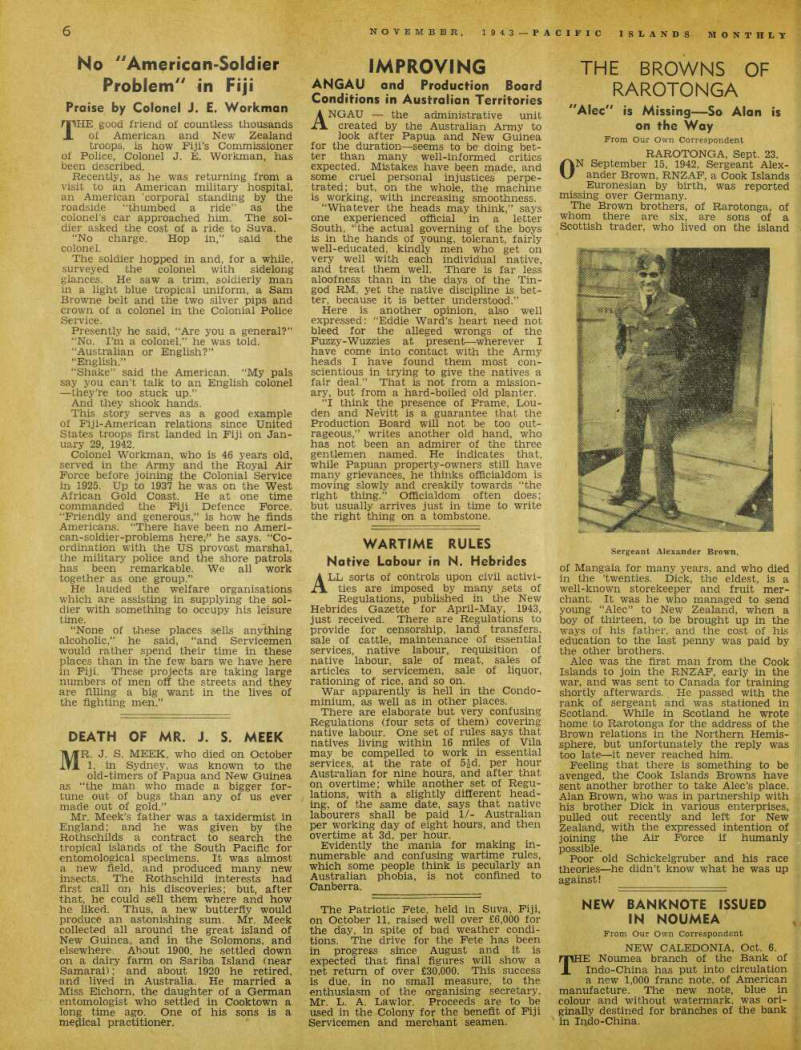
Problem" in Fiji
Praise by Colonel J. E. Workman
THE good friend of countless thousands of American and New Zealand troops, is how Fiji’s Commissioner of Police, Colonel J. E. Workman, has been described.
Recently, as he was returning from a visit to an American military hospital, an American ’corporal standing by the roadside “thumbed a ride” as the colonel’s car approached him. The sol dier asked the cost of a ride to Suva.
“No charge. Hop in,” said the colonel.
The soldier hopped in and, for a while, surveyed the colonel with sidelong glances. He saw a trim, soldierly man in a light blue tropical uniform, a Sam Browne belt and the two silver pips and crown of a colonel in the Colonial Police Service.
Presently he said, “Are you a general?”
“No. I’m a colonel,” he was told.
“Australian or English?”
“English.”
“Shake” said the American. “My pals say you can’t talk to an English colonel —they’re too stuck up.”
And they shook hands.
This story serves as a good example of Fiji-American relations since United States troops first landed in Fiji on Jan uary 29, 1942.
Colonel Workman, who is 46 years old, served in the Army and the Royal Air Force before joining the Colonial Service in 1925. Up to 1937 he was on the West African Gold Coast. He at one time commanded the Fiji Defence Force.
“Friendly and generous,” is how he finds Americans. “There have been no Ameri can-soldier-problems here,” he says. “Co ordination with the US provost marshal, the military police and the shore patrols has been remarkable. We all work together as one group.”
He lauded the welfare organisations which are assisting in supplying the sol dier with something to occupy his leisure time.
“None of these places sells anything alcoholic,” he said, “and Servicemen would rather spend their time in these places than in the few bars we have here in Fiji. These projects are taking large numbers of men off the streets and they are filling a big want in the lives of the fighting men.”
Death Of Mr. J. S. Meek
MR. J. S. MEEK, who died on October 1, in Sydney, was known to the old-timers of Papua and New Guinea as “the man who made a bigger for tune out of bugs than any of us ever made out of gold.”
Mr. Meek’s father was a taxidermist in England; and he was given by the Rothschilds a contract to search the tropical islands of the South Pacific for entomological specimens. It was almost a new field, and produced many new insects. The Rothschild interests had first call on his discoveries; but, after that, he could sell them where and how he liked. Thus, a new butterfly would produce an astonishing sum. Mr. Meek collected all around the great island of New Guinea, and in the Solomons, and elsewhere. About 1900, he settled down on a dairy farm on Sariba Island (near Samarai); and about 1920 he retired, and lived in Australia. He married a Miss Eichorn, the daughter of a German entomologist who settled in Cooktown a long time ago. One of his sons is a medical practitioner.
Improving
ANGAU and Production Board Conditions in Australian Territories
ANGAU the administrative unit created by the Australian Army to look after Papua and New Guinea for the duration—seems to be doing bet ter than many well-informed critics expected. Mistakes have been made, and some cruel personal injustices perpe trated; but, on the whole, the machine is working, with increasing smoothness.
“Whatever the heads may think,” says one experienced official in a letter South, “the actual governing of the boys is in the hands of young, tolerant, fairly well-educated, kindly men who get on very well with each individual native, and treat them well. There is far less aloofness than in the days of the Tin god RM, yet the native discipline is bet ter, because it is better understood.”
Here is another opinion, also well expressed: “Eddie Ward’s heart need not bleed for the alleged wrongs of the Fuzzy-Wuzzies at present—wherever I have come into contact with the Army heads I have found them most con scientious in trying to give the natives a fair deal.” That is not from a mission ary, but from a hard-boiled old planter.
“I think the presence of Frame, Lou den and Nevitt is a guarantee that the Production Board will not be too out rageous,” writes another old hand, who has not been an admirer of the three gentlemen named. He indicates that, while Papuan property-owners still have many grievances, he thinks officialdom is moving slowly and creakily towards “the right thing.” Officialdom often does; but usually arrives just in time to write the right thing on a tombstone.
Wartime Rules
Native Labour in N. Hebrides
ALL sorts of controls upon civil activi ties are imposed by many sets of Regulations, published in the New Hebrides Gazette for April-May, 1943, just received. There are Regulations to provide for censorship, land transfers, sale of cattle, maintenance of essential services, native labour, requisition of native labour, sale of meat, sales of articles to servicemen, sale of liquor, rationing of rice, and so on.
War apparently is hell in the Condo minium, as well as in other places.
There are elaborate but very confusing Regulations (four sets of them) covering native labour. One set of rules says that natives living within 16 miles of Vila may be compelled to work in essential services, at the rate of 5-id. per hour Australian for nine hours, and after that on overtime; while another set of Regu lations, with a slightly different head ing, of the same date, says that native labourers shall be paid 1/- Australian per working day of eight hours, and then overtime at 3d. per hour.
Evidently the mania for making in numerable and confusing wartime rules, which some people think is pecularly an Australian phobia, is not confined to Canberra.
The Patriotic Pete, held in Suva, Fiji, on October 11, raised well over £6,000 for the day, in spite of bad weather condi tions. The drive for the Fete has been in progress since August and it is expected that final figures will show a net return of over £30,000. This success is due, in no small measure, to the enthusiasm of the organising secretary, Mr. L. A. Lawlor. Proceeds are to be used in the Colony for the benefit of Fiji Servicemen and merchant seamen.
The Browns Of
Rarotonga
"Alec" is Missing—So Alan is on the Way
Prom Our Own Correspondent
Rarotonga, Sept. 23.
ON September 15, 1942, Sergeant Alex ander Brown, RNZAF, a Cook Islands Euronesian by birth, was reported missing over Germany.
The Brown brothers, of Rarotonga, of whom there are six, are sons of a Scottish trader, who lived on the island
of Mangaia for many years, and who died in the ’twenties. Dick, the eldest, is a well-known storekeeper and fruit mer chant. It was he who managed to send young “Alec” to New Zealand, when a boy of thirteen, to be brought up in the ways of his father, and the cost of his education to the last penny was paid by the other brothers.
Alec was the first man from the Cook Islands to join the RNZAF, early in the war, and was sent to Canada for training shortly afterwards. He passed with the rank of sergeant and was stationed in Scotland. While in Scotland he wrote home to Rarotonga for the address of the Brown relations in the Northern Hemis sphere, but unfortunately the reply was too late —it never reached him.
Feeling that there is something to be avenged, the Cook Islands Browns have sent another brother to take Alec’s place.
Alan Brown, who was in partnership with his brother Dick in various enterprises, pulled out recently and left for New Zealand, with the expressed intention of joining the Air Force if humanly possible.
Poor old Schickelgruber and his race theories —he didn’t know what he was up
against!
Sergeant Alexander Brown,
New Banknote Issued
In Noumea
From Our Own Correspondent
New Caledonia, Oct. 6.
rE Noumea branch of the Bank of Indo-China has put into circulation a new 1,000 franc note, of American manufacture. The new note, blue in colour and without watermark, was ori ginally destined for branches of the bank 1 in Indo-China.
Plans
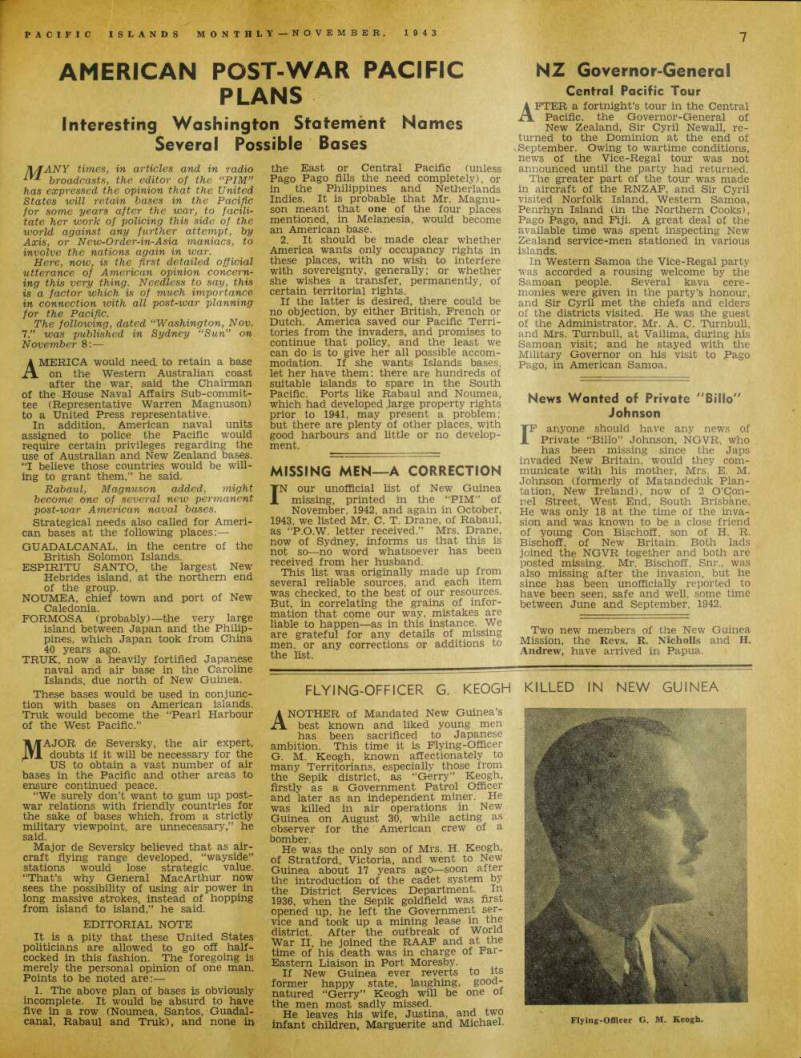
American Post-War Pacific
Interesting Washington Statement Names Several Possible Bases
IX/fANY times, in articles and in radio broadcasts, the editor of the “PIM” has expressed the opinion that the United States will retain bases in the Pacific for some years after the war, to facili tate her work of policing this side of the world against any further attempt, by Axis, or New-Order-in-Asia maniacs, to involve the nations again in war.
Here, now, is the first detailed official utterance of American opinion concern ing this very thing. Needless to say, this is a factor which is of much importance in connection with all post-war planning for the Pacific.
The following, dated “Washington, Nov. 7,” was published in Sydney “Sun” on November 8: AMERICA would need, to retain a base on the Western Australian coast after the war, said the Chairman of the House Naval Affairs Sub-commit tee (Representative Warren Magnuson) to a United Press representative.
In addition, American naval units assigned to police the Pacific would require certain privileges regarding the use of Australian and New Zealand bases.
“I believe those countries would be will ing to grant them,” he said.
Rabaul, Magnuson added, might become one of several new permanent post-war American naval bases.
Strategical needs also called for Ameri can bases at the following places:— GUADALCANAL, in the centre of the British Solomon Islands.
ESPIRITU SANTO, the largest New Hebrides island, at the northern end of the group.
NOUMEA, chief town and port of New Caledonia.
FORMOSA (probably)—the very large island between Japan and the Philip pines, which Japan took from China 40 years ago.
TRUK, now a heavily fortified Japanese naval and air base in the Caroline Islands, due north of New Guinea.
These bases would be used in conjunc tion with bases on American islands.
Truk would become the “Pearl Harbour of the West Pacific.”
MAJOR de Seversky, the air expert, doubts if it will be necessary for the US to obtain a vast number of air bases in the Pacific and other areas to ensure continued peace.
“We surely don’t want to gum up post war relations with friendly countries for the sake of bases which, from a strictly military viewpoint, are unnecessary,” he said.
Major de Seversky believed that as air craft flying range developed, “wayside” stations would lose strategic value.
“That’s why General MacArthur now sees the possibility of using air power in long massive strokes, instead of hopping from island to island,” he said.
Editorial Note
It is a pity that these United States politicians are allowed to go off half cocked in this fashion. The foregoing is merely the personal opinion of one man.
Points to be noted are:— 1. The above plan of bases is obviously incomplete. It would be absurd to have five in a row (Noumea, Santos, Guadal canal, Rabaul and Truk), and none in
the East or Central Pacific (unless Pago Pago fills the need completely), or in the Philippines and Netherlands Indies. It is probable that Mr. Magnu son meant that one of the four places mentioned, in Melanesia, would become an American base. 2. It should be made clear whether America wants only occupancy rights in these places, with no wish to interfere with sovereignty, generally; or whether she wishes a transfer, permanently, of certain territorial rights.
If the latter is desired, there could be no objection, by either British, French or Dutch. America saved our Pacific Terri tories from the invaders, and promises to continue that policy, and the least we can do is to give her all possible accom modation. If she wants Islands bases, let her have them: there are hundreds of suitable islands to spare in the South Pacific. Ports like Rabaul and Noumea, which had developed .large property rights prior to 1941, may present a problem; but there are plenty of other places, with good harbours and little or no develop ment.
Missing Men—A Correction
IN our unofficial list of New Guinea missing, printed in the “PIM” of November. 1942, and again in October, 1943, we listed Mr. C. T. Drane, of Rabaul, as “P.O.W. letter received.” Mrs. Drane, now of Sydney, informs us that this is not so—no word whatsoever has been received from her husband.
This list was originally made up from several reliable sources, and each item was checked, to the best of our resources.
But, in correlating the grains of infor mation that come our way, mistakes are liable to happen—as in this instance. We are grateful for any details of missing men. or any corrections or additions to the list.
NZ Governor-General
Central Pacific Tour
AFTER a fortnight’s tour in the Central Pacific, the Governor-General of New Zealand, Sir Cyril Newall, re turned to the Dominion at the end of September. Owing to wartime conditions, news of the Vice-Regal tour was not announced until the party had returned.
The greater part of the tour was made in aircraft of the RNZAF, and Sir Cyril visited Norfolk Island, Western Samoa, Penrhyn Island (in the Northern Cooks), Pago Pago, and Fiji. A great deal of the available time was spent inspecting New Zealand service-men stationed in various islands.
In Western Samoa the Vice-Regal party was accorded a rousing welcome by the Samoan people. Several kava cere monies were given in the party’s honour, and Sir Cyril met the chiefs and elders of the districts visited. He was the guest of the Administrator, Mr. A. C. Turnbull, and Mrs. Turnbull, at Vailima, during his Samoan visit; and he stayed with the Military Governor on his visit to Pago, in American Samoa.
News Wanted of Private "Billo"
Johnson
IF anyone should have any news of Private “Billo” Johnson, NGVR, who has been missing since the Japs invaded New Britain, would they com municate with his mother, Mrs. E. M, Johnson (formerly of Matandeduk Plan tation, New Ireland), now of 2 O’Con nel Street, West End, South Brisbane.
He was only 18 at the time of the inva sion and was known to be a close friend of yoimg Con Bischoff, son of H. R.
Bischoff, of New Britain. Both lads joined the NGVR together and both are posted missing. Mr. Bischoff, Snr., was also missing after the invasion, but he since has been unofficially reported to have been seen, safe and well, some time between June and September, 1942.
Two new members of the New Guinea Mission, the Revs. R. Nicholls and H.
Andrew, have arrived in Papua.
Flying-Officer G. Keogh Killed In New Guinea
ANOTHER of Mandated New Guinea’s best known and liked young men has been sacrificed to Japanese ambition. This time it is Flying-Officer G. M. Keogh, known affectionately to many Territorians, especially those from the Sepik district, as “Gerry” Keogh, firstly as a Government Patrol Officer and later as an independent miner. He was killed in air operations in New Guinea on August 30, while acting as observer for the American crew of a bomber.
He was the only son of Mrs. H. Keogh, of Stratford, Victoria, and went to New Guinea about 17 years ago—soon after the introduction of the cadet system by the District Services Department. In 1936, when the Sepik goldfield was first opened up, he left the Government ser vice and took up a mining lease in the district. After the outbreak of World War 11, he joined the RAAF and at the time of his death was in charge of Far- Eastern Liaison in Port Moresby.
If New Guinea ever reverts to its former happy state, laughing, good natured “Gerry” Keogh will be one of the men most sadly missed.
He leaves his wife, Justina, and two infant children, Marguerite and Michael.
Flying-Officer G. M. Keogh.
Affiliation With
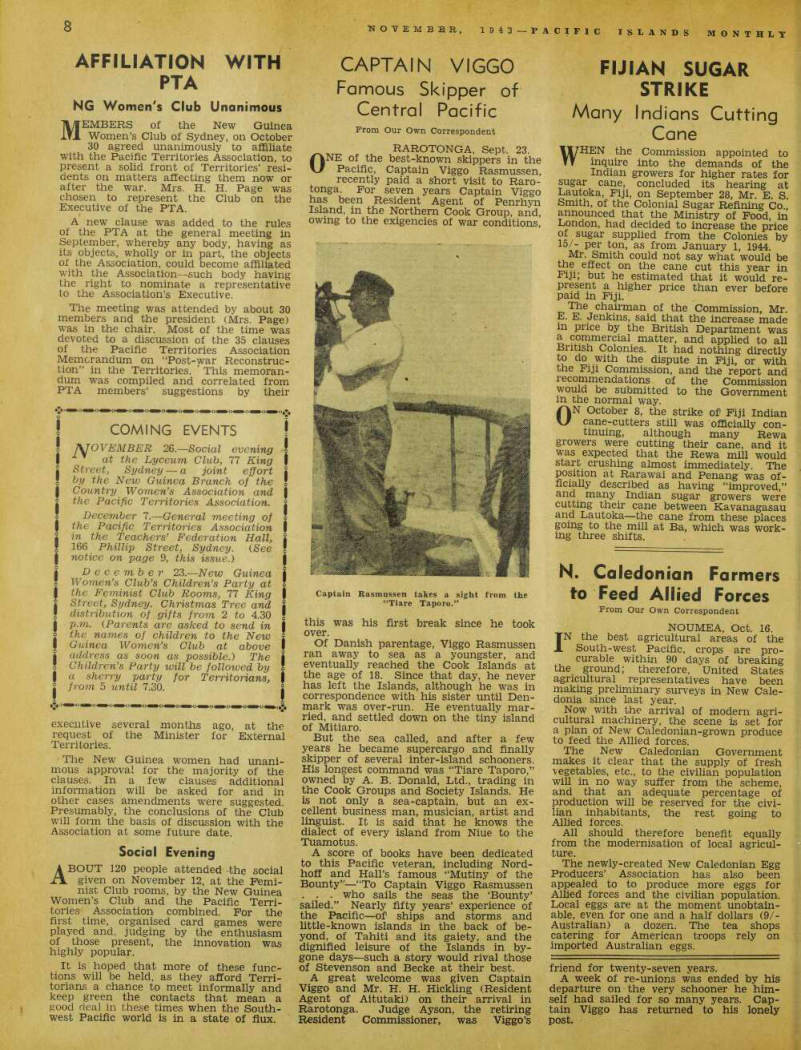
Pta
NG Women's Club Unanimous
MEMBERS of the New Guinea Women’s Club of Sydney, on October 30 agreed unanimously to affiliate with the Pacific Territories Association, to present a solid front of Territories’ resi dents on matters affecting them now or after the war. Mrs. H. H. Page was chosen to represent the Club on the Executive of the PTA.
A new clause was added to the rules of the PTA at the general meeting in September, whereby any body, having as its objects, wholly or in part, the objects of the Association, could become affiliated with the Association—such body having the right to nominate a representative to the Association’s Executive.
The meeting was attended by about 30 members and the president (Mrs. Page) was in the chair. .Most of the time was devoted to a discussion of the 35 clauses of the Pacific Territories Association Memorandum on “Post-war Reconstruc tion” in the Territories. ’ This memoran dum was compiled and correlated from PTA members’ suggestions by their
executive several months ago, at the request of the Minister for External Territories.
The New Guinea women had unani mous approval for the majority of the clauses. In a few clauses additional information will be asked for and in other cases amendments were suggested.
Presumably, the conclusions of the Club will form the basis of discussion with the Association at some future date.
Social Evening
ABOUT 120 people attended the social given on November 12, at the Femi nist Club rooms, by the New Guinea Women’s Club and the Pacific Terri tories Association combined. For the first time, organised card games were played and, judging by the enthusiasm of those present, the innovation was highly popular.
It is hoped that more of these func tions will be held, as they afford Terri torians a chance to meet informally and keep green the contacts that mean a good deal in these times when the South west Pacific world is in a state of flux.
Coming Events
JVTOVEMBER 26. —Social evening 1 at the Lyceum Club, 77 King Street, Sydney a joint effort by the New Guinea Branch of the Country Women’s Association and the Pacific Territories Association.
December 7. —General meeting of the Pacific Territories Association in the Teachers’ Federation Hall, 166 Phillip Street, Sydney. (See notice on page 9, this issue.) December 23. —New Guinea Women’s Club’s Children’s Party at the Feminist Club Rooms, 77 King Street, Sydney. Christmas Tree and distribution of gifts from 2 to 4.30 p.m. (Parents are asked to send in the names of children to the New Guinea Women’s Club at above address as soon as possible.) The Children’s Party will he followed by a sherry party for Territorians, from 5 until 7.30.
Captain Viggo
Famous Skipper of Central Pacific
From Our Own Correspondent
Rarotonga, Sept. 23.
/"\NE of the best-known skippers in the V/ Pacific, Captain Viggo Rasmussen, recently paid a short visit to Raro tonga. For seven years Captain Viggo has been Resident Agent of Penrhyn Island, in the Northern Cook Group, and, owing to the exigencies of war conditions,
this was his first break since he took over.
Of Danish parentage, Viggo Rasmussen ran away to sea as a youngster, and eventually reached the Cook Islands at the age of 18. Since that day, he never has left the Islands, although he was in correspondence with his sister until Den mark was over-run. He eventually mar ried, and settled down on the tiny island of Mitiaro.
But the sea called, and after a few years he became supercargo and finally skipper of several inter-island schooners.
His longest command was “Tiare Taporo,” owned by A. B. Donald, Ltd., trading in the Cook Groups and Society Islands. He is not only a sea-captain, but an ex cellent business man, musician, artist and linguist. It is said that he knows the dialect of every island from Niue to the Tuamotus.
A score of books have been dedicated to this Pacific veteran, including Nord hoff and Hall’s famous “Mutiny of the Bounty”—“To Captain Viggo Rasmussen . . . who sails the seas the ‘Bounty’ sailed.” Nearly fifty years’ experience of the Pacific—of ships and storms and little-known islands in the back of be yond, of Tahiti and its gaiety, and the dignified leisure of the Islands in by gone days—such a story would rival those of Stevenson and Becke at their best.
A great welcome was given Captain Viggo and Mr. H. H. Hickling (Resident Agent of Aitutaki) on their ’ arrival in Rarotonga. Judge Ayson, the retiring Resident Commissioner, was Viggo’s
friend for twenty-seven years.
A week of re-unions was ended by his departure on the very schooner he him self had sailed for so many years. Cap tain Viggo has returned to his lonely post.
Captain Rasmussen takes a sight from the “Tiare Taporo.”
Many Indians Cutting
Fijian Sugar
Strike
Many Indians Cutting Cane
WHEN the Commission appointed to inquire into the demands of the Indian growers for higher rates for sugar cane, concluded its hearing at Lautoka, Fiji, on September 28, Mr. E. S.
Smith, of the Colonial Sugar Refining Co., announced that the Ministry of Food, in London, had decided to increase the price of sugar supplied from the Colonies by 15/- per ton, as from January 1, 1944.
Mr. Smith could not say what would be the effect on the cane cut this year in Fiji; but he estimated that it would re present a higher price than ever before paid in Fiji.
The chairman of the Commission, Mr.
E. E. Jenkins, said that the increase made m price by the British Department was a commercial matter, and applied to all British Colonies. It had nothing directly to do with the dispute in Fiji, or with the Fiji Commission, and the report and recommendations of the Commission would be submitted to the Government in the normal way.
ON October 8, the strike of Fiji Indian cane-cutters still was officially con tinuing, although many Rewa growers were cutting their cane, and it was expected that the Rewa mill would start crushing almost immediately. The position at Rarawai and Penang was of ficially described as having “improved,” and many Indian sugar growers were cutting their cane between Kavanagasau and Lautoka—the cane from these places going to the mill at Ba, which was work ing three shifts.
N. Caledonian Farmers
to Feed Allied Forces
From Our Own Correspondent
Noumea, Oct. 16.
IN the best agricultural areas of the South-west Pacific, crops are pro curable within 90 days of breaking the ground; therefore, United States agricultural representatives have been making preliminary surveys in New Cale donia since last year.
Now with the arrival of modern agri cultural machinery, the scene is set for a plan of New Caledonian-grown produce to feed the Allied forces.
The New Caledonian Government makes it clear that the supply of fresh vegetables, etc., to the civilian population will in no way suffer from the scheme, and that an adequate percentage of production will be reserved for the civi lian inhabitants, the rest going to Allied forces.
All should therefore benefit equally from the modernisation of local agricul ture.
The newly-created New Caledonian Egg Producers’ Association has also been appealed to to produce more eggs for Allied forces and the civilian population.
Local eggs are at the moment unobtain able, even for one and a half dollars (9/- Australian) a dozen. The tea shops catering for American troops rely on imported Australian eggs.
Tropicalities
INDIAN cane-growers, giving evidence on production costs before the Com mission recently set up in Fiji to inquire into their grievances, made some remarkable statements.
One man said he fed his horse 56 pounds of maize a day; later he said maybe it was nearer 28 pounds; another, that he and his wife ate six pounds of rice at a meal—this figure was even tually beaten down to three pounds—but he maintained that his dog ate a lot!
Another calculated his wages at 8/- per day—stating that he worked twice as hard on his own place—and if he hired himself out he was paid 4/- per day for it. The view depends upon which side of the fence you happen to sit! * MR. GEORGE WELLER, war corres pondent of the “Chicago Daily News,” one of the world’s greatest newspapers, was in Sydney recently, after visiting most of the South Pacific Islands, and he brought news of several old friends.
In Rarotonga he met Robert Dean Frisbie, from Pukapuka, whose “Mr.
Moonlight’s Island” was a popular pre war novel. Another South Seas novel by Frisbie is now being published in serial form by the “Atlantic Monthly.”
In Tahiti, Weller met the now-famous James Norman Hall, co-author with Nordhoff of some best-sellers. Hall has just finished another novel, and Mrs.
Hall took the MS to America with her in August. The story tells how Ameri cans disturbed the economic structure of an un-named Pacific archipelago because, through the exigencies of war, they had to cut down all the coconut palms.
Weller spent some time in Rarotonga with Captain Andy Thomson, known throughout five archipelagoes. On a many-antlered hatstand in the skipper’s home hang several hats. These are mementoes of his many children who have gone away—some of the boys to the fighting services, the girls to New Zealand. As each youngster leaves the parental roof-tree his or her most fami liar headgear is left on the stand, not to be disturbed until the wanderer returns. ♦ WELLER wanted to meet Queen Salote in Nukualofa: but, since an Ameri can magazine of a low type tried to amuse its readers by publishing a scur rilous article about Tonga’s highly respected ruler, reporters have been somewhat at a discount in the Nukualofa palace. Weller took it philosophically.
“I should have liked a chance to explain to these excellent people that there can be bad hats in journalism, just as in any other profession,” he remarked.
These American correspondents cer tainly move around. Since the war started, George Weller has been in every belligerent country, and in half the non belligerents. He saw Abyssinia regained, he saw Greece over-run by Nazis, he was present at the fall of Singapore, and he saw the Japs wiped out on the north east coast of Papua. * rMI, a respectful Samoan, stood at the back door of a bungalow in Apia, and offered two ducks for sale.
Eventually, the lady in charge paid the price, and the ducks were turned loose in a back enclosure, near a lane.
Meanwhile, Mr. Smith, an unoffending resident, a considerable distance away, was dancing with rage: his duck-pen had been robbed. He told police about it,
but privately said good-bye to his poultry.
Next day, by merest chance, he passed through the lane. He heard a certain familiar sound, looked over a fence, and there were two of his lamented ducks.
“This,” said Mr. Smith, “is a fair cop!”
Then he looked beyond the fence, stared, and glared again at the ducks.
His stolen poultry was shut up in the back-yard of the Chief Judge of Samoa!
Mr. Smith went hesitantly to the chief of police, and sought advice. How, in Heaven’s name, did one charge a Chief Judge with being in possession of stolen ducks?
The police chief found humour in the situation. He enjoyed his interview with the Chief Judge, and especially with Mrs.
Chief Judge, whose description of Timi was interspersed with picturesque and explosive comment.
The description was so good that Timi was identified and arrested, in quick time.
“Seven weeks’ imprisonment!” said the Court, with grim satisfaction. (EDITOR’S NOTE: Our correspondent is so interested in his funny story that he has failed as a news-gatherer. What became of the ducks?) • UNCLE Sam has recognised the worth of a number of Islands men in the 23 months of the Pacific war. News of the latest honours is contained in a despatch from Washington on November 14, which states that the important US decoration, the Legion of Merit, has been awarded to two well-known South-west Pacific men who led a reconnaissance party to Russell Islands, BSI, on February 12. 1943, and obtained information which assisted later in Allied landings on the islands. The men were Squadron-Leader Charles Widdy, RAAF, and Lieutenant Gordon Howe, RANR. Both were spe cially selected for their knowledge of treacherous Solomon Islands’ waters.
The citation said that Widdy. Howe, and party embarked in a captured Jap anese sampan, which Howe navigated for miles through inadequately-charted reefs at night time, landing the party safely.
Through their intimate knowledge of the islands, Widdy and Howe made possible a comprehensive report on the physical aspect of the islands which proved valu able to the advanced party of the occu pational force.
Squadron-Leader Widdy was general manager of Levers’ Pacific Plantations in the Solomons before the war, and at pre sent commands the Solomon Islands Labour Corps, which numbers 2,500 offi cers and men.
Lieutenant Howe is well known to Islands residents as an officer on Burns, Philp & Company ships. It was on the “Malaita” that he gained his “intimate knowledge of the Solomon Islands” that allowed him to navigate the party safely through the reefs surrounding Russell Islands. * WHILE he was in the Middle East, “Blue” was bitten by a dog. He reported to the MO. who took a serious view of the situation, suspecting rabies.
“Rabies!” “Blue” was alarmed.
“Gripes, Doc. isn’t that what makes blokes go mad and bite people?”
The MO said it was. “Well, gimme a pencil and some paper,” yelled “Blue.”
“It’s alright,” said the MO, trying to calm the fevered “Blue,” “I’ve got every thing under control. There’s no need to make a will yet.”
“Will be damned,” answered the bitten one, “I’m not making a will; I’m writing down the names of all the sergeants I’m going to bite!"
Pacific Copra
Post-War Trade
Sir W. Carpenter on Pacific Copra
rpHE copra-crushing business established JL in Canada some years ago by the Carpenter interests appears to be growing and developing. Sir Walter Car penter (who settled in Vancouver two years ago to personally superintend the new enterprise) remarks, in a private letter, that they now have a crushing mill at each end of the Canadian Pacific railway—he has travelled 50,000 miles by rail in two years.
Sir Walter comments interestingly on the size, beauty and wealth of Canada, and proceeds:— “There is much talk about removal of trade restrictions, but I cannot see any concrete move in that direction, and I am afraid there will be greater restric tions rather than less on international trade.
“Unless USA removes the 5-cents pro cessing tax against Pacific Islands copra, and allows it the rate, 3 cents, enjoyed by the Philippines, then the Pacific Islands will find themselves in the same unenviable position they were in before.
“Taking a dispassionate view, from here, of the general post-war position, I feel that the trend of taxation, in Aus tralia, particularly, is likely to stultify Australian growth and expansion after the war. The individual taxation is the highest in the world, and capital that will flow to new countries is likely to settle in places where it is not so severe.
In wartime no one minds it, as all realise that sacrifices are needed, but when the war is over it will be different.
“I also think Government control has come to stay, as it will be extremely diffi cult to do away with restrictions. Prices will skyrocket for a time and be followed by a depression that will make the last one look like a baby.
“Taken altogether, I do not like to look into the future too closely. It will need very careful handling, and by far the largest single party will be the armed forces."
Advertisements & other items, p. 13 (1 item)
Notice of Meeting
PACIFIC TERRITORIES
ASSOCIATION
A general meeting of the Association will be held on Tuesday, December 7, 1943, at 8 p.m., in Teachers 7 Federation Hall, 166 Phillip Street, Sydney (seventh floor).
BUSINESS:
To receive report from the Executive on activities to date.
To deal with any other business that may arise.
C. A. M. ADELSKOLD,
Secretary.
Papua's Native Policy
Fine Career Of H. W. Champion
Retiring Departmental Chief Explains Papua's Native Policy
By R. W. Robson
A FEW weeks ago, there retired from the service of the Australian Com monwealth one of its ablest and most distinguished officers—the Hon. H.
W. Champion, CBE, Government Secre tary of Papua, and many times acting- Governor of that Territory. It was typical of Mr. Champion that he sought no publicity or Ministerial notice, and went into private life without one word of appreciation from the country which owes him so much.
One hears a good deal, nowadays, of the Murray policy, as applied to Papua; and the late Sir Hubert Murray has been rightly described as one of the greatest, if not the greatest, governor of native races in the history of the Pacific Ter ritories. But behind Murray there always was Champion: it was the misfortune of a great man that he was obscured, in his own sphere, by a greater.
Sir Hubert Murray sometimes honoured me with his confidence. On one occasion, he said to me something like this:— “I have been praised, now and again, because of the work that has been done in Papua, in extending European control over native peoples always regarded as difficult and dangerous. Much of the credit given to me should go to Cham pion. He and I have seen alike on most things—and I have had him always at my side, loyal, and able, and completely dependable, cariying out Government policy and my wishes in a most efficient way. I have been unusually fortunate in my associates —and nowhere more for tunate than in having Champion as the chief executive officer of my administra tion.”
MR. CHAMPION went to Papua as a youth, 45 years ago. The adminis trators of that time soon got their eye on him. Both Sir William Mac- Gregor and G. R. Le Hunte offered him posts in the Government, which he declined: but in 1902 he accepted the position of Government Storekeeper, under Governor Le Hunte. Later, he became accountant in the Treasury.
When the Commonwealth took over, there was a Royal Commission of Inquiry in Papua: one result was that the Gov ernment Treasurer departed. The Com monwealth advertised for a Treasurer.
Prime Minister Deakin sent a high offi cial to Port Moresby to look over the accounts —and Mr. Champion was imme diately appointed Government Treasurer.
When he was only 24, Governor Barton (T 904-07) appointed him to the Executive Council —a position which he held con tinuously for 40 years. When Hubert Murray (1907-40) took over, he made Champion Government Secretary; and thus began the long and—to Australia and Papua—profitable Murray-Champion association.
Thenceforward, the history of Cham pion is the history of the Murray ad ministration. Leonard Murray (now the Administrator) later joined his uncle as Official Secretary to the Lieutenant- Governor: and the triumvirate, working harmoniously and efficieptly together, gave the Territory many long years of useful service. Mr. Champion was created CBE in 1934.
When the aged Sir Hubert died in 1940 at Samarai—as he himself wished, on active service, “with his boots on” —Canberra gave itself a headache, trying to make a selection between Leonard Mur ray and H. W. Champion, to be Adminis
trator. The appointment went eventually (in 1941) to the younger man; and it is typical of both that the natural glad ness of one and disappointment of the other made not the slightest difference in their personal or official relations. Mr.
Champion served his new chief with his old loyalty; and Mr. Murray thanked his particular gods for Champion. fIIHEIR new association was brief, how- X ever. The Jap invasion of New Guinea was followed by the evacua tion of civilians and the hurried estab lishment of military government in Papua, and the Papuan civil administra tion ceased temporarily on February 12, 1942. Mr. Murray, however, is still offi cially the Administrator of Papua.
The Champion name and the Cham pion standard of service are being car ried on by three sons of the late Gov ernment Secretary—lvan F., Claude, and F. A.—all distinguished members of the district administrative services.
WHEN I interviewed Mr. Champion recently, he would say little about himself, but he had something emphatic to say about the Murray
native policy:—
“Several people, lately, in public state ments, have described Sir Hubert Mur ray’s policy as ‘Papua for the Papuans.’
That is not the truth. Sir Hubert him self regarded this idea as the dream of an impractical anthropologist. Here is what he actually wrote; — “ ‘ . . . some will argue that the welfare and development of the natives is best assured by keeping them in the service of the white man, and others will argue that It is our clear duty to leave them alone—that any attempt to en force our laws or to maintain order is absolutely unjustified and that we should discourage all relations between the native and the European.
“ ‘The first is completely out of date and the other, however well suited for discussion in a debating club, is quite impossible in actual administration.’
“Perhaps I can briefly indicate the principles upon which Sir Hubert Mur ray based his plan of native administra tion. Article 22 of the Covenant of the League of Nations reads:— “ ‘To those colonies and territories which are Inhabited by people not yet able to stand by themselves under the strenuous conditions of the modern world, there should be applied the principle that the well-being and development of such peoples form a sacred trust of civilisation.’
“Sir Hugh Clifford traces this theory back to the impeachment of Warren Hastings, in 1788, and it has been ex tended (he says) until— “ ‘it has come to be accepted among us as axiomatic that where Europeans assume re sponsibility for the administration of territories inhabited by primitive and backward races, these lands must be governed for the benefit of the native populations . . . that they can not, without gross injustice, be made to accord any special or exclusive privileges to Europeans; that the natives must be protected from unfair exploitation; and that upon them must be con ferred the largest measure of personal freedom, peace, order, security, and equality of oppor tunity.’
And, in effect, it was this policy that Sir Hubert Murray said the Common wealth directed him to carry out. He wrote: — “ ‘The Government has not only to safeguard the interests of the Papuan, in the present, but must look forward to what is best for the future of the Papuan race as a whole.’
“In his belief, the general policy of the administration is ‘to encourage the
Papuan as far as possible to take part in the development and even in the gov ernment of his own country. We are under these obligations:— (i) To pacify the Territory; to establish law and order to such an extent, at any rate, that men may go about their business by day, and sleep quietly at night without danger of attack. (ii) To prevent the spread of disease and particularly of imported disease, and generally to preserve the native population and (iii) To encourage the native population in habits of industry so as to avoid the effects of the material disturbance caused by the white man’s arrival amongst tnem.’
“Sir Hubert’s instructions to his offi cers included, inter alia; — “ ‘Justice is the prerogative of every man of whatever race, creed or colour’; “ ‘Never, under any circumstances, can the firing on natives by way of punish ment be justified’.”
Tribute by Hon. Leonard Murray
The Hon. Leonard Murray, CBE, Ad ministrator of Papua (Administration temporarily suspended ), has written the following tribute to Mr. Champion :— “1V| R - W ‘ CHAMPION, CBE, was the 111 Chief Executive Officer of the late Sir Hubert Murray for about 30 years, and he was the late Sir Hubert’s friend and confidant, as well.
“I have also had the advantage of close personal and official association with Mr. Champion for well over a quar ter of a century. I learnt early to admire his fine personal qualities. His natural dignity, kindliness, and modesty have won him wide respect and liking.
“But it is of his qualities as a high official that I wish particularly to speak His position for the last 30 years was Government Secretary, and. as such, he was the head of the ‘outside service’— i.e., the Magistracy and the Police. He has also been Acting Lieutenant-Gov ernor and Acting Administrator so many times that I believe, in the aggregate he has administered the Government of Papua for nearly four years.
“Those closely associated with him know the machine-like impartiality with which he used his powers. He was always ready to accept responsibility, and his numberless decisions and instructions were always crystal clear, with never a trace of any self-protective ambiguity.
Moreover, he was always proof against the temptations of popularity—a most important qualification in the Territory, where the subject native population out numbered the dominant white population by nearly 200 to 1.
“When I was appointed Administrator, after the death of the late Sir Hubert Murray in 1940, I considered myself most fortunate that Mr. Champion remained in his high office to give me the benefit of his long experience and sound judg ment.
“Now that he has retired, it should be widely known how much his long and distinguished service has contributed to the success of the administration of Papua.”
Old Samoan Resident Dead
Apia Oct 3
AN old and respected resident of West ern Samoa. Mr. James E. Wallace, died recently at the age of 77. Mr.
Wallace came to Apia with the New Zea landers in 1915. At the end of World War I, he returned to settle here per manently. He acted for some time as manager of the Government Rest House at Afiamalu and, later, occupied various Government positions. His widow is pro minent in social activities.
Pacific Territories
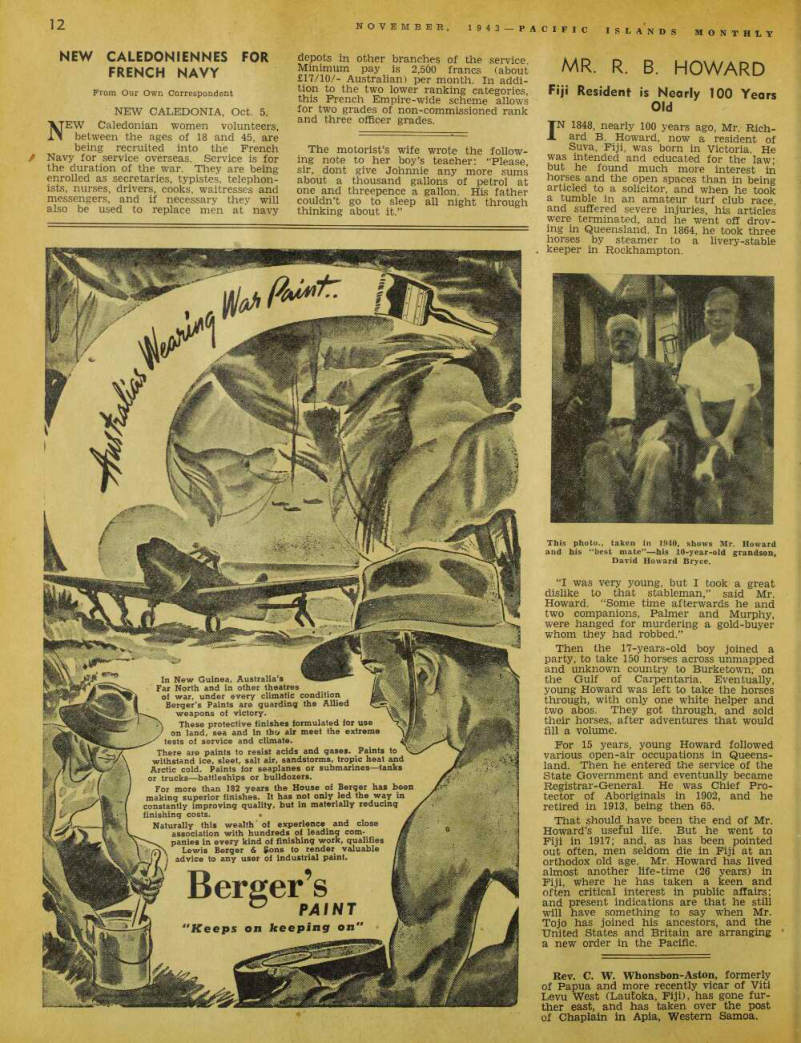
Australian Relations With
Statesmanlike Outline at Policy by Minister (or External Affairs
“rpHE Commonwealth Government A is convinced that, in order to
prevent future aggression, measures
should be concerted for the per manent defence of this (Pacific) area as one of the zones of security within the international system that must be created.
“Realising that satisfactory econo mic relations and a planned develop ment will greatly strengthen mutual defence and help to secure the general welfare of the peoples of this region, the Commonwealth Govern ment contemplates a general under standing, covering commercial matters, transport and general re construction in the post-war world.”
These words are taken from the com prehensive statement on international affairs delivered in the Australian Par liament by Dr. H. V. Evatt, Minister for External Affairs, on October 14.
Beginning with an account of his recent mission to Britain and the United States, he proceeded to discuss the likely world set-up after the war and referred to a speech by Mr. Churchill in which he indicated that he favored the estab lishment of a system of subordinate regional councils within the framework of a world organisation.
“While we are firmly of opinion that the time has passed when either the peace or prosperity of mankind can be regarded as divisible and one continent or one nation can be treated in isolation from another,” said Dr. Evatt, “we also feel that, because of our special geo graphical position and our growing responsibility and power, we can and should make a very special contribution towards the establishment and mainten ance of the peace settlement in South-, east Asia and the Pacific.
Sw Pacific Region
“ITKXLLOWING Mr. Churchill’s concep- A; tion out, it will be found that our regional approach will not be an isolationist approach. On the contrary, it can and should ensure that the post war Pacific settlement will be practical and effective in operation, provided due regard is paid to those with special experience of the problems of the Pacific.
“As a result of the war, Australia must show a particular interest in the welfare and system of control of those islands and territories which lie close to our shores. From the point of view of defence, of trade and of transport, most of them can fairly be described as com ing within an extended Australian zone.
It is certain that we shall be able to find common ground for collaboration as to bring about greater security and mutual benefits in the post-war world.
The Solomon Islands
“T OOKING at the matter from the AJ Australian point of view, the posi tion can be illustrated by the Solo mon Islands. Before the war, these islands were undefended and not fully developed. When war broke out, the Solomons actually became a menace to Australia, and there was lack of ade quate contact between the Australian and British administrations even in rela tion to defence.
“We have a definite interest in seeing that after the war these islands should
maintain sufficient bases and be deve loped along the lines that will make them, not a liability, but an asset in the defence of the South-west and South Pacific. With the rapid development of aviation, their landing-grounds will be come of importance in transport services to and from Australia. We have a con siderable interest in watching the use to which they are put.
“Before the war, Australia was the largest supplier of imports to the Solo mons and the largest market for its pro ducts. Further, the Commonwealth Gov ernment subsidised regular shipping ser vices to provide communications for both the Solomons and the New Heb rides. We are bound to maintain and improve our relationships with the islands, thus contributing materially to mutual security and prosperity.
New Hebrides
“mHE New Hebrides group is adminis- A tered jointly by Great Britain and Prance. Before, the war, these islands, like the Solomons, were a defence liability, because of their lack of develop ment. The system of condominium, or joint control, was considered in many quarters as not conducive to the progress of the group.
“These islands, where the population is comparatively small and is reported to be declining, and where the native way of living has been seriously disturbed by the war, present a serious problem in recon struction. Their future is a matter which concerns Australia in particular and the South-west Pacific region as a whole.
New Caledonia
“VIEW Caledonia, the mineral and ll agricultural resources of which are of importance, is only a few hours’ flying time from Australia. In peacetime, Australia supplied it with foodstuffs, manufactures and coke and coal for its important nickel refineries.
“After the fall of France and the sev ering of normal trade between the colony and mother country, the Australian Gov ernment rendered economic assistance by keeping the nickel industry working and facilitating the purchase by the colony of necessary commodities from overseas.
We assisted in * marketing the colony’s products. We also co-operated with the local administration in the improvement of the island’s defences and—as I have already pointed out—long before the arrival of American forces in the South Pacific we sent Australian troops to join the Fighting French to guard against invasion by the Japanese.
“Since then: New Caledonian nickel and chrome has become a particularly valuable asset in the Allied war effort.
“These resources, and its strategic position, make New Caledonia an import ant place in the future security of the South-west Pacific. It is of vital con cern to Australia. . „ “We envisage the restoration of fun French sovereignty. We also regard it as essential that, in relation to defence, air transport and trade, there should be a very close and intimate relationship between Australia and New Caledonia.
Timor
“miMOR, part of which is Portuguese A and part Dutch, was of importance to the overseas air services between Australia and Europe. The island, in
enemy hands, is a constant threat to Australia. If properly placed within the zone of Australian security it would become a bastion of our defence.
“In Portuguese Timor we appointed a special Australian representative in 1941.
We also took all practical steps to assist its people against the aggressor.
“In December, 1941, when Portuguese Timor was practically defenceless, and the Japanese invasion of this neutral territory was imminent, Australian troops were landed in the colony solely to assist the Portuguese and to forestall the Jap anese. The epic stand of our troops in the Timor hills will always be a source of legitimate pride to all Australians.
Netherlands Indies
“TJ>EFORE the war, Australian contacts J 3 with the Netherlands Indies were becoming increasingly close. We pro vided a market for their products valued about £7,600,000 sterling a year, with a reciprocal trade of about £1,250,000. The contact of peacetime has become much closer in the common perils of war, Dutch and Australians have fought side by side in the defence both of Dutch ter ritory and of Australia, and Australia has become a base from which the Dutch colonies will finally be regained.
“All these adjacent islands, together with Australia and New Zealand, form a great zone of mutual interest. It would be blindness not to recognise their com plementary relationship.
“As in the case of New Caledonia, we visualise the restoration of Dutch and Portuguese sovereignty. Here, again, it will be essential that the islands should be grouped in the same defence zone as Australia, and that special efforts within the zone shall be made in relation to air transport and economic betterment,
Papua And New Guinea
“TN the midst of this Pacific zone lies A our own Australian Territory of Papua and also the Mandated Ter ritory of New Guinea, placed by the League of Nations under Australian con trol. The war has completely justified the foresight of the Queensland Govern ment which, with the support of other Australian colonies, demanded the British annexation of Papua in 1888. It has also justified the attitude taken by Mr. W. M.
Hughes at the Versailles Conference, when he insisted upon the former Ger man territories south of the equator being placed under the administration of Australia as a mandatory. Unfortunately, the Japanese were allowed to obtain con trol of the former German island groups, north of the equator, and for that the United Nations are paying and will pay a heavy price.
“In its administration of its own ter ritory and of the mandated territory the Australian Commonwealth has attempted to live up to the principle of trusteeship for the natives. I think that our record will stand comparison with that of any other colonial administration.
“After the war we shall, of course, con tinue our administration of New Guinea and Papua, and contribute to the general welfare of the whole region, while faith fully discharging our duties to the native population and to the people of Austra lia.
“I visualise New Guinea, both Austra lian and Dutch, as an integral part of the Pacific zone with which Austnfiia will be vitally interested in collaboration with Britain and New Zealand on the one hand, and with the Dutch, French and Portuguese on the other.
A Zone Of Security
“mHE Commonwealth Government is A convinced that, in order to prevent future aggression, measures should
(Continued on Page 35)
be concerted for the permanent defence of this area as one of the zones of security within the international system that must be created.
“Realising that satisfactory economic relations and a planned development will greatly strengthen mutual defence, and help to secure the general welfare of the peoples of this region, the Common wealth Government contemplates a gen eral understanding covering commercial matters, transport and general recon struction in the post-war world.
Welfare Of Native Peoples
“TN this regard, we have a special con- J. cern in the welfare of the native peoples of the whole of the South east Asian and South-west Pacific region.
“We recognise that the future of native races is a subject of legitimate international interest, and are ready to collaborate to ensure the welfare of colonial peoples and their steady ad vancement economically, socially and politically.
“For our own part, in New Guinea and Papua, we are determined to maintain and improve the standard of native wel fare. The Department of External Ter ritories is handling matters relating to the resumption of civil administration and the planning and rehabilitation in our re-occupied territories. In this work there will be close collaboration with the Departments of External Affairs, the Army and other interested Australian authorities.
Relations With Pacific States
“fIIHE handling of the problems of X security, post-war development and native welfare, which I have out lined, calls for courage and vision. It requires us to make an intelligent anti cipation of events and to make prepara tions to meet them.
“As a further contribution towards a better understanding of common prob lems and points of view, I propose to take steps to obtain a frank exchange of views between properly accredited repre sentatives of the various Governments interested in the South-west Pacific. We already have established a representative organisation dealing with political war fare against our Japanese enemy in the Pacific. The work of this organisation has been of great value to the United Nations and well illustrates the possibility of closer collaboration in the task of Pacific reconstruction . . .
“I regard pei-,.anent collaboration between Australia and New Zealand as pivotal to a sound post-war Pacific policy.
“Other authorities concerned in what I have called the Australian defence zone are the British Colonial Administra tion, the Netherlands and Portuguese Governments and the French National Committee of Liberation. Before the war, France was one of the major colonial powers in the Pacific Islands and, in welcoming the formation of a united French authority, the Australian Govern ment looks forward to renewed interest by the Committee in Pacific affairs and to our continued collaboration with the local French administration in New Caledonia.
“As well as our immediate neighbours, there are other powers in North and South America and on the Asiatic main land concerned in the future of the Pacific.
“Our great ally, the United States, is playing and is destined to play a major part. On many Pacific battlefields Americans and Australians have borne
the brunt of the fighting against Japan.
It is certain that in the Pacific our col laboration with the United States will be exremely close.”
The New Guinea Mission boat “Mac- Laren-King,” which was taken over by the Army in August, 1942, was lost in June, this year. It was run on a sand bank or reef off Port Moresby.
The changed South-west Pacific mili tary situation is emphasised by an order that the concrete blockhouses erected 18 months ago opposite Noumea’s police station and at other strategic street junctions are to be demolished at once.
They are said to “possess no defence utility and to hinder traffic.”
Among recent departures from West ern Samoa were the Secretary of Native Affairs (Mr. C. G. R. McKay) and his family, Mr. C. Dean (Morris Hedstrom, LtdJ, Miss Phoebe Hellesloe (Secretariat), Mr. C. M. Grey and Mrs. W. M. Burnett.
Victor Brial, serving overseas with the New Caledonian volunteers, has been awarded the Croix de Guerre and the Etoile d’Argent. His brother Jean is with the same contingent, and a third brother, Benjamin, is with the French Navy.
M. Gaston de Sonneville, a French colonist of long standing in the New Hebrides and head of a large family, was accidentally drowned in the Segond Channel, Santo Island.
New Caledoniennes For
French Navy
From Our Own Correspondent
New Caledonia, Oct. 5.
NEW Caledonian women volunteers, between the ages of 18 and 45, are being recruited into the French Navy for service overseas. Service is for the duration of the war. They are being enrolled as secretaries, typistes, telephon ists, nurses, drivers, cooks, waitresses and messengers, and if necessary they will also be used to replace men at navy
depots in other branches of the service.
Minimum pay is 2,500 francs (about £l7/10/- Australian) per month. In addi the two lower ranking categories, this French Empire-wide scheme allows for two grades of non-commissioned rank and three ° mc€r grades. =— The motorist’s wife wrote the follow ing note to her boy’s teacher* “Please sir, dont give Johnnie any more sums about a thousand gallons of petrol at one and threepence a gallon. His father couldn’t go to sleep all night through thinking about it.”
Mr. R. B. Howard
Fiji Resident is Nearly 100 Years Old
IN 1848, nearly 100 years ago, Mr. Rich ard B. Howard, now a resident of Suva, Fiji, was born in Victoria. He was intended and educated for the law; but he found much more interest in horses and the open spaces than in being articled to a solicitor, and when he took a tumble in an amateur turf club race, and suffered severe injuries, his articles were terminated, and he went off drov ing in Queensland. In 1864, he took three horses by steamer to a livery-stable keeper in Rockhampton.
“I was very young, but I took a great dislike to that stableman,” said Mr.
Howard. “Some time afterwards he and two companions, Palmer and Murphy, were hanged for murdering a gold-buyer whom they had robbed.”
Then the 17-y ears-old boy joined a party, to take 150 horses across unmapped and unknown country to Burketown, on the Gulf of Carpentaria. Eventually, young Howard was left to take the horses through, with only one white helper and two abos. They got through, and sold their horses, after adventures that would fill a volume.
For 15 years, young Howard followed various open-air occupations in Queens land. Then he entered the service of the State Government and eventually became Registrar-General. He was Chief Pro tector of Aboriginals in 1902, and he retired in 1913, being then 65.
That should have been the end of Mr.
Howard’s useful life. But he went to Fiji in 1917; and, as has been pointed out often, men seldom die in Fiji at an orthodox old age. Mr. Howard has lived almost another life-time (26 years) in Fiji, where he has taken a keen and often critical interest in public affairs; and present indications are that he still will have something to say when Mr.
Tojo has joined his ancestors, and the United States and Britain are arranging a new order in the Pacific.
Rev. C. W. Whonsbon-Aston, formerly of Papua and more recently vicar of Viti Levu West (Lautoka, Fiji), has gone fur ther east, and has taken over the post of Chaplain in Apia, Western Samoa.
This photo., taken in 1940, shows Mr. Howard and his “best mate”—his 10-year-old grandson, David Howard Bryce.
Advertisements & other items, p. 16 (2 items)
12
NOVEMBER. 1943-PACIPIC ISLANDS MONTHLY
Berger’s
■< i In New Guinea, Australia's Far North and in other theatres of war, under every climatic condition Berger's Paints are guarding the Allied weapons of victory.
These protective finishes formulated for use on land, sea and in tbo air meet the extreme tests of service and climate.
There are paints to resist acids and gases. Paints to withstand ice, sleet, salt air, sandstorms, tropic heat and Arctic cold. Paints for seaplanes or submarines—tanks or trucks —battleships or bulldozers.
For more than 182 years the House of Berger has been making superior finishes. It has not only led the way in constantly improving quality, but in materiaUy finishing costs. « Naturally this wealth of experience and close I association with hundreds of leading companies in every kind of finishing work, qualifies Lewis Berger & Sons to render valuable advice to any user of industrial paint.
Berger’s
° PAINT
"Keeps on keeping on"
i
Dutch Rule In
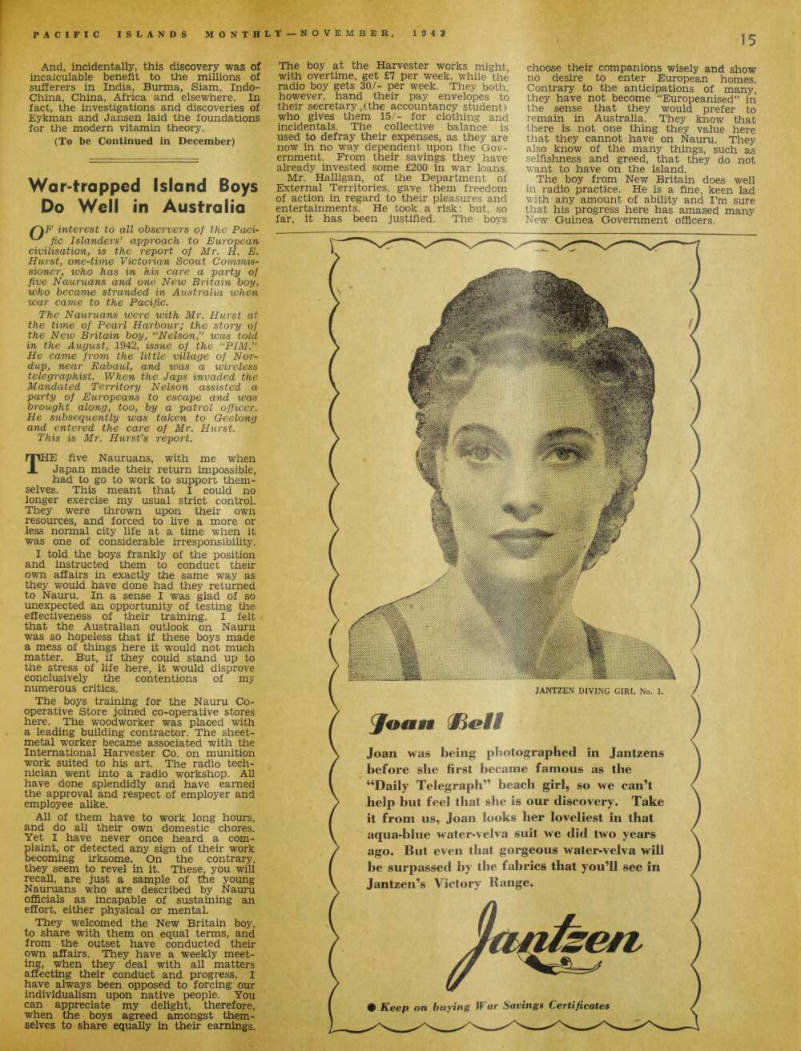
Nei
Guidance for Pacific Administrations
First of a Series of Three Articles written for “PIM” by Wolfe Preger, IT is a commonplace, almost, to point to the Netherlands East Indies as an example of wise, colonial adminis tration. And, in these days, when the Four Freedoms of the Atlantic Charter are acclaimed as a momentous innovation, it might be of some interest to glance briefly at a system of government in which the Four Freedoms have flourished for a century and longer—that of the Netherlands East Indies.
It might also be enlightening to take a quick look at the men who applied it— the Dutch. It is hardly an exaggeration to say that no nation in the world has a history in which these freedoms have been fostered and maintained for so long and so consistently as that of the Netherlands.
Spanish and Portugese Jews found freedom from religious persecution in Holland, where oppressed French Pro testants also found asylum. At a time when English non-conformists were being pilloried, branded and tortured. Scottish Presbyterian, Italian Catholic and Dutch Calvinist and Jew sat side by side in free dom and security listening to the lectures of eminent European scholars in the Colleges of the University of Leiden, itself a monument erected by William of Orange, the Father of the nation, as a tribute to the burghers’ victorious fight for freedom against the Spanish invader.
That same University was later to train the men who were to become the administrators of the Netherlands East Indies.
Freedom of conscience and free speech have been two of the four cardinal free doms enjoyed, fostered and maintained by the people of Holland, for centuries.
These same freedoms the Dutch intro duced to the many millions in the Nether lands East Indies.
Whether or not these freedoms were maintained in their country rested en tirely with the Dutch people themselves.
That they were maintained, thanks are due to them alone. The other two free doms, freedom from want and freedom from fear, were dependent on factors not always within the control of the people.
There was little cause for fear in Holland between the fall of Napoleon and the rise of Hitler. When disturbance did take place, the challenge was accepted.
The first to accept the challenge in the Pacific was the Queen of Holland, who declared war on Japan eight hours before
the USA and 12 hours before Great Britain.
The men who applied the system of administration in the Netherlands East Indies were men, therefore, who assumed their responsibilities dominated by an age-old tradition, a love of freedom which Involves respect for the other man’s liberty. These men also brought to their jobs a scientific outlook and a spirit of enterprise which produced in the Indies that peace and prosperity which stamped the administration as being one of the most, if not the most, enlightened and progressive in the world.
Administration
AT the head of the administration stands the Governor-General, who represents the Crown, and who is charged with executive powers, powers of legislation and jurisdiction.
To get a clear idea of what this means, in more familiar terms, one must imagine Canberra sending a man to London whose minimum qualifications are that he is an Australian over 30 years of age. He, with a secretariat, a Council and staff of Civil Servants, and subject to the opposition of a People’s Council, has to administer, from London, the following areas—Great Britain and the Irish Free State, Norway, Denmark, Holland, Belgium, Luxem bourg, Switzerland, Italy, Greece, the Aegean Isles, Cyprus, Malta, Spain, Por tugal, and a big slice of the African Gold Coast.
The pqpulation of these areas is more than double that of the Netherlands East
Indies; but, territorially, these countries represent the actual land areas governed by the NEI administration.
Yet even this picture is inadequate, for it contains no more than about 10 dif ferent linquistic groups, almost all with a codified common law based on Roman law, and all of the same fundamental religious conviction, and with similar social institutions and traditions.
In the Netherlands East Indies there are something like 137 different tribes and ethnic groups, varying in type and language, with different uncodified customary law, and at vastly different levels of social development. In addition, there is a perplexing multiplicity of cul tural traits, traditions, ideals and aspirations and every form of worship in the world from primitive animism, to Hinduism, Buddhism. Islamism and Christianity, with its multitudinous sectarian diversity.
Considering the nature of the task, it
says a great deal for the character of the administration that religious conflicts are unknown in the Netherlands East Indies.
Low Death Rate
Even more creditable is the success attained in some of the other spheres of administration concerned with hygiene, land policy, agriculture, finance, education, labour, commerce, in dustry and law.
The hygienic and medical means em ployed in Holland to bring the death rate down to the lowest in Europe, if not in the world —8.7 per thousand compared to 12.3 in the United Kingdom, 10.7 in the USA and 9.6 in Australia—were also applied in NET There, too, the death rate is the lowest among all the Indonesian peoples of the Far East, being 20 per thousand. This compares favourably with 32 per thousand in the Straits Settlements, 30 per thou sand in British India and 23 per thousand in the Philippines.
How Population Grew
PROOF of hygienic care, education, and adequate feeding of the population, is seen in the vital statistics.
At the end of the Napoleonic wars the population of Java and Madura was less than 4J million. At the time of the Japanese inyasion it had increased to some 48 million. The official figures are as follows:
England, in 1815, had a population about double that of Java and Madura; but in 1930 had barely reached the 40 million mark. Naturally, Indonesians are a more prolific race than Europeans. But that
very quality increases the dangers of epidemics in a tropical country, among people hardly as educated as the English in matters of hygiene.
Vaccination was introduced years ago and, in 1940, 2,114,498 people were vac cinated against smallpox and 6,609,691 were re-vaccinated.
The most dreadful of all Asiatic dis eases, the plague, which used to take terrible toll of the population, was rendered relatively harmless, until Jap anese neglect caused a resurgence of it this year (.1943). Deaths from plague were as high as 23,239 in 1934. This figure was reduced gradually thus: 1938, 2,083; 1939, 1,541; 1940, 396.
Medical Care
SUCH success was achieved only by constant vigilance. A large staff of doctors was maintained by the Government, who also employed a con siderable corps of nurses, vaccinators, analysts, field workers, lecturers, in spectors and other types of assistants, European, Indonesian and Chinese. Most important of all are the measures taken to Inculcate hygienic habits into the population.
The directing genius of this phase of the administration’s work was Dr. John Lee Hydrick, an American, who joined the Government’s Health Service, and built up an organisation which reached into the remotest parts of Java. Together witn the Government Health Service, he evolved a method of education in hygiene adapted to the peculiar character of Indonesian mentality.
This work, begun in close co-operation with the Public Health Service, has since been taken over completely by it. Ex perimental centres, laboratories and col lating bureaus were established. Field units, working with motion pictures, coloured reproductions and models, and a staff of lecturers, toured town, village and hamlet, talking, explaining, illustrating and demonstrating. In this way, en lightenment was brought to parents, cmldren and village eiders. Periodical inspections were held of homes, schools, food markets and restaurants and per sonal, domestic and public cleanliness inculcated into the people. Findings were recorded and collated and the indications acted upon.
The results of all these activities are revealed in the vital statistics.
War Against Plagues
rpHANKS to the discovery of van A Loghem, a Dutch doctor, one of the principal contributory reasons for the incidence of plague was discovered — the hollow, bamboo poles of which native houses are built, and in which the disease carriers, rats and their colonies of lice, made their nests.
Drastic measures were taken. Houses harbouring rats were destroyed. The Government built over one million new, hygienic houses in the plague centres and, since 1911, 1,619,035 houses have been re built and improved. It also contributed 75 per cent, of the capital needed by different municipalities for the erection of improved homes. The municipalities contributed the remaining 25 per cent.
To these preventive measures another Dutch scientist. Dr. Otten, contributed a therapeutic measure in discovering and employing living plague vaccines.
That other dread disease, Beri-Beri, at one time also ravaged the population.
Other Dutchmen, Eykman and Jansen, discovered the cause—a shortage of vitamin in the food of the people, primarily due to the consumption of polished rice. Here, too, educative steps taken by the Government’s Health Ser vice counteracted the evil.
Java And Madura
Population 1815 (rough estimate) 4,499 250 1880 19,540^813 1890 23,609,312 1&, ° 0 28,386,121 1905 29,924,558 , 1920 34,433,476 1930 40,890,244 1942 (estimated) 48,000,000
And, incidentally, this discovery was of incalculable benefit to the millions of sufferers in India, Burma, Siam, Indo china, China, Africa and elsewhere. In fact, the investigations and discoveries of Eykman and Jansen laid the foundations for the modern vitamin theory. (To be Continued in December)
Advertisements & other items, pp. 17-18 (1 item)
Burns Philp
PACIFIC ISLANDS SOCIETY
Visitors from the Islands to Sydney (or those interested in Islands affairs), are advised to communicate with the honorary secretary of the above Society, which has been formed to study the history, traditions, economics, and political developments of the Pacific Islands.
Regular monthly meetings are held at History House, 8 Young Street, Sydney.
Address for Correspondence:
THE PACIFIC ISLANDS SOCIETY,
Box 2434 MM., G.P.0., Sydney.
BURNS PHILP
(SOUTH SEA) CO. LTD.
Inc. in Fiji Island Traders and Shipowners Registered Office:
S UVA
FIJI
Also Branches at: \Fiji: Levuka, Lautoka, Labasa, Ba, Sigatoka, Rotuma.
Tonga: Nukualofa, Haapai, Vavau.
Samoa: Apia, Pago Pago (American Samoa).
Solomons: Makambo, Gizo, Faisi.
New Hebrides: Vila.
Code Address: Gilberts; Tarawa.
"Bumsouth". Norfolk Is. Niue. Wallis Is. Futuna Is.
Sole Australian Concessionaires :
GEORGE BROWN & CO. PTY.
267 Clarence Street/ Sydney.
As the Ultimate factory is engaged in vital war production, the supply of Ultimate Commercial Receivers cannot be maintained at present.
SERVICE: Ultimate owners are assured of continuity of service. Our Laboratory is situated at 267 Clarence Street, Sydney.
Servicing of all kinds of radio sets or amplifiers, as well as Rola Speakers, is also undertaken at our laboratories.
CUBITS
anr cm
Distilleries at London . . , England Toronto . . . Canada Moorabbin . . Victoria Cincinnati . . . U.S.A.
W. H. GROVE & SONS
Limited
AUCKLAND
Island Traders. p.o. Box 490.
Telegraphic and Cable Address: “Grove”, Auckland.
Shippers of oil classes of New Zealand products.
Representing English Manufacturers throughout the Cook and Society Islands, Fiji, Tonga, Samoa, Niue, New Caledonia, New Guinea, etc.
In FIJI os—W. H. Grove fir Sons (Fiji) Ltd.
War-trapped Island Boys
Do Well in Australia
F interest to all observers of the Pacific Islanders ’ approach to European civilisation, is the report of Mr. H. E.
Hurst, one-time Victorian Scout Commis sioner, who has in his care a party of five Nauruans and one New Britain boy, who became stranded in Australia when war came to the Pacific.
The Nauruans were with Mr. Hurst at the time of Pearl Harbour; the story of the New Britain boy, “Nelsonwas told in the August, 1942, issue of the I ‘PIM.”
He came from the little village of Nor dup, near Rabaul, and was a wireless telegraphist. When the Japs invaded the Mandated Territory Nelson assisted a party of Europeans to escape and was brought along, too, by a patrol officer.
He subsequently was taken to Geelong and entered the care of Mr. Hurst.
This is Mr. Hurst’s report. rpHE five Nauruans, with me when X. Japan made their return impossible, had to go to work to support them selves. This meant that I could no longer exercise my usual strict control.
They were thrown upon their own resources, and forced to live a more or less normal city life at a time when it was one of considerable irresponsibility.
I told the boys frankly of the position and instructed them to conduct their own affairs in exactly the same way as they would have done had they returned to Nauru. In a sense I was glad of so unexpected an opportunity of testing the effectiveness of their training. I felt that the Australian outlook on Nauru was so hopeless that if these boys made a mess of things here it would not much matter. But, if they could stand up to the stress of life here, it would disprove conclusively the contentions of my numerous critics.
The boys training for the Nauru Co operative Store joined co-operative stores here. The woodworker was placed with a leading building contractor. The sheet metal worker became associated with the International Harvester Co. on munition work suited to his art. The radio tech nician went into a radio workshop. All have done splendidly and have earned the approval and respect of employer and employee alike.
All of them have to work long hours, and do all their own domestic chores.
Yet I have never once heard a com plaint, or detected any sign of their work becoming irksome. On the contrary, they seem to revel in it. These, you will recall, are just a sample of the young Nauruans who are described by Nauru officials as incapable of sustaining an effort, either physical or mental.
They welcomed the New Britain boy, to share with them on equal terms, and from the outset have conducted their own affairs. They have a weekly meet ing, when they deal with all matters affecting their conduct and progress. I have always been opposed to forcing our individualism upon native people. You can appreciate my delight, therefore, when the boys agreed amongst them selves to share equally in their earnings.
The boy at the Harvester works might, with overtime, get £7 per week, while the radio boy gets 30/- per week. They both. however, hand their pay envelopes to their secretary .(the accountancy student) who gives them 15/- for clothing and incidentals. The collective balance is used to defray their expenses, as they are now in no way dependent upon the Government. From their savings they have already invested some £2OO in war loans.
Mr. Halligan, of the Department of External Territories, gave them freedom of action in regard to their pleasures and entertainments. He took a risk: but, so far, it has been justified. The boys
choose their companions wisely and show no desire to enter European homes.
Contrary to the anticipations of many, they have not become “Europeanised” in the sense that they would prefer to remain in Australia. They know that there is not one thing they value here that they cannot have on Nauru. They also know of the many things, such as selfishness and greed, that they do not want to have on the island.
The boy from New Britain does well in radio practice. He is a fine, keen lad with any amount of ability and I’m sure that his progress here has amazed many New Guinea Government officers.
Advertisements & other items, p. 19 (1 item)
Joan ffieti
JANTZEN DIVING GIRL No. 1.
Joan was being photographed in Janlzens before she first became famous as the “Daily Telegraph” beach girl, so we can’t help but feel that she is our discovery. Take it from us, Joan looks her loveliest in that aqua-blue water-velva suit we did two years ago. But even that gorgeous water-velva will be surpassed by the fabrics that you’ll see in Jantzen’s Victory Range. • Keep on buying War Savings Certificates
Future of the Pacific
Races
A Reply by Rev. J. W. Burton MY sole purpose in writing the pam phlet, "The Atlantic Charter and the Pacific Races” was to arouse wider interest and to promote healthy discussion, for I am not presumptuous enough to imagine for a moment that I can offer a solution to so vast and com plicated a problem.
I was glad, therefore, to read the criti cism by "P.D.” in the last issue of the "PIM,” and I have much in common with him. Possibly, if we could have a quiet yarn, we should find that we were in substantial agreement on principles, if not on details.
"P.D.” thinks that I am unfair to "commercialism.” It is all, I suppose, a matter of emphasis, based upon individual experience. If I appear to have over stressed the “rapacious” side (of which there is such glaring evidence) and have under-stated the "benign” side, then I am sorry.
There is one qualification, however, that "P.D.” seems to have overlooked: I spe cifically referred to the past, and I should be glad of a list of gentler adjectives to describe accurately the old land-grabs, the "exploiting” companies, and the Indian indenture system in Fiji, with which I lived side-by-side for nine years.
I recognised that there is a better spirit to-day; but there is still a long way to go before the native has elemental human rights and chivalrous treatment.
"P.D.” asks whether I wish to restrict the care of the natives to Government officials and missionaries.
I am sorry if I was not clear. Perhaps I may repeat my words: “There must be a policy of gradualness, and there will be needed the co-operation of Governments, missions, educationalists, anthropologists,
and the best elements of the commercial world.”
I do not think that “P.D.’s” imposed alternatives of a “native reserve” and our “complicated civilisation” exhaust the possibilities. There is, I think, something between—protection and education until the native is able to stand up against our Western economic system.
IAM in complete accord with “P.D.” that missions should not mix Chris tianity with business. I cannot speak for others, but the mission of which I am the executive officer does not allow its missionaries to engage in trade.
It is true that we own two small plan tations (one of which was purchased for the express purpose of providing addi tional garden land and of training our students in modern agriculture); but from neither does the mission derive any general profit—all profits the native church and are used for educational and welfare purposes.
I also agree with “P.D.” that it is a tragedy that there is any rivalry among Christian denominations, either here or in the Pacific; but how are we to over come it? I wish I knew.
IN reference to the editor’s comment regarding the increases in population in the South Pacific, it may be signi ficant —though I am not sure to what extent—that the larger increases are precisely in those areas where the inden ture system does not exist; but there are several districts in the North-west Paci fic where the evidence seems conclusive that the indenture system, mainly through over-recruiting, has been a cause of depopulation.
However, I am in hearty agreement with the editor’s statement that this is not a matter for acrimonious debate. On the contrary, men of goodwill and dis interested motive should get together and try to think through the problems that
affect the native races of the Pacific— and us.
In the main, it will be agreed that, as Australian citizens, we should fulfil our solemn pledge, and that the welfare of the native races should be paramount in their own countries. Given this spirit and this priority, lam confident that we shall reach, at length, satisfactory
conclusions.-
J. W. Burton.
Dr. Noel Mckenna Is
Killed
ANOTHER well-known New Guinea personality has been added to the toll of World War ll—Major Noel Vernon McKenna, better-known as Doctor McKenna, medical officer in charge of Wau Hospital. He was killed accidentally in New Guinea on September 30. His wife and daughter Patricia were evacuated from the Territory in January, 1942, and are living in Adelaide.
Dr. McKenna graduated at Melbourne University in 1924, and went to England, where he took a degree in tropical medicine. He filled an important position in Singapore for three years. In 1934 he returned to Australia, and then went to New Guinea as a medical officer. When Japan attacked, he joined the NGVR, and later was attached to ANGAU as a medical officer. He was serving with this unit when he was killed.
The Rev. R. W. Allardice, and Mrs.
Allardice, of the Methodist Mission, were recently farewelled in Melbourne, prior to their departure for Western Samoa.
The Methodist Missionary Board’s reso lution congratulating the Queen of Tonga on the 25th year of her reign, has been illuminated, made into book form, and presented to her by the President of the Tonga Conference, Rev. R. C. G. Page.
Advertisements & other items, p. 20 (1 item)
89 Years
% 3T«
it s t) I* %
S WILLOWs JLRIILL in
* ■areis «r iiseiiTs lacs • CUES • TIT SB E I • ICE CIEIB (\(.u Hk '< >vv_^yjvi Wt v<.it
Anthropology In
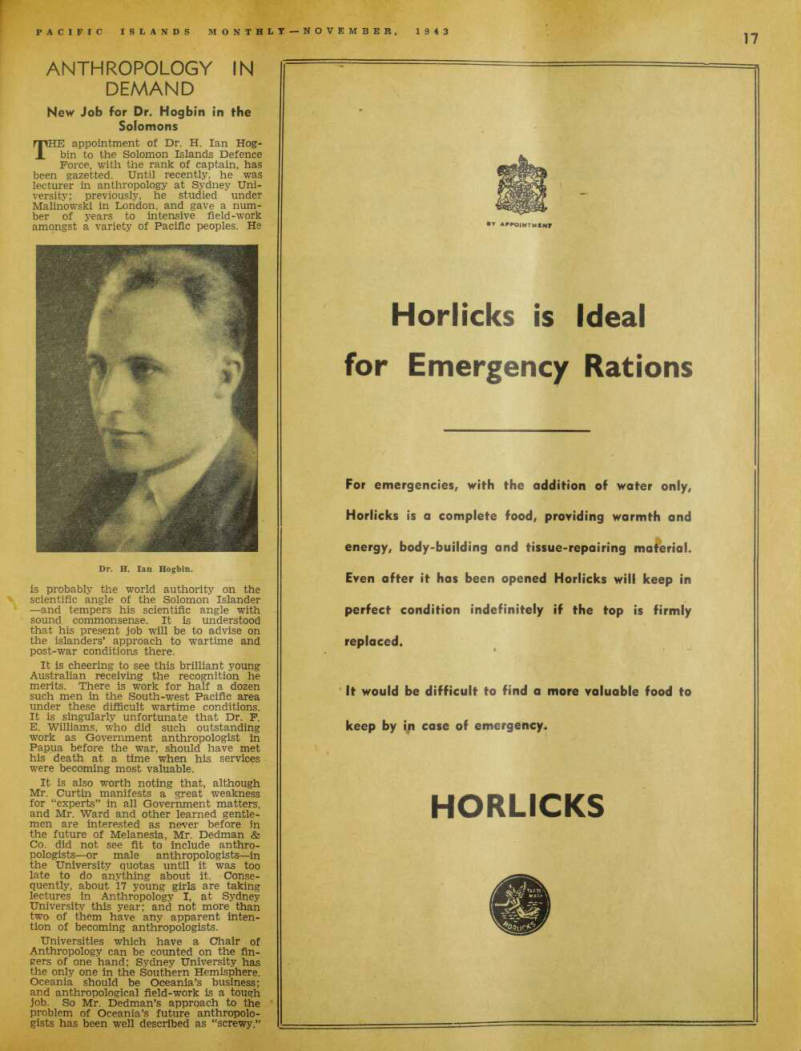
Demand
New Job for Dr. Hogbin in the Solomons
THE appointment of Dr. H. lan Hog bin to the Solomon Islands Defence Force, with the rank of captain, has been gazetted. Until recently, he was lecturer in anthropology at Sydney Uni versity; previously, he studied under Malinowski in London, and gave a num ber of years to intensive field-work amongst a variety of Pacific peoples. He
is probably the world authority on the scientific angle of the Solomon Islander —and tempers his scientific angle with sound commonsense. It is understood that his present job will be to advise on the islanders’ approach to wartime and post-war conditions there.
It is cheering to see this brilliant young Australian receiving the recognition he merits. There is work for half a dozen such men in the South-west Pacific area under these difficult wartime conditions.
It is singularly unfortunate that Dr. F.
E. Williams, who did such outstanding work as Government anthropologist in Papua before the war, should have met his death at a time when his services were becoming most valuable.
It is also worth noting that, although Mr. Curtin manifests a great weakness for “experts” in all Government matters, and Mr. Ward and other learned gentle men are interested as never before in the future of Melanesia, Mr. Dedman & Co. did not see fit to include anthro pologists—or male anthropologists—in the University quotas until it was too late to do anything about it. Conse quently, about 17 young girls are taking lectures in Anthropology I, at Sydney University this year; and not more than two of them have any apparent inten tion of becoming anthropologists.
Universities which have a Chair of Anthropology can be counted on the fin gers of one hand; Sydney University has the only one in the Southern Hemisphere.
Oceania should be Oceania’s business; and anthropological field-work is a tough job. So Mr. Dedman’s approach to the problem of Oceania’s future anthropolo gists has been well described as “screwy.”
Dr. H. lan Hogbin.
Advertisements & other items, pp. 21-22 (1 item)
Horlicks
■r appointment
Horlicks is Ideal
for Emergency Rations
For emergencies, with the addition of water only, Horlicks is a complete food, providing warmth and energy, body-building and tissue-repairing material.
Even after it has been opened Horlicks will keep in perfect condition indefinitely if the top is firmly replaced.
It would be difficult to find a more valuable food to keep by in case of emergency.
HORLICKS
Modern Refrigeration for the South Sea Islands
The ELECTROLUX
KEROSENE OPERATED
REFRIGERATOR
MARVEL
OF
MODERN
SCIENCE
THE
MIRACLE
OF
ICE
FROM
HEAT
ELECTROLUX OFFERS ECONOMICAL, modern and completely efficient
REFRIGERATION FOR ISLANDS' HOMES.
FREEZES CONTINUOUSLY WHILE SMALL LAMP BURNS.
Freezing controlled by simply regulating height of flame. Uses only f gallon of kerosene per week.
MOTORLESS ... NO PARTS TO GET OUT OF ORDER.
MODEL
Capacity 2.2 cubic feet.
MODEL L3BO
(as illustrated) Capacity 4 cubic feet.
MODEL LKSSO
Capacity 5.5 cubic feet.
GUARANTEED FOR TWO YEARS.
• Write to your Local Distributor for prices and full details.
OBTAINABLE FROM ALL W. R. CARPENTER & CO. LTD.
BRANCHES THROUGHOUT THE ISLANDS
Representation in Papua and New Hebrides.
Restless Fijians
Bad Result of the War
ONE of the most serious aspects of wartime conditions in Fiji has been the drift of Fijians to Suva, where a large number are spending their time idly, and relying on relatives for food and lodging.
One of the first jobs undertaken by the newly-appointed Adviser on Native Af fairs, Ratu J. L. V. Sukuna, was to issue instructions to the following Fijians to leave the town and return to their villages:— (a) Young men and women who are un employed or who do not remain in constant employment. (b) Women employed by the military. (c) Old men and women who have come to Suva since the outbreak of the war. (d) Any other persons whom the Adviser on Native Affairs considers it desirable to evacuate.
In addition, it is intended to evacuate from Suva all wives and families of Fijian servicemen serving overseas, unless there is a good reason for their staying.
At present there is serious overcrowding in native homes in the town, caused mainly by young men and women whose proper place is in their villages, where they would be guided by their chiefs and parents according to the customs of their people.
The best advice ever given to the Fijians, says the “Fiji Times,” was when the Governor, Sir Philip Mitchell, told the Council of Chiefs to stay in their villages, look after their people, and encourage production.
This advice does not seem to have been followed, either by the Fijians or by the Fijian Government, and to-day most villages are denuded of men and most of the chiefs are in uniform. There have been many cases of hooliganism and, what is more serious, assault upon civilians.
Many European residents are of the opinion that many of the young uni formed natives, who are apparently getting out of hand, should be sent back to their villages.
In Kunimaipa's Hills
HERE is a lonely pine: •I pass from sign to sign In Kunimaipa’s hills, Treading a path that thrills; Down . . . down . . . down.
With never a sigh or frown, The air, the earth, the trees Laugh—and the breeze, the breeze With scented breath surrounds me.
Thus I walk securely And find at Sunset’s shrine — A tired man’s anodyne.
Here, then, a place to lie Under a friendly sky, On Kunimaipa’s floor, Lighted by stars galore.
Keep . . . keep . . . keep The silence that comes with sleep; For memories of the day Speak, and the words they say Delay me by the fire— “We are your soul’s desire: Go not to dreamless bed.
Not while the fire is red.”
Throb . . . throb . . . throb: The passion of drummers rob The velvet starry night Far from the camp-fire’s light.
The startled air is waiting With anxious heart debating; And reverie succumbs To boom! boom-boom! of drums.
Richard Humphries.
Papua.
Death Of Mdlle. Julie
Leprado
ONE of Papeete’s well-known personali ties, Mademoiselle Julie Leprado, who has been a recorder in the Hall of Justice for almost 30 years, passed away after an operation on September 30.
She was the daughter of a French mariner who landed in Tahiti in the days of sail and was educated at the Sisters School in Papeete. It was said of her that she knew the records of every birth, death and marriage in Tahiti by heart, and that lawyers often went to her before they began a case involving such records.
Many friends attended her funeral, at which M. Gerard, Chef de ITmprimerie, of the Government, paid warm tribute to her worth.
When the Japanese invaded New Britain, there were there two brothers named Geldard—N. Geldard, of the Bainings, who eventually escaped, and Garth Geldard, of Rabaul, who is miss in S* He wa ? last seen in the company of Mr - R- Brain and Mr, W. G. Spensley.
Mr - Spensley is believed to be safe, but nothing has been heard of either Brain or Geldard. If anyone has later infor nation of Garth Geldard he would be doin S a favour if he would write to the young man’s mother—Mrs. E. P. Brown, 44 Mark Street, New Farm, Brisbane, Pilot-Officer Norman R. Frazer, form erly of Wau. TNG, has been reported missing on air. operations over Germany on August 30, 1943. He is the son of Lieutenant-Engineer T. N. Frazer, also formerly of Wau, who is at present serv ing on a minesweeper.
Mr. Morris Hedstrom, third son of Sir Maynard Hedstrom, of Suva, Fiji, was married in Suva on August 21. His bride was Miss Mary Catherine Gordon, of Wellington, New Zealand. The Rev.
C. Whonsbon-Aston performed the cere mony, and a reception was given by Mr. and Mrs. John Chapman in the grounds of the CSR Officers’ Club Rooms.
Advertisements & other items, pp. 23-24 (1 item)
Carlton
BREWED BY
UNITED BREWERIES LTD.
ISLANDS
SOUVENIRS
Popular Islands Shell Necklaces and Hula Skirts posted direct to any part of the world.
Special sample parcel for £1
containing:
1 Genuine Manihiki Skirt; and 12 Assorted Island Necklaces.
Send your Money Order direct to
D. C. BROWN
MERCHANT AND EXPORTER
OF ISLANDS PRODUCE.
P.O. Box 16, Rarotonga, Cook Islands.
LARGE QUANTITIES AVAILABLE
—WHOLESALE INQUIRIES INVITED.
BUY DIRECT AND SAVE MONEY
PRODUCING UNIFORM GOOD RESULTS SINCE 1868
Floor
ALWAYS ASK FOR IT
Qualite par Excellence.
J A N
VOK Liqueurs
New Hebrides and New Caledonia: Fiji & Tonga: •
TRADE
ENQUIRIES TO:
DISTRIBUTING AGENTS ...
MAURICE PELLETIER, 16 BRIDGE STREET, SYDNEY.
NORTHERN HOTELS LTD., LAUTOKA & BA, FIJI.
J. C. MERRILLEES & CO.
ISLAND MERCHANTS
Challi*s House, Martin Place, Sydney
Bankers: Bank of New South Wales.
A Hymn Of Hens And Cucumbers
Australian Poultry Men and American Gardeners Are Again Discovering New Guinea
By Judy Tudor
rRRITORIANS can stand a lot— which is as well, because they have had a lot to take. But this con stant re-discovery of their country by military wallahs and tame news-hounds makes them, one and all, fighting mad.
A particularly virulent dislike—com parable only to the pre-war “first-white woman-to-do-something” hate—is for the assortment of captains, warrant-officers, pilot-officers and plain privates who are growing vegetables in, or introducing poultry into, a land that was supposed to have been previously sans vegetables and sans poultry.
Never a week passes that we are not entertained by accounts of new Army farms or gardens in the New Guinea area —all of them large, successful, arid the first of their kind.
Now “Smith’s Weekly”—which should know better—runs to column length to describe the doings of a pilot-officer and a warrant-officer who have gone into the egg business “somewhere in New Guinea.”
Territorians will be pleased to know that the whole thing is a wow—and that the hens are laying fine: hitherto there have been some doubts whether hens could be made to lay in New Guinea.
Maybe the Army had its doubts—no Territorian ever did. There are, of course, more ways than one of making hens lay—if one is really desperate about the business. For example, once in a village outside Rabaul I saw a boy on a wobbling bike run over a straying hen— and it laid an egg. And there are other methods—some a little more natural.
AFTER a year in an entirely eggless world, back of Wewak, we brought back from South eight Black Orp hington hens and what the boys called a “boss-boy.” It took three weeks by two ships, Melbourne to Boram; one night by schooner, Boram to But; and four days per boot to lug the two heavy crates that held the birds over the mountains to the Ulahau River.
It took further weeks for the hens to recover from their travels but when they did become acclimatised they showed no temperamental coyness about laying.
They produced big, pale brown eggs, almost too precious to eat—which for the first few weeks were, in fact, not eaten without due ceremony and until they had been gloated over, crooned about and then cracked with prideful care into a basin. Those who have also lived in an eggless world will know what I mean.
SOME time went by; and then, to our consternation, the biggest, blackest and best hen disappeared as cleanly as a puff of smoke in a gale of wind.
We, following the usual line of reason ing, lined the boys and accused them of “pinching” it. But this they denied, even more enthusiastically than usual.
It was a snake, they said; this clearly was the “fashion belong snake,” and we were given to understand that they had been expecting something of the sort.
“Snake be jiggered,” we said, in effect.
“No snake has yet been hatched that is large enough to eat a hen that size.
Come again!”
Whereupon the cook-boy said that these snakes savvied plenty, and gave a demon stration of how one would dislocate its jaw to accommodate the fowl—a fascinat ing exhibition that we had to call off in case he did himself some permanent injury.
We listened, but believed not. Then we took every precaution, and bided.
Boys or snake? Snake or boys? To the devil with gold for the time being. Eggs were more precious than gold nuggets.
AT last, the climax: in the dead of night came a commotion from the house-cockeroo. It was on!
We gathered up a hurricane lantern, a torch and a couple of guns, sneaked through the garden and down the hill to the fowl-yard, prepared to battle to the death. Cautiously, we opened the door of the house, expecting anything from a “tamberan” to a tornado to slap us in the face.
The boys were right! There were yards of snake still coming through a hole'near the roof, while the hens had gone back to their slumbers on the perches. The guns went off with a deafening roar in that small house —the ‘concussion blew out the lantern, the hens woke up, squarking as though dying by inches, and the “boss-boy,” his tail feathers dragging, flew out between my knees and into the night.
I dropped the torch; and all was cursing and confusion, coils of dying snake and frenzied hens.
When light was restored we dragged the snake outside with the help of a long-handled shovel: 12 feet of as pretty a piece of nastiness as ever festooned a drunken dream.
That is all by the way, to prove that fowls reached New Guinea before the Army. Nothing has been heard, as yet, of the Army-farmers’ snake-troubles; but they will have them. Snakes and poultry are synonymous in New Guinea.
THUS concludes “Smiths”: “Thus, besides opening up New Guinea with roads, Army is laying the foun dations of a new peacetime agricultural and stock industry there. Result of the 69-acre vegetable garden established there by Army was so encouraging that the garden has been increased to 120 acres, from which Army is getting not only fresh vegetables, but a large amount of corn.”
There were about 6,000 Europeans in Papua and New Guftiea before the war; something-nothing compared with the few hundred thousand other people who have just discovered it, and are finding it extremely hard to stop discovering it.
The darned place was practically virgin territory. If those 6,000 pre-blitz Euro peans did occasionally grow a lettuce or induce a hen to lay an egg—well, what the hell!
ANOTHER sad sob-story is told in “Yank” (the American Service man’s weekly magazine, published in the SW Pacific area), of a battle against bully beef, dehydrated chow and dog biscuits. The battle now is won. and the news can be released for publica tion;— Beyond New Guinea’s Owen Stanleys, a farm complete with hens, water-melons, radishes and whatnot, has sprung into being, and “US soldiers are wresting thousands of pounds of produce from soil that hitherto grew nothing but kunai grass.” Yip-e-e!
The desire for an American Army-farm grew from the need for fresh food for convalescent soldiers, and the lack of shipping space for refrigerated goods from Australia. So the Americans called in a captain who was a former agricul tural research worker in the Philippines, to investigate the possibilities of vege table growing in New Guinea: and two soldiers who had had experience at “truck” farminsr in California, to make experiments. The experiments presum ably were encouraging, so they collected 15 natives, two tractors, two ploughs, two harrows, and one tandem disc “earth clod breaker,” and they went to work.
Now they are producing: 650 lb. of spin ach a week, 6,000 lb. of com every 40 days, a ton of cucumbers and a ton of
tomatoes every 90 days, 1,500 lb. of pota toes every 45 days, 500 water-melons every 60 days, and enough radishes and carrots every three weeks to distribute among all units, of the base.
Lettuce, cabbage and lemons “are a few of the things that would not grow.” Why, many an old Territorian will want to know. Lettuce grows well in New Guinea —especially the “mignonette” variety; every miner in northern New Guinea, at altitudes of not over 1,500 feet, had his cabbage patch; and every native village owns a “moulie” tree.
The US Army farmers might also try French beans, pumpkins, spring onions and the unsung, dual-purpose kohlrabi.
Kohl rabi has a top that can be eaten like spinach, and a bulb growing above ground resembling white turnip, but with
a mild cabbage flavour. It flourishes in climates as different as those of southern New Zealand and northern New Guinea.
The Yanks have also imported 224 fowls from Australia and intend to increase the number to 10,000 if they pro duce well. Ten thousand is a lot of fowls in any man’s language, and it is doubtful if Papua and New Guinea, combined, could provide sufficient snakes to cope with a poultry-farm on that mass-producing scale. The farmers’ am bition is that some day soon every guy in New Guinea may sit down to a chicken dinner with all the fixings. So mote it be!
If they want to know more about hens in the tropics they could look up the
(Continued on Page 28)
records of Jacobson’s poultry farm at Lae. The “PIM” editor photographed a vast array of Wyandottes there in 1939, AND so the work of re-discovery con tinues. We admire the Americans and their methods—particularly the two tractors, the ploughs, harrows and the one tandem disc earth-clod breaker.
A few months ago, we were tickled to think that the Australian Army-farmers had introduced wasps into Papua to kill vegetable bugs; and a few months before that, to know that the Commonwealth Director of Agriculture was on his way to Papua to inspect vegetable and paw paw growing areas and that special paw paw seeds were being sent to that Ter ritory from Queensland.
The necessity of war is the great grandmother of all invention; and, with
out a doubt, catering for the troops in New Guinea to-day is a slightly larger problem than catering for the compara tively few pre-Pacific-war Europeans; but few of these publicised products are new to the Territories.
There were poultry farms at Wau, and Rabaul, and in the Markham Valley, and dozens of self-supporting plantations and countless thousands of paw-paw trees (not imported from Queensland) and most miners, after they were settled for a time, had their own gardens and a few hens. The only difference between then, and now, is that now New Guinea’s paw paws, wasps, gardens, natives, and crea tures of the land, and the sky above it and the sea around it, are red-hot news, calculated to build up the Australian public’s knowledge of these territories to the north, so that the public may, in due course, indulge in a lot of nit-witted theories concerning the future of the Territories and their inhabitants.
THESE be stirring times. And “when this long cruel war is over” (in the words of Scarlett O’Hara) and the tide of bloodshed and battle has receded from the land of the Fuzzy-Wuzzies, and the “new order” has come upon us like a rash, overnight, and there is “no exploitation” in the Pacific territories, we may expect to find each New Guinea native still tilling his taro patch, but now —having forsaken his bush knife and
digging stick—equipped with a rotary hoe, a harrow and an earth-clod breaker. And his Mary, no longer transporting his pig and her piccaninny, and half a hun dredweight of yams and two hundred weights of firewood and the family hound, in a series of bilums suspended from her head—but driving in a Jeep like a lady.
Progress is wonderful—and it’s an awfully poor war that doesn’t get some one somewhere.
Advertisements & other items, pp. 25-26 (1 item)
ADD VARIETY Yto your
1
HOT-WEATHER MEALS
Typical of the tasty, tempting, quick-serve foods offered by “Imperial” is “Meatreat.” This canned corned beef is prepared by the special “Imperial” process which seals in all the natural flavour, colour and rich nourishing juices of the meat. Served with salads, “Meatreat” makes an ideal hot-day dish.
Other “Imperial” products which will help you add variety to your hot-weather meals are : "Imperial" Camp Pie.
"Imperial" Beef & Pork Sausages "Imperial" Sheep's Tongues.
"Imperial" Hampe — the meal-in-a-moment.
Every one of these “Imperial ” products offers you the delightful flavour of fresh meats at their very "best. Ask for them to-day.
PRODUCTS OF
RIVERSTONE MEAT CO. Em
Fiji Representatives: Pearce & Co. Ltd., Suva.
The Standard of Excellence
K A*S Uq« eurS
Van
COMPOUNDED FROM PURE FRUIT
EXTRACTS AND HIGH-CLASS
MATURED SPIRITS.
IN 15 FLAVOURS
Advocaat, Red Curacoa, White Curacoa, Parfait Amour, Maraschino, Chartreuse, Apricot Brandy, Cointreau, Cherry Brandy, Creme de Menthe, Creme de Cacao, Peach Brandy, Creme de Banana, Kummel, Friars' Liqueur.
TRADE ENQUIRIES TO BOX 3373, G.P.0., SYDNEY.
LAVEX
The Oxygened Washing Compound
% Wonderful for the Wash ... Harmless to the hands
NON-INJURIOUS TO THE FINEST FABRICS
packed in cartons containing 48 x Boz. pkts.
TRADE ENQUIRIES TO BOX 3373, G.P.0., SYDNEY.
C. SULLIVAN & CO.
GENERAL MERCHANTS ISLANDS AGENTS
REPRESENTING LEADING FIRMS IN THE PACIFIC ISLANDS.
Islands Produce sold on Shippers’ Account—Liberal Advances against Consignments.
Buyers of all Islands’ Requirements on Commission —Original Invoices Furnished.
Bankers : Bank of New South Wales .. Bank of New Zealand .. Comptoir National d’Escompte de Paris.
Wartime Cable Address: Sullivan, Kentstreet, Sydney.
379 KENT STREET, SYDNEY, N.S.W.
How Central New Guinea Was
Evacuated
Rescue by Air: And the Gallant Part Played by Father Glover
By Pastor A. J. Campbell, Seventh Day Adventist Missionary in Central New Guinea
YOUR account of the remarkable part played in the evacuation of Central New Guinea, early in 1942, by Father Glover, from data supplied by Mr. E. V. O’Brien, has been read with interest by many people.
Those were tense and uncertain days.
As there were some, as yet, unrecorded incidents, and as I was there at the time, I shall take this opportunity to tell you a few of them.
Developments in the invasion of New Guinea were ominous. Rumours of the “Broome-Brisbane Line” had already reached us in Central New Guinea, and it appeared, to some, that we were to go the way of the Philippines, Malaya, Burma, the East Indies, the Solomons and the Bismark Archipelago, with the mainland of vast New Guinea now almost enveloped. Jap parachutists had just succeeded in rapidly subduing the Cele bes, immediately to the west of us.
Then came the fall of Lae and Sala maua, and it seemed certain that the enemy would try to occupy the chain of ’dromes in the Central Highlands. The Inland, too, it was felt, would have a special attraction, because of its splendid climatic conditions, favouring convales cing and resting soldiers, and also for its great potential agricultural value in the growing of vegetables and food.
But that which was most expected did not happen. The elements interfered rather badly with the plans of the enemy at this time.
Parties of our soldiers and civilians, meantime, were finding their way, often after covering great distances, and pass ing through severe privations, to this temporary, and quite uncertain refuge among those great mountains of the Inland. The two or three radio receiv ing sets still operating served a valuable purpose, those days; but it was realised that the “latest” news could easily be a day or more late, and therefore could Drove very misleading, so far as the latest local moves of the infiltrating enemy were concerned.
FR those of us Inland, two important events occurred in the early months of 1942.
Record-breaking floods, such as the older natives had not seen or heard the like of before, caused a great flooding of all rivers in the headwaters systems of the larger rivers, such as the Markham and Ramu and others. The Japanese had advanced well up the Markham Val ley, and were working with much energy on the Nazab landing ground.
The altogether abnormal floods, which came at this time, brought a tremendous congestion of water from many raging rivers into the Markham Valley. The enemy was driven back by the mighty forces of Nature to his base at Lae. He did not drive up the Markham again for almost another two months.
Strange planes were either seen or heard, and the distant whine of enemy machines using the Markham-Ramu “trench” was almost a dailv occurrence as they came and went on their patrols.
Then came the second important hap pening, which concerned us all in the Interior so much. It was the coming on
to the stage of action of the “Flying Priest,” Father Glover.
One day the ominous sound of a plane engine was heard, and the plane was spotted, flying in toward Kainantu, over the timbered Aiyura (Government Agri cultural Station) ridge. Europeans and natives sought slit-trenches, though most natives went to a river gorge nearby.
It was soon realised that the plane was approaching too slowly to be a “Zero,” and also that it was a small biplane. Being recognised as a friendly machine, police boys were instructed to lower the wire cable that was at that time suspended across the landing field.
This cable was controlled by a miner’s windlass.
This tiny plane landed, and proved to be the only usable civil plane remain ing in the Territory, and the pilot was Father Glover, who had volunteered for a dangerous mission. He had previously had only a few hours’ flying experience, and had not till that time flown a pas senger. His Spartan plane had a 75 h.p. motor, and its ceiling was limited to 7,000 ft.—hardly the type of plane to be flying among the lofty peaks of Central New Guinea, and in the bad weather so often associated with them.
The Father then carried his first pas
senger out to Wau at very grave risk for Jap fighter patrols had the freedom of the skies in those days. (Some months later, his passenger, R. P. Brechin, when flying with another pilot, was killed in this plane, when caught in a down draught on a ridge between Bena Bena
and Ramu.) A week later, the little plane, with pilot and passenger, returned, ending an anxious time for those await ing their return.
THE Spartan had many serious limita tions —bad enough in normal times —so the “flying priest” decided to walk to Madang to see what could be done with a “Moth,” lying down there.
Karl Nagy, senior mechanic of Guinea Airways, Ltd., accompanied him on this 150-miles walk.
As was pointed out by Mr. O’Brien, this plane was in very bad order. I think it is correct to say that Karl Nagy returned by trail to Ramu, because it was necessary for Father Glover to fly in the drum of lubricating oil, which was urgently needed—though, no doubt, the mechanic felt safer on the trail than if he had been in that defective “crate.”
The Spartan was hidden in a banana plantation on the SDA Mission at Kain antu. handy to the landing field.
With much relief we saw the Moth
and its undaunted pilot arrive from Madang. This plane was also hidden, at a distance, in the same plantation, with banana trees, corn and kunai giv ing excellent campuflage.
As already told by Mr. O’Brien, the Spartan was wrecked when forced to return from an attempt to fly to Mt.
Hagen with Sister Jones. The Moth now became the sole remaining serviceable (?) plane in all that region. Karl Nagy checked up on the faltering engine again.
FATHER Glover worked on the plan, of flying the most urgent cases to Mt.
Hagen; but this had to be given up, and in due course all walked through in small parties, Mr. Dickson (of W. R.
Carpenter & Co., Madang) and others, were carried through to Mt. Hagen. He was convalescing from the terrible Jap anese river fever, or scrub typhus.
At that time, many supplies had become exhausted. After many experi ments. Mr. Cunningham succeeded in producing brown sugar from cane brought in by the natives. White com, which had been introduced but recently into the Upper Ramu, and which was grow ing very successfully, was ground and used as “semilina” by the various camps. rTHER Glover, in view of the pressing urgency of the situation, further developed his daring plan to fly the unairworthy Moth to Australia for help.
As the Spartan was now definitely out of action. Karl Nagy and others worked on the Moth again. This clever mechanic and good fellow had by this returned by road from Madang, having spent 17 days on the trail going out and returning.
The plane, with its small tank, had a very limited radius: and, in order to try and reach Australia, it was imperative that the flying range be greatly increased.
Fortunately, there was a sheet or two of
galvanised flat-iron left over after the recent completion of the European cot tage on the SDA Mission.
Each morning, Father Glover and Jack Peacock came over to the mission’s workshop, at Kainantu, where several hands joined in the task of making cer tain essential adjustments and prepara tions. One of these was the making of a new and larger petrol tank from the sheet of 26-gauge galvanised flat-iron.
This one was to act as an auxiliary to the smaller one already in the plane. J.
Peacock made a very creditable job of this tank.
A most necessary item at this juncture was a length of copper piping, to con nect the new tank with the other. It was found hanging from a nail in the store, and just the required length!
Several years before, a Guinea Airways DH 50 had crashed at Kainantu, when landing mining machinery. By arrange ment with Guinea Airways, Ltd., the SDA Mission took the plane to pieces, sending certain parts to Lae, and retain ing other parts. A pulpit and rostrum for a new church were constructed from the fluted wing timbers. A length of dented copper piping, regarded as having little possible value, was hung up in the workshop.
The march of events that came with such terrible suddenness in New Guinea, caused this piece of copper piping to fill an urgent need.
THE plane was wheeled out to the land ing-field from its hiding-place, where final tests were made by pilot and mechanic. It was not known what moment it might become the target for Jap air-gunners.
An attempt to take off for Mt. Hagen failed, and a precious drum of lubricat ing oil had to be left behind, also various equipment, even to Father Glover’s per sonal kit.
Finally, they did succeed In rising, but with a very narrow margin to spare—so narrow tnat the onlookers waited with bated breath —and they reached Hagen.
Extra petrol, it seems, was taken from Mt. Hagen, on the hop to Australia, which may account for the extra petrol that Karl Nagy “nursed” on his knees, as mentioned by Mr. O’Brien.
IT was April, and events in the South west Pacific were now rapidly reach ing forward to the Battle of the Coral Sea, with the fate of New Guinea and of Australia hanging in the balance.
Several weeks passed and it was feared that Father Glover and Karl Nagy had perished, as no word had been received of then’ whereabouts. Meanwhile, nearly 80 people had gathered at Mt. Hagen.
The Coral Sea Battle was fought and won. A day or so later, a radio message —“Coming”—was received.
The next morning, two four-engined Gypsy-motored planes fought their way in through appalling mountain weather conditions. Amid cneers and great ex citement they landed on a ’drome that had seen hardly afiy use for several months. Natives came in from every diraction to join in the excitement.
Appropriately, indeed, Father Glover was the first to step out from the first plane down. Then more familiar faces were seen, as pilots once connected with the civil air companies appeared. This gave us all further confidence in the evacuation by air.
THEY were daring men. For a week, they flew those unarmed and un escorted planes in and out between “somewhere in Australia” and Mt. Hagen.
The rarified atmosphere of the Inland made the task twice as long, and, inci dentally, twice as risky.
Jap fighter patrols were passing through Torres Straits. One DH 85 almost crashed, getting off with its first load. The ’drome was long, but soft.
More than a thousand natives were enlisted to put in a day, stamping down the landing-field. They came out be decked with plumes from birds-of-para dise, and were otherwise gaudily adorned.
Their rhythmic movements were most interesting and colourful. The ground would tremble with the fall of thousands of feet in unison, and a splendid job was done.
This firming of the surface of the ’drome gave the planes all the taking-off scope they required, and put an end to a great deal of anxiety.
The planes came in early and flew out late, to avoid any Jap patrols, so far as possible, Oi i plane, piloted by Captain Sims, was forced to rise to 17,000 ft., in ter rible weather, to gain sufficient clearance oyer the mountain tops. Bad icing con ditions caused serious interference with the controls, resulting in the plane going into a spin. It was narrowly saved from disaster.
IT transpired that when Father Glover and Karl Nagy were caught in a violent storm, south of the Fly River, when flying out to Australia, they had a very narrow escape. Turning back from the Torres Straits, they landed on the Papuan Coast. They realised, then, after measuring the petrol that was left, that they had been only a few drops of petrol from death.
By canoe, they reached Thursday Island, and later reached Australia.
Many further difficulties were encoun tered, but their mission was remarkably successful, thanks to the tenacity of Father Glover and to mechanic Nagy.
Dr. McQueen, Sister Jones, and many others did much valuable and faithful work in those very uncertain days.
Father Glover repeatedly risked his life in those tiny, fragile and groggy planes to save others. That he performed a work of outstanding merit, all who know of the cireumstances will heartily agree.
The Rev. Meli Tukai, a Fijian minis ter of the Methodist Mission in Northern Australia, is at present in Sydney on leave.
Captain Doughty, who was master of the BP schooner, “Helena,” in the Gil bert Islands, until the Japanese invasion, and who subsequently escaped to Fiji, has been doing useful work on various ships in and around the war zones dur ing the past 18 months. He was in Syd ney in September. The “Helena,’ in December, 1941, was loaded with Jap loot from the Burns Philp store in Tarawa, and towed away north by a destroyer. It is believed she was sunk in the first American raid on Butaritari.
Advertisements & other items, pp. 27-30 (1 item)
Coleman
THE
YORKSHIRE
INSURANCE
CO. LTD.
(Incorporated in England)
FIRE
ACCIDENT
MARINE
FIRE POLICIES ISSUED
IN PAPUA
All information from —
E. A. JAMES,
Tel. 86347. Attorney for Papua, 14 Spring St., Sydney.
Coleman
IS SERVING THE ARMED FORCES
WITH THREE ESSENTIALS OF
LIFE . . .
Light-Heat-Warm Food
Wherever the Armed Forces of the United Nations need quick heat and bright light you’ll find Coleman Lanterns and Stoves. On board steamers, at landing fields, in mobile canteens, emergency hospitals, air-raid shelters, and in actual combat, Coleman appliances are providing invaluable service.
We regret any inconveniences caused through shortage of new stock for civilian requirements, and suggest you keep your present Stove and Lantern in good repair by contacting your local Distributor.
THE COLEMAN LAMP & STOVE CO. LTD.
TORONTO CANADA
OLD ISSUES OF " PACIFIC
ISLANDS MONTHLY "
ANYONE (in Australia, America, or anywhere else) with old copies of the “Pacific Islands Monthly” is invited to communicate with the undersigned, and state a price at which he is prepared to sell the journals. These old copies are wanted urgently in order to complete files of the “PIM” in certain United States institutions.
Old copies of Annual reports of Pacific Islands Territories, Colonies, etc., are also wanted.
Send full particulars to—
PAUL A. DORN,
1247 So. La Brea, Los Angeles, U.S.A.
William Atkins Pty. Ltd.
Head Office 449-451 KENT ST., SYDNEY.
Iron & Steel Merchants—Engineers' Supplies
ESTABLISHED OVER 50 YEARS
Coach & Motor Hardware
-STEEL DEPARTMENT-
t
MILD STEEL:
Rounds, Squares, Flats, Half-rounds, Hexagons, Bevel, Shoeing, Tyre, Angles, Tees, Sheets, Plates, Girder Plates, Chequer Plates, Channels, Hoops, Etc.
BRIGHT STEEL:
Rounds, Squares, Hexagons.
Extra Special High Speed Tool Steel, Mining Steel, Blister Steel and Spring Steel, Rounds, Flats £r Squares.
Bar Iron—All sections and sizes. rni l Cable Address: WELATKIN, Sydney.
Engineers' Supplies: Set Screws, Studs, Metal Thread Screws, Coach Screws. Files, Cotter Pins, Bright and Black Bolts, Rivets, Etc., Hack Saw Blades.
Power Transmission Gear: Including Plummer Blocks, Couplings, Collars, Etc.
Coach and Motor Hardware: Axles, Springs, Wheelstuff, Duck, Paints.
Farriers' Supplies: Horse Nails, Anvils, Vices, Etc.
Motor-Trimmers and Motor Builders' & Motor Painters' Requirements
C. A. WILLEY'S
Quick-Drying Coach and Car Paints, Roughstuff, Elastic Gloss, Synflex Enamels, Lacquers.
DUCO Lacquers and DULUX Enamels—FAßßEX Motor Toppings and Leather Cloths, House & Decorators' Paints, Varnishes & Brushware.
Sole Distributors of CHAMPION'S Decorators Paint Products.
Distributing Agents for BROLITE Lacquers, SYNFLEX Enamels and "POLYGLOSS" Finish.
NELSON & ROBERTSON
PTY., LTD.
Established 1895.
Islands Merchants
All classes of merchandise purchased at wholesale prices and original invoices supplied to Islands clients.
Cocoa Beans, Rubber and other Islands 7 produce sold on commission.
Nelson & Robertson
Pty. Ltd. 12 Spring Street, Sydney, Australia.
SHIPCHANDLERY
Yacht Gear, and Marine Engine Fittings. All classes of equipment for Boatbuilders working on defence. Gunmetal Dumps and Washers, Copper Nails and Roves, Sheathing Metal, Caulking Cotton, Anti-fouling Paint, Vents, Ports, Bilge Pumps, Common and Navy pattern galvanised Anchors, all sizes.
Motor Boat Horns—air and electric Navigation Lamps—oil and electrc.
SIMPLEX MARINE ENGINES, 3,5, and 10-12 H.P., 2 and 4 cycle, with built-in reverse gear. The best motors for work, patrol, or fishing boats. Heavy duty efficiency with economy and reliability. Ask for Simplex details.
SAFEGUARD YOUR WOODWORK WITH
DEKOL ll heqa^ S
Guards Wood from the ravages of White Ants, Borers, Dry Rot, Mildew, etc. Penetrates deeply and permanently protects fabrics from Rot and attack from Fungi. Is simple to apply, and when dry can < be painted and varnished. Prevents attack by Marine Borers on wood immersed in sea-water. Is insoluble in water. Has no unpleasant odour. Is not harmful to animals or vegetation, when dry.
Price: 12/- gallon (4-gal. tins); 14/6 gallon (1-gal. tins).
TRADE ENQUIRIES INVITED
W. KOPSEN & CO. ™
380 KENT STREET, SYDNEY
Cables: “Kopsen,” Sydney. N.S.W. ’Phone: MA6336 (6 lines).
HANGARS
HUTS
War-time
Construction
of defence structures, munition annexes, war workers’ accommodation, calls for hundreds of thousands of Wunderlich “ Durabestos ” flat and corrugated asbestos-cement sheets.
Supplies are also available for essential civil construction.
WUNDERLICH
“DURABESTOS”
sold locally by Island Merchants in Pacific groups.
Allen Taylor & Co. Ltd.
COMMERCIAL ROAD, ROZELLE,
SYDNEY
Sowmlllers and Wholesale Suppliers of Hardwoods for Constructional Purposes GIRDERS . . . PILES . . . POLES . . . SLEEPERS, Etc.
EXPORTING TO PACIFIC ISLANDS SINCE 1893
A COT^ ay *?::.* i ot^vd You can ' iish Une ' houV au> " ’ . crntH')"' and oU<3 S JJ t \1 'i \ , enters AVU I ' r , Ma iEß & C °- \ W^ 10 6tt * H
V”W I » MiK
1 VIEI.BO UB^ bBOT hEB & C °\ Men' 5 *' 8 ' Md n; laU 'la. »'■ dney M en»
Alice In Kangaroo-Land
(A Story About Nugins, Contributed by a Territorian Who Offers Apologies to the Shade of Lewis Carroll)
ALICE stepped from the Magic Plane as it came to rest in Kangaroo land; and, sure enough, there was the Kangaroo waiting to welcome her.
The Kangaroo wasted no time, and soon Alice was being shown the sights of Sydney. She admired the harbour, the bridge, the post office, and every thing. Suddenly, she spied a line of people queued up in front of a building.
“Who are those people?” she queried.
“Oh. they are Nugins, lining up to receive their dole!” replied the Kangaroo.
“They are not of any importance!”
Alice stopped, and looked compassion ately at the queue, whose members were pitnully trying to keep some semblance of self-respect, in their misery.
“I didn’t know you had poor people in Kangaroo-land; isn’t there enough work for them?” she said.
“It isn’t that, child! These are Nugins, evacuees from Nugini, and some of them are unable to work, because of tropical illnesses, and for various other reasons; we couldn’t let them starve, you see, because we are a Christian Country, and another thing, it wouldn’t look well! So we give them a dole; but, officially, we call it a ‘sustenance allowance’—it sounds better! But, mind you, they’ve got to pay it all back, every penny of it!
Many of the Nugins are working at war
but these you see here are the unfortunate ones wno are unable to ao so.”
'Oh, the poor people ” cried Alice, with tears in her voice. “And, look, there are women ana children among tnem!”
“Yes,” said the Kangaroo, unconcern edly. “They are the families of civilian men who are missing in Nugini since the Japs invaded the piace. Some of those men were too old to be in the Army, and therefore were only civilians, so they don’t really matter! No one wastes any sympathy on them, and neither should you! I keep telling you they are only Nugins!”
“But I remember my daddy telling me that everybody, even people like these Nugins, would come under the Four Freedoms that Mr. Churchill ”
“For Heaven’s sake, child, hush! Don’t let these people hear you talk about the Four Freedoms; it makes them savage!”
“Yes, but daddy told me that British justice ”
“Child, child! Moderate your voice, I entreat you! You’re getting worser and worser! Whenever these Nugins hear the words ‘British justice,’ it drives them simply WILD! Really, I begin to wish you hadn’t come here! Luckily, no one here takes any notice of the Nugins, because, you see, they don’t really mat ter at all. StiU, the way you are speak ing ”
“TJUT why are these people so poor in 1> a country like this?” broke in Alice, determinedly.
“Well, you see, they are not reaUy poor; in fact, some of them own pro perty worth thousands of pounds. But the Army threw them out of Nugini, where they were forced to leave every thing they possessed, and the Army hasn’t paid them for it yet, though that same Army has had it now for over 18 months. It takes a long time for the Army ”
“But I don’t understand! If they own ”
“Yes, yes, child!” growled the Kan garoo, impatiently. “But the Army took whatever it wanted from their property.
All the rest, which the Army says it didn’t want, is missing now. The own ers—that is, these Nugins—-can get com pensation, perhaps, later on, if they can prove that the Army took ”
“But how can they prove what the Army took if they were thrown out of Nugini? That doesn’t seem fair!”
“My goodness, child, what awkward questions you do ask! I do wish you hadn’t come here! Now, listen; some of these Nugins want to go back so that they can get proof of what the Army took, but the Army won’t allow them to returnT”
“Why, that sounds like the bushrang ing tales daddy used to read to me at home. He said that when the bush rangers committed highway robbery, they always tried to do away with all evidence.
It doesn’t seem right to me! Why doesn’t the Government insist that the Army should pay these poor people?”
“Heavens, child, what ridiculous ques tions you do ask! The Government IS paying some of them; the officials decide what amount shall be paid IF the Army admits taking certain goods, and I think the Government will save many thous ands of pounds that way, because the Army thus gets goods much cheaper than if they had to buy them in the ordinary
way. At first, they were getting lorries and cars for just a few pounds, but there was a bit of a commotion over that and they afterwards paid a little more, I believe.”
“But don’t you have Courts of Justice here? Couldn’t they proceed ...” rE Kangaroo shook Alice’s arm in great agitation, and said, fiercely; “Really, my girl, your ideas are dangerous! Don’t you understand that if these Nugins heard you it might put ideas into their heads? And it might even cause a public scandal! Judges here have decided that goods seized by the Army must be paid for on just terms, but I must remind you that these people are only Nugins, who don’t count!”
“Well, these Nugins don’t look like foreigners to me!”
“Nor are they, child! They are Aus tralians who went to Nugini and settled there until the Japs came and the Army ordered them back to Australia!”
Alice looked a little bewildered. “But why don’t you let them go back to Nugini, now that the Japs are being squashed there?”
“We have let a few individuals go back, girl. But you can see the ingratitude of the horrible Nugins, when I tell you that they are now muttering amongst themselves because most of those who have returned are the representatives of the big firms, and all men in a small way of business have been barred. Still, we have allowed a few more missionaries, and some hundreds of Army women, to go back!”
“But that looks as if you have some ulterior reason for stopping the small men from returning there, seeing that you even allow women to go there?
Couldn’t the little men run their small plantations? If the big firms can run their big plantations, why can’t the small men run theirs? I don’t see what ...”
“Well, you see, the Army has directed the big plantation men to run the small plantations as well, and the small men have to pay for that on terms laid down by the Army, so I suppose the small men won’t get much out of it. Still, look at the really excellent lesson in patience and hopefulness it is for these small men!” And the Kangaroo gave a satis fied smirk. dear!” cried Alice, with a sigh, as she looked across the road at the Nugins. “It’s all very complicated and unfair! Still, I suppose these poor people will be alright when they do go back to Nugini after the war?”
“Oh, yes! We’ve already sent two good men over to England to learn how to
govern the country after things settle down again up there.
“To England! Why? Don’t you know anything about such things as governing here. A there a Government m “™ gl ?PQ b ?wL t £oc^ ar? rf -I Oh, yes, there was, and we have an Exterminated Territories Department looking after it now. But these two good men ’
“Well, couldn’t some of the Nugini Government men carry on the Government after the war, as they did before?
It must cost a lot of money to send those men to England to learn how to govern?”
“Yes,” said the Kangaroo, with a cheery smile, “but the Government here pays that!”
“Yes ” renlied Alice thonp - btfiiliv “t suppose the"cost does 6 ’ the* taxpayers’ money. But it really does seem strange to me that you should send fxlerte here' an i expect me P nt rtS m h en e in EngS what they have read about Nugini, so how could they teach anybody better than the men who have actually lived in Nugini, and know the place from experi- “Good heavens, child ”
“A ND another thing,” cried Alice, ix warming to her subject, “if you have money to spare to send to England for information which you already should have here, why haven’t you paid these poor Nugins for the goods you have taken from them?”
“Ah, my child, you don’t understand these things! Now, your daddy ”
“My daddy would say just what I say!” cried Alice, now fairly roused. “He would say that it is all horrid, and unfair, and un-British! And I think you ought to be ashamed of yourselves, so there! I think the whole thing is dishonest, and when I go home, if ever I see Winnie Churchill ”
“I think you are a horribly rude little girl, and I hope you won’t come to Kan garoo-land again! Your ideas may even make people here, as well as the Nugins, start to think, and look what a fearful mix-up that would cause! Where would our wonderful Exterminated Territories Department be if that happened?”
So agitated and upset was the Kan garoo at the thought of such a catas trophe, that he rushed Alice away to the Magic Plane, dumped her down hard in the seat, and shooed her off hurriedly back to England, muttering savagely, under his breath: “Damn all Nugins!”
Advertisements & other items, pp. 31-32 (1 item)
Harry J. Young Pty. Ltd.
379 KENT STREET, SYDNEY
export representatives for . . .
Bond's Industries Ltd.
Manufacturers of Hosiery and Underwear. Cotton Spinners.
Cottee's Pdssiona Ltd.
Makers of PASSIONA, Fruit Cordials, Fountain Syrups, Fruit Spreads, Peanut Butter and Peanut Products.
Harry Peck & Co. (Aust.) Pty. Ltd.
Makers of the famous "Anchovette" Fish Paste.
Specialists in Potted Delicacies.
INQUIRIES THROUGH YOUR USUAL CHANNELS WILL RECEIVE
PROMPT ATTENTION.
Bankers: Bank of New South Wales.
■E o A
ALUMINIUM
After Victory .
Now for Defence Purposes . for Civilian requirements
AUSTRALIAN ALUMINIUM COMPANY
PROPRIETARY LIMITED
‘ 1 NC CR»O»A Tto IN THI STATC Or VICTORIA) GENERAL Off/ CM AND FAtRICAJION DIVISION: GRANVILLE. SYDNEY. NSW. -A
5 E *0 s
LOTIO
For Inflamed Eyea and Eyelids
SOLD EVEBYWHEBE
H. A. Rm> A. C«. Pty. Ltd., Klm St., Sydney
The Most Extensive Manufacturers in the British Empire of
RUBBER STAMPS,
INKS, STENCILS,
Marking Devices,
ACME STAMP PADS
OFFICE & STATIONERY SUPPLIES
We also Manufacture & Supply a Complete Line of
LIMEWASHING AND
SPRAYING MACHINES
for all purposes.
Let ns know your requirements and we will quote by return.
WRITE FOR OUR GENERAL CATALOGUE
Limewashing Machine
EXCELSIOR SUPPLY CO. PTY. LTD.
278 Post Office Place,
MELBOURNE, VIC.
HEAD OFFICE:
160 BROADWAY,
Former ly known as George St., West,
SYDNEY,* 1 IM.S.W.
50 Victoria Street,
WELLINGTON, N.Z.
Deaths of Fiji Pioneers
Mr. C. J. Bucknell
AFTER 73 years’ residence in the Colony of Fiji, Mr. Charles Julian Bucknell, of Korolevu, died in Suva, on October 2. He spent his entire life in the Rewa district, at first as a builder, but mostly in various planting and farm ing enterprises. He married Miss Bishop, of Rewa, in 1895, and they had a large family of six sons and seven daughters.
Two of his sons predeceased him, and he is survived by his widow, two sons (who are prisoners of war in Japan), two daughters, Ivy (Mrs. Loftus) and Eda, in New Zealand, Dorothy (Mrs. Vine) in New South Wales, Mesdames W. H. Cuth bert, McGeady and Bateson, in Suva and Lami, and his eldest living son, Raymond, at Korolevu.
Mr. T. H. T. Blakelock
AN old-timer who passed on recently was Mr. Thomas Henry Thursfield Blakelock, who was born in Kadavu, 70 years ago, his parents arriving there from England, via New Zealand, in 1&59.
All his active live, come calm, come storm, come hurricane, he followed the sea, and had had sufficient adventures to fill a good-sized book. For some time he was mate on the Government yacht “Clyde”; and, later, master of another Government yacht, “Lady Escott.” In between times, in the heyday of the Sigatoka banana trade, he owned five trading vessels.
He had four children: Peters, of Suva, another married daughter in Samoa, and two sons James, who was murdered some years ago in the Gilberts, when he was second engineer on the Government yacht “Moa-moa,” and Thomas, who was in London at the out break of war, and who survived the evacuations of Dunkirk and Greece, only to be reported missing in the battle of Crete.
Sister Madeleine, of the Community Sisters of the Cross, has been on fur lough in Australia from the Solomon Islands. She left recently for the New Hebrides, where she will wait until she can return to the BSI mission field.
Mrs. Winifred Jenner, who for nine years was a resident of Rabaul and Wau, New Guinea, was married in St. Mark’s Church, Sydney, on October 9, to Mr.
Robert Bertram, an English-born resi dent of Sydney, who served in the AIF in World W!ar I. An unexpected but very welcome arrival at the reception, after the wedding, was Major Ayris, of Wau, who was again enjoying short leave in Sydney after a further series of adventures in “the little ships.”
Mr. Edgar William Aidney, eldest son of Mr. and Mrs. C. W. Aidney, of Suva, Fiji, died in Auckland, NZ, on Septem ber 24. He was born in Suva 29 years ago and, in the last few years, was on the engineering staff of the Colonial Sugar Refining Co. He leaves a wife (the former Miss Gwen Field, of Suva) and one daughter.
Advertisements & other items, p. 32 (1 item)
28
NOVEMBER, 1943 PACIFIC ISLANDS MONTHLY
HYMN OF HENS
(Continued from Page 21)
New Hebrides Palolo
It all Depends on the Brand
'THE “Sydney Morning Herald” article about New Hebrides Palolo, written by Laurie Walker, and reprinted in July “PIM,” has stirred up a couple of hor net-nests in the Pacific. This is what “Ganibulu” of Fiji has to say on the subject: — r seems that Palolo is called Ale in the New Hebrides, and is anything from two to three feet long. I wonder if there has been a slight mix-up—Ale sounds like “ale” (the kind with the froth on it) and that could make Palolo seem three feet long—or double It depends very much on the brand.
At the time these wonders were hap pening in the New Hebrides, I, unfor tunately, was away in Fiji getting my Palolo—and all I got were green, brown and blue in colour, three to four inches long, a little thicker than the lead in a pencil and so tender that if they were picked up they would break in two or disintegrate. When cooked, the Palolo is dark green. It is delicious done in bat ter and most Europeans in the Pacific eat it.
Now, I love Palolo and ask Laurie Walker to supply me with the brand of ale he uses when he sees Palolo. That brand of ale sounds good—the stuff we get in Fiji these days is so poor in strength it would make Palolo go into reverse as regards size. There is not even a one-footer in 20 cases.
On the recommendation of Rear- Admiral d’Argenlieu, the Governor of French Oceania, Colonel Georges Orselli, has been raised to the status of Governor of Second Class.
Islands Crop
Derris As A Possible
IN order to stimulate the growing of derris—the source of a widely used insecticide—the Fiji Agricultural De partment is offering a limited number of planters a guaranteed 9d. per pound “on the beach” for the next three years There is a world’s trade in derris, but formerly most supplies came from Malaya and Java. These being no longer available, Fiji planters have the opportunity of experimenting with a new crop.
For some years, the Fiji Department has maintained small plantings of this tuber. Derris elliptica , in both the wet and dry zones of Vitu Levu. The plant is a close relation of the native derris known to Fijians as duva, and used by them as a fish poison.
It is easily propagated from cuttings and must be grown in light soils to facilitate the harvesting of the roots from which the insecticide is ground The crop matures in about 24 months and yields about 1,000 pounds to the ’ acre.
After planting, an occasional weeding is all the attention required.
Many inquiries have been received in Fiji from Australia and New Zealand but, as to whether this will be a profit able crop after the war remains to be seen. It all hinges on the great and growing problem of world markets All that can be said at present is that it is now in demand, and that it offers a possible alternative, or supplementary crop, to copra, since in suitable condi tions it will grow under coconuts, if the latter do not shade the derris too heavily.
Save money now to save everything Buy War Savings Certificates and £lO National Savings Bonds.
The Rev. Brother Anselm Wobken, of the Catholic Mission of Fiji, died in Suva on October 5. He gave unsparingly of his services on all occasions and, since his arrival in the Colony in 1932, endeared himself to all with whom he came in contact.
Advertisements & other items, pp. 33-34 (1 item)
Colonial & Bronte
QUEENSLAND
INSURANCE
COMPANY
LIMITED
(Incorporated 1886 In Australia)
ASSETS EXCEED £3,500,000
Head Office:
PITT & BRIDGE STS
SYDNEY
Specialists in South Seas Fire,
Marine & Accident Insurances
Apply to:—
FIJI.
Branch Office; H. J. Moorhouse, Manager Burns Phllp (South Sea) Co., Ltd.
VILA.
Burns Philp (South Sea) Co., Ltd.
Comptoirs Francals Des Nouvelles Hebrides (Marine).
NOUMEA.
L. <fe W. Johnston.
PAGO PAGO,
Burns Phllp (South Sea) Co., Ltd.
G. H. C. Reid & Co.
OTHER SOUTH SEA ISLANDS.
Burns Phllp (South Sea) Co., Ltd.
Also to any of the Company’s Offices in Australia or New Zealand.
Equal to the World’s Best
Throughout Australia and Overseas there is on ever-increasing demand for u
COLONIAL & BRONTE
» 9
HIGH-GRADE CANNED MEATS
There is no better quality—none more
wholesome.
TRADE MEATS FOR THE ISLANDS
order
“COLONIAL” BRAND
Roast, Corned and Boiled Beef Packed in 6,5, 4,3, 2, 1 lb. and 12 oz. tins.
Also Corned Beef in 12 oz. Taper Tins,
Roast, Corned and Boiled Mutton.
1 lb. and 12 oz. tins.
Choice Dripping
36 lb., 2 lb., 1 lb. tins, and 1 lb. packets. i
krnmm i
m*re-o 1
DELICIOUS
"BRONTE" HOT MEALS
Steak and Kidney Pudding.
Beef Steak Padding.
SanaagM and Tomato.
Sausages and Vegetable.
Lamb and Green Peas.
Corned Beef and Boston Beans with Tomato Sance.
Steak and Tomato.
Under present conditions it is wise to ensure that you have ample stocks of all our lines.
The Colonial Wholesale Meat Coy. Pty. Ltd.
3O GROSVENOR STREET, SYDNEY
KANGAROO BRAND
Ropes,
Cordage,
and Twines for every purpose Backed by 86 years of service Manufactured hy\
M. DONAGHY AND SONS,
Pty. Ltd., Geelong and Sydney.
Fiji Representatives:
PEARCE AND CO.
LIMITED
P.O. BOX 237, SUVA
PACIFIC ISLANDS SOUVENIRS
HULA SKIRTS . . . STRUNG SHELL BEADS Only 18/- for one big parcel containing Strung Shell Beads, suitable necklets, etc., and one Beautiful Hula Skirt, in colours, or plain white with coloured trimmings.
AN IDEAL SOUVENIR.
Cash with order . . . Send for your parcel to-day.
Write . Enterprise, Box 51, Avarua, Rarotonga, Cook Islands.
A. B. DONALD Ltd.
AUCKLAND
ISLAND TRADERS & GENERAL MERCHANTS
P.O. Box 1509. Cobles & Telegrams, "Kingdom", Auckland.
Western Samoa
And "Dollar Prosperity"
From Our Own Correspondent
Apia, Oct. 14.
AN impressive exhibition of native handicrafts by the pupils of the Ifi Ifl School, and the participation of representatives of the Tokelau Islands and American Samoa in the “King’s Kava” ceremony, were the most notable features of the recent visit of the Gov ernor-General of New Zealand to this Mandated Territory. Otherwise, the offi cial visit followed the usual pattern— colourful native dances and entertain ments, and somewhat stiff official func tions, in connection with which there were the usual bitter comments about the issue, or non-issue, of the official invi tations. (Human nature —and officialdom —do not change much, in isolated communi ties. I can remember the same sort of spitting and back-biting over official functions when I first visited the Central Pacific, with another Governor of New Zealand, Lord Liverpool, in 1914. —Ed.
“Pim”.)
Import Restrictions
ALTHOUGH Western Samoa is sharing fully in the Dollar Prosperity re ported all over the Pacific Islands, we are very short of some supplies, and bare shelves are beginning to appear in many stores. There is plenty of money, and therefore there is indignation in some places because we are not permit
ted to import what are regarded as essential goods.
It is explained, however, that the Ad ministration is trying to bring Samoa into line with Australia and New Zea land, where restriction of all non-essen tial and many essential lines is severe.
The Administration has had to meet criticism because people arriving in Samoa from Australia and New Zealand have been able to buy, cheaply and easily, many goods that are simply not procurable now in other places.
Fono Of Faipule
THE Fono of Faipule (Samoan Native Parliament) has just concluded its annual session, after meeting for three weeks. High Chief J. B. Fonoti, the only independent Samoan merchant of Apia, acted as leader and speaker of the Fono.
Numerous matters of importance to the Samoans were discussed, particularly agricultural matters regarding the pro duction and prices of bananas, copra and cocoa.
Condition Of Industries
rS banana industry is deteriorating further, and the exports of bananas have reached a new low level, mainly owing to the unattractive prices being paid by the Government to pro ducers. At the present time the price obtainable for bananas on the local mar ket is actually in excess of the export price. The recent dry spell has also influenced the banana crop adversely.
Cocoa production is suffering from the shortage of labour on European and Samoan plantations. There seems to be a tendency amongst European planters to sell their holdings and get out. Recently an old-established cocoa plantation was sold for £4,300 to some local Chinese residents The shortage of labour, of course, was created by the deliberate action of the mandatory authority—the NZ Govern ment.
The copra industry, on the other hand, is flourishing. Apia copra sheds, at this time of writing, are practically cleared, though transport by motor launches from outside districts to Apia is suffering from the shortage of available shipping and of fuel.
29 Years Under New Zealand
rE anniversary of the raising of the tJnion Jack in Western Samoa, on August 29, 1914, was celebrated, as usual, on August 30, with a ceremony at Apia Court House. The representative gathering of Europeans and Samoans was addressed by the Administrator (Mr. A.
C. Turnbull), the Hon. A. Stowers and a Samoan representative. Units of the Defence Forces paraded at the function.
The benzine consumption for private and business vehicles has again been restricted owing to a shortage of fuel.
There is also a severe shortage of sup plies of flour, rice, sugar, biscuits, soap.
New Caledonian Fund For
French Patriots
From Our Own Correspondent
New Caledonia, Oct. 17,
NEW Caledonians are being asked to subscribe liberally to a fund to aid French patriots who refuse to work for Germany, and to prepare the way for the liberation of France. Th e first subscription received was for 100,000 francs (£700).
The fund offers a great opportunity to local profiteers to show of what they are made.
Advertisements & other items, pp. 35-36 (1 item)
Pearson’S
RUSSELL
Overseas
Division
Will intelligently handle your orders for
All Classes of Merchandise
Also introducing
k Reliable Buying Service for Sound,
Reconditioned and Guaranteed Cars,
Panel Vans, Trucks and Utilities
MAKES AVAILABLE INCLUDE:
Cars & Panel Vans ; Bui c k, Cadillac, Chevrolet, Chrysler, De Soto, Dodge, Ford, Graham, Hudson, La Salle, Nash, Oldsmobile, Packard, Plymouth, Pontiac, Studebaker, Willys 77, Morris, Austin, Vauxhall, Hillman, Citroen, Renault, etc. 1 m % Trucks & Utilities : Chevrolet, Maple Leaf, Diamond T., Dodge, Fargo, Federal, Ford, G. M, C. Indiana, International, Reo, Stewart, Stu d ebaker, White, Willys, Bedford, Austin, Commer, Leyland, Albion, Dennis, etc.
All reconditioning faithfully carried out. A certificate stating clearly extent and nature of work is supplied with every
vehicle shipped.
Special Feature—
All vehicles are fitted
with Extra Good Tyres.
Mail your requirements stating type of vehicle .required, also class of work vehicle will be expected to perform.
Remember, we are truck experts and our advisory service is available to you at all times.
BANKERS: Commonwealth Bank of Australia, Bank of N.S.W., Commercial Bank of Australia,.
References exchanged.
RUSSELL PEARSON, export & import
167 ELIZABETH STREET, SYDNEY, N.S.W., AUSTRALIA
On Parle Francais.
Purchasers at Full Market Prices on Assay Value of
GOLD
SILVER
PLATINUM
And Platinum Group Metals
SOME OF OUR SERVICES
ASSAYERS & ANALYSTS—
Assays of Bullion, Ores, etc.
Analyses of Metals, Minerals, Alloys, etc.
SCIENTIFIC & INDUSTRIAL
METALLURGISTS—
Our range of precious metal manufactures covers all industries—Gold and Silversmiths, Electrical Trades, Dental Profession, Glass Silverers, Electro-Platers, etc., etc.
REFINERS—
Purchasers and Refiners of Bullion, Scrap, Mining By-Products, and Trade Residues of every description carrying Precious Metals.
GARRETT & DAVIDSON
PTY. LTD.
824 George St., Sydney. Works: Surry Hills and Chippendale, N.S.W.
Official Assayers to the Bank of New South Wales. Gazetted Agents of the Commonwealth Bank of Australia, under the Gold Regulations of the National Security Act.
Wanted to Buy—Quality Guns and Rifles HIGHEST PRICES GIVEN. WILL ALSO EXCHANGE GUNS. 5| L RO H U Quality Firearms and Fishing Tackle. 143 ELIZABETH STREET (Near Market St.) SYDNEY. ’PHONE: MA 3540.
Steamships Trading
Company Limited
PORT MORESBY
SAMARAI
PAPUA.
WHOLESALE & RETAIL MERCHANTS, SHIPOWNERS,
PLANTERS, ENGINEERS Cr SLIP PROPRIETORS.
Customs, Shipping, Insurance, and Forwarding Agents.
MANAGING AGENTS AND VISITING REPRESENTA-
TIVES FOR COCONUT AND RUBBER ESTATES.
SYDNEY REPRESENTATIVES: Nelson & Robertson Pty. Lt<L, 12 Spring Street.
WARTIME ADDRESS
Clients are hereby notified that the company's temporary offices have now been transferred from Sydney to Papua.
Until further notice, all communications should be addressed—
STEAMSHIPS TRADING COMPANY LIMITED,
C/o PRODUCTION CONTROL BOARD,
PORT MORESBY . . . PAPUA.
When Sari Was
Troubled
The Gona-Buna Invasion, as Seen Through Native Eyes
By “Daika”
SAPI was a Papuan native, old in years and experience. Some grey hairs were showing in the fuzzy hair, now thinning.
He sat in his house on the hilltop, and looked over the trees towards Buna, where some big boats were in sight, and aeroplanes were flying. Loud explosions, and smoke, were also over there.
Sapi was troubled. These must be the Japanese the Government had told them of. Well, the Government would put them in gaol, as it did to all evil-doers.
Sapi was old now, but he could remem ber when he had gone to gaol for hit ting his wife with a stick. That she had died from it was by the way. She was weak. But Sapi learned the white man’s law, and now was a respected member of the community. He looked across to where his present wife was gathering some firewood, helped by his son’s wife and three children.
This was Sapi’s garden house. He had left the village, long ago, when the first aeroplanes began to fly over every day.
Why, he could not say, but the village was near the beach, and Sapi could hide in the bush.
His son was with the Government at Buna. Sapi was troubled. Only four Government men were there, and some police. They had rifles, but the Japan ese had rifles, too —big ones, by the
sounds coming across the clear air, for so many miles.
He looked the other way and saw the mission station of Eroro, with its sprawl ing buildings. The missionary and his wife were still there. Perhaps they would go away now.
Night fell, and the little community could still hear the battle going on. The women were frightened and covered the fire over.
Other natives went past, going to more remote spots, but Sapi stayed. He was too old to walk far, and his garden was too small to be worth anything to others.
His few pigs were well hidden, THE days went on, and to Sapi came some villagers with strange tales —of how the much-respected Govern ment had gone away; of hundreds of Japanese; of motor lorries and horses; of big guns and strange natives; of how the Japanese had gone to Sangara and the whites had disappeared; of more hun dreds of Japanese, and more boats; of aeroplanes and bombs; of pay for natives working for the Japs; of the be-littling of the old Government by the Japs, for its running away.
There were a lot of Japanese, and more were coming. Sapi had been to Port Moresby, and had seen a lot of white people, too —but not as many as this.
The Japs might be right, and really be here to stay. Perhaps he could get some bananas and go to see them for himself.
He would have liked to have spoken to the Government men before they went.
The Government had been strong, and just, but now—well, it was beyond him.
The missionary had said he should pray, and had given him medicines; but this seemed no time for prayer.
He looked to his hunting spears and clubs. It was as well to be prepared.
The missionaries had told the teacher to stay but then had gone off themselves.
Perhaps the white Taubadas were not going to be strong anymore. Ai! Ai!
SAPI gathered his small clan, and some food, both for themselves and as gifts to the Japs, and set out to see for himself. If the Japs were really come to stay, then Sapi would be better off. going to them early.
He walked from his secluded place to the village. It was deserted, and the houses were in need of repair. A few hungry pigs ran to the bush at sight of the party. The main garden was being over-run by pigs: the fence was down.
The next village was deserted; but, from the bush, came several ex-residents, to compare notes. Their information added little to what Sapi already knew, but they joined his party. The women went to the bush to wait their return.
SAPI and his new friends plodded on until they came within sight of Buna, Numbers of men were moving about.
Natives were working, but they spoke a language strange to Sapi. They came from Rabaul. Several motor lorries were moving stores.
Then came Sapi’s most terrifying experience. Some aeroplanes flew over and guns began to go off, and some ter rific explosions took place.
Sapi had not thought there could be so much noise at once. His old legs— weak and shaking for years—gained strength as they rapidly bore him away deep into the bush. Whole coconut trees flew into the air and dust and smoke covered everything.
He thought of his hilltop house, and peace and quiet, and instantly decided to return there. This was a white man’s war.
Before leaving, he saw the Japanese coming out of holes in the ground and working again. The natives came back
and, except for a lot of new holes and a few mangled bodies, all was peace again.
ONCE again, in his own home, Sapi was welcomed, and was visited by the local natives, and decided to set up a type of Government to at least keep order among the young folks.
He was convinced that the Japs had come to stay. There were so many of them. In his heart, he mourned the old Government, but what could black men do against the big guns and the aero planes of the whites?
The young men welcomed the new freedom, and several fights had already taken place. Some had been killed.
Before the Japs came, the Government settled such matters, but now .
Sapi conferred with others of the elders. Rumours had come through that even at Kokoda the Japanese were vic torious.
THEN Sapi heard that some of the white people from Sangara had come to a village, and the natives had decided to take them to the Japan ese. Were not the Japanese strong, and might they not reward them for taking in the people they were fighting against?
That some of the people were women had not stopped them. A few of the younger, wilder men had let their heads go and had committed insults on these people, and had taken their clothes away.
But the Japs did not reward them.
They only visited their villages, so other natives grew frightened, and did not come out of the bush.
RUMOURS persisted. Policemen with out their rifles and clothes came home. New gardens were made.
Aeroplanes dropped bombs. Big guns fired at the planes. Some planes fell down. Small new villages were made in secluded, well-hidden spots.
Then, one day, strange men, Americans, were reported at a village on Oro Bay.
And, suddenly, policemen came about, looking for boys to work. They said the old Government had come back, with a lot of men. Sapi wondered if they had more than the Japs, who had a lot. Well, time would tell. It was their war, and, not Sapi’s. Hadn’t they run away before?
Then, as the young men went down to work, a Government man came along.
Sapi listened to his talk. It sounded true; but every time Sapi looked towards Buna he had doubts. But it was good to see the old Government again, AS the days drew on into weeks, Sapi saw more and more Americans, and was told that plenty of Government men were coming along from Kokoda.
He knew then that the Japs were doomed, and that the old Government was really “strong.”
But why couldn’t they have been strong, like this, at first. So many young men—and old—now would go to gaol. So many people had been killed.
He mourned -for the lost Sangara people; but the Government had run away after promising to protect them from the Japs. There must be a reason for it; but white men were peculiar.
Sapi gathered together his clan, and some fruit and vegetables, and set off to see the Government. It was as well to be early, in such official visits, and tell one’s own story first.
The veteran pioneer Methodist mis sionary, the Rev. J. F. Goldie, who is now over 70, hopes soon to return to the Solomons. He was formerly in charge of his Mission’s headquarters station at Roviana, New Georgia—afterwards devel oped by Japs as the Munda airfield, and subsequently blown to pieces by the Americans.
Soil Erosion In Fiji
LOSS of fertility due to the indiscrimi nate use of fire, and subsequent soil erosion, is causing some concern to agricultural experts in Fiji. As shown by the following English translation of a broadcast in Fijian, efforts are being made to instruct the native population in the causes of fertility loss. Broadcasts and articles are prepared for Indian farmers also: — ‘‘During the past years much damage has been done to your land. In many parts of Fiji, on land which was once good for planting now only poor crops grow. Land which was once good forest land where valuable trees grew is now barren. This land is your land, inherited from your fathers and in years to come will belong to your children. Yet many among you are helping to destroy it, to make it poorer.
This damage is being done by fire. In many districts, the land is being burnt over every year. Sometimes the fires are started through carelessness, when you are clearing a ‘teitei’ and are not careful enough to stop the fire spreading. At other times, the fires are started on purpose, to find wild yams or Just to see
a big blaze. They are being started by people among you. And yet with each fire your land becomes poorer. Most of the goodness of the soil lies in the top few inches and if this is taken away, the soil becomes poor. A fire destroys the grass, reeds and trees which pro tect the soil and hold it together; after a fire, when the rain comes down, the soil which is no longer protected, is washed away. You have all seen how muddy the river are when they are in flood. This is the goodness of your land which is being swept away into the sea and so after each fire, the land becomes poorer.
This damage does not happen in one or two years: it happens so slowly that at first you cannot see it. But after many years you will remember how much better the land was when you were children: and if the damage continues, .it is your children and your grandchildren who will suffer,”
After almost two year’s fight for per mission for some Methodist missionaries to return to their stations in Papua, the general secretary of the Mission was able to announce, on November 5, that the Rev. H. K. Bartlett and the Rev. E. A.
Clarke have returned to the Territory.
Advertisements & other items, p. 37 (1 item)
Burns Philp Trust
THAT
R
fif
If Executorship is a
Burden, delegate the
duties to us
In these abnormal times, it is quite sufficient responsibility for you to have to look after your own affairs, without having the added care of an estate to administer.
You can hand over this work to Burns Philp Trust * Company Limited. Write or call for a free booklet, "The Task that Few Men Want.” It will show you how you can relieve yourself of the burden of executorship, and hand over the responsibility to a Company which is organised to give constant, competent, and conscientious service. Apply for this booklet, now. •
DIRECTORS:
James Burns Robert John Nosworthy Lewis Armstrong Joseph Mitchell MANAGER—C. H. Chester.
Burns Philp Trust
COMPANY LIMITED
7 BRIDGE STREET, SYDNEY
PHONE: B 7901. Box 543 B, 5.P.0., Sydney.
BP 46-43.
" Essence De Niaouli"
Demand in United States
From Our Own Correspondent
Noumea, Oct. 8
FTIHERE is a growing demand in X America for “Essence de Niaouli,” made from New Caledonia’s euca lyptus tree—a tree resembling, in appear ance, the Australian paper bark. The
essence is used for lung complaints and colds. The popular name for the Cale donian inhabitant is ‘Niaouli,” after the country’s most familiar ‘tree.
Sergeant-Major James Rennie, Pte.
William Rupe and Pte. Arthur Estall, all of the New Zealand Forces, were the first Cook Islanders to return to Rarotonga from the Middle East on long leave.
Shooting a Dinner in Fiji
By Amel
WE are not at all superstitious, but when an ancient, speckled hen began to raise her voice in a very good imitation of a rooster, we looked meaningly at each other, and someone murmured something about “whistling women and crowing hens” not being of much use to anyone . . .
At first, we tried tracking the offender with the aid of the four dogs. But as soon as we said, “Good dog! Fetch him!” the whole tribe simply ignored the bird and streaked away in full cry after Pansy, the cow.
“Faugh!” said Dad, disgustedly, they’re not worth a damn! I don’t know why we pay their licences!” He brought his small rifle from the corner and loaded it deliberately. “I’ll have a shot at it with this. Now, which bird is it, Mum?”
A speckled hen swaggered nonchalantly from under the cart.
“There!” said Mum, pointing, “that’s the one!” But just at Dad took careful aim, the target opened her beak and gave an unmistakeably henlike cackle.
“Just as well my eyesight is bad,” said Dad, grimly, “or you’d have been to morrow’s dinner. Here. Jack, you have a shot ... at the right bird, if you can find it.”
Jack took the gun and settled down to stalking the real culprit, who, by this time, was hiding coyly behind a lantana bush near the cow-yard, and was again preparing to give her perfect imitation of a rooster crowing.
The Boy Scout training of his youth came to the fore as Jack took advantage of all. available cover. We could scarcely distinguish him from a clump of kau moce. Our prospective dinner, never suspecting the menace that was lurking near, flapped her wings and stretched her neck. Jack pressed the trigger. The fowl stopped stretching, staggered a little, looked surprised . . . and strolled on!
“Oh, good shot!” we applauded, from the back door.
Jack, looking almost as dazed as the fowl, mopped his brow and took aim again. But three more shots were needed to disturb that fowl’s equilibrium. The sideline barracking was growing very intense when the fourth shot rang out; but it was only a whisner to what was heard when we found that all four bullets had hit the fowl!
Captain F. G. L. Holland, OBE, who was in charge of education in the Gil bert and Ellice Islands Colony until the Japanese invasion, is now Supervisor of Education in Tonga. A series of “Tonga Gazette” announcements during the past year, indicate considerable reorganisation and development.
Advertisements & other items, pp. 38-39 (4 items)
34
NOVEMBER, 1943-BACIFIC ISLANDS MONTHLY
Coughing, Asthma, Bronchitis
GILLESPIE’S
The Flour
TRADE
MARK
of the Islands
- SYD NEY -
Coughing, Asthma, Bronchitis
Curbed in 3 Minutes
Do you have attacks of Asthma or Bronchitis so bad that you can’t sleep? Do you feel weak, unable to work, and have to be careful not to take cold and can’t eat certain foods?
No matter how long you have suffered or what you have tried, there is new hope for you in a doctor’s prescription called Mendaco.
No dopes, no smokes, no injections, no atomizer.
All you do is take two tasteless tablets at meals and in 3 minutes Mendaco starts working through your blood, aiding nature to remove phlegm, promote free easy breathing and bring sound sleep the first night, so that you soon feel years younger and stronger.
No Asthma in 2 Years
Mendaco not only brings almost immediate comfort and free breathing but builds up the system to ward off future attacks. For instance, J. Richards, Hamilton, Ont., Canada, had lost 40 lbs., suffered coughing every night, couldn’t sleep. Mendaco stopped Asthma spasms first night and he has had none since in over two years.
Money Back Guarantee
The very first dose of Mendaco goes right to work circulating through your blood and helping nature relieve you of the effects of Asthma. Try Mendaco under an iron-clad money back gaurantee. Ywu be the judge. If you don’t feel fully satisfied after taking Mendaco just return the empty package and the full purchase price will be refunded. Get Mendaco from your chemist to-day and see how well you sleep to-night and how much better you feel to-morrow. The guarantee protects
you * RELIEVES ASTHMA
Mendaco
Now in 2 sizes . . . 6/- and 12/-
E:::» oa m p
Guard against Infection with Tenax!
r jpENAX Germicidal Soap used regularly is an unsurpassed safeguard against external germ infection. It is land to the most sensitive skin, yet its germicidal action is eleven times as rapid as carbolic. It is non-irritant and non-poisonou*.
At All Chemists and Stores .
TENAX Genuinely Germicidal SOAP
35
AUSTRALIAN RELATIONS WITH
PACIFIC TERRITORIES
(Continued from Page 11)
PACIFIC ISLANDS MONTHLY NOVEMBER, 1943
Chi Vers
D ARV AS .i
(Proprietors: R. DARVAS, E. KLUGMAN)
35 PITT STREET, SYDNEY
EXPORTERS IMPORTERS
GENERAL MERCHANTS
ISLANDS TRADERS
Shippers of all kinds of Merchandise Specialising in Foodstuffs and Spirits Represented in Fiji by V. R. JAM tr CO., Suva.
Bankers * Cable Address.
Bank of Australasia. DARVAS COMPANY SYDNEY.
Comptoir National D’Escompte ’Phones: 8W4696, 8W6384. de Paris.
CHI VERS
FAMOUS ENGLISH PRODUCTS
CANNED ENGLISH VEGETABLES
CANNED ENGLISH FRUITS
OLDE ENGLISH MARMALADE
GOLD MEDAL JAMS
JELLY CRYSTALS, ETC.
Obtainable from all leading Grocery Stores
WRITE TO DEPARTMENT “A”
CHI VERS & SONS LTD.
Histon, Combs., Eng.
FOR ATTRACTIVE RECIPE BOOK
c<: imi
LULU
CHIRRS
COLD
PRESH
k. BNCUSH i
PEAS
Drugs
Stomach ills and Sulfa Drugs Some Hope—And a Warning
JN the April, 1943, issue of the “PIM” we published an article by “RS,” a resident of French Oceania, concerning the treatment of stomach maladies (par ticularly stomach ulcers, which are one of the prevalent ills of the tropics ) with Sulfanilamide. This created a great deal of interest among sufferers generally,
and we asked “RS” to supply further
Clciciiis.
should be borne in mind, however, that all this is unmedical and maybe unethical — and, in Australia at least, it ** impossible to walk into a chemist’s shop and huy a bottle °f Sulfanilamide as one would a bottle of aspirin A doc tor’s certificate is necessary. As against that, a few years ago Atebrin {for the treatment of malaria) was looked upon in much the same light, and many and weird were the stories told of its effect on certain people. Later, one could buy
it by the bushel—providing one had sufficient money to pay for it.
Sufferers, however, would be wise, even if they have the means of procuring them, not to experiment with the Sulfa drugs except at the advice of a physician.
In many cases there may be no ill effects; but YOU may be the unlucky one.
Here are further details supplied by “RS” '. — 1 GATHER that the sulfa drugs are not so well known in your part of the Pacific as they seem to be here; there appears to be some confusion, too, over the name. Sulfanilamide was the first put on the market; later came other arrangements and formulae of different names, but all with the “sulfa” prefix.
Now, I am not qualified to prescribe for anyone but myself; but I was for tunate in coming into contact with a pharmicist who recommended to me the following doses of Sulfanilamide, or Sulfathazole (which gives less reaction than the former): three tablets a day, half a tablet taken every two hours, or one tablet at four-hour intervals, for two days; then two tablets, spaced as above, for a further two days; and, finally, one tablet a day for two days. (Six days in all for the full course.) The best effect seems to be obtained by taking the largest dose first and gradually diminishing it— unlike some of the old medicines which started with a small dose and worked upwards. Some manufacturers recom mend an occasional dose of bicarbonate of soda, as the drug has a tendency to deplete the alkali balance in the stomach.
They also give a warning that it may be dangerous unless taken under medical, dental or veterinary supervision.
It may not be generally known that the violent fevers of elephantiasis yield to a few doses of Sulfanilamide. Every suf ferer from this horrible disease dreads the terrific fevers that lay them prostrate for a few days to a week; but it has now been discovered that two tablets of this wonder-drug will settle any such fever.
If the stomach will not tolerate the medicine, a teaspoon of sugar will hold it down.
I was lately discussing the subject with the local doctor. He claimed that this drug was potent in practically all fevers —so why not in the case of malaria?
Literature on the subject should be obtainable from Parke Davis; there is also a book on the subject called “Sulfa Drugs—Their Use and Abuse”—a review of which I saw lately in a magazine.
Dieting, with Sulfanilamide, is un necessary—with the exception of one item that is tapu—banana. Bananas are fit only for pigs’ food, anyway, and should be shunned like the plague by all stomach sufferers.
N. Guinea Women's Association
of Melbourne
THE second annual meeting of the New Guinea Women’s Association was held in Melbourne on November 6.
The membership of the Association is not large, but £592 was raised for the year. Of this, a donation of £2OO was made to the Red Cross Prisoners of War Fund, £75 was contributed to the Com forts Fund, and £25 to the Mission to Seamen. Another donation of £2l assisted two young Chinese girls, former residents of Rabaul. In addition, members pre pared 350 parcels for New Guinea men on active service and knitted more than 100 pairs of socks and stockings to include with comforts such as books and tobacco. Another 60 pairs of socks were knitted for the Comforts Fund.
Advertisements & other items, pp. 40-42 (3 items)
Itching Skin Germs
Ship Chandlery Hardware
/Write for 7
Ship Chandlery /
Catalogue J
Special "In Bond” Prices for all Islands enquiries quoted on application.
Sole Agents for;
BROOMFIELDS LIMITED
152 SUSSEX STREET SYDNEY
Cables: "Boom”, Sydney.
Large and Complete Stocks of
SHIP CHANDLERY
IRONMONGERY OF ALL KINDS, PAINTS,
WHITE LEAD AND OILS.
P. H. MUNTZ & CO.’s 3-CROWN BRAND METAL SHEATHING.
PEACOCK & BUCHANS’ ENGLISH READY-MIXED PAINTS.
Woven Wire for all Industry \
COPRA DRYING TRAYS, FLOORS, Etc.
FRUIT DRYING TRAYS, MINING SCREENS.
Heavy Mosquito Gauze in Phosphor Bronze and other Metals Impervious to Salt Sea Air.
WIRE DOOR MATS AND GENERAL WIRE WORKS
E. WRIGHT & CO. LTD.
Office and Works: 148-152 Cleveland Street, Sydney, N.S.W.
Telegraphic Address; “Wrightmake,” Chippendale.
T!
Or £
Itching Skin Germs
Killed in 3 Days
Thanks to the discovery of an American physician, it is now possible to kill and remove the true cause of most skin troubles. Your skin has nearly 50 million tiny seams and pores where invisible germs and parasites can hide, and which are the true cause of terrible Itching, Cracking, Peeling, Burning, Ringworm, Acne, Psoriasis, Blackheads, Pimples, Foot Itch and other disfiguring blemishes.
Blemishes such as these make you look and feel embarrassed, unattractive and handicapped in life, both socially and in business. You can’t get rid of these disfigurements with ordinary treatments, which give only temporary relief, because they do not kill the germs or parasites responsible for your trouble. .
Ne\? Discovery Kills Cause
Former skin sufferers throughout the world are now praising Nixoderm, the discovery of a leading American skin specialist. This remarkable new preparation quickly penetrates into the pores of the skin and kills the germs and parasites responsible for your trouble in 7 minutes, stopping the itch almost instantly. At the same time, this wonderful preparation acts as a tonic and skin food, so that as the cause of your trouble is removed, your skin becomes soft, smooth and clear. This clear, healthy complexion will give you new charm and make it easy to win friends.
Praised by Doctors
Dr. T. A. Ellis, well-known physician of Toronto, Canada, recently stated: “Skin disorders caused by parasites, as many are, yield to Nixoderm. These parasites are invisible to the naked eye. They eat away the skin, forming ugly eruptions. Ordinary ointments or remedies fail completely, or give only temporary results because they do not reach the cause of the condition. It is this value about Nixoderm in attacking parasites which impresses me most favorably, and explains in large measure the success it enjoys over many stubborn cases.”
Guaranteed Results
Get Nixoderm to-day. Put it to the test. In a few minutes you will find that the itching has stopped, and in 24 hours you can see for yourself that your skin is clearer. And it is guaranteed that, within one week, Nixoderm must make your skin soft, clear, smooth and attractive or money back on return of empty package. Get Nixoderm from your chemist or store to-day. The guarantee protects you. So don’t delay. Get Nixoderm to-day.
Nixoderm u- & 4/-
For Skin Sores, Pimples and Itch.
Roll Of Honour
37
(Continued from Inside Back Cover)
PACIFIC ISLANDS MONTHLY NOVEMBER, 1943
Pinkettes
After taking Pinkettes you should feel brighter, happier, and free from sick headaches, bilious attacks and liverishness. For
are tiny laxative and liver pills, which painlessly exercise the digestive system.
PAUL A. DORN . .Agent.
Wants copies PACIFIC ISLANDS MONTHLY—AII issues.
Will Buy, or Exchange for any American Magazines.
Commissions accepted for Pacific Islands Products.
Correspondence Invited.
Box 1712, Wilshire La Brea Station. Los Angeles 36, California, U.S.A,
fiIUiSPfS ER ,,CE
BUYING AGENTS
FOR ALL PACIFIC TERRITORIES
Island Produce Sold on Commission
YOUR ORDERS RECEIVE PERSONAL ATTENTION
ROBERT GILLESPIE PTY. LIMITED
54a PITT STREET, SYDNEY
Cables: ROBERGILL. G.P.O. BOX 137 CC.
Rid Kidneys Of'
Poisons And Adds
If you suffer sharp, stabbing pains, if Joints are swollen, it shows your blood is poisoned through faulty kidney action. Other symptoms of Kidney Disorders are Backache, Aching Joints and Limbs, Sciatica, Neuritis, Lumbago, Sleepless Nights, Dizziness, Nervousness, Circles under Eyes, Loss of Energy and Appetite and Frequent Headaches and Colds, etc. Ordinary medicines can’t help much because you must get to the root cause of the trouble.
The Cystex treatment is specially compounded to soothe, tone and clean kidneys and bladder and remove acids and poisons from your system safely, quickly and surely, yet contains no harmful or dangerous drugs. Cystex works in 3 ways to end your troubles. 1. Starts killing the germs which are attacking your Kidneys, Bladder and Urinary System in two hours, yet is absolutely harmless to human tissue. 2. Gets rid of health-destroying, deadly poisonous acids with which your system has become saturated. 3. Strengthens and reinvigorates the kidneys, protects from the ravages of disease-attack on the delicate filter organism, and stimulates the entire system.
Praised by One-time Sufferers
Cystex is approved by one-time sufferers in 73 countries from the troubles shown above.
Mr. Reg Thomas, Townsville, Queensland, recently wrote: “My joints were all stiff, I had leg pains, my back used to ache day and night.
My bladder was weak. I had headaches and no appetite. The first dose of Cystex helped me and before I finished three boxes my health and strength came back.”
Guaranteed to Satisfy or Money Back
Get Cystex from your chemist or store to-day.
Give it a thorough test. Cystex is guaranteed vto make you feel younger, stronger, better in every way, or your money back if you return the empty package.
Now in 2 sizes—4/-, 8/-.
This is a
GUARANTEED
Treatment
for Your Kidneys, Bladder, Rheumatism.
Cystex
Scott’s “Renown” Brand Rope,
Cordage and
Binder
Twine
Cable Address: Ropeyard Sydney.
of Every
Description
MANUFACTURED AT
MASCOT, N.S.W.
J. SCOTT
PTY. LTD.
Head Office and Store:
163 CLARENCE STREET,
SYDNEY,
NJ3.W.
Fiji Currency
Shortage Still Severe
THE Commissioners of Currency in Fiji have done everything in their power to increase supplies of currency in the Colony, but there is stiU a serious shortage—especially of coin. Causes have been: urgent work in the Royal Mint, transport difficulties, a decision of the Royal Mint not to make any more copper coins (and so save 800 tons of copper per annum) and the presence of large num bers of Servicemen in Fiji.
The increase in the note and coinage issues in the Colony has been immense— but it still does not meet the demand.
Here are the circulation figures for the past 10 years, as on December 31 in each year:—
Other measures taken to increase the wartime circulation are: — (a) Over-printed New Zealand £1 and £5 notes have been issued. (b) Over-printed New Zealand 107notes, which are held in reserve. (c) During 1942, with the assistance of the Australian and New Zealand Gov ernments, all United Kingdom coin held by banks throughout the Dominions was collected, shipped to the Colony, and proclaimed legal tender and issued. Some of this coin was collected from as far away as Perth. (d) New Zealand and Australian coins are in circulation; and (c) Shilling and two shilling notes were printed locally and penny notes were obtained from Australia. The Com mission cannot print further shilling or two shilling notes locally as there is no suitable paper available.
News has been received by Mrs. D.
Mac Adam, formerly of Rabaul, that her husband, Corporal E. G. Mac Adam, NGVR, and a well-known accountant of Rabaul, has been officially posted as missing. Nothing has been heard from Mr. Mac Adam since the invasion of New Britain in January, 1942, but information through native channels led to his being unofficially described as “believed safe.”
News recently has reached us of the death, on August 16, 1942, of Pilot-Officer Godfrey Rees-Jones. Before the war, he was in the service of the Colonial Sugar Refining Co., at Labasa, Fiji, and he joined the RAAP in June, 1940. He won his “wings” at Amberley, Queensland, be fore being posted to England. He was captain of a Lancaster bomber when he lost his life in operations over Germany.
He leaves a wife, at present living in Newcastle, NSW.
Notes.
Coins, £ £ 1934 506.800 38,000 1936 597,800 73,000 1938 656,000 83,500 1940 668,000 78,400 1942 1,331,000 169,800 1943* . . 1,433,000 218,300 * September 30.
Missing Men In
Melanesia
Roman Catholic Missionaries
IN last issue we published a full list, as far as we know it, of civilians missing from New Guinea and Northern Solomons. These included all the non- Catholic missionaries.
We could not then get a reasonably correct list of missionaries missing from the Roman Catholic stations, where losses of personnel have been heavy. In very many cases the Catholic missionaries held the belief that the Japs would behave like ordinary human beings, and not interfere with their work among the natives. They have learned, to their sorrow, that the Jap is not like other human beings. Some have escaped, some were murdered, some were rescued; but most are now prisoners.
With the courteous help of Monsignor James H. Hannan, National Director of Pontifical Mission Works, we have been able to compile the following list of Catholic missionaries in Territories af fected by the invasion, and indicate what has happened to them.
New Britain
All missionaries in New Britain were made prisoners by the Japanese.
Vunapope.—RlGHT REV. LEO. SCHAR MACH, Bishop.
Vunapope.—REVS. L. BRENNUNK
Meyer, F. Lyons, Muller, B.
Biey, H. Nollen, J. Reisch, L.
McCULLAGH; 35 Lay Brothers; 33 Sisters.
Volavolo.—REV. J. HALT; 4 Sisters.
Malaqunan.—REV. H. JUNEMANN; 4 Sisters.
Takabur.—REV. J. ZWINGE; 2 Euro peans: 16 Native Sisters.
Tapo—REV. B. MURCHE; 1 European; 6 Native Sisters.
Vunamarita.—REV. B. STAPLEMAN,
Bro. Van Der Zonden.
Matupit.—REV. W. BARROW.
Nodup-Korere.—REV. J. HALT.
Paparatava.—REV. B. IVfERTENS; 1 European; 5 Native Sisters.
St. Paul.—Rev. B. Stapleman; 4
Sisters.
Quananba. —REV. A. BERNHAUSER.
Reber.—Rev. O. Futscher.
Ratogor.—REV. F. GRUNDL.
Rakunai. —REV. C. LAUFER.
Tavuiliu.—Rev. G. Bogershausen; 4
Sisters.
Vunavavar. —REV. A. SCHERHAG.
Kabaira.—REV. R. SCHUMM.
Birara.—Rev. J. Oberreiter.
Ramalmal.—REV. A. WENDL.
Milmila.—Rev. A. Herzog; Bro. F.
Ruschoff; Bro. J. Jassmeier;
4 European Sisters.
Mope-Rara.—Rev. J. Schneider.
Vunadidir.—REV. J. SEELEN.
Kamanacham.—REV. A. HAGEN.
Lan.—Rev. B. Stapelmann.
Rabaul.—REV. W. BARROW; 4 Sisters.
Taililiqap.—REV. S. DARGAR; BRO. F.
Heese.
Bitokara.—B. FRANK.
Valoka.—REV. J. WEIGL.
Ulamona.—Rev. M. Baumann; Rev. H.
Berger; Bros. Henneke, Plen
Gemeier, Weckhever, Brand
and ROLEFF.
Poi (Nakanai).—F. KERSKERR.
Kilege (Nakanai).—REV. W. CADOGAM.
Bariai.—Rev. L. Bischeff.
Lomingi.—Rev. A. Meyrhofer.
Pililo.—Rev. J. Scharmach; Rev. W.
O’Connell.
Makiri.—Rev. B. Klaarwater; Bro.
J. Mahrohfer
Valinguo.—REV. W. HEBERMAN.
Also: Revs. J. Durkin, W. Cul
Hane, E. Harris, A. Klein
Titschen.
Lay-Brothers Who Are Believed To
Have Been Made Prisoners In
New Britain.
Doerfler, L.; Mueller, P.; Buescher, P.; Deen, V.; van der Zanden, G.; Hatzig, F.; Henneke, C.; Plengemeyer, J.; Sauli, P.; Hollinger, J.; Packmor, A.; Licznerski, I. Hessling, H; Boekenkoetter, B.; Aver beck, W.; Overkaemping, W.; Teutenberg, J. Lembeck, J.; Nattebrede, A.; Bah mann, F.; Weckheuer, B.; Mahrhofer, J.; Herrmann, M.; Droste, J.; Brand, J.; Kuenne, F.; Rueschhof, P.; Tisch macher, D.; Grewe, H.; Loehr, P.; Jass meyer, J.; Langkamp, J.; Roleff, B.; Severin, F.; Schaller, A.; Heese, F.; Schueltingkemper, J.; Zumkley, H.; Landinger, J.; Roesel, J.; Damen, J.; Christadler, E.; Wieschen, J.; Brenn inger, M.; Sehr, N. ; Epping, B.; Homann, W.; Hutters, B.; Wochner, J.; Brennan, C.; Huth, A.
New Ireland
All missionaries in New Ireland were taken prisoner.
Ulaputur (Marianum). —REV. CHAS.
Martin.
Namatanai.—REV. C. NEUHAUS; 4 Sisters.
Komalu.—Rev. H. Kohlsteete.
Lamekot.—REV. J. HEMIG; 5 Sisters.
Lamasong.—REV. P. KUTSCHER.
Lugagon—REV. J. HEMIG.
Ugana.—Rev. G. Peeked
Mapua,—Rev. W. Murphy.
Komat (Lihir).—REV. C. SCHLEUTER.
Anelaua.—Rev. J. Lakaff; Rev. Bro.
J. TEUTENBERG; 6 Sisters.
Tanqa-Anir-Sair-Afar.—REV. J. KRUT
Zenbichler.
Lavangai.—REV. J. STAMM.
Turuk.—Rev. J. Krutzenbichler.
Admiralty Islands
All missionaries in Admiralty Islands were taken prisoner.
Papitalai—REV. C. BORCHARDT; BRO.
C. Schaller.
Bundralis.—REV. F. UTSCH; BRO. F.
LOEHR; 4 Sisters.
Povat.—Rev. J. Dahmen.
Bipi.—Rev. R. Juergens.
Also: Rev. F. Utsch.
Gilbert Islands
It is believed that most of the male missionaries in the Gilberts are prisoners. Most of the Sisters escaped.
Tarawa.—Most Rev. Octavus, Ter
RIENNE, Bishop.
Butaritari.—REV. P. GUICHARD; 4 Sisters; 2 Brothers.
Marakei.—REV. A. VOCAT; 2 Sisters.
Apaiang North.—REV. J. LEBEAU; 2 Sisters.
Apaiang South.—REV. L. DURAND (Director of Seminary); 4 Sisters; 1 Brother.
Tarawa (Betio).—4 Sisters; 4 Brothers.
Tarawa South.—REV. M. VIALLON • 2 Sisters.
Maiana.—Rev. J. Droneau
Apemana North.—REV. E. SABATIER (also in charge of Kuria and Aranuka).
Apemana South.—REV. A. MEYE* 2 Sisters; 1 Brother.
Nonouti South.—REV. A. QUOIRIER- 2 Sisters; 1 Brother.
Nonouti North.—REV. L. MARQUIS.
Tapeteuea North.—REV. C. RAMUZ; 2 Sisters.
Peru.—REV. E. CHOBLET; 2 Sisters.
Nukunau.—2 Sisters.
Ocean Island, Nauru
The Missionaries on both Islands were taken prisoner.
Ocean Island.—REV. J. PUJEBET.
Nauru.—REV. A. KAYSER (Menang); 3 Sisters.
Northern Solomon Islands
Bougainville
Bishop: Rt. Rev. Thomas J. Wade.
Formerly prisoner; now safe.
Tarlena.—Buka Passage: REV. J. Mc-
CONy iLLE ; REV. A. MOREI; BRO.
Paul.
McConville and Paul safe; Morei a prisoner.
Konna.—Rev. H. Hebert; Rev. R
Dione.
Both are prisoners.
Patupatnai.—REV. R. O’SULLIVAN Safe.
Paroran.—3 Lay Nurses.
All safe.
Tsiabai.—Training College for Cate
Chists: Rev. J. Hennessy, D.D.,
Was a prisoner—believed to be dead.
Timbutz.—Rev. F. Alotte; Rev. A
Label; Bro. Gregor; Bro.’
HENRY; 3 Sisters.
All are prisoners; Sisters safe.
Kieta.—Rev. C. Seiller; Rev. J
Lamarre; Rev. J. Lebreton; 3
Sisters.
All are prisoners; Sisters safe.
Tunuru.—REV. W. WEBBER.
Safe.
Koromira.—REV. N. GOEDERT; 2 Sisters Goedert a prisoner; Sisters safe.
Muguai.—REV. P. SCHANK; 2 Sisters.
Schank a prisoner; Sisters safe.
Turioboiru.—REV. J. B. PONCELET; 3 Sisters; 5 Native Sisters.
All are safe.
Motuna,—Rev. J. Schlieker.
Kataku— Rev. J. Grisward.
Sovele.—REV. B. TONJES.
Banoni.—REV. A. MULLER.
Asitavi.—REV. H. FLUET.
Piano.—REV. F. MILTOUP and 2 Sisters.
Schheker, Grisward, Tonjes, Fluet, and Miltoup are prisoners; Muller and all Sisters are safe.
Buka
Gagan.—Rev. P. Montauban, Sm.
Hanahan.—Rev. G. Servant, Sm; Rev.
J. Lamarre.
Lemanmanu— REV. J. LEPPING.
All Buka missionaries are safe.
Shortland Islands
Poporag.—REV. M. BOCHE; 2 Sisters.
Boche is a prisoner; Sisters safe.
Choiseul
Sirovana.—REV. A. BINOIS.
Nissan.—Rev. J. Conley; Rev. F
Wache.
Binois and Conley are prisoners; Wache’s fate is unknown.
Southern Solomon Islands
Except at Ruavatu, all in this division are safe.
Visale, Guadalcanal.—RlGHT REV. JOHN MARY AUBIN, Bishop.
Visale.—Rev. A. Brugmans; Rev. D.
Moore; Bros. George; Peter;
MICHAEL; 7 Sisters.
Tulagi.—REV. J. WALL.
Tangarare.—REVS. E. DE KLERK; D.
Scanlon; Bro. Robert; 2 Sisters’
Avuavu.—Revs. J. M. Boudard; A. De
THEYE; 3 Sisters.
Ruavatu—Revs. H. O. Engberink; A.
DUHAMEL; 2 Sisters.
All four were murdered by Japanese.
Marau.—Revs. J. M. Coicaud; A. Van
HOUTE; 3 Brothers.
San Cristoval
All are safe.
Wanoni Bay.—REVS. E. COURTAIS; F.
DURAND; 2 Sisters.
Star Harbour.—REVS. J. B. PODEVIGNE;
M. Mcmahon.
Malaita
All are safe.
Rokera.—Revs. J. Simler; J. Tig
GLER; 3 Sisters.
Rohinari.—REV. V. VAN DER WALLE.
Buma.—Revs. D. Coicard; P. Van
Mechelen: W. Stuyvenberg;
BRO. ANTHONY; 2 Sisters.
Takwa.—Revs. J. Halbwachs; C.
PALMER; 2 Sisters.
Eastern New Guinea
Little information; but all now believed to be prisoners, except the personnel on the Ramu, Bismarck, Chimbu, Hagen and Wahgi Stations.
Most Rev. Francis Wolf, Dd, Svd,
Bishop of Byblos, Alexishafen.
Alexishafen
Alexishafen.—REV. J. HOERSCH; REV.
A. Auftnger; Rev. W. Van Baar;
REV. R. JISCHKE; 29 Lay Brothers; 28 Sisters.
Halopa.—Rev. P. Ladener.
Nake.—Rev. R. Nowak; Rev. J. Felz
MANN; 1 Brother.
Gayaba.—Rpv. F. Wiesenthal; 1
Brother.
Mugil.—Rev. R. Stefanski; Rev. F.
HEMPELMAN; 2 Brothers; 4 Sisters.
Tabel (Karkar Is.).—REV. H. HUBERS;
Rev. J. Tschauder.
Sapara (Ulingan).—REV. E. VAN BAAR; REV. L. MEY; 4 Sisters.
Bogia
Bogia.—Rev. J. Schebesta; Rev. L.
Meiser; Rev. R. Baumert; W.
SCHORR; 1 Brother; 5 Sisters.
Banara. —Rev. W. Transel.
Manam Is.—Rev. K. Boehm; Rev. W.
Kemmerling; REV. C. KONEM; 5 Sisters.
Tangum.—Rev. C. Van Baar.
Ramu
Annaberg.—REV. A. KASPRUS; 1 Brother.
Atemble.—REV. J. ZIEGLER; 1 Brother.
Bismarck Mountain
Guyebi.—REV. J. MUCH; 1 Brother.
Bundi.—Rev. H. Aufenanger; 1
Brother.
Chimbu
Dengeragu.—REV. W. TROPPER; REV. J.
Nilles.
Waghi
Korugu.—Rev. A. Schaefer; *Rev. J.
J. KUEPPERS; 1 Brother.
Mt. Hagen
Mogei.—Rev. W. Ross; Rev. F. Fuchs;
Rev. J. Noss.
Central New Guinea
Comprising the Aitape and Sepik district.
All believed to be prisoners of the Japanese.
Right Rev. Joseph Lorks, Svd,
Bishop of Medelit, Kariru, Wewak.
Kariru
Kariru.—Rev. A. M Anion; Rev. W.
WAECHTER; 6 Lay Brothers ; 8 Sisters.
Turubu.—Rev. G. Gehberger; 1
Brother.
Wewak.—VeßY Rev. F. X. Winzen
Hoerlein; Rev. W. Reif; 10
Brothers; 5 Sisters.
Boikin.—Rev. O. May; Rev. J. J.
ROMANSKI; 1 Brother.
Sassoya.—REV. J. DINGLES; 1 Brother.
But.—Rev. W. Jakob.
Tumleo
Tumleo. —REV. J. BLAS; 1 Brother; 4 Sisters.
Ali.—3 Sisters.
Aissano.—Rev. B. Pastenrath.
Malol.—REV. A. BECKER; 4 Sisters.
St. Anna.—REV. J. DONKERS; 1 Brother.
Pro.—Rev. H. Luttmer.
Jakamul.—REV. R. KUNZE; 4 Sisters.
Ulau.—Rev. E. Kunisch; Rev. A.
Delowski.
Vanimo.—REV. G. PRONZ; 1 Brother.
Marienberg
Marienberg.—REV. G. DE BRUYAN; REV. G. BERND; 6 Brothers; 5 Sisters.
Murik.—REV. J. SCHMIDT; 1 Brother Kambot.—REV. I. SCHWAB.
Kambindo.—REV. H. MEYER; REV C LAUMANN; 1 Brother.
Marui
Marui.—Rev. A. Crugsberg; Rev W
Hagen.
Kanengera.—REV. C. KRZEMIENSKI.
Ulupu.—REV. A. GERSTNER; 1 Brother Timbunke—REV. I. SCHAEFER; 1 Brother.
Advertisements & other items, pp. 43-45 (1 item)
Bitumenoid Roofing
Your old SCISSORS, RAZORS
and KNIVES can be
SHARPENED and REPAIRED
Send them to—
W. JNO. BAKER 5S
3 HUNTER STREET,
SYDNEY.
BITUMENOID ROOFING
MADE IN AUSTRALIA.
Bltumenold Roofings, Dampcourse and Insulating Pelts are made from the world’s best raw materials. Warranted to stand the most rigid tests.
BITUMENOID THE BEST
Rooflng, 1,2, 3-ply; Flooring, Waterproof Materials; Saturated Pelt; Resilient Road Jointing: Natural Asphalt Dampcourse; 2 and 3-ply Dampcourse; 1-2 lb. Lead-oore Dampcourse; Roofing Cement; Asphalt Paints; Roofing Compound.
SAMPLES AND PRICE LISTS ON APPLICATION.
MAXWELL PORTER & SON LTD.
ESTABLISHED 1888. BUILDERS’ SUPPLIES).
107 REDFEBN ST., REDFERN, SYDNEY, N.S.W. ’Phone: M 5157. Cables Bltamowold.
comM First ;
I f Since the War began, the services and equipment of this Company have been made available expressly to firms wholly engaged in work for National Defence.
Noyes Bros. greatly appreciate the long-standing business friendships in the Islands, and assure customers there of the closest attention to their requirements, to be filled when conditions permit a resumption of normal trading.
NOYES BROS. (SYDNEY) LTD.
115 CLARENCE STREET. SYDNEY. Phone: B 7581 (10 lines) 11 WATT STREET. NEWCASTLE. W ELIZABETH STREET. BRISBANE
Restlessness and sleeplessness, when due to run-down nerves, frequently respond to treatment with Dr. Williams' Pink Pills.
Dr. Williams*
PINK PILLS
help to enrich the blood, which has a beneficial and restorative effect upon the nervous system.
Perfect
results
The Illustration shows the “Victory", a popular light all - steel plough, combining maximum strength with minimum weight and draught. in any class of soil can be obtained with one implement or other in the wide selection which we offer Our range covers share and disc ploughs for animal and tractor draught, cultivators, disc harrows, planters, etc.
ansomes
PLOUGHS and
IMPLEMENTS
2™. ot wrL uwn m °" ers - acr ° drom '
MORRIS, HEDSTROM LTD.,
Suva Lautoka Ba.
Made by: RANSOMES, SIMS Gr JEFFERIES, LTD., IPSWICH, ENG.
War Time Cable Address:
GOUGH CO.,
1 BONDSTREET,
SYDNEY.
Codes: Bentley 2nd and Comp. Phrase, Acme, A.8.C., sth and 6th, Peterson, 2nd and 3rd, Banking.
Telephone: B 4167.
P.O. Box. 3615.
SUPPLIERS OF GENERAL MERCHANDISE TO LEADING FIRMS
THROUGHOUT THE PACIFIC ISLANDS
E. J. GOUGH & CO.
1 BOND STREET, SYDNEY,
AUSTRALIA.
EXPORTERS . . . IMPORTERS . . . MANUFACTURERS 7 REPRESENTATIVES BANKERS: Bank of N.S.W. Comptolr National d’Escompte de Paris.
AUNT
MARYS
BAKING POWDER
One of the famous Aunt Mary’s food products manufactured by the firm of Tillock & Co. Pty. Ltd.
Established nearly 70 years.
Lutheran Missionaries
Missing
THE following list, kindly supplied by Rev. F. O. Thiele, shows the mis sionaries of the American Lutheran Mission, who were stationed and at work in the Madang area of New Guinea when the Japanese occupied that district Just before Christmas, 1942, and who are missing since that time. As far as is known, they are prisoners.
Rev. P. Fliehler Dr. T. G. Braun. (Superintendent of Mrs. T, G. Braun, the Mission). Sis. F. Klotzbue- Rev. J. F. Mager, cher.
MA. Sis, M. Kroeger.
Rev. H. Dott. Mr. W. Siemers.
Rev. F. Henkel- Mr. T. Radke. mann. Mr. A. Kuehn.
Rev. H. Ander. Mr. W. Wenz.
Rev. J. Welsch. Mr. A. Mild.
Rev. J. Hafer- Mr. A. Bertels mann. meier.
Mr. W. Krebs. Mr. R. Barber.
" Even As You And I"
(With Apologies)
A Fool there was, and he lived “up there,"
Even as you and I; And he made a home, with toil and care, Even as you and I.
And he trained many natives with fuzzy hair, Then the Jap came down like the wolf from its lair, And the Fool was sent to Australia fair, Even as you and I.
And the Pool lost everything he had, Even as you and I: And he cussed like hell, and went ruddy near mad, Even as you and I.
For the Army took all they needed, begad!
Yea! His ox, and his ass, e’en his presents from Dad, And when the Fool heard it, he felt pretty bad, Even as you and I.
And the Fool thought the Army his losses would pay, Even as you and I; But the answer he got, when he queried, was “NAY!”
Even as you and I.
With the word “consequential” he wasn’t au fait, When to “damages” it was conjoined, as they say, Thus the Fool has great losses in every way, Even as you and I.
Foolsmate.
A collection of carved bamboo boxes from Bougainville has been purchased by the Auckland (NZ) Institute and Museum for £5O. The collection, which comprises 264 pieces made by the Rev. A. H. Voyce while he was in the Northern Solomons, will be added to the Museum’s Melane sian section of ethnological exhibits.
Fiji Buying Prices
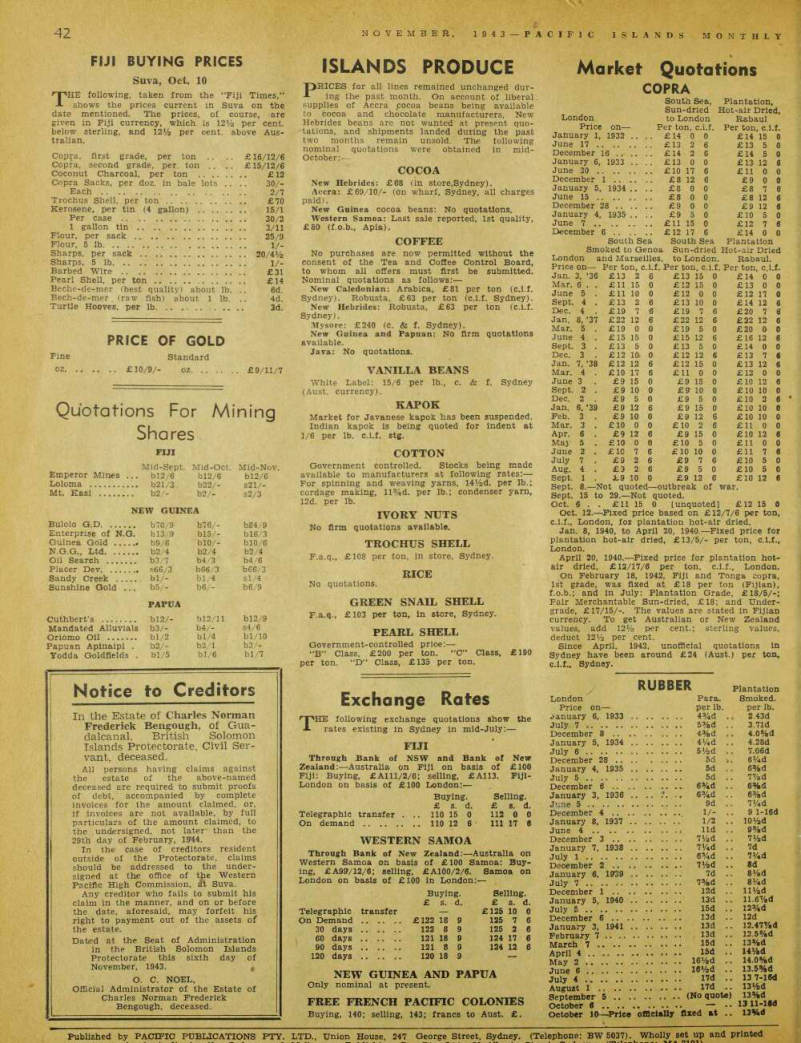
Suva, Oct. 10 THE following, taken from the “Fiji Times,” shows the prices current in Suva on the date mentioned. The prices, of course, are given in Fiji currency, which is 12 Vi per cent, below sterling, and 12Vi per cent, above Aus tralian.
Copra, first grade, per ton .. .. £l6/12/6 Copra, second grade, per ton .. .. £l5/12/6 Coconut Charcoal, per ton £l2 Copra Sacks, per doz. in bale lots .. .. 30/- Each 2/7 Trochus Shell, per ton £7O Kerosene, per tin (4 gallon) 15/1 Per case 30/2 1 gallon tin 3/11 Flour, per sack 25/9 Flour, 5 lb 1/- Sharps, per sack 20/4Vi Sharps, 5 lb 1/- Barbed Wire £3l Pearl Shell, per ton £l4 Beche-de-mer (best quality) about lb. .. 6d.
Bech-de-mer (raw fish) about 1 lb. .. 4d.
Turtle Hooves, per lb 3d.
Advertisements & other items, p. 46 (1 item)
Price Of Gold
Fine Standard oz £10/9/- oz £9/11/7
Quotations For Mining
Shares
Fiji
Mid-Sept.
Mid-Oct.
Mid-Nov.
Emperor Mines ... bI2/6 bl2/6 bl2/6 Loloma b21/3 b22/s21/- Mt. Kasi b2/b2/s2/3
New Guinea
Bulolo G.D b70/9 b76/b84/9 Enterprise of N.G. bl3/9 bl5/bl6/3 Guinea Gold b9/6 blO/blO/6 N.G.G., Ltd b2/4 b2/4 b2/4 Oil Search b3/7 b4/3 b4'6 Placer Dev S66/3 b66/3 b66/3 Sandy Creek bl/bl/4 sl/4 Sunshine Gold ... b5/b6/b6/9 Cuthbert’s
Papda
bl2/bl2/ll bl2/9 Mandated Alluvials b3/b4/s4/6 Oriomo Oil bl/2 bl/4 bl/10 Papuan Apinaipi . b2/b2/l b3/- Yodda Goldfields . bl/5 bl/6 bl/7
Islands Produce
PRICES for all lines remained unchanged dur ing the past month. On account of liberal supplies of Accra cocoa beans being available to cocoa and chocolate manufacturers, New Hebrides beans are not wanted at present quo tations, and shipments landed during the past two months remain unsold. The following nominal quotations were obtained in mid- October:—
Cocoa
New Hebrides: £6B (in store,Sydney).
Accra: £69/10/- (on wharf, Sydney, all charges paid).
New Guinea cocoa beans: No quotations.
Western Samoa: Last sale reported, Ist quality, £BO (f.0.b., Apia).
Coffee
No purchases are now permitted without the consent of the Tea and Coffee Control Board, to whom all offers must first be submitted.
Nominal quotations as follows: New Caledonian: Arabica, £Bl per ton (c.i.f.
Sydney). Robusta, £63 per ton (c.i.f. Sydney).
New Hebrides: Robusta, £63 per ton (c.i.f.
Sydney).
Mysore: £240 (c. & f. Sydney).
New Guinea and Papuan: No firm quotations available.
Java: No quotations.
Vanilla Beans
White Label: 15/6 per lb., c. & f. Sydney (Aust. currency).
Kapok
Market for Javanese kapok has been suspended.
Indian kapok is being quoted for indent at 1/6 per lb. c.i.f. stg.
Cotton
Government controlled. Stocks being made available to manufacturers at following rates;— For spinning and weaving yarns, 14Vid. per lb.; cordage making, ll%d. per lb.; condenser yam, 12d. per lb.
Ivory Nuts
No firm quotations available.
Trochus Shell
F.a.q., £lOB per ton, in store, Sydney.
Rice
No quotations.
Green Snail Shell
F.a.q., £lO3 per ton, in store, Sydney.
Pearl Shell
Government-controlled price:— “B” Class, £2OO per ton. “C” Class, £l9O per ton. “D” Class, £135 per ton.
Exchange Rates
THE following exchange quotations show the rates existing in Sydney in mid-July:—
Fiji
Through Bank of NSW and Bank of New Zealand;—Australia on Fiji on basis of £lOO Fiji: Buying. £Alll/2/6; selling, £AII3. Fijl- London on basis of £lOO London;—
Western Samoa
Through Bank of New Zealand; —Australia on Western Samoa on basis of £lOO Samoa: Buy ing, £ A99/12/6; selling, £AIOO/2/6. Samoa on London on basis of £lOO in London:—
New Guinea And Papua
Only nominal at present.
Free French Pacific Colonies
Buying, 140; selling, 143; francs to Aust. £.
Buying.
Selling. £ s. d. £ s. d.
Telegraphic transfer . .. 110 15 0 112 0 0 On demand .. 110 12 6 111 17 6
Buying.
Selling. £ s. d. £ s. d.
Telegraphic transfer — £125 10 0 On Demand £122 18 9 125 7 6 30 days 122 8 9 125 2 6 60 days 121 18 9 124 17 6 90 days 121 8 9 124 12 6 120 days 120 18 9 —
Market Quotations
Sept. 8. —Not quoted—outbreak of war.
Sept. 15 to 29. —Not quoted.
Oct. 6 . . £ll 15 0 [unquoted] £l2 15 0 Oct. 12. —Fixed price based on £l2/7/6 per ton, c.i.f., London, for plantation hot-air dried.
Jan. 8, 1940, to April 20, 1940.—Fixed price for plantation hot-air dried, £l3/5/- per ton, c.i.f., London, April 20, 1940. —Fixed price for plantation hot air dried, £l2/17/6 per ton, c.i.f., London.
On February 18, 1942, FIJI and Tonga copra, Ist grade, was fixed at £lB per ton (Fijian), f.0.b.; and in July: Plantation Grade, £lB/5/-; Fair Merchantable Sun-dried, £18; and Under grade, £l7/15/-. The values are stated in Fijian currency. To get Australian or New Zealand values, add 12 Vi per cent.; sterling values, deduct 12y 2 per cent.
Since April, 1942, unofficial quotations in Sydney have been around £24 (Aust.) per ton, c.i.f., Sydney.
London Price on—
Copra
South Sea, Plantation, Sun-dried Hot-air Dried, to London Rabaul Per ton, c.i.f. Per ton. c.i.f.
January 1, , 1932 . . £14 0 0 £14 15 0 June 17 . £13 2 6 £13 5 0 December 16 .. £14 2 6 £14 5 0 January 6, 1933 , . £13 0 0 £13 12 6 June 30 . £10 17 6 £11 0 0 December 1 .. £8 12 6 £9 0 0 January 5 , 1934 £8 0 0 £8 7 6 June 15 . £8 0 0 £8 12 6 December 28 .. £9 0 0 £9 12 6 January 4, 1935 . , £9 5 0 £10 5 0 June 7 ., £11 15 0 £12 7 6 December 6 .. £12 17 6 £14 0 0 South Sea South Sea Smoked to Genoa Sun-dried Plantation Hot-air Dried London and Alarseilles. to London.
Rabaul.
Price on— Per ton, c.i.f. Per ton, c.i.f. Per ton, c.i.f.
Jan. 3, ’36 £13 2 6 £13 15 0 £14 0 0 Mar. 6 . . £11 15 0 £12 15 0 £13 0 0 June 5 . £11 10 0 £12 0 0 £12 17 0 Sept. 4 . £13 2 6 £13 10 0 £14 12 6 Dec. 4 . £19 7 6 £19 7 6 £20 7 6 Jan. 8, ’37 £22 12 6 £22 12 6 £22 12 6 Mar. 5 . £19 0 0 £19 5 0 £20 0 0 June 4 . £15 15 0 £15 12 6 £16 12 6 Sept. 3 . £13 5 0 £13 5 0 £14 0 0 Dec. 3 . £12 10- 0 £12 12 6 £13 7 6 Jan. 7, ’38 £12 12 6 £12 15 0 £13 12 6 Mar, 4 £10 17 6 £11 0 0 £12 0 0 June 3 £9 15 0 £9 15 0 £10 12 6 Sept. 2 . £9 10 0 £9 10 0 £10 10 0 Dec. 2 . £9 5 0 £9 5 0 £10 2 6 Jan. 6. '39 £9 12 6 £9 15 0 £10 10 0 Feb. 3 . £9 10 0 £9 12 6 £10 10 0 Mar. 3 . £10 0 0 £10 2 6 £11 0 0 Apr. 6 . £9 12 6 £9 15 0 £10 12 6 May 5 . £10 0 0 £10 5 0 £11 0 0 June 2 . £10 7 6 £10 10 0 £11 7 6 July 7 . £9 2 6 £9 7 6 £10 5 0 Aug. 4 , £9 2 6 £9 5 0 £10 5 0 Sept. 1 . £9 10 0 £9 12 6 £10 12 6
y
Rubber
Plantation London Para.
Smoked.
Price on— per lb. per lb.
January 6, 1933 . 4 3 Ad .. 2.43d July 7 5%d .. 3.71d December 8 .. . 4%d .. 4.0 %d January 5, 1934 . 4V 4 d .. 4.28d July 6 7.06d December 28 .. . 5d v. 6y 4 d January 4, 1935 . 5d .. 6%d July 5 5d .. 7%d December 6 .. ,. 6%d January 3, 1936 . . .. ?. .. 6 3 Ad .. 6 3 / s d June 5 9d .. 7y 4 d December 4 .. .. 9 l-16d January 8, 1937 . ioy 2 d June 4 lid .. 9%d December 3 .. . 7y 2 d January 7, 1938 . 7d July 1 ?y 4 d December 2 .. . 8d January 6, 1939 . 7d .. sy 8 d July 7 ay 4 d December 1 .. ., 12d .. ny 2 d January 5, 1940 . 13d .. 11.6 7 /sd July 5 15d .. 12 3 / 4 d December 6 .. .. 13d .. 12d January 3, 1941 . 13d .. 12.47%d February 7 13d .. 12.5 5 /ad March 7 15d .. 13%d April 4 15d .. i4y.d May 2 16>/ 2 d .. i4.oy»d June 6 16V 2 d .. 13.5%d July 4 17d .. 13 7-16d August 1 17d .. 13M,d September 5 .. . (No quote) 13%d October 6 13 ll-18d October 10—Price officially fixed at .. 13%d
Advertisements & other items, pp. 46-48 (3 items)
42
NOVEMBER, 1943 PACIFIC ISLANDS MONTHLY
Published by PACIFIC PUBLICATIONS PTY. LTD., Union House, 247 George Street, Sydney. (Telephone; BW 5037). Wholly set up and printed . . ... . . ■ - ... , . ... . m i u ir a mAI \
Notice to Creditors
In the Estate of Charles Norman
Frederick Bengough, of Gua-
dalcanal. British Solomon Islands Protectorate, Civil Ser-
vant, deceased.
All persons having claims against the estate of the above-named deceased are required to submit proofs of debt, accompanied by complete invoices for the amount claimed, or, if invoices are not available, by full particulars of the amount claimed, to the undersigned, not later' than the 29th day of February, 1944.
In the case of creditors resident outside of the Protectorate, claims should be addressed to the undersigned at the office of the Western Pacific High Commission, Suva.
Any creditor who fails to submit his claim in the manner, and on or before the date, aforesaid, may forfeit his right to payment out of the assets of the estate.
Dated at the Seat of Administration in the British Solomon Islands Protectorate this sixth day of November, 1943. f
O. C. NOEL.
Official Administrator of the Estate of Charles Norman Frederick Bengough, deceased.
W. R. Carpenter & Co. Ltd.
*' ■ ■ ■**’ h □?' j ■)' h m v s .' S m a. ■ *
RENTER
LM A ■ <! f sa a . & -i ■ m I :: m '. ' ■ ns '* n ■ * f»- ; H I i ■
Travel by CARPENTER AIRLINES
Full particulars from Macdonald, Hamilton Gr Co., or Howard Smith Ltd., Sydney.
W. R. CARPENTER & CO. LTD.
MERCHANTS, SHIPOWNERS AND AIRCRAFT OPERATORS
Agents for Australian, European and American Manufacturers, and Distributors of Every Description of Merchandise.
Buyers and Shippers of Copra, Trocas, and all Classes of Islands Produce.
AGENTS FOR :
Caterpillar Tractors. Dodge Brothers Inc.
Electrolux Refrigerators. Westinghouse Electrical Co. etc., etc.
Branches throughout the Pacific Islands
Ford Motor Company of Canada.
T. G. £r C. Bolinders (Engines).
In London: W. R. Carpenter & Co. (London) Ltd., Coronation House, 4 Lloyds Avenue, London, EC.
Head Office: 16 O’CONNELL STREET, SYDNEY