Islands
Pacific
Monthly
October 18, 1943
Vol. Xiv. No. 3.
Established 1930
WL \ v \ \ \ * IRegistered at the G.P.0., Sydney, for transmission by post as a newspaper ]
8"
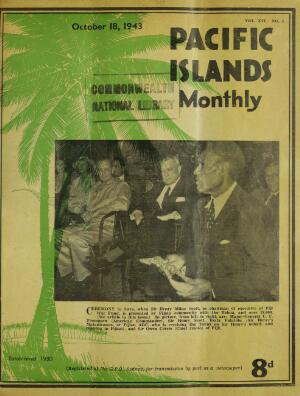
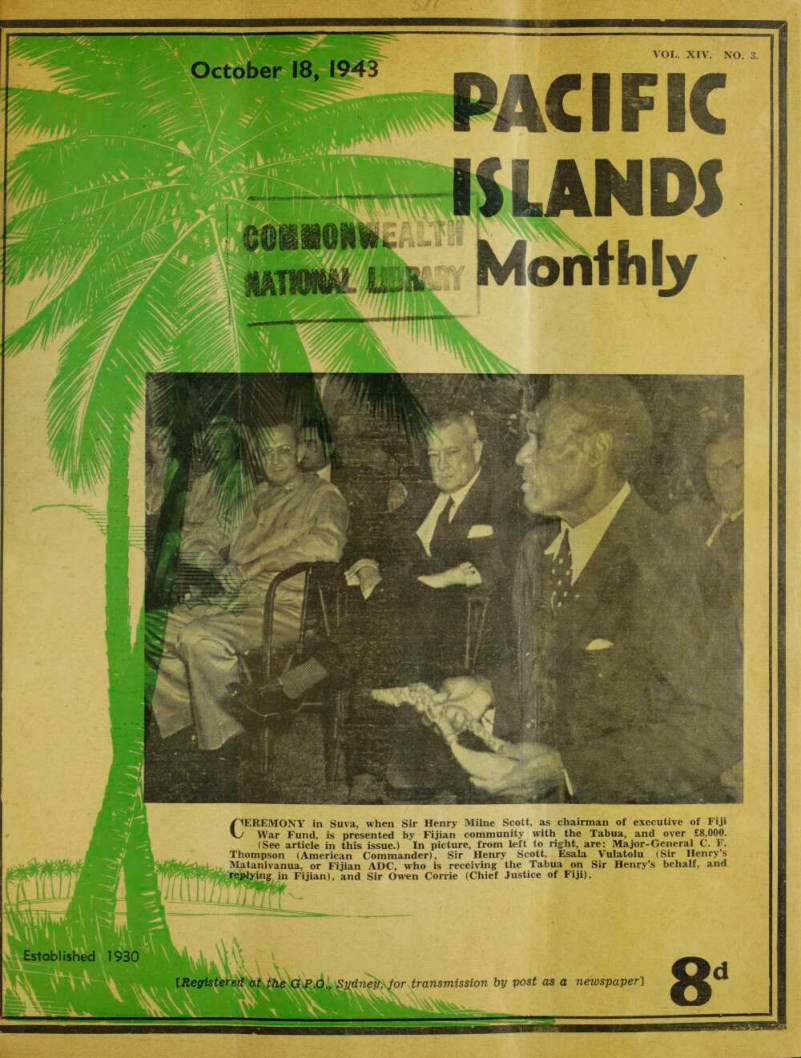
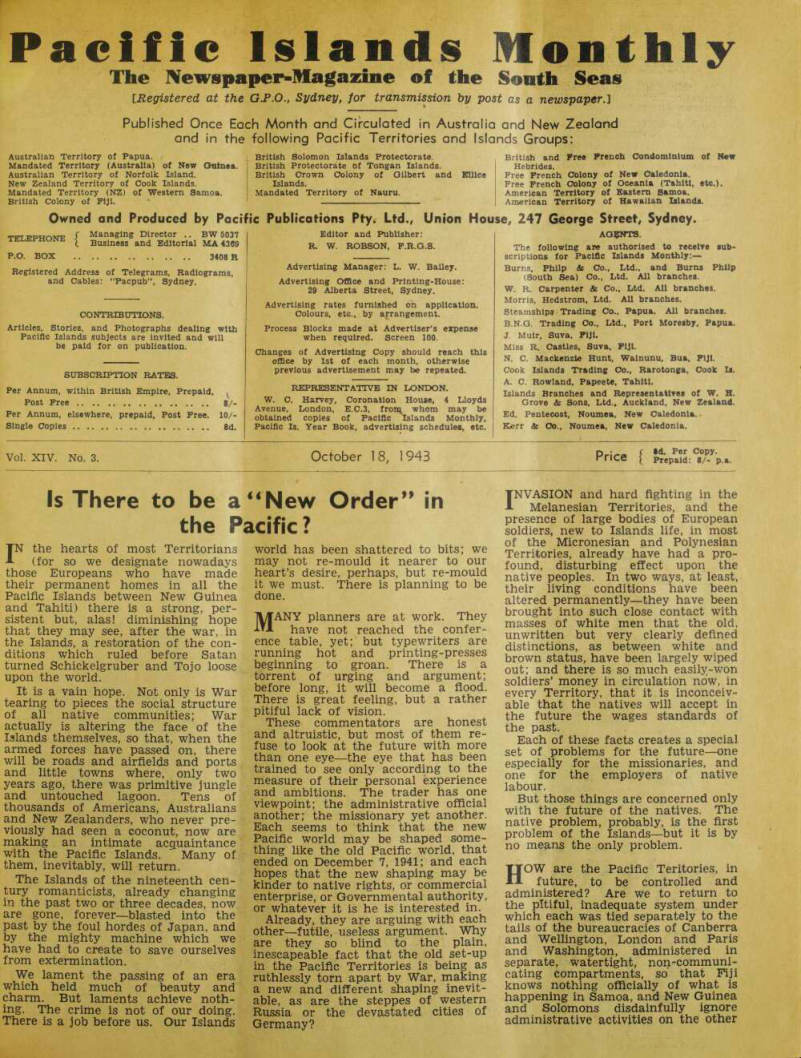
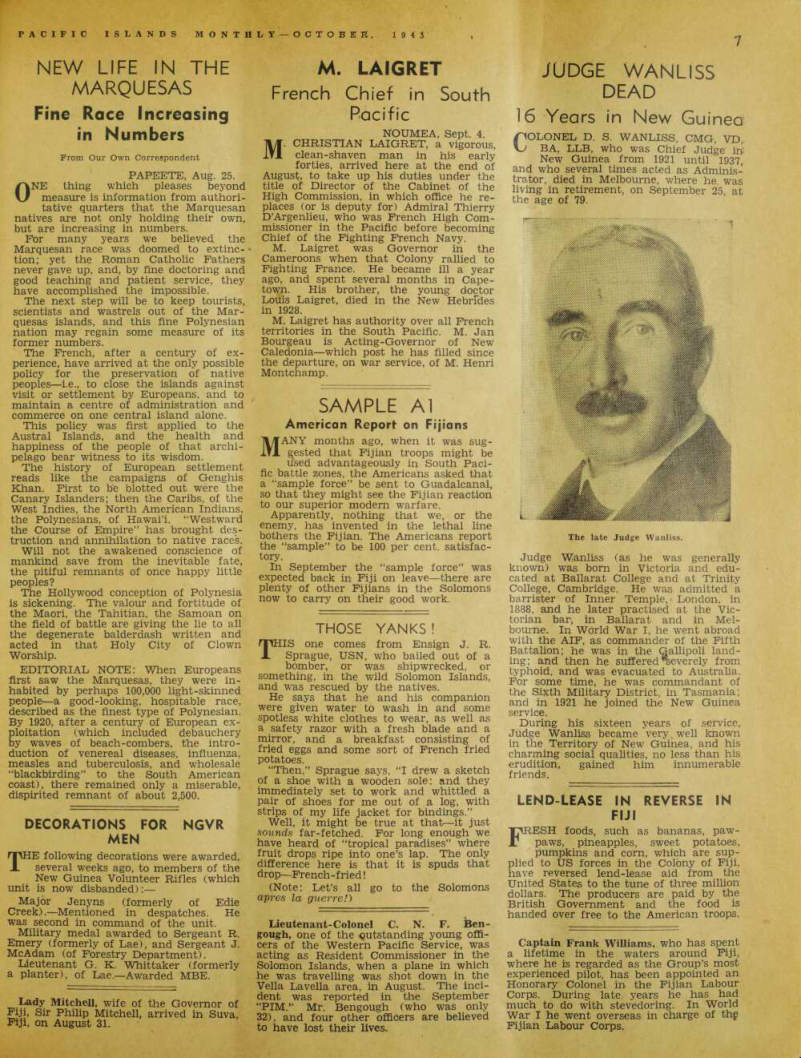
CEREMONY in Suva, when Sir Henry Milne Scott, as chairman of executive of Fiji War Fund, is presented by Fijian community with the Tabua, and over £8,OOO. (See article in this issue.) In picture, from left to right, are: Major-General C. F.
Thompson (American Commander), Sir Henry Scott, Esala Vulatolu (Sir Henry’s Matanivanua, or Fijian ADC, who is receiving the Tabua on Sir Henry’s behalf, and replying in Fijian), and Sir Owen Corrie (Chief Justice of Fiji).
New Guinea’S Missing Men
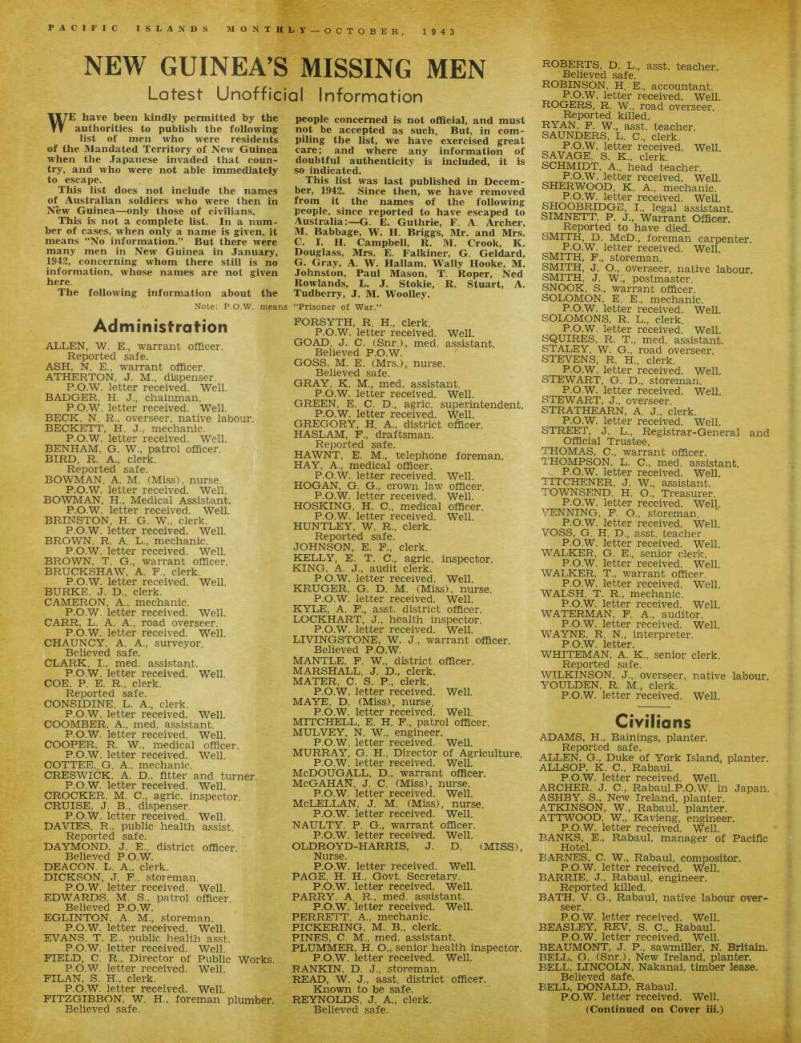
Latest Unofficial Information
WE have been kindly permitted by the authorities to publish the following list of men who were residents of the Mandated Territory of New Guinea when the Japanese invaded that coun try, and who were not able immediately to escape.
This list does not include the names of Australian soldiers who were then in New Guinea—only those of civilians.
This is not a complete list. In a num ber of cases, when only a name is given, it means “No information.” But there were many men in New Guinea in January, 1942, concerning whom there still is no information, whose names are not given here.
The following information about the
people concerned is not official, and must not be accepted as such. But, in com piling the list, we have exercised great care; and where any information of doubtful authenticity is included, it is so indicated.
This list was last published in Decem ber, 1942. Since then, we have removed from it the names of the following people, since reported to have escaped to Australia:—G. E. Guthrie, F. A. Archer, M. Babbage, W. H. Briggs, Mr. and Mrs.
C. I. H. Campbell, R. M. Crook, K.
Douglass, Mrs. E. Falkiner, G. Geldard, G. Gray, A. W. Hallam, Wally Hooke, M.
Johnston, Paul Mason, T. Roper, Ned Rowlands, L. J. Stokie, R. Stuart, A.
Tudberry, J. M. Woolley.
Note: P.O.W. means “Prisoner of War.”
Administration
ALLEN, W. E., warrant officer.
Reported safe.
ASH, N. E., warrant officer.
ATHERTON, J. M., dispenser.
P.O.W. letter received. Well.
BADGER, H. J., chainman.
P.O.W. letter received. Well.
BECK. N. R., overseer, native labour.
BECKETT, H. J., mechanic.
P.O.W. letter received. Well.
BENHAM, G. W., patrol officer.
BIRD, R. A., clerk.
Reported safe.
BOWMAN. A. M. (Miss), nurse.
P.O.W. letter received. Well.
BOWMAN, H., Medical Assistant.
P.O.W. letter received. Well.
BRINSTON, H. G. W„ clerk.
P.O.W. letter received. Well.
BROWN, R. A. L., mechanic.
P.O.W. letter received. Well.
BROWN, T. G., warrant officer.
BRUCKSHAW, A. F„ clerk.
P.O.W. letter received. Well.
BURKE. J. D., clerk.
CAMERON, A., mechanic.
P.O.W. letter received. Well.
CARR, L. A. A., road overseer.
P.O.W. letter received. Well.
CHAUNCY, A. A., surveyor.
Believed safe.
CLARK. 1., med. assistant.
P.O.W. letter received. Well.
COE, P. E. R.. clerk.
Reported safe.
CONSIDINE, L. A., clerk.
P.O.W. letter received. Well.
COOMBER. A., med. assistant.
P.O.W. letter received. Well.
COOPER, R. W., medical officer.
P.O.W. letter received. Well.
COTTEE, G. A., mechanic.
CRESWICK. A. D.. fitter and turner.
P.O.W. letter received. Well.
CROCKER, M. C., agric. inspector.
CRUISE, J. 8., dispenser.
P.O.W. letter received. Well.
DAVIES, R.. public health assist.
Reported safe.
DAYMOND, J. E., district officer.
Believed P.O.W.
DEACON. L. A., clerk.
DICKSON, J. F., storeman.
P.O.W. letter received. Well.
EDWARDS. M. S.. patrol officer.
Believed P.O.W.
EGLINTON, A. M., storeman.
P.O.W. letter received. Well.
EVANS. T. E.. public health asst.
P.O.W. letter received. Well.
FIELD, C. R„ Director of Public Works.
P.O.W. letter received. Well.
FILAN, S. H„ clerk.
P.O.W. letter received. Well.
FITZGIBBON. W. H., foreman plumber.
Believed safe.
FORSYTH, R. H„ clerk.
P.O.W. letter received. Well.
GOAD, J. C. (Snr.), med. assistant.
Believed P.O.W.
GOSS, M. E. (Mrs.), nurse.
Believed safe.
GRAY, K. M., med. assistant.
P.O.W. letter received. Well.
GREEN, E. C. D., agric. superintendent.
P.O.W. letter received. Well.
GREGORY, H. A., district officer.
HASLAM, F., draftsman.
Reported safe.
HAWNT, E. M., telephone foreman.
HAY. A., medical officer.
P.O.W. letter received. Well.
HOGAN, G. G., crown law officer.
P.O.W. letter received. Well.
HOSKING, H. C., medical officer.
P.O.W. letter received. Well.
HUNTLEY, W. R„ clerk.
Reported safe, JOHNSON, E. F., clerk.
KELLY, E. T. C., agric. inspector, KING, A. J„ audit clerk.
P.O.W. letter received. Well.
KRUGER, G. D. M. (Miss), nurse.
P.O.W. letter received. Well.
KYLE, A. F., asst, district officer.
LOCKHART, J., health inspector.
P.O.W. letter received. Well.
LIVINGSTONE, W. J., warrant officer.
Believed P.O.W.
MANTLE, F. W., district officer.
MARSHALL. J. D., clerk.
MATER. C. S. P.. clerk.
P.O.W. letter received. Well.
MAYE. D. (Miss), nurse.
P.O.W. letter received. Well.
MITCHELL. E. H. F., patrol officer.
MULVEY, N. W., engineer.
P.O.W. letter received. Well.
MURRAY, G. H., Director of Agriculture.
P.O.W. letter received. Well.
McDOUGALL, D., warrant officer, McGAHAN, J. C. (Miss), nurse.
P.O.W. letter received. Well.
McLELLAN, J. M. (Miss), nurse, P.O.W. letter received. Well.
NAULTY. P. G., warrant officer.
P.O.W. letter received. Well.
Oldroyd-Harris, J. D. (Miss),
Nurse.
P.O.W. letter received. Well.
PAGE. H. H., Govt. Secretary.
P.O.W. letter received. Well.
PARRY. A. R., med. assistant.
P.O.W. letter received. Well.
PERRETT. A., mechanic.
PICKERING, M. 8.. clerk.
PINES, C. M.. med. assistant.
PLUMMER, H. 0., senior health inspector.
P.O.W. letter received. Well.
RANKIN. D. J., storeman.
READ, W. J., asst, district officer.
Known to be safe.
REYNOLDS, J. A., clerk.
Believed safe.
ROBERTS, D. L., asst, teacher.
Believed safe.
ROBINSON, H. E., accountant.
P.O.W. letter received. Well.
ROGERS, R. W., road overseer.
Reported killed.
RYAN, F. W., asst, teacher.
SAUNDERS, L. C., clerk.
P.O.W. letter received. Well.
SAVAGE, S. K., clerk.
SCHMIDT, A., head teacher.
P.O.W. letter received. Well.
SHERWOOD, K. A., mechanic.
P.O.W. letter received. Well.
SHOOBRIDGE, 1., legal assistant.
SIMNETT, P. J., Warrant Officer.
Reported to have died.
SMITH, D. McD., foreman carpenter.
P.O.W. letter received. Well.
SMITH, F., storeman.
SMITH, J. 0., overseer, native labour.
SMITH, J. W., postmaster.
SNOOK, S., warrant officer.
SOLOMON, E. E., mechanic.
P.O.W. letter received. Well.
SOLOMONS, R. L., clerk.
P.O.W. letter received. Well.
SQUIRES, R. T., med. assistant.
STALEY, W. G., road overseer.
STEVENS, R. H„ clerk.
P.O.W. letter received. Well.
STEWART, G. D., storeman.
P.O.W. letter received. Well.
STEWART, J., overseer.
Strathearn, A. J., Clerk.
P.O.W. letter received. Well.
STREET, J. L., Registrar-General and Official Trustee.
THOMAS, C., warrant officer.
THOMPSON, L. C., med. assistant.
P.O.W. letter received. Well.
TITCHENER, J. W., assistant.
TOWNSEND, H, 0., Treasurer.
P.O.W. letter received. Well.
VENNING, F. 0., storeman.
P.O.W. letter received. Well.
VOSS, G. H. D., asst, teacher, P.O.W. letter received. Well.
WALKER, G. E., senior clerk.
P.O.W. letter received. Well.
WALKER, T., warrant officer.
P.O.W. letter received. Well.
WALSH. T. R., mechanic.
P.O.W. letter received. Well.
WATERMAN, F. A., auditor.
P.O.W. letter received. Well.
WAYNE. R. N., interpreter.
P.O.W. letter.
WHITEMAN, A. K., senior clerk.
Reported safe.
WILKINSON, J., overseer, native labour.
YOULDEN. R. M., clerk.
P.O.W. letter received. Well.
Civilians
ADAMS, H.. Bainings, planter.
Reported safe.
ALLEN, G., Duke of York Island, planter.
ALLSOP, K. C., Rabaul.
P.O.W. letter received. Well.
ARCHER. J. C., Rabaul.P.O.W. in Japan.
ASHBY, S., New Ireland, planter.
ATKINSON, W., Rabaul, planter.
ATTWOOD. W., Kavieng, engineer.
P.O.W. letter received. Well.
BANKS, E., Rabaul, manager of Pacific Hotel, BARNES, C. W., Rabaul, compositor.
P.O.W. letter received. Well.
BARRIE, J., Rabaul, engineer.
Reported killed.
BATH, V. G., Rabaul, native labour over seer.
P.O.W. letter received. Well.
Beasley, Rev, S. C., Rabaul.
P.O.W. letter received. Well.
BEAUMONT, J. P., sawmiller, N. Britain.
BELL, G. (Snr.), New Ireland, planter.
BELL, LINCOLN, Nakanai, timber lease.
Believed safe.
BELL, DONALD, Rabaul.
P.O.W. letter received. Well.
(Continued on Cover iil.)
WASHINGTON, H. J., New Britain, planter.
WATCH, Dr. N. 8., Rabaul, medical
practitioner.
P.O.W. in Japan.
WHITEHEAD, B. N., New Ireland, plan tation manager.
WILKIN, W. M„ New Ireland, planter.
WILLIAMS, L. L., New Ireland, planta tion manager., WILLMET, W., plantation assistant, Rabaul.
P.O.W. letter received. Well.
WILSON, H., New Britain, plantation manager.
WOODHOUSE, E., New Ireland, manager of plantation.
WOOLCOTT, L., Kavieng, manager of plantation.
Yarrington, W. M., Rabaul, (B.P,
staff), clerk.
Missionaries
Anglican New Guinea Mission
Papua
Rev. James Benson.
Missing, and reported killed.
The following members of the Mission, previously reported missing, are believed to have been murdered by the Japanese: Sister May Hayman, Miss Mavis Parkin son, Sister Margaret Brenchley, Miss Lilia Lashmar, Rev. Henry Holland, Rev. Vivian Redlich, Mr. John Duffile.
Melanesian Mission
REV. JOHN BARGE, New Britain.
Missing—No information.
REV. B. W. F. MOORE, New Britain, Missing—No information.
Methodist Mission
New Guinea
REV. L. A. MCARTHUR, Malakuna.
P.O.W. letter received.
Rev. W. L. I. Linggood, Raluana.
P.O.W. letter received.
REV. W. D. OAKES, Pinilddu.
P.O.W. letter received.
REV. H. J. PEARSON, Vunairima.
P.O.W. letter received.
REV. J. W. POOLE, Bainings.
P.O.W. letter received.
Rev. H. B. Shelton, Ulu.
REV. T. N. SIMPSON, New Hanover.
P.O.W. letter received.
REV. J. TREVITT, Vunairima.
P.O.W. letter received.
MR. S. C. BEAZLEY, Malakuna.
P.O.W. letter received.
MR. E. W. PEARCE, Rabaul.
P.O.W. letter received.
THOMAS MOW, Chinese teacher, Rabaul.
P.O.W. letter received.
Nurse J. Christopher, Malaboga.
P.O.W. letter received.
NURSE M. GREEN, Malaboga.
P.O.W. letter received.
NURSE D. BEALE, Stewart Hospital.
P.O.W. letter received.
NURSE D. E. WILSON, Stewart Hospital.
P.O.W. letter received.
MO PUI SAM, Rabaul.
P.O.W. letter received.
Roman Catholic Missions
It has not been possible to correct the lists in time for publication in this issue.
To the list published last December, we must now add the names of many missionaries who are missing on the Northern New Guinea coast, while other missionaries, who escaped from or were liberated in the Solomons are not now listed as missing. A list of missing Catholic missionaries will be published in our November issue.
It is reported from London that 25 Quakers—who are conscientious objectors —have volunteered for the roles of human guinea pigs and have been taking daily doses of a drug which may offer com plete immunity from malaria. The ef ficacy of the drug will be tested soon, when they are bitten by malaria-infected mosquitoes.
Oscar Schwartz and other Euronesian lads from Salamaua, New Guinea, have been doing a good war job in Queens land, picking cotton and peanuts, and cane-cutting; and have been commended by the State authorities.
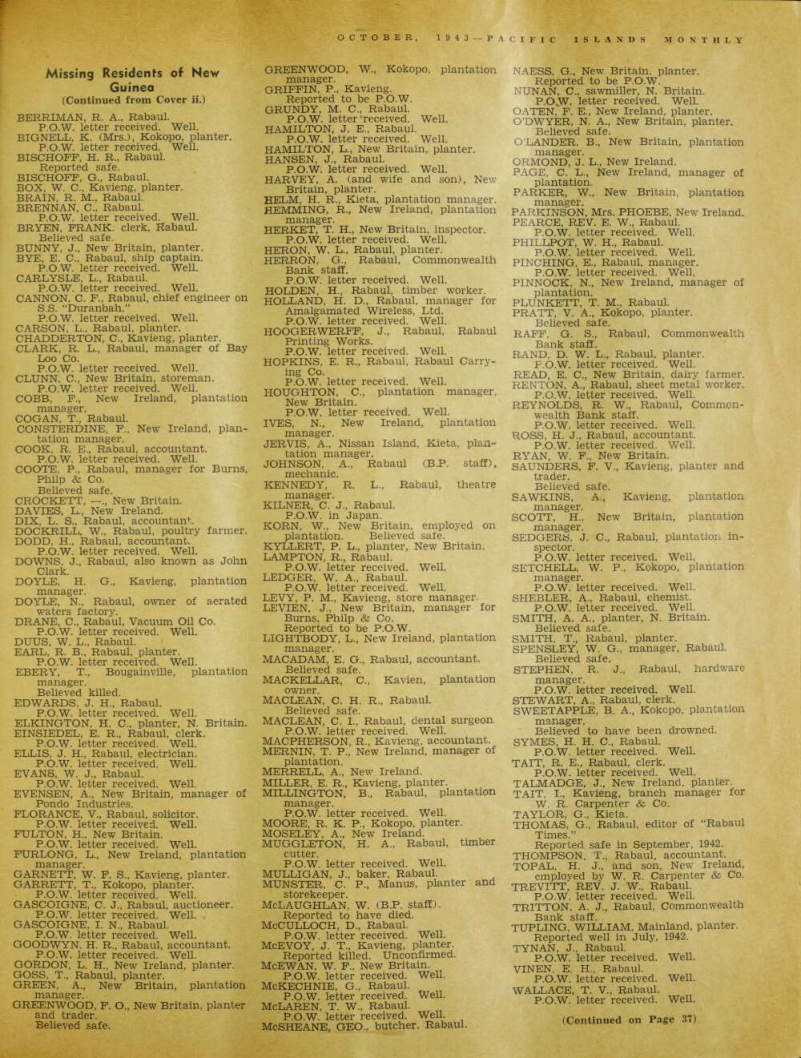
BERRIMAN, R. A., Rabaul.
P.O.W. letter received. Well.
BIGNELL, K. (Mrs.), Kokopo, planter.
P.O.W. letter received. Well.
BISCHOFF, H. R., Rabaul.
Reported safe.
BISCHOFF, G., Rabaul.
BOX, W. C., Kavieng, planter.
BRAIN, R. M., Rabaul.
BRENNAN, C., Rabaul.
P.O.W. letter received. Well.
BRYEN, FRANK, clerk, Rabaul.
Believed safe.
BUNNY, J., New Britain, planter.
BYE, E. C., Rabaul, ship captain.
P.O.W. letter received. Well.
CARLYSLE, L., Rabaul.
P.O.W. letter received. Well.
CANNON, C. F., Rabaul, chief engineer on S.S. “Duranbah.”
P.O.W. letter received. Well.
CARSON, L.. Rabaul, planter.
CHADDERTON, C., Kavieng, planter.
CLARK, R. L., Rabaul, manager of Bay Loo Co.
P.O.W. letter received. Well.
CLUNN, C., New Britain, storeman.
P.O.W. letter received. Well.
COBB, F., New Ireland, plantation manager.
COG AN, T, Rabaul.
CONSTERDINE, F., New Ireland, plan tation manager.
COOK, R. E., Rabaul, accountant.
P.O.W. letter received. Well.
COOTE, P., Rabaul, manager for Burns, Philp & Co.
Believed safe.
CROCKETT, —., New Britain.
DAVIES, L., New Ireland.
DIX, L. S., Rabaul, accountant.
DOCKRILL, W., Rabaul, poultry farmer.
DODD, H., Rabaul, accountant.
P.O.W. letter received. Well, DOWNS, J., Rabaul, also known as John Clark.
DOYLE, H. G., Kavieng, plantation manager.
DOYLE, N., Rabaul, owner of aerated waters factory.
DRANE, C., Rabaul, Vacuum Oil Co.
P.O.W. letter received. Well.
DUUS, W. L., Rabaul.
EARL, R. 8., Rabaul, planter.
P.O.W. letter received. Well.
EBERY, T, Bougainville, plantation manager.
Believed killed.
EDWARDS. J. H., Rabaul.
P.O.W. letter received. Well.
ELKINGTON, H. C., planter, N. Britain.
EINSIEDEL, E. R., Rabaul, clerk.
P.O.W. letter received. Well.
ELLIS, J. H., Rabaul, electrician.
P.O.W. letter received. Well.
EVANS,. W. J., Rabaul.
P.O.W. letter received. Well.
EVENSEN, A., New Britain, manager of Pondo Industries.
FLORANCE, V., Rabaul, solicitor.
P.O.W. letter received. Well.
FULTON, H., New Britain.
P.O.W. letter received. Well.
FURLONG, L., New Ireland, plantation manager.
GARNETT, W. P. S., Kavieng, planter.
GARRETT, T, Kokopo, planter.
P.O.W. letter received. Well.
GASCOIGNE, C. J., Rabaul, auctioneer.
P.O.W. letter received. Well.
Gascoigne, I. N., Rabaul.
P.O.W. letter received. Well.
GOODWYN, H. R„ Rabaul, accountant.
P.O.W. letter received. Well.
GORDON, L. H., New Ireland, planter.
GOSS, T, Rabaul, planter, GREEN, A., New Britain, plantation manager.
GREENWOOD, P. 0., New Britain, planter and trader.
Believed safe.
GREENWOOD, W., Kokopo, plantation manager.
GRIFFIN, P., Kavieng.
Reported to be P.O.W.
GRUNDY, M. C., Rabaul.
P.O.W. letter‘received. Well.
HAMILTON, J. E., Rabaul.
P.O.W. letter received. Well.
HAMILTON, L., New Britain, planter.
HANSEN, J., Rabaul.
P.O.W. letter received. Well.
HARVEY, A. (and wife and son), New Britain, planter.
HELM, H. R., Kieta, plantation manager.
HEMMING, R., New Ireland, plantation manager.
HERKET, T. H,, New Britain, inspector, P.O.W. letter received. Well.
HERON, W. L., Rabaul, planter.
HERRON, G., Rabaul, Commonwealth Bank staff.
P.O.W. letter received. Well.
HOLDEN, H., Rabaul, timber worker.
HOLLAND, H. D., Rabaul, manager for Amalgamated Wireless, Ltd.
P.O.W. letter received. Well.
HOOGERWERFF, J., Rabaul, Rabaul Printing Works.
P.O.W. letter received. Well.
HOPKINS, E. R., Rabaul, Rabaul Carry ing Co.
P.O.W. letter received. Well, HOUGHTON, C., plantation manager, New Britain.
P.O.W. letter received. Well.
IVES, N., New Ireland, plantation manager.
JERVIS, A., Nissan Island, Kieta, plan tation manager.
JOHNSON, A., Rabaul (B.P. staff), mechanic.
KENNEDY, R. L., Rabaul, theatre manager.
KILNER, C. J., Rabaul.
P.O.W. in Japan.
KORN, W., New Britain, employed on plantation. Believed safe.
KYLLERT, P. L., planter, New Britain.
LAMPTON, R., Rabaul.
P.O.W. letter received. Well.
LEDGER, W. A., Rabaul.
P.O.W. letter received. Well.
LEVY, P. M., Kavieng, store manager.
LEVIEN, J., New Britain, manager for Burns, Philp & Co.
Reported to be P.O.W.
LIGHTBODY, L., New Ireland, plantation manager.
MACADAM, E. G., Rabaul, accountant.
Believed s£tfe MACKELLAR, C., Kavien, plantation owner.
MACLEAN, C. H. R., Rabaul.
Believed safe.
MACLEAN, C. 1., Rabaul, dental surgeon, P.O.W. letter received. Well.
MACPHERSON, R., Kavieng, accountant.
MERNIN, T. P., New Ireland, manager of plantation.
MERRELL, A., New Ireland.
MILLER, E. R., Kavieng, planter.
MILLINGTON, 8., Rabaul, plantation manager.
P.O.W. letter received. Well.
MOORE, R. K. P„ Kokopo, planter.
MOSELEY, A., New Ireland.
MUGGLETON, H. A., Rabaul, timber cutter.
P.O.W. letter received. Well.
MULLIGAN, J., baker, Rabaul.
MUNSTER, C. P., Manus, planter and cf McLAUGHLAN, W. (B.P. staff).
Reported to have died.
McCULLOCH, D., Rabaul.
P.O.W. letter received. Well.
McEVOY, J. T, Kavieng, planter.
Reported killed. Unconfirmed.
McEWAN, W. F., New Britain.
P.O.W. letter received. Well.
McKECHNIE, G., Rabaul.
P.O.W. letter received. Well.
McLaren, T. W., Rabaul.
P.O.W. letter received. Well.
McSHEANE, GEO., butcher. Rabaul.
NAESS, G., New Britain, planter.
Reported to be P.O.W.
NUNAN, C., sawmiller, N. Britain.
P.O.W. letter received. Well.
OATEN, F. E., New Ireland, planter.
O'DWYER, N. A., New Britain, planter.
Believed safe.
OLANDER, 8., New Britain, plantation manager.
ORMOND, J. L., New Ireland.
PAGE, C. L., New Ireland, manager of plantation.
PARKER, W., New Britain, plantation manager.
PARKINSON, Mrs. PHOEBE, New Ireland.
Pearce, Rev. E. W., Rabaul.
P.O.W. letter received. Well.
PHILLPOT, W. H., Rabaul.
P.O.W. letter received. Well.
PINCHING, E„ Rabaul, manager.
P.O.W. letter received. Well.
PINNOCK, N., New Ireland, manager of plantation.
PLUNKETT, T. M., Rabaul.
PRATT, V. A., Kokopo, planter.
Believed safe.
RAFF, G. S., Rabaul, Commonwealth Bank staff.
RAND. D. W. L., Rabaul, planter.
P.O.W. letter received. Well.
READ, E. C., New Britain, dairy farmer.
RENTON, A., Rabaul, sheet metal worker.
P.OW. letter received. Well.
REYNOLDS, R. W., Rabaul, Common wealth Bank staff.
P.OW. letter received. Well.
ROSS, H. J., Rabaul, accountant.
P.OW. letter received. Well.
RYAN, W. F., New Britain.
SAUNDERS, F. V., Kavieng, planter and trader.
Believed safe.
SAWKINS, A., Kavieng, plantation manager, SCOTT, H., New Britain, plantation manager.
SEDGERS, J. C., Rabaul, plantation in spector.
P.O.W. letter received. Well.
SETCHELL, W. P., Kokopo, plantation manager.
P.O.W. letter received. Well.
SHEBLER, A., Rabaul, chemist.
P.O.W. letter received. Well.
SMITH, A. A., planter, N. Britain.
Believed safe.
SMITH, T., Rabaul, planter.
SPENSLEY, W. G., manager, Rabaul.
Believed safe.
STEPHEN, R. J., Rabaul, hardware manager.
P.O.W. letter received. Well.
STEWART, A., Rabaul, clerk.
SWEETAPPLE, B. A., Kokopo, plantation manager.
Believed to have been drowned.
SYMES, H. H. C., Rabaul.
P.O.W. letter received. Well.
TAIT, R. E., Rabaul, clerk.
P.O.W. letter received. Well.
TALMADGE, J., New Ireland, planter.
TAIT. 1., Kavieng, branch manager for W. R. Carpenter & Co.
TAYLOR, G„ Kieta.
THOMAS, G., Rabaul, editor of “Rabaul Times.”
Reported safe in September, 1942.
THOMPSON, T., Rabaul, accountant.
TOPAL, H. J., and son, New Ireland, employed by W. R. Carpenter & Co.
Trevitt, Rev. J. W., Rabaul.
P.O.W. letter received. Well.
TRITTON, A. J., Rabaul, Commonwealth IBd.i'ik stci ff TUPLING, WILLIAM, Mainland, planter.
Reported well in July, 1942.
TYNAN, J., Rabaul.
P.O.W. letter received. Well.
VINEN, E. H., Rabaul.
P.O.W. letter received. Well.
WALLACE, T. V., Rabaul.
P.O.W. letter received. Well.
(Continued on Page 37)
Pacific News-Review
Notes And Comment On
The Progress Of The War
From Sep. 15 To Oct. 14
Sep. 15: Fighting at Salerno, on the west coast of Italy, has reached a critical stage. The Germans, counter-attacKing witn all they have, have forced the Fifth Army (American and British) to give ground in some places. The Eignth Army, which has captured Cozenza, aoout 110 miles to the south-east, is making rapid progress, so as to link up with the Fifth Army in the north.
Sep. 15: The Russians, continuing their great offensive with apparently increas ing strength, have forced the Germans out of Bryansk. Russian forces have also penetrated Novorossisk (Black Sea naval base).
Sep. 15: Since the Allies captured Sala maua (New Guinea) on Sunday morning, lull pressure has been exerted against Lae, and this Jap-held base is expected to fall soon.
Sep. 16: Allied forces at Salerno (west coast of Italy) yielded further ground yesterday. Allies have occupied the island of Capri, off Naples.
Sep. 16: Several Jap strongpoints near Lae have been captured. Australian artillery is firing on the township.
Sep. 18: The Fifth and Eighth Armies have linked up in Italy and the bridge head crisis is said to have ended around Salerno.
Sep. 18: Japs lost another 58 planes over Wewak (New Guinea) during the week. Japanese reinforcements have been brought continuously to this area from Hollandia, Sep. 18: The Russians have intensified their offensive and have launched a drive for Smolensk.
Sep. 20: Australians have captured Lae in New Guinea. The remnants of the Japanese garrison, who escaped into the mountains, are being mopped up.
Sep. 20: Both Fifth and Eighth Armies in Italy are now advancing, and the Nazis, for the first time, admit with drawal. The Allies now have complete air supremacy over the area.
Sep. 21; British have occupied Castrel Orizo, the most easterly of the Dodecan ese Islands.
Sep. 21: The Nazis, resisting strongly, are falling back all along the Dnieper River line, on the Russian front.
Sep. 22: Mr. Churchill, in the Com mons, said there will be a mass invasion of Europe from the west, at the right time. The Mediterranean battlefront at no time was designed as a second front— it is a third front.
Sept. 22: The Fifth Army has driven the Germans back 30 miles on the Sal erno front, and are approaching Naples.
Sep. 22: The Germans now are retreat ing everywhere along the Russian front, from north of Smolensk to the Sea of Azov.
Sep. 22: In US raids on the Gilbert Islands at the week-end, four Japanese vessels were damaged. The raiders made more than 200 sorties against Tarawa, Makin, Apemama, and Nauru, on Satur day and Sunday.
Sep. 23: The Eighth Army captured the important road and rail junction of Potenza (60 miles east of Salerno) strengthening the Allied line across Southern Italy, south of Naples.
Sep. 23: The advancing Russians are in sight of Kiev. The Germans are counter-attacking with considerable tank forces.
Sep. 23: Australian air-borne troops captured the enemy-held airstrip at Kaiapit (about 60 miles north-west of Lae, NG).
Sep. 24: Australian troops landed on Sep. 22 six miles north of Finschhafen,
NG, supported by sea and air units, and are advancing upon the harbour area.
The country here is more open and there are few swamps.
Sep. 24; The German forces are form ing a defensive ring north of Naples while, in the city, they are burning, loot ing and killing, and destroying the great harbour works.
Sep. 27: Russians, on the 24th, cap tured Smolensk, most important pivot of the Germans’ Dnieper River defence line.
Millions of men and great numbers of tanks are employed in this Dnieper battle, which is described as the great est since the Hindenburg line was smashed in 1918.
Sep. 27: British Eighth Army units, on the west coast of Italy, threaten Foggia, big air base and road and rail junction.
Sep. 28: The great battle for the Dnieper River crossings is now in full swing. It is reported that the Russians are investing Kiev. South-west of Smolensk, the Red Army has entered White Russia.
Sep. 29: Yugoslav and Croat patriots are fighting to maintain their hold on the Dalmatian (Adriatic) coast). The Germans are pouring reinforcements into the Balkans and occupying Bulgaria in force.
Sep. 28: Japanese troops at Finsch hafen are hemmed in by Australians and, although their resistance is fanatical, their position is hopeless.
Sep. 29: Eighth Army has taken Fog gia, vital air Dase 85 miles north-east of Naples.
Sep. 29: Great gaps made by the Rus sian Army in the Germans’ Dnieper River line, make it possible to shatter the whole German front. The Germans are trying, at all costs, to stop the Rus sians crossing the Dnieper. If they do not, the Russian Army in White Russia will threaten the German rear on the Leningrad front; the three Red armies in Kiev will roll up the whole southern front; and the Russian advance towards the Dneiper mouth will cut off the Ger man armies in the Crimea.
Sep, 30: The Fifth Army has smashed the German defences at Naples. British troops have entered Pompeii (12 miles from Naples).
Sep. 30: Between Kiev and Dneprope trovsk, strong Soviet forces have crossed the Dnieper and established a bridge head.
Sep, 30: A 200-bomber raid was car ried out over the Wewak area, NG, on 27th; 50 enemy aircraft were destroyed on the ground; three tankers were set on fire and left sinking; four merchant ships were sunk or badly damaged; 29 barges and luggers sunk or damaged.
Oct. 1: Wewak got another smashing blow on the 28th, when bombers, escorted by fighters, dropped 145 tons of bombs and blew up the main enemy ammuni tion dump on the peninsula.
Oct. 2: Americans, of the Fifth Army, have occupied Naples. The Germans fled, leaving the city in flames. The Ger mans may retreat to a line south of Rome, about 100 miles north of Naples.
Oct. 3: Yesterday, the Ninth Australian Division captured Finschhafen, NG.
Other Australian units, pressing on over the Markham-Ramu Divide, are now 90 miles from Madang.
Oct. 5; The Eighth Army made a sur prise landing at Termoli (50 miles NW of Foggia, on Adriatic coast of Italy).
Oct. 7: Australians, driving down the Ramu Valley, are within 35 miles of the enemy base of Boradjim, on the coast, south-east of Madang.
Oct. 8: Fifth and Eighth Armies in
Italy are meeting stubborn resistance and rain has also further hampered opera tions. German radio announces that German paratroops have occupied the Holy City, in Rome, and taken over the “protection” of the Vatican. Some sources suggest that the Germans may try to carry away the Pope, as a hostage.
Oct. 8; A strong attack by a US naval force on Wake Island is reported.
Oct. 9; In spite of autumn rains, Rus sians began a surprise offensive and are storming the Dnieper River at three places. They drove a wedge between the north and central German armies by capturing Neval.
Oct. 9: The former Japanese strong hold in the Solomons, Vila, and the whole of the southern portion of Kolom bangara Island, are being abandoned by the enemy. The Japs are trying to evac uate this area by night, and our air craft and light naval forces are taking heavy toll of their barges, Oct. 9: The Fifth Army captured Capua in Italy (on the Volturno River, 20 miles north of Naples). Capua is the key to the Volturno defence line.
Oct. 10: General Chiang Kai-shek sworn in as President of the Chinese Republic.
Oct. 11: Russians’ three powerful drives threaten to cut all the German forces in Russia into isolated groups. Moscow Radio reports that eight full Russian divisions, with artillery, now have crossed the Dnieper River.
Oct. 11: In Italy, Fifth Army and Ger mans are massed along the Volturno River, on opposite banks. A decisive battle, for Rome, is expected soon.
Oct. 11; American destroyers sank a Japanese cruiser and two destroyers con voying transport craft off Vella Lavella (Solomons). American losses are “mod erate.”
Oct. 12: Allied bombers, in most devastating raid of Pacific war, to-day attacked Rabaul and destroyed or dam aged 177 Jap planes, 49 ships, 70 harbour craft.
Oct. 12: Red armies in White Russia now 15 miles from Vitebsk (great Ger man base on the Dvina River). German line north of Kiev has fallen.
Oct. 12: Allied forces have occupied last enemy stronghold on Kolombangara (Solomons). Japs now control only Choi seul and Bougainville Islands, between Americans and Rabaul.
Oct. 13: Portugal has permitted Britain to occupy the Azores, thus giving Britain invaluable mid-Atlantic base for opera tions against U-boats. Portugal’s neu trality policy is otherwise unchanged.
Oct. 13: Italy has declared war on Ger many. Marshal Badcglio says that there will be no peace in Italy while a single German remains on her soil.
Oct. 14: British land, sea and air forces have landed in the Azores. Precautions are being taken in Portugal against pos sible German reprisals.
Oct. 14: The Germans are evacuating Kiev, Russia’s third city. leaving behind them a place blackened by fire and wreckage.
Mr. W. L. Hunt, who was second engineer on the Gilbert and Ellice Gov ernment yacht, “Nimanoa,” when she was put on the reef at Tarawa, in December, 1941, to keep her out of Jap hands, and who subsequently returned to Fiji, has left the service of the Western Pacific Commission.
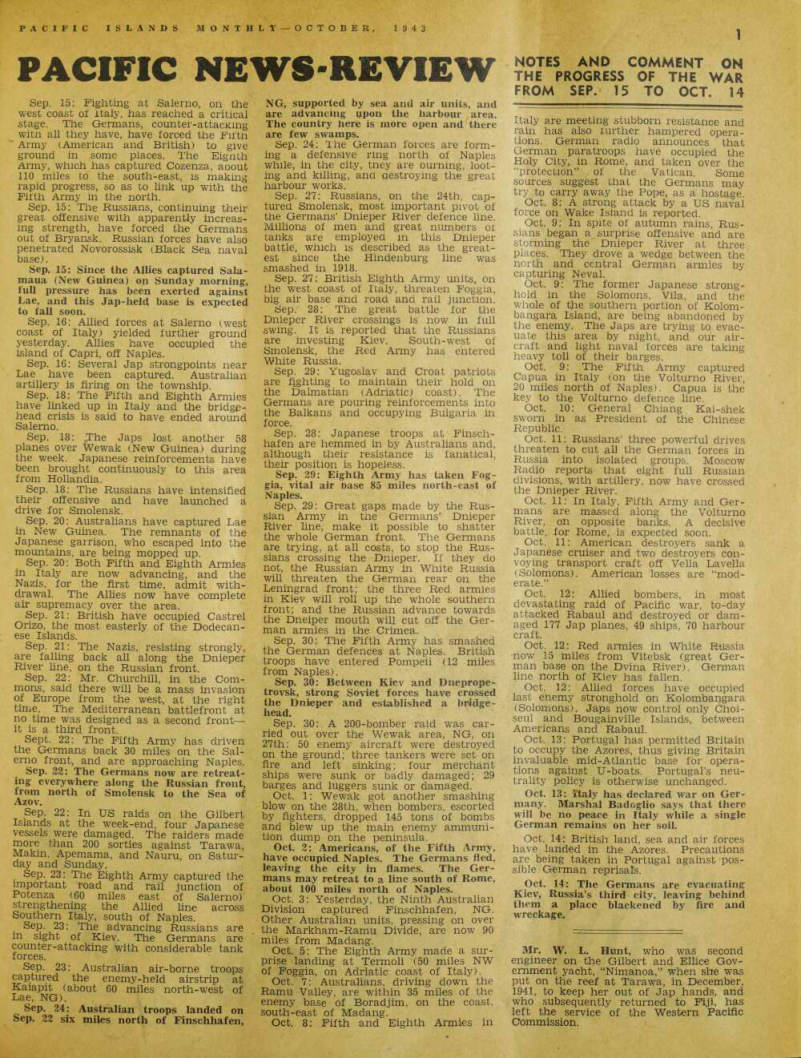
Contents
Pacific News Review 1 Is There to be a “New Order” in the Pacific? 3 £14,000,000 in War Damage Fund ... 4 Two Nations Woo Filipinos 5 Death of R. D. Bertie 5 Damien Parer Joins Americans ... 5 Marriage of Judge Phillips 6 Territories Casualties 6 Death of Judge Wanliss 7 New Life in Marquesas 7 M. Laigret—New F. French South Pacific Chief 7 “Eddie” Ward—New Minister for Australian Territories 8 Death of “Vince” Smith 8 Papua and N. Guinea Fraternise in Sydney 9 The Fiji Indian—A Pain in the Neck! 10 Pacific Races—Future Relations of Natives and Europeans 11 Samoa Resident Decorated 11 Fijians Led By New Zealanders— Good Work by South Pacific Scouts 12 Wartime Addresses of Thursday Is.
Residents 12 ANGAU and the Future 13 Pacific Affairs—University Quiz ... 15 Solomon Islands Reconstruction Plans 16 Sly Grog in Samoa—Extraordinary Differences in Fines 17 The Rising of the Palolo 19 Men of Torres Islands—Effect of War 20 Nostalgia—Unwilling Sydneyites En joy Hate Session 21 In the Track of the Americans— Changes in Noumea and Solomons 24 Fiji’s Secret Weapon 27 East of Samarai—Memories of Early Days 28 A Garden in Tahiti 30 Death of Squadron-Leader Stan Baldie 32
Japan’s Air Strength in Pacific ... 33 Fiji’s Honour Roll 36 Bishop Who “Lived Like a Rabbit” — Inspiring Story of Dr. Baddeley .. 38 New Guinea’s Missing Men—Latest Unofficial Information Govs, ii., iii. and page 37
Advertisers
A. Ltd. ... 22 Atkins Pty., Ltd., Wm 28 Australian Alumi nium Co. Pty., Ltd 25 Broomfield. Ltd. . . 24 Brown, D. C. . . . 25 Brown & Co., Ltd., G 13 Brunton’s Flour . . 20 Burns, Philp Trust Co., Ltd 15
B. (S.S.) Co. . . 13
Carlton & United Breweries, Ltd. . 19 Carpenter, Ltd., W.
R cov. iv.
Chivers & Sons, Ltd 33 Coleman Lamp & Stove Co 23 “Cystex” 27 Darvas & Co. ... 33 Donaghy & Sons,
Ltd 34'
Donald, Ltd., A. B. 34 Dorn, Paul A. ... 40 Dr. Williams Pink Pills Electrolux Refrigerators . . 18 Foster Clark, Ltd. . 17 Garrett & Davidson 38 Gilbey’s Gin ... 14 Gillespie’s Pty., Ltd., Robert 25 Gillespie’s Flour . . 36 Gough & Co., E.
J 38 Grove & Sons, W.
H 14 Grand Pacific Hotel 2 Kopsen & Co., Ltd. 35 “ Lavex ” Washing Compound ... 26 Maxwell Porter, Ltd. 37 Merrillees & Co., J. C 20 “Mendaco” ... 32 Miller & Co. Pty., Ltd 27 Nelson & Robertson Pty., Ltd 35 “Nixoderm” ... 40 Pacific Is. Society . 13 Pearson, Russell . .31 “Pinkettes” ... 32 Rose’s Eye Lotion . 36 Queensland Insur ance Co., Ltd. . . 29 Riverstone Meat Co., Ltd 21 Rohu, Sil 24 Scott, Ltd., J. ... 24 Steamships Trading Co., Ltd 29 Sullivan & Co., C. . 26 Swallow & Ariell . 16 Taylor & Co., A. . 30 “Tenax” Soap . . 32 Tillock & Co., Ltd. 36 “Van Kars”
Liqueurs ... 26 Wright & Co. ... 37 Wright & Co., Ltd., E 34 Wunderlich, Ltd. . 30 Young Pty., Ltd., Harry J 30 Yorkshire Insurance Co., Ltd 23
Advertisements & other items, p. 4 (2 items)
Useful Addresses
The following are the addresses of organisations set up to deal with Pacific Territories affairs:—
PAPUA, NEW GUINEA, NAURU,
NORFOLK IS.
Department of External Territories (Sydney Branch) (Lately the New Guinea Trade Agency), Australia House, Carrington Street, Sydney.
Telephone: BW 1776. (Dealing with all matters connected with the Australian Pacific Territories and also the Sydney representative of the New Guinea Copra Control Committee.)
BRITISH SOLOMON ISLANDS
Sydney Office of British Solomon Islands Government (In charge of Mr. F. E. Johnson, Treasurer of the Solomons Administration), 17 Castlereagh Street, Sydney.
Telephone: B 1710.
GILBERT AND ELLICE, AND
OCEAN IS.
Sydney Office of Gilbert and Ellice Islands Colony (In charge of Mr, S. G. Clarke, Treasurer of the G. and E. Administration), Bank of New Zealand Building, George Street, Sydney. Telephone: B 2209.
FOR PACIFIC TERRITORIES
EVACUEES GENERALLY
Pacific Territories Association (C. A. M. Adelskold, Secretary), c/o Robert Gillespie Pty., Ltd., 54a Pitt Street, Sydney. Telephone: BW 4782.
WAR DAMAGE COMMISSION
Sydney Office: M.L.C. Buidling, Cnr. Martin Place and Castlereagh Street, Sydney.
Telephone: BW 2361.
FOR CLAIMS AGAINST ARMY
Mr. H. Alderman, Darwin-Moresby Claims Section, Chief Finance Office (Army), Victoria Barracks, Melbourne.
rr
w m des'S" 6 " ..rvice 9SO>
Pacific Islands Monthly
The Newspaper-Magazine of the South Seas [Registered at the G.P.0., Sydney, for transmission by post as a newspaper .]
Published Once Each Month and Circulated in Australia and New Zealand and in the following Pacific Territories and Islands Groups:
Australian Territory of Papua.
Mandated Territory (Australia) of New Guinea.
Australian Territory of Norfolk Island.
New Zealand Territory of Cook Islands.
Mandated Territory (NZ) of Western Samoa.
British Colony of Fiji.
British Solomon Islands Protectorate.
British Protectorate of Tongan Islands.
British Crown Colony of Gilbert and Ellice Islands.
Mandated Territory of Nauru.
British and Free French Condominium of New Hebrides.
Free French Colony of New Caledonia.
Free French Colony of Oceania (Tahiti, etc.).
American Territory of Eastern Samoa.
American Territory of Hawaiian Islands.
Owned and Produced by Pacific Publications Pty. Ltd., Union House, 247 George Street, Sydney.
( Managing Director .. BW 5037 TELEPHONE £ Business and Editorial MA 4369
P.O. Box 3408 R
Registered Address of Telegrams. Radiograms, and Cables: “Pacpub”, Sydney.
Contributions.
Articles, Stories, and Photographs dealing with Pacific Islands subjects are invited and will be paid for on publication.
Subscription Rates.
Per Annum, within British Empire, Prepaid, Post Free 8/- Per Annum, elsewhere, prepaid, Post Free. 10/- Single Copies Bd.
Editor and Publisher:
R. W. Robson, P.R.G.S.
Advertising Manager; L. W. Bailey.
Advertising Office and Printing-House: 29 Alberta Street, Sydney.
Advertising rates furnished on application.
Colours, etc., by arrangement.
Process Blocks made at Advertiser’s expense when required. Screen 100.
Changes of Advertising Copy should reach this office by Ist of each month, otherwise previous advertisement may be repeated.
Representative In London.
W. C. Harvey, Coronation House, 4 Lloyds Avenue, London, E.C.3, from whom may be obtained copies of Pacific Islands Monthly, Pacific Is. Year Book, advertising schedules, etc.
Agents.
The following are authorised to recelre «üb scriptions for Pacific Islands Monthly:— Burns, Philp Sc Co., Ltd., and Burns Phllp (South Sea) Co., Ltd. All branches.
W. R. Carpenter Sc Co., Ltd. All branches.
Morris, Hedstrom, Ltd. All branches.
Steamships Trading Co., Papua. All branches.
B.N.G. Trading Co., Ltd., Port Moresby, Papua.
J. Muir, Suva, FIJI.
Miss R. Castles, Suva. FIJI.
N. C Mackenzie Hunt, Walnunu, Bua, FIJI.
Cook Islands Trading Co., Rarotonga, Cook la.
A. C. Rowland, Papeete, Tahiti.
Islands Branches and Representatives of W. H.
Grove Sc Sons, Ltd., Auckland, New Zealand.
Ed. Pentecost, Noumea, New Caledonia.
Kerr Sc Co., Noumea, New Caledonia.
Vol. Xiv. No. 3.
October 18, 1943
Pr\ra i ld * Per Copy rnce ( Prepaid; 8/- p.a.
Is There to be a “New Order” in
the Pacific?
IN the hearts of most Territorians (for so we designate nowadays those Europeans who have made their permanent homes in all the Pacific Islands between New Guinea and Tahiti) there is a strong, per sistent but, alas! diminishing hope that they may see, after the war, in the Islands, a restoration of the con ditions which ruled before Satan turned Schickelgruber and To jo loose upon the world.
It is a vain hope. Not only is War tearing to pieces the social structure of all native communities; War actually is altering the face of the Islands themselves, so that, when the armed forces have passed on, there will be roads and airfields and ports and little towns where, only two years ago, there was primitive jungle and untouched lagoon. Tens of thousands of Americans, Australians and New Zealanders, who never pre viously had seen a coconut, now are making an intimate acquaintance with the Pacific Islands. ' Many of them, inevitably, will return.
The Islands of the nineteenth cen tury romanticists, already changing in the past two or three decades, now are gone, forever—blasted into the past by the foul hordes of Japan, and by the mighty machine which we have had to create to save ourselves from extermination.
We lament the passing of an era which held much of beauty and charm. But laments achieve noth ing. The crime is not of our doing.
There is a job before us. Our Islands
world has been shattered to bits; we may not re-mould it nearer to our heart’s desire, perhaps, but re-mould it we must. There is planning to be done.
MANY planners are at work. They have not reached the confer ence table, yet; but typewriters are running hot and printing-presses beginning to groan. There is a torrent of urging and argument; before long, it will become a flood.
There is great feeling, but a rather pitiful lack of vision.
These commentators are honest and altruistic, but most of them re fuse to look at the future with more than one eye—the eye that has been trained to see only according to the measure of their personal experience and ambitions. The trader has one viewpoint; the administrative official another; the missionary yet another.
Each seems to think that the new Pacific world may be shaped some thing like the old Pacific world, that ended on December 7, 1941; and each hopes that the new shaping may be kinder to native rights, or commercial enterprise, or Governmental authority, or whatever it is he is interested in.
Already, they are arguing with each other—futile, useless argument. Why are they so blind to the plain, inescapeable fact that the old set-up in the Pacific Territories is being as ruthlessly torn apart by War, making a new and different shaping inevit able, as are the steppes of western Russia or the devastated cities of Germany?
INVASION and hard fighting in the Melanesian Territories, and the presence of large bodies of European soldiers, new to Islands life, in most of the Micronesian and Polynesian Territories, already have had a pro found, disturbing effect upon the native peoples. In two ways, at least, their living conditions have been altered permanently—they have been brought into such close contact with masses of white men that the old. unwritten but very clearly defined distinctions, as between white and brown status, have been largely wiped out; and there is so much easily-won soldiers’ money in circulation now, in every Territory, that it is inconceiv able that the natives will accept in the future the wages standards of the past.
Each of these facts creates a special set of problems for the future —one especially for the missionaries, and one for the employers of native labour.
But those things are concerned only with the future of the natives. The native problem, probably, is the first problem of the Islands—but it is by no means the only problem.
HOW are the Pacific Teritories, in future, to be controlled and administered? Are we to return to the pitiful, inadequate system under which each was tied separately to the tails of the bureaucracies of Canberra and Wellington, London and Paris and Washington, administered in separate, watertight, non-communi cating compartments, so' that Fiji knows nothing officially of what is happening in Samoa, and New Guinea and Solomons disdainfully ignore administrative activities on the other
side of the imaginary line which' con stitutes the border between them? Or are we to have some sort of a union, or federation, so that the adminis trative problems common to the dozen Territories south of the equator (and most problems are common to all) may be jointly studied, and a common policy,, based on experience, evolved?
The bureaucrats of Canberra and London, Paris and Wellington, will almost certainly run, yelping, to the
defence of their privileges and per quisites; they will want the old system continued. We can expect nothing constructive from them. But what will America say?
Is it not becoming as clear as day light that the United States, having been precipitated into this war by uncontrolled developments in the Pacific, is not going to retire from the Pacific until satisfied that all future war-making factors there are either removed or properly controlled? The Americans do not interfere with pro perly established Governments and national freedoms—that is the most prominent thing in the foreign re lations history of the United States — but the Americans have left us in no doubt that, having come into the Pacific to clean up a ghastly mess, they are not going to leave the Pacific until all danger of another Pacific upheaval is gone.
IT will be surprising, indeed, if the retention of some form of American control in the Pacific is not accompanied by a rearrangement and redistribution of Pacific trade. Few of us—even the merchants whose interests may suffer—will quarrel with the new set-up.
As the months pass, and we get the events of that terrifying year of 1942 into focus, we realise more clearly the debt we owe to the United States. It was only that amazingly quick con centration of American power in the South Pacific in 1942 which saved us (the Pacific Territories certainly, and
probably Australia and New Zealand as well) from invasion, enslavement and, maybe, extermination.
The Americans may not approve of the unscientific, haphazard adminis trative methods under which so many of the Pacific Territories were ruled.
They certainly will ask why, if self government can be allowed to the Tongans and the Filipinos, it should be withheld from certain Polynesian peoples, like the Samoans. Also, while acknowledging that the natives of New Guinea, Solomons and New Hebrides are still too primitive for self-government, the Americans may ask what has been done in the past to lift these Melanesians from the Stone Age into the Machine Age.
Most of those who are planning a new Islands set-up have little first hand knowledge of Islands conditions.
They urgently demand that the Terri tories be reserved for the use of the natives; that “exploitation” should cease; and that far-reaching schemes of native education and health should •be put into operation—although how funds are going to be provided for schools and hospitals, if there is to be an extinguisher put on commercial enterprise, no one attempts to ex plain.
It seems to this writer that the academic folk are doing most of the planning, and the babbling; while the people with a practical knowledge of the Territories, who really can contri bute something helpful are inarti culate and ignored.
LET there be planning, and early planning; but, if much confusion and exasperation and useless argu ment are to be avoided, let all the planners, before they begin to mould their new Pacific world, get a clear answer to the following questions:— Are the Territories to he adminis tered in the future, as in the past, merely as appendages of various Euro pean and Dominions Governments, without any official communication or exchange betioeen Territories?
Will America insist that all such Governments shall formulate a definite native policy . in accord with some general principle covering the care, protection and education of natives?
If —as is anticipated—the policy of encouraging natives to become peasant landholders is generally accepted, how is it proposed to provide labour for industries in the Territories? By indenturing native labour from primi tive villages, as a first step toward training the peasant-farmer (as was done in New Guinea and the Solo mons) ? Or by bringing in Asiatic labour for a fixed term (as in Neio Caledonia and New Hebrides) ? Or by introducing a permanent community of Asiatic leaseholders (as in the case of the Indians in Fiji) ?
Is it possible or practicable to plan soldier-settlements in the Territories (which will certainly be demanded by both service-men and Governments) unless proper provision is made for (a) land, (b) adequate finance, (c) agricultural tuition, (d) labour, (e) tuition in the handling of natives, (f) guaranteed markets for plantation
products, (g ) transport and com munication.
Until the principles and policies involved in those questions are clari fied, it is waste of time to talk much at this stage, about the future of the Pacific Territories.
Apology to Our Readers
WE dislike, as much as do our readers, the poor class of paper upon which this journal is printed. It is part of the set-up of World War 11.
Bureaucracy argues that a journal like this is not really necessary to the national war effort. We must be grateful that we are permitted to live. Certainly, we may not indulge in luxuries. Good paper is a luxury.
If we are to be allowed to carry on, it is sufficient that we be legible.
And so, year by year, we have been com pelled to print the “PIM” on a poorer and poorer class of paper, until now we have arrived at what is called “newsprint.”
There is no cheaper class of paper available to us.
Pre-war, this newsprint cost around £l5 per ton. To-day, the price is £7O per ton.
Sooner or later, in self-preservation, we shall have to raise the “PIM” subscription —probably, 10/- per annum, and 1/- per single copy.
We can but ask our readers to be patient.
Some day, when Mr. Schickelgruber has emitted his last screech, and Mr. Tojo has been sent in a little box on a final visit to his ancestors, normal conditions will return —including paper for which we need not
apologise.
Damage Fund
£14,000,000 In War
Minister Makes a Statement
(From Our Special Representative)
Canberra, Oct. 12.
UESTIONS have been asked in Par liament concerning the intentions of the Government in regard to war damage insurance. It has been suggested that, now that the danger of invasion has passed, the amount of premium should be greatly modified, if it is con sidered necessary to continue compulsory contributions at all in view of the altered circumstances.
The Government is now considering a report on the subject from the War Dam age Commission.
In an interview to-day, the chairman • Mr. A. W. Coles) stated that insurance premiums now paid totalled £14,000,000.
The position had improved greatly: it was not probable that anything like the call originally thought possible would now be made upon the fund.
“Whilst we have made certain advances in necessitous cases,” said Mr. Coles, “it will not be until the position is safe that claims in general will be met for not till then will it be possible to assess the damage fully.
“Most of the damage in Australia has been in Darwin, and a number of claims have also been received from other places in the North.
“The greatest call on the fund how ever, is from former residents of Papua and the New Guinea Mandated Terri tory. In the general evacuation, many people suffered heavy losses. When the war ends they may decide to go back, or they may elect to remain here. In any event, they will all be dealt with equit ably.
“Until the Japanese are driven com pletely out of the Islands it is not pos sible to say what damage has been done, or to attempt to assess the losses in indi vidual cases. But we have district com mittees already at work, and they are endeavouring to collect all available information for the establishing and recording of values, so that no delay may occur when rehabilitation is per mitted by the Government.”
EDITORIAL NOTE: The Minister gives Territorians neither news nor reassur ance. What they want to know is this: Provided there is to be sufficient money in the fund to permit real rehabilitation (which now seems likely) will Mr. Coles and his colleagues alter the definition of “war damage,” so that hundreds of Ter ritories residents, whose property has disappeared or deteriorated by looting, neglect or Army operations since their compulsory evacuation, may receive com pensation? At present, that kind of damage is called “indirect damage,” and is not subject to war damage insurance.
The only people who now can expect compensation are the lucky ones whose pronerty has been destroyed by bombs, shells or “scorched earth.” That is “direct” damage. The distinction is far cical—but it is still the law.
Sudden Death in Sydney
Mr. R. D, Bertie
NEWS of the death of Mr, Robert Dugald Bertie, the well-known legal practitioner, of Port Moresby, on October 2, came as a shock to Papuan people, to whom he appeared as a vigor ous, middle-aged man.
Mr. Bertie left Port Moresby, as an evacuee, in February, 1942. His nephew, a partner in the Sydney law firm of Gray and Perkins, was gone on active service, so Mr. Bertie entered the office to help the other partners. In addition, he still had much work to do in connec tion with his large Papuan practice. He was attacked by thrombosis, and died, very suddenly and unexpectedly, within a few hours, at the age of 63.
He was a member of a well-known New South Wales family. He was educated in NSW and practised as a solicitor there for a good many years before, in 1916, he established his law business in Port Moresby. For 25 years, he was a well known figure in Papua, liked and respected by everyone. He built up a very good professional connection, and his clients included most of the leading commercial houses.
Mrs. Bertie died several years ago, in Port Moresby. Their daughter is Mrs.
Gilliland, now a resident of Sydney. Mr, and Mrs. Gilliland lived for some time in Papua.
Fiji Airman
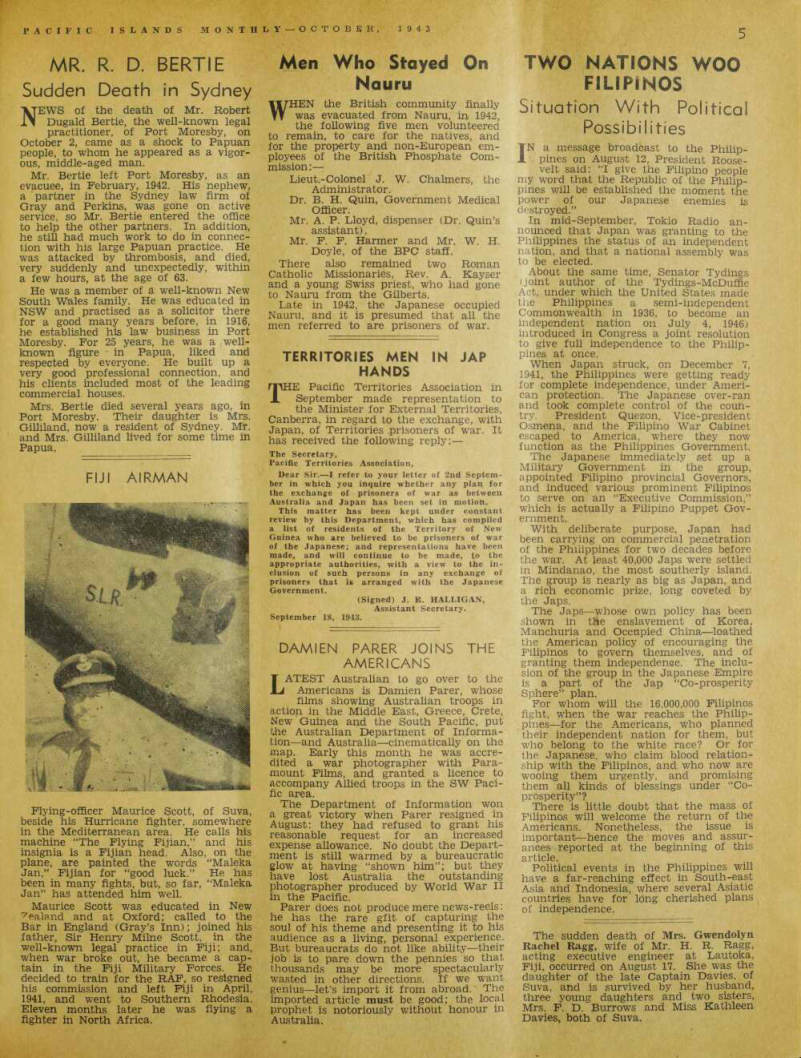
Flying-officer Maurice Scott, of Suva, beside his Hurricane fighter, somewhere in the Mediterranean area. He calls his machine “The Flying Fijian,” and his insignia is a Fijian head. Also, on the plane, are painted the words “Maleka Jan,” Fijian for “good luck.” He has been in many fights, but, so far, “Maleka Jan” has attended him well.
Maurice Scott was educated in New Zealand and at Oxford; called to the Bar in England (Gray’s Inn); joined his father, Sir Henry Milne Scott, in the well-known legal practice in Fiji; and, when war broke out, he became a cap tain in the Fiji Military Forces. He decided to train for the RAF, so resigned his commission and left Fiji in April, 1941, and went to Southern Rhodesia.
Eleven months later he was flying a fighter in North Africa.
Men Who Stayed On Nauru
Nauru
WHEN the British community finally was evacuated from Nauru, in 1942, the following five men volunteered to remain, to care for the natives, and for the property and non-European em ployees of the British Phosphate Com mission:— Lieut.-Colonel J. W. Chalmers, the Administrator.
Dr. B. H. Quin, Government Medical Officer.
Mr. A. P. Lloyd, dispenser (Dr. Quin’s assistant).
Mr. F. F. Harmer and Mr. W. H.
Doyle, of the BPC staff.
There also remained two Roman Catholic Missionaries, Rev. A. Kayser and a young Swiss priest, who had gone to Nauru from the Gilberts.
Late in 1942, the Japanese occupied Nauru, and it is presumed that all the men referred to are prisoners of war.
Territories Men In Jap
Hands
THE Pacific Territories Association in
September made representation to
the Minister for External Territories, Canberra, in regard to the exchange, with Japan, of Territories prisoners of war. It has received the following reply:— The Secretary, Pacific Territories Association, Dear Sir.—l refer to your letter of 2nd Septem ber in which you inquire whether any plan for the exchange of prisoners of war as between Australia and Japan has been set in motion.
This matter has been kept under constant review by this Department, which has compiled a list of residents of the Territory of New Guinea who are believed to be prisoners of war of the Japanese; and representations have been made, and will continue to be made, to the appropriate authorities, with a view to the in clusion of such persons in any exchange of prisoners that is arranged with the Japanese Government, (Signed) J. R. HALLIGAN, Assistant Secretary.
September 18, 1943.
Damien Parer Joins The
Americans
LATEST Australian to go over to the Americans is Damien Parer, whose films showing Australian troops in action in the Middle East, Greece, Crete, New Guinea and the South Pacific, put the Australian Department of Informa tion—and Australia —cinematically on the map. Early this month he was accre dited a war photographer with Para mount Films, and granted a licence to accompany Allied troops in the SW Paci fic area.
The Department of Information won a great victory when Parer resigned in August; they had refused to grant his reasonable request for an increased expense allowance. No doubt the Depart ment is still warmed by a bureaucratic glow at having “shown him”; but they have lost Australia the outstanding photographer produced by World War II in the Pacific.
Parer does not produce mere news-reels; he has the rare gfit of capturing the soul of his theme and presenting it to his audience as a living, personal experience.
But bureaucrats do not like ability—their job is to pare down the pennies so that thousands may be more spectacularly wasted in other directions. If we want genius—let’s import it from abroad.' The imported article must be good; the local prophet is notoriously without honour in Australia.
Filipinos
Two Nations Woo
Situation With Political Possibilities
IN a message broadcast to the Philip pines on August 12, President Roose velt said: “I give the Filipino people my word that the Republic of the Philip pines will be established the moment the power of our Japanese enemies is destroyed.”
In mid-September, Tokio Radio an nounced that Japan was granting to the Philippines the status of an independent nation, and that a national assembly was to be elected.
About the same time, Senator Tydings (joint author of the Tydings-McDuffie Act, under which the United States made the Philippines a semi-independent Commonwealth in 1936, to become an independent nation on July 4, 1946; introduced in Congress a joint resolution to give full independence to the Philip pines at once.
When Japan struck, on December 7, 1941, the Philippines were getting ready for complete independence, under Ameri can protection. The Japanese over-ran and took complete control of the coun try. President Quezon, Vice-president Osmena, and the Filipino War Cabinet escaped to America, where they now function as the Philippines Government, The Japanese immediately set up a Military Government in the group, appointed Filipino provincial Governors, and induced various prominent Filipinos to serve on an “Executive Commission,” which is actually a Filipino Puppet Gov ernment.
With deliberate purpose, Japan had been carrying on commercial penetration of the Philippines for two decades before the war. At least 40,000 Japs were settled in Mindanao, the most southerly island.
The group is nearly as big as Japan, and a rich economic prize, long coveted by the Japs.
The Japs—whose own policy has been shown in the enslavement of Korea, Manchuria and Occupied China—loathed the American policy of encouraging the Filipinos to govern themselves, and of granting them independence. The inclu sion of the group in the Japanese Empire is a part of the Jap “Co-prosperity Sphere” plan.
For whom will the 16,000,000 Filipinos fight, when the war reaches the Philip pines—for the Americans, who planned their independent nation for them, but who belong to the white race? Or for the Japanese, who claim blood relation ship with the Filipinos, and who now are wooing them urgently, and promising them all kinds of blessings under “Co prosperity”?
There is little doubt that the mass of Filipinos will welcome the return of the Americans. Nonetheless, the issue is important—hence the moves and assur ances reported at the beginning of this article.
Political events in the Philippines will have a far-reaching effect in South-east Asia and Indonesia, where several Asiatic countries have for long cherished plans of independence.
The sudden death of Mrs. Gwendolyn Rachel Ragg, wife of Mr. H. R. Ragg, acting executive engineer at Lautoka, Fiji, occurred on August 17. She was the daughter of the late Captain Davies, of Suva, and is survived by her husband, three young daughters and two sisters, Mrs. F. D. Burrows and Miss Kathleen Davies, both of Suva.
Judge “Monty"
Phillips
Marriage in London
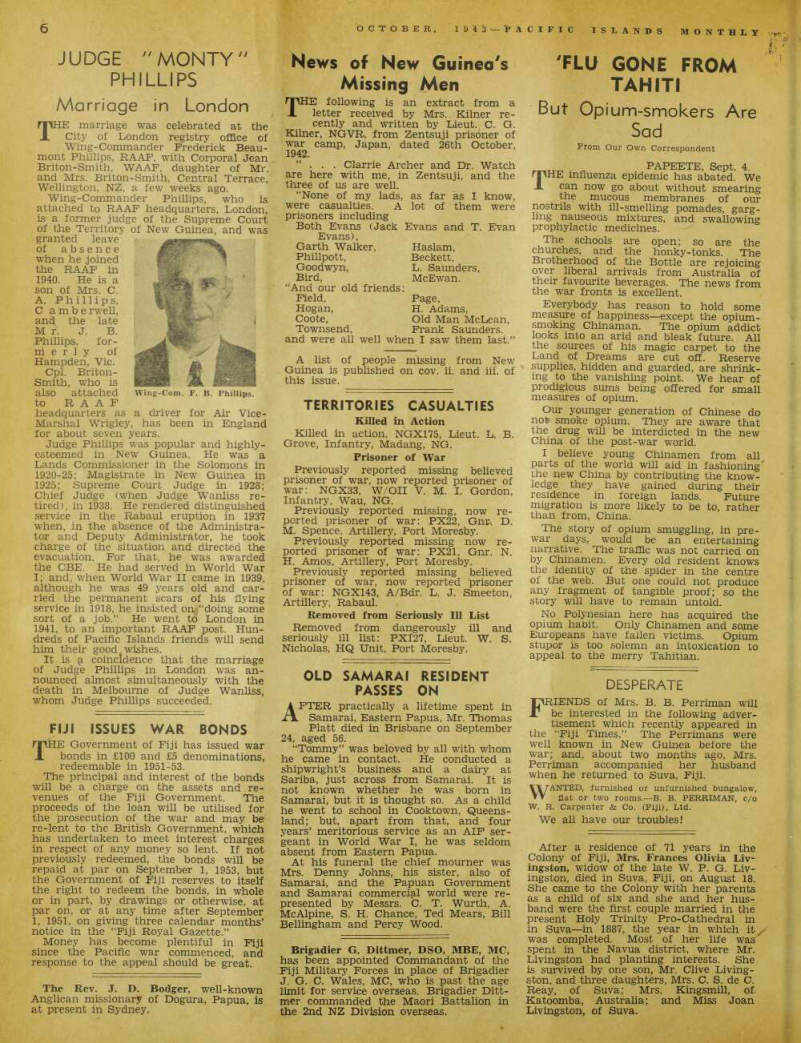
rE marriage was celebrated at the City of London registry office of Wing-Commander Frederick Beau mont Phillips, RAAF, with Corporal Jean Briton-Smith, WAAF. daughter of Mr. and Mrs. Briton-Smith, Central Terrace, Wellington, NZ, a few weeks ago.
Wing-Commander Phillips, who is attached to RAAF headquarters, London, is a former judge of the Supreme Court of the Territory of New Guinea, and was
granted leave of absence when he joined the RAAF in 1940. He is a son of Mrs. C.
A. Phillips, C a m b e rwell, and the late
M R. J. B.
Phillips, for ni er 1 y of Hampden, Vic.
Cpl. Briton- Smith, who is also attached to RAAF
headquarters as a driver for Air Vice- Marshal Wrigley, has been in England for about seven years.
Judge Phillips was popular and highly esteemed in New Guinea. He was a Lands Commissioner in the Solomons in 1920-25; Magistrate in New Guinea in 1925; Supreme Court Judge in 1928; Chief Judge (when Judge Wanliss re tired) ,in 1938. He rendered distinguished service in the Rabaul eruption in 1937 when, in the absence of the Administra tor and Deputy Administrator, he took charge of the situation and directed the evacuation. For that, he was awarded the CBE. He had served in World War I; and, when World War II came in 1939, although he was 49 years old and car ried the permanent scars of his flying service in 1918, he insisted orV'doing some sort of a job.” He went to London in 1941, to an important RAAF post. Hun dreds of Pacific Islands friends will send him their good t wishes.
It is a coincidence that the marriage of Judge Phillips in London was an nounced almost simultaneously with the death in Melbourne of Judge Wanliss, whom Judge Phillips succeeded.
Wing-Com. F. B, Phillips.
Fiji Issues War Bonds
THE Government of Fiji has issued war bonds in £lOO and £5 denominations, redeemable in 1951-53.
The principal and interest of the bonds will be a charge on the assets and re venues of the Fiji Government. The proceeds of the loan will be utilised for the prosecution of the war and may be re-lent to the British Government, which has undertaken to meet interest charges in respect of any money so lent. If not previously redeemed, the bonds will be repaid at par on September 1, 1953, but the Government of Fiji reserves to itself the right to redeem the bonds, in whole or in part, by drawings or otherwise, at par on, or at any time after September 1, 1951, on giving three calendar months’ notice in the “Fiji Royal Gazette.”
Money has become plentiful in Fiji since the Pacific war commenced, and response to the appeal should be great.
The Rev. J. D. Bodger, well-known Anglican missionary of Dogura, Papua, is at present in Sydney.
Missing Men
News of New Guinea's Missing Men
THE following is an extract from a letter received by Mrs. Kilner re cently and written by Lieut. C. G.
Kilner, NGVR, from Zentsuji prisoner of war camp, Japan, dated 26th October, 1942.
“ . . . Clarrie Archer and Dr. Watch are here with me, in Zentsuji, and the three of us are well.
“None of my lads, as far as I know, were casualties. A lot of them were prisoners including Both Evans (Jack Evans and T. Evan Evans), Garth Walker, Haslam, Phillpott, Beckett, Goodwyn, L. Saunders, Bird, McEwan.
“And our old friends: Field, Page, Hogan, H. Adams, Coote, Old Man McLean, Townsend, Frank Saunders, and were all well when I saw them last.”
A list of people missing from New Guinea is published on cov. ii. and hi. of this issue.
Territories Casualties
Killed in Action Killed in action, NGXI7S, Lieut. L. B.
Grove, Infantry, Madang, NG.
Prisoner of War Previously reported missing believed prisoner of war, now reported prisoner of war; NGX33, W/011 V. M. I. Gordon, Infantry, Wau, NG.
Previously reported missing, now re ported prisoner of war: PX22, Gnr-. D.
M. Spence, Artillery, Port Moresby.
Previously reported missing now re ported prisoner of war: PX2I, Gnr. N.
H. Amos, Artillery, Port Moresby.
Previously reported missing believed prisoner of war, now reported prisoner of war: NGXI43, A/Bdr. L. J. Smeeton, Artillery, Rabaul.
Removed from Seriously 111 List Removed from dangerously ill and seriously ill list: PXl'27, Lieut. W. S.
Nicholas, HQ Unit, Port Moresby.
Old Samarai Resident
Passes On
AFTER practically a lifetime spent in Samarai, Eastern Papua, Mr. Thomas Platt died in Brisbane on September 24, aged 56.
“Tommy” was beloved by all with whom he came in contact. He conducted a shipwright’s business and a dairy at Sariba, just across from Samarai. It is not known whether he was born in Samarai, but it is thought so. As a child he went to school in Cooktown, Queens land; but, apart from that, and four years’ meritorious service as an AIF ser geant in World War I, he was seldom absent from Eastern Papua.
At his funeral the chief mourner was Mrs. Denny Johns, his sister, also of Samarai, and the Papuan Government and Samarai commercial world were re presented by Messrs. C. T. Wurth, A.
McAlpine, S. H. Chance, Ted Mears, Bill Bellingham and Percy Wood.
Brigadier G. Dittmer, DSO, MBE, MC, has been appointed Commandant of the Fiji Military Forces in place of Brigadier J. G. C. Wales, MC, who is past the age limit for service overseas. Brigadier Ditt mer commanded the Maori Battalion in the 2nd NZ Division overseas.
Flu Gone From
Tahiti
But Opium-smokers Are Sad
From Our Own Correspondent
T„„ . Papeete, Sept. 4.
HE influenza epidemic has abated. We can now go about without smearing the mucous membranes of our nostrils with ill-smelling pomades, garg ling nauseous mixtures, and swallowing prophylactic medicines.
The schools are open; so are the churches, and the honky-tonks. The Brotherhood of the Bottle are rejoicing over liberal arrivals from Australia of their favourite beverages. The news from the war fronts is excellent.
Everybody has reason to hold some measure of happiness— except the opium smoking Chinaman. The opium addict looks into an arid and bleak future. All the sources of his magic carpet to the Land of Dreams are cut off. Reserve supplies, hidden and guarded, are shrink ing to the vanishing point. We hear of prodigious sums being offered for small measures of opium.
Our younger generation of Chinese do note smoke opium. They are aware that the drug will be interdicted in the new China of the post-war world.
I believe young Chinamen from all parts of the world will aid in fashioning 7 the new China by contributing the know ledge they have gained during their residence in foreign lands. Future migration is more likely to be to, rather than from, China.
The story of opium smuggling, in pre war days, would be an entertaining narrative. The traffic was not carried on by Chinamen. Every old resident knows the identity of the spider in the centre of the web. But one could not produce any fragment of tangible proof; so the story will have to remain untold.
No Polynesian here has acquired the opium habit. Only Chinamen and some Europeans have fallen victims. Opium stupor is too solemn an intoxication to appeal to the merry Tahitian.
Desperate
FJENDS of Mrs. B. B. Perriman will be interested in the following adver tisement which recently appeared in the “Fiji Times.” The Perrimans were well known in New Guinea before the war; and, about two months ago, Mrs.
Perriman accompanied her husband when he returned to Suva, Fiji.
WANTED, furnished or unfurnished bungalow, flat or two rooms.—B. B. PERRIMAN, c/o W. R. Carpenter & Co. (PijiJ, Ltd.
We all have our troubles!
After a residence of 71 years in the Colony of Fiji, Mrs. Frances Olivia Liv ingston, widow of the late W. P. G. Liv ingston, died in Suva, Fiji, on August 18.
She came to the Colony with her parents as a child of six and she and her hus band were the first couple married in the present Holy Trinity Pro-Cathedral in in Suva—in 1887, the year in which it . was completed. Most of her life was spent in the Navua district, where Mr.
Livingston had planting interests. She is survived by one son, Mr. Clive Living ston, and three daughters, Mrs. C. S. de C.
Reay, of Suva; Mrs. Kingsmill, of Katoomba, Australia; and Miss Joan Livingston, of Suva.
Advertisements & other items, p. 8 (1 item)
6
OCTOBER, IHL-JACIFIC ISLANDS MONTHLY
Marquesas
New Life In The
Fine Race Increasing in Numbers
From Our Own Correspondent
Papeete, Aug. 25.
ONE thing which pleases beyond measure is information from authori tative quarters that the Marquesan natives are not only holding their own, but are increasing in numbers.
For many years we believed the Marquesan race was doomed to extinc tion; yet the Roman Catholic Fathers never gave up, and, by fine doctoring and good teaching and patient service, they have accomplished the impossible.
The next step will be to keep tourists, scientists and wastrels out of the Mar quesas islands, and this fine Polynesian nation may regain some measure of its former numbers.
The French, after a century of ex perience, have arrived at the only possible policy for the preservation of native peoples—i.e., to close the islands against visit or settlement by Europeans, and to maintain a centre of administration and commerce on one central island alone.
This policy was first applied to the Austral Islands, and the health and happiness of the people of that archi pelago bear witness to its wisdom.
The history of European settlement reads like the campaigns of Genghis Khan, First to be blotted out were the Canary Islanders; then the Caribs, of the West Indies, the North American Indians, the Polynesians, of Hawaii. “Westward the Course of Empire” has brought des truction and annihilation to native races.
Will not the awakened conscience of mankind save from the inevitable fate, the pitiful remnants of once happy little peoples?
The Hollywood conception of Polynesia is sickening. The valour and fortitude of the Maori, the Tahitian, the Samoan on the field of battle are giving the lie to all the degenerate balderdash written and acted in that Holy City of Clown Worship.
EDITORIAL NOTE: When Europeans first saw the Marquesas, they were in habited by perhaps 100,000 light-skinned people—a good-looking, hospitable race, described as the finest type of Polynesian.
By 1920, after a century of European ex ploitation (which included debauchery by waves of beach-combers, the intro duction of venereal diseases, influenza, measles and tuberculosis, and wholesale “blackbirding” to the South American coast), there remained only a miserable, dispirited remnant of about 2,500.
Decorations For Ngvr
Men
rE following decorations were awarded, several weeks ago, to members of the New Guinea Volunteer Rifles (which unit is now disbanded):— Major Jenyns (formerly of Edie Creek).—Mentioned in despatches. He was second in command of the unit.
Military medal awarded to Sergeant R.
Emery (formerly of Lae), and Sergeant J.
McAdam (of Forestry Department).
Lieutenant G. K. Whittaker (formerly a planter), of Lae.—Awarded MBE.
Lady Mitchell, wife of the Governor of Fiji, Sir Philip Mitchell, arrived in Suva, Fiji, on August 31.
M. Laigret
French Chief in South Pacific
Noumea, Sept. 4.
M. CHRISTIAN LAIGRET, a vigorous, clean-shaven man in his early forties, arrived here at the end of August, to take up his duties under the title of Director of the Cabinet of the High Commission, in which office he re places (or is deputy for) Admiral Thierry D’Argenlieu, who was French High Com missioner in the Pacific before becoming Chief of the Fighting French Navy.
M. Laigret was Governor in the Cameroons when that Colony rallied to Fighting France. He became ill a year ago, and spent several months ip Cape town. His brother, the young doctor Louis Laigret, died in the New Hebrides in 1928.
M. Laigret has authority over all French territories in the South Pacific. M. Jan Bourgeau is Acting-Governor of New Caledonia—which post he has filled since the departure, on war service, of M. Henri Montchamp.
Sample A1
American Report on Fijians
MANY months ago, when it was sug gested that Fijian troops might be used advantageously in South Paci fic battle zones, the Americans asked that a “sample force” be sent to Guadalcanal, so that they might see the Fijian reaction to our superior modem warfare.
Apparently, nothing that we, or the enemy, has invented in the lethal line bothers the Fijian. The Americans report the “sample” to be 100 per cent, satisfac tory.
In September the “sample force” was expected back in Fiji on leave —there are plenty of other Fijians in the Solomons now to carry on their good work.
Those Yanks !
THIS one comes from Ensign J. R.
Sprague, USN, who bailed out of a bomber, or was shipwrecked, or something, in the wild Solomon Islands, and was rescued by the natives.
He says that he and his companion were given water to wash in and some spotless white clothes to wear, as well as a safety razor with a fresh blade and a mirror, and a breakfast consisting of fried eggs and some sort of French fried potatoes.
“Then,” Sprague says, “I drew a sketch of a shoe with a wooden sole: and they immediately set to work and whittled a pair of shoes for me out of a log, with strips of my life jacket for bindings.”
Well, it might be true at that—it just sounds far-fetched. For long enough we have heard of “tropical paradises” where fruit drops ripe into one’s lap. The only difference here is that it is spuds that drop—French-fried! (Note: Let’s all go to the Solomons apres la guerre!) Lieutenant-Colonel C. N. F. Ben gough, one of the outstanding young offi cers of the Western Pacific Service, was acting as Resident Commissioner in the Solomon Islands, when a plane in which he was travelling was shot down in the Vella Lavella area, in August. The inci dent was reported in the September “PIM.” Mr. Bengough (who was only 32), and four other officers are believed to have lost their lives.
Judge Wanliss
Dead
16 Years in New Guinea
Colonel D. S. Wanliss, Cmg, Vd,
BA, LLB, who was Chief Judge ih New Guinea from 1921 until 1937, and who several times acted as Adminis trator, died in Melbourne, where he was living in retirement, on September 25, at the age of 79.
Judge W?anliss (as he was generally known) was bom in Victoria and edu cated at Ballarat College and at Trinity College, Cambridge. He was admitted a barrister of Inner Temple, London, in 1888, and he later practised at the Vic torian bar, in Ballarat and in Mel bourne. In World War I, he went abroad with the AIF, as commander of the Fifth Battalion; he was in the Gallipoli land ing; and then he suffered from typhoid, and was evacuated to Australia.
For some time, he was commandant of the Sixth Military District, in Tasmania; and in 1921 he joined the New Guinea service.
During his sixteen years of service, Judge Wanliss became very .well known in the Territory of New Guinea, and his charming social qualities, no less than his erudition, gained him innumerable friends.
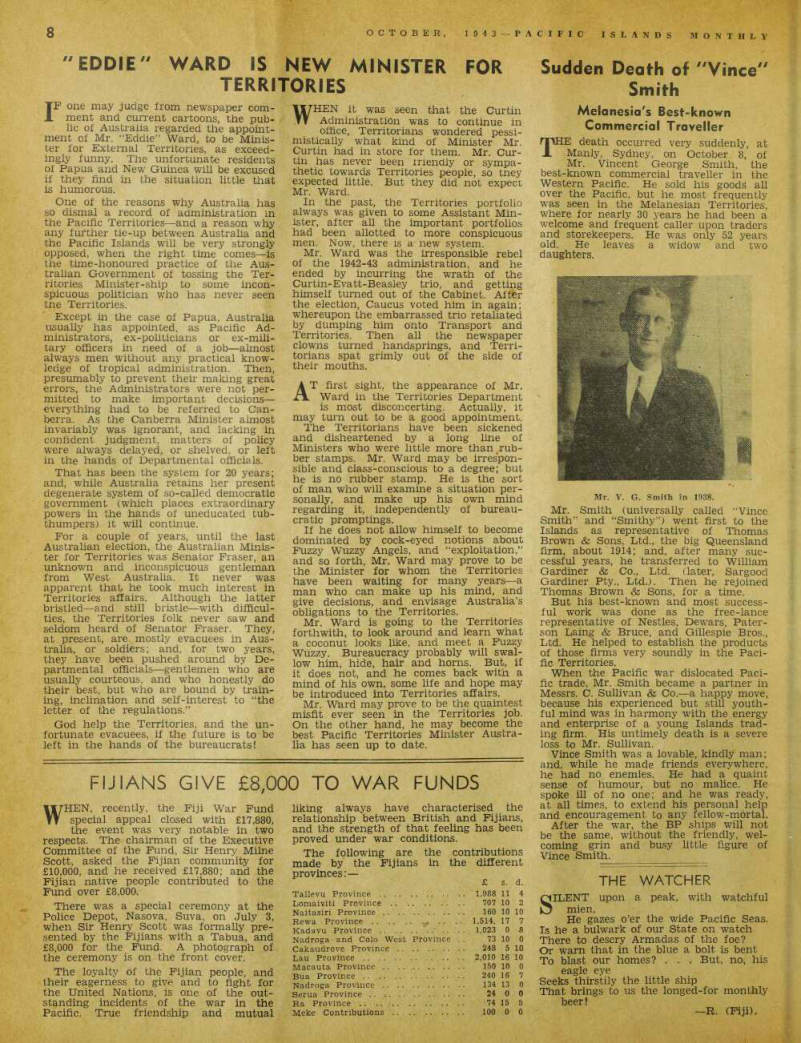
The late Judge Wanliss.
Lend-Lease In Reverse In
Fiji
FRESH foods, such as bananas, paw paws, pineapples, sweet potatoes, pumpkins and corn, which are sup plied to US forces in the Colony of Fiji, have reversed lend-lease aid from the United States to the tune of three million dollars. The producers are paid by the British Government and the food is handed over free to the American troops.
Captain Frank Williams, who has spent a lifetime in the waters around Fiji, where he is regarded as the Group’s most experienced pilot, has been appointed an Honorary Colonel in the Fijian Labour Corps. During late years he has had much to do with stevedoring. In World War I he went overseas in charge of thf Fijian Labour Corps.
Territories
"Eddie" Ward Is New Minister For
IF one may judge from newspaper com ment and current cartoons, the pub lic of Australia regarded the appoint ment of Mr. “Eddie” Ward, to be Minis ter for External Territories, as exceed ingly funny. The unfortunate residents of Papua and New Guinea will be excused if they find in the situation little that is humorous.
One of the reasons why Australia has so dismal a record of administration m the Pacific Territories—and a reason why any further tie-up between Australia and the Pacific Islands will be very strongly opposed, when the right time comes—is the time-honoured practice of the Aus tralian Government of tossing the Ter ritories Minister-ship to some incon spicuous politician who has never seen tne Territories.
Except in the case of Papua, Australia usually has appointed, as Pacific Ad ministrators, ex-politicians or ex-mili tary officers in need of a job—almost always men without any practical know ledge of tropical administration. Then, presumably to prevent their making great errors, the Administrators were not per mitted to make important decisions — everything had to be referred to Can berra. As the Canberra Minister almost invariably was ignorant, and lacking in confident judgment, matters of policy were always delayed, or shelved, or left in the hands of Departmental officials.
That has been the system for 20 years; and, while Australia retains her present degenerate system of so-called democratic government (which places extraordinary powers in the hands of uneducated tub thumpers) it will continue.
For a couple of years, until the last Australian election, the Australian Minis ter for Territories was Senator Fraser, an unknown and inconspicuous gentleman from West Australia. It never was apparent that he took much interest in Territories affairs. Although the latter bristled —and still bristle—with difficul ties, the Territories folk never saw and seldom heard of Senator Fraser. They, at present, are mostly evacuees in Aus tralia, or soldiers; and, for two years, they have been pushed around by De partmental officials —gentlemen who are usually courteous, and who honestly do their best, but who are bound by train ing, inclination and self-interest to “the letter of the regulations.”
God help the Territories, and the un fortunate evacuees, if the future is to be left in the hands of the bureaucrats!
WHEN it was seen that the Curtin Administration was to continue in office, Territorians wondered pessi mistically what kind of Minister Mr.
Curtin had in store for them. Mr. Cur tin has never been inendly or sympa thetic towards Territories people, so tney expected little. But they did not expect Mr. Ward.
In the past, the Territories portfolio always was given to some Assistant Min ister, after all the important portfolios had been allotted to more conspicuous men. Now, there is a new system.
Mr. Ward was the irresponsible rebel of the 1942-43 administration, and he ended by incurring the wrath of the Curtin-Evatt-Beasley trio, and getting himself turned out of the Cabinet. After the election, Caucus voted him in again; whereupon the embarrassed trio retaliated by dumping him onto Transport and Territories. Then all the newspaper clowns turned handsprings, and Terri torians spat grimly out of the side of their mouths.
AT first sight, the appearance of Mr.
Ward in the Territories Department is most disconcerting. Actually, it may turn out to be a good appointment.
The Territorians have been sickened and disheartened by a long line of Ministers who were little more than Rub ber stamps. Mr. Ward may be irrespon sible and class-conscious to a degree; but he is no rubber stamp. He is the sort of man who will examine a situation per sonally, and make up his own mind regarding it, independently of bureau cratic promptings.
If he does not allow himself to become dominated by cock-eyed notions about Fuzzy Wuzzy Angels, and “exploitation,” and so forth, Mr. Ward may prove to be the Minister for whom the Territories have been waiting for many years—a man who can make up his mind, and give decisions, and envisage Australia’s obligations to the Territories.
Mr. Ward is going to the Territories forthwith, to look around and learn what a coconut looks like, and meet a Fuzzy Wuzzy. Bureaucracy probably will swal low him, hide, hair and horns. But, if it does not, and he comes back with a mind of his own, some life and hope may be introduced into Territories affairs.
Mr. Ward may prove to be the quaintest misfit ever seen in the Territories job.
On the other hand, he may become the best Pacific Territories Minister Austra lia has seen up to date.
Fijians Give £8,000 To War Funds
WHEN, recently, the Fiji War Fund special appeal closed with £17,880, the event was very notable in two respects. The chairman of the Executive Committee of the Fund, Sir Henry Milne Scott, asked the Fijian community for £lO,OOO, and he received £17,880; and the Fijian native people contributed to the Fund over £B,OOO.
There was a special ceremony at the Police Depot, Nasova, Suva, on July 3, when Sir Henry Scott was formally pre sented by the Fijians with a Tabua, and £B,OOO for the Fund. A photograph of the ceremony is on the front cover.
The loyalty of the Fijian people, and their eagerness to give and to fight for the United Nations, is one of the out standing incidents of the war in the Pacific. True friendship and mutual
liking always have characterised the relationship between British and Fijians, and the strength of that feeling has been proved under war conditions.
The following are the contributions made by the Fijians in the different provinces:—
hthh £ s. d.
Tailevu Province . 1.988 11 4 Lomaiviti Province 707 10 2 Naitasiri Province 160 10 10 Rewa Province 1.514, 17 7 Kadavu Province . 1,023 0 8 Nadroga and Colo West Province . 73 10 0 Cakaudrove Province 248 5 10 Lau Province . 2,010 16 10 Macauta Province 150 10 0 Bua Province 240 16 7 Nadroga Province 134 13 0 Serua Province 24 0 0 Ra Province 74 15 5 Meke Contributions 100 0 0
Sudden Death of "Vince"
Smith Melanesia's Best-known Commercial Traveller
THE death occurred very suddenly, at Manly, Sydney, on October 8, of Mr. Vincent George Smith, the best-known commercial traveller in the Western Pacific. He sold his goods all over the Pacific, but he most frequently was seen in the Melanesian Territories, where for nearly 30 years he had been a welcome and frequent caller upon traders and storekeepers. He was only 52 years old. He leaves a widow and two daughters.
Mr. Smith (universally called “Vince Smith” and “Smithy”) went first to the Islands as representative of Thomas Brown & Sons, Ltd., the big Queensland firm, about 1914; and, after many suc cessful years, he transferred to William Gardiner & Co., Ltd. (later, Sargood Gardiner Pty., Ltd.). Then he rejoined Thomas Brown & Sons, for a time.
But his best-known and most success ful work was done as the free-lance representative of Nestles, Dewars, Pater son Laing & Bruce, and Gillespie Bros., Ltd. He helped to establish the products of those firms very soundly in the Paci fic Territories.
When the Pacific war dislocated Paci fic trade, Mr. Smith became a partner in Messrs. C. Sullivan & Co. —a happy move, because his experienced but still youth ful mind was in harmony with the energy and enterprise of a young Islands trad ing firm. His untimely death is a severe loss to Mr. Sullivan.
Vince Smith was a lovable, kindly man; and, while he made friends everywhere, he had no enemies. He had a quaint sense of humour, but no malice. He spoke ill of no one; and he was ready, at all times, to extend his personal help and encouragement to any fellow-mortal.
After the war, the BP ships will not be the same, without the friendly, wel coming grin and busy little figure of Vince Smith.
Mr. V. G. Smith in 1938.
The Watcher
SILENT upon a peak, with watchful mien, He gazes o’er the wide Pacific Seas.
Is he a bulwark of our State on watch There to descry Armadas of the foe?
Or warn that in the blue a bolt is bent To blast our homes? . . . But, no, his eagle eye Seeks thirstily the little ship That brings to us the longed-for monthly beer!
R. (Fiji).
Fiji Storekeeper Profiteers
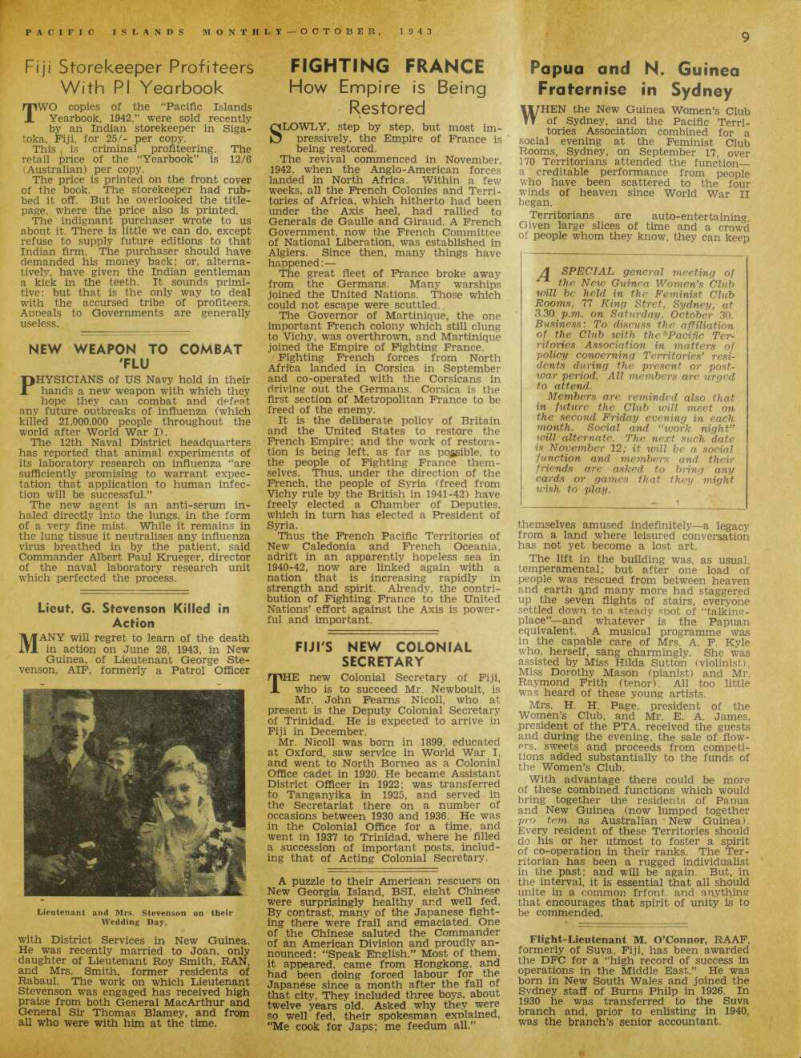
With PlI Yearbook
TWO copies of the “Pacific Islands Yearbook, 1942,’’ were sold recently by an Indian storekeeper in Siga toka, Fiji, for 25/- per copy.
This , is criminal profiteering. The retail price of the “Yearbook” is 12/6 (Australian) per copy.
The price is printed on the front cover of the book. The storekeeper had rub bed it off. But he overlooked the title page, where the price also is printed.
The indignant purchaser wrote to us about it. There is little we can do, except refuse to supply future editions to that Indian firm. The purchaser should have demanded his money back; or, alterna tively, have given the Indian gentleman a kick in the teeth. It sounds primi tive: but that is the only way to deal with the accursed tribe of profiteers.
Anneals to Governments are generally useless.
New Weapon To Combat
Flu
PHYSICIANS of US Navy hold in their hands a new weapon with which they hope they can combat and defeat any future outbreaks of influenza (which killed 21,000.000 people throughout the world after World War I).
The 12th Naval District headquarters has reported that animal experiments of its laboratory research on influenza “are sufficiently promising to warrant expec tation that application to human infec tion will be successful.”
The new agent is an anti-serum in haled directly into the lungs, in the form of a very fine mist. While it remains in the lung tissue it neutralises any influenza virus breathed in by the patient, said Commander Albert Paul Krueger, director of the naval laboratory research unit which perfected the process.
Lieut. G. Stevenson Killed in
Action
MANY will regret to learn of the death in action on June 26, 1943, in New Guinea, of Lieutenant George Ste venson, AIF, formerly a Patrol Officer
with District Services in New Guinea.
He was recently married to Joan, only daughter of Lieutenant Roy Smith, RAN, and Mrs. Smith, former residents of Rabaul. The work on which Lieutenant Stevenson was engaged has received high praise from both General MacArthur and General Sir Thomas Blarney, and from all who were with him at the time.
Lieutenant and Mrs. Stevenson on their Wedding Day.
How Empire is Being
Fighting France
How Empire is Being Restored
SLOWLY, step by step, but most im pressively, the Empire of France is being restored.
The revival commenced in November. 1942. when the Anglo-American forces landed in North Africa. Within a few weeks, all the French Colonies and Terri tories of Africa, which hitherto had been under the Axis heel, had rallied to Generals de Gaulle and Giraud. A French Government, now the French Committee of National Liberation, was established in Algiers. Since then, many things have happened:— The great fleet of Prance broke away from the Germans. Many warships joined the United Nations. Those which could not escape were scuttled.
The Governor of Martinique, the one important French colony which still clung to Vichy, was overthrown, and Martinique joined the Empire of Fighting France.
Fighting French forces from North Africa landed in Corsica in September and co-operated with the Corsicans in driving; out the Germans. Corsica is the first section of Metropolitan France to be freed of the enemy.
It is the deliberate policy of Britain and the United States to restore the French Empire; and the work of restora tion is being left, as far as possible, to the people of Fighting France them selves. Thus, under the direction of the French, the people of Syria (freed from Vichy rule by the British in 1941-42) have freely elected a Chamber of Deputies, which in turn has elected a President of Syria.
Thus the French Pacific Territories of New Caledonia and French Oceania, adrift in an apparently hopeless sea in 1940-42, now are linked again with a nation that is increasing rapidly in strength and spirit. Already, the contri bution of Fighting France to the United Nations’ effort against the Axis is power ful and important.
Fiji's New Colonial
Secretary
THE new Colonial Secretary of Fiji, who is to succeed Mr. Newboult, is Mr. John Fearns Nicoll, who at present is the Deputy Colonial Secretary of Trinidad. He is expected to arrive in Fiji in December.
Mr. Nicoll was bom in 1899, educated at Oxford, saw service in World War I. and went to North Borneo as a Colonial Office cadet in 1920. He became Assistant District Officer in 1922; was transferred to Tanganyika in 1925, and served in the Secretariat there on a number of occasions between 1930 and 1936. He was in the Colonial Office for a time, and went in 1937 to Trinidad, where he filled a succession of important posts, includ ing that of Acting Colonial Secretary.
A puzzle to their American rescuers on New Georgia Island, BSI, eight Chinese were surprisingly healthy and well fed, By contrast, many of the Japanese fight ing there were frail and emaciated. One of the Chinese saluted the Commander of an American Division and proudly an nounced; “Speak English.” Most of them, it appeared, came from Hongkong, and had been doing forced labour for the Japanese since a month after the fall of that city. They included three boys, about twelve years old. Asked why they were so well fed, their spokesman explained, “Me cook for Japs; me feedum all.”
Papua and N. Guinea
Fraternise in Sydney
WHEN the New Guinea Women’s Club of Sydney, and the Pacific Terri tories Association combined for a social evening at the Feminist Club Rooms, Sydney, on September 17, over 170 Territorians attended the function— a creditable performance from people who have been scattered to the four winds of heaven since World War II began.
Territorians are auto-entertaining Given large slices of time and a crowd of people whom they know, they can keep
A SPECIAL general meeting of the New Guinea Women’s Club will be held in the Feminist Club Rooms, 77 King Stret, Sydney, at 3.30 p.m. on Saturday, October 30.
Business: To discuss the affiliation of the Club with the Pacific Ter ritories Association in matters of policy concerning Territories’ resi dents during the present or post war period. All members are urged to attend.
Members are reminded also that in future the Club will meet on the second Friday evening in each month. Social and u wofk night” will alternate. The next such date is November 12; it will be a social function and members and their friends are asked to bring any cards or games that they might wish to play.
themselves amused indefinitely—a legacy from a land where leisured conversation has not yet become a lost art.
The lift in the building was, as usual, temperamental; but after one load of people was rescued from between heaven and earth qnd many more had staggered up the seven flights of stairs, everyone settled down to a steady snot of “talkina place”—and whatever is the Papuan equivalent. A musical programme was in the capable care of Mrs. A. F. Kyle who, herself, sang charmingly. She was assisted by Miss Hilda Sutton (violinist), Miss Dorothy Mason (pianist) and Mr.
Raymond Frith (tenor). All too little was heard of these young artists.
Mrs. H. H. Page, president of the Women’s Club, and Mr. E. A. James, president of the PTA, received the guests and during the evening, the sale of flow prs, sweets and proceeds from competi tions added substantially to the funds of the Women’s Club.
With advantage there could be more of these combined functions which would bring together the residents of Parma and New Guinea (now lumped together pro tern as Australian New Guinea).
Every resident of these Territories should do his or her utmost to foster a spirit of co-operation in their ranks. The Ter ritorian has been a rugged individualist in the past; and will be again. But, in the interval, it is essential that all should unite in a common frfont.. and anything; that encourages that spirit of unity is to be commended.
Flight-Lieutenant M. O’Connor, RAAF, formerly of Suva, Fiji, has been awarded the DFC for a “high record of success in operations in the Middle East.” He was born in New South Wales and joined the Sydney staff of Burns Philp in 1926. In 1930 he was transferred to the Suva branch and, prior to enlisting in 1940, was the branch’s senior accountant.
The Neck!
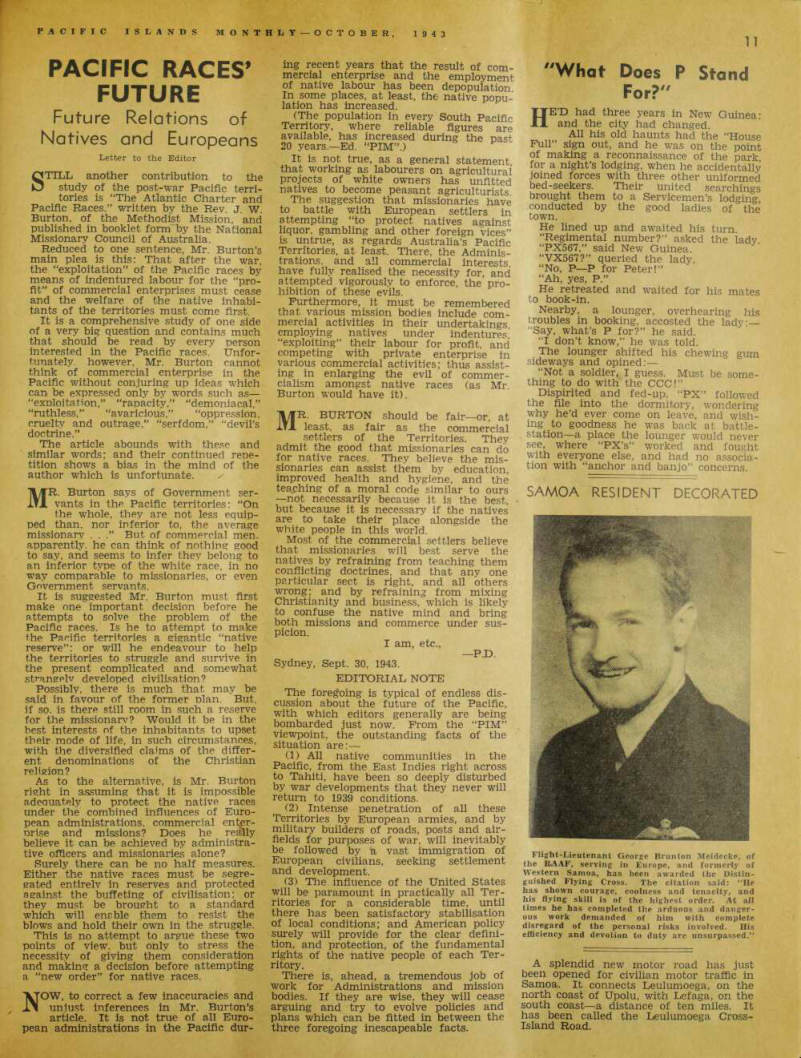
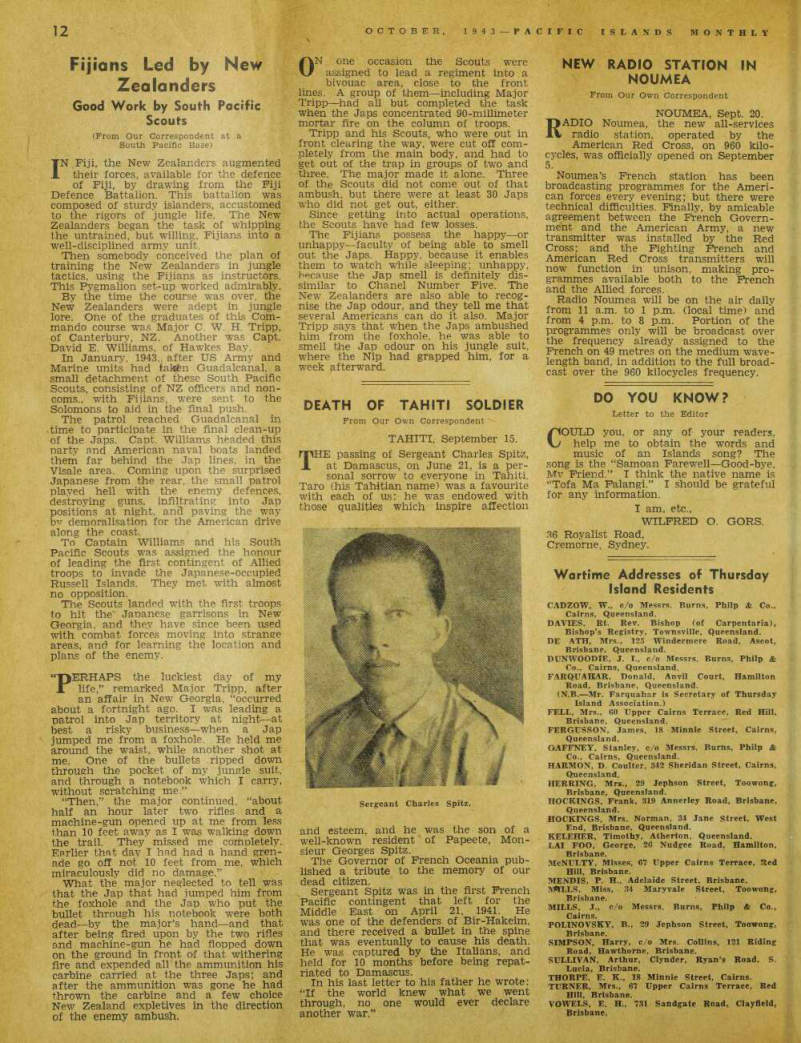
The Fiji Indian—A Pain In
Dislocation of Fiji Sugar Industry Only One Angle
of an Embarrassing Problem
By R. W. Robson
rE Fiji sugar industry has been most seriously dislocated this year—first, by a strike of sugar-mills employees (mostly Indians) and, secondly, by the refusal of the Indian cane-growers to cut their cane for the mills, unless the price of sugar-cane is substantially increased.
The sugar industry, which is in the hands of the Colonial Sugar Refining Co.. Ltd., is Fiji’s major industry. The Colony exports each year between 100,000 and 150,000 tons of sugar—mostly to New Zealand and Canada, in normal times— worth between £1,000,000 and £2,000,000.
But a fatal weakness has developed in this great Fiji industry because the CSR Co. is wholly dependant, for supplies, on the Indian cane-growers. mHE Indians were brought to the Col- X ony, originally, to grow sugar for the Co., as indentured labourers. In time, assisted by the Co., they settled in the Colony, as peasants, growing sugar cane under contract for the CSR. The 1936 census showed 85.000 Indians in the Colony, of whom 60,000 had been bom in Fiji.
It seemed quite a sound idea, in the beginning. The sugar industry calls for a great reservoir of labour, so that the cane may be grown, and may be cut, and so that there may be ample labour for the mills. There is no supply of indi genous labour in Fiji—the native Fijian is a landowner, and his rich lands supply all his needs.
The Indians, who were being brought in originally as labourers, and repatriated on the expiration of their indentures, were most eager to stay in- Fiji. So the Co. worked out a system under which the Indians were permitted to lease sugar-lands, either from the Co. or from the Crown, under conditions which pre vented the alienation of native lands.
But the factor which no one, appar ently, took sufficiently into account, is the character of the Indian. He is a born trouble-maker. rE Fiji Indians, to a considerable extent, have retained their racial standards of living and their own institutions. While there has been a cordial and growing friendship between the Fijian natives and the British, the relations between the Fiji Indians and the British always have been difficult.
The Indians seem to have a kind of racial inferiority complex. They have caused a long succession of British Gov ernors endless embarrassment by their demands for racial equality with the British in matters relating to Fijian administration, by their agitation for a “common roll,” by their super sensitive ness and readiness to howl in relation to all matters in which they think there is a suspicion of racial discrimination.
The British, trying to hold the balance fairly and justly between the different races in Fiji, and especially in their anxiety to protect the Fijian people in accordance with the terms of the 1874 Deed of Cession, have found the Indians, in a political sense, an insoluble problem, a nuisance, and an irritation.
ACTUALLY, the masses of Indians, themselves, are harmless enough.
They realise that in the pleasant
country of Fiji they are immensely bet ter off than they could have been in over-crowded India, and they appear to be generally content with their present lot, so long as they are left alone.
But there are, in Fiji, a very large number of Indians who have gained sufficient education to qualify as political agitators—and the semi-educated Indian goes for political agitation as a duck goes to water. Consequently, the rank and file of Fiji Indians are divided up among all sorts of societies, clubs, unions and what not, each of which supports a busy little agitator or two, and the main purpose of which appears to be to demand something or other from the British administration.
The position has been made worse by the fact that in Fiji, from time toHime, there have been high administrative officials so anxious to do the right thing by the “unhappy, downtrodden Indian” that they have done the wrong thing.
They have tried to reason, placate and compromise; whereas the only way in which these people may be dealt with, in a country like Fiji, is for the adminis trator to decide what is fair and right, in the circumstances, and to permit no further argument. The ingenious, tortu ous, whining arguments of the Babu Indian, if permitted, will drive well balanced officials to madness.
IN the case of Fiji, the Indians have a special hate in the CSR Co. The CSR Co. is a very powerful concern, managed with great efficiency in the interests of its shareholders, and holding an extraordinary record of profit-making.
It is not so all-powerful in Fiji as is the “Big Five” in Hawaii; but there is a parallel.
Fiji owes the CSR much, because the CSR has made of Fiji the most pros perous British Crown Colony; but there is no need for Fiji officially to rally to the defence of the CSR —that Co. is extremely well able to take care of itself. The CSR, as part of its profit making motif, will drive a hard bargain with anyone—Government, or shipping line, or Indian cane-grower.
EVERY pinheaded traveller who step ped off in Fiji, for two decades, drew attention to the contrast between the very rich CSR and the very poor Indian cane-grower; and some harsh criticisms were published—espe cially by the less responsible type of American journalist.
The fact is, of course, that Fiji sugar has t£ be sold in a highly competitive market: and the price of Fiji cane or mill-labour is fixed, not by an avaricious board in Sydney or a stony-hearted manager in Suva, but by the rates which mill-labourers and cane-growers are pre pared to accept in East Africa, or the Wtest Indies, or somewhere.
No one loves the CSR shareholders and directors: but it must be conceded, in all fairness, that they make their luscious profits, not out of grinding the faces of the Fiji Indians, but out of superlatively good management and properly-con trolled, large-scale operations. Maybe they could have made some concessions, in the past, to the Fiji Indians. But they could have been only very small concessions—and some margin had to be
maintained, for the world sugar-market is a very tricky and uncertain thing.
BUT, of course, the Fiji Indians have never entertained the slightest doubt about the Fiji set-up. As they—or, rather, their ceaselessly active leaders—see it, the GSR is callously ex ploiting the Fiji Indians, and is being aided and abetted, and protected, by the Fiji Government.
I have personally examined this situa tion, in Fiji, half a dozen times. I instinctively dislike big companies with long records of big profits and a clear hankering after monopolies; and I hate bureaucracies. If I had believed that the GSR and the Fiji Government were aiding and abetting each other, at the expense of the Fiji Indian peasant, I should have shouted my belief aloud, come hell or high water.
But I could not find any such set-up.
I believe that the GSR Co. has done a remarkable developmental job in Fiji, and now is doing the very best it can for all classes concerned; and, having seen a great deal of Governments based on adult suffrage, I am prepared to say that the non-Parliamentary Government of Fiji, so long as it is directed by men of the calibre of Fletcher, and Richards, and Luke and Mitchell, and their verv able lieutenants, is as fair and just and incorruptible an administration as any thing in the world.
But the Fiji Indians cannot be ex pected to believe that. They have been told, so long and so often, by their political agitators, that they are the mis erable. helpless slaves of the GSR and the British community in Fijij, that it is sheer waste of time to offer them any other assurances, or present another point of view. The history of recent events in Fiji bears out this contention, to the letter, rE price of sugar-cane is arranged in periodical contracts, between the GSR Co. and the cane-growers.
Then the Co. proceeds to make contracts, far ahead, for the sale of its sugar. The last contract was made in 1940, and was for ten years. It provided that, if the Co. got an increased price for sugar, the growers should get an increased price for cane. The growers got about one third more for cane, in 1940.
In March, 1943, the Kisan Sangh (an organisation of cane-growers) demanded higher rates, owing to greatly increased costs. The Co. refused the request, pointing out that all sugar now was bought by the British Department of Food, at a fixed price, and that the higher costs were the result of war con ditions, and were felt as much by the Co. as by the growers, Kisan Sangh, in April, appealed to the Fiji Government (which, in any event, had to take control of the situation, because in November, 1940, the Fiji sugar industry had been declared an “essential service”). Would the Governor point out to the British Ministry of Food the need for paying more for sugar, so that cane growers could get more?
The Governor agreed. The growers’ representations were telegraphed by him to London in June.
A few days later another growers’ organisation, the Maha Sangh, came to light. It bluntly informed the Govern ment that, unless rates for cane were raised, the growers would not cut their cane.
Maha Sangh did not seem very fond of Kisan Sangh.
IN the meantime, a labour dispute arose in the sugar mills at Ba and Lau toka, and elsewhere. Operatives,
(Continued on Page 34)
mostly Indians, struck for considerably increased wages. The Government set up an Arbitration Tribunal to investigate and make an award.
On July 12, 1943, a Mr. Lakshman, who appears to be a leader of the Kisan Sangh, demanded the appointment of a Commission, to inquire into the price of cane sugar.
The Governor suggested the matter stand over until the Tribunal had dealt with the strike. But the Kisan Sangh said the matter was very urgent.
So, the Governor, at Lautoka, on July 19, met representatives of the Kisan Sangh, the Maha Sangh, and anyone else interested. The growers said their cane was not worth cutting, at ruling prices: and they wanted a Commission of inquiry.
The Governor pointed out that the price of cane depended on the price of sugar, and he could not increase the lat ter. But he would set up an inquiry into the conditions of cane-growing; and if—as he expected—there was a case for a higher price for cane, he would pass that information on to the Food Ministry in London. He promised that both bodies would be represented on the inquiry.
THAT same day, the Governor received a communication from still another body, the Rewa Cane-growers’
Union, It said its members definitely would not cut cane, and it demanded representation on the inquiry. One gathers that Rewa Union disliked both the Sanghs.
By this time the situation was becom ing farcical. But the patient Governor, on July 21, duly set up a Commission, composed of the Attorney-General, Mr, H. H. Ragg, MLC, and Mr. Apabhai Patel; and the various growers’ organi sations were invited to nominate persons from whom the Governor might appoint their representatives.
The organisations declined to nominate anyone.
On July 25, a deputation of these Indians, including those who previously had asked for a Commission, asked the Governor to cancel the Commission, and set up a Court of Arbitration.
The request, very properly, was flatly refused.
By this time, the Tribunal had made some progress in settling the labour strike at the mills: but the growers, with ever-increasing clamour, insisted that they were not going to cut cane.
THE Commission opened at Ba on July 27. The Kisan Sangh not appear. Two Indian lawyers, Mr.
Said Hasan and Mr. Sharma, appeared for the Rewa Union and the Maha Sangh, and said they would not proceed —they wanted a Court, whose award would be binding.
The Commission refused the request.
The Governor could not go beyond his promise of July 19 —that, if the growers made out a case before the Commission, he would present that case to London.
The growers refused to appear before the Commission, which, therefore, was closed down on August 3.
The mills strike had not ended. Addi tional police were sent to Ba and Lau toka. The Governor refused to discuss matters any further with the growers: if they were silly enough to let their cane rot, rather than cut it at the ruling price, while presenting a case for better rates, that was their affair —and their loss.
IT was then learned that 162 growers in the Ba district were prepared to cut cane, if given protection against possible violence.
Troops were sent accordingly to Ba.
Growers began cutting on July 30. By August 19, 443 growers were cutting cane in the Ba and Penang districts, and one mill was thus kept going.
Early in August, it was clear that Indian agitators were out among the cane-growers, trying to persuade them to cease cutting. The Governor acted promptly, under Defence Regulations, and two agitators were arrested and sen tenced, Soon afterwards, half a dozen others were arrested and sentenced.
Being slick lawyers—or assisted by same—all these men appealed, and were released on bail. Clearly, the processes of law were being employed to defeat the interests of the Colony.
That was the position at the end of August; and there was little improve ment a month later (at the end of Sep tember). There was no trouble on Vanua Levu, where the large Labasa mill is working; but there is only one mill operating on Viti Levu.
All the circumstances indicate that, although the Indians were together in a pack, trying to embarrass both the CSR and the Government, there was even greater trouble within the pack itself.
There appear to be a number of growers’ unions and agitators, who are fighting each other bitterly.
EVERYONE interested in Fiji must consider the future of the Colony, in the light of this deplorable situation.
The Empire is at war. Fiji is almost in the front line. Europeans and Fijians in the Colony, side by side, have offered to their country everything they have: their sacrifices have been great and glorious.
But these Fiji Indians, who everlast ingly cry for all the privileges of Fiji citizenship, have not only made a most miserable contribution to Fiji’s war effort —they also appear to take a mis chievous delight in embarrassing the Government at a most difficult time, and dislocating the Colony’s most important industry.
There is only one way in which these people should be treated: and it is to be hoped that the British authorities will not, too long, delay its application.
If the Indians will not accept the dis cipline for which their conduct cries aloud, the proposition that the whole 90,000 of them (or the proportion of them that has forfeited the right of residence in Fiji) should be returned to India.
This, at first glance, may seem a fan tastic idea* But, is it? Why should the fine territory of Fiji—one of the best in the Pacific—be permanently harmed by the establishment of a community like this?
If it is considered cruel to return them to Indi#, why not transport them to one of the fertile, depopulated groups in the Pacific —the Marquesas, for example.
They would probably end by clawing each other to death, within ten years: but at least we could count on a quiet and decent future for Fiji.
No one, in all this, has much sympathy for the CSR. After all, the Co. brought these Indians to Fiji. As I have said, Indian immigration may have seemed a good idea, at the time; but, unless some thing really drastic is done within the next ten years, so that the Indians may be removed or controlled, Fiji will be a place unfit to live in.
The problem must be seriously tackled —not for the sake of the poor, suffering CSR or the badgered British, but because of the Fijian natives. Unless something is done to properly and permanently con trol the Indians, this fine Melanesian race is going to get a very raw deal.
CSR States its Case
ON the last day of the sitting of the Commission of Inquiry, Sir Henry Scott, KC, counsel for the Colonial Sugar Refining Co., Ltd., made the fol
lowing statement:—
Before the Commission closes I desire to make a few observations on behalf of my clients: — (1) The company considers the refusal of the cane-growers to cut their cane is wholly un justified, as the cane agreements between the growers and the company have a period of approximately 7 years to run. (2) There is a guaranteed minimum price for cane, no matter how low may be the price of sugar. (3) There is also provided an increased pay ment, above £ll per ton, which is shared by the company and the growers. The agreement has the effect of increasing the cane price paid by the company to the grower from 15/- per ton pre-war to about 21/- (estimated) per ton in 1943—i.e,, assuming the quality of the cane is normal, and assuming the cutting of cane starts at once and continues without inter ruption, and that sugar is sold at current market price. This represents to the grower about 40 per cent, increase. (4) The company cannot be held responsible for the increased cost of living. If the Colony needs imports (as it does—i.e., clothing, food, etc.), then exports (sugar) in return are essen tial. This is an added reason why the cutting of cane should proceed at all mills immediately.
In any event, the company should not be asked to bear the whole burden of the increased cost of living. (5) Continued refusal to cut cane by the growers would result, not only in loss, to the growers, of their crops, but would retard the war effort by presenting realisation of the Allies’ expectation that Fiji will supply sugar for the Pacific peoples, and back loading of ships for east-bound vessels. (6) This Colony requires Empire markets for sugar in times of plenty, and should reciprocate by meeting the Allies’ present requirements owing to war conditions. (7) The company views the “boycott” of the Commission by the growers as wholly unjustified, as there can, in the circumstances, be no room for doubt that the Kisan Sangh, through its President, asked for the appointment of the Commission—and now, having got the Com mission appointed by His Excellency the Governor, and all the attendant expense having been incurred, counsel for the Rewa growers and the Kisan Sangh and the Maha Sangh re fuse to co-operate. And it will be remembered that, at the opening of the Commission at Ba, the company agreed to give to the Commission every assistance, as I so stated.
A prisoner of war card, dated July, 1942, has been received from Mr. John Arnold Crockett, formerly of Bulolo, TNG.
His address is “Osaka Prisoner of War Camp, Kawasaki Sub-Camp, and he says that he is “in good health, well treated and well fed—mostly on rice.”
Pacific Races’
Future
Future Relations of Natives and Europeans
Letter to the Editor STILL another contribution to the study of the post-war Pacific terri tories is “The Atlantic Charter and Pacific Races.” written by the Rev. J. W.
Burton, of the Methodist Mission, and published in booklet form by the National Missionary Council of Australia.
Reduced to one sentence, Mr. Burton’s main plea is this: That after the war, the “exploitation” of the Pacific races by means of indentured labour for the “pro fit” of commercial enterprises must cease and the welfare of the native inhabi tants of the territories must come first.
It is a comprehensive study of one side of a very big question and contains much that should be read by every person interested in the Pacific races. Unfor tunately. however, Mr. Burton cannot think of commercial enterprise in the Pacific without conjuring up ideas which can be expressed only by words such as— “exnloitatlon,” “rapacity,” “demoniacal,”
“ruthless,” “avaricious,” “oppression, cruelty and outrage,” “serfdom,” “devil’s doctrine.”
The article abounds with these and similar words; and their continued repe tition shows a bias in the mind of the author which is unfortunate.
MR. Burton says of Government ser vants in the Pacific territories; “On the whole, they are not less equip ped than, nor inferior to, the average missionary ...” But of commercial men. apparently, he can think of nothing good to say. and seems to infer they belong to an inferior type of the white race, in no way comparable to missionaries, or even Government servants.
It is suggested Mr. Burton must first make one important decision before he attempts to solve the problem of the Pacific races. Is he to attempt to make the Pacific territpries a gigantic “native reserve”; or will he endeavour to help the territories to struggle and survive in the present complicated and somewhat strangelv developed civilisation?
Possibly, there is much that may be said in favour of the former plan. But, if so. is there still room in such a reserve for the missionary? Would it be in the best interests of the inhabitants to upset their mode of life, in such circumstances, with the diversified claims of the differ ent denominations of the Christian religion?
As to the alternative, is Mr. Burton right in assuming that it is impossible adeauately to protect the native races under the combined influences of Euro pean administrations, commercial enter prise and missions? Does he really believe it can be achieved by administra tive officers and missionaries alone?
Surely there can be no half measures.
Either the native races must be segre gated entirely in reserves and protected against the buffeting of civilisation: or they must be brought to a standard which will enable them to resist the blows and hold their own in the struggle.
This is no attempt to argue these two points of view, but only to stress the necessity of giving them consideration and making a decision before attempting a “new order” for native races.
NOW, to correct a few inaccuracies and unjust inferences in Mr. Burton’s article. It is not true of all Euro pean administrations in the Pacific dur
ing recent years that the result of com mercial enterprise and the employment of native labour has been depopulation In some places, at least, the native popu lation has increased. (The population in every South Pacific Territory, where reliable figures are available, has increased during the past 20 years.—Ed. “PIM”.) It is not true, as a general statement that working as labourers on agricultural projects of white owners has unfitted natives to become peasant agriculturists The suggestion that missionaries have to battle with European settlers in attempting “to protect natives against liquor, gambling and other foreign vices” is untrue, as regards Australia’s Pacific Territories, at least. There, the Adminis trations. and all commercial interests have fully realised the necessity for, and attempted vigorously to enforce, the pro hibition of these evils.
Furthermore, it must be remembered that various mission bodies include com mercial activities in their undertakings employing natives under indentures’
“exploiting” their labour for profit, and competing with private enterprise in various commercial activities; thus assist ing in enlarging the evil of commer cialism amongst native races (as Mr.
Burton would have it).
MR. BURTON should be fair—or, at least, as fair as the commercial settlers of the Territories. They admit the good that missionaries can do for native races. They believe the mis sionaries can assist them by education, improved health and hygiene, and the teaching of a moral code similar to ours —not necessarily because it is the best, but because it is necessary if the natives are to take their place alongside the white people in this world.
Most of the commercial settlers believe that missionaries will best serve the natives by refraining from teaching them conflicting doctrines, and that any one particular sect is right, and all others wrong; and by refraining from mixing Christianity and business, which is likely to confuse the native mind and bring both missions and commerce under sus picion.
I am, etc.,
P.D.
Sydney, Sept. 30, 1943.
Editorial Note
The foregoing is typical of endless dis cussion about the future of the Pacific, with which editors generally are being bombarded just now. From the “PIM” viewpoint, the outstanding facts of the situation are:— (1) All native communities in the Pacific, from the East Indies right across to Tahiti, have been so deeply disturbed by war developments that they never will return to 1939 conditions. (2) Intense penetration of all these Territories by European armies, and by military builders of roads, posts and air fields for purposes of war, will inevitably be followed by a vast immigration of European civilians, seeking settlement and development. (3) The influence of the United States will be paramount in practically all Ter ritories for a considerable time, until there has been satisfactory stabilisation of local conditions; and American policy surely will provide for the clear defini tion, and protection, of the fundamental rights of the native people of each Ter ritory.
There is, ahead, a tremendous job of work for Administrations and mission bodies. If they are wise, they will cease arguing and try to evolve policies and plans which can be fitted in between the three foregoing inescapeable facts.
"What Does P Stand
For?"
HE’D had three years in New Guinea and the city had changed.
All his old haunts had the “House Full” sign out, and he was on the point of making a reconnaissance of the park for a night’s lodging, when he accidentally joined forces with three other uniformed bed-seekers. Their united searchings brought them to a Servicemen’s lodging conducted by the good ladies of the town.
He lined up and awaited his turn “Regimental number?” asked the iady.
“PX567,” said New Guinea.
“VX567?” queried the lady.
“No, P—P for Peter!”
“Ah, yes, P.”
He retreated and waited for his mates to book-in.
Nearby, a lounger, overhearing his troubles in booking, accosted the lady— “ Say, what’s P for?” he said.
“I don’t know,” he was told.
The lounger shifted his chewing gum sideways and opined:— “Not a soldier, I guess. Must be some thing to do with the CCC!”
Dispirited and fed-up, “PX” followed the file into the dormitory, wondering why he’d ever come on leave, and wish ing to goodness he was back at battle station—a place the lounger would never see, where “PX’s” worked and fought with everyone else, and had no associa tion with “anchor and banjo” concerns.
Samoa Resident Decorated
A splendid new motor road has just been opened for civilian motor traffic in Samoa. It connects Leulumoega, on the north coast of Upolu, with Lefaga, on the south coast—a distance of ten miles. It has been called the Leulumoega Cross- Island Hoad.
Flight-Lieutenant George Brunton Meidecke, of the RAAF, serving in Europe, and formerly of Western Samoa, has been awarded the Distin guished Flying Cross. The citation said; “He has shown courage, coolness and tenacity, and his flying skill is of the highest order. At all times he has completed the arduous and danger ous work demanded of him with complete disregard of the personal risks involved. His efficiency and devotion to duty are unsurpassed.”
Fijians Led by New
Zealanders Good Work by South Pacific Scouts
(From Our Correspondent at a South Pacific Base) IN Fiji, the New Zealanders augmented their forces, available for the defence of Fiji, by drawing from the Fiji Defence Battalion. This battalion was composed of sturdy islanders, accustomed to the rigors of jungle life. The New Zealanders began the task of whipping the untrained, but willing, Fijians into a well-disciplined army unit.
Then somebody conceived the plan of training the New Zealanders in jungle tactics, using the Fijians as instructors.
This Pygmalion set-up worked admirably.
By the time the course was over, the New Zealanders were adept in jungle lore. One of the graduates of this Com mando course was Major C. W. H. Tripp, of Canterbury, NZ. Another was Capt.
David E. Williams, of Hawkes Bay.
In January. 1943, after US Army and Marine units had takfen Guadalcanal, a small detachment of these South Pacific Scouts, consisting of NZ officers and non coms., with Fijians, were sent to the Solomons to aid in the final push.
The patrol reached Guadalcanal in time to participate in the final clean-up of the Japs. Capt. Williams headed this party and American naval boats landed them far behind the Jap lines, in the Visale area. Coming upon the surprised Japanese from the rear, the small patrol played hell with the enemy defences, destroying guns, infiltrating into Jap positions at night, and paving the way bv demoralisation for the American drive along the coast.
To Captain Williams and his South Pacific Scouts was assigned the honour of leading the first contingent of Allied troops to invade the Japanese-occupied Russell Islands. They met with almost no opposition.
The Scouts landed with the first troops to hit the' Japanese garrisons in New Georgia, and they have since been used with combat forces moving into strange areas, and for learning the location and plans of the enemy.
“T>ERHAPS the luckiest day of my X life,” remarked Major Tripp, after an affair in New Georgia, “occurred about a fortnight ago. I was leading a patrol into Jap territory at night—at best a risky business—when a Jap jumped me from a foxhole. He held me around the waist, while another shot at me. One of the bullets ripped down through the pocket of my jungle suit, and through a notebook which I carry, without scratching me.”
“Then,” the major continued, “about half an hour later two rifles and a machine-gun opened up at me from less than 10 feet away as I was walking down the trail. They missed me coihpletely.
Earlier that day I had had a hand gren ade go off not 10 feet from me, which miraculously did no damage.”
What the major neglected to tell was that the Jap that had jumped him from the foxhole and the Jap who put the bullet through his notebook were both dead—by the major’s hand—and that after being fired upon by the two rifles and machine-gun he had flopped down on the ground in front of that withering fire and expended all the ammunition his carbine carried at the three Japs; and after the ammunition was gone he had thrown the carbine and a few choice New Zealand expletives in the direction of the enemy ambush.
ON one occasion the Scouts were assigned to lead a regiment into a bivouac area, close to the front lines. A group of them —including Major Tripp—had all but completed the task when the Japs concentrated 90-millimeter mortar fire on the column of troops.
Tripp and his Scouts, who were out in front clearing the way, were cut off com pletely from the main body, and had to get out of the trap in groups of two and three. The major made it alone. Three of the Scouts did not come out of that ambush, but there were at least 30 Japs who did not get out, either.
Since getting into actual operations, the Scouts have had few losses.
The Fijians possess the happy—or unhappy—faculty of being able to smell out the Japs. Happy, because it enables them to watch while sleeping; unhappy, because the Jap smell is definitely dis similar to Chanel Number Five. The New Zealanders are also able to recog nise the Jap odour, and they tell me that several Americans can do it also. Major Tripp says that when the Japs ambushed him from the foxhole, he was able to smell the Jap odour on his jungle suit, where the Nip had grapped him, for a week afterward.
Death Of Tahiti Soldier
From Our Own Correspondent v TAHITI, September 15.
THE passing of Sergeant Charles Spitz, at Damascus, on June 21, is a per sonal sorrow to everyone in Tahiti.
Taro (his Tahitian name) was a favourite with each of us: he was endowed with those qualities which inspire affection
and esteem, and he was the son of a well-known resident of Papeete, Mon sieur Georges Spitz.
The Governor of French Oceania pub lished a tribute to the memory of our dead citizen.
Sergeant Spitz was in the first French Pacific contingent that left for the Middle East on April 21, 1941. He was one of the defenders of Bir-Hakeim, and there received a bullet in the spine that was eventually to cause his death.
He was captured by the Italians, and held for 10 months before being repat riated to Damascus.
In his last letter to his father he wrote: “If the world knew what we went through, no one would ever declare another war,”
Sergeant Charles Spitz.
New Radio Station In
Noumea
From Our Own Correspondent
Noumea, Sept. 20.
RADIO Noumea, the new all-services radio station, operated by the American Red Cross, on 960 kilo cycles, was officially opened on September 5.
Noumea’s French station has been broadcasting programmes for the Ameri can forces every evening; but there were technical difficulties. Finally, by amicable agreement between the French Govern ment and the American Army, a new transmitter was installed by the Red Cross; and the Fighting French and American Red Cross transmitters will now function in unison, making pro grammes available both to the French and the Allied forces.
Radio Noumea will be on the air daily from 11 a.m. to 1 p.m. (local time) and from 4 p.m. to 8 p.m. Portion of the programmes only will be broadcast over the frequency already assigned to the French on 49 metres on the medium wave length band, in addition to the full broad cast over the 960 kilocycles frequency.
Do You Know?
Letter to the Editor COULD you, or any of your readers, help me to obtain the words and music of an Islands song? The song is the “Samoan Farewell —Good-bye.
Mv Friend.” I think the native name is “Tofa Ma Falangi.” I should be grateful for any information.
I am, etc.,
Wilfred O. Gors.
36 Royalist Road, Cremorne, Sydney.
Wartime Addresses of Thursday
Island Residents
CADZOW, W., c/o Messrs. Burns, Philp & Co., Cairns, Queensland.
DAVIES. Rt. Rev. Bishop (of Carpentaria), Bishop’s Registry, Townsville, Queensland.
DE ATH, Mrs., 125 Windermere Road, Ascot, Brisbane, Queensland.
DUNWOODIE, J. 1., c/o Messrs. Burns, Philp & Co., Cairns, Queensland.
FARQUAKAR, Donald, Anvil Court, Hamilton Road, Brisbane, Queensland. (N.B.—Mr. Farquahar is Secretary of Thursday Island Association.) FELL, Mrs., 60 Upper Cairns Terrace, Red Hill, Brisbane, Queensland.
FERGUSSON, James, 18 Minnie Street, Cairns, Queensland.
GAFFNEY, Stanley, c/o Messrs. Burns, Philp & Co., Cairns, Queensland.
HARMON, D. Coulter, 342 Sheridan Street, Cairns, Queensland.
HERRING, Mrs., 29 Jephson Street, Toowong, Brisbane, Queensland.
HOCKINGS, Frank, 319 Annerley Road, Brisbane, Queensland.
HOCKINGS, Mrs. Norman, 34 Jane Street, West End, Brisbane, Queensland.
KELEHER, Timothy, Atherton, Queensland.
LAI FOO, George, 26 Nudgee Road, Hamilton, Brisbane.
McNULTY, Misses, 67 Upper Cairns Terrace, Red Hill, Brisbane.
MENDIS, P. H., Adelaide Street, Brisbane.
IVWLLS, Miss, 34 Maryvale Street, Toowong, Brisbane.
MILLS, J., c/o Messrs. Burns, Philp & Co., Cairns.
POLINOVSKY, 8., 29 Jephson Street, Toowong, Brisbane.
SIMPSON, Harry, c/o Mrs. Collins, 121 Riding Road, Hawthorne, Brisbane.
SULLIVAN. Arthur, Clynder, Ryan’s Road, S.
Lucia, Brisbane.
THORPE, E. K., 18 Minnie Street, Cairns.
TURNER, Mrs., 67 Upper Cairns Terrace, Red Hill, Brisbane.
VOWELS, E. H., 731 Sandgate Road, Clayfleld, Brisbane.
Angau—And The Future
Territorians Must Expect a Long Period of Semi-military Government
BECAUSE a certain amount of civilian organisation entered Papua when a couple of score of rubber and copra planters were permitted to resume opera tions last month, some revision of the administrative machinery became neces sary. Since February, 1942, with the evacuation of all civilians, the adminis tration of “Australian New Guinea” (Papua and the Mandated Territory) has been entirely military.
Therefore, on July 14, regulations were issued in Canberra to authorise the Gen eral Officer Commanding, New Guinea Forces, to exercise all the powers and functions normally carried by civil ad ministrators in Papua and New Guinea.
Most people were under the impression that the GOC had held all these powers since he removed the civil administra tion early in February, 1942. Otherwise, it is difficult to understand how a lot of things were done. However, it mat ters little, Canberra’s passion for issuing regulations is one of the outstanding phenomena of the war; and if Canberra thinks another dose of regulations is necessary to the welfare of the Terri tories, let there be regulations.
THE Australian New Guinea set-up is now familiar to most Territorians.
ANGAU (the Australian New Guinea Administrative Unit) is a section of the forces in New Guinea commanded by General MacArthur and, under him, by General Blarney. At the head of ANGAU is Major-General Morris, who was the original GOC in this area. Next to him is Brigadier Leland.
The ANGAU personnel now includes most of the younger administrative offi cials of Papua and New Guinea; and, while it is closely allied with the com batant organisation, its duties are purely administrative, in relation to the areas occupied by combatant units. Care of the natives is among its special duties.
It supplies the Army with all native labour required. It functions alongside of, but is not necessarily part of the combatant machinery.
A special branch of ANGAU has been created to control the plantations re cently re-staffed and re-operated; and this is called the Production Control Board, the chairman of which is Briga dier Leland, second in command of ANGAU. (It was fully described in “PIM” of June and July.) IT is unlikely that the Pacific war will end soon. It seems certain that the military administration will continue in New Guinea for the duration of the Pacific war, even if the Japs are pushed back far enough to permit civilians, gen
erally, to re-enter the Territories. There fore, Territorians would be wise to make themselves familiar with the foregoing organisation and delegation of authority: that will be their “Government” for a time —at least until the Japanese are defeated.
Probably, it will be found, as the war moves away northwards, beyond New Guinea, that administrative conditions which now are mostly military in char acter, will be relaxed, and that the old laws, administered by ANGAU, will come generally into operation.
As ANGAU has the authority of the superseded civil governments, and as ANGAU comprises mostly the younger administrative officials of the two Terri tories, the returning civil populations will not find much to object to. They merely will have exchanged one form of autocratic bureaucracy for another.
IT is possible that the military set-up under General Morris (ANGAU) will work better, anyway, because it will be able to exercise wider authority on the spot, and be less subject to Can berra interference. The factor which crippled the New Guinea Administration, and which (after the Lieutenant-Gover
norship was reduced to an Administra tor-ship) was threatening to cripple Papua, was Canberra control.
In theory, these Territories were gov erned by the Australian Cabinet, through a wise and sympathetic “Minister for External Territories,” exercising his authority through a Canberra Depart ment and Administrators at Port Moresby and Rabaul.
In practice, “the Territories job” in variably was given to an inconspicuous Assistant Minister, who knew nothing whatever and cared less about tropical administration. Some of them made a hurried tour of what they sometimes called “our Pacific islands,” and where they usually were “baffled by science.”
All of them, after a feeble effort or two, left the really important decisions to the Department officials. The latter, lacking guidance and authority, guarded them selves at every point, and did nothing
which could not be justified by “regula tions.”
Administrative officials appealed des perately to Canberra for authority to proceed with this, that and the other.
Canberra officials passed the requests on to the Minister. The latter, wholly at sea, either tried to get a Cabinet decision or passed the buck back to the Depart ment.
Such a system, of course, produced only a cynical self-protection on the part of the Canberra officials, and disappoint ment, despair and inertia in Port Moresby and Rabaul. This became worse when, as in the case of Rabaul, the chief administrative position usually was held by an inexperienced political appointee, who had neither the courage nor the knowledge to defy Canberra, and proceed on his own authority.
LITTLE, of course, is known about General Morris and Brigadier Leland as tropical territories administrators.
Therefore, it is possible to hope that,
out of ANGAU, there may come some thing in the way of administration which may be better than what we have known.
They have the authority: have they the knowledge and the vision?
The greatest danger of the present set-up is that the Territories may be saddled with a number of highly-paid but (in relation to tropical administra tion) incompetent and useless officials, who will hang on to their jobs like leeches when the time comes to change back to normal civilian administration, and introduce new life to the Territories
Advertisements & other items, pp. 15-16 (1 item)
WDCflpjß
PACIFIC ISLANDS SOCIETY
Visitors from the Islands to Sydney (or those interested in Islands affairs), are advised to communicate with the honorary secretary of the above Society, which has been formed to study the history, traditions, economics, and political developments of the Pacific Islands.
Regular monthly meetings are held at History House, 8 Young Street, Sydney.
Address for Correspondence:
THE PACIFIC ISLANDS SOCIETY,
Box 2434 MM., G.P.0., Sydney.
BURNS PHILP
(SOUTH SEA) CO. LTD.
Inc. in Fiji Island Traders and Shipowners Registered Office :
SU V A
FIJI
Also Branches at: \Fiji: Levuka, Lautoka, Labasa, Ba, Sigatoka, Rotuma.
Tonga: Nukualofa, Haapai, Vavau.
Samoa: Apia, Pago Pago (American Samoa).
Solomons: Makambo, Gizo, Faisi.
New Hebrides: Vila.
Cod* Address: Gilberts: Tarawa.
“Bumsouth”. Norfolk Is. Niue. Wallis Is. Futuna Is.
WDCflpjß
Sole Australian Concessionaires :
GEORGE BROWN & CO. PTY. LTD.
267 Clarence Street, Sydney.
As the Ultimate factory is engaged in vital war production, the supply of Ultimate Commercial Receivers cannot be maintained at present.
SERVICE: Ultimate owners are assured of continuity of service. Our Laboratory is situated at 267 Clarence Street, Sydney.
Servicing of ail kinds of radio sets or amplifiers, as well as Rola Speakers, is also undertaken at our laboratories.
W. H. GROVE & SONS
Limited
AUCKLAND
Island Traders. PO. Box 490.
Telegraphic and Cable Address: “Grove”, Auckland.
Shippers of all classes of New Zealand products.
Representing English Manufacturers throughout the Cook and Society Islands, Fiji, Tonga, Samoa, Niue, New Caledonia, New Guinea, etc.
In FIJI as—W. H. Grove & Sons (Fiji) Ltd.
CUBCYS
MY till
Distilleries at London . . . England Toronto . . . Canada Moorabbin . . Victoria Cincinnati . . . U.S.A.
Fiji Health Services
AS a result of the visit to Fiji of the New Zealand Director-General of Health, Dr. M. H. Watt, and Miss M. I. Lambie, Director of Nursing, to report on medical and nursing services there, the Director of Medical Services for the Colony, Dr. V. W. T. McGusty, has left for London to discuss the report with the Colonial Office.
Death Of Captain Trask
ANOTHER old seafarer has passed on.
Captain Trask, well known to many voyagers in the Central Pacific as the captain of the Matson liner “Mari posa,” died in the United States in April.
News of his death has just reached us through Mr. Oscar Nordman, of Tahiti, who once sailed under him on the run between San Francisco and Australia.
Captain Trask began his career in sail ing ships, and transferred to the old “Australia” and “Zealandia.” In 1907, when on a voyage between Tahiti and San Francisco, in command of the old “Mariposa,” they ran short of fuel oil, while 80 miles off the Californian coast.
After he had burnt everything that might keep up steam, Captain Trask decided to send a boat off to report their plight.
Mr. Nordman was one of the seven men chosen to row to the coast, which they reached in the Bay of Monterey. A mes sage that the “Mariposa” had then been drifting for five days was flashed to San Francisco and a tug went off and picked her up.
Captain Trask was the commander of the “Sonoma,” an Oceanic liner, on the inaugural voyage of the US mail service between San Francisco and Australia, in 1912. Later, he was captain of the “Sierra,” and when the new “Mariposa” was built he was given that command.
Troops Like Wau Coffee
IT is an ill wind that blows nowhere!
Coffee stalls, run by the YMCA, the Salvation Army, and other welfare organisations set up business as close to the front lines in New Guinea as pos sible, and are deservedly popular with the troops.
Coffee supplies sometimes run short, it is reported; and at Wau this led to the use of locally-grown coffee—which was gathered, roasted and ground on the spot.
The men swore that it was the best coffee they had ever tasted.
Wilde and other Wau coffee-growers may take a bow!
Solomons Appointments
THE following appointments have been made to the Defence Force and other Military Units of the British Solomon Islands Protectorate:— BENT, V. D. Lieutenant, from June 2, 1943.
BERGIN, E. 0., Lieutenant, from July 2, 1943.
HUMPHREYS, R. S., Lieutenant, from June 2, 1943.
VANCE, R. C., Second-Lieutenant, from June 24, 1943.
RODGER, G. M., Captain, from June 28, 1943.
CRICHLOW, Captain N., promoted to Temporary Major, from August 1, 1943.
DAVIS, L. M., Lieutenant, from August 1, 1943.
DICKES, Captain A. W., promoted to Temporary Major, from August 1, 1943.
FORSTER, Second-Lieutenant M. J., promoted to Temporary Captain, from August 1, 1943.
KENNEDY, Captain D. G., promoted to . Temporary Major, from August 1, 1943.
TRENCH, Captain D. C. C., promoted to Temporary Major and Acting Lieu tenant-Colonel, from August 1, 1943.
WILSON, Captain C. E. J., promoted to Temporary Major, from August 1, 1943.
University
Pacific Affairs
"Quiz" at Sydney University
TJ/ITH the conclusion of the third term at the University of Sydney, a “Pacific Quiz” was held, in which Pro fessor Harvey Sutton (School of Tropical Medicine), Mr. Black (Economics Depart ment, and well-known commentator on the ABC network), Dr. lan Hogbin (lec turer in anthropology), Mr. Barrie and Dr. McDonald answered questions sub mitted by the students.
“Civilisation” And Work
r E first question asked was about the indentured labour system. The questioner thought that this was the best means of acquainting the natives with the meaning of European civilisa tion.
In his reply, Dr. Hogbin again denied that the indentured labour system brought the natives any closer to under standing European civilisation. He said that, generally speaking, the Administra tion firmly believed that this was the most satisfactory solution. Anthropolo gists, however, did not approve of the idea, the reasons being that (1) the natives learn little, if anything, about European civilisation by working on a plantation, and (2) from the purely tech nical point of view, the nature of their work is more or less of a routine char acter, teaching the natives very little and being of little use to the natives on their return to their villages.
Nz In The Pacific
rE next question, as to what part New Zealand’s economy plays in the Pacific, with regard to markets, etc., was answered by Mr. Barrie.
He said that for further development, NZ needs markets. It is unlikely that these needs will be satisfied in the old world. Consequently, NZ should endeavor to play a bigger part in the post-war economy of the Pacific. This would help to develop her secondary and tertiary industries, and this also would help to establish greater economic stability in the Pacific. From past mistakes we have seen how much economic stability means when it comes to the point of maintain ing peace in the Pacific.
Japan’S Staying-Power
Japan face a long war, in view \j of her relatively weak economic and industrial resources?”
This question was answered by Dr.
MacDonald. He said that, strategically speaking, Japan’s position at the moment was quite sound, for one must also con sider the vast resources she has gained through her conquests. However, in the long run, the resources of the Allied Nations would prove to be more exten sive and this, together with military action, will lead to Japan’s ultimate defeat.
Dr. McDonald believes that responsible quarters in Japan are aware of this fact, but hope that, if they fight long enough, they can secure a compromise peace; and then, having recovered sufficiently and reorganised their armies, they can extend their “co-prosperity sphere.”
Medical Services
Professor Harvey Sutton Was
asked about medical services in the Islands. The questioner expressed the opinion that, with good medical ser vices, over-population may result.
Professor Harvey Sutton said that medical services in TNG were largely paid for by the gold-mining industry.
Up to the present, depopulation was pur problem, and not over-population, and many years will elapse before the ori ginal level will again be reached. Once more, we must appreciate that increased population does not imply over-popula tion in the world of to-day, and that these natives form a good natural defence ring around Australasia, from the purely
strategic point of view.-
R.D.
Hugh Mackenzie
Special Award by United States
rE following press message from Washington, dated September 22, refers to “Hughie” Mackenzie, who was well known in Rabaul. He had served as an officer in the Australian Navy, but had retired, to grow coconuts in the Rabaul district. He was there when the Japanese came; and he was one of those who escaped by walking
along the South Coast and swimming a river or two. Subsequently, he was reported to have joined a service directed by the British Resident Commissioner in the Solomon Islands. There is no indi cation of the nature of the service refer red to in the Washington message, which reads: — “The US Secretary for the Navy Colonel Knox, on behalf of President Roosevelt, has awarded the Legion of Merit, with the degree of officer, to Lieut.-Commander H. A. Mackenzie, RAN, of Sydney, ‘for exceptionally meri torious conduct and the performance of outstanding service to the Government of the United States at Guadalcanal.’ ”
L/Bdr. G. G. Smith, formerly of Suva, Fiji, and now of the New Zealand Forces, has been reported missing.
Mr. J. T. Swanson, who was well known in Fiji as a surveyor, died in Taveuni hospital, on August 23.
Advertisements & other items, p. 17 (1 item)
Uninterrupted
TH AT
m
KIR
the
Uninterrupted
Service...
constant, competent and conscientious
When you entrust the direction of your financial affairs, or the administration of an estate, to Burns Philp Trust Company Limited, you can depend upon the most efficient service, the most competent direction, the most trustworthy advice in all matters relating to the wise control of financial affairs. The service of this Company is continuous. It is a permanent institution commanding the cumulative knowledge of directors and executives of wide financial experience.
In your own interests, and the interests of your dependents and beneficiaries, you should investigate the service this Company offers.
, DIRECTORS;
James Burns Robert John Nosworthy Lewis Armstrong Joseph Mitchell MANAGER-C. H. Chester.
Burns Philp Trust
COMPANY LIMITED
7 BRIDGE STREET, SYDNEY
PHONE: 6 7901. Box 543 B, G.P.0., Sydney.
BP 51-43.
Solomon Is.
Future
important Reconstruction Plans
BEFORE Lieutenant-Colonel C. N. F.
Bengough, Acting Resident Commis sioner in the Solomons, was reported missing from an aircraft on September 5, he was already grappling with problems of reconstruction as they would affect the Protectorate.
When war came to the Solomons, all commercial activity came to an end, and all Europeans not evacuated automatic ally joined the armed forces. Although, to-day, most of the Group has been freed from the Japs, it is not practicable for civilians to return, and the Administra tion itself has taken over the job of import and distributing agent. In this, the officials have the full co-operation of the Americans, who are providing ship ping space and goods under lease-lend.
The Administration is also assuming control of abandoned plantations and is considering a copra-production scheme, under which they will be worked by Government-organised labour gangs, as in liberated New Guinea.
At present, food shortage in areas lately freed from the Japanese is a seri ous problem: in one corner of Guadal canal it has been necessary to issue rations to the natives.
The Japs, apparently, had orders to live on the country, and they pillaged native gardens indiscriminately. The Administration’s aim now is to get these gardens into production again quickly and agricultural officers have been sent to the most devastated areas.
At the same time, the long view is being taken and efforts are being made
to discover new crops for which markets will be available after the war—crops that will offset the former total dependance on copra production.
Native Government
BEFORE the Pacific war, plans for considerably increased responsibility for the natives in local government, under a system similar to that of indirect rule, operating in some African colonies, in the Gilbert and Ellice Colony, etc., had been drawn up.
It is realised that it may be a long time before the natives will be capable of managing their local affairs to the extent indicated; but, in all liberated areas, increased native authority is being given, and is welcomed by the natives.
The first preliminary to further native emancipation will be the extension of educational facilities—in which the Solo mons has hitherto been singularly lack ing. The Administration reports that it has this matter in hand.
Future Administrative Centre
FOR many years there has been agita tion, in some quarters, for the ad ministrative centre to be moved from Tulagi to Guadalcanal: but an over whelming argument in favour of the retention of Tulagi was that the build ings there would have to be abandoned.
The buildings in Tulagi are to-day no more, and when the capital comes to be rebuilt, the choice of site can be decided with an open mind —and not be cramped by any narrow Colonial Office ideas regarding economy.
The “Lorna D,” famous home-made schooner belonging to Captain and Mrs.
Davidge, which they sailed from Van couver across the Pacific and back as far as Tahiti, is reported to be still in Papeete harbour. Procurement of many supplies needed for the rest of the return voyage has delayed departure.
"Live" Pidgin
Letter to the Editor IT has been a great joy to learn through “PlM'’ that Pidgin is now becoming world-famous. Many of us will look forward to the time when we return to the Islands and hear the latest samples of Pidgin from our houseboys, etc.
But I do think that, on the principle that a live language must grow or die, we should not stop at simply Americanis ing our Pidgin, good though the phrase books are, as shown in your September article by “J.T.”
Why should we not add a little colour and pulsating life to it, by “Cockneyising” it? This, in conjunction with a few Americanisms, should produce a language which would cover the whole range of human thought and emotions, I imagine.
Take that great standby of the Papuan native, the word “Sedila” (I don’t know).
Rendered into colourful Cockney Pidgin, it would probably read: “Strike me bleedin’ ’andsome, taubada, me dunno, and me don’t care, neither, see?”
Again, that other ever-present fixture in the Papuan mind, “Lau ura!” (I want!). In Cockney Pidgin it would read thus: “Ho, gorblimey, taubada, me goin’ to bite yer lug!”
Then there is the pleasant murmur of the native cook-boy who says, just as it is time to prepare dinner, “Lau lao mavaru!” (I’m going to a dance!). This would be Cockneyised, no doubt, into the vivacious phrase: “Blast me ruddy eyes, sinabada, you cookim dinner, me go long bleedin’ good beano!”
Can it be doubted that such vivid, liv ing phrases as these, duly annotated in a well-got-up phrase-book, would add to the joy of life in the Islands?
I am, etc.,
Arthur Wyborn.
Sydney, 18/9/43.
Advertisements & other items, p. 18 (1 item)
89 Years
K atom* l(W'» •5§S
3 AJ 3 a! 5^5
S WALLOWe ARIELL ltd
HUBS IF BISCBITI • Fill MDBIBCS • (IBIS • VITBCEB . ICE CBEII •il j.
taaSS
OSC^
&y
Extraordinary Differences

Sly Grog In Samoa
Extraordinary Differences in Fines
Prom Our Own Correspondent
Apia, Aug. 17, 1943.
117ESTERN Samoa continues to enjoy W unparalleled prosperity and a peaceful and undisturbed existence in the midst of a war-torn world and a turbulent Pacific.
However, where there are lights there are also shades, and there are some thorny problems disturbing the peace and equanimity of this small community.
What we are suffering from is not want, or war sacrifices, but some inefficiency and the vagaries of official economic and social policies One problem, which agitates public opinion, and which is common to other Island Territories and New Zealand and Australia, is the “sly-grog” problem.
Owing to the great ease of manufacture of grog and the enormous profits derived from its illegal sale, it is, of course, diffi cult to cope with or to completely sup press the nefarious trade.
Some time ago it was reported that the Chief Judge of the High Court of Apia had issued a stern warning to offenders, pointing out what a great danger, to civilians, particularly children, and Allied servicemen is the reckless driving of intoxicated drivers. Severe punishment was threatened in future.
In fact, a large number of local-born Europeans and Samoans have been sentenced to short or long jail sentences recently. But when a certain Chinese restaurant-keeper, Leung Wai, who is believed to have accumulated a fortune from his trade, was charged with being “an occupier of premises where intoxi cating liquor w*as found,” and was convicted, he did not receive a jail sentence, and escaped with the nominal fine of £lOO.
On the same day, a Samoan, who was found carrying a bottle of “bush-gin” and a local-born European (Euronesian), who had sold a bottle of “bush-gin,” were each sentenced to four months’ imprison ment.
This is regarded as injustice by Samoans and Europeans alike, and the Administration is openly changed with protecting the prominent liquor-seller or exerting influence in his favour, while heavily punishing similar offenders of no commercial importance.
The matter has been brought—un successfully—to the attention of the Administrator by the Hon. A. Stowers, MLC; and the Samoan representatives, assembling shortly in the Fono of Faipule, are also taking the matter up and asking explanations from the Administration for this apparent discrimination in favour of a former Chinese coolie, who is now one of the richest men in the Territory.
There is general condemnation of the “bush-gin” trade in Samoa, but it is de manded that equal punishment be dealt out to every offender, be he European, Chinese or Samoan, or whether he is rich or poor.
Price Fixing
AMONGST the commercial community and the general public, another source of irritation is the inefficient handling of price control in Samoa.
In February, 1943, the Government created a new “Price Control Board” and fixed the maximum profit which mer chants and traders were to charge, at 30 per cent, on landed costs.
At the same time they specified the items
t 0 be i^ luded within the term “landed cost.” The 30 per cent, profit, however, was not extended to foodstuffs and other essential lines, for which special bedrock prices were fixed previous to the new organisation. These were changed over from time to time owing to fluctuations in overseas prices, freights and insurance costs. Long lists of these foodstuffs and essentials are published every few days in our only medium of publicity, the daily wireless sheets of the Administration. Up to date hundreds of different items with fixed prices have been announced—for example, the same line of vegetables has been announced numerous times for the vanous brands which are imported into the Territory. Thus an enormous amount of tune and work is expended. This time C ,9 U , easily be saved if a fixed profit of slightly less than 30 per cent, were permitted for these lines.
Further, the numerous regulations and price orders are not enforced or con-
trolled at all. The authorities relv on the buying public to report cases of violation of the price control orders and thus only very few cases are brought to the notice of the authorities, while vio lations of the price laws are widespread particularly in country districts, where goods are scarce, and the Samoans are willing to pay any price to get what they want. Consequently traders have never had such a prosperous time as the present.
There also seems to be a considerable muddle in regard to the control and allocation of imports. For instance, the Administration exercises a practical monopoly over the importation of rice into the Territory, and this monopoly has now led to a total lack of rice supplies for months. The Administration main tains that rice is not needed for Samoans, but only for Europeans and Chinese. At Present, there is, in consequence, no rice
(Continued on Page 19)
available for Europeans, children, or sick people. There is also a shortage of flour, biscuits, soap, and other essential lines.
It is reported that the Administration, through the New Zealand Government, has denied that there are any shortages of flour, rice and other essentials in the Territory, and that, in consequence, the Australian Government has not found it necessary to allocate the comparatively small quantities essential to Samoa.
There is certainly some muddling going on somewhere, and the criticism is directed against the Administration for not looking after the interests of the public.
Advertisements & other items, pp. 19-20 (1 item)
• ’ Cream!Custard
cut AM V.
A' * o Or There are so many ways in which you can use Foster Clark’s Creamy Custard. In addition to the usual custard, it can be used as a basic ingredient to give a perfect flavour to many unusual dishes. Foster Clark’s Creamy Custard is extremely nourishing and every canny housewife on a wartime budget will appreciate its full value for money.
PINEAPPLE FRITTERS: Just one of the original recipes in Elizabeth Craig’s FREE illustrated Recipe Book. Obtain your copy by writing to Foster Clark (Aust.) Ltd., Dept.
R. 8., Redfern, NSW., enclosing 2\d. in stamps for postage.
■C mr\
FOSTER vIL ARK’S
• ’ Cream!Custard
Modern Refrigeration for the South Sea Islands
The ELECTROLUX
KEROSENE OPERATED
REFRIGERATOR
ELECTROLUX OFFERS ECONOMICAL, modern and completely efficient
REFRIGERATION FOR ISLANDS' HOMES.
FREEZES CONTINUOUSLY WHILE SMALL LAMP BURNS.
Freezing controlled by simply regulating height of flame. Uses only f gallon of kerosene per week.
MOTORLESS ... NO PARTS TO GET OUT OF ORDER.
MODEL L 22 MODEL L3BO MODEL LKSSO Capacity (as illustrated) ® Capacity 2.2 cubic feet. Capacity 4 cubic feet. 5.5 cubic feet.
GUARANTEED FOR TWO YEARS.
• Write to your Local Distributor for prices and full details.
OBTAINABLE FROM ALL W. R. CARPENTER & CO. LTD.
BRANCHES THROUGHOUT THE ISLANDS
Representation in Papua and New Hebrides.
The Rising Of The
Palolo
Phenomenon in N. Hebrides
Letter to the Editor IHAVE read an article by Mr. Laurie Walker, in the July “PIM,” on the Palolo worm.
I have lived 40 years in these parts; but evidently I have much to learn yet.
I have fished and eaten the worm, scores of times, but those I know are not more than about four inches in length, so South Santo’s two or three feet worms beat ours—and those elsewhere—easily.
Also, from Port Stanley to Espiegle Bay they are called Ne Aro. As this embraces the whole of North Malekula, excepting Big Nambus—where they are called N’undu—it is news to leam that they are called Palolo, which is the Fijian or Polynesian name.
Ne Aro is also the name of the iron wood tree—bois de fer—a variety of casuarina, and very similar to the Aus tralian she-oak, of which it is a close relation. It is the flowering of this tree that gives the clue to the rising of the worm.
In the northern islands—that is Aoba, North Pentecost, and Banks, also north ern Santo—it is called Nu Uundu (“na” or “ne” is the article “the”). In East Santo it is known as No’oroo, which is also the name of the casuarina there. In none of these places do the two or three feet specimens occur. I do not know the South Santo or Malo name.
It is also a fanciful exaggeration to say that it only appears for one night in one moon. The first night it does appear in the greatest numbers, but it is found in diminishing quantities for over a month; and, sometimes, it rises also in the November-December moon, although not in the prodigious numbers of the October—or approximate—moon. The twelfth month—dr moon— of the Big Nambas calendar is called Nal Nundu Miel—that is, the “moon of the red Nundu”; this corresponds to about our October-November moon. The thirteenth month is called Nal Nun Pun—the “moon of the whitebait” (galaxias)—which are identical with New Zealand whitebait.
The worm appears in the last quarter of the moon and does not cause the intense excitement amongst the natives of these islands as the story writers would have us believe. Neither is its appearance universal, but occurs only in certain areas.
The scientific name is Eimiaviridis and another variety, Eimiafucata, appears in the West Indies, and yet another in Japanese waters.
I am, etc.,
E.A.C.C.
North Malekula, New Hebrides.
No Attack by Enemy
Makatea Island
No Attack by Enemy Raiders
From Our Own Correspondent
Papeete, Aug. 21.
WHEN we read the April number of the “PIM” (which reached us four months after issue) we were startled to leam, on the high authority of Dr.
E. de Curton, former Governor of French Oceania, that “in December, 1940, German raiders smashed the port and phosphate installations at Makatea, the French phosphate island in the Tuamotu archi pelago.”
Either Dr. de Curton was misinformed or your Noumea correspondent misread Dr. de Curton’s book; for no such hap pening has come to our knowledge Makatea is only 120 miles from Tahiti and there is constant coming and going between the two islands. In order to be able to correct this error authoritatively I have inquired in high official quarters of the Administration, and have con versed with people employed at Makatea.
No attack on Makatea has been made by German or any other enemy raider.
“I am Brave Eagle,” said the Indian chieftain, introducing himself to the pale-face visitor. “This is my son, Fight ing Bird. And here,” he added, “is my grandson, Four-engined Bomber.”
Advertisements & other items, p. 21 (1 item)
o
CARLTON
BREWED BY
UNITED BREWERIES LTD.
Men Of Torres
Islands
Effect of the War
By Sapper A. C. Thompson, RAE, Torres Strait Force
mHE press has been flooded with tales X of endurance, marathon treks, and faithful service by the New Guinea Fuzzy-Wuzzies. Their deeds will live as part of that heroic tragedy of blood, sweat and hardship, which even now is being fought among malarial swamps, and steaming tropical jungles.
These New Guinea natives deserve all the praise that is being showered on them. But, from the isles of Torres Strait, there has been enlisted another band of loyal natives who, though almost unknown, are also faithfully serving their country. They have seen those precise formations of Japanese bombers drone over their island homes. Many of them have heard the “boom” of bursting bombs and witnessed their effect. These “boys” have not met the yellow invader face to face, but they are prepared for that possibility.
They appear to be attracted by army life. Their inborn aptitude for rhythm enables them to appreciate the regular beat of regimental drill. Their own dances are performed to a slow rhythmic time. These dances are strenuous affairs,
and demand no small amount of energy —really their version of physical culture.
Their many duties in the army allow them little time to dance, but they can always find time to sing.
Music is in their blood. They know no notes or involved theory of composition.
It is a spontaneous expression of their feelings and emotions. They sing about the sea, the wind and the storm —in fact, anything connected with their daily life.
Their voices blend in strange, but plea sant harmony; but, in the background, can be heard that familiar rhythmic beat of their dances.
Their songs are varied. Some are ren dered completely in their own simple language; others have a dash of Eng lish.
Despite their happy-go-lucky philo sophy, they take the army seriously.
Even when engaged in the most unplea sant tasks, they delight in the practise of drill movements, and although their pre vious existence was a free and easy one, they have earned for themselves, among the white troops, a reputation as the best workers in the Straits.
IN training for this deadly game of war they are keen. They have their own NCO’s, whose rank does not rise beyond that of corporal. When it comes to the more technical side of army train ing. they are easily bamboozled, but they excel in the vigorous bayonet drill. It allows an expression of their dormant warlike spirit and in a headlong charge
these boys would take some stopping.
Before Japan’s hordes began to menace the easy tenor of their life, these island ers earned their livelihood by the gather ing of pearl and trochus shell.
Environment through the centuries has fitted them for the extreme hardships of diving. The sea is their element. They revel in its crystal clear waters, and are equally at home whether poised with fish spear, or exploring the ocean bed. The gruesome mysteries of the ocean’s depths hold no terror for them. It is a crude type of fatalism which enables them to pursue their daily work contentedly.
Before the war, many of these boys worked with the Japs, who had infil trated into the pearling industry to such an extent that they virtually controlled it. The result is that these islanders regard the war as an opportunity to free the industry for ever from the fetters of Japanese competition.
THE origin of this Torres Islands race is lost in the mists of antiquity.
They are an excellent physical type, much more virile than their aboriginal neighbours to the south, whom they regard as underdogs and speak of deri sively as “Bingai.” Owing to their geo graphic position, they remained virtually unmolested until the pearling industry brought them in contact with the out side world.
Whether, in the remote past, these islanders were originally Polynesians, or migrated from some other part of the Pacific, are subjects which I will leave to the anthropologist; but, as a result of the numerous peoples which came in the wake of the pearling industry, their racial strain is no longer pure. Other similar South Seas races have inter mingled with them—Malayan mariners, Japanese pearlers, Chinese traders and European exploiters have all left their mark.
Since those hectic times, the Queens land Government has taken the Torres Strait Islands under its wing, and the Protector of Aborigines has tried to pre serve what purity of race still remains.
The Torres Islands communities are run almost without the aid of the white men. The natives, a very religious people, have their own churches and schools, with most of their own teachers and clergy. These coloured people, although in obscurity, are giving their all to the nation’s war effort, and, like their white countrymen, are earnestly longing for the days of peace when they will again be free to cruise over the colourful waters of Torres Strait in quest of pearl and trochus shell, and in pur suit of fish and dugong.
Advertisements & other items, p. 22 (1 item)
jXn VOK Liqueurs
PRODUCING UNIFORM GOOD RESULTS SINCE 1868
ALWAYS ASK FOR IT
Qualite par Excellence.
jXn VOK Liqueurs
New Hebrides and New Caledonia: Fiji & Tonga: •
TRADE
ENQUIRIES TO:
DISTRIBUTING AGENTS
MAURICE PELLETIER, 16 BRIDGE STREET, SYDNEY.
NORTHERN HOTELS LTD., LAUTOKA & BA, FIJI.
J. C. MERRILLEES & CO
ISLAND MERCHANTS
Challis House, Martin Place, Sydney
Bankers: Bank of New South Wales.
Nostalgia—And A Marook
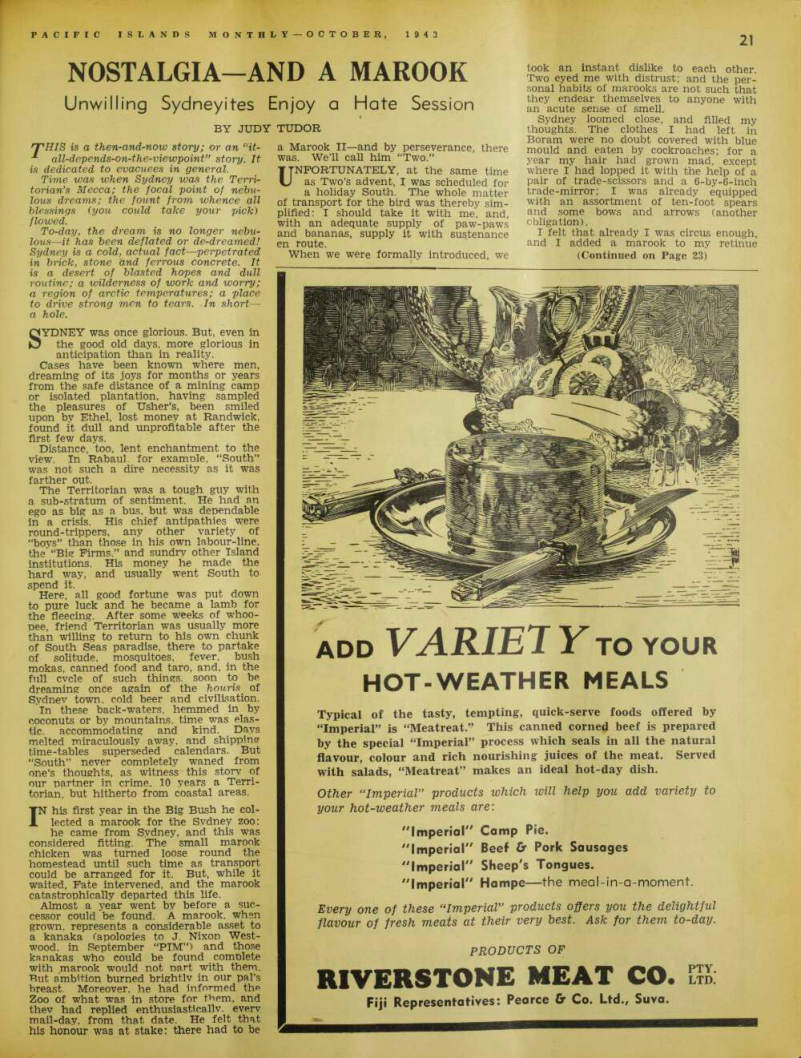
Unwilling Sydneyites Enjoy a Hate Session
By Judy Tudor
r THIS is a then-and-now story; or an “it all-depends-on-the-viewpoint” story. It is dedicated to evacuees in general.
Time was when Sydney was the Terri torian’s Mecca; the focal point of nebu lous dreams; the fount from whence all blessings (you could take your pick) flowed.
To-day, the dream is no longer nebu lous —it has been deflated or de-dreamed!
Sydney is a cold, actual fact —perpetrated in brick, stone and ferrous concrete. It is a desert of blasted hopes and dull routine; a wilderness of work and worry; a region of arctic temperatures; a place to drive strong men to tears. In short — a hole.
SYDNEY was once glorious. But, even in the good old days, more glorious in anticipation than in reality.
Cases have been known where men, dreaming of its joys for months or years from the safe distance of a mining camp or isolated plantation, having sampled the pleasures of Usher’s, been smiled upon by Ethel, lost money at Randwick, found it dull and unprofitable after the first few days.
Distance, too, lent enchantment to the view. In Rabaul. for examnle, “South” was not such a dire necessity as it was farther out.
The Territorian was a tough guy with a sub-stratum of sentiment. He had an ego as big as a bus. but was dependable in a crisis. His chief antipathies were round-trippers, any other variety of “boys” than those in his own labour-line, the “Bie Firmsand sundry other Island institutions. His money he made the hard way, and usually went South to spend it.
Here, all good fortune was put down to pure luck and he became a lamb for the fleecing. After some weeks of whoo pee, friend Territorian was usually more than willing to return to his own chunk of South Seas paradise, there to partake of solitude, mosquitoes, fever, bush mokas, canned food and taro, and, in the full cvcle of such things, soon to be dreaming once again of the of Sydnev town, cold beer and civilisation.
In these back-waters, hemmed in by coconuts or by mountains, time was elas tic. accommodating and kind. Days melted miraculously away, and shipping time-tables superseded calendars. But “South” never completely waned from one’s thoughts, as witness this story of our partner in crime. 10 years a Terri torian, but hitherto from coastal areas.
Fhis first year in the Big Bush he col lected a marook for the Sydney zoo: he came from Sydney, and this was considered fitting. The small marook chicken was turned loose round the homestead until such time as transport could be arranged for it. But, while it waited, Fate intervened, and the marook catastrophically departed this life.
Almost a year went by before a suc cessor could be found. A marook. when grown, represents a considerable asset to a kanaka (apologies to J. Nixon West wood. in September “PIM”) and those kanakas who could be found comnlete with marook would not nart with them.
But ambition burned brightly in our pal’s breast. Moreover, he had informed the Zoo of what was in store for them, and thev had replied enthusiastically, everv mail-day. from that date. He felt that his honour was at stake: there had to be
a Marook ll—and by perseverance, there was. We’ll call him “Two.”
Unfortunately, at the same time as Two’s advent, I was scheduled for a holiday South. The whole matter of transport for the bird was thereby sim plified: I should take it with me, and, with an adequate supply of paw-paws and bananas, supply it with sustenance en route.
When we were formally introduced, we
took an instant dislike to each other.
Two eyed me with distrust; and the per sonal habits of marooks are not such that they endear themselves to anyone with an acute sense of smell.
Sydney loomed close, and filled my thoughts. The clothes I had left in Boram were no doubt covered with blue mould and eaten by cockroaches; for a year my hair had grown mad, except where I had lopped it with the help of a pair of trade-scissors and a 6-by-6-inch trade-mirror; I was already equipped with an assortment of ten-foot spears and some bows and arrows (another obligation).
I felt that already I was circus enough, and I added a marook to my retinue
(Continued on Page 23)
reluctantly. But Two was put in a copra-sack, and carried out to Boram.
There, he was transferred to a meat case, while we waited for the ship.
A DAY or so later one of the boys appeared and said, “More better picaninny belong marook go walk about. Suppose he sit down along bokis three week more leg belong ’im ’e buggerup finis.”
I agreed. Being cooped up in a meat case could be no joke, and there was little sense in presenting the Zoo with a bird with buggered-up legs. So we took it out and tied a ball of string to one leg and let it loose under the house—a grave tactical error on our part.
Two’s feet started to run before he hit the ground, and then he lit out for free dom with everything he had. Round and round the piles he went, describing loops and figure eights, and when the string would stretch no further he rolled over on his side and gasped like a gaffed fish.
Up to that point, the cook-boy, the monkey and I had enjoyed the spectacle immensely. While the cook unravelled string for dear life, so that Two could get a better run for his money, we sat down on our heels to get a better view and yelled with delight. Remember, we were just down from the bush, and eager for amusement.
But, when Two lay there, still moving his thin legs in slow-motion, and giving every indication that he would pass right out in a fit of fury or apoplexy, we became alarmed, and began to think furiously of the donor thereof, who was determined that Sydney should have a marook collected from the elemental jungle with his own fair hands.
We shoved the marook back in the box, gave it two bananas as a peace offering, covered it with a sack and hoped for the best. Two survived. rpO-DAY, at Taronga Park, a couple of X full-sized marooks stalk majestically round the pen marked “New Guinea Cassowary.” They are magnificent-look ing birds, with shining black feathers and bright blue wattles. Maybe one of them is Two. On occasions, I have visited there with friends and remarked modestly, when we came to the marooks: “I brought one of those down from the Sepik district.” If one of them is Two, he is now almost as tall as I am. So they say “Oh!” doubtfully, with a glazed, calculating look in their eye.
No doubt they get a mental picture of me bounding over New Guinea’s hills and dales, a 12-bore shotgun in my hand, a “tiger-shooter” on the back of my head, wresting life-size marooks from infuriated head - hunters. Bring -’em - back - alive Tudor! ♦ ♦ ♦ ♦ rOSE were the days! Then, the people who keep flats down Macleay Street, Pott’s Point, acted as though they liked prospective tenants. To-day, if you can first track them to their lair— in itself a feat of perseverance—they bellow, before you have a chance to open your mouth: “We haven’t any flats, and. what’s more, we won’t be having any!
We have 339 people on a waiting list already.” That disposes of the flat question.
Then, too, in those dear days beyond recall, it was possible to park a car in a nrohibited area, or next a fire hydrant with verve and abandon. If caught, and bawled out, you could always disarm the con. “I hadn’t an idea I shouldn’t do it!
I live in New Guinea—just been down a week.”
“Well, now,” he’d say, putting his note
book away and parking his foot on the running-board, “that’s very interesting.
What’s it like up there?” In half an hour you would escape with his blessing.
To-day, few Territorians have cars to park in prohibited areas; those who have, have got no petrol. Neither are cops or the general public interested in your, ver sion of New Guinea any —they have read all about it in the papers: it’s the land where the Fuzzy-Wuzzy Angels grow. Some have a glimmering that there were pre-blitz Europeans in those parts, but now they look upon them with suspicion. After all, did they not wax fat at the native’s expense?
“How?” you ask.
“Well, they must have,” you are told.
“Otherwise, why are missionaries, politi cians and kind people from Canberra to Washington resolving that ‘the native shall not be exploited after the war’?”
NO— Sydney is not the place it was. It is a town of women: many of them suddenly platinum blonde; many more with a badly-grafted American accent; all of them chain-smokers. If I were a man I should give up smoking cigarettes—and let the women have a really open slather. It’s effeminate, any way.
The shops have no stocks; but they are thronged by thousands of fat, middle aged women who, somehow provided with more money than they had in life before, are vomited from trams, trains, busses and ferries each day to make life hell for those whose misfortune it is to do business in the city. Marked with the indelible stamp of dull suburbia, they are the kind of women who are quarried, not hatched; the kind who spend their hus
band’s clothing coupons before their own.
As a uniform, they wear permanent waves and the darndest, nuttiest little
?went^?L^ g L t n haV T e hpfl C^ te H?^ iWciixy years Triey dra§ tired kids about and string-bags full of oddments, and make life in Sydney’s abominable tram-cars more of a nightmare than it need be.
There are, of course, still men in this town, young and old, in uniform and out.
But somehow they go unnoticed amongst the hordes of war-maddened females,
femmes;' TSe
retail trades, and have assumed’unlimited licence to snarl, “No razor blades” “No matches,” “No bacon,” “Don’t you’ know there’s a war on,” and all the other overworked missiles of the home-front every time anyone has the temerity to try to buy necessary commodities. One needs a front of brass, a steel core and a strong character to approach a shop assistant these days. , Of course, we know that we don’t know
how lucky we are. But who appreciates q “nipp ssfp nipop” until nru* ic in o n i no
Unsafe one? P
fTKDR me —gimme a desert; or a coral
r wuhw°lcTflroclu?SbakTfew
wogs a couole of mUllon « mountain or two Sid a dSsI of flVe? duckedinfor goodmeasure* or even a * from^hi^ 1 had th . ol s’ fro “ ™ ls dlstan ce, they seem infinitely Preferable to the jungles of Pitt Street and the wildernesses of King’s Cross, where the only rule is “Get in and get it—or go without.” m , , . , In the of . the . d yed-m-wool Ter ntonan who blew m here the other day, after Jap-dodging for over a year in New Guinea’s back-of-beyond: “If this is Sydney—l’ve had it ”
Advertisements & other items, pp. 23-26 (1 item)
Hot-Weather Meals
ADD VARIE7Y to your
Typical of the tasty, tempting, quick-serve foods offered by “Imperial” is “Meatreat.” This canned corned beef is prepared by the special “Imperial” process which seals in all the natural flavour, colour and rich nourishing juices of the meat. Served with salads, “Meatreat” makes an ideal hot-day dish.
Other “ Imperial ” products which will help you add variety to your hot-weather meals are : "Imperial" Camp Pie.
"Imperial" Beef & Pork Sausages "Imperial" Sheep's Tongues.
"Imperial" Hampe —the meal-in-a-moment.
Every one of these "Imperial” products offers you the delightful flavour of fresh meats at their very best. Ask for them to-day.
PRODUCTS OF
RIVERSTONE MEAT CO. Em
Fiji Representatives: Pearce & Co. Ltd., Suva.
Services
COMMUNICATIONS
SgSr SERV,CE
Sc klahd? wmS ««* manufacturing " mggg F s "
WIRELESS D INSTRUMENTS
"gUS BROADCAST RIVERS
broadcasting
OWNERS AND OPERATORt aTI o,,S
M CO°R F D.r«RAUAN ART,STS
“S^sss-. —•»
AMALGAMATED VIRELESS (A'sia) LIMITED
Australia’s National Wireless Organisation
THE
YORKSHIRE
INSURANCE
CO. LTD.
(Incorporated in England)
FIRE
ACCIDENT
MARINE
FIRE POLICIES ISSUED
IN PAPUA
All information from —
E. A. JAMES,
Tel. 86347. Attorney for Papua, 14 Spring St., Sydney.
KEEP LANTERNS AND
STOVES WORKING
WITH GENUINE
Goleman
PARTS
c To help you take care of your Coleman Lantern, Stove, Iron or other Appliance, the Coleman factory is doing everything possible to keep your Dealer supplied with Genuine Coleman Parts.
Ask his advice about making your Coleman appliance last longer. He will make repairs and keep it in satisfactory working order.
THE COLEMAN LAMPS STOVE CO. LTD.
TORONTO - - - CANADA
THE COLEMAN EXPORT CORPORATION, CHICAGO, ILL, U.S.A.
Wanted to Buy—Quality Guns and Rifles HIGHEST PRICES GIVEN. WILL ALSO EXCHANGE GUNS.
SI L RO H U Qualify Firearms and Fishing Tackle. 143 ELIZABETH STREET (Near Market St.) SYDNEY. ’PHONE: MA 3540.
Ship Chandlery Hardware
/Write for j
Ship Chandlery /
Catalogue J
Special “In Bond” Prices for all Islands enquiries quoted on application.
Sole Agents for:
BROOMFIELDS LIMITED
152 SUSSEX STREET :: SYDNEY.
Cables: “Boom", Sydney.
Large and Complete Stocks of
SHIP CHANDLERY
IRONMONGERY OF ALL KINDS, PAINTS,
WHITE LEAD AND OILS.
P. H. MUNTZ & CO.’s 3-CROWN BRAND METAL SHEATHING.
PEACOCK Sc BUCHANS’ ENGLISH READY-MIXED PAINTS.
Scott’s “Renown” Brand Rope,
Cordage and
Binder
Twine
Cable Addreaa Ropeyard, Sydney.
of Every
Description
MANUFACTURED AT
MASCOT, N.S.W.
J. SCOTT
nr. ltd.
Head Office and Store;
163 CLARENCE STREET,
SYDNEY,
NJB.W.
Americans
In the Track of the Americans Changes in Noumea and Solomons
AN officer of the Information Office, Suva, Fiji, Mr. Harold Cooper, recently visited advanced battle stations in the South-west Pacific. Some of his cabled despatches were printed in the “Fiii Times,” and a condensation of two of them appears below. Pacific residents are anxious and interested to know the effect of war on island territories other than their own, but although more cor respondents and newspaper men have let Zoose in the Pacific than ever before, few, if any, have the <e lsland annle Cooper has.
Here are Noumea and the Solomons as he sees them.
APRE - WAR resident re-visiting Noumea would rub his eyes and wonder whether his name was Rip Van Winkle. Two years ago, Noumea was a sleepy tropical town, where casual traffic moved at a leisurely pace along avenues which one could cross blindfold in perfect safety. Now there, are corners where the pedestrian must wait patiently for an occasional gan in the grimy caval cade of military vehicles of all sizes, from ieeps to giant trucks, which rumble by in unwearying procession.
The change that has come over Noumea is a sample and symbol of the prodigious American exertions over the past eigh teen months in this part of the world.
Here, as in so many places in the South Pacific, the Americans have had to start from a long way behind scratch in their race to build up bases adequate to sup port a major offensive against Japan. As everybody knows, you can’t tie a battle ship to a palm tree, or land four-engined bombers on a bathing beach. Yet that was about the sum total of the facilities available to the Americans when they assumed direction of Allied operations in this theatre.
It was, at one time, fashionable to complain of the slow tempo of events in the Pacific war, and these complaints were often barbed with hints that the task of mobilising Allied striking power was either being bungled or not tackled with the grim seriousness the situation demanded. But when the full story is told of the transformation the Americans have wrought in Noumea and its cluster of subsidiary bases it will be counted as a miracle of speed and efficiency no less impressive than the launching of the first thousand Liberty ships. Before very long Japan will learn with baffled amazement exactly how quickly Uncle Sam has de livered the goods in the South Pacific. ♦ ♦ ♦ ♦ GUADALCANAL to-day is a vast grave yard of Japan’s dreams of Empire.
Everywhere along that nart of the coast which was the scene of last year’s fighting there is unmistakable evidence of the overwhelming extent of the Japanese disaster.
The beach for many miles on each side of Cape Esperance is littered with hun dreds of derelict landing barges, many of which the sands have already swallowed.
Five big Japanese transports, grounded in a vain attempt to escape American bomb ing, rust forlornly in shallow water. One of them, once a show piece of Japan’s Merchant Marine, now bears, painted on its scarred and fissured hull, the humi
liating inscription: “Bomb target. Keep clear.”
Guadalcanal is the souvenir hunter’s paradise. The natives are letting little go to waste. Japanese helmets have in creased the housewife’s hoard of kitchen utensils. Sections of Japanese collapsible boats mounted on wheels make excellent village handcarts. Other boats are up turned to do duty as benches and tables.
Swords which once adorned Tojo’s officers are now used to dig yams. The arms of Guadalcanal’s grass-skirted womenfolk jangle with bracelets wrought from the metal of crashed Zeros.
There was one Japanese political officer who sought to impress village audiences by driving a six-inch nail into a tree trunk, declaring that it represented Japanese power firmly implanted in the Solomons. The brief myth of Japanese invincibility is now blown sky-high and the natives hugely enjoy the discomfiture of their would-be oppressors.
The season’s musical hit in the Islands is a song in pidgin English which tells the story of the series of Japanese de feats at the hands of American land, sea, and air forces, and each verse of which ends with the derisive line, “Me laugh along you Japan! ha ha.” The amount of face lost in the Solomons must keep many a Japanese bigwig awake of nights. • • ♦ ♦ DURING the last hours at Munda, on New Georgia, I was looking down from an observation post, about a mile from Munda Point. The tanks were moving into position to open point-blank fire on the few remaining pill-boxes at the end of the bomb-pocked rectangular airfield.
There was almost a holiday atmos phere, for everyone knew that, to quote the words of another soldier watching from the hilltop with me, “It’s all over except for handing out the cigars.” Be hind the front line Naval Construction Battalions—they are among the unsung heroes of this Pacific war—were already at work building a two-lane highway to link the beach-head with the virtually captured airfield.
As we jeeped our way back through the wilderness of shell-blasted stumps that was once Lambeti plantation, we came upon a huge steam shovel gnawing busily at a patch of ground which only a few days before had been the scene of fana tical Japanese resistance.
Even if the Americans have fallen slightly behind their original ambitious schedule for the advance on Munda, whatever time has been lost they will more than retrieve by the incredible speed with which they are exploiting their gains. The process of transforming
Munda from a ruined Japanese fortress into a smoothly functioning and well equipped Allied forward base will be com pleted before Tojo can say “co-prosperity.”
HERE is a story of Captain D. G.
Kennedy, formerly a District Officer in the Solomons, who waged a private war with the Japs until the Americans arrived and “relieved him of the responsibility for the defence of his district.”
His residence is like a miniature war museum. It is filled with trophies which he and his small band of 35 native troops have captured during several months of highly successful, albeit far from ortho dox, campaigning against the Japanese occupation forces. For most of that time Kennedy was cut off from the outside world and had to devise a strategy which would enable him to wage war against the invader at the invader’s own expense.
Before long, the enemy was unwillingly keeping him supplied, not arms, but also with food and transport, for among the earliest spoils to fall into the hands of Kennedy’s elusive guerrillas were two armed barges, large quantities of petrol and lubricating oil and enough rations to feed the entire party for three months.
(Continued on Page 27)
Mr. T. M. Bryce, who has been mana ger of the Bank of New South Wales in Fiji since early 1941, has been transferred to Perth, Western Australia.
22 others taken prisoner. “We felt much better,” says Kennedy, “when the tally of Japanese dead exceeded our own estab lishment, for we knew then that even if the worst happened and we were all wiped out the final score would still be in our favour.”
Kennedy’s last battle will probably go down in history as one of the briefest and oddest naval engagements ever fought. In a ten-ton schooner he at tacked, under cover of darkness, a 25-ft. whale boat, containing a party of ten Japanese, which he had followed down the coast and into a lagoon. When he found difficulty in silencing the Japanese machine-gun fire Kennedy cut the en counter short by ramming the whale boat in a manner which would have done credit to one of His Majesty’s destroyers.
In the intervals between these adven tures Kennedy carried on normal adminis trative duties and was at hand to welcome the Americans when they landed.
Advertisements & other items, pp. 27-28 (1 item)
fi IL L E S_Pj_E ’ Service
ISLANDS
SOUVENIRS
Popular Islands Shell Necklaces and Hula Skirts posted direct to any part of the world.
Special sample parcel for £1
containing:
1 Genuine Manihiki Skirt; and 12 Assorted Island Necklaces.
Send your Money Order direct to
D. C. BROWN
MERCHANT AND EXPORTER
OF ISLANDS PRODUCE.
P.O. Box 16, Rarotonga, Cook Islands.
LARGE QUANTITIES AVAILABLE
—WHOLESALE INQUIRIES INVITED,
BUY DIRECT AND SAVE MONEY
fi IL L E S_Pj_E ’ Service
BUYING AGENTS
FOR ALL PACIFIC TERRITORIES
Island Produce Sold on Commission
YOUR ORDERS RECEIVE PERSONAL ATTENTION
ROBERT GILLESPIE PTY. LIMITED
54a PITT STREET, SYDNEY
Cables: ROBERGILL. G.P.O. BOX 137 CC.
ALUMINIUM and its ALLOYS
OUR HOUSE FLAG IS FLYING and our production is flowing into the stream of Defence requirements exclusively—in the forms of Aluminium Alloy INGOT, Rolled Aluminium Alloy PLATE, SHEET, STRIP, also as Extruded Aluminium Alloy ROD, BAR, WIRE, TUBING AND SECTIONS.
We look forward to the time when civilian demands can be satisfied by us, to meet the growing applications for our metal in Australia and the South Seas.
AUSTRALIAN ALUMINIUM COMPANY
PROPRIETARY LIMITED
(INCORPORATED IN THE STATE OF VICTORIA)
GENERAL OFFICES AND FABRICATION DIVISION: GRANVILLE. SYDNEY. N.S. W.
The Standard oj Excellence
VCA** Liqueur*
COMPOUNDED FROM PURE FRUIT
EXTRACTS AND HIGH-CLASS
MATURED SPIRITS.
IN 15 FLAVOURS
Advocaat, Red Curacoa, White Curacoa, Parfait Amour. Maraschino, Chartreuse, Apricot Brandy, Cointreau, Cherry Brandy, Creme de Menthe, Creme de Cacao, Peach Brandy, Creme de Banana, Kummel, Friars Liqueur.
TRADE ENQUIRIES TO BOX 3373, G.P.0., SYDNEY.
LAVEX
The Oxygened Washing Compound
Wonderful for the Wash ... Harmless to the hands
NON-INJURIOUS TO THE FINEST FABRICS
packed in cartons containing 48 x Sox. pkts.
TRADE ENQUIRIES TO BOX 3373, G.P.0., SYDNEY.
C. SULLIVAN & CO.
GENERAL MERCHANTS ISLANDS AGENTS
REPRESENTING LEADING FIRMS IN THE PACIFIC ISLANDS.
Islands Produce sold on Shippers’ Account—Liberal Advances against Consignments.
Buyers of all Islands’ Requirements on Commission—Original Invoices Furnished.
Bankers'. Bank of New South Wales .. Bank of New Zealand .. Comptoir National d’Escompte de Paris.
Wartime Cable Address: Sullivan, Kentstreet, Sydney.
379 KENT STREET, SYDNEY, N.S.W.
Unit Which is Already
Famous Solomon Islands Labour Corps
rE Solomon Islands Labour Corps now numbers 2,500 officers and men, under the command of Squadron- Leader C. V. Widdy, RAAF, who, before the war, was general manager of Levers’
Pacific Plantations.
The Corps was formed in the days when the Japs were being driven from Guadalcanal, and its members had their first taste of battle when they carried ammunition and supplies right up to the front lines. The Corps’ duties include loading and unloading cargo vessels, road maintainance and construction, the build ing of warehouses and airfields, clearing camp sites, the erection of telegraph lines, salvage work and the operation of small coastal vessels. The Corps Honour Roll includes 16 men killed, 16 died of illness, and many wounded.
Food Prices High In
Samoa
From Our Own Correspondent
Apia, Aug. 27.
rnHE export of taro and ta’amu to X American Samoa has been pro hibited by the Administration, until further notice.
There is a shortage in Western Samoa of local and European foodstuffs (rice, flour, biscuits, etc.) and export of taro— large quantities of which are shipped to Pago Pago in order to obtain the better prices ruling in the neighbouring Ter ritory—seriously affected local supplies.
Shortages of rice, vegetables and eggs —to say nothing of local fish, which are practically unobtainable—are keenly felt by the Europeans. Eggs are selling for six and seven shillings per dozen, while fowls fetch up to 15/- and 18/- each.
Soldier Settlement
In Fiji
fIIHE Fiji Legislative Council approved X at the end of August, the opening of a £25,000 Advance Account to pur chase land for the settlement of returned servicemen.
A Provisional Services Settlement Board has been appointed and the Board will consider whether land which comes on the market from time to time should be purchased. It is not proposed that the provisional committee should buy land on a large scale.
Fiji's Secret Weapon
By Amel
WE had not heard of this “Secret Weapon” . until old Wilisoni, the vegetable man, told us about it.
Wilisoni, a large and grizzled Fijian from a village three miles away, has been bringing taro, yams, paw-paws and tall stories to our house for many years.
Either his instinct, or his burning ears, warn him when —and what—we are think ing of him, and we jc an be sure that he will arrive the following day in his gaudy punt, the colour of which would put any self-respecting fire-engine to shame.
After he has sold his produce for a sum satisfactory to himself, and cadged tobacco, matches, paper, an empty ben zine tin, a cooking pot, ten shillings, an old hat and anything else that occurs to him, he parks himself on the doorstep and tells us how the War is going.
Things like the radio and the news papers leave him cold. He gets his news from the Coconut Telegraph, which, according to Wilisoni, is the most reliable news service of all.
Last week, he was extolling the fight ing prowess of Fijians who had gone on active service in battle areas. They were wonderful soldiers, he declared, and had killed 60,000 of the enemy in less than a month.
“And did they—uh—eat them all?” I enquired gently.
Wilisoni, looking slightly shocked, ig nored this sally, and went on with his paeans of praise. All the Fijians were good at bush work, he said, but several of them, in particular, were of special value to their comrades. Here he paused dra matically and bit the end off a tobacco leaf.
“Why?” we asked, breathlessly.
“Because they can smell the Japanese!” he replied, triumphantly. “They creep quietly through the jungle, sniffing here and sniffing there —” he illustrated vividly —“and when they smell Japanese, they send word back for troops to come and surround them and kill them all. It is very easy for these Fijians. That is why they have killed 60,000 Japanese in . . .”
Suddenly he caught our sceptical gaze, and grinned , . . “You don’t believe me?
But it is quite true. I never tell lies!” ...
“No,” I murmured, watching him push
off in his little red punt, “not too many lies, Wilisoni. But 60,000 Japanese is pretty good going, even for the Smelling Corps!”
Advertisements & other items, p. 29 (1 item)
Rid Kidneys Of
Poisons And Adds
If you suffer sharp, stabbing pains, if joints are swollen, it shows your blood is poisoned through faulty kidney action. Other symptoms of Kidney Disorders are Backache, Aching Joints and Limbs, Sciatica, Neuritis, Lumbago, Sleepless Nights, Dizziness, Nervousness, Circles under Eyes, Loss of Energy and Appetite and Frequent Headaches and Colds, etc. Ordinary medicines can’t help much because you must get to the root cause of the trouble.
The Cystex treatment is specially compounded to soothe, tone and clean kidneys and bladder and remove acids and poisons from your system safely, quickly and surely, yet contains no harmful or dangerous drugs. Cystex works in 3 ways to end your troubles. 1. Starts killing the germs which are attacking your Kidneys, Bladder and Urinary System in two hours, yet is absolutely harmless to human tissue. 2. Gets rid of health-destroying, deadly poisonous acids with which your system has become saturated. 3. Strengthens and reinvigorates the kidneys, protects from the ravages of disease-attack on the delicate filter organism, and stimulates the entire system.
Praised by One-time Sufferers Cystex is approved by one-time sufferers in 73 countries from the troubles shown above.
Mr. Reg Thomas, Townsville, Queensland, recently wrote: “My joints were all stiff, I had leg pains, my back used to ache day and night.
My bladder was weak. I had headaches and no appetite. The first dose of Cystex helped me and before I finished three boxes my health and strength came back.”
Guaranteed to Satisfy or Money Back Get Cystex from your chemist or store to-day.
Give it a thorough test. Cystex is guaranteed to make you feel younger, stronger, better in every way, or your money back if you return the empty package.
Now in 2 sizes—4/-, 8/-.
GUARANTEED
Treatment
for Your Kidneys, Bladder, Rheumatism.
3 M H I , —rAa<3 eSI J ropes ® r HU®*,
,oP tS
teW ?
ftl
IlW®
t da<3 eSl
I^ll
COT
and ,\iottS id descPP Bta^ d 10 ofc*
idabVe.
Ch and dep etv ft OtT teW M'U -c c C \ine s can 3 bo^ * , iisb You 1 lhi° ug
UH^ W
id an 1 ft\J ate \heV 0 &H a* 1 \ co * iU s.
P r*- *'--*s&s*&* . suv «LB°' JS '^ B OI HtP 6c ° \ ir" E pt* WEt* ?.o
Days
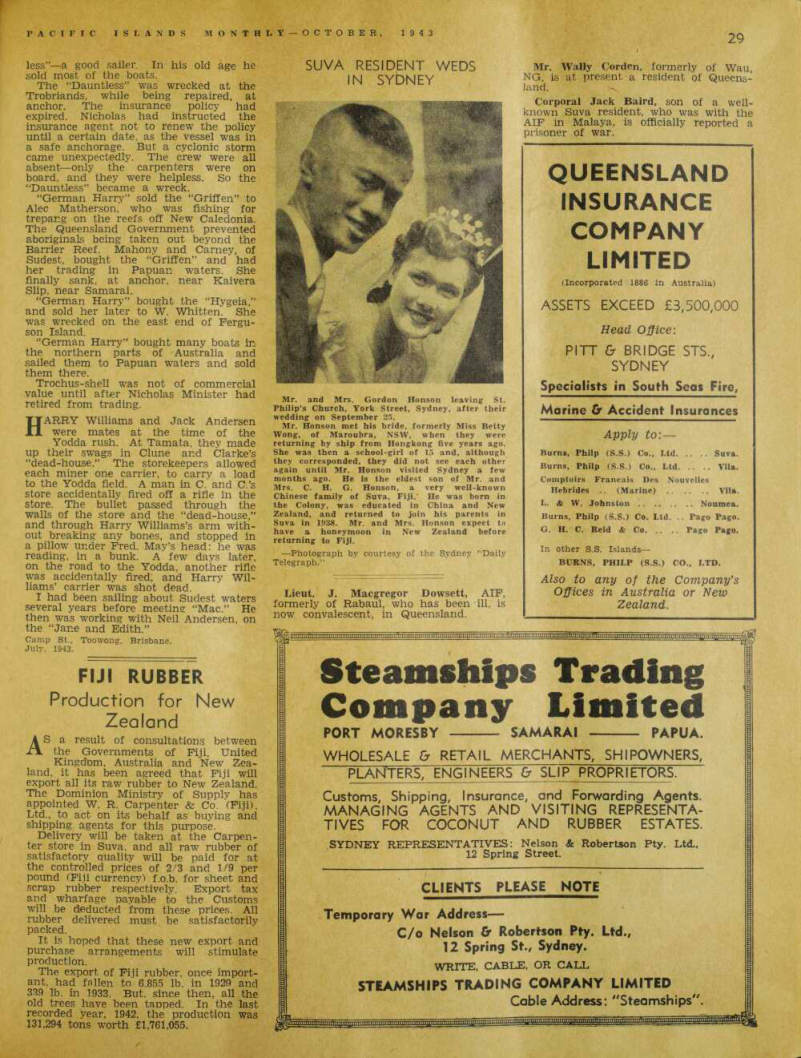
East Of Samara I
Memories of the Early Days
By D. H. Osborne
I WAS interested in “Mac’s” article on the discovery of gold on Sudest.
I worked on the Gira goldfield in 1899 and was camped near Jack Andersen and Harry Williams. They were two of the prospectors of Sudest—they often talked of their experience of different goldfields, and they had been mates for many years. This is their account of the Sudest find.
Dave White was a pearl-shell diver, working in the passages near Sudest. On a visit to Cooktown (Cooktown was the nearest town for supplies) he spoke of white outcrops on Janet and other islands in the Calvados Chain.
Some miners in Cooktown formed a party of 16. I do not remember the names of the others. I often heard of Masher Clarke, but I never met him.
The party chartered the schooner “Grif fen.” Harry Christensen (“German Harry”) owned her at the time. He agreed to take the party to New Guinea and remain at anchor while the miners worked on shore.
They landed on Janet, but there was no luck there; so they moved to Sudest.
They anchored off Sudest, at what has become known as Griffen Point, after the name of the schooner. They found pay able gold on their first day on shore.
They allowed Harry Christensen to break his contract, and he sailed for Cooktown. Winds were favourable and he returned in a short time with a num ber of miners; and other boats followed.
-tiarry s quick return was a very sore point with Harry Williams and Jack Andersen.
Dave White sold out of the diving boats and started storekeeping on Sudest.
When gold was found on Misima most of the white men rushed to Misima, but Dave White remained. He was the first to supply the Sudest natives with tools to mine for gold. Andy Jorgensen, who had remained on Sudest, took a pick and destroyed the natives’ dishes. White and he had words over the matter. Then Jorgensen changed his mind, replaced the dishes, and started the boys out dig ging—and he bought their gold.
After the rush to Woodlark, Jorgensen moved to Misima, and he set natives there to mining, also.
White took Billy Lamb in as partner.
When White died, Lamb bought his share. Lamb remained in business on Sudest until his death in 1908. He willed the business to Mr. J. A. Carpenter, who was manager for Burns Philp there at the time. The business was floated into Tagula Plantations, Ltd., and was in existence until the Japs appeared on the scene.
The only time I heard of John Doug las visiting SED was when he landed Rossel natives on Rossel Island, when they were returned from the Queensland sugar plantations. The natives were recruited by Captain Inman and were returned home some time before the dis covery of gold on Sudest.
IKNEW Nicholas Minister (“Nick the Greek”) for years. He was working pearl-shell with a diving-pump, and trading with the natives of the Calvados Chain, buying trepang and turtle-shell, before any other whites were there.
When Captain Craig was murdered, Sir William McGregor had only recently
arrived in the Territory. He had no means of arresting the murderers, as he had not recruited a police force. He offered a reward for the murderers, dead or alive. The village was in sight of the scene of the tragedy.
Nicholas went up to the village, bowled over the Chief, cut off his head, took it to Sir William, laid it on the deck, and demanded the reward.
Sir William almost took a fit. He threatened to charge Nicholas with mur der.
Nicholas said: “British style, keep the man prisoner for some time, then hang him. Nicholas style, shoot first and inquire later.”
There must have been truth in Nicho las’s story of his having been thrown overboard by Moturema natives, after being attacked. He swam to the bow of the boat, and climbed up the anchor chain. The natives were below, looting his stores, when they saw him on deck, covered with blood. They yelled, and jumped overboard and swam ashore.
From then on, he was regarded as a wizard and was quite safe from attack.
Nicholas had been in many tight cor ners. He had tomahawk and spear marks on his face and arms.
I doubt that Nicholas Minister was ever in gaol. He probably had a few skeletons in his cupboard. He used to say that he had been outlawed for a time —and he blamed Rev. Chalmers for that.
A warship was searching for him. The waters were uncharted at the time.
Nicholas went on board and piloted them for several days, to clear water. After wards, he sent a message, saying who he was. If true, the charge was withdrawn, for he was not arrested.
IN the early days of Sudest, Nicholas had a fleet of boats. His flagship was a 50-ton schooner, the “Daunt
less”—a good sailer. In his old age he sold most of the boats.
The “Dauntless” was wrecked at the Trobriands, while being repaired, at anchor. The insurance policy had expired. Nicholas had instructed the insurance agent not to renew the policy until a certain date, as the vessel was in a safe anchorage. But a cyclonic storm came unexpectedly. The crew were all absent—only the carpenters were on board, and they were helpless. So the “Dauntless” became a wreck.
“German Harry” sold the “Griffen” to Alec Matherson, who was fishing for trepang on the reefs off New Caledonia.
The Queensland Government prevented aboriginals being taken out beyond the Barrier Reef. Mahony and Carney, of Sudest, bought the “Griffen” and had her trading in Papuan waters. She finally sank, at anchor, near Kaivera Slip, near Samarai.
“German Harry” bought the “Hygeia,” and sold her later to W. Whitten. She was wrecked on the east end of Fergu son Island.
“German Harry” bought many boats in the northern parts of Australia and sailed them to Papuan waters and sold them there.
Trochus-shell was not of commercial value until after Nicholas Minister had retired from trading.
HARRY Williams and Jack Andersen were mates at the time of the Yodda rush. At Tamata, they made up their swags in Clune and Clarke’s “dead-house.” The storekeepers allowed each miner one carrier, to carry a load to the Yodda field. A man in C. and C.’s store accidentally fired off a rifle in the store. The bullet passed through the walls of the store and the “dead-house,” and through Harry Williams’s arm with out breaking any bones, and stopped in a pillow under Fred. May’s head: he was reading, in a bunk. A few days later, on the road to the Yodda, another rifle was accidentally fired, and Harry Wil liams’ carrier was shot dead.
I had been sailing about Sudest waters several years before meeting “Mac.” He then was working with Neil Andersen, on the “Jane and Edith.”
Camp St., Toowong, Brisbane.
July, 1943.
Advertisements & other items, p. 30 (1 item)
William Atkins Pty. Ltd.
Heod Office 449-451 KENT ST., SYDNEY.
Iron & Steel Merchants—Engineers' Supplies
ESTABLISHED OVER 50 YEARS
Coach & Motor Hardware Cable Address: WILATKIN, Sydney.
-STEEL DEPARTMENT
MILD STEEL:
Rounds, Squares, Flats, Half-rounds, Hexagons, Bevel, Shoeing, Tyre, Angles, Tees, Sheets, Plates, Girder Plates, Chequer Plates, Channels, Hoops, Etc.
BRIGHT STEEL:
Rounds, Squares, Hexagons.
Extra Special High Speed Tool' Steel, Mining Steel, Blister Steel and Spring Steel, Rounds, Flats £r Squares.
Bar Iron—All sections and sizes.
Engineers' Supplies: Set Screws, Studs, Metal Thread Screws, Coach Screws, Files, Cotter Pins, Bright and Black Bolts, Rivets, Etc., Hack Saw Blades.
Power Transmission Gear: Including Plummer Blocks, Couplings, Collars, Etc.
Coach and Motor Hardware: Axles, Springs, Wheelstuff, Duck, Paints.
Farriers' Supplies: Horse Nails, Anvils, Vices, Etc.
Motor-Trimmers and Motor Builders' & Motor Painters' Requirements
C. A. WILLEY'S
Quick-Drying Coach and Car Paints, Roughstuff, Elastic Gloss, Synflex Enamels, Lacquers.
DUCO Lacquers and DULUX Enamels—FAßßEX Motor Toppings and Leather Cloths, House & Decorators' Paints, Varnishes & Brushware.
Sole Distributors of CHAMPION'S Decorators Paint Products.
Distributing Agents for BROLITE Lacquers, SYNFLEX Enamels and "POLYGLOSS" Finish.
Fiji Rubber
Production for New Zealand
AS a result of consultations between the Governments of Fiji, United Kingdbm, Australia and New Zea land, it has been agreed that Fiji will export all its raw rubber to New Zealand.
The Dominion Ministry of Supply has appointed W. R. Carpenter & Co. (Fiji), Ltd., to act on its behalf as buying and shipping agents for this purpose.
Delivery will be taken at the Carpen ter store in Suva, and all raw rubber of satisfactory quality will be paid for at the controlled prices of 2/3 and 1/9 per pound (Fiji currency) f.o.b. for sheet and scrap rubber respectively. Export tax and wharfage payable to the Customs will be deducted from these prices. All rubber delivered must be satisfactorilv packed.
It is hoped that these new export and purchase arrangements will stimulate production.
The export of Fiji rubber, once import ant, had fallen to 6.855 lb. in 1929 and 339 lb. in 1933. But. since then, all the old trees have been tapped. In the last recorded year, 1942, the production was 131,294 tons worth £1,761,055.
Suva Resident Weds
In Sydney
Lieut. J. Macgregor Dowsett, AIF, formerly of Rabaul, who has been ill, is now convalescent, in Queensland.
Mr. Wally Corden, formerly of Wau, NG, is at present a resident of Queens land.
Corporal Jack Baird, son of a well known Suva resident, who was with the AIF in Malaya, is officially reported a prisoner of war.
Mr. and Mrs. Gordon Honson leaving St.
Philip’s Church, York Street, Sydney, after their wedding on September 25.
Mr. Honson met his bride, formerly Miss Betty Wong, of Maroubra, NSW, when they were returning by ship from Hongkong five years ago.
She was then a school-girl of 15 and, although they corresponded, they did not see each other again until Mr. Honson visited Sydney a few months ago. He is the eldest son of Mr. and Mrs. C. H. G. Honson, a very well-known Chinese family of Suva, Fiji. He was born in the Colony, was educated in China and New Zealand, and returned to join his parents in Suva in 1!)38. Mr. and Mrs. Honson expect to have a honeymoon in New Zealand before returning to Fiji. —Photograph by courtesy of the Sydney “Daily Telegraph.’’
Mr. E. E. Eves, of Lami, Fiji, celebrated his 80th birthday on September 10. He has been 60 years in the Colony.
Advertisements & other items, pp. 31-32 (1 item)
Steamships Trading
QUEENSLAND
INSURANCE
COMPANY
LIMITED
(Incorporated 1886 in Australia)
ASSETS EXCEED £3,500,000
Head Office :
PITT & BRIDGE STS.,
SYDNEY
Speciolists in South Seos Fire, Marine & Accident Insurances
BURNS, PHILP (S.S.) CO., LTD.
Also to any of the Company’s Offices in Australia or New Zealand.
Steamships Trading
Company Limited
PORT MORESBY SAMARAI PAPUA.
WHOLESALE & RETAIL MERCHANTS, SHIPOWNERS,
PLANTERS, ENGINEERS &~SUP PROPRIETORS.
Customs, Shipping, Insurance, and Forwarding Agents.
MANAGING AGENTS AND VISITING REPRESENTA-
TIVES FOR COCONUT AND RUBBER ESTATES.
SYDNEY REPRESENTATIVES: Nelson & Robertson Pty. Ltd., 12 Spring Street.
CLIENTS PLEASE NOTE
Temporary War Address— C/o Nelson fir Robertson Pty. Ltd., 12 Spring St., Sydney.
WRITE, CABLE, OR CALL
STEAMSHIPS TRADING COMPANY LIMITED
Cable Address: "Steamships".
For those jobs
you do yourself!
c\° v ev h So' So® *1 6° \)® 6® X>® e® :^ e r> av 'o® So®
WUNDERLICH
DURABESTOS
Is aTailable from
ISLANDS’ DISTRIBUTORS.
Allen Taylor 81 Co. Ltd.
COMMERCIAL ROAD, ROZELLE,
SYDNEY
Sawmillers and Wholesale Suppliers of Hardwoods for Constructional Purposes GIRDERS ... PILES .. . POLES . . . SLEEPERS, Etc.
EXPORTING TO PACIFIC ISLANDS SINCE 1893
NtRRYJ.YOUNGPiy.LTD.
379 KENT STREET, SYDNEY
EXPORT REPRESENTATIVES^ FOR . . .
Bond's Industries Ltd.
Manufacturers of Hosiery and Underwear. Cotton Spinners.
Cottee's Passiona Ltd.
Makers of PASSIONA, Fruit Cordials, Fountain Syrups, Fruit Spreads, Peanut Butter and Peanut Products.
Harry Peck & Co. (Aust.) Pty. Ltd.
Makers of the famous "Anchovette" Fish Paste.
Specialists in Potted Delicacies.
INQUIRIES THROUGH YOUR USUAL CHANNELS WILL RECEIVE
PROMPT ATTENTION.
Bankers: Bank of New South Wales.
A Garden In Tahiti

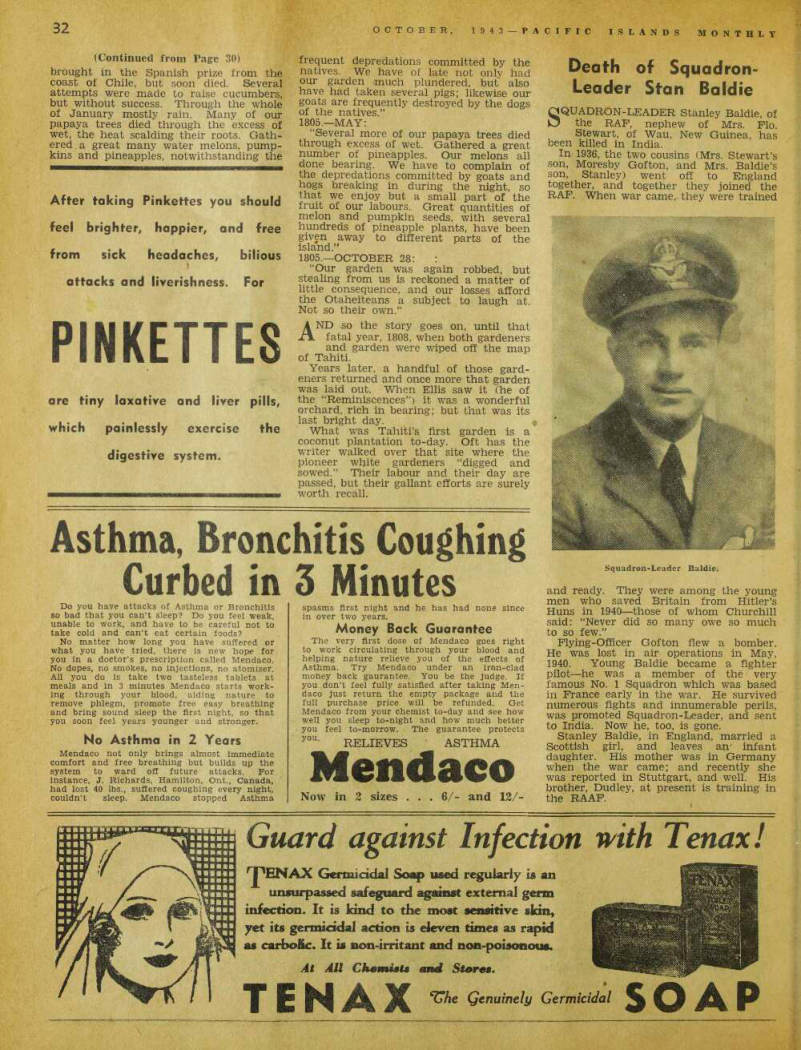
Introduction of Melons, Citrus and Pineapples
By W. W. Bolton
I WRITE of a garden not of the present day, but in the Long Ago; not of flowers, but of the homely vegetable.
Those first white men and women *who arrived in Tahiti in 1797 and had taken up their residence at Matavai (Cook’s Point Venus) wanted green food other than the taro, yam and sweet potato of the natives. The time would come for roses and dahlias, for carnations and the rest that they loved, but had left behind.
Just now, it was green foods they needed, not alone for health, but to make more palateable the endless round of pork, the staple meat alone to be secured.
An orderly garden, with its trim beds set in rows, was unknown to Tahitians, and great was the interest shown by them at this fresh peculiarity of the new comers. That interest, however, soon be came more than a mental one, and those poor gardeners had a sorry time.
Let them speak for themselves. Their successes and their failures, their hopes and disappointments, their worries and their woes, are to be read of in their daily Journal; and surely should interest all who to-day find pleasure and, in measure, occupation, in nursing to maturity both seeds and fruits for their table.
The beginnings were over; five years of labour had passed.
1802. February:
“Cabbages, melons, pumpkins and cucumbers we have had in great abund ance. Several bushels of Indian corn have been gathered in. Many of the European vegetables will not come to perfection or produce seed. The vine and fig tree brought from Port Jackson are doing well. Potatoes are good for nothing.”
But, with November, comes another story. They chronicle:— “During the months of April, May and June all we had in the garden went to ruin in consequence of taking down the fences in the time of the late disturb ances. Since the restoration of peace, the fences have been repaired and the garden digged and sown. Water melons have succeeded, but were destroyed by the natives, who are very fond of them and commit frequent depredations. Several pineapples are in a very thriving state.”
1803. February:
“Though there has been much wet, yet it has not been a good season, through the heat of .the sun. In November were sown a few cabbages, mustard and turnip seeds, but they came to nothing. In December, sowed some Bengal radish seed; some succeeded. In January, sowed some Indian corn and French beans; these promise middling well. We have had some fine water melons and pumpkins.
The season for the former is over.”
1803.—March 5:
“Brother Scott brought from Oparre to day a quantity of fine oranges. A tree there has had some hundreds of fruit on it this season, but the natives have not the patience till they are ripe. They do the same with pineapples and have even baked them in their ovens to make them more eatable.”
1803.— April:
“In the beginning of February, planted several pineapples, also a piece of ground with this country’s sweet potatoes, and two other pieces with the Sandwich Island and New Zealand sort. In March sowed some hundreds of orange seeds, also limes and citrons. The greatest part of our garden is planted with Indian corn, sweet potatoes, tarro, pumpkins, pineapples and above. The method used in the Sandwich Islands of multiplying cabbage by slips taken from the stock of the plant does not answer in our garden.”
1803. August:
“The seed remaining from those of the cabbage and brocoli brought from Port Jackson, kept too long, did not germinate.
Removed some fig layers and put some cuttings of the grape vine in the ground; most of these are growing. Captain Simpson, having brought here from the Sandwich Islands some seeds of the papaya or paw paw tree, they were sown about November last. Most of the trees in blossom; the greater part seem to be of the male kind; all the flowers are fall ing off and no appearance of frjuit; on the few that seem to be female the fruit begins to form in the shape of a cucumber.”
1804. July:
“Near two-thirds of our garden is now covered with sweet potatoes; but, the bread fruit being plentiful, we have not yet begun to dig them. Our apricot plants in blossom; some fruit appearing on the old trees.”.
1805. February:
“In November last, the weather very dry, the afternoons uncommonly hot and scorching; yet our pumpkins prospered and the melons partly recovered the destruction by the caterpillars. Planted some peas, calavances and lentiles
(Continued on Page 32)
brought in the Spanish prize from the coast of Chile, but soon died. Several attempts were made to raise cucumbers, but without success. Through the whole of January mostly rain. Many of our papaya trees died through the excess of wet, the heat scalding their roots. Gath ered a great many water melons, pump kins and pineapples, notwithstanding the
frequent depredations committed by the natives. We have of late not only had our garden much plundered, but also have had taken several pigs; likewise our goats are frequently destroyed by the dogs of the natives.”
1805.—May:
“Several more of our papaya trees died through excess of wet. Gathered a great number of pineapples. Our melons all done bearing. We have to complain of the depredations committed by goats and hogs breaking in during the night, so that we enjoy but a small part of the fruit of our labours. Great quantities of melon and pumpkin seeds, with several hundreds of pineapple plants, have been given away to different parts of the island.”
1805.— October 28: ;
“Our garden was again robbed, but stealing from us is reckoned a matter of little consequence, and our losses afford the Otaheiteans a subject to laugh at.
Not so their own.”
AND so the story goes on, until that fatal year, 1808, when both gardeners and garden were wiped off the map of Tahiti.
Years later, a handful of those gard eners returned and once more that garden was laid out. When Ellis saw it (he of the “Reminiscences”) it was a wonderful orchard, rich in bearing; but that was its last bright day.
What was Tahiti’s first garden is a coconut plantation to-day. Oft has the writer walked over that site where the pioneer white gardeners “digged and sowed.” Their labour and their day are passed, but their gallant efforts are surely worth recall.
Advertisements & other items, pp. 33-34 (1 item)
Pearson’S
RUSSELL
Overseas
Division
Will intelligently handle your orders for
All Classes of Merchandise
Also introducing
V Reliable Buying Service Sor Sound,
Reconditioned and Guaranteed Cars,
Panel Vans, Trucks and Utilities
MAKES AVAILABLE INCLUDE:
Cars & Panel Vans : Bui c k, Cadillac, Chevrolet, Chrysler, De Soto, Dodge, Ford, Graham, Hudson, La Salle, Nash, Oldsmobile, Packard, Plymouth, Pontiac, Studebaker, Willys 77, Morris, Austin, Vauxhall, Hillman, Citroen, Renault, etc.
Trucks & Utilities : Chevrolet, Maple Leaf, Diamond T., Dodge, Fargo, Federal, Ford, G. M. C. Indiana, International, Reo, Stewart, Studebaker, White, Wtillys, Bedford, Austin, Commer, Leyland, Albion, Dennis, etc.
All reconditioning faithfully carried out. A certificate stating clearly extent and nature of work is supplied with every
vehicle shipped.
Special Feature—
All vehicles are fitted
with Extra Good Tyres.
Mail your requirements stating type of vehicle required, also class of work vehicle will be expected to perform.
Remember, we are truck experts and our advisory service is available to you at all times.
BANKERS: Commonwealth Bank of Australia, Bank of N.S.W., Commercial Bank of Australia.
References exchanged.
RUSSELL PEARSON, export & import
167 ELIZABETH STREET, SYDNEY, N.S.W., AUSTRALIA
On Parle Francais.
After taking Pinkettes you should feel brighter, happier, and free from sick headaches, bilious attacks and liverishness. For
PINKETTES
are tiny laxative and liver pills, which painlessly exercise the digestive system.
Asthma, Bronchitis Coughing Curbed in 3 Minutes
Do you have attacks of Asthma or Bronchitis so bad that you can’t sleep? Do you feel weak, unable to work, and have to be careful not to take cold and can’t eat certain foods?
No matter how long you have suffered or what you have tried, there is new hope for you in a doctor’s prescription called Mendaco.
No dopes, no smokes, no injections, no atomizer.
All you do is take two tasteless tablets at meals and in 3 minutes Mendaco starts working through your blood, aiding nature to remove phlegm, promote free easy breathing and bring sound sleep the first night, so that you soon feel years younger and stronger.
No Asthma in 2 Years
Mendaco not only brings almost Immediate comfort and free breathing but builds up the system to ward off future attacks. For instance, J. Richards, Hamilton, Ont., Canada, had lost 40 lbs., suffered coughing every night, couldn’t sleep. Mendaco stopped Asthma
spasms first night and he has had none since in over two years.
Money Bock Guarantee
The very first dose of Mendaco goes right to work circulating through your blood and helping nature relieve you of the effects of Asthma. Try Mendaco under an iron-clad money back gaurantee. You be the judge. If you don’t feel fully satisfied after taking Mendaco Just return the empty package and the full purchase price will be refunded. Get Mendaco from your chemist to-day and see how well you sleep to-night and how much better you feel to-morrow. The guarantee protects
you - RELIEVES ASTHMA
Mendaco
Now in 2 sizes . . . 6/- and 12/-
Death of Squadron-
Leader Stan Baldie
SQUADRON-LEADER Stanley Baldie, of the RAF, nephew of Mrs. Flo.
Stewart, of Wau, New Guinea, has been killed in India.
In 1936, the two cousins (Mrs. Stewart’s son, Moresby Gofton, and Mrs. Baldie’s son, Stanley) went off to England together, and together they joined the RAF. When war came,, they were trained
and ready. They were among the young men who saved Britain from Hitler’s Huns in 1940 —those of whom Churchill said: “Never did so many owe so much to so few.”
Flying-Officer Gofton flew a bomber.
He was lost in air operations in May, 1940. Young Baldie became a fighter pilot—he was a member of the very famous No. 1 Squadron which was based in France early in the war. He survived numerous fights and innumerable perils, was promoted Squadron-Leader, and sent to India. Now he, too, is gone.
Stanley Baldie, in England, married a Scottish girl, and leaves an' infant daughter. His mother was in Germany when the war came; and recently she was reported in Stuttgart, and well. His brother, Dudley, at present is training in the RAAF.
Squadron-Leader Baldie.
Advertisements & other items, p. 34 (2 items)
32
OCTOBER, 19 4 3 -PACIFIC ISLANDS MONTHLY
(Continued from Page 30)
TENAX Genuinely Germicidal SOAP
f 5:
Guard against Infection with Tenax!
r J I ENAX Germicidal Soap used regularly is an
unsurpassed safeguard against external germ
infection. It is kind to the most sensitive skin, yet its germicidal action is eleven times as rapid as carboHc. It is non-irritant and non-poisonous.
At All Chemists Stores.
TENAX Genuinely Germicidal SOAP
Japan's Air Strength In The Pacific
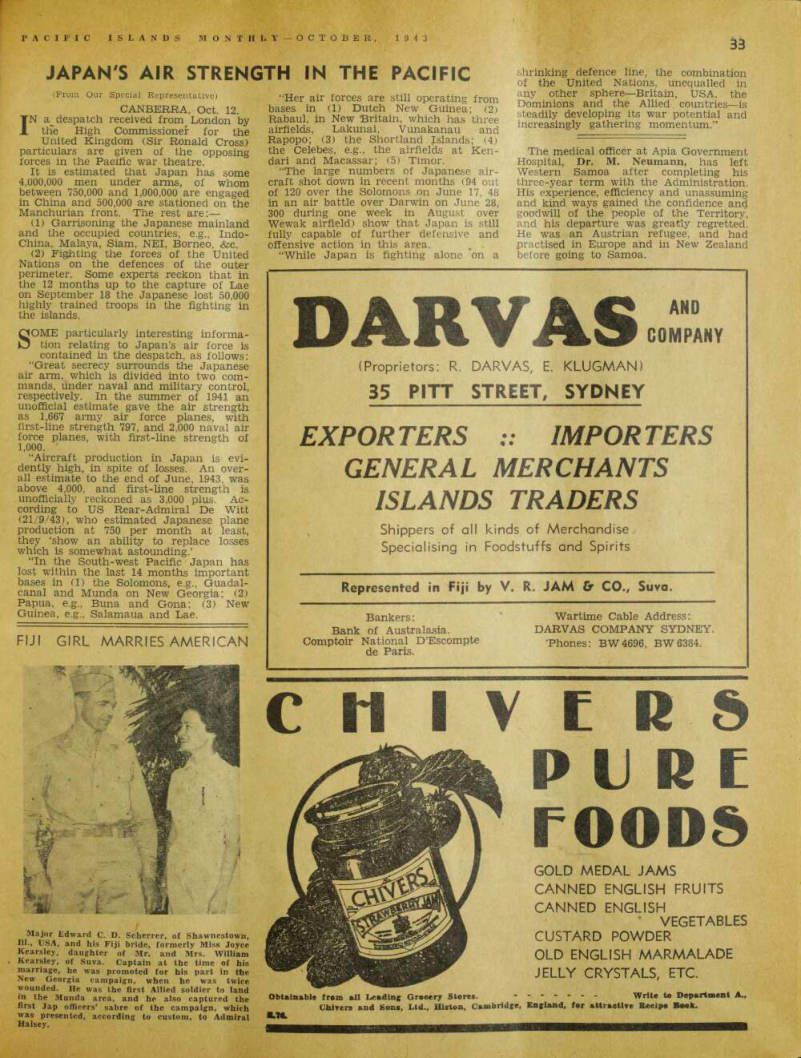
(From Our Special Representative)
Canberra, Oct. 12.
IN despatch received from London by the High Commissioner for the United Kingdom (Sir Ronald Cross) particulars are given of the opposing forces in the Pacific war theatre.
It is estimated that Japan has some 4,000,000 men under arms, of whom between 750,000 and 1,000,000 are engaged in China and 500,000 are stationed on the Manchurian front. The rest are;— (1) Garrisoning the Japanese mainland and the occupied countries, e.g., Indo china, Malaya, Siam, NEI, Borneo, &c. (2) Fighting the forces of the United Nations on the defences of the outer perimeter. Some experts reckon that in the 12 months up to the capture of Lae on September 18 the Japanese lost 50,000 highly trained troops in the fighting in the islands.
SOME particularly interesting informa tion relating to Japan’s air force is contained in the despatch, as follows: “Great secrecy surrounds the Japanese air arm, which is divided into two com mands, under naval and military control, respectively. In the summer of 1941 an unofficial estimate gave the air strength as 1,667 army air force planes, with first-line strength 797, and 2,000 naval air force planes, with first-line strength of 1,000.
“Aircraft production in Japan is evi dently high, in spite of losses. An over all estimate to the end of June, 1943, was above 4,000, and first-line strength is unofficially reckoned as 3,000 plus. Ac cording to US Rear-Admiral De Witt (21/9/43), who estimated Japanese plane production at 750 per month at least, they ‘show an ability to replace losses which is somewhat astounding.’
“In the South-west Pacific Japan has lost within the last 14 months important bases in (1) the Solomons, e.g., Guadal canal and Munda on New Georgia; (2) Papua, e.g., Buna and Gona; (3) New Guinea, e.g., Salamaua and Lae.
‘‘Her air forces are still operating from bases in (1) Dutch New Guinea; (2) Rabaul, in New Britain, which has three airfields, Lakunai, Vunakanau and Rapopo; (3) the Shortland islands; (4) the Celebes, e.g., the airfields at Ken dari and Macassar; (5) Timor.
“The large numbers of Japanese air craft shot down in recent months (94 out of 120 over the Solomons on June 17, 48 in an air battle over Darwin on June 28, 300 during one week in August over Wewak airfield) show that Japan is still fully capable of further defensive and offensive action in this area.
“While Japan is fighting alone on a
.shrinking defence line, the combination of the United Nations, unequalled in any other sphere—Britain, USA, the Dominions and the Allied countries —is steadily developing its war potential and increasingly gathering momentum.”
The medical officer at Apia Government Hospital, Dr. M. Neumann, has left Western Samoa after completing his three-year term with the Administration.
His experience, efficiency and unassuming and kind ways gained the confidence and goodwill of the people of the Territory, and his departure was greatly regretted.
He was an Austrian refugee, and had practised in Europe and in New Zealand before going to Samoa.
The Rev. Vernon Sherwin, well-known member of the Anglican Mission, had the honour of hoisting the Australian flag over Salamaua after it was re-captured by the Australians on September 12.
Fiji Girl Marries American
Major Edward C. D. Scherrer, of Shawnestown, Ill., USA, and his Fiji bride, formerly Miss Joyce Kearsley, daughter of Mr. and Mrs. William Kearsley, of Suva. Captain at the time of his marriage, he was promoted for his part in the New Georgia campaign, when he was twice wounded. He was the first Allied soldier to land in the Munda area, and he also captured the first Jap officers’ sabre of the campaign, which was presented, according to custom, to Admiral Halsey.
Advertisements & other items, pp. 35-38 (2 items)
Darvas
AND
COMPANY
(Proprietors: R. DARVAS, E. KLUGMAN)
35 PITT STREET, SYDNEY
EXPORTERS :: IMPORTERS
GENERAL MERCHANTS
ISLANDS TRADERS
Shippers of all kinds of Merchandise Specialising in Foodstuffs and Spirits Represented in Fiji by V. R. JAM Cr CO., Suva.
Bankers: Bank of Australasia.
Comptoir National D’Escompte de Paris.
Wartime Cable Address;
DARVAS COMPANY SYDNEY.
’Phones: 8W4696, BW 6384.
CHIV [ R S
PURE
FOODS
SiSs:
GOLD MEDAL JAMS
CANNED ENGLISH FRUITS
CANNED ENGLISH
VEGETABLES
CUSTARD POWDER
OLD ENGLISH MARMALADE
JELLY CRYSTALS, ETC.
Obtainable from all Leading Grocery Stores. Write to Department A., driven and Sons, Ltd., Hision, Cambridge, England, for attractive Recipe Book.
KANGAROO BRAND
Ropes,
Cordage,
and Twines for every purpose Backed by 86 years of service Manufactured hy:
M. DONAGHY AND SONS,
Pty. Ltd., Geelong and Sydney.
Fiji Representatives:
PEARCE AND CO.
LIMITED
P.O. BOX 237, SUVA
Woven Wire for all Industry \
COPRA DRYING TRAYS, FLOORS, Etc.
FRUIT DRYING TRAYS, MINING SCREENS.
Heavy Mosquito Gauze in Phosphor Bronze and other Metals Impervious to Salt Sea Air.
WIRE DOOR MATS AND GENERAL WIRE WORKS
E. WRIGHT & CO. LTD.
Office and Works: 148-152 Clereland Street, Sydney, N.S.W.
Telegraphic Address: “Wrightmake,” Chippendale.
A. B. DONALD Ltd.
AUCKLAND
ISLAND TRADERS Gr GENERAL MERCHANTS
P.O. Box 1509. Cobles & Telegrams, "Kingdom", Auckland.
NELSON & ROBERTSON
PTY., LTD.
Established 1895.
Islands Merchants
All classes of merchandise purchased at wholesale prices and original invoices supplied to Islands clients.
Cocoa Beans, Rubber and other Islands' produce sold on commission.
Nelson & Robertson
Pty. Ltd. 12 Spring Street, Sydney, Australia.
SHIPCHANDLERY
Yacht Gear, and Marine Engine Fittings. All classes of equip ment for Boatbuilders working on defence. Gunmetal Dumps and Washers, Copper Nails and Roves, Sheathing Metal, Caulking Cotton, Anti-fouling Paint, Vents, Ports, Bilge Pumps, Common and Navy pattern galvanised Anchors, all sizes.
Motor Boat Horns—air and electric Navigation Lamps—oil and electrc.
SIMPLEX MARINE ENGINES, 3,5, and 10-12 H.P., 2 and 4 cycle, with built-in reverse gear. The best motors for work, patrol, or fishing boats. Heavy duty efficiency with economy and reliability. Ask for Simplex details.
SAFEGUARD YOUR WOODWORK WITH
DEKOL
IT
PREVENTS
DECAY
Guards Wood from the ravages of White Ants, Borers, Dry Rot, Mildew, etc. Penetrates deeply and permanently protects fabrics from Rot and attack from Fungi. Is simple to apply, and when dry can be painted and varnished. Prevents attack by Marine Borers on wood immersed in sea-water. Is insoluble in water. Has no unpleasant odour. Is not harmful to animals or vegetation, when dry.
Price: 12/- gallon (4-gal. tins); 14/6 gallon (1-gal. tins)
TRADE ENQUIRIES INVITED
W. KOPSEN & CO.
380 KENT STREET, SYDNEY
PTY.
LTD.
Cables; “Kopsen,” Sydney.
N.S.W.
’Phone: MA6336 (6 lines).
sn
EYE LOTI i
For Inflamed Eyes and Eyelids
SOLD EVERYWHERE
H. A. R»m 4 Ce. Pty. LM.. Kins St, Sydnay
34
OCTOBER, 1943 PACIFIC ISLANDS MONTHLY
THE FIJI INDIANS
(Continued from Page 10)
Sir Harry Luke
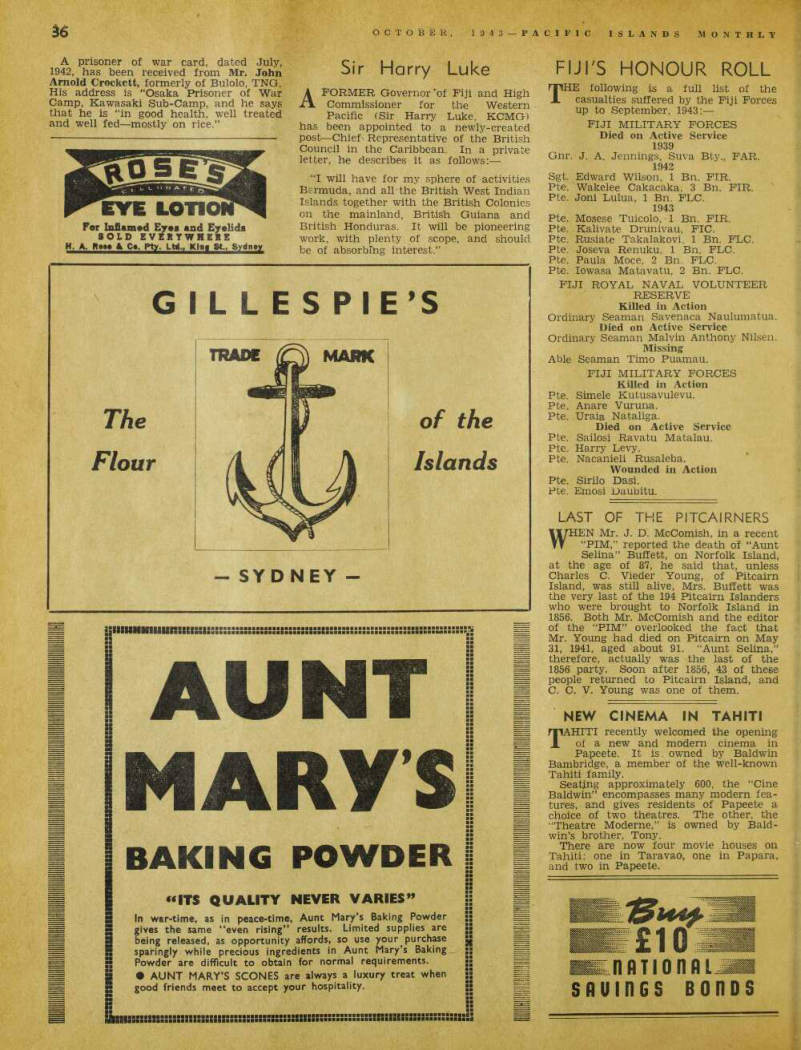
A FORMER Governor'of Fiji and High Commissioner for the Western Pacific (Sir Harry Luke, KCMG) has been appointed to a newly-created post—Chief' Representative of the British Council in the Caribbean. In a private letter, he describes it as follows; “I will have for my sphere of activities Bermuda, and all the British West Indian Islands together with the British Colonies on the mainland, British Guiana and British Honduras. It will be pioneering work, with plenty of scope, and should be of absorbing interest.”
Fiji's Honour Roll
THE following is a full list of the casualties suffered by the Fiji Forces up to September, 1943;
Fiji Military Forces
Died on Active Service 1939 Gnr. J. A. Jennings, Suva Bty,, FAR, 1942 Sgt. Edward Wilson, 1 Bn. FIR.
Pte, Wakelee Cakacaka, 3 Bn. FIR.
Pte. Joni Lulua, 1 Bn. FLC. 1943 Pte. Mosese Tuicolo, 1 Bn. FIR.
Pte. Kalivate Drunivau, FIC.
Pte. Rusiate Takalakovi, 1 Bn. FLC.
Pte. Joseva Renuku, 1 Bn. FLC.
Pte, Paula Moce, 2 Bn. FLC.
Pte. lowasa Matavatu, 2 Bn. FLC.
Fiji Royal Naval Volunteer
Reserve
Killed in Action Ordinary Seaman Savenaca Naulumatua.
Died on Active Service Ordinary Seaman Malvin Anthony Nilsen.
Missing Able Seaman Timo Puamau,
Fiji Military Forces
Killed in Action Pte. Simele Kutusavulevu.
Pte. Anare Vuruna.
Pte. Uraia Nataliga.
Died on Active Service Pte. Sailosi Ravatu Matalau.
Pte. Harry Levy.
Pte. Nacanieli Rusaleba, Wounded in Action Pte. Sirilo Dasi.
Pte. Emosi Daubitu.
Last Of The Pitcairners
117 HEN Mr. J. D. McComish, in a recent T 1 “PIM,” reported the death of “Aunt Selina” Buffett, on Norfolk Island, at the age of 87, he said that, unless Charles C. Vieder Young, of Pitcairn Island, was still alive, Mrs. Buffett was the very last of the 194 Pitcairn Islanders who were brought to Norfolk Island in 1856. Both Mr. McComish and the editor of the “PIM” overlooked the fact that Mr. Young had died on Pitcairn on May 31, 1941, aged about 91. “Aunt Selina,” therefore, actually was the last of the 1856 party. Soon after 1856, 43 of these people returned to Pitcairn Island, and C. C. V. Young was one of them.
New Cinema In Tahiti
TAHITI recently welcomed the opening of a new and modern cinema in Papeete. It is, owned by Baldwin Bambridge, a member of the well-known Tahiti family.
Seating approximately 600, the “Cine Baldwin” encompasses many modern fea tures, and gives residents of Papeete a choice of two theatres. The other, the “Theatre Moderne,” is owned by Bald win’s brother, Tony.
There are now four movie houses on Tahiti: one in Taravao, one in Papara, and two in Papeete.
Advertisements & other items, p. 38 (2 items)
Marys
GILLESPIE’S
The Flour of the Islands
-SYDNEY-
TRAOC
MARK
■ HI ■■■< ■■■Mi ■ ■ ■ ■ ■ 2
AUNT
MARYS
BAKING POWDER
“ITS QUALITY NEVER VARIES”
In war-time, as in peace-time, Aunt Mary’s Baking Powder gives the same “even rising” results. Limited supplies are being released, as opportunity affords, so use your purchase sparingly while precious ingredients in Aunt Mary’s Baking Powder are difficult to obtain for normal requirements. • AUNT MARY’S SCONES are always a luxury treat when good friends meet to accept your hospitality.
Mbbuubbbsbssbbssbbbsbbbbsbsbbsbbbssssbsbbbsbbsbsbi :|lllllllllllll
BSSSBBBSSBBSS:
sauoa ssuinus
■riBUOUHU*
Fiji Producing Food For Armed Forces
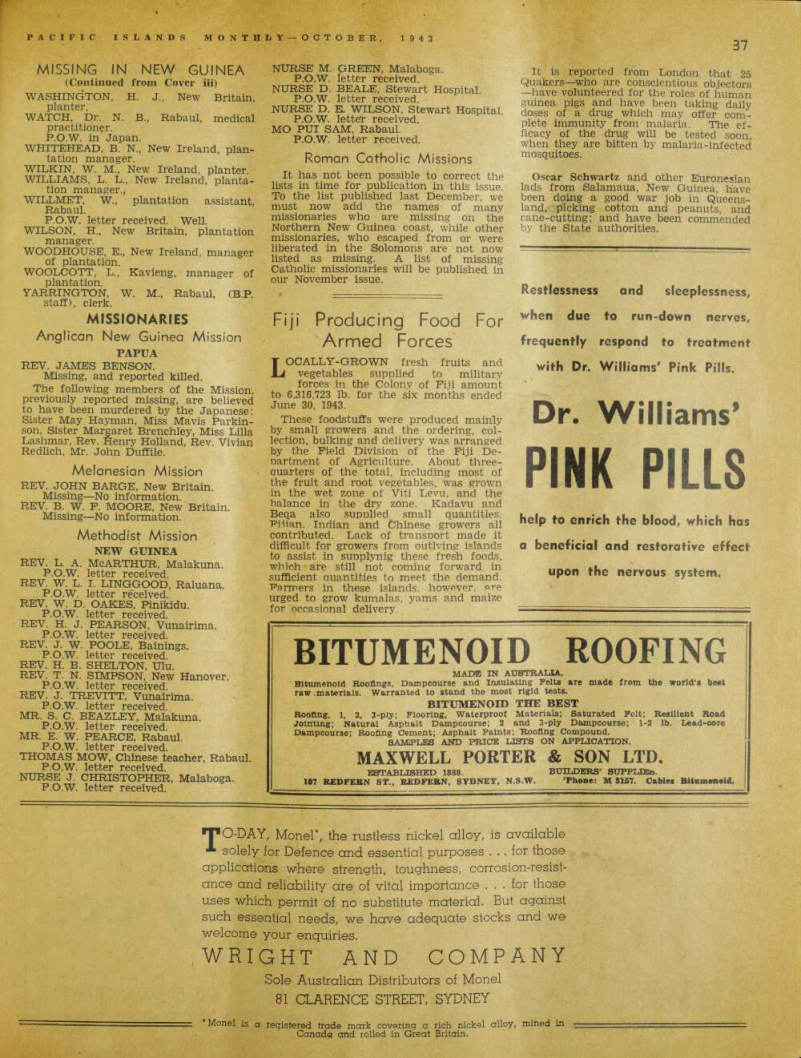
Armed Forces
LOCALLY- GROWN fresh fruits and vegetables supplied to military forces in the Colony of Fiji amount to 6,316,723 lb, for the six months ended June 30, 1943.
These foodstuffs were produced mainly by small growers and the ordering, col lection, bulking and delivery was arranged by the Field Division of the Fiji De nartment of Agriculture. About three quarters of the total, including most of the fruit and root vegetables, was grown in the wet zone of Viti Levu, and the balance in the dry zone. Kadavu and Beqa also supplied small quantities.
Fiiian. Indian and Chinese growers all contributed. Lack of transoort made it difficult for growers from outlving islands to assist in sunplynig these fresh foods, which are still not coming forward in sufficient quantities to meet the demand.
Fnimers in these islands, however, ere urged to grow kumalas, yams and maize for occasional delivery.
Advertisements & other items, p. 39 (2 items)
37
MISSING IN NEW GUINEA
(Continued from Cover iii)
PACIFIC ISLANDS MONTHLY OCTOBER, 1943
Pink Pills
Restlessness and sleeplessness, when due to run-down nerves, frequently respond to treatment with Dr. Williams' Pink Pills.
Dr. Williams’
help to enrich the blood, which has a beneficial and restorative effect upon the nervous system.
BITUMENOID ROOFING
MADE IN AUSTRALIA,
Bltumenoid Roofings, Dampcourse and Insulating Pelts are made from the world’s best raw materials. Warranted to stand the most rigid tests.
BITUMENOID THE BEST
Roofing, i, 2, 3-ply; Flooring, Waterproof Materials; Saturated Pelt; Resilient Road Jointing; Natural Asphalt Dampcourse; 2 and 3-ply Dampcourse; 1-2 lb. Lead-core Dampcourse: Roofing Cement; Asphalt Paints; Roofing Compound.
SAMPLES AND PRICE LISTS ON APPLICATION.
MAXWELL PORTER & SON LTD.
ESTABLISHED 1888. BUILDERS’ SUPPLIEo.
107 RED FERN ST., REDFERN, SYDNEY, N.S.W. ’Phone: M 5167. Cables Bituaeaold,
■"PO-DAY, Monel*, the rustless nickel alloy, is available “ solely for Defence and essential purposes . .. for those applications where strength, toughness, corrosion-resistance and reliability are of vital importance . . . for those uses which permit of no substitute material. But against such essential needs, we have adequate stocks and we welcome your enquiries.
WRIGHT AND COMPANY
Sole Australian Distributors of Monel
81 CLARENCE STREET, SYDNEY
* Monel is a registered trade mark covering a rich nickel alloy, mined in Canada and rolled in Great Britain.
Bishop Who "Lived Like A Rabbit"
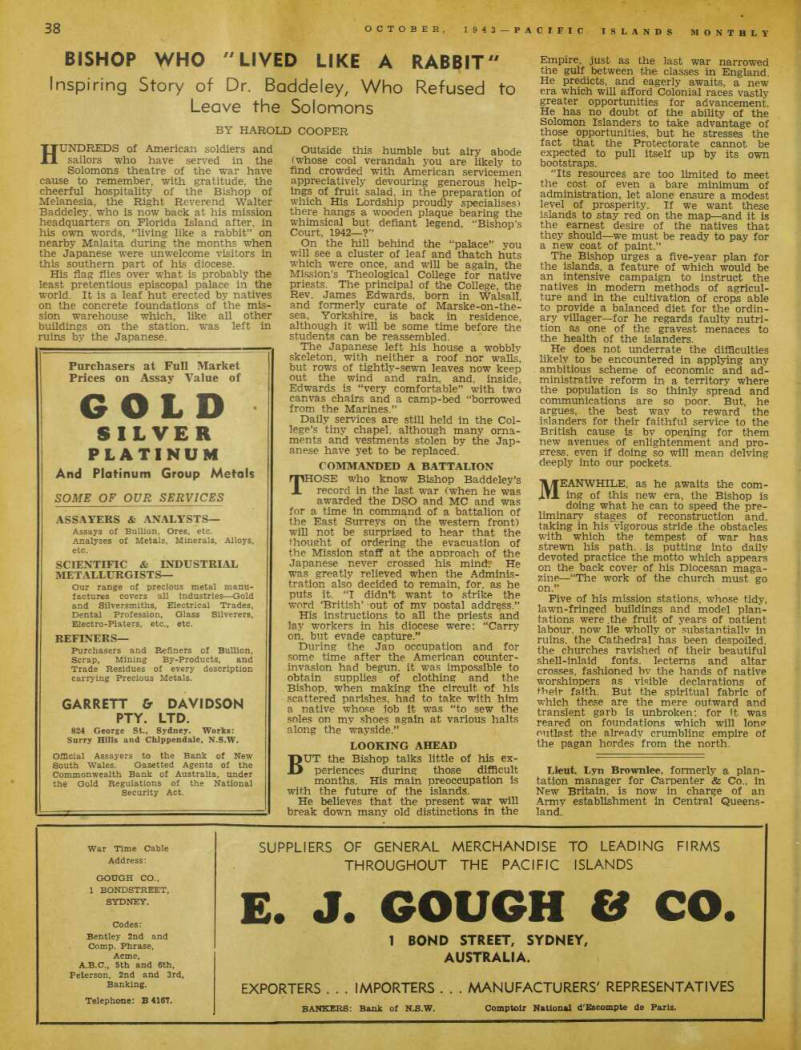
Inspiring Story of Dr. Boddeley, Who Refused to Leave the Solomons
By Harold Cooper
Outside this humble but airy abode (whose cool verandah you are likely to find crowded with American servicemen appreciatively devouring generous help ings of fruit salad, in the preparation of which His Lordship proudly specialises) there hangs a wooden plaque bearing the whimsical but defiant legend, “Bishop’s Court, 1942—?”
On the hill behind the “palace” you will see a cluster of leaf and thatch huts which were once, and will be again, the Mission’s Theological College for native priests. The principal of the College, the Rev. James Edwards, born in Walsall, and formerly curate of Marske-on-the sea, Yorkshire, is back in residence, although it will be some time before the students can be reassembled.
The Japanese left his house a wobbly skeleton, with neither a roof nor walls, but rows of tightly-sewn leaves now keep out the wind and rain, and, inside, Edwards is “very comfortable” with two canvas chairs and a camp-bed “borrowed from the Marines.”
Daily services are still held in the Col lege’s tiny chapel, although many orna ments and vestments stolen by the Jap anese have yet to be replaced.
Commanded A Battalion
rOSE who know Bishop Baddeley’s record in the last war (when he was awarded the DSO and MC and was for a time in command of a battalion of the East Surreys on the western front) will not be surprised to hear that the thought of ordering the evacuation of the Mission staff at the approach of the Japanese never crossed his mind: He was greatly relieved when the Adminis tration also decided to remain, for. as he puts it. “I didn’t want to strike the word ‘British’ out of my postal address.”
His instructions to all the priests and lay workers in his diocese were: “Carry on. but evade capture.”
During the Jap occupation and for some time after the American counter invasion had begun, it was impossible to obtain supplies of clothing and the Bishop, when making the circuit of his scattered parishes, had to take with him a native whose job it was “to sew the soles on my shoes again at various halts along the wayside.”
Looking Ahead
BUT the Bishop talks little of his ex periences during those difficult months. His main preoccupation is with the future of the islands.
He believes that the present war will break down many old distinctions in the
Empire, just as the last war narrowed the gulf between the classes in England.
He predicts, and eagerly awaits, a new era which will afford Colonial races vastly greater opportunities for advancement.
He has no doubt of the ability of the Solomon Islanders to take advantage of those opportunities, but he stresses the fact that the Protectorate cannot be expected to pull itself up by its own bootstraps.
“Its resources are too limited to meet the cost of even a bare minimum of administration, let alone ensure a modest level of prosperity. If we want these islands to stay red on the map—and it is the earnest desire of the natives that they should—we must be ready to pay for a new coat of paint.”
The Bishop urges a five-year plan for the islands, a feature of which would be an intensive campaign to instruct the natives in modern methods of agricul ture and in the cultivation of crops able to provide a balanced diet for the ordin ary villager—for he regards faulty nutri tion as one of the gravest menaces to the health of the islanders.
He does not underrate the difficulties likely to be encountered in applying any ambitious scheme of economic and ad ministrative reform in a territory where the population is so thinly spread and communications are so poor. But, he argues, the best way to reward the islanders for their faithful service to the British cause is by opening for them new avenues of enlightenment and pro gress. even if doing so will mean delving deeply into our pockets.
MEANWHILE, as he awaits the com ing of this new era, the Bishop is doing what he can to speed the pre liminary stages of reconstruction and, taking in his vigorous stride the obstacles with which the tempest of war has strewn his path, is putting into daily devoted practice the motto which appears on the back cover of his Diocesan maga zine—“ The work of the church must go on.”
Five of his mission stations, whose tidy, lawn-fringed buildings and model plan tations were the fruit of years of natient labour, now lie wholly or substantially in ruins, the Cathedral has been despoiled, the churches ravished of their beautiful shell-inlaid fonts, lecterns and altar crosses, fashioned bv the hands of native worshinpers as visible declarations of their faith. But the spiritual fabric of which these are the mere outward and transient garb is unbroken: for it was reared on foundations which will lone outlast the already crumbling empire of the pagan hordes from the north.
Lieut. Lyn Brownlee, formerly a plan tation manager for Carpenter & Co., in New Britain, is now in charge of an Army establishment in Central Queens land.
HUNDREDS of American soldiers and sailors who have served in the Solomons theatre of the war have cause to remember, with gratitude, the cheerful hospitality of the Bishop of Melanesia, the Right Reverend Walter Baddeley, who is now back at his mission headquarters on Florida Island after, in his own words, "living like a rabbit” on nearby Malaita during the months when the Japanese were unwelcome visitors in this southern part of his diocese.
His flag flies over what is probably the least pretentious episcopal palace in the world. It is a leaf hut erected by natives on the concrete foundations of the mission warehouse which, like all other buildings on the station, was left in ruins by the Japanese.
Advertisements & other items, p. 40 (1 item)
E. J. Gough & Co.
Purchasers at Full Market Prices on Assay Value of
GOLD
SILVER
PLATINUM
And Platinum Group Metals
SOME OF OUR SERVICES
ASSAYERS & ANALYSTS—
Assays of Bullion, Ores, etc.
Analyses of Metals, Minerals, Alloys, etc.
SCIENTIFIC & INDUSTRIAL
METALLURGISTS—
Our range of precious metal manufactures covers all industries —Gold and Silversmiths, Electrical Trades, Dental Profession, Glass Silverers, Electro-Platers, etc., etc.
REFINERS —
Purchasers and Refiners of Bullion, Scrap, Mining By-Products, and Trade Residues of every description carrying Precious Metals.
GARRETT & DAVIDSON
PTY. LTD.
834 George St., Sydney. Works: Surry Hills and Chippendale, N.S.W.
Official Assayers to the Bank of New South Wales. Gazetted Agents of the Commonwealth Bank of Australia, under the Gold Regulations of the National Security Act.
War Time Cable Address:
GOUGH CO.,
1 BONDSTREET,
SYDNEY.
Codes: SUPPLIERS OF GENERAL MERCHANDISE TO LEADING FIRMS
THROUGHOUT THE PACIFIC ISLANDS
E. J. GOUGH & CO.
Bentley 2nd and Comp. Phrase, Acme, A.8.C., sth and 6th, Peterson, 2nd and 3rd, Banking.
1 BOND STREET, SYDNEY,
AUSTRALIA.
EXPORTERS . . . IMPORTERS . . . MANUFACTURERS' REPRESENTATIVES Telephone: B 4167.
BANKERS: Bank of N.S.W.
Comp toil National d’Escompte de Paris.
Australian Short Wave
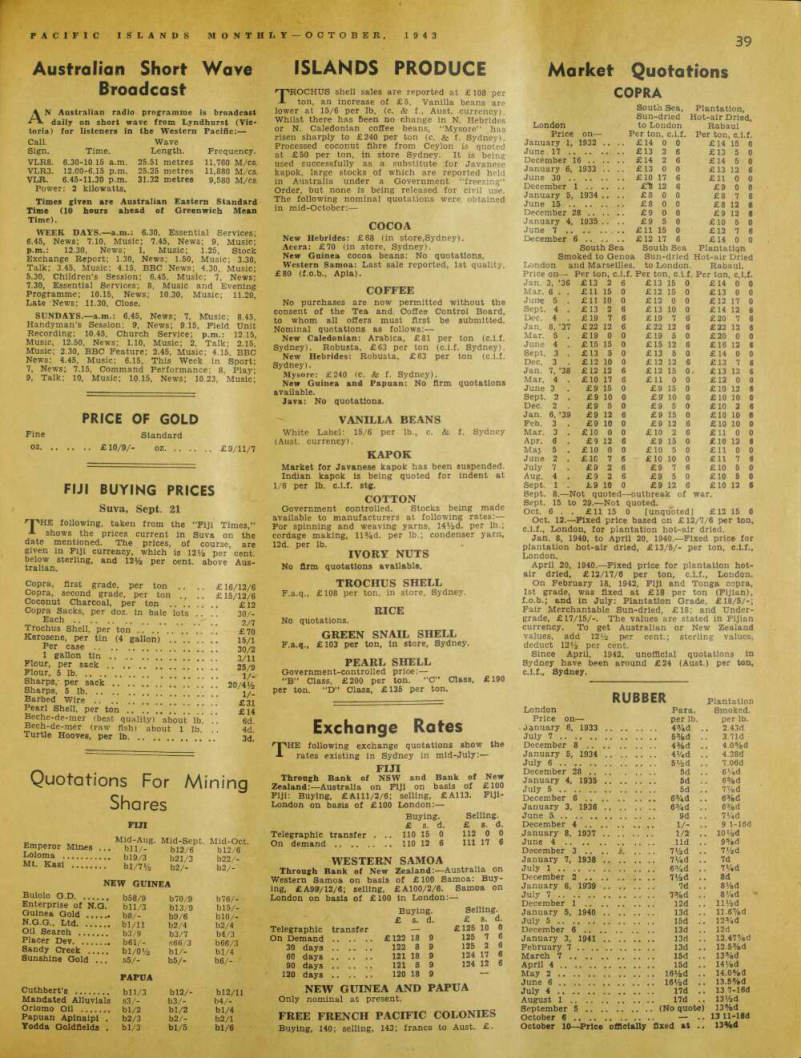
Broadcast
AN Australian radio programme is broadcast daily on short wave from Lyndhurst (Vic toria) for listeners in the Western Pacific:—
Times given are Australian Eastern Standard Time (10 hours ahead of Greenwich Mean Time).
WEEK DAYS.—a.m.: 6.30, Essential Services; 6.45, News; 7.10, Music; 7.45, News; 9, Music; p.m.: 12.30, News; 1, Music; 1.25. Stock Exchange Report; 1.30, News; 1.50, Music; 3.30, Talk; 3.45, Music; 4.15, BBC News; 4.30, Music; 5.30, Children’s Session; 6.45, Music; 7, News; 7.30, Essential Services; 8, Music and Evening Programme: 10.15, News; 10.30, Music; 11.20, Late News; 11.30, Close.
SUNDAYS.—a.m.: 6.45, News; 7, Music; 8.45, Handyman’s Session: 9. News; 9.15, Field Unit Recording; 10.45, Church Service; p.m.: 12.15, Music, 12.50, News; 1.10, Music; 2, Talk; 2.15, Music; 2.30, BBC Feature; 2.45, Music; 4.15, BBC News; 4.45, Music; 6.15, This Week in Sport; 7, News; 7.15, Command Performance; 8, Play; 9, Talk; 10, Music; 10.15, News; 10.23, Music;
Call.
Wave Sign.
Time.
Length.
Frequency,
Vlr8.
6.30-10.15 a.m. 25.51 metres 11,760 M/cs.
Vlr3.
12.00-6.15 p.m. 25.25 metres 11,880 M/cs.
Vlb.
6.45-11.30 p.m. 31.32 metres 9,580 M/cs Power: 2 kilowatts.
Advertisements & other items, p. 41 (1 item)
Price Of Gold
Fine Standard oz £10/9/- oz £9/11/7
Fiji Buying Prices
Suva, Sept. 21
nPHE following, taken from the “Fiji Times,” •*. shows the prices current in Suva on the date mentioned. The prices, of course, are given in Fiji currency, which is 12% per cent, below sterling, and 12% per cent, above Aus tralian.
Copra, first grade, per ton .. £l6/12/6 Copra, second grade, per ton .. .. £l5/12/6 Coconut Charcoal, per ton £l2 Copra Sacks, per doz. in bale lots* !! 30/- Each 2/7 Trochus Shell, per ton ..” £7O Kerosene, per tin (4 gallon) .. .. ” 15/1 Per case 1 gallon tin 3/11 Flour, per sack 25/9 Flour, 5 lb ‘ 1/.
Sharps/ per sack .. .. .! . * ’’ *’ ” " 20/4% Sharps, 5 lb ’ ■>/ Barbed Wire £3l Pearl Shell, per ton £l4 Beche-de-mer (best quality) about* lb! *.*, 6d Bech-de-mer (raw fish) about 1 lb. . , 4d Turtle Hooves, per lb 3d t
Quotations For Mining
Shares
Fiji
Emperor Mines ...
Loloma Mid-Aug. bll/bl9/3 bl/7»/ 2 Mid-Sept. bl2/6 Mid-Oct. bl2/6 Mt. Kasl b21/3 uo / b22/b2/uZ /
New Guinea
Bulolo G.D Enterprise of N.G.* Guinea Gold b58/9 bll/3 b8/bl/11 b3/9 b61/bl/OVa s5/-
Papua
b70/9 bl3/9 b76/bl5/hi n / N.G.G., Ltd uo / O b2/4 b3/7 s66/3 oiu/* b2/4 Oil Search Placer Dev b4/3 b66/3 bl/4 b6/- Sandy Creek Sunshine Gold ... bl/b5/- Cuthbert’s bll/3 s3/bl/2 b2/3 bl/3 bl2/b3/bl/2 b2/bl/5 bl2/ll b4/bl/4 b2/l bl/6 Mandated Alluvlals Orlomo Oil Papuan Aplnaipl .
Todda Goldfields .
Islands Produce
TROCHUS shell sales are reported at £lOB per ton, an increase of £5. Vanilla beans are lower at 15/6 per lb. (c. & f., Aust. currency).
Whilst there has been no change in N. Hebrides or N. Caledonian coffee beans, “Mysore” has risen sharply to £240 per ton (c. & f. Sydney).
Processed coconut fibre from Ceylon is quoted at £5O per ton, in store Sydney. It is being used successfully as a substitute for Javanese kapok, large stocks of which are reported held in Australia under a Government “freezing”
Order, but none is being released for civil use.
The following nominal quotations were obtained in mid-October: —
Cocoa
New Hebrides: £6B (in store,Sydney).
Accra: £7O (in store, Sydney).
New Guinea cocoa beans: No quotations.
Western Samoa: Last sale reported, Ist quality, £BO (f.0.b., Apia).
Coffee
No purchases are now permitted without the consent of the Tea and Coffee Control Board, to whom all offers must first be submitted.
Nominal quotations as follows: New Caledonian: Arabica, £Bl per ton (c.i.f.
Sydney). Robusta, £63 per ton (c.i.f. Sydney).
New Hebrides: Robusta, £63 per ton (c.i.f.
Sydney).
Mysore: £240 (c. & f. Sydney).
New Guinea and Papuan: No firm quotations available.
Java: No quotations.
Vanilla Beans
White Label: 15/6 per lb., c. & f. Sydney (Aust. currency).
Kapok
Market for Javanese kapok has been suspended.
Indian kapok is being quoted for indent at 1/6 per lb. c.i.f. stg.
Cotton
Government controlled. Stocks being made available to manufacturers at following rates; — For spinning and weaving yarns, 14%d. per lb.; cordage making, ll%d. per lb.; condenser yarn, 12d. per lb.
Ivory Nuts
No firm quotations available.
Trochus Shell
F.a.q., £lOB per ton, in store, Sydney.
Rice
No quotations,
Green Snail Shell
F.a.q., £lO3 per ton, in store, Sydney.
Pearl Shell
Government-controlled price:— “B” Class, £2OO per ton. “C” Class, £l9O per ton. "D” Class, £135 per ton.
Exchange Rates
THE following exchange quotations show the rates existing in Sydney in mid-July:—
Fiji
Through Bank of NSW and Bank of New Zealand:—Australia on Fiji on basis of £lOO Fiji: Buying, £Alll/2/6; selling, £AII3. FIJI - on basis of £lOO London: —
Western Samoa
Through Bank of New Zealand:— Australia on Western Samoa on basis of £lOO Samoa: Buy ing, £ A99/12/6; selling. £AIOO/2/6. Samoa on London on basis of £lOO in London:—
New Guinea And Papua
Only nominal at present,
Free French Pacific Colonies
Buying, 140; selling, 143; francs to Aust. £.
Buying.
Selling. £ s. d. £ s. d.
Telegraphic transfer . .. 110 15 0 112 0 0 On demand .. 110 12 6 111 17 6
Buying.
Selling. £ s. d. £ s. d.
Telegraphic transfer — £125 10 0 On Demand £122 18 9 125 7 6 30 days 122 8 9 125 2 6 60 days 121 18 9 124 17 6 90 days 121 8 9 124 12 6 120 days 120 18 9 —
Market Quotations
Sept, B.—Not quoted—outbreak of war.
Sept. 15 to 29.—Not quoted.
Oct. 6 . . £ll 15 0 [unquoted] £l2 15 0 Oct. 12.—Fixed price based on £l2/7/6 per ton, c.i.f., London, for plantation hot-air dried.
Jan. 8, 1940, to April 20, 1940.—Fixed price for plantation hot-air dried, £l3/5/- per ton, c.i.f., London.
April 20, 1940.—Fixed price for plantation hot air dried, £l2/17/6 per ton, c.i.f., London.
On February 18, 1942, Fiji and Tonga copra, Ist grade, was fixed at £lB per ton (Fijian), f.0.b.; and in July: Plantation Grade, £lB/5/-; Pair Merchantable Sun-dried, £18; and Under grade, £l7/15/-. The values are stated in Fijian currency. To get Australian or New Zealand values, add 12% per cent.; sterling values, deduct 12% per cent.
Since April, 1942, unofficial quotations in Sydney have been around £24 (Aust.) per ton, c.i.f., Sydney.
London Price on—
Copra
South Sea, Plantation, Sun-dried Hot-air Dried, to London Rabaul Per ton, c.i.f. Per ton. c.l.f.
January 1, 1932 . . £14 0 0 £14 15 0 June 17 . £13 2 6 £13 5 0 December 16 .. £14 2 6 £14 5 0 January 6, 1933 . . £13 0 0 £13 12 6 June 30 . £10 17 6 £11 0 0 December 1 . . £$ 12 6 £9 0 0 January 5, , 1934 .. , £8 0 0 £8 7 6 June 15 . £8 0 0 £8 12 6 December 28 .. £9 0 0 £9 12 6 January 4, , 1935 £9 5 0 £10 5 0 June 7 .. £11 15 0 £12 7 6 December 6 .. £12 17 6 £14 0 0 South Sea South Sea Plantation Smoked to Genoa Sun-dried Hot-air Dried London and Marseilles, to London.
Rabaul.
Price on— Per ton, c.l.f. Per ton, c.i.f. Per ton, c.l.f.
Jan. 3, ’36 £13 2 6 £13 15 0 £14 0 0 Mar. 6 . . £11 15 0 £12 15 0 £13 0 0 June 5 . £11 10 0 £12 0 0 £12 17 0 Sept. 4 . £13 2 6 £13 10 0 £14 12 6 Dec. 4 . £19 7 6 £19 7 6 £20 7 6 Jan. 8, '37 £22 12 6 £22 12 6 £22 12 S Mar. 5 . £19 0 0 £19 5 0 £20 0 0 June 4 . £15 15 0 £15 12 6 £16 12 6 Sept. 3 . £13 5 0 £13 5 0 £14 0 0 Dec, 3 . £12 10 0 £12 12 6 £13 7 Jan. 7, '38 £12 12 6 £12 15 0. £13 12 6 Mar. 4 . £10 17 6 £11 0 0 £12 0 0 June 3 £9 15 0 £9 15 0 £10 12 « Sept. 2 . £9 10 0 £9 10 0 £10 10 0 Dec. 2 £9 5 0 £9 5 0 £10 2 6 Jan. 6, '39 £9 12 6 £9 15 0 £10 10 6 Feb. 3 . £9 10 0 £9 12 6 £10 10 0 Mar. 3 . £10 0 0 £10 2 6 £11 0 0 Apr. 6 . £9 12 6 £9 15 0 £16 12 6 May 5 . £10 0 0 £10 5 0 £11 0 0 June 2 . £10 7 6 £10 10 0 £11 7 6 July 7 . £9 2 6 £9 7 6 £10 5 0 Aug. 4 . £9 2 6 £9 5 0 £10 5 0 Sept. 1 £9 10 0 £9 12 6 £10 12 6
Rubber
Plantation London Para.
Smoked.
Price on— per lb. per lb.
January 6, 1933 4 3 Ad ., . 2.43d July 7 3.71d December 8 .. . 4.0 5 /ad January 5, 1934 , 4‘Ad ., 4.28d July 6 7.06d December 28 ,. . 5d .. 6‘Ad January 4, 1935 . 6%d July 5 7 7 /ad December 6 .. . 6%<S January 3, 1936 . 6 3 /ad June 5 9d .. 7‘Ad December 4 .. . 1/- .. 9 l-16d January 8, 1937 . 1/2 .. 10‘/ad June 4 lid .. 9 9 /ad December 3 .. . . >. .. . . 7‘Ad .. 7‘/ad January 7, 1938 . . 7‘Ad .. 7d July 1 . 6 3 Ad .. 7‘Ad December 2 .. . . 7‘Ad .. 8d January 6, 1939 . 7d . . 8 ‘/ad July 7 . 7%d . . 8‘Ad December 1 .. . 12d .. 11‘Ad January 5, 1940 . 13d .. 11.6 7 /ad July 5 . 15d .. 12 3 Ad December 6 .. .. 13d .. 12d January 3, 1941 . 13d .. 12.47 7 /ad February 7 .. .. 13d .. 12.5 5 /ad March 7 15d .. 13 5 /ad April 4 15d .. 14‘/ad May 2 . 16‘Ad .. 14.0%d June 6 . 16Vad .. 13.5 s /ad July 4 17d .. 13 7-16d August 1 17d .. 13‘Ad September 5 . . . . (No quote) ISYad October 6 . . 13 11-lCd October 10—Price officially fixed at .. 13%d
Gauguin's Story
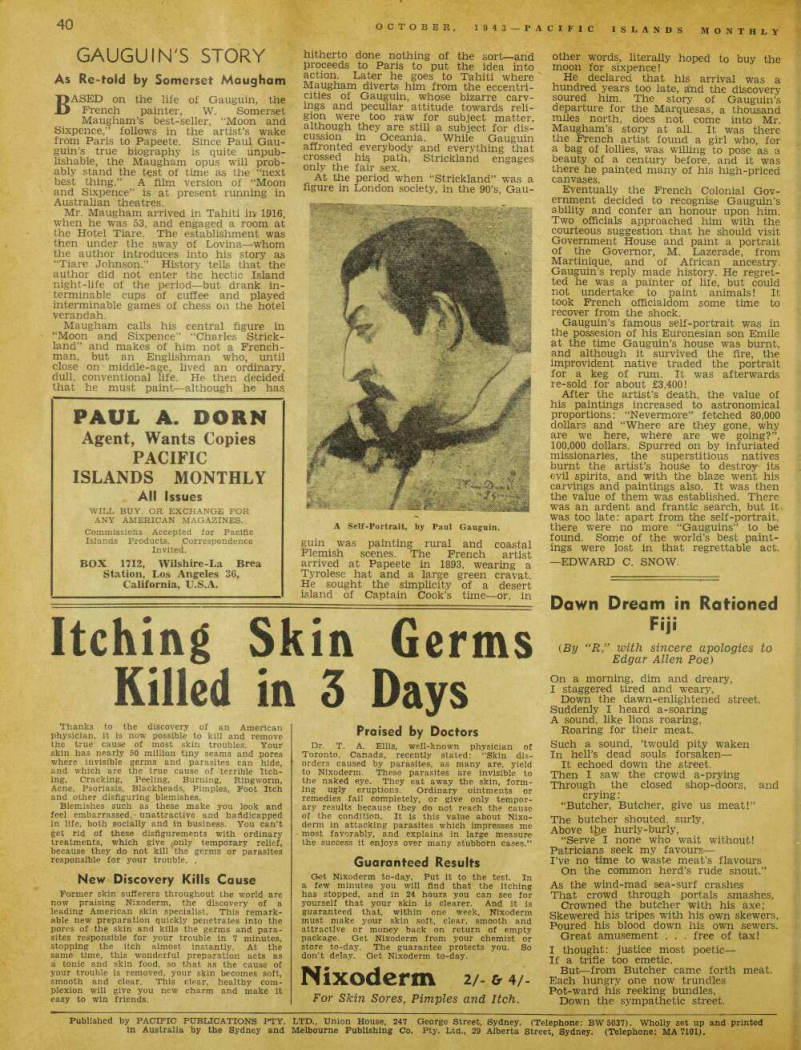
As Re-told by Somerset Maugham
BASED on the life of Gauguin, the French painter, W. Somerset Maugham’s best-seller, “Moon and Sixpence,” follows in the artist’s wake from Paris to Papeete. Since Paul Gau guin’s true biography is quite unpub lishable, the Maugham opus will prob ably stand the test of time as the “next best thing.” A film version of “Moon and Sixpence” is at present running in Australian theatres.
Mr. Maugham arrived in Tahiti irv 1916, when he was 53, and engaged a room at the Hotel Tiare. The establishment was then under the sway of Lovina —whom the author introduces into his story as “Tiare Johnson.” History tells that the author did not enter the hectic Island night-life of the period—but drank in terminable cups of cuffee and played interminable games of chess on the hotel verandah.
Maugham calls his central figure in “Moon and Sixpence” “Charles Strick land” and makes of him not a French man, but an Englishman who, until close on middle-age, lived an ordinary, dull, conventional life. He then decided that he must paint—-although he has
hitherto done nothing of the sorte-and proceeds to Paris to put the idea into action. Later he goes to Tahiti where Maugham diverts him from the eccentri cities of Gauguin, whose bizarre carv ings and peculiar attitude towards reli gion were too raw for subject matter, although they are still a subject for dis cussion in Oceania. While Gauguin affronted everybody and everything that crossed his path, Strickland engages only the fair sex.
At the period when “Strickland” was a figure in London society, in the 90’s, Gau-
guin was painting rural and coastal Flemish scenes. The French artist arrived at Papeete in 1893, wearing a Tyrolese hat and a large green cravat.
He sought the simplicity of a desert island of Captain Cook’s time—or, in
other words, literally hoped to buy the moon for sixpence!
He declared that his arrival was a hundred years too late, and the discovery soured him. The story of Gauguin’s departure for the Marquesas, a thousand miles north, does not come into Mr.
Maugham’s story at all. It was there the French artist found a girl who, for a bag of lollies, was willing to pose as a beauty of a century before, and it was there he painted many of his high-priced canvases.
Eventually the French Colonial Gov ernment decided to recognise Gauguin’s ability and confer an honour upon him.
Two officials approached him with the courteous suggestion that he should visit Government House and paint a portrait of the Governor, M. Lazerade, from Martinique, and of African ancestry.
Gauguin’s reply made history. He regret ted he was a painter of life, but could not undertake to paint animals! It took French officialdom some time to recover from the shock.
Gauguin’s famous self-portrait was in the possesion of his Euronesian son Emile at the time Gauguin’s house was burnt, and although it survived the fire, the improvident native traded the portrait for a keg of rum. It was afterwards re-sold for about £3,400!
After the artist’s death, the value of his paintings increased to astronomical proportions: “Nevermore” fetched 80,000 dollars and “Where are they gone, why are we here, where are we going?”, 100,000 dollars. Spurred on by infuriated missionaries, the superstitious natives burnt the artist’s house to destroy its evil spirits, and with the blaze went his carvings and paintings also. It was then the value of them was established. There was an ardent and frantic search, but it was too late: apart from the self-portrait, there were no more “Gauguins” to be found. Some of the world’s best paint ings were lost in that regrettable act.
Edward C. Snow.
A Self-Portrait, by Paul Gauguin.
Fiji
Dawn Dream in Rationed Fiji
{By “R>” with sincere apologies to Edgar Allen Poe ) On a morning, dim and dreary, I staggered tired and weary, Down the dawn-enlightened street.
Suddenly I heard a-soaring A sound, like lions roaring, Roaring for their meat.
Such a sound, ’twould pity waken In hell’s dead souls forsaken— It echoed down the street.
Then I saw the crowd a-prying Through the closed shop-doors, and crying: “Butcher, Butcher, give us meat!”
The butcher shouted, surly, Above t£e hurly-burly, “Serve I none who wait without!
Patricians seek my favours— I’ve no time to waste meat’s flavours On the common herd’s rude snout.”
As the wind-mad sea-surf crashes That crowd through portals smashes, Crowned the butcher with his axe; Skewered his tripes with his own skewers, Poured his blood down his own sewers.
Great amusement . . . free of tax!
I thought: justice most poetic— If a trifle too emetic.
But—from Butcher came forth meat.
Each hungry one now trundles Pot-ward his reeking bundles, Down the sympathetic street.
Advertisements & other items, pp. 42-44 (4 items)
40
OCTOBER, 194 3 PACIFIC ISLANDS MONTHLY
Published by PACIFIC PUBLICATIONS PTY. LTD., Union House, 247 George Street, Sydney. (Telephone: BW 5037). Wholly set up and printed In Australia by the Sydney and Melbourne Publishing Co. Pty. Ltd., 29 Alberta Street, Sydney. (Telephone; MA 7101).
Itching Skin Germs
PAUL A. DORN
Agent, Wants Copies
PACIFIC
ISLANDS MONTHLY
All Issues
WILL BUY, OR EXCHANGE FOR
ANY AMERICAN MAGAZINES.
Commissions Accepted for Pacific Islands Products. .Correspondence Invited.
BOX 1712, Wilshire-La Brea Station, Los Angeles 36, California, U.S.A.
Itching Skin Germs Killed in 3 Days
Thanks to the discovery of an American physician, it is now possible to kill and remove the true cause of most skin troubles. Your skin has nearly 50 million tiny seams and pores where invisible germs and parasites can hide, and which are the true cause of terrible Itching, Cracking, Peeling, Burning, Ringworm, Acne, Psoriasis, Blackheads, Pimples, Foot Itch and other disfiguring blemishes.
Blemishes such as these make you look and feel embarrassed, unattractive and handicapped in life, both socially and in business. You can’t get rid of these disfigurements with ordinary treatments, which give only temporary relief, because they do not kill the germs or parasites responsible for your trouble, .
New Discovery Kills Cause
Former skin sufferers throughout the world are now praising Nixoderm, the discovery of a leading American skin specialist. This remarkable new preparation quickly penetrates into the pores of the skin and kills the germs and parasites responsible for your trouble in 7 minutes, stopping the itch almost instantly. At the same time, this wonderful preparation acts as a tonic and skin food, so that as the cause of your trouble is removed, your skin becomes soft, smooth and clear. This clear, healthy complexion will give you new charm and make it easy to win friends.
Praised by Doctors
Dr. T. A. Ellis, well-known physician of Toronto, Canada, recently stated: “Skin disorders caused by parasites, as many are, yield to Nixoderm. These parasites are invisible to the naked eye. They eat away the skin, forming ugly eruptions. Ordinary ointments or remedies fail completely, or give only temporary results because they do not reach the cause of the condition. It is this value about Nixoderm in attacking parasites which impresses me most favorably, and explains in large measure the success it enjoys over many stubborn cases.”
Guaranteed Results
Get Nixoderm to-day. Put it to the test. In a few minutes you will find that the Itching has stopped, and in 24 hours you can see for yourself that your skin is clearer. And it is guaranteed that, within one week, Nixoderm must make your skin soft, clear, smooth and attractive or money back on return of empty package. Get Nixoderm from your chemist or store to-day. The guarantee protects you. So don’t delay. Get Nixoderm to-day.
Nixoderm u- & 4/-
For Skin Sores, Pimples and Itch.
October, 1943 Pacific Islands Monthly
Missing Residents of New Guinea (Continued from Cover ii.)
W. R. Carpenter & Co. Ltd.
CMPtHTIH mm
WOK.
mmm iliiil . ■■ mt ~r M i s
Travel by CARPENTER AIRLINES
Full particulars from Macdonald, Hamilton & Co., or Howard Smith Ltd., Sydney.
W. R. CARPENTER & CO. LTD.
MERCHANTS, SHIPOWNERS AND AIRCRAFT OPERATORS
Agents for Australian, European and American Manufacturers, and Distributors of Every Description of Merchandise.
Buyers and Shippers of Copra, Trocas, and all Classes of Islands Produce. •
AGENTS FOR:
Caterpillar Tractors. Dodge Brothers Inc.
Electrolux Refrigerators. Westinghouse Electrical Co. etc., etc.
Branches throughout the Pacific Islands
Ford Motor Company of Canada.
T. G. & C. Bolinders (Engines).
In London: W. R. Carpenter & Co. (London) Ltd., Coronation House, 4 Lloyds Avenue, London, EC.
Head Office: 16 O’CONNELL STREET, SYDNEY