Pacific
Islands
Monthly
September 17, 1943
Vol. Xiv. No. 2.
Established 1930
\.u», \ v I i x [Registered at the G.P.0., < transmission hy post as a newspaper ]
8“
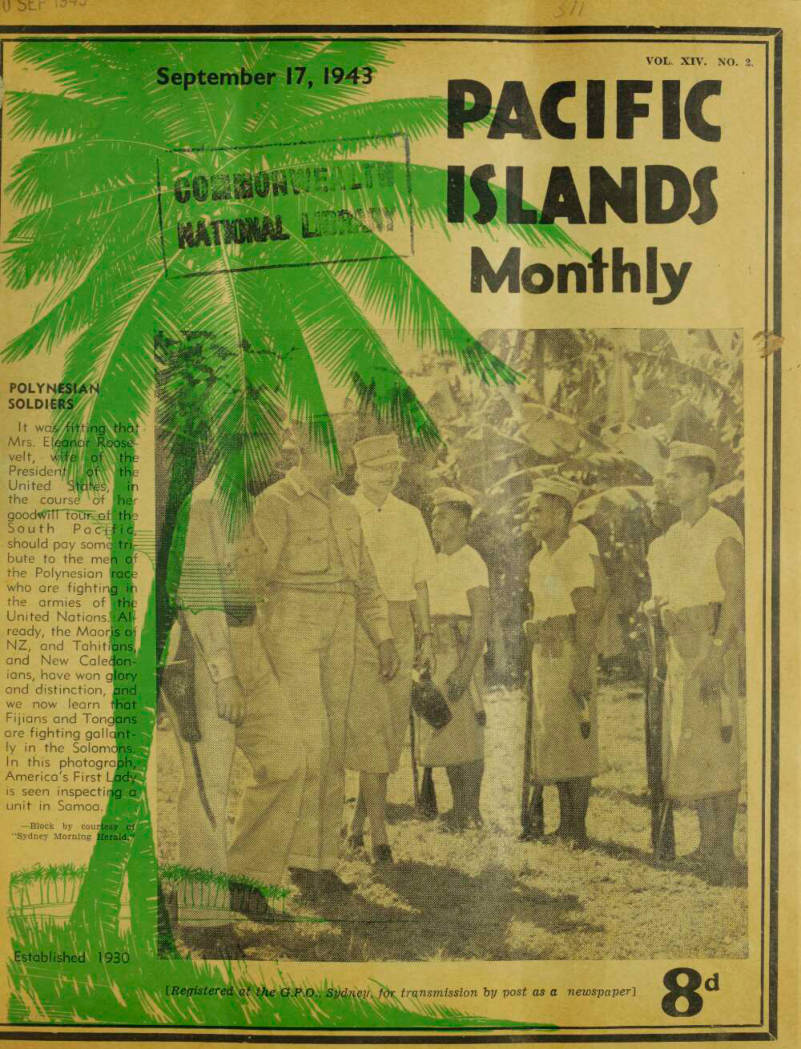
Polynesian
Soldiers
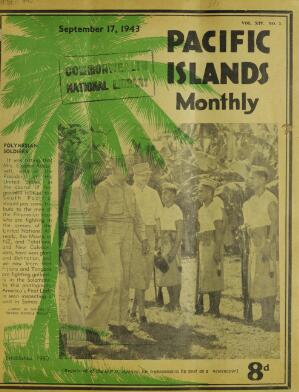
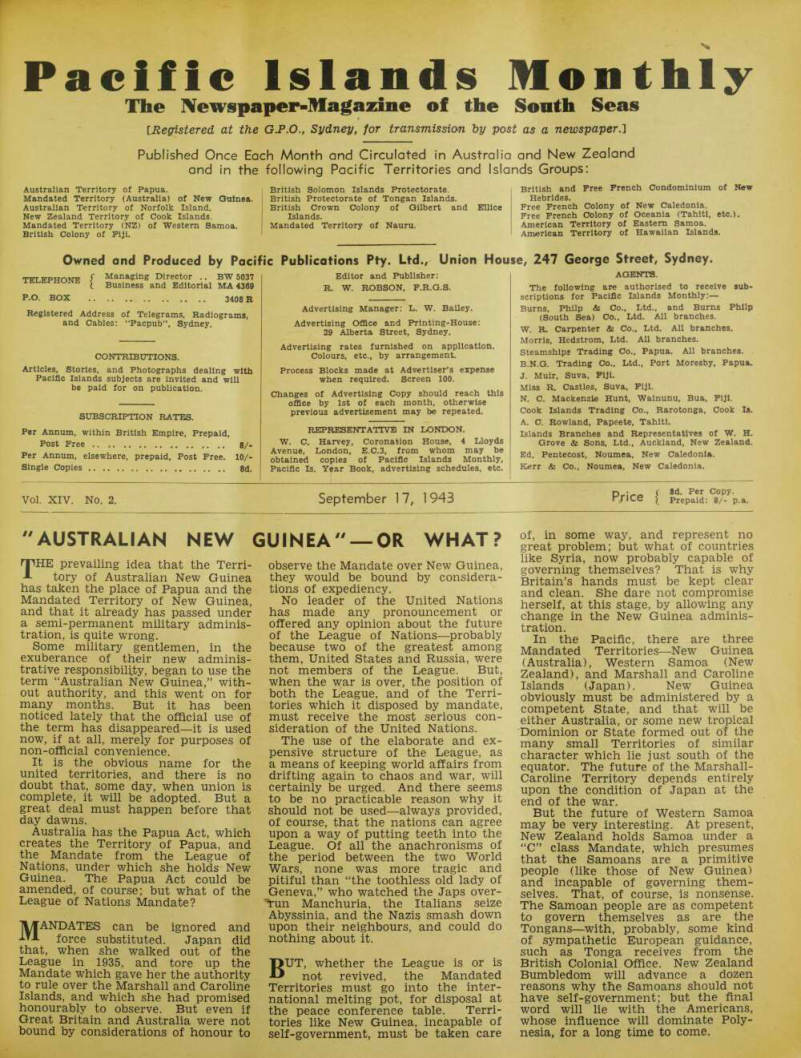
It was fiţing that Mrs. ELeanor Roose velt, wife of the President' of the United States, in the course of her goodwill four of the South Pacific, should pay some tri bute to the the Polynesian race who are fighting in the armies of the United Nations Al ready, the Maoris of NZ, and Tahitians, and New Caledon ians, have won glory and distinction, and we now learn that Fijians and Tongans are fighting gallant ly in the Solomons.
In this photograph, America's First Lady is seen inspecting a unit in Samoa. —Block by courtesy ,of “Sydney Morning Herald.”
Roll Of Honour
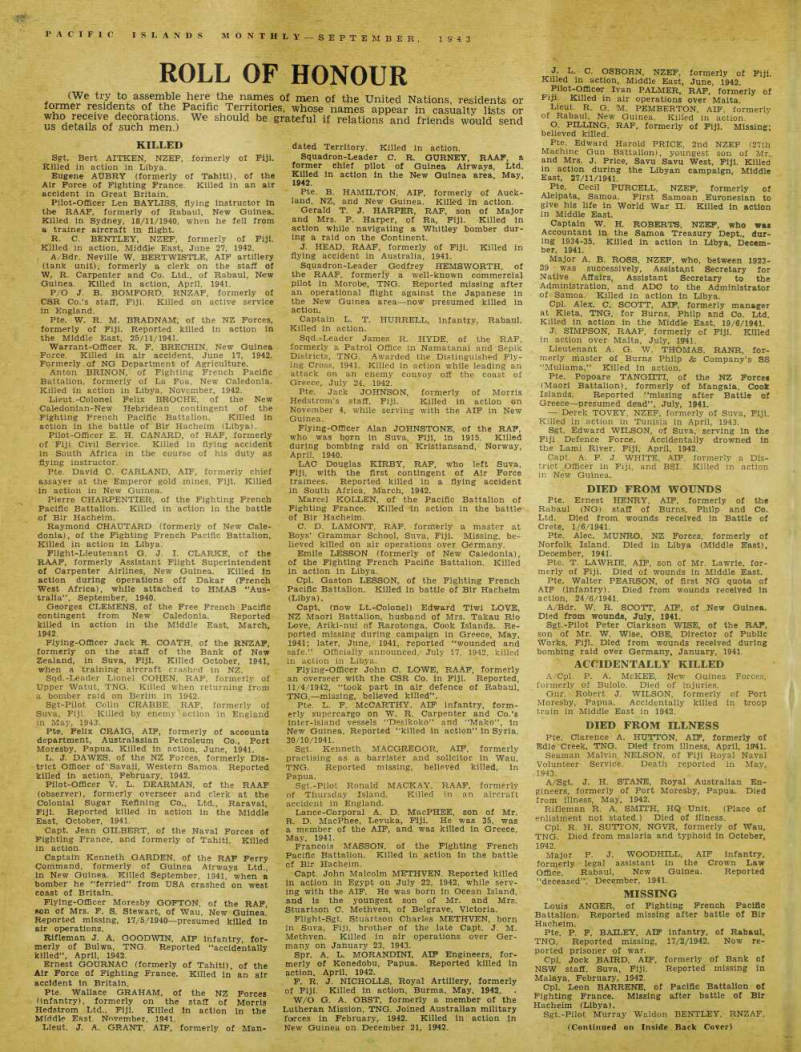
(We tr .y to assemble here the names of men of the United Nations, residents or former residents of the Pacific Territories, whose names appear in casualty lists or receive decorations. We should be grateful if relations and friends would send us details of such men.)
Killed
Sgt. Bert AITKEN, NZEF, formerly of Fiji.
Killed in action in Libya.
Eugene AUBRY (formerly of Tahiti), of the Air Force of Fighting France. Killed in an air accident in Great Britain.
Pilot-Officer Len BAYLISS, flying instructor in the RAAF, formerly of Rabaul, New Guinea.
Killed in Sydney, 18/11/1940, when he fell from a trainer aircraft in flight.
R. C. BENTLEY, NZEF, formerly of Fiji.
Killed in action, Middle East, June 27, 1942.
A/Bdr. Neville W. BERTWISTLE, AIF artillery (tank unit), formerly a clerk on the staff of W. R. Carpenter and Co. Ltd., of Rabaul, New Guinea. Killed in action, April, 1941.
P/O J. B. BOMFORD, RNZAF, formerly of CSR Co.’s staff, Fiji. Killed on active service in England.
Pte. W. R. M. BRADNAM, of the NZ Forces, formerly of Fiji. Reported killed in action in the Middle East, 25/11/1941.
Warrant-Officer R. F. BRECHIN. New Guinea Force. Killed in air accident, June 17, 1942.
Formerly of NG Department of Agriculture.
Anton BRINON, of Fighting French Pacific Battalion, formerly of La Foa, New Caledonia.
Killed in action in Libya, November, 1942.
Lieut.-Colonel Felix BROCHE, of the New Caledonian-New Hebridean contingent of the Fighting French Pacific Battalion. Killed in action in the battle of Bir Hacheim (Libya).
Pilot-Officer E. H. CANARD, of RAF, formerly of Fiji Civil Service. Killed in flying accident in South Africa in the course of his duty as flying instructor.
Pte. David C. GARLAND, AIF, formerly chief assayer at the Emperor gold mines, Fiji. Killed in action in New Guinea.
Pierre CHARPENTIER, of the Fighting French Pacific Battalion. Killed in action in the battle of Bir Hacheim.
Raymond CHAUTARD (formerly of New Cale donia), of the Fighting French Pacific Battalion, Killed in action In Libya.
Flight-Lieutenant G. J. I. CLARKE, of the RAAF, formerly Assistant Flight Superintendent of Carpenter Airlines, New Guinea. Killed in action during operations off Dakar (French West Africa), while attached to HMAS “Aus tralia”, September, 1940.
Georges CLEMENS, of the Free French Pacific contingent from New Caledonia. Reported killed in action in the Middle East, March, 1942.
Flying-Officer Jack R. COATH, of the RNZAF, formerly on the staff of the Bank of New Zealand, in Suva, Fiji. Killed October, 1941, when a training aircraft crashed in NZ.
Sqd.-Leader Lionel COHEN, RAF, formerly of Upper Watut, TNG. Killed when returning from a bomber raid on Berlin in 1942.
Sgt-Pilot Colin CRABBE, RAF, formerly of Suva, Fiji. Killed by enemy’ action in England in May, 1943'.
Pte. Felix CRAIG, AIF, formerly of accounts department, Australasian Petroleum Co., Port Moresby, Papua. Killed in action, June, 1941.
L. J. DAWES, of the NZ Forces, formerly Dis trict Officer of Savaii, Western Samoa. Reported killed in action, February, 1942.
Pilot-Officer V, L. DEARMAN, of the RAAF (observer), formerly overseer and clerk at the Colonial Sugar Refining Co., Ltd., Raraval, Fiji. Reported killed in action in the Middle East, October, 1941.
Capt. Jean GILBERT, of the Naval Forces of Fighting France, and formerly of Tahiti. Killed in action.
Captain Kenneth GARDEN, of the RAF Ferry Command, formerly of Guinea Airways Ltd., in New Guinea. Killed September, 1941, when a bomber he “ferried” from USA crashed on west coast of Britain.
Flying-Officer Moresby GOFTON, of the RAF, son of Mrs. F. S. Stewart, of Wau, New Guinea.’
Reported missing, 17/5/1940—presumed killed in air operations.
Rifleman J. A, GOODWIN, AIF infantry, for merly of Bulwa, TNG. Reported “accidentally killed”, April, 1942.
Ernest GOURNAC (formerly of Tahiti), of the Air Force of Fighting France. Killed in an air accident in Britain.
Pte. Wallace GRAHAM, of the NZ Forces (infantry), formerly on the staff of Morris Hedstrom Ltd., Fiji. Killed in action in the Middle East. November, 1941.
Lieut. J. A. GRANT, AIF, formerly of Man
dated Territory. Killed in action.
Squadron-Leader C. R. GURNEY, RAAF, a former chief pilot of Guinea Airways, Ltd.
Killed in action in the New Guinea area, May, 1942.
Pte. B. HAMILTON, AIF, formerly of Auck land, NZ, and New Guinea. Killed in action.
Gerald T. J. HARPER, RAF, son of Major and Mrs. P. Harper, of Ra, Fiji. Killed in action while navigating a Whitley bomber dur ing a raid on the Continent.
J. HEAD, RAAF, formerly of Fiji. Killed in flying accident in Australia, 1941.
Squadron-Leader Godfrey HEMSWORTH, of the RAAF, formerly a well-known commercial pilot in Morobe, TNG. Reported missing after an operational flight against the Japanese in the New Guinea area—now presumed killed in action.
Captain L. T. HURRELL, infantry, Rabaul.
Killed in action.
Sqd.-Leader James R. HYDE, of the RAF, formerly a Patrol Office in Namatanai and Sepik Districts, TNG. Awarded the Distinguished Fly ing Cross, 1941. Killed in action while leading an attack on an enemy convoy off the coast of Greece, July 24, 1942.
Pte. Jack JOHNSON, formerly of Morris Hedstrom’s staff, Fiji. Killed in action on November 4, while serving with the AIF in New Guinea.
Flying-Officer Alan JOHNSTONE, of the RAF, who was born in Suva, Fiji, In 1915. Killed during bombing raid on Kristiansand, Norway, April, 1940.
LAC Douglas KIRBY, RAF, who left Suva, Fiji, with the first contingent of Air Force trainees. Reported killed in a flying accident in South Africa, March, 1942.
Marcel KOLLEN, of the Pacific Battalion of Fighting France. Killed in action in the battle of Bir Hacheim.
C. D. LAMONT, RAF, formerly a master at Boys’ Grammar School, Suva, Fiji. Missing, be lieved killed on air operations over Germany.
Emile LESSON (formerly of New Caledonia), of the Fighting French Pacific Battalion. Killed in action in Libya.
Cpl. Gaston LESSON, of the Fighting French Pacific Battalion. Killed in battle of Bir Hacheim (Libya).
Capt. (now Lt.-Colonel) Edward Tiwi LOVE, NZ Maori Battalion, husband of Mrs. Takau Rio Love, Ariki-nui of Rarotonga, Cook Islands. Re ported missing during campaign in Greece, May, 1941; later, June, 1941, reported “wounded and safe.” Officially announced, July 17, 1942, killed in action in Libya.
Flying-Officer John C. LOWE, RAAF, formerly an overseer with the CSR Co. in Fiji. Reported, 11/4/1942, “took part in air defence of Rabaul, TNG, —missing, believed killed”.
Pte. L. F. MCCARTHY, AIF infantry, form erly supercargo on W. R. Carpenter and Co.’s Inter-island vessels “Desikoko” and “Mako”, In New Guinea. Reported “killed in action” in Syria, 30/10/1941.
Sgt. Kenneth MACGREGOR, AIF, formerly practising as a barrister and solicitor in Wau, TNG. Reported missing, believed killed, in Papua.
Sgt.-Pilot Ronald MACK AY, RAAF, formerly of Thursday Island. Killed in an aircraft accident in England.
Lance-Corporal A. D. MacPHEE, son of Mr.
R. D. MacPhee, Levuka, Fiji. He was 35, was a member of the AIF, and was killed in Greece, May, 1941.
Francois MASSON, of the Fighting French Pacific Battalion. Killed in action in the battle of Bir Hacheim.
Capt. John Malcolm METHVEN. Reported killed in action in Egypt on July 22, 1942, while serv ing with the AIF. He was born in Ocean Island, and Is the youngest son of Mr. and Mrs.
Stuartson C. Methven, of Belgrave, Victoria.
Flight-Sgt. Stuartson Charles METHVEN, born in Suva, Fiji, brother of the late Capt. J. M.
Methven. Killed in air operations over Ger many on January 23, 1943.
Spr. A. L. MORANDINI, AIF Engineers, for merly of Konedobu, Papua. Reported killed in action. April, 1942.
F. R. J. NICHOLLS, Royal Artillery, formerly of Fiji. Killed in action, Burma, May, 1942.
W/O G. A. OBST, formerly a member of the Lutheran Mission, TNG. Joined Australian military forces in February, 1942. Killed in action in New Guinea on December 21, 1942.
J. L. C. OSBORN, NZEF, formerly of Fiji.
Killed in action, Middle East, June, 1942 Pilot-Officer Ivan PALMER, RAF, formerly of Fiji. Killed in air operations over Malta.
Lieut. R. G. M. PEMBERTON, A IF, formerly of Rabaul, New Guinea. Killed in action, O. PILLING, RAF, formerly of Fiji. Missing; believed killed.
Pte. Edward Harold PRICE, 2nd NZEF (27th Machine Gun Battalion), youngest son of Mr. and Mrs. J. Price, Savu Savu West, Fiji. Killed in action during the Libyan campaign, Middle East, 27/11/1941.
Pte. Cecil PURCELL, NZEF, formerly of Aleipata, Samoa. First Samoan Euronesian to give his life in World War 11. Killed in action in Middle East.
Captain W. H. ROBERTS, NZEF, who was Accountant in the Samoa Treasury Dept., dur ing 1934-35. Killed in action in Libya, Decem ber, 1941.
Major A. B. ROSS, NZEF, who, between 1923- 29 was successively, Assistant Secretary for Native Affairs, Assistant Secretary to the Administration, and ADC to the Administrator of Samoa. Killed in action in Libya.
Cpl. Alex. C. SCOTT, ATP, formerly manager at Kieta, TNG, for Burns, Philp and Co. Ltd.
Killed in action in the Middle East, 19/6/1941.
J. SIMPSON, RAAF, formerly of Fiji. Killed in action over Malta, July, 1941.
Lieutenant A. G. W. THOMAS, RANR, for merly master of Burns Philp & Company’s SS “Muliama.” Killed in action.
Pte. Popoare TANGIITI, of the NZ Forces (Maori Battalion), formerly of Mangala, Cook Islands. Reported “missing after Battle of Greece—presumed dead”, July, 1941.
Derek TOVEY, NZEF, formerly of Suva, Fiji.
Killed in action in Tunisia in April, 1943.
Sgt. Edward WILSON, of Suva, serving in the Fiji Defence Force. Accidentally drowned in the Lami River, Fiji. April, 1942.
Capt. A. P. J. WHITE, AIF, formerly a Dis trict Officer in Fiji, and BSI. Killed in action in New Guinea.
Died From Wounds
Pte. Ernest HENRY, AIF, formerly of the Rabaul (NG) staff of Burns, Philp and Co.
Ltd. Died from wounds received in Battle of Crete, 1/6/1941.
Pte. Alec. MUNRO, NZ Forces, formerly of Norfolk Island. Died in Libya (Middle East), December, 1941.
Pte. T. LAWRIE, AIF, son of Mr. Lawrie, for merly of Fiji. Died of wounds in Middle East.
Pte. Walter PEARSON, of first NG quota of AIF (infantry). Died from wounds received in action, 24/6/1941.
A/Bdr. W. R. SCOTT, AIF, of New Guinea.
Died from wounds, July, 1941.
Sgt.-Pilot Peter Clarkson WISE, of the RAF, son of Mr. W. Wise, OBE, Director of Public Works, Fiji. Died from wounds received during bombing raid over Germany, January, 1941.
Accidentally Killed
A/Cpl. P. A. McKEE, New Guinea Forces, formerly of Bulolo. Died of injuries.
Gnr. Robert J. WILSON, formerly of Port Moresby, Papua. Accidentally killed in troop train in Middle East in 1942.
Died From Illness
Pte. Clarence A. HUTTON, ALP, formerly of Edie Creek, TNG. Died from illness, April, 1941.
Seaman Malvin NELSON, of Fiji Royal Naval Volunteer Service. Death reported in May, 1943.
A/Sgt. J. H. STANE, Royal Australian En gineers, formerly of Port Moresby, Papua. Died from illness, May, 1942.
Rifleman R. A. SMITH, HQ Unit. (Place of enlistment not stated.) Died of Illness.
Cpl. R. H. SUTTON, NGVR, formerly of Wau, TNG. Died from malaria and typhoid In October, 1942.
Major P, J. WOODHILL, AIF infantry, formerly legal assistant in the Crown Law Office, Rabaul, New Guinea. Reported “deceased”, December, 1941.
Missing
Louis ANGER, of Fighting French Pacific Battalion, Reported missing after battle of Bir Hacheim.
Pte. P. F. BAILEY, AIF Infantry, of Rabaul, TNG. Reported missing, 17/2/1942. Now re ported prisoner of war.
Cpl. Jock BAIRD, AIF, formerly of Bank of NSW staff, Suva, Fiji. Reported missing in Malaya, February, 1942.
Cpl. Leon BARRENS, of Pacific Battalion of Fighting France. Missing after battle of Bir Hacheim (Libya).
Sgt.-Pilot Murray Waldon BENTLEY, RNZAF,
(Continued on Inside Back Cover)
ported missing; believed prisoner of war.
Pilot-Officer George Beilby EVANS, RAAF, son of Mr. and Mrs. Beilby Evans, formerly of Buka Passage, TNG. Reported prisoner of war In Java.
Sgt. Robert GEMMELL-SMITH, RAF, formerly on CSR Co.’s staff, Fiji. Reported prisoner of war in Bengazi, Libya, in November, 1942.
Pte. W. GOSSNER, AIF infantry, formerly of the BNG Development Co., Port Moresby, Papua.
Reported prisoner of war, Sulmona, Italy, 6/7/1941.
W/OI A. N. GRAY, AIF, formerly of Rabaul, TNG. Reported prisoner of war.
Lieut. J. M. HARCOURT, 2nd NZEF, son of Mr. H, W. Harcourt, formerly Deputy Treasurer in Fiji. Reported “captured in Libya and now prisoner of war”, March, 1942.
S. D. C. KERKHAM, NZEF, son of Mr. R. C.
Kerkham, Suva, Fiji. Reported prisoner of war in September, 1942.
Lieut. JEFF KILNER, NGVR. Believed prisoner of war in Japan.
Gnr. A. L. B. KING, AIF artillery, of Rabaul, TNG. Reported prisoner of war, 29/7/1941.
Lieut. G. G. KINNER, New Guinea Forces, formerly of Rabaul. Reported prisoner of war.
Major E. G. A. LETT, of the East Surrey Regiment, and son of Mr. Lewis Lett, of Port Moresby, Papua. Reported prisoner of war in Libya.
A/Cpl. John H. LONERGAN, AIF, Supply and Transport, of New Guinea. Reported prisoner of war at Corinthla, Italy, 8/7/1941.
Pte. Ernest (“Paddy”) McGEADY, NZEF. son of Mrs. J. McGeady, of Suva, Fiji. Reported “missing, believed killed”, after fighting in Libya, January, 1942; reported prisoner of war in Italy, April, 1942.
Cpl. J. H. L. McGUIGAN, of the Field Ambulance, AIF, formerly of the Public Health Department, New Guinea. Officially reported missing at Singapore: unofficially reported a prisoner in Japanese hands. Reported prisoner of war in Malaya, May 24, 19P43.
Observer Alex. McKAY, of the RAAF, formerly of the CSR Co.’s staff, at Penang sugar-mill, Fiji. Reported missing, 27/7/1941; reported prisoner of war in Italy, 26/10/1941.
Pte, Harry MARCHINGTON, of the NZ Forces, formerly of Fiji. Reported prisoner of war after Battle of Crete, 2/12/1941.
Pte. F. C. MAYO, AIF, formerly of New Guinea. Reported a prisoner of war.
Emile MILLOT, of Pacific Battalion of Fight ing Prance. Taken prisoner in battle of Bir Hacheim (Libya).
Pte. D. R. PHILLIPS, AIF engineers, formerly of Bulwa, TNG. Reported prisoner of war, June, 1942.
Pte. John O. SMITH, of the NZ Forces, son of Captain Arthur Smith, of the Fiji inter-island vessel “Tul Kauvaro”. Missing after battle of Crete, May, 1941; reported prisoner of war in Germany, 21/10/1941.
Squadron-Leader L. C. SHOPPEE, DSO, RAF, formerly of Edle Creek, New Guinea. Was in Java during Japanese invasion; now known to be a prisoner of war.
LAC Charles SOLLITT, of the RAAF (wire less operator), son of Mr. and Mrs, O. H.
Sollltt, of Nausori, Fiji. Reported missing after air operations in New Guinea, January, 1942; later, March, 1942, reported rescued from sea by Japanese—now prisoner of war.
Pte. Fred SWAN, NZ Army Medical Corps, formerly of Apia, Western Samoa. Missing after Battle of Crete, August, 1941; reported prisoner of war in Germany, November, 1941.
Signalman J. C. E. SWINBOURNE, 6th Div.
Signals, AIF, formerly of Fiji and the Gilbert & Ellice Islands Colony. Taken prisoner at Crete, June, 1941, now in prison camp at Stalag, VILA, Germany.
Lieut. CLIFF WARREN, of NZEF, serving in the Middle East, and formerly of Morris Hed strom Ltd.’s staff at Ba and Lautoka, FIJI. Re ported prisoner of war.
Mjr. N. WATCH, formerly Dr. Watch, of Rabaul, missing after Japanese invasion of Rabaul. Believed prisoner of war in Japan. Now reported POW in Japan.
Gnr. D. S. WHIT COMBE, NZEF, formerly of Fiji and Tonga. Wounded in Crete and reported prisoner of war in Germany.
Pte. John D. WHITCOMBE, of the NZ Forces, formerly of Levuka, Fiji. Reported prisoner of war in Germany, November, 1941.
Decorations
Squadron-Leader G. U. (“Scotty”) ALLEN, RAAF, who is well-known in New Guinea and Papua, having been co-pilot on the "Faith in
Australia”, on the first official air-mall flight to the Territories in 1934. Awarded the Air Force Cross for his work with Catalina flyingboats in Australia and the Pacific.
Major H. T. ALLEN, A IF, formerly of Wau, Morobe District, TNG. Awarded the OBE.
Squadron-Leader C. A. BASKETT, formerly of Bulolo, TNG. Awarded Distinguished Flying Cross for raids over enemy territory while attached to Hampden bomber squadron in England.
Major W. P. M. CLEMENTS, of the British Solomon Islands Defence Force. Awarded Military Cross for exceptional devotion to duty in a theatre of war.
Sgt. Henry C. S. COTTON, of the RNZAP, who was born in Samoa (his father was Secretary of Native Affairs during the NZ military occupation). Awarded the Distinguished Flying Cross.
FREDERIC DELAVEUVE, formerly of New Caledonia. Awarded Croix de Guerre, while
serving with Fighting French volunteers in Egypt.
Flig’ht-Lieut. R. N. DALKIN, RAAF, formerly 0 f W. R. Carpenter and Co., Ltd., Salamaua TNG. Awarded the DPC for bombing raids against the Japanese in Koepang area, DEI Squadron-Leader R. A. DUNN, RAAF, formerly of Carpenter Airways New Guinea Service Awarded the Distinguished Flying Cross for bravery while leading his squadron against the Japanese.
Squadron-Leader C. R. GURNEY, RAAF, for merly of Guinea Airways, Ltd., TNG. Posthu mously awarded the Air Force Cross, for bomb ing raids on Japanese-held ports in New Britain, Rifleman H. W. FORRESTER, NGVR, formerly of Bulolo, TNG. Awarded the Military Medal for operations against Japanese in New Guinea.
Walter GRAND, Fighting French Pacific Battalion, formerly of Tahiti. Awarded Croix de Guerre, with one star, for bravery during,, the
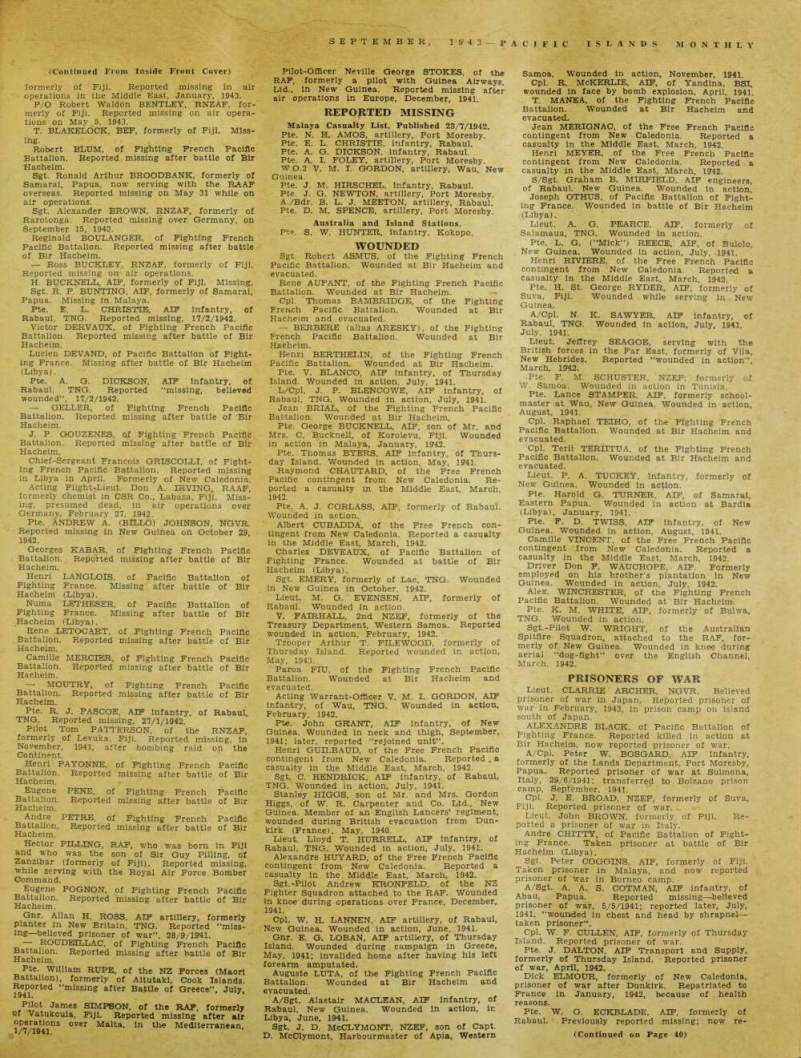
(Continued From Inside Front Cover) formerly of Fiji. Reported missing in air operations in the Middle East, January, 1943.
P/O Robert Waldon BENTLEY, RNZAF, for merly of Fiji. Reported missing on air opera tions on May 5, 1943.
T. BLAKELOCK, BEF, formerly of Fiji. Miss ing.
Robert BLUM, of Fighting French Pacific Battalion. Reported missing after battle of Bir Hacheim.
Sgt. Ronald Arthur BROODBANK, formerly of Samarai, Papua, now serving with the RAAF overseas. Reported missing on May 31 while on air operations.
Sgt. Alexander BROWN, RNZAF, formerly of Rarotonga. Reported missing over Germany, on September 15, 1942.
Reginald BOULANGER, of Fighting French Pacific Battalion. Reported missing after battle of Bir Hacheim.
Ross BUCKLEY, RNZAF, formerly of Fiji, Reported missing on air operations.
H. BUCKNELL, AIF, formerly of Fiji. Missing.
Sgt. R. F. BUNTING, AIF, formerly of Samarai, Papua. Missing in Malaya.
Pte. E. L. CHRISTIE, AIF infantry, of Rabaul, TNG. Reported missing, 17/2/1942.
Victor DERVAUX, of Fighting French Pacific Battalion. Reported missing after battle of Bir Hacheim.
Lucien DEVAND, of Pacific Battalion of Fight ing France. Missing after battle of Bir Hacheim (Libya).
Pte. A. Q. DICKSON, AIF Infantry, of Rabaul, TNG. Reported “missing, believed wounded”, 17/2/1942.
GELLER, of Fighting French Pacific Battalion. Reported missing after battle of Bir Hacheim.
J. P. GOUZENES, of Fighting French Pacific Battalion. Reported missing after battle of Bir Hacheim.
Chief-Sergeant Francois GRISCOLLI, of Fight ing French Pacific Battalion. Reported missing in Libya in April. Formerly of New Caledonia.
Acting Flight-Lieut. Don A. IRVING, RAAF, formerly chemist in CSR Co., Labasa, Fiji. Miss ing, presumed dead, in air operations over Germany, February 27, 1942.
Pte. Andrew A. (Billo) Johnson, Ngvr.
Reported missing in New Guinea on October 29, 1942.
Georges KABAR, of Fighting French Pacific Battalion. Reported missing after battle of Bir Hacheim.
Henri LANGLOIS, of Pacific Battalion of Fighting France. Missing after battle of Bir Hacheim (Libya).
Numa LETHESER, of Pacific Battalion of Fighting France. Missing after battle of Bir Hacheim (Libya).
Rene LETOCART, of Fighting French Pacific Battalion, Reported missing after battle of Bir Hacheim.
Camille MERCIER, of Fighting French Pacific Battalion. Reported missing after battle of Bir Hacheim.
MOUTRY, of Fighting French Pacific Battalion. Reported missing after battle of Bir Hacheim.
Pte. R. J. PASCOE, AIF infantry, of Rabaul, TNG. Reported missing, 27/1/1942.
Pilot Tom PATTERSON, of the RNZAF, formerly of Levuka, Fiji. Reported missing, in November, 1941, after bombing raid on the Continent.
Henri PAYONNE, of Fighting French Pacific Battalion. Reported missing after battle of Bir Hacheim.
Eugene PENS, of Fighting French Pacific Battalion. Reported missing after battle of Bir Hacheim.
Andre PETRE, of Fighting French Pacific Battalion. Reported missing after battle of Bir Hacheim.
Hector PILLING, RAF, who was bom in Fiji and who was the son of Sir Guy Pilling, of Zanzibar (formerly of Fiji). Reported missing, while serving with the Royal Air Force Bomber Command.
Eugene POGNON, of Fighting French Pacific Battalion. Reported missing after battle of Bir Hacheim.
Gnr. Allan H. ROSS, AIF artillery, formerly planter in New Britain, TNG, Reported “miss ing—believed prisoner of war”, 28/9/1941.
ROUDBTLLAC, of Fighting French Pacific Battalion. Reported missing after battle of Bir Hacheim.
Pte. William RUPE, of the NZ Forces (Maori Battalion), formerly of Altutakl, Cook Islands.
Reported “missing after Battle of Greece”, July 1941.
Pilot James SIMPSON, of the RAF. formerly of Vatukoula, Fiji. Reported missing after air operations over Malta, in the Mediterranean, 1/7/1941.
Pilot-Officer Neville George STOKES, of the RAP, formerly a pilot with Guinea Airways, Ltd., in New Guinea. Reported missing after air operations in Europe, December, 1941.
Reported Missing
Malaya Casualty List, Published 23/7/1942.
Pte. N. H. AMOS, artillery. Port Moresby.
Pte. E. L. CHRISTIE, infantry, Rabaul.
Pte. A. G. DICKSON, infantry. Rabaul.
Pte. A. I. FOLEY, artillery, Port Moresby.
W 0.2 V. M. I. GORDON, artillery, Wau. New Guinea.
Pte. J. M. HIRSCHEL, Infantry. Rabaul.
Pte. J. G. NEWTON, artillery, Port Moresby.
A./Bdr. B. L. J. MEETON, artillery, Rabaul.
Pte. D. M. SPENCE, artillery, Port Moresby.
Australia and Island Stations.
Pt*. S. W. HUNTER, Infantry, Kokopo.
Wounded
Sgt. Robert ASMUS, of the Fighting French Pacific Battalion. Wounded at Bir Hacheim and evacuated.
Rene AUFANT, of the Fighting French Pacific Battalion. Wounded at Bir Hacheim.
Cpl. Thomas BAMBRIDGE, of the Fighting French Pacific Battalion. Wounded at Bir Hacheim and evacuated.
BERBERS (alias ARESKY), of the Fighting French Pacific Battalion. Wounded at Bir Hacheim.
Henri BERTHELIN, of the Fighting French Pacific Battalion. Wounded at Bir Hacheim.
Pte. V. BLANCO, AIF infantry, of Thursday Island. Wounded in action, July, 1941.
L/Cpl. J. P. BLENCOWE. AIF Infantry, of Rabaul. TNG. Wounded in action, July, 1941.
Jean BRIAL, of the Fighting French Pacific Battalion. Wounded at Bir Hacheim.
Pte. George BUCKNELL, AIF, son of Mr. and Mrs. C. Bucknell, of Korolevu, Fiji. Wounded in action in Malaya, January, 1942.
Pte. Thomas BYERS, AIF infantry, of Thurs day Island. Wounded in action, May, 1941.
Raymond CHAUTARD, of the Free French Pacific contingent from New Caledonia. Re ported a casualty in the Middle East, March, 1942.
Pte. A. J. CORLASS, AIF, formerly of Rabaul.
Wounded in action.
Albert CUBADDA, of the Free French con tingent from New Caledonia. Reported a casualty in the Middle East, March, 1942.
Charles DEVEAUX, of Pacific Battalion of Fighting Prance. Wounded at battle of Bir Hacheim (Libya).
Sgt. EMERY, formerly of Lae, TNG. Wounded in New Guinea in October, 1942.
Lieut. M. G. EVENSEN, AIF, formerly of Rabaul. Wounded in action.
V. FAIRHALL, 2nd NZEF, formerly of the Treasury Department, Western Samoa. Reported wounded in action, February, 1942.
Trooper Arthur T. FILEWOOD, formerly of Thursday Island. Reported wounded in action, May, 1943.
Paroa FIU, of the Fighting French Pacific Battalion. Wounded at Bir Hacheim and evacuated.
Acting Warrant-Officer V, M. I. GORDON, AIF infantry, of Wau, TNG. Wounded in action, February, 1942.
Pte. John GRANT, AIF infantry, of New Guinea. Wounded in neck and thigh, September, 1941; later, reported “rejoined unit”.
Henri GUILBAUD, of the Free French Pacific contingent from New Caledonia. Reported . a casualty in the Middle East, March, 1942.
Sgt. C. HENDRICK, AIF infantry, of Rabaul, TNG. Wounded in action, July, 1941.
Stanley HIGGS, son of Mr. and Mrs. Gordon Higgs, of W. R. Carpenter and Co. Ltd., New Guinea. Member of an English Lancers’ regiment, wounded during British evacuation from Dun kirk (France), May, 1940.
Lieut. Lloyd T. HURRELL, AIF Infantry, of Rabaul, TNG. Wounded in action, July, 1941.
Alexandre HUYARD, of the Free French Pacific contingent from New Caledonia. Reported a casualty in the Middle East, March, 1942.
Sgt.-Pilot Andrew KRONFELD, of the NZ Fighter Squadron attached to the RAF. Wounded In knee during operations over France, December, 1941.
Cpl. W. H. LANNEN, AIF artillery, of Rabaul, New Guinea. Wounded in action, June, 1941.
Gnr. E. G. LOBAN, AIF artillery, of Thursday Island. Wounded during campaign in Greece, May, 1941; invalided home after having his left forearm amputated.
Auguste LUTA, of the Fighting French Pacific Battalion. Wounded at Bir Hacheim and evacuated.
A/Sgt. Alastair MACLEAN, AEP Infantry, of Rabaul, New Guinea. Wounded in action, in Libya, June, 1941.
Sgt. J. D. McCLYMONT, NZEF, son of Capt.
D. McClymont, Harbourmaster of Apia, Western
Samoa. Wounded in action, November, 1941.
Cpl. R. McKERLIE, AIF, of Yandina, BSI, wounded in face by bomb explosion, April, 1941.
T. MANEA, of the Fighting French Pacific Battalion. Wounded at Blr Hachelm and evacuated, Jean MERIGNAC, of the Free French Pacific contingent from New Caledonia. Reported a casualty in the Middle East, March, 1942.
Henri MEYER, of the Free French Pacific contingent from New Caledonia. Reported a casualty in the Middle East, March, 1942.
S/Sgt. Graham B. MIRFIELD, AIF engineers, of Rabaul. New Guinea. Wounded in action, Joseph OTHUS, of Pacific Battalion of Fight ing France. Wounded in battle of Bir Hacheim (Libya), Lieut. A. G. PEARCE, AIF, formerly of Salamaua, TNG. Wounded in action.
Pte. L. G. (“Mick”) REECE, AIF, of Bulolo, New Guinea. Wounded in action, July, 1941.
Henri RIVIERE, of the Free French Pacific contingent from New Caledonia. Reported a casualty in the Middle East, March, 1942.
Pte. H. St. George RYDER, AIF, formerly of Suva, Fiji. Wounded while serving in New Guinea.
A/Opl. N. K. SAWYER. AIF infantry, of Rabaul, TNG. Wounded in action, July, 1941.
July, 1941.
Lieut. Jeffrey SEAGOE, serving with the British forces in the Far East, formerly of Vila, New Hebrides. Reported “wounded in action”, March, 1942.
Pte. F. M. SCHUSTER, NZEF, formerly of W. Samoa. Wounded in action in Tunisia.
Pte. Lance STAMPER, AIF, formerly school master at Wau, New Guinea. Wounded in action, August, 1941.
Cpl. Raphael TEIHO, of the Fighting French Pacific Battalion. Wounded at Bir Hachelm and evacuated.
Cpl. Terii TERIITUA, of the Fighting French Pacific Battalion. Wounded at Bir Hacheim and evacuated.
Lieut. P. A. TUCKEY, infantry, formerly of New Guinea. Wounded in action.
Pte. Harold G. TURNER, AIF, of Samaral, Eastern Papua. Wounded in action at Bardla (Libya), January, 1941.
Pte. F. D. TWISS, AIF infantry, of New Guinea. Wounded in action, August, 1941.
Camille VINCENT, of the Free French Pacific contingent from New Caledonia. Reported a casualty in the Middle East, March, 1942.
Driver Don F. WAUCHOPE, AIF. Formerly employed on his brother’s plantation In New Guinea. Wounded in action, July, 1942.
Alex. WINCHESTER, of the Fighting French Pacific Battalion. Wounded at Bir Hachelm.
Pte. K, M. WHITE, AIF, formerly of Bulwa, TNG. Wounded in action.
Sgt.-Pilot W. WRIGHT, of the Australian Spitfire Squadron, attached to the RAF, for merly of New Guinea. Wounded in knee during aerial “dog-fight” over the English Channel, March. 1942.
Prisoners Of War
Lieut. CLARRIE ARCHER, NGVR. Believed prisoner of war in Japan. Reported prisoner of war in February, 1943, in prison camp on Island south of Japan.
ALEXANDRE BLACK, of Pacific Battalion of Fighting France. Reported killed in action at Bir Hacheim, now reported prisoner of war.
A/Cpl. Peter W. BOSGARD, AIF infantry, formerly of the Lands Department, Port Moresby, Papua. Reported prisoner of war at Sulmona, Italy, 29/6/1941; transferred to Bolzano prison camp, September, 1941.
Cpl. J. E. BROAD, NZEF, formerly of Suva, Fiji. Reported prisoner of war.
Lieut. John BROWN, formerly of Fiji. Re ported a prisoner of war in Italy.
Andre CHITTY, of Pacific Battalion of Fight ing France. Taken prisoner at battle of Bir Hacheim (Libya).
Sgt. Peter COGGINS, AIF, formerly of Fiji.
Taken prisoner in Malaya, and now reported prisoner of war in Borneo camp.
A/Sgt. A. A. s. COTMAN, AIF infantry, of Abau, Papua. Reported missing—believed prisoner of war, 5/5/1941; reported later, July, 1941, “wounded in chest and head by shrapnel— taken prisoner”.
Cpl. W. F. CULLEN, AIF, formerly of Thursday Island. Reported prisoner of war.
Pte. J. DALTON, AIF Transport and Supply, formerly of Thursday Island. Reported prisoner of war, April, 1942.
Dick ELMOUR, formerly of New Caledonia, prisoner of war after Dunkirk. Repatriated to Prance in January, 1942, because of health reasons.
Pte. W. G. ECKBLADE, AIF, formerly of Rabaul. Previously reported missing; now re (Continued on Page 40)
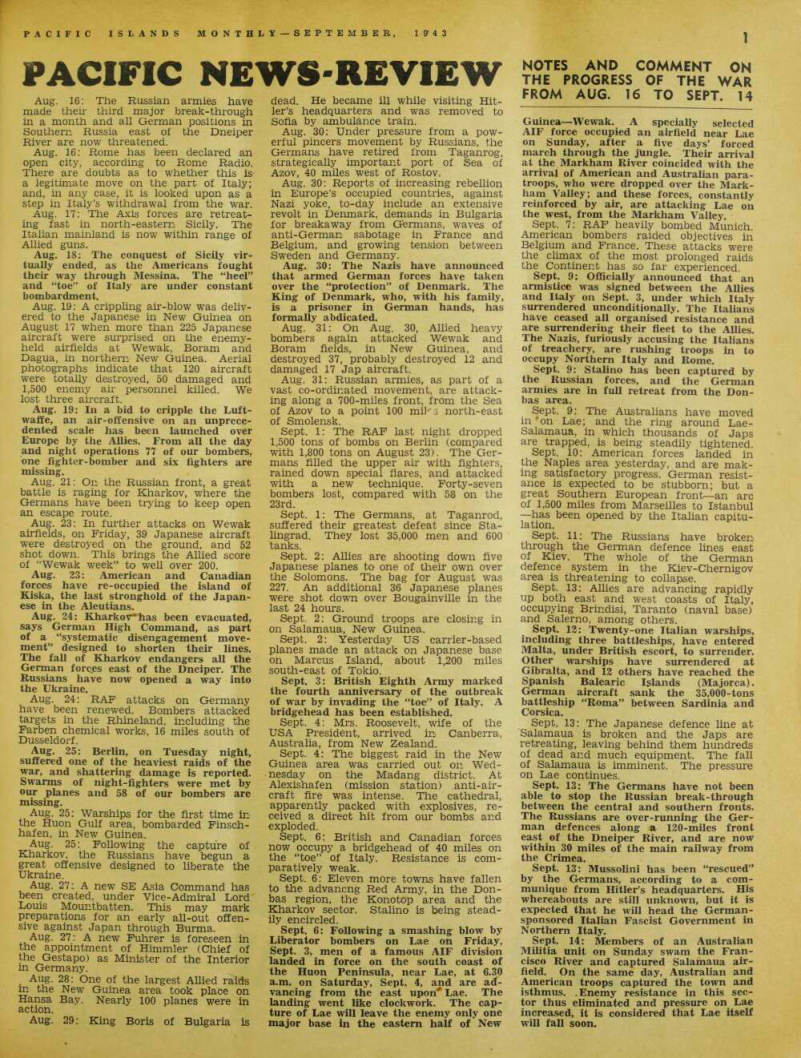
Pacific News-Review
Notes And Comment On
The Progress Of The War
From Aug. 16 To Sept. 14
Aug. 16: The Russian armies have made their third major break-through in a month and all German positions in Southern Russia east of the Dneiper River are now threatened.
Aug. 16: Rome has been declared an open city, according to Rome Radio.
There are doubts as to whether this is a legitimate move on the part of Italy; and, in any case, it is looked upon as a step in Italy’s withdrawal from the war.
Aug. 17; The Axis forces are retreat ing fast in north-eastern Sicily. The Italian mainland is now within range of Allied guns.
Aug. 18: The conquest of Sicily vir tually ended, as the Americans fought their way through Messina. The “heel” and “toe” of Italy are under constant bombardment.
Aug. 19; A crippling air-blow was deliv ered to the Japanese in New Guinea on August 17 when more than 225 Japanese aircraft were surprised on the enemy held airfields at Wewak, Boram and Dagua, in northern New Guinea. Aerial photographs indicate that 120 aircraft were totally destroyed, 50 damaged and 1,500 enemy air personnel killed. We lost three aircraft.
Aug. 19: In a bid to cripple the Luft waffe, an air-offensive on an unprece dented scale has been launched over Europe by the Allies. From all the day and night operations 77 of our bombers, one fighter-bomber and six fighters are missing.
Aug. 21: On the Russian front, a great battle is raging for Kharkov, where the Germans have been trying to keep open an escape route.
Aug. 23: In further attacks on Wewak airfields, on Friday, 39 Japanese aircraft were destroyed on the ground, and 52 shot down. This brings the Allied score of “Wewak week” to well over 200.
Aug. 23: American and Canadian forces have re-occupied the island of Kiska, the last stronghold of the Japan ese in the Aleutians.
Aug. 24: Kharkov** has been evacuated, says German High Command, as part of a “systematic disengagement move ment” designed to shorten their lines.
The fall of Kharkov endangers all the German forces east of the Dneiper. The Russians have now opened a way into the Ukraine.
Aug. 24: RAF attacks on Germany have been renewed. Bombers attacked targets in the Rhineland, including the Farben chemical works, 16 miles south of Dusseldorf.
Aug. 25: Berlin, on Tuesday night, suffered one of the heaviest raids of the war, and shattering damage is reported.
Sw T arms of night-fighters were met by our planes and 58 of our bombers are missing.
Aug. 25: Warships for the first time in the Huon Gulf area, bombarded Finsch hafen, in New Guinea.
Aug. 25: Following the capture of Kharkov, the Russians have begun a great offensive designed to liberate the Ukraine.
Aug. 27: A new SE Asia Command has been created, under Vice-Admiral Lord Louis Mountbatten. This may mark preparations for an early all-out offen sive against Japan through Burma.
Aug. 27: A new Fuhrer is foreseen in the appointment of Himmler (Chief of the Gestapo) as Minister of the Interior in Germany.
Aug. 28: One of the largest Allied raids in the New Guinea area took place on Hansa Bay. Nearly 100 planes were in action.
Aug. 29: King Boris of Bulgaria is
dead. He became ill while visiting Hit ler’s headquarters and was removed to Sofia by ambulance train.
Aug. 30: Under pressure from a pow erful pincers movement by Russians, the Germans have retired from Taganrog, strategically important port of Sea of Azov, 40 miles west of Rostov.
Aug. 30: Reports of increasing rebellion in Europe’s occupied countries, against Nazi yoke, to-day include an extensive revolt in Denmark, demands in Bulgaria for breakaway from Germans, waves of anti-German sabotage in France and Belgium, and growing tension between Sweden and Germany.
Aug. 30: The Nazis have announced that armed German forces have taken over the “protection” of Denmark. The King of Denmark, who, with his family, is a prisoner in German hands, has formally abdicated.
Aug. 31: On Aug. 30, Allied heavy bombers again attacked Wewak and Boram fields, in New Guinea, and destroyed 37, probably destroyed 12 and damaged 17 Jap aircraft.
Aug. 31: Russian armies, as part of a vast co-ordinated movement, are attack ing along a 700-miles front, from the Sea of Azov to a point 100 miFs north-east of Smolensk.
Sept. 1: The RAF last night dropped 1,500 tons of bombs on Berlin (compared with 1,800 tons on August 23). The Ger mans filled the upper air with fighters, rained down special flares, and attacked with a new technique. Forty-seven bombers lost, compared with 58 on the 23rd.
Sept. 1: The Germans, at Taganrod, suffered their greatest defeat since Sta lingrad. They lost 35,000 men and 600 tanks.
Sept. 2: Allies are shooting down five Japanese planes to one of their own over the Solomons. The bag for August was 227. An additional 36 Japanese planes were shot down over Bougainville in the last 24 hours.
Sept. 2: Ground troops are closing in on Salamaua, New Guinea.
Sept. 2: Yesterday US carrier-based planes made an attack on Japanese base on Marcus Island, about 1,200 miles south-east of Tokio.
Sept. 3: British Eighth Army marked the fourth anniversary of the outbreak of war by invading the “toe” of Italy. A bridgehead has been established.
Sept. 4: Mrs. Roosevelt, wife of the USA President, arrived in Canberra, Australia, from New Zealand.
Sept. 4: The biggest raid in the New Guinea area was carried out on Wed nesday on the Madang district. At Alexishafen (mission station) anti-air craft fire was intense. The cathedral, apparently packed with explosives, re ceived a direct hit from our bombs and exploded.
Sept. 6: British and Canadian forces now occupy a bridgehead of 40 miles on the “toe” of Italy. Resistance is com paratively weak.
Sept. 6: Eleven more towns have fallen to the advancng Red Army, in the Don bas region, the Konotop area and the Kharkov sector. Stalino is being stead ily encircled.
Sept. 6: Following a smashing blow by Liberator bombers on Lae on Friday, Sept. 3, men of a famous AIF division landed in force on the south coast of the Huon Peninsula, near Lae, at 6.30 a.m. on Saturday, Sept. 4, and are ad vancing from the east upon' Lae. The landing went like clockwork. The cap ture of Lae will leave the enemy only one major base in the eastern half of New
Guinea—Wewak. A specially selected AIF force occupied an airfield near Lae on Sunday, after a five days’ forced march through the jungle. Their arrival at the Markham River coincided with the arrival of American and Australian para troops, who were dropped over the Mark ham Valley; and these forces, constantly reinforced by air, are attacking Lae on the west, from the Markham Valley.
Sept. 7: RAF heavily bombed Munich.
American bombers raided objectives in Belgium and France. These attacks were the climax of the most prolonged raids the Continent has so far experienced.
Sept. 9: Officially announced that an armistice was signed between the Allies and Italy on Sept. 3, under which Italy surrendered unconditionally. The Italians have ceased all organised resistance and are surrendering their fleet to the Allies.
The Nazis, furiously accusing the Italians of treachery, are rushing troops in to occupy Northern Italy and Rome.
Sept. 9: Stalino has been captured by the Russian forces, and the German armies are in full retreat from the Don bas area.
Sept. 9: The Australians have moved in *on Lae; and the ring around Lae- Salamaua, in which thousands of Japs are trapped, is being steadily tightened.
Sept. 10: American forces landed in the Naples area yesterday, and are mak ing satisfactory progress. German resist ance is expected to be stubborn; but a great Southern European front—an arc of 1,500 miles from Marseilles to Istanbul —has been opened by the Italian capitu lation.
Sept. 11: The Russians have broken through the German defence lines east of Kiev. The whole of the German defence system in the Kiev-Chernigov area is threatening to collapse.
Sept. 13: Allies are advancing rapidly up both east and west coasts of Italy, occupying Brindisi, Taranto (naval base) and Salerno, among others.
Sept. 12: Twenty-one Italian warships, including three battleships, have entered Malta, under British escort, to surrender.
Other warships have surrendered at Gibralta, and 12 others have reached the Spanish Balearic Islands (Majorca).
German aircraft sank the 35,000-tons battleship “Roma” between Sardinia and Corsica.
Sept. 13: The Japanese defence line at Salamaua is broken and the Japs are retreating, leaving behind them hundreds of dead and much equipment. The fall of Salamaua is imminent. The pressure on Lae continues.
Sept. 13: The Germans have not been able to stop the Russian break-through between the central and southern fronts.
The Russians are over-running the Ger man defences along a 120-miles front east of the Dneiper River, and are now within 30 miles of the main railway from the Crimea.
Sept. 13: Mussolini has been “rescued” by the Germans, according to a com munique from Hitler’s headquarters. His whereabouts are still unknown, but it is expected that he will head the German sponsored Italian Fascist Government in Northern Italy.
Sept. 14: Members of an Australian Militia unit on Sunday swam the Fran cisco River and captured Salamaua air field. On the same day, Australian and American troops captured the town and isthmus. . Enemy resistance in this sec tor thus eliminated and pressure on Lae increased, it is considered that Lae itself will fall soon.
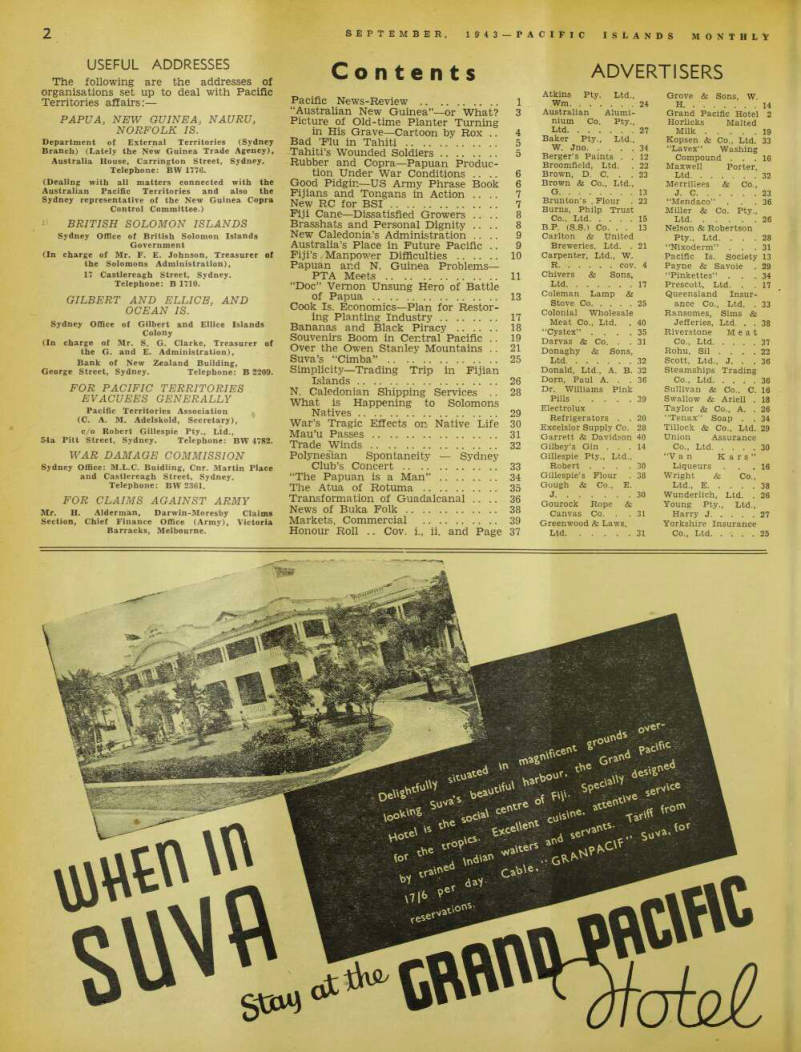
Contents
Pacific News-Review 1 “Australian New Guinea”—or What? 3 Picture of Old-time Planter Turning in His Grave—Cartoon by Rox .. 4 Bad ’Flu in Tahiti 5 Tahiti’s Wounded Soldiers 5 Rubber and Copra—Papuan Produc tion Under War Conditions ... 6 Good Pidgin—US Army Phrase Book 6 Fijians and Tongans in Action ... 7 New RC for BSI 7 Fiji Cane—Dissatisfied Growers ... 8 Brasshats and Personal Dignity ... 8 New Caledonia’s Administration ... 9 Australia’s Place in Future Pacific .. 9 Fiji’s Manpower Difficulties 10 Papuan and N. Guinea Problems— PTA Meets 11 “Doc” Vernon Unsung Hero of Battle of Papua 13 Cook Is. Economics —Plan for Restor ing Planting Industry 17 Bananas and Black Piracy 18 Souvenirs Boom in Central Pacific .. 19 Over the Owen Stanley Mountains .. 21 Suva’s “Cimba” 25 Simplicity—Trading Trip in Fijian Islands 26 N. Caledonian Shipping Services .. 28 What is Happening to Solomons Natives 29 War’s Tragic Effects on Native Life 30 Mau’u Passes 31 Trade Winds 32 Polynesian Spontaneity Sydney Club’s Concert 33 “The Papuan is a Man” 34 The Atua of Rotuma 35 Transformation of Guadalcanal ... 36 News of Buka Folk 38 Markets, Commercial 39 Honour Roll .. Cov. i., ii. and Page 37
Advertisers
Atkins Pty. Ltd., Wm 24 Australian Alumi nium Co. Pty., Ltd 27 Baker Pty., Ltd., W. Jno 34 Berger’s Paints . . 12 Broomfield, Ltd. . 22 Brown, D. C. . . 23 Brown & Co., Ltd., G 13 Brunton’s , Flour . 23 Burns, Philp Trust Co., Ltd 15
B.P. (S.S.) Co. . . 13
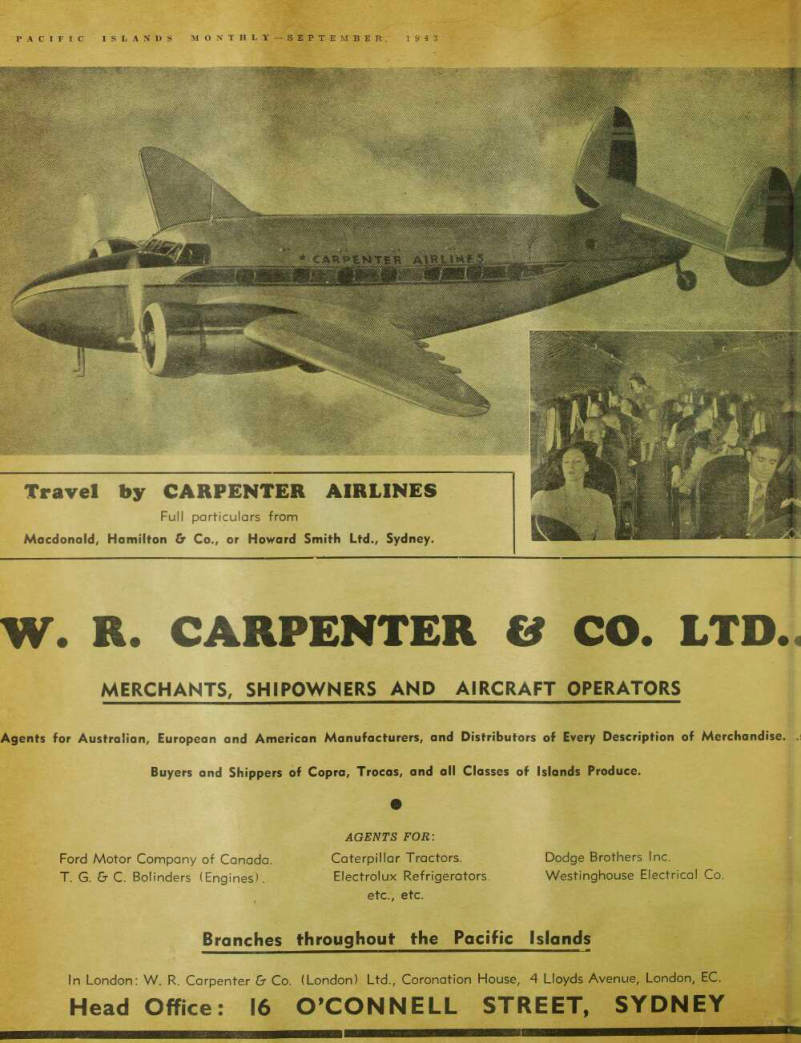
Carlton & United Breweries, Ltd. . 21 Carpenter, Ltd., W.
R cov. 4 Chivers & Sons, Ltd 17 Coleman Lamp & Stove Co 25 Colonial Wholesale Meat Co., Ltd. .40 “Cystex” ... 35 Darvas & Co. . . 31 Donaghy & Sons, Ltd 32 Donald, Ltd., A. B. 32 Dorn, Paul A. . . 36 Dr. Williams Pink Pills 39 Electrolux Refrigerators . . 20 Excelsior Supply Co. 28 Garrett & Davidson 40 Gilbey’s Gin ... 14 Gillespie Pty., Ltd., Robert ... 30 Gillespie’s Flour . 38 Gough & Co., E.
J 30 Gourock Rope & Canvas Co. . .31 Greenwood & Laws, Ltd 31
Grove & Sons, W.
H. 14 Grand Pacific Hotel 2 Horlicks Malted Milk 19 Kopsen & Co., Ltd. 33 “Lavex” Washing Compound ... 16 Maxwell Porter, Ltd 32 Merriliees & Co., J. C 23 “Mendaco” ... 36 Miller & Co. Pty., Ltd 26 Nelson & Robertson Pty., Ltd. ... 28 “Nixoderm” ... 31 Pacific Is. Society 13 Payne & Savoie . 29 “Pinkettes” ... 34 Prescott, Ltd. . . 17 Queensland Insur ance Co., Ltd. . 33 Ransomes, Sims & Jefferies, Ltd. . . 38 Riverstone Meat Co., Ltd 37 Rohu, Sil . . . . 22 Scott, Ltd., J. . .36 Steamships Trading Co., Ltd 36 Sullivan & Co., C. 16 Swallow & Ariell . 18 Taylor & Co., A. . 26 “Tenax” Soap . . 34 Tillock & Co., Ltd. 29 Union Assurance Co., Ltd 30 “Van Kars”
Liqueurs ... 16 Wright & Co., Ltd., E 38 Wunderlich, Ltd. . 26 Young Pty., Ltd., Harry J 27 Yorkshire Insurance Co., Ltd 25
Advertisements & other items, p. 4 (1 item)
Useful Addresses
The following are the addresses of organisations set up to deal with Pacific Territories affairs:—
PAPUA, NEW GUINEA, NAURU,
NORFOLK IS.
Department of External Territories (Sydney Branch) (Lately the New Guinea Trade Agency), Australia House, Carrington Street, Sydney.
Telephone: BW 1776. (Dealing with all matters connected with the Australian Pacific Territories and also the Sydney representative of the New Guinea Copra Control Committee.)
BRITISH SOLOMON ISLANDS
Sydney Office of British Solomon Islands Government (In charge of Mr. F. E. Johnson, Treasurer of the Solomons Administration), 17 Castlereagh Street, Sydney.
Telephone: B 1710.
GILBERT AND ELLICE, AND
OCEAN IS.
Sydney Office of Gilbert and Ellice Islands Colony (In charge of Mr. S. G. Clarke, Treasurer of the G. and E. Administration), Bank of New Zealand Building, George Street, Sydney. Telephone: B 2209.
FOR PACIFIC TERRITORIES
EVACUEES GENERALLY
Pacific Territories Association (C. A. M. Adelskold, Secretary), c/o Robert Gillespie Pty., Ltd., 54a Pitt Street, Sydney. Telephone: BW 4782.
WAR DAMAGE COMMISSION
Sydney Office: M.L.C. Buidling, Cnr. Martin Place and Castlereagh Street, Sydney.
Telephone: BW 2361.
FOR CLAIMS AGAINST ARMY
Mr. H. Alderman, Darwin-Moresby Claims Section, Chief Finance Office (Army), Victoria Barracks, Melbourne.
«3 8^
Pacific Islands Monthly
The Newspaper-Magazine of the South Seas [.Registered at the Sydney, for transmission hy post as a newspaper .]
Published Once Each Month and Circulated in Australia and New Zealand and in the following Pacific Territories and Islands Groups:
Australian Territory of Papua.
Mandated Territory (Australia) of New Guinea.
Australian Territory of Norfolk Island.
New Zealand Territory of Cook Islands.
Mandated Territory (NZ) of Western Samoa.
British Colony of Fiji.
British Solomon Islands Protectorate.
British Protectorate of Tongan Islands.
British Crown Colony of Gilbert and Ellice Islands.
Mandated Territory of Nauru.
British and Free French Condominium of New Hebrides.
Free French Colony of New Caledonia.
Free French Colony of Oceania (Tahiti, etc.).
American Territory of Eastern Samoa.
American Territory of Hawaiian Islands.
Owned and Produced by Pacific Publications Pty. Ltd., Union House, 247 George Street, Sydney.
T'ttt tj’pttont’ f Managing Director .. BTV 5037 I Business and Editorial MA 4369
P.O. Box 3408 R
Registered Address of Telegrams, Radiograms, and Cables: “Pacpub”, Sydney.
Contributions.
Articles, Stories, and Photographs dealing with Pacific Islands subjects are invited and will be paid for on publication.
Subscription Rates.
Per Annum, within British Empire, Prepaid, Post Free 8/.
Per Annum, elsewhere, prepaid, Post Free. 107- Single Copies 8d.
Editor and Publisher;
R. W. Robson, P.R.G.S.
Advertising Manager: L. W. Bailey.
Advertising Office and Printing-House: 29 Alberta Street, Sydney.
Advertising rates furnished on application.
Colours, etc., by arrangement.
Process Blocks made at Advertiser’s expense when required. Screen 100.
Changes of Advertising Copy should reach this office by Ist of each month, otherwise previous advertisement may be repeated.
Representative In London.
W. C. Harvey, Coronation House, 4 Lloyds Avenue, London, E.C.3, from whom may be obtained copies of Pacific Islands Monthly, Pacific Is. Year Book, advertising schedules, etc.
Agents.
The following are authorised to receive sub scriptions for Pacific Islands Monthly;— Burns, Philp & Co., Ltd., and Burns Phllp (South Sea) Co., Ltd. All branches.
W. R. Carpenter «fc Co., Ltd. All branches.
Morris, Hedstrom, Ltd. All branches.
Steamships Trading Co., Papua. All branches.
B.N.G. Trading Co., Ltd., Port Moresby, Papua.
J. Muir, Suva, FIJI.
Miss R. Castles, Suva, FIJI.
N. C. Mackenzie Hunt, Wainunu, Bua, FIJI.
Cook Islands Trading Co., Rarotonga, Cook Is.
A. C. Rowland, Papeete, Tahiti.
Islands Branches and Representatives of W. H.
Grove & Sons, Ltd., Auckland, New Zealand.
Ed. Pentecost, Noumea, New Caledonia.
Kerr & Co., Noumea, New Caledonia.
Vol. Xiv. No. 2.
September 17, 1943
n r : ro f »d. Per Copy. • .nee £ Prepaid: 8/- p.a.
governing ’ themselves^'That* l is 1 why
“Australian New Guinea" —Or What?
JHE prevailing idea that the Terri- A tory of Australian New Guinea has taken the place of Papua and the nandated Terntory of New Guinea, and that it already has passed under a semi-permanent military administration, is quite wrong.
Some military gentlemen, in the exuberance of their new administrative responsibility, began to use the term “Australian New Guinea,” without authority, and this went on for many months But it has been noticed lately that the official use of the term has disappeared—it is used now, if at all, merely for purposes of non-official convenience.
It is the obvious name for the united territories, and there is no doubt that, some day, when union is complete, it will be adopted. But a great deal must happen before that day dawns.
Australia has the Papua Act, which creates the Territory of Papua, and the Mandate from the League of Nations, under which she holds New Guinea. The Papua Act could be amended, of course; but what of the League of Nations Mandate? jyrANDATES can be ignored and force substituted. Japan did that, when she walked out of the League in 1935, and tore up the Mandate which gave her the authority to rule over the Marshall and Caroline Islands, and which she had promised honourably to observe. But even if Great Britain and Australia were not bound by considerations of honour to
observe the Mandate over New Guinea, they would be bound by considera tions of expediency.
No leader of the United Nations has made any pronouncement or offered any opinion about the future of the League of Nations—probably because two of the greatest among them, United States and Russia, were not members of the League. But, when the war is over, the position of both the League, and of the Terri tories which it disposed by mandate, must receive the most serious con sideration of the United Nations.
The use of the elaborate and ex pensive structure of the League, as a means of keeping world affairs from drifting again to chaos and war, will certainly be urged. And there seems to be no practicable reason why it should not be used—always provided, of course, that the nations can agree upon a way of putting teeth into the League. Of all the anachronisms of the period between the two World Wars, none was more tragic and pitiful than “the toothless old lady of Geneva,” who watched the Japs over run Manchuria, the Italians seize Abyssinia, and the Nazis smash down upon their neighbours, and could do nothing about it.
BUT, whether the League is or is not revived, the Mandated Territories must go into the inter national melting pot, for disposal at the peace conference table. Terri tories like New Guinea, incapable of self-government, must be taken care
governing ’ themselves^'That* l is 1 why Britain’s hands must be kept clear and clean. She dare not compromise her Self, at this stage, by allowing any rhangp nuinea ndminis tration guinea aammis In p ac ifi c there are three Mandated Territories—New Guinea (Australia) Western Samoa (New Zealand) and Marshall and Caroline islands ’ (Japan). New Guinea obviously must be administered by a competent State, and that will be either Australia or some new tropical Dominion or State formed out of the many small Territories of similar character which lie just south of the equator. The future of the Marshall- Caroline Territory depends entirely upon the condition of Japan at the en d of the war. gut the future of Western Samoa may be very interesting. At present, New Zealand holds Samoa under a “c” class Mandate, which presumes that the Samoans are a primitive people (like those of New Guinea) and incapable of governing them selves. That, of course, is nonsense.
The Samoan people are as competent to govern themselves as are the Tongans—with, probably, some kind of sympathetic European guidance, such as Tonga receives from the British Colonial Office. New Zealand Bumbledom will advance a dozen reasons why the Samoans should not have self-government; but the final word will lie with the Americans, whose influence will dominate Poly nesia, for a long time to come.
IT may be seen, therefore, that until the Mandated Territories have been through the post-war melting pot, it is futile to speculate about the future of “Australian New Guinea.”
The Territories may not be “moulded nearer to our heart’s desire” until existing machinery has been shat tered; and the latter includes the Papua Act, of Australia; the Mandate of the League of Nations; and the formal appointments of Sir Walter McNicoll, as Administrator of New Guinea, and of Mr. Leonard Murray, as Administrator of Papua. It is significant that, although the ad ministrative services of both Terri tories have been suspended, the appointments of the two Adminis trators have not been cancelled or interfered with.
The Territories necessarily are under military rule. But, despite all the joyous hopes and ambitions of the many officials who cluster around Port Moresby, in military uniforms, it clearly is the present intention of the Australian Labour Government to revert to the Papuan and New Guinea civil administrations as soon as practicable, and to permit the in evitable changes to take place on that basis, rather than to dump all the Territories’ machinery into a melting pot now, under the control of semi-, military cliques which often have only a vague notion of what they are doing.
About Islands
People
Mr. G. K. Roth has been appointed Assistant Colonial Secretary of Fiji and an administrative officer, Grade I. He succeeds Mr. Trevor Johnson, who has become British Agent and Consul in Tonga. Mr. Roth was in the Fiji service 1928-36; in Zanzibar from 1937 to 1939; and since 1940 he has been an adminis trative officer in Fiji, where he has filled a wide variety of offices, including the chairmanship of the Suva Town Board.
A former Lieutenant-General of Con stabulary and Sheriff in Fiji, Lieutenant- Colonel J. S. Gamble, is dead, at the age of 65. He entered the Colonial Service in British Guiana in 1905, and served in Fiji from 1927 to 1936, when he left the Colony prior to retirement.
Lieut. J. W. Buchanan, and Lieut. R. A.
Hill, both Solomon Islands planters and both First War veterans, received their commissions recently in the Solomon Islands Labour Corps, and have since gone from Sydney to the Solomons.
The Hon. John Trotter, MLC, of Suva, Fiji, has been appointed a director of Burns Philp SS Company, Limited. He joined the firm, in Tonga, in 1919, when he returned from the last war. Mr.
Trotter will retain his position as general manager of the company in Suva.
The Rev. Felix Doering, of Canada, formerly on the staff of the Lutheran Mission, New Guinea, and stationed in Toowoomba (Qld.), has now received per mission to return to his homeland, and expects to leave Australia shortly.
Lieutenant Richard Gore, son of the well-known Judge Gore, of Papua, won warm praise recently from the Americans.
His alertness and initiative probably saved the lives of four survivors of an Ameri can plane which came down in the sea southward of Salamaua, TNG.
Corporal E. Bourke, of the AIF, is a
prisoner of war in Germany. He was for 13 year a member of the district services in New Guinea, and also was in the service of W. R. Carpenter & Co., Rabaul.
The Rev. Eben V. Newman, 8.A., 8.D., BLitt., of the Methodist Overseas Mission, has been appointed Principal of Tubou College, Nukualofa, and he and Mrs. New man expect to leave Sydney for their new home shortly.
Flight-Lieutenant George B. (“Golly”) Meidecke, of the R.A.A.F., has been awarded the Distinguished Flying Cross.
He is the son of Mr. and Mrs. G. J.
Meidecke, of Franz Plantation, Western Samoa.
News of the death of Colonel J. W.
Hutchen, CMG, CBE, in Wellington, NZ. has been received with regret in Western Samoa where he made many friends during his service as secretary of the Administration.
Sergeant Peter Martin, NZEF, son of Mr. and Mrs. S. E. Martin, of Ba, Fiji, is at present in an officers’ training school in Palestine. He has seen service in Greece, Egypt, and Tripoli. Beginning his military career as a private, he has won all his promotions in the field.
Among prominent residents of Fiji who have returned recently to the Colony after absence overseas, are:—Mrs. T. M. Bryce, wife of the manager of the Bank of New South Wales, Suva; Mrs. A. H. Marlow; Mr. and Mrs, A. H. Phillips; Mr. and Mrs.
B. B. Perriman, of W. R. Carpenter & Co., Ltd.; Mr. C. Sunderland; Dr. W. G.
MacNaughton, of the Fiji Medical De partment.
Flight-Lieut. Hector Garrick Pilling, RAF, was awarded the Distinguished Flying Cross a few days before he was killed in action on the night of May 19, 1942, when returning from a bombing raid on Mannheim, together with every member of his gallant crew. Young Pill ing was born in Suva, Fiji, in 1913, and
was the only son of Sir Henry Guy Pilling and Lady Pilling. He was educated at the Boys’ Grammar School, Suva; Wanganui Collegiate School, NZ; and Brasenose College, Oxford, where he took a double first in Jurisprudence. He was an oars man of some merit, and rowed for his college at Henley Regatta. In 1936, he joined the Colonial Administration Ser vice, and was posted to the Uganda Protectorate as a cadet. He was a grand son of the late Joseph Hector Garrick, of Suva.
Captain and Mrs. Luxmore, of Buka, NG, are now in Queensland and in good health. The Captain, who is doing war work, has had eye trouble, but is on the mend. Deepest sympathy is extended to these two worthy Buka residents in the loss of their son, Henry, who was killed in action. The other son is an RSM, and doing a good job somewhere overseas.
Mr. Richard B. Howard, of Navua, Viti Levu, Fiji, on July 16 last, reached the great age of 95. He is an active corres pondent, and his letters and handwriting might be the product of a man half his age. Mr. Howard is residing in Suva at present.
Advertisements & other items, p. 6 (1 item)
Territories Casualties
Killed in Action NG2062 A/WO2 H. Lumb, HQ Unit, Lower Watut, New Guinea.
Died of Illness NG3050 Pte. M. K. Lynch, HQ Unit, Madang, New Guinea.
Dangerously 111 PXI27 Lieut. W. S. Nicholas, HQ Unit, Port Moresby.
Removed from Seriously 111 List P 476 Pte. D. McG. Johnston, HQ Unit, Karema, New Guinea.
NGX6I Lieut. J. H. H. MacGregor Dowsett, HQ Unit, Rabaul, New Guinea.
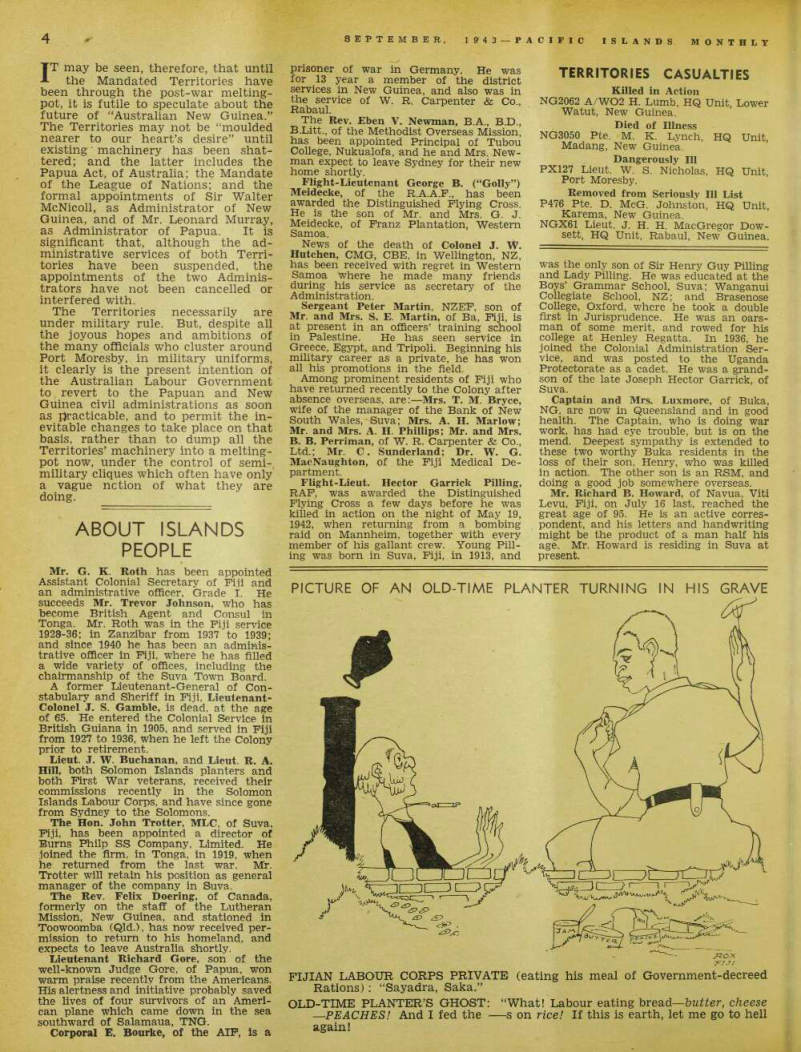
PICTURE OF AN OLD-TIME PLANTER TURNING IN HIS GRAVE I FIJIAN LABOUR CORPS PRIVATE (eating his meal of Government-decreed Rations) : “Sayadra, Saka.”
OLD-TIME PLANTER’S GHOST: “What! Labour eating bread— butter, cheese — PEACHES! And I fed the —s on rice! If this is earth, let me go to hell again!
Tahiti's Wounded
Soldiers
Letter to the Editor THE article in August “PIM” about the arrival of Tahiti’s wounded soldiers made interesting reading; but a few details were omitted.
Your correspondent did not say that the wounded were ashore at least two days without being received officially in any way. Mr. Jack Cowan, a well-known resident of Papeete, called affectionately “'lata' by the Tahitian people, then arranged a “tamaraa” (feast) for the wounded soldiers, some of whom had been his employees prior to enlisting.
This “tamaraa Tahiti” took place some five days after the arrival of the volun teers. Proper authority was invited, but requested that the feast should be post poned. They were, evidently, ashamed mat an official reception had not been arranged. It was, then, rather late in the aay to cease arrangements for the Cowan “tamaraa,” because the “oura,”
“nato,” “miti haari” and other Tahitian delicacies were practically on the table, bo the “tamaraa” took place, and was a huge success. Authority attended in force.
In the afternoon there was a “vin d’honneur” arranged by the NCO’s of the Tahiti soldiery for their companions in arms; and a hurriedly-arranged official banquet took place at night. The latter was a “flop,” The returned soldiers were not capable (physically) of coping with the three functions.
The soldiers were received so well in Sydney, at the Polynesian Club, then later in New Zealand, at the Polynesian Club there, and received such a welcome from the Maori people at Rotorua, that it seems peculiar that officialdom, in their own country did not arrange an immediate reception.
These wounded men were lodged mis erably in “ ’tween decks,” in an atmo sphere strongly redolent of phosphates.
The officer and NCO’s were lodged in cabins. Lieutenant Gilbert, to his great credit, offered his cabin to a legless sol dier, and the ship’s firemen gave up their own cabin to three other soldiers.
The soldiers were fed on rice and dry fish, mainly, with very little variation.
I am, etc..
Tairi I Te Rangi.
Fiji Council
Ratu Sukuna Joins Fiji Council
r:E Honourable Ratu J. L. V. Sukuna was sworn in and took his seat for the first time in August as a mem ber of the Executive Council and the War Council of Fiji.
In welcoming*Ratu Sukuna, the Gov ernor (Major-General Sir Philip Mit chell) referred to the fact that not since the days of Cakobau’s Government had there been a Fijian member in the Col ony’s Executive Council. That there was one now was a tribute to those who had brought about the happy relation which existed to-day between the Fijian race and the race which has, since Cession, assumed responsibility for their govern ment and welfare.
As for Ratu Sukuna himself, His Ex cellency said that his becoming a mem ber of the Executive Council added one more to the list of distinguished services he had already rendered his people and the British Commonwealth of Nations.
War Brings Mission
Problems Prosperity in East; Dislocation in West
rE Methodist Overseas Mission, in its 1943 report for the Pacific, admits to being perplexed over the many new problems the war has brought in its train; but declares that it is not in despair.
Sixteen members' of the New Guinea staff are still missing; and, in spite of all inquiries, made with ingenuity and persistence, eighteen months have gone by without one word from these people.
In the fields where mission work is being carried on, lack of transport for supplies and staff replacements, man power regulations and wartime condi tions generally, are making work difficult.
A brief account of the Mission’s work during the past year in various Pacific Territories follows: — Tonga and Samoa are outside the jurisdiction of the Mission Board in Australia. However, the Board provides the salaries and allowances for European members of the staff, and assists in other ways. Both Tonga and Samoa have benefited financially by the war, and the people have contributed generously to church funds. The Church in Tonga had financial difficulties for many years, but these have now been lifted. In Samoa, also, £lO,OOO contributed by the natives has cleared the Church there of debt.
The balance owing on the large planta tion used as an industrial school has also been paid, and this is now owned out right by the Samoan Church.
The Rev. C. F. Gribble who was for four years Principal of Tubou College.
Tonga, resigned to become Director of Education with the Tongan Government.
He was succeeded by the Rev. Eben V.
Newman, from New South Wales. The Rev. R. J. Maddox, who served in Samoa for 14 years, has retired, and his place has been taken by the Rev. C. L.
Williams.
In Fiji, many buildings were taken over for military purposes and educa tional work suffered. Inability to fill vacancies in the European staff also has caused hardship. Schools have been held in temporary quarters, however, and have carried on with considerable effi ciency. At the Agricultural School, at Navuso, many young Fijians have been called up for national service, but arrangements are being made to enrol a number of younger boys. At the Cen tral Educational Institution, Davuilevu, a secondary school for Fijians and Indians has been commenced, and already there is a waiting list.
The entire Methodist district of New Guinea is in enemy hands and it has been impossible to gain much informa tion from this district. The missionaries who were in the area at the time of the Japanese invasion, and who are believed to be prisoners, are: The Revs. L. A.
McArthur, W. L. I. Linggood, W. D.
Oakes, H. J. Pearson, J. W. Poole, H. B.
Shelton, T. N. Simpson, J. Trevitt, Mo Pui Sam (Chinese Minister); Messrs. S.
C. Beazley (technical instructor), E. W.
Pearce (accountant), Thomas Mow, wife and children: Nurses J. Christopher, M.
Green, D. Beale, D. E. Wilson.
According to reports from escaped prisoners, the natives have all been eva cuated from the Gazelle Peninsula. Their condition after this upheaval in their social life remains unknown.
All Methodist missionaries were eva cuated from Papua in January, 1942, and since that date the Board has tried unceasingly to obtain permission for some
of these workers to return. In July, 1943, the military authorities in Australia informed the general secretary of the Board that the return of the Revs. H.
K. Bartlett, E. A. Clarke and H. T. Wil liams had been approved, subject to the concurrence of the Commander of the US Sixth Army. In September this concur rence had not yet been received.
Bad ’Flu
Epidemic in Tahiti
Papeete, Aug. 10.
EARLY in July, a steamer came in from the States and apparently brought us a new type of influenza, which promptly became epidemic. The disease attacks the throat, intestines and kidneys.
The influenza, by the end of July, had become more virulent in character. It is a type never before seen in these islands.
All schools, assembly places, and, most important of all, the “Honky-tonks,” have been closed.
The honky-tonks are the breeding places of all epidemic, diseases. The people off ships go directly to these un wholesome places. In the dead atmos phere of foul air, one coughing con valescent can infect a multitude.
An average of three or four deaths occurred daily in July. Public schools, scheduled to re-open on July 26, after a holiday, are remaining closed “until further notice.”
A SOCIAL evening will he held jointly by the New Guinea Women’s Club of Sydney and the Pacific Territories Association on Friday, September 17, at 8 p.m., in the Feminist Club rooms, 77 King Street, Sydney.
This is a new venture for the Pacific Territories Association, whose attention has been focussed on the sterner things of evacuee life, and it is hoped that this initial co-operative effort between two New Guinea organisations will be an unqualified success.
Tahiti’s hospital is already over crowded, and additional beds are being put into the rooms.
Six months ago, when Tahiti was in the throes of a “cat plague,” which swept away a large percentage of the island’s cat population with a disease termed cat cholera, Tahitian prognosticators said it would be followed by an epidemic that would affect humanity. This was the case in 1918, before Tahiti’s memorable and devastating influenza epidemic, which took nearly one-fourth of the population.
With the epidemic thought now to be under control, it is not considered likely that any outside help will be requested. . Mr. L. J. Warren, who was manager of the Rarotongan branch of the Union Steamship Co. for seven years, has re cently been appointed assistant manager of the Auckland branch.
Correction!
It was reported in the August issue of the “PIM,” that two members of the New Guinea Branch of the RSSAILA, Dr. E. T. Brennan and Mr. H. L. Down ing, had resigned from the executive of the Branch. This is not the case: although these gentlemen have resigned from the positions of vice-president and secretary respectively, they remain members of the executive.
Rubber And Copra
Papua Produced £140,000 In 15 Months Under War Conditions
r PHE chairman of the Australian New Guinea Production Control Board (.now operating in Papua), Brigadier D.
M. Cleland, recently issued the following statement for the information of persons interested.
The Army was in control of plan tations from about April, 1942, until June 30, 1943; and it may be noted that pro duction, in that period of 15 months was 790 tons of rubber ( worth perhaps £90,000) and 2,400 tons of copra (worth at least £48,000).
The Brigadier’s statement follows: — ON July 1, 1943, the Australian New Guinea Production Control Board commenced operations, and took over control of all plantations which hitherto the Army had carried on. The time is now opportune for a general statement on the position.
The object of the Army in assuming control, in 1942, was to maintain pro duction and to preserve so far as military operations permitted. Owners will appreciate that, had not the Army taken that action, their estates would, in many cases, have suffered irreparable damage. It is noteworthy that the total production during the period of Army control was approximately: Rubber, 1,782,000 lb.; copra, 2,400 tons.
A complete inventory and stocktaking of each plantation has been taken as at June 30, 1943, when an owner resumes occupation, this inventory, with adjust ments from June 30, 1943, to date of actual resumption, is taken, as the basis upon which the owner enters into pos session of his property.
The primary function of the Board under the National Security (External Territories) Regulations is to promote and control the production of rubber, copra and other products in the Terri tory, with a view to securing the maxi mum supply of these products during the present war.
In carrying out this function, the policy of the Board will be: (a) complete co-operation with the owners to facilitate their activities; (b) minimum of inter ference with owners in the management of their plantations; (c) elasticity to meet changing conditions.
It is not the desire or the intention of the Board to set itself up as a profit making machine. It merely desires to pay its way. It will consider that it has contributed its share to the war effort if the maximum amount of rubber and copra is produced and, in doing so, con tented owners and a happy native popu lation are left to carry on when normal conditions once again prevail.
The Board does not intend to operate
without having the benefit and assistance of expert advice. A clause was inserted in the Regulations, at the request of the Chairman, under which the Board has the power to co-opt such technical or specialist advisers as it deems necessary to assist it. This power has already been exercised, and Mr. T. Nevitt has been co opted as a specialist adviser. In that capacity, the Board regards him as re presentative of the owners.
The final settlement of affairs in re spect of the carrying on of the plan tations by the Army, up to June 30, is being handled by the Department of External Territories and the Department of the Army. The Board has no authority to deal with such matters, but it will, in the interests of the owners, assist so far as it is able.
At the commencement of its operations, the Board has been obliged to settle cer tain costs and charges. These will be subject to periodic review, and the benefit of any reduction will be given to owners.
Native labour is subject to the opera tional demands of the Forces in the Territory. Whilst no guarantee can be given, it is reasonable to assume that labour at present on plantations will re main and be built up gradually.
Owners will have the utmost assistance and co-operation from the Board. The Board on its part anticipates co-opera tion from the owners. On this basis a maximum war effort should result.
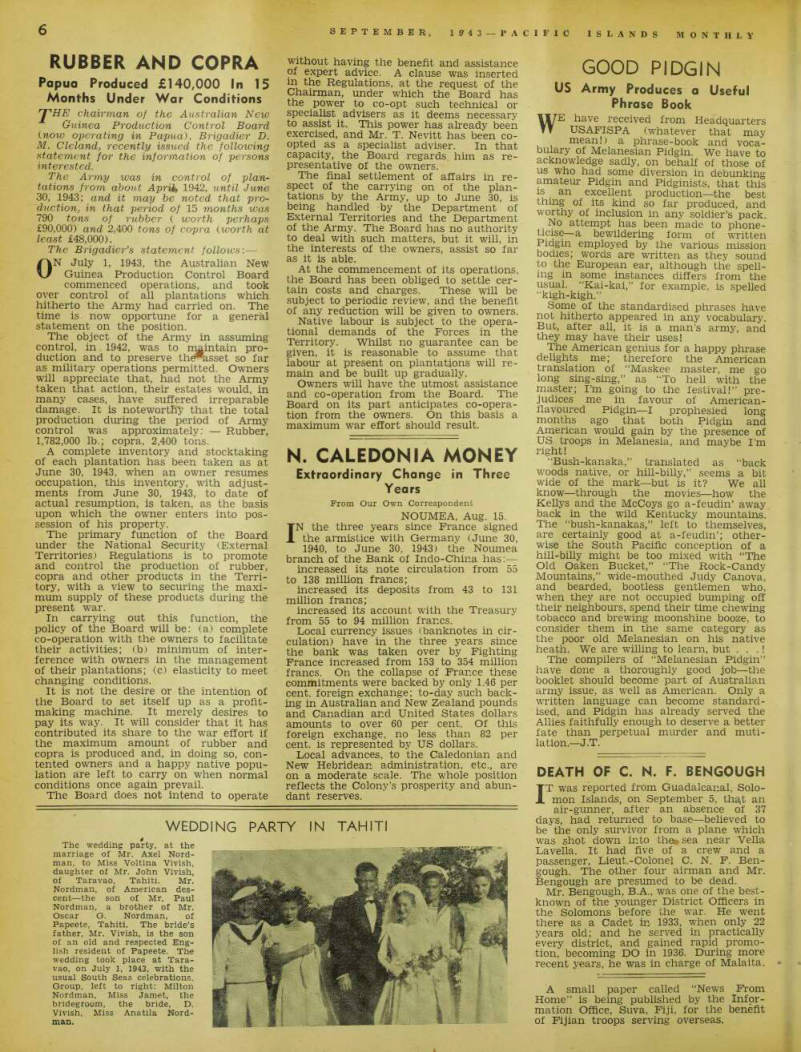
Wedding Party In Tahiti
The wedding party, at the marriage of Mr. Axel Nord man, to Miss Voltina Vivish, daughter of Mr. John Vivish, of Taravao, Tahiti. Mr.
Nordman, of American des cent —the son of Mr. Paul Nordman, a brother of Mr.
Oscar G. Nordman, of Papeete, Tahiti. The bride’s father, Mr. Vivish, is the son of an old and respected Eng lish resident of Papeete. The wedding took place at Tara vao, on July 1, 1943, with the usual South Seas celebrations.
Group, left to right: Milton Nordman, Miss Jamet, the bridegroom, the bride, D.
Vivish, Miss Anatila Nord man.
N. Caledonia Money
Extraordinary Change in Three Years
From Our Own Correspondent
Noumea, Aug. 15.
IN the three years since Prance signed the armistice with Germany (June 30, 1940, to June 30. 1943) the Noumea branch of the Bank of Indo-China has: — increased its note circulation from 55 to 138 million francs; increased its deposits from 43 to 131 million francs; increased its account with the Treasury from 55 to 94 million francs.
Local currency issues (banknotes in cir culation) have in the three years since the bank was taken over by Fighting France increased from 153 to 354 million francs. On the collapse of France these commitments were backed by only 1.46 per cent, foreign exchange; to-day such back ing in Australian and New Zealand pounds and Canadian and United States dollars amounts to over 60 per cent. Of this foreign exchange, no less than 82 per cent, is represented by US dollars.
Local advances, to the Caledonian and New Hebridean administration, etc., are on a moderate scale. The whole position reflects the Colony’s prosperity and abun dant reserves.
Good Pidgin
US Army Produces a Useful Phrase Book
WE have received from Headquarters USAFISPA (whatever that may mean!) a phrase-book and voca bulary of Melanesian Pidgin. We have to acknowledge sadly, on behalf of those of us who had some diversion in debunking amateur Pidgin and Pidginists, that this is an excellent production—the best thing of its kind so far produced, and worthy of inclusion in any soldier’s pack.
No attempt has been made to phone ticise—a bewildering form of written Pidgin employed by the various mission bodies; words are written as they sound to the European ear, although the spell ing in some instances differs from the usual. “Kai-kai,” for example, is spelled ‘•kigh-kigh.”
Some of the standardised phrases have not hitherto appeared in any vocabulary.
But, after all, it is a man’s army, and they may have their uses!
The American genius for a happy phrase delights me; therefore the American translation of “Maskee master, me go long sing-sing,” as “To hell with the master; I’m going to the festival!” pre judices me in favour of American flavoured Pidgin—l prophesied long months ago that both Pidgin and American would gain by the 'presence of US troops in Melanesia, and maybe I’m right!
“Bush-kanaka,” translated as “back woods native, or hill-billy,” seems a bit wide of the mark—but is it? We all know—through the movies—how the Kellys and the McCoys go a-feudin’ away back in the wild Kentucky mountains.
The “bush-kanakas,” left to themselves, are certainly good at a-feudin’; other wise the South Pacific conception of a hill-billy might be too mixed with “The Old Oaken Bucket,” “The Rock-Candy Mountains,” wide-mouthed Judy Canova, and bearded, bootless gentlemen who, when they are not occupied bumping off their neighbours, spend their time chewing tobacco and brewing moonshine booze, to consider them in the same category as the poor old Melanesian on his native heath. We are willing to learn, but . . .!
The compilers of “Melanesian Pidgin” have done a thoroughly good job—the booklet should become part of Australian army issue, as well as American. Only a written language can become standard ised, and Pidgin has already served the Allies faithfully enough to deserve a better fate than perpetual murder and muti
lation.
J.T.
Death Of C. N. F. Bengough
IT was reported from Guadalcanal, Solo mon Islands, on September 5, tha,t an air-gunner, after an absence of 37 days, had returned to base —believed to be the only survivor from a plane which was shot down into the®, sea near Vella Lavella. It had five of a crew and a passenger, Lieut.-Colonel C. N. F. Ben gough. The other four airman and Mr, Bengough are presumed to be dead.
Mr. Bengough, 8.A., was one of the best known of the younger District Officers in the Solomons before the war. He went there as a Cadet in 1933, when only 22 years old; and he served in practically every district, and gained rapid promo tion, becoming DO in 1936. During more recent years, he was in charge of Malaita.
A small paper called “News From Home” is being published by the Infor mation Office, Suva, Fiji, for the benefit of Fijian troops serving overseas.
Fijians and Tongans
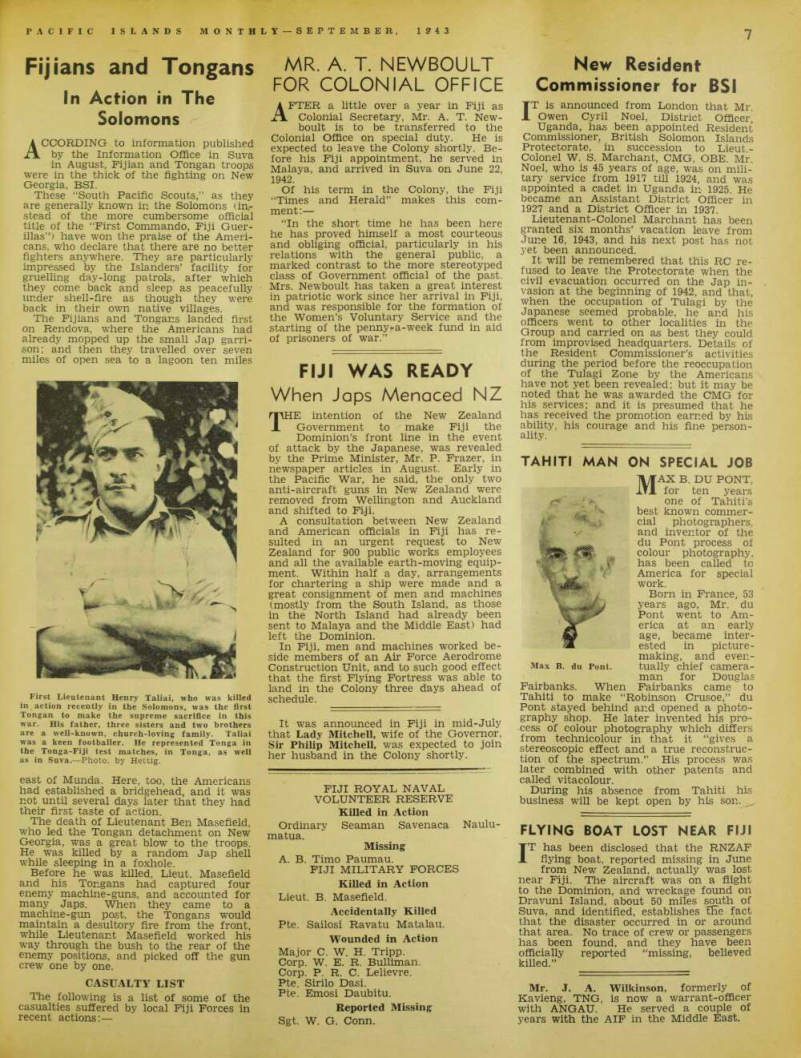
In Action in The Solomons
ACCORDING to information published by the Information Office in Suva in August, Fijian and Tongan troops were in the thick of the fighting on New Georgia, BSI.
These “South Pacific Scouts,” as they are generally known in the Solomons (in stead of the more cumbersome official title of the “First Commando, Fiji Guer illas”) have won the praise of the Ameri cans, who declare that there are no better fighters anywhere. They are particularly impressed by the Islanders’ facility for gruelling day-long patrols, after which they come back and sleep as peacefully under shell-fire as though they were back in their own native villages.
The Fijians and Tongans landed first on Rendova, where the Americans had already mopped up the small Jap garri son; and then they travelled over seven miles of open sea to a lagoon ten miles
east of Munda. Here, too, the Americans had established a bridgehead, and it was not until several days later that they had their first taste of action.
The death of Lieutenant Ben Masefield, who led the Tongan detachment on New Georgia, was a great blow to the troops.
He was killed by a random Jap shell while sleeping in a foxhole.
Before he was killed, Lieut. Masefield and his Tongans had captured four enemy machine-guns, and accounted for many Japs. When they came to a machine-gun post, the Tongans would maintain a desultory fire from the front, while Lieutenant Masefield worked his way through the bush to the rear of the enemy positions, and picked off the gun crew one by one.
Casualty List
The following is a list of some of the casualties suffered by local Fiji Forces in recent actions:—
First Lieutenant Henry Taliai, who was killed in action recently in the Solomons, was the first Tongan to make the supreme sacrifice in this war. His father, three sisters and two brothers are a well-known, church-loving family. Taliai was a keen footballer. He represented Tonga in the Tonga-Fiji test matches, in Tonga, as well as in Suva.—Photo, by Hettig.
Mr. A. T. Newboult
For Colonial Office
AFTER a little over a year in Fiji as Colonial Secretary, Mr. A. T. New boult is to be transferred to the Colonial Office on special duty. He is expected to leave the Colony shortly. Be fore his Fiji appointment, he served in Malaya, and arrived in Suva on June 22, 1942.
Of his term in the Colony, the Fiji “Times and Herald” makes this com ment: — “In the short time he has been here he has proved himself a most courteous and obliging official, particularly in his relations with the general public, a marked contrast to the more stereotyped class of Government official of the past.
Mrs. Newboult has taken a great interest in patriotic work since her arrival in Fiji, and was responsible for the formation of the Women’s Voluntary Service and the starting of the penny-a-week fund in aid of prisoners of war.”
When Japs Menaced NZ
Fiji Was Ready
rr\HE intention of the New Zealand JL Government to make Fiji the Dominion’s front line in the event of attack by the Japanese, was revealed by the Prime Minister, Mr. P. Frazer, in newspaper articles in August. Early in the Pacific War, he said, the only two anti-aircraft guns in New Zealand were removed from Wellington and Auckland and shifted to Fiji.
A consultation between New Zealand and American officials in Fiji has re sulted in an urgent request to New Zealand for 900 public works employees and all the available earth-moving equip ment. Within half a day, arrangements for chartering a ship were made and a great consignment of men and machines (mostly from the South Island, as those in the North Island had already been sent to Malaya and the Middle East) had left the Dominion.
In Fiji, men and machines worked be side members of an Air Force Aerodrome Construction Unit, and to such good effect that the first Flying Fortress was able to land in the Colony three days ahead of schedule.
It was announced in Fiji in mid-July that Lady Mitchell, wife of the Governor, Sir Philip Mitchell, was expected to join her husband in the Colony shortly.
New Resident
Commissioner for BSI
IT is announced from London that Mr.
Owen Cyril Noel, District Officer, Uganda, has been appointed Resident Commissioner, British Solomon Islands Protectorate, in succession to Lieut.- Colonel W. S. Marchant, CMG, OBE. Mr.
Noel, who is 45 years of age, was on mili tary service from 1917 till 1924, and was appointed a cadet in Uganda in 1925. He became an Assistant District Officer in 1927 and a District Officer in 1937.
Lieutenant-Colonel Marchant has been granted six months’ vacation leave from June 16, 1943, and his next post has not yet been announced.
It will be remembered that this RC re fused to leave the Protectorate when the civil evacuation occurred on the Jap in vasion at the beginning of 1942, and that, when the occupation of Tulagi by the Japanese seemed probable, he and his officers went to other localities in the Group and carried on as best they could from improvised headquarters. Details of the Resident Commissioner’s activities during the period before the reoccupation of the Tulagi Zone by the Americans have not yet been revealed; but it may be noted that he was awarded the CMG for his services; and it is presumed that he has received the promotion earned by his ability, his courage and his fine person ality.
Tahiti Man On Special Job
Max b. du font, for ten years one of Tahiti’s best known commer cial photographers, and inventor of the du Pont process of colour photography, has been called to America for special work.
Born in France, 53 years ago, Mr. du Pont went to Am erica at an early age, became inter ested in picture making, and even tually chief camera man for Douglas
Fairbanks. When Fairbanks came to Tahiti to make “Robinson Crusoe,” du Pont stayed behind and opened a photo graphy shop. He later invented his pro cess of colour photography which differs from technicolour in that it “gives a stereoscopic effect and a true reconstruc tion of the spectrum.” His process was later combined with other patents and called vitacolour.
During his absence from Tahiti his business will be kept open by his son. „
Max B. du Pont.
Flying Boat Lost Near Fiji
IT has been disclosed that the RNZAF flying boat, reported missing in June from New Zealand, actually was lost near Fiji. The aircraft was on a flight to the Dominion, and wreckage found on Dravuni Island, about 50 miles south of Suva, and identified, establishes TiHe fact that the disaster occurred in or around that area. No trace of crew or passengers has been found, and they have been officially reported “missing, believed killed.”
Mr. J. A. Wilkinson, formerly of Kavieng, TNG, is now a warrant-officer with ANGAU. He served a couple of years with the AIF in the Middle East.
Advertisements & other items, p. 9 (1 item)
Fiji Royal Naval
VOLUNTEER RESERVE
Killed in Action Ordinary Seaman Savenaca Naulumatua.
Missing A. B. Time Paumau.
FIJI MILITARY FORCES
Killed in Action Lieut. B. Masefield.
Accidentally Killed Pte. Sailosi Ravatu Matalau.
Wounded in Action Major C. W. H. Tripp.
Corp. W. E. R. Bulliman.
Corp. P. R. C. Lelievre.
Pte. Sirilo Dasi.
Pte. Emosi Daubitu.
Reported Missing Sgt. W. G. Conn.
Fiji Cane
Dissatisfied Indian Growers And The Governor
A DEPUTATION of Indian cane growers from Lautoka, Fiji, were received by the Governor, Sir Philip Mitchell, in July.
The growers maintain that sugar-cane is not worth growing, at the present price, and ask that the price be increased. They intimated that they probably would not cut their cane, under existing conditions.
Sir Philip said that, as a result of the recent strike, he had already decided that an inquiry was necessary; but, neverthe less, he had to tell the deputation what he could do and what he could not do.
One of the things he could not do was to promise them an increase in the price of cane; the price of cane depended upon the price of sugar, and sugar was bought by the Food Ministry in London. All that could be done was to present the growers’ case to the Ministry, if the growers could make out a case.
He suggested that a Commission should be appointed to inquire into matters at once. Mr. H. H. Ragg and Mr. Apabhai Patel, who had each given valuable ser vice on the Labour Committee, had agreed to act on the cane inquiry. It was hoped that the Attorney-General of the Colony would be able to preside. The two cane growers’ Associations had agreed to jointly nominate a representative.
As to whether they should cut their cane or not: His Excellency said that that was strictly their own affair. For that matter, they could, if they wished, shoot their own working animals, and burn their own houses. But it seemed to him exceedingly foolish to go to the labour of growing cane and then not to cut it; whatever it fetched, it would be better than nothing.
He strongly advised them to cut the cane, while the official inquiry was go ing on. In the meantime, he would ap point a Commission and would have its conclusions sent to London. He admitted that it seemed to him probable that there was a case for a better return to the growers; and, if this proved to be so, then he would support their case.
New Caledonia Prospers
New Caledonia, Aug. 28.
rE United States ..Army has under taken to buy the 1943 New Cale donian coffee crop, at prices fixed in conjunction with the local administra tion, which represent a rise of 4.75 francs a kilo for Arabica and 2 francs a kilo Robusta over those prevailing last year, when some of the coffee went to Australia and New Zealand. The new prices are: Arabica, 14.05 francs, and Robusta, 10 francs.
New Caledonia’s Post Office Savings Bank deposits increased from 38 million to over 51 million francs between Janu ary and August 1. Prior to the Ameri can Army’s arrival in March, 1942, they amounted to 24 million francs. The Colony has never been one-half so rich as it is to-day.
Mr. S. S. Chowla, a prominent member of Fiji’s Indian community, died in Suva, on April 7. He went to the Colony as a youth, and entered the Civil Service in 1908, where he served in various capacities until his health broke down last year while acting as Deputy Registrar-General, and he was obliged to retire from the service. He is survived by his wife, who is a sister of Mr. J. Grant, MBE, and by a son, Mr. Stanley Chowla, who is a teacher in India.
Old Tahiti
Flag Goes Again To Battle
‘TIIHE Bulletin of the Society of Oceanic X Study,” of Tahiti, has just pub lished an old letter, written by M.
Adolph Marouo Poroi (grandfather of the present Mayor of Papeete) which provides clear evidence of the recognition of Prince Hinoi as the legitimate successor of King Pomare V, by the high chiefs of Tahiti and its dependencies. Mr. W. W. Bolton and Mr. A. C. Rowland, who have been interested in this matter, now therefore see their contention supported and proved.
Exactly 50 years after the suppression of the Tahitian flag, as described by M.
Poroi, Princess Terii-Nui-o-Tahiti, at a public function, with official sanction, pre sented a handsome silk Tahitian flag to the armed forces of Tahiti, to be car ried into battle beside the Cross of Lor raine (flag of Fighting France).
Dr. D. C. M. Macpherson
Untimely Death of Brilliant Young Official In Fiji
WITH extreme regret, residents of Fiji and the Gilbert and Ellice Islands Colony learned of the death of Dr.
Duncan Campbell Mac Ewan Macpherson, at the early age of 42, in the Colonial Memorial Hospital, Suva, on July 10.
Dr. Macpherson entered the Colonial Service in 1929, on appointment to the Gilbert and Ellice Islands Colony as a medical officer, and his skill and devotion to duty won the trust'and affection of the Islanders. In 1935, because of this work, the International Health Division of the Rockefeller Foundation offered him a Foundation Fellowship to study public health in the United States. This course he completed with great distinction, winning the Foundation’s gold medal and obtaining the Diploma of MPH.
It happened that at the time that he finished this course, the Government of Fiji, with the assistance of the Rocke feller Foundation, had decided to estab lish a modern medical laboratory in Suva, the services of which were available to Fiji and all neighbouring Pacific Terri tories. It was considered that Dr.
Macpherson was the man to inaugurate thig important step in the development of preventive medicine in the Pacific, and in 1936 he was appointed Government Pathologist. While holding this post he was able to render valuable service in the training of medical and nursing students in preventive medicine.
In 1938 he was a member of the dele gation representing Great Britain and the Colonies at the 7th International Con gress of Entomology in Berlin, and later was a delegate for Fiji at the Inter national Congress of Tropical Medicine and Malaria at Amsterdam.
From 1939 to May, 1940, he was seconded for duty to the G. & E. Colony; and, on his return to Fiji, became Assistant Director of Medical Services, and also acted as Director. In January, 1941, he was commissioned as a Surgeon Lieutenant Commander in the Fiji Naval Volunteer Force.
Dr. Macpherson’s illness lasted some months. He is survived by his wife, and young son, both overseas. He was buried with full naval honours, in the presence of a large gathering of Service and Government Departmental chiefs, mem bers of the medical and nursing pro fession, and the general public.
Dignity
Brasshats and Personal Dignity
ONE hears frequent comparison of American and Australian Brass-hats in New Guinea—and the verdict is usually in favour of the Americans.
The Australians, recruited to a large extent from among officials and bureau crats, are so sensitive on the matter of their dignity that they unintentionally give offence to men who, on their part, are born and bred to hatred of bureau crats; whereas the Americans treat' all men alike, and subvert all considerations of personal prestige to that of getting on with the war.
Here is a typical incident.
A really hard-boiled old civilian, who had been out for months in territory occupied by Japs, finally came into an Allied base, and placed his “intelligence” unreservedly at the disposal of both Aus tralians and Americans. The Americans, at once recognising his unique value, instructed a high commissioned officer to work with him; as a result of which some maps were ruthlessly altered, and some very successful operations initiated.
But the Australians passed him over to a corporal, under whose tender care he was invited to examine certain maps. He discovered serious errors in a map delineating a place from which he had just come; and so he took a pencil and very prominently marked an alteration, as he had seen the Americans do it.
The corporal yelped in consternation. •Here. You can’t go around altering maps like that,” he said. “Must consult the OC. Are you sure you know this place?”
Mr. Hardboiled looked him over. “No.
I don’t know anything about it,” he growled. He stamped out, and .nothing would induce him to go back.
But the Americans, working closely with him, brought off some famous coups.
Famous Fijian
Hospital
FIJI’S Colonial War Memorial Hospital —one of the finest medical institu tions in the Pacific—is still expand ing.
The Medical Officer in Charge, Dr. E.
V. Maxwell, in his latest report, states that the hospital now comprises the main building in Waimanu Road, a tuber culosis hospital housed in what was for merly the Dudley House School for Indian girls, and a 40-bed hospital for women patients in a concrete building in Toorak Road, formerly the residence of Dr. I. H. Beattie.
The total number of admissions to the hospital in 1942 was 3,834. In the out patients’ sections of the hospital 2,187 consultations were held in the paying department and 25,104 in the non- European free out-patient department.
The honorary dentist, Mr. H. S. Mount, treated 859 cases during the year. In the X-ray department 2,682 radiographic examinations were carried out. The need for new X-ray equipment is emphasised. 22,120 prescriptions were dispensed at the hospital during 1942.
Mr. Lewis Lett, of Port Moresby, Papua—he and Mrs. Mollie Lett have been residents of Melbourne since the evacuation —has been visiting military camps recently in Victoria, and deliver ing lectures on Papua and New Guinea.
He has gained much deserved fame from his recent book on Papua and the Murray Administration.
New Caledonia's
Administration
From Our Noumea Correspondent
New Caledonia, Aug. 25.
ON his arrival here, M. Christian Laigret, appointed as chief of the Cabinet Civil of the High Com missariat, will proceed with plans for the proposed referendum for a new assembly on lines suggested by the existing Administrative Council.
The appointment of a new Governor has been postponed for the time being “in order fully to satisfy the wishes of the New Caledonian people.” It is an nounced that High Commissioner d’Argenlieu recently conferred with General de Gaulle and the Algiers Com mittee of Liberation on the matter, and it is believed an announcement will not be long delayed.
The local Council requested some time back that the new Governor should not be a member of the French Colonial Administration.
M. Laigret, who is an Administrateur en-chef des Colonies, is 40 years of age.
He will act for Rear-Admiral d’Argenlieu whose return to the Colonv is not ex pected in view of his apnointment as commander of Fighting French naval forces in British waters.
M. Laigret will fill the post hitherto held by young, hardworking Caledonian born M. Fourcade, who is designated for an important post in the New Hebrides.
Trocas, £70!
TROCAS shell, which has been priced at £5O per ton for some months past, in Fiji, is in increased de mand, and the price has risen to £7O per ton.
For New Caledonia
Mrs. A. Bowring, well-known and highly-esteemed resident of Edie Creek New Guinea, has joined the staff of the American Red Cross, and has left Sydney for Noumea, New Caledonia, where she will be stationed for a time.
Thoughtful Summary by University Lecturer
Australia's Place In Future Pacific
THE University of Sydney is slowly becoming Pacific-conscious. Earlier this year, the Vice-Chancellor, Sir Robert Wallace, introduced a series of Pacific Talks and he expressed the hope that these talks would arouse interest amongst the students and would ulti mately lead to the establishment of a School of Pacific Studies at the Univer sity.
In a recent address, Mr. w. Maze M.Sc.. of the Geography Department’, discussed Australia’s part, in relation to Pacific affairs. He pointed out that it is now generally accepted that future peace in the Pacific will essentially hinge upon:— (1) A free and independent China (2) Some means of enabling Japan to take her proper place among the nations of the world. (3) The ultimate establishment of an Indonesian Federation.
The question then arises, how does Australia fit into this framework? Mi- Maze said that Australia is politically immature. But that should not prevent her from playing her proper part in the future of South-eastern Asia. Should Australia, therefore, give up her “White Australia” policy?
Mr. Maze argued that the admission of coloured peoples into Australia would certainly not solve the problem of over populated countries. Space is no longer the essential feature of prosperity, and opening Australia’s doors to other races would not depopulise South-east Asia, in view of Australia’s limited capacity.
MR. MAZE suggested that Australia could help South-eastern Asia by maintaining a free-trade policy.
thus establishing a closer and friendlier economic bond with all the countries lying in and around the Pacific. In the post-war period, Australia should in crease her industrial activity, rather than revert to the simple economy of a prim ary producing nation.
The problem of markets would natur ally arise. Mr. Maze pointed out that, geographically speaking, the north Paci fic markets would be dominated by the United States; but South-eastern Asia including the South Pacific, should be come Australia’s region of economic activity. Prior to this war, only a small fraction of our exports found their way into the Pacific, most of our products being diverted to Britain. In post-war economy, the reverse case should hold good.
MR. MAZE suggested that Pacific affairs should be controlled by an international body, for the benefit of all those nations interested, otherwise conditions will gradually deteriorate, until a state of chaos is reached, similar to that found amongst the Balkan States of the present day.
Mr. Maze then showed a slide, indi cating relative distances from Svdney to the various parts of the Pacific, and from that it was evident that Australian interests may be naturally concentrated in South-east Asia.
Mr. Maze concluded by saying that in order to take her proper place among the Pacific nations. Australia should first of all see to it that, in the near future, she is developed, both culturally and eco nomically, to a much greater extent.
Onlv then will Australia be able to undertake her responsibilities in South eastern Asia.—“R.D.”
Too Real For The Islanders
From Our Own Correspondent
South Pacific Base, Aug. 18
AN experienced cinema operator in the U.S. Army in this area—a Califor nian ranch-owner who was once an assistant-director in Hollywood returns to this base with a good story.
He was one day showing a movie to an open-air audience of native Melanesians and colonial French at a tiny and isolated river settlement. The movie had been running for some time, with the audience thoroughly absorbed, though they could not understand much English, when the moment arrived for a great trans-con tmental passenger train, wheels rattling, whistle blowing and fairly eating up the miles, to round the bend and make straight for those sitting in the front rows.
The result was startling. With yells of terror, the souatting natives sprang up rushed to the wings, to get away from monster It was the first train they had seen; also, their first movie.
Some of the French in the audience had seen a few silent films, but this wa« their first talkie. They showed great curiosity as to where the sound came from, and in the interval searched behind the screen. The operator tried to explain to them the secrets of the sound track, in his rather halting French, but they shook their heads in wonder.
Another movie operator, on a Polynesian island two or three thousand miles awav, reporting th° showing of the same film. *avs that the train scene caused just thp same consternation. But, even greater alarm was caused when MGM’s famous
lion opened his mouth to roar. This was the sismal for the audience to dash for the protection of the nearby coconut grove.
Sign Of The Times
ON a table labelled “Useful Kitchen Oddments.” in one of Sydney’s biggest departmental stores, and surrounded by vegetable graters, egg whisks, pie-dishes and potato-neelers. is a stack of black-iron prospecting dishes, complete even to the “ripples” half way round the edge.
Experimentallv—and expecting to be soat upon—l asked the brassy female in charge of the table what thev were. Her reactions were sound; “Wash-up dishes, of course! What do they look like? 3/9 each!”
No romance for those dishes—just plain utility. Gold has its limitations—but dish-washing goes on for ever, more’s the pity.—J.T.
Under the mango trees which have shaded and adorned the Brothers School at Papeete, Tahiti, for 80 years, there assembled on Mav 30 a gathering of citi zens—many of them distinguished ex nupils of the school—to witness a very fine display of gymnastic exercises, organised and arranged by the present teachers and pupils. Among the guests was the Catholic Bishop of Tahiti, Mon seigneur Paul Maze, who has been a resi dent of Tahiti for 35 years. The func tion resulted in 50,000 francs being col lected for educational purposes.
Fiji’S Manpower Difficulties
Tragic Situation of Copra Industry
THE Director of Labour and National Service for the Colony of Fiji (Sir Howard Ellis) called for particulars of present and future labour requirements of employers in May, but only 55 replies were received, as against 183 submitted during the 1942 survey.
The man-power situation in the Colony, therefore, is left somewhat obscure; but it is evident that additional labour is required for all industries—dairy farming and meat production, timber, sugar in dustry, mining, rubber and, particularly, copra production—as well as for Gov ernmental works.
The copra-growers of Fiji are in the unhappy situation that, while the market is clamouring for their product, the local labour situation is bad, and is becoming steadily worse.
The Director, in his report on man power in July, said that only 18 replies had been received from planters, but these had indicated that an additional 288 men were required immediately. It may be assumed also, that other copra planters too are short of labour.
Extracts from the Director’s report, as published by the Government Information Office, follow: Many of the letters received from copra districts are depressing in their tone, and indeed some planters have good reason to be depressed in present circumstances.
Excluding the few estates in Lau. all the large plantations are situated on Taveuni, Rabi and in the Savu Savu district, all in Cakaudrove Province. It appears to be the case, however, that Taveuni Fiji ans with a few exceptions, do not work for Taveuni planters. Various reasons for this have been given to my depart ment. some by the planters and some by the Fijians themselves. It must be borne in mind too that the Fijians of Cakaudrove harvest some 6,000 tons of their own copra each year.
Planters have obtained most of their requirements in the past from the pro vinces of Lau and Kadavu. The usual practice was to send out a recruiter— and men recruited in this way were usually bound on a 12 months’ contract, a breach of which carried a criminal penalty.
Amongst the motives which led Fiji ans to enter into these contracts were the offer of a cash bonus payable on sign ing the contract—attractive to a man ur gently needing money for his taxes or for some other purpose; the desire to build an iron-roofed house, the cost of which was at one time equal to one year’s wages; the decision of a village to build a church or a cutter. It used to be quite common for 30, 40 or 50 men to engage themselves in this way for twelve months at the behest of their chief, and at the end of the period to take back to their chief the whole year’s earnings.
To-day these inducements no longer ob tain. For the man who wants a few pounds urgently there is plenty of more congenial work offering on Viti Levu, or near his own home. Materials for churches and cutters are no longer pro curable, and in any case the day is prob ably passing when young men will give a year of their lives for such purposes.
Another important factor is that where Fijians have coconut groves of their own they can earn considerably more by cut ting their own copra than the wages of fered for cutting the copra of others.
One planter put these earnings as high as 25/- a day—while he himself is at
present offering a wage of 3/- a day, with no food.
There can, of course, be no question of the importance to the war effort of the copra industry. It is equally clear that the industry is suffering from a serious shortage of labourers, though the total number of men required is comparatively small.
This is distressing, not merely on ac count of the loss to the war effort, but also because planters are unable to take full advantage of the high price now of fering after years of struggle against low prices.
In the absence, however, of authority to conscript workers for private industry, my Board is powerless to help individual producers. It has sought to help the in dustry in a general way by repatriating considerable numbers of Fijians formerly employed on war works, to their villages in the copra districts; and Government has also accepted my Board’s recommen dation that, for this and other reasons, further recruitment for the FMF should be stopped for the present. These meas ures have not had the effect of making many more men available to copra plan ters.
It is the case that in Vanua Levu, in Taveuni, and even in Lau there is still some reserve of Fijian man power, though we must bear in mind that every man in his village is engaged in necessary communal services and food production.
It remains for individual planters to tempt Fijians out of their villages by the offer of attractive conditions of service; and I fear that a few estates will have to live down a bad reputation with the Fiiians.
The present shortage is fortunately hav ing one good effect, in that those few em ployers who in the past found it necessary to resort freely to the courts in the man agement of their labourers, and who have been generally regarded by the Fijians as bad employers, are reported now to be adopting a more proper and sensible at titude towards their employees.
Copra Advisory Sub-Committee
rwas announced in Suva on May 30, that the Copra Board which was set up last year, had been disbanded and that, from that date, copra matters would be the concern of the Supply and Production Board. It was stated that planters were being invited to nominate one or more representatives to form a Sub-committee which would advise the Director of Agriculture in his position as Controller of Production and Marketing, on matters concerning the copra industry.
It was announced in August that the planters Sub-committee, set up to assist the Board comprised: Mr. H. B. Gibson—in respect of the Udu-Dreketi-Bua coast.
Mr. Arthur Robinson—in respect of the Kasavu-Vunilagi-Natewa Bay area.
Mr. John Graham Taylor, of Taveuni.
Mr. Sidney H. Wilson, of Savu Savu.
12/6 More For Copra
Dating from July 20, the Supply and Production Board sanctioned the increase of 12/6 ner ton on the price of each grade of copra in Fiji. The price will now be £FI6/12/6 per ton first grade; £FIS/12/6 second grade.
It was hoped—rather naively—at the time of the announcement that “the increased price would stimulate production.” In view of the foregoing report on the man
power situation it seems that it is a clear case of the spirit being willing, as far as copra producers are concerned, but the flesh of potential labourers being weak indeed.
"Dick" Reynolds
Old-Time- Memories Of A
Lovable Character
IT appears that several of the old timers are marching on,” writes Mr. J. Nixon Westwood (Wellington, NZ) “and Captain Dick Reynolds, of Papua, was one of the best-known Wes tern Division men. He was a very jocu lar individual and had quite a fund of interesting Bamu river stories.
“When I was a Collector of Customs in Daru, Dick, whose name was Harold, went over to Thursday Island and purchased a ketch called the ‘Myrtle’. The ‘Myrtle’ was an old Wyborn pearling lugger, and consequently, on Dick’s arrival in British New Guinea, it was necessary for him to register the vessel and get a permit for recruiting.
“In the office of the Collector a for mula was laid down, how to measure any vessel, and the results gave the number of ‘boys’ who could be carried on board.
As soon as Dick dropped anchor I went on board and gave him pratique. He then brought the papers to my office and I worked out the measurements, which gave the ‘Myrtle’ about 24 tons, or equal to 48 ‘boys’.
“I then asked him for his full name.
He said ‘Harold P. Reynolds’. I said, ‘What does the ‘P’ stand for?’ His reply was, ‘Oh, nothing. You see, I am an American, and most of the Americans have an initial as part of their given names’.
“I then said: ‘Oh, you are an Ameri can,’ and followed this up by telling him that no ‘foreigner’ was allowed to own a British ship.
“This gave Dick a lot of thought, and he spent an uncomfortable half-hour try ing to assure me that he had only been fooling. I, on my part, told him that men of his standing should not indulge in these tactics when there was a ques tion of a valuable boat at stake. He then decided to bring in Hughie Beach, Jack Summers and Wm. Henry Luff to prove that he was a good Tasmanian.
“As time was of no importance, I kept the matter up for at least a day, whilst the witnesses saw the humor of the posi tion and ragged Dick no end.
“Anyway he was cured of his idea of using an initial in his name, and satis fied to be called ‘Harold’ officially and ‘Dick’ to his innumerable friends.
“He made some really remarkable trips, not only up the Bamu, but also up the Fly, and was, I believe, sometimes in the vicinity of Purari.
“As a recruiter, he was most successful, and was always cheery and bright, irre spective of what happened, either , one way or the other.
“His visits to Daru, in between his trips, always gave the Island a little bit of something to talk about. I hope he left a diary, so that the experiences of a man who knew the Western Division so well may be put on record for the bene fit of those who are interested in that part of the world.”
Another Memory
PROM Mr. Walter A. Maidment, formerly a general merchant of Daru, Western Papua : — Captain Harrold Peter Reynolds, who died in a private hospital in Sydney on June 28. was born in Tasmania, 63 years
ago. He took to the sea early in life, following his father, Captain Michael Reynolds, one of the old-time Hobart whalers.
After a term in the New Zealand tim ber trade, in the barque “Kasa/’ he drifted to the inter-island trade, in the New Hebrides, and then to Thursday Island. He arrived there in 1904, and had a go around the pearling grounds. He then went to Daru, and began recruiting labour for the plantations in the Central Division. When things grew slack, he re cruited for the pearl-shelling industries at Thursday Island.
Always popular, he will be sadly missed by all his old friends. He was well-known in the racing fraternity—he was a mem ber of City Tattersall’s for the past 25 years.
In the west of Papua, the natives will miss their “Dickio,” when they want “Worko.” He was considered by them a sort of Father Xmas when they were hard up for a job. They will now say, “Nili magali tau,” means means “Very sorry finish.”
Tonga's Fine Record
SINCE the war began, the people of Tonga have given generously to war funds. Total contributions to date: War Effort Fund. £11,741; British Red Cross, £2,145; Defence Force Comforts Fund, £684; making the very fine total of £14,570. All these amounts are given in Tongan currency. Of the £11,741, allo cations that have been made are:—Cost of the fighter aircraft “Queen Salote,” £6,250; donations to Shipwrecked Marin ers’ Society, Seamen’s Hospital, Royal Navy Dependants Fund, and Merchant Navy Comforts Fund, each £625.
The amount of £l,OOO which Morris, Hedstrom, Ltd., recently made available to the Tongan Government brings the balance still in hand to approximately £4,000. The people of Tonga have de cided to make an immediate endeavour to collect an additional £2,250 in order to provide a second fighter aircraft for the Royal Air Force.
Ray Parer In New Role
UNDER the title, “Air Pioneer Now Suburban Grocer,’’ a Melbourne daily paper prints this:— “Ray Parer, who startled the world when he flew a crazy, dilapidated plane from England to Australia with Lieut.
Mclntosh at the end of the last war, and has been in the news many times since for his exploits in New Guinea, has for saken adventure to become a suburban grocer.”
The puzzle of Ray’s whereabouts was solved when a Sydney newspaper pub lished a photograph of him in his grocery shop in 'Edgecliffe, Sydney.
Since World War II began we have had many reports of Ray’s activities: he was “in the Merchant Navy”; then he was “seen in Melbourne in Air Force uni form”; and, later, he was in “small boats” in Queensland.
They cannot keep a good man down.
An interesting extract from a private letter:—“There is an extraordinary amount of interest in those ‘Edward VIII pennies’ which were issued in the Terri tory of New Guinea between the time Edward came to the throne and abdicated.
I find that the Americans are buying them here as curios at 2/- per time, and I have sold hundreds. Just between you and me, I have 9,000 of them—and I think I shall sell the lot.”
Problems
Papuan And New Guinea
Territories Association Discusses Plans of Future Government and Reconstruction
AT the moment, when Australians were eagerly reading details of the first big-scale military move against the Japanese in New Guinea—the attack by Australian land troops and American paratroops and warships against the Japanese at Lae, on September 4—the Territories evacuees resident in Sydney were attending the quarterly general meeting of the Pacific Territories Associa tion, and hearing a report of recent activi ties and future plans.
Mr. E. A. James (president) presided over a large attendance, on the evening of September 7, and the Executive sub mitted the following report;—
Claims Against Government
After very exhaustive examination of the whole position, the Association’s legal advisers are of the opinion that, at this juncture, no legal action is possible in regard to the majority of claims against the Defence Services for chattels, unless the actual acquisition of every item by the authorities can be proved and also the value of each article at the time of acquisition.
As will be obvious, while perhaps we may know beyond doubt that certain chattels were taken and used by the Forces, legal proof of such acquisition is impossible—and Mr. Alderman has made it quite clear that he intends strictly to stand on his legal rights in settlement of these claims. That being so, our legal advisers suggest that Mr Alderman’s offers for chattels might be accepted, the acceptance, however, being m such form as to protect owners’ pos sible rights in in the future. That aspect is now being examined and, meantime we suggest, where nossible, members, if not satisfied with the offers made, still refrain from accepting such offers until further advised by the Association.
Where definite proof of acquisition is held, owners are in a different position, and, by reason of a recent decision of thp High Court, the amount of compen sation—and the basis of fixing it—is much improved, we are advised.
As regards the first class of claimants— and the vast majority—we urge claimants very strongly to expedite the completion of all forms and other information re quired by the War Damage Commission as fully as possible. Meantime, the As sociation is striving to get the Federal Government to realise that Mr. Aider man’s attitude—though strictly legal nerhaps—is unjust, petty and cruel, hav ing regard to the work Territorial resi dents have done in developing the Aus tralian Territories and the tragic setback they have received through no fault of their own. while their country was used as a defensive area for the protection of the Australian mainland.
War Damage Insurance
Here. on the one hand, we have achieved marked success, while in another direction we have been sadly disappointed.
Our efforts to secure deferment of con tributions in cases where owners or their representatives could not find the neces sary monev. have failed, although at our last meeting we informed you we felt sure it would be fixed in the near future.
We wei;e over-optimistic. We are still in communication with the Federal Gov
ernment on this matter and, meantime, ask for particulars of any resident who has been unable to pay War Damage In surance contributions owing to financial difficulties. Pass this request on to your friends and remember this information is required urgently in order that the As sociation may do everything possible to protect the interests of such residents.
Considerable benefits may accrue to members as a result of the War Damage Commission agreeing to assess values of property in all claims, irrespective of whether war damage has or has not beer proved. For this action by the War Damage Commission we record our ap preciation, and we very strongly urge members to put in completed claims to the Commission and fully answer all questions raised by them in endeavour ing to assess claims.
You will see that, as matters stand at present, it is invaluable to owners that they have recorded by an independent tribunal, the values of their various as sets in the Territory as at 1/1/42. No matter what action is open to owners after the war in order to obtain “just compensation’', the whole question will be tremendously simplified by having the values fixed now.
In acceding to our request in this mat ter the War Damage Commission has undertaken a big job, which was not part of its functions; and, in dealing with the Commission, therefore, we ask members to bear this in mind and do everything possible to assist the early assessment of their claims.
Plantation Control
Civilian owners of plantations in Papua took over their properties on Ist July, 1943, under the control of ANG Production Control Board, and so far we believe mat ters are running as well as could be ex pected under the circumstances.
No person has yet been appointed to the position of Agricultural Member of the Board, nor has the Government agreed to our repeated request for the appointment to the Board of at least one person directly representing owners.
Mr. T. Nevitt has been po-opted to the Board as expert adviser, but we are still pressing for an owner’s representative as a full member of the Board.
The Association has another very satis factory achievement to report, in that after negotiations with the Shipping Con trol Board and Department of External Territories, the freight on copra from New Guinea ports to Australia has been reduced by 15/- plus 35% per ton, i.e., £l/0/3, the rate now being 35/- plus 35%.
This reduction which we have secured means an immediate benefit to those copra producers now working under the NG Production Control Board, and to other plantations as they come into opera tion.
The Association has now set up a Plantations Sub-committee, under the Chairmanship of Mr. I. C. Campbell, which sub-committee is closely watching the position and preparing for the later enlargment of the area over which the Production Control Board may have authority.
Prisoners Of War
The Executive is negotiating with the Federal Government on the question of
the treatment of dependants of prisoners of war in New Guinea and on the ques tion of the possible exchange of those prisoners of war captured in New Guinea.
Mining Industry
It is proposed to set up a mining sub committee immediately to thoroughly in vestigate the position of this industry and prepare for resumption of work in the Territories.
Civil Administration
The Executive considers the time is now fast approaching when the reintroduction of some form of civil administration in part of the Territories is possible and in tends taking action in an endeavor to
assist in bringing about this change of administration as soon as practicable.
Reconstruction And
Rehabilitation
One of the objects of this Association —and in our opinion one of its main objects— is post-war reconstruction of the Territories and the rehabilitation of for mer residents. Your Executive feels very strongly that this objective is not one for the future, but one requiring the most careful attention now.
The Commonwealth Government has set up a committee to go into this ques tion, the personnel of the committee being Prof. G. W. Paton, Melbourne Univer sity (Chairman) and representatives of
the Departments of External Territories, Post-War Reconstruction, External Af fairs, Treasury and Army.
As you will see, it is purely a Govern ment departmental committee, with no representative of territorial residents, which seems a pity, as we have pointed out to the Government.
We put it to you bluntly, and very strongly, that your Executive do not believe the best will be done for the Ter ritories and their inhabitants—both Euro pean and native—if the planning is left only to the politicians and professors of Australia, and unless the residents of the Territories are sufficiently strong to en sure their opinions being heeded, we are likely to go back after the war to con ditions no better—if as good—as those of pre-war days.
The various Territories comprising New Guinea, Papua, New Britain, Solomons, etc., are gone forever, we believe, and will become one territory only—Australian New Guinea, as it probably will be known.
The residents of all those countries must join forces and co-operate now if they are to do their duty to the Territories and each other. In addition to this Associa tion, there are a number of other'organi sations of residents of the Territories and we believe it to be essential that all these bodies show a united front in express ing views on post-war territorial plans.
Let us be unanimous in our aims, and let us place our opinions before the Gov ernment with the active support of every resident of the Territories.
Naturally, we want as many members of this Association as possible—we think every resident should ioin for his or her own protection—but. of course, we do not presume to suggest that the various other bodies should not take action on any matter they deem fit.
What we do ask is that if any organisa tion proposes to take official action af fecting any section or residents of the Territories as a whole, that they first make other bodies acquainted with their proposals—through this Association if you wish.
Co-Operation
THE various matters dealt with in the report provided subjects for a two hours’ discussion.
In replv to inquiries, the chairman said that most of the claims for the return of money deposited with the New Guinea Administration had been dealt with—he thought that, where the papers were in order, everything had been paid.
The chairman submitted an amendment of the constitution which would allow such bodies as the New Guinea Women’s Clubs (there were five of them, two in Svdney and one each in Melbourne. Ade laide and Brisbane) to affiliate with the Association, so as to help the Association in its work of protecting evacuees’ in terests, and assisting their rehabilitation in the Territories. The smaller bodies had been formed with a definite object— mostly patriotic in character—and. while the Association did not wish to interfere in any wav with their activities and free dom. it did want the co-operation and goodwill of all Territories people.
The alteration of the constitution was unanimously agreed to.
A motion was passed, asking the exe cutive to again urge upon the Common wealth authority the unfairness of setting up a Committee of professors and De nartmental heads, to plan new adminis trative machinery and means of re establishing the evacuees in the Territory, while the opinions of the Association and its members were completely ignored.
Advertisements & other items, p. 14 (1 item)
Berger’s
mm w / >* In New Guinea, Australia's Far North and in other theatres of war, under every climatic condition Berger's Paints are guarding the Allied weapons of victory. \ These protective finishes formulated for use on land, sea and in the# air meet the extreme tests of service and climate.
There are paints to resist acids and gases. Paints to withstand ice, sleet, salt air, sandstorms, tropic heat and Arctic cold. Paints for seaplanes or submarines tanks or trucks —battleships or bulldozers.
For more than 182 years the House of Berger has been making superior finishes. It has not only led the way in constantly improving quality, but in materially reducing finishing costs.
Naturally this wealth of experience and close association with hundreds of leading companies in every kind of finishing work, qualifies Lewis Berger & Sons to render valuable advice to any user of industrial paint.
I i
Berger’s
PAINT
'Keeps on keeping on'
.. r# 1 • ■ i m
“Doc" Vernon, Unsung Hero Of
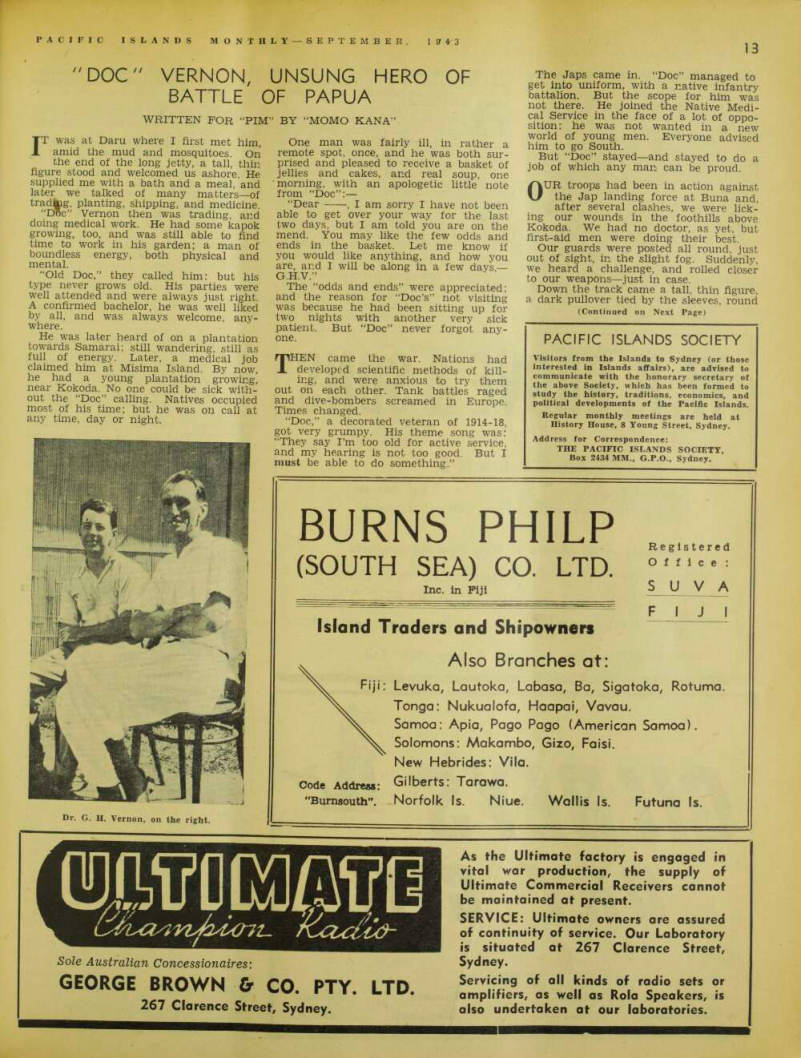
Battle Of Papua
Written For “Pim” By “Momo Kana”
IT was at Daru where I first met him, amid the mud and mosquitoes. On the end of the long jetty, a tall, thin figure stood and welcomed us ashore. He supplied me with a bath and a meal, and later we talked of many matters—of trading, planting, shipping, and medicine.
“Doc” Vernon then was trading, and doing medical work. He had some kapok growing, too, and was still able to find time to work in his garden; a man of boundless energy, both physical and mental.
“Old Doc,” they called him: but his type never grows old. His parties were well attended and were always just right.
A confirmed bachelor, he was well liked by all, and was always welcome, any where.
He was later heard of on a plantation towards Samarai; still wandering, still as full of energy. Later, a medical job claimed him at Misima Island. By now, he had a young plantation growing, near Kokoda. No one could be sick with out the “Doc” calling. Natives occupied most of his time; but he was on call at any time, day or night.
One man was fairly ill, in rather a remote spot, once, and he was both sur prised and pleased to receive a basket of jellies and cakes, and real soup, one morning, with an apologetic little note from “Doc”: — “Dear , I am sorry I have not been able to get over your way for the last two days, but I am told you are on the mend. You may like the few odds and ends in the basket. Let me know if you would like anything, and how you are, and I will be along in a few days
G.H.V.”
The “odds and ends” were appreciated: and the reason for “Doc’s” not visiting was because he had been sitting up for two nights with another very sick patient. But “Doc” never forgot any one.
THEN came the war. Nations had developed scientific methods of kill ing, and were anxious to try them out on each other. Tank battles raged and dive-bombers screamed in Europe.
Times changed.
“Doc,” a decorated veteran of 1914-18, got very grumpy. His theme song was: “They say I’m too old for active service, and my hearing is not too good. But I must be able to do something.”
The Japs came in. “Doc” managed to get into uniform, with a native infantry battalion. But the scope for him was not there. He joined the Native Medi cal Service in the face of a lot of oppo sition: he was not wanted in a new world of young men. Everyone advised him to go South.
But “Doc” stayed—and stayed to do a job of which any man can be proud.
OUR troops had been in action against the Jap landing force at Buna and, after several clashes, we were lick ing our wounds in the foothills above Kokoda. We had no doctor, as yet, but first-aid men were doing their best.
Our guards were posted all round, just out of sight, in the slight fog. Suddenly, we heard a challenge, and rolled closer to our weapons—just in case.
Down the track came a tall, thin figure, a dark pullover tied by the sleeves, round (Continued on Next Page)
Dr, G. H. Vernon, on the right.
its neck, a white triangular bandage held in each hand, filled with instruments, antiseptics and dressings. It was “Doc.”
“I heard that there was some action here and no doctor so I thought I might be able to help until others come,” he said. “Now, where do we start.”
He had walked the Owen Stanley Range alone. Camping at staging camps, and borrowing food and blankets, without natives to guide or help him, it was a marvellous thing he chd He looked out over Kokoda, and pointed out his young rubber trees, and speculated on the outcome of the next year.
We went back to Kokoda the next day, to battle for it against the oncoming Japs. “Doc” came along, and found a spot to rest. After tea, he went to sleep, and when our first casualties came along, he had to be awakened. Mortars and machine-guns had been firing for hours, but he had slept through it all.
His view of it was: “Well, it’s just as well
to be a bit deaf sometimes. You can hear too much, you know.” A philosophic way of taking an affliction which many would have cursed.
THE RAP was in a building towards the centre of the fortress area. When the Japs came on in force, bullets swished through the grass roof, and thudded into the walls.
To get instruments, the orderlies had to crawl out of the sheltered dressing- • room (at one time the hallway, and pro tected by a room on each side) and trust to luck in not getting hit. As “Doc” operated, pieces of grass, cut by bullets, dropped from the roof; but the “Doc,” who could not hear them, only looked up occasionally, and methodically continued to work.
Splinters flew from the walls at times.
Ricochets screamed. Mortar bombs ex ploded round about, regularly. But “Doc” went on, calling for probes and needles and dressings, until the order came that
we had to get out. Superior numbers had breached our linos. The wounded were got away, and the orderly told “Doc.” ‘‘Oh, all right. I’ll just wash my hands.
I’d like to go to the house and get some of my things.”
There was a machine-gun post there — but it was the enemy’s, and was only 30 yards away.
“Doc” washed his hands and, in spite of urgent and repeated howls from the orderly, proceeded methodically to dry them. He gathered up a few thing% and stalked off up the trail. Bullets were flying through the rubber trees—for tunately, all high.
At the meeting point, a few hundred yards back in the rubber, we looked in vain for the “Doc.” One of the troops said: “I saw him going back to the front.
He said there may be some wounded there to look after.” “Doc” came out later —with the last of the men—still cool, calm and collected.
A LITTLE later, at Deniki village, we looked our casualties over.
One man had to have a bullet removed from his knee. “Doc” gathered his assist ants round him, carefully shaded the man’s face from the sun, patted him on the shoulder, and gave instructions to hold him down. The knife flashed, the bullet popped out, the patient squirmed.
“Doc” bandaged him up, patted him on the shoulder, gave him the bullet as a souvenir. “You’ll be all right, lad. Just take matters easy for awhile.” And he passed on to v the next man.
He thoughtfully asked one of his assistants: “Were those bullets that were knocking the grass down from the roof in Kokoda?”
“Hell!” was the answer. “I’ll say they were —millions of them.”
“Well,” said “Doc,” “at first I thought it was rats. But when big lumps came down I guessed what it was. Of course, there was no danger, as they were all high, but it is an advantage to be deaf sometimes, I might have been alarmed if I had heard them!”
“pwoC” stayed with us for a few days, U and then went back, when other Army doctors began to arrive, with all their equipment and orderlies. But vou could see that he would have liked to have stayed. He said, as he looked over towards Kokoda and sniffed the air, like a warhorse: “If you want me I won’t be far away. Just send word along the line.” , , , ...
“Doc” started a number of hospitals for the Fuzzy Wuzzies who were carrying along the Kokoda line. He was always as close to the front as circumstances permitted, and sometimes his tall, spare figure could be seen on the track, tend ing a wounded soldier.
Nothing was too much trouble for him.
The Australian soldiers spoke of a tall, thin, deaf man who met them on the track at various places, always carrying a small haversack, and who always walked off rapidly after tending to their hurts; who smoked large—very lafge— cigarettes, rolled in any paper available, and made of any tobacco available; who never failed to have a cheery word: and who looked at bandages and dressings, and generally helped at any time, at any place. . . They would describe his talk to ms native orderly: “Now, you stay beside me while I fix this boy up. Don’t be fright ened if you hear the bullets cracking, because they have gone then and wont hurt you. Do you savvy?” The boy stayed, and stood beside the “Doc” whne a wound was cleaned and dressed: and (Continued on Next Page)
he looked proud to be beside the loved “Dokita.”
A native with a bruised shoulder came along. “Doc” put a pad on it, and put the sore shoulder off duty, and the other one was given double duties. The boy looked puzzled but pleased, and went back to work. “Doc” went back, looking for something more to do.
EVENTUALLY, the retreat stopped and we began to forge ahead, back over the Owen Stanleys.
“Doc” went with us. The carrier-line was his job, and he had a big one. Hos pitals sprang up overnight and “Doc” did more work than ever.
Back to Kokoda, to Oivi, to Wairope, and the “Doc” followed along. Then came Sanananda, and Gona, and Buna.
“Doc’s” tall figure strode the tracks, going from one place to another. He slept seldom, he walked miles, with his long, rapid strides. All natives knew him, and most troops, also.
Men will talk for years of “Doc” Ver non—that tall, deaf doctor who operated under fire, who gave them a smoke, who put new dressings on, who gave them a cup of tea and biscuits, and helped them along with a cheery word. They mar velled at his energy and kindness.
Sometimes he wore his captain’s rank.
But if there was no time to put it up, “Doc” just went along without any insignia.
BUNA fell, Gona and Sanananda fol lowed. “Doc” stayed on; but even tually he was ordered to Moresby for a while.
He did a round of his hospitals before leaving, and at one spot, an amazing incident occurred. Several Army doctors were there, and a native was very sick.
He had lost heart, and the will to live.
It was not a Papuan, but a lad from New Guinea whom the Japs had brought down. I knew his type of old, and his place. The Army doctors had done all they could. The rest was up to the patient.
“Doc” Vernon came. He looked at the boy, spoke to him, and patted him. The boy’s arms went round “Doc’s” neck, and he cried:— “Oh, Dokita! Me like you stop close up sick belong me finish. Suppose you go me I die finish.”
The “Doc” stayed beside him, and the boy recovered sufficiently to be out of danger within three days. It was more than medicine. The man’s personality, and the faith the natives had in him, were the explanation. The Army doctors were surprised, and looked it, too. “Doc” took it as a matter of course.
SO here’s to “Doc” Vernon, unsung hero of the Battle of Papua, who asks no more than a new plant, a new life, a life saved, a good book, a pleasant story, a good deed, a nice garden—and a piano to play.
“Doc,” we know your shadow already is attenuated—but may it never grow less! We know how you loathe publicity, and that you will not be pleased at this eulogy: but you have earned a place in the sun.
May New Guinea, after the war, have many men like “Doc” Vernon to carry on—taking the good with the bad. never growling or grumbling when overlooked or snubbed—just carrying on under all circumstances and still doing a good job.
Mr. R. T. G. Patrick, of the Prime Minister’s Department, at Wellington, arrived in the Cook Islands in June. Mr.
Patrick, until recently, was representative of New Zealand in Tahiti.
Advertisements & other items, pp. 15-16 (1 item)
Burns Philp
PACIFIC ISLANDS SOCIETY
Visitors from the Islands to Sydney (or those interested in Islands affairs), are advised to communicate with the honorary secretary of the above Society, which has been formed to study the history, traditions, economics, and political developments of the Pacific Islands.
Regular monthly meetings are held at History House, 8 Young Street, Sydney.
Address for Correspondence:
THE PACIFIC ISLANDS SOCIETY,
Box 2434 MM., G.P.0., Sydney.
BURNS PHILP
(SOUTH SEA) CO. LTD.
Inc. in Fiji Island Traders and Shipowners Registered Office :
SUVA
FIJI
\Also Branches at: Fiji: Levuka, Lautoka, Labasa, Ba, Sigatoka, Rotuma.
Tonga: Nukualofa, Haapal, Vavau.
Samoa: Apia, Pago Pago (American Samoa).
Solomons: Makambo, Gizo, Faisi.
New Hebrides: Vila.
Code Address: Gilberts: Tarawa.
“Bumsouth”. Norfolk Is. Niue. Wallis Is. Futuna Is.
Sole Australian Concessionaires :
GEORGE BROWN Cr CO. PTY.
267 Clarence Street, Sydney.
As the Ultimate factory is engaged in vital war production, the supply of Ultimate Commercial Receivers cannot be maintained at present.
SERVICE: Ultimate owners are assured of continuity of service. Our Laboratory is situated at 267 Clarence Street, Sydney.
Servicing of all kinds of radio sets or amplifiers, as well as Rola Speakers, is also undertaken at our laboratories.
W. H. GROVE & SONS
Limited
AUCKLAND
Island Traders. PO - Box 49 °- Telegraphic and Cable Address: “Grove”, Auckland.
Shippers of all classes of New Zealand products.
Representing English Manufacturers throughout the Cook and Society Islands, Fiji, Tonga, Samoa, Niue, New Caledonia, New Guinea, etc.
In FIJI as—W. H. Grove Cr Sons (Fiji) Ltd.
MBITS
DRY BIN
Distilleries at London , , . England Toronto . . . Canada Moorabbin . . Victoria Cincinnati . . . U.S.A.
Crime In Rarotonga
From Our Own Correspondent
Rarotonga, July 27.
A BRUTAL attack by a native youth on a European girl, 13 years old, occurred recently in Avarua, Raro tonga. The boy was sentenced to seven years’ imprisonment.
During the past few months an unusual number of cases of rape and carnal knowledge of girls under age (15 years) have been before the Court. Whether these are merely coincidental, or reflect a definite trend towards instability is difficult to say. Most of the offences have been committed in a manner which throws doubt on the mental balance of the offenders; but it is clear that plain cases of hooliganism must be punished with severity. The record of Cook Islands natives has heretofore been singularly good in this respect.
Rationing Austerities
rE austerities of Fiji “rationing” are not without their relieving humour.
We were rationing out the company’s small stocks of kerosene. Timoci, the butchery ice-plant boy, was late for his share, and was out of luck. An oil less, light-less night was his.
Next morning, I sent to the butchery for some ice. The butcher was away, sick; Timoci, importantly, was in charge.
Timoci served a few customers before coming to my boy, who waited his turn.
Recognising my humble servitor, Timoci asked: “What you want, Toni?”
“One shilling ice for Mr. Jones,” said Toni.
“Ice, for Mr. Jones! You tell him to go to hell! Me no get no kerosene, he get no blurry ice!”
So our “rationing system” rolls on.— A.R.
Advertisements & other items, pp. 17-18 (1 item)
Burns Philp Trust
that
V'HE
Estate Administration
demands
specialized knowledge
Friendship is not a qualification for executorship. With the best intentions in the world, your friends are not necessarily the most competent people to be entrusted with the administration of your affairs in the best interests of your beneficiaries. Do not burden them with unfamiliar tasks. Place the responsibility where it belongs—in the hands of Burns Philp Trust Company Limited, where your estate will have the advantage of the -cumulative experience and specialized experience of competent directors and capable executives. Ask for particulars of the service we offer.
Jamet Burnt Lawit Armttrong
DIRECTORS;
MANAGER-C. H. Chatter.
Robert John Nosworthy Joteph Mitchell
Burns Philp Trust
COMPANY
LIMITED
7 BRIDGE STREET, SYDNEY
PHONE: B 7?0I.
Box 543 B. G.P.0., Sydney.
BP 40-43
The Standard oj Excellence
Kf.RS LW“' U ”
V a l4
COMPOUNDED FROM PURE FRUIT
EXTRACTS AND HIGH-CLASS
MATURED SPIRITS.
IN 15 FLAVOURS
Advocaat, Red Curacoa, White Curacoa, Parfait Amour, Maraschino, Chartreuse, Apricot Brandy, Cointreau, Cherry Brandy, Creme de Menthe, Creme de Cacao, Peach Brandy, Creme de Banana, Kummel, Friars' Liqueur.
TRADE ENQUIRIES TO BOX 3373, G.P.0., SYDNEY.
LAVEX
The Oxygened Washing Compound
Wonderful for the Wash ... Harmless to the hands
NON-INJURIOUS TO THE FINEST FABRICS
packed in cartons containing 48 x Boz. pkts.
TRADE ENQUIRIES TO BOX 3373, G.P.0., SYDNEY.
C. SULLIVAN & CO.
GENERAL MERCHANTS ISLANDS AGENTS
REPRESENTING LEADING FIRMS IN THE PACIFIC ISLANDS.
Islands Produce sold on Shippers’ Account—Liberal Advances against Consignments.
Buyers of all Islands’ Requirements on Commission—Original Invoices Furnished.
Bankers : Bank of New South Wales .. Bank of New Zealand .. Comptoir National d’Escompte de Paris.
Wartime Cable Address; Sullivan, Kentstreet, Sydney.
379 KENT STREET, SYDNEY, N.S.W.
Planting Industry
Cook Is. Economics
Plan for Restoring Planting Industry
From Our Own Correspondent RAROTONGA, August 2.
SEVERAL Island Council and Fruit Advisory Committee meetings have been held in Rarotonga recently, with the advent of Mr. R. T. G. Patrick, of the Prime Minister’s Department, at Wellington. Matters under discussion in cluded:— Plans for the replanting of the island in citrus and bananas.
Secondary industries.
Parliamentary representation in New Zealand.
A committee was set up to investigate the great obstacle to the Citrus Replant ing Scheme, which is the communal ownership of land. It is not proposed to tamper with the actual system of land tenancy, but it is the aim of the Administration to helo any person, who wishes to plant citrus, to procure suitable land on suitable terms. It has been found that native planters quickly lose interest in a nlantation where dispute has arisen over the ownershin of the land.
Although in most cases the land is still held communally, enterprise has become individual.
The planting of bananas, being a short term crop, is not so difficult, and a further scheme has been put forward, similar to that which produced such satisfactory re sults last year. During 1942, more bananas were planted in Rarotonga than for many years, and rising quantities for export were expected. Unfortunately, the hurricane of March 10, 1943, completely destroyed these plantations—hardly a ripe banana has been seen on the island since.
A relief plan was adopted at the Island Council meetings, and it is now an nounced that, following Mr. Patrick’s investigations, this to a large extent has been approved by the New Zealand Government.
The banana-planting season starts in September and, unless action is taken soon, it seems probable that native growers will be more interested in pro ducing hula skirts and the like, than in growing bananas at 5/- a case, a price which they are convinced does not retheir fair share. (See “PIM” of May, 1943—“ Fiji and Samoa Banana Ex ports.”) SECONDARY agricultural industries which might prove profitable are the production of arrowroot, pieri (dried bananas), and kumaras. Coffee grows well in the Lower Cook Group, and might be developed to help alleviate the present shortage in New Zealand.
The old question of representation in the New Zealand Parliament has again been raised. Europeans who now have to pay income tax to New Zealand feel that it is a case of taxation without represen tation. The Maoris would be interested in being able to elect their own Island Council. At present, nearly all the Maori members are nominated, and- for life at that.
A Rubber Control Board has been set up in Rarotonga for the rationing and conservation of tyres and tubes. Cotton goods, also, have been scarce for the last year and, although only light clothing is necessary in this climate, many of the poorer natives—particularly those in the outlying islands—are already short.
Origin Of "Kanaka"
Letter to the Editor I AM reading a book by Mr. Marshall, who, with'Wally Hook, travelled over some parts of what was German New Guinea; and one thing I note: he gives his version of the word “kanaka” (which by the way, I thoroughly detest) and states that it is the name given to the natives of the Sandwich Islands. This is wrong. The name is a mutilation of the Samoan word “tanata,” meaning boy. In our slovenly manner of talking, the letter “k” has been introduced into all Poly nesian words, much to their detriment. I refuse to use the word, and wherever I can I drop the “k” and give the word its proper letter “t.” In Apia, one is most conscious of this “slur.” We had a maid, whose name was Sigefu. When she wanted a ride in the “Tauvale” she would always ask if she could ride in the “Kauvale.”
I am, etc.,
J. Nixon-Westwood.
Sergeant-Pilot Basil Chalmers, second son of Mr. and Mrs. N. S. Chalmers, of Fiji, was married recently in Southern Rhodesia to Miss Pax Richards-Edwards, of Bulawayo. He left Fiji 2£ years ago. with the first recruits for the RAF, and is now a pilot instructor at one of the flying schools in Rhodesia.
Death Of Mrs. Hannah
M. Chance
rE death occurred in Brisbane on August 15 of Mrs. Hannah M Chance, wife of Mr. Sydney M Chance, well-known Papuan RM, who is on final leave prior to retirement. Mrs Chance, who was well-known' and highly esteemed—she had lived at Samarai Daru, Kikori, Kokoda and Port Moresby— was only 51; but she had been in ill health for some years. She was bitten by a cat at Kikori in 1926, and con tracted therefrom an obscure fever—her case being only the fifth of its kind known to medical science. The funeral was attended by Messrs. Wurth, McAlpine and Healey (prominent members of the Papuan Public Service), and by represen tatives of the RSAILA—the latter being a tribute to a lady who, in 1914-18, in northern New South Wales, used her splendid soprano voice to raise thousands of pounds for the Australian Comforts Fund.
Mr. M. I. Harper, well known during many years as a planter and trader in the Solomon Islands, is now a Warrant- Officer of the RANK, and is serving in the United States Navy. He has been through some interesting experiences dur ing the past 12 months.
Advertisements & other items, p. 19 (1 item)
Chi Ver
PRESCOTT Pty. Ltd.
SUSSEX ST. SYDNEY,
ore sole wholesale agent* for
PINEAPPLE BACON&HAMS
DAISY brand BUTTER "375" BUTTER in TINS Ilb.-21b.-slb. Sizes.
LEA & PERRINS’ Sauces and Most other Super-Quality Lines of the Trade, such as Cheese, Eggs, Etc.
CHI VER
FAMOUS ENGLISH PRODUCTS
CANNED ENGLISH VEGETABLES
CANNED ENGLISH FRUITS
OLDE ENGLISH MARMALADE
GOLD MEDAL JAMS
JELLY CRYSTALS, ETC.
Obtainable from all leading Grocery Stores
WRITE TO DEPARTMENT “A”
CHI VERS & SONS LTD.
Hitton, Combs., Eng.
FOR ATTRACTIVE RECIPE BOOK
c< nn>
CHWERS
COLD
STANDARD
FRESH
i INGUSH A
PEAS
Bananas And Black
Piracy
Fijian Grower and NZ Consumer
'T'HE charge that, while the New Zea * land public paid from 55/- to 58/per case for Fiji bananas, the Fiji grower received only 4/- per case, and the middleman 10/4 per case, was made in the June issue of the “PIM.”
The statement was published in “The Dominion” (Wellington , NZ), on July isl and the following appeared in ‘“The Dominion” of July 14: — REFERENCE to an article concerning costs on Fiji bananas extracted from the “Pacific Islands Monthly” and published in yesterday’s “Dominion,” was made last evening by the Minister of Marketing, Mr. Barclay. He said that while to a degree some of the statements were correct, there were many import ant matters which had either wittingly or unwittingly been omitted by the “Pacific Islands Monthly.”
“Your article states that the price paid by this Government to Fiji is 10/4 a case, but the actual price is 10/5£ Fijian currency, which means 11/8J in New Zealand currency, thus bringing the cost at Auckland to more than the estimated 17/6,” said the Minister. “The Internal Marketing Division has no say at all in regard to the amount paid by shippers to. the growers for their fruit, which your authority states is 4/- a case.
“The selling price in Auckland (25/- a case) can only seem high by neglecting the fact that this Division sells bananas at the same price in the four main centres in New Zealand and that owing to war conditions and shortage of ship ping it is necessary to incur high charges
for railage and coastal freight, and at the present time all bananas sold in the South Island show a loss to the Division even if they all realise the full green price. After making allowance for wast age, damage and shrinkage in long rail and shipping journeys to the South Island, it is easy to see that selling under cost is unavoidable. The average margin over costs on all bananas handled by this Division last year was slightly over 1/a case.
“The correspondent bases his sugges tion of high retail prices on the case of Fiji bananas containing 90-100 lb. of fruit, whereas the last check weighing made in Auckland revealed the fact that the gross weight of Fiji bananas on arri val was 97 lb. a case. From this must be deducted 14 lb. for the weight of the case, leaving 83 lb. of green fruit at the most. It is very seldom that the retailer receives 83 lb. of good fruit, as there is often a certain amount of damaged and unsalable fruit and of late the Fiji bananas have contained a good percent age of waste fruit. As it is necessary to ripen the bananas before being sold retail, this incurs further losses not only in unsalable fruit but also shrink age in weight, and it is doubtful if a retailer receives much more than 70 lb. of ripe salable fruit out of a case—quite a difference from the 90-100 lb. men tioned by the ‘Pacific Islands Monthly.’
“It is also stated that the Fiji bana nas are repacked into smaller cases in New Zealand, but this is contrary to fact, as less than 5 per cent, of the importation are ripened on behalf of the Division and even when bananas are ripened standing instructions are given to agents to repack the fruit into the original-sized cases.”
EDITORIAL NOTE; The foregoing may interest Fiji growers: but it will neither comfort nor reassure them. We do not know where or how to allot the
blame: but we are inclined to believe, with the Fiji growers, that there is black piracy somewhere between the 4/- Fijian received by the grower, and the 56/- NZ (equal to about 49/- Fijian) paid by the consumer. The “racket” that is worked against primary producers the world over is epitomised in that 45/- Fijian per case, which dis appears somewhere between the miser ably underpaid Fijian banana-grower, and the grossly over-charged NZ banana eater. The NZ Minister merely tries to soothe. He certainly does not explain what becomes of that 45/- Fijian.
The “Fiji Times,” in recent articles, has shown that if the Fiji export indus try in bananas is to be preserved—and it certainly should be—some greater help must be given to the growers. The lat ter are suffering under new and severe handicaps—especially the higher costs of transport within Fiji, the growing scar city and higher costs of labour, and the difficulty of obtaining banana cases.
Even under old conditions, 4/- per case was a poor return: under the new war time conditions, the price is impossible.
Fiji seems to be, at present, New Zea land’s only large source of banana-sup ply: and it is a shocking commentary upon bureaucratic inefficiency that, while NZ is prepared to pay so much for bananas, the Fiji banana-grower is being allowed to die of price starvation. This is the sort of thing that makes Bolshe viks out of sober and decent citizens.
Mr. V. H. Almao, transport officer at Rarotonga, resigned and left for New Zealand in June with his family.
Mr. B. Russell arrived in Rarotonga re cently as local manager for the Union Steamship Co. accompanied by Mrs.
Russell. He was previously purser on several Union Co. steamers.
Advertisements & other items, p. 20 (1 item)
Years
rv la SL i
89 g s^> !*• 4 3
ABIE LI
SWALLOW
3 let cm iitiiei ici Ctdl •itcaiii pm r 0 B O
MIIIIS
'IV •< ' Sv. l V.\i J >4VUL 111 u iiAJLvtlxLv -JL> /j;
Souvenirs Boom
New Industry in Central Pacific
From Our Own Correspondent
Rarotonga, July 27.
ISLANDS shell necklaces, which were so popular in Australia and New Zealand recently, are again in great demand.
The fashion has now extended to Fiji and other Pacific islands, and to the United States, which provide a practic ally insatiable market. The manufacture of cheap jewellery being now blacklisted in all the warring countries, the femi nine desire for titivation must needs be satisfied with simple shell necklaces and the like. Those of better quality, more over, are extremely varied and pretty The commercial manufacture of neck lets has now spread from Rarotonga to other islands in the Lower Cook Group, and there is keen competition among local buyers for the trade. The prices paid to the women and children who per form the work average out at about 7/a dozen of 30-inch necklets. Considering that these, usually re-strung on arrival, fetch anything from 2/6 to 7/6 each at their destination, it appears that the struggling middlemen still manage to keep body and soul together.
Another branch of the souvenir indus try enjoying a temporary boom is the production of hula skirts. These are made from the bark of the “au” tree (Tahitian “purau”—Samoan “fau”). The bark is first stripped from the young shoots of the tree, which grows prolific ally in the mountain valleys; then this is pinned by stones in a mountain stream, or the sea, for a week, finally being sun-dried, woven and coloured to make a genuine Islands hula-skirt, of fine texture and brilliant colouring. The “beach” price, which before the war was 2/6 apiece, has now risen to 5/-, with a probable further increase.
Pretty pearl-shell ornaments and brooches, depicting fish, palm-trees or “tiare Maori,” are being turned out by Mr. R. Powell, a local craftsman, in a small factory at Avarua. These are of high quality and sell readily at about 9/- each.
All of the articles mentioned are of entirely native design and are genuine Islands products. Consequently, they are not vulgar or bizarre, for the Maori is instinctively artistic in his work.
It seems likely that the export of pearl shell from Penrhyn and other lagoons will again be resumed. The trade which, together with pearls, was worth over £lO,OOO to Penrhyn alone in 1926, col lapsed late in the twenties.
There is no doubt that Rarotonga and other islands are being tided over a diffi cult period by these industries. The export of fruit since the hurricane of March last has been negligible.
But a note of warning would be timely.
The export of souvenirs is a mushroom industry and will die almost as quickly as it grew. It would be disastrous to the natives’ welfare if food and fruit plan tations were allowed to be neglected, for less dependable work.
Captain C. E. Traise, formerly of the AUSN Company, and well known to New Guinea and Papuan people, died recently in Brisbane, aged 79. He was one of the few survivors of the “Quetta” wreck which occurred in Torres Strait in 189 o!
He swam for four hours before being
picked up.
Advertisements & other items, pp. 21-22 (1 item)
Horlicks
■ Y APPOINTMENT
Horlicks is Ideal
for Emergency Rations
For emergencies, with the addition of water only, Horlicks is a complete food, providing warmth and energy, body-building and tissue-repairing material.
Even after it has been opened Horlicks will keep in perfect condition indefinitely if the top is firmly replaced.
It would be difficult to find a more valuable food to keep by in case of emergency.
HORLICKS
Modern Refrigeration for the South Sea Islands
The ELECTROLUX KEROSENE OPERATED
REFRIGERATOR
MARVEL
OF
MODERN
SCIENCE
THE
MIRACLE
OF
ICE
FROM
HEAT
ELECTROLUX OFFERS ECONOMICAL, modern and completely efficient
REFRIGERATION FOR ISLANDS' HOMES.
FREEZES CONTINUOUSLY WHILE SMALL LAMP BURNS.
Freezing controlled by simply regulating height of flame. Uses only f gallon of kerosene per week. * MOTORLESS ... NO PARTS TO GET OUT OF ORDER.
MODEL L 22
Capacity 2.2 cubic feet.
MODEL L3BO
* (as illustrated) Capacity 4 cubic feet.
MODEL LKSSO
Capacity 5.5 cubic feet.
GUARANTEED FOR TWO YEARS.
• Write to your Local Distributor for prices and full details.
OBTAINABLE FROM ALL W. R. CARPENTER fir CO. LTD.
BRANCHES THROUGHOUT THE ISLANDS
Representation in Papua and New Hebrides.
Oyer The Owen Stanley Mountains
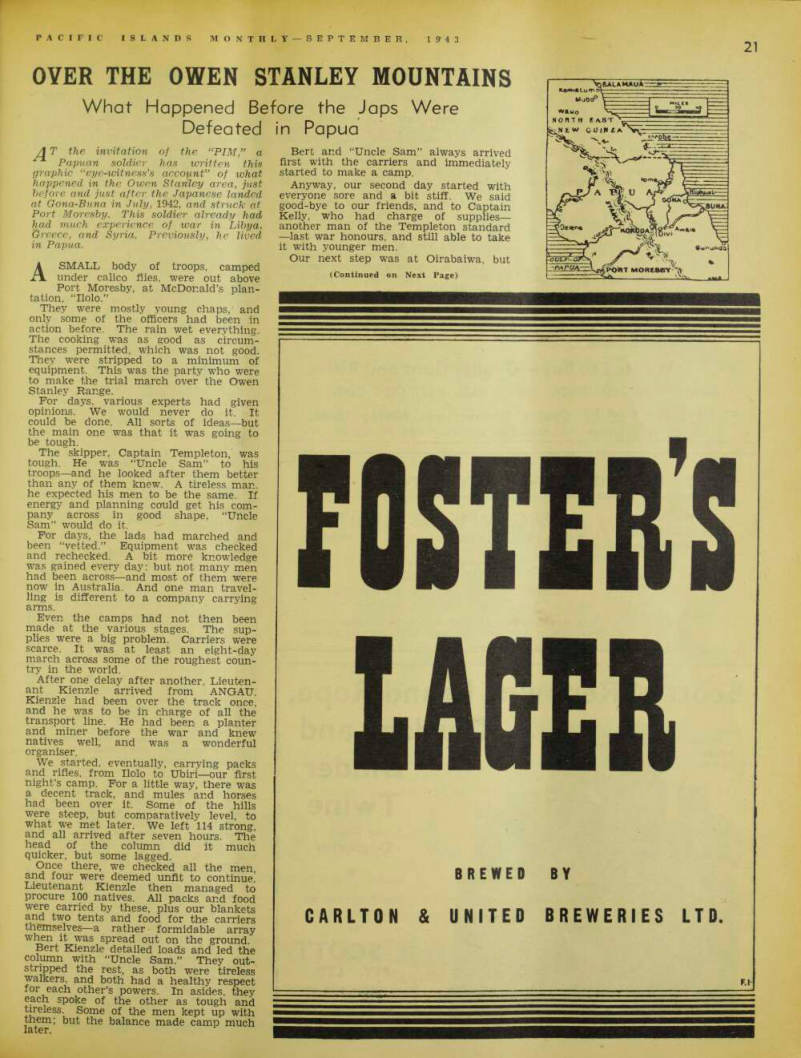
What Happened Before the Japs Were Defeated in Papua
/X T the invitation of the “PIM,” a Papuan soldier has written this graphic “eye-witness’s account” of what happened in the Owen Stanley area, just before and just after the Japanese landed at Gona-Buna in July, 1942, and struck at Port Moresby. This soldier already had had much experience of war in Libya, 'Greece, and Syria. Previously, he lived in Papua.
A SMALL body of troops, camped under calico flies, were out above Port Moresby, at McDonald’s plan tation, “Ilolo.”
They were mostly young chaps,' and only some of the officers had been in action before. The rain wet everything.
The cooking was as good as circum stances permitted, which was not good.
They were stripped to a minimum of equipment. This was the party who were to make the trial march over the Owen Stanley Range.
For days, various experts had given opinions. We would never do it. It could be done. All sorts of ideas—but the main one was that it was going to be tough.
The skipper, Captain Templeton, was tough. He was “Uncle Sam” to his troops—and he looked after them better than any of them knew. A tireless man. he expected his men to be the same. If energy and planning could get his com pany across in good shape, “Uncle Sam” would do it.
For days, the lads had marched and been “vetted.” Equipment was checked and rechecked. A bit more knowledge was gained every day: but not many men had been across—and most of them were now in Australia. And one man travel ling is different to a company carrying arms.
Even the camps had not then been made at the various stages. The sup plies were a big problem. Carriers were scarce. It was at least an eight-day march across some of the roughest coun try in the world.
After one delay after another, Lieuten ant Kienzle arrived from ANGAU.
Kienzle had been over the track once, and he was to be in charge of all the transport line. He had been a planter and miner before the war and knew natives well, and was a wonderful organiser.
We started, eventually, carrying packs and rifles, from 11010 to Übiri—our first night’s camp. For a little way, there was a decent track, and mules and horses had been over it. Some of the hills were steep, but comparatively level, to what we met later. We left 114 strong, and all arrived after seven hours. The head of the column did it much quicker, but some lagged.
Once there, we checked all the men, and four were deemed unfit to continue.
Lieutenant Kienzle then managed to procure 100 natives. All packs and food were carried by these, plus our blankets and two tents and food for the carriers themselves—a rather formidable array when it was spread out on the ground.
Bert Kienzle detailed loads and led the column with “Uncle Sam.” They out stripped the rest, as both were tireless walkers, and both had a healthy respect for each other’s powers. In asides, they each spoke of the other as tough and tireless. Some of the men kept up with them; but the balance made camp much later.
Bert and “Uncle Sam” always arrived first with the carriers and immediately started to make a camp.
Anyway, our second day started with everyone sore and a bit stiff. We said good-bye to our friends, and to Captain Kelly, who had charge of supplies— another man of the Templeton standard —last war honours, and still able to take it with younger men.
Our next step was at Oirabaiwa, but (Continued on Next Page)
all that was there was one tent. However, after struggling up the longest hill I had seen to date, we came to the top.
It took hours to go up, and there were so many false tops. At some places one had to use hands and dig toe-holds to scramble up. We learned to appreciate a long staff that day.
Rifles began to weigh tons and ammunition wore ribs raw. Webbing and haversacks got heavier as we sweated and swore. Later, steps were put m on all those hills.
By the time the last of the column arrived, the natives, under the driving power of Bert Kienzle, had enough huts erected to house us all. Rain started at 5 p.m. and continued steadily all night: but a reasonably dry night was had by * ' THE air was chilly, and bones and muscles ached; but every man was on deck in the morning. Several cases of diarrhoea had developed, due to
the terrific strain. But we all left early, scrambling and sliding down a precipi tous mountain-side to a rushing stream.
Again we climbed and climbed until, it seemed, hours later, we looked back and there in plain view, only a mile or so away, was our camp of last night. How close it was, and yet how many hours we had spent getting here from it.
Then came a dreary trudge for hours, W e ate and went on. Water bottles became empty and there was none to refill with. We were right on the top of a huge ridge. Several men had to be relieved of their loads, and one had to be carried, owing to leg cramps, 0 , .. c J s h e wouM tave the would have been over ri g ht away as soon as one stopped, a small native bee swarmed all over pne, sucking up the salt from the perspiration.
Then we started down, and slid, and scrambled. Knees, which had stood up
to the climbing, now let men down unexpectedly. Some natives came back and helped the sick along.
And then back came “Uncle Sam,” looking fresh and cheerful, and he car ried some of his men’s stuff along.
We reached Nauro, and it looked swell, nestling under a hill on the banks of a large creek. There was a man in charge here. Sergeant Osborne, and he had a good supply of native fruits and foods, so “Uncle Sam” decided to have a day’s spell. We really enjoyed it; and the lads showed the benefit of it.
WE left the next morning, leaving one man to follow later. A stop was made at Menari for lunch—another very pretty little spot. The morning’s walk was not too bad, but it was only a saunter to the afternoon, when we made Efogi.
Sergeant Jarret was here, and cover for troops was available. The camp was on the end of a spur between two creeks.
Later, much later (when we had come back over that track and the Japs had followed us), some of us saw our planes do the best bit of strafing and bombing here I had ever seen, blowing the houses up and flying up and down mountain sides and up creeks. One almost flew through the doorway of one house. It was a marvellous exhibition.
But back to our trek. From Efogi we could see Kagi. It looked close, but we were now used to the hills, and sus picious.
However, we made it by 11 a.m. the next day, and spelled up for the assault on the Gap itself, on the morrow. Kagi was on a spur and overlooked as far back as Moresby. In fact, one could see the searchlights at Moresby. But in daylight the haze made objects at that distance indicipherable.
LIEUTENANT Brewer, from Kokoda, was at Kagi, to guide us over. It was one of the coldest nights we had so far experienced, and “Uncle Sam” gave the lads some rum. Captain Ste venson (second in command) was bar man, and “Stevenson’s Mountain Brew” was reasonably popular. A mixture of limes, hot water, sugar and rum, it helped the lads to sleep.
On the morrow we tackled the much talked-of Gap. We climbed again for a few hours, and crossed over amid moss and rain. Vines and moss were every where. At times, one’s feet sank into it for several inches. The air was chilly and damp. Water dripped continuously, and the track was the worst to date.
We scrambled over moss covered rocks and swung from tree to tree, down into icy-cold streams; and scrambled round precipitous shoulders of the mountain, until at last the rushing of a large volume of water could be heard. Still sliding, we went down for, it seemed, hours: but we reached, at 1 p.m., Erora Creek, at what was later called Templeton’s Cross ing (after our commander), and lunched.
From here we went on for a further three hours, to another crossing on the same creek, and then we had to start in and make shelter for the troops. Materials were scarce, and ram and fog added to our discomfort; but we had crossed the Owen Stanley Range. The first troops over, but far from the last.
It was here that we heard the 6 o’clock bird for the first time. This bird whistles right on dusk every evening, and the effect is weird, with hundreds whistling away for five minutes or so.
The next day we left early, and had hoped to stop at Isurava; but shelters were no good, so we pushed on to a spot a few miles from Kokoda, below Deniki.
The whole Yodda Valley opened up before us at Deniki. Little did we dream, (Continued on Next Page)
as we gazed in almost awe at the miles of fertile country, that for most of us our next view from there would be under such different circumstances.
The following morning saw us at Kokoda, camped among the rubber trees, and “Uncle Sam” already was away reconnoitring the country. What a man! (Some time later, somewhere on the Owen Stanley trail, Captain Templeton (our “Uncle Sam”) went out alone along a jungle track, revolver ready, stalking a Jap. He never came back. Officially, he is “missing”; but we hope that he is a prisoner, somewhere. He fought in three wars, including the Spanish show.) WE. had not many supplies: but a boat was to go from Moresby to Buna with them. Away to Buna went “Uncle Sam,” again, with a corporal and a few natives; and five days later our automatic weapons and supplies began to dribble in.
Then, two days later, the Japs arrived at Buna. But that is another story.
Kokoda suited us, while we were there.
There was plenty of native fruit and vegetables and the men were in good shape. The climate was good. Mosqui toes were few. Housing was good. We had radio communication with the out side world. Life looked sweet—for a full week.
Rubber production was still going on and, apart from an occasional plane seen from afar, the war was far away. It was just as in piece-time, except for the khaki hats everyone wore. The native prisoners went out every morning from Kokoda calaboose, and were carefully locked up every night.
Lieutenant Brewer, as magistrate, had cases every day. Captain Grahamshaw, in charge of the area, arrived for two days and left again for Awala. Another tireless walker. Lieutenant Kienzle went back to organise the carrier-line. We recuperated.
SUDDENLY, the word came of the landing by Japanese at Buna and Gona.
At Kokoda, we sat and looked at the weary, unshaven man who brought the story. Behind him were the last 15 men who had arrived by plane, too late to get to Givi, where our troops had been fighting and had been surrounded. We knew some would get away; but the situation looked grim, indeed.
Well, all we could do now was to burn and destroy as much stuff as possible, and go back to a safer spot in the hills.
We were only few. Several miles away were some more men, covering the track—but so few. The natives had almost all left us. Some of the police
had also left, silently, for home, duty forgotten. The few left were real men.
Some of the Papuan Infantry Battalion natives and officers were here also—the best of the lot.
We almost 4 cried, as we consigned to the fire goods which we had been cry ing out for for months. They would only have fallen into Jap hands, if left.
Every man carried as much as he could.
Natives were loaded to capacity, and sent off in charge of a European.
At last, on the tick of 11 a.m., Colonel Owen said, “Let her go!’’ We set fire to the kerosene-soaked bundles and houses, and made our way regret fully through the 20-years-old rubber trees. Flames leaped, and explosions shook the air.
It was a sin—but what could we do?
Some stuff we buried, but time pressed.
ONE of our native police—a real old timer—was called Toi. He had been a policeman all his life and had grown old in the service. His skin was begining to look a trifle too large for him now as his flesh shrank.
Never before had Toi seen such waste, such a lot of stuff he had always wanted, just lying about waiting to be taken. Opportunity knocks but once.
Toi gathered up his spoils into four large bundles, which weighed about 2 cwt., and carefully swung them on sticks.
To our stopping-place was about four miles.
Toi started. His ancient knees wobbled
and his eyeballs protruded, but he advanced—slowly—a hundred yards, half a mile—and a spell. He took his jacket off and hung it on a stick. On again another half-mile, and Toi realised that he had to unload something. With tears in his eyes, he went through one bundle, (Continued on Next Page)
and finally he threw away a torn mos quito net into the bush!
Toi struggled on, for another spell; but the spells grew longer and the advance slower until at last the magistrate had to order him to leave two bundles. Toi cried, but he obeyed, and we reached Deniki. Once there, after a short spell, Toi disappeared and one hour later arrived with his two other bundles. He had been determined not to lose his goods. He was absolutely exhausted, and dropped like a log.
A number of our troops from Oivi had reached Deniki, and their clothing, after days of fighting, was in rags. I thought of Toi, and told him of the predicament the troops were in.
His bundles were a godsend—shorts, shirts, a few blankets, some hats and boots. We managed to get all the chaps reasonably well clothed from what we ourselves carried and" also, mainly, from Toi’s lot. A lot of troops owed a lot to Toi. and Toi was happy that he had again been of service to his white friends.
He smiled and slept content. * * * rpHE rest is history, well known to you.
X Our few units, vastly out-numbered, kept falling back, as the Japs came up the track from Buna to Kokoda, and then struggled on and reached the notorious Gap.
They were grim days, out there on the bleak, rain-sodden Owen Stanleys, with the over-confident little Japs pressing hard upon us, and trying to sneak around our flanks.
Deeds of heroism, without number, were performed, and we lost some fine officers and brave men. Our Colonel Owen was killed when directing a rear guard action. No one appears to have told how Papua’s one and only “Doc”
Vernon, ignoring Jap snipers, crawled forward to where the officer lay. “Doc” and a couple of men brought back his body.
The Japs came right across the moun tain tops, to loribava, in sight of Central Papua and Port Moresby, before the Australians struck back. That was in September, 1942. By the end of the year they had been driven into the sea, at Buna and Sanananda.
Advertisements & other items, pp. 23-25 (1 item)
Fosters
I ACER
BREWED BY
CARLTON & UNITED BREWERIES LTD.
o->
Wanted to Buy—Quality Guns and Rifles
HIGHEST PRICES GIVEN. WILL ALSO EXCHANGE GUNS.
SI L RO H U Quality Firearms and Fishing Tackle. 143 ELIZABETH STREET (Near Market St.) SYDNEY. ’PHONE: MA 3540.
Ship Chandlery Hardware
/Write for j
Ship Chandlery /
Catalogue J
BROOMFIELDS LIMITED
152 SUSSEX STREET :: SYDNEY.
Cables: “Boom”, Sydney.
Special “In Bond” Prices for all Islands enquiries quoted on application.
Sole Agents for; Large and Complete Stocks of
SHIP CHANDLERY
IRONMONGERY OF ALL KINDS, PAINTS,
WHITE LEAD AND OILS.
P. H. MUNTZ & CO.’S 3-CROWN BRAND METAL SHEATHING.
PEACOCK & BUCHANS’ ENGLISH READY-MIXED PAINTS.
Scott’s “Renown” Brand Rope,
Cordage and
Binder
Twine
Cable Addreu: Ropeyard, Sydney.
of Every
Description
MANUFACTURED AT
MASCOT. N.S.W.
J. SCOTT
PTY. LTD.
Head Office and Store:
163 CLARENCE STREET,
SYDNEY,
N.B.W.
ISLANDS
SOUVENIRS
Popular Islands Shell Necklaces and Hula Skirts posted direct to any part of the world.
Special sample parcel for £1
containing:
1 Genuine Manihiki Skirt; and 12 Assorted Island Necklaces.
Send your Money Order direct to
D. C. BROWN
MERCHANT AND EXPORTER
OF ISLANDS PRODUCE.
P.O. Box 16, Rarotonga, Cook Islands.
LARGE QUANTITIES AVAILABLE
—WHOLESALE INQUIRIES INVITED.
BUY DIRECT AND SAVE MONEY
PRODUCING UNIFORM GOOD RESULTS SINCE 1868
ALWAYS ASK FOR IT
Qualite par Excellence.
jam VOK Liqueurs
New Hebrides and New Caledonia: Fiji & Tonga: •
TRADE
ENQUIRIES TO:
DISTRIBUTING AGENTS
MAURICE PELLETIER, 16 BRIDGE STREET, SYDNEY.
NORTHERN HOTELS LTD., LAUTOKA Gr BA, FIJI.
J. C. MERRILLEES & CO.
ISLAND MERCHANTS
Challis House, Martin Place, Sydney
Bankers: Bank of New South Wales.
American's Praise For "Pim"
A valued tribute from an American flying officer, dated July 17, 1943; YESTERDAY morning what probably will be my last view of the islands of the South Pacific faded beyond my sight. I’m going home to my island, America. The US is no longer my country—it is my island, which belongs to the great country which has, as her citizens, all peoples of the world who believe in the goodness, integrity and freedom of all men who are willing to give so much to perpetuate their beliefs.
I want to in some way keep alive my existence in this part of our battle ground, where so many of my buddies sleep. I had despaired of finding a way, until I ran across a copy of “Pacific Islands Monthly.’’ It is what I need.
Will you please list me as a subscriber at once, and bill me for five years.
Your magazine is the longest range gun in the war. It is already blasting a path to the winning of the peace which we pray will follow the winning of this war.
Private Frank M. Schuster, of W.
Samoa and now of the NZEF, has been wounded in action—presumably during the recent fighting in Tunisia.
Papua's Murdered
Missionaries
Letter to the Editor IN your June issue, you publish a state ment by Bishop Strong, about the Anglican Mission ladies in NS Papua who were taken by the natives to the Japanese. He states that the group of villages had not been under mission in fluence owing to lack of funds and staff.
It was because of Bishop Strong’s inter vention that the ladies were not forcibly evacuated earlier to a safe place. The villages he mentions were no more than five miles in a direct line from Erora Mission Station, where a European was stationed. Quite a number of these natives attended at the mission school for varying periods. As mission influence usually is felt at considerably more than five miles from a station, it looks as if Bishop Strong is under a misapprehension.
Everyone in that area knows that Bishop Strong advised the mission workers to stay, and he had the evacuation order of the military authorities altered so that it would not apply to missionaries.
The natives responsible for the crime were not numerous, but there is no reason why the facts should be concealed. If villages within five miles of a mission station cannot be visited by the mis sionary, then the missionary should be changed.
I am, etc.,
“Momokana.”
Sydney, August 20, 1943.
Mr. W. H. Watson, a Cook Island mer chant, arrived back recently in Rarotonga with his family, after four months on business and holiday in New Zealand.
Advertisements & other items, p. 26 (1 item)
Head Office 449-451 KENT ST., SYDNEY.
William Atkins p> y . m.
Iron & Steel Merchants-Engineers' Supplies
ESTABLISHED OVER 50 YEARS
Coach & Motor Hardware Cable Address: WILATKIN, Sydney.
STEEL DEPARTMENT
MILD STEEL:
Rounds, Squares, Flats, Half-rounds, Hexagons, Bevel, Shoeing, Tyre, Angles, Tees, Sheets, Plates, Girder Plates, Chequer Plates, Channels, Hoops, Etc.
BRIGHT STEEL:
Rounds, Squares, Hexagons.
Extra Special High Speed Tool Steel, Mining Steel, Blister Steel and Spring Steel, Rounds, Flats & Squares.
Bar Iron—All sections and sizes.
Engineers' Supplies: Set Screws, Studs, Metal Thread Screws, Coach Screws, Files, Cotter Pins, Bright and Black Bolts, Rivets, Etc., Hack Saw Blades.
Power Transmission Gear: Including Plummer Blocks, Couplings, Collars, Etc.
Coach and Motor Hardware: Axles, Springs, Wheelstuff, Duck, Paints.
Farriers' Supplies: Horse Nails, Anvils, Vices, Etc.
Motor-Trimmers and Motor Builders' & Motor Painters' Requirements
C. A. WILLEY'S
Quick-Drying Coach and Car Paints, Roughstuff, Elastic Gloss, Synflex Enamels, Lacquers.
DUCO Lacquers and DULUX Enamels—FAßßEX Motor Toppings and Leather Cloths, House & Decorators' Paints, Varnishes Cr Brushware.
Sole Distributors of CHAMPION'S Decorators Paint Products.
Distributing Agents for BROLITE Lacquers, SYNFLEX Enamels and "POLYGLOSS" Finish.
Suva's "Cimba"
Governor Soils Famous Bluenose Schooner
By Leigh Shaw
CONSPICUOUS among the few pleasure craft now in Suva Harbour is the handsome little black-hulled schooner owned and sailed by Sir Philip Mitchell, Governor of Fiji. Conspicuous she has to be, for she is “Cimba,” genuine Nova Scotian Bluenose, and a spanking little thoroughbred that must stand out in any company.
Of the apparently countless thousands of young men who yearn to voyage round the world in a dream ship, many have read “Saga of Cimba,” a classic in deep sea-small-craft literature, that portrays in outstanding prose the character of this little 'ship and the remarkable experiences of Richard Maury and his shipmates in sailing her from Nova Scotia to Fiji.
A midget among her many sisters on the Nova Scotian coast, “Cimba” com menced her destined career as a fishing schooner in 1929, and achieved early renown by winning, for three years in succession, the big annual free-for-all race in those waters. The following year she was purchased by two young Ameri cans, sailed to New York, and there fitted out for a round-the-world cruise.
On the first leg of the journey, New York to Bermuda, “Cimba” gave early proof of her sterling qualities by riding out a North Atlantic December gale in which, among other things, she capsized, and turned completely over, and was driven hundreds of miles south of her course under bare poles. After a tem pestuous fortnight, during which several larger vessels foundered, “Cimba” sailed unscathed into Bermuda to find that she, too, had been written off as lost.
The next leg, to the West Indies, pro duced another highlight, a run of 198 miles in 24 hours, considered to be the best day’s run for a fore-and-aft ocean cruiser up to that time. Later, to prove that this was no accident, “Cimba” out sailed many a companion en route, and put up a record run of 19 days from the Galapagos Islands to the Marquesas, averaging 150 miles a day, in spite of calms, fair winds and foul.
Her speed and seaworthiness estab lished beyond doubt, “Cimba” next demonstrated her rugged strength. Swept on to Suva reef one squally night by a freak current, she was pounded on the coral for two nights, and after much difficulty dragged off by a tug—literally dragged—and beached in Suva Harbour.
In past years, several other vessels, large and small, had been swept on to the same reef, all to break up within a few hours. “Cimba” survived with damage only to her keel and planking. Not a seam had started nor a frame budged.
With such proof of all-round merit behind her, it was only fitting that she be made ready for further conquests. But her voyagings were over. HM Fiji Gov ernment took a hand, and, festooned with red tape, the “Cimba” lay so long awaiting release that the owner was forced to sell her and journey back home.
Thus “Cimba” came to Suva to stay.
THIS little schooner may not be the first Bluenose to reach these waters, but she is certainly the tiniest. Of barely five tons, “Cimba” measures 26 feet on the waterline, 35 feet overall, and has a beam of 9 feet, 6 inches and a draught of 5 feet. Her keel, stem, frames, etc., are of oak, and her planking is red pine below water, white above. All her
sails are inboard, her deep-sea rig being jib, foresail and jib-headed mainsail.
The “Cimba” is possibly unique among professionally-built craft in that she was designed and built without the aid of draughtsmanship or even a model, her eight life-size moulds being shaped and gauged and tacked together and built upon by eye alone. But the eye em ployed was true, and functioned well; it belonged to one Vernon Langille, master builder of the Bluenose school. To him is due the graceful sheer and beautifully clean run of this little aristrocrat that now rides trim and buoyant at her moor ings in Suva Harbour.
Sir Philip Mitchell has an eye for a ship; and, very soon after his arrival in the Colony, the “Cimba” changed hands again, and in no time she was on the PWD slip, being overhauled and gener ally rejuvenated by Alec Bentley and his craftsmen. New masts were stepped, the original gaff-rigged mainsail restored and to-day, re-named “Bluebell,” she heels gracefully to gentle breezes in quiet waters.
Conspicuous, then, among the few pleasure craft to be seen in Suva Har bour to-day is the dainty schooner “Blue bell.” But it is by the name “Cimba” that she will always be thought of by her many admirers, and there is some thing in the swift, sure motion of this slim, beautifully proportioned structure that will always speak of the roving, valorous, and untamed spirit of “Cimba.” the lioness.
Mr. Frank Shann, MA, headmaster of Trinity Grammar School, Kew, Mel bourne, who was one of Australia’s most distinguished educationalists, died sud
denly at his home recently, aged 61 Many youths from the Pacific Tpvrfinrioc passed through Trinity, which Mr Shann built up into S a famous institution.
Advertisements & other items, pp. 27-28 (1 item)
Yorkshire
THE
INSURANCE
CO. LTD.
(Incorporated in England)
FIRE
ACCIDENT
MARINE
FIRE POLICIES ISSUED
IN PAPUA
All information from —
E. A. JAMES,
Tel. 86347. Attorney for Papua, 14 Spring St., Sydney.
roleman
L
MANTLES
MS 1 Coleman
/AND GLOBES
For Efficient Service
and Best Light
Coleman Mantles, Heat Resisting Globes and Reflector Rings for Coleman Lamps and Lanterns and many European Types, are still available and are still made from the same first quality materials.
See your nearest Coleman Dealer, who will be supplied to the best of our ability with these important accessories.
FOR BEST SERVICE INSIST
ON COLEMAN
THE COLEMAN LAMP & STOVE CO. LTD.
TORONTO - - - CANADA
THE COLEMAN EXPORT CORPORATION, CHICAGO. ILL, U.S.A.
HIANGftRS
HUTS
War-time
Construction
of defence structures, munition annexes, war workers’accommodation, calls for hundreds of thousands of Wunderlich “ Durabestos ” flat and corrugated asbestos-cement sheets.
Supplies are also available for essential civil construction.
WUNDERLICH
“DURABESTOS”
sold locally by Island Merchants in Pacific groups.
Allen Taylor & Co. Ltd.
COMMERCIAL ROAD, ROZELLE,
SYDNEY
Sawmillers and Wholesale Suppliers of Hardwoods for Constructional Purposes GIRDERS . . . PILES . . . POLES . . . SLEEPERS, Etc.
EXPORTING TO PACIFIC"' ISLANDS SINCE 1893
Bran< \asV ; s ot au
=k "s’«» d ,WO "° ißf-.VStV'
ss- *" S ' And »' !«'• M envs T.O. BO* . SvdneY p . T.
Simplicity
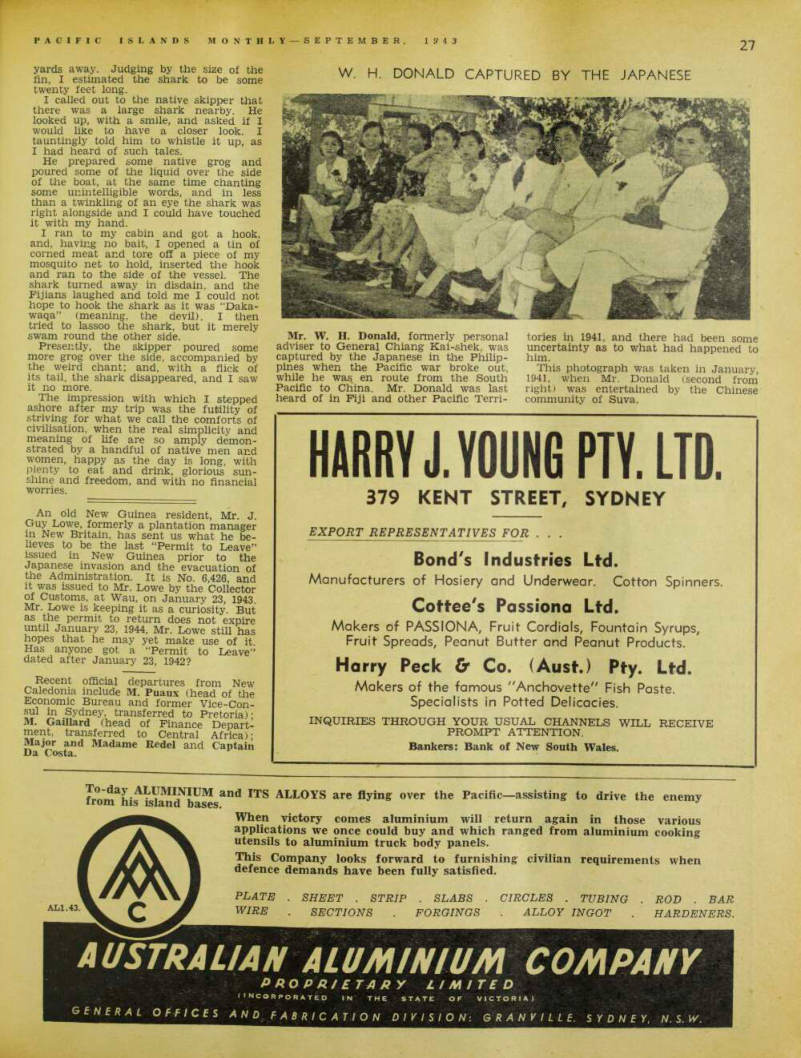
A Trading Trip Among Unspoiled Islands of Fiji
By M. Christian
rE sun was. saying good-night to the day in. a glorious burst of gold and purple as I sailed from Suva Har bour in the “Moce Vakaca” for the fur thermost part of the Fiji Group—the island of Ono-i-lau.
Ono-i-lau is about 200 miles south east of Suva and the trip was partly pleasure and partly a trading venture. In the hold of the cutter was a goodly sup ply of biscuits, tinned goods and cotton materials and I anticipated making a fair profit as well as having a thoroughly enjoyable sea trip. ‘The cutter was about 10 tons and car ried only sail, so I was unable to give any definite date of my return —I was just content to draw deep breaths of fresh sea air and sun my body on the small deck space. I did not care if the trip went on indefinitely: we had plenty of food: I could wear as little as I liked, and being completely at home in the Fijian language and customs, I looked forward with the deepest sense of plea sure to the weeks ahead.
It took the “Moce Vakaca” three weeks to reach Ono-i-lau; weeks of sheer lazi ness, sometimes becalmed for a few days with nothing in sight but the glassy sur face of the sea, hardly broken by a ripple. Occasionally a turtle came to
the surface and floated lifelessly for a few minutes, then dived out of sight, and once in the distance I noticed some whales spouting.
The meaning of the cutter’s name in the Fijian language is “bad night’s sleep.”
But the sturdy little craft was mis named, for I never before enjoyed such peaceful nights of unbroken sleep—no vibration, and the only sounds were the flap of the sails, creaking ropes and the sonorous voice of the steersman as he gave orders to change tack.
ACTUALLY, the trading trip was not a great success, as the natives were just recovering from the effects of a severe hurricane, and had very little produce to barter. But, with true Fijian hospitality, they did me well with great dishes of prawns curried in coconut milk, fish cooked in the earth ovens (which enables all the delicious flavour of the fish to be retained) and plenty of native vegetables, cooked in the same manner.
These primitive ovens still hold pride of place with the natives of Fiji. Great stones are heated, and then all charred wood and ashes are raked away and the food, wrapped in layers of banana or taro leaves, placed on top of the hot stones; then more layers of leaves; and, lastly, the whole covered with sand or earth. The food can be left for hours and when the natives are ready to have their meal, the sand is raked away and the bundles of leaves containing the fish, fowl, or whatever the dish may be, as well as the vegetables, are lifted out, piping hot, and all the flavours preserved.
Being the guest of honour on the island, I was entertained to a meke (dance) of some twenty girls and, believe me, they were the picked belles of the place. Beautiful figures, clad only in a gaily-coloured skirt of croton leaves, with hibiscus or franji-pani in their hair and leis about their necks, they swayed in perfect unison, expressing the theme of the dance. The meke which most appealed to me represented waves breaking on the seashore.
First, the girls crouched low and made little rushes, like the small ripples of the tide coming up the beach; then the rushes became stronger, as if the waves were gathering force as the tide rose higher; until the finale of white foam, on the crest of the big waves, dashing up in full force and breaking against the rocks on the shore, was perfectly illus trated by small girls with white tapa wound round their heads, perched on the backs of the older girls.
AT last, the time came to bid farewell, and we heaved up the anchor to the haunting strains of “Isa Lei.”
The song reminded me of a chorus played on a grand organ, so wonderfully did the deep base of the male voices harmonise with the sweeter notes of the women.
On the way home, the trip was un eventful, except for an amazing example of the native command over the inhabit ants of the deep.
I had often heard of Fijians calling turtle to the surface, and I have actually seen it accomplished. But, on this occa sion, I saw a shark called right along side the “Moce Vacaka.” It happened this way.
We were becalmed, midway between the islands of Totoya and Moala, about 100 miles from Suva, and, for something to do, I climbed to the cross-piece to have a look around. The crew were seated about the deck, some sleeping, others yarning, and a few playing their favourite game of cards. As my gaze idly searched the broad expanse of sea, calm and smooth as a mirror, I noticed the dorsal fin of a shark, about 150
yards away. Judging by the size of the fin, I estimated the shark to be some twenty feet long.
I called out to the native skipper that there was a large shark nearby. He looked up, with a smile, and asked if I would like to have a closer look. I tauntingly told him to whistle it up, as I had heard of such tales.
He prepared some native grog and poured some of the liquid over the side of the boat, at the same time chanting some unintelligible words, and in less than a twinkling of an eye the shark was right alongside and I could have touched it with my hand.
I ran to my cabin and got a hook, and, having no bait, I opened a tin of corned meat and tore off a piece of my mosquito net to hold, inserted the hook and ran to the side of the vessel. The shark turned away in disdain, and the Fijians laughed and told me I could not hope to hook the shark as it was “Daka waqa” (meaning, the devil). I then tried to lassoo the shark, but it merely swam round the other side.
Presently, the skipper poured some more grog over the side, accompanied by the weird chant; and, with a flick of its tail, the shark disappeared, and I saw it no more.
The impression with which I stepped ashore after my trip was the futility of striving for what we call the comforts of civilisation, when the real simplicity and meaning of life are so amply demon strated by a handful of native men and women, happy as the day is long, with plenty to eat and drink, glorious sun shine and freedom, and with no financial worries.
An old New Guinea resident, Mr. J.
Guy Lowe, formerly a plantation manager in New Britain, has sent us what he be lieves to be the last “Permit to Leave” issued in New Guinea prior to the Japanese invasion and the evacuation of the Administration. It is No. 6,426, and it was issued to Mr. Lowe by the Collector of Customs, at Wau, on January 23, 1943 Mr. Lowe is keeping it as a curiosity. But as the permit to return does not expire until January 23, 1944, Mr. Lowe still has hopes that he may yet make use of it Has anyone got a “Permit to Leave” dated after January 23, 1942?
Recent official departures from New Caledonia include M. Puaux (head of the Economic Bureau and former Vice-Con sul in Sydney, transferred to Pretoria); M. Gaillard (head of Finance Depart ment, transferred to Central Africa); Major and Madame Redel and Captain Da Costa.
W. H. Donald Captured By The Japanese
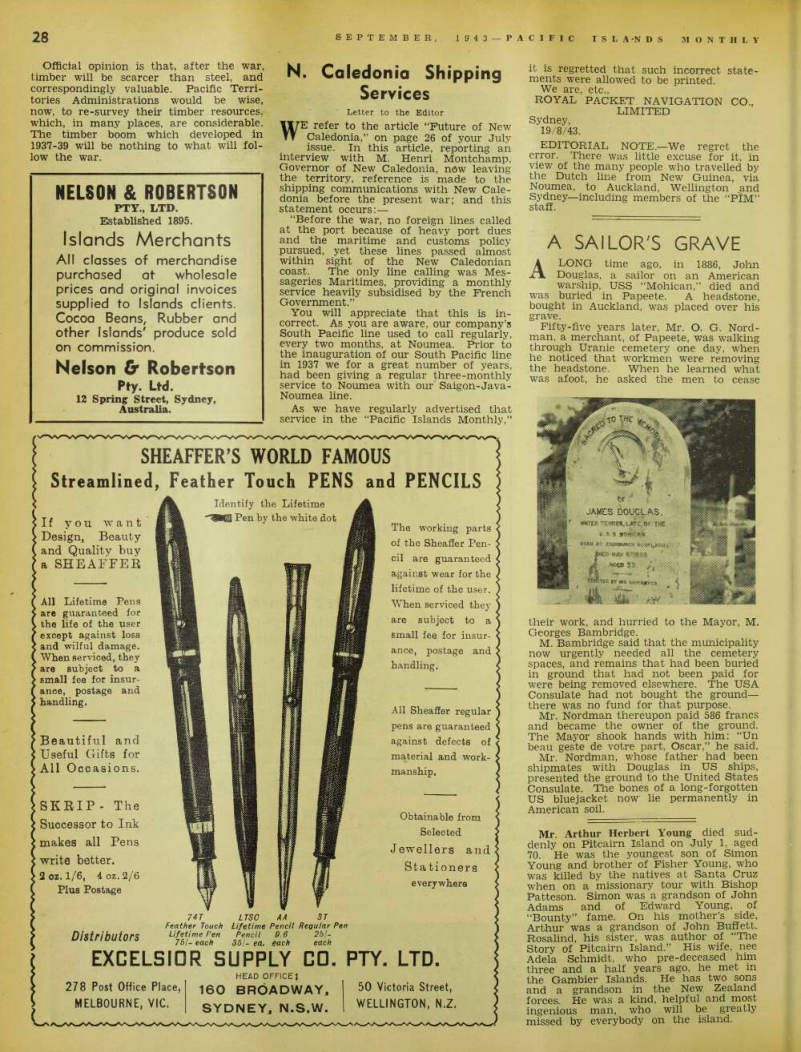
Mr. W. H. Donald, formerly personal adviser to General Chiang Kai-shek, was captured by the Japanese in the Philip pines when the Pacific war broke out, while he was en route from the South Pacific to China. Mr. Donald was last heard of in Fiji and other Pacific Terri
tories in 1941, and there had been some uncertainty as to what had happened to him.
This photograph was taken in January, 1941, when Mr. Donald (second from right) was entertained by the Chinese community of Suva.
Official opinion is that, after the war, timber will be scarcer than steel, and correspondingly valuable. Pacific Terri tories Administrations would be wise, now, to re-survey their timber resources, which, in many places, are considerable.
The timber boom which developed in 1937-39 will be nothing to what will fol low the war.
Advertisements & other items, pp. 29-30 (1 item)
Htrrvj.Voungpty.Ltd.
379 KENT STREET, SYDNEY
EXPORT REPRESENTATIVES FOR . . .
Bond's Industries Ltd.
Manufacturers of Hosiery and Underwear. Cotton Spinners.
Cottee's Passiona Ltd.
Makers of PASSIONA, Fruit Cordials, Fountain Syrups, Fruit Spreads, Peanut Butter and Peanut Products.
Harry Peck & Co. (Aust.) Pty. Ltd.
Makers of the famous "Anchovette" Fish Paste.
Specialists in Potted Delicacies.
INQUIRIES THROUGH YOUR USUAL CHANNELS WILL RECEIVE
PROMPT ATTENTION.
Bankers: Bank of New South Wales.
?rom a L^Vaji^bases and ITS ALLOYS are fl y in £ over the Pacific—assisting to drive the enemy When victory comes aluminium will return again in those various applications we once could buy and which ranged from aluminium cooking utensils to aluminium truck body panels.
This Company looks forward to furnishing civilian requirements when defence demands have been fully satisfied.
C .43.
PLATE
WIRE
SHEET . STRIP . SLABS . CIRCLES . TUBING . ROD . BAR SECTIONS . FORGINGS . ALLOY INGOT . HARDENERS.
AUSTRALIAN ALUMINIUM COMPANY
PROPRIETARY LIMITED
( INCORPORATED
IN THE STATE OF VICTORIA)
GENERAL OFFICES AND FABRICATION DIVISION: GRANVILLE. SYDNEY. N.S.W.
NELSON & ROBERTSON
PTY., LTD.
Established 1895.
Islands Merchants
All classes of merchandise purchased at wholesale prices and original invoices supplied to Islands clients.
Cocoa Beans, Rubber and other Islands' produce sold on commission.
Nelson & Robertson
Pty. Ltd. 12 Spring Street, Sydney, Australia.
SHEAFFER’S WORLD FAMOUS
Streamlined, Feather Touch PENS and PENCILS
If you want Design, Beauty and Quality buy
a SHEAFFER
All Lifetime Pens are guaranteed for the life of the user except against loss and wilful damage.
When serviced, they are subject to a small fee for insurance, postage and handling.
Beautiful and Useful Gifts for All Occasions.
SKRIP- The
Successor to Ink makes all Pens write better. 2 oz. 1/6, 4 oz. 2/6 Plus Postage Distributors Identify the Lifetime Pen by the white dot
74T LTSC AA 3T
Feather Touch Lifetime Pencil Regular Pen Lifetime Pen Pencil 9 6 2b/- 76/- each 35/- ea. each each The working parts of the SheaSer Pencil are guaranteed against wear for the lifetime of the user.
When serviced they are subject to a small fee for insurance, postage and handling.
All SheaSer regulai pens are guaranteed against defects o: material and workmanship.
Obtainable from Selected Jewellers and Stationers everywhere
EXCELSIOR SUPPLY CD. PTY. LTD.
278 Post Office Place,
MELBOURNE, VIC.
HEAD OFFICE J
160 BROADWAY,
SYDNEY, N.S,W.
50 Victoria Street,
WELLINGTON, N.Z.
N. Caledonia Shipping
Services
Letter to the Editor WE refer to the article “Future of New Caledonia,” on page 26 of your July issue. In this article, reporting an interview with M. Henri Montchamp, Governor of New Caledonia, now leaving the territory, reference is made to the shipping communications with New Cale donia before the present war; and this statement occurs:— “Before the war, no foreign lines called at the port because of heavy port dues and the maritime and customs policy pursued, yet these lines passed almost within sight of the New Caledonian coast. The only line calling was Mes sageries Maritimes, providing a monthly service heavily subsidised by the French Government.”
You will appreciate that this is in correct. As you are aware, our company’s South Pacific line used to call regularly, every two months, at Noumea. Prior to the inauguration of our South Pacific line in 1937 we for a great number of years, had been giving a regular three-monthly service to Noumea with our Saigon-Java- Noumea line.
As we have regularly advertised that service in the “Pacific Islands Monthly,”
it is regretted that such incorrect state ments were allowed to be printed. 3,1*0 etc
Royal’Packet Navigation Co.,
Limited
Sydney, 19/8/43.
EDITORIAL NOTE.—We regret the error. There was little excuse for it, in view of the many people who travelled by the Dutch line from New Guinea, via Noumea, to Auckland, Wellington and Sydney—including members of the “PIM” staff.
A Sailor's Grave
ALONG time ago, in 1886, John Douglas, a sailor on an American warship, USS “Mohican,” died and was buried in Papeete. A headstone, bought in Auckland, was placed over his grave.
Fifty-five years later, Mr. O. G. Nord man, a merchant, of Papeete, was walking through Uranie cemetery one day, when he noticed that workmen were removing the headstone. When he learned what was afoot, he asked the men to cease
their work, and hurried to the Mayor, M.
Georges Bambridge.
M. Bambridge said that the municipality now urgently needed all the cemetery spaces, and remains that had been buried in ground that had not been paid for were being removed elsewhere. The USA Consulate had not bought the ground— there was no fund for that purpose.
Mr. Nordman thereupon paid 586 francs and became the owner of the ground.
The Mayor shook hands with him: “Un beau geste de votre part, Oscar,” he said.
Mr. Nordman, whose father had been shipmates with Douglas in US ships, presented the ground to the United States Consulate. The bones of a long-forgotten US bluejacket now lie permanently in American soil.
Mr. Arthur Herbert Young died sud denly on Pitcairn Island on July 1, aged 70. He was the youngest son of Simon Young and brother of Fisher Young, who was killed by the natives at Santa Cruz when on a missionary tour with Bishop Patteson. Simon was a grandson of John Adams and of Edward Young, of “Bounty” fame. On his mother’s side, Arthur was a grandson of John Buffett.
Rosalind, his sister, was author of “The Story of Pitcairn Island.” His wife, nee Adela Schmidt, who pre-deceased him three and a half years ago, he met in the Gambier Islands. He has two sons and a grandson in the New Zealand forces. He was a kind, helpful and most ingenious man, who will be greatly missed by everybody on the island.
Advertisements & other items, p. 30 (1 item)
28
SEPTEMBER, 1?4 3 PACIFIC TSLA-NDS MONTHLY
Solomons Natives
What Is Happening To Solomons Natives
TAVERN talk by Spanish sailors, in the opinion of Dr. H. lan Hogbin, lecturer in Anthropology at the University of Sydney, resulted in the name “Solomon Islands”—no mention of this name was made in any of the several reports on early Spanish ex peditions into the Pacific.
At a lecture given before the Anthro pological Society of New South Wales, on August, 17, Dr. Hogbin outlined briefly the history of the Solomon Group and described the Solomon Islander of the immediate pre-Pacific War period.
In 1567 Mendana sailed westward from America and eventually discovered On tong Java—the first land in the South Pacific to be sighted by Europeans —and thenceforth the Spaniards were preoccupied with the fabled and fabu lous land where Solomon was supposed to have obtained the gold to adorn the temple in Jerusalem, to such an extent that it can be imagined that “Solomon’s Island” figured largely in their con versation. Later, Mendana made a second voyage, this time to discover Santa Cruz (South-east Solomons); but, (from that time onward for 200 years, these lands were literally lost.
Their rediscovery by Carteret and Bougainville, in 1767-68, placed them once more on the map, with fluctuating fortunes, until the American Civil War cut off Britain’s supply of raw cotton As a source of “blackbirded” labour for the new cotton-fields of Fiji and Queens land. the Solomons made their bow to the modern world; and it was to regu late this nefarious traffic that the British assumed control of the group between 1890 and 1900.
Dr. Hogbin has spent several years doing field work in the Solomons and probably understands these islands, at least from the native point of view, better than anyone else. He has great understanding of and respect for the Solomon Islander, his potentialities and his institutions—but it is an under standing and a respect which is based on knowledge, and untinged by the sickly sentimentality with which it is fashion able to look, these days, upon anyone with a brown skin and fuzzy hair. * * * JUST what is happening to the natives, under existing conditions in the Solomons, is unknown. It is, how ever, no secret that the Japanese made no effort whatsoever to enlist them on their side by conciliatory means; on the contrary, the Japs appeared to go out of their way to treat them as badly as possible.
When the Japs landed on Guadalcanal the majority of the natives took to the mountains; when the Japs, in their turn, were hunted out by the Americans, they, too, took to the mountains, and then American artillery was trained upon these positions. The unfortunate natives, therefore, were in the position of “getting it in the neck,” both ways.
A minor result of war in this area is that all bird life has left Guadalcanal— temporarily, at any rate.
Latest news from the Solomons in dicates that native life has been practi cally demoralised. Many of the coastal natives are still in the mountains, and many of those who have returned to the coast have become hangers-on around the military camps. It is obvious, even to those who have only an elementary knowledge of Pacific peoples, that such a sudden and drastic change in their mode of life will have far-reaching
effects, and that trained men and early action will be needed to shepherd these bewildered people back into something approaching normal existence.
Mr. J. J. Young and Mr. Harry Archer, who “stuck it out” on the north coast of New Guinea long after the Japanese occupied Madang and Wewak (December, 1942), arrived in Sydney in August. They walked 300 miles across inland New Guinea in May and June last, in order to get away.
Mr. Paul Mason, who was plantation inspector of Associated Plantations, Ltd., on Bougainville, TNG, and Mr. J. W. Reid, who was DO in Bougainville district, were in Sydney in August, after a recent escape from Jap-occupied territory. Both men have been awarded the DSC by the United States authorities for services which called for initiative and great cour age—but which are still “hush-hush.”
The divorce has been pronounced by a French Court in the New Hebrides between Madame Marceline Germaine Jacquet, of Epi, New Hebrides, and the most prodigiously-named husband in the Pacific. His full name is Marcel Emile Gabriel Alfred Florent Paul Victor Rob ert Simon Alphonse Joseph Ernest Jean Louis Eugene Francois Clement Georges Germain Auguste Vandecrux. The exact whereabouts of this remarkable per sonality are at the moment unknown.
Fiji will hold a Patriotic Fete in Octo ber and, in connection with it, a three months’ drive for funds is taking place.
Subject to the approval of the War Fund Committee, funds raised will be retained in the Colony for the benefit of the men from Fiji who are serving in the Armed Services or the Merchant Navy, and their dependants. To mid-August the cash contributions alone amounted to £8.933.
The Financial Secretary of Fiji Govern ment, Captain A. E. W. Robertson, re turned to the Colony in July. He has been visiting Washington and London.
Advertisements & other items, pp. 31-32 (1 item)
Marys
PAYNE & SAVOIE
EXPORT AND IMPORT AGENTS
BUYERS FOR PACIFIC ISLANDS CLIENTS OF ALL CLASSES
OF MERCHANDISE ON COMMISSION.
Goods Shipped on Original Invoices.
Specialists in New and Used Motor Cars and Trucks.
Prompt Personal Attention to all Orders.
Correspondence invited. On parlez Francois.
Address :
STANTON HOUSE, 133 PITT STREET,
SYDNEY, AUSTRALIA.
AUNT
MARYS
BAKING POWDER
One of the famous Aunt Mary’s food products manufactured by the firm of Til lock & Co. Pty. Ltd.
Established nearly 70 years.
UNION
ASSURANCE SOCIETY LTD.
(Incorporated in England )
FIRE ACCIDENT
FIJI A. E. PEARCE & CO.
RABAUL COLYER WATSON
(New Guinea) Ltd.
N. S. WALES 109 PITT STREET,
SYDNEY.
S. Morrison, Mgr.
CONTROLLING OFFICE —
413 Collins StMELBOURNE
ALAN H. RUSSELL.
Resident Manager.
jILLESPjE. Service
BUYING AGENTS
FOR ALL PACIFIC TERRITORIES
Island Produce Sold on Commission
YOUR ORDERS RECEIVE PERSONAL ATTENTION
ROBERT GILLESPIE PTY. LIMITED
54a PITT STREET, SYDNEY
Cables: ROBERGILL. G.P.O. BOX 137 CC.
War Time Cable Address:
GOUGH CO.,
1 BONDSTREET,
SYDNEY.
Codes: Bentley 2nd and Comp. Phrase, Acme, A.8.C., sth and 6th, Peterson, 2nd and 3rd, Banking.
Telephone: B 4167.
SUPPLIERS OF GENERAL MERCHANDISE TO LEADING FIRMS
THROUGHOUT THE PACIFIC ISLANDS
E. J. GOUGH & CO.
1 BOND STREET, SYDNEY,
AUSTRALIA.
EXPORTERS . . . IMPORTERS . . . MANUFACTURERS 7 REPRESENTATIVES BANKERS: Bank of N.S.W. Comptoir National d’Escompte de Paris.
War's Tragic Effects On Native Life
Discussions of Acute Problems in Pacific
THE problems of what to do with the Pacific Territories—and, more especially, the indigenous peoples of the Pacific islands—after the war has been discussed in a masterly treatise by Scout Commissioner H. E. Hurst, of Geelong, Australia —already well known for his far-reaching experiments in sup plying technical education to the natives of Nauru.
Mr. Hurst has worked out a plan for the control, education and protection of the natives that is based on the Boy Scout organisation, and is linked with the establishment of cultural Guilds. The aim of the plan is to make the native communities self-supporting and indepen dent, and encourage them to govern them selves.
The thought, research and industry put into this compilation entitle Mr. Hurst’s arguments and conclusions to the utmost consideration when the time comes to plan the future government of the Paci fic Territories—especially those aspects of the administration that affect the native peoples.
A possible weakness in the treatise may lie in its failure to take industrial and commercial conditions —past, present and future—sufficiently into account. Are Europeans to be permitted to live and work and trade in the Territories after
the war? If so, are they to be allowed to employ native labour? If not, where are they to get labour? Is so, are the conditions under which native labour is to be employed in the future to be simi lar to those of the past? If not, in what direction is reform to be sought?
THESE questions must be answered, and if they are answered honestly, the extent and complexity of the prob lems before the Territories will be recog nised.
Native life in every Pacific Territory already has been profoundly disturbed by war—in peaceful Samoa or Tonga as well as in war-torn Papua or Solomons.
To believe that those natives will go quietly back to their simple village life, or that the Islands generally are not due for vast post-war European immigra tion and exploitation, in which all native labour will be eagerly competed for, is just wishful thinking. The “Europeanisa tion” of the Islands, which formally might have occupied another hundred years and been partly controlled, may now be completed by war conditions in five or ten years, without control.
Every week that passes brings new facts to show the urgency of this matter: how necessary it is to try to control, in some manner, the impact of these mighty Euro pean war machines upon the natives, and to make plans for reconstruction and re habilitation when the war has passed.
Men are talking of this matter; others are writing articles and pamphlets, and among these Mr. Hurst’s treatise is out standing. But there seems to be no cen tral authority to plan, direct and co ordinate. The Pacific war may end, with native life throughout the Territories smashed and chaotic—and no plan or planners at hand to try to save these helpless native peoples from the post war deluge.
The call is not so much for considera tion of proposals such as those put for ward by altruists like Mr. Hurst, as *or the creation of some authority competent to consider such plans, and co-ordinate and use the eager services which such men offer.
Mr. W. J. Duncan, son of Captain James Duncan, of Rapopo, Rabaul, New Guinea, who was called up to the RAAF in 1939, has now been promoted to Group Captain, and is stationed somewhere in the Middle East. He was a planter at Buka Passage before the war. Captain Duncan’s plan tation is now the much-bombed airfield of Rapopo. Captain Duncan is engaged on essential transport work in North Australian waters.
Mau'u Passes
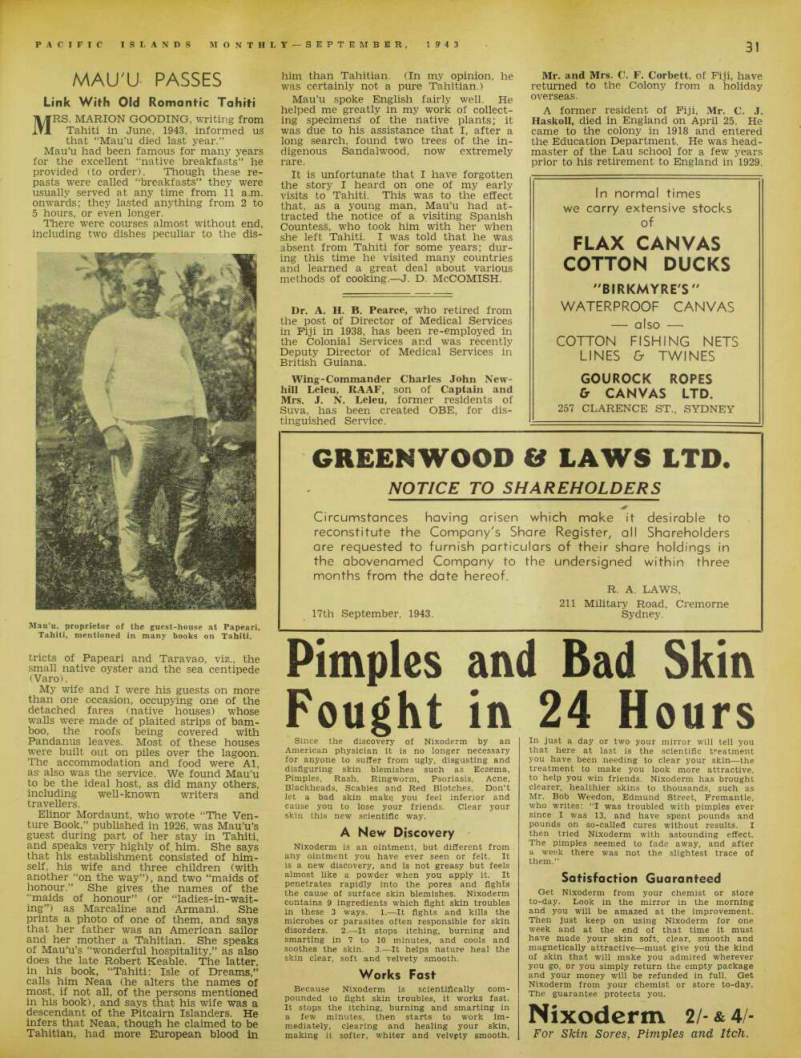
Link With Old Romantic Tahiti
MRS. MARION GOODING, writing from Tahiti in June, 1943, informed us that “Mau’u died last year.”
Mau’u had been famous for many years for the excellent “native breakfasts” he provided (to order). Though these re pasts were called “breakfasts” they were usually served at any time from 11 a.m. onwards; they lasted anything from 2 to 5 hours, or even longer.
There were courses almost without end, including two dishes peculiar to the dis-
tricts of Papeari and Taravao, viz., the small native oyster and the sea centipede (Varo).
My wife and I were his guests on more than one occasion, occupying one of the detached fares (native houses) whose walls were made of plaited strips of bam boo, the roofs being covered with Pandanus leaves. Most of these houses were built out on piles over the lagoon.
The accommodation and food were Al, as also was the service. We found Mau’u to be the ideal host, as did many others, including well-known writers and travellers.
Elinor Mordaunt, who wrote “The Ven ture Book,” published in 1926, was Mau’u’s guest during part of her stay in Tahiti, and speaks very highly of him. She says that his establishment consisted of him self, his wife and three children (with another “on the way”), and two “maids of honour.” She gives the names of the “maids of honour” (or “ladies-in-wait ing”) as Marcaline and Armani. She prints a photo of one of them, and says that her father was an American sailor and her mother a Tahitian. She speaks of Mau’u’s “wonderful hospitality,” as also does the late Robert Keable. The latter, in his book, “Tahiti: Isle of Dreams,” calls him Neaa (he alters the names of most, if not all, of the persons mentioned in his book), and says that his wife was a descendant of the Pitcairn Islanders, He infers that Neaa, though he claimed to be Tahitian, had more European blood in
him than Tahitian. (In my opinion, he was certainly not a pure Tahitian.) Mau’u spoke English fairly well. He helped me greatly in my work of collect ing of the native plants; it was due to his assistance that I, after a long search, found two trees of the in digenous Sandalwood, now extremely rare.
It is unfortunate that I have forgotten the story I heard on one of my early visits to Tahiti. This was to the effect that, as a young man, Mau’u had at tracted the notice of a visiting Spanish Countess, who took him with her when she left Tahiti. I was told that he was absent from Tahiti for some years; dur ing this time he visited many countries and learned a great deal about various methods of cooking.—J. D. McCOMISH.
Dr. A. H. B. Pearce, who retired from the post of Director of Medical Services in Fiji in 1938, has been re-employed in the Colonial Services and was recently Deputy Director of Medical Services in British Guiana.
Wing-Commander Charles John New hill Leleu, RAAF, son of Captain and Mrs. J. N. Leleu, former residents of Suva, has been created OBE, for dis
tinguished Service.
Mr. and Mrs. C. F. Corbett, of Fiji, have returned to the Colony from a holiday overseas.
A former resident of Fiji, Mr. C. J.
Haskoll, died in England on April 25. He came to the colony in 1918 and entered the Education Department. He was head master of the Lau school for a few years prior to his retirement to England in 1929.
Mau’u, proprietor of the guest-house at Papeari, Tahiti, mentioned in many books on Tahiti.
Corporal Ron Farquhar, NZEF. son of Mr, and Mrs. R. C. Farquhar, of Suva, Fiji, is at present visiting his parents on leave. Corporal Farquhar served through Greece, Crete, Libya and Tunisia with the New Zealand forces, and was among those who returned to New Zealand recently from the Middle East.
Advertisements & other items, pp. 33-34 (1 item)
Pimples and Bad Skin
In normal times we carry extensive stocks of
FLAX CANVAS
COTTON DUCKS
"BIRKMYRE'S "
WATERPROOF CANVAS
also
COTTON FISHING NETS
LINES & TWINES
GOUROCK ROPES
tj CANVAS LTD.
257 CLARENCE ST., SYDNEY
GREENWOOD & LAWS LTD.
TO SHAREHOLDERS
* Circumstances having arisen which make it desirable to reconstitute the Company's Share Register, all Shareholders are requested to furnish particulars of their share holdings in the abovenamed Company to the undersigned within three months from the date hereof.
R. A. LAWS,
211 Military Road, Cremorne 17th September, 1943. Sydney.
Pimples and Bad Skin Fought in 24 Hours
In just a day or two your mirror will tell you that here at last is the scientific treatment you have been needing to clear your skin—the treatment to make you look more attractive, to help you win friends. Nixoderm has brought clearer, healthier skins to thousands, such as Mr. Bob Weedon, Edmund Street, Fremantle, who writes: “I was troubled with pimples ever since I was 13, and have spent pounds and pounds on so-called cures without results. I then tried Nixoderm with astounding effect.
The pimples seemed to fade away, and after a week there was not the slightest trace of them.”
Satisfaction Guaranteed
Get Nixoderm from your chemist or store to-day. Look in the mirror in the morning and you will be amazed at the improvement.
Then just keep on using Nixoderm for one week and at the end of that time it must have made your skin soft, clear, smooth and magnetically attractive—must give you the kind of skin that will make you admired wherever you go, or you simply return the empty package and your money will be refunded in full. Get Nixoderm from your chemist or store to-day.
The guarantee protects you.
Nixoderm 2/-&4Z-
For Skin Sores, Pimples and Itch.
Since the discovery of Nixoderm by an American physician it is no longer necessary for anyone to suffer from ugly, disgusting and disfiguring skin blemishes such as Eczema, Pimples, Rash, Ringworm, Psoriasis, Acne, Blackheads, Scabies and Red Blotches. Don’t let a bad skin make you feel inferior and cause you to lose your friends. Clear your skin this new scientific way.
A New Discovery
Nixoderm is an ointment, but different from any ointment you have ever seen or felt. It is a new discovery, and is not greasy but feels almost like a powder when you apply it. It penetrates rapidly into the pores and fighfs the cause of surface skin blemishes. Nixoderm contains 9 ingredients which fight skin troubles in these 3 ways. I.—lt fights and kills the microbes or parasites often responsible for skin disorders. 2.—lt stops itching, burning and smarting in 7 to 10 minutes, and cools and soothes the skin. 3.—lt helps nature heal the skin clear, soft and velvety smooth.
Works Fast
Because Nixoderm is scientifically compounded to fight skin troubles, it works fast.
It stops the itching, burning and smarting in a few minutes, then starts to work immediately, clearing and healing your skin, making it softer, whiter and velvety smooth.
KANGAROO BRAND
Ropes,
Cordage,
and Twines for every purpose Backed by 86 years of service Manufactured by:
M. DONAGHY AND SONS,
Pty. Ltd., Geelong and Sydney.
Fiji Representatives:
PEARCE AND CO.
LIMITED
P.O. BOX 237, SUVA
BITUMENOID ROOFING
MADE IN AUSTRALIA.
Bltumenold Roofings, Dampcourse and Insulating Pelts are made from the world’s best raw materials. Warranted to stand the most rigid tests.
BITUMENOID THE BEST
Roofing, 1,2, 3-ply; Flooring, Waterproof Materials; Saturated Felt; Resilient Road Jointing: Natural Asphalt Dampcourse; 2 and 3-ply Dampcourse: 1-2 lb. Lead-core Dampcourse: Roofing Cement; Asphalt Paints; Roofing Compound.
SAMPLES AND PRICE LISTS ON APPLICATION.
MAXWELL PORTER & SON LTD.
ESTABLISHED 1888. BUILDERS’ SUPPLIES.
107 BEDFEBN ST., REDFEBN, SYDNEY, N.S.W. ’Phone: M 8157. Cable* Bltumenold.
A. B. DONALD Ltd.
AUCKLAND
ISLAND TRADERS & GENERAL MERCHANTS
P.O. Box 1509. Cables £r Telegrams, "Kingdom", Auckland.
Trade Winds
Myths and Misunder standings
MOST people in the Temperate Zone think the Trade Winds, within the tropics, blow all the time. Their idea is that all the old mariners had to do was to chivvy their ships down to the region of the Trade Winds, set a course to the west, and then every one but the man at the wheel could throw dice, dance the horn-pipe or sleep until the vessel arrived at its destination.
On this assumption are based some of the weightiest arguments against an Asiatic or Indonesian origin of the Poly nesian race.
The myth of the Trade Winds, like the myth of uncultivated abundance in equatorial lands and the myth of “night comes quickly in the tropics,” is a stan dard feature of all travellers’ tales.
Were these savants to observe the winds and weather from tossing inter island schooners, rather than from the decks of luxury liners, or take the trouble to read the reports of observant explorers, our South Sea literature might be less cluttered up with things which are not so.
“In the account of the sojourn of La Perouse at the Samoan Isles (to quote from Mr. Elsdon Best), the following re marks occur:—‘We know by the relations of preceding navigators that the trade winds are very uncertain in these seas, and that it is almost as easy to sail- east as west—a circumstance which favours
the natives In their long excursions to leeward.’ ‘When leaving the group this voyager encountered strong winds from the west and north-north-west. Cook also stated that in December and January the winds are variable, but frequently blow from west-north-west and north-north-west.
This wind is called the to’erau. The wind from the south-west and west-south west is still more frequent.
“The Polynesians were keen observers and recorders of natural phenomena They well knew how to take advantage of wind-changes and when to expect such changes. In fact, after he had once ex plored the Pacific, the Polynesian knew perfectly well how and when to reach any part of it.”
HOW the Polynesian of olden time navigated the Pacific at will, is in dicated in the record of the assemblies, at Opoa, on Ra’iatea, of re presentatives from islands near and far during the period of the Ao Uri—Ao Tea Confederation.
“These allied island kingdoms formed a convention for their priests, scholars and warriors, to meet periodically at Opoa for great religious observances and inter national deliberations. The appointed time was exactly reckoned by numbering the year and naming the season, the lunar month and the day of the month. So it became the custom, from a remote time until about the year 1350, to send re presentatives, with offerings to ’Oro, in great double canoes, distinguished as Te- Va’a-Roa-o-te-Mata’i (the long canoes in the wind). Each had one or two great, deep-toned drums, called Ta’i-Moana (sounding at sea), and a great conch shell trumpet, called Pu-Ta’i-i-te-Aeha (trumpet sounding over the sea from horizon to horizon), with which they kept track of each other at sea and signalled, and when approaching the sacred goal triumphantly announced themselves.” (“Ancient Tahiti”: Teuira Henry.) INASMUCH as many of the canoes came from New Zealand, and from islands far to the west, the trade-winds did not prevent them from arriving at their destination on the day appointed.
A description of such craft, as seen by modern eyes, is found in a work entitled, “Rovings in the Pacific from 1837 to 1849.” The author of this book sojourned for some time on the island of Rotuma, north of Fiji.
“They were double canoes, the larger of which was from 80 feet to 90 feet in length, and the smaller one 50 ft. to 60 ft. The two hulls were about 6 feet apart, and were connected by cross beams, on which planks were secured so as to form a platform deck some 14 ft. to 16 ft. in width. The fact that both hulls were covered supports the statement that the crew lived in a house built on the plat form deck, and that the hulls accom modated sea stores only. The sails used were of the common Polynesian form, triangular, and set with apex downward.”
Mr. Elsdon Best pithily remarks: —“The trade-winds have had a greater effect on our writers than they ever had on the Polynesian voyager, we opine. One solu tion of the puzzle lies in the simple fact that the prevailing winds do not always prevail,”
Anyone who has lived long in the islands can bear witness to the truth of that statement. —A.C.R.
Sergeant-Major A. W. Ousey, son of Mr.
Andrew Ousey, of Sigatoka, Fiji, who has been serving with the New Zealand forces in the Eighth Army in the North African campaign, has returned to Fiji on leave.
Advertisements & other items, p. 34 (1 item)
32
SEPTEMBER, 1543-FACIFIC ISLANDS MONTHLY
Polynesian Spontaneity
Charms a Sydney Audience
LIFE is not all beer and cheer for members of concert parties who visit military establishments and hos pitals in Australia. The Aussie Service man, in the mass, is not known for his politeness and he suffers fools neither gladly nor silently. Knowing these things, arid also the type of “entertainment” that is served up to the troops under this guise, it is easy to imagine why the Sydney Polynesian Club’s concert-party, in its natural spontaneity, has won the whole-hearted approval of fighting men upon scores of occasions.
On Friday, August 20, in the theatre of History House, Sydney, the public was given the opportunity of sampling the kind of entertainment dispensed by the concert-party—and the public found it good. The great charm of these people is that they pretend to nothing that they are not: they, as Polynesian singers and dancers, obviously get as much happiness from giving a song or a dance as the audience does in taking it. If the cur tain gets stuck—well, it gets stuck, and there is no panic; if someone loses a poi, the incident becomes part of the show; if the accompanist pitches his tune on too high a note, he begins again, and no one cares two hoots.
The programme was a long one of items culled from the length and breadth of Polynesia—from New Zealand to Hawaii, and from Tahiti to the Ellice Islands.
The most lingering impressions left in the mind of this part of the audience was: the strangely beautiful quality of the Maori voice, reminiscent of the double-stopping of a master-violinist; and the thought of battalions of brown
men, charging across North African sands, and scaring hell out of the Axis forces.
Probably—such is the unromantic nature of modern war—the Maori Bat talion from New Zealand, and the Paci fic Battalion of Fighting France, go into battle like anyone else; nevertheless, it is a happy thought to imagine them attacking with all the blood-curdling eye-rolling, tongue-twisting and war whooping of the haka and other similar Polynesian dances. —J.T.
Retort Effective
THE young Fijian clerk was not con ducting his business too satisfac torily with an American non-com., in one of the Army offices. Though the Fijian was patiently and painstakingly explaining his errand, the American soldier was inclined to argue. At last, patience exhausted, the Fijian youth burst forth in bitter accents, “God Save the King!” and departed indignantly— and with dignity!
Some people have been urging that, because they consume so much fuel oil, rubber, etc., and because gold is not likely to be wanted in the post-war world, any way, the Fiji gold-mines should be closed, for the duration. The liveliest defender of Fiji’s gold industry is Mr. Pat Costello, who makes out an excellent case in the “Fiji Times.” Few will quarrel with his dictum, which is based on historical facts and common sense: “Gold is the world’s yardstick and is sought after by all countries, more particularly by the teeming millions of India and China, and although its price may vary it will always remain the recognised token of exchange.”
Advertisements & other items, p. 35 (1 item)
W. KOPSEN & Co.Pty.Ltd.
QUEENSLAND
INSURANCE
COMPANY
LIMITED
(Incorporated 1886 in Australia)
ASSETS EXCEED £3,500,000
Head Office :
PITT Or BRIDGE STS.,
SYDNEY
Speciolists in South Seas Fire, Marine Cr Accident Insurances Apply to: Burns, Philp (S.S.) Co., Ltd Suva.
Burns, Philp (S.S.) Co., Ltd Vila.
Comptoir Francais Des Nouvelles Hebrides . . (Marine) Vila.
L. & W. Johnston Noumea.
Burns, Philp (S.S.) Co. Ltd. . . Pago Pago.
G. 11. C. Reid & Co Pago Pago.
In other S.S. Islands —
BURNS, PHILP (S.S.) CO., LTD.
Also to any of the Company's Offices in Australia or New Zealand.
SIMPLEX
MARINE
ENGINES
Simplex engines from 3 h.p. to 12 h.p. for boats from 14 ft. to 26 ft are Australia’s best. 2 cycle and 4 cycle with or without reverse gear.
Illustrated is the popular little 3 h.p. suitable for 14 ft. or 16 ft. boats.
Runs for 5 hours on 1 gallon petrol and costs only £29/15/-, complete with ah equipment. Ready to instal into any boat, nothing else to buy.
Ask for Simplex catalogue of engines and launches.
SKARSTEN SCRAPERS
Remove paint, varnish, glue, oil, grease, roughness, etc., from wood and metal surfaces. Most useful for scraping deck and hull planks. They leave the surface smooth and dressed and ready for painting. Have renewable blades.
Prices: No. 35, 2/3; 62, 2/6; 80, 3/3.
Reversible, 7/-.
Write for leaflet.
TILLEY
Kerosene
LAMPS
British-made Kerosene Lamps providing a steady 300 c.p. light, without flickering, and without smoke or smell.
Model TLIO (illustrated) is a handsome Table Lamp providing exceedingly brilliant illumination and at the same time a fine ornament for any home.
Stands 24 in. high and covers a large area. Attractive parchment shade is finished in autumn tones and matches any furnishings.
Also available is the popular All- Purpose Lamp and Lantern (model EX100) and a variety of Hanging, Table, Wall and Vase Lamps.
Let us send you full details of an Tilley Lamps.
SHIPCHANDLERY
We manufacture and stock the largest range of boat gear in Australia. Everything for hoathuilder and boatowner. Marine paints and varnishes. Rope and Cordage. Rigging. Anchors and M oorings. Copper Nails and Rod . Lighting Plants. Fire Extinguishers. Oars and Sculls, Lamps, Pumps, etc.
GET OUR PRICES FIRST.
W. KOPSEN & Co.Pty.Ltd.
376/380 KENT STREET, SYDNEY
Thone; MA 6336 (4 lines), Est. 1868. Cables: Kopsen . . . Sydney.
How Fiji Shows Her Teeth
TOTAL contributions to the Fiji Fighter Fund to July, 1943, were £51,295.
Nine fighter aircraft have been bought from this amount, at a cost of £49,950. In addition to the purchase of these fighters, the original Bomber Fund provided three bombers, at a total cost of £66,000.
Mr. W. R. Scott, of the Public Works Department, Fiji, has been promoted to service in Rhodesia as Assistant Engineer.
Helped
"The Papuan Is
A Man"
Why he Deserves to be Helped
By Mrs. Constance Williams,
widow of the late Dr. F. E. Williams, Government Anthropologist in Papua. riIHE intelligent Papuan of to-day, who A has sufficient contact with white men, welcomes the chance to learn and to improve himself. He has, by prac tical application, mastered several" trades, and has succeeded in doing such unusual jobs as driving a car, attending to a tele phone switchboard, carpentering, travel ling about the country as a medical assistant and has even become proficient with the fickle bicycle.
Papuans, like all intelligent human beings, are ever curious; and they do their training by watching the job that interests them. In this way the boy, an onlooker, receives his first instruction; and, perhaps by grasping the right plank and assisting at the right moment, his first job.
To do the things a white man can do savours of super-knowledge, and hence superiority: and an intelligent boy, if keenly interested, learns quickly—not, perhaps, of book knowledge, even in its simplest form, but by watching and copy ing the practical worker the job comes easily to him.
He has, with his fellows, built many native houses. True, they are of saplings and thatch, but a man who can get his supports in alignment, and his ridge-pole properly in place, has some good ideas about house construction.
He may not understand a blue-print, but he can, in time, absorb even this advanced idea. He possibly will look at it every way except the right one; and, even when he does look at it correctly, he won’t know it. Give a boy a photo of himself, who has never seen one before, and ask him what it is. He will turn it round uncomprehendingly and say, “diba lase, Taubada”; (“I don’t know.”) Remembering one boy who, under these circumstances, was given his own photo to look at, I shall not forget the sudden astonishment of the recognition. He, photo in hand, capered up the garden path roaring with excitement and plea sure, while he slapped himself resound ingly and, as he did so, shouted. I doubt any blue-print would arouse such enthu siasm; but, in time, he will “get the hang of it” and carry out the job.
IT is as a seaman, though, that the Papuan is perhaps at his best. He has, if a good and experienced mas, a knowledge of the coast “like the paim
of your hand.” Indeed, the intimate knowledge of every feature of the coast, combind with an amazing facility for seeing in the dark, makes these men invaluable to some of the white owners of small launches that ply up and down a rough sea coast. Their navigation sense, their devotion to duty, and their ability to manage their craft in all wea thers, are well known.
The chief assistant, the native engin eer, is an expert in nursing sick engines —and seems often to lead a sleepless life, for his main sport is fishing by night and by day, with lines taut from the speed of the boat, and only a fluttering piece of dirty rag, tied to a knot in the line, signals a catch. Then passengers and crew may take a hand in hauling in the weighty but welcome breakfast.
Car drivers are sometimes doubtful heroes, the races between lorry drivers on the well-known turn of a sloping hill in Port Moresby have had disastrous results.
The shouting of the dusky joy-riders, gesticulating and calling out, changed into cries of fear and pain as the lorry on the outside of the embankment turned over and rolled down the hill! However, there are also many good and reliable drivers, who have given satisfaction for many years. In several instances, they own their lorries.
As “switch” boys, natives have giver excellent service—even if sometimes, in slack hours, the boy at the board, when asked for “No. 63“ replied: “More better you ring 22 . . . this No. 63 talk he gone see, Mr. B ” Still, how convenient and informative, and time-saving.
Medical assistants, trained for some time in the South, have done good work in Papua. They move about, usually in pairs, armed with simple drugs. They can give the hated “needle” for the pre valent and hideous yaws; treatment for snake bite; and, besides and above all, they carry with them the three staple drugs of Papua—iodine, salts and quinine.
Carpenters (the best of these are half castes) can, with but little supervision, be responsible for the construction of a fibrolite house and, when finished, this is “well and truly built.” The boss boy has several native assistants, and his team work stated hours on Government pay and rations.
THE native police of Papua are a mag nificent lot of men—well trained and devoted to their duty . . . and their rifle. This latter is, in their eyes, the symbol of authority and power and it is jealously guarded—on occasions, at the risk of life. As a body of men, they defer to no one. They are physically far above the average height and physique; their drill is strict and arduous; and their prestige none question.
A policeman, with his navy serge jumper, sulu, and crimson sash, and his wide leather belt, and precious cartridges
and gun, is a respected and admired visitor to any village. He is the envy of the youths and the centre of attraction to the maidens —and he knows it.
Perhaps after the war is over, the work of the Papuan Constabulary and the car riers will be the best monument the people have. It will not plead in vain, we hope, for good government and understanding administration.
Of the Constabulary, others will write; but, of the carriers, it can be said that our soldiers now know from experience what Government officers and civilians knew long before the days of this war— the great powers of endurance, the self forgetfulness, and the heroism of the native carrier. They, too, have climbed where the white man has climbed, and they, too, have endured the hardships and bitter weather and storm —but while the civilian went unencumbered the car rier had his load to bear, day in and day out, on the long, long trek.
Now, that load has often become the weight of the stretcher and its suffering occupant; how gently and with what skill he has walked those tortuous miles in slush and rain, up hill and down, and has brought his man out, safe and sound, to the base lines.
But the Papuan was a man before ever the white man came —he could fight, and endure, and survive, and we have not taught him these things. Cannibal or head-hunter he may have been, but in this war he has shown great qualities.
He has offered his best and, in so doing, he has achieved by his devotion and sac rifice his right to an honoured place among the peoples of the Pacific.
Advertisements & other items, p. 36 (1 item)
Pinkettes
Your old SCISSORS, RAZORS
and KNIVES can be
SHARPENED and REPAIRED
BBSS
Send them to—
W. JNO. BAKER
3 HUNTER STREET,
SYDNEY.
After taking Pinkettes you should feel brighter, happier, and free from sick headaches, bilious attacks and liverishness. For
PINKETTES
are tiny laxative and liver pills, which painlessly exercise the digestive system.
m
TXXI
P
Guard against Infection with Tenax!
Germicidal Soap used regularly is an unsurpassed safeguard against external germ infection. It is kind to the most sensitive skin, yet its germicidal action is eleven times as rapid as carbolic. It is non-irritant and non-poisonout.
At All Chemists and Stores.
TENAX he Genuinely Germicidal SOAP
Mangaia Prospers
From Our Own Correspondent
Rarotonga, July 27.
THE pleasant little island of Mangaia, in the Lower Cooks, is enjoying a year of prosperity. The island, which is 24 miles in circumference and has 1,500 inhabitants, was comparatively un affected by the hurricane which struck the rest of the Lower Group in March last. Its position, well to the south of Rarotonga, saved the day.
Over 20,000 cases of oranges, returning a value of approximately £B,OOO to the island, have been exported this season, in addition to which the “pupu” (shell necklace) industry is well established.
The native inhabitants of Mangaia differ considerably from the people of the neighbouring islands. Mangaia is the most southerly island in the Cook Group and this,, coupled with the rocky geologi cal formation, has produced a some what dour and very independent race, who have the reputation of being the best workers in the Islands.
No Native Land Court holds sway in Mangaia. No land may be leased to outsiders; the plough is almost un known—in fact, anything that the people think, rightly or wrongly, is not desirable, is simply not permitted to be landed. Of all the orange-exporting islands, Mangaia is the only one where the processing of oranges prior to ship ment with ethylene gas has not been adopted—in spite of continued efforts by the Administration to introduce a thing that has been found in other islands to be most beneficial, there is nothing doing.
Traders say that even the merchandise sold in Mangaia differs from that in the other islands, where “luxury” goods sell well. The Mangaian wants blankets, dress goods and other solid stuff—no frippery required.
The Atua Of Rotuma
By Amel
According to the cook’s wife, Rotuma is the most atua-ridden island in the South Pacific. An atua, incidentally, is a spirit, or ghost.
If I am to believe all she says, every square inch of the island harbours an atua, and they also live in the trees, on the beaches, in the sea, in houses and in peoples’ bodies. The cook’s wife, an ami able, wild-haired damsel, seems to be an authority on atuas, and she discusses them with me at every opportunity.
She says that the atuas that come from the sea are fearsome things, and we must be careful not to attract their unwelcome attention by having a bright light shin ing out to sea.
Of course, it is an accepted fact that the atuas are more numerous after dark.
That big dilo tree whose branches squeaked, the shadow that sped past in the gloom, that rustle among dead leaves on the path, could never have been the wind, or a dog, or a lizard. Oh, dear, no . . . they were all atuas.
An atua lives in our summerhouse, or, at least, visits it occasionally. But my authority tells me it is a pleasant atua — the atua of a white woman who lived and died nearby. It has long hair, and wears a white dress, and sandshoes, and usually tells the cook’s wife to get up and go and light the fire.
Another atua roosts just outside the kitchen door, and is supposed to get very angry if any dust is swept out of the kitchen at night . . . but I suspect it was invented for the cook’s convenience!
The atuas that inhabit peoples’ bodies do a terrible lot of damage, and can give you a variety of ailments, from galloping consumption to a boil on the neck. The only cure is to ask the local witch-doctor to chase the atua for you. Of course, the NMP does his bit, too; but the witch doctor gets all the credit!
Native belief in the atua is very deeply rooted, and makes one wonder whether the religious teachings of the missionaries have really made any impression on them. While they appear to know little
about the discomforts of a guilty con science, their atuas give them fits!
Mr. C. W. Rothe, who was acting as general manager of the CSR Co. during the absence of the late Sir Philip Gold finch from the company on (national defence work, has been appointed to the post of general manager.
Advertisements & other items, pp. 37-38 (1 item)
Darvas
Rid Kidneys Of
Poisons And Acids
If you suffer sharp, stabbing pains, if joints are swollen, it shows your blood is poisoned through faulty kidney action. Other symptoms of Kidney Disorders are Backache, Aching Joints and Limbs, Sciatica, Neuritis, Lumbago, Sleepless Nights, Dizziness, Nervousness, Circles under Eyes, Loss of Energy and Appetite and Frequent Headaches and Colds, etc. Ordinary medicines can’t help much because you must get to the root cause of the trouble.
The Cystex treatment is specially compounded to soothe, tone and clean kidneys and bladder and remove acids and poisons from your system safely, quickly and surely, yet contains no harmful or dangerous drugs. Cystex works in 3 ways to end your troubles. 1. Starts killing the germs which are attacking your Kidneys, Bladder and Urinary System in two hours, yet is absolutely harmless to human tissue. 2. Gets rid of health-destroying, deadly poisonous acids with which your system has become saturated. 3. Strengthens and reinvigorates the kidneys, protects from the ravages of disease-attack on the delicate filter organism, and stimulates the entire system.
Praised by One-time Sufferers Cystex is approved by one-time sufferers in 73 countries from the troubles shown above.
Mr. Reg Thomas, Townsville, Queensland, recently wrote: “My joints were all stiff, I had leg pains, my back used to ache day and night.
My bladder was weak. I had headaches and no appetite. The first dose of Cystex helped me and before I finished three boxes my health and strength came back.”
Guaranteed to Satisfy or Money Back Get Cystex from your chemist or store to-day.
Give it a thorough test. Cystex is guaranteed to make you feel younger, stronger, better in every way, or your money back if you return the empty package.
Now in 2 sizes—4/-, 8/-.
GUARANTEED CiVStGX
Treatment W for Your Kidneys, Bladder, Rheumatism.
DARVAS
AND
COMPANY
(Proprietors: R. DARVAS, E. KLUGMAN)
35 PITT STREET, SYDNEY
EXPORTERS ;; IMPORTERS
GENERAL MERCHANTS
ISLANDS TRADERS
Shippers of all kinds of Merchandise Specialising in Foodstuffs and Spirits Represented in Fiji by V. R. JAM & C 0 Suva.
Bankers: Bank of Australasia.
Comptoir National D’Escompte de Paris.
Wartime Cable Address:
DARVAS COMPANY SYDNEY.
’Phones: 8W4696, 8W6384.
PAUL A. DORN
Agent, Wants Copies
PACIFIC
ISLANDS MONTHLY
All Issues
OFFERS ANY AMERICAN
MAGAZINES IN EXCHANGE
Commissions Accepted for Pacific Islands Products. Correspondence Invited.
BOX 1712, Wilshire-La Brea Station, Los Angeles 36, California, U.S.A.
Coughing, Asthma, Bronchitis Curbed in 3 Minutes
Do you have attacks of Asthma or Bronchitis so bad that you can’t sleep? Do you feel weak, unable to work, and have to be careful not to take cold and can’t eat certain foods?
No matter how long you have suffered or what you have tried, there is new hope for you in a doctor’s prescription called Mendaco.
No dopes, no smokes, no injections, no atomizer.
All you do is take two tasteless tablets at meals and in 3 minutes Mendaco starts working through your blood, aiding “nature to remove phlegm, promote free easy breathing and bring sound sleep the first night, so that you soon feel years younger and stronger.
No Asthma in 2 Years
Mendaco not only brings almost Immediate comfort and free breathing but builds up the system to ward off future attacks. For instance, J. Richards, Hamilton, Ont., Canada, had lost 40 lbs., suffered coughing every night, couldn’t sleep. Mendaco stopped Asthma
spasms first night and he has had none since in over two years.
Money Back Guarantee
The very first dose of Mendaco goes right to work circulating through your blood and helping nature relieve you of the effects of Asthma. Try Mendaco under an iron-clad money back gaurantee. You be the judge. If you don’t feel fully satisfied after taking Mendaco just return the empty package and the full purchase price will be refunded. Get Mendaco from your chemist to-day and see how well you sleep to-night and how much better you feel to-morrow. The guarantee protects
RELIEVES ASTHMA
Mendaco
Now in 2 sizes . . . 6/- and 12/-
Steamships Trading
Company Limited
PORT MORESBY SAMARAI PAPUA.
WHOLESALE & RETAIL MERCHANTS, SHIPOWNERS,
PLANTERS, ENGINEERS & SLIP PROPRIETORS.
Customs, Shipping, Insurance, and Forwarding Agents.
MANAGING AGENTS AND VISITING REPRESENTA-
TIVES FOR COCONUT AND RUBBER ESTATES.
SYDNEY REPRESENTATIVES: Nelson & Robertson Pty. Ltd., 12*Spring Street.
CLIENTS PLEASE NOTE
Temporary War Address— C/o Nelson Cr Robertson Pty. Ltd., 12 Spring St., Sydney.
WRITE, CABLE, OR CALL
STEAMSHIPS TRADING COMPANY LIMITED
Coble Address: "Steamships".
Transformation Of
Guadalcanal
IN six months, US forces have trans formed Guadalcanal Island, BSI, from an ill-smelling, muddy, mosquito ridden battlefield into a strong, well protected, orderly outpost, with screened and framed tents, drained and surfaced roads, well-cooked food, film shows and service men’s shops, where the soldier can replenish his supply of tooth paste, tobacco and other luxuries which for a time were lacking.
The change was described by J. Norman Lodge, Associated Press correspondent, who left the island late in December, 1942, after victorious United States troops had sealed its capture from the Japanese.
He returned to Guadalcanal recently to report on the progress made in convert ing the island info an advanced base of Allied operations in the Pacific. He writes:—
Then, a jeep was a treasure. To-day, one can have the use of transportation for the asking. Then, Henderson Field worked frantically to keep serviceable what few planes we had. To-day, there are enough of all types of planes to make it unprofitable for the Japanese to come raiding. So much so, in fact, that Guadalcanal is singularly free of alerts.
To-day, cargo ships come into the various beaches, remain to unload, and never pause to scan the skies. Then, a ship rarely remained more than an hour without weighing anchor, fo dash away from the frequent raids. To-day we have electric lights in the tents. Then, if one so much as lit a match he was liable to execution.
The change is decidedly seen in the habiliments of the men on the Island.
Back in November and December, one usually wore fatigue greens, until they rotted off with perspiration and mud and insect attack. Now, with the exception of working parties, starched and well laundered cotton khaki is the vogue.
Malaria was making inroads upon the men in the waning months of 1942. To day, because of a better medical know ledge of the malaria-bearing mosquito, and because medical science has found the proper way to dose men with atabrine (the synthetic anti-malarial substitute for quinine) malaria is the exception rather than the rule.
How General Mccarthy
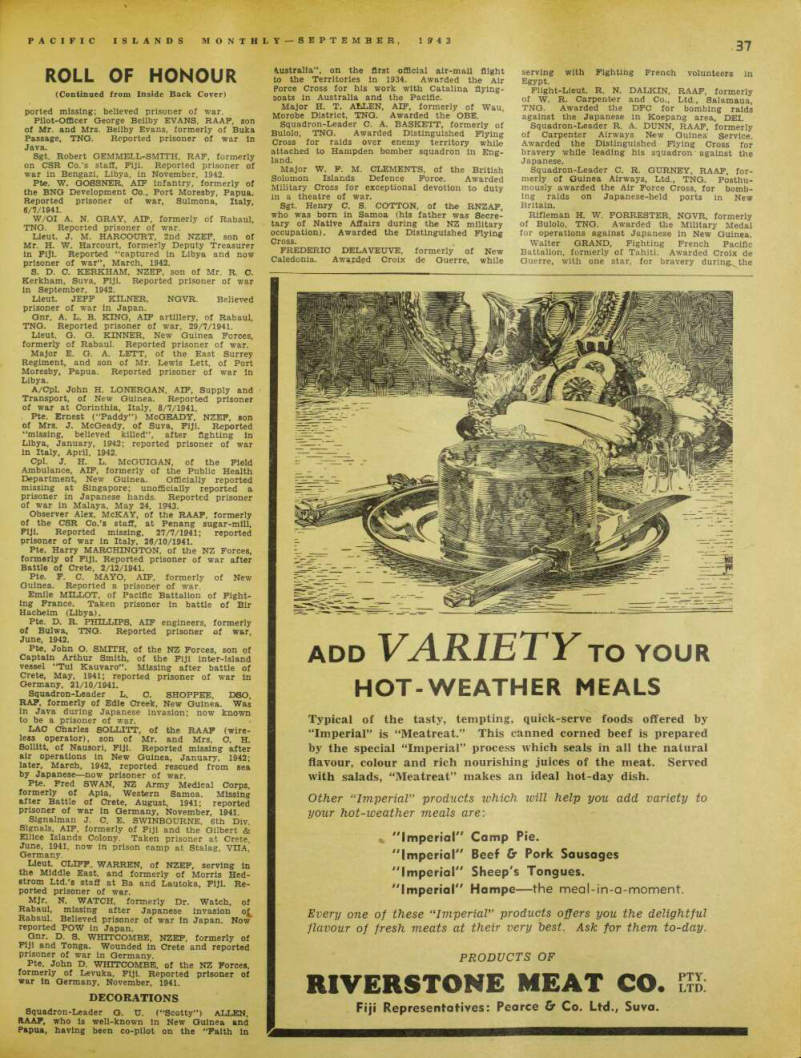
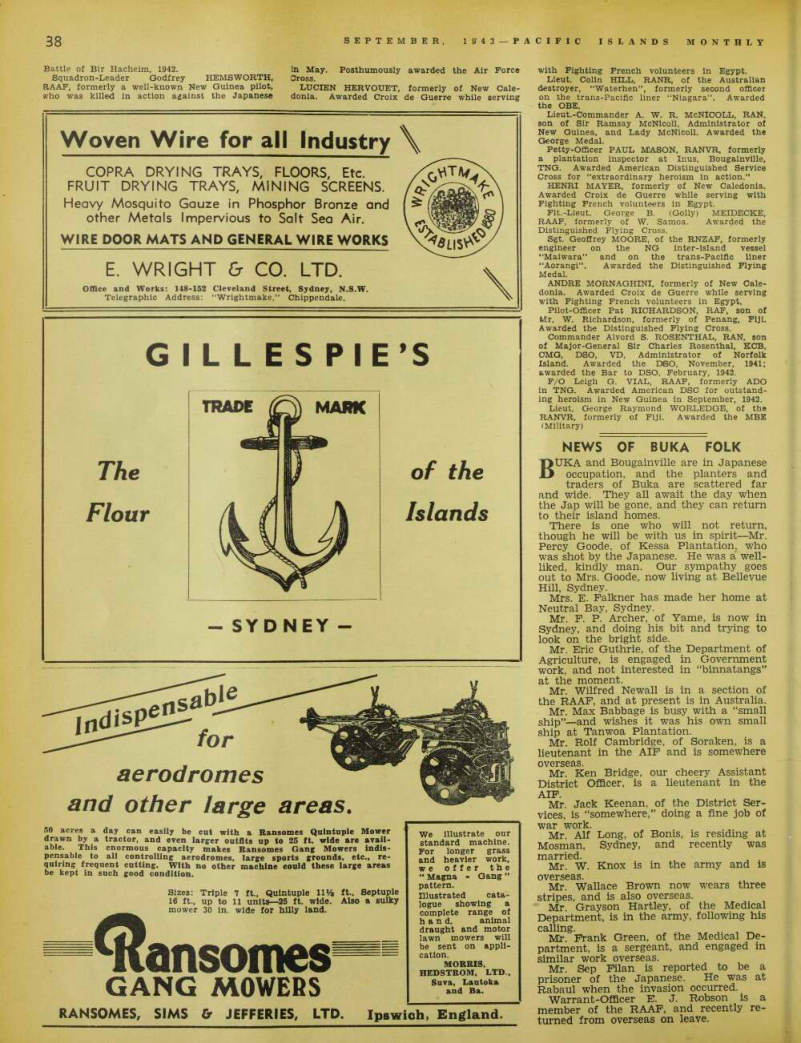
Escaped To Austria!
JVfOT all Pacific peoples wear grass -1 ' skirts and spend their time under coconut trees. Some of them wear fur suits and live in igloos—and this is how a Roman Catholic priest stationed in Southern Alaska describes their reaction to war, in the “Catholic Mission Magazine”: — They were a bit excited in the be ginning, it is true, but this was due, not so much to the news they received, but to the confusing advice that came over the radio, all of which they misunderstood.
I urged them to pay no attention to rumours.
Only one village was excited when the Attu and Kiska Islands were occupied by the Japanese. So great was their fear, that some of the people begged me to come and stay with them. I discovered that several of them had evidently tuned in on a Japanese radio programme by mistake and had swallowed whole the false reports and predictions of future moves. I urged them to keep away from their radios and to go to their camps and attend to their fishing. This they did promptly. I met some of them lately and they seem to have forgotten all about the Japanese.
The radio has a real fascination for the Eskimos, for they find the music highly entertaining. Few of them have much knowledge of English, and their misunderstanding of the news reports is often amusing to me. Frequently they report to me some garbled news, which is so incongrous that it gives me real merriment, if not enlightenment.
One day Peter came to me and said jubilantly, “Father, General McCarthy esgot to Austria.” Being accustomed to their twisting of unfamiliar words, I im mediately understood the first part of his statement, but the mention of Austria puzzled me.
“Did the radio-man mention any other name with Austria?” I asked.
“Yes,” he answered, “but I don’t re member it. I think that it was some kind of wind way out there.”
When I suggested Darwin, Australia, he smiled, “Father, you have it.”
Battle of Bir Hacheim, 1942.
Squadron-Leader Godfrey HEMSWORTH, RAAF, formerly a well-known New Guinea pilot, who was killed in action against the Japanese
In May. Posthumously awarded the Air Force Dross.
LUCIEN HERVOUET, formerly of New Cale donia. Awarded Croix de Guerre while serving
with Fighting French volunteers in Egypt.
Lieut. Colin HILL, RANK, of the Australian destroyer, “Waterhen”, formerly second officer on the trans-Pacific liner “Niagara”. Awarded the QBE.
Lieut.-Commander A. W. R. McNICOLL, RAN, son of Sir Ramsay McNicoll, Administrator of New Guinea, and Lady McNicoll. Awarded the George Medal.
Petty-Officer PAUL MASON, RANVR, formerly a plantation inspector at Inus, Bougainville, TNG. Awarded American Distinguished Service Cross for “extraordinary heroism in action.”
HENRI MAYER, formerly of New Caledonia, Awarded Croix de Guerre while serving with Fighting French volunteers in Egypt.
Fit.-Lieut, George B. (Golly) MEIDECKE, RAAF, formerly of W. Samoa. Awarded the Distinguished Flying Cross.
Sgt. Geoffrey MOORE, of the RNZAF, formerly engineer on the NG inter-island vessel “Maiwara” and on the trans-Pacific liner “Aorangi”. Awarded the Distinguished Flying Medal.
ANDRE MORNAGHINI, formerly of New Cale donia. Awarded Croix de Guerre while serving with Fighting French volunteers in Egypt.
Pilot-Officer Pat RICHARDSON, RAF, son of Mr. W. Richardson, formerly of Penang, FIJI.
Awarded the Distinguished Plying Cross.
Commander Alvord S. ROSENTHAL, RAN, son of Major-General Sir Charles Rosenthal, KCB, OMG, DSO, VD, Administrator of Norfolk Island. Awarded the DSO, November, 1941; awarded the Bar to DSO, February, 1942.
P/O Leigh G. VIAL, RAAF, formerly ADO in TNG. Awarded American DSC for outstand ing heroism in New Guinea in September, 1942.
Lieut. George Raymond WORLEDGE, of the RANVR, formerly of Fiji. Awarded the MBE (Military)
Advertisements & other items, pp. 39-40 (2 items)
Roll Of Honour
(Continued from Inside Back Cover)
Riverstone Meat Co. Bi:
I f
ADD VARIETY TO YOUR
HOT-WEATHER MEALS
Typical of the tasty, tempting, quick-serve foods offered by “Imperial” is “Meatreat.” This canned corned beef is prepared by the special “Imperial” process which seals in all the natural flavour, colour and rich nourishing juices of the meat. Served with salads, “Meatreat” makes an ideal hot-day dish.
Other “Imperial” products which will help you add variety to your hot-weather meals are\ » "Imperial" Camp Pie.
"Imperial" Beef & Fork Sausages "Imperial" Sheep's Tongues.
"Imperial" Hampe— the meal-in-a-moment.
Every one of these “ Imperial” products offers you the delightful flavour of fresh meats at their very best. Ask for them to-day.
PRODUCTS OF
RIVERSTONE MEAT CO. Bi:
Fiji Representatives: Pearce & Co. Ltd., Suva.
Woven Wire for all Industry
COPRA DRYING TRAYS, FLOORS, Etc.
FRUIT DRYING TRAYS, MINING SCREENS.
Heavy Mosquito Gauze in Phosphor Bronze and other Metals Impervious to Salt Sea Air.
WIRE DOOR MATS AND GENERAL WIRE WORKS
E. WRIGHT & CO. LTD.
Office and Works: 148-152 Cleveland Street, Sydney, N.S.W.
Telegraphic Address: “Wrightmake,” Chippendale. f!
Sr £ &
GILLESPIE’S
The Flour of the Islands
-SYDNEY-
TRADE
MARK
ab»!
efl s
jndi^P
for
aerodromes
and other large areas.
50 acres a day can easily be cut with a Ransomes Quintuple Mower drawn by a tractor, and even larger outfits up to 25 ft. wide are available. This enormous capacity makes Ransomes Gang Mowers indispensable to all controlling aerodromes, large sports grounds, etc., requiring frequent cutting. With no other machine could these large areas be kept in such good condition.
Sizes: Triple 7 ft., Quintuple 11V4 ft.. Septuple 16 ft., up to 11 units—2s ft. wide. Also a sulky mower 30 in. wide for hilly land.
Mumsomes
GANG MOWERS
We Illustrate our standard machine.
For longer grass and heavier work, we offer the “Magna - Gang” pattern.
Illustrated catalogue showing a complete range of hand, animal draught and motor lawn mowers will be sent on application.
MORRIS,
HEDSTROM, LTD.,
Suva, Lantoka and Ba.
RANSOMES, SIMS & JEFFERIES, LTD. Ipswich, England.
News Of Buka Folk
BUKA and Bougainville are in Japanese occupation, and the planters and traders of Buka are scattered far and wide. They all await the day when the Jap will be gone, and they can return to their island homes.
There is one who will not return, though he will be with us in spirit—Mr.
Percy Goode, of Kessa who was shot by the Japanese. He was a well liked, kindly man. Our sympathy goes out to Mrs. Goode, now living at Bellevue Hill, Sydney.
Mrs. E. Falkner has made her home at Neutral Bay, Sydney.
Mr. F. P. Archer, of Yame, is now in Sydney, and doing his bit and trying to look on the bright side.
Mr. Eric Guthrie, of the Department of Agriculture, is engaged in Government work, and not interested in “binnatangs” at the moment.
Mr. Wilfred Newall is in a section of the RAAF, and at present is in Australia.
Mr. Max Babbage is busy with a “small ship”—and wishes it was his own small ship at Tanwoa Plantation.
Mr. Rolf Cambridge, of Soraken, is a lieutenant in the AIF and is somewhere overseas.
Mr. Ken Bridge, our cheery Assistant District Officer, is a lieutenant in the
Aif.
Mr. Jack Keenan, of the District Ser vices, is “somewhere,” doing a fine job of war work.
Mr. Alf Long, of Bonis, is residing at Mosman, Sydney, and recently was married.
Mr. W. Knox is in the army and is overseas.
Mr. Wallace Brown now wears three stripes, and is also overseas.
Mr. Grayson Hartley, of the Medical Department, is in the army, following his calling. , Mr. Prank Green, of the Medical De partment, is a sergeant, and engaged in similar work overseas.
Mr. Sep Filan is reported to be a prisoner of the Japanese. He was at Rabaul when the invasion occurred.
Warrant-Officer E. J. Robson is a member of the RAAF, and recently re turned from overseas on leave.
Quotations For Mining
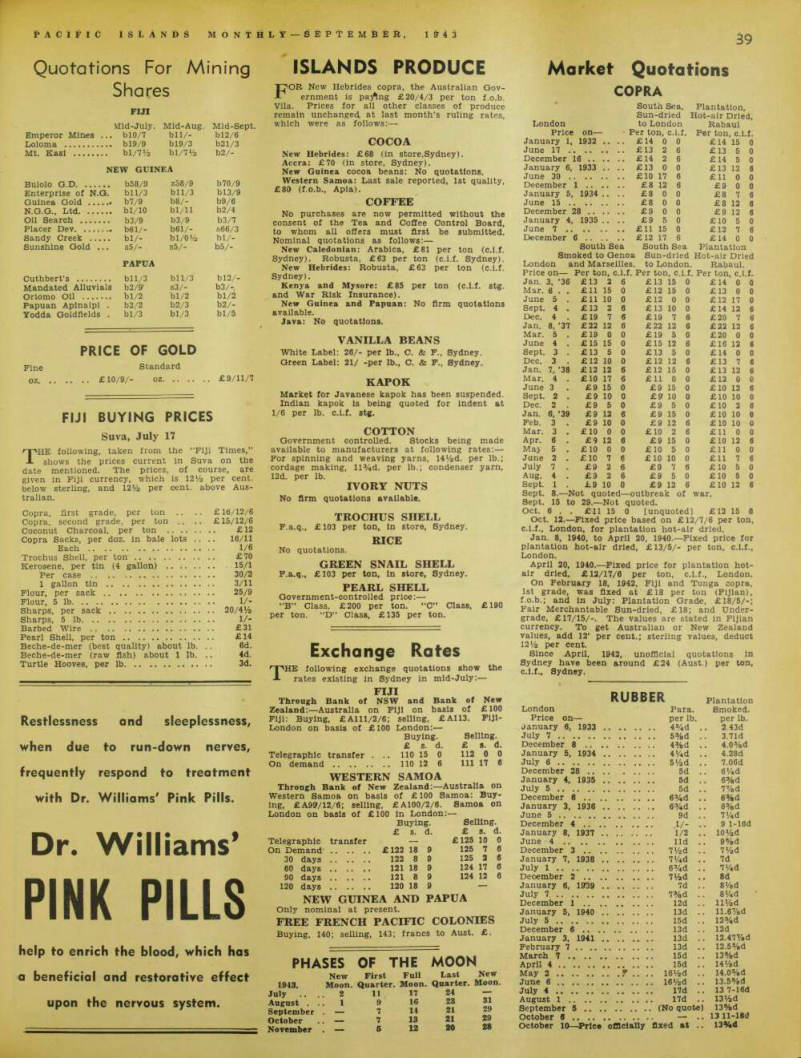
Shares
Fiji
Mid-July.
Mid-Aug.
Mid-Sept.
Emperor Mines ... blO/7 bll/bl2/6 Loloma bl9/9 bl9/3 b21/3 Mt. Kasi bl/7V6 bl/7% b2/-
New Guinea
Bulolo G.D b58/9 z58/9 b70/9 Enterprise of N.G. bll/3 bll/3 bl3/9 Guinea Gold b7/9 b8/b9/6 N.G.G., Ltd bl/10 bl/11 b2/4 Oil Search b3/9 b3/9 b3/7 Placer Dev b61/b61/- S66/3 Sandy Creek bl/bi/oy 2 bl/- Sunshine Gold ... s5/s5/b5/- Cuthbert's
Papua
bll/3 bll/3 bl2/- Mandated Alluvials h2/& s3/b3/- Oriomo Oil bl/2 bl/2 bl/2 Papuan Aplnaipi . b2/2 b2/3 b2/- Yodda Goldfields . bl/3 bl/3 bl/5
Advertisements & other items, p. 41 (1 item)
Price Of Gold
Pine Standard oz £10/9/- oz £9/11/7
Fiji Buying Prices
Suva, July 17
THE following, taken from the “Fiji Times,” shows the prices current in Suva on the date mentioned. The prices, of course, are given in Fiji currency, which is 12 Vz per cent, below sterling, and 12 Vz per cent, above Aus tralian.
Copra, first grade, per ton .. .. £16/12/6 Copra, second grade, per ton .. .. £ 15/12/6 Coconut Charcoal, per ton £12 Copra Sacks, per doz. in bale lots .. .. 16/11 Each Trochus Shell, per ton £70 Kerosene, per tin (4 gallon) 15/1 Per case 30/2 1 gallon tin 3/11 Flour, per sack 25/9 Flour, 5 lb Sharps, per sack Sharps, 5 lb 1/- Barbed Wire £31 Pearl Shell, per ton £14 Beche-de-mer (best quality) about lb. 6d.
Beche-de-mer (raw fish) about 1 lb. 4d.
Turtle Hooves, per lb 3d.
Islands Produce
FOR New Hebrides copra, the Australian Gov ernment is £2o/4/3 per ton f.o.b.
Vila. Prices for all other classes of produce remain unchanged at last month’s ruling rates, which were as follows: —
Cocoa
New Hebrides: £6B (in store,Sydney).
Accra: £7O (in store, Sydney).
New Guinea cocoa beans: No quotations.
Western Samoa: Last sale reported, Ist quality, £BO (f.0.b., Apia).
Coffee
No purchases are now permitted without the consent of the Tea and Coffee Control Board, to whom all offers must first be submitted.
Nominal quotations as follows: New Caledonian: Arabica, £Bl per ton (c.i.f.
Sydney). Robusta, £63 per ton (c.i.f. Sydney).
New Hebrides: Robusta, £63 per ton (c.i.f.
Sydney).
Kenya and Mysore: £B5 per ton (c.i.f. stg. and War Risk Insurance).
New Guinea and Papuan: No firm quotations available.
Java: No quotations.
Vanilla Beans
White Label: 26/- per lb., C. & F., Sydney.
Green Label: 21/ -per lb., C. & F., Sydney.
Kapok
Market for Javanese kapok has been suspended.
Indian kapok is being quoted for indent at 1/6 per lb. c.i.f. stg.
Cotton
Government controlled. Stocks being made available to manufacturers at following rates: — For spinning and weaving yarns, HVad. per lb.; cordage making, ll%d. per lb.; condenser yarn, 12d. per lb.
Ivory Nuts
No firm quotations available.
Trochus Shell
F.a.q., £lO3 per ton, In store, Sydney.
Rice
No quotations.
Green Snail Shell
F.a.q., £lO3 per ton, In store, Sydney.
Pearl Shell
Government-controlled price:— “B” Class, £2OO per ton. “C” Class, £l9O per ton. “D” Class, £135 per ton.
Exchange Rates
THE following exchange quotations show the rates existing in Sydney in mid-July:—
New Guinea And Papua
Only nominal at present.
Free French Pacific Colonies
Buying, 140; selling, 143; francs to Aust. £.
Fiji
Through Bank of NSW and Bank of New Zealand:—Australia on FIJI on basis of £100 Fiji: Buying, £Alll/2/6; selling, £A113. FIJI- London on basis of £100 London:— Buying.
Selling. £ s. d. £ s. d.
Telegraphic transfer . .. 110 15 0 112 0 0 On demand 110 12 6 111 17 6
Western Samoa
Through Bank of New Zealand: —Australia on Western Samoa on basis of £100 Samoa: Buy- Ing, £A99/12/6; selling, £A100/2/6.
Samoa on London on basis of £100 In London: Buying.
Selling. £ s. d. £ s. d.
Telegraphic transfer — £125 10 0 On Demand £122 18 9 125 7 6 30 days 122 8 9 125 2 6 60 days 121 18 9 124 17 6 90 days 121 8 9 124 12 6 120 days 120 18 9 —
Phases Of The Moon
New First Full Last New 1943. Moon. Quarter. Moon. Quarter. Moon.
July ... 2 11 17 24 — August ... 1 9 16 28 31 September . — 7 14 21 29 October — 7 13 21 29 November — 5 12 20 28
Market Quotations
Copra
* South Sea, Plantation.
Sun-dried Hot-air Dried.
London to London Rabaul Price on— Per ton, c.i.f.
Per ton, c.l.f.
January 1, 1932 .. .. £14 0 0 £14 15 0 June 17 .. .. £13 2 6 £13 5 0 December 16 .. £14 2 6 £14 5 0 January 6, 1933 . . . . £13 0 0 £13 12 6 June 30 .. £10 17 6 £11 0 0 December 1 .. £8 12 6 £9 0 0 January 5, 1934 . . £8 0 0 £8 7 6 June 15 .. .. £8 0 0 £8 12 6 December 28 .. £9 0 0 £9 12 6 January 4, 1935 . . , . £9 5 0 £10 5 0 June 7 .. .. £11 15 0 £12 7 6 December 6 .. £12 17 6 £14 0 0 South Sea South Sea Plantation Smoked to Genoa Sun-dried : Hot-air Dried London and Marseilles, to London.
Rabaul.
Price on— Per ton, c.l.f.
Per ton, c.i.f.
Per ton, c.i.f.
Jan. 3, ’36 £13 2 6 £13 15 0 £14 0 0 Mar. 6 . . £11 15 0 £12 15 0 £13 0 0 June 5 . £11 10 0 £12 0 0 £12 17 0 Sept. 4 . £13 2 6 £13 10 0 £14 12 6 Dec. 4 £ 19 7 6 £19 7 6 £20 7 6 Jan. 8. ’37 £22 12 6 £22 12 6 £22 12 6 Mar. 5 . £19 0 0 £19 5 0 £20 0 0 June 4 . £15 15 0 £15 12 6 £16 12 6 Sept. 3 . £13 5 0 £13 5 0 £14 0 0 Dec. 3 . £12 10 0 £12 12 6 £13 7 6 Jan. 7.'38 £12 12 6 £12 15 0 £13 12 6 Mar. 4 . £10 17 6 £11 0 0 £12 0 0 June 3 . £9 15 0 £9 15 0 £10 12 6 Sept. 2 . £9 10 0 £9 10 0 £10 10 0 Dec. 2 £9 5 0 £9 5 0 £10 2 6 Jan. 6. '39 £9 12 6 £9 15 0 £10 10 0 Feb. 3 . £9 10 0 £9 12 6 £10 10 0 Mar. 3 . £10 0 0 £10 2 6 £11 0 0 Apr. 8 . £9 12 6 £9 15 0 £10 12 6 May 5 . £10 0 0 £10 5 0 £11 0 0 June 2 . £10 7 6 £10 10 0 £11 7 6 July 7 . £9 2 6 £9 7 6 £10 5 0 Aug. 4 . £3 2 6 £9 5 0 £10 5 0 Sept. 1 . £9 10 0 £9 12 6 £10 12 6 Sept. 8. —Not quoted—outbreak of war.
Sept. 15 to 29.— -Not quoted.
Oct. 6 . . £11 15 0 [unquoted] £12 15 0 Oct. 12,—Fixed price based on £12/7/6 per ton, c.l.f., London, for plantation hot-air dried.
Jan. 8, 1940, to April 20, 1940. —Fixed price for plantation hot-air dried, £13/5/- per ton, c.l.f., London.
April 20, 1940.- -Fixed price for plantation hotair dried, £12/17/6 per ton, c.l.f., London.
On February 18, 1942 1. Fiji and Tonga copra, 1st grade, was fixed at £18 per ton (Fijian), f.o.b.; and in July: Plantation Grade, £18/5/-; Fair Merchantable Sun-dried, £18; and Undergrade, £17/15/-.
The values are stated in Fijian currency. To get Australian or New Zealand values, add 12’ per cent.; sterling values, deduct 12 */a per cent.
Since April, 1942, unofficial quotations In Sydney have been around £24 (Aust.) per ton, c.l.f.. Sydney.
Rubber
Plantation London Para.
Smoked.
Price on— per lb. per lb.
January 6, 1933 43/ 4 d .. 2.43d July 7 5%d 3.71d December 8 4%d .. 4.0 5 /ad January 5, 1934 4‘Ad .. 4.28d July 6 5‘/ad 7.06d December 28 .. . . . 5d .. 6‘Ad January 4, 1935 5d .. 6 3 Ad July 5 5d .. 7 7 Ad December 6 .. 63/ 4 d .. 6 3 Ad January 3, 1936 63/ 4 d .. 63/ 8 d June 5 9d .. 7‘Ad December 4 .. . .1/- 9 l-16d January 8, 1937 1/2 .. lOVad June 4 lid .. 9%d December 3 .. 7‘/ad .. 7‘/ad January 7, 1938 7‘Ad .. 7d July 1 63/ 4 d .. 7‘Ad December 2 .. 7‘/ad 8d January 6, 1939 7d .. SVid July 7 73/ad 8‘Ad December 1 .. , 12d .. 11‘/ad January 5, 1940 13d .. 11.6 7 Ad July 5 15d .. 12 3 Ad December 6 .. . 13d .. 12d January 3, 1941 13d .. 12.47 7 /«d February 7 .. .. 13d .. 12.5 5 Ad March 7 .. .. 15d .. 13 s /ad April 4 15d .. 14‘/ad May 2 .. 14.0%d June 6 .. 13.5%d July 4 17d .. 13 7-16d August 1 . . .. 17d .. 13‘Ad September 5 .. , . ,. (No quote) 13%d October 6 .. .. — .. 13 ll-l«d October 10—Price i officially fixed at .. 13%d
Advertisements & other items, p. 41 (1 item)
Pink Pills
Restlessness and sleeplessness, when due to run-down nerves, frequently respond to treatment with Dr. Williams' Pink Pills.
Dr. Williams’
help to enrich the blood, which has a beneficial and restorative effect upon the nervous system.
Carpenter Profit
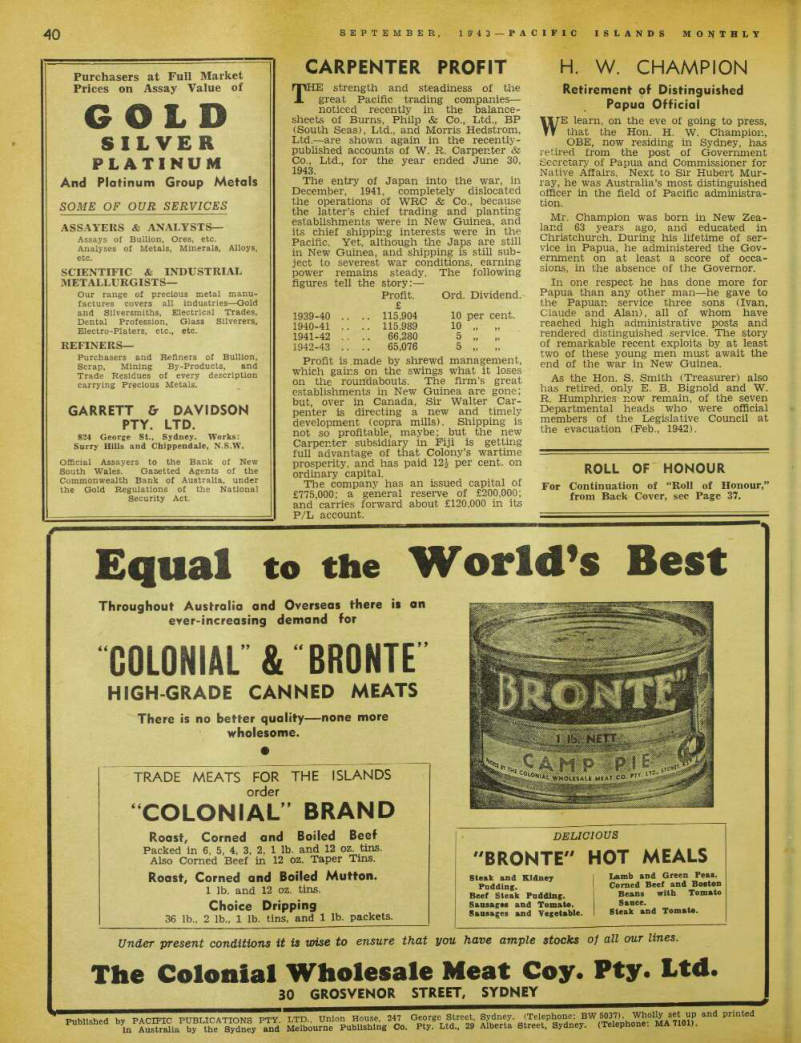
THE strength and steadiness of the great Pacific trading companies— noticed recently in the balance sheets of Burns, Philp & Co., Ltd., BP (South Seas), Ltd., and Morris Hedstrom, Ltd.—are shown again in the recently published accounts of W. R. Carpenter & Co., Ltd., for the year ended June 30, 1943.
The entry of Japan into the war, in December, 1941. completely dislocated the operations of WRC & Co., because the latter’s chief trading and planting establishments were in New Guinea, and its chief shipping interests were in the Pacific. Yet, although the Japs are still in New Guinea, and shipping is still sub ject to severest war conditions, earning power remains steady. The following figures tell the story:—
Profit is .made by shrewd management, which gains on the swings what it loses on the roundabouts. The firm’s great establishments in New Guinea are gone; but, over in Canada, Sir Walter Car penter is directing a new and timely development (copra mills). Shipping is not so profitable, maybe; but the new Carpenter subsidiary in Fiji is getting full advantage of that Colony’s wartime prosperity, and has paid 12£ per cent, on ordinary capital.
The company has an issued capital of £775,000; a general reserve of £200,000; and carries forward about £120,000 in its P/L account.
Profit, Ord. Dividend. £ 1939- .. .. 115,904 10 per cent. 1940- . . .. 115,989 10 „ „ 1941- . . .. 66,280 5 „ „ 1942- .. .. 65,076 5 „ „
H. W. Champion
Retirement of Distinguished Papua Official
WE learn, on the eve of going to press, that the Hon. H. W. Champion, QBE, now residing in Sydney, has retired from the post of Government Secretary of Papua and Commissioner for Native Affairs. Next to Sir Hubert Mur ray, he was Australia’s most distinguished officer in the field of Pacific administra tion.
Mr. Champion was born in New Zea land 63 years ago, and educated in Christchurch. During his lifetime of ser vice in Papua, he administered the Gov ernment on at least a score of occa sions, in the absence of the Governor.
In one respect he has done more for Papua than any other man—he gave to the Papuan service three sons (Ivan, Claude and Alan), all of whom have reached high administrative posts and rendered distinguished service. The story of remarkable recent exploits by at least two of these young men must await the end of the war in New Guinea.
As the Hon. S. Smith (Treasurer) also has retired, only E. B. Bignold and W.
R. Humphries now remain, of the seven Departmental heads who were official members of the Legislative Council at the evacuation (Feb., 1942).
Advertisements & other items, pp. 42-44 (3 items)
40
SEPTEMBER, H 4 3 PACIFIC ISLANDS MONTHLY
vitt PAPTPrr PTT-RT TrATTn-Nr<s pty LTD Union House. 247 George Street, Sydney. (Telephone: BW 5037). Wholly set up and printed Published Sourne Publishing Co. Pty. Ltd.. 29 Alberta Street. Sydney. (Telephone: MA7101).
Gold
Purchasers at Full Market Prices on Assay Value of
SILVER
PLATINUM
And Platinum Group Metals
SOME OF OUR SERVICES
ASSAYERS & ANALYSTS—
Assays of Bullion, Ores, etc.
Analyses of Metals, Minerals, Alloys, etc.
SCIENTIFIC & INDUSTRIAL
METALLURGISTS—
Our range of precious metal manufactures covers all industries —Gold and Silversmiths, Electrical Trades, Dental Profession, Glass Silverers, Electro-Platers, etc., etc.
REFINERS—
Purchasers and Refiners of Bullion, Scrap, Mining By-Products, and Trade Residues of every description carrying Precious Metals.
GARRETT & DAVIDSON
PTY. LTD.
824 George St., Sydney. Works: Surry Hills and Chippendale, N.S.W.
Official Assayers to the Bank of New South Wales. Gazetted Agents of the Commonwealth Bank of Australia, under the Gold Regulations of the National Security Act.
Equal to the World’s Best
ROLL OF HONOUR
For Continuation of “Roll of Honour,” from Back Cover, see Page 37.
Throughout Australia and Overseas there it an ever-increasing demand for
COLONIAL & BRONTE
HIGH-GRADE CANNED MEATS
There is no better quality—-none more wholesome.
TRADE MEATS FOR THE ISLANDS
order
COLONIAL” BRAND
Roast, Corned and Boiled Beef Packed in 6,5, 4,3, 2, 1 lb. and 12 oz. tins.
Also Corned Beef in 12 oz. Taper Tins.
Roast, Corned and Boiled Mutton. 1 lb. and 12 oz. tins.
Choice Dripping
36 lb., 2 lb., 1 lb. tins, and 1 lb. packets.
Is>; m S P res*’ ft*
PtSSAU
MIA
DELICIOUS
"BRONTE" HOT MEALS
Steak and Kidney Pudding.
Beef Steak Pudding.
Sausages and Tomato.
Sausages and Vegetable.
Lamb and Green Peas.
Corned Beef and Boston Beans with Tomato Sauce.
Steak and Tomato.
Under present conditions it is wise to ensure that you have ample stocks of all our lines.
The Colonial Wholesale Meat Coy. Pty. Ltd
30 GROSVENOR STREET, SYDNEY
I HP V'"
HI > ...
C IS
Travel by CARPENTER AIRLINES
Full particulars from Macdonald, Hamilton & Co., or Howard Smith Ltd., Sydney.
W. R. CARPENTER & CO. LTD..
MERCHANTS, SHIPOWNERS AND AIRCRAFT OPERATORS
Agents for Australian, European and American Manufacturers, and Distributors of Every Description of Merchandise.
Buyers and Shippers of Copra, Trocas, and all Classes of Islands Produce.
AGENTS FOR :
Ford Motor Company of Canada. Caterpillar Tractors. Dodge Brothers Inc.
T. G. & C. Bolinders (Engines). Electrolux Refrigerators. Westinghouse Electrical Co. etc., etc.
Branches throughout the Pacific Islands
In London: W. R. Carpenter & Co. (London) Ltd., Coronation House, 4 Lloyds Avenue, London, EC.
Head Office: 16 O’CONNELL STREET, SYDNEY