Pacific
Islands
Monthly
August 17, 1948
Vol. Xiv. No. 1.
Established 1930
[Registered at the G.P.0., Sydney, for transmission by post as a newspaper ]
8 d
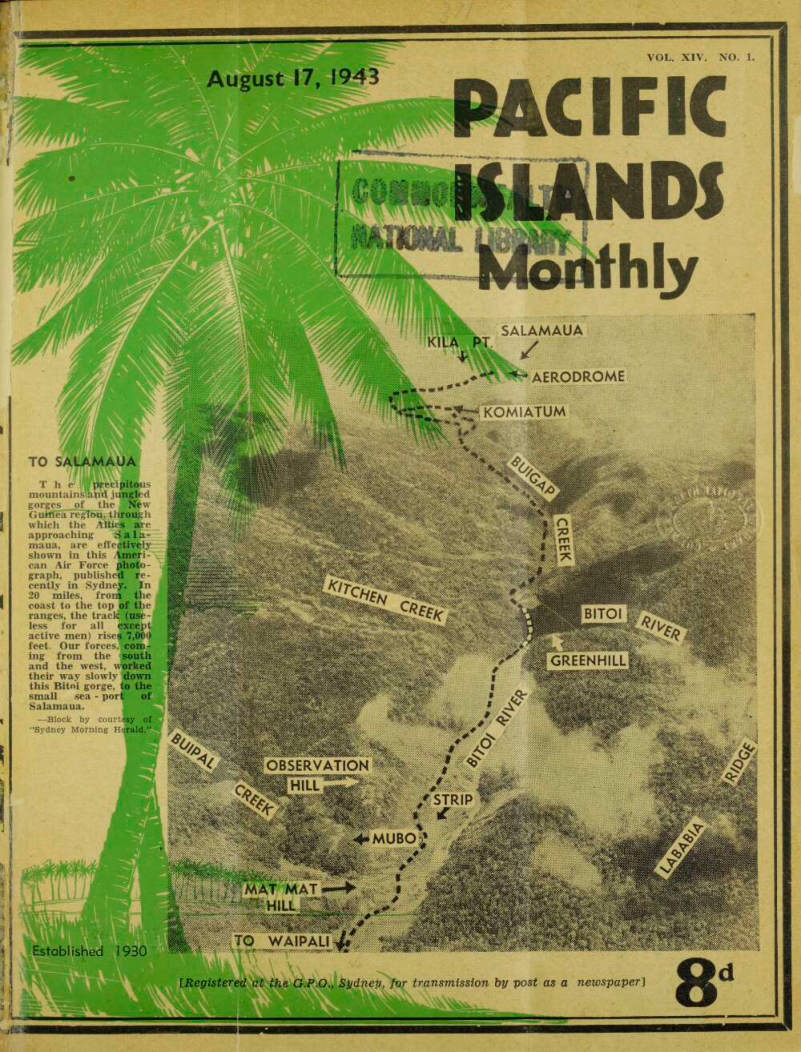
To Salamaua
The precipitous
mountains and jungled gorges of the New Guinea region, through which the Allies are approaching Sala maua, are effectively shown in this Ameri can Air Force photo graph, published re cently in Sydney. In 20 miles, from the coast to the top of the ranges, the track (use less for all except active men) rises 7,000 feet. Our forces, com ing from the south and the west, worked their way slowly down this Bitoi gorge, to the small sea - port of Salamaua. —Block by courtesy of “Sydney Morning Herald.”
Roll Of Honour
former residents^ofThe 6^acific^TerASrie^ whosp° f the United N . ati °ns. residents or who receive decorations. We should be eratefnf^ casualty lists or us details of such men.) re^a^10ns and friends would send
Killed
T ® gt ; Berfc AITKEN, NZEF, formerly of Fiji.
Killed in action in Libya.
Eugene AUBRY (formerly of Tahiti), of the Air Force of Fighting Prance. Killed in an air accident in Great Britain.
Pilot-Officer Len BAYLISS, flying instructor in the RAAF, formerly of Rabaul, New Guinea.
Killed in Sydney, 18/11/1940, when he fell from a trainer aircraft in flight.
B - c - BE NTLEY. NZEF, formerly of Fiji.
Killed in action, Middle East, June 27 1942 A/Bdr. Neville W. BERTWISTLE, AIF artillery (tank unit), formerly a clerk on the staff of W R. Carpenter and Co. Ltd., of Rabaul, New Guinea. Killed in action, April, 1941 JVO J ; B - BOMFORD, RNZAF. formerly of CSR Co.’s staff, Fiji. Killed on active service in England.
Pte. W. R. M. BRADNAM, of the NZ Forces formerly of Fiji. Reported killed in action in the Middle East, 25/11/1941.
Warrant-Officer R. P. BRECHIN, New Guinea Force. Killed in air accident, June 17, 1942 Formerly of NG Department of Agriculture.
Anton BRINON, of Fighting French Pacific Battalion, formerly of La Poa, New Caledonia.
Killed in action in Libya, November, 1942 Lieut.-Colonel Felix BROCHE, of the New Caledonian-New Hebridean contingent of the Fighting French Pacific Battalion. Killed in action in the battle of Bir Hacheim (Libya) Pilot-Officer E. H. CANARD, of RAF. formerly of Fiji Civil Service. Killed in flying accident in South Africa in the course of his duty as flying instructor.
Pte. David C. GARLAND, AIF, formerly chief assayer at the Emperor gold mines, Fiji. Killed In action in New Guinea.
Pierre CHARPENTIER, of the Fighting French .■Pacific Battalion. Killed in action in the battle of Bir Hacheim.
Raymond CHAUTARD (formerly of New Cale donia', of the Fighting French Pacific Battalion Killed in action in Libya.
Flight-Lieutenant G. J. I. CLARKE, of the RAAF, formerly Assistant Plight Superintendent of Carpenter Airlines, New Guinea. Killed in action during operations off Dakar (French West Africa), while attached to HMAS ”Aus tralla”, September, 1940.
Georges CLEMENS, of the Free French Pacific contingent from New Caledonia. Reported 1942 In aCtlon In the Mlddle East, March, Flying-Officer Jack R. COATH, of the RNZAF formerly on the staff of the Bank of New Zealand, in Suva, Fiji. Killed October 1941 when a training aircraft crashed in NZ Sqd.-Leader Lionel COHEN, RAF, formerly of Upper Watut, TNG. Killed when returning from a bomber raid on Berlin in 1942.
Sgt-Pilot Colin CRABBE, RAF, formerly of Suva, Fiji. Killed by enemy action in England in May, 19431 Pte. Felix CRAIG, AIF, formerly of accounts department, Australasian Petroleum Co Port Moresby. Papua. Killed in action. June, 1941.
L. J. DAWES, of the NZ Forces, formerly Dis trict Officer of Savaii, Western Samoa. Reported killed in action, February, 1942.
Pilot-Officer V. L. DEARMAN. of the RAAF (observer), formerly overseer and clerk at the Colonial Sugar Refining Co., Ltd.. Raraval FIJI. Reported killed in action in the Middle East, October, 1941.
Capt. Jean GILBERT, of the Naval Forces of Fighting France, and formerly of Tahiti. Killed In action.
Captain Kenneth GARDEN, of the RAP Ferry Command, formerly of Guinea Airways Ltd in New Guinea. Killed September. 1941 when a bomber he ’’ferried” from USA crashed on west coast of Britain.
Flying-Officer Moresby GOFTON, of the RAP *> n of Mrs P. S. Stewart, of Wau, New Guinea’
Reported missing. 17/5/1940—presumed killed in air operations.
Rifleman J. A. GOODWIN. AIF Infantry, for- Sn. , J..°Ur i a ! i4 2 TNG ' Rep ° rtcd Ernest GOURNAC (formerly of Tahiti), of the Air Force of Fighting France. Killed in an air accident in Britain.
Pte. WaHace GRAHAM, of the NZ Forces (infantry), formerly on the staff of Morris «^ ror 2 £ td ” Pij1 ' Killed ln action in the Middle East, November, 1941.
Lieut. J. A. GRANT, AIF, formerly of Man dated Territory. Killed in action Squadron-Leader C. R. GURNEY, RAAP a . chlef P ilot ot Guinea Airways, Ltd.
KUled in action in the New Guinea area, May, i P i 6 ’ HAMILTON . AIF, formerly of Auck land, NZ, and New Guinea. Killed in action.
Gerald T. J. HARPER, RAF, son of Major and Mrs. P., Harper, of Ra, Fiji. Killed in action while navigating a Whitley bomber dur ing a raid on the Continent.
J. HEAD, RAAF, formerly of Fiji. Killed in flying accident in Australia, 1941.
Squadron-Leader Godfrey HEMSWORTH of the RAAF, formerly a well-known commercial pilot in Morobe, TNG. Reported missing after an operational flight against the Japanese in the New Guinea area—now presumed killed in action.
Captain L. T. HURRELL, infantry. Rabaul.
Killed in action.
Sqd.-Leader James R. HYDE, of the RAF formerly a Patrol Office in Namatanai and Sepik Districts, TNG. Awarded the Distinguished Fly ing Cross, 1941. Killed in action while leading an attack on an enemy convoy off the coast of Greece, July 24, 1942.
Pte. Jack JOHNSON, formerly of Morris Hedstrom’s staff. Fiji. Killed in action on November 4, while serving with the AIF in New Guinea.
Flying-Officer Alan JOHNSTONE, of the RAF who was born in Suva, Fiji, in 1915. Killed during bombing raid on Kristiansand. Norway April, 1940.
LAC Douglas KIRBY, RAP, who left Suva.
Fiji, with the first contingent of Air Force trainees. Reported killed in a flying accident in South Africa, March, 1942.
Marcel KOLLEN, of the Pacific Battalion of Fighting France. Killed in action in the battle of Bir Hacheim.
C. D. LAMONT, RAF, formerly a master at Boys Grammar School, Suva, Fiji. Missing, be lieved killed on air operations over Germany.
Emile LESSON (formerly of New Caledonia) of the Fighting French Pacific Battalion. Killed in action in Libya.
Cpl. Gaston LESSON, of the Fighting French Pacific Battalion. Killed in battle of Bir Hacheim (Libya).
Capt. (now Lt.-Colonel) Edward Tiwi LOVE, NZ Maori Battalion, husband of Mrs. Takau Rio Love, Arikl-nui of Rarotonga, Cook Islands. Re ported missing during campaign in Greece, May. 1941; later. June, 1941, reported “wounded and safe.” Officially announced, July 17, killed in action in Libya.
Flying-Officer John C. LOWE, RAAP. formerly an overseer with the CSR Co. in Fiji. Reported 11/4/1942, “took part in air defence of Rabaul’
TNG, —missing, believed killed”.
Pte. L. F. McCarthy, AIF infantry, form erly supercargo on W. R. Carpenter and Co.'s inter-island vessels “Desikoko” and "Mako”, in New Guinea. Reported “killed in action” in Syria 30/10/1941. ’
Sgt. Kenneth MACGREGOR, AIF, formerly practising as a barrister and solicitor in Wau, TNG. Reported missing, believed killed in Papua.
Sgt.-Pilot Ronald MACKAY, RAAF, formerly of Thursday Island. Killed in an aircraft accident in England.
Lance-Corporal A. D. MacPHEE, son of Mr R. D. MacPhee, Levuka, Fiji. He was 35, was a member of the AIF, and was killed in Greece May, 1941. ’
Francois MASSON, of the Fighting French Pacific Battalion. Killed in action in the battle of Bir Hacheim.
Capt. John Malcolm METHVEN. Reported killed in action in Egypt on July 22, 1942, while serv ing with the ALP. He was born in Ocean Island and Is the youngest son of Mr. and Mrs’.
Stuartson C. Methven, of Belgrave, Victoria.
Flight-Sgt. Stuartson Charles METHVEN born in Suva, Fiji, brother of the late Capt. J. m. .
Methven. Killed in air operations over Ger many on January 23, 1943.
Spr. A. L. MORANDINI, AIF Engineers, for merly of Konedobu, Papua. Reported killed in action. April, 1942.
F - R- J- NICHOLLS, Royal Artillery, formerly of Fiji. Killed in action, Burma, May, 1942.
W/O G. A. OBST, formerly a member of the Lutheran Mission, TNG. Joined Australian military
FiU K?iSS eJ i PALMER, RAF. formerly of 0 « r °P eration s over Malta. b^vfd“d! RAF ’ fornKrly of "»• M‘ssm e: Edward Harold PRICE, 2nd NZEF Ind Mr e ' g T Un D Battalion) * youngest son of if and Mrs. J Price, Savu Savu West, Fiji Killed East! 27/11/mi 8 Llbran Cam P al « n .
ASata Ce S C Lor B ?S^Sa N S bST.L 2 S V mISL Eal” WOrld War n - Kllled ln actlon Captain W. H. ROBERTS, NZEF, who was Accountant in the Samoa Treasury Dent dur S. “V 35 - Klllad In action In Zlb^ct"*: ?q Ma i2c A - B ROSS ’ NZEP * who - between 1923- 29 was successively, Assistant Secretary for Native Affairs, Assistant Secretary to the or sZ r"',,? ADC t 0 the Administrator Of Samoa. Killed in action in Libya Cpl : Alex c. SCOTT. AIF, formerly manager Knw! et £’ T ? G ’ t° r Burns ’ Philp and Co. Ltd K t 1 ln the Middle East, 19/6/1941 J. SIMPSON, RAAF, formerly of Fiji. Killed in action over Malta, July, 1941.
Lieutensmt A. G. W. THOMAS, RANR, for -1 ma ®, ter o f Burns Philp & Company’s SS Muliama. Killed in action Pte. Popoare TANGIITI, of the NZ Forces (Maon Battalion), formerly of Mangala. Cook Islands. Reported “missing after Battle of Greece—presumed dead”, July 1941 - Derek TOVEY, NZEF, formerly of Suva, Fiji.
Jellied in action in Tunisia in April 1943 Sgt Edward WILSON, of Suva, serving'in the Fiji Defence Force. Accidentally drowned in the Lami River. Fiji, April, 1942.
Died From Wounds
Pte. Ernest HENRY, AIF, formerly of the Rabaul (NG) staff of Burns, Philp and Co Crete 1/6/1941 m WoUnds received in Battle of kt P V%. A l ec - NZ Forces, formerly of Norfolk Island. Died in Libya (Middle East) December, 1941.
Pte. T. LAWRIE. AIF, son of Mr. Lawrie for merly of Fiji. Died of wounds in Middle East Pte Waiter PEARSON, of first NG quota of acUoi m 2W&I Dled from ™“ ds «“‘« d oil^o^nd. 80 & ° f Ne "
Sgt.-Pilot Peter Clarkson WISE, of the RAF son of Mr, W. Wise, OBE, Director of Public Works, Fiji. Died from wounds received during bombing raid over Germany, January, 1941.
Accidentally Killed
Gnr. Robert J. WILSON, formerly of Port Moresby, Papua. Accidentally killed in troop train in Middle East in 1942. P
Died From Illness
Pte - Cl t Te ™L A * HUTT ON. AIF, formerly of Edie Creek, TNG. Died from Illness, April 1941 Seaman Malvin NELSON, of Fiji Royal’ Naval Volunteer Service. Death reported in May, A/Sgt. J. H. STANE, Royal Australian En gineers. formerly of Port Moresby, Papua Died from illness. May, 1942.
Rifleman R. A. SMITH, HQ Unit. (Place of enlistment not stated.) Died of Illness.
Cpl. R. H. SUTTON, NGVR, formerly of Wau TNG. Died from malaria and typhoid in October’ 1942.
Major P. J. WOODHILL. AIF Infantry formerly legal assistant in the Crown Law Office, Rabaul. New Guinea. Reported “deceased”, December, 1941.
Missing
Louis ANGER, of Fighting French Pacific Battalion. Reported missing after battle of Bir Hacheim.
Pte. P. F. BAILEY, AIF Infantry, of Rabaul TNG. Reported missing, 17/2/1942. Now re ported prisoner of .war.
Cpl. Jock BAIRD, AIF, formerly of Bank of NSW staff, Suva, Fiji. Reported missing in Malaya, February, 1942.
Cpl. Leon BARRENS, of Pacific Battalion of Fighting France. Missing after battle of Bir Hacheim (Libya).
T. BLAKELOCK, BEF, formerly of Fiji. Miss ing.
Robert BLUM, of Fighting French Pacific Battalion. Reported missing after battle of Bir Hacheim.
(Continued on Inside Back Cover)
on CSR Co.’s staff, Fiji. Reported prisoner of war in Bengazi, Libya, in November, 1942.
Pte. W. GOSSNER, AIF infantry, formerly of the BNG Development Co., Port Moresby, Papua.
Reported prisoner of war, Sulmona, Italy, 6/7/1941.
W/OI A. N. GRAY, AIF, formerly of Rabaul, TNG. Reported prisoner of war.
Lieut. J. M. HARCOURT, 2nd NZEP, son Of Mr. H. W. Harcourt, formerly Deputy Treasurer in Fiji. Reported “captured in Libya and now prisoner of war”, March, 1942.
S. D. C. KERKHAM, NZEF, son of Mr. R. C.
Kerkham, Suva, Fiji. Reported prisoner of war in September, 1942.
Lieut. JEFF KILNER, NGVR. Believed prisoner of war in Japan.
Gnr. A. L. B. KING, AIF artillery, of Rabaul, TNG. Reported prisoner of war, 29/7/1941.
Lieut. G. G. KINNER, New Guinea Forces, formerly of Rabaul. Reported prisoner of war.
Major E. G. A. LETT, of the East Surrey Regiment, and son of Mr. Lewis Lett, of Port Moresby, Papua. Reported prisoner of war in Libya.
A/Cpl. John H. LONERGAN, ALP, Supply and transport, of New Guinea. Reported prisoner n war al Corinthia, Italy, 8/7/1941.
Pie Ernest (“Paddy”) McGEADY, NZEF, son oi Mrs. J. McGeady, of Suva, Fiji. Reported ‘missing, believed killed”, after fighting in Libya, January, 1942; reported prisoner of war in Italy, April, 1942.
Cpl. J. H. L. McGUIGAN, of the Field Ambulance, AIF, formerly of the Public Health Department, New Guinea. Officially reported missing at Singapore; unofficially reported a prisoner in Japanese hands. Reported prisoner of war in Malaya, May 24, 1943.
Observer Alex. McKAY, of the RAAF, formerly of the CSR Co.’s staff, at Penang sugar-mill, Fiji. Reported missing, 27/7/1941; reported prisoner of war in Italy, 26/10/1941.
Pte. Harry MARCHINGTON, of the NZ Forces, formerly of Fiji. Reported prisoner of war after Battle of Crete, 2/12/1941.
Pte. F. C. MAYO, AIF, formerly of New Guinea. Reported a prisoner of war.
Emile MILLOT, of Pacific Battalion of Fight
ing Prance. Taken prisoner in battle of Bir Hacheim (Libya).
Pte. D. R. PHILLIPS, AIF engineers, formerly of Bulwa, TNG. Reported prisoner of war, June, 1942.
Pte. John O. SMITH, of the NZ Forces, son of Captain Arthur Smith, of the Fiji inter-island vessel “Tui Kauvaro”. Missing after battle of Crete, May, 1941; reported prisoner of war in Germany, 21/10/1941.
Squadron-Leader L. C. SHOPPEE, DSO, RAF, formerly of Edie Creek, New Guinea. Was in Java during Japanese invasion; now known to be a prisoner of war.
LAC Charles SOLLITT, of the RAAF (wire less operator), son of Mr. and Mrs. O. H.
Sollitt, of Nausori, Fiji. Reported missing after air operations in New Guinea, January, 1942; later, March, 1942, reported rescued from sea by Japanese—now prisoner of war.
Pte, Fred SWAN, NZ Army Medical Corps, formerly of Apia, Western Samoa. Missing after Battle of Crete, August, 1941; reported prisoner of war in Germany, November, 1941.
Signalman J. C. E. SWINBOURNE, 6th Div.
Signals, AIF, formerly of Fiji and the Gilbert & Ellice Islands Colony. Taken prisoner at Crete, June, 1941, now in prison camp at Stalag, VILA, Germany.
Lieut. CLIFF WARREN, of NZEP, serving in the Middle East, and formerly of Morris Hed strom Ltd.’s staff at Ba and Lautoka, Fiji. Re ported prisoner of war.
Mjr. N. WATCH, formerly Dr. Watch, of Rabaul, missing after Japanese invasion of Rabaul. Believed prisoner of war in Japan. Now reported POW in Japan.
Gnr. D. S. WHITCOMBE, NZEF, formerly of Fiji and Tonga. Wounded in Crete and reported prisoner of war in Germany.
Pte. John D. WHITCOMBE, of the NZ Forces, formerly of Levuka, Fiji. Reported prisoner of war in Germany, November, 1941,
Decorations
Squadron-Leader G. U. (“Scotty”) ALLEN, RAAF, who is well-known in New Guinea and Papua, having been co-pilot on the “Faith in Australia”, on the first official air-mail flight to the Territories in 1934. Awarded the Air Force Cross for his work with Catalina flying- Ooats in Australia and the Pacific.
Major H. T. ALLEN, AEP, formerly of Wau,
Morobe District, TNG. Awarded the QBE.
Squadron-Leader C. A. BASKETT, formerly of Bulolo, TNG. Awarded Distinguished Flying Cross for raids over enemy territory while attached to Hampden bomber squadron in Eng land.
Major W. F. M. CLEMENTS, of the British Solomon Islands Defence Force. Awarded Military Cross for exceptional devotion to duty in a theatre of war.
Sgt. Henry C. S. COTTON, of the RNZAP, who was born in Samoa (his father was Secre tary of Native Affairs during the NZ military occupation). Awarded the Distinguished Flying Cross.
FREDERIC DELAVEUVE, formerly of New Caledonia. Awarded Croix de Guerre, while serving with Fighting French volunteers in Egypt.
Flight-Lieut. R. N. DALKIN, RAAF, formerly of W. R. Carpenter and Co., Ltd., Salamaua, TNG. Awarded the DFC for bombing raids against the Japanese in Koepang area, DEI.
Squadron-Leader R. A. DUNN, RAAF, formerly of Carpenter Airways New Guinea Service.
Awarded the Distinguished Plying Cross for bravery while leading his squadron against the Japanese.
Squadron-Leader C. R. GURNEY, RAAF, for merly of Guinea Airways, Ltd., TNG. Posthu mously awarded the Air Force Cross, for bomb ing raids on Japanese-held ports in New Britain.
Rifleman H. W. FORRESTER, NGVR, formerly of Bulolo, TNG. Awarded the Military Medal for operations against Japanese in New Guinea, Walter GRAND, Fighting French Pacific Battalion, formerly of Tahiti. Awarded Croix de Guerre, with one star, for bravery during the Battle of Bir Hacheim, 1942.
Squadron-Leader Godfrey HEMSWORTH, RAAF, formerly a well-known New Guinea pilot, who was killed in action against the Japanese In May. Posthumously awarded the Air Force Cross.
LUCIEN HERVOUET, formerly of New Cale donia. Awarded Croix de Guerre while serving with Fighting French volunteers in Egypt.
Lieut. Colin HILL, RANR, of the Australian destroyer, “Waterhen”, formerly second officer on the trans-Pacific liner “Niagara”. Awarded the OBE, Lieut.-Commander A. W. R. McNICOLL, RAN, son of Sir Ramsay McNicoll, Administrator of New Guinea, and Lady McNicoll. Awarded the George Medal.
Petty-Officer PAUL MASON, RANVR, formerly a plantation inspector at Inus, Bougainville, TNG. Awarded American Distinguished Service Cross for “extraordinary heroism in action.”
HENRI MAYER, formerly of New Caledonia.
Awarded Croix de Guerre while serving with Fighting French volunteers in Egypt.
Sgt. Geoffrey MOORE, of the RNZAP, formerly engineer on the NG inter-island vessel “Maiwara” and on the trans-Paciflc liner “Aorangi”. Awarded the Distinguished Plying Medal.
ANDRE MORNAGHINI, formerly of New Cale donia. Awarded Croix de Guerre while serving with Fighting French volunteers in Egypt.
Pilot-Officer Pat RICHARDSON, RAF, son of Mr. W. Richardson, formerly of Penang, Fiji.
Awarded the Distinguished Flying Cross.
Commander Alvord S. ROSENTHAL, RAN, son of Major-General Sir Charles Rosenthal, KCB, OMG, DSO, VD, Administrator of Norfolk Island. Awarded the DSO, November, 1941; awarded the Bar to DSO, February, 1942.
F/O Leigh G. VIAL, RAAF, formerly ADO in TNG. Awarded American DSC for outstand ing heroism in New Guinea in September, 1942.
Lieut. George Raymond WORLEDGE, of the RANVR, formerly of Fiji. Awarded the MBE (Military) Mr. John Clark, son of Mr. and Mrs.
R. L. Clark, of Rabaul, New Guinea, has been promoted to the rank of Flying- Officer. He is serving in the RAAF in the Middle East. Mr. R. L. Clark, since January, 1942, has been a prisoner of war in the hands of the Japanese.
Sir Harry Luke, KCMG, lately Gov
ernor of Fiji, was expected to move on to another important post in the British Colonial Empire, in August. He has been
very actively engaged in Britain, since
leaving the Pacific, in public relations
work connected with British Colonial affairs.
iContinued From Inside Front Cover) Sgt. Ronald Arthur BROODBANK, formerly of Samarai, Papua, now serving with the RAAF overseas. Reported missing on May 31 while on air operations.
Sgt. Alexander BROWN, RNZAF, formerly of Rarotonga. Reported missing over Germany, on September 15, 1942.
Reginald BOULANGER, of Fighting French Pacific Battalion. Reported missing after battle of Bir Hacheim.
Boss BUCKLEY, RNZAF, formerly of Fiji.
Reported missing on air operations.
H. BUCKNELL, AIF, formerly of Fiji. Missing.
Sgt. R. F. BUNTING, AIF, formerly of Samarai, Papua. Missing in Malaya.
Pte. E. L. CHRISTIE, AIF infantry, of Rabaul, TNG. Reported missing, 17/2/1942.
Victor DERVAUX, of Fighting French Pacific Battalion. Reported missing after battle of Bir Hacheim.
Lucien DEVAND, of Pacific Battalion of Fight ing Prance. Missing after battle of Bir Hacheim (Libya).
Pte. A. G. DICKSON, AIF infantry, of Rabaul, TNG. Reported "missing, believed wounded”, 17/2/1942.
GELLER, of Fighting French Pacific Battalion. Reported missing after battle of Bir Hacheim.
J. P. GOUZENES, of Fighting French Pacific Battalion. Reported missing after battle of Bir Hacheim.
Chief-Sergeant Francois GRISCOLLI, of Fight ing French Pacific Battalion. Reported missing in Libya in April. Formerly of New Caledonia.
Acting Flight-Lieut. Don A. IRVING. RAAF, formerly chemist in CSR Co., Labasa, Fiji, Miss ing, presumed dead, in air operations over Germany, February 27, 1942.
Pte. Andrew A. (Billo) Johnson, Ngvr.
Reported missing in New Guinea on October 29, 1942.
Georges KABAR, of Fighting French Pacific Battalion. Reported missing after battle of Bir Hacheim.
Henri LANGLOIS, of Pacific Battalion of Fighting France. Missing after battle of Bir Hacheim (Libya).
Numa LETHESER, of Pacific Battalion of Fighting France. Missing after battle of Bir Hacheim (Libya).
Rene LETOCART, of Fighting French Pacific Battalion. Reported missing after battle of Bir Hacheim.
Camille MERCIER, of Fighting French Pacific Battalion. Reported missing after battle of Bir Hacheim.
MOUTRY, of Fighting French Pacific Battalion. Reported missing after battle of Bir Hacheim.
Pte. R. J. PASCOE, AIF infantry, of Rabaul, TNG. Reported missing, 27/1/1942.
Pilot Tom PATTERSON, of the RNZAF, formerly of Levuka, Fiji. Reported missing, in November, 1941, after bombing raid on the Continent.
Henri PAYONNE, of Fighting French Pacific Battalion. Reported missing after battle of Bir Hacheim.
Eugene PENE, of Fighting French Pacific Battalion. Reported missing after battle of Bir Hacheim.
Andre PETRE, of Fighting French Pacific Battalion. Reported missing after battle of Bir Hacheim.
Hector PILLING, RAF, who was born in Fiji and who was the son of Sir Guy Pilling, of Zanzibar (formerly of Fiji). Reported missing, while serving with the Royal Air Force Bomber Command.
Eugene POGNON, of Fighting French Pacific Battalion. Reported missing after battle of Bir Hacheim.
Gnr. Allan H. ROSS, AIF artillery, formerly planter in New Britain, TNG. Reported “miss ing—believed prisoner of war”. 28/9/1941.
ROUDEELLAC, of Fighting French Pacific Battalion. Reported missing after battle of Bir Hacheim.
Pte. William RUPE, of the NZ Forces (Maori Battalion), formerly of Aitutakl, Cook Islands.
Reported “missing after Battle of Greece”, July, nf P J ot f James SIMPSON, of the RAF, formerly of Vatukoula, Fiji. Reported missing after air l/7 e /i a 94i nS ° VCr MalU ’ ln the Medlterr anean.
Pilot-Officer Neville George STOKES, of the iff' . for S erly a P llot with Guinea Airways, Ltd., In New Guinea. Reported missing after air operations in Europe, December, 1941.
Reported Missing
Malaya Casualty List, Published 23/7/1942.
Ptp’ S’ A M OS. artillery. Port Moresby.
Pte. E. L. CHRISTIE, infantry. Rabaul.
Pte. A. G. DICKSON, Infantry, Rabaul.
Pte. A. I. FOLEY, artillery. Port Moresby.
W. 0.2 V. M. I. GORDON, artillery, Wau, New Guinea.
Pte. J. M. HIRSCHEL, infantry, RabauL Pte. J. G. NEWTON, artillery, Port Moresby.
A./Bdr. B. L. J. MEETON, artillery, Rabaul.
Pte. D. M. SPENCE, artillery, Port Moresby.
Australia and Island Stations.
Pte. S. W. HUNTER, infantry, Kokopo.
Wounded
Sgt. Robert ASMUS, of the Fighting French Pacific Battalion. Wounded at Bir Hacheim and evacuated.
Rene AUFANT, of the Fighting French Pacific Battalion. Wounded at Bir Hacheim.
Cpl. Thomas BAMBRIDGE, of the Fighting French Pacific Battalion. Wounded at Bir Hacheim and evacuated.
BERBERE (alias ARESKY), of the Fighting French Pacific Battalion. Wounded at Bir Hacheim.
Henri BERTHELIN, of the Fighting French Pacific Battalion. Wounded at Bir Hacheim.
Pte. V. BLANCO, AIF Infantry, of Thursday Island. Wounded in action, July, 1941.
L/Cpl. J. P. BLENCOWE, AIF infantry, of Rabaul, TNG. Wounded in action, July, 1941.
Jean BRIAL, of the Fighting French Pacific Battalion. Wounded at Bir Hacheim.
Pte. George BUCKNELL, AIF, son of Mr. and Mrs. C. Bucknell, of KoroLevu, Fiji. Wounded in action in Malaya, January, 1942.
Pte. Thomas BYERS, AIF infantry, of Thurs day Island. Wounded in action, May, 1941.
Raymond CHAUTARD, of the Free French Pacific contingent from New Caledonia. Re ported a casualty in the Middle East, March, 1942.
Pte. A. J. CORLASS, AIF, formerly of Rabaul.
Wounded in action.
Albert CUBADDA, of the Free French con tingent from New Caledonia. Reported a casualty in the Middle East, March, 1942.
Charles DEVEAUX, of Pacific Battalion of Fighting France. Wounded at battle of Bir Hacheim (Libya).
Sgt. EMERY, formerly of Lae, TNG. Wounded in New Guinea in October, 1942.
Lieut. M. G. EVENSEN, AIF, formerly of Rabaul. Wounded in action.
V. FAIRHALL, 2nd NZEF, formerly of the Treasury Department, Western Samoa. Reported wounded in action, February, 1942.
Trooper Arthur T. FILEWOOD, formerly of Thursday Island. Reported wounded in action.
May, 1943.
Paroa FIU, of the Fighting French Pacific Battalion. Wounded at Bir Hacheim and evacuated.
Acting Warrant-Officer V. M. I. GORDON, AIF infantry, of Wau, TNG. Wounded in action, February, 1942.
Pte. John GRANT, AIF Infantry, of New Guinea. Wounded in neck and thigh, September, 1941; later, reported “rejoined unit”.
Henri GUILBAUD, of the Free French Pacific contingent from New Caledonia. Reported a casualty in the Middle East, March, 1942.
Sgt. C. HENDRICK, AIF infantry, of Rabaul, TNG. Wounded in action, July, 1941.
Stanley HIGGS, son of Mr. and Mrs. Gordon Higgs, of W. R. Carpenter and Co. Ltd., New Guinea. Member of an English Lancers’ regiment, wounded during British evacuation from Dun kirk (France), May, 1940.
Lieut. Lloyd T. HURRELL, AIF infantry, of Rabaul, TNG. Wounded in action, July, 1941.
Alexandre HUYARD, of the Free French Pacific contingent from New Caledonia. Reported a casualty in the Middle East, March, 1942.
Sgt.-Pilot Andrew KRONFELD, of the NZ Fighter Squadron attached to the RAF. Wounded In knee during operations over France, December, 1941.
Cpl. W. H. LANNEN, AIF artillery, of Rabaul, New Guinea. Wounded in action, June, 1941.
Gnr. E. G. LOBAN, AIF artillery, of Thursday Island. Wounded during campaign in Greece, May, 1941; invalided home after having his left forearm amputated.
Auguste LUTA, of the Fighting French Pacific Battalion. Wounded at Bir Hacheim and evacuated. s A/Sgt. Alastair MACLEAN, AIF infantry, of Rabaul, New Guinea. Wounded in action, in Libya, June, 1941.
Sgt. J. D. McCLYMONT, NZEF, son of Capt.
D. McClymont, Harbourmaster of Apia, Western Samoa, Wounded in action, November, 1941.
Cpl. R. McKERLIE. AIF, of Yandina, BSI, wounded in face by bomb explosion, April, 1941.
T. MANEA, of the Fighting French Pacific Battalion. Wounded at Bir Hacheim and evacuated.
Jean MERIGNAC, of the Free French Pacific contingent from New Caledonia. Reported a
casualty in the Middle East, March, 1942 Henri MEYER, of the Free French ’Pacific contingent from New Caledonia. Reported a casualty in the Middle East, March, 1942.
S/Sgt. Graham B. MIRFIELD, AIF engineers of Rabaul, New Guinea Wounded in action’
Joseph OTHUS, of Pacific Battalion of Fight ing France. Wounded in battle of Bir Hacheim (Libya).
Lieut. A. G. PEARCE, AIF, formerly of Salamaua, TNG. Wounded In action.
Pte. L. G. (“Mick”) REECE, AIT, of Bulolo New Guinea. Wounded in action, July, 1941.
Henri RIVIERE, of the Free French Pacific contingent from New Caledonia. Reported a casualty in the Middle East. March, 1942 Pte. H. St. George RYDER, AIF, formerly of Suva, Fiji. Wounded while serving in New Guinea.
A/Opl. N. K. SAWYER, AIF infantry, of Rabaul, TNG. Wounded in action, July. 1941 July. 1941.
Lieut. Jeffrey SEAGOE, serving with the British forces in the Far East, formerly of Vila, New Hebrides. Reported “wounded in action”
March, 1942.
John Oswald SMITH, NZEF, formerly of Fiji Taken prisoner of war in Greece in April, 1941.
Pte. Lance STAMPER, AIF, formerly school master at Wau, New Guinea. Wounded in action August, 1941.
Cpl. Raphael TEIHO, of the Fighting French Pacific Battalion. Wounded at Bir Hacheim and evacuated.
Cpl. Terii TERIITUA. of the Fighting French Pacific Battalion. Wounded at Bir Hacheim and evacuated.
Lieut. P. A. TUCKEY, infantry, formerly of New Guinea. Wounded in action.
Pte. Harold G. TURNER. AIF, of Samaral, Eastern Papua. Wounded In action at Bardia (Libya), January, 1941.
Pte. P. D. TWISS, AIF Infantry, of New Guinea. Wounded in action, August, 1941.
Camille VINCENT, of the Free French Pacific contingent from New Caledonia. Reported a casualty in the Middle East, March. 1942 Driver Don F. WAUCHOPE, AIF. Formerly employed on his brother’s plantation in New Guinea. Wounded in action, July, 1942.
Alex. WINCHESTER, of the Fighting French Pacific Battalion. Wounded at Bir Hacheim.
Pte. K. M. WHITE, AIF, formerly of Bulwa, TNG. Wounded in action.
Sgt.-Pilot W. WRIGHT, of the Australian Spitfire Squadron, attached to the RAP, for merly of New Guinea. Wounded in knee during aerial “dog-fight” over the English Channel, March, 1942.
Prisoners Of War
Lieut. CLARRIE ARCHER, NGVR. Believed prisoner of war in Japan. Reported prisoner of war in February, 1943, in prison camp on island south of Japan.
ALEXANDRE BLACK, of Pacific Battalion of Fighting France. Reported killed in action at Bir Hacheim, now reported prisoner of war.
A/Cpl. Peter W. BOSGARD, AIF Infantry, formerly of the Lands Department, Port Moresby, Papua. Reported prisoner of war at Sulmona, Italy, 29/6/1941; transferred to Bolzano prison camp, September. 1941.
Cpl. J. E. BROAD, NZEF, formerly of Suva, Fiji. Reported prisoner of war.
Lieut. John BROWN, formerly of Fiji. Re ported a prisoner of war in Italy.
Andre CHITTY, of Pacific Battalion of Fight ing France. Taken prisoner at battle of Bir Hacheim (Libya).
Sgt. Peter COGGINS, AIF, formerly of Fiji.
Taken prisoner in Malaya, and now reported prisoner of war in Borneo camp.
A/Sgt. A. A. S. COTMAN, AIF Infantry, of Abau, Papua. Reported missing—believed prisoner of war, 5/5/1941; reported later, July, 1941, “wounded in chest and head by shrapnel— taken prisoner”.
Cpl. W. F. CULLEN, AIF, formerly of Thursday Island. Reported prisoner of war.
Pte. J. DALTON, AIF Transport and Supply, formerly of Thursday Island. Reported prisoner of war, April 1942.
Dick ELMOUR, formerly of New Caledonia, prisoner of war after Dunkirk. Repatriated to Prance in January, 1942, because of health reasons.
Pte. W. G. ECKBLADE, AIF, formerly of Rabaul. Previously reported missing; now re ported missing; believed prisoner of war.
Pilot-Officer George Beilby EVANS, RAAF, son of Mr. and Mrs. Beilby Evans, formerly of Buka Passage, TNG. Reported prisoner of war In Java.
Sgt. Robert GEMMELL-SMITH, RAF. formerly
(Continued on Page 40)
Pacific News-Review
Notes And Comment On
The Progress Of The War
From July 14 To August 14
July 14; The Allied invasion of Sicily —prelude to invasion of Italian main land —gt>es well. The Allied forces — Americans driving westward, Canadians northward, and British eastward, to wards Catania —tighten their grip on South-east Sicily, while 3,000 ships land streams of reinforcements. Ragusa and Augusta have been taken.
July 15: The German summer offen sive, launched against the Central Rus sian front, is weakening, in the face of Russian resistance. Moscow reports that the Russians are now taking the offen sive in the Byelgorod area.
July 15: Allied forces in Sicily are within 12 miles of Catania.
July 17: Allied leaders, Churchill and Roosevelt, have called upon the Italian people to capitulate, pointing out that Catania is about to fall and the Allied forces are advancing steadily every where.
July 17: The Russians have launched a terrific counter-stroke against the Ger mans on the central front, and have driven big wedges into the German lines near Orel.
July 17: Australian and American troops in New Guinea have captured the Jap-held village of Mubo and are press ing on to Komiatum, overlooking Sala maua.
July 17: RAP by night and Americans by day continue bombing raids on enemy positions in Western Europe.
July 19: The Allied forces in Sicily are meeting strong German resistance on the outskirts of Catania.
July 19: Over 200 American planes attacked Buin (Bougainville) on Satur day and sank seven Japanese ships and shot down 49 fighters, for the loss of six American aircraft.
July 19: The Russians, pressing on Orel, now have advanced 44 miles.
July 20: Rome (for the first time) was heavily attacked by Allied heavy and medium bombers yesterday. Only mili tary objectives were bombed—principally railway marshalling yards.
July 21: American and Canadian forces have captured Enna, geographical centre of Sicily, and a vital junction.
July 22: Half Sicily is now in Allied hands, but Axis forces are clinging dog gedly to the key city of Catania.
July 22: Another Jap convoy attempt ing to reinforce their beleagured base at Munda, in New Georgia (Solomons) was smashed by US planes. A light cruiser and two destroyers were sunk, another destroyer probably sunk, and a transport and a destroyer damaged.
July 23: Six Messerschmitt 109’s were amongst the 19 enemy fighters shot down over the Ramu Valley this week—the first time German planes have been re ported in New Guinea.
July 24: The Americans have captured Palermo (capital of Sicily), and the Allies now hold the whole south and west coasts, and part of the east and north coasts.
July 23: Australian-based Allied air craft bombed Sourabaya (Java) —a round trip of 2.400 miles.
July 26: The enemy has fallen back in Sicily and has taken up a defence line from San Stefano (60 miles west of Messina), west of Mt. Etna, to Catania.
July 26: Mussolini to-day resigned the dictatorship of Italy. Marshal Badoglio took charge as Prime Minister, under King Victor Emmanual. and has placed the country under martial law. He has formally repudiated Fascism. The col lapse of Italy is expected.
July 27: The Russian drive continues
and is exerting great pressure on the German positions north, south and east of Orel.
July 28: There has been no peace approach by Italy. Although the fall of Mussolini is being hailed by demonstra tive Italian crowds as the close of an epoch in the life of Italy, no one knows what the next phase will be.
July 28: RAF and American raids on Germany continue. 5,000 tons of bombs have been dropped during the last 48 hours —2,500 Allied bombers taking part in the raids.
July 30: The situation in Italy remains obscure and confusing. No approach has been made to the Allies. Badoglio ap parently is co-operating with the Ger mans in trying to keep Italy fighting.
The Germans, as a precaution, are rapidly occupying key places in Northern Italy.
July 31: The Nazis are systematically occupying the Istrian Peninsula, and the whole of the Udine region from the Gulf of Trieste to the Austrian border.
July 31: Another great Anglo-Ameri can raid on Hamburg makes the seventh in five days, the total bombs being about 7,000 tons. (The bombs on London dur ing 11 months’ blitz were about 7,500 tons.) Hamburg is now almost obliter ated.
Aug. 3: The air offensive has been resumed against Italy. Naples has been severely raided.
Aug. 3: American bombers from the Middle East raided the Rumanian oil fields at Ploesti. Betwen 150 and 200 planes took part in the raid; 20 were lost over the target, and another score were forced to land, en route.
Aug. 4: Allied artillery, man-handled up the coast from Nassau, is now shell ing Salamaua, while the aerial bom bardment of the airfield goes on.
Aug. 6; The British Army has taken Catania, key point in Sicily. The enemy is retreating east and west of Mount Etna.
Aug. 6: The Russians have captured Orel (one of the German’s greatest fort resses on their eastern front), which has been in Nazi hands for two years; and they are pressing on towards Bryansk, 75 miles north-west.
It now is clear that not only has the German summer offensive petered out, but that the Russians now are advanc ing all along their central front, in the biggest offensive they yet have launched.
Aug. 7: Munda, last Japanese strong hold on New Georgia, has been occupied by the Americans, after operations ex tending over five weeks.
Aug. 7: The Russians have captured Byelgorod, 175 miles south of Orel. This creates a direct threat to Kharkov (the great fortress which the Russians recap tured last winter, and lost again a few weeks later).
Aug. 9: The Americans, in another naval victory in the Solomons, sank a Japanese cruiser and two destroyers.
Aug. 9: Allied troops are again advanc ing in Sicily, and the whole German defence line west of Mt. Etna is crumb ling. Americans landed behind the Ger mans on the north coast and made im portant captures.
Aug. 10: The Badoglio Government has decided that Italy shall fight on. Mass demonstrations for neace are growing in number and strength.
Aug. 11: The Russians have begun new drives, one west of Orel and others north afid south of Kharkov. A threat to Smolensk is reported.
Aug. 13: Russian forces are closing in
on Kharkov, the capture of which is expected at any time.
Aug, 13: The Allies having captured Pandazzo, key junction north of Mount Etna, the Axis forces are all falling back on Messina, their last foothold. Ger mans, crossing from Messina to the mainland, are being bombed day and night.
Aug. 12: Mr. Churchill has arrived in Canada to confer again with President Roosevelt. Their last conference was in Washington three months ago. This meeting is made necessary by the rapid progress of events in Italy and Russia.
Aug. 13: Anglo-American bombers very severely damaged Milan, Turin, and other industrial cities in Italy, and again raided the Rome marshalling yards. They con tinue, day and night, their attacks on German cities. Berlin has been raided again.
Aug. 14: American Liberators, flying a round trip of 2,500 miles from Austra lia, bombed and severely damaged Jap held oil refineries and storage in eastern Borneo.
Aug. 14; The Badoglio Government, to avoid further bombing, has declared Rome “an open city.” This means that all Governmental and war-industrial activities are being withdrawn.
New Guinea Returned
Soldiers
THE New Guinea Branch of the RSSAILA met on July 23, at the rooms of the Combined Services Sub-branch, Barrack Street, Sydney. Mr.
A. J. Gaskin, president of the branch, who is now attached to the American Red Cross in Port Moresby, was in Syd ney on official duties at the time, and presided at the meeting.
Resignations, accepted with regret, came from Dr. E. T. Brennan, vice-pre sident, and Mr. H. L. Downing, honorary secretary. Both remain members of the branch, but unforeseen circumstances prevent their holding executive office.
New elections were: Dr. B. A. Sinclair (well-known Salamaua medical prac titioner), vice-president; Mr. C. W.
Thomas, hon. secretary; Mr. S. R. Young, hon. treasurer.
The Combined Services Sub-branch offered their premises to the New Guinea Branch as semi-permanent quarters, and this generous offer was accepted.
Civilian membership of the New Guinea Branch is increasing and now numbers 85. Members serving with the armed forces now exceed 50, and are increasing, as the activities of the branch become better known to the younger men in New Guinea and outer islands.
Attendance at the meeting was excel lent, seeing that members are scattered far and wide over Australia and other countries. After the meeting, the 50 members present were served with refreshments and entertained by the executive of the Combined Services Sub branch.
From his London retirement recently, Sir Harry Luke (lately Governor of Fiji) spoke on what to do with Axis chiefs after the war: “The ideal place of residence for them . . . would be Falcon Island, in the Pacific. It is a volcanic type and sinks into the sea for a period of years and then rises again.”
Contents
Pacific News-Review 1 Allies’ Mediterranean Strategy is Shortening the War 3 Papuan Owners in High Court Judgment 5 Copra 5 Communications and Settlement Facilities—What War May Do for Territories 6 Tahitian Valour in North Africa .. !! 6 New Post for Mr. A. L. Armstrong .. 6 Fiji’s Black Markets 7 Risks on Territory Property—Owners Should Insure 7 Evacuees to Meet 8 Fighting French Chiefs ! 8 Unsung Heroes of Evacuation ... 8 Bravery of Father Glover 9 Air Photograph, Salamaua Battle Area 10 Battle for Salamaua 11 Prosperous Samoa ... 12 Vale “F.E.W.” ' 13 Education of NG Natives !!!” 14 Why Paton and Penglase? 15 Problems of Carrying-on Annual Meeting NG Women’s Club ... 16 Wasps—NG Gets New Instalment .. 19 Schooner Lost —“Manureva” on Reef 21 Cutting Coconuts and Red Tape ... 22 Flash-Back! 23 Interdict on USA Marriages in New Caledonia 25 Cruel Toll of War—Aviator Brothers Missing 25 Rainy Weather Thoughts 26 Status of Norfolk Island 27 Calendar Reform 28 Rubber’s Future ’ 29 Where Japs Were Stopped 29 The Future of Australian New Guinea 30 Jungle Foods 32 Guest of Solomon Folk 33
Pacific Liner Survives Four Years of War 33 Christmas Is. Stamps 34 Wild Rubber 36 New Guinea Chinese 27 Markets, Commerce 39 Honour Roll .. Covers ii., hi. and Page 40
Advertisers
A. Ltd. ... 22 Atkins Pty. Ltd., Wm 22 Australian Alumi nium Co. Pty Ltd Broomfield, Ltd. . . 30 Brown, D. C. . . .32 Brown & Co. Ltd., Q 13 Brunton’s Flour . . 35
B. (S.S.) Co. . . 13
Burns, Philp Trust Co. Ltd 38 Carlton & United Breweries Ltd. . . 19 Carpenter Ltd., w.
R cov. iv.
Chivers & Sons Ltd. 28 Coleman Lamp & Stove Co 23 “Cystex” 40 Darvas & Co. ... 29' Donaghy & Sons Ltd 35 Donald Ltd., A. B. . 21 Dorn, Paul A. ... 26 Dr. Williams Pink Pills 29 Electrolux Refrigerators . . 18 Foster Clark Ltd. . 17 Garrett & Davidson 31 Gilbey’s Gin ... 14 Gillespie Pty. Ltd., Robert 27 Gillespie’s Flour . . 14 Gough & Co., E. J. 32 Grove & Sons, W.
H 14
Grand Pacific Hotel 2 Kopsen & Co. Ltd. . 33 “Lavex” Washing Compound ... 24 Maxwell Porter Ltd. 37 Merrillees & Co., J C 35 “Mendaco” ... 26 Miller & Co. Pty.
Ltd 15 Nelson & Robertson Pty. Ltd 38 “Nixoderm” ...
Orokolo Industries . 37 Pacific Territories Association ... 37 Pacific Is. Society . 13 “Pinkettes” ... 40 Prescott Ltd 2 Rohu, Sil 30 Riverstone Meat Co.
Ltd 34 Scott Ltd., J. ... 21 Steamships Trading Co. Ltd 30 Sullivan & Co., C. . 24 Swallow & Ariell . . 16 Taylor & Co., A. . . 36 “Tenax” Soap ... 26 Tillock & Co. Ltd. . 27 “Van Kars”
Liqueurs ... 24 Wright & Co. . . .37 Wright & Co. Ltd., E 40 Wunderlich Ltd. . . 36 Young Pty. Ltd., Harry J 35 Yorkshire Insurance Co. Ltd 23
Advertisements & other items, p. 4 (3 items)
2
AUGUST, 1943 TACiPic ISLANDS MONTHLY
Useful Addresses
The following are the addresses of organisations set up to deal with Pacific Territories affairs:—
PAPUA, NEW GUINEA, NAURU,
NORFOLK IS.
Department of External Territories (Sydney Branch) (Lately the New Guinea Trade Agency), Australia House, Carrington Street, Sydney.
Telephone: BW 1776. (Dealing with all matters connected with the Australian Pacific Territories and also the Sydney representative of the New Guinea Copra Control Committee.)
BRITISH SOLOMON ISLANDS
Sydney Office of British Solomon Islands Government (In charge of Mr. F. E. Johnson, Treasurer of the Solomons Administration), 17 Castlereagh Street, Sydney.
Telephone: B 1710.
GILBERT AND ELLICE, AND
OCEAN IS.
Sydney Office of Gilbert and Ellice Islands Colony (In charge of Mr. S. G. Clarke, Treasurer of the G. and E. Administration), Bank of New Zealand Building, George Street, Sydney. Telephone: B 2209.
FOR PACIFIC TERRITORIES
EVACUEES GENERALLY
Pacific Territories Association (C. A. M. Adelskold, Secretary), c/o Robert Gillespie Pty., Ltd., 54a Pitt Street, Sydney, Telephone: BW 4782.
WAR DAMAGE COMMISSION
Sydney Office: M.L.C. Buidling, Cnr. Martin Place and Castlereagh Street, Sydney.
Telephone: BW 2361.
FOR CLAIMS AGAINST ARMY
Mr. H. Alderman, Darwin-Moresby Claims Section, Chief Finance Office (Army), Victoria Barracks, Melbourne.
•00
t \W o eß4" rfvl ' S rtoie' « (or * e by «** \7| b 9SO>
Pacific Islands Monthly
The Newspaper-Magazine of the South Seas
IRegistered at the G.P.0., Sydney, for transmission hy post as a newspaper .] Published Once Each Month and Circulated in Australia and New Zealand and in the following Pacific Territories and Islands Groups:
Australian Territory of Papua.
Mandated Territory (Australia) of New Guinea.
Australian Territory of Norfolk Island.
New Zealand Territory of Cook Islands.
Mandated Territory (NZ) of Western Samoa.
British Colony of Fiji,
British Solomon Islands Protectorate.
British Protectorate of Tongan Islands.
British Crown Colony of Gilbert and Ellice Islands.
Mandated Territory of Nauru.
British and Free French Condominium of New Hebrides.
Free French Colony of New Caledonia.
Free French Colony of Oceania (Tahiti, etc.).
American Territory of Eastern Samoa.
American Territory of Hawaiian Islands.
Owned and Produced by Pacific Publications Pty. Ltd., Union House, 247 George Street, Sydney.
c Managing Director .. BW 5037 TELEPHONE £ Business and Editorial MA 4369
P.O. Box 3408 R
Registered Address of Telegrams, Radiograms, and Cables: “Pacpub”, Sydney.
Contributions.
Articles, Stories, and Photographs dealing with Pacific Islands subjects are invited and will be paid for on publication.
Subscription Rates.
Per Annum, within British Empire, Prepaid, Post Free 8/- Per Annum, elsewhere, prepaid, Post Free. 10/- Single Copies Bd.
Editor and Publisher:
R. W. Robson, P.R.G.S.
Advertising Manager: L. W. Bailey.
Advertising Office and Printing-House: 29 Alberta Street, Sydney.
Advertising rates furnished on application.
Colours, etc., by arrangement.
Process Blocks made at Advertiser’s expense when required. Screen 100.
Changes of Advertising Copy should reach this office by Ist of each month, otherwise previous advertisement may be repeated.
Representative In London.
W. C, Harvey, Coronation House, 4 Lloyds Avenue, London, E.C.3, from whom may be obtained copies of Pacific Islands Monthly, Pacific Is. Year Book, advertising schedules, etc.
Agents.
The following are authorised to receive sub scriptions for Pacific Islands Monthly;— Burns, Philp & Co., Ltd., and Burns Phllp (South Sea) Co., Ltd. All branches.
W. R, Carpenter & Co., Ltd. All branches.
Morris, Hedstrom, Ltd. All branches.
Steamships Trading Co., Papua. All branches, B.N.G. Trading Co., Ltd., Port Moresby, Papua.
J. Muir, Suva, Fiji.
Miss R. Castles, Suva, Fiji.
N. C. Mackenzie Hunt, Walnunu, Bua, FIJI.
Cook Islands Trading Co., Rarotonga, Cook Is.
A. C. Rowland, Papeete, Tahiti, Islands Branches and Representatives of W. H.
Grove & Sons, Ltd., Auckland, New Zealand.
Ed. Pentecost, Noumea. New Caledonia.
Kerr & Co., Noumea, New Caledonia.
Vol. XIV. No. 1.
August 17, 1943
Prirp I Bd * Per Copy rrice Prepaid: 8/- p.a.
Allies’ Mediterranean Strategy
Is Shortening The War
A Review
by
R. W. Robson
WHEN the history of this war is written, it probably will be shown that the Axis was destroyed by a plan which may be called the Medi terranean strategy of the Democratic Powers; and that the author of the plan was Winston Churchill. I think that Churchill submitted the outline of the plan (already endorsed by his own Service chiefs) to the Americans when he visited Washington in the middle of 1942, and won for it the complete support of President Roose velt and his advisers. The Americans probably improved it and, with char acteristic thoroughness, hammered in the details.
But the implementation of the plan was discussed in the shadow of complete disaster. If it were to suc ceed, it had to have an aggressive and unbroken Russia, Anglo-Ameri can dominance in North Africa, and reasonably clear sea-lanes in the Atlantic. Actually, the first news that greeted Churchill when he entered the White House on June 18, 1942, was that Tobruk, with 25,000 of our men, had been captured by Rom mel. Within two weeks, our Eighth Army was in full retreat into Egypt; the Axis armies were pouring across the Don into the Caucasus region, in pursuit of the retreating Russians; and our losses of shipping in the Atlantic, already serious, were mount ing at an appalling rate.
In such circumstances, the elabora tion of the Mediterranean plan, which unquestionably took place in Wash
ington in June and July, 1942, called for extraordinary optimism and fore sight, and lion-hearted courage. The only really bright spot in the whole picture of the global war at that time was the fact that the RAF (the “few” who saved the “many” from destruc tion in the black days of 1940) had carried out three 1,000-bombers raids —one on Cologne, one on Essen and one on Bremen.
We are inclined to think of those raids as interesting historical inci dents. Actually, although few then could see it, they marked the turn ing-point of the war. Churchill and Roosevelt, clear-visioned and resolute, sitting behind their Mediterranean plan, could see it—but only if three things could be achieved quickly.
They were three terrible “if”: IF Rommel’s armies could be defeated in North Africa; IF the Russians could hold together and strike back; IF American armies, and the growing masses of American equipment, could be brought across the Atlantic.
Churchill and Roosevelt believed that those three things could be achieved; but many prominent people, of lesser vision, can be pardoned because at that time they endorsed the Anglo- American plan with trepidation.
THE plan was brilliant, magnificent.
While Britain carried out a series of feints against the German-held lines along the Atlantic coast of Europe, a great Anglo-American force was to be assembled and secretly
transported to North Africa, where the French colonial territories of Morocco, Algeria and Tunisia were to be quickly occupied. Then, while operations on the European mainland were practically immobilised by the 1942-43 winter, the Anglo-American forces, in comparatively dry North Africa, were to prepare an attack against Italy. Included in those pre parations was the elimination of the Axis forces in Tripoli; and it was essential that they be assisted by (a) a winter thrust in great force by the Russians, calculated to keep the enemy fully engaged, and (b) air attacks from Britain of such fre quency and power that they would partially cripple Germany’s indus trial and transport organisations. It was argued that this plan would have the following results:— The Axis would be struck in its most vulnerable place, i.e., Italy (“the soft under-belly of Europe”).
Italy would collapse as soon as she was invaded. The Germans, being kept very active by the Russians in the east, and the Anglo-American bombers in the west, would not be able to give much support to Italy.
The collapse of Italy would have extra ordinarily far-reaching results. The Allies then would have unchallenged con trol of the Mediterranean. This would discourage Spain (pro-German) and encourage Turkey (pro-Allies). The Ger mans could not be expected to completely replace the Italians in Crete, the Bal kans countries, and the Dodecanese Islands—thus simplifying the Allies’ task of attacking the weak Axis countries of Bulgaria, Roumania and Hungary by thrusting from Syria and Egypt through the friendly territories of Crete, Greece and Jugoslavia.
With Italy in the occupation of the Allies, the co-ordination of the Allied
forces in the invasion of Austria and Ger many, via the Balkans and the Danube Basin, would become possible. Anglo- American bombers, from Italian airfields, not only could attack southern and south-eastern Germany, but also could deny to the Germans the use of the Rou manian oil-wells, and assist the Allied armies advancing from Greece through Jugoslavia to make a junction with the Russians across Roumania—always pro vided, of course, that the Russian armies (which were being badly battered in July, 1942) could make a come-back.
The occupation of North Africa, with control of the Mediterranean, would solve two difficult politico-military problems, provided by the French and the Arabs.
At this time (July, 1942) the whole of French North Africa was under the direct and active control of the puppet Government at Vichy, and was honey combed with Axis personnel. It seemed to be only a matter of months before Tunisia, Algeria, Morocco, and the French territories to the south-west, would be occupied by the Axis. Insidiously, day by day, the Germans were working to get control of the French fleet. U-boats, engaged in the Battle of the Atlantic, were using French African bases.
The Arabs, whose influence is domi nant in practically all the French North African territories, in Tripoli, in Egypt, in Palestine, Syria, and Iraq—in fact, throughout the Middle East —being troubled by events in Palestine, Syria and Iraq, were susceptible to the anti- British propaganda being poured out by the Axis. But if North Africa and the Middle East could be cleared of „the Axis, and the possibility of an Arabic Con federation suggested, Mohammedan influ ence, guided to some extent by Turkey, might be expected to become strongly pro-Ally.
This, in turn, would have a powerful influence in India, just at a time when, owing to the re-opening of the Allies’ shipping lanes through the Mediterranean and the Red Sea, the importance of India in the future development of the war against Japan was becoming recognised.
The elimination of Italy would free huge naval forces for use elsewhere— against Japan, for instance.
THAT was the plan. To appreciate properly its brilliance and power, it is necessary only to use it as a background for the measurement
and appraisement of subsequent
events.
Churchill and his advisers returned to London in July, 1942—and, pre sumably. the United Nations began
preparations to put their plan into
effect.
Meanwhile, Rommel did not take Egypt—the Axis armies were stopped finally by the British at El Alamein.
The Russians did not break—some how, they held the oil-hungry Axis armies on the Volga and along the lower slopes of the Caucasus.
Within three months, the plan was launched. The British smashed Rom mel and drove him out of Egypt, and out of Tripoli. Great Anglo-Ameri can forces made a surprise landing in North Africa in November, and rapidly occupied the whole region.
The Russians, striking in the depth of their bitter winter, broke the Ger man lines along the whole front, from the Caucasus to north-west of Mos cow, and drove the invaders back into the Ukraine. All the forces of France outside of France now rallied to the Allies; and French patriots sank the
French fleet, to keep it out of Axis hands.
OY early in 1943, the plan was " clearly and definitely taking shape. The last vestige of the Axis’
Afnca.n forces was being destroyed in Tunisia. The Germans had received such a mauling by the Russians in the east that their military power was partly paralysed, at least temporar ily. Their air losses had been terrible -so heavy that they were not able to reinforce their air strength in the Mediterranean, where the Allies gained and held marked air suprem acy. Month by month, the Allies increased the strength and frequency of their air attacks, from Britain, upon industrial Germany; so that, as the threat of the Allied invasion of Europe grew, Germany’s ability to supply her still enormous armies with munitions and equipment grew less and less.
Most important of all, the Allies, suddenly and dramatically, announced that they had won the Battle of the Atlantic—or the first round of it, at any rate.
No one knows, yet, exactly what happened. All we can say is that, where our convoys a few months earlier had been hunted and des troyed in disastrous fashion by grow ing packs of U-boats, the Allies had gone out upon the Atlantic with a new system and a new technique, embracing aircraft, surface-craft and some marvellous new devices, and had overtaken and wiped out the U-boats, or chased them back to their home ports. By April, American armies and equipment were crossing the Atlantic almost unscathed, pouring into Bri tain and North Africa, and the U-boat Nazis were admitting their defeat.
MORE recent events need only be mentioned: they are seen to fall at once into the clear pattern of the Churchill-Roosevelt plan.
The Allies mop up Pantellaria and other Italian islands, and move into Sicily in great strength. Mussolini resigns and disappears, and Italy takes the first steps towards capitu lation. British and American bomb ers, in ever-growing numbers, com mence an ever-increasing attack upon western Germany, calculated to para lyse the mainsprings of the German war-machine—namely, the factories and the railways. Germany, just at the moment when she needs all her strength to meet the attack of Rus sia, the coming invasion by the Anglo-Americans, and the collapse of her Axis partner, finds paralysis creeping upon her from the west—the Ruhr devastated, the great city of Hamburg obliterated, Berlin itself menaced. The Russians, co-ordinat ing their assault with the Anglo- American attack on Italy, are devel oping an offensive along the eastern front, and the Germans at last are being smashed and driven back by Russian armies in summer-time—a thing that seemed impossible two years ago. Fleets of American bomb ers from the Middle East go north and bomb the Ploesti oilfield in Rou mania—the only big oilfield from
whieh Germany can obtain supplies or non-synthetic motor fuel, vital to her war-machine.
The plan is now in operation, and only something completely unforeseen can stop it. The defeat of the Axis is now as certain as a mathematical calculation. But when (which is what we all want to know) is not so clear. rpHE Mediterranean plan takes care 77 J£ e Pacific situation. Once the Mediterranean is controlled by the Allies, and the Italian fleet dis posed of, the direct sea-ways from Britain and the Atlantic coast of America to India (via the Mediter ranean and the Red Sea) will be open to our warships, and to fleets of mer chantmen carrying troops, equipment and supplies. The naval position, sel dom mentioned, is most important.
Britain, America and Fighting France now have between them sufficient warships to guard against the Ger man navy and submarines in the Atlantic, while sending into the Indian and Pacific Oceans naval forces capable of overwhelming the Japanese fleets.
Probably, it is intended eventually to crush Japan with air-power. At present, as the map shows, Japan herself (the head of the octopus) is well protected by distance. No land held by the Allies is within bombing range of Tokio. So the strategy of the Pacific calls primarily for opera tions which will give us air bases within range of Japan. Everyone outside our High Command (includ ing Mr. Tojo!) can only guess at the character of those operations—whe ther they are to be land-based, or sea-based, or both; whether they will develop this year or next, or from the north, east, south or west. But obviously, whatever they are and whenever they start, they must be assisted vitally by the clearing of the sea-ways from the North Atlantic to India. We cannot get the full advan tage of air supremacy without sea supremacy; and vice versa. It is in this connection that recent and pre sent events in the Mediterranean are of such importance to the nations in the Pacific. * * * It would be folly to imagine that the worst is past, however. It was only last September that the tide of war turned, in our favour. The dis asters of three years cannot be wiped out in one. Germany ought to col lapse in 1943; hut, up to date, there is not one sure sign that German mili tary morale is breaking. On the con trary, on the Russian and Italian fronts, the Germans are fighting as stubbornly as ever. As for the Japs- Is there one well-informed observer who believes that their defensive lines and aggressive spirit can be smashed inside of two years after the destruction of the Nazis? , S® marriage of MisT~Kathleen M.
Whittle to Mr. Raymond Saunders was celebrated in Holy Trinity Pro-Cathedral.
Suva, Fiji, on June 18.
Samoan trading company for sale— see page 39.
Advertisements & other items, p. 6 (1 item)
4
AUGUST, 1943-PACIPIC ISLANDS MONTHLY
Copra
Information Wanted
SOME joint announcement by the United Nations regarding the South Pacific copra price is needed. At present it looks as if the price is being juggled with in five currencies (Sterl ing, USA, Australian, Fijian, French).
And apparent discrepancies are so great that planters are becoming a little heated.
There is no justification for the official “hush-hush” policy regarding copra.
All know that copra is in great demand.
Governments are buying wherever they can. The merchants, being agents of the Governments, are precluded from trad ing in copra; but they try to get some thing out of the situation through hand ling charges, freights, etc. The growers —the lucky ones, outside the occupied areas —are doing very nicely; but they quite properly demand that they now receive every available penny, as com pensation for the many lean years.
They suspect Governments and mer chants and Unilever of sinister practices.
Rumours circulate of phenomenal prices being paid in USA and Europe.
Australia officially offers around £A2O f.0.b., Pacific ports; Fiji quotes £FIB Suva, which is about the same. But growers do not get these prices. A letter, printed below, explains how freights deprive the NH planters of substantial margins.
In the case of Fiji, according to a let ter from a correspondent “Ga Ni Bulu,” the Government will not pay more than £l6 for first-grade (Plantation) and £l5 for second (FMS). Our correspondent asks: “What becomes of that £2 and £3 per ton?” And planters are entitled to know —after all, they are the producers.
If there is nothing to hide, there is no reason why the Fiji authorities should not make the information public.
Planters are reasonable men, and re cognise that there must be some sort of handling charge. But so long as it is hidden, planters will suspect that someone, somewhere, is getting some sort of a “rake-off.”
Complaint from New Hebrides
Letter to the Editor THE feelings of New Hebrides coconut planters are becoming extremely heated, as they suffer continual injustice at the hands of the big Pacific trading and shipping interests.
The Australian Government’s declared price for Condominium-grown copra, as you are no doubt aware, is £2O/4/3 per ton, f.o.b. Vila; but it must not be thought that producers are able to get anything like that. Unfortunately, they must accept a price which the shipping company supplying the transport service to Australia chooses to pay them for their copra on the beach, otherwise it can remain on the beach —unsold, except in a few isolated cases. The unreasonable price that sellers are forced to take under this treatment is between £l3 and £l4 per ton; yet the moment that that copra is placed aboard this buyer’s ship, it becomes automatically worth £2O/4/3 per ton to its new owners.
We contend that this big margin is unfair to the producers.
The new owners of the copra, in addi tion to the £2O/4/3 per ton, collect their usual profitable freight charges from the Australian Government, plus, of course, all other charges incurred in delivering the copra to Sydney store.
Even those planters who sell their copra at the outports should, we con tend, receive at least £lB per ton; a price that would leave a liberal margin to cover any costs which the buyers may
have to incur, and still leave a fair profit for them when they “cash-in” at the f.o.b. Vila rates.
I am, etc.,
Pacifique.
P(.rt Vila, NH,
Methodist Missionaries
To Return To Papua
AFTER many months of persistent effort, the Board of the Methodist Overseas Mission has received defi nite assurance that some of its mission aries will be* allowed to return to Papua.
Due to some misunderstanding during the general evacuation of Papua in Janu ary and February, 1942, the Methodist missionaries serving in that Territory were sent to Australia, while missionaries of other denominations were permitted to remain. The Board tried unavailingly to gain permission for some of its men to return to their stations.
Early in June, this year, the general secretary submitted a list of names and possible fields of operation to the military authorities. Official word has now come that approval will be given for the return of such men as the GOC New Guinea Force determines.
Tentative transport arrangements have been made and it is hoped that four missionaries soon will be back in Papua.
Territories Casualties
REMOVED from seriously ill list;
Ng2037 A./Sgt. G. E. Bliss, Hq
Unit.
Killed in action; NGXI7I Lieut. R. G.
M. PEMBERTON. Infantry; Rabaul. NG.
Died of injuries: NG2437 A./Cpl. P. A.
McKEE, HQ Unit; Bulolo, NG.
Placed on seriously ill list, subsequently removed from seriously ill list: PI 19 T/Capt. L. A. WILLIS, HQ Unit; Port Moresby.
Placed on dangerously ill list: NGX6I Lieut. J. H. H. MacG. DOWSETT, HQ Unit; Rabaul.
Tubouto'a Opens Tongan
Parliament
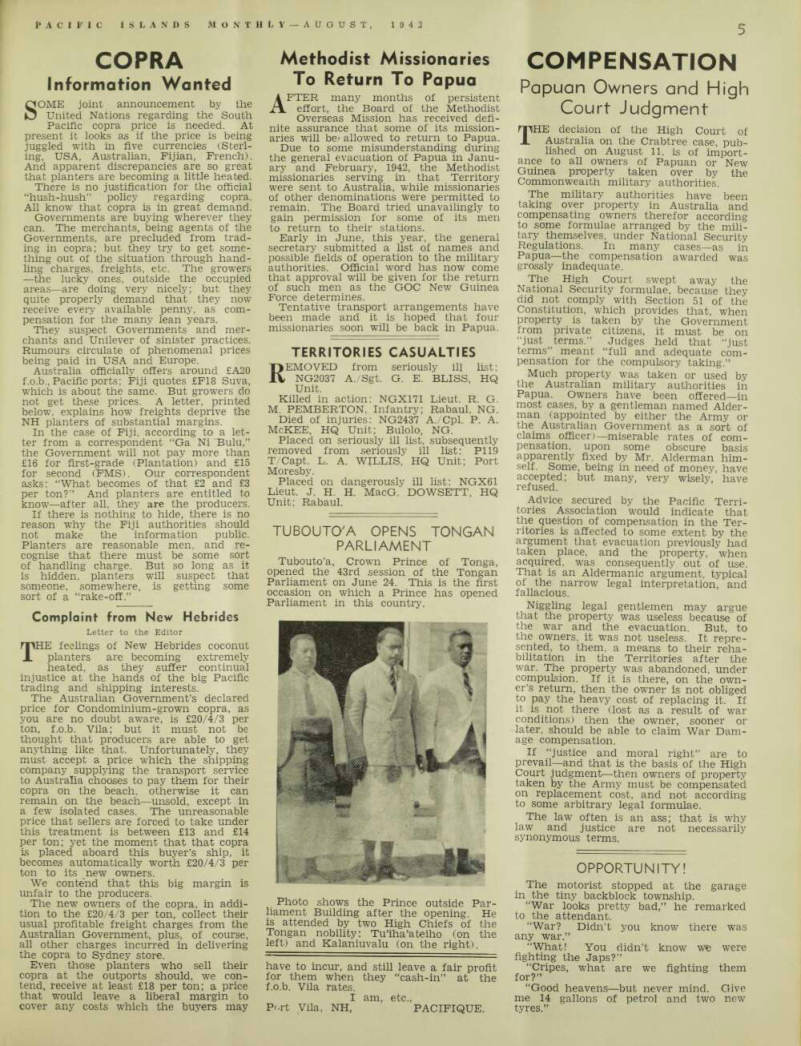
Tubouto’a, Crown Prince of Tonga, opened the 43rd session of the Tongan Parliament on June 24. This is the first occasion on which a Prince has opened Parliament in this country.
Photo shows the Prince outside Par liament Building after the opening. He is attended by two High Chiefs of the Tongan nobility: Tu’iha’ateiho (on the left) and Kalaniuvalu (on the right).
Compensation
Papuan Owners and High Court Judgment
THE decision of the High Court of Australia on the Crabtree case, pub lished on August 11, is of import ance to all owners of Papuan or New Guinea property taken over by the Commonwealth military authorities.
The military authorities have been taking over property in Australia and compensating owners therefor according to some formulae arranged by the mili tary themselves, under National Security Regulations. In many cases—as in Papua—the compensation awarded was
grossly inadequate.
The High Court swept away the National Security formulae, because they did not comply with Section 51 of the Constitution, which provides that, when property is taken by the Government from private citizens, it must be on “just terms.” Judges held that “just terms” meant “full and adequate com pensation for the compulsory taking.”
Much property was taken or used by the Australian military authorities in Papua. Owners have been offered—in most cases, by a gentleman named Aider man (appointed by either the Army or the Australian Government as a sort of claims officer)—miserable rates of com pensation, upon some obscure basis apparently fixed by Mr. Alderman him self. Some, being in need of money, have accepted; but many, very wisely, have refused.
Advice secured by the Pacific Terri tories Association would indicate that the question of compensation in the Ter ritories is affected to some extent by the argument that evacuation previously had taken place, and the property, when acquired, was consequently out of use.
That is an Aldermanic argument, typical of the narrow legal interpretation, and fallacious.
Niggling legal gentlemen may argue that the property was useless because of the war and the evacuation. But, to the owners, it was not useless. It repre sented, to them, a means to their reha bilitation in the Territories after the war. The property was abandoned, under compulsion. If it is there, on the own er's return, then the owner is not obliged to pay the heavy cost of replacing it. If it is not there (lost as a result of war conditions) then the owner, sooner or later, should be able to claim War Dam age compensation.
If “justice and moral right” are to prevail—and that is the basis of the High Court judgment—then owners of property taken by the Army must be compensated on replacement cost, and not according to some arbitrary legal formulae.
The law often is an ass; that is why law and justice are not necessarily synonymous terms.
Opportunity!
The motorist stopped at the garage in the tiny backblock township.
“War looks pretty bad,” he remarked to the attendant.
“War? Didn’t you know there was any war.”
“What! You didn’t know wfe were fighting the Japs?”
“Gripes, what are we fighting them for?”
“Good heavens—but never mind. Give me 14 gallons of petrol and two new tyres.”
Advertisements & other items, p. 7 (1 item)
5
Metric islands Monthlv august, 1943
Facilities
Communications And Settlement
What War Conditions May Do for the Territories
WAR correspondent Allan Dawes has been permitted to give, in an article t i P\J bllsl: \ ed ln Melbourne Herald” on a description of anew highway which the Allies have built through the hitherto trackless jungle on the northeast coast of Papua: Over what less than a year ago was a trackless, impenetrable range, whose giant hardwoods have fallen to make bridges and wayside revetments, we rode on a perfect highway which American engineers and machinery, with native labour as well as their own, have torn fr ?, l T l the grasp of Nature.
Australians and Papuan natives, as well as Americans, hailed us cheerfully as we climbed and dropped and performed all the circus tricks an educated Jeep can perform. We passed the inevitable road signs characteristic of the American road engmeer—“Narrow bridge,” “dangerous Cl r7 e 4J;i t s' u n. + . ..
It would be difficult to exaggerate the importance of what is being done by the occupying armies to provide communica-
tion facilities in all the Pacific territories, In Papua, New Guinea, Solomons, New Hebrides, New Caledonia, Fiji and else where, the story is the same—Army, Navy and Air Force, using the considerable authority and resources they possess, are building roads and bridges, airfields, and ports, water-supply and electric-supplv systems, radio stations—even little towns —all mostly in places where, until now there was only primitive iunele or Kunai hillside, or empty coast-line ’
When the war is over, these things will not be removed. They will remain orac tically as a gift to the Territories, pro viding facilities for what mav be an era of the most rapid settlement and development ever known in the Pacific, War, in every way, is a curse But war may have its compensations ' War for example, may give to the backward’ter ritories of Papua and New Guinea an advance in communication and settle ment facilities which otherwise would not have come, under the Canberra Dead Hand Regime for 50 years
Tahitian Valour In North Africa
20 Maimed Men Return
From Our Own Correspondent
Papeete, June 10.
OUR men—members of the Pacific Bat talion of Fighting France—covered themselves with glory in the battles in North Africa. General de Gaulle has conferred high awards for valour upon many of them. General Montgomery, commander of the British Eighth Army, is reported to have honoured the Tahitian unit with special distinction.
Here are details of some of their awards.
Sergeant Robert Asmus, awarded the Military Medal for valour. During the siege of Bir Hakkeim, on May 27 and June 10, 1942, during night raids, he went out as a volunteer, and penetrated enemy lines, and he particularly distinguished himself in hand-to-hand combat. He was injured in the head during an air bom bardment.
Corporal Faupau, awarded the Military Medal for distinguished courage during the Bir Hakkeim battle, on June 10, 1942, when he was seriously wounded.
Second-Class Soldier Tu Tetuaui, awarded the Military Medal for bravery shown in raids at Bir Hakkeim, on the nights of June 10 and 11, 1942, when he was badly wounded.
Tainui-Kararo, in the early days of the Lybian campaign, was in charge of a heavy machine gun at an advanced posi tion, when a squadron of German planes came over at low level. Tainui’s cool, accurate shooting brought down one Ger man plane during the first attack. This revealed his position to other planes of the attacking squadron. Again and again they returned to spray Tainui’s position with machine gun bullets. Calm and unruffled, Tainui, declining to seek shel ter, continued firing—probably damag ing another plane. Eventually he was struck by three bullets, one entering his mouth and emerging back of his jaw.
His comrades, who were witnesses, de clare that these wounds lashed Tainui to a state of fury. He met his attackers with a veritable deluge of lead. The end came when a German diving plane placed a bomb accurately beside Tainui’s machine gun. The French commander decorated the hero’s shattered body with the high
est award for valour.
Napuka, the birthplace of Tainui- Kararo, is a little atoll of the Northern Tuamotu—heretofore, seldom visited and little known to the outside world. Napuka, to-day, has become illustrious, because Tainui-Kararo was born there.
From a Special Correspondent THE grimmer side of this global war has reached Tahiti. Aboard a ship that steamed quietly through an opening in Tahiti’s coral reef, as the late winter sun cast long shadows over the crest of Moorea, were twenty sons of this island, returning armless and legless and limping, after their heroic, bitter battle with a distant foe. They were Tahiti’s first casualties in World War 11.
Lined along Papeete’s peaceful quay, in the dull glistening of the sun as it slanted against the galvanised roofs of the copra warehouse, stood friends and relatives and a guard of honour, their eyes eager but dimmed with tears. Also present were the Governor, and local commanders.
As the returned men hobbled or were carried down the gang-plank, marking the end of their long journey from the battlefields of Africa, observers prayed the war would come no nearer Tahiti than this.
Here is the official list of the men who have returned:
Name Rank
Gibert
Lieutenant
Solari, Rene
Adjudant
Poisbeau, Paul .. ..
Sergent-Chef
Sanford, Paul . . . .
DOUCET, Andre . . . .
Caporal-Chef LANTEIRES, Etienne .
Caporal TEIHO, Raphael .. .. ft FAUFAU, Tetaua . . .. 1»
Tetuanui, Tu .. ..
lere classe TUAIVA, Fortune .. 2eme classe
Hareuta, Pane .. ..
TEFANAU, Maurice .. f
Nehemia, Tau . .
MAIRIRO, Heheau SAMUELA, Taihia . .. 9f TAUTU, Tautu . . »»
Temahane
»» MAT AIT AI, Titauhia ..
BARFF, Moehene ..
Caporal ASMIUS, Robert .. ..
Sergent
Armstrong
New Post tor Mr. A. L.
Trevor Johnson Goes to Tonga
IT was announced in Suva, Fiji, in June that Mr. A. L. Armstrong, OBE, who has been the British Agent and Con sul in Tonga since 1937, is shortly to return to Fiji. It is understood that he will undertake fin
portant duties in connection with post-war recon struction -in the Colony.
Mr. C. W. T.
Johnson, at present Assistant Colonial Secretary of Fiji, will replace him as British Agent and Consul in Tonga.
Both of these men are well and
favourably known
in the Central Pacific, and both are personally very popular. Mr. Arm-
strong, who Is 54 years old, joined the Fiji Public Service in 1915, and filled a wide variety of executive positions (in cluding Assistant Secretary for Native Affairs, Assistant Colonial Secretary, member of Executive and Legislative Councils, and Governor’s Deputy) prior to his appointment to Tonga.
Mr. Johnson, Assistant Colonial Secre tary since 1937, joined the Fiji service in 1910, and has filled many of the im portant executive positions around head quarters in Suva. He is 49 years old.
Mr. A. L. Armstrong
Gifts For "Fuzzy-Wuzzies"
GIFTS provided by the Australian Comforts Fund were recently dis tributed to about 1,000 native carriers who were employed last year on the Kokoda trail. Gifts consisted of money belts, hair-oil, sweets, beads and tobacco.
The natives then squatted on the ground for nearly an hour, while an Australian officer spoke to them through an interpreter. He said that the Aus tralian people would never forget the way the Fuzzy-Wuzzies had acted in the critical days of last year, and that their self-sacrificing work and untiring pati ence had made a great impression on the “great white people across the water.”
He promised them that the Japanese would soon be driven out and then the Australian Government would see that appreciation was translated into con crete action.
It is understood that these natives, who worked along the Kokoda trail, have been formed into an anti-malaria unit, now that their former job has gone with the threatened Jap invasion of Port Moresby.
Dr. M. H. Watt, Director General of Health in New Zaland, and Miss M. I.
Lambie, Director of Nursing, arrived in Fiji in July. They will make an investi gation of the Public Health and medical services of the colony.
Captain Bruce Hamilton, who has lived for 36 years in Papua and New Guinea, has spent the last two months in military hospitals in Queensland and New South Wales. He is now making a good recovery.
Major Donald Junor, who was for some time in the Middle East, recently returned to Australia. He was promoted and is now officer in charge of the School of Signals, New Guinea Forces.
Advertisements & other items, p. 8 (1 item)
6
AUGUST, 19 4 3 -PACiric ISLANDS MONTULV
Fiji’S Black
Markets
Price-Control Wilts Under Fantastic Demand
PRICE Control came into operation in the Colony of Fiji in September, 1939; and, out of it, has grown a flourishing black-market.
Mr. Aidney, Controller of Prices in the Colony, admits its existence; but main tains that this is a state which is com mon to-day in all countries which have an artificial restriction on the ordinary operations of the markets —he quotes particularly Australia and New Zealand.
But Fiji, owing to its economic sys tem, its dependence on overseas imports, and the influx of thousands of overseas troops—all plentifully supplied with money—appears to have developed some thing in the black-market line that so far surpasses anything Australia has experienced.
Furthermore, there have been remark ably few prosecutions for black-market ing in Fiji; presumably if one wants eggs badly enough to pay 9/- per dozen for them, one is not going to slay the golden goose that lays them. And, as a natural corollary, it must be assumed that the vast majority of people in Fiji are pre pared to pay any price if they can get what they want.
OFFICIAL causes of the present egg famine in the colony are: The season —eggs are always short at this time of the year and supplies are not coming forward from New Zealand and Australia as formerly; the tremendous increase in the population of Fiji, and the scores of restaurants that have sprung up all over the place, which do a large business in supplying meals to the troops; and shortage of fowl feed. Imported grain has been unprocurable, bran and pollard have been off the market for some time, local maize has been in short supply be cause of the American demand for green corn and because of labour shortages— the price has risen from 14/- per bag to 25/- to 30/-.
Rice is another commodity that is re ported to be selling at exorbitant prices.
Local supplies are insufficient and imported rice is practically unobtainable.
Here, too, transactions are made in hun dreds of scattered places, and it is almost impossible to police the price-fixing order
concerning it.
Foodstuffs, clothing, motor accessories, liquor—especially liquor—are reported to be selling at fantastic prices. It is alleged that almost anything can be bought in the town of Suva if one is prepared to pay enough for it. It is said, also, that Americans have been known to pay as much as 16/- or £1 for an ordinary culinary fowl.
Yet, in spite of protests from the Fiji newspapers and howls from the very few people who cannot or will not subscribe to such bare-faced robbery, nothing is done about it. Perhaps nothing can be done about it until the cause of black
markets—namely, shortage of supplies
and large spending power—no longer exists.
There is much wisdom in the state ment of a contributor to the Fiji “Times”: “It is not the big business firms who overcharge a halfpenny on a box of matches, but the bootmaker, tailor, draper and small shopkeeper who are fostering an inflation period that will never be deflated.”
Sir A. Richards
Promoted From Jamaica To Nigeria
GOVERNOR of Fiji 1936-38, and later transferred t to Jamaica, Sir Arthur Richards has now been appointed Governor and Commander-in-Chief of
Nigeria.
During his term in Fiji he proved himself a man of strength and pur pose. He found particular favour with residents of the outlying terri tories of the West ern Pacific High C o m m i ssion to which he devoted a great deal of his time.
His appointment to Jamaica was received in Fiji with regret. But a bad industrial situation had to be cleaned up in Jamaica, and Sir A. Richards was the man for the job. He was quite successful.
His new appoint-
ment brings, with it a substantial increase in salary; £6,500, plus a duty allowance of £1,750, in Nigeria, as against £4,500, plus £l,OOO duty allowance, in Jamaica.
Sir Arthur and Lady Richards
Risks On Territory
Property
Owners Should Insure
The following advice to evacuees has been sent to us for publication. It is of great importance to property-owners.
THE Pacific Territories Association’s legal advisers are of the opinion that, where property in the Territories, owned by former residents, is now occu pied by members of the Australian Defence Forces, the responsibility for insurance of such property against War Damage and ordinary fire risk is still one resting on the owners of the pro perty.
Residents, therefore, if they have not done so already, should see that their property is covered under the War Dam age to Property Regulations, and also against ordinary fire risks, where this cover is obtainable.
Phenomenal Seasons
FIJI is having a particularly dry season, and Suva residents again have been urged to restrict their consumption of water. It was pointed out in “Fiji Times” that there is scope for reduction in the 80 gallons per head that Suva uses each day, when one considers that in a recent water shortage in Auckland, resi dents were restricted to 8 gallons per head per day.
Our Tahiti correspondent, on the other hand, reports that the rain of the wet season has been phenomenally heavy and prolonged—there were heavy rains in June, long after the dry, cool season
customarily starts.
The Rev. Samuela Matainivalu, a Fijian minister of the Methodist Overseas Mis sion, has been appointed chaplain to the Fiji Military Forces.
Four Murdered
Missionaries
Story of Their Heroism
THE whole of the civilised world has heard of the brutal murder, at Rauvatu Mission, on Guadalcanal, in September, 1942, of four Solomon Islands mission aries—two priests of the Marist order (Fathers Duhamel and Engberink) and two nuns (Sisters Odilia and Sylvia).
But few know of the exact circum stances of the murder. Actually, the Japs killed them, in cold blood, because they would not assist the Japs against the United States Marines. Here is the story, as told by a Roman Catholic padre, in a letter to the Australian Journal “Catholic Missions”: “The Reconnaissance Troop had extended its patrols eastward beyond the Bokokimbo River (Guadalcanal, British Solomon Islands). Stories had come to us of the heroism of the martyred priests and Sisters of the Marist Order and of the malicious and wanton destruction wrought at the Ruavatu Mission.
“With a small detail of three men, I left our bivouac area to proceed by a Navy tank lighter to Rauvatu Mission.
The whole afternoon of March 5, 1943, was spent in the sad work of sorting out the debris covering, to a foot in depth, the floors of the rooms of the priests and Sisters. Every religious article and all personal mementos had been systematic ally and wantonly torn, to be cast in shreds to the floors. Only a few standard books remained intact. , . .
“Ere long I Famed of the heroism of these missionaries. Knowing the arrival of the enemy was imminent, the priests had sent the natives into the hills. They themselves refused all pleas to retreat.
They were to stay. I read a letter writ ten to Father Engberink warning him of possible results, yet they stayed on.
Their capture, of course, was a foregone conclusion, and with them were taken two native boys, who continued the story for me. The enemy had demanded that one go to the Marines, then at Lunga Point, to paint a vivid picture of an irresistible army advancing on them and that departure from the island was their only salvation from complete annihila tion. One priest was to be held as host age, with the two Sisters.
“That order was refused. At that they were bound and starved for a week. As though starvation could break the will of such as these!
“They were then taken five miles up the beach towards the Lunga Point, and again the demand was made. Again the refusal.
“And there on that beach the priests and Sisters died as only heroes can, martyrs to their God and their coun try. A little way from the beach, buried in a native house, we found their broken bodies.”
Death Of Dr. A. Spence
MRS. A. SPENCE, widow of Dr. Spence, formerly of Rabaul, is now filling a position in Australia, connected with United States Army administration. Dr.
Spence, while a medical officer on ser vice in Ceylon early in 1942, was the vic tim of an accident. He and others were surfing, and he dived. His head appar ently struck an unsuspected rock; his neck was broken, and he died almost immediately. Dr. and Mrs. Spence were popular members of the Rabaul com munity prior to the evacuation.
Advertisements & other items, p. 9 (1 item)
7
PACIFIC ISLANbS MONTHLY AttOttSt. 1643
Fighting French
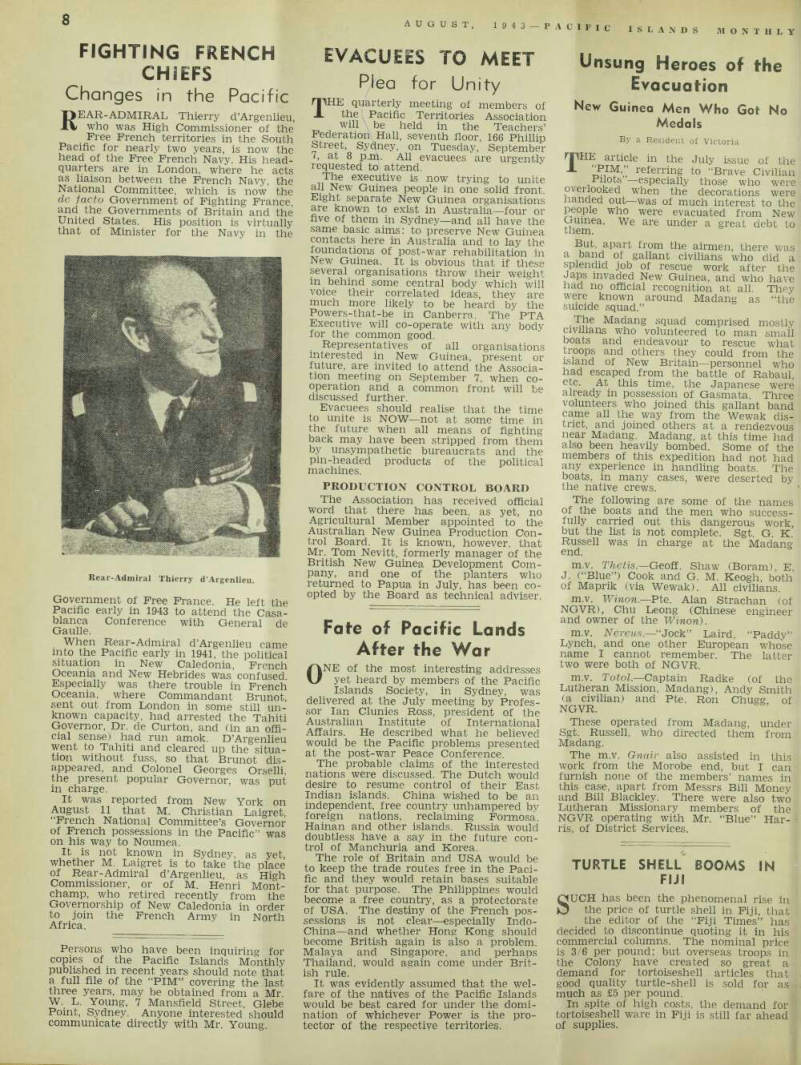
Chiefs
Changes in the Pacific
REAR-ADMIRAL Thierry d’Argenlieu, who was High Commissioner of the Free French territories in the South Pacific for nearly two years, is now the head of the Free French Navy. His head quarters are in London, where he acts as liaison between the French Navy, the National Committee, which is now the de facto Government of Fighting France, and the Governments of Britain and the United States. His position is virtually that of Minister for the Navy in the
Government of Free France. He left the Pacific early in 1943 to attend the Casa blanca Conference with General de Gaulle.
When Rear-Admiral d’Argenlieu came into the Pacific early in 1941, the political situation in New Caledonia, French Oceania and New Hebrides was confused.
Especially was there trouble in French Oceania, where Commandant Brunot, sent out from London in some still un known capacity, had arrested the Tahiti Governor, Dr. de Curton, and (in an offi cial sense) had run amok. D’Argenlieu went to Tahiti and cleared up the situa tion without fuss, so that Brunot dis appeared, and Colonel Georges Orselli, the present popular Governor, was put in charge.
It was reported from New York on August 11 that M. Christian Laigret, “French National Committee’s Governor of French possessions in the Pacific” was on his way to Noumea.
It is not known in Sydney, as yet, whether M. Laigret is to take the place of Rear-Admiral d’Argenlieu, as High Commissioner, or of M. Henri Mont champ, who retired recently from the Governorship of New Caledonia in order to join the French Army in North Africa.
Persons who have been inquiring for copies of the Pacific Islands Monthly published in recent years should note that a full file of the “PIM” covering the last three years, may be obtained from a Mr.
W. L. Young, 7 Mansfield Street, Glebe Point, Sydney. Anyone interested should communicate directly with Mr. Young
Rear-Admiral Thierry d’Argenlieu.
Evacuees To Meet
Plea for Unity
THE quarterly meeting of members of the Pacific Territories Association will be held in the Teachers’
Federation Hall, seventh floor, 166 Phillip Street, Sydney, on Tuesday, September 7, at 8 p.m. All evacuees are urgently requested to attend.
The executive is now trying to unite all New Guinea people in one solid front.
Eight separate New Guinea organisations are known to exist in Australia—four or five of them in Sydney—and all have the same basic aims: to preserve New Guinea contacts here in Australia and to lay the foundations of post-war rehabilitation in New Guinea. It is obvious that if these several organisations throw their weight in behind some central body which will voice their correlated ideas, they are much more likely to be heard by the Powers-that-be in Canberra. The PTA Executive will co-operate with any body for the common good.
Representatives of all organisations interested in New Guinea, present or future, are invited to attend the Associa tion meeting on September 7, when co operation and a common front will be discussed further.
Evacuees should realise that the time to unite is NOW —not at some time in the future when all means of fighting back may have been stripped from them by unsympathetic bureaucrats and the pin-headed products of the political machines.
Production Control Board
The Association has received official word that there has been, as yet, no Agricultural Member appointed to the Australian New Guinea Production Con trol Board. It is known, however, that Mr. Tom Nevitt, formerly manager of the British New Guinea Development Com pany, and one of the planters who returned to Papua in July, has been co opted by the Board as technical adviser.
Fate of Pacific Lands
After the War
ONE of the most interesting addresses yet heard by members of the Pacific Islands Society, in Sydney, was delivered at the July meeting by Profes sor lan Clunies Ross, president of the Australian Institute of International Affairs. He described what he believed would be the Pacific problems presented at the post-war Peace Conference.
The probable claims of the interested nations were discussed. The Dutch would desire to resume control of their East Indian islands. China wished to be an independent, free country unhampered by foreign nations, reclaiming Formosa, Hainan and other islands. Russia would doubtless have a say in the future con trol of Manchuria and Korea.
The role of Britain and USA would be to keep the trade routes free in the Paci fic and they would retain bases suitable for that purpose. The Philippines would become a free country, as a protectorate of USA. The destiny of the French pos sessions is not clear —especially Indo china —and whether Hong Kong should become British again is also a problem.
Malaya and Singapore, and perhaps Thailand, would again come under Brit ish rule.
It was evidently assumed that the wel fare of the natives of the Pacific Islands would be best cared for under the domi nation of whichever Power is the pro tector of the respective territories.
Evacuation
Unsung Heroes of the Evacuation New Guinea Men Who Got No Medals
By a Resident of Victoria THE article in the July issue of the ‘‘PIM,” referring to "Brave Civilian Pilots —especially those who were overlooked when the decorations were handed out—was of much interest to the people who were evacuated from New Guinea. We are under a great debt to them.
But, apart from the airmen, there was a band of gallant civilians who did a splendid job of rescue work after the Japs invaded New Guinea, and who have had no official recognition at all. They were known around Madang as “the suicide squad.”
The Madang squad comprised mostly civilians who volunteered to man small boats and endeavour to rescue what troops and others they could from the island of New Britain—personnel who had escaped from the battle of Rabaul, etc. At this time, the Japanese were already in possession of Gasmata. Three volunteers who joined this gallant band came all the way from the Wewak dis trict, and joined others at a rendezvous near Madang. Madang, at this time had also been heavily bombed. Some of the members of this expedition had not had any experience in handling boats. The boats, in many cases, were deserted by the native crews.
The following are some of the names of the boats and the men who success fully carried out this dangerous work, but the list is not complete. Sgt. G. K.
Russell was in charge at the Madang end. m.v. Thetis.— Geoff. Shaw (Boram), E J. (“Blue”) Cook and G. M. Keogh, both of Maprik (via Wewak). All civilians. m.v. Winon. —Pte. Alan Strachan (of NGVR), Chu Leong (Chinese engineer and owner of the Winon). m.v. Nereus. —“Jock” Laird, “Paddy”
Lynch, and one other European whose name I cannot remember. The latter two were both of NGVR. m.v. Totol. —Captain Radke (of the Lutheran Mission, Madang), Andy Smith (a civilian) and Pte. Ron Chugg, of
Ngvr.
These operated from Madang, under Sgt. Russell, who directed them from Madang.
The m.v. Gnair also assisted in this work from the Morobe end, but I can furnish none of the members’ names in this case, apart from Messrs Bill Money and Bill Blackley. There were also two Lutheran Missionary members of the NGVR operating with Mr. “Blue” Har ris, of District Services.
Turtle Shell Booms In
Fiji
SUCH has been the phenomenal rise in the price of turtle shell in Fiji, that the editor of the “Fiji Times” has decided to discontinue quoting it in his commercial columns. The nominal price is 3/6 per pound; but overseas troops in the Colony have created so great a demand for tortoiseshell articles that good quality turtle-shell is sold for as much as £5 per pound.
In spite of high costs, the demand for tortoiseshell ware in Fiji is still far ahead of supplies.
Guinea Evacuation
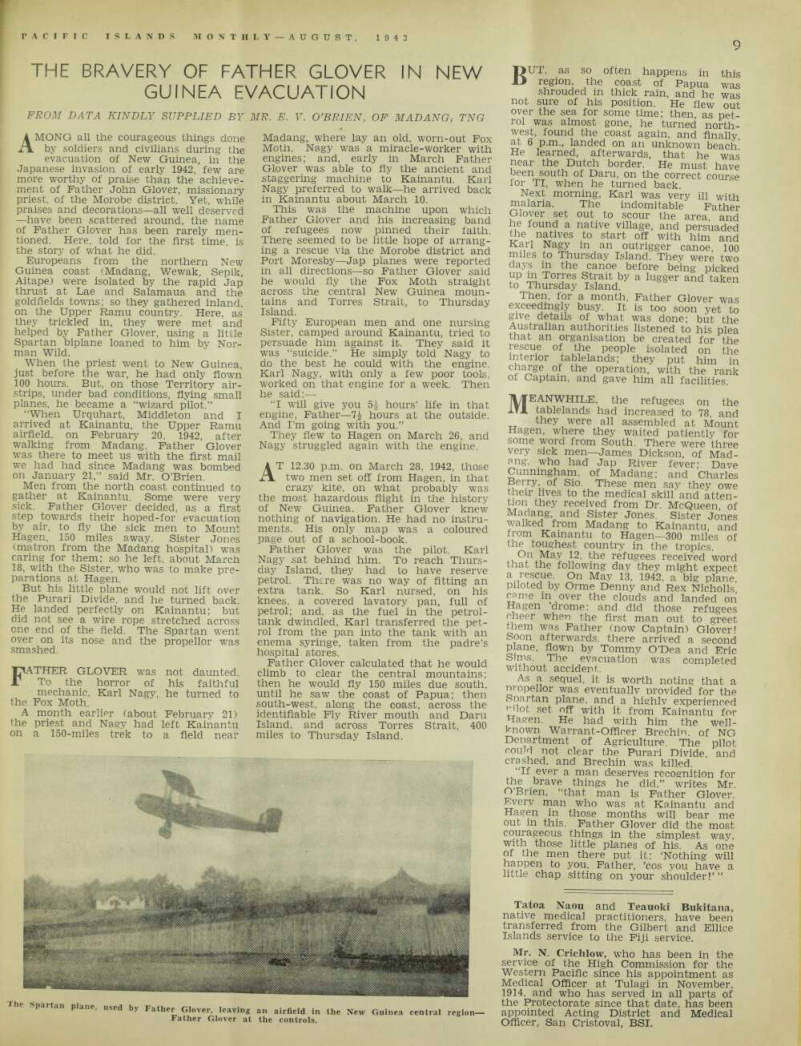
THE BRAVERY OF FATHER GLOVER IN NEW
FROM DATA KINDLY SUPPLIED BY MR. E. V. O’BRIEN, OF MADANG f TNG
AMONG all the courageous things done by soldiers and civilians during the evacuation of New Guinea, in the Japanese invasion of early 1942, few are more worthy of praise than the achievement of Father John Glover, missionary priest, of the Morobe district. Yet, while praises and decorations—all well deserved —have been scattered around, the name of Father Glover has been rarely mentioned. Here, told for the first time, is the story of what he did.
Europeans from the northern New Guinea coast (Madang, Wewak, Sepik, Aitape) were isolated by the rapid Jap thrust at Lae and Salamaua and the goldfields towns; so they gathered inland, on the Upper Ramu country. Here, as they trickled in, they were met and helped by Father Glover, using a little Spartan biplane loaned to him by Norman Wild.
When the priest went to New Guinea, just before the war, he had only flown 100 hours. But, on those Territory airstrips, under bad conditions, flying small planes, he became a “wizard pilot.”
“When Urquhart, Middleton and I arrived at Kainantu, the Upper Ramu airfield, on February 20, 1942, after walking from Madang, Father Glover was there to meet us with the first mail we had had since Madang was bombed on January 21,” said Mr. O’Brien.
Men from the north coast continued to gather at Kainantu, Some were very sick. Father Glover decided, as a first step towards their hoped-for evacuation by air, to fly the sick men to Mount Hagen. 150 miles away. Sister Jones (matron from the Madang hospital) was caring for them; so he left, about March 18, with the Sister, who was to make preparations at Hagen.
But his little plane would not lift over the Purari Divide, and he turned back.
He landed perfectly on Kainantu; but did not see a wire rope stretched across one end of the field. The Spartan went over on its nose and the propeller was smashed.
F Amtttn „
ATHER GLOVER was not daunted.
To the horror of his faithful mechanic, Karl Nagy, he turned to the Fox Moth.
A month earlipr (about February 21) the priest and Nagy had left Kainantu on a 150-miles trek to a field near
Madang, where lay an old, worn-out Fox Moth. Nagy was a miracle-worker with engines; and, early in March Father Glover was able to fly the ancient and staggering machine to Kainantu. Karl Nagy preferred to walk—he arrived back i n Kainantu about March 10.
This was the machine upon which Father Glover and his increasing band of refugees now pinned their faith, There seemed to be little hope of arrang ing a rescue via the Morobe district and Port Moresby—Jap planes were reported in all directions—so Father Glover said he would fly the Fox Moth straight across the central New Guinea moun tains and Torres Strait, to Thursday Island.
Fifty European men and one nursing Sister, camped around Kainantu, tried to persuade him against it. They said it was “suicide.” He simply told Nagy to do the best he could with the engine, Karl Nagy, with only a few poor tools. worked on that engine for a week. Then he said: — “I will give you 5£ hours’ life in that engine, Father—7i hours at the outside, And I’m going with you.”
They flew to Hagen on March 26, and Nagy struggled again with the engine, 4 T 12.30 p.m. on March 28, 1942, those two men set off from Hagen, in that crazy kite, on what probably was the most hazardous flight in the history of New Guinea. Father Glover knew nothing of navigation. He had no instru ments. His only map was a coloured page out of a school-book.
Father Glover was the pilot. Karl Nagy sat behind him. To reach Thurs day Island, they had to have reserve petrol. There was no way of fitting an extra tank. So Karl nursed, on his knees, a covered lavatory pan, full of petrol; and, as the fuel in the petrol tank dwindled, Karl transferred the pet rol from the pan into the tank with an enema syringe, taken from the padre’s hospital stores.
Father Glover calculated that he would climb to clear the central mountains; then he would fly 150 miles due south, until he saw the coast of Papua; then south-west, along the coast, across the Identifiable Fly River mouth and Daru Island, and across Torres Strait, 400 miles to Thursday Island.
BUT, as so often happens in this region, the coast of Papua was shrouded in thick rain, and he was not sure of his position. He flew out over the sea for some time; then, as pet rol was almost gone, he turned north west, found the coast again, and finally at 6 p.m., landed on an unknown beach’
He learned, afterwards, that he was near the Dutch border. He must have been south of Daru, on the correct course for TI, when he turned back.
Next morning, Karl was very ill with malaria. The indomitable Father Glover set out to scour the area and he found a native village, and persuaded the natives to start off with him and Karl Nagy in an outrigger canoe, 100 miles to Thursday Island. They were two days in the canoe before being picked b, 1 1 Torres strait by a lugger and taken to Thursday Island.
Then, for a month, Father Glover was exceedingly busy. It is too soon yet to give details of what was done; but the Australian authorities listened to his plea that an organisation be created for the rescue of the people isolated on the interior tablelands; they put him in charge of the operation, with the rank of Captain, and gave him all facilities.
MEANWHILE, the refugees on the tablelands had increased to 78 and they were all assembled at Mount Hagen, where they waited patiently for some word from South. There were three very sick men—James Dickson, of Madwho had Jap River fever; Dave Cunningham, of Madang; and Charles Berry, of Sio. These men say they owe their lives to the medical skill and atten tion they received from Dr. McQueen, of Madang, and Sister Jones. Sister Jones walked from Madang to Kainantu, and from Kainantu to Hagen—3oo miles of the toughest country in the tropics.
On May 12, the refugees received word that the following day they might expect a rescue. On May 13, 1942, a big plane piloted by Orme Denny and Rex Nicholls came m over the clouds and landed on Hagen ’drome: and did those refugees cheer when the first man out to greet them was Father (now Captain) Glover' Soon afterwards, there arrived a second plane, flown by Tommy O’Dea and Eric Sims. The evacuation was completed without accident.
As a sequel, it is worth noting that a nropellor was eventually nrovided for the Snartan plane, and a highly experienced ’nlot set off with it from Kainantu for Hagen. He had with him the well known Warrant-Officer Brechin of NG Denartment of Agriculture. The pilot could not clear the Purari Divide, and crashed, and Brechin was killed.
“If ever a man deserves recognition for the brave things he did.” writes Mr O’Brien, “that man is Father Glover.
Every man who was at Kainantu and Hagen in those months will bear me out in this. Father Glover did the most courageous things in the simplest way, with those little planes of his. As one of the men there put it: ‘Nothing will happen to you. Father, ’cos you have a little chap sitting on your shoulder!”’
Tatoa Naou and Teauoki Bukitana, native medical practitioners, have been transferred from the Gilbert and Ellice Islands service to the Fiji service.
Mr. N. Crichlow, who has been in the service of the High Commission for the Western Pacific since his appointment as Medical Officer at Tulagi in November, 1914, and who has served in all parts of the Protectorate since that date, has been appointed Acting District and Medical Officer, San Cristoval, BSI.
The spartan plane, used by Father Glover, leaving an airfield in the New Guinea central region— Father Glover at the controls.
Nz Bonds In
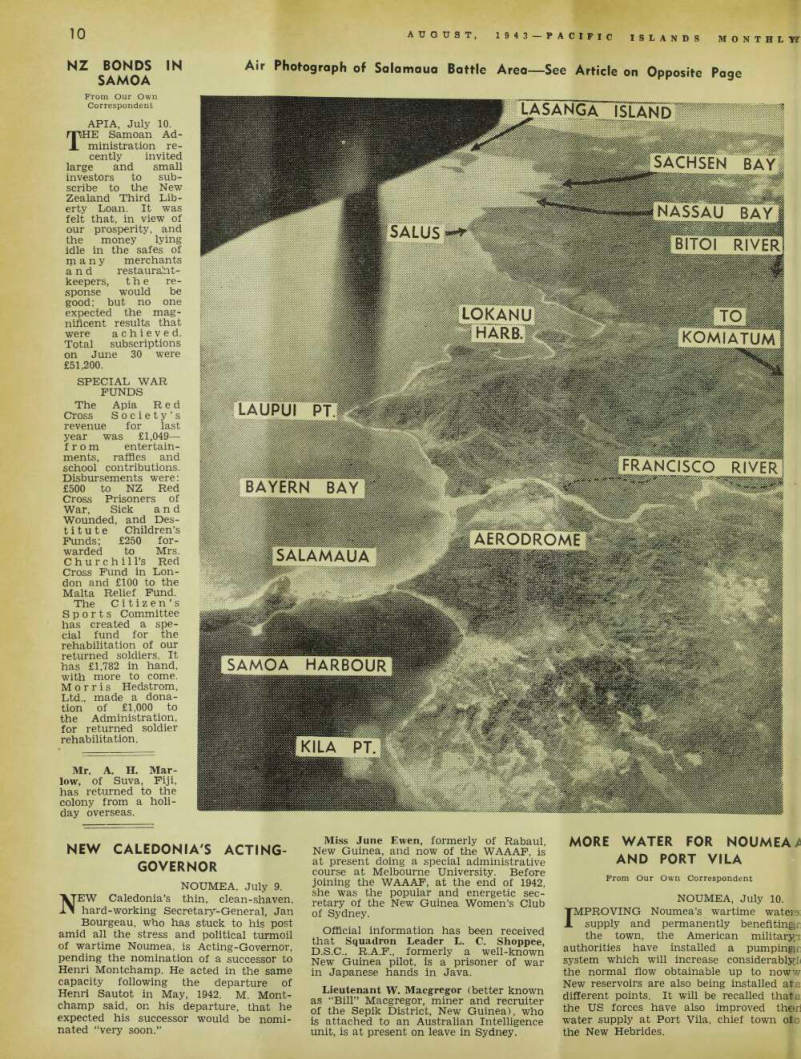
Samoa
Prom Our Own Correspondent APIA, July 10.
THE Samoan Ad ministration re cently invited large and small investors to sub scribe to the New Zealand Third Lib erty Loan. It was felt that, in view of our prosperity, and the money lying idle in the safes of many merchants and restauralnt keepers, the re sponse would be good; but no one expected the mag nificent results that were achieved.
Total subscriptions on June 30 were £51,200.
Special War
Funds
The Apia Red Cross Society’s revenue for last year was £1,049 — from entertain ments, raffles and school contributions.
Disbursements were: £5OO to NZ Red Cross Prisoners of War, Sick and Wounded, and Des t i t u t e Children’s Funds; £250 for warded to Mrs.
Churchill’s Red Cross Fund in Lon don and £lOO to the Malta Relief Fund.
The Citizen’s Sports Committee has created a spe cial fund for the rehabilitation of our returned soldiers. It has £1,782 in hand, with more to come.
Morris Hedstrom, Ltd., made a dona tion of £l,OOO to the Administration, for returned soldier rehabilitation.
Mr. A. H. Mar low, of Suva, Fiji, has returned to the colony from a holi day overseas.
Air Photograph of Salamaua Battle Area—See Article on Opposite Page
New Caledonia's Acting
Governor
Noumea, July 9.
NEW Caledonia’s thin, clean-shaven, hard-working Secretary-General, Jan Bourgeau, who has stuck to his post amid all the stress and political turmoil of wartime Noumea, is Acting-Governor, pending the nomination of a successor to Henri Montchamp. He acted in the same capacity following the departure of Henri Sautot in May, 1942. M. Mont champ said, on his departure, that he expected his successor would be nomi nated “very soon.”
Miss June Ewen, formerly of Rabaul, New Guinea, and now of the WAAAF, is at present doing a special administrative course at Melbourne University. Before joining the WAAAF, at the end of 1942, she was the popular and energetic sec retary of the New Guinea Women’s Club of Sydney.
Official information has been received that Squadron Leader L. C. Shoppee, D.S.C., R.A.F., formerly a well-known New Guinea pilot, is a prisoner of war in Japanese hands in Java.
Lieutenant W. Macgregor (better known as “Bill” Macgregor, miner and recruiter of the Sepik District, New Guinea), who is attached to an Australian Intelligence unit, is at present on leave in Sydney.
More Water For Noumea
And Port Vila
Prom Our Own Correspondent
Noumea, July 10.
IMPROVING Noumea’s wartime wateie; supply and permanently benefiting!] the town, the American military - ! authorities have installed a pumpingo system which will increase the normal flow obtainable up to noww New reservoirs are also being installed atjs different points. It will be recalled thatrjs the US forces have also improved theri water supply at Port Vila, chief town olio the New Hebrides.
Aerial Photographs
Battle For Salamaua
Difficult New Guinea Campaign Explained By
By R. W. Robson
THE battle of Salamaua moves slowly and inexorably to its end. Allied troops are pressing in steadily upon the Jap-held New Guinea port, from the west and the south. Sooner or later, the Japs—if they do not go; and they usually prefer to stand and die—will be exterminated, and another part of New Guinea will be cleared of the enemy.
Photographs taken from planes are now available for publication; and in this issue of the “PIM” there are two (on the front cover and on the opposite page) which, read in conjunction with the little map herewith, explain the general situation and the nature of the operations that have been going on for several months.
To get the view shown on the front cover, the observer must be above the S U “ Sjn Ch wT S!
Buk)lo Vafiev air-mUes Intend The oteerver back to the west where
foßulol
islookine Bitoi Valiev towards coast near Sallmaua
2pf SSJL?ST a ’ u,
page the
Sfback isto towardf Lae
00 mfies away) and he is tanking d£ south, along the coast. The Francisco and Bitoi rivers, and the Komiatum and Mubo areas are, of course, away up on the right, out of sight among the mountains While these photographs provide an excellent general lay-out of the situation, they do not give anyone who has not seen New Guinea any idea of the steep, broken mountains, dense jungles and vast bottomless coastal swamps which make up this region.
What Preceded Salamaua
Battle
Wtt-1-.wt j■. t , „ HEN the Japanese invasion of New Guinea and Papua was halted in i j August-September, 1942, the Japs had crept far southwards along this eastern coast of the New Guinea mainland, and they had landed (July 22, 1942) m force at Gona-Buna (see map), which is 120 miles south of Nassau Bay. Nassau Bay (see photograph) is 15 miles south oi Salarr aua - ... . , .
While awaiting reinforcements, the A , ust / ln J^y-Au Sust, 1942 fell back from Gona and Buna on to the Owen Stanley Range Two months later (having m the meantime smashed an attempted Jap landing at Milne Bay, south of Buna, Eastern Papua) the Austrahans began their attack upon the Japs m north-east Papua. They forced them down off the mountains into Kokoda. Tne Americans arrived: and Australians and Americans together drove the tenacious, savagely-fighting enemy right back to the Buna.-G°na beaches, and exterminated i , i mAo Aflate “} 1942 al f d f arly 1943 ’ the Allies advanced very slowly up the coast towards Salamaua slowly, because they were faced with a mountainous, terrain. where the narrow coastal strip of flat country was cut up de |tajf There Japs among these deltas, but they, offered no great resistance.
The Battle Of Wau
mHE scene of the fighting shifted swiftly . Pa P^ a P north-east coast, to the interior, between Salamaua and wa £- , ... . The map shows this as only a short dis-
tance. Air-line, it is less than 50 miles, Afoot, because it is over some of the roughest mountain country in the world, it is more like 100 miles—a mile of climbing up a steep slope, a mile of descending into incredible gorges, to make one mile of advance, But the Japs, creeping through the few broken valleys, and over the eternally rain-soaked mountain-tops, launched a considerable force at Wau, evidently hop ing to deprive the Allies of the use of the best all-weather airfield in the New Guinea interior—the key to the Bulolo Valley. How the Japs got such a large force through the “impassable” moun tains between Wau and the coast has never been explained. Their enterprise nearly succeeded The Japs were defeated by trained Aus tralian jungle-fighters (who found the enemy in the bush J ust eastward of the o, and attacked on the instant), assisted by tro °P s and n g ht guns which were rushed in by plane - So close were the Japs to the airfield that the air-borne Australians appear to have been shoot ing almost before they left the P lanes ce »’ be (° re ‘ hey ,eft the ’ drome - Although the Japs, on April 22, sent powerful air reinforcements in over Wau, their air and ground forces were defeated, with very severe losses, and the land parties were hunted back over the moun tain-range, and down into the valleys on other side, where they dug in.
FTfIITTOr RTTrkT rnprp
Lighting In Bitoi Gorge
rpHAT marked the end of the second X stage and the beginning of the third stage of the Battle of Salamaua. As 1 fee J be tbree ? ta ff s were: First, the slow infiltration northwards of Australian and American troops through the jungles, along the coast from the Buna area, and through the inland mountains, between Wau and the Buna area.
Second, the appearance in force of Aus tralian troops in the southern end of the Bulolo Valley and at Wau, to meet the sudden attack of about 1,000 Japanese who had somehow come over the moun tains from the coast; the fierce Austra- Han onslaught, which completely routed the Japs and drove them back across the mountains into the Bitoi Valley, above salamaua; and the partial destruction, most i y b y American airmen, of the Japanese air force sent in hurriedly by the Jap commander to try to help the ground forces which the Australians were chewing up in the foothills east of the Bulolo Valley Now> to get a reasonably clear focus on the third stage of the Salamaua Battle, still going on, turn back to the two aerial photographs, especially the one on the front cover. Japs from Salamaua had thrust all the wav up the Francisco and Bitoi vaUeys and established forti fied positions on and around Mubo hill, and beyond. The remnants of the Jap force . which the Australians drove out of the Bulolo Valley, got back to the Mubo area The Australians followed them up quickly, and more Australians apparently arrived, and a kind of battle-front seems to bave been formed somewhere along Precipitous. Jungle-clad mountain- Where the Australian forces came from, and how they were supplied, I do not know. But we have had plenty of inf or mation about the enemy; and that dotted
Terrible Country
I COULD not, even in a nightmare, imagine worse country than this in which to campaign. I do not know it well, but often I have seen it closely. The last time I was there, being interested in the plan to build a road across from Sala maua to Wau, I got the pilot of the plane that took me in to fly up that Bitoi valley, close to the tree-tops. I could not see how the most ingenious engineer could get even a mule-track through that terrible, twisted, tortuous region. And yet, for months, armies have been fight ing there!
Gradually, during the past six months, the Allies established air supremacy over the whole of this Morobe area; and this simplified the problems of their offensive campaign. It was no longer a matter of creeping forward through the jungled gorges, yard by yard, from razorback to razorback. Squadrons of planes came over, and systematically bombed and machine-gunned all the Jap positions, wherever they could be discerned. That, of course, has been, and is. the chief difficulty: in this broken country, densely clothed in jungle growth, it is very hard to discern anything much from the air.
Nonetheless, the planes regularly “softened” the Jap defences; and the Aus tralians took them by assault one by one.
Nassau Bay Landing
THERE were important developments on July 1. A large force of Americans, travelling in barges, came up the coast and landed at Nassau Bay, and then established contact with the Australians inland, in the upper Bitoi valley.
A study of the map and the photo graphs makes plain the reason for this move. A drive up the coast should be co-ordinated with a drive down the Bitoi and Francisco Rivers. But, between Buna and the Salamaua area, there are the innumerable swampy deltas of the rivers which rush down from the overhanging mountains.
One of the biggest of these is that of the Bitoi River, which (see aerial photo on front cover) turns away south-east at Buigap Creek, and enters the sea at Nassau Bay. So the Americans, using barges, by-passed all the deltas, including the Bitoi, and landed at Nassau Bay, north of the Bitoi.
The Australians cleaned up the maze of Jap fortifications in and around Mubo hill; and then Australians and Americans pressed on through the gorges and the jungles, towards Komiatum and the areodrome.
We do not know the exact position at
line on the front cover clearly shows the track of their communication and supply lines—down the Bitoi, across the razor backs to Komiatum, and thence along the Francisco valley to the aerodrome south of Salamaua.
the moment; but it seems clear that the.
Japs have been pinned down In the region between the Francisco River and Kila Point (see aerial photo, page 10).
Their faces are turned to the Allies, press ing in from the west and the south, and their backs are to the aerodrome and the isthmus of Salamaua.
The remainder of the operation is only a matter of time —of digging, out of heavily protected foxholes, fanatical little Japs who will fight desperately. Buna and Sanananda, Guadalcanal and Munda, all over again.
Value Of Salamaua
SALAMAUA, since our air supremacy clamped down a firm blockade, lost most of its value to the Japs as an operational base; and its capture by us, as seen against the strategy of this global war, does not matter a great deal.
It will mean that another step has been taken in clearing the invader from New Guinea; that another advanced nest of invading Japs has been wiped out; and that a sheltered port of some usefulness may be available to the Allies.
The photogrpah on page 10 gives a good indication of the lay-out of Sala maua. A narrow, sandy spit, 500 yards long and 70 yards wide, runs out from the shore at an angle, and connects with a high, rocky, wooded bluff, Parsee Point.
The isthmus and Parsee Point, together, form a natural breakwater, less than a mile long. Between this breakwater and Kila Point (see photograph) there is deep, sheltered water (Samoa Harbour).
This was the only sheltered port giving access to the Morobe Goldfield (Bulolo Valley, Wau, Edie Creek, etc.), so a little town was built there. They could not build on the shore at the base of the isthmus, because it is mostly mangrove swamp. They could not build on Parsee Point—too broken and precipitous. They could have built on Kila Point; but they preferred the narrow, sandy isthmus. A single street, gay with crotons and palms, runs along the backbone of the isthmus.
Shops and houses, on each side, have their noses on the street, and their backyards runing down into salt water. When the isthmus became overcrowded, a number of buildings were erected on Kila Point, across the little harbour.
It may be safely assumed that the Japs at Salamaua have fortified two places— Parsee Point and Kila Point. The latter runs up sharply into the foothills of the overhanging mountains.
The Position Of Lae
TWENTY miles north of Salamaua, the coast turns off at right angles, and runs away eastward to Finschhaven and Vitiaz Strait, between New Guinea and New Britain. In the angle thus formed, 20 miles north of Salamaua, the big Markham River enters the sea. On broad flats and terraces, just north of the Markham, is Lae, with its wide, dry airfield, formerly the headquarters of Guinea Airways.
As Lae lies behind the formid able barrier created by the Markham, protected at the back by impenetrable mountains, it would be most difficult to get at, by land. The coastal area, from Salamaua right up to the Markham River, is very broken, be-jungled and completely unroaded. Overhanging the coast are the precipitous mountains characteristic of this Morobe region.
The Japs at Lae have long been block aded by our air forces; but, because they can communicate with New Britain and the Madang coast (northern New Guinea) by air, and they may be using the over land Markham-Ramu track between Lae and Madang, they probably will try to hang on to Lae as a sort of listening post on the Huon Gulf.
Discontent in "Prosper
Not Enough Meat
Discontent in "Prosper ous Samoa"
From Our Own Correspondent APIA, July 10.
OAMOA is prosperous, and at the O present time, probably less affected by war-time conditions and limita tions than other Pacific Territories.
However, a few minor matters have stirred public opinion—one of them the present acute meat shortage. Normally, there is a sufficient supply of fresh meat, locally killed and produced on the New Zealand Reparation Estates and other cattle ranches.
But the situation has changed dras tically since a large number of restaur ants and “Hamburger” shops opened about a year ago. These shops are using a large proportion of the meat available and supplies to householders are con sequently adversely affected. Delivery of meat has been restricted, by order of the Administration, to once weekly—a dis tinct hardship to large families. These restaurants also draw heavily on the local egg and vegetable supply. A cer tain amount of meat is imported from New Zealand—but this is limited by the small refrigerating space available on ships these days.
Public opinion is that the public should have first call on fresh meat and that the restaurants—which cater onlv for Allied servicemen who are, after all, nrovided for in other directions—should be supnlied only when the householders’ needs have been satisfied.
The Administration has been asked to take steps to stabilise the position.
Wave Of Minor Crime
THERE is an alarming increase in the sly-grog trade. Europeans and natives alike, tempted by easy money and big profits, are manufacturing “bush gin” and “fa’a mafu” (home-brewed beer) and find no difficulty in attracting customers.
As a direct result of imbibing this home brewed fire-water, there have been car accidents wherein several people werh killed and others injured.
Arrests, and convictions with jail sen tences, have not decreased the traffic: the nefarious business goes on, and there is public clamour that stronger steps be taken to put an end to it.
Smuggling is another offence that appears on the High Court roster at almost every session; thefts and breaches of the curfew come next in order of fre quency. Samoa generally has been astonished by a statement of an Admin istrative official recently in New Zea land, that there was very little crime in the Territory. His statement is certainly not borne out by the fact that the Apia High Court made a record collection of fines in 1942 —and expects to beat that record easily in 1943!
Inevitable Dog
THE “Fiji Times” remarks that it would not be Suva if there were not a dog in every big parade. True to tradi tion, in the United Nations Day parade held in Suva in June, there was a stray Suva dog trotting along behind a senior military officer who was taking part.
We should like to point out, however, that Fiji has no priority on parading dogs. No march or parade is ever accom plished in Sydney or Melbourne or Auck land without a guard of strange hounds of definitely mixed descent, which usually single out officers above the rank of cap tain for their special attentions.
Bravery
Pilot W. E. Clark
Awarded George Medal For Bravery
After more than 18 months’ delay, Pilot William Ernest Clark, formerly employed in New Guinea by the late Kevin Parer’s air transport company, has been awarded the George Medal for out -1942 mg bravery at Salamaua in January, On that occasion, he and Mr. Parer were on the Salamaua aerodrome, pre paratory to taking off—he in a Fox Moth, Parer in a Dragon, The aerodrome was then attacked with machine-gun fire by Japanese aircraft.
Parer ran to his machine to try to get it into the air, but was fatally wounded as he entered the plane. As the Dragon burst into flames, Pilot Clark, who had
THE New Guinea Women’s Club will hold its next function at the Feminist Club Rooms, 77 King Street, Sydney, at 2.30 p.m. on Saturday, August 28. Entertain ment will take the form of a travelogue of California, kindly made available to the club, through Lady McNicoll, by Mrs. Dalgarno, who will give the commentary on the film. It is understood that this film and commentary have been given at many Red Cross functions, with much success. It should prove equally interesting to Territories residents. Admission will cost 2/6, and proceeds go towards club funds.
been sheltering, crossed the aerodrome, which was still under heavy fire, and removed the body from the cockpit. He received severe burns on the hands and was slightly wounded by machine-gun bullets.
Kevin Parer, of the well-known New Guinea family, had been in the Territory for many years and had always been con nected with air-transport. In 1937, when the Wewak goldfield was well established, he went into business for himself, at first with a small Fox Moth and later, as the business proved successful, with the addi tion of a Dragon machine. His untimely death, in such a fashion, is regretted, as one of the real tragedies of an altogether tragic period in the history of New Guinea.
Pilot Clark (not to be confused with Flight-Lieutenant G. J. I. Clarke, RAAP, formerly of Carpenter Airlines, who was killed in operations off Dakar in Septem ber, 1940) had been associated with Parer’s air-transport company for a con siderable time. He is now employed by an Australian airline company.
Death Of Mrs. Pansy
Smith
THE sudden death, on August 4, of Mrs.
Margaret Divinia (Pansy) Smith, of Port Moresby, at the early age of 39, will come as a shock to the many Papuan people who knew her. She was the wife of Mr. Gerald Smith, a mer chant in Papua for over 20 years. After the evacuation in February, 1942, took over an hotel in Yass, N.S.W. Mrs.
Smith’s parents, Mr. and Mrs. Dette, were also residents of Papua; Mrs. Dette died at her son-in-law’s hotel in Yass some time after the evacuation. Mrs.
Smith was in Sydney when she suddenly collapsed, and died soon afterwards.
Many Papuan residents attended the funeral.
Vale, "F.E.W."!
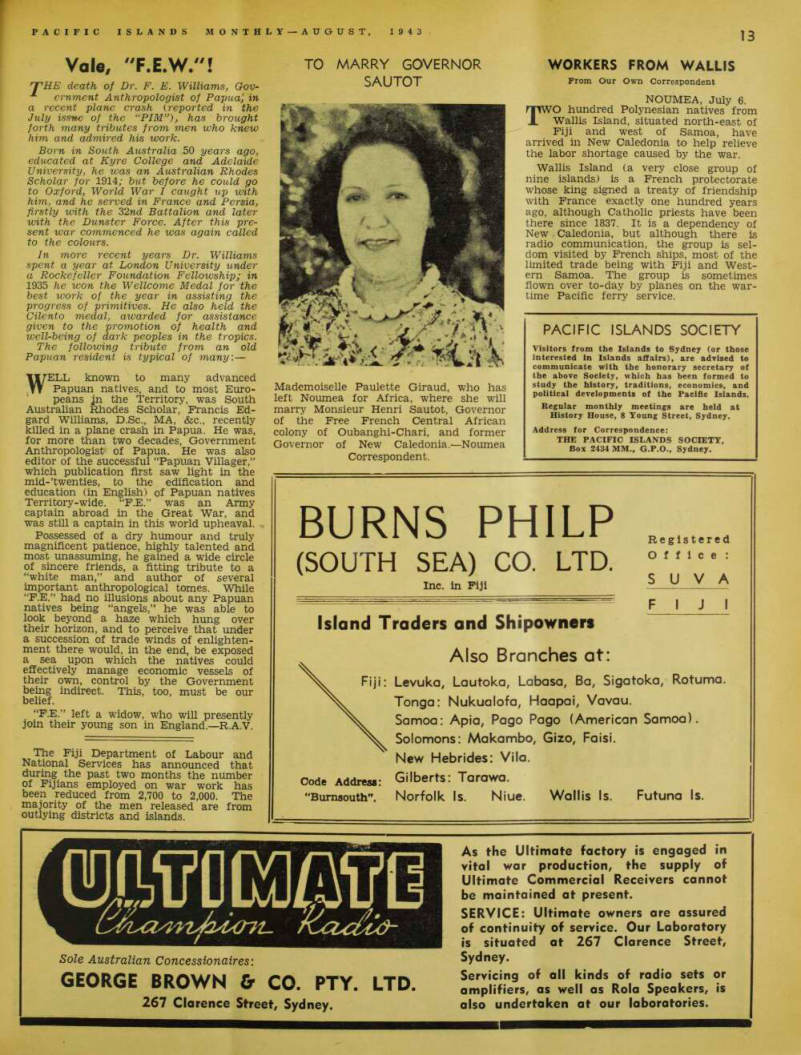
r THE death of Dr. F. E. Williams, Gov ernment Anthropologist of Papua', in a recent plane crash (reported in the July issue of the “P1M”), has brought forth many tributes from men who knew him and admired his work.
Born in South Australia 50 years ago, educated at Kyre College and Adelaide University, he was an Australian Rhodes Scholar for 1914; but before he could go to Oxford, World War I caught up with him, and he served in France and Persia, firstly with the 32nd Battalion and later with the Dunster Force. After this pre sent war commenced he was again called to the colours.
In more recent years Dr. Williams spent a year at London University under a Rockefeller Foundation Fellowship; in 1935 he won the Wellcome Medal for the best work of the year in assisting the progress of primitives. He also held the Cilento medal, awarded for assistance given to the promotion of health and well-being of dark peoples in the tropics.
The following tribute from an old Papuan resident is typical of many. — WELL known to many advanced Papuan natives, and to most Euro peans in the Territory, was South Australian Rhodes Scholar, Francis Ed gard Williams, D.Sc., MA, &c., recently killed in a plane crash in Papua. He was, for more than two decades, Government Anthropologist of Papua. He was also editor of the successful “Papuan Villager,” which publication first saw light in the mid-’twenties, to the edification and education (in English) of Papuan natives Territory-wide. “F.E.” was an Army captain abroad in the Great War, and was still a captain in this world upheaval.
Possessed of a dry humour and truly magnificent patience, highly talented and most unassuming, he gained a wide circle of sincere friends, a fitting tribute to a “white man,” and author of several important anthropological tomes. While “F.E,” had no illusions about any Papuan natives being “angels,” he was able to look beyond a haze which hung over their horizon, and to perceive that under a succession of trade winds of enlighten ment there would, in the end, be exposed a sea upon which the natives could effectively manage economic vessels of their own, control by the Government being indirect. This, too, must be our belief.
“F.E.” left a widow, who will presently join their young son in England.—R.A.V.
The Fiji Department of Labour and National Services has announced that during the past two months the number of Fijians employed on war work has been reduced from 2,700 to 2,000. The majority of the men released are from outlying districts and islands.
To Marry Governor
Sautot
Mademoiselle Paulette Giraud, who has left Noumea for Africa, where she will marry Monsieur Henri Sautot, Governor of the Free French Central African colony of Oubanghi-Chari, and former Governor of New Caledonia.—Noumea Correspondent.
Workers From Wallis
Prom Our Own Correspondent
Noumea, July 6.
rO hundred Polynesian natives from Wallis Island, situated north-east of Fiji and west of Samoa, have arrived in New Caledonia to help relieve the labor shortage caused by the war.
Wallis Island (a very close group of nine islands) is a French protectorate whose king signed a treaty of friendship with France exactly one hundred years ago, although Catholic priests have been there since 1837. It is a dependency of New Caledonia, but although there is radio communication, the group is sel dom visited by French ships, most of the limited trade being with Fiji and West ern Samoa. The group is sometimes flown over to-day by planes on the war time Pacific ferry service.
Advertisements & other items, p. 15 (1 item)
Burns Philp
PACIFIC ISLANDS SOCIETY
Visitors from the Islands to Sydney (or those interested in Islands affairs), are advised to communicate with the honorary secretary of the above Society, which has been formed to study the history, traditions, economics, and political developments of the Pacific Islands.
Regular monthly meetings are held at History House, 8 Young Street, Sydney.
Address for Correspondence:
THE PACIFIC ISLANDS SOCIETY,
Box 2434 MM., G.P.0., Sydney.
BURNS PHILP
(SOUTH SEA) CO. LTD.
Inc. in Fiji Island Traders and Shipowners Registered Office :
SU V A
FIJI
Also Branches at: \Fiji: Levuka, Lautoka, Labasa, Ba, Sigatoka, Rotuma.
Tonga: Nukualofa, Haapai, Vavau.
Samoa: Apia, Pago Pago (American Samoa).
Solomons: Makambo, Gizo, Faisi.
New Hebrides: Vila.
Code Address: Gilberts: Tarawa.
“Bumsouth”. Norfolk Is. Niue. Wallis Is. Futuna Is.
Sole Australian Concessionaires :
GEORGE BROWN & CO. PTY.
267 Clarence Street, Sydney.
As the Ultimate factory is engaged in vital war production, the supply of Ultimate Commercial Receivers cannot be maintained at present.
SERVICE: Ultimate owners are assured of continuity of service. Our Laboratory is situated at 267 Clarence Street, Sydney.
Servicing of ail kinds of radio sets or amplifiers, as well as Rola Speakers, is also undertaken at our laboratories.
SsfOffices to R^bau^forusel^lSks 7
Education Of Ng
Natives
Work of Mr. A. Schmidt
Letter to the Editor I N your article in the July “PIM” about native education in New Guinea, you fail to do justice to the valuable work done in the Territory in recent years by Mr. A. Schmidt (head of the native schools) and his assistants, Messrs. Monger, Waterhouse and Burch.
Mr. Schmidt went from the Queens land education service to Rabaul in 1926, and he devoted himself, over 14 years, with enthusiasm and self-sacrifice, to the task of organising and operating’ a sys tern of instruction for native children.
He recipgmsed that nothing much could be achieved unless and until a corps of
young native men were trained to take charge of the village schools. The authorities gave him such limited facili ties with which to work that he could carry out his plans on only a small s £ ale ; but, during the past ten years, there was produced from the elementary and technical schools in the Rabaul dis trict a considerable number of young native teachers, clerks and technicians whose standard of education was truly astonishing. I am sending you herewith a selection of letters written to Mr.
Schmidt in recent times, and I think that you will agree that their handwrit in § and composition would not disgrace any European pupil of a secondary school, Manv of thp hp<?t nf immediately taken bv* thp
SsfOffices to R^bau^forusel^lSks 7
but several of themwere sSt out ovw the Territory—to New Ireland to the Ramu and other places on the ’mainland
—and placed in charge of village schools.
Mr. Schmidt was just beginning to see some real results from his long years of hard work when the Japanese invasion came, and swept everything away. He himself was caught in the invasion and is believed to be a prisoner of war.
I am, etc.,
Sydney, 26/7/43.
Territorial.
Editorial Note; The “Plm’’ Did
not criticise the quality of the teaching done in the native schools in New Gumea—on the contrary, having seen something of the work carried out in the village schools and in the Rabaul technical school, we have nothing but praise for what was accomplished there.
Our attack was directed against the thumb-twiddling of Canberra and Nama nula, whenever the subject of native education was raised—the strange policy of laissez faire. J There are the better part of a million natives in New Guinea. They are a bright, intelligent people, many of them eager for instruction. New Guinea dur ing the period of the flourishing gold industry, had rich revenues available for expenditure upon native education and native health—and the obvious thing to have done was to have trained hundreds of young native men as school-teachers and native medical practitioners. The work of Mr. Schmidt, the late Mr. Water house, and others showed that such a policy was quite practicable, and would have paid rich dividends. But the New Guinea Administration awaited a lead from Canberra; Canberra merely twiddled its thumbs and awaited a lead from some unknown politician who had been pitch forked into the job of Minister for Ex ternal Territories; and so nothing was done. Had it not been for the missions, the amount of native education work done in NG in the last 20 years would have been negligible.
Native education and native health are still New Guinea problems awaiting solu tion. Mr. Schmidt and his associates at least will have the satisfaction of know ing that the pioneering work they have done in the secular field, in the face of much difficulty, must supply the policy framers of the future with a valuable guide.
Rev. James Benson
May be a Prisoner
AN officer of the Red Cross, who is stationed in New Guinea, has re ported to the Australian Board of Missions, in Sydney, that he has heard, from a usually reliable source, that the Rev. James Benson was seen at Sanan anda (then a Japanese base) in October last, and that he was taken off as a prisoner on a Japanese vessel bound for Rabaul.
Early in October, it was reported that the three Anglican missionaries, Miss Mavis Parkinson, Sister May Hayman and Mr. Benson were killed by the Japanese.
In the case of the two women this report has since been confirmed. The last official word of Mr, Benson was that he had been seen on the Sanananda track by a half caste boy, whom he told he was going to Buna to arrange safe conduct for the women.
According to this latest unofficial re port, it appears that there is still hope that he may be safe.
I. L. Vosailagi, a Fijian who recently completed his studies and qualified as a dental surgeon at Otago University, New Zealand, has returned to Fiji. He will join the Medical Department.
Advertisements & other items, p. 16 (1 item)
W. H. Grove & Sons
GILLESPIE’S
The Flour
TRADE
MARK
of the Islands
SYDNEY -
W. H. GROVE & SONS
Limited
AUCKLAND
Island Traders. P.O. Box 490.
Telegraphic and Cable Address: “Grove”, Auckland.
Shippers of all classes of New Zealand products.
Representing English Manufacturers throughout the Cook and Society Islands, Fiji, Tonga, Samoa, Niue, New Caledonia, New Guinea, etc.
In FIJI of—W. H. Grove & Sons (Fiji) Ltd.
Why Paton And
Penglase?
THE ways of officialdom pass all understanding.
Mr. Penglase, formerly a District Officer in New Guinea, and more recently a major in ANGAU, and Professor Paton, of the Law School of Melbourne Uni versity, are being sent to Britain to undergo a course (six weeks) at the “School of Military Re-Occupation,” which “devotes its activities to the train ing of men for administrative posts in territories re-taken from the enemy.”
Does it not seem ridiculous that men should be sent all the way from Australia to England to undergo a six-weeks’ course? What can they learn in six weeks in England about the adminis tration of re-occupied New Guinea which could not be taught in Australia?
And what qualities were taken into consideration in selecting these particular two men for this pleasant jaunt to Eng land? Why Professor Paton and why Mr.
Penglase?
Professor Paton, no doubt, is an out standing person—he otherwise would not be a professor in so eminent an institu tion. But what is this eminent legal gentleman supposed to learn in this special school in six weeks, which presum ably will give him the right to ride into Pacific Territories’ administration, over the heads of equally qualified men who have devoted a lifetime to the study of tropical conditions? If a legal man is needed for this special training, why over look the outstanding claims of Judge F.
B. Phillips, CBE, LLM, formerly a Judge of the New Guinea Supreme Court and a distinguished Deputy Administrator, who now is holding down an important RAAF job in Britain? Or those of Judge R. T. Gore, the equally distinguished head of the Central Court of Papua, who also acted, on occasions, as Administrator of that Territory?
And why Mr. Penglase, rather than any other of a dozen distinguished young of ficials of the New Guinea Public Service, who have done so well in their wartime jobs? All who know New Guinea have re spect and esteem for “Nat” Penglase; but not to the extent that the claims of several other New Guinea public officials for preferment can be ruled out.
What bureaucrat or brasshat made these selections, anyway?
Draft Dodgers
No Place in Tahiti for Draft Dodgers
THREE parties of so-called draft dodgers who sailed in small cutters from California, USA, to Tahiti, dis covered, much to their surprise, that they were not welcome in the Free French islands of the South Pacific.
They arrived in Papeete by way of the Marquesas and Tuamotu Islands. Two of the parties lingered in the Tuamotus for a time but were ordered on to Papeete. When they reached Papeete they got the shock of their lives. They were treated as enemy aliens, kept under guard, and then were told they must get going or their boats would be confiscated.
Finally, they shipped out as crew mem bers on the first cargo ship calling at the port, leaving their cutters here. Their destination was unknown in Papeete.
The Rev. J. W. P. and Mrs. Gillan, of the Presbyterian Overseas Mission, who are at present visiting Australia, will return to their station in the New Hebrides shortly.
Photographs Of Sw Pacific
Are Wanted
THE Mitchell Librarian, Sydney, would like it to be known that photographs of any part of the South-west Paci fic would be Welcome additions to the Mitchell Library Collection. It is realised that many residents of the various islands lost all their possessions when they were compulsorily evacuated, but there may be other ex-residents who had brought or sent photographs to Australia while it was still possible to do so.
The Trustees are prepared to purchase suitable material, which may be submit ted to the Mitchell Librarian. She would be glad to hear, also, from owners of negatives who might be willing to lend them for printing.
Mr. W. F. Hayward, the Postmaster- General of Fiji, has returned from over seas leave.
Successful Treatment Of
Leprosy
SINCE the Conditional Discharge Ordin ance was passed in 1918, 696 patients have been discharged from the Makogai Leper Station, in Fiji. Of these, 385 have been discharged during the last 10 years and 101 during the last 13 months.
From these figures, it is obvious that the discharge rate is improving; but, according to Dr. Austin, Medical Super intendent of the station, this is due, not so much to improved methods of treat ment, as to earlier diagnosis. Treatment in the earliest stages of the disease gives a far better chance of recovery.
Dr. K. H. Black, a son of Mr. K. W. A.
Black, of the Fiji Medical Department, has taken up a post as house surgeon at the Colonial War Memorial Hospital, Suva.
Advertisements & other items, p. 17 (1 item)
G/Lbey’S
DRY BIN
Distilleries at London . . . England Toronto . . . Canada Moorabbin . . Victoria Cincinnati . . . U.S.A.
corded ’ ... . 4 s£Js£SS» i You cao n e T f Y t ish and abs ° sIR tH6I« and oU<3 J U OrieV a IS hH D rS vail-ER & CO - \ ,AonU 6«* * * * HD**""®' *' S ’ Vx M tOU W !’sy*-» Men ' 5
Problems Of Carrying On

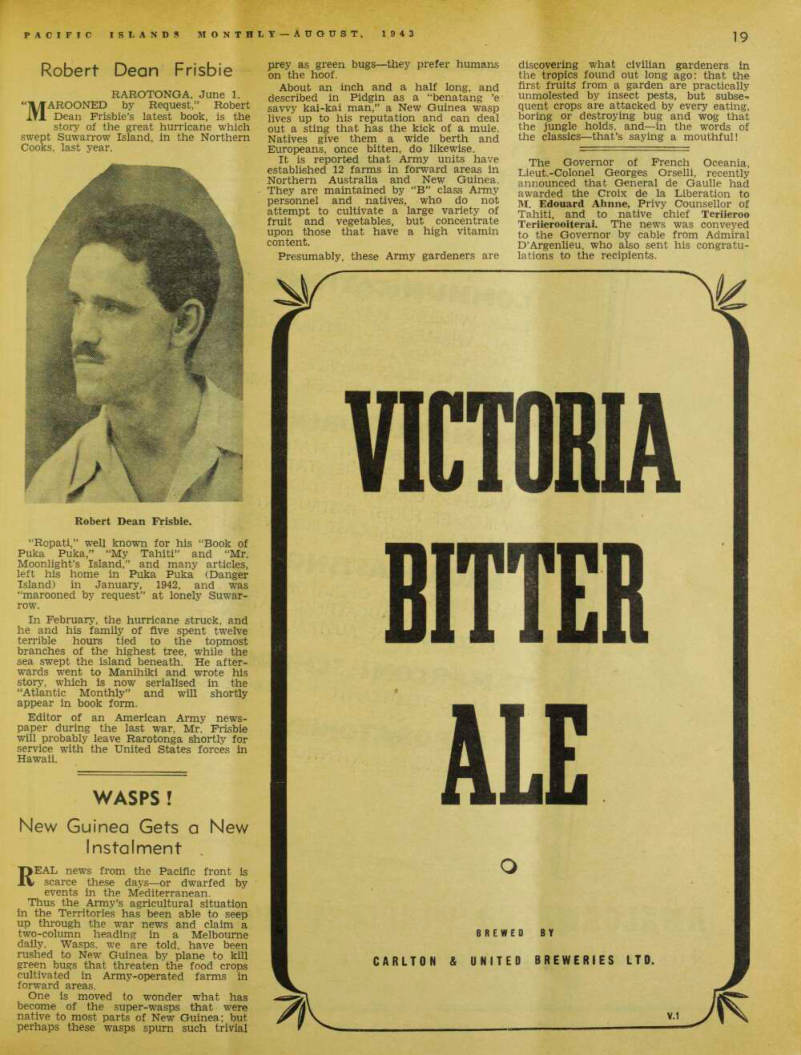
Annual Meeting of the New Guinea Women's Club
'J'HE New Guinea Women’s Club of Sydney has commenced its third year with its members—outwardly at all events—full of hope and high courage.
In December, 1941, and January, 1942, these women were bundled out of their Islands homes at a few hours’ notice, leaving behind them the hundred and one homely things that a woman cher ishes most dearly—and their menfolk.
The majority of them have not seen their men since that time—many of the men are, in fact, still officially classed as ‘missing’’ Few appreciate how far the Territorian is divorced in interests, cul ture and environment (not to mention climate!) from Australians.
Possibly only Pacific Islands residents can realise what it was like for these women to be dumped in Australia, as they were, and when they were—that is, when Australia was primarily concerned about herself and shamelessly disinterested in the unfortunate people who had taken the first full brunt of Nippon’s south wards thrust. Yet complaints from them have been conspicuously absent. The dominant idea of all seems to be to dig in their heels and wait grimly for that day when Australia is over the horizon— just a handy spot for a three months’ leave; when the External Territories Department will be merely a name; and parsimonious Australian Governments, who grudgingly give back-handed “loan allowances,” as unsubstantial a memory as a last year’s bad dream.
IN presenting her report, at the second annual general meeting on July 17, and in appealing for a continuation
of the splendid courage, bom of sorrow and adversity, that had characterised the women evacuees of the Territories, Mrs.
H. H. Page, president of the New Guinea Women’s Club of Sydney, said that she could not but feel how wonderful it was that “we knew not what awaited us. God kindly veiled our eyes.” But in spite of the fact that the past year had been an anxious and worrying one for members individually, her report would show that it has been a successful one for the club, both financially and socially.
Since the last annual general meeting, activities have been as follows: In October, it was decided to amalga mate with the New Guinea Comforts Fund, whose committee was asked to join that of the club; and in the same month, Mrs. Coote was given the job of organis ing a Donation Fund —designed to assist New Guinea Servicemen, civilians and their dependents, and prisoners-of-war.
In March, 1943, Mrs. Coote found it necessary to give up this work, but not before she had inaugurated a successful drive for funds, to which the three large firms of Burns Philp & Co., W. R. Car penter & Co. and Bulolo Gold Dredging Co. had each contributed the sum of £lOO. Mrs. Edgell and Mrs. McDonald are now carrying on the work commenced by Mrs. Coote.
During the year, 278 parcels of com forts were sent to New Guinea fighting men, many of whom have written let ters of appreciation. This work is in the charge of Mrs. Perriman.
In October, too, Mrs. Peadon had sug gested visiting New Guinea Servicemen in Sydney hospitals and she carried out
this work until her resignation from th«i club in April, 1943. The work now wai£ being carried on under the leadership oo Mrs. Foxcroft, who had arranged a ros-e* ter whereby two members visit the hos-a< pital each week.
AT a committee meeting in Marchrl: 1943, it was decided to write to thwi Prime Minister, Mr. Curtin, in ordeie to ascertain whether the powers-that-bed would consider raising the weekly loam paid to evacuees. The following letteie was despatched on March 9:— The Hon. John Curtin, Prime Minister, Canberra.
Dear Sir,—The members of the New Guineas Women’s Club are desirous of bringing beforen the proper authorities, the present financial plight of ourselves and the other New Guineas wives and mothers, whose menfolk have beens prisoners or missing since the Japanese invadeos the Territory.
When we were evacuated to Australia thoseai of us who were not wives of public servants oro in a position, to fend for ourselves, were givens a sustenance allowance by the Commonwealth!!
Government, in the form of loans or advanceas: conditional upon our undertaking to repay theses moneys when our personal incomes from variousu sources enabled us to do so.
The advances granted were: Wife, £2 pens' week; first child, 10/- per week; other children,rr 5/- per week.
The child-endowment received by families isi being deducted from these allotments and it isi on this money we are supposed to exist withoutu other help.
When our men return to us, if such be oum; good fortune, they will be faced with this accu-u mulated debt to the Commonwealth Govern-n ment.
The Department of External Territories is onlyjli prepared to pay these allowances as and not as allotments, which we feel we be entitled to receive.
This is what we wish to bring to your notice.s: Prices of commodities are rising and rents high,ri: making the sustenance allowance quite inadequate. We would be grateful if younu Government would help us by making thesae advances, grants, rather than repayable loansan
and also to increase them to a reasonable liv ing allowance.
Your consideration of these requests would be much appreciated.
Yours faithfully,
(Sgd.) I. Mcdonald,
Hon. Secretary.
On March 30, Senator J. M. Fraser, for the Prime Minister, replied that the mat ters referred to would be considered and that in the meantime the club should furnish the Department of External Ter ritories with particulars of any cases of hardship among evacuees. After going into the matter, the executive of the club sent the following letter to the Depart ment of External Territories on May s: The Minister, Dept. External Territories.
Dear Sir,—We desire to thank you for your letter of 30th March, 1943.
In reply to your request for a particular case of hardship, we wish to state that every woman and child under the loan system is suffering hardship. The rate is totally inadequate. Most of these women have lost their homes, furni ture, and possessions and must start life afresh.
It is necessary for these people to rent fur nished homes, which consumes all the loan, apart from the question of food and clothing.
We therefore earnestly and respectfully ask for immediate action.
Apart from monetary anxieties, these folk are under the continual shadow of sorrow and strain, not knowing the fate of their loved ones and we feel they are due for special considera tion.
Yours faithfully,
(Sgd.) I. Mcdonald,
May 5, 1943. Hon. Secretary.
Senator Fraser replied on June 2, as follows: — Dear Madam, — I desire to refer to your letter of sth May, 1943, and other correspondence concerning the representations that have been submitted by members of the New Guinea Women’s Club in regard to financial assistance that has been granted to evacuees from the Territory of New Guinea with particular reference to the rela tives of the men of that Territory who have been prisoners of war or missing since the Japanese invaded Rabaul in January, 1942. The matter of the rate of allowance granted to evacuees generally from the Territories of Papua and New Guinea has been reviewed and approval has been given for the following maxi mum rates to be applicable in future: —
In the case of children the above allowances are subject to a deduction of an amount equal to Commonwealth Child Endowment received in respect of any child.
These rates will be applicable in future where the circumstances of any case warrant the pay ment of the full evacuee allowance. The repre sentations that you have made that such allow ance in the case of the relatives of prisoners of war should be by way of grants and not by repayable loan have also been considered and I will advise you further in regard to that aspect of the matter at an early date.
Yours faithfully,
(Sgd.) J. M. Fraser,
Minister for External Territories.
Finances
rpHB credit balance of the club in July, JL 1942. was £lO9/18/11. Credit balance as at July 17, 1943, was £603/15/8 a substantial and encouraging increase.
As well as contributions to the Donation Fund, the Entertainment Committee, led by Mrs. Maclean, assisted by Mesdames Edgell and Foxcroft, has turned in £139/11/5 —proceeds of eight social func tions held during the year.
Disbursements included £5O donated to the Red Cross, £lO to the Australian Comforts Fund, £B2/6/2 towards helping
New Guinea women and £l4/4/2 for hospital comforts.
Donation Fund Mtdc: paof fhp nnint tVmt R £-. PAGE stressed the point that this fund is there for those who find the financial road top rough Come to us and give us the privilege of sharmg your trouble If we can help we will gladly do so and you may rest assured that everything will be treated in strictest confidence. Money is set aside for this purpose—that is what it is for. It is hard enough to experience continual mental strain without suffering financial embarrassment as well.” ... , Special credit was given to Mrs. Adams, who has given yoeman service as treasurer of the club; and to Mrs. Ormonde, who has been responsible for all floral decorations and for the posies that are a feature of all club functions.
Thanks and appreciation were expressed to Mrs. Cameron, of the Feminist Club, for her wonderful help and advice
at all times; Miss Grant, who has audited the books every three months since the inception of the club; Mrs.
Tudor, who represents the “Pacific Islands Monthly, for her excellent rep orts of the club’s activities through -out the year; Mr. Leake, for his courtesy in making a room available for our committee meetings; and to Mr. Fox- C roft, for his interest and material assist anrp q f a n times '
Office-Bearers, 1943-44
T v! was J?. eld • th ® Feminist cldb Rooms King Street, Sydney, and was attended by 53 members The following office-bearers were elected for the year 1943-44* y , , ’
Patron: Lady McNicoll.
President: Mrs. H. H. Page.
Vice-presidents: Mesdames N. Foxcroft and c H R Maclean .
Hon Secretary: Mrs. I. McDonald,
(Continued on Page 28)
Per week Man or woman unaccompanied .. .. £2 10 0 Man and wife 3 15 0 Man and wife with one child ... 400 Man and wife and two children ... 450 5/- for each additional child.
Woman and one child 350 Woman and two children 3 15 0 Woman and three children 4 0 0 5/- for each additional child.
Hon. Treasurer: Mrs. H. Adams.
Hon. Auditor; Miss Grant.
Committee; Mesdames McMullen, Or monde, Allen, Sedges, EckhofT, Edgell, Saunders, Kilner, Burke, and Miss Mills.
Advertisements & other items, pp. 18-20 (1 item)
89 Years
y(^^S
A )l m V* i
S WALLD We AIIEII ltd.
imiiiis if iisciits . nia pbooiigs . cuts * vitocii . ice cieih o£trv^
"1
M ore Mouths
to feed..
Every day the demand for Foster Clark’s richly flavoured Creamy Custard is increasing. Added to that, our factory is doing a night and day job providing essential food rations for men in the Fighting Forces. So you can well imagine that we’re finding it difficult to supply the stores with sufficient Foster Clark’s Creamy Custard to go round.
You’re bound to get a certain amount, but not always as much as you want. We know you’ll understand how war contracts and the increased demand affects our inability to supply and we know you’ll be patient about it.
FOSTER CLARK'S
l/F
</ usmm
Modern Refrigeration for the South Sea Islands
The ELECTROLUX kerosene operated
REFRIGERATOR
ELECTROLUX OFFERS ECONOMICAL, modern and completely efficient
REFRIGERATION FOR ISLANDS' HOMES.
FREEZES CONTINUOUSLY WHILE SMALL LAMP BURNS.
Freezing controlled by simply regulating height of flame. Uses only I gallon of kerosene per week.
MOTORLESS ... NO PARTS TO GET OUT OF ORDER.
MODEL L 22 MODEL L3BO MODEL LKSSO Capacity ® (as illustrated) * Capacity 2.2 cubic feet. Capacity 4 cubic feet. 5.5 cubic feet.
GUARANTEED FOR TWO YEARS.
• Write to your Local Distributor for prices and full details.
OBTAINABLE FROM ALL W. R. CARPENTER & CO. LTD.
BRANCHES THROUGHOUT THE ISLANDS
Representation in Papua and New Hebrides.
Robert Dean Frisbie
Rarotonga, June 1.
<r IVT AROONED by Request,” Robert Ifl. Dean Frisbie’s latest book, is the story of the great hurricane which swept Suwarrow Island, in the Northern Cooks, last year.
“Ropati,” well known for his “Book of Puka Puka,” “My Tahiti” and “Mr.
Moonlight’s Island,” and many articles, left his home in Puka Puka (Danger Island) in January, 1942, and was “marooned by request” at lonely Suwar row.
In February, the hurricane struck, and he and his family of five spent twelve terrible hours tied to the topmost branches of the highest tree, while the sea swept the island beneath. He after wards went to Manihiki and wrote his story, which is now serialised in the “Atlantic Monthly” and will shortly appear in book form.
Editor of an American Army news paper during the last war, Mr. Frisbie will probably leave Rarotonga shortly for service with the United States forces in Hawaii.
Robert Dean Frisbie.
Wasps !
New Guinea Gets a New Instalment
REAL news from the Pacific front is scarce these days—or dwarfed by events in the Mediterranean.
Thus the Army’s agricultural situation in the Territories has been able to seep up through the war news and claim a two-column heading in a Melbourne daily. Wasps, we are told, have been rushed to New Guinea by plane to kill green bugs that threaten the food crops cultivated in Army-operated farms in forward areas.
One is moved to wonder what has become of the super-wasps that were native to most parts of New Guinea; but perhaps these wasps spurn such trivial
prey as green bugs—they prefer humans on the hoof.
About an inch and a half long, and described in Pidgin as a “benatang ’e savvy kai-kai man,” a New Guinea wasp lives up to his reputation and can deal out a sting that has the kick of a mule.
Natives give them a wide berth and Europeans, once bitten, do likewise.
It is reported that Army units have established 12 farms in forward areas in Northern Australia and New Guinea.
They are maintained by “B” class Army personnel and natives, who do not attempt to cultivate a large variety of fruit and vegetables, but concentrate upon those that have a high vitamin content.
Presumably, these Army gardeners are
discovering what civilian gardeners in the tropics found out long ago: that the first fruits from a garden are practically unmolested by insect pests, but subse quent crops are attacked by every eating, boring or destroying bug and wog that the jungle holds, and —in the words of the classics—that’s saying a mouthful!
The Governor of French Oceania, Lieut.-Colonel Georges Orselli, recently announced that General de Gaulle had awarded the Croix de la Liberation to M. Edouard Ahnne, Privy Counsellor of Tahiti, and to native chief Teriieroo Teriierooiterai. The news was conveyed to the Governor by cable from Admiral D’Argenlieu, who also sent his congratu lations to the recipients.
Advertisements & other items, pp. 21-22 (1 item)
Victoria
BITTER
ALE
o
BREWED BY
CARLTON & UNITED BREWERIES LTD.
Services
COMMUNICATIONS
SSS RAM SERV,CE
wireless telephon finders wireless direct i menTS
ssjs ssScSr «»»
BROADCASTING
OWNERS AND O^O^ atioN S
RE AWB
s-ssi^s —
“ST*””* ■
AMALGAMATED WIRELESS (A'sia) LIMITED
Australia’s Nat ional Wireless Organisation
Australians' Shangri-la
At the End of a Guadalcanal Jungle Trail
Prom a Special Correspondent
South Pacific Base. June.
“T ATE in the day we came to a clear- L ing„ and in the centre stood a five room house built of bamboo sur rounded by a neatly-trimmed lawn and flower beds. Bananas, pawpaws, lime and lemon trees were plentiful, while at the rear of the house was a large vegetable garden containing tomatoes, cucumbers, beans, corn and pineapples.
“Further surprises came with the appearance of a well-educated Fijian, who escorted us through the house, which we found had electric light, beds with inner sprung mattresses, an electric re frigerator, and complete furnishings car ried over the 18 miles’ trail by native porters.
“Only the Australian owners were not there to welcome us; they had wisely moved out when the Japs came. But the Fijian overseer was hospitality itself; while the men made themselves at home in the kitchen, he welcomed us to din ner in the dining-room, with linen cloth, fine china and silverware. There were cold sliced cucumbers, tomatoes and other fresh vegetables—it was grand!”
Such is the account given by two infantry officers of their arrival at an Australian’s Shangri-la, which presented vistas of great beauty above the jungle hell of Guadalcanal. For. since the end of the battle for that bloodstained island, United states soldiers have had time to explore its almost impassable jungles and hidden fastnesses, its steep sunbaked hills and sandy, palm-fringed beaches.
Leaders of this particular patrol of twenty men were Capt. David B. Ritchie and Lieut. Gunderson. Their trail led through the tortuous jungle of the Sar vihu River Valley. Guided by two natives, for nine hours the group made its way first along the river bed. then through gloomy, dense jungle where the horizon was limited to a circle of 10 feet.
This was succeeded bv a climb, hand over hand, up sheer cliffs by means of rudely-constructed ladders, and along rope vines in the burning sun, so that every step became an effort. Two of the men dropped out before the goal was reached—and the joys of civilisation almost unbelievably burst on the party.
EDITORIAL NOTE.—The reference, apparently, is to the camp established inland on Guadalcanal by the Theodore gold-mining interests, from Fiji. The enterprise was suspended when the Japs invaded, in 1942, and the Europeans withdrawn; but an educated Fijian was left in charge.
A Solomon Islands planter, Captain C.
E. Hart, who recently was in Sydney, had a remarkable experience. He recovered from the pockets of a dead Jap his valu able collection of stamps which, a week earlier, had been stolen from his house on his plantation in the Tulagi area.
Captain Hart’s wife and daughter were evacuated in January, 1942. but he him self remained there until after the Japanese invasion.
This morning, while our guns were shelling a Japanese position we heard the added noise of our bombs on Salamaua.
A young Australian lathering his chin grinned at me. “Write home to Mum,” he said. “I am within shaving distance of Salamaua.” —Alan Dawes , in Mel bourne “Herald”
Schooner Lost
Old "Manureva" on Reef in Australs
Papeete, June 10.
THE old schooner, “Manureva,” owned by the Co-operative Society of Rurutu, but under charter to M.
Louis Tranchand, a Papeete soap manu facturer, was wrecked on a reef off Tubuai (Austral Islands) on the night of March 6, while en route to Papeete. She was carrying 18 passengers, 15 tons of produce and, on deck, seven tons of pigs, three cattle and one horse. The passen gers and most of the livestock were saved.
The little ship encountered erratic winds and very thick weather after leav
ing Tubuai lagoon and, in the darkness, she blundered on the reef, about two miles from shore.
About midnight, as the sea was rising, two passengers (Ahumai a Nauta, of Tubuai, and Jean-Baptiste Voirin, of Rurutu), with the supercargo and two sailors, left the wreck in an attempt to swim ashore. They succeeded, and by 4 a.m, boats from Tubuai had commenced the work of rescue.
Neither ship nor cargo was insured.
R.P.D.
Vital Point
The Lord gave us two ends to use, One to think with, one to sit with; The war depends on which we choose, Heads we win and tails we lose! —Pennsylvanian “Guardian.”
Advertisements & other items, p. 23 (1 item)
A. B. Donald Ltd.
AUCKLAND
ISLAND TRADERS & GENERAL MERCHANTS
i P.O. Box 1509. Cables Gr Telegrams, "Kingdom", Auckland.
Scott’s “Renown” Brand Rope,
Cordage and
Binder
Twine
Cable Addreu Ropeyard, Sydney. mum
of Every
Description
MANUFACTURED AT
MASCOT, N.S.W.
J. SCOTT
PTY. LTD.
Head Office and Store;
163 CLARENCE STREET,
SYDNEY,
N.B.W.
Red Tape
Cutting Coconuts and Red Tape
(Contributed) PAPUA, in pre-war days, had its struggles with red-tape; but, when the Military Administration took charge, some red-tape disappeared.
Some of us were encouraged to think that the petty bureaucrat was a thing of the past. But such was not to be— officialdom slowly filtered back into the country under some guise or other. Per haps an “all time' high” was reached last year, during the stiff fighting for Buna.
The American forces had with them a certain “adviser.” His actual function no one seemed to be able to define, but the type did not seem to their liking. At that time, tanks were needed further forward, and certain Americans manned the machines, so as to take them to a point where Australian personnel would drive them into action.
In the path of the tanks there stood several coconut trees. The removal of those trees was necessary, to allow the passage of the tanks.
But at this point our red-tape friend appeared. “No!” said he. “Coconut trees are native wealth, and under no circum stances must they be cut down.”
“Well,” said the American Colonel, “I’m afraid that, wealth or no wealth, down they will have to come. Lives are being lost while the Australians are waiting for these tanks.”
The adviser drew himself up to his full height of 63 inches and threatened the Colonel with the consequences of defying the laws of Papua.
“Sorry,” said the Colonel. “Those trees are coming down. And, as for you ...” and the Colonel told the adviser how to dispose of the trees.
The adviser was horror-stricken, and with dignified haste he went to the American General, with the full story. He ended, bitterly, with a verbatim report of what the Colonel had told him to do with the coconut trees.
The General (his name appears fre quently when the Buna fighting is men tioned), eyed the pompous little man’s framework speculatively. “And did you do it?” he asked. “No? Well, then, I’m afraid we’ll have to conduct our campaign without you.”
The adviser departed and joined an other unit, where he hopes that a more understanding view will be taken of such matters as the destruction of six valuable coconut trees merely to allow the passage of tanks required to save Australian lives.
Missions
Future Of Pacific Islands
“ A USTRALIA and the Pacific” is a XX booklet written by the Rev. R. C.
Blumer and the Rev. H. M. Arrow smith, and published by the Church Missionary Society, Sydney, apparently for young students of missionary work in the Pacific. It covers the history of the Church Missionary Society in the islands of the Pacific and in lands bordering the Pacific, and presents some ideas concern ing the future of this area and the aims of the Society—particularly in regard to the Netherlands East Indies, where a new field of service is planned. There are about 50 million Mohammedans in the NEI, and about 1,500.000 Christians.
It is admitted in the booklet that the task ahead is one that will try strong men; but the solution of all Pacific problems is summarised in two words, “comradeship and partnership.” These sentiments are endorsed by all who pause
even for a moment, to consider the Pacific now, and in the post-war period—and as sentiments they are fine—but no one yet has got down to brass tacks and told us what line we are to take to reach this happy state of affairs.
We may accept the hypothesis that in Gods sight all men are equal, and that the answer to our immediate problems lies in comradeship and partnership. But what then? No one has given us any indication of how the conflicting con glomeration of ideas, religions, problems, lusts, ideals, poverty, misery, wealth, power, and the millions of individual aims and desires that are cradled in the Pacific area are going to be welded to gether into one mass of co-operative effort. Perhaps, in the crucible of war, we shall be cleansed of our old failings and imbued with a desire for duty, self sacrifice and neighbourliness; but there is remarkably little indication of it up to date.
The ideals of Mr. Blumer and Mr.
Arrowsmith are inspiring; but they must be backed up by something more prac tical than a pious hope that mankind and Governments in general will be motivated by a sense of Christian duty.
Airmail Between Nz And
Noumea
AN airmail service between New Zealand and New Caledonia was inaugurated in June, and reduces the transit time of mail from two weeks to two days.
It is understood that this service is avail able to service personnel only. There are New Zealand troops in New Caledonia.
Dr. Agnes Hoeger, of the Lutheran Mission, New Guinea, is at present in Bundaberg, Queensland, but hopes to return to the United States shortly.
Advertisements & other items, p. 24 (1 item)
William Atkins Pty. Ltd.
Head Office 449-451 KENT ST., SYDNEY.
Iron & Steel Merchants-Engineers' Supplies
ESTABLISHED OVER 60 YEARS
Coach & Motor Hardware Cable Address: WILATKIN, Sydney.
STEEL DEPARTMENT
MILD STEEL:
Rounds, Squares, Flats, Half-rounds, Hexagons, Bevel, Shoeing, Tyre, Angles, Tees, Sheets, Plates, Girder Plates, Chequer Plates, Channels, Hoops, Etc.
BRIGHT STEEL:
Rounds, Squares, Hexagons.
Extra Special High Speed Tool Steel, Mining Steel, Blister Steel and Spring Steel, Rounds, Flats & Squares.
Bar Iron—All sections and sizes.
Engineers' Supplies: Set Screws, Studs, Metal Thread Screws, Coach Screws, Piles, Cotter Pins, Bright and Black Bolts, Rivets, Etc., Hack Saw Blades.
Power Transmission Gear: Including Plummer Blocks, Couplings, Collars, Etc.
Coach and Motor Hardware: Axles, Springs, Wheelstuff, Duck, Paints.
Farriers' Supplies: Horse Nails, Anvils, Vices, Etc.
Motor-Trimmers and Motor Builders' Cr Motor Painters' Requirements
C A. WILLEY'S
Quick-Drying Coach and Car Paints, Roughstuff, Elastic Gloss, Synflex Enamels, Lacquers.
DUCO Lacquers and DULUX Enamels—FAßßEX Motor Toppings and Leather Cloths, House & Decorators' Paints, Varnishes & Brushware.
Sole Distributors of CHAMPION'S Decorators Paint Products.
Distributing Agents for BROLITE Lacquers, SYNFLEX Enamels and "POLYGLOSS" Finish.
Fash-Back!
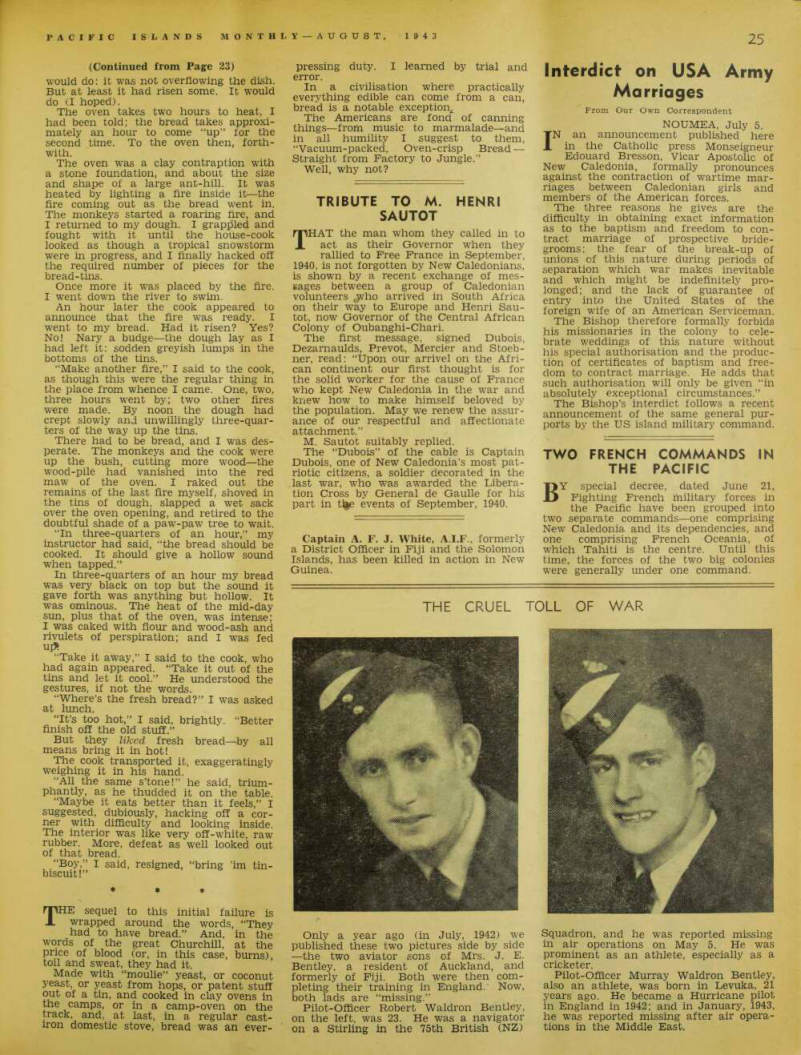
Flash Back!
From King's Cross Bread line to New Guinea House-cook
By Judy Tudor
LAST Saturday I was hovering uncer tainly on the edge of a ten-deep crowd in a bread shop—we are hav ing one of a series of bakers’ strikes in Sydney—when a Leviathan of a female with a protruding front, a fur coat and a hat like a bewitched pie-funnel, with a red feather and three yards of veil, evi dently deciding instantaneously that I was the weakest link in the horde between her and the counter, attacked me from the rear.
Before the well-aimed elbow of the old campaigner, and a thump at the back of the knees with a string bag full of assorted tins, I melted before her deter mined advance. She had the hypnotic eye that attracts shop assistants while lesser fry wilt and wait.
“I’ll have a wholemeal loaf—square— with crushed wheat on top!” she announced.
But it was the shop assistant’s picnic: “We’ve got white—round. Take it or leave it!” Then, as she warmed to the theme: “Don’t know what some people expect, I’m sure! Don’t seem to know there’s a strike on—and that it’s only through the goodness of master bakers, managing directors and such like that we are getting bread at all!”
The Leviathan backed out snorting, taking her fur coat, bewitched hat and string bag full of tins with her. And, in the vacuum caused by her departure, I got in.
“Next?”
“I’ll have a white one—round,” I said, meekly.
“Got any paper? You can’t expect us to put it in a bag! Bags cost a ha’penny and take away all the profit from the bread.”
I intimated that I would take it naked and, after another tussle with the still unserved. I reached the footpath. I examined my trophy—a poor, anaemic specimen, the misshapen product of a managing director, surely. “Well, think of the starving Russians,” I comforted myself, sourly.
But why hadn’t I bought half a pound of biscuits and let the bread go hang?
Whv this panic—this frantic, insatiable desire for bread? ♦ ♦ ♦
Fash-Back!
In place of the towering flats of King’s Cross, there are the towering mountains of New Guinea, and, at the base of one of them, on semi-level ground, a camp. In the camp sit I, harangued by the bread-making member of our outfit—soon, alas, to depart for pastures new.
“Have you ever lived on biscuits for a weeE?” he asks; and I admit that I have not.
“Well, it can’t be done. Whatever hap pens, you must keep the camp supplied with bread. There’s nothing to show you how.”
Bent on doing my Empire-building the hard way, and so raw that the original creases had not yet worn out of my khaki shorts, I agreed to everything with enthusiasm. “I’ll see that there is plenty of bread,” I promised. I watched him make two batches, and it seemed, indeed, that it was easy.
A week later, our alleged “cook” appeared, before retiring to his house for
the night, and announced in my general direction: “Bread ’e close up finis. More better missus work ’im new fella.”
“What the devil did he say?” I asked, catching a word here and there that gave me qualms.
“Bread is' almost out. Better make some more—Dad showed you how, didn’t he?”
I digested the notion for a moment, and then said “Certainly!” I took the lantern down off the nail and walked nonchalantly off to the house-cook—a frail erection about two feet from the front door that had been built so that all the smoke from the fire blew back through the house and practically choked us. In one corner of the house-cook, illuminated by a still dingier lantern than mine, the monkey washed dishes and wept into the basin. He had these periodical spasms of melancholy, but no one knew why. The cook said that he was “long-long” (mad).
The cook found the enamel bread-dish, dusted off a couple of cockroaches, shoved the flour-tin temptingly nearer to me, and then rested his elbows on the table, while he rolled a cigarette.
I went ahead as I had been instructed: flour . . . hole hollowed out in the centre . . . warm water and yeast (yeast didn’t seem to give forth a vigorous enough “pop” when the cork was removed!) . . . mix from the centre into the correct bubbly constituency.
The cook’s brown eyes followed every movement and a Pidgin sentence started to form dizzily in my brain. “You savvy work ’im this fella?” I got out at last.
He giggled coyly: “No got!”
“Well, clear out!” I yelled, at the top of my voice. Crestfallen and oozing hurt dignity, he crammed his half-smoked cigarette back in his bag and went. I covered the basin with the cleanest
looking rag available, placed it near the dying fire, and retired for the night. ♦ * ♦ CAME the dawn. The dough had not done what I had hoped it would do, nor as my instructor had said it
(Continued on Page 25)
(Continued from Page 23)
would do: it was not overflowing the dish.
But at least it had risen some. It would do (I hoped).
The oven takes two hours to heat, I had been told; the bread takes approxi mately an hour to come “up” for the second time. To the oven then, forth with.
The oven was a clay contraption with a stone foundation, and about the size and shape of a large ant-hill. It was heated by lighting a fire inside it—the fire coming out as the bread went in.
The monkeys started a roaring fire, and I returned to my dough. I grappled and fought with it until the house-cook looked as though a tropical snowstorm were in progress, and I finally hacked off the required number of pieces for the bread-tins.
Once more it was placed by the fire.
I went down the river to swim.
An hour later the cook appeared to announce that the fire was ready. I went to my bread. Had it risen? Yes?
No! Nary a budge—the dough lay as I had left it: sodden greyish lumps in the bottoms of the tins.
“Make another fire,” I said to the cook, as though this were the regular thing in the place from whence I came. One, two, three hours went by; two other fires were made. By noon the dough had crept slowly and unwillingly three-quar ters of the way up the tins.
There had to be bread, and I was des perate. The monkeys and the cook were up the bush, cutting more wood —the wood-pile had vanished into the red maw of the oven. I raked out the remains of the last fire myself, shoved in the tins of dough, slapped a wet sack over the oven opening, and retired to the doubtful shade of a paw-paw tree to wait.
“In three-quarters of an hour,” my instructor had said, “the bread should be cooked. It should give a hollow sound when tapped.”
In three-quarters of an hour my bread was very black on top but the sound it gave forth was anything but hollow. It was ominous. The heat of the mid-day sun, plus that of the oven, was intense; I was caked with flour and wood-ash and rivulets of perspiration; and I was fed u$ “Take it away,” I said to the cook, who had again appeared. “Take it out of the tins and let it cool.” He understood the gestures, if not the words.
“Where’s the fresh bread?” I was asked at lunch.
“It’s too hot,” I said, brightly. “Better finish off the old stuff.”
But they liked fresh bread—by all means bring it in hot!
The cook transported it, exaggeratingly weighing it in his hand.
“All the same s’tone!” he said, trium phantly, as he thudded it on the table.
“Maybe it eats better than it feels,” I suggested, dubiously, hacking off a cor ner with difficulty and looking inside.
The interior was like very off-white, raw rubber. More, defeat as well looked out of that bread.
“Boy,” I said, resigned, “bring ’im tin biscuit!” ♦ ♦ * THE sequel to this initial failure is wrapped around the words, “They had to have bread.” And, in the words of the great Churchill, at the price of blood (or, in this case, burns), toil and sweat, they had it.
Made with “moulie” yeast, or coconut yeast, or yeast from hops, or patent stuff out of a tin, and cooked in clay ovens in the camps, or in a camp-oven on the track, and, at last, in a regular cast iron domestic stove, bread was an ever
pressing duty. I learned by trial and error.
In a civilisation where practically everything edible can come from a can, bread is a notable exception^ The Americans are fond of canning things—from music to marmalade—and in all humility I suggest to them, “Vacuum-packed, Oven-crisp Bread Straight from Factory to Jungle.”
Well, why not?
Advertisements & other items, pp. 25-26 (1 item)
Coleman
THE
YORKSHIRE
INSURANCE
CO. LTD.
(Incorporated in England)
FIRE
ACCIDENT
MARINE
FIRE POLICIES ISSUED
IN PAPUA
All information from —
E. A. JAMES,
Tel. 86347. Attorney for Papua, 14 Spring St., Sydney.
Coleman
IS SERVING THE ARMED FORCES
WITH THREE ESSENTIALS OF
LIFE . . .
Light-Heat-Warm Food
m 7 m Wherever the Armed Forces of the United Nations need quick heat and bright light you’ll find Coleman Lanterns and Stoves. On board steamers, at landing fields, in mobile canteens, emergency hospitals, air-raid shelters, and in actual combat, Coleman appliances are providing invaluable service.
We regret any inconveniences caused through shortage of new stock for civilian requirements, and suggest you keep your present Stove and Lantern in good repair by contacting your local Distributor.
THE COLEMAN LAMP & STOVE CO. LTD.
TORONTO CANADA
The Standard of 'Excellence
Van
COMPOUNDED FROM PURE FRUIT
EXTRACTS AND HIGH-CLASS
MATURED SPIRITS.
Liqueurs
IN 15 FLAVOURS
Advocaat, Red Curacoa. White Curacao, Parfait Amour, Maraschino, Chartreuse, Apricot Brandy Cointreau, Cherry Brandy, Creme de Menthe, Creme de Cacao, Peach Brandy, Creme de Banana, Kummel, Friars Liqueur.
TRADE ENQUIRIES TO BOX 3373, G.P.0., SYDNEY.
LAVEX
The Oxygened Washing Compound
Wonderful for the Wash ... Harmless to the hands
NON-INJURIOUS TO THE FINEST FABRICS
packed in cartons containing 48 x Boz. pkts.
TRADE ENQUIRIES TO BOX 3373, G.P.0., SYDNEY.
C. SULLIVAN & CO.
GENERAL MERCHANTS ISLANDS AGENTS
REPRESENTING LEADING FIRMS IN THE PACIFIC ISLANDS. ✓ Islands Produce sold on Shippers’ Account—Liberal Advances against Consignments.
Buyers of all Islands’ Requirements on Commission—Original Invoices Furnished.
Bankers'. Bank of New South Wales .. Bank of New Zealand .. Comptoir National d’Escompte de Paris.
Wartime Cable Address: Sullivan, Kentstreet, Sydney.
379 KENT STREET, SYDNEY, N.S.W.
Tribute To M. Henri
Sautot
THAT the man whom they called in to act as their Governor when they rallied to Free France in September, 1940, is not forgotten by New Caledonians, is shown by a recent exchange of mes sages between a group of Caledonian volunteers arrived in South Africa on their way to Europe and Henri Sau tot, now Governor of the Central African Colony of Oubanghi-Chari.
The first message, signed Dubois, Dezarnaulds, Prevot, Mercier and Stoeb ner, read: “Upon our arrivel on the Afri can continent our first thought is for the solid worker for the cause of France who kept New Caledonia in the war and knew how to make himself beloved by the population. May we renew the assur ance of our respectful and affectionate attachment.”
M. Sautot suitably replied.
The “Dubois” of the cable is Captain Dubois, one of New Caledonia’s most pat riotic citizens, a soldier decorated in the last war, who was awarded the Libera tion Cross by General de Gaulle for his part in tlje events of September, 1940.
Captain A. F. J. White, A.1.F., formerly a District Officer in Fiji and the Solomon Islands, has been killed in action in New Guinea.
Marriages
Interdict on USA Army Marriages
Prom Our Own Correspondent
Noumea, July 5.
IN an announcement published here in the Catholic press Monseigneur Edouard Bresson, Vicar Apostolic of New Caledonia, formally pronounces against the contraction of wartime mar riages between Caledonian girls and members of the American forces.
The three reasons he gives are the difficulty in obtaining exact information as to the baptism and freedom to con tract marriage of prospective bride grooms: the fear of the break-up of unions of this nature during periods of separation which war makes inevitable and which might be indefinitely pro longed; and the lack of guarantee of entry into the United States of the foreign wife of an American Serviceman.
The Bishop therefore formally forbids his missionaries in the colony to cele brate weddings of this nature without his special authorisation and the produc tion of certificates of baptism and free dom to contract marriage. He adds that such authorisation will only be given “in absolutely exceptional circumstances.”
The Bishop’s interdict follows a recent announcement of the same general pur ports by the US island military command.
Two French Commands In
The Pacific
BY special decree, dated June 21, Fighting French military forces in the Pacific have been grouped into two separate commands —one comprising New Caledonia and its dependencies, and one comprising French Oceania, of which Tahiti is the centre. Until this time, the forces of the two big colonies were generally under one command.
The Cruel Toll Of War
Only a year ago (in July, 1942) we published these two pictures side by side —the two aviator sons of Mrs. J. E.
Bentley, a resident of Auckland, and formerly of Fiji. Both were then completing their training in England. Now, both lads are “missing.”
Pilot-Officer Robert Waldron Bentley, on the left, was 23. He was a navigator on a Stirling in the 75th British (NZ)
Squadron, and he was reported missing in air operations on May 5. He was prominent as an athlete, especially as a cricketer.
Pilot-Officer Murray Waldron Bentley, also an athlete, was born in Levuka, 21 years ago. He became a Hurricane pilot in England in 1942; and in January, 1943, he was reported missing after air opera tions in the Middle East.
Mr. H. T. Allan, of Wau, TNG, who returned from the Middle East recently, after distinguished service, has been promoted and transferred to the New Guinea Force. Other former residents of New Guinea who also are doing useful work somewhere on that front are Messrs. Ted McMullen, W. Mossman, James Joyes, E. P. Hitchcock and Bill Watson. Some have been awarded high rank and decorations.
Rainy Weather
Thoughts
When Tahiti Listens to Washington Radio
From Our Tahiti Correspondent OUR rainy season continues, although the calendar proclaims that we are well in the middle of the dry season.
This extraordinary weather makes manifest the irritating character of our so-called civilisation. In more primitive times, when the rains descended and the floods came, we closed the doors and windows on the windward side, lighted a coal-oil lamp, settled ourselves with a good book, and forgot the raging elements Without.
Nowadays, our slender lines of com munication are vulnerable to falling branches and short circuits, and, sud denly, we are in black darkness, groping about in quest of misplaced lamps, our evening entertainment of jazz from Hollywood annihilated, and we remain in a state of desolation until the wires are
day aired S ° metime during the following „ 7 T ° be there are compensations.
We do not have to listen to the ghastly marching song the tinsmiths of Tinpan Alley are trying to fasten on our gallant American Air Force, nor to the publicity seekers in Washington whose only virtue is that they inspire us to love our Commander-in-Chief for the enemies he has made. The personality and manifest objectives of Mr. Roosevelt’s detractors are making his re-election to the Presi dency in 1944 a certainty.
The retention of Mr. Churchill and Mr.
Roosevelt in power—supported by safe majorities in the Parliaments of our Commonwealths—offers the only hope for a sane solution of our post-war problems.
The history of the years following the death of Mr. Lincoln, and of the disaster to all mankind which has been the con sequence of the repudiation of Mr.
Woodrow Wilson’s policies, supply a stern warning.
The most exasperating publicity-seekers are those who pretend to be endowed with wisdom from on high in regard to India. In addition to the fact that the Indian Question is none of our business, the melancholy examples of Hawaii, and the State of Oklahoma (formerly Indian territory) do not offer illustrious pre cedents to certify our inspiration as prophets to guide subject peoples to sweetness and light. The average United States citizen is, to the best of my know ledge and belief, fully aware of the im propriety of such discussion and deplores the tactlessness of those who promote it.
The weal of all mankind, now and for evermore, will be determined only by an unblemished understanding between the peoples of the British Empire, of the United States, and, we hope, of France.
Our publicity-seekers should remember this, and govern their tongues accordingly.
Our recent race riots are a heritage from the politicians who were in com mand at Washington after the passing of Mr. Lincoln, Those who understood the negro and who could have solved the problem before it had become the “Negro Problem,” were outlawed and impover ished during the so-called “Reconstruc tion Period.’' As I write, the question whether Mr.
John L. Lewis or the Government of the United States shall be paramount, is be ing decided at Washington.
This is an extraordinary age. Self sacrifice and valor beyond all compre hension on the battlefield, and greed, malice and political chicanery at home.
We shall, indeed, win the war. But what will follow? Human nature has not varied during the seven thousand years of recorded history.
The Government of Fiji has decided to pay an allowance of 2/- per day to the wives of Fijians who are serving in the Fijian Military Forces and Labour Corps.
Advertisements & other items, p. 28 (1 item)
Bronchitis
PAUL A. DORN
Agent, Wants Copies
PACIFIC
ISLANDS MONTHLY
All Issues
OFFERS ANY AMERICAN
MAGAZINES IN EXCHANGE
Commissions Accepted for Pacific Islands Products. Correspondence Invited.
BOX 1712, Wilshire-La Brea Station, Los Angeles 36, California, U.S.A.
ASTHMA &
CURBED IN
To-day, thanks to Mendaco, there is no reason why any man or woman should suffer ASTHMA ATTACKS with the everlasting fight for breath, and the tightness on the chest which makes going to bed at night a positive nightmare.
Mendaco a famous doctor's prescription —is guaranteed to ease your breathing, permit you to eat any kind of food without harm, stop your heart thumping against your ribs—or money back. Go to your chemist now, but insist on Mendaco —the medicine that must give you relief or money back.
Mendaco works quickly to relieve your Asthma or Bronchitis, yet contains no narcotics or habitforming drugs. It acts in these 3 ways:— (1) Loosens and relaxes thousands of tiny muscles in throat and bronchial tubes so that your can breathe freely and deeply, and thus get the benefits of health-restoring air and oxygen in your lungs. (2) Removes the mucus or phlegm which poison the system. (3) Drives out the poisons and irritating factors and helps to refresh and build up the blood, thus increasing energy and so fortifying the system against recurring attacks.
MENDACO HELPS MILLIONS.
Millions of former sufferers from Asthma and Bronchitis are now enjoying sound, invigorating sleep all night and every night, because in Mendaco they have found the one medicine which truly gets to the root of their trouble and relieves the terrible suffering. Men and women who had at one time to sit up all night long— unable to work, compelled to choose their food
BRONCHITIS
3 MINUTES
carefully, and could never enjoy iife—say that, thanks to Mendaco, their paroxysms have stopped, and that they can now sleep soundly the whole night through, eat any kind of food, and feel younger and stronger than they have for many years.
If you are one of the millions subject to cough after cough and cold after cold, and cannot shake them off, beware Bronchitis and Asthma. Mendaco, because it eases breathing and gets air to your lungs, helps to get rid of the cause—a stifled respiratory system, and the blood cleansing medicaments in Mendaco fortify and strengthen you against further trouble.
REAL RELIEF IN 24 HOURS.
Mendaco starts circulating through the blood in 3 minutes, and within an hour or so you can feel that your stifled tubes are being freed so that you can breathe easily and .freely. Most Mendaco users say they sleep soundly first night, and feel like a new person within 24 hours. No dopes, smokes, atomizers or injections. Get Mendaco from your chemist to-day under the guarantee to give you satisfaction or money back.
RELIEVES ASTHMA
Mendaco
Now in 2 sizes . . . 6/- and 12/-
: IPt
WU
Guard against Infection with Tenax!
Germicidal Soap used regularly is an unsurpassed safeguard against external germ infection. It is kind to the most sensitive skin, yet its germicidal action is eleven times as rapid as carbolic. It is non-irritant and non-poisonous.
At All Chemists and Stares,
TENAX Genuinely Germicidal SOAP
Status Of Norfolk
Island
Interesting Point Based on Confused Position in 1856-1913
“In 1856 Norfolk Island was severed from Tasmania, and created a distinct and separate settlement under the jurisdiction of New South Wales. In 1896 it was made a dependency under the Governor of that Colony, and was adminis tered by the Chief Secretary’s Department through a resident Chief Magistrate, in whom was vested the executive government of the settlement, and the supervision of its penal affairs. In 1913, however, a Bill was passed by the Federal Parliament providing for the taking over of the island as a territory of the Common wealth. The Act came into force on the Ist July, 1914.” —Extract from Commonwealth Year Book.
IN a broadcast address a few weeks ago, Mr. R. W. Robson, editor of “Pacific Islands Monthly,” remarked on the fact that Norfolk Island is now garri soned by New Zealand soldiers, although “Norfolk Island is and always has been an Australian territory.”
This has brought a challenge from Mr.
Samuel Hadley, of Swains Avenue, Moor bank, Liverpool, NSW, who insists that Norfolk Island legally has been an inde pendent colony of the British Crown since 1856 (when it was abandoned by the Australian authorities and handed over to the surplus people oi Pitcairn Island), and that its status as an inde pendent colony never has been legally altered.
The issues raised are much too compli cated for the “PIM” —the unravelling of the tangle of Orders-in-Council, Acts, commands, official letters, etc., relating to the status of Norfolk Island, listed by Mr. Hadley and extending over 150 years, would occupy a constitutional lawyer for a long time.
A summary of the data supplied by Mr.
Hadley follows. It would appear to us that, even if the status of Norfolk Island after 1856 was in doubt (was it a Crown Colony or a dependency of NSW?), the position was resolved by the Act of 1913, by which it became a Territory of the Commonwealth of Australia.
IN 1788, Norfolk Island was occupied by a garrison, and convicts. In 1802 there came an Imperial command to the Governor of the settlement at Syd ney to evacuate NI and in 1813 it was abandoned. In 1826 it was re-occupied as a prison settlement; and in 1844 it was annexed to the settlement of Van Diemen’s Land (Tasmania) by Act of the Imperial Parliament.
In 1856 it was separated from the Col ony of Tasmania by Order-in-Council, and erected into a separate and distinct colony, called Norfolk Island. Certain instructions then were issued by the Sec retary of State to the Governor of the Colony of NSW, under seal, relating to the inhabitants of Pitcairn’s Island.
Norfolk Island was officially abandoned to the people of Pitcairn Island (who arrived there on June 8, 1856) by Cap tain Fremantle, of HMS “June,” on June 25, 1856—but this in no way affected the British command over the island, as established by the order of February 25, 1847.
The Great Seal of the Colony of Nor folk Island was delivered to the Magis trate appointed by the Pitcairn Islanders on Norfolk, hy Captain Fortesque Moresby, of HMS “Iris,” on December 21, 1856.
In 1857, in a letter to the Secretary of State for the Colonies, Governor Deni son of NSW said: “I have not been appointed Governor of Norfolk Island.”
In a letter dated August 19, 1858, Gov
ernor Denison, writing to certain officials in Norfolk Island, refers to “the Great Seal of the Colony.”
DURING the next ten years, the islanders refused Bishop Selwyn and other authorities of the Anglican Church permission to land and found a mission; but an appeal was then made to the Governor of NSW. The latter declared that he had the legal right to permit the establishment of the Melanesian Mission on NI and he sold 1,000 acres of land to the Mission, to enable the latter to establish headquarters there. This brought about a long wrangle between the people of NI and the Governor of NSW, concerning the latter’s authority over the island.
In 1858, the NSW Governor’s authority to make laws for NI or impose other laws upon that place was legally challenged; the challenge was referred by the NSW Supreme Court to the Privy Council; the Council sent it back to the Supreme Court for determination; and the Sup reme Court held that no authority in one Colony could make laws for or impose other laws upon another Colony, In may be noted that the Governor of NSW (Lord Belmore) twice in 1868 directed attention in correspondence to the fact that he had not yet received his appointment as Governor of Norfolk Island—meaning, apparently, that the lack of this appointment deprived him of authority over Norfolk Island,
(Continued Overleaf)
THERE was trouble again in 1881, when the people of NI objected to some thing done by the Governor of NSW (Lord Loftus) and challenged his authority; and agitations were reported at intervals during the next twenty years, when the islanders insisted upon exercising their rights and privileges as a free people. Two NSW Ministers (Wise and O’Connor) visited NI in 1896, and promised that a judge should be sent to hear their case. This was not done.
Instead, an armed guard was sent from Sydney to the island, under Commander Oliver; all laws operating in NI were abolished by Sir Frederick Darling, Act ing-Governor of NSW; and the laws in force in NSW in 1857 were declared to be the laws of NI. The people’s magis trate, Byron Adams, was deposed, and a Captain Spalding was sent to govern NI, This was referred to later as “the annexation of Norfolk Island.”
In 1897, Earl Hampden became Gov ernor of NSW. The people of NI had petitioned the Queen of England, who replied that, notwithstanding anything that had been done, Byron Adams, the elected magistrate of NI, was to remain magistrate. Mr. Joseph Chamberlain, Secretary for the Colonies, wrote, with reference to “the annexation” of Norfolk Island, that he had consulted the law officers, who stated that “Norfolk Island cannot be annexed to any other Colony.”
The Queen wrote: “Norfolk Island has
been and still is subject only to our royal instructions.”
However, New South Wales continued to exercise administrative authority; and the islanders, although they repeatedly protested and challenged, had to accept that authority.
Little has been heard of NI “indepen dence” since it became an Australian Territory nearly 30 years ago, but Mr.
Hadley’s letter shows that some people there still would like to claim the privi leges which they believe were conferred in 1856.
Advertisements & other items, pp. 29-30 (1 item)
fiILLESPIi’ Servce
BUYING AGENTS
FOR ALL PACIFIC TERRITORIES
Island Produce Sold on Commission
YOUR ORDERS RECEIVE PERSONAL ATTENTION
ROBERT GILLESPIE PTY. LIMITED
54a PITT STREET, SYDNEY
Cables: ROBERGILL. GP.O. BOX 137 CC.
AUNT
MART’S
BAKING POWDER
•MTS QUALITY NEVER VARIES”
In war-time, as in peace-time, Aunt Mary’s Baking Powder gives the same “even rising” results. Limited supplies are being released, as opportunity affords, so use your purchase sparingly while precious ingredients in Aunt Mary’s Baking Powder are difficult to obtain for normal requirements. • AUNT MARY’S SCONES are always a luxury treat when good friends meet to accept your hospitality.
PRESCOTT Pty. Ltd.
SUSSEX ST., SYDNEY,
ore sole wholetole agents for
PINEAPPLE BACON&HAMS
DAISY brand BUTTER "375" BUTTER in TINS 1 lb.-21b.-slb. Sloe*.
LEA & PERRINS’ Sauces and Most other Super-Quality Lines of the Trade, such as Cheese, Eggs, Etc.
CHIV E R S
PURE
rooDS
GOLD MEDAL JAMS
CANNED ENGLISH FRUITS
CANNED ENGLISH
VEGETABLES
CUSTARD POWDER
OLD ENGLISH MARMALADE
JELLY CRYSTALS, ETC.
Obtainable from all Leading; Grocery Stores. - - - - - - - Write to Department A., Ctuver# and Sons, Ltd., Histon, Cambridge, England, for attractive Recipe Book.
I W
Growth of Southern Pacific
Insurance Co. Ltd.
rE growth of the Southern Pacific Insurance Co., Ltd., established a few years ago with a small capital, as a subsidiary of W. R. Carpenter & Co., Ltd., has been remarkable.
In the year ended March 31 last, the gross of premiums received was no less than £108,986, on which the directors report a profit of £6,314. This allows a dividend of 7 per cent., provision of £2,800 for taxes, and a carry-forward of £4,083.
Mr. Leopold G. Blackman, formerly Commissioner of Education in Hawaii, where he resided for 40 years, is now domiciled in Tahiti, at Paea.
Calendar Reform
Honolulu Mon Produces a Practicable Plan
npHE present World Calendar, under X which the year’s 365 days are divided into 12 months, with an unequal number of days in each, has many faults and causes much confusion.
Its worst fault, perhaps, is that we do not know, from year to year, upon what day particular dates will fall.
The simplest method would be to have 13 months of 28 days each, and one odd day, to be specially provided for. But this would introduce new confusion by making the four “quarters” impractic able.
The Edwards Perpetual Calendar, the invention of an American, now receiving considerable attention in the world, gets over most of the difficulties of the pre sent Calendar, and introduces no new ones. The week begins on Monday; anniversaries and holidays always fall on the same day of the week; and the year has equal quarters of 91 days each. In older that the year may include 365 days, New Year’s Day is made an international holiday, a day apart from any month or week.
The first two months of each quarter have 30 days, and the third month has 31 days. The first month of each quar ter starts on Monday, the second month on Wednesday, and the third month on Friday. Its month-lengths thus fall into the rhythmical pattern of 30-30-31, and the starting-days of each month into the well-known sequence of Monday-Wed nesday-Friday. Each of the twelve months has 26 working-days and Friday the-13th never occurs.
A period of international action and agreement, for the removal of many irregularities and absurdities, is close at hand. This new Calendar points the way to one reform, urgently needed and hun dreds of years overdue. Copies of the pamphlet may be obtained from Mr. W.
E. Edwards, Beach Walk Inn, Honolulu, Hawaii.
Captain Peter Theet, who was for many years connected with the Pacific Phosphate Company on Ocean Island, and manager on Nauru from 1906 to 1913, and who was well known to many old timers of the Pacific, celebrated his 90th birthday at Oratia, in New Zealand, on June 19.
An educated Euronesian lad, who escaped from Rabaul many months after the Japanese invasion, and reached the Australians, reports that, in the early part of 1942, civilian prisoners were kept at two camps—one on the Malaguna Road, and one in the W. R. Carpenter native labour compound at Toboi, At the former camp he saw two men whom he knew— Mr. Harold Page (Government Secretary), and Mr. A. Schmidt (master of the native school). He was asked if he had seen Mr. P. Coote (Burns, Philp manager), whom he knew; but he replied, “I did not see Mr. Coote, and I know nothing about him.”
Advertisements & other items, p. 30 (1 item)
28
NG WOMEN'S CLUB MEETING
(Continued from Page 17)
AUGUST, 194 3 PACIFIC ISLANDS MONTHLY
Synthetic
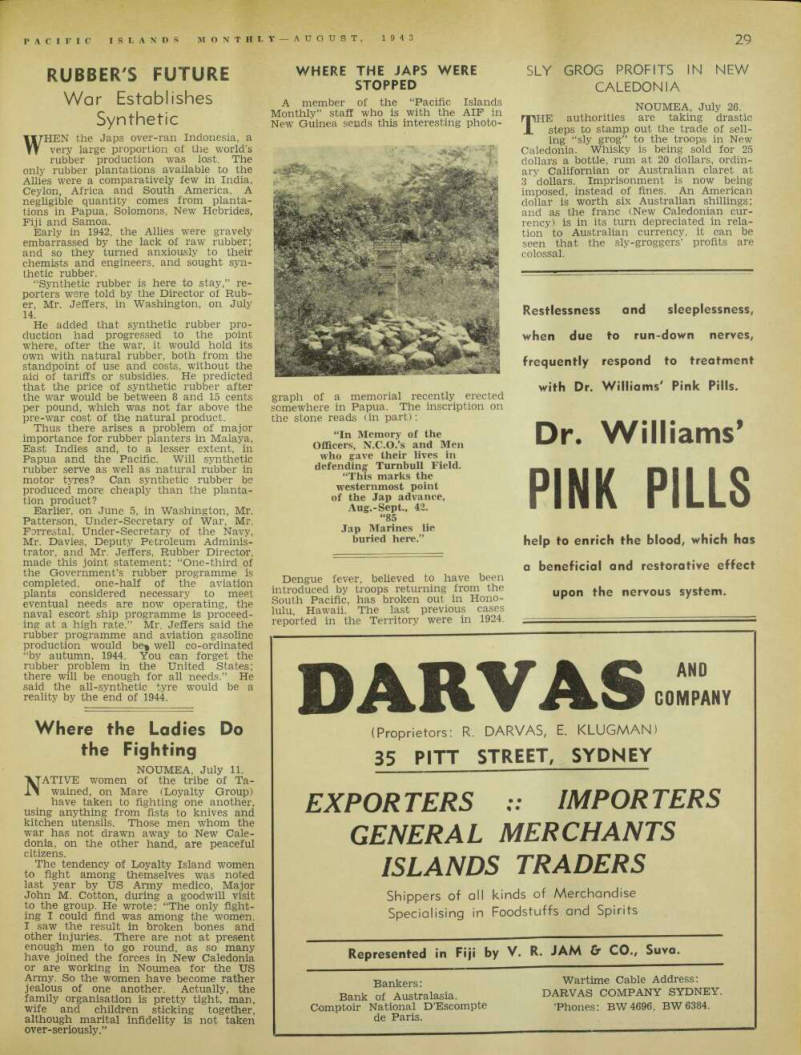
Rubbers Future
War Establishes Synthetic
WHEN the Japs over-ran Indonesia, a very large proportion of the world’s rubber production was lost. The only rubber plantations available to the Allies were a comparatively few in India, Ceylon, Africa and South America. A negligible quantity comes from planta tions in Papua, Solomons, New Hebrides, Fiji and Samoa.
Early in 1942, the Allies were gravely embarrassed by the lack of raw rubber; and so they turned anxiously to their chemists and engineers, and sought syn thetic rubber.
“Synthetic rubber is here to stay,” re porters were told by the Director of Rub er, Mr. Jeffers, in Washington, on July 14.
He added that synthetic rubber pro duction had progressed to the point where, ofter the war, it would hold its own with natural rubber, both from the standpoint of use and costs, without the aid of tariffs or subsidies. He predicted that the price of synthetic rubber after the war would be between 8 and 15 cents per pound, which was not far above the pre-war cost of the natural product.
Thus there arises a problem of major importance for rubber planters in Malaya, East Indies and, to a lesser extent, in Papua and the Pacific. Will synthetic rubber serve as well as natural rubber in motor tyres? Can synthetic rubber be produced more cheaply than the planta tion product?
Earlier, on June 5, in Washington, Mr.
Patterson, Under-Secretary of War, Mr.
Forrestal, Under-Secretary of the Navy, Mr. Davies, Deputy Petroleum Adminis trator, and Mr. Jeffers, Rubber Director, made this joint statement: “One-third of the Government’s rubber programme is completed, one-half of the aviation plants considered necessary to meet eventual needs are now operating, the naval escort ship programme is proceed ing at a high rate.” Mr. Jeffers said the rubber programme and aviation gasoline production would be* well co-ordinated “by autumn, 1944. You can forget the rubber problem in the United States; there will be enough for all needs.” He said the all-synthetic tyre would be a reality by the end of 1944.
the Fighting
Where the Ladies Do the Fighting
Noumea, July 11.
NATIVE women of the tribe of Ta wained, on Mare (Loyalty Group) have taken to fighting one another, using anything from fists to knives and kitchen utensils. Those men whom the war has not drawn away to New Cale donia, on the other hand, are peaceful citizens.
The tendency of Loyalty Island women to fight among themselves was noted last year by US Army medico, Major John M. Cotton, during a goodwill visit to the group. He wrote: “The only fight ing I could find was among the women.
I saw the result in broken bones and other injuries. There are not at present enough men to go round, as so many have joined the forces in New Caledonia or are working in Noumea for the US Army. So the women have become rather jealous of one another. Actually, the family organisation is pretty tight, man, wife and children sticking together, although marital infidelity is not taken over-seriously.”
Where The Japs Were
Stopped
A member of the “Pacific Islands Monthly” staff who is with the AIF in New Guinea sends this interesting photo-
graph of a memorial recently erected somewhere in Papua. The inscription on the stone reads (in part): “In Memory of the Officers, N.C.O.’s and Men who gave their lives in defending Turnbull Field.
“This marks the westernmost point of the Jap advance, Aug.-Sept., 42.
“85 Jap Marines lie buried here.”
Dengue fever, believed to have been introduced by troops returning from the South Pacific, has broken out in Hono lulu, Hawaii. The last previous cases reported in the Territory were in 1924.
Sly Grog Profits In New
Caledonia
Noumea, July 26.
THE authorities are taking drastic steps to stamp out the trade of sell ing “sly grog” to the troops in New Caledonia. Whisky is being sold for 25 dollars a bottle, rum at 20 dollars, ordin ary Californian or Australian claret at 3 dollars. Imprisonment is now being imposed, instead of fines. An American dollar is worth six Australian shillings; and as the franc (New Caledonian cur rency) is in its turn depreciated in rela tion to Australian currency, it can be seen that the sly-groggers’ profits are colossal.
Advertisements & other items, p. 31 (1 item)
Darv As I
Restlessness and sleeplessness, when due to run-down nerves, frequently respond to treatment with Dr. Williams' Pink Pills.
Dr. Williams’
PINK PILLS
help to enrich the blood, which has a beneficial and restorative effect upon the nervous system.
DARV AS i
(Proprietors: R. DARVAS, E. KLUGMAN)
35 PITT STREET, SYDNEY
EXPORTERS :: IMPORTERS
GENERAL MERCHANTS
ISLANDS TRADERS
Shippers of all kinds of Merchandise Specialising in Foodstuffs and Spirits Represented in Fiji by V. R. JAM Cr CO., Suva.
Bankers: Wartime Cable Address: Bank of Australasia. DARVAS COMPANY SYDNEY.
Comptoir National D’Escompte ’Phones; 8W4696, 8W6384. de Paris.
Fiji Airman Missing
rE toll of war mounts; scarcely a day passes without one or more of our young Islands’ men becoming battle casualties.
Advice has been received that Flying- Officer A. J. Davis, formerly of the Fiji Treasury Department, and son of Mr. J.
J. Davis, of Suva Point, has been posted as missing, after air operations over Germany on June 24-25.
He left the Colony in April, 1941, with a contingent of RAF recruits, and com pleted his training in Rhodesia. Later, he was posted to Bomber Command in England and just recently was attached to a Pathfinder unit. (Pathfinders are those planes that lead the bombers to their targets and start the attack.)
The Future Of Australian

New Guinea
Directions in Which There Should be Early Planning
By “Old Territorian”
THE first step, to settle legal and other questions, would seem to be an announcement by Australia that the Mandated Territory, for which we are now fighting, and spending our youth and blood, will become an integral part of Australia.
This, if done, should remove most of the arguments against Papua and the
Mandated Territory being incorporated as one Territory, or State. The only objection to such a step would come from those officials of the former Administra tive Services, who take the short-sighted view and who would be actuated only by personal ambition. Jealousy over senior ity, etc., would arise. But these are petty matters, when contrasted with the bigger issue at stake—which, as I see it, is the retention of NG for Australia.
The next step, logically, should be to determine the form of the future ad ministration. In this we, the former residents of both Papua and NG, must make certain that we are properly repre sented and that our views receive the consideration to which our long experi ence has entitled us.
If a Legislative Assembly is decided upon, then it should be in such form that the non-Administration members should be at least equal in numbers to the official party—leaving the Adminis trator or Governor with a casting vote.
The election of non-official members should be by voting of all residents, with a member for each district—and not, as formerly, by nomination of the Adminis trator.
The question of representation in the Federal Parliament is a difficult one, and probably would be better left alone until such time as the country was settled. A possible step might be the appointment, by voting of all districts, of a non-voting member of the Australian House of Re presentatives, with the same position as that of Mr. Blain, in the Northern Ter ritory.
The old basis, of each of the large trading companies automatically having a representative in the Assembly, also the Missions and the oil companies, etc., is quite unsound, to my way of thinking, and definitely an obstacle to the proper development of the country.
The questions of land titles, adjust ment of wages of labourers indentured at the Jap invasion, trading rights, etc., bristle with difficulties, because most of the records were held in Rabaul. Sala maua and Lae, both Government and companies’ records, appear to have been lost, and will probably not be available in the future.
Selection Of Administrator
THE problem of selection of an Ad ministrator, or Governor, will be difficult. We have seen the bad results of purely political appointments in the past, and it is to be hoped that any future appointment will be made on a new basis.
The main requirements, in my view, are that the man selected shall be picked purely for his ability to handle the job.
He should be entirely free from politics or political control, and he should have had wide experience, in NG or elsewhere, of handling the questions that will arise in the future. He should have unques tioned ability in administration, in the narrower sense of the term, and he must have a “presence,” a definite personality, otherwise he will not be respected by the natives.
• “Australian New Guinea” is now apparently the official name for “the Territory of Papua and the Mandated Territory of New Guinea.”
The office of Administrator should be as free as possible from the control of the Department in Canberra. In the past, Canberra has exercised a tight hold over the Administrator, and allowed him small exercise of authority. Nearly all main questions were settled in a Depart mental office, over 2,000 miles away, often by Departmental heads, or by politicians who had no knowledge of the country other than that gained by the perusal of reports.
It is the old question of delegation of command. In a business, or in the Army, you try to select the right man for the job; and then, if you are going to have success, you leave it to him as much as possible to justify your selection, by trusting him and giving him a free hand.
Involved in this question is that of remuneration. The Administrator’s sal ary should be sufficient to maintain the dignity of the office; and, in order to get the right man, should be equivalent to what a man who possesses the required qualities would be paid in a high execu tive position in commercial life. The inadequate salary previously paid was one of the reasons why, when civil ad ministration was first instituted, the Mandated Territory lost the services of Colonel Tom Griffiths, who, in the opin ion of many of us old-timers, was one of Australia’s outstanding administrators.
More Power For Do’S
AS regard the running of districts by the District Officers —the same re strictions crippled them, as hap pened between the Administrator and Canberra. All important district matters had to be referred to Rabaul, and were often decided by officials who did not have the intimate and personal know ledge of the particular problem which was possessed by the man on the spot.
The DO’s must be given fuller powers and wider authority and then, if the right men are selected, they will be able to relieve the Central Administration of a lot of detailed work and, at the same time, obtain better results.
The legal side of the District Ser vices certainly needs readjustment. I think that there should be one law for the white man and orffe for the native.
The native, in his own dealings, is simple and direct—cause and effect are what appeal to him. Punishment should fol low crime without delay; and the long, written procedure of the Australian Courts is entirely unsuitable because it is not understood by natives.
The native has his own standards of crime and punishment in his own village life, and crimes which are heinous to us, are often trivial, by his ideas, and
vice versa. To illustrate what I mean, I will quote an experience of a friend of mine.
Remarkable Case Of “Justice”
ABOUT 15 years ago, in the Kavieng district, a boy broke into his store, and stole £lO. Through native information, he traced the boy, who con fessed to him that he was guilty. He took the boy before the Magistrate in Kavieng, and was told that the latter would hear the evidence. This was taken down, and the native pleaded guilty. Because it was over £5, the Magistrate had no power to decide the case and it was remanded to Rabaul. My friend had to leave his business and, with accused and witnesses, attend Rabaul. In the Rabaul Court, the evi dence taken in the lower Court was not admissable. The accused was advised to plead not guilty, which he did. The interpreter provided knew only the Rabaul type of Pidgin, which differs in many ways from Kavieng Pidgin, and even then he knew only the house-boy Pidgin, and not the real native type. At the conclusion of the trial, the Rabaul Magistrate gave a lengthy interpretation in plain English, which was then badly turned into Pidgin by the Court inter preter. This dissertation dwelt upon the goodness and nobility, etc., of English justice, and how it was employed to see that the natives got a fair trial. It then ended by saying that because there was reasonable doubt, the charge was dis missed.
Needless to say, the only person more surprised than my friend was the accused. From the time of the theft to the dismissal of the charge, two months were occupied, by which time the mat ter had faded from the minds of the natives. When they heard the result, they just couldn’t understand English justice, and asked my friend if we had passed a new law which permitted them to steal,
Summary Punishment
WHAT is required is greater power for the man on the spot, the District Officer, and a system of summary and, where necessary, corporal punish ment.
Bulaminski, who was the German DO at Kavieng 30 years ago, is still remem bered with awe and respect by the natives because of his firmness and jus tice. He dealt with matters summarily, and without delay. His sentences might have been harsh, but they were impartial and not vindictive; and, in most cases, punishment—usually corporal—took place on the spot, as soon as sentence was pronounced.
The natives understood and appreciated this; and, during Bulaminski’s regime, crime in New Ireland was negligible.
As a result of the contrast between the German and Australian types of justice, the natives of New Ireland have often asked me how we beat the Germans in the war—because, as they said, the Ger mans were strong men and we were weak.
With them the word “strong” means “stern but just,” and to be termed a “strong fella man” is one of the highest compliments the natives can pay.
Stop “Dummying”!
ANOTHER matter requiring considera tion is the limitation of the total permissible amount of land to be held by any one individual, firm, mission, etc.
As a result of dummying when the plantations were sold to returned soldiers
after the first war, and owing to the depression, with subsequent foreclosures, by 1939 the big trading firms and the missions between them held the bulk of the plantation and trading rights.
This was a bad thing for the Territory, and for the natives, because the firms paid very low wages to their overseers.
Large numbers of people with no stake or interest in the country were intro duced. They often stayed only for two terms and then were found not of a suit able type. The reputation and status of the white men suffered accordingly.
I would suggest private ownership by large numbers of people, who would be independent of the firms, and who would bring in their families, and become permanent residents. This is essential, and would be of great help in the control and development of the native races.
There are many other problems to be considered, and I would welcome an interchange of ideas with any who are concerned about our future. The fore going, however, should indicate the lines upon which I and some of my friends are thinking. And it is only by con structive thinking and discussion that we can evolve a concrete scheme for pre sentation to the Government when the future is being decided.
Advertisements & other items, pp. 32-34 (2 items)
Steamships Trading
Wanted to Buy—Quality Guns and Rifles HIGHEST PRICES GIVEN. WILL ALSO EXCHANGE GUNS.
SI L RO H U Quality Firearms and Fishing Tackle. 143 ELIZABETH STREET (Near Market St.) SYDNEY. ’PHONE: MA 3540.
Ship Chandlery Hardware
/Write for 7
Ship Chandlery /
Catalogue J
Special “In Bond” Prices for all Islands enquiries quoted on application.
Sole Agents for:
BROOMFIELDS LIMITED
152 SUSSEX STREET :: SYDNEY.
Cables: “Boom”, Sydney.
Large and Complete Stocks of
SHIP CHANDLERY
IRONMONGERY OF ALL KINDS, PAINTS.
WHITE LEAD AND OILS.
P. H. MUNTZ & CO.’S 3-CROWN BRAND METAL SHEATHING.
PEACOCK «fe BUCHANS’ ENGLISH READY-MIXED PAINTS.
Steamships Trading
Company Limited
PORT MORESBY
SAMARA!
PAPUA.
WHOLESALE & RETAIL MERCHANTS, SHIPOWNERS,
PLANTERS, ENGINEERS & SLIP PROPRIETORS.
Customs, Shipping, Insurance, and Forwarding Agents.
MANAGING AGENTS AND VISITING REPRESENTA-
TIVES FOR COCONUT AND RUBBER ESTATES.
SYDNEY REPRESENTATIVES: Nelson & Robertson Pty. Ltd., 12 Spring Street.
CLIENTS PLEASE NOTE
Temporary War Address— C/o Nelson fir Robertson Pty. Ltd., 12 Spring St. Sydney.
WRITE, CABLE, OR CALL
STEAMSHIPS TRADING COMPANY LIMITED
Cable Address: "Steamships".
Gold
Purchasers at Full Market Prices on Assay Value of
SILVER
PLATINUM
And Platinum Group Metals
SOME OF OUR SERVICES
ASSAYERS & ANALYSTS—
Assays of Bullion, Ores, etc.
Analyses of Metals, Minerals, Alloys, etc.
SCIENTIFIC & INDUSTRIAL
METALLURGISTS—
Our range of precious metal manufactures covers all industries —Gold and Silversmiths, Electrical Trades, Dental Profession, Glass Sllverers, Electro-Platers, etc., etc.
REFINERS—
Purchasers and Refiners of Bullion, Scrap, Mining By-Products, and Trade Residues of every description carrying Precious Metals.
GARRETT & DAVIDSON
PTY. LTD.
824 George St., Sydney. Works; Surry Hills and Chippendale, N.S.W, Official Assayers to the Bank of New South Wales. Gazetted Agents of the Commonwealth Bank of Australia, under the Gold Regulations of the National Security Act.
I A a
ALUMINIUM
After Victory .
Now for Defence Purposes , for Civilian requirements
AUSTRALIAN ALUMINIUM COMPANY
PROPRIETARY LIMITED
I INCORPORATED IN THC ST ATI OF VICTORIA I GENERAL OFFICES AND FABRICATION DIVISION: GRANVILLE. SYDNEY. N.S.W.
Itching Skin Germs Killed in 3 Days
Thanks to the discovery of an American physician, it is now possible to kill and remove the true cause of most skin troubles. Your skin has nearly 50 million tiny seams and pores where invisible germs and parasites can hide, and which are the true cause of terrible Itching, Cracking, Peeling, Burning, Ringworm, Acne, Psoriasis, Blackheads, Pimples, Foot Itch and other disfiguring blemishes.
Blemishes such as these make you look and feel embarrassed, unattractive and handicapped in life, both socially and in business. You can’t get rid of these disfigurements with ordinary treatments, which give only temporary relief, because they do not kill the germs or parasites responsible for your trouble, .
New Discovery Kills Cause
Former skin sufferers throughout the world are now praising Nixoderm, the discovery of a leading American skin specialist. This remarkable new preparation quickly penetrates into the pores of the skin and kills the germs and parasites responsible for your trouble in 7 minutes, stopping the itch almost instantly. At the same time, this wonderful preparation acts as a tonic and skin food, so that as the cause of your trouble is removed, your skin becomes soft, smooth and clear. This clear, healthy complexion will give you new charm and make it easy to win friends.
Praised by Doctors
Dr. T. A. Ellis, well-known physician of Toronto, Canada, recently stated: “Skin disorders caused by parasites, as many are, yield to Nixoderm. These parasites are invisible to the naked eye. They eat away the skin, forming ugly eruptions. Ordinary ointments or remedies fail completely, or give only temporary results because they do not reach the cause of the condition. It is this value about Nixoderm in attacking parasites which impresses me most favorably, and explains in large measure the success it enjoys over many stubborn cases.”
Guaranteed Results
Get Nixoderm to-day. Put it to the test. In a few minutes you will find that the itching has stopped, and in 24 hours you can see for yourself that your skin is clearer. And it is guaranteed that, within one week, Nixoderm must make your skin soft, clear, smooth and attractive or money back on return of empty package. Get Nixoderm from your chemist or store to-day. The guarantee protects you. So don’t delay. Get Nixoderm to-day.
Nixoderm 2/.&4/.
For Skin Sores, Pimples and Itch.
SUPPLIERS OF GENERAL MERCHANDISE TO LEADING FIRMS
THROUGHOUT THE PACIFIC ISLANDS
E. J. GOUGH & CO.
1 BOND STREET, SYDNEY,
AUSTRALIA.
EXPORTERS . . . IMPORTERS . . . MANUFACTURERS' REPRESENTATIVES BANKERS: Bank of N.S.W. Comptoir National d’Escompte de Paris.
War Time Cable Address:
GOUGH CO.,
1 BONDSTREET,
SYDNEY.
Codes; Bentley 2nd and Comp. Phrase, Acme, A.8.C., sth and 6th, Peterson, 2nd and 3rd, Banking.
Telephone: B 4167.
Pig-Raising Scheme
New Venture in Fiji
THE Veterinary Division of the Depart ment of Agriculture, in Fiji, has been conducting a pig-raising scheme in Suva. Most of the food con sumed by the pigs is camp swill which, if it were not used in this way, would probably be dumped. It is estimated that about 300 pigs will be produced this year and that next year the number will be 600.
The scheme, therefore, is helping to augment the Fiji meat supply. In addi tion, because of the high quality of the pigs being raised, it is serving a useful purpose by supplying breeding stock for the commencement or maintenance of other pig farms. —From the Information Office, Suva.
Mr. R. T. G. Patrick, representative of the New Zealand Government in French Oceania, has been recalled to New Zealand. It was not known in June whether another appointment was to be made, or whether New Zealand’s affairs there are to be handled by the British Consul.
Jungle Foods
Search in N. Guinea
AS long ago as last December, the “PIM” reported that two US Army officers had been detailed to search the New Guinea jungles for “new foods that would have an important bearing on the diet of troops in that area.” We found the idea rather funny. But the Americans are nothing if not persistent, and they heeded not our warning.
The following published in the “Fiji Times” of June 16, gives late news from the New Guinea food-front.
“Wandering in the jungles of New Guinea there is an officer of a US Fighter unit, Captain Chester E. Grigsby He has been assigned to find plants that can be used as food in emergencies by American flyers forced down in the jungle.
“Captain Grigsby tests the plants by eating them. He has discovered six new varieties of edible jungle fruits and will test 24 other plants. On one occasion he was seriously ill for 12 days as a result of experimenting. On another occasion he had picked a berry from a plant by the side of a jungle track and was about to eat it when a native snatched it from him, exclaiming “Big sick, you die.”
He has spotted many likely looking plants growing on the branches of trees.
To obtain samples he often has to shoot down the fruit with his service revolver.
He discovered wild cherries and rasp berries growing abundantly in many parts of the jungle.”
Advertisements & other items, p. 34 (1 item)
Souvenirs
ISLANDS
Popular Islands Shell Necklaces and Hula Skirts posted direct to any part of the world.
Special sample parcel for £1
containing:
1 Genuine Manihiki Skirt; and 12 Assorted Island Necklaces.
Send your Money Order direct to
D. C. BROWN
MERCHANT AND EXPORTER
OF ISLANDS PRODUCE.
P.O. Box 16, Rarotonga, Cook Islands.
LARGE QUANTITIES AVAILABLE
—WHOLESALE INQUIRIES INVITED.
BUY DIRECT AND SAVE MONEY
Guest of the Solomon
Folk
South Pacific Base, June 3.
IN one respect the situation in which Lieut. Shields, from Seattle, found himself was ironical.
Only two days before, he had been on a rescue mission, in which he had located some lost airmen who had been living among the natives for a couple of months. He had remarked to his co pilot that it might be a lot of fun to go native for a while. Little did he realise that he would so soon be in the same predicament himself.
And now there he was among the Solomon islanders. Homeward bound, following a long-distance raid, high wind and torrential rain had forced him off his course, until eventually he had run out of gas and been obliged to make a water landing.
After being adrift in his life raft for many hours he eventually made the beach. A brief exploration led him to a village whose inhabitants greeted him kindly and, in their simple way, did what they could to make him comfortable.
Some of them could speak English.
The day following his arival they held a big feast for him in typical native fashion. He found them to be fanatical smokers. They were so fond of their own home-grown tobacco that everyone in the tribe smoked, including children.
Their customs regarding women were not very complimentary to the fair sex.
Their boy friends did not spoil them; in fact, they were made to do all the hard work, while the men looked on. If a man passed along a single path, they were expected to get out of his way, and pronto.
The day arrived when Lieut. Shields
began to feel that they carried their hos pitality a little too far. He gave one of the chiefs a knife, as a present, and the chief, in return, offered him one of his wives. It was an embarrassing moment, for she was no Lamour. He refused, as politely as he could; but the chief became angry, and so to pacify him the pilot had to give him another knife.
Nevertheless, the lieutenant declares he does not regret his experiences, which lasted for a week before he was contacted by a rescue plane and brought back to his base.
Bishop Wade
Escape From Bougainville
THE safe arrival of Bishop T. Wade, Vicar Apostolic of the Northern Solomons, has been reported from an American base in the SW Pacific.
Bishop Wade refused to leave his mis sion station in Bougainville when the Japanese invasion threatened in 1942, even though he was urged to accept the transportation to Australia that was offered. When the Japanese arrived, he discussed with them the question of mis sions and their treatment; and, later, he was held a prisoner in his own home.
During an American raid on enemy positions in Bougainville, he escaped, to release a party of 29 priests, nuns, women and children who were held by the Jap anese. The whole party subsequently reached safety.
It has been reported recently that Bishop Aubin, Vicar Apostolic of the Southern Solomons, is also safe.
Mr. A. H. Marlow, of Suva, Fiji, has returned to the colony from a holiday overseas.
Pacific Liner Survives
4 Years of War
A PUBLICATION received recently in Australia gives late information about a ship well-known to people of the Pacific Territories—a fast, hand some vessel which took care of passen gers, mails and cargo. She was built onlv five years ago.
When war broke out, she left the South Seas and became one of the Admiralty’s armed merchantmen. For a couple of years, she did good service—mostly con voys—on the West Coast of Africa.
When the great invasion fleet was assembled, to carry the British and American armies into North Africa, “This Ship” was part of the armada which went to Algiers. There was a boom across the harbour. A destroyer smashed the boom, but was herself inca pacitated. A second destroyer entered, but had to retire.
Then “This Ship” attacked, and got successfully inside. But the electrical system between bridge and engine-room was damaged in the shooting; the engin eers did not receive the “Slow Ahead”; and “This Ship” crashed into the con crete pier to the depth of seven feet.
All available tow-boats were engaged for two days in pulling her off. She came off without a leak, and her own engin eers effected necessary repairs. All the time, she continued to act as a flag-ship, and as parent-ship for disabled smaller craft.
Later, “This Shin” carried many important people to the Casablanca Con ference. * She has come through such dangerous times and hazardous waters that we now may hope that she will sur vive, again to plough the peaceful blue seas around our recovered Pacific islands.
Advertisements & other items, pp. 35-36 (2 items)
W. KOPSEN & Co. Pty. Ltd.
SIMPLEX
MARINE
ENGINES
Simplex engines from 3 h.p. to 12 h.p. for boats from 14 ft. to 26 ft. are Australia’s best. 2 cycle and 4 cycle with or without reverse gear.
Illustrated is the popular little 3 h.p. suitable for 14 ft. or 16 ft. boats.
Runs for 5 hours on 1 gallon petrol and costs only £29/15/-, complete with all equipment. Ready to instal into any boat, nothing else to buy.
Ask for Simplex catalogue of engines and launches.
SKARSTEN SCRAPERS
TILLEY
Kerosene
LAMPS
British-made Kerosene Lamps providing a steady 300 c.p. light, without flickering, and without smoke or smell.
Model TLIO (illustrated) is a handsome Table Lamp providing exceedingly brilliant illumination and at the same time a fine ornament for any home.
Stands 24 in. high and covers a large area. Attractive parchment shade is finished in autumn tones and matches any furnishings.
Also available is the popular All- Purpose Lamp and Lantern (model EX100) and a variety of Hanging, Table, Wall and Vase Lamps.
Let us send you full details of an Tilley Lamps.
SHIPCHANDLERY
We manufacture and stock the largest range of boatgear in Australia. Everything for boatbuilder and boatowner. Marine paints and varnishes. Rope and Cordage. Rigging. Anchors and M oorings. Copper Nails and Rod . Lighting Plants. Fire Extinguishers. Oars and Sculls, Lamps, Pumps, etc.
GET OUR PRICES FIRST.
Remove paint, varnish, glue, oil, grease, roughness, etc., from wood and metal surfaces. Most useful for scraping deck and hull planks. They leave the surface smooth and dressed and ready for painting. Have renewable blades.
Prices: No. 35, 2/3; 62, 2/6; 80, 3/3.
Reversible, 7/-.
Write for leaflet.
W. KOPSEN & Co. Pty. Ltd.
376/380 KENT STREET, SYDNEY
■phone: MA6336 (4 lines). Est. 1868. Cables: Kopsen , . . Sydney.
L h | oTtlSfs
FIJI LABOUR
Over 2,000 Men Needed
AN analysis of the returns supplied by employers of labour in Fiji, three months ago, reveals that over 2,000 men are required as additional labour by employers in the Colony. This figure does not include labour required for sea sonal work.
Action has already been taken to assist employers in some directions (says “Fiji Times”). In the Central District, 22 Fijians have been supplied to the Tim ber Company at Nadarivatu; the Com missioner of Labour has assisted some Suva employees to find labour and has
provided labour for cutting weeds on a dairy farm near Suva; the Battalion of
L h oTtlSfs
* or similar work m^he^Navua^Strictfto be performed by the Fiji Labour Corps: an effort is now being made to procure additional Fijian labour for the minine
industry. s
Care has also been taken that recruit ment for the Indian Civilian Labour Force and for the Indian Labour Com pany should not interfere with essentia] services. Thus the position of the rubber and dairy industries in the Navua dis trict has been safeguarded by closing that district to all recruitment for these two Labour Forces
Why They Were Issued
Christmas Island
Stamps
Letter to the Editor THE article in your July number on the Christmas Island stamps issued by Father Rougier was of great interest to me.
I was Acting Administrative Officer of that island in 1937, and, being a keen philatelist, I naturally was interested in these stamps, and was fortunate in ob taining quite a number of them. Actually, there are two different values of stamps, namely, five cents and ten cents, and, from the collection I have, there are two different issues of each value.
In his article, Mr. Rowland states that the reason for the issuing of these stamps seems to be unknown, but to the best of my knowledge, this is not so. During my stay on the island, I sought the reason for issuing the stamps, and I was in formed by Rougier’s plantation manager that all mail originating on the island, from the plantation staff, who at that time were the only residents, was paid for there and then, and one of these stamps affixed, according to the amount of postage required. Such mail was then forwarded to the company’s office in Papeete, where it was re-stamped with ordinary Tahitian stamps. It is pre sumed the two values covered local or overseas postage from Papeete.
So far as I can make out, the object of these special stamps was to assist the company’s Papeete office, inasmuch that they knew exactly what postage had been paid to their manager in Christmas Is.
Whilst these stamps have never been offi cially recognised, they are undoubtedly a curiosity.
The official opening of the Post Office at Christmas Island took place on 14/2/39, when ordinary Gilbert & Ellice Islands stamps were used. In this respect, I might add that my successor (Mr. Man ning) sent me two “First Day Covers,” one with a complete set of G. & E. stamps on it. I understand that there are only fifteen such covers in existence.
I am, etc.,
W. A. Cowie.
Cairns St., Rockhampton, Q.
Death Of Miss Gertrude
Faddy
Miss Gertrude Faddy, Rrc, Who
was Sister-in-charge of the Memo rial Hospital, Suva, Fiji, for 11 years, died of pneumonia at the hospital on June 14. She was born at Taree, NSW, 61 years ago, and followed the profession of nursing all her life. She went first to Fiji in 1906 and later nursed in Eng land, Singapore, Philippines, and Hono lulu. During the First World War she served in France and England with the Lady Dudley Red Cross Unit and it was for this work that she was awarded the Royal Red Cross, conferred on women for outstanding acts of mercy in attend ing the sick and wounded in time of war. She returned to Fiji in 1932 and had lived there since.
She is survived by two sisters, Mrs. E.
J. Williams, of Tailevu, and Mrs. W. B, Rodd, of Sydney; and two brothers, Mr.
Frank Faddy, of Suva, and Mr. Herbert Faddy, of Vatukoula.
The Rev. F. J. Searle, of the LMS, who was stationed at Lawes College, Papua, for 17 years, is at present interim minis ter of the Congregational Church, Can berra.
Advertisements & other items, p. 36 (2 items)
34
August, isU-paciHc isLA n b s mont ft l v
Hampe
Here’s the quick , easy way to serve
COOL, APPETISING
HOT-WEATHER MEALS
<Ki <3 * v* a YOU can prepare crisp, cool, appetising salads in five minutes with Imperial “Hampe” the quick-serve summer delicacy that’s ready-cooked, readyto-serve and flavour-sealed . . . And what a flavour!
Everyone likes the delicious combination of mild-cured ham and tender veal in “Hampe.” Try it to-day.
Product of Riverstone Meat Co. Pty. Ltd., Sydney.
FIJI Representatives: Pearce & Co. Ltd., Suva. - - Imperial
Hampe
Territories' Women's
Club Branch of NSW Country Women's Association
A NUMBER of women met at the Netting Rooms of the Country Women’s Association of New South Wales, Bulletin House, George Street, Sydney, a few weeks ago and, under the auspices of the Central Committee of that body formed a new club, which was called the “Country Women’s Associa tion of N.S.W., New Guinea Branch.”
This is open for membership to all women residents of the Territories of Papua and New Guinea. Mrs. M. Peadon, late of Ramu, in the Morobe district, was elected president of the Club, and Mrs.
Lorna Cook is honorary secretary. The committee is composed of delegates re presenting the various districts of the Territories.
The honorary secretary states that the new Club has two main objects. The first is a war effort, in the way of Net ting, Weaving and Spinning circles and providing comforts for troops serving in New Guinea. The second object goes further, to the time when the war is won, and there is need of a strong, use ful organisation of women, ready for the day when residents may return to New Guinea, and Territories women will need advice and practical help.
The membership fee is purely nominal, being only 4/- per annum. It is the earnest hope of the committee that all women from the Territories now residing in Australia will become members, whether they can attend meetings or not.
Suitable rooms for the Netting, Weav ing and Spinning activities have been made available, through the kind offices of Mr. Bonamy, of Messrs. Swans Ltd., at their building at 406-412 Elizabeth Street, Sydney. The rooms are open from 9.30 a.m. to 5 p.m., Mondays to Fri days inclusive. Members will meet each month for discussion of Club matters generally, and to provide an opportunity for women to renew old friendships and make new contacts. Social functions will be organised to enable members to meet, and to raise funds.
Information regarding membership can be obtained from the president, Mrs.
M. M. Peadon, of 51 Liverpool Street, Dover Heights, Sydhey (telephone FU 6075), or the hon. secretary, Mrs. Cook, at 599 New South Head Road, Rose Bay, Sydney (telephone FM 5955).
Coconut Islands
Maxwell Lease Over Three Atolls Has Expired
IT was announced in the Western Pacific High Commission “Gazette,” of June 1, that the licence to occupy Flint, Caroline and Vostock Islands, which was granted to Messrs. S. R. Maxwell & Co., Ltd., of Auckland and Tahiti, by an Indenture dated January 7, 1911, has ter minated with effect from June 1, 1943; and, from that date, all rights and inter ests of the company in those islands has ceased.
Flint Island is a small, isolated island to the north of Tahiti. It is without indigenous inhabitants. It is a flat atoll, three miles long and half a mile broad, is well wooded, and is surrounded by a reef, through which a passage has been blasted. The island was originally leased from the High Commission of the West ern Pacific by J. T. Arundel &' Co.; later, it was held by S. R. Maxwell & Co., whose plantations there contained about 30,000 coconut trees. In normal times, a white manager and about 30 natives worked the plantations, and they were visited about four times a year by a schooner from Tahiti.
Vostock Island is slightly north-west of Flint; Caroline Island is to the north east; all three cluster around 10 degrees S. Latitude, and 150 degrees W. Longi tude. Vostock and Caroline are small,
low-lying islands and both were occupied by S. R. Maxwell & Co., Ltd., as coconut plantations.
Mr. Bert Mann and Mr. C. Hellesoe, who have been on active service, have been invalided to their homes in Western Samoa.
Advertisements & other items, pp. 37-38 (2 items)
35
|> Ac I PIC ISLANDS MONTttLV AUGUST, i& 4 3
jam VOK Liqueurs
KANGAROO BRAND
Ropes,
Cordage,
and Twines for every purpose Backed by 86 years of service Manufactured by:
M. DONAGHY AND SONS,
Pty. Ltd., Geelong and Sydney.
Fiji Representatives:
PEARCE AND CO.
LIMITED
P.O. BOX 237, SUVA
PRODUCING UNIFORM GOOD RESULTS SINCE 1868
ALWAYS ASK FOR IT
Qualite par Excellence.
jam VOK Liqueurs
New Hebrides and DISTRIBUTING AGENTS . . .
New Caledonia: MAURICE PELLETIER, 16 BRIDGE STREET, SYDNEY.
Fiji & Tonga: NORTHERN HOTELS LTD., LAUTOKA & BA, FIJI.
TRADE
ENQUIRIES TO:
J. C. MERRILLEES & CO.
ISLAND MERCHANTS
Challis House, Martin Place, Sydney
Bankers: Bank of New South Wales.
Your “Durabestos” home of the future can be planned to any architectural design for these tough asbestoscement sheets are most adaptable to requirements.
To-day “Durabestos” is widely employed for defence and industrial structures where speedy erection and adaptability are imperative.
WUNDERLICH
DURABESTOS
ASBESTOS-CEMENT SHEETS
for essential jobs is sold by: Island Merchants in Pacific groups.
Allen Taylor 81 Co. Ltd.
COMMERCIAL ROAD, ROZELLE,
SYDNEY
Sawmillers and Wholesale Suppliers of Hardwoods for Constructional Purposes GIRDERS . . . PILES . . . POLES . . . SLEEPERS, Etc.
EXPORTING TO PACIFIC ISLANDS SINCE 1893
HARRY J. YOUNG PTV. LTD.
379 KENT STREET, SYDNEY
EXPORT REPRESENTATIVES FOR . . .
Bond's Industries Ltd.
Manufacturers of Hosiery and Underwear. Cotton Spinners.
Cottee's Passiona Ltd.
Makers of PASSIONA, Fruit Cordials, Fountain Syrups, Fruit Spreads, Peanut Butter and Peanut Products.
Harry Peck & Co. (Aust.) Pty. Ltd.
Makers of the famous "Anchovette" Fish Paste.
Specialists in Potted Delicacies.
INQUIRIES THROUGH YOUR USUAL CHANNELS WILL RECEIVE
PROMPT ATTENTION.
Bankers: Bank of New South Wales.
Blasted By War
Mission Station and Plantation in New Georgia
'Y'HE following, from War Correspond ent John Fairfax, was published re cently in “Sydney Morning Herald”
It gives some idea of what happened at Munda (formerly the headquarters of the Methodist Mission in the Solomons ) and at the nearby Lambeti Plantation (formerly Mr. Leslie Gill’s famous “show place”) .
AFTER a 36-days campaign, Munda fell more quickly than was expected.
Mopping-up finished with the dyna miting of Japanese from Kokengolo Hill, near the airstrip. Desultory shooting occurred as the remaining Japanese pushed north-easterly into hills.
Several islands near Munda were swept clean by artillery fire in the campaign, and at Lambeti Plantation palm trees stood like shattered match sticks. A few tree trunks covered Bibolo Hill, but Kokengolo Hill was bare of grass and trees: bomb-blast had covered the hill.
Walking through Lambeti Plantation I saw many Japanese foxholes, deep in the coral and overlaid with palm trunks.
In Memoriam
PRYKE. —In loving memory of my dear husband, Frank Pryke, who passed away at Coogee, Sydney, on August 5, 1937.
Sydney, Aug. 5, 1943. —INA PRYKE.
Heavy damage had been done in the plantation.
The smashed remains of Zeros and bombers lay around, some in revetments built about the strip.
Kokengolo Hill was honeycombed with tunnels, which held Japanese. The Americans made attempts to induce them to surrender, through interpreters, but without success, so the enemy were dyna mited. One terrific explosion occurred in the hill, where Japanese high explos ive was stored.
Some Americans were wounded, and one man on the other side of the hill was partly covered with powdered coral.
This explosion shook the ignition key from every nearby truck.
A party of Chinese was captured. They had been herded at bayonet-point on to a ship in Hong Kong, shackled, and brought to work at Munda.
Wild Rubber
Story of Papuan Old-Timer and Australian Bureaucrats
HERE is a typical story of Australian political muddling.
There is wild rubber in Papua—plenty of it. Men travelled through the jungles, 40 years ago, collecting it, and selling it to the traders at 6/- per pound. Then cultivated rubber came in; prices drop ped; and the wild rubber trade is today forgotten by all except the oldest resi dents.
There are several types of wild “vine” rubber in Papua, all easily accessible.
Ficus Rigo is a tree that will yield 151bs. of rubber but it is widely scattered.
The plant that paid the old traders best was a wild vine rubber, which grows in abundance in the Territory, although not recognised by the present generation.
An old Papua resident wrote to the Australian Ministers a few months ago, supplying the foregoing information.
Mr. Beasley took the matter up. He was full of enthusiasm, and promised much activity. But nothing more hap pened.
The Papuan old-timer wrote again.
He said that if his statements were doubted, he would go to Papua at his own cost, and gather enough wild vine rubber of excellent quality to convince anyone that this was a matter worth following up. He received from Canberra a couple more letters, evasive in charac ter—and that was the end of the matter.
Anyone can see what happened. The politicians, being ordinary men, were impressed with the possibility of getting a supplementary supply of the urgently needed rubber in this way. They passed the suggestion on to some official or other. This routine-hound would auto matically resist any idea or plan that was in the least extraordinary. Knowing nothing about wild rubber, he would re fer the subject to someone in touch with rubber interests. Rubber interests, of course, would be hostile to anything which might permit a supply other than plantation rubber to be developed.
And so, as often happens with any idea or plan submitted to bureaucracy, the thing was pigeon-holed; and Papua’s old-timer still is wondering why no one had the courtesy to write to him and say either (a) the suggestion was good, or (b) the suggestion was impracticable.
Meanwhile, one presumes, there still is wild rubber in Papua—probably grow ing wilder every day.
The Rev. Robert Jones, of the Anglican Mission, Papua, is at present on leave with his wife in northern New South Wales.
Sydney
New Guinea's
Chinese
Community Now in Sydney
I\/¥UCH publicity has gone the way of the Fuzzy-Wuzzies of New Guinea; less has gone to the former European residents; and nothing at all to the 2,199 Chinese to whom the Man dated Territory was home. These, the descendants of the Chinese brought into the former German Protectorate to work plantations, became in succeed ing generations the artisans and shop keepers of the Territory—an integral part of New Guinea life.
When the German Protectorate was occupied by Australian troops in 1914, and subsequently became an Australian Mandated Territory, the Immigration Acts of the Commonwealth forbade the further immigration of Chinese. The majority of the present Chinese resi dents therefore had never seen China, and to them New Guinea was—as it was not to the majority of Europeans —a homeland.
All who knew Rabaul also knew its Chinatown: a square of plain wooden shops, apparently cast from the same mould, where camphor-wood boxes and black, pickled eggs, jade and Australian groceries, tortoiseshell-ware and beau tiful silks, gaudy lap-laps and Marys * blouses, linen suits and roasted peanuts —and a thousand things more, edible, wearable or pleasurable—could be bought at almost any hour of day or night.
They will remember, too, the scores of tiny, black-haired children playing on shop verandahs, the beautiful young girls, and the older people who all made up a community that was law-abiding and self-sufficient.
The following article from the Metho dist “Missionary Review” is written by Miss J. M. Jenkins, 8.A., who was in charge of the Methodist Chinese School in Rabaul. It tells how a small per centage of these Chinese people—the fortunate minority—are faring in Sydney under evacuation conditions: — THERE are Chinese families scattered through many suburbs of Sydney, but in Redfern and Darlinghurst are a number of New Guinea families who were fortunate enough to be brought to Australia after the beginning of the Japanese war.
Of these, a group arrived in March of this year, having journeyed overland, through untold dangers and difficulties, from Wewak to Port Moresby. At one point of the journey a mother was car
ried away by a rushing stream and drowned; and her small baby was left with a native woman who could give it its only chance of life.
Most of the New Guinea people have at some time lived in Rabaul, and a number are past pupils of our Methodist Chinese School there. Sadly enough, few of the families are complete, and there is no knowledge of the missing members beyond that they were cap tured by the enemy.
From the Tropics to a Sydney winter is a big transition; but it has been accomplished with a smile. There is the same gracious hospitality in the flats of suburban Sydney as in New Guinea’s Chinatowns. Welcome cups of tea with condensed milk are served in the same way; biscuits; delicious roasted peanuts!
There are the same groups of toddlers and tiny children chattering and play ing, weeping and laughing; though here tramcars trundle along the street and footpaths are crowded with people.
Bedrooms with unironed clothes about; kitchen tables laden with thermos flasks, tea-pots, babies’ bottles, tins of con densed milk and other foods. And, too, the kiddies are responsible for the same sort of litter on the floor—papers, orange skins, peanut shells; and a small boy hastens to sweep up as we approach.
The Cantonese dialect, übiquitous medium for work and play, has the same fascinating lilt, as its tones rise and fall
bewilderingly. In shops here, too, is the familiar sight of children at tables practising writing large characters with brush and Chinese ink, while they wait for customers, BUT, amid the sameness, there are subtle differences. Little children trot along to the shops on house hold errands with ration books as well as cash; there are heavy top-coats over graceful Chinese dresses; little boys wear navy suits with neckties, instead of the casual shirts and khaki trousers; men go off by trams to work that is different, and often they are on night shift.
A focal point for these people is the Presbyterian Chinese Church in Camp bell Street, which is in the charge of the Rev. Lo Shui Kwong, who came from China in 1941 to take up work in Dar win, but who was evacuated from there early in 1942.
Here, as elsewhere, the Chinese are tremendously keen to give their children a Chinese education but, in surroundings so entirely Western, that it is difficult.
Hence Mr. Lo has a Chinese class— which is ever-increasing in size—on Sat urday afternoons, and the students do another hour’s study on Sundays. The class is working und/r difficulties, as Chinese text-books and other school materials are so hard to get, and so expensive, THIS school also is a little bit of China set down in Sydney: there are copies being written with brush and Chinese ink; transcription; writing practice— mistakes being made, too; it is a most difficult language even for Chinese people! There are classes repeating sen tences after their teacher —and finding difficulty in getting the tones right. And here a boy is learning a passage aloud in the time-honoured fashion, and there another is “backing his book” to check up on his memorising. There is freedom and chatter in the room, as in all Chinese classrooms: but the tasks are tackled happily and heartily, and, surely, successfully.
Because there are so many small chil dren among the Redfern families Mr.
Lo holds a separate service in St. Luke’s church in Regent Street. He has several European helpers as well as Chinese, and good work is being accomplished. Many mere babies come to the Sunday School, and there is crying and disturbance, and much coming and going of mothers in the church. But these are unavoidable factors that are ignored, and the teach ing goes on.
Chinese women are truly coming into their own. One charming lady who visited the Methodist Chinese School in Rabaul when she was on her way from Australia to China in 1936, now gives her time to church work here. The Chinese community is fortunate indeed in having the fine cultural and spiritual influence of this woman and her co-workers, and of Mr. Lo and his charming wife to aid them in their life in a foreign land, where difficulties abound.”
Captain C. N. F. Bengough of the BSI Defence Force, has been promoted to Acting Lieutenant-Colonel, from May 4, 1943.
Advertisements & other items, pp. 39-40 (1 item)
Bitumenoid Roofing
PACIFIC TERRITORIES
ASSOCIATION
A general meeting of the Association will be held on Tuesday, September 7, 1943, at 8 p.m., in Teachers' Federation Hall, 166 Phillip Street, Sydney (seventh floor).
BUSINESS:
To receive report from the Executive on activities to date.
To deal with any other business that may arise.
C. A. M. ADELSKOLD,
Secretary.
BITUMENOID ROOFING
MADE IN AUSTRALIA-
Bltumenold Roofings, Dampcourse and Insulating Pelts are made from the world’! best raw materials. Warranted to stand the most rigid tests.
BITUMENOID THE BEST
Roofing, 1, 2, 3-ply; Flooring, Waterproof Materials; Saturated Felt; Resilient Road Jointing; Natural Asphalt Dampcourse; 2 and 3-ply Dampcourse: 1-2 lb. Lead-core Dampcourse: Roofing Cement: Asphalt Paints; Roofing Compound.
SAMPLES AND PRICE LISTS ON APPLICATION.
MAXWELL PORTER & SON LTD.
ESTABLISHED 1888. BUILDERS’ SUPPLIES.
107 REDFERN ST., REDFERN, SYDNEY, N.S.W. ’Phone: M 5167. Cables Bitnmenoid.
OROKOLO INDUSTRIES
(Reg. in Papua)
Orokolo, via Port Moresby, Papua
PLANTERS STOREKEEPERS MANUFACTURERS
Although all members of Orokolo Industries are on active service, plantations, and organisation, are being maintained in readiness to function again as soon as victory is won. We shall then be pleased to resume those happy business relationships which, for the time being, must be suspended. In the meantime we send our good wishes to our friends everywhere.
F. W. BURKE.
propeller shafting
can only be sold to-day for DEFENCE AND ESSENTIAL SERVICES. If you are already using Monel you’ll be free of shafting trouble for a lifetime; if you are wanting a Monel Shaft we know you will appreciate that National needs must come first. In all forms Monel is controlled for those war-time duties where strength, toughness and corrosion-resistance are vital.
Supplies of and full information about Monel may be had from the Sole Australian Distributors:— WRIGHT AND COMPANY, 81 Clarence Street, Sydney Monel is a registered trade mark . -
NELSON & ROBERTSON
PTY., LTD.
Established 1895.
Islands Merchants
All classes of merchandise purchased at wholesale prices and original invoices supplied to Islands clients.
Cocoa Beans, Rubber and other Islands' produce sold on commission.
Nelson & Robertson
Pty. Ltd. 12 Spring Street, Sydney, Australia.
T WAT
s C/1E
The Task that
few Men Want
If you are an Executor, this book will
interest you
No one welcomes the obligations imposed by executorship, especially in these days when exceptional conditions make financial and business matters particularly complicated. Burns Philp Trust Company Limited has produced for the guidance of executors and administrators a special brochure entitled "The Task that few Men Want," dealing with the Company's special service in connection with the execution of Wills and the administration of Estates. This is available to you on application. Write or call for your copy. •
DIRECTORS:
James Burns Robert John Nosworthy Lewis Armstrong Joseph Mitchell MANAGER—C. H. Chester.
Burns PhilpTrust
COMPANY LIMITED
7 BRIDGE STREET, SYDNEY
PHONE: B 7901. Box 543 B - GPO - Sydney.
BP 35-43
After taking Pinkettes you should feel brighter, happier, and free from sick headaches, bilious attacks and liverishness. For
PINKETTES
are tiny laxative and liver pills, which painlessly exercise the digestive system.
Quotations For Mining
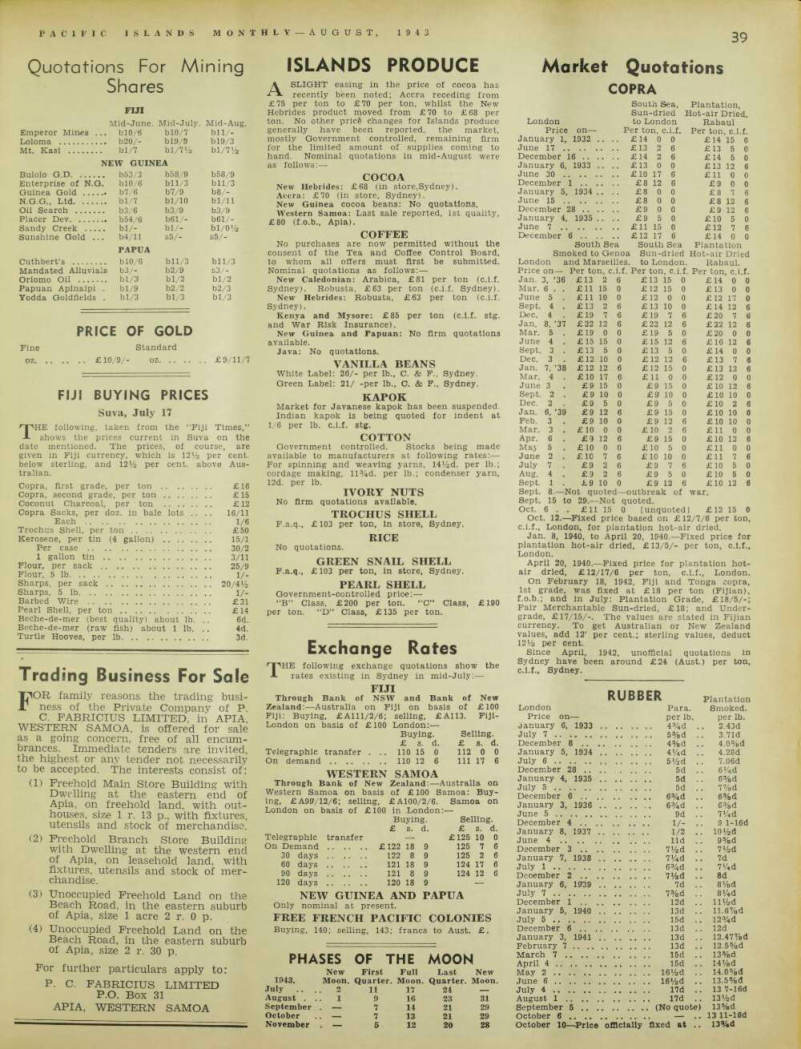
Shares
Fiji
Mid-June.
Mid-July.
Mid-Aug.
Emperor Mines ... blO/6 blO/7 bll/- Loloma b20/bl9/9 bl9/3 Mt. Kasl bl/7 bl/7V 2 bl/7Vi
New Guinea
Bulolo G.D b53/3 b58/9 b58/9 Enterprise of N.G. blO/6 bll/3 bll/3 Guinea Gold b7/6 b7/9 b8/- N.G.G., Ltd bl/7 bl/10 bl/11 Oil Search b3/6 b3/9 b3/9 Placer Dev b54/6 b61/b61/- Sandy Creek bl/bl/bl/0V 2 Sunshine Gold ... b4/ll s5/s5/- Cuthbert’s
Papua
blO/6 bll/3 bll/3 Mandated Alluvials b3/b2/9 s3/- Oriomo Oil bl/3 bl/2 bl/2 Papuan Apinaipi . bl/9 b2/2 b2/3 Yodda Goldfields . bl/3 bl/3 bl/3
Advertisements & other items, p. 41 (1 item)
Price Of Gold
Fine Standard oz £10/9/- oz £9/11/7
Fiji Buying Prices
Suva, July 17
THE following, taken from the “Fiji Times,” shows the prices current in Suva on the date mentioned. The prices, of course, are given in Fiji currency, which is 12y 2 per cent, below sterling, and 12y 2 per cent, above Aus tralian.
Copra, first grade, per ton £16 Copra, second grade, per ton £15 Coconut Charcoal, per ton £12 Copra Sacks, per doz. in bale lots .. . 16/11 Each 1/6 Trochus Shell, per ton £50 Kerosene, per tin (4 gallon) 15/1 Per case 30/2 1 gallon tin 3/11 Flour, per sack 25/9 Flour, 5 lb 1/- Sharps, per sack . 20/4 y 2 Sharps, 5 lb 1/- Barbed Wire £31 Pearl Shell, per ton £14 Beche-de-mer (best quality) about lb. . 6d.
Beche-de-mer (raw fish) about 1 lb. . 4d.
Turtle Hooves, per lb 3d.
Islands Produce
A SLIGHT easing in the price of cocoa has recently been noted; Accra receding from £75 per ton to £7O per ton, whilst the New Hebrides product moved from £7O to £6B per ton. No other pricfe changes for Islands produce generally have been reported, the market, mostly Government controlled, remaining firm for the limited amount of supplies coming to hand. Nominal quotations in mid-August were as follows: —
Cocoa
New Hebrides: £6B (in store,Sydney).
Accra: £7O (in store, Sydney).
New Guinea cocoa beans: No quotations.
Western Samoa: Last sale reported, Ist quality, £BO (f.0.b., Apia).
Coffee
No purchases are now permitted without the consent of the Tea and Coffee Control Board, to whom all offers must first be submitted.
Nominal quotations as follows: New Caledonian: Arabica, £Bl per ton (c.i.f.
Sydney). Robusta, £63 per ton (c.i.f. Sydney).
New Hebrides: Robusta, £63 per ton (c.i.f.
Sydney), Kenya and Mysore: £B5 per ton (c.i.f. stg. and War Risk Insurance).
New Guinea and Papuan: No firm quotations available.
Java: No quotations.
Vanilla Beans
White Label: 26/- per lb., C. & F., Sydney.
Green Label: 21/ -per lb., C. & F., Sydney.
Kapok
Market for Javanese kapok has been suspended.
Indian kapok is being quoted for indent at 1/6 per lb. c.i.f. stg.
Cotton
Government controlled. Stocks being made available to manufacturers at following rates;— For spinning and weaving yarns, 14V&d. per lb.; cordage making, ll%d. per lb.; condenser yarn, 12d. per lb.
Ivory Nuts
No firm quotations available.
Trochus Shell
F.a.q., £lO3 per ton, in store, Sydney.
Rice
No quotations.
Green Snail Shell
F.a.q., £lO3 per ton, in store, Sydney.
Pearl Shell
Government-controlled price:— “B” Class, £2OO per ton, “C” Class, £l9O per ton. “D” Class, £135 per ton.
Exchange Rates
THE following exchange quotations show the rates existing in Sydney in mid-July:—
Fiji
Through Bank of NSW and Bank of New Zealand:—Australia on Fiji on basis of £lOO Fiji: Buying, £Alll/2/6; selling, £AII3. Fijl- London on basis of £lOO London:—
Western Samoa
Through Bank of New Zealand; —Australia on Western Samoa on basis of £lOO Samoa: Buy ing, £ A99/12/6; selling, £AIOO/2/6. Samoa on London on basis of £lOO in London: —
New Guinea And Papua
Only nominal at present.
Free French Pacific Colonies
Buying, 140; selling, 143; francs to Aust. £.
Buying.
Selling. £ s. d. £ s. d.
Telegraphic transfer . .. 110 15 0 112 0 0 On demand .. 110 12 6 111 17 6
Buying.
Selling. £ s. d. £ s. d.
Telegraphic transfer — £125 10 0 On Demand £122 18 9 125 7 6 30 days 122 8 9 125 2 6 60 days 121 18 9 124 17 6 90 days 121 8 9 124 12 6 120 days 120 18 9 —
Phases Of The Moon
New First Full Last New 1943. Moon. Quarter. Moon. Quarter. Moon.
July ... 2 11 17 24 — August ... 1 9 16 23 31 September . — 7 14 21 29 October — 7 13 21 29 November . — 5 12 20 28
Market Quotations
Sept. B.—Not quoted—outbreak of war.
Sept. 15 to 29. —Not quoted.
Oct. 6 . . £ll 15 0 [unquoted] £l2 15 0 Oct. 12.—Fixed price based on £l2/7/6 per ton, c.i.f., London, for plantation hot-air dried.
Jan. 8, 1940, to April 20, 1940.—Fixed price for plantation hot-air dried, £l3/5/- per ton, c.i.f., London, April 20, 1940.—Fixed price for plantation hot air dried, £l2/17/6 per ton, c.i.f., London.
On February 18, 1942, Fiji and Tonga copra, Ist grade, was fixed at £lB per ton (Fijian), f.0.b.; and in July: Plantation Grade, £lB/5/-; Fair Merchantable Sun-dried, £18; and Under grade, £l7/15/-. The values are stated in Fijian currency. To get Australian or New Zealand values, add 12’ per cent.; sterling values, deduct 12 Vz per cent.
Since April, 1942, unofficial quotations in Sydney have been around £24 (Aust.) per ton, c.i.f., Sydney.
London Price on—
Copra
South Sea, Plantation, Sun-dried Hot-air Dried, to London Rabaul Per ton, c.i.f. Per ton. c.i.f.
January 1, 1932 . . . £14 0 0 £14 15 0 June 17 . £13 2 6 £13 5 0 December 16 .. £14 2 6 £14 5 0 January 6, 1933 £13 0 0 £13 12 6 June 30 . . £10 17 6 £11 0 0 December 1 .. £8 12 6 £9 0 0 January 5, 1934 . . . £8 0 0 £8 7 6 June 15 . £8 0 0 £8 12 6 December : 28 .. £9 0 0 £9 12 6 January 4, 1935 £9 5 0 £10 5 0 June 7 ., £11 15 0 £12 7 6 December 6 .. £12 17 6 £14 0 0 South Sea South Sea Smoked to Genoa Sun-dried Plantation Hot-air Dried London and Marseilles, to London.
Rabaul.
Price on— Per ton, c.i.f. Per ton, c.i.f.
Per ton, c.i.f.
Jan. 3, ’36 £13 2 6 £13 15 0 £14 0 0 Mar. 6 . . £11 15 0 £12 15 0 £13 0 0 June 5 . £11 10 0 £12 0 0 £12 17 0 Sept. 4 . £13 2 6 £13 10 0 £14 12 6 Dec, 4 . £19 7 6 £19 7 6 £20 7 6 Jan. 8, ’37 £22 12 6 £22 12 6 £22 12 6 Mar, 5 . £19 0 0 £19 5 0 £20 0 0 June 4 . £15 15 0 £15 12 6 £16 12 6 Sept. 3 . £13 5 0 £13 5 0 £14 0 0 Dec. 3 . £12 10 0 £12 12 6 £13 7 6 Jan. 7. ’38 £12 12 6 £12 15 0 £13 12 6 Mar. 4 . £10 17 6 £11 0 0 £12 0 0 June 3 £9 15 0 £9 15 0 £10 12 6 Sept. 2 . £9 10 0 £9 10 0 £10 10 0 Dec. 2 £9 5 0 £9 5 0 £10 2 6 Jan. 6, ’39 £9 12 6 £9 15 0 £10 10 0 Feb. 3 . £9 10 0 £9 12 6 £10 10 0 Mar. 3 . £10 0 0 £10 2 6 £11 0 0 Apr. 6 . £9 12 6 £9 15 0 £10 12 6 May 5 . £10 0 0 £10 5 0 £11 0 0 June 2 . £10 7 6 £10 10 0 £11 7 6 July 7 . £9 2 6 £9 7 6 £10 5 0 Aug. 4 . £3 2 6 £9 5 0 £10 6 0 Sept. 1 . £9 10 0 £9 12 6 £10 12 6
Rubber
Plantation London Para.
Smoked.
Price on— per lb. per lb.
January 6, 1933 . 4 3 Ad . . 2.43d July 7 3.71d December 8 .. . 4.0 5 /ad January 5, 1934 . 4 Mid . 4.28d July 6 7.06d December 28 .. . 5d ., 6‘Ad January 4, 1935 . 5d ., 6%d July 5 . 7 7 /ad December 6 .. . 6%d January 3, 1936 . 6%d June 5 7‘Ad December 4 .. .. 9 l-16d January 8, 1937 . 1/2 .. 10‘Ad June 4 9 5 /ad December 3 .. . 7‘Ad January 7, 1938 . 7d July 1 7‘Ad December 2 .. . 8d January 6, 1939 . 7d .. 8‘Ad July 7 8‘Ad December 1 .. . 12d .. ll*Ad January 5, 1940 . 13d ,. 11.6 7 /ad July 5 12 3 Ad December 6 .. .. 13d .. 12d January 3, 1941 . 13d .. 12.47 7 /ad February 7 ., .. 12.5 5 /ad March 7 15d .. 13 s /ad April 4 15d .. 14‘/ad May 2 H.OVad June 6 13.5%d July 4 13 7-16d August I 13‘Ad September 5 .. . 13*/ad October 6 — 13 ll-10d October 10—Price officially fixed at .. 13%d
Advertisements & other items, pp. 41-44 (3 items)
Trading Business For Sale
FOR family reasons the trading business of the Private Company of P.
C. FAB RICTUS LIMITED, in APIA,
WESTERN SAMOA, is offered for sale as a going concern, free of all encumbrances. Immediate tenders are invited, the highest or any tender not necessarily to be accepted. The interests consist of: (1) Freehold Main Store Building with Dwelling at the eastern end of Apia, on freehold land, with outhouses, size 1 r. 13 p., with fixtures, utensils and stock of merchandise. (2) Freehold Branch Store Building with Dwelling at the western end of Apia, on leasehold land, with fixtures, utensils and stock of merchandise. (3) Unoccupied Freehold Land on the Beach Road, in the eastern suburb of Apia, size 1 acre 2 r. 0 p. (4) Unoccupied Freehold Land on the Beach Road, in the eastern suburb of Apia, size 2 r. 30 p.
For further particulars apply to:
P. C. FABRICIUS LIMITED
P.O. Box 31
APIA, WESTERN SAMOA
Roll Of Honour
40
AUGUST, 1943 PACIFIC ISLANDS MONTHLY
(Continued from Inside Back Cover)
Published by PACIFIC PUBLICATIONS PTY. LTD., Union House, 247 George Street, Sydney. (Telephone; BW 5037). Wholly set up and printed in Australia by the Sydney and Melbourne Publishing Co. Pty. Ltd., 29 Alberta Street, Sydney. (Telephone: MA 7101).
Ankles Swollen, Backache,
Woven Wire for all Industry
COPRA DRYING TRAYS, FLOORS, Etc.
FRUIT DRYING TRAYS, MINING SCREENS.
Heavy Mosquito Gauze in Phosphor Bronze and other Metals Impervious to Salt Sea Air.
WIRE DOOR MATS AND GENERAL WIRE WORKS
E. WRIGHT & CO. LTD.
Office and Works: 148-152 Cleveland Street, Sydney, N.S.W.
Telegraphic Address: “Wrightmake,” Chippendale.
V\T/tf T CD su*
Ankles Swollen, Backache,
Nervous, Kidneys Strained?
If you’re feeling out o-sorts, have Broken Rest, or suffer from Dizziness, Nervousness, Backache, Leg Pains, Rheumatism, Swollen Ankles, Excess Acidity or Loss of Energy, and feel old before your time. Kidney and Bladder Weakness may be the true cause.
Wrong foods and drinks, worry, colds or overwork may create an excess of acids and place a heavy strain on your kidneys so that they function poorly and need help to properly refresh your blood and maintain health and energy.
Help Kidneys Doctors' Way
Many doctors have discovered by scientific clinical tests and in actual practice that a quick and modern way to help the kidneys clean out excess poisons and acids is with a scientifically prepared prescription called Cystex. Hundreds and hundreds of doctors’ records prove this.
And former sufferers write daily saying that they feel vastly improved in 24 to 48 hours after taking Cystex.
Guaranteed to Satisfy or Money Back.
Get Cystex from your chemist to-day. Give it a thorough test. Cystex is guaranteed to make you feel younger, stronger, better in every way, or your money back if you return the empty package. Act now!
Now in 2 sizes—4/-, 8/-.
GUARANTEED CVStCX
Treatment W
for Kidneys, Bladder, Rheumatism.
m m \ ' « - ■ m m i v.| ■-i : . -V - . . *re»T .. ■. ■ o>;; ; ; ' 1 vi B
Travel by CARPENTER AIRLINES
Full from Macdonald, Hamilton & Co., or Howard Smith Ltd., Sydney.
W. R. CARPENTER & CO. LTD!
MERCHANTS, SHIPOWNERS AND AIRCRAFT OPERATORS
Agents for Australian, European and American Manufacturers, and Distributors of Every Description of Merchandise i Buyers and Shippers of Copra, Trocas, and all Classes of Islands Produce.
AGENTS FOR:
Ford Motor Company of Canada. Caterpillar Tractors. Dodge Brothers Inc.
T. G. &C. Bolinders (Engines). Electrolux Refrigerators. Westinghouse Electrical Co. etc., etc.
Branches throughout the Pacific islands
In London: W. R. Carpenter & Co. (London) Ltd., Coronation House, 4 Lloyds Avenue, London, EC.
Head Office: 16 O’CONNELL STREET, SYDNEY