Pacific
Islands
Monthly
October 17, 1944
Vol. Xv. No. 3,
Established 1930
{Registered at the G.P.0., ansmission by post as a newspaper ]
1/-
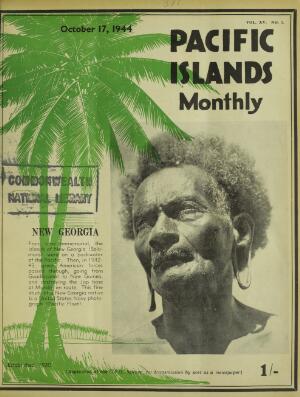
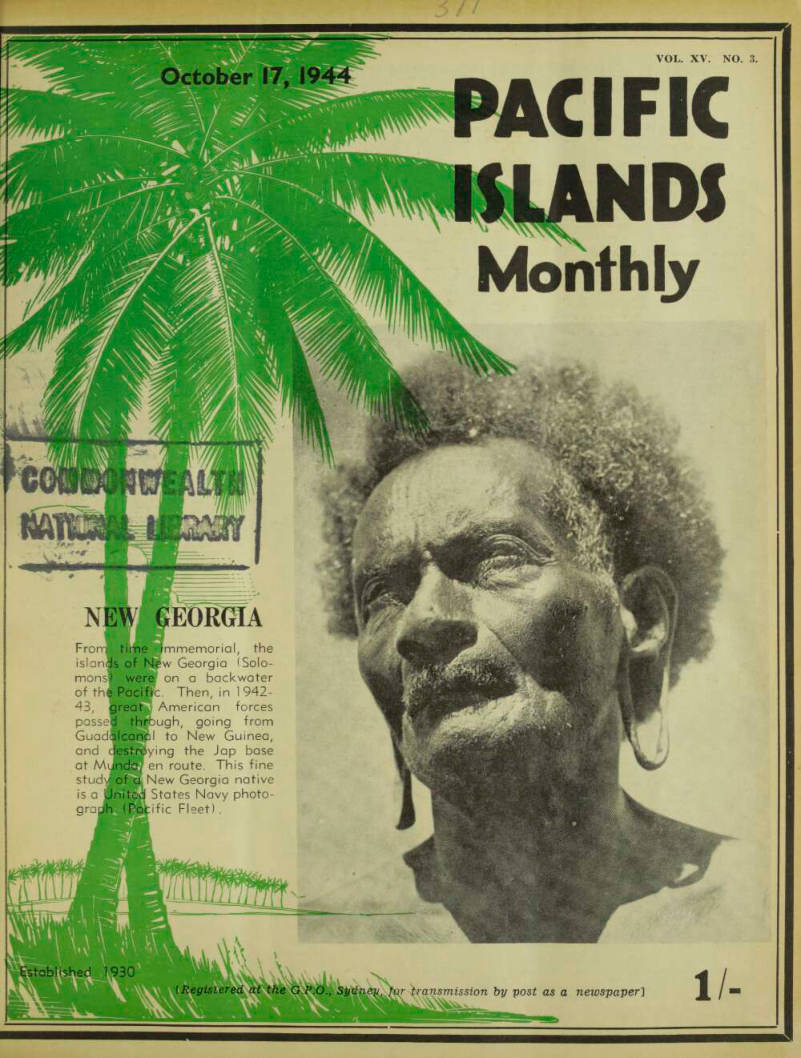
New Georgia
From time Immemorial, the
islanls of New Georgia (Solo
mons were on a backwater of the Pacific. Then, in 1942- 43, great American forces passed through, going from Guadalcanal to New Guinea, and destroying the Jap base at Munda en route. This fine study of a New Georgia native is a United States Navy photo
graph (Pacific Fleet) .
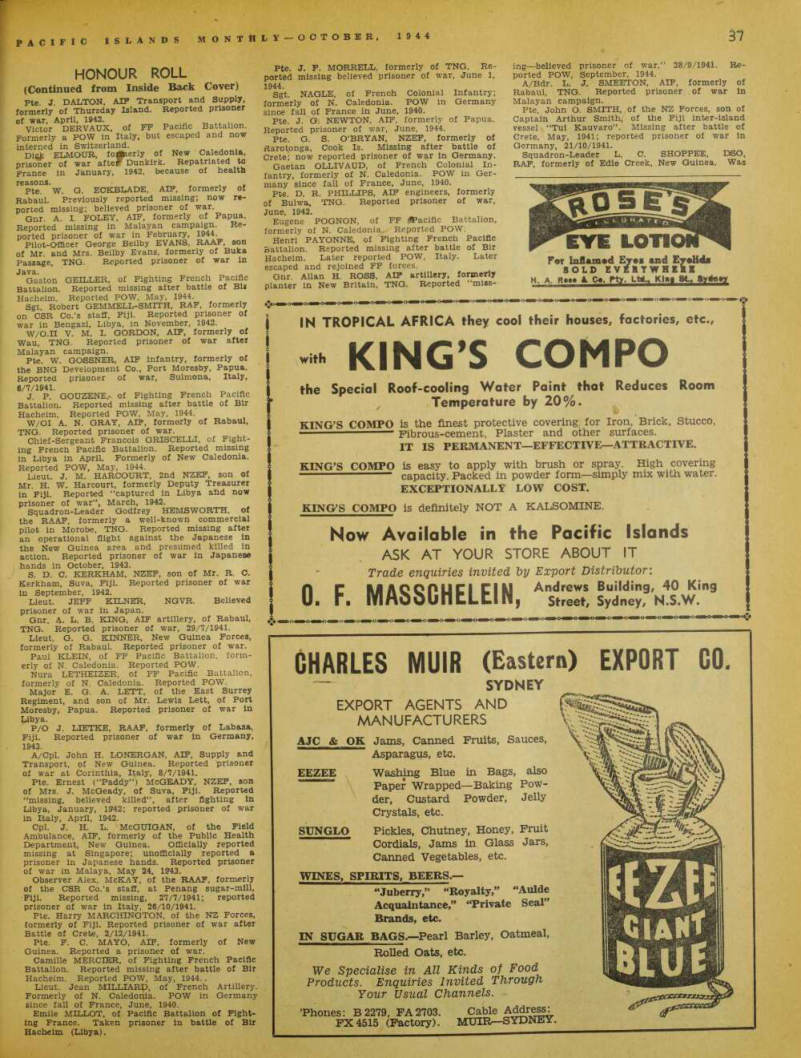
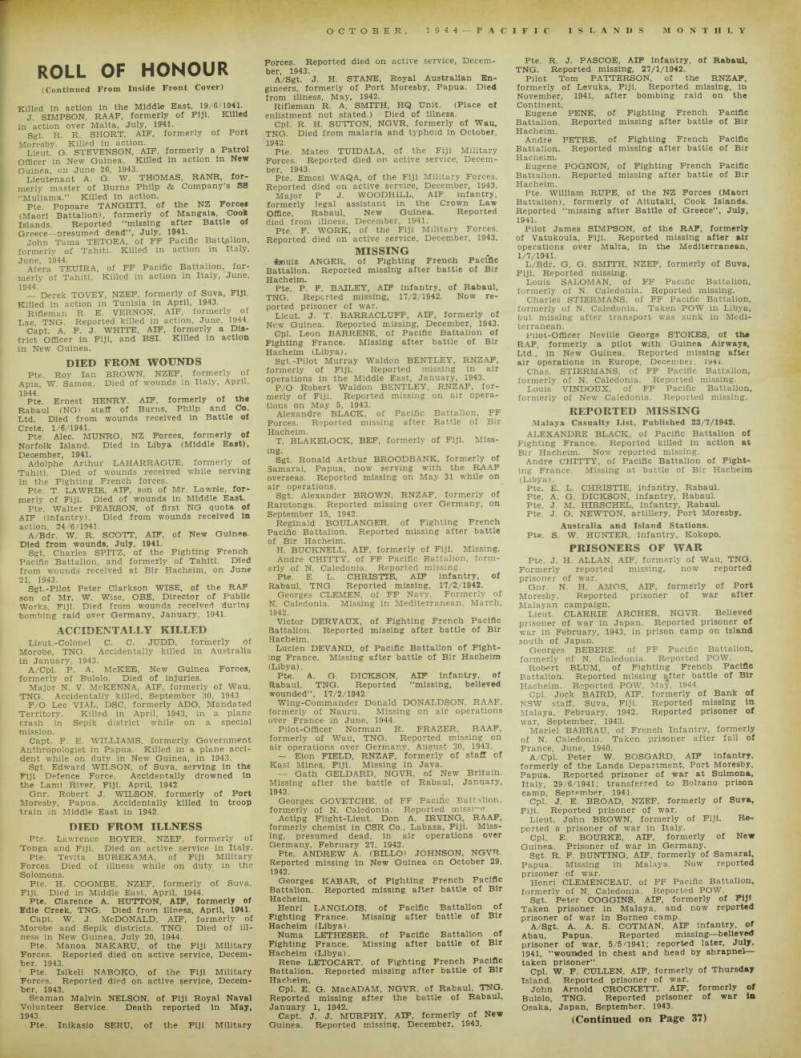
ROLL OF HONOUR—Section I.
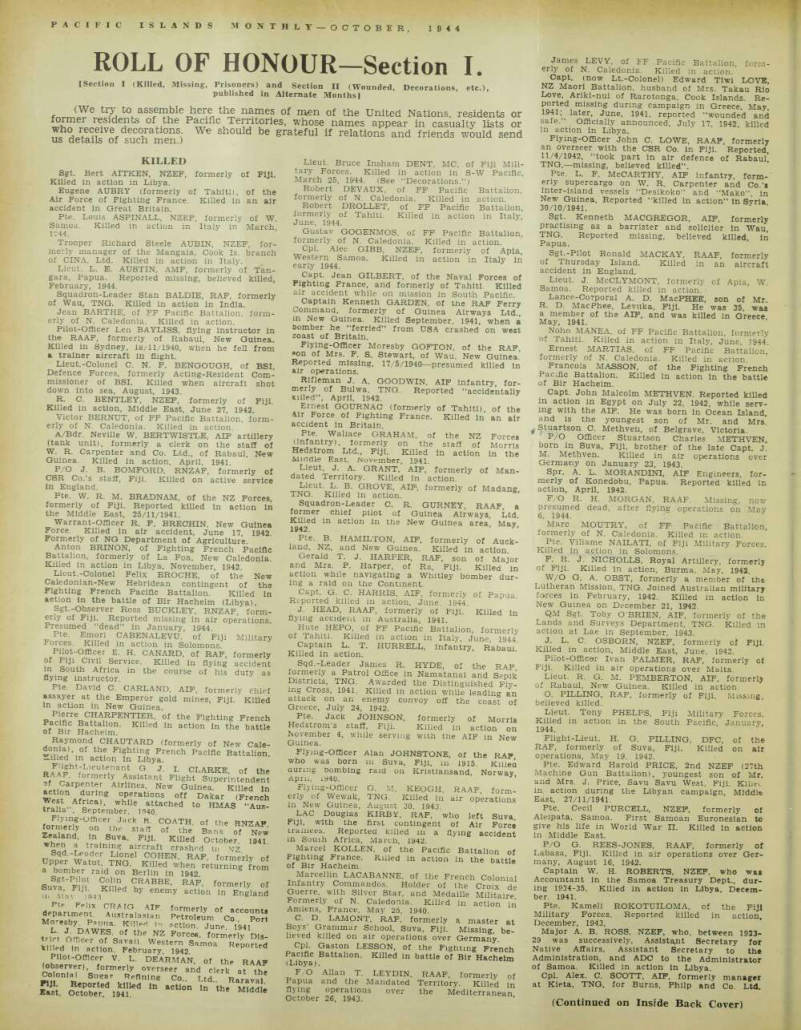
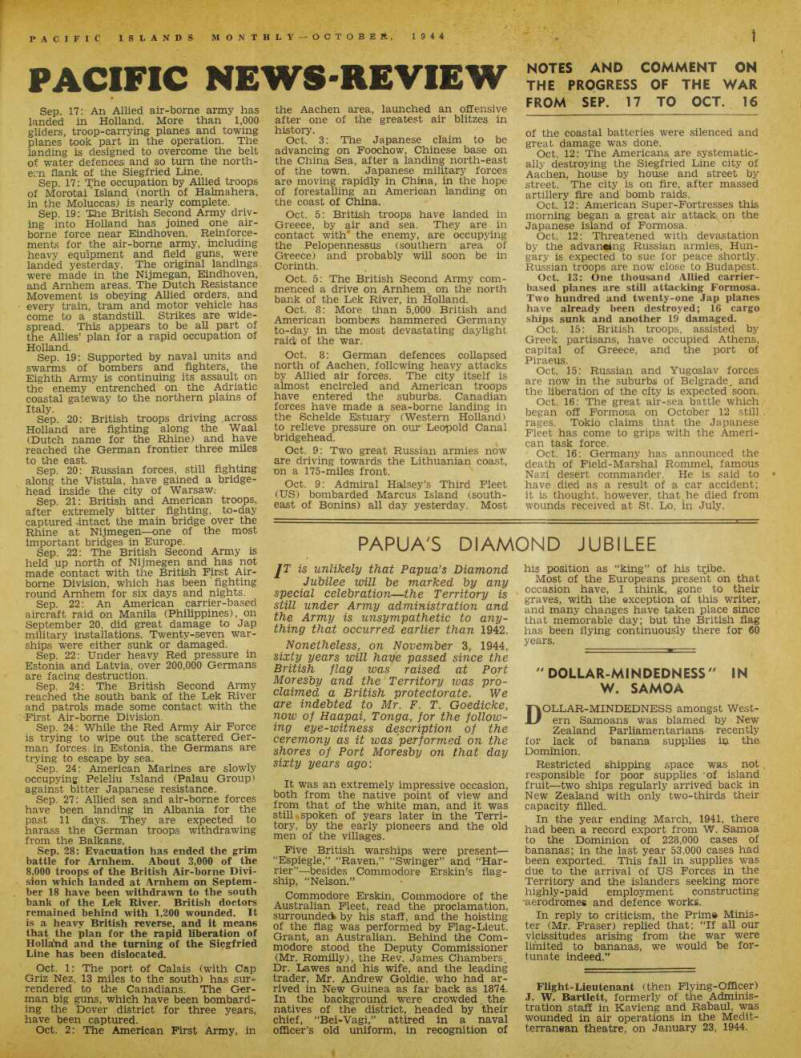
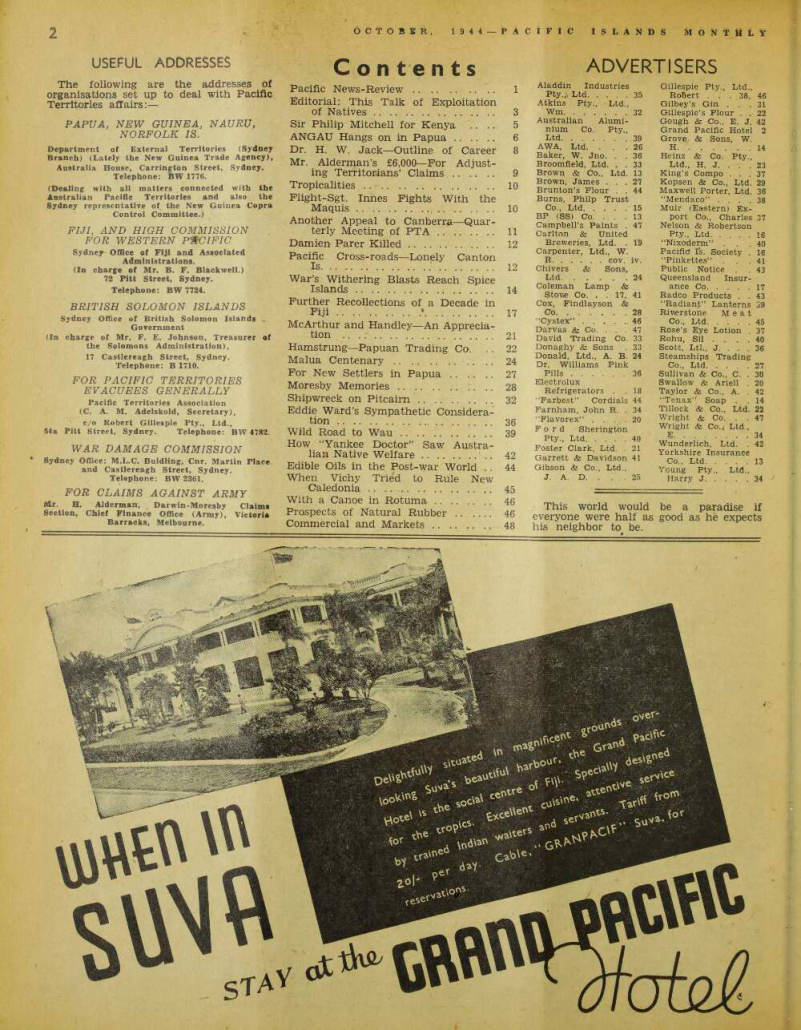
[Section I (Killed, Missing, Prisoners) and Section II (Wounded, Decorations, etc.), published in Alternate Months] formal to as sernbl e here tire names of men of the United Nations, residents or former residents of the Pacific Territories, whose names appear in casualty lists or who receive decorations We should be grateful if relations and friends would send us details of such men.)
Killed
Sgt. Bert AITKEN, NZEF, formerly of FIJI.
Killed in action in Libya.
Eugene AUBRY (formerly of Tahiti), of the Air Force of Fighting Prance. Killed in an air accident in Great Britain.
Pte. Louis ASPINALL, NZEF, formerly of W.
Samoa. Killed in action in Italy in March, 1C44.
Trooper Richard Steele AUBIN, NZEF, for merly manager of the Mangaia, Cook Is. branch of CINA, Ltd. Killed in action in Italy.
Lieut. L. E. AUSTIN, AMF, formerly of Tan gara, Papua. Reported missing, believed killed, February, 1944.
Squadron-Leader Stan BALDIE, RAF, formerly of Wau, TNG. Killed in action in India.
Jean BARTHE, of FF Pacific Battalion, form erly of N. Caledonia. Killed in action.
Pilot-Officer Len BAYLISS, flying instructor in the RAAF, formerly of Rabaul, New Guinea.
Killed in Sydney, 16/11/1940, when he fell from a trainer aircraft in flight.
Lieut.-Colonel C. N. F. BENGOUGH, of BSI, Defence Forces, formerly Acting-Resident Com missioner of BSI. Killed when aircraft shot down into sea, August, 1943.
R. C. BENTLEY, NZEF, formerly of Fiji.
Killed in action, Middle East, June 27, 1942.
Victor BERNUT, of FF Pacific Battalion, form erly of N. Caledonia. Killed in action A/Bdr. Neville W. BERTWISTLE, ALP artillery (tank unit), formerly a clerk on the staff of W. R. Carpenter and Co. Ltd., of Rabaul, New Guinea. Killed in action, April, 1941.
P/O J. B. BOMFORD, RNZAF, formerly of CSR Co.’s staff, Fiji. Killed on active service in England.
Pte. W. R. M. BRADNAM, of the NZ Forces formerly of Fiji. Reported killed in action in the Middle East, 25/11/1941.
Warrant-Officer R. F. BRECHIN, New Guinea Force. Killed in air accident, June 17 1942 Formerly of NG Department of Agriculture.
Anton BRINON, of Fighting French Pacific Battalion, formerly of La Foa, New Caledonia.
Killed in action in Libya, November, 1942 Lieut.-Colonel Felix BROCHE, of the New Caledonian-New Hebridean contingent of the Fighting French Pacific Battalion. Killed in action in the battle of Bir Hacheim (Libya) Sgt.-Observer Ross BUCKLEY, RNZAF, form erly of Fiji. Reported missing in air operations.
Presumed “dead” in January, 1944 Pte. Emori CABENALEVU, of Fiji Military Forces. Killed in action in Solomons Pilot-Officer E. H. CANARD, of RAF, formerly of Fiji Civil Service. Killed in flying accident In South Africa in the course of his duty as flying instructor.
Pte. David C. GARLAND, AIF, formerly chief assayer at the Emperor gold mines, Fiji. Killed in action in New Guinea. Pierre CHARPENTIER, of the Fighting French Pacific Battalion. Killed in action in the battle of Bir Hacheim.
Raymond CHAUTARD (formerly of New Cale doma) of the Fighting French Pacific Battalion Killed in action in Libya. ’
RA F A i ht ; L ' eUte , nant ° J L CLARKE, of the ff Crll" 16 !, Assistant Flight Superintendent l ? r Airlines> New Guinea. Killed in wilt operations off Dakar (French tSnl” Af Q Ca J '* ™ hlle attach ed to HMAS “Aus tralia , September, 1940.
Flying-officer Jack R. COATH. of the RNZAF ZJ , 0D J he SlafT 0f the Bank of New Zealand, in Suva. Fiji. Killed October. 1941 when a training aircraft crashed in MZ Sqd.-Leader Lionel COHEN. RAF formerlv of Upper Watut, TNG. Killed when returning from a bomber raid on Berlin in 1942 ® Suvf’pu/ SV,". CRABBE, RAP. formerly of o Mai 1943 y Bnemy action in England Pte Felix CRAIG AIF formerlv of account* department, Australasian Petroleum Co Por?
Papna. Killed H action, June. 1941 trir’f nm^ AWE f S Q° f the NZ Force «- formerly Dls tr et Officer of Savah. Western Samoa Reported killed in action. February 1942 Pilot-Officer V. L. DEARMAN, of the RAAF (observer), formerly overseer and clerk at the Coonl.l Sugar R rn„,n B Co „ U d Rara v al Bast, October 1 In ““° n ‘ n the Mlddle
Lieut. Bruce Insham DENT, MC, of Fiji Mili tary Forces. Killed in action in S-W Pacific, March 25, 1944. (See “Decorations.”) Robert DEVAUX, of FF Pacific Battalion, formerly of N. Caledonia. Killed in action.
Robert DROLLET, of FF Pacific Battalion, formerly of Tahiti. Killed in action in Italy, June, 1944.
Gustav GOGENMOS, of FF Pacific Battalion, formerly of N. Caledonia. Killed in action.
Cpl. Alec GIBB, NZEF, formerly of Apia, Western Samoa. Killed in action in Italy in early 1944.
Capt. Jean GILBERT, of the Naval Forces of Fighting France, and formerly of Tahiti. Killed air accident while on mission in South Pacific, Captain Kenneth GARDEN, of the RAF Ferry Command, formerly of Guinea Airways Ltd., m New Guinea. Killed September, 1941, when a bomber he “ferried” from USA crashed on west coast of Britain.
Flying-Officer Moresby GOFTON, of the RAF *on of Mrs. F. S. Stewart, of Wau, New Guinea Reported missing, 17/5/1940—presumed killed in air operations.
Rifleman J. a. GOODWIN, AIF infantry, for merly of Bulwa, TNG, Reported “accidentally Killed”, April, 1942.
Ernest GOURNAC (formerly of Tahiti) of the Air Force of Fighting France. Killed in an air accident in Britain.
Pte. Wallace GRAHAM, of the NZ Forces (infantry), formerly on the staff of Morris Hedstrom Ltd., Fiji. Killed In action in the Middle East, November, 1941.
Lieut. J. A. GRANT, AIF, formerly of Man dated Territory. Killed in action. , GROVE - ALP. formerly of Madang, TNG. Killed in action.
Squadron-Leader c. R. GURNEY, RAAP, a former chief pilot of Guinea Airways, Ltd.
Killed in action in the New Guinea area, May, Pte. B. HAMILTON, ALP, formerly of Auck land, NZ, and New Guinea. Killed in action Gerald T. J. HARPER, RAF, son of Major and Mrs. P. Harper, of Ra, Fiji. Killed in action while navigating a Whitley bomber dur ing a raid on the Continent.
Capt. G. C. HARRIS, AIF, formerly of Papua Reported killed in action, June, 1944.
J. HEAD, RAAP, formerly of Fiji. Killed in flying accident in Australia, 1941.
Hute HEPO, of FF Pacific Battalion, formerly of Tahiti. Killed in action in Italy, June, 1944 Captain L. T. HURRELL, infantry, Rabaul Killed in action.
Sqd.-Leader James R. HYDE, of the RAF formerly a Patrol Office in Namatanai and Sepik Districts, TNG. Awarded the Distinguished Ply ing Cross, 1941. Killed in action while leading an attack on an enemy convoy off the coast of Greece, July 24, 1942.
Pte. Jack JOHNSON, formerly of Morris Hedstrom’s staff, Fiji. Killed in action on November 4, while serving with the AIF in New Guinea.
Flymg-Officer Alan JOHNSTONE, of the RAF who was born in Suva, Fiji, in 1915. Killea during bombing raid on Kristlansand Norway Aprn. 1940.
Flying-Officer G. M. KEOGH, RAAF form erly of Wewak, TNG. Killed in air operations in New Guinea, August 30, 1943.
LAC Douglas KIRBY, RAP, who left Suva.
Fiji, with the first contingent of Air Force trainees. Reported killed in a flying accident in South Africa, March, 1942.
Marcel KOLLEN, of the Pacific Battalion of Fighting Prance. Killed in action in the battle of Bir Hacheim.
Marcellin LACABANNE, of the French Colonial Infantry Commandos. Holder of the Croix de Guerre, with Silver Star, and Medailk? Militaire Formerly of N. Caledonia. Killed in action in Amiens, France, May 25, 1940. c. D. LAMONT, RAF, formerly a master at Boys’ Grammar School, Suva, Fiji. Missing, be lieved killed on air operations over Germany Cpl. Gaston LESSON, of the Fighting French Pacific Battalion. Killed in battle of Bir Hacheim (Libya).
FO Allan T. LEYDIN, RAAF, formerly of Papua and the Mandated Territory. Killed in flying operations over the Mediterranean October 26, 1943. ’
James LEVY, of FF Pacific Battalion, form erly of N. Caledonia. Killed In action.
Capt. (now Lt.-Oolonel) Edward Tiwi LOVE, NZ Maori Battalion, husband of Mrs. Takau Rio Love, Ariki-nui of Rarotonga, Cook Islands. Re ported missing during campaign in Greece, May, 1941; later, June, 1941, reported “wounded and safe.” Officially announced, July 17, 1942, killed in action in Libya, Flying-Officer John C. LOWE, RAAP, formerly an overseer with the CSR Co. in Fiji. Reported 11/4/1942, “took part in air defence of Rabaul’
TNG,—missing, believed killed”.
Pte. L. F. McCarthy, ALP infantry, form erly supercargo on W. R. Carpenter and Co.’i Inter-island vessels “Desikoko” and “Mako”, in New Guinea. Reported “killed in action” in Syria 30/10/1941. J ’
Sgt. Kenneth MACGREGOR, ALP, formerly practising as a barrister and solicitor in Wau, TNG. Reported missing, believed killed in Papua.
Sgt.-Pilot Ronald MACK AY, RAAF, formerly of Thursday Island. Killed in an aircraft accident in England.
Lieut. J. McCLYMONT, formerly of Apia, W.
Samoa. Reported killed in action.
Lance-Corporal A. D. MacPHEE, son of Mr.
R. D. MacPhee, Levuka, Fiji. He was 35, was a member of the AIF, and was killed in Greece May, 1941.
Noho MANEA, of FF Pacific Battalion, formerly of Tahiti. Killed in action in Italy, June, 1944 Ernest MARTIAS, of FF Pacific Battalion formerly of N. Caledonia. Killed in action.
Francois MASSON, of the Fighting French Pacific Battalion; Killed in action In the battle of Bir Hacheim.
Capt. John Malcolm METHVEN. Reported killed in action in Egypt on July 22, 1942, while serv ing with the AIF. He was born in Ocean Island, and Is the youngest son of Mr. and Mrs. 4 Stuartson C. Methven, of Belgrave, Victoria.
P/O Officer Stuartson Charles METHVEN, born in Suva, Fiji, brother of the late Capt, j!
M. Methven. Killed in air operations over Germany on January 23, 1943.
Spr. A. L. MORANDINI, AIF Engineers, for merly of Konedobu, Papua. Reported killed In action, April, 1942.
P/O R. H. MORGAN, RAAF. Missing, now presumed dead, after flying operations on May 6, 1944.
Marc MOUTRY, of FF Pacific Battalion, formerly of N. Caledonia. Killed in action.
Pte. Viliame NAILATI, of Fiji Military Forces.
Killed in action in Solomons.
F. R. J. NICHOLLS, Royal Artillery, formerly of Fiji. Killed in action, Burma, May. 1942.
W/O G. A. OBST, formerly a member of the Lutheran Mission, TNG. Joined Australian military forces in February. 1942. Killed in action In New Guinea on December 21, 1942.
QM Sgt. Toby O BRIEN. AIF, formerly of the Lands and Surveys Department, TNG. Killed in action at Lae in September, 1943.
J. L. C. OSBORN, NZEF, formerly oi Fiji.
Killed in action, Middle East, June. 1942.
Pilot-Officer Ivan PALMER, RAF, formerly oi Fiji. Killed in air operations over Malta.
Lieut. R. G. M. PEMBERTON, AIF, formerly of Rabaul, New Guinea. Killed in action.
O. PILLING, RAF, formerly of Fiji. Missing, believed killed.
Lieut. Tony PHELPS, Fiji Military Forces.
Killed in action in the South Pacific, January, 1944.
Flight-Lieut. H. G. PILLING, DFC, of the RAF, formerly of Suva, Fiji, Killed on air operations. May 19, 1942.
Pte. Edward Harold PRICE, 2nd NZEF (27th Machine Gun Battalion), youngest son of Mr. and Mrs. J. Price, Savu Savu West, Fiji. Kill cl in action during the Libyan campaign, Middle East, 27/11/1941.
Pte. Cecil PURCELL, NZEF, formerly of Aleipata. Samoa. First Samoan Euronesian to give his life in World War 11. Killed in action in Middle East.
P/O G. REES-JONES, RAAF, formerly of Labasa, Fiji. Killed in air operations over Ger many, August 16, 1942.
Captain W. H. ROBERTS, NZEF, who was Accountant in the Samoa Treasury Dept., dur ing 1934-35. Killed in action in Libya, Decem ber. 1941.
Pte. Kameli ROKOTUILOMA, of the Fiji Military Forces. Reported killed in action, December, 1943.
Major A. B. ROSS, NZEF, who, between 1923- 29 was successively, Assistant Secretary for Native Affairs. Assistant Secretary to the Administration, and ADC to the Administrator of Samoa. Killed in action in Libya.
Cpl. Alex. C. SCOTT, ALP, formerly manager at Kieta, TNG, for Burns, Philp and Co. Ltd.
(Continued on Inside Back Cover)
Pte. J. DALTON, AIF Transport and Supply, formerly of Thursday Island. Reported prisoner of war, April, 1942. ..
Victor DERVAUX, of FF Pacific Battalion.
Formerly a POW in Italy, but escaped and now interned in Switzerland.
Dick ELMOUR, fodftierly of New Caledonia, prisoner of war afteF Dunkirk. Repatriated to Prance in January, 1942, because of health reasons. , , , Pte. W. G. ECKBLADE, AIF, formerly of Rabaul. Previously reported missing; now re ported missing: believed prisoner of war.
Gnr. A. I. FOLEY, AIF, formerly of Papua.
Reported missing in Malayan campaign. Re ported prisoner of war in February, 1944.
Pilot-Officer George Beilby EVANS, RAAF, son of Mr. and Mrs. Beilby Evans, formerly of Buka Passage, TNG. Reported prisoner of war in Java.
Gaston GEILLER, of Fighting French Pacific Battalion. Reported missing after battle of Bli Hacheim. Reported POW, May, 1944.
Sgt. Robert GEMMELL-SMITH, RAF, formerly on CSR Co.’s staff, Fiji. Reported prisoner of war in Bengazi, Libya, in November, 1942. w/o.n V. M. I. GORDON, AIF, formerly of Wau, TNG. Reported prisoner of war after Malayan campaign.
Pte. W. GOSSNER, AIF infantry, formerly of the BNG Development Co., Port Moresby, Papua.
Reported prisoner of war, Sulmona, Italy, 6/7/1941.
J. P. GOUZENE,* of Fighting French Pacific Battalion. Reported missing after battle of Bir Hacheim. Reported POW, May, 1944.
W/OI A. N. GRAY, AIF, formerly of Rabaul, TNG. Reported prisoner of war.
Chief-Sergeant Francois GRISCELLI, of Fight ing French Pacific Battalion. Reported missing in Libya in April. Formerly of New Caledonia.
Reported POW, May, 1944.
Lieut. J. M. HARCOURT, 2nd NZEF, son of Mr. H. W. Harcourt, formerly Deputy Treasurer in Fiji. Reported “captured in Libya afid now prisoner of war”, March, 1942.
Squadron-Leader Godfrey HEMS W ORTH, of the RAAF, formerly a well-known commercial pilot in Morobe, TNG. Reported missing after an operational flight against the Japanese in the New Guinea area and presumed killed in action. Reported prisoner of war in Japanese hands in October, 1943.
S. D. C. KERKHAM, NZEF, son of Mr. R. C.
Kerkham, Suva, Fiji. Reported prisoner of war in September, 1942.
Lieut. JEFF K3LNER, NGVR. Believed prisoner of war in Japan.
Gnr. A. L. B. KING, AIF artillery, of Rabaul, TNG. Reported prisoner of war, 29/7/1941.
Lieut. G. G. KINNER, New Guinea Forces, formerly of Rabaul. Reported prisoner of war.
Paul KLEIN, of FF Pacific Battalion, form erly of N. Caledonia. Reported POW.
Nura LETHEIZER, of FF Pacific Battalion, formerly of N. Caledonia. Reported POW.
Major E. G. A. LETT, of the East Surrey Regiment, and son of Mr. Lewis Lett, of Port Moresby, Papua. Reported prisoner of war in Libya.
P/O J. LIETKE, RAAF, formerly of Labasa.
Fiji. Reported prisoner of war in Germany, 1943.
A/Cpl. John H. LONERGAN, AIF, Supply and Transport, of New Guinea. Reported prisoner of war at Corinthia, Italy, 8/7/1941.
Pte. Ernest (“Paddy”) McGEADY, NZEF, son of Mrs. J. McGeady, of Suva, Fiji. Reported “missing, believed killed”, after fighting in Libya, January, 1942; reported prisoner of war in Italy, April, 1942.
Cpl. J. H. L. McGUIGAN, of the Field Ambulance, AIF, formerly of the Public Health Department, New Guinea. Officially reported missing at Singapore; unofficially reported a prisoner in Japanese hands. Reported prisoner of war in Malaya, May 24, 1943.
Observer Alex. McKAY, of the RAAF, formerly of the CSR Co.’s staff, at Penang sugar-mill, Fiji. Reported missing, 27/7/1941; reported prisoner of war in Italy, 26/10/1941.
Pte. Harry MARCHINGTON, of the NZ Forces, formerly of Fiji. Reported prisoner of war after Battle of Crete, 2/12/1941.
Pte. F. C. MAYO, AIF, formerly of New Guinea. Reported a prisoner of war.
Camille MERCEER, of Fighting French Pacific Battalion. Reported missing after battle of Bir Hacheim. Reported POW, May, 1944., Lieut. Jean MILLIARD, of French Artillery.
Formerly of N. Caledonia. POW in Germany since fall of France, June, 1940.
Emile MILLOT, of Pacific Battalion of Fight ing Prance. Taken prisoner in battle of Bir Hacheim (Libya).
Pte. J. F. MORRELL, formerly of TNG. Re ported missing believed prisoner of war, June 1, 1944.
Sgt. NAGLE, of French Colonial Infantry: formerly of N. Caledonia. POW in Germany since fall of France in June, 1940.
Pte. J. G. NEWTON, AIF, formerly of Papua.
Reported prisoner of war, June, 1944.
Pte. G. S. O’BRYAN. NZEF, formerly of Rarotonga, Cook Is. Missing after battle of Crete; now reported prisoner of war in Germany.
Gaetan OLLIVAUD, of French Colonial In fantry, formerly of N. Caledonia. POW in Ger many since fall of France, June, 1940.
Pte. D. R. PHILLIPS, AIF engineers, formerly of Bulwa, TNG. Reported prisoner of war, June, 1942.
Eugene POGNON, of FF Battalion, formerly of N. Caledonia. Reported POW.
Henri PAYONNE, of Fighting French Pacific Battalion. Reported missing after battle of Bir Hacheim. Later reported POW, Italy. Later escaped and rejoined FF forces.
Gnr. Allan H. ROSS, AIF artillery, formerly planter in New Britain, TNG. Reported “mlss
ing—believed prisoner of war,” 28/9/1941. Re ported POW, September, 1944.
A/Bdr. L. J. SMEETON, AIF, formerly of Rabaul, TNG. Reported prisoner of war in Malayan campaign, Pte. John O. SMITH, of the NZ Forces, son of Captain Arthur Smith, of the Fiji inter-island vessel “Tul Kauvaro”. Missing after battle of Crete, May, 1941; reported prisoner of war in Germany, 21/10/1941.
Squadron-Leader L, C. SHOPPEE, DSO, RAF, formerly of Edle Creek, New Guinea. Was
In Java during Japanese invasion; now known to be a prisoner of war.
Gnr. D. M. SPENCE, AIP, formerly of Port Moresby. Reported prisoner of war after Malayan campaign.
LAC Charles SOLLITT, of the RAAF (wire less operator), son of Mr. and Mrs. C, H.
Sollitt, of Nausori, Fiji. Reported missing after air operations in New Guinea, January, 1942; later, March, 1942, reported rescued from sea by Japanese—now prisoner of war.
Pte. Fred SWAN, NZ Army Medical Corps, formerly of Apia, Western Samoa, Missing after Battle of Crete, August, 1941; reported prisoner of war in Germany, November, 1941.
Repatriated from a German prison camp to NZ in 1944.
Signalman J. C. E. SWINBOURNE, 6th Div.
Signals, A IF, formerly of Fiji and the Gilbert & Ellice Islands Colony. Taken prisoner at Crete, June, 1941, now in prison camp at Stalag, VITA, Germany.
Lieut. CLIFF WARREN, of NZEF, serving in the Middle East, and formerly of Morris Hed strom Ltd.’s staff at Ba and Lautoka, FIJI. Re ported prisoner of war.
Mjr, N. WATCH, formerly Dr. Watch, of Rabaul, missing after Japanese invasion of Rabaul. Believed prisoner of war in Japan. Now reported POW in Japan.
S - WYCOMBE, NZEP, formerly of Fiji and Tonga. Wounded In Crete and reported prisoner of war in Germany i John . WHTTCOMBE, Of the NZ Forces, formerly of Levuka, Fiji. Reported prisoner of war in Germany, November, 1941.
Killed in action in the Middle East, 19/6/1941.
J. SIMPSON, RAAF, formerly of Fiji. Killed in action over Malta, July, 1941.
Sgt. R. R. SHORT, AIF, formerly of Port Moresby. Killed in action.
Lieut G. STEVENSON, AIP, formerly a Patrol Officer in New Guinea. Killed in action in New Guinea, on June 26, 1943.
Lieutenant A. G. W. THOMAS, RANR, for merly master of Burns Philp & Company’s S 8 “Muliama.” Killed in action.
Pte. Popoare TANGHTI. of the NZ Forcei (Maori Battalion), formerly of Mangaia. Cook Islands. Reported "missing after Battle of Greece —presumed dead”, July, 1941.
John Tama TETOEA, of FF Pacific Battalion, formerly of Tahiti. Killed in action in Italy, June, 1944.
Atera TEUIRA, of FF Pacific Battalion, for merly of Tahiti. Killed in action in Italy, June, 1944.
Derek TOVEY, NZEF, formerly of Suva, Fiji.
Killed in action in Tunisia in April, 1943.
Rifleman R. E. VERNON, AIF, formerly of Lae TNG. Reported killed in action, June, 1944.
Capt. A. F. J. WHITE, AIF, formerly a Dis trict Officer in Fiji, and BSI. Killed in action in New Guinea.
Died From Wounds
Pte. Roy lan BROWN, NZEF, formerly of Apia, W. Samoa. Died of wounds in Italy, April, 1944. , , Pte. Ernest HENRY. ATP, formerly of th« Rabaul (NG> staff of Burns, Philp and Co.
Ltd. Died from wounds received in Battle of Crete, 1/6/1941.
Pte. Alec. MUNRO, NZ Forces, formerly of Norfolk Island. Died in Libya (Middle East), December, 1941.
Adolphe Arthur LAHARRAGUE, formerly of Tahiti. Died of wounds received while serving in the Fighting French forces.
Pte. T. LAWRIE, AIF, son of Mr. Lawrle, for merly of Fiji. Died of wounds in Middle East.
Pte. Walter PEARSON, of first NG quota of AIF (infantry). Died from wounds received in action. 24/6/1941.
A/Bdr. W. R. SCOTT. AIP, of New Guinea Died from wounds, July, 1941.
Sgt. Charles SPITZ, of the Fighting French Pacific Battalion, and formerly of Tahiti. Died from wounds received at Bir Hacheim, on June ■2l. 1943.
Sgt.-Pilot Peter Clarkson WISE, of the RAP son of Mr. W. Wise, OBE, Director of Public Works. Fiji. Died from wounds received durlnt bombing raid over Germany, January, 1941.
Accidentally Killed
Lieut.-Colonel C. C. JUDD, formerly of Morobe, TNG. Accidentally killed in Australia in January, 1943.
A/Cpl. P. A. McKEE, New Guinea Forces, formerly of Bulolo. Died of injuries.
Major N. V. McKENNA, AIF, formerly of Wau.
TNG. Accidentally killed, September 30, 1943 F/O Lee VIAL, DSC, formerly ADO, Mandated Territory. Killed in April, 1943, in a plane crash in Sepik district while on a special mission.
Capt. F. E. WILLIAMS, formerly Government Anthropologist in Papua. Killed in a plane acci dent while on duty in New Guinea, in 1943.
Sgt. Edward WILSON, of Suva, serving in the Fiji Defence Force. Accidentally drowned in the Lami River, Fiji. April, 1942.
Gnr. Robert J. WILSON, formerly of Port Moresby, Papua. Accidentally killed in troop train in Middle East in 1942.
Died From Illness
Pte. Lawrence BOYER, NZEF, formerly of Tonga and Fiji. Died on active service in Italy.
Pte. Tevita BUREKAMA, of Fiji Military Forces. Died of illness while on duty in the Solomons.
Pte. H. COOMBE, NZEF, formerly of Suva, Fiji. Died in Middle East, April, 1944.
Pte. Clarence A. HUTTON. AIF, formerly of Edle Creek. TNG. Died from Illness, April, 1941.
Capt. W. J. MCDONALD, AIF, formerly of Morobe and Sepik districts. TNG. Died of ill ness in New Guinea, July 20, 1944.
Pte. Manoa NAKARU, of the Fiji Military Forces. Reported died on active service, Decem ber. 1943.
Pte. Isikeli NABOKO. of the Fiji Military Forces. Reported died on active service, Decem ber, 1943.
Seaman Malvin NELSON, of Fiji Royal Naval Volunteer Service. Death reported in May, 1943 Pte. Inikasio SERU, of the Fiji Military
Forces. Reported died on active service, Decem ber, 1943.
A/Sgt. J. H. STANE, Royal Australian En gineers, formerly of Port Moresby, Papua. Died from illness, May, 1942.
Rifleman R. A. SMITH, HQ Unit. (Place of enlistment not stated.) Died of illness.
Cpl. R. H. SUTTON, NGVR, formerly of Wau, TNG. Died from malaria and typhoid in October, 1942.
Pte. Mateo TUIDALA, of the Fiji Military Forces. Reported died on active service, Decem ber, 1943.
Pte. Emosi WAQA, of the Fiji Military Forces.
Reported died on active service, December, 1943.
Major P J. WOODHILL. AIF Infantry, formerly legal assistant in the Crown Law Office, Rabaul, New Guinea. Reported died from illness, December, 1941.
Pte. F. WORK, of the Fiji Military Forces.
Reported died on active service, December, 1943.
Missing
feouis ANGER, of Fighting French Pacific Battalion. Reported missln’g after battle of Bir Hacheim.
Pte. P. F. BAILEY, AIP infantry, of Rabaul, TNG. Reported missing, 17/2/1942. Now re ported prisoner of war.
Lieut. J. T. BARRACLUFP, AIF, formerly of New Guinea. Reported missing, December, 1943.
Cpl. Leon BARRENS, of Pacific Battalion of Fighting France. Missing after battle of Bir Hacheim (Libya).
Sgt.-Pilot Murray Waldon BENTLEY, RNZAF, formerly of Fiji. Reported missing in air operations in the Middle East, January, 1943.
P/O Robert Waldon BENTLEY, RNZAF. for merly of Fiji. Reported missing on air opera tions on May 5, 1943.
Alexandre BLACK, of Pacific Battalion, FF Forces. Reported missing after Battle of Bir Hacheim.
T. BLAKELOCK, BEF, formerly of Fiji. Miss ing.
Sgt. Ronald Arthur BROODBANK, formerly of Samarai, Papua, now serving with the RAAF overseas. Reported missing on May 31 while on air operations.
Sgt. Alexander BROWN. RNZAF, formerly of Rarotonga. Reported missing over Germany, on September 15, 1942.
Reginald BOULANGER, of Fighting French Pacific Battalion. Reported missing after battle of Bir Hacheim.
H. BUCKNELL, AIF, formerly of Fiji. Missing.
Andre CHITTY, of FF Pacific Battalion, form erly of N. Caledonia. Reported missing.
Pte. E. L. CHRISTIE. AIP infantry. of Rabaul, TNG, Reported missing, 17/2/1942.
Georges CLEMEN, of FF Navy. Formerly of N. Caledonia. Missing in Mediterranean, March, 1942.
Victor DERVAUX, of Fighting French Pacific Battalion. Reported missing after battle of Bir Hacheim.
Lucien DEVAND, of Pacific Battalion of Fight ing France. Missing after battle of Bir Hacheim (Libya).
Pte. A. G. DICKSON. AIP Infantry, of Rabaul, TNG. Reported “missing, believed wounded”, 17/2/1942.
Wing-Commander Donald DONALDSON. RAAF, formerly of Nauru. Missing on air operations over France in June, 1944.
Pilot-Officer Norman R. FRAZER, RAAF, formerly of Wau, TNG. Reported missing on air operations over Germany, August 30, 1943.
Eion FIELD, RNZAF, formerly of staff of Kasi Mines, Fiji. Missing in Java.
Gath GELDARD, NGVR, of New Britain.
Missing after the battle of Rabaul, January, 1942.
Georges GOVETCHE, of FF Pacific Battalion, formerly of N. Caledonia. Reported missi”*?.
Actipg Flight-Lieut. Don A. IRVING, RAAF. formerly chemist in CSR Co., Labasa, Fiji. Miss ing, presumed dead, in air operations over Germany, February 27, 1942.
Pte. Andrew A. (Billo) Johnson, Ngvr.
Reported missing in New Guinea on October 29, 1942.
Georges KABAR, of Fighting French Pacific Battalion. Reported missing after battle of Bir Hacheim.
Henri LANGLOIS. of Pacific Battalion of Fighting France. Missing after battle of Bir Hacheim (Libya).
Numa LETHESER, of Pacific Battalion of Fighting France. Missing after battle of Bir Hacheim (Libya).
Rene LETOCART. of Fighting French Pacific Battalion. Reported missing after battle of Bir Hacheim.
Cpl. E. G. MacADAM, NGVR, of Rabaul. TNG.
Reported missing after the battle of Rabaul, January 1, 1942.
Capt. J. J. MURPHY. AIF, formerly of New Guinea. Reported missing, December, 1943.
Pte. R. J. PASCOE, AIP Infantry, of Rabaul, TNG. Reported missing, 27/1/1942.
Pilot Tom PATTERSON, of the RNZAF, formerly of Levuka, Fiji. Reported missing, in November, 1941, after bombing raid on the Continent.
Eugene PENE, of Fighting French Pacific Battalion. Reported missing after battle of Bir Hacheim.
Andre PETRE, of Fighting French Pacific Battalion. Reported missing after battle of Bir Hacheim.
Eugene POGNON, of Fighting French Pacific Battalion. Reported missing after battle of Bir Hacheim.
Pte. William RUPE, of the NZ Forces (Maori Battalion), formerly of Altutakl, Cook Islands.
Reported “missing after Battle of Greece”, July, 1941.
Pilot James SIMPSON, of the RAF, formerly of Vatukoula, Fiji. Reported missing after air operations over Malta, in the Mediterranean, 1/7/1941.
L/Bdr. G. G. SMITH, NZEF, formerly of Suva, Fiji. Reported missing.
Louis SALOMAN, of FF Pacific Battalion, formerly of N. Caledonia. Reported missing.
Charles STIERMANS, of FF Pacific Battalion, formerly of N. Caledonia. Taken POW in Libya, but missing after transport was sunk in Medi terranean.
Pilot-Officer Neville George STOKES, of the RAF, formerly a pilot with Guinea Airways, Ltd., in New Guinea. Reported missing after air operations in Europe, December. 194 i.
Chas. STIERMANS. of FF Pacific Battalion, formerly of N. Caledonia. Reported missing.
Louis VINDOUX, of FF Pacific Battalion, formerly of New Caledonia. Reported missing.
Reported Missing
Malaya Casualty List, Published 23/7/1942.
ALEXANDRE BLACK, of Pacific Battalion of Fighting France. Reported killed in action at Bir Hacheim. Now reported missing.
Andre CHITTY, of Pacific Battalion of Fight ing France. Missing at battle of Bir Hacheim (Libya).
Pte. E. L. CHRISTIE, infantry, Rabaul.
Pte. A. G. DICKSON, infantry, Rabaul.
Pte. J. M. HIRSCHEL, infantry, Rabaul.
Pte. J. G. NEWTON, artillery, Port Moresby.
Australia and Island Stations, pte. S. W. HUNTER, infantry, Kokopo.
Prisoners Of War
Pte. J. H. ALLAN. A IF, formerly of Wau, TNG.
Formerly reported missing, now reported prisoner of war.
Gnr. N. H. AMOS, A IF, formerly of Port Moresby. Reported prisoner of war after Malayan campaign.
Lieut. CLARRIE ARCHER. NGVR. Believed prisoner of war in Japan. Reported prisoner of war in February, 1943, in prison camp on island south of Japan.
Georges BEBERE, of FF Pacific Battalion, formerly of N. Caledonia. Reported POW.
Robert BLUM, of Fighting French Pacific Battalion. Reported missing battle of Bir Hacheim. Reported POW, May, 1944.
Cpl. Jock BAIRD, AIF, formerly of Bank of NSW staff, Suva, Fiji. Reported missing in Malaya. February, 1942. Reported prisoner of war, September, 1943.
Mariel BARRAU, of French Infantry, formerly of N. Caledonia. Taken prisoner after fall of Prance, June, 1940.
A/Cpl. Peter W. BOSGARD, AIT Infantry, formerly of the Lands Department, Port Moresby, Papua. Reported prisoner of war at Sulmona, Italy, 29/6/1941; transferred to Bolzano prison camp, September. 1941.
Cpl. J. E. BROAD, NZEF. formerly of Suva, Fiji. Reported prisoner of war.
Lieut. John BROWN, formerly of Fiji. Re ported a prisoner of war in Italy.
Cpl. E. BOURKE, AIF, formerly of New Guinea. Prisoner of war in Germany.
Sgt. R. F. BUNTING. AIF, formerly of Samara!, Papua. Missing in Malaya. Now reported prisoner of war.
Henri CLEMENCEAU, of FF Pacific Battalion, formerly of N. Caledonia. Reported POW.
Sgt. Peter COGGINS, AIF, formerly of Fiji Taken prisoner in Malaya, and now reported prisoner of war in Borneo camp.
A/Sgt. A. A. S. COTMAN, AIF infantry, of Abau, Papua. Reported missing—believed prisoner of war, 5/5/1941; reported later, July. 1941, “wounded in chest and head by shrapnel— taken prisoner”.
Cpl. W. F. CULLEN, AIF, formerly of Thursday Island. Reported prisoner of war.
John Arnold CROCKETT. AIF, formerly of Bulolo, TNG. Reported prisoner of war In Osaka, Japan. September. 1943.
(Continued on Page 37)
Pacific News-Review
Notes And Comment On
The Progress Of The War
From Sep. 17 To Oct. 16
Sep. 17: An Allied air-borne army has landed in Holland. More than 1,000 gliders, troop-carrying planes and towing planes took part in the operation. The landing is designed to overcome the belt of water defences and so turn the north ern flank of the Siegfried Line.
Sep. 17: The occupation by Allied troops of Morotai‘lsland (north of Halmahera, in the Moluccas) is nearly complete.
Sep. 19: The British Second Army driv ing into Holland has joined one air borne force near Eindhoven. Reinforce ments for the air-bome army, including heavy equipment and field guns, were landed yesterday. The original landings were made in the Nijmegan, Eindhoven, and Arnhem areas. The Dutch Resistance Movement is obeying Allied orders, and every train, tram and motor vehicle has come to a standstill. Strikes are wide spread. This appears to be all part of the Allies’ plan for a rapid occupation of Holland.
Sep. 19: Supported by naval units and swarms of bombers and fighters, the Eighth Army is continuing its assault on the enemy entrenched on the Adriatic coastal gateway to the northern plains of Italy.
Sep. 20: British troops driving across Holland are fighting along the Waal (Dutch name for the Rhine) and have reached the German frontier three miles to the east.
Sep. 20: Russian forces, still fighting along the Vistula, have gained a bridge head inside the city of Warsaw.- Sep. 21; British and American troops, after extremely bitter fighting, to-day captured -intact the main bridge over the Rhine at Nijmegen—one of the most important bridges in Europe.
Sep. 22: The British Second Army is held up north of Nijmegen and has not made contact with the British First Air borne Division, which has been fighting round Arnhem for six days and nights.
Sep. 22: An American carrier-based aircraft raid on Manila (Philippines), on September 20. did great damage to Jap military installations. Twenty-seven war ships were either sunk or damaged.
Sep. 22; Under heavy Red pressure in Estonia and Latvia, over 200,000 Germans are facing destruction.
Sep. 24: The British Second Army reached the south bank of the Lek River and patrols made some contact with the First Air-borne Division.
Sep. 24: While the Red Army Air Force is trying to wipe out the scattered Ger man forces in Estonia, the Germans are trying to escape by sea.
Sep. 24: American Marines are slowly occupying Peleliu Island (Palau Group) against bitter Japanese resistance.
Sep. 27: Allied sea and air-borne forces have been landing in Albania for the past 11 days. They are expected to harass the German troops withdrawing from the Balkans.
Sep. 28: Evacuation has ended the grim battle for Arnhem. About 3,000 of the 8,000 troops of the British Air-borne Divi sion which landed at Arnhem on Septem ber 18 have been withdrawn to the south bank of the Lek River. British doctors remained behind with 1,200 wounded. It is a heavy British reverse, and it means that the plan for the rapid liberation of Holla'nd and the turning of the Siegfried Line has been dislocated.
Oct. 1: The port of Calais (with Cap Griz Nez, 13 miles to the south) has sur rendered to the Canadians. The Ger man big guns, which have been bombard ing the Dover district for three years, have been captured.
Oct. 2: The American First Army, in
the Aachen area, launched an offensive after one of the greatest air blitzes in history.
Oct. 3; The Japanese claim to be advancing on Foochow, Chinese base on the China Sea, after a landing north-east of the town. Japanese military forces are moving rapidly in China, in the hope of forestalling an American landing on the coast of China.
Oct. 5: British troops have landed in Greece, by air and sea. They are in contact with' the enemy, are occupying the Pelopennessus (southern area of Greece) and probably will soon be in Corinth.
Oct. 5: The British Second Army com menced a drive on Arnhem, on the north bank of the Lek River, in Holland.
Oct. 8: More than 5,000 British and American bombers hammered Germany to-day in the most devastating daylight raid) of the war.
Oct. 8: German defences collapsed north of Aachen, following heavy attacks by Allied air forces. The city itself is almost encircled and American troops have entered the suburbs. Canadian forces have made a sea-borne landing in the Schelde Estuary (Western Holland) to relieve pressure on our Leopold Canal bridgehead.
Oct. 9: Two great Russian armies now are driving towards the Lithuanian coast, on a 175-miles front.
Oct. 9: Admiral Halsey’s Third Fleet (US) bombarded Marcus Island (south east of Bonins) all day yesterday. Most
of the coastal batteries were silenced and great damage was done.
Oct. 12: The Americans are systematic ally destroying the Siegfried Line city of Aachen, house by house and street by street. The city is on fire, after massed artillery fire and bomb raids.
Oct. 12: American Super-Fortresses this morning began a great air attack on the Japanese island of Formosa.
Oct. 12: Threatened with devastation by the advancing Russian armies, Hun gary is expected to sue for peace shortly.
Russian troops are now close to Budapest.
Oct. 13: One thousand Allied carrier based planes are still attacking Formosa.
Two hundred and twenty-one Jap planes have already been destroyed; 16 cargo ships sunk and another 19 damaged.
Oct. 15: British troops, assisted by Greek partisans, have occupied Athens, capital of Greece, and the port of Piraeus.
Oct. 15: Russian and Yugoslav forces are now in the suburbs of Belgrade, and the liberation of the city is expected soon.
Oct. 16; The great air-sea battle which began off Formosa on October 12 still rages. Tokio claims that the Japanese Fleet has come to grips with the Ameri can task force.
Oct. 16: Germany has announced the death of Field-Marshal Rommel, famous Nazi desert commander. He is said to have died as a result of a car accident; it is thought, however, that he died from wounds received at St. Lo, in July.
Papua's Diamond Jubilee
JT is unlikely that Papua’s Diamond Jubilee will be marked by any special celebration—the Territory is still under Army administration and the Army is unsympathetic to any thing that occurred earlier than 1942.
Nonetheless, on November 3, 1944, sixty years will have passed since the British flag was raised at Port Moresby and the Territory was pro claimed a British protectorate. We are indebted to Mr. F. T. Goedicke, now of Haapai, Tonga, for the follow ing eye-witness description of the ceremony as it was performed on the shores of Port Moresby on that day sixty years ago : It was an extremely impressive occasion, both from the native point of view and from that of the white man, and it was still spoken of years later in the Terri tory, by the early pioneers and the old men of the villages.
Five British warships were present— “Espiegle,” “Raven,” “Swinger” and “Har rier”—besides Commodore Erskin's flag ship, “Nelson.”
Commodore Erskin, Commodore of the Australian Fleet, read the proclamation, surrounded* by his staff, and the hoisting of the flag was performed by Flag-Lieut.
Grant, an Australian. Behind the Com modore stood the Deputy Commissioner (Mr. Romilly), the Rev. James Chambers.
Dr. Lawes and his wife, and the leading trader, Mr. Andrew Goldie, who had ar rived in New Guinea as far back as 1874.
In the background were crowded the natives of the district, headed by their chief, “Bei-Vagi,” attired in a naval officer’s old uniform, in recognition of
his position as “king” of his t^ibe.
Most of the Europeans present on that occasion have, I think, gone to their graves, with the exception of this writer, and many changes have taken place since that memorable day; but the British flag has been flying continuously there for 60 years.
"Dollar-Mindedness" In
W. Samoa
DOLLAR-MINDEDNESS amongst West ern Samoans was blamed by New Zealand Parliamentarians recently for lack of banana supplies in the Dominion.
Restricted shipping space was not responsible for poor supplies of island fruit—two ships regularly arrived back in New Zealand with only two-thirds their capacity filled.
In the year ending March, 1941, there had been a record export from W. Samoa to the Dominion of 228,000 cases of bananas; in the last year 53,000 cases had been exported. This fall in supplies was due to the arrival of US Forces in the Territory and the islanders seeking more highly-paid employment constructing •aerodromes and defence works.
In reply to criticism, the Prim* Minis ter (Mr. Fraser) replied that: “If all our vicissitudes arising from the war were limited to bananas, we would be for tunate indeed.”
Flight-Lieutenant (then Flying-Officer) J. W. Bartlett, formerly of the Adminis tration staff in Kavieng and Rabaul, was wounded in air operations in the Medi terranean theatre, on January 23, 1944.
Contents
Pacific News-Review 1 Editorial: This Talk of Exploitation of Natives 3 Sir Philip Mitchell for Kenya ... 5 ANGAU Hangs on in Papua 6 Dr. H. W. Jack—Outline of Career 8 Mr. Alderman’s £6,000 —For Adjust ing Territorlans’ Claims 9 Tropicalities 10 Flight-Sgt. Innes Fights With the Maquis 10 Another Appeal to Canberra —Quarterly Meeting of PTA 11 Damien Parer Killed 12 Pacific Cross-roads—Lonely Canton Is 12 War’s Withering Blasts Reach Spice Islands 14 Further Recollections of a Decade in Fiji * 17 McArthur and Handley—An Apprecia tion 21 Hamstrung—Papuan Trading Co. .. 22 Malua Centenary 24 For New Settlers in Papua 27 Moresby Memories 28 Shipwreck on Pitcairn 32 Eddie Ward’s Sympathetic Considera tion 36 Wild Road to Wau 39 How “Yankee Doctor” Saw Austra lian Native Welfare 42 Edible Oils in the Post-war World .. 44 When Vichy Tried to Rule New Caledonia 45 With a Canoe in Rotuma 46 Prospects of Natural Rubber 46 Commercial and Markets 48
This world would be a paradise if everyone were half as good as he expects his neighbor to be.
Advertisers
Aladdin Industries Pty.,\ Ltd 35 Atkins Pty., Ltd., Wm 32 Australian Alumi nium Co. Pty., Ltd 39 AWA, Ltd. ... 26 Baker, W. Jno. . . 36 Broomfield, Ltd. . . 33 Brown & Co., Ltd. 13 Brown, James ... 27 Brunton’s Flour . . 44 Burns, Philp Trust Co., Ltd 15
Bp (Ss) Co. ... 13
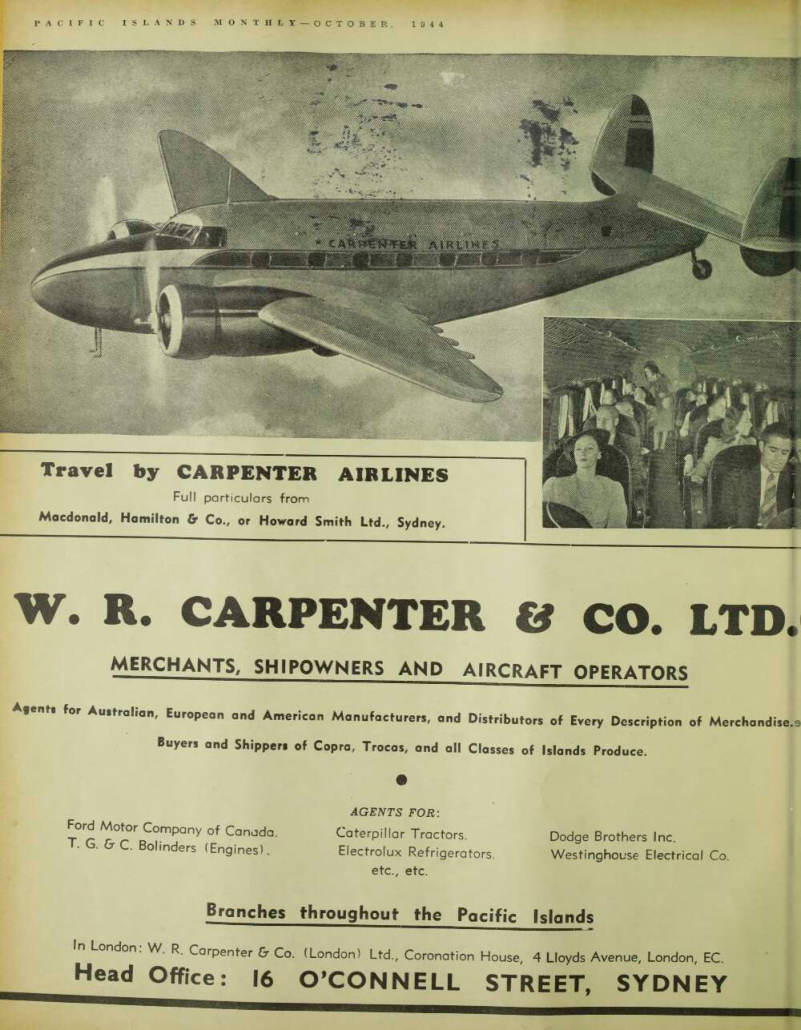
Campbell’s Paints . 47 Carlton & United Breweries, Ltd. . 19 Carpenter, Ltd., W.
R cov. iv.
Chivers & Sons, Ltd 24 Coleman Lamp & Stove Co. . . 17, 41 Cox, Findlayson & Co 28 “Cystex” 46 Darvas & Co. ... 47 David Trading Co. 33 Donaghy & Sons . 33 Donald, Ltd., A. B. 24 Dr. Williams Pink Pills 36 Electrolux Refrigerators . . 18 “Farbest” Cordials 44 Farnham, John R. . 34 “Flavorex” ... 20 Ford Sherington Pty., Ltd 40 Foster Clark, Ltd. . 21 Garrett & Davidson 41 Gibson & Co., Ltd.,
J. A. D 25
Gillespie Pty., Ltd., Robert ... 38, 46 Gilbey’s Gin ... 31 Gillespie’s Flour . . 22 Gough & Co., E. J. 42 Grand Pacific Hotel 2 Grove & Sons, W.
H 14 Heinz & Co. Pty., Ltd., H. J. . . . 23 King’s Compo ... 37 Kopsen & Co., Ltd. 29 Maxwell Porter, Ltd. 36 “Mendaco” ... 38 Muir (Eastern) Ex port Co., Charles 37 Nelson & Robertson Pty., Ltd 16 “Nixoderm” ... 40 Pacific! Is. Society . 16 “Pinkettes” . .41 Public Notice . . 43 Queensland Insur ance Co 17 Radco Products . . 43 “Radiant” Lanterns 39 Riverstone Meat Co., Ltd. ... 45 Rose’s Eye Lotion . 37 Rohu, Sil . . . . 40 Scott, Ltl., J. ... 36 Steamships Trading Co., Ltd 27 Sullivan & Co., C. . 30 Swallow & Ariell . 20 Taylor & Co., A. . 42 “Tenax” Soap . . 14 Tillock & Co., Ltd. 22 Wright & Co. . . 47 Wright & Co.,i Ltd., E 34 Wunderlich, Ltd. . 42 Yorkshire Insurance Co., Ltd 13 Young Pty., Ltd., Harry J 34
Advertisements & other items, p. 4 (2 items)
Useful Addresses
The following are the addresses of organisations set up to deal with Pacific Territories affairs: —
PAPUA, NEW GUINEA, NAURU,
NORFOLK IS.
Department of External Territories (Sydney Branch) (Lately the New Guinea Trade Agency), Australia House, Carrington Street, Sydney.
Telephone: BW 1776. (Dealing with all matters connected with the Australian Pacific Territories and also the Sydney representative of the New Guinea Copra Control Committee.)
FIJI, AND HIGH COMMISSION
FOR WESTERN PACIFIC
Sydney Office of Fiji and Associated Administrations. (In charge of Mr. B. F. Blackwell.) 72 Pitt Street, Sydney.
Telephone: BW 7724.
BRITISH SOLOMON ISLANDS
Sydney Office of British Solomon Islands Government (In charge of Mr. F. E. Johnson, Treasurer of the Solomons Administration), 17 Castlereagh Street, Sydney.
Telephone: B 1710.
FOR PACIFIC TERRITORIES
EVACUEES GENERALLY
Pacific Territories Association (C. A. M. Adelskold, Secretary), c/o Robert Gillespie Pty., Ltd., 54a Pitt Street, Sydney, Telephone: BW 4782.
WAR DAMAGE COMMISSION
Sydney Office: M.L.C. BuidHng, Cnr. Martin Place and Castlereagh Street, Sydney.
Telephone: BW 2361.
FOR CLAIMS AGAINST ARMY
Mr H. Alderman, Darwin-Moresby Claims Section. Chief Finance Office (Army), Victoria Barracks, Melbourne.
S\!N I M
WiWW ft
° V d ; . pac^' c we G r * nd „ tV* e . . ha rb° ur ’ b e*^ u ' W* e SOC ' t *ce\\e nt CU ' 5 ' be CV d s er' ,3t ' tS *a« erS 3 A \n<*' an r^ ed Sv» va ’^° f .. o *^ c ' f O^ 6 ' r W-
pe'T
i so>
Pacific Islands Monthly
The Newspaper-Magazine of the South Seas
[,Registered at the G.P.0., Sydney, for transmission by post as a newspaper. ] Published Once Each Month and Circulated in Australia and New Zealand and in the following Pacific Territories and Islands Groups:
Australian Territory of Papua.
Mandated Territory (Australia) of New Guinea.
Australian Territory of Norfolk Island.
New Zealand Territory of Cook Islands.
Mandated Territory (NZ) of Western Samoa.
British Colony of Fiji.
British Solomon Islands Protectorate.
British Protectorate of Tongan Islands.
British Crown Colony of Gilbert and Ellice Islands.
Mandated Territory of Nauru.
British and Free French Condominium of New Hebrides.
Free French Colony of New Caledonia.
Free French Colony of Oceania (Tahiti, etc.).
American Territory of Eastern Samoa.
American Territory of Hawaiian Islands.
Owned and Produced by Pacific Publications Pty. Ltd., Union House, 247 George Street, Sydney.
«ptTrvsn? f Managing Director .. BW 5037 "fiusrmjrus Business and Editorial MA 4369
P.O. Box 3408 R
Registered Address of Telegrams, Radiograms, and Cables: “Pacpub”, Sydney. ,
Contributions.
Articles, Stories, and Photographs dealing with Pacific Islands subjects are invited and will be paid for on publication.
Subscription Rates.
Per Annum, within British Empire, Prepaid, Post Free 10/- Per Annum, elsewhere, Prepaid, Post Free 12/6 Single Copies 1/-
Editor and Publisher:
R. W. Robson, P.R.O.S.
Advertising Manager; L. W. Bailey.
Advertising Office and Printing-House: 29 Alberta Street, Sydney.
Advertising rates furnished on application.
Representative In Fiji.
Pacific Publications (Fiji), Ltd., Bank of NSW Building, Suva (same office as W. H. Grove & Sons, Ltd.). Stocks of Pacific Islands Monthly and Pacific Islands Yearbook on hand.
Representative In London.
W. C, Harvey, Coronation House, 4 Lloyds Avenue, London, EC.3, from whom may be obtained copies of Pacific Islands Monthly, Pacific Is. Year Book, advertising schedules, etc.
Agents.
The following are authorised to receive sub scriptions for Pacific Islands Monthly:— Burns, Phllp & Co.. Ltd., and Burns Phllp (South Sea) Co.. Ltd. All branches.
W R. Carpenter & Co., Ltd. All branches.
Morris, Hedstrom, Ltd. All branches.
Steamships Trading Co., Papua. All branches.
B.N.G. Trading Co.. Ltd., Port Moresby. Papua J Muir, Suva. Fiji.
Miss R. Castles. Suva. FIJI.
N. C. Mackenzie Hunt, Walnunu, Bua, FIJI.
Cook Islands Trading Co.. Rarotonga, Cook Is.
A. C. Rowland. Papeete, Tahiti.
Islands Branches and Representatives of W. H.
Grove & Sons, Ltd., Auckland, New Zealand Ed. Pentecost. Noumea, New Caledonia.
Kerr & Co., Noumea, New Caledonia.
Vol. Xv. No. 3.
October 1 7, 1944
Drira i l, Per C°Py rnce [Prepaid: 10/- p.a.
Natives
This Talk Of "Exploitation" Of
N ON-RESIDENT students of Pacific affairs, such as directors of mission organisations, and anthro pologists, and other types of un practical academicians, continue to sing tunelessly, in solos and choruses, on the subject of indentured native labour in New Guinea. Elsewhere, we have referred to the Brisbane utterances of Professor Elkin, who is held in high regard as Sydney University’s anthropologist, but whose opinions on practical aspects of life in the Territories are treated with no re spect—to say the least of it—by Territorians.
From a friend in Melbourne, we have received a cutting from a Gee long newspaper, wherein are reported the aggressive utterances of a Rev. B.
R. Wyllie, when addressing the Gee long Rotary Club on the subject of native labour in New Guinea. Mr.
Wyllie, it appears, is Master of Wesley College, in the University of Sydney; and heaven alone knows what authority he has for discussing so complex a subject as native labour in the Territories. He is emphatic that “the fight is on”; that we are not to continue the policy of “allow ing other people to exploit the native and his lands”; and that “the alter native to the indenture system was the eventual withdrawal of the white planter from New Guinea and the substitution of brown plantations.”
There is much more of it; but it is the same kind of claptrap of which we have heard so much during the*
past six months. Mr. Wyllie and his opinions are quoted merely to show how uninformed shouting is liable to embarrass the people who eventually must carry on the government and economic affairs of the Territories.
THESE critics and lecturers assume knowledge and prescience which they do not possess. Not one man who really has lived in the Territories and understands their conditions of life supports Mr. Eddie Ward and his clamorous retinue of Bishops and Professors.
Territorians accept the indentured labour system for what it really is— a very necessary but temporary arrangement ta bridge the gap be tween the primitive savagery of the ignorant Melanesians, and the estab lishment, on their own lands, of a new generation of Melanesians, who may become peasant producers, and capable of holding their own against penetration by the highly “civilised,” land-grabbing people of other races.
If the professors were not so carried away by their Leftist hatred of private enterprise and profits, they would accept the logic of these facts: The Melanesian Territories must be held by Australia, for Australia’s own protection; they must be put into a condition of defence—they cannot be left undeveloped and occupied only by primitives, a temptation to every prowling, land-hungry nation; they must be developed by Europeans, with European capital, for the even
tual benefit of the native people; Europeans will not enter these Terri tories unless they go there for profit, and with some security; the Terri tories cannot be developed without a labour supply—either native, or im ported Asiatic; a properly controlled system of contract native labour will provide the labour needed, and at the same time train the natives (of whom there are over one million) so that they may themselves become peasant producers on their own land. When hundreds of thousands of natives have been trained to the point that they become peasant land-tillers, then Australia’s problem of defending this arc of Pacific islands will be partly solved, and the need for contract native labour will disappear. rn HE professors, of course, being A notoriously impractical, will argue that Government officials are Quite capable of doing the job in New Guinea—of changing the present million primitives into peasant pri mary producers, with a much higher standard of communal life. Of course they are—but at what a cost to the Australian taxpayer!
In the final analysis, the issue is one between Governmental training of the natives at Australia’s cost, with civilians excluded from the Terri tories; or carrying out the training of the natives under rigidly-controlled private enterprise, as in the past— the taxation of private enterprise pro viding sufficient funds to pay the costs of government and development.
Apart altogether from the rights or wrongs of the two systems, the Aus tralian taxpayer never would stand
for the first alternative: and he is quite right—there is no need for it.
But, to show the true character of the first alternative, we need go no further than Papua under present wartime conditions. Let those who are shouting about indentured labour and exploiters read the article on an other page, describing the operations of ANGAU in the Territories.
Although the present Administra tion has absolute power, and unlimited personnel and funds, and is supposed to be under the influence of a Minister with a passionate love for “Fuzzy-wuzzies,” the natives are be ing subjected to industrial conscrip tion in a manner never known under civilian administration while the economic organisation of the Terri tories is distinguished mostly for muddle and waste.
This is not surprising, of course.
This is what always happens when the industrial discipline imposed by private enterprise and the profit motive is displaced by an organisa tion of officials, who merely look to a Government for pay and privileges.
Dependence on profits, made under competition, enforces efficiency; re move that motive, and we always get higher costs and less efficiency. The proof of that may be seen in a thou sand places in Australia to-day, under wartime conditions and the pink Curtin Government.
TLTISSIONARIES, professors and so forth admired the work and wisdom of the later Sir Hubert Murray. In his lifetime, he was criti cised often because he usually fought against private enterprise and on be half of the natives and the mission aries. In 1931, Sir Hubert wrote a paper entitled “The Scientific Method as Applied to Native Labour Problems in Papua”; and it was reprinted in 1939, just before he died. These ex tracts from the pamphlet seem to answer all the charges made against the contract labour system; ' “"VTATIVE labour may be employed 11 either under indenture, or as free labour. With free labour, master and man are not subject to any statutory requirements or conditions; under a sys tem of indenture, almost all the rela tions between them are or may be limited and conditioned by regulation— the duration of service, the wages to be paid, the rations to be supplied, the hours of labour, the care of the sick, the return of the labourer to his home, and a hun dred and one other matters that may possibly arise. And a breach of the regulations is punished, in the case of the employer usually by fine, and in the case of the labourer, usually by imprison ment ...
"The indenture'system, with its pur suit of deserters and its imprisonment of those who break their contract, is really rather like slavery, and cannot, I think be accepted as a final settlement of the labour probiem. But it is a necessary institution, at the present stage of Papuan development, and its retention • for the present, can be fully justified’ noo only from the point of view of the employer, but also from that of the native , . .
“The strong and, at the same time, the weak point in the system is the fact that the remedy for breach of the regulations
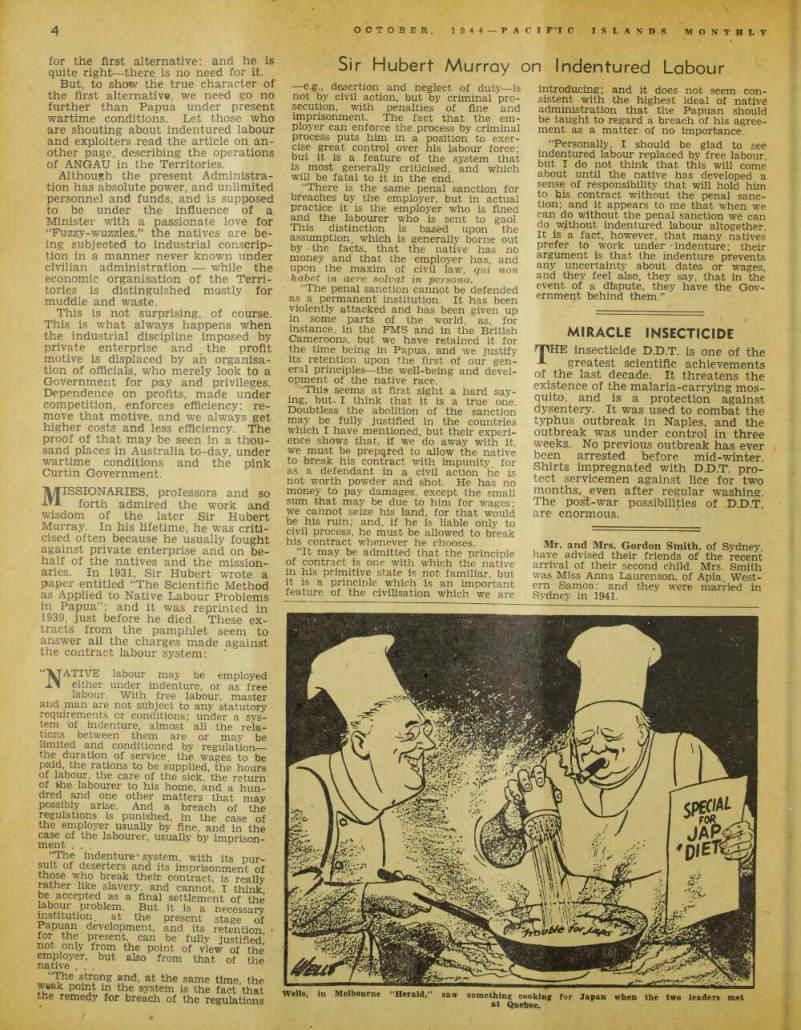
Wells, in Melbourne “Herald,” saw something cooking for Japan when the two leaders met at Quebec.
Sir Hubert Murray on Indentured Labour
—e.g., desertion and neglect of duty—is not by civil action, but by criminal pro secution, with penalties of fine and imprisonment. The fact that the em ployer can enforce the process by criminal process puts him in a position to exer cise great control over his labour force; but it Is a feature of the system that is most generally criticised, and which will be fatal to it in the end.
“There is the same penal sanction for breaches by the employer, but in actual practice it is the employer who is fined and the labourer who is sent to gaol.
This distinction is based upon the assumption, which is generally borne out by ■ the facts, that the native has no money and that the employer has, and upon the maxim of civil law, qui non hdbet in aere solvat in persona.
“The penal sanction cannot be defended as a permanent institution. It has been violently attacked and has been given up in some parts of the world, as, for instance, in the FMS and in the British Cameroons, but we have retained it for the time being in Papua, and we justify its retention upon the first of our gen eral principles—the well-being and devel opment of the native race.
“This seems at first sight a hard say ing, but* I think that it is a true one.
Doubtless the abolition of the sanction may be fully justified in the countries which I have mentioned, but their experi ence shows that, if we do away with it, we must be prepared to allow the native to break his contract with impunity for as a defendant in a civil action lie is not worth powder and shot. He has no money to pay damages, except the small sum that may be due to him for wages; we cannot seize his land, for that would be his ruin; and, if he is liable only to civil process, he must be allowed to break his contract whenever he chooses.
“It may be admitted that the principle of contract is one with which the native in his primitive state is not familiar, but it is a principle which is an important feature of the civilisation which we are
introducing; and it does not seem con sistent with the highest ideal of native administration that the Papuan should be taught to regard a breach of his agree ment as a matter of no importance.
“Personally, I should be glad to see indentured labour replaced by free labour, but I do not think that this will come about until the native has developed a sense of responsibility that will hold him to his contract without the penal sanc tion; and it appears to me that when we can do without the penal sanction we can do without indentured labour altogether.
It is a fact, however, that many natives prefer to work under 'indenture; their argument is that the indenture prevents any uncertainty about dates or wages, and they feel also, they say, that in the event of a dispute, they have the Gov ernment behind them.”
Miracle Insecticide
HHHE insecticide D.D.T. is one of the A greatest scientific achievements of the last decade. It threatens the existence of the malaria-carrying mos quito, and is a protection against dysentery. It was used to combat the typhus outbreak in Naples, and the outbreak was under control in three weeks. No previous outbreak has ever been arrested before mid-winter.
Shirts impregnated with D.D.T. pro tect servicemen against lice for two months, even after regular washing.
The post-war possibilities of D.D.T. are enormous.
Mr. and Mrs. Gordon Smith, of Sydney, have advised their friends of the recent arrival of their second child. Mrs. Smith was Miss Anna Laurenson, of Apia. West ern Samoa; and they were married in Sydney in 1941.
Advertisements & other items, p. 6 (1 item)
4
OCTOBER, 1 9 4 4 - P A C IF'I C ISLANDS MONTHLY
For Kenya
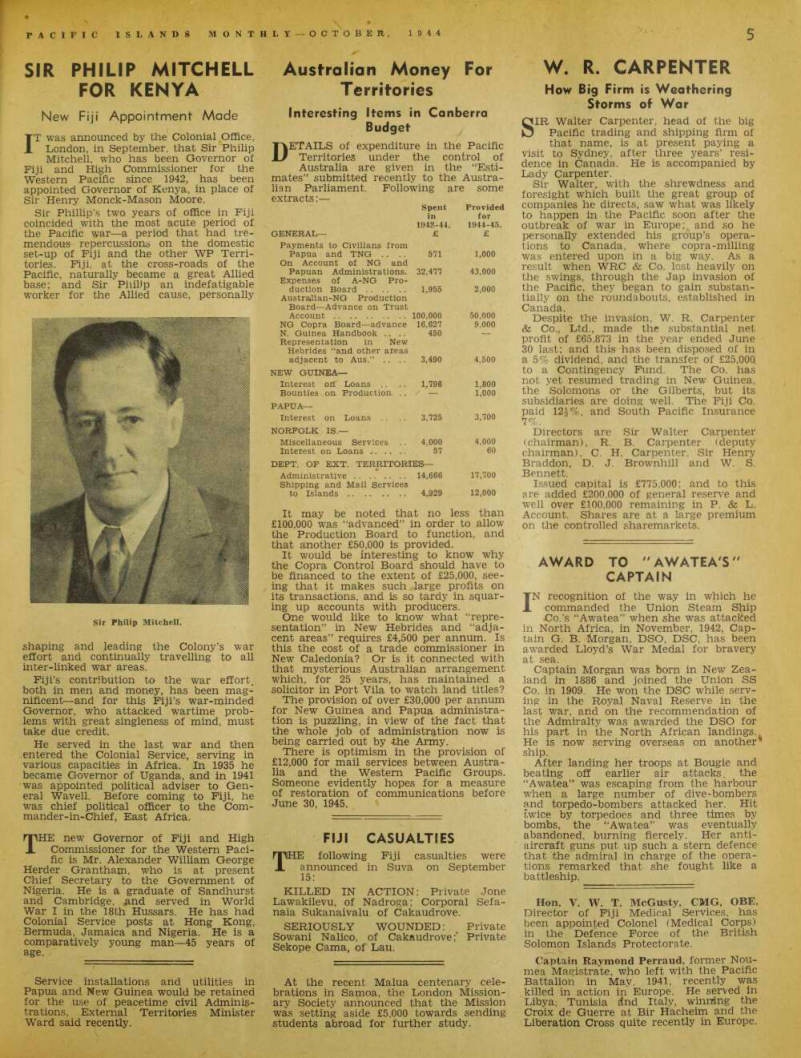
Sir Philip Mitchell
New Fiji Appointment Made
IT was announced by the Colonial Office, London, in September, that Sir Philip Mitchell, who has been Governor of Fiji and High Commissioner for the Western Pacific since 1942, has been appointed Governor of Kenya, in place of Sir Henry Monck-Mason Moore.
Sir Phillip’s two years of office in Fiji coincided with the most acute period of the Pacific war —a period that had tre mendous repercussions on the domestic set-up of Fiji and the other WP Terri tories. Fiji, at the cross-roads of the Pacific, naturally became a great Allied base; and Sir Philip an indefatigable worker for the Allied cause, personally
shaping and leading the Colony’s war effort and continually travelling to all inter-linked war areas.
Fiji’s contribution to the war effort, both in men and money, has been mag nificent—and for this Fiji’s war-minded Governor, who attacked wartime prob lems with great singleness of mind, must take due credit.
He served in the last war and then entered the Colonial Service, serving in various capacities in Africa. In 1935 he became Governor of Uganda, and in 1941 was appointed political adviser to Gen eral Wavell. Before coming to Fiji, he was chief political officer to the Com mander-in-Chief, East Africa.
THE new Governor of Fiji and High Commissioner for the Western Paci fic is Mr. Alexander William George Herder Grantham, who is at present Chief Secretary to the Government of Nigeria. He is a graduate of Sandhurst and Cambridge, and served in World War I in the 18th Hussars. He has had Colonial Service posts at Hong Kong, Bermuda, Jamaica and Nigeria. He is a comparatively young man—4s years of age.
Service installations and utilities in Papua and New Guinea would be retained for the use of peacetime civil Adminis trations, External Territories Minister Ward said recently.
Sir Philip Mitchell.
Australian Money For Territories Interesting Items
Territories Interesting Items in Canberra Budget
DETAILS of expenditure in the Pacific Territories under the control of Australia are given in the “Esti mates” submitted recently to the Austra lian Parliament. Following are some extracts; —
It may be noted that no less than £lOO,OOO was “advanced” in order to allow the Production Board to function, and that another £50,000 is provided.
It would be interesting to know why the Copra Control Board should have to be financed to the extent of £25,000, see ing that it makes such large profits on its transactions, and is so tardy in squar ing up accounts with producers.
One would like to know what “repre sentation” in New Hebrides and “adja cent areas” requires £4,500 per annum. Is this the cost of a trade commissioner in New Caledonia? Or is it connected with that mysterious Australian arrangement which, for 25 years, has maintained a solicitor in Port Vila to watch land titles?
The provision of over £30,000 per annum for New Guinea and Papua administra tion is puzzling, in view of the fact that the whole job of administration now is being carried out by -the Army.
There is optimism in the provision of £12,000 for mail services between Austra lia and the Western Pacific Groups.
Someone evidently hopes for a measure of restoration of communications before June 30, 1945.
Spent Provided in for 1943-44. 1944-45.
General—
£ £ Payments to Civilians from Papua and TNG ..
On Account of NG and 571 1,000 Papuan Administrations.
Expenses of A-NG Pro- 32,477 43,000 duction Board Australlan-NG Production Board —Advance on Trust 1,955 2,000 Account 100,000 50,000 NG Copra Board —advance 16,627 9,000 N. Guinea Handbook ..
Representation in New Hebrides “and other areas 450 adjacent to Aus.” ., .. 3,490 4,500
New Guinea—
Interest orT Loans 1,798 1,800 Bounties on Production .. — 1,000
Papua—
Interest on Loans 3,725 3,700
Norfolk Is.—
Miscellaneous Services .. 4,000 4,000 Interest on Loans 57 60
Dept. Of Ext. Territories—
Administrative Shipping and Mail Services 14,666 17,700 to Islands 4,929 12,000
Fiji Casualties
THE following Fiji casualties were announced in Suva on September 15: KILLED IN ACTION: Private Jone Lawakilevu, of Nadroga; Corporal Sefa naia Sukanaivalu of Cakaudrove.
Seriously Wounded: Private
Sowani Nalico, of Cakaudrove;* Private Sekope Cama, of Lau.
At the recent Malua centenary cele brations in Samoa, the London Mission ary Society announced that the Mission was setting aside £5,000 towards sending students abroad for further study.
W. R. Carpenter
How Big Firm is Weathering Storms of War
SIR Walter Carpenter, head of the big Pacific trading and shipping firm of that name, is at present paying a visit to Sydney, after three years’ resi dence in Canada. He is accompanied by Lady Carpenter.
Sir Walter, with the shrewdness and foresight which built the great group of companies he directs, saw what was likely to happen in the Pacific soon after the outbreak of war in Europe; and so he personally extended his group’s opera tions to Canada, where copra-milling was entered upon in a big way. As a result, when WRC & Co. lost heavily on the swings, through the Jap invasion of the Pacific, they began to gain substan tially on the roundabouts, established in Canada.
Despite the invasion, W. R. Carpenter & Co., Ltd., made the substantial net profit of £65,873 in the year ended June 30 last: and this has been disposed of in a 5% dividend, and the transfer of £25,000. to a Contingency Fund. The Co. has not yet resumed trading in New Guinea, the Solomons or the Gilberts, but its subsidiaries are doing well. The Fiji Co. paid 12i%, and South Pacific Insurance 7%.
Directors are Sir Walter Carpenter (chairman), R. B. Carpenter (deputy chairman). C. H. Carpenter. Sir Henry Braddon, D. J. Brownhill and W. S.
Bennett.
Issued capital is £775,000; and to this are added £200.000 of general reserve and well over £lOO,OOO remaining in P. & L.
Account. Shares are at a large premium on the controlled sharemarkets.
Award To "Awatea's"
Captain
IN recognition of the way in which he commanded the Union Steam Ship Co.’s “Awatea” when she was attacked in North Africa, in November, 1942, Cap tain G. B. Morgan, DSO, DSC, has been awarded Lloyd’s War Medal for bravery at sea; Captain Morgan was bom in New Zea land in 1886 and joined the Union SS Co. in 1909. He won the DSC while serv ing in the Royal Naval Reserve in the last war, and on the recommendation of the Admiralty was awarded the DSO for his part in the North African landings.
He is now serving overseas on another' ship.
After landing her troops at Bougie and beating off earlier air attacks, the “Awatea” was escaping from the harbour when a large number of dive-bombers and torpedo-bombers attacked her. Hit twice by torpedoes and three times by bombs, the “Awatea” was eventually abandoned, burning fiercely. Her anti aircraft guns put up such a stern defence that the admiral in charge of the opera tions remarked that she fought like a battleship.
Hon. V. W. T. McGusty, CMG, QBE, Director of Fiji Medical Services, has been appointed Colonel (Medical Corps) in the Defence Force of the British Solomon Islands Protectorate.
Captain Raymond Perraud, former Nou mea Magistrate, who left with the Pacific Battalion in May. 1941, recently was killed in action in Europe. He served in Libya, Tunisia £nd Italy, winning the Croix de Guerre at Bir Hacheim and the Liberation Cross quite recently in Europe.
Angau Hangs On In Papua
Disturbing Aspects of a Very Complicated Situation
T HE fl r( p ort ’ published in many A Australian newspapers early in September, and re-published in the September issue of this journal, that civil administration would be reestablished in Papua earlv in
P \ i iy4a ’
W ™ Sl w SBC 2 le *lf ly contradicted. • .
Mr. Ward, the Territories Minister, who apparently was unofficially responsible for supplying the report to the press, later announced officially and untrue^ 61 " 611 * WaS unauthorised ana untrue.
We said at the time that the report had created a situation so confusing and baffling that we questioned its
authenticity.
DURING the past month, more information has become available It appears that the actual situation now is about as follows- • The administration of Papua and of the liberated sections of New Guinea is completely in charge of ANGAU- while ANGAU’s subsidiary, the Production Control Board, has almost equal authority over whatever remains of the economic structure of the two Territories • ANGAU is verv stronelv pntrpnrhpdis verv happy and comfortable • is iealous of any Interfterence by the External Territories Department and bv civilians generally; and is not likely to move over and make room for any returnfnl dvU administration without a fight • The Army is unwilling that ANGAU should move out of Papua* until ANGAU has some place to move P to Onlv a small part of New Guinea (Morobe the region around Vitiaz Strait) is as clear of Japs as is Papua and that is not enough to give ANGAU a home and a job. Time enough (argues the Army) for ANGAU to move out of Papua into New Guinea when New GuineaTreLonably stme tfrneTi and that may not be fo ' • sateimls w nhhJiip?’ through its 22 ° btamed A r^ mar 1 ka ble thP wSLS Fapua -. A JL is always me case when Government officials enter
into commerce, there are waste, mud dling and inefficiency on a large and growing scale in Papua—wherever, in fact, ANGAU and Co. are acting as planters, traders and shippers. • An official inquiry which has been ordered into the circumstances surround ing the cessation of civil administration in Papua in February, 1942, has extra ordinary features, and is described by some observers as an attempt to blacken the Murray Administration and corres pondingly strengthen the grip of ANGAU, and certain ambitious gentlemen con nected therewith. • It is asserted by certain people that, when the post-war settlement comes in the Pacific, Papua, the Mandated Terri tory of New Guinea, the British Solomons and (perhaps) the Condominium of the New Hebrides will be attached to Aus tralia as a sort of Austral-British Oceanic Dominion; and the administrative jobs connected therewith already are seen as plums of beauty and magnitude. The name of a prominent Australian com mander already has been freely mentioned as the first Lieut.-Governor of the Aus tralian Commonwealth’s rjew Dominion.
FEW people realise what has happened administratively iji the Territories; and how deeply ANGAU is dug into their administrative structure.
Civil administration ceased in the Mandated Territory about January 21, 1942, when the Japs invaded; and in Papua on February 12, 1942—n0t because the Japs had invaded (they did not enter Papua until several months later) but because the Australian Army had ordered complete civilian evacuation, and wanted to be rid of the civil government.
Since the latter part of 1942, the enemy has been driven out of Papua, and out of the Morobe, Huon Gulf, Western New Britain and Madang districts of the Mandated Territory. ANGAU took charge of all Papua in 1942, and in 1943- 44 extended its jurisdiction over the liberated districts of New Guinea.
In 1943, a carefully-selected score of civilians were allowed to return to Papua to grow rubber and copra; but they are controlled almost completely by ANGAU
and its step-child, the Production Board.
There is no trading except by the Gov ernment. Private enterprise is strictly tabu—outlawed by Canberra, no doubt, because that is the policy of Mr. Eddie Ward, and discouraged by the Army be cause private enterprise means recogni tion, in some form or other, of pesky civilians—and civilians are not wanted in Papua.
While thousands of homeless people have been waiting in Australia for the eviction of the invaders, confident that Australia then would re-establish civilian government and assist the return of civi lians at the earliest possible moment, two years have passed. It is two years since the enemy was defeated in North-east Papua—and there is no more indication now of the re-establishment of civilians in Papua than there was then.
IN those two years, the Brass Hats have become well established.
The original defensive organisation provided by Australia in the Territories, between 1939 and December, 1941, appears to have been in charge of a then un known professional soldier, a South Aus tralian, Brigadier Basil Morris, with head quarters at Port Moresby. Between the time that Japan attacked the Territories (January, 1941), and the arrival there of powerful and experienced American and Australian units, six months later, General Morris commanded in this area. Later, in 1942, as new Allied forces moved in to the attack, General Morris remained at Port Moresby, in charge of Administra tion.
At first, observers found the situation most confusing. Mr. Elliot Smith, of the Papuan public service, appeared at first to be head of the new Australian New Guinea Administrative Unit (ANGAU); but he soon was joined by Mr. “Ted”
Taylor, of the NG service.
Very quickly, most of the younger officials of both Territories’ services were summoned to ANGAU. It soon became a substantial corps; Major-General Morris (he seems to have received that rank in 1942) was in charge, and nearly all the officials received commissions, from lieutenant-colonelcies downwards. There were few men below the rank of warrant officer.
SINCE those confused, formative days, ANGAU has grown. It was origin ally intended as an organisation which would provide experienced adminis trative officers to take charge of areas as
they were liberated by our combatant forces—men to be responsible for the interregnum between actual war condi tions, and the return of civilian adminis tration.
But it has not worked out that way: and the suspicion now is growing that ANGAU has dug itself in so deeply, in very comfortable jobs, that it will be shifted by nothing short of a charge of political dynamite.
In pre-war days, Papua and New Guinea were nearly self-supporting, and thev were governed by a team of about 130 officials in Papua and some 300 in New Guinea.
To-day, in place of that, we have the enormously expensive set-up called ANGAU. It has a European personnel of over 2,000; and this is how it has estab lished itself during the past two years:
Headquarters
Major-Genferal Basil Morris, who appears to have the status of Governor over the two Territories; assisted by Brigadier Cleland (who is also chairman of the Production Control Board), Colonel J. H. Jones (formerly District Officer at Madang), Major S. A. Lonergan (formerly of the New Guinea Secretariat), Major W. R. Humphries (formerly Senior Re sident Magistrate in Papua).
The ANGAU organisation now is divided up as follows:
Southern District (All Papua,
Including Eastern Islands)
Lieut.-Colonel D. H. Vertigan (formerly New Guinea) in charge, assisted by T.
Grahamslaw and Claude Champion (both formerly Papua). Headquarters are out side Port Moresby.
Northern District (North
Eastern New Guinea)
Lieut.-Colonel K. C. McMullen (for merly New Guinea) in charge, with head quarters at Lae.
Islands District (Bismarck
Arch. And Bougainville)
Lieut.-Colonel N. Penglase (formerly New Guinea) in charge, with temporary headquarters at Finschhaven.
Except the top-rankers at headquarters, all these names are familiar to us. We knew them, before 1942, as experienced and efficient officials of the Adminis trations. We do not know them quite so well as Brass Hats, Mr. Elliot Smith, originally very pro minent, in ANGAU, is now DO at Mam bare, with rank as major, Lieut.-Colonel “Ted” Taylor, also prominent originally, is still in hospital, after a long spell of illness.
All the old administrative divisions have been abolished and new ones created.
Officials are District Officers and Assistant DO’s: the Papuan titles of RM and ARM have been dropped.
Each of the three Districts? or Regions, named above, has its own Marine Section, and is thereby made responsible largely for its own transport.
It can be seen, from the foregoing, that ANGAU has completely revolutionised the administrative machinery of the two Territories, and created its own far reaching and deep-seated 1 organisation. Is it likely that it now regards itself as a temporary thing—a mere stop-gap?
Except that they are both responsible to Major-General Morris and the Army (not to the Department of External Terri tories), the exact relationship between ANGAU and the Production Control Board is not clear. It seems clear, how ever, that ANGAU supplies the Board with transport, and with all the native labour required on the plantations (both
those run by the returned planters and those run directly by the Board).
A WORD about native labour. Here, again, is an extraordinary position.
We have heard Mr. Ward, and the Bishops, and the anthropologists, on the subject of the pre-war exploitation of indentured native labour by ruthless private enterprise, until we are sick of it. Apparently, neither the Red Poli ticians nor the Bishops know anything of what is going on now in the Territories — and has gone on for two years.
Native labour is conscripted by ANGAU.
That probably can be fully justified on the grounds of necessity.
ANGAU has to supply all the native labour needed by the Army, and by the Administration Unit, and by the plan tations. No time is wasted in attempting to induce native men to “make paper,” as in the old days, condemned by Mr. Ward.
ANGAU’s District Officers simply send a message to the headman of a village, informing him of the number of native workers needed. If they are not “volun tarily” supplied, native police are sent out to attend to the matter.
This “forced recruiting” necessary under wartime conditions —has created special problems which are giving the more experienced officials some concern.
A large proportion of men have been away from many villages for 21 years now, and there is grave depopulation in some areas.
ANGAU has an abundance of personnel, money and equipment, and the Territories to-day should be better governed than ever before in their history. Any country, of course, can be well governed if there is plenty of funds, and no call for a balanced budget.
SOME strange things are going on in connection with Territories adminis tration.
The confident announcement by all the Australian newspapers that civil adminis tration would be restored in Papua early in 1945, and its subsequent contradiction by the Minister for the Territories; the thoroughness with which the personnel of the old New Guinea and Papua civil administrations was broken up; the grim purposefulness with which ANGAU has dug itself in, in the manner described; and, finally, the kind of heresy hunt which appears to have been launched against Mr. Leonard Murray—these things add up to something that is ugly and malodorous.
From the moment that civil adminis tration was withdrawn from New Guinea and Papua, the Brass Hats followed a policy of ignoring the administrators and their senior officials. Unfortunately, it is difficult to get detailed information. Sir Walter McNicoll is not kindly disposed towards this journal, and has no data for us; the Hon. Leonard Murray has
courteously but firmly declined to supply any information to the newspapers. But, from various reliable sources, we have assembled the following details, which we believe to be true: Sir Walter McNicoll now has retired from the post of Administrator of New Guinea: and, prior to his retirement, he was not consulted regarding future ad<ministrative policies.
The appointment of Mr. Leonard Murray as Administrator of Papua was made in 1940, for a period not exceeding five years, and the appointment has not been ter minated. He is still the Administrator; but, for two years, he has been con sistently and pointedly ignored in all matters relating to Papua’s adminis tration. Some aspects of the Brass Hat policy must haye been humiliating to Mr.
Murray. For example, the Brass Hats and Mr. Ward selected two anthropologists, and sent them off to the Territories, with rank of Lieutenant-Colonels, to advise on matters relating to native affairs. Yet there was available to the Government, in the person of Mr. Murray, an experi enced officer whose knowledge of New Guinea natives is second to that of no man in the world to-day.
Owing to the muddling *of Australian Brass Hats (and this is a matter concern ing which a great deal will be heard in the future) most of New Guinea’s senior officials were trapped in Rabaul. But Papua’s senior men got away. Were any of the senior Papuan men who were closest to and most loyal to Leonard Murray invited to assist the Port Moresby Brass Hats in setting up the new adminis tration? They were not.
Finally, there is afoot a mysterious “inquiry” regarding the circumstances surrounding the cessation of civil govern ment in Papua. We have sought details, but officialdom, on this matter, is very, very shy. But we do that Mr.
Eddie Ward has requested a leading Mel bourne KC to carry out the inquiry; and we know, also, that a junior lawyer, apparently representing that gentleman, has been in Port Moresby recently “assembling information for the purposes of the inquiry.”
Well-informed people are quite sure that the object of the inquiry is to blacken Mr. Leonard Murray, and the reputation of the Murray regime. It is indicated that neither the Port Moresby Brass Hats, nor Mr. Ward, are well-disposed towards Mr. Murray. Mr. Murray is a Menzies Government appointee, and is a member of a very famous family—two good reasons why he should now be hated in Canberra. He also is the one remain ing man between the Brass Hats and the fat jobs which will be available in Aus tralia’s Pacific Territories, sooner or later, for out-of-work generals. Verhum sapienti sat est!
Remarkable Economic Muddle In Papua
SO much for the purely administrative side of the Papuan set-up. It has its shortcomings; but, with abundant personnel, and endless funds, it is providing the Territories with what probably will be regarded in times to come as the most luxurious Government in all Territones’ history.
But, when we turn to the economic side we find a different picture. Private enterprise (except for a few plantations) has been barred out, and ANGAU and its satellites actually are the traders, planters, storekeepers, recruiters and transporters of Pamifl Hpro wriffpn for fhp inf ormation of Australian interests, is the summary of a keen and experienced observer who recently visited the Territory; J The planters are compelled to look to
the Production Control Board for every thing, whilst the Board, in turn, has to compete with ANGAU for its coastal shipping and its labour; with the Army for the usual plantation rations and some of the stores, whilst the balance of the planter’s requirements are purchased through the Department of External Territories in Sydney, by the Board.
Getting stores and general plantation requirements is a very costly business, in volving long delays in getting delivery.
Wheatmeal and flour, which normally cost about £l2/10/- per ton in Port Moresby, now costs over £3O. Trade fish, which used to cost 30/- a case, now costs 80/- a case. Many other lines are simi larly priced.
It is a common thing for a planter to
wait two months to get supplies, after the order has been lodged.
Motor trucks are unprocurable at any thing like reasonable prices. The Depart ment of External Territories says there is no drawback of duty on 30 cwt. Fords, which sell in Sydney at £470; so the price in Moresby is £640. Spare parts are even more difficult to buy, with the result, that transport on plantations is held up for weeks on end.
Agricultural knives, 16 inches, used in keeping the undergrowth down on plan tations, as supplied by the Board, are useless —the average life of each is about two days. This is an unbranded Aus tralian knife, sold at the same price as the best imported. To requests for the English knife, the Board replies the Commonwealth will not. import them.
The result is idle labour units by the dozens on most plantations.
NATIVE labour, which is a monopoly of ANGAU, is conscripted by that unit, and the boys are drafted to various forms of employment in different parts of the Territory, often without regard to the native’s previous experience. The re sult is dissatisfied labour. This is aggravated by the fact that there are two ration scales—one for boys working on plantations (i.e., the ration found from 20 years’ experience by a benevolent Gov ernment to be best suited to the native), and another ration scale, much larger than the plantation scale, which is issued to all ANGAU labour.
The upshot of this is seen in innumer able desertions from the plantations to the villages, where rations are issued for the asking by the nearest District Officer.
The ANGAU scale of native rations in cludes 4 tins of meat a week (one, pre viously), 16 oz. of margarine per week (none previously), 1 tin of tomato juice per week (none previously), and so on.
How Papua is to again have a contented native labour is hard to understand, quite apart from the economic aspect.
It may be noted that the Papuan villager, under the benevolent rule of ANGAU, and enjoying the unlimited financial resources of the Army (per grace of the Australian taxpayer) actually gets more meat and butter per week than the Australian citizen.
OWING to the haphazard coastal ship ping service, boys are often kept waiting for months at one port on the coast, to get to another. This happens, both going to and returning from plantations.
This directs attention to coastal ship ping, and the chaos it is causing and has caused. For twelve months, now, there have been large quantities of produce stored on most plantations; but this has of late reached such proportions that a number of plantations are contemplating closing down, owing to lack of storage space.
V, '5 h ?^ 1 who are handling the ships have had little or no experience of shipping, so that a large proportion of the ships are continually idle. Native captains who, for twenty or more years, have had sole of ships, now find they have an ANGAU non-commissioned officer put over them, with no previous knowledge of the coast. Native captains and en gineers have in some cases had their pre war wage cut from £l5 to £3/10/-, and from £lO to £2 per month—all of which St S isfild n mad 6 th 6 Cr6WS 0f vessels dis Yet Mr. Eddie Ward says that the Big Firms exploited the natives! g rE prices paid by the Board (ie De partment of External Territories) for the produce of Papuan plan rv/pvc g <a r 65 proof °? - the deal the planters are now receiving.
In the case of copra, the Board has fixed the prices for the period October, 1943—June, 1944, at; Hot-air and Sun-dried, £lB/10/- per ton.
Smoked and Sun-dried, £l7/10/- per ton.
From July 1, 1944, the price has been tentatively fixed by the Board at: Hot-air and Sun-dried, £l9 per ton.
Smoked and Sun-dried, £lB per ton.
Meantime, Canberra says the Depart ment of External Territories is receiving £29/10/- per ton for Hot-air and Sun dried, and £2B/10/- for Smoked, from the Department of Supply, who in turn sell it to the manufacturers at £3O/10/- a ton— so that the planter is getting £ll/10/under the market.
Before the war, copra was sold in Sydney at £7 per ton—and made a profit.
Rubber prices leave even more room for comment. The prices paid by the Board to Papuan planters for the period October 1, 1943, to June 30, 1944, were: No. 1 .. .. 1/61 per lb. „ 2 .. .. 1/5-4 „ „ » 3 .. .. 1/3 h „ „ From July 1, 1944, the prices have been tentatively fixed at: No. 1 .. .. 1/4| per lb. » 2 .. .. 1/3J, „ „ » 3 .. .. 1/1J..„ „ The Department of External Territories advise that the prices they received for Papuan rubber are: No. 1 .. 1/101 per lb. » ? .. .. 1/95 „ „ ”.3 •• .. 1/75 „ „ So that it costs 6d. per pound (i.e., £56 per ton) to take rubber from Papua to the Sydney market. Before the war it cost the merchants about £2/10/- per ton to market Papuan rubber.
COMMENT is superfluous—the facts speak for themselves.
ANGAU is not only hanging on grimly to the soft and profitable job of adminis tration : its satellites—evidently with the connivance of Canberra—have virtually taken possession of the plantations estab lished by private enterprise, and together they are gobbling up all the profits
Tonga's Legislative Assembly
Members of the Legislative Assembly of Tonga, photo- A in August, just after the closing of the 1944 Parliament. Back row, from left: Kalaniuvalu, Noble; Niukapu, Noble; . Gove ™ or of Vavau; Taumoepeau, Minister of Lands, Prince Tupouto’a, Minister of Education; Nuku.
Chairman of the Assembly: Ata, Premier; Tu’iha’ateiho Governor of Ha’apai; Tu’i ’Afltu, Noble; Malupo, Noble;’
Fohe, Noble.
Front row, from left: S. Vaea, clerk; S. Kupu, Usher- Tonga, People’s Representative; S. Mataele, P’s R : S Puli’uvea, P’s R. ; p. Vi. P’s R.; T. T. Hele, clerk; T.
Mapa, clerk; S. Funaki, P’s R. *
Tonga
Old European Resident of Tonga
rIS is a recent photograph of one of Nukualofa’s best-known European residents—Mr. A. Cowley, fie is
advanced in years, but still takes a keen interest in pubjjc affairs.
Mr. Cowley, a young Englishman, who had learned the baking trade, went to New Zealand 60 years ago; and, in 1895, he settled in Nukualofa, and has com pleted 49 years’ residence there He married before he left England, and he has had five daughters and two sons. He has conducted a bakery business in Nukualofa for over 45 years. On a num ber of occasions he assisted the Tongans in a fight against what he regarded as the impositions of a bureaucratic despot ism. (Photo, by Hettig.)
Dr. H. W. Jack
Outline of His Career
of Agriculture of Fiji
since 1934, Dr. H. W. Jack has left the Colony on leave preparatory to retirement. The following bio graphical notes have been taken from the Fiji “Agricultural Journal” for
September:
Dr. Jack was appointed as Director in Fiji, after 20 years’ service in the Malayan Department of Agriculture. He has thus completel nearly 10 years’ service in Fiji, and a total of 30 years In the Colonial service.
He had wide interests in the agricul tural field but his Malayan experience led him to take an especial interest in the copra industry, and made great efforts to improve the quality of Fiji copra and to secure for it a higher rating in the world’s markets. He was ever ready to give personal assistance to planters and during the difficult war period especially', did not spare himself in efforts to secure the necessary materials and other facili ties required in connection with the industry.
During his term of office Fijian agri cultural production was given great encouragement, and Dr. Jack took a close personal interest in those Fijians who were seeking to set themselves up as peasant farmers, more particularly were they encouraged to keep livestock— a branch of farming which is generally neglected by them.
The war intervened at a time when many of the late Director’s schemes of development could have been expected to show results, but he threw himself into war work with characteristic enererv and, as Controller of Production and Market ing, was immediately resnonsible for the stimulation of local production to meet wartime demands.
In 1941 His Majesty honoured Dr. Jack by- appointing him an Officer of the Order of the British Empire.
Despite his manifold official duties, Dr. Jack was at various times a member of the Board of Trustees of the Fiji Museum, Chairman of the Fiji Publicity Board and President of the Suva Rotary Club. His services to the Church, to charitable institutions, to education as Chairman of the Suva School Commit tee and a member of the Board of Edu cation. and to Rugby football, will be greatly missed, as well as his wide hospitality to Allied and other Service men to whom he extended open house.
Lieut.-Colonels F. W. Voelcker and G.
T. Upton, both attached to the Fiji Mili tary Force, have been awarded Bronze Star Medals* (United States), for courage and distinguished conduct during opera tions on Bougainville early in 1944 Both are New Zealand officers, and both come from Auckland.
Mr. Alderman’S
£6,000 .
Legal Fees for 'Adjusting' Territorians' Claims
A WAVE of deep emotion swept over the exiled residents of New Guinea and Papua in September, when the Australian Government, under pressure of questions in Parliament, disclosed that it had acknowledged the following fees as due to Mr. H. G. Alderman, KC, of Adelaide: 1942-43 £1,109 1943-44 3,500 1944 2,312 £6,921 It was stated that Mr. Alderman’s fees “on the Darwin bombing inquiry” were 20 guineas per day while he was in opera tional and bombed areas; 15 guineas per day while he was in Melbourne and Syd ney; with 30/- per day for expenses.
Dr. Evatt defended the payments by saying that Mr. Alderman’s Adelaide practice was “very considerable”; and the Secretary for the Army said that Mr.
Alderman had worked long hours, and undergone fatiguing travel “at some risk” to himself.
This is the Mr. Alderman who, having survived the post-blitz terrors of Darwin, was brought east to clean up the grasp ing residents of Papua and Morobe, who had had the impertinence to claim against the Army for compensation in respect of property occupied, or seized, or impressed, or stolen. The methods of the Adelaide lawyer drove the people to fury; because he apparently assumed, until they could prove otherwise, that they all were dishonest, and deliberately over valuing their properties. He constituted himself appeal court, judge, jury and prosecutor, and he had his own arbitrary methods of calculating values. In the early stages of his negotiations with the Papuan bandits, his attitude was regarded as intolerable; but, as Territorians’ resentment grew, he became more con ciliatory.
AGAIN and again, this, journal pro tested against the way in which the Adelaide gentleman was treating the ruined and homeless people of the Ter ritories, in his eagerness to chisel down their claims to the last possible shilling; and against the unfairness of his “take it or leave it—that is my last word—there is no appeal.”
But no one took any notice. Terri torians have no votes —so the Canberra politicians were indifferent. Australians generally had escaped the horrors of war —so they were not concerned with the plight of the unhappy people who had lost everything in the invasion.
And so the busy Mr. Alderman settled the Territorians’ claims, down to the last twopence—at a fee of 15 guineas per day, plus 30/- expenses—plus another five guineas per day when heroically entering bombed areas. He perhaps has saved the Australian Army (which wastes millions every month) a few hundred or a couple of thousand pounds; and then he col lected, as his fees, no less than £6,000 in a little over two years!
This piquant disclosure might never have occurred had not Mr. Alderman come into the limelight through his association with two B-class radio sta tions, the sale of which was surrounded with a resounding political stink. Some one wanted to know something more
about this Mr. Alderman; and then the Attorney-General reluctantly made the statement about his fees.
YET even his bitterest* critics in the South Australian Club must acknow ledge that Mr. Alderman, in all these matters, has behaved with the utmost King’s Counsel rectitude—there is not a blemish upon his professional escutcheon. He entered the bombed areas without flinching (at an extra five guineas per day); and, by metaphorically shak ing the ruined Papuan exiles until their financial teeth rattled, he saved his appreciative country many hundreds of pounds. The Army has nothing but praise for his methods and achievements.
And how much better it is that that money should go into the grateful pockets of Mr. Alderman, at 15 guineas per day, than that it should be frittered away in making over-generous payments to the unhappy Territorians —who would only have wasted it in rebuilding their homes or re-stocking their stores, anyway!
AND, while we are on the subject, here are some comments by a former Port Moresby resident, who has been stirred to letter-writing by the newspaper story of Mr. Alderman’s fees: “The Army took over my house on January 1, 1942. I was allowed to occupy one room, with three officers, with three native servants. Towards the end of January, there were four officers and four batmen in the house.
“I was compulsorily evacuated at two hours’ notice on February 9, 1942. How many men were in it afterwards I do not know. The Army authorities in Port Moresby agreed to pay 1/- per officer per day and 9d. per day for batmen.
“Some months afterwards, I received a cheque for £5/16/-, for rent to February 5, 1942, and I was informed by circular from Mr. Alderman that no further rent would be paid, but the house would be put in as good condition as when they took it over (two years and nine months ago). You can imagine what a condition a place in the tropics would be in after that lapse of time without a coat of paint or any minor repairs.
“The house contained over £4OO worth of furniture and effects, which were inspected by Mr. Alderman on his visit to Port Moresby. On his return, he made an offer of £175 for goods the Army could use, which I accepted, leaving out such things as piano, wireless, gramophone and 110 records, 100 books, linen and personal effects, etc. For these, he made a further offer of £3O for the lot in final payment, which I did not accept, and I have heard nothing from him since, although he stated all letters re claims would be replied to. I have been informed that everything has been removed from my house.
“No wonder the Army are well satis fied; I have no doubt there are hundreds of folk in the same, or worse condition regarding treatment of claims, than I am.”
Mr. W. Simpson, formerly of Public Works, Port Moresby, has been in Sydney, on leave. He carries the distinction of “PX1”; and his ribbon discloses service in North Africa. He actually left Aus tralia with the original 15th Battalion; and, when the Australian Divisions came back to protect the homeland from the Japs, he was transferred to ANGAU, where he now carries the rank of ser geant. He has many war memories, but his most enthusiastic stories describe how he proved to Yank units on the North east Coast of Papua that magnificent food gardens could be established, in a mat ter of weeks.
Death Of Sub-Lieut. Con.
Page In N. Guinea
rOM cumulative reports, the death is now officially presumed of Bub- Lieutenant C. L. Page, RANVR, of Tabar Islands, New Guinea. He was formerly reported missing: but is now reported to have been killed by the Jap-
anese on Nemto Island, off the coast of New Ireland, about July 21, 1942. He was 31 years old.
“Con.” Page was a particularly good type of young man. He grew up in Kavieng, where his parents were old and highly-respected residents —his father was store manager for W. R. Carpenter & Co., Ltd. Young Con. became a plan tation manager on Tabar: and, when the Jap invasion came, he remained there.
His mother has been officially informed by the Department of the Navy that the lad has been “posthumously mentioned in despatches for gallantry and distinguished services”; and that, when it is possible to release details of what he did, “it will create in you considerable pride in your son’s courage and devotion to duty.”
Mr. Con. Page, senior, has been ill for some months, and is in the War Memorial Hospital, Waverley, Sydney.
Mrs. Standen To Lecture
In Brisbane
MRS. EVA STANDEN, well known in Papua as a member of the Bamu . River Mission (“the Mission in the Mud”) will be in Brisbane during Nov ember. She will conduct a series of lan tern lectures there on behalf of her mission.
Since the evacuation, Mrs. Standen has been trying unsuccessfully to return to her work in Papua, but so far has not received permission. In the meantime she has been nursing at_ one of Sydney’s military hospitals. During her stay in Brisbane she may be contacted through: The Evangelisation Society, Brisbane Arcade, Queen Street, Brisbane.
Sub-Lieut, C. Page.
Tropicalities
rE interesting article “Life on Mys terious Easter Island,” in the “PIM” of June, conjures from the deep recesses of our sub-conscious mind, visions of lady scientists (writes A. C.
Rowland).
As the years have passed, we, in the islands, have acquired feeble gleams of comprehension of the masculine scientific mind and have learned to avoid the crashing avalanches of ponderous theories which have threatened to grind our intel lects into impalpable dust.
But to-day, as always, the lady scientist stirs the marrow of our bones to appre hension and alarm. Whenever she has regarded us with an appraising eye, we have understood the terror of the moth or beetle when the glittering needle is poised to transfix it, or it is about to be flung into the cyanide jar.
We have seen, in the islands, many lady scientists. All have been fearsome; but the most terrible was she whom we affectionately named “Aunt Agatha.”
In Polynesian tradition and authentic history there are tales of masterful high chiefesses who, by the power of their glance, could destroy any of their subjects who had provoked their anger. The object, of the royal displeasure was brought before his sovereign. She would stare at him and say: “Go away. I wish never to see you again.” Whereupon the victim would retire to his house and obediently fade away into the world of spirits.
Aunt Agatha was reputed to possess that power. We usually laugh at super stitions; but we are certain that, had Aunt Agatha so bade us, we should have (under the stare of her steely Nordic eye) affirmed that the original Polynesians were Nereids and Tritons, or that the moon was made of green cheese.
We were not astonished when we learned that Polynesian sages had told Aunt Agatha things about their ancestors which would have amazed those worthies * rERE are numerous trucks and jeeps on Betio (Tarawa) which is now a busy American base, but there is only one private car. It is owned by Captain Edwards, a British officer who commands the local detachment of Gil bert and Ellice Islands Labour Corps. It is not much of a car—one door is miss ing and the body fabric is percolated with bullet-holes—but Edwards is proud of it It belonged originally to the Jap adimra! m command of Tarawa, and was still m running order when captured by the Marines. It was presented to Edwards m recognition of the work done by his Labour Force in unloading stores for the Marshalls campaign. Edwards finds ownership of the car embarrassing in one respect only: newcomers to the island seeing it approach for the first time, are apt to plant themselves in its path in good American fashion, and attempt to bring h to a standstill with shouts of i. axi. ♦ A BRITISH officer who went ashore in the wake of US Marines on Tarawa, last November, tells how he was met by a Gilbertese who had been emnloved as a houseboy by another officer, formerly stationed on the atoll. The boy inquired anxiously whether his master was well and therf went on: “Will you nleasp ipf him know that when the Japs P came we managed to get all his belongings across to another island, under cover of dark and. they are all safe—that is, all the canoe 1 ” n °~ WO couldn,t get that onto
ANEW? GUINEA resident, who recently passed through New Caledonia after rendering service to the American forces in the region to the northward, pays a tribute to a well-known resident of Edie Creek, New Guinea; “There is no doubt that Mrs. l-Jowring, in charge of certain American Red Cross activities in Noumea, suits the job admir ably. She is doing a wonderful work among the Yank Servicemen, and the boys just love her. She is known uni versally as ‘Mum’; and ‘Mum’ has con verted about two-thirds of the American Army—formerly confirmed coffee addicts —to tea-drinking. Not many Australians get along that way now, and only an occasional Territorian; but there is a very special welcome for them in her pleasant establishment in Noumea. I should not be surprised if ‘Mum’ Bowring became a sort of American institution.” * PROFESSOR ELKIN, of the Depart ment of Anthropology, University of Sydney, recently visited Brisbane; and the whole Fuzzy-Wuzzy-European- Exploiter controversy, which has broken out in Sydney newspapers like a bi monthly rash during the past couple of years, went with him. Brisbane papers immediately provided an exchange of broadsides between the Professor and Terntorians living temporarily in Bris bane.
At a meeting of the League of Nations Union, the Professor made the following astonishing statements: There was a move) among certain Islands whites to re introduce flogging as a punishment for blacks. The same whites wanted self government for themselves, although they only number a Tew thousands, but they did not want it for the million-odd blacks.
It was therefore a scheme to gain per manent control of the blacks. Fortun ately, the Government would not agree to any of these things. There was a type of employer in the Islands who did hot
play the game—hut missionaries and planters should be warned that there was a new spirit abroad in New Guinea now h 2 u me£ P ANGAU!) and they would no* be able to go back and treat the native as they did before. , Territorian Brisbane-ites might bite: but Sydney-siders don’t care any more.
The Professor is an expert on the Aus tralian aborigine, but he has had no practical experience with the New Guinea native and it is possible that he has got his wires crossed somewhere. For instance he refers to “whites” and “blacks.” In New Guinea, one hears only of “Euro peans” and “natives.” * * A WOMAN reader in Brisbane is doubt ful if the picture we published of . Carol Landis and the Fuzzy-Wuzzy h^ Sep l em ? er “ PIM ” is genuine. “Is the ooy a Yank or an Aussie done up for the occasion?” she asks. “I have been in New Guinea and the boys were as full breasted as the women. In the photo the Fuzzy seems too square-shouldered and too flat-chested to be real.”
The answer is that in spite of lack of curves, we have no reason to doubt that th^ b ?h 13 >? * NG n S tive ' 11 uis a f ake, then the photographer was fooled, too.
APPARENTLY it takes a major calamity like a war to win real appreciation from one’s brothers. From a letter from an RAAF brother, now in Dutch New Guinea: ‘T can feel in some small measure just what it is that had that effect on you people. Perhaps it is the semi-mysterious atmosphere about the place—but the first sight of land, with its towering moun tains and the small islands and reefs off the coast, gave us a great kick. Even the musty, steamy smell of the bush has—as you used to say—got something that is not experienced elsewhere.
“And the mountains . . . more and more I take off my hat to you. for the efforts you made up here and the dis comforts you must have suffered.
“It has been comparatively easy for us —we are Cook’s tourists. There are good
roads most places, and when we can’t go by road we go by plane. That’s how we got up here. The country looked beau tiful and interesting, unfolding beneath the wings of our transport—but it would be hell to do on foot. For the rest the food is excellent; there is electric light in all the tents which, contrary to all pre conceived ideas of security, are on full blast till 11 o’clock. There are good con crete shower-rooms and we get free smokes and supplies.”—JUDY T. * IN the mid-thirties, when a scientific expedition from Oxford stayed some time on Santo, New Hebrides, some residents made the acquaintance of a young member, Tom Harrisson, with vary ing results. Later, Harrisson wrote a rather extraordinary book called “Savage
Civilisation” concerning the past and present of the Malakulan natives; and containing a few remarks about the pre sent of other and non-native residents, of the New Hebrides. He returned to Eng land, where it is reported that he turned his study of native peoples to good account, and in 1938 applied his “methods” to the study of the people at home. He founded a concern called “Mass Obser vation”—an organisation which is said to have “carried out valuable inquiries into the manners and customs of the British.”
If these observations are anything ap proaching those made by the indomitable Tom in the Hebrides amongst Europeans and natives, they should indeed make good reading.
The fifth “Observation” is reviewed in “John O’ London’s Weekly” of June 2.
Capt. Viggoi Rasmussen, Resident Agent of Penrhyn, has returned home after several months’ stay in Rarotonga for health reasons. He was accompanied by Philip Woonton, the genial “pearl king” of Penrhyn, who has been relieving Capt.
Andy Thomson, of the “Tiare Taporo” while the latter was on furlough in New Zealand.
A daughter was bom to Mr. and Mrs.
H. A. Crowley, of Rarotonga, Cook Islands, on August 18.
The Rev. A. P. Jennings, of the Angli can Mission, has recovered his health and hopes to return to Papua in November.
Flight-Sergeant Innes Fights With the Maquis
rpHIS is Flight-Sergeant lan Innes, A RAAF, who recently returned to +i . Lon .?, on to become a member of the Catterpillar Club” (pilots who have
bailed out) in rather remarkable circum stances.
In August “PIM” we reported how lan, son of Mr. and Mrs. Allen Innes, of Sala ■New Guinea, had gone missing in a Halifax bomber over France on June 25 As the weeks went by and no further word was received, we feared, in the manner of such things, that he had joined the band of gallant lads who will not return. But in early September as the Allied armies swept across Prance, came an amazing story from war corres pondents of how he, and other RAAF personnel shot down over occupied France m preceding months, had linked up with the Maquis and had fought their way out. • a * r & m ph received by his parents in Sydney in October, Flight-Sergeant Innes says that his aircraft was shot down by flak when returning from a job somewhere in the vicinity of Laon. The crew bailed out and Innes landed with a sprained ankle and a broken toe. It is presumed that he did not meet up with his crew again, but alone made his wav through the enemy lines and joined the Maquis, who already had been “reinforced” by other Allied airmen. The airmen fought alongside the Maquis until they met an advancing American Armoured Division, when further days of battle flowed before they got back to thl Allied lines and Paris from where thev were evacuated to England.
New Guinea Women's
Club Of Sydney
’Y'HE New Guinea Women’s Club dance, held in somewhat experimental mood, in the Fem inist Club Rooms, 77 King Street on September 29, was a great success and justified the faith of the entertainment committee in this form of entertainment despite wartime “man” short ages. Invitations were issued to servicemen through various ser vice organisations, and the floor space available for dancing was packed. Should this type of function be repeated by the Club, a larger hall will probably be necessary.
Members are reminded that a “work night” will be held at the Club Room on October 30, from 7 to 10 p.m. All are asked to attend to help with work for Territories servicemen.
Another Appeal To Canberra
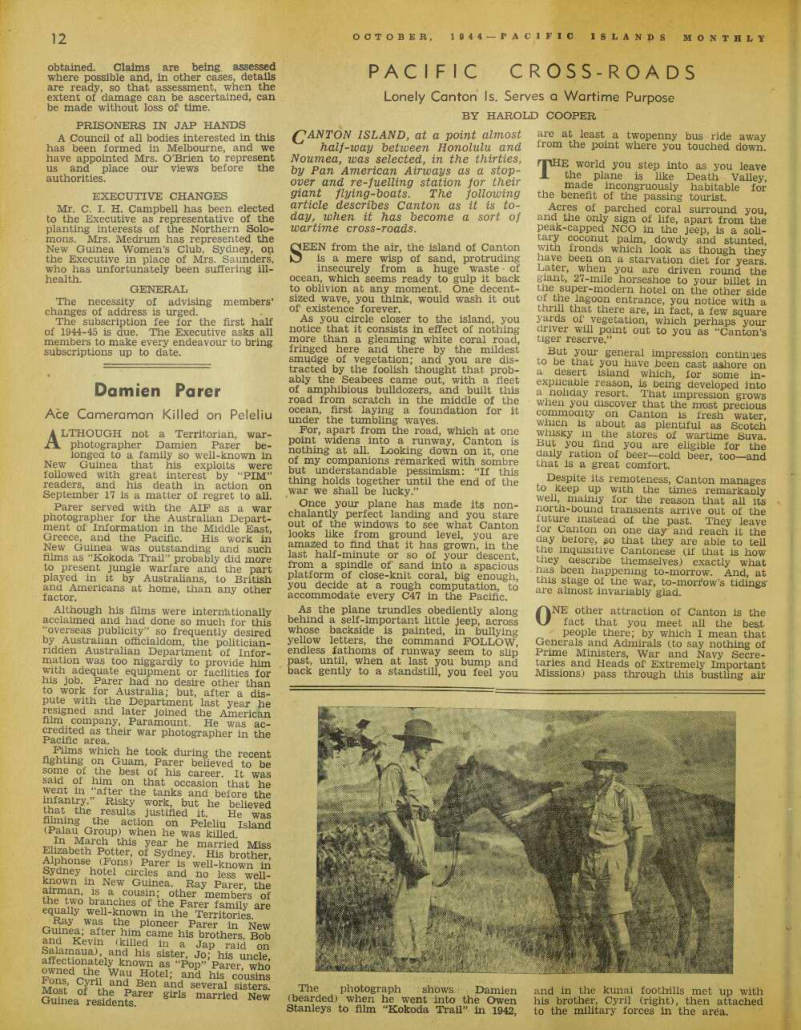
Territories Residents Reject Plan to Seek Relief in London
rE proposal that the European resi dents of Papua and New Guinea should appeal to Great Britain for relief from the indifference and injustices of Australian administration was not accepted by the members of the Pacific Territories Association, who attended a general meeting, in large numbers, in Sydney on September 26.
The motion was carried over from a general meeting in June. A long list of Territories’ grievances, and instances of Australian administrative muddling and misrule, was submitted in June, and it was proposed that the evacuated residents of the Territories should appeal for help both to Great Britain and the United States. The motion was defeated then, so far as it provided for an appeal to Washington; but its further consideration was adjourned until September.
The president (Mr. E. A. James), from the chair, said that a decision had to be taken by the meeting; but the executive was opposed to the motion.
DISCUSSION followed the lines of the previous meeting. Speakers were agreed that their treatment by the Australian Ministers was intolerable; but the majority believed that, if they clung to Australia, the Australian Government sooner or later would undergo a change of heart and would accord them greater consideration. Mr. Tex Thomas ex’pressed that view strongly.
A minority, among whom Mr. R. W.
Robson was prominent, argued that the Territories were entitled to an indepen dent life of their own, separate from Australia; and that they would have little chance of freedom and development so long as they were tied to the professional politicians and indifferent bureaucrats of Canberra.
Mr. C. I. H. Campbell moved that the motion be amended in such a way that it could be presented to the Australian Prime Minister, instead of the British Government, Mr. E. V. O’Brien suggested, as a- further amendment, that the case on behalf of the New Guinea and Papua residents be presented to the Australian Prime Minister in person, by a selected dele gation of the Association’s executive.
Mr. James (speaking personally, and not as chairman), said that every word in the original motion, which set out their long list of grievances, had been justified over and over again. They had been appealing to Ministers personally, and to Canberra generally, for Govern mental action in relation to their con dition, for two years—and they had got just nowhere. Nonetheless, he was opposed to any move which might take the Territories away from Australia—he still believed that it was possible to find justice somewhere.
The amendments submitted by Mr.
Campbell and Mr. O’Brien were formed into one motion, which was carried by a large majority. rE following report was submitted by the executive:
An Elusive Minister
With much regret we report very little in concrete results from our represen tations to the Commonwealth Govern ment during the past three months. We still have been unable to see the Minister for External Territories (Mr. Ward) on matters concerning the Territories. Mr.
Ward does not refuse to see us; but it is
unfortunate that, since February, he has been unable to spare the time for an interview, which interview we have re quested at frequent intervals.
An authoritative statement was pub lished recently about the early resumption of civilian life in Papua. We at once telegraphed Mr. Ward, expressing grati fication at this decision, asking details of the Government’s plans for rehabilitation, and offering our services to assist in solving the many problems inseparable from such an undertaking.
Unfortunately, it appears that the statement was “premature” (to use Mr.
Ward’s own phrase) and when the Gov ernment is likely to end the military administration of the territory appears still to be shrouded in mystery.
While we are cautious in predicting any likely action of Government, we do not believe the military control of the Terri tory can much longer be maintained in the face of accumulating evidence of the desirability of 1 a return to normal condi tions there. Nevertheless, in our opinion, it would be unwise to take any decisive steps in anticipation of an early return, in view of the apparent indecision of the Government. As soon as any authori tative announcement can be obtained on the matter, the Association will take steps to advise members.
Where Is Gold From Wau?
We have, for a very long time, attempted to obtain from the Depart ment of the Army details as to the where abouts of gold which our members were forced to leave at Wau in 1942.
In May, 1944, the Department supplied details of the shipment of these consign ments to Australia—details which have been proved incorrect, and the incorrect ness of which has been advised to them.
We are now informed that the matter is under further investigation.
The whole position regarding the gold is most obscure, but we hope, by con tinual probing, to get results and event ually obtain some redress for the owners.
Produce Prices
After many attempts, spread over a long time, we have at last obtained from the Department of External Territories details of the method of' compiling prices paid to planters for rubber and copra, and these details are now being studied by the planting representatives. A supply of copies of this information is available for interested members.
Production Control Board
Your Executive stressed to the Minister the need for the opening up of further plantations in Papua and New Guinea, under the same terms as those opened up in Papua in 1943, but, so far, without result. The usual reply to our sub missions was received—“the matter is re ceiving consideration.”
Gold Mining
After the return of Mr. Hinks from New Guinea, the Mining Sub-Committee requested the Executive to delay any further action in respect to the proposed maintenance unit for the New Guinea Goldfields, as they were of the opinion that such unit would not be of any prac ticable use at present.
War Damage Commission
We have kept in close touch with the Commission and good results are being
obtained. Claims are being assessed where possible and, in other cases, details are ready, so that assessment, when the extent of damage can be ascertained, can be made without loss of time.
Prisoners In Jap Hands
A Council of all bodies interested in this has been formed in Melbourne, and we have appointed Mrs. O’Brien to represent us and place our views before the authorities.
Executive Changes
Mr. C. I. H. Campbell has been elected to the Executive as representative of the planting interests of the Northern Solo mons. Mrs. Medrum has represented the New Guinea Women’s Club, Sydney, op the Executive in place of Mrs. Saunders, who has unfortunately been suffering ill health.
General
The necessity of advising members’ changes of address is urged.
The subscription fee for the first half of 1944-45 is due. The Executive asks all members to make every endeavour to bring subscriptions up to date.
Damien Parer
Ace Cameraman Killed on Peleliu
ALTHOUGH not a Territorian, war photographer Damien Parer be longed to a family so well-known in New Guinea that his exploits were followed with great interest by “PIM” readers, and his death in action on September 17 is a matter of regret to all.
Parer served with the AIF as a war photographer for the Australian Depart ment of Information in the Middle East, Greece, and the Pacific. His work in New Guinea was outstanding and such films as “Kokoda Trail” probably did more to present jungle warfare and the part played in it by Australians, to British and Americans at home, than any other factor.
Although his films were internationally acclaimed and had done so much for this “overseas publicity” so frequently desired by Australian officialdom, the politician ridden Australian Department of Infor mation was too niggardly to provide him with adequate equipment or facilities for his job. Parer had no desire other than to work for Australia; but, after a dis pute with the Department last year he resigned and later joined the American j-i Com^ H ara mount. He was ac credited as their war photographer in the Pacific area.
Films which he took during the recent fighting on Guam, Parer believed to be some of the best of his career. It was said of him on that occasion that he went in ‘after the tanks and before the infantry. Risky work, but he believed that the results justified it. He was filming the action on Peleliu Island (Palau Group) when he was killed TPi ln J his year he married Miss f ?S tter ; °* Sydney - His brother, Alphonse (Fons) Parer is well-known in Sydney hotel circles and no less well known in New Guinea. Ray Parer, the airman, is a cousin; other members of the two branches of the Parer family are equally well-known in vhe Territories Ray was the pioneer Parer in New ?r^ ne Tr after i hi , I i ri came his br others. Bob and Kevin (killed in a Jap raid on Salamaua), £ind his sister, Jo; his uncle affectionately known as “Pop” Parer who owned the Wau Hotel; and his couSns MnS’ C f ri Jv, ail n Ben and sever al sisters. rnfrL 0f ? arer Sirls married New Guinea residents.
The photograph . shows Damien (bearded) when he went into the Owen Stanleys to film “Kokoda Trail” in 1942,
and in the kunai foothills met up with his brother, Cyril (right), then attached to the military forces in the area.
Pacific Cross-Roads
Lonely Canton Is. Serves a Wartime Purpose
By Harold Cooper
ANTON ISLAND, at a point almost half-way between Honolulu and Noumea, was selected, in the thirties, by Pan American Airways as a stop over and re-fuelling station for their
giant flying-boats. The following
article describes Canton as it is to day, when it has become a sort of wartime cross-roads.
SEEN from the air, the island of Canton is a mere wisp of sand, protruding insecurely from a huge waste • of ocean, which seems ready to gulp it back to oblivion at any moment. One decent sized wave, you think, would wash it out of existence forever.
As you circle closer to the island, you notice that it consists in effect of nothing more than a gleaming white coral road, fringed here and there by the mildest smudge of vegetation; and you are dis tracted by the foolish thought that prob ably the Seabees came out, with a fleet of amphibious bulldozers, and built this road from scratch in the middle of the ocean, first laying a foundation for it under the tumbling waves.
For, apart from the road, which at one point widens into a runway, Canton is nothing at all. Looking down on it, one of my companions remarked with sombre but understandable pessimism: “If this thing holds together until the end of the war we shall be lucky.”
Once your plane has made its non chalantly perfect landing and you stare out of the windows to see what Canton looks like from ground level, you are amazed to find that it has grown, in the last half-minute or so of your descent, from a spindle of sand into a spacious platform of close-knit coral, big enough, you decide at a rough computation, to accommodate every C 47 in the Pacific.
As the plane trundles obediently along behind a self-important little jeep, across whose backside is painted, in bullying yellow letters, the command FOLLOW, endless fathoms of runway seem to slip past, until, when at last you bump and back gently to a standstill, you feel you
are at least a twopenny bus ride away from the point where you touched down. rE world you step into as you leave the plane is like Death Valley, made incongruously habitable for the benefit of the passing tourist.
Acres of parched coral surround you, and the only sign of life, apart from the peak-capped NCO in the jeep, is a soli tary coconut palm, dowdy and stunted, with fronds which look as though they have been on a starvation diet for years.
Later, when you are driven round the giant, 27-mile horseshoe to your billet in the super-modern hotel on the other side lagccn entrance, you notice with a thrill that there are, in fact, a few square yards of' vegetation, which perhaps your driver will point out to you as “Canton’s tiger reserve.”
But your general impression continues to be that you have heen cast ashore on a desert island which, for some in explicable reason, is being developed into a nohday resort. That impression grows when you discover that the most precious commodity on Canton is fresh water, whicn is about as plentiful as Scotch whisky in the stores of wartime Suva.
But you find you are eligible for the daily ration of beer—cold beer, too—and that is a great comfort.
Despite its remoteness, Canton manages to keep up with the times remarkaoly well, mainiy for the reason that all its north-bound transients arrive out of the future instead of the past. They leave for Canton on one day and reach it the day before, so that they are able to tell the inquisitive Cantonese (if that is how they describe themselves) exactly what has been happening to-morrow. And, at this stage of the war, to-morrow’s tidings' are almost invariably glad.
ONE other attraction of Canton is the fact that you meet all the bes ; t people there; by which I mean that Generals and Admirals (to say nothing of Prime Ministers, War and Navy Secre taries and Heads of Extremely Important Missions) pass through this bustling air
junction at the rate of—well, the exact statistics are a military secret, but the boys of the ground staff have become so blase that if the latest distinguished arrival doesn’t wear at least two stars, they probably won’t so much as inquire about his identity.
From all directions and for all manner of purposes and in varying degrees of haste, these Brass Hats come hurrying to Canton. You see them in the mess, gratefully gulping down a cup of ex cellent American coffee, and you wonder vaguely where they will be two days or two weeks or two months from now. In command of an Army Corps in New Guinea? Conferring with Admiral Lord Louis Mountbatten in Ceylon? Dining with Generalissimo Chiang Kai-shek in Chungking?
YOU also fall to ruminating on the undeniably global nature of this war.
Between 1914 and 1918, a General who had paid a personal visit to the Italian front was regarded, on his return to London, as a much-travelled individual.
But in 1944 the Brass Hats girdle the globe, flying through the air with aston ishing ease, and dropping down for the odd conference at all sorts of remote and unexpected places. Walk into the mess any night at Canton, and ask that Major- General over there why he looks so tired.
He will tell you wanly that so many days ago he was in Cairo and that, after the first ten thousand miles, he really begins to fteel the strain.
Canton is little more than a “bouncing point” for these aerial cannonballs, some thing with which they can conveniently collide in order to gather impetus for their next whirl through the heavens.
Imagine a giant standing at the side of a mighty pond and skimming pebbles across it in a game of ducks and drakes. Trans pacific flying is like that. The pebbles are the transport planes and, wherever they momentarily touch the water before ricocheting back into full career, there is a Canton to cushion their fall, replenish their greedy-tanks and send them whizz ing safely on their way.
Education Tax Unpopular
In Samoa?
rwas reported in New Zealand news papers, in September, that the pro posed tax upon the Western Samoans to provide funds for the education of 10 scholars in New Zealand, has not met with the support that had been hoped for by the sponsors, the Fono of Faipule.
Many of the villagers have decided against the proposals, but those respon sible have decided to proceed with the scheme.
New Caledonia’s chief veterinarian, M.
Verges, visited Australia on official busi ness, in September.
Young Chieftainess
Returns Home
From Our Own Corresnondent
Rarotonga, Sept. 12.
RAROTONGA recently welcomed an interesting home-comer—Miss Terito Pa Ariki. hereditary chieftainess of the historic Ngatangiia district, which is the landing-place of the first Polynesian discoverers of these islands.
Terito is the sole survivor of her line.
Both her parents died at an early age, and as a very young child she was adopted by the Makea family. When she was 11 she went to New Zealand as ward of the present Ariki Nui, Mrs. Takau Rio- Love.
She first attended the Public School at Petone and completed her education at Hukarere College, Napier, after which she was employed on the staff'of the Native Land Court.
Two days after her arrival back in Rarotonga the charming young “queen,” as Rarotonga’s two chieftainesses are popularly termed, celebrated her 21st birthday at her home settlement. At her coming-of-age ceremony she was legally returned to her own clan, but she will continue to reside in Avarua at the home of her former guardian.
The Rev. John Bodger, who has been on a lecture tour in Canada, expects soon to return to Dogura, Papua.
Advertisements & other items, pp. 15-16 (1 item)
mimmm
THE
YORKSHIRE
INSURANCE
CO. LTD.
(Incorporated in England)
FIRE
ACCIDENT
MARINE
FIRE POLICIES ISSUED
IN PAPUA
All information from —
E. A, JAMES,
TcL 86347. Attorney for Papua, 14 Spring St., Sydney
BURNS PHILP
(SOUTH SEA) CO. LTD.
Inc. In FIJI Island Traders and Shipowners Registered Office :
SUVA
FIJI
Also Branches at: \Fiji: Levuka, Lautoka, Labasa, Ba, Sigatoka, Rotuma.
Tonga: Nukualofa, Haapai, Vavau.
Samoa: Apia, Pago Pago (American Samoa).
Solomons: Makambo, Gizo, Faisi.
New Hebrides: Vila.
Code Address: Gilberts: Tarawa.
“Bumsouth". Norfolk Is. Niue. Wallis Is. Futuna Is.
u
mimmm
m s tr Sole Australian Concessionaries :
GEORGE BROWN & CO. PTY
267 Clarence Street, Sydney.
LTD.
As the Ultimate factory is engaged in vital war production, the supply of Ultimate Commercial Receivers cannot be maintained at present.
SERVICE: Ultimate owners are assured of continuity of service. Our Laboratory is situated at 267 Clarence Street, Sydney.
Servicing of all kinds of radio sets or amplifiers, as well as Rola Speakers, is also undertaken at our laboratories.
Refreshing
as a plunge
into a lagoon!
pA L
Germicidal
and fragrant
TENAX TOILET SOAP is
a rapid safeguard against external skin infections, yet it is soothing and kind to the most sensitive skin —even a baby’s!
ORDER TENAX FROM
YOUR ISLAND SUP-
PLIERS. STOCKS ARE
PLENTIFULLY AVAIL-
ABLE.
W. H. GROVE & SONS
Limited
AUCKLAND
Island Traders. P.O. Box 49* Telegraphic and Cable Address: “Grove”, Auckland.
Shippers of all classes of New Zealand products. *
Representing English Manufacturers through-
out the Cook and Society Islands, Fiji, Tonga, Samoa, Niue, New Caledonia, New Guinea, etc.
In FIJI as—W. H. Grove & Sens (Fiji) Ltd,
Spice Islands
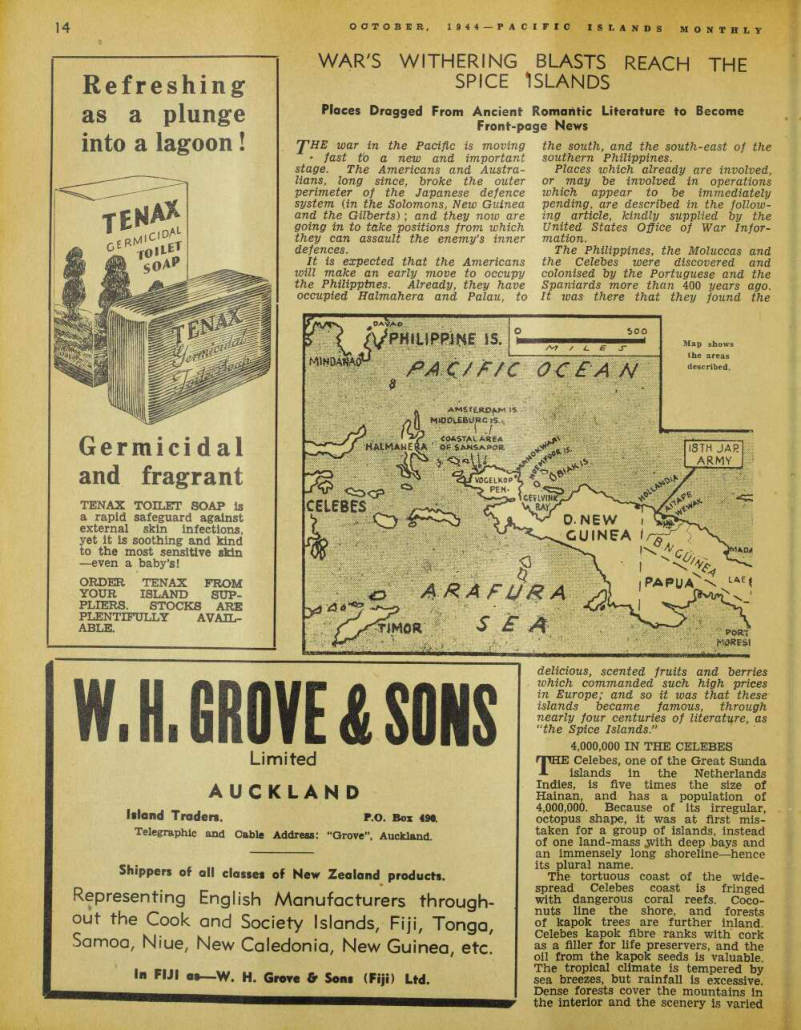
War's Withering Blasts Reach The
Places Dragged From Ancient Romantic Literature to Become Front-page News
'J'HE war in the Pacific is moving • fast to a new and important stage. The Americans and Austra lians, long since, broke the outer perimeter of the Japanese defence system (in the Solomons, New Guinea and the Gilberts ); and they now are going in to take positions from which they can assault the enemy's inner defences.
It is expected that the Americans will make an early move to occupy the Philippines. Already, they have occupied Halmahera and Palau, to
the south, and the south-east of the southern Philippines.
Places which already are involved, or may be involved in operations which appear to be immediately pending, are described in the follow ing article, kindly supplied by the United States Office of War Infor mation.
The Philippines, the Moluccas and the Celebes were discovered and colonised by the Portuguese and the Spaniards more than 400 years ago.
It was there that they found the
delicious, scented fruits and berries which commanded such high prices in Europe; and so it was that these islands became famous, through nearly four centuries of literature, as (( the Spice Islands.”
4,000,000 In The Celebes
rpHE Celebes, one of the Great Sunda -1- islands in the Netherlands Indies, is five times the size of Hainan, and has a population of 4,000,000. Because of its irregular, octopus shape, it was at first mis taken for a group of islands, instead of one land-mass jvith deep bays and an immensely long shoreline—hence its plural name.
The tortuous coast of the wide spread Celebes coast is fringed with dangerous coral reefs. Coco nuts line the shore, and forests of kapok trees are further inland.
Celebes kapok fibre ranks with cork as a filler for life preservers, and the oil from the kapok seeds is valuable.
The tropical climate is tempered by sea breezes, but rainfall is excessive.
Dense forests cover the mountains in the interior and the scenery is varied
Map shows the areas described.
and picturesque. The interior is un inhabited and largely unexplored.
Six tribes dwell along the coasts.
Rice and maize are grown for their own use. Tobacco, coffee and rubber are exported.
The gateway to the little-known island is the port of Makassar, where the western world touches archi pelago life'. The Celebes came into Dutch possession in 1867.
The northernmost arm of the sprawling Celebes is the district of Minahassa, predominantly Christian.
Manado, a fishing village of 22,000 people on the north-east tip, is the chief seaport, and one of the few safe but shallow harbours. This port, within reach of United Nations heavy bombers in New Guinea, is an im portant stepping stone to the southern part of the Philippines.
The harbour at Manado is well pro tected, but will not take deep-draft ocean-going vessels. Its strategic position makes it important.
Unknown Halmahera
HALMAHERA is an island of the Moluccas (East Indies) archi pelago, on the equator, and is separ ated from the Celebes by the Molucca Passage. Meaning “great land,” it covers 6,500 square miles, and has a population of 120,000.
Knowledge of Halmahera i§ very incomplete. Vessels of the Portuguese and Spaniards circumnavigated it in 1525, and those early navigators were better acquainted with Halmahera than with many other parts of the Malay archipelago. The Dutch ob tained a footing in 1660 by a treaty with the Sultan of Tidore, and had parts of the island opened to them.
Halmahera consists of four penin sulas, enclosing three great bays, all opening towards the east. In the mouth of a fourth bay, the Bay of Dodinga, on the western side, are the two small islands of Ternate and Tidore, which are more imnortant politically than the whole of Halma hera itself.
Halmahera has three towns, Gilolo, Patani and Galela. The interior of the island is mountainous and densely wooded, and there are several active volcanoes. Near the great Bay of Weda is a beautiful stalactite grotto, the Grotto of Sagea, likened to the famous Blue Grotto of Capri.
The sago tree provides the most im portant product of Halmahera.
Where The Hemp Comes From
THE 37,000-square-miles island of A Mindanao forms the southern end of the Philippines archipelago, with the ports of Davao and Zam boanga for its chief cities.
Because Mindanao is vast and rich and thinly populated, the Philippines Government aided migration south ward, to relieve the overcrowded settlements on the islands of Luzon and Cebu. The Government planned to re-settle thousands of Filipino families in the fertile valleys of Min years prior to *940, tens of thousands of Japanese settlers were coming in.
Mindanao grows most of the famed
Manila hemp used in making the world’s best rope; and, jealous of this monopoly, the Filipino authorities outlawed the export of hemp seed.
The Japanese first settled about the port of Davao a long time ago, where they formed neat little hemp growing colonies and built a Japanese Consulate at Davao. Good roads traverse the island of Mindanao.
Bomb-Blasted Davao
THE city of Davao, on the south east coast of Mindanao, is the most easterly of the Philippine ports and is less than 550 miles from the Palau Islands, to the east, recently invaded by Americans. It lies directly above the Celebes Sea, a major ship lane to the Netherlands Indies.
Davao is now, almost daily, being blasted by American bombers.
The harbour, protected by neigh bouring Samal Island, will not take deep draft vessels, but there is a pier and an anchorage at Santa Ana, six miles along the coast. Before the war, its airfield was of little conse quence, but the Japanese have made it a patrol point for the waters of the Pacific (to the east), the Celebes Sea (to the south), and the Moro Gulf (to the west).
Davao is of psychological as well as military importance to the Japanese.
The city itself and the province of Davao are the symbol of Japanese penetration in the Philippines, and were considered the most successful Japanese overseas colony. Of the 35,500 persons in the province, 25,000 are Japanese. The population of the city of Davao is about 20,000.
Davao province produces, in addi
tion to hemp, coconuts and lumber.
To the west it is almost unexplored and, until recently, the only method of reaching Davao was by sea. Now there is a good trans-island road to the west, and a passable road to the north-east.
The city itself is surrounded by rolling plantations. To the west, visible from the city, is the extinct volcano, Mount Apo, loftiest peak in the Philippines.
Bonins—Stepping-Stone
To Japan
rpHE Bonin archipelago, stretching A north of the Marianas, and north-east of the Philippines, a stepping-stone to the south-east of Japan, is 560 miles from Yokohama and 310 miles from southern Japan (Honshu). It dominates the south eastern approach to Yokohama, and lies just north of the ship lanes to the China coast. The Japanese con sider the islands part of the mainland of Japan.
Although the Bonin installations have been kept secret, presumably Japan has concentrated naval and air forces at this strategic part of her inner ring of defence.
The group is of volcanic origin, and there are usually several earthquake tremors a day. It consists of 20 islands, ten of which are large enough to have Japanese place and adminis trative names; and about 77 islets.
The fertile land grows pineapples, palms, cedars, boxwood, ironwood, sandalwood and white oaks. Sugar plantations are the chief economic resource. The temperature, summer and winter, is about 75 deg. Fahr.
The archipelago was apparently not known to the Japanese before its discovery in 1543 by Spanish navi gators. later named by the Japanese “Munin,” meaning “empty of men,” of which Bonin is probably a corruption. Early last century, American whalers customarily put in at the Bonin islands for water and fruits. In 1827, a British ship took possession of the archipelago for George IV. Soon after, however, it was colonised by a group consisting of a Dane, an Englishman, an Italian and 25 Hawaiians, headed by an American, Nathaniel Savory.
In 1853, Commodore Matthew Perry raised the flag of the United States over the islands and formulated an American code of Government, under which Savory was elected Chief Magistrate. Perry envisioned the islands as a coaling station for the
American Fleet. They were not held by the US Government, however, and in 1860 Japan dispatched two officials and 40 colonists to the islands, re named them Ogasawara, and estab lished sovereignty.
Japan pledged in 1922 at the Washington. Conference not to fortify the islands, but for many years foreigners have been strictly barred.
The last alien to enter was an Anglican bishop, who, in 1935, visited the islands’ churches.
10,000,000 Tons Of Bauxite
nPHE Palau group, most westerly of A the Caroline Islands, is a collec tion of 26 principal islands, mandated to Japan by the League of Nations in 1919. United States army forces and US Marines established beach-heads there on September 14.
One of the important features of Palau, aside from its strategic loca tion, is the presence of bauxite deposits of 10,000,000 tons.
The Palau group is only three hours by air from Philippines and New Guinea.
There are about 100 islands in the group, which extends about 77 miles in a north-south direction. There is at least one good harbour where the Japanese Fleet could anchor; but the Jap warships have long since fled northwards.
Dr. Baddeley, Bishop of Melanesia, will shortly visit the United States, where he will undertake deputation work on behalf of the Melanesian Mission.
Advertisements & other items, pp. 17-18 (1 item)
Burns Philp Trust
'THAT’
- NS Th.e
RELIEF
FROM A
MAJOR ANXIETY
Even the most expert and conscientious individual executor is subject to accident, illness and incapacitation. Continuity of administration and uninterrupted attention to your estate and your beneficiaries are of paramount importance. Both can be positively assured by appointing this Company your sole Executor or as co-Executor with your present appointee. An interesting explanatory booklet will be forwarded on request.
DIRECTORS :
James Burns Robert John Nosworfhy Lewis Armstrong Joseph Mitchell MANAGER: C. H. Chester
BURNS PHILP TRUST
COMPANY LIMITED
7 BRIDGE STREET, SYDNEY
PHONE: B 7901. Box 543 G.P.0., Sydney.
BP 6-44.
PACIFIC ISLANDS SOCIETY
Visitors from the Islands to Sydney (or those interested in Islands affairs), are advised to communicate with the honorary secretary of the above Society, which has been formed to study the history, traditions, economics, and political developments of the Pacific Islands.
Regular monthly meetings are held at History House, 8 Young Street, Sydney.
Address for Correspondence:
THE PACIFIC ISLANDS SOCIETY,
Box 2434 MM., G.P.0., Sydney.
NELSON and ROBERTSON Pty. Ltd.
Established 1895
Shipowners - Brokers and
Islands Merchants
AN classes merchandise purchased at Best Wholesale Prices. Original Invoices supplied to Island Clients. Cocoa Beans, Copra, Rubber, Trochus Shell and All Islands 7 Produce Sold on Commission.
Entrust your requirements to the firm with fifty years 7 practical experience in the Pacific Islands. ■ UIIVMMWM IV Vill eiK|UiriC9.
NELSON & ROBERTSON Ki
12 SPRING STREET, SYDNEY, AUSTRALIA
Telegraphic Address: IVAN, SYDNEY.
in Fiji

Further Recollections of a Decade in Fiji
By Na Matanivanua.
Part 11.
SUVA always had its complement of hard cases —those whose escapades at various times provided the little tit-bits for “beach” gossip. Looking back, it is interesting to reflect how different sections of the younger community at various times held the stage in this respect. , , . For a period, a crowd of junior Con stabulary officers set the pace, in the days when some of them “bached” in the old Vicarage and earned for their residence the title of the “Liquorage.”
There was also the case of a sub inspector who was called out one night to quell a brawl between two ladies of the town. On arrival at the battlefield he found that the combatants were his ex-girl-friend and his present girl friend. History has it that he quietly faded out and left his posse of constables to make the arrests.
Yet another young man of the Con stabulary staff, in an exalted frame of mind, rode a borrowed bicycle through a football crqwd one Saturday afternoon; and, after cutting some pretty figures, to the delight of the crowd, ran down the Inspector-General of Constabulary.
Time has passed on; some of the hard cases of those days have become staid senior officers, some have solved the great mystery and others have faded from the Fiji scene.
CADETS of the administrative service also had their days of providing gossip for beach and bridge-table.
Some were reputed to swing a wicked hip at “tralalas,” and there was one who kept a wondrous gaudy dressing-gown for wear on such occasions. There was another who could quite successfully drop his administrative dignity and be the life and soul of any wild party. He it was who, when incarcerated in hospital for some minor complaint, cleared out one night with some clothes over his pyjamas and attended a dance in town.
The least of his worries was the fact that it was a full-dress affair.
At another period, the bank boys held sway in the ranks of the ungodly. Prob ably their best effort was one Christmas Day when an Indian dhobie arrived at the hotel where some of them stayed, to deliver laundry. The temptation was too much and, commandeering the dhobie’s van, they drove off, and spent a happy hour or so gaily delivering laundry bundles wherever the spirit moved them, quite irrespective of ownership, while a frantic dhobie screamed blue murder and chased his clients’ clothes all over Snya.
I think it was the same two lads who, during the festive season, decided that as the day was hot, a dip would be all to the good. One of them was happily disporting himself, fully clad, in the horse-trough outside the old Bank of NSW, when his manager drove past.
The bank manager was not amused.
ONE of Suva’s happiest and most democratic institutions was the Suva Yacht Club, formed and kept going by a band of enthusiastic young sea lovers of both sexes. Suva Harbour was at its, prettiest with the Yacht Club’s fleet out in a harbour race. And then there were those very bright yachting week ends at Nukulau Island, when few got any sleep, but a good time was had by all in the manner of yachtsmen the world over.
Mention of the Yacht Club brings to mind one member who owned a largish craft and decided one Christmas to give
a party on board the ship, anchored out in the harbour. It was a bright turnout, but one guest was evidently in something of a quandary as to correct dress for the occasion, so he compromised by arriving in the bathing shorts of the true small boat man, topped with father’s tail coat and a bow tie in deference to the social nature of the function. As late in the evening he took an involuntary dip in the tide, it would be interesting to know what father had to say about a salt water-soaked tail-coat.
SPORT has always played a big part in the life of Fiji, and there were some notable sporting events during the last decade. An Australian ladies’ hockey team visited Suva and showed the local girls a thing or two; and, later, a local ladies’ team went to New Zealand and was virtually massacred by the New Zea land lasses.
New Zealand University cricket and hockey teams also visited, but undoubt edly the most notable sporting event was the visit of the Maori Rugby team. For the first time in their lives, the Fijians were put on the field in boots. Twenty minutes after the game started most of the boots were on the side-lines, and the Kai Viti then showed the Maoris something in speed. In the Test series, Fiji and New Zealand broke even—one game each and one draw. That visit led to the Fijian visit to New Zealand, when the island team put up a record as the only team to tour New Zealand and not
lose a match. They won every match but one, which was drawn* SOMETHING which has disappeared from Fiji for ever, and which no one regrets, is the Rewa pontoon.
Now a fine reinforced concrete bridge spans the fiver from Davuilevu to Nausori, and gone are the days when traffic was hauled across on the lumbering pontoon worked by its puffing billy.
Those were the days when every fresh in the river caused a suspension of the pontoon service, and motor-launch own ers reaped a harvest from profane Nau sori residents who had to get to the other side, and on to Suva.
ONE Suva institution, which no one who lived in Suva will forget, is Jimmy Muir’s yaqona saloon.
There, every morning, the town’s kava drinkers assembled for their morning bowl, and to swap the latest gossip from the Beach. Some there were who had their own private bilos (coconut cups), embellished with a silver nameplate, and there was many a gathering of distin guished, ahd not so distinguished, citi zens in the little back-room behind the bookseller’s shop.
The yaqona habit was one that most residents formed. At one time, there was a bowl of kava in practically every Gov ernment office, and one magistrate, in the middle of listening to some dispute between a couple of Indians as to the ownership of a fowl, or the boring details of how some dusky taxi-driver failed to keep to the left, used to adjourn Court during the morning and retire to the back verandah for a bowl. .
There was a period of prohibition in Government circles, during the reign of a certain Colonial Secretary, who decided that yaqona was a pernicious habit, and banned it from the buildings. There were one or two diehards who kept their bowls hidden away in the strong-room.
Even in the exalted circles of the Legis lative Council there was a bowl on the verandah at adjournment time, when the Colony’s legislators forgot their differ ences and quaffed the refreshing and harmless beverage. . .
Described as the corner-stone of Fijian ceremonial, the preparation and serving of yaqona plays a tremendous part in Fijian affairs. Every new Governor has to quaff a bowl when he is first greeted by the chiefs. Even Royalty is not exempt. The ceremony is an adjunct of the reception of a chief, and no mat ter how unpalatable the newcomer may find yaqona at first taste, he in cour tesy bound to quaff it, and spin the bilo back toward the bowl.
AMID all the foibles, amusing little incidents, functions and institutions of Fiji that crowd to one’s memory in retrospect, there is one memory that can never fade —one of Fiji’s greatest claims to fame —the island of Makogai.
It is a beautiful gem among the islands of the South Pacific, this home of pain and suffering; but also it is the home of happiness and of devoted self-sacrific ing work by one of the world’s most gal lant bands of women, the Sisters of Mary, who tend the lepers of the South Seas in what one distinguished visitor called the finest leper hospital in the world.
Once one has seen them, one can never forget those cheerful-looking patients, their dread disease robbed of many of its terrors by skill and devotion. No longer need the leper resign himself to a living death. Makogai gives new hope —a hope often fulfilled, for if the disease is treated early, the sufferer can look for ward to a return to the world and his or her friends in due time.
To remember Makogai is to remember
that grand lady who had devoted her life to the relief of suffering, the Rev. Mother Mary Agnes. She has been over a quarter of a century on Makogai, and many years before that, on other mission work in Fiji. Years ago she left her loved Brittany, in France, and since then, although never seeking the limelight, she has, by her devotion to her self-imposed task, won world renown, and recognition froni the King of England, who bestowed on her honorary membership of the Order of the British Empire.
Recognition of her work was at the same time recognition of the devoted work of the band of Sisters she has around her to help in the great task. No word of Makogai would be complete without mention also of the man in charge,
Dr. C. J. Austin, and his distinguished predecessor, the late Dr. E. A. Neff. They, too, have played their part in making Makogai the model institution of its kind, piVIL servants in Fiji come and go— V' some are remembered for their work, but more for their idiosyn cracies.
One in the latter category was a cer tain assistant auditor, whose claim to fame was his absent-mindedness. It was quite a frequent occurrence for him to park his car, walk off to an auditing job, finish it and walk off along the street, leaving his car. Later he would recollect that he had parked his car somewhere, look where he thought it was, and then tele phone the police and tell them his car
had been stolen. Of course, it would be found where he left it.
One night he took a young lady to the cinema. He walked out for a smoke at half-time, leaving her in her seat, and absent-mindedly got into his car and drove home. Hours later, he telephoned to inquire if she had got home safely.
An infuriated father’s reply was: “Yes, no thanks to you!” The strange thing about the gentleman was that he was remarkably efficient at his job, IN the days of peace the opening of the Legislative Council used to be quite a gala occasion. There was a guard of honour, the Fiji Defence Force troops and the band, resplendent in scarlet and white, the Governor in full dress and plumed hat, official members of the Coun cil in Colonial Service uniform, complete with decorations; and, generally, a fairly full public gallery to hear the Governor’s
opening address or to see decorations and honours conferred in the last Birthday or New Year fists.
A huge Fijian soldier bore the mace, Cakobau’s old war club, now silver mounted with a crown and the dove of peace, and when he set it down in front of the Governor’s dais, Council was in session. Since the war, the gala uniforms have been packed away, and these days the opening of the session has been shorn of its glory.
Another gala occasion used to be the opening of the Supreme Court criminal sessions, when the Chief Justice, in scar let robes and full bottomed wig, was received by a police guard-of-honour, and a fanfare of trumpets.
In fact, in the old days, it seemed that every opportunity was taken for dressing-up. I have already mentioned the King’s Birthday. Armistice Day was another full-dress affair; and then there were such special occasions as when Sir Arthur Richards laid the foundation stone of the new Government buildings, on Coronation Day, and when Sir Harry Luke declared the buildings open on their completion. rE war ended all these ceremonies.
The troops went into khaki battle dress, and the First Battalion sailed for the Solomons. There was no dress ing-up on that occasion—but the day is one that will i never be forgotten in Suva.
Fiji was prcffid of its young manhood when those troops marched through the town to their troopship—and well was her pride justified. Gone were the cere monial trappings of peacetime parades.
Battle bowlers replaced peacetime head gear and the men carried full battle equipment.
The whole effect was more impressive and meant more to the people who waved farewell than all the dress-up parades of the years of peace. Those men—Euro
peans, Euronesians, Fijians, and Ton gans—looked businesslike, and they meant business. Their record against the Japs has borne out that impression. rERE is much that could be written about Fiji under war conditions, but that is something that will have to wait until after the war. Some funny and exasperating things were done in the Colony, but despite all the mistakes which were made, Fiji will to look back on her contribution to the war, both in men and money, with pride. She has her representatives in the Royal Navy, the Royal Air Force, the R.A.A.F. and R.N.Z.A.F., the New Zealand and Austra lian military forces, the British forces and, of course, the men of the First Bat talion and the guerilla unit fighting with the First in the Pacific.
Fiji’s military honour is in safe keep ing. The Empire’s furthest-flung out post is doing her part in the war for freedom.
On this note I close these recollections, grave and gay. Fiji must occupy an important place in the future of the Pacific, and the events of the last decade have been leading up to that place. The Colony has progressed, and it will con tinue to progress. • There was a Fiji reunion in Mackay, Queensland, last month, when Mr. and Mrs. W. Cowie spent a happy evening with Mr. and Mrs. R. C. Macpherson.
“Bill” Cowie now is connected with the radio side of civil aviation. He was a radio man in Fiji for a while; and was the special representative of the British Government on some of the Line Islands, when those sandy sun-blisters became internationally important, in the ’thirties.
Mrs. Cowie was Miss Phyllis Thomas, of Fiji. Mr. Macpherson was a reporter on the “Fiji Times,” Suva, for several years.
Advertisements & other items, pp. 19-22 (3 items)
The Coleman Lamp & Stove Co. Ltd.
QUEENSLAND
INSURANCE
COMPANY
LIMITED
(Incorporated 1886 in Australia)
ASSETS EXCEED £3,500,000
Head Office:
PITT & BRIDGE STS.,
SYDNEY
Speciolists in South Seos Fire,
Marine & Accident Insurances
Apply to:—
FIJI.
Branch Office: H. J. Moorhouse, Manager.
Burns Phllp (South Sea) Co., Ltd.
VILA.
Burns Phllp (South Sea) Co., Ltd.
Comptoirs Francais Des Nouvelles Hebrides (Marine).
NOUMEA.
L. & W. Johnston.
PAGO PAGO.
Burns Phllp (South Sea) Co., Ltd.
G. H. C. Reid & Co.
OTHER SOUTH SEA ISLANDS.
Burns Phllp (South Sea) Co., Ltd.
Also to any of the Company’s Offices in Australia or Hew Zealand.
f. r r
TORONTO
THE COLEMAN
MODEL 520
Here is the first news on the wonderful new Coleman Model 520 Stove developed for the Army. It will be ready for you right after the war. Requires no priming, burns any kind of gasoline (petrol), is always safe and lights instantly even in sub zero weather. Only inches high, yet boils a pint of water in 4 to 5 minutes.
Folds into compact cylinder cone . . * light and easy to carry.
THE COLEMAN LAMP & STOVE CO. LTD.
TrtDAMm - - CANADA
CO., CHICAGO, ILL., U.S.A*
Modern Refrigeration for the South Sea Islands
The ELECTROLUX
KEROSENE OPERATED
REFRIGERATOR
MARVEL
OF
MODERN
SCIENCE
US
THE
MIRACLE
OF
ICE
FROM
HEAT
ELECTROLUX OFFERS ECONOMICAL, MODERN AND COMPLETELY FFFiriPMT
REFRIGERATION FOR ISLANDS' HOMES EFFICIENT
. . FREEZES CONTINUOUSLY WHILE SMALL LAMP BURNS * Freezing controlled by simply regulating height of flame. TT . S * „ Uses only gallon of kerosene ner week MOTOKLESS . . . NO PARTS TO GET OUT OF ORDER
MODEL
Capacity 2.S cable fact.
MODEL L3BO
® (as illustrated) 9 Capacity 4 cubic feet.
GUARANTEED FOR TWO YEARS.
Write to your Local Distributor for prices and full details.
MODEL LKSSO
Capacity 6.5 cubic feet.
OBTAINABLE FROM ALL W. R. CARPENTER & CO. LTD.
BRANCHES THROUGHOUT THE ISLANDS
Representation in Papua and New Hebrides.
VICTORIA
BITTER
BREWED BT
CARLTON & UNITED BREWERIES LTD.
V.l
“Toujours les mailleures”
"FLAVOREX "
Real French Mustard and
"TOBASCO"
• Sauce Both are Delicious and
APPETISING.
Enhance the Value of Good Meals, Soups, Cocktails, etc.
On Sale in the Islands.
O. F. MASSCHELEIN,
Sydney
Export Distributor.
fWfrvi 5b m
90 YEARS
3
S WALLOWs ABIE LLim
-3 ■■■os ir iisoiis . csio • mud . ICE (no
19
PACIFIC ISLANDS MONTHLT— O O T O B E R , 1944
20
OCTOBER, 1944 P ACIPIC ISLANDS MONTHLY
McArthur and Handley
An Appreciation by an Old Supercargo
IWAS deeply moved by the picture on the cover of September “PlM”—for the memorial shown thereon records the names of two of my very old friends, McArthur and Handley.
It was in January. 1903, that I first met Alex. McArthur, a young Greenock man, trading on the island of Nonouti, in the Gilbert Islands. “Mac,” as we called him, was a very popular trader.
Captain Isaac Handley first came to the Gilberts as second mate of the Bums Philp vessel “Ysabel,” in 1906, on his way to the Marshall Islands. Burtis Philp & Co. at this time were making their re entry into the Group after having been put out by the Germans some years pre viously. This German ejection was an infringement of an Anglo-German agree ment of the late 80’s, but BP were even tually compensated and allowed to return.
I was a shipmate of dear old Handlev in the “Ysabel,” the schooner “Louise J.
Kenny” and the s.s. “Muniara.”
Captain Handley was a lovable soul and a wonderful sailor. It was he who, as master of the schooner “Louise J.
Kenny,” took aboard, at Abemama, in January, 1908. the .two pirates Mortle manns and Skerret. Mortlemanns had murdered the captain and mate of the Chilian schooner “Nuevo Tigre” whilst it was on a voyage from Callao, South America; he then changed her name to “White Rose” and sailed west, eventually piling her up on the weather reef of Abemama.
It was only by chance that Skerrett, (who was in Mortlehianns’ power) finding that Captain Handlev came from the same county as he did (Westmoreland), saved Captain Handley’s life. Skerrett stated that Mortlemanns had murdered, his two former shipmates and that he wished Skerrett to join him in seizing the “Louise J. Kenny.” Captain Handley promptly arrested Mortlemanns and, on arrival at Betio, Tarawa, handed thei pair over to the Resident Commissioner. Mr.
W. Telfer Campbell, and Mr. George Murdoch, District Officer.
CAPTAIN HANDLEY probably knew more of the Gilbert and Marshall Islands than any other man. When Burns Philo & Co. had to leave the Mar shalls for the second time it was through the Japanese who. while professing friendship for Britain, yet intimidated the Marshall Island natives who sold copra to Captain Handley’s vessel. If caught trading, the natives were punished bv the Jans by having their thumbs tied above their heads to coconut trees. This eventually had the desired effect, and European ships found it impossible to trade in the Group.
Captain Handley was very well liked by the natives of the Marshalls, from whom he obtained valuable information about Japanese fortification of those islands.
This information Captain Handley no doubt passed on to the right quarters.
He was a loyal Englishman, fearless, and a true friend.
An old identity of Apia, Mr. Herman Krueger, died on August 29, at Apia Hos pital, aged 75. Mr. Krueger came to Samoa for the old DH & PG (the “long handle” firm) in 1897 and for many years was branch manager for the firm at Aleipata. In recent years he had been in the employ of the New Zealand Repa ration Estates.
The Cousin Of Karu
An Islands Love Song TV/fY love’s at Pirapira-wai, that lies along the hills, And ever by her leafy hut a wood-dove coos and trills.
Ah! Swift wood-dove; ah! shy wood dove, tribe totem of the maid I love, Coo to her low and softly warn, with ten der note at break of dawn, That Karu fain would woo her.
The creek at Pirapira-wai winds down to
betal’d plain;
Its lazy waters, singing on, to fern-clad shores complain: “Our passing waters now have missed the drinking lips we might have kissed.
When singing reeds warned she was near we should have loitered, cool and clear, Her smile we then had mirrored.”
Alice Allen Innes.
Anniversary of the Raising of the Union Jack
Union Jack
From Our Own Correspondent APIA, Sept. 4.
THE thirtieth anniversary of the raising of the Union Jack over Western Samoa was celebrated on August 29 by the usual function at Apia Court House. The Administrator, Mr. A. C.
Turnbull, addressed a representative gathering of Europeans and Samoan Chiefs, while the Hon. Tualau, MLC, spoke for the Samoans. Pupils of Apia schools and the Samoan Local Defence Force paraded at the Court House.
In the afternoon, the Apia Turf Club held a successful race meeting at Apia Sports Park, the proceeds of which were devoted to the Returned Servicemen’s Rehabilitation Fund.
Advertisements & other items, p. 23 (1 item)
Foster Clark's
NOT-SO-SIMPLE SIMON
& (zrN. •■am'ii ~i «g Simple Simon il now- exalte wide It/hen it camel to cudta'id with kid pied,. //a pie will eoe/L maize ill monk Save with cuAta'id Inf, tf-adleo Qladk Just an old nursery rhyme we’ve twisted to tell a housekeeping fact. Foster Clark’s Creamy Custard helps overcome shortages of eggs, milk and butter. Look through Foster Clark’s Creamy Custard Recipe Book and see the wonderful variety of sweets you can serve with such ease.
Write for your copy now to Foster Clark (Aust.) Ltd., Dept. R. 8., Redfern, N.S.W., enclosing eld. postage.
Qjstabd
DER
**ILLJK
Jr*
FOSTER CLARK'S
Tahiti Celebrates
Liberation of France
From Our Own Correspondent
Papeete, Sept. 2. •
THERE was great joy here when Gov ernor Georges Orselli, at the end of August, announced that France had been freed from German occupation.
It was decided that September 2, 1944 —the fourth anniversary of the occasion when French Oceania rallied to the cause of Fighting France —should be a fitting
day on which to celebrate the liberation of the Motherland; and on that day, with religious services of thanksgiving in the churches, and a review of troops by the Governor, celebrations were held accordingly.
APIA. Sept. 4.—The Administration of W. Samoa has announced an increase in the price paid for bananas shipped to New Zealand, from 5/6 to 6/- per case, to producers. “ Plantations have recently suffered from a long dry spell, but dur ing the past week heavy rains have set in and prospects for banana planters now seem brighter. There is still a short age of native foodstuffs, particularly taros and bananas. \
Trading Company's
Hamstrung !
Trading Company's Papuan Troubles
HAVING carried on planting, but no trading, under extreme difficulties, in Papua, for 12 months, the report of Steamships Trading Co., Ltd., of Papua, for the year ended July 31, is unusually interesting. The company’s total sub scribed capital is £143,633; and the net profit for the year was £7,34o—allowing 7% dividend on prefs., and 2\% on ordinaries.
In their report, the directors give the following summary of their difficulties; “The company’s main store is occupied by the Production Control Board, who run a business there similar in nature to the company’s, prior to the Military tak ing over. Other stores of the company are similarly occupied, selling to natives at considerable profit. The company’s slip is occupied by the Navy, and does considerable work. The company’s wharf is used by the military, also all the com pany’s merchandise bulk store buildings and three produce stores are being used to full capacity. Associated companies owning mills, etc., are occupied by the Army. No rents or other monies have been paid, or liability admitted in con nection with same.
“During the past six months, two plan tations, owned by the company at the Eastern end, have been worked by the Army and produce taken off them; but no account of same has been given although they have been requested to do so.
“Small vessels, formerly owned by the company, are the principal means of communication with plantations. The control of such vessels' by the Army tehds to make management of plantations difficult.
“Prices of stores and foodstuffs have increased, in many cases, over 100%, which has mitigated against the higher market value of produce.
“Natives for work on plantations are now the monopoly of the Military Ad ministration, and the costs of supplying same are greatly in excess of previous costs, when the company secured its own volunteer labour; also the quality was much better.”
The miserable prices paid by the mili tary government to planters, and the difficulties of carrying on any kind of private or civilian enterprise in Papua, under present conditions, are described in another article in this issue.
Tongan Scholarship
Self-help System of New Society
ABOUT 30 Tongans recently have formed a society called “Kautaha Fetokoni’aki,” the object of which is to send selected Tongans abroad for education along special lines; so that, when these young men return, they may assist Tonga generally in advancement.
Maka Lisiate, in a letter to the editor, says that each member pays in 20/- per month. A sum of £l2O was raised in four months; but a considerably larger sum is aimed at. The society hopes to receive the help of the Tongan Govern ment.
Mr. J. E. Savage, who spent over 21 years in New Guinea, latterly as Super intendent of Stores for the Administra tion, has retired from the New Guinea Service, and will not return to the Ter ritory.
Advertisements & other items, p. 24 (1 item)
Marys
G I L L E S PI E’S The Flour
TRADE
MARK
of the Islands
- SYD NEY -
AUNT
MARYS
BAKING POWDER
SUPPLIES ARE NOW AVAILABLE. If your local supplier is out of stock he will readily obtain Aunt'Mary's Baking Powder for you. After all, quality is worth waiting for, especially when it is Aunt Mary's Baking Powder, which maintains the high quality which has stood the test for over 70 years.
'Flu In Tahiti
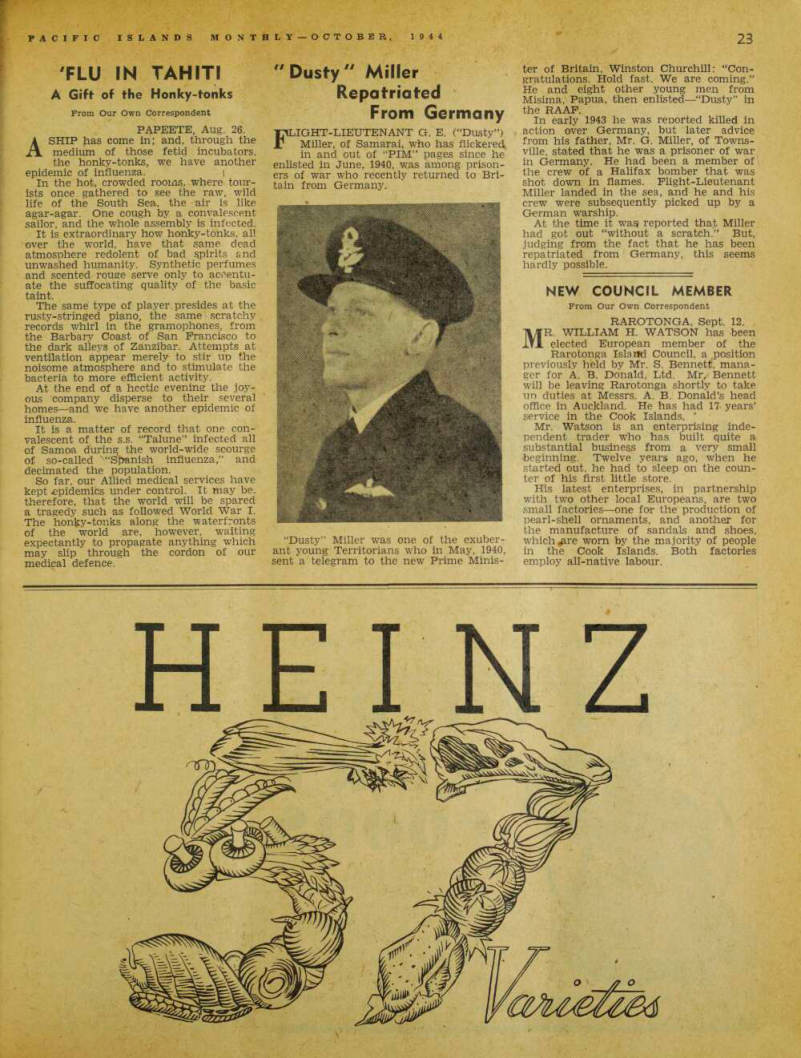
A Gift of the Honky-tonks
From Our Own Correspondent
Papeete, Aug. 26.
A SHIP has come in; and, through the medium of those fetid incubators, the honky-tonks, we have another epidemic of influenza. I In the hot, crowded rooms, where tour ists once gathered to see the raw, wild life of the South Sea, the air is like agar-agar. One cough by a convalescent sailor, and the whole assembly is infected.
It is extraordinary how honky-tonks, all over the world, have that same dead atmosphere redolent of bad spirits and unwashed humanity. Synthetic perfumes and scented rouge serve only to accentu ate the suffocating quality of the basic taint.
The same type of player presides at the rusty-stringed piano, the same scratchy records whirl in the gramophones, from the Barbary Coast of San Francisco to the dark alleys of Zanzibar. Attempts at ventilation appear merely to stir up the noisome atmosphere and to stimulate the bacteria to more efficient activity.
At the end of a hectic evening the joy ous company disperse to their several homes —and we have another epidemic of influenza.
It is a matter of record that one con valescent of the s.s. “Talune” infected all of Samoa during the world-wide scourge of so-called “Spanish influenza,” and decimated the population.
So far, our Allied medical services have kept .epidemics under control. It may be. therefore, that the world will be spared a tragedy such as followed World War I.
The honky-tonks along the waterfronts of the world are, however, waiting expectantly to propagate anything which may slip through the cordon of our medical defence.
From Germany
"Dusty" Miller Repatriated From Germany
Right-Lieutenant G. E. (“Dusty”)
Miller, of Samarai, who has flickered in and out of “PIM” pages since he enlisted in June, 1940, was among prison ers of war who recently returned to Bri tain from Germany.
“Dusty” Miller was one of the exuber ant young Territorians who in May, 1940, sent a telegram to the new Prime Minis
ter of Britain, Winston Churchill: “Con gratulations. Hold fast. We are coming.”
He and eight other young men from Misima, Papua, then enlisted—“ Dusty” in the RAAF.
In early 1943 he was reported killed in action over Germany, but later advice from his father, Mr. G. Miller, of Towns ville, stated that he was a prisoner of war in Germany. He had been a member of the crew of a Halifax bomber that was shot down in flames. Flight-Lieutenant Miller landed in the sea, and he and his crew were subsequently picked up by a German warship.
At the time it was reported that Miller had got out “without a scratch.” But, judging from the fact that he has been repatriated from Germany, this seems hardly possible.
New Council Member
From Our Own Correspondent
Rarotonga, Sept. 12.
MR. WILLIAM H. WATSON has been elected European member of the Rarotonga Island Council, a position previously held by Mr. S. Bennett, mana ger for A. B. Donald. Ltd. Mr. Bennett will be leaving Rarotonga shortly to take un duties at Messrs. A. B. Donald’s head office in Auckland. He has had IT years’ service in the Cook Islands. ' Mr. Watson is an enterprising inde pendent trader who has built quite a substantial business from a very small beginning. Twelve years ago, when he started out. he had to sleep on the coun ter of his first little store.
His latest enterprises, in partnership with two other local Europeans, are two small factories—one for the production of pearl-shell ornaments, and another for the manufacture of sandals and shoes, which worn by the majority of people in the Cook Islands. Both factories employ all-native labour.
Advertisements & other items, p. 25 (1 item)
*7
No ¥. %
Malua Centenary
History of Samoan Mission Training
From Our Own Correspondent APIA, Sept. 4. rE following year will be a year of anniversaries for Samoa: The Lon don Missionary Society has just cele brated the Centenary of the foundation of Malua Theological College (opened September 24, 1844); Sunday, December 3, will be the 50th anniversary of the death of Robert Louis Stevenson, at Vailima; and September, 1945, will mark the 100th year since the first Roman Catholic mis sionaries came to the Group.
The Malua centenary celebrations took place at Malua on August 8 and 9, in the presence of the Administrator, Mr. A.
C. Turnbull, representative Europeans and between eight and ten thousand
Samoans from both Western and Eastern Samoa. Owing to war travel restrictions, no representatives from the English mother institution or from other Pacific Islands were able to attend.
The programme consisted of religious services, addresses by European and Samoan missionaries, the staging of an historical tableau by the students, show ing the arrival of -the Rev. John Williams in Samoa, and the opening of a large Memorial Hall by the Administrator. The Memorial Hall, a large building in the Samoan style, with cement -posts and foundations, has been erected by the students of the College.
A special centenary gift of £4,000 was donated by the gathering during the cele brations. A special feature of the func tion was the sports events, including “fautasi” races and cricket.
The Rev. E. J. Edwards, the present principal of Malua, has written a concise
history of the institution during the past 100 years.
The College, the only institute of its kind in the South Sea Islands, has played an outstanding pan in the missionary history of the Pacific and its students (chiefly native Samoans, but some natives of other island groups) have spread the gospel and introduced Christianity to the islands of Niue, the Tokelaus, Ellice, Gil berts, New Hebrides and aided materially in the evangelisation of Papua, New Guinea and the Solomons, where many of them are still actively engaged.
Just as important has been the part students of Malua have played during the past hundred years as leaders of the religious, social and political life of the Samoan people themselves.
“TT was decided in March, 1844,” writes X the Rev. E. J. Edwards, “to com mence an educational institution for the training of native pastors, and the Rev. Charles Hardie and the Rev. George Turner, LL.D., were appointed to take charge of the work.
“The presence of Dr. Turner in Samoa at this time was a stroke of the greatest good fortune. In the year 1842, Mr. (later Dr.) Turner and Mr. Nisbet had been appointed to Tanna, in the New Heb rides. The prospects for evangelisation seemed bright, but in six short months the island tribes, led by their heathen priests, had leagued against the mission aries who were certain to be massacred if they did not immediately flee the island. This they attempted to do in an open boat and without provisions. With no time to waste, they hurried down to the beach at dead of night only to. find that a strong wind had set into the bay with a turbulent head-sea making escape impossible. There was nothing tp be done then but to prepare for the doom which seemed inevitable.
“Day dawned after a night of prayer, and there, to their astonishment and relief, they beheld a ship. It was the ‘Highlander’ on its way to Samoa, where they were landed in February, 1843.
“When in search of a site to erect the seminary, the chiefs and people in various places were so anxious that their district should be chosen that they offered, free of charge, as much land as might be needed. But the missionaries finally settled upon Malua, at that time ‘quite a bush.’ as Dr. Turner describes it, ‘and away from any settlement.’ The Samoans themselves were apt to give the place a wide berth, regarding it as spirit infested. However, the fishing was known to be good at this spot and a number of natural springs promised a constant supply of fresh water.
“The work was begun at once. The missionaries removed from their stations; some 25 acres of land were bought, and by September 24 the first class was opened. Dr. Turner tells how this class numbered 25 in all, with ages ranging from 10 to 20 years. The Samoans arranged themselves into three grades according to age and ability. First there were those who ‘can rear families and make taofolo (a breadfruit preparation)’ and these were the more numerous. The second grade were those who ‘can climb coconut palms and do secondary cooking,’ and finally, there were ‘the boys who can not make fire (this by the primitive pro cess of rubbing a pointed stick on a dry log),’ implying that they could only help with the lighter work.
“From the beginning it was felt that more could be done by the institution than the training of native pastors, and under Mr. J. B. Stair, who was respon sible for the printing work of the Society, a class was formed with the object of doing something for the brighter boys, and at the same time rais
ing the standard of village life and encouraging a type of Samoan youth who might take a lead in the social and commercial development of the land. They a°h ar e d a e rTy agf SS the institution at an eany age, oring g £ St|T g anTuifng to wlth e the “our students began to go, out at “£ s a y a u r r S „er oUr ‘fhe of demand Siversai for young men from the institution.’ There were always plenty of candidates for admission, but the selection was careful, and at the close of 15 years, 263 boys had been sent by missionaries from various parts of the Group to be trained at Malua.
“Marriage was no bar to admittance.
Indeed, if a choice had to be made between a married and single man, the married couple would be admitted, for the simple reason that the wife needed education as well as the husband. ‘We want a young man who has a wife who can teach our wives and daughters something ’ was the way in which the request was sometimes made when applying for a village pastor. Children were always accepted along with their parents and a day school was begun for them which was continued to the present day.
“T\R TURNER once said that the insti- I) tide was founded in order that 17 ! rv vnfa elto lamS should have
pef a ?nd
P±c n mlgSfre S
i tvipluq nrvt'nnlv to Samoa but also of the islands of Seas, it is possible to feel that this hope has, in large mea-
sure, been realised, and the story of the institution is one that might well glad den the hearts of those who saw the need for just such a seminary one hundred years ago,”
Advertisements & other items, p. 26 (1 item)
A. B. Donald Ltd.
AUCKLAND
ISLAND TRADERS & GENERAL MERCHANTS
P.O. Box 1509. Cobles Gr Telegrams, '"Kingdom", Auckland.
CHIV E B S
PURE
FOODS
GOLD MEDAL JAMS
CANNED ENGLISH FRUITS
CANNED ENGLISH
VEGETABLES
CUSTARD POWDER
OLD ENGLISH MARMALADE
JELLY CRYSTALS, ETC.
Obtainable from all Leading Grocery Stores.
Write to Department A., E. 76.
Chivers and Sons, Ltd., Histon, Cambridge, England, for attractive Recipe Book.
driving 6 bltt swee?-poteto
Food Situationi Is Acute
In Mangaia
Fr ° m °" ° wn ° orresP ° n<ient
. Mangaia, Aug.
mHE independent little island of Man- J. gaia, in the Lower Cooks, is slowly recovering from the disastrous hur ricane that destroyed most of its crops i n January. Our people rebuilt their homes, and re-planted their gardens, without State aid, but official generosity would not be denied an opportunity of well-doing. Nearly six months after the ruinous visitation, each household re ceived, as a slight consolation, one tin of boiled beef—“free of all gratis,” as the Jewish gentleman said.
However, in spite of this munificence, the food situation is still acute, one meal a day being our present “ration”; and unprecedented cold weather and heavy ra in has made Mangaia-life a grim busi ness, for money is nil.
The “pupu”-market has collapsed, owing to the application of export licences to the shell-bead trade with the USA. And that means no more funds for groceries!
Mangaians are spartans, and stoics:
driving 6 bltt swee?-poteto
S b«Sn 'among
directly due to the straitened times, which are particularly hard for the aged and the sick.
Papeete's Successful Fair
From Our Own Correspondent
Papeete, July 26.
BETWEEN showers of rain, we suc ceeded in getting to the Fair-Expo sition, recently held in Papeete, and we were amply repaid. It is heartening to discover that the old handicrafts of our Polynesian people have not been dis carded: the intricate basket-work woven of the stout ’ie’ie (the fine roots of Frey cinetia Victoriperrea); tapa cloth, stained with designs, after the ancient manner; fine mats interwoven with colours in traditional patterns; wood-carvings inlaid with pearl-shell: the model of a canoe paddle—its entire surface carved and inlaid with mother-of-pearl by a young soldier from the Marquessas Islands. All these were visible evidence that the extra ordinary beauty of Marquessas art has not perished.
I wish I could describe each exhibit; for all are worthy of praise. One cannot, however, omit from special mention, the exhibits of the several schools. They were admirable. Nor may one neglect to praise the skill and fine workmanship that was evident in the display of machine parts fashioned by our island artisans Notwithstanding the wretched weather, the festival was a happy occasion. Sing ing contests, and healthy outdoor sports were carried on between showers, and there was'so much of interest to look at whenever one had to get under cover.
The increasing interest in out-of-door sports is one of the most promising assurances of the health and happiness of our young people. Military training has instilled in the minds of our young men the value of discipline and sports manship which will serve them well as they grow older.
Advertisements & other items, pp. 27-28 (2 items)
25
PACIFIC ISLANDS MONTHLY- O C T O B E R , 194 4.
Gibson’S
TRY IT ... . YOU'LL LIKE IT!
GREEN LABEL
TEA
Blended and packed by J. A. D. GIBSON & CO. LTD. 364 KENT STREET, SYDNEY. 'Phone: M 2328.
Also GIBSON'S GREEN LABEL COFFEE and COFFEE ESSENCE
7 ■JL VS m Cl 'k % a
Submarine on the starboard quarter
• • In his book "Heroes of Fighting R.A.F.”, Leonard Gribble tells a thrilling story of the rescue of thirty-four of a ship’s crew by flying boats of the British Coastal Command.
The freighter "Kensington Court”, deep
laden with wheat, was ploughing through heavy seas towards the British coast.
Suddenly the cry: "Submarine on the starboard quarter”.
The Kensington Court”, unarmed, ran for it. And out went an S.O.S.
Overhauling the freighter, the U-boat began shelling at short range. The "Kensington Court” was doomed. As the crew was taking to the boats, two flying boats roared out of the clouds. The U-boat crash-dived.
Within minutes of the sending of the S.O.S. the rescue of the "Kensington Court’s” crew was being staged in a fresh sea. The sailors in an inflated rubber boat were hauled from their lifeboats to the
tossing ’planes.
Another chapter in the history of the part radio plays in this war. * * * Aeroplanes, ships, guns and radio. Australian industry to-day is producing everything for hey own defence. But radio makes them into one powerful striking force. We owe jnuch to the Australian resourcefulness and courage which made possible the building of all such equip merit in Australia.
Whilst Australian enterprise is free to build and plan we need never fear being cut off from our sources of supply.—Amalgamated Wireless (A/asia) Ltd.
For New Settlers In Papua
The Possibilities of Individual Districts
Part Ii
SECOND OF TWO ARTICLES FOR “PIM” BY AN OLD RESIDENT—PXYZ
IT would appear almost contradictory to the advice already given about land selection to give details of areas in Papua where first-class land is still obtainable—my aim has been to urge new settlers to go where other men have succeeded with the crop of their choice, rather than choose land for themselves.
Still, the following list of likely situations for successful planting are a guide to some of the Papuan lands. Many of these areas are still so isolated and so untested that it would be wiser for soldier settlers to leave them alone; but all have attractions for the inquiring pioneer and eventually they must all come into their own.
Aramia River, Western Division
mHIS fascinating region lies in the Fly River delta, but is rich and fertile compared to that useless Colossus of Papuan Rivers. Its low-lying terrain is arranged in two levels. In the bottoms are vast swampy areas of very rich soil, the swamps gradually merging into a string of blue lakes, the home of water lilies and thousands of birds whose food Nature provides on the spot. Two water loving commercial products, rice and tiax, have great future possibilities here. Both abound and at once suggest development.
Thus, there appears to be hundreds of square miles of untouched gram and fabric plants, waiting only for soni e agri cultural genius who can put them to Pr The C rest S of the area rises into sinuous plateaux of a few hundred feet altitude between the lakes, and of so rich a soil that it saddens one to see it uncultivated, except for native gardens. On these ridges, every sort of tropical tree flourishes to perfection; coconuts, kapok, bread fruit, bananas, mangoes. The whole re gion is wonderfully attractive; the rice beds and the luxuriant foliage remind one of the lowlands of Java, except that there is not a hill of any size within hundreds of miles. , , - OT% Access is bad—the only means of ap proach is by launch up the Aramia River, a tributary of the dreary mud-banked Bamu River, and a man must think twice before staking his future in so isolated a spot. Still, in my opinion, this is one of the regions of Papua that will astonish the planters of the future and do much to remove the reproach that Papua is not a very fertile land.
Mountain Regions Of The
Mekeo Hinterland
THESE heights, the most attractive hill country in Papua, have been for many years opened up by a chain of mission stations, organised by the Sacred Heart Mission, at Yule Island, the port of the district. A mule track, which could, without much difficulty, be converted into a Jeep road, winds up the slopes to a climate where all sorts of temperate fruits, vegetables, and flowers grow luxuriantly. . . .
Here is the picked spot for the market gardener, who aims at supplying the future metropolis of Papua. • The time for this has not yet come—roads, plane service, and a keener market on the coast being essential factors for success. These uplands grow enormous cauliflowers and cabbages; apples, peaches, plums, and quinces have borne fruit; strawberries and passionfruit grow wild; potatoes and
onions, far superior to the muddy-skinned specimens in Moresby stores, are easily cultivated; and the home garden can be made gay with roses, carnations, and dahlias.
It is a wonderful district, comparable to the central plateaux of New Guinea, which have already earned the name of the Kenya of • the South. It will some day, no doubt, be the leading hill resort for jaded Anglo-Papuans.
Hisin
mHIS is the premier copra district of J. Papua, lying some forty miles west of Moresby. Much of the good land has probably been taken up. Soil and climate favour the growth of the coco nut; a desiccated coconut mill has been established there for many years, and the planters who supply it have been “on velvet” during the period of low-price copra. Rubber is grown on the slopes further back, but not with the success of the Sogeri or Yodda areas. Access is. by sea only, but good harbours are absent.
Social life and amenities are abundantly provided for.
Sogeri Plateau
RISING to a height of 1,500 to 2,000 feet behind the arid hinterland of Moresby, these cool .uplands are a proved rubber area, and are probably the best developed in Papua. Coffee, dairy ing, tobacco-growing, and tropical fruit and vegetable-growing have already been successful. Excellent motor roads now connect the plateau with Moresby and should open the way for small mixed farms for settlers with limited capital.
Good rubber‘land is probably still obtain able, though some of the area has already been alienated. It is a district that every
intending settler must vfsit, and if his acquaintance with the Territory has been limited to a day or so in Moresby he will gain a new conception of Papua as an agricultural country.
The district has one great disadvantage —a shortage of local labour, and the new settler will probably find himself faced with an enormous bill for recruiting boys from more distant areas. Against this must be placed the ease and cheapness of transport to the district —a matter of supreme importance in Papua,
South Coast Districts
PASSING east from Moresby to the tip of Papua, near Samarai, lies a re gion that presents few outstanding
(Continued on Page 33)
attractions for the settler, though many successful coconut and rubber plantations exist at intervals along the coast. More or less regular steamer services run along the coast, and the way is open for hun dreds of settlers to select suitable sites for their enterprise, although it is neither a distinctive nor a particularly fertile part of Papua. gAGARAI y AL IeY TOWARDS the east end of Papua, the central mountain ranges become lower as they approach the coast. A huge shallow gulf, Mullens Harbour, bites deep into the hinterland, and at its upper end where the rivers come tumbling in, the valley of the Sagarai has already proved itself a first-class rubber district.
Plenty of land and labour is obtainable here, the soil seems fertile, and transport, by launch or short Jeep roads, is passably This seems to me to be the pick of the south coast districts for rubber; sites for coconut plantations can also be found, and it appears a suitable spot for pre liminary trials in cocoa-growing. Access to Milne Bay, destined probably to be the main port for Eastern Papua, is not yet provided, but it does not seem likely that the rich areas of the Sagarai Valley will long be denied communication across the low intervening ranges.
Milne Bay
rIS is a copra area par excellence and possesses a desiccated coconut mill and several large, flourishing plan tations. At first glance, the . district appears to be well developed and now has a network of good motor roads; but most of these will probably become no more than relics of army occupation. (Dn closer observation, one sees that practically all the development took place 30 or more years ago. 'there are no new plantations round Milne Bay. Possibly most of the land is locked up—a matter for future administrations to remedy—but that need not worry the intending settler as he can do much better elsewhere.
Islands To The East Of Samarai
IN general terms, new settlers are advised to steer clear of thb larger islands as the v are rockv and offpr little inducement to planters. ' Smaller coral islands of which there are scores to select from, form excellent sites for conra, ventures, but it would he a brave and somewhat foolhardv man who cared to risk all his capital in such a boneless looking industrv as this has now become.
These coral islands are good for noth ing else but coconuts, and their isolation and lack of organised transport do not make up for their superficial charm.
None of them would make the right sort of home nor produce the usual profusion of fruits and native foods that the Papuan planter expects on his own estate. One might well sav “the mainland for business and the islands for romance” —and even then the latter quality might be more easilv found in the pages ©f our South Sea Island writers than in the isles themselves.
D’Entrecasteaux Archipelago
fTIHE volcanic soil here seems fairly J. fertile, but no venture other than coconuts is likely to succeed. The somewhat open hinterlands on the north side of Goodenough Island, the highest island for its circumference in the world (the centre of this speck of land is higher than any point on the whole continent of Australia), suggest possibilities for rice and cotton-growing, but, again, the chances of success for white growers seem poor. This is an area where one can imagine small peasant holdings pre
dominating, each with a clear mountain stream suitable for irrigation, running from the hills.
Further out, the Trobrian Group offers nothing whatever to intending planters.
Native agriculture here is said to have reached its highest standard, and the land should be left entirely to the natives.
North-East Coast
rjIHIS district also is one that might 1 well be passed by. It suffers from droughts, the foreshores are gener ally swampy, and the ranges, in places, approach the coast so closely that they leave little room for planting projects.
Certain lands (the head of Collingwood Bay, for instance), appear to be suited for cotton or sugarcane, but a particularly favourable area is in the possession of a firm who so far have made no effort to develop it. , Cape Nelson is actively volcanic and unsuited for planting. Going north, how ever, at the head of Dyke Ackland Bay, one finds an extensive area of flat, light soil country of an attractive nature that seems to have been specially designed for coconut-growing. Beyond this again, and well in the interior, lies tfce level grassy Musa Valley, which some optimists have recommended for cattle. It can hardly be called first-class country, even for this purpose, and it is improbable that cattle raising on a large-scale would be success ful in Papua,
Buna Hinterland
rESE extensive grass plains, inter sected by patches of jungle, and fed
by clear rivers from the hills, cannot for ever be left undeveloped. There is room here for hundreds of settlers, but what they would turn their hands to is, at the moment, problematical. Cotton,
kapok, rice, sugar, maize, are dreams for the future rather than realities for the present. The district has many advan
es J~ a S° oc * port, excellent roads, abundant labour, good soil, water—but it appears to be one of the parts of Papua that must be left to posterity. twenty miles inland, one ascends to the Sangara Plateau, and here a different story must be told.
Sangara Plateau
rpHIS hinterland of the north coast is °? e of the Pick agricultural districts - of , Pa P ua . possessing a heavy rain iall, cool climate, fertile soil, and several good roads running in from the port of pro Bay. Planting here has progressed in at least two directions: it is the centre of a flourishing native coffee industry and grows first-class rubber. Cocoa grown experimentally seems to indicate the possibility of a third successful crop.
Sangara appears a very suitable dis trict for the establishment of group soldier coffee estates which would work alongside the native communal plan tations and no doubt benefit both parties Labour is abundant, although an exten sion of native coffee interests may lessen the supply.
Land should be easily obtainable for soldier settlerS, but certain large areas are said to have been granted to an English firm many years ago, although they are still in their virgin state. If this is correct, it is a matter that should be remedied by the Government. No ex
??JS er - should find ifc impossible to obtain a ? y fertile district of Papua Ural P^ ogress and, more important the welfare and elevation of the be carried much further «ho?5 a Sfl- landed P r °P rie fors than by big shareholding concerns, even if the latter fr?r iL the P oSt "War period, make amends lands n ° r twenty years of ne glect of their The Sangara Plateau is level, beautiful country over 1,000 feet in altitude 1 intending settler at STf* gla noe. . Rubber yields are among d*?stri?t gh n S r JS p apua, and it is to this fS’ or the adjoining Yodda lands (where the amount of land is more that would-be rubber-growers should first direct their attention.
Kokoda And The Yodda Valley
rpHERE is probably room for many X small settlers in this favoured area , though the terrain is not extensive and some of it has already been alienated.
Because of its limits, therefore, it is hoped that small estate holders will get a foot ir}S there before large companies take up • 18 « eft ' P-übber yields are the highest in Papua. Derris is being tried out, and the Valley is said to grow ex cellent rice. Communications will be much improved in the near future, and labour can still be got without difficulty f£ ke Sangara Plateau, Kokoda and the Yodda have a big future ahead of them.
VTOTHING has been said hitherto of .ii one other method of establishing . . oneself on the land in Papua—that is, by buying a ready-made plantation or nucleus for development. Few of the paying places come into the market, and usuall y only then at very high prices.
There are however, many small places that it might pay a new settler to acquire as a start to further development. These are mostly small coconut areas, and at present wartime prices they offer some return, while bigger projects are being set m hand. It should be unnecessary to warn prospective buyers to watch their step in this regard, but caveat emptor was good advice twenty centuries ago and is no less so to-day. Choice little plantation nuclei come into the market from time to time and, especially for older men, these might be the start of real prosperity.
In conclusion, Papua is no land for concession hunters, get rich quick artists, or exploiters of native labour and good will- The Territory will accommodate both European and native races if the white settler is considerate of native rights and never forgets that Providence, in the first instance, did not design the country for whitp development.
A SUMMARY of the most likely spots £\ to look for land follows: Rubber.—First preference goes to San gara Plateau and Kokoda, both of which can be visited on the one tour. Sagarai Valley comes second. Sogeri is already largely alienated and has no local source of labour. Apart from these proven spots, there are many others where rubber prospects should be excellent—the lower slopes on the ranges inland from Yule Island, some hilly coastal areas on the south, and even some areas in the west.
Coconuts.—lf embarking on the deve lopment of a new coconut plantation settlers should inspect the lowlands at the head of Dyke Ackland Bay. They would certainly have this district to themselves but group estates should flourish here as the soil is suitable, labour obtainable and transport quite favourable if not well developed at present. Any part of the south coast near the eastern end from the tip of the Territory, near Samarai,
through Mullens Harbour, Orangerie Bay, Table Bay, to Abau offer excellent pros pects for an industry that should be
carefully examined from the point of view of markets and prices. West of Moresby, natural coconut lands are likely to re main unused for lack of suitable harbours.
Cocoa.—This would be a new industry for Papua. Sagarai Valley, Elai Valley, and Sangara suggest themselves as suit able sites.
Cotton and —Light soils, low altitudes, and, above all, a definite dry season are necessary for success here.
Cotton disease must be studied, and kapok should not be planted where flying foxes are abundant, as they destroy the young fabric-bearing seed pods.
Advertisements & other items, p. 29 (1 item)
Steamships Trading
ISLANDS
SOUVENIRS
Popular Pikake Shell Necklaces, Pearl-shell Brooches, Hula Skirts and Lei posted direct to any part of the world.
SPECIAL SAMPLE PARCEL
for 18/-, containing: 1 Genuine South Sea Skirt, Assorted Pikake Necklaces and Lei. (USA orders $3. Cheques— exchange extra) .
Send your Money Order or Bank Draft direct to —
JAMES BROWN
Merchant and Exporter of Island Produce.
P.O. Box 26, Rarotonga, Cook Is. 50,000 Beautiful Hula Skirts. 50.000 Pikake Shell Necklaces.
Wholesale Inquiries Invited.
Buy Direct and Save Money.
Steamships Trading
Company Limited
SAMARAI
PAPUA.
PORT MORESBY
WHOLESALE £r RETAIL MERCHANTS, SHIPOWNERS,
PLANTERS, ENGINEERS & SLIP PROPRIETORS."
Customs, Shipping, Insurance, and Forwarding Agents.
MANAGING AGENTS AND VISITING REPRESENTA-
TIVES FOR COCONUT AND RUBBER ESTATES.
SYDNEY REPRESENTATIVES; Nelson & Robertson Pty. Lt<L, 12 Spring Street.
WARTIME ADDRESS
Until further notice, clients may address all communiea tions as follows: —
STEAMSHIPS TRADING COMPANY LIMITED,
C/o NELSON & ROBERTSON PTY. LTD.,
12 SPRING STREET, SYDNEY.
Moresby Memories
Papua's Capital is Still Having its Ups and Downs
By Judy Tudor
rpOWARDS the end of September, 1942, JL the Japs had crossed the Owen Stanley Range and were within 32 miles of Port Moresby—the nearest point they ever reached in their Moresby march.
In early October the Australians took loribaiwa Ridge and the Japs began their retreat.
Moresby’s period of alarams and excur sions was then on the wane: but the old township still continued to expand beyond the imagination of former residents, who knew only the brown, un-lovely place which had grown sprawlingly in the hol low between two humps of land during 70 years of varied peace. Territorian mem bers of the force were loud in their amazement of its expansion under war pressure: its roads, its far-flung aero dromes, the many troops who passed through the bottle-neck.
After Pearl Harbour the phrase-coiners went to work on Moresby. It became the “Tobruk of the Pacific”; a “springboard”; “a last line of defence”; “our first line of offence.” It was hurled at us as a threat, a curse or a promise by bellowing politicians, propaganda merchants and others bent on filling war-loans, or war factories, or whipping up our morale.
Scarcely an Australian family existed who did not have some member in the New Guinea forces and most of those fighting sons passed through Moresby. The old township saw manf representatives of American families as well. Doggerel was written about it; famous correspondents have lingered there; movie luminaries and radio wizards and famous musicians went there to strut their stuff. And the great outside world which never before
spared a passing thought for brown Port Moresby became Moresby-conscious.
To-day, two years after the Jap threat to Moresby was broken by the Austra lians on loribaiwa Ridge, another great change has come over the town. It is still busy; still given over wholly to mili tary concerns. But it has lost the stern reality of a forward area.
As the war receded north, after the retreating Japs, so did Moresby sink in the despond of a base-wallahs’ preserve.
It is militarily civilised: brass-hat offi cers, Servicewomen, nurses, staff cars, planes, and ships on the harbour. And not even an air-raid to disrupt proceed ings.
Only civilians are missing. The civi lians wait fretfully for the next phase, muttering bitterly: “How long, O Lord, how long?”
BEFORE the Japs made their South Seas’ excursion. Moresby was a sort of half-way house to the true tropics. It was somehow out of the ‘lslands world, having missed the rain belt: and apart from its woolly-haired natives and few tired coconut trees, it might have been any north-eastern Aus tralian township.
Yellow roads, bare brown hills, a few vintage cars, dazzling sunshine that bounced back off the blue sea with wilt ing force, mop-headed natives, grass skirted lasses, the old “Papuan Chief” tied up at the jetty ,a meander through “BP’s” and a long stop at the pub—those were the impressions left with most who passed through to greener fields. Moresby was distinguished by two things—latterly
it had an elegant pub that put all other Territory hostelries into dark eclipse; and there, also. BP vessels gave up their claim to being cruise-ships and got down to serious business—loading copra, rubber, desiccated coconut, gold and other island products and unloading tons of groceries, beer, meat, whisky, petrol, machinery— and everything else that keeps a com munity fed, clothed and more or less amused.
ON my first visit there I had been inter ested in the natives and the coco nut trees; on my second, I had a bout of fever and got no further than the wharf, where I bought a model lakatoi, and retired: on my third, we arrived in the wake of a 90-miles per hour cyclone that had originated off the Queensland coast; on later trips I did a town-crawl or was quarantined on “measle” ships.
But it was my third trip that flavours all memories of Moresby.
The “Macdhui” could not manoeuvre to the wharf in the gale, and anchored out (near the verv spot where her bones now are rotting, the result of Jap bombs in 1942). The Government pinnace, with the Port doctor, beat a slow wav towards us. They let down a rope ladder to the doctor, rotund and spectacled, and the sight of him hauling himself up that wriggling rope kindled a perverted desire to visit Port Moresby.
The “Mac” had wallowed in tremendous seas right up the Queensland coast, with a motion that the “Macdhui” alone could produce, and 90 per cent, of the passen gers had been sick. By exercising great willpower, I had been able to persuade myself that I had not; but the sight of good terra firma appearing fleetingly out of the. rain squalls, just half a mile off. was a tantalising prospect. The doctor’s pinnace was tied to the foot of the lad der. bobbing like a maddened cork on each wave, with six natives working like
fiends trying to keep it off the ship.
I turned to my companion: “Would you like to go ashore?”
“In that?” he asked. “Are you sure you want to?”
WITH the ship’s engines stopped and the ship hove-to, I was getting surer every minute. I heaved myself over the rail and started off down the twist ing, writhing devil-possessed ladder.
Ladder, ship and pinnace all heaved, but nothing synchronised; and, to cast off from the ladder and make the pinnace needed a nicety of judgment I simply did not possess, with my nose in constant danger of being ground off by the ship’s side.
At last, the pinnace came up past me in a sweeping rush and, as it fell away again into the nether regions, I threw caution to the winds and let go above.
The pinnace beat me all the way down by a good foot, and I fell heavily into the bottom of it and was fished out of the bilge-water by a couple of the boat’s crew.
My friend followed with more skill and, together, we crawled onto the top of the engine-house and held on for dear life.
The European tending the engine looked out at us in some surprise and yelled above the storm. We could not hear a word he said, but grinned and waved encouragingly. Whereupon he started up the engine and we gyrated towards the shore and, after some trouble, decanted onto the wharf.
“What time is the last pinnace back?” we asked the engineer.
“Last pinnace? You’ve just had it!” he said.
The “Macdhui,” it appeared, was going away to anchor behind* the point, com plete with doctor, and there ride out the storm.
“What are we going to do?” we wailed.
“What in Holy Blue Blazes did you come ashore for?” he demanded, with some justification. “I asked you out there —and all you did was to wave to the shore. I can’t imagine why anyone would want to come ashore at a time like this unless they had some damned good rea son for it. You had better see if they can put you up at the pub.”
BUT it was boat-day, the pubs were full, and no one was disposed to make any effort on behalf of two storm tossed wayfarers brought in by the tide.
We besieged the shipping-office. The shipping-clerk asked aloofly how we got off the ship. We told him. He said we were crazy, but as no one had seen fit to stop us he’d try to do something about it. * It was now evening and the wind still howled like a million angry dingoes and rain still rolled in at intervals, lashing the waterfront and the bent coconuts. We returned to the hotel lounge, and to a manageress in a black taffeta evening gown that rustled virtuously every time she came near me—we were still in khaki shorts and shirts, and likely to remain so. From her cubby-hole of an office she watched me with the frigid interest of a Sunday-school deacon at a fan-dancers’ convention. My legs seemed to stick through those shorts further than they ever had before.
Finally, she was persuaded to part with two bath-towels, and a boy was sent to prepare showers for us; and thus forti fied by a bath and a gin-squash, and a reluctantly-provided dinner, we were pre pared to overlook my partial bareness, even if others were not. rE night wore on. In our eleventh hour, as we dithered between the hotel lounge and the copra-shed, we were saved by the shipping-clerk. He rang to say that he had made splendid
arrangement for us in their own Bache lors’ Quarters, and he arrived hard on the heels of the message to accompany us there.
We trailed through a great deal of wet grass, preceded by a couple of boys carry ing a large mattress, two pillows and a mosquito net. The clerk had apparently become resigned to us. He made hos pitable noises and, as we trailed, said that he had a “nice, big, new mattress from the store” and that ne hoped we would be comfortable.
A terrible thought hit me straight between the eyes and I stopped dead in the path, and my partner in sin ran into me from behind. “What the dickens is wrong?” he asked.
“Nothing,” I muttered, darkly. “I hope.
Tell you later.”
This suddenly seemed to be too much like one of Ben Traver's farces to be entirely healthy: one of those situations where you find yourself, as a result of a long chain of misunderstandings, and
quite without its being anyone’s fault, in bed with someone whom you had no intention of going to bed with. And cer tainly not in Burns Philp’s bachelors’ quarters, At the quarters—one of the most com fortable bachelor establishments I have ever seen—we met several of the inmates, who entertained us while, out of sight, our host fussed about. “Having a double bed made up,” I thought, gloomily. At last. I got my partner to myself and inquired anxiously: “You don’t think he imagines we are married or anything, do you?”
He looked at me in surprise, then threw back his head and howled with laughter, “No, you ass,” he said. Then, with some thing like a leer: “He asked me—but I said no, that we only travelled about together—you know!”
I was only partly convinced by this attempted humour and fidgeted about until mine host appeared, gave me a suit of pyjamas and showed me to a small
room furnished with a single bed. “You can sleep without any fear,” he said with unction. “Port Moresby natives are not like those in New Guinea. We don’t have any of that sort of trouble here.”
Natives forsooth! “Rabaul, Port Moresby or any other variety,” I thought, as I crawled onto my (thank heaven) lonely couch. “Small fry!”
Advertisements & other items, pp. 30-32 (1 item)
Cox, Findlayson & Co.
Ask COX, FINDLAYSON for . . .
" B5aHS *” %
ESSENTIAL OILS
AROMATIC CHEMICALS
PERFUME COMPOUNDS
FLAVOURING ESSENCES
If we cannot supply your exact requirements we may be able to suggest suitable replacements
COX, FINDLAYSON & CO.
Manufacturing Chemists, Distillers and Perfumers, 472-482 Harris Street, Sydney, N.S.W.
TILLEY Kerosene Lamps
300 C.P. Pressure Lamps, burning for 10 hours on 1 pint Kerosene. Easy to operate. Steady unflickering light under all conditions. Indispensable where electricity is not available.
Illustrated is the useful All-purpose Lamp and Lantern. Can be used indoors or out and is Stormproof.
Price 80/-, complete
Ask for Tilley leaflet.
SIMPLEX Marine Engines
Simplex 4-cycle Marine Engines are the finest heavyduty marine engines made in Australia. 5 and 10/12 H.P., with built-in reverse gears, suitable for all boats up to 25 ft. long. Modern features include force-feed lubrication, S.K.F. main bearings, impulse starter magneto, Schebler carburettor. Ideal for fishing, work or patrol boats. Ask for Engine Catalogue.
W. KOPSEN & CO.":
376-382 KENT STREET, SYDNEY
Shipchandlers and Hardware Merchants
Manufacturers of all classes of Boat-builders Materials and Boat Accessories. Copper Nails, Roves, Rods, Sheet. Galvanised Rods, Nails and Washers. Antifouling Paint, Caulking Cotton, Oakum, Marine Glue, Caulking Compounds, etc., Yacht Lavatories, Winches, Horns, Searchlights, Logs, Anchors, Chain, Rope, etc.
HILL’S
FINE ENGLISH
CIGARETTES
• SPINET
•SUN R I P E
•GOLD FLAKE
•AIR MAIL
HIGH-GRADE
TOBACCOS
BADMINTON
SPINET
Pacific Islands Distributors :
C. SULLIVAN & CO., Sydney
CHATEAU D’OR
COGNAC VIEUX
w- ☆ ☆ D NET CONTENTS 26 FLUID OUNCES
C. SULLIVAN & CO.
SYDNEY
PRODUCE OF AUSTRALIA
PABST
X
BLUE RIBBON BEER
33 Fine Brews Blended into
ONE GREAT B E~ER
Agents : C. SULLIVAN tx CO., 379 Kent Street, Sytlney
tUE RIBBON:
C. SULLIVAN & CO.
GENERAL MERCHANTS ISLANDS AGENTS
REPRESENTING LEADING FIRMS IN THE PACIFIC ISLANDS.
Islands Produce sold on Shippers’ Advances against Consignments.
Buyers of all Islands’ Requirements on lnvoices Furnished.
Bankers : Bank of New South Wales .. Bank of New Zealand .. Comptoir National d’Escompte de Paris.
Wartime Cable Address: Sullivan, Kentstreet, Sydney.
379 KENT STREET, SYDNEY, N.S.W.
The Depredations of Abdul
Abdul
By “Hiercus”
“171XCUSE me, sahib, you want a £j cook?”
As a matter of fact, that was just what I did want* and after I had scrutinised a very laudatory testimonial from a pre vious District Medical Officer, I decided to engage Abdul. For a bachelor, he wasn’t a bad investment. He produced tolerable meals, and whisked away dust and cobwebs when their presence became too obvious.
He had not been with me for long before he asked if I would permit him to have a credit account in my name at one of the local stores; his account there to be deducted from his monthly wages.
Not long after, it became necessary for me to go on a journey and, owing to the lack of banking facilities, to secrete some cash, mainly in notes, in the house.
Soon after my return, I went to the cash box, which I had imagined to be so well concealed, to find it as bare as Mother Hubbard’s cupboard.
The police proved that during my absence Abdul had paid off all of his many debts, had enjoyed thirty shillings’ worth of taxi-rides, and had flourished a roll of notes before a party of gamblers, alleging that he had found them on the road. No witnesses appeared for the defence. But still, a yawning magistrate said that the case was dismissed.
Two weeks later, an early-riser was surprised to observe a yaka chest of drawers standing all alone in the middle of the road, at 3 a.m. Inquiries were made, and it was discovered that Abdul had been going in for nocturnal furniture removing in a large way. This time, even the magistrate was convinced, and gave him six months.
Meanwhile, my monthly accounts at the stores had come in, showing that Abdul, in my name, had purchased £5/16/- worth of goods, for which I had to pay. f Even gaol could not suppress Abdul’s depredatory instincts. While doing his time, he succeeded in stealing a fellow prisoner’s rations, in killing, cooking and eating the gaoler’s rooster, and he almost managed to trade a Government garbage tin to an itinerant tobacco vendor.
A FORMER employer of Abdul’s told me some amusing anecdotes con cerning that rascal’s past. At one time, Abdul had announced, with joy, his acquisition of a wife, having previously deserted one. A few nights after the completion of Abdul’s nuptials, his em ployer heard pitiable cries of “Sahib!
Sahib!” from without, and Abdul entered with a much-bruised face and a shirt wet with blood, exclaiming; “Man hit me.”
“What man?” asked Mr. L.
“My wife’s husband,” was the rueful reply.
Mr. L. was also a loser in the credit account hoax; Abdul gave notice and cleared out to a far-away district a day or two before the accounts,* which added up to over £lB, arrived.
Three years after he had left my employ, I encountered Abdul again—this
time in the van of a detachment of prisoners being marched towards Suva Gaol after a day’s work outside the walls.
He was “in” that time for cattle-stealing; but he passed me with a cheery grin and “Salaam, sahib!”
Perhaps the best comment came from the DMO who had supplied the excellent testimonial and to whom I subsequently revealed Abdul’s enormities.
“Well, you know,” said the DMO, “there were times when I felt that Abdul was not quite honest.”
What Shall USA Do
With Hawaii?
Papeete, Aug. 31.
ONE of the knotty problems of the post-war world in the Pacific will be: What shall we do with Hawaii?
Already there is an organised under taking to marshal the farming and indus trial interests of the West Coast of the United States against settlement there by any United States citizens of Asiatic ancestry.
If Hawaii is retained under the US flag, Hawaii will apply for full statehood and. eventually, will be the forty-ninth star in
the galaxy. As full citizens of a sovereign State of the US Federation, the inhabi tants of Hawaii will have —under the United States Constitution—the right to settle, own property and become voting citizens of California, or any other State.
Now, as we all know, the population of Hawaii is made up of Asiatics, half- Asiatics, quarter-Asiatics and Asiatic octaroons.
A situation of this kind will keep the States of the West Coast in a state of such excitement as may re-awaken the dead volcanoes of the Sierra mountain range. The only solution appears to be to hand over Hawaii to the Philippine Republic. The Filipino people—being themselves Asiatics —will know how to govern an Asiatic community.
Thus, Hawaii would become a happier place psychologically and politically, and the citizens of California, Oregon and Washington would not endanger their blood-pressure. • Apart from 12 Samoan youths selected for scholarships in New Zealand, two other scholarships will be awarded to European candidates to be selected in an examination on October 4.
Advertisements & other items, p. 33 (1 item)
Cherry *
• ••• • • • » o • Si « % % %. \\ % • ••• • • ••• • I « f • J AOV ° c^r • • • • I C^«ACao •• • i
ou "Vi*sy P
* «.« * c „.
CHERRy *
°* ANS£ 4 white Cr £me de • • .1 G ' LB£DEN£ * ORANGE 4 |c f ■ ••• • t APR,Cor B «ANoy * N e,N ' I • ••• •/ BRONX 4 Mart * G,N SUNS * 9 9 • 9 I MARTIN) COCXTa,, § * SCOTCH 4 . * S «V ■« « • • • • L AUNrur 9 • • Address all enquiries to: W. & A. GILBEY LTD., 33 ROSSLYN STREET, WEST MELBOURNE Telegrams and Cables : "Gilbeys" Melbourne or 109 Regent St., Sydney - Telegrams and Cables : "Gilbeys" Sydney
Shipwreck On
Pitcairn
AT noon on Wednesday, July 19, the people were busy at their various tasks—one company grinding cane at the sugar mill, some boiling the sweet syrup in the large pans.
Shouting something about a ship, a man dashes off. The ship bell begins to ring, and a stray voice somewhere echoes a lone “Sail-ho!” The people at the mill melt away; others hurry to fetch baskets of oranges.
Someone shouts, “It’s a schooner!” A schooner will not need so many oranges, so some can move more leisurely.
Two boats are soon out to meet the tiny schooner, the crew of which proves to be the captain and his wife, with whom is their five-year-old son.
A strong wind is blowing and the sea is rough. While the lady, with her little son, sleeps ashore, the captain anchors his vessel outside Bounty Bay.
Next day, we learn that the schooner is damaged. Several men have gone out with tools. Two boats go out through the big breakers at the Landing. The schooner is almost swept onto the rocks.
The little boats help to get her clear, but are almost lost themselves.
This night, the “Trondhjem” does not anchor outside Bounty Bay—her anchor chain is broken. So, with some of the islanders for company, the captain keeps well, away from land. There is no sleep.
Constantly they have the pump going, while the ship leaks badly. The captain decides that it is not safe; he cannot go on; he must run the ship ashore!
SO, early Friday morning, under full sail, before a strong wind, the good little “Trondhjem” her last
run to land. In shallow water, quite close to land, she lies on her side, while the waves begin pounding her and the island ers find their way to and fro, saving all they can from the breaking vessel.
The lady cannot believe that her ship— her home —is on the rocks. “No, no, no!” she exclaims, when informed. But the tears, come fast, for a while, when she sees it is actually there. Hastily she runs down the steep path to the Landing, to be with her husband.
All that day they work, getting several of the most valuable articles and parts.
The postmaster sees the big, black, curly-haired dog wearily struggling to clamber onto the rocks. “A dollar for you if you bring that dog to land!” he calls.
Soon two strong men have the pleasure of placing him out of reach of the waves.
Next day, some more things are salvaged, including a lovely Persian cat, which was hiding in a dry part of the ship.
Next morning there is little left of the small vessel that had come all the way from Tahiti. The shore is littered with broken boards and small articles. The men pull to pieces the last of the hull, saving every possible piece of wood, metal or rope. Children gather the chips along the shore.
The breaking waves come in, as ever they have done, dashing onto the solid rocks—the same old rocks that witnessed, 154 yeafs ago, the destruction of the famous ship “Bounty.” Every vestige of the little “Trondhjem” is gone, and those who sailed in her are entertained by the islanders while they await some vessel that will take them on their way once
more.-
F. Percival Ward.
Mr. W. Tailby, who for more than a year has 'been Acting-Commissioner in Rarotonga, Cook Islands, has now been confirmed Resident Commissioner,
New Caledonian Elections
At An Early Date
From Our Own Correspondent
Noumea, Sept. 12.
ANEW decree has been promulgated re-establishing a New Caledonian Privy Council and a General Coun cil on an elective basis. The election date will be announced soon.
The new decree means the dissolution of the Sautot-nominated Administrative Council which, although only a wartime stop-gap, has nonetheless played a useful part. This stop-gap became necessary after Governor Sautot arrived here from the New Hebrides, because the Colony had lost faith in its former General Council around the time of the Vichy- German armistice in mid-1940.
Monsieur Berges and the other 11 members of the Administrative Council stood for an anti-Japanese and demo cratic New Caledonia, friendly with Aus tralia and New Zealand; and it was they who originated the request, which Gen eral de Gaulle subsequently presented to Washington, for a United States Consul at Noumea.
New York Wants Back
Copies Of "Pim"
rE New York Public Library lacks these numbers from its file of the “Pacific Islands Monthly”: Vol. 11, No. 12; Vol. 12, Nos. 1,8, 11 and 12; Vol. 13, Nos. 5-11 (inclusive); Vol. 14, Nos. 2 and 4.
The Library would be grateful to receive any of these back copies from readers who no longer have need of them. They should be addressed: The New York Public Library, Acquisition Division, Fifth Avenue and 42nd Street, New York 18,
Ny, Usa.
Advertisements & other items, pp. 34-38 (2 items)
William Atkins Pty. Ltd.
Head Office 449-451 KENT ST., SYDNEY.
Iron & Steel Merchants-Engineers' Supplies
ESTABLISHED OVER 50 YEARS
Coach & Motor Hardware Cable Address: WILATKIN, Sydney.
-STEEL DEPARTMENT—
MILD STEEL:
Rounds, Squares, Flats, Half-rounds, Hexagons, Bevel, Shoeing, Tyre, Angles, Tees, Sheets, Plates, Girder Plates, Chequer Plates, Channels, Hoops, Etc.
BRIGHT STEEL:
Rounds, Squares, Hexagons.
Extra Special High Speed Tool Steel, Mining Steel, Blister Steel and Spring Steel, Rounds, Flats & Squares.
Bar Iron—All sections and sizes.
Engineers' Supplies: Set Screws, Studs, Metal Thread Screws, Coach Screws. Files, Cotter Pins, Bright and Black Bolts, Rivets, Etc., Hack Saw Blades..
Power Transmission Gear: Including Plummer Blocks, Couplings, Collars, Etc.
Coach and Motor Hardware: Axles, Springs, Wheelstuff, Duck, Paints.
Farriers' Supplies: Horse Nails, Anvils, Vices, Etc.
Motor-Trimmers and Motor Builders' & Motor Painters' Requirements
C. A. WILLEY'S
Quick-Drying Coach and Car Paints, Roughstuff, Elastic Gloss, Synffex Enamels, Lacquers.
DUCO Lacquers and DULUX Enamels—FAßßEX Motor Toppings and Leather Cloths, House & Decorators' Paints, Varnishes & Brushware.
Sole Distributors of CHAMPION'S Decorators Paint Products.
Distributing Agents for BROLITE Lacquers, SYNFLEX Enamels and "POLYGLOSS" Finish.
KANGAROO BRAND
Ropes,
Cordage,
and Twines for every purpose Backed by 86 years of service Manufactured by:
M. DONAGHY AND SONS,
Pty. Ltd., Geelong and Sydney.
Fiji Representatives:
PEARCE AND CO.
LIMITED
P.O. BOX 237, SUVA
Ship Chandlery Hardware
BROOMFIELDS LIMITED
152 SUSSEX STREET :: SYDNEY.
Cables: “Boom”, Sydney.
Large and Complete Stocks of
SHIP CHANDLERY
IRONMONGERY OF ALL KINDS, PAINTS,
WHITE LEAD AND OILS.
P H MUNTZ <fe CO*S 3-CROWN BRAND METAL SHEATHING.
PEACOCK Si BUCHANS’ ENGLISH READY-MIXED PAINTS.
r Write for j
/ Ship Chandlery /
L Catalogue J
Special “In Bond” Prices for all Islands enquiries quoted on application.
Sole Agents for:
B. DAVID Trading Co.
ISLAND TRADERS
EXPORT MERCHANTS
SHIPPERS OF ALL KINDS OF MERCHANDISE.
EXPORT REPRESENTATIVES OF LEADING
AUSTRALIAN MANUFACTURERS
Head Office:
31 Queen Street, Melbourne, Vic.
Branches and Agents in All Ports.
Direct Enquiries to Bankers: Head Office. National Bank or Australasia.
Cable Address:
“DAVID TRADING
MELBOURNE”
OPEN TO APPOINT AGENCIES WHERE NOT REPRESENTED
TAHITI
SOUVENIRS
BEAUTIFUL SHELL NECK-
LACES, NECKLETS, SEA
SHELLS IN BULK, COLOUR-
FUL HULA COSTUMES.
Posted, or Shipped Wholesale, from
TAHITI
“The Pearl of the Pacifier Wholesale inquiries especially invited.
Write or Cable direct to
JOHN R. FARNHAM
Papeete, Tahiti, Society Islands.
Woven Wire for all Industry
COPRA DRYING TRAYS, FLOORS, Etc
FRUIT DRYING TRAYS, MINING SCREENS.
Heavy Mosquito Gauze in Phosphor Bronze and other Metals Impervious to Salt Sea Air.
WIRE DOOR MATS AND GENERAL WIRE WORKS
E. WRIGHT &• CO. LTD.
office rr. a ; nd Works: 148-152 Clereland Street, Sydney, N.S.W, Telegraphic Address: "Wrlghtmake,” Chippendale. o*l^ T! £
*6i\ SV^
HURRY J. YOUNG PTV. LTD.
379 KENT STREET, SYDNEY
EXPORT REPRESENTATIVES FOR.
Bond's Industries Ltd.
Manufacturers of Hosiery and Underwear. Cotton Spinners.
General Plastics Pty. Ltd.
Manufacturers of Buttons, Buckles, Dress Ornaments, Cabinet Handles, Etc.
Coffee's Passiona Lfd.
Makers of PASSIONA, Fruit Cordials, Fountain Syrups, Fruit Spreads, Jellies, Peanut Butter and Peanut Products.
Harry Peck & Co. (Ausf.) Pfy. Ltd Makers of the famous "Anchovette" Fish Paste.
Specialists in Potted Delicacies.
INQUIRIES through yourusual channels will RECEIVE
PROMPT ATTENTION.
Banken: Bank of New Sooth Wale*.
a iW > try» - V The famous Aladdin Kerosene Mantle Lamp gives brilliant 75-candlepower white light without pumping or pressure at a cost of approximately 2 hours’ light for one penny. As easy to light as the old-fashioned flame lamp. & NOW every island home can enjoy the comfort and convenience of a brilliant white 75-candlepower light thanks to Aladdin, the world's most wonderful lamp. Introduced to the Islands for the first time, this world-famous Kerosene Mantle Lamp is artistic in appearance, economical in use and as easy to light as an ordinary flame lamp. Burns only kerosene, the safest and cheapest of fuels— without pumping, pressure, noise, smoke or fumes. Write AT ONCE for illustrated leaflet showing the foil range of table, floor pedestal, hanging and wall-bracket models.
Popular Aladdin Storm Lantern , solidly constructed of brass for hard wear. Gives vivid 200-candlepower white light from ordinary kerosene at a cost of approximately one halfpenny per hour . Widely used by Army and Navy during the war.
AGENTS WANTED. Opportunities exist for alert storekeepers to act as authorised Aladdin storekeepers in the Islands. Special discounts and the distribution of Aladdin wicks , chimneys , mantles , shades , and spare parts are among the many advantages of the Aladdin franchise. .. of the "ewTstT / famous Aladdin /„ ™f mb ers a f the ltl pal( ; green Smart h J K 93-3799
ALADDIN INDUSTRIES PTY. LTD.
• 7 I BOURKE STREET.
Yon e Y
Restlessness and sleeplessness, when due to run-down nerves, frequently respond to treatment with Dr. Williams' Pink Pills.
Dr. Williams*
PINK PILLS
help to enrich the blood, which has a beneficial and restorative effect upon the nervous system.
BITUMENOID ROOFING
. MADE IN AUSTRALIA,
sr^.r^an D^ p r^rtL l^, jfi/s»i..* re made fre - - -
BITUMENOID THE BEST
JolntS; f* laMeA «““•« *>.d Dampcourse; Room* Cm^^SSSTk^?t^c£SSSST S M lb ' L *‘ d -° 0r *
SAMiPLES AND PRICE LISTS ON APPLICATION.
MAXWELL PORTER & SON LTD.
107 REDFEEN ‘IS.NET, N.S.W.
Scott’s “Renown” Brand Rope,
Cordage and
Cable Addreas: Ropeyard, Sydney. . .
WWBP*!
ST s S 3 L
Binder
Twine
of Every
Description
MANUFACTURED AT
MASCOT, N.S.W.
J. SCOTT
PTY. LTD.
Head Office and Store
163 CLARENCE STREET.
SYDNEY,
N.S.W.
33
SETTLERS IN PAPUA
(Continued from Page 27)
pacific islands MONTH L Y - O OTOB EB, 1944
Papuan and New Guinea
Men Successful in NSW Mining Enterprises
WELL-KNOWN Papuan and New Guinea men have been successful in mining enterprises in the New Eng land district of New South Wales (says “Glen Innes Examiner”).
Mr. Dick Glasson, of Edie Creek, New Guinea, in conjunction with Mr. Smith, of Stannum, has been very successful in the treatment of wolfram sand tailings at Tungsten, near Tofrington.
Mr. Gordon, of Misima Island, Papua, is also having success with tin dredging operations at Stannum.
Mr. T. Bollinger, of Misima Island,
Papua, for many years associated with Gold Mines of Papua, Ltd., and who was the company’s representative on the island until the evacuation in 1942 is also having great success in the treatment of sand tailings at Fielder’s Hill and Bis muth Mines, near Tbrrington. known as Block 14—worked during the last war by BHP. Mr. Bollinger has recently installed an up-to-date plant and is now produc ing approximately U tons of wolfram Per month. Concentrates also contain JLP™, cent - bismut h. With approximately 160.000 tons of tailings to be treated a prosperous future is predicted for this enterprise. Mr. John D. Ward, of Manly is a partner with Mr. Bollinger. Both wolfram and bismuth are of strategic importance in the war effort.
Consideration"
Eddie Ward's "Sympathetic
SHORTLY before September “PIM”
went to press, Mr. White asked the „l ni^ er . for External Territories (Mr. Ward) in Parliament, at Canberra,
certain questions relating to the present
and future of Papua and New Guinea.
Answers were not forthcoming in time
for inclusion in September issue.
For those Territorians who are in
terested, the questions and Mr. Ward’s
enlightening answers (from “Hansard”)
follow: Mr. White asked the Minister for External Territories, upon notice: 1 —Has Cabinet yet considered the suggestion for abolition of the system of indentured labour m New Guinea and Papua, or has the proposal been abandoned? 2.—Are evacuees from New Guinea and Papua to receive any assistance from the Government m the re-establishment of their homes and businesses? 3.—:ls the small sustenance allowance given to those persons who left the Territories at the time of the invasion and were without resources on their arrival in Australia still to be regarded as a loan? 4.—ls the damage indirectly due to war to be regarded as a claim against the War Damage Compensation Fund? 5 —WiH sympathetic consideration be given to the claims of evacuees, most of whom have now been in Australia for more than two years?
Mr. Ward: The answers to the honourable member's questions are as follows: I.—No, This question is listed for con sideration by the sub-Committee of Cabinet which deals with matters relating to the External Territories. 2,3, and 4.—These matters are under con sideration. s.—Sympathetic consideration will continue to be given to claims of evacuees.
The Revs. Dennis Taylor and Luscombe
Newman, of the Anglican Mission, expect
to return to Papua ixiimediately.
Advertisements & other items, pp. 38-40 (2 items)
Your Old Scissors, Razors
and KNIVES can be
SHARPENED and REPAIRED
n Send them to—
W. JNO.
BAKER ES:
3 HUNTER STREET,
SYDNEY.
s 6 s
LOTI
For InJUmad Eyas and EyaUda
SOLD EVEITWHEIE
H. A, Rm« 4 Ca. Pt». LM, Kl.. at- »>«.»»
IN TROPICAL AFRICA they cool their houses, factories, etc.,
- KING’S COMPO
the Special Roof-cooling Water Paint that Reduces Room
Temperature by 20%.
KING’S COMPO is the finest protective covering for Iron, Brick, Stucco, Fibrous-cement, Plaster and other surfaces.
IT IS PERMANENT—EFFECTIVE—ATTRACTIVE.
KING’S COMPO is easy to apply with brush or spray. High covering capacity. Packed in powder form—simply mix with water.
EXCEPTIONALLY LOW COST.
KING’S COMPO is definitely NOT A KALSOMINE.
Now Available in the Pacific Islands
ASK AT YOUR STORE ABOUT IT
Trade enquiries invited by Export Distributor :
0. F. MASSCHELEIN, SSJW&E"
CHARLES MUIR (Eastern) EXPORT CO
SYDNEY
EXPORT AGENTS AND
MANUFACTURERS
AJC & OK Jams, Canned Fruits, Sauces, Asparagus, etc.
EEZEE Washing Blue in Bags, also Paper Wrapped—Baking Powder, Custard Powder, Jelly Crystals, etc.
SUNGLO Pickles, Chutney, Honey, Fruit Cordials, Jams in Glass Jars, Canned Vegetables, etc.
WINES, SPIRITS, BEERS.—
“Juberry,” “Royalty,” “Aulde Acquaintance,” “Private Seal”
Brands, etc.
IN SUGAR BAGS.— Pearl Barley, Oatmeal, Rolled Oats, etc.
We Specialise in All Kinds of Food Products. Enquiries Invited Through Your Usual Channels. ’Phones: B 2279, FA2703.
FX4515 (Factory), Cable Address:
MUIR—SYDNEY.
I
(jjLLESPIE S ERVICE
BUYING AGENTS
FOR ALL PACIFIC TERRITORIES
Island Produce Sold on Commission your orders receive personal attention
ROBERT GILLESPIE PTY. LIMITED
54a PITT STREET, SYDNEY
Cables: ROBERGILL. GP.O. BOX 137 CC.
Asthma Curbed In 3 Minutes
Since the discovery of Mendaco by a famous physician sufferers can get relief from Asthma. Mendaco does away with expensive injections and offensive smokes A 1 you do is to take 2 tasteless tablets with, meals and Mendaco. starts circulating through the blood in 10 minutes. You breathe easily and freely. Your nerves relax you get good, fresh, pure air into your lungs, and vigour returns.
Sleep Like a Baby
lil° U^ n f dS + £ f former sufferers from Asthma hrnnif he ve , ry flrst dose of Mendaco glorious ease and comfort, nflf hey soundly the very first tw f.if T £ en^ th€ir Vigour return ed and they felt healthier and stronger, and 5 to li J e Z S younger - reason for this is that Mendaco acts in natural ways to overcome the effects of Asthma. (1) It removes the mucus or phlegm; (2) It relaxes thousands of tiny muscles in your bronchial tubes so that the air can get m and out of your lungs; (3) It promotes body vigour, and stimulates the building of rich, revitalised blood. g
No Asthma for Five Years
Mendaco not only brings almost immediate fr 6 br f athin g and comfort and enables you to sleep, but also builds up the system to ward off future attacks. Mr, J. R. writes: “I was almost dead with Asthma. Had lost 40 lbs. In weight, snf-
fered coughing every night—couldn’t sleep.
Mendaco stopped spasms first night. I have had no Asthma since in over 2 years ”
Mrs. A. W. writes: “I had Asthma for 25 years. After using Mendaco I can sleep all night and have not had an attack since taking it.” Mrs. G. E. C. writes: “I bless the day I first heard of Mendaco. What a godsend it is to a poor , woman like me who for 35 years never knew what it was to have a good night’s rest. The constant fight between Asthma and sleep was wearing me down, but I feel now I want to forget my past suffering.”
Benefits Immediate
The very first dose of Mendaco goes right to work circulating through your blood and helping nature rid you of the effects of Asthma. Try Mendaco under .an iron-clad money back guarantee. You be the judge If you don’t feel fully satisfied after taking Mendaco just return the package and the purchase price will be refunded. Get Mendaco from your chemist to-day and see how well you sleep to-night and how much better you will feel.
RELIEVES ASTHMA
Mendaco
Now in 2 sizes 6/- and 12/-
37
HONOUR ROLL
(Continued from Inside Back Cover)
PACIFIC ISLANDS MONTHLY OCTOBER. 1944
Poinsettia
YOUR head has fallen, lovely flower, Your scarlet plumes downcast; Since I plucked you, lovely flower Scarce afternoon has passed.
You wore a scarlet silken shawl Your eyes were lit and gay; ’
Pirate loot was this silken shawl: You prized your red array.
You swept me by in this scarlet rig, Your shoulders taunting swing; This stolen shawl from a Spanish brig, Loot of a pirate king.
Gold was your hair on this scarlet shawl Lacen and shivering hair; Your lips were fair on this scarlet shawl Scarlet and quivering fair.
You lovely thing from the Caribbean, Provocative dancer you, In your scarlet shawl from the Caribbean, Your lips are scarlet, too.
So I stole you, girl, for my own desire, Girl m a stolen shawl; I ransomed you for my own desire— I wanted your scarlet shawl.
And I wanted your scar Let lips, girl, To taunt me in my room; I craved the taste of your red lips, girl, Ere they had lost their bloom.
But you droop and die, my lovely flower What of your shawl of red?
It slips from your shoulders, lovely flower.
Leaving you naked and dead.
Owen Campbell Mortimer.
Thursday I. 21/5/1944.
Native Remedy—Unhygienic
But Effective
From Our Own Correspondent
Mangaia, Aug.
mHIS writer recently witnessed another X demonstration of the efficacy of a simple and very ancient Polynesian remedy that heals wounds with remark able speed.
It is so simple that one would almost despise it—just moss from cooonut-trees, and the blossom called “Tiare Maori.”
The two items are chewed to a pulp, in old-fashioned kava-style. The pulped moss and flowers form a salve, that is placed on the wound, and then bandaged.
In an amazingly short time, healing takes place, in spite of the seemingly unhygienic method of blending the moss and the flowers. The old tribal wars caused much use of this remedy in pre mission days.
There is something in the old Poly nesian herbs that might well be looked into by European medical science; but I have never yet met a white doctor who was sufficiently interested.
Among Samoa-born soldiers who re cently returned to Samoa on leave from active service overseas were Privates John Hancock and Richard McFall, of the New Zealand Forces, who had seen service in Fiji and the Treasury Islands; and Pri vates Andrew Brunt and Sikuea, of the Fiji Defence Forces.
Wild Way To, Wau
Other "Roads" Recalled by Alice Allen Innes
READING that most interesting article, “Road to Wau,” in the August “PIM,” nils one with admiration for the grand work that must have gone into New Guinea’s new highway, but I feel that it would not be amiss to recall a few glimpses of the early efforts to make that road.
Long before the butcher and baker dropped good fresh food from the air, and long before the faraway and uninterested world cared how or what hardships the pioneers suffered, the road was well under way, and would have been an accomplished fact but for the vague ditherings of Canberra.
The sweat, work, suffering and heartbreaks that went into the “roads to Wau” hold ample material for a dozen books of adventure, even in my time (1927 to 1937). Every surveyor, and his assistants, should be worthy of a place in the annals of British explorers. 1 REMEMBER Mr. Sheldon, the Government surveyor, who was one of the finest bushmen-explorers New Guinea has ever known. He went through Salamaua to make the road to Wau, about 1926, during one of those optimistic periods when it was thought the longawaited highway might eventually materialise, in spite of the apathy or what-have-you in high places down “South.”
With a small band of newly-“trained” native road-makers, securer after a most hazardous recruiting trip, Mr. Sheldon managed to construct a fairly good track for 45 miles. The terribly steep mountain slopes and torrential rains caused continuous washaways that must have been heart-breaking to a man who was so anxious to see the road completed.
However, he might as well have spared himself the worry, for he was withdrawn such 1 hprn^°pffn?f d cn!j e ? ew road ’ borr f °? ansed u°l d to ™* u eotten thino-* 11010 mto the limbo of for " gotten tnmgs.
A YEAR later, he was sent to Salamaua to map out another road to Wau This time the road was a very urgent need, as it was feared the planes could not cope with the rapidly increasing traffic to Wau. Passengers went by plane, but the track was used a great deal to transport stores.
So, for the second time, Mr. Sheldon was ferried across the Francisco River,
this time with 40 stalwart natives loaded to the regulation limit and ready for a battle with the jungle, range, and rivers, Up along the left bank of the river they passed, thence to the foothills, and slepi the first night at Komiatum—a 900-feet climb. Here they found Joe Sloane and Bill Money, two of the original “Big Six.”
The brothers Mathewson were also there, Sloane and company were all optimistic about the trip, and welcomed the sur veyor. They travelled on together, as the track was still none too safe from troublesome natives.
Crossing the Big Divide at 8 a.m. next day, they were 2,400 feet up, and bitterly cold from the heavy rains. They camped at the House Sac-Sac (a recently and hastily constructed palm-leaf hut), where fleas had so much sway that even witty Joe and whimsical Bill Money fell to cuss ing. The result was a daylight start, and they reached the Bitoi River by 9 a.m.
All were in a hurry. The miners wanted to get back to the fields and their claims, and the surveyor wanted to commence the road, this time from the Wau end of the track.
The party made camp at Momboi River, up another 2,000 feet, after travelling in torrential rains. As soon as the rain eased off they descended the mountain slope a thousand feet, and crossed the Bitoi over a very frail cane bridge—swaying dan gerously and looking like some spider’s effort. Next came a steep climb of 3,000 feet, with a scorching sun on their backs, Dog-tired, they arrived at Wapali village, to find dysentery raging, There, also, they passed a number of dying natives being taken to Salamaua — mostly dysentery and pneumonia cases from the field. A medical officer had recently arrived in Salamaua, where a native hut served, very inadequately, as a hospital.
From Waipali the track lay along a gentle slope until it reached Wibaining village, but at one spot the travellers had to climb up the steep mountain sides with the aid Qf a native ladder—notched P ol es, very slippery, that gave little hold to other than natlve feet * At 3 > 700 feet th ey met Ernie Banks, later the Proprietor of a Rabaul hotel; and enjoyed the hospitality of his camp, TTIHE next day, pushing on down the A Bitoi gorge again, they had to climb up the heights to Gadagadu, 4,000 feet above. Here they stayed at Bill
Money’s cache. Joe Sleane, oldest mem ber of the party, as renowned a walker as the late Sir Hubert Murray, pushed on
ahead and reached the field two days before Sheldon’s party.
Leavmg Gadagadu, passing through a thick jungle of mossy roots, they climbed to 6,000 feet and made camp. A “Housecopper” was hastily constructed from a few sheets of galvanised iron recently abandoned by carriers, possibly in flight or sickness.
By noon next day they had descended again to camp at the but the following day brought a long descent, the track running from the top of the peculiar marble ridges, down to Rabau village (then called incorrectly Rabaul).
At this village many natives came to ask the white man to. “make court” and compensate them for the robberies committed by the passing carriers. The natives seemed friendly, apart from their
resentment of thieving. Indeed, they were the very people who, rfnany years before, had escorted Bill Parkes, one of the original discoverers of the field, when he had made his first trek through that country. , IT , . , , , A J When Sheldon s party next made their camp it was on the Bulolo, and on the ne . xt day they climbed to Kai-ende, often mis-called Edie Creek, lITHEN Mr. Sheldon returned to Wau fT he reported that he considered it possible to construct a 45-miles road direct from the port of Salamaua to Wau; but that the road from Wau to Kai-ende was a task that could not be attempted for some time to come. However, the Wau-to-Kai-ende road was eventually
completed, while the direct Wau-Sala maua road was never built.
When the party arrived at the warden’s office at Wau, Sheldon was told that there was no food for the line of 160 boys then employed as carriers to and from the coast and as the local miners were practically on starvation rations, owing to transport difficulties, he was asked to escort the starving .carriers back to the port at Salamaua, where stores could be obtained., It was suggested that they might be able to borrow rations on the way down, from the mining camps of Mrs. Booth or Bill Parkes.
His own carriers being on the point of starvation, Sheldon found it impossible to proceed with his intended inspection of the track, another possible course for the mooted road. This trip was made afterwards by two women—Mrs. Booth and Mrs. Tommie Thompson.
At a lower camp the party found a well-known prospector from Papua, George Arnold, who was able to let them have a little native food, and who also directed them on to the Missim track, that he and his partner, George Robin son, had discovered. On this track they travelled for days through granite ranges and razor-backs covered with kunai grass, but eventually came out to the headwaters of the Frisco River, the lower reaches of which miners crossed at Salamaua on the first stage of the jour ney.
For three days there was no food, either for master or natives. Two died of dysentery, and two who were lagging behind simply disappeared. Mr. Sheldon had a very strenuous and unenviable time all the way down, coping faith the weak ness and hunger of the pathetic band of natives, who were resentful and sullen.
The great “Gubment” had promised them rich rewards to undertake the dangerous trip into unknown territory, yet they had to hunger while seeing food all around them—for if they helped them selves to the ample crops or pigs of the country through which they passed they wefe either speared by the wild natives or punished by their own Government. It had been part of the same Government’s contract to provide ample native food for the whole journey, yet they were dying of starvation, or of the dreaded dysentery brought! on by the absence of those foods on which their health depended.
WHITE men would have realised that evidently the Government’s custom of requiring regulation lists of sup plies to be first checked, had held up the food, and, with a muttered “That so and-so red tape as usual!” would have made the best of a very bad bargain. But all the natives knew was that they had been let down badly, and in revenge they threw away all the camp equipment they carried. A short-sighted revenge, for then they, as well as the master, had to lie in the heavy rains which fell each night, unprotected by tent or blanket. The medicine chest also was lost, so there was nothing with which to combat the fever that followed upon cold and hunger.
None of the party could sleep, but they rested miserably until the first gleam of dawn, when hunger spurred their weary, dragging feet down the track. Some of the natives died by the way, and the worried surveyor realised that each hour spent on the track meant greater sick ness, and less strength to fight, should local natives attack them. He had pro mised to get those starving natives down to Salamaua at all costs, though by so promising he had been compelled once more to abandon his cherished plan of surveying the new route back.
After crossing the dangerous head waters of the ’Frisco, they came quickly down the ranges to Salamaua, arriving
there 12 days after Sheldon had set out on his survey. He had taken eight days to go up, and only 3i to get back, although handicapped with his band of sick and dying natives.
LATER, Sheldon, with two chainmen and only nine natives, was sent to make another attempt at surveying, although the Government would not allow Europeans to travel in that particular zone with less than 10 natives each.
According to that reckoning, his quota of natives should have been at least 30.
Maybe, after his epic trip, Mr. Sheldon was regarded as no mere European, but as a special breed of superman to whom the ordinary rules and provisions made for the protection of ordinary mortals did not apply.
Thus came still another Wau road attempt, though by this time I am afraid the white population of the goldfields area had come to regard the road as a legend. This time, the Buang route was selected as a possible* winner; but the survey seemed doomed from the Very start, one of the party, Erskine, dying at Charley Kay’s lease on the Buang track.
The Buang trip was again cancelled by orders from the Administration, and later a third attempt was made to sur vey the road from Salamaua to Wau.
This time was to see another little band of three white men and nine natives tackle the heaviest survey work ever attempted in the territory. The track almost ran blood in those years, from native murders. One miner at Wau thought it would be a good idea if the native carriers were allowed only two days’ supply of rations when returning to the coast. The trip down actually took three to four days, but he thought hun ger would spur the natives on their way, and prevent their loitering in villages and purchasing favours from village maidens in return for kai-kai. Thus the carriers would return more rapidly to the fields, where the stores they were bring ing back were anxiously awaited.
This allegedly good idea was one of the reasons for the constant slaughter, since, if short of provisions on the journey, the carriers simply stole from the natives in the surrounding country, who, in their turn, wreaked vengeance on any carriers they could ambush.
SO to-day the grey ghosts creep along the track—ghosts of the confused
natives who knew only their own laws, and ghosts of the miners who have gone. Soldiers have now stumbled up and down the track; lorries, I hear, swing around the bends, and the lone sharp spurs are no longer far outposts and native look-outs, but have become mile stones and names on maps. Even the far world hears of them as the battle grounds of our heroic men.
It will not be hard to vision a future when prosperous small mountain towns may dot the highway and even we older Morobe-ites may have ceased to remem ber how very much we owe to the sacri fice and splendid pioneering that went into the once “Wild Way to Wau.”
Advertisements & other items, pp. 41-43 (3 items)
39
PACIFIC ISLANDS MONT H L t OCTOBER, 1944
Radiant
STORMPROOF
PRESSURE LANTERN
SAFE AND RELIABLE
Chromium plated throughout
"OUTSHINES "
ALL OTHER LAMPS
EBJ
Please ask your Island Trader to show you the RADIANT — you will like it,
0. F. MASSCHELEIN
SYDNEY
Exporter of Quality Goods Only
ALUMINIUM and its ALLOYS
This company supplies Aluminium and its Alloys to all specifications and for every commercial application where these give better service over other metals.
Please consult us regarding your aluminium requirements for all purposes.
AUSTRALIAN ALUMINIUM COMPANY
PROPRIETARY LIMITED
THE STATE OF VICTORIA)
(INCORPORATED
GENERAL OFFICES AND FABRICATION DIVISION: GRANVILLE. SYDNEY. N.S.W.
New
S I L
WANTED TO BUY—QUALITY GUNS AND RIFLES
HIGHEST PRICES GIVEN. WILL ALSO EXCHANGE GUNS.
Short Service Barrels, 25W, without Sights and Platform, £2/15/- each.
Postage extra.
RO H U Quality Firearms and Fishing Tackle.
F7ARPTH ovDwm /%▼ . 148 ELIZABETH STREET (Near Market St.) SYDNEY. ’PHONE: MA 3540.
SIR
CH T E
LONGER-LASTING
Under v/ar conditions, only occasional manufacture is possible, but Globites will be supplied whenever available.
Pimples and Bad Skin Fought in 24 Hours
Since the discovery of Nlxoderm by an American physician it Is no longer necessary for anyone to suffer from ugly, disgusting and disfiguring skin blemishes such as Eczema, Pimples, Rash, Ringworm, Psoriasis, Acne.
Blackheads, Scabies and Red Blotches. Don’t let a bad skin make you feel inferior and cause you to lose your friends. Clear your skin this new scientific way.
A New Discovery
Nixoderm is an ointment, but different from any ointment you have ever seen or felt. It n S imoc I i 6 Tib diSC0Very, J and Is not S reas y but feels almost like a powder when you apply It. It penetrates rapidly into the pores and fights SUr i aCe Skin blemi sbes. Nixoderm contains 9 ingredients which fight skin troubles 3 wa y s - It fights and kills the Slnrriprc para f ltes of ten responsible for skin disorders. 2.—It stops itching, burning and — g * J. t0 , 10 minutes, and cools and the S^i n ' 3,—It helps na ture heal the skin clear, soft and velvety smooth.
Works Fast
Because Nixoderm is scientifically compounded to fight skin troubles, it woJks fast.
It stops the itching, burning and smarting in mprffnT i min^ tes ’ then star ts to work 1mclearing and healing your skin, aklng it softer, whiter and velvety smooth.
In just a day or two your mirror will tell you that here at last is the scientific treatment you have been needing to clear your skin the treatment to make you look more attractive, to help you win friends. Nixoderm has brought clearer, healthier skins to thousands, such as Mr. Bob Weedon, Edmund Street, Fremantle who writes: “I was troubled with pimples ever since I was 13, and have spent pounds and pounds on so-called cures without results. I then tried Nixoderm with astounding effect.
The pimples seemed to fade away, and after a week there was not the slightest trace of them.”
Satisfaction Guaranteed
Get Nixoderm from your chemist or store to-day. Look in the mirror in the morning and you will be amazed at the improvement Then just keep on using Nixoderm for one week and at the end of that time it must have made your skin soft, clear, smooth and magnetically attractive—must give you the kind of skin that will make you admired wherever you go, or you simply return the empty package and your money will be refunded in full. Get Nixoderm from your chemist or store to-day.
The guarantee protects you.
Nixoderm 2/- & 4/-
For Skin Sore*, Pimples and Itch.
After taking Pinkettes you should feel brighter, happier, and free from sick headaches, bilious attacks and liyerishness. For
PINKETTES
are tiny laxative and liver pills, which painlessly exercise the digestive system.
40
OCTOBER, 1944 PACIFIC ISLANDS MO-NT H L X
No Taxes For Samoans
SOME doubt seems to exist in New Zea land concerning an “education tax” on Samoans. The Prime Minister (Mr. Fraser) said recently that it was never intended to levy a tax on the natives to provide a fund to send Samoan scholars to New Zealand to complete their education.
The appeal, he said, had been made by the Faipule for funds for the very worthy object of assisting toward the cost of having Samoan pupils attend schools in New Zealand, but it was known to the Faipule and to subscribers to be on a voluntary basis. He had announced to the press in February last that the Samoan Administration would assume full financial responsibility for this object, while welcoming, of course, any contri butions toward it.
He felt sure that the Samoans knew quite clearly those purposes to which they subscribed voluntarily, as they well knew there were no direct taxes payable by
them, except in a few cases such as building tax or trading licence fees. (See also page 13 this issue.)
Advertisements & other items, p. 43 (1 item)
Coleman
Purchasers at Full Market Prices on Assay Value of
GOLD
SILVER
PLATINUM
And Platinum Group Metals
SOME OF OUR SERVICES
ASSAYERS & ANALYSTS—
Assays of Bullion, Ores, etc.
Analyses of Metals, Minerals, Alloys, etc.
SCIENTIFIC & INDUSTRIAL
METALLURGISTS—
Our range of precious metal manufactures covers all Industries—Gold and Silversmiths, Electrical Trades, Dental Profession, Glass Sllverers, Electro-Platers, etc., etc.
REFINERS—
Purchasers and Refiners of Bullion, Scrap, Mining By-Products, and Trade Residues of every description carrying Precious Metals.
GARRETT Cr DAVIDSON
PTY. LTD.
824 George St., Sydney. Works: Surry Hills and Chippendale, N.S.W.
Official Assayers to the Bank of New South Wales. Gazetted Agents of the Commonwealth Baftk of Australia, under the Gold Regulations of the National Security Act.
Coleman
IS SERVING THE ARMED FORCES
WITH THREE ESSENTIALS OF
LIFE . . .
Light-Heat-Warm Food
Wherever the Armed Forces of the United Nations need quick heat and bright light you’ll find Coleman Lanterns and Stoves. On board steamers, at landing fields, in mobile canteens, emergency hospitals, air-raid shelters, and in actual combat, Coleman appliances are providing invaluable service.
We regret any inconveniences caused through shortage of new stock for civilian requirements, and suggest you keep your present Stove and Lantern in good repair by contacting your local Distributor.
THE COLEMAN LAMP & STOVE CO. LTD.
TORONTO CANADA
Synthetic Milk From
Coconuts
A RESEARCH chemist working for the Ceylon Coconut Board claims that he has discovered how to make ersatz milk. His formula has a base of coco nut milk and can be reinforced with mineral salts like calcium, iron and phos phorus and certain vegetable extracts which contain the necessary vitamins. He says that the composition would contain as much fat as cows’ milk.
Native Welfare
How "Yankee Doctor" Saw Australian
By Toomboona
YOUTH, emerging from schools and universities, finds that the world and the people in, it are quite differ ent from the picture given them by pro fessors and schoolmasters. So, if ever any of them go out into New Guinea or the Islands, the students of Sydney Uni versity who listened to Professor Elkin’s recent address will surely find that in some of his remarks, the professor was slightly astray.
“PlM’s” editorial note on the subject (August) hits the nail on the head: “We have no record of even one person, who really knows and understands the Terri tories conditions, condemning the system in the manner of recent Australian critics.
None of the latter appears to know any thing whatever of the practical side of the problem.”
Who, then, can give us the practical side of the problem? One can think of no-one better qualified than Dr. S. M.
Lambert, of the Rockefeller Foundation and author of “A Yankee Doctor in Para dise.”
Dr. Lambert had no axe to grind, save in the role of “lobbyist for human health ”
Among the planters in Papua, New Guinea and the Solomons; with the New Zealand Administration of the Cook Islands and Samoa, and—with, the excep tion of a snob or two—with the British Administration in Fiji, his lobbying was successful. But not so with the Com monwealth Government. Even Governor Murray, in Papua, he found “polite but vague, with a smile that let me know that our work had been thrust upon him and that every hookworm we might find would bei an added insult to his adminis tration-something that would lead to trouble with the overlords in Australia.”
BEFORE going to Moresby, the doctor had been told that he needn’t fool with vthe villages; all the parasites were on the plantations. He found that actually the reverse was the case. Time
and again he notes that the plantation boys were healthier, happier, better muscled and brighter than their relatives who had stayed in the native villages The natives realised this themselves Otten he was able to pick out ex-planta tion boys in the villages because of their better-conditioned appearance.
Of his great survey work in Papua and New Guinea, he says: “ . . . the planters backed us all the way. In my weeks of preparation, I found that I had the Papuan Club behind me. That meant support from the ablest colonials in the South Pacific: Loudon, Bertie, Sefton, Jewel, Tom Nesbitt and a dozen more L co i? 1< ? n ’ t have moved a finger without the help of these men and their friends These were the forward ones who wanted native labour restored to health, to re vitalise races for whom, at that time there seemed no future but extinction.”
It was the same in the Solomons; while, in Fiji, Sir Maynard Hedstrom was a tower of strength; and in New Zealand were great Maoris like Sir Apirana Ngata Dr. E. P. Ellison and Sir Maui Pomare’
Of their work he says: “The surprising thing is that the Maori’s rise from death to life came about largely through the genius of certain Maoris, of one genera tion at least, who seized the opportunity and so brilliantly improved it that their zeal revived the flagging soul of a con quered people.” New Zealand’s medical work in Western Samoa was also “becom ing a model for other island groups.”
IN comparison, Australia’s record in her possessions and Mandated Territory is one of which none can be proud.
It seemed to Lambert that the Common wealth authorities were completely indif ferent to the native tendency to die out, however much the planters and the doc tors might want them to survive. Of the difficulties his Foundation encountered in Papua, Dr. Lambert says: “We were only there on sufferance, for the Australian Government chose to snub local authority Governor Murray was at his wits’ end to carry on his pinch-penny policy, with the aid of ships’ engineers and stewards whom he had made into roughly able Magistrates and District Officers.”
Just as admiration of the individual Australian sticks out plainly from the doctor’s book, so does his contempt for the niggardliness, crippling incompetence and lack of interest of the overlords of Canberra.
For years Dr. Lambert strove to get Australia interested in the school for native medical practitioners in Suva, which has revolutionised medical treat ment over a large area of the, South Pacific. He fondly hoped Australia would
contribute to the same extent as other Administrations, and would be pleased to send its quota of native students along.
Let him speak for himself:— “ a USTRALIA never sent any students . A from Papua or New Guinea; they still maintained that these natives were too ‘backward.’ I had worked in the jungle with Papuan and New Guinea boys, and I knew that they were no more backward than the inhabitants of the Solomon Islands and New Hebrides, who were represented with us from the first.
“I still feel that Australia, with her tremendous problem, will never make any progress with native health until she establishes some institution similar to the one in Suva—which is out of the question now, because they haven’t the proper set-up. Sydney has an admirable School of Tropical Medicine and Hygiene—for whites. It lacks both the clinical material and the staff to cope with natives and native conditions. Once in a great while, this school will take a black boy, merely to exhibit him as a curiosity.”
When Dr. Lambert went to Papua, admittedly some years ago, he found the whole medical service pared down to “an excellent Chief Medical Officer with noth ing to work with, a Judgment Day pro phet in charge of the local hospital, and one physician for each of three far-flung districts. These five, with a couple of nurses and two European dispensers, were supposed to service the 90,000-odd square miles. The officer at Samarai was effi ciently modern; the other three were elderly hacks,”
DR. LAMBERT approved of the recruit ing supervision carried out by the British Administration in the Solo mons. and sums up as follows: “The recruiting of contract labour was once a curse, but more enlightened government has turned it into something of a bless ing; wise labour laws have made it so that a worker usually leaves the planta tion with his health better than when he came. The New Hebrides, where French planters serve drink, drugs and firearms to their native helpers, is an exception.”
In his final retrospective chapter, he says: “The problem of depopulation of natives in the Pacific need no longer exist. The formula for turning declining into increasing population has been devised and put into operation by British Administrators in Central Polynesia, in Polynesian New Zealand, in British Micronesia (the Gilberts), and in Mela nesian Fiji. American Samoans are increasing under the operation of the same general formula.”
That formula is native medical prac titioners and nurses who, under compe tent white supervision, take care of cur rent illnesses and educate their people in the prevention of disease; infant and child welfare; and a careful study of native customs on the part of civil Administrations, so that they may learn respect for the more wholesome aspects of the folk-lore that gave zest to the life of the native people.
Advertisements & other items, p. 44 (2 items)
Wunderlich
War-time
Construction
of defence structures, munition annexes, war workers’accommodation, calls for hundreds of thousands of Wunderlich “ Durabestos ” flat and corrugated asbestos-cement sheets.
Supplies are also available for essential civil construction.
WUNDERLICH
“DURABESTOS”
sold locally by Island Merchants in Pacific groups.
Allen Taylor & Co. Ltd.
COMMERCIAL ROAD, ROZELLE,
SYDNEY
Sowmillers and Wholesale Suppliers of Hardwoods for Constructional Purposes GIRDERS . . . PILES . . . POLES . . . SLEEPERS, Etc.
EXPORTING TO PACIFIC - ISLANDS SINCE 1893
f J GOUGH TO 1 Bond Street, Sydney, V >«# -I -I n|T TeL 84167. Box 3615 GJP.O.
SUPPLIERS OF GENERAL MERCHANDISE TO LEADING FIRMS THROUGHOUT THE
PACIFIC ISLANDS
Exporters ... Importers ... Manufacturers' Representatives Bankers: Bank of N.S.W. Bank of Adelaide. Comptolr Nat. d’Escompte de Paris.
War Time Cable Address: GOUGH CO., 1 BONDSTREET, SYDNEY.
Codes: Bentley's. 2nd and Comp. Phrase; A.8.C., sth and 6th; Peterson, 2nd and 3rd; Banking; Acme.
Nz Watersiders Aid
Makogai
THE sum of £64/5/6 was collected among members of the Auckland Waterside Workers’ Union during one week in September, for the Makogai leper fund.
On every Thursday a collection is taken at the waterfront pay office for charitable purposes, the usual cause being a hospital comforts fund through which the water side workers distribute comforts to hos pital patients.
Pacific
The Gentle Jap in the Pacific
mo the logically-minded, the Japanese 1 propaganda policy of “words with out deeds” is incomprehensible. The joys of their “co-prosperity sphere,” which they peddled so vigorously among the native peoples in the Territories they over-ran, have been offset by their be haviour wherever they have set foot.
It has been reported that, on Tarawa, the Japs brought with them a Korean labour unit. The Gilbertese, although exhorted to gaze upon and admire co prosperity, were dumbfounded at the treatment meted out to these Koreans.
There was no sigh of equality—they were treated as slaves; they worked long hours and were thrashed if their work was not satisfactory; in return, they received poor, inadequate rations and a loincloth. They begged food from the islanders, stole from Jap rice stores whenever possible, and made no secret of the fact that they worked only under pressure land that they would desert to the Allies should they land.
Finally, there was the brutality with which the Japs dealt with the islanders themselves. Harold Cooper describes how two starving Gilbertese stole a few hand fuls of rice and were publicly executed.
A grave was dug, and the men were made to sit blind-fold in front of it; a Japa nese officer then struck off their heads with his ,sword, and the bodies were pushed into the hole.
Three women who had infringed black out regulations by smoking cigarettes were strung up by their wrists, their toes barely touching the ground, for 18 hours.
To test the efficiency of some “live wire” entanglement on one part of the beach, three Gilbertese were forced to walk on the wire. Two were electrocuted, and the third, still alive, was finished off with a rifle.
The marriage of Mr. Frank Bogle, USN, and Miss Joan Mansell, of Fiji, was cele brated in the Lautoka Methodist Church on August 16.
Major B. Osborne, who has been away from Fiji for 15 years, recently spent 14 days’ leave in Suva with his hiother.
Advertisements & other items, p. 45 (2 items)
43
PACIFIC ISLANDS MOKXfiII-6CTOBER, \& 4 A
Radco
Notice to Creditors
In the Estate of ROBERT SHAR-
LAND TAYLOR, of Guadalcanal,
British Solomon Islands Protector-
ate, Civil Servant, Deceased.
All persons having claims against the Estate of the abovenamed deceased are required to submit proofs of debt, accompanied by complete invoices for the amount claimed, or, if invoices are* not available, by full particulars of the amount claimed, to the undersigned, not later than the 27th day of December, 1944.
In the case of creditors resident outside of the Protectorate, claims should be addressed to the undersigned at the Office of the Western Pacific High Commission, at Suva, Any creditor who fails to submit his claim in the manner, and on or before the date, aforesaid, may forfeit his right to payment out of the assets of the estate.
Dated at the Seat of Adminis-
tration in the British Solomon
Islands Protectorate this twenty-
seventh day of September, 1944.
0. C. NOEL,
Colonel.
Official Administrator of Unrepresented Estates.
RADCO
When Shopping Insist on Radco Quality Products
“SURE TO
RISE”
BAKING POWDER
EQUALS THE BEST MADE ANYWHERE
Please try RADCO Custard Powder, RADCO Jelly Crystals, RADCO Soup Mixture, RADCO Blanc Mange, RADCO Junket Crystals, RADCO 1 Cornflour. THEY ARE MANUFACTURED BY SPECIALISTS IN THE MOST MODERN, UP-TO-DATE,
HYGIENIC FACTORIES IN AUSTRALASIA.
OC M ACCOUCI CIU Andrews Building, 40 King .r. IVIAOOUntLtm, Street, Sydney, N.S.W.
Exporter of Quality Products Only . ——
Edible Oils In The Post-War World
Hope for Copra Producers
IN a recent article in the “Crown Colo nist,” J C, A. Faure, a British authority, surveys some of the prob lems of provisioning the world, particu larly Europe, with oil seeds and fats in the immediate post-war period.
He says that because livestock in Europe have been so greatly reduced in numbers, it will take years to build herds up to normal strength, and the demand for cake-meal will be greatly reduced.
For this reason, therefore, the demand will be for oils and oil-yielding seeds with a high oil yield—such as copra, palm kernels and groundnuts, rather than for soya beans and cottonseed, which yield only about 15 to 17 per cent, of oil and 83 to 85 per cent. cake. Straight oils— whale oils, sardine oil and expressed oils —together with high-yielding seeds, will be in short supply.
Europe’s post-war requirements are estimated to be not less than 3,250,000 tons of oil per annum. After a survey of production in countries which are
neutral or under Allied control (but ex cluding those now under Jap control) Mr. Faure estimates potential oil supplies which will be available as follows; Tons Straight oils 625,000 Copra • 130,000 Palm kernels 340,000 Groundnuts 725,000 Indian rapeseed 15,000 Cottonseed 90 000 Sesame seed 50*000 Linseed 600,000 Argentine sunflower and other seeds 150,000 Total as oil 2,725,000 The total is short, by 525,000 tons, of the estimated minimum annual require ments of Europe; but it is pointed out that once the Far Eastern war comes to an end the shortage will be eased con siderably by the release of nearly 900,000 tons of copra annually from Indonesia.
Send Tibetans To
Hawaii!
And Poiiticions to Tibet
(Some Wandering Generalisations by
A. C. Rowland) AN old school-friend in New Jersey (who is a member of the Republican Party) writes to recommend Gover nor Warren’s political speeches as the most efficient soporific that has come to his knowledge.
My listenings at the radio have con firmed a long-standing opinion that any student of US political “flapdoodle” will find it at its fullest flower and perfec tion in the speeches of Governor Bald win, of Connecticut.
Alas, the solemn, cranky old Connecti cut Yankees, I knew as a boy, have bred a race of Clown Worshippers;, for have they not elected a Hollywood blonde (the glamour girl of the GOP) to represent them in the Congress at Washington?
Even California has not yet achieved that.
The quality of the initial eloquence would indicate that Mr. Roosevelt’s parti sans need only to smile beneficently, while his opponents talk themselves into utter defeat.
The statesmen of the United Nations have assembled to contrive the frame work of a just and peaceful world. But the politicians are girding their loins to batter any edifice the statesmen may set up into a stark and empty ruin. Would it not be advisable, for the sake of the common weal, to banish all politicians to Tibet?
To be sure, this would visit calamity of immeasurable proportions upon Tibet, and might so change the climate of Central Asia that the snows on the Himalaya peaks would melt and the great rivers of the plains flow hot, scalding waters.
But the universally accepted principle of “the greatest good to the greatest number” could be invoked to justify the procedure.
The Tibetans could be sent to Hawaii.
And then there is the Grand Lama. rE great Phineas T. Barnum, in the most expansive flights of his imagi nation, never dreamed of so glitter ing a prize. The presence of the Grand Lama, as President of the Booster Club, would make Hawaii the greatest tourist centre on earth. Not only the curious from every land, but pilgrims from all Asia would pour into Hawaii to see or to pay honour to this mysterious and holy personage.
The health of the community would be improved by the Tibetan custom of serv ing tea laced with ghee, at social func tions, instead of cocktails. The whirling of Tibetan prayer-wheels would provide mild exercise for invalids, as well as a new voice in the symphony of Honolulu street noises.
The 30 surviving full-blood Hawaiians might be persuaded to marry Tibetans and thus produce an exotic blend of Hula girls to give variety to the present mono tonous Sino-Hawaiian “Sunkist Blonde” floor-shows in the waterfront honky tonks.
As all the politicians would be in Tibet, there would be no one to stir up racial jealousy. Hawaii would become the most harmonious community in history.
Flight-Lieut. Don Aidney, RAP, of Fiji, has been awarded the Distinguished Fly ing Cross. He is the first member of the Fiji RAF contingent to receive an award
for gallantry.
Advertisements & other items, p. 46 (2 items)
44
October, 15 44 BACIFie Islands monthly
Floor
Big ’ ■ b flip r • “Toujours les meilleurs.”
FARBEST
Pure Fruit
CORDIALS
DELICIOUS—WHOLESOME— REFRESHING.
Contain all the Vitamins of Fresh Fruit.
PINEAPPLE—LEMON—ORANGE—GRAPE
FRUIT—PASSIONFRUIT— RASPBERRY
—STRAWBERRY—TROPICAL FRUIT
NECTAR.
GLACE CHERRIES
for Cocktails and Rich Cakes.
O. F. MASSCHELEIN
SYDNEY, AUSTRALIA
—Export Distributor—
PRODUCING UNIFORM GOOD RESULTS SINCE 1868
9
Floor
ALWAYS ASK FOR IT
Caledonia
When Vichy Tried To Rule New
High Officiol Tells "Inside Story"
T-m/~vn*■ mDDrQPnwnPNT
From Our Noumea Correspondent
M. BAYARDELLE, recently appointed by the French Provisional Govern ment as Governor-General of French Equatorial Africa, figured in the dramatic events which, in -September, 1940, turned two Vichy-minded Governors out of New Caledpnia. His new position is one of the highest in the French Emr pire. ft As Secretary-General of this Colony, he occupied the highest position next to the Governor. When Monsieur Pelicier flew back to France, after being unsuccessful in rallying New Caledonia to Marshal Petain, Vichy offered M. Bayardelle the governorship. He refused; and the governorship fell to the military com mander in Noumea, Colonel Denis, whom Vichv ordered “to govern by all the means in your power, including force and a state of siege.”
Denis has been described by M. Bayar delle as “a poor sort of a man, only occupied with his own advancement.”
After 17 days, during which he actually did declare Noumea in a state of siege, Denis was thrown out by force of popular feeling, and at the first opportunity left for Indo-China. M. Bayardelle reveals that Denis was in such a state of fear on the day of Henri Sautot’s arrival from the New Hebrides that he sent the, gar rison commander on beard to greet him.
After his arrest, Denis attempted a counter-coup with some metropolitan officers who still regarded him as their leader.
M. Bayardelle returned to London early in 1941. De Gaulle sent him first to Syria, and then made him Governor of Jibouti.
This capable official is now superior to his former Governor, Henri Sautot, who is to-day in charge of one of the Central African Colonies Oubangui-Char. Here is the remarkable story he told me before he left.
M. BAYARDELLE revealed that two cables reached the Colony, “in clear,” from Vichy ordering, first, the arrest of the British Consul in Nou mea, and the other that priority for the country’s entire mineral output should be given to Japan and Russia—which in those days meant that it was for Ger many.
M. Bayardelle shows how, though Governor Pelicier had engaged the Colony to continue resistance, and though he continued to promise the General Council and the Australian and New Zealand Prime Ministers that New Caledonia would continue the fight at the side of the British Empire, he actually was, from June 24, 1940, engaged in flirting with Vichy.
The population, however, noticed that the Governor’s sentiments were not in accordance with his acts—particularly when, after keeping them secret for a fortnight, he quietly inserted in the “Official Journal” the new (Vichy) con stitution over Marshal Petain’s signature, which he tried in this way to impose on the population.
The population went wild; and, after a long discussion, the General Council asked M. Pelicier to leave the Colony. It was then that M. Bayardelle received the offer of the governorship. rE gunboat “Dumont d'Urville” then arrived in Noumea from Tahiti, under Vichy’s orders to “maintain
order/; Tte
ouievrecourt a collaborationist violently
thV affl He Sed to hte
° following order of the day c e “p nP ifip Naval Station Noumea A ’ 27 1940 v-iqvp vou together to ex piain nature of our international relations. At first, at the moment of the
armistice, there was a certain amount of uncertainty, and a number of heads of colonies thought it was their duty to con tinue the fight at the side of the English.
These colonial chiefs have quickly seen that they were making a mistake and that the recovery of France requires that all should rally to the Government, and that all Frenchmen should unite under Marshal Petain.
“In New Caledonia, it is only separatist tendencies that are manifesting them selves, and it is certain that foreign powers are seeking to profit from these tendencies for their own ends, and so as to occupy the island should serious troubles break out.
“We are here to defend the French flag against whoever may seek to intro
duce themselves. Actually, Prance is in a state of neutrality in respect of all foreign powers, including England, but obviously she is under the control of Germany and Italy.”
This document was torn down and brought ashore by members of the “Dumont d’Urville” crew, who were in sympathy with de Gaulle, and handed to the local de Gaulle Committee, who made its contents known.
The population went down to the wharf and for days howled their anger at the gunboat’s commander, who not only
trained guns and hoses on them, but howled back at them. One of the ways they annoyed him was by singing the “Marseillaise,” knowing that some of the crew would join in.
DURING the fortnight of Denis mis rule, before Sautot arrived, the best that “poor man” could think of (M.
Bayardelle contemptuously revealed) was to try and stir up a native revolt (“re volte des canaques”) in order to “keep the whites busy.” M. Bayardelle paid a great tribute to that “solid and patriotic Lor ramer, Governor Sautot, who for six years had filled with remarkable com petence the office of Resident Commis sioner for France in the New Hebrides
Advertisements & other items, pp. 47-48 (1 item)
Imperial
o Prepared by Imperial chefs from the primest, young, fresh, tender meats and specially processed and sealed to keep erer-fresh in any climate.
These meals-in-a-moment save hours of preparation. What a relief, when you feel "fagged out,” to have one of these Imperial readycooked treats all ready to serve, at any hour, deliciously fresh and flavourful!
GOOD FOODS
Imperial
MEATREAT
★ Imperial
CAMP PIE
★ Imperial
HAMPE
★ Imperial
HOT MEALS
PRODUCTS OP RIVERSTONE MEAT CO. Pty. Ltd.
Fiji Representatives: Pearce & Co. Ltd., Suva.
Slop Kidney
Poisoning To-day
If you suffer from Rheumatism, Sciatica, Neuritis, Lumbago, Pains in Back, Nervousness, Dizziness, Circles under Eyes, Leg Pains, Poor Appetite and Energy, Puffy Ankles, or broken rest, etc., you should know that your system is being poisoned because germs, acids and wastes are impairing the vital functioning process of your kidneys.
Take care! Ordinary medicines can’t help much and you must stop these troubles by removing the cause with Cystex which starts benefit in 2 hours and is offered on generous terms—No Benefit—No Pay. Cystex—the doctor’s prescription is approved by doctors and chemists in 73 countries, and over 90,000 people have written to say how pleased they are to have found the right medicine for their troubles.
One-time Sufferers Praise This Medicine Mr. R. T., Townsville, Queensland, recently wrote; “My joints were all stiff, I had leg pains, my back used to ache day and night. My bladder was weak. I had headaches and no appetite. The first dose of Cystex helped me and before I finished three boxes my health and strength came back.”
Mrs. M. L. Z„ Thompson Estate, Brisbane- “I have been taking Cystex for Kidney and Bladder trouble and it has made a different woman of me. I am feeling splendid, can do all my work run about and walk miles although I am 63 years of age. Cystex does all you claim for it.”
Cystex Helps Nature 3 Ways
Gets rid of health-destroying, deadly poisonous acids. Kills the germs which are infecting kidneys, bladder and urinary system. Helps nature to strengthen and reinvigorate kidneys and protects against further attack.
Guaranteed to Satisfy or Money Back
Get Cystex from your chemist to-day. Give it a thorough test. Cystex is guaranteed to make you fee! younger, stronger, better in every way, in 24 hours, and to be completely well in 1 week or your money back if you return the empty package. Act now! Now in 2 sizes— I/., g/_.
This is a
GUARANTEED
Treatment
for Your Kidneys, Bladder, Rheumatism.
Cystex
With A Canoe In Rotuma
By “Amel”
ON days when the wind is from the north and the sea outside our place is calm, a dozen canoes may be seen scattered about on that beautiful green water. Paddled by Rotuman men, women or children, they dart swiftly from one coral patch to another as the natives search for a suitable fishing ground.
Sometimes, the tiny six-feet craft are left quite empty, bobbing idly at anchor, while their owners are overboanl, diving in the clear depths of the sea.
“Aren’t they lovely?” I sighed, envi ously, watching the canoes. “Wouldn’t it be wonderful to have one of our own?
Think how restful it would be. after a hot, sticky day, to drift around languidly in our very own canoe! I’m sure they are easy to handle. We could go and have a look at that beautiful coral, and maybe try our hand at spearing fish. It should be great for riding the surf, and even if it does capsize, you just give a pull here and a tug there, and a push somewhere else, and it’s on an even keel again I’ve watched them do it.”
Tom made sceptical noises, and said “You’re telling me!”
However, four days later, tramping feet and a chorus of laughter heralded the arrival of something interesting, and Tom said, with a big grin: “There you are There’s our canoe. I bought it for thirty bob! ”
I could hardly wait to go for a spin in it. But at last we had it in the water, looking rather small and insecure “I’ll paddle at the stern.” Tdm said “and you sit in the bows. Hop in!”
Gingerly. I lowered myselX into the bows, which sank perceptibly The paddle, and Tom’s 13 stone in the stern made an even bigger hole in the water and when we started on our journey to a coral patch 200 yards away, there was one inch of free-board. In my opinion it was far too little.
I tried to 101 l negligently, in a nass able imitation of Dorothy Lamour but it was difficult while sitting on a board six inches square. Altogether, the trip to the coral patch was no picnic There was no danger, but just the awful uncer
tainty of not knowing whether we would capsize at any moment.
All the Tom grinned happily, waved jauntily to passing canoes and wielded the paddle with a great flourish, which did not inspire me with the slight est confidence. How could I have thought a canoe would be thrilling, interesting and good fun? Why ... it was just a wet, uncomfortable, wobbly, unreliable, unpredictable, precarious . . . hollow log!
Tom rested the paddle across his knees, and remarked, chattily: “Y’know ... if the Japs come here, we could escape to Fiji in one of these.”
“You can go alone!” I declared.
“I don’t think it’s possible to capsize this canoe,”.he stated.
“Don’t cherish such illusions,” I quav ered. “Keep on paddling!”
He gave a tentative wriggle, and water poured over the side. “Stop it!” X shrieked. “Paddle for the shore at once or I’ll dive overboard and swim! And you can sell this canoe again, as soon as you like —I shan’t mind!”
Prospects of Natural
Rubber
In a pamphlet entitled “Rubber After the War ” published by the Food Research Institute of Stanford Uni versity, K. E. Knorr reaches the fol lowing conclusions. He accepts the fact that production of synthetic rubber at a price competitive with natural rubber has, so far, been found impossible:— Fthe post-war world the United States can obtain a secure rubber supply without resorting to costly protection of a big war-built industry.
The Government of the United States could make provision for a permanent emergency stockpile of crude rubber, regularly amounting to perhaps one year’s average consumption, and subject to expansion in the event of serious inter national crisis. In addition, it would appear desirable that about one-fourth of
the synthetic-rubber manufacturing capa city now building be maintained in opera tion or ready for immediate operation.
An industry of such substantial size could be expanded easily in times of war emergency.
Perhaps the ingenuity of American chemists and engineers will. achieve the seemingly impossible and make any form and amount of subsidisation unnecessary.
If the effective price differential between natural and artificial rubber should be too greatly in favour of the former, it might be desirable to subsidise such a portion of the industry that would bring its totar output to the proportion indi cated. Such subsidisation should be dis criminate and direct, and not in the form of tariff or quota protection.
The foregoing discussion relates to prospective developments during a rela tively short period, perhaps a decade ahead. In the longer run, the consump tion of rubber might rise to prodigious heights, provided it is really cheap and its price does not fluctuate excessively.
For this reason, no post-war arrangement should be adopted that will drive rubber prices up or prevent their decline as a result of increasing efficiency of produc tion. Any form of indirect protection, by tariff or quotas, is in this sense restric tionist in effect.
For the same reason, the United States should refrain from becoming party to an international rubber regulation scheme that would operate in the interest of high cost producers of any type of rubber.
Rather, the United States would do well to use its great bargaining power to pre vent the establishment of any such international arrangement. There is scope for international rubber agree ments of less objectionable type.
For the same reason, finally, the United States should exercise increasing caution in promoting rubber-development schemes in Latin, America. Only such projects deserve help that promise cheap rubber without continued subsidisation in one form or other.
Decisions alone the lines indicated would be wise and beneficial to producers and consumers of rubber goods and, in the long run, to the producer of synthetic rubbers as well.
Advertisements & other items, p. 48 (1 item)
Brushware
E. DIXON & CO., manufacturers of
Superior - DINOX- Quality
Cheaper D I X Quality
BRUSHES, BROOMS and MOPS,
ROBERT GILLESPIE PTY. LIMITED
54a PITT STREET. SYDNEY
Hair Brooms Bass „ Deck „ Banister Brushes Scrub Stove Shoe Shaving Kitchen Wire Floor Mops Polish „ Motor Brushes Ships’ „ Printers’ „ Saddlers’ „ Butchers’ „ Brewers’ „ Factory „ Whitewash „ Varnish „ Clothes „ Nail m Hair and all Toilet Brushes.
ISLAND DISTRIBUTORS *
Pearling in Torres Strait
PEARLING luggers are operating in Torres Strait after a three-year lapse. But only three luggers are engaged, as against the pre-war 100 or so.
They are operated by the Army in col laboration with the Queensland Govern ment.
Gold lip shell is a medium of exchange with certain New Guinea natives, and the necessity to procure shell prompted the venture. The boats are operated entirely by Torres Strait islanders and there is no shortage of volunteers to man them.
Advertisements & other items, p. 49 (1 item)
Ua/u/zM & vonwamf
“ Paint It With Campbell's ”
"C.A.P." Pre-war qualities were Tested and Approved In Singapore and Malaya.
"C.A.P." Wartime permitted qualities are still making the better job.
NOW OBTAINABLE IN THE ISLANDS
Les peintures "C.A.P." sont et restent: "Toujours les meilleures"
0. F. MASSGHELEIN, A st«,S3E£h">s!-
Exporter of Quality Products Only,
AUSTRALIAN FOODSTUFFS ... PHARMACEUTICAL LINES
WINES AND SPIRITS . . . MANUFACTURED GOODS PRIMARY PRODUCTS . . . PATENT MEDICINES
PRIMARY PRODUCTS
-7S -Of - If you want to BUY equipment of any kind, foodstuffs, spirits, manufactured goods, or SELL island produce or raw materials . . . USE the market-knowledge and organisation of Darvas and Company for protnpt service and effective safeguard of your interests. With representatives in all Empire and overseas countries, Darvas and Company are organised for quickest and best possible results . . . buying or selling. t . JDfcUUS. Ui nuouaiaoia.
Wartime Cable Address; Comptoir National D’Escompte 1 DARVAS COMPANY, SYDNEY. M de Paris.
Ua/u/zM & vonwamf
(Proprietors: R. Darvas, E. Klugman). / f Head Office: 35 PITT ST., SYDNEY. ’Phones; BW 4696, BW 6384.
c E 5 Because of its outstanding strength, toughness and corrosionresistance, Monel in all forms —sheet, rod, tube, wire, etc. —is under the control of our Ministry of Munitions and is being released solely for Defence and essential purposes.
For approved applications however, we have adequate stocks and we welcome your enquiries.
WRIGHT AND COMPANY, 81 CLARENCE STREET, SYDNEY
SOLE AUSTRALIAN DISTRIBUTORS OF MONEL
Monel is a registered trade mark covering a rich nickel :== - ;=== alloy, mined in Canada and rolled in Great Britain.
Islands Produce
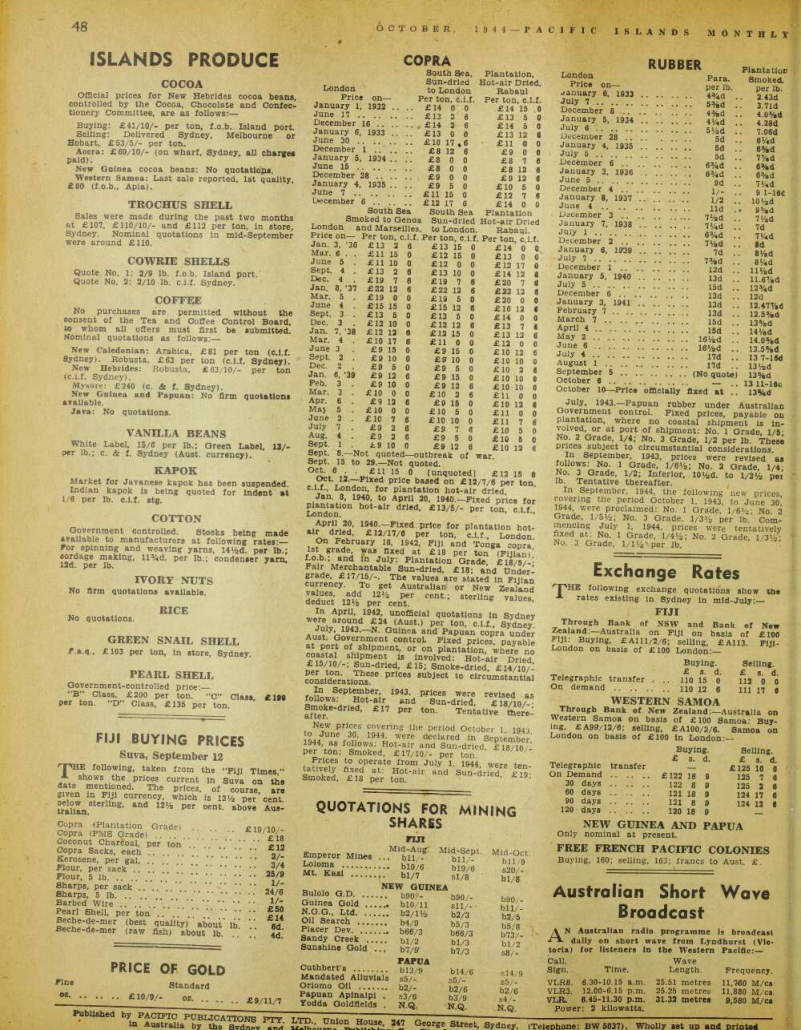
Cocoa
Official prices for New Hebrides cocoa beans, controlled by the Cocoa, Chocolate and Confec tionery Committee, are as follows: Buying: £4l/10/- per ton, f.o.b. Island port.
Selling; Delivered Sydney, Melbourne or Hobart, £53/5/- per ton.
Accra: £69/10/- (on wharf, Sydney, all charges paid).
New Guinea cocoa beans: No quotatlops.
Western Samoa: Last sale reported, Ist quality, £BO (f.0.b., Apia).
Trochus Shell
Sales were made during the past two months at £lO7, £llO/10/- and £ll2 per ton, in store, Sydney. Nominal quotations in mid-September were around £llO.
Cowrie Shells
Quote No. 1: 2/9 lb. f.o.b. Island port.' Quote No. 2: 2/10 lb. c.i.f. Sydney.
Coffee
No purchases are permitted without the consent of the Tea and Coffee Control Board, to whom all offers must first be submitted.
Nominal quotations as follows: New Caledonian: Arabica, £Bl per ton (c.i.f.
Sydney). Robusta, £63 per ton (c.i.f. Sydney).
New Hebrides: Robusta, £63/10/- per ton (c.i.f. Sydney).
Mysore: £240 (c. & f. Sydney), New Guinea and Papuan: No firm quotations available.
Java: No quotations.
Vanilla Beans
White Label, 15/6 per lb.; Green Label, 13/per lb.; c. & f. Sydney (Aust. currency).
Kapok
Market for Javanese kapok has been suspended.
Indian kapok is being quoted for Indent at 1/6 per lb. c.i.f. stg.
Cotton
Government controlled. Stocks being made available to manufacturers at following rates:— For spinning and weaving yarns, 14 *d. per lb.; cordage making, ll%d. per lb.; condenser yam, 12d. per lb.
Ivory Nuts
No firm quotations available.
Rice
No quotations.
Green Snail Shell
F.a.q., £lO3 per ton, In store, Sydney.
Pearl Shell
Government-controlled price:— ”B” Class, £2OO per ton. “C” Class £lO6 per ton. “D” Class, £135 per ton.
Fiji Buying Prices
Suva, September 12
'TT'HE following, taken from the "Fiji Times,” . X . shows the prices current in Suva on the date mentioned. The prices, of course are in f F ,\ il currency, which is 12* per’cen? tralian terling ' &nd 12 Va Per oent- above Aus ‘
Copra {Plantation Grade) Copra (FMS Grade) Coconut Charcoal, per ton Copra Sacks, each .
Kerosene, per gal.
Flour, per sack .. ., . • £ 19/10/- Flour, 5 lb.
Sharps, per sack ... * * Sharps, 5 lb Barbed Wire ...
Pearl Shell, per ton Beche-de-mer (best quality) about lb, .. 6d.
Beche-de-mer (raw fish) about lb .4d.
Advertisements & other items, p. 50 (1 item)
sssz
PRICE OF GOLD
P^ne Standard ° Z £l °/ 9 /- OZ £9/11/7
° c i, f 6 • ’ , £l i 15 0 [unquoted] £l2 15 6 Oct. 12.—Fixed price based on £l2/7/6 per ton c.i.f., London, for plantation hot-air dried 19 u°: tO . Aprll 20 ’ *940-—Fixed price for plantation hot-air dried, £l3/5/- per ton, elf London. • • •• «^ Pr i 1 4 I ® 4o -— Pixe d Price for plantation hotd L l6 v’ 12/17/6 per ton, c.i.f., London On February 18. 1942, FIJI and Tonga copra' was fixed at £lB per ton (Fijian) f.0.b., and In July: Plantation Grade, £lB/6/-’
Fair Merchantable Sun-dried, £18; and Under grade, £l7/15/-. The values are stated in Fijian currency. To get Australian or New Zealand deduct 12* CenU SterUne ValUes ’
sssz
An J^ ly r' l943 N ‘ Guinea and Papuan copra under Aust. Government control. Fixed prices navahlp P°« of shipment, or on plantation here no coastal shipment is involved: Hot-air Dried £ 15/10/-; Sun-dried, £l5; Smoke-dried, £l4/10/c P onsld“raU?m. Se Pri “ S !ÜbJe<:t t 0
foUow^ ePt Hot-air “S*
Smoke-dried, £l7 per ton. Ventatlvl lB^ New prices covering the period October 1 1943 ° Q ,/ une 30. 1944, were declared in Septembe?’ 1944 as follows: Hot-air and Sun-dried, £lB/10/- Per ton; Smoked, £l7/10/- per ton Prices to operate from July 1, 1944 were ten Smoked, £?8 £r ““ Sun - drled - *l9;
London
COPRA
South Sea, Sun-dried to London Plantation, Hot-air Dried, Rabaul .Price on— Per ton. c.l.f.
Per ton. c.l.f.
January 1 , 1932 .. £14 0 0 £14 15 0 June 17 . £13 2 6 £13 5 0 December 16 .. .. £14 2 6 £14 5 0 January 6, , 1933 .. £13 0 0 £13 12 6 June 30 . £10 17 ,6 £11 0 0 December 1 .. .. £8 12 6 £9 0 0 January 5, , 1934 .. £8 0 0 £8 7 6 June 15 . £8 0 0 £8 12 6 December 28 .. .. £9 0 0 £9 12 6 January 4, , 1935 .. , . £9 5 0 £10 5 0 June 7 .. £11 15 0 £12 7 December 6 South Sea £12 17 6 South Sea £14 0 0 Plantation Smoked to Genoa London and Marseilles. . Sun-dried Hot-air Dried to London. Rabaul Price on— Per ton, c.i.f. Per ton. c.l.f.
Per ton. c I f.
Jan. 3, '36 £13 2 6 £13 15 0 £14 0 0 Mar. 6 . . £11 15 0 £12 15 0 £13 0 0 June 5 . £11 10 0 £12 0 0 £12 17 o Sept. 4 . £13 2 6 £13 10 0 £14 12 6 Dec. 4 . £19 7 6 £19 7 6 £20 7 0 Jan. 8, ’37 £22 12 6 £22 12 6 £22 12 0 Mar. 5 . £19 0 0 £19 5 0 £20 0 0 June 4 £15 15 0 £ 15 12 6 £16 12 < Sept. 3 . £13 5 0 £13 5 0 £14 0 o Dec. 3 . £12 10 0 £12 12 6 £13 7 0 Jan. 7, ’38 £12 12 6 £12 15 0 £13 12 0 Mar. 4 . £10 17 6 £11 0 0 £12 0 o June 3 £9 15 0 £9 15 0 £ 10 12 6 Sept. 2 . £9 10 0 £9 10 0 £10 10 o Dec. 2 £9 5 0 £9 5 0 £ 10 2 6 Jan. 6, '39 £9 12 6 £9 15 0 £10 10 o Peb. 3 . £9 10 0 £9 12 6 £10 10 0 Mar. 3 . £10 0 0 £10 2 6 £ 11 0 o Apr. 6 . £9 12 6 £9 15 0 £10 12 0 May 5 . £10 0 0 £10 5 0 £11 0 o June 2 . £10 7 6 £10 10 0 £11 7 6 July 7 . £9 2 6 £9 7 6 £ 10 5 o Aug. 4 £9 2 6 £9 5 0 £10 B o Sept. 1 . 19 10 0 £9 12 6 £10 12 Sept. 8.—Not quoted—outbreak of war.
Sept. 15 to 29.—Not quoted. 6
Quotations For Mining
Shares
July, 1943.—Papuan rubber under Australian Government control. Fixed prices, payable on plantation, where no coastal shipment is in volved, or at port of shipment: No. 1 Grade, 1/6- No. 2 Grade, 1/4; No. 3 Grade, 1/2 per lb. These prices subject to circumstantial considerations In September, 1943, prices were revised as foliows: No. 1 Grade. 1/6*; No. 2 Grade, 1/4; J*°- m Grade > 1/2 • Inferior, 10 *d. to 1/2* pex lb. Tentative thereafter.
In September, 1944, the following new prices covering the period October 1, 1943, to June 30 1944, were proclaimed: No. 1 Grade, 1/6*; No. 2 Grade, 1/5 *; No. 3 Grade, 1/3* per lb. Com mencing July 1, 1944, prices were tentatively fixed at; No. 1 Grade. 1/4*; No. 2 Grade, 1/3VST; No. 3 Grade, 1/I*' per lb.
Emperor Mines Loloma
Fiji
Mid-Aug. ... bli/- Mid-Sept. bll/b!9/6 Mid-Oct. bll/9 Mt. Kasl s20/- Bulolo G.D Guinea Gold ...
N.G.G., Ltd. ...
Oil Search Placer Dev. .. • ai/o
New Guinea
.. b90/- b90/- ... blO/11 sll/- ... b2/H/ 2 b2/3 .. b4/9 b5/3 bl/8 b90/bll/b2/5 b5/8 b73/bl/2 s8/^ S14/9 s5/- Sandy Creek bl/2 Sunshine Gold ... hl/S
Papua
Cuthbert’s bl3/9 Mandated Alluvlals s5/- Orlomo Oil v.o/
Uuo/O
bl/3 b7/3 bl4/6 s5/b2/6 b3/9 N.Q.
Papuan Aplnalpl Yodda Goldfields . s3/6 N.Q. b2/6 S4/- ' N.Q.
London Price on— January 6. 1933 July 7
Rubber
Para, per lb.
Plantation Smoked, per lb. 2.43d December 8 .. 3.71d January 5, 1934 4.0%d
A Ooj
July 6 . . ..
December 28 ..
January 4, 1935 5d ! 7.06d 6 Mid A!/j July 5 .. ..
Otbu
m/ a December 6 .. • / '/•a January 3, 1936 6%d ft 3 ' -J June 5 .. . - 0*78 0 December 4 .. 7*/»d January 8, 1937 June 4 ..
December 3 .. . 9 1-16(1 . lOVad » 9 5 /ed *7 1/»H January 7, 1938 . « 72(1 7H July 1 Id n\j. a December 2 ., . / 74a OH January 8, 1939 oa 01/.H July 7 orsa December 1 .. . 8V4d January 5, 1940 .
July 5 ilVaa li.6 7 /gd December 6 .. .
January 3. 1941 . 12%d 12d 1 0 A. n 7/. A February 7 March 7 U.e 1 780 12.5»/,d April 4 .. .. 1 0 780 1 A 1/ /J May 2 1 i n &/_ a June 6 . ift.UTsQ 1 0 e 8 U A J uly 4 1 j. 0 via 17 7 1 dA August 1 1J /-lew 1 'iljLA September 5 .. . /2U October 8 Uvea 17 11.1 Sit' October 10 — Price officially fixed at .. 13%d
Exchange Rates
'T'HE following exchange quotations show the A rates existing in Sydney in mid-July:—
Fiji
Through Bank of NSW and Bank of New Zealand:— Australia on FIJI on basis of £lOO Fiji: Buying, £Alll/2/6; selling. £AII3. FIJI - on basis of £lOO London:—
Western Samoa
Through Bank of New Zealand:—Australia on Western Samoa on basis of £lOO Samoa- Buy ing, £ A99/12/6; selling, £AIOO/2/6. Samoa on London on basis of £lOO in London;—
New Guinea And Papua
Only nominal at present.
Free French Pacific Colonies
Buying, 160; selling, 163; francs to Aust. £.
Buying.
Selling.
Telegraphic transfer . £ s. d. .. 110 15 0 £ s. d. 112 0 0 On demand .. . 111 17 6
Telegraphic transfer Buying. £ s. d.
Selling. £ s. d. £125 10 0 On Demand £122 18 9 125 7 6 30 days 122 8 9 125 2 6 60 days 121 18 9 124 17 6 90 days 121 8 9 124 12 6 120 days 120 18 9
Broadcast
Australian Short Wave Broadcast
AN Australian radio programme is broadcast daily on short wave from Lyndhurst (Vic toria) for listeners In the Western Pacific:—
Call.
Wave Sign.
Time.
Length.
Frequency.
Vlr8.
6.30-10.15 a.m. 25.51 metres 11,760 M/ca
Vlr3.
12.00-6.15 p.m. 25.25 metres 11,880 M/ca.
Vlr.
6.45-11,30 p.m. 31.32 metres 9,580 M/ca Power: 2 kilowatts.
Advertisements & other items, pp. 50-52 (3 items)
48
6cTOBJSR. 1944 PACIFIC ISLANDS MONTHLY
to Austr l aha P b^ l^e A ? y X?v G i?rge Street. Sydney. (Telephone: BW 5037). Wholly set up and printed
Roll Of Honour
OCTOBER, 1944 PACIFIC ISLANDS MONTHLY
(Continued From Inside Front Cover)
W. R. Carpenter & Co. Ltd.
■ % N Hr f I mi.. mm mm Hi ■M I ■
Travel by CARPENTER AIRLINES
Full particulars from Macdonald, Hamilton Cr Co., or Howard Smith Ltd., Sydney.
W. R. CARPENTER & CO. LTD.
MERCHANTS, SHIPOWNERS AND AIRCRAFT OPERATORS
Ajenti for Australian, European and American Manufacturers, and Distributors of Every Description of Merchandiser Buyers and Shippers of Copra, Trocas, and all Classes of Islands Produce.
Ford Motor Company of Canada.
T. G. Cr C. Bolinders (Engines).
AGENTS FOR :
Caterpillar Tractors.
Electrolux Refrigerators, etc., etc.
Dodge Brothers Inc.
Westinghouse Electrical Co.
Branches throughout the Pacific Islands
W. R. Carpenter & Co. (London) Ltd., Coronation House, 4 Lloyds Avenue, London, EC.
Head Office: 16 O’CONNELL STREET, SYDNEY