Pacific
Islands
Monthly
May 17. 1943
Vol. Xiii. No. 10.
Established 1930
I Registered at the G.P.0., Sydney, for transmission by post as a newspaper ]
8“
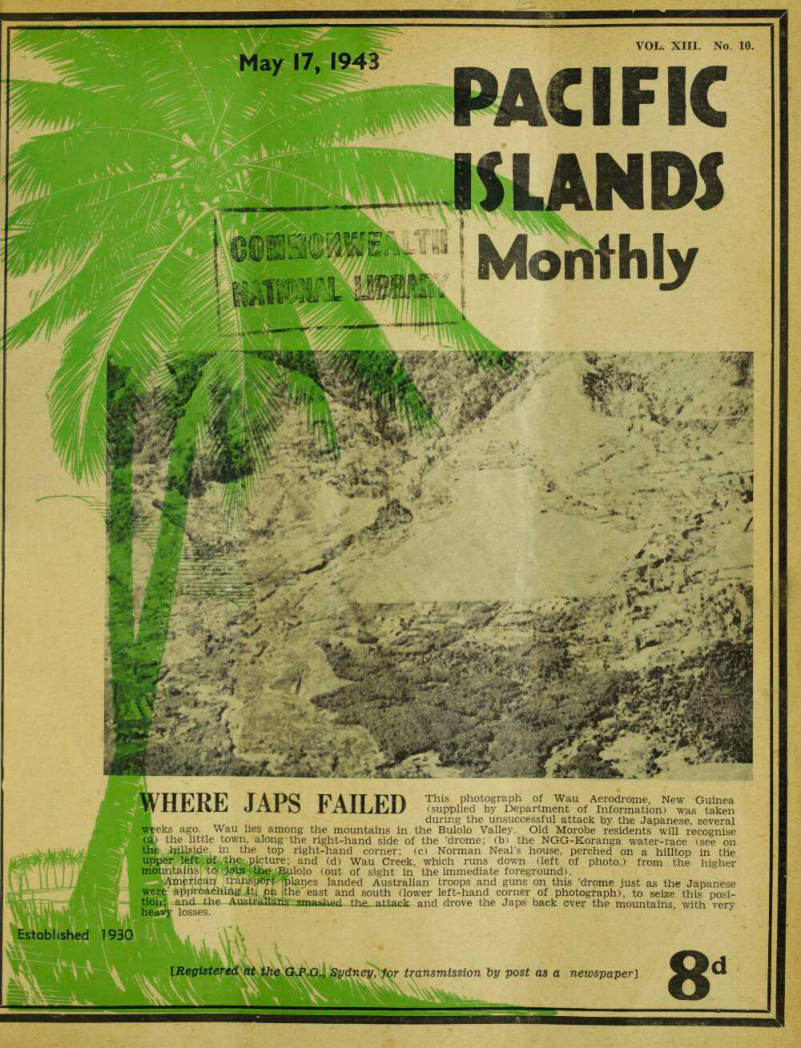
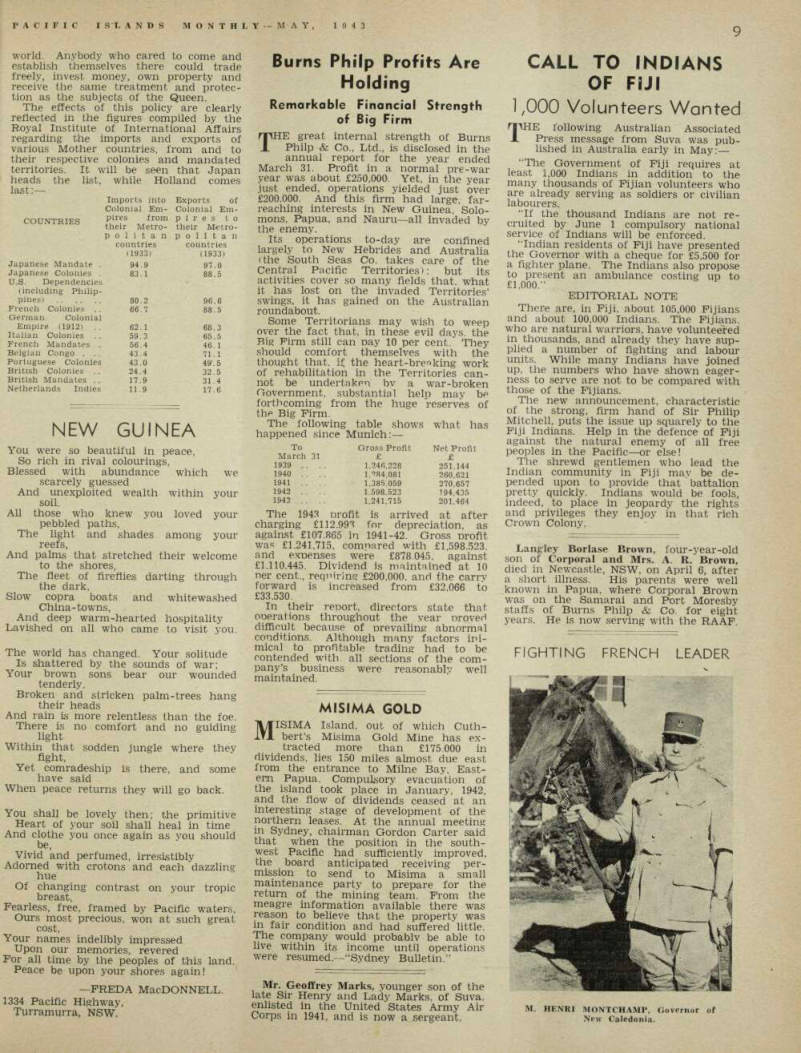
Where Japs Failed
This photograph of Wau Aerodrome, New Guinea (supplied by Department of Information) was taken during the unsuccessful attack by the Japanese, several weeks ago. Wau lies among the mountains in the Bulolo Valley. Old Morobe residents will recognise (a) the little town, along the right-hand side of the ’drome; (b) the NGG-Koranga water-race (see on the hillside in the top right-hand corner; (c) Norman Neal’s house, perched on a hilltop in the upper left of the picture; and (d) Wau Creek, which runs down (left of photo.) from the higher mountains to join the Bulolo (out of sight in the immediate foreground).
American transport planes landed Australian troops and guns on this ’drome just as the Japanese were approaching it on the east and south (lower left-hand corner of photograph), to seize this posi tion; and the Australians smashed the attack and drove the Japs back over the mountains with very heavy losses.
Roll Of Honour
(We try to assemble here the names of of the United Nations, residents or former residents of the Pacific Territories, whose names appear in casualty lists or who receive decorations. We should be grateful if relations and friends would send us details of such men.)
Killed
Sgt. Bert AITKEN, NZEF, formerly of Fiji.
Killed in action in Libya.
Eugene AUBRY (formerly of Tahiti), of the Air Force of Fighting France. Killed in an air accident in Great Britain.
Pilot-Officer Len BAYLISS, flying instructor in the RAAF, formerly of Rabaul, New Guinea.
Killed in Sydney. 18/11/1940, when he fell from a trainer aircraft in flight.
R. C. BENTLEY, NZEF, formerly of Fiji.
Killed in action, Middle East, June 27, 1942.
A/Bdr. Neville W. BERTWISTLE, AIP artillery (tank unit), formerly a clerk on the staff of W. R. Carpenter and Co. Ltd., of Rabaul, New Guinea. Killed in action, April, 1941.
P/O J. B. BOMFORD, RNZAF, formerly of CSR Co.’s staff, Fiji. Killed on active service in England.
Pte. W. R. M. BRADNAM, of the NZ Forces, formerly of Fiji. Reported killed in action in the Middle East, 25/11/1941.
Warrant-Officer R. F. BRECHIN, New Guinea Force. Killed in air accident, June 17, 1942.
Formerly of NG Department of Agriculture.
Anton BRINON, of Fighting French Pacific Battalion, formerly of La Foa, New Caledonia.
Killed in action in Libya, November, 1942.
Lieut.-Colonel Felix BROCHE, of the New Caledonian-New Hebridean contingent of the Fighting French Pacific Battalion. Killed in action in the battle of Bir Hacheim (Libya).
Pilot-Officer E. H. CANARD, of RAF, formerly of Fiji Civil Service. Killed in flying accident in South Africa in the course of his duty as flying instructor.
Pte. David C. GARLAND, AIF, formerly chief assayer at the Emperor gold mines, Fiji. Killed in action in New Guinea.
Pierre CHARPENTIER, of the Fighting French Pacific Battalion. Killed in action in the battle of Bir Hacheim.
Raymond CHAUTARD (formerly of New Cale donia) , of the Fighting French Pacific? Battalion.
Killed in action in Libya.
Flight-Lieutenant G. J. I. CLARKE, of the RAAF, formerly Assistant Flight Superintendent of Carpenter Airlines, New Guinea. Killed in action during operations off Dakar (French West Africa), while attached to HMAS “Aus tralia”, September, 1940.
Georges CLEMENS, of the Free French Pacific contingent from New Caledonia. Reported killed in action in the Middle East, March, 1942.
Flying-Officer Jack R. COATH, of the RNZAF, formerly on the staff of the Bank of New Zealand, in Suva, Fiji. Killed October, 1941, when a training aircraft crashed in NZ.
Pte. Felix CRAIG, AIF, formerly of accounts department, Australasian Petroleum Co., Port Moresby, Papua. Killed in action, June, 1941.
L. J. DAWES, of the NZ Forces, formerly Dis trict Officer of Savaii, Western Samoa. Reported killed in action, February, 1942.
Pilot-Officer V. L. DEARMAN, of the RAAF (observer), formerly overseer and clerk at the Colonial Sugar Refining Co., Ltd., Raraval, Fiji. Reported killed in action in the Middle East, October, 1941.
Capt. Jean GILBERT, of the Naval Forces of Fighting France, and formerly of Tahiti. Killed in action.
Captain Kenneth GARDEN, of the RAP Ferry Command, formerly of Guinea Airways Ltd., in New Guinea. Killed September, 1941, when a bomber he “ferried” from USA crashed on west coast of Britain.
Flying-Officer Moresby GOFTON, of the RAP, son of Mrs. P. S. Stewart, of Wau, New Guinea.
Reported missing, 17/5/1940 —presumed killed in air operations.
Rifleman J. A. GOODWIN, AIF infantry, for merly of Bulwa, TNG. Reported “accidentally killed”. April, 1942.
Ernest GOURNAC (formerly of Tahiti), of the Air Force of Fighting France. Killed in an air accident in Britain.
Pte. Wallace GRAHAM, of the NZ Forces (infantry), formerly on the staff of Morris Hedstrom Ltd., Fiji. Killed in action in the Middle East, November, 1941.
Lieut. J. A. GRANT, AIF, formerly of Man dated Territory. Killed in action.
Squadron-Leader C. R. GURNEY, RAAF, a former chief pilot of Guinea Airways, Ltd.
Killed in action In the New Guinea area, May, 1942.
Pte. B. HAMILTON, AIP, formerly of Auck land, NZ, and New Guinea. Killed in action.
Gerald T. J. HARPER, RAP, son of Major and Mrs. P. Harper, of Ra, Fiji. Killed in action while navigating a Whitley bomber dur ing a raid on the Continent.
J. HEAD, RAAF, formerly of Fiji. Killed in flying accident in Australia, 1941.
Squadron-Leader Godfrey HEMSWORTH, of the RAAF, formerly a well-known commercial pilot in Morobe, TNG. Reported missing after an operational flight against the Japanese in the New Guinea area—now presumed killed in action.
Captain L. T. HURRELL, infantry, Rabaul.
Killed in action.
Pte. Jack JOHNSON, formerly of Morris Hedstrom’s staff, Fiji. Killed in action on November 4, while serving with the AIP in New Guinea.
Flying-Officer Alan JOHNSTONE, of the RAF, who was born in Suva, Fiji, in 1915. Killed during bombing raid on Kristiansand, Norway, April, 1940.
LAC Douglas KIRBY, RAP, who left Suva, Fiji, with the first contingent of Air Force trainees. Reported killed in a flying accident in South Africa, March, 1942.
Marcel KOLLEN, of the Pacific Battalion of Fighting France. Railed in action in the battle of Bir Hacheim.
C. D. LAMONT, RAF. formerly a master at Boys’ Grammar School, Suva, Fiji. Missing, be lieved killed on air operations over Germany.
Emile LESSON (formerly of New Caledonia), of the Fighting French Pacific Battalion. Killed in action in Libya.
Cpl. Gaston LESSON, of the Fighting French Pacific Battalion. Killed in battle of Bir Hacheim (Libya).
Capt. (now Lt.-Oolonel) Edward Tlwi LOVE, NZ Maori Battalion, husband of Mrs. Takau Rio Love, Ariki-nui of Rarotonga, Cook Islands. Re ported missing during campaign in Greece, May, 1941; later. June, 1941, reported “wounded and safe.” Officially announced, July 17, killed in action in Libya.
Flying-Officer John C. LOWE, RAAF, formerly an overseer with the CSR Co. in Fiji. Reported, 11/4/1942, “took part in air defence of Rabaul, TNG, —missing, believed killed”.
Pte. L. F. McCarthy, AIP infantry, form erly supercargo on W. R. Carpenter and Co.’s inter-island vessels “Desikoko” and “Mako”, in New Guinea. Reported “killed in action” in Syria, 30/10/1941.
Sgt. Kenneth MACGREGOR, AIF, formerly practising as a barrister and solicitor in Wau, TNG. Reported missing, believed killed, in Papua.
Lance-Corporal A. D. MacPHEE, son of Mr.
R. D. MacPhee, Levuka, Fiji. He was 35. was a member of the AIP, and was killed in Greece, May, 1941.
Francois MASSON, of the Fighting French Pacific Battalion. Killed in action in the battle of Bir Hacheim.
Capt. John Malcolm METHVEN. Reported killed in action in Egypt on July 22, 1942. while serv ing with the AIF. He was born in Ocean Island, and is the youngest son of Mr. and Mrs.
Stuartson C. Methven, of Belgrave. Victoria.
Plight-Sgt. Stuartson Charles METHVEN, born in Suva, Fiji, brother of the late Capt. J. M.
Methven. Killed in air operations over Ger many on January 23, 1943.
Spr, A. L. MORANDINI, ATP Engineers, for merly of Konedobu, Papua. Reported killed in action, April, 1942.
F. R. J. NICHOLLS, Royal Artillery, formerly of Fiji. Killed in action, Burma, May, 1942.
W/O G. A. OBST, formerly a member of the Lutheran Mission, TNG. Joined Australian military forces in February, 1942. Killed in action in New Guinea on December 21, 1942.
J. L. C. OSBORN, NZEF, formerly of Fiji.
Killed in action, Middle East, June, 1942.
Pilot-Officer Ivan PALMER, RAP, formerly of Fiji. Killed in air operations over Malta. o. PILLING, RAF, formerly of Fiji. Missing; believed killed.
Pte. Edward Harold PRICE. 2nd NZEF (Machine-gun Battalion), youngest son of Mr. and Mrs. J. Price, Savu Savu West, Fiji. Killed in action during the Libyan campaign, Middle East, 27/11/1941.
Pte. Cecil PURCELL, NZEF, formerly of Aleipata, Samoa. First Samoan Euroneslan to
give his life in World War 11. Killed in action in Middle Bast.
Captain W. H. ROBERTS, NZEF, who was Accountant in the Samoa Treasury Dept., dur ing 1934-35. Killed in action in Libya, Decem ber, 1941.
Major A. B. ROSS, NZEF, who, between 1923- 29 was successively, Assistant Secretary for Native Affairs, Assistant Secretary to the Administration, and ADC to the Administrator of Samoa. Killed in action in Libya.
Cpl. Alex. C. SCOTT, AIP, formerly manager at Kieta, TNG, for Burns, Philp and Co. Ltd.
Killed in action in the Middle East, 19/6/1941.
J. SIMPSON, RAAF, formerly of Fiji. Killed in action over Malta, July, 1941.
Lieutenant A. G. W. THOMAS, RANR, for merly master of Burns Philp & Company’s SS “Muliama.” Killed in action.
Pte. Popoare TANGIITI, of the NZ Forces (Maori Battalion), formerly of Mangala, Cook Islands. Reported “missing after Battle of Greece—presumed dead”, July, 1941.
Sgt. Edward WILSON, of Suva, serving in the Fiji Defence Force. Accidentally drowned in the Lami River, Fiji, April, 1942.
Died From Wounds
Pte. Ernest HENRY, AIF, formerly of the Rabaul (NG) staff of Burns, Philp and Co.
Ltd. Died from wounds received in Battle of Crete, 1/6/1941.
Pte. Alec. MUNRO, NZ Forces, formerly of Norfolk Island. Died in Libya (Middle East), December, 1941.
Pte. T. LAWRIE, AIF, son of Mr. Lawrie, for merly of Fiji. Died of wounds in Middle East.
Pte. Walter PEARSON, of first NG quota of AIF (infantry). Died from wounds received in action, 24/6/1941.
A/Bdr. W. R. SCOTT, AIF, of New Guinea.
Died from wounds, July. 1941.
Sgt.-Pilot Peter Clarkson WISE, of the RAF, son of Mr. W. Wise, OBE, Director of Public Works, Fiji. Died from wounds received during bombing raid over Germany, January, 1941.
Accidentally Killed
Gnr. Robert J. WILSON, formerly of Port Moresby, Papua. Accidentally killed in troop train in Middle East in 1942.
Died From Illness
Pte. Clarence A. HUTTON, AIF, formerly of Edle Creek, TNG. Died from illness, April, 1941.
A/Sgt. J. H. STANE, Royal Australian En gineers. formerly of Port Moresby, Papua. Died from Illness, May, 1942.
Rifleman R. A. SMITH, HQ Unit. (Place of enlistment not stated.) Died of Illness.
Cpl. R. H. SUTTON, NGVR, formerly of Wau, TNG. Died from malaria and typhoid in October, 1942.
Major P J. WOODHTLL, ATP Infantry, formerly legal assistant in the Crown Law Office, Rabaul, New Guinea. Reported “deceased”, December, 1941.
Missing
Louis ANGER, of Fighting French Pacific Battalion. Reported missing after battle of Bir Hacheim.
Pte. P. F. BAILEY, AIP Infantry, of Rabaul, TNG. Reported missing, 17/2/1942. Now re ported prisoner of war.
Cpl. Jock BAIRD, AIP, formerly of Bank of NSW staff, Suva, Fiji. Reported missing in Malaya, February, 1942.
Cpl. Leon BARRENS, of Pacific Battalion of Fighting France. Missing after battle of Bir Hacheim (Libya).
T. BLAKELOCK, BEF, formerly of Fiji. Miss ing.
Robert BLUM, of Fighting French Pacific Battalion. Reported missing after battle of Bir Hacheim.
Sgt. Ronald Arthur BROODBANK. formerly of Samarai, Papua, now serving with the RAAF overseas. Reported missing on May 31 while on air operations.
Sgt. Alexander BROWN, RNZAF, formerly of Rarotonga. Reported missing over Germany, on September 15, 1942.
Reginald BOULANGER, of Fighting French Pacific Battalion. Reported missing after battle of Bir Hacheim.
H. BUCKNELL, AIP, formerly of Fiji. Missing.
Sgt. R. P. BUNTING, ATP, formerly of Samarai, Papua. Missing in Malaya.
Pte. E. L. CHRISTIE, AIP infantry, of Rabaul, TNG. Reported missing, 17/2/1942.
Victor DERVAUX, of Fighting French Pacific Battalion. Reported missing after battle of Bir Hacheim.
Lucien DEVAND, of Pacific Battalion of Flght (Contlnued on Inside Back Cover)
Pacific News-Review
Notes And Comment On
The Progress Of The War
From April 15 To May 13
Apl. 15: German and Italian armies, estimated at nearly 200,000, are now in position on a wide arc in Northern Tunisia, covering the city of Tunis and the great French naval base of Bizerta.
The British First and Eighth Armies, the American Second Corps and a Fighting French Army Corps are pressing in relentlessly, while overwhelming Allied air forces are keeping up a terrific blitz on the enemy.
All commentators agree that, while the doom of those Axis armies is certain, they will put up a long, stubborn defence, calculated to delay our attack upon the Axis in Europe.
Apl. 16: Once more Australia is warned of a threatened “danger from the North” by Mr. Curtin, General Mac- Arthur and General Sir Thomas Blarney.
The Japs are said to have concentrated formidable forces on their line of East Indies-North Coast of New Guinea-New Britain-Bougainville-Solomons.
Apl. 16: Japanese made a large-scale raid on Milne Bay with 46 bombers and from 25-50 fighters. Thirty enemy air craft were shot down.
Apl. 17: Desperate fighting developed in Northern Tunisia at the week-end, when German troops counter-attacked on a height captured by the British First Army.
Apl. 18; The RAF delivered heavy blows on Skoda and other armament works in Czecho-Slovakia on Friday night. Fifty-five RAF bombers are miss ing.
Apl. 19: The Allies are maintaining their air-battering of towns in Germany —the RAF and Americans in the west and centre, and the Russians in the east.
Apl. 20: US Warhawks and RAF Spit fires yesterday destroyed 74 planes of a large German air-convoy off the north west tip of Tunisia—obviously an attempt by the enemy to give air-borne relief to his armies in Tunisia.
Apl. 20: Nazi counter-attacks in the Kuban (Caucasus) have failed. The Red Army is still pressing the Germans and Rumanians hard, in an attempt to recap ture the Black Sea port of Novarassisk— the Germans’ last foothold in the Cau casus. The remainder of the Russian front, affected by the general thaw, is quiet.
Apl. 22: The British Eighth Army, attacking in Tunisia, occupied Enfida ville.
Apl. 23: A wave of fury swept the United States when it was revealed by the International Red Cross that the Japanese executed American airmen who fell into their hands after the US air raid on Japan on April 18, 1942.
Apl. 23: Heavy enemy counter-attacks in Tunisia were repulsed by the British First Army and the British Eighth Army.
Apl. 25; British, American and French forces are slowly advancing through the ring of Tunisian mountains protecting Tunis and Bizerta.
Apl. 26: Washington announces that American forces occupied Funafuti, largest of the Ellice Islands, some time ago. The occupation was carried out without opposition.
Apl. 27: In Tunisia Allied progress continues. Severe tank casualties have been inflicted on the enemy. Marshal Rommel departed from Tunisia some time ago, to receive medical attention, and was succeeded by General von Arnim.
Apl. 28; Russia has broken off diplo matic relations with Poland, charging Poland with association with the slan
derous campaign relating to the murder of Polish officers in the Smolensk region.
Some thousands of Poles were murdered and buried; the Nazis, in a great propa ganda effort, said they were murdered by the Russians, and requested the Inter national Red Cross to investigate, and the Poles supported that request. Russia insists that this is a great Nazi plot and “frame-up”: and that the Poles were murdered by the Nazis.
May 1: Violent fighting is now proceed ing in the three sectors in Tunisia —Medjerda Valley, Pont du Fahs and the east coast.
May 1: The large-scale raids on Ger many by RAF and Americans continue almost day and night. They are described as “more than softening-up” raids.
May 1: General MacArthur’s head quarters issued a warning that Japanese have started a submarine campaign in the waters east of Australia.
May 1; US bombers, twice within 36 hours, raided Japanese bases on Nauru and at Tarawa (in the Gilberts).
May 3: The Americans have captured three points in bitter Tunisian fighting, and the US Second Corps is now 12 miles from Mateur. General Giraud “sees vic tory in May.”
May 4: Officially announced that our Spitfire fighters suffered “heavy losses” when 21 Japanese bombers and 30 fight ers raided Darwin on Sunday morning.
May 5: American advanced units in Tunisia have pushed up along the roads to Bizerta and Ferryville from Mateur.
The fight for the mountain perimeter, guarding Tunis and Bizerta, is now near its end May 6: Tunisian events are moving towards a climax. The British First Army, assisted by some units from the Eighth Army, launched a terrific ground attack, perfectly co-ordinated with the American and French attacks, and with overwhelming air activity, and smashed through the Medjerda Valley front, into the plains before Tunis. The Americans are within nine miles of Bizerta, and the British 10 or 12 miles from Tunis.
May 6: Announced that American forces in February occupied the Russell Islands —a small group about 30 miles NW of Guadalcanal.
May 7: The Axis defences in Tunisia are crumbling, A large-scale withdrawal is expected by Axis armies into the Cape Bon Peninsula, where they can organise a powerful defence.
May 8: Five Allied ships have been sunk off eastern Australia by Japanese submarines in recent weeks.
May 8: Last evening, when the Axis defence suddenly collapsed and the Ger mans became disorganised, the Allies advanced swiftly. Within a few minutes of each other, the British entered Tunis and the Americans and French occupied Bizerta. The Axis armies, thus split into three sections, are in complete disorder, and tens of thousands of prisoners are coming in.
May 10: Yesterday and to-day, the Allies have advanced swiftly along the Tunisian coast, and have gathered in over 50,000 prisoners.
May 11: The remaining Axis forces are now bottled up on Cane Bon Peninsula, and an Allied naval blockade bars their escape by sea. Sixty-four thousand Axis prisoners are now in Allied hands— including six generals—but over 100,000 have still to be accounted for.
May 12: The British Prime Minister, Mr. Churchill, is in Washington, with a large number of British Service chiefs.
Conferences with President Roosevelt and American chiefs are proceeding.
May 12: Enemy positions on Cape Bon Peninsula are crumbling as the British First Army makes a tank-drive and smashes the Axis defences at the neck of the peninsula.
May 13: The British have occupied all Cape Bon Peninsula. The German Com mander, General von Arnim, and about 20 Axis Generals, have surrendered. The Allies have taken about 160,000 prisoners, and enormous quantities of war material and equipment. The war in North Africa is concluded.
It is calculated that, in North Africa, the Axis has lost 600,000 troops, as well as the Italian Empire (Abyssinia, Eritrea, Somaliland and Libya), May 14: Without a pause, the Allies have launched a terrific air blitz upon Italian ports in Sicily, Sardinia and Italy.
An attack upon the Italian island fort ress of Pantellaria is expected. Some people expect the early collapse of Italy.
May 14: The British have suffered a serious reverse in south-western Burma.
They launched a campaign against the Japanese in December, made some pro gress in the next three months, but are now retiring before superior Japanese forces; and part of the British force is in danger of encirclement.
May 14: Continuing their round-the clock bombing of Germany, the RAF made the war’s record heavy raid upon the German industrial centre of Duis berg, which has been practically wiped out. We lost 34 bombers.
May 13: Little of moment is happen ing on the Russian front. The Germans, despite Russian attacks, hold Novores sesk. Both sides are preparing for a resumption of large-scale operations.
Quintrell
Death Of Mr. James
MR. James Quintrell, late of Misima Island, Papua, died in Sydney on April 20, after a short illness. He leaves a widow, one son and a daughter.
“Jim” Quintrell, as he was affection ately known by all in the Eastern Divi sion of Papua (the natives respected and loved him), was associated with the gold mining industry at Misima for 27 years.
In 1916, he went to Misima from Broken Hill as a miner with the Block 10 Com pany, who had taken over the old St.
Aignan’s leases (now well known as the Cuthbert Mine). Until Mr. F. W. Cuth bert took over the mine, about 1928, it had a checkered career; but Mr. Quin trell was confident the gold was there The success which attended Mr. Cuth bert’s efforts was due, in no small mea sure, to Mr. Quintrell’s capable efficiency.
From 1935 to 1940 he was underground manager for the present Cuthbert Mis ima Co. He then decided to retire, but the Islands had their hold on him and in 1941 he returned to the Cuthbert mine and took over the development of the company’s northern leases. He came away in the evacuation early in 1942.
“Too many people in North America believe that already we are on the way to Berlin and Tokio,” writes Selwyn Hughes, RAAF. formerly of “Pacific Islands Monthly” staff, who is now com pleting in Canada his course as an air observer and gunner. “They think the war will be over soon. But thoughtful people don’t see it that way, and depre cate wishful thinking. Seen from here, in March, 1943, it looks like a long, tough war,”
Contents
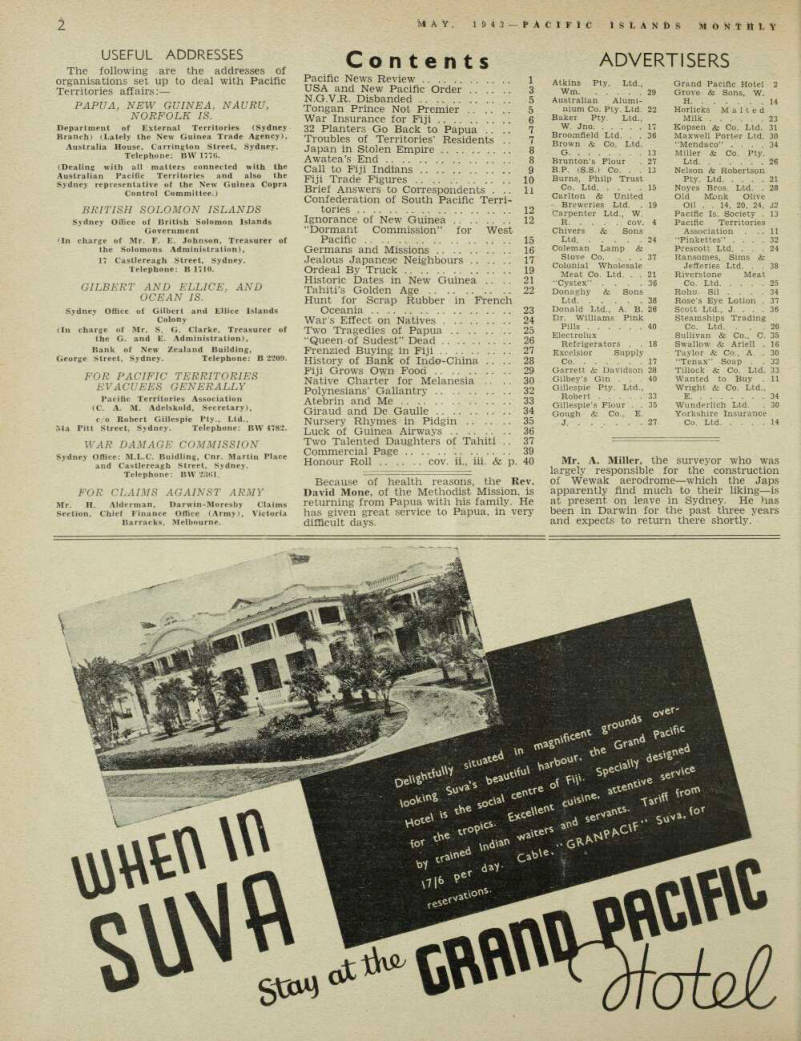
Pacific News Review 1 USA and New Pacific Order 3 N.G.V.R. Disbanded 5 Tongan Prince Not Premier 5 War Insurance for Fiji 6 32 Planters Go Back to Papua ... 7 Troubles of Territories’ Residents .. 7 Japan in Stolen Empire 8 Awatea’s End 8 Call to Fiji Indians 9 Fiji Trade Figures 10 Brief Answers to Correspondents ... 11 Confederation of South Pacific Terri tories 12 Ignorance of New Guinea 12 “Dormant Commission” for West Pacific 15 Germans and Missions 16 Jealous Japanese Neighbours 17 Ordeal By Truck 19 Historic Dates in New Guinea .. .. 21 Tahiti’s Golden Age 22 Hunt for Scrap Rubber in French Oceania 23 War s Effect on Natives 24 Two Tragedies of Papua 25 "Queen of Sudest” Dead 26 Frenzied Buying in Fiji 27 History of Bank of Indo-China ... 28 Fiji Grows Own Food 29 Native Charter for Melanesia .. . . 30 Polynesians’ Gallantry 32 Atebrin and Me 33 Giraud and De Gaulle 34 Nursery Rhymes in Pidgin 35 Luck of Guinea Airways 36 Two Talented Daughters of Tahiti .. 37 Commercial Page 39 Honour Roll cov. ii., iii. & p. 40
Advertisers
Atkins Pty. Ltd., Wm 29 Australian Alumi nium Co. Pty. Ltd. 22 Baker Pty. Ltd., W. Jno 17 Broomfield Ltd. . . 36 Brown & Co. Ltd.
G 13 Brunton’s Flour . 27
B.P. (S.S.I Co. . . 13
Burns, Philp Trust Co. Ltd 15 Carlton & United Breweries Ltd. . 19 Carpenter Ltd., W.
R cov. 4 Chivers & Sons Ltd. 24 Coleman Lamp & Stove Co. ... .37 Colonial Wholesale Meat Co. Ltd. . . 21 “Cystex” ... 36 Donaghy & Sons Ltd 38 Donald Ltd., A. B. 26 Dr. Williams Pink Pills 40 Electrolux Refrigerators . . 18 Excelsior Supply Co 17 Garrett & Davidson 28 Gilbey’s Gin ... 40 Gillespie Pty. Ltd., Robert 33 Gillespie’s Flour . . 35 Gough & Co., E.
J 27
Grand Pacific Hotel 2 Grove & Sons, W.
H 14 Horlicks Malted Milk 23 Kopsen & Co. Ltd. 31 Maxwell Porter Ltd. 30 “Mendaco” ... 34 Miller & Co. Pty.
Ltd 26 Nelson & Robertson Pty. Ltd 21 Noyes Bros. Ltd. . 28 Old Monk Olive Oil . . 14, 20. 24, 32 Pacific Is. Society . 13 Pacific Territories Association .. 11 “Pinkettes” ... 32 Prescott Ltd. ... 24 Ransomes, Sims & Jefferies Ltd. . . 38 Riverstone Meat Co. Ltd 25 Rohu- Sil . . . .34 Rose’s Eye Lotion . 37 Scott Ltd., J. ... 36 Steamships Trading Co. Ltd. ... 20 Sullivan & Co., C. 35 Swallow & Ariell . 16 Taylor & Co., A. . 30 “Tenax” Soap . . 32 Tillock & Co. Ltd. 33 Wanted to Buy . 11 Wright & Co. Ltd., E 34 Wunderlich Ltd. . 30 Yorkshire Insurance Co. Ltd 14
Advertisements & other items, p. 4 (3 items)
2
MAY, 1943 PACIFIC SSLA N ft S MONTHLY
Useful Addresses
The following are the addresses of organisations set up to deal with Pacific Territories affairs:—
PAPUA, NEW GUINEA, NAURU,
NORFOLK IS.
Department of External Territories (Sydney Branch) (Lately the New Guinea Trade Agency), Australia House, Carrington Street, Sydney.
Telephone: BW 1776. (Dealing with all matters connected with the Australian Pacific Territories and also the Sydney representative of the New Guinea Copra Control Committee.)
BRITISH SOLOMON ISLANDS
Sydney Office of British Solomon Islands Government 'ln charge of Mr. F. E. Johnson, Treasurer of the Solomons Administration), 17 Castlereagh Street, Sydney.
Telephone: B 1710.
GILBERT AND ELLICE, AND
OCEAN IS.
Sydney Office of Gilbert and Ellice Islands Colony (In charge of Mr. S. G. Clarke, Treasurer of the G. and E. Administration), Bank of New Zealand Building, George Street, Sydney. Telephone; B 2209.
FOR PACIFIC TERRITORIES
EVACUEES GENERALLY
Pacific Territories Association (C. A. M. Adelskold, Secretary), c o Robert Gillespie Pty., Ltd., 54a Pitt Street, Sydney. Telephone: BW 4782.
WAR DAMAGE COMMISSION
Sydney Office: M.L.C. Buidling, Cnr. Martin Place and Castlereagh Street, Sydney.
Telephone; BW 2361.
FOR CLAIMS AGAINST ARMY
Mr. H. Alderman, Darwin-Moresby Claims Section, Chief Finance Office (Army), Victoria Barracks, Melbourne.
Mr. A. Miller, the surveyor who was largely responsible for the construction of Wewak aerodrome —which the Japs apparently find much to their liking—is at present on leave in Sydney. He has been in Darwin for the past three years and expects to return there shortly.
Because of health reasons, the Rev.
David Mone, of the Methodist Mission, is returning from Papua with his family. He has given great service to Papua, in very difficult days.
T> centre
K.
S AS ° ver ' r ovi^ dS , ftC .r. c * A . toa ted oU r, G ies*"* 4
« l " t*ce« et ' 1 ser M»^ s - so v». (or «** c**’-" i*l- - V e sef' , * t '°'' S
Pacific Islands Monthly
Published Once Each Month and Circulated in Australia and New Zealand and in the following Pacific Territories and Islands Groups:
Australian Territory of Papua.
Mandated Territory (Australia) of New Guinea.
Australian Territory of Norfolk Island.
New Zealand Territory of Cook Islands.
Mandated Territory (NZ) of Western Samoa.
British Colony of Fiji.
British Solomon Islands Protectorate.
British Protectorate of Tongan Islands.
British Crown Colony of Gilbert and Ellice Islands.
Mandated Territory of Nauru.
British and Free French Condominium of New Hebrides.
Free French Colony of New Caledonia.
Free French Colony of Oceania (Tahiti, etc.).
American Territory of Eastern Samoa.
American Territory of Hawaiian Islands.
Owned and Produced by Pacific Publications Pty. Ltd., Union House, 247 George Street, Sydney.
TELEPHONE f Managing Director .. BW 5037 I Business and Editorial MA 4369
P.O. Box 3408 R
Registered Address of Telegrams, Radiograms, and Cables: “Pacpub”, Sydney.
Contributions.
Articles, Stories, and Photographs dealing with Pacific Islands subjects are invited and will be paid for on publication.
Subscription Rates.
Per Annum, within British Empire, Prepaid, Post Free 8/- Per Annum, elsewhere, prepaid. Post Free. 107- Single Copies Bd.
Editor and Publisher:
R. W. Robson, F.R.G.S.
Advertising Manager: L. W. Bailey.
Advertising Office and Printing-House: 29 Alberta Street, Sydney.
Advertising rates furnished on application.
Colours, etc., by arrangement.
Process Blocks made at Advertiser’s expense when required. Screen 100, Changes of Advertising Copy should reach this office by Ist of each month, otherwise previous advertisement may be repeated.
Representative In London.
W. C. Harvey, Coronation House, 4 Lloyds Avenue, London, EC.3, from whom may be obtained copies of Pacific Islands Monthly, Pacific Is. Year Book, advertising schedules, etc.
Agents.
The following are authorised to receive sub scriptions for Pacific Islands Monthly:— Burns, Philp & Co., Ltd., and Burns Philp (South Sea) Co., Ltd. All branches.
W. R. Carpenter & Co., Ltd. All branches.
Morris, Hedstrom, Ltd. All branches.
Steamships Trading Co., Papua. All branches, B.N.G. Trading Co., Ltd., Port Moresby, Papua.
J. Muir, Suva, Fiji.
Miss R. Castles, Suva, Fiji, N. C. Mackenzie Hunt, Wainunu, Bua, Fiji.
Kirpal & Co., Victoria Parade, Suva, Fiji.
Cook Islands Trading Co., Rarotonga, Cook Is.
A. C. Rowland, Papeete, Tahiti.
Islands Branches and Representatives of W. H.
Grove & Sons, Ltd., Auckland, New Zealand.
Ed. Pentecost, Noumea, New Caledonia.
Kerr & Co., Noumea, New Caledonia.
Vol. XIII. No. 10.
May 17, 1943
Prirp i 8d - Per Copy rnce £ Prepaid: 8/- p.a.
The Pacific
America And A New Order In
TF the Pacific of the future is not to A be under Anglo-American control, we white communities of the South Pacific will perish.
Let us be realists, and face stark facts. For too many decades, we buried our heads in the coral sands, and assured ourselves that all was well with our world, which was the best of all possible worlds. To-day, but for one man, we should all be dead, or the slaves of Japan. That man is President Roosevelt. This writer believes that it was only the fear of Roosevelt that held back the Japanese blow during 1940 and 1941; and that, had it not been for the clear vision, quick action and purposeful strength of this leader of the United States, we should have been over whelmed in 1942, before our friends could come to our aid.
The United States saved us in 1942.
The United States, in 1944-45, will re store to us the peace and security of which we have been deprived, in part, by the war-lords of Nippon. The safety which was given to us, until this decade, by thousands of miles of water-distance, has been destroyed by air transport. There can be no con tinuing security in the future for the white communities in the South Pacific, or for any communities within sight of Pacific waters, unless we are guarded by Anglo-American power.
T OOK at the map. The Pacific Ocean is enclosed between four continents—North and South America, Asia and Australia (which, for this discussion, must include New Zea
land). There are 140,000,000 Europeans in North America; a few millions of semi-Europeans (Russian Asiatics) in Asia; nine million Europeans in Aus tralasia; and an incalculable number of semi-Europeans (South European mixed with Indian) in South America.
The white communities in the Pacific Territories scarcely affect the main totals.
In other words, there are, in and around the Pacific, about 150,000,000 Europeans, and over 1,000,000.000 others in East and South-east Asia.
Most of the Europeans are gathered in North America, leaving half-empty Australia, and all the British and French Pacific Territories, isolated in the South Seas, within easy aeroplane distance of over one billion Asiatics.
True, of all those Asiatics, only 100,000,000 (the Japs) are aggressive, unfriendly and imperialistic; but that does not mean that we can depend, forever, and risk our national exist ence, upon the goodwill of China and India. For twenty years, while the cunning and treacherous Japanese planned, and built, and armed, we went our comfortable way, quite sure that the Japanese was too much of a gentleman to spring upon our unwary and undefended back. Now, we must have learned our lesson.
WE are civilised people, of course; but in every nation, as in every man, there remains still a bit of the jungle beast, selfish and ruthless and undependable, ready to spring and grab and loot as soon as the guard is taken off. If mankind is not soon to
disappear into the chaos of another Dark Age, there must be placed upon the world an international guard.
Twice within 25 years we have seen the world plunge into the hell of war, because there was no force to curb the greed of the Wilhelms and the screeching ambitions of the Shickel grubers. It must never happen again.
We do not think it will happen again— not while the British Commonwealth and the United States hold together.
The League of Nations, planned to ensure that World War I really was “the war to end war,” was hamstrung at birth. Selfish vested interests, controlling the Republican majority in the United States Senate, would not allow America to become a mem ber of the League which America really had created. So the concert of nations became a bear-garden; and the League a well-meaning, sniffling old lady whom no one would obey.
Japan seized Manchuria and raped China; Mussolini stole Abyssinia; Franco perpetrated horrible cruelties in Spain in the name of totalitarian ism; and finally a gang of political criminals—Hitler, Goering, Goebbels and Himmler—took charge in Central Europe and hurled the world into the most terrible of all wars.
They all made a mockery of Aunt Sally of Geneva; and the blame for that lies directly upon the bumble footed “statesmen” of Britain, France and United States. True, all three are under punishment now; but is there any real retribution there when tens of thousands of our finest yourip- men, babies in 1918, are dying horribly on a hundred battlefields, while snuf fling old fools who betrayed the League of Nations to the Huns suffer nothing except excessive income tax!
THERE will be another League of Nations in the world; only, this time, there will be teeth in it, and at the head of it will be the United States. By now, the Americans must realise that if Wilson’s League of Nations had functioned, there would have been no Hitlerised Germany, no Japanese baring their teeth at us from Indonesia and the Central Pacific, no outpouring of American blood and treasure in 1943. They must have learned the lesson.
Between them, and with the aid of Russia, Britain and America have saved Western civilisation and the democratic way of life—Britain, be cause she held on, alone, when the remainder of Western Europe col lapsed; Russia, because her courage and tenacity sapped the terrifying strength of the Nazis; America, be cause she came in and turned a virtual stalemate into what we now believe will be an overwhelming vic tory. What Russia will do in the post-war period there is no means of knowing; but clearly there will rest upon Britain and the United States, at least, an obligation to police the world, and make it really safe for democracy.
THE policing of the Pacific, for a long time, will be necessary, if our ways of life are to continue. No one yet has tried to paint a picture of what Japan will be like, after her in evitable defeat; but of two things we may be certain: We cannot destroy a nation of nearly one hundred million people, and so we must have them with us in the future; and we cannot immediately eradicate, from the minds of certain Japanese classes, the imperialistic ambitions which have been cultivated for at least two generations. If there is to be peace in the Pacific in the future, the Japanese people, like the people of all nations which have been poisoned by Totalitarianism, must be taught to be peaceful—a matter of instructing at least one generation. It will not be difficult, once the Fascist element is removed from Japan; but it will be a lengthy job. It will involve the guardianship of the Pacific, in which the South Pacific communities are deeply concerned.
Although Britain will participate, the guardianship of the Pacific will be primarily an American responsi bility, and it will continue for a long time. That responsibility (which, of course, is responsibility for defence) naturally will tie up with the whole economy of the Pacific—adminis tration, commerce, transportation, communication, care of natives, settlement and industrial develop ment. We cannot see the Americans interfering much with the free gov ernments of the various Territories; but it is inevitable that American in fluence and American money will have a big part in all Pacific affairs in the future.
NO South Pacific community will object to that—and, least of all, the British. We are grateful to them because they came to our aid so quickly in the black days of 1942. We
appreciate the fact that, although American service-men are present in all the British and French Territories of the South Pacific in such numbers that they could easily have taken charge of all public affairs, they have been most scrupulous in respecting our Governments and all our institu tions, and nowhere has there been even a suggestion of friction. Since Pearl Harbour, we have travelled a considerable distance with these like able Americans along the road to wards a new order in the Pacific; and, since it is an order which gives us a guarantee of security, while inter fering in no way with our cherished association with Great Britain and the British Commonwealth, we can view the future without misgiving.
Personal
Mrs. Emma Radke, of Tanunda, South Australia, has been informed by United States authorities that her husband, Mr.
P. Radke, her sister, and her sister’s hus band, Mr. T. G. Braun, are prisoners in the hands of the Japanese. They were Lutheran missionaries, serving in the Madang district, of New Guinea, when the Japanese occupied the area.
Mr. R. A. Laws, of Wau, New Guinea, who suffered a serious illness last year, is now completely recovered, and is do ing a useful job of work for the American Red Cross. When he became ill, about last May, he had to dispose of the busi ness which he had purchased, near Sydney, in the Parramatta district. Mr.
Laws is at present living in Cremorne, Sydney, but he entertains hopes of mov ing northwards fairly soon.
Mr. Bernard Lee, formerly in charge of the powerhouse at Samarai, Papua, and now of ANGAU, was married in Sydney in March, to a New Zealand girl. He returned to Papua a fortnight ago.
Mr. E. E. Washington, who has been filling a post in the Department of Ex ternal Territories, Sydney, since the Japanese invasion, has now gone to an important job on the staff of the Depart ment of the Interior, Brisbane.
Amongst the wounded soldiers recently arrived in New Zealand fromTEe Middle East are two former residents of Western Samoa, who enlisted there. They are: Dick Jessop, formerly of Burns Philp office staff, and R. Katterns, a planter. Henry Krone, also of Burns Philp office staff, and now a sergeant in the New Zealand Forces, in Fiji, recently enjoyed several months’ furlough in Apia and has now returned to Fiji.
Mr. Alfred Herrick, well-known ship ping and customs agent in Suva, Fiji, with Mrs. Herrick, is spending an over due furlough with their son, Mr. A. J.
Herrick, who is on the staff of the Bank of New Zealand at Masterton, New Zealand.
Captain A. R. W. Robertson, who has been acting as Colonial Secretary of Fiji, was appointed to act as Governor’s Deputy during the absence of Mr. A. T. New boult, Colonial Secretary.
A queer kind of fate dogs Mr. and Mrs.
Frank Exon, of Suva. They left Sydney recently per flying-boat, for Auckland.
Something went wrong with the engines, and plane and passengers rode the Tas man’s sad sea waves for many hours until they were picked up by the Navy. The last time they went from Sydney to Suva they were on the “Niagara,” which was sunk by a mine off Auckland, and they spent some time in a lifeboat before being similarly rescued.
In Funafuti
Americans Move on in Pacific
IT was announced on April 25 that American forces, “some time ago,” occupied Funafuti, in the Ellice Islands.
From the point of view of shipping, Funafuti is about the best of Ellice coral lagoon islands. It is in a handy position —5OO miles north of Suva, 500 miles south of Tarawa, and about 1,000 miles east of Guadalcanal.
About the same time—late in April— American planes twice raided Japanese establishments on the islands of Nauru and Tarawa—both on the equator, north east of Guadalcanal.
There was a small British community on Tarawa, which got away south, to Fiji, about March, 1942. The Japs had not then occupied the island, although they were at Butaritari and Abaiang, and had visited Tarawa.
All Europeans were evacuated from Nauru in mid-1942. The Australian Ad ministrator, Lieut.-Colonel Chalmers, and a couple of other officials, remained be hind, at their own wish, to care for the natives; and it is presumed they now are prisoners in Japanese hands. Nauru was bombarded by a German raider in Decem ber, 1940, but continued to produce phosphate until the outbreak of the Jap war.
Tahiti Copra Price
FROM a correspondent in Tahiti:—“The December ‘PIM’ contains a grave error, on page 5, under heading, ‘French Copra.’ The figures quoted are the price per kilogramme, not the price per pound. Our last actual realisation figures gave us a return of Frs. 2,810 per ton of 1,000 kilos, or approximately £2O (Aust.) per metric ton. Owing to unfor tunate contracts, we are not getting any where near to-day’s market value. The speeding-up of production can only lead to one thing—bad copra—and we are be ing penalised on nearly every shipment on this account.”
Various concessions given to copra producers in Fiji when the copra indus try was depressed, about two years ago, have now been withdrawn. Copra plant ers—except in special cases of hardship, are now to pay all the usual fees and licences in connection with the use of commercial motors, use of firearms, dog licences, residential tax, and telephone rentals.
Polynesian Club
THERE is “open house” every Tuesday evening at the Polynesian Club’s rooms at 248 George Street, Sydney, when visiting and resident Polynesian people are entertained. Visiting service men, especially Fighting Frenchmen from Tahiti and New Caledonia, are given a real Islands welcome. Among recent visitors have been some Norfolk Islanders (Eustace, Don and Henry Adams, Henry Nicholson, Selwyn Buffett, and Charlie Evans); Andre Doucet and Etienne Lentheres (Papeete), Faufau, Temahahe and Tautu (Tahiti). Ray Young (Pit cairn), Lieutenant Jocteur (New Hebrides), Chief Sergeant Sandford (Papeete). This club is noted for its Polynesian dances and songs. The concert party (led by the club president, Len Moran), continues its work for the Army Education Service, and is more and more popular with both troops and camp and commanders.
N.G.V.R.
Famous Unit Disbanded
THE commanding officer of the unit, Major Edwards, proceeded to War wick, Queensland, and, on April 14, formally disbanded the New Guinea Volunteer Rifles. Thus there passed into oblivion, an organisation that performed very useful service in the critical years of the Second World War, and had a most distinguished record in the South west Pacific zone.
It is understood that the great majority of the remaining 300 members of the unit have been distributed throughout the organisation known as ANGAU (Australian New Guinea Ad ministrative Unit).
When the Pacific war broke out, there were approximately 600 men in the NGVR. About 200 were either lost or captured when the enemy occupied Rabaul. The remaining 400 carried out a wide variety of specialist duties— especially in connection with the main tenance of lines of communication, and as scouts.
During the past 12 months, the NGVR have been a kind of Cinderella unit, and the men have been scattered far and wide. About 300 were left when the unit was disbanded.
In the last few months the riflemen wore the letters “NGVR" in brass on their shoulder-straps. Strong efforts were made to maintain the unit under some organisation which would permit it to function alongside of ANGAU, but the gentlemen in authority had not the same sentimental regard for NGVR and, as a matter of efficiency and routine, it was passed out of existence.
Sister A. E. Samuels, of the Melanesian Mission Hospital, Lolowai, New Hebrides, expects to transfer to the Solomon Islands shortly. Her place at the Lolo wai Hospital will be taken by Sister R.
E. Cunnold.
Tongan Prince
Education Minister—Not Premier
THE following paragraph was pub lished in the “New Zealand Herald” on March 3;— “A recently-published report that Crown Prince Tuboutoa of Tonga had been appointed Prime Minister of the kingdom on the resignation of the high chief Ata was denied yesterday by the New Zealand agents for the Tongan Government, Spedding. Limited. It was stated on their behalf that Prince Tubou toa had been appointed Minister of Edu cation and that the Hon. Ata remained Prime Minister.”
The report referred to was first pub lished in the “Pacific Islands Monthly.”
It came to us from a source usually most reliable; and, when we quoted the above paragraph, early in April, we were informed: “The only report we have had from Tonga is to the effect that Tubou toa is Premier.”
However, the Auckland statement must be accepted as official. We do not know how the confusion arose.
Munda Airfield—Correction
of Inaccuracies
THERE were gross inaccuracies in an article published in the April issue of the “PIM,” in which it was stated that Rev. J. R. Metcalfe, a missionary who recently arrived in Australia, had seen the Japs arrive at Munda (in New Georgia, Solomon Islands) and establish their air base there.
Mr. Metcalfe did not actually see the Japs arrive and construct the airfield, but he was in the near vicinity at the time, and saw and heard much of exceptional interest.
The plantation adjoining Munda, on Roviana Lagoon, is not the property of Mr. Geoffrey Cliff, but of Mr. Leslie Gill.
The writer of the article, working from memory, mixed up the names of two well-known Solomon Islands planters.
Samoa's Boom Meeting
Trade Restrictions
From Our Own Correspondent APIA. April 22.
WESTERN Samoa is still booming, under wartime prosperity—high produce prices, and high wages.
So far, Western Samoa has been able to get a fair amount of the necessary goods for European and native trade from USA. Australia and New Zealand, supplemented by locally-produced meat, vegetables and fruit. In this respect, according to travellers’ reports, we are actually better off than New Zealand and Fiji, though clothing, footwear and hardware are difficult to obtain.
However, there may be restrictions imposed on imports from USA. where rationing has been imposed on many foodstuffs and on drapery as well as hardware.
Mr. G. O. Higgins, representative of the US Board of Economic Warfare, arrived at Apia recently and has opened an office here. Orders for USA by local importers have now to be submitted to him before despatch, and he makes his recommendations to Washington regard ing freight priority, at the same time eliminating non-essential lines. and goods necessary for the USA war effort.
New export restrictions just announced in Australia, particularly in regard to meats and fruits, may also reduce the quantity of foodstuffs available for import from Australia, while meat orders from New Zealand are also consider ably reduced in volume.
Regarding American goods, however, it is believed that the interest taken by the States in South Pacific air bases will safeguard our interests, so we should be able to get essential imports, even if in somewhat reduced quantity, from Amer ica—especially as the latter country takes an appreciable portion of our exports of copra and cocoa beans.
The Rev. L. D. Fullerton has been accepted for service with the Methodist Overseas Mission in Fiji.
Some People Well Known In French Oceania
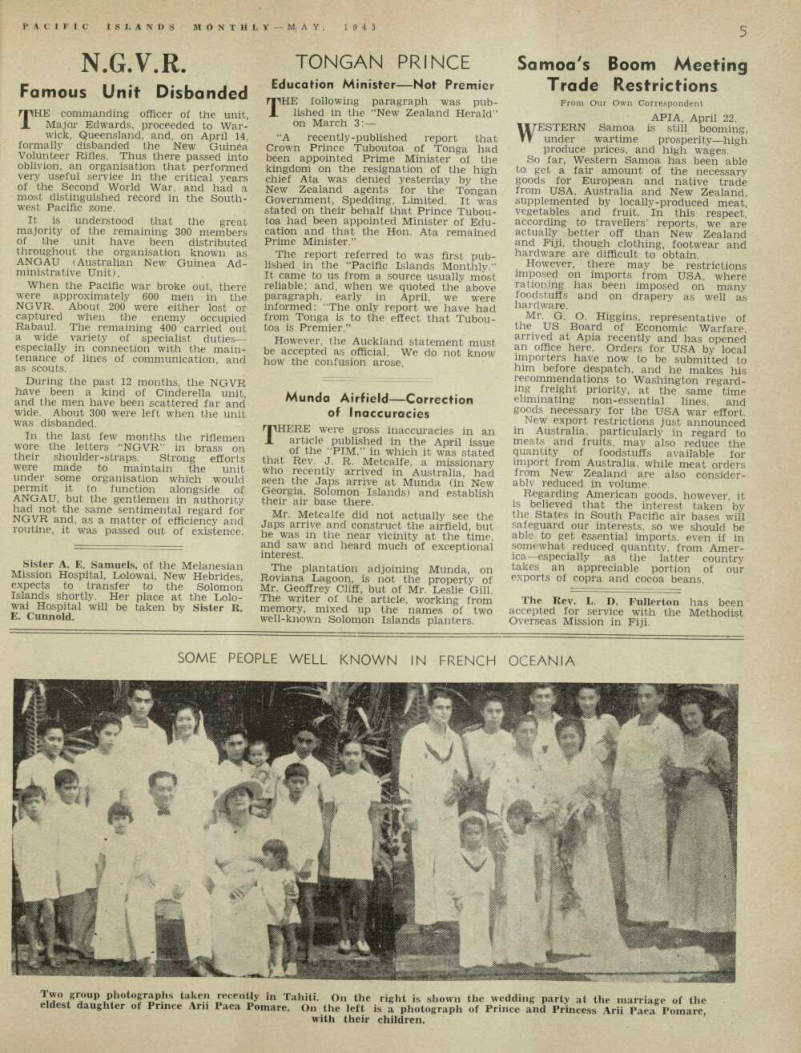
Two group photographs taken recently in Tahiti. On the right is shown the wedding party at the marriage of the eldest daughter of Prince Arii Paea Pomare. On the left is a photograph of Prince and Princess Arii Paea Pomare, with their children.
Advertisements & other items, p. 7 (1 item)
5
f Aci Ft C ISLANDS MONTHLY— M. A V , 1943
Docked 50 Per Cent.
Case of Three Papuan Service Pensioners
THE report that three members of the Papuan Public Service, who had been arbitrarily deprived of half their pensions because they had accepted wartime jobs in Australia, has been explained.
Before the outbreak of war with Japan, Messrs W. D. Brown, S. J. Ander son and J. J. Hartley signified their intention of retiring from the Papuan service. Their resignations were form ally accepted by the Executive Council, and they were granted the periods of furlough usual on retirement, and pen sions, which were to commence on the expiry of the special leave. Each got at least 12 months’ leave. Before that leave expired, the war with Japan commenced.
On April 27, 1942. the Commonwealth authority announced this Statutory Rule: Where a person who is granted a super annuation allowance . . . after the commence ment of these regulations is employed by the Commonwealth, or a State, or a Territory of the Commonwealth, or any public authority of the Commonwealth or State, the rate of super annuation allowance payable to him during that period of employment shall be 50 per cent, of the rate to which he would have been entitled, but for this regulation, Messrs. Brown, Anderson and Hartley accepted wartime jobs; and, when they began to draw their pensions, late in 1942. they were “docked" 50 per cent.
This high-handed Governmental action has been challenged, and is likely to be cancelled. It is pointed out that the three men were not “granted a super annuation allowance . . . after the com mencement of the regulation" (April, 1942 >. They actually were granted the pension by the Papuan Executive Coun cil before the outbreak of the Pacific war.
It is argued that the fact that they did not begin to draw their pensions until after the expiry of their retirement fur lough has nothing to do with the case.
"Aub." Koch Has a Charmed
Life
CIAPTAIN Aubrey Koch, well known as j a commercial pilot in New Guinea in the years before the war, was in charge of the Qantas flying-boat which was forced down onto the sea near the North Australian coast by bad weather, on April 22.
Most of the considerable number of people aboard (the majority were ser vice personnel) were lost. Captain Koch was one of those who saved themselves by swimming a long distance to land, through a rough sea. He thus repeated his memorable performance of early 1942, when the plane in which he was bring ing refugees from the East Indies to Australia was shot down by Japanese fighters, off the coast of Timor. Koch, although badly injured, somehow swam ashore. He later was taken to Darwin— in time to experience the first great Jap air raid there. He later recovered, at his home in Sydney.
Among those lost on the flying-boat was the purser, Mr. W. R. Bartley. Before the war, he was on the staff of Steam ship Trading Co., Port Moresby.
It is notified in the “Western Pacific Gazette” of March 19 that the following have received commissions in the Solo mon Islands Labour Corps: Captain H.
F. Waters, Lieutenants H. Cameron, H.
C. Corry, H. M. Davies, G. Harkins, C.
E. Hart, A. E. Morris. P. H. Mulvey, J.
Y. Svensen, R. C. Symes, C. T. Try.
Wet But Normal Season
PAPEETE. March 26. 11/ 7 E are having a very wet, but normal ▼ f rainy season. Our plant-life is flourishing amazingly.
Some years ago, the late Samuel Rus sel planted an avenue of flowering trees in the New Papeete district. In the fer tile soil, and by virtue of propitious weather, these trees have grown to stately proportions, and, when they are in full flower, they are a fitting memorial of the man so many of us loved.
War Conditions on Norfolk
Island
INDUSTRIAL activities on Norfolk Island have been adversely affected by war conditions. In the year ended June 30, 1942, the principal exports were:—
Total exports, worth £7,404, represented a decrease of nearly 50 per cent, com pared with the years immediately before the war.
Since June, 1942. a smaller area than heretofore is under cultivation. The passionfruit plantations have not been enlarged, and some have been allowed to die out. The areas usually planted with beans have been much reduced, with a resultant substantial reduction in the quantity of seed produced for the Sydney market.
Bean seed £ . .. 3.453 Hides ... 270 Lemon juice . . . 216
Passionfruit pulp .. .
. .. 2.222
Fiji Airman Missing
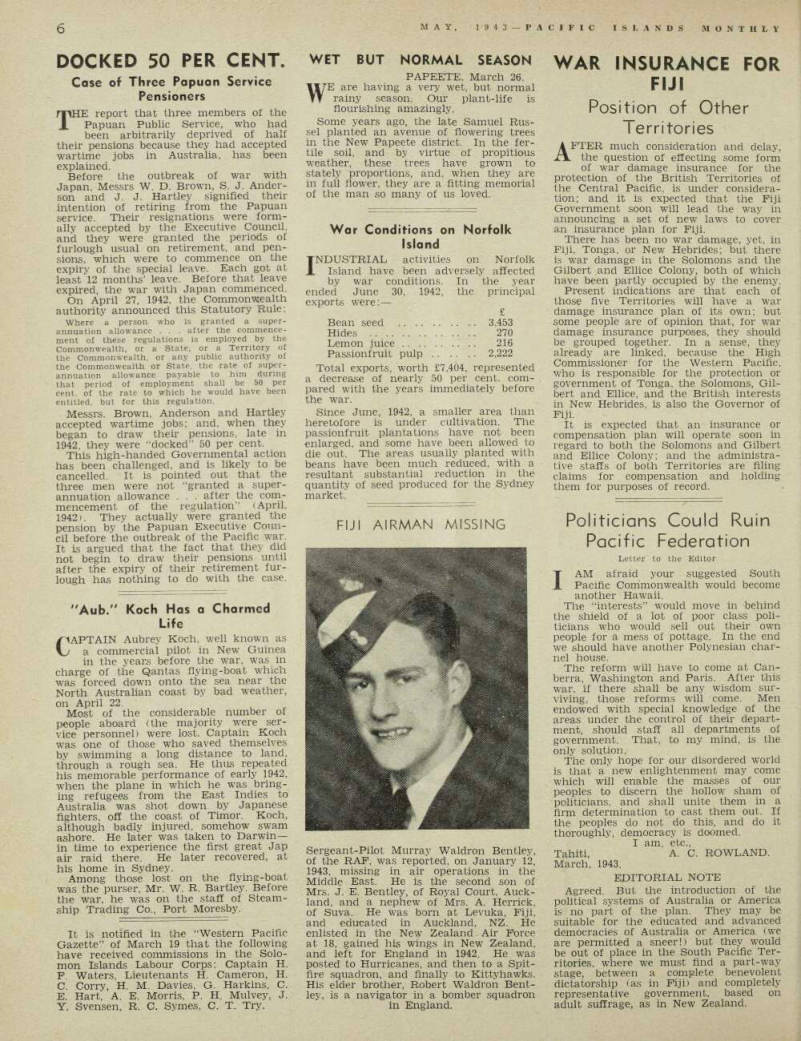
Sergeant-Pilot Murray Waldron Bentley, of the RAF, was reported, on January 12, 1943, missing in air operations in the Middle East. He is the second son of Mrs. J. E. Bentley, of Royal Court. Auck land, and a nephew of Mrs. A. Herrick, of Suva. He was born at Levuka, Fiji, and educated in Auckland, NZ. He enlisted in the New Zealand Air Force at 18, gained his wings in New Zealand, and left for England in 1942. He was posted to Hurricanes, and then to a Spit fire squadron, and finally to Kittyhawks.
His elder brother, Robert Waldron Bent ley, is a navigator in a bomber squadron in England.
War Insurance For
Fiji
Position of Other Territories
AFTER much consideration and delay, the question of effecting some form of war damage insurance for the protection of the British Territories of the Central Pacific, is under considera tion; and it is expected that the Fiji Government soon will lead the way in announcing a set of new laws to cover an insurance plan for Fiji.
There has been no war damage, yet, in Fiji, Tonga, or New Hebrides; but there is war damage in the Solomons and the Gilbert and Ellice Colony, both of which have been partly occupied by the enemy.
Present indications are that each of those five Territories will have a war damage insurance plan of its own; but some people are of opinion that, for war damage insurance purposes, they should be grouped together. In a sense, they already are linked, because the High Commissioner for the Western Pacific, who is responsible for the protection or government of Tonga, the Solomons, Gil bert and Ellice, and the British interests in New Hebrides, is also the Governor of Fiji.
It is expected that an insurance or compensation plan will operate soon in regard to both the Solomons and Gilbert and Ellice Colony; and the administra tive staffs of both Territories are filing claims for compensation and holding them for purposes of record.
Politicians Could Ruin
Pacific Federation
Letter to the Editor 1AM afraid your suggested South Pacific Commonwealth would become another Hawaii.
The “interests” would move in behind the shield of a lot of poor class poli ticians who would sell out their own people for a mess of pottage. In the end we should have another Polynesian char nel house.
The reform will have to come at Can berra, Washington and Paris. After this war, if there shall be any wisdom sur viving, those reforms will come. Men endowed with special knowledge of the areas under the control of their depart ment, should staff all departments of government. That, to my mind, is the only solution.
The only hope for our disordered world is that a new enlightenment may come which will enable the masses of our peoples to discern the hollow sham of politicians, and shall unite them in a firm determination to cast them out. If the peoples do not do this, and do it thoroughly, democracy is doomed.
I am, etc.,
Tahiti,
A. C. Rowland.
March, 1943.
Editorial Note
Agreed. But the introduction of the political systems of Australia or America is no part of the plan. They may be suitable for the educated and advanced democracies of Australia or America (we are permitted a sneer!) but they would be out of place in the South Pacific Ter ritories, where we must find a part-way stage, between a complete benevolent dictatorship (as in Fiji) and completely representative government, based on adult suffrage, as in New Zealand.
32 Planters Go Back To Papua
Board of Control :: No Private Trading
From a Special Correspondent
Canberra, May 10.
Brigadier d. m. cleland, of West Australia, has been appointed chairman of the Production Control Board, which will take over from ANGAU all matters relating to production. He has been visiting Canberra. The other three members ol the Board have not yet been appointed, but it is expected they will be announced within a week.
It is confidently hoped that one of the three members will be regarded as the direct representative of the plantation owners.
It is expected that 32 planters will return to Port Moresby, in about one month’s time. A few of those who have been evacuated may not return; but they will nominate managers of their planta tions. This comprises practically all the Port Moresby district planters.
The total number of planters from the New Guinea Mandated Territory was in the neighbourhood of 500.
It is considered that the Port Moresby planters should produce about 1,600 tons of rubber per annum.
The arrangements are not yet finalised, and the names of those who are being allowed to return are not yet announced.
No women will be allowed to return, at the present stage.
Planters will be sent to as many plan tations in Papua as are considered safe.
As the safe area is extended, more plant ers will be sent back.
Operations will be carried out under the supervision of the Control Board, through whom planters will purchase all goods, stores, etc., required by them, and the Board will purchase rubber, copra and coffee from the planters.
It was proposed that the natives required for plantation labour should be supplied by the Army, but objections have been raised to this on the ground that if planters do their own recruiting, considerable expense will be saved.
Major-General Morris is the GOC of
ANGAU, with headquarters in Papua.
He is not now connected with military operations. Next to him, in authority, is Brigadier D. M. Cleland, chairman of the Production Control Board; and next to him, in immediate charge of ANGAU personnel, is Lieut.-Colonel Taylor—bet ter known as Mr. “Ted” Taylor, former head of New Guinea District Services.
According to evacuees, the Papuan natives are being spoilt by the Ameri cans, who think nothing of giving them 2/- for a single coconut.
Still Awaiting Full Board
Canberra, May 14.
THE three men who, with Brigadier Cleland, will form the Production Control Board, will not be an nounced by the Minister until next week.
They will comprise an agricultural expert, a stores expert and a financial expert.
The Board will have its headquarters in Papua, where it will work in close association with ANGAU, but indepen dently of that organisation. Its Austra lian offices will be the offices of the Department of External Territories, and it will be directly responsible to that Minister (Senator Fraser, External Ter ritories) .
Many details relating to the operation of the plantations cannot be settled until the full Board is appointed and at work.
These include the prices which are to be paid for plantation products.
Once the Board is appointed, events should move swiftly. The Commonwealth Government wishes the planters to return as quickly as possible, to get on with the production of rubber and copra.
Although differences of opinion appar ently exist, it has been decided that the planters, operating under the Production Control Board, must apply to the Army for native labourers, instead of engaging their own labour or doing their own recruiting. If this system is strictly enforced, there will be danger of friction, and loss of plantation efficiency.
Troubles Of Territories’ Residents
How to Deal With Claims and Grievances
rpHE claims and grievances of A people who have been evacuated from Papua and New Guinea are dealt with by three different and separate sets of Governmental autho rities.
Failure on the part of the Austra lian Government to make this clear has led to confusion and irritation.
The three authorities are:— CLAIMS for compensation for war damage, under the War Damage Insurance plan, are in the hands of the War Damage Commission, which has offices in Brisbane, Sydney and Mel bourne.
Under the regulations given it by the Commonwealth Government, the Com mission cannot pay any compensation for indirect or consequential war dam age, such as looting, destruction and deterioration of property through com pulsory evacuation or lack of guardian ship, and so on. Compensation will be paid only for damage caused by actual fighting, or the application of a scorched earth policy.
The regulation relating to non-pay ment for indirect damage is so obviously improper and unfair that the Commis sion itself has suggested an alteration; but constant pressure upon the Govern ment will be needed before this injus tice to Territories’ evacuees is removed.
No claims, in any event, will be paid until after the war.
CLAIMS upon the military, naval or air-force people for compensation for the seizure or use of property in Papua and New Guinea —and espe cially in and around Port Moresby—are NOT regarded as coming under War Damage Insurance. Instead, if they are recognised, they are paid by the head quarters of the particular service con cerned.
All these claims go to a particular branch of the Army; and a gentleman named Mr. Harry Alderman, an Adelaide lawyer, deals with them on behalf of the Army. As we indicated in this journal in April, Mr. Alderman has his own methods of trying to adjust claims, and they are a little surprising.
In his view, the claimant is always the plaintiff, and the Army is the defendant,
and he is counsel for the defendant. If, by clever argument, he can gain for the Army the avoidance of a claim, he will consider that he is doing his duty. The unhappy plight of the property-owner, evacuated and helpless, is no concern of his.
Mr. Alderman has nothing whatever to do with the War Damage Commission, except that he reports details of any payments he makes to the Commission, so that the latter may not duplicate the payment when making an assessment for compensation.
THE third authority is the board, newly-constituted, to control the operation of plantations within the Territories (see this page). This body will deal with all matters relating to the return of planters to the Territories, and the operation of their plantations.
FOR example: Let us suppose that there was a rubber plantation in the Port Moresby district. The owner was evacuated in February, 1942, and forced to leave his property un guarded and unprotected. Natives came along and looted his house, and the Army came along and took away his horses, for transport purposes. A party of sol diers were quartered in his house for two months.
Now, over a year later, the planter is permitted to return, to grow rubber. He will have a claim against the Army, for horses impressed, and for rent of his house, and in these matters he will have to deal with Mr. Alderman. Mr. Aider man may grant the claim for the horses —although he probably will insist that they were old and skinny horses, and of little value—but he will resist the claim for rent, on the ground that the house was unoccupied, anyway.
Our planter also will lodge a claim with the War Damage Commission for (a) value of property looted and (b) deterioration of property through its being left unguarded as a result of his compulsory evacuation. The War Dam age Commission will resist both claims, on the ground that the damage was not directly the result of war conditions. But he should not withdraw his claim, be cause it is likely that the definition of “war damage” will be reviewed.
Finally, our planter will wish to make all arrangements for bringing his plan tation back into production—engagement of staff, recruitment of labour, purchase of stores, arrangements for transport, sale of his produce, and so on. In all these matters, he must deal with the new Production Control Board which, presumably, will be found in the offices of the Department of External Affairs, in Brisbane, Sydney, Melbourne and Canberra, and at Port Moresby.
In dealing with all these matters, com plex and difficult, the Territorian should seek the assistance and advice of the Pacific Territories Association.
For the addresses of all the above bodies, see page 2 of the “PIM.”
Pitcairn Officials
THE following are the office-bearers of the Pitcairn Island community for the year 1943: Chief Magistrate: Frederick Christian (elected).
Assessors: John Christian, Wilkison Young (elected).
Internal Committee: Cook Coffin (elected), Fred. Brown, Arnold Christian (nominated).
Police Constables: Grant Young, Sel wyn Warren (nominated).
"Foreign" Missions
New Guinea Administrator's "Warning" to Australia
IN concluding its report of an address to the Sydney Legacy Club by Sir Walter McNicoll, civil administrator of New Guinea, on May 6, the “Sydney Morning Herald’ said: “Sir Walter warned Aus tralia that foreign missionaries (presum ably in New Guinea) should be replaced by British and Australian missionaries.”
If Sir Walter is correctly reported, he has said either too much or too little.
Attention is directed to an article on page 16 of this issue, which shows the number and nationality of Roman Catholic missionaries in New Guinea at the outbreak of the European war. The only other foreign missionaries there were those of the Lutheran Church.
What happened after the outbreak of war? Although Australian public opinion was extremely sensitive on the subject of suspected enemy propaganda or espionage in New Guinea, only half a dozen of all those' Roman Catholic foreign mis sionaries were removed from New Guinea (about 2 per cent.). In the case of the Lutherans, there were two sections — German and American. The younger Ger mans were bitten deep with the virus of Hitlerism, and a large proportion of the German Lutherans were sent away; but the proportion of American Lutherans who were suspect, although many bore German names, was very small.
Therefore, apart from the group of German Nazified Lutherans, what is the objection to “foreign” missionaries carry ing out their work in New Guinea? Have they done any harm, which might be set against the immense amount of good they have achieved?
The overwhelming majority of foreign missionaries in New Guinea are Roman Catholics; and, from one end of the Pacific to the other, the devotion of the Roman Catholic missionaries to their work, and their readiness to sacrifice themselves in caring for the natives, are so well known as to need no description here. Nationality has had nothing to do with the quality of the service given by these people. British, Germans, French, Italian —the story is the same in all the Territories of the Pacific. Wherever there has been work to do, there almost always has been a missionary to do it; and the record of the foreign Roman Catholic missionaries is not one bit less creditable than that of the various British mis sionaries of the various Protestant de nominations —excellent as the latter has been.
LACKING a full report of Sir Walter McNicoll’s address, we cannot say that he cast any reflection upon the foreign missionaries of any particular sect in New Guinea; but any criticism of missionaries would come from him with singularly bad grace, because none of the larger Territories in the Pacific has a worse governmental record than New Guinea in the fields of native health and native education.
For 25 years, Australia and the Aus tralian administrators have shirked their responsibilities to the natives, and have left the care of native education and health very largely to the several organisations of devoted and self sacrificing missionaries. Because they were more numerous than the Protestants, the larger share of this work naturally has been carried out in New Guinea by the very “foreign missionaries” against whom Sir Walter warns the Australian public.
In the case of some Administrations, there is a good reason why the care of the natives’ bodies and minds are left to
the missionaries: the Administrations are chronically short of funds. But New Guinea did not have this excuse. For several years, New Guinea derived rich revenues from the taxation of the flourishing gold industry (royalties, im port duties, license fees, and what not); and a well-planned Administration would have turned back a proportion of this money into channels which would have directly benefited the natives.
But not the NG Administration. It sponsored some feeble efforts in the way of training a very few native school teachers and hospital assistants; but, for the most part, it squandered all the gold fields revenues in various ways, and left education and health to the missionaries —mostly “foreign.”
"Awatea's" End
Well-known Pacific Liner Lost Off Algiers
THE Union Steamship Company’s “Awatea” was well-known to Pacific travellers before the war—but now, like many of our other Pacific friends, she is no more.
The following account of how she met her end off Algiers during the Allied landing in North Africa in November, 1942, is a condensation of an interview by the Auckland “Star” with Alan Farn worth, who was serving on the “Awatea” at the time she was lost.
“All equipment except our battledress was American,” said Mr. Farnworth, “and we were carrying British Commandos and American Rangers. We didn’t know where we were going until the second day in the Mediterranean. We had a wonder ful escort of battleships and aircraft carriers, and there was little bombing by the enemy for three days.
“The fourth day we steamed up the west coast of Africa, and at 11 p.m. re ceived the ordpr to dock. Some Com mandos were ordered to Algiers and others to forts. Artillery troops were to follow up. Organisation was perfect. There were a few explosions ashore and some fighting at Algiers between the French Navy and the Allies. Two days later we moved to the Bay of Algiers, and from then on Jerry didn’t leave us alone. By the time our ship was sunk, later on, some fine vessels had been lost. However, we hit back.”
At Boujie, which is about 120 miles from Algiers, they discharged two-thirds of their troops, their equipment, gasolene and in vasion barges, and were given orders to proceed to Gibraltar. On the way there, off Algiers, the “Awatea” was sunk.
“I was on the after-deck when a bomb went down the No. 2 hatch,” continued Farnworth. “There was a terrific ex plosion and a barrage of smoke went up, made worse by the draught that was blow ing, because the ship was half empty. Our guns and rockets were blazing away, and the water service was disorganised, but we got a hose down the hatch.
“As usual, a torpedo-plane came in at the kill, and Jerry machine-gunned us all the while. It was amazing that out of 150 men on board, there were only three seri ous casualties and no one killed.”
The captain and crew were taken on board a Dutch ship, which had been to New Zealand in pre-war days, and were well looked after.
Officers of the “Awatea” were honoured for distinguished service, notably: Cap tain G. B. Morgan (who won the DSC in the last war), DSO; Chief Officer McGarry, Chief Engineer Simmonds, Oil burner W. S. Muir, awarded DSC; while eight officers and men were mentioned in despatches.
Japan In Stolen
Empire
Exploiting Indonesia for Her Own Benefit
From Netherlands Indies Government Information Service FURTHER details of Japan’s plans for the occupied territories in the South-west Pacific have been re vealed by an article in a newspaper of her German Axis partner, the “Muen chner Neueste Nachrichten.”
They confirm that Japan is solely interested in exploiting these territories for her own benefit. The welfare and progress of their populations is com pletely disregarded.
The first aim is to secure an adequate food supply—for Japan. The growing of rice and soya' beans, and the develop ment of the fishing industry, is to oe encouraged all over “Greater East Asia.’’
The second is the concentration of all industries in Japan and, possibly, For mosa, The third is to develop the Nether lands East Indies, Malaya, Burma and, to a certain extent, the Philippines, “along colonial lines,’’ so as to provide raw materials for these industries.
While coal will, of course, have to come chiefly from Manchuria and North China, the Netherlands East Indies, Malaya, and the Philippines are to grow cotton on a considerable scale to pro vide the raw material for Japan’s cotton industry which, before the war, was dependent chiefly on imports from Brit ish India.
This means that the natural resources of the occupied territories, on which the livelihood of millions of natives depends, are to be neglected.
ALREADY, this process has begun.
Rubber trees in Malaya are reported to have been cut down to make room for cotton plantations. Sugar plantations in the Philippines are said to have been converted for the same pur poses. The famous rubber and tobacco plantations of Deli (Sumatra) will have to make place for rice-fields.
In the Netherlands East Indies a con siderable increase of unemployment is recorded in agricultural districts, indi cating that here, too, the Japanese have begun to remould the country's economy for their own purposes.
At Bandoeng and at Medan, both towns in the centre of important agri cultural districts, the population has increased by about 30 per cent, since the Japanese invasion, owing to unemployed flocking to the towns.
Naturally, the Japanese are not going to disregard completely the rich rubber and tin resources of the occupied coun tries. But it is significant that these industries will be carried on as private enterprises. The Japanese State will not run the risk of being left with huge quantities of raw materials for which no market can be found.
Experiments are being carried out regarding the manufacture of petrol and oil from rubber, and it is announced that a factory for this purpose has been opened at Kuala Lumpur. Meanwhile, a Japanese research bureau has been established, with a capital of 10 million yen, to find other uses for rubber.
All this indicates that Japan’s policy is the exact reverse of what the Nether lands colonial policy has always been.
One of the outstanding features of Dutch rule is the East Indies open-door policy. This meant that the Nether lands East Indies were open to the
world. Anybody who cared to come and establish themselves there could trade freely, invest money, own property and receive the same treatment and protec tion as the subjects of the Queen.
The effects of this policy are clearly reflected in the figures compiled by the Royal Institute of International Affairs regarding the imports and exports of various Mother countries, from and to their respective colonies and mandated territories. It will be seen that Japan heads the list, while Holland comes last:—
Imports into Exports of Colonial Em- Colonial Em-
Countries
pires from pires to their Metrotheir Metrop o 1 i t a n p o 1 i t a n countries countries (1933) (1933) Japanese Mandate . 94.9 97.0 Japanese Colonies . 83.1 88.5 U.S. Dependencies * (including Philippines! 80.2 96.6 French Colonies .. 66.7 88.5 German Colonial Empire (1912) 62.1 68.3 Italian Colonies . . 59.3 65.5 French Mandates . 56.4 46.1 Belgian Congo . .. 43.4 71.1 Portuguese Colonies 43.0 49\ 5 British Colonies .. 24.4 32.5 British Mandates . . 17.9 31.4 Netherlands Indies 11.9 17.6
Advertisements & other items, p. 10 (1 item)
8
MAV, 1943 - t A C i F 1 C ISLANDS MONTHLY
New Guinea
You were so beautiful in peace, So rich in rival colourings, Blessed with abundance which we scarcely guessed And unexploited wealth within your soil.
All those who knew you loved your pebbled paths, The light and shades among your reefs, And palms that stretched their welcome to the shores, The fleet of fireflies darting through the dark, Slow copra boats and whitewashed China-towns, And deep warm-hearted hospitality Lavished on all who came to visit you.
The world has changed. Your solitude Is shattered by the sounds of war; Your brown sons bear our wounded tenderly.
Broken and stricken palm-trees hang their heads And rain is more relentless than the foe.
There is no comfort and no guiding light Within that sodden jungle where they fight, Yet comradeship is there, and some have said When peace returns they will go back.
You shall be lovely then; the primitive Heart of your soil shall heal in time And clothe you once again as you should be, Vivid and perfumed, irresistibly Adorned with crotons and each dazzling hue Of changing contrast on your tropic breast, Fearless, free, framed by Pacific waters.
Ours most precious, won at such great cost, Your names indelibly impressed Upon our memories, revered For all time by the peoples of this land.
Peace be upon your shores again!
Freda Macdonnell.
1334 Pacific Highway, Turramurra, NSW.
Holding
Burns Philp Profits Are Holding Remarkable Financial Strength of Big Firm
THE great internal strength of Burns Philp & Co., Ltd., is disclosed in the annual report for the year ended March 31. Profit in a normal pre-war year was about £250,000. Yet, in the year just ended, operations yielded just over £200.000. And this firm had large, far reaching interests in New Guinea. Solo mons, Papua, and Nauru—all invaded by the enemy.
Its operations to-day are confined largely to New Hebrides and Australia (the South Seas Co. takes care of the Central Pacific Territories): but its activities cover so many fields that, what it has lost on the invaded Territories’ swings, it has gained on the Australian roundabout.
Some Territorians may wish to weep over the fact that, in these evil days, the Big Firm still can nay 10 per cent. They should comfort themselves with the thought that, if the heart-breaking work of rehabilitation in the Territories can not be undertaken bv a war-broken Government, substantial help may be forthcoming from the huge reserves of the Big Firm.
The following table shows what has happened since Munich:—
The 1943 nrofit is arrived at after charging £112.993 for depreciation, as against £107.865 in 1941-42. Gross nrofit was £1.241.715, compared with £1,598.523. and exnenses were £878.045, against £1.110.445. Dividend is maintained at 10 ner cent., requiring £200,000, and the carry forward is increased from £32,066 to £33.530.
In their report, directors state that onerations throughout the year nroved difficult because of prevailing abnormal conditions. Although many factors ini mical to profitable trading had to be contended with, all sections of the com pany’s business were reasonably well maintained.
To Gross Profit Net Profit March 31 £ £ 1939 .. .. 1,246.228 251.144 1940 . . . . 1.‘>84.081 260.621 1941 .. .. 1.385.059 270.657 1942 . . . . 1.598.523 194.435 1943 .. .. 1.241,715 201.464
Misima Gold
MISIMA Island, out of which Cuth bert’s Misima Gold Mine has ex tracted more than £175.000 in dividends, lies 150 miles almost due east from the entrance to Milne Bay. East ern Papua. Compulsory evacuation of the island took place in January, 1942, and the flow of dividends ceased at an interesting stage of development of the northern leases. At the annual meeting in Sydney, chairman Gordon Carter said that when the position in the south west Pacific had sufficiently improved, the board anticipated receiving per mission to send to Misima a small maintenance party to prepare for the return of the mining team. From the meagre information available there was reason to believe that the property was in fair condition and had suffered little.
The company would probably be able to live within its income until operations were resumed.—“ Sydney Bulletin."
Mr. Geoffrey Marks, younger son of the late Sir Henry and Lady Marks, of Suva, enlisted in the United States Army Air Corps in 1941. and is now a sergeant.
1,000 Volunteers Wanted
Call To Indians
Of Fiji
The following Australian Associated Press message from Suva was pub lished in Australia early in May:— “The Government of Fiji requires at least f ,000 Indians in addition to the many thousands of Fijian volunteers who are already serving as soldiers or civilian labourers.
“If the thousand Indians are not re cruited by June 1 compulsory national service of Indians will be enforced.
“Indian residents of Fiji have presented the Governor with a cheque for £5,500 for a fighter plane. The Indians also propose to present an ambulance costing up to £1,000."
Editorial Note
There are, in Fiji, about 105,000 Fijians and about 100,000 Indians. The Fijians, who are natural warriors, have volunteered in thousands, and already they have sup plied a number of fighting and labour units. While many Indians have joined up, the numbers who have shown eager ness to serve are not to be compared with those of the Fijians.
The new announcement, characteristic of the strong, firm hand of Sir Philip Mitchell, puts the issue up squarely to the Fiji Indians. Help in the defence of Fiji against the natural enemy of all free peoples in the Pacific—or else!
The shrewd gentlemen who lead the Indian community in Fiji mav be de pended upon to provide that battalion pretty quickly. Indians would be fools, indeed, to place in jeopardy the rights and privileges they enjoy in that rich Crown Colony.
Langley Borlase Brown, four-year-old son of Corporal and Mrs. A. R. Brown. died in Newcastle, NSW, on April 6, after a short illness. His parents were well known in Papua, where Corporal Brown was on the Samarai and Port Moresby staffs of Burns Philp & Co. for eight years. He is now serving with the RAAF.
Advertisements & other items, p. 11 (1 item)
Fighting French Leader
M. HENRI MONTCHAMP, Governor of New Caledonia,
Strength in 1942 Figures
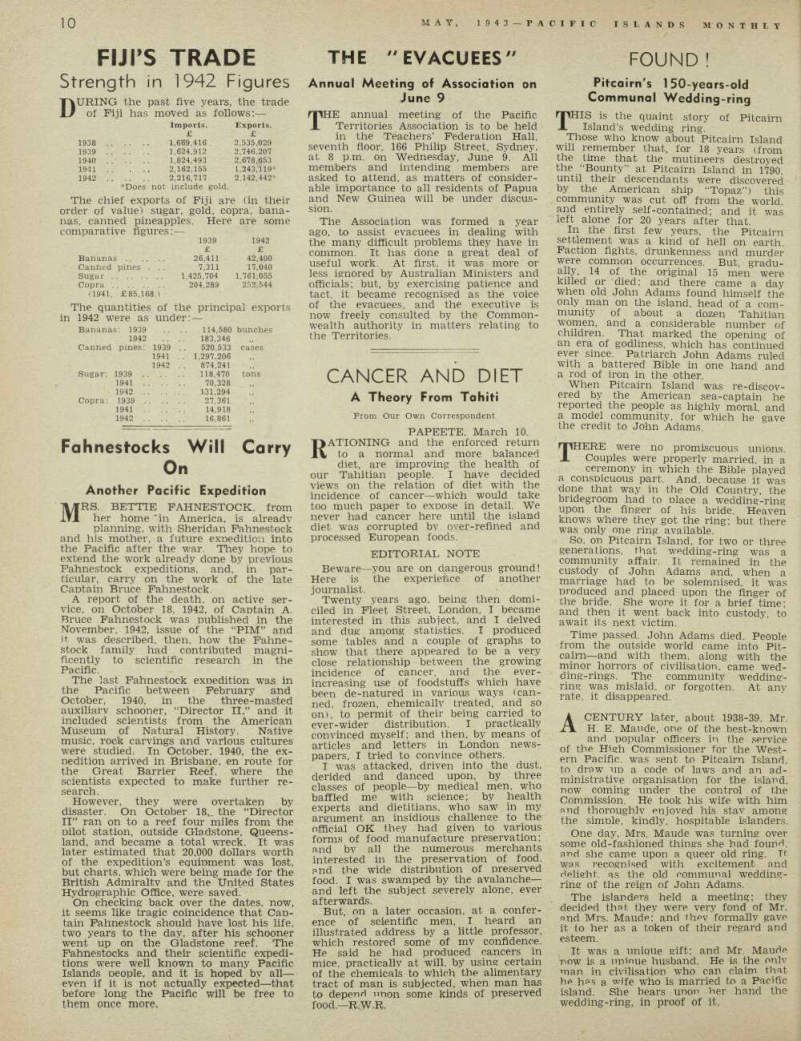
Fiji’S Trade
DURING the past five years, the trade of Fiji has moved as follows:
The chief exports of Fiji are (in their order of value) sugar, gold, copra, bana nas, canned pineapples. Here are some comparative figures:—
The quantities of the principal exports in 1942 were as under:
Imports.
Exports. £ £ 1938 . 1,669.416 2,535,029 1939 . 1,624,912 2.746.207 1940 . 1,824,493 2.678,653 1941 . . 2,162,155 1,243,119* 1942 . 2,216,717 *Does not include gold. 2,142,442*
1939 1942 £ £ Bananas 26,411 42,400 Canned pines . .. 7,311 17,040 Sugar 1.425,704 1.761,055 Copra 204,289 252,544 (IS'41, £85,168.)
Bananas: 1939 . . 114,580 bunches 1942 183,346 ,, Canned pines; 1939 .. 520,533 cases 1941 .. 1,297,206 ,, 1942 . , 874,241 Sugar: 1939 118,470 tons 1941 . 70,328 1942 . 131,294 Copra: 1939 27,361 1941 . 14,918 1942 . 16,861
Fahnestocks Will Carry
On Another Pacific Expedition
Mrs. Bettie Fahnestock, From
her home 'in America, is already planning, with Sheridan Fahnestock and his mother, a future expedition into the Pacific after the war. They hope to extend the work already done by previous Fahnestock expeditions, and, in par ticular, carry on the work of the late Captain Bruce Fahnestock.
A report of the death, on active ser vice, on October 18, 1942, of Captain A.
Bruce Fahnestock was published in the November, 1942, issue of the “PIM” and it was described, then, how the Fahne stock family had contributed magni ficently to scientific research in the Pacific.
The last Fahnestock expedition was in the Pacific between February and October, 1940, in the three-masted auxiliary schooner, “Director II,” and it included scientists from the American Museum of Natural History. Native music, rock carvings and various cultures were studied. In October, 1940, the ex pedition arrived in Brisbane, en route for the Great Barrier Reef, where the scientists expected to make further re search.
However, they were overtaken by disaster. On October 18,_ the “Director II” ran on to a reef four miles from the pilot station, outside Gladstone, Queens land, and became a total wreck. It was later estimated that 20,000 dollars worth of the expedition’s equipment was lost, but charts, which were being made for the British Admiralty and the United States Hydrographic Office, were saved.
On checking back over the dates, now, it seems like tragic coincidence that Cap tain Fahnestock should have lost his life, two years to the day, after his schooner went up on the Gladstone reef. The Fahnestocks and their scientific expedi tions were well known to many Pacific Islands people, and it is hoped by all— even if it is not actually expected—that before long the Pacific will be free to them once more.
The "Evacuees"
Annual Meeting of Association on June 9
THE annual meeting of the Pacific Territories Association is to be held in the Teachers’ Federation Hall, seventh floor, 166 Philip Street, Sydney, at 8 p.rn. on Wednesday, June 9. All members and intending members are asked to attend, as matters of consider able importance to all residents of Papua and New Guinea will be under discus sion.
The Association was formed a year ago, to assist evacuees in dealing with the many difficult problems they have in common. It has done a great deal of useful work. At first, it was more or less ignored by Australian Ministers and officials: but, by exercising patience and tact, it became recognised as the voice of the evacuees, and the executive is now freely consulted by the Common wealth authority in matters relating to the Territories.
Cancer And Diet
A Theory From Tahiti
From Our Own Correspondent PAPEETE. March 10.
RATIONING and the enforced return to a normal and more balanced diet, are improving the health of our Tahitian people. I have decided views on the relation of diet with the incidence of cancer—which would take too much paper to expose in detail. We never had cancer here until the island diet was corrupted by over-refined and processed European foods.
Editorial Note
Beware —you are on dangerous ground!
Here is the experience of another
journalist.
Twenty years ago, being then domi ciled in Fleet Street, London, I became interested in this subject, and I delved and dug among statistics. I produced some tables and a couple of graphs to show that there appeared to be a very close relationship between the growing incidence of cancer, and the ever increasing use of foodstuffs which have been de-natured in various ways (can ned, frozen, chemically treated, and so on), to permit of their being carried to ever-wider distribution. I practically convinced myself; and then, by means of articles and letters in London news papers, I tried to convince others.
I was attacked, driven into the dust, derided and danced upon, by three classes of people—by medical men, who baffled me with science; by health experts and dietitians, who saw in my argument an insidious challenge to the official OK they had given to various forms of food manufacture preservation; and bv all the numerous merchants interested in the preservation of food, pnd the wide distribution of preserved food. I was swamped by the avalanche — and left the subject severely alone, ever afterwards.
But, on a later occasion, at a confer ence of scientific men, I heard an illustrated address by a little professor, which restored some of mv confidence.
He said he had produced cancers in mice, practically at will, by using certain of the chemicals to which the alimentary tract of man is subjected, when man has to depend unon some kinds of preserved
food,-
R.W.R.
Found!
Pitcairn's 150-years-old Communal Wedding-ring
THIS is the quaint story of Pitcairn Island’s wedding ring.
Those who know about Pitcairn Island will remember that, for 18 years (from the time that the mutineers destroyed the “Bounty” at Pitcairn Island in 1790. until their descendants were discovered by the American ship “Topaz") this community was cut off from the world, and entirely self-contained; and it was left alone for 20 years after that.
In the first few years, the Pitcairn settlement was a kind of hell on earth.
Faction fights, drunkenness and murder were common occurrences. But, gradu ally, 14 of the original 15 men were killed or died; and there came a day when old John Adams found himself the only man on the island, head of a com munity of about a dozen Tahitian women, and a considerable number of children. That marked the opening of an era of godliness, which has continued ever since. Patriarch John Adams ruled with a battered Bible in one hand and a rod of iron in the other.
When Pitcairn Island was re-discov ered by the American sea-captain he reported the people as highly moral, and a model community, for which he gave the credit to John Adams.
THERE were no promiscuous unions.
Couples were properly married, in a ceremony in which the Bible played a conspicuous part. And. because it was done that way in the Old Country, the bridegroom had to nlace a wedding-ring upon the finger of his bride. Heaven knows where they got the ring; but there was only one ring available.
So. on Pitcairn Island, for two or three generations, that wedding-ring was a community affair. It remained in the custody of John Adams and, when a marriage had to be solemnised, it was produced and placed upon the finger of the bride. She wore it for a brief time; and then it went back into custody, to await its next victim.
Time passed. John Adams died. People from the outside world came into Pit cairn—and with them, along with the minor horrors of civilisation, came wed ding-rings. The community wedding ring was mislaid, or forgotten. At any rate, it disappeared.
A CENTURY later, about 1938-39, Mr.
H. E. Maude, one of the best-known and popular officers in the service of the High Commissioner for the West ern Pacific, was sent to Pitcairn Island, to drnw up a code of laws and an ad ministrative organisation for the island, now coming under the control of the Commission. He took his wife with him and thoroughly enjoved his stav among the simple, kindly, hospitable islanders.
One day, Mrs. Maude was turning over some old-fashioned things she had found, and she came upon a queer old ring. Tt was recognised with excitement and delierht. as the old communal wedding ring of the reign of John Adams.
The islanders held a meeting; they decided that they were very fond of Mr. and Mrs. Maude; and they formally gave it to her as a token of their regard and esteem.
It was a unioue gift; and Mr. Maude now is a unioue husband. He is the onlv man in civilisation who can claim that he has a wife who is married to a Pacific island. She bears unon her hand the wedding-ring, in proof of it,
Brief Answers To
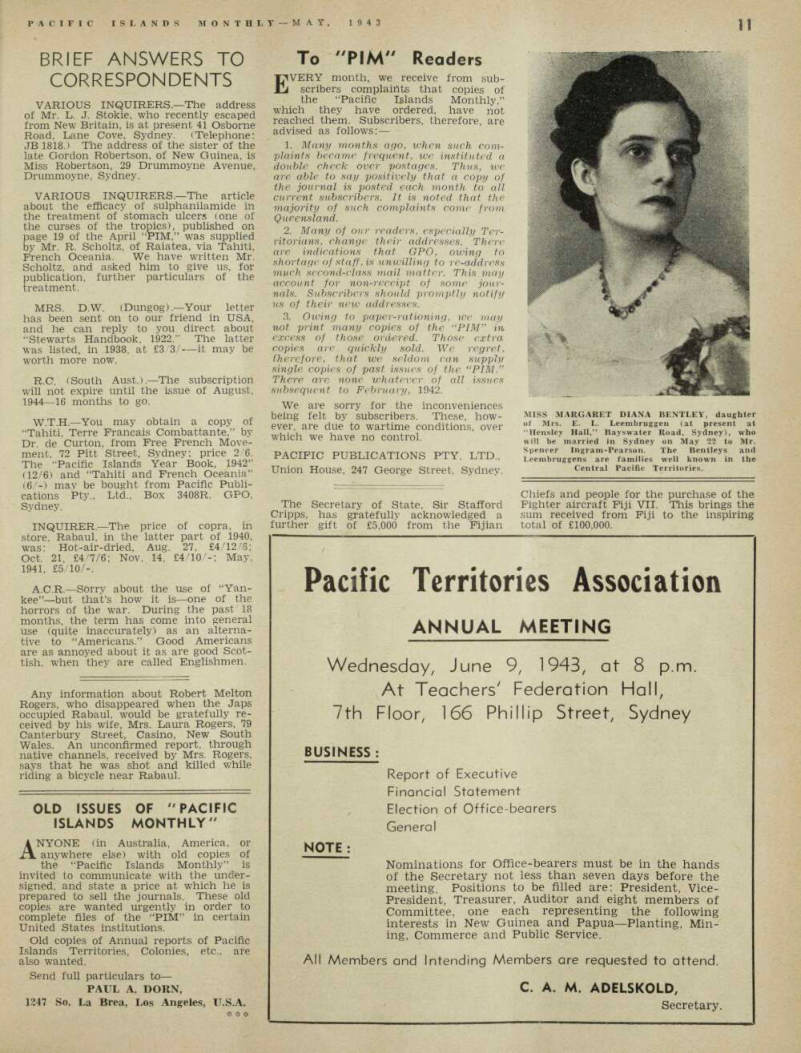
Correspondents
VARIOUS INQUIRERS.—The address of Mr. L. J. Stokie, who recently escaped from New Britain, is at present 41 Osborne Road, Lane Cove, Sydney. (Telephone: JB 18180 The address of the sister of the late Gordon Robertson, of New Guinea, is Miss Robertson, 29 Drummoyne Avenue, Drummoyne, Sydney.
VARIOUS INQUIRERS.—The article about the efficacy of sulphanilamide in the treatment of stomach ulcers (one of the curses of the tropics), published on page 19 of the April “PIM,” was supplied by Mr. R. Scholtz, of Raiatea, via Tahiti, French Oceania. We have written Mr.
Scholtz, and asked him to give us, for publication, further particulars of the treatment.
MRS. D.W. (Dungog).—Your letter has been sent on to our friend in USA, and he can reply to you direct about “Stewarts Handbook, 1922." The latter was listed, in 1938, at £3 3/ —it may be worth more now.
R.C. (South Aust.).—The subscription will not expire until the issue of August, 1944—16 months to go.
W.T.H. —You may obtain a copy of “Tahiti, Terre Francais Combattante,” by Dr. de Curton, from Free French Move ment. 72 Pitt Street, Sydney: price 2 6.
The "Pacific Islands Year Book, 1942” (12/6) and “Tahiti and French Oceania” (6 -) may be bought from Pacific Publi cations Pty., Ltd., Box 3408 R, GPO.
Sydney.
INQUIRER. —The price of copra, in store, Rabaul, in the latter part of 1940, was: Hot-air-dried, Aug. 27. £4/12'6; Oct. 21, £4/7/6; Nov. 14. £4/10/-; May, 1941. £5/10/-.
A.C.R. —Sorry about the use of “Yan kee” —but that’s how it is—one of the horrors of the war. During the past 18 months, the term has come into general use (quite inaccurately) as an alterna tive to “Americans.” Good Americans are as annoyed about it as are good Scot tish. when they are called Englishmen.
Any information about Robert Melton Rogers, who disappeared when the Japs occupied Rabaul. would be gratefully re ceived by his wife, Mrs. Laura Rogers, 79 Canterbury Street, Casino, New South Wales. An unconfirmed report, through native channels, received by Mrs. Rogers, says that he was shot and killed while riding a bicycle near Rabaul.
To "PIM" Readers
IjIVERY month, we receive from sub j scribers complaints that copies of the “Pacific Islands Monthly,” which they have ordered, have not reached them. Subscribers, therefore, are advised as follows: — 1. Many months ago, when such com plaints became frequent, we instituted a double check over postages. Thus, we are able to say positively that a copy of the journal is posted each month to all current subscribers. It is noted that the majority of such complaints come from Queensland. 2. Many of our readers, especially Ter ritorians, change their addresses. There are indications that GPO, owing to shortage of staff, is unwilling to re-address much second-class ynail matter. This may account for non-receipt of some jour nals. Subscribers should promptly notify us of their new addresses. 3. Owing to paper-rationing, we may not print many copies of the “PIM ” in excess of those ordered. Those extra copies are quickly sold. We regret, therefore, that we seldom can supply single copies of past issues of the ” PIM”
There are none whatever of all issues subsequent to February, 1942.
We are sorry for the inconveniences being felt by subscribers. These, how ever. are due to wartime conditions, over which we have no control.
Pacific Publications Pty. Ltd.,
Union House, 247 George Street, Sydney.
The Secretary of State, Sir Stafford Cripps, has gratefully acknowledged a further gift of £5,000 from the Fijian
Chiefs and people for the purchase of the Fighter aircraft Fiji VII. This brings the sum received from Fiji to the inspiring total of £lOO,OOO.
Miss Margaret Diana Bentley, Daughter
of Mrs. E. L. Leembruggen (at present at “Hensley Hall,” Bayswater Road, Sydney), who will be married in Sydney on May 22 to Mr.
Spencer Ingram-Pearson. The Bentleys and Leembruggens are families well known in the Central Pacific Territories.
Advertisements & other items, p. 13 (2 items)
Pacific Territories Association
ANNUAL MEETING
Wednesday, June 9, 1943, at 8 p.m.
At Teachers' Federation Hall,
7th Floor, 166 Phillip Street, Sydney
BUSINESS :
Report of Executive Financial Statement Election of Office-bearers General
NOTE ;
Nominations for Office-bearers must be in the hands of the Secretary not less than seven days before the meeting. Positions to be filled are: President, Vice- President, Treasurer, Auditor and eight members of Committee, one each representing the following interests in New Guinea and Papua—Planting, Mining, Commerce and Public Service.
All Members and Intending Members are requested to attend.
C. A. M. ADELSKOLD,
Secretary.
Old Issues Of " Pacific
ISLANDS MONTHLY"
ANYONE (in Australia, America, or anywhere else) with old copies of the “Pacific Islands Monthly” is invited to communicate with the undersigned, and state a price at which he is prepared to sell the journals. These old copies are wanted urgently in order to complete files of the “PIM” in certain United States institutions.
Old copies of Annual reports of Pacific Islands Territories, Colonies, etc., are also wanted.
Send full particulars to —
PAUL A. DORN,
1247 So. La Brea, Los Angeles, U.S.A.
V * $
Ignorance Of New
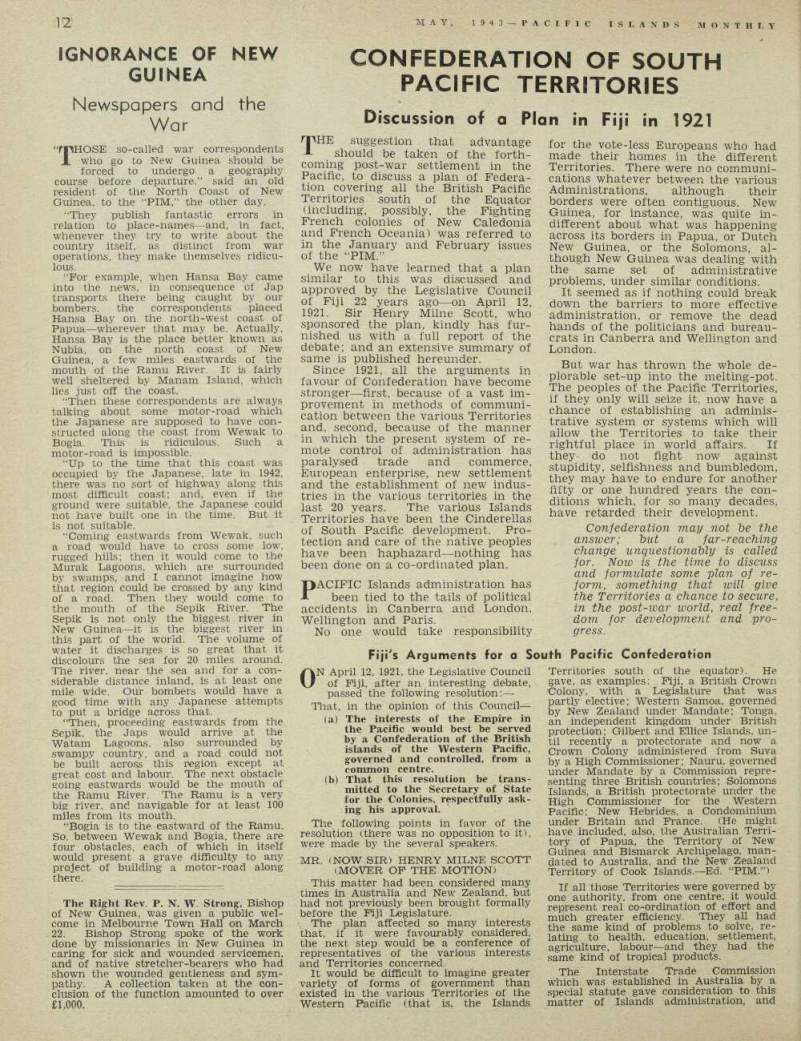
Guinea
Newspapers and the War
“mHOSE so-called war correspondents JL who go to New Guinea should be forced to undergo a geography course before departure,” said an old resident of the North Coast of New Guinea, to the “PIM,” the other day.
“They publish fantastic errors in relation to place-names—and, in fact, whenever they try to write about the country itself, as distinct from war operations, they make themselves ridicu lous. ‘‘For example, when Hansa Bay came into the news, in consequence of Jap transports there being caught by our bombers. the correspondents placed Hansa Bay on the north-west coast of Papua—wherever that may be. Actually, Hansa Bay is the place better known as Nubia, on the north coast of New Guinea, a few miles eastwards of the mouth of the Ramu River. It is fairly well sheltered by Manam Island, which lies just off the coast.
“Then these correspondents are always talking about some motor-road which the Japanese are supposed to have con structed along the coast from Wewak to Bogia. This is ridiculous. Such a motor-road is impossible.
“Up to the time that this coast was occupied by the Japanese, late in 1942, there was no sort of highway along this most difficult coast; and, even if the ground were suitable, the Japanese could not have built one in the time. But it is not suitable.
“Coming eastwards from Wewak. such a road would have to cross some low, rugged hills; then it would come to the Murak Lagoons, which are surrounded by swamps, and I cannot imagine how that region could be crossed by any kind of a road. Then they would come to the mouth of the Sepik River. The Sepik is not only the biggest river in New Guinea —it is the biggest river in this part of the world. The volume of water it discharges is so great that it discolours the sea for 20 miles around.
The river, near the sea and for a con siderable distance inland, is at least one mile wide. Our bombers would have a good time with any Japanese attempts to put a bridge across that.
“Then, proceeding eastwards from the Sepik, the Japs would arrive at the Watam Lagoons, also surrounded by swampy country, and a road could not be built across this region except at great cost and labour. The next obstacle going eastwards would be the mouth of the Ramu River. The Ramu is a very big river, and navigable for at least 100 miles from its mouth.
“Bogia is to the eastward of the Ramu.
So, between Wewak and Bogia, there are four obstacles, each of which in itself would present a grave difficulty to any project of building a motor-road along there.
The Right Rev. P. N. W. Strong, Bishop of New Guinea, was given a public wel come in Melbourne Town Hall on March 22. Bishop Strong spoke of the work done by missionaries in New Guinea in caring for sick and wounded servicemen, and of native stretcher-bearers who had shown the wounded gentleness and sym pathy. A collection taken at the con clusion of the function amounted to over
£L,Ooo,
Pacific Territories
Confederation Of South
Discussion of a Plan in Fiji in 1921
THE suggestion that advantage should be taken of the forth coming post-war settlement in the Pacific, to discuss a plan of Federa tion covering all the British Pacific Territories south of the Equator (including, possibly, the Fighting French colonies of New Caledonia and French Oceania) was referred to in the January and February issues of the “PIM.”
We now have learned that a plan similar to this was discussed and approved by the Legislative Council of Fiji 22 years ago—on April 12, 1921. Sir Henry Milne Scott, who sponsored the plan, kindly has fur nished us with a full report of the debate; and an extensive summary of same is published hereunder.
Since 1921, all the arguments in favour of Confederation have become stronger—first, because of a vast im provement in methods of communi cation between the various Territories and, second, because of the manner in which the present system of re mote control of administration has paralysed trade and commerce, European enterprise, new settlement and the establishment of new indus tries in the various territories in the last 20 years. The various Islands Territories have been the Cinderellas of South Pacific development. Pro tection and care of the native peoples have been haphazard—nothing has been done on a co-ordinated plan.
PACIFIC Islands administration has been tied to the tails of political accidents in Canberra and London, Wellington and Paris.
No one would take responsibility
for the vote-less Europeans who had made their homes in the different Territories. There were no communi cations whatever between the various Administrations, although their borders were often contiguous. New Guinea, for instance, was quite in different about what was happening across its borders in Papua, or Dutch New Guinea, or the Solomons, al though New Guinea was dealing with the same set of administrative problems, under similar conditions.
It seemed as if nothing could break down the barriers to more effective administration, or remove the dead hands of the politicians and bureau crats in Canberra and Wellington and London.
But war has thrown the whole de plorable set-up into the melting-pot.
The peoples of the Pacific Territories, if they only will seize it, now have a chance of establishing an adminis trative system or systems which will allow the Territories to take their rightful place in world affairs. If they- do not fight now against stupidity, selfishness and bumbledom, they may have to endure for another fifty or one hundred years the con ditions which, for so many decades, have retarded their development.
Confederation may not be the answer; but a far-reaching change unquestionably is called for. Now is the time to discuss and formulate some plan of re form, something that will give the Territories a chance to secure, in the post-war world, real free dom for development and pro gress.
Fiji's Arguments for a South Pacific Confederation
ON April 12, 1921, the Legislative Council of Fiji, after an interesting debate, passed the following resolution:— That in the oninion of this Council— That, in the opinion of this council— (a) The interests of the Empire in the Pacific would best be served by a Confederation of the British islands of the Western Pacific, governed and controlled, from a common centre. (b) That this resolution be transmitted to the Secretary of State for the Colonies, respectfully asking his approval.
The following points in favor of the resolution (there was no opposition to it), were made by the several speakers.
Mr. (Now Sir) Henry Milne Scott
(Mover Op The Motion)
This matter had been considered many times m Australia and New Zealand, but had not previously been brought formally The plan affected so many interests that, if it were favourably considered, the next step would be a conference of representatives of the various interests and Territories concerned.
It would be difficult to imagine greater variety of forms of government than existed in the various Territories of the Western Pacific (that is, the Islands
Territories south of the equator). He gave, as examples: Fiji, a British Crown 'Colony, with a Legislature that was partly elective; Western Samoa, governed by New Zealand under Mandate; Tonga, an independent kingdom under British protection: Gilbert and Ellice Islands, un til recently a protectorate and now a Crown Colony administered from Suva by a High Commissioner; Nauru, governed under Mandate by a Commission repre senting three British countries; Solomons Islands, a British protectorate under the High Commissioner for the Western Pacific; New Hebrides, a Condominium under Britain and France. (He might have included, also, the Australian Terri tory of Papua, the Territory of New Guinea and Bismarck Archipelago, man dated to Australia, and the New Zealand Territory of Cook Islands. —Ed. “PIM.”) If all those Territories were governed by one authority, from one centre, it would represent real co-ordination of effort and much greater efficiency. They all had the same kind of problems to solve, re lating to health, education, settlement, agriculture, labour —and they had the same kind of tropical products.
The Interstate Trade Commission which was established in Australia by a special statute gave consideration to this matter of Islands administration, and
the Commission’s conclusions were that there was lack of cohesion in the govern ment of the Islands: there was lack of system; and, even if it were not prac ticable, for the present, to introduce a change in administration system, there should be more effective supervision and greater co-ordination of method between the administrations of the different Terri tories.
Although the Australian Interstate Commission suggested that the Adminis trative centre for the control of all the Islands Territories should be Sydney, he argued that the obvious administrative centre was Suva. Suva was the natural “crossroads of the South Pacific,” and conditions of life in Suva were similar to those in all the Islands Territories.
That could not be said of Sydney.
There was a considerable and, appar ently, a growing difficulty in the fact that the Governor of Fiji was also High Com missioner for the Western Pacific—and there had been agitation for the separa tion of the two offices. The creation of a Confederation would automatically solve this difficulty.
EVERY Territory in the South Pacific had a labour problem; and as development went on these labour problems would tend to become more acute. If the Territories were adminis tered as one Confederation there would be a better chance of dealing fairly and equitably with all these labour problems as one common labour problem. It might be possible to have an interchange of labour between the different Territories: or to introduce indentured labour on a common basis. One large Government dealing with all the Islands would have a better chance of solving the labour problem than several small administra tion acting independently.
The trade and commerce of such a Con federation would be surprisingly large; and the figures would tend to increase rapidly if there were one strong Govern ment to take command of the transport facilities which were now available to most of the independent Territories. They had to think, not only in terms of ship ping, but also in terms of air transport.
He was sure that the growth of air trans port would have a rapid and far-reaching effect upon the growth of trade and com merce in the Pacific.
A Confederation would be helpful to the British Government in taking care of the growing activity and power of Japan in the South Pacific, and Germany’s in sistence in thinking that she could re gain her lost Pacific Colonies. There was a problem also developing in the way in which the United States were looking across the Pacific at Japan. These things should make the people of the Territories think very seriously of defence. (If it is remembered that these state ments were made in April, 1921 —22 years ago—one must pay tribute to the long vision and sound thinking of Sir Henry Milne Scott.—Ed. “PIM.”>
THIS Confederation need not carry with it full representative government— that is, not for the present, although it might come sooner than some people thought. The primary political aim should be a greater amount of political freedom for the inhabitants of the dif ferent Territories, and special represen tation.of the native races in any Federal Parliament that might be formed. He acknowledged that there were practical difficulties in the fact that the Europeans in the Territories were greatly out numbered by the native peoples, some of whom were in a backward condition. But he urged, as a fundamental principle of British colonial rule, that all native peoples should be encouraged and equipped to take a greater and greater share in their own government. Instead of there being a large number of moder ately paid white officials as at present, a confederation would mean a bigger Government machine, with a small num ber of more experienced and therefore more highly paid officials, and much more decentralisation of administration —exercised through local bodies, in which native representatives and native officials would have an increasing amount of authority. He visualised a Federal Coun cil, with headquarters at Suva, and a considerable number of local administra tive bodies, all responsible to the Federal Council.
“If the people of this Colony will pull together and are joined by our Islands neighbours, having one common object in view—namely, a Confederation of the
Pacific—l believe we should be nearer the attainment of our object than many of us think. Then we should have a new Dominion—the Pacific Dominion, as an integral part of the Empire. Our Em pire is based on a free and democratic system of life and government. Let us take advantage of our great heritage.”
Mr. (Now Sir) John Maynard
Hedstrom (Seconder Of
Motion)
IT would be a splendid thing for the Empire if all the Islands of the Western Pacific were banded to gether under one Government at an early date, with free intercommunication by water and by air. We realise that there are considerable practical difficulties in the way; but at this stage we can at least agree to the principle.
It might be possible to give effect to the plan in a series of steps. The first and most obvious step would be the linking
up of Fiji, Samoa and Tonga. The New Zealand Government would not wish to surrender its mandate of Samoa; and the Tongans probably would wish to re tain their present form of government.
There clearly were difficulties in the way of a political union; but the advantages of some sort of a union, in relation to trade and commerce, transport, defence and various other conditions which created problems common to all the Territories, were so great that he felt sure that it would be possible to bring about some sort of Confederation which, while not involving absolute political union, would take care of their common in terests.
The opinion of the Home Government should first be obtained; and, if that were favourable, they could then proceed to a consideration of the whole plan, based on practical issues.
Mr. (Later Sir Henry) Marks
“There are many difficulties —but I think the step is in the right direction
and, with a little encouragement, we shall carry the matter further.”
Mr. Clapcott
“It is one of the things we have badly wanted in the Islands for a long time.”
Mr. Riemenschneider
If such a plan could be carried out, marvellous benefits would accrue, not only in Fiji, but to all the other Islands af fected by the plans. Trade communi cation would be increased tremendously, and Fiji might have a line of steamers direct from Britain, so that Suva could be made the centre of South Pacific dis tribution.
So many widely different forms of government were involved that he thought the plan should be proceeded with very carefully, and step by step. He favoured some form of administrative union with Samoa as the first step. If that arrange ment were satisfactory, other Territories would be encouraged to join in.
Mr. Tarte
He was sure that this plan had the support of all the planters in Fiji. This would be the first step towards a greatly extended form of co-operation.
Mr. Thomas
If such a Confederation were possible it would be of great benefit to the whole of the Islands of the South Pacific.
The Acting Receiver-General
A CUSTOMS Union would be the first step towards such a Confederation; and that first step could include, not only Tonga and Samoa, with Fiji, but also the Solomons and the Gilbert and Ellice Islands. This would be of tremen dous benefit to all the Territories con cerned because it would mean that all imports into the Union would come in at the same rate of duty. Suva, as the natural distributing centre, would benefit accordingly. Duty should be charged at any port of entry throughout the Union.
The Colonial Secretary
He agreed in principle with the argu ments advanced in support of this “very attractive proposition’’; but it would be unwise to underestimate the practical difficulties.
He assumed that a general plan of Federation meant a set of uniform laws under the control of one central govern ment, with local governments dealing with local affairs within the different groups.
A successful Federation demanded essential predisposing causes; and these were present in the demand for easy com munications and a central uniform administration, instead of a whole series of widely varying administrations. But the Governor had already pointed out that a closer relationship between say, Fiji, the Solomons and the Gilbert and Ellice group, while desirable, was made difficult because of infrequent shipping communications. “It is not difficult to imagine our Federal member for say, Ocean Island, spending six months in a very laudable endeavour to attend the Federal Parliament in Suva and return to his constituency. (Since 1921 the whole communications position has altered, owing to the deve lopment of air transport and radio.—Ed.
“Pim.”)
The position in the West Indies was analogous to that in the Western Pacific.
For many years there had been a strong cry in Trinadad, Barbados, the Windward Islands and the Leeward Islands in favour of a West Indies Federation. Dif ferences in forms of government, and in public opinion, had always stood in the way of the plan, but considerable ad vances had been made there lately; and they had just established, for the first time, a Judicial Court of Appeal for the five British West Indian Colonies. They had agreed on a uniform Quarantine Con vention, and they were now meeting to discuss the plan of a Customs Union. A commercial organisation, called the Associated Chambers of Commerce of the West Indies, dealt with commercial prob lems common to all the West Indies Colonies, and made contact concerning them with each or any of the five
Governments; and this was doing a great deal to advance the idea of Federation.
The Governor, Sir Cecil
Rodwell
A CUSTOMS Union would be the be ginning, if not the basis of any Federation or Union which might be set up in the Pacific; and he had re cently received from the Acting fteceiver- General and the Secretary of the Western Pacific High Commission, a very valuable memorandum confirming statistics which would be of use in the establishment of a Customs Union in the Pacific.
They should be clear before starting upon this plan whether they were in favour of a Union or a Federation, be cause they were two very different things.
There already existed a link between Fiji and many of the other Pacific Terri tories, in the fact that the Governor of Fiji was also High Commissioner for the Western Pacific. The abolition of the dual office had been urged in Fiji. Aboli tion would mean the breaking of that link.
The beginning of Confederation or Union need not necessarily be limited to Customs. A general co-ordination of authority was quite feasible and would materially assist the administration of the various Territories. Departments which he believed were capable of co ordination were Medical; Post and Tele graphs; Education. Co-ordination of ser vices which had much in common and were not impeded by a variety of con ditions in the different Territories, would brine- about great economies and the service in the individual departments mierht be made more attractive by inter change of officers.
He believed that the Secretary for the Colonies, before expressing approval of the plan, would require much more in formation than the Council had had before it that day. or which it would be possible to furnish except after a full and lengthy inquiry.
Mr. Scott (Concluding The
Debate)
“There are practical difficulties in the way of Federation, but those difficulties can be overcome by a conference of re presentatives of the Islands that are affected. . . . The matter must be carried further now and some practical move made. . . . Only when Confederation has been attained will these Islands take their proper place in the trade and commerce of the Pacific.”
The resolution was passed, and trans mitted to the Secretary for the Colonies; and nothing more was heard of it.
Advertisements & other items, pp. 15-16 (1 item)
Burns Philp
PACIFIC ISLANDS SOCIETY
Visitors from the Islands to Sydney (or those interested in Islands affairs), are advised to communicate with the honorary secretary of the above Society, which has been formed to study the history, traditions, economics, and political developments of the Pacific Islands.
Regular monthly meetings are held at History House, 8 Young Street, Sydney.
Address for Correspondence:
THE PACIFIC ISLANDS SOCIETY,
Box 2434 MM., G.P.0., Sydney.
(SOUTH SEA) CO. LTD.
Inc. in Fiji
BURNS PHILP
Registered Office
SUVA
F I J
island Traders and Shipowners Also Branches at; Fiji: Levuka, Lautoka, Labasa, Ba, Sigatoka, Rotuma.
Tonga: Nukualofa, Haapai, Vavau.
Samoa: Apia, Pago Pago (American Samoa).
Solomons: Makambo, Glzo, Faisi.
New Hebrides: Vila.
Code Address; Gilberts: Tarawa.
"Burnsouth”. Norfolk Is. Niue. Wallis Is. Futuna Is.
Sole Australian Concessionaires :
GEORGE BROWN & CO. PTY. LTD.
267 Clarence Street, Sydney.
As the Ultimate factory is engaged in vital war production, the supply of Ultimate Commercial Receivers cannot be maintained at present.
SERVICE: Ultimate owners are assured of continuity of service. Our Laboratory is situated at 267 Clarence Street, Sydney.
Servicing of all kinds of radio sets or amplifiers, as well as Rola Speakers, is also undertaken at our laboratories.
THE YORKSHIRE IHSURANGE CO. LTD.
(Incorporated in England . . . Estabd. 1824)
FIRE INSURANCE
Insurance Against Fire (other than War Damage) on occupied Buildings and Contents in approved areas in Papua and later New Guinea.
For convenience of civilians returning to Territories, Fire Policies will be issued wherever possible, at Pre-war Rates.
INFORMATION & ADVICE ON ALL INSURANCE MATTERS
E. A. JAMES,
Attorney for Papua, Tel. B 6347. 14 Spring Street, Sydney.
W. H. GROVE & SONS
Limited
AUCKLAND
Island Traders. p -°* Box 49 °* Telegraphic and Cable Address: “Grove”, Auckland.
Shippers of all classes of New Zealand products.
Representing English Manufacturers throughout the Cook and Society Islands, Fiji, Tonga, Samoa, Niue, New Caledonia, New Guinea, etc.
In FIJI as—W. H. Grove & Sons (Fiji) Ltd.
OLD MONK
The Worlds Finest Olive Oil
"Dormant Commission" for Western Pacific Administration
Western Pacific Administration
UNDER powers given by the Pacific Order in Council of 1893, the British Colonial Office has granted a “Dormant Commission” to the Senior Member of the Executive Council of the Colony of Fiji, under which that person becomes automatically authorised to act as High Commissioner for the Western Pacific, in the event of the High Com missioner, for any reason, being incapable of discharging the duties of administra tion.
This system supersedes that employed for many years past, under which the Secretary of the Commission was given special authority to act, in the absence of the High Commissioher.
Mr. A. T. Newboult \is at present the Senior Member of Fiji’s Executive Council. i
"Cheerio" From Canada
Letter to the Editor THIS is a letter of gratitude from two late residents of Wau, New Guinea, who derive great pleasure from the “Pacific Islands Monthly.” You have no idea how your paper helps to shorten the distance between us and our friends, as it contains many items of news which would not reach us under normal cir cumstances.
We are, firstly, Jess Dobbin (nee Hob ler) who was for some years employed by the Administration in Wau, and secondly, Leonard Dobbin, who was em ployed by Guinea Airways, Ltd., as ground engineer at Wau. We were mar ried at Wau in September, 1938, and arrived in this country on furlough a week before war was declared. Our pre sent occupations are: Jess is struggling with Canadian food and rationing, and Len is Superintendent of Maintenance at
an Air Observer’s School (Empire Air Training Scheme), learning how to run aeroplanes in 50 degrees below zero weather.
Once in a while we either see or hear of some New Guinea folk in this part of the world. For instance, Ted Ditton and Graham Jackson, late of Guinea Air ways, Ltd., Wau, with their wives, are stationed in Montreal, and Bill Roberts, Jack McDonald and P/O Rowlands have visited us.
We look forward to the day when we can return to New Guinea and our friends and once again enjoy the tropical sun. We are, etc.,
Jess And Len Dobbin.
10236, 123rd St., Edmonton, Canada, 22/2/43.
Lieutenant R. C. Symes, who formerly was well known as a planter in the Solomon Islands, is now a lieutenant in the service of the British Solomon Islands Defence Force.
Advertisements & other items, p. 17 (1 item)
Burns Philp Trust
\\\AT
Let Sense, not Sentiment,
Choose your Executor
In making your Will, the problem of choosing your Executor must be faced. The claims of friendship may dictate that an old friend should be asked to undertake this arduous and responsible task. Frankly, it may be a compliment, but it is not a kindly act. And it is not even a wise one. With the best intentions, your friend may not be equal to the task. He may even die before the work is completed. So be wise. Let sense, not sentiment, dictate your choice of an executor. Investigate the special service offered by Burns Philp Trust Company Limited—a permanent institution under experienced and capable direction. It has the combined knowledge of finance, taxation, and investments which no individual executor could be expected to possess. Write for an explanatory booklet, now.
James Burns Lewis Armstrong
DIRECTORS:
MANAGER—C. H. Chester.
Robert John Nosworthy Joseph Mitchell
Burns Philp Trust
COMPANY
TED
y •R 1 O C E STREET, SYDNEY Telephone: B 7901.
Box 543 B, G.P.0., Sydney.
BP 11-43
Germans And
Missions
Statistics Affecting Catholics
FROM time to time, there have been references to the number of Ger mans among the Roman Catholic missionaries in New Guinea, and some wrong deductions have been made.
The national origin of the Roman Catholic missionaries in the New Guinea and Gilbert Islands areas in September, 1939, was as follows: — Bishops (5) .. .. 2 German 2 French 1 Pole Priests (191) .. .. 113 German 8 Irish 9 Dutch 4 Poles 1 Luxembourg 51 French 5 Italian Lay Brothers (163) 141 German 22 French Nuns (212) ... 11l German 74 French 27 American Of all this number, only eight had been interned up to September, 1942 —one Dutchman, one Pole and six Germans.
The internments, after three years, represented less than 2 per cent, of the total number —remarkable testimony to the official claim of the Catholic Church that “these men and women working in the Missions placed their one interest— service—before nationality, and this interest is uppermost in all their works and endeavours.”
American Lutherans
FROM an old friend, the Rev. Martin Ackermann, of Le Center, Minne sota, USA, there comes a letter in which the "PIM” is mildly scolded for not making a clearer distinction between the German Lutheran Mission, which had its headquarters at Finschhaven, New Guinea, and the American Lutheran Mission, located at Madang. He points out that the Madang establishment was supported mainly by American contribu tions, although valiant aid in men and money is also given by the United Evan gelical Lutheran Church in Australia.
"The Lutheran Mission, Madang, repre sents the 570,000 members of the Ameri can Lutheran Church, and I think they have made a valuable contribution to New Guinea life through their work with the natives there,” says Mr. Ackermann.
"The 25 men and three women of that mission were still at their posts around Madang in January. Our hospital at Madang has rendered invaluable service to Europeans. The hospital itself is located at Amele—a short distance from Madang.
“Australian members of our mission and of the Lutheran Mission at Finsch haven have joined the armed forces and received citations for their work. Rifle man Dave Rohrlach performed especially meritorious service.
“Personally, I feel that these deeds should receive some recognition. As you seem to stand for the Right, I think that you might be interested in this, as some Australian papers have printed incorrect things about Lutheran missions in New Guinea.
“As for myself, I was the last civilian to leave both Salamaua and Wau, and I did so only because I was compelled by the military. I would return now as an interpreter, as I can speak the language of the natives in that entire area, but bacillary dysentery and subsequent com
plications wrought such havoc with my inside that I am still under doctor’s care.”
Duff Under Suspicion
mo get the point of this funny story X you must know that out among these Fijian isles there are poison ous fish. Sometimes, one is not sure whether a fish is poisonous or not. Some people try to be sure, by boiling silver coins with the fish. If the coins turn black, the fish is said to be poisonous. I do not know whether it is a sound method.
Last Boxing Day, a Euronesian neigh bour called at my house, and had a meal there. He was given a slice of cold Xmas pudding.
Our guest suddenly stopped eating, and took something out of his mouth. “Why, it’s sixpence,” he exclaimed in surprise.
Myself: Sorry—l forgot to tell you that we always put some silver in our Xmas puddings.
Our guest: Yes? At home, we only put money with fish, when we boil it.
Then he cogitated for some time, and asked my son: Does the money ever go black?
My son (without batting an eyelid): Oh, yes. Why, last Christmas we had to chuck the pudding out—all the sixpences went black.
Our guest decided that he wouldn’t have another slice of pudding,—Ganibulu.
M. Jean Morin, one of Noumea’s best known port pilots, is dead, aged 59. He was a genial raconteur and a real Pacific personality, well known in New Hebrides and in Sydney and Newcastle —for before becoming a pilot he was captain of a Nickel Co. collier. A son of M. Morin escaped from Britanny to London over a year ago, and went to Syria to join the Fighting French.
Advertisements & other items, p. 18 (1 item)
89 Years
fr^cva*. £
9 mm sa ->»
SWALLOWS ARIEL! Lm
l)f MIRERS IF lISCBITS • Pill MDIIICS • Clift . VITOCER • ICI CIIIM m j, giss^ wmm,
Neighbours
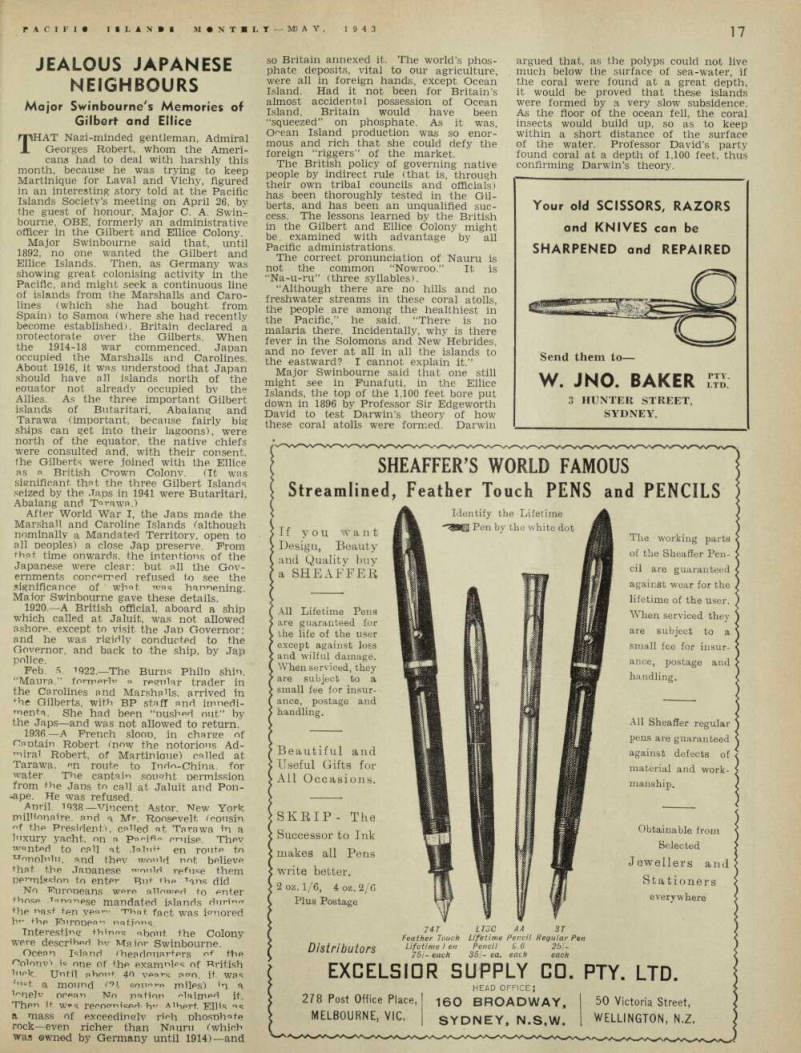
Jealous Japanese
Major Swinbourne's Memories of Gilbert and Ellice
THAT Nazi-minded gentleman, Admiral Georges Robert, whom the Ameri cans had to deal with harshly this month, because he was trying to keep Martinique for Laval and Vichy, figured in an interesting story told at the Pacific Islands Society’s meeting on April 26, by the guest of honour, Major C. A. Swin bourne, OBE, formerly an administrative officer in the Gilbert and Ellice Colony.
Major Swinbourne said that, until 1892, no one wanted the Gilbert and Ellice Islands. Then, as Germany was showing great colonising activity in the Pacific, and might seek a continuous line of islands from the Marshalls and Caro lines (which she had bought from Spain), to Samoa (where she had recently become established). Britain declared a protectorate over the Gilberts. When the 1914-18 war commenced. Japan occupied the Marshalls and Carolines.
About 1916, it was understood that Japan should have all islands north of the eouator not already occupied bv the Allies. As the three important Gilbert islands of Butaritari, Abaiang and Tarawa (important, because fairly big ships can get into their lagoons), were north of the equator, the native chiefs were consulted and, with their consent, the Gilberts were joined with the Ellice as a British Crown Colony. (It was significant that the three Gilbert Islands seized by the Japs in 1941 were Butaritari, Abaiang and Tarawa.) After World War I, the Jans made the Marshall and Caroline Islands (although nominally a Mandated Territory, open to all peoples) a close Jap preserve. From haat, time onwards, the intentions of the Japanese were clear: but all the Gov ernments concerned refused to see the significance of what was hannening.
Major Swinbourne gave these details. 1920.—A British official, aboard a ship which called at Jaluit, was not allowed ashore, except to visit the Jap Governor: and he was rigidly conducted to the Governor, and back to the ship, by Jap police.
Feb. R. 1 922.—The Burns Philo shin.
“Maura.” formerlv o regular trader in the Carolines and Marshafis, arrived in f he Gilberts, with BP staff and imnedi menta. She had been “pushed out” by the Japs—and was not allowed to return. 1986—A French sloop, in charge of Captain Robert (now the notorious Ad miral Robert, of Martiniaue) called at Tarawa. en route to Indo-China. for water The captain sought permission from the Jans to call at Jaluit and Pon- He was refused.
April. 1038—Vincent Astor. New York millionaire, and a Mr. Roosevelt (cousin nf the President), called at Tarawa in a Inxury yacht, on a poof-fie cruise. Thev wanted to call at Jaluit en route to Honolulu, and thev won id not believe that the Japanese would refuse them permission to enter But thP r q n S did No Europeans wore allowed to enter those Tononese mandated islands during the na S t ten yeavc Thqt fact was ignored h ,r the European nations Interesting tbino-s about the Colony were described hv Mai or Swinbourne.
Ocean Island theadouarters of the Coionvi is one of the examnles of "Rritish Inek. Until phont 40 vears it WBS '" 11c t a mound '“H smiom miles) in a ionelv ocean No nation olaimed it.
Then it w*s recognised J 7 Albert Ellis as a mass of exceedinelv n>h phosphate rock—even richer than Nauru (which was owned by Germany until 1914)—and
so Britain annexed it. The world’s phos phate deposits, vital to our agriculture, were all in foreign hands, except Ocean Island. Had it not been for Britain’s almost accidental possession of Ocean Island. Britain would have been “squeezed” on phosphate. As it was, lsland production was so enor mous and rich that she could defy the foreign “riggers” of the market.
The British policy of governing native people by indirect rule (that is, through their own tribal councils and officials) has been thoroughly tested in the Gil berts, and has been an unqualified suc cess. The lessons learned by the British in the Gilbert and Ellice Colony might be examined with advantage by all Pacific administrations.
The correct pronunciation of Nauru is not the common “Nowroo.” It is “Na-u-ru” (three syllables).
“Although there are no hills and no freshwater streams in these coral atolls, the people are among the healthiest in the Pacific,” he said. “There is no malaria there. Incidentally, why is there fever in the Solomons and New Hebrides, and no fever at all in all the islands to the eastward? I cannot explain it.”
Major Swinbourne said that one still might see in Funafuti, in the Ellice Islands, the top of the 1,100 feet bore put down in 1896 by Professor Sir Edgeworth David to test Darwin’s theory of how these coral atolls were formed. Darwin
argued that, as the polyps could not live much below the surface of sea-water, if the coral were found at a great depth, it would be proved that these islands were formed by a very slow subsidence.
As the floor of the ocean fell, the coral insects would build up, so as to keep within a short distance of the surface of the water. Professor David’s party found coral at a depth of 1,100 feet, thus confirming Darwin’s theory.
Advertisements & other items, pp. 19-20 (2 items)
17
PACIFIC ItLANBt M • N T ■ L T Ml AY, 1943
Excelsior Supply Co. Pty. Ltd.
Your old SCISSORS, RAZORS
and KNIVES can be
SHARPENED and REPAIRED
L_J Send them to-
W. JNO. BAKER SI
3 HUNTER STREET.
SYDNEY.
SHEAFFER’S WORLD FAMOUS
Streamlined, Feather Touch PENS and PENCILS
If you want Design, Beauty and Quality buy
a SHEAEFEK
All Lifetime Pena are guaranteed for the life of the user except against loss and wilful damage.
When serviced, they are subject to a small fee for insurance, postage and handling.
Beautiful and Useful Gifts for All Occasions.
SKRIP - The
Successor to Ink makes all Pens write better. 2 oz. 1/6, 4 oz. 2/6 Plus Postage Distributors Identify the Lifetime Pen by the white dot
74T LT2C AA 3T
Feather Touch Lifetime Pencil Regular Pen Lifetime len Pencil £, 6 2bl- -76- each 361- ea. each each The working parts of the Sheaffer Pencil are guaranteed against wear for the lifetime of the user.
When serviced they are subject to a small fee for insurance, postage and handling.
All Sheaffer regular pens are guaranteed against defects of material and workmanship.
Obtainable from Selected Jewellers and Stationers everywhere
EXCELSIOR SUPPLY CO. PTY. LTD.
278 Post Office Place,
MELBOURNE, VIC.
HEAD OFFICE}
160 BROADWAY,
SYDNEY, N.S.W.
50 Victoria Street,
WELLINGTON, N.Z.
Modern Refrigeration for the South Sea Islands
The ELECTROLUX
KEROSENE OPERATED
REFRIGERATOR
MARVEL
OF
MODERN
SCIENCE
THE
MIRACLE
OF
ICE
FROM
HEAT
ELECTROLUX OFFERS ECONOMICAL, modern and completely efficient
REFRIGERATION FOR ISLANDS' HOMES.
FREEZES CONTINUOUSLY WHILE SMALL LAMP BURNS.
Freezing controlled by simply regulating height of flame. Uses only gallon of kerosene per week.
MOTORLESS ... NO PARTS TO GET OUT OF ORDER.
MODEL L 22 MODEL L3BO MODEL LKSSO Capacity * (as illustrated) Capacity 2.2 cubic feet. Capacity 4 cubic feet. 5.5 cubic feet.
GUARANTEED FOR TWO YEARS.
• Write to your Local Distributor for prices and full details.
OBTAINABLE FROM ALL W. R. CARPENTER & CO. LTD.
BRANCHES THROUGHOUT THE ISLANDS
Representation in Papua and New Hebrides.
Ordeal By Truck
By Ray P. Davis
ALL we wanted to do was get home.
We were in Papeete and we live in Paea, which is about 19 kilometers as the Old Crow flies. We had had a nice luncheon at the American Consu late, and nice cocktails, and we had our nice white suit on, and we felt glowy and wonderful, and all we wanted to do was get home.
The Coconut Radio —that infamous instrument that should have its dials twisted off and tossed into a cuspidor had reported that a truck might leave Papeete for Paea, and all points south, at about 2 o’clock that afternoon.. It was then only a little after three, so we knew we had plenty of time.
We decided, while we waited, to sit on one of those soft stone benches in Papeete’s Trafalgar Square, and do a bit of solitary tropical cogitation. We hadn’t been sitting more than an hour or so, trying to think and at the same time sit first on one side until it got rested, and then on the other (it was like going on a hay-ride with a load of pineapples), when this truck we had been warned about crashed into sight.
We strolled out and held long converse with its driver, explained that all we wanted to do was get home, and did the driver or any of his relatives have a suggestion.
Well, he was going to Paea, yes—if!
And, so help us, this was the if: It depended upon one thing. You see, he wanted to keep his truck running regu larly, back and forth, back and forth.
Didn’t want to miss a single trip. His tyres were getting frazzly, like our patience. Now a ship from America was due, he said, in a week or so. If that ship brought some new tyres for his truck, he would make the trip this after noon !
WE have looked at the above, and looked, and tried to change it so it would make sense. But there is no way. It stands exactly as he said it, glibly defying evolution. What he said sounded crazy and reads crazy, but after two years in Tahiti we knew at once what the fellow meant.
Some other people had understood, too, for about 200 of them, of more or less variegated parentage, were piled high in the track’s 40 seats.
At first, we just sat on top of a pile of natives, not even worrying about our white suit. Pretty soon, then, we noticed a much smaller pile in another seat. The pile was neater, too, with its most prominent member a small native woman who looked like she was a com bination of Tahitian, French, and Ameri can, although she no doubt had some Spanish blood. Her name, we discovered later, was Teutonic. She had a man hanging onto the pile, with her, a brute of a fellow, a human ox. probably half Mongol and half mongrel.
"Would you,” we asked her politely, ‘‘mind holding your husband on your lap, if we could arrange all these people so you could have a lap?”
Now, that was exactly the way to say it. Tahitians, or whatever is left of them, are stubborn. What you do when you want them to do something is to ask them to do the opposite. So, sure enough, in about an hour the man took his wife on his lap.
At this sudden shift of weight, most of the pile went on the floor. When they were down there, among the pigs and sacks of flour and pareu bundles and baskets, it gave us an excellent chance
to breathe some of that luxurious tropi cal air we had heard about. But when we looked out to see which way the extra air was coming, and how near we were to being home, we discovered we hadn’t moved yet. It was all just a scheme, a foul scheme, to save tyres.
Nothing happened for a while, except that three Tahitians, drinking red wine at the very top of our pile, missed oftener than they hit, and so slowly made our nice white suit look like something in Pagliacci’s laundry bag. Meanwhile, this stack of humanity surged in on us from six sides, making us feel that we were Robert Taylor and they were autograph hunters.
SUDDENLY, there was a terrific crash ing of metal and grinding of gears, a horrible sound like the Panzer
Division smashing against Joe Stalin.
Then the truck leaped forward, and we were off.
But we went only about 300 feet.
The back of the truck gave a little curtsey, the front of the truck leaped an imaginary hurdle, the engine made a sound like it had phlegm in its throat, and died.
An auxiliary mechanic crawled from under a board and ran around and started cranking as though he got paid by the piece. It didn’t have the least effect. He might as well have been paid by the month, with room and board. So four or five dozen Tahitians, and a few Chinese, and some half-and-half child ren, unravelled themselves and jumped out and began pushing. And, first thing we knew, we were off again.
But we went only another 300 feet.
We were now in front of Tahiti’s brew ery—a Tahitian driver’s idea of front, that is—and so we started loading a lot of cases of beer and sacks of ice, for the sultry white trade of Punaauia.
That was when everybody thought we were ready to start home, for Paea and all points south. But we started for the hills, instead. Up one hill and down the other. Back and forth.
We haven’t the slightest idea where we went. We went everywhere, doubling back over the same spot twenty times.
Anyway, we picked up pigs with their feet tied, sometimes, and a few ducks on a string, and some bunches of bananas,, and four or five bundles of laundry, and three or four bicycles, and some crates and boxes, and all of this went on top of the truck. We could tell where it went without peeking, because every time we hit a bump the truck’s top would sag and pop and grunt, as though it were tired of being on top and wanted to come down and be a passenger.
Then, finally, we came down out of the hill country, and everybody thought “Now!”
BUT it wasn’t to be. What we did was go back into Papeete and stop at exactly the spot we had left two hours before! Everybody piled out and bought ice cream cones, and disappeared around buildings, and two Tahitians went into Quinn’s to try and drown their stalemate.
By this time we didn’t know what to do. Should we get out and spend the night in a honky-tonk hotel, or stick to
it? Did the Japs know, when they took the Dutch East Indies, that this would happen in Tahiti?
Some of the horde under us began to reshuffle and squirm, and pretty soon a head popped out, and of all people it was the Tahitian who lives next door to us. We hadn’t seen him for weeks. So we had a good chat, mostly about how his hogs came over and ate our hibiscus Slowly, now, the sun crept over Moorea. Some of the passengers drifted back to the truck and began packing themselves in. Soon everyone was there, and we were at last ready to start.
Everyone was there, that is, except the driver. Well, we waited a while, and then a native went to look for him. The native didn’t come back, so another native went after them. They were in a restaurant having coffee and bread.
But we are holding the story up. We are arresting the action for the sake of details. What we started to tell was about going from Papeete to Paea by truck . , .
So we finally left Papeete and had progressed several hundred feet in the right direction, maybe two kilometres, when it happened. Everyone had been waiting for it, silently and fearsome, and it happened. A tyre blew out.
SO all the piles of passengers unpiled.
We guess this was to lighten the load, so somebody could put a jack under the wheel and try to fix the tired tyre—a tyre that looked like a doughnut wearing canvas underwear. We had of course, no spare.
Everybody was out milling around the road, most of the men watching the driver fool with that ragged hunk of rubber, when it began to rain. And it was not a Denver drizzle, but a Tahiti torrent. We ran for the truck and began piling ourselves in again.
And there we sat. Packed in tighter than the dead Japs on Guadalcanal, we were hot and sweaty and wet, and we smelled like the back end of a Chinese livery stable.
A native produced a guitar. We don’t know where they come from, these gui
tars, but whenever you run up against a real emergency in Polynesia, some native reaches into his pareu and pulls out a guitar. Do you suppose they can do it with rabbits, too?
He started strumming away while the rain poured. “Lovely hula hands, like the ocean waves abo —ve you ..." (“Honeysuckle rose, goodness only knows, I lo—ve you . . . ”) It was dark now. There was no moon, and the stars seemed very, very far away. We began to get a headache. We wondered about our dinner guests wait ing for us at home—in faraway Paea.
And there was the dinner on top of the truck, rainsoaked. The guitar played on.
THE rain had slackened, and we got out of that mass of humanity and began walking toward home. Home!
Even the word sounded beyond achieve ment! We stumbled along the black road, kicking our weary feet against the limbs of trees and stray coconuts. Our head swam. Our once-white suit was stained with red wine, wet with rain, wrinkled worse than Ghandi’s stomach . .
It must have been an hour later when the truck came creeping along, its one dim headlight making a sickly glow on the wet road. The natural assumption was that the driver saw us, and would stop and let us continue our journey by truck—although that was no privilege.
But there are no natural assumptions in Tahiti. The driver didn’t see us. The truck didn’t stop. It continued on, went about 500 feet. Then, all of a sudden, a big noise like a POOF! came out of the hood, and the truck stopped dead!
When we arrived at the scene of the truck’s latest disaster, a few minutes later, the first face we saw sticking out of the pile of people was the native who lives next door to us. He had a bottle of red wine in one hand.
“Aita peapea! Bouvez! Drink!” he said, mixing three languages like a drunken chairman at the League of Nations.
We tilted the bottle to our lips. “I’ll bet you don’t know,” we said, “how to say ‘whoa to a Swiss horse!”
A long draught of sickly red wine gur gled down our gullet. For a full minute nothing happened. Suddenly, then, we thought we’d swallowed a depth charge.
Beads of perspiration stood out on our brow, ran down our nose and around the of our collar. The truck seeemed to be coming at us in reverse.
“You go Paea?” asked our neighbour.
We were trying to go to Paea, we told him. We had guests coming for din ner at six o’clock, and it was now seven or eight, or nine. And the dinner was up on top of the truck with the hogs.
“You want go Paea?” he asked.
Now that was utterly redundant. We thought everybody in French Oceania knew, by now, that we were just trying to go from Papeete to Paea, and that we just wanted to get home.
He pointed to the top of the truck.
“Me,” he said, “ bicycle.”
Was he going to take me on his bicycle? Did he want me to know that he had a bicycle? Did he mean that he usually went by bicycle—from Papeete to Paea?
The mystery was easily undone. Almost at once, half a dozen natives scrambled to the top of the truck, and we could hear a terrific untangling going on. Pigs grunted and beer bottles rattled, and bicycles knocked together. Someone threw some coconuts over the side. Sud denly we were worrying about whether those sacks of ice we had loaded at the brewery were now sacks of water. Then
a shiny red bicycle came down the truck’s side.
So, to make a short trip longer and a long story shorter, we finished our ordeal by bicycle. * * * If you want a moral, just remember this: Since Tojo, the shortest distance between two points is a strait-jacket!
Another ship, the submarine “Curie,” built in Great Britain for the Fighting French Navy, was presented recently to its crew in a British yard. It is the first time in history that naval % craft have been specially constructed for’the French Navy in British naval yards.
Advertisements & other items, pp. 21-23 (1 item)
Brewed
CARLTON & UNITED
BY
BREWERIES LTD.
There is no substitute for
OLD MONK
VIRGIN PURE
OLIVE OIL
San Francisco
Steamships Trading
Company Limited
PORT MORESBY SAMARA! PAPUA.
WHOLESALE & RETAIL MERCHANTS, SHIPOWNERS,
PLANTERS, ENGINEERS & SLIP PROPRIETORS!
Customs, Shipping, Insurance, and Forwarding Agents.
MANAGING AGENTS AND VISITING REPRESENTA-
TIVES FOR COCONUT AND RUBBER ESTATES.
SYDNEY REPRESENTATIVES: Nelson & Robertson Pty. Ltd., 12 Spring Street.
CLIENTS PLEASE NOTE
Temporary War Address— C/o Nelson & Robertson Pty. Ltd., 12 Spring St., Sydney.
WRITE, CABLE, OR CALL
STEAMSHIPS TRADING COMPANY LIMITED
Cable Address: "Steamships".
NELSON & ROBERTSON
PTY., LTD.
Established 1895.
Islands Merchants
All classes of merchandise purchased at wholesale prices and original invoices supplied to Islands clients.
Cocoa Beans, Rubber and other Islands' produce sold on commission.
Nelson & Robertson
Pry. Ud. 12 Spring Street, Sydney, Australia.
Equal to the World’s Best
Throughout Australia and Overseas there is an ever-increasing demand for
COLONIAL & BRONTE
HIGH-GRADE CANNED MEATS
There is no better quality—none more wholesome.
TRADE MEATS FOR THE ISLANDS
order
“COLONIAL” BRAND
Roast, Corned and Boiled Beef Packed in 6,5, 4,3, 2, 1 lb. and 12 oz, tins.
Also Corned Beef in 12 oz. Taper Tins.
Roast, Corned and Boiled Mutton. 1 lb. and 12 oz. tins.
Choice Dripping
36 lb., 2 lb., 1 lb. tins, and 1 lb. packets. 9
. I lb, NETT
Cam p " i
wholesale meat I 5* r ,dnE> ru
DELICIOUS
BRONTE" HOT MEALS
Steak and Kidney Podding.
Beef Steak Padding.
Saasages and Tomato.
Sausages and Vegetable.
Lamb and Green Peas, Corned Beef and Boston Beans with Tomato Saoce.
Steak and Tomato.
Under present conditions it is wise to ensure that you have ample stocks of all our lines.
The Colonial Wholesale Meat Coy. Pty. Ltd.
30 GROSVENOR STREET, SYDNEY
Historic Dates In
N. Guinea
THREE outstanding events of early 1942 brought to an abrupt end the Civil Administrations of Papua and New Guinea: and, as no one expects that those Governments will be re-established in their old form, those events have his torical importance. They are:— (1) Occupation by the Japanese of Rabaul on January 23, 1942. (2) The call-up of all males of military age in Papua and New Guinea, on January 27, 1942. (3) The supersession of the Civil Gov ernments of Papua and New Guinea (New Guinea already had been abandoned) by a military administration, on February 12, 1942.
As a matter of record, we print here under the proclamation of January 27. under which the men of Papua and New Guinea were conscripted:—
Commonwealth Of Australia
Enrolment For Military Service
For Home Defence
In pursuance of the Australian Military Regulation, 141 A, all male inhabitants of Aus tralia who at the date at the foot hereof are of the age of eighteen years and upwards, but under the age of forty-five years, are required to enrol on the 27th day of January, 1942.
Failure to enrol involves a maximum penalty of £2O or imprisonment for three months.
Section 5a f 1) of the Defence Act, 1903-1941, provides as follows:—“sA (1). —This Act shall extend to the territories of the Commonwealth as if each of those territories were part of the Commonwealth.”
All persons liable to enrol will report to the Enrolment Officer, 8 Military District, at the Convent School, Musgrave Street, Port Moresby,
at 2 p.m. this day. They will carry with them Immediate personal necessaries, such as shaving gear, tooth brush, change of underwear, etc.
Issued this 27th day of January, 1942, by command of the Military Board. (Sgd.) E. B. SERISIER, Major,
A.A. & Q.M.C..
Bth Military District.
Until further notice no Papuan native need enrol.
Personnel engaged on essential services will report not later than 7 p.m. this day.
Government officers' on out-Stations will not report, pending further instructions.
Persons who reside at such a distance from Port Moresby as to render impracticable their reporting at the time directed, shall report to the nearest District Officer.
It was announced in the Western Pacific High Commission Gazette on February 2, that Mr. E. L. Leembruggen, Acting Office Assistant, had been ap pointed to act as Assistant British Resident Commissioner of the New Hebrides. The appointment was to date from December 8, 1942.
The Americans in New Caledonia have discovered what Caledonians have known for a long time: that prickly pear prickles make excellent gramophone needles. So, also, do needles made from bamboo.
Following the entry into Tunisia of the Fighting French Forces, advancing with the British Eighth Army, over 500 resi dents joined the “Bataillon du Pacifique” and the column of General Leclerc. The original Pacific Battalion was made up of men from New Caledonia and Tahiti; and, like the famous Maori Battalion of the NZ Army, it has fought magnifi cently.
Tahiti's Golden
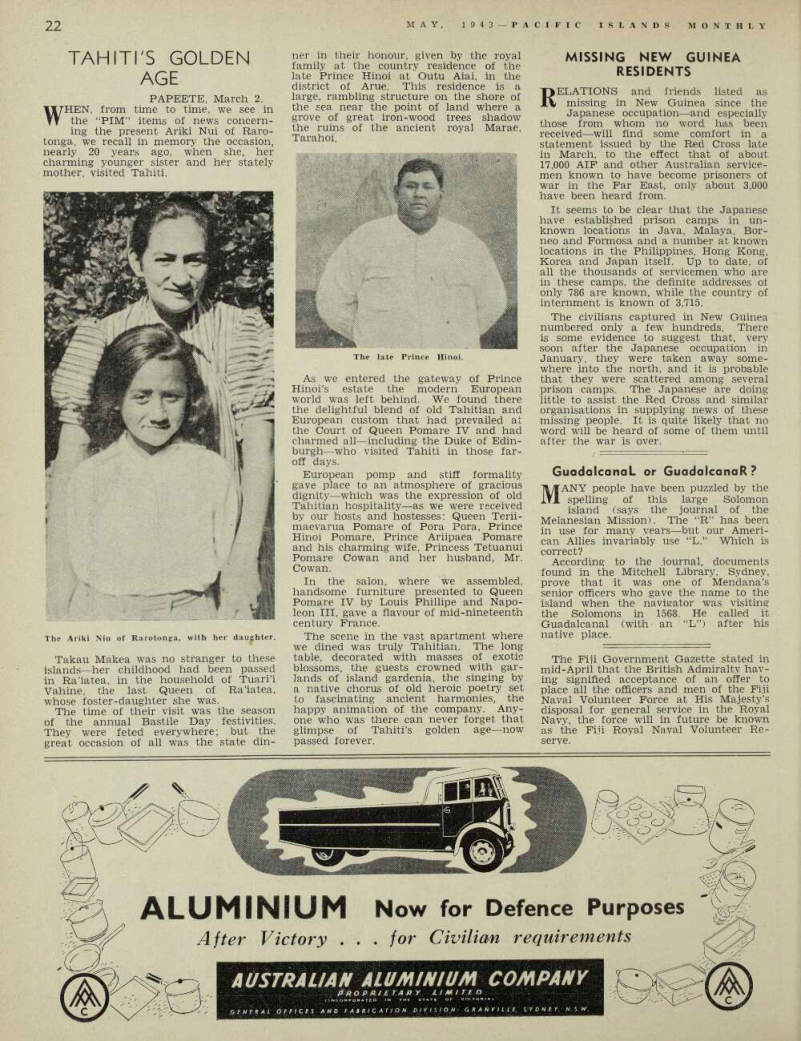
Age
PAPEETE, March 2.
WHEN, from time to time, we see in the “PIM” items of news concern ing the present Ariki Nui of Raro tonga, we recall in memory the occasion, nearly 20 years ago, when she, her charming younger sister and her stately mother, visited Tahiti.
Takau Makea was no stranger to these islands —her childhood had been passed in Ra’iatea, in the household of Tuari’i Vahine. the last Queen of Ra’iatea, whose foster-daughter she was.
The time of their visit was the season of the annual Bastile Day festivities.
They were feted everywhere; but the great occasion of all was the state din
ner in their honour, given by the royal family at the country residence of the late Prince Hinoi at Outu Aiai, in the district of Arue. This residence is a large, rambling structure on the shore of the sea near the point of land where a grove of great iron-wood trees shadow the ruins of the ancient royal Marae, Tarahoi.
As we entered the gateway of Prince Hinoi’s estate the modern European world was left behind. We found there the delightful blend of old Tahitian and European custom that had prevailed at the Court of Queen Pomare IV and had charmed all —including the Duke of Edin burgh—who visited Tahiti in those far off days.
European pomp and stiff formality gave place to an atmosphere of gracious dignity—which was the expression of old Tahitian hospitality—as we were received by our hosts and hostesses: Queen Terii maevarua Pomare of Pora Pora, Prince Hinoi Pomare, Prince Ariipaea Pomare and his charming wife, Princess Tetuanui Pomare Cowan and her husband, Mr.
Cowan.
In the salon, where we assembled, handsome furniture presented to Queen Pomare IV by Louis Phillipe and Napo leon 111, gave a flavour of mid-nineteenth century France.
The scene in the vast apartment where we dined was truly Tahitian. The long table, decorated with masses of exotic blossoms, the guests crowned with gar lands of island gardenia, the singing by a native chorus of old heroic poetry set to fascinating ancient harmonies, the happy animation of the company. Any one who was there can never forget that glimpse of Tahiti’s golden age—now passed forever.
The Ariki Niu of Rarotonga, with her daughter.
The late Prince Hinoi.
Missing New Guinea
Residents
RELATIONS and friends listed as missing in New Guinea since the Japanese occupation—and especially those from whom no word has been received—will find some comfort in a statement issued by the Red Cross late in March, to the effect that of about 17,000 AIF and other Australian service men known to have become prisoners of war in the Far East, only about 3,000 have been heard from.
It seems to be clear that the Japanese have established prison camps in un known locations in Java, Malaya, Bor neo and Formosa and a number at known locations in the Philippines, Hong Kong, Korea and Japan itself. Up to date, of all the thousands of servicemen who are in these camps, the definite addresses of only 786 are known, while the country of internment is known of 3,715.
The civilians captured in New Guinea numbered only a few hundreds. There is some evidence to suggest that, very soon after the Japanese occupation in January, they were taken away some where into the north, and it is probable that they were scattered among several prison camps. The Japanese are doing little to assist the Red Cross and similar organisations in supplying news of these missing people. It is quite likely that no word will be heard of some of them until after the war is over.
Guadalcanal, or GuadalcanaR?
MANY people have been puzzled by the spelling of this large Solomon island (says the journal of the Melanesian Mission). The “R” has been in use for many years—but our Ameri can Allies invariably use “L.” Which is correct?
According to the journal, documents found in the Mitchell Library, Sydney, prove that it was one of Mendana’s senior officers who gave the name to the island when the navigator was visiting the Solomons in 1568. He called it Guadalcanal (with an “L”) after his native place.
The Fiji Government Gazette stated in mid-April that the British Admiralty hav ing signified acceptance of an offer to place all the officers and men of the Fiji Naval Volunteer Force at His Majesty’s disposal for general service in the Royal Navy, the force will in future be known as the Fiji Royal Naval Volunteer Re serve.
Advertisements & other items, p. 24 (1 item)
A
ALUMINIUM Now for Defence Purposes After Victory . . . for Civilian requirements
AUSTRALIAN ALUMINIUM COMPANY
PROPRIETARY LIMITED
- (INCOMbRATCO; IN THf STA ▼ « , O * *•CTO « I A » QFNFRAL OfMCfS AND FABRICATION DIVISION 6RANV I L L (. SYDNFY. N.S.W.
Daughter Of Guadalcanal
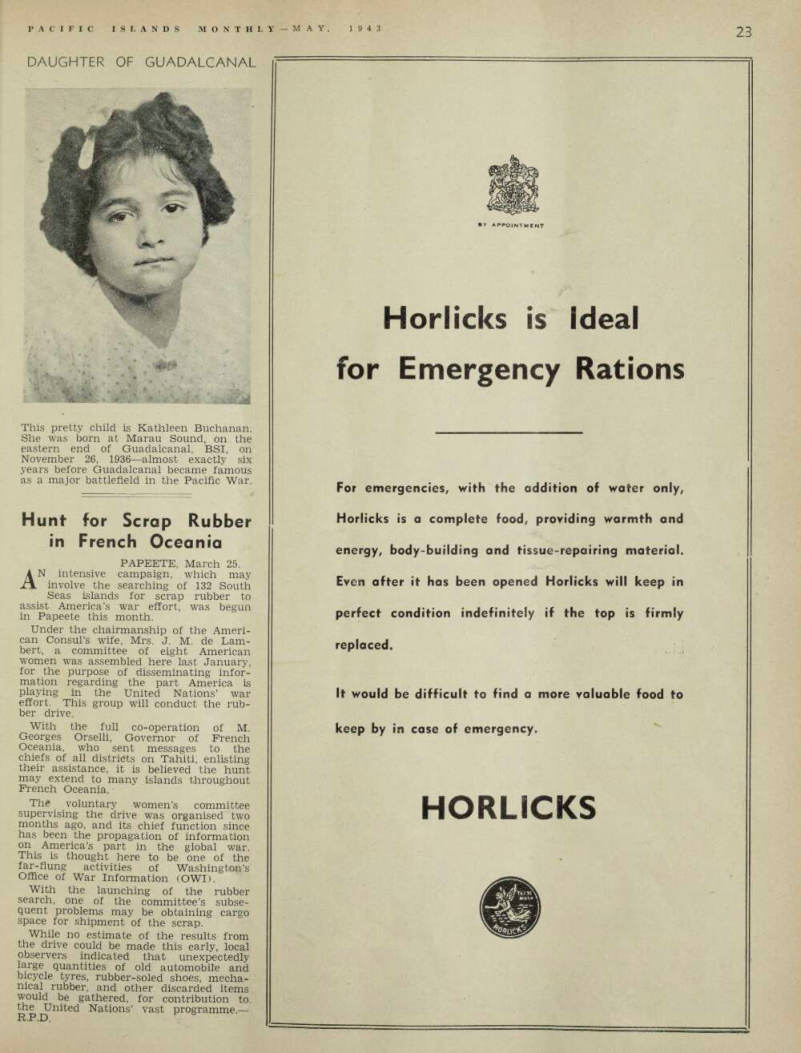
This pretty child is Kathleen Buchanan.
She was born at Marau Sound, on the eastern end of Guadalcanal, BSI, on November 26, 1936 —almost exactly six years before Guadalcanal became famous as a major battlefield in the Pacific War.
in French Oceania
Hunt for Scrap Rubber in French Oceania
PAPEETE, March 25.
AN intensive campaign, which may involve the searching of 132 South Seas islands for scrap rubber to assist America’s war effort, was begun in Papeete this month.
Under the chairmanship of the Ameri can Consul’s wife, Mrs. J. M. de Lam bert, a committee of eight American women was assembled here last January, for the purpose of disseminating infor mation regarding the part America is playing in the United Nations’ war effort. This group will conduct the rub ber drive.
With the full co-operation of M.
Georges Orselli, Governor of French Oceania, who sent messages to the chiefs of all districts on Tahiti, enlisting their assistance, it is believed the hunt may extend to many islands throughout French Oceania.
The voluntary women’s committee supervising the drive was organised two months ago, and its chief function since has been the propagation of information on America’s part in the global war.
This is thought here to be one of the far-flung activities of Washington’s Office of War Information (OWI).
With the launching of the rubber search, one of the committee’s subse quent problems may be obtaining cargo space for shipment of the scrap.
While no estimate of the results from the drive could be made this early, local observers indicated that unexpectedly large quantities of old automobile and bicycle tyres, rubber-soled shoes, mecha nical rubber, and other discarded items would be gathered, for contribution to the United Nations’ vast programme.—
R.P.D,
Advertisements & other items, p. 25 (1 item)
Horlicks
appointment r
Horlicks is ideal
for Emergency Rations
For emergencies, with the addition of water only, Horlicks is a complete food, providing warmth and energy, body-building and tissue-repairing material.
Even after it has been opened Horlicks will keep in perfect condition indefinitely if the top is firmly replaced.
It would be difficult to find a more valuable food to keep by in case of emergency.
HORLICKS
War's Effect On
Natives
Experience in Mission Field
(Condensed f7'om the “Southern Cross Log”) BEFORE the enemy occupation of the Solomons, there were many discus sions as to how the islanders would re-act to Jap occupation.
Some sceptics remarked . . . “they don’t care two hoots about any of us . . . they might betray us for a couple of sticks of tobacco or a piece of calico,” etc.
Then came the evacuation of a large proportion of the white population. The natives were left with little guidance and also they had no knowledge whatever of modern warfare, warships or even largfe ships, planes, gun-fire, or bombing. Very naturally, there were some signs of fear and panic.
Government and mission staffs had become permanencies. The Government was regarded as just and was appre ciated. Missionaries were looked upon as friends.
Those Europeans who stayed felt it their duty to be on the spot until the panic-stricken natives had become more or less used to the new order. They—the natives —showed a keen desire to know exactly what was happening and what might happen. During the period between
the evacuation of Tulagi and Gela (Florida) and their occupation by the Japs, Bishop Baddeley “ was constantly travelling—always by night—to re-assure and advise the deserted people of Gela.
During this time the Jap bombers were overhead every day.
Then came the occupation of Tulagi and Gela. The remaining white people were ordered off the beaches —provision had been made for the placing of medical stores, etc., in various bush villages and the nursing sisters from the mission hos pital were located in a native village some five miles distant. Later the enemy explored the coast of Malaita, visited the mission hospital, took some equipment, but did no serious damage. Native boys when interrogated, refused to disclose the whereabouts of their white friends.
An enemy radio station was set-up along the coast from the hospital, with a small armed guard. It was then considered advisable for the staff to retire farther into the hills.
It was now that the answer to the numerous discussions came forth. Un doubtedly the natives regarded the Japs as enemies, distrusted them, and finally hated them because of the treatment meted out to captured boys—food gar dens looted, pigs, and even laplaps stolen. And so the whites were not betrayed but were led to safe places, given sufficient food—and the best houses.
The mission work was carried on— probably to a greater extent than is yet known by the outside world. Prior to enemy occupation many of the staff were at the main hospital at Fauabu; the medical officer, Dr. J. D. Thomson, three hospital sisters, mothercraft staff, were among those who chose not to evacuate.
At the time of the invasion, trained native orderlies were posted at various points and entrusted with hospital sup plies, and were able to carry on work at these hastily improvised “dispensaries.”
The medical officer toured the districts, helped and guided his workers and gave thousands of injections.
During the hostilities, the native mode of life was, of course, completely changed.
They have seen sea-battles, air-battles, land fighting. They had to flee before the invader. With their white friends, they have lost their possessions and lived in discomfort.
As a result of an enemy occupation of this country of mixed nationalities, what will be the legacy of the island people?
There is danger of the spread of “new” diseases as a result of insanitary con ditions, consequent on enemy—and such an enemy—occupation. We have already bequeathed whooping cough, measles, chicken-pox, TB, etc., to these people.
The “simple” epidemics are not so simple to these island peoples. TB is on the increase, and the only leprosarium is that of the Melanesian Mission at or near Fauabu.
These natives have proved loyal friends and helpers, and for that—if for no other reason—deserve the best from Govern ment, missionaries, and all Europeans.
Elections In New
Caledonia
From Our Own Correspondent NOUMEA, April 10.
THE elections for a new Administrative Council of New Caledonia, formerly fixed for March 21, have been post poned until May. The former Council was disbanded when this country went Free French. The Governor has enlarged the Council from 12 to 15 members. The inner body of the Council will be an Executive Committee of five members, acting as a permanent committee, or Governor’s Privy Council.
“New Caledonia for the Caledonians, under the protection and control of France” —Is the election cry of Monsieur P. Berges, president of the retiring Sautot-nominated Administrative Coun cil and advocate of a larger measure of home rule.
M. Berges, who has his quarrels both with Governor Henri Montchamp and (over the recall of Henri Sautot) with High Commissioner d’Argenlieu. has issued a sort of election address, saying that a wartime election has been forced on the Colony, but that Caledonians must not boycott it, but must fraternally and democratically unite to show their real sentiments. He has thanked the Governor for respecting democratic prin ciples.
There are about 4,000 male voters on the roll. Women do not vote.
Advertisements & other items, p. 26 (3 items)
24
MAY, 1943 PACIFIC ISLANDS MONTMLT
Chi Vers
PRESCOTT Pty. Ltd.
SUSSEX ST., SYDNEY,
ore sole wholesole agents for
PINEAPPLE BACON&HAMS
DAISY brand BUTTER "375" BUTTER in TINS Ilb.-21b.-slb. Size*.
LEA & PERRINS’ Sauces and Most other Super-Quality Lines of the Trade, such as Cheese, Eggs. Etc.
CHI VERS
FAMOUS ENGLISH PRODUCTS
CANNED ENGLISH VEGETABLES
CANNED ENGLISH FRUITS
OLDE ENGLISH MARMALADE
GOLD MEDAL JAMS
JELLY CRYSTALS, ETC.
Obtainable from all leading Grocery Stores
WRITE TO DEPARTMENT “A”
CHI VERS & SONS LTD.
Histon, Combs., Eng.
FOR ATTRACTIVE RECIPE BOOK
c<
CHIV£&S
COLD
standard
FRESH
t INCUS* i
PEAS
*2
Old Monk
The Worlds Finest Olive. Oil San Francisco
Two Tragedies of Papua
Letter to the Editor AS Mr. Hunter has made some com ment (March “PIM”) upon my let ter (February “PIM") may I again enter the discussion?
Mr. Hunter completely ignores the opinion of Sir Hubert Murray as appar ently of no account, yet sets consider able value upon the diary of a junior officer who neither had the opportunity nor. possibly, the ability, to arrive at any authentic conclusion. I knew Mr. John MacDonald very well. Further, he appears to set some considerable value upon inclusion in this “punitive expedi tion” when he, at least, should know that it could not bestow any direct knowledge of the actual tragedy or what led up to it. No member of the party, from the Governor downward, had an opportunity to investigate the circum stances surrounding the killing—the only contact they made with the Goaribari natives was over the sights of their rifles.
But your correspondent goes further and, while placing such great reliance upon the “official” story and the account of a man who was not present, ignores the account of a man who was present when Chalmers and his party landed— the Captain of the “Niue.”
Regarding the actual killing, what Mr.
Hunter appears to forget is that nothing conclusive is known, and probably never will be known, and therefore it is a matter of probabilities. Sir Hubert Mur ray stresses this point, for he says that “what actually happened and how the murders were perpetrated will never be known for certain”; and then he advances what he calls “a generally accepted theory,” and it was this theory I quoted. The weight of evidence is that the natives did not induce Tamate to land, but that he, himself, insisted, against all advice, in landing.
However, Sir Hubert had all this earlier evidence that Mr. Hunter men tions, and the additional evidence accu mulated in later years, open to him, and drew a different picture, and Sir Hubert was, by his legal training and unsurpassed knowledge of things Papuan, far better qualified than Governor Le Hunte to acquaint himself with and sift such evidence. He did this and recorded his opinion, and I quoted it.
This, as said before, Mr. Hunter com pletely ignores.
I notice that “Wakilobo” (March “PIM”) also is not altogether in agree ment with Mr. Hunter’s account, and supports that given by me on the authority of Sir Hubert Murray’s re corded opinion and my own recollection.
I may add that I knew all the persons mentioned by Mr. Hunter (the Rev.
Downey should be “Dauncey”) and cer tainly was in Port Moresby at the time, and can speak from first-hand know ledge of the men concerned, and had open to me all accounts current at the time. Mr. Hunter, on the other hand, certainly was not in Port Moresby at the time, nor did he have any personal or direct contact with or knowledge of the men and the times. Actually, I never met Chalmers, but I did meet Tomkins, and I heard his last sermon, preached in the Ela Protestant Church at Port Moresby. As for inclusion in the “puni tive expedition,” I was too young at the time (19 years) even had I been willing to take part in such a foolish and un necessary undertaking. It is on the credit side of Sir Hubert Murray’s period of administration that he never would l#nd himself to any expeditions of this
nature —they were directly contrary to his whole policy.
Mr. Hunter might note that the “Niue” was not a steamer, as claimed by him, and Kemere was not taken prisoner at Dopima.
I am, etc.,
J. T. Bensted.
Sydney, 11/4/1943.
Sir Philip Mitchell, Governor of Fiji and High Commissioner of the Western Pacific, recently paid his third visit to Noumea, where he met his old friend, Henri Montchamp, Governor of New Caledonia.
M. Bayardelle, former Secretary Gen eral in New Caledonia, has been appointed Governor at Jibouti, where his first act was to return to the inhabitants all their wireless sets which the Vichy rulers had taken possession of two years ago. In September, 1940, Vichy offered M. Bay ardelle the Governship of New Cale donia, but instead of accepting it, he ral lied to de Gaulle. The following Febru ary he went to London, and was appointed to the Syrian administration, after the Vichy garrisons were ejected.
He then became Free French represen tative with Emperor Haile Selassie, at Addis Ababa.
Advertisements & other items, p. 27 (1 item)
Hot-Weather Meals
Here’s the quick,easy way to serve
COOL, APPETISING
m * l a V YOU can prepare crisp, cool, appetising salads in five minutes with Imperial “Hampe” the quick-serve summer delicacy that’s ready-cooked, readyto-serve and flavour-sealed . . . And what a flavour!
Everyone likes the delicious combination of mild-cured ham and tender veal in “Hampe.” Try it to-day.
Product of Riverstone Meat Co. Pty. Ltd., Sydney.
FIJI Representatives: Pearce & Co. Ltd., Suva.
Inspiring Story of Elizabeth Mahony, Papuan
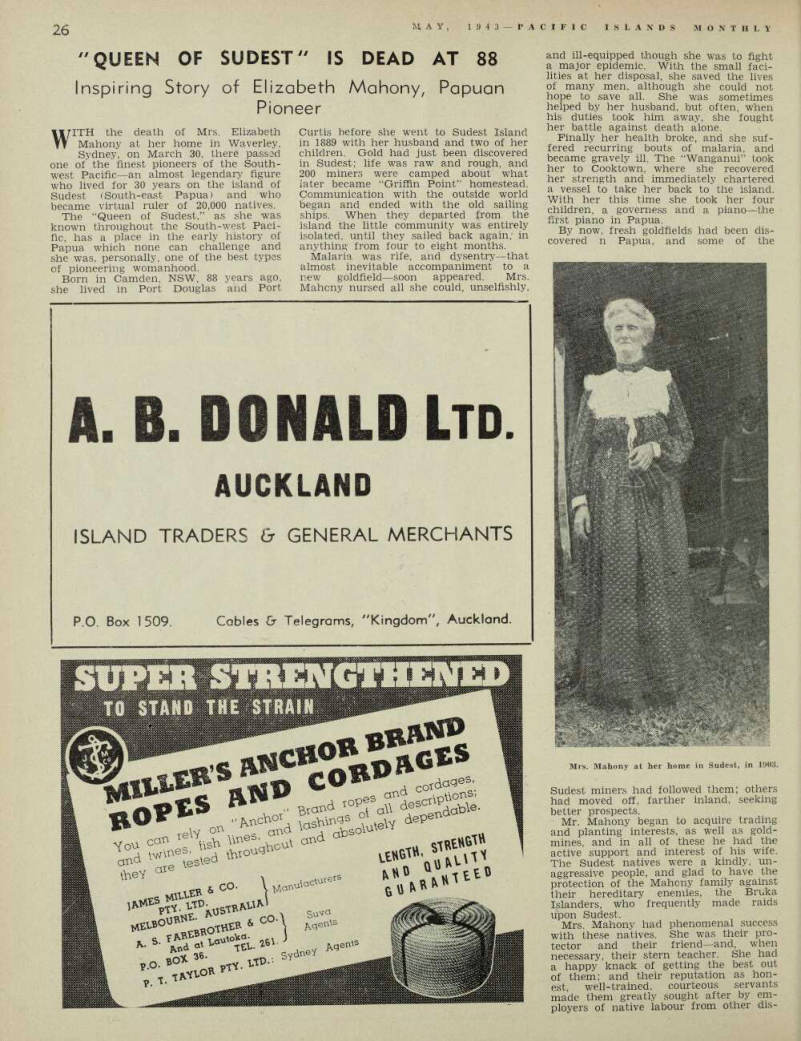
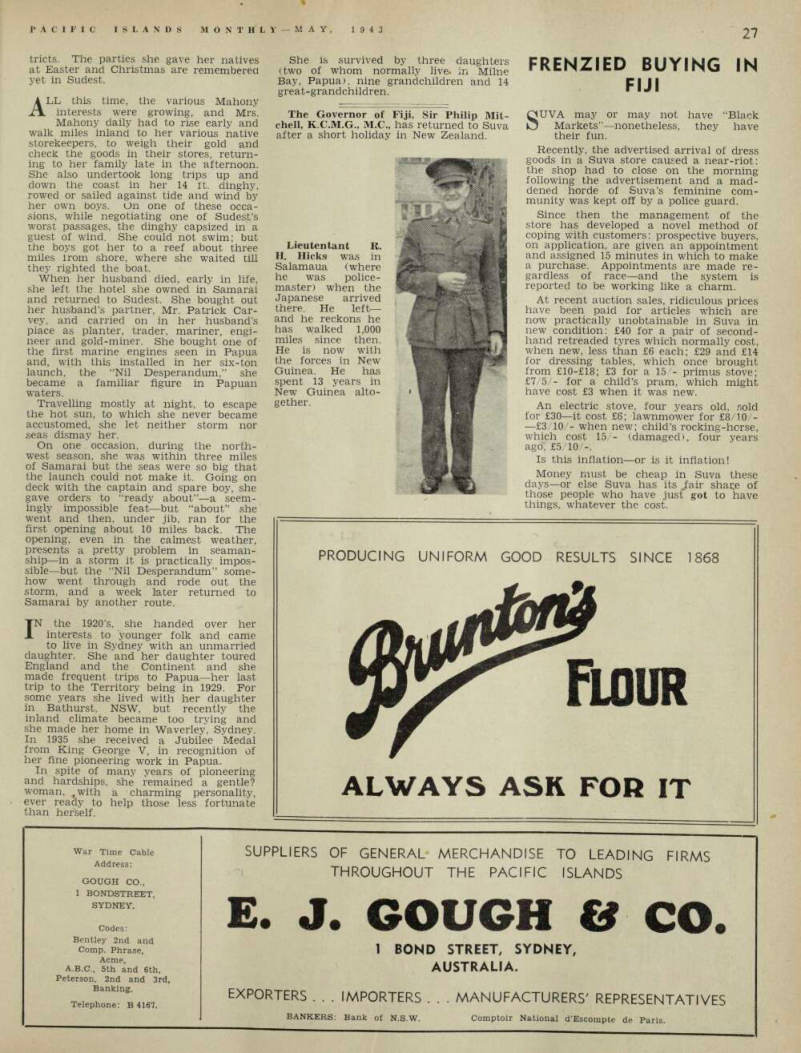
"QUEEN OF SUDEST" IS DEAD AT 88 Inspiring Story of Elizabeth Mahony, Papuan Pioneer
WITH the death of Mrs. Elizabeth Mahony at her home in Waverley, Sydney, on March 30, there passed one of the finest pioneers of the Southwest Pacific—an almost legendary figure who lived for 30 years on the island of Sudest (South-east Papua) and who became virtual ruler of 20,000 natives.
The "Queen of Sudest,” as she was known throughout the South-west Pacific, has a place in the early history of Papua which none can challenge and she was, personally, one of the best types of pioneering womanhood.
Born in Camden. NSW, 88 years ago, she lived in Port Douglas and Port
Curtis before she went to Sudest Island in 1889 with her husband and two of her children. Gold had just been discovered in Sudest; life was raw and rough, and 200 miners were camped about what later became “Griffin Point” homestead.
Communication with the outside world began and ended with the old sailing ships. When they departed from the island the little community was entirely isolated, until they sailed back again, in anything from four to eight months, Malaria was rife, and dysentry—that almost inevitable accompaniment to a new goldfield—soon appeared. Mrs.
Mahony nursed all she could, unselfishly.
and ill-equipped though she was to fight a major epidemic. With the small faci lities at her disposal, she saved the lives of many men, although she could not hope to save all. She was sometimes helped by her husband, but often, when his duties took him away, she fought her battle against death alone.
Finally her health broke, and she suf fered recurring bouts of malaria, and became gravely ill. The "Wanganui” took her to Cooktown, where she recovered her strength and immediately chartered a vessel to take her back to the island.
With her this time she took her four children, a governess and a piano—the first piano in Papua.
By now, fresh goldfields had been dis covered n Papua, and some of the
Sudest miners had followed them; others had moved off, farther inland, seeking better prospects.
Mr. Mahony began to acquire trading and planting interests, as well as gold mines, and in all of these he had the active support and interest of his wife.
The Sudest natives were a kindly, un aggressive people, and glad to have the protection of the Mahony family against their hereditary enemies, the Bruka Islanders, who frequently made raids upon Sudest.
Mrs. Mahony had phenomenal success with these natives. She was their pro tector and their friend—and, when necessary, their stern teacher. She had a happy knack of getting the best out of them: and their reputation as hon est, well-trained, courteous servants made them greatly sought after by em ployers of native labour from other dis
Mrs. Mahony at her home in Sudest, in 1903.
tricts. The parties she gave her natives at Easter and Christmas are remembered yet in Sudest.
ALL this time, the various Mahony interests were growing, and Mrs.
Mahony daily had to rise early and walk miles inland to her various native storekeepers, to weigh their gold and check the goods in their stores, return ing to her family late in the afternoon.
She also undertook long trips up and down the coast in her 14 ft. dinghy, rowed or sailed against tide and wind by her own boys. On one of these occa sions, while negotiating one of Sudest’s worst passages, the dinghy capsized in a guest of wind. She could not swim; but the boys got her to a reef about three miles from shore, where she waited till they righted the boat.
When her husband died, early in life, she left the hotel she owned in Samarai and returned to Sudest. She bought out her husband’s partner, Mr. Patrick Gar vey, and carried on in her husband’s place as planter, trader, mariner, engi neer and gold-miner. She bought one of the first marine engines seen in Papua and, with this installed in her six-ton launch, the “Nil Desperandum,” she became a familiar figure in Papuan waters.
Travelling mostly at night, to escape the hot sun, to which she never became accustomed, she let neither storm nor seas dismay her.
On one occasion, during the north west season, she was within three miles of Samarai but the seas were so big that the launch could not make it. Going on deck with the captain and spare boy, she gave orders to “ready about”—a seem ingly impossible feat—but “about” she went and then, under jib, ran for the first opening about 10 miles back. The opening, even in the calmest weather, presents a pretty problem in seaman ship—in a storm it is practically impos sible —but the “Nil Desperandum” some how went through and rode out the storm, and a week later returned to Samarai by another route.
IN the 1920’5, she handed over her interests to younger folk and came to live in Sydney with an unmarried daughter. She and her daughter toured England and the Continent and she made frequent trips to Papua—her last trip to the Territory being in 1929. For some years she lived with her daughter in Bathurst, NSW, but recently the inland climate became too trying and she made her home in Waverley, Sydney.
In 1935 she received a Jubilee Medal from King George V, in recognition of her fine pioneering work in Papua.
In spite of many years of pioneering and hardships, she remained a gentle? woman, with a charming personality, ever ready to help those less fortunate than herself.
She is survived by three daughters (two of whom normally live, in Milne Bay, Papua), nine grandchildren and 14 great-grandchildren.
The Governor of Fiji, Sir Philip Mit chell, K.C.M.G., M.C., has returned to Suva after a short holiday in New Zealand.
Lieutentant R.
H. Hicks was in Salamaua (where he was police master) when the Japanese arrived there. He left— and he reckons he has walked 1,000 miles since then.
He is now with the forces in New Guinea. He has spent 13 years in New Guinea alto gether.
Advertisements & other items, p. 28 (1 item)
c °oVp
A. B. DONALD Ltd.
AUCKLAND
ISLAND TRADERS & GENERAL MERCHANTS
P.O. Box 1509. Cables £r Telegrams, "Kingdom", Auckland.
m * n > H , _rrki3 eS '
c °oVp
, ar
e£SS*
m
Hiiii
te\Y c '* Sptton* s » i\eW -rt 0 6 « * a
!S“ffi
r» pT 1 *- p.\3bi l '*'~ ***■£***■ & c ° J ney M en«
** _gggd|
«i.»' ftC t .O. *°* *
Frenzied Buying In
Fiji
SUVA may or may not have “Black Markets” —nonetheless, they have their fun.
Recently, the advertised arrival of dress goods in a Suva store caused a near-riot: the shop had to close on the morning following the advertisement and a mad dened horde of Suva’s feminine com munity was kept off by a police guard.
Since then the management of the store has developed a novel method of coping with customers: prospective buyers, on application, are given an appointment and assigned 15 minutes in which to make a purchase. Appointments are made re gardless of race—and the system is reported to be working like a charm.
At recent auction sales, ridiculous prices have been paid for articles which are now practically unobtainable in Suva in new condition: £4O for a pair of second hand retreaded tyres which normally cost, when new, less than £6 each; £29 and £l4 for dressing tables, which once brought from £lO-£18; £3 for a 15/- primus stove; £7/5/- for a child’s pram, which might have cost £3 when it was new.
An electric stove, four years old, sold for £30 —it cost £6; lawnmower for £B/10 - —£3/10/- when new; child’s rocking-horse, which cost 15/- (damaged), four years ago, £5/10/-.
Is this inflation—or is it inflation!
Money must be cheap in Suva these days—or else Suva has its fair shate of those people who have just got to have things, whatever the cost.
Advertisements & other items, p. 29 (1 item)
Hour
PRODUCING UNIFORM GOOD RESULTS SINCE 1868
ALWAYS ASK FOR IT
SUPPLIERS OF GENERAL MERCHANDISE TO LEADING FIRMS
THROUGHOUT THE PACIFIC ISLANDS
E. J. GOUGH & CO.
1 BOND STREET, SYDNEY,
AUSTRALIA.
EXPORTERS . . . IMPORTERS . . . MANUFACTURERS' REPRESENTATIVES BANKERS: Bank of N.S.W. Comptoir National d’Escompte de Paris.
War Time Cable Address:
GOUGH CO.,
1 BONDSTREET,
SYDNEY.
Codes: Bentley 2nd and Comp. Phrase, Acme, A.8.C., sth and 6th, Peterson, 2nd and 3rd, Banking.
Telephone; B 4167.
Americans And New
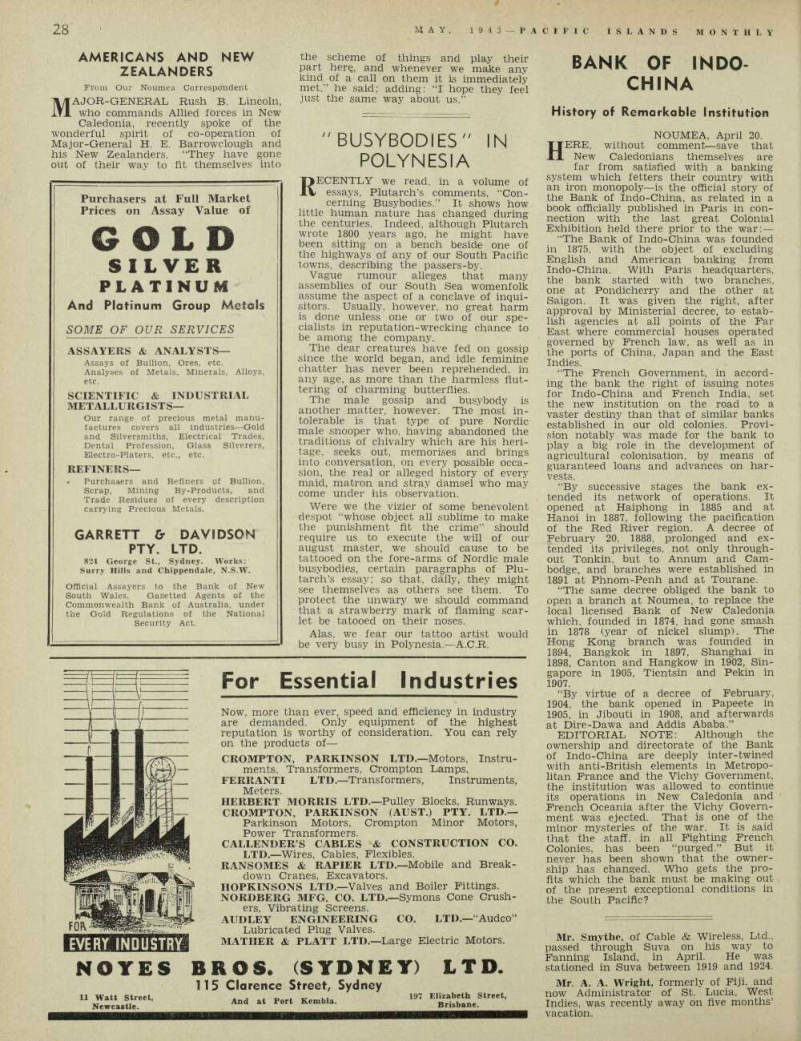
Zealanders
From Our Noumea Correspondent MAJOR-GENERAL Rush B. Lincoln, who commands Allied forces in New Caledonia, recently spoke of the wonderful spirit of co-operation of Major-General H. E. Barrowclough and his New Zealanders. “They have gone out of their way to fit themselves into
the scheme of things and play their part here, and whenever we make any kind of a call on them it is immediately met,” he said; adding: “I hope they feel just the same way about us.”
"Busybodies" In
Polynesia
RECENTLY we read, in a volume of essays, Plutarch’s comments, “Con cerning Busybodies.” It shows how little human nature has changed during the centuries. Indeed, although Plutarch wrote 1800 years ago, he might have been sitting on a bench beside one of the highways of any of our South Pacific towns, describing the passers-by.
Vague rumour alleges that many assemblies of our South Sea womenfolk assume the aspect of a conclave of inqui sitors. Usually, however, no great harm is done unless one or two of our spe cialists in reputation-wrecking chance to be among the company.
The dear creatures have fed on gossip since the world began, and idle feminine chatter has never been reprehended, in any age, as more than the harmless flut tering of charming butterflies.
The male gossip and busybody is another matter, however. The most in tolerable is that type of pure Nordic male snooper who. having abandoned the traditions of chivalry which are his heri tage. seeks out, memorises and brings into conversation, on every possible occa sion. the real or alleged history of every maid, matron and stray damsel who may come under his observation.
Were we the vizier of some benevolent despot “whose object all sublime to make the punishment fit the crime” should require us to execute the will of our august master, we should cause to be tattooed on the fore-arms of Nordic male busybodies, certain paragraphs of Plu tarch’s essay; so that, daily, they might see themselves as others see them. To protect the unwary we should command that a strawberry mark of flaming scar let be tatooed on their noses.
Alas, we fear our tattoo artist would
be very busy in Polynesia.-
A.C.R.
Bank Of Indo
China
History of Remarkable Institution
NOUMEA, April 20.
HERE, without comment—save that New Caledonians themselves are far from satisfied with a banking system which fetters their country with an iron monopoly—is the official story of the Bank of Indo-China, as related in a book officially published in Paris in con nection with the last great Colonial Exhibition held there prior to the war:— “The Bank of Indo-China was founded in 1875, with the object of excluding English and American banking from Indo-China. With Paris headquarters, the bank started with two branches, one at Pondicherry and the other at Saigon. It was given the right, after approval by Ministerial decree, to estab lish agencies at all points of the Far East where commercial houses operated governed by French law, as well as in the ports of China, Japan and the East Indies.
“The French Government, in accord ing the bank the right of issuing notes for Indo-China and French India, set the new institution on the road to a vaster destiny than that of similar banks established in our old colonies. Provi sion notably was made for the bank to play a big role in the development of agricultural colonisation, by means of guaranteed loans and advances on har vests.
“By successive stages the bank ex tended its network of operations. It opened at Haiphong in 1885 and at Hanoi in 1887, following the pacification of the Red River region. A decree of February 20, 1888, prolonged and ex tended its privileges, not only through out Tonkin, but to Annum and Cam bodge, and branches were established in 1891 at Phnom-Penh and at Tourane.
“The same decree obliged the bank to open a branch at Noumea, to replace the local licensed Bank of New Caledonia which, founded in 1874, had gone smash in 1878 (year of nickel slump). The Hong Kong branch was founded in 1894, Bangkok in 1897, Shanghai in 1898, Canton and Hangkow in 1902, Sin gapore in 1905, Tientsin and Pekin in 1907.
“By virtue of a decree of February, 1904, the bank opened in Papeete in 1905, in Jibouti in 1908, and afterwards at Dire-Dawa and Addis Ababa.”
EDITORIAL NOTE: Although the ownership and directorate of the Bank of Indo-China are deeply inter-twined with anti-British elements in Metropo litan France and the Vichy Government, the institution was allowed to continue its operations in New Caledonia and French Oceania after the Vichy Govern ment was ejected. That is one of the minor mysteries of the war. It is said that the" staff, in all Fighting French Colonies, has been “purged.” But it never has been shown that the owner ship has changed. Who gets the pro fits which the bank must be making out of the present exceptional conditions in the South Pacific?
Mr. Smythe, of Cable & Wireless, Ltd., passed through Suva on his way to Fanning Island, in April. He was stationed in Suva between 1919 and 1924.
Mr. A. A. Wright, formerly of Fiji, and now Administrator of St. Lucia, West Indies, was recently away on five months’ vacation.
Advertisements & other items, p. 30 (2 items)
28
MAY, 1943 t’ACit'lC ISLANDS MONTHLY
Gold
Purchasers at Full Market Prices on Assay Value of
SILVER
PLATINUM
And Platinum Group Metals
SOME OF OUR SERVICES
ASSAYERS & ANALYSTS—
Assays of Bullion, Ores, etc.
Analyses of Metals, Minerals, Alloys, etc.
SCIENTIFIC & INDUSTRIAL
METALLURGISTS—
Our range of precious metal manufactures covers all industries —Gold and Silversmiths, Electrical Trades, Dental Profession, Glass Silverers, Electro-Platers, etc., etc.
REFINERS—
• Purchasers and Refiners of Bullion, Scrap, Mining By-Products, and Trade Residues of every description carrying Precious Metals.
GARRETT Cr DAVIDSON
PTY. LTD.
824 George St., Sydney. Works: Surry Hills and Chippendale, N.S.W.
Official Assayers to the Bank of New South Wales. Gazetted Agents of the Commonwealth Bank of Australia, under the Gold Regulations of the National Security Act.
4
FOR
For Essential Industries
Now, more than ever, speed and efficiency in industry are demanded. Only equipment of the highest reputation is worthy of consideration. You can rely on the products of— CROMPTON, PARKINSON LTD.—Motors, Instruments, Transformers, Crompton Lamps.
FERRANTI LTD.—Transformers, Instruments, Meters.
HERBERT MORRIS LTD.—Pulley Blocks, Runways.
CROMPTON, PARKINSON (AUST.) PTY. LTD
Parkinson Motors, Crompton Minor Motors, Power Transformers.
CALLENDER’S CABLES & CONSTRUCTION CO.
LTD.—Wires, Cables, Flexibles.
RANSOMES & RAPIER LTD.—Mobile and Breakdown Cranes, Excavators.
HOPKINSONS LTD.—Valves and Boiler Fittings.
NORDBERG MFG. CO. LTD.—Symons Cone Crushers, Vibrating Screens.
AUDLEY ENGINEERING CO. LTD.—“Audco”
Lubricated Plug Valves.
MATHER & PLATT LTD.—Large Electric Motors.
NOTES BROS. (STDNET) LTD.
11 Watt Street, Newcastle.
115 Clarence Street, Sydney
And at Port Kembla.
Elizabeth Street, Brisbane.
Figures
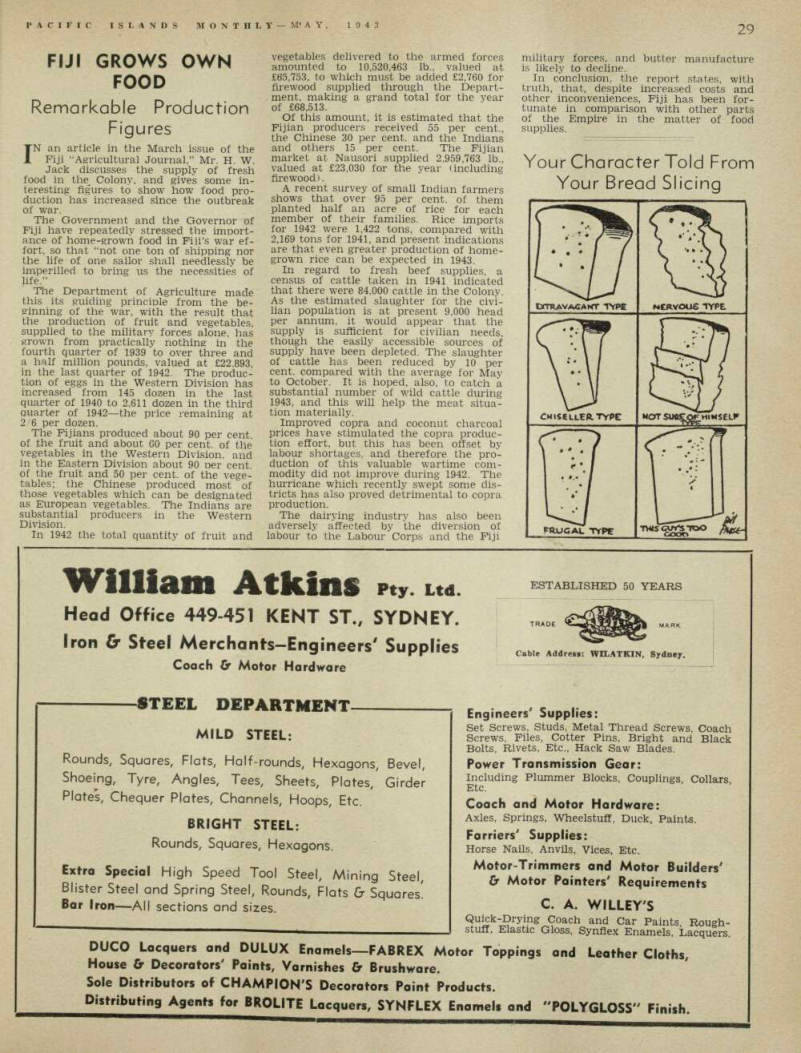
Fiji Grows Own
Food
Remarkable Production Figures
IN an article in the March issue of the Fiji “Agricultural Journal,” Mr. H. W.
Jack discusses the supply of fresh food in Colony, and gives some in teresting figures to show how food pro duction has increased since the outbreak of war.
The Government and the Governor of Fiji have repeatedly stressed the import ance of home-grown food in Fiji’s war ef fort, so that “not one ton of shipping nor the life of one sailor shall needlessly be imperilled to bring us the necessities of life.”
The Department of Agriculture made this its guiding principle from the be ginning of the war, with the result that the production of fruit and vegetables, supplied to the military forces alone, has grown from practically nothing in the fourth quarter of 1939 to over three and a half million pounds, valued at £22.893, in the last quarter of 1942. The produc tion of eggs in the Western Division has increased from 145 dozen in the last quarter of 1940 to 2,611 dozen in the third Quarter of 1942 —the price remaining at 2 6 per dozen.
The Fijians produced about 90 per cent, of the fruit and about GO per cent, of the vegetables in the Western Division, and in the Eastern Division about 90 ner cent, of the fruit and 50 per cent, of the vege tables; the Chinese produced most of those vegetables which can be designated as European vegetables. The Indians are substantial producers in the Western Division.
In 1942 the total quantity of fruit and
vegetables delivered to the armed forces amounted to 10,520,463 lb., valued at £65,753, to which must be added £2,760 for firewood supplied through the Depart ment, making a grand total for the year of £68,513.
Of this amount, it is estimated that the Fijian producers received 55 per cent., the Chinese 30 per cent, and the Indians and others 15 per cent. The Fijian market at Nausori supplied 2,959,763 lb., valued at £23,030 for the year (including firewood).
A recent survey of small Indian farmers shows that over 95 per cent, of them planted half an acre of rice for each member of their families. Rice imports for 1942 were 1,422 tons, compared with 2,169 tons for 1941, and present indications are that even greater production of home grown rice can be expected in 1943.
In regard to fresh beef supplies, a census of cattle taken in 1941 indicated that there were 84,000 cattle in the Colony.
As the estimated slaughter for the civi lian population is at present 9,000 head per annum, it would appear that the supply is sufficient for civilian needs, though the easily accessible sources of supply have been depleted. The slaughter of cattle has been reduced by 10 per cent, compared with the average for May to October. It is hoped, also, to catch a substantial number of wild cattle during 1943, and this will help the meat situa tion materially.
Improved copra and coconut charcoal prices have stimulated the copra produc tion effort, but this has been offset by labour shortages, and therefore the pro duction of this valuable wartime com modity did not improve during 1942. The hurricane which recently swept some dis tricts has also proved detrimental to copra production.
The dairying industry has also been adversely affected by the diversion of labour to the Labour Corps and the Fiji
military forces, and butter manufacture is likely to decline.
In conclusion, the report states, with truth, that, despite increased costs and other inconveniences, Fiji has been for tunate in comparison with other parts of the Empire in the matter of food supplies.
Advertisements & other items, p. 31 (2 items)
Your Character Told From Your Bread Slicing
Your Bread Slicing
Willia
I I
Atkins Pty. Ltd.
Head Office 449-451 KENT ST., SYDNEY.
Iron Cr Sfeel Merchant-Engineers' Supplies
Coach Cr Motor Hardware
STEEL DEPARTMENT
MILD STEEL:
Rounds, Squares, Flats, Half-rounds, Hexagons, Bevel, Shoeing, Tyre, Angles, Tees, Sheets, Plates, Girder Plates, Chequer Plates, Channels, Hoops, Etc.
BRIGHT STEEL:
Rounds, Squares, Hexagons.
Extra Special High Speed Tool Steel, Mining Steel, Blister Steel and Spring Steel, Rounds, Flats Gr Squares!
Bar Iron—All sections and sizes.
ESTABLISHED 50 YEARS
Engineers' Supplies: Set Screws, Studs, Metal Thread Screws, Coach Screws, Files, Cotter Pins, Bright and Black Bolts, Rivets, Etc., Hack Saw Blades.
Power Transmission Gear: Including Plummer Blocks, Couplings, Collars, Etc.
Coach and Motor Hardware: Axles, Springs, Wheelstuff, Duck, Paints.
Farriers' Supplies: Horse Nails, Anvils, Vices, Etc.
Motor-Trimmers and Motor Builders' Cr Motor Painters' Requirements
C. A. WILLEY'S
Quick-Drying Coach and Car Paints, Roughstuff, Elastic Gloss, Synflex Enamels, Lacquers.
DUCO Lacquers and DULUX Enamels—FAßßEX Motor Toppings and Leather Cloths, House & Decorators' Points, Varnishes & Brushware.
Sole Distributors of CHAMPION'S Decorators Paint Products.
Distributing Agents for BROLITE Lacquers, SYNFLEX Enamels and ''POLYGLOSS'' Finish.
Embargo On Fiji Stamps
ANEW regulation in Fiji, which pro hibits the receiving or sending away of either used or unused postage stamps, has been hotly criticised by Fiji philatelists. The Government has given no reason for the new law, and the stamp collectors cannot imagine the purpose it serves.
It is supposed to have something to do with censorship: but it is more likely that it is an attempt to conserve Gov ernment paper and printing, at a diffi cult time. That, however, does not explain the embargo on used stamps.
“If you want the papers to print a thing it is not news. If you don’t it is.”— Peterborough in “Daily Telegraph.”
A Native Charter For Melanesia
What Australia May Do With Papua and New Guinea
AN interesting little booklet entitled “The Atlantic Charter and the Pacific Races” has been written by the Rev. J. W. Burton, M.A., general secretary of the Methodist Overseas Missions, who has been in close contact with Pacific affairs for 40 years.
"The Covenant of the League of Nations promised great hope for ‘un developed’ races,” says Mr. Burton. “It was the Magna Charta of liberty for millions of people—on paper. Unfor tunately it did not get beyond the idealistic stage. Now there has come the Atlantic Charter—and we can only hope that these ideals will not be merely elo quent words and rhetorical phrases, but will be translated into worthy deeds.”
The Charter promises the “ending of special privileges for the few” and the “preservation of civil liberties for all.”
Where does the Pacific Islander come in on this scheme?
In 1920 Australia was given the “trusteeship” of New Guinea —Australia assumed the trusteeship of Papua many years before that—yet all will agree that the native policies of both Territories, especially New Guinea, fell short in various ways.
At present, all Territories’ problems are in the melting-pot. What will come out of it? Already many—seeing the Islands for the first time, and thinking about them for the first time—have devised a crop of half-baked ideas that should be nipped in the bud before they take root in the public mind.
One of the least-baked ideas is that propagated by Mr. Frank Clune; and we can do no better than quote from Mr.
Burton on this subject:— “For example. Frank Clune has just written a book which he calls ‘Prowling Through Papua.’ It is written in the true, slap-dash, racy, journalistic style. He was three days at Yodda and as the re sult declares that Papua can grow all the tea that Australia needs—some £2,500,000 worth a year. The climate and soil are proved suitable, labour is abundant, cheap and willing, land is plentiful—why delay?
Says Mr. Clune:—
“ ‘ln Papua we have 90,000 square miles of country, of which one-third is ideally suited for this crop, and 300,000 natives who at present can find work only as house-boys, or coconut plantation boys, which absorb merely a fraction of the labour power available.
“ ‘Sir Hubert Murray’s policy of keeping the natives in a state of semi-primitive bliss means that they have to stay in their straw villages, and only a few —a lucky few—are permitted to work for whites, being indentured only for brief periods. ... It would be far better to open up the country to intensive culti vation of modern tropical and industrial products, to provide the maximum em ployment for the natives, and so raise their standards of education and civi lisation by allowing them to earn economic wages.’
“Later on, he suggests that here is a solution of the post-war employment problem: the employment of Papuans under demobilised soldiers.
“ ‘The natives of Papua, under sane supervision, should be put to work im mediately clearing thousands of acres of .iungle, and planting areas with rubber trees and other crops which take several years to mature. A ten-million-pound loan should be raised in Australia to finance this venture, and the improved land should be made available on easy purchase terms to demobilised soldiers and munition workers immediately the war ends —instead of gratuities and service pensions.’ ”
MR. CLUNE has an Australian public— I dare say he has earned it—-and it is a safe bet that his uninformed public will swallow the “information” he gives so generously. I am afraid that his naive ideas of what constitutes “semi primitive bliss,” and what he apparently accepts as the fantastic natural wealth of Papua, already has given some Terri torians hysterics.
The percentage of rich land in Papua is small in comparison with the large areas that are entirely unproductive—it would be an economic impossibility for Papua to support Mr. dune’s £10,000,000 worth of munition workers and soldier settlors Secondly, all Islands’ residents know just how profitable the production of tropical crops has been during the last decade. It is true that just at the moment copra and rubber are almost worth their weight in gold—but, Mr. Clune, there is a war on, and the Japs have been un mannerly enough to take practically all of our former sources of supply.
When war broke out in 1939 the South Pacific copra planters jubilantly thought that copra might increase in value. But those delusions were quickly dispelled.
Until Japan came into the war, the United Nations got all the copra they needed from sources closer to them than the South Pacific As for rubber—Malaya could provide all the world’s rubber before the war, and no doubt will be able to do so again after the war. Coffee, cocoa, quinine—they are all produced just as well somewhere else.
It is doubtful whether selling to the Australian market only could keep the Clune munition workers and soldiers’ in bread and butter. With most tropical crops, long years elapse between planting and the first bearing. Tropical agricul ture, therefore, is essentially an industry which must be backed by a moderate amount of capital.
To compete in the world’s markets—
under the present or pre-war economic state of things—it is necessary to have cheap and plentiful labour. Who is going to look after the labour of the “poorwhite” farmer in the initial stages of his new venture? Who is going to feel the first effects of having a chronically “broke” master?
And, above all, why in the name of foi tune, should these natives be put NOW to clearing thousands of acies of jungle f°L,these future settlers?
The trouble with most of these people with theories is that they see affairs as they were prior to the war—but with the addition of a whole lot of pretty notions that happen to suit their own wishes or conceptions. Why send ex-munition workers or soldiers to Papua, anyhow— under a mass rubber-growing or any other scheme, wherein they would be lucky to earn a few pounds a week—when they can farm just as profitably right here in Australia where, God knows, we need a “back-to-the-land” policy if ever we needed anything.
Men will settle m our tropical Territories in the future, as they have always done, but they will be the individual few, with the fortitude necessary to adapt themselves to circumstances And in the future, moreover, they will have to be realists who will visualise us British of the South Pacific—as someone has aptly sea ”*1 aS W 16 ISlandS m * COl ° Ured BUT what are we to do with our brown Islands people? Regard them as perpetual hewers of wood and dowers of water for Mr. dune's munition ld(^ ls of Ch fv. r i er ke6p t^ iem as me r e 5? an 1 econ ° mic machine. Fence them off and keep them as a human zoo? Label them all Fuzzy-
Wuzzy angels” and treat them, at best, as saints, and at the worst, as brands to be plucked from the burning?
Can we hope that out of this conglomeration of ideas evolved by sundry theorists, will come a sane, realistic plan, shorn of sentiment and Imperialism alike, that will fill the bill?
Left to a free choice between the rule of the Asiatic and the rule of the European, the New Guinea natives have shown definitely enough where their sympathies he. But, whether we like the idea of change or not, change is coming. It is strictly up to us whether that change is made by us, or forced upon us. It is hardly likely that, if we do not bring any more realism to bear on the subject than we have up to date, the Pacific scene of 2043 will bear any resemblance to the Pacific scene we have known in the recent past. Administrator, missionary, miner, trader, planter, anthropologistall see the native and his country from a different angle-and each will have to give something before a solution is found to the problem of what to do for our Pacific Territories.
Mr. Burton says that it will have to be a policy of gradualness—for fear we destroy what is useful and fail to replace it with something of lasting value-and that it will need the co-oneration of Governments, missions, educltfonahsts anthrocCmfrcia1 n worid e to e see e , ? t e, ?h?nLl 0f and others, of late, have applfed thl example of some African territories to the problems of the Pacific, and have seen a solution m systems of indirect rule, agripoltural education, and communal farm- . .. , T H E whole question is a number-one X headache for who ever tackles it, whenever he tackles it. For cen-
turies the Pacific has slumbered in sleepy obscurity—there was much that was good and pleasant in it, and much that was bad. But now for good or ill, sleep is over and the Pacific is wide open. Its problems must be tackled, or sooner or later they will tackle us; the old era died when Japan attacked Pearl Harbour.
The Atlantic Charter “affords assurance that all the men in all the lands may live out their lives in freedom from fear and want.” These things cannot come about b v talking about them. Nor can they come about without sacrifice. We are all kee n on sacrifice—for the other fellow, tHp Atlantic (""barter mav nrnvide some bitter pills to be swallowed by Pacific interests—and not exclusively commercial interests Theorists at least are ae-reed imon one thine—that thenativemuft not be turned i“£J g a bad imitation o?a Euronean and th at whfle wTslekto Le h?m the bene ms of™inrrivnfsation health education and^mSral incentive our main shouldbe to make him a better „^ v< f noiua De 10 maKe nim a Detter i-4.4.1 i, u . . ,
education*
afwenas th 2 the native Ys
f ik eTv to have thrust unon Ifm y JS h all o? he is unfitted to mm ’ w a all °i nicn unfitted to
“Pf e d thitTn amount ofmedf
K“SOtedl"inS
nSctenoTthe oftheVS'
to r ie S but was the result of nadequate 'gSntf from Canberra able to millions to
ge for warshould beabi“ afte? the
war, to supply money for native education and medical work as the first step towards fitting the New Guinea natives for their place in the “co-prosperity of the Pacific.”—J.T.
Advertisements & other items, pp. 32-33 (2 items)
Bitumenoid Roofing
□s Your “Durabestos” home of the future can be planned to any architectural design for these tough asbestoscement sheets are most adaptable to requirements.
To-day "Durabestos” is widely employed for defence and industrial structures where speedy erection and adaptability are imperative.
WUNDERLICH
DURABESTOS
ASBESTOS-CEMENT SHEETS
for essential jobs is sold by: Island Merchants in Pacific groups.
Allen Taylor & Co. Ltd.
COMMERCIAL ROAD, ROZELLE,
SYDNEY
Sawmillers and Wholesale Suppliers of Hardwoods for Constructional Purposes GIRDERS . . . PILES . . . POLES . . . SLEEPERS, Etc.
EXPORTING TO PACIFIC - ISLANDS SINCE 1893
BITUMENOID ROOFING
MADE IN AUSTRALIA,
Bltumenold Roofings, Dampcourse and Insulating Pelts are made from the world’s best raw materials. Warranted to stand the most rigid tests.
BITUMENOID THE BEST
Roofing, 1,2, 3-ply; Flooring, Waterproof Materials; Saturated Felt; Resilient Road jointing; Natural Asphalt Dampcourse: 2 and 3-ply Dampcourse; 1-2 lb. Lead-core Dampcourse; Roofing Cement; Asphalt Paints; Roofing Compound.
SAMiPLES AND PRICE LISTS ON APPLICATION.
MAXWELL PORTER & SON LTD.
ESTABLISHED 1888. BUILDERS’ SUPPLIES.
107 REDFERN ST., REDFERN, SYDNEY, N.S.W. ’Phone: M 8157. Cables Bilans
W.KOPSEN & Co.Pty.Ltd.
SIMPLEX
MARINE
ENGINES
Simplex engines from 3 h.p. to 12 h.p, for boats from 14 ft. to 26 ft. are Australia’s best. 2 cycle and 4 cycle with or without reverse gear Illustrated is the popular little 3 h.p. suitable for 14 ft. or 16 ft boats Runs for 5 hours on 1 gallon petrol and costs only £29/15/-. complete with all equipment. Ready to instal into any boat, nothing else to buy Ask for Simplex catalogue of engines and launches.
SKARSTEN SCRAPERS
Remove paint, varnish, glue, oil, grease, roughness, etc., from wood and metal surfaces. Most useful for scraping deck and hull planks. They leave the surface smooth and dressed and ready for painting. Have renewable blades.
Prices: No. 35, 2/3; 62, 2/6; 80, 3/3.
Reversible, 7/-.
Write for leaflet.
TILLEY
Kerosene
LAMPS
British-made Kerosene Lamps providing a steady 300 c.p. light, without flickering, and without smoke or smell.
Model TLIO (illustrated) is a handsome Table Lamp providing exceedingly brilliant Illumination and at the same time a fine ornament for any home.
Stands 24 in. high and covers a large area. Attractive parchment shade is finished in autumn tones and matches any furnishings.
Also available is the popular All- Purpose Lamp and Lantern (model EX100) and a variety of Hanging, Table, Wall and Vase Lamps.
Let us send you full details of all Tilley Lamps.
SHIPCHANDLERY
We manufacture and stock the largest range of boat gear in .Australia. Everything for hoatbuilder and boatowner. Marine paints and varnishes. Rope and Cordage. Rigging. Anchors and M oorings. Copper Nails and Rod . Lighting Plants. Fire Extinguishers. Oars and Sculls, Lamps, Pumps, etc.
GET OUR PRICES FIRST. " "
W.KOPSEN & Co.Pty.Ltd.
376/380 KENT STREET, SYDNEY
Thane: MA 6336 (4 lines).
Est. 1868.
Cables; Kopsen . . . Sydney.
Polynesians’
Gallantry
What the Maoris Did in Tunisia
r THE Polynesian people not only have aligned themselves with the demo cracies of the United Nations in this world struggle, but also have displayed fighting qualities and a gallant high courage that entitle them to rank with the best men in the world.
With the British Bth Army, in North Africa, are two Polynesian units—the Maori Battalions of the New Zealand Expeditionary Force, and the Pacific Battalion, of the Fighting French — who, again and again, have performed feats which have won for them undying fame.
There must he a definite place in the post-war world for this kind of people.
In Tunisia, in April, the Maoris did an amazing thing. Here is an account of the incident hy William Munday, “Sydney Morning Herald” war correspondent. It is dated from Tunisia, April 28.
Eight Maoris and a New Zealand artillery observation officer fought their way to the top of 650 ft. high Takrouna Hill, when the Eighth Army resumed the offensive in Tunisia on April 19.
Although the rest of the attacking troops were still on the plain below, the nine men established themselves at night in the middle of the Germans and Italians on the hill top, and stayed there all next day, despite repeated attempts to dislodge them.
It was not until night that 50 more Maoris broke through the enemy cordon, to join the nine in their tiny, isolated fort.
The story of this daring exploit, which led to the capture of the very important strongpoint of Takrouna was related to day by a British general, who said: “It sounds like fiction.”
A comnany of Maoris got to the foot of the hill, which rises almost sheer from the plain, over which they had advanced under heavy fire.
Here, in shallow holes, the Maoris crouched while shells and mortar bombs burst among them.
Terrific Fire
Almost directlv above them, firing at close range, the Germans had 72 machine-guns, four 25-oounder gun howitzers, and at least six mortars, all entrenched in the hillside or on the brow of the overhanging summit, undercut by the native marauders, who had held the castle on the summit in bygone days.
All the officers of the Maori comnanv were casualties a sergeant assumed com mand. and selected four men.
“Let's go un to the ton ” he said. Hardlv had they moveH when even more intense fire was brought to hear on them The sergeant sent back for fom- moro men, instructing each to bring a Bren gun.
With Brens balanced on their shoulders, nointing almost straight up, and firing as they went the Maoris advanced un the slope. Thev kffiod the crews of a number of enemv machine-guns, a’nr? took others prisoner and reached the hill ton. Thev burrowed into a tiny hollow, and placed stones around it for added protection.
German and Italian troops closed around them, and tried a dozen times to over-run them, but each time the Maoris, with their Brens and captured machine guns stopped them with heavy casualties, and held on until the hill was over-run by the NZ force.
Three of the Maoris were killed in de fending the summit, but the survivors joined in driving the enemy down the slopes.
Who Gets the Profit?
Fiji Bananas in NZ
“11/'HO gets the profit?” asks the Fiji TT “Times,” in an article on the price which Fiji bananas are bringing in New Zealand.
The Fijian grower receives 4 - per case —after a year of hard work and culti vation; the middleman supplies the case, repacks and ships the fruit to the New Zealand Government at 10 4 a case on the wharf at Suva. The landed cost in Auckland, it is estimated, should not be more than 17 6.
So much for the Fiji end of the story.
In New Zealand, the bananas are re packed in somewhat smaller cases, are distributed to the retailers and are eventually bought by the public at a fixed price of 7d. per pound. Worked out on a basis of the 90-100 lb. case, which leaves Fiji, this means that the case for which the grower in Fiji received 4 - and the middleman 10 4 from the New Zealand Government, actually brings from £2/15/to £2 18 - from the New Zealand public.
The NZ ; Government is a Socialist Govern ment, pledged to destroy all profiteers.
The “Times” might well ask who gets this enormous margin of profit—or why NZ handling charges should eat up about £2 per case. But it is a debatable point as to who has the greater grievance—the Fiji grower, or the New Zealand con sumer.
Maybe there IS a war on—but this per formance by the NZ Government still does not appear to make sense.
Samoa Will Not Pack Bananas
From Our Own Correspondent APIA. April 22.
BANANA exports are still decreasing, as more and more native and Euro pean producers cease to pack bana nas for export.
With Europeans, this is partly the result of the chronic labour shortage, which also affects the cocoa and coco nut planters. But natives and Europeans alike find the export price offered (5/6 per case) not a paying proposition. In fact, bananas of indifferent quality sold locally fetch better prices than the picked fruit required for export.
Mr. John Walstab, formerly in charge of the New Guinea police, and who sub sequently held an important office in the Middle East, returned to Australia re cently, and is now APO in Melbourne.
His son-in-law, Major Backhouse (the well-known New Guinea medico who isolated the cause of Japanese River fever) also returned to Australia, with the 9th Division.
Advertisements & other items, p. 34 (2 items)
Pinkettes
There is no substitute foi
OLD MONK
VIRGIN PURE
OLIVE OIL
I- San Francisco
After taking Pinkettes you should feel brighter, happier, and free from sick headaches, bilious attacks and liverishness. For
PINKETTES
are tiny laxative and liver pills, which painlessly exercise the digestive system.
TENAX Genuinely Germicidal SOAP
w
EPP
Guard against Infection with Tenax!
'J'ENAX Germicidal Soap used regularly is an unsurpassed safeguard against external germ infection. It is kind to the most sensitive skin, yet its germicidal action is eleven times as rapid as carbolic. It is non-irritant and non-poisonou*.
At All Chemists and Stores .
TENAX Genuinely Germicidal SOAP
Atebrin And
ME!
Some Experiences of This Substitute for Quinine
By Judy Tudor
ATEBRIN —now apparently spelt Ate brln-e —has had much publicity, since it has been announced that United Nations scientists, after twelve months’ research, have improved this substitute for quinine. Quinine, as all malaria sufferers know, disappeared from the market when the Japs occupied Java early in 1942.
Most residents of the South Pacific Territories were introduced to Atcbrin (without the “e”) about the mid-thirties, when the German firm of Bayer began exporting it; and, after the local medicos had tried it out on kanakas and a few unsuspecting Chinese, some went to the length of taking it.
It remained, nevertheless, one of those controversial subjects that are good for an argument at any time. It was held by some to be the cause of fits, blindness and heart disease —and hailed by others to be the panacea of all malarial ills. My own experiences in New Guinea with the sulphur-yellow drug—for what they are worth —are as follows: — I SUFFERED low fever for about eight months non-stop—or until people gave me one look and went off mut tering “blackwater.” The daily five-grain dose of quinine seemed to aggravate the situation rather than relieve it; and, when it was increased to ten grains per day, I turned into a palsied wreck.
Someone suggested, doubtfully, Atebrin; and a runner was sent off on the 100miles trek to the township where there was, newly installed, a doctor.
In due course, the boy returned with the tiny bottle containing 15 yellow tab lets, and a page of instructions from the doctor, which left no doubt in my mind that he considered it to be no better than bottled dynamite.
At this time. I was alone, and I waited two weeks, until the men returned, before I ventured to take the drug, for fear of some of the “toxic conditions” which the doctor had mentioned. I then commenced to take the tablets—three a day for five days—but never without mentally bracing myself each time for any possible con vulsion or heart attack.
As the last of the tablets went, so did the fever. It remained away for pre cisely three weeks.
By this time, I was an Atebrin convert; but, having heard that the doctor would on no account send me a second course so soon after the first, I persuaded a pass ing miner to part with a bottle which he was carrying, apparently, as a magical charm.
Course II was a failure, and I was shoved off “South.” Salamaua’s doctor, appealed to for a cure en route, shook his head over Atebrin, and explained that the only two persons to whom he had administered it, had each taken a fit.
RETURNING, via Rabaul, I had an other attack of fever, and I applied to a Rabaul doctor for relief.
“There is nothing like Atebrin,” he said, in effect. “You can take it every day and it will never harm you. I’ll come down to the ship to-morrow and give you an injection.”
He came, armed with a large hypo dermic syringe. “I’m giving you half a course in one injection,” he said. “It will probably make you feel drunk.”
I was not particularly enthusiastic about that; but, as he plunged the instru
ment into my arm, he added, somewhat pensively: “I’ve just given a big dose to a patient—she had a convulsion!”
“Good Lord!” I babbled. “What on earth are you doing this to me for?”
“Oh, you’ll be all right,” he said, airily.
“She was very low.”
“Well, I feel low,” I said frantically.
“Don’t go off until we see how this works in me.”
But he packed up and went; and, after twenty minutes of prone lying and careful breathing, I got off the bunk and stood on my feet. To my amazement I did not convulse —I did not even feel drunk.
I was re-converted to Atebrin. On my trip up the coast I bought the drug wher ever I could find it, and went into the bush well equipped.
Thereafter, following my own line of reasoning, peculiar to no medical science, I took half a tablet a day, and as time wore on I became, in colour, jaundiced Malay, but of other ill-effects there ap peared to be none. I suffered about the same amount of fever as anyone else, but no more.
CAME Christmas —and over the moun tains we went for the celebrations.
Accompanied by a “monkey,” I started off two hours before the men; and reached the village “on top” about ten minutes before them. The interven ing time was spent, by me, in having an agonising experience, which would have tried the patience of a Spartan Boy—and by the monkey—mostly—in sitting stoically on a log, nonchalantly picking off leeches,
or engaged on some other native pastime, while his missus lay down in the mud and gasped for breath. The track a young nvuiet of mud rose a couple of thousand feet in the first few miles, and as it wound upwards, I panted and gasped, and my heart beat louder and louder until the noise of it took possession of me and seemed to beat around me like some
yibratmg aura.
Like Brer Rabbit, I said nuffm, when I was discovered by the rest of the party, stretched out under the village coconuts, mottled-purple in the face, mud-bespattered and flanked by a couple of green
coconuts with which the ancient Luluai had revived me.
But I thought much as I continued the journey, and in the days that followed Thenceforth, I took my drugs when needed-as most Islands people do-and when I next came to tackle mountains my heart appeared to have returned to the right spot in my body, and not to be suspended by a string just outside my ears.
TT comes as a shock to realise that in 1 spite of the giant strides that medical science has made in the last half
century, there are over 800 million malaria sufferers in the world to-day—and that there is no sure-fire cure for it.
Now, of course, drugs for the treat ment of malaria are weapons of war— more casualties are suffered through malaria in Burma and New Guinea than through battle. Malaria, and lack of drugs to combat it, were a deciding factor in the American surrender of the Philip pines. The danger of malaria, as suf ferers know, lies not so much in its mortality rate as in the state of morbid and chronic despondency and weakness to which it reduces them.
War is an all-round speeding-up pro cess—and perhaps out of this one, now that the need is so great, a definite cure for one of man’s greatest scourges may be born.
Advertisements & other items, pp. 35-36 (1 item)
Marys
6ILLESPIE’S EBV |ce
BUYING AGENTS
FOR ALL PACIFIC TERRITORIES
Island Produce Sold on Commission
YOUR ORDERS RECEIVE PERSONAL ATTENTION
ROBERT GILLESPIE PTY. LIMITED
54a PITT STREET, SYDNEY
Cables: ROBERGILL, G.P.O. BOX 137 CC.
AUNT
MARYS
BAKING POWDER
“ITS QUALITY NEVER VARIES”
To maintain the consistent “even rising” qualities, for which Aunt Mary’s Baking Powder has been famous for nearly 70 years, the manufacturers can only release limited quantities during the war.
When you obtain a tin use it sparingly. You will find a little goes a long way. Remember there is no substitute for Aunt
Mary’s quality it never varies !
Wanted to Buy—Quality Guns and Rifles HIGHEST PRICES GIVEN. WILL ALSO EXCHANGE GUNS.
S I L R O H U Quality Firearms and Fishing Tackle. 143 ELIZABETH STREET (Near Market St.) SYDNEY. 'PHONE: MA 3540.
Woven Wire for ail Industry \
COPRA DRYING TRAYS, FLOORS, Etc.
FRUIT DRYING TRAYS, MINING SCREENS.
Heavy Mosquito Gauze in Phosphor Bronze and other Metals Impervious to Salt Sea Air.
WIRE DOORMATS AND GENERAL WIRE WORKS
E. WRIGHT & CO. LTD.
Office and Works: 148-152 Cleveland Street, Sydney, N.S.W.
Telegraphic Address: “Wrightmake,” Chippendale. vvr ki ft Q: & £
Asthma Curbed In 3 Minutes
Since the discovery of Mendaco by a famous physician sufferers can get relief from Asthma. Mendaco does away with expensive injections and offensive smokes.
All you do is to take 2 tasteless tablets with meals and Mendaco starts circulating through the blood in 10 minutes. You breathe easily and freely. Your nerves relax, you get good, fresh, pure air into your lungs, and vigour returns.
Sleep Like a Baby
Thousands of former sufferers from Asthma say that the very first dose of Mendaco brought them glorious ease and comfort, and that they slept soundly the very first night. Then their vigour returned and they felt healthier and stronger, and 5 to 10 years younger. The reason for this is that Mendaco acts in natural ways to overcome the effects of Asthma. (li It removes the mucus or phlegm; (2i It relaxes thousands of tiny muscles in your bronchial tubes so that the air can get in and out of your lungs; (3t It promotes body vigour, and stimulates the building of rich, revitalised blood.
No Asthma for Five Years
Mendaco not only brings almost immediate results, free breathing and comfort and enables you to sleep, but also builds up the system to ward off future attacks. Mr.
J. R. writes: “I was almost dead with Asthma. Had lost 40 lbs. in weight, suf-
fered coughing every night—couldn’t sleep.
Mendaco stopped spasms first night. I have had no Asthma since in over 3 years.”
Mrs. A. W. writes: ”1 had Asthma for 35 years. After using Mendaco I can sleep all night and have not had an attack since taking it.” Mrs. G. E. C. writes: “I bless the day I first beard of Mendaco. What a godsend it is to a poor woman like me who for 35 years never knew what it was to have a good night’s rest. The constant fight between Asthma and sleep was wearing me down, but I feel now I want to forget my past suffering.”
Benefits Immediate
The very first dose of Mendaco goes right to work circulating through your blood and helping nature rid you of the effects of Asthma. Try Mendaco under an iron-clad money back guarantee. You be the judge. if you don’t feel fully satisfied after taking Mendaco just return the package and the purchase price will be refunded. Get Mendaco from your chemist to-day and see how well you sleep to-night and how much better you will feel.
RELIEVES ASTHMA
Mendaco
Now in 2 sizes 6/- and 12/-
Giraud And De
Gaulle
THAT the protracted arguments be tween Generals de Gaulle and Giraud, concerning control of the Fighting French are puzzling not only the British and Americans, but also the Fighting French people themselves, is shown by the issue of an explanatory statement in Sydney by the Fighting French Delegation. Portion is published hereunder:— “Now that details of the visit to North Africa by General de Gaulle are being discussed, we wish to make clear the reasons for General de Gaulle’s insistence on the meeting taking place there, and particularly in Algiers. They are as follows: “1. All arrangements for the forma tion of a French Governing Body must be made on French soil between French men (as was the case when the original French Imperial Council of Defence was set up at Brazzaville).
“2, Algeria, legally a French Metro politan Territory, is obviously the place where such a meeting should take place.
“3. In accordance with the laws of the French Republic now fully acknowledged by General Giraud, a fully representa tive Consultative National Council could be established in Algeria. From this National Council, a temporary central power could be elected in terms of the French Constitution.
“4. The significance of the agreement to be reached is of such importance that the meeting cannot be merely one between generals. It must have a much wider basis.
“Whence the insistence of General de Gaulle upon talks taking place publicly and in Algeria’s capital, Algiers, and not in some secret rendezvous in the moun tains.’’
General Giraud, regarding himself as senior French officer in North Africa, and “being trained in the hierarchical auto matism of French tradition,’’ naturally assumes that he is justified in aspiring to supreme direction of French resist ance.
But the Fighting French will not desert de Gaulle. “De Gaulle, in the hour of our deepest darkness, alone of Frenchmen, risked everything, in his faith in our final victory, and the fact remains that to an immense majority of the people of France, General de Gaulle appears to-day, not merely as a young and brilliant general who, on June 18, 1940, made a very famous speech, but as the saviour of French dignity, as the embodiment of French courage, and as the hope of a new France purified by suffering and determined to assume again her historic and legitimate posi tion in world affairs.”
Nursery Rhymes in Pidgin
Pidgin
INSPIRED by “Pidgin is Discovered,” in the April issue of the “PIM,” “FPA” has sent us the story of Nopu and her rendition —in Pidgin—of some well known nursery rhymes.
Everyone knows the one about Simple Simon and also how the Pussy-cat went to see the Queen; but not, we are sure, in this version. However, even non- Pidgin-ists should have no difficulty in understanding the context.
Nopu was the Boss Boy’s small child, and she had acquired a well-illustrated book of nursery rhymes from the local mission. These rhymes had often been read, and explained, to her, and she took great pleasure in passing on her know ledge to a mystified but intensely inter ested audience of plantation boys who often came to her father’s house for a game of cards and a smoke after work was over for the day.
With the audience all expectant, she would open the book and begin with “Simple Simon” —pictured as a vacant looking youth, in a hat with a drooping feather, a red doublet and green hose, talking to a fat pie-man.
Nopu explained the strange-looking clothes by saying; “Clothes belong before too much. Savvy?”
She then introduced Simon: “Name belong dis fella man, SI-MON. Him he no got plenty savvy belong him.”
Then the Pie-man: “Name belong dis fella man, PIE-MAN. Him he like trade all this fella pie. Him he man belong cross too! Orright! Simon he hungry too much, now he talk-talk along Pie man: ‘Me like kai-kai one fella pie, plese.’ Now Pie-man he speak: ‘Or right! You can catchim one fella das all. You must give me one fella mark first time, savvy? Price belong this kind pie, one mark, one fella. Come on, givim me one mark belong you.’
“Simon he no got mark, das all he gammon along findim mark inside bas ket belong him. Lik-lik time he talk talk along Pie-man: ‘Me no got mark.
Behind me payim you.’ Pie-man he cross now—bel belong him he hot too much along this fella fashion. Him he speak: ‘You ’ere! You bush kanaka true! You think me can givim you one pie suppose you no got mark along payim me? You blurry fool you! Rouse —quicktime!’”
So ended “Simple Simon,” while the audience clicked their tongues and shook their heads.
The next page showed a surprised-look ing cat, explaining to an elderly dame just why he had to go to London. Nopu, indicating the dame, told how the “Missus” has questioned the “pussi” and then went on:— “Now, this fella pussi he savvy plenty.
Him he savvy talk-talk too. Now he talk-talk along Missus: ‘Me go along
LON-DON, number one place belong all master. Me like lookim Missus belong King. Dis fella Missus belong King, he sit down along big fella chair belong him; now me like go shake hands along Missus. Along time me come close-to along chair me lookim one fella rat ne stop unnerneath along chair. Orright!
Me run quicklime too much, now me holdim fast this fella rat, now me kai kai this fella rat algether—now head, now tail, now bel belong him. Now Missus belong King he talk: ‘You good fella pussi. You savvy too much along work oelong you.’ Now Missus givim one cup tea, now me drinkim finish, now me shake hands along Missus belong King, now me come back along place belong you.’
“Pussi he talk-talk all the same,” Nopu would say, as she closed the evening session.
The audience would sigh, and seem incredulous over the remarkable adven tures of the cat. A doubter once remarked, “I think this fella pussi he nother fella kind. I think he tambaran (spirit).”
Mr. A. F. Hayes, who was well known to many of the older residents of Pacific Territories, died in Sydney on April 21.
He served for many years as a super cargo on Burns Philp ships—mostly around the Gilbert and Ellice Islands — and about 16 years ago was transferred to the firm’s Islands Department in Sydney. He retired several years ago, and since has been living in Sydney.
Tribute to Dr. Buck
/I FOOTNOTE to a recent controversy in the “ PIM” about Polynesian migra tions. It is written by the gentleman who criticised certain conclusions in Dr.
Buck’s book, “Vikings of the Sunrise — DOCTOR Buck, in his letter, refers to the “debatable” Micronesian theory.
Now, if I remember correctly, in “Vikings of the Sunrise” he states cate gorically that the original Polynesian migration at Ra’iatea came that way.
It was on that very statement I criti cised his book as a document on Poly
nesian migrations.
It was abundantly evident that Dr.
Buck did not evolve that theory, and I put the blame where it belonged—on the young cubs. Young cubs, if they survive, become bruins, and one is not surprised if they learn wisdom and gather some of the juicy fruit of the plum-tree—as Dr. Buck states. That does not alter the fact that while they were cubs they did some very cubbish things.
The Micronesian theory is one of these, so is that fairy tale of an 8,000mile voyage over an empty sea to fetch the sweet potato.
Dr. Buck has written a fine letter and I honour him for his loyal defence of his subordinates.
I have met him and I found him one of the most attractive personalities and interesting conversationalists I have ever encountered.
Information has been received in Sydney that Mr. M. G. Evensen and Mr.
W„ Korn, of the Carpenter plantation service, were taken prisoner by the Japanese in New Britain in July last. It is assumed that they have been shipped away to a northern prison camp. While the report is not official, it comes from what is regarded as a reliable source.
Advertisements & other items, pp. 37-38 (1 item)
advt
fj
General
Merchants
and
Agents
i RtPRtStimWC LEADING FIRMS IN TNI PACIFIC' ISLANDS
379 KENT STREET,
SYDNEY.
Telephones: MJ 4657 (5 lines).
Islands Produce Sold on Shippers' Account Buyers of all Islands' requirements on Commis- Liberal Advances against Consignments. sion Original Invoices Furnished. 25 Years’ Islands Trade Experience.
Bankers: Bank of New South Wales. Correspondence in English and French.
Stop Kidney
Poisoning To-day
If you suffer from Rheumatism, Broken Sleep, Leg Pains, Backache, Lumbago, Nervousness, Headaches, and Colds. Dizziness, Circles under Eyes, Swollen Ankles, Loss of Appetite or Energy, you should know that your system is being poisoned because germs are impairing the vital process of your kidneys. Ordinary medicines can’t help much, because you must kill the germs which cause these troubles, and blood cant be pure till kidneys function normally.
Stop troubles by removing cause with Cystex— the new scientific discovery which starts benefit in 2 hours. Cystex must prove entirely satisfactory and be exactly the medicine you need or money back is guaranteed. Get Cystex from your chemist or store.
The guarantee plrotecds you. Now in 2 sizes: 4/-, 87-
GUARANTEED
for Kidneys, Bladder, Rheumatism.
Cystex
Ship Chandlery Hardware
/Write for j
Ship Chandlery /
Cataloaue J
Catalogue
Special “In Bond” Prices for all Islands enquiries quoted on application.
BROOMFIELDS LIMITED
153 SUSSEX STREET :: SYDNEY.
Cables: “Boom”, Sydney.
Large and Complete Stocks of
SHIP CHANDLERY
IRONMONGERY OF ALL KINDS, PAINTS,
WHITE LEAD AND OILS.
Sole Agents for; P. H. MUNTZ & CO.’S 3-CROWN BRAND METAL SHEATHING.
PEACOCK & BUCHANS’ ENGLISH READY-MIXED PAINTS.
Scott’s “Renown” Brand Rope,
Cordage and
Binder
Twine
Cable Addreii; Ropeyard.
Sydney. mL "m m m of Every Description
MANUFACTURED AT
MASCOT. N.S.W.
J. SCOTT
PTY. LTD.
Head Office and Store;
163 CLARENCE STREET.
SYDNEY.
N.S.W.
Airways
The Luck Of Guinea
Or Did The Directors See Into The Future?
GUINEA AIRWAYS, LTD., reports profit of £14,180 for the year to February 28, compared with £13,945 for pre"vious year. Dividends of 7 per cent, on both preference and ordinary shares absorb £11,200, and £5,000 is transferred to general reserve.
Directors state that for the first time in its history the company’s activities have been confined solely to Australia. The detailed war damage claim has been lodged with the War Damage Commission, involving slight alteration of the figures appearing in last year’s account, but settlement of this claim will not be made until after the war.
In the directorate of this company there is either pre-vision amounting to genius, or sheer luck. In 1937, the Co transferred enough of its plant from New Guinea to allow it to enter the Australian air transport business; and. to finance the big change, it increased its issued capital from £50,000 to £160,000. Early in 1942, the Japs crashed into New Guinea, and the original Guinea Airways organi sation was wiped out—or, at least, sus pended for the duration. But, by 1942,
the new Australian section of Guinea Air ways was coming into profitable action, on the Adelaide-Darwin run. (See “PIM” of May, 1942.) In this last year, with New Guinea right out of action, Australia has earned enough (£14,180) to pay the usual 7 per cent, on all shares.
Guinea Airways shareholders clearly were born under one of the luckiest stars in the heavens. During the 13 years they operated in New Guinea, their subscribed capital of £50,000 earned them profits of approximately £24s,ooo—equal to no less than an average of about 38 per cent, per annum! And then, when the inevitable Jap invasion comes along, they find that their business, instead of being paralysed, like all other New Guinea businesses, is operating safely in Australia, and earning them a steady 7 per cent.!
Adrift for 23 Days
From Our Own Correspondent NOUMEA, March 23.
JOESOEP, a well-known character among New Caledonia’s Javanese, recently figured in an escape incident which set him adrift in a launch for 23 days.
But for the war, he would have been returned to his native Batavia because of his habit of deserting an employer for whom he has contracted to work. For his most recent lapse he was sent, a short time ago, to the coral isle of Mare, about 80 miles distant from the bottom tip of New Caledonia, where he was set cutting timber.
The work did not appeal to Joesoep and one night he wrapped up his few possessions in a handkerchief, and de camped in his master’s 18-foot launch.
His provisions, although unsubstantial, were enough, he thought, to get him across 80 miles of sea. back to New Caledonia.
The one thing he had not reckoned with was his petrol supply. For three hours he made good progress; then his motor failed, and his long ordeal of drift ing commenced.
After some days his provisions were gone, and he became sick and famished, and lost all hope. He did not suffer from thirst —the squalls of the rainy season saw to that.
While Noumea searched and then gave him up for lost, he drifted north-west wards along the whole 250 miles of the Caledonian coast and finally wind and current drove him through Balade Pas sage inside Cook’s great reef, and on the twenty-third day the launch rounded the northern tip of New Caledonia and grounded on uninhabited Pam Islet, where he was later found by local fisher men.
Had he missed this northern tip of the island, he would have drifted right across the Coral Sea to the Queensland coast.
As it is, he is now in the hands of the gendarme at Oubatcha and, when he has recovered, he will be taken to Noumea to be charged with the theft of his mas ter’s launch.
“So long as there are homes to which men turn At close of day, So long as there are homes where child ren are— Where women stay, If love and loyalty and faith be found Across these sills A stricken nation can recover from Its gravest ills.” — Crowell.
Advertisements & other items, p. 38 (1 item)
36
MAV, 1943 PACIFIC ISLANDS MONtttLt
Two Talented Daughters

Of Tahiti
HERE are photographs of the two talented daughters of Mr. Oscar Nordman, of Papeete, Tahiti, well known to Pacific shipping men.
Ethel Nordman, seen dancing in the pareu (Jon Hall was her partner) went to Hollywood a couple of years ago, and now appears to be embarked on a film career. She, of course, specialises on Polynesian dances. She is known as “Namure,” and she is beautiful and vivacious.
Anatila Nordman, only 16 years old, has just been appointed as instructor in Papeete’s famous I’Ecole Centrale —she is an outstanding scholar and probably is the youngest school-teacher in the South Pacific. She got her name in a curious way. In 1927, the old four-masted schooner, “Anatila,” formerly the “Annie
M. Campbell,” ran ashore on Nukuhiva (Marquesas). On October 27, Mr. Nord man received a laconic message from the captain, “Anatila grounded.” That same day, in his home, a baby daughter arrived —and just naturally took over the euphonic name of the lost schooner.
A son of Mr. Nordman is serving in the forces of Fighting France.
Miss Anatila Nordman.
Miss Ethel Nordman.
NG Women's Club Social
BETWEEN SO and 90 New Guinea Women’s Club members and their friends were present at a social evening meeting held in the Feminist Club Rooms, 77 King Street, Sydney, on May 7. Guests were asked to bring a gift (to be worth no more than 1/-) and to buy a gift; proceeds, which will be added to club funds, amounted to over £l6. During the evening Mrs. Godtschalk sang several songs which were greatly enjoyed by those present; she was accom panied by Mrs. Dickinson, who was well known in the Rabaul district before the war, as an accomplished pianiste.
On April 19, 1941, Admiral Darlan advised the General Secretary of the League of Nations that France should not be considered a member of the League after April 19, 1943. General de Gaulle, with the agreement of General Giraud, has notified the Secretary that owing to the fact that the measure had been taken without the assent of the French people, no change has taken place in France’s status with regard to the League.
Advertisements & other items, p. 39 (1 item)
roleman
For Inflamed Eyes and Eyelids
SOLD EVER YWHEIE
H. A. Rom A. Ce. Pty. Ltd., Kim St. Sydney
roleman
PVREX
Coleman = k
MANTLES
AND GLOBES
For Efficient Service
and Best Light
Coleman Mantles, Heat Resisting Globes and Reflector Rings for Coleman Lamps and Lanterns and many European Types, are still available and are still made from the same first quality materials.
See your nearest Coleman Dealer, who will be supplied to the best of our ability with these important accessories.
FOR BEST SERVICE INSIST
ON COLEMAN
THE COLEMAN LAMP & STOVE CO. LTD.
TORONTO - - - CANADA '
THE COLEMAN EXPORT CORPORATION, CHICAGO, ILL., U.S.A.
About Islands People
Rev. Owen G. Parry, formerly an Islands missionary, is now a chaplain with the forces on an operational front.
“The job is interesting, busy and scat tered: but there are limits on the possi bilities of travel,” he writes. “I expect to return in one piece: but there are certain risks about the business, after all.”
Captain Kettle is still in command of the auxiliary schooner, “John Williams,” which ran for so many years in the Cen tral Pacific service of the London Mis sionary Society. Captain Kettle planned retirement a couple of years ago; but the war has upset all that. When the vessel left Suva, some time ago, she had aboard the Rev. G. H. Eastman, well known LMS missionary.
Mr. W. T. Martin, of Suva, who is leav ing Fiji for active military service, was farewelled on March 30, by past and present members of Signals personnel of the Fiji Military Forces. Mr. Martin was closely associated with the formation of the Signals unit of the FMF.
Miss Muriel Margaret Mason, only daughter of Mr. W. D. Mason, of San gara rubber plantation, Papua, was mar ried at Woollahra, Sydney, on April 28, to Mr. G. S. P. Cotton, of Wellington, New Zealand.
Mr. Malcolm Brodie, managing director of the Pacific Biscuit Company, Suva, has been appointed the Fiji Competent Authority to control the import, storage, distribution and turnover of the Colony’s requirements in flour and sharps. He assumed duty at the end of March.
Mr. A. J. Downing, of the Establish ment of the High Commission of the Western Pacific, has been appointed to service as clerk and accountant in the New Hebrides.
Mr. P. Colley, of the Establishment of the High Commissioner for the Western Pacific, has been appointed Acting Brit ish District Agent, Efate, and Comman dant of the Constabulary (British Divi sion), New Hebrides.
Mr. F. W. P. Roe, who was manager for Burns Philp & Co. at Wallis Island for a number of years and who, for the past four months, has been on leave in Sydney, has gone to take up a position with the firm in Lautoka, Fiji.
The Rev. C. F. Gribble, of the Methodist Mission in Tonga, has resigned from his position as principal of Tabou College to become Director of Education with the Tongan Government. His place has been filled by the Rev. Eben. V. Newman, of New South Wales.
The Revs. Hanneman and Frericks, missionaries from USA, who were for merly attached to the New Guinea Lutheran Mission, are now in Queens land, and have recently addressed con gregations at loswich and Rosewood (Qld.).
Death Of Mr. Alf.
Kingsley
PAPUA residents will learn, with regret, of the sudden death, in Sydney, late in April, of Mr. Alfred Kingsley, a well-known planter, of Kokoda. Papua.
He came from Fiji to Papua soon after the last war, and settled down in the Territory, where he displayed enterprise and skill as a planter. He had estab lished a large rubber plantation in the Yodda Valley; but he was evacuated early in 1942, and, within a few months, battles were actually fought in the Yodda. His son, Lieutenant Kienzle, gave notable service to the AIF during the Kokoda-Buna fighting.
Tahiti Notes
By R.P.D.
TAHITI officialdom has been entertain ing an economic adviser represent ing the Board of Economic Welfare in Washington. It is thought the pur pose of his visit is to strengthen and co-ordinate imports and exports between America and French Oceania. He is Mr Kugelburg, a man Tahiti knows and who knows Tahiti, since he has been here on several occasions. He was formerly with the Williams, Diamond company, Ameri can agents for the Union Steamship company, of New Zealand. * * * Two men working in the Tahiti Cus toms shed have been imprisoned here. It is said they were attempting to import several cases of American cigarettes ille gally. Governor Orselli, of French Ocea nia, is keeping a sharp lookout for Gov ernmental irregularities. * * * Tahiti’s strange epidemic of “cat cho lera,” which swept the island in January and early February, subsided in about three weeks. It was estimated that three-fourths of Tahiti’s cat population was swept away. Most of the victims, however, were cats that were not full grown. Now, in March, rats are only slightly more in evidence, and it is thought that the balance of nature will soon be restored. * * * Some remarkable and possibly benefi cial experiments with the famous “sul pha” drugs are being conducted in Tahiti, both by Tahiti’s increasingly famous hospital, and by individual drug gists and doctors. It has been found that sulpha thy asol, in injections, is a positive cure for the dreaded filariasis, or elephantiasis, if the case is not too far advanced. One man here has been cured of a prostate infection with another sulpha drug. Most amazing of all, a member of the sulpha family is being applied in experiments with lep rosy.
So far, however, the experiments have not sufficiently progressed to a stage where it would be safe to give more information. * * * Rumours persist here that Georges Orselli, Governor of French Oceania for nearly two years, is soon to depart for a higher position under the Cross of Lor raine. No definite information is avail able. The Governor says: “Everybody seems to know about it but me!”
Rev. G. H. Flatten, of the Methodist Mission, has been appointed assistant to the General Secretary while waiting an opportunity to return to field work in Papua.
Advertisements & other items, p. 40 (1 item)
Mxansomes
KANGAROO BRAND
Ropes,
Cordage,
and Twines for every purpose Backed by 86 years of service.
Manufactured by
M. DONAGHY AND SONS,
Fty. Ltd.,Geelong and Sydney.
Fiji Representatives:
PEARCE AND CO.
LIMITED
P.O. BOX 237, SUVA
b* e
en sa
P
for
aerodromes
and other targe .
60 acres a day can easily be cut with a Ransomes Quintuple Mower drawn by a tractor, and even larger outfits up to 25 ft. wide are available. This enormous capacity makes Ransomes Gang Mowers indispensable to all controlling aerodromes, large sports grounds, etc., requiring frequent cutting. With no other machine could these large areas be kept in such good condition.
Sizes: Triple 7 ft., Quintuple UVa ft., Septuple 16 ft., up to 11 units—2s ft. wide. Also a sulky mower 30 in. wide for hilly land.
Mxansomes
GANG MOWERS
RANSOMES, SIMS & JEFFERIES, LTD. Ipswich, England.
We Illustrate our standard machine.
For longer grass and heavier work, we offer the “ Magna - Gang ” pattern.
Illustrated catalogue showing a complete range of hand, animal draught and motor lawn mowers will be sent on application.
MORRIS,
HEDSTROM. LTD.,
Suva, Lantoka and Ba.
Australian Short Wave
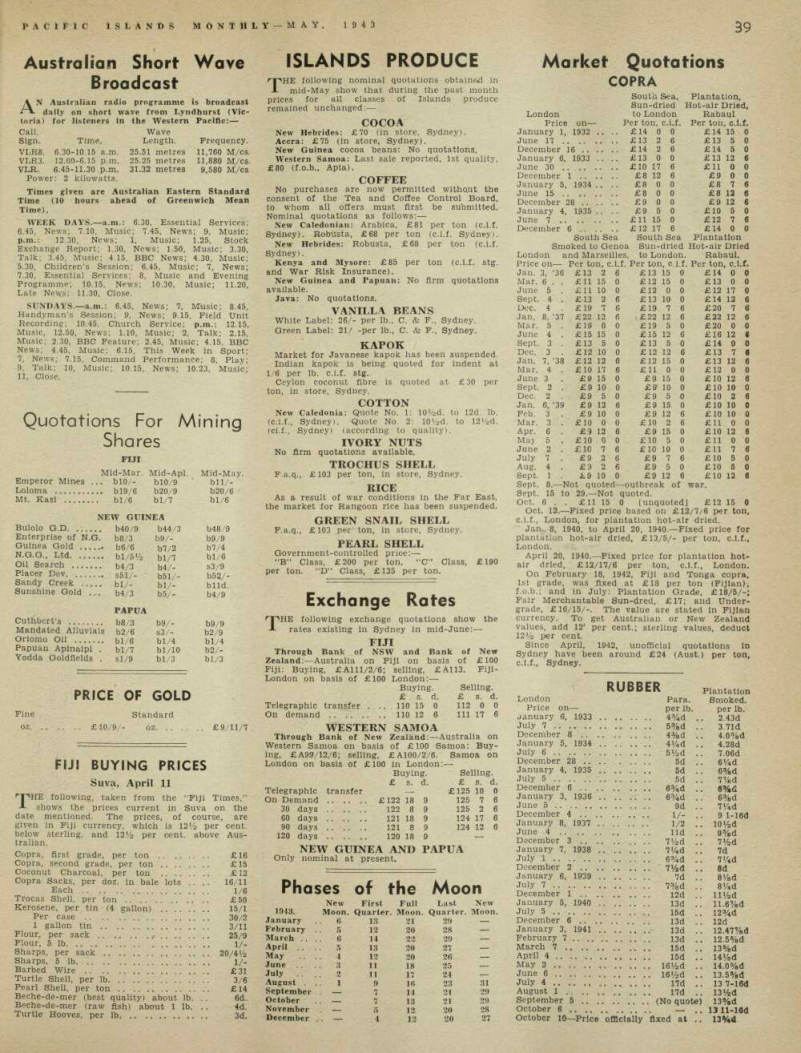
Broadcast
AN Australian radio programme is broadcast daily on short wave from Lyndhurst (Vic toria) for listeners in the Western Pacific:— Call. Wave Sign. Time. Length. Frequency.
VLRB. 6.30-10.15 a.m. 25.51 metres 11,760 M/cs.
VLR3. 12.00-6.15 p.m. 25.25 metres 11,880 M/cs.
VLR. 6.45-11.30 p.m. 31.32 metres 9,580 M/cs Power: 2 kilowatts.
Times given are Australian Eastern Standard Time (10 hours ahead of Greenwich Mean Time).
WEEK DAYS.—a.m.: 6.30, Essential Services; 6.45, News; 7.10, Music; 7.45, News; 9, Music; p.m.: 12.30, News; 1, Music; 1.25, Stock Exchange Report; 1.30, News; 1.50, Music; 3.30, Talk; 3.45, Music; 4.15, BBC News; 4.30, Music; 5.30, Children’s Session; 6.45, Music; 7, News; 7.30, Essential Services; 8, Music and Evening Programme; 10.15, News; 10.30, Music; 11.20, Late New.s; 11.30, Close.
SUNDAYS. —a.m.: 6.45, News; 7, Music; 8.45, Handyman’s Session; 9, News; 9.15, Field Unit Recording; 10.45, Church Service; p.m.: 12.15, Music, 12.50, News; 1.10, Music; 2, Talk; 2.15, Music; 2.30, BBC Feature; 2.45, Music; 4.15, BBC News; 4.45, Music; 6.15, This Week in Sport; 7, News; 7.15, Command Performance; 8, Play; 9, Talk; 10, Music; 10.15, News; 10.23, Music; 11, Close.
Quotations For Mining
Shares
Fiji
Mid-Mar.
Mid-Apl.
Mid-May.
Emperor Mines ... blO/blO/9 bll/- Loloma bl9/6 b20/9 b20/6 Mt. Kasl bl/6 bl/7 bl/6
New Guinea
Bulolo G.D b40/9 b44/3 b48/9 Enterprise of N.G. b8/3 b9/b9/9 Guinea Gold b6/6 b7/2 b7/4 N.G.G., Ltd bl/5V 2 bl/7 bl/6 Oil Search b4/3 b4/s3/9 Placer Dev s51/b51/b52/- Sandy Creek bl/bl/blld.
Sunshine Gold ... b4/3 b5/b4/9 Cuthbert’s
Papua
b8/3 b9/b9/9 Mandated Alluvials b2/6 s3/b2/9 Orlomo Oil bl/6 bl/4 bl/4 Papuan Apinaipi , bl/7 bl/10 b2/- Yodda Goldfields . sl/9 bl/3 bl/3
Advertisements & other items, p. 41 (1 item)
Price Of Gold
Pine Standard oz £lO/9/- oz £9/11/7
Fiji Buying Prices
Suva, April 11
r T'HE following, taken from the “Fiji Times,”
A shows the prices current in Suva on the date mentioned. The prices, of course, are given in Fiji currency, which is 12 Vz per cent, below sterling, and 12*/a per cent, above Aus tralian.
Copra, first grade, per ton £l6 Copra, second grade, per ton £l5 Coconut Charcoal, per ton £l2 Copra Sacks, per doz. in bale lots .. .. 16/11 Each 1/6 Trocas Shell, per ton £5O Kerosene, per tin (4 gallon) 15/1 Per case 30/2 1 gallon tin 3/11 Flour, per sack 25/9 Flour, 5 lb 1/- Sharps, per sack 20/4y 2 Sharps, 5 lb 1/- Barbed Wire £3l Turtle Shell, per lb 3/6 Pearl Shell, per ton £l4 Beche-de-mer (best quality) about lb. .. 6d.
Beche-de-mer (raw fish) about 1 lb. .. 4d.
Turtle Hooves, per lb 3d.
Islands Produce
THE following nominal quotations obtained in mid-May show that during the past month prices for all classes of Islands produce remained unchanged:—
Cocoa
New Hebrides: £7O (in store, Sydney), Accra: £75 (in store, Sydney).
New Guinea cocoa beans: No quotations.
Western Samoa: Last sale reported, Ist quality, £BO (f.0.b., Apia),
Coffee
No purchases are now permitted without the consent of the Tea and Coffee Control Board, to whom all offers must first be submitted.
Nominal quotations as follows: New Caledonian: Arabica, £Bl per ton (c.i.f.
Sydney). Robusta, £6B per ton (c.i.f. Sydney).
New Hebrides: Robusta, £6B per ton (c.i.f.
Sydney).
Kenya and Mysore: £B5 per ton (c.i.f. stg. and War Risk Insurance).
New Guinea and Papuan: No firm quotations available.
Java: No quotations.
Vanilla Beans
White Label; 26/- per lb., C. & F., Sydney.
Green Label: 21/ -per lb., C. & F., Sydney.
Kapok
Market for Javanese kapok has been suspended.
Indian kapok is being quoted for indent at 1/6 per lb. c.i.f. stg.
Ceylon coconut fibre is quoted at £3O per ton, in store, Sydney.
Cotton
New Caledonia: Quote No. 1: lOVad. to 12d. lb. (c.i.f., Sydney). Quote No. 2: lOVad. to 12Vad. (ci.f., Sydney) (according to quality).
Ivory Nuts
No firm quotations available.
Trochus Shell
F.a.q., £lO3 per ton, in store, Sydney.
Rice
As a result of war conditions in the Far East, the market for Rangoon rice has been suspended.
Green Snail Shell
F.a.q., £lO3 per ton, in store, Sydney.
Pearl Shell
Government-controlled price:— “B” Class, £2OO per ton. “C” Class, £l9O per ton. “D” Class, £135 per ton.
Exchange Rates
THE following exchange quotations show the rates existing in Sydney in mid-June: —
Fiji
Through Bank of NSW and Bank of New Zealand;—Australia on Fiji on basis of £lOO Fiji: Buying, £Alll/2/6; selling, £AII3. Fijl- London on basis of £lOO London: —
Western Samoa
Through Bank of New Zealand;—Australia on Western Samoa on basis of £lOO Samoa: Buy ing, £A99/12/6; selling, £AIOO/2/6. Samoa on London on basis of £lOO in London: —
Buying.
Selling. £ s. d. £ s. d.
Telegraphic transfer . .. 110 15 0 112 0 0 On demand .. 110 12 6 111 17 6
Buying. £ s. d.
Selling. £ s. d.
Telegraphic transfer — £125 10 0 On Demand £122 18 9 125 7 6 30 days 122 8 9 125 2 6 60 days 121 18 9 124 17 6 90 days 121 8 9 124 12 6 120 days 120 18 9 —
New Guinea And Papua
Only nominal at present.
Phases of the Moon
New First Full Last New 1943.
Moon.
Quarter.
Moon.
Quarter.
Moon, January 6 13 21 29 — February 5 12 20 28 — March . . 6 14 22 29 — April 5 13 20 27 — May 4 12 20 26 — June 3 11 18 25 July . .. 2 11 17 24 August . 1 9 16 23 31 September 7 14 21 29 October 7 13 21 29 November 5 12 20 28 December . . — 4 12 20 27
Market Quotations
Sept. B.—Not quoted—outbreak of war.
Sept. 15 to 29. —Not quoted.
Oct. 6 . . £ll 15 0 [unquoted] £l2 15 0 Oct. 12.—Fixed price based on £l2/7/6 per ton, c.i.f., London, for plantation hot-air dried.
Jan. 8, 1940, to April 20, 1940. —Fixed price for plantation hot-air dried, £l3/5/- per ton, c.i.f., London.
April 20, 1940.—Fixed price for plantation hot air dried, £l2/17/6 per ton, c.i.f., London.
On February 18, 1942, Fiji and Tonga copra, Ist grade, was fixed at £lB per ton (Fijian), f.0.b.; and in July: Plantation Grade, £lB/5/-; Fair Merchantable Sun-dred, £l7; and Under grade, £l6/15/-. The value are stated in Fijian currency. To get Australian or New Zealand values, add 12’ per cent.; sterling values, deduct 12 Mj per cent.
Since April, 1942, unofficial quotations in Sydney have been around £24 (Aust.) per ton, c.i.f., Sydney.
Copra
South Sea, Plantation, Sun-dried Hot-air Dried, London to London Rabaul Price on— Per ton, c.i.f.
Per ton, c.i.f.
January 1, 1932 , . £14 0 0 £14 15 0 June 17 . £13 2 6 £13 5 0 December 16 .. £14 2 6 £14 5 0 January 6, 1933 £13 0 0 £13 12 6 June 30 . £10 17 6 £11 0 0 December 1 .. £8 12 6 £9 0 0 January 5 1934 £8 0 0 £8 7 6 June 15 . £8 0 0 £8 12 6 December 28 .. £9 0 0 £9 12 6 January 4 1935 . . £9 5 0 £10 5 0 June 7 . £11 15 0 £12 7 6 December 6 .. £12 17 6 £14 0 0 South Sea South Sea Plantation Smoked to Genoa Sun-' dried Hot-air Dried London and Marseilles, to London.
Rabaul.
Price on— Per ton, c.i.f. Per ton i, c.i.f.
Per ton, c.i.f.
Jan. 3, ’36 £13 2 6 £13 15 0 £14 0 0 Mar. 6 . . £11 15 0 £12 15 0 £13 0 0 June 5 . £11 10 0 £12 0 0 £12 17 0 Sept. 4 . £13 2 6 £13 10 0 £14 12 6 Dec. 4 £19 7 6 £19 7 6 £20 7 6 Jan. 8, '37 £22 12 6 £22 12 6 £22 12 6 Mar. 5 . £19 0 0 £19 5 0 £20 0 0 June 4 . £15 15 0 £15 12 6 £16 12 6 Sept. 3 . £13 5 0 £13 5 0 £14 0 0 Dec. 3 . £12 10 0 £12 12 6 £13 7 6 Jan. 7, ’38 £12 12 6 £12 15 0 £13 12 6 Mar. 4 . £10 17 6 £11 0 0 £12 0 0 June 3 £9 15 0 £9 15 0 £10 12 6 Sept. 2 . £9 10 0 £9 10 0 £10 10 0 Dec. 2 . £9 5 0 £9 5 0 £10 2 6 Jan. 6. ’39 £9 12 6 £9 15 0 £10 10 0 Feb. 3 . £9 10 0 £9 12 6 £10 10 0 Mar. 3 . £10 0 0 £10 2 6 £11 0 0 Apr. 6 . £9 12 6 £9 15 0 £10 12 6 May 5 . £10 0 0 £10 5 0 £11 0 0 June 2 . £10 7 6 £10 10 0 £11 7 6 July 7 . £9 2 6 £9 7 6 £10 5 0 Aug. 4 . £3 2 6 £9 5 0 £10 5 0 Sept. 1 . £9 10 0 £9 12 6 £10 12 6
Rubber
Plantation London Para.
Smoked.
Price on— per lb. per lb.
January 6, 1933 4 3 Ad . 2 43d July 7 3.71d December 8 . . . 4%d . 4.0®ed January 5, 1934 . 4%d . 4.28d July 6 7.06d December 28 .. . 5d . 6y«d January 4, 1935 . 6%d July 5 7%d December 6 . . . «%<S January 3, 1936 . 6 3 /ad June 5 7‘Ad December 4 . . . 9 l-16d January 8, 1937 . 1/2 . lOVad June 4 9%d December 3 .. . 7Vad January 7, 1938 . 7d July 1 7Vid December 2 .. . 8d January 6, 1939 . 7d . 8Vad July 7 sy 4 d December 1 .. .
HVid January 5, 1940 . 11.6 7 /ad July 5 12 3 / 4 d December 6 .. .. 12d January 3, 1941 . 12.47 7 /ad February 7 .. .. 12.5 5 /ad March 7 13 s /ad April 4 14y e d May 2 14.0 5 /ad June 6 13.5%d July 4 13 7-16d August 1 13Vid September 5 .. .
October 6 .. ,. , 13 ll-10d October 10—Price officially fixed at . 13%d
Solomon Islands Mortgages
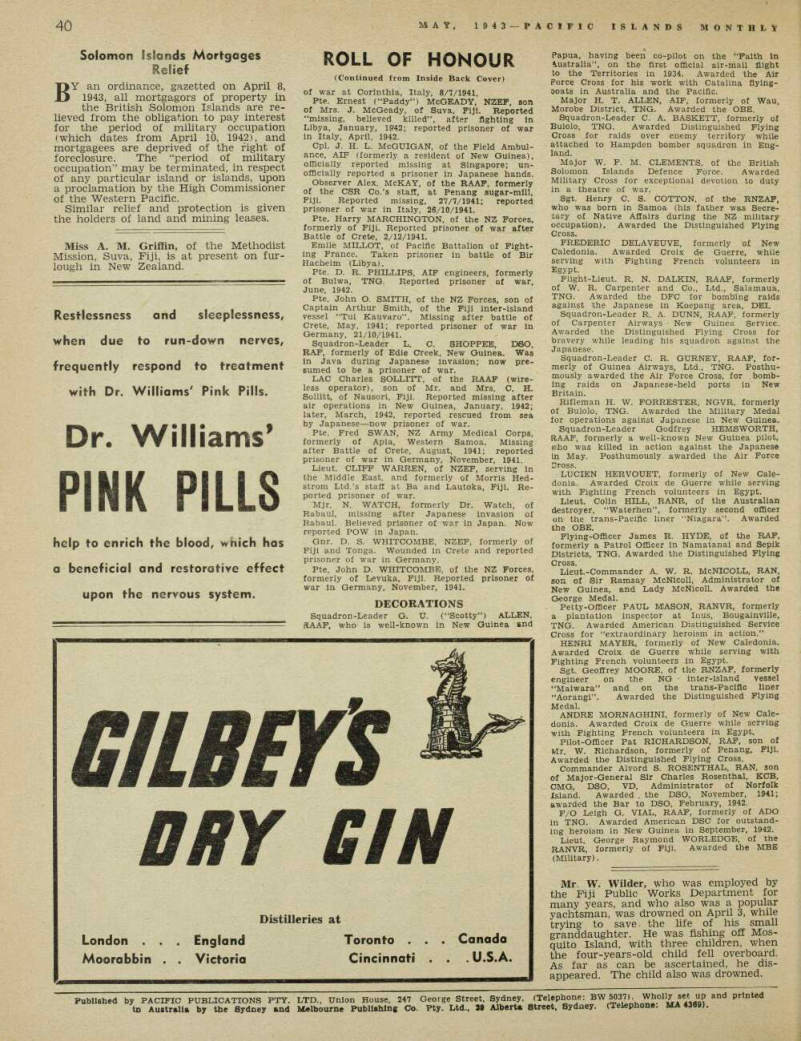
Relief
BY an ordinance, gazetted on April 8, 1943, all mortgagors of property in the British Solomon Islands are re lieved from the obligation to pay interest for the period of military occupation (which dates from April 10, 1942), and mortgagees are deprived of the fight of foreclosure. The “period of military occupation” may be terminated, in respect of any particular island or islands, upon a proclamation by the High Commissioner of the Western Pacific.
Similar relief and protection is given the holders of land and mining leases.
Miss A. M. Griffin, of the Methodist Mission, Suva, Fiji, is at present on fur lough in New Zealand.
Roll Of Honour
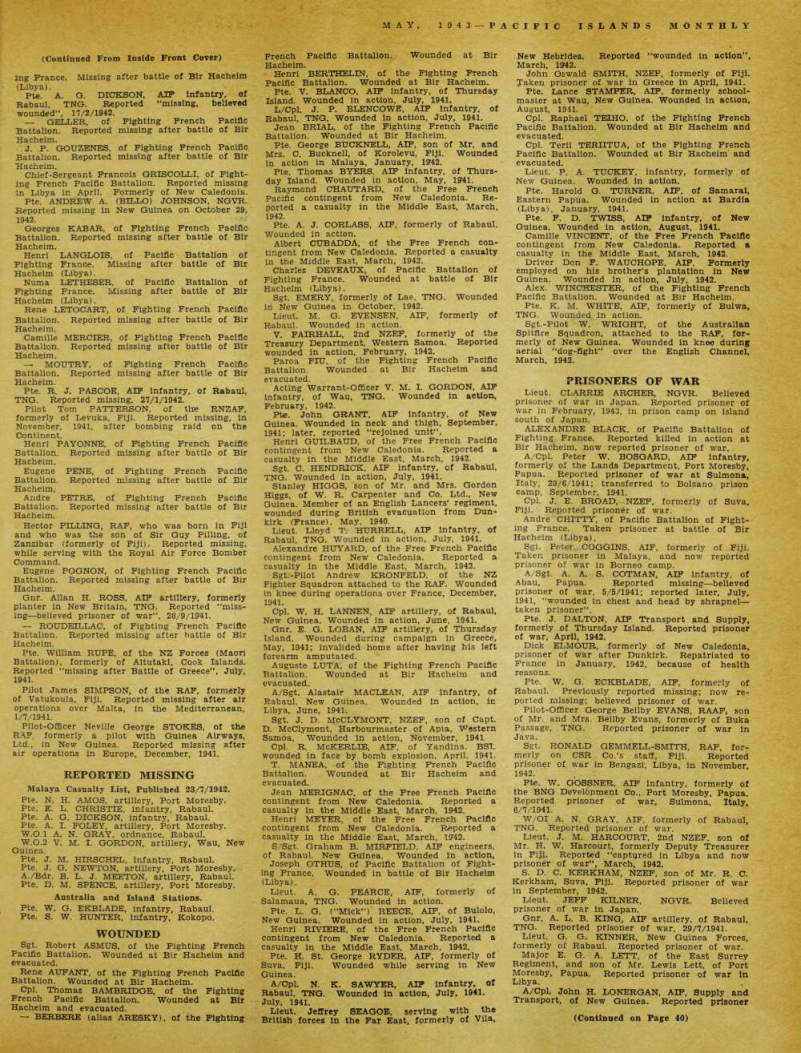
(Continued from Inside Back Cover) of war at Corinthia, Italy, 8/7/1941.
Pte. Ernest ("Paddy”) McGEADY, NZEP, son of Mrs. J. McGeady, of Suva, Fiji. Reported "missing, believed killed”, after fighting in Libya, January, 1942; reported prisoner of war in Italy, April, 1942.
Cpl. J. H. L. McGUIGAN, of the Field Ambul ance, AIF (formerly a resident of New Guinea), officially reported missing at Singapore; un officially reported a prisoner in Japanese hands.
Observer Alex. McKAY, of the RAAF, formerly of the CSR Co.’s staff, at Penang sugar-mill, Fiji. Reported missing, 27/7/1941; reported prisoner of war in Italy, 26/10/1941.
Pte. Harry MARCHINGTON, of the NZ Forces, formerly of Fiji. Reported prisoner of war after Battle of Crete, 2/12/1941, Emile MILLOT, of Pacific Battalion of Fight ing France. Taken prisoner in battle of Bir Hacheim (Libya).
Pte. D. R. PHILLIPS, AIF engineers, formerly of Bulwa, TNG. Reported prisoner of war, June, 1942.
Pte. John O. SMITH, of the NZ Forces, son of Captain Arthur Smith, of the Fiji inter-island vessel "Tui Kauvaro”. Missing after battle of Crete, May, 1941; reported prisoner of war in Germany, 21/10/1941.
Squadron-Leader L. C. SHOPPEE, DSO, RAF, formerly of Edie Creek, New Guinea. Was in Java during Japanese invasion; now pre sumed to be a prisoner of war.
LAC Charles SOLLITT, of the RAAF (wire less operator), son of Mr. and Mrs. C. H.
Sollitt, of Nausori, Fiji. Reported missing after air operations in New Guinea, January, 1942; later, March, 1942, reported rescued from sea by Japanese—now prisoner of war.
Pte. Fred SWAN, NZ Army Medical Corps, formerly of Apia, Western Samoa. Missing after Battle of Crete, August, 1941; reported prisoner of war in Germany, November, 1941.
Lieut. CLIFF WARREN, of NZEF, serving in the Middle East, and formerly of Morris Hed strom Ltd.’s staff at Ba and Lautoka, Fiji. Re ported prisoner of war.
Mjr. N. WATCH, formerly Dr. Watch, of Rabaul, missing after Japanese invasion of Rabaul. Believed prisoner of war in Japan. Now reported POW in Japan.
Gnr. D. S. WHITCOMBE. NZEF, formerly of Fiji and Tonga. Wounded in Crete and reported prisoner of war in Germany.
Pte. John D. WHITCOMBE, of the NZ Forces, formerly of Levuka, Fiji. Reported prisoner of war in Germany, November, 1941.
Decorations
Squadron-Leader G. U. (“Scotty”) ALLEN, RAAF, who is well-known in New Guinea and
Papua, having been co-pilot on the “Faith in Australia”, on the first official air-mail flight to the Territories in 1934. Awarded the Air Force Cross for his work with Catalina flying- Ooats in Australia and the Pacific.
Major H. T. ALLEN, AIF, formerly of Wau, Morobe District, TNG. Awarded the OBE.
Squadron-Leader C. A. BASKETT, formerly of Bulolo, TNG. Awarded Distinguished Flying Cross for raids over enemy territory while attached to Hampden bomber squadron in Eng land.
Major W. F. M. CLEMENTS, of the British Solomon Islands Defence Force. Awarded Military Cross for exceptional devotion to duty in a theatre of war.
Sgt. Henry C. S. COTTON, of the RNZAF, who was born in Samoa (his father was Secre tary of Native Affairs during the NZ military occupation). Awarded the Distinguished Flying Cross.
FREDERIC DELAVEUVE, formerly of New Caledonia. Awarded Croix de Guerre, while serving with Fighting French volunteers in Egypt.
Flight-Lieut, R. N. DALKIN, RAAF, formerly of W. R. Carpenter and Co., Ltd., Salamaua, TNG. Awarded the DFC for bombing raids against the Japanese in Koepang area, DEI.
Squadron-Leader R. A. DUNN, RAAF, formerly of Carpenter Airways New Guinea Service.
Awarded the Distinguished Flying Cross for bravery while leading his squadron against the Japanese.
Squadron-Leader C. R. GURNEY, RAAF, for merly of Guinea Airways, Ltd., TNG. Posthu mously awarded the Air Force Cross, for bomb ing raids on Japanese-held ports in New Britain.
Rifleman H. W. FORRESTER, NGVR, formerly of Bulolo, TNG. Awarded the Military Medal for operations against Japanese in New Guinea.
Squadron-Leader Godfrey HEMSWORTH, RAAF, formerly a well-known New Guinea pilot, who was killed in action against the Japanese In May. Posthumously awarded the Air Force Dross.
LUCIEN HERVOUET, formerly of New Cale donia. Awarded Croix de Guerre while serving with Fighting French volunteers in Egypt.
Lieut. Colin HILL, RANR, of the Australian destroyer, “Waterhen”, formerly second officer on the trans-Pacific liner “Niagara”. Awarded the OBE.
Flying-Officer James R. HYDE, of the RAF, formerly a Patrol Officer in Namatanai and Sepik Districts, TNG. Awarded the Distinguished Flying Cross.
Lieut.-Commander A. W. R. McNICOLL, RAN, son of Sir Ramsay McNicoll, Administrator of New Guinea, and Lady McNicoll. Awarded the George Medal.
Petty-Officer PAUL MASON, RANVR, formerly a plantation inspector at Inus, Bougainville, TNG. Awarded American Distinguished Service Cross for “extraordinary heroism in action.”
HENRI MAYER, formerly of New Caledonia.
Awarded Croix de Guerre while serving with Fighting French volunteers in Egypt.
Sgt. Geoffrey MOORE, of the RNZAF, formerly engineer on the NG inter-island vessel “Maiwara” and on the trans-Pacific liner “Aorangi”. Awarded the Distinguished Flying Medal.
ANDRE MORNAGHINI, formerly of New Cale donia. Awarded Croix de Guerre while serving with Fighting French volunteers in Egypt.
Pilot-Officer Pat RICHARDSON, RAF, son of Mr, W. Richardson, formerly of Penang, Fiji.
Awarded the Distinguished Flying Cross.
Commander Alvord S. ROSENTHAL, RAN, son of Major-General Sir Charles Rosenthal, KCB, OMG, DSO, VD, Administrator of Norfolk Island. Awarded . the DSO, November, 1941; awarded the Bar to DSO, February, 1942.
F/O Leigh G. VIAL, RAAF, formerly of ADO in TNG. Awarded American DSC for outstand ing heroism in New Guinea in September, 1942.
Lieut. George Raymond WORLEDGB, of the RANVR, formerly of Fiji. Awarded the MBE (Military).
Mr. W. Wilder, who was employed by the Fiji Public Works Department for many years, and who also was a popular yachtsman, was drowned on April 3, while trying to save the life of his small granddaughter. He was fishing off Mos
quito Island, with three children, when
the four-years-old child fell overboard.
As far as can be ascertained, he dis appeared. The child also was drowned.
(Continued From Inside Front Cover) ing Prance. Missing after battle of Bir Hacheim (Libya).
Pte. A. G. DICKSON, AIP infantry, of Rabaul, TNG. Reported “missing, believed wounded”, 17/2/1942.
GELLER, of Fighting French Pacific Battalion. Reported missing after battle of Bir Hacheim.
J. P. GOUZENES, of Fighting French Pacific Battalion. Reported missing after battle of Bir Hacheim.
Chief-Sergeant Francois GRISCOLLI, of Fight ing French Pacific Battalion. Reported missing in Libya in April. Formerly of New Caledonia.
Pte. Andrew A. (Billo) Johnson, Ngvr.
Reported missing in New Guinea on October 29, 1942.
Georges KABAR, of Fighting French Pacific Battalion. Reported missing after battle of Bir Hacheim.
Henri LANGLOIS, of Pacific Battalion of Fighting France. Missing after battle of Bir Hacheim (Libya).
Numa LETHESER, of Pacific Battalion of Fighting France. Missing after battle of Bir Hacheim (Libya).
Rene LETOCART, of Fighting French Pacific Battalion. Reported missing after battle of Bir Hacheim.
Camille MERCIER, of Fighting French Pacific Battalion. Reported missing after battle of Bir Hacheim.
MOUTRY, of Fighting French Pacific Battalion. Reported missing after battle of Bir Hacheim.
Pte. R. J. PASCOE, AIP Infantry, of Rabaul, TNG. Reported missing. 27/1/1942.
Pilot Tom PATTERSON, of the RNZAP, formerly of Levuka, Fiji. Reported missing, in November, 1941, after bombing raid on the Continent.
Henri PAYONNE, of Fighting French Pacific Battalion. Reported missing after battle of Bir Hacheim.
Eugene PENE, of Fighting French Pacific Battalion. Reported missing after battle of Bir Hacheim.
Andre PETRE, of Fighting French Pacific Battalion. Reported missing after battle of Bir Hacheim.
Hector PILLING, RAF, who was born in Fiji and who was the son of Sir Guy Pilling, of Zanzibar (formerly of Fiji). Reported missing, while serving with the Royal Air Force Bomber Command.
Eugene POGNON, of Fighting French Pacific Battalion. Reported missing after battle of Bir Hacheim.
Gnr. Allan H. ROSS, AIP artillery, formerly planter in New Britain, TNG. Reported “miss ing—believed prisoner of war”, 28/9/1941.
ROUDEILLAC, of Fighting French Pacific Battalion. Reported missing after battle of Bir Hacheim.
Pte. William RUPE, of the NZ Forces (Maori Battalion), formerly of Aitutaki, Cook Islands.
Reported “missing after Battle of Greece”, July, 1941.
Pilot James SIMPSON, of the RAF. formerly of Vatukoula, Fiji. Reported missing after air operations over Malta, in the Mediterranean, 1/7/1941.
Pilot-Officer Neville George STOKES, of the RAF, formerly a pilot with Guinea Airways, Ltd., in New Guinea. Reported missing after air operations in Europe, December, 1941.
Reported Missing
Malaya Casualty List, Published 23/7/1942, Pte. N. H. AMOS, artillery, Port Moresby.
Pte. E. L. CHRISTIE, infantry, Rabaul.
Pte. A. G. DICKSON, infantry, Rabaul.
Pte. A. I. FOLEY, artillery, Port Moresby.
W.0.l A. N. GRAY, ordnance, Rabaul.
W. 0.2 V. M. I. GORDON, artillery, Wau, New Guinea.
Pte. J. M. HIRSCHEL, infantry, Rabaul.
Pte. J. G. NEWTON, artillery, Port Moresby.
A./Bdr. B. L. J. MEETON, artillery, Rabaul.
Pte. D. M. SPENCE, artillery, Port Moresby.
Australia and Island Stations.
Pte. W. G. EKBLADE, infantry, Rabaul.
Pte. S. W. HUNTER, infantry, Kokopo.
Wounded
Sgt. Robert ASMUS, of the Fighting French Pacific Battalion. Wounded at Bir Hacheim and evacuated.
Rene AUFANT, of the Fighting French Pacific Battalion. Wounded at Bir Hacheim.
Cpl. Thomas BAMBRIDGE, of the Fighting French Pacific Battalion. Wounded at Bir Hacheim and evacuated.
BERBERE (alias ARESKY), of the Fighting
French Pacific Battalion. Wounded at Bir Hacheim.
Henri BERTHELIN, of the Fighting French Pacific Battalion. Wounded at Bir Hacheim.
Pte. V. BLANCO, AIF infantry, of Thursday Island. Wounded in action, July, 1941.
L/Cpl. J. P. BLENCOWE, AIP infantry, of Rabaul. TNG. Wounded in action, July, 1941.
Jean BRIAL, of the Fighting French Pacific Battalion. Wounded at Bir Hacheim.
Pte. George BUCKNELL, AIF, son of Mr. and Mrs. C. Bucknell, of Korolevu, Fiji. Wounded in action in Malaya, January, 1942.
Pte. Thomas BYERS, AIF infantry, of Thurs day Island. Wounded in action, May, 1941.
Raymond CHAUTARD, of the Free French Pacific contingent from New Caledonia. Re ported a casualty in the Middle East, March, 1942.
Pte. A. J. CORLASS, AIP, formerly of Rabaul.
Wounded in action.
Albert CUBADDA, of the Free French con tingent from New Caledonia. Reported a casualty in the Middle East, March, 1942.
Charles DEVEAUX, of Pacific Battalion of Fighting France. Wounded at battle of Bir Hacheim (Libya).
Sgt. EMERY, formerly of Lae, TNG. Wounded in New Guinea in October, 1942.
Lieut. M. G. EVENSEN, AIF, formerly of Rabaul. Wounded in action.
V. FAIRHALL, 2nd NZEF, formerly of the Treasury Department, Western Samoa. Reported wounded in action, February, 1942.
Paroa FIU, of the Fighting French Pacific Battalion. Wounded at Bir Hacheim and evacuated.
Acting Warrant-Officer V. M. I. GORDON, AEP infantry, of Wau, TNG. Wounded in action, February, 1942.
Pte. John GRANT, AIP infantry, of New Guinea. Wounded in neck and thigh, September, 1941; later, reported “rejoined unit”.
Henri GUILBAUD, of the Free French Pacific contingent from New Caledonia. Reported a casualty in the Middle East, March, 1942.
Sgt. C. HENDRICK, AIP infantry, of Rabaul, TNG. Wounded in action, July, 1941.
Stanley HIGGS, son of Mr. and Mrs, Gordon Higgs, of W. R. Carpenter and Co. Ltd., New Guinea. Member of an English Lancers’ regiment, wounded during British evacuation from Dun kirk (France). May. 1940.
Lieut. Lloyd T. HURRELL, AIF infantry, of Rabaul, TNG. Wounded in action, July, 1941.
Alexandre HUYARD, of the Free French Pacific contingent from New Caledonia. Reported a casualty in the Middle East, March, 1942.
Sgt.-Pilot Andrew KRONFELD, of the NZ Fighter Squadron attached to the RAF. Wounded In knee during operations over France, December. 1941.
Cpl. W. H. LANNEN, AIF artillery, of Rabaul, New Guinea. Wounded in action, June, 1941.
Gnr. E. G. LOBAN, AIF artillery, of Thursday Island. Wounded during campaign in Greece, May, 1941; invalided home after having his left forearm amputated.
Auguste LUTA, of the Fighting French Pacific Battalion. Wounded at Bir Hacheim and evacuated.
A/Sgt. Alastair MACLEAN, AIP infantry, of Rabaul. New Guinea. Wounded in action, in Libya, June, 1941.
Sgt. J. D. McCLYMONT, NZEF, son of Capt.
D. McClymont, Harbourmaster of Apia, Western Samoa. Wounded in action, November, 1941 Cpl. R. McKERLIE, AIF, of Yandina. BSI. wounded in face by bomb explosion. April. 1941.
T. MANEA, of the Fighting French Pacific Battalion. Wounded at Bir Hacheim and evacuated.
Jean MERIGNAC, of the Free French Pacific contingent from New Caledonia. Reported a casualty in the Middle East, March, 1942.
Henri MEYER, of the Free French Pacific contingent from New Caledonia. Reported a casualty in the Middle East, March, 1942.
S/Sgt. Graham B. MIRFIELD, AIF engineers, of Rabaul. New Guinea. Wounded in action, Joseph OTHUS, of Pacific Battalion of Fight ing France. Wounded in battle of Bir Hacheim (Libya).
Lieut. A. G. PEARCE, AIF, formerly of Salamaua, TNG. Wounded in action.
Pte. L. G. (“Mick”) REECE, AIF, of Bulolo, New Guinea. Wounded in action, July, 1941.
Henri RIVIERE, of the Free French Pacific contingent from New Caledonia. Reported a casualty in the Middle East, March, 1942.
Pte. H. St. George RYDER, AIF, formerly of Suva, Fiji. Wounded while serving in New Guinea.
A/Cpl. N. K. SAWYER, AIP infantry, of Rabaul, TNG. Wounded In action, July, 1941.
July, 1941.
Lieut. Jeffrey SEAGOE. serving with the British forces in the Far East, formerly of Vila,
New Hebrides. Reported “wounded in action”.
March. 1942.
John Oswald SMITH, NZEP, formerly of Fiji.
Taken prisoner of war in Greece in April, 1941.
Pte. Lance STAMPER, AIP, formerly school master at Wau, New Guinea. Wounded in action, August, 1041.
Cpl. Raphael TEIHO, of the Fighting French Pacific Battalion. Wounded at Bir Hacheim and evacuated.
Cpl. Terii TERIITUA, of the Fighting French Pacific Battalion. Wounded at Bir Hacheim and evacuated.
Lieut. P. A. TUCKEY, infantry, formerly of New Guinea. Wounded in action.
Pte. Harold G. TURNER, AIF, of Samaral, Eastern Papua. Wounded in action at Bardia (Libya), January, 1941.
Pte. F. D. TWISS, AIP Infantry, of New Guinea. Wounded in action, August, 1941.
Camille VINCENT, of the Free French Pacific contingent from New Caledonia. Reported a casualty in the Middle East, March, 1942.
Driver Don F. WAUCHOPE, AIF. Formerly employed on his brother’s plantation in New Guinea. Wounded in action, July, 1942.
Alex. WINCHESTER, of the Fighting French Pacific Battalion. Wounded at Bir Hacheim.
Pte. K. M. WHITE, AIF, formerly of Bulwa, TNG. Wounded in action.
Sgt.-Pilot W. WRIGHT, of the Australian Spitfire Squadron, attached to the RAP, for merly of New Guinea. Wounded in knee during aerial "dog-fight” over the English Channel, March, 1942.
Prisoners Of War
Lieut. CLARRIE ARCHER, NGVR. Believed prisoner of war in Japan. Reported prisoner of war in February, 1943, in prison camp on island south of Japan.
ALEXANDRE BLACK, of Pacific Battalion of Fighting France. Reported killed in action at Bir Hacheim, now reported prisoner of war.
A/Cpl. Peter W. BOSGARD. AIP Infantry, formerly of the Lands Department, Port Moresby, Papua. Reported prisoner of war at Sulmona, Italy, 29/6/1941; transferred to Bolzano prison camp, September, 1941.
Cpl. J. E. BROAD, NZEF, formerly of Suva, Fiji. Reported prisoner of war.
Andre CHITTY, of Pacific Battalion of Fight ing France. Taken prisoner at battle of Bir Hacheim (Libya), Sgt. Peter COGGINS. AIF, formerly of Fiji.
Taken prisoner in Malaya, and now reported prisoner of war in Borneo camp.
A/Sgt. A. A. S. COTMAN, AIF infantry, of Abau, Papua. Reported missing—believed prisoner of war, 5/5/1941; reported later, July, 1941, “wounded in chest and head by shrapnel— taken prisoner”.
Pte. J. DALTON, AIF Transport and Supply, formerly of Thursday Island. Reported prisoner of war, April, 1942.
Dick ELMOUR, formerly of New Caledonia, prisoner of war after Dunkirk. Repatriated to France in January, 1942, because of health reasons.
Pte. W. G. ECKBLADE, AIF, formerly of Rabaul. Previously reported missing; now re ported missing; believed prisoner of war.
Pilot-Officer George Beilby EVANS, RAAF, son of Mr. and Mrs. Beilby Evans, formerly of Buka Passage, TNG. Reported prisoner of war in Java.
Sgt. Ronald Gemmell-Smith, Raf, For
merly on CSR Co.’s staff, Fiji. Reported prisoner of war in Bengazi, Libya, in November, 1942.
Pte. W. GOSSNER, AIF infantry, formerly of the BNG Development Co.. Port Moresby, Papua.
Reported prisoner of war, Sulmona, Italy, 6/7/1941.
W/OI A. N. GRAY, AIF, formerly of Rabaul, TNG. Reported prisoner of war.
Lieut. J. M. HARCOURT, 2nd NZEF, son of Mr. H. W. Harcourt, formerly Deputy Treasurer in Fiji, Reported “captured in Libya and now prisoner of war”, March, 1942.
S. D. C. KERKHAM, NZEF, son of Mr. R. C.
Kerkham, Suva, Fiji. Reported prisoner of war in September, 1942.
Lieut. JEFF KILNER, NGVR. Believed prisoner of war in Japan.
Gnr. A. L. B. KING, AIF artillery, of Rabaul, TNG. Reported prisoner of war, 29/7/1941.
Lieut. G. G. KINNER, New Guinea Forces, formerly of Rabaul. Reported prisoner of war.
Major E. G. A. LETT, of the East Surrey Regiment, and son of Mr. Lewis Lett, of Port Moresby, Papua. Reported prisoner of war in Libya.
A/Cpl. John H. LONERGAN, AIF, Supply and Transport, of New Guinea. Reported prisoner
(Continued on Page 40)
Advertisements & other items, pp. 42-44 (3 items)
40
MAY, 1943 PACIFIC ISLANDS MONtfiLY
Published by PACIFIC PUBLICATIONS PTY. LTD., Union House, 247 George Street. Sydney. (Telephone: BW - Wholly set up and printed In Australia by the Sydney and Melbourne Publishing Co. Pty. Ltd.. 30 Alberta Street. Sydney. (Telephone. MA 4369).
Eilbey’S
Restlessness and sleeplessness, when due to run-down nerves, frequently respond to treatment with Dr. Williams' Pink Pills.
Dr. Williams’
PINK PILLS
help to enrich the blood, which has a beneficial and restorative effect upon the nervous system.
EILBEY’S
DRY BIN
Distilleries at London . . . England Toronto . . . Canada Moorabbin . . Victoria Cincinnati . . . U.S.A.
W. R. Carpenter & Co. Ltd.
lr v rv* - t i V I 5^ MT r. i £ - '■ V ; 2! * :tv mm ; tV? : ' ■:
Travel by CARPENTER AIRLINES
Full particulars from Macdonald, Hamilton & Co., or Howard Smith Ltd., Sydney.
W. R. CARPENTER & CO. LTD.
MERCHANTS, SHIPOWNERS AND AIRCRAFT OPERATORS
Agents for Australian, European and American Manufacturers, and Distributors of Every Description of Merchandise.
Buyers and Shippers of Copra, Trocas, and all Classes of Islands Produce.
AGENTS FOR :
Ford Motor Company of Canada. Caterpillar Tractors. Dodge Brothers Inc.
T. G. & C. Bolinders (Engines). Electrolux Refrigerators. VVestinghouse Electrical Co. etc., etc.
Branches throughout the Pacific Islands
In London: W. R. Carpenter & Co. (London) Ltd., Coronation House, 4 Lloyds Avenue, London, EC.
Head Office: 16 O’CONNELL STREET, SYDNEY