Pacific
Islands
Monthly
April 17, 1948
Vol. Xiii. No. 9.
Established 1930
[Registered at the G.P.0., Sydney, for transmission "by post as a newspaper ]
8“
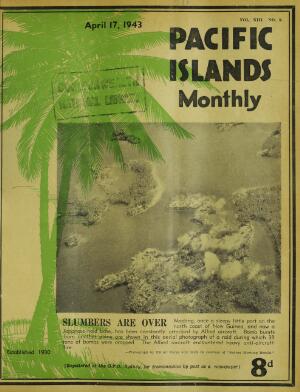
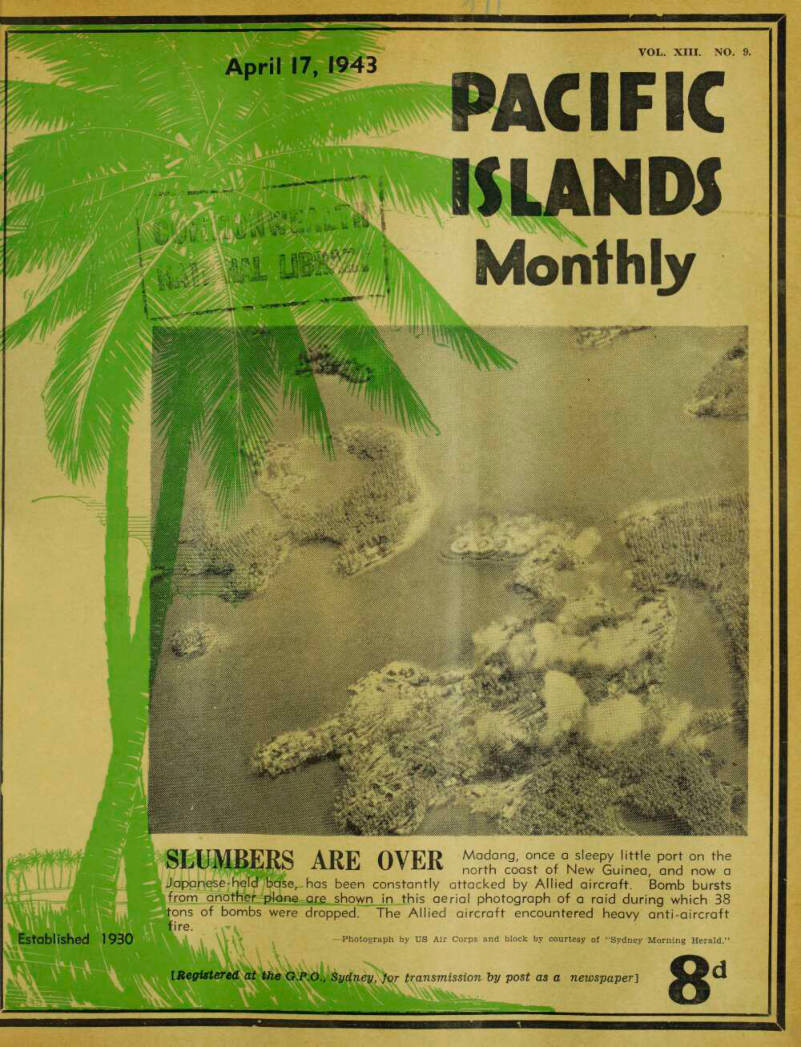
Slumbers Are Over
Madang, once a sleepy little port on the north coast of New Guinea, and now a Japanese-held base, has been constantly attacked by Allied aircraft. Bomb bursts from another plane are shown in this aerial photograph of a raid during which 38 tons of bombs were dropped. The Allied aircraft encountered heavy anti-aircraft If ire. —Photograph by US Air Corps and block by courtesy of “Sydney Morning Herald.”
Roll Of Honour
(We try to assemble here the names of men of the United Nations, residents or former residents of the Pacific Territories, whose names appear in casualty lists or who receive decorations. We should be grateful if relations and friends would send us details of such men.)
Killed
Sgt. Bert AITKEN, NZEF, formerly of Fiji.
Killed in action in Libya.
Eugene AUBRY (formerly of Tahiti), of the Air Force of Fighting France. Killed in an air accident in Great Britain.
Pilot-Officer Len BAYLISS, flying instructor in the RAAF, formerly of Rabaul, New Guinea.
Killed in Sydney, 18/11/1940, when he fell from a trainer aircraft in flight.
R. C. BENTLEY, NZEF, formerly of Fiji.
Killed in action, Middle East, June 27, 1942.
A/Bdr. Neville W. BERTWISTLE, AIF artillery (tank unit), formerly a clerk on the staff of W. R. Carpenter and Co. Ltd., of Rabaul, New Guinea. Killed in action, April, 1941.
P/O J. B. BOMFORD, RNZAF, formerly of CSR Co.’s staff, Fiji. Killed on active service in England.
Pte. W. R. M. BRADNAM, of the NZ Forces, formerly of Fiji. Reported killed in action in the Middle East, 25/11/1941.
Warrant-Officer R. F. BRECHIN, New Guinea Force. Killed in air accident, June 17, 1942.
Formerly of NG Department of Agriculture.
Anton BRINON, of Fighting French Pacific Battalion, formerly of La Foa, New Caledonia.
Killed in action in Libya, November, 1942.
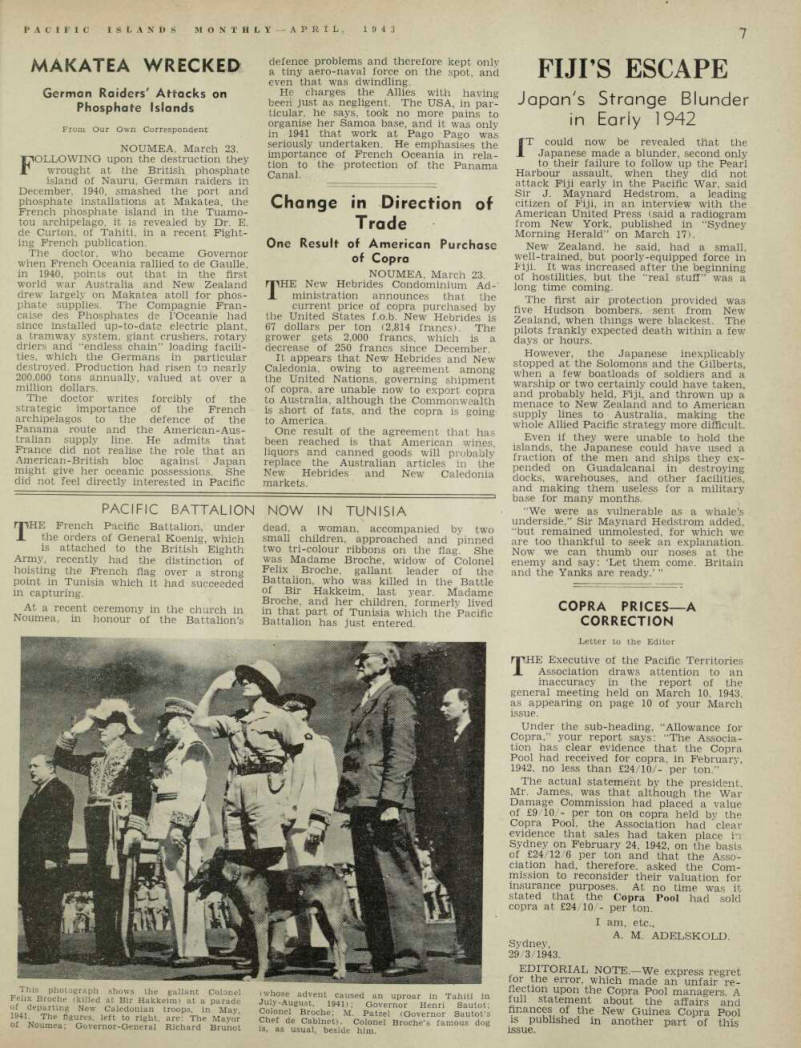
Lieut.-Colonel Felix BROCHE, of the New Caledonian-New Hebridean contingent of the Fighting French Pacific Battalion. Killed in action in the battle of Bir Hacheim (Libya).
Pilot-Officer E. H. CANARD, of RAF, formerly of Fiji Civil Service. Killed in flying accident in South Africa in the course of his duty as flying instructor.
Pte. David C. GARLAND, AIF, formerly chief assayer at the Emperor gold mines, Fiji. Killed in action in New Guinea.
Pierre CHARPENTIER, of the Fighting French Pacific Battalion. Killed in action in the battle of Bir Hacheim.
Raymond CHAUTARD (formerly of New Cale donia), of the Fighting French Pacific Battalion.
Killed in action in Libya.
Flight-Lieutenant G. J. I. CLARKE, of the RAAF, formerly Assistant Flight Superintendent of Carpenter Airlines, New Guinea. Killed In action during operations off Dakar (French West Africa), while attached to HMAS “Aus tralia”, September, 1940.
Georges CLEMENS, of the Free French Pacific contingent from New Caledonia. Reported killed in action in the Middle East, March, 1942.
Flying-Officer Jack R. COATH, of the RNZAF, formerly on the staff of the Bank of New Zealand, in Suva, Fiji. Killed October, 1941, when a training aircraft crashed in NZ.
Pte. Felix CRAIG, AIF, formerly of accounts department, Australasian Petroleum Co., Port Moresby, Papua. Killed in action, June, 1941.
L. J. DAWES, of the NZ Forces, formerly Dis trict Officer of Savaii, Western Samoa. Reported killed in action, February, 1942.
Pilot-Officer V. L. DEARMAN, of the RAAP (observer), formerly overseer and clerk at the Colonial Sugar Refining Co., Ltd., Raravai, Fiji. Reported killed in action in the Middle East, October, 1941.
Capt. Jean GILBERT, of the Naval Forces of Fighting France, and formerly of Tahiti. Killed in action.
Captain Kenneth GARDEN, of the RAP Ferry Command, formerly of Guinea Airways Ltd., in New Guinea. Killed September, 1941, when a bomber he “ferried” from USA crashed on west coast of Britain.
Flying-Officer Moresby GOFTON, of the RAF, son of Mrs. P. S, Stewart, of Wau, New Guinea.
Reported missing, 17/5/1940 —presumed killed in air operations.
Rifleman J. A. GOODWIN, AIF infantry, for merly of Bulwa, TNG. Reported “accidentally killed”, April, 1942.
Ernest GOURNAC (formerly of Tahiti), of the Air Force of Fighting France. Killed in an air accident in Britain.
Pte. Wallace GRAHAM, of the NZ Forces (infantry), formerly on the staff of Morris Hedstrom Ltd., Fiji. Killed in action in the Middle East, November, 1941.
Lieut. J. A. GRANT, AIF, formerly of Man dated Territory. Killed in action.
Squadron-Leader C, R. GURNEY, RAAP, a former chief pilot of Guinea Airways, Ltd.
Killed in action In the New Guinea area, May, 1942.
Pte. B. HAMILTON, AIF, formerly of Auck land, NZ, and New Guinea. Killed in action.
Gerald T. J. HARPER, RAF, son of Major and Mrs. P. Harper, of Ra, Fiji. Killed in action while navigating a Whitley bomber dur ing a raid on the Continent.
J. HEAD, RAAF, formerly of Fiji. Killed in flying accident in Australia, 1941.
Squadron-Leader Godfrey HEMSWORTH, of the RAAF, formerly a well-known commercial pilot in Morobe, TNG. Reported missing after an operational flight against the Japanese in the New Guinea area—now presumed killed in action.
Captain L. T. HURRELL, infantry, Rabaul.
Killed in action.
Pte. Jack JOHNSON, formerly of Morris Hedstrom’s staff, Fiji. Killed in action on November 4, while serving with the AIF in New Guinea.
Flying-Officer Alan JOHNSTONE, of the RAF, who was born in Suva, Fiji, In 1915. Killed during bombing raid on Kristlansand. Norway, April, 1940.
LAC Douglas KIRBY, RAP, who left Suva, Fiji, with the first contingent of Air Force trainees. Reported killed in a flying accident in South Africa, March, 1942.
Marcel KOLLEN, of the Pacific Battalion of Fighting France. Killed in action in the battle of Bir Hacheim.
C. D. LAMONT, RAF, formerly a master at Boys’ Grammar School, Suva, Fiji. Missing; be lieved killed on air operations over Germany.
Emile LESSON (formerly of New Caledonia), of the Fighting French Pacific Battalion. Killed in action in Libya.
Cpl. Gaston LESSON, of the Fighting French Pacific Battalion. Killed in battle of Bir Hacheim (Libya).
Capt, (now Lt.-Colonel) Edward Tiwi LOVE, NZ Maori Battalion, husband of Mrs. Takau. Rio Love, Ariki-nui of Rarotonga, Cook Islands. Re ported missing during campaign in Greece, May, 1941; later, June, 1941, reported “wounded and safe.” Officially announced, July 17, killed in action in Libya.
Flying-Officer John C. LOWE, RAAF, formerly an overseer with the CSR Co. in Fiji. Reported, 11/4/1942, “took part in air defence of Rabaul, TNG, —missing, believed killed”.
Pte. L. P. McCarthy, AIF infantry, form erly supercargo on W. R. Carpenter and Co.’s Inter-island vessels “Desikoko” and “Mako”, in New Guinea. Reported “killed in action” in Syria, 30/10/1941.
Sgt. Kenneth MACGREGOR, AIF, formerly practising as a barrister and solicitor in Wau, TNG. Reported missing, believed killed, in Papua.
Lance-Corporal A. D. MacPHEE, son of Mr.
R. D. MacPhee, Levuka, Fiji. He was 35, was a member of the AIF, and was killed in Greece, May, 1941.
Francois MASSON, of the Fighting French Pacific Battalion. Killed in action in the battle of Bir Hacheim.
Capt. John Malcolm METHVEN. Reported killed in action in Egypt on July 22, 1942, while serv ing with the AIF. He was born in Ocean Island, and is the youngest son of Mr. and Mrs.
Stuartson C. Methven, of Belgrave, Victoria.
Spr. A. L. MORANDINI, AIF Engineers, for merly of Konedobu, Papua. Reported killed in action, April, 1942.
F. R. J. NICHOLLS, Royal Artillery, formerly of Fiji. Killed in action, Burma, May, 1942.
W/O G. A. OBST, formerly a member of the Lutheran Mission, TNG. Joined Australian military forces in February, 1942. Killed in action in New Guinea on December 21, 1942.
J. L, C. OSBORN, NZEF, formerly of Fiji.
Killed in action, Middle East, June, 1942.
Pilot-Officor Ivan PALMER, RAF, formerly of Fiji. Killed in air operations over Malta.
O. PILLING, RAF, formerly of Fiji. Missing; believed killed.
Pte. Edward Harold PRICE, 2nd NZEF (Machine-gun Battalion), youngest son of Mr. and Mrs. J. Price, Savu Savu West, Fiji. Killed in action during the Libyan campaign, Middle East, 27/11/1941.
Pte. Cecil PURCELL, NZEF, formerly of Aleipata, Samoa. First Samoan Euronesian to give his life in World War 11. Killed in action in Middle East.
Captain W. H. ROBERTS, NZEF, who was Accountant in the Samoa Treasury Dept., dur
ing 1934-35. Killed in action in Libya, Decem ber, 1941.
Major A. B. ROSS, NZEF, who, between 1923- 29 was successively, Assistant Secretary for Native Affairs, Assistant Secretary to the Administration, and ADC to the Administrator of Samoa. Killed in action in Libya.
Cpl. Alex. C. SCOTT, ATP, formerly manager at Kieta, TNG, for Burns, Philp and Co. Ltd.
Killed in action in the Middle East, 19/6/1941.
J. SIMPSON, RAAP, formerly of Fiji. Killed in action over Malta, July, 1941.
Lieutenant A. G. W. THOMAS, RANR, for merly master of Burns Philp & Company’s SS “Muliama.” Killed in action.
Pte. Popoare TANGIITI, of the NZ Forces (Maori Battalion), formerly of Mangaia, Cook Islands. Reported “missing after Battle of Greece—presumed dead”, July, 1941.
Sgt. Edward WILSON, of Suva, serving in the Fiji Defence Force. Accidentally drowned in the Lami River, Fiji, April, 1942.
Died From Wounds
Pte. Ernest HENRY, A IF, formerly of the Rabaul (NG) staff of Burns, Philp and Co.
Ltd. Died from wounds received in Battle of Crete, 1/6/1941.
Pte. Alec. MUNRO, NZ Forces, formerly of Norfolk Island. Died in Libya (Middle East).
December, 1941.
Pte. T. LAWRIE, AIF, son of Mr. Lawrie, for merly of Fiji. Died of wounds in Middle East.
Pte. Walter PEARSON, of first NG quota of AIF (infantry). Died from wounds received In action, 24/6/1941.
A/Bdr. W. R. SCOTT, AIF, of New Guinea.
Died from wounds, July, 1941.
Sgt.-Pilot Peter Clarkson WISE, of the RAP, son of Mr. W. Wise, OBE, Director of Public Works, Fiji. Died from wounds received during bombing raid over Germany, January, 1941.
Died From Illness
Pte. Clarence A. HUTTON, AIF, formerly of Edie Creek, TNG. Died from illness, April, 1941.
A/Sgt. J. H. STANE, Royal Australian En gineers. formerly of Port Moresby, Papua. Died from illness, May, 1942.
Rifleman R. A. SMITH, HQ Unit. (Place of enlistment not stated.) Died of illness.
Cpl. R. H. SUTTON, NGVR, formerly of Wau, TNG. Died from malaria and typhoid in October, 1942.
Major P. J. WOODHILL, AIF Infantry, formerly legal assistant in the Crown Law Office, Rabaul, New Guinea. Reported “deceased”, December, 1941.
Missing
Louis ANGER, of Fighting French Pacific Battalion. Reported missing after battle of Bir Hacheim.
Pte, P. P, BAILEY, AIF infantry, of Rabaul.
TNG. Reported missing, 17/2/1942. Now re ported prisoner of war.
Cpl. Jock BAIRD, AIF, formerly of Bank of NSW staff, Suva, Fiji. Reported missing in Malaya, February, 1942.
Cpl. Leon BARRENE, of Pacific Battalion of Fighting France. Missing after battle of Bir Hacheim (Libya).
T. BLAKELOCK, BEF, formerly of Fiji. Miss ing.
Robert BLUM, of Fighting French Pacific Battalion. Reported missing after battle of Bir Hacheim.
Sgt. Ronald Arthur BROODBANK, formerly of Samarai, Papua, now serving with the RAAP overseas. Reported missing on May 31 while on air operations.
Sgt. Alexander BROWN, RNZAF, formerly of Rarotonga. Reported missing over Germany, on September 15, 1942.
Reginald BOULANGER, of Fighting French Pacific Battalion. Reported missing after battle of Bir Hacheim.
H. BUCKNELL, AIF, formerly of Fiji. Missing.
Sgt. R. F. BUNTING, AIF, formerly of Samarai, Papua; Missing in Malaya.
Pte. E. L. CHRISTIE, AIF infantry, of Rabaul, TNG. Reported missing, 17/2/1942.
Victor DERVAUX, of Fighting French Pacific Battalion. Reported missing after battle of Bir Hacheim.
Lucien DEVAND, of Pacific Battalion of Fight ing Prance. Missing after battle of Bir Hacheim (Libya).
Pte. A. G. DICKSON, AIF infantry, of Rabaul, TNG. Reported “missing, believed wounded”, 17/2/1942.
GELLER, of Fighting French Pacific Battalion. Reported missing after battle of Bir Hacheim.
(Continued on Inside Back Cover)
(Continued from Inside Back Cover) Emile MILLOT, of Pacific Battalion of Fight ing France. Taken prisoner in battle of Bir Hacheim (Libya).
Pte. D. R. PHILLIPS, AIF engineers, formerly of Bulwa, TNG. Reported prisoner of war, June, 1942.
Pte. John O. SMITH, of the NZ Forces, son of Captain Arthur Smith, of the Fiji inter-island vessel “Tui Kauvaro”. Missing after battle of Crete, May, 1941; reported prisoner of war in Germany, 21/10/1941.
Squadron-Leader L. C. SHOPPEE, DSO, RAF, formerly of Edie Creek, New Guinea. Was in Java during Japanese invasion; now pre sumed to be a prisoner of war.
LAC Charles SOLLITT, of the RAAF (wire less operator), son of Mr. and Mrs. C, H.
Sollltt, of Nausori, Fiji. Reported missing after air operations in New Guinea, January, 1942; later, March, 1942, reported rescued from sea by Japanese—now prisoner of war.
Pte. Fred SWAN, NZ Army Medical Corps, formerly of Apia, Western Samoa. Missing after Battle of Crete, August, 1941; reported prisoner of war in Germany, November, 1941.
Lieut. CLIFF WARREN, of NZEF, serving in the Middle East, and formerly of Morris Hed strom Ltd.’s staff at Ba and Lautoka, Fiji. Re ported prisoner of war.
Mjr. N. WATCH, formerly Dr. Watch, of Rabaul, missing after Japanese invasion of Rabaul. Believed prisoner of war in Japan.
Gnr. D. S. WHITCOMBE, NZEF, formerly of Fiji and Tonga. Wounded in Crete and reported prisoner of war in Germany.
Pte. John D. WHITCOMBE, of the NZ Forces, formerly of Levuka, Fiji. Reported prisoner of war in Germany, November, 1941.
Decorations
Squadron-Leader G. U. (“Scotty”) ALLEN, RAAF, who is well-known in New Guinea and Papua, having been co-pilot on the “Faith in Australia”, on the first official air-mail flight to the Territories in 1934. Awarded the Air Force Cross for his work with Catalina flying boats in Australia and the Pacific.
Major H. T. ALLEN, AIF, formerly of Wau, Morobe District, TNG. Awarded the OBE.
Squadron-Leader C. A. BASKETT, formerly of Bulolo, TNG. Awarded Distinguished Flying Cross for raids over enemy territory while attached to Hampden bomber squadron in Eng land.
Major W. F. M. CLEMENTS, of the British Solomon Islands Defence Force. Awarded Military Cross for exceptional devotion to duty in a theatre of war.
Sgt. Henry C. S. COTTON, of the RNZAF,
who was born in Samoa (his father was Secre tary of Native Affairs during the NZ military occupation). Awarded the Distinguished Flying Cross.
FREDERIC DELAVEUVE, formerly of New Caledonia. Awarded Croix de Guerre, while serving with Fighting French volunteers in Egypt.
Rifleman H. W. FORRESTER, NGVR, formerly of Bulolo, TNG. Awarded the Military Medal for operations against Japanese in New Guinea, Squadron-Leader Godfrey HEMSWORTH, RAAF, formerly a well-known New Guinea pilot, tvho was killed in action against the Japanese In May. Posthumously awarded the Air Force Dross.
Flight-Lieut. R. N. DALKIN, RAAF, formerly of W. R. Carpenter and Co., Ltd., Salamaua, TNG. Awarded the DFC for bombing raids against the Japanese in Koepang area, DEI.
Squadron-Leader C. R. GURNEY, RAAF, for merly of Guinea Airways, Ltd., TNG. Posthu mously awarded the Air Force Cross, for bomb ing raids on Japanese-held ports in New Britain.
LUCIEN HERVOUET, formerly of New Cale donia. Awarded Croix de Guerre while serving with Fighting French volunteers in Egypt.
Lieut. Colin HILL, RANR, of the Australian destroyer, “Waterhen”, formerly second officer on the trans-Pacific liner “Niagara”. Awarded the QBE.
Flying-Officer James R. HYDE, of the RAF, formerly a Patrol Officer in Namatanai and Sepik Districts, TNG. Awarded the Distinguished Flying Cross.
Lieut.-Commander A. W. R. McNICOLL, RAN, son of Sir Ramsay McNicoll, Administrator of New Guinea, and Lady McNicoll. Awarded the George Medal.
Petty-Officer PAUL MASON, RANVR, formerly a plantation inspector at Inus, Bougainville, TNG. Awarded American Distinguished Service Cross for “extraordinary heroism in action.”
HENRI MAYER, formerly of New Caledonia.
Awarded Croix de Guerre while serving with Fighting French volunteers in Egypt.
Sgt. Geoffrey MOORE, of the RNZAF, formerly engineer on the NG inter-island vessel “Maiwara” and on the trans-Pacific liner “Aorangi”. Awarded the Distinguished Flying Medal.
ANDRE MORNAGHINI, formerly of New Cale donia. Awarded Croix de Guerre while serving with Fighting French volunteers in Egypt.
Pilot-Officer Pat RICHARDSON, RAF, son of Mr. W. Richardson, formerly of Penang, Fiji.
Awarded the Distinguished Flying Cross.
Commander Aivord S. ROSENTHAL, RAN, son of Major-General Sir Charles Rosenthal, KCB, CMG, DSO, VD, Administrator of Norfolk Island. Awarded the DSO, November, 1941; awarded the Bar to DSO, February, 1942.
F/O Leigh G. VIAL, RAAF, formerly of ADO in TNG. Awarded American DSC for outstand ing heroism in New Guinea in September, 1942.
Lieut. George Raymond WORLEDGE, of the RANVR, formerly of Fiji. Awarded the MBE (Military),
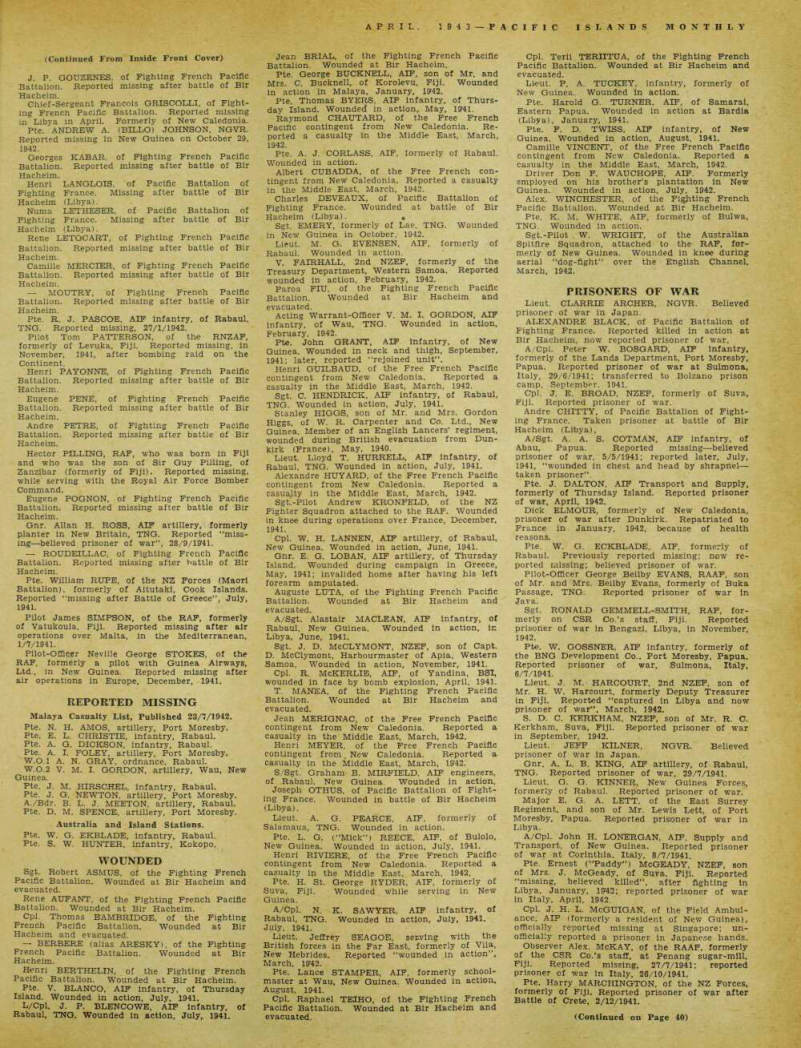
(Continued From Inside Front Cover) J. P. GOUZENES, of Fighting French Pacific Battalion. Reported missing after battle of Bir Hacheim.
Chief-Sergeant Francois GRISCOLLI, of Fight ing French Pacific Battalion. Reported missing in Libya in April. Formerly of New Caledonia.
Pte. Andrew A. (Billo) Johnson, Ngvr.
Reported missing in New Guinea on October 29, 1942.
Georges KABAR, of Fighting French Pacific Battalion. Reported missing after battle of Bir Hacheim.
Henri LANGLOIS, of Pacific Battalion of Fighting France. Missing after battle of Bir Hacheim (Libya).
Numa LETHESER, of Pacific Battalion of Fighting France. Missing after battle of Bir Hacheim (Libya).
Rene LETOCART, of Fighting French Pacific Battalion. Reported missing after battle of Bir Hacheim.
Camille MERCIER, of Fighting French Pacific Battalion. Reported missing after battle of Bir Hacheim.
MOUTRY, of Fighting French Pacific Battalion. Reported missing after battle of Bir Hacheim.
Pte. R. J. PASCOE, AIF infantry, of Rabaul, TNG. Reported missing, 27/1/1942.
Pilot Tom PATTERSON, of the RNZAF, formerly of Levuka, Fiji. Reported missing, in November, 1941, after bombing raid on the Continent.
Henri PAYONNE, of Fighting French Pacific Battalion. Reported missing after battle of Bir Hacheim.
Eugene PENE, of Fighting French Pacific Battalion. Reported missing after battle of Bir Hacheim.
Andre PETRE, of Fighting French Pacific Battalion. Reported missing after battle of Bir Hacheim.
Hector PILLING, RAF, who was born in Fiji and who was the son of Sir Guy Pilling, of Zanzibar (formerly of Fiji). Reported missing, while serving with the Royal Air Force Bomber Command.
Eugene POGNON, of Fighting French Pacific Battalion. Reported missing after battle of Bir Hacheim.
Gnr. Allan H. ROSS, AIF artillery, formerly planter in New Britain, TNG. Reported “miss ing—believed prisoner of war”, 28/9/1941.
ROUDEILLAC, of Fighting French Pacific Battalion. Reported missing after battle of Bir Hacheim.
Pte. William RUPE, of the NZ Forces (Maori Battalion), formerly of Aitutaki, Cook Islands.
Reported “missing after Battle of Greece”, July, 1941.
Pilot James SIMPSON, of the RAF, formerly of Vatukoula, Fiji. Reported missing after air operations over Malta, in the Mediterranean, 1/7/1941.
Pilot-Officer Neville George STOKES, of the RAF, formerly a pilot with Guinea Airways, Ltd., in New Guinea. Reported missing after air operations in Europe, December, 1941.
Reported Missing
Malaya Casualty List, Published 23/7/1942.
Pte. N. H. AMOS, artillery, Port Moresby.
Pte. E. L. CHRISTIE, infantry. Rabaul.
Pte. A. G. DICKSON, infantry, Rabaul.
Pte. A. I. FOLEY, artillery, Port Moresby.
W.0.l A. N. GRAY, ordnance, Rabaul.
W. 0.2 V. M. I. GORDON, artillery, Wau, New Guinea.
Pte. J. M, HIRSCHEL, infantry, Rabaul.
Pte. J. G. NEWTON, artillery. Port Moresby.
A./Bdr. B. L. J. MEETON, artillery, Rabaul.
Pte. D. M. SPENCE, artillery, Port Moresby.
Australia and Island Stations.
Pte. W. G. EKBLADE, infantry, Rabaul.
Pte. S. W. HUNTER, infantry, Kokopo.
Wounded
Sgt. Robert ASMUS, of the Fighting French Pacific Battalion. Wounded at Bir Hacheim and evacuated.
Rene AUFANT, of the Fighting French Pacific Battalion. Wounded at Bir Hacheim.
Cpl. Thomas BAMBRIDGE, of the Fighting French Pacific Battalion. Wounded at Bir Hacheim and evacuated.
BERBERS (alias ARESKY), of the Fighting French Pacific Battalion. Wounded at Bir Hacheim.
Henri BERTHELIN, of the Fighting French Pacific Battalion. Wounded at Bir Hacheim.
Pte. V. BLANCO, AIF infantry, of Thursday Island. Wounded in action, July, 1941.
L/Cpl. J. P. BLENCOWE. AIF infantry, of Rabaul, TNG. Wounded in action, July, 1941.
Jean BRIAL, of the Fighting French Pacific Battalion. Wounded at Bir Hacheim.
Pte. George BUCKNELL, AIF, son of Mr, and Mrs. C. Bucknell, of KoroLevu, Fiji. Wounded in action in Malaya, January, 1942.
Pte. Thomas BYERS, AIF Infantry, of Thurs day Island. Wounded in action, May, 1941.
Raymond CHAUTARD, of the Free French Pacific contingent from New Caledonia. Re ported a casualty in the Middle East, March, 1942.
Pte. A. J. CORLASS, AIF, formerly of Rabaul.
Wounded in action.
Albert CUBADDA, of the Free French con tingent from New Caledonia. Reported a casualty in the Middle East, March, 1942.
Charles DEVEAUX, of Pacific Battalion of Fighting France. Wounded at battle of Bir Hacheim (Libya). , Sgt. EMERY, formerly of Lae, TNG. Wounded in New Guinea in October, 1942.
Lieut. M. G. EVENSEN, AIF, formerly of Rabaul. Wounded in action.
V. FAIRHALL, 2nd NZEF, formerly of the Treasury Department, Western Samoa. Reported wounded in action, February, 1942.
Paroa FIU, of the Fighting French Pacific Battalion. Wounded at Bir Hacheim and evacuated.
Acting Warrant-Officer V. M. I. GORDON, ATP Infantry, of Wau, TNG. Wounded in action, February, 1942.
Pte. John GRANT, AIF infantry, of New Guinea. Wounded in neck and thigh, September, 1941; later, reported “rejoined unit”.
Henri GUILBAUD, of the Free French Pacific contingent from New Caledonia. Reported a casualty in the Middle East, March, 1942.
Sgt. C. HENDRICK, AIF infantry, of Rabaul, TNG. Wounded in action, July, 1941.
Stanley HIGGS, son of Mr. and Mrs. Gordon Higgs, of W. R. Carpenter and Co. Ltd., New Guinea. Member of an English Lancers’ regiment, wounded during British evacuation from Dun kirk (France), May, 1940.
Lieut. Lloyd T. HURRELL, AIF infantry, of Rabaul, TNG. Wounded in action, July, 1941.
Alexandre HUYARD, of the Free French Pacific contingent from New Caledonia. Reported a casualty in the Middle East, March, 1942.
Sgt.-Pilot Andrew KRONFELD, of the NZ Fighter Squadron attached to the RAF. Wounded In knee during operations over France, December, 1941.
Cpl. W. H. LANNEN, AIF artillery, of Rabaul, New Guinea. Wounded in action, June, 1941.
Gnr. E. G. LOBAN, AIF artillery, of Thursday Island. Wounded during campaign in Greece, May, 1941; invalided home after having his left forearm amputated.
Auguste LUTA, of the Fighting French Pacific Battalion. Wounded at Bir Hacheim and evacuated.
A/Sgt. Alastair MACLEAN, AIF infantry, of Rabaul, New Guinea. Wounded in action, in Libya, June, 1941.
Sgt. J. D. McCLYMONT, NZEF, son of Capt.
D. McClymont, Harbourmaster of Apia, Western Samoa. Wounded in action, November, 1941.
Cpl. R. McKERLIE, AIF, of Yandina, BSL wounded in face by bomb explosion, April, 1941.
T. MANEA, of the Fighting French Pacific Battalion. Wounded at Bir Hacheim and evacuated.
Jean MERIGNAC, of the Free French Pacific contingent from New Caledonia. Reported a casualty in the Middle East, March, 1942.
Henri MEYER, of the Free French Pacific contingent from New Caledonia. Reported a casualty in the Middle East, March, 1942.
S/Sgt. Graham B. MIRFIELD, AIF engineers, of Rabaul. New Guinea. Wounded in action, Joseph OTHUS, of Pacific Battalion of Fight ing France. Wounded in battle of Bir Hacheim (Libya).
Lieut. A. G. PEARCE, AIF, formerly of Salamaua, TNG. Wounded in action.
Pte. L. G. (“Mick”) REECE, AIF, of Bulolo, New Guinea. Wounded in action, July, 1941.
Henri RIVIERE, of the Free French Pacific contingent from New Caledonia. Reported a casualty in the Middle East. March, 1942.
Pte. H. St. George RYDER, AIF, formerly of Suva, Fiji. Wounded while serving in New Guinea.
A/Cpl. N. K. SAWYER, AIF infantry, of Rabaul, TNG. Wounded in action, July, 1941.
July. 1941.
Lieut. Jeffrey SEAGOE, serving with the British forces in the Far East, formerly of Vila, New Hebrides. Reported “wounded in action”.
March, 1942.
Pte. Lance STAMPER, AIF, formerly school master at Wau, New Guinea. Wounded in action.
August, 1941.
Cpl. Raphael TEIHO, of the Fighting French Pacific Battalion. Wounded at Bir Hacheim and evacuated.
Cpl. Terii TERIITUA, of the Fighting French Pacific Battalion. Wounded at Bir Hacheim and evacuated.
Lieut. P. A. TUCKEY, infantry, formerly of New Guinea. Wounded in action.
Pte. Harold G. TURNER, AIF, of Samarai, Eastern Papua. Wounded in action at Bardla (Libya), January, 1941.
Pte. F. D. TWISS, AIF infantry, of New Guinea. Wounded in action, August, 1941.
Camille VINCENT, of the Free French Pacific contingent from New Caledonia. Reported a casualty in the Middle East, March, 1942.
Driver Don F. WAUCHOPE, AIF. Formerly employed on his brother’s plantation in New Guinea. Wounded in action, July, 1942.
Alex. WINCHESTER, of the Fighting French Pacific Battalion. Wounded at Bir Hacheim.
Pte. K. M. WHITE, AIF, formerly of Bulwa, TNG. Wounded in action.
Sgt.-Pilot W. WRIGHT, of the Australian Spitfire Squadron, attached to the RAP, for merly of New Guinea. Wounded in knee during aerial “dog-fight” over the English Channel, March, 1942.
Prisoners Of War
Lieut. CLARRIE ARCHER, NGVR. Believed prisoner of war in Japan.
ALEXANDRE BLACK, of Pacific Battalion of Fighting France. Reported killed in action at Bir Hacheim, now reported prisoner of war.
A/Cpl. Peter W. BOSGARD, ATP Infantry, formerly of the Lands Department, Port Moresby, Papua. Reported prisoner of war at Sulmona, Italy, 29/6/1941; transferred to Bolzano prison camp, September. 1941.
Cpl. J. E. BROAD, NZEF, formerly of Suva, Fiji. Reported prisoner of war.
Andre CHITTY, of Pacific Battalion of Fight ing France. Taken prisoner at battle of Bir Hacheim (Libya).
A/Sgt. A. A. S. COTMAN, AIF infantry, of Abau, Papua. Reported missing—believed prisoner of war, 5/5/1941; reported later, July, 1941, “wounded in chest and head by shrapnel— taken prisoner”.
Pte. J. DALTON, AIF Transport and Supply, formerly of Thursday Island. Reported prisoner of war, April, 1942.
Dick ELMOUR, formerly of New Caledonia, prisoner of war after Dunkirk. Repatriated to Prance in January, 1942, because of health reasons.
Pte. W. G. ECKBLADE, AIF, formerly of Rabaul. Previously reported missing; now re ported missing; believed prisoner of war.
Pilot-Ofßcer George Beilby EVANS, RAAF, son of Mr. and Mrs. Beilby Evans, formerly of Buka Passage, TNG. Reported prisoner of war in Java.
Sgt. Ronald Gemmell-Smith, Raf, For
merly on CSR Co.’s staff, Fiji. Reported prisoner of war in Bengazi, Libya, in November, 1942.
Pte. W. GOSSNER, AIF infantry, formerly of the BNG Development Co.. Port Moresby, Papua, Reported prisoner of war, Sulmona, Italy, 6/7/1941.
Lieut. J. M. HARCOURT, 2nd NZEF, son of Mr. H. W. Harcourt, formerly Deputy Treasurer in Fiji. Reported “captured in Libya and now prisoner of war”. March, 1942.
S. D. C. KERKHAM, NZEF, son of Mr. R. C.
Kerkham, Suva, Fiji. Reported prisoner of war in September, 1942.
Lieut. JEFF KILNER, NGVR. Believed prisoner of war in Japan.
Gnr. A. L. B. KING, AIF artillery, of Rabaul, TNG. Reported prisoner of war, 29/7/1941.
Lieut. G. G. KINNER, New Guinea Forces, formerly of Rabaul. Reported prisoner of war.
Major E. G. A. LETT, of the East Surrey Regiment, and son of Mr. Lewis Lett, of Port Moresby, Papua. Reported prisoner of war in Libya.
A/Cpl. John H. LONERGAN. AIF, Supply and Transport, of New Guinea. Reported prisoner of war at Corinthia, Italy, 8/7/1941.
Pte. Ernest (“Paddy”) McGEADY, NZEF, son of Mrs. J. McGeady, of Suva. Fiji. Reported “missing, believed killed”, after fighting in Libya, January, 1942; reported prisoner of war in Italy. April, 1942.
Cpl. J. H. L. McGUIGAN, of the Field Ambul ance, AIF (formerly a resident of New Guinea), officially reported missing at Singapore; un officially reported a prisoner in Japanese hands.
Observer Alex. McKAY, of the RAAF, formerly of the CSR Co.’s staff, at Penang sugar-mill, Fiji. Reported missing, 27/7/1941; reported prisoner of war in Italy, 26/10/1941.
Pte. Harry MARCHINGTON, of the NZ Forces, formerly of Fiji, Reported prisoner of war after Battle of Crete, 2/12/1941.
(Continued on Page 40)
Pacific News-Review
Notes And Comment On
The Progress Of The War
From March 13 To April 14
Mar. 13; A general thaw has slowed up the Russian advance on the southern and central Russian front, and it now seems that the Russians cannot reach Smolensk, or the line of the Dneiper River. The Germans have withdrawn from Viazma, but they have launched a great counter-attack against Kharkov, where the situation is critical.
Mar. 13; Rommel’s army, on the Mareth Line, in South Tunisia, is work ing feverishly, preparing for the expected attack by the British Eighth Army.
Mar 15: An enemy convoy, which was approaching Wewak, TNG, was attacked by Flying Fortresses.
Mar. 17: On Monday morning Darwin had its biggest Japanese air raid since its first raid on February 19, 1942. Only slight casualties and damage have been reported. Spitfires destroyed six fighters and one bomber, and damaged nine others.
Mar. 17: Moscow announces the recap ture cf Kharkov by the Nazis, but Rus sian forces are having further successes on the central front, and are still threat ening Smolensk.
Mar. 19: German armies continue their great counter-attack around Kharkov, in the Donets Basin, but the Russian defences there are gaining strength.
Mar. 19: Prepared enemy positions at the mouth of the Mambare River (north east Papua) the existence of which was suspected during the Buna fighting, have been found abandoned by American and Australian patrols. It is believed that the large Jap convoy destroyed in the Bismarck Sea battle was proceeding to the Mambare.
Mar. 23: The Eighth Army has launched its attack on the Mareth Line in Tunisia, and has made some progress.
American forces in the Gafsa area attacked at the same time.
Mar. 23: The Russians have made pro gress on the Smolensk front; but fierce battles for the Donets bridgeheads con tinue.
Mar. 24: The Eighth Army has driven a wedge in the Mareth Line defences; but the British, attacking around the Matmata hills, are developing an out flanking movement.
Mar. 24; Officially announced that the Ninth Division, AIF, veterans of Syria, Tobruk and El Alamein, has returned to Australia.
Mar. 25: The enemy at the Mareth Line counter-attacked, forced back the British Eighth Army, and restored their defence line. To the north-west, the Americans are holding their ground.
Mar. 25: 250 Japanese bomber and fighter planes, crammed into the Rabau) area, were targets for a large-scale raid by Allied air forces.
Mar. 26: Russians are now only 32 miles from Smolensk. In the Donets region, the German counter-attack has slowed down.
Mar. 29: The British outflanking col umn suddenly appeared and captured El Hamma, in the rear of the Mareth Line, and drove down upon the Gabes Gap.
This brilliant manoeuvre sent Rommel’s army into precipitate retreat.
The enemy abandoned the Mareth Line, and the Eighth Army is now pursuing him northwards. The American Fifth Corps is pressing in from the north-west, trying to cut off Rommel’s retreat.
Mar. 29: The RAF yesterday smashed Berlin, in the heaviest raid the German capital has yet experienced.
Apl. 1: The British First Army in Tunisia now has begun a drive in the north coast zone.
Apl. 1: A Japanese convoy, which apparently intended to give relief to Jap forces in the Lae area, turned back near Finschhafen, after being spotted and attacked by Allied planes.
Apl. 2; The area held by the Axis forces in Tunisia is steadily shrinking as Rommel retreats and the Allies advance.
Tunisia already is being hailed as “Ger many’s Dunkirk.” The Germans now are 20 miles north of Gabes and the pursu ing Eighth Army has made junction with the American Army.
Apl. 3:. The last Japanese survivors from the Bismarck Sea convoy were rounded up in Goodenough Island and the Trobriands, to which they drifted on rafts, boats and wreckage, before the north-west wind.
Apl. 5: Three Japanese warships were sunk by Allied bombers off the coast of New Ireland, near Kavieng; and a small number of cargo ships were destroyed or damaged.
Apl. 6: The round-the-clock air-offen sive against the Axis in Europe, by the RAF and the US Army Air Corps, con tinues. One hundred Flying Fortresses attacked Naples, and Kiel and Paris have been heavily raided.
Apl. 7: The Allied air-offensive in Tunisia is going non-stop, in an attempt to “soften” Italian resistance to the next phase of the attack.
Apl. 7: Novorossisk. German-held former base of Russian Black Sea Fleet, is threatened with recapture by Russian forces. There is much fighting on the Kuban (Caucasus) front.
Apl. 6: The Eighth Army has broken through the Wadi Akarit Line in Tuni sia, and again is pursuing the fleeing enemy. Meanwhile, Axis airfields in
Tunisia and Sicily are receiving a terri fic aerial pounding.
Apl. 9: Considerable gains were made by the British First Army, in northern Tunisia.
Apl. 10: Pursued by the British Eighth Army, Rommel’s forces now are in full retreat towards Susa, Central Tunisia, Apl. 10: The Japanese made a large scale aerial raid on the Solomons on Wednesday. The Americans destroyed 37 Jap planes, and lost seven.
Apl. 12: It was announced officially that about 3,000 Australians had been killed by fighting and disease in the New Guinea campaign.
Apl. 12: Rommel’s forces, retreating rapidly in Tunisia, are now north of Susa.
It is thought that Rommel will fight a delaying action right back to Bizerta, where he will attempt embarkation. If he does, he will face disaster.
Apl. 13: Two more Tunisian bases— Susa and Kairwan—have been occupied by the British Eighth Army and the Americans, who have come through the passes to the westward.
Apl. 14; Axis forces are feverishly pre paring defence positions south-west and south of Tunis and Bizerta, as the first stage of the siege of the northern tip of Tunisia begins. The Eighth Army is at Enfidaville —20 miles north of Susa.
Apl. 14: Port Moresby was attacked yesterday by 46 Japanese bombers and 60 fighters. Seventeen bombers and nine fighters were shot down for certain, and 10 other bombers and one fighter prob ably destroyed. This is the largest Jap anese raid on Australian territory since the occupation of Rabaul in January, 1942.
Pacific Territories
Association
SINCE the last general meeting of the Pacific Territories Association on March 10, the executive has been working steadily on the many, appar ently, fixed and permanent problems of evacuees from the Territories.
Return Of Planters
The Association has been besieged by anxious planters who have heard nothing since they applied to the Department of External Territories for permission to return to their plantations in Papua—but the Association has no more information on the subject cf who will be permitted to return—and when —than the anxious planters themselves. It is thought that no more definite information will be available until the Secretary of the Department of External Territories re turns from the north at the end of April.
Looting, War-Damage, Etc.
No further clarification of the defini tions of looting or war-damage has been received; although, following the resolu tion passed at the general meeting (that the' Commonwealth Treasurer should be asked to define the actual difference between war damage as applied to the mainland of Australia and war-damage as applied to the evacuated Territories of Papua and New Guinea) the Association has written the Commonwealth authori ties concerned.
Future Mortgages
The Association asked, through the Department of External Territories, that the Territories of Papua and New Guinea
be included under the amendment of the Commonwealth Bank Act, relating to the establishment of a mortgage department to assist primary industry, which came into effect on March 20, 1943. They have received a reply from the Federal Trea surer to the effect that the “matter is under consideration.”
Annual General Meeting
Members are reminded that the annual general meeting will be held about the second week in June. The exact date will be published in the May issue of the
“Pim.”
When war broke out in 1939, Mr. and Mrs. Gordon Harris, of Djaul, New Guinea, left their plantation at Biua in the care of Mr. Miller, of Kavieng, and went to England. He is now a lieuten ant in the Navy, and has seen service at “Hell Corner” (Dover) and at the Admiralty; his wife is Third Officer Ursula Harris, of WRNS, and now is stationed at Largs, near Portsmouth.
Mr. Dick Arrowsmith, formerly of Djaul, is now serving with the forces in New Guinea. Nothing has been heard of Mr.
Miller since the Jap invasion.
Regret has been expressed at the retirement of the Rev. H. R. Green, after 22 years of work with the Methodist Mis sion in Fiji. Mr. Green has been in Sydney for the annual meeting of the Methodist Mission Board, and gave some interesting details of mission work among the Fijians during the present abnormal period. He had intended to return to his mission work there but circumstances have prevented it.
Contents
Pacific News-Review 1 Pacific Territories Association ... 1 When Will This War End? 3 British Oceania 4 Samoan Price-fixing Regulations .. 5 “Dusty” Miller a Prisoner 5 A. C. Turnbull—Samoa’s New Ad ministrator 6 * Conditions on Guadalcanal 6 Makatea Wrecked 7 Fiji’s Escape 7 “Chiselling” War Damage Claims .. 8 Islands Casualties 9 Food Shortages in Fiji 9 Wartime in America 10 Death of Mrs. Selina Buffet 11 L. J. Stokie Escapes from N. Britain 12 Death of C. C. Judd 12 Westward Through the Louisiades— How Planters Escaped 13 Methodist Missionaries Anxious to Return to NG 16 Good Work by N. Guinea Women .. 17 Magic Drug for Stomach Maladies . . 19 Possibilities of Air-war —Map of Pacific 20-21 Fiji’s Youngest Industry 22 “White Islands” in Coloured Sea .. 24 Pidgin is Discovered 25 Why We Should Say “Manchuria” .. 26 SDA Missionaries in N. Guinea .. 27 N. Guinea Copra Pool 28 • Rubber in Solomons 29 Little Funking in Papua 31 Sudden Death of W. G. Clarke .. 32 Future of Bulolo Gold 33 Position of Cuthbert’s Misima Gold mine 33 Isles of the Blest—French Oceania .. 34 How Nipponese Came to TI 35 War Damage Commission Committees 37 Memories of William Churchill ... 38 Commercial Page 39 Honour Roll Cover ii, iii, 40
Advertisers
Amalgamated Wire less (A/sia) Ltd. . 30 Atkins Pty. Ltd., Wm 24 Australian Aluminium Co. Pty. Ltd. . . 38 Broomfield Ltd. . . 34 Brown & Co. Ltd., G 13 Bruriton’s Flour . . 19
B.P. (S.S.) Co. . . 13
Burns, Philp Trust Co. Ltd 15 Carlton & United Breweries Ltd. . . 31 Carpenter Ltd., W.
R cov. 4 Chivers & Sons Ltd. 26 Coleman Lamp & Stove Co 25 “Cystex” . . . . .37 Donaghy & Sons Ltd 38 Donald Ltd., A. B. . 28 Dr. Williams Pink Pills 36 Electrolux Refrigerators . . 18 Foster Clark (Aust.) Ltd 17 Garrett & Davidson 29 Gilbey’s Gin ... 16 Gillespie Pty. Ltd., Robert 35 Gillespie’s Flour . , 27 Gough & Co., E. J. 27 Grand Pacific Hotel 2
Grove & Sons, W.
H 14 Kambala School for Girls 33 Ltd 22 Kopsen & Co. Ltd. . 29 Maxwell Porter Ltd. 40 “Mendaco” ... 33 Miller & Co. Pty.
Ltd 36 Nelson & Robertson Pty. Ltd 34 Noyes Bros. Ltd. . 38 Old Monk Olive Oil . . 14, 22, 25, 34 Pacific Is. Society . 13 “Pinkettes” ... 32 Prescott Ltd. ... 26 Riverstone Meat Co.
Ltd 22 Rohu, Sil . . . . 34 Rose’s Eye Lotion . 36 Scott Ltd., J. ... 28 Steamships Trading Co. Ltd 19 Sullivan & Co., C. . 16 Swallow & Ariell . 23 Taylor & Co., A. . 34 “Tenax” Soap . . 32 Tillock & Co. Ltd. . 35 Wright & Co. ... 37 Wright & Co. Ltd., E 40 Wunderlich Ltd. . . 40 Yorkshire Insurance Co. Ltd 14
The Rev. R. J. Maddox, of the Methodist Mission, has retired from his work in Samoa, after 14 years’ service in that Territory. During his time there, Samoa has passed through some troublous times, but while keeping aloof from conflicting political factions, he yet won the respect and affection of the Samoans and will be missed greatly. He will return to church work in Australia.
Advertisements & other items, p. 4 (2 items)
Useful Addresses
THE following are the Sydney addresses
of organisations set up temporarily to deal with Pacific Territories affairs —and especially matters connected with the evacuation of the Territories.
PAPUA, NEW GUINEA, NAURU,
NORFOLK IS.
Department of External Territories (Sydney Branch) (Lately the New Guinea Trade Agency), Australia House, Carrington Street, Sydney.
Telephone: BW 1776. (Dealing with all matters connected with the Australian Pacific Territories and also the Sydney representative of the New Guinea Copra Control Committee.)
BRITISH SOLOMON ISLANDS
Sydney Office of British Solomon Islands Government (In charge of Mr. F. E. Johnson, Treasurer of the Solomons Administration), 17 Castlereagh Street, Sydney.
Telephone: B 1710.
GILBERT AND ELLICE, AND
OCEAN IS.
Sydney Office of Gilbert and Ellice Islands Colony (In charge of Mr. S. G. Clarke, Treasurer of the G. and E. Administration), Bank of New Zealand Building, George Street, Sydney. Telephone; B 2209.
FOR PACIFIC TERRITORIES
EVACUEES GENERALLY
Pacific Territories Association (C. A. M. Adelskold, Secretary), c/o Robert Gillespie Pty., Ltd., 54a Pitt Street, Sydney. Telephone: BVV 4782.
STEAMSHIPS TRADING CO.
OF PAPUA
Sydney Office: Nelson and Robertson Pty., Ltd., Telephone: B 6461. 12 Spring Street, Sydney.
/>■
4t \W rig WA I . 5 o^- . cen t :S-- *• °* «.*-* * *“’■. **- • «-* — o* «•*“■;„ >*• „.»•« C.W-" 6 ' )6 9 er
Pacific Islands Monthly
Published Once Each Month and Circulated in Australia and New Zealand and in the following Pacific Territories and Islands Groups;
Australian Territory of Papua.
Mandated Territory (Australia) of New Guinea.
Australian Territory of Norfolk Island.
New Zealand Territory of Cook Islands.
Mandated Territory (NZ) of Western Samoa.
British Colony of Fiji.
British Solomon Islands Protectorate.
British Protectorate of Tongan Islands.
British Crown Colony of Gilbert and Ellice Islands.
Mandated Territory of Nauru.
I British and Free French Condominium of New Hebrides. ! Free French Colony of New Caledonia.
Free French Colony of Oceania (Tahiti, etc.).
American Territory of Eastern Samoa.
American Territory of Hawaiian Islands.
Owned and Produced by Pacific Publications Pty. Ltd., Union House, 247 George Street, Sydney.
TTTT irpunmr S Managing Director .. BW 5037 u Business and Editorial MA 4369
P.O. Box 3408 R
Registered Address of Telegrams, Radiograms, and Cables: “Pacpub”, Sydney.
Contributions.
Articles, Stories, and Photographs dealing with Pacific Islands subjects are invited and will be paid for on publication.
Subscription Rates.
Per Annum, within British Empire, Prepaid, Post Free 8/- Per Annum, elsewhere, prepaid, Post Free. 107- Single Copies Bd.
Editor and Publisher:
R. W. Robson, F.R.G.S.
Advertising Manager: L. W. Bailey.
Advertising Office and Printing-House: 29 Alberta Street, Sydney, Advertising rates. furnished on application.
Colours, etc., by arrangement.
Process Blocks made at Advertiser’s expense when required. Screen 100.
Changes of Advertising Copy should reach this office by Ist of each month, otherwise previous advertisement may be repeated.
Representative In London.
W. C. Harvey, Coronation House, 4 Lloyds Avenue, London, E.C.3, from whom may be obtained copies of Pacific Islands Monthly, Pacific Is. Year Book, advertising schedules, etc.
Agents.
The following are authorised to receive sub scriptions for Pacific Islands Monthly;— Burns. Philp & Co., Ltd., and Burns Philp (South Sea) Co., Ltd. All branches.
W. R. Carpenter & Co., Ltd. All branches.
Morris, Hedstrom, Ltd. All branches.
Steamships Trading Co., Papua. All branches.
B.N.G. Trading Co., Ltd., Port Moresby. Papua.
J. Muir, Suva, Fiji.
Miss R. Castles, Suva, Fiji.
N. C. Mackenzie Hunt, Wainunu, Bua, Fiji.
Kirpal & Co., Victoria Parade, Suva, FIJI.
Cook Islands Trading Co., Rarotonga, Cook Is.
A. C. Rowland, Papeete, Tahiti.
Islands Branches and Representatives of W. H.
Grove & Sons, Ltd., Auckland, New Zealand.
Ed. Pentecost, Noumea, New Caledonia.
Kerr & Co., Noumea, New Caledonia.
Vol. XIII. No. 9.
April 17, 1943
Prirp i 8d - Per Copy ’ rrice \ Prepaid: 8/- p.a.
When Will This War End?
A Review
BY
R. W. Robson
THERE is much foolish twittering among uninformed people who expect an earl*' end of the war, and a return of that peace for which we all long. Men are feverishly planning new business ventures, “to take care of the boom which the Yanks will organise in the Pacific.” Such fools are dangerous.
We have travelled far since the black days of 1940, when a battered but unconquerable Britain faced the Axis alone. Germany now is on the defensive, and her end is certain. But those who imagine that we can achieve victory, and our essential freedom, without undergoing sacri fices and sufferings which will make the past three years seem like a picnic, are deliberately closing their eyes against plain, inescapable facts.
WE still have to smash the Axis, completely and permanently.
There can be no security for our children’s children, no progress in human decencies, no real freedom in the world, while people like Germans and Japs, with swashbuckling habits and a totalitarian mentality, can plot together and arm against us. We may not exterminate them; but we can and must control, for at least two generations, the education of their children.
The Axis now is on the defensive— but it is far, very far, from defeat.
Apart from the Russian front, the war against Hitler, in a military sense, has not started yet. We have had victories in North Africa, but that fighting is but preparatory, a mere incident compared with what must come, if Hitler’s armies are to be broken.
We—with good reason—are putting our confidence in our growing air power. Hitler, with equally good reason, is putting his faith in sub marines. These are the most critical days yet in the long-drawn-out Battle of the Atlantic. Unless those U-boat packs are conquered, America’s vast water-borne transport system may be disorganised, and the Allies’ plans for the opening of the Second Front may be gravely interfered with.
Russia, though she has done mag nificently, did not achieve what she set out to do in her Winter Campaign.
She has regained most of what she lost in 1942, but not the valuable areas which the Nazis occupied in 1941. Russia’s ability to drive the Germans farther westward in the coming European summer depends upon the opening of a Second Front by the Allies. The Russians can drive back the Germans in winter; but the Germans, if not attacked in the west, probably can drive back the Russians in summer.
That is the position in Europe. Far more depends upon the outcome of the Battle of the Atlantic than upon the Battle of Tunisia.
SIMILARLY, the Japanese are un beaten. They represent a military problem even more difficult than that of Germanv. Germany has been mauled and weakened the Russians, and fearfully battered by the RAF.
If American power can be concen trated beside British newer in Western Europe, we mav hope for much, and fairly soon, perhaps.
But Japan’s army and navy, as yet, have suffered no weakening defeat —
although her air force has been very seriously knocked about. Japan’s weakness is industrial—her ability to build planes, tanks, ships, etc., is limited. Eventually, she will be beaten by machines. But she is seek ing already to meet that threat by most intensive exploitation and organisation of her new Indonesian Empire.
The war will not end with the defeat of Germany. It may be pro longed for a year or two, while we deal with Japan.
HOWEVER, suppose the war is over.
What then? Now, we must transfer millions and millions of voung men from intensively-organ ised and disciplined fighting services to the comparatively uncontrolled and undisciplined life of private citizens, while at the same time hundreds of thousands of young women will be returning from regi mented industry to home life.
This will not be done in a month, or a year; and it inevitably will be attended by far-reaching social and industrial uneasiness. There is going to be no love lost between the masses of service-men, who have been striv ing and dying for a few shillings a day, and the stay-at-home industrial masses, who may not continue to enjoy high wages rates at the ex pense of the fighters.
THE next great problem will not be the restoration of industry, com merce and trade, but the rescue of the world from starvation. Long before hostilities cease, the terrible famines which we now know to exist in China and Greece will have ap peared in other countries. The thing is inevitable. To-day, Germany is
contriving somehow to provide the occupied countries with just enough food to keep them functioning, be cause Germany cannot carry on without their industrial help; but when Germany collapses, God help the 200,000,000 people in German occupied countries!
The United Nations may have to maintain a kind of wartime control over the whole world for a couple of years, while tens of millions of people are fed and assisted to become self supporting again. It obviously would be absurd to attempt to return quickly to the normal trade and in dustrial activities of peacetime, while half the world is starving.
Therefore what appears the greatest of our post-war tasks, the restoration of industry, trade and commerce, with which necessarily is linked the re storation of normal peacetime life, cannot be undertaken until the Axis is broken, demobilisation is well under way, and the world’s food production restored. Can even the most fatuous optimist see these things accom plished within a period of some years?
LET us suppose that the Axis menace is gone, millions of men are going quietly back to civilian life, and famines have been averted or conquered. Is it to be supposed that domestic industries and international trade will function as before? They certainly will not.
Millions of industrialist wage earners, accustomed to much more money than in the pre-1939 period, will reject the pre-1939 wage scales and margins. Millions of ex-service men, who have borne the heavier sacrifices of the war periods, will in sist upon having a larger share in peacetime amenities.
The pre-1939 conditions, which per mitted offensive luxury alongside bitter poverty, which made no pro vision for the accidents of unemploy ment and sickness, and the uncertain ties of old age, will not be allowed to continue; if they do, there will be revolt. That means an early chal lenge to the evils that mainly bred poverty and social injustice—such things as hereditary wealth, uncon trolled land ownership, trade mono polies, the tyranny of money-power.
Wealth and privilege will fight to the death to retain those things. All the wisdom and strength of our leaders will be needed to prevent our United Nations, in rejecting the social and economic evils of pre-1939, swinging away to experimental Communism, and hamstringing private enterprise, which is the mainspring of our national life.
THAT is the politico-social side. But, in the mechanics of trade and industry themselves, consider the far reaching readjustments to be made.
Before 1939, international trade and exchange had become sorted out into as prettv a collection of tariff enclosed tomfoolery as had ever been seen in history; America insisting on selling goods to the world but refus
ing to accept the world’s goods, and thus accumulating the greatest store of gold in the annals of civilisation; every currency in the world, except the US dollar, “off” gold, but pegged to the dollar; Britain trying to re concile her mass of world-wide investments and her vast transport machinery with a repudiation of free trade and a nominal repudiation of the gold standard; France trying to maintain her place beside Fascist Germany and Communist Russia, while officially adopting the 40-hours week—there is no end of them.
All the problems implicit in the readjustment of these matters must be solved before there can be any return to normal world trade and international peace. How long will their solution take? Probably years —so long that the present generation may pass on, and another and un instructed generation may take up the task, and so muddle it that the groundwork will be laid for bigger and better wars. That was what hap pened between 1919 and 1939.
However, there are two definite facts to comfort us. One is that the Americans have learned their lesson —they will not again run away, as they did in 1919, from the world peace obligations which are forced upon them by the size and im portance of the United States. They will carry the job through. The second is that when peace returns, the world will be so desperately short of manufactured goods, and there will be so much to do in repairing war damage, that all workers will be kept engaged for several years; and, dur ing that breathing spell, the nations of the world, led by the United States and the British Empire, will have a chancq to iron out a thousand obstacles to permanent world peace.
Encouraged by one or two 1 reasonably good forecasts in recent years, I am tempted to make another:— 1943. —Collapse of Italy and Germany. 1944. —Forces of British, Americans and Russians occupy all European coun tries. policing the Axis countries pending the defeat of Japan, assist ing friendly countries (France, Hol land, Belgium, Norway, Poland, Czecho-slovakia, Greece, Jugoslavia) to restore law and order, and feeding the starving populations. Powerful forces diverted against Japan. 1945.—Defeat of Japan; occupation of Japan and of Indonesia by forces of United Nations. Partial withdrawal of Allied forces from friendly coun tries of Europe, as their administra tive and economic systems are restored. United Nations begin enor mous task of repatriation and demobilisation of their armed forces.
Organisation of Peace Conference. 1946.—Peace Conference. Repatriation and demobilisation of United Nations forces proceeds steadily, keeping pace with the restoration of their industry and trade; but they still are obliged to maintain substantial forces in Germany, Italy, Hungary, Roumania, Bulgaria, Japan, Indonesia, and other enemy territory, pending Peace Con ference settlements.
That represents three more years of war conditions —and I think that that
Is optimistic. Until we see Germany reeling back from the opening of a second front in Europe, there is no prospect of the collapse of Germany in 1943.
Confederation ?
A South Pacific Confederation ?
THE suggestion that the peace settle ment in the Pacific should make provision for a “Dominion (or Terri tory) of British Oceania,” representing a federation of— Australian Territory of Papua Mandated Territory of New Guinea British Protectorate of Solomon Islands Condominium of New Hebrides British Crown Colony of Fiji British Protectorate of Tonga British Colony of Gilbert and Ellice Mandated Territory of Western Samoa New Zealand Territory of Western Samoa With a possibility of including French Colony of New Caledonia French Colony of French Oceania American Territory of Eastern Samoa and enjoying a considerable measure of self-government, has been received with interest by residents of the various Ter ritories. The “PIM” has received many letters on the subject.
Generally, the approach to the subject is wary, however. It is recognised that selfish interests are involved. The reac tion of many people is not “What will be best for the Territories and their peoples?” but “How will this affect me?”
The plan naturally is frowned upon by administrative officials generally, because, as was stated in the “PIM” in December and January, it “would mean the with drawal from Pacific Territories adminis tration of the dead hands of Canberra.
Wellington, London and Paris.”
The outstanding argument in favour of such a South Pacific Federation is that all these Territories have the same prob lems of tropical administration (agricul ture, settlement, commerce, transport, protection of natives, native education, native health, transport, defence, com munications, etc.)—problems which are little understood and almost invariably muddled by the various non-islands Governments now responsible.
Sir Henry Milne Scott, KC, writes from Suva to inform us that the Legislative Council of Fiji, in 1921, on his motion, after lengthy debate, agreed:— “That in the opinion of this Council (a) the interests of the Empire in the Pacific would best be served by a Confederation of the British Islands of the Western Pacific governed and con trolled from a common centre: (b) that this resolution be transmitted to the Secretary of State for the Colonies, respectfully asking his approval."
The resolution was transmitted accordingly; and that was the end of that.
We shall deel with this matter exten sively—especially the several weighty objections to the plan—in an early issue.
Can You Guess Him?
THESE lines are from a very well known book, by a very well-known man. But the editor bets that you cannot guess the book or the writer:— “The spirit of the British nation enables it to carry through to victory any struggle it once enters upon, no matter how long such a struggle may last, or however great the sacrifices that may be necessary, or yihatever the means that have to be employed; and all this though the actual equipment at hand may be entirely inadequate compared with that of other nations ”
For the answer, see page 40.
Fruit Crops Destroyed
Cyclone In The
Cooks
THE Prime Minister of New Zealand (Mr. Fraser) announced on March 17, that Rarotonga and other islands in the Cook Group had experienced a very severe storm.
No loss of life had occurred; but con siderable damage was done to buildings, many native dwellings were demolished, and orange, banana and other food crops suffered heavily.
Mr. Fraser said it might be necessary to despatch a food ship to the group.
The loss of a large proportion of the Cook Islands exportable fruit would also affect the New Zealand orange and banana market.
Fixed by Regulation
Samoan Prices
Prom Our Own Correspondent APIA, March 7.
THE newly-established Price Tribunal of Western Samoa announced on Feb ruary 1 that as from February 15, 1943, the prices at which all goods not previously mentioned in price-fixing orders could be sold to the public, would be fixed at 30 per cent, above landed cost. The prices of goods fixed previously (mainly foodstuffs) should, however, remain so fixed.
Generally, the new order is welcomed by the purchasing public, although in cer tain lines—particularly drapery—it is con sidered a hardship by merchants and traders. It is considered unnecessarily narrow-minded, also, in that it fixes the prices down to fractions of a penny. The Samoan has a well-known objection to accepting or handling copper coins, and even in German times the sixpence was practically the smallest coin used. Apart from this, there is the difficulty of main taining a sufficient circulation of copper coins, especially in country districts.
The basis on which the price of goods (other than foodstuffs and certain groceries) was fixed prior to this new re gulation, was the percentage of profit made on the same class of goods prior to the outbreak of war (September, 1939).
As at that time Apia firms made an average profit of about 50 per cent, on drapery and hardware lines, the margin of profit allowed under the new order, is appreciably smaller than that of the pre war period.
In addition to fixing the price of mer chandise sold in stores and trading stations in the Territory, the Price Tri bunal has also fixed the selling price of ice (ranging from 6d. for a 5-lb. block to 3/- for a 50-lb. block), for fresh meats (from 7d. to 1/3 per pound), for fresh milk drinks (12 oz. at 6d.), and local soft drinks (9d. per bottle).
The Food Controller has issued instruc tions, also, that no cattle are to be slaughtered for consumption without a special permit being obtained from him.
Mr. Alex C. Rentoul has been engaged by the High Commissioner of the West ern Pacific (British) to act as a District Agent in the New Hebrides for the dura tion of the war. It is an extraordinary thing that the Australian Military Ad ministration was unable to use this well known and experienced officer in New Guinea. He was a Resident Magistrate (Grade I) in Papua when the Civil Administration was suspended.
Saw The Japs Go
To Munda
Solomon Islands Missionary's Experiences
THE Japs were wandering about the New Georgia Group (Solomons) for some time, before they finally settled on Munda as a base,” said Rev.
J. R. Metcalfe, Methodist missionary, who recently arrived in Sydney.
He refused to leave his native people in Choiseul, when the Jap invasion first commenced, and then he was cut off by the Jap occupation of islands further south. He finally made his way to the Methodist Mission headquarters at Munda, on Roviana Lagoon, island of New Georgia, and he was rescued by the Americans and taken south, late in 1942.
“The Japs were bombed out of Gizo by the Americans,” said Mr. Metcalfe. “They went to Rendova on September 29, 1942.
But they did not remain there long—it was not suitable as a base.
“So they left Rendova about five weeks later, and proceeded to establish a base at Munda, where they arrived on Novem ber 13, 1942, at dusk. I was in that vicinity, and it was a startling sight to see all those little ships working their way in through the reefs. They used four or five landing barges and sampans. A few days later, 18 barges and 2 launches came to Munda from Vila (on the south coast of Kulumbangara), through the deep, narrow passage, between Kulum bangara and New Georgia.
“Between that time, and the time I left, I saw the Japs busily preparing a big airfield at Munda. They had occupied practically the whole of the Methodist Mission station for this purpose, and the clearings were being rapidly extended towards the adjoining plantation, Mr.
Geoffrey Cliff’s well known * ’
“Since then, the whole area has been thoroughly and frequently bombed by the Americans.”
Mr. Metcalfe is now spending a well earned furlough in Melbourne.
Papuan Men In The
" Fighting Ninth "
AS the “Fighting Ninth” (famous AIF Division recently returned from the Middle East) marched through cheering crowds in Sydney streets, the following men of Papua were noticed: — Captain Clem. Schraedar, formerly of Lands Department, Port Moresby.
Lance-Bombardier Archie Mclntyre.
Sergeant Clarrie Isen (15th Battalion).
Sergeant Jack Doane (3rd Anti-tank Regiment).
Warrant-Officer Fred. Nelson (Field Workshops). Previous to volunteering for service overseas, he was a member of the 13th Heavy Battery, the first military unit of this war to do duty in Port Moresby.
Lance-Bombardier Mclntyre warmly praised the Papuan branch of the Red Cross Society, from whom parcels of clothing and other comforts were regu larly received, and were much appre ciated by the men from Papua.
When Lance-Bombardier Mclntyre left Port Moresby his fellow-employees in the Government Stores presented him with a Papuan flag. It has accompanied him on all his travels—to Palestine, Mersah Matruh, El Alamein and Syria.
"Dusty" Miller is a Prisoner
Prisoner
THE report that Flight-Lieutenant George E. Miller (otherwise “Dusty”
Miller), of the RAAF, and formerly one of the most popular young men of Samarai (Papua), had been killed in action, published in the February issue of the “PIM,” is not correct.
We are happy to state that we have been informed by “Dusty” Miller’s father (Mr. G. H. Miller, of 32 Cook Street, Townsville), that the young man is now a prisoner of war in Germany. Not much information has been received, says Mr. Miller, but it appears that Flight- Lieutenant Miller was a member of the crew of a Halifax bcmber which was shot down in flames while on an operational
flight over Nor way. Flight-Lieu tenant Miller landed in the sea without a scratch, and he and his crew were subse quently picked up by the German warship, “Pr i n z Eugene.”
The photograph published herewith was taken when “Dusty” Miller was a Pilot-Officer in England. We also publish a photo graph of “Dusty”
Miller’s mascot, which was painted on his plane, and
which aroused so much interest that a photograph of it was published in the “Daily Sketch,” in London.
PXI3, Gunner Robert J. Wilson, form erly of Port Moresby, was accidentally killed on a troop train in the Middle East, many months ago, when a section of the AIF was being conveyed from Syria to El Alamein, Egypt.
Warrant-Officer E. D. Davis, who pre vious to enlisting was a valued officer of the APC in Papua, recently returned to Port Moresby after a three-months’ fur lough in Australia.
Flight-Lieut. G. E. Miller.
“Dusty” Miller’s Mascot.
A. C. Turnbull
Overdue Appointment as Administrator of Samoa
From Our Own Correspondent APIA, March 7.
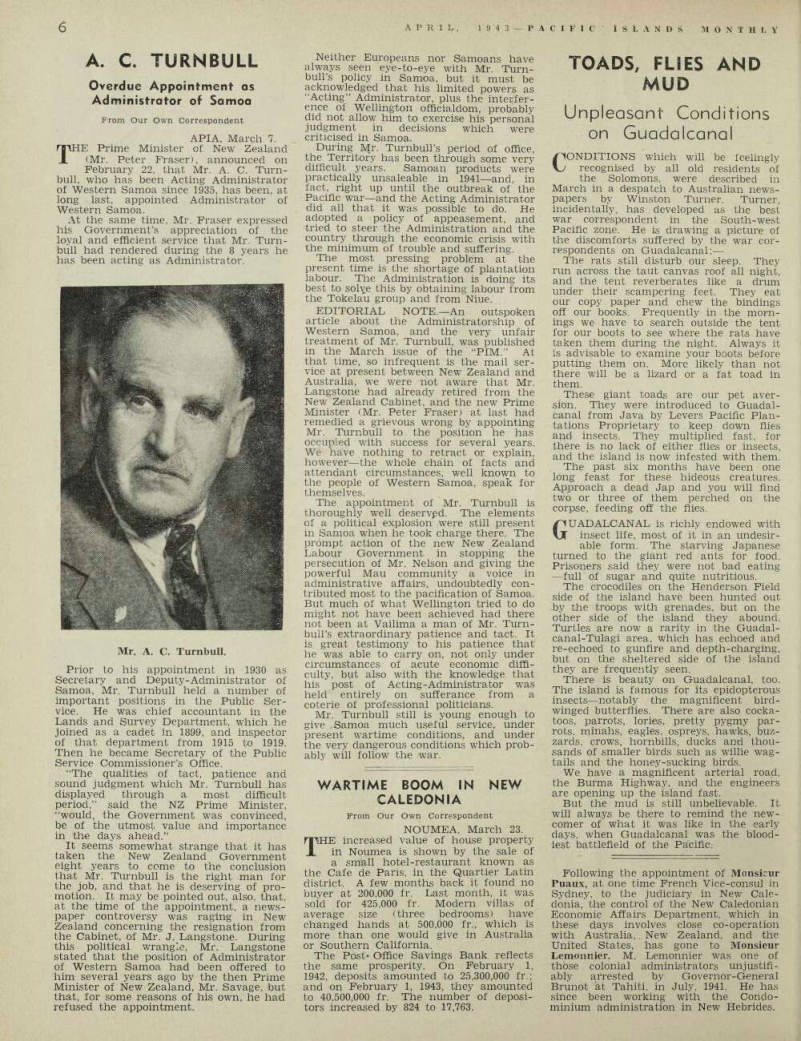
THE Prime Minister of New Zealand (Mr. Peter Fraser), announced on February 22, that Mr. A. C. Turn bull, who has been Acting Administrator of Western Samoa since 1935, has been, at long last, appointed Administrator of Western Samoa.
At the same time, Mr. Fraser expressed his Government’s appreciation of the loyal and efficient service that Mr. Turn bull had rendered during the 8 years he has been acting as Administrator.
Prior to his appointment in 1930 as Secretary and Deputy-Administrator of Samoa, Mr. Turnbull held a number of important positions in the Public Ser vice. He was chief accountant in the Lands and Survey Department, which he joined as a cadet in 1899, and inspector of that department from 1915 to 1919.
Then he became Secretary of the Public Service Commissioner’s Office. ‘‘The qualities of tact, patience and sound judgment which Mr. Turnbull has displayed through a most difficult period,” said the NZ Prime Minister, ‘‘would, the Government was convinced, be of the utmost value and importance in the days ahead.”
It seems somewhat strange that it has taken the New Zealand Government eight years to come to the conclusion that Mr. Turnbull is the right man for the job, and that he is deserving of pro motion. It may be pointed out, also, that, at the time of the appointment, a news paper controversy was raging in New Zealand concerning the resignation from the Cabinet, of Mr. J. Langstone. During this political wrangle, Mr. Langstone stated that the position of Administrator of Western Samoa had been offered to him several years ago by the then Prime Minister of New Zealand, Mr. Savage, but that, for some reasons of his own, he had refused the appointment.
Neither Europeans nor Samoans have always seen eye-to-eye with Mr. Turn bull’s policy in Samoa, but it must be acknowledged that his limited powers as "Acting” Administrator, plus the interfer ence of Wellington officialdom, probably did not allow him to exercise his personal judgment in decisions which were criticised in Samoa.
During Mr. Turnbull’s period of office, the Territory has been through some very difficult years. Samoan products were practically unsaleable in 1941—and, in fact, right up until the outbreak of the Pacific war—and the Acting Administrator did all that it was possible to do. He adopted a policy of appeasement, and tried to steer the Administration and the country through the economic crisis with the minimum of trouble and suffering.
The most pressing problem at the present time is the shortage of plantation labour. The Administration is doing its best to solye this by obtaining labour from the Tokelau group and from Niue.
EDITORIAL NOTE.—An outspoken article about the Administratorship of Western Samoa, and the very unfair treatment of Mr. Turnbull, was published in the March issue of the “PIM.” At that time, so infrequent is the mail ser vice at present between New Zealand and Australia, we were not aware that Mr.
Langstone had already retired from the New Zealand Cabinet, and the new Prime Minister (Mr. Peter Fraser) at last had remedied a grievous wrong by appointing Mr. Turnbull to the position he has occupied with success for several years.
We have nothing to retract or explain, however —the whole chain of facts and attendant circumstances, well known to the people of Western Samoa, speak for themselves.
The appointment of Mr. Turnbull is thoroughly well deserved. The elements of a political explosion were still present in Samoa when he took charge there. The prompt action of the new New Zealand Labour Government in stopping the persecution of Mr. Nelson and giving the powerful Mau community a voice in administrative affairs, undoubtedly con tributed most to the pacification of Samoa.
But much of what Wellington tried to do might not have been achieved had there not been at Vailima a man of Mr. Turn bull’s extraordinary patience and tact. It is great testimony to his patience that he was able to carry on, not only under circumstances of acute economic diffi culty, but also with the knowledge that his post of Acting-Administrator was held entirely on sufferance from a coterie of professional politicians.
Mr. Turnbull still is young enough to give Samoa much useful service, under present wartime conditions, and under the very dangerous conditions which prob ably will follow the war.
Mr. A. C. Turnbull.
Wartime Boom In New
Caledonia
From Our Own Correspondent NOUMEA, March 23.
THE increased value of house property in Noumea is shown by the sale of a small hotel-restaurant known as the Cafe de Paris, in the Quartier Latin district. A few months back it found no buyer at 200,000 fr. Last month, it was sold for 425,000 fr. Modern villas of average size (three bedrooms) have changed hands at 500,000 fr., which is more than one would give in Australia or Southern California.
The Post* Office Savings Bank reflects the same prosperity. On February 1, 1942, deposits amounted to 25,300,000 fr.; and on February 1, 1943, they amounted to 40,500,000 fr. The number of deposi tors increased by 824 to 17,763.
Unpleasant Conditions
Toads, Flies And
Mud
Unpleasant Conditions on Guadalcanal
CONDITIONS which will be feelingly recognised by all old residents of the Solomons, were described in March in a despatch to Australian news papers by Winston Turner. Turner, incidentally, has developed as the best war correspondent in the South-west Pacific zone. He is drawing a picture of the discomforts suffered by the war cor respondents on Guadalcanal:— The rats still disturb our sleep. They run across the taut canvas roof all night, and the tent reverberates like a drum under their scampering feet. They eat our copy paper and chew the bindings off our books. Frequently in the morn ings we have to search outside the tent for our boots to see where the rats have taken them during the night. Always it is advisable to examine your boots before putting them on. More likely than not there will be a lizard or a fat toad in them.
These giant toads are our pet aver sion. They were introduced to Guadal canal from Java by Levers Pacific Plan tations Proprietary to keep down flies and insects. They multiplied fast, for there is no lack of either flies or insects, and the island is now infested with them.
The past six months have been one long feast for these hideous creatures.
Approach a dead Jap and you will find two or three of them perched on the corpse, feeding off the flies.
GUADALCANAL is richly endowed with insect life, most of it in an undesir able form. The starving Japanese turned to the giant red ants for food.
Prisoners said they were not bad eating —full of sugar and quite nutritious.
The crocodiles on the Henderson Field side of the island have been hunted out by the troops with grenades, but on the other side of the island they abound.
Turtles are now a rarity in the Guadal canal-Tulagi area, which has echoed and re-echoed to gunfire and depth-charging, but on the sheltered side of the island they are frequently seen.
There is beauty on Guadalcanal, too.
The island is famous for its epidopterous insects —notably the magnificent bird winged butterflies. There are also cocka toos, parrots, lories, pretty pygmy par rots, minahs, eagles, ospreys, hawks, buz zards, crows, hornbills, ducks and thou sands of smaller birds such as willie wag tails and the honey-sucking birds.
We have a magnificent arterial road, the Burma Highway, and the engineers are opening up the island fast.
But the mud is still unbelievable. It will always be there to remind the new comer of what it was like in the early days, when Guadalcanal was the blood iest battlefield of the Pacific.
Following the appointment of Monsieur Puaux, at one time French Vice-consul in Sydney, to the judiciary in New Cale donia, the control of the New Caledonian Economic Affairs Department, which in these days involves close co-operation with Australia, New Zealand, and the United States, has gone to Monsieur Lemonnier. M. Lemonnier was one of those colonial administrators unjustifi ably arrested by Governor-General Brunot at Tahiti, in July, 1941. He has since been working with the Condo minium administration in New Hebrides.
Makatea Wrecked
German Raiders' Attacks on Phosphate Islands
From Our Own Correspondent NOUMEA, March 23.
FOLLOWING upon the destruction they wrought at the British phosphate island of Nauru. German raiders in December, 1940, smashed the port and phosphate installations at Makatea, the French phosphate island in the Tuamo tou archipelago, it is revealed by Dr. E. de Curton, of Tahiti, in a recent Fight ing French publication.
The doctor, who became Governor when French Oceania rallied to de Gaulle, in 1940, points out that in the first world war Australia and New Zealand drew largely on Makatea atoll for phos phate supplies. The Compagnie Fran caise des Phosphates de I’Oceanie had since installed up-to-date electric plant, a tramway system, giant crushers, rotary driers and “endless chain” loading facili ties, which the Germans in particular destroyed. Production had risen to nearly 200.000 tons annually, valued at over a million dollars.
The doctor writes forcibly of the strategic importance of the French archipelagos to the defence of the Panama route and the American-Aus tralian supply line. He admits that France did not realise the role that an American-British bloc against Japan might give her oceanic possessions. She did not feel directly interested in Pacific
defence problems and therefore kept only a tiny aero-naval force on the spot, and even that was dwindling.
He charges the Allies with having been just as negligent. The USA, in par ticular, he says, took no more pains to organise her Samoa base, and it was only in 1941 that work at Pago Pago was seriously undertaken. He emphasises the importance of French Oceania in rela tion to the protection of the Panama Canal.
Change in Direction of Trade One Result
Trade One Result of American Purchase of Copra
NOUMEA, March 23.
THE New Hebrides Condominium Ad ministration announces that the current price of copra purchased by the United States f.o.b. New Hebrides is 67 dollars per ton (2,814 francs). The grower gets 2,000 francs, which is a decrease of 250 francs since December.
It appears that New Hebrides and New Caledonia, owing to agreement among the United Nations, governing shipment of copra, are unable now to export copra to Australia, although the Commonwealth is short of fats, and the copra is going to America.
One result of the agreement that has been reached is that American wines, liquors and canned goods will probably replace the Australian articles in the New Hebrides and New Caledonia markets.
Pacific Battalion Now In Tunisia
THE French Pacific Battalion, under the orders of General Koenig, which is attached to the British Eighth Army, recently had the distinction of hoisting the French flag over a strong point in Tunisia which it had succeeded in capturing.
Af Q NfflimP!) cere:m<ony m the church in Noumea, in honour of the Battalion’s
dead, a woman, accompanied by two small children, approached and pinned two tri-colour ribbons on the flag. She was Madame Broche, widow of Colonel Felix Broche, gallant leader of the Battalion, who was killed in the Battle of Bir Hakkeim, last year. Madame Broche, and her children, formerly lived in that part of Tunisia which the Pacific Battalion has just entered.
This photograph shows the gallant Colonel Felix Broche (killed at Bir Hakkeim) at a parade of departing New Caledonian troops, in May, 1941. The figures, left to right, are: The Mayor of Noumea; Governor-General Richard Brunot
(whose advent caused an uproar in Tahiti in July-August, 1941); Governor Henri Sautot; Colonel Broche; M. Patzel (Governor Sautot’s Chef de Cabinet). Colonel Broche’s famous dog is, as usual, beside him.
Fiji’S Escape
Japan's Strange Blunder in Early 1942
JT could now be revealed that the Japanese made a blunder, second only to their failure to follow up the Pearl Harbour assault, when they did not attack Fiji early in the Pacific War, said Sir J. Maynard Hedstrom, a leading citizen of Fiji, in an interview with the American United Press (said a radiogram from New York, published in “Sydney Morning Herald” on March 17), New Zealand, he said, had a small, well-trained, but poorly-equipped force in Fiji. It was increased after the beginning of hostilities, but the “real stuff” was a long time coming.
The first air protection provided was five Hudson bombers, sent from New Zealand, when things were blackest. The pilots frankly expected death within a few days or hours.
However, the Japanese inexplicably stopped at the Solomons and the Gilberts, when a few boatloads of soldiers and a warship or two certainly could have taken, and probably held, Fiji, and thrown up a menace to New Zealand and to American supply lines to Australia, making the whole Allied Pacific strategy more difficult.
Even if they were unable to hold the islands, the Japanese could have used a fraction of the men and ships they ex pended on Guadalcanal in destroying docks, warehouses, and other facilities, and making them useless for a military base for many months.
“We were as vulnerable as a whale’s underside.” Sir Maynard Hedstrom added, “but remained unmolested, for which we are too thankful to seek an explanation.
Now we can thumb our noses at the enemy and say: ‘Let them come. Britain and the Yanks are ready.’ ”
Copra Prices—A
Correction
Letter to the Editor THE Executive of the Pacific Territories Association draws attention to an inaccuracy in the report of the general meeting held on March 10. 1943, as appearing on page 10 of your March issue.
Under the sub-heading, “Allowance for Copra,” your report says: “The Associa tion has clear evidence that the Copra Pool had received for copra, in February, 1942, no less than £24/10/- per ton.”
The actual statement by the president, Mr. James, was that although the War Damage Commission had placed a value of £9 10 - per ton on copra held by the Copra Pool, the Association had clear evidence that sales had taken place in Sydney on February 24. 1942, on the basis of £24/12/6 per ton and that the Asso ciation had, therefore, asked the Com mission to reconsider their valuation for insurance purposes. At no time was it stated that the Copra Pool had sold copra at £2410/- per ton.
I am, etc.,
A. M. Adelskold.
Sydney,
29/3/1943.
EDITORIAL NOTE.—We express regret for the error, which made an unfair re flection upon the Copra Pool managers. A full statement about the affairs and finances of the New Guinea Copra Pool is published in another part of this issue.
"Chiselling" War Damage Claims
Little Help Given Papuan Residents
THE three-cornered fight for compen sation for damage suffered as the result of war conditions in Papua is still going on—and is no nearer settle ment.
The people who were evacuated from Papua are looking to the Australian War Damage Commission for compensation for homes, plantations, stores, mines, etc., which have been destroyed or have deteriorated owing to war conditions.
The Commission stubbornly refuses to acknowledge any liability for damage, except damage caused directly by battle operations.
The residents and ex-residents also are demanding from the Army compensation for property seized and either used or consumed; and the Army, on its part, is either refusing to acknowledge any obligation or, where obligation has been established, is invoking all the methods of red tape to delay payment as long as possible. It is now well over a year since civilians were evacuated, and their pro perty taken; but very few of them have received any payments for their property.
There were so many of these claims for compensation that the Common wealth Government appointed an Ade laide lawyer, Mr. Harry Alderman, to investigate and report upon them; and Mr. Alderman has spent many, many months upon this task, in Darwin and Port Moresby.
Territories people who were complain ing of Government indifference to their troubles were informed of Mr. Alderman’s appointment, and assured that every thing now would be all right; Mr.
Alderman would see that justice was done.
To show what can be expected from Mr. Alderman, we take the liberty of printing hereunder a private letter, writ ten in February by Mr. Alderman to a friend, in which he refers to claims for rental, etc., made by a Port Moresby man:— “I had a look at ’s premises, which are in very excellent condition, as one would expect from the fact that they are occupied by the Navy.
“It is my intention to recommend to the Government that, in an evacuated area, no rental should be paid. If the Defence Forces did not occupy the pre mises. the owner could not let them to anyone else in an evacuated area. They would, therefore, deteriorate rapidly. It it an advantage, so it seems to me, to have the premises used.
“If the Government accepts my recom mendation—and I think it should —it will certainly give an undertaking that any damage done to the premises will be repaired when evacuation ceases. In
these circumstances, I think an owner definitely gains.
“It is my present intention to buy all the furniture in ’s house, in common with that of every other house in Moresby. We shall not purchase per sonal belongings and things which the Defence Forces would not be likely to use.
“I hold the view that all furniture depreciated substantially as soon as the first bomb dropped. I am afraid that I cannot compensate for that loss. I had a local committee assessing the value from the date when the Defence Forces took possession of it.”
It is clear from this letter that Mr.
Alderman has been given—or has assumed —surprising powers. He, appar ently, is to decide what compensation the unfortunate residents of Port Moresby shall, or shall not, receive. He believes that furniture depreciated when the first bomb dropped; and he is afraid he can not compensate for that loss!
It is most interesting to observe the way in which this fumbling Curtin Gov ernment has shifted its responsibilities onto an unknown Adelaide lawyer, and has left the fortunes of the unlucky Papuan property-owners to his personal whim.
We have been told of many incidents, in which the property of Port Moresby residents has been ruthlessly seized and, in some cases, wantonly destroyed, and all liability for the damage denied. If Mr. Alderman would like details, he may get them from the Pacific Territories Association.
Here is just one, to hand in to-day’s mail. A well-known Port Moresby resi dent received a private letter from a friend in Port, who described the way in which the military first took possession of his house and then, for some reason, destroyed the house and all its contents.
The Port Moresby resident says:— “I have now received a small parcel of old cheque butts, photographs, and Lodge books. They were rescued by another friend of mine before the house was pulled down, but after the looters had been through. I had locked all these things in an iron box before I was eva cuated from Port, using a heavy pad lock. The thing speaks for itself. One would have thought that, even if they had to destroy the house and heavy fur niture, they would have tried to save my personal effects. That little parcel repre sents all I have left of my house and home.”
But Mr. Harry Alderman, no doubt, would argue that the Army is not liable for the payment of any compensation here, and that “the owner definitely gains.”
High Court Promises Relief And Justice
TERRITORIANS, however, may take comfort from the High Court judg ment in the Apple and Pear Board case, to which reference was made on page 10 of the March “PIM.”
The Court made it clear that, no mat ter what award may be made as com pensation for property taken by any of the various bodies set up under Com monwealth authority, the property-owner unquestionably has the right to appeal to the High Court; and the High Court, irrespective of any arbitrary valuation fixed by any petty body or official, will grant to the property-owner the fair value of the property taken.
The Attorney-General (Dr. Evatt)
made a statement in Parliament on March 18. He said that the High Court judgment awaited clarification in certain directions, but he summed up the posi tion thus: — (1) Under the Constitution no property of a citizen can be acquired or requisi tioned except on just terms. (2) The citizen is not necessarily bound by any department or Governmental assessment of compensation. The citi zen has the general right of testing such assessments in the Court. (3) No general rule can be laid down as to the precise measure of compensa tion in each case. Each scheme or each acquisition must be governed by its own
peculiar circumstances. (4) Perhaps the best working rule to be adopted both by departments and by growers or owners is to obtain agreement (in advance if possible) as to compensa tion payable.
As the High Court decision was pri marily concerned with the acquisition of farm products by the Commonwealth Government, the Minister was questioned about its application to other forms of property compulsorily acquired. Would the principle be applicable in the case of leasehold land which was not taken over for the whole term of the lease, but for a period only? asked Mr. Spender.
The Minister: The same general prin ciples apply in the case of fixed property.
THIS appears to give the owners of Territories property an avenue of escape from any unjust decisions by a bureaucrat like Mr. Harry Alderman.
All sorts and conditions of property have been taken over in Papua by the fighting services. Mr. Alderman thinks that, in an evacuated area, no rentals should be paid by the services and that “the value of furniture depreciated sub stantially as soon as the first bomb dropped.”
Fortunately, plain citizens still retain some status under the Commonwealth Constitution, and the High Court is determined that, even under the exigen cies of war, they shall not be deprived of their fundamental rights.
Territorians should keep in close touch with the Pacific Territories Association in relation to all matters connected with compensation for property taken. The Association probably will be prepared to take claims to the High Court, if necessary.
Early Action
Committees to Meet—Need for Early Action
A LIST of War Damage Compensation Committees to deal with Territories claims, and the dates of meetings, will be found on page 37. There are about 2,000 separate claims to be con sidered.
It should be noted that only a small proportion of these claims can hope to succeed while the Australian Govern ment’s present definition of war damage stands.
Territorians should lose no time in urging upon the Commonwealth Gov ernment the need for widening the inter pretation of “war damage,” before these committees settle down seriously to the job of investigating and passing sentence upon the individual claims for compen sation.
Rain And Radio In
Tahiti
PAPEETE, March 1. rR the first time in many years, we in Tahiti are experiencing a normal rainy season—a splendid thing for our agriculturists.
Our isolation here is so complete that the arrival of a ship is an historic occasion.
We listen to the news of the battle fields: but we abruptly shut out the sounds of the political jackals who, in Congress and out, are howling at our great Commander-in-Chief, Mr. Roose velt.
Similar packs of wolves surrounded General Washington, President Lincoln and President Woodrow Wilson. As was said of President Grover Cleveland, we now may say of Mr. Roosevelt: “We love him for the enemies he has made.”
by Officials
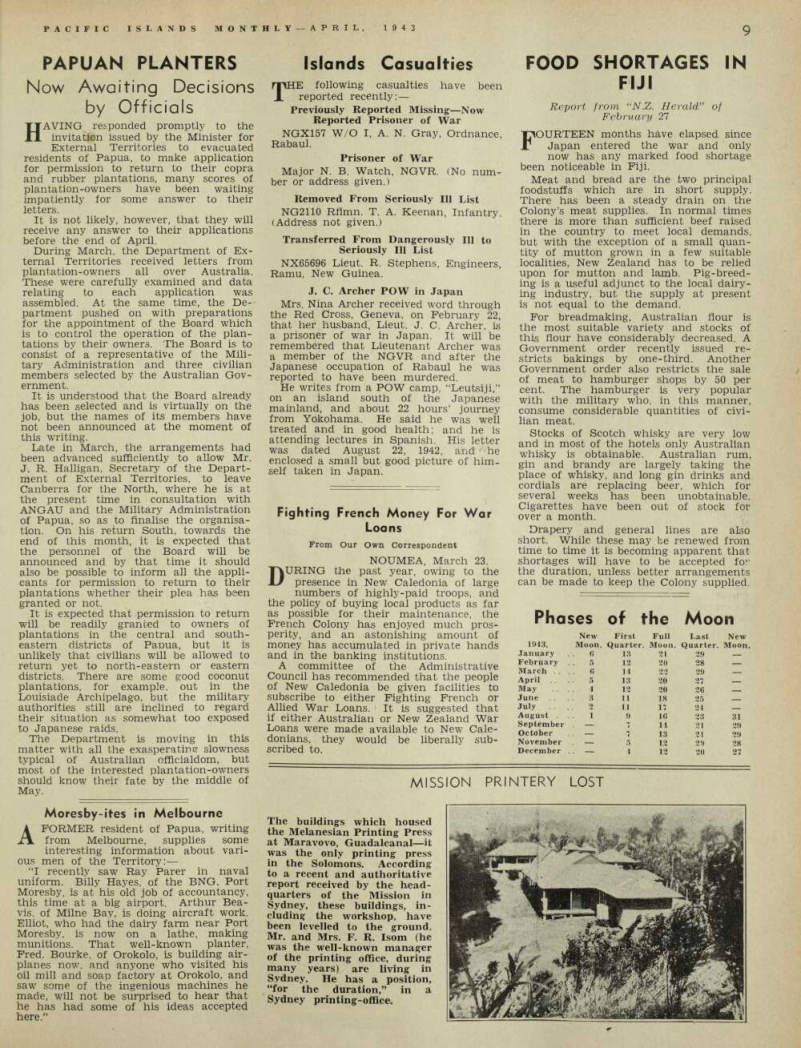
Papuan Planters
Now Awaiting Decisions by Officials
HAVING responded promptly to the invitation issued by the Minister for External Territories to evacuated residents of Papua, to make application for permission to return to their copra and rubber plantations, many scores of plantation-owners have been waiting impatiently for some answer to their letters.
It is not likely, however, that they will receive any answer to their applications before the end of April.
During March, the Department of Ex ternal Territories received letters from plantation-owners all over Australia.
These were carefully examined and data relating to each application was assembled. At the same time, the De partment pushed on with preparations for the appointment of the Board which is to control the operation of the plan tations by their owners. The Board is to consist of a representative of the Mili tary Administration and three civilian members selected by the Australian Gov ernment.
It is understood that the Board already has been selected and is virtually on the job, but the names of its members have not been announced at the moment of this writing.
Late in March, the arrangements had been advanced sufficiently to allow Mr.
J. R. Halligan, Secretary of the Depart ment of External Territories, to leave Canberra for the North, where he is at the present time in consultation with ANGAU and the Military Administration of Papua, so as to finalise the organisa tion. On his return South, towards the end of this month, it is expected that the personnel of the Board will be announced and by that time it should also be possible to inform all the appli cants for permission to return to their plantations whether their plea has been granted or not.
It is expected that permission to return will be readily granted to owners of plantations in the central and south eastern districts of Papua, but it is unlikely that civilians will be allowed to return yet to north-eastern or eastern districts. There are some good coconut plantations, for example, out in the Louisiade Archipelago, but the military authorities still are inclined to regard their situation as somewhat too exposed to Japanese raids.
The Department is moving in this matter with all the exasperating slowness typical of Australian officialdom, but most of the interested plantation-owners should know their fate by the middle of May.
Moresby-ites in Melbourne
A FORMER resident of Papua, writing from Melbourne, supplies some interesting information about vari ous men of the Territory:— “I recently saw Ray Parer in naval uniform. Billy Hayes, of the BNG, Port Moresby, is at his old job of accountancy, this time at a big airport. Arthur Bea vis. of Milne Bay, is doing aircraft work.
Elliot, who had the dairy farm near Port Moresby, is now on a lathe, making munitions. That well-known planter, Fred. Bourke, of Orokolo, is building air planes now. and anyone who visited his oil mill and soap factory at Orokolo, and saw some of the ingenious machines he made, will not be surprised to hear that he has had some of his ideas accepted here.”
Islands Casualties
THE following casualties have been reported recently:— Previously Reported Missing—Now Reported Prisoner of War NGXIS7 W/O I, A. N. Gray, Ordnance, Rabaul.
Prisoner of War Major N. B. Watch, NGVR. (No num ber or address given.) Removed From Seriously 111 List NG2IIO Rflmn. T. A. Keenan, Infantry. (Address not given.) Transferred From Dangerously 111 to Seriously 111 List NX65696 Lieut. R. Stephens, Engineers, Ramu, New Guinea.
J. C. Archer POW in Japan Mrs. Nina Archer received word through the Red Cross, Geneva, on February 22, that her husband, Lieut. J. C. Archer, is a prisoner of war in Japan. It will be remembered that Lieutenant Archer was a member of the NGVR and after the Japanese occupation of Rabaul he was reported to have been murdered.
He writes from a POW camp, “Leutsiji,” on an island south of the Japanese mainland, and about 22 hours’ journey from Yokohama. He said he was well treated and in good health; and he is attending lectures in Spanish. His letter was dated August 22, 1942, and he enclosed a small but good picture of him self taken in Japan.
Fighting French Money For War
Loans
Prom Our Own Correspondent NOUMEA, March 23.
DURING the past year, owing to the presence in New Caledonia of large numbers of highly-paid troops, and the policy of buying local products as far as possible for their maintenance, the French Colony has enjoyed much pros perity, and an astonishing amount of money has accumulated in private hands and in the banking institutions.
A committee of the Administrative Council has recommended that the people of New Caledonia be given facilities to subscribe to either Fighting French or Allied War Loans. It is suggested that if either Australian or New Zealand War Loans were made available to New Cale donians, they would be liberally sub scribed to.
Food Shortages In
Fiji
Report from “N. Z. Herald” of February 27 FOURTEEN months have elapsed since Japan entered the war and only now has any marked food shortage been noticeable in Fiji.
Meat and bread are the two principal foodstuffs which are in short supply.
There has been a steady drain on the Colony’s meat supplies. In normal times there is more than sufficient beef raised in the country to meet local demands, but with the exception of a small quan tity of mutton grown in a few suitable localities, New Zealand has to be relied upon for mutton and lamb. Pig-breed ing is a useful adjunct to the local dairy ing industry, but the supply at present is not equal to the demand.
For breadmaking, Australian flour is the most suitable variety and stocks of this flour have considerably decreased. A Government order recently issued re stricts bakings by one-third. Another Government order also restricts the sale of meat to hamburger shops by 50 per cent. The hamburger is very popular with the military who, in this manner, consume considerable quantities of civi lian meat.
Stocks of Scotch whisky are very low and in most of the hotels only Australian whisky is obtainable. Australian rum, gin and brandy are largely taking the place of whisky, and long gin drinks and cordials are replacing beer, which for several weeks has been unobtainable.
Cigarettes have been out of stock for over a month.
Drapery and general lines are also short. While these may be renewed from time to time it is becoming apparent that shortages will have to be accepted fo?' the duration, unless better arrangements can be made to keep the Colony supplied.
Phases of the Moon
New First Full Last New 1943.
Moon.
Quarter. Moon.
Quarter.
Moon, January 6 13 21 29 February 5 12 20 28 March , . 6 14 22 29 April 5 13 20 27 May 4 12 20 26 June 3 11 18 25 July 2 11 17 24 August 1 9 10 23 31 September — 7 14 21 29 October — 7 13 21 29 November — 3 12 20 28 December — 4 12 20 27
Mission Printery Lost
The buildings which housed the Melanesian Printing Press at Maravovo, Guadalcanal —it was the only printing press in the Solomons. According to a recent and authoritative report received by the head quarters of the Mission in Sydney, these buildings, in cluding the workshop, have been levelled to the ground.
Mr. and Mrs. F. R. Isom (he was the well-known manager of the printing office, during many years) are living in Sydney. He has a position, “for the duration,” in a
Sydney printing-office.
Wartime In America
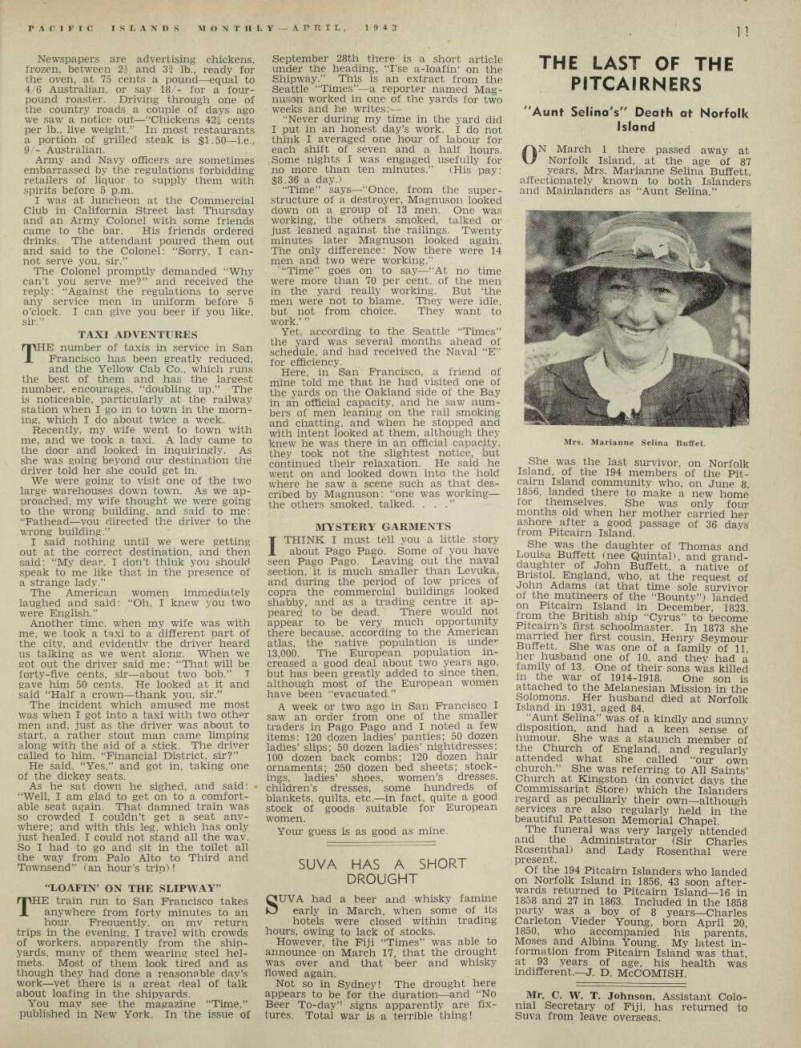
Suva Merchant's Description of How Life Has Changed Over There
THE head of Morris Hedstrom, Ltd., Sir Maynard Hedstrom, of Suva, who was in the United States with Lady Hedstrom when the Pacific war broke out, and trans-Pacific transport disrupted, has settled down in California for the dura tion. He and Lady Hedstrom have an apartment in Palo Alto, about an hour’s run from San Francisco; and already they are experiencing the vast dis locations of civil life entailed by America’s total war mobilisations.
In a most interesting and amusing letter to the editor of the “Pacific Islands Monthly,” Sir Maynard describes war con ditions there —which are not unlike war conditions now in the rest of the Anglo- Saxon world. He says, home deliveries being much restricted, he sometimes is sent out shopping, and returns home, coyly bearing a bag of fruit, a bunch of flowers and a piece of fish for dinner. Pacific Islands readers will be interested in his description of life in wartime America: —
Roosevelt
THERE is a more or less official announcement that the President is prepared to stand for a fourth term.
It is difficult for an outsider to form any opinion as to the probabilities. I have a feeling that the President is making a mistake, and that he should retire at the end of his term content with the fact that he has established a record in American history and not take the chances of a rebuff at the end of his unprecedented third term.
I am not in touch with politicians, and my views must be tinged to some extent by my environment. California is tradi tionally a Republican State, but I do find it extraordinary that amongst all my friends—whether they be business friends or personal friends —whether they be men or women—l do not believe I know one who is a supporter of Roosevelt. I sup pose it would be true to say that prac tically all my friends and acquaintances are in the medium or approaching the higher income brackets, and perhaps if I had the opportunity of talking with the men in the lower brackets I might find different opinions. Of course, to-day the workers in the shipyards, plane factories, etc., can be placed at any rate in the medium income brackets.
I believe that if the President decides to face the electors again he will do so because he honestly believes it is best for the nation that he should remain as leader for the duration of the war. Still, if I were one of his advisers. I would say to him—“ Think of the niche you have carved out in the Hall of Fame—think of the great men who have led this country in peace and in war—and how you have established a record which none of them achieved —three terms President of the United States. Do not run the risk of a rebuff in the closing days of your poli tical career.”
Sugar
WE have been getting a good deal of fun out of rationing. I confess I do not think Washington has handled the position very well.
Sugar was the first item. The ap proach of rationing was officially an nounced in all the papers and over the radio. All who could afford it, and who had storage space, went out and bought sugar in wholesale Quantities.
One story was told about a woman who bought a 100-lb. bag of sugar and asked her husband to put it up in the attic;
and, when he complied, he found a 50-lb. bag which had apparently been stored there since World War I.
Ration books were issued —holders of stocks were ordered to disclose their stocks, and very heavy penalties provided for false declarations. But there was no penalty for hoarding the sugar—only de privation of ration tickets for further supplies until stocks had been used at the rate provided for under the ration scheme.
Coffee was handled in the same way.
Petrol Rationing
THEN came the ration of gas (petrol).
Only in very isolated cases were there attempts to hoard gas—one on a fairly large scale occurred near Los Angeles. In this State the basic, or “A” book was issued to all applicants, and gave them 16 gallons per month; then the people who considered they had a claim for increased ration could apply for “B” or “C” books.
Here, again, there has been a good deal of fun. The man with a“B” or “C” book is supposed to use his gas for the specific purpose which he stated in his appli cation —i.e., conveyance to war work or carrying out essential duties —and he has to be very careful not to use his allowance extravagantly. Already, some scores of people have been charged with using their gas to go to race meetings.
One resident of San Francisco —a war worker—was recently caught near Fresno (187 miles from San Francisco) and charged with being too far away from home. He was fined, his ration book taken away from him, and he was told he would not be issued another book until July 27th.
Also, the police have been very watch ful for speeding, and the charges have run into hundreds. The limit is now fixed at 35 m.p.h., and I should think in and around San Francisco 200 or 300 people have lost their ration books for excessive speeds.
As far as using gas is concerned, so long as the man with the “A” book does not drive at excessive speed, the authori ties do not appear to interfere with him.
I think the idea is this —he was issued the 16 gallons as a basic ration for use at his own discretion (within the speed limits), whereas the people with “B” and “C” books had claimed that they needed extra gas for public or essential services.
Then came the announcement over night rationing shoes. It is what I think would appear to most men a very liberal ration —not more than four pairs per annum, exclusive of slippers—but some women are already complaining.
Hoarders
THEN, the forthcoming rationing of certain canned goods was announced.
Last week was the period for pro curing ration book $2, during which time the canned goods to be rationed were “frozen.” Ration book t 1 is used for sugar, coffee and shoes, and ration book V 2 is to be used for a considerable number of items of canned goods.
Here, again, there was no restriction on buying—no penalty for hoarding—and the “wise” bought in wholesale lots, through brokers or commission agents. From the Eastern States several large hoards were announced —one woman declared over 4,000 cans, and the papers worked out that she would not receive a ration book for forty-one years. Still, she had the goods, most of them will keep well, and
at the expenditure of a comparatively small amount (from a capitalist’s point of view) she was provided with her re quirements in canned goods without the constant trouble of going to the grocer, taking the book, selecting the goods, working out the point values, and allow ing the grocer to tear the tickets out of the book.
One man in the East declared 1,800 cans, but explained that he had ten children and had been in the habit for years of buying in case lots.
I think if I had really understood the position I would, in a small way, have followed the example of these capitalists and bought canned goods sufficient to last us for, say, twelve months. It is perfectly legal and no offence—unless one makes a false declaration.
As it is, we were amongst the small fish. We are allowed five cans each and declared the balance. We declared our stock of 31 cans—the monthly allowance is 48 points each—and the issuing authori ties took 128 points out of my book and 120 points out of my wife’s book—i.e., eight points for each can we had on hand. They spread this over three months. In those three months we had a right to draw a total of 288 points, but from this they deducted 248 points, leaving us 40 points for three months— which will buy us two cans of fruit and one can of soup.
I am inclined not to agree that the way of the transgressor is hard and can only acclaim the wisdom of those who laid in moderate stocks—say, sufficient for a year.
WEEKS ago, rationing of butter was threatened and, for a while, there was a butter famine in San Fran cisco and neighbouring towns because families had bought up all supplies. A newspaper reporter followed one woman.
She bought a pound there, two at another place, three or four at a third, and finally got seven pounds in one lot. The reporter asked her why she was buying in such large quantities, and she said: “Well, I have a family to keep and I want to get something before the hoarders get started.”
Just now, there are rumours of clothes rationing. The authorities firmly deny that there is any immediate need for rationing, and say that the only thing that can bring clothes rationing into ef fect is excessive buying by people who can afford to do so. Consequently, a large percentage of the people who can afford to do so are rushing the stores.
A friend of ours, hearing the rumour, and being an exile from her home, made a special trip in to San Francisco last week, took her two daughters with her and in her own words “spent the whole day buying—making provision for the future.” At one of the stores the sales woman told her she had just served a San Francisco woman who had bought six coats and four suits —probably she had already bought all the stockings and lin gerie she thought necessary for a long siege. I think the women of this State have sufficient money to buy up most of the stocks offering, and then we will have rationing, and those who have not been able to buy so far ahead will be rationed.
PRICES of meat have advanced. In the plainer class of restaurant in this part of the world you can still get a slice of beef with a small supply of vege tables. It is astonishing how meagre a supply of vegetables—particularly green vegetables—is given at the restaurants and hotels, in comparison with the slice of beef they used to serve in pre-war times. Americans do not slice their beef thin as Englishmen do —an American generally likes a slice about half an inch thick.
Newspapers are advertising chickens, frozen, between 2h and 33 lb., ready for the oven, at 75 cents a pound—equal to 4 6 Australian, or say 18/- for a four pound roaster. Driving through one of the country roads a couole of days ago we saw a notice out—“ Chickens 42* cents per lb., live weight.” In most restaurants a portion of grilled steak is $1.50—i.e., 9 - Australian.
Army and Navy officers are sometimes embarrassed by the regulations forbidding retailers of liquor to supply them with spirits before 5 p.m.
I was at luncheon at the Commercial Club in California Street last Thursday and an Army Colonel with some friends came to the bar. His friends ordered drinks. The attendant poured them out and said to the Colonel: “Sorry, I can not serve you, sir.”
The Colonel promptly demanded “Why can’t you serve me?” and received the reply: “Against the regulations to serve any service men in uniform before 5 o’clock. I can give you beer if you like, sir.”
Taxi Adventures
THE number of taxis in service in San Francisco has been greatly reduced, and the Yellow Cab Co., which runs the best of them and has the largest number, encourages, “doubling up.” The is noticeable, particularly at the railway station when I go in to town in the morn ing. which I do about twice a week.
Recently, my wife went to town with me, and we took a taxi. A lady came to the door and looked in inquiringly. As she was going beyond our destination the driver told her she could get in.
We were going to visit one of the two large warehouses down town. As we ap proached, my wife thought we were going to the wrong building, and said to me; “Fathead —you directed the driver to the wrong building.”
I said nothing until we were getting out at the correct destination, and then said: “My dear. I don’t think you should speak to me like that in the presence of a strange lady.”
The American women immediately laughed and said: “Oh, I knew you two were English.”
Another time, when my wife was with me, we took a taxi to a different part of the city, and evidently the driver heard us talking as we went along. When we got out the driver said me: “That will be forty-five cents, sir—about two bob.” I gave him 50 cents. He looked at it and said “Half a crown—thank you, sir.”
The incident which amused me most was when I got into a taxi with two other men and, just as the driver was about to start, a rather stout man came limping along with the aid of a stick. The driver called to him. “Financial District, sir?”
He said. “Yes,” and got in, taking one of the dickey seats.
As he sat down he sighed, and said: “Well, I am glad to get on to a comfort able seat again. That damned train was so crowded I couldn’t get a seat any where; and with this leg. which has only just healed. I could not stand all the way.
So I had to go and sit in the toilet all the way from Palo Alto to Third and Townsend” (an hour’s trip)!
“Loafin’ On The Slipway”
THE train run to San Francisco takes anywhere from forty minutes to an hour. Freauently. on my return trips in the evening, I travel with crowds of workers, apparently from the ship yards, many of them wearing steel hel mets. Most of them look tired and as though they had done a reasonable day’s work—vet there is a great deal of talk about loafing in the shipyards.
You may see the magazine “Time,” published in New York. In the issue of
September 28th there is a short article under the heading, “I’se a-loafin’ on the Shipway.” This is an extract from the Seattle “Times” —a reporter named Mag nuson worked in one of the yards for two weeks and he writes: — “Never during my time in the yard did I put in an honest day’s work. I do not think I averaged one hour of labour for each shift of seven and a half hours.
Some nights I was engaged usefully for no more than ten minutes,” (His pay: $8.36 a day.) “Time” says—“ Once, from the super structure of a destroyer, Magnuson looked down on a group of 13 men. One was working, the others smoked, talked or just leaned against the railings. Twenty minutes later Magnuson looked again.
The only difference: Now there were 14 men and two were working.”
“Time” goes on to say—“At no time were more than 70 per cent, of the men in the yard really working. But ‘the men were not to blame. They were idle, but not from choice. They want to work.’ ”
Yet, according to the Seattle “Times” the yard was several months ahead of schedule, and had received the Naval “E” for efficiency.
Here, in San Francisco, a friend of mine told me that he had visited one of the yards on the Oakland side of the Bay in an official capacity, and he saw num bers of men leaning on the rail smoking and chatting, and when he stopped and with intent looked at them, although they knew he was there in an official capacity, they took not the slightest notice, but continued their relaxation. He said he went on and looked down into the hold where he saw a scene such as that des cribed by Magnuson: “one was working— the others smoked, talked. ...”
Mystery Garments
I THINK I must tell you a little story about Pago Pago. Some of you have seen Pago Pago. Leaving out the naval section, it is much smaller than Levuka, and during the period of low prices of copra the commercial buildings looked shabby, and as a trading centre it ap peared to be dead. There would not appear to be very much opportunity there because, according to the American atlas, the native population is under 13,000. The European population in creased a good deal about two years ago, but has been greatly added to since then, although most of the European women have been “evacuated.”
A week or two ago in San Francisco I saw an order from one of the smaller traders in Pago Pago and I noted a few items: 120 dozen ladies’ panties; 50 dozen ladies’ slips; 50 dozen ladies’ nightdresses; 100 dozen back combs; 120 dozen hair ornaments; 250 dozen bed sheets; stock ings, ladies’ shoes, women’s dresses, children’s dresses, some hundreds of blankets, quilts, etc. —in fact, quite a good stock of goods suitable for European women.
Your guess is as good as mine.
Suva Has A Short
Drought
SUVA had a beer and whisky famine early in March, when some of its hotels were closed within trading hours, owing to lack of stocks.
However, the Fiji “Times” was able to announce on March 17, that the drought was over and that beer and whisky flowed again.
Not so in Sydney! The drought here appears to be for the duration —and “No Beer To-day’ ? signs apparently are fix tures. Total war is a terrible thing!
Pitcairners
The Last Of The
"Aunt Selina's" Death at Norfolk Island
ON March 1 there passed away at Norfolk Island, at the age of 87 years, Mrs. Marianne Selina Buffett, affectionately known to both Islanders and Mainlanders as “Aunt Selina,”
She was the last survivor, on Norfolk Island, of the 194 members of the Pit cairn Island community who, on June 8, 1856, landed there to make a new home for themselves. She was only four months old when her mother carried her ashore after a good passage of 36 days from Pitcairn Island.
She was the daughter of Thomas and Louisa Buffett (nee Quintal), and grand daughter of John Buffett, a native of Bristol, England, who, at the request of John Adams (at that time sole survivor of the mutineers of the “Bounty”) landed on Pitcairn Island in December, 1823 from the British ship “Cyrus” to become Pitcairn’s first schoolmaster. In 1873 she married her first cousin, Henry Seymour Buffett. She was one of a family of 11 her husband one of 10, and they had a family of 13. One of their sons was killed in the war of 1914-1918. One son is attached to the Melanesian Mission in the Solomons. Her husband died at Norfolk Island in 1981, aged 84.
“Aunt Selina” was of a kindly and sunny disposition, and had a keen sense of humour. She was a staunch member of the Church of England, and regularly attended what she called “our own church.” She was referring to All Saints’
Church at Kingston (in convict days the Commissariat Store) which the Islanders regard as peculiarly their own—although services are also regularly held in the beautiful Patteson Memorial Chapel.
The funeral was very largely attended and the Administrator (Sir Charles Rosenthal) and Lady Rosenthal were present.
Of the 194 Pitcairn Islanders who landed on Norfolk Island in 1856, 43 soon after wards returned to Pitcairn Island—l 6 in 1858 and 27 in 1863. Included in the 1858 party was a boy of 8 years—Charles Carleton Vieder Young, born April 20, 1850, who accompanied his parents, Moses and Albina Young. My latest in formation from Pitcairn Island was that, at 93 years of age, his health was
indifferent.
J. D. Mccomish.
Mr. C, W. T. Johnson, Assistant Colo nial Secretary of Fiji, has returned to Suva from leave overseas.
Mrs. Marianne Selina Buffet.
L. J, Stokie
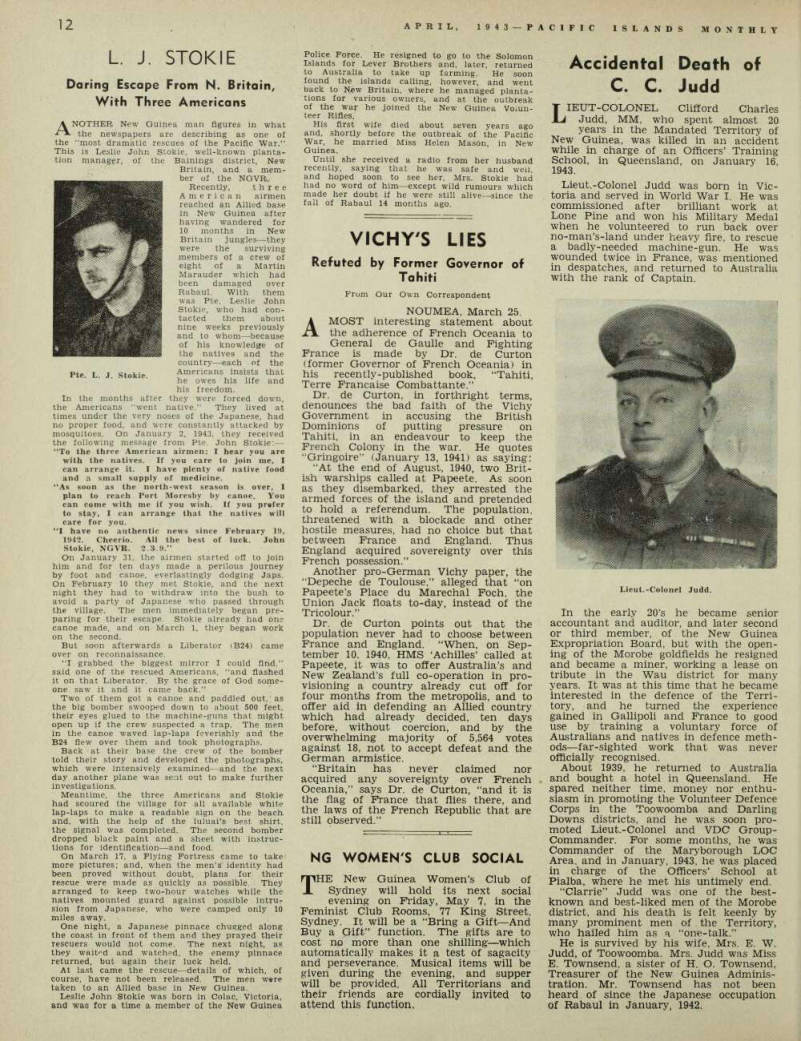
Daring Escape From N. Britain, With Three Americans
ANOTHER New Guinea man figures in what the newspapers are describing as one of the “most dramatic rescues of the Pacific War.”
This is Leslie John Stokie, well-known planta tion manager, of the Bainings district, New
Britain, and a mem ber of the NGVR.
Recently, three American airmen reached an Allied base in New Guinea after having wandered for 10 months in New Britain jungles—they were the surviving members of a crew of eight of a Martin Marauder which had been damaged over Rabaul. With them was Pte. Leslie John Stokie, who had con tacted them about nine weeks previously and to whom —because of his knowledge of the natives and the country—each of the Americans insists that he owes his life and his freedom.
In the months after they were forced down, the Americans “went native.” They lived at times under the very noses of the Japanese, had no proper food, and were constantly attacked by mosquitoes. On January 2, 1943, they received the following message from Pte. John Stokie;— “To the three American airmen: I hear you are with the natives. If you care to join me, I can arrange it. I have plenty of native food and a small supply of medicine.
“As soon as the north-west season is over, I plan to reach Port Moresby by canoe. You can come with me if you wish. If you prefer to stay, I can arrange that the natives will care for you.
“I have no authentic news since February 19, 194?. Cheerio. All the best of luck. John Stokie, NGVR. 2.3.9.”
On January 31, the airmen started off to join him and for ten days made a perilous journey by foot and canoe, everlastingly dodging Japs.
On February 10 they met Stokie, and the next night they had to withdraw into the bush to avoid a party of Japanese who passed through the village. The men immediately began pre paring for their escape. Stokie already had one canoe made, and on March 1, they began work on the second.
But soon afterwards a Liberator < 824) came over on reconnaissance.
“I grabbed the biggest mirror I could find,” said one of the rescued Americans, “and flashed it on that Liberator. By the grace of God some one saw it and it came back.”
Two of them got a canoe and paddled out, as the big bomber swooped down to about 500 feet, their eyes glued to the machine-guns that might open up if the crew suspected a trap. The men in the canoe waved lap-laps feverishly and the 824 flew over them and took photographs.
Back at their base the crew of the bomber told their story and developed the photographs, which were intensively examined—and the next day another plane was sent out to make further investigations.
Meantime, the three Americans and Stokie had scoured the village for all available white lap-laps to make a readable sign on the beach and, with the help of the luluai’s best shirt, the signal was completed. The second bomber dropped black paint and a sheet with instruc tions for identification —and food.
On March 17, a Flying Fortress came to take more pictures: and, when the men’s identity had been proved without doubt, plans for their rescue were made as quickly as possible. They arranged to keep two-hour watches while the natives mounted guard against possible intru sion from Japanese, who were camped only 10 miles away.
One night, a Japanese pinnace chugged along the coast in front of them and they prayed their rescuers would not come. The next night, as they waited and watched, the enemy pinnace returned, but again their luck held.
At last came the rescue—details of which, of course, have not been released. The men were taken to an Allied base in New Guinea.
Leslie John Stokie was born in Colac, Victoria, and was for a time a member of the New Guinea
Police Force. He resigned to go to the Solomon Islands for Lever Brothers and, later, returned to Australia to take up farming. He soon found the islands calling, however, and went back to New Britain, where he managed planta tions for various owners, and at the outbreak of the war he joined the New Guinea Volun teer Rifles.
His first wife died about seven years ago and, shortly before the outbreak of the Pacific War, he married Miss Helen Mason, in New Guinea.
Until she received a radio from her husband recently, saying that he was safe and well, and hoped soon to see her, Mrs. Stokie had had no word of him —except wild rumours which made her doubt if he were still alive—since the fall of Rabaul 14 months ago.
Pte. L. J. Stokie.
Vichy's Lies
Refuted by Former Governor of Tahiti
From Our Own Correspondent NOUMEA, March 25.
A MOST interesting statement about the adherence of French Oceania to General de Gaulle and Fighting France is made by Dr. de Curton (former Governor of French Oceania) in his recently-published book, “Tahiti, Terre Francaise Combattante.”
Dr. de Curton, in forthright terms, denounces the bad faith of the Vichy Government in accusing the British Dominions of putting pressure on Tahiti, in an endeavour to keep the French Colony in the war. He quotes “Gringoire” (January 13, 1941) as saying: “At the end of August, 1940, two Brit ish warships called at Papeete. As soon as they disembarked, they arrested the armed forces of the island and pretended to hold a referendum. The population, threatened with a blockade and other hostile measures, had no choice but that between France and England. Thus England acquired sovereignty over this French possession.”
Another pro-German Vichy paper, the “Depeche de Toulouse,” alleged that “on Papeete’s Place du Marechal Foch, the Union Jack floats to-day, instead of the Tricolour.”
Dr. de Curton points out that the population never had to choose between France and England. “When, on Sep tember 10. 1940, HMS ‘Achilles’ called at Papeete, it was to offer Australia’s and New Zealand’s full co-operation in pro visioning a country already cut off for four months from the metropolis, and to offer aid in defending an Allied country which had already decided, ten days before, without coercion, and by the overwhelming majority of 5,564 votes against 18, not to accept defeat and the German armistice.
“Britain has never claimed nor acquired any sovereignty over French Oceania,” says Dr. de Curton, “and it is the flag of France that flies there, and the laws of the French Republic that are still observed.”
Ng Women's Club Social
THE New Guinea Women’s Club of Sydney will hold its next social evening on Friday, May 7, in the Feminist Club Rooms, 77 King Street, Sydney. It will be a “Bring a Gift—And Buy a Gift” function. The gifts are to cost no more than one shilling—which automatically makes it a test of sagacity and perseverance. Musical items will be given during the evening, and supper will be provided. All Territorians and their friends are cordially invited to attend this function.
Accidental Death of C
C. C. Judd
LIEUT-COLONEL Clifford Charles Judd, MM, who spent almost 20 years in the Mandated Territory of New Guinea, was killed in an accident while in charge of an Officers’ Training School, in Queensland, on January 16, 1943.
Lieut.-Colonel Judd was born in Vic toria and served in World War I. He was commissioned after brilliant work at Lone Pine and won his Military Medal when he volunteered to run back over no-man’s-land under heavy fire, to rescue a badly-needed machine-gun. He was wounded twice in France, was mentioned in despatches, and returned to Australia with the rank of Captain.
In the early 20’s he became senior accountant and auditor, and later second or third member, of the New Guinea Expropriation Board, but with the open ing of the Morobe goldfields he resigned and became a miner, working a lease on tribute in the Wau district for many years. It was at this time that he became interested in the defence of the Terri tory, and he turned the experience gained in Gallipoli and France to good use by training a voluntary force of Australians and natives in defence meth ods —far-sighted work that was never officially recognised.
About 1939, he returned to Australia and bought a hotel in Queensland. He spared neither time, money nor enthu siasm in promoting the Volunteer Defence Corps in the Toowoomba and Darling Downs districts, and he was soon pro moted Lieut.-Colonel and VDC Group- Commander. For some months, he was Commander of the Maryborough LOG Area, and in January, 1943, he was placed in charge of the Officers’ School at Pialba, where he met his untimely end.
“Clarrie” Judd was one of the best known and best-liked men of the Morobe district, and his death is felt keenly by many prominent men of the Territory, who hailed him as a “one-talk.”
He is survived by his wife, Mrs. E. W.
Judd, of Toowoomba. Mrs. Judd was Miss E. Townsend, a sister of H. O. Townsend, Treasurer of the New Guinea Adminis tration. Mr. Townsend has not been heard of since the Japanese occupation of Rabaul in January, 1942.
Lieut.-Colonel Judd.
Advertisements & other items, p. 14 (1 item)
12
APRIL, 1943 P ACIFIC ISLANDS MONTHLY
Westward Through The Louisiades
How Planters Got Away When Invasion Threatened
AS soon os the Japanese struck at New Guinea, in January, 1942, all European residents were evacuated from the endangered Territories.
Here is an account of how a section of the people who lived in the , ..,Aii / r r. t . i. . . ...
Louisiade Archipelago (Eastern Papua) got away. It has been written by Mr. D. H. Osborne, an old resident of Rossel Island (most easterly of thp Arrhinplano) whprp hp wn? n nlnntpr nnd trndpr me /Arcnipeiago;, wnere ne was a planter ana tracer.
1 HEARD of Japan’s entry into the war and the evacuation from the Terri tories of the women and children, through my teleradio set.
I had made a trip to Samarai early in January—apart from all the women and children having gone, there was little difference there. Several young men were leaving to enlist. No one seemed to regard the situation seriously.
On January 22, about 4 p.m., at my home on Rossel Island, I heard Port Moresby calling Rabaul. There was no answer. Early next morning I picked up a warning from Port Moresby. It read: “Calling all out-stations. Situation seri ous. Stand by your sets. Abandon all work and keep a sharp lookout.”
During that day (January 23) I heard warnings from stations in the Mandated Territory and'in the Solomons. The fol lowing day there were no official mes sages.
Early on January 25, Port Moresby said they had nothing to report. At 10 a.m., I switched on again and heard Samarai calling Dobu Passage and asking that anyone in touch with Mr. George Munt should advise him to return to Woodlark Island and bring in all white residents to Samarai, without delay.
Then Samarai sent messages to all stations, some official, some private, advising all whites to proceed to Samarai.
I did not hear that Kitavo, in the Tro briands, had been bombed by a Jap plane, A message to me was the last to come over: “Total evacuation. Pick up Tom Craig, Harry Pierce and any other white men in your locality and hasten to Samarai. (Signed) Woodward.”
IT came as a surprise, but the only thing was to obey the order. Being Sun day, most of the work-boys and boat’s crew were away at their homes. I called up the boys who were handy and explained that I must leave them. I paid off all boys who were near during the afternoon.
In the morning, the remainder of the boys arrived and I paid them off. I asked them to take care of my dwelling house, and small launch and dinghy. I told them to kill any cattle they wished, and to take the poultry to their villages.
I thought the cattle, if left there, would
be good bait for the Japs, as they would be visible from the air.
My boat’s crew loaded 14 bags of copra, as ballast. I took my clothes, and £2O in cash. The goods in the store I gave to the boys.
At 11 a.m. we left Evalati, and called at Bamba, 12 miles further west, and paid off boys who were working there. I set sail at 2 p.m., and bade farewell to my home, and to the island where I had spent so many years of joy and pain.
I hurried away, because the natives were crying around me. One grows attached to people, after living among them for years. I always have had a warm spot in my heart for the Fuzzy- Wuzzies (as they have recently been called).
WE soon left Rossel Island astern and we arrived at Sudest by sundown and anchored at Rambosa. Tom Craig was anchored at ah anchorage
inside the barrier reef, and we did not see his boat until after we had gone past the passage. Craig and Pierce had not been listening to the news and were quite ignorant of the situation.
Craig sent a note across to me asking if I could delay an hour or so next morning and take some of his cargo of gum. His boat would be over, while he proceeded to Griffen Point, about 20 miles distant. Craig was buying gum around Sudest, and I used to take his and Moffat’s gum to Samarai. When Craig saw my boat passing he imagined I was ill, and on my way to Samarai.
I sent a note to him explaining the situation and urging him to hurry. I said I would go at once to Griffen Point, and wait there for them both—l would send for Harry Pierce, who was working gold at the Four Mile with a pumping plant.
When we all met at Griffen Point, they were inclined to doubt my information,
imagining that I was getting jittery.
Pierce said: “I am staying here. The war will be over in six months. What a hell of a hiding the Japs will get!”
I remained at Griffen Point, while Tom Craig gathered up his indentured labourers—they came from near Samarai. He also brought along six tons of gum. I advised him to leave it at Griffen Point.
It went up in smoke, in Samarai, afterwards, along with my ton of copra.
Early next morning we said farewell to Harry Pierce, and sailed. Nothing has been heard of Pierce since.
WE anchored at Moturina at sundown.
After anchoring, we heard a plane overhead, high in the clouds. Natives said that it previously had passed over, flying low, going towards Misima. We heard afterwards that it was a Jap.
A Sudest boy came on board our boat with a letter to Tom Craig, from R. B.
Moffat. The boy had been in Misima with Moffat/ and had been landed on
Moturina, to return to Sudest by canoe A number of canoes were going to Sudest for sago, as the drought had wiped out all the gardens along the Calvados Chain.
Moffat wrote; “I am sailing direct to Cairns, with six white men from Misima There were only five white men on Misima when we left. Others left by the available boats for Queensland.”
We remained at anchor all night and sailed at daybreak. We anchored in the Conflict group and filled our water-tank at the old station. Although it had been deserted for eighteen months, the house had not been looted. There were seven hurricane lamps and two boilers in a room there, and these are items the natives love. Many boats had called there for water, when passing, 11 JE sailed before sundown, and arrived ▼ ? in Samarai atr7 a.m. on January 30.
Five boats were just leaving for Port Moresby when we anchored. Several
other boats were anchored—their crews had deserted.
What a sad sight when we landed!
Only about 20 white men now remained, and a few native prisoners were working about the town. Most of the native police were gone. The stores had been looted, and, in the hotels, furniture had been broken up and mattresses torn and scat tered all over the bedrooms.
Several native prisoners were cooking food at the Cosmopolitan Hotel, and all the whites were having their meals there. The head cook was a man who had twice been convicted of murder and sentenced to death.
During the day we discharged our gum and copra, and stowed it in the store on the wharf.
About 8 a.m., a boat arrived from Kieta, in the Northern Solomons, with fifteen men on board. Their bedding was laid out from stem to stern, and they had been about seven days on the trip.
They stayed four hours in Samarai, got some food and fuel and moved on for Port Moresby.
I offered to return to Sudest Island, to pick up some Goodenough Island boys who were stranded there. No one knew what to do. There was lack of leaders, lack of organisation, and lack of trans port. The wireless station had closed and all the equipment had gone, also the Bank. Mack Rich had a tele-radio installed in a bough shed. The Japs had often photographed and sketched the Samarai radio station, so it was risky to remain anywhere near there. I handed over the tele-radio I had had on Rossel —it was in good order—so they were well supplied.
Different orders were being issued every few hours—some coming from Port Moresby, and some being local, ABOUT SO Rossel natives, who had been working in and about Samarai, had gone bush on Sariba. When they heard that the Rossel boat (mine) had arrived they quickly came on board. My trouble was to know what to do with the boat—all the crew were Rossel Islanders.
I could not take it to Port Moresby and leave the crew stranded. It was my duty to stand by the Rossel natives and see that they got a reasonably fair deal.
Fuel was getting low, as a number of beats from Rabaul were taking away fuel; and food was getting low, also.
On Friday night, Tom Craig and I slept on board the boat and several times we heard planes overhead. On Saturday forenoon, a Jap four-engined flying-boat spent 30 minutes circling over Samarai, at a great altitude, and then it came low—one time, it appeared to be going to land.
A 30-foot launch arrived from Rabaul with six white men on board. They had sneaked out of Rabaul as the Jap trans ports were moving in. They had rescued some airmen who were stranded on a reef near Rabaul, and had landed them where a flying-boat could pick them up.
As the launch arrived in Samarai, the Jap plane was overhead.
The RM was in charge. After the Japs arrived, he moved across to the main land, and the Collector of Customs took
charge. The latter asked me to allow him to make use of my boat to move some fuel, belonging to the RAAF, from Sama rai to the mainland. He promised that the Rossel boys would later be given enough fuel and food to enable them to return to Rossel.
Jack Gilmore, of Rabaul, owned the launch from Rabaul, and he offered Ivan Champion, Tom Craig and me a passage to Moresby. The Collector of Customs advised me to go with them.
AT 5 p.m. on January 31, 1942, we left Samarai —nine of us in a 30-feet launch. It was bright moonlight.
At 2 a.m. we anchored near Suau. We sailed again at daybreak, and by noon we were in heavy weather, so we ran into a sheltered anchorage and anchored for the night. We heard planes.
We set sail about 7 a.m., but discoloured water delayed us until the sun was bright. Off Port Glasgow a plane passed us, and we felt rather “windy” until we recognised it as a British bomber.
At noon on February 2 we anchored at Magoba. The Rev. Mr. Gilkinson was there, laid up with blackwater fever.
Although he was unable to leave his bed he invited us on shore to afternoon tea and to dinner in the evening. Ivan Champion tried to persuade him to come to Port Moresby for medical attention, but he considered that he was recover ing. We spent a pleasant afternoon, and the natives cooked us a good meal. It was with deep regret, a few days after arriving at Port Moresby, that we heard of our host’s death.
The following day (February 3) we arrived at Abau. Ivan Champion sent a teleradio to Port Moresby advising that the Rev. Mr. Gilkinson be moved to Port Moresby. At Abau we were entertained by Messrs. Lambden and O’Connor, and we spent a pleasant evening. They pro vided us with mosquito nets, and we had a good sleep in the rest-house down on the wharf. Mosquitos were in myriads at all our anchorages, and it was quite impossible to erect mosquito nets for nine on a 30-feet launch.
On the following day (February 4) we encountered a short choppy sea and rips, and we made only two miles an hour during the day; but we anchored in* a calm anchorage for the night.
Next day’s run was uneventful, and we anchored at dusk at Kapakapa. After dark a dinghy hailed us: “Put your lights out!” A half-caste came alongside, and reported that Port Moresby had been bombed, and that many had been killed.
The half-caste had taken a dinghy and had not stopped going—he said he could still hear the guns and he was going even further! We could not hear any reports of guns.
From Kapakapa we had to keep out side the reef, and the weather was beginning to look angry. Ivan Champion was navigator, and he was familiar with the reef. Near the old “Pruth” wreck a heavy squall struck us. Our launch had a very reliable engine, and it plugged away all the while.
WE arrived in Port Moresby about 3 p.m. on February 6. Port Moresby had been twice bombed. The dam age to the town was visible from the harbour. After spending a couple of hours there we moved across the harbour and anchored.
Next morning we returned to the town and officially reported. I offered to join the Army, but I was too old. We were told that in the afternoon we would receive rations and go out to the evacua tion camp. Gilmore and some others were going on westwards. Tom Craig and I were together.
I said: “I have not had any breakfast —where can I get something to eat?”
The Magistrate (Mr. Humphries) said that the hotel manager was looking for someone to help in the kitchen. He took Tom and me over and introduced us. For the next ten days I helped to wash up, and so I got some food and, when I was leaving, I received £2/10/10/-.
At Port Moresby every morning during that February, the evacuees would par ade to hear officialdom’s latest. The statement would be; “To-morrow, a steamer (or planes) will come and will land you at Cairns or Townsville—the sick and the oldest to be taken first.”
The officials were awaiting instructions from Melbourne. A few were being sent out each day by air—mostly Government officials.
At last, one morning, about 8 a.m., the “Malaita” arrived and no less than 320 evacuees embarked. A Jap plane came over the harbour about noon, but our
Ack-Ack guns opened up and the Jap made a hurried departure.
We had a pleasant voyage of about 48 hours to Cairns —where we were imme diately wrapped up in yards of red-tape.
Mr. C. A. Berendsen, CMG, has arrived in Canberra as High Commissioner for New Zealand in Australia. This is a good appointment. Australia and New Zealand jointly will be deeply interested in post-war territorial and consequential changes in the Pacific; and there is no more suitable man for the new job than Mr. Berendsen. As head of the External Affairs Department he had much to do with the Samoan and Cook Islands administrations and later, as head of the Prime Minister’s Department and secre tary of NZ War Cabinet, he was the Dominion’s ace public servant, and knows all the answers. He is a very able, hard working, courteous and approachable man, who will be well-liked in Australia.
Advertisements & other items, pp. 15-17 (1 item)
mwmm
PACIFIC ISLANDS SOCIETY
Visitors from the Islands to Sydney (or those interested in Islands affairs), are advised to communicate with the honorary secretary of the above Society, which has been formed to study the history, traditions, economics, and political developments of the Pacific Islands.
Regular monthly meetings are held at History House, 8 Young Street, Sydney.
Address for Correspondence:
THE PACIFIC ISLANDS SOCIETY,
Box 2434 MM., G.P.0., Sydney.
BURNS PHILP
(SOUTH SEA) CO. LTD.
Inc. in Fiji Registered Office
SUVA
FIJI
Island Traders and Shipowners Also Branches at; Fiji: Levuka, Lautoka, Labasa, Ba, Sigatoka, Rotuma.
Tonga: Nukualofa, Haapai, Vavau.
Samoa: Apia, Pago Pago (American Samoa).
Solomons: Makambo, Gizo, Faisi.
New Hebrides: Vila.
Code Address: Gilberts; Tarawa.
“Burnsouth”. Norfolk Is. Niue. Wallis Is. Futuna Is.
r
mwmm
rdyCU^i&-
y Sole Australian Concessionaires ;
GEORGE BROWN & CO. PTY. LTD.
267 Clarence Street Sydney.
As the Ultimate factory is engaged in vital war production, the supply of Ultimate Commercial Receivers cannot be maintained at present.
SERVICE: Ultimate owners are assured of continuity of service. Our Laboratory is situated at 267 Clarence Street, Sydney.
Servicing of all kinds of radio sets or amplifiers, as well as Rola Speakers, is also undertaken at our laboratories.
THE YORKSHIRE INSURANCE CO. LTD.
(Incorporated in England . . . Estabd. 1824)
FIRE INSURANCE
Insurance Against Fire (other than War Damage) on occupied Buildings and Contents in approved areas in Papua and later New Guinea.
For convenience of civilians returning to Territories, Fire Policies will be issued wherever possible, at Pre-war Rates.
INFORMATION & ADVICE ON ALL INSURANCE MATTERS Tel. B 6347.
E. A. JAMES,
Attorney for Papua, 14 Spring Street, Sydney.
. H. GROVE & SONS
Limited
AUCKLAND
island Traders. PO. Box 490.
Telegraphic and Cable Address: “Grove”, Auckland.
Shippers of all classes of New Zealand products.
Representing English Manufacturers throughout the Cook and Society Islands, Fiji, Tonga, Samoa, Niue, New Caledonia, New Guinea, etc.
In FIJI as—W. H. Grove & Sons (Fiji) Ltd.
There is no substitute fot
OLD MONK “
VIRGIN PURE
OLIVE OIL
|MS San Francisco
v H,vr m Th E
Ail Executor s Task
is an Expert’s Task
Executorship is not a task lightly to be imposed upon anyone. It is not always a kindly act to appoint a friend to carry out the responsible and onerous work associated with the administration of an estate. With the best intentions in the world he can fail to perform the duties in the best interests of the beneficiaries. He may not survive the completion of his task and your affairs can pass into the hands of one in whom you would have less confidence. The obvious thing ds to appoint an expert executor who never dies. Burns Philp Trust Company Ltd. is a permanent institution under experienced and capable direction. If you would like to have details of the service which it offers write for a booklet which gives you all the necessary information.
DIRECTORS:
James Burns Robert John Nosworthy Lewis Armstrong Joseph Mitchell MANAGER—C. H, Chester.
Burns PhilpTrust
COMPANY LIMITED
1 BRIDGE. STREET, SYDNEY
Telephone: B 7901. Box 543 B, G.P.0., Sydney.
BP 6-43
Methodist Missionaries
Eager to Return to New Guinea
THE General Secretary of the Methodist Mission, the Rev. J. W. Burton, stated at the annual meeting of the Mission Board, that, although negotiations for the return of their Papuan mission aries had been going on practically since the evacuation of that Territory early in 1942, and, although he had been in con stant touch with the Department of External Territories, so far no permission had been given. In reply to a letter he had written to the Department on January 25 of this year, he had been told simply that it was not possible for civilians to return to this area.
It will be remembered that, through some misunderstanding of the orders at the time of the general evacuation of Papua, the Methodist missionaries were forced to leave the Territory, although missionaries of other denominations were permitted to stay.
Now, however, that planters are to be allowed ot return to Papua, it would seem hardly consistent if the Department of External Territories denies these mis sionaries permission to return also.
The mission has asked specially that the Revs. M. K. Gilmour. E. *A. Clarke, H.
K. Bartlett and H. T. Williams be allowed to proceed to their mission stations, and these four men are holding themselves in readiness.
The sum of £2,590 had been contributed to the Indian Fighter Fund of Fiji, up to February 10, 1943.
Deposit !
NEWCOMERS to the Islands are sometimes exasperated by the naive monetary calculations of native peoples, particularly the older folk.
An example was recently quoted by a certain postmaster in the Eastern Pacific.
One old lady came in, put down £2 and asked to deposit same in her Savings Bank account. In accordance with local custom, the patient postmaster made out a deposit slip, had her sign it, stamped it and so on, and handed back her pass book. Beaming, the old dear thanked him and added: “Now, please, I like to draw out ten shillings.”
Mr. A. B. Herroid. of Sigatoka, Fiji, who left the Colony for New Zealand in January, died in Auckland on February 8.
He was in his 73rd year and had been in retirement for some years. Previously he was with the CSR Co., as surveyor and architect.
A report has reached Sydney that Judge Stuart, formerly of the British Colonial Service, in Tonga, did not arrive in British Guiana, to which he was transferred. He set off for British Guiana late in 1940; his ship was sunk by a German raider and he and his wife were eventually landed on Elmira (north ern New Guinea); they waited a long time in Australia for transportation; and then, before he took up his new post, London cancelled the appointment and he was sent elsewhere.
Latitude, Longitude
—And Shirts !
ARE shirts a sign of social progress?
Are they harbingers of happiness or morale builders? And what is the difference between a Fijian “sulu” and a New Guinea “lap-lap.”
A lap-lap is approximately a yard and a quarter of cotton material, put on skirt fashion and kept there by a belt, or a special Providence, and worn by most NG natives in contact with civilisation.
A sulu—to someone who has never been in Fiji—looks like approximately a yard and a quarter of cotton material, worn skirt fashion, etc., and apparently is worn by all male Fijians.
In application, the only obvious differ ence is one of longitude, and a bit of latitude.
In New Guinea it is an offence for a native—except in special circumstances, such as police-boy, car driver, church goer (in the latter case it is permissible to pinch your master’s shirt and tie if you have none in your own right)—to wear a shirt. It has been proved that the less clothes a native wears, the less trouble he will have with chest com plaints—therefore it is “lap-lap nothing.”
But, so far as Fiji is concerned, we have this report from the Fiji “Times”: — “When Ti Bau’s name was called in the Magistrate’s Court yesterday he entered the dock dressed only in a sulu.
The Acting Resident Magistrate, Mr. J.
Bennett, remarked that defendant should not have been allowed to come into Court without a shirt and ordered him out until he was properly dressed. Later in the day defendant appeared wearing a shirt and was fined 10/- for being unlawfully under the influence of liquor,”
No one can suggest that the average Fijian is not better equipped mentally than the average New Guinea native—notwithstanding that they are both supposed to be Melanesians. But since when have the standards of British propriety and culture become a matter of shirts?
There is a fable about a king who, hav ing been told that his only chance of happiness lay in acquiring the shirt of a happy man, set off around the world on the quest. He drew a blank until he was back near home, and then he came upon a ragged-looking chap sitting by the side of the road, roaring his head off with laughter and obviously in a happy state.
The king asked politely for the magical shirt. “I’d gladly give it,” said the hilarious one, “but I haven’t a shirt to my back!”
Maybe that moral fits the shirtless kanaka of NG, the improperly undressed Fijian, and the funny British people who try to run our several South Pacific territories with several different sets of
rules.
J.T.
Advertisements & other items, p. 18 (1 item)
Emits
DRY cm
London Moorobbin Distilleries at England Toronto Victoria Cincinnati Canada
. U.S.A.
General
Merchants
and
Agents
c
379 KENT STREET,
SYDNEY.
Telephones: MJ 4657 (5 lines).
REPRESENTING LEADING FIRMS IN THE PACIMCf ISLANDS Islands Produce Sold on Shippers’ Account Liberal Advances against Consignments. 25 Years’ Islands Trade Experience.
Buyers of all Islands’ requirements on Commission Original Invoices Furnished.
Bankers: Bank of New South Wales.
Correspondence in English and French.
Good Work by New
Guinea Women
THE evening “get-together” held by the New Guinea Women’s Club, in the Feminist Club Rooms, Sydney, on March 19, was an unqualified social and financial success. Over 120 Terri torians and their friends attended to play bridge, Mah Jong or merely to renew old acquaintances.
As a result of donations, admission charges, etc., a little over £29 was taken.
Expenses, roughly estimated at £9, leave £2O to be added to club funds.
It is hoped to make these evening functions a monthly event in future, and proceeds will help defray expenses of the new club and rest-rooms which are to be run by the club in conjunction with the New Guinea branch of the RSSAILA.
Both these organisations have been seek ing a suitable room for many weeks now —so far, present conditions being what they are, without result. But the search is being continued diligently and as the Federal executive of the RSSAILA has now promised support, it is hoped to find a room shortly. With so many New Guinea servicemen around Sydney, club room facilities would be of great assist ance to them.
Mrs. H. Page, Mrs. I. McDonald, Mrs.
H. Adams, Mrs. Edgell and other mem bers of the committee were on the job from 2 in the afternoon, and they spent the hours between 7.30 and 11 cheerfully seeing to the well-being and comfort of their guests.
New Guinea women on many occasions have been accused of being unco-opera tive—of “sitting around in bunches and pulling everyone to pieces.” Well, maybe they were—but critics would do a spot of word-eating if they could see the executive of this club in action to-day.
They are doing splendid work: and it is hoped that they will not let their efforts flag when this war is over and the time comes to re-pioneer New Guinea. Part of the Territorian’s make up was aplomb and assurance, until the Jap brought their world crashing about their ears. But those who are of the right stuff have come through with an active realisation of what New Guinea and their own particular way of life is worth to them.
Among those present at the function were Lady McNicoll, Dr. E. T. Brennan.
Mr. and Mrs. C. I. H. Campbell and their daughter, Padre and Mrs. H.
Lawrence, Mrs. P. Coote, Mrs. B. Jones and Mr. and Mrs. J. Pennefather.
New Settlers For Pacific
Territories
A FIJI correspondent, in reporting the engagement of Miss Jenny Bryce, of Navua, to Mr. Harry Whitford, of New Zealand, says: “Many of these fine young men from other countries, who have come to these tropical islands on war duties, will certainly return, as new colonists, when the war is over.”
That is something of which Islands people are only now becoming aware.
Thousands of young men from United States, Australia and New Zealand are seeing the Islands for the first time; and the Pacific Territories, in consequence, are receiving such publicity now as was never dreamed of. It is certain that, as soon as the war is over, thousands of men will want to return to the Islands, to establish industries and make their homes there.
Every territory in the South Pacific now is subject to these conditions, and every territory should benefit accordingly.
Samoan Missionary Dead
AT 101
THE Rev. Lameta-Sei’a, the veteran Samoan minister, recently died in Samoa, at the age of 101, reports the Methodist “Missionary Review.”
If the date of his birth —1841 —given in the report is correct, and it cannot be very far out, he was born just after the first Methodist missionary—the Rev.
Peter Turner —had left Samoa, and be fore the Rev. Martin Dyson had re-opened the mission. Lameta entered Malua, the theological college of the London Mis sionary Society, and then went to Tonga, as many Samoans did in those days. But, whereas they made the journey in order to enter Tubou College, which was the centre of education in the Pacific because of the scholarship and zeal of the Rev.
Dr. Moulton, Lameta went in order to enter the service of the Methodist Free Church, which was the name of the other division of the divided church led by the
Rev. J. B. Watkin.
After a few years, he returned to Samoa with the status of minister. Shortly afterwards his name appears in the re cords as a Probationer of the Methodist Church, and he was ordained by the Rev.
E. G. Neil in 1905. Lameta was first ap pointed to Apia, the capital, where he worked for nine years; then he had charge of a large circuit on Savaii-Itu-O- Tane. His last appointment was to Piula College, but he retired shortly after and lived with his family at Vaimoso until the time of his death.
No one was better known or more highly respected by the Samoan Church than Lameta. He was most dignified in his bearing, and, in a land of orators, he was a notable orator.
Mr. J. Bunting, whose son, Mr. J. A.
Bunting, holds the lease of Manuae Island, in the Hervey Group, returned recently to NZ after a visit to the Cook Islands.
Advertisements & other items, pp. 19-20 (1 item)
Foster Clark's
.?ri t . /: D % N V r
We've got to hand it
to the Boys /
We mean this both as a tribute to the great job the Boys are doing and as a fact that the workers on our machines are doing a full shift to supply essential food rations to the Fighting Forces. You will understand, then, that we can’t supply quite as much Foster Clark % Creamy Custard as we used to. Added to this the demand has grown because more and more people have learnt that there is no finer flavour than this wholesome, nourishing custard. So, if you find your usual store hasn’t enough Foster Clark’s Creamy Custard to go round, you will be patient, won’t you? Thanks!
FOSTER CLARK'S
Modern Refrigeration for the South Sea Islands
The ELECTROLUX
KEROSENE OPERATED
REFRIGERATOR
ELECTROLUX offers economical, modern and completely efficient
REFRIGERATION FOR ISLANDS' HOMES. ■
FREEZES CONTINUOUSLY WHILE SMALL LAMP BURNS.
Freezing controlled by simply regulating height of flame. Uses only gallon of kerosene per week.
MOTORLESS ... NO PARTS TO GET OUT OF ORDER.
MODEL L 22 MODEL L3BO MODEL LKSSO Capacity ® (as illustrated) ® Capacity 2.2 cubic feet. Capacity 4 cubic feet. 5.5 cubic feet.
GUARANTEED FOR TWO YEARS.
• Write to your Local Distributor for prices and full details.
OBTAINABLE FROM ALL W. R. CARPENTER CO. LTD.
BRANCHES THROUGHOUT THE ISLANDS
Representation in Papua and New Hebrides.
Magic Drug in Stomach
Maladies
Contributed by R.S., a resident of French Oceania.
AN article in “The Readers’ Digest,” 6f October, 1942, under the title of “Stomach Ulcer —Wound Stripe of Civilisation,” says in its opening para graph : “Of all the major organs, the stomach is the least glamorous. It has none of the mystery of the brain or the drama of the heart. It is a vulgar member, the source of indelicate noises, the butt of coarse jests. However, stomach mala dies —especially ulcers —are not consid ered humorous by those suffering from them, and these maladies have been steadily increasing. During the recent years of foreign and domestic tension they have jumped to a record high.”
The above remarks give scanty com fort to the multitude of sufferers from this distressing and debilitating com plaint. The present writer suffered many years from acidosis, indigestion, stomach ulcers, or what have you, has fasted and dieted, scoffed pills and potions, but in the last resort he returned to bicarbonate, or a combina tion of antacids, soda, chalk, bismuth, etc.
With the advent of the miracle drug Sulfanilamide, the writer used it on wounds and tropical sores (so difficult of healing) with remarkable results. So it was logical to assume that it would be equally efficacious inside the stomach, with added advantage bv way of the blood stream and the surfaces.
After two years the result is even more than was hoped for. During this period, except for two or three onslaughts of the malady (which a few tablets of the magic drug quickly dispelled) the writer has forgotten all his dieting fads and can enjoy a square meal without fear of later discomfort.
The dose recommended would be two tablets a day—one in the morning and one in the evening, at meal time—with the addition of a little bicarbonate of soda in water (to preserve the alkali balance) for about three days.
It may be of interest to farmers to know that this same medicine has cured calves and chickens of white diarrhoea.
Truly, it is a wonderful dope!
Safe—But No Whisky
MR. and Mrs. C. I. H. Campbell, who were among those who recently made their escape from Bougain ville in an American submarine, are now in Sydney and looking remarkably well in spite of their adventures of the past year.
Mrs. Campbell is inquiring patiently whether there are any bottles of whisky for sale in Australia—not because they care two hoots for whisky, in the ordinary course of events, but in order to turn dreams into reality. As they waited and watched and perpetually wondered when, or if, they would ever get off their plan tation, they doled out their last precious bottle of spirits in thimblefulls, and they vowed that if ever they got “South” again they would buy bottles of whisky in quan tity—just to gloat over it, certain in the knowledge that they could drink it in beaker-fulls if it so pleased them, and as tangible proof that they actually had arrived.
However, whisky is just another of those things that* have disappeared from the Australian market, and the Campbells, although safe and well, are no nearer whisky in buying distance than they were in Bougainville.
In Solomons Area
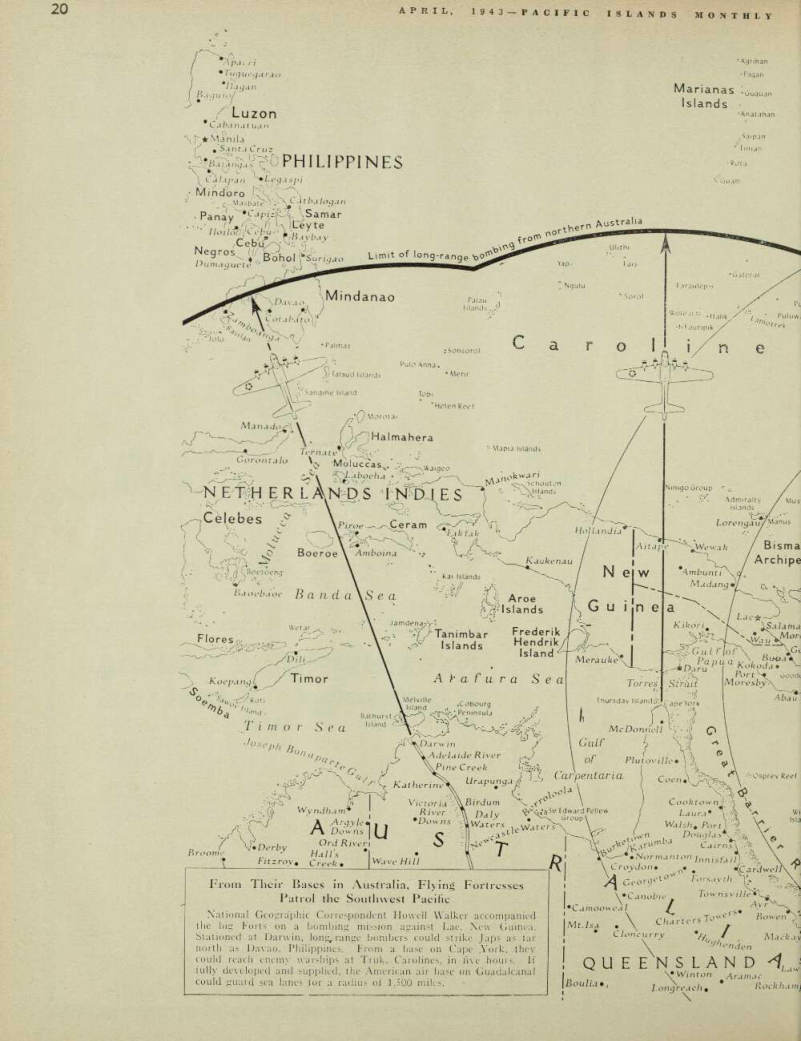
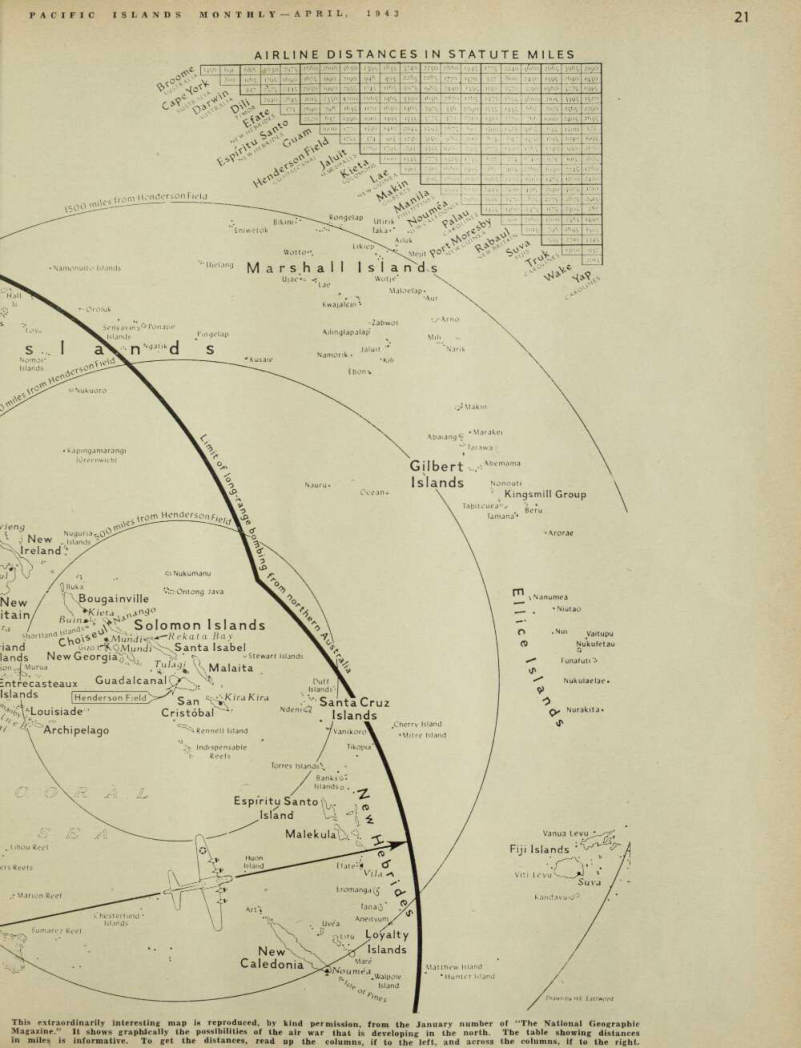
Use Of Mota
From Our Own Correspondent
Noumea, Feb. 18.
PHRASES from the Mota language of the Banks Group, lingua franca of the Melanesian mission for over 70 years, and therefore spoken on 50 islands of the Solomons, Santa Cruz and New Hebrides, are being added to a booklet which should prove of great use to avia tors forced to bale out over South-west Pacific areas.
The list was compiled during a visit to the Solomons by New Zealand chaplain D. L. Francis, who has spent his working life in this area. Though Pidgin English is coming into ever-greater use, he says that Mota still holds its own and usually, in a group of natives, you find
at least one or two who understand it.
Here is what the language looks like: “I kamam talo America wa ra pulsalama, we van ma iake sia pirin kamiu site vure lue ira ta Japan.” Being interpreted, this means: “We Americans are your friends and have come to help drive away the Japs.”
Chaplain Francis, who is attached to a New Zealand field ambulance unit in New Caledonia, went to the Solomons to see the Bishop of Melanesia (Bishop W.
Baddeley). He found Tulagi, Gavutu and Lunga much torn by shells and bombs.
He said that all the Melanesian mis sion women are gone from the Solomons, the last to leave being Mrs. Sprott, from Ysabel. The Bishop is working to get the missions going again as soon as the Japs are pushed out. Relations between the Americans and the natives are excellent.
From Their Bases in Australia, Flying Fortresses Patrol the Southwest Pacific National Geographic Correspondent Howell Walker accompanied the big Forts on a bombing mission against Lac, New Guinea.
Stationed at Darwin, long-range bombers could strike Japs as far north as Davao, Philippines. From a base on Cape .York, they could reach enemy warships at Truk, Carolines, in five hours. If fully developed and supplied, the American air base on Guadalcanal could guard sea lanes for a radius of 1,500 miles.
Airline Distances In Statute Miles
This extraordinarily interesting map is reproduced, by kind permission, from the January number of “The National Geographic Magazine." It shows graphically the possibilities of the air war that is developing in the north. The table showing distances in miles is informative. To get the distances, read up the columns, if to the left, and across the columns, if to the right.
Advertisements & other items, p. 21 (1 item)
Floor
PRODUCING UNIFORM GOOD RESULTS SINCE 1868
ALWAYS ASK FOR IT
Steamships Trading
Company Limited
PORT MORESBY
SAMARAI
PAPUA.
WHOLESALE & RETAIL MERCHANTS, SHIPOWNERS,
PLANTERS, ENGINEERS & SLIP PROPRIETORS.
Customs, Shipping, Insurance, and Forwarding Agents.
MANAGING AGENTS AND VISITING REPRESENTA-
TIVES FOR COCONUT AND RUBBER ESTATES.
SYDNEY REPRESENTATIVES: Nelson & Robertson Pty. Ltd., 12 Spring Street.
CLIENTS PLEASE NOTE
Temporary War Address— C/o Nelson tr Robertson Pty. Ltd., 12 Spring St., Sydney.
WRITE, CABLE, OR CALL
STEAMSHIPS TRADING COMPANY LIMITED
Cable Address: "Steamships".
Fiji’S Youngest Industry
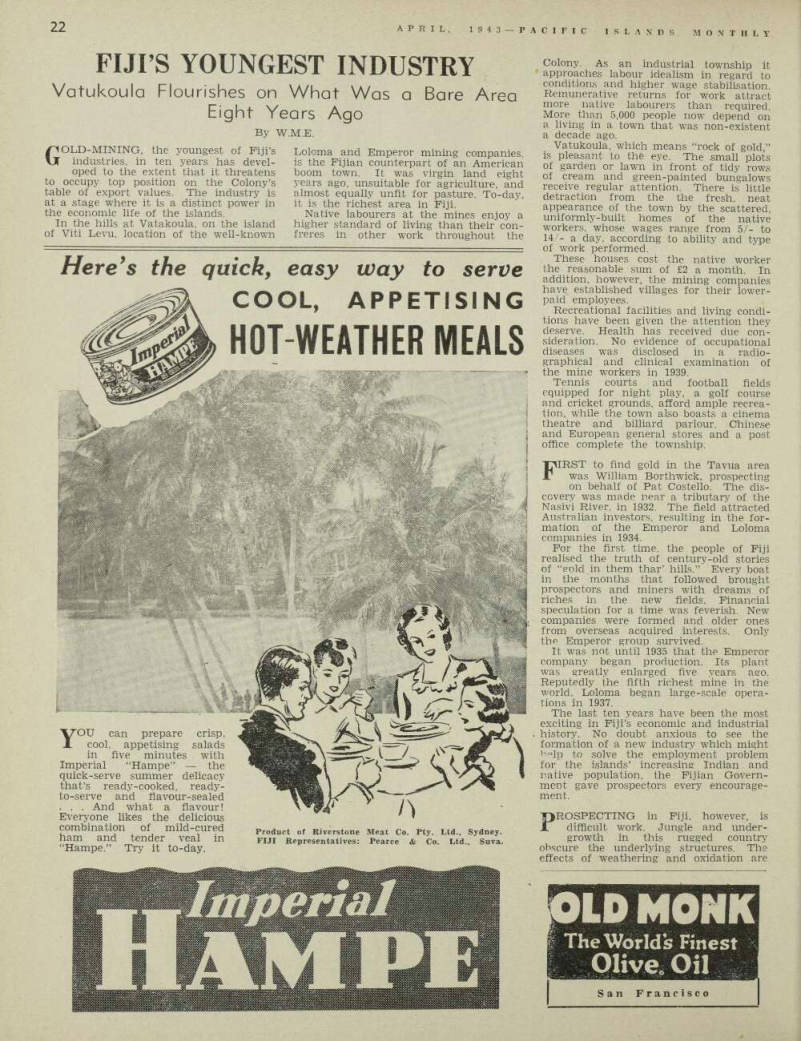
Vatukoula Flourishes on What Was a Bare Area Eight Years Ago
By W.M.E.
GOLD-MINING, the youngest of Fiji’s industries, in ten years has devel oped to the extent that it threatens to occupy top position on the Colony’s table of export values. The industry is at a stage where it is a distinct power in the economic life of the islands.
In the hills at Vatakoula, on the island of Viti Levu, location of the well-known
Loloma and Emperor mining companies, is the Fijian counterpart of an American boom town. It was virgin land eight years ago, unsuitable for agriculture, and almost equally unfit for pasture. To-day, it is the richest area in Fiji.
Native labourers at the mines enjoy a higher standard of living than their con freres in other work throughout the
Colony. As an industrial township it approaches labour idealism in regard to conditions and higher wage stabilisation.
Remunerative returns for work attract more native labourers than required.
More than 5,000 people now depend on a living in a town that was non-existent a decade ago.
Vatukoula, which means “rock of gold ” is pleasant to the eye. The small plots of garden or lawn in front of tidy rows of cream and green-painted bungalows receive regular attention. There is little detraction from the the fresh, neat appearance of the town by the scattered, uniformly-built homes of the native workers, whose wages range from 5/- to 14 - a day, according to ability and type of work performed.
These houses cost the native worker the reasonable sum of £2 a month. In addition, however, the mining companies have established villages for their lower paid employees.
Recreational facilities and living condi tions have been given the attention they deserve. Health has received due con sideration. No evidence of occupational diseases was disclosed in a radio graphical and clinical examination of the mine workers in 1939.
Tennis courts and football fields equipped for night play, a golf course and cricket grounds, afford ample recrea tion, while the town also boasts a cinema theatre and billiard parlour. Chinese and European general stores and a post office complete the township.
FIRST to find gold in the Tavua area was William Borthwick, prospecting on behalf of Pat Costello. The dis covery was made near a tributary of the Nasivi River, in 1932. The field attracted Australian investors, resulting in the for mation of the Emperor and Loloma companies in 1934.
For the first time, the people of Fiji realised the truth of century-old stories of “gold in them thar’ hills.” Every boat in the months that followed brought prospectors and miners with dreams of riches in the new fields. Financial speculation for a time was feverish. New companies were formed and older ones from overseas acquired interests. Only the Emperor group survived.
It was not until 1935 that the Emperor company began production. Its plant was greatly enlarged five years ago.
Reputedly the fifth richest mine in the world. Loloma began large-scale opera tions in 1937.
The last ten years have been the most exciting in Fiji’s economic and industrial history. No doubt anxious to see the formation of a new industry which might b elp to solve the employment problem for the islands’ increasing Indian and native population, the Fijian Govern ment gave prospectors every encourage ment.
Prospecting in Fiji, however, is difficult work. Jungle and under growth in this rugged country obscure the underlying structures. The effects of weathering and oxidation are
excessive, and the difficulties of field examination are greatly increased by heavy tropical rains. Travel in the interior has mostly to be done by river canoes, or on foot. Native paths cross hills and dales with complete disregard of grade. Nevertheless, competent min ing authorities opine that geological and other indications justify prospecting on a more extensive scale than hitherto attempted.
Post-war activity may bring Fiji into greater prominence than have its sugar growing potentialities in the past, and the benefits to the Colony should be far-reaching.
This may elevate the Fijian to higher living standards, for which some agita tion is probable. There is dissension in certain quarters against keeping the native chained to a despotic system which maintains labour wages at between two and four shillings a day, with no guarantee of continuous employment.
The whole country should benefit from future development, arising directly and indirectly from gold-mining. In all pro bability, there will be improvements to the existing highways and the provision of scenic roads into the interior. These would have the dual purpose of opening up the interior—parts of which are more isolated than many places in Australia 50 years ago—and providing additional tourist interest.
PRESENT producers on the Tavua field, apart from the Loloma and Emperor companies are Costello’s Mines, Limited, Fiji Mines Development, Limited, and J. H. H. Millett, on the Homeward Bound Mine. The Natalau Gold Mining Syndicate is producing on the Vunda mining area, near Lautoka.
Reports of gold discoveries in Fiji date back to the middle of last century. The presence of gold in the Waimanu River, Viti Levu, was known for many years,
while discoveries were also claimed in the Navua River, Viti Levu; on the island of Kandavu; in the Yanawai River, Vanua Levu. and at Navakandra kala, near the Yanawai. The discovery of payable deposits near the Yanawai led to the formation in 1932 of Mount Kasi Mines, Limited, and prospects were suffi ciently bright to justify considerable expansion of activities in 1934.
Alluvial gold deposits are low in grade, and the paucity of these accounts for the failure of early prospectors—although one, A. Nicol, was reported to be making a living over 50 years ago from deposits in the Yanawai. However, the unusually fine degree of sub-division of the metal and the rapid flow of the streams, par ticularly during the rainy season, cause unfavourable settlement conditions.
Advertisements & other items, p. 24 (1 item)
Old Monk
Here’s the quick, easy way to serve
COOL, APPETISING
HOT-WEATHER MEALS
528
fit
% <3
dri
YOU can prepare crisp, cool, appetising salads in five minutes with Imperial “Hampe” the quick-serve summer delicacy that’s ready-cooked, readyto-serve and flavour-sealed . . . And what a flavour!
Everyone likes the delicious combination of mild-cured ham and tender veal in “Hampe.” Try it to-day.
Product of Riverstone Meat Co. Pty. Ltd., Sydney.
FIJI Representatives: Pearce & Co. Ltd., Suva.
OLD MONK
I The Worlds Finest I Olive. Oil San Francisco
Prince John Gu
THE Queen of Tonga’s second son, Prince Jione Gu, has been enrolled for the two-years agricultural course at Gatton Agricultural College, in Queensland. This is in conformity with Tongan custom, which compels all child ren to do an agricultural course at school —agriculture being the basis of Tongan life.
Until the end of 1942, Prince Jione Gu (or John Gu, as his name is more fre quently written), was at Newington Col lege, Sydney, and while in New South Wales he distinguished himself as a Rugby footballer.
His elder brother, Prince Tuboutoa, who recently returned to Tonga, after passing his final law examination at Sydney Uni versity, is the heir to the throne of Tonga, and at present is Premier of Tonga.
For the first time in the history of the Colony, a session of the Fiji Criminal Circuit Court was held at Ba in March.
Commander Dyson
Hore-Lacy
LETTERS from abroad show that Commander Dyson Hore-Lacy, lately of Garua and Ulatawa plantations, in New Guinea, was in charge of one of the ships which carried the Anglo- American forces to North Africa, in November last.
“The convoy from the United Kingdom was one of the greatest that ever sailed,’’ says Commander Hore-Lacy, “and the fact that only one ship was torpedoed and everyone was landed safely was an extraordinary performance.
“I lost my ship. She was dive-bombed off the North African coast; but we had done our job, and she was practically empty. We expected to run into a spot of blast, being on the most easterly land ing of all, and we certainly got it; but our casualties were not as high as might have been expected. We saved most of our guns and some of our equipment, and I did not leave the ship until about three hours after the bombs hit us.”
Commander Hore-Lacy, after this in cident, returned to Britain, and then went across to the United States, where he took charge of a new” 1 ship.
Tongas Prosperity
THE Rev. R. C. G. Page, of the Methodist Mission, Tonga, reports that the Kingdom is enjoying un precedented prosperity owing to the in creased demand for copra and the high prices being received.
Miss Margaret Diana Bentley, who last year was evacuated from Ocean Island, has announced her engagement to Mr.
Spencer Ingram-Pearson, second son of Mrs. and the late Rev. G. Ingram-Pear son, of Manly, Australia.
Advertisements & other items, p. 25 (1 item)
89 Years
WL ah© i
\SWR
i>uv
89 YEARS
' ■ ■.. & S WALLOW & 1R IE L L ltd -J MOIERS OF lISCIITS . PIUM PUDDINGS . GORES . VITOCEH • ICE CREOH : VV-l VoV i J &y
Robertson
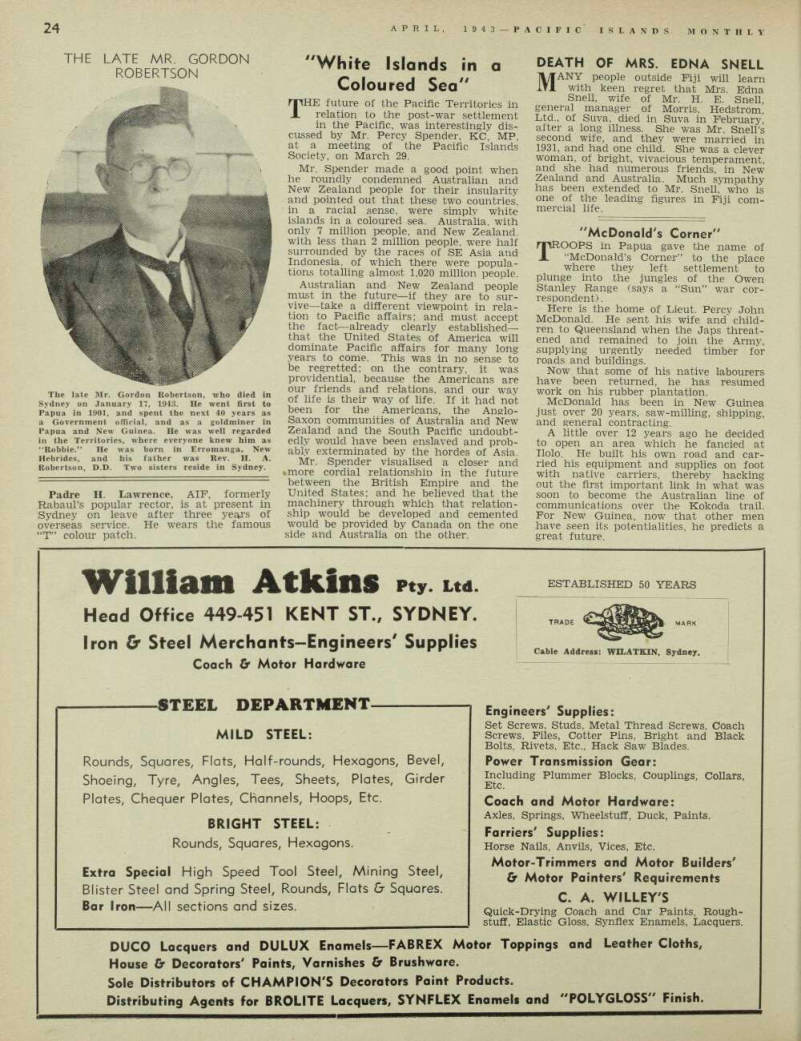
The Late Mr. Gordon
Padre H. Lawrence, AIF, formerly Rabaul’s popular rector, is at present in Sydney on leave after three years of overseas service. He wears the famous “T” colour patch.
The late Mr. Gordon Robertson, who died in Sydney on January 17, 1943. He went first to Papua in 1901, and spent the next 40 years as a Government official, and as a goldminer in Papua and New Guinea. He was well regarded in the Territories, where everyone knew him as “Robbie.” He was born in Erromanga, New Hebrides, and his father was Rev. H. A.
Robertson, D.D. Two sisters reside in Sydney.
Coloured Sea"
"White Islands in a Coloured Sea"
THE future of the Pacific Territories in relation to the post-war settlement in the Pacific, was interestingly dis cussed by Mr. Percy Spender, KC. MP. at a meeting of the Pacific Islands Society, on March 29.
Mr. Spender made a good point when he roundly condemned Australian and New Zealand people for their insularity and pointed out that these two countries, in a racial sense, were simply white islands in a coloured sea. Australia, with only 7 million people, and New Zealand, with less than 2 million people, were half surrounded by the races of SE Asia and Indonesia, of which there were popula tions totalling almost 1,020 million people.
Australian and New Zealand people must in the future—if they are to sur vive—take a different viewpoint in rela tion to Pacific affairs; and must accept the clearly established— that the United States of America will dominate Pacific affairs for many long years to come. This was in no sense to be regretted: on the contrary, it was providential, because the Americans are our friends and relations, and our way of life is their way of life. If it had not been for the Americans, the Anglo- Saxon communities of Australia and New Zealand and the South Pacific undoubt edly would have been enslaved and prob ably exterminated by the hordes of Asia.
Mr. Spender visualised a closer and «. more cordial relationshin in the future between the British Empire and the United States; and he believed that the machinery through which that relation ship would be developed and cemented would be provided by Canada on the one side and Australia on the other.
Death Of Mrs. Edna Snell
MANY people outside Fiji will learn with keen regret that Mrs. Edna Snell, wife of Mr. H. E. Snell, general manager of Morris, Hedstrom, Ltd., of Suva, died in Suva in February, after a long illness. She was Mr. Snell’s second wife, and they were married in 1931, and had one child. She was a clever woman, of bright, vivacious temperament, and she had numerous friends, in New Zealand and Australia. Much sympathy has been extended to Mr. Snell, who is one of the leading figures in Fiji com mercial life.
"McDonald's Corner"
rOOPS in Papua gave the name of “McDonald’s Corner” to the place where they left settlement to plunge into the jungles of the Owen Stanley Range (says a “Sun” war cor respondent) .
Here is the home of Lieut. Percy John McDonald. He sent his wife and child ren to Queensland when the Japs threat ened and remained to join the Army, supplying urgently needed timber for roads and buildings.
Now that some of his native labourers have been returned, he has resumed work on his rubber plantation.
McDonald has been in New Guinea just over 20 years, saw-milling, shipping, and general contracting.
A little over 12 years ago he decided to open an area which he fancied at Holo. He built his own road and car ried his equipment and supplies on foot with native carriers, thereby hacking out the first important link in what was soon to become the Australian line of communications over the Kokoda trail.
For New Guinea, now that other men have seen its potentialities, he predicts a great future.
Advertisements & other items, p. 26 (1 item)
William Atkins n,. m.
Head Office 449-451 KENT ST., SYDNEY.
Iron & Steel Merchants-Englneers' Supplies
Coach & Motor Hardware
ESTABLISHED 50 YEARS
Cable Address: WILATKIN, Sydney.
STEEL DEPARTMENT
MILD STEEL:
Rounds, Squares, Flats, Half-rounds, Hexagons, Bevel, Shoeing, Tyre, Angles, Tees, Sheets, Plates, Girder Plates, Chequer Plates, Channels, Hoops, Etc.
BRIGHT STEEL;
Rounds, Squares, Hexagons.
Extra Special High Speed Tool Steel, Mining Steel, Blister Steel and Spring Steel, Rounds, Flats & Squares.
Bar Iron—AH sections and sizes.
Engineers' Supplies: Set Screws, Studs, Metal Thread Screws, Coach Screws. Files, Cotter Pins, Bright and Black Bolts, Rivets, Etc., Hack Saw Blades.
Power Transmission Gear: Including Plummer Blocks, Couplings, Collars, Etc.
Coach and Motor Hardware: Axles, Springs, Wheelstuff, Duck, Paints.
Farriers' Supplies: Horse Nails, Anvils, Vices, Etc.
Motor-Trimmers and Motor Builders' Cr Motor Painters' Requirements
C. A. WILLEY'S
Quick-Drying Coach and Car Paints, Roughstuff, Elastic Gloss, Synflex Enamels, Lacquers.
DUCO Lacquers and DULUX Enamels—FABREX Motor Toppings and Leather Cloths, House & Decorators' Paints, Varnishes & Brushware.
Sole Distributors of CHAMPION'S Decorators Paint Products.
Distributing Agents for BROLITE Lacquers, SYNFLEX Enamels and "POLYGLOSS" Finish.
Pidgin Is Discovered
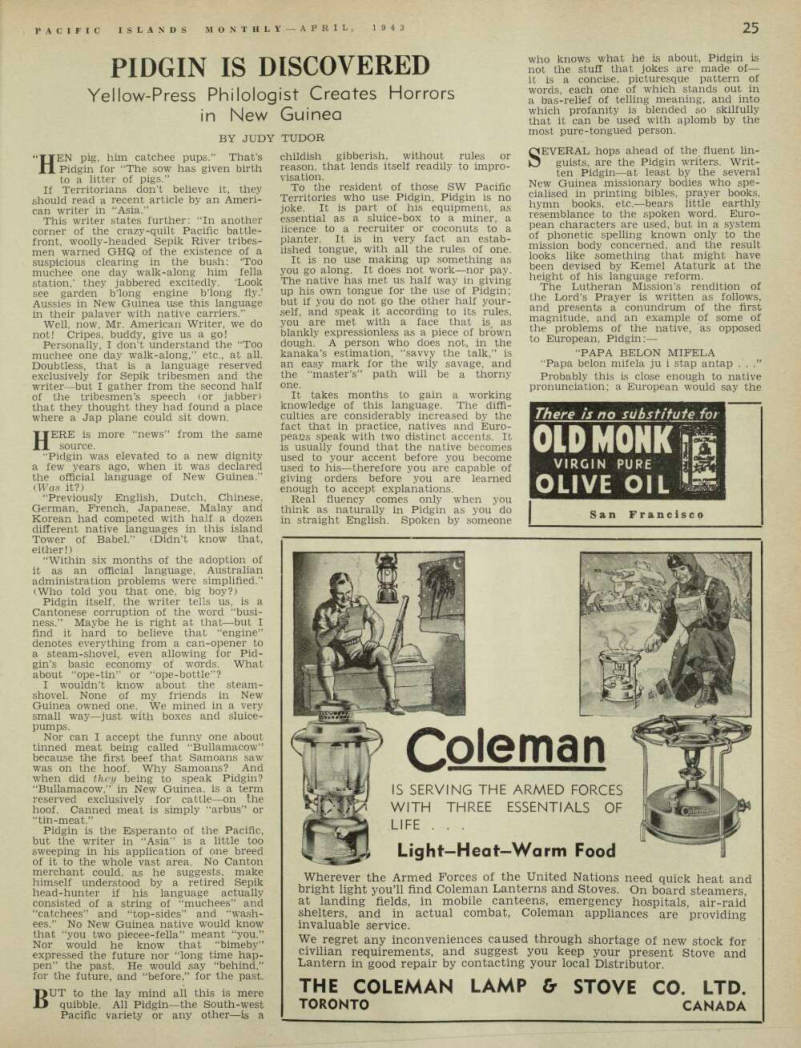
Yellow-Press Philologist Creates Horrors in New Guinea
By Judy Tudor
“IJEN pig, him catchee pups.” That’s ll Pidgin for “The sow has given birth to a litter of pigs.”
If Territorians don’t believe it, they should read a recent article by an Ameri can writer in “Asia.”
This writer states further: “In another corner of the crazy-quilt Pacific battle front, woolly-headed Sepik River tribes men warned GHQ of the existence of a suspicious clearing in the bush: ‘Too muchee one day walk-along him fella station,’ they jabbered excitedly. ‘Look see garden b’long engine b’long fly.’
Aussies in New Guinea use this language in their palaver with native carriers.”
Well, now, Mr. American Writer, we do not! Gripes, buddy, give us a go!
Personally, I don’t understand the “Too muchee one day walk-along,” etc., at all.
Doubtless, that is a language reserved exclusively for Sepik tribesmen and the writer —but I gather from the second half of the tribesmen’s speech (or jabber) that they thought they had found a place where a Jap plane could sit down.
HERE is more “news” from the same source.
"Pidgin was elevated to a new dignity a few years ago, when it was declared the official language of New Guinea.” (Was it?) “Previously English, Dutch, Chinese, German, French, Japanese. Malay and Korean had competed with half a dozen different native languages in this island Tower of Babel.” (Didn’t know that, either!) “Within six months of the adoption of it as an official language, Australian administration problems were simplified.” (Who told you that one, big boy?) Pidgin itself, the writer tells us, is a Cantonese corruption of the word “busi ness.” Maybe he is right at that—but I find it hard to believe that “engine” denotes everything from a can-opener to a steam-shovel, even allowing for Pid gin’s basic economy of words. What about “ope-tin” or “ope-bottle”?
I wouldn’t know about the steam shovel. None of my friends in New Guinea owned one. We mined in a very small way—just with boxes and sluice pumps.
Nor can I accept the funny one about tinned meat being called “Bullamacow” because the first beef that Samoans saw was on the hoof. Why Samoans? And when did they being to speak Pidgin?
“Bullamacow,” in New Guinea, is a term reserved exclusively for cattle —on the hoof. Canned meat is simply “arbus” or “tin-meat.”
Pidgin is the Esperanto of the Pacific, but the writer in “Asia” is a little too sweeping in his application of one breed of it to the whole vast area. No Canton merchant could, as he suggests, make himself understood by a retired Sepik head-hunter if his language actually consisted of a string of “muchees” and “catchees” and “top-sides” and “wash ees.” No New Guinea native would know that “you two piecee-fella” meant “you.”
Nor would he know that “bimeby” expressed the future nor “long time hap pen” the past. He would say “behind,” for the future, and “before,” for the past.
BUT to the lay mind all this is mere quibble. All Pidgin—the South-west Pacific variety or any other—is a
childish gibberish, without rules or reason, that lends itself readily to impro visation.
To the resident of those SW Pacific Territories who use Pidgin, Pidgin is no joke. It is part of his equipment, as essential as a sluice-box to a miner, a licence to a recruiter or coconuts to a planter. It is in very fact an estab lished tongue, with all the rules of one.
It is no use making up something as you go along. It does not work—nor pay.
The native has met us half way in giving up his own tongue for the use of Pidgin; but if you do not go the other half your self, and speak it according to its rules, you are met with a face that is. as blankly expressionless as a piece of brown dough. A person who does not, in the kanaka’s estimation, “savvy the talk,’’ is an easy mark for the wily savage, and the “master’s” path will be a thorny one.
It takes months to gain a working knowledge of this language. The diffi culties are considerably increased by the fact that in practice, natives and Euro peans speak with two distinct accents. It is usually found that the native becomes used to your accent before you become used to his—therefore you are capable of giving orders before you are learned enough to accept explanations.
Real fluency comes only when you think as naturally in Pidgin as you do in straight English. Spoken by someone
who knows what he is about, Pidgin is not the stuff that jokes are made of— it is a concise, picturesque pattern of words, each one of which stands out in a bas-relief of telling meaning, and into which profanity is blended so skilfully that it can be used with aplomb by the most pure-tongued person.
SEVERAL hops ahead of the fluent lin guists, are the Pidgin writers. Writ ten Pidgin—at least by the several New Guinea missionary bodies who spe cialised in printing bibles, prayer books, hymn books, etc.—bears little earthly resemblance to the spoken word. Euro pean characters are used, but in a system of phonetic spelling known only to the mission body concerned, and the result looks like something that might have been devised by Kernel Ataturk at the height of his language reform.
The Lutheran Mission’s rendition of the Lord’s Prayer is written as follows, and presents a conundrum of the first magnitude, and an example of some of the problems of the native, as opposed to European, Pidgin:—
“Papa Belon Mifela
“Papa belon mifela ju i stap antap . , Probably this is close enough to native pronunciation: a European would say the
same thing as “Poppa belong me fella you ’e stop on top.” Both would mean, “Our Father which art in Heaven . . . ”
To the non-missionary, the main body of the prayer, which tries to turn the purely biblical terms and allusions into something that the native might possibly understand, is totally incomprehensible.
The conclusion, “Kindom em belong ju tasol, ju strong fela, ju gat nem oltaim.
Tru!” would be, in our circles, “King dom belong you that’s all, you strong fella, you got name all the time. True!”
It is translatable as “Yours is the King dom, the Power and the Glory, for ever and ever, Amen.”
Through the ages, the languages of all countries have been changed about and added to by social and economic uphea vals, by invasion, peaceful penetration and war. It is reasonable to expect, therefore, that such large bodies of fight ing men as New Guinea now holds will leave most definite evidence of their sojourn upon the language of the coun try. Already, in Papua, whose language was Motuan and not Pidgin, we see signs of the times in the rather rapid intro duction of this Pacific Esperanto.
IF necessary, an amendment to the emigration laws should be passed to
keep out such language-slaughterers
as the writer in “Asia.” But. on the other hand, if the colourful phraseology of the Yankees is to be grafted onto the already
picturesque patter of good Pidgin, we cer tainly are going to have some language!
Visualise the day when “jeep” and “lease-lend” and “no kiddin’ ” and “so what?” and various other odds and ends become part of your cook-boy’s vocabu lary. And, by the same token, there are many Pidgin expressions that would, and probably will, make mighty fine decora tions for the language of the great USA.
At a service conducted recently in New Guinea by Bishop T. N. Strong, Angli can Bishop of New Guinea, £65 was sub scribed by an AIF battalion for recon struction of mission buildings in Papua, which have been destroyed by the Japan ese. The money was given as a sign of appreciation of the work carried out by the mission among the natives.
Since the political barrier between Papua and New Guinea disappeared, a year ago, and New Guinea police-boys and labourers entered Papua, pidgin Eng lish is coming rapidly into use in Papua, displacing the Motu language which the late Sir Hubert Murray tried to make the lingua franca of the Territory.
Two London charwomen were discuss ing the inconveniences of the blackout.
“But it’s a necessary evil,” said one. “Else we’re likely to be blasted into maternity.”
“ ’Tis so,” said her companion. “And the worst of it is, we’d never know who done it.”
Advertisements & other items, pp. 27-28 (1 item)
Coleman
There is no substitute for
OLD MONK
VIRGIN PURE
OLIVE OIL
11 San Francisco
s
Coleman
IS SERVING THE ARMED FORCES
WITH THREE ESSENTIALS OF
LIFE . . .
Light-Heat-Warm Food
Wherever the Armed Forces of the United Nations need quick heat and bright light you’ll find Coleman Lanterns and Stoves. On board steamers, at landing fields, in mobile canteens, emergency hospitals, air-raid shelters, and in actual combat, Coleman appliances are providing invaluable service.
We regret any inconveniences caused through shortage of new stock for civilian requirements, and suggest you keep your present Stove and Lantern in good repair by contacting your local Distributor.
THE COLEMAN LAMP & STOVE CO. LTD.
TORONTO CANADA
PRESCOTT Pty. Ltd.
SUSSEX ST., SYDNEY,
are tale wholesale agents for
PINEAPPLE BACON&HAMS
DAISY brand BUTTER "375" BUTTER in TINS Ilb.-21b.-slb. Sizes.
LEA & PERRINS’ Sauces and Most other Super-Quality Lines of the Trade, such as Cheese, Eggs. Etc.
CM I V
w Obtainable from all Leading Grocery Stores. r.hivers and Sons, Ltd., Histon, Cambridge, E R 5
PURE
FOODB
GOLD MEDAL JAMS
CANNED ENGLISH FRUITS
CANNED ENGLISH
VEGETABLES
CUSTARD POWDER
OLD ENGLISH MARMALADE
JELLY CRYSTALS, ETC.
- - - - - - Write to Department A., England, for attraetire Recipe Book.
Why We Should Say
" Manchuria "
WE have been tactfully informed by the Chinese Legation in Canberra, that the use of the word “Manchu kuo” is very offensive to Chinese people.
That is easily understood. Speakers and writers generally should accustom them selves to use the term “Manchuria,” instead of “Manchukuo,” which is a Japanese invention.
The Chinese use “Manchuria” to denote the three north-eastern provinces of the Chinese Empire. The name of Man churia was universally used until Sep tember 18, 1931 —only 11* years ago— when the hordes of Japan, following the plan that had been made by the war lords of Tokio, poured into north-east ern China, and seized and occupied the three Chinese provinces. The Japanese then created a puppet State, changed the name Manchuria to ' Manchukuo, and established the feeble-minded, tragi comic Henry Pu Yi as head of this sec tion of the Jap Empire.
It will be remembered that China appealed to the League of Nations to prevent this outrageous territorial rape.
The United States, although not a mem ber of the League, tried to persuade the other powers to take international action to restrain Japan; but France was already in the hands of the professional politicians who later ruined her, and the British Government around that period had reached a stage of feebleness in relation to foreign affairs which earned them and the Ramsay McDonald regime the contempt of the world. In conse quence, Japan “got away with the rob bery,” and her example was quickly fol lowed by the bombastic Mussolini, in Abyssinia, and the screeching, egocen tric, Hitler, in relation to Austria and other territories. Thus was laid the foundations of the present global war.
Therefore, whenever one uses the term Manchukuo instead of Manchuria, one is carrying out the bidding of Tokio. Let us restore the name of Manchuria, as an indication that the provinces themselves will be restored to China.
Future Of Gold
THE Monthly Letter of the National City Bank of New York, for Decem ber, 1942, says that there is no rea son to suppose that central banks and Governments will give up the use of gold.
The bank advances three reasons in sup port of this contention: — (1) It is difficult to conceive of a mone tary system based upon anything but the precious metals commanding the confi dence of the people; monetary systems cannot be built upon “fancy theories,” but upon the way people think and behave. (2) Gold will be wanted by Govern ments for making international settle ments. Without gold for such purposes, the only alternative is strict control of all foreign trade, with continuation of all the paraphernalia of clearings, agree ments, blocked currencies, trade quotas, and the like, which were stifling inter national trade up to the war. (3) Gold will be wanted by Govern ments because of the huge vested inter est in it by the United States and the British Empire—the United States as the world’s greatest holder of the metal, and the British Empire, as the world’s greatest producer.
Mr. C. E. Pennefather, Advisor on Native Affairs, in Fiji, has been appointed a member of the Central Medical School Advisory Board.
New Guinea
SDA Missionaries in New Guinea How They Were Taken by the Japs
A PLANTER from the island of Emira, in the Saint Matthias Group, Territory of New Guinea escaped from New Guinea after the enemy occu pation, and reached Sydney, after two months’ voyaging. He brought the fol lowing information about the fate of SDA missionaries—especially Pastor A. S.
Atkins and Mr. Trevor Collett, who was a self-supporting Seventh-day Adventist missionary on the island of Emira.
For a few days prior to the date (January, 1942) on which Pastor Atkins left Massau, the sky over the St. Matthias Group was clouded by Japanese aircraft.
One morning an enemy aircraft-carrier, accompanied by a huge transport and a destroyer, arrived in the Group, and Japanese troops landed on a nearby island.
All that day the war vessel cruised around Boliu anchorage. Pastor Atkins could almost have thrown a stone on board from the mission house. He was the only white man on Massau. The faithful mission natives efficiently hid the mission’s little vessel, “Malalangi,” in a small river mouth, and effectively camouflaged her with palm fronds and branches. The emergency signal fire was lit on neighbouring Emira by Mr.
Collett and his neighbour.
Next morning Pastor Atkins left Mussau (his wife and children had already gone to Australia) and in spite of the danger of being discovered, he managed to get his little boat safely across to Emira where he picked up Mr.
Collett and the planter (who eventually escaped to Australia).
After leaving Emira about midnight, the party set a course for New Ireland via New Hanover Passage, 85 miles over open sea. The reflection of tremendous fires and explosions were seen 80 miles away. It was Kavieng being ravaged by the enemy. What appeared to be a Jap anese destroyer was fast overhauling the “Malalangi,” just as she made the safety of New Hanover Passage and the cover of many small islands, by dawn.
Travelling by night and hiding by day, with enemy planes about all the time, the little mission vessel crossed over from the New Ireland coast to New Britain, and passed Rabaul (which was now in the hands of the enemy) in order to join the SDA mission flagship, “Veilomani,” at the anchorage near the Put Put Train ing School, 30 miles down the coast from Rabaul.
Rabaul was then being blasted in the first air raids by the RAAF. It was a fearful, awe-inspiring sight by night.
Tremendous flashes lit up everything.
Twice a tremendous explosion was heard, and a terrific sheet of flame flashed up angrily, lighting the heavens for miles around. These were direct hits on two enemy ships.
The rendezvous at the Put Put School had been arranged previously between the Mission Superintendent, Pastor Abbott, and Mr. Atkins. The idea was that the two boats would leave Put Put, if the necessity arose, and bring the mis sionaries and any others whom they could save, from New Guinea to Austra lia.
VERY early one morning, four days after leaving Mussau, the “Mala langi” approached Put Put. Through the morning mists, those on board saw the “Veilomani” making its way toward the sea. Hailing the boat, they were informed that from 20 to 30 men were on board, attempting to make their escape. Pastor Abbott was not with the party, but he had given permission for the boat to be used for the saving of life.
She had made two or three trips already between Put Put and Sum Sum, con veying evacuees out to where seaplanes met them and carried them to safety.
The “Malalangi” was quickly turned into Put Put, to see what had happened to Pastor Abbott. They were handed a ncte from him, to the effect that several SDA missionaries were still in the Ter ritory, and he. as leader of the Mission, desired to be the last to leave. Also, he felt he could still be very useful in the Rabaul Hospital, where he was serving.
The “Malalangi” hurried off to catch up with the “Veilomani,” which was waiting at Sum Sum. At the suggestion of a member of the “Veilomani” party, W ho told of a good hiding place for the boats, they proceeded down the coast to a place called Adler Bay.
Suddenly, an enemy destroyer appeared from around a point, and dropped a pin nace, with a crew of wreckers. The occupants of the mission boats made for the shore, some in the dinghies and some sv/imming.
From a hill, they observed the destruc tion of the mission ships. The hull of the “Malalangi” was stove in, the engine wrecked, the anchor chain lengthened and the boat allowed to drift on to the reef. The “Veilomani” was set on fire and was well alight when the enemy departed.
The enemy pinnace had not reached the destroyer before Pam. the native captain of the “Veilomani,” made his way through the jungle back to the beach, and swam out to the burning schooner, in waters noted for sharks and crocodiles. He boarded the boat, and, by hard work, eventually managed to extin guish the flames. The boat was still afloat, but unfortunately the engine was out of order. An attempt had been made to damage the hull of the “Veilomani,” but the timbers were too stout for Jap anese axes.
The next morning, the enemy destroyer re-appeared and. noticing the ketch still afloat, they shelled and sank her. (Continued overleaf)
AT Adler Bay, near the scene of this tragedy, a council was held by Pastor Atkins and his party. It was decided that some would walk down the coast to a point where it was thought they might find other means of escape.
Pastor Atkins and Mr. Collett, with one or two others, were to attempt the journey by dinghy early next morning.
It was impossible for Pastor Atkins to walk, as he had been in ill-health for some time, and was in a very weakened condition. He felt that he was a drag on his companions, perhaps endangering their lives, and that they would have a better chance of escape without him. So he announced his decision to remain behind. Mr. Collett refused to leave Pastor Atkins alone in this situation.
The rest of the party, after doing what they could for the two missionaries, and making arrangements for natives to take
them back by canoe to Put Put set off on their hazardous journey towards Australia, These men, in their bid for freedom encountered many difficulties They obtained motor boats, which were wrecked; they trekked to other places where they found more motor boats and then these were wrecked. Eventually after a series of adventures which included many bombings and machine gun attacks, they landed safely in Australia.
Pastor Atkins was taken prisoner and put in an enemy-controlled hospital near Rabaul, and he died on March 13, 1942 News of his death eventually reached Australia through Mr. Collett who also had been taken prisoner Pastor E. M. Abbott appears to have asssited with the evacuation of the patients from the Rabaul Hospital to the
Catholic Mission Hospital at Kokopo. He was no doubt engaged in caring for the patients at Kokopo when he was cap tured by the Japanese. One letter which his wife has received from him as a pri soner of war was written in March, 1942.
Advertisements & other items, pp. 29-30 (1 item)
srdtj
SUPPLIERS OF GENERAL MERCHANDISE TO LEADING FIRMS
THROUGHOUT THE PACIFIC ISLANDS
E. J. GOUGH & CO.
1 BOND STREET, SYDNEY,
AUSTRALIA.
EXPORTERS . , . IMPORTERS . . . MANUFACTURERS' REPRESENTATIVES BANKERS: Bank of N.S.W. Comptoir National d’Escompte de Paris.
A. B. DONALD Ltd.
AUCKLAND
ISLAND TRADERS & GENERAL MERCHANTS
P.O. Box 1509. Cables Gr Telegrams, "Kingdom", Auckland.
Scott’s “Renown” Brand Rope,
Cordage and
Cable Address Ropeyard, Sydney.
Binder
Twine
of Every
Description
MANUFACTURED AT
MASCOT. N.S.W.
J. SCOTT
PTY. LTD.
Head Office and Store:
163 CLARENCE STREET,
SYDNEY,
N.S.W.
N. Guinea Copra
Pool
No More Payments Unless War Compensation Paid
BETWEEN the time that the New Guinea Copra Pool was formed, and its operations ceased, as a result of the occupation of the Territory by the Japanese, the Pool handled approximately 20,000 tons of copra and distributed to the growers thereof an amount equal to about £4/10/- per ton.
Many New Guinea planters who de livered copra to the Pool believe that they are likely to receive an additional sum at an early date by way of a distribution from the Pool. But, we are informed, there is very little likelihood of that. The belief that substantial sums were accu mulating in the Pool for distribution was based on reports that certain classes of copra were sold in Sydney and elsewhere at fantastic prices soon after the Japanese invasion.
But it appears that none of the 20,000 tons handled in the Pool received the benefit of these high prices. The best price at which copra was sold by the Pool was £9/10/- per ton. And, we under stand, that there is no margin of profit between the £4/10/- already paid to growers and the final average price re ceived by the Pool.
But the Pool lost a great deal of pro perty especially copra when the Japanese occupied New Guinea, and a claim for compensation amounting to £90,000 has been presented by the Pool to the War Damage Commission. The managers of the Pool are confident that most of this claim will be met. It is understood, however, that the War Dam age Commission will make no payments until after the war.
In the opinion of one man who knows something of the inside workings of the Pool, the position is that those who de livered copra to the Pool can expect little, if any, additional payments between now and the end of the war; but if, after the war, the War Damage Commission meets the claim that has been lodged, pro ducers may expect additional sums equal to at least £2/10/- per ton for all copra delivered.
No statement showing the financial operations of the Pool, and how funds have been disposed of, is available, and it is not expected that anything will be available for some time to come.
Two cousins, members of a family well known in the Central Pacific, are together in a prison camp in Germany.
They are: J. D. Whitcombe and D. S.
Whitcombe. The latter is a son of Mr.
J. D. Whitcombe, Snr., who is now an Auckland resident, but who spent 30 years of his life in Tonga and Fiji— mostly in the service of the Tongan Government. Others of this family are also members of the fighting services.
On the motion of the president, Mr. A.
E. Stephen, the Pacific Islands Society, at its February meeting, passed a vote of sympathy with the Governor-General of Australia (Lord Gowrie) in the death of his son, on active service; and with the widow and family of Mr. Raphael Brudo, of Papua, a member of the Society, who died in January.
Solomons
Rubber In The
How Plants Were Introduced
Letter to the Editor IN the last issue of the “PIM” I noticed an article concerning rubber planting in the Solomon Islands.
It seems to be the general impression that Burns, Philp & Co. Ltd. were responsible for the introduction of rub ber to the Solomons (quoted in a copy of the “Telegraph,” Brisbane, some weeks ago). You may be interested in what I think to be the real facts of how rubber was first introduced into the Solomons.
In the beginning of the century there was a boom in rubber in Ceylon and Malaya. I became very interested in the subject and, as I could get no informa tion locally, I persuaded a former part ner of mine—Mr. J. T. d’Oliveyra—to journey to Singapore to study the culti vation of rubber. He stayed several months and received every assistance from an old Brisbane identity, the late Mr. Western Walsh.
Between them they sent a consignment of rubber seeds, planted in moulds and boxes (about 15,000 plants) to Sydney and transhipped them to the Solomon Islands, at my expense and risk.
In the meantime, I had purchased a tract of land on the coast of Santa Ysa bel, which I cleared in readiness and, when the trees arrived, I planted out 200 acres (about 10,000) tree).
By this time the rubber market had collapsed, and I decided to dispose of the balance of the plants. Of these, 3,000
were taken over by the chairman of directors of Levers Pacific Plantations Pty., Ltd., and planted at Pepasala, and I also understand a small lot was planted at Kolambangara (owned by Levers Paci fic Plantations Pty., Ltd.). The plants put out at Pepasala were, some years after, cut out and destroyed.
Messrs. Derbyshire and Harding had started a copra plantation on the coast of Guadalcanal —known as Berande—and they took over the remaining 1,000 trees and this was included in their sale a good few years later to Burns, Philp & Co., Ltd.
This, I believe, accounts for the total of rubber plants imported to the Solo mons at that time and, as the value of rubber deteriorated very quickly, I do not think that any further consignment of rubber trees ever came to the Solomons.
We estimate that at present, at our nlantation, there are between 8,000 and 9,000 trees left and, as far as we can estimate, this acreage is yielding up to about 45 to 50 tons of prepared rubber per annum. Unfortunately, owing to the war situation, nothing is being done on the plantation, and production is at a standstill.
I am, etc.,
O. Svensen (Senr.).
“Claremont,” 14 Hawthorn Road, East Brisbane.
Dr. Douglas L. Oliver, formerly of Harvard University, well-known for his scientific research work in a number of the South Pacific Territories, is head of the mission sent into the South Pacific by the United States Board of Economic Warfare to study measures to increase the local production of foodstuffs and other materials. He was lately in Sydney, Tahiti, and Fiji.
Advertisements & other items, pp. 31-32 (1 item)
W.KOPSEN & Co. Pty.Ltd.
Purchasers at Full Market Prices on Assay Value of
GOLD
SILVER
PLATINUM
And Platinum Group Metals
SOME OF OUR SERVICES
ASSAYERS & ANALYSTS—
Assays of Bullion, Ores, etc.
Analyses of Metals, Minerals, Alloys, etc.
SCIENTIFIC & INDUSTRIAL
METALLURGISTS—
Our range of precious metal manufactures covers all Industries—Gold and Silversmiths, Electrical Trades, Dental Profession, Glass Silverers, Electro-Platers, etc., etc.
REFINERS—
Purchasers and Refiners of Bullion, Scrap, Mining By-Products, and Trade Residues of every description carrying Precious Metals.
GARRETT Cr DAVIDSON
PTY. LTD.
824 George St., Sydney. Works: Surry Hills and Chippendale, N.S.W.
Ofißcial Assayers to the Bank of New South Wales. Gaaetted Agents of the Commonwealth Bank of Australia, under the Gold Regulations of the National Security Act.
SIMPLEX
MARINE
ENGINES
Simplex engines from 3 h.p. to 12 h.p. for boats from 14 ft. to 26 ft. are Australia’s best. 2 cycle and 4 cycle with or without reverse gear.
Illustrated is the popular little 3 h.p. suitable for 14 ft. or 16 ft. boats.
Buns for 5 hours on 1 gallon petrol and costs only £29/15/-, complete with all equipment. Ready to instal into any boat, nothing else to buy.
Ask for Simplex catalogue of engines and launches.
SKARSTEN SCRAPERS
r’
Remove paint, varnish, glue. oil. erease, roughness, etc., from wood and metal surfaces. Most useful for scraping deck and hull planks. They leave the surface smooth and dressed and ready for painting. Have renewable blades.
Prices: No. 35, 2/3; 62, 2/6; 80, 3/3.
Reversible, 7/-.
Write for leaflet.
TILLEY
Kerosene
LAMPS
British-made Kerosene Lamps providing a steady 300 c.p. light, without flickering, and without smoke or smell.
Model TLIO (illustrated) is a handsome Table Lamp providing exceedingly brilliant illumination and at the same time a fine ornament for any home.
Stands 24 in. high and covers a large area. Attractive parchment shade is finished in autumn tones and matches any furnishings.
Also available Is the popular All- Purpose Lamp and Lantern (model EX100) and a variety of Hanging, Table, Wall and Vase Lamps.
Let us send you full details of all TiUey Lamps.
SHIPCHANDLERY
We manufacture and stock the largest range of boatgear in Australia. Everything for boatbuilder and boatowner. Marine paints and varnishes. Rope and Cordage. Rigging. Anchors and M oorings. Copper Nails and Rod . Lighting Plants' Fire Extinguishers. Oars and Sculls, Lamps, Pumps, etc.
GET OUR PRICES FIRST.
W.KOPSEN & Co. Pty.Ltd.
376/380 KENT STREET, SYDNEY
Thone: MA 6336 (4 lines). Est. 1868. Cables; Kopsen . . . Sydney.
Services
COMMUNICATIONS
ss :s & RAM SERVICE
=SS -
affSSSSs
WIRELESS TELEPHONE
WIRELESS DIRECT N meNTS
S BROADCAST RECEIVERS
BROADCASTING
OWNERS A^ n oa,s-nNG STATIONS
RE CO°R F D,r ART.TS
MARCONI SCHOOL
MECHANIC
radio TELEGRAPHY
laboratories
Search • invent, ONS development
AMALGAMATED WIRELESS (A'sia) LIMITED
Australia's National Wireless Organisation
in Papua

There Was Little Funking in Papua
Letter to the Editor THE letter, by “One Who Stayed,” in your March issue, is interesting. But the editorial note, that his remarks are a little jaundiced, appears to strike the right chord.
My memory serves me well, and at no time do I remember “elderly gentlemen” continually rushing into print asserting that every young man in Papua of mili tary age should be away at the war. I speak more particularly of the “elderly gentlemen” who have given the best years of their lives to Papua and who. for year after year, have battled against the odds of climatic conditions, depressions, sick ness, rearing of families in remote places, and numerous other difficulties, in order to make Papua what it was prior to the war.
Most of those gentlemen I know very well. They have a lot of sound common sense, and a terrible lot of grit, other wise they would have thrown in the sponge long ago, and gone back to an easier way of living. Papua is not a place for weaklings, nor is it a land of milk and honey, as some people thought—far from it.
As president of the Public Service Association, I can definitely say that some of the younger members of the Papuan Public Service were very anxious to enlist, long before Rabaul fell, but they were not allowed to. The Government pointed out that, as so many officers had enlisted from a small Service, it was im possible to let any more go, because the Government would not be able to carry on. This was perfectly reasonable and true, and was but following Colonial Office practice in similar circumstances.
The first air raid on Moresby—and just prior—did produce physical weaknesses in a few cases, and some did avail them selves of an early opportunity to depart for Australia. But the “elderly gentle men” did not claim exclusive rights to this action. It was noticeable that the elderly “old-timers” grimly hung on to the last, hoping they would be allowed to stay behind and assist what they con sidered to be their country.
Even women who had helped to build up Papua, over many years’ residence, protested vehemently at being evacuated.
Some of these were “elderly,” but they contended they knew the Territory, the natives, and their language, and could assist the Diggers in many ways—e.g., nursing, cooking, and general welfare.
Many tears were shed by such women on their departure. I saw some of them taking a last look at their homes.
NOW, when the “call-up” for military service came, the names of all available men were known. Every man under 45 years of age, who passed as fit was in camp a few hours later.
The Provost Platoon took effective action to round up those who did not report.
It may surprise “One Who Stayed” when I say that officers of the Provost Platoon came to me inquiring the likely whereabouts of men who had not responded to the call-up, in order that they could be collected. This hardly bears out your correspondent’s statement that the “mobilisation that occurred was not a compulsory one.” After the call-up, nobody was allowed to leave Papua unless in possession of a military permit autho rising such departure. A very few young sters did escape; but, on the other hand, many honestly welcomed the call-up—although compulsory.
I meet many “elderly” old-timers here
in Sydney, and they do nothing but grumble about being compulsorily evacu ated. They have contended, right through, they could have helped in some way.
Although nearer to 50 than 45, I can not yet claim to be “elderly” and I thought I could be of some use to the Army on account of my long residence and very varied experience in Papua— particularly that obtained whilst in charge of the Royal Papuan Constabu lary Headquarters. So, with another returned man —the Government boat builder —I stayed behind when the bulk of evacuees left Moresby. I was soon rounded up; and, when I protested about being sent out of the Territory, I was told in a friendly way not to be a fool.
and that I would have to go. So I went, and my cobber followed me. This will help to illustrate that there was no option, one way or the other. Those under 45 and eligible (with the exception of the “escapees”) went into the Army; those over 45 went out of the Territory.
It was compulsory, both ways.
I am, etc.,
A W. Marshall.
Sydney, 27/3 1943.
Miss Margaret Weatherby, daughter of Mr. and Mrs. S. Weatherby, of Suva, was married to Lieutenant John Falvey, of the Fiji military forces, in the Sacred Heart Cathedral. Suva, on March 9.
Advertisements & other items, p. 33 (1 item)
n
u o
BREWED BY
CARLTON & UNITED BREWERIES LTD,
Appointments
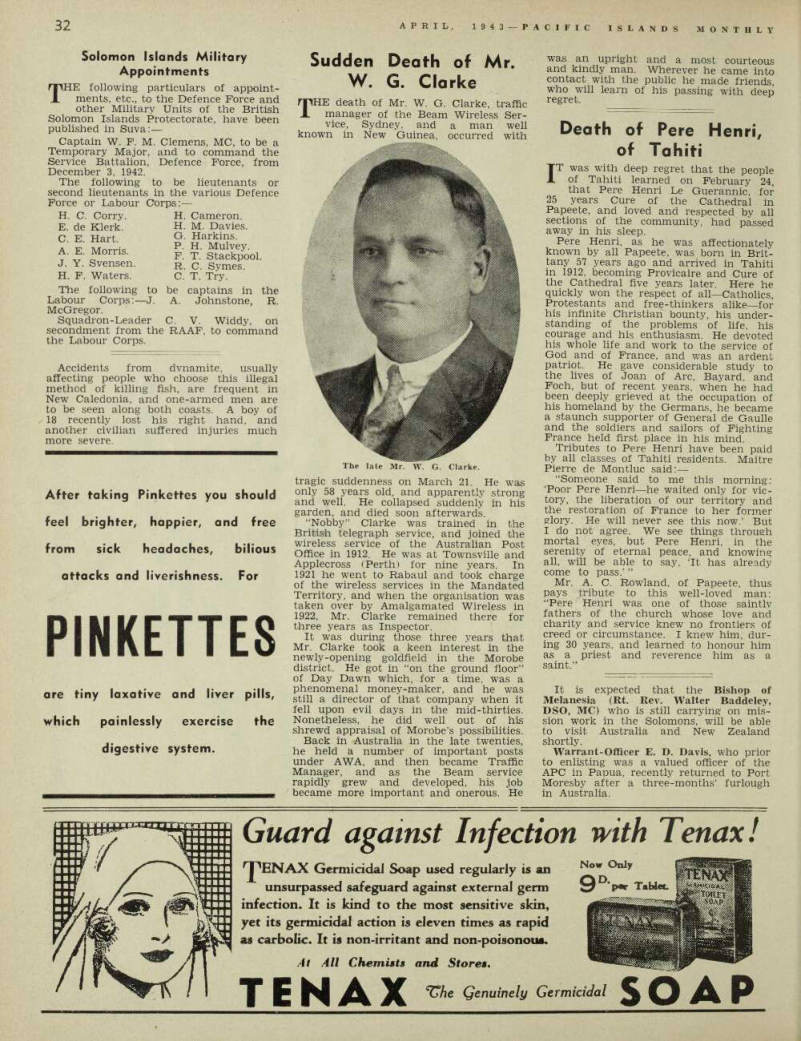
Solomon Islands Military Appointments
THE following particulars of appoint ments, etc., to the Defence Force and other Military Units of the British Solomon Islands Protectorate, have been published in Suva:— Captain W. F. M. Clemens, MC, to be a Temporary Major, and to command the Service Battalion, Defence Force, from December 3, 1942.
The following to be lieutenants or second lieutenants in the various Defence Force or Labour Corps:— H. C. Corry. H. Cameron.
E. de Klerk. H. M. Davies.
C. E. Hart. g- Harkins.
A E Morris R H - Mulve y- A. E. Morns. F T stackpool.
J. Y. Svensen. r. c. Symes.
H. F. Waters. C. T. Try.
The following to be captains in the Labour Corps:—J. A. Johnstone, R.
McGregor.
Squadron-Leader C. V. Widdy, on secondment from the RAAF, to command the Labour Corps.
Accidents from dynamite, usually affecting people who choose this illegal method of killing fish, are frequent in New Caledonia, and one-armed men are to be seen along both coasts. A boy of 18 recently lost his right hand, and another civilian suffered injuries much more severe.
Sudden Death of Mr.
W. G. Clarke
THE death of Mr. W. G. Clarke, traffic manager of the Beam Wireless Ser vice, Sydney, and a man well known in New Guinea, occurred with
tragic suddenness on March 21. He was only 58 years old, and apparently strong and well. He collapsed suddenly in his garden, and died soon afterwards.
“Nobby” Clarke was trained in the British telegraph service, and joined the wireless service of the Australian Post Office in 1912. He was at Townsville and Applecross (Perth) for nine years. In 1921 he went to Rabaul and took charge of the wireless services in the Mandated Territory, and when the organisation was taken over by Amalgamated Wireless in 1922, Mr. Clarke remained there for three years as Inspector.
It was during those three years that Mr. Clarke took a keen interest in the newly-opening goldfield in the Morobe district. He got in “on the ground floor” of Day Dawn which, for a time, was a phenomenal money-maker, and he was still a director of that company when it fell upon evil days in the mid-thirties.
Nonetheless, he did well out of his shrewd appraisal of Morobe’s possibilities.
Back in Australia in the late twenties, he held a number of important posts under AWA, and then became Traffic Manager, and as the Beam service rapidly grew and developed, his job became more important and onerous. He
was an upright and a most courteous and kindly man. Wherever he came into contact with the public he made friends, who will learn of his passing with deep regret.
The late Mr. W. G. Clarke.
Death of Pere Henri,
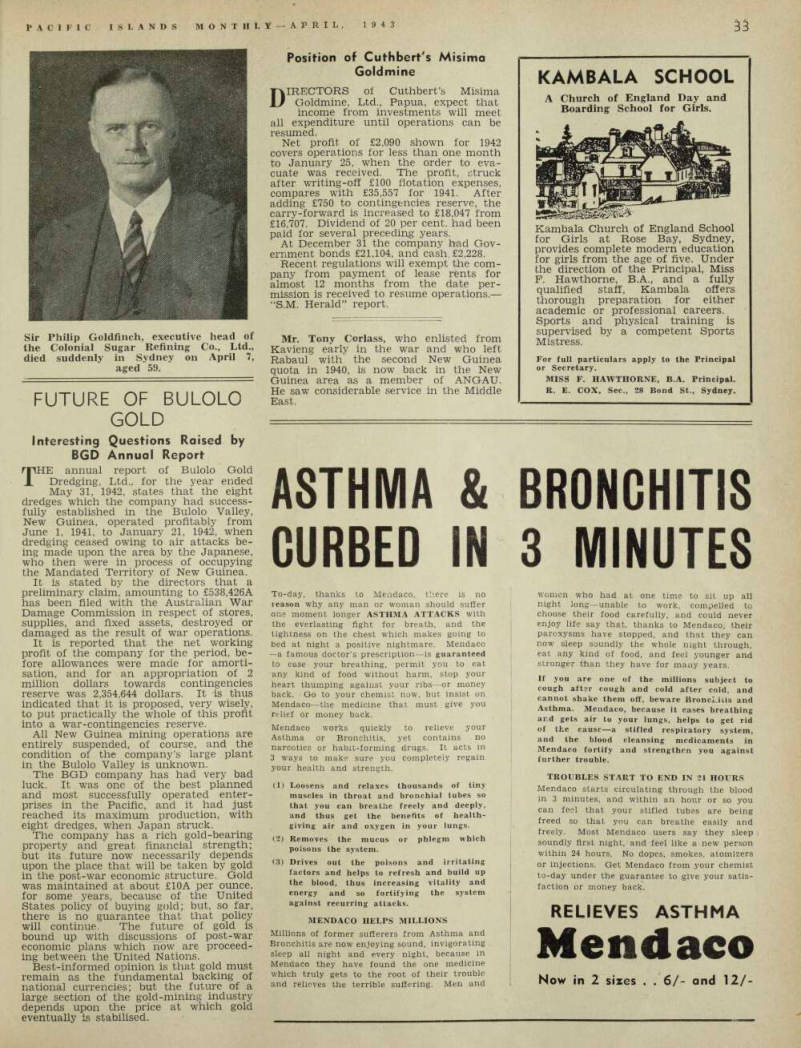
of Tahiti
IT was with deep regret that the people of Tahiti learned on February 24, that Pere Henri Le Guerannic, for 25 years Cure of the Cathedral in Papeete, and loved and respected by all sections of the community, had passed away in his sleep.
Pere Henri, as he was affectionately known by all Papeete, was born in Brit tany 57 years ago and arrived in Tahiti in 1912, becoming Provicaire and Cure of the Cathedral five years later. Here he quickly won the respect of all—Catholics, Protestants and free-thinkers alike—for his infinite Christian bounty, his under standing of the problems of life, his courage and his enthusiasm. He devoted his whole life and work to the service of God and of France, and was an ardent patriot. He gave considerable study to the lives of Joan of Arc, Bayard, and Foch, but of recent years, when he had been deeply grieved at the occupation of his homeland by the Germans, he became a staunch supporter of General de Gaulle and the soldiers and sailors of Fighting France held first place in his mind.
Tributes to Pere Henri have been paid by all classes of Tahiti residents. Maitre Pierre de Montluc said: — “Someone said to me this morning: ‘Poor Pere Henri —he waited only for vic tory, the liberation of our territory and the restoration of France to her former glory. He will never see this now.’ But I do not agree. We see things through mortal eyes, but Pere Henri, in the serenity of eternal peace, and knowing all, will be able to say, Tt has already come to pass.’ ”
Mr. A. C. Rowland, of Papeete, thus pays tribute to this well-loved man: “Pere Henri was one of those saintlv fathers of the church whose love and charity and service knew no frontiers of creed or circumstance. I knew him, dur ing 30 years, and learned to honour him as a priest and reverence him as a saint.”
It is expected that the Bishop of Melanesia (Rt. Rev. Walter Baddeley, DSO, MC) who is still carrying on mis sion work in the Solomons, will be able to visit Australia and New Zealand shortly.
Warrant-Officer E. D. Davis, who prior to enlisting was a valued officer of the APC in Papua, recently returned to Port Moresby after a three-months’ furlough in Australia.
Sir Philip Goldfinch, executive head of the Colonial Sugar Refining Co., Ltd., died suddenly in Sydney on April 7, aged 59.
Advertisements & other items, p. 34 (1 item)
Pinkettes
After taking Pinkettes you should feel brighter, happier, and free from sick headaches, bilious attacks and liverishness. For
are tiny laxative and liver pills, which painlessly exercise the digestive system.
7
Guard against Infection with Tenax!
Germicidal Soap used regularly is an
unsurpassed safeguard against external germ
infection. It is kind to the most sensitive skin, yet its germicidal action is eleven times as rapid as carbolic. It is non-irritant and non-poisonous.
At All Chemists and Stores .
TENAX c C7ie Genuinely Germicidal SOAP
Now Only 9 Tablet.
Future Of Bulolo
Gold
Interesting Questions Raised by
BGD Annual Report
THE annual report of Bulolo Gold Dredging, Ltd., for the year ended May 31, 1942, states that the eight dredges which the company had success fully established in the Bulolo Valley, New Guinea, operated profitably from June 1, 1941, to January 21, 1942, when dredging ceased owing to air attacks be ing made upon the area by the Japanese, who then were in process of occupying the Mandated Territory of New Guinea.
It is stated by the directors that a preliminary claim, amounting to £538,426A has been filed with the Australian War Damage Commission in respect of stores, supplies, and fixed assets, destroyed or damaged as the result of war operations.
It is reported that the net working profit of the company for the period, be fore allowances were made for amorti sation, and for an appropriation of 2 million dollars towards contingencies reserve was 2,354,644 dollars. It is thus indicated that it is proposed, very wisely, to put practically the whole of this profit into a war-contingencies reserve.
All New Guinea mining operations are entirely suspended, of course, and the condition of the company’s large plant in the Bulolo Valley is unknown.
The BGD company has had very bad luck. It was one of the best planned and most successfully operated enter prises in the Pacific, and it had just reached its maximum production, with eight dredges, when Japan struck.
The company has a rich gold-bearing property and great financial strength; but its future now necessarily depends upon the place that will be taken by gold in the post-war economic structure. Gold was maintained at about £IOA per ounce, for some years, because of the United States policy of buying gold; but, so far, there is no guarantee that that policy will continue. The future of gold is bound up with discussions of post-war economic plans which now are proceed ing between the United Nations.
Best-informed opinion is that gold must remain as the fundamental backing of national currencies; but the future of a large section of the gold-mining industry depends upon the price at which gold eventually is stabilised.
Position of Cuthbert's Misimo
Goldmine
DIRECTORS of Cuthbert’s Misima Goldmine, Ltd., Papua, expect that income from investments will meet all expenditure until operations can be Net profit of £2,090 shown for 1942 covers operations for less than one month cuate was received. The profit, struck after writing-off £lOO flotation expenses, compares with £35,557 for 1941. After adding £750 to contingencies reserve, the carry-forward is increased to £18,047 from St ?evera? C precedl^ r years had b66n At December 3? the had Government bonds £21,104, and cash £2,228.
Recent regulations will exempt the company from payment of lease rents for almost 12 months from the date permission is received to resume operations.—
“S.M. Herald”
report.
_■. . , Mr. Tony Corlass, who enlisted from Kavieng early in the war and who left Rabaul with the second New Guinea quota in 1940, is now back in the New Guinea area as a member of ANGAU.
He saw considerable service in the Middle East.
Advertisements & other items, p. 35 (1 item)
Bronchitis
KAMBALA SCHOOL
A Church of England Day and Boarding School for Girls.
Kambala Church of England School for Girls at Rose Bay, Sydney, provides complete modern education for girls from the age of five. Under the direction of the Principal, Miss F. Hawthorne, 8.A., and a fully qualified staff, Kambala offers thorough preparation for either academic or professional careers.
Sports and physical training is supervised by a competent Sports Mistress.
For full particulars apply to the Principal or Secretary.
MISS F. HAWTHORNE, B.A. Principal.
R. E. COX, Sec., 28 Bond St., Sydney.
ASTHMA &
CURBED IN
To-day, thanks to Mendaco, there is no reason why any man or woman should suffer one moment longer ASTHMA ATTACKS with the everlasting fight for breath, and the tightness on the chest which makes going to bed at night a positive nightmare. Mendaco —a famous doctor’s prescription—is guaranteed to ease your breathing, permit you to eat any kind of food without harm, stop your heart thumping against your ribs—or money back. Go to your chemist now, but insist on Mendaco —the medicine that must give you relief or money back.
Mendaco works quickly to relieve your Asthma or Bronchitis, yet contains no narcotics or habit-forming drugs. It acts in 3 ways to make sure you completely regain your health and strength. (1) Loosens and relaxes thousands of tiny muscles in throat and bronchial tubes so that you can breathe freely and deeply, and thus get the benefits of healthgiving air and oxygen in your lungs. (2) Removes the mucus or phlegm which poisons the system. (3) Drives out the poisons and irritating factors and helps to refresh and build up the blood, thus increasing vitality and energy and so fortifying the system against recurring attacks.
MENDACO HELPS MILLIONS
Millions of former sufferers from Asthma and Bronchitis are now enjoying sound, invigorating sleep all night and every night, because in Mendaco they have found the one medicine which truly gets to the root of their trouble and relieves the terrible suffering. Men and
BRONCHITIS
3 MINUTES
women who had at one time to sit up all night long—unable to work, compelled to choose their food carefully, and could never enjoy life say that, thanks to Mendaco, their paroxysms have stopped, and that they can now sleep soundly the whole night through, eat any kind of food, and feel younger and stronger than they have for many years.
If you are one of the millions subject to cough after cough and cold after cold, and cannot shake them off, beware Bronchitis and Asthma. Mendaco, because it eases breathing and gets air to your lungs, helps to get rid of the cause—a stifled respiratory system, and the blood cleansing medicaments in Mendaco fortify and strengthen you against further trouble.
TROUBLES START TO END IN 24 HOURS Mendaco starts circulating through the blood in 3 minutes, and within an hour or so you can feel that your stifled tubes are being freed so that you can breathe easily and freely. Most Mendaco users say they sleep soundly first night, and feel like a new person within 24 hours. No dopes, smokes, atomizers or injections. Get Mendaco from your chemist to-day under the guarantee to give your satisfaction or money back.
RELIEVES ASTHMA
Mendaco
Now in 2 sizes . . 6/- and 12/-
"Lorna D" In Tahiti
AFTER having been tied to the quay in Papeete for four months, the Sleek little home-made schooner, "Lorna D,” built, owned, and sailed by Captain and Mrs. Davidge, will presently be headed for British Columbia. She came here to await the end of the hur ricane season, and the Captain and his wife made many friends in Tahiti, as they had done in Suva, Rarotonga, and other ports visited during their wander ings across the Pacific.—Ray P. Davis.
Mr. W. H. Miller, who was a well known District Officer in the Solomon Islands, has retired from the service of that administration.
" Isles Of The
Blest "
New Picture of French Oceania
From Our Own Correspondent NOUMEA, March 23.
MUCH that half the world now wants to knew about French Oceania is contained in a new book. “Tahiti, Terre Francais Combattante," by Dr. de Curton. who was Governor there in 1940 and 1941.
The book contains geographic and his toric sketches, as well as an account of the islands’ riches and resources, and of their Polynesian, European and Asiatic populations, and is enriched by some 60 photographs, mostly by J. E. Nash. It is the first of a series of booklets to be devoted to the French Colonies which rallied to Fighting France.
One learns that of the 4,000 Europeans in French Oceania, more than 3,000 are French mainly officials, gendarmes, teachers, missionaries, etc. Of the 20 other nationalities represented, citizens of the United States are in the majority.
“Most of these foreigners are tourists who have stayed on here because of the charm of the islands and of their inhabi tants. They lead, in Tahiti, a carefree and contemplative life, peacefully enjoythe blissful climate and the beauty of "the landscape, which has seduced them. In general, they take part in no business activities, for they wish to avoid creating in these isles of the blest the cares and the struggles which everlast
ingly trouble the civilised societies from which they have escaped.
“The natives welcome these indolent and inoffensive strangers with hospital ity, and the traveller hears as of old the greeting “e hoa! Haere mai, e tamaa!’ with which the Maori invites the un known passer-by to sit down and share his meal.”
In contrast with white and native indo lence is the assiduity of the commercially minded Chinese, working hard from dawn to dark.
“However, the native, protected by French laws, remains the proprietor of the soil, and this association of the Chinese and the Tahitian is not parasi tism, but a harmonic partnership which perfectly suits the careless indifference and indolence of the Maori.”
Dr. de Curton attributes the past de population of the islands to boredom in a new world created by civilisation. He hardly agrees with those who would attribute it to alcoholism, the custom of adoption, and too precocious defloration of the girls, for these were the rule before white civilisation came. He agrees rather with Stevenson that “their bar baric wars, their perilous sea adventures, their cruel gods, their bloody orgies, were stimulants which gave to the ancient Maori his interest in life; civilisation has suppressed these savage rites and nut nothing in their place.”
Lone Voyagers At
Pitcairn
By Ada M. Christian
ON Christmas morning the call of “Sail-ho” was sounded, and soon every person on the Island knew that a schooner had been sighted, beat ing its way from the west. As it came nearer it could be plainly seen that it was one-masted—no larger than one of our home-made boats.
Our men were waiting to go off to meet her, when, on her last tack off Bounty Bay, she went right on toward the north and was soon lost to sight. Pleasant excitement turned to bitter disappoint ment, and many opinions were expressed as to her probable business. That she was a pleasure boat was thought to be absurd, under the circumstances.
Her identity was revealed two days later when a twp-masted ketch, the “Karlchris,” arrived, carrying Captain and Mrs. Gessler and Mr. Gene Zabrisky.
They had been in Tahiti prior to the outbreak of the Pacific war,' and had subsequently decided to return to the United States, via Mangareva, and some of the South Pacific islands. They said that the owner of the one-masted boat sighted two days previously, was sailing alone, and that the two boats had left Mangareva together, beating against head winds. The “Karlchris,” setting a course to the south, had taken 11 days to reach Pitcairn. The other boat stood to the north, and arrived a little sooner. The “Karlchris” had to anchor off Pitcairn for 14 days, waiting for a favourable wind.
The crew of the “Karlchris” took turns alternately on watch on the ketch and visiting Islanders’ homes. Captain Gess ler, to the Pitcairners’ interest, made a descent in his diving helmet to the wreck of the “Cornwallis.” When the ketch moved on to USA it was the end of some happy days for the Pitcairners.
Mr. Roy P. Clark has been appointed postmaster, and Mr. Andrew C. Young, Islands Secretary, of Pitcairn Island, for another two years, from January, 1943.
Advertisements & other items, p. 36 (1 item)
Allen Taylor & Co. Ltd.
NELSON & ROBERTSON
PTY., LTD.
Established 1895.
Islands Merchants
All classes of merchandise purchased at wholesale prices and original invoices supplied to Islands clients.
Cocoa Beans, Rubber and other Islands' produce sold on commission.
Nelson & Robertson
Pty. Ltd. 12 Spring Street, Sydney, Australia.
'-'ia r Wanted to Buy—Quality Guns and Rifles HIGHEST PRICES GIVEN. WILL ALSO EXCHANGE GUNS.
S I L RO H U Quality Firearms and Fishing Tackle 143 ELIZABETH STREET (Near Market St.) SYDNEY.
’PHONE: MA 3540.
Ship Chandlery Hardware
/Write for j
Ship Chandlery j
Catalogue J
Special "In Bond” Prices for all Islands enquiries quoted on application.
BROOMFIELDS LIMITED
152 SUSSEX STREET :: SYDNEY.
Cables: “Boom”, Sydney.
Large and Complete Stocks of
SHIP CHANDLERY
IRONMONGERY OF ALL KINDS, PAINTS,
WHITE LEAD AND OILS.
Sole Agents for: P. H. MUNTZ & CO.’S 3-CROWN BRAND METAL SHEATHING.
PEACOCK & BUCHANS’ ENGLISH READY-MIXED PAINTS.
Allen Taylor & Co. Ltd.
COMMERCIAL ROAD, ROZELLE,
SYDNEY
Sowmillers and Wholesale Suppliers of Hardwoods for Constructional Purposes GIRDERS . . . PILES . . . POLES . . . SLEEPERS, Etc.
EXPORTING TO PACIFIC ISLANDS SINCE 1893
"Tommy Japan"
How Nipponese Came to TI
By Robert Bruce
The following story of how the Japanece invasion of Thursday Island’s commercial life began was given to us by Mr. Robert Bruce, now a 90 -years-old resident of Sydney. He knew Torres Strait long ago.
As most people know, the present cocky little Jap, carrying out the orders of the Tokio war-lords, is not typical of the Japan of 50 years ago.
WHEN I first went to Thursday Island in 1882, one of the most popular and best-known identities was a tiny Japanese man called Tommy Japan.
He clattered about in his wooden clogs, dressed in a beautiful, multi-coloured robe and little white sox, and with his thick black hair standing up on his head like a brush.
He greeted everyone with a sweet, bland smile, and usually by shaking hands with himself and bowing. His black eyes were forever twinkling, and he had an air about him that seemed to suggest that he was perpetually on the point of tell ing a funny story in his broken pidgin- English. He was never known to work, but wandered about the small settlement, and was always sure of a welcome and a meal wherever he went.
At about the same time the first Tatter sail’s Sweep tickets made their appear ance in TI, and one evening when the bar of Smyth’s Hotel was crowded, the iavourite barmaid, Kitty O’Shea, sug gested that there should be a “bob-in” for a ticket for Tommy Japan, who was there, wandering about but never drink ing. The crowd was delighted and pushed Tommy forward to receive his guinea ticket.
In due course, the results of the lottery were known and, to the amazement of the whole township, Tommy’s ticket won first prize—somewhere between £30,000 and £35,000.
He went about shaking hands and tell ing his friends that he would buy them just anything they wanted—and this he proceeded to do, with no half-measures.
To a big six-footer of a Samoan who had been kind to him he gave two pearling boats, and to the proprietors of Thursday Island’s five pubs he gave orders for free drinks for everyone. Some got cases of whisky, and some casks of beer, which they rolled out into the street where, under the coconut trees, they invited every passer-by to join them.
Tommy went back to Japan, taking with him the proprietor of Tatt’s Hotel and two other men, whom he entertained royally, and sent back loaded with Japanese curios.
But hard on the heels of the returning residents there came enterprising sons of Nippon, in ones and twos and threes; until, by the time I left the Island, there were some 700 of Tommy’s countrymen in the settlement. They had invaded every class of business, and already were well on the way to ousting the Europeans from their regular means of livelihood. They imported everything from Japan—even Black and White whisky, beer and soft drinks!
Wedding In Tahiti
Papeete, Feb. 23.
THE social event of the year at Tahiti has been the marriage of Elvina, eldest daughter of Prince and Prin cess Ariipaea Pomare, with Monsieur Maurice Bouchard, on February 6. 1943.
The marriage ceremony was performed at Bethel Chapel, Papeete, in the pre sence of a large and distinguished com pany, including high Government officials and representatives of all the high chiefly families of Central Polynesia.
The bride, whose Tahitian name, Hina Arii, is of great antiquity in the Royal Family, is the great-great-grand-daugh ter of Queen Pomare IV. of Tahiti.
The wedding ceremony was followed by a reception at the home of the bride’s parents, in Pirae.
"Calling the Islands"
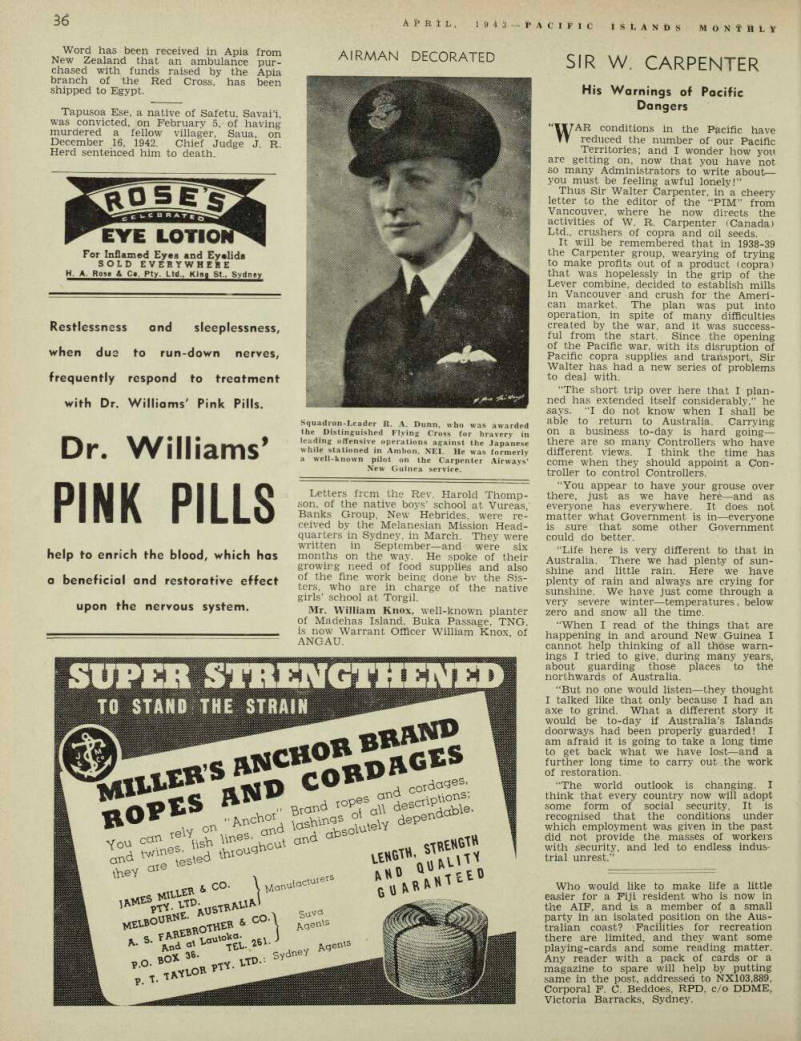
ANOTHER interesting talk to the Paci fic Islands, by Sir Harry Luke, lately Governor of Fiji, was given through the BBC on March 9. He dis cussed Pacific subjects in an informative way, and transmitted several personal messages to people in Fiji and Tonga.
Before Sir Harry spoke, Mr. Alistair Lock sent best wishes to Queen Salote, of Tonga, on the occasion of her birthday (March 13).
Word has been received in Apia from New Zealand that an ambulance pur chased with funds raised by the Apia branch of the Red Cross, has been shipped to Egypt.
Tapusoa Ese, a native of Safetu, Savai’i, was convicted, on February 5, of having murdered a fellow villager, Saua, on December 16, 1942. Chief Judge J. R.
Herd sentenced him to death.
Advertisements & other items, pp. 37-38 (2 items)
fiHLESPI| Service
AUNT
MARYS
BAKING POWDER
One of the famous Aunt Mary’s food products manufactured by the firm of Ti I lock & Co. Pty. Ltd.
Established nearly 70 years.
fiHLESPI| Service
BUYING AGENTS
FOR ALL PACIFIC TERRITORIES
Island Produce Sold on Commission
YOUR ORDERS RECEIVE PERSONAL ATTENTION
ROBERT GILLESPIE PTY. LIMITED
54a PITT STREET, SYDNEY
Cables: ROBERGILL. G.P.O. BOX 137 CC.
For Inflamed Eyes and Eyelids
SOLD EVERYWHERE
Restlessness and sleeplessness, when due to run-down nerves, frequently respond to treatment with Dr. Williams' Pink Pills.
Dr. Williams’
PINK PILLS
help to enrich the blood, which has a beneficial and restorative effect upon the nervous system.
Bt - 0 i au •" reW on "T and -- You Catl nes K sla and TU and ' ' \heY ate - - “• V«V°
ilaciurets
& c °- V Ua nul
B^SU &co -\ iss.
* HO n 6«*«
Old Monk
The Worlds Finest
Olive Oil
-•- San Francisco
Airman Decorated
Letters frcm the Rev. Harold Thomp son. of the native boys’ school at Vureas, Banks Group, New Hebrides, were re ceived by the Melanesian Mission Head quarters in Sydney, in March. They were written in September—and were six months on the way. He spoke of their growing need of food supplies and also of the fine work being done bv the Sis ters, who are in charge of the native girls’ school at Torgil.
Mr. William Knox, well-known planter of Madehas Island, Buka Passage, TNG, is now Warrant Officer William Knox, of
Angau.
Squadron-Leader R. A. Dunn, who was awarded the Distinguished Flying Cross for bravery in leading offensive operations against the Japanese while stationed in Ambon, NEI. He was formerly a well-known pilot on the Carpenter Airways’
New Guinea service.
Sir W. Carpenter
His Warnings of Pacific Dangers
“W AR conditions in the Pacific have Tt reduced the number of our Pacific Territories: and I wonder how you are getting on, now that you have not so many Administrators to write about — you must be feeling awful lonely!”
Thus Sir Walter Carpenter, in a cheery letter to the editor of the “PIM” from Vancouver, where he now directs the activities of W. R. Carpenter (Canada) Ltd., crushers of copra and oil seeds.
It will be remembered that in 1938-39 the Carpenter group, wearying of trying to make profits out of a product (copra) that was hopelessly in the grip of the Lever combine, decided to establish mills in Vancouver and crush for the Ameri can market. The plan was put into operation, in spite of many difficulties created by the war, and it was success ful from the start. Since the opening of the Pacific war, with its disruption of Pacific copra supplies and transport, Sir Walter has had a new series of problems to deal with.
“The short trip over here that I plan ned has extended itself considerably,” he says. “I do not know when I shall be able to return to Australia. Carrying on a business to-day is hard going— there are so many Controllers who have different views. I think the time has come when they should appoint a Con troller to control Controllers.
“You appear to have your grouse over there, just as we have here —and as everyone has everywhere. It does not matter what Government is in—everyone is sure that some other Government could do better.
“Life here is very different to that in Australia. There we had plenty of sun shine and little rain. Here we have plenty of rain and always are crying for sunshine. We have just come through a very severe winter—temperatures, below zero and snow all the time.
“When I read of the things that are happening in and around New Guinea I cannot help thinking of all thdse warn ings I tried to give, during many years, about guarding those places to the northwards of Australia.
“But no one would listen —they thought I talked like that only because I had an axe to grind. What a different story it would be to-day if Australia’s Islands doorways had been properly guarded! I am afraid it is going to take a long time to get back what we have lost—and a further long time to carry out the work of restoration.
“The world outlook is changing. I think that every country now will adopt some form of social security. It is recognised that the conditions under which employment was given in the past did not provide the masses of workers with security, and led to endless indus trial unrest.”
Who would like to make life a little easier for a Fiji resident who is now in the AIF, and is a member of a small party in an isolated position on the Aus tralian coast? Facilities for recreation there are limited, and they want some playing-cards and some reading matter.
Any reader with a pack of cards or a magazine to spare will help by putting same in the post, addressed to NX103,889, Corporal F. C. Beddoes, RPD. c/o DDME, Victoria Barracks, Sydney.
Advertisements & other items, p. 38 (1 item)
36
1943 PACIFIC ISLANDS MONtBLY
War Damage
Commission
Committees to Consider Claims
COMMITTEES of Review have been set up by the War Damage Commission to advise on claims from former residents in New Guinea and Papua for compensation arising out of war damage.
In the case of New Guinea, the follow ing is the permanent committee:— Administrator . .. Sir Walter McNicoll.
Expert assessor . .. Mr. H. J. Unsworth.
Real property expert Mr. P. J. Gordon. for Districts of Morobe, Madang, Manus. New Ire land and Senik. .. „ „ Mr. R. H. Morris. for Districts of New Britain and Kieta.
Commission’s Rep. . Mr. M. J. Cronin.
The following shows the names of the “local representatives” who will sit with the above committees to consider claims from the respective districts mentioned, and the number of claims:— Morobe (1333) ... W. G, Mitchell Kieta (81) F. P. Archer Madang and Sepik (156) E. U. O’Brien Manus and New Ireland (191) .. N. Whitelev New Britain (569) . F. J. MacKenzie Papua In respect of Papua, the following is the General Committee: — Administrator .. .. Mr. Leonard Murrav Expert assessor .. Mr. H. J. Unsworth Real property expert Mr. R. H. Morris Commission’s Rep. Mr. M. J. Cronin The following are the names of “Local Representatives,” to sit with the General Committee to consider claims from the respective districts mentioned:— Central and Port Moresby (414) .. E. A. James Delta (6) J. R. Clay Western (7) .. .. E. H. Adams Eastern, Northern and North-east ern (196) ... G. E. Aumuller Gulf (26) R. A. Vivian South-eastern (Misima) .. .. P. F. Osborne South-eastern (Woodlark Island) (64 in SE Div.) H. W. Rogerson Committee Meetings The War Damage Commission has arranged the following list of committee meetings:—
Every 2nd and 4th Friday of month: Meeting of a New Guinea Committee.
Every 3rd Friday of month: Meeting of a Papua Committee.
Every Ist Friday of month: Meeting of State Assessment and Advisory Panel.
Statement By Commission
THE, chairman of the War Damage Commission (Mr. Coles, MHR) made the following statement on April 13:— At the meeting of the Commission held in Sydney last week a number of assessed claims for compensation were recorded in respect of fixed property, vehicles, furni ture and other personal property dam aged in New Guinea and Papua. The largest individual claim recorded exceeded £90,000.
Other claims are being considered, but many, particularly in enemy-occupied territory, cannot be assessed and recorded in the absence of reasonable evidence of
war damage or of the value of property damaged.
Claimants can assist in expediting the assessment of claims by furnishing the Commission, wherever possible, with cor roborative statements from persons who may have first-hand knowledge on these two points.
The Commission and the Army are in close collaboration to ensure that all available information will be utilised without having to put claimants to unnecessary trouble in proving their claims.
Claim in Respect of Pro- Date perty in 1943: District Locality of— Mch. 19 .
Central, P.
P. Moresby ,, 26 . . . . Morobe, N.G.
Wau-Edie Ck.
April 2 . . State Assessment and Advisory Panel 9 . . .. New Britain, N.G.
N. Britain ,, * 16 . . .. Eastern, P.
Samarai 23 . . • • Good Friday ,, 30 . . ..
May 7 . . State Assessment and Advisory Panel 99 14 . . .. Madang. N.G.
Madang ,, 21 . . ,. South Eastern, P. S.E.
H 28 . . .. Morobe, N.G.
Salamaua June 4 . . State Assessment and Advisory Panel ., 11 . . .. New Britain, N.G.
N. Britain ,, 18 . . .. Central, P.
Central 25 . . .. New Britain. N.G.
N. Ireland July 2 . . State Assessment and Advisory Panel ,, 9 . . .. Kieta, N.G.
Kieta ,, 16 . . .. Gulf. P.
Gulf 23 . . .. Morobe, N.G.
Bulolo *« 30 .
Aug. 6 .. , State Assessment and Advisory Panel , , 13 . . .. New Britain, N.G.
N. Britain ,, 20 ..
. . D. & W.. P.
D. & W.
M 27 .. , .. Manus, N.G.
Manus Sept. 3- ., , State Assessment and Advisory Panel 10 . . ., Morobe, N.G.
Lae 17 . . . . N. & N.E., P.
N. & N.E.
24 . . .. Sepik, N.G.
Sepik Oct. 1 . . State Assessment and Advisory Panel ,, 8 . . , .. Morobe, N.G.
Morobe ,, 15 .. .. Central, P.
P. Moresby ,, 22 .. .. Kieta, N.G.
Kieta .. 29 ., , ..
Nov. 5 ..
State Assessment and Advisory Panel 12 .. .. New Britain, N.G.
N. Ireland 19 . . .. Eastern, P.
Eastern 26 . . .. New Britain, N.G.
N. Britain Dec. 3 ..
State Assessment and Advisory Panel 10 .. .. Morobe, N.G.
Wau-Edie Ck 17 .. .. Central. P.
P. Moresby 24 ..
Christmas Eve ,, 31 . . .. .
Advertisements & other items, pp. 39-40 (1 item)
Slop Kidney
Poisoning To-day
If you suffer from Rheumatism, Sciatica, Neuritis, Lumbago, Pains in Back, Nervousness, Dizziness, Circles under Eyes, Leg Pains, Poor Appetite and Energy, Puffy Ankles, or broken rest, etc., you should know that your system is being poisoned because germs, acids and wastes are impairing the vital functioning process of your kidneys.
Take care! Ordinary medicines can’t help much and you must stop these troubles by removing the cause with Cystex which starts benefit in 3 hours and is offered on generous terms—No Benefit—No Pay. Cystex—the doctor’s prescription—is approved by doctors and chemists in 73 countries, and over 90,000 people have written to say how pleased they are to have found the right medicine for their troubles.
One-time Sufferers Praise This Medicine Mr. R. T., Townsville, Queensland, recently wrote; “My joints were all stiff, I had leg pains, my back used to ache day and night. My bladder was weak. I had headaches and no appetite. The first dose of Cystex helped me and before I finished three boxes my health and strength came back.”
Mrs. M. L. Z., Thompson Estate, Brisbane: “I have been taking Cystex for Kidney and Bladder trouble and it has made a different woman of me. I am feeling splendid, can do all my work, run about and walk miles although I am 63 years of age. Cystex does all you claim for it.”
Cystex Helps Nature 3 Ways
Gets rid of health-destroying, deadly poisonous acids. Kills the germs which are infecting kidneys, bladder and urinary system. Helps nature to strengthen and reinvigorate kidneys arid protects against further attack. • Guaranteed to Satisfy or Money Back Get Cystex from your chemist to-day. Give it a thorough test. Cystex is guaranteed to make you feel younger, stronger, better in every way, in 24 hours, and to be completely well in 1 week or your money back if you return the empty package. Act now! Now in 2 sizes— I/-, 8/-.
GUARANTEED
Treatment for Your Kidneys, Bladder, Rheumatism.
0= Sole Australian Distributors of Monel :
STRONG CORROSION-RESISTING RUSTLESS
is to-day controlled by the Ministry of Munitions so that its outstanding qualities shall be available first and foremost for the War Effort. Thus our stocks are reserved entirely for Defence and essential services—for such applications we will value your enquiries.
WRIGHT AND COMPANY, 81 Clarence Street, Sydney ■■■ Monel is a registered trade mark ———» - —.———■
KANGAROO BRAND
Ropes,
Cordage,
and Twines for every purpose
Backed by
86 years of service.
Manufactured by
M. DONAGHY AND SONS,
Pty. Ltd.,Geelong and Sydney.
Fiji Representatives:
PEARCE AND CO.
LIMITED
P.O. BOX 237, SUVA
FOPi
laisaMaaMa
For Essential Industries
Now, more than ever, speed and efficiency in industry are demanded. Only equipment of the highest reputation is worthy of consideration. You can rely on the products of— CROMPTON. PARKINSON LTD.—Motors. Instruments. Transformers. Crompton Lamps.
FERRANTI LTD.—Transformers, Instruments, Meters.
HERBERT MORRIS LTD.—Pulley Blocks. Runways.
CROMPTON, PARKINSON (AUST.) PTY. LTD
Parkinson Motors, Crompton Minor Motors, Power Transformers.
CALLENDERS CABLES & CONSTRUCTION CO.
LTD. —Wires, Cables. Flexibles.
RANSOMES & RAPIER LTD.—Mobile and Breakdown Cranes, Excavators.
HOPKINSONS LTD.—Valves and Boiler Fittings.
NORDBERG MEG. CO. LTD. —Symons Cone Crushers, Vibrating Screens.
AUDLEY ENGINEERING CO. LTD.—“Audco”
Lubricated Plug Valves.
MATHER & PLATT LTD.—Large Electric Motors,
NOYES
11 Watt Street, Newcastle.
BROS. (SYDNEY) LTD.
115 Clarence Street, Sydney
And at Port Kembla. 197 Elizabeth Street, Brisbane.
ALUMINIUM and its ALLOYS
OUR HOUSE FLAG IS FLYING and our production is flowing into the stream of Defence requirements exclusively—in the forms of Aluminium Alloy INGOT, Rolled Aluminium Alloy PLATE, SHEET, STRIP, also as Extruded Aluminium Alloy ROD, BAR, WIRE, TUBING AND SECTIONS.
We look forward to the time when civilian demands can be satisfied by us, to meet the growing applications for our metal in Australia and the South Seas.
PROPRIETARY LTM
(INCORPORATED IN THE STATE v OF VICTORIA ) GENERAL OFFICES AND FABRICATION DIVISION : GRANVILLE. SYDNEY. N.S.W.
Memories of William
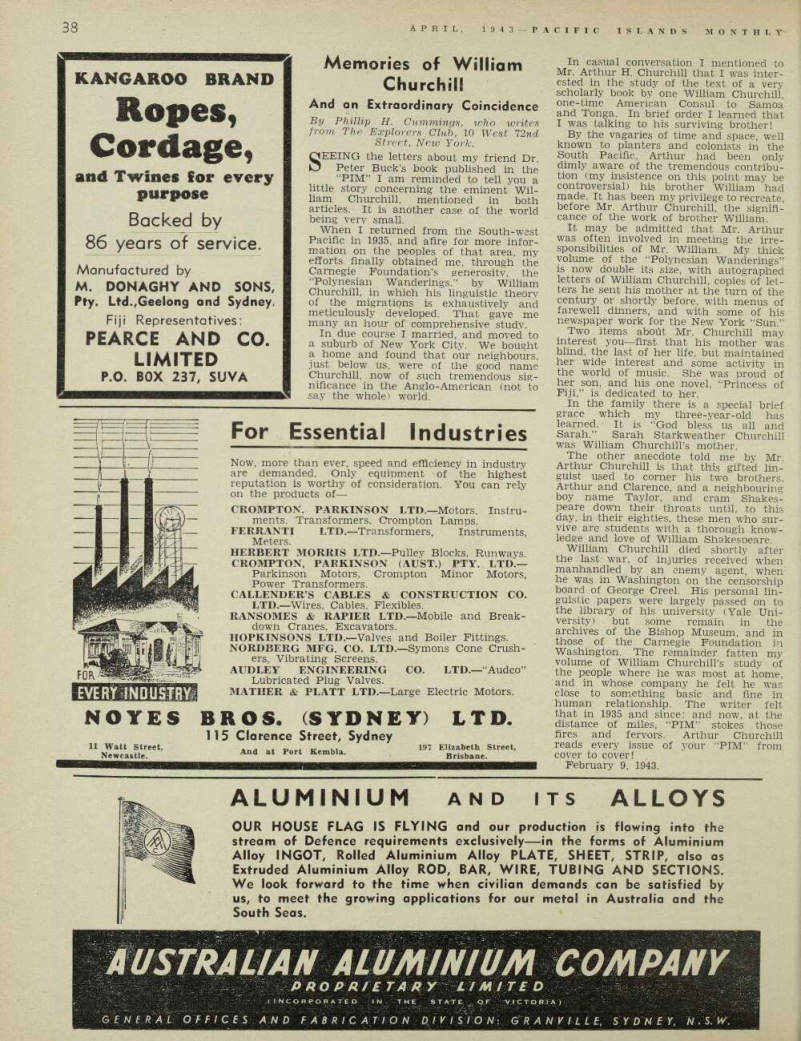
Churchill And an Extraordinary Coincidence
By Phillip H. Cummings, who writes from The Explorers Club, 10 West 72nd Street, New York.
SEEING the letters about my friend Dr.
Peter Buck’s book published in the “PIM” I am reminded to tell you a little story concerning the eminent Wil liam Churchill, mentioned in both articles. It is another case of the world being very small.
When I returned from the South-west Pacific in 1935, and afire for more infor mation on the peoples of that area, my efforts finally obtained me, through the Carnegie Foundation’s generositv, the “Polynesian Wanderings.” by William Churchill, in which his linguistic theory of the migrations is exhaustively and meticulously developed. That gave me many an hour of comprehensive studv.
In due course I married, and moved to a suburb of New York City. We bought a home and found that our neighbours, just below us, were of the good name Churchill, now of such tremendous sig nificance in the Anglo-American (not to say the whole) world.
In casual conversation I mentioned to Mr. Arthur H. Churchill that I was inter ested in the study of the text of a very scholarly book by one William Churchill, one-time American Consul to Samoa and Tonga. In brief order I learned that I was talking to his surviving brother!
By the vagaries of time and space, well known to planters and colonists in the South Pacific, Arthur had been only dimly aware of the tremendous contribu tion (my insistence on this point may be controversial) his brother William had made. It has been my privilege to recreate, before Mr. Arthur Churchill, the signifi cance of the work of brother William.
It may be admitted that Mr. Arthur was often involved in meeting the irre sponsibilities of Mr. William. My thick volume of the “Polynesian Wanderings’’ is now double its size, with autographed letters of William Churchill, copies of let ters he sent his mother at the turn of the century or shortly before, with menus of farewell dinners, and with some of his newspaper work for the New York “Sun ”
Two items abofit Mr. Churchill may interest you—first that his mother was blind, the last of her life, but maintained her wide interest and some activity in the world of music. She was proud of her son, and his one novel, “Princess of Fiji,’’ is dedicated to her.
In the family there is a special brief grace which my three-year-old has learned. It is “God bless us all and Sarah.’’ Sarah Starkweather Churchill was William Churchill’s mother.
The other anecdote told me by Mr Arthur Churchill is that this gifted lin guist used to corner his two brothers.
Arthur and Clarence, and a neighbouring boy name Taylor, and cram Shakes peare down their throats until, to this day, in their eighties, these men who sur vive are students with a thorough know ledge and love of William Shakesneare.
William Churchill died shortly after the last war, of injuries received when manhandled by an enemy agent, when he was in Washington on the censorship board of George Creel. His personal lin guistic papers were largely passed on to the library of his university (Yale Uni versity) but some remain in the archives of the Bishop Museum, and in those of the Carnegie Foundation in Washington. The remainder fatten my volume of William Churchill’s study of the people where he was most at home, and in whose company he felt he was close to something basic and fine in human relationship. The writer felt that in 1935 and since: and now, at the distance of miles, “PlM’’ stokes those fires and fervors. Arthur Churchill reads every issue of your “PIM" from cover to cover!
February 9, 1943.
Broadcast
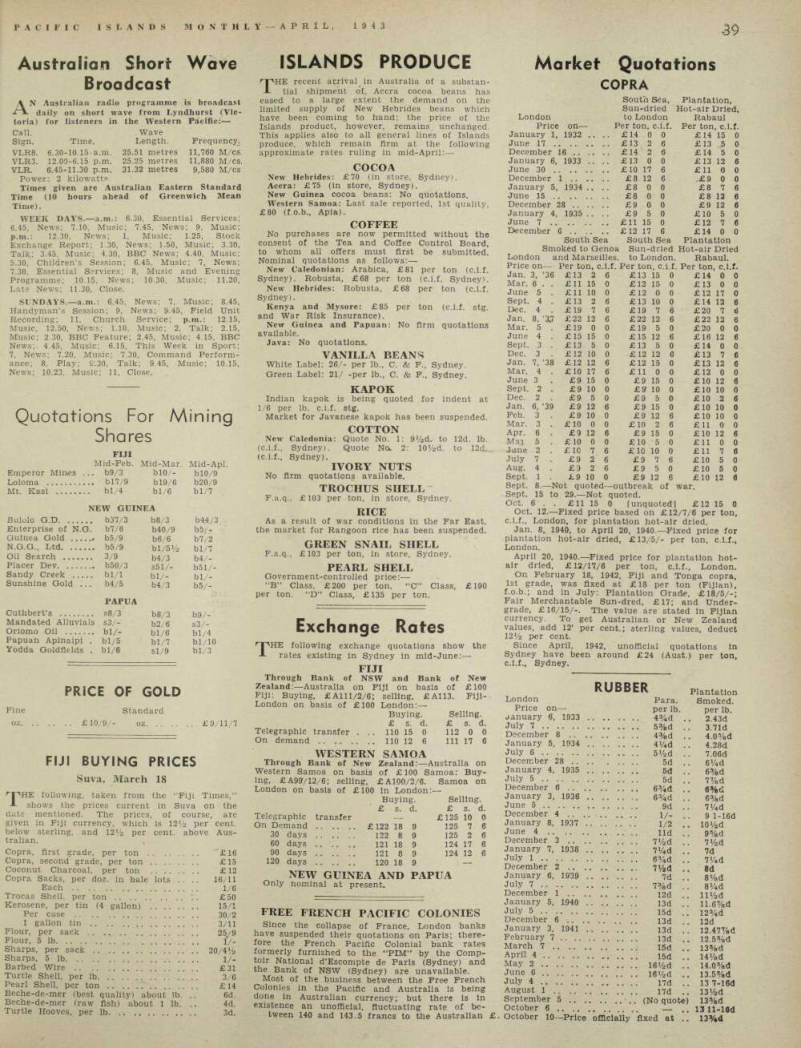
Australian Short Wave Broadcast
AN Australian radio programme is broadcast daily on short wave from Lyndhurst (Vic toria) for listeners in the Western Pacific:— Call. Wave Sign, Time. Length. Frequency^ VLRB. 6.30-10.15- a.m. 25.51 metres 11,760 M/cs.
VLR3. 12.00-6.15 p.m. 25.25 metres 11,880 M/cs.
VLR. 6.45-11.30 p.m. 31.32 metres 9,580 M/cs Power: 2 kilowatts Times given are Australian Eastern Standard Time (10 hours ahead of Greenwich Mean Time).
WEEK DAYS.—a.m.: 6.30, Essential Services; 6.45, News; 7.10, Music; 7.45, News; 9, Music; p.m.: 12.30, News; 1, Music; 1.25, Stock Exchange Report; 1.30, News; 1.50, Music; 3.30, Talk; 3.45, Music; 4.30, BBC News; 4.40, Music; 5.30, Children’s Session; 6.45, Music; 7, News; 7.30, Essential Services; 8, Music and Evening Programme; 10.15, News; 10.30, Music; 11.20, Late News; 11.30, Close.
SUNDAYS.—a.m.: 6.45, News; 7, Music; 8.45, Handyman’s Session; 9, News; 9.45, Field Unit Recording; 11, Church Service; p.m.: 12.15, Music, 12.50, News; 1.10, Music; 2, Talk; 2.15, Music: 2.30, BBC Feature; 2.45, Music; 4.15, BBC News; 4.45, Music; 6.15, This Week in Sport; 7, News; 7.20, Music; 7.30, Command Perform ance; 8, Play; £'.3o, Talk; 9.45, Music; 10.15, News; 10.23, Music; 11, Close.
Quotations For Mining
Shares
Fiji
Mid-Feb.
Mid-Mar.
Mid-Apl, Emperor Mines ... b9/3 blO/blO/9 Loloma b!7/9 b!9/6 b20/9 Mt. Kasi bl/4 bl/6 bl/7
New Guinea
Bulolo G.D b37/3 b8/3 b44/3 Enterprise of N.G. b7/6 b40/9 b5/- Guinea Gold b5/9 b6/6 b7/2 N.G.G., Ltd b5/9 b l/5i/ 2 bl/7 Oil Search 3/9 b4/3 b4/- Placer Dev b50/3 s51/b51/- Sandy Creek bl/1 bl/bl/- Sunshine Gold ... b4/5 b4/3 b5/- Cuthbert’s
Papua
s8/3 b8/3 b9/- Mandated Alluvials s3/b2/6 s3/- Oriomo Oil bl/bl/6 bl/4 Papuan Apinaipi . bl/5 bl/7 bl/10 Yodda Goldfields . bl/6 sl/9 bl/3
Advertisements & other items, p. 41 (1 item)
Price Of Gold
Fine Standard oz £10/9/- oz £9/11/7
Fiji Buying Prices
Suva, March 18
npHE following, taken from the “Fiji Times,”
A shows the prices current in Suva on the date mentioned. The prices, of course, are given in Fiji currency, which is 12V2 per cent, below sterling, and 12 V 2 per cent, above Aus tralian.
Copra, first grade, per ton £l6 Copra, second grade, per ton £l5 Coconut Charcoal, per ton £l2 Copra Sacks, per doz. in bale lots .. .. 16/11 Each 1/6 Trocas Shell, per ton £5O Kerosene, per tin (4 gallon) 15/1 Per case 30/2 1 gallon tin 3/11 Flour, per sack 25/9 Flour, 5 lb {/- Sharps, per sack 20/4V 2 Sharps, 5 lb 1/- Barbed Wire £3l Turtle Shell, per lb 3/6 Pearl Shell, per ton £l4 Beche-de-mer (best quality) about lb. . . 6d.
Beche-de-mer (raw fish) about 1 lb. .. 4d.
Turtle Hooves, per lb 3d.
Islands Produce
THE recent arrival in Australia of a substan tial shipment of Accra cocoa beans has eased to a large extent the demand on the limited supply of New Hebrides beans which have been coming to hand; the price of the Islands product, however, remains unchanged.
This applies also to all general lines of Islands produce, which remain firm at the following approximate rates ruling in mid-April:-
Cocoa
New Hebrides: £7O (in store, Sydney).
Accra: £75 (in store, Sydney).
New Guinea cocoa beans: No quotations.
Western Samoa: Last sale reported, Ist quality, £BO (f.0.b., Apia).
Coffee
No purchases are now permitted without the consent of the Tea and Coffee Control Board, to whom all offers must first be submitted.
Nominal quotations as follows: New Caledonian: Arabica, £Bl per ton (c.i.f.
Sydney). Robusta, £6B per ton (c.i.f. Sydney).
New Hebrides: Robusta, £6B per ton (c.i.f.
Sydney).
Kenya and Mysore: £B5 per ton (c.i.f. stg. and War Risk Insurance).
New Guinea and Papuan: No firm quotations available.
Java: No quotations.
Vanilla Beans
White Label: 26/- per lb., C. & F., Sydney.
Green Label: 21/ -per lb., C. & F., Sydney.
Kapok
Indian kapok is being quoted for indent at 1/6 per lb. c.i.f. stg.
Market for Javanese kapok has been suspended.
Cotton
New Caledonia: Quote No. 1: 9V2d. to 12d. lb. (c.i.f., Sydney). Quote No. 2: lOVad. to 12d. (c.i.f., Sydney).
Ivory Nuts
No firm quotations available,
Trochus Shell
F.a.q., £lO3 per ton, in store, Sydney.
Rice
As a result of war conditions in the Far East, the market for Rangoon rice has been suspended.
Green Snail Shell
F.a.q., £lO3 per ton, in store, Sydney.
Pearl Shell
Government-controlled price:— “B” Class, £2OO per ton. “C” Class. £l9O per ton. “D” Class, £135 per ton.
Exchange Rates
THE following exchange quotations show the rates existing in Sydney in mid-June:—
Fiji
Through Bank of NSW and Bank of New Zealand;—Australia on FIJI on basis of £lOO Fiji: Buying, £ All 1/2/6; selling. £AII3. FIJI - on basis of £lOO London: —
Western Samoa
Through Bank of New Zealand; —Australia on Western Samoa on basis of £lOO Samoa: Buy ing. £ A99/12/6; selling, £AIOO/2/6. Samoa on London on basis of £lOO in London:—
Buying.
Selling. £ s. d. £ s. d.
Telegraphic transfer . .. 110 15 0 112 0 0 On demand .. 110 12 6 111 17 6
Buying. £ s. d.
Telegraphic transfer — Selling. £ s. d. £125 10 0 On Demand . £122 18 9 125 7 6 30 days . 122 8 9 125 2 6 60 days . 121 18 9 124 17 6 90 days . 121 8 9 124 12 6 120 days . 120 18 9 —
New
Guinea And Papua
Only nominal at present.
Free French Pacific Colonies
Since the collapse of France, London banks have suspended their quotations on Paris; there fore the French Pacific Colonial bank rates formerly furnished to the “PIM” by the Comp toir National d’Escompte de Paris (Sydney) and the Bank of NSW (Sydney) are unavailable.
Most of the business between the Free French Colonies in the Pacific and Australia is being done in Australian currency; but there is in existence an unofficial, fluctuating rate of be tween 140 and 143.5 francs to the Australian £.
Market' Quotations
Sept. 8. —Not quoted—outbreak of war.
Sept. 15 to 29. —Not quoted.
Oct. 6 . . £ll 15 0 [unquoted] £l2 15 0 Oct. 12.—Fixed price based on £l2/7/6 per ton, c.i.f., London, for plantation hot-air dried.
Jan. 8, 1940, to April 20, 1940. —Fixed price for plantation hot-air dried, £l3/5/- per ton, c.i.f., London, April 20, 1940.—Fixed price for plantation hot air dried. £l2/17/6 per ton, c.i.f., London.
On February 18, 1942, Fiji and Tonga copra, Ist grade, was fixed at £lB per ton (Fijian), f-0.b.; and in July: Plantation Grade, £lB/5/-; Fair Merchantable Sun-dred, £l7; and Under grade, £l6/15/-. The value are stated In Fijian currency. To get Australian or New Zealand values, add 12’ per cent.; sterling values, deduct 12V2 per cent.
Since April, 1942, unofficial quotations in Sydney have been around £24 (Aust.) per ton, c.i.f., Sydney.
Copra
South Sea, Plantation, Sun-dried Hot-air Dried.
London to London Rabaul Price on— Per ton, c.i.f.
Per ton. c.i.f.
January 1, 1932 . £14 C 1 0 £14 15 0 June 17 . £13 2 1 6 £13 5 0 December 16 .. . £14 2 1 6 £14 5 0 January 6 1933 . £13 € 1 0 £13 12 6 June 30 . £10 17 6 £11 0 0 December 1 . . . £8 12 1 6 y£9 0 0 January 5 1934 . £8 0 i 0 £8 7 6 June 15 . £8 0 1 0 £8 12 6 December 28 .. . £9 0 0 £9 12 6 January 4, 1935 . £9 5 0 £10 5 0 June 7 . £11 15 0 £12 7 6 December G . . . £12 17 6 £14 0 0 South Sea South Sea Plantation Smoked to Genoa Sun-dried Hot-air Dried London and Marseilles to London.
Rabaul.
Price on— Per ton, c.i.f. Per ton, c.i.f.
Per ton. c.i.f.
Jan. 3, '36 £13 2 6 £13 15 0 £14 0 0 Mar. 6 . . £11 15 0 £12 15 0 £13 0 0 June 5 . £11 10 0 £12 0 0 £12 17 0 Sept. 4 . £13 : 2 6 £13 10 0 £14 12 6 Dec. 4 . £19 ’ 7 6 £19 7 6 £20 7 6 Jan. 8, '3,7 £22 12 6 £22 12 6 £22 12 6 Mar. 5 . £19 1 3 0 £19 5 0 £20 0 0 June 4 . £15 15 0 £15 12 6 £16 12 6 Sept. 3 . £13 1 5 0 £13 5 0 £14 0 0 Dec. 3 . £12 10 0 £12 12 6 £13 7 6 Jan. 7, '38 £12 12 6 £12 15 0 £13 12 6 Mar. 4 . £10 17 6 £11 0 0 £12 0 0 June 3 £9 15 0 £9 15 0 £10 12 6 Sept. 2 . £9 10 0 £9 10 0 £10 10 0 Dec. 2 £9 1 3 0 £9 5 0 £10 2 6 Jan. 6, ’39 £9 12 6 £9 15 0 £10 10 0 Peb. 3 . £9 10 0 £9 12 6 £10 10 0 Mar. 3 . £10 ( ) 0 £10 2 6 £11 0 0 Apr. 6 . £9 12 6 £9 15 0 £10 12 6 Maj 5 . £10 0 0 £10 5 0 £11 0 0 June 2 £10 7 6 £10 10 0 £11 7 6 July 7 . £9 : ! 6 £9 7 6 £10 5 0 Aug. 4 £9 : ! 6 £9 5 0 £10 5 0 Sept. 1 . £9 10 0 £9 12 6 £10 12 6
RUBBER Plantation
London Para.
Smoked.
Price on— per lb. per lb.
January 6, 1933 4 3 / 4 d .. 2.43d July 7 3.71d December 8 .. . 4.0 5 / a d January 5, 1934 4V 4 d .. 4.28d July 6 7.06d December 28 .. . 5d .. evid January 4, 1935 . 6%d July 5 7 7 / e d December 6 .. . 6%d January 3, 1936 . 6%d June 5 7V 4 d December 4 .. . 9 l-16d January 8, 1937 . 1/2 .. 10V 2 d June 4 9%d December 3 .. . 7*/ 2 d January 7, 1938 . 7d July 1 7*Ad December 2 .. . 8d January 6, 1SG9 . 8Vad July 7 8V 4 d December 1 ., . llV 2 d January 5, 1940 . ll.6%d July 5 123/ 4 d December 6 .. .. 12d January 3, 1941 . 12.47 7 /ad February 7 12.5*/ad March 7 13%d April 4 14 ! /ad May 2 14.0 5 /ad June 6 13.5 s /ad July 4 13 7-16d August 1 13 ! Ad September 5 .. . 13 %d October 6 13 ll-10d October 10—Price officially fixed at .. 13%d
Advertisements & other items, p. 41 (1 item)
39
PACIFIC ISLANDS MoNtRLIf APRIL, 1943
Two Sons Killed
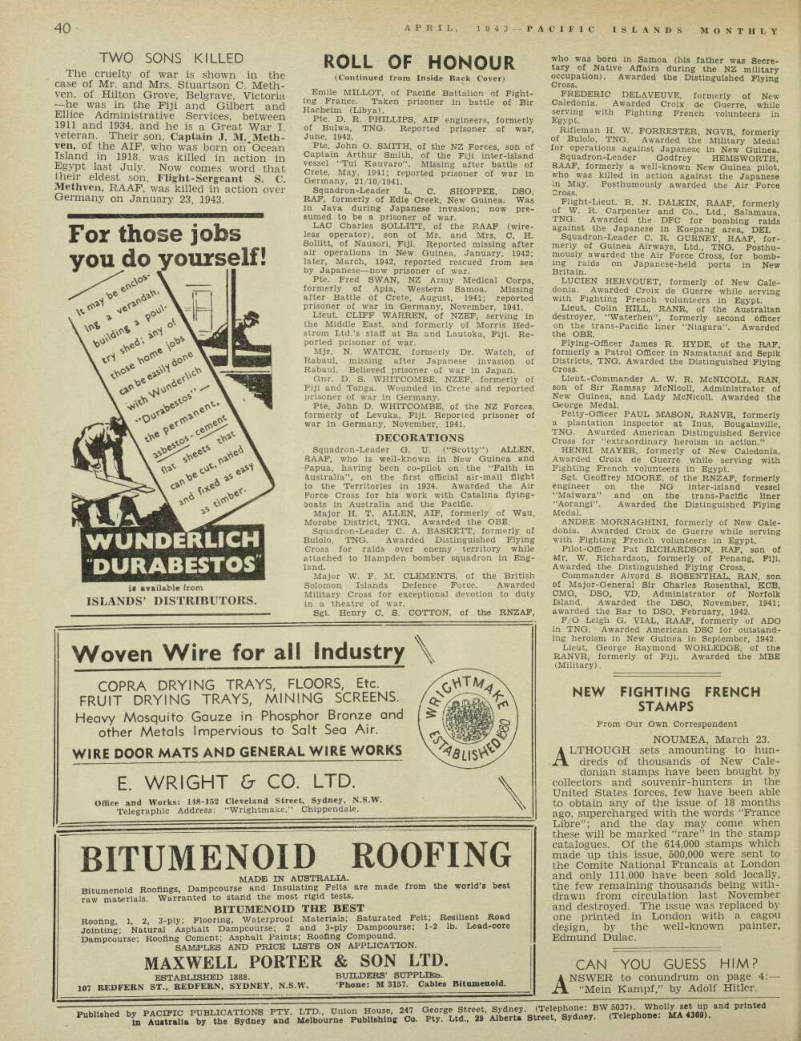
The cruelty of war is shown in the case of Mr. and Mrs. Stuartson C. Meth ven, of Hilton Grove, Belgrave, Victoria —he was in the Fiji and Gilbert and Ellice Administrative Services, between 1911 and 1934, and he is a Great War I veteran. Their son, Captain J. ven, of the AIF, who was born on "Ocean Island in 1918, was killed in action in Egypt last July. Now comes word that their eldest son, Flight-Sergeant S. C.
Methven, RAAF, was killed in action over Germany on January 23. 1943.
New Fighting French
Stamps
Prom Our Own Correspondent NOUMEA, March 23.
ALTHOUGH sets amounting to hun dreds of thousands of New Cale donian stamps have been bought by collectors and souvenir-hunters in the United States forces, few have been able to obtain any of the issue of 18 months ago, supercharged with the words “France Libre”; and the day may come when these will be marked “rare” in the stamp catalogues. Of the 614,000 stamps which made up this issue, 500,000 were sent to the Comite National Francais at London and only 111,000 have been sold locally, the few remaining thousands being with drawn from circulation last November and destroyed. The issue was replaced by one printed in London with a cagou degign, by the well-known painter, Edmund Dulac.
Advertisements & other items, pp. 42-44 (2 items)
Bitumenoid Roofing
For those jobs
you do yourself!
VO* EV h 7? \* x 50* 6° \> c & 0° X) e a>l v* X)* is available from
ISLANDS’ DISTRIBUTORS.
Woven Wire for all Industry
COPRA DRYING TRAYS, FLOORS, Etc.
FRUIT DRYING TRAYS, MINING SCREENS.
Heavy Mosquito Gauze in Phosphor Bronze and other Metals Impervious to Salt Sea Air.
WIRE DOOR MATS AND GENERAL WIRE WORKS
E. WRIGHT & CO. LTD.
Office and Works: 118-152 Cleveland Street, Sydney, N.S.W.
Telegraphic Address: “Wrightmake,” Chippendale.
BITUMENOID ROOFING
MADE IN AUSTRALIA.
Bltumenold Roofings, Dampcourse and Insulating Felts are made from the world’s best raw materials. Warranted to stand the most rigid tests.
BITUMENOID THE BEST
Roofing 1 2 3-ply: Flooring, Waterproof Materials; Saturated Felt; Resilient Road jointing; Natural Asphalt Dampcourse: 2 and 3-ply Dampcourse; 1-2 lb. Lead-core Dampcourse; Roofing Cement; Asphalt Paints; Roofing Compound.
SAMPLES AND PRICE LISTS ON APPLICATION.
MAXWELL PORTER & SON LTD.
ESTABLISHED 1888. BUILDERS’ SUPPLIES.
107 BEDFEBN ST., BEDFEBN, SYDNEY. N.S.W. ’Phone: M 3157. Cables Bitoineaoid.
Can You Guess Him?
ANSWER to conundrum on page 4:— “Mein Kampf,” by Adolf Hitler.
" .• i ■ pm v.* . v •' • J ••• ■ BSf lIS n . I i ■■ ii
Travel by CARPENTER AIRLINES
Full particulars from Macdonald, Hamilton & Co., or Howard Smith Ltd., Sydney.
W. R. CARPENTER & CO. LTD.
MERCHANTS, SHiPOWNERS AND AIRCRAFT OPERATORS
Agents for Australian, European and American Manufacturers, and Distributors of Every Description of Merchandise.
Buyers and Shippers of Copra, Trocas, and all Classes of Islands Produce.
AGENTS FOR :
Ford Motor Company of Canada. Caterpillar Tractors. Dodge Brothers Inc.
T. G. & C. Bolinders (Engines). Electrolux Refrigerators. Westinghouse Electrical Co. etc., etc.
Branches throughout the Pacific Islands
In London: W. R. Carpenter £r Co. (London) Ltd., Coronation House, 4 Lloyds Avenue, London, EC.
Head Office: 16 O’CONNELL STREET, SYDNEY