Pacific
Islands
Monthly
March 17, 1943
Vol. Xiii. No. 8.
Established 1930
[Registered at the G.P.0., Sydney, lor transmission by post as a newspaper ]
8“
Fighters
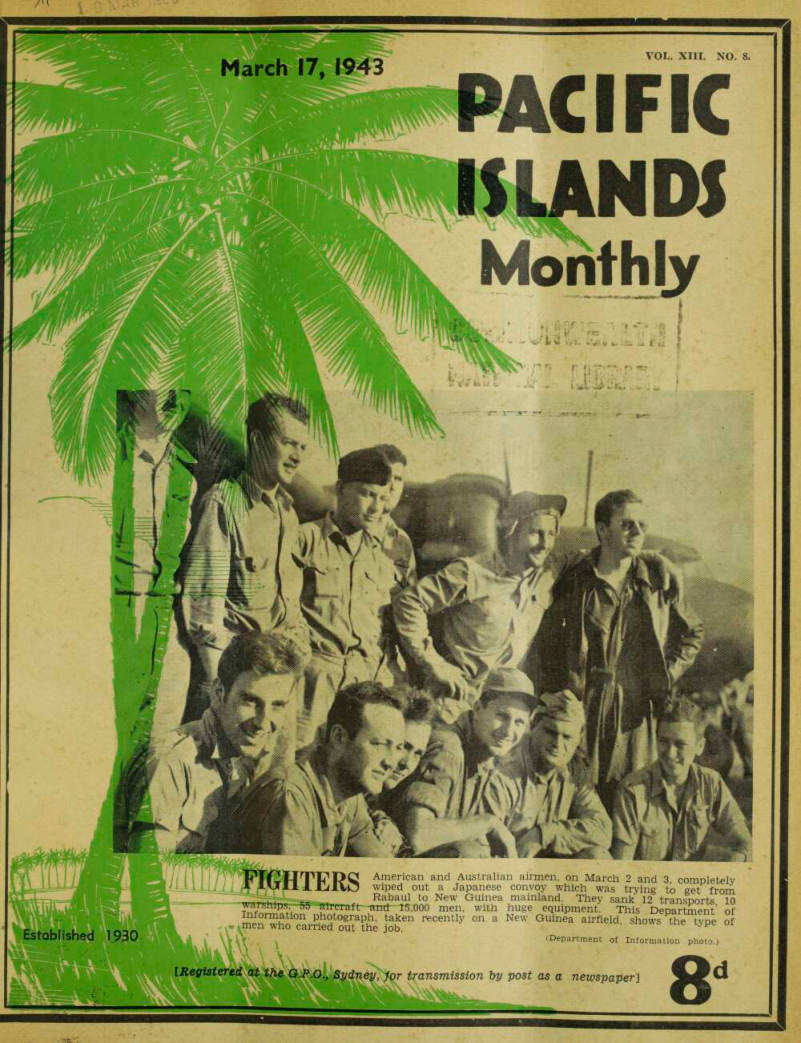
American and Australian airmen, on March 2 and 3, completely wiped out a Japanese convoy which was trying to get from Rabaul to New Guivea mainland They sank 12 transports, 10 warships, 55 aircraft and 15,000 men. with huge equipment. This Department of Information photogragh, taken recently on a New Guinea airfield, shows the type of men who carried out the job. (Department of Information photo.)
Advertisements & other items, p. 2 (1 item)
afvy
Pacific News-Review
Notes And Comment On
The Progress Of The War
From Feb. 15 To Mar. 12
Feb. 15: The Russians are pressing on feverishly with their great offensive against the Germans, in their attempt to destroy the German winter line—Rostov, Kursk. Kharkov and Orel—before the spring thaw makes winter campaigning impracticable. The Red Armies have inflicted colossal losses upon the enemy, whose armies everywhere are falling back. But the German retirement gen erally continues fairly orderly and there are few signs of disintegration or demoralisation.
Feb. 15; Operations in Tunisia have been held up by bad weather. Snow is reported in some parts of the country.
Feb. 15: There is still much sporadic sea-fighting in the Solomons. The Ameri cans remain now in unchallenged pos session of Guadalcanal. American air craft make frequent raids upon the enemy airfield at Munda (on Roviana Lagoon, New Georgia).
Feb. 15: The Japanese who were over whelmingly defeated by Australians when they attempted to capture Wau (Morobe goldfield, New Guinea) are now retreat ing in disorder through the jungles and mountains towards Mubo. One thousand of them have been killed.
Feb. 16: The heaviest Allied raid yet made in the SW Pacific has been on Rabaul. Fifty tons of HE bombs and more than 3,500 incendiary bombs were dropped. Flames could be seen 100 miles away.
Feb. 16: Two big German bases —Rostov and Voroshilovgrad—fell to the Russians yesterday.
Feb. 17; The Germans are still retreat ing in the Donets Basin, with their avenue of escape narrowing. Russians have reached the suburbs of Kharkov.
Feb. 17: It is reported that, while Japan was claiming a major naval victory in the Solomons, the Japs actually were avoiding battle with powerful American naval forces.
Feb. 18: Kharkov has fallen to the Russians and the Red Army is pushing on westward.
The Axis forces in Tunisia have struck hard against American forces (in the centre) and gained considerable ground.
Feb. 18: Between January 29 and February 7, Japanese losses in the Solo mons, while “evacuating” from Guadal canal, were: 2 destroyers sunk, 4 believed sunk, 8 damaged, a corvette and 2 cargo ships sunk or damaged, 64 aircraft shot down, and 10 probably destroyed.
Feb. 19; Axis has taken more towns in Central Tunisia. Allied forces have eva cuated Feriana and Sbeitla. The enemy has taken three valuable airfields.
Feb. 19: The Red armies still are driv ing towards the line of the Dnieper, but German counter-attacks in the Donets Basin have slowed down their pursuit of the enemy there.
Feb. 20: The Red Army is converging on Orel, outpost of Smolensk and the only enemy-held position on the strate getically important Moscow-Kharkov railway.
Feb 22: The Russian Army is now only 35 miles from the Dneiper.
Feb. 22; Units of British Guards regi ments have been rushed south to rein force the Americans in Tunisia. German columns are now stated to be “held.”
Feb. 23: British and American forces have counter-attacked and are trying to hold a pass, about 2\ miles wide, in Cen tral Tunisia, from which the Americans were driven on Saturday. If the Ger mans break through they could out-flank the Allied line.
Feb. 25: Allied counter-attacks in
Tunisia succeeded. The Axis forces are in full retreat towards Kasserine Pass.
Feb. 26: The Axis forces in Tunisia continue to withdraw from the pass near Kasserine.
Feb. 26: Japan is making new drives in central China with a view to occupying certain airfields and thus forestalling Allied air attacks on Japan itself.
Feb. 27: Allied forces in Tunisia are pursuing Axis troops into the plain to the east of Kasserine Pass.
Mar. 1; Terrific battles are raging in the Donets section of the Russian front.
This is described as the heaviest fight ing, except Stalingrad, in the whole of this winter’s campaign.
Mar. 1: The round-the-clock, non-stop raids which the Allied air forces began on Germany last Thursday night are still going on. The plan is to smash and dis locate German war industries and the German railway transport system.
Mar. 2: The Japanese, during the last month or two, have heavily reinforced all their bases to the north of Australia.
Whether this is a defensive or offensive operation is in doubt.
Mar. 3: A Japanese convoy of 14 ships is moving along the north coast of New Britain towards New Guinea, but owing to bad weather conditions it cannot be attacked.
Mar 3: Berlin, last night, had its heaviest raid of the war.
Mar. 4: The Nazis have announced their evacuation of Rjev—“according to plan.” This is the most important gain since the fall of Kursk and Kharkov.
Mar. 4: Allied aircraft, on the 2nd and 3rd, destroyed the Japanese convoy which was converging on New Guinea. The Japs, in what is for them a major disas ter, lost 12 transports, 10 warships. 51 planes, 15,000 men and enormous supplies and equipment.
Mar. 5; Officially announced that Spit fire squadrons have been in Australia for some time and are operating in the north.
They destroyed six Jap raiders over Dar win on Tuesday.
Mar. 6; German counter-offensives are making substantial progress in the Don ets area, south-west and west of Kharkov.
Mar. 7: Rommel, having been driven back from his Central Tunisia positions, launched a large-scale offensive at dawn from his Mareth Line positions. The Bth Army inflicted very heavy losses. Rom mel lost 21 tanks in his initial attack, and made no progress.
Mar. 8: Official figures on the battle in the Bismarck Sea are: 102 Jap planes put out of action—63 destroyed; 22 Jap ships destroyed; 15,000 troops killed. Allied losses were 1 bomber and 3 fighters lost and some aircraft seriously damaged.
Mar. 9: The Axis forces have with drawn from the Mareth Line battle.
Rommel lost 50 tanks. The British losses were very light.
Mar. 11: Rommel is being harried by Allied patrols, but aerial activity in Tunisia again is limited by bad weather conditions.
Mar. 11: The Red Army is pushing for ward in the north and has captured Bye loi, but the Russians have suffered a seri ous setback in the Kharkov and Donets regions, where the Germans are making strong counter-attacks.
Mar. 11: Wau, New Guinea, was raided on Tuo sday by 26 Japanese bombers, in a hit-run raid. Damage was small.
Mar. 12: Following gigantic tank battles, the Russians claim that they are holding the Nazis near Kharkov. The position there is critical: but the Rus sians have made further big gains farther
north. All the region from Kharkov to the Black Sea is now under thaw.
Mar. 12: Allied forces in Central Tuni sia now are advancing and are threaten ing Rommel’s Mareth Line forces in the rear, while the Eighth Army pushes against him from the south.
About Islands
People
Members of the Pacific Territories Association, at their last meeting, ex pressed warm thanks to Mr, E. A. James (editor-proprietor of the “Papuan Cou rier”) for the patient and tireless service he had given them, as president, during 1942, in pressing their claims for fairer treatment upon the Commonwealth authorities, and generally in protecting the interests of the evacuees. Mr. James protested that their thanks really were due to the executive committee, who had worked early and late upon the affairs of the Association, and who had refused to become discouraged by official indiffer ence.
Pilot “Tommy” O’Dea, who was gen eral manager for Guinea Airways in New Guinea up until the time of the evacua tion, has been recently in hospital in Australia, recovering from severe burns received while on service with the troops in North-east Papua. He was flying transport planes, which he set down daily in queer, uncouth places in the jungle.
One day, he “struck a soft patch, and over she went.” He now is recovered, and hopes soon to be back on his jungle job.
Major (Dr.) Lamy has recently arrived in New Caledonia from the Cameroons and has been attached to the Noumea Public Health Department. He was in the New Hebrides when that territory rallied to Free France, and, under orders from General de Gaulle, he and Dr.
Monfort, in July, 1940, went to Sydney on the “Commissaire Ramel” and from there were sent on service to French Equatorial Africa.
Mr. D. C. I. Wernham has again been appointed an Administrative Officer in the Ellice Islands, as from December 18.
He was AO at Funafuti until the Ellice Islands were evacuated soon after the Japanese occupation of the Northern Gilberts.
Messrs. Jenner and Clark, of Burns Philp (SS) Co. staff, who escaped from Tarawa (Gilbert Islands) some time after the Japanese occupation, and spent some months in Sydney, are again together in the Big Firm’s store in Pagopago Ameri can Samoa.
Mr. Edward Duncan, who went to Fiji in 1886, died in Suva on February 9. aged 79 years. On his arrival in the Colony he joined the staff of the Colonial Sugar Refining Company, in 1910 he bought the Mua coconut estate, at Taveuni, but m the following year returned to the sugar industry as manager of the Van couver-Piji Sugar Co.’s Navua mill. He retired m 1917 to devote himself wholly to his own coconut interests. He was managing director of the Coconut Plant ers’ Union and was always prominent in any movement connected with the copra industry. He is survived by his wife, one son, Mr. A. Duncan, of Sydney, and three daughters, Mrs. R. N. Caldwell, of Ba.
Mrs. M. Craig and Miss L. Duncan, of Suva.
Contents
Pacific News-Review 1 The Axis is Cracking—What Now in Pacific 3 Verses by J. Norman Hall 4 NGG Awaits End of War 5 Papuan Padre’s Remarkable Experi ences 6 Queensland-N. Guinea Association .. 6 Light on War Damage Claims ... 7 Samoan Memories of Mr. Langstone 8 N. Guinea More Than Battlefield .. 9 Pacific Territories Association ... 10 “Blue” Allen Comes Back 10 A. P. Lyons Retires 11 Fiji Hurricane 12 Tahiti Prospers—Governor’s Speech . 12 How Japs Came to Tulagi and Departed 14 Tonka Beans 15 13 New NMP’s 16 Tourism for Tahiti After War ... 17 Samoa’s Home-brew 19 Queen Pomare’s Diary 20 “Papuan Achievement” —Book Review 22 Origin of Polynesians 24 Grow Spices! 26 Fiji Manpower Problems 27 Dodging Japs in Solomons 28 N. Guinea Now is “News” 29 Across N. Guinea With Refugees .. 31 Roll of Honour 32 Taupongi of Rennel 36 In New Caledonia 37 Two Tragedies of Papua—Letters to the Editor 38 Planters to Return to Papua 39 Why Not a Pawpaw and Kaukau Board? 40 Commercial Cover 111
Advertisers
Atkins Pty. Ltd.
Wm 26 Australian Alumi nium Co. Pty. Ltd. 31 Baker Pty. Ltd., W.
Jno 34 Broomfield Ltd. . . 36 Brown & Co. Ltd., G 13 Brunton’s Flour . . 38
B.P. (S.S.) Co. . . 13
Burns, Philp Trust Co. Ltd 15 Carlton & United Breweries Ltd. . 19 Carpenter Ltd., W.
R cov. 4 Chivers & Sons Ltd. 22 Coleman Lamp & Stove Co 27 Colonial Wholesale Meat Co. Ltd. . . 23 “Cystex” 32 Donaghy & Sons Ltd 37 Donald Ltd., A. B. 28 Dr. Williams Pink Pills 34 Electrolux Refrigerators . . 18 Excelsior Supply Co. 39 Garrett & Davidson 32 Gilbey’s Gin ... 24 Gillespie Pty. Ltd., Robert 37 Gillespie’s Flour . . 29 Gough & Co., E. J. 24 Gourock Rope & Canvas Co. ... 38 Grand Pacific Hotel 2
Grove & Sons, W.
H 17 Horlicks Malted Milk 16 Kambala School for Girls 17 Kopsen & Co. Ltd. 30 Maxwell Porter Ltd. 31 “Mendaco” ... 27 Miller & Co. Pty.
Ltd 32 Nelson & Robertson Pty. Ltd 21 Noyes Bros. Ltd. . 33 Old Monk Olive Oil . . 14, 20, 29, 35 Pacific Is. Society . 13 “Pinkettes” ... 38 Prescott Ltd. ... 22 Ransomes, Sims & Jefferies Ltd. . . 40 Riverstone Meat Co.
Ltd 25 Rohu, Sil . . . .36 Rose’s Eye Lotion . 37 Scott Ltd., J. ... 28 Steamships Trading Co. Ltd 20 Sullivan & Co.. C. . 29 Swallow & Ariell . 14 Taylor & Co., A. . 36 “Tenax” Soap . . 34 Tillock & Co. Ltd. . 35 Union Assurance Co. Ltd 33 Wanted To Buy . 29 Wright & Co. Ltd., E 31 Wunderlich Ltd. . . 31 Yorkshire Insurance Co. Ltd 40
Advertisements & other items, p. 4 (2 items)
Useful Addresses
THE following are the Sydney addresses
of organisations set up temporarily to deal with Pacific Territories affairs —and especially matters connected with the evacuation of the Territories.
PAPUA, NEW GUINEA , NAURU,
NORFOLK IS.
Department of External Territories (Sydney Branch) (Lately the New Guinea Trade Agency), Australia House, Carrington Street, Sydney.
Telephone; BW 1776. (Dealing with all matters connected with the Australian Pacific Territories and also the Sydney representative of the New Guinea Copra Control Committee.)
BRITISH SOLOMON ISLANDS
Sydney Office of British Solomon Islands Government (In charge of Mr. F. E. Johnson, Treasurer of the Solomons Administration), 17 Castlereagh Street, Sydney.
Telephone: B 1710.
GILBERT AND ELLICE, AND
OCEAN IS.
Sydney Office of Gilbert and Ellice Islands Colony (In charge of Mr. S. G. Clarke, Treasurer of the G. and E. Administration), Bank of New Zealand Building, George Street, Sydney. Telephone: B 2209.
FOR PACIFIC TERRITORIES
EVACUEES GENERALLY
Pacific Territories Association (C. A. M. Adelskold, Secretary), c/o Robert Gillespie Pty., Ltd., 54a Pitt Street, Sydney. Telephone: BW 4782.
STEAMSHIPS TRADING CO.
OF PAPUA
Sydney Office: Nelson and Robertson Pty.. Ltd., Telephone: B (54(51. 12 Spring Street, Sydney.
Mr. and Mrs. H. King Irving and fam-
Mr. and Mrs. H. King Irving and family have returned to Fiji from overseas.
Mr. W. H. Watson, a prominent Cook Island trader, left Rarotonga in February for NZ to combine a few months’ holiday with a little business.
% V
SS*S5£
Pacific Islands Monthly
The Newspaper-Magazine of the Sooth Seas IRegistered at the G.P.0., Sydney, for transmission by post as a newspaper .]
Published Once Each Month and Circulated in Australia and New Zealand and in the following Pacific Territories and Islands Groups:
Australian Territory of Papua.
Mandated Territory (Australia) of New Guinea.
Australian Territory of Norfolk Island.
New Zealand Territory of Cook Islands.
Mandated Territory (NZ) of Western Samoa, British Colony of Fiji.
British Solomon Islands Protectorate.
British Protectorate of Tongan Islands.
British Crown Colony of Gilbert and Ellice Islands.
Mandated Territory of Nauru.
British and Free French Condominium of New Hebrides.
Free French Colony of New Caledonia.
Free French Colony of Oceania (Tahiti, etc.), American Territory of Eastern Samoa.
American Territory of Hawaiian Islands.
Owned and Produced by Pacific Publications Pty. Ltd., Union House, 247 George Street, Sydney.
rppir „ pwniNJi; , c Managing Director .. BW 5037 Business and Editorial MA 4369
P.O. Box 3408 R
Registered Address of Telegrams, Radiograms, and Cables: “Pacpub”, Sydney.
Contributions.
Articles, Stories, and Photographs dealing with Pacific Islands subjects are invited and will be paid for on publication.
Subscription Rates.
Per Annum, within British Empire, Prepaid, Post Free 8/- Per Annum, elsewhere, prepaid, Post Free. 107- Single Copies Bd.
Editor and Publisher:
R. W. Robson, F.R.G.S.
Advertising Manager: L. W. Bailey.
Advertising Office and Printing-House: 29 Alberta Street, Sydney.
Advertising rates furnished on application.
Colours, etc., by arrangement.
Process Blocks made at Advertiser’s expense when required. Screen 100.
Changes of Advertising Copy should reach this office by Ist of each month, otherwise previous advertisement may be repeated.
Representative In London.
W. C, Harvey, Coronation House, 4 Lloyds Avenue, London, E.C.3, from whom may be obtained copies of Pacific Islands Monthly, Pacific Is. Year Book, advertising schedules, etc.
Agents.
The following are authorised to receive sub scriptions for Pacific Islands Monthly:— Burns. Philp & Co., Ltd., and Burns Phllp (South Sea) Co., Ltd. All branches.
W. R. Carpenter & Co., Ltd. All branches.
Morris, Hedstrom, Ltd. All branches.
Steamships Trading Co., Papua. All branches.
B.N.G. Trading Co., Ltd., Port Moresby, Papua.
J. Muir, Suva, Fiji.
Miss R. Castles, Suva, Fiji.
N. C. Mackenzie Hunt, Wainunu, Bua, Fiji.
Kirpal & Co., Victoria Parade. Suva, Fiji.
Cook Islands Trading Co., Rarotonga, Cook Is.
A. C. Rowland, Papeete, Tahiti.
Islands Branches and Representatives of W. H.
Grove & Sons, Ltd., Auckland, New Zealand.
Ed. Pentecost, Noumea, New Caledonia.
Kerr <fe Co., Noumea. New Caledonia.
Vol. XIII. No. 8.
March 17, 1943.
Prirp i Bd> Per Copy ' rnce £ Prepaid: 8/- p.a
The Axis Will Crack: So What Now in the Pacific ?
Pacific ?
BECAUSE a loaded aeroplane now can fly 3,000 miles without re-fuelling, and because its effective range is growing steadily, Australia and all the Territories of the Pacific must expect that American influence in the Pacific will be strong, and perhaps paramount, for years to come. The United States has sent, and is sending, enormous forces out across the Pacific and the Atlantic to save the Anglo-American way of life from destruction by the Axis. No person of intelligence can suppose that those forces will be withdrawn while there re mains in the world, and especially in the Pacific, any threat to American and British institutions.
In the time to come, as the Nazi horror is swept away, it is to be expected that British influence and protection will ex tend over the North Atlantic, Medi terranean and African zones; that Russia will be paramount in Central and Eastern Europe and much of Asia; and that the United States will remain, in fact, the protector of all the Pacific lands. Few will quarrel with that.
The choice, for the people in the Pacific, is very clear and simple. Whom do we prefer—the cruel and semi-human little Huns of Tokio, or the Americans, who think as we do, who are non imperialist, and who keep the Statue of Liberty at the front door of their mighty nation of 130,000,000 people? If America dominates the Pacific, we can remain free and British. If the Japanese were here the victors, we should face exter mination.
WE are too close to this global war, just now, to see it in its true per spective. In a few years’ time,
when peace has returned, and we are resuming a normal way of life, we shall realise how narrowly we have escaped from the greatest conspiracy in the his tory of the human race. It is now established, beyond any doubt or argu ment, that an international gang, with headquarters in Berlin, and important associations in Rome, Vienna, Paris, Madrid and Tokio, planned the Fascist hierarchy, which took shape in the Axis, designed to destroy Anglo-French power and dominate and enslave the world.
The plan, in its essentials, was simple and apparently certain of success. Ger many was to occupy all the Western European nations except Spain; Italy was to join Germany in an attack upon France which, honey-combed from within by Fifth Columnists, would quickly collapse; Britain, thus isolated, would listen, to the voices of her rich and privileged classes and, to save her Em pire, would enter into Treaty relations with Germany; the United States, under British influence and the activities of a vast, underground organisation of Fifth Columnists, would remain out of the war, although making many threatening motions; and then Germany and Japan would fall upon Russia, and quickly put an end to that semi-Communistic regime.
The French Empire would be partitioned out among the Axis victors; while some of Asiatic Russia, much of China, the British countries in Malaya, Borneo and the Pacific, and all the Dutch Indies, would go to Japan. Sooner or later, Japan would receive, also, the Philippines, Siam, Burma, and perhaps some of India. The Axis would rule the world, and the Nazis would rule the Axis.
Look it over, and see for yourself how nearly that plan succeeded—in other words, how near we Europeans of the Pacific were to becoming the slaves of the Jap. If the plan had gone according to schedule, the arrogant little men of Tokio would not have remained north of the Equator. It was essential to the beauty of the Jap face that the Jap should boss Australia. South America and all the Pacific territories between.
SEEN as part of the global set-up, we Europeans in the Pacific are pathe tically few —seven millions in Aus tralia, 1 1 millions in New Zealand, a quarter-million in the Indies, and less than a hundred thousand in all the other Pacific lands. In the Global Conspiracy of the Axis, we were only slightly more than nothing—we_did not count at all.
It is as well to recognise that. While British power was unassailed, and the White Ensign went unchallenged upon the seas, we imagined ourselves com pletely secure in all our Pacific countries.
To-day, with Mother Britain fighting for her life on the other side of the world, we should have been slaves, or refugees, or corpses, like the Europeans of the North-western Pacific, had it not been for the quick-moving, valiant forces of the United States.
FASCISM’S Global Conspiracy failed. It should have succeeded. It was based upon the apparent failure of the democratic system.
The people of the democratic countries (argued the Fascists), after achieving political freedom, had allowed themselves to become enslaved by economic and in dustrial conditions which their Parlia ments seemed powerless to control.
Therefore (argued the Fascists) Britain and France, suffering class discontent and internal disruption, never can gear themselves to war so as to defend them
selves against the super-men of Nazi dom. Democracy (said the conspirators) was finished. The time had come for the establishment of a New Order. The Fascists would establish the New Order —and, in the process, the gangsters would become the lords of creation.
Our grand-children, reading the history of 1937-42, will gasp with amazement when they see how near a half-crazy house-painter named Schickelgruber (Hitler, if you want his assumed name) came to being master of the world.
WHERE and when did the plan fail?
It failed between June and Sep tember, 1940, when Hitler paused in Paris to drag Foch’s railway carriage out of the Hotel des Invalides, and take it to Compeigne Forest, so as to humiliate the French by making them sign there his brutal Armistice, on the verv spot vrhere Germany signed on November 11, 1918.
Whfie Schickelgruber was indulging his theatncalism. and lust for revenge, the British were feverishly preparing for the assault; and, when it came, in the late months of 1940, it was thrown back.
Britain lived, the last free nation ih Europe, a rallying-point for mankind’s liberties and human decencies.
Had the egregious Schickelgruber left poor France to her agonies—for by mid- June, 1940. she was helpless, and at the mercy of the Hun—and thrown all his available forces at England, England probably would not have survived, and the British Empire would have been at an end. Civilisation was saved by the inability of the egocentric to refrain from torturing his stricken victim. The wheel turned; Tie missed his chance; and now it has come full circle, and it is Schickel gruber and his trapped and disillusioned Axis who are fighting hopelessly for their lives.
The world never must forget that for a whole year Britain fought alone, en during a battering such as no nation ever before had experienced. Thus it was that British courage, and Britain’s staunch refusal to bargain with the powers of darkness, won the admiration and, finally, the co-operation of the United States, so that the world-picture was changed.
THE conspirators, having launched their Global Conspiracy, could not stop. By April-May, 1941. Britain should have been disposed of, and the way all clear to attack Russia. Britain, most inconsiderately, remained uncon quered and belligerent. She even put a “contemptible little army” into Greece.
Nazi panzers cleaned it up, in two or three months: but those two or three months were vital, because they disrupted the Nazi plan for the smashing of Russia.
When Hitler attacked Russia, late in June, 1941, the Russians were ready for him.
If Britain had been put out of action in 1940, the Axis armies would not be bleeding to death in Western Russia at this moment. The Japs, long ago, would have_ fastened their treacherous teeth in Russia’s flank, and hastened her down fall. By 1941, American public opinion, heartened and inspired by Britain's stand, began to get ready for war, and they were even accepting America’s in evitable role of world peace-maker and policeman: so that the startled Japs re fused to attack Russia until they could see whether America really would fight.
When they saw that America probably would fight, and that Japan’s long planned Asiatic-Pacific Empire might dis appear into thin air, the Tokio Japs decided to risk all on a gambler’s throw.
It had succeeded at Port Arthur in 1904; Mr. Tojo hoped it would succeed at Pearl Harbour in 1941. With America crippled, the Global Conspiracy still might succeed —in part, if not wholly. The treacherous blow was struck—and partly missed. It
spelled the doom of Japan. Literally within an hour, America was at war— and with such anger, high spirit and unity of purpose that, from that moment, the war assumed a new and different complexion.
Even then, it was doubtful whether America and Britain together could break the terrible power of the Axis. But when unknown and inscrutable Russia disclosed unsuspected military strength, and a gallant courage that won the admiration of the world, the issue was no longer in doubt. Russia broke the military power of the European section of the Axis, and gave Britain and America time to pre pare. We soon shall see the opening of the second front in Europe, and hear the cracking of the Axis.
IT is not too soon to think of the post war world—and that, so far as we are concerned, means the Pacific after the war. This is what the “PIM” expects to see:— The Japanese will be driven out of the Territories where they now are so feverishly digging in. They will be de feated and destroyed by American air power. (But don’t expect present dangers and difficulties to pass much before 1944.) The United States, in collaboration with her partners of the United Nations, will police the Pacific until she is certain that no threat to her security can arise there again. Then she will withdraw, but she will leave behind an unlimited guar antee of freedom for all Pacific peoples.
American energy, American organising genius and American money will provide the stimuli for a tremendous leap for ward in the development and settlement of the Pacific territories and exploitation of their rich natural resources. Thou sands of service-men will wish to return there.
America, in return for all that she is giving, and will give, will expect—and probably demand—an open door in future Pacific (especially South Pacific) trade and transportation. There can be noth ing wrong with that, if it is a two-ways door.
Score of People in US
Rescued
Score of People in US Submarine
INFORMATION about people who have been “missing” for many months was received recently, when it was offi cially announced that an American sub marine had brought five men, 17 women and a number of children from Japanese occupied territory and landed them safely on an island of the Solomons. The men were:— F. P. Archer, planter.
Max Babbage, planter.
G. Edmonds, plantation manager.
A. R. Long, plantation manager.
It is reported that Mr. and Mrs. C. I.
H. Campbell also got safely away, after hardships and narrow escapes extending over many months.
These men were refugees, for many months, in one of the islands, and fre quently were nearly captured by Japan ese. They were very anxious about the safety of women missionaries who had remained in that area, most of them nuns. Eventually, they made contact with the Americans, and their rescue by submarine was organised. They were treated with great kindness by the Ameri cans; and they tasted bread, sugar and tea for the first time for many months during their lengthy voyage by submarine.
From some of these people we have
word of Trevor Collett (planter), Arthur Atkins (SDA missionary), and C. S. Cook (plantation manager), who were on Elmira Island when the Germans landed many people from torpedoed ships there at Christmas, 1940, and who helped them to safety. Collett and Atkins, early in 1942, tried to escape in an SDA vessel; but the Japs caught them, and others, near Putput. Atkins died; and Collett is believed to be a prisoner of war. Cook is safe in Australia. It was reported that he had died; but evidently he was con fused with Mr. Short, of Soraken, who died of pneumonia in June, 1941.
How General Bowels May
Contribute to the Wel fare of General Good
UTHE other day, down in Tahiti , James Norman Hall, famous American novelist, was thinking of Japan , and wondering what we shall do with that race of barbarians when they come to the United Nations with their “So solly!
Mistake, please!” He finally remeynbered the Japs’ unpleasant habit of slitting open their own stomachs — harikiri —and he thought that, maybe, the Japs could be induced to supply their own solution of our problem.
So he wrote these verses and sent them to the “Pacific Islands Monthly,” with the ingenuous plea that the editor somehow might contrive to get the suggestion through to Tokio.
The Japs, to save or find their faces When they, beyond dispute, have lost them, Search in the strangest, weirdest places, No matter what the search may cost them: Commonly, no more than life; They do the searching with a knife.
They have no bowels of compassion Even for those that in them rumble.
Current as well as ancient fashion Demands them out, and out they tumble.
How odd, to save or find a face In such a way, in such a place!
When they behold, with wild concern, The Rising Sun about to set; When faces lost more hotly burn Than they have ever burned as yet, Will general bowels promptly pay For all the faces gone astray?
Oh, happy possible solution!
Oh, happy mourners, quiet grave!
General Bowels, your contribution To peace would thus forever save Your countrymen from losing face And benefit the human race.
-James N. Hall.
New Guinea Women's
Club
THE New Guinea Women’s Club will hold a “social evening” on March 19, at the Feminist Club rooms, 77 King Street, Sydney. Bridge and card games will be played and supper will be provided. There will be a small charge for admittance, which will go to Club funds. A cordial invitation is extended to all Territorians —especially those men who are in the fighting forces.
Ngg Awaits End Of The War
Long Hard Fight Probable Before Any War Insurance is Paid
NEW Guinea Goldfields, Ltd., in Sydney on March 4, held its first annual general meeting since the outbreak of the Japanese war. The Company operated for only three months and three weeks before the gold industry shut down about January 22, 1942, and Europeans were compulsorily evacuated.
The Company hopes to resume opera tions after the war: but if the mines have deteriorated owing to lack of care, only the alluvials may be worked. The Company made a profit of £12,057 in the three months; and this, added to reserves, etc., made available about £137,000, in cash and liquid assets, for resumption of operations.
The Company has an issued capital now of £950,370, in shares nominally worth 4/3.
The manner in which this New Guinea concern has been dealt with by the War Damage Commission was described by the chairman, Mr. J. Kruttschnitt. in his address to shareholders. The following extracts:— “The fact that whilst hostilities con tinue, we are prevented from trying to maintain the mines makes it almost impossible to forecast the outlook at Golden Ridges. The mine was in good condition when we were closed down, but much depends on whether the elements and ground subsidence will so damage the workings that the re-opening of the mine may prove uneconomical. As far as the alluvials are concerned, it is safe to say that water races and plant can be rehabilitated and resumption of pro fitable operations is reasonably assured.
“Assets to the value of approximately £300,000 have been lost as a result of enemy action and/or scorched earth policy. Partial claims are being filed with the War Damage Commission in cases where proof is reasonably conclu sive that the loss sustained comes within the definition of war damage. The filing of these claims has involved the furnish ing of more detailed evidence than one would expect in connection with insur ance of this type.
“Our correspondence with the Com mission suggests that it may prove most difficult to furnish the kind of evidence it requires to establish proof of loss.
Unless newspaper reports and aerial photographs are to be completely disre garded, we may reasonably assume that Salamaua was first bombed, practically out of existence, and thereafter occupied by the enemy. We are also informed that the locality' has been bombed con tinuously by the United Nations air force since the Japanese occupation.
“But. in the face of this common knowledge, the War Damage Commission has asked the Company to furnish, among other things, statutory declara tions by independent witnesses that our buildings and stores at Salamaua were wholly destroyed, that the site was examined and nothing remained to be salvaged. If this attitude be maintained it will prove next to impossible in many cases to produce documentary evidence establishing the agent and manner of destruction. We recognise it is the duty of the War Damage Commission to admit claims only for war damage as defined in the Regulations, but a too rigid procedure for establishing claims may result in injustice.
“Compare the Commission’s attitude
with that adopted by a commercial insurance company. In April last one of our houses at Wau, together with con tents, was destroyed by fire, the origin of which was unknown. On our furnishing a declaration that the property was acci dentally burnt, and was not destroyed by enemy action, the insurance company promptly paid our claim.
“Let us also consider the need for liberalising the definition of war damage as contained in the Regulations. This, of course, can be done only by the Federal Government. It will be recalled that the civilian population was by military orders completely evacuated from Wau, Golden Ridges, and Edie Creek, areas which were subsequently declared military areas, pro hibited to all persons except those in the armed forces. Thus there was no opportunity granted us to maintain el even watch over our plant and build ings, and we consider the Regulations should be amended to permit the result ing depreciation to be included as war damage.”
Future Value Of Gold
The chairman was asked whether the directors had formed any opinion about the future of gold—would it hold its value after the war?
He said he thought it would. There had to be, in the world, a standard of value —something into which all property and service could be ultimately reserved.
Gold fulfilled that function. It had always done so and it would so continue.
Some countries had tried to carry on without gold, which might seem possible in theory; but, in practice, they always came back to gold. No one could fore tell the future gold value per ounce; but he did not expect any serious deprecia tion.
Samoa
Unusual Crime in Samoa
Prom Our Own Correspondent
Apia, Jan. 25.
THE unprecedented increase in major criminal offences continues un abated.
The trial of the Samoan, Ete, for the shockingly brutal and premeditated mur der of the Chinese foreman of Lafi Plan tation, Yu Hoi, ended in the accused being sentenced to death. In another case, tried before Chief Judge Herd and assessors in January, a Samoan man, Eteuati, of Salim, Fagaloa, was found guilty of manslaughter, through the death of a fellow-villager and relation.
Kolose, whom he had killed by throwing a stone at him during a family squabble.
The accused was sentenced to seven years’ imprisonment, with hard labour.
In a third case, a Samoan, Tapusoa Ese, of Safotu, Savaii, killed a fellow-villager, Saua, with a bush-knife, owing to some family trouble. In a case reported from the South Coast of Upolu, at Falealili, a young Samoan woman killed her newly born twin babies and buried them on the beach, near the residence of her family.
Child murder was practically unheard of, in former times, among Samoans.
Offences against our liquor and curfew regulations are also frequent at the pre sent time. A Euronesian, Hans Walter, was convicted in Apia High Court of being in possession of distilling appara tus, under the Distillation Act, and was sentenced to six months’ imprisonment.
Two other Euronesians, Alfred Williams and Arthur Hannemann, with two Samoans, were convicted of the theft of a drum of gasoline, and sentenced to six, four and two months’ imprisonment respectively.
To replace the old one-way structure that has seen many years of service, a new bridge over the river at Lepea, Western Samoa, has been completed re cently by the Public Works Department.
Tahiti Makes Its Own Leather
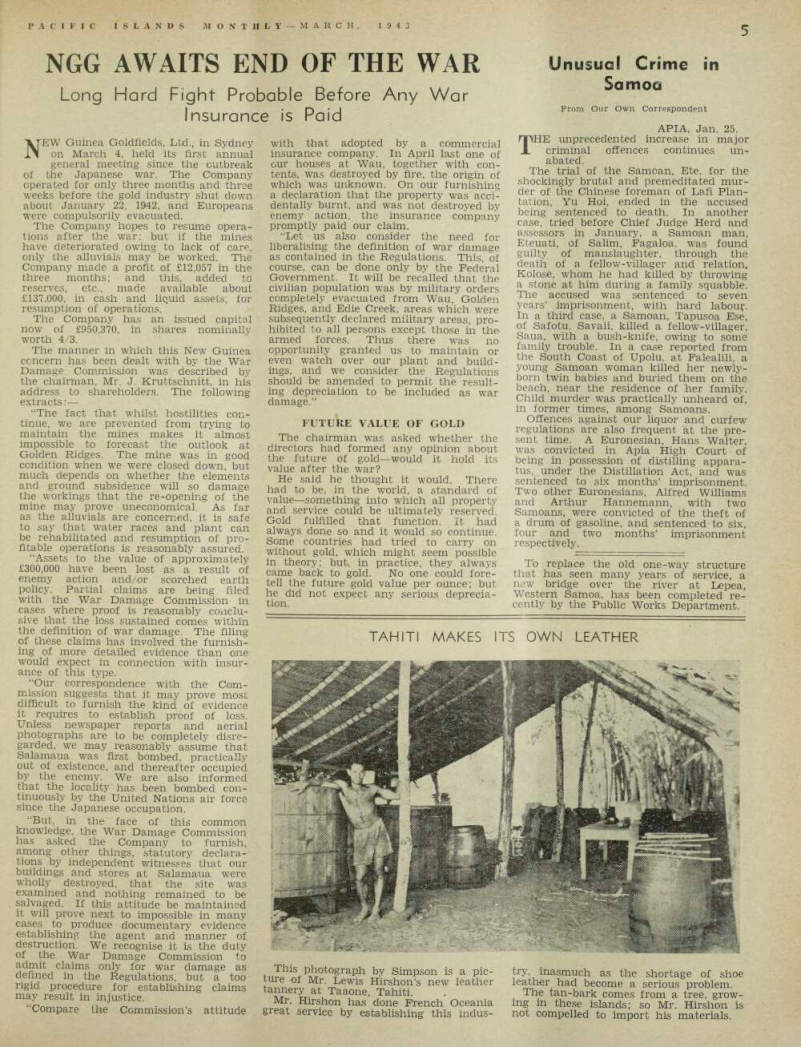
fi J his , p ™ oto F aph by Simpson is a picjure of Mr. Lewis Hirshon’s new leather tannery at Taaone, Tahiti. .
Mr. Hirshon has done French Oceania great service by establishing this indus-
try, inasmuch as the shortage of shoe leather had become a serious problem, The tan-bark comes from a tree, grow ing in these islands; so Mr. Hirshon is not compelled to import his materials.
Daily Dogfights Over
Mission Remarkable Experiences of Papuan Padre
RECENTLY arrived in Australia, after a strenuous year under war-condi tions in Papua, are two members of the Anglican Mission: The Rt. Rev. P. N.
W. Strong, Bishop of New Guinea, and Archdeacon S. R. M. Gill, of All Saints’
Mission, Mamba (at the mouth of the Mambare River, Papua).
Bishop Strong has been an inspiration to his staff, who insisted upon remain ing behind in Papua, and in whose mis sion area most of the Papuan fighting took place. He has spent much of the past year in active work in the field.
Since reaching Australia, he has preached at St. Andrew’s Cathedral, Sydney, on the part played by the natives in the Papuan campaign, and he was a speaker at the Australian Board of Missions rally in the Sydney Town Hall on March 8, which was held for the purpose of plan ning missionary work in the Pacific after the war.
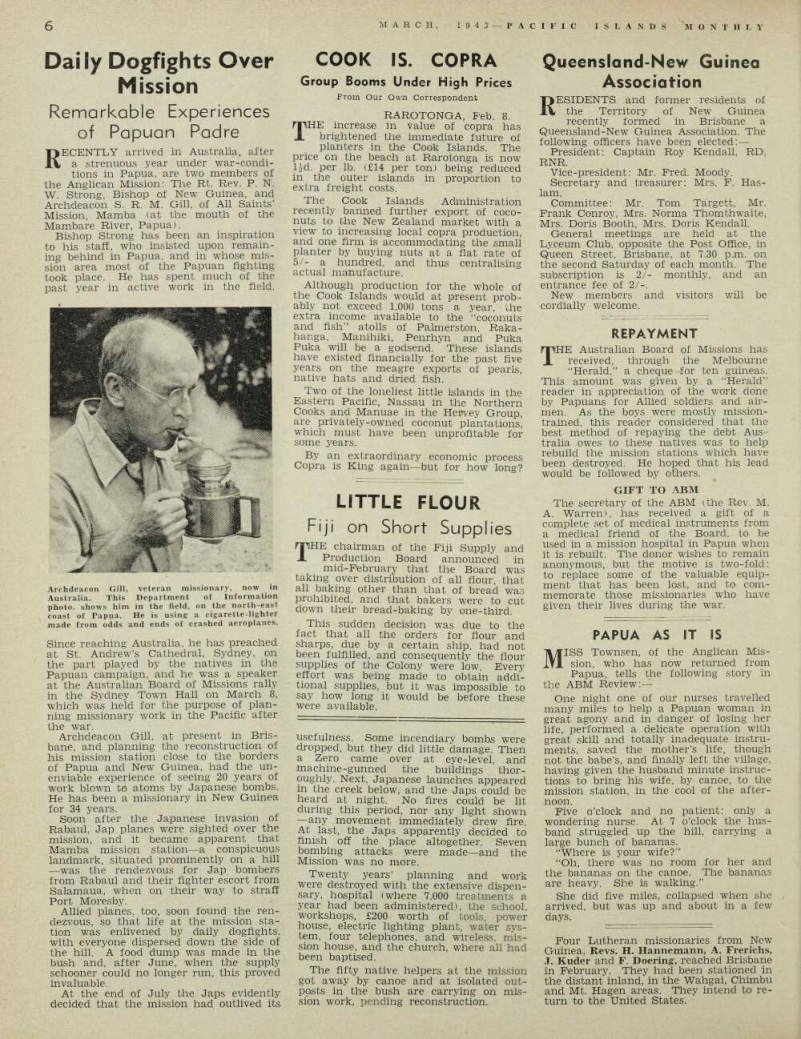
Archdeacon Gill, at present in Bris bane, and planning the reconstruction of his mission station close to the borders of Papua and New Guinea, had the un enviable experience of seeing 20 years of work blown to atoms by Japanese bombs.
He has been a missionary in New Guinea for 34 years.
Soon after the Japanese invasion of Rabaul, Jap planes were sighted over the mission, and it became apparent that Mamba mission station —a conspicuous landmark, situated prominently on a hill —was the rendezvous for Jap bombers from Rabaul and their fighter escort from Salamaua, when on their way to straff Port Moresby.
Allied planes, too, soon found the ren dezvous, so that life at the mission sta tion was enlivened by daily dogfights, with everyone dispersed down the side of the hill. A food dump was made in the bush and, after June, when the supply schooner could no longer run, this proved invaluable.
At the end of July the Japs evidently decided that the mission had outlived its
usefulness. Some incendiary bombs were dropped, but they did little damage. Then a Zero came over at eye-level, and machine-gunned the buildings thor oughly. Next, Japanese launches appeared in the creek below, and the Japs could be heard at night. No fires could be lit during this period, nor any light shown —any movement immediately drew fire.
At last, the Japs apparently decided to finish off the place altogether. Seven bombing attacks were made —and the Mission was no more.
Twenty years’ planning and work were destroyed with the extensive dispen sary, hospital (where 7,000 treatments a year had been administered), the school, workshops, £2OO worth of tools, power house, electric lighting plant, water sys tem, four telephones, and wireless, mis sion house, and the church, where all had been baptised.
The fifty native helpers at the mission got away by canoe and at isolated out posts in the bush are carrying on mis sion work, pending reconstruction.
Archdeacon Gill, veteran missionary, now in Australia. This Department of Information photo, shows him in the field, on the north-east coast of Papua. He is using a cigarette-lighter made from odds and ends of crashed aeroplanes.
Cook Is. Copra
Group Booms Under High Prices
From Our Own Correspondent
Rarotonga, Feb. 8.
THE increase in value of copra has brightened the immediate future of planters in the Cook Islands. The price on the beach at Rarotonga is now lid. per lb. (£l4 per ton) being reduced in the outer islands in proportion to extra freight costs.
The Cook Islands Administration recently banned further export of coco nuts to the New Zealand market with a view to increasing local copra production, and one firm is accommodating the small planter by buying nuts at a flat rate of 5/- a hundred, and thus centralising actual manufacture.
Although production for the whole of the Cook Islands would at present prob ably not exceed 1,000 tons a year, the extra income available to the “coconuts and fish” atolls of Palmerston, Raka hanga, Manihiki, Penrhyn and Puka Puka will be a godsend. These islands have existed financially for the past five years on the meagre exports of pearls, native hats and dried fish.
Two of the loneliest little islands in the Eastern Pacific, Nassau in the Northern Cooks and Manuae in the Hervey Group, are privately-owned coconut plantations, which must have been unprofitable for some years.
By an extraordinary economic process Copra is King again—but for how long?
Fiji on Short Supplies
Little Flour
THE chairman of the Fiji Supply and Production Board announced in mid-February that the Board was taking over distribution of all flour, that all baking other than that of bread was prohibited, and that bakers were to cut down their bread-baking by one-third.
This sudden decision was due to the fact that all the orders for flour and sharps, due by a certain ship, had not been fulfilled, and consequently the flour supplies of the Colony were low. Every effort was being made to obtain addi tional supplies, but it was impossible to say how long it would be before these were available.
Queensland-New Guinea
Association
RESIDENTS and former residents of the Territory of New Guinea recently formed in Brisbane a Queensland-New Guinea Association. The following officers have been elected: — President: Captain Roy Kendall, RD,
Rnr.
Vice-president: Mr. Fred. Moody.
Secretary and treasurer: Mrs. F. Has lam.
Committee: Mr. Tom Targett, Mr.
Frank Conroy, Mrs. Norma Thomthwaite, Mrs. Doris Booth, Mrs. Doris Kendall.
General meetings are held at the Lyceum Club, opposite the Post Office, in Queen Street, Brisbane, at 7.30 p.m. on the second Saturday of each month. The subscription is 2/- monthly, and an entrance fee of 2/-.
New members and visitors will be cordially welcome.
Repayment
THE Australian Board of Missions has received, through the Melbourne “Herald,” a cheque for ten guineas.
This amount was given by a “Herald” reader in appreciation of the work done by Papuans for Allied soldiers and air men. As the boys were mostly mission trained, this reader considered that the best method of repaying the debt Aus tralia owes to these natives was to help rebuild the mission stations which have been destroyed. He hoped that his lead would be followed by others.
Gift To Abm
The secretary of the ABM (the Rev. M.
A. Warren), has received a gift of a complete set of medical instruments from a medical friend of the Board, to be used in a mission hospital in Papua when it is rebuilt. The donor wishes to remain anonymous, but the motive is two-fold: to replace some of the valuable equip ment that has been lost, and to com memorate those missionaries who have given their lives during the war.
Papua As It Is
MISS Townsen, of the Anglican Mis sion, who has now returned from Papua, tells the following story in the ABM Review:— One night one of our nurses travelled many miles to help a Papuan woman in great agony and in danger of losing her life, performed a delicate operation with great skill and totally inadequate instru ments, saved the mother’s life, though not the babe’s, and finally left the village, having given the husband minute instruc tions to bring his wife, by canoe, to the mission station, in the cool of the after noon.
Five o’clock and no patient: only a wondering nurse. At 7 o’clock the hus band struggled up the hill, carrying a large bunch of bananas.
“Where is your wife?”
“Oh, there was no room for her and the bananas on the canoe. The bananas are heavy. She is walking.”
She did five miles, collapsed when she arrived, but was up and about in a few days.
Four Lutheran missionaries from New Guinea, Revs. H. Hannemann, A. Frerichs, J. Kuder and F. Doering, reached Brisbane in February. They had been stationed in the distant inland, in the Wahgai, Chimbu and Mt. Hagen areas. They intend to re turn to the United States.
Light On War Damage Claims
Commission at Last Acknowledges That Territories Need Special Consideration
BY degrees, and very slowly, a little daylight is drifting through the dark clouds which surround the whole question of payment of war dam age compensation to the residents of Papua and New Guinea.
The annual report of the War Damage Commission has just been issued. It deals with the period up to December 31, 1942. The following is copied verbatim from the section which deals with claims and definition of war damage. Attention is directed especially to the paragraph printed in black.
“(e) Compensation is limited to s.uch physical losses of or damage to property as fall within the definition of “war damage.”
“The definition of ‘war damage’ in the Australian Regulations is based on the corresponding definitions in the British legislation. One important addi tion was made, however, viz., the inclu sion of losses of property due to the application of the denial or scorched earth policy.
“Loss of or damage to property may arise in a variety of circumstances, but under the Regulations, war damage is limited to:— (1) Damage occurring as a direct result of action taken by the enemy or in the course of combat ing the enemy including damage resulting from measures taken under proper authority to mitigate the consequences of combat. (2) Damage occurring as a direct result of the application of denial or scorched earth policy. (3) Accidental damage, as a direct result of precautionary or prepara tory measures which involve a sub stantial degree of risk to property, and which have been taken under proper authority with a view to preventing or hindering an attack by the enemy or in anticipation of enemy action.
“So far as the Commission has been able to ascertain, this definition corres ponds very closely to the risks which are covered in all other countries which are operating a national scheme of war dam age cover. It includes all damage which is likely to arise directly from air raids, bombardments, invasions and similar operations. It relates to the physical destruction or damage to tangible pro perty and is not intended to embrace other consequential losses which may fol low but which do not immediately and directly arise from acts of war, such as loss of interest, loss of rent, disturbance of goodwill,, and so on.
“The Commission believes that these consequential losses are similar in char acter to those which arise from the many actions which the Government is forced to take in gearing the country’s life to the war effort, and it would clearly be impracticable to reach the stage where all sacrifices gave rise to a claim for compensation. For this reason it is con sidered that the limitation of war dam age to that which is direct and imme diate is the only workable method.
“In a slightly different category are losses which may be suffered in evacuated areas due to unauthorised use; deteriora tion as a result of unoccupancy; ordinary fire or flood hazards; and similar causes.
These are obviously not war damage in
the sense provided for under the Regula tions; but, in the Commission’s view, will need to be specially considered by the Government when the rehabilitation of the evacuated areas becomes possible.
“As distinct from losses which are inferentially excluded from the Regula tions, the term, “war damage,” specific ally excludes: — (i) Losses occurring as a result of the imposition of blackout or brownout conditions in accordance with the requirements of civil defence autho rities ; (ii) Losses occurring as a result of measures taken for training pur poses.
“(f) Compensation, as a rule, will be paid after the war. The Commission, however, has the discretion to make immediate payments of compensation where is it considered advisable to do so for the efficient prosecution of the war or in cases of distress.”
It will be remembered that, early in 1942, when the evacuees were settling down in temporary homes in Australia, and consoling themselves with the thought that they might have a chance to rehabilitate themselves in the Terri tories with compensation for war dam age, they were coldly informed by the Commission that the definition of war damage did not cover damage caused by looting, lack of care, deterioration or any other condition due to compulsory eva cuation —it covered only direct war dam age, and not indirect or consequential damage.
From that time on. the Pacific Terri tories Association, the big companies, various individuals, and this newspaper pressed ceaselessly upon the Common wealth Government the argument that
the Territories people were being harshly and brutally treated. But Ministers and officials, including the War Damage Com mission and all other bureaucrats, ignored every plea and argument. From the security and comfort of their substantial salaries and their padded chairs, they either ignored the Territorians’ argu ments, or passed the buck to some other official or department.
Not until now has it been possible to get any statement or promise from any Minister or official. This passage in the Commission’s report is the first indica tion that the ceaseless agitation of the Association and the Territorians gener ally has had any effect.
Bureaucratic Terminology
WE referred, in last issue, to the case of Mr. H. W. Quinton, a Lae resi dent who left Lae after Lae had been obliterated by Jap bombs. Thus, he was able to supply the War Damage Commission with all the data (affidavits, declarations, certificates and what not) necessary for the support of a claim under war damage insurance. Being driven into a corner, the Commission simply refused to finalise the claim, on the ground that no claim could be accepted and paid until the Commission’s representative had had an opportunity of inspecting the scene of the loss. Why, no man knows.
It was such obvious prevarication that the matter was brought up in the Com monwealth Parliament by Mr. H. L.
Anthony, of Queensland.
But it sufficed nothing. In two letters Treasurer Chifiey informed Mr. Anthony that everything that can be done had been done by the Commission.
Both long letters are a wearisome and semi-meaningless tangle of words. They say that Mr. Quinton cannot have his money; but, although we have studied them for 30 minutes—ten times longer than the subject deserves—we still do not know why Mr. Quinton cannot have his money.
Advertisements & other items, p. 9 (1 item)
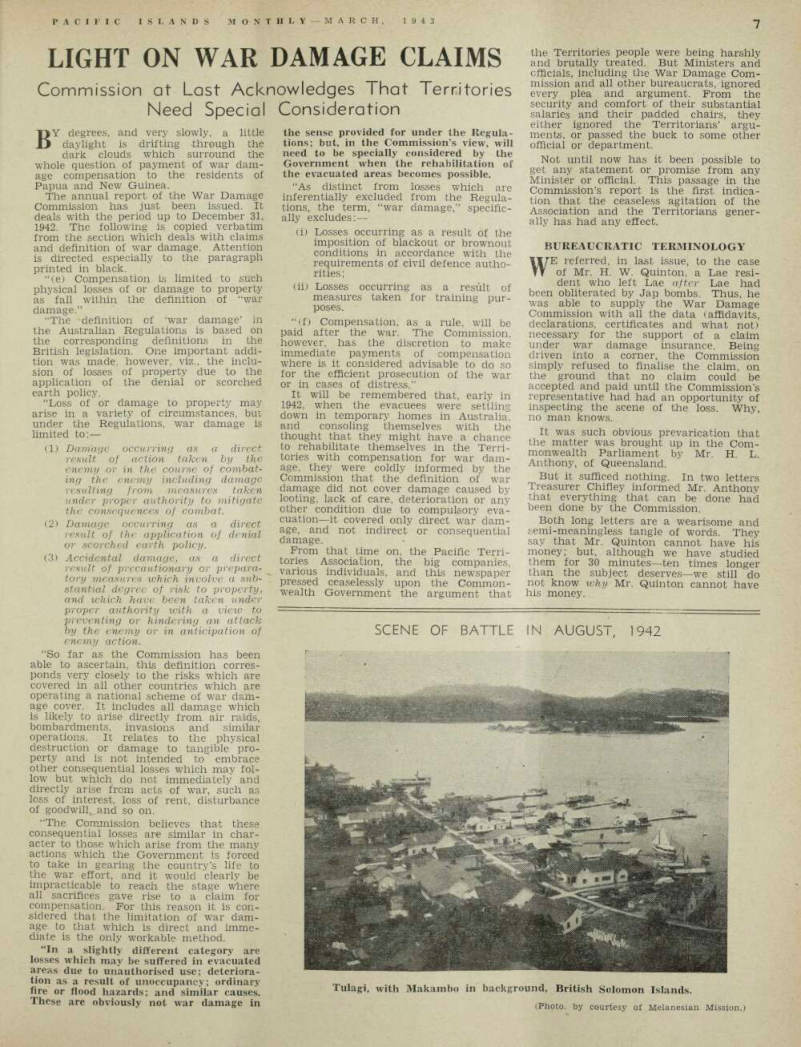
Scene Of Battle In August, 1942
Tulagi, with Makambo in background, British Solomon Islands. (Photo, by courtesy of Melanesian Mission.)
Memories Of Mr. Langstone
Something About the Administratorship and History of Distressful Samoa
By R. W. Robson
THE following “letter to the editor,” published in “New Zealand Herald” of January 13, brings to my mind some bitter thoughts and memories;— “I notice Mr. Langstone says the late Mr. Savage offered him the post of Administrator of Samoa. The odd thing is that this post is still open, should Mr.
Fraser think fit to renew Mr. Savage’s offer. The last Administrator was Sir Herbert Hart, whose retirement dates from July 25, 1935, when the Coalition Government was still in office. Mr. A.
C. Turnbull has been Acting-Administra tor ever since—that is, for 11 years. The situation is not fair to him, nor compli mentary to the Samoan people, nor respectful to New Zealand’s Mandate.”
In 1936, I travelled from Wellington, to Western Samoa, in the so-called motor vessel, “Maui Pomare.” Fellow-passen gers were Mr. Langstone, a New Zealand Cabinet Minister, and a New Zealand Parliamentarian, Mr. O’Brien. They were proceeding to the politically restless Mandated Territory of Western Samoa as a “goodwill mission” from the New Zealand Labour Government.
One gets to know people pretty well aboard a small ship. Mr. Langstone and Mr. O’Brien were typical of the products of a so-called democratic system, which are spawned upon the doorstep of Parliaments by political machines. Nei ther had any noticeable claim to repre sent an intelligent community in a coun try’s Parliament. Mr. O’Brien was the better educated of the two —but that sig nified little.
Mr. Langstone interested me very much —I wanted to discover his qualifi cations for his mission. How did this kind of man become a Minister of the Crown? What did he know about the principles of colonial administration?
Above all, what did he know of the peculiar problems of Western Samoa?
Well. I am still wondering. He was so self-assertive and satisfied with himself that most of the men aboard (NZ public servants proceeding to Samoa) were afraid to argue with him. I had only brief conversations with him, and those ended abruptly when, one evening on deck, he made some sneering references to the British Empire, and I ticked him off, in a few plain words of one syllable.
THAT “Goodwill Mission” stumbled around in Samoa for two or three weeks, irritating and antagonising the planters and kowtowing to a hur riedly formed organisation of Eurone sians called “the Samoan Labour Party.”
I have told, more than once, the story of its meddlings and blunderings.
It did only one thing that was of real value to Samoa —it put an end to the apparently endless feud between the Mau and the NZ Government. And it deserves no credit for that. O. F. Nelson was the bete noir of the bone-headed Government that had been displaced by Labour; therefore, of course, O. F. Nel son was treated as a martyr and a hero by the Labour Government. The per secution of Nelson ceased forthwith, and he and his family were sent back to Samoa. I said then, as I say now, that that was a wise and a very shrewd move.
Nelson played the game—he used all his great influence in favour of political peace, and from then until now Samoa has been so tranquil that even the tragedy of 1929 seems to have been forgotten.
The NZ Labour Government certainly put an end to the Nelson-Mau trouble; but it did not do that because Mr. Lang stone loved Mr. Nelson or had any pro found knowledge of Samoan affairs—it happened because NZ Labour was eager to reverse anything done by the previous gang of blunderers —and also because the Government had a most patient and tact ful man in A. C. Turnbull, the Acting Administrator.
Apart from the Mau affair, the effect of Mr. Langstone’s meddling in Samoan affairs was grotesque. I told the New Zealand newspapers something of the story, about 1938—much to the annoy ance of Mr. Langstone and the then Labour Prime Minister, Mr. Savage.
THE disclosure that Mr. Savage offered the Administrator-ship of Samoa Ur Mr. Langstone does not surprise me in the least —it is the kind of tom-fool thing that this kind of Government always does when faced with colonial responsibilities.
It is bad enough to have a Mr. Lang stone as a “Minister of the Crown”—but the New Zealanders elected him, so the New Zealanders have to put up with him.
But why should that class of politician be thrust upon poor, inoffensive, defence less Samoa? I am told that Mr. Lang stone, before he entered Parliament, was the working proprietor of a fried-fish shop somewhere in the North Island.
There is no reproach in that —many of us have had a humble origin. But gentle men who “climb on stepping-stones of their dead selves to higher things” usually develop the qualities of mentality and leadership which entitle them to that higher grading. Gentlemen who crawl into power through the political machines —we have dozens of the para sites in Australia —rarely develop any new qualities: and I am afraid Mr. Lang stone is in that category.
Imagine the new Administrator of Samoa bringing the intellectual flavours of the King Country fish-shop to Vai lima, once the world-famous residence of Robert Louis Stevenson!
That, however, is past history. What is not past history is the NZ Govern ment’s foul treatment of Mr. A. C. Turn bull. That is a present-day scandal.
Whatever credit these NZ Labour politi cians can take for Samoa’s tranquility is due, in large measure, to the work done by Mr. Turnbull. Yet, for some reason that no one has been able even to guess, Mr. Turnbull has been kept there as Acting Administrator since 1935 —one of the most miserable, discreditable things in the history of Pacific Islands adminis tration. That fact, alone, is sufficient to justify the harshest things that one may say about Minister Langstone.
I always have thought that there is some connection between the grotesque showing made by the “Goodwill Mission” to Samoa in 1936, and the NZ Govern ment’s cruel treatment of Mr. Turnbull.
So far as I could see, Mr. Turnbull and his wife did everything in their power to
make the unfamiliar path easy for the Mission’s blundering feet; but Messrs.
Langstone and O’Brien are of the class of men who would try to lay the blame for their personal failures upon others.
They would not consciously use their official powers against Mr. Turnbull —O dear, no! But if Mr. Turnbull did not displease them, why have they done nothing to remove the anomalies of his position? Or can it be that the Adminis tratorship of Samoa is still being kept open as a comfortable little bolt-hole for some harassed politician?
Is it any wonder that the people of the South Pacific territories, irritated in this fashion by the political freaks of Can berra and Wellington, or paralysed by the dead hands of Dominions’ bureaucra cies, are beginning to look eagerly towards the post-war settlement? Is it possible that, as well as an Atlantic Charter, we may have a Pacific Charter, in which these rich and beautiful terri tories of the South Pacific may be per mitted to govern themselves?
Mother Agnes
Recognition of a Lifetime of Spendid Work in Fiji
CELEBRATIONS in honour of the Golden Jubilee of the Reverend Mother Agnes, OBE, were held at the Central Leper Hospital, Mokogai, Fiji, on January 15. Visitors who attended to honour Mother Agnes were the Very Reverend Father J. M. Oreve, SM, Pro- Vicar; the Rev. Fathers Froehle and B.
Wobkin, SM; the Director of Medical Services, the Hon. Dr. V. W. T. McGusty, CMG; Reverend Mother Irma and Sister Rita, of St. Joseph’s Convent, Suva; and Mr. W. E. Donovan. The Medical Super intendent at Makogai, Dr. C. J. Austin, MBE, and Mrs. Austin, accompanied by Dr. and Mrs. Hemming, were present at the ceremonies also.
The Reverend Mother Agnes was born in France in 1870 and after entering the church in 1893 she came to the Marist Mission in Fiji. She spent 24 years at the Wairiki Mission, on Taveuni, and was then transferred to the Leper Hospital at Makogai, where she has been the Superior for 25 years.
That the work of the hospital has been extended with such success is largely due to the efforts and devotion of this re markable and self-sacrificing woman. At the time of the hospital’s Silver Jubilee celebrations, His Majesty the King con ferred the Order of the British Empire upon her, in recognition of the work done by the Missionary Sisters of Mary at Makogai.
The celebrations began on the evening of January 14, and continued until the evening of January 15. They were a fit ting tribute to a woman who has devoted her whole life to the service of others, and an expression of the esteem and devotion in which she is held by the Sis ters and patients of the hospital.
Fiji Council Extended
One Year
THE term of the present Legislative Council of Fiji should expire on July 23, 1943; but the Governor, Sir Philip Mitchell, on the advice of his Executive Council, and with the approval of the Secretary of State, has decided to prolong the life of the Council for one year.
New Guinea Is More Than A
Battlefield
By Geoffrey Tebbutt, In “Melbourne Herald”
NEW GUINEA has in recent times been presented to the Australian public in a baleful light. I have myself written often bitterly about it, and would not take those things back, for they were true of the time and place, and set down under the influence of battle.
Yet the island begins to exert a fascination.
It is easier, after a few months here, to understand its allure for generations of adventurers: the first revulsion wears off and the elements of beauty and mystery compete with its material dis abilities and deprivations and the rest lessness of the war atmosphere.
It is easier to understand the affection felt for it by the old-timers, and harder to come to the conclusion that they have gone troppo—the easiest way up here to dismiss tastes and theories not in line with one’s own.
Many Will Return
THERE are hundreds who curse it now and who will come back afterwards.
In the meantime those who like it for what it is and those who say nothing would induce them to come back of then own free will, alike recognise how deeply Australia is and must remain committed to New Guinea.
We have made here under war’s pres sure the investments from which we shrank timidly in peace when we would not realise our strength and capacity.
There is an interesting sidelight on the wiping out of the political distinction be tween Papua and the Mandated Terri tory. Police-boys in the Mandated Terri tory who speak pidgin English have come into Papua and are spreading its use among the boys of the Roval Papuan constabulary with whom the current language formerly was a pidginised ver sion of Motu, one of the basic tongues of Papua.
One of their Australian officers told me last night that pidgin English is increas ing in use and that it is far more ex pressive for commanding native police than Motu.
Purists Horrified
INCIDENTALLY, the purists of pidgin English are horrified by the average reproduction of what lay Australians take to mean pidgin.
One to whom I went the other day to have a general’s ceremonial speech to natives at Wau translated into pidgin re luctantly produced what he insisted I should qualify as a “simplified pidgin” version, otherwise his reputation for knowledge of true pidgin would be gone.
In its true written pidgin form it would have been practically unintelligible to the eye, although partially to be understood in phonetic speech.
The point the true Pidginists make is that pidgin is not a gross comic or vulgar corruption, but a tongue almost in its own right, built up, if is true, from several languages, but a living language for all that and entitled to respect. Thus they consider as an outrage the well known popular version of the declaration of the last war as rendered in what was called pidgin, but which bore no resemblance to the real thing. But the ignorant, they admit, must have their fun.
Tribute To Angau
AND let us remember the debt owed to the comparative handful of people who really know New Guinea, without whom we should have blundered hope lessly in trying to learn something in a hurry about our own property and who in all kinds of jobs on and off the record
are putting their brains to the task of winning the island back.
The kind of people I mean are the hardy officers of the Australian New Guinea Administrative Unit, who led the stoical trek and canoe journey of Chinese men, women and children from Wewak on the far north coast to the interior and made nothing of it, and others who’ alone among their trusty and trusted natives, have rendered great services in out of the way places that cannot be written about.
They take their malaria as a matter of course. They are wedded to this vast island of immense possibilities, its surface barely scratched and its value generally unrecognised until the Japanese laid hold and threatened at one time to seize the lot.
Future Gateway
THERE is a lot to be discovered yet behind those great mountains down which the black clouds roll each afternoon of this, the rainy season. There is a lot to be exploited for human-kind on the beautiful and until recently dangerous Buna coast, where the horn bills wing at dusk with laboured heavy puffing beats.
It was the Japanese who brought this realisation home. It is the Japanese who must be fended off before these oppor tunities can be developed. We can never again allow the white man’s burden to drop so carelessly. The long, steel matted airfields in the valleys of Moresby’s red hills have been hewn out to meet the Japanese threat—but some day they will serve to open New Guinea. . . . (See Comment on Page 29)
Cold Bacon
Useful Recipe for the Islands
THE following is a recipe for cold boiled bacon. It is a daily breakfast dish, year in and year out, in Lincolnshire and Norfolk; and it is as good in the Islands as in England, if kept cool and dry. It has been tried out in the hottest weather and has proved successful.
Recipe
Having killed the pig, scald and shave it, and cut into large sections (a whole side may be used). Bone need not be removed. When cold, rub vigorously with salt (any kind will do—fine, coarse or Fijian). Put into a tin, case or bin, and surround entirely with slaked lime. It can be taken out and used after one week, or after one year, or even longer.
There is NO offensive smell. When you remove the bacon from the lime, wash all lime away and boil with spice for at least ll hours, until a fork will pierce it easily. Take out of water, remove skin, and dust with nutmeg, or breadcrumbs, or crushed nuts. Allow to cool. It is eaten cold, like ham.
I see no reason why beef, goat, or fish should not respond to the same treat ment. Experiments are now being carried out.
The lime does not spoil the bacon in any way, and the lime can be used again and again; apart from the little lime that clings to the meat, none is used up.
Fijian lime, as made by the Fijians, acts well. It can be sieved to remove the larger pieces and bits of charcoal, etc.; but this is not necessary, as it acts equally well without sieving.—C. J. O. PARR,
Lakeba, Fiji.
Rarotongan Leader in War Work
War Work
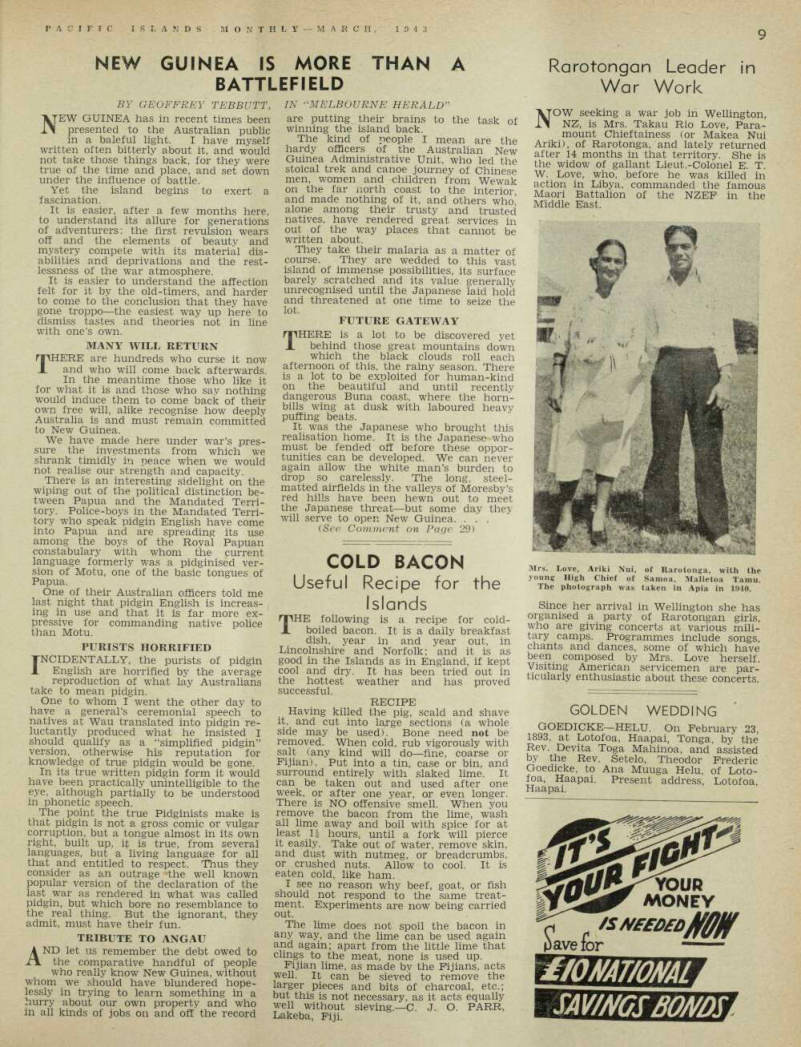
NOW seeking a war job in Wellington, NZ, is Mrs. Takau Rio Love, Para mount Chieftainess (or Makea Nui Ariki), of Rarotonga, and lately returned after 14 months in that territory. She is the widow of gallant Lieut.-Colonel E. T.
W. Love, who, before he was killed in action in Libya, commanded the famous Maori Battalion of the NZEF in the Middle East.
Since her arrival in Wellington she has organised a party of Rarotongan girls, who are giving concerts at various mili tary camps. Programmes include songs, chants and dances, some of which have been composed by Mrs. Love herself.
Visiting American servicemen are par ticularly enthusiastic about these concerts.
Mrs. Love, Ariki Nui, of Rarotonga, with the young High Chief of Samoa, Malietoa Tamu.
The photograph was taken in Apia in 1940.
Golden Wedding
GOEDICKE—HELU. On February 23, 1893, at Lotofoa, Haapai, Tonga, by the Rev. Devita Toga Mahinoa, and assisted by the Rev. Setelo, Theodor Frederic Goedicke, to Ana Muuga Helu, of Loto foa, Haapai. Present address, Lotofoa, Haapai.
Advertisements & other items, p. 11 (1 item)
nm/moir
'moffmms
■ wioiaATsrt
A 3 NOW
anoA
Problems Of
Evacuees
What Association is Doing
A REVIEW of the activities of the Pacific Territories Association dur ing the past three months was given on March 10, to a large meeting of mem bers in Sydney, by the president, Mr. E.
A. James.
Return Of Planters
The president described the Common wealth Government’s decision to permit planters to return to Papua (see details elsewhere in this issue) as the first con cession made to the Territories people by Australia since the Association began its fight, nine months ago. The plan announced by Canberra was, to a con siderable degree, the plan advocated by the Association, but the Association believes that the planters should have a voice in the appointment of the Board of Control, and further representations were being made to Canberra in that regard.
War Damage And Definitions
The president read an extract from the annual report of the War Damage Commission (see article elsewhere) to show that the authorities at last acknow ledged that it might be desirable to revise the definitions of war damage in relation to the evacuated Territories.
In reply to questions, the president said that numerous claims against the mili tary authorities for property taken and used in Papua had been pressed but had not been settled. In practically every case the claims were being referred to a Mr. H. G. Alderman, whose title and authority had not been defined, but whose powers appeared to be extraordin ary.
A member interjected that Mr. Alder man’s chief concern seemed to be to assist the Army by every means in his power to avoid payment of claims, rather than to secure a fair and just settlement for the unfortunate evacuees who had seen their property carted off and used by the troops and who in many cases had lost everything.
Tfie president said that letters sug gesting certain settlements had been sent to some claimants by Mr. Alderman. He urged all those who received such letters to examine them very carefully and, if possible, to secure the advice of the Asso ciation before answering them.
The president referred at some length to the recent judgment of the High Court of Australia in the Apple and Pear Board case, which made it clear beyond all argument that the Commonwealth was obliged to pay owners for property taken under wartime powers according to the proved value of that property at that time, and not according to any arbitrary method of valuation fixed by the Com monwealth itself. The effect of that judgment was that the Commonwealth now was liable to pay claims amounting to many millions of pounds over and above the amounts already paid by the Commonwealth for property taken. In his belief, this judgment applied to the situation in the Territories just as it did in Australia.
A member interjected that it could hardly be expected that the Common wealth would leave that judgment un challenged—it almost certainly would
appeal to the Privy Council, in order to delay execution of the judgment, if for no other reason.
It was resolved that the executive write to the Federal Treasurer, as nominal head of the War Damage Commission, with a request that, if possible, he make a statement based on the paragraph in the Commission’s annual report, so as to clarify the essential difference between consequential war damage, as defined on the mainland of Australia, and conse quential war damage as seen in the Ter ritories of Papua and New Guinea, from which all civilians have been evacuated —and that the Minister specially be asked to take note of the fact that in the weeks immediately following the evacua tion, the usual control over natives (now resumed), had been unavoidably with drawn.
Mr. R. W. Robson urged that every thing possible should be done to induce Canberra to recognise the essential dif ference between “consequential” war damage as seen in Australia, and “conse quential” war damage in Papua and New Guinea. The Commonwealth authority, during 1942, had failed to recognise that difference —but he believed that now it was beginning to see that, while it was impracticable, and indeed impossible, to recognise consequential war-damage in Australia, where the people had remained in possession of their property, there clearly was a moral obligation in relation to consequential war-damage in the Ter ritories, where the people had been eva cuated under military order, and were not able to care for their properties and guard against deterioration through natural causes and losses by looting.
Taxation Problems
The president said the Association had been making repeated applications to the Australian Taxation authorities for relief for Territories’ residents from the new system of taxation. The system meant that Territorians now in receipt of income in Australia would have to pay Australian income tax for a year after their return, unless some special ruling were given in their favour.
Relief also was claimed for Territorians on the ground of the extraordinary expense they had had to meet in setting up homes, and purchasing clothing, equipment, etc., in Australia, after the evacuation.
The Association, although it had pre sented what it regarded as a convincing case for relief, could get no promise or undertaking from the Taxation author ity. All the Commissioner would say was that machinery existed for the con sideration and relief of individual cases of hardship; but that such applications for relief would have to be made by indi vidual taxpayers. The Association would press for another ruling; and, mean while, members who were in need of advice in regard to taxation matters were invited to get in touch with the Associa tion. He personally had spent a good deal of time with the Taxation people on the subject of procedure, and the latter had made available to the Association a supply of forms for use by individual members in making applications for relief.
Allowance For Copra
One of the matters taken up by the Association was the price allowed to planters for copra for insurance purposes by the War Damage Commission—namely £9/10/- per ton, Rabaul. The Association had clear evidence that the Copra Pool had received for copra in February, 1942, no less than £24/10/- per ton, Sydney.
The Association therefore was pressing
for a more equitable adjustment so that planters might claim upon the War Damage Commission for lost copra at a higher rate than £9/10/- per ton.
The president answered a number of questions relating to the liability of pro perty owners to pay war damage insur ance premiums for the 1943 period. Gen erally, it appeared that the liability to pay insurance premiums on fixed assets continued: but if it were shown that the property had been destroyed by enemy action before the payment of the 1943 premium, the Commission undertook to refund all premiums paid as from the date of destruction.
The Association
It was announced that Mr. J. W. Hinks had been added to the Executive, as miners’ representative, in place of the late Mr. Moen; and, owing to the trans fer of Mr. Gaskin to the north, Mr. A.
Lussick was appointed as auditor.
The president announced that this was the last quarterly meeting. The annual meeting would be held in Sydney in about the second week in June. The need for the Association obviously was greater than ever.
Return of Norman Neal and "Blue" Allen
"Blue" Allen
THERE was a happy interlude at the meeting of the PT Association on March 10, when there unexpectedly entered two popular residents of New Guinea —Lieut.-Colonel Norman Neal and Major H. T. (“Blue”) Allen, formerly of Wau, both looking fit and well after 2 i years in the Middle East.
Mr. Neal returned to Australia some time ago, with his lieutenant-colonelcy fresh on his shoulders, and already he has seen some service in the New Guinea area. “Blue” Allen is a more recent arri val in Australia—he carried out certain important liaison duties in the great battle at El Alamein, before departure, and actually saw General Montgomery and his Eighth Army start off on their extraordinary desert trek of 1,600 miles.
Both Allen and Neal are numbered among the “Rats of Tobruk”—both performed notable service there, and Allen was rewarded with the OBE.
Both officers were warmly welcomed by the members: and both, later on, expressed their appreciation of the work being done by the Association to protect the rights of the many Territories resi dents who now are serving with the armed forces.
Death of Engineer Harry Tate
MR. Harry Tate, who was born in Fiji about 55 years ago, has been lost at sea, through enemy action.
He served as an engineer with the CSR Co., at Nausori, Fiji, and in the last war was in the merchant navy. Returning to Fiji, he joined in the Government ser vice as Chief Engineer on the old “Pioneer.”
He left the Fiji service to join the seagoing staff of the Broken Hill Pro prietary, Ltd., of Newcastle, NSW, and two years ago went to Britain to super vise the building of a new vessel for that firni. He came out on this ship as Chief Engineer, and it is presumed that he was still serving aboard her when he was lost.
He leaves a widow and two children in Newcastle, NSW, and two brothers in Suva. Messrs. W. de B. and F. Tate, and another brother in Tonga.
A. P. Lyons
Retires After 36 Years in Papuan Service
ON February 12, after having given 36 years to the service of the Papuan Government, the Hon. A. P. Lyons retired on superannuation from the posi tion of Director of Public Works and Member of the Legislative and Executive Councils. He has been living in Bris-
“I would not swap those 36 years in Papua for anything else,” says the well known and warmly-regarded Mr. Lyons, in a note to friends in Sydney. “During that time I witnessed the carrying out of Sir Hubert Murray’s experimental native policy, and assisted in it.”
Born in Queensland in 1879 and edu cated in Sydney, Mr. Lyons joined the Papuan public service in 1906, when Cap tain F. R. Barton was Administrator and Hubert Murray was Judge. Within a few months he went to the Northern Divi sion at ARM, and for three years he was at Buna, Kokoda and Mambare—places now prominent in 1943 war news.
Then he specialised in gold-mining law, and when the famous Lakekamu field was proclaimed early in 1910, he was the goldfield’s .first warden and magis trate, with headquarters at the now for gotten centre of Nepa.
Then came long spells in the field as a Resident Magistrate—from 1913 to 1921 at Daru; from 1921 to 1924 at Misima; from then until 1930 at Samarai; and in 1930 he became Director of Public Works, and one of Sir Hubert Murray’s right hand men, with headquarters at Port Moresby. He carried out, in addition, the duties of Director of Agriculture for some years, and he was the first chairman of the Petroleum Advisory Board.
The post-war Port Moresby will be vastly changed, and one of the changes that few will appreciate will be the absence of the jovial and kindly road maker from his accustomed places. He may be seen thereabouts, however. He intends to reside in Brisbane; but he thinks he may drift along to Port Moresby when the war is over.
bane since military displaced civil ad ministration in the Territory on Febru ary 15, 1942, and all civilians were evacu ated.
Tribute To Australian
"Efficiency"
Death of a New Guinea Baby
DUE to the complete and appalling dis organisation of hospital and medical services in New South Wales, a woman evacuee from the Mandated Ter ritory, Mrs. Ellen Burnet, had the ter rible experience on February 17, of seeing her child die in a casualty ward of St.
Vincent’s Hospital, Sydney, after a 12hours’ fight to secure hospital treatment.
The 16-months-old baby had suffered mild whooping-cough, and on February 16 he went into a convulsion. A doctor sent Mrs. Burnet and the child to Ren wick Hospital in an ambulance; but this hospital “was under-staffed and had no accommodation for infectious cases.”
Children’s Hospital, Camperdown, refused admission —no accommodation. Mrs.
Burnet then took the child to her mother, at Potts Point, where it had another convulsion. They rang five doctors, and one advised them to go to St. Vincents.
St. Vincents had no accommodation either, but the child was taken to the casualty department, where a doctor rang the Board of Health and the Coast Hos pital—without result. At 2.30 a.m. on the following morning, the baby—still in the casualty ward—died.
This, presumably, is an example of how the nation has been “organised for total war” by Dedman and Co. The usual fatuous promises of a “public inquiry” have been made—so far without result— and Public Health authorities merely comment that only a third of the hospi tal beds necessary are available.
The child’s father is Mr. J. T. Bumet formerly of the Public Health Depart ment, Madang, TNG. At present he is serving as a Warrant-Officer in the New Guinea military forces.
New Guinea Returned
Soldiers
THE recently. reconstituted New Guinea branch of the RSSAILA has given their president, Mr. A. J. Gaskin, six months’ leave of absence while in the north on war duties.
In his absence Dr. E. T. Brennan has been appointed acting president.
Americans And
Australians
“GOME English reviewers of my book O (‘Yankee Doctor in Paradise’) seem to think I had a poor opinion of the Australians. I can’t see how they read that into it. If I were not an American, I would wish to be a citizen of Australia,” says Dr, S. M. Lambert in a personal letter to the “PIM” from USA.
“In fact, at one time, I came under the influence of E»r. Philip Clark, of Cairns, and that environment so attracted me that I almost decided to join up at his invitation with Clark in practice. That was the time the pound sterling took a nose-dive, in 1919, and I reconsidered.
“Best wishes to the ‘PIM,’ and to my many friends in Australia. I hope they won’t find the Yankees en masse too much for them. The time has come when we must all hang together—or we’ll all hang separately.”
Mrs. Betty Channing Pearce, the only child of Mrs. C. Scott, of Tuiai, Short land Group, Solomon Islands, died on January 19, 1943, of typhoid fever, at Gonda, United Provinces, India, aged 28. She leaves two young children.
Fiji Manpower
Problem is Acute
JUDGING from a series of reports and articles in the “Fiji Times,” the manpower position in Fiji is a rep lica of the difficult and confused situa tion seen in Australia and elsewhere.
There are armed forces in Fiji, and the authorities are trying to grow as much as possible of their foodstuffs, so as to save shipping. This additional demand for foodstuffs requires additional labour.
Fiji, although it has four communities (Europeans, Fijians, Indians and Chin ese) never has had any surplus labour, because the Fijians generally can depend upon the fruits of their communal land ownership and need not work, and the Indians insist on being either peasant growers of sugar or small tradesmen.
So far from more men being available there are less; because other authorities! concerned with the defence of the Col ony. have made heavy drafts upon the natives.
Not only is labour needed for food stuffs, but the United Nations are shout ing urgently for copra. Fiji copra-grow ers are eager to respond, but cannot get even normal supplies of plantation labour The shouting and the criticism seem to indicate that Fiji, like many other countries, has displayed a lack of plan ning m gearing manpower resources to national wartime needs. The Fiji Gov ernment recentiy mad'e a statement which did not help the situation much.
The first two paragraphs:— “Government’s first concern is the competition of fighting units and labour battalions of the Fiji Militarv Forces up to their approved establish ments.
“Until these establishments are com no sur P lus Pf labourers ™ hlch Government could form a pool for employment in the various essential industries in the Colony, and the indications are that even when these establishments have been completed, theie will not be a sufficiently large sur plus of labour available to justify the formation of a pool. In any case, Gov ernment will not approve of the use of compulsion to make labour work for pri- Therefore, employers and labourers will have to come to terms by private arrangement and contact.”
Japs
Solomons Miners Defy Japs Attention tor Rubber Plantations
DURING the whole six months the Japanese were on Guadalcanal (Solomon Islands) four Australian gold-miners—A. Wilmot, F. M. Campbell, A. Andresen and H. L. Freshwater—con o work their alluvial gold leases 1 0 up in the mountains (says Winston Turner, in a despatch to “Sun”).
Recently, Wilmot was murdered by natives. His mutilated body was found m his hut, where he had evidently been attacked while reading. A suspect was arrested; but now, says Turner, he is serving in the police force! The other three miners are carrying on.
The correspondent says that 900 rub ber trees at Berande (Guadalcanal) owned by SI Development Co. (a BP subsidiary) and planted many years ago, ar e n °w receiving attention. About 8,000 rubber trees on Santa Ysabel, owned by another Australian company, also are expected to yield satisfactorily.
Per Ardua Ad Astra
Francis Thompson lives again in the poignantly-beautiful cadences of a fragment of verse that was scribbled in pencil on the back of an envelope addressed to his parents in Scotland, by a 19-year-old RAF pilot in Canada, J. Gillespie Magee, shortly before he was killed. It has been hailed as a work of genius. It may have been pub lished earlier in Australia, but we have not previously seen it—and it is too pre cious to be lost.
High Flight
Oh, I have slipped the surly bonds of earth And danced the skies on laughter silvered wings; Sunward Vve climbed, and joined the tumbling mirth Of sun-split clouds—and done a hundred things You have not dreamed of: Wheeled and soared and swung High in the sunlit silence. Hovering there, Vve chased the shouting wind along, and flung My eager craft through footless halls of air.
Up, up the long, delirious, burning blue, Vve topped the wind-swept heights with easy grace, Where never lark nor even eagle flew — And, while with silent lifting mind Vve trod The high untrespassed sanctity of space, Put out niy hand and touched the face of God.
Henry Nott, Pioneer
THE centenary of the passing of Henry Nott, Tahiti’s pioneer missionary, is a year away; but no fixed date need be chosen as a day of remembrance. The Protestant Church in Polynesia is, indeed, a perpetual memorial; for it is the super structure erected on the foundations laid by this great pioneer. Its corner-stone is his translation of the Scriptures, which has not only established the Tahitian as the classic language of Central Polyne sia, but has carried over into that tongue the majesty of style of the English Bible.
The photograph is of a portrait in the possession of the London Missionary
Society.
Photo, by Simpson.
Recent Islands Casualties
Killed in Action NGX44 Lieut. J. A. Grant, Infantry, Sydney.
Wounded in Action NGX2O Lieut. A. G. Pearce, Infantry, Salamaua, NG.
NG2242 Lieut. P. A. Tuckey, Infantry.
NGXI94 Pte K. M. White, Infantry, Bulwa, NG.
Previously Reported Missing, Believed Prisoner of War —Now Reported Prisoner of War NG3OOO Lieut, C. G. Kinner, Infantry, Rabaul.
Dangerously 111 NX65696 Lieut. R. Stephens, Engineers, Ramu, New Guinea.
Removed from Seriously 111 List PX7 WO.II H. G. L. Morton, HQ Units, Kanosia, Papua.
NG2298 Sgt. E. L. Lowney, Postal.
In South-east of Colony
Fiji Hurricane
WEATHER has become almost a munition of war—all reference to it is tabu until long after the event.
Consequently, news of the hurricane which hit Fiji at the New Year was not released for publication until the middle of January, and did not reach the out side world until a month later.
The customary hurricane radio-warn ings of past years were discontinued when Japan entered the war and this further complicates the lot of planters and others who normally could make some provision against these storms.
The following report was issued by the Fiji Information Office on January 15: — A hurricane passed through the Fiji Group from the north-west during the afternoon of December 31 and January 1. Labasa and Savu Savu did not ex perience the full force of the storm and, apart from a certain amount of flooding, have only experienced minor damage.
Considerable damage has been re ported from the area of Udu Point and the island of Wailagilala. In Taveuni, the southern end of the island escaped serious damage, but elsewhere a number of native houses and food plantations have been destroyed. Buildings on the Government station received minor damage.
Private letters received by the “Fiji Times,” from residents of Laucala Island and the Taveuni district generally, indi cate that the damage done to that dis trict had been severe.
One letter states that it will take three years for some plantations to recover. Coconut trees are down in thousands and food crops and fruits were simply blown away, the ground littered with tons of ruined fruit and nuts which had promised to make 1943 a record production year.
The path of the hurricane was appar ently through such places as Rabi.
Qamea, Laucala and the north end of Taveuni and south to Gilai, the Lau Group and Ongea.
The Indian community of Rewa, Fiji, recently held a carnival and raised £214, which was distributed as follows: POW Fund, £2O; Fiji Fighter Fund. £5O; bal ance towards Red Cross and other funds.
Cheering Speech by the
Tahiti Prospers
Cheering Speech by the Governor
By Ray P. Davis
Papeete, Jan. 25.
DECLARING that Tahiti had remained more than five months without out side contact after Pearl Harbour, Governor Georges Orselli, head of Fight ing France’s island empire in the South Seas, cited in a speech here an amazing record of economic and political recovery since the “traitors of Vichy signed an armistice at Compiegne.”
As administrator for the 132 islands of French Oceania, which are now shipping their entire copra production to America and Canada, Governor Orselli, speaking before the annual meeting of Tahiti’s Economic and Financial Delegates, or Congress, drew a picture of the position of this area after the capitulation of France, and then after Japan turned the peaceful Pacific into a battlefield.
“Only slightly more than a year ago,” he said, “we were still suffering from the blow of that troubled period which was, here as elsewhere, the result of the armistice signed at Compiegne by the traitors of Vichy. Economically and politically we were still suffering the consequences. And then to that was added the outbreak of the total war in the Pacific, the memory of the first Japanese successes after their brutal attack on Honolulu.
“The enemy was advancing toward us.
The war was at our doors. All those who, through interest, opportunism, or treachery, proclaimed themselves of Vichy or Saigon, raised their heads and prepared to receive the invader. We had to grit our teeth and make an appeal to the energy and the work of everyone in order to keep steadfast.
“Now more than a year has passed.
The wheel has turned. And among us we are finally beginning to see the end: Victory and the liberation of France.”
FRENCH Oceania’s first task, after Japan’s treachery, was the defence of the islands, the Governor said.
“Your sons responded to the call. Under the direction of their young leaders they have prepared themselves. They are the brothers of those who died for France at Bir Hakeim. The Japanese will never enter Papeete as they entered Saigon.”
He pointed out the gravity of the eco nomic situation here after Pearl Harbour, which temporarily disrupted Pacific shipping, a vital necessity for Tahiti’s exports. “The Japanese menace was pressing upon the routes of communica tion. We remained more than five months without liaison with the outside world.
“■'YTOW, however, the situation has been ameliorated. All of our products are being exported. All of our essential needs are satisfied. The list of imports and exports last year will equal that of the strongest year in peacetime.
Our copra has sold for a year at advan tageous prices; our pearl shell is of the first quality. Only vanilla, after having attained an unhoped-for level, actually knew hard times, but still brings remu nerative prices. A reserve stock of essen tial products has been set up, good for four to eight months, and our reserve of foreign credits is sufficient for a year of good living.
“The administrative and financial ser vices are actually functioning under cop
ditions at least as good as before the armistice, and are doing so with a decreased personnel and with increased work, such as providing for supplies and military allocations.”
GOVERNOR Orselli’s resume of pro gress made by the health service in French Oceania was equally opti mistic. “A doctor has been sent from Tahiti to the Marquesas, to the Isles Sous le Vent, to Taravao. At Papeete, in place of only two doctors, there are now eight. Regular and frequent medical tours are made in the districts of Tahiti, and to the other islands. The care at Papeete’s maternity hospital is rendered gratuitously for persons earning a small salary, and the price of the day hospital has been diminished by 50 per cent.
Work abandoned for three years on the hospital at Uturoa has been resumed.
And there is a provisioning of essential pharmaceutical products that will last more than a year.”
Also cited was the progress made by various administrators, by the judicial service, the service of public works, and in agriculture. These gains were made “in spite of increased work brought on by the necessity for military allocations and supplies, and other defence mea sures.
“17IROM the agricultural point of view, I 1 planting -and the labour for numer ous cultivated acres have been assured, and these are beginning to improve the Colony’s supplies. Efforts have been carried out in the development of cultured stocks, particularly of pea nuts, of sugar and tobacco. Important economic credits, amounting to millions, should result from the full realisation of the programme now in operation.
“Finally, I terminate this report with the measures taken for the amelioration of the fate of producers, consumers, and people on fixed salaries; that is to say, almost everyone!
“For the producers these are: The establishment of minimum purchase prices for copra and pearl shell, the fix ing of the price for freight on inter island boats, and the formation of a growers’ organisation.
“For the consumers there are: The fix ing of maximum profits on imported pro ducts, which abolishes the exorbitant benefits formerly enjoyed by certain merchants, and prohibits the hoisting of prices.
“The fixed salaried people have seen their situation improved by the institu tion of special temporary indemnities, and the increasing of zone indemnities.
“Fighting France,” Governor Orselli concluded, “can be proud of her work in Oceania. Soon victory will give back to France an Oceania richer, more beauti ful, and proud to have aided in libera tion. For the future, I ask you only to continue the wdrk of the past, to work still and always for France, for Tahiti, and for liberty.”
Samoa Enjoys High
Prices
Apia, Jan. 24.
WITH good prices for Samoan pro ducts still ruling, copra and cocoa producers are busy harvesting good crops of the two main products of Samoan soil.
The price of copra remains stationary as fixed by the Samoan Administration.
The cocoa crop, up to the end of December, 1942, was purchased by the Administration; but, beginning on Janu ary 1, 1943, cocoa buyers have been free to sell cocoa-beans in the open market, the Administration fixing a temporary price of £55 per ton for plantation cocoa and £5O for native cocoa.
European planters and other employers of native labour are still faced with great difficulties in obtaining sufficient Samoan labourers.
Though the ruling labour daily wage is now 5/- per day, even at this high rate Samoans do not feel inclined to work.
Some 40 workers were recently brought from Niue Island under contract to the New Zealand Reparation Estates as plan tation labourers. There is some prospect of obtaining labourers from the Tokelau Islands or possibly Solomon Islanders to relieve our desperate shortage of planta tion labour.
Staff-Sergeant H. O. Wendt, Adminis trative Headquarters, Fiji Military Forces, has been promoted to Second- Lieutenant
Not Dead
IN the November issue of the “PIM” this paragraph was published: “Mr.
Lewis Hirshon, a well-known resident of Tahiti, died on September 1, after a short illness.”
This report, like that of Mark Twain’s death, was exaggerated.
Mr. Hirshon is very much alive, and is well. The report came from what seemed a reliable source. We regret its publica tion.
Some Mosquito!
AMERICANS apparently have a proper respect for the Solomon Islands brand of mosquito.
According to the report of one United States war correspondent, a mosquito landed on Henderson airfield, Guadal canal, one night; and the ground staff put 70 gallons of gasoline into it before they identified it!
Advertisements & other items, p. 15 (1 item)
Burns Philp
PACIFIC ISLANDS SOCIETY
Visitors from the Islands to Sydney (or those interested in Islands affairs), are advised to communicate with the honorary secretary of the above Society, which has been formed to study the history, traditions, economics, and political developments of the Pacific Islands.
Regular monthly meetings are held at History House, 8 Young Street, Sydney.
Address for Correspondence:
THE PACIFIC ISLANDS SOCIETY,
Box 2434 MM., G.P.0., Sydney.
BURNS PHILP
(SOUTH SEA) CO. LTD.
Inc. in Fiji $ U V A
’ ' FIJI
Island Traders and Shipowners \\ Also Branches at: Fiji: Levuka, Lautoka, Labasa, Ba, Sigatoka, Rotuma.
Tonga: Nukualofa, Haapai, Vavau.
Samoa: Apia, Pago Pago (American Samoa). nx Solomons: Makambo, Gizo, Faisi.
New Hebrides: Vila.
Code Address: Gilberts: Tarawa.
“Burnsouth”. Norfolk Is. Niue. Wallis Is. Futuna Is.
POWERFUL MULTI-VALVE BANDSPREAD
Full particulars from
GEORGE BROWN & CO.
Electrical Engineers
Used by
• Commander R. E. Byrd on his South Pole Expedition. • Official Australian Adviser to British Broadcasting Commission. • Mr. R. N. Shaw, Editor Short-wave Section “Wireless Weekly”, • Mr. L. J. Keast, Editor Short-wave Section “Radio World”.
There is not a better radio obtainable.
AC & BATTERY MODELS
PTY. LTD.
267 Clarence Street, Sydney, N.S.W.
How Japs Came To Tulagi—And Departed
Fijian Eye-witness's Account of Two Early Solomons Battles
HERE is one of the most remarkable stories of the Pacific War—remark able, because it gives us the first connected account of what happened in the Tulagi area of the Solomons between May 1, 1942, when the Japanese arrived in force, and August 7-10, when they were thrown out by the Americans.
It is doubly remarkable because it is written by a Fijian, Kelimindi Nabuno Suno. He was employed at Vatu koula, Fiji, by the Theodore inter ests, and in 1941 he was sent by those interests to the staff of Solomons Gold Exploration Co.. Ltd., whose headquar ters were on Guadalcanal. When the Japanese arrived on Guadalcanal, the Europeans were withdrawn, but Keli mindi remained, and was an interested observer of all that happened. Keli mindi’s account of what he saw was released for publication by the Govern ment of Fiji, in January, and here is part of it. taken from the “Fiji Times”: — “On Friday, May 1. a Japanese convoy entered the Thousands Ships Bay at the southern end of Ysabel Island (north-west of the Tulagi area). The
Japs made some investigations ashore, but the conditions of the place were un favourable. It was in the early hours of Saturday night, May 2, that we saw tangling beams of searchlights from the Japanese naval escort vessels somewhere in the vicinity of Savo Islands (between Ysabel and Tulagi). They searched the ocean and the skies as if they were expecting attack from the Allies at any moment. Unfortunately, they were not attacked.
“On the same night, the RAAF sta tioned on Gavutu and Tanambogo (near Tulagi) set fire to buildings, stores, fuel dumps and everything that might become useful to the Japanese. It was a pity they had only one plane, and she was out of action from a hit by a Japanese bomb on the previous day. They got on to a couple of boats and went across to Aola and then to Vila, in the New Hebrides.
“Early on Sunday morning. May 3. we saw the Jap ships entering Tulagi har bour. Some anchored and discharged cargoes and men onto Gavutu and Tan ambogo, and others onto Tulagi and Makambo. Some of the ships left the same day, but many of them stayed in the harbour. Escort naval vessels in cluded three heavy cruisers, two light cruisers, three destroyers and one air craft-carrier.
“On Monday. May 4. there came wave after wave of American dive-bombers and Flying Fortresses. They bombed Tulagi. Tanambogo and Gavutu respec tively. There were still some ships there.
They sank three of them within the har bour, including one destroyer. They sank
another one between Tulagi and Savo, and another two off Savo Island. They sank some more somewhere beyond Ysabel, eleven ships altogether being sunk during this battle, which was part of the so-called Battle of the Coral Sea.
Although the Japanese made their land ing they suffered heavy casualties, as well as losses in ships and equipment.” (The Battle of the Coral Sea, a fight between Jap warships and American airmen, lasted from May 4 to May 11, and extended from Tulagi hundreds of miles westward and north-westward. It was the first heavy defeat inflicted upon the Japanese in this war.—Ed. “PIM”.) ‘‘During June, another small Japanese convoy arrived. This lot came and occupied Kukum, Lunqa and Tenaru, on the west coast of Guadalcanal. Allied bombers came and bombed this convoy while it was still unloading in Lunqa Bay. They sank about four or five of the ships. ‘‘After landing and establishing, the Japs began constructing their aerodrome immediately. They forced local natives to work for them without pay. The natives could not refuse, as if they did, the Japs would shoot them on the spot.
In addition, they seized food, pigs, etc., from the natives.”
The Allies Return
THIS is how Kelimindi describes the Allied re-occupation of the Tulagi area: — ‘‘Early on Friday morning. August 7, we heard planes roaring all over the place and from every direction. At 6 a.m. the warships started shelling. That was the first instant of the Allied offensive action in the south-west Pacific. The flash of the big gunfires from the ships was of an exciting nature.
“When the dawn cleared the darkened night from the sky, we then saw that the whole channel was covered with
ships. Some shelled Guadalcanal and others Tulagi, Gavutu, Tanambogo, Bugana and Florida (Gela) islands. It was a great sight. As the ships were shelling, hundreds of planes roared in the skies, machine-gunning the Japan ese personnel who were on their way into the scrub.
“At 8 a.m. planes then began to bomb while the warships still kept up their shelling. Bombs and shells were burst ing from every corner of the battlefields, as well as every inch of the Japanese occupied areas. I think the average of bombs that fell on that day was about three bombs to every second. It was deafening to hear the thundering noise of the bombs and shells and the rattling noise of machine-gun and cannon fire from our planes as they swept over the islands after the running-away Japs.
“The first landing was on Alavo beach on Florida (Gela) Island, by the United States Marines, under cover of a strong force of fighters and dive-bombers. At about 10 a.m. the Marines began landing on Tenaru on this island (Florida) again under cover of a strong force of fighters and dive-bombers. Launches, barges and amphibian tractors were just like white ants on the surface of the water, hun dreds and hundreds of them.
Amphibian Tractors
“mHE work of the amphibian tractors A wa's simply marvellous, as they were lowered down from the ships on to the water, glided along the water into the sandy beach and then into the coco nut plantation.
“You know what the Japs did? They simply ran away for their lives into the jungles. Five of them we caught up here in the scrub and they were taken down to the Yanks as prisoners.
“On Saturday, August 8, the Marines then landed on Tulagi Island under cover of dive-bombers. They did not take much time in landing. At the same time, our bombers were blasting the Japanese underground hideouts, dumps, etc., with their 1,000 lb. bombs. Our bombers destroyed 18 Japanese planes as they were still anchored on their base.
It was a wonderful sight to watch the whole operation.
“It was on Saturday morning (August 8) when 40 Japanese twin-engined bomb ers came and attacked our ships. Our fighters went for them. Some of the bombers came through and dropped then bombs, which fell into the clear tropical waters.
“At night the Japanese Navy tried to engage the US Navy, but they were driven back by the powerful combined Australian and US Navy. It was during this operation that HMAS ‘Canberra’ was sunk. I was up all night that night watching the great show. Our fighters shot down 10 out of the 40 planes that came and raided our ships.
“It was on Sunday, August 9, when our ships went away, to where we did not know. But it was obvious they were lying waiting for the Jap Navy some where around the Solomon waters. Later, we heard from the news that they engaged the Jap Navy after about a couple of days.”
Mr. N. W. McDonald, of Fiji, has been granted an honorary commission as Lieutenant-Commander in the Fiji Naval Volunteer Force.
The following have been appointed to the Fiji War Fund Executive Commit tee by the Governor (Sir Philip Mit chell) ; Sir Henry Scott (chairman), Mr.
T. Bryce, Mrs. R. Crompton, Mr. B. H.
Marks (treasurer), and Mr. H. H. Ragg.
Advertisements & other items, p. 16 (1 item)
89 Years
There is no substitute fot
OLD MONK
VIRGIN PURE
OLIVE OIL
San Francisco
$ 1C -5 (S-, ftt*ss* vir, Ai^SVi^Avw t>» 1 m
89 YEARS
a * ysm i
S WALLOW c ARIEL! ltd.
4 HERS or Biscuit • PERM PUDDINGS • CARES . fITOGEN • ICE CREAM *
Valuable Islands Product
Tonka Beans
Contributed by Charles Reed, Horticulturist, Apia.
ALTHOUGH little known outside its native tropics, the Tonka Bean (Diptera oderata), a small tree with fragrant seeds, which produce the well known Tincture of Tonka, is destined to rank high in competition with commer cial vanilla extract.
In Samoa, a crop of these fragrant beans was recently gathered from one single tree, which, when macerated in spirit for three days, yielded a quart of ticture. This may be used in the place of vanilla, which it much resembles— and takes the place of the very many poor imitation vanilla concoctions, often placed on the market.
The fruit is an oblong, fibrous pod con
taining one almond-shaped black seed.
The pods are retted, and the seed removed and sun-dried. The seed will be found to have remarkable keeping quali ties over several years, when packed in jars. I |, For household purposes, one single Tonka Bean tree will provide enough beans to make essence, perfume, and even sachet-powder. The market price has fluctuated between 20/- to around 7/- per lb. for the dried beans.
Fiji Blackout Relaxed
THE military authorities in Fiji have authorised certain relaxations in the blackout regulations during the hot weather period. Starting from December 15. the hour for blacking-out was ex tended to 10 p.m. After that hour black out conditions were to be enforced as before. This concession does not apply to street or shop lighting.
Advertisements & other items, pp. 17-18 (1 item)
Burns Philp Trust
«, TtMr c
nrr*
Why carry an
unnecessary burden?
If you are an executor of an estate there must be times when you feel the strain of this extra and unnecessary burden. In these difficult times, the responsibility of trusteeship is too often a handicap in the proper supervision and control of your own affairs which should be having all your attention. Why not be relieved of this extra burden? Let Burns Philp Trust Company Limited take the load from your mind. This permanent institution, under experienced and capable direction, has the advantage of combined knowledge of finance, taxation, and investment which no individual executor could be expected to have.
The transfer of responsibility can be made simply and promptly; and you will have the satisfaction of knowing that the estate will be administered faithfully, efficiently, and in strict accord with the terms of the trust.
James Burns Lewis Armstrong
DIRECTORS:
MANAGER—C. H. Chester.
Robert John Nosworthy Joseph Mitchell
Burns Philp Trust
COMPANY
LIMITED
7I>IOCt•T« I £ T . 9 V D N C T Telephone: 87901. Box 543 B, 5.P.0.. Sydney.
BY APPOINTMENT
Horlicks is Ideal
for Emergency Rations
For emergencies, with the addition of water only, Horlicks is a complete food, providing warmth and energy, body-building and tissue-repairing material.
Even after it has been opened Horlicks will keep in perfect condition indefinitely if the top is firmly replaced.
It would be difficult to find a more valuable food to keep by in case of emergency.
HORLICKS
Modern Versus Old
1171 TH the rapid advance of the Jap- TT anese through the Islands early in 1942, the Assistant District Officer and his Patrol Officer on an outlying sta tion very soon found that the only bar rier between the enemy and the station was a couple of hundred miles of salt water. It was quite reasonable to expect a Jap visit at any moment; and so, for purposes of morale among the natives, the ADO decided on a pep talk to the local chiefs and councillors.
The local dignitaries were mustered in the Government office and the ADO commenced an animated discourse on the power of the British and their ability to trounce the Japs soundly when the time was ripe. By way of a practical demon stration of British might, the ADO pro duced his service rifle and fixed the bay onet. He then proceeded to give a dis play of bayonet fighting which made quite an impression on the visitors.
“On guard,” “Point,” “Withdraw,” roared the ADO, carrying out his own orders with zest, doubtless recalling his Gallipoli days.
During a very sustained charge round the office the attack centred on a corner post, and a vigorous “Point” was made of it, the weapon taking the “victim” in the “throat.” “Withdraw,” roared the ADO, and commenced a titanic struggle to carry out the order. Amidst the dead silence of his audience, the attacker sweated and cursed, turned and twisted his rifle to free it. He paused for breath and renewed the struggle. At last, with the assistance of one of the visitors, the bayonet was withdrawn. The ADO leaned against the wall, gradually regaining his lost wind.
Recovering somewhat, he was preparing to dismiss his audience when the Para mount Chief made the statement that was in the minds of all the visitors: “Taubada, why don’t the white people fight the Japanese with New Guinea spears? One man is enough to pull the spear out, instead of the two men needed with your ‘spear.’ ”
13 New Nmp's
Graduation Ceremony at Suva Medical School
IN the life of a medical practitioner, capacity for self-sacrifice is an indis pensable quality, said the Governor of Fiji, Major-General Sir Philip Mit chell, at the graduation ceremony of the Central Medical School, held in the Legislative Council Chambers, Suva, Fiji, on January 18.
Thirteen diplomas were conferred on graduates, and the Assistant Director of Medical Services, Dr. D. C. M. Macpher son, administered the oath of Hippo crates. Gold medals, special prizes and class prizes for 1942 were presented also..
The newly qualified Native and Indian Medical Practitioners are;— piji_Taione Senikuta Sikivou, Josefa Raibosa Delana, Apenisa Waqa Naceba, Jale Wiliame Masi, Banjamini Ravulolo Lomaloma, Ganga Ram.
Cook Islands—Ngaeikura Tou, Manea Tamarua.
Eastern Samoa—Faauuga Tuiasosopo.
Western Samoa.—Maua Fatamai Tupua.
Nauru—Theodore Dainirob.
Tonga—Fakavaiga Taumoebeau.
Gilbert and Ellice.—Teba Tiba.
After the War
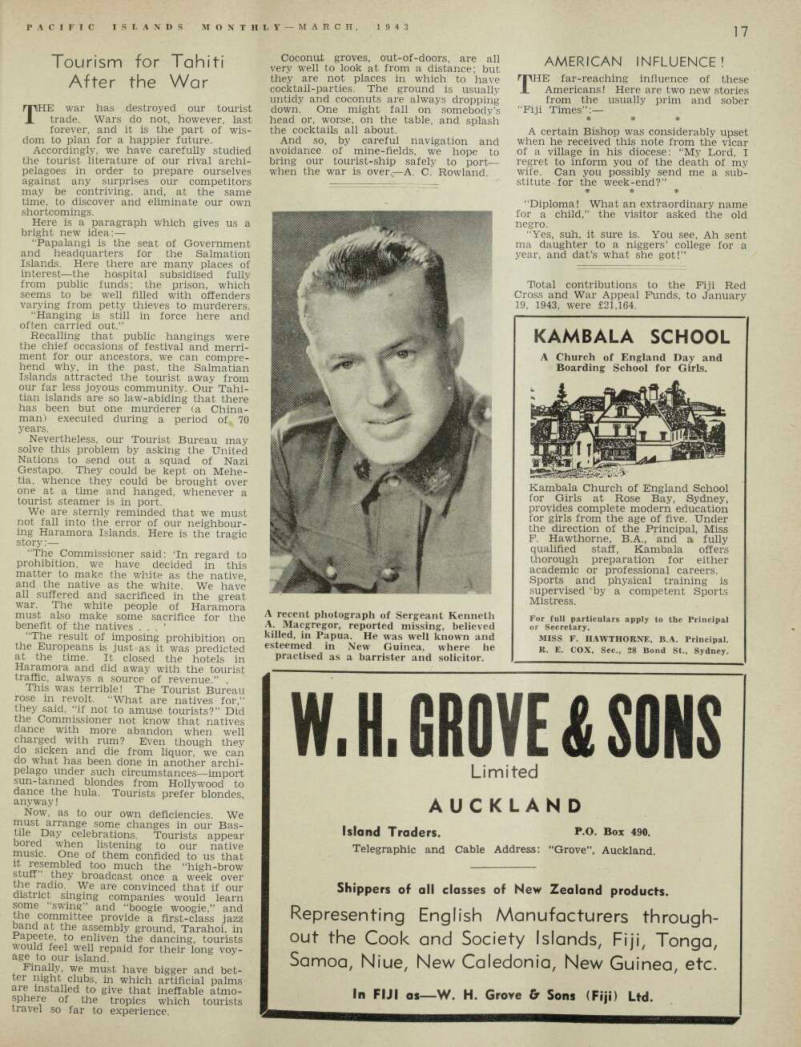
Tourism for Tahiti After the War
THE war has destroyed our tourist trade. Wars do not, however, last forever, and it is the part of wis dom to plan for a happier future.
Accordingly, we have carefully studied the tourist literature of our rival archi pelagoes in order to prepare ourselves against any surprises our competitors may be contriving, and, at the same time, to discover and eliminate our own shortcomings.
Here is a paragraph which gives us a bright new idea: — “Papalangi is the seat of Government and headquarters for the Salmation Islands. Here there are many places of interest—the hospital subsidised fully from public funds; the prison, which seems to be well filled with offenders varying from petty thieves to murderers.
“Hanging is still in force here and often carried out.”
Recalling that public hangings were the chief occasions of festival and merri ment for our ancestors, we can compre hend why, in the past, the Salmatian Islands attracted the tourist away from our far less joyous community. Our Tahi tian islands are so law-abiding that there has been but one murderer (a China man) executed during a period of 70 years.
Nevertheless, our Tourist Bureau may solve this problem by asking the United Nations to send out a squad of Nazi Gestapo. They could be kept on Mehe tia, whence they could be brought over one at a time and hanged, whenever a tourist steamer is in port.
We are sternly reminded that we must not fall into the error of our neighbour ing Haramora Islands. Here is the tragic story:— “The Commissioner said: Tn regard to prohibition, we have decided in this matter to make the white as the native, and the native as the white. We have all suffered and sacrificed in the great war. The white people of Haramora must also make some sacrifice for the benefit of the natives . . . ’
“The result of imposing prohibition on the Europeans is just as it was predicted at the time. It closed the hotels in Haramora and did away with the tourist traffic, always a source of revenue.” , This was terrible! The Tourist Bureau rose in revolt. “What are natives for,” they said, “if not to amuse tourists?” Did the Commissioner not know that natives dance with more abandon when well charged with rum? Even though they do sicken and die from liquor, we can do what has been done in another archi pelago under such circumstances—import sun-tanned blondes from Hollywood to dance the hula. Tourists prefer blondes, anyway!
Now, as to our own deficiencies. We must arrange some changes in our Bas tile Day celebrations. Tourists appear bored when listening to our native music. One of them confided to us that £^ sem bled too much the “high-brow stuff” they broadcast once a week over the radio. We are convinced that if our district singing companies would learn some “swing” and “boogie woogie,” and the committee provide a first-class jazz band at the assembly ground, Tarahoi, in Papeete, to enliven the dancing, tourists would feel well repaid for their long voy age to our island.
Finally, we must have bigger and bet ter night clubs, in which artificial palms are installed to give that ineffable atmo sphere of the tropics which tourists travel so far to experience.
Coconut groves, out-of-doors, are all very well to look at from a distance; but they are not places in which to have cocktail-parties. The ground is usually untidy and coconuts are always dropping down. One might fall on somebody’s head or, worse, on the table, and splash the cocktails all about.
And so, by careful navigation and avoidance of mine-fields, we hope to bring our tourist-ship safely to port— when the war is over., —A. C. Rowland.
A recent photograph of Sergeant Kenneth A. Macgregor, reported missing, believed killed, in Papua, He was well known and esteemed in New Guinea, where he practised as a barrister and solicitor.
American Influence!
rpHE far-reaching influence of these JL Americans! Here are two new stories from the usually prim and sober “Fiji Times”:— * * * A certain Bishop was considerably upset when he received this note from the vicar of a village in his diocese: “My Lord, I regret to inform you of the death of my wife. Can you possibly send me a sub stitute for the week-end?” * * * “Diploma! What an extraordinary name for a child,” the visitor asked the old negro.
“Yes, suh, it sure is. You see, Ah sent ma daughter to a niggers’ college for a year, and dat’s what she got!”
Total contributions to the Fiji Red Cross and War Appeal Funds, to January 19, 1943, were £21,164.
Advertisements & other items, pp. 19-20 (1 item)
W. H. Grove & Sons
KAMBALA SCHOOL
A Church of England Day and Boarding School for Girls.
Kambala Church of England School for Girls at Rose Bay, Sydney, provides complete modern education for girls from the age of five. Under the direction of the Principal, Miss F. Hawthorne, 8.A., and a fully qualified staff, Kambala offers thorough preparation for either academic or professional careers.
Sports and physical training is supervised by a competent Sports Mistress.
For full particulars apply to the Principal or Secretary.
MISS F. HAWTHORNE, B.A. Principal.
R. E. COX, Sec., 28 Bond St., Sydney.
W. H. GROVE & SONS
Limited
AUCKLAND
Island Traders. P.o. Box 490.
Telegraphic and Cable Address: “Grove”, Auckland.
Shippers of all classes of New Zealand products.
Representing English Manufacturers throughout the Cook and Society Islands, Fiji, Tonga, Samoa, Niue, New Caledonia, New Guinea, etc.
In FIJI as—W. H. Grove b Sons (Fiji) Ltd.
Modern Refrigeration for the South Sea Islands
The ELECTROLUX KEROSENE OPERATED
REFRIGERATOR
MARVEL
OF
MODERN
SCIENCE
THE
MIRACLE
OF
ICE
FROM
HEAT
ELECTROLUX OFFERS ECONOMICAL, modern and completely efficient
REFRIGERATION FOR ISLANDS' HOMES.
FREEZES CONTINUOUSLY WHILE SMALL LAMP BURNS.
Freezing controlled by simply regulating height of flame. Uses only f gallon of kerosene per week MOTORLESS ... NO PARTS TO GET OUT OF ORDER.
MODEL L 22 MODEL L3BO MODEL LKSSO Capacity • (as illustrated) • Capacity 2.2 cubic feet. Capacity 4 cubic feet. 5.5 cubic feet.
GUARANTEED FOR TWO YEARS.
• Write to your Local Distributor for prices and full details.
OBTAINABLE FROM ALL W. R. CARPENTER & CO. LTD.
BRANCHES THROUGHOUT THE ISLANDS
Representation in Papua and New Hebrides.
History of a Quaint
Samoa's Home-Brew
History of a Quaint Problem
AMONG the many absurdities which New Zealand’s Old-Granny Govern ment fastened upon Western Samoa is that of total prohibition of alcoholic liquor. Europeans there can get a limited supply of liquor, sold to them through the Customs Department, if they are prepared to go through the farce of solemnly interviewing the medi cal officer, and receiving from him a certificate that liquor is necessary and/or desirable. Otherwise, the making and sale of liquor are forbidden.
It is a very good thing that alcohol should be kept away from the native Samoans; but the system of denying liquor to the small European and very large Euronesian communities in order to “protect” the Samoans (when they could more easily be protected in another way) is akin to the process of erecting a steam-hammer to kill a mosquito.
The system has created a really seri ous liquor problem among Samoans, while it makes the New Zealand Adminis tration ridiculous. Being forbidden legal liquor, the Euronesians brew their own.
For the last 20 years, anywhere in Samoa, one might buy very excellent home-brewed beer, with a “kick” in it equal to anything produced by “Old Granny’s” New Zealand breweries.
Everyone—Europeans, Euronesians and natives —being forbidden legal beer, drank and enjoyed the illegal article, which could be procured at dozens of little cafes. The local police, quite pro perly, closed their eyes to the traffic. The wrong came in the fact that the con sumption of the potent home-brew soon spread out among the purely Samoan connections of the Euronesians, and thus many natives became addicted to alco hol, who otherwise would have been unaffected.
But “Old Granny” (otherwise, NZ officialdom) never would recognise the fact. Whenever the question arose, she buried her silly head in the sand, and all one could read from her agitated behind was that “there was total prohibition in Samoa, so there could not possibly be any liquor problem.”
But, now, the little chickens are com ing home to roost. There now are more European people in Samoa than ever before, and the Europeans demand beer.
Consequently, the long-established home brew industry has been disrupted by the quick-profits motive. It has been greatly expanded; and lately the Samoan police have become very busy, tracking down illicit breweries and distributors, and prosecuting numerous offenders. The Administration lately has somewhat dis couraged home-brew by prohibiting the importation of malt and hops.
But it has been discovered that a very potent spirit, resembling gin, can be made from cocoa-beans, which is one of Samoa’s principal products. Despite the efforts of the NZ Government, there still are a few Chinese plantation coolies in Samoa; and it is said that these lads are experts in producing the new spirit from cocoa, and that a large traffic in it has developed, to take the place of home-brewed beer.
Any other country but New Zealand would deal with the situation in the obvious way. But this little Dominion— so small that it should never have been given any colonial responsibility in the tropical islands—has been blundering so long in Western Samoa that it cannot be expected to institute sensible reforms now.
Her Grateful Thanks
HERE is an example of mutual help in wartime.
Some months ago, Mrs. L. M. Annan, a resident of Papua, who had been com pelled to leave the Territory at short notice, wrote to the “PIM” from Queens land, asking for assistance in tracing two much-loved terriers. They had been left behind on her Papuan plantation, and she did not know how they were faring, or where they were.
The “PIM” deals gladly with many inquiries from evacuees; but we were rather stumped over this business of tracing dogs. However, we saw Mr. E. A.
James, president of the Territories Asso ciation, and Mr. Gaskin, who was a source of much help to evacuees at the External Territories Department, before
he returned north; and thence we were guided to two helpful men—Mr. Tom Flowers, well-known in the Territories, and Lieutenant S. B. McKenna, of Papua. We now have this note from Mrs. Annan: — “I have been able to trace the terriers to the care of Lieutenant McKenna—l met him while he was south on leave, and he informed me that, since Mr.
Flowers left for Australia, the dogs have been his guests ... I cannot say how grateful I am to these people who, in spite of all their difficulties, will do this kind of favor for a stranger, and help the helpless. My deepest thanks to all of you.”
Dr. and Mrs. A. S. Frater, of the Pres byterian Mission, New Hebrides, are holi daying in Victoria.
Advertisements & other items, p. 21 (1 item)
Carlton
BREWED BY
UNITED BREWERIES LTD.
Anti Aedes
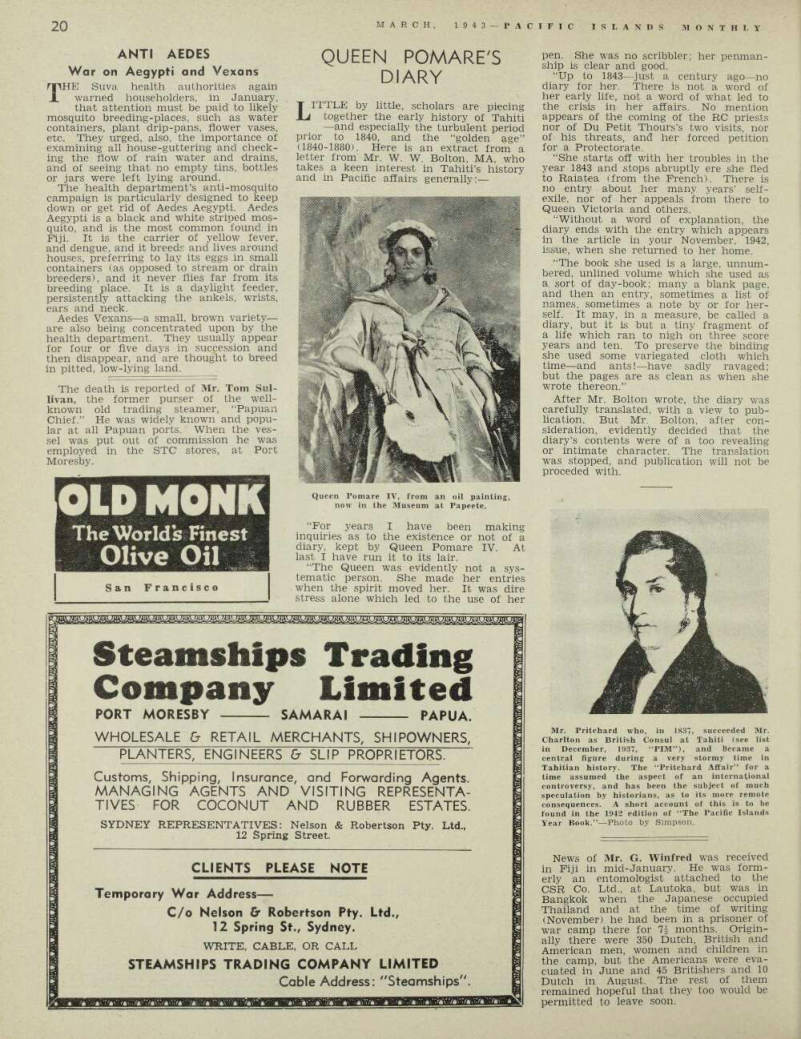
War on Aegypti and Vexans
THE Suva health authorities again warned householders, in January, that attention must be paid to likely mosquito breeding-places, such as water containers, plant drip-pans, flower vases, etc. They urged, also, the importance of examining all house-guttering and check ing the flow of rain water and drains, and of seeing that no empty tins, bottles or jars were left lying around.
The health department’s anti-mosquito campaign is particularly designed to keep down or get rid of Aedes Aegypti. Aedes Aegypti is a black and white striped mos quito, and is the most common found in Fiji. It is the carrier of yellow fever, and dengue, and it breeds and lives around houses, preferring to lay its eggs in small containers (as opposed to stream or drain breeders), and it never flies far from its breeding place. It is a daylight feeder, persistently attacking the ankels, wrists, ears and neck.
Aedes Vexans —a small, brown variety— are also being concentrated upon by the health department. They usually appear for four or five days in succession and then disappear, and are thought to breed in pitted, low-lying land.
The death is reported of Mr. Tom Sul livan, the former purser of the well known old trading steamer, “Papuan Chief.” He was widely known and popu lar at all Papuan ports. When the ves sel was put out of commission he was employed in the STC stores, at Port Moresby.
Queen Pomare's
Diary
LITTLE by little, scholars are piecing together the early history of Tahiti —and especially the turbulent period prior to 1840, and the “golden age” (1840-1880). Here is an extract from a letter from Mr. W. W. Bolton. MA, who takes a keen interest in Tahiti’s history and in Pacific affairs generally:—
“For years I have been making inquiries as to the existence or not of a diary, kept by Queen Pomare IV. At last I have run it to its lair.
“The Queen was evidently not a sys tematic person. She made her entries when the spirit moved her. It was dire stress alone which led to the use of her
pen. She was no scribbler; her penman ship is clear and good.
“Up to 1843 —just a century ago—no diary for her. There is not a word of her early life, not a word of what led to the crisis in her affairs. No mention appears of the coming of the RC priests nor of Du Petit Thours’s two visits, nor of his threats, and her forced petition for a Protectorate.
“She starts off with her troubles in the year 1843 and stops abruptly ere she fled to Raiatea (from the French). There is no entry about her many years’ self exile, nor of her appeals from there to Queen Victoria and others.
“Without a word of explanation, the diary ends with the entry which appears in the article in your November, 1942, issue, when she returned to her home.
“The book she used is a large, unnum bered, unlined volume which she used as a sort of day-book; many a blank page, and then an entry, sometimes a list of names, sometimes a note by or for her self. It may, in a measure, be called a diary, but it is but a tiny fragment of a life which ran to nigh on three score years and ten. To preserve the binding she used some variegated cloth which time —and ants! —have sadly ravaged: but the pages are as clean as when she wrote thereon.”
After Mr. Bolton wrote, the diary was carefully translated, with a view to pub lication. But Mr. Bolton, after con sideration, evidently decided that the diary’s contents were of a too revealing or intimate character. The translation was stopped, and publication will not be preceded with.
News of Mr. G. Winfred was received in Fiji in mid-January. He was form erly an entomologist attached to the CSR Co. Ltd., at Lautoka, but was in Bangkok when the Japanese occupied Thailand and at the time of writing (November) he had been in a prisoner of war camp there for 7 h months. Origin ally there were 350 Dutch, British and American men, women and children in the camp, but the Americans were eva cuated in June and 45 Britishers and 10 Dutch in August. The rest of them remained hopeful that they too would be permitted to leave soon.
Queen Pomare IV, from an oil painting, now in the Museum at Papeete.
Mr. Pritchard who, in 1837, succeeded Mr.
Charlton as British Consul at Tahiti (see list in December, 1937, “PIM”), and became a central figure during a very stormy time in Tahitian history. The “Pritchard Affair” for a time assumed the aspect of an international controversy, and has been the subject of much speculation by historians, as to its more remote consequences. A short account of this is to be found in the 1942 edition of “The Pacific Islands Year Book.”Photo by Simpson.
Advertisements & other items, p. 22 (2 items)
20
MARCH, 1943 PACIFIC ISLANDS MONTH L Y
Steamships Trading
OLD MONK
The Worlds Finest Olive Oil San Francisco
Company Limited
PORT MORESBY
SAMARAI
PAPUA.
WHOLESALE & RETAIL MERCHANTS, SHIPOWNERS,
PLANTERS, ENGINEERS & SUP PROPRIETORS.
Customs, Shipping, Insurance, and Forwarding Agents.
MANAGING AGENTS AND VISITING REPRESENTA-
TIVES FOR COCONUT AND RUBBER ESTATES.
SYDNEY REPRESENTATIVES: Nelson & Robertson Pty. Ltd., 12 Spring Street.
CLIENTS PLEASE NOTE
Temporary War Address—- C/o Nelson & Robertson Pty. Ltd., 12 Spring St., Sydney.
WRITE, CABLE, OR CALL
STEAMSHIPS TRADING COMPANY LIMITED
Cable Address: "Steamships".
Brown Brother And The
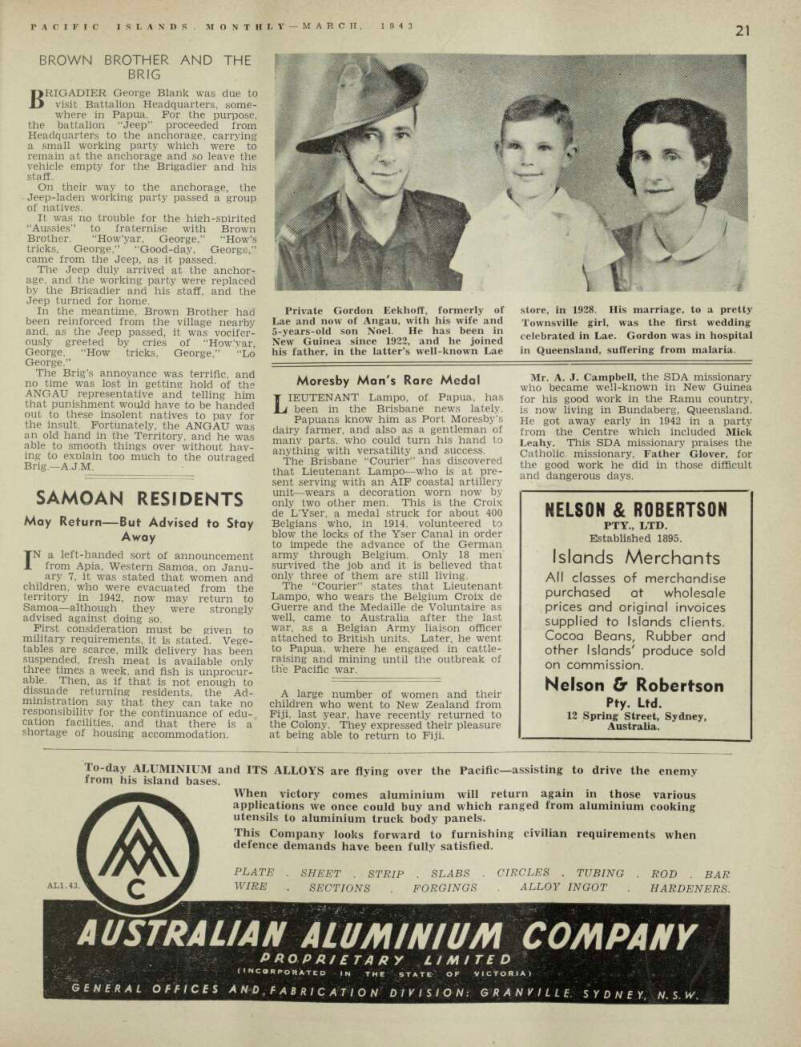
Brig
BRIGADIER George Blank was due to visit Battalion Headquarters, some where in Papua. For the purpose, the battalion “Jeep” proceeded from Headquarters to the anchorage, carrying a small working party which were to remain at the anchorage and so leave the vehicle empty for the Brigadier and his staff.
On their way to the anchorage, the Jeep-laden working party passed a group of natives.
It was no trouble for the high-spirited “Aussies” to fraternise with Brown Brother. “How’yar, George,” “How’s tricks, George,” “Good-day, George,” came from the Jeep, as it passed.
The Jeep duly arrived at the anchor age, and the working party were replaced by the Brigadier and his staff, and the Jeep turned for home.
In the meantime, Brown Brother had been reinforced from the village nearby and. as the Jeep passed, it was vocifer ously greeted by cries of “How’yar, George. “How tricks, George,” “Lo George.”
The Brig’s annoyance was terrific, and no time was lost in getting hold of the ANGAU representative and telling him that punishment would have to be handed out to these insolent natives to pay for the insult. Fortunately, the ANGAU was an old hand in the Territory, and he was able to smooth things over without hav ing to exnlain too much to the outraged Brig.—A.J.M.
Private Gordon Eekhoff, formerly of Lae and now of Angau, with his wife and 5-years-old son Noel. He has been in New Guinea since 1922, and he joined his father, in the latter’s well-known Lae
store, in 1928. His marriage, to a pretty Townsville girl, was the first wedding celebrated in Lae. Gordon was in hospital in Queensland, suffering from malaria.
Samoan Residents
May Return—But Advised to Stay Away
IN a left-handed sort of announcement from Apia, Western Samoa, on Janu ary 7, it was stated that women and children, who were evacuated from the territory in 1942, now may return to Samoa—although they were strongly advised against doing so.
First consideration must be given to military requirements, it is stated. Vege tables are scarce, milk delivery has been suspended, fresh meat is available only three times a week, and fish is unprocur able. Then, as if that is not enough to dissuade returning residents, the Ad ministration say that they can take no responsibility for the continuance of edu cation facilities, and that there is a shortage of housing accommodation.
Moresby Man's Rare Medal
LIEUTENANT Lampo, of Papua, has been in the Brisbane news lately.
Papuans know him as Port Moresby’s dairy farmer, and also as a gentleman of many parts, who could turn his hand to anything with versatility and success.
The Brisbane “Courier” has discovered that Lieutenant Lampo—who is at pre sent serving with an AIF coastal artillery unit—wears a decoration worn now by only two other men. This is the Croix de L’Yser, a medal struck for about 400 Belgians who, in 1914, volunteered to blow the locks of the Yser Canal in order to impede the advance of the German army through Belgium. Only 18 men survived the job and it is believed that only three of them are still living.
The “Courier” states that Lieutenant Lampo, who wears the Belgium Croix de Guerre and the Medaille de Voluntaire as well, came to Australia after the last war, as a Belgian Army liaison officer attached to British units. Later, he went to Papua, where he engaged in cattle raising and mining until the outbreak of the Pacific war.
A large number of women and their children who went to New Zealand from Fiji, last year, have recently returned to the Colony. They expressed their pleasure at being able to return to Fiji.
Mr. A. J. Campbell, the SDA missionary who became well-known in New Guinea for his good work in the Ramu country, is now living in Bundaberg, Queensland.
He got away early in 1942 in a party from the Centre which included Mick Leahy. This SDA missionary praises the Catholic missionary, Father Glover, for the good work he did in those difficult and dangerous days.
Advertisements & other items, p. 23 (2 items)
21
PACIFIC ISLANDS. MONTHLY MARCH, 1943
Australian Aluminium Company
KELSON & ROBERTSON
PTY., LTD.
Established 1895.
Islands Merchants
All classes of merchandise purchased at wholesale prices and original invoices supplied to Islands clients.
Cocoa Beans, Rubber and other Islands' produce sold on commission.
Nelson & Robertson
Pty. Ltd. 12 Spring Street, Sydney, Australia.
To-day ALUMINIUM and ITS ALLOYS are flying over the Pacific—assisting to drive the enemy from his island bases.
When victory comes aluminium will return again in those various applications we once could buy and which ranged from aluminium cooking utensils to aluminium truck body panels.
This Company looks forward to furnishing civilian requirements when defence demands have been fully satisfied.
PLATE . SHEET . STRIP . SLABS . CIRCLES . TUBING . ROD . BAR WIRE . SECTIONS . FORGINGS . ALLOY INGOT . HARDENERS.
AUSTRALIAN ALUMINIUM COMPANY
c AL1.43.
PROPRIETARY
(incorporated in the s
LIMITED
IN THE STATE OF VICTORIA)
GENERAL OFFICES AN D .FABRIC AT lON DIVISION: GRANVILLE. SYDNEY, N.S.W.
Papua
Time Marches On in Papua Milestones Built by Hubert Murray Are Etched by Lewis Lett
Mhe Papuan Achievement, By
1 Lewis Lett (published by Melbourne University Press, price 10/6). The history of an ideal, conceived when Australia was still young enough to have the ideals of youth, and carried to fruition by strong men of single purpose, who accepted the Royal Proclamation — couched in the gracious, generous but usually meaningless language of such things—in its literal sense.
The Australian aim to show how a primitive race should be governed and an embryo colony developed, when ex pressed to an amused world at the time Whitehall relinquished partial control of Papua, was attained only in the face of severe criticism and, often, active opposi tion. “To the religionist,” says Lett, “the conversion of a pagan race to Christianity was the only wholly worthy aim. The man of commerce could see in a savage population a cheap and con venient solution of many developmental problems. Politicians were debarred from positive expression by the warring claims of trading interests and the voting power of evangelising sects. Anthropologists
cried aloud for the preservation of tribal life and barbaric custom as a matter of academic interest; and the disinterested public could not free its mind from the easy belief of the lady who “ even thinks that up in Heaven Her class lies late and snores While poor black cherubs rise at seven To do celestial chores.”
FROM 1884, when a Protectorate was declared over what we now call Papua, until November, 1905, when it became an Australian territory, little progress was made, either in commerce or native advancement. The fact was that the funds reluctantly provided by the Australian States and Britain, were inadequate for the task of pacification.
Sir William MacGregor, the first Adminis trator, was a man of astounding energy— but even energy would not compensate for the deficiency in cash. In the first 16 days which he spent in Port Moresby, he formed a Legislative and an Executive Council, framed and passed the first laws relating to arms and liquor prohibition, security of native lands, freedom of trade, applied the laws of Queensland to Papua as far as was possible and passed suit able Customs acts. He then left on a visit to out-stations and outports.
This is a fair example of the tireless endeavour that characterised his ten years’ administration. Yet an Australian paper of the time complained, with reason, that “British New Guinea is the
rankest commercial failure south of the line,” and it was alleged in many quarters that trading was prohibited.
Trading was not prohibited; but without legislation to regulate trading, and with neither the money nor the machinery to protect commercial enterprises, it was not exactly encouraged as part of administra tion policy. Nevertheless, traders per sisted, often, in their isolation, dispensing home-brewed law and many added to the burdens of the administration by event ually losing their lives at the hands of dissatisfied or avaricious native cus tomers, Queensland miners, who first came to work the gold in the Louisaides, later penetrated the interior fastnesses of main land New Guinea: to the Owen Stanley Mountains, the Yodda Valley, the Mam bare, the Gira—and a great proportion of these men also paid with their lives for their temerity in tackling this vast land of impenetrable jungle and rugged peaks —either through illness, starvation, privation or at the hands of the fierce unquellable tribes whose predominant in stinct was to fight and kill.
IN 1891, the Native Armed Constabulary was inaugurated. Through the Fijian Government, twelve Solomon Islanders and two Fijians were recruited as the nucleus of the force and, during the first year, 13 Papuan recruits were added.
Government influence grew in the isolated districts where Government stations were established; but, away from them, jungle law of blood-feud and raid, sorcery and cannibalism, flourished as it had flourished from unrecorded time.
Altogether, it was an era of rough, pioneering courage: on the part of the all-too-few administrative officers, whose chief business was to protect a handful of Europeans, dispersed among scores of thousands of primitive savages; on the part of the miners and traders, who undertook incredible hardships and pitted their physical and mental strength against all the cruelties that Nature could devise; on the part of the patient, tireless mis sionaries; and on the part of the primitive savages themselves, who must have seen these white men as invaders of their country and profaners of their own social and tribal customs.
It was also an era of bloodshed, in which the Administration’s only answer to murder was the “punitive expedition” —that is, the indiscriminate slaughter of the whole of the native community in the vicinity of the “murder,” the burning of houses and the destroying of gardens —wherein the innocent suffer and the guilty, more often than not, escaped to hatch out further devilment. It was rough justice, of a sort, in tune with the times, but it did not root out from the mind of the inexplicable Papuan the European concepts of evil, nor turn his faltering footsteps towards our form of civilisation.
Lett gives yet another version of the perennial “Chalmer’s murder-Robinson persecution” incidents, of which we have heard over-much of late.
IN 1905, (nearly 40 years ago!) the Papua Act brought the Australian Territory of Papua into being, and it was ushered in in the time honoured fashion of Australia—i.e., with a Royal Commission —which sat for three months in principal centres of population in Papua and took evidence from every white inhabitant of the Territory who wished to give it. Many of the recom mendations which the Commission made subsequently were of great practical value, although others were misplaced, owing to the Commissioners’ slight know ledge of the country. Their three essen tial recommendations and comments were as follows:
1. European settlement, neglected in the past, must be encouraged. 2. The native population must be protected, not only from physical aggression, but from moral deterioration. 3. The whole of the administrative system must be purged and set upon a sound progressive basis.
To these ends, they recommended that future Administrators should put behind them all Crown Colony traditions; that natives should be taxed in cash or by work; that there should be a preferential tariff in Australia for Papuan goods, and statutory loans free of interest to the administration, and individual loans to bona fide settlers.
The Commonwealth Government, in the full flush of colonising zeal, adopted the report and the recommendations of the Commission with enthusiasm. They liked the idea of civilisation without injury, and agreed that white settlement would provide the best way of achieving it. They were in complete accord over the proposed vigorous roads programme, and the establishment of a sanatorium in the mountains beyond Port Moresby where tropically-tired settlers and their families could recuperate their strength.
“But,” says Lett, “at the suggestion of a LOAN, Ministerial enthusiasm waned, and the revolutionary proposal for a preferential tariff . . . filled them with shocked surprise and glacial disapproval.
An edifice must be erected that would bring financial profit to Australia and her rulers, but exactly how this was to be done was a problem that was to be left to the future Administrators of Papua.”
And that, briefly, was how it was done: the colonising ideals of Australian parlia-
mentarians (who would not, however, back their ideals with hard cash) were moulded into a practical “Papuan Achievement” by the will and indomitable purpose of one man. mHE story of the achievement is the X story of the 32 years of continuous administration of Sir Hubert Murray, who, as Mr. Justice Murray, was appointed first as Acting Administrator in 1907, and died in harness, as Lieutenant-Governor, in Samarai, Papua, in 1940. It outlines the problems of estabfishing European settlement in a stoneage country, of creating a market for Australian goods in Papua, and Papuan goods in Australia; of spreading civilisation and education; and of making native welfare paramount over other considerations. And of the thousands of subsidiary problems of taming an untouched. cruel, demanding, tropical region, peopled by individuals with relatively the same social standards as our own ancestors of several thousand years ago.
Results speak for themselves—results, and the fact that the now defunct League of Nations considered Papua to be the shining example of native administration.
The native is presented, not as an impossible black devil from whom nothing good can be expected but exploitation, nor as a “fuzzy-wuzzy” angel—a brand to be plucked from the burning— not as a zoological specimen solely for the use of anthropologists—but as he is, an inexplicable, primitive man, no macter how thick the veneer of civilisation, but a man with adaptability, keen intelligence, courage and the wit to see which side of his bread is buttered: the pro-
duct of his environment, seeped deep in native beliefs—in sorcery, the power of evil spirits, and the spirit of “pay-back” which a half-century’s contact with civi lisation has not eradicated.
The Papuan administration, under Sir Hubert Murray, by its peaceful penetra tion and “slow prudence” methods, has accomplished what few other native administrations had been able to do that is, it guided the stone-age people towards the twentieth century without turning them, in their transition period, into a community of purposeless degene rates. mUTO . , . , , . A TP HI ® book 15 strongly recommended to -L the notice of brass-hatted military officers and war correspondents, who nave hone a considerable amount of “dis covery ’ in Papua during the last year, an h wino have advanced a variety of half-baked and ill-informed schemes for the advancement of the Papuan after the war. They will have difficulty in finding a better foundation for a policy than that which existed before Papua became a theatre of war.
We b °P e - with the author, that upon this foundation, laid with care over more than 30 years, “a monument will Pf ls P. to P r 9 ve once again, that true idealism, realism and logic, not only may, . mus L work together towards the attainment of the highest aim.”—J.T.
Mrs. A. C. Turnbull, wife of the Aet ing Administrator, has returned to Samoa after a prolonged holiday in New Zealand.
Mr. W. F. D. Hay has received a com mission as a temporary Lieutenant in the Fiji Naval Volunteer Force.
Advertisements & other items, pp. 24-25 (1 item)
Chi Vers
PRESCOTT Pty. Ltd.
SUSSEX ST., SYDNEY,
ore sole wholesale agents for
PINEAPPLE BACON&HAMS
DAISY brand BUTTER "375" BUTTER in TINS Ilb.-21b.-slb. Size*.
LEA & PERRINS’ Sauces and Most other Super-Quality Lines of the Trade, such as Cheese, Eggs, Etc.
CHI VERS
FAMOUS ENGLISH PRODUCTS
CANNED ENGLISH VEGETABLES
CANNED ENGLISH FRUITS
OLDE ENGLISH MARMALADE
GOLD MEDAL JAMS
JELLY CRYSTALS, ETC.
Obtainable from all leading Grocery Stores
WRITE TO DEPARTMENT “A”
CHI VERS & SONS LTD.
Histon, Combs., Eng.
FOR ATTRACTIVE RECIPE BOOK
c<:"' mgj
CMIV£RS
COLD
FRESH
ENGLISH
PEAS
Equal to the World’s Best
Throughout Australia and Overseas there is an ever-increasing demand for
COLONIAL & BRONTE
HIGH-GRADE CANNED MEATS
There is no better quality—none more wholesome.
TRADE MEATS FOR THE ISLANDS
order
“COLONIAL’ BRAND
Roast, Corned and Boiled Beef Packed in 6,5, 4,3, 2, 1 lb. and 12 oz. tins.
Also Corned Beef in 12 oz. Taper Tins.
Roast, Corned and Boiled Mutton. 1 lb. and 12 oz. tins.
Choice Dripping
36 lb.. 2 lb., 1 lb. tins, and 1 lb. packets.
A - j : P P
CQ U>NUt
WHOUSAtI
MEAT
Under present conditions it is wise to ensure that you have ample stocks of all our lines.
The Colonial Wholesale Meat Coy. Pty. Ltd.
30 GROSVENOR STREET, SYDNEY
The Origin Of
By What Route Did They Come From Indonesia?
IN May, 1942, we 'published a private 1 letter in which a gentleman who knows something of Pacific history re viewed Dr. Buck’s hook, “Vikings of the Sunrise.” Dealing with Dr. Buck’s theo ries of the origin of the Polynesians, he expressed disappointment, and said that he thought that Dr. Buck had placed too much reliance on the “speculations of a lot of young cubs who have taken a course in anthropology hut know noth ing of the Polynesian languages, and less about native mentality and native cus tom.”
This article brought a spirited reply from the young anthropologists of the Bishop Museum (published in Novem ber), and an interesting, informative let ter from Dr. Buck himself (published in December).
Our contributor now sends along the following comment upon the anthropolo gists’ letter; but, when he wrote (he is an American) he had not seen Dr. Buck’s letter.
I find that I have loaned my copy of “Vikings of the Sunrise” to someone who has forgotten to return it. My recollec
tion of Dr. Buck’s book is that the young ethnologists and anthropologists have not learned how to isolate evidence of the palae-Polynesian period in the Pacific from the confusion caused by later invasions, civil wars and the consequent dispersal of populations.
The palae-Polynesians were the great est and most daring mariners of all human history. Their primal points of settlement, whence colonies were dis persed to the adjacent islands, can be traced across the Pacific: First, Savai’i, then Havai’i (Ra’iatea), Hayaiki (Faka rava in the Tuamotu Archipelago) and Hawaii, in the north; all named from the Havaiki, motherland of the race.
Through the centuries which followed there were, undoubtedly, return voyages —visits of ceremony, voyages of com merce. pilgrimages to national temples, festal expeditions to celebrate alliances between high-chiefly families—from one SSS. a -° ng lhle °l 0 .^ or^ ermg , the great
™£?£ eBia
t fnfmriVn? e F"
wl^, h J9 ual certainty discovered the islands of Micronesia, and left artifacts, palae-Polynesian paepae and. no doubt. palae-Polynesian skulls and bones of those who perished there.
However, an explorer, a millenium hence, who might discover in China a Remington type-writing machine of the nineteenth century, would not be justified in con eluding that the Anglo-Saxon inhabitants of North America came to that continent via Eastern Asia.
Isolation of island archipelagoes came centuries later. Evidences of the inter island communication of palae-Polyne sian times have remained to confound investigators who came 600 years after isolation had become complete, following the violent disruption of the Ao-Tea— Ao-Uri confederation.
The charming fairy tale, in Dr. Buck’s book, of a single voyage from the Mar quesas Islands to fetch the sweet potato from South America, ignores the accu mulating evidence of a pre-Polynesian population in the eastern islands of the Pacific who were NOT negroid, and who were sun-worshippers, and who have left their mark on the dialects of South-east ern Polynesia.
These are a few of the reasons why I found Dr. Buck’s book disappointing as a document on Polynesian migrations.
I do not believe any of the above con fusion is to be attributed to Dr. Buck himself, but to the very eminent young scientists whom I mentioned in my ori ginal private letter.
I do not agree with some writers in the “PIM” that there is a negroid element in Polynesian ancestry. The relation ship, in historic times, between Tonga and Fiji undoubtedly brought some Melanesian blood into Tonga. There is, however, not a trace of negroid in the pure Polynesian of the Central and Eastern islands.
Nor is there any sourd foundation for the alleged presence of the Mongoloid, element.
The feverish search for something new and startling to “justify the time and expense” of some junket to the South Sea, has lured young scientists into some weird by-ways. Their banner “Excel sior” has led them (on account of the climate) not through snow and ice, but into quaking bogs of speculation, far removed from the firm ground estab lished by the scholarship of the truly great investigators.
With my kindest regards, most truly yours—
The Author Op The Original
Review.
Dr. S. J. Williams, who was medical officer in Port Moresby until the evacua tion, is now in Suva, Fiji. He has taken up a temporary appointment as an eye specialist to the Government of Fiji.
Mr. Sidney Smith, of the External Affairs Department (War Damage) has been, with other officers, temporarily transferred to Canberra.
“In spite of reports of my death, I wish to say that I am alive and well.” says Mr, F. P. Archer, of Buka, New Guinea, in a letter to the editor of the “PIM.”
Mr. Archer was recently in Sydney. Mr.
Archer had been among those listed as “missing in New Guinea” for nearly a year.
Advertisements & other items, p. 26 (1 item)
E. J. Gough & Co.
London . .
Moorabbin .
Distilleries at . England Toronto . . . Canada . Victoria Cincinnati . . . U.S.A.
SUPPLIERS OF GENERAL MERCHANDISE TO LEADING FIRMS
THROUGHOUT THE PACIFIC ISLANDS
E. J. GOUGH & CO.
1 BOND STREET, SYDNEY,
AUSTRALIA.
EXPORTERS . . . IMPORTERS . . . MANUFACTURERS' REPRESENTATIVES BANKERS: Bank of N.S.W. Comptoir National d’Escompte de Paris.
War Time Cable Address:
GOUGH CO.,
1 BONDSTREET,
SYDNEY.
Codes; Bentley 2nd and Comp. Phrase, Acme, A.8.C., sth and 6th, Peterson, 2nd and 3rd, Banking.
Telephone; B 4167.
Those Who Left and Those Who Stayed
Those Who Stayed
Letter to the Editor DURING 1941, Papua contained a num ber of elderly gentlemen who con tinually rushed into print to affirm that they could run the country capably on their own account, and that every young man of military age, irrespective of sentiment or social commitment, should be away at the war. Arguments were advanced by them to show that Papua had no need whatever of any young men in the conduct of its affairs.
But when the Rabaul disaster occur red, their war fervour evaporated. The first air raid produced all sorts of ill nesses and physical weaknesses in some of our warmongers, and the “superfluous men” of military age were not a little surprised to hear of this one and that one deserting a business or place of employment and finding a berth aboard a south-bound ship.
But nearly all the men who had failed to enlist for overseas service, and who were considered “superfluous” in Papua, proved not quite so spineless as the Papuan public had been told. The mooilisation that occurred was not a compulsory one, and if the enlistees had been as scared of war as our “Old Guard” had led the public to believe, there would have been a greater number dodge enlist ment than the two or three who did.
The opinion regarding superfluousness was not shared by the military authori ties, for Immediately following enlistment, the local enlistees were nearly all sent to outposts to discharge important military duties. The first six months of 1942 were anxious ones for those remaining in New Guinea and, though no one had any thing to feel over-confident about, every one wa£ prepared to do his utmost to hold on.
Now that the prospect is brighter, it is with no little amusement that one notices the return to Papua of some of the “Old Guard.” Men who, a year ago, were over age, or had sickness, ulcers, etc., and betook themselves to safer climes, now find that their age is no burden, and that their illnesses are cured, and they have now started to show up on their former stamping ground again. Some who escaped the mobilisation in Papua were likely to be caught in the conscrip-* tion south, and hurriedly returned to New Guinea. Few, if any, are in the front ranks with the fighting men.
The “PIM” was right in its October statement that those residents now in Papua were going through “undiluted hell”; but exclude from this the recent arrivals, who have just turned up now that things are looking brighter. It is suggested that the “PIM” can form a shrewd idea of the progress of hostilities in New Guinea, according to the presence or absence from south of these “Old Guard” members. One supposes that if things look black again the “over age” lads will find their burdens heavy, and sickness and gastric ulcers will reappear.
I am, etc.,
One Who Stayed.
Papua, 16/2 1943.
EDITORIAL NOTE: Our correspondent is permitted to express his views; but we think they are a little jaundiced.
From March until about August, 1942, the “PIM”^ office was being constantly visited by middle-aged men who had been com pulsorily evacuated from Papua and who were doing everything they could think of in order to get back again, in any sort
of wartime job. There may have been a few dodgers, as described by our cor respondent—but they were very few.
Mr. D. M. Hore Lacy, well-known New Guinea planter, writes anxiously from USA, to inquire concerning the fate of Letham Hamilton and B. A. Sweetapple, two planter comrades who were asso ciated with him in planting enterprises, and who were caught in the Jap inva sion. We informed him that Mr. Hamil ton is believed to have been made a prisoner of war after the Japs captured Rabaul. Mr. Sweetapple was drowned
when trying to cross a flooded river in New Britain, about February, 1942. Mr.
Hore Lacy is now in the service of the British Admiralty, and has been in “operations.” His ship was lost during the great landing in North Africa in November and, when he wrote, he was waiting for another ship, to which he had been allotted, and expected soon to be back in the grim, silent, supremely important Battle of the Atlantic.
The rainfall in Fiji in 1942 was 27.84 inches below normal. The total was 93.02 inches, compared with the average rain fall of 120.86 inches.
Advertisements & other items, p. 27 (1 item)
Hot-Weather Meals
Here’s the quick, easy way to serve
COOL, APPETISING
m y.^ mi *»g e-* ■J a-e- -* 4H /V a* I / n YOU can prepare crisp, cool, appetising salads in five minutes with Imperial “Hampe” the quick-serve summer delicacy that’s ready-cooked, readyto-serve and flavour-sealed . . . And what a flavour!
Everyone likes the delicious “™ bln a«O n .Of mild-cured ProdlK , o( Ri„ rs , one Meat Co. Ply. Ltd., Sydney, ham and tender veal in FIJI Representatives: Pearce & Co. Ltd. Suva.
Hampe.” Try it to-day. ■
Grow Spices?
Jap War Leaves Some Markets Bare
By Charles Reed. Apia,
Western Samoa
WITH the valuable spice trade of the East Indies almost entirely in the hands of Japanese invaders, the production of needful spices (nutmeg, clove, vanilla, pepper, ginger, mace, car domoms and chilies) will be largely on the down-grade.
The old maxim comes in here, “as one door closes another door opens”—and this door should be the opportunity of the Pacific Islands to engage in the spice trade. Where will you find more fertile areas than those of Fiji, Samoa, Tahiti, Solomons, Hebrides. New Caledonia, and a hundred other of the large volcanic islands? Look at New Guinea, with every climate under the sun, and where all manner of spices, olives and fruits thrive to perfection.
One of the great advantages of the spice industry is that there is no expen sive machinery or plant required to cope with the business. With the exception of vanilla, there is no technical difficulty to overcome, and, even with this hardy orchid, it is easy enough to master the simple technique of the hand-fertilisa tion of the flowers.
This writer has grown these spices for many years past, and is a firm believer in small, intensive holdings of pepper or vanilla, as these bring greater profits than do the larger plantings of more bulky products, which cost more in transport and in storage, and occupy much greater space. Nowhere in the world has this writer seen better samples of the vanilla bean, of commercial pep per, and of nutmegs, than in these
islands of the Pacific. The rich, humus stocked soils are admirable for spice cul tivation.
Look at pepper. Is it not said in the famed Indies that a man with one acre of pepper under cultivation can afford a car, and take leisure; and the same can be said of the nutmeg, for this plant will crop for 100 years. Pepper is good for 70 years, and vanilla for sixty years.
Nutmegs are propagated from seed: vanilla and pepper, from yard-long cut tings, planted during the rains. Ginger, capsicums and other small spice crops should be planted between the lines of the other vines to bring in a profit from the first year’s operations.
Much of the data given in some of the older text-books on spices is misleading, especially in regard to the handling and curing of the vanilla bean. Actually, the process is simple, but requires care.
At the present time, labour is the main problem in some of the islands—due mostly to the natives gaining dollars more easily in other ways, than by engaging in agricultural pursuits; but this should not stand in the way of enterprising planters making a com mencement. This could be done by planting up small beds of spices as a nucleus for transplanting into permanent rows when labour becomes available.
Mr. and Mrs. A. B. Herrold, of Nadroga.
Fiji, are at present on holiday in Auck land. New Zealand. They say that the Allies’ victories in Papua and the Solo mons, and the consequent removal of the menace to Fiji—that, in the official view, had been close, until a short time ago—have strengthened civilian morale in the Colony. Fiji’s biggest worry at the present time is the high cost of liv ing, and wartime shortages of various commodities.
Curse
War Not All A
What it May Do for Solomons
AN interesting statement published
recently, and one that may have an important bearing on the future of the Solomons, was that the Henderson Airfield, on Guadalcanal Island—the scene of much bitter fighting and now occupied by United States forces—is near the area which was taken up and was being prospected by the syndicate called “Solomon Gold Exploration Limited,’’ which was formed by the Theodore interests of Fiji and Sydney some time before the outbreak of the Pacific war.
Many miners and syndicates have attempted to exploit the gold, which definitely exists in Guadalcanal, but always they have been defeated by the rough and broken character of the country and the difficulty of maintain ing communication.
It is obvious that war has tamed Gua dalcanal as nothing else could have done.
When it is over, and this large island (and others) again is open to civilian enterprise, it follows that further gold prospecting there will be promptly under taken. By then. Guadalcanal will have roads and ports and at least one great airfield, which will be within comfortable flying distance of such places as Bris bane, Rabaul, Noumea and even Suva.
Word was received in Fiji in January, that Mr. John May, who was a chemist employed by the Colonial Sugar Refining Company at Labasa, Fiji, before he went overseas to serve in the air force, has been killed.
Advertisements & other items, p. 28 (1 item)
Head Office 449-451 KENT ST., SYDNEY.
William Atkins Pty. Ltd. ESTABLISHED 50 YEARS
Iron & Steel Merchants—Engineers' Supplies
Coach Cr Motor Hardware Cable Address: WILATKIN, Sydney.
STEEL DEPARTMENT
MILD STEEL:
Rounds, Squares, Flats, Half-rounds, Hexagons, Bevel, Shoeing, Tyre, Angles, Tees, Sheets, Plates, Girder Plates, Chequer Plates, Channels, Hoops, Etc.
BRIGHT STEEL:
Rounds, Squares, Hexagons.
Extra Special High Speed Tool Steel, Mining Steel, Blister Steel and Spring Steel, Rounds, Flats Gr Squares.
Bar Iron —All sections and sizes.
Engineers' Supplies: Set Screws, Studs, Metal Thread Screws, Coach Screws, Files, Cotter Pins, Bright and Black Bolts, Rivets, Etc., Hack Saw Blades.
Power Transmission Gear: Including Plummer Blocks, Couplings, Collars, Etc.
Coach and Motor Hardware: Axles, Springs, Wheelstuff, Duck, Paints.
Farriers' Supplies: Horse Nails, Anvils, Vices, Etc.
Motor-Trimmers and Motor Builders' & Motor Painters' Requirements
C. A. WILLEY'S
Quick-Drying Coach and Car Paints, Roughstuff, Elastic Gloss, Synflex Enamels, Lacquers.
DUCO Lacquers and DULUX Enamels—FAßßEX Motor Toppings and Leather Cloths, House & Decorators' Paints, Varnishes & Brushware.
Sole Distributors of CHAMPION'S Decorators Paint Products.
Distributing Agents for BROLITE Lacquers, SYNFLEX Enamels and "POLYGLOSS" Finish.
Plain Story of a Solomons
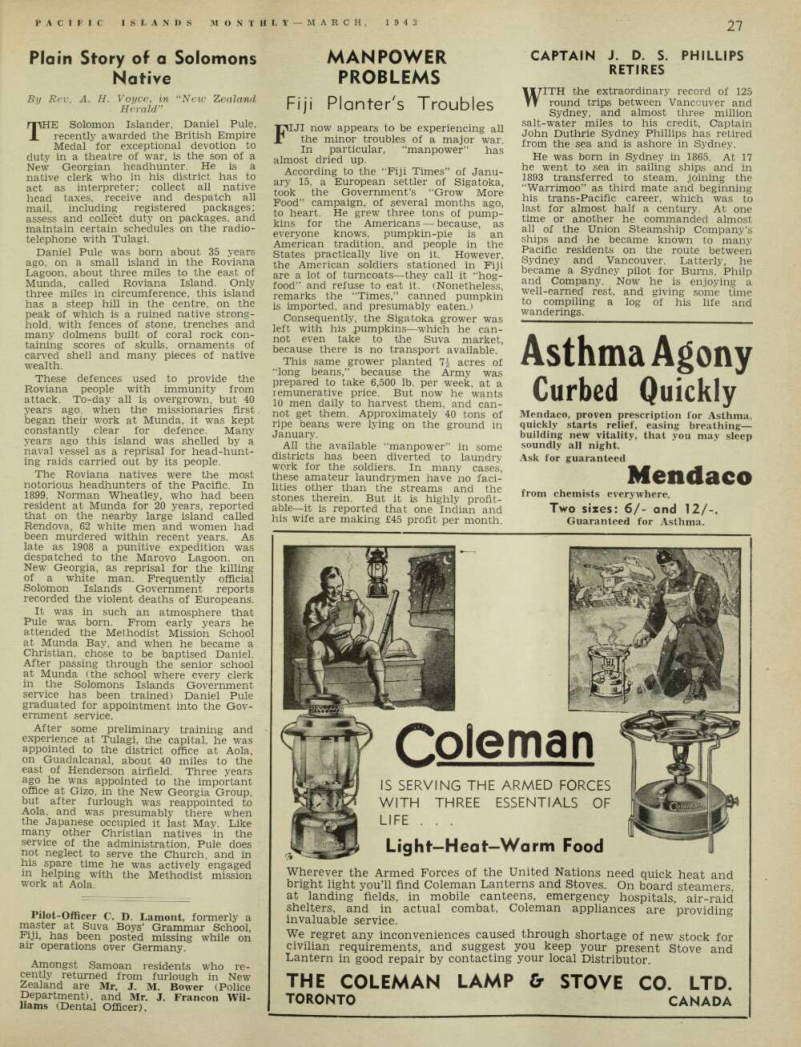
Native
By Rev. A. H. Voyce, in “New Zealand Herald”
rE Solomon Islander, Daniel Pule, recently awarded the British Empire Medal for exceptional devotion to duty in a theatre of war, is the son of a New Georgian headhunter. He is a native clerk who in his district has to act as interpreter; collect all native head taxes, receive and despatch all mail, including registered packages; assess and collect duty on packages, and maintain certain schedules on the radio telephone with Tulagi.
Daniel Pule was born about 35 years ago, on a small island in the Roviana Lagoon, about three miles to the east of Munda, called Roviana Island. Only three miles in circumference, this island has a steep hill in the centre, on the peak of which is a ruined native strong hold, with fences of stone, trenches and many dolmens built of coral rock con taining scores of skulls, ornaments of carved shell and many pieces of native wealth.
These defences used to provide the Roviana people with immunity from attack. To-day all is overgrown, but 40 years ago, when the missionaries first began their work at Munda, it was kept constantly clear for defence. Many years ago this island was shelled by a naval vessel as a reprisal for head-hunt ing raids carried out by its people.
The Roviana natives were the most notorious headhunters of the Pacific. In 1899, Norman Wheatley, who had been resident at Munda for 20 years, reported that on the nearby large island called Rendova, 62 white men and women had been murdered within recent years. As late as 1908 a punitive expedition was despatched to the Marovo Lagoon, on New Georgia, as reprisal for the killing of a white man. Frequently official Solomon Islands Government reports recorded the violent deaths of Europeans.
It was in such an atmosphere that Pule was born. From early years he attended the Methodist Mission School at Munda Bay, and when he became a Christian, chose to be baptised Daniel.
After passing through the senior school at Munda (the school where every clerk in the Solomons Islands Government service has been trained) Daniel Pule graduated for appointment into the Gov ernment service.
After some preliminary training and experience at Tulagi, the capital, he was appointed to the district office at Aola, on Guadalcanal, about 40 miles to the east of Henderson airfield. Three years ago he was appointed to the important office at Gizo, in the New Georgia Group, but after furlough was reappointed to Aola, and was presumably there when the Japanese occupied it last May. Like many other Christian natives in the service of the administration. Pule does not neglect to serve the Church, and in his spare time he was actively engaged in helping with the Methodist mission work at Aola.
Pilot-Officer C. D. Lament, formerly a master at Suva Boys’ Grammar School, Fiji, has been posted missing while on air operations over Germany, Amongst Samoan residents who re cently returned from furlough in New Zealand are Mr. J. M. Bower (Police Department), and Mr. J. Francon Wil liams (Dental Officer).
Fiji Planter's Troubles
Manpower
Problems
FTTT now annparc to ho PvnPriPnHno- Q n ino P • g 11 the minor troubles of a major war.
In particular, “manpower” has almost dried up According to the “Fiji Times” of Janu ary 15, a European settler of Sigatoka, took the Government’s “Grow More Food” campaign, of several months ago, to heart. He grew three tons of pump kins for the Americans - because, as everyone knows, pumpkin-pie is an American tradition and people in the States practically live on it. However, the American soldiers stationed in Fiji are a lot of turncoats-they call it “hog food” and refuse to eat it. (Nonetheless, remarks the “Times,” canned pumpkin is imported, and presumably eaten.) Consequently, the Sigatoka grower was left with his pumpkins—which he can not even take to the Suva market, because there is no transport available.
This same grower planted 7i acres of “long beans,” because the Army was prepared to take 6,500 lb. per week, at a lemunerative price. But now he wants 10 men daily to harvest them, and can not get them. Approximately 40 tons of ripe beans were lying on the ground in January.
All the available “manpower” in some districts has been diverted to laundry work for the soldiers. In many cases, these amateur laundrymen have no faci lities other than the streams and the stones therein. But it is highly profit able—it is reported that one Indian and his wife are making £45 profit per month.
KprSmo latterly m 6
Captain J. D. S. Phillips
Retires
WITH the extraordinary record of 125 round trips between Vancouver and Sydney, and almost three million salt-water miles to his credit, Captain John Duthrie Sydney Phillips has retired frnrn thp - pa anri nshorp in Svdnpv „ the and “ astlore , 0 / d T; He was born m Sydney in 1865. At 17 f® sea ir sai f ling ships and in J??!?,. tran f^ erre< JnivH J ol ning he Warnmoo as third mate and beginning S. 1 ®- t 0 a ™?J pr h a At one f,* 1 - Steamship Company s g to K f many o a S^ 7 Te *^ n between
KprSmo latterly m 6
“rnISJ aey M p]ot * or . Bums ’ Phllp a p m *. he is enjoying a ??,? gl f vll >? S °rf o tlm s & log ° f llf ° End
Advertisements & other items, p. 29 (1 item)
Coleman
Asthma Agony
Curbed Quickly
Mendaco, proven prescription for Asthma, quickly starts relief, easing breathingbuilding new vitality, that you may sleep soundly all night.
Ask for guaranteed
Mendaco
from chemists everywhere.
Two sizes: 6/- and 12/-.
Guaranteed for Asthma.
Coleman
IS SERVING THE ARMED FORCES
WITH THREE ESSENTIALS OF
LIFE . . .
Light-Heat-Warm Food
Wherever the Armed Forces of the United Nations need quick heat and bright light you’ll find Coleman Lanterns and Stoves. On board steamers, at lanrUno- in mobile canteens, emergency hospitals, air-raid combat, Coleman appliances are providing u in actual at landing fields, shelters, and in invaluable service.
We regret any inconveniences caused through shortage of new stock for civilian requirements, and suggest you keep your present Stove and Lantern in good repair by contacting your local Distributor.
THE COLEMAN LAMP & STOVE CO. LTD.
TORONTO CANADA
Dodging Japs in Solomons
Jungles
ANOTHER amazing story of escape from the Japanese is told by Mrs.
E. Sprott, of the Melanesian Mis sion in the Solomons. Mrs. Sprott has just reached New Zealand after getting away from Santa Ysabel Island.
She is the widow of the nephew of the late Bishop Sprott. and has been in sole charge of the Melanesian Mission on Santa Ysabel for the past 24 years. She trained young natives to become teach ers at village schools.
The Japs did not come to Mrs. Sprott’s locality immediately they launched their Solomons attack. But in April. 1942. it was decided that it would be safer to get away from the coast and. accordingly,
she, accompanied by natives, took to the jungle of the interior, where she remained hidden for ten months, moving from one place to another, as danger approached.
Medical supplies soon ran out, but food stocks lasted until June. After that she had to live entirely on native food yams, sweet potatoes, bananas, taros and fruit. She made her stock of tea last out until the end by rationing herself to one cup per day.
It rained almost incessantly, and the existence of this courageous woman under these circumstances, is better imagined than described. But she spoke mostly of the Solomon Islanders and considers that no praise is too high for them. “Their loyalty, devotion and courage were marvellous,” she said. “If an American airman came down in the jungle or in the sea they would imme
diately rush to his rescue, and sometimes take him 50 miles in their canoes to the nearest native medical practitioner. They carried all the food and medical sup plies away from the mission station and hid them in several different places, so that if one store were discovered others would remain.”
Forgotten Tragedies of
the Pacific
By F. T. Goedicke
HERE is the true story of how Captain Crocker, of H.M.S. “Favourite,” was killed at the battle at Bea, Tonga, in 1840.
While H.M.S. "Tauranga” was visiting Tonga in 1900, Lieutenant Freeman had a conversation with me and, turning over photographs of Tongan scenery and notabilities, his attention was attracted to the portrait of an aged Tongan chief.
He was much interested when informed that the chief had a record; for it was he who killed Captain Crocker, of H.M.S.
“Favourite,” at Bea, about three miles from Nukualofa, in the year 1840.
The lieutenant was surprised when he heard that the chief was still well, and was living at Maofaga, within half a mile of where we were sitting. The chief’s name was “Tui Haafakafanua,” and, in a conversation with me, he had related how Captain Crocker came by his death, and the part he—the chief—acted in the affair.
Captain Crocker had been requested by the King of Tonga, Taaufashau, to assist him against some of his heathen sub jects, who had rebelled, and who had taken refuge in a very large and strong fortress at Bea.
The captain, with some of his officers and a company of his men, proceeded to the fortress, and, after endeavouring in vain to persuade the rebels to submit, gave orders to scale the fortress. It was built very strongly, with coconut trunks placed vertically in the ground, and with gateways at intervals.
The captain himself led his men. He was met by a volley of musketry, and many of his men were wounded. The captain did his utmost to enter the stockade, but received a spear wound from a native, Mafi Tuli, who was in the chamber over the gateway.
The captain, weak from loss of blood, was leaning against the side of the stockade when Tui Haafakafanua put his musket through between the logs, pressed the muzzle against Crocker’s heart, and — to use his own words —“blew his heart out!”
This sad affair cost also the lives of two other officers, and 19 of the men were dangerously wounded. The first lieutenant drew off his men, and had great difficulty in taking his dead and wounded with him; and he had to leave his cannon behind.
Lieutenant Freeman remarked that the fight seemed to have been a fair one, and that Captain Crocker’s death was but the fortune of war.
How little did Freeman anticipate that, within a few short weeks, he would meet a similar death! He was decapitated by a Samoan in the battle at Vailima, near Apia, in 1900.
Captain Brian Molloy, of ANGAU — formerly Port Moresby’s popular and prosperous solicitor, has been a patient in Yaralla Hospital, Sydney. With him in the same ward is another well-known Papuan resident, Warrant-Officer Jack Brown.
Advertisements & other items, p. 30 (1 item)
A. B. Donald Ltd.
AUCKLAND
ISLAND TRADERS & GENERAL MERCHANTS
P.O. Box 1509. Cobles & Telegrams, "Kingdom", Auckland.
Scott’s “Renown” Brand Rope,
Cordage and
Binder
Twine
Cable Address: Ropeyard, Sydney. r
of Every
Description
MANUFACTURED AT
MASCOT, N.S.W.
By
J. SCOTT
PTY. LTD.
Head Office and Store:
163 CLARENCE STREET.
SYDNEY,
N.S.W,
Is News
N. Guinea Now
What the Japs Have Done For Us
By Judy Tudor
ARE war correspondents human?
Could be!—as the Yanks say, Geoffrey Tebbutt, war correspondent, in a recent, reflective article in “Mel bourne Herald’’ (published elsewhere in this issue) entitled “New Guinea More Than a Battlefield,’’ makes us feel that they might even develop a New Guinea slant on things in general—given time.
It should be made clear that no news paper correspondent could have hoped to please Territories people—at the outset, anyway. In the days of peace, all visit ing writers of books, gathering “Pacific atmosphere,” were subject to the same brand of acute suspicion that mainland Australians reserve exclusively for politi cians; and furloughing Territories’ resi dents who unwittingly allowed southern reporters to drag a few reluctant remarks from them (which were later embroidered into a column interview, besprinkled with “ head - hunters,” cannibals, ferocious pythons, and violent fevers) returned to the Territories under a dark cloud.
Conditims in New Guinea (Papua or the Mandated Territory) are such that you either hate it—and get out quickly; or develop a perverse love for it—and thereafter know no content elsewhere.
But the mere act of loving is not enough —that does not make you acceptable to those with “experience,” who live on a higher plane.
Therefore, your initial struggles with raw labour and the language are your affair, and it is traditional that—although presumably you will “arrive” ultimately, if you have not given up the ghost by the side of the thorny path—your transi tion period, between “mug” and “experi enced,” is regarded as a horrible thing, best done in private. In other words — until you have been several years in the country it is as well to have no opinions about anything.
Consequently, when Tojo shattered our Pacific complacency, and New Guinea villages of two-lapoon, three-mary, and several mangy-dog size, became places of strategic importance, mis-pronounced by every broadcaster on every world-wide hook-up, and famous newspaper corres pondents converged madly upon it, dash ing into print as soon as their feet touched New Guinea soil, there were bound to be repercussions.
Even if they had written sense—and few did—no New Guineaite would have liked what they wrote. It is necessary, from the Territorian’s point of view, to learn the place from its mud and leeches up, before writing a word. And by this time the individual himself usually has
an adequate idea of what he will never know, and finds little to say.
ON my first period in the “big bush” I did my due share of “knowledge through absorption,” realising that I had the additional disadvantage of hav ing been born into the wrong sex for that man’s country. A year or so later when I had reached the sulphur-yellow stage, through fever and atebrin, I was sent south on leave. No one in Australia noticed my advent except a girl in a beauty parlour, who offered to sell me a jar of cream to remove my sun-tan.
By the time my second leave-period came round I had absorbed more local knowledge—especially the fact that news hounds are about the lowest form of Australian fauna—to such an extent that it had become a complex.
Five minutes after the ship had tied up in Sydney, the cabin-steward appeared and said: — “Bloke from the ‘Sun’ to see you.
Reporter.”
“What!” I said, flabbergasted. “Send him away—l don’t want him.” But it was too late —the curse was upon me!
There were two of them; the second had a camera.
This was before I had any reportorial urge myself, so that, even as a species of human, they did not interest me. No. 1 got out a note-book, while I, with a wild, glazed look in my eye, supported myself against the wash-basin, and prepared to do battle for my New Guinea honour.
“Now.” he said, with a flickering smile that had been running up and down his
face like a blind ever since he had got inside the door —evidently with the object of quietening my look of fixed horror. “You have been up where no other woman has been, haven’t you?”
The First White-Woman line, was it?
The most hideous offence! His pencil was poised ready. I gulped.
“Look,” I said, “I wish you would go away. I’m sure you have got hold of the wrong person. No one could know me.”
He consulted his little book. “It’s you I want to see, all right. Our readers would like to hear about your adven tures.”
“I bet they wouldn’t,” I said, belliger
ently.
Obviously he began to wonder whether I had gone what since has been described as “troppo,” or whether I were concealing a scoop that would rock Aus tralian newspapers to their foundations.
“Did you meet any head-hunters?” he asked, encouragingly.
(Continued on Page 30)
(Continued from Page 29) “No!”
“Did you see any BIG SNAKES?”
“No!”
“You must have had some adventures.”
He was getting desperate.
“No got!”
He brightened. “What was that?”
“Maski!” I said. “Forget it—please go away.”
“What kind of a language is that?”
I clung to the wash-basin more firmly and said nothing. The photographer, who had been hovering in the back ground like an uneasy wraith, approached and asked if he could take a picture.
The reporter, unasked, sat down on the bunk and mopped his head. “It’s like getting blood out of a stone,” he said plaintively. “I’m only doing my job:”
“Take anything,” I said, wildly, to the photographer. “But leave me alone.”
They somehow managed to urge me out onto the deck. I wedged myself between a derrick and a winch and hoped to heaven that no one could see me. They coaxed me out and sat me on the top of a hatch.
The photographer peered at me through the view-finder of his camera, until I became aware suddenly that my clothes were a good two years out of date, and that I had not seen a hair dresser for the same length of time.
It was too much. I leaped off the hatch, flew across the deck as though all the hounds of hell were after me, and down to my cabin. The steward was gathering up my luggage. “Come on.” I said, “I’ve got to get out of here,” My look of desperation must have been enough—he didn’t argue.
I spent an uncomfortable half-hour in the Customs shed before I escaped in a
taxi —even then by no means sure that I hadn’t been trapped into making some statements that could be construed into the usual half-column of nonsense.
BUT time moves on inexorably. For good or ill, New Guinea is on the map. The Japs have put it there as we never could, or cared to do. Gone are the days when “first white women” or big snakes or head-hunters, were news. The news-hounds have been there to see for themselves —and it is to our advantage that they see the country as Tebbutt does.
Whether New Guinea folk like it or not —and many with reason do not—it will be, as he says: “the long steel matted airfields in the valleys of Moresby’s red hills have been hewn out to meet the Jap threat, but some day they will serve to open New Guinea . . .”
Advertisements & other items, p. 31 (1 item)
afvt
There is no substitute for
OLD MONK
VIRGIN PURE
OLIVE OIL
San Francisco
afvt
6
General
Merchants
and
Agents
c PI
379 KENT STREET,
SYDNEY.
Telephones: MJ 4657 (5 lines).
REPRESENTING LEADING FIRMS IN THE PACIFIC ISLANDS Islands Produce Sold on Shippers’ Account Buyers of all Islands’ requirements on Conunis- Liberal Advances against Consignments. sion Original Invoices Furnished. 25 Years’ Islands Trade Experience.
Bankers: Bank of New South Wales. Correspondence in English and French.
Chilli Peppers
From Our Own Correspondent
Rarotonga, Feb. 8.
OWING apparently to war conditions, chilli peppers are now in demand on the New Zealand market and a small shipment left Rarotonga in Febru ary. The price paid on the beach was 6d. per pound, dry, and since the chilli pepper plants grow wild here, wherever new land is cleared, this was considered locally quite attractive.
Experiments have also been made lately with the manufacture of charcoal from coconut shells, which is also in demand. The purchase price of Id. per pound, however, does not cover the cost of labour involved, and no progress has been made.
Now Squadron-Leader,
Pilot R. A. Dunn
Now Squadron-Leader, DFC and Benedict
Squadron-Leader R. A. Dunn,
DEC, was married at St. Philip’s Church, Sydney, on March 6, to Miss Vivienne Manning, only daughter of Mr. and Mrs. H. H. Manning, of Hurst ville. Squadron-Leader Dunn, born in Victoria, was a highly-valued Carpenter Airlines pilot in the New Guinea service, before joining the RAAF and last year he was awarded the Distinguished Flying Cross.
Official details of Mr. Dunn’s bravery, state that Flight-Lieutenant Dunn (his rank at that time), whilst stationed at Ambon, East Indies, before the Japanese occupation, continuously led his flight in offensive operations, including numerous raids on enemy shipping. On many of those raids strong enemy opposition was encountered. His complete disregard for his own safety, and his gallant conduct, provided a stimulus to the morale of the other members of his flight. Once, dur ing an attack on the Japanese base at Tobi Island, when his squadron leader met with a mishap, Mr. Dunn unhesi tatingly took command, and the mission was successfully completed.
At the Graduation Day ceremony of the Central Medical School, Suva, Fiji, on January 18, opportunity was taken by His Excellency the Governor to invest Dr. V. W. T. McGusty, C.M.G., 0.8. E., Director of Medical Services, with the insignia of a Companion of the Most Distinguished Order of St. Michael and St. George.
Advertisements & other items, p. 32 (1 item)
W.KOPSEN & Co. Pty.Ltd.
SIMPLEX
MARINE
ENGINES
Simplex engines from 3 h.p. to 12 h.p. for boats from 14 ft. to 26 ft. are Australia’s best. 2 cycle and 4 cycle with or without reverse gear.
Illustrated is the popular little 3 h.p. suitable for 14 ft. or 16 ft. boats.
Runs for 5 hours on 1 gallon petrol and costs only £29/15/-, complete with all equipment. Ready to instal into any boat, nothing else to buy.
Ask for Simplex catalogue of engines and launches.
SKARSTEN SCRAPERS
TILLEY
Kerosene
LAMPS
British-made Kerosene Lamps providing a steady 300 c.p. light, without flickering, and without smoke or smell.
Model TLIO (illustrated) is a handsome Table Lamp providing exceedingly brilliant illumination and at the same time a fine ornament for any home.
Stands 24 in. high and covers a large area. Attractive parchment shade is finished in autumn tones and matches any furnishings.
Also available Is the popular All- Purpose Lamp and Lantern (model EX100) and a variety of Hanging, Table, Wall and Vase Lamps.
Let us send you full details of an Tilley Lamps.
SHIPCHANDLERY
We manufacture and stock the largest range of boatgear in Australia. Everything for boatbuilder and boatownef. Marine paints and varnishes. Rope and Cordage. Rigging. Anchors and M oorings. Copper Nails and Rod . Lighting Plants. Fire Extinguishers. Oars and Sculls, Lamps, Pumps, etc.
GET OUR PRICES FIRST.
Remove paint, varnish, glue, oil, grease, roughness, etc., from wood and metal surfaces. Most useful for scraping deck and hull planks. They leave the surface smooth and dressed and ready for painting. Have renewable blades.
Prices: No. 35, 2/3; 62, 2/6; 80, 3/3.
Reversible, 7/-.
Write for leaflet.
W.KOPSEN & Co. Pty.Ltd.
376/380 KENT STREET, SYDNEY
’Phone: MA6336 (4 lines). Est. 1868. Cables: Kopsen . . . Sydney.
Extraordinary
Trek
Across New Guinea With Chinese Refugees
ONE of the most extraordinary New Guinea treks in a year famous for such feats, has been reported by three former Mandated Territory District Service officers, C. D. Bates (ADO), J. S.
Milligan and T. G. Aitchison (Patrol Officers). Bates has had 14 years’ ser vice in New Guinea, Aitchison 10 years’ and Milligan nine years’. Their know ledge of the country and its people proved invaluable to the Allies.
These men are now attached to ANGAU with the rank of Captain, and at the time of the Japanese occupation of Wewak, they were in that district. All European civilians were withdrawn many months ago but the Chinese artisans and traders stayed on until the Japs were approaching—that is, until fairly recently —and then they asked to be taken away.
The task of bringing these 27 refugees, ranging in age from a nine months’ baby in arms to old men of 70, through some 600 miles of the wildest, least known and most inhospitable country in New Guinea, was herculean —but it was accomplished; Much of the country behind Wewdk and the Sepik is uncontrolled, and it was not long before the officers were passing through territory that was new to them.
Sometimes carrying the weaker members of the party, living on rice and kau-kau and whatever food they could barter from the natives, for six weeks they threaded their way along vague moun tain roads, across raging torrents, through swamps teeming with mosquitoes and down sluggish streams.
The safety of the party depended entirely upon the three Europeans and their knowledge of the country and its natives, their idea of direction and their bush-craft. All, at one time or another, suffered intermittant malaria. The natives, although “uncontrolled,” were friendly, willing enough to trade kau kau for beads and cowrie shells —and for white buttons, but only, states Aitchison, “if they had four holes in them. This was interesting,” he adds. “But we did not have time to study it!”
The party were of the opinion that their best day was when they saw a flight of Allied bombers overhead —a delightful sight that almost bettered the day upon which they at last reached civilisation.
It is difficult for the outsider to make adequate comment upon this feat. All of the appropriate words have been used up in the last twelve months, which have seen literally dozens of such treks, each in itself an epic of courage and endur ance. So the tendency is to swing to the other end of the scale and state that this or that was undertaken “stoically,” or as a “matter of course.”
No human being, much less those well known patrol officers, who have a full knowledge of New Guinea in its nastiest moods, could undertake such a trek, shepherding 27 men, women and little children, over 600 miles of the world’s ghastliest country, and remain stoical at the prospect. That they, and others like them, carried it through with a mini mum of fuss stands out like a monument in this period of words and blather.
Sergeant Bert Aitken, who became known to many Fiji people when he was stationed there with the New Zealand Forces, and who was engaged to marry a Suva girl, has been killed in action in
Libya,
Barrier Reef—One Of
World's Wonders
ONE of the wonders of the world, the Great Barrier Reef, which extends for 1,200 miles along the north-east coast of Australia —situated like a protec tive rampart at an average distance of 40 miles from the shore-line —was described to the members of the Pacific Islands Society in Sydney in February, in a fas cinating illustrated lecture by Mr. F. A.
McNeill, Australian Museum zoologist.
Although most of the Barrier is stark reef, there are many groups of beauti ful islands, high, wooded and well watered, associated with it; and the variety of fish and bird life which has its home on the islands and reefs is amazing and bewildering.
In describing the strategic value of the Reef, Mr. McNeill said there were only a few good ship channels through it. The Japs, undoubtedly, had detailed charts of the whole region.
The death of Miss E. Wilkinson, who had lived in Fiji for many years, occur red in Suva on January 23.
Mr. Allan Robertson who, before join ing the RAAF, belonged to the staff of the New Guinea Administration, was married recently to Miss Dorothea Brown in Quebec, Canada.
It Was Calico: Fine, £25
IN the Magistrate’s Court, Suva, Fiji, on January 22, V. R. Jam was fined £25, on default a month’s imprison ment, on a charge of profiteering. He sold 4,000 yards of calico at 1/4 per yard instead of the maximum fixed price of 1/2.76.
The defendant pleaded that the mater ial had been imported by him not as calico, but as shirting, or sheeting. The prosecution called expert witnesses to prove that notwithstanding the fact that a manufacturer could call his material anything he liked, and that the sample submitted had been stamped in India, “Superior Sheeting,” the material which had been supplied at 1/4 per yard was unbleached calico, according to Lanca shire standards.
Mr. Deoki, for the defendant, explained that the import invoices had been lost through enemy action.
The Magistrate said that he was con cerned only with what the material was called in the Colony of Fiji, and ruled that the material was calico. The defend ant then altered his plea to one of guilty, Mr. F. I. Fleming, British Administra tive Officer at Canton Island, Central Pacific, has been granted a three months’ extension of his sick leave, from Janu ary 9.
Reports recently published from Australian correspondents disclose that steel mats, a kind Of netting, have been used in Papua and New Guinea to make the airfields serviceable for Air Force machines during the current rainy season. This may become a permanent improvement there. It is recalled that in World War I the British, who had to cross the Sinai Desert, between the Red Sea and Palestine, discovered a new way Of using netting Wire. Laid flat upon the surface of the sand, it provided a hard surface upon which men could march.
Advertisements & other items, pp. 33-34 (1 item)
advt
SPACIOUS, MODERN
HOMES AT LOW GOST
can be built to any architectural design with DURABESTOS (asbestos - cement) Building sheets. Booklet—of 16 homes —free from Wunderlich Limited, Crown and Cleveland Sts., Redfern, Sydney. ■ ■
H wurwERL /ru=
Uurabestosn
advt
BITUMENOID ROOFING
MADE IN AUSTRALIA.
Bltumenold Roofings, Dampcourse and Insulating Pelts are made from the world’s best raw materials. Warranted to stand the most rigid tests.
BITUMENOID THE BEST
Roofing, 1,2, 3-ply; Flooring, Waterproof Materials; Saturated Felt; Resilient Road Jointing; Natural Asphalt Dampcourse: 2 and 3-ply Dampcourse: 1-2 lb. Lead-core Dampcourse; Roofing Cement; Asphalt Paints; Roofing Compound.
SAMPLES AND PRICE LISTS ON APPLICATION.
MAXWELL PORTER & SON LTD.
ESTABLISHED 1888. BUILDERS’ SUPPLIES.
107 REDFERN ST., REDFERN, SYDNEY, N.S.W. ’Phone: M 8167. Cables Bitumenoid.
Purchasers at Full Market Prices on Assay Value of
GOLD
SILVER
PLATINUM
And Platinum Group Metals
SOME OF OUR SERVICES
ASSAYERS & ANALYSTS—
Assays of Bullion, Ores, etc.
Analyses of Metals, Minerals, Alloys, etc.
SCIENTIFIC & INDUSTRIAL
METALLURGISTS—
Our range of precious metal manufactures covers all industries—Gold and Silversmiths, Electrical Trades, Dental Profession, Glass Silverers, Electro-Platers, etc., etc.
REFINERS—
Purchasers and Refiners of Bullion, Scrap, Mining By-Products, and Trade Residues of every description carrying Precious Metals.
GARRETT & DAVIDSON
PTY. LTD.
824 George St., Sydney. Works: Surry Hills and Chippendale, N.S.W.
Official Assayers to the Bank of New South Wales. Gazetted Agents of the Commonwealth Bank of Australia, under the Gold Regulations of the National Security Act.
MILLER’S...The
you can trust
YOU CAN RELY upon "Anchor" brand Ropes and Cordage: Manila, Sisal, New Zealand Coir and Cotton Rope of every description. Twine, Sewing Twine, Shop Twine, Binder Twine and Fishlines, Lashings, Halters, Plough Reins, Sash Cord, Blind Lines, etc.
LENGTH, STRENGTH
AND QUALITY
GUARANTEED
Manufactured by: JAMES MILLER & CO.
Pty. Ltd.
Melbourne, Australia Suva Agents: A. S. Farebrother & Co.
And at Lautoka, P.O. Box 36. Tel. 261 Sydney Agents: P. T. Taylor Pty. Ltd. ijr tp aaaaate
Slop Kidney
Poisoning To-day
IF YOU SUFFER FROM
Leg: Pains, Dizziness, Rheumatism, Lumbago, Nerviness, Broken Sleep, Circles Under Eyes, Swollen Ankles,
Get Cystex
In 2 sizes—4/- 8/ from chemists everywhere.
Guaranteed for
KIDNEYS, BLADDER, RHEUMATISM.
Roll Of Honour
(It is hoped to assemble, here, the names of men, former residents of the Pacific Territories, which appear in British and Free French casualty lists, or in lists of honours awarded.
We should be grateful if relations and friends would send us details.)
Killed
Eugene AUBRY (formerly of Tahiti), of the Air Force of Fighting France. Killed in an air accident in Great Britain.
Pilot-Officer Len BAYLISS, flying instructor in the RAAF, formerly of Rabaul, New Guinea.
Killed in Sydney, 18/11/1940, when he fell from a trainer aircraft in flight.
R. C. BENTLEY, NZEF, formerly of Fiji.
Killed in action, Middle East, June 27, 1942.
A/Bdr. Neville W. BERTWISTLE, AIF artillery (tank unit), formerly a clerk on the staff of W. R. Carpenter and Co. Ltd., of Rabaul, New Guinea. Killed in action, April, 1941, P/O J. B. BOMFORD, RNZAP, formerly of CSR Co.’s staff, Fiji. Killed on active service in England.
Pte. W. R. M. BRADNAM, of the NZ Forces, formerly of Fiji, Reported killed in action in the Middle East, 25/11/1941.
Warrant-Officer R. P. BRECHIN, New Guinea Force. Killed in air accident, June 17, 1942.
Formerly of NG Department of Agriculture.
Lieut.-Colonel Felix BROCHE, of the New Caledonian-New Hebridean contingent of the Fighting French Pacific Battalion. Killed in action in the battle of Bir Hacheim (Libya).
Pilot-Officer E. H. CANARD, of RAP, formerly of Fiji Civil Service. Killed in flying accident in South Africa in the course of his duty as flying instructor.
Pte. David C. GARLAND, AIF, formerly chief assayer at the Emperor gold mines, Fiji. Killed in action in New Guinea.
Pierre CHARPENTIER, of the Fighting French Pacific Battalion. Killed in action in the battle of Bir Hacheim.
Raymond CHAUTARD (formerly of New Cale donia), of the Fighting French Pacific Battalion, Killed in action in Libya.
Flight-Lieutenant G. J. I. CLARKE, of the RAAP, formerly Assistant Flight Superintendent of Carpenter Airlines, New Guinea. Killed In action during operations off Dakar (French West Africa), while attached to HMAS “Aus tralia”, September, 1940.
Georges CLEMENS, of the Free French Pacific contingent from New Caledonia. Reported killed in action in the Middle East, March, 1942.
Flying-Officer Jack R. COATH, of the RNZAP, formerly on the staff of the Bank of New Zealand, in Suva, Fiji. Killed October, 1941, when a training aircraft crashed in NZ.
Pte. Felix CRAIG, AIF, formerly of accounts department, Australasian Petroleum Co., Port Moresby, Papua. Killed in action, June, 1941.
L. J. DAWES, of the NZ Forces, formerly Dis trict Officer of Savaii, Western Samoa. Reported
killed in action, February, 1942.
Pilot-Officer V. L. DEARMAN. of the RAAP (observer), formerly overseer and clerk at the Colonial Sugar Refining Co., Ltd., Raravai, Fiji. Reported killed in action in the Middle East, October, 1941.
Capt. Jean GILBERT, of the Naval Forces of Fighting France, and formerly of Tahiti. Killed in action.
Captain Kenneth GARDEN, of the RAP Perry Command, formerly of Guinea Airways Ltd., in New Guinea. Killed September, 1941, when a bomber he “ferried” from USA crashed on west coast of Britain.
Flying-Officer Moresby GOFTON, of the RAP, son of Mrs. F. S. Stewart, of Wau, New Guinea’
Reported missing, 17/5/1940—presumed killed in air operations.
Rifleman J. A. GOODWIN, AIP infantry, for merly of Bulwa, TNG. Reported "accidentally killed”, April, 1942.
Ernest GOURNAC (formerly of Tahiti), of the Air Force of Fighting France. Killed in an air accident in Britain.
Pte. Wallace GRAHAM, of the NZ Forces (infantry), formerly on the staff of Morris Hedstrom Ltd., Fiji. Killed in action in the Middle East, November, 1941.
Lieut. J. A. GRANT, AIF, formerly of Man dated Territory. Killed in action.
Squadron-Leader C. R. GURNEY, RAAP, a former chief pilot of Guinea Airways, Ltd.
Killed in action in the New Guinea area, May, 1942.
Pte. B. HAMILTON, AIF, formerly of Auck land, NZ, and New Guinea. Killed in action.
Gerald T. J. HARPER, RAF, son of Major and Mrs. P. Harper, of Ra, Fiji. Killed in action while navigating a Whitley bomber dur ing a raid on the Continent.
J. HEAD, RAAF, formerly of Fiji. Killed in flying accident in Australia, 1941.
Squadron-Leader Godfrey HEMSWORTH, of the RAAF, formerly a well-known commercial pilot in Morobe, TNG. Reported missing after an operational flight against the Japanese in the New Guinea area—now presumed killed in action.
Captain L. T. HURRELL. infantry, Rabaul.
Killed in action.
Pte. Jack JOHNSON, formerly of Morris Hedstrom’s staff, Fiji. Killed in action on November 4, while serving with the AIF in New Guinea.
Flying-Officer Alan JOHNSTONE, of the RAF, who was born in Suva, Fiji, in 1915. Killed during bombing raid on Kristlansand, Norway, April, 1940.
LAC Douglas KIRBY, RAP, who left Suva, Fiji, with the first contingent of Air Force trainees. Reported killed in a flying accident in South Africa, March, 1942.
Marcel KOLLEN, of the Pacific Battalion of Fighting Prance. Killed in action in the battle of Bir Hacheim.
Emile LESSON (formerly of New Caledonia), of the Fighting French Pacific Battalion. Killed in action in Libya.
Cpl. Gaston LESSON, of the Fighting French Pacific Battalion. Killed in battle of Bir Hacheim (Libya).
Capt. (now Lt.-Colonel) Edward Tiwi LOVE, NZ Maori Battalion, husband of Mrs. Takau Rio Love, Ariki-nui of Rarotonga, Cook Islands. Re ported missing during campaign in Greece, May, 1941; later, June, 1941, reported “wounded and safe.” Officially announced, July 17, killed in action in Libya.
Flying-Officer John C. LOWE, RAAP, formerly an overseer with the CSR Co. in Fiji. Reported, 11/4/1942, “took part in air defence of Rabaul, TNG, —missing, believed killed”.
Pte. L. F. McCarthy, AIF infantry, form erly supercargo on W. R. Carpenter and Co.’s Inter-island vessels “Desikoko” and “Mako”, in New Guinea. Reported ‘‘killed in action” in Syria, 30/10/1941.
Sgt. Kenneth MACGREGOR. AIF, formerly practising as a barrister and solicitor in Wau, TNG. Reported missing, believed killed, in Papua.
Lance-Corporal A. D. MacPHEE, son of Mr.
R. D. MacPhee, Levuka, Fiji. He was 35, was a member of the AIF, and was killed in Greece, May, 1941.
Francois MASSON, of the Fighting French Pacific Battalion, Killed in action in the battle of Bir Hacheim.
Capt. John Malcolm METHVEN. Reported killed in action in Egypt on July 22, 1942, while serv ing with the AIF. He was born in Ocean Island, and is the youngest son of Mr. and Mrs.
Stuartson C. Methven, of Belgrave, Victoria.
Spr. A. L. MORANDINI, AIF Engineers, for merly of Konedobu, Papua. Reported killed in action, April, 1942.
F. R. J. NICHOLLS, Royal Artillery, formerly of Fiji. Killed in action, Burma, May, 1942.
W/O G. A. OBST, formerly a member of the Lutheran Mission, TNG. Joined Australian military forces in February, 1942. Killed in action in New Guinea on December 21, 1942.
J. L. C. OSBORN, NZEF, formerly of Fiji.
Killed in action, Middle East, June, 1942.
Pilot-Officer Ivan PALMER, RAF, formerly of Fiji. Killed in air operations over Malta.
O. PILLING, RAF, formerly of Fiji. Missing; believed killed.
Pte. Edward Harold PRICE, 2nd NZEF (Machine-gun Battalion), youngest son of Mr. and Mrs. J. Price, Savu Savu West, Fiji. Killed in action during the Libyan campaign, Middle East, 27/11/1941.
Pte. Cecil PURCELL, NZEF, formerly of Aleipata, Samoa. First Samoan Euronesian to give his life in World War 11. Killed in action in Middle East.
Captain W. H. ROBERTS, NZEF, who was Accountant in the Samoa Treasury Dept., dur ing 1934-35. Killed in action in Libya, Decem ber, 1941.
Major A. B. ROSS, NZEF, who, between 1923- 29 was successively, Assistant Secretary for Native Affairs, Assistant Secretary to the Administration, and ADC to the Administrator of Samoa. Killed in action in Libya.
Cpl, Alex. C. SCOTT, AIF, formerly manager at Kieta, TNG, for Burns, Philp and Co. Ltd.
Killed in action in the Middle East, 19/6/1941.
J. SIMPSON, RAAF, formerly of Fiji. Killed in action over Malta, July, 1941.
Lieutenant A. G. W. THOMAS, RANR, for merly master of Burns Philp & Company’s SS “Muliama.” Killed in action.
Pte. Popoare TANGIITI, of the NZ Forces (Maori Battalion), formerly of Mangaia, Cook Islands. Reported ‘‘missing after Battle of Greece—presumed dead”, July, 1941.
Sgt. Edward WILSON, of Suva, serving in the Fiji Defence ' Force. Accidentally drowned in the Lami River, Fiji, April, 1942.
Died From Wounds
Pte. Ernest HENRY. AIF, formerly of the Rabaul (NG) staff of Burns, Philp and Co.
Ltd. Died from wounds received in Battle of Crete, 1/6/1941.
Pte. Alec. MUNRO, NZ Forces, formerly of Norfolk Island. Died in Libya (Middle East), December, 1941.
Pte. T. LAWRIE, AIF, son of Mr. Lawrie, for merly of Fiji. Died of wounds in Middle East.
Pte. Walter PEARSON, of first NG quota of AIF (infantry). Died from wounds received in action, 24/6/1941.
A/Bdr. W. R. SCOTT, AIF, of New Guinea.
Died from wounds, July, 1941.
Sgt.-Pilot Peter Clarkson WISE, of the RAF, son of Mr. W. Wise, OBE, Director of Public Works, Fiji. Died from wounds received during bombing raid over Germany, January, 1941.
Died From Illness
Pte. Clarence A. HUTTON, AIF, formerly of Edie Creek, TNG. Died from illness, April, 1941.
A/Sgt. J. H. STANE, Royal Australian En gineers, formerly of Port Moresby, Papua. Died from illness, May, 1942.
Rifleman R. A. SMITH, HQ Unit. (Place of enlistment not stated.) Died of illness.
Cpl. R. H. SUTTON, NGVR, formerly of Wau, TNG. Died from malaria and typhoid in October, 1942.
Major P. J. WOODHILL, AIF Infantry, formerly legal assistant in the Crown Law Office, Rabaul, New Guinea. Reported “deceased”, December, 1941.
Missing
Louis ANGER, of Fighting French Pacific Battalion. Reported missing after battle of Bir Hacheim.
Pte. P. F. BAILEY, AIF Infantry, of Rabaul, TNG. Reported missing, 17/2/1942. Now re ported prisoner of war.
Cpl. Jock BAIRD, AIF, formerly of Bank of NSW staff, Suva, Fiji. Reported missing in Malaya, February, 1942.
Cpl. Leon BARRENE, of Pacific Battalion of Fighting France. Missing after battle of Bir Hacheim (Libya).
T. BLAKELOCH, BEF, formerly of Fiji. Miss ing.
Robert BLUM, of Fighting French Pacific Battalion. Reported missing after battle of Bir Hacheim.
Sgt. Ronald Arthur BROODBANK, formerly of Samarai, Papua, now serving with the RAAF overseas. Reported missing on May 31 while on air operations.
Sgt. Alexander BROWN, RNZAF, formerly of Rarotonga. Reported missing over Germany, on September 15, 1942.
Reginald BOULANGER, of Fighting French Pacific Battalion. Reported missing after battle of Bir Hacheim.
H. BUCKNELL, AIF, formerly of Fiji. Missing.
Sgt. R. F. BUNTING, AIF, formerly of Samarai, Papua. Missing in Malaya.
Pte. E, L. CHRISTIE, AIF infantry, of Rabaul, TNG. Reported missing, 17/2/1942.
Victor DERVAUX, of Fighting French Pacific Battalion. Reported missing after battle of Bir Hacheim.
Lucien DEVAND, of Pacific Battalion of Fight ing France. Missing after battle of Bir Hacheim (Libya).
Pte. A. G. DICKSON, AIF Infantry, of Rabaul, TNG. Reported ‘-missing, believed wounded”, 17/2/1942.
GELLER, of Fighting French Pacific Battalion. Reported missing after battle of Bir Hacheim.
J. P. GOUZENES, of Fighting French Pacific Battalion. Reported missing after battle of Bir Hacheim.
Chief-Sergeant Francois GRISCOLLI, of Fight ing French Pacific Battalion. Reported missing in Libya in April. Formerly of New Caledonia.
Pte. Andrew A. (Billo) Johnson, Ngvr.
Reported missing in New Guinea on October 29 1942.
Georges KABAR, of Fighting French Pacific Battalion. Reported missing after battle of Bir Hacheim.
C. D. LAMONT, RAF, formerly a master at Boys’ Grammar School, Suva, Fiji. Missing on air-operations over Germany.
Henri LANGLOIS, of Pacific Battalion of Fighting France. Missing after battle of Bir Hacheim (Libya).
Numa LETHESER, of Pacific Battalion of Fighting Prance. Missing after battle of Bir Hacheim (Libya).
Rene LETOCART, of Fighting French Pacific Battalion. Reported missing after battle of Bir Hacheim.
Camille MERCIER, of Fighting French Pacific Battalion. Reported missing after battle of Bir Hacheim.
MOUTRY, of Fighting French Pacific Battalion. Reported missing after battle of Bir Hacheim.
Pte. R. J. PASCOE, AIF infantry, of Rabaul TNG. Reported missing, 27/1/1942.
Pilot Tom PATTERSON, of the RNZAF, formerly of Levuka, Fiji. Reported missing, in November, 1941, after bombing raid on the Continent.
Henri PAYONNE, of Fighting French Pacific Battalion. Reported missing after battle of Bir Hacheim.
Eugene PENE, of Fighting French Pacific Battalion. Reported missing after battle of Bir Hacheim.
Andre PETRE, of Fighting French Pacific Battalion. Reported missing after battle of Bir Hacheim.
Hector PILLING, RAF, who was born in Fiji and who was the son of Sir Guy Pilling, of
Zanzibar (formerly of Fiji). Reported missing, while serving with the Royal Air Force Bomber Command.
Eugene POGNON, of Fighting French Pacific Battalion. Reported missing after battle of Bir Hacheim.
Gnr. Allan H. ROSS, AIF artillery, formerly planter in New Britain, TNG. Reported “miss ing—believed prisoner of war”, 28/9/1941.
ROUDEILLAC, of Fighting French Pacific Battalion. Reported missing after battle of Bir Hacheim.
Pte. William RUPE, of the NZ Forces (Maori Battalion), formerly of Altutakl, Cook Islands.
Reported “missing after Battle of Greece”, July, 1941.
Pilot James SIMPSON, of the RAF, formerly of Vatukoula, Fiji. Reported missing after air operations over Malta, in the Mediterranean, 1/7/1941.
Pilot-Officer Neville George STOKES, of the RAF, formerly a pilot with Guinea Airways, Ltd., in New Guinea. Reported missing after air operations in Europe, December, 1941.
Reported Missing
Malaya Casualty List, Published 23/7/1942.
Pte. N. H. AMOS, artillery, Port Moresby.
Pte. E. L. CHRISTIE, infantry, Rabaul.
Pte. A. G. DICKSON, infantry, Rabaul.
Pte. A. I. FOLEY, artillery, Port Moresby.
W.0.l A. N. GRAY, ordnance, Rabaul.
W. 0.2 V. M. I. GORDON, artillery, Wau, New Guinea.
Pte. J. M. HIRSCHEL. infantry, Rabaul.
Pte. J. G. NEWTON, artillery, Port Moresby.
A./Bdr. B. L. J. MEETON, artillery, Rabaul.
Pte. D. M. SPENCE, artillery, Port Moresby.
Australia and Island Stations.
Pte. W. G. EKBLADE, infantry, Rabaul.
Pte. S. W. HUNTER, infantry, Kokopo.
Wounded
Sgt. Robert ASMUS, of the Fighting French Pacific Battalion. Wounded at Bir Hacheim and evacuated.
Rene AUFANT, of the Fighting French Pacific Battalion. Wounded at Bir Hacheim.
Cpl. Thomas BAMBRIDGE, of the Fighting French Pacific Battalion. Wounded at Bir Hacheim and evacuated.
BERBERS (alias ARESKY), of the Fighting French Pacific Battalion. Wounded at Bir Hacheim.
Henri BERTHELIN, of the Fighting French Pacific Battalion. Wounded at Bir Hacheim.
Pte. V. BLANCO, AIF infantry, of Thursday Island. Wounded in action, July, 1941.
L/Cpl. J. P. BLENCOWE, AIF infantry, of Rabaul, TNG. Wounded in action, July, 1941.
Jean BRIAL, of the Fighting French Pacific Battalion. Wounded at Bir Hacheim.
Pte. George BUCKNELL, AIF, son of Mr. and Mrs. C. Bucknell, of KoroLevu, Fiji. Wounded in action in Malaya, January, 1942.
Pte. Thomas BYERS, AIF infantry, of Thurs day Island. Wounded in action, May, 1941.
Raymond CHAUTARD, of the Free French Pacific contingent from New Caledonia. Re ported a casualty in the Middle East, March, 1942.
Pte. A; J. CORLASS, AIF, formerly of Rabaul.
Wounded in action.
Albert CUBADDA, of the Free French con tingent from New Caledonia. Reported a casualty in the Middle East, March, 1942.
Charles DEVEAUX, of Pacific Battalion of Fighting France. Wounded at battle of Bir Hacheim (Libya).
Sgt. EMERY, formerly of Lae, TNG. Wounded in New Guinea in October, 1942.
Lieut. M. G. EVENSEN, AIF, formerly of Rabaul. Wounded in action.
V. FAIRHALL, 2nd NZEF, formerly of the Treasury Department, Western Samoa. Reported wounded in action, February, 1942.
Paroa FIU, of the Fighting French Pacific Battalion. Wounded at Bir Hacheim and evacuated.
Acting Warrant-Officer V. M. I. GORDON, AIF Infantry, of Wau, TNG. Wounded in action, February, 1942.
Pte. John GRANT, AIF infantry, of New Guinea, Wounded in neck and thigh, September, 1941; later, reported “rejoined unit”.
Henri GUILBAUD, of the Free French Pacific contingent from New Caledonia. Reported a
casualty in the Middle East, March, 1942.
Sgt. C. HENDRICK, AIF infantry, of Rabaul, TNG. Wounded in action, July, 1941.
Stanley HIGGS, son of Mr. and Mrs. Gordon Higgs, of W. R. Carpenter and Co. Ltd., New Guinea. Member of an English Lancers’ regiment, wounded during British evacuation from Dun kirk (France), May, 1940.
Lieut. Lloyd T, HURRELL, AIF infantry, of Rabaul, TNG. Wounded in action, July, 1941.
Alexandre HUYARD, of the Free French Pacific contingent from New Caledonia. Reported a casualty in the Middle East, March, 1942.
Sgt.-Pilot Andrew KRONFELD, of the NZ Fighter Squadron attached to the RAF. Wounded In knee during operations over France, December, 1941.
Cpl. W. H. LANNEN, AIF artillery, of Rabaul, New Guinea. Wounded in action, June, 1941.
Gnr. E. G. LOBAN, AIF artillery, of Thursday Island. Wounded during campaign in Greece, May, 1941; invalided home after having his left forearm amputated.
Auguste LUTA, of the Fighting French Pacific Battalion. Wounded at Bir Hacheim and evacuated.
A/Sgt. Alastair MACLEAN, AIF infantry, of Rabaul, New Guinea. Wounded in action, in Libya, June, 1941.
Sgt. J. D. McCLYMONT, NZEF, son of Capt.
D. McClymont, Harbourmaster of Apia, Western Samoa, Wounded in action, November, 1941.
Cpl. R. McKERLIE, AIF, of Yandina, BSI, wounded in face by bomb explosion, April, 1941.
T. MANEA, of the Fighting French Pacific Battalion. Wounded at Bir Hacheim and evacuated.
Jean MERIGNAC, of the Free French Pacific contingent from New Caledonia. Reported a casualty in the Middle East, March, 1942.
Henri MEYER, of the Free French Pacific contingent from New Caledonia. Reported a casualty in the Middle East, March, 1942.
S/Sgt. Graham B. MIRFIELD, AIF engineers, of Rabaul. New Guinea. Wounded in action, Joseph OTHUS, of Pacific Battalion of Fight ing France. Wounded in battle of Bir Hacheim (Libya).
Lieut. A. G. PEARCE, AIF, formerly of Salamaua, TNG. Wounded in action.
Pte. L. G. (“Mick”) REECE, AIF, of Bulolo, New Guinea. Wounded in action, July, 1941.
Henri RIVIERE, of the Free French Pacific contingent from New Caledonia. Reported a casualty in the Middle East, March, 1942.
Pte. H. St. George RYDER, AIF, formerly of Suva, Fiji. Wounded while serving in New Guinea.
A/Gpl. N. K. SAWYER, AIF infantry, of Rabaul, TNG. Wounded in action, July, 1941.
July, 1941.
Lieut. Jeffrey SEAGOE, serving with the British forces in the Far East, formerly of Vila, New Hebrides. Reported “wounded in action”, March, 1942.
Pte. Lance STAMPER, AIF, formerly school master at Wau, New Guinea. Wounded in action, August, 1941.
Cpl. Raphael TEIHO, of the Fighting French Pacific Battalion. Wounded at Bir Hacheim and evacuated.
Cpl. Terii TERIITUA, of the Fighting French Pacific Battalion. Wounded at Bir Hacheim and evacuated.
Lieut. P. A. TUCKEY, infantry, formerly of New Guinea. Wounded in action.
Pte. Harold G. TURNER, AIF, of Samarai, Eastern Papua. Wounded in action at Bardia (Libya), January, 1941, Pte. F. D. TWISS, AIF infantry, of New Guinea. Wounded in action, August, 1941.
Camille VINCENT, of the Free French Pacific contingent from New Caledonia. Reported a casualty in the Middle East, March, 1942.
Driver Don F. WAUCHOPE, A IP. Formerly employed on his brother’s plantation in New Guinea. Wounded in action, July, 1942.
Alex. WINCHESTER, of the Fighting French Pacific Battalion. Wounded at Bir Hacheim.
Pte. K. M. WHITE, AIF, formerly of Bulwa, TNG. Wounded in action.
Sgt.-Pilot W. WRIGHT, of the Australian Spitfire Squadron, attached to the RAF, for merly of New Guinea. Wounded in knee during aerial “dog-fight” over the English Channel, March, 1942.
Prisoners Of War
Lieut. CLARRIE ARCHER, NGVR. Believed prisoner of war in Japan.
ALEXANDRE BLACK, of Pacific Battalion of Fighting France. Reported killed in action at Bir Hacheim, now reported prisoner of war.
A/Cpl. Peter W. BOSGARD, AIF infantry, formerly of the Lands Department, Port Moresby, Papua. Reported prisoner of war at Sulmona, Italy, 29/6/1941; transferred to Bolzano prison camp, September, 1941.
Cpl. J. E. BROAD, NZEF, formerly of Suva, Fiji. Reported prisoner of war.
Andre CHITTY, of Pacific Battalion of Fight ing France. Taken prisoner at battle of Bir Hacheim (Libya).
A/Sgt. A. A. S. COTMAN, AIF infantry, of Abau, Papua. Reported missing—believed prisoner of war, 5/5/1941; reported later, July, 1941, “wounded in chest and head by shrapnel— taken prisoner”.
Pte. J. DALTON, AIF Transport and Supply, formerly of Thursday Island. Reported prisoner of war, April, 1942.
Dick ELMOUR, formerly of New Caledonia, prisoner of war after Dunkirk. Repatriated to France in January, 1942, because of health reasons.
Pte. W. G. ECKBLADE, AIF, formerly of Rabaul. Previously reported missing; now re ported missing; believed prisoner of war.
Pilot-Officer George Beilby EVANS, RAAF, son of Mr. and Mrs. Beilby Evans, formerly of Buka Passage, TNG. Reported prisoner of war in Java.
Sgt. Ronald Gemmell-Smith, Rap, For
merly on CSR Co.’s staff, Fiji. Reported prisoner of war in Bengazi, Libya, in November, 1942.
Pte. W. GOSSNER, AIF infantry, formerly of the BNG Development Co., Port Moresby, Papua.
Reported prisoner of war, Sulmona, Italy, 6/7/1941.
Lieut. J. M. HARCOURT, 2nd NZEF, son of Mr. H. W. Harcourt, formerly Deputy Treasurer in Fiji. Reported “captured in Libya and now prisoner of war”, March, 1942.
S. D. C. KERKHAM, NZEF, son of Mr. R. C.
Kerkham, Suva, Fiji. Reported prisoner of war in September, 1942.
Lieut. JEFF KILNER, NGVR. Believed prisoner of war in Japan.
Gnr. A. L. B. KING, AIF artillery, of Rabaul, TNG. Reported prisoner of war, 29/7/1941.
Lieut. G. G. KINNER, New Guinea Forces, formerly of Rabaul. Reported prisoner of war.
Major E. G. A. LETT, of the East Surrey Regiment, and son of Mr. Lewis Lett, of Port Moresby, Papua. Reported prisoner of war in Libya.
A/Cpl. John H. LONERGAN, AIF, Supply and Transport, of New Guinea. Reported prisoner of war at Corinthia, Italy, 8/7/1941.
Pte. Ernest (“Paddy”) McGEADY, NZEF. son of Mrs. J. McGeady, of Suva, Fiji. Reported “missing, believed killed”, after fighting in Libya, January, 1542; reported prisoner of war in Italy, April, 1942., Cpl. J. H. L. McGUIGAN, of the Field Ambul ance, AIF (formerly a resident of New Guinea), officially reported missing at Singapore; un officially reported a prisoner in Japanese hands.
Observer Alex. McKAY, of the RAAF, formerly of the CSR Co.’s staff, at Penang sugar-mill, Fiji. Reported missing, 27/7/1941; reported prisoner of war in Italy, 26/10/1941.
Pte. Harry MARCHINGTON, of the NZ Forces, formerly of Fiji. Reported prisoner of war after Battle of Crete, 2/12/1941.
Emile MILLOT, of Pacific Battalion of Fight ing France. Taken prisoner in battle of Bir Hacheim (Libya).
Pte. D. R. PHILLIPS, AIF engineers, formerly of Bulwa, TNG. Reported prisoner of war, June, 1942.
Pte. John O. SMITH, of the NZ Forces, son of Captain Arthur Smith, of the Fiji inter-island vessel “Tui Kauvaro”. Missing after battle of Crete, May, 1941; reported prisoner of war in Germany, 21/10/1941.
Squadron-Leader L. C. SHOPPEE, DSO, RAF, formerly of Edie Creek, New Guinea. Was in Java during Japanese Invasion; now pre sumed to be a prisoner of war.
LAC Charles SOLLITT, of the RAAF (wire less operator), son of Mr. and Mrs. C. H.
Sollitt, of Nausori, Fiji. Reported missing after air operations in New Guinea, January, 1942; later, March, 1942, reported rescued from sea by Japanese—now prisoner of war.
Pte. Fred SWAN, NZ Army Medical Corps, formerly of Apia, Western Samoa. Missing after Battle of Crete, August, 1941; reported prisoner of war in Germany, November, 1941.
Lieut. CLIFF WARREN, of NZEF, serving in the Middle East, and formerly of Morris Hed strom Ltd.’s staff at Ba and Lautoka, Fiji. Re ported prisoner of war.
Mjr. N. WATCH, formerly Dr. Watch, of Rabaul, missing after Japanese invasion of Rabaul. Believed prisoner of war in Japan.
Pte. John D. WHITCOMBE, of the NZ Forces, formerly of Levuka, Fiji. Reported prisoner of war in Germany, November, 1941.
Decorations
Squadron-Leader G. U. (“Scotty”) aLLEN, RAAF, who is well-known in New Guinea and Papua, having been co-pilot on the “Faith in Australia”, on the first official air-mail flight to the Territories in 1934. Awarded the Air Force Cross for his work with Catalina flying aoats in Australia and the Pacific.
Major H. T. ALLEN, A IF, formerly of Wau, Morobe District, TNG. Awarded the OBE.
Squadron-Leader C. A. BASKETT, formerly of Bulolo, TNG. Awarded Distinguished Flying Cross for raids over enemy territory while attached to Hampden bomber squadron in Eng land.
Major W. F. M. CLEMENTS, of the British Solomon Islands Defence Force. Awarded Military Cross for exceptional devotion to duty in a theatre of war.
Sgt. Henry C. S. COTTON, of the RNZAF, who was born in Samoa (his father was Secre tary of Native Affairs during the NZ military occupation). Awarded the Distinguished Flying Cross.
FREDERIC DELAVEUVE, formerly of New Caledonia. Awarded Croix de Guerre, while serving with Fighting French volunteers in Egypt.
Rifleman H. W. FORRESTER, NGVR, formerly of Bulolo, TNG. Awarded the Military Medal for operations against Japanese in New Guinea.
Squadron-Leader Godfrey HEMSWORTH, RAAF, formerly a well-known New Guinea pilot, who was killed in action against the Japanese In May. Posthumously awarded the Air Force dross.
Flight-Lieut. R. N. DALKIN, RAAF, formerly of W. R. Carpenter and Co., Ltd., Salamaua, TNG. Awarded the DFC for bombing raids against the Japanese in Koepang area, DEI.
Squadron-Leader C. R. GURNEY, RAAF, for merly of Guinea Airways, Ltd., TNG. Posthu
mously awarded the Air Force Cross, for bomb ing raids on Japanese-held ports in New Britain.
LUCIEN HERVOUET, formerly of New Cale donia. Awarded Croix de Guerre while serving with Fighting French volunteers in Egypt.
Lieut. Colin HILL, RANK, of the Australian destroyer, “Waterhen”, formerly second officer on the trans-Pacific liner “Niagara”. Awarded the OBE.
Flying-Officer James R. HYDE, of the RAF, formerly a Patrol Officer in Namatanai and Sepik Districts, TNG. Awarded the Distinguished Flying Cross.
Lieut.-Commander A. W. R. McNICOLL, RAN, son of Sir Ramsay McNicoll, Administrator of New Guinea, and Lady McNicoll. Awarded the George Medal.
Petty-Officer PAUL MASON. RANVR, formerly a plantation inspector at Inus, Bougainville, TNG. Awarded American Distinguished Service Cross for “extraordinary heroism in action.”
HENRI MAYER, formerly of New Caledonia.
Awarded Croix de Guerre while serving with Fighting French volunteers in Egypt.
Sgt. Geoffrey MOORE, of the RNZAF, formerly engineer on the NG inter-island vessel “Maiwara” and on the trans-Pacific liner “Aorangi”. Awarded the Distinguished Flying Medal.
ANDRE MORNAGHINI, formerly of New Cale donia. Awarded Croix de Guerre while serving with Fighting French volunteers in Egypt.
Pilot-Officer Pat RICHARDSON, RAF, son of Mr. W. Richardson, formerly of Penang, Fiji.
Awarded the Distinguished Flying Cross.
Commander Alvord S. ROSENTHAL, RAN, son of Major-General Sir Charles Rosenthal, KCB, CMG, DSO, VD, Administrator of Norfolk Island. Awarded the DSO, November, 1941; awarded the Bar to DSO, February, 1942.
F/O Leigh G. VIAL, RAAF, formerly of ADO in TNG. Awarded American DSC for outstand ing heroism in New Guinea in September, 1942.
Lieut. George Raymond WORLEDGE, of the RANVR. formerly of Fiji. Awarded the MBE (Military)
Advertisements & other items, pp. 35-37 (1 item)
Union
ASSURANCE SOCIETY LTD.
(•Incorporated in England )
FIRE ACCIDENT
FIJI A. E. PEARCE & CO.
RABAUL COLYER WATSON
(New Guinea) Ltd.
N, S. WALES 109 PITT STREET
SYDNEY.
S. Morrison, Mgr.
CONTROLLING OFFICE—
-413 Collins St., MELBOURNE
ALAN H. RUSSELL,
Resident Manager.
FOR
For Essential Industries
Now, more than ever, speed and efficiency in industry are demanded. Only equipment of the highest reputation is worthy of consideration. You can relv on the products of— CROMPTON, PARKINSON LTD—Motors Instruments, Transformers, Crompton Lamps.
FERRANTI LTD. —Transformers, Instruments Meters.
HERBERT MORRIS LTD.—Pulley Blocks, Runways
CROMPTON, PARKINSON (AUST.) PTY LTD—
Parkinson Motors, Crompton Minor Motors Power Transformers.
CALLENDER’S CABLES & CONSTRUCTION CO.
LTD.—Wires, Cables, Flexibles.
RANSOMES & RAPIER LTD.—Mobile and Breakdown Cranes, Excavators.
HOPKINSONS LTD.—Valves and Boiler Fittings.
NORDBERG MEG. CO. LTD.—Symons Cone Crushers, Vibrating Screens.
AUDLEY ENGINEERING CO. LTD.—“Audco”
Lubricated Plug Valves.
MATHER & PLATT LTD.—Large Electric Motors.
NOYES BROS. (SYDNEY) LTD.
11 Watt Street, Newcastle.
115 Clarence Street, Sydney
And at Port Kembla. 197 Elizabeth Street, Brisbane.
The House of Steel for Quality Cutlery U dJ We have a large range of Scissors, Knives, Razors, etc.
W. JNO. BAKER
3 HUNTER STREET, SYDNEY.
Established 1888.
By helping to make rich, red blood,
Dr. Williams’
PINK PILLS
have an invigorating and tonic action upon the whole system. You should sleep better, eat better, and feel strengthened after Dr. Williams’ Pink Pills.
Guard against Infection with Tenax!
Germicidal Soap used regularly is an
unsurpassed safeguard against external germ
infection. It is kind to the most sensitive skin, yet its germicidal action is eleven times as rapid as carbolic. It is non-irritant and non-poisonoua* At All Chemists and Stores.
TENAX Genuinely Germicidal SOAP
Now Only
NAX
9 D. per Tablet. twitt
SOAP,
OLD MONK
The Worlds Finest \ Olive Oil San Francisco
AUNT
MARYS
BAKING POWDER
One of the famous Aunt Mary’s food products manufactured by the firm of Ti I lock & Co. Pty. Ltd.
Established nearly 70 years.
Taupongi Of Rennel
Missionary Has Embarrassing Guest
RENNEL Island—in the Southern Solomons—is one of those in explicable Polynesian (or Micro nesian) “pockets” found in Melanesia, and this story (told by Miss V. M.
Sullivan, of the South Seas Evangelical Mission, in the SSE mission magazine), concerns one Taupongi, chief of Rennel. who possessed all the poise and dignity of his race.
Taupongi came to the SSE mission station at One Pusu, Malaita, BSI, to be educated. He was very keen to learn, because, to- his mind, it was unthinkable that any of his men should know more than he. He arrived in the mission schooner, six feet of him, well developed, his limbs tatooed to denote chiefly rank, wearing a mop of hair and draped about the loins with tapa cloth. He stood non chalantly on top of the cabins with 11 other Rennelese, tweezing hairs out of his face by clipping two shells together.
The mission folk were glad to have him, but their gladness was tempered with some anxiety as to whether they would be able to make him happy, or whether he might become ill there in Malaita.
Rennel is a “closed” area, to missionaries, as well as laymen, and had Taupongi felt slighted in any way he might, when he returned to his island, have forbidden any more of his men to go to the mission for teaching.
The chief was duly shown to the house reserved for the use of the Rennelese. but an hour later he was discovered by Miss Sullivan wandering about with a very
downcast expression. He was asked what was wrong. “No good! No good!” was his reply, and it was gathered from his sketchy English that he was dissatisfied with his house. He pointed out that if the missionaries had come to Rennel he would have asked them to share his house. Now he clearly expected them to return the compliment and share their house with him.
As he had never seen a European house or its contents before, how was he going to take it? What would he think of a bed? How would he manage a knife and fork? Would he like the food? The missionaries were perplexed.
“Then,” says Mass Sullivan, “Mr. Waite had a happy idea. He said that Tau pongi could occupy the room next to his and that they would have their meals together at a small table on the verandah.
This would save us embarrassment and ease the situation. When Taupongi was told the proposed arrangements he made no difficulty.
“He was shown to his room containing a bed (from which the mattress had hastily been removed), a table and chairs, etc. It was explained to him that he must bathe every day, and wash his hands before meals, and to this he readily agreed.
“A small table was placed on the verandah and set for two. From a con venient peep-hole we watched to see how things were proceeding, and we were not the only interested onlookers, for boys swarmed on to the verandah on any pre text in order to see Taupongi eat.
“To him it was a great occasion; he was so anxious to do the right thing. First he had to be shown how to handle his knife and fork instead of the shell which he would ordinarily use as a spoon.
“Mr. Waite had the smallest appetite of anyone I have known, and Taupongi the biggest; and unfortunately he thought he could only take a mouthful when Mr.
Waite did.
“Mr. Waite went on and on eating till he could eat no more, and still Taupongi was hungry. Nothing would induce him to continue, however, after Mr. Waite had finished.
“This went on for two days, Mr. Waite eating more than he needed and Tau pongi not enough, and still we could see no way out of the difficulty.
“Then Taupongi suggested that Mr.
Waite might have a meal with him once a week, so that he did not forget his table manners.
“At the end of the first meal, Mr.
Waite mechanically picked up his ser viette to wipe his mouth, so Taupongi picked up his piece of bark cloth which he was still wearing, and tried to do the same, mumbling ‘no good, no good!’ He had then to be given a serviette—which after a few days could scarcely be recog nised.
“We tried to interest him in his great chief, the late King George. The only question he asked about him was, ‘How many woman?’ meaning, ‘How many wives has he?’ And when he was told ‘only one,’ he showed no further interest in him, thinking no doubt that he was not of much importance. One day we dis covered to our horror that he thought we (five of us) were all Mr. Waite’s wives!”
Good-Bye, Pork !
Tahiti Bewails the Passing of the Common Village Pig
THE fortunes of war, which have sub verted the whole structure of human society, have exalted the South Sea Islands pig to the highest degree in the aristocracy of the animal world.
No longer is he a mere appendage of the farmyard, to be turned loose at night to forage for himself in neighbours’ gar dens. He is carefully cherished and pampered, housed or tethered; for he represents real golden coin of the realm, as though he had been touched by the hand of Midas himself.
He does not bear the guinea stamp nor the serial numbers of official currency.
For this reason, he has become the Company of Thieves—especially in the night-watches preceding the festivals of Noel and New Year. In the noise of revelry issuing from motor cars, passing in the night, we can often detect the despairing cries of our ravished pigs, vicariously bewailing their untimely end.
Gone are the days of gargantuan feasts, when hecatombs of pigs were offered up to invincible trenchermen, who fell on the field, only to rise again day after day, until the last joint of pork was vanquished. Nowadays, ribs and rashers are sparingly meted out —in ex change for prodigious sums of money, amid much clamour, at the morning market, by wary-eyed Chinese butchers.
In the happy old days—when life was simple and rum had not yet become the chief comestible of a wedding feast —the young couple almost disappeared in an inundation of pigs. Everyone was ex pected to stay until the last pig had been consumed.
Dogs from near and far, summoned by the relay signal system common to dog dom, carried to the most remote dis tricts souvenirs in the form of thigh bones, so that the whole island became filled with osseous memorials of the auspicious occasion.
Those spacious days have passed for ever. Now, a meagre pork-chop is an expensive and rare luxury!
Advertisements & other items, pp. 38-39 (2 items)
Allen Taylor Co. Ltd.
rp Wonted to Buy—Quality Guns and Rifles HIGHEST PRICES GIVEN. WILL ALSO EXCHANGE GUNS.
S I L RO H U Quality Firearms and Fishing Tackle. 113 ELIZABETH STREET (Near Market St.) SYDNEY. ’PHONE: MA 3540.
Ship Chandlery Hardware
/Write for j
Ship Chandlery j
Cataloaue J
Catalogue
Special “In Bond” Prices for all Islands enquiries quoted on application.
BROOMFIELDS LIMITED
152 SUSSEX STREET :: SYDNEY.
Cables: “Boom”, Sydney.
Large and Complete Stocks of
SHIP CHANDLERY
IRONMONGERY OF ALL KINDS, PAINTS,
WHITE LEAD AND OILS.
Sole Agents for: P. H. MUNTZ & CO.’S 3-CROWN BRAND METAL SHEATHING.
PEACOCK & BUCHANS’ ENGLISH READY-MIXED PAINTS.
Allen Taylor Co. Ltd.
COMMERCIAL ROAD, ROZELLE,
SYDNEY
Sawmillers and Wholesale Suppliers of Hardwoods for Constructional Purposes GIRDERS . . . PILES . . . POLES . . . SLEEPERS, Etc.
EXPORTING TO PACIFIC ISLANDS SINCE 1893
Killed In Action
W/O G. A. Obst, formerly of the Lutheran Mission. Finschhafen, TNG, who was killed in action in New Guinea on December 21, 1942.
Fiji Spare-parts Troubles
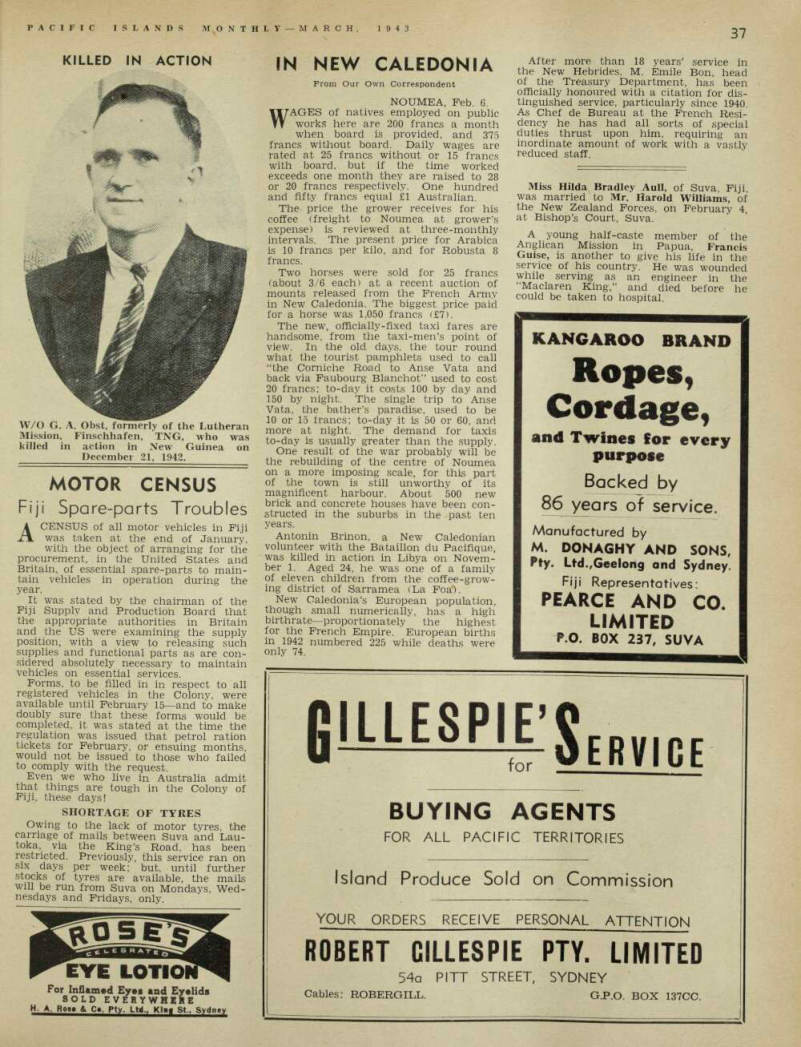
Motor Census
A CENSUS of all motor vehicles in Fiji was taken at the end of January, with the object of arranging for the procurement, in the United States and Britain, of essential spare-parts to main tain vehicles in operation during the year.
It was stated by the chairman of the Fiji Supply and Production Board that the appropriate authorities in Britain and the US were examining the supply position, with a view to releasing such supplies and functional parts as are con sidered absolutely necessary to maintain vehicles on essential services.
Forms, to be filled in in respect to all registered vehicles in the Colony, were available until February 15 —and to make doubly sure that these forms would be completed, it was stated at the time the regulation was issued that petrol ration tickets for February, or ensuing months, would not be issued to those who failed to comply with the request.
Even we who live in Australia admit that things are tough in the Colony of Fiji, these days!
Shortage Of Tyres
Owing to the lack of motor tyres, the carriage of mails between Suva and Lau toka, via the King’s Road, has been restricted. Previously, this service ran on six days per week; but, until further stocks of tyres are available, the mails will be run from Suva on Mondays, Wed nesdays and Fridays, only.
In New Caledonia
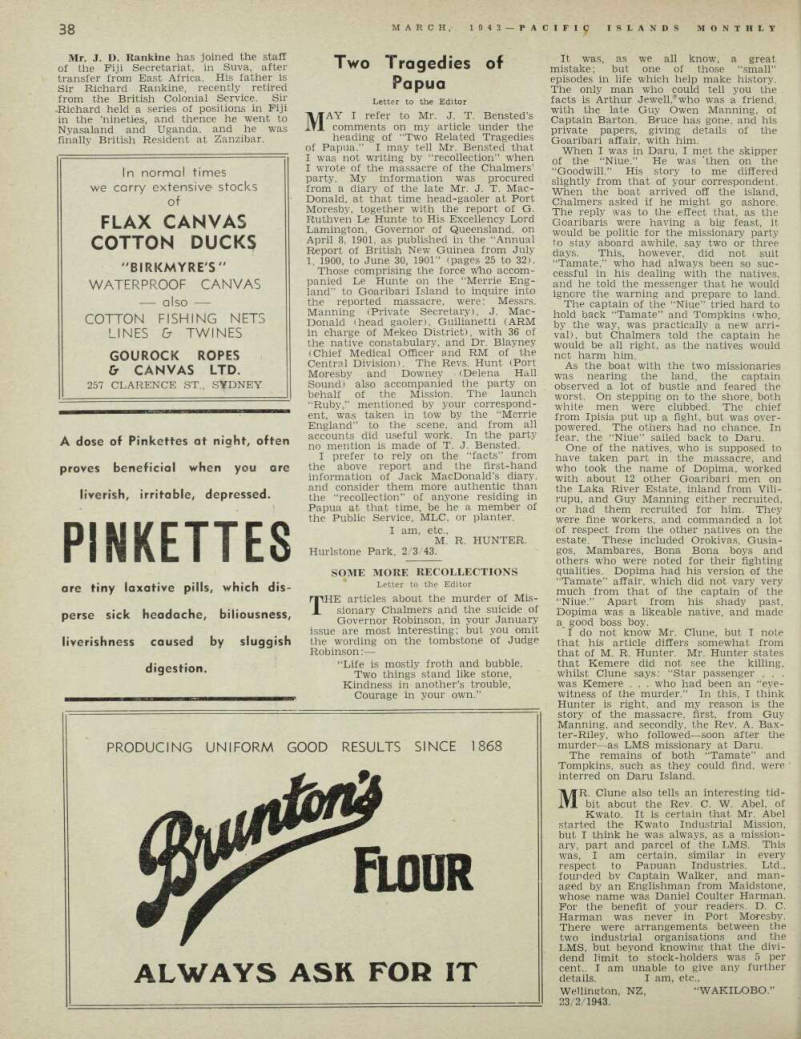
From Our Own Correspondent
Noumea, Feb. 6.
WAGES of natives employed on public works here are 200 francs a month when board is provided, and 375 francs without board. Daily wages are rated at 25 francs without or 15 francs with board, but if the time worked exceeds one month they are raised to 28 or 20 francs respectively. One hundred and fifty francs equal £1 Australian.
The- price the grower receives for his coffee (freight to Noumea at grower’s expense) is reviewed at three-monthly intervals. The present price for Arabica is 10 francs per kilo, and for Robusta 8 francs.
Two horses were sold for 25 francs (about 3/6 each) at a recent auction of mounts released from the French Army in New Caledonia. The biggest price paid for a horse was 1,050 francs (£7).
The new, officially-fixed taxi fares are handsome, from the taxi-men’s point of view. In the old days, the tour round what the tourist pamphlets used to call “the Comiche Road to Anse Vata and back via Faubourg Blanchot” used to cost 20 francs: to-day it costs 100 by day and 150 by night. The single trip to Anse Vata, the bather’s paradise, used to be 10 or 15 francs; to-day it is 50 or 60, and more at night. The demand for taxis to-day is usually greater than the supply.
One result of the war probably will be the rebuilding of the centre of Noumea on a more imposing scale, for this part of the town is still unworthy of its magnificent harbour. About 500 new brick and concrete houses have been con structed in the suburbs in the past ten years.
Antonin Brinon, a New Caledonian volunteer with the Bataillon du Pacifique, was killed in action in Libya on Novem ber 1. Aged 24, he was one of a family of eleven children from the coffee-grow ing district of Sarramea (La Foa).
New Caledonia’s European population, though small numerically, has a high birthrate—proportionately the highest for the French Empire. European births in 1942 numbered 225 while deaths were only 74.
After more than 18 years’ service in the New Hebrides, M. Emile Bon, head of the Treasury Department, has been officially honoured with a citation for dis tinguished service, particularly since 1940.
As Chef de Bureau at the French Resi dency he has had all sorts of special duties thrust upon him, requiring an inordinate amount of work with a vastly reduced staff.
Miss Hilda Bradley Aull, of Suva, Fiji, was married to Mr. Harold Williams, of the New Zealand Forces, on February 4, at Bishop’s Court, Suva.
A young half-caste member of the Anglican Mission in Papua, Francis Guise, is another to give his life in the service of his country. He was wounded while serving as an engineer in the “Maclaren King,” and died before he could be taken to hospital.
Mr. J. I). Rankine has joined the staff of the Fiji Secretariat, in Suva, after transfer from East Africa. His father is Sir Richard Rankine, recently retired from the British Colonial Service. Sir -Richard held a series of positions in Fiji in the ’nineties, and thence he went to Nyasaland and Uganda, and he was finally British Resident at Zanzibar.
Advertisements & other items, pp. 39-40 (2 items)
GlUiSPli’ Service
KANGAROO BRAND
Ropes,
Cordage,
and Twines for every purpose Backed by 86 years of service.
Manufactured by
M. DONAGHY AND SONS,
Pty. Ltd. Geelong and Sydney, Fiji Representatives:
PEARCE AND CO.
LIMITED
P.O. BOX 237, SUVA
GlUiSPli’ Service
BUYING AGENTS
FOR ALL PACIFIC TERRITORIES
Island Produce Sold on Commission
YOUR ORDERS RECEIVE PERSONAL ATTENTION
ROBERT GILLESPIE PTY. LIMITED
54a PITT STREET, SYDNEY
Cables: ROBERGILL. G.P.O. BOX 137 CC.
In normal times we carry extensive stocks of
FLAX CANVAS
COTTON DUCKS
"BIRKMYRE'S"
WATE R P ROOF CANVAS
also
COTTON FISHING NETS
LINES & TWINES
GOUROCK ROPES
Cr CANVAS LTD.
257 CLARENCE ST.. SYDNEY
A dose of Pinkettes at night, often proves beneficial when you are liverish, irritable, depressed.
PINKETTES
are tiny laxative pills, which disperse sick headache, biliousness, liverishness caused by sluggish digestion.
PRODUCING UNIFORM GOOD RESULTS SINCE 1868
Floor
ALWAYS ASK FOR IT
Eye Lotio
For Inflamed Eye* end Eyelids
SOLD EVERYWHERE
H. A. Ros> & C*. Pty. Ltd.. Kim St.. Sydney
Papua
Two Tragedies of Papua
Letter to the Editor MAY I refer to Mr. J. T. Bensted’s comments on my article under the heading of “Two Related Tragedies of Papua.” I may tell Mr. Bensted that I was not writing by “recollection” when I wrote of the massacre of the Chalmers’ party. My information was procured from a diary of the late Mr. J. T. Mac- Donald, at that time head-gaoler at Port Moresby, together with the report of G.
Ruthven Le Hunte to His Excellency Lord Lamington, Governor of Queensland, on April 8, 1901. as published in the “Annual Report of British New Guinea from July 1, 1900, to June 30, 1901” (pages 25 to 32).
Those comprising the force who accom panied Le Hunte on the “Merrie Eng land” to Goaribari Island to inquire into the reported massacre, were: Messrs.
Manning (Private Secretary), J. Mac- Donald (head gaoler), Guilianetti (ARM in charge of Mekeo District), with 36 of the native constabulary, and Dr. Blayney (Chief Medical Officer and RM of the Central Division). The Revs. Hunt (Port Moresby and Downey (Delena Hall Sound) also accompanied the party on behalf of the Mission. The launch “Ruby,” mentioned by your correspond ent, was taken in tow by the “Merrie England” to the scene, and from all accounts did useful work. In the party no mention is made of T. J. Bensted.
I prefer to rely on the “facts” from the above report and the first-hand information of Jack MacDonald’s diary, and consider them more authentic than the “recollection” of anyone residing in Papua at that time, be he a member of the Public Service, MLC, or planter.
I am, etc..
M. R. Hunter.
Hurlstone Park, 2/3/43.
Some More Recollections
Letter to the Editor THE articles about the murder of Mis sionary Chalmers and the suicide of Governor Robinson, in your January issue are most interesting; but you omit the wording on the tombstone of Judge Robinson: — “Life is mostly froth and bubble, Two things stand like stone, Kindness in another’s trouble, Courage in your own.”
It was, as we all know, a great mistake; but one of those “small” episodes in life which help make history.
The only man who could tell you the facts is Arthur Jewell,'who was a friend, with the late Guy Owen Manning, of Captain Barton. Bruce has gone, and his private papers, giving details of the Goaribari affair, with him.
When I was in Daru, I met the skipper of the “Niue.” He was 'then on the “Goodwill.” His story to me differed slightly from that of your correspondent.
When the boat arrived off the island, Chalmers asked if he might go ashore.
The reply was to the effect that, as the Goaribaris were having a big feast, it would be politic for the missionary party to stay aboard awhile, say two or three days. This, however, did not suit “Tamate,” who had always been so suc cessful in his dealing with the natives, and he told the messenger that he would ignore the warning and prepare to land.
The captain of the “Niue” tried hard to hold back “Tamate” and Tompkins (who, by the way, was practically a new arri val), but Chalmers told the captain he would be all right, as the natives would not harm him.
As the boat with the two missionaries was nearing the land, the captain observed a lot of bustle and feared the worst. On stepping on to the shore, both white men were clubbed. The chief from Ipisia put up a fight, but was over powered. The others had no chance. In fear, the “Niue” sailed back to Daru.
One of the natives, who is supposed to have taken part in the massacre, and who took the name of Dopima, worked with about 12 other Goaribari men on the Laka River Estate, inland from Vili rupu, and Guy Manning either recruited, or had them recruited for him. They were fine workers, and commanded a lot of respect from the other natives on the estate. These included Orokivas, Gusia gos, Mambares, Bona Bona boys and others who were noted for their fighting qualities. Dopima had his version of the “Tamate” affair, which did not vary very much from that of the captain of the “Niue.” Apart from his shady past, Dopima was a likeable native, and made a. good boss boy. ’ I do not know Mr. Clune, but I note that his article differs somewhat from that of M. R. Hunter. Mr. Hunter states that Kemere did not see the killing, whilst Clune says: “Star passenger . . . was Kemere . . . who had been an “eye witness of the murder.” In this, I think Hunter is right, and my reason is the story of the massacre, first, from Guy Manning, and secondly, the Rev. A. Bax ter-Riley, who followed —soon after the murder—as LMS missionary at Daru.
The remains of both “Tamate” and Tompkins, such as they could find, were interred on Daru Island.
MR. Clune also tells an interesting tid bit about the Rev. C. W. Abel, of Kwato. It is certain that Mr. Abel started the Kwato Industrial Mission, but I think he was always, as a mission ary, part and parcel of the LMS. This was, I am certain, similar in every respect to Papuan Industries. Ltd., founded by Captain Walker, and man aged by an Englishman from Maidstone, whose name was Daniel Coulter Hannan.
For the benefit of your readers, D. C.
Harman was never in Port Moresby.
There were arrangements between the two industrial organisations and the LMS, but beyond knowing that the divi dend limit to stock-holders was 5 per cent.. I am unable to give any further details. I am, etc.,
Wellington, NZ,
“Wakilobo.”
23/2/1943.
Planters To Return To Papua
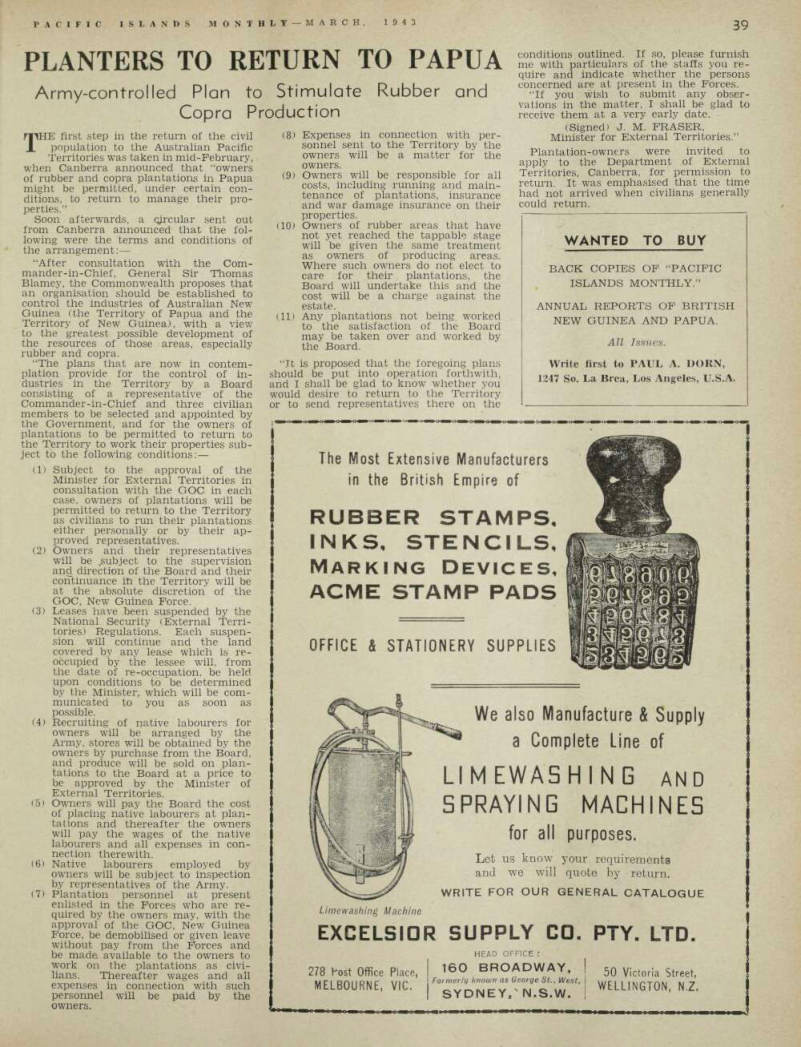
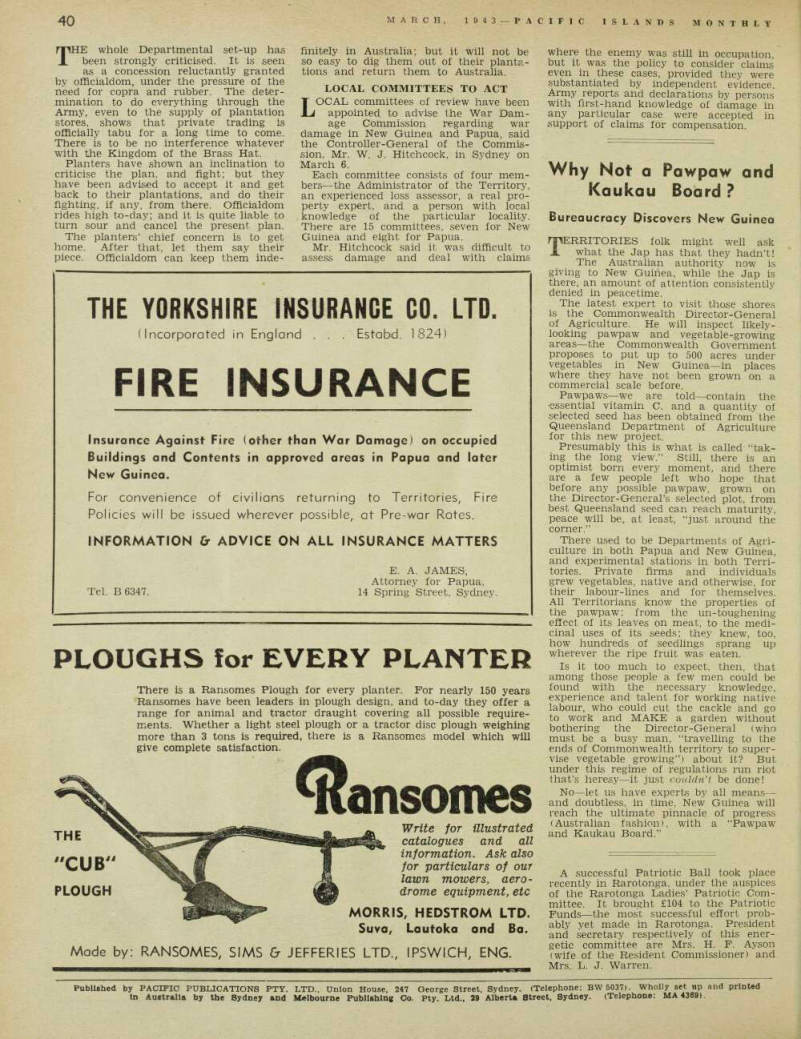
Army-controlled Plan to Stimulate Rubber and Copra Production
THE first step in the return of the civil population to the Australian Pacific Territories was taken in mid-February, when Canberra announced that “owners of rubber and copra plantations in Papua might be permitted, under certain con ditions, to return to manage their pro perties.”
Soon afterwards, a circular sent out from Canberra announced that the fol lowing were the terms and conditions of the arrangement:— “After consultation with the Com mander-in-Chief, General Sir Thomas Blarney, the Commonwealth proposes that an organisation should be established to control the industries of Australian New Guinea (the Territory of Papua and the Territory of New Guinea), with a view to the greatest possible development of the resources of those areas, especially rubber and copra.
“The plans that are now in contem plation provide for the control of in dustries in the Territory by a Board consisting of a representative of the Commander-in-Chief and three civilian members to be selected and appointed by the Government, and for the owners of plantations to be permitted to return to the Territory to work their properties sub ject to the following conditions: — (1) Subject to the approval of the Minister for External Territories in consultation with the GOC in each case, owners of plantations will be permitted to return to the Territory as civilians to run their plantations either personally or by their ap proved representatives. (2) Owners and their representatives will be ..subject to the supervision and direction of the Board and their continuance in the Territory will be at the absolute discretion of the GOC, New Guinea Force. (3) Leases have been suspended by the National Security (External Terri tories) Regulations. Each suspen sion will continue and the land covered by any lease which is re occupied by the lessee will, from the date of re-occupation, be held upon conditions to be determined by the Minister, which will be com municated to you as soon as possible. (4) Recruiting of native labourers for owners will be arranged by the Army, stores will be obtained by the owners by purchase from the Board, and produce will be sold on plan tations to the Board at a price to be approved by the Minister of External Territories. (5) Owners will pay the Board the cost of placing native labourers at plan tations and thereafter the owners will pay the wages of the native labourers and all expenses in con nection therewith. (6) Native labourers employed by owners will be subject to inspection by representatives of the Army. (7) Plantation personnel at present enlisted in the Forces who are re quired by the owners may, with the approval of the GOC, New Guinea Force, be demobilised or given leave without pay from the Forces and be made available to the owners to work on the plantations as civi lians. Thereafter wages and all expenses in connection with such personnel will be paid by the owners.
(8) Expenses in connection with per sonnel sent to the Territory by the owners will be a matter for the owners. (9) Owners will be responsible for all costs, including running and main tenance of plantations, insurance and war damage insurance on their properties. (10) Owners of rubber areas that have not yet reached the tappable stage will be given the same treatment as owners of producing areas.
Where such owners do not elect to care for their plantations, the Board will undertake this and the cost will be a charge against the estate. (11) Any plantations not being worked to the satisfaction of the Board may be taken over and worked by the Board.
“It is proposed that the foregoing plans should be put into operation forthwith, and I shall be glad to know whether you would desire to return to the Territory or to send representatives there on the
conditions outlined. If so, please furnish me with particulars of the staffs you re quire and indicate whether the persons concerned are at present in the Forces.
“If you wish to submit any obser vations in the matter, I shall be glad to receive them at a very early date. (Signed) J. M. FRASER, Minister for External Territories.”
Plantation-owners were invited to apply to the Department of External Territories, Canberra, for permission to return. It was emphasised that the time had not arrived when civilians generally could return.
THE whole Departmental set-up has been strongly criticised. It is seen as a concession reluctantly granted by officialdom, under the pressure of the need for copra and rubber. The deter mination to do everything through the Army, even to the supply of plantation stores, shows that private trading is officially tabu for a long time to come.
There is to be no interference whatever with the Kingdom of the Brass Hat.
Planters have shown an inclination to criticise the plan, and fight; but they have been advised to accept it and get back to their plantations, and do their fighting, if any, from there. Officialdom rides high to-day; and it is quite liable to turn sour and cancel the present plan.
The planters’ chief concern is to get home. After that, let them say their piece. Officialdom can keep them inde
finitely in Australia; but it will not be so easy to dig them out of their planta tions and return them to Australia.
Local Committees To Act
LOCAL committees of review have been appointed to advise the War Dam age Commission regarding war damage in New Guinea and Papua, said the Controller-General of the Commis sion, Mr. W. J. Hitchcock, in Sydney on March 6.
Each committee consists of four mem bers—the Administrator of the Territory, an experienced loss assessor, a real pro perty expert, and a person with local knowledge of the particular locality.
There are 15 committees, seven for New Guinea and eight for Papua.
Mr. Hitchcock said it was difficult to assess damage and deal with claims
where the enemy was still in occupation, but it was the policy to consider claims even in these cases, provided they were substantiated by independent evidence.
Army reports and declarations by persons with first-hand knowledge of damage in any particular case were accepted in support of claims for compensation.
Advertisements & other items, pp. 41-42 (1 item)
Spraying Machines
WANTED TO BUY
BACK COPIES OF “PACIFIC
ISLANDS MONTHLY.”
ANNUAL REPORTS OF BRITISH
NEW GUINEA AND PAPUA.
All Issues.
Write first to PAUL A. DORN, 1247 So. La Brea, Los Angeles, U.S.A.
The Most Extensive Manufacturers in the British Empire of
RUBBER STAMPS,
INKS, STENCILS,
Marking Devices,
ACME STAMP PADS
OFFICE & STATIONERY SUPPLIES
15! a
FSI
191 m We also Manufacture & Supply a Complete Line of
LIMEWASHING AND
SPRAYING MACHINES
for all purposes.
Let us know your requirements and we will quote by return.
WRITE FOR OUR GENERAL CATALOGUE
Limewashing Machine
EXCELSIOR SUPPLY CO. PTY. LTD.
278 Post Office Place,
MELBOURNE, VIC.
HEAD OFFICE I
160 BROADWAY, [ 50 Victoria Street.
f °SYDNEY ,nTs.wT*' i WELLINGTON, N.Z.
THE YORKSHIRE INSURANCE CO. LTD.
(Incorporated in England . . . Estabd. 1824)
FIRE INSURANCE
Insurance Against Fire (other than War Damage) on occupied Buildings and Contents in approved areas in Papua and later New Guinea.
For convenience of civilians returning to Territories, Fire Policies will be issued wherever possible, at Pre-war Rates.
INFORMATION & ADVICE ON ALL INSURANCE MATTERS
E. A. JAMES,
Attorney for Papua, Tel. B 6347. 14 Spring Street, Sydney.
PLOUGHS for EVERY PLANTER
There is a Ransomes Plough for every planter. For nearly 150 years Ransomes have been leaders in plough design, and to-day they offer a range for animal and tractor draught covering all possible requirements, Whether a light steel plough or a tractor disc plough weighing more than 3 tons is required, there is a Ransomes model which will give complete satisfaction.
THE
ii
CUB
PLOUGH
Ransomes
Write for illustrated catalogues and all information. Ask also for particulars of our lawn mowers , aerodrome equipment , etc
MORRIS, HEDSTROM LTD.
Suva, Lautoka and 6a.
Made by: RANSOMES, SIMS & JEFFERIES LTD., IPSWICH, ENG.
Why Not a Pawpaw and Kaukau Board ?
Kaukau Board ?
Bureaucracy Discovers New Guinea
Territories folk might well ask what the Jap has that they hadn’t!
The Australian authority now is giving to New Guinea, while the Jap is there, an amount of attention consistently denied in peacetime.
The latest expert to visit those shores is the Commonwealth Director-General of Agriculture. He will inspect likely looking pawpaw and vegetable-growing areas—the Commonwealth Government proposes to put up to 500 acres under vegetables in New Guinea —in places where they have not been grown on a commercial scale before.
Pawpaws—we are told—contain the -essential vitamin C, and a quantity of selected seed has been obtained from the Queensland Department of Agriculture for this new project.
Presumably this is what is called “tak ing the long view.’’ Still, there is an optimist born every moment, and there are a few people left who hope that before any possible pawpaw, grown on the Director-General’s selected plot, from best Queensland seed can reach maturity, peace will be, at least, “just around the corner.”
There used to be Departments of Agri culture in both Papua and New Guinea, and experimental stations in both Terri tories. Private firms and individuals grew vegetables, native and otherwise, for their labour-lines and for themselves.
All Territorians know the properties of the pawpaw: from the un-toughening effect of its leaves on meat, to the medi cinal uses of its seeds: they knew, too, how hundreds of seedlings sprang up wherever the ripe fruit was eaten.
Is it too much to expect, then, that among those people a few men could be found with the necessary knowledge, experience and talent for working native labour, who could cut the cackle and go to work and MAKE a garden without bothering the Director-General (who must be a busy man, “travelling to the ends of Commonwealth territory to super vise vegetable growing”) about it? But under this regime of regulations run riot that’s heresy—it just couldn’t be done!
No —let us have experts by all means— and doubtless, in time, New Guinea will reach the ultimate pinnacle of progress (Australian fashion), with a "Pawpaw and Kaukau Board.”
A successful Patriotic Ball took place recently in Rarotonga, under the auspices of the Rarotonga Ladies’ Patriotic Com mittee. It brought £lO4 to the Patriotic Funds —the most successful effort prob ably yet made in Rarotonga. President and secretary respectively of this ener getic committee are Mrs. H. F. Ayson (wife of the Resident Commissioner) and Mrs. L. J. Warren.
Advertisements & other items, p. 42 (1 item)
40
MARCH, 1943 PACIFIC ISLANDS MONTHLY
Published by PACIFIC PUBLICATIONS PTY. LTD., Union House, 247 George Street, Sydney. (Telephone: BW 5037). Wholly set up and printed in Australia by the Sydney and Melbourne Publishing Co. Pty. Ltd., 29 Alberta Street, Sydney. (Telephone: MA 4369).
Australian Short Wave
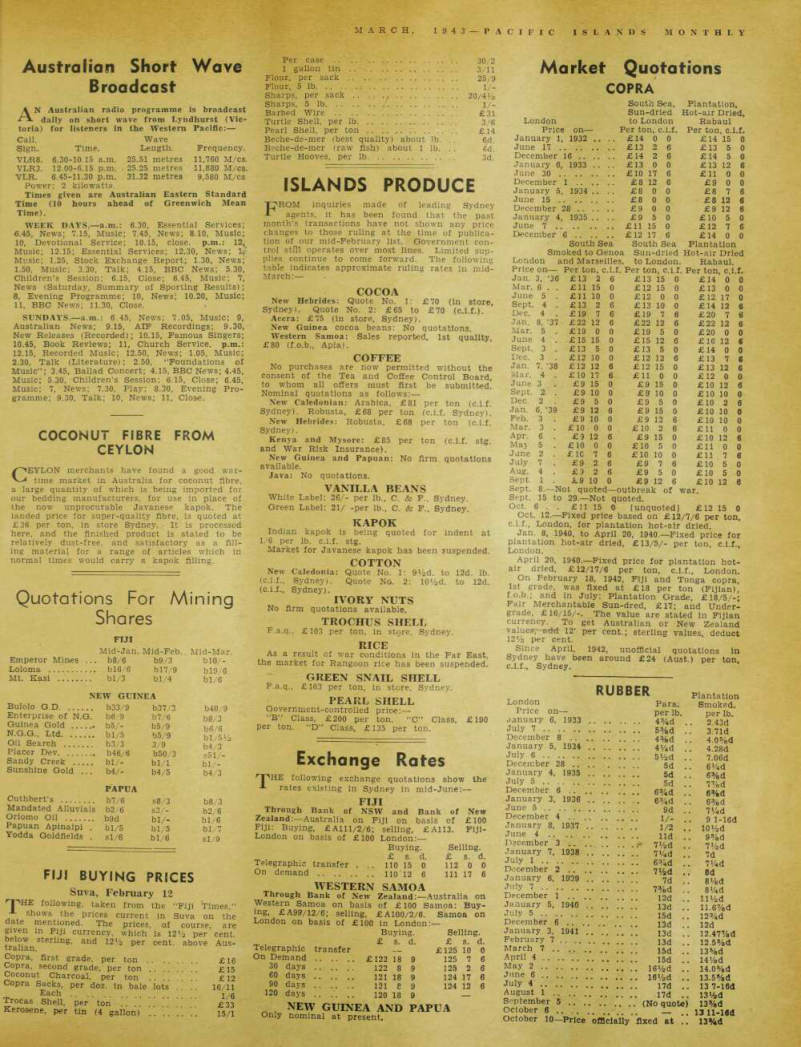
Broadcast
AN Australian radio programme is broadcast daily on short wave from Lyndhurst (Vic toria) for listeners in the Western Pacific:—
Times given are Australian Eastern Standard Time (10 hours ahead of Greenwich Mean Time).
WEEK DAYS.—a.m.: 6.30, Essential Services; €.45, News; 7.15, Music; 7.45, News; 8.10, Music; 10, Devotional Service; 10.15, close, p.m.: 12, Music; 12.15; Essential Services; 12.30, News; 1, Music; 1.25, Stock Exchange Report; 1.30, News; 1.50, Music; 3.30, Talk; 4.15, BBC News; 5.30, Children’s Session; 6.15, Close; 6.45, Music; 7, News (Saturday, Summary of Sporting Results); 8, Evening Programme; 10, News; 10.20, Music; 11, BBC News; 11.30, Close.
SUNDAYS.—a.m.: 6.45, News; 7.05, Music; 9, Australian News; 9.15, AIP Recordings; 9.30, New Releases (Recorded); 10.15, Famous Singers; 10.45, Book Reviews; 11, Church Service, p.m.: 12.15, Recorded Music; 12.50, News; 1.05, Music; 2.30, Talk (Literature); 2.50, “Foundations of Music”; 3.45, Ballad Concert; 4.15, BBC News; 4.45, Music; 5.30, Children’s Session; 6.15, Close; 6.45, Music; 7, News; 7.30, Play: 8.30, Evening Pro gramme; 9.30, Talk; 10, News; 11, Close.
Call.
Wave Sign.
Time, Length.
Frequency,
Vlr8.
6.30-10.15 a.m. 25.51 metres 11,760 M/cs.
Vlr3.
12.00-6.15 p.m. 25.25 metres 11,880 M/cs.
Vlr.
6.45-11.30 p.m. 31.32 metres 9,580 M/cs Power: 2 kilowatts.
Ceylon
Coconut Fibre From
CEYLON merchants have found a good war time market in Australia for coconut fibre, a large quantity of which is being imported for our bedding manufacturers, for use in place of the now unprocurable Javanese kapok. The landed price for super-quality fibre, is quoted at £36 per ton, in store Sydney. It is processed here, and the finished product is stated to be relatively dust-free, and satisfactory as a fill ing material for a range of articles which in normal times would carry a kapok filling.
Quotations For Mining
Shares
Fiji
Mid-Jan. Mid-Feb.
Mid-Mar.
Emperor Mines ... b8/6 b9/3 blO/- Loloma bl6/6 bl7/9 bl9/6 Mt. Kasl bl/3 bl/4 bl/6
New Guinea
Bulolo G.D b33/9 b37/3 b40/9 Enterprise of N.G. b6'9 b7/6 b8/3 Guinea Gold b5/b5/9 b6/6 N.G.G., Ltd bl/5 b5/9 bl/5*/ 2 Oil Search b3/3 3/9 b4/3 Placer Dev b46/6 b50/3 s51/- Sandy Creek bl/bl/1 bl/- Sunshine Gold ... b4/b4/5 b4/3 Cuthbert’s ...
Papua
b7/6 s8/3 b8/3 Mandated Alluvials b2/6 s3/b2/6 Oriomo Oil .. b9d bl/bl/6 Papuan Apinaipi . bl/5 bl/5 bl/7 Yodda Goldfields . sl/6 bl/6 sl/9
Fiji Buying Prices
Suva, February 12
r T'HE following, taken from the “Fiji Times,”
A shows the prices current in Suva on the date mentioned. The prices, of course are given in Fiji currency, which is 12 Vs per cent, below sterling, and 12 J / 2 per cent, above Aus tralian.
Copra, first grade, per ton ... £l6 Copra, second grade, per ton £l5 Coconut Charcoal, per ton £l2 Copra Sacks, per doz. In bale lots . 16/11 Each 1/6 Trocas Shell, per ton £33 Kerosene, per tin (4 gallon) 15/1
Per case 30/2 1 gallon tin 3/11 Flour, per sack 25/9 Flour, 5 lb 17- Sharps, per sack 20/4y 2 Sharps, 5 lb 1/- Barbed Wire £3l Turtle Shell, per lb 3/6 Pearl Shell, per ton £l4 Beche-de-mer (best quality) about lb. . . 6d.
Beche-de-mer (raw fish) about 1 lb. . . 4d.
Turtle Hooves, per lb 3d.
Islands Produce
FROM inquiries made of leading Sydney agents, it has been found that the past month’s transactions have not shown any price changes to those ruling at the time of publica tion of our mid-February list. Government con trol stfll operates over most lines. Limited sup plies continue to come forward. The following table indicates approximate ruling rates in mid- March:—
Cocoa
New Hebrides: Quote No. 1: £7O (in store, Sydney). Quote No. 2: £65 to £7O (c.1.f,).
Accra: £75 (in store, Sydney).
New Guinea cocoa beans; No quotations.
Western Samoa: Sales reported. Ist quality, £BO (f.0.b., Apia).
Coffee
No purchases are now permitted without the consent of the Tea and Coffee Control Board, to whom all offers must first be submitted.
Nominal quotations as follows: New Caledonian: Arabica, £Bl per ton (c.i.f.
Sydney). Robusta, £6B per ton (c.i.f. Sydney).
New Hebrides: Robusta, £6B per ton (c.i.f.
Sydney).
Kenya and Mysore: £B5 per ton (c.i.f. stg. and War Risk Insurance).
New Guinea and Papuan: No firm quotations available.
Java: No quotations.
Vanilla Beans
White Label: 26/- per lb., C. & F., Sydney.
Green Label: 21/ -per lb., C. & F., Sydney.
Kapok
Indian kapok is being quoted for indent at 1/6 per lb. c.i.f. stg.
Market for Javanese kapok has been suspended.
Cotton
New Caledonia: Quote No. 1; 9V 2 d. to 12d. lb. (c.i.f., Sydney). Quote No. 2; lOVad. to 12d. (c.i.f., Sydney).
Ivory Nuts
No firm quotations available,
Trochus Shell
F.a.q., £lO3 per ton, in store, Sydney.
Rice
As a result of war conditions in the Far East, the market for Rangoon rice has been suspended.
Green Snail Shell
F.a.q., £lO3 per ton, in store, Sydney.
Pearl Shell
Government-controlled price:— “B” Class, £2OO per ton. “C” Class, £l9O per ton. “D” Class, £135 per ton.
Exchange Rates
r J'VHE following exchange quotations show the rates existing in Sydney in mid-June: —
Fiji
Through Bank of NSW and Bank of New Zealand:— Australia on Fiji on basis of £lOO Fiji: Buying, £Alll/2/6; selling, £AII3. Fiji- London on basis of £lOO London:—
Western Samoa
Through Bank of New Zealand:—Australia on Western Samoa on basis of £lOO Samoa: Buy ing, £A99/12/6; selling, £AIOO/2/6. Samoa on London on basis of £lOO in London:—
New Guinea And Papua
Only nominal at present.
Buying.
Selling. £ s. d. £ s. d.
Telegraphic transfer . .. 110 15 0 112 0 0 On demand .. . 111 17 6
Buying.
Selling. £ s. d. £ s. d.
Telegraphic transfer £125 10 0 On Demand .. .. £122 18 9 125 7 6 30 days 122 8 9 125 2 6 60 days ,. . 121 18 9 124 17 6 90 days .. .. 121 £ 9 124 12 6 120 days 120 18 9 —
Market Quotations
Sept. B.—Not quoted—outbreak of war.
Sept. 15 to 29.—Not quoted.
Oct. 6 . . £ll 15 0 [unquoted] £l2 15 0 Oct. 12.—Fixed price based on £l2/7/6 per ton, c.i.f., London, for plantation hot-air dried.
Jan. 8. 1940, to April 20, 1940.—Fixed price for plantation hot-air dried, £l3/5/- per ton, c.i.f., London.
April 20, 1940.—Fixed price for plantation hot air dried. £l2/17/6 per ton, c.i.f., London.
On February 18, 1942, Fiji and Tonga copra, Ist grade, was fixed at £lB per ton (Fijian), f.0.b.; and in July: Plantation Grade. £lB/5/-; Fair Merchantable Sun-dred, £l7; and Under grade, £l6/15/-. The value are stated in Fijian currency. To get Australian or New Zealand values, add 12’ per cent.; sterling values, deduct 12 V 2 per cent.
Since April, 1942, unofficial quotations In Sydney have been around £24 (Aust.) per ton, c.i.f., Sydney.
Copra
South Sea, Plantation Sun-dried Hot-air Dried.
London to London Rabaul Price on— Per ton, c.i.f.
Per ton, c.i.f.
January 1 , 1932 .. £14 0 0 £14 15 0 June 17 . £13 2 6 £13 5 0 December 16 .. .. £14 2 6 £14 5 0 January 6, , 1933 .. £13 0 0 £13 12 6 June 30 . £10 17 6 £11 0 0 December 1 .. .. £8 12 6 £9 0 0 January 5, 1934 .. £8 0 0 £8 7 6 June 15 . £8 0 0 £8 12 6 December 28 .. .. £9 0 0 £9 12 6 January 4, , 1935 .. £9 5 0 £10 5 0 June 7 ., £11 15 0 £12 7 6 December 6 . , .. £12 17 6 £14 0 0 South Sea South Sea Plantation Smoked to Genoa Sun-dried Hot-air Dried London and Marseilles, to London.
Rabaul.
Price on— Per ton, c.i.f. Per ton, c.i.f, , Per ton. c.i.f.
Jan. 3, ’36 £13 2 6 £13 15 0 £14 0 0 Mar. 6 . . £11 15 0 £12 15 0 £13 0 0 June 5 . £11 10 0 £12 0 0 £12 17 0 Sept. 4 . £13 2 6 £13 10 0 £14 12 6 Dec. 4 . £19 7 6 £19 7 6 £20 7 6 Jan. 8, ’37 £22 12 6 £22 12 6 £22 12 6 Mar. 5 . £19 0 0 £19 5 0 £20 0 0 June 4 . £15 15 0 £15 12 6 £16 12 6 Sept. 3 . £13 5 0 £13 5 0 £14 0 0 Dec. 3 . £12 10 0 £12 12 6 £13 7 6 Jan. 7, ’38 £12 12 6 £12 15 0 £13 12 6 Alar. 4 . £10 17 6 £11 0 0 £12 0 0 June 3 £9 15 0 £9 15 0 £10 12 6 Sept. 2 . £9 10 0 £9 10 0 £10 10 0 Dec. 2 . £9 5 0 £9 5 0 £10 2 6 Jan. 6, ’39 £9 12 6 £9 15 0 £10 10 0 Feb. 3 . £9 10 0 £9 12 6 £10 10 0 Mar. 3 . £ 10 0 0 £ 10 2 6 £11 0 0 Apr. 6 . £9 12 6 £9 15 0 £10 12 6 Maj 5 . £10 0 0 £10 5 0 £11 0 0 June 2 . £10 7 6 £10 10 0 £11 7 6 July 7 . £9 2 6 £9 7 6 £10 5 0 Aug. 4 . £9 2 6 £9 5 0 £10 5 0 Sept. 1 . £9 10 0 £9 12 6 £10 12 6
Rubber
Plantation London Para; Smoked.
Price on— per lb. per lb. .(anuary 6, 1933 2.43d July 7 3.71d December 8 .. . 4.0 5 /ad January 5, 1934 . 4.28d July 6 7.06d December 28 .. , 5d . evid January 4, 1935 , 6%d July 5 7 7 /ed December 6 .. . 6 3 »d January 3, 1936 , 6%d June 5 7>/ 4 d December 4 9 l-16d January 8, 1937 . . 10V 2 d June 4 OVad December 3 .. . 7V 2 d January 7, 1938 . 7d July 1 7y»d December 2 .. . 8d January 6, lff39 SVad July 7 8V*d December 1 .. .
UVad January 5, 1940 . 11.6 7 /ad July 5 l2 3 / 4 d December 6 .. .. 12d January 3, 1941 . 12.47 7 /ad February 7 .. .. 12.5 5 /ad March 7 13 5 /ad April 4 14Vad May 2 14.0 5 /ad June 6 13.5»/ad July 4 13 7-16d August 1 .. .. 13Vid September 5 .. . 13 5 /ad October 6 .. 13 ll-l«d October 10—Price officially fixed at .. 13V 4 d
Advertisements & other items, p. 44 (1 item)
W. R. Carpenter & Co. Ltd.
■ps ' , - : - ■ - ■ * * ' M ■■■ 1 H iiw i i s I m .
Travel by CARPENTER AIRLINES
Full particulars from Macdonald, Hamilton & Co., or Howard Smith Ltd., Sydney.
W. R. CARPENTER & CO. LTD.
MERCHANTS, SHIPOWNERS AND AIRCRAFT OPERATORS
Agents for Australian, European and American Manufacturers, and Distributors of Every Description of Merchandise.
Buyers and Shippers of Copra, Trocas, and all Classes of Islands Produce.
Ford Motor Company of Canada.
T. G. & C. Bolinders (Engines).
AGENTS FOR :
Caterpillar Tractors.
Electrolux Refrigerators, etc., etc.
Dodge Brothers Inc.
Westinghouse Electrical Co.
Branches throughout the Pacific Islands
In London: W. R. Carpenter Cr Co. (London) Ltd., Coronation House, 4 Lloyds Avenue, London, EC.
Head Office: 16 O’CONNELL STREET, SYDNEY