Pacific
Islands
Monthly
February 17, 1943
Vol. Xiii. No. 7.
Established 1930
[Registered at the G.P.0., Sydney, for transmission by post as a newspaper ]
8"
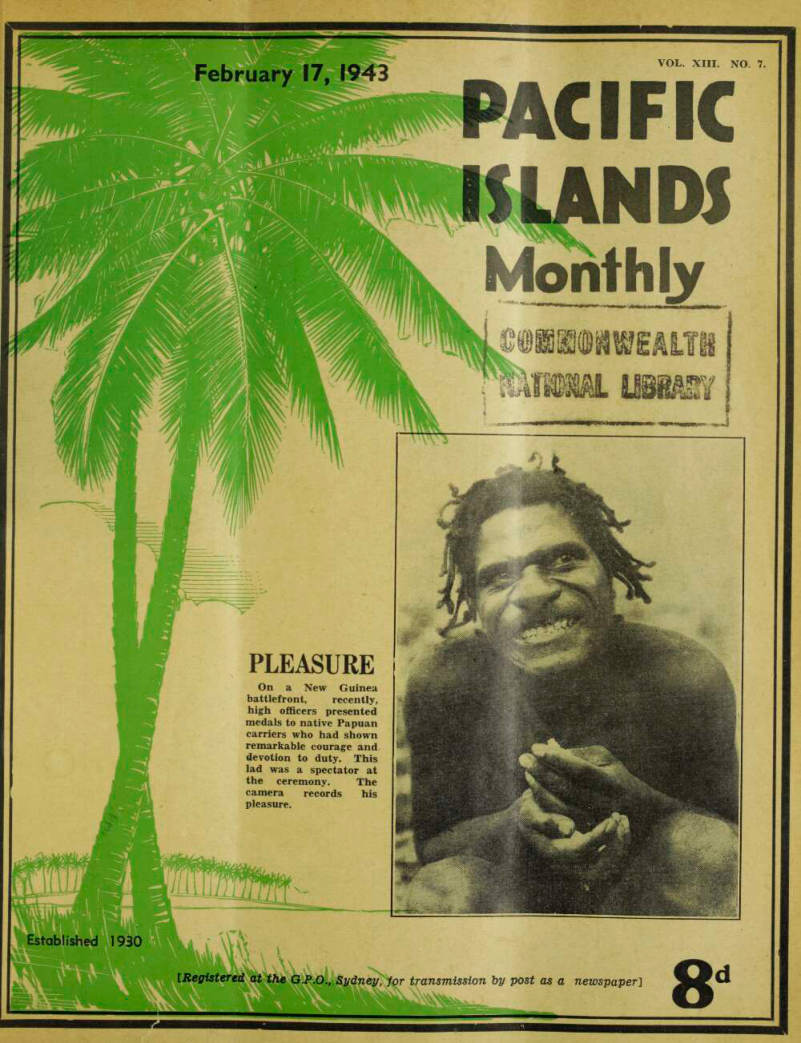
Pleasure
On a New Guinea battlefront, recently, high officers presented medals to native Papuan carriers who had shown remarkable courage and devotion to duty. This lad was a spectator at the ceremony. The camera records his pleasure.
Advertisements & other items, p. 2 (1 item)
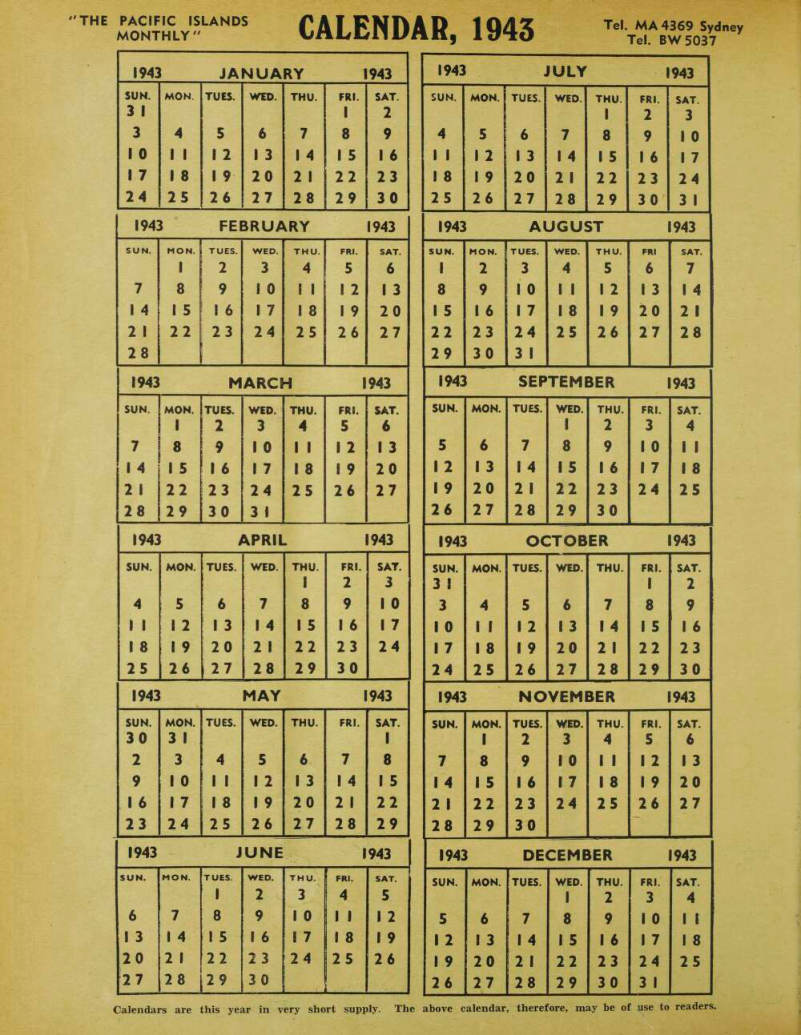
THE monthly" 1 ** 05 CALENDAR, 1943 T " T ti A^ d ~'
Calendars are this year in very short supply. The above calendar, therefore, may be of use to readers.
Pacific News-Review
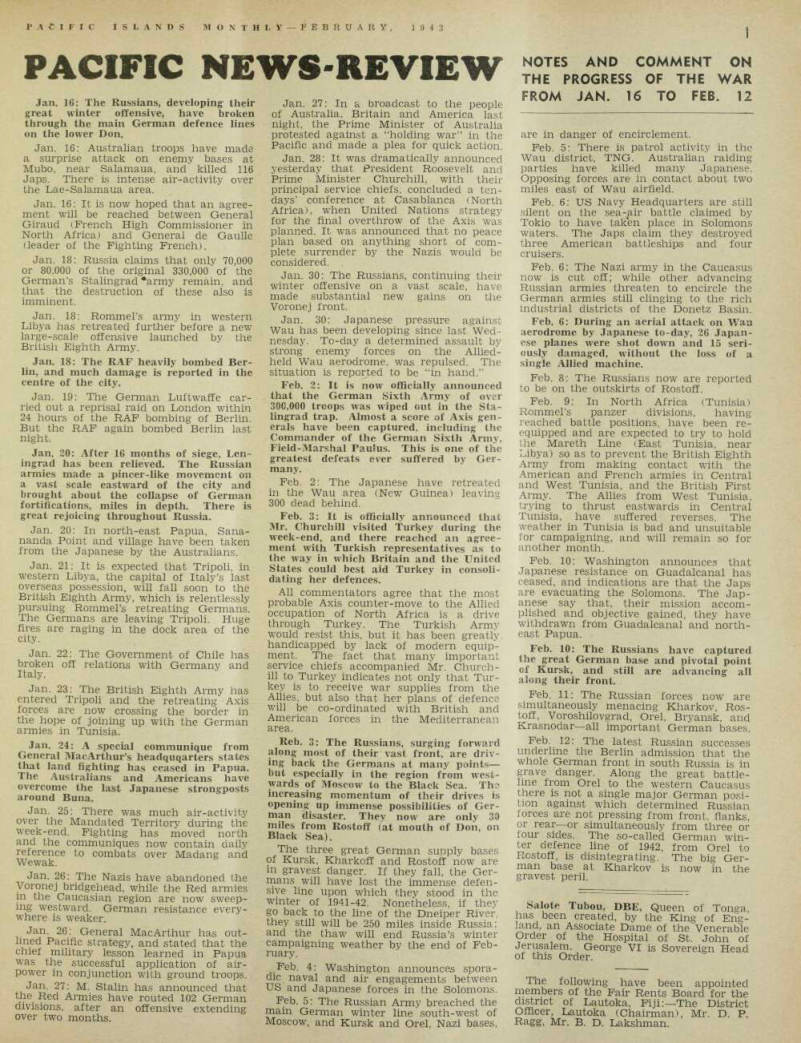
Notes And Comment On
The Progress Of The War
From Jan. 16 To Feb. 12
Jan. 16: The Russians, developing their great winter offensive, have broken through the main German defence lines on the lower Don.
Jan. 16; Australian troops have made a surprise attack on enemy bases at Mubo, near Salamaua, and killed 116 Japs. There is intense air-activity over the Lae-Salamaua area, Jan. 16; It is now hoped that an agree ment will be reached between General Giraud (French High Commissioner in North Africa) and General de Gaulle (leader of the Fighting French).
Jan. 18: Russia claims that only 70,000 or 80,000 of the original 330,000 of the German’s Stalingrad •army remain, and that the destruction of these also is imminent.
Jan. 18: Rommel’s army in western Libya has retreated further before a new large-scale offensive launched by the British Eighth Army, Jan. 18: The RAF heavily bombed Ber lin, and much damage is reported in the centre of the city.
Jan. 19: The German Luftwaffe car ried out a reprisal raid on London within 24 hours of the RAF bombing of Berlin.
But the RAF again bombed Berlin last night.
Jan. 20: After 16 months of siege, Len ingrad has been relieved. The Russian armies made a pincer-like movement on a vast scale eastward of the city and brought about the collapse of German fortifications, miles in depth. There is great rejoicing throughout Russia.
Jan. 20: In north-east Papua, Sana nanda Point and village have been taken from the Japanese by the Australians.
Jan. 21; It is expected that Tripoli, in western Libya, the capital of Italy’s last overseas possession, will fall soon to the British Eighth Army, which is relentlessly pursuing Rommel’s retreating Germans.
The Germans are leaving Tripoli. Huge fires are raging in the dock area of the city.
Jan. 22: The Government of Chile has broken off relations with Germany and Italy.
Jan. 23: The British Eighth Army has entered Tripoli and the retreating Axis forces are now crossing the border in the hope of joining up with the German armies in Tunisia.
Jan. 24; A special communique from General MacArthur’s headquqarters states that land fighting has ceased in Papua.
The Australians and Americans have overcome the last Japanese strongposts around Buna.
Jan. 25: There was much air-activity over the Mandated Territory during the week-end. Fighting has moved north and the communiques now contain daily reference to combats over Madang and Wewak.
Jan. 26; The Nazis have abandoned the Voronej bridgehead, while the Red armies in the Caucasian region are now sweep ing westward. German resistance every where is weaker.
Jan. 26: General Mac Arthur has out lined Pacific strategy, and stated that the chief military lesson learned in Papua was the successful application of air power in conjunction with ground troops.
J an - 27; M. Stalin has announced that the Red Armies have routed 102 German divisions, after an offensive extending over two months.
Jan. 27: In a broadcast to the people of Australia, Britain and America last night, the Prime Minister of Australia protested against a “holding war’’ in the Pacific and made a plea for quick action.
Jan. 28: It was dramatically announced yesterday that President Roosevelt and Prime Minister Churchill, with their principal service chiefs, concluded a ten days’ conference at Casablanca (North Africa), when United Nations strategy for the final overthrow of the Axis was planned. It was announced that no peace plan based on anything short of com plete surrender by the Nazis would be considered.
Jan. 30: The Russians, continuing their winter offensive on a vast scale, have made substantial new gains on the Voronej front.
Jan. 30: Japanese pressure against Wau has been developing since last Wed nesday. To-day a determined assault by strong enemy forces on the Allied held Wau aerodrome, was repulsed. The situation is reported to be “in hand.’’
Feb. 2: It is now officially announced that the German Sixth Army of over 300,000 troops was wiped out in the Sta lingrad trap. Almost a score of Axis gen erals have been captured, including the Commander of the German Sixth Army, Field-Marshal Paulus. This is one of the greatest defeats ever suffered by Ger many.
Feb. 2: The Japanese have retreated in the Wau area (New Guinea) leaving -300 dead behind.
Feb. 3: It is officially announced that Mr. Churchill visited Turkey during the week-end, and there reached an agree ment with Turkish representatives as to the way in which Britain and the United States could best aid Turkey in consoli dating her defences.
All commentators agree that the most probable Axis counter-move to the Allied occupation of North Africa is a drive through Turkey. The Turkish Army would resist this, but it has been greatly handicapped by lack of modern equip ment. The fact that many important service chiefs accompanied Mr. Church ill to Turkey indicates not only that Tur key is to receive war supplies from the Allies, but also that her plans of defence will be co-ordinated with British and American forces in the Mediterranean area.
Reb. 3: The Russians, surging forward along most of their vast front, are driv ing back the Germans at many points— but especially in the region from west wards of Moscow to the Black Sea. The increasing momentum of their drives is opening up immense possibilities of Ger man disaster. They now are only 30 miles from Rostoff (at mouth of Don, on Black Sea).
The three great German supply bases pf Kursk. Kharkoff and Rostoff now are m gravest danger. If they fall, the Ger mans will have lost the immense defen sive line upon which they stood in the winter of 1941-42. Nonetheless, if they go back to the line of the Dneiper River, they still will be 250 miles inside Russia: and the thaw will end Russia’s winter campaigning weather by the end of Feb ruary.
Feb. 4; Washington announces spora dic naval and air engagements between US and Japanese forces in the Solomons.
Feb. 5: The Russian Army breached the main German winter line south-west of Moscow, and Kursk and Orel, Nazi bases,
are in danger of encirclement.
Feb. 5: There is patrol activity in the Wau district, TNG. Australian raiding parties have killed many Japanese.
Opposing forces are in contact about two miles east of Wau airfield.
Feb. 6: US Navy Headquarters are still silent on the sea-air battle claimed by Tokio to have taken place in Solomons waters. The Japs claim they destroyed three American battleships and four cruisers.
Feb. 6: The Nazi army in the Caucasus now is cut off; while other advancing Russian armies threaten to encircle the German armies still clinging to the rich industrial districts of the Donetz Basin.
Feb, 6: During an aerial attack on Wau aerodrome by Japanese to-day, 26 Japan ese planes were shot down and 15 seri ously damaged, without the loss of a single Allied machine.
Feb. 8: The Russians now are reported to be on the outskirts of Rostoff.
Feb. 9: In North Africa (Tunisia) Rommel’s panzer divisions, having reached battle positions, have been re equipped and are expected to try to hold the Mareth Line (East Tunisia, near Libya) so as to prevent the British Eighth Army from making contact with the American and French armies in Central and West Tunisia, and the British First Army. The Allies from West Tunisia, trying to thrust eastwards in Central Tunisia, have suffered reverses. The weather in Tunisia is bad and unsuitable for campaigning, and will remain so for another month.
Feb. 10; Washington announces that Japanese resistance on Guadalcanal has ceased, and indications are that the Japs are evacuating the Solomons. The Jap anese say that, their mission accom plished and objective gained, they have withdrawn from Guadalcanal and north east Papua.
Feb. 10: The Russians have captured the great German base and pivotal point of Kursk, and still are advancing all along their front.
Feb. 11: The Russian forces now are simultaneously menacing Kharkov, Ros toff, Voroshilovgrad, Orel, Bryansk, and Krasnodar-all important German bases.
Feb. 12; The latest Russian successes underline the Berlin admission that the whole German front in south Russia is in grave danger. Along the great battle line from Orel to the western Caucasus there is not a single major German posi tion against which determined Russian forces are not pressing from front, flanks, or rear—or simultaneously from three or four sides. The so-called German win ter defence line of 1942, from Orel to Rostoff, is disintegrating. The big Ger man base at Kharkov is now in the gravest peril.
Salute Tubou, DBF, Queen of Tonga, has been created, by the King of Eng land, an Associate Dame of the Venerable Order of the Hospital of St. John of Jerusalem. George VI is Sovereign Head of this Order.
The following have been appointed members of the Fair Rents Board for the district of Lautoka, Fiji;—The District Officer, Lautoka (Chairman), Mr. D. P.
Ragg, Mr. B. D. Lakshman.
Contents
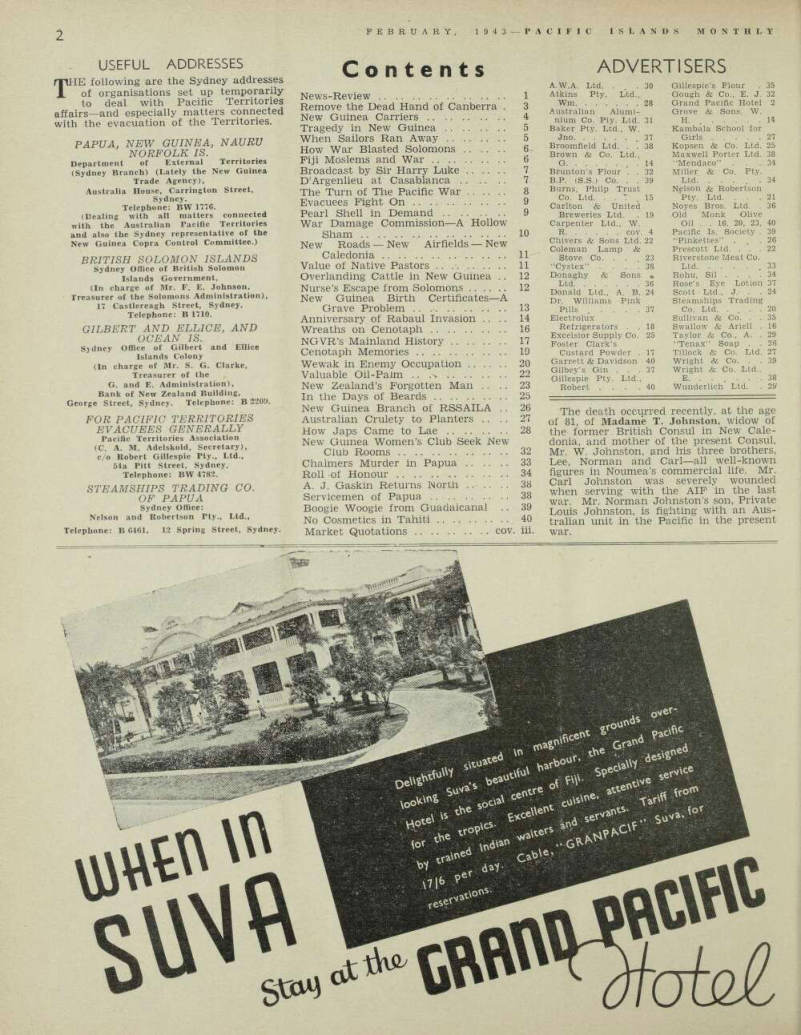
News-Review 1 Remove the Dead Hand of Canberra . 3 New Guinea Carriers 4 Tragedy in New Guinea 5 When Sailors Ran Away 5 How War Blasted Solomons 6 Fiji Moslems and War 6 Broadcast by Sir Harry Luke 7 D’Argenlieu at Casablanca 7 The Turn of The Pacific War 8 Evacuees Fight On 9 Pearl Shell in Demand 9 War Damage Commission —A Hollow Sham 10 New Roads New Airfields New Caledonia 11 Value of Native Pastors 11 Overlanding Cattle in New Guinea .. 12 Nurse’s Escape from Solomons 12 New Guinea Birth Certificates —A Grave Problem 13 Anniversary of Rabaul Invasion ... 14 Wreaths on Cenotaph 16 NGVR’s Mainland History 17 Cenotaph Memories 19 Wewak in Enemy Occupation 20 Valuable Oil-Palm .. 22 New Zealand’s Forgotten Man ... 23 In the Days of Beards 25 New Guinea Branch of RSSAILA .. 26 Australian Crulety to Planters ... 27 How Japs Came to Lae 28 New Guinea Women’s Club Seek New Club Rooms 32 Chalmers Murder in Papua 33 Roll -of Honour 34 A. J. Gaskin Returns North 38 Servicemen of Papua 38 Boogie Woogie from Guadalcanal .. 39 No Cosmetics in Tahiti 40 Market Quotations cov. hi.
Advertisers
A. Ltd. ... 30 Atkins Pty. Ltd., Wm 28 Australian Alumi nium Cos. Pty. Ltd. 31 Baker Pty. Ltd., W.
Jno ,37 Broomfield Ltd. . '. 38 Brown & Cos. Ltd., G . 14 Brunton’s Flour ’. . 32 B. (S.S.) Cos. . . 39 Burns, Philp Trust Cos. Ltd. . . . 15 Carlton & United Breweries Ltd. . 19 Carpenter Ltd., W.
R cov. 4 Chivers & Sons Ltd. 22 Coleman Lamp & Stove Cos. ... 23
“Cystex” . . . ’. 38
Donaghy & Sons • Ltd 36 Donald Ltd., A. B. 24 Dr. Williams Pink Pills ... 37 Electrolux Refrigerators . . 18 Excelsior Supply Cos. 25 Foster Clark’s Custard Powder . 17 Garrett & Davidson 40 Gilbey’s Gin ... 37 Gillespie Pty. Ltd., Robert ... .40
Gillespie’s Flour .35 Gough & Cos., E. J, 32 Grand Pacific Hotel 2 Grove & Sons, W.
H. 14 Kambala School for Girls 27 Kopsen & Cos. Ltd. 25 Maxwell Porter Ltd. 38 “Mendaco” ... 34 Miller & Cos. Pty.
Ltd. ... 34 Nelson & Robertson Pty. Ltd. . . .21 Noyes Bros. Ltd. . 36 Old Monk Olive Oil . . 16, 20, 23, 40 Pacific Is. Society . 39 “Pinkettes” ... 26 Prescott Ltd. ... 22 Riverstone Meat Cos.
Ltd .33 Rohu, Sil . . . .34 Rose’s Eye Lotion 37 Scott Ltd., J. . . 24 Steamships Trading Cos. Ltd. ... 20 Sullivan & Cos. . . 35 Swallow 7 & Ariell . 16 Taylor & Cos., A. . 29 “Tenax” Soap . . 26 Tillock & Cos. Ltd. 27 Wright & Cos. . .39 Wright & Cos. Ltd., E. ... 38 Wunderlich Ltd. . 29’
The death occurred recently, at the age of 81, of Madame T. Johnston, widow of the former British Consul in New Cale donia, and mother of the present Consul, Mr. W. Johnston, and his three brothers, Lee, Norman and Carl—all well-known figures in Noumea’s commercial life. Mr.
Carl Johnston was severely wounded when serving with the AIF in the last war. Mr. Norman Johnston’s son, Private Louis Johnston, is fighting with an Aus tralian unit in the Pacific in the present war.
Advertisements & other items, p. 4 (2 items)
Useful Addresses
THE following are the Sydney addresses of organisations set up temporarily to deal with Pacific Territories affairs —and especially matters connected with the evacuation of the Territories.
PAPUA, NEW GUINEA, NAURU
NORFOLK IS.
Department of External Territories (Sydney Branch) (Lately the New Guinea Trade Agency), Australia House, Carrington Street, Sydney.
Telephone: BW 1776. (Dealing with all matters connected with the Australian Pacific Territories and also the Sydney representative of the New Guinea Copra Control Committee.)
BRITISH SOLOMON ISLANDS
Sydney Office of British Solomon Islands Government, (In charge of Mr. F. E. Johnson, Treasurer of the Solomons Administration), 17 Castlereagh Street, Sydney.
Telephone: B 1710.
GILBERT AND ELLICE, AND
OCEAN IS.
Sydney Office of Gilbert and Ellice Islands Colony (In charge of Mr. S. G. Clarke, Treasurer of the G. and E. Administration), Bank of New Zealand Building, George Street, Sydney. Telephone: B 320!).
FOR PACIFIC TERRITORIES
EVACUEES GENERALLY
Pacific Territories Association (C. A. M. Adelskold, Secretary), c/o Robert Gillespie Pty., Ltd., 54a Pitt Street, Sydney, Telephone: BW 4782.
STEAMSHIPS TRADING CO.
OF PAPUA
Sydney Office: Nelson and Robertson Pty., Ltd., Telephone: B 6461. 12 Spring Street, Sydney.
<eser^°^
p »*<% <*A " 4i «*** ’ pac ' f 'V j \o ib e , , „,\oo e<^ a S^ z . fe otr c °' . - rf* e ° .* lT a' n - O b ' e ’ r <^- 7 ' fe 9 os
o
Pacific Islands Monthly
The Newspaper-Magazine of the South Seas
IRegistered at the G.P.0., Sydney, for transmission by post as a newspaper .] Published Once Each Month and Circulated in Australia and New Zealand and in the following Pacific Territories and Islands Groups:
Australian Territory of Papua.
Mandated Territory (Australia) of New Guinea.
Australian Territory of Norfolk Island.
New Zealand Territory of Cook Islands.
Mandated Territory (NZ) of Western Samoa.
British Colony of Fiji.
British Solomon Islands Protectorate.
British Protectorate of Tongan Islands.
British Crown Colony of Gilbert and Ellice Islands.
Mandated Territory of Nauru.
British and Free French Condominium of New Hebrides.
Free French Colony of New Caledonia.
Free French Colony of Oceania (Tahiti, etc.).
American Territory of Eastern Samoa.
American Territory of Hawaiian Islands.
Owned and Produced by Pacific Publications Pty. Ltd., Union House, 247 George Street, Sydney.
TELEPHONE ( Managing Director .. BW 5037 C Business and Editorial MA 4369
P.O. Box 3408 R
Registered Address of Telegrams, Radiograms, and Cables: “Pacpub”, Sydney.
Contributions.
Articles, Stories, and Photographs dealing with Pacific Islands subjects are invited and will be paid for on publication.
Subscription Rates.
Per Annum, within British Empire, Prepaid, Post Free g/.
Per Annum, elsewhere, prepaid, Post Free. 10/- Single Copies Bd >
Editor and Publisher;
R. W. Robson. F.R.G.S.
Advertising Manager: L. W. Bailey.
Advertising Office and Printing-House: 29 Alberta Street, Sydney.
Advertising rates furnished on application.
Colours, etc., by arrangement.
Process Blocks made at Advertiser’s expense when required. Screen 100.
Changes of Advertising Copy should reach this office by Ist of each month, otherwise previous advertisement may be repeated.
Representative In London.
W. C. Harvey, Coronation House, 4 Lloyds Avenue, London, E.C.3, from whom may be obtained copies of Pacific Islands Monthly, Pacific Is. Year Book, advertising schedules, etc.
Agents.
The following are authorised to receive sub scriptions for Pacific Islands Monthly:— Burns, Philp & Co., Ltd., and Burns Philp (South Sea) Co., Ltd. All branches.
W. R. Carpenter & Co., Ltd. All branches.
Morris, Hedstrom, Ltd. All branches.
Steamships Trading Co., Papua. All branches.
B.N.G. Trading Co., Ltd., Port Moresby, Papua.
J. Muir, Suva, Fiji.
Miss R. Castles, Suva, Fiji.
N. C. Mackenzie Hunt, Wainunu, Bua, Fiji.
Kirpal & Co., Victoria Parade. Suva, Fiji.
Cook Islands Trading Co., Rarotonga, Cook Is.
A. C. Rowland, Papeete, Tahiti.
Islands Branches and Representatives of W. H.
Grove & Sons, Ltd., Auckland, New Zealand.
Ed. Pentecost, Noumea, New Caledonia.
Kerr & Co., Noumea, New Caledonia.
Vol. XIII. No. 7.
February 17, 1943
D r : re* i 8d - Per c°Py rnct; £ Prepaid: 8/- p.a.
Whitehall and Wellington
Let us Remove the Dead Hands of Canberra, Whitehall and Wellington
ALREADY, before the Japanese invaders have been driven away, the people of the Pacific Territories are beginning to discuss the political and administrative conditions under which they hope to live in the future; and there is a strong and growing feeling against any further close association with Canberra, Whitehall and Wellington.
Before the new Pacific world is finally shaped, the British (and, some hope, the Fighting French) com munities of the South Pacific tropical territories will make a strong plea for the creation of a new British Dominion (a writer in the last issue of the “PIM” suggested “the Dominion of British Oceania”) or, perhaps, a South Pacific Territories Federation, which will link together, in one strong group, the Territories of (west to east), Papua, New Guinea (Man dated), British Solomons, New Hebrides, Gilbert and Ellice Colony, Nauru, Fiji, Western Samoa (Man dated), Cook Islands, Tonga, and, maybe, New Caledonia and French Oceania.
Only by the creation of such a self governing Dominion or Federation, functioning under the protection of Great Britain, or under an Anglo- American Union (or whatever body may be set up by the victorious United Nations for the policing of the post
war world), can the Pacific Territories escape from the dead hands of Aus tralia, Great Britain and New Zealand, all too manifest in Pacific Islands administration during the past quarter century.
I know, very well, the objections that will be offered, immediately, to the idea of creating a tropical Pacific Islands Dominion—l presented most of them, myself, when first I heard the plan discussed. But, as I became accustomed to the thing, I began to see much that is in its favour.
AS it was in 1939, all those rich South Pacific tropical territories were parcelled out among the Euro pean nations. Working, again, from west to east, we had Dutch New Guinea, attached to the Netherlands East Indies Empire; North-west New Guinea, with the great islands of New Britain, New Ireland and Bougain ville, governed by Australia, through Geneva; South-east New Guinea (Papua), with the Louisiade Archi pelago, attached to Australia as a Territory; the British Solomon Islands, governed by Britain through a High Commissioner in Suva; the New Hebrides, governed as a Con dominium (often aptly termed a “Pandemonium”) by Britain and France, jointly; the French Colony of New Caledonia, to which is attached
the Loyalty Group; the Gilbert and Ellice Islands Colony (British), with which is included the rich phosphate island of Ocean Island; the other rich phosphate island of Nauru, governed jointly by Britain, Australia and New Zealand through a Man date; the British Crown Colony of Fiji; the Kingdom of Tonga, self governing under Whitehall protec tion; the large and rich territory of Western Samoa, governed by New Zealand under Mandate; the New Zealand territory of the Cook Islands; and the large, rich and beautiful French Colony of French Oceania.
Could one find, anywhere, a greater jumble of administrative forms, administrative machinery and colonial policies?
One would need to travel up and down among the Islands, as I have done for over ten years, to realise how the development and use of those vast, rich territories have been retarded by the blight of remote con trol. Only one, the British Colony of Fiji, has made any real progress during the past quarter-century; and I believe that Fiji’s progress has been due to the strong impulse of its own richness and fertility, rather than to any effort made by Whitehall.
New Guinea, Papua, Solomons, New Hebrides, Samoa, Cook Islands, Tonga, New Caledonia and Tahiti supply us, in their records of the past quarter century, with a story of official inertia, administrative laziness, dis couragement of private enterprise
and resentment of any criticism— especially constructive criticism—that would be hard to equal.
EVERY one of those territories is within the southern tropics.
Every one has a substantial native population. Except that there are Polynesians in the east, and Melan esians in the west—very different peoples—each territory has similar problems relating to native education, native health, the training of natives in agriculture and handicrafts, the protection of natives’ land titles.
The problems of every one of those territories, in relation to European settlement and the development of the country by European enterprise, the control of commerce, industry and transport, the limitation of Asiatic immigration, etc., are almost exactly the same.
Yet—believe it or not!—every one of those territories has been adminis tered independently in the past by the controlling authority, without consultation of neighbours, or any attempt to co-ordinate policies or exchange experience. There is not the slightest difference, that I ever have been able to discern, between administrative conditions in Papua and Mandated New Guinea, or be tween New Guinea or the British Solomons; but Canberra always has kept the administrations of Papua and New Guinea in separate, water tight compartments: there was no exchange of trained personnel or comparison of policies—each went its separate, jealous way.
The only attempt at co-operation and co-ordination of effort that I have seen in all those South Pacific Territories was made in the Suva Medical School. Here, since 1930, selected youths, from all the central and eastern territories, have come together for four years’ training as native medical practitioners; and the success of this system has been truly remarkable. But—believe it or not—Australia, deaf to all appeals to join in a co-operative effort for the good of the native peoples, has kept haughtily aloof from the Suva Medical School, and there are no NMP’s in Papua and New Guinea.
NO one who knows the history of the Pacific Territories will lay the blame for this dismal adminis trative record upon the adminis trative officials. In every territory, from New Guinea right across to Tahiti, I have come to know the officials very well. I have met some dull and stupid and lazy men; a few greedy place-seekers; but I can say of the great majority that they are men of superior ability, strong of purpose and incorruptible, and almost pathetically eager to do something really worth while for the progress of the Territories for which they are re sponsible. But I can say, also, that in the case of the older men, I often found the lethargy that is based on defeated hopes and years of discour agement. I can name, now, a score of the highest administrative officials in the Pacific Territories who once were brimming with enthusiasm and
energy, and whose hearts have been broken by the inertia of bureaucrats at Canberra and Wellington and Whitehall, and by the indifference and ignorance of politicians—poli ticians pitch-forked into positions where they have to take adminis trative responsibility for tropical countries they have never seen, and know nothing about.
THIS is not the first time I have criticised this ridiculous system, and I know well the answer I will get. Some Ministerial gentlemen, in Australia, or New Zealand or Britain, will quote some statistics to show the “marvellous progress” made by the Territories in question under the system I have described. His statistics and his arguments can be knocked to pieces in a moment by anyone who really knows the Pacific Territories; but they seem to satisfy the indif ferent public and the uninformed newspapers.
There is very little community of interest between the nations which now govern the Territories, and the Territories themselves. There is complete and far-reaching community of interest between the Territories themselves. Then, why should they not be allowed to govern themselves, and thus escape the deadly influences I have described? A demand for self government will come, I think; and, if it is to be considered in a spirit of justice and reason, an answer to that question will have to be found.
THERE is grave significance in this extract from the Chicago “Tri bune” (one of America’s greatest newspapers, violently isolationist and usually anti-British), which was published in “Sydney Morning Herald” on February 4:— “One of our legitimate war objectives is farthest from the minds of those who are talking most about peace plans. That objective is permanent safety for the United States, which can be attained only by retention of all the islands we have occupied. Only an insane man or a traitor would surrender land won by the lives of our brave men.
“We do not say this should include any part of Africa or Iceland, certainly not the British Isles, but it means all the islands in the Western Atlantic, New Caledonia, the Fiji Islands, and the Solomons.
The Japanese mandated islands are go ing to be ours by right of conquest.
“Although it required American troops and leadership to drive the Japanese out of Papua, we should evacuate from there after the war and require Australians to defend Papua themselves. Beyond that point, we believe that the Philippines, Borneo, Sumatra, Java. Malaya, and Burma should be free for development by their own inhabitants.”
These claims may seem to us fantastic; but they do indicate that powerful influences already are turn ing their attention to the future of the Pacific Territories. We should be wise, now, to begin thinking of the future, and planning, if possible.
Certain things stand out, and may perhaps be accepted as facts: The future of the administration of every Pacific Territory will be closely studied by the United Nations; the claims of Britain, Australia and New
Zealand, and, possibly, of France, for a continued free hand in the control of South Pacific Territories, will be challenged, because of their miser able, unimpressive record during the past 25 years; the United States, on the ground of her future security, will want re-assurance concerning the future government of the numerous Pacific Territories now occupied by American forces.
The prospect is startling. Great changes seem to be looming. But at last we may have a chance of getting rid of the dead hand of Canberra, Wellington and London officialdom.
R. W. Robson.
Wartime
Native Carriers In
N. Guinea
Useful Lessons of Wartime
IT is to be hoped that, when circum stances permit, due credit will be given to the men who organised the native carrier service that was the back bone of the supnly system that allowed the Australians to strike successfully at the Japanese across the Owen Stanley Range, in Papua, and eventually to drive them into the sea.
In the early part of this campaign there was confusion in relation to the use of native carriers; but the High Command very wisely sought out men who knew the country and the natives, and nut them in charge of the whole organisation. From then on transport and supplies worked with increasing efficiency.
Japs Murder Rabaul Carriers
On the other hand, the Japanese who landed on the north-east coast of Papua, and struck at Port Moresby across the Owen Stanley Range, failed dismally to solve the transport problem in a country where the unit of transport must be the native carrier. They brought with them, to the Gona-Buna landings, a few thou sand Rabaul natives, some hundreds of horses and mules, and about 30 trucks.
They appear to have lost the lot.
Thev treated the Rabaul natives with terrible cruelty. They tried to use them as a carrier service over the Owen Stanley Range, but at least one thousand of them deserted into the jungle. Most of them appear to have headed towards the north coast of New Guinea, and some actually turned up at Wewak. Several hundreds were killed by the Japanese—their cruelly bayoneted bodies were often found on the Kokoda-Buna track by the advanc ing Australians —and most of the re mainder eventually were captured by the Australians —and very glad they were to be taken.
Men who knew fhe Rabaul natives in the davs before the war, and used to complain of their growing cheekiness and unwillingness to work, were most inter ested to meet the Rabaul natives again in Papua, after they had been through the hands of the Japanese.
Says one former Rabaul resident: “We can 'be Quite sure that when we return to New Guinea, we shall have no further trouble with ‘flash’ natives. It needed only a few months in the hands of the Japanese to persuade them that the true friend and protector of the kanaka is the white man.
“The joy of these unfortunate Rabaul natives, when they realised that at last they were free of the Japanese, and in Australian hands again, was really pathetic to sea.”
When Sailors Ran
Away
Tahiti's Memories of Bad Old Days
By A. C. Rowland
WAR in the Pacific has deprived Papeete of one of its principal sporting events —the man-hunt after runaway sailors.
In peacetime, the sailor ruled the sea.
Some years ago laws were passed in the United States to ameliorate what was undoubtedly the hard lot of the sailor.
This was followed by other laws, in USA and other countries, which progressively stripped the owners of all authority over their ships and demoted the captain of a vessel to the status of a robot calcu lator of the ship’s course and—if the steamer carried passengers—a male host ess to entertain and direct the deck sports.
Under such conditions, the task of a ship’s agent at a place like Papeete has always been a strenuous labour of Her cules.
The shipping laws required a ship to sail with a full complement of officers and men. If a ship sailed from Papeete without all of its sailors the owners be came liable to a fine, while the agent at Papeete was compelled to feed and lodge the runaway sailor and send him to the home port, whence he came, at the expense of the company. This gave sailors wide-open opportunities to delay the ship and have one or two extra nights ashore—if one or two of them could elude capture before sailing time.
It was, therefore, necessary for the agent to round up all the crew and get the ship away on scheduled time. In this task he had the enthusiastic support of the Papeete police.
Sailors on regular liners never were able to hold up the sailing of their ships more than an hour or so. Our police, knowing every fox-hole, warren, den and by-way, had only to make the rounds, fish them out and drag them, shouting and cursing, to the ship's gangway.
They sometimes retaliated by hurling lumps of coal and other missiles at the police as the ship moved away from the wharf. All this was exciting, but futile.
The runaways had been mopped up and the ship had been despatched at appro ximately her schedule hour.
It was the “Beulah,” of blessed mem ory, and others of her class, that turned agents’ hair grey, caused Consuls to gnash their teeth, and kept our “hounds of the law” in full cry. In addition to
discovering unorthodox hide-outs, the
engineering staff of the “Beulah” became learned in the art of producing mechani cal breakdowns which, curiously enough, a PP no other port than Papeete. discipline of war has changed all that. The captain of a ship is again the master of his craft. The jolly tar has turned into a grim warrior. To gether they face dangers more terrible than the Cyclops, Syclla, Charybdis of ancient saga.
And the ships get through.
The marriage of Lois, daughter of Mr. and Baxendaie, of Norfolk Island, to Mr Thomas Hamilton Low, of the Department of the Interior, was cele brated recently at St. Basils Church, Artarmon, Sydney. Fifty guests were entertained at the home of Captain and Mrs. F. E. Page. The couple will make their home in Queensland,
Tragedy In New Guinea
Six Men Believed Killed in Out-station Clash
THERE was an extraordinary tragedy in the Sepik district, Northern New Guinea, in March last, in which a number of men lost their lives. The trouble which occurred had nothing whatever to do with the war—there appear to be no Japanese within hun dreds of miles of the district concerned— but war conditions apparently prevented the facts of the situation from becoming known in Australia, until recently.
It appears that an administrative offi cial, who had been in poor health, became mentally deranged; refused to hand over his station to another official who had been sent in to relieve him; ordered his native police to fire upon the newcomers and wounded some of them; then com mitted suicide; with the result that the native police on the station apparently went berserk, and attacked and killed a number of men who went to the assist ance of the relieving officer.
The details are vague and unconfirmed.
But it has been officially announced by Canberra that the death has occurred of Mr. George Ellis. Assistant District Offi cer; and fairly reliable reports point to the deaths of— Reginald James Beckett, miner. —. Eichorn, Senior, miner. —. Mitchell, believed to be a miner.
R. B. Strudwick, patrol officer.
A Chinese carpenter.
Mr. George Ellis, well known as an Assistant District Officer, and a veteran of last war, was in charge of the adminis trative office at Angoram, on the Lower Sepik. He was in bad health, and it was decided that he should be relieved.
Assistant District Officer J. L. Taylor (well known as the leader of famous ex ploratory patrols in the Upper Ramu, Mount Hagen and Upper Sepik regions) was sent to take charge of Angoram. Mr.
Ellis refused to hand over the station to Mr. Taylor; and, when Mr. Taylor insisted that the station must be handed over, Mr. Ellis became violent, and called
upon his native police (of whom he had a number on the station) to come to his aid.
What happened then is not clear.
Shooting occurred, because Mr. Taylor was wounded, and he subsequently sent to the nearest Europeans for assistance.
Mr. R. J. Beckett, with Mr. Eichorn and his son Fred, were jointly working a profitable claim on Wallagamut Creek, in that Sepik area, and they were among the men who went to the Angoram sta tion. There also assembled a Mr. Mit chell, a Mr. Wilton and a Chinese car penter (name unknown).
It seems that the men named above were killed, but how they were killed is not yet clear. It is indicated, however, that Mr. Ellis committed suicide; and that his party of native police went ber serk, and ambushed and fatally shot the men named. Fred Eichorn and Wilton escaped.
It is stated that the native police, evi dently now completely mad, ranged up and down the district for some time, shooting indiscriminately, and that they killed a number of natives.
The case of Mr. Strudwick, a popular young patrol officer, is particularly sad.
He was away in the interior, on a patrol, when the tragedy occurred, and seems to have known nothing of it. When he marched back to the Lower Sepik, he was ambushed and shot dead by the mad police.
Mr. Roy MacGregor and others on the northern coast heard that there was bad trouble at Angoram, and they went in, in a forced march. But they could only report that a number of Europeans had been killed, and that the native police had gone bush.
All this occurred several months ago, and the situation since has been completely cleared up. An official inquiry has been held; but the delay in making the extraordinary circumstances known is due to the difficulties of communication under wartime conditions.
"Little India"
A New Book About Fiji
Little India of the Pacific,” by JT John Wesley Coulter; from The University of Chicago Press; price 2 dollars.
The fact that their service-men are now stationed in most Pacific territories has stimulated American interest in those territories. Any books written on Pacific subjects are therefore in demand.
This small work on Fiji by J. W. Coul ter, formerly of the Department of Geo graphy at the University of Hawaii, and now recalled to active service with the US Army, is the result of field work ear ned out in Fiji and India. It gives valu a u an d easil y assimilated, information on I .^* le geography and the economic and political conditions of Fiji, a fair back ground of its history, land policy and, in particular, it discusses fully the Fijian and Indian problems of the past, present and the future.
Coulter says that, while the native I'ijian is easy-going and carries on his me and farming in much the same way as he did prior to the advent of Euro peans, the Indian, who was introduced originally as an indentured labourer to work the sugar plantations, is a ‘‘land hungry,” natural peasant farmer who
loves and identifies his land with him self and his life. Hard-working, frugal, and with a birth-rate much higher than that of the Fijians, he bids fair to occupy the soil eventually and, as he has also taken to tailoring, shoemaking and other commercial pursuits, he may also domi nate the economic life of the Colony.
The Fijian prefers to remain with his village group, clear enough land to raise sufficient -food for the village wants, and then abandon it for another area when the good has been taken from the soil.
He likes his old customs and methods and easy way of life. But the Government 18 trying to make an individual farmer of him, to establish him on a farm of his own, like many Indians. But this new wa J llfe is something he cannot understand. Can he adjust himself to it —and can he survive? ‘‘Little India of the Pacific” will be of interest to all those who are interested * n , u 0 Problems of the Pacific and its inhabitants, native and non-native. e v. L. Stibbard, of the Melanesian Mission, has been appointed temporarily to the parish of Eugowra (NSW).
Rev. R. S. Brown, of the Methodist Mission, will be employed in deputation services until such time as he is able to return to his mission station in New Guinea.
How War Blasted The Solomons
Munda is on Roviana Lagoon
WHEN Mr. H. A. Markham, looking young and walking sprightly, in spite of three-score-years-and-five, and several recent operations, came into the “PIM” office in February, we were able to clear up some uncertainty about the location of Munda. Munda is the first airfield established by the Japs in the New Georgia cluster of the Solomons, and it has been blasted many times by American air fleets lately. The Japs went to New Georgia when the Americans threw them out of Guadalcanal.
Some people had placed Munda on the island of Kolombangara, directly opposite Gizo; but that place is named Hunda, not Munda.
Munda is much better known to Solomon Islands people as Lambeti, the famous plantation established by the late Mr. Norman Wheatley, at the western end of the beautiful Roviana Lagoon, on the southern shore of the large island of New Georgia. There is an islet called Munda, and the Munda Bar, near the western end of Roviana, is wellknown to navigators.
When Mr. Wheatley died, Lambeti was bought by Mr. Leslie F. Gill, and he lived there until the evacuation. There has been nothing to indicate the part of the New Georgia cluster being used by the Japanese as a naval base. Some suppose that they are using the little port of Gizo, some 30 miles north-west of the
Roviana Lagoon; but if their chief air field is at Munda, it is probable that their principal centre for shipping will be in the vicinity of the Roviana Lagoon.
It has been announced that the Japanese have recently completed a second airfield in this cluster, on the island of Kolombangara, and that the Americans have bombarded it, with both aircraft and with naval vessels. It is not known exactly where this second airfield is situated —probably in a position handy to Gizo, from which Kolombangara is separated by only a narrow strait. Simi larly, on the south, there is only a narrow strait between Kolombangara and New Georgia.
Mr. Gill, who now is holding a Govern ment position in Melbourne, has had singularly bad luck. Until the Japanese came he was the owner of several plan tations. He lived on Lambeti Plantation (now the much-blasted Munda airfield); he owned property on Gizo Island, which was blitzed early in 1942, and which is now in Japanese occupation; and he had other properties on Vella Lavella, facing Kolombangara—and both Vella Lavella and Kolombangara have been mentioned recently as actual battle areas.
A similar loss has been suffered by Mr.
Markham, whose plantation, on the Marovo Lagoon, between the islands of New Georgia and Vangunu, was one of the show places of the Solomons. Few, if any, of the famous people who visited
the Solomons during the past 30 years failed to spend a few days with Mr. Mark ham in this delightful spot.
Mr. Markham was ill when he came away from his home in 1941; and now, between the Japanese and looting natives, most of his property has disappeared, including diaries extending over nearly 40 years.
It is presumed that some kind of war damage com pensation plan will operate for the assistance of Solo mons planters like Mr. Mark ham and Mr. Gill, who have lost their all; but there is no indication of its character and scope. It necessarily will be controlled by London, through the British Colonial Office; and the amount of compensation probably can not be determined until the war is ended and some survey of total damage can be made.
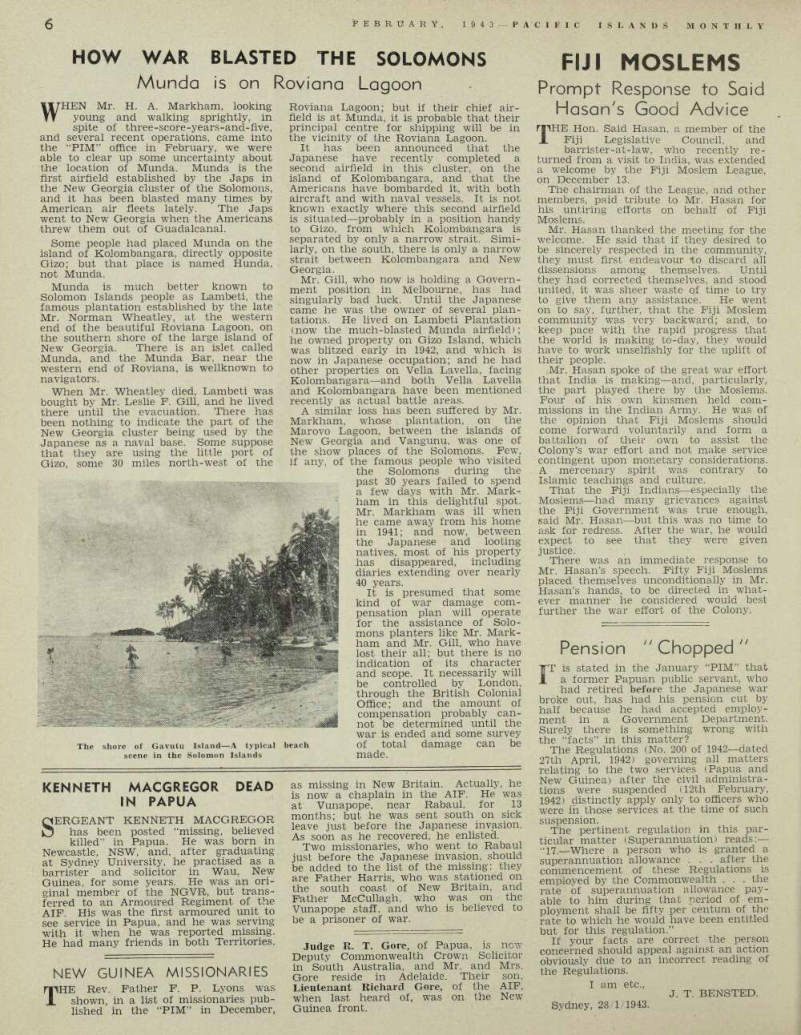
The shore of Gavutu Island —A typical beach scene in the Solomon Islands
Kenneth Macgregor Dead
In Papua
Sergeant Kenneth Macgregor
has been posted “missing, believed killed” in Papua. He was born in Newcastle, NSW, and, after graduating at Sydney University, he practised as a barrister and solicitor in Wau, New Guinea, for some years. He was an ori ginal member of the NGVR, but trans ferred to an Armoured Regiment of the AIF. His was the first armoured unit to see service in Papua, and he was serving with it when he was reported missing.
He had many friends in both Territories.
New Guinea Missionaries
THE Rev. Father F. P. Lyons was shown, in a list of missionaries pub lished in the “PIM” in December,
as missing in New Britain. Actually, he is now a chaplain in the AIF. He was at Vunapope, near Rabaul, for 13 months; but he was sent south on sick leave just before the Japanese invasion.
As soon as he recovered, he enlisted.
Two missionaries, who went to Rabaul just before the Japanese invasion, should be added to the list of the missing: they are Father Harris, who was stationed on the south coast of New Britain, and Father McCullagh, who was on the Vunapope staff, and who is believed to be a prisoner of war.
Judge R. T. Gore, of Papua, is new Deputy Commonwealth Crown Solicitor in South Australia, and Mr. and Mrs.
Gore reside in Adelaide. Their son, Lieutenant Richard Gore, of the AIF, when last heard of, was on the New Guinea front.
Fiji Moslems
Prompt Response to Said Hasan's Good Advice
THE Hon. Said Hasan, a member of the Fiji Legislative Council, and barrister-at-law, who recently re turned from a visit to India, was extended a welcome by the Fiji Moslem League, on December 13.
The chairman of the League, and other members, paid tribute to Mr. Hasan for his untiring efforts on behalf of Fiji Moslems.
Mr. Hasan thanked the meeting for the welcome. He said that if they desired to be sincerely respected in the community, they must first endeavour to discard all dissensions among themselves. Until they had corrected themselves, and stood united, it was sheer waste of time to try to give them any assistance. He went on to say, further, that the Fiji Moslem community was very backward; and, to keep pace with the rapid progress that the world is making to-day, they would have to work unselfishly for the uplift of their people.
Mr. Hasan spoke of the great war effort that India is making—and, particularly, the part played there by the Moslems.
Four of his own kinsmen held com missions in the Indian Army. He was of the opinion that Fiji Moslems should come forward voluntarily and form a battalion of their own to assist the Colony’s war effort and not make service contingent upon monetary considerations.
A mercenary spirit was contrary to Islamic teachings and culture.
That the Fiji Indians —especially the Moslems —had many grievances against the Fiji Government was true enough, said Mr. Hasan —but this was no time to ask for redress. After the war, he would expect to see that they were given justice.
There was an immediate response to Mr. Hasan’s speech. Fifty Fiji Moslems placed themselves unconditionally in Mr, Hasan’s hands, to be directed in what ever manner he considered would best further the war effort of the Colony,
Pension "Chopped"
IT is stated in the January “PIM” that a former Papuan public servant, who had retired before the Japanese war broke out, has had his pension cut by half because he had accepted employ ment in a Government Department.
Surely there is something wrong with the “facts” in this matter?
The Regulations (No. 200 of 1942 —dated 27th April, 1942) governing all matters relating to the two services (Papua and New Guinea) after the civil administra tions were suspended (12th February, 1942) distinctly apply only to officers who were in those services at the time of such suspension.
The pertinent regulation in this par ticular matter (Superannuation) reads:— “17 —where a person who is granted a superannuation allowance . . . after the commencement of these Regulations is employed by the Commonwealth ... the rate of superannuation allowance pay able to him during that period of em ployment shall be fifty per centum of the rate to which he would have been entitled but for this regulation.”
If your facts are correct the person concerned should appeal against an action obviously due to an incorrect reading of the Regulations.
I am etc.,
J. T. Bensted.
Sydney, 28/1/1943.
Broadcast By Sir
Harry Luke
Tribute to Solomons RC
SIR HARRY LUKE, former Governor of Fiji and High Commissioner for the Western Pacific, was the speaker in the BBC programme, “Calling the Islands” broadcast on December 16, re ports the “Fiji Times.”
His trip from Fiji to England had been uneventful, said Sir Harry; but, coming from a land of plenty, he had been im pressed by the strict rationing in Britain, not only of food and drink, but of clothes and even of soap. The city of London had been tidied up, and the damage to be seen was not as great as he had ex pected. Air-raids were rather in abey ance at that time, but nonetheless he had heard his first siren within 24 hours of his arrival.
Criticism of British Colonial adminis tration had greatly stimulated public interest in the colonies, and he had been called upon to do a great deal of lectur ing, broadcasting and public speaking since his return. He had addressed private meetings of both Houses of Par liament, had spoken before the Royal Empire Society and Overseas League and, only that day, he had a two column article published as a leader in the “Times.” On all these occasions he has stressed the importance of the ex tension of the Central Medical School in Suva.
The well-deserved honours bestowed on Lieut.-Colonel Marchant and other officers in the Solomon Islands had been welcomed by him, and by everyone in Britain who was interested in colonial matters, said Sir Harry. The people of BSI, the Gilbert and Ellice Islands Colony, Mr. Blandy (RC in the New Hebrides), his French colleagues there, and the people of the New Hebrides, were in the minds of British people at the present time.
Sergeant-Pilot Basil Chalmers, RAF, who left Fiji with the first contingent of Air Force recruits, is at present an in structor in an RAF Flying Training School in Southern Rhodesia. He has announced his engagement to Miss P.
Richards-Edwards, of Bulawayo.
Vale, "Dusty"
Miller
TN June, 1940, just after France had L collapsed, and Britain stood in greater peril than at any time in all her long history, the following was published in the “PIM”:— On May 10, Mr. Winston Churchill, Britain’s new Prime Minister, moved in to No. 10 Downing Street. One of the first radiograms placed in his hands read as follows: — “Samarai, May 9.—Congratulations.
Held fast. We are coming.—Dusty Miller.”
“What’s this? Is it a joke? Where’s Samarai?” snapped the anxious Prime Minister.
A solemn secretary, batting no eye-lid, said: “Samarai is in Papua, sir—an Aus tralian-New Guinea territory. I presume it means that some men have enlisted.”
“Oh,” said Mr. Churchill. “Well, we want all the humour we can get, these days—so long as there is a rifle at the end of it!”
In due course, Mr. G. E. Miller (Burns, Fhilp staff) and eight other men from isolated Misima Island, Eastern Papua, embarked at Samarai, to join the Aus tralian forces. Their average height is 5 ft. 11 in., and their average weight 11 stone 8 lb.
And that is typical—something that the dear old Hun, torpedoing merchant ships and smashing into neutral coun tries, has not figured on. For some weeks, now, from every little, lone out-post of Empire, a slow, grim, increasing trickle of free British men are hurrying to cen tral places for drill and armament, and to give, if need be, the service of their lives. Gradually, those trickles will become streams, and the streams a mighty tor rent, sufficient to destroy the goose stepping legions of Hitlerism. This old Empire is terribly slow to move —but, when it does move, God help its enemies. * * ♦ “Dusty” Miller, loved by all who knew him, joined the RAAF. He is reported to have been killed in action over Germany.
Miss F. E. Tolley, of the Fiji Methodist Mission, has been forced to resign because of continued ill-health.
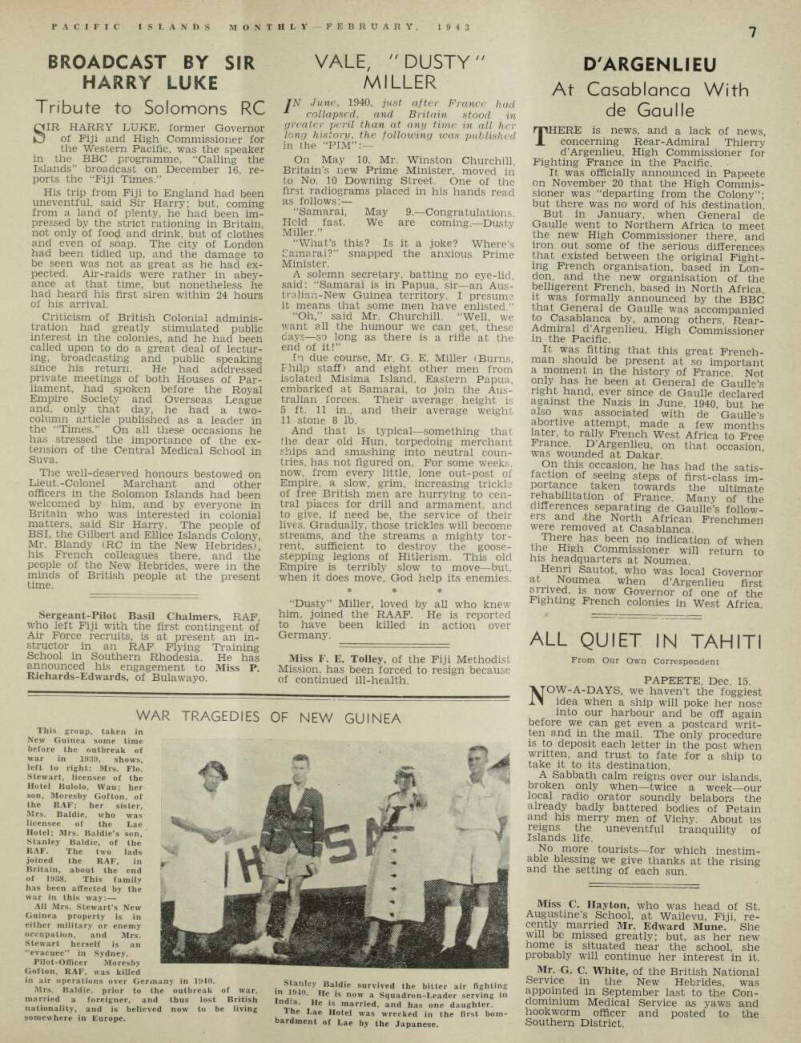
War Tragedies Of New Guinea
This group, taken in New Guinea some time before the outbreak of war in 1939, shows, left to right: Mrs. Flo.
Stewart, licensee of the Hotel Bulolo, Wau; her son, Moresby Gofton, of the RAF; her sister, Mrs. Baldie, who was licensee of the Lae Hotel; Mrs. Baldie’s son, Stanley Baldie, of the RAF. The two lads joined the RAF, in Britain, about the end of 1938. This family has been affected by the war in this way:— All Mrs. Stewart’s New Guinea property is in either military or enemy occupation, and Mrs.
Stewart herself is an “evacuee” in Sydney.
Pilot-Officer Moresby Gofton, RAF, was killed
in air operations over Germany in 1940.
Mrs. Baldie, prior to the outbreak of war, married a foreigner, and thus lost British nationality, and is believed now to be living somewhere in Europe.
Stanley Baldie survived the bitter air fighting * n He * s now a Squadron-Leader serving in India. He is married, and has one daughter.
The Lae Hotel was wrecked in the first bom bardment of Lae by the Japanese.
D'argenlieu
At Casablanca With de Gaulle
THERE is news, and a lack of news, concerning Rear-Admiral Thierry d’Argenlieu, High Commissioner for Fighting France in the Pacific.
It was officially announced in Papeete on November 20 that the High Commis sioner was “departing from the Colony”; but there was no word of his destination.
But in January, when General de Gaulle went to Northern Africa to meet the new High Commissioner there, and iron out some of the serious differences that existed between the original Fight ing French organisation, based in Lon don, and the new organisation of the belligerent French, based in North Africa, it was formally announced by the BBC that General de Gaulle was accompanied to Casablanca by, among others, Rear- Admiral d’Argenlieu, High Commissioner in the Pacific.
It was fitting that this great French man should be present at so important a moment in the history of France. Not only has he been at General de Gaulle’s right hand, ever since de Gaulle declared against the Nazis in June, 1940, but he also was associated with de Gaulle’s abortive attempt, made a few months later, to rally French West Africa to Free France. D’Argenlieu, on that occasion was wounded at Dakar.
On this occasion, he has had the satis faction of seeing steps of first-class im portance taken towards the ultimate rehabilitation of France. Many of the differences separating de Gaulle’s follow ers and the North African Frenchmen were removed at Casablanca.
There has been no indication of when the High Commissioner will return to his headquarters at Noumea.
Henri Sautot, who was local Governor at Noumea when d’Argenlieu first arrived, is now Governor of one of the Fighting French colonies in West Africa
All Quiet In Tahiti
From Our Own Correspondent
Papeete, Dec. 15.
NOW-A-DAYS, we haven’t the foggiest idea when a ship will poke her nose into our harbour and be off again before we can get even a postcard writ ten and in the mail. The only procedure is to deposit each letter in the post when written, and trust to fate for a ship to take it to its destination.
A Sabbath calm reigns over our islands, broken only when—twice a week—our local radio orator soundly belabors the already badly battered bodies of Petain and his merry men of Vichy. About us reigns the uneventful tranquility of Islands life.
No more tourists—for which inestim able blessing we give thanks at the rising and the setting of each sun.
Miss C. Hayton, who was head of St.
Augustine’s School, at Wailevu, Fiji, re cently married Mr. Edward Mune. She will be missed greatly; but, as her new home is situated near the school, she probably will continue her interest in it.
Mr. G. C. White, of the British National Service in the New Hebrides, was appointed in September last to the Con dominium Medical Service as yaws and hookworm officer and posted to the Southern District.
Turning
How The Pacific War Is
Allies' Growing Air-power is the Factor That Mr. Tojo of Tokio Forgot
THERE have been important and significant developments in the Pacific war during the past month.
They may be summarised thus: — Late in January, Australian and American forces wiped out the last of the Japanese in the Gona-Buna area, and thus cleared Papua of the enemy.
Early in February, the Americans attacked and destroyed the Japanese remnants on Guadalcanal, thus clearing the enemy out of the southern half of the British Solomon Islands.
The Japanese, after leaving the north coast of New Guinea alone for a year, have established naval stations and airfields there—especially at Wewak and Madang.
Japanese from the Salamaua-Mubo district infiltrated through the moun tains and made a sudden attack, in considerable strength, upon Wau. in the Upper Bulolo Valley. They were discovered in time, broken up and driven back into the mountainous jungle east and south-east of Wau.
A few days later, on February 6, the
Japs sent over very large air forces to attack the Wau aerodrome. They were caught by Allied air forces, which destroyed or severely damaged 41 Jap planes, without losing one machine.
While the Japs appear to have made landings at one or two points on the south-western shores of Dutch New Guinea, Allied air forces have almost wiped out Japanese establishments in the Aroe and Tenimber Islands, be tween Dutch New Guinea and the North Australian coast.
There have been persistent reports, originating in Tokio, of a naval and air engagement in the Solomons, in which the Americans sutfered heavy losses. The Americans report much sporadic fighting, but deny there has been a major battle, and they describe the Jap reports as much exaggerated.
On February 9, Tokio announced that, having achieved their object and accomplished their mission, Japanese forces have been withdrawn from North-east Papua and Guadalcanal.
Changing Character of Pacific War
OUT of a consideration of the foregoing facts, it is possible to make the following generalisations regarding the progress and prospects of the Pacific war.
The Americans and Australians most definitely have pricked the bubble repu tation of the prowess and “invincibility” of the Japanese. Less than a year ago, hysterical writers were telling us about these “trained and dangerous jungle fighters,” and about the skilled Zero fighters, and the bombers who preferred immolation by hurling themselves and their machines upon their targets, rather than let their enemy escape.
To-day, we know that trained Austra lians and Americans are much better jungle-fighters than the Japs; they have thrashed them soundly wherever they have met them —on Guadalcanal, on Tulagi, on the Owen Stanley Range, in Milne Bay, at Kokoda and Buna.
As we learn more of the fighting in the Papuan jungles, from the Owen Stanley track back to Buna, we realise that the Allied soldiers have surmounted what were probably the worst fighting conditions ever known in the world; that they beat the Japs at their own game of camouflage, infiltration, jungle sneaking and sniping, and that they almost certainly will now beat the Jap wherever they meet him.
IN the air, the change that has taken place in twelve months is of tremen dous significance. Between January and March last, the Japanese fliers were apparently supreme—they were doing almost what they liked with our bases, from Timor to Northern Australia and from Papua through New Guinea to the Solomons.
But, month by month, as the battle wise Australian pilots came back from the Middle East and Europe, and the young Americans arrived with their superb machines, the situation altered; until now the Allies are supreme in the air over North Australia. a,nd as far northwards as their great bombers will fly.
The result of the air battle over Wau
on February 6 was no accident —and it was a revelation of what the Allied air men can now do to the Japs.
The mounting air-power and growing aggressiveness of the*Allies suggest that some significant move by the Japanese will soon be made. They must either strike at the Allies in the South-west Pacific with all the force they can muster; or they must fall back towards the north west, and shorten their present all-too vulnerable lines of communication. As a third alternative, they can stand and fight; but, if they do, they will suffer grievous losses.
Japan cannot hope to hold all these Islands Territories against the increasing strength of the Allies unless she has ade quate communications. That means that she must have shipping. Even in the beginning, a year ago, her available shipping was barely sufficient for her pur poses. Since then, her losses in mer chant shipping have been enormous.
ALMOST every day, in the New Guinea-Solomons area, a Japanese ship or two is destroyed by our air men. In this area, she is extremely vulnerable to attacks on shipping. As our air power grows, she will lose more ships—until she will find her communi cations crippled.
Therefore, dare she remain in this area? Shipping is her Achilles heel. It would seem that she must cripple our power to attack her southern shipping from the air, or she must fall back and seek safer waters.
Day after day, week by week, Allied aircraft are ranging over all the Japanese bases within striking distance — bases in Timor, in the Aroe and other Arafura Sea islands, in northern New Guinea, in Lae, Salamaua, and Gasmata, in Rabaul, in New Ireland ports, in Kessa (Buka), in Buin (Bougainville), and in half a dozen places in the British Solomons —and the enemy cannot in definitely suffer the hammering they are giving him, and the losses they are inflicting. Now and again, Jap planes
attempt Interception; but the Allies, with little loss to themselves, shoot them down in such numbers that the Jap attacks are dwindling in numbers and in power.
We can hope that the Japs will try to hang on in New Guinea and the Solo mons; because, as long as they do so under these conditions, their sea-borne communications, which are vital to them, are bleeding to death. It is idle to guess at what they will do. The Jan mind does not work like the minds o"f other reasoning beings.
THE Tokio announcement about the Japanese retirement from Papua and the Solomons cannot be taken at its face value. We know, as well as Tokio knows, that the Japs on Guadalcanal and in Papua were practically exterminated— only remnants escaped.
Therefore, the announcement clearly was compiled for home consumption. It may mean one of two things—either that the people of Japan are being prepared for news of a further and bigger with drawal, or that the Japanese are pre paring for another and bigger thrust at Allied Territories in the south-west, and are trying to lull the Allies into a false sense of security.
We soon shall know. The present situation in New Guinea and the Solo mons may not continue.
OF course, now that the Japanese are going back, we cannot expect the Allied forces in the South-west Pacific to stay quiet. The Japanese may be expecting the Americans and Aus tralians to attack them in New Guinea and the Solomons; and these recent moves of theirs, at Wewak, at Wau, and elsewhere, could be consistent with a plan to stand on a defensive line in New Guinea and the Northern Solomons, and inflict the heaviest possible losses upon the attackers.
Again and again, in this journal, we have expressed the view that the defence strategy of Japan is to fight on to the death, in an endless series of fortified posts, extending back over countless islands, in the belief that the Allies will not be prepared to pay the heavy cost of smashing all the way northwards, through all the archipelagoes.
Significant Words
It was a good plan; but it left out of account one thing that will prove to be the deciding factor —air-power. The air power that already is cripping Japan’s South Pacific communications will alter the complexion of this Pacific war, ultimately, and in such a way that we shall not be called upon to attack that cunningly-calculated series of fortified islands. Here is how the South-west Pacific Commander-in-Chief himself (General MacArthur) summed it up, on January 25: “The offensive and defensive power of the air force, and the adaptability, range and capacity of its transport, in an effective combination with ground forces, represent elements of a broadened con ception of ivarfare. They permit the application of offensive power in swift, massive strokes, rather than the dilatory and costly island-to-island advance that some have assumed to be necessary to a theatre where the enemy’s far-flung strongholds arc dispersed throughout a vast expanse or archipelagoes.”
On February 11, Mr. Churchill made a most important statement, in which, he said, President Roosevelt concurred. Here it is:— “British and American strategists are unanimous that the breaking of the German power must have priority over a decisive blow against Japan.
. While Hitler is being destroyed every effort will be made to keep Japan thoroughly occupied.”
If we study the Pacific war outlook against the background of the highly significant words of General MacArthur and Mr. Churchill, much that may now seem puzzling becomes clear.
The task before the Allies in the Pacific is enormous, almost appalling; but we may see it now, as we could not perhaps see it a year ago, as a task capable of fulfilment, within a reasonable time. It is true that Japan is a nation of nearly 100.000. people, and can oppose us with 6.000. armed and resolute men. But this is a war which will be decided by machine-power rather than manpower; and in that respect we have two great and growing advantages:— 1. —We can not only out-fight Japan in the air—we can, so greatly out-build her that, even if her airmen were super airmen (which they certainly are not) we can overwhelm her with the numbers and speed of our squadrons. 2. —As our air-power grows, we shall to a corresponding degree harass and cripple the sea-borne communications of Japan, which are vital to the effective operations of the vast defensive plan she has pre pared.
The Journals Of Fighting
France
IN response to many requests, LE NEO HEBRIDAIS has published the names of the following journals of Fighting France. They are:— FRANCE.—BS Fleet Street. London, EC4.
FRANCE-ORIENT.—IS Rajpur Road, Delhi, India.
La Voix De France.—3O6 West 105Th
Street, New York.
Pour La France Llbre.—Casilla
3752, Santiago du Chili.
LA FRANCE LIBRE. —15 Queensberry Place, London, SW7.
Bulletin Radio-Presse Du Com
ITE DE GAULE.—Libertad 192, Bue nos Ayres, Argentine.
Information has been received by the headquarters of the Methodist Mission in Sydney that the Jasper Williams Boarding School in Lautoka, Fiji, has been taken over by the Government for “special purposes.”
The Evacuees' Fight Goes On
A GENERAL meeting of members ol the Pacific Territories Association will be held at 8 p.m. on March 10, in the Teachers’ Federation Hall, Phillip Street, Sydney.
The Association has continued its cor respondence with the War Damage Com mission, the Minister for External Ter ritories and certain Federal departments on the subject of evacuees’ claims, but little progress has been made.
Inquiry Into Civilian Claims
In a letter to the Pacific Territories Association, dated February 3, Mr. H. G.
Alderman, who has been inquiring into civilian claims against the Commonwealth Government, in New* Guinea and Papua, stated that he expected to visit Sydnev in two or three weeks, and when in that city he would confer with the Associa tion, and persons owning property in the Territories.
Prime Minister’S Reply
Last month the Pacific Territories Association again approached the Prime Minister, pointing out that it had been entirely unsuccessful in obtaining from the Federal Government any information concerning the control of properties or the matter of compensation to owners, following action taken in New Guinea and Paoua, under the Industries Control Order issued on April 24, 1942, by the military authorities.
In a letter dated February 2, Mr. Cur tin informed the Association that all aspects of these matters had recently been discussed with the Commander-in- Chief, Sir Thomas Blarney, and that he, the Prime Minister, had asked the Minis ter for External Territories to advise the Association fully in all the matters as soon as it was possible to do so.
Value Of Chattels For War
Damage
In response to an inquiry by the Asso ciation. the War Damage Commission has forwarded the following advice regarding the method of arriving at the values of private chattels for purposes of claims for compensation under the War Damage to Property Regulations. This advice was asked for in view of the fact that there
appeared to have been some confusion generally, as to the basis of such values: “The amount of compensation payable for private chattels would be the reason able and proper cost, as at the date of the occurrence of war damage, of replac ing or restoring the damaged goods to the form in which they existed immediately prior to the occurrence of war damage.
In practice, this would be the replace ment cost of goods, less an allowance for the depreciated condition of the destroyed articles; in short, the value of the goods at the time of damage.*’
As regards plant, the basis is the same, but in cases where items are unprocur able at the moment, the value would be the cost of such items when last avail able in reasonable quantities, less depre ciation.
Deferment Of War-Damage
Premiums
During last year the Association made representations to the War Damage Commission and the Minister for Exter nal Territories for the deferment of War Damage Insurance contributions on pro perty situated in Papua and New Guinea, where it could be shown that the owners were quite unable to find the money for such payments, or payment would cause serious hardship. Eventually the authori ties agreed to this request and in numer ous cases contributions for 1942 were deferred accordingly.
The War Damage Commission, how ever, recently notified the Association tnat where contributions for 1942 had not yet been paid on property in New Guinea and Papua voluntarily insurable, such contributions must be paid immediately, otherwise the Commission would not be b<^ n i*? consider claims for damage which occurred to such property in 1942 —such decision not to apply to owners who are prisoners of war.
Against this decision the Association has made a strong protest, pointing out the serious hardship this would cause some Territorial residents now in Aus tralia, and unable to find the necessary money for contributions—in some cases comparatively large sums—also that Swv, residents of the Territories are still there in the forces, and there are others whose whereabouts are unknown.
Pearl Shell
Industry Revived in French Oceania
Prom Our Own Correspondent
Papeete, Dec 4
FOR the first time in fifty years or more the pearl fishing grounds of the Tuamotu archipelago are open for unrestricted winning of mother-of pearl shell.
Indeed, so diminished had the world market for this commodity become, dur ing recent years, that little or no diving had been carried on for a long period In normal times, only one lagoon at a time was open for diving, and that of one of the large atolls. Hikuero. Takume or Makemo. Now we have shell from islands seldom heard of in the past— Marutea, Katiu, Takapoto and others.
Were the duchess or Mrs. Traohagen (wife of the popular pork packer of Council Bluffs) aware of the nerils of pearl diving, they might value each bauble of the string they wear about their throats as a DSO, or other symbol of valor. Diving machines are not allowed in the Tuamotu lagoons. Anv native may go down into the deaths and whatever he brings up—be it shell or a pearl worth a king’s ransom—is his per sonal property.
The adventure is far from easv. The diver must be sturdy and deen of chest for the shell lie at great depths, and he must stay down to grope for his treasure far beyond the endurance of ordinary mortals. If he escapes the dangers of the deep—the prowling shark, the lurking octopus, the savage conger-eel, Tridacna traps, or stinging hydrozoa—naralysis awaits him at the end of the road, should he persist long in deep-water diving.
The pearl oysters are always opened at the fishing grounds and the flesh (which contains the spawn), after care ful search for pearls, is cast into the water. Had this procedure been followed in the Gambier Islands in the early davs of near! fishing, that vast lagoon would stul be one of the richest sources of wealth in the South Seas.
Many exquisite pearls were taken from the Gambier lagoon. The largest and most beautiful of all was set in the tabernacle of the high altar in the vast church on Mangareva.
Whether the gem now there is the true original pearl of great price or a clever imitation—installed to conceal the rape of the original jewel—is a riddle which has remained unanswered, after many years of discussion and speculation.
Pearl shell is again in request, for some purpose or other not revealed to us. re y ived market for shell and higher returns for copra have rescued the people of the Tuamotu atolls from a pretty grim state of privation On November 30. copra in Papeete was S 6 l a in f fr ’ 10 per kilo > and Pearl shell at 10 francs per kilo. fi^? 6V e ?* F Goldie ’ who has charge of e ,, Islands section of the Methodist Mission, left Australia recently for New Zealand, after many harassing months spent vainly in seeking infor mation of compensation likely to be paid in respect of mission properties destroyed bv war. Mr. Goldie’s headquarters, on the Munda coast of the Roviana Lagoon, New Georgia, British Solomons, are now actually the headquarters of the Japanese
thereabouts.
War Damage Commission Appears
As A Hollow Sham
Accumulating Evidence of How Territories People Have Been Deceived by "Insurance" Scheme
INSTALLED in elaborate offices in the capital cities of Australia, and functioning in the full panoply of directors, secretaries, private secre taries, accountants, commissionaires, and so forth, is the Australian War Damage Commission—one of the many bloated creations of a nation at war.
The Commission was planned to provide machinery by which Aus tralian citizens, who had lost property through the misfortunes and accidents of war, might arrange insurance and
receive compensation.
That was what was planned; but the thing has become, instead, what is colloquially called “a pain in the neck.” If the Curtin Government remains in office, and the Commission goes on its way unchecked, it will become —so far as Territories people are concerned, at any rate—Public Enemy Number One.
IN the beginning, was heartily applauded. Everyone in Australia and the Australian Pacific Territories was to insure his property against war damage—owners of buildings were to insure compulsorily, and owners of all other property voluntarily. All premiums would go into a single pool. Out of that pool, war damage compensation would be paid. Nothing could be fairer—the people who luckily escaped war damage would pay, pro rata, for the unlucky ones. The response was enormous. Something like £8,000,000 was accumulated in the first year of operation.
The War Damage Commission was the bright and particular silver lining to the cloud of troubles which surrounded the unfortunate evacuees from New Guinea and Papua. They arrived in all stages of financial distress, from half-ruined to totally broke. “But let’s cheer up,” they said. “We at least shall receive compen sation from the Australian fund—we may be able to make another start.”
And, when they saw that the Austra lian fund was not likely to have Austra lian mainland claims made upon it— apart from Darwin and Broome —they did cheer up. The fewer mainland claims, the bigger the compensation for the Territories.
BUT they calculated without the poli ticians and the bureaucrats. They got their first shock quite early in the year, when they were officially ad vised that “war damage” was defined as direct war damage, and direct war dam age was damage caused by actual war operations, such as bomb explosions, a building torn down by fighting troops, the application of a scorched-earth policy, and so on. Damage caused by looting, or by the deterioration of pro perty in the enforced absence of the owners or caretakers, was not war dam age, and compensation could not be claimed.
The people of the Territories were lit erally stunned by this announcement. At first, they could not believe that this Commonwealth Government would be a party to such cruelty, and such muddled thinking.
But, now, they know better. They know that the Canberra gang, under whom they have suffered during all their lives in the Territories, are completely indifferent to what the Territories people may feel or think.
The Canberra gang is concerned only with politics. The Territories people have no votes and little influence in Aus tralia; so the War Damage Fund must be reserved for mainland plans and pur poses, and not dissipated among Terri tories claimants. Every million saved from the Territories will be another mil lion available for the Canberra spend thrifts. A million spent in the Territories will not bring another vote; but a million spent cunningly in Australia may save another precious Government seat.
During the past six months, the Com monwealth Ministers and the War Dam age Commission have been appealed to again and again by the Territories people; but they will not even give a direct answer on this question of what is and what is not war damage. They merely dodge, and duck away, and pass the questioner on to someone else.
WELL, there seems to be little else that the Territories people can do —just now. But, before this year ends, there will be a Commonwealth general election; and every Territories resident in Australia should make it his or her business to become a focal point of acti vity in his or her particular electorate, to work for the unseating of the Federal member.
It does not matter whether that mem ber is Government (Labour) or Opposi tion (United Party)—they are all equally to blame for the position that exists. Mr.
Fadden’s party is no more interested in the Territories people than is Mr. Cur tin’s party; and the Fadden Government, which was defeated in 1940, was. if any thing, more futile and contemptible than the Curtin Government.
MEANWHILE, interesting things are happening to the War Damage Commission plan.
The Australian people generally have awakened to the nature of the Govern mental ramp that is being worked. They were urged to insure their property against war damage and, in the first year, they readily took out insurance.
But now they have discovered, through the unfortunate experiences of the Paci fic Territories evacuees, that the War Damage Commission will give no clear indication of the nature of the insurance that is being given; except that pay ment, of some kind (extent not indi cated) can be expected only if the pro perty suffers direct, and not consequen tial damage.
A hypothetical case was put to the Commission: If a bomb made a hole in the roof of a house temporarily unoccu pied, and rain subsequently came through and damaged the contents of the house, would the latter damage be covered by war damage insurance? The Commission said: “No. Compensation would he paid in respect of the direct damage to the building, and not in respect of the conse quential damage. r So now, in the second year of the insurance nlan. the Australian public is awake to the ramp, and the Australian
public is not renewing its war damage insurance. Some millions will come into the fund, nevertheless, under the compul sory clauses which force all owners of buildings to insure, but a great proportion of those who voluntarily insured are not now insuring. And who can blame them?
THE Territories people are carrying on individually their apparently hope less fight for justice, and some interesting letters have come under our notice.
Here is a letter from a resident of Papua, now living in Melbourne. He was evacuated from Port Moresby at very short notice, and compelled to abandon his house, furniture and personal effects, all of which appear to have been lost — although not by “direct” war operations.
“I have interviewed a lawyer about war damage—trying to find out what the posi tion is, and how long we are expected to continue paying premiums. He was no more successful than I had been in get ting: information from the Commission.
“But he volunteered the opinion, ‘with out prejudice,’ that in accepting premiums the Commission had entered into a con tract, and that the terms of that con tract cannot be varied without the con sent of the other party—namely, the pro perty owners. Thus, unless the terms were explicit at the time when the pre miums were paid, they must be taken as being such as are usual in insurance policies/’
This is very interesting; and we believe it is a view which is held by many well informed people. Territories people who accept the view that the Commission must pay for consequential war damage, as implied in the contract they made in the beginning, and irrespective of how the Commission now may argue and niggle, are very carefully continuing the payment of their premiums. They intend to hold the Commission to the contract.
Here is another kind of letter. A woman now resident in New South Wales owns plantation property in a part of New Guinea that is entirely in Japanese occupation. She has-been asked to con tinue payment of her premiums. Here is part of her answer: — “I am unable to pay any premiums for war damage insurance. Seeing that the Japanese have taken the plantation and all the income therefrom, any payment from me can hardly be reasonably ex pected. Most of my private income has gone, also, as I had a good deal of money lent on plantations up there.
“Even if I paid any insurance, I have grave doubts about being reimbursed for loss in any way, as the conditions the Commission lay down are in my opinion quite impossible.
“The Government copra pool owes me money for copra taken before the Jap invasion, but I have had no word of this being paid.
“I filled in all the forms that were sent, but, as I am working very hard indeed, I find it difficult to get time to reply to all the many questions. Ordinary work ing people, such as most of us are these days, have not the time which a Gov ernment clerk has to devote to this kind of thing. Therefore, I must just let the estate take its chance.”
Then there is the remarkable case of a resident of Lae. He had only recently gone to live in Lae, and had brought his furniture and effects from Rabaul. He was in Lae when the Japs blitzed the place in January, 1942, and smashed it up~he was one of those who subsequently walked from Lae to Wau, and got aw*y south by plane. Therefore, he was in the unique position, not only of knowing
what damage had been done to his pro perty, but also of being able to support his claim for compensation payment with statutory declarations. The latter, made by himself and others, described the actual loss, and showed the approximate value of the property lost, as it was in his house in Lae, and as it. was when it was transported from Rabaul to Lae.
This probably is the only case yet on record of a claim being made, in com plete and proper order, for payment from the insurance formally effected with the War Damage Commission, The following is the reply of the War Damage Commission, dated November 11, 1942. Certain names and amounts, for obvious reasons, are omitted:— “With reference to your claim for £285 in respect of your property at Lae, New Guinea, I have to advise you that the Commission is satisfied that the evidence submitted by you indicates, on examination, support for the sum of £2OB, and that the damage was ‘war damage.’ This, in the opinion of the Commission, carries your claim as near to finality as can be reached at this juncture.
“Consideration of the remainder of your claim, representing an amount of £76, has been deferred, pending receipt of further evidence of destruction.
“The foregoing statements are made without prejudice to the right of the Commission to review, for the Commis sion is not disposed to formally admit liability, and assess and record your claim, until it is possible to inspect the damage and secure such further infor mation as may be procurable in the Territory. These further steps will be taken as soon as possible.
“As regards interest, which assessed and recorded compensation shall bear under National Security (War Dam age to Property) Regulations, the Commission intends that credit be allowed on a basis which will be equit able as between all claimants, when it is able to determine the amount finally to be assessed.
“(Signed) M. J. Cronin, “State Superintendent of Claims.”
There is the plainest possible proof—if proof is needed—that this War Damage Commission is a mere pretence. Its object is not to assist people who have been ruined by the war to plan rehabilitation, or to give reassurance, or to do anything at all to help the evacuees. Its purpose is to “stall”—to delay, and avoid accept ance of any kind of responsibility.
In this particular case, it could not deny the claim; so it found refuge in refusing finalisation until “it is possible to inspect the damage.” Heaven knows when that may be—the Japs still are in Lae. It will not even allow interest on the amount provisionally assessed. It dodges this responsibility by putting the matter off until “it is able to determine the amount finally to be assessed.”
There is nothing more foul in the appalling record of the Curtin Govern ment than this accumulating evidence of how the War Damage Commission is treating the people of New Guinea and Papua.
"Limb"-Not "Bough"
MAY I make a comment on one of your interesting editorials?” writes Mr. Elmer R. Murphy, of Pasadena, California. “You say: ‘Americans have a saying that “He is out on a bough.” ’
The phrase should be ‘He is out on a limb.’ The word ‘bough’ is not used much in America.”
Native Pastors
Question of Their Value
TIMES are changing, so maybe I shall have to acknowledge myself wrong ” writes Mr. F. T. Goedicke, of Haapai, Tonga. “But I never could see the value of Polynesian teachers (Samoans Tongans and Fijians) placed by the European missionaries in the primitive Melanesian villages. The primitives will not give to the Polynesians the respect they give to the Europeans. When I was in New Britain in 1885 (57 years ago!), the unregenerate cannibals of those parts killed and ate a number of their Poly nesian ‘teachers,’ after they were intro duced to that region by Rev. George Brown.
“On one occasion, seated on a nearby trader’s verandah, I saw a Fijian ‘teacher’ —a very big fellow—come along to his little church, and beat his lali. No one obeyed the call to service. The Fijian, looking very stern, took a spear and went out along the beach. He met a native— one of the most well-behaved and in offensive in the tribe. He asked the native to come to church. The native refused. So the big Fijian seized the fellow and headed him towards the church; and then, with an occasional prod from his spear at the man’s back side, he kept him going. When the con gregation was inside, the preacher got into his pulpit and began to sing a hymn.
Whereupon the native got up and bolted through the door; and although the preacher gave chase, his congregation got safely away, and he sadly closed his church.
“Missionary effort of the old days was surrounded by many such absurdities; yet, nevertheless, as the years passed, some thing was achieved. To-day, where once we had cannibals, we now have clerks and radio operators and native medical practitioners.
“I never liked native teachers, but I suppose I may not dogmatise.”
Death Of Mr. E. W. W.
Harness
ANOTHER old resident of Fiji, Mr.
Edward W. W. Harness, has passed on. He died at the Memorial Hos pital, Suva, on December 17, at the age of 77 years.
Mr. Harness was a New Zealander and first went to Fiji in 1883. His father was in business as a contractor in Suva for many years and his son followed in his footsteps. Later, he was in charge of the Government Gardens, until he went to a copra estate at Taveuni.
He is survived by his wife, three sons (Mr. G. Harness, of Tailevu, Capt. E. W.
Harness, formerly of RCS and Mr. Alex. Harness, of Qaravula Estate), and three daughters (Mrs. H.
Agnew, of Suva, Mrs. Speedy, of New Zealand, and Mrs. R. Speight, of Tailevu).
Old Copies Of " Pim "
THE following old copies of the “Pacific Islands Monthly” may be obtained from Mrs. Dorothy Waterhouse (widow of the late Mr. J. H. L. Water house), whose address is c/o Dr. W. L.
Waterhouse, 30 Chelmsford Avenue,
Lindfield, Sydney:—
August to December, 1930.
January to April, 1931. December, 1931.
February, April and June, 1932.
November and December, 1936.
February and March, 1937.
The “PIM” was established in August, 1930, and copies of the early issues are now unprocurable.
fields—New Caledonia
New Roads—New Air fields—New Caledonia
From Our Own Correspondent
Noumea, Jan. 1.
NO single worker has contributed more to New Caledonia’s war effort than Australian tractor-driver Oliver Jones, who comes from the Dorrigo, Grafton and Kyogle districts of New South Wales.
To-day, there is scarcely an airport runway in the island in which he has not had a hand—usually it is he who pulls the first stump and who remains to complete the surfacing and dig the last ditch.
Jones arrived in 1938, speaking not a word of French, under contract to cut and haul kauri timber for Australian veneer-making, out of the wild moun tain slopes of the Chaine Centrale. He immediately became a mystery to the locals, who had never seen a caterpillar tractor or a tractor-driver in their lives.
They were startled when, in a matter of weeks, practically unaided and with everything against him he put in 35 kilometres of road through winding tor tuous country traversed by creeks, which would have taken them years of painstaking building. Since then, when ever they come across him and his tire less and inseparable RD6 caterpillar they say to one another: “Voila I’Australien Monsieur Jones. C’est un grand travailleur!”
Early in 1941 he was requisitioned for defence work by the New Caledonian Government, putting in four months on an Australian surveyed airport. He was an indispensible part of their defence organisation until, sometime in 1942, the American Army took him over.
From about the beginning of 1942, under the spur of the Japanese menace, the Free-French-plus-Jones effort was vastly augmented by the arrival of Aus tralian Main Roads Board employees, complete with rock crushers, grinders compressor drivers, RDB caterpillars and all other necessary material. They came under a six weeks’ contract, but stayed for some time longer, and many of them later volunteered for United States Army constructional work, and stayed on, ac cepting American in preference for Aus tralian rates of pay, this being a dollar an hour and one and a half dollars an hour for overtime. A large party of em ployees of the Hawaiian Construction Co. was also on the island for some months.
Other good work, on local airports has been done by the marines and army en gineer battalions—the latter have won recognition from Department heads in Washington. In fact, airport construc tsol} in New Caledonia has been a real United Nations affair, and one must not forget the assistance of hundreds of Melanesian natives and Javanese and Indo-Chinese coolies under Caledonian white foremen. But when individual per formances are spoken of, both French Public Works officials and the American Army would probably agree that Jones’s contribution has been outstanding.
Dr. Donald Buchanan, who was form erly port medical officer in Port Moresby, Papua, died recently in London.
Judge F. B. Phillips, of New Guinea (popularly known as “Monty” Phillips), who went to Britain late in 1941, on spe cial duty with the RAAF, has now attained the rank of Wing-Commander.
He served in the 1914-18 war; and he was the administrative officer in charge at Rabaul when the eruption occurred in 1937. and rendered distinguished service in superintending the evacuation,
Overlanding Cattle in N
N. Guinea Useful Wartime Work by Harry Lumb and Dan Leahy
THE value of the work being done by residents of Papua and New Guinea, now attached to the Australian Army, cannot be over-emphasised.
Elsewhere in this issue are reports of the activities of the NGVR, both on the mainland and in New Britain: and now details have been released of how two well-known Morobe men overlanded 500 Zebu cattle, from Madang to Wau, in order that Australian troops stationed in Wau might have fresh meat.
The men are Corporal Harry Lumb and
Rifleman Danny Leahy, both formerly members of the NGVR.
Danny Leahy is one of the famous Leahy Brothers, who have done much valuable exploration work in New Guinea and who hold the only mining leases in the remote Mt. Hagen district.
Before the Pacific war, Harry Lumb owned and worked a mining lease in the Bulolo valley. Away back in September, 1930, the “PIM” published an account of how he, in company with Mr. Simpson, brought meat “on the hoof” all the way from Salamaua via the Buang mountain track, to the hungry miners of Morobe.
On that occasion, goats and horses were overlanded as well as cattle and, although the trip took many weeks, and the routs was over some of New Guinea’s toughest country, only one horse was lost.
It is known that Australian troops have been stationed in the Wau district for many months. Since land fighting began there about January 26, few of these troops have had a chance to change their clothes and they have been feeding when and where they can.
It is chilly on these uplands at night and conditions for the men were as gen erally unpleasant as conditions can be in New Guinea. The only fresh food—as an alternative to the eternal “bully”— was meat. And how this meat was obtained is a little epic in itself.
The following story—from the “Sydney Morning Herald” of February 6—tells how it was done: — Shortly before the Japanese landed at Madang, Corporal Harry Lumb and
Rifleman Dan Leahy mustered 500 Zebu cattle from a station, after a 12 days’ walk from near Wau.
While in the area they obtained two horses from a mission and broke in nine others from the station, which had reverted to their wild state. After round ing up the cattle Lumb and Leahy had a party of 2b natives, who were with them, fence a number of miles of the coastal road to make a huge droving race so that by the time the cattle had travelled through this they were sufficiently disci plined to be driven through the open bush inland.
The first stage of this difficult journey was over a 3,000 ft. mountain range behind Madang, along a 2 ft. to 3 ft. wide trail on which the cattle had to move in single file. The track was rough
and muddy and the stage took a week.
Droving was easy from then on, over rolling grasslands. In Lumb’s absence, the natives on his instructions, but with out supervision, had cut an excellent wide track through the next timbered stage, including a five chains long, 5 ft. wide bridge.
The natives who had accompanied txie men refused payment for their services and the 500 cattle cost the Army £6o— for Lumb and Leahy.
The horses and cattle, photographed just after they had arrived in Wau, in 1930. Mr. Lumb, with his horse, is in the background.
Acute Shortages
Norfolk Island Suffers Acute Shortages
DURING the six months ended Decem ber 31, 1942, the trade of Norfolk Island was wholly with Australia.
The figures are; — To 31/12/41. To 31/12/42.
Imports . . £14,197 £11.543 Exports .. 1,352 740 The 1941 figures were near normal (taking the years 1933 to 1940 for an average). The 1942 figures, due to ship ping dislocations, are quite abnormal.
Norfolk Island is a fertile place, and there is an abundance of locally-produced foodstuffs. But of all kinds of manu factured foods, such as are usually com prised in imports, there is a very acute shortage.
Mr. Percy Chatterton, of the London Missionary Society, is on short furlough in Australia from his station in Papua,
Nurse's Escape
Hid From Japs in Solomons
From Our Own Correspondent
Noumea. Jan. 14.
ESCAPE in a canoe, in which one of the natives was so nervous, when passing a Japanese base, that he shook the whole boat, was one of the recent adventures of Miss Merle Farland. of Auckland. She was a nurse attached to the Methodist Mission, in the Solo mons, and was the only nurse still on a Japanese-occupied island during the last nine months. She got back to safety here, a mere slip of a girl, sick with malaria, and weighing not more than 90 lb.
Since May last, Miss Farland had been on the qui vive all the time, dodging the Japs. She spent 18 months in all in the Group, nursing in a number of hospi tals, mainly on Vella Lavella and New Georgia.
Her narrowest escape was that referred to above, when she and nine native paddlers were trying to get round the Japanese base. They suddenly heard a large ship coming in, and then a smaller one, which turned out to be a barge going backwards and forwards with sup plies and personnel. They hid at the mouth of a river for two hours, hoping the Japs would not come in and find them.
Miss Farland was three weeks on the island before she was rescued. “I saw the Japs many times, but they didn’t see me,” she said. “When I heard the barge coming and we made for shelter. I was not terribly frightened, because I thought we could get away into the bush quickly, and I had had a good deal of experience of getting around in the bush.”
She said that when canoeing past another Jap base, she lay down flat in the bottom of the canoe. Peeping over the edge of the boat, she could see the Japs running up and down on shore, pointing at them. Evidently they were anxious to come out and investigate, but she knew they had no boats in the day time, although the Jap landing boats came in at night.
When she was at another Methodist mission hospital, further north, the Jap planes used to come down so low that the Japs could see in through the win dows “I could see their heads myself as they flew by,” Miss Farland said, “al though I used to hide from their view because, if thev had seen a white woman, they would probably have come along to investigate.
“I watched the American bombing of another island. We could see the anti aircraft fire and the smoke left by the US bombers after their dives, when we saw them sween up again. The Japs finally abandoned their base. But they used to patrol the area, and one day a des troyer came in so close that I could see the people on deck. However, she pulled out without sending anybody to look us up.”
It was reported from Cairo on January 5 that Lady Tedder was killed in an air crash while returning from a tour of wel fare centres and hospitals in Cyrenaica.
Lady Tedder was the wife of Air Marshal Sir Arthur Tedder, who formerly was in the Colonial Service, and served in Fiji as a cadet before leaving the Colony to serve in the last war.
Soldier’s N. Guinea-born Child Must
be Registered—or Else!
NSW Department Helps Harassed Wife When Federal Department Fails
IT is well known that all New Guinea records of Births, Deaths and Mar riages were lost when the Japanese occupied Rabaul in January, 1942. It was understood, at that time, that the Fed eral Government proposed to take some steps to cover this difficult situation—so that a lady might legally lay claim to her husband, and a mother to her child. But the Federal authorities have done noth ing, and the difficult situation remains just that.
The following account of her proceed ings, from an evacuee who has just suc ceeded in registering in New South Wales, her Kieta-born child, will be of interest and assistance to many Territories’ eva cuees who are faced with the same prob lem. Fortunately, the lady in question has an excellent sense of humour, which sustained her throughout the months when she was struggling to find what could be done —and where to do it. The way is now made easier for others. Here is her account: — “When we came down from New Guinea my husband joined the Army.
The Powers-that-be then demanded birth certificates—or copies thereof—to prove that everything was as it should be regarding the two children whom we claimed.
“That was only the beginning of the trouble—the Child Endowment and sun dry other authorities soon did likewise.
“With the younger child, who had had the good sense to be born in Australia, the matter was simple. But the elder one was born in Kieta, and had been registered there, in Bougainville.
“With touching faith, we wrote to the Registrar-General in Queensland, asking for a copy of the child’s birth certificate.
We were informed, in due course, that no records had been sent to Australia as far as the Registrar-General’s Depart ment knew, and it was suggested that we write to the Prime Minister’s Depart ment.
“The Prime Minister’s Department sug gested the Minister for the Interior; the Minister for the Interior suggested the Minister for the Exterior—and the Minis ter for the Exterior- duly considered the matter, and finally quoted an extract from the Births, Deaths and Marriage Act—which was not in the least helpful.
“Then I had a brain-wave—l ap proached the New South Wales Crown Solicitor’s Office and at last found some one who told me that I should address my inquiries to the Supreme Court of New South Wales. Thither I went and told my woes to a clerk, who, after due consideration, was of the opinion that I had a fair chance of having my child registered as a citizen of New South Wales.
"T>UT, in the meantime, the Defence JD Department was threatening to cut off my allotment, if the required birth certificate, or a copy, was not forth coming, and I was dashing around mak ing so many Statutory Declarations that every JP I knew began unscrewing his fountain-pen as soon as he saw me coming.
“Now, the whole of the act of regis tering a child in New South Wales hinges around Sub-section (D) of Section (3) of the Registration of Births, Deaths and
Marriages (Amendment) Act of 1934, which in turn is ruled by the Births, Deaths and Marriages Act of 1899, Sec tion 21, and it does not apply unless the child and a parent, or parents, entered New South Wales and took up their abode before the child was 18 months old.
The child in this case was 10 years old, but it so happened that shortly after she was born I came down to Australia and resided here for some months. Had this not been so, I could not have had the child registered, as the present Act stands.
“I next went to the District Court, Queen’s Square, Sydney, where I was courteously given various documents to copy and told that they must be made thus and so, and arranged in the pre scribed form, and the charge when com pleted would be 7 6 stamp duty. The preparation of these documents is a job for a solicitor, but few solicitors appeared to know anything about Amendment (D) Section (3) and I tremble to think of the size of the bill had I left the matter in a solicitor’s hands, instead of spending several months on the job myself. After much copying and re-copying—assisted greatly by a sympathetic counter clerk— my forms were finally passed. The only mistake occurred when I was being attested; I said T do’ instead of ‘So help me God!”’
She said that the forms and docu ments required by the Court were:— 1. Notice of application for order per mitting Registration of Birth. (One copy). 2. Affidavit in support of above (i.e. that the child had lived in Austra lia within 18 months of its birth). (One copy). 3. Order for Registration of Birth.
THIS was the first occasion of an application of this kind being made, but she has been recently advised by the NSW Registrar-General’s Depart ment that her daughter’s birth has been registered in NSW “in accordance with the Court’s order.’’
“The way was long and thorny—and attended by much bother —but at the same time it was interesting, amusing and rather important. It is desirable at some time in one’s life to have proof of one’s birth and nationality, and no doubt there are many instances where a Statu tary Declaration signed by the parents is of no value whatsoever. Should the parents die without having made such Declaration, the child is left with no evidence of birthplace, date of birth or particulars of nationality. It is difficult to trace relatives who know with exact certainty the date of birth, and —especially with children born in New Guinea —is it difficult to find someone who was present at the time of birth.”
So there we have it! Evacuees of New Guinea who reside in hospitable New South Wales who wish to follow the trail blazed by this patient compatriot need now only (1) outline the proceedings to a solicitor—and pay the bill; or (2) make application at the District Court, Queen’s Square, where no doubt the same courteous counter clerk will aid them in copying the necessary documents. Those who live in other States may not be so fortunate.
WHY the Federal Government has done nothing to cover this anomalous position created by the loss of the New Guinea records, is one of the minor mysteries of the Pacific war.
The foregoing incident, and the situa tion generally, supply further evidence— if any were needed —of the Common wealth bureaucracy’s pathetic inability to deal with the various confused problems arising out of the Japanese invasion.
While one Department (the Army) threatens to punish the soldier’s wife because she cannot supply a birth certi ficate, another Federal Department (Ex ternal Territories) will do nothing to wards providing the machinery through which birth certificates can be obtained.
Death Of Mr. W. B. Ragg
Mr. William Byrne Ragg Died In
Suva, Fiji, on January 2, after a short attack of pneumonia. He was the son of the late Mr. H. Hall Ragg, who came to Fiji to erect the first cotton ginnery, and was born on Dulewalu Island, 70 years ago. He was educated in Suva, and then joined the firm of Brodziak & Co., and subsequently be came manager of their Labasa branch.
Of later years he has been in business on his own account. He is survived by a widow and five children: Mrs. Jenkins, of Suva, William, of AWA, Suva, Fritz, an engineer in the Naval Department, Hugh, acting postmaster in Suva, and James, an engineer at the Vatukoula Mines. Mrs.
James Cleary, of Suva, is his sister; and Mr. A. A. Ragg, of Suva, and Hon. H. H.
Ragg, of Ba, are his brothers.
Mr. A. I). Ewing, who was accountant in the Port Moresby branch of Burns, Philp & Co. Ltd., prior to the war, is now Lieutenant Ewing, RANR, and sta tioned in Port Moresby. Mr. W. H. Ley din, who was clerk to the Registrar of Titles in Port Moresby, in 1940, is now a petty officer on the naval staff in Port Moresby.
Death of Raphael Brudo
Raphael Brudo went to Papua in 1910, to join his brothers in pearl buying. Later, he retired and visited France. After many years, he came back to the Islands and succeeded in accumu lating the biggest parcel of pearls ever taken out by an individual. The weight of the parcel was 13½ lb., which Is phenomenal. Early in the war he went to India, and disposed of the pearls and then came back to Australia and settled with his family at Kirribilli. He died suddenly, on December 8, after two or three days’ illness. He organised a club in Sydney for the Free French and conducted it himself.
He leaves a widow, one son and one daughter.
Tragic Events of January
Anniversary Of
Rabaul
Tragic Events of January 23, 1942
Adapted from a Broadcast Address by R. W. Robson.
ON Saturday, January 23, exactly one year will have elapsed since the Japanese occupied Rabaul, chief town and port of New Guinea. It is a year since many New Guinea civilians, trapped by the southwards rush of the Japanese, disappeared into enemy camps —one year since a few hundred young Australians, entering battle for the first time, displayed all the bravery and the fighting courage characteristic of their race. Many of them died there, beside the quiet waters of Rabaul Harbour.
The story of Rabaul has not yet been adequately told. It cannot be fully told until after the war. It has been charged that, in the preparations made to defend the place, and in the lack of preparations made to evacuate the Europeans when the Jap invasion threatened, there were bungling and incompetence in high offi cial places.
Personally, I never could understand why the civilians, at least, were not removed, about January 20, on the then
available ships. But that is a matter that must await the examination and judg ment of calmer days. Now, on this first anniversary, there is one thing that we can do—we can pay tribute to the men who, though in-equipped and vastly out numbered, resisted this cruel invader to the death - The Japs struck at Pearl Harbour on December 7; and, so well were their plans made, and so swiftly did they move, they were bombing Rabaul within four weeks.
Everyone knew there was danger of a Jap attack; but, embarrassed by the European situation the British were able to make no better defence prepara turns m New Guinea than were made m other Islands territories similarly men aced. Further it is opportune to recall a f bl f Japanese treachery, which affected the Rabaul situation.
VTORTH of the equator lie the Caroline li and Marshall Islands. Facing them, south of the equator, are the great islands of New Guinea, New Britain and New Ireland, known generally as New Guinea. The League of Nations gave Japan a C Class Mandate over the Mar shalls and Carolines, and Australia a C Class Mandate over New Guinea. The Mandate provides that the territory thus held shall in no circumstances be forti fied. Australia scrupulously observed that condition—not a soldier or a gun entered New Guinea until it was clear that the Territory was menaced, late in 1941.
But the Japanese, whose treachery already has become a by-word of history, spent at least fifteen years in construct ing a chain of fortifications in their mandated islands, just north of New Guinea; and, when they attacked the United Nations in December, 1941, they were, of course, able to sweep down upon our undefended Mandated Territory from their own highly fortified mandated territory.
THE first raid on Rabaul was made on January 4, when bombs were drop ped on the two aerodromes—the one at Lakunai, on the edge of the town, and the big one, at Taliligap, fourteen miles to the westward. There were some fur ther light raids in the ensuing fortnight.
It then was clear that the Japs were coming—but there was little we could do about it. We had in Rabaul exactly 1399 troops of all kinds—they included the 22nd Battalion of the AIP, who had never been under fire, a small formation of the New Guinea Volunteer Rifles, and a few specialist formations —artillerymen, engineers, airmen and ground crews.
Rabaul, which actually is the rim of an extinct volcano, lies in a kind of horse-shoe. There is a huge outer har bour, called Blanche Bay, and an inner harbour, which is enclosed within the horse-shoe, called Simpsonhaven. Out cn the eastern tip of the horse-shoe, on Praed Point, our men established a fort, with six-inch guns—evidently with the idea of commanding the outer and inner harbour and the northern approaches to same. From the manner of the Japanese attack on Rabaul, it is clear that they had had the place well spied out. They appeared to know the exact location of the aerodromes, of certain* military estab lishments, and of the fort at Praed Point.
On Monday, January 19, our recon naissance planes sighted a heavy concen tration of Jap ships away to the north of Rabaul —the invasion fleet was com ing. The enemy ships lay that night in the lee of Watom Island, in the northern entrance of St. George’s Chan nel, between New Ireland and New Brit ain—that is, a few miles north of Rabaul.
RABAUL waited grimly—and not for long. Next morning (Tuesday, the 20th) over came 60 bombers and 20 fighters, and proceeded to attack the aerodromes, the harbour installations and the Praed Point fort. Our air force went up to meet them—five practically useless Wirraways, manned by Australian air men, against 80 modern machines. Those boys did not have a chance —and they knew it, before they took off. The Japs shot them down, one after the other.
Some parachuted to safety—some did not. Yet, so high was their courage and so fine their spirit, that with those poor old crates they brought down two Jap machines, before they were themselves destroyed.
I should like to repeat the words of a Victorian sergeant in the AIF battalion, who saw what happened. “For sheer cold-blooded heroism I have never seen anything to compare with the pilots of those Wirraways,” said the sergeant.
“They knew they were doomed —but they had all the guts in the world.”
On the following day, Wednesday, the 21st, the Jap planes came over Rabaul again, and dropped more bombs. They did not go for the town’s buildings—they were evidently saving those for their own purposes. Our little force of defenders fought back with their few ack-ack guns —but by now the Japs had complete air mastery. That night, they landed and occupied Kavieng, in New Ireland, 100 miles to the northward, in the face of an heroic defence by a tiny AIF com mando unit. Another Jap force landed on the Duke of York Islands, near the mouth of Rabaul’s outer harbour. The enemy was drawing very close. There was now a great gathering of his ships in the northern entrance of St. George’s Channel.
THE next day, Thursday, January 22, was a day of terror in Rabaul.
Many civilians by now had gone away to the westwards and southwards, into the jungles of New Britain, but the troops were still at battle stations.
About 110 Jap planes came over, attacked shipping and harbour installa tions, and concentrated their bombs upon Fort Praed. For an hour the men of those batteries went through the most terrible ordeal. They had not a chance against the bombers—yet they fought back with rifles, machine-guns—anything they had. At the end of an hour the fort had been literally blown to pieces.
The survivors, carrying their wounded and their rifles, retired into the town.
This was the day that the Japs, finding they had everything coming their way, decided that they would land upon the Australian airfields. But the Australians were waiting for this. As the Japs came down, they touched off their demolition charges. The airfield was wrecked, two Jap planes were smashed, and a third destroyed by machine-gun fire. In addi tion, during this and the previous day, five Jap planes were brought down by accurate fire from the ground.
That day, Thursday, the 22nd, at sun set, all the remaining troops retired from the town into the jungle, to the west ward. Now that the fort at Point Praed was gone, the enemy ships were moving around into the outer harbour.
That night, the Australian commander disposed his few troops along the west ern shores of the inner harbour. They made their dispositions, and waited. It was a dark, still, misty night. The Aus tralians guessed, correctly, that the Japs would move in confidently from the outer harbour, to make a dawn landing in the inner harbour and occupy Rabaul. 1 CANNOT tell you all that happened along those shores that night, but I can describe the events of one sec tion. Seventy-two members of the New Guinea Volunteer Rifles, with a couple of companies of the 22nd Battalion, took up positions on the beach between the new volcanic mount, Vulcan, and Raluana Point—which is far around the inner harbour, westward and south-westward of the town.
At about 2.30 a.m. the sentries heard stealthy noises out on the harbour—the Jap landing barges were coming. The Jap plan apparently was to land on the eastward and westward sides of the inner harbour, and move up along both sides towards the town, at the top of the har bour. Our men, between Vulcan and
Raluana, encountered the western land ing.
The Jap barges grated gently on the gravelly beach. Japs, in black singlets and black shorts, and with their faces blackened, sprang ashore, amid a bab bling of orders. A green flare went up, to tell the ships that the landing had been effected. A Jap bugler walked up the beach and began to play a bright and merry call. He got out only a few notes —and then the waiting Australians opened up with all they had, and let the invaders have it. The Japs were completely surprised. They shouted and howled and panicked. They got back into their boats and hurriedly put out onto the harbour.
But Jap landings were also taking place elsewhere, where there was no resistance, especially on and around Matupi, and daylight showed the invaders ashore at many points. It also showed that about 25 cruisers, destroyers, transport and mine-sweepers were now in the outer
harbour, and it is known that more war ships, with three aircraft-carriers, were lying around in St. George’s Channel.
WITH the dawn, the Japs began their western landing in earnest. Here is one correspondent’s description of what happened when the barges came back to attack that beach held by our New Guinea Volunteers and AIF men:— “At Raluana, a mixed force of 200 Aus tralians waited until the landing barges were at almost point-blank range, and poured into them a ceaseless stream of machine-gun and mortar fire. Large numbers of Japanese were mown down by the murderous cross-fire. Those who leaped into the water to wade ashore were caught in submerged barbed wire entanglements. But they came on with fanatical courage. Those behind seized the dead bodies of their comrades and used them to make a bridge across the barbed wire on the beach. It is esti mated that more than 1,500 Japs were
killed in this engagement. More barges came in and landed wave after wave of Japs, and finally the Australians were driven from their positions, and they went into the jungle behind them, where attempts were made to re-form them into parties for escape to the westward and the southward..”
By noon on Friday, January 23, the Japanese, advancing along both sides of the inner harbour, and directly across the water, were in complete occupation of Rabaul, and our men had retired into the jungles of New Britain. They had fought what they knew was a hopeless fight—but they gave a good account of themselves—those raw, half-trained lads from Australia, and the Volunteer Rifles.
PRACTICALLY all fit men in Rabaul joined the AIF when war broke out in 1939. Those left behind, with the middle-aged veterans of the last war, formed themselves into the New Guinea Volunteer Rifles, and trained at nights and at week-ends. In 1941, when the Jap situation looked ugly, they underwent special training from 6 to 8 a.m.; and in January, 1942, when the invasion threat ened, they went on full-time duty beside the men of the AIF.
Out of the 72 Volunteer Rifles, who went into action against the invaders, only seven escaped—the rest are either dead or are prisoners of war. Theirs is a splendid record —made not only in that dawn battle of January 23, but also in that cruel retreat through the jungles of New Britain, later on, when they guided and helped the young Australian soldiers, who then knew nothing of the art of sustaining life in the tropical forests.
WHAT a tragic history this Rabaul has had. Prior to 1900, it was little more than a deep haven in a wilderness of tangled jungle. Then the Germans established their capital there, and
encouraged settlement, first at Kokopo, on the outer harbour, and then at Rabaul, on Simsonhaven. In 1904 ten European missionaries were massacred there by the natives. In 1914, an Aus tralian expedition landed on the shores of the outer harbour, seized the great radio station at Bita Paka and, after a little fighting against the Germans, occupied Rabaul. In 1937, the two vol canoes, Matupi and Vulcan, erupted, killed some hundreds of natives and two Europeans, and forced the hurried evacuation of the town’s 8,000 people to Kokopo. Two years later, as volcanic tremors continued, it was decided to remove the administrative establishment from Rabaul to Lae. In 1942, there came the Japanese invasion, the greatest tragedy of all.
We wonder what may be the next chapter in Rabaul’s strange history.
Whatever it may be. it will contain no example of greater heroism than the story of how those young Australians — airmen and artillerymen, infantry and Volunteer Riflemen —met the invader on the shores of Simpsonhaven in the dawn of January 23, 1942.
Wreaths on Sydney Cenotaph
Mark the Tragic 23rd
THERE was a representative gathering of Pacific Territories people in Martin ’Place, Sydney, at 8 a.m. on January 23, when, in an impressive silence, wreaths were placed on the Cenotaph, in memory of those men of the NGVR and the AIF, who gave their lives in the defence of Rabaul exactly one year ago.
Rabaul has had a checkered history in the years it has known European influ ence, but the Australian Mandate was only 21 years old. and the time too short in which to acquire many traditional
anniversaries—certainly none so tragic as this of January 23.
The only other anniversary that comes readily to mind was a gay occasion— although born of tragedy; the annual “Frangipanni Ball” that was held each year to commemorate the first flowering of the Frangipanni after the Rataaul eruption of 1937. Perhaps it was with this thought in mind that the New Guinea Women’s Club chose a wreath of Frangipanni—Rabaul’s flower of hope—to honour the brave men who gave their lives in that dawn of January 23, 1942.
Wreaths were placed on the Cenotaph in the following order: — New Guinea Volunteer Rifles —Brig.- General Sir Walter McNicoll (Ad ministrator of New Guinea).
New Guinea Branch of Returned Sol diers’ League—Mr. A. J. Gaskin (president of Branch).
New Guinea Women’s Club —Mrs, H. H.
Page (wife of Government Secretary of New Guinea).
New Guinea Volunteer Rifles —Major E.
Genyns. 22nd Battalion of the AlF—Sergeant J.
D. Debney.
Australian Militia Forces—Rifleman Les Clark, of Rabaul.
Anti-Aircraft Battery—Lieutenant Selby.
Anti-Tank Regiment—Lieutenant Fisher.
Australian Army Service Corps—Sergeant D. Cowley.
W. R. Carpenter & Company Ltd.—Mr.
W. H. Carpenter.
“A” Section, AA Battery—Mr. N. Mc- Carthy.
Pacific Territories Association—Mr. E. A.
James (president).
Nelson & Robertson Pty., Ltd.—Supply- Assistant N. Ryall, RAN. 17th Anti-Tank Regiment.
Bulwa Platoon. NGVR.
Many other wreaths and flowers were placed there also, by relations and friends of individual members of the NGVR and AIF who fell in the battle.
Advertisements & other items, pp. 16-18 (1 item)
W. H. Grove £ Sons
Limited
AUCKLAND
Island Traders. p -0- Box 490 « Telegraphic and Cable Address; “Grove”, Auckland.
Shippers of all classes of New Zealand products.
Representing English Manufacturers throughout the Cook and Society Islands, Fiji, Tonga, Samoa, Niue, New Caledonia, New Guinea, etc.
In FIJI as—W. H. Grove & Sons (Fiji) Ltd.
m mm u
POWERFUL MULTI-VALVE BANDSPREAD
Full particulars from
GEORGE BROWN & CO.
Electrical Engineers Used by There is not a better radio obtainable.
AC & BATTERY MODELS
PTY. LTD.
267 Clarence Street, Sydney, N.S.W.
1 /'HE
ARE YOU
AN EXECUTOR?
Are there not times when you wish you could be freed from the onerous responsibilities associated with executorship? Would you not welcome some relief from the burden? In these days of worry and anxiety, with their grave problems of financial administration, it is particularly difficult for anyone who is trying to look after the interests of someone else. Probably your own affairs cause you enough worry without the added responsibility of estate administration. If you are an executor you will be interested in reading a free booklet, "The Task That Few Men Want." Why not write for it?
James Burns Lewis Armstrong
DIRECTORS:
MANAGER—C. H. Chester.
Robert John Nosworthy Joseph Mitchell
Burns Philp Trust
COMPANY
LIMITED
1 BRIDGE STREET. SYDNEY
Telephone: B 7901. Box 543 B, G.P.0., Sydney,
There is no substitute for
OLD MONK
VIRGIN PURE
OLIVE OIL
in. iltl San Francisco
89 YEARS
S WJLLLOW E ARIE LL lie
MAKERS Of BISCDIT S • PIOM PUDDINGS • CKKIS • lITOCIK • ICI CiEKi K m
Jungles
Ngvr's Mainland
History
Valuable Work in Jungles
THE story of the Rabaul section of the New Guinea Volunteer Rifles is told on the preceding pages. A writer in “Sydney Morning Herald” of January 21 completes the account by describing the deeds of the “mainland” sections of the NGVR; and parts of his article are re-published hereunder; — The Rabaul section of NGVR fought until all their ammunition was expended, and they were at last overpowered. Only seven escaped to Australia after long jungle-treks down the coasts, leading with them large parties who depended on them for guidance in getting out.
On the mainland of New Guinea (Wau, Salamaua, Lae, Bulolo) the de struction of planes, hangars, and work shops put all transport out of action, because the whole area relied on the planes for its traffic. The NGVR were at once called upon by their senior officer for full-time duty. They were civilians on the morning of January 21, full-time soldierS in the afternoon. They were the only Australian soldiery in the district when the Japanese eventually made their landings at Lae and Salamaua, weeks later.
NGVR patrols moved in their own familiar localities like shadows, striking and disappearing, never allowing the invader to gather knowledge of their strength or where they came from, mean while gathering information of the move ments and strength of the enemy, their equipment, their likely plans.
Time and time again they went singly or in small parties right through the Japanese positions by night, wrecking and pillaging where opportunity offered.
They moved freely among the planes on the Japanese-held aerodromes, reported their types and.armament, and the posi tions of their dumps for Allied airmen to strike next day.
They decisively defeated the Japanese in actions at Mubo and in the Markham Valley, took part in the raid at Heath’s Farm, seven miles from Lae —where 44 Japanese were killed—and in the raid on Salamaua, in which 100 Japanese were killed, and in which they did not suffer a. single casualty.
With civil government gone, men of the NGVR assumed responsibility for several thousand indentured natives, unable to return to their homes in other islands and districts. These natives had to be got together in depots, and fed, so that they should not become a burden on the indigenous natives of the area. They became the army of carriers needed for supplies.
The natives soon recovered from the shock of the raids and returned to duty.
and when a day or two after the land ings at Lae and Salamaua, Allied planes came over and strafed the Japanese, the reaction among the natives was terrific.
When six big Allied transport planes arrived and landed troops and equipment at Wau, the natives were so overcome with enthusiasm that they unloaded all six planes in nine minutes.
It was months before any mails from outside reached the volunteer regiment.
Their womenfolk had been evacuated hurriedly with just a few pounds of bag gage, leaving their homes unguarded and their men in uniform.
Their exploits have been rewarded, as far as is known, with one Military Medal, but there can be no doubt that many others have deserved decorations, and perhaps the number of honours to the credit of the NGVR will be increased as details of their actions come to the notice of those in authority.
Major W. F. M. Clements, of the British Solomon Islands Defence Force, has been awarded the Military Cross for "exceptional devotion to duty in a theatre of war.”
It was announced on December 9 that Mr. K. de G. MacVitty, the United States Consul-General to New Caledonia since 1941, had arrived in Washington. He will take up duties there, with the State De partment. Mr. MacVitty was well liked in New Caledonia, where he did much to help the Colony. The appointment, early in 1941, of a US Consul to New Caledonia was made at the request of the New Caledonian Administrative Council and Governor Sautot, and passed on to Washington by General de Gaulle, when Japanese designs in the S.W. Pacific became apparent. Mr.
Henry B. Day, who was United States Consul in Sydney for five years, is his successor in New Caledonia.
Advertisements & other items, pp. 19-20 (1 item)
Foster^Clark’S
s Cr Co *4 So A O % J' £ > O' v. r.
Foster Clark’s smooth Creamy Custard gives perfect flavour to Summer sweets, enhancing the flavour of fruit and jellies.
There’s splendid nourishment in Foster Clark’s Creamy Custard and practical housewives on wartime budgets find it truly economical. The pennies saved on your
housekeeping budget
will contribute to your War Savings Certificates.
CHERRY MOULD. You mill solve your “what-shall-Ihave.-for-a-sioeet” problem if you have a copy of Elizabeth Craig's FREE recipe book, which gives so ’many unusual recipes. Write to Foster Clark (Aust.) Ltd., Dept. R. 8., Red fern, N.$.W., enclosing 2\d. in stamps to cover postage. po
FOSTER^CLARK’S
Modern Refrigeration for the South Sea Islands The ELECTROLUX kerosene operated
REFRIGERATOR
MARVEL
OF
MODERN
SCIENCE
THE
MIRACLE
OF
ICE
FROM
HEAT
ELECTROLUX OFFERS ECONOMICAL, modern and completely efficient
REFRIGERATION FOR ISLANDS' HOMES.
FREEZES CONTINUOUSLY WHILE SMALL LAMP BURNS.
Freezing controlled by simply regulating height of flame. Uses only f gallon of kerosene per week.
MOTORLESS ... NO PARTS TO GET OUT OF ORDER.
MODEL L 22 MODEL L3BO MODEL LKSSO Capacity (as illustrated) m Capacity 2.2 cubic feet. Capacity 4 cubic feet. 5.5 cubic feet.
GUARANTEED FOR TWO YEARS.
• Write to your Local Distributor for prices and full details.
OBTAINABLE FROM ALL W. R. CARPENTER & CO. LTD.
BRANCHES THROUGHOUT THE ISLANDS
Representation in Papua and New Hebrides.
Cenotaph
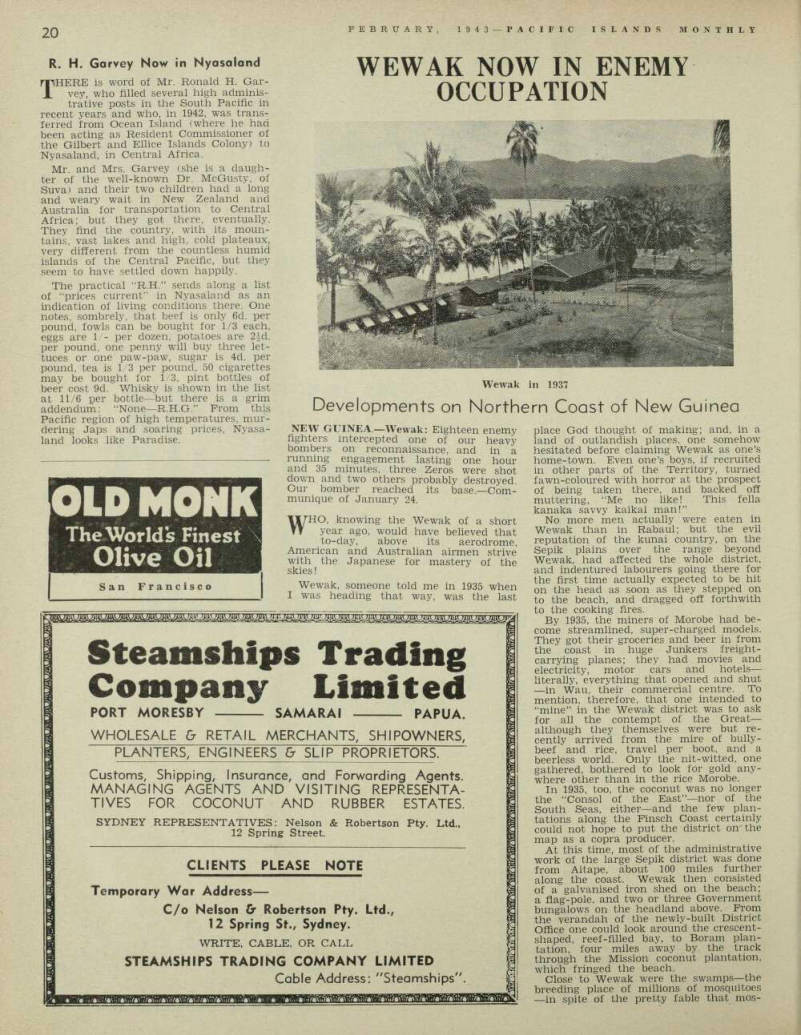
Memories At The
By I. Mcdonald
AT 8 o’clock on Saturday morning, January 23, 1943, a little band of ex- New Guinea women paid tribute to the passing of many friends who made a gallant stand in Rabaul against a superior force of Japanese.
As their representatives placed the wreaths on the Cenotaph, how many pic tures must have come crowding into the thoughts of those taking part in the cere mony. Rabaul, to them, was a symbol of all the places in New Guinea taken by the Japanese.
How could we forget those last drama tic hours, the homes hurriedly left, and with but a few hours to pack! Some of those who came away by sea managed to collect some of their most valued pos sessions: but those who came by plane were allowed to take only 30 pounds of luggage. All of us left behind many things that had taken years to acquire.
A sudden parting like this makes one realise that the things most valued are very often not of the most value.
It is hard to leave a flower garden that has taken months of thought to plan; pot plants coaxed into beauty by “green fingers,” making a dull spot in the house look cool and restful; curtains and cushions so carefully made, all adding a dash of colour.
Then there were the dogs left behind —some not noted for their pedigree, but loved for their companionship and understanding. Who is going to feed them now? Will they get a succulent bone, or will they, too, have to eat paw paw like any kanaka dog? And the cockatoo which had learned to say “Cocky kaikai” —has he flown away to the bush again, wondering where the friend has gone whom he used to follow about? The fowls, the ducks, the chickens, of which we were so proud . . . in short, all the little things which mean home to a woman. All this gone, tem porarily, at least.
But, beyond all this, the awful, ever present, anxiety for those who are away, who are missing . . .
One woman there had lived in a white house, on the water’s edge. Did she think of her home, as I remembered it . . . with the circular drive, the front door which you entered between two huge blue bowls filled with flowers, the lovely garden terraced down to a rock swimming pool? Surely, she was seeing the scene of that first early morning alarm of approaching enemy planes. Her husband had had time to run to his shel ter, dressed only in his shorts. Then the bombs had fallen, and all that was left was a heap of ruins. She had heard that her husband had escaped to Rabaul, a few miles away. Since then there has been no news. Except rumours. The rumours become news, and each contra dicts the other.
Then, that young wife. She must surely be imagining her husband, as she said good-bye to him, in their home, with all the treasures they had taken such pride in collecting, when she had hoped that he would not be too lonely without her. They had both been so young, and gay and happy. She has had one letter since, written as a prisoner of war . . . cold, unreal.
Another sees her husband waiting calmly for the disaster which he knows is inevitable. He had a chance to get away, but he must stay, for his duty’s sake. She had hacj only one letter from
him, as a prisoner of war.
Another was surely trying to recon struct the scene in their plantation home, when her husband was wondering what to do. She had heard, since, that he had decided to join some others who were endeavouring to get away in a schooner.
Since then . . . silence.
For another, there had been months of anxiety and waiting, when her husband was missing. To-day, she is offering up a silent prayer of thanksgiving. They are together again, after his eventful escape.
Another must see an island, far away from Rabaul, where the clear water over the coral reefs, changing from palest green to deepest emerald, makes a last ing picture. On the edge of thsir plan
tation, near a sheltered harbour, she and her husband recently planned and built an ideal tropical home. She is here; he is in the Air Force.
Another has a vision of a home high up in the mountains, where the climate is temperate and southern flowers grow in profusion; and another thinks of a home, higher still in the mountains, where the climate is crisp and cool, and a log fire is necessary at night.
One whose husband and son are both missing wonders what they are doing, while she holds her head high, with fine courage.
They all carry on bravely, waiting, hoping for the day when they and their menfolk will return to re-build all that has been destroyed.
R. H. Garvey Now in Nyasaland
THERE is word of Mr. Ronald H. Gar vey, who filled several high adminis trative posts in the South Pacific in recent years and who, in 1942, was trans ferred from Ocean Island (where he had been acting as Resident Commissioner of the Gilbert and Ellice Islands Colony) to Nyasaland, in Central Africa.
Mr. and Mrs. Garvey (she is a daugh ter of the well-known Dr. McGusty, of Suva) and their two children had a long and weary wait in New Zealand and Australia for transportation to Central Africa; but they got there, eventually.
They find the country, with its moun tains, vast lakes and high, cold plateaux, very different from the countless humid islands of the Central Pacific, but they seem to have settled down happily.
The practical “R.H.” sends along a list of "prices current” in Nyasaland as an indication of living conditions there. One notes, sombrely, that beef is only 6d. per pound, fowls can be bought for 1/3 each, eggs are 1 - per dozen, potatoes are 2id. per pound, one penny will buy three let tuces or one paw-paw, sugar is 4d. per pound, tea is 1 3 per pound, 50 cigarettes may be bought for 1/3, pint bottles of beer cost 9d. Whisky is shown in the list at 11/6 per bottle —but there is a grim addendum: "None—R.H.G.” From this Pacific region of high temperatures, mur dering Japs and soaring prices, Nyasa land looks like Paradise.
Advertisements & other items, pp. 21-22 (1 item)
f
o
BREWED BY
CARLTON & UNITED BREWERIES LTD,
v.i
OLD MONK
The Worlds Finest Olive Oil San Francisco
Steamships Trading
Company Limited
FORT MORESBY
SAMARAI
PAPUA.
WHOLESALE & RETAIL MERCHANTS, SHIPOWNERS,
PLANTERS, ENGINEERS & SLIP PROPRIETORS.
Customs, Shipping, Insurance, and Forwarding Agents.
MANAGING AGENTS AND VISITING REPRESENTA-
TIVES FOR COCONUT AND RUBBER ESTATES.
SYDNEY REPRESENTATIVES: Nelson & Robertson Pty. Ltd., 12 Spring Street.
CLIENTS PLEASE NOTE
Temporary War Address— C/o Nelson Cr Robertson Pty. Ltd., 12 Spring St., Sydney.
WRITE. CABLE, OR CALL
STEAMSHIPS TRADING COMPANY LIMITED
Cable Address: "Steamships".
Occupation
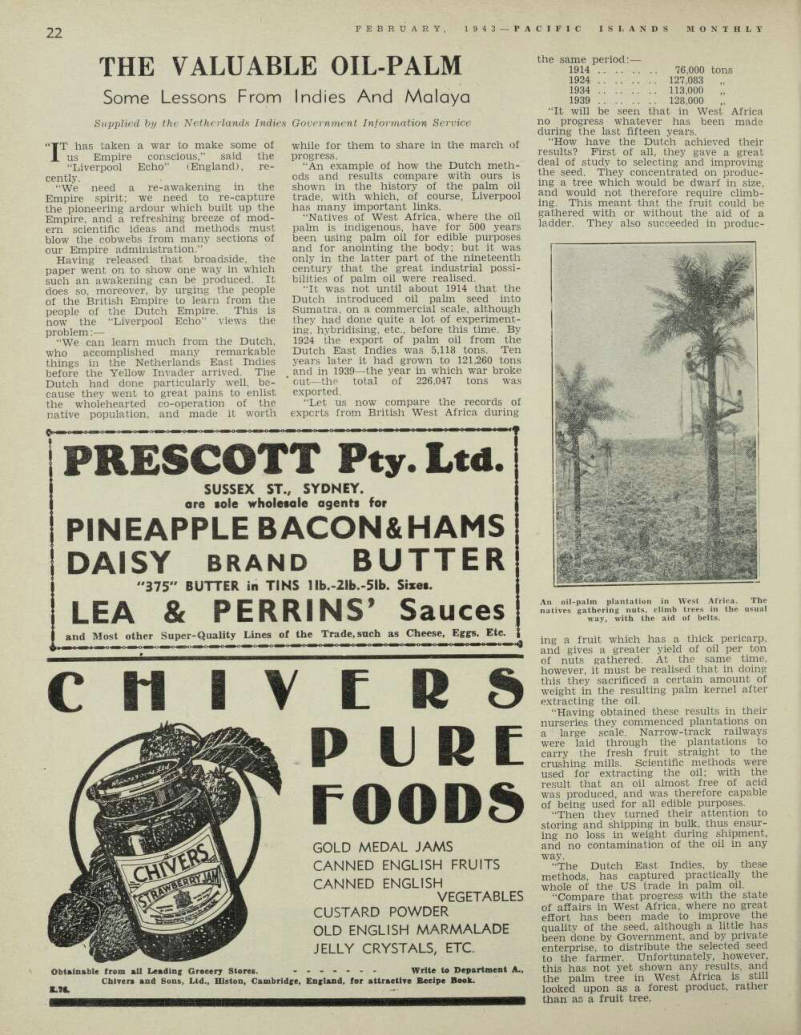
Wewak Now In Enemy
Developments on Northern Coast of New Guinea
NEW GUINEA.—Wewak: Eighteen enemy fighters intercepted one of our heavy bombers on reconnaissance, and in a running engagement lasting one hour and 35 minutes, three Zeros were shot down and two others probably destroyed.
Our bomber reached its base.—Com munique of January 24.
WHO, knowing the Wewak of a short year ago, would have believed that to-day, above its aerodrome, American and Australian airmen strive with the Japanese for mastery of the skies!
Wewak, someone told me in 1935 when I was heading that way, was the last
place God thought of making; and, in a land of outlandish places, one somehow hesitated before claiming Wewak as one’s home-town. Even one’s boys, if recruited in other parts of the Territory, turned fawn-coloured with horror at the prospect of being taken there, and backed off muttering, "Me no like! This fella kanaka savvy kaikai man!”
No more men actually were eaten in Wewak than in Rabaul; but the evil reputation of the kunai country, on the Sepik plains over the range beyond Wewak, had affected the whole district, and indentured labourers going there for the first time actually expected to be hit on the head as soon as they stepped on to the beach, and dragged off forthwith to the cooking fires.
By 1935, the miners of Morobe had be come streamlined, super-charged models.
They got their groceries and beer in from the coast in huge Junkers freight carrying planes; they had movies and electricity, motor cars and hotels — literally, everything that opened and shut —in Wau, their commercial centre. To mention, therefore, that one intended to "mine” in the Wewak district was to ask for all the contempt of the Great — although they themselves were but re cently arrived from the mire of bully beef and rice, travel per boot, and a beerless world. Only the nit-witted, one gathered, bothered to look for gold any where other than in the rice Morobe.
In 1935, too, the coconut was no longer the "Consol of the East”—nor of the South Seas, either—and the few plan tations along the Finsch Coast certainly could not hope to put the district on the map as a copra producer.
At this time, most of the administrative work of the large Sepik district was done from Aitape, about 100 miles further along the coast. Wewak then consisted of a galvanised iron shed on the beach; a flag-pole, and two or three Government bungalows on the headland above. From the verandah of the newly-built District Office one could look around the crescent shaped, reef-filled bay, to Boram plan tation, four miles away by the track through the Mission coconut plantation, which fringed the beach.
Close to Wewak were the swamps—the breeding place of millions of mosquitoes —in spite of the pretty fable that mos
Wewak in 1937
quitoes do not breed in such brackish places—and the home of alligators. But the swamps were not extensive, as such swamps can be in the Territory, and they soon gave place to firm, good land, where excellent coconuts were grown.
On the point of land opposite Wewak was Boram plantation, where, at this time, there was a general store in which everything from a prospecting dish to a bottle of beer could be bought, and where some accommodation for the public was usually provided. Boram, therefore, bulked larger in the eye of the resident than did Wewak. And here, to meet the “Macdhui” on her six-weekly call, came a queer collection of people, although in numbers they could be counted on the fingers. Miners, scratching for gold on the Schilling and Nagum Rivers; re cruiters of native labour from Aitape and the Sepik foothills; traders and plan tation men from up the coast; “lik-lik” doctors on medical-patrol, geologists, and even an odd anthropologist.
BUT, early in 1936, there came a change. The Morobe goldfields were rapidly becoming industrialised.
The fantastic richness of the early years, when all a man needed was a rough sluice-box and a team of boys to win a hundred or two hundred ounces of gold in a day, was passing. Instead, huge dredges and other scientific mining machinery, were being used to work the poorer portions of the field. The day of the individual prospector and alluvial miner was then almost ended.
So he pushed further out, first to the Watut, and Black Cat, and other new fields within walking distance of Wau, and then some hardy souls got as far as thinking of Wewak and its hinterland.
Ray Parer flew across the headwaters of the Sepik, and was in the process of organising an expedition there, when officialdom came down on the idea with a heavy hand. There was some desul tory prospecting done in the Aitape dis trict and inland from Boram. And the men who had been located on the Schilling and Nagum were forever follow ing up any fresh rumour or inspiration that might lead to greater things in the gold-mining business.
It was from the Nagum, in January, 1936, that two men, Jack Thurston and Harry Tudor, set out overland for Kara wop and, on the way, on the Sepik fall of the range, discovered the stream which put the Sepik district on the map as a goldfield. In April of that same year a mining lease was granted to them, and Number One Gold, as the natives called it, became the nucleus of the district.
The fame of Number One Gold spread —and lost nothing in richness in the spreading. The news of its supposedly
enormous richness reached Morobe; and then, into Wewak and Boram, by steamer and schooner, came restless, seeking prospectors. Up over the mountains they went, their boys carrying their food and light tent-sails and mining gear, plough ing through the mud of the swamps and the tracks. Usually they called at Num ber One Gold to get the lay of the land, and then spread out over the valleys and foothills of the Prince Alexander moun tains. There was no concentrated rich ness in this ’goldfield—fair gold was scattered over the length and breadth of it, but often 20 miles separated claims and leases.
HERE there were none of the con veniences of Morobe. There was one way of getting about —to walk; one way of getting supplies in from the sea coast —by native carriers. But although many came and, finding noth ing, passed on, about 200 finally settled in the district, built their bush houses, organised their work and got some sort of order into their supply problems. In the initial months it was, for everyone, a continual fight against isolation, malaria, bush typhus, bad food; and a continual quest for native carriers and gold.
Towards the end of 1936, Ray Parer arrived to work a claim pegged for him by a friend. Where Ray went, there went his plane also, and down on the edge of the Sepik plain at Maprik, and out at Worn, on the coast, twin strips of landing ground were cleared of their kunai grass. Then back and forth, as Ray required stores or diversion, the miners of the district heard his plane droning overhead, and many thousands of stone-age men in the thickly populated kunai-country saw, for the first time, a “balus.”
Shortly afterwards, Guinea Airways were invited to extend their freight and passenger service; but the Morobe air ways companies came and went, unable to make sufficient profit out of this scattered district, and it was not until the next year that Wewak gained a re gular air service, owned and operated by Kevin Parer, young brother of Ray.
Kevin was killed in the first Japanese blitz on Salamaua, in January, 1942.
IN 1937 the aerodromes of the district became an Administrative matter.
Maprik was levelled by Government surveyors in a manner hitherto unknown and quite unappreciated by the local natives, who were rounded up to do the job. At Wewak a fine new drome was built between the town and the Mission.
Level and smooth, it stretched away, larger than any other drome in the Terri tory, with room to spare for extension.
Local pride may account for the local opinion that it was the finest aerodrome in the country.
Two miles of road were constructed through the swamps to connect airfield and township, and in the space of a few months, down below Wewak headland, a branch of W. R. Carpenter & Company, a freezer and a dozen Chinese shops sprang up. The three Government build ings had increased many-fold. The wire less station and operator, formerly stationed at Aitape, had been brought to Wewak long since. There was a hospital, a resident doctor and a nurse.. Wewak no longer was quite the last spot God thought of making.
To those who lived inland, in the wet, steaming, jungle-covered mountains or the stifling heat of the kunai country, the new Wewak meant much. No longer was it necessary to live on bully-beef and rice—most camps were within eight hours’ carry of the nearest landing-field, and the freezer supplied everything in the way of European food. No longer was it necessary to carry a sick man for days through the jungle in order that he might receive medical attention.
That was the position when the Japs took Rabaul in January, 1942.
IN the general evacuation of January, 1942, this north-west portion of the mainland also was evacuated. Orders were given that everyone should meet at a point on the Sepik, and here men came, in twos and threes and in small parties.
But there was official blundering some where, and they were left there, while ships that were to have picked them up were sent instead to Madang. The men
(Continued on Page 24)
(Continued from Page 21) had to shift for themselves, as best they could.
Some were able to escape in small boats and, after incredible journeys, reach safety. Others walked overland, up the Sepik and down the Fly, where no white man had been before—and where, in fact, in the days of peace, all white men were prohibited from going. Others found their way in just as miraculous a fashion into other parts of the Terri tory, where they were eventually picked up by plane and flown to safety.
There was no good reason —up until the last few months —why the Allies could not have by-passed enemy-occupied Lae and Salamaua, and established bases there at Wewak. But the Japanese now have got in there, and have bases from which to protect their sea lanes and
moke bomber attacks on Lae and Sala maua, if and when those areas are re occupied by the Allies. The facilities at Wewak were a gift to the Japs. The Wewak airfield can be easily improved and enlarged—the Japs, for instance, could cut down the miles of coconuts in the Mission plantation between Wewak and Boram and get an admirable new air field.
Along the coast towards Aitape are several make-shift landing fields which could be improved. Over the range from Wewak, 15 to 20 minutes’ flight away, stretches the vast kunai-covered Sepik plain, on which Maprik drome is only an example of what can be constructed.
There is no harbour at Wewak; steamers anchored off Boram and Wewak point. The crescent shaped bay is full of coral reefs. But the two large islands of Kairiru and Mushu, north-west of the
township, shelter the anchorage from the fierce north-westerlies which are the curse of the coast between Wewak and Aitape.
TOWARDS the Dutch border the country becomes steeper and more mountainous; but between Wewak and Aitape the highest point in the coastal mountains is between 3,000 and 4,000 feet. There are no roads; and while travel on foot, meandering from village to village, can be tough, in all conscience, the obstacles of terrain met with on the Owen Stanley track, or be tween Wau and Salamaua, do not here exist. The building of a road from Maprik to the Sepik—a plan to open up the huge hinterland that had long been talked about —would have been child's play compared with the construction of the proposed Wau-Salamaua route.
This district of kunai plain and foot hill probably carries a larger self-sup porting native population than any other part of the Territory. An endless chain of villages, some of them over a thou sand strong, made the district tenable for Europeans in the first place. Now these natives can be utilised for carrying and for other manual labour of a military nature.
Time, for these people, has leaped a thousand years in a month or two, and the most primitive backwater of a primi tive country, now echoes to the sound of aerial combat. The Allies are confronted with yet one more New Guinea area from which they have the task of either bomb ing out or digging out the tenacious Jap.
Judy Tudor.
Advertisements & other items, p. 23 (1 item)
Aluminium And Its Alloys
NELSON & ROBERTSON
PTY., LTD.
Established 1895.
Islands Merchants
All classes of merchandise purchased at wholesale prices and original invoices supplied to Islands clients.
Cocoa Beans, Rubber and other Islands' produce sold on commission.
Nelson & Robertson
Pty. Ltd. 12 Spring Street, Sydney, Australia.
ALUMINIUM and its ALLOYS
OUR HOUSE FLAG IS FLYING and our production is flowing into the stream of Defence requirements exclusively—in the forms of Aluminium Alloy INGOT, Rolled Aluminium Alloy PLATE, SHEET, STRIP, also as Extruded Aluminium Alloy ROD, BAR, WIRE, TUBING AND SECTIONS.
We look forward to the time when civilian demands can be satisfied by us, to meet the growing applications for our metal in Australia and the South Seas.
PROPRIETARY limited
(INCORPORATED IN THE STATE OF VICTORIA)
GENERAL OFFICES AND FABRIC AT IO N DIVISION : GRANVILLE. SYDNEY. N . S.W.
The Valuable Oil-Palm
Some Lessons From Indies And Malaya
Supplied by the Netherlands Indies Government Information Service
“TT has taken a war to make some of us Empire conscious,” said the “Liverpool Echo” (England), recently.
“We need a re-awakening in the Empire spirit; we need to re-capture the pioneering ardour which built up the Empire, and a refreshing breeze of modern scientific ideas and methods must blow the cobwebs from many sections of our Empire administration.”
Having released that broadside, the paper went on to show one way in which such an awakening can be produced. It does so, moreover, by urging the people of the British Empire to learn from the people of the Dutch Empire. This is now the “Liverpool Echo” views the problem - “We can learn much from the Dutch, who accomplished many remarkable things in the Netherlands East Indies before the Yellow Invader arrived. The Dutch had done particularly well, because they went to great pains to enlist the wholehearted co-operation of the native population, and made it worth
while for them to share in the march of progress.
“An example of how the Dutch meth ods and results compare with ours is shown in the history of the palm oil trade, with which, of course, Liverpool has many important links.
“Natives of West Africa, where the oil palm is indigenous, have for 500 years been using palm oil for edible purposes and for anointing the body; but it was only in the latter part of the nineteenth century that the great industrial possi bilities of palm oil were realised, “It was not until about 1914 that the Dutch introduced oil palm seed into Sumatra, on a commercial scale, although they had done quite a lot of experiment ing, hybridising, etc., before this time. By 1924 the export of palm oil from the Dutch East Indies was 5,118 tons. Ten years later it had grown to 121,260 tons . and in 1939—the year in which war broke cut—the total of 226,047 tons was exported.
“Let us now compare the records of experts from British West Africa during
the same period:— 1914 76,000 tons 1924 127,083 „ 1934 113.000 „ 1939 128,000 „ “It will be seen that in West Africa no progress whatever has been made during the last fifteen years.
“How have the Dutch achieved their results? First of all, they gave a great deal of study to selecting and improving the seed. They concentrated on produc ing a tree which would be dwarf in size, and would not therefore require climb ing. This meant that the fruit could be gathered with or without the aid of a ladder. They also succeeded in produc-
ing a fruit which has a thick pericarp, and gives a greater yield of oil per ton of nuts gathered. At the same time, however, it must be realised that in doing this they sacrificed a certain amount of weight in the resulting palm kernel after extracting the oil.
“Having obtained these results in their nurseries they commenced plantations on a large scale. Narrow-track railways were laid through the plantations to carry the fresh fruit straight to the crushing mills. Scientific methods were used for extracting the oil; with the result that an oil almost free of acid was produced, and was therefore capable of being used for all edible purposes.
“Then they turned their attention to storing and shipping in bulk, thus ensur ing no loss in weight during shipment, and no contamination of the oil in any way.
“The Dutch East Indies, by these methods, has captured practically the whole of the US trade in palm oil.
“Compare that progress with the state of affairs in West Africa, where no great effort has been made to improve the quality of the seed, although a little has been done by Government, and by private enterprise, to distribute the selected seed to the farmer. Unfortunately, however, this has not yet shown any results, and the palm tree in West Africa is still looked upon as a forest product, rather than as a fruit tree,.
An oil-palm plantation in West Africa. The natives gathering nuts, climb trees in the usual way, with the aid of belts.
“The result has been that many old trees—some 50 feet high-yield very little fruit, and great risks are run by the climbers to collect the fruit. A few hand operated presses are being used by the more enlightened farmers, but generally speaking the palm oil is still extracted by slow and wasteful native processes.
“Although a certain amount of edible oil is produced by these small presses, the bulk of the oil is inferior in quality to that produced in the Dutch East Indies, both from the point of view of cleanliness and excessive acidity.
“In West Africa, with one or two exceptions, no European plantations have been permitted, with a result that the palm oil industry remains in the hands of the Africans, with very little urge either to improve the quality or the quantity which the country is capable of exporting.
“As an indication of what can be done in the development of this industry, the figures for British Malaya, where the palm oil industry has been developed, run very much in line with those of the Dutch East Indies. In 1924 Malava exported 286 tons of palm oil. In 1934 the figure had risen to 15,979 tons. By 1939 it was up to 59,774.”
EDITORIAL NOTE; More than ten years ago, the “PIM” published details of the valuable oil-palm of West Africa, which then was being introduced to the Netherlands Indies and Malaya, and Pacific Territories administrations were urged to take an interest in this new development in planting. The accom panying picture (which we find still in our files) was also published then, to show South Seas planters what the oil palm looked like. Nothing was done; not one administrative official displayed the slightest emotion. It is little satisfac tion, now. to say “I fold you so”—but, in sober fact, would a plantation of oil palms anywhere in the South Seas he worth something under present condi tions? Or would it?
Advertisements & other items, p. 24 (1 item)
Foods
PRESCOTT Pty. Ltd.
SUSSEX ST., SYDNEY,
ore lole wholesale agents for
PINEAPPLE BACON&HAMS
DAISY brand BUTTER "375" BUTTER in TINS llb.-21b.-slb. Sixes.
LEA & PERRINS’ Sauces and Most other Super-Quality Lines of the Trade, such as Cheese, Eggs, Etc.
I 11 £ V E
PURE
FOODS
GOLD MEDAL JAMS
CANNED ENGLISH FRUITS
CANNED ENGLISH
VEGETABLES
CUSTARD POWDER
OLD ENGLISH MARMALADE
JELLY CRYSTALS, ETC.
Obtainable from ail Leading Grocery Stores. --- Write to Department A., Chi vers and Sons, Ltd., Hlston, Cambridge, England, for attractive Recipe Book.
E.IC
Death Of Captain R. J.
Carter
Captain Robert Joseph Carter,
who was well-known in Western Samoa before his retirement to New Zealand, in 1932, died in Auckland on January 17, aged 71.
Captain Carter went to New Zealand, from London, 50 years ago, and went to Western Samoa in 1915 with the NZEF Relief Force. He was appointed aide-de camp to the first military governor, Colonel Robert Logan, and at the end of the military occupation he became com missioner for Chinese and Melanesian labour and aide to General Sir George Richardson. He is survived by a wife three children and two grand children.
A., w * se saying of Admiral Chester Nimitz, Naval Commander-in-Chief in the Pacific:—A ship is always referred to as a “she” because it costs so much to keep one in paint and powder.
A Phrase Explained
Prom Our Own Correspondent
Noumea, Jan. 9.
IN your November issue, Mr. W. W.
Bolton, MA, of Tahiti, and the “PIM” ask for enlightenment on a phrase included in the “weird, official appoint ment” which gazetted the Tahitian chief Teriiri’i as Captain Commandant of the native contingent of the troops stationed in New Caledonia in 1859.
The phrase in question is the near poetical one: “From the summits of Morare to the Plains of Diahot.”
The “summits of Morare” are the twin peaked Mont Dore, the beautiful moun tain rising over Morare Bay (as it was then called, for now it is Boulari Bay) It was here that M. Berard and his 13 white settlers had just been massacred.
Mont Dore is the mountain that lies be hind and to the south of the Noumea Peninsula; and, putting the phrase in an unromantic way, one would say “from the south of New Caledonia to the far north.”
The Diahot (pronounced “Jowatt”) River is the island’s largest stream, the only one which runs with the axis of the island, and it emnties itself into the most northerly bay, at a place called Pam. It is a mosquito-infested country, wild, and very sparsely inhabited even to-day; but. once, Australians worked there the only gold-mine that was ever made to pay— the Fernhill. There is also copper and zinc lead in the vicinity.
When Teriiri’s and his 24 Tahitians went back to Tahiti the Sydney-built and Caledonia - operated schooner “Kate” changed her name in his honour to “The Teriiri’i.”
'N. Zealand's Forgotten
Man'
rpHAT indefatigable student of New A Zealand and Polynesian history, Mr.
Eric Ramsden, has written a new and better book, “New Zealand’s For gotten Man—Busby of Waitangi.” It is the first biography of the first adminis trative official to appear in New Zealand, and it is compiled from family records’
Busby’s unpublished despatches and a mass of hitherto unsighted material which took six years to accumulate and examine.
The story of Busby is a remarkable one and pictures a man who seemed fated to a life-time of struggle against adversity. We first meet young James Busby haunting the corridors of White hall. urging his family’s claim to a early passage to Australia. This finally is accomplished, and within two years of their arrival in New South Wales, the Busbys are well on their way to pros perity. Had James been content to re main in New South Wales, devoting him self to his land and his viticulture, he probably would have died a wealthy and successful man. But nothing could pre vent his going off to New Zealand. He assumed office as British agent there in 1832; and then he spent 40 years in fighting—first, to uphold what he re garded as British law. and later in defence of his “rights” as a private citizen—he claimed title to much land.
In the end he is vindicated, but it is a hollow victory. Busby is an aged and worn-out man; his hearing is gone, and he is almost blind, and in the following year—lB7l—while in London, he catches a chill and dies. (Our copy from Angus & Robertson, Ltd., Sydney. Price, 15/- )
Advertisements & other items, pp. 25-26 (2 items)
Coleman
IS SERVING THE ARMED FORCES
WITH THREE ESSENTIALS OF
LIFE . . .
Light-Heat—Worm Food
- 3 •sm.
Wherever the Armed Forces of the United Nations need quick heat and bright light you’ll find Coleman Lanterns and Stoves. On board steamers at landing fields, in mobile canteens, emergency hospitals, air-raid shelters, and in actual combat, Coleman appliances are nrovidinpinvaluable service. b We regret any inconveniences caused through shortage of new stock for civilian requirements, and suggest you keep your present Stove and Lantern in good repair by contacting your local Distributor THE COLEMAN LAMP & STOVE CO. LTD.
TORONTO CANADA
A. B. DONALD Ltd.
AUCKLAND
ISLAND TRADERS & GENERAL MERCHANTS
P.O. Box 1509. Cobles Gr Telegrams, "Kingdom", Auckland.
Scott’s “Renown” Brand Rope,
Cordage and
Binder
Twine
Cable Address Ropeyard, Sydney.
of Every
Description
MANUFACTURED AT
MASCOT, N.S.W.
J. SCOTT
PTY. LTD.
Head Office and Store:
163 CLARENCE STREET,
SYDNEY,
N.S.W,
Old Monk
The Worlds Finest Olive Oil San Francisco
"Cession Of Matavai"
IN the July (1942) issue of the “PIM” we published a reproduction of a steel-engraving, “The Cession of Matavai” —depicting an incident of early Tahiti. Now, from London, the Rev.
Cecil Northcott, Home Secretary of the London Missionary Society, has sent us details of the origin of the engraving.
The original “Cession of Matavai” is. apparently, a large oil-painting measur ing 12 ft. x 8 ft. It was presented by the London Missionary Society to Captain James Wilson, commander of the mis sionary ship, “Duff.” which took the first LMS missionaries to the Pacific and eventually landed them in Tahiti in 1797, to begin their work of evangelisation amongst Polynesians. Recently this pic ture was given back to the London Missionary Society by descendants of Captain Wilson, and is now at LMS headquarters in London.
Our reproduction was of the steel engraving which the LMS gave to Mr.
W W. Bolton, MA. of Papeete, in recog nition of his historical work in Tahiti.
Mr. Bolton subsequently presented the engraving to the British Consulate in Papeete, where it is hanging to-day.
Manpower In Fiji
IT has been decided to combine the functions of the Fiji Manpower Board and Labour Committee and to set up instead a Board to be called the Labour and National Service Board, with the following personnel:—Mr. S. H. Ellis, MBE, Director of Manpower and Labour (Chairman); Mr. H. E. Snell (Deputy Chairman): Mr. C. E. Pennefather, Adviser on Native Affairs; Mr. J. L.
Brown. Director of Public Works: Mr. H.
King Irving, Mrs. A. T. Newboult, Ratu J L. V. Sukuna, Mr. Vishnu Deo, Mr. K.
B. Singh, Mr. Baghvan.
The Warring Scientists
In The Days Of
Beards
The Warring Scientists of Tahiti
rr.HERE is an old legend that at one X time all men of New Zealand wore big shaggy beards.
In all ages of the world, as we know, the beard has been the outward and vis ible sign of inner enlightenment, and a repute—which men of New Zealand were too modest to deny—spread to distant lands that Wisdom had indeed estab lished her throne in peerless Te-ao-tea roa.
At an early period of our residence at Tahiti, the Pontifex Maximus of this race of wise men visited Papeete. He was a scientist. New, the great Hegira was then far in the future, and we had not yet learned to know scientists as they really are.
The professor had searched out and established, beyond cavil, the origin, natal home and subsequent migration of the Polynesian race. The older theories he disposed of with thoroughness and despatch.
Once, and only once, we timidly ven tured to quote from a book we were then reading, which identified Indonesia as the probable Havaiki of Polynesian legend. A gesture of the professor’s beard, poised like a menacing thunder bolt, to hurl us to a nethermost Tartarus of humiliation and confusion, silenced us, while he continued to overwhelm us with the profundity of his learning. We could only gaze, while “still the wonder grew,
that one small head could carry all he knew.”
The professor’s thesis *was that if any group in any part of the world had set a few big stones upright in a circle, or piled massive rocks on each other to create a rude architectural form, they were blood-kin of the builders of Crom lechs and Dolmens in the shadow of the Alps and Pyrenees. The Polynesians’ ancestors, led by the professor, had a long, hard journey across the steppes of Asia and over wintry seas before he settled them safely on the sunny isles of the South Pacific. There was no one to gainsay; we knew nothing of Polynesian lore in those far-off days.
So the question was settled—until the scientist from California arrived. This learned man was beardless. His visage had somewhat the aspect of the Great Stone Face which stares eternally from a lofty cliff in the New Hampshire mountains. Moreover, he was a Native Son of the Golden West. He was con vinced that the Polynesians are Autoch thons, clinging to the remnants of a sub merged continent.
The battle of the Titans was not fought on Tahiti, but on the purple waters of the Pacific Ocean. A little steamer which voyaged from Papeete to the Aus trals, Rapa, the Gamblers, and return, had the professor, the Native Son and one obscure layman as the only passen gers on board.
The layman told us later that the sea had been calm; but he could give us no more than fragmentary testimony con cerning the tempest which raged during the whole of the voyage—as he had passed most of the time in a place of safety behind the capstan in the bow of the vessel. The skipper and crew, who knew no English, could testify only of
thunders and shoutings, which increased in fury day by day. Here, ashore, the two scientists maintained silence, behind grim countenances, until they departed from the colony in opposite directions.
We at Tahiti believed that, with the departure of the savants to their respec tive home-lands, this little hurricane had spent its fury without disturbing the atmospheric balance in more distant regions. Then, after a time, two extra ordinary and disturbing events followed which seemed to be related with this battle in the Australs.
One, the professor suddenly discarded his theory of Polynesian origins among the Cromlechs and Dolmens, and began industriously to explore for Maori ances tors in submarine caverns of the Lost Continent of Mu.
Two, the men of New Zealand shaved off their beards.
Was this latter a sign of national mourning (Polynesian women cut off their long tresses under similar circum stances) over the flight of the Goddess of Wisdom from New Zealand to, per haps, California or (as is more likely, in the light of subsequent history) to another planet? We do not know. One thing, however, is certain. It was not long before the whole world of scientists was buzzing like a hive of angry bees.
And theji the anthropologists began to
come.—.
A.C.R.
The Anglican Provincial Board of Missions in New Zealand has made a grant of £joo for the extension of the mission school at Labasa, Fiji, and has promised an increased amount for the year 1942-43.
Advertisements & other items, p. 27 (1 item)
W.KOPSEN & Co. Pty.Ltd.
SIMPLEX
MARINE
ENGINES
Simplex engines from 3 h.p. to 12 h.p. for boats from 14 ft to 26 ft are Australia’s best. 2 cycle and 4 cycle with or without reverse gear.
Illustrated is the popular little 3 h.p. suitable for 14 ft or 16 ft boats Runs for 5 hours on 1 gallon petrol and costs only £29/15/-, complete with all equipment. Ready to instal into any boat, nothing else to buv Ask for Simplex catalogue of engines and launches.
SKARSTEN SCRAPERS
TILLEY
Kerosene
LAMPS
British-made Kerosene Lamps providing a steady 300 c.p. light, without flickering, and without smoke or smell.
Model TLIO (illustrated) is a handsome Table Lamp providing exceedingly brilliant illumination and at the same time a line ornament for any home.
Stands 24 in. high and covers a large area. Attractive parchment shade is finished in autumn tones and matches any furnishings.
Also available is the popular All- Purpose Lamp and Lantern (model EX100) and a variety of Hanging, Table, Wall and Vase Lamps.
Let us send you full details of all Tilley Lamps.
Remove paint, varnish, glue, oil, grease, roughness, etc., from wood and metal surfaces. Most useful for scraping deck and hull planks. They leave the surface smooth and dressed and ready for painting. Have renewable blades.
Prices: No. 35, 2/3; 62, 2/6; 80, 3/3.
Reversible, 7/-.
Write for leaflet.
SHIPCHANDLERY
We manufacture and stock the largest range of boat gear in Australia Everything for boatbuilder and boatowner. Marine paints and varnishes Rove and Cordage. Rigging. Anchors and Moorings. Copper Nails and Rod Lighting Plants. Fire Extinguishers. Oars and Sculls, Lamps, Pumps, etc.
GET OUR PRICES FIRST.
W.KOPSEN & Co. Pty.Ltd.
376/380 KENT STREET, SYDNEY
Phone: MA 6336 (4 lines). Est. 1868. Cables: Kopsen . . . Sydney.
N. Guinea Service
Men
Reconstitution of Soldiers' Organisation
A GENERAL meeting of the re constituted New Guinea branch of the RSSAILA was held at Trenton House, Sydney, on January 25. Over sixty members were present to hear a report on the year’s activities and dis cuss plans for future action.
The New Guinea organisation was des troyed and all its records lost when the Japanese invaded Rabaul in January, 1942. In March, 1942, members who were in Australia applied to the Federal Exe cutive of the RSSAILA for permission to establish a temporary New Guinea branch in Australia; and in November, 1942, members met and decided to re form and elect office-bearers. Since then the membership has grown to 76, of whom 31 are serving in the fighting forces. The great interest that members are showing in the branch augurs well for its future.
Finance
The financial position of the branch is reasonably sound. The bank balance is £109; the Rabaul sub-branch has trans ferred £l3 2/2 and the Kavieng sub branch £66 12 1 to the branch funds, and it is expected that the Morobe sub branch will follow suit.
With regard to war damage insurance
on Anzac House, Rabaul, the branch is covered to the extent of £l,OOO for the building and £340 for contents. It is be lieved the building has been totally des troyed. If war damage claims are ever paid, the branch will be in a position to erect its own club rooms on its return to the Territory.
In December the Federal President made a special grant of £5O for distri bution of Christmas cheer by the branch to New Guinea ex-servicemen and/or their dependants who are in necessitous circumstances, following on their com pulsory evacuation. No discrimination was shown between members and non members of the League.
Aid To Pow And Dependants
The branch executive has adopted a policy of assisting wives of members who are prisoners of war by giving monetary aid towards the education of their children and preparing for the re habilitation of members when it is possible to return to the Territory. In respect of this relief plan the secretary, Mr. H. L. Downing, read a letter from Mr.
Vic. Horsley, who at present resides at Bathurst. Mr. Horsley suggested that all members make a monthly donation of as much as they could spare to help towards these worthy aims of the branch, and he himself sent along £1 to start the ball rolling.
Closer Settlement In New
Guinea
Following a suggestion by Mr. Henry Eekhoff, at a previous meeting of the branch, a sub-committee has been ap pointed to go into the matter of closer settlement in New Guinea after the war; but owing to the difficulty of obtaining copies of reports the sub-committee has made little progress. The last Federal Congress of the RSSAILA asked State branches to submit a draft bill, to be considered by a conference of represen tatives of the States, but when the New Guinea branch asked permission to send a representative, with a view to gaining information, they were informed that it was thought that it was rather premature to discuss the question of post-war land settlement in New Guinea. The New Guinea branch is not altogether in agree ment with this statement, and is of the opinion that any suggestion made in Aus tralia regarding the future is looked upon as being premature. Members (and all evacuees) would be much better off now if the Government’s outlook of twelve months ago had been less sensitive on the subject of providing for the future. The executive of the New Guinea branch did not, in any case, intend to accept the decision of the Federal Executive without protest.
Commemoration Of Fall Op
Rabaul
Arrangements made for placing wreaths on Sydney Cenotaph in memory of those
who had fought and fallen in the Japanese occupation of Rabaul on January 23, 1942, were successful. Mr. A.
J. Gaskin placed a wreath there, on be half of the branch, and 17 other wreaths were laid on behalf of military units and various Territory organisations and busi ness firms. Members of the branch, who lived in Brisbane and Melbourne, took similar action in those cities.
Ngvr And League Membership
The question of the eligibility of the NGVR to League membership was receiv ing the closest attention of the executive of the branch, reported the secretary. The Federal Executive of the League had been written to on the matter and the branch had been advised by the League that the question of the status of the NGVR had already been discussed with the Depart ment of the Army, and it was under stood that the matter is receiving con sideration.
Miscellaneous
Other matters which are receiving the attention of the New Guinea branch’s executive include the provision of New Guinea club rooms in Sydney in co operation with the New Guinea Women’s Club, and organisation of a theatre party, at a later date.
The Queen
How He Escaped From
From Our Own Correspondent
Noumea, Jan. 1..
ON the subject of old-time Tahitian- New Caledonian relations, I have heard a good story told of a fellow named Moriceau, who lived and died here very many years ago.
He was a naval officer in Tahiti at the time the French took possession there, a handsome upstanding youngster, over 6 feet tall, and agreeable with it, a regular man of the world. Queen Pomare took a great fancy to him and wanted him to marry her.
This so scared young Monsieur Mori ceau that he began to wonder what he could do. His fellow officers got him out of his dilemma by smuggling him on board the ship and hiding him —with the Admiral’s consent —in the Admiral’s cabin. At the same time a report was put about that he had suddenly died. A coffin, bearing his name and covered with the tricolor, was buried with public cere mony, including the firing of a salute.
In New Caledonia, M. Moriceau became head of the Government Immigration Bureau, concerned with bringing people here from the island of Reunion and other parts of the French Empire, to start sugar, rum, coffee and other industries.
A wag, learning the story of his escape from Tahiti, used to call him ‘Monsieur Feuriceau” (“the late Mr. Riceau”).
Advertisements & other items, p. 28 (2 items)
Pinkettes
TINY LAXATIVE
AND LIVER PILLS
Painlessly Exercise the Digestive System
TENAX Genuinely Germicidal SOAP
Guard against Infection with Tenax!
r FENAX Germicidal Soap used regularly is an Now^Oniy unsurpassed safeguard against external germ y p®* Tablet, infection. It is kind to the most sensitive skin, yet its germicidal action is eleven times as rapid as carbolic. It is non-irritant and non-poisonous.
At All Chemists and Stores.
TENAX Genuinely Germicidal SOAP
SOAP
A Typical Example
Australian Cruelty
To Planters
WHY some men, experienced in plan tation production in Papua, are given positions in the Australian New Guinea Administrative Unit, while others, equally good citizens and equally experienced, are literally driven out, and forced to sustain themselves on a dole, is one of the minor mysteries of the war in the Pacific. It is the subject of many letters received in the “PIM” office. Here are extracts from one of them:— “It was a very shrewd move to sink the name of Papua and call our country ‘New Guinea’ —this gave a good standing to the New Guinea outfit, who are deter mined to run ANGAU.” (EDITORIAL NOTE: There is no doubt that the present regime is trying to dis courage the use of the word “Papua”— why, no one knows. If the military gentlemen who are now dictators of the Territories had known anything of the history and conditions of the Territories they would not have acted so hastily.
“Australian Pacific Territories Adminis trative Unit” —APTAU—would have been just as euphonious as the name chosen; and it would have meant a lot more.) “I cannot understand why men like me are not allowed to pull our weight in the war effort, where our experience would be of most use—i.e., in the handling of native labour; the running of coastal vessels; and furnishing information about local sea-routes, reefs, anchorages, etc., which is not shown on the charts.
Incidentally, knowing the native language as we do, we could get information not available to strangers who, as far as the natives are concerned, speak an unknown tongue.
"Many of the vessels run by ANGAU have soldiers in charge. Of course, we know soldiers know more about our vessels (impressed by the aforesaid ANGAU) than we, who have been navi gating them for more than a quarter of a century. According to the wise gentry who control ANGAU, if a man is a good soldier he must also make a good sailor, so why use seamen when soldiers are more easily obtained.
“I am afraid our outlook is hopeless.
Those Papuans now in ANGAU are con cerned only with themselves; the military are in charge, and they cannot be ap pealed to; the average Australian poli tician knows nothing and cares less about Papua; we have spent our years and our cash. A hole to creep into, where we can curse the merciless heavens, and die, is about all we can hope for, now.
“I gave Papua over 30 years of my life, the best half of it. I took £15,000 into the country with me; for the last 14 years I put all the profit I made back into the country (at least £l,OOO p.a.).
Had I been an enemy alien when I was compulsorily evacuated from my home I would have been cared for by the Com monwealth Government; fed and clothed, and lodged free of cost, until the ter mination of the war. Being only British rubbish, I shall shortly have to join a road gang, or starve. So much for Aus tralia’s ‘grand old pioneers.’ ”
The death of Mr. Clifton Garfield Rutledge, metallurgist and mining en gineer, occurred in Brisbane in January.
He was associated with mining in New Guinea and New Caledonia and, since the war, had been connected with the organi sation of mining in Queensland. He was formerly general manager and resident managing director in Papua of Cuthbert’s Misima Goldmine, Limited.
Rarotongan Domestics
In Nz
THERE are now about 50 Rarotongan girls employed in Wellington NZ, as domestic servants. Each of these girls must understand some English, and be certified medically fit, before she is allowed to leave the Cook Islands. Most of them are untrained in European ways when they reach New Zealand, but Wel lington housewives are of the opinion that they are quick to learn their duties, although they are inclined to be home sick and shy at first.
There is no official sanction of this scheme by either the Internal Affairs Department in Wellington or the Cook Islands Administration, and particulars of employment are not obtainable. It is understood, however, that the girls may be engaged only for domestic service and by approved employers. The employer is required to provide an outfit of warm clothing and travelling expenses to New Zealand. This amount is deducted from the servant’s wages in weekly instal ments.
Rarotongan girls have been brought to New Zealand for this kind of service be fore; but, since the outbreak of war, the number sought by prospective employers has increased enormously. The number of suitable girls is small, however.
Their increasing numbers have given them companionship and there are now club facilities for them in Wellington.
But “cold and windy Wellington,” and domestic service' at 25/- per week, seem poor exchange for the warmth and free dom of their native Rarotonga, and it is doubtful if many will settle for any length of time in New Zealand.
New Guinea people will be amused by the unfortunate phrasing employed by a writer in a leading Australian daily newspaper: “Her memories include fly ing with Capt. Denny to look for Capt.
Ulm when he was lost, living in the jungle with Beatrice Grimshaw, the authoress, who was in Papua for 15 years.”
Morist Sisters Wish to Return to Solomons
Solomons
IT was reported from Noumea on December 9 that two of the Marist sisters, Sister Mary Evangeline, of Prince Edward Island, Canada, and Sister Mary Theresa, of Massachusetts, USA, who were with the party of 14 led by Bishop Aubin, who had escaped from Guadalcanal (this escape was reported in the November issue of the “PIM”), had reached New Caledonia safely. Both said they were anxious to return to their mission work in the Solomon Islands as soon as it was possible. One had lived in the group for 10 years and the other for 12 years.
Advertisements & other items, p. 29 (1 item)
mat* Itee '
KAMBALA SCHOOL
A Church of England Day and Boarding School for Girls.
Kambala Church of England School for Girls at Rose Bay, Sydney, provides complete modern education for girls from the age of five. Under the direction of the Principal, Miss F. Hawthorne, 8.A., and a fully qualified staff, Kambala offers thorough preparation for either academic or professional careers.
Sports and physical training is supervised by a competent Sports Mistress.
For full particulars apply to the Principal or Secretary.
MISS F. HAWTHORNE, B.A. Principal.
R. E, COX, Sec., 28 Bond St., Sydney.
mat* Itee '
Never before have we all had to preserve the virtue of patience as during this war. So. if you are unable to obtain normal supplies
of AUNT MARY'S BAKING POWDER, remem-
ber it is solely because important ingredients are difficult to procure. Limited supplies are still available.
The shortage is another of those unfortunate war-time problems which all must share until Victory is achieved.
AUNT MARY’S BAKING POWDER
How The Japs Came To Lae
The Story of a Trek Through Markham and Wampit
By “Evacuee"
IN Lae. New Guinea, the early portion of Wednesday, Januarv 21, 1942, was much as other days. The usual torrential rain had fallen during the night, but the day dawned fine and bright. We heard in the early news session that 50 Japanese planes had raided Rabaul the previous day and we wondered when our turn was coming seeing that reconnaissance planes had been over Lae during the week. We were not left long in doubt.
About 11.45 a.m. the native messenger from the wireless station rushed past the office as if “Old Nick”, was after him.
“There go our evacuation orders, said my mate, and I laughed.
A few minutes later “Bello sounded at Guinea Airways. As it was so close to
tak°e’ Cl had ’been ft
being rung earlier than usual. It continned to B ring. Someone suggested it might be an air-raid warning, so we went and stood bv our trenches. But, as nothing happeVd we decided it was the nrdinarv “Bello” and set off to the hotel te toch. As we approached the District Office, the Assistant District Officer balled the car up and told us that word had been received that between 60 and 70 planes had been sighted at Pinschhafen, flying in a north-south direction.
Later we found that our wireless operator had iust finished sending, and was idly twisting his dials to see if there was anyone on the air when he picked up a message— “Salamaua Lae. Bulolo, Wau.
60-70 planes proceeding in north-south direction.” The message was repeated several times.
It transpired that the message had been broadcast by a patrol officer in the Finschhafen district. Had his warning not been received there is no doubt there would have been many casualties. As it was, the only one injured was a native who was struck by a piece of flying stone when he looked out of the trench where he was sheltering, and suffered a minor abrasion.
We continued on to the hotel, parked the car under the trees and were gazing up at the sky, as if it was a flight of friendly planes we were expecting, when all of a sudden, Japanese fighters came around the point with guns and cannon blazing.
We made for the slit trenches like greased lightning, tumbling in pell-mell; and there we stayed for 65 minutes, listening to the crump of falling bombs, crouching as low as we could every time the fighters came over. It seemed as though the Japs could see us in the trenches (probably they could, as some chaps were wearing white clothes), for every now and again there would be a roar of engines and we could hear the bullets thudding into the ground just near our heads.
Periodically I would try to change my position, to avoid cramp and snatch a hasty glance upwards—each time to see the bombers overhead, flying in perfect formation as they came in for another
run over their targets, the aerodrome and workshops being the chief one. Their pattern bombing was wonderfully ac curate, as was observed later. At times we could see what appeared to be leaflets floating down. Afterwards, these were discovered to be invoices, letterheads and other papers from Guinea Airways office, which had been wafted upwards by the force of the explosions and the hot-air currents from the enormous fires.
Lae, After The Bombing
AT long last they flew away, appar ently having used all their am munition, and quiet reigned again.
We waited for some time, and then came out of our holes. Once the “blitz” was over we discovered we were all terribly thirsty, and made towards the hotel.
What a mess it was in! It had been riddled with bullets and small cannon shells; broken bottles, glasses, fibre sheets and various liquids littered the floors. After a drink, some of us piled into a car and went around looking for casualties, and were very happy when we found that none had been injured. The slit trenches had saved us.
Everywhere we saw the appalling des truction that had resulted from the bombing and machine-gunning. Guinea Airways hangars, stores and fuel tanks were In flames; aeroplanes were burning; the new Administration buildings, Burns, Philp & Co.’s store and many private buildings had suffered from bomb blasts and machine-gun fire; while the tops of coconut palms and tree branches had fallen across the roads, bringing with them electric light and telephone wires.
Many of the roads were pitted with bomb craters.
We returned to the hotel; some of the native staff had stuck to their guns and were ready to serve lunch. We were just going into the wrecked dining-room when
the sound of plane engines was heard, so we dashed for the trenches again. How ever, it was one of our own planes which had escaped from Rabaul and hidden in the clouds while the attack on Lae was in progress.
Emergency Camp
WE went to our respective homes to see how they had fared. My native servant was straightening things up. and showed me where machine-gun bullets had come through the roof and lodged in my favourite seat. I asked him what he had done during the raid. Smil ing all over his face he replied, “Me go along hole all same you talk. Me no fright along Japan. Japan he fright too much to come fight along ground, can throw away bomb along aeroplane, that’s all.”
About 2.30 p.m. all who were not mem bers of the New Guinea Volunteer Rifles assembled at the District Office, when we were told that as there was no means of determining whether the raid would be followed by a landing or not. it had been decided to vacate the settlement. We were to collect sufficient food and cloth ing, etc., for a couple of days and proceed along the Markham Valley Road to a camp that had been selected for an emergency such as this. Some were de tailed to collect tents and supplies from the Government Stores, others to various duties connected with the natives, their evacuation, etc.
We went down to the office to see how the place had fared, and to collect some gear, then up to the house to prepare for the trek. On arrival I told my faithful Buka: “We go along bush now.” He replied, “All right, master, all something he ready,” and ready it was.
Blankets, mosquito nets, change of clothing, food, first-aid kit, etc., were packed into a swag bag waiting to be picked up. He collected his gear, and off we set along the road, noticing as we went many ugly jagged pieces of bomb casing in the craters.
It seemed as if they must have known where Government House was and made a dead set against it, for there were craters all around it, and on the road leading up to the Terrace.
Eventually, we turned off the main road on to a by-path and branched off into the bush, finally coming to the site that had been selected for our temporary camp. There was not much daylight left; so some of the party, with the help of our boys, concentrated on erecting shelters and succeeded in getting every one accommodated before dark. Others collected firewood and drinking water and looked after the stores. Our wire less men did a wonderful job in getting a portable set into action and establish ing contact with the outside world.
After a scratch meal we made our beds and got into them. I don’t think any one had a comfortable night. Very few were used to camp life and found sleen ing on the ground vastly different to being in a comfortable bed. All wondered what the future held, and what our next move would be.
Next day, everyone was busy, and by nightfall the tents had been erected on good sites, bathing places set apart for whites and natives in the river, and proper cooking and sanitary arrangements made.
We Leave Camp
ON Friday, two other men and I com mandeered a lorry and went into the settlement with instructions to bring back as much food as possible, in case a landing was made by the enemy and we had to go further into the bush.
There always being the feeling that the Japs might re-appear at any moment, we
did not observe speed limits. In Lae, we loaded to capacity with bully-beef, bis cuits and rice; then, after wrecking all the apparatus at the wireless station, made back with our load.
The afternoon was spent in man handling the load from roadhead to the camp. By nightfall, everyone was glad to get into bed. It was to be a disturbed night, however.
About midnight we were awakened and asked to assemble in our leader’s tent, where we were informed that the wireless man had picked up news that there was a large Japanese fleet in Rabaul Harbour and that the place had been occupied by the enemy. The question we had to de cide was what we would do —where to go.
It would be only a matter of time before the enemy would follow up and occupy Lae and Salamaua. We had heard noth ing from Rabaul for two days. Salamaua radio was off the air, so we did not know if there was anyone there or not. Bulolo had been bombed. We could not get in formation or instructions from Australia.
There were two alternatives; go to Wau, and risk finding that that town had been bombed also, or go to the Ramu dis trict, where there was plenty of food for our immediate needs and where we could live off the land, if necessary. Finally, it was decided that we make our way along the Markham Valley Road to a certain point, and then, if no favourable
news had come through, to make our way to the Ramu.
Saturday morning was wet and miser able. It had rained heavily all night and consequently the river and creeks were in flood. The day was spent in preparing for the trek, only essentials being packed.
Many things of a sentimental nature had to be discarded, as it was not known if we would always be able to get carriers and there might be times when we would have to hump our own packs, while what natives we did have carried food.
That was how we finally left the camp on Sunday morning. Only our personal servants and a few other natives were available as carriers, and it took them all their time to carry our rations and tents.
Arriving at the main Markham Valley Read, we were fortunate enough to find a lorry, so those who were not so fit, and our packs, got a lift for about four miles. But. for the majority, there com menced a long weary journey that was to terminate hundreds of miles away at Port Moresby.
Off On A Long, Weary Trek
MANY of the party made heavy going along the road; and, when another lerry came along, we were relieved to be able to get a lift for them. But, for the remainder, it was just “keep on
(Continued on Page 31)
(Continued from Page 29)
going,” with a spell every now and then to wipe the sweat off.
About 4 p.m. We came on those of the party, who had ridden, seated at the roadside. We found that efforts were being made to find a suitable camp site, and were very pleased when one man came back and informed us that he had found a village where we could all camp for the night, without fear of being washed out of our tents. A few. minutes’ walk brought us to the village of Yaloo.
After sorting ourselves out into the avail able houses, and preparing for the night, everyone made for the river for a much needed wash.
Next morning, we were able to collect a few carriers, which made things some what easier over the next stage, which brought us to Nazawopum about 2 n.m., when we halted for the day. Most of the villagers were away in the bush, or at their gardens, but they eventually came in, in response to messages conveyed to them on the village garamut.
It was explained to them that we would only stay overnight and would like to buy any foodstuffs they could spare. They responded very well, bringing sweet potatoes, tomatoes, bananas, corn and several fowls which, although past their first youth, made a good stew when cooked with the vegetables and a few tins of bully-beef. While daylight lasted, our medical man had a busy time attend ing to sore and blistered feet, cuts, etc.
Heavy rain fell during the night.
No difficulty was experienced in ob taining carriers here and when we moved on in the morning, the going was much easier without the packs on our backs.
About the middle of the morning we came to a fork in the road and, as the traffic seemed to have all been to the left, we turned that way and found our selves at the Lutheran Mission Station of Nadzab. Three missionaries were in residence, who informed us that the village we were making for was to the right of the road, not the left. However, we contacted several members of the NGVR. who were looking after Nadzab aerodrome, and, after exchanging news over a cup of tea, made our way to the village, known as Gabsonkek.
Plane To The Rescue
HERE we had to decide which way we would take. Owing to the rivers being in full flood, with no possi bility of making an easy crossing, it was decided to wait for the dav in the village, where there w p s n fair accommodation, to if the flood abated and also to enable the balance of the party, who had the portable wire less set, to catch up and give us late news.
Wednesday, January 28, was spent in washing clothes and discussing ways and means. Many natives passed through the village this day on their way home to their own villages. Most of ‘ them had been working at Salamaua, and they told us that it had suffered the same fate as Lae.
There was no sign of a fall in the river on Thursday; if anything, it had risen.
It looked as if we were in for a long wait.
Several small parties set out to seek a suitable camp site farther off the road, where we would be safe from aerial re connaissance and Japanese patrols, if they landed and came up the road with out us hearing of it. While they were away, the drone of an aeroplane was heard and we took cover under the trees.
However, it was one of our planes looking for us. The pilot, who bore letters for our leader, landed at Nadzab in the hope
that the detachment there would have news of us. It was only a small plane, totally unarmed, so that he would not have had a chance had he run into the Japs. If anyone has earned honours in New Guinea it is the civilian pilots, who took their lives in their hands to get the people out of danger.
Two of our number, who were not in good fettle and who could not have walked much farther, were able to make the trip back to Wau in the plane. Word was sent to the authorities at Wau as to our position and the state of the rivers; it was suggested that if possible the plane should come back the next day and ferry us over the river to the nearest drome on the far side. From there it would be possible to walk to Wau.
Struggling Through The
Wampit
THIS was approved and early next morning we were ferried, two at a time, from Nadzab to Wampit, in about two hours. It was here that we said “good-bye” to our devoted native servants. I had never shaken hands with a native before, as a matter of principle, but as I bade my bov farewell a lump came into my throat. He seemed to feel it as much as I did. Others told me afterwards that they felt the same when taking leave of their boys.
While we were in Wampit village a warrant officer of the European Constabu lary, with a number of police-boys and carriers, arrived. He had ample stores and, having heard that Europeans were stranded in one of the villages, he was on his way to render assistance.
As soon as everyone was flown over the river, we set off and, although we did not have packs to hump, the going was much harder. There v/as nothing like the Markham Valley Road, only tracks All the creeks were running high, and the approaches to them were absolute quagmires in which one sank up to one’s knees. The tracks were not good, at the best of times, but with the heavy rains and the large number of natives traversing them on their way home to their villages, they were awful. One pro gressed three feet, and slipped back two.
Eventually, we came to the Wampit River. This also was in flood, but was not so wide as the Markham, and, by getting ropes from one bank to the other, everyone was able to haul themselves across, hand over hand. The Wampit had to be crossed again twice in a similar way before we reached our destination for the night, and it did not add to the comfort of anyone when rain commenced to pour down.
At long last, we arrived at Timne village, where we made camp. By rubbing each other down briskly we were able to get some warmth into ourselves, and a tot of spirits from the WO's stores put us in a better frame of mind.
We were destined to stay at Timne longer than was expected owing to one of the party going down with a bad dose of fever.
The journey was recommenced on Sunday, February 1. Our fever case was carried on a stretcher by relays of natives, who made a wonderful job of handling their patient up and down the hillsides and across the many creeks.
About noon we came to a river, where there was good drinking water, so halted to boil the billy and have a wash. After an hour’s spell we continued, climbing most of the time until we arrived at Parteb, well up in the mountains, and very cold after the low country we had come from. With only one blanket each, and plenty of cracks in the floors of the huts, we just lay and shivered, none
getting much sleep.
In The Snake Valley
THE day dawned fine and bright and JL all hands stepped out well, little thinking what was in store for us.
After descending a long winding track, we crossed a small river, uo the hills again on to a stretch of 'fairly level country, coming first to Zenag drome, then through waist-high kunai until we reached the edge of the plateau, where we looked down on to the Snake River.
To get down to the river bed we had to climb down one of the hill spurs which was like a razorback, with a slooe of about only 20 deg. from the perpendi cular. It was a real nightmare experi ence. The next trial was crossing one of the tributaries of the Snake, and then the Snake itself. There had been heavy rains, and landslides further upstream, and stones of all sizes and shapes were being carried down by the rushing waters. None escaped being struck by these invisible missiles, and the first-aid kit was in great demand when we got to the far side.
Then on again through the tall kunai until we arrived at the Muniem drome.
Here we found a small hut, usually used by the missionaries when their supplies were flown in, so we called a halt and took advantage of the shade, while the track through the Snake gorge was in vestigated to see if it was possible to get through and thus shorten our journey It was not to be. The track was well under the flood waters and there was nothing for it but to make our way up into the hills again to the Muniem Mission, 4,000 feet above, where we had halted.
It was now 2.30 p.m., so that if we were to reach our destination before dark it behoved us to put our best feet foremost The track was anything but well defined, being only used when the mission plane brought the quarterly stores. The kunai and undergrowth was head high. After what we had gone through in the morn ing, it was quite a feat to climb to the mission station in the short spell of day light left, more especially as the usual ram commenced when we were still about 1,000 feet from the top. When we got to the mission we were more than grate ful for the hot drinks the advance guard had waiting.
Next day we had to climb down the opposite side of the mountain. It was very trying, as we soon got out of the timbered area into the open, with the sun blazing down. Going down hill all the time, the weight was on the front of the anc * we couldn’t make up our minds whether going up or coming down was worst.
The Watut—Easier Going
AT long last, we came to where we could ford the Snake River and, with the help of the native con stables, we got safely across. A short spell, until everyone caught up, and then on j ol i£ way> across Sunshine drome and then along the Watut Gorge. An other “nice” track; landslips, slippery rocks, with little or no foot or hand holds, and sundry other pleasant items to make it interesting; one slin, and you were down in the rushing waters of the Watut.
One man did lose his footing, and was 4-v. k?. pulled out in time by some of the natives. He had to be carried into camp, and was in hospital for some days afterwards. Nothing lasts for ever, however, and about 3 p.m. we straggled into Sunshine. “ All work had been suspended on the workings and all employees of military age called up for service. The settlement was in the hands of the troops, who entertained us until trans port arrived to take us to Bulwa, where
we were to spend the night. What a treat it was to get there and to feel that the worst of our journey was over. That night we had a proper meal, and sat at a table like civilised beings afterwards enjoying a hot bath and a glorious sleep.
Here I met one of my old Buka boys, who couldn’t do enough to make me com fortable. None will ever convince me that if you treat natives properly they will not appreciate it and respect you.
Wednesday morning found us on our way to Wau, by truck and lorry; third class riding, maybe, but infinitely better than first-class walking. We stayed at Bulolo for a short time and arrived at Wau about noon. Here all our particulars as to age, next-of-kin, etc., were taken and any who were in need of medical attention received it.
We were taken several miles out of town, to the Golden Ridges mine, be cause it was considered safer there in the event of a raid.
Out Per “Faith In Australia”
WE left the Ridges about 5 p.m. on Thursday and were almost in Wau when the air-raid siren went. We looked around and saw two planes com ing in over the town. I never saw a vehicle empty quicker; the chaps went in all directions.
We found a good position under an overhanging rock, while the man behind us threw himself into a nearby gutter, to discover that it was half full of muddy water. It nearly dried up as the result of his remarks. It was a false alarm.
Three times we were taken aboard a plane and headed south, and three times we were forced back to Wau by bad weather.
On Monday morning we assembled once more, but one look at the sky was enough. As there seemed no possibility of take-off, I washed a change of clothes and had just got them on the line when the telephone rang. “Come to the drome at once. There is a gap in the clouds and we will give it a go” was the message. No use putting on wet clothes, so they had to be left behind —leaving me only what I stood up in.
When we arrived at the drome the engines were ticking over, and it was only a matter of minutes before we were in the air. Our hopes leaped high when we climbed above the clouds into bright sunshine. Not for long. We soon ran into rain, and tossed about like corks in a rough sea. we had been up about 2 h hours, my mate, who was looking through the window, yelled in my ear: “There’s the sea,” and the sea it was. We were across the range. The rain was coming in from the sea, visibility was limited, at times we seemed to be only a few feet above the waves, and another hour passed be fore the Port Moresby drome was sighted.
When we landed it was exactly four hours after leaving Wau, and there was hardly any petrol left in the tanks. The journey usually took about an hour.
But we did not mind the extra time.
It was much easier than having to walk, as those who were left had to do; for no other planes were able to make the trip, and the gallant bus was grounded as being no longer airworthy. She was the late Charles Ulm’s famous old “Faith in Australia,” with many wonderful flights to her credit; but I doubt if she ever had more grateful passengers than on that last trip.
Advertisements & other items, pp. 30-34 (1 item)
William Atkins i«.
Head Office 449-451 KENT ST., SYDNEY.
Iron & Steel Merchants-Engineers' Supplies
Coach Cr Motor Hardware
ESTABLISHED 50 YEARS
Cable Address: WILATKIN, Sydney.
STEEL DEPARTMENT-
MILD STEEL;
Rounds, Squares, Flats, Half-rounds, Hexagons, Bevel, Shoeing, Tyre, Angles, Tees, Sheets, Plates, Girder Plates, Chequer Plates, Channels, Hoops, Etc.
BRIGHT STEEL:
Rounds, Squares, Hexagons.
Extra Special High Speed Tool Steel, Mining Steel, Blister Steel and Spring Steel, Rounds, Flats & Squares.
Bar Iron— All sections and sizes.
Engineers' Supplies: Set Screws. Studs, Metal Thread Screws, Coach Screws, Files, Cotter Pins, Bright and Black Bolts, Rivets, Etc., Hack Saw Blades.
Power Transmission Gear: Including Plummer Blocks, Couplings, Collars, Etc.
Coach and Motor Hardware: Axles, Springs, Wheelstuff, Duck, Paints.
Farriers' Supplies: Horse Nails, Anvils, Vices, Etc.
Motor-Trimmers and Motor Builders' Cr Motor Painters' Requirements
C. A. WILLEY'S
Quick-Drying Coach and Car Paints, Roughstuff, Elastic Gloss, Synflex Enamels, Lacquers.
DUCO Lacquers and DULUX Enamels—FAßßEX Motor Toppings and Leather Cloths, House & Decorators' Paints, Varnishes £r Brushware.
Sole Distributors of CHAMPION'S Decorators Paint Products.
Distributing Agents for BROLITE Lacquers, SYNFLEX Enamels and ' POLYGLOSS'' Finish.
/ In * ar ’ r QC” Is essential' The raP'° e mp'°y s ' f , he se r'i' d ’
Munition also Wunderlich bui iding she nova tion 1° buUd ing f° r essenl ' Island storekeepers stock, or will procure, this material. m
" MM ilfTiT
IS*
a ii m a i
ASBESTOS- CEMENT B^ L E D E ' T N s G
Allen Taylor & Co. Ltd.
COMMERCIAL ROAD, ROZELLE,
SYDNEY
Sowmillers and Wholesale Suppliers of Hardwoods for Constructional Purposes GIRDERS . . . PILES . . . POLES . . . SLEEPERS, Etc.
EXPORTING TO PACIFIC ISLANDS SINCE 1893
Services
COMMUNICATIONS
BEAM WIRELESS S^ grEGR AM SERVICE
*ANDS W, REL ESS SERVICE
HAN UfACTURIN^^
SS f " s wireless d $S£ broadcast rb«vbrs
RROADCASTIHG
owners AND n^ ast[ng Stations r»— *—
«««“"! SCH °^
AMALGAMATED WIRELESS (A'sia) LIMITED
Australia’s National Wireless Organisation
PRODUCING UNIFORM GOOD RESULTS SINCE 1868
ALWAYS ASK FOR IT
SUPPLIERS OF GENERAL MERCHANDISE TO LEADING FIRMS
THROUGHOUT THE PACIFIC ISLANDS
E. J. GOUGH & CO.
1 BOND STREET, SYDNEY,
AUSTRALIA.
EXPORTERS . . . IMPORTERS . . . MANUFACTURERS' REPRESENTATIVES BANKERS: Bank of N.S.W. Comptoir National d’Escompte de Pans.
War Time Cable Address:
GOUGH CO.,
1 BONDSTREET,
SYDNEY.
Codes: Bentley 2nd and Comp. Phrase, Acme, A.8.C., sth and 6th, Peterson, 2nd and 3rd, Banking.
Telephone: B 4167.
Seeking Central Rooms
New Guinea Women's Club
MEMBERS of the New Guinea Women’s Club, of Sydney, have felt for some time, that the room which has been kindly made available by the Feminist Club, in King Street, once each week (and for occasional extra func tions), is inadequate for their purposes.
A general meeting, held at the Depart ment of * External Territories, Australia House, Carrington Street, Sydney, on Saturday, February 5, decided to co operate with the recently re-constituted New Guinea Branch of the RSSAILA, to find new club rooms, which always will be open to New Guinea evacuees and servicemen. Most evacuees have a .iob to do, these days, and find it impossible to attend the usual Thursday gathering of the Women’s Club; and club rooms, of the sort planned, will fill a long-felt want of servicemen—“ex” and actual —who have a few moments to spare for reading or refreshment.
However, it is one thing to make re solutions regarding better club facilities — quite another to find them. In this period of over-regulation, over-crowding, and over-everything else that makes life unpleasant, it is almost impossible, in Sydney, to find even a 9 ft. x 9 ft. room in which to sleep, and it is to be feared that the search of the Women’s Club — RSSAILA, will be neither short nor easy.
Nothing pretentious is needed—only a large room, centrally situated, and with a few conveniences for making tea, etc.
The fact that the pockets of ex- Territories’ residents are not deep, these days, further complicates matters. But results—if and when there are results — will be worth it, not only for the present, but as the foundations of a permanent New Guinea Club in Sydney—the want of which was felt for many years prior to the outbreak of World War 11.
Regimental Sergeant - Major James Rennie, a Cook Islander and a graduate of the Central Medical School, Suva, Fiji, is now serving with the NZEF in the Middle East. He is attached to the First Casualty Clearing Station and, in a re cent letter to his form instructor, Dr. E.
V. Maxwell, he describes his experiences in the second British offensive in Libya.
Captain H. T. Keinzle. former managing director of Yodda Goldfields, Ltd.. Papua, is now Captain H. T. Keinzle, of ANGAU.
As Lieut. Kienzle, he spent all the strenuous months between July and December out on the Owen Stanley track, assisting in the organisation of long lines of Papuan carriers—work carried out so successfully that, simul taneously, he had a breakdown in health and was sent back to Sydney, and was promoted to captain. He now has re turned to Papua.
Papua—Some Corrections
Two Related Tragedies of Papua—Some Corrections
Letter to the Editor riIHERE appear to be a few discrepan- X cies in the articles in the January “PIM,” entitled “Two Related Tragedies of Papua.”
The first (by M. R. Hunter) says that the natives “enticed” Chalmers ashore at Dopima village on Goaribari. But, according to Sir Hubert Murray, and my own recollection of the details at the time (I was in Port Moresby during this period), Chalmers was not so enticed, but the reverse was the case. Sir Hubert, in his book, “Papua, or British New Guinea” (page 89), says:—“A generally accepted theory among those who know the Gulf of Papua is that some feast, of the nature probably of that which, further west, is known as Moguru, was being celebrated at Dopima at the time of Chalmers’s visit. Strangers are never admitted to this ceremony; and every effort was made to induce the visitors not to land.
Then, as they insisted upon coming into the village, it was decided to kill them.”
As for the death-roll: From all ac counts, at the time, it amounted to several hundreds, and the villages and gardens, including all livestock, were completely destroyed when Le Hunte first went to deal with the murders.
Kemere was captured during a chase of the canoes, in which the surviving natives were escaping from the island—the “Ruby” shot up one canoe and Kemere fell into the water. I saw this native when he was brought into Port Moresby, and he was a very scared boy indeed, and I do not think much was got out of him.
Now for the Robinson affair: Arthur Jewell was not, and never was, the Gov ernment Secretary—Anthony Musgrave filled that senior position (head of the Public Service) at the time, and Mr.
Jewell was Private Secretary to the Administrator. Incidentally, Mr. Jewell is at present in Sydney, so could, if he would, give an eye-witness’s account of the whole affair. Again, Bruce was not the only man who kept his head. From what I know of the affair he obviously lost control of the police under his direct command. In fairness to Mr. Jewell, it should be stated that it was reported at the time that he remonstrated with the Administration at the conduct of Bruce’s men.
Again, the Royal Commission (the only one in the history of Papua, or British New Guinea, apart from that on the pro posed amalgamation of the two terri tories after the last war) was not ap pointed because of this incident, but because of maladministration of the Barton regime—the Commission being issued on the 27th August, 1906. After an exhaustive search of the Commission’s report, I can find not the slightest refer ence to either matter —they appear entirely absent; so where did Frank Clune obtain his quoted “findings”?
Then there is the definition of Mr.
Abel’s character. Mr. Abel, whom I knew fairly well, certainly was not of the “class who insisted on wearing top hats and frock coats in the tropics, etc., etc.” He was of a distinctly opposite type—in fact, nothing like the orthodox conception of a missionary at all. On appearance, he would have* been taken for a keen busi ness man, which, in actual fact, he was.
His record fully substantiates this assess ment of his character—Kwato is a living testimony to Mr. Abel’s organising and business ability.
I am, etc.,
J. T. Bensted,
formerly Director of Public Works and Member of the Legislative and Executive Councils of Papua.
Sydney, 28/1/43.
Captain G. H. Vernon, MC (a distinction which he won in World War I), formerly a well-known medical officer in Papua, has been doing notable medical WO j^T? n battlefields between Kokoda and Buna, in North-eastern Papua. He is a member of ANGAU. A friend of his recently in Sydney said:— “The old doctor has been pretty sick out there, and we have been trying to persuade him to go back for a rest. But he won’t go—he says that if they once get him into Port Moresby and put a stethoscope on him, they will not l?t him go back into the battle area. So he prefers to stay where he is.”
Mr. B. G. Challis, who was the non com. in charge of the seven members of the NGVR who escaped from Rabaul into the jungles of New Britain, on January 23, 1942 (see article on page 16), is now Flying-Officer Challis, of the RAAF. Re ferring recently in a letter to that bitter and hopeless battle, he said:—“lt was a most unhappy affair, but our boys gave a good account of themselves during the short time the sparks lasted.” , Mr-R- F PinderOßE formerly Auditor
$ has
been transferred to Palestine as Auditor (reports “Fiji Times”).
Advertisements & other items, p. 35 (1 item)
Hot-Weather Meals
Here’s the quick,easy way to serve
COOL, APPETISING
Pi & <3 LA YOU can prepare crisp, cool, appetising salads in five minutes with Imperial “Hampe” the quick-serve summer delicacy that’s ready-cooked, readyto-serve and flavour-sealed . . . And what a flavour!
Everyone likes the delicious combination of mild-cured ham and tender veal in “Hampe.” Try it to-day.
Product of Riverstone Meat Co. Pty. Ltd., Sydney.
FIJI Representatives: Pearce & Co. Ltd. Suva.
A
Roll Of Honour
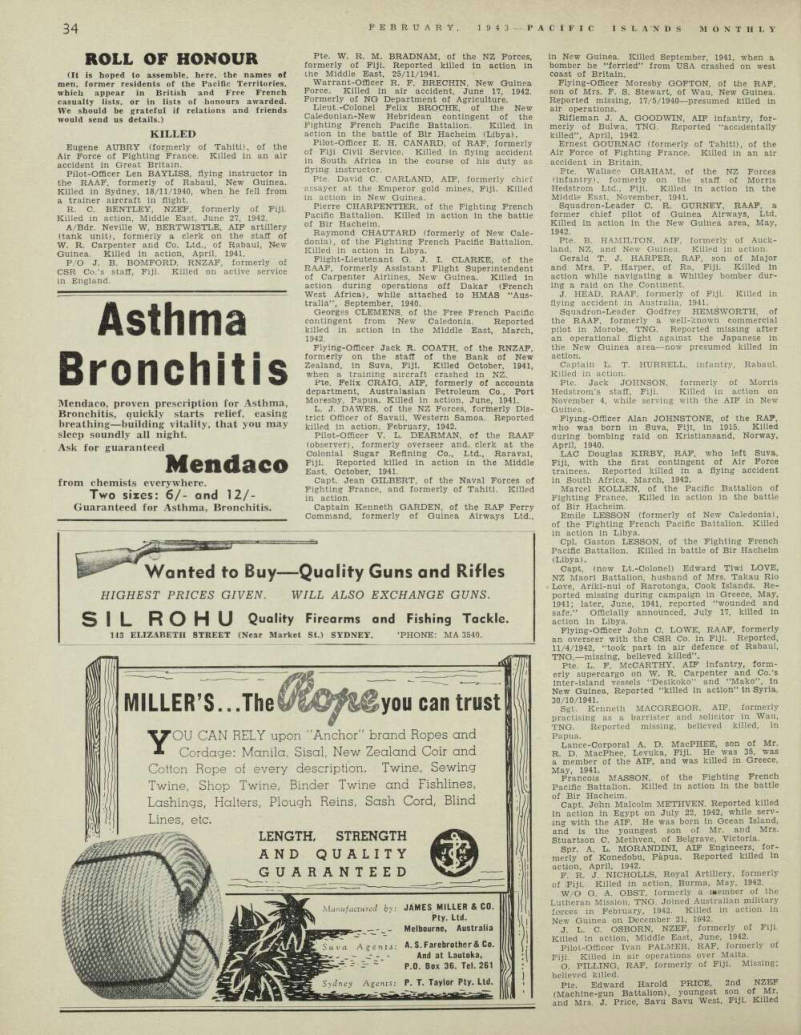
(It is hoped to assemble, here, the names of men, former residents of the Pacific Territories, which appear in British and Free French casualty lists, or in lists of honours awarded.
We should be grateful if relations and friends would send us details.)
Killed
Eugene AUBRY (formerly of Tahiti), of the Air Force of Fighting France. Killed in an air accident in Great Britain.
Pilot-Officer Len BAYLISS, flying instructor in the RAAF, formerly of Rabaul, New Guinea.
Killed in Sydney, 18/11/1940, when he fell from a trainer aircraft in flight.
R. C. BENTLEY, NZEF, formerly of Fiji.
Killed in action, Middle East, June 27, 1942.
A/Bdr. Neville W. BERTWISTLE, AIF artillery (tank unit), formerly a clerk on the staff of W. R. Carpenter and Co. Ltd., of Rabaul, New Guinea. Killed in action, April, 1941.
P/O J. B. BOMFORD. RNZAF, formerly of CSR Co.’s staff, Fiji. Killed on active service in England.
Pte. W. R. M. BRADNAM, of the NZ Forces, formerly of Fiji. Reported killed in action in the Middle East, 25/11/1941.
Warrant-Officer R. P. BRECHIN, New Guinea Force. Killed in air accident, June 17, 1942.
Formerly of NG Department of Agriculture.
Lieut.-Colonel Felix BROCHE, of the New Caledonian-New Hebridean contingent of the Fighting French Pacific Battalion. Killed in action in the battle of Bir Hacheim (Libya).
Pilot-Officer E. H. CANARD, of RAF, formerly of Fiji Civil Service. Killed in flying accident in South Africa in the course of his duty as flying instructor.
Pte. David C. GARLAND, AIF, formerly chief assayer at the Emperor gold mines, Fiji. Killed in action in New Guinea.
Pierre CHARPENTIER, of the Fighting French Pacific Battalion. Killed in action In the battle of Bir Hacheim.
Raymond CHAUTARD (formerly of New Cale donia), of the Fighting French Pacific Battalion.
Killed in action in Libya.
Flight-Lieutenant G. J. I. CLARKE, of the RAAF, formerly Assistant Flight Superintendent of Carpenter Airlines, New Guinea. Killed in action during operations off Dakar (French West Africa), while attached to HMAS "Aus tralia”, September, 1940.
Georges CLEMENS, of the Free French Pacific contingent from New Caledonia. Reported killed in action in the Middle East, March, 1942.
Flying-Officer Jack R. COATH, of the RNZAP, formerly on the staff of the Bank of New Zealand, in Suva, Fiji. Killed October. 1941, when a training aircraft crashed in NZ.
Pte. Felix CRAIG, AIF, formerly of accounts department, Australasian Petroleum Co., Port Moresby, Papua. Killed in action, June, 1941.
L. J. DAWES, of the NZ Forces, formerly Dis trict Officer of Savaii, Western Samoa. Reported killed in action, February, 1942.
Pilot-Officer V. L. DEARMAN, of the RAAF (observer), formerly overseer and. clerk at the Colonial Sugar Refining Co., Ltd., Raraval, Fiji. Reported killed in action in the Middle East, October, 1941.
Capt. Jean GILBERT, of the Naval Forces of Fighting France, and formerly of Tahiti. Killed in action.
Captain Kenneth GARDEN, of the RAF Ferry Command, formerly of Guinea Airways Ltd.,
in New Guinea. Killed September, 1941, when a bomber he “ferried” from USA crashed on west coast of Britain.
Flying-Officer Moresby GOFTON, of the RAP, son of Mrs. F. S. Stewart, of Wau, New Guinea.
Reported missing, 17/5/1940 —presumed killed in air operations.
Rifleman J. A. GOODWIN, AIF infantry, for merly of Bulwa, TNG. Reported “accidentally killed”, April, 1942.
Ernest GOURNAC (formerly of Tahiti), of the Air Force of Fighting France. Killed in an air accident in Britain.
Pte. Wallace GRAHAM, of the NZ Forces (infantry), formerly on the staff of Morris Hedstrom Ltd., Fiji. Killed in action in the Middle East, November, 1941.
Squadron-Leader C. R. GURNEY, RAAF, a former chief pilot of Guinea Airways, Ltd.
Killed in action in the New Guinea area, May, 1942.
Pte. B. HAAIILTON, AIF, formerly of Auck land. NZ, and New Guinea. Killed in action.
Gerald T. J. HARPER, RAF, son of Major and Mrs. P. Harper, of Ra, Fiji. Killed in action while navigating a Whitley bomber dur ing a raid on the Continent.
J. HEAD, RAAF, formerly of Fiji. Killed in flying accident in Australia, 1941.
Squadron-Leader Godfrey HEMSWORTH, of the RAAF, formerly a well-known commercial pilot in Morobe, TNG. Reported missing after an operational flight against the Japanese in the New Guinea area—now presumed killed in action.
Captain L. T. HURRELL, infantry, Rabaul.
Killed in action.
Pte. Jack JOHNSON, formerly of Morris Hedstrom’s staff, Fiji. Killed in action on November 4, while serving with the AIF in New Guinea.
Flying-Officer Alan JOHNSTONE, of the RAP, who was born in Suva, Fiji, in 1915. Killed during bombing raid on Kristiansand, Norway, April, 1940.
LAC Douglas KIRBY, RAP, who left Suva, Fiji, with the first contingent of Air Force trainees. Reported killed in a flying accident in South Africa, March, 1942.
Marcel KOLLEN, of the Pacific Battalion of Fighting France. Killed in action in the battle of Bir Hacheim.
Emile LESSON (formerly of New Caledonia), of the Fighting French Pacific Battalion. Killed in action in Libya.
Cpl. Gaston LESSON, of the Fighting French Pacific Battalion. Killed in battle of Bir Hacheim (Libya).
Capt. (now Lt.-Colonel) Edward Tiwi LOVE, NZ Maori Battalion, husband of Mrs. Takau Rio Love, Ariki-nui of Rarotonga, Cook Islands. Re ported missing during campaign in Greece, May, 1941; later, June, 1941, reported “wounded and safe.” Officially announced, July 17, killed in action in Libya.
Flying-Officer John C. LOWE, RAAF, formerly an overseer with the CSR Co. in Fiji. Reported, 11/4/1942, “took part in air defence of Rabaul, TNG, —missing, believed killed”.
Pte. L. F. MCCARTHY, AEP infantry, form erly supercargo on W. R. Carpenter and Co.’s inter-island vessels “Desikoko” and “Mako”, in New Guinea. Reported “killed in action” in Syria, 30/10/1941.
Sgt. Kenneth MACGREGOR. AIF, formerly practising as a barrister and solicitor in Wau, TNG. Reported missing, believed killed, in Papua.
Lance-Corporal A. D. MacPHEE, son of Mr.
R. D. MacPhee, Levuka, Fiji. He was 35, was a member of the AIF, and was killed in Greece, May, 1941, Francois MASSON, of the Fighting French Pacific Battalion. Killed in action in the battle of Bir Hacheim.
Capt. John Malcolm METHVEN. Reported killed in action in Egypt on July 22, 1942, while serv ing with the AIF. He was born in Ocean Island, and is the youngest son of Mr. and Mrs.
Stuartson C. Methven, of Belgrave, Victoria.
Spr. A. L. MORANDINI, AIF Engineers, for merly of Konedobu, Papua. Reported killed in action. April, 1942.
F. R. J. NICHOLLS, Royal Artillery, formerly of Fiji. Killed in action, Burma, May, 1942.
W/O G. A. OBST, formerly a member of the Lutheran Mission, TNG. Joined Australian military forces in February, 1942. Killed in action in New Guinea on December 21, 1942.
J. L. C. OSBORN, NZEF, formerly of Fiji.
Killed in action, Middle East, June, 1942.
Pilot-Officor Ivan PALMER, RAF, formerly of Fiji. Killed in air operations over Malta. o. PILLING, RAF, formerly of Fiji. Missing; believed killed.
Pte. Edward Harold PRICE, 2nd NZEF (Machine-gun Battalion), youngest son of Mr and Mrs. J. Price, Savu Savu West, Fiji. Killed
in action during the Libyan campaign, Middle East, 27/11/1941.
Pte. Cecil PURCELL, NZEF, formerly of Aleipata, Samoa. First Samoan Euronesian to give his life in World War 11. Killed in action in Middle East.
Captain W. H. ROBERTS, NZEF, who was Accountant in the Samoa Treasury Dept., dur ing 1934-35. Killed in action in Libya, Decem ber, 1941.
Major A. B. ROSS, NZEF, who, between 1923- 29 was successively, Assistant Secretary for Native Affairs, Assistant Secretary to the Administration, and ADC to the Administrator of Samoa. Killed in action in Libya.
Cpl. Alex. C. SCOTT, AIF, formerly manager at Kieta, TNG, for Burns, Philp and Co. Ltd.
Killed in action in the Middle East, 19/6/1941.
J. SIMPSON, RAAF, formerly of Fiji. Killed in action over Malta, July, 19'41.
Lieutenant A. G. W. THOMAS, RANR, for merly master of Burns Philp & Company’s SS “Muliama.” Killed in action.
Pte. Popoare TANGIITI, of the NZ Forces (Maori Battalion), formerly of Mangala, Cook Islands. Reported “missing after Battle of Greece—presumed dead”, July, 1941.
Sgt. Edward WILSON, of Suva, serving in the Fiji Defence Force. Accidentally drowned in the Lami River, Fiji, April, 1942.
Died From Wounds
Pte. Ernest HENRY, AIF, formerly of the Rabaul (NG) staff of Burns, Philp and Co.
Ltd. Died from wounds received in Battle of Crete, 1/6/1941.
Pte. Alec. MUNRO, NZ Forces, formerly of Norfolk Island. Died in Libya (Middle East), December, 1941.
Pte. T. LAWRIE, AIF, son of Mr. Lawrie, for merly of Fiji. Died of wounds in Middle East.
Pte. Walter PEARSON, of first NG quota of AIF (infantry). Died from wounds received in action, 24/6/1941.
A/Bdr. W. R. SCOTT, AIF, of New Guinea.
Died from wounds, July, 1941.
Sgt.-Pilot Peter Clarkson WISE, of the RAP, son of Mr. W. Wise, OBE, Director of Public Works, Fiji. Died from wounds received during bombing raid over Germany, January, 1941.
Died From Illness
Pte. Clarence A. HUTTON, AIF, formerly of Edie Creek, TNG. Died from Illness, April, 1941.
A/Sgt. J. H. STANE, Royal Australian En gineers, formerly of Port Moresby, Papua. Died from illness, May, 1942.
Rifleman R. A. SMITH, HQ Unit. (Place of enlistment not stated.) Died of illness.
Cpl. R. H. SUTTON, NGVR, formerly of Wau, TNG. Died from malaria and typhoid in October, 1942.
Major P. J. WOODHILL, AIF Infantry, formerly legal assistant in the Crown Law Office, Rabaul, New Guinea. Reported “deceased”, December, 1941.
Missing
Louis ANGER, of Fighting French Pacific Battalion. Reported missing after battle of Bir Hacheim.
Pte. P. F. BAILEY, AIF Infantry, of Rabaul, TNG. Reported missing, 17/2/1942. Now re ported prisoner of war.
Cpl. Jock BAIRD, AIF, formerly of Bank of NSW staff, Suva, Fiji. Reported missing in Malaya, February, 1942.
Cpl. Leon BARRENS, of Pacific Battalion of Fighting France. Missing after battle of Bir Hacheim (Libya).
T. BLAKELOCH, BEF, formerly of Fiji. Miss ing.
Robert BLUM, of Fighting French Pacific Battalion. Reported missing after battle of Bir Hacheim.
Sgt. Ronald Arthur BROODBANK, formerly of Samarai, Papua, now serving with the RAAF overseas. Reported missing on May 31 while on air operations.
Sgt. Alexander BROWN, RNZAF, formerly of Rarotonga. Reported missing over Germany, on September 15, 1942.
Reginald BOULANGER, of Fighting French Pacific Battalion. Reported missing after battle of Bir Hacheim.
H. BUCKNELL, AIF, formerly of Fiji. Missing.
Sgt. R. F. BUNTING, AIF, formerly of Samarai, Papua. Missing in Malaya.
Pte. E. L. CHRISTIE, AIF infantry, of Rabaul, TNG. Reported missing, 17/2/1942.
Victor DERVAUX, of Fighting French Pacific Battalion. Reported missing after battle of Bir Hacheim.
Lucien DEVAND, of Pacific Battalion of Fight ing France. Missing after battle of Bir Hacheim (Libya).
Pte. A. G. DICKSON, AIF infantry, of Rabaul, TNG. Reported “missing, believed wounded”, 17/2/1942.
GELLER, of Fighting French Pacific Battalion. Reported missing after battle of Bir Hacheim.
J. P. GOUZENES, of Fighting French Pacific Battalion. Reported missing after battle of Bir Hacheim.
Chief-Sergeant Francois GRISCOLLI, of Fight ing French Pacific Battalion. Reported missing in Libya in April. Formerly of New Caledonia.
Pte. Andrew A. (Billo) Johnson, Ngvr.
Reported missing in New Guinea on October 29 1942.
Georges KABAR, of Fighting French Pacific Battalion. Reported missing after battle of Bir Hacheim.
Henri LANGLOIS, of Pacific Battalion of Fighting France. Missing after battle of Bir Hacheim (Libya).
Numa LETHESER, of Pacific Battalion of Fighting France. Missing after battle of Bir Hacheim (Libya).
Rene LETOCART, of Fighting French Pacific
Battalion, Reported missing after battle of Bir Hacheim.
Camille MERCIER, of Fighting French Pacific Battalion. Reported missing after battle of Bir Hacheim.
MOUTRY, of Fighting French Pacific Battalion. Reported missing after battle of Bir Hacheim.
Pte. R. J. PASCOE, AIF infantry, of Rabaul, TNG. Reported missing, 27/1/1942.
Pilot Tom PATTERSON, of the RNZAF, formerly of Levuka, Fiji. Reported missing, in November, 1941, after bombing raid on the Continent.
Henri PAYONNE, of Fighting French Pacific Battalion. Reported missing after battle of Bir Hacheim.
Eugene PENE, of Fighting French Pacific Battalion. Reported missing after battle of Bir Hacheim.
Andre PETRE, of Fighting French Pacific Battalion. Reported missing after battle of Bir Hacheim.
Hector PILLING, RAF, who was born in Fiji and who was the son of Sir Guy Pilling, of Zanzibar (formerly of Fiji). Reported missing, while serving with the Royal Air Force Bomber Command.
Eugene POGNON, of Fighting French Pacific Battalion. Reported missing after battle of Bir Hacheim.
Gnr. Allan H. ROSS. AIF artillery, formerly planter in New Britain, TNG. Reported “miss ing—believed prisoner of war”, 28/9/1941.
ROUDEILLAC, of Fighting French Pacific Battalion. Reported missing after battle of Bir Hacheim.
Pte. William RUPE, of the NZ Forces (Maori Battalion), formerly of Aitutaki, Cook Islands.
Reported “missing after Battle of Greece”. Julv 1941.
Pilot James SIMPSON, of the RAF. formerly of Vatukouia, FIJI. Reported missing after air operations over Malta, in the Mediterranean. 1/7/1941.
Pilot-Officer Neville George STOKES, of the
RAP, formerly a pilot with Guinea Airways, Ltd., in New Guinea. Reported missing after air operations in Europe, December, 1941.
Reported Missing
Malaya Casualty List, Published 23/7/1942.
Pte. N. H. AMOS, artillery, Port Moresby.
Pte. E. L. CHRISTIE, infantry, Rabaul.
Pte. A. G. DICKSON, infantry, Rabaul.
Pte. A. I. FOLEY, artillery, Port Moresby.
W.0.l A. N. GRAY, ordnance, Rabaul.
W. 0.2 V. M. I. GORDON, artillery, Wau, New Guinea.
Pte. J. M. HIRSCHEL, infantry, Rabaul.
Pte. J. G. NEWTON, artillery. Port Moresby.
A./Bdr. B. L. J. MEETON, artillery, Rabaul.
Pte. D. M. SPENCE, artillery, Port Moresby.
Australia and Island Stations.
Pte. W. G. EKBLADE, infantry, Rabaul.
Pte. S. W. HUNTER, infantry, Kokopo.
Wounded
Sgt. Robert ASMUS, of the Fighting French Pacific Battalion. Wounded at Bir Hacheim and evacuated.
Rene AUFANT, of the Fighting French Pacific Battalion. Wounded at Bir Hacheim.
Cpl. Thomas BAMBRIDGE, of the Fighting French Pacific Battalion. Wounded at Bir Hacheim and evacuated.
BERBERE (alias ARESKY), of the Fighting French Pacific Battalion. Wounded at Bir Hacheim.
Henri BERTHELIN, of the Fighting French Pacific Battalion. Wounded, at Bir Hacheim.
Pte. V. BLANCO, AIP infantry, of Thursday Island. Wounded in action, July, 1941.
L/Cpl. J. P. BLENCOWE, AIF infantry, of Rabaul, TNG. Wounded in action, July, 1941.
Jean BRIAL, of the Fighting French Pacific Battalion. Wounded at Bir Hacheim.
Pte. George BUCKNELL, AIF, son of Mr. and Mrs. C. Bucknell, of Korolevu, Fiji. Wounded in action in Malaya, January, 1942.
Pte. Thomas BYERS, AIF infantry, of Thurs day Island. Wounded in action, May, 1941.
Raymond CHAUTARD, of the Free French Pacific contingent from New Caledonia. Re ported a casualty in the Middle East, March, 1942.
Pte. A. J. CORLASS, AIF, formerly of Rabaul.
Wounded in action.
Albert CUBADDA, of the Free French con tingent from New Caledonia. Reported a casualty in the Middle East, March, 1942.
Charles DEVEAUX, of Pacific Battalion of Fighting France. Wounded at battle of Bir Hacheim (Libya).
Sgt. EMERY, formerly of Lae, TNG. Wounded in New Guinea in October, 1942.
Lieut. M. G. EVENSEN, AIF, formerly of Rabaul. Wounded in action.
V. FAIRHALL, 2nd NZEF, formerly of the Treasury Department, Western Samoa. Reported wounded in action, February, 1942.
Paroa FIU, of the Fighting French Pacific Battalion. Wounded at Bir Hacheim and evacuated.
Acting Warrant-Officer V. M. I. GORDON, AIF infantry, of Wau, TNG. Wounded in action, February, 1942.
Pte. John GRANT, AIF infantry, of New Guinea. Wounded in neck and thigh, September, 1941; later, reported “rejoined unit”.
Henri GUILBAUD, of the Free French Pacific contingent from New Caledonia. Reported a casualty in the Middle East, March, 1942.
Sgt. C. HENDRICK, AIF infantry, of Rabaul, TNG. Wounded in action, July, 1941.
Stanley HIGGS, son of Mr. and Mrs. Gordon Higgs, of W. R. Carpenter and Co. Ltd., New Guinea. Member of an English Lancers’ regiment, wounded during British evacuation from Dun kirk (France), May, 1940.
Lieut. Lloyd T. HURRELL, AIP infantry, of Rabaul, TNG. Wounded in action, July, 1941.
Alexandre HUYARD, of the Free French Pacific contingent from New Caledonia. Reported a casualty in the Middle East, March, 1942.
Sgt.-Pilot Andrew KRONFELD, of the NZ Fighter Squadron attached to the RAF. Wounded in knee during operations over France, December, 1941.
Cpl. W. H. LANNEN, AIP artillery, of Rabaul, New Guinea. Wounded in action, June, 1941.
Gnr. E. G. LOBAN, AIP artillery, of Thursday Island. Wounded during campaign in Greece, May, 1941; invalided home after having his left forearm amputated.
Auguste LUTA, of the Fighting French Pacific Battalion. Wounded at Bir Hacheim and evacuated.
A/Sgt. Alastair MACLEAN, AIF infantry, of Rabaul, New Guinea. Wounded in action, in Libya, June, 1941.
Sgt. J. D. McCLYMONT, NZEF, son of Capt.
D. McClymont, Harbourmaster of Apia, Western Samoa, Wounded in action, November, 1941.
Cpl. R. McKERLIE, AIF, of Yandina, BSI, wounded in face by bomb explosion, April, 1941.
T. MANEA, of the Fighting French Pacific Battalion. Wounded at Bir Hacheim and evacuated.
Jean MERIGNAC, of the Free French Pacific contingent from New Caledonia. Reported a casualty in the Middle East, March, 1942.
Henri MEYER, of the Free French Pacific contingent from New Caledonia. Reported a casualty in the Middle East, March, 1942.
S/Sgt. Graham B. MIRFIELD, AIF engineers, of Rabaul, New Guinea. Wounded in action, Joseph OTHUS, of Pacific Battalion of Fight ing France. Wounded in battle of Bir Hacheim (Libya).
Pte. L. G. (“Mick”) REECE, AIF, of Bulolo, New Guinea. Wounded in action, July, 1941.
Henri RIVIERE, of the Free French Pacific contingent from New Caledonia. Reported a casualty in the Middle East, March, 1942.
Pte. H. St. George RYDER, AIF, formerly of Suva, Fiji. Wounded while serving in New Guinea.
A/Cpl. N. K. SAWYER, AIF infantry, of Rabaul, TNG. Wounded in action, July, 1941.
July, 1941.
Lieut. Jeffrey SEAGOE, serving with the British forces in the Far East, formerly of Vila, New Hebrides. Reported “wounded in action”, March, 1942.
Pte. Lance STAMPER, AIF, formerly school master at Wau, New Guinea. Wounded in action, August, 1941.
Cpl. Raphael TEIHO, of the Fighting French Pacific Battalion. Wounded at Bir Hacheim and evacuated.
Cpl. Terii TERIITUA, of the Fighting French Pacific Battalion. Wounded at Bir Hacheim and evacuated.
Pte. Harold G. TURNER, AIF, of Samarai, Eastern Papua. Wounded in action at Bardia (Libya), January, 1941, Pte. F. D. TWISS, AIF infantry, of New Guinea. Wounded in action, August, 1941.
Camille VINCENT, of the Free French Pacific contingent from New Caledonia. Reported a casualty in the Middle East, March, 1942.
Driver Don F. WAUCHOPE, AIF. Formerly employed on his brother’s plantation in New Guinea. Wounded in action, July, 1942.
Alex. WINCHESTER, of the Fighting French Pacific Battalion. Wounded at Bir Hacheim.
Sgt.-Pilot W. WRIGHT, of the Australian Spitfire Squadron, attached to the RAF, for merly of New Guinea. Wounded in knee during aerial “dog-fight” over the English Channel, March. 1942.
Prisoners Of War
Lieut. CLARRIE ARCHER, NGVR. Believed prisoner of war in Japan.
ALEXANDRE BLACK, of Pacific Battalion of Fighting France. Reported killed in action at Bir Hacheim, now reported prisoner of war.
A/Cpl. Peter W. BOSGARD, AIP infantry, formerly of the Lands Department, Port Moresby, Papua. Reported prisoner of war at Sulmona, Italy, 29/6/1941; transferred to Bolzano prison camp, September, 1941.
Cpl. J. E. BROAD, NZEF, formerly of Suva, Fiji. Reported prisoner of war.
Andre CHITTY, of Pacific Battalion of Fight ing France. Taken prisoner at battle of Bir Hacheim (Libya).
A/Sgt. A. A. S. COTMAN, AIF infantry, of Abau, Papua. Reported missing—believed prisoner of war, 5/5/1941; reported later, July, 1941, “wounded in chest and head by shrapnel— taken prisoner”.
Pte. J. DALTON, AIP Transport and Supply, formerly of Thursday Island. Reported prisoner of war, April, 1942.
Dick ELMOUR, formerly of New Caledonia, prisoner of war after Dunkirk. Repatriated to Prance in January, 1942, because of health reasons.
Pte. W. G. ECKBLADE, AIF, formerly of Rabaul. Previously reported missing: now re ported missing; believed prisoner of war.
Pilot-Officer George Beilby , EVANS, RAAF, son of Mr. and Mrs. Beilby Evans, formerly of Buka Passage, TNG. Reported prisoner of war in
Java.
Sgt. Ronald Gemmell-Smith, Raf, For
merly on CSR Co.’s staff, Fiji. Reported prisoner of war in Bengazi, Libya, in November, 1942.
Pte. W. GOSSNER, AIT infantry, formerly of the BNG Development Co.. Port Moresby, Papua.
Reported prisoner of war, Sulmona, Italy 6/7/1941.
Lieut. J. M. HARCOURT, 2nd NZEP. son of Mr. H. W. Harcourt, formerly Deputy Treasurer in Fiji. Reported “captured in Libya and now prisoner of war”, March, 1942.
S. D. C. KERKHAM, NZEP, son of Mr. R. C.
Kerkham, Suva, Fiji. Reported prisoner of war in September, 1942.
Lieut. JEFF KILNER, NGVR. Believed prisoner of war In Japan.
Gnr. A. L. B. KING. ATP artillery, of Rabaul.
TNG. Reported prisoner of war, 29/7/1941.
Major E. G, A. LETT, of the East Surrey Regiment, and son of Mr. Lewis Lett, of Port Moresby, Papua. Reported prisoner of war in Libya.
A/Col. John H. LONERGAN. ATP. Supply and Transport, of New Guinea. Rennrted prisoner of war at Corinthla. Italy, 8/7/1941.
Ftp Ernest (“Paddy”! McGEADY. NZEP. son of Mrs. J. McGeadv, of Suva. Fiji. Reported “missing, believed killed”, after fighting in Libva. January, 1942; reported prisoner of war in Italy. April, 1942.
Col. J. H. L. McGUIGAN. of the Field Ambul ance, ATP (formerly a resident of New Guinea), officially reported missing at Singapore: un officially reported a prisoner in Japanese hands.
Observer Alex. McKAY, of the RAAF. formerly of the CSR Co.’s staff, at Penang sugar-mill.
Fiji. Reported missing. 27/7/1941; reported prisoner of war in Italy. 26/10/1941.
Pte. Harry MARCHTNGTON. of the NZ Forces, formerly of Fiji. Reported prisoner of war after Battle of Crete. 2/12/1941.
Emile MILLOT, of Pacific Battalion of Fight ing France. Taken prisoner in battle of Bir Hacheim (Libya).
Pte. D. R. PHILLIPS, AIF engineers, formerly of Bulwa, TNG. Reported prisoner of war June, 1942.
Pte. John O. SMITH, of the NZ Forces, son of Captain Arthur Smith, of the Fiji inter-island vessel “Tui Kauvaro”. Missing after battle of Crete, May, 1941; reported prisoner of war in Germany, 21/10/1941.
Squadron-Leader L. C. SHOPPEE, DSO RAF, formerly of Edie Creek, New Guinea. Was In Java during Japanese Invasion; now pre sumed to be a prisoner of war.
LAC Charles SOLLITT, of the RAAF (wire less operator), son of Mr. and Mrs. C. H.
Sollitt, of Nausori, Fiji. Reported missing after air operations in New Guinea, January, 1942; later, March, 1942, reported rescued from sea by Japanese—now prisoner of war.
Pte. Fred SWAN, NZ Army Medical Corps, formerly of Apia, Western Samoa. Missing after Battle of Crete, August. 1941; reported prisoner of war in Germany. November, 1941 Lieut. CLIFF WARREN, of NZEP. serving in the Middle East, and formerly of Morris Hed strom Ltd.’s staff at Ba and Lautoka, Fiji. Re ported prisoner of war.
Mjr. N. WATCH, formerly Dr. Watch, of Rabaul, missing after Japanese invasion of Rabaul. Believed prisoner of war in Japan.
Pte. John D. WHITCOMBE, of the NZ Forces, formerly of Levuka,- Fiji. Reported prisoner of war in Germany, November, 1941.
Decorations
Squadron-Leader G. U. (“Scotty”) ALLEN, RAAF, who is well-known in New Guinea and Papua, having been co-pilot on the “Faith in Australia”, on the first official air-mail flight to the Territories in 1934. Awarded the Air Force Cross for his work with Catalina flying ooats in Australia and the Pacific.
Major H. T. ALLEN, AIP, formerly of Wau Morobe District, TNG. Awarded the QBE.
Squadron-Leader C. A, BASKETT, formerly of Bulolo, TNG. Awarded Distinguished Flying Cross for raids over enemy territory while attached to Hampden bomber squadron In Eng land.
Sgt. Henry C. S. COTTON, of the RNZAF, who was born in Samoa (his father was Secre tary of Native Affairs during the NZ military occupation). Awarded the Distinguished Flying Cross.
FREDERIC DELAVEUVE, formerly of New Caledonia. Awarded Croix de Guerre, while serving with Fighting French volunteers in Egypt.
Rifleman H. W. FORRESTER, NGVR, formerly of Bulolo, TNG. Awarded the Military Medal for operations against Japanese in New Guinea.
Squadron-Leader Godfrey HEMSWORTH, RAAF, formerly a well-known New Guinea pilot, who was killed in action against the Japanese In May. Posthumously awarded the Air Force Cross.
Flight-Lieut. R. N. DALKIN, RAAF, formerly of W. R. Carpenter and Co., Ltd.. Salamaua, TNG. Awarded the DFC for bombing raids against the Japanese in Koepang area, DEI.
Squadron-Leader C. R. GURNEY. RAAF, for merly of Guinea Airways. Ltd., TNG. Posthu mously awarded the Air Force Cross, for bomb ing raids on Japanese-held ports in New Britain.
LUCIEN HERVOUET, formerly of New Cale donia. Awarded Croix de Guerre while serving with Fighting French volunteers in Egypt.
Lieut. Colin HILL. RANR, of the Australian destroyer, “Waterhen”, formerly second officer on the trans-Pacific liner “Niagara”. Awarded the OBE.
Flying-Officer James R. HYDE, of the RAP. formerly a Patrol Officer In Namatanal and Sepik Districts, TNG, Awarded the Distinguished Flying Cross.
Lieut.-Commander A. W. R. McNICOLL, RAN. son of Sir Ramsay McNlcoll, Administrator of New Guinea, and Lady McNicoll, Awarded the George Medal.
Petty-Officer PAUL MASON. RANVR, formerly a plantation inspector at .Inus, Bougainville, TNG. Awarded American Distinguished Service Cross for “extraordinary heroism in action.”
HENRI MAYER, formerly of New Caledonia.
Awarded Croix de Guerre while serving with Fighting French volunteers in Egypt.
Sgt. Geoffrey MOORE, of the RNZAF, formerly engineer on the NG inter-island vessel “Maiwara” and on the trans-Paciflc liner “Aorangi”. Awarded the Distinguished Flying Medal.
ANDRE MORNAGHINI, formerly of New Cale donia. Awarded Croix de Guerre while serving with Fighting French volunteers in Egypt.
Pilot-Officer Pat RICHARDSON, RAP, son of Mr. W. Richardson, formerly of Penang, Fiji.
Awarded the Distinguished Flying Cross.
Commander Alvord S. ROSENTHAL, RAN, son of Major-General Sir Charles Rosenthal, KCB, CMG, DSO, VD, Administrator of Norfolk Island. Awarded the DSO, November, 1941; awarded the Bar to DSO, February, 1942.
F/O Leigh G. VIAL, RAAF, formerly of ADO in TNG. Awarded American DSC for outstand ing heroism in New Guinea in September, 1942.
Lieut. George Raymond WORLEDGE, of the RANVR, formerly of Fiji. Awarded the MBE (Military),
Advertisements & other items, pp. 36-39 (1 item)
Bronchitis
Asthma
Mendaco, proven prescription for Asthma, Bronchitis, quickly starts relief, easing breathing—building vitality, that you may sleep soundly all night.
Ask for guaranteed
Mendaco
from chemists everywhere.
Two sizes: 6/- ond 12/- Guaranteed for Asthma, Bronchitis.
Wanted to Buy—Quality Guns and Rifles HIGHEST PRICES GIVEN. WILL ALSO EXCHANGE GUNS.
S I L RO H U Quality Firearms and Fishing Tackle. 143 ELIZABETH STREET (Near Market St.) SYDNEY. ’PHONE: MA 3540.
MILLER’S...The
you can trust
YOU CAN RELY upon "Anchor" brand Ropes and Cordage: Manila, Sisal, New Zealand Coir and Cotton Rope of every description. Twine, Sewing Twine, Shop Twine, Binder Twine and Fishlines, Lashings, Halters, Plough Reins, Sash Cord, Blind Lines, etc.
LENGTH, STRENGTH
AND QUALITY
GUARANTEED
ifactured by : gents:
JAMES MILLER & CO.
Pty. Ltd.
Melbourne, Australia A.S.Farebrother& Co.
And at Lautoka.
P.O. Box 36. Tel. 261 Agents: P. T. Taylor Pty. Ltd.
Tir aafifi tF
sdrtk
General
Merchants
and
Agents
c
REPRESENTING LEADING FIRMS IN THE ISLANDS
379 KENT STREET,
SYDNEY.
Telephones: MJ 4657 (5 lines).
Islands p r°duce Sold on Shippers' Account Buyers of all Islands’ requirements on Commls- Liberal Advances against Consignments. sion Original Invoices Furnished- -25 Years’ Islands Trade Experience.
Bankers: Bank of New South Wales. Correspondence in English and French.
KANGAROO BRAND
Ropes,
Cordage,
and Twines for every purpose
Backed by
86 years of service.
Manufactured by
M. DONAGHY AND SONS,
Pty. Ltd.,Geelong and Sydney.
Fiji Representatives:
PEARCE AND CO.
LIMITED
R.O. BOX 237, SUVA
For Essential Industries
Now, more than ever, speed and efficiency in industry are demanded. Only equipment of the highest reputation is worthy of consideration. You can rely on the products of— CROMPTON, PARKINSON LTD.—Motors, Instruments, Transformers, Crompton Lamps.
FERRANTI LTD. —Transformers, Instruments, Meters.
HERBERT MORRIS LTD.—Pulley Blocks, Runways.
CROMPTON, PARKINSON (AUST.) PTY. LTD
Parkinson Motors, Crompton Minor Motors, Power Transformers.
CALLENDER’S CABLES & CONSTRUCTION CO.
LTD.—Wires, Cables, Flexibles.
RANSOMES & RAPIER LTD.—Mobile and Breakdown Cranes, Excavators.
HOPKINSONS LTD.—Valves and Boiler Fittings.
NORDBERG MFG. CO. LTD.—Symons Cone Crushers, Vibrating Screens.
AUDLEY ENGINEERING CO. LTD.—“Audco”
Lubricated Plug Valves.
MATHER & PLATT LTD.—Large Electric Motors.
BROS. (SYDNEY) LTD.
115 Clarence Street, Sydney
And at Fort Kembla. 197 Elizabeth Street, Brisbane.
PACIFIC ISLANDS SOCIETY
Visitors from the Islands to Sydney (or those interested in Islands affairs), are advised to communicate with the honorary secretary of the above Society, which has been formed to study the history, traditions, economics, and political developments of the Pacific Islands.
Regular monthly meetings are held at History House, 8 Young Street, Sydney.
Address for Correspondence:
THE PACIFIC ISLANDS SOCIETY,
Box 2434 MM., G.P.0., Sydney.
By helping to make rich, red blood,
Dr. Williams*
PINK PILLS
have an invigorating and tonic action upon the whole system. You should sleep better, eat better, and feel strengthened after Dr. Williams’ Pink Pills.
BUBIYS
DRY E!N
Distilleries at London . . . England Toronto . . . Canada Moorobbin . . Victoria Cincinnati . . . U.S.A.
There is no substitute for
OLD MONK
VIRGIN PURE
OLIVE OIL
A W San Francisco
A. J. Gaskin Returns
North
MR. A. J. GASKIN, who. during the last year, while attached to the Eternal Territories Department, has been a friend in need to all Territories evacuees, will shortly be returning north.
He says that he will change his name to “Arthur J. Gaskin”—in other words, he will be going to Port Moresby in American uniform, and as a member of
the American Red Cross—although still retaining civilian status.
Mr. Gaskin will be remembered as an officer of the Audit Department in Rabaul, and, of more recent years, as the popular proprietor of the Cosmopolitan Hotel, Rabaul. He was one of the last civilians to get away from the town when the Japs attacked it in January, 1942.
After his arrival in Australia he be came attached to the External Territories Department—in which office he will be sorely missed by Territories folk. He has a unique non-bureaucratic slant on things, which appeals strongly to evacuees who might otherwise have spent months running their heads against the brick wall of Federal officialdom. He was one of the leading spirits in the re-constitu tion of the New Guinea Branch of the RSSAILA, and this and other organi sations will miss his activities on their behalf. However, he is returning to the land where his deepest interests lie, and it is some comfort to those who are left behind that he expresses a determination to still “fight for the cause”—that is, the cause of the evacuees at present in Aus tralia, and of New Guinea servicemen— wherever he is.
Final figures from the bazaar held recently in Labasa, Fiji, are not yet available, but it had reached the £2,000 mark, states the “Fiji Times" on January 15.
Service Men Of
Papua
Early Samarai Enlistments
THE following additions should be made to the list of names, published in January, described as the first 18 men of Papua to enlist in the present war.
Mr. Harold G. Turner, of Samarai, en listed in the AIF some time before some of the names mentioned, and has since been reported injured at Bardia.
The following three men all left Samarai with the same detachment as seven of the men mentioned: — G. E. (“Dusty") Miller, who was em ployed on the staff of BP’s, Misima, joined the RAAF and is believed to have been killed in action over Germany.
D. N. Ashton, who was master of A. H.
Bunting’s ketch, “Lady Jean," joined the RAN and is believed to be back in Aus tralia, after serving overseas.
Wm. Wright, Jnr., of Ahioma, Milne Bay, joined the RAAF as a pilot, and served in the Australian Spitfire Squadron with RAF. He is reported to have been wounded.
Robert H. Bunting, manager of A. H.
Bunting, Ltd., Samarai, journeyed to Moresby with the men mentioned above.
There he caught the next steamer south, joined the AIF and was last heard of in Malaya.
Ron Broadbank, also of Samarai, was another young man who went south a short time later, joined the RAAF, and also has been reported missing.
A correspondent, who kindly supplies the foregoing facts, adds: — Several others enlisted during the latter part of 1940.. Your list is incomplete without the names I have mentioned.
Obviously, the list should have been described as the first 18 men of Port Moresby—not of Papua.
The Horrors Of War In
Tahiti
From Our Own Correspondent
Papeete. Nov. 25.
OUR Tahitian Brotherhood of the Bottle has been appeased by casks, hogsheads and tuns of wine from Australia and California.
Now. tribulation and despair have descended on our cigarette slaves. The major number of these among our womenfolk. This twofold deprivation of lipstick and cigarettes will, likely, turn them into furies and barridans.
We pipe-smokers have been con strained to use our black native tobacco —with consequences to our tempers not altogether happy.
All of this may seem trivial in a world at war. But to a man with a toothache the majestic procession of the constella tions is a matter of minor importance.
And so small things seem to our Papeete people.
No More Meningitis
Prom Our Own Correspondent
Noumea, Dec. 10.
NEW Caledonia's cerebro-spinal menin gitis outbreak seems to have de finitely finished, no new cases having been reported since October.
There were in all some twenty mainland cases, including four native deaths, and twelve cases on the island of Lifou (Loyalty Group). United States Army doctors co-onerated with the local medical service in handling the outbreak.
Advertisements & other items, p. 40 (1 item)
Rid Kidneys Of
Poisons And Adds
IF YOU HAVE
Leg Pains, Dizziness, Rheumatism, Lumbago. Nerviness, Broken Sleep, Circles Under Eyes, Swollen Ankles,
Get Cystex
In 2 sizes—4/-, 8/-
from chemists everywhere.
Guaranteed for
KIDNEYS, BLADDER, RHEUMATISM.
Ship Chandlery Hardware
r Write for j
j Ship Chandlery /
/ Catalogue J
Special “In Bond” Prices for all Islands enquiries quoted on application.
BROOMFIELDS LIMITED
152 SUSSEX STREET :: SYDNEY.
Cables: “Boom”. Sydney.
Large and Complete Stocks of
SHIP CHANDLERY
IRONMONGERY OF ALL KINDS, PAINTS,
WHITE LEAD AND OILS.
Sole Agents for: P. H. MUNTZ & CO.’S 3-CROWN BRAND METAL SHEATHING.
PEACOCK & BUCHANS’ ENGLISH READY-MIXED PAINTS.
Woven Wire for all Industry
COPRA DRYING TRAYS, FLOORS, Etc,
FRUIT DRYING TRAYS, MINING SCREENS.
Heavy Mosquito Gauze in Phosphor Bronze and other Metals Impervious to Salt Sea Air.
WIRE DOOR MATS AND GENERAL WIRE WORKS
E. WRIGHT & CO. LTD.
Office and Works: 148-152 Cleveland Street, Sydney, N.S.W.
Telegraphic Address; “Wrightmake,” Chippendale,
BITUMENOID ROOFING
MADE IN AUSTRALIA. , . .
Bltumenold Roofings, Dampcourse and Insulating Pelts are made from the worlds best raw materials. Warranted to stand the most rigid tests.
BITUMENOID THE BEST
Roofing 1,2, 3-ply; Flooring, Waterproof Materials; Saturated Pelt; jointing: Natural Asphalt Dampcourse; 2 and 3-ply Dajnpcourse; 1-2 Dampcourse: Roofing Cement; Asphalt Paints; Roofing Compound.
SAMPLES AND PRICE LISTS ON APPLICATION.
Resilient Road lb. Lead-core
MAXWELL PORTER & SON LTD.
ESTABLISHED 1888.
107 REDFERN ST., REDFERN, SYDNEY, N.S.W.
BUILDERS’ SUPPLIED.
Phone: M 8157. Cables Bitomenoid.
Boogie Woogie
Lighter Side of Guadalcanal
A BATTERED piano, salvaged from a partly-sunken boat, with its corners sawn off, was floated ashore by a landing barge. So Guadalcanal found itself in possession of an infinitely pre cious commodity, to be loaded on a truck and taken to a different bivouac area
each night.
Thus, with it all—with death, malaria, and crude living conditions —music some how accompanies the American soldiers and airmen of the South Pacific ground and air forces. It is home-made music— ballads, “lowa Calypso,” and boogie woogie, transplanted from Harlem and Chicago’s loop, to the middle of a Lever Brothers’ coconut grove in the Solomons, scarred by artillery and Japanese bomb ings.
It represents release from battle ten sion, of time off for remembrance of things of the past. It is music, with frag mentary flashes of home.
A former piano tuner, sweat stained and full bearded, removed the discords due to salt air and tropic heat. A great player was at hand in Sergeant Arthur J.
Brennan, better known as Buddy Bren nan, of Bob Chester’s orchestra. When not aiding Captain Cook, Special Services Officer, in taking cigarettes to the men in the front lines, he plays his arms off at installations scattered around Hen derson Field.
Boogie woogie. The boys are crazy about it. So are the native Melanesians.
As a next addition, a clarinet arrived, carried in a field pack. With it, Ser geant Peter Terry, late of Teddy Powell’s orchestra.
To this professional duo add the in evitable “ordinary, likeable kid” with a flair for lyrics, Private Frank Ellis, of a medical outfit. To him goes the credit of a song evolved from men singing and a piano’s improvising—a song of the Solomons:— Douglas, Voight, Sikorsky, Bell, All make planes that sound so well— But the Japanese, strange as it seems, Make planes that sound like washing machines.
From an isle in the Coral Seas That we took from the Japanese— From it comes the story of A guy called “Maytag Charlie.”
Every night about ten-fifteen.
The air-raid siren used to scream; Up would go the searchlight’s beam, And in flew “Maytag Charlie.”
Now this Charlie guy, he flew so high That he never could score a hit; And then one night, we set a trap, And sure enough “Maytag Charlie” bit.
He saw the lights, and came down low, The anti-aircraft guns let go, You could hear the blast in Tokio— And down came “Maytag Charlie.”
Just a song; but somehow one mighty close to the business at hand, and one
that articulates the thoughts of men who want to make light of death and war. A humorous ballad to a boogie beat served to men hungry for the ease that music
gives.-
H. E. L. Friday.
Mr. Gordon M. Robertson, who was born in Erromanga, New Hebrides, 67 years ago, and who was very well and favourably known in most of the terri tories of the Western Pacific, died recently in Sydney. Because he grew up in the Pacific territories, he had the unique distinction of having travelled in an aeroplane (in New Guinea) before ever he had ridden in a motor car. He spent the last forty years of his life as a gold-miner in Papua and New Guinea, and held claims at Edie Creek and the Watut. He was a partner of Mr. George Arnold for fifteen years.
Advertisements & other items, pp. 41-42 (1 item)
Burns Philp
PACIFIC ISLANDS YEAH BOOK
1942 (Wartime) Issue
Supplies of this invaluable Reference Book were exhausted in December, and a number of orders were not filled. Further supplies have now been received from the printers; but, owing to war conditions, the Edition is very limited, and those desiring a copy of the Year Book should make early inquiry.
The Edition contains : A full description of every Islands group in the Pacific; maps and statistics relating to each; directories and lists of business firms; a Chronology of the Pacific war; Pidgin-English vocabulai'y; etc.
Price, in stiff cloth-bound cover: 12/6.
Copies may be obtained from all leading booksellers, from all Branches of Burns Philp & Co. Ltd., and W. R. Carpenter & Co. Ltd., from Islands storekeepers, or direct from the publishers—
PACIFIC PUBLICATIONS PTY. LTD.,
Union House, 247 George Street,
SYDNEY.
BURNS PHILP
(SOUTH SEA) CO. LTD.
Inc. in Fiji Island Traders and Shipowners Registered Office :
SUVA
FIJI
\\ Also Branches at: Fiji: Levuka, Lautoka, Labasa, Ba, Sigatoka, Rotuma.
Tonga: Nukualofa, Haapai, Vavau.
Samoa: Apia, Pago Pago (American Samoa).
Solomons: Makambo, Gizo, Faisi.
New Hebrides: Vila.
Code Address: Gilberts: Tarawa.
“Burnsouth”. Norfolk Is. Niue. Wallis Is. Futuna Is.
Metals which combine high strength and hardness with ductility and toughness are extremely desirable but somewhat unusual; yet MONEL* possesses all these characteristics, plus corrosion-resistance.
This rustless nickel-copper alloy is of vital importance to-day, whether on sea, land or in the air, but its use must be confined solely to those applications for which there is no substitute.
If your job is of national importance and requires all the foregoing characteristics, then Monel is available in Sheet, Rods, Wires, Tubes, Wire Cloth, Rivets, Ingots for casting, etc.
WRIGHT AND COMPANY
Sole Australian Distributors of Monel
81 CLARENCE STREET, SYDNEY
= trade mark
Purchasers at Full Market Prices on Assay Value of
GOLD
SILVER
PLATINUM
And Platinum Group Metals
SOME OF OUR SERVICES
ASSAYERS & ANALYSTS—
Assays of Bullion, Ores, etc.
Analyses of Metals, Minerals, Alloys, etc.
SCIENTIFIC & INDUSTRIAL
METALLURGISTS—
Our range of precious metal manufactures covers all industries—Gold and Silversmiths, Electrical Trades, Dental Profession, Glass Silverers, Electro-Platers, etc., etc.
REFINERS—
Purchasers and Refiners of Bullion, Scrap, Mining By-Products, and Trade Residues of every description carrying Precious Metals.
GARRETT & DAVIDSON
PTY. LTD.
824 George St., Sydney. Works: Surry Hills and Chippendale, N.S.W.
Official Assayers to the Bank of New South Wales. Gazetted Agents of the Commonwealth Bank of Australia, under the Gold Regulations of the National Security Act.
6 UJLESPji: Service
BUYING AGENTS
FOR ALL PACIFIC TERRITORIES
Island Produce Sold on Commission
YOUR ORDERS RECEIVE PERSONAL ATTENTION
ROBERT GILLESPIE PTY. LIMITED
54a PITT STREET, SYDNEY
Cables; ROBERGILL. G.P.O. BOX 137 CC.
No Cosmetics!
Tahiti's Women Face a Crisis
From Our Own Correspondent
Papeete, Dec. 10.
AS the neophyte of old in the temple of Isis, awaited with awe the part ing of the ponderous veil before the inner sanctuary which would reveal the goddess in all her splendour, so we men of Tahiti await, with no little trepidation, a revelation. We are about to discover the faces of our womenfolk.
This will not come to pass by the part ing of curtains, but because the fortunes of war have cut off the supply of lip stick, rouge and other cosmetics, and we are destined to see, for the first time, our womenfolk as they really are.
But —are we? The damsels of the kingdom of Minos and of the Valley of the Nile did not live in an industrial age.
Yet they provided themselves with dyes to stain their lips, ruddy powders to de corate their cheeks and gory red enamels to brighten the nails of their fingers and toes.
In Tahiti, we have araea—a vermilion earth which, combined with snowy coral ground to impalpable power by pestle and mortar, might serve the empty rouge-pots on the toilet tables of our desolated maids and matrons.
William Ellis comes to their rescue with a recipe for lipstick:—“The natives of the Society Islands have a variety of vegetable dyes . . . brilliant red and yellow are their favourite hues. The former, which they call mati, is prepared by mixing the milky juice of the small berry of the mati (Fiscus prolixa), with the leaves of the tou, a species of cordia.
When the dye is prepared by this com bination, it is absorbed on the fibres of a kind of rush, and dried for use.
“It produces a most brilliant scarlet dye which, preserved with a varnish of gum, retains its brightness”—indefinitely.
The compounding of nail polish of that flaming carmine so dear to the feminine heart, is a more difficult problem.
The desiccated carapace of well-boiled shrimps or sea-lobsters, ground to a colloid with the oil of the tutui (the candle nut—now generally called tiairi in Tahiti), might be an acceptable sub stitute—we do not know. We do know,
however, that none of these things could be more horrid than the paints and powders and enamels that heretofore have concealed the sweet features of our womanfolk behind expressionless masks.
Sometimes the neophyte in the temple was found —at the last moment—to be unworthy, and the veil was never with drawn from before the inner sanctuary.
Perhaps we, too, are unworthy and shall never see the fact of Isis.
Fiji Residents
Honoured
TWO residents of Fiji are included in the New Year honours list, reports the Fiji “Times.” They are: Mr. H.
Sabben, of the Public Works Department, and Mr. A. W. James, of the Customs Department.
Mr. Sabben, who becomes an Officer of the Most Excellent Order of the British Empire (OBE), has been mechanical en gineer since January 1, 1928. He joined the service in 1907 as an assistant engineer on the s.y. Ranadi.
Mr. James, who is created a Member of the Most Excellent Order of the British Empire (MBE), joined the Cus toms Department in 1915, becoming chief landing waiter in 1929. He was regarded as a Senior Customs Officer, Grade 11, on January 1, 1938. Mr. James served over seas in the last war, being awarded the Military Medal and Bar.
Death Of Mrs. M. A. Dette
Mrs. M. A. Dette died in the Yass Hos pital, NSW, on February 10. She had been in poor health for some time. Mrs.
Dette is another of Papua’s pioneers who has passed on. She first went to Port Moresby at the end of 1913 and remained there practically continuously up to De cember, 1941, when she was compulsorily evacuated, with all other women. She ran the Hotel Moresby for many years and, later, assisted her brother in the management of the Papua Hotel, up to 1928, when he sold out. She was well and favourably known to all the old-timers, especially the miners, and with her brother, Mr. T. D. Ryan, brought to Port Moresby its first amenities in the way of an ice works, freezing plant, picture show, motor car and lorry transport and electric lighting for the two hotels. Her daughter married Mr. Gerald Smith, who is now proprietor of the Club House Hotel, at Yass, NSW.
Mr. Munsami Mudaliar, ex-Indian member of the Fiji Legislative Council, died in the Suva Memorial Hospital after a short illness, on December 23 imme diately following his attendance at the Indian Labour Conference, where the Government’s plans for forming an Indian Corps were discussed. He went to the Colony in 1913 and for many years took a prominent part in the activities of the Indian community. He was elected to the Legislative Council in 1932 and was the first Indian to be made a Justice of the Peace. He will be greatly missed in the Colony.
Advertisements & other items, p. 42 (2 items)
40
FEBRUARY, 1943 PACIFIC ISLANDS MONTHLY
“ F Z- K»^ w S£V«s;,“ a prin,ed
5
E SO 5
LOTIO
For Inflamed Eyes and Eyelids
SOLD EVERYWHERE
H. A. Rose A. Co. Pty. Ltd.. King St., Sydney
Australian Short Wave
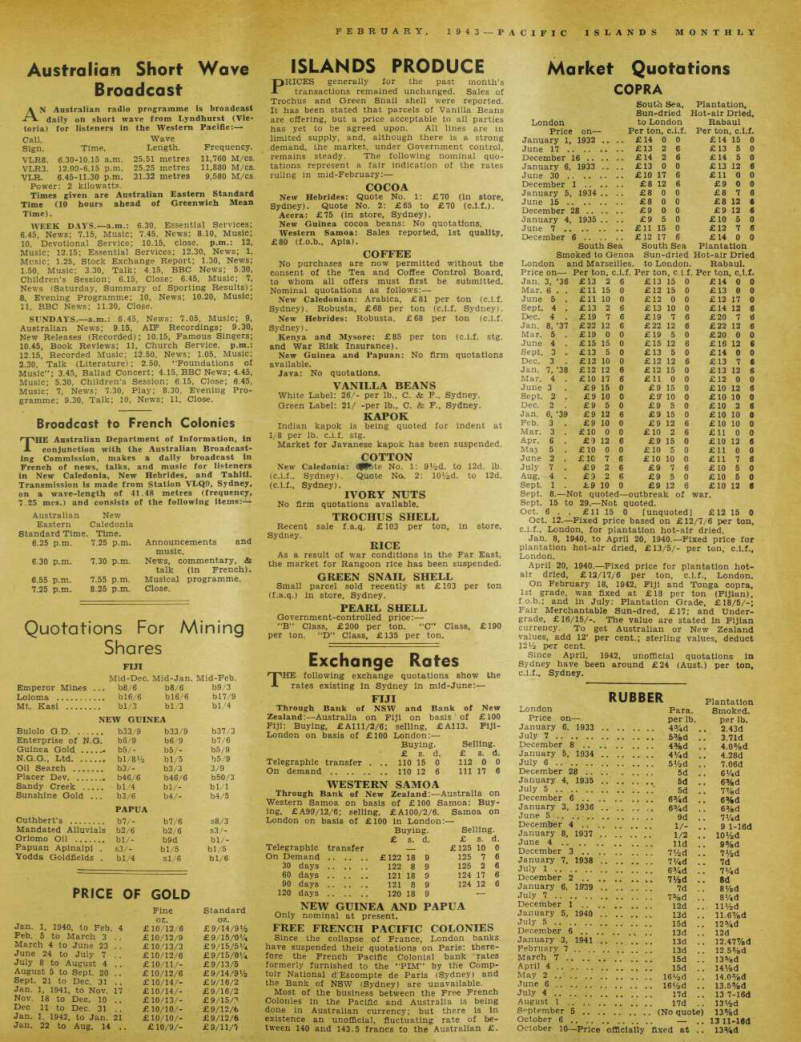
Broadcast
AN Australian radio programme is broadcast daily on short wave from Lyndhurst (Vic toria) for listeners in the Western Pacific:—
Times given are Australian Eastern Standard Time (10 hours ahead of Greenwich Mean Time).
WEEK DAYS.—a.m.: 6.30, Essential Services; 6.45, News; 7.15, Music; 7.45, News; 8.10, Music; 10, Devotional Service; 10.15, close, p.m.: 12, Music; 12.15; Essential Services; 12.30, News; 1, Music; 1.25, Stock Exchange Report; 1.30, News; 1.50, Music; 3.30, Talk; 4.15, BBC News; 5.30, Children’s Session; 6.15, Close; 6.45, Music; 7, News (Saturday, Summary of Sporting Results); 8, Evening Programme; 10, News; 10.20, Music; 11, BBC News; 11.30, Close.
SUNDAYS.—a.m.: 6.45, News; 7.05, Music; 9, Australian News; 9.15, AIF Recordings; 9.30, New Releases (Recorded); 10.15, Famous Singers; 10.45, Book Reviews; 11, Church Service, p.m.: 12.15, Recorded Music; 12.50, News; 1.05, Music; 2.30, Talk (Literature); 2.50. “Foundations of Music”; 3.45, Ballad Concert; 4.15, BBC News; 4.45, Music; 5.30, Children’s Session; 6.15, Close; 6.45, Music: 7, News; 7.30, Play; 8.30, Evening Pro gramme: 9.30, Talk; 10, News; 11, Close.
Broadcast to French Colonies
THE Australian Department of Information, in conjunction with the Australian Broadcast ing Commission, makes a daily broadcast in French of news, talks, and music for listeners in New Caledonia, New Hebrides, and Tahiti.
Transmission is made from Station VLQ9, Sydney, on a wave-length of 41.48 metres (frequency, 7.25 mcs.) and consists of the following items:— Australian New Eastern Caledonia Standard Time. Time. 6.25 p.m. 7.25 p.m. Announcements and music. 6.30 p.m. 7.30 p.m. News, commentary, <& talk (in French). 6.55 p.m. 7.55 p.m. Musical programme. 7.25 p.m. 8.25 p.m. Close.
Call.
Wave Sign.
Time.
Length.
Frequency.
Vlr8.
6.30-10.15 a.m. 25.51 metres 11,760 M/cs.
Vlr3.
12.00-6.15 p-m. 25.25 metres 11,880 M/cs.
Vlr.
6.45-11.30 p.m. 31.32 metres 9,580 M/cs.
Power: 2 kilowatts.
Quotations For Mining
Shares
Fiji
Mid-Dec. Mid-Jan. Mid-Feb.
Emperor Mines ... b8/6 b8/6 b9/3 Loloma bl6/6 bl6/6 bl7/9 Mt. Kasl bl/3 bl/3 bl/4
New Guinea
Bulolo G.D b33/9 b33/9 b37/3 Enterprise of N.G. b6/9 b6/9 b7/6 Guinea Gold b5/b5/b5/9 N.G.G., Ltd bl/8y 2 bl/5 b5/9 Oil Search b3/b3/3 3/9 Placer Dev b46/6 b46/6 b50/3 Sandy Creek bl/4 bl/bl/1 Sunshine Gold .., b3/6 b4/b4/5 Cuthbert’s
Papua
b7/b7/6 s8/3 Mandated Alluvials b2/6 b2/6 s3/- Oriomo Oil 61/b9d bl/- Papuan Aplnaipl . s3/bl/5 bl/5 Yodda Goldfields . bl/4 sl/6 bl/6
Price Of Gold
Fine Standard oz. oz.
Jan. l, 1940. to Feb. 4 £10/12/6 £9/14/914 Feb. 5 to March 3 £10/12/9 £9/15/01/4 March 4 to June 23 £10/13/3 £9/15/51/4 June 24 to July 7 £10/12/6 £9/15/01/4 July 8 to August 4 ., £10/11/- £9/13/5 August 5 to Sept. 20 £ 10/12/6 £9/14/91/2 Sept. 21 to Dec. 31 .. £10/14/- ££//16/2 Jan. 1, 1941, to Nov. 17 £10/14/- £9/16/2 Nov. 18 to Dec. 10 £10/13/- £9/15/3 Dec 11 to Dec. 31 £10/10/- £9/12/6 Jan. 1, 1942, to Jan. 21 £10/10/- £9/12/6 Jan. 22 to Aug. 14 .. £10/9/- £9/11/7
Islands Produce
PRICES generally for the past month’s transactions remained unchanged. Sales of Trochiis and Green Snail shell were reported.
It has been stated that parcels of Vanilla Beans are offering, but a price acceptable to all parties has yet to be agreed upon. All lines are in limited supply, and, although there is a strong demand, the market, under Government control, remains steady. The following nominal quo tations represent a fair indication of the rates ruling in mid-February;—
Cocoa
New Hebrides: Quote No. 1; £7O (in store, Sydney). Quote No. 2: £65 to £7O (c.i.f.).
Accra: £75 (in store, Sydney).
New Guinea cocoa beans: No quotations.
Western Samoa: Sales reported, Ist quality, £BO (f.0.b., Apia).
Coffee
No purchases are now permitted without the consent of the Tea and Coffee Control Board, to whom all offers must first be submitted.
Nominal quotations as follows: New Caledonian: Arabica, £Bl per ton (c.i.f.
Sydney). Robusta, £6B per ton (c.i.f. Sydney).
New Hebrides: Robusta, £6B per ton (c.i.f.
Sydney).
Kenya and Mysore: £B5 per ton (c.i.f. stg. and War Risk Insurance).
New Guinea and Papuan; No firm quotations available.
Java: No quotations.
Vanilla Beans
White Label: 26/- per lb., C. & F.. Sydney.
Green Label: 21/ -per lb., C. & F., Sydney.
Kapok
Indian kapok is being quoted for indent at 1/8 per lb. c.i.f. stg.
Market for Javanese kapok has been suspended.
Cotton
New Caledonia: <®ifcte No. 1: 9*/2d. to 12d. lb. (c.i.f., Sydney). Quote No. 2: lOVad. to 12d. (c.i.f., Sydney).
Ivory Nuts
No firm quotations available.
Trochus Shell
Recent sale f.a.q. £lO3 per ton, in store, Sydney.
Rice
As a result of war conditions in the Far East, the market for Rangoon rice has been suspended.
Green Snail Shell
Small parcel sold recently at £ 103 per ton (f.a.q.) in store, Sydney.
Pearl Shell
Government-controlled price:— “B” Class, £2OO per ton, “C” Class, £l9O per ton. “D” Class, £135 per ton.
Exchange Rates
THE following exchange quotations show the rates existing In Sydney in mid-June: —
Fiji
Through Bank of NSW and Bank of New Zealand;—Australia on FIJI on basis of £lOO Fiji: Buying. £Alll/2/6; selling, £AII3. PIJI - on basis of £lOO London:—
Western Samoa
Through Bank of New Zealand: —Australia on Western Samoa on basis of £lOO Samoa: Buy ing, £ A99/12/6; selling, £AIOO/2/6. Samoa on London on basis of £lOO in London: —
New Guinea And Papua
Only nominal at present.
Free French Pacific Colonies
Since the collapse of France, London banks have suspended their quotations on Paris; there fore the French Pacific Colonial bank rates formerly furnished to the “PIM” by the Comp toir National d’Escompte de Paris (Sydney) and the Bank of NSW (Sydney) are unavailable.
Most of the business between the Free French Colonies in the Pacific and Australia is being done in Australian currency; but there is in existence an unofficial, fluctuating rate of be tween 140 and 143.5 francs to the Australian £.
Buying.
Selling. £ s. d. £ s. d.
Telegraphic transfer . .. 110 15 0 112 0 0 On demand .. 110 12 6 111 17 6
Buying.
Selling. £ s. d. £ s. d.
Telegraphic transfer £125 10 0 On Demand £122 18 9 125 7 6 30 days 122 8 9 125 2 6 60 days 121 18 9 124 17 6 90 days 121 8 9 124 12 6 120 days 120 18 9 —
Market Quotations
Oct. 6 . . £ll 15 0 [unquoted] £l2 15 0 Oct. 12.—Fixed price based on £l2/7/6 per ton, c.i.f., London, for plantation hot-air dried.
Jan. 8, 1940, to April 20, 1940.—Fixed price for plantation hot-air dried. £l3/5/- per ton, c.i.f., London.
April 20, 1940.—Fixed price for plantation hot air dried, £l2/17/6 per ton, c.i.f., London.
On February 18. 1942, Fiji and Tonga copra, Ist grade, was fixed at £lB per ton (Fijian), f.0.b.; and in July: Plantation Grade, £lB/5/-; Fair Merchantable Sun-dred, £l7; and Under grade, £l6/15/-. The value are stated In Fijian currency. To get Australian or New Zealand values, add 12’ per cent.; sterling values, deduct 12 Vz per cent.
Since April, 1942, unofficial quotations in Sydney have been around £24 (Aust.) per ton, c.i.f.. Sydney.
Copra
South Sea, Plantation, Sun-dried Hot-air Dried, London to London Rabaul Price on— Per ton. c.i.f.
Per ton . c.i.f.
January 1 1932 . £14 0 0 £14 15 0 June 17 . £13 2 6 £13 5 0 December 16 .. . £14 2 6 £14 5 0 January 6 1933 . £13 0 0 £13 12 6 June 30 , £10 17 6 £11 0 0 December 1 .. . £8 12 6 £9 0 0 January 5 1934 . £8 0 0 £8 7 6 June 15 . £8 0 0 £8 12 6 December 28 .. . £9 0 0 £9 12 6 January 4, 1935 . £9 5 0 £10 5 0 June 7 . £11 15 0 £12 7 6 December 6 . . . £12 17 6 £14 0 0 South Sea South Sea Plantation Smoked to Genoa Sun-dried Hot-air Dried London and Marseilles, to London.
Rabaul.
Price on— Per ton, c.l.f. Per ton, c.i.f, , Per ton . c.i.f.
Jan. 3, ’36 £13 2 6 £13 15 0 £14 0 0 Mar, 6 . . £11 15 0 £12 15 0 £13 0 0 June 5 . £11 10 0 £12 0 0 £12 17 0 Sept. 4 . £13 : 2 6 £13 10 0 £14 12 6 Dec. 4 . £19 ' 7 6 £19 7 6 £20 7 6 Jan. 8, '37 £22 12 6 £22 12 6 £22 12 6 Mar. 5 . £19 ( ) 0 £19 5 0 £20 0 0 June 4 . £15 15 0 £15 12 6 £16 12 6 Sept. 3 . £13 i 5 0 £13 5 0 £14 0 0 Dec. 3 . £12 10 0 £12 12 6 £13 7 « Jan. 7, ’38 £12 12 6 £12 15 0 £13 12 6 Mar. 4 . £10 17 6 £11 0 0 £12 0 0 June 3 £9 15 0 £9 15 0 £10 12 6 Sept. 2 . £9 10 0 £9r 10 0 £10 10 0 Dec. 2 £9 5 0 £9 5 0 £10 2 6 Jan. 6, ’39 £9 12 6 £9 15 0 £10 10 0 Feb. 3 . £9 10 0 £9 12 6 £10 10 0 Mar. 3 . £10 0 0 £10 2 6 £11 0 0 Apr. 6 , £9 12 6 £9 15 0 £10 12 6 Maj 5 . £10 0 0 £10 5 0 £11 0 0 June 2 . £10 7 6 £10 10 0 £11 7 6 July 7 . £9 2 6 £9 7 6 £10 5 0 Aug. 4 . £9 2 6 £9 5 0 £10 5 0 Sept. 1 . £9 10 0 £9 12 6 £10 12 e Sept. 8. — Not quoted—outbreak of war.
Sept. 15 to 29. — Not quoted.
Rubber
Plantation London Para.
Smoked.
Price on— per lb. per lb.
January 6. 1933 2.43d July 7 3.71d December 8 .. . 4.0»/ 8 d January 5, 1934 4.28d July 6 7.06d December 28 .. . 5d . 6V4d January 4, 1935 . 6%d July 5 7%d December 6 .. . 6 3 /*d January 3, 1936 . 6%d June 5 7>Ad December 4 . . . 9 l-16d January 8, 1937 . 10»/ad June 4 9 s / a d December 3 .. . 7>/ad January 7, 1938 . 7d July 1 7V«d December 2 .. . 8d January 6, 1939 . 8Vad July 7 8V<d December 1 .. .
UVad January 5, 1940 . 11.6%d July 5 12 3 / 4 d December 6 .. .. 12d January 3, 1941 . 12.47 7 / 8 d February 7 12 5 5 / 8 d March 7 13%d April 4 14Vad May 2 ., 14.0 5 / 8 d June 6 13.5%d July 4 13 7-16d August 1 .. .. 13>/5*d September 5 .. . 13%d October 6 .. . 13 ll-16d October 10 —Price officially fixed at . 13%d
Advertisements & other items, p. 44 (1 item)
W. R. Carpenter & Co. Ltd.
hm ; \ V ■ •I . v:'.' - - ; H n , ■' ■'% A 1 cm >'l*' 91
Travel by CARPENTER AIRLINE
Full particulars from Macdonald, Hamilton tr Co., or Howard Smith Ltd., Sydney.
W. R. CARPENTER & CO. LTD.
MERCHANTS, SHIPOWNERS AND AIRCRAFT OPERATORS
Agents for Australian, European and American Manufacturers, and Distributors of Every Description of Merchandise.
Buyers and Shippers of Copra, Trocas, and all Classes of Islands Produce. •
AGENTS FOR:
Caterpillar Tractors. Dodge Brothers Inc.
Electrolux Refrigerators. Westinghouse Electrical Co. etc., etc.
Branches throughout the Pacific Islands
Ford Motor Company of Canada.
T. G. Gr C. Bolinders (Engines).
In London: W. R. Carpenter & Co. (London) Ltd., Coronation House, 4 Lloyds Avenue, London, EC.
Head Office: 16 O’CONNELL STREET, SYDNEY