Pacific
Islands
Monthly
January 18, 1943
Vol. Xiii. No. 6.
Established 1930
L uaVa %a \ \ V v\ ill '*n > . [Registered at the G.P.0., Sydney, for transmission by post as a newspaper ]
8"
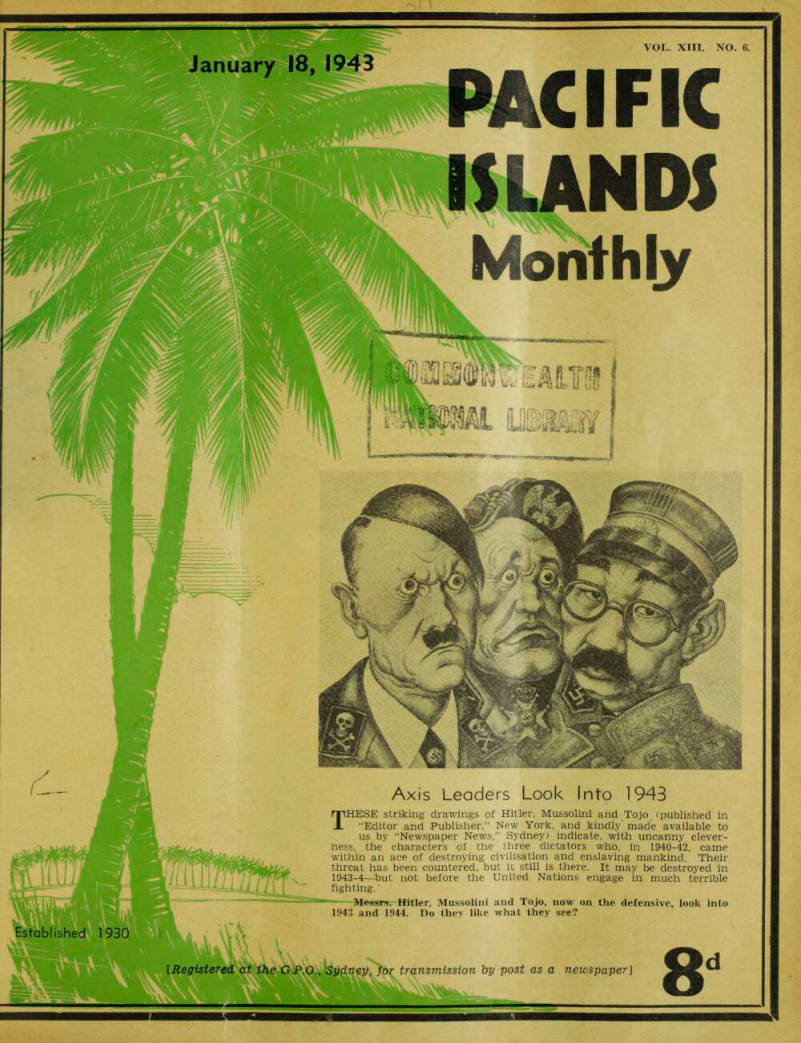
Axis Leaders Look Into 1943
THESE striking drawings of Hitler, Mussolini and Tojo (published in “Editor and Publisher.” New York, and kindly made available to us by “Newspaper News,” Sydney) indicate, with uncanny clever ness, the characters of the three dictators who, in 1940-42, came within an ace of destroying civilisation and enslaving mankind. Their threat has been countered, but it still is there. It may be destroyed in 1943-4 —but not before the United Nations engage in much terrible fighting.’
Messrs. Hitler, Mussolini and Tojo, now on the defensive, look into 1943 and 1944. Do they like what they see?
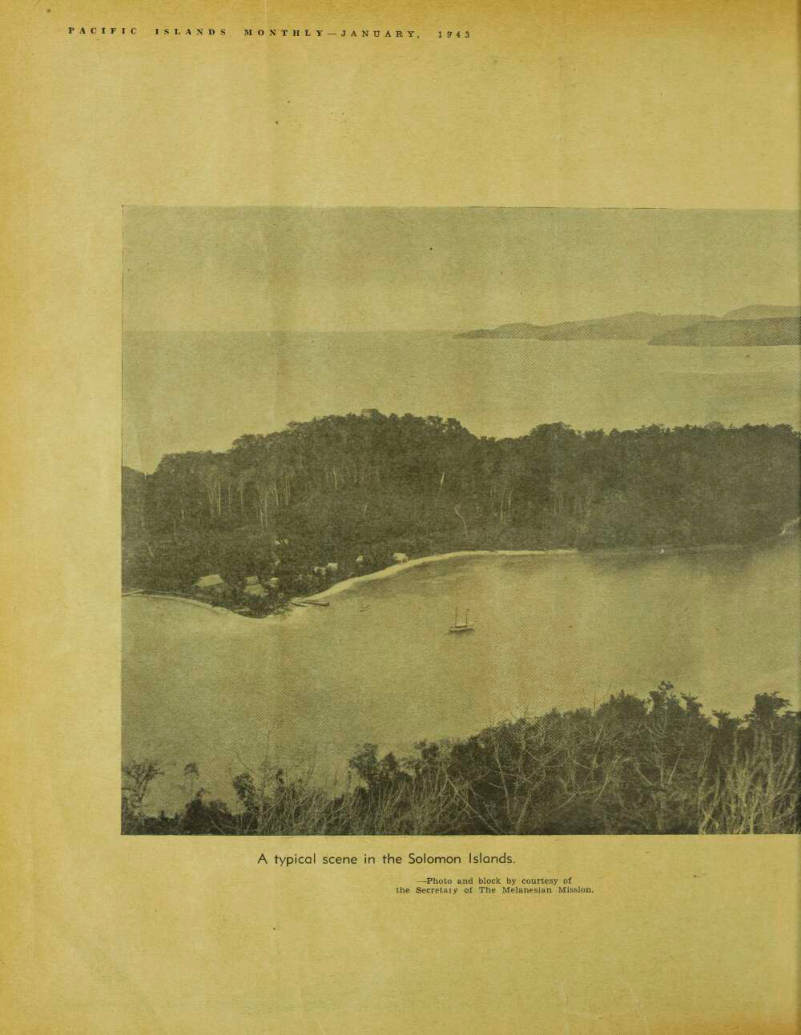
A typical scene in the Solomon Islands. —Photo and block by courtesy of the Secretary of The Melanesian Mission.
Pacific News-Review
Notes And Comment On
The Progress Of The War
From Dec. 12 To Jan. 14
Dec. 12; Gona has fallen to the Aus tralians, and fighting in Papua has intensified around Buna, where American troops have dug themselves in. The “wet” season has begun in earnest in this region and is hampering operations.
Dec. 14; Fierce fighting continues in Tunisia.
It is apparent that the Germans have beaten the Allies in the race for Bizerta and Tunis, and at least 50,000 seasoned and well-equipped Germans oppose the Americans and the British First Army.
Dec. 14; The situation in Russia seems to be bordering on a stalemate, although fierce fighting is reported on all fronts.
The Russians still claim that 135,000 Ger man troops are completely surrounded on the Kuban steppes, in the region west of Stalingrad.
Dec. 15: After unprecedented RAF straffing, the Eighth Army has broken through Rommel’s positions near El Agheila (Libya) and the Afrika Korps is again retreating towards Tripoli.
Dec. 15: Another Japanese convoy, attempting to reinforce Japanese troops in the Solomons area, was smashed by American aircraft and naval craft.
Dec. 17: The German Afrika Korps is now 100 miles westward of El Agheila.
Dec. 17: The Nazis are reported to be pouring into Italy and taking over the Mediterranean aerial defences. The Axis* evidently assumes that, if the Allies gain Tunisia, they will attempt to invade Italy through Sardinia and Sicily.
Dec. 18: Axis forces retreating in Tri politania have been cut in two by a British outflanking movement. A force, mostly New Zealanders, made a wide half-circle through the desert, and came back upon the coastal road, thus cutting off the tail of the Afrika Korps.
Dec. 19: Bitter fighting is continuing around Buna Mission, in New Guinea.
Our planes are straffing enemy positions, but there is no weakening of Japanese resistance.
Dec. 20: British troops have commenced an advance into Western Burma.
Much is hoped from this move by those who can see no prospect of defeating the Japanese by advancing upon them through the Islands, but only by a smash ing attack upon them, based upon the mainland of Asia.
Dec. 21: The Red Army has begun a powerful new offensive, and has broken through the German lines on a wide front on the Don, south of Voronesh, Dec. 22: German attempts to check the Russian advance on the middle Don front have failed, and the Russians are extend ing their grip on the Rostov railway.
Dec. 22: An Australian light tank unit went into action against Japanese fortifi cations in the Buna district. The Jap strongpoints now are being systematically reduced.
Dec. 24: Russian tank forces now have made a full-scale break-through in the middle Don area, and are sweeping across the Ukrainian border.
Dec. 24: Admiral Darlan, recently appointed Fighting French High Com missioner in • French North Africa, was assassinated in Algiers by a young Frenchman, who was immediately court martialled and executed.
There is much serious political unrest in North Africa, the result of intrigues and competition for power between the old supporters of General de Gaulle, and the former Vichy-ites. The killing of Darlan removes a real headache for the United Nations, because he was unaccept able to General de Gaulle and the Fighting French.
Dec. 26: The Russians are advancing quickly in a new offensive in the Cau casus. They have broken the German line in a number of places.
Dec. 28; Gen. Giraud, in charge of French Forces in North Africa, is to succeed Admiral Darlan as French High Commissioner in North Africa.
General de Gaulle made the following statement on January 2; “Internal con fusion is growing in North Africa and in French West Africa . . .
“The remedy for this situation is the establishment, in North Africa and French West Africa, as in all the other French overseas territories, of a tempor ary and enlarged central power, having as a basis national unity, for inspiration a spirit of war and liberation, for appli cation the laws of the Republic until the nation is able to make its wishes known.
That is the tradition of French democ racy. It is thus that in 1870, after the fall of the Empire, those in charge of national defence took temporary power in the name of the Republic to direct the nation’s war effort.
“In accord with the French National Committee and with the Council for the Defence of the Empire, I proposed to General Giraud to meet him immediately on French territory to study the means of attaining this end. I believe that the situation of France and the general situa tion of the war, does not permit of anv delay.”
Dec. 29: The Russians now are only 80 miles from Rostov, chief German supply base and reserve centre in Southern Russia.
Dec. 29: The Japs are still resisting stubbornly in the Buna area in Papua, in spite of Allied air supremacy. Japan ese losses in New Guinea in the last few days include 4 ships and 31 planes.
Dec. 31: The Russians are now beyond Kotelnikovo, the last German operational base within 100 miles of Stalingrad.
Dec. 31: Allies occupied the aerodrome at Buna, and Americans have driven a wedge through to the beach.
Jan. 2: Twenty Japanese planes were destroyed in a battle over Lae on and about New Year’s Day.
Jan. 4: Buna government station occupied by Allies.
Jan. 4: The Russians are still advanc ing. They have captured Velikiye Luki, an important place 280 miles NW of Moscow, and have made further gains on the Don and Caucasus fronts. The threat to the Caucasus oil-fields is now removed.
Jan. 5: The Japanese have suffered a “conclusive defeat” at Buna, Papua, and during operations around this area they have lost 1,200 killed.
Jan. 6: Moves by the Japanese to con solidate themselves in the South-west Pacific, along a line running from the Solomons through New Guinea to Timor are, it is believed, foreshadowed by recent happenings, which include: (1) An armada-like concentration of enemy shipping at Rabaul. (2) Frantic enemy haste to get into commission a husre aerodrome at Munda, in New Georgia (Solomons), (3) Intensification of enemy activities in Portuguese Timor. (4) The desperate enemy determination to yield, only by death, any footholds in Papua. (5) Enemy use, in waters near Australia, of reconnaissance planes flown from sub marines.
Jan. 7: Allied planes made a devastat ing raid on the Jap armada in Rabaul on Tuesday. Eight merchant vessels and one naval craft were destroyed (estimated
aggregate of 50,000 tons), and six enemy planes shot down.
Jan. 7: RAF carried out widespread raids on Jap positions in Burma.
Jan. 8; The Germans are still yielding ground in South Russia, near Rostov, and the Russians now are only 50 miles from the city.
Jan. 8: The Germans recaptured two hills which Allied troops had seized in Tunisia.
Jan. 9: In continuous attacks on a Japanese convoy of 10 ships, steaming towards Lae, NG, on Thursday, Allied air forces sank two transports and shot down 181 Zero fighters.
Jan, 9: The German forces in the Caucasus area now are reported to be in full retreat.
Jan. 11; Only “fragmentary” Japanese reinforcements were landed at Lae from the convoy. Allied air forces sank three transports, beached another, and des troyed 84 enemy aircraft in combat.
Jan. 11: Fighting French forces from the Lake Chad (North Africa) area, have thrust northwards into Libya and are only 270 miles from the Eighth Army’s position, where it faces Rommel’s rear guard at Wadi Zem Zem.
Jan. 12: The Red armies, after a fort night of resounding successes in South Russia, are now threatening Rostov and Salysk. The Germans must hold these towns if they hope to extricate their forces from the Kuban steppes, Jan. 12: Except for a small number of Japanese strongly entrenched on Sana nanda Point, the enemy have been cleared out of Papua. Most of the Jap army of 15,000, and its commander, General Horii, which landed on the north-east coast of Papua, has been destroyed.
Jan. 13: The lull in North Africa con tinues and only patrol activity is reported from both Tunisia and Tripolitania, where the Eighth Army is operating against Rommel. There is bad weather over all this region. The Allies are bringing new troops against the Axis armies in Tunis and Bizerta, but the lat ter are now powerfully entrenched at least 30 miles south of both cities.
Jan. 13: The fighting in Papua nears a climax, with the Japanese withdrawn into the narrow salient of Sanananda Point, with both flanks protected by swamps.
Allied headquarters have announced that the campaign in north-eastern Papua is virtually over, with the Japan ese remnant of the original army of 15,000 completely surrounded, and doomed to surrender or destruction.
Jan. 14; Two Soviet forces have linked up in South Russia, about 80 miles from Mosdok. Violent battles continue along the River Don, where the Germans now are making a determined attempt to hold up the Russian advance.
Jan. 15: Due to heavy rain, the Sana nanda region is now a swamp, and the Allied forces attacking the Japanese remnant have been held up.
Contents
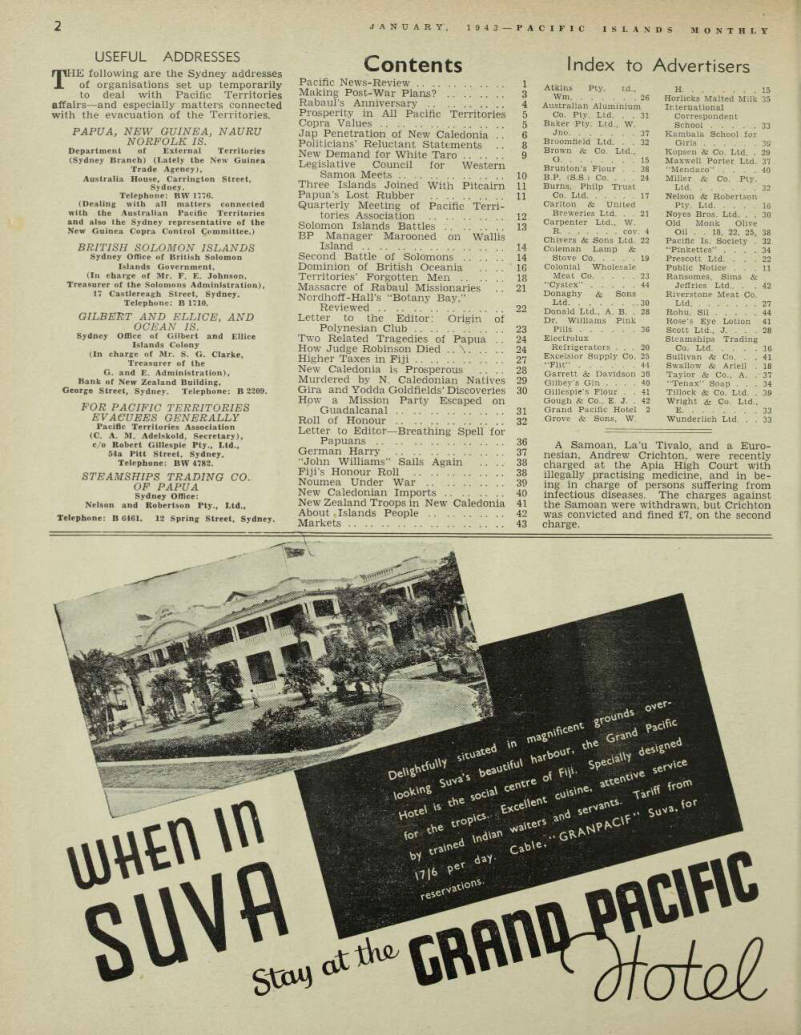
Pacific News-Review l Making Post-War Plans? 3 Rabaul’s Anniversary 4 Prosperity in All Pacific Territories 5 Copra Values 5 Jap Penetration of New Caledonia .. 6 Politicians’ Reluctant Statements .. 8 New Demand for White Taro 9 Legislative Council for Western Samoa Meets 10 Three Islands Joined With Pitcairn 11 Papua’s Lost Rubber n Quarterly Meeting of Pacific Terri tories Association 12 Solomon Islands Battles 13 BP Manager Marooned on Wallis Island 14 Second Battle of Solomons 14 Dominion of British Oceania ... 16 Territories’ Forgotten Men 18 Massacre of Rabaul Missionaries .. 21 Nordhoff-Hall’s “Botany Bay,’’
Reviewed 22 Letter to the Editor: Origin of Polynesian Club 23 Two Related Tragedies of Papua .. 24 How Judge Robinson Died .. \ 24 Higher Taxes in Fiji 27 New Caledonia is Prosperous ... 28 Murdered by N. Caledonian Natives 29 Gira and Yodda Goldfields’Discoveries 30 How a Mission Party Escaped on Guadalcanal 31 Roll of Honour 32 Letter to Editor—Breathing Spell for Papuans 36 German Harry 37 “John Williams’’ Sails Again ... 38 Fiji’s Honour Roll 38 Noumea Under War 39 New Caledonian Imports 40 New Zealand Troops in New Caledonia 41 About Islands People 42 Markets 43
Index to Advertisers
Atkins Pty. td., Wm 26 Australian Aluminium Co. Pty. Ltd. . . 31 Baker Pty. Ltd., W.
Jno 37 Broomfield Ltd. . . 32 Brown & Co. Ltd., G 15 Brunton’s Flour . . 38 B.P. (S.S.) Co. . . . 24 Burns, Philp Trust Co. Ltd 17 Carlton & United Breweries Ltd. . .21 Carpenter Ltd., W.
R cov. 4 Chivers & Sons Ltd. 22 Coleman Lamp & Stove Co 19 Colonial Wholesale Meat Co 23 “Cystex” 44 Donaghy & Sons Ltd 30 Donald Ltd., A. B. . 28 Dr. Williams Pink Pills 36 Electrolux Refrigerators ... 20 Excelsior Supply Co. 25 “Flit” 44 Garrett & Davidson 36 Gilbey’s Gin ... 40 Gillespie’s Flour . . 41 Gough & Co.. E. J. . 42 Grand Pacific Hotel 2 Grove & Sons, W.
H 15 Horlicks Malted Milk 35 International Correspondent School 33 Kambala School for Girls 39’
Kopsen & Co. Ltd. . 29 Maxwell Porter Ltd. 37 “Mendaco” ... 40 Miller & Co. Pty.
Ltd 32 Nelson & Robertson Pty. Ltd 16 Noyes Bros. Ltd. . . 30 Old Monk Olive Oil . . 18, 22, 25, 38 Pacific Is. Society . 32 “Pinkettes” ... 34 Prescott Ltd. ... 22 Public Notice ... 11 Ransomes, Sims & Jeffries Ltd., . . 42 Riverstone Meat Co.
Ltd 27 Rohu, Sil 44 Rose’s Eye Lotion 41 Scott Ltd., J. ... 28 Steamships Trading Co. Ltd 16 Sullivan & Co. . . 41 Swallow & Ariell . 18 Taylor & Co., A. . 37 “Tenax” Soap ... 34 Tillock & Co. Ltd. . 39 Wright & Go. Ltd., E 33 Wunderlich Ltd. . . 33
A Samoan, La’u Tivalo, and a Euro nesian, Andrew Crichton, were recently charged at the Apia High Court with illegally practising medicine, and in be ing in charge of persons suffering from infectious diseases. The charges against the Samoan were withdrawn, but Crichton was convicted and fined £7, on the second charge.
Advertisements & other items, p. 4 (2 items)
Useful Addresses
rE following are the Sydney addresses
of organisations set up temporarily to deal with Pacific Territories affairs —and especially matters connected with the evacuation of the Territories.
PAPUA, NEW GUINEA, NAURU
NORFOLK IS.
Department of External Territories (Sydney Branch) (Lately the New Guinea Trade Agency), Australia House, Carrington Street, Sydney.
Telephone; BW 1776. (Dealing with all matters connected with the Australian Pacific Territories and also the Sydney representative of the New Guinea Copra Control Committee.)
BRITISH SOLOMON ISLANDS
Sydney Office of British Solomon Islands Government, (In charge of Mr. F. E. Johnson, Treasurer of the Solomons Administration), 17 Castlereagh Street, Sydney.
Telephone: B 1710.
GILBERT AND ELLICE, AND
OCEAN IS.
Sydney Office of Gilbert and Ellice Islands Colony (In charge of Mr. S. G. Clarke, Treasurer of the G. and E. Administration), Bank of New Zealand Building, George Street, Sydney. Telephone: B 2209.
FOR PACIFIC TERRITORIES
EVACUEES GENERALLY
Pacific Territories Association (C. A. M. Adelskold, Secretary), c/o Robert Gillespie Pty., Ltd., 54a Pitt Street, Sydney.
Telephone: BW 4782.
STEAMSHIPS TRADING CO.
OF PAPUA
Sydney Office; Nelson and Robertson Pty., Ltd,, Telephone: B 6461. 12 Spring Street, Sydney.
-V
* *v^i i 8105® sow
Pacific Islands Monthly
The Newspaper-Magazine of the South Seas
IRegistered at the G.P.0., Sydney , for transmission by post as a newspaper.'] Published Once Each Month and Circulated in Australia and New Zealand and in the following Pacific Territories and Islands Groups:
Australian Territory of Papua.
Mandated Territory (Australia) of New Guinea.
Australian Territory of Norfolk Island.
New Zealand Territory of Cook Islands.
Mandated Territory (NZ) of Western Samoa.
British Colony of Fiji.
British Solomon Islands Protectorate.
British Protectorate of Tongan Islands.
British Crown Colony of Gilbert and Ellice Islands.
Mandated Territory of Nauru.
British and Free French Condominium of New Hebrides.
Free French Colony of New Caledonia.
Free French Colony of Oceania (Tahiti, etc.).
American Territory of Eastern Samoa.
American Territory of Hawaiian Islands.
Owned and Produced by Pacific Publications Pty. Ltd., Union House, 247 George Street, Sydney.
TELEPHONE f Managing Director BW 5037 (. Business and Editorial MA 4369
P.O. Box 34 08 R
Registered Address of Telegrams, Radiograms, and Cables: “Pacpub”, Sydney.
Contributions.
Articles, Stories, and Photographs dealing with Pacific Islands subjects are invited and will be paid for on publication.
Subscription Rates.
Per Annum, within British Empire, Prepaid, Post Free 8/- Per Annum, elsewhere, prepaid, Post Free. 10/- Single Copies Bd.
Editor and Publisher:
R. W. Robson, F.R.G.S.
Advertising Manager: L. W, Bailey.
Advertising Office and Printing-House: 29 Alberta Street, Sydney.
Advertising rates furnished on application.
Colours, etc., by arrangement.
Process Blocks made at Advertiser’s expense when required. Screen 100.
Changes of Advertising Copy should reach this office by Ist of each month, otherwise previous advertisement may be repeated.
Representative In London.
W. C. Harvey, Coronation House, 4 Lloyds Avenue, London, E.C.3, from whom may be obtained copies of Pacific Islands Monthly, Pacific Is. Year Book, advertising schedules, etc.
Agents.
The following are authorised to receive sub scriptions for Pacific Islands Monthly:— Burns, Philp & Co., Ltd., and Burns Phllp (South Sea) Co., Ltd. All branches.
W. R. Carpenter & Co., Ltd. All branches.
Morris, Hedstrom, Ltd. All branches.
Steamships Trading Co., Papua. All branches.
B.N.G. Trading Co., Ltd., Port Moresby, Papua.
J. Muir, Suva, Fiji.
Miss R. Castles, Suva, Fiji.
N. C. Mackenzie Hunt, Wainunu, Bua, Fiji.
Kirpal & Co., Victoria Parade, Suva, Fiji.
Cook Islands Trading Co., Rarotonga, Cook Is.
A. C. Rowland, Papeete, Tahiti.
Islands Branches and Representatives of W. H.
Grove & Sons, Ltd., Auckland, New Zealand.
Ed. Pentecost, Noumea, New Caledonia.
Kerr & Co., Noumea, New Caledonia.
Vol. XIII. No. 6.
January 18, 1943
Prirp f 8d - Per Copy nice Prepaid: 8/- p.a.
United NaUonfafter thewfr by
When Should We Make Post-War Plans?
X LTHOUGH there is nothing at all in the world situation to indicate an early end of the war—the best that has happened is that, in the last six months, the United Nations have stopped the rush of the wild beasts of the Axis, and have passed from
neLpaperf
United NaUonfafter thewfr by
We have had the Plan for thrlocial and economic structinn nf Rritain- for Lonbinir discussions of how tho iirvitprffa
wfll extend her n!w 1 f
wealth°
Council*” to
take charge l of affairs in the PnHfip and plans f 0? long overdue admirds ’ to the Territories of the South Pacific One is remtoded irreslstibly of the ancient saw d6d irresisuDiy or tne ancient saw.— The devil was well, the devil a monk W 9 /S !} e — . , The devil was ill, the devil a monk would be.
The reforms social, economic, administrative—which now are being so eagerly discussed and passionately advocated, are the reforms which should have followed the last war, 25 years ago; but which were cynically disregarded and callously blanketed off by selfish money-power, and
money-power’s paid creatures in the so-called democratic Parliaments. If public men and Parliaments had done their duty honestly by the demo cratic people during the past quarter century, there would have been no World War 11.
The democratic nations, in a sense, should be grateful to Hitler, for strik ing when he did. If his blow had been delayed another decade, the deterioration of the democratic system would have been so deep and far-reaching that nothing could have saved the democratic people from en slavement by the followers of totali tarianism. As it is, the decay has affected mostly our administrative and economic systems, and it has not yet bitten deeply into the character of our freedom-loving peoples. The masses, semi-blind and partly in articulate —because they have been betrayed by their so-called leaders and misled by a newspaper press that is 75 per cent, ignorant and in chains to Mammon—are nevertheless con scious that much is wrong with their precious democratic system, and are determined that it shall be reformed and saved. That determination is expressed in their willingness to accept complete dislocation of their lives, and in the gallant readiness of their young men to go out and die.
This endless sacrifice of youth, and
the horrors and losses endured by the masses, can be laid directly at the doors of the politicians of Britain and France and the United States, who footled and fumbled through the vital ‘twenties, and were led by the nose by the money-changers of the world.
But, semi-blind and inarticulate though they be, grimly holding on and accepting cruel sacrifices in order that they may escape the horrib'e fate of enslavement b” the Axis, these democratic peoples are not uncon scious of the truth. Once let victory be achieved, and the menace of totalitarianism removed, and there will be a terrible reckoning, as be tween the masses of people and the greedy, cynical forces which betrayed them into their present situation.
And well do those threatened in terests realise what is coming! Al ready, like startled octopi, they are looking here, thrusting there, un easily seeking a way out. Before long, perhaps, true to the analogy, they will try to conceal themselves under a cloud of ink!
And so we see the greediest mono polists of Britain' applauding the Beveridge Plan, and the most cynical financiers in America declaring that “freedom from want” must be funda mental in all future principles of government. Can these devils escape their fate by their professed eager ness to become monks? That remains to be seen.
ALL these discussions appear to this writer to be ridiculously pre mature. We have escaped, through a series of miracles, the world-wide enslavement which the Axis Powers planned for us. We now are in a position where we can defy their armed strength, and give them back blow for blow. We can and shall win this war—not because of any genius of leadership, or because the men at the head of our affairs deserve vic tory, but because of the high spirit and the moral strength disclosed in this supreme test by the common people of the United Nations. But the war will not be won until there has been fighting and sacrifices far more terrible and cruel than anything we yet have known.
There is nothing in the world situation to give us hope of anything else. Let any intelligent man look over the facts, and see if he can dis cern the end of the struggle in 1943.
Russia? Russia has performed magnificently—her achievements have contributed more than anything else (except perhaps the spirit of the British people in 1940) to the ultimate defeat of the Axis. But the Russians have not broken the Germans, nor do they now seem likely to do so. The Germans are repeating, in 1942-43, their strategy of 1941-42. They are giving ground slowly, accepting terri fic punishment, trying to exhaust the Russians, but holding an unbroken line, so that they may be ready to smash back again at the Russian armies in the spring of 1943. No where—despite newspaper headings and hooey—is there any real sign of a German collapse on the eastern front.
NORTH Africa? Britain and America enjoyed great successes in Libya and throughout French North Africa, taking the Germans completely by surprise; but they failed dismally to follow up their successes quickly, so that Axis forces beat them completely in the race into Tunisia, and so denied to them occupation of the region that is vital to them, if they are going to open up a second front against the Axis in Southern Europe. There has been serious delay while the Allies are assembling forces for an assault upon Tunis and Bizerta.
War Against Japan? The Autra lians and Americans have soundly thrashed the Japanese wherever they have met them in the Solomons and Papua. These are comforting little victories—but they count as nothing in this global war. Japan holds a vast new empire—taken from the British, Dutch, Americans and French —which she now is feverishly ex ploiting and fortifying. How is she to be thrown out? We have said, complacently, that the easiest way to defeat Japan is to smash at Japan herself. But how? And with what?
To get bases for sea operations against Japan will involve operations of terrible difficulty and cost. The non-Jap-occupied parts of China are barely within bombing range of
Japan. The only place from which Japan proper can be bombed is Eastern Siberia—and Japan and Russia are not at war.
BLOCKADE? It has been an nounced repeatedly, lately, that Anglo-American shipbuilding is barely keeping pace with sinkings. Since 1939, enemy action has destroyed British tonnage equal to the entire British mercantile marine before the war. The Allies are destroying count less U-boats; but, nonetheless, we are told by our own leaders, there are pr'obably 500 enemy submarines now at sea against us. The Axis is con centrating everything and putting everything into this sea war against us—it is their counter to the tremen dous change which took place in our war outlook when America joined the United Nations. Keep American aid nut of Europe by destroying their sea
transport, said Hitler, and we still can win.
As for the Allies’ blockade of Ger many, Germany is partly defeating that by her exploitation of all occupied countries.
Admittedly, the foregoing presents the black side of the picture. There is a brighter side, which gives us an assurance of ultimate victory -but that side is dished up to us every day by the newspapers ad infinitum, ad nauseum —so that we are induced to forget the black side, and begin to talk complacently about the end of the war, and make plans and promise reforms. . .
That is sheer waste of time. The war still has to be won. Time enough for post-war planning when the Germans and the Japanese are fight ing defensively, on their own soil, with their battered backsides pointed at last towards Berlin and Tokio.
Anniversary
January 23-Rabaul's Tragic
ON Saturday, January 23, at dawn, the women of New Guinea, some repre sentatives of the New Guinea branch of the Returned Soldiers’ Asso ciation, and others, will place upon the Cenotaph in Sydney wreaths to com memorate the bravery of the men who fell before the Japanese, on the day that Rabaul was occupied, one year ago.
One year has passed since the Japan ese occupied Rabaul and, from that point, began to spread their tentacles over New Britain, the New Guinea mainland, New Ireland and the Northern and British Solomons.
Those were grim days. We long had recognised the danger of a Jap thrust from the Caroline Islands (just over the horizon, northwards of New Guinea); but we were now so deeply involved in the war against Germany and Italy that we were not able to prepare any substantial defences in the Mandated Territory.
Both the Caroline Islands and New Guinea were mandated territories. But, while Australia scrupulously observed the League of Nations law against fortifica tion of a mandated territory, Japan, with the treachery typical of that nation, con structed great fortified bases in both Carolines and Marshalls, and placed powerful forces there.
Thus, when a Jap invasion fleet (3 cruisers, 2 destroyers, 5 transports) was seen approaching Rabaul on the after noon of January 22—Rabaul having been frequently bombed by carrier-borne air craft during the previous few days—there was little that we could do about it. A battalion of raw Australian troops, plus a battery or two and some three score members of the New Guinea Volunteer Rifles, could do nothing against thousands of highly-trained Japanese, with all modern equipment.
It was impossible, in the circumstances, to hold Rabaul; and impossible to blame Australia for failure to supply adequate forces. But Australia, some day, must take blame for failure to supply transport to permit the rapid evacuation of the Europeans from Rabaul. There had been plenty of warning.
But, while the bungling and incompe
tence of officialdom is writ large on the story of Rabaul, we find there also a splendid record of the stark courage and high spirit of young Australia. Those half-trained Australian soldiers fought and died like heroes, and none made a finer showing than the 72 young and
middle-aged men of the New Guinea Volunteer Rifles. The Japs came into Rabaul on January 23, and the NGVR resisted to the last. Only seven out of 72 escaped: the rest are dead, or are prisoners of war.
The bravest of all were the Australian airmen. The Japs came over with scores (some say hundreds) of modern bombers and fighters. The Australians went up to meet them in half a dozen slow and almost useless Wirraways. They knew they were going to almost certain death —but they went, just the same; and— almost incredible thing—they shot down a few Japanese aircraft before they were themselves destroyed.
We all know the rest—the imprison ment of the Rabaul Europeans, the arro gant swaggering of our semi-human enemy, as he occupied the mainland ports, and all the islands to the south eastward; and then the slow turning of the tide, as the Americans and Austra lians stopped, and held, and then smashed this hated enemy, wherever they met him. To-day, the picture is vastly changed. It is we who hammer the Jap in his jungle refuges, and it is the Jap who flees in panic from the now superior and ever-mounting strength of our air forces.
Advertisements & other items, p. 6 (1 item)
Rabaul Anniversary
LISTEN in on 2FC and Australian National Stations, at 8 p.m. on Thursday, January 21, for the inspiring story of how a raw AIF Battalion, with 72 heroic members of the New Guinea Volunteer Rifles, resisted the Japanese who, one year ago (on January 23, 1942), invaded and occupied Rabaul.
“Prosperity”
In All South Pacific Territories
IT is the irony of fate that, just when Australia’s Pacific Territories (Papua and New Guinea) should be in mili tary or enemy occupation, and their unfortunate residents are refugees in Australia, trying to live on the Common wealth Government’s reluctant dole, all other territories of the South Pacific (except the Solomons) should be enjoy ing a period of prosperity such as they have not known for 20 years.
Every territory is participating, in one form or another. The product common to all of them, copra, is in sharp demand by the United Nations (see article else where) and every coconut has attained a new value.
Every food product of Fiji, Tonga, Samoa, Cook Islands and Tahiti is in demand in New Zealand, and rich prices are paid for every ton that can be ship ped. There is a lively and profitable market for the cocoa of Samoa and New Hebrides, the coffee of New Hebrides, the bananas and oranges of Samoa and Cook Islands, the vanilla of Tahiti—in fact, for everything the Islands can produce.
Th£re are considerable numbers of well-paid troops in many of the terri tories, and these men are lavish spenders.
Never in their lives have the producers and retailers of those territories seen so much real money flying about; and thev all are eagerly reaping the rich harvest, to build some sort of reserve against the uncertain years ahead.
All the French colonies, and especially New Caledonia and New Hebrides, are enjoving “prosperity.” No one will grudge them this change in their for tunes, after their economic embarrass ments and bitter experiences following the surrender of metropolitan France in 1940.
The situation in the South Pacific ter ritories generally is similar to that in Australia: The people have plenty of money; but, owing to wartime restrictions on manufacturing and shipping freights, they have only limited avenues of spend ing. With stocks of goods decreasing, and individual cash credits mounting and mounting, all the ingenuity of the United Nations will be needed to avoid serious inflation.
Papua's First Soldiers
THE following are the names of the first 18 men to enlist from Papua in World War II: Simpson. Wm. H., miner and overseer.
Nolan, Robt. H., clerk, Govt. Stores.
Mclntyre. Archie C., clerk. Govt. Stores.
Higlett. D. F., clerk, Govt. Treasury.
Ison, C. T., ironmonger.
Monks, James, miner.
Morton, H. G. L., plantation manager.
Cotman. A. A. S.. planter. *Bosgard, Peter W.. clerk. Land Dept. *Gossner, Walter, plantation assistant.
Wilkinson. J. D.. miner.
Savage, N. L„ clerk.
Wilson. Robt. J., miner.
Brett, Geo., planter.
Mason, James E., overseer.
Rvan, Eric., overseer.
Short, Robt. R., plantation manager.
Beharell, James S., patrol officer, *Prisoner of war.
Pension Chopped
Punishment of Retired Papuans Who Dare to Work
THE kind of treatment the Australian Commonwealth authorities are ac cording to ex-Territories residents is well illustrated by the case of a former Papuan public servant.
Before the Japanese war broke out, he retired on a pension of £2lO per annum.
In 1942, he felt that his technical know ledge would be of value in Australia in wartime, so offered his services to a Gov ernment Department. They were grate fully accepted, and he was paid the full wage attached to that job.
Thereupon, the Commonwealth cut his pension down by half, to £lO5 per annum.
A Papuan public servant who has spent at least 20 years in that service may retire whenever he wishes. Many such men have retired in their early forties, and virtually started life anew. Assisted bv their pensions, they have become mer chants. planters, agriculturalists and even entered professions. There was no ques tion about the thing: a man had earned his pension by 20 years’ tropical service, and after that he was free to do what he liked.
But the Czars of Canberra, exercising the outrageous powers thev now enjoy, have decreed that this shall not be per mitted in wartime. Thev. in their wis dom, now order a man’s life for him. If he chooses to continue working, because his country urgently needs the services now of every fit man. he shall be deprived of his pension.
Appeals have been made; but only a few men are affected, and they are blandly ignored.
Tuboutoa
Now Premier of Tonga
THE heir to the Crown of Tonga, Prince Tuboutoa, was successful in his final law examination at the Uni versity of Svdney, and now holds the deeree of LLB as well as BA.
Prince Tuboutoa is now back in Tonga and, following in the footsteps of his father (Prince Tugi) he has become Premier of Tonga.
Tuboutoa, as well as having had a dis tinguished academic career, is liked and respected on account of his fine personal Qualities, and he made many friends dur ing his residence in Sydney as a Univer sity student.
Pacific Territories
Casualties
THE following casualties amongst men who have enlisted from the Pacific Islands Territories were supplied by the Department of Information, Mel bourne. on January 11: NGX 144, Pte. P. F. Bailey. Infantry, Rabaul. Previously reported missing, now reported prisoner of war.
NGX 22. Capt. L. T. Hurrell, Infantry, Rabaul. Killed in action NG 2058, R. A. Smith. HQ Units (place of enlistment not stated). Died of illness.
NGX 198, Pte. W. G. Ekblade, Infantry.
Rabaul. Previously reported missing, now reported missing, believed prisoner of war.
Rev. Vereniki Veitarogivanua, of the Methodist Mission, expects soon to return to Fiji, with his wife and children.
Copra Values
America Buys all South Pacific,
While Australia Imports From
Ceylon.
THE Pacific copra market has developed in an extraordinary manner.
From the outbreak of war until the end of 1941, Pacific copra was nearly valueless. The world’s greatest production areas (Dutch East Indies, Malaya, Cey lon and Philippines) were still producing: but, of the world’s greatest markets, only Great Britain, United States and Mexico were open to receive shipments. They were offered two or three times as much as they could consume.
Then, at the end of 1941, Japan occupied Malaya, Philippines, Dutch East Indies, New Guinea and the Solomons and, immediately, the whole situation was reversed. Britain, United States and Central America now were clamouring for copra, and the only copra-producing countries left—Ceylon, East Africa, and the remaining South Pacific territories— could not nearly meet the demand.
The British territories, which are con trolled from Suva, were given a fixed price of around £lB (Fijian) per ton, and this guided the market for a while. But in recent weeks, as it was realised that the British-Australian-American demand was far in excess of supplies, the price has tended to increase.
The position now is that the United Nations have formed a South Pacific copra pool, into which goes all copra from Fiji, New Caledonia, New Hebrides, Tonga.
Samoa, Cook Island, and French Oceania; and all this copra is being snipped to the United States, Canada and Mexico at high prices.
The production of the territories named is very small, comnared with that which once came from the territories now oc cunied by Japan; but it is now very valuable, and, under the stimulus of keen demand, the South Pacific outnut is increasing rapidly. Polynesian land owners are being encouraged bv their Administrations everywhere to increase production; and palms evervwhere, which had been neglected for 15 years, now are receiving urgent and tender attention.
MEANWHILE, under wartime condi tions, Australia has developed a large and extraordinarv demand for copra; and. as all South Pacific pro duction is going eastward to America, Australia has had to look elsewhere.
Accordingly, considerable quantities of first-grade Ceylon conra are coming to Australia, and Australia is paying about £35 per ton for this product.
It is a situation calculated to break the hearts of coconut planters in the South west Pacific. They hung on through 15 years of low world prices, always at the mercy of the Unilever Combine (which dominated the European market), always believing that coconuts again would spell money. And, now, when the copra price is high, and Unilever is temporarily obliterated, and Australia (the natural market for New Guinea and Solomons production) suddenly develops a new, lively and profitable demand—now the coconut planters are refugees in the southern lands, and all the islands of New Guinea and the Solomons are occupied by Japanese.
If the New Guinea and Solomons planters could get for their copra, for only a couple of years, one half of what Australia now is paying for Ceylon copra, they could wipe out many mortgages. As it is, they are trying to live on a pittance, while their more fortunate brothers to the eastward are becoming more than passing rich.
Tahiti's Loyalty
THE High Commissioner for Fighting France in the Pacific, Rear-Admiral d’Argenlieu, who was on a visit to Australia in September and October, arrived in Tahiti in November and, accompanied by the Governor of French Oceania, Colonel Georges Orselli, he visited various parts of the French Col ony and everywhere was warmly greeted.
He said he was deeply touched by the Tahitians’ manifestations of loyalty and of confidence in the victory of the United Nations—which meant the libera tion of France. He brought to the people of French Oceania the greetings and the thanks of the chief of the people of Fighting France —General de Gaulle.
All Quiet In Tahiti
From Our Own Correspondent
Papeete, Dec. 6.
LIFE in Tahiti is quiet and uneventful —so far as the masculine part of our population is concerned.
But the feminine part, on the contrary, is in a state of consternation. It has been discovered that supplies of Unstick, face-powder and enamel for the finger nails have become exhausted, and that the prospect of future supplies is very thin indeed. How our South Seas belles will solve their problem is not yet apparent—but solve it they will.
With this notable exception, we are not suffering any major novation. We have ample supplies of food, and the few luxuries we have to do without do not count in times like these.
G. And E. Funds
A STATEMENT in the official Gazette of the Western Pacific High Com mission, shows the financial posi tion, as at November 30. 1941. of ths Gilbert and Ellice Islands Colony, the administration of which is now virtually suspended, owing to the war situation. At that date, the Treasurer of the Colony held in cash or liauid securities the sum of nearly £250.000. Of this amount, £150,000 was held on behalf of the Bana bans (the native people of Ocean Island who receive royalties from the British Phosphate Commission upon all the phos phate taken out of the island). This money is safely invested. The balance, something over £BO.OOO, being held by the Treasurer, pending the return of the Colony to normal conditions, when the machinery of government presumably will be set in motion again.
How Japs Peacefully Occupied
New Caledonia
Extraordinary Story of Enemy Penetration Prior to Pearl Harbour
BY H. E. L. FRIDAY, OF NOUMEA
THE story of the Japanese penetration of New Caledonia should be more widely known.
The first Japanese arrivals, in 1901, were a thousand straw-shod, grass-over coated coolies of the poorest class, under contract to the Nickel Company, and replacing white convict labour.
The coolies were paid 80 centimes per day, and were accompanied by a Japan ese colonel, an ex-military attache from Paris, who rapidly became friendly with influential French business men and eventually died in the Colony, being buried in the Japanese portion of Nou mea cemetery. The coolies were sent to the great Thio (east coast) mining area, where they later went on strike, for vari ous reasons—one reason being lack of hot-water bathing facilities, which had been specified in their contract. They marched to Noumea across the Central Chain mountains, shepherded by gen darmes and carrying just sufficient money to avoid being arrested as vagrants.
Many, later, found work at other mines, and at other jobs; and so a peace ful penetration of the entire Colony set in, starting at Noumea. Signboards show ing the names of Nakamura, Okada.
Tsutsui, Mikado. Nowa, Yamamoto, Naka gawa, Oshiro, Fusimoto, etc., soon made their appearance in every street of every township and native village in the Col ony. until barbers, laundrymen, coffee stall proprietors and storekeepers were mainly Nippons.
At first, these Japanese barber-shops had a back room which was fitted with long, six-feet-wide shelves, built at an incline, three feet from the ground, upon which wharf-lumping and other coolies slept; and, presently, all coolies became prosperous bourgeois, and highly con tented with New Caledonia.
Penetration Of Industry
THE Japanese quickly monopolised the market-gardening enterprises in all the towns; and it is interesting to note that when the island’s 1,200 Japan ese were interned, after Pearl Harbour, Jap gardeners were allowed a week’s liberty, until the towns’ supplies were assured by other hands.
Fishing next became a virtual Japan ese monopoly—especially the profitable trochus shell for the button industry, and the Beche-de-mer (sea-slug) trade with China. The sole restriction on this trade was that, conforming to French law, a French subject—usually a native or a half-caste—was nominated as the fishing vessel’s captain.
Natives received Japanese cotton loin cloths and trade goods in exchange for their diving operations.
Almost invariably, the Japanese store keepers found mistresses among the Javanese women, who came in with the Javanese indentured labourers. These mistresses aided them in their stores.
But some Japanese actually married white women.
Japanese expansion was facilitated by the vessels of Japanese lines bringing in every Japanese product, from cement to matches and perfume; but the cement •was eventually limited by the French quota system. These ships unloaded at
Noumea when en route for Sydney. In Sydney they loaded; and, with the upper decks loaded with sheep, they returned direct to Noumea, where they unloaded coke (for the smelters) and took on New Caledonian nickel ore.
Jap Chain Stores
THUS, there grew up throughout the island, in the space of a few years, a huge ring of chain stores, which sold nothing but Japanese goods—some times these stores were the only com mercial establishments in the village— with a uniform price policy, and employ ing in common a transport system based on Noumea, making daily rounds. These Japanese dealt in a big way with Nou mea’s two leading French stores, and could get credit where it was denied to small, individual French stores.
Japanese coffee-shops were licensed to sell liquor also, and were open day and night—their principal night-time sources of gain being gambling, with some illicit opium traffic. The largest profits were made from the simple Javanese coolies, who are inveterate gamblers—especially following each pay-day. Even when they are broke, the Javanese had no objection to selling their women-folk. so that they might continue to play. Their favourite game is called Toupie—m English, Tee totum —which is spun on a dinner plate, under a kitchen basin, with money placed around. Bands of professional Japanese gamblers are known to have followed the Javanese pay-days around the countryside. These games were occa sionally raided by gendarmes, although the police generally complained against their inability to raid the gambling houses, owing to the Japs being fore warned.
Japanese eating-houses were also pat ronised by the simple Melanesian natives, and the poorly-paid garrison troops, who could not afford to eat at European res taurants. The original Japanese coolies were not acquainted with strong drink; but, later, with growing prosperity, they deserted sobriety and took to drink and debauchery.
The Japanese also quickly monopolised the tailoring business, and the charcoal burning and other industries.
They entered the lumber industry, working for French companies, and they were beginning to get a real hold on rice-growing and coffee-growing gener ally, by working for half shares for lazy French and native proprietors.
With the firm establishment of Japan ese, in all the trades, there naturally fol lowed an invasion of Japanese mining men, who were interested in the pur chase and exploitation of minerals needed for war—iron, nickel, chrome, etc.
THEIR largest iron ore concession was obtained at Gorcr, in the south, from which, with mechanical equipment installed and regular shipping arranged, was expected by 1943 to have an annual output of 500,000 tons of 50 per cent. ore.
The Japanese also bought an iron ore island off the north coast, and their nickel mines employed several hundred Javanese coolies, while Goro alone em ployed six hundred.
Since Pearl Harbour, many of these Javanese coolies have been employed in assisting the American constructors to build the island’s largest airport.
Fortunately, the New Caledonian ad ministration had firmly blocked an attempt to bring in several hundred Japanese coolies; and, when Goro started in 1938, only Japanese engineers and key-men were admitted. Some of these proved to be failures, until a French (New Caledonian) mining organiser was brought in.
As usual, the prettiest Javanese women employees at Goro became the mistresses of the Japanese engineers and Japanese staff, and I personally have seen several letters which these Javanese have received from their Japanese “husbands” since the latter have been interned in Australia.
“Dummies” And Fees
BECAUSE French law will not permit foreign corporations to operate in New Caledonia, the foreigners dodge the law by forming dummy French com panies. The Japanese chose the direc tors of their dummy companies from among the most influential and wealth iest Frenchmen, including many of the Colony’s General and Privy Councillors — the very men upon whose advice the Governors of New Caledonia have relied.
For the not-inconsiderable directors’ fees, these men smoothed the legal path of Japanese industrial penetration of their country.
The local population became suspicious of these “directors,” following the col lapse of France, believing that they were behind pro-Vichy Governor Pelicier’s desire to accept the tempting Japanese offers of business in the export and import fields, in essential wartime min erals, such business to be paid for in United States dollars. The population had also a foreshadowing dread that what had happened in Indo-China might hap pen here. So they ousted Monsieur Peli cier and the councillors—this bloodless revolution being due, not only to their attachment to Fighting France, but also because of a desire to oust the parasitical Japanese and establish defence and trade relations with Australia and USA.
It may be remembered that, on the day that they were welcoming the new United States Consul, Mr. MacVitty, the Noumea people were deliberately and completely boycotting Noumea’s war memorial ceremony, which had been staged by the top-hatted Japanese Con sul. Incidentally, the leading Japanese Consul here, in recent years, was later appointed to a key position in Saigon (French Indo-China).
During the last world war, some twenty local Japanese left for France with the New Caledonian volunteers, intending to join the Foreign Legion. But the Jap anese Government stepped in, and re patriated them to Japan.
Five years ago, in a bush drama, a New Caledonian gendarme was shot by a Jap anese miner. But the miner was acquitted when it was proved that the gendarme had committed adultery with the Jap’s half-caste Tonkinese wife— what a mix-up this French island is!
Spies And Poachers
JUST as was the case around the Solo mons, Northern Australia and New Guinea in 1935-39, Japanese poach ing and spying activities were noted here.
The first Japanese poacher to be cap tured in New Caledonian waters Was a tiny schooner, of whose activities Dan
ish settler gave the authorities warning.
In July, 1936, Captain Houssard—who later became a Free French naval volun teer—but who then was owner-skipper of the locally-built ketch “Caledonien,” manned by six Loyalty Islands boys, chased the Japanese sampan “Giokatu Maru” through the southern reefs and boarded it at the point of a shotgun.
The crew were Formosans, and lived in an appalling stench and on a diet of dried seasnakes. They were afterwards repatriated to Japan—for which repatria tion Tokk) still owes a bill.
The four tons of live trochus, and the sampan itself, were auctioned —the sam pan being bought by her captor, Monsieur Houssard, who renamed her the “Ou vea.” This sampan made history. In September, 1940, Houssard sailed her to Port Vila, charged by the de Gaulle com mittee to invite Henri Sautot to come to New Caledonia as Free French Governor.
I recall another poaching sampan, which was arrested by a French plane off the east coast. Unfortunately, the plane nose-dived into the sea and the occupants were rescued by the Japanese only after they had promised to let the Japs leave the country unmolested.
I recall also a visit by a so-called Jap anese mystery ship, manned by officers, and which remained a few days in Noumea.
Potential Fifth Column
A FLAMBOYANT and attractive Jap anese agent here was Madame Kita zawa Fouques, daughter of a French captain and a Japanese mother, and who entertained lavishly, as well as dabbling in mining and real estate and frequently drinking the Mikado’s health. She had a big collection of photographs covering the whole Colony. She bought property in the Rue Austerlitz for the Japanese Club, which was then surrounded by a barbed-wire fence 15 feet high, through which only Japanese were allowed.
The Japanese admiral who was here with the Japanese squadron in 1917, spent whole days there. The Consul frequently called meetings of Noumea’s 350 Japanese there, but these never gave any hint of what transpired.
One such meeting took place just prior to Pearl Harbour and, about this time, the Japanese Consul went on tour and made contact with Japanese throughout the whole countryside. There was much evidence of Japanese spy activities about this time.
When the Pacific war came, the Jap anese formed 80 per cent, of-the foreign population of New Caledonia. They were businesslike and patriotic, never failing to shut up shop on the Mikado’s birthday, and the Mikado’s portrait was seen everywhere. But, though hard-working, they never were in harmony with the local population, and they gave much more satisfaction when they worked by contract than when they worked by the day. The heads of their mining and business concerns were disliked, and were found to be less honest than those of lower social standing. Individual French miners preferred to pay brokerage rather than deal with them direct. The Japan ese knew the country better than did the French themselves. The richer they grew the more they were disliked, because they monopolised whatever they engaged in.
New Caledonian hatred against the Asiatic invader increased with the grow ing wealth of the Japanese. As they grew wealthy, they openly displayed inso lence and arrogance, including threats of what they would do when New Caledonia was invaded.
Japanese arrogance was certainly one of the major causes of the enthusiastic way in which the people rallied to de Gaulle. When the general internment of the Japs was ordered, some of them boastfully told the French: “We’ll be back within three months.”
Several of them were found to be mil lionaires (in French francs) and much money was found hidden in their shops and homes, and on their persons.
They were more humane in their treat ment of their European shopgirls than were French employers, providing chairs and seeing that they did not stand unnecessarily; some Japs, individually, were not unpopular. Personally clean, these Japanese had no idea of general hygiene, and would leave piles of ordure
festering alongside their doors.
Here were all the elements of a dan gerous Fifth Column. But, immediately after Pearl Harbour, they were quickly rounded up and interned.
For a few days, Noumea seemed strange without its daily spectacle of the Japanese, squatting on benches, with their knees tucked up and fingering their toes, and commenting the while—perhaps sarcastically—on the passers-by.
To-day, nearly a year later, there is not a recognisable Jap in the Colony.
Where once the men of Nippon swarmed, and waited for “the day,” there now are the smart, trim figures of American and New Zealand soldiers.
Advertisements & other items, p. 8 (1 item)
'mogsomvs
imoimoir MO// a3a3 ™*L
A 3 NOW
anoA JOJ qabQ nM 4 M iH
Profiteering
Heavy Fines in American Samoa
From Our Own Correspondent APIA, November.
IT is reported from Pago Pago, Ameri can Samoa, that several merchants and traders have been heavily fined for selling goods at excessive profit.
In one case, a fine of 2,000 dollars was imposed; in another, 500 dollars and six months’ imprisonment. At least one store has been closed and the trader’s licence withdrawn.
Rigid restrictions have been imposed on the residents of the American naval base of Pago Pago also—these are re quired to do some useful work. Samoans not otherwise usefully employed, now have to grow foodstuffs under Govern ment control—a measure that is intended to make American Samoa gradually independent of imported native food stuffs.
Advertisements & other items, p. 9 (1 item)
Jap Penetration of New Caledonia conti page 6 from
Politicians’ Reluctant Statements
Admission That New Definition of War Damage Awaits "Investigator's" Report
AS will be seen from reports and articles elsewhere in this issue, the evacuees of Papua and New Guinea have made a little progress in their long, hard fight for some recognition of their plight and of their claims by the Aus tralian Commonwealth authorities.
They have been promised nothing, as yet; but they at least have succeeded in forcing statements from Ministers and officials who were most anxious to con tinue their policy of the past ten months —namely, to dodge all responsibility and obligations, and merely make soothing noises. Those statements are reported, and analysed, later in this article.
The Pacific Territories Association reviewed the situation at the end of November. It then was plain that, although the Association had been fight ing ceaselessly to secure, from Australian Ministers, some indication of what eva cuees might expect in relation to war damage compensation, and the preserva tion of their individual and property rights in the Territories, the Ministers had no intention of giving any promise or reassurance, if they could avoid it.
The Association had a record of almost endless correspondence and inter views: but it amounted to nothing more than “buck-passing”—attempts by Minis ters and officials to pass the responsi bility from one to another. It was a sickening story of political hypocrisy and official indifference to the plight of the helpless civilians from the Territories.
The Association’s executive decided to make a very frank statement to a general meeting of members on December 16 (see report elsewhere).
Meanwhile, the “Pacific Islands Monthly” published, in its December issue, a plain and unvarnished statement of the facts; and a copy of this state ment. in the form of a letter and with an urgent appeal for assistance against Ministerial indifference, was posted by the “PIM” to every member of the Com monwealth Parliament and every metro politan newspaper editor.
Nearly all the politicians were as in different as the Ministers. Why should they worry about the Territories evacu ees? Evacuees have no votes! But the newspapers displayed some interest and curiosity, and began to ask questions.
FINALLY, the_ “Sydney Morning Her ald” —always ready to fight injus tice and champion the underdog— interviewed Mr. E. A. James, president of the Association. Mr. James spoke up most effectively, and here is what appeared in the “Sydney Morning Her ald” and “Melbourne Argus” of December 29: “Ten months have elapsed since these men were compulsorily evacuated by order of the military authorities, yet to all appeals Cabinet maintains an ominous silence.
How much longer is it going to take the Government to make up its mind about its obvious responsibility in this national matter?
By the end of February, the evacuation had been completed, often at short notice, of males over 45 and medically unfit males under 45.
They left all their property—homes, plantations, stores, and businesses—behind.
On April 25, the general officer commanding the military forces in New Guinea issued In dustries Control Order No. 4, by which the Army assumed control of all plantations, all alienated Crown lands, including both freehold and lease hold, and all products of production. From that time on owners ceased to have any right to their properties or their products, which were
managed instead by military officers appointed by the Australian New Guinea Administrative Unit controlled by the Army.
On May 27, the Association asked the Minister for External Territories and the Prime Minister to define the Industries Control Order and ex plain its implications. They wanted to know whether it involved the acquisition, resumption, or lease of the properties and what compen sation, if any, would be paid. Despite repeated endeavours and protestations, all that individual Cabinet Ministers will say is that, owing to the military situation, it is impossible to clarify the position.
Some of the companies operating in the Terri tories have lost tens of thousands of pounds through enemy bombing and looting. The bomb ing is covered by war damage, but so far the Government has declined to accept financial re sponsibility for the looting Other big losses have been incurred as a re sult of the neglect, idleness, and depreciation of properties—what is officially known as conse quential loss. What the Government intends to do about compensation for such losses, caused by the enforced absence of the owners, is still a mystery.
It is claimed that owners of plantations and businesses, and their representatives, should be allowed to return to Papua, and later to New Guinea, to resume management of their pro perties under military control. They have the personal interest in their properties and the experience of running them which many of the young soldiers put in charge of them have not.
If the properties have been resumed, then com pensation is claimed. If they are merely being controlled by the Army, they claim they are entitled to the proceeds of production.
Even if the Government would say it is im possible to pay compensation until the last Japanese has been thrown out of Papua, we would at least know where we stand,’’ said Mr.
James. “But the Government has not said that.
It declines to give any indication of its inten tions. Throughout the whole of the sorry busi ness it has betrayed nothing but indecision, vacillation, and a determination not to commit itself.
Many of the men who are grievously em barrassed by the Government’s secrecy in this matter were pioneers in the Territories. They have lost everything they had. It is just as important nationally that they should be assisted and economically rehabilitated as it would be to rehabilitate Australians who might suffer from an enemy invasion of the mainland.”
SUCH strong criticism stirred the bureaucrats out of their Christmas
lethargy. The “Melbourne Herald,”
on December 29, followed up the morn ing papers’ statements with the follow
ing, evidently supplied from some official
source, not disclosed. Our comments are added in small black type:—
“A modified scheme of compensation to
New Guinea civilian evacuees is being examined by the Government to fill in the hiatus until the War Damage Com mission can assess all compensation pay able because of enemy damage caused in the New Guinea campaign.”
This is just meaningless. The thing for which the Territorians are most urgently asking is not payment of compensation, but revision of the basis of compensation—namely, a fairer and clearer definition of what is “war damage." How can any “modified scheme of compensation” be evolved while the basis of compensation remains as it is?
“7 1 was stated officially to-day that to prevent hardship to any evacuees who lost heavily in New Guinea and had no
capital, allotments were still being paid.
Many of these • evacuees had jobs in Aus tralia, which would keep them going until they were able to return to New Guinea.”
But officialdom, still savouring its Christmas dinner, did not say that the allotment “to prevent hardship” amounts to the staggering total of £2 per week; nor did it mention that
most of the men “in jobs’’ in Australia were doing unaccustomed and mostly wearisome work at a wage equal to about one-third or one quarter of what they usually earn. These people, in any event, are not asking for any grudging doles or charity compensation—they are asking merely for justice, and that they be treated by the bureaucrats as fellow-Australians and in telligent human beings. <( Officials were unable to confirm whe ther evacuees had any grounds for com plaint for non-payment for property now being used by the Army in New Guinea.
This matter was handled directly by the Army, which paid rent for buildings or property temporarily taken over. In recent months several cases have been reported to the Minister for the Army ( Mr. Forde ) in which rent for houses taken by the Army had been delayed for months.
Investigations were being made with a view to adjustment.
Which is just typical official blah-blah and buck-passing. Every evacuee can tell of cases in which property was taken by the military authorities from nine to twelve months ago, and not one penny has been paid, and every request for payment ignored. This last-minute repen tance of Army Minister Forde means nothing at all to the much-disillusioned people who were chased out of Papua by bureaucracy.
AND now we come to the “reply to criti cism” by Mr. Coles, MP. chairman of the War Damage Commission (which refuses to acknowledge that any damage can be classed as war damage, and liable to compensation, unless it was caused by a bomb).
Mr. Coles said that compensation and rehabilitation claims of civilians who lost property and possessions in war zones could not be dealt with while ter ritory was occupied by the enemy or was a military zone. The war damage fund was not insurance in the accepted sense, but a compensation fund to permit reha bilitation of civilians to their original homes or businesses. It was obviously impossible to deal with claims for com pensation for properties in territory now in enemy hands.
Which, of course, is more plain dodging of the point. Evacuees know perfectly well that their claims for compensation cannot be dealt with under present conditions. What they want to know is whether they are going to get com pensation for losses sustained to their pro perties in consequence of the war, irrespective of whether the loss takes the form of looting, or of deterioration of buildings, equipment and plantations owing to all caretakers having been sent away by military authority, or of scorched earth, or of bombing.
The interpretation placed upon “war damage’’ by Mr. Coles’s Commission is niggling and cheese-paring; and, if it stands, most of the Territories exacuees will be ruined.
But Mr. Coles’s Commission cannot get past the regulations imposed by the War Cabinet. It is the War Cabinet which has restricted war damage compensation in the outrageous manner already described. Does Mr. Coles propose to ask the War Cabinet to review those regulations?
That is the whole point. All the rest is merely babbling.
The Army (said Mr. Coles) was not willing to permit civilian assessors to operate in Papua. Claims could only \>c accepted tentatively while all possible information was secured to permit reha bilitation immediately hosility ceased in the areas affected.
All of which does not escape the point, which is: How can there be rehabilitation while Mr.
Coles’s own Commission declares that no com pensation is payable in respect of any damage other than damage caused by actual bombing or fighting?
AND now we come to the statement of Senator Fraser, Minister for Exter nal Territories. This is the gentle man to whom the Territories people nat urally look for assistance and advice —but he has shown considerable ingenuity, for some nine months, in avoiding any state
ment likely to convey any reassurance or feeling of security to the unfortunate evacuees. He has been asked, again and again, about that definition of war dam age, and about the possibility of pro perty-owners being permitted to return to their holdings as soon as the military situation made it safe, and, again and again, he has given an answer that means nothing. But, on December 29, noting the growing newspaper storm, he said this: — The problem of New Guinea claims for war damage other than that caused by enemy action has been referred to the War Damage Commission. Investigations are being made by a special commis sioner, and action cannot be expected until he has completed his inquiries.
Senator Fraser is either misrepresenting the position, or important information has been withheld from the Territories’ evacuees during the past two or three months.
His statement, like that of most politicians, is vague to the point of exasperation; but appar ently it means that the question of widening the definition of war damage has been referred to the War Damage Commission (strange that Mr.
Coles, chairman of the Commission, is so silent about it!), and that War Damage Commission is awaiting the report of a special investigator.
Now, that special investigator, an Adelaide lawyer, has been busy in Darwin for some time, and he is supposed, at present, to be some where in the vicinity of Papua. We have heard a good deal about his activities from time to time, but this is the first indication that a decision, on whether the definition of war dam age will be extended, will depend upon his report and recommendations.
THE position, officially, as it now remains, is that the Australian Gov ernment is awaiting a report from the War Damage Commission on the subject of widening the definition of war damage; and the Commission, in its turn, is awaiting a report from a special investigator, who is making a leisurely progress through the northern Territories.
In other words, the unhappy evacuees may have to wait for another year or two before they know whether they are wholly or partly ruined.
It is an outrageous and intolerable situation—the sort of thing that always occurs when difficult decisions are left in the hands of feeble politicians, who in their turn are more or less rubber stamps for Departmental bureaucrats and mili tary autocracies. It is a situation by no means confined to the Pacific Territories —it is almost general in Australia.
But it will not last. The anger and bitter resentment of the Territories’ evacuees against the Australian Govern ment is being felt by many other classes of people in relation to other Govern mental activities—or non-activities.
There is to be a general election in 1943; and even at this date the odds are 10 to 1 in favour of the defeat of this weak and futile Curtin Government. No one knows what sort of Government will take its place—few want a return of the equally footling Governments of Mr.
Menzies or Mr. Fadden—but. from the Territories point of view, nothing could be worse than the present Administra tion.
Evacuees should not relax their efforts, or despair. Their claims are so soundly based on justice and national fair deal ing that, when the issue gets to the Aus tralian public, they are bound to get a fair deal. Fumbling Ministers and war time bureaucrats are now in control of the nation’s affairs; but their rule will pass—and, when it does, scores of injus tices and anomalies will be rectified. The Association must keep on fighting, with its case ready for presentation on the day that “government of the people, by the people, for the people,” is restored.
—R.W.R.
Farewell To Native
Minister
Prom Our Own Correspondent
Rarotonga, Dec. 6.
AVARUA’S veteran “orometua” (minis ter), Vaika Ruariki, has retired, after over 20 years service his district. This was accomplished with all the Polynesian love of ceremonial.
Each “tapere,” or section, of Avarua provided a feast, culminating in a cere mony on December 1, when the new minister, Kamire Orometua, of Titikaveka district, was brought in state to his quar ters in Avarua, and Vaike duly retired to his newly-built country home at Pokoinu.
There were touching scenes when the old minister was finally farewelled by his flock, many of whom had known him as “orometua” for as long as they could remember.
Samoan On Murder
Charge
Prom Our Own Correspondent
Apia, Dec. 6.
A SAMOAN named Eti has been charged with the murder of a Chinese coolie, Yu Hoi, and the case will come before the Apia High Court this month.
The decapitated body of Yu Hoi was found in his shack on the Reparation Estates cocoa plantation at Lafi on Nov ember 12, where he had been employed.
Police investigation showed that Eti had previously threatened the coolie over a wages dispute. Later, the Samoan sur rendered to the police and confessed to the murder.
Mr. J. W. Wilkinson, a former resident of Papua, is now back in that territory, as a member of one of the fighting ser vices. Since he enlisted, in 1939. he has seen active service in Greece, Crete, Libya, and Palestine—and, after that world tour, he is back at the point where he started.
White Taro
New Demand for Good Islands Tuber
From Our Own Correspondent
Rarotonga, Dec. 6.
A REMARKABLE increase in orders for the white variety of taro has been experienced in Rarotonga.
Although the New Zealand market, particularly in Auckland, was becoming more favourable to this Pacific Islands vegetable, the demand during the past few months has strengthened sharply.
No doubt the recent potato shortage in the Dominion has been largely respon sible for this, but it is possible that cer tain sections of the public have come to recognise the value of this cheap but nutritious food.
Taro tarua, as it is called in the Cook Islands, keeps in excellent condition for at least six weeks, and is of suitable shape and texture for table use. This variety is very different from the usual black taro, which Europeans at first find rather unpalatable.
When properly cooked taro tarua has a flavour quite compatible with that of potatoes; and, served as “mashed pota toes,” it is practically indistinguishable from the real thing.
Editorial Note: Residents of other territories, who want information about White Taro, should write to the “PIM.”
Mr. G. K, Roth, of the Department of District Administration, Fiji, has been appointed to act as Assistant Colonial Secretary during the absence in New Zealand of Mr. C. W. T. Johnson.
Mr. Olaf Moen, miner, of Wau, New Guinea, died suddenly in Sydney on December 16, He was miners’ represen tative on the executive of the Pacific Territories Association, and his place there has been filled by the appointment of Mr. J. W. Hinks, well-known in Papua and the Morobe district.
A Wedding In Rarotonga
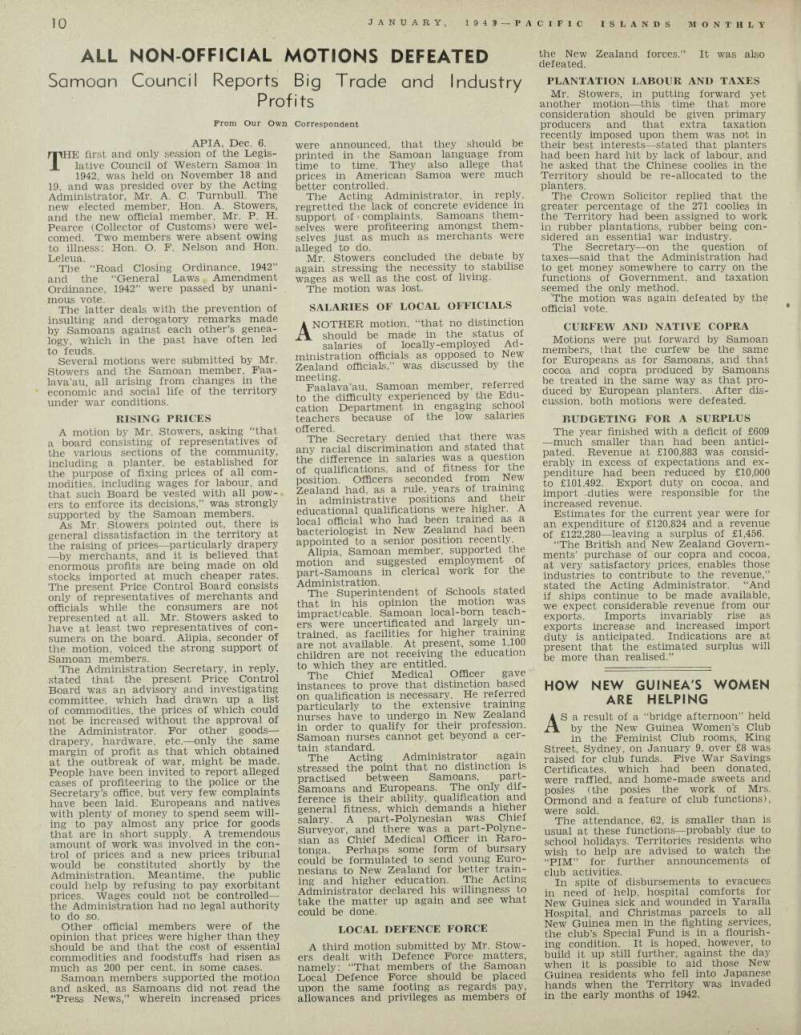
A GROUP at the wedding of Miss Kate Daisy (“Dolly”) Estall, third daugh ter of Mr. Marcus Estall, and Mr.
M. B. Baker, Director of Agriculture, at Rarotonga recently. The photograph was taken in the grounds of the Catholic Mis
sion. Those in the group, from left to right, are: Mr. J. Hartigan (best man), Miss Julie Marama, Mr. Marcus Estall, the bride and gridegroom, Miss Paula Cowan and Mr, Nono Manarangi. Seated: Nana Akapi and Mia Taripo.
All Non-Official Motions Defeated
Samoan Council Reports Big Trade and Industry Profits
From Our Own Correspondent
Apia, Dec. 6.
THE first and only session of the Legis lative Council of Western Samoa in 1942, was held on November 18 and 19, and was presided over by the Acting Administrator, Mr. A. C. Turnbull. The new elected member, Hon. A. Stowers, and the new official member. Mr. P. H.
Pearce (Collector of Customs) were wel comed. Two members were absent owing to illness: Hon. O. F. Nelson and Hon.
Leleua.
The “Road Closing Ordinance. 1942” and the “General Laws Amendment Ordinance, 1942” were passed by unani mous vote.
The latter deals with the prevention of insulting and derogatory remarks made by Samoans against each other’s genea logy, which in the past have often led to feuds.
Several motions were submitted by Mr.
Stowers and the Samoan member. Faa lava'au, all arising from changes in the economic and social life of the territory under war conditions.
Rising Prices
A motion by Mr. Stowers, asking “that a board consisting of representatives of the various sections of the community, including a planter, be established for the purpose of fixing prices of all com modities, including wages for labour, and that such Board be vested with all pow ers to enforce its decisions,” was strongly supported by the Samoan members.
As Mr, Stowers pointed out, there is general dissatisfaction in the territory at the raising of prices—particularly drapery —by merchants, and it is believed that enormous profits are being made on old stocks imported at much cheaper rates.
The present Price Control Board consists only of representatives of merchants and officials while the consumers are not represented at all. Mr. Stowers asked to have at least two representatives of con sumers on the board. Alipia, seconder of the motion, voiced the strong support of Samoan members.
The Administration Secretary, in reply, stated that the present Price Control Board was an advisory and investigating committee, which had drawn up a list of commodities, the prices of which could not be increased without the approval of the Administrator. For other goods— drapery, hardware, etc. —only the same margin of profit as that which obtained at the outbreak of war, might be made.
People have been invited to report alleged cases of profiteering to the police or the Secretary’s office, but very few complaints have been laid. Europeans and natives with plenty of money to spend seem will ing to pay almost any price for goods that are in short supply. A tremendous amount of work was involved in the con trol of prices and a new prices tribunal would be constituted shortly by the Administration. Meantime, the public could help by refusing to pay exorbitant prices. Wages could not be controlled — the Administration had no legal authority to do so.
Other official members were of the opinion that prices were higher than they should be and that the cost of essential commodities and foodstuffs had risen as much as 200 per cent, in some cases.
Samoan members supported the motion and asked, as Samoans did not read the “Press News,” wherein increased prices
were announced, that they should be printed in the Samoan language from time to time. They also allege that prices in American Samoa were much better controlled.
The Acting Administrator, in reply, regretted the lack of concrete evidence in support of ■ complaints. Samoans them selves were profiteering amongst them selves just as much as merchants were alleged to do.
Mr. Stowers concluded the debate by again stressing the necessity to stabilise wages as well as the cost of living.
The motion was lost.
Salaries Of Local Officials
ANOTHER motion, “that no distinction should be made in the status of salaries of locally-employed Ad ministration officials as opposed to New Zealand officials,” was discussed by the meeting.
Faalava’au, Samoan member, referred to the difficulty experienced by the Edu cation Department in engaging school teachers because of the low salaries offered.
The Secretary denied that there was any racial discrimination and stated that the difference in salaries was a question of qualifications, and of fitness for the position. Officers seconded from New Zealand had, as a rule, years of training in administrative positions and their educational qualifications were higher. A local official who had been trained as a bacteriologist in New Zealand had been appointed to a senior position recently.
Alipia, Samoan member, supported the motion and suggested employment of part-Samoans in clerical work for the Administration. . , The Superintendent of Schools stated that in his opinion the motion was impracticable. Samoan local-born teach ers were uncertificated and largely un trained. as facilities for higher training are not available. At present, some 1,100 children are not receiving the education to which they are entitled.
The Chief Medical Officer gave instances to prove that distinction based on qualification is necessary. He referred particularly to the extensive training nurses have to undergo in New Zealand in order to qualify for their profession.
Samoan nurses cannot get beyond a cer tain standard.
The Acting Administrator again stressed the point that no distinction is practised between Samoans, part- Samoans and Europeans. The only dif ference is their ability, qualification and general fitness, which demands a higher salary. A part-Polynesian was Chief Surveyor, and there was a part-Polyne sian as Chief Medical Officer in Raro tonga. Perhaps some form of bursary could be formulated to send young Euro nesians to New Zealand for better train ing and higher education. The Acting Administrator declared his willingness to take the matter up again and see what could be done.
Local Defence Force
A third motion submitted by Mr. Stow ers dealt with Defence Force matters, namely: “That members of the Samoan Local Defence Force should be placed upon the same footing as regards pay, allowances and privileges as members of
the New Zealand forces.” It was also defeated.
Plantation Labour And Taxes
Mr. Stowers, in putting forward yet another motion —this time that more consideration should be given primary producers and that extra taxation recently imposed upon them was not in their best interests—stated that planters had been hard hit by lack of labour, and he asked that the Chinese coolies in the Territory should be re-allocated to the planters.
The Crown Solicitor replied that the greater percentage of the 271 coolies in the Territory had been assigned to work in rubber plantations, rubber being con sidered an essential war industry.
The Secretary—on the question of taxes —said that the Administration had to get money somewhere to carry on the functions of Government, and taxation seemed the only method.
The motion was again defeated by the official vote.
Curfew And Native Copra
Motions were put forward by Samoan members, that the curfew be the same for Europeans as for Samoans, and that cocoa and copra produced by Samoans be treated in the same way as that pro duced by European planters. After dis cussion. both motions were defeated.
Budgeting For A Surplus
The year finished with a deficit of £609 —much smaller than had been antici pated. Revenue at £100,883 was consid erably in excess of expectations and ex penditure had been reduced by £lO,OOO to £101,492. Export duty on cocoa, and import duties were responsible for the increased revenue.
Estimates for the current year were for an expenditure of £120,824 and a revenue of £122,280 —leaving a surplus of £1,456.
“The British and New Zealand Govern ments’ purchase of our copra and cocoa, at very satisfactory prices, enables those industries to contribute to the revenue,” stated the Acting Administrator. “And if ships continue to be made available, we expect considerable revenue from our exports. Imports invariably rise as exports increase and increased import duty is anticipated. Indications are at present that the estimated surplus will be more than realised.”
How New Guinea's Women
Are Helping
AS a result of a “bridge afternoon” held by the New Guinea Women’s Club in the Feminist Club rooms, King Street, Sydney, on January 9, over £8 was raised for club funds. Five War Savings Certificates, which had been donated, were raffled, and home-made sweets and posies (the posies the work of Mrs.
Ormond and a feature of club functions), were sold.
The attendance, 62, is smaller than is usual at these functions—probably due to school holidays. Territories residents who wish to help are advised to watch the PIM” for further announcements of club activities.
In spite of disbursements to evacuees in need of help, hospital comforts for New Guinea sick and wounded in Yaralla Hospital, and Christmas parcels to all New Guinea men in the fighting services, the club’s Special Fund is in a flourish ing condition. It is hoped, however, to build it up still further, against the day when it is possible to aid those New Guinea residents who fell into Japanese hands when the Territory was invaded in the early months of 1942.
New Administrative
Group
Three Islands Joined With Pitcairn
By Mrs. Ada M. Christian
Pitcairn Is., Dec. 4.
IT appears not to be generally known that, in this distant part of Poly nesia, there has been formed, for administrative purposes, under the British High Commissioner for the Western Pacific, the “Pitcairn Islands Group.”
The group comprises Pitcairn Island (in habited), and Oeno, Henderson and Ducie islands (small, uninhabited islands in the vicinity of Pitcairn).
These three islands, Oeno, Henderson and Ducie, were apparently not possessed by any nation until, in 1902, Captain G.
F. Jones (whose photo appeared in the “PIM” a year or two ago' as Missionary Jones), was commissioned by Mr. R. T.
Simons, British Consul at Tahiti, to go there in a small cutter-boat, with a crew of Pitcairn Islanders, to set up the British flag, and a board on each island bearing this inscription: “This island is a dependency of Pitcairn, and is a property of the British Government.”
Later, the following inscription was placed on the islands: “This Island be longs to* H. B. M. King George VI. It was visited by H.M.S. Leander on 6th of August, 1937.—(Signed) J. R. RIVETT
Carnac, Capt. R.N.”
Two years ago, when our Post Office was erected, and established by Mr. H. E.
Maude and Mr. A. E. Fuller (Govern ment representatives residing here at the time) by their advice the inscription, “Pitcairn Islands (not Island) General Post Office,” was placed over the door.
The three islands are all of coral for mation, Henderson being large and high for the kind —what is known as a raised coral island. Oeno and Ducie are mere dots in the Pacific, with a reef encircling each, where fish abound. Sea-birds take possession of these lands.
Especially is Oeno a place of allure ment for Pitcairn men, women and children, where some go for a holiday in our home-made boats once, and some times twice, a year. Henderson is rather far away for the weaker sex, so only men go to that island, where they get boat loads of miro, a hard and durable wood which grows there. Ducie has no attrac tion whatever.
Oeno was a source of terror to sea captains in the days of sailing ships. At least five were wrecked on its dangerous reef.
The American ship “Wildwave” was wrecked there in 1858, when all the Pit cairners were on Norfolk Island. An interesting account of the experience of the crew, and how they found their way to Pitcairn Island, is found on pages 140 to 144 of the “Story of Pitcairn Island” (by a native daughter, Rosalind A. Young), as was told by Captain J. N. Knowles to an islander who visited him in his home in San Francisco twenty-three years afterwards.
The English ship, “Khandeish,” Cap tain Skelly, was wrecked on Oeno in 1876. One of the men, Peter Butler, re mained behind when the crew left Pit cairn, and married an Island woman.
The name on the island is now extinct, as his widow died and the two daughters married.
Captain Hardy’s American ship “Ore gon” was piled up on the reef in 1883.
The English ship “Bowdon” was wrecked 1893; Captain Law. The last on record was the American “Saint James,” in 1918, Anderson, Captain.
Ducie was guilty of the loss of the English ship, “Acadia,” in 1881, Captain George. One of the men, Philip Coffin,
married an Islander, and many years later Lincoln Clark, of the same crew, returned and was married here. Thus the names Coffin and Clark were added to our com munity. Alfred Walter, the cabin boy of this wrecked ship, is now living in Haw thorn, Victoria.
The English ship “Cornwallis” ran aground just below Adamstown, Pitcairn Island, in 1875.
Great chains and iron spars lying on the reef at Henderson indicate that a ship once went ashore at that place.
It is to be understood that Pitcairn Island is the haven to which all ship wrecked crews in this locality direct their course.
Lost Rubber
Captain Fitch's Plea to the Australian Government
THE strong representations being made to the Commonwealth authorities by the Pacific Territories Associa tion and other interests, urging that Australia’s approach to the Pacific Ter ritories’ wartime problems be more clear cut, businesslike and humane, were effec tively supported early in January by Captain A. S. Fitch, managing director of Steamships Trading Company, of Papua, who has large rubber plantations in the Territory, In an article prominently published in January in the “Sydney Morning Herald’’ and other journals, Captain Fitch pointed out that the United Nations are in great need of rubber; that in normal times Papua could produce 1,600 tons annually; that, with organisation and effort in the next three years, this production could be doubled; but that, owing to the failure of the present military administration to take proper care of the plantations, the plantations were rapidly reverting to the jungle.
Captain Fitch said that the military authorities had created the administra tive unit called ANGAU, one of whose duties was to care for the rubber planta tions; but all owners, and managers over 45 years had been compulsorily evacuated, and inexperienced young officers had been put in charge, in the majority of cases; and the effect of this disinterested control, plus the inadequate supply of native labour was that undergrowth and cover crops had taken complete control of many plantations. Unless this second ary growth was weeded out, the rubber trees would be strangled. Thousands of new trees should now be coming into production; instead of that, the produc tion potential was rapidly decreasing.
Hundreds of thousands of young rubber trees, which should have been planted out, were being destroyed. Disinterest and inexperience had allowed most of the labour lines in the various planta tions to disappear, or be transferred. Out of 300 natives, previously employed on one large rubber plantation, only eight remained.
Captain Fitch’s urgent plea that a new policy be introduced, so that experienced men and sufficient native labour be made available to protect and stimulate Papuan rubber production, was vigorously sup ported by “Sydney Morning Herald” on January 6.
“Most of the men of over 45 who were withdrawn from the plantations last April, when civilian evacuation of Papua was ordered, are doubtless available to return and resume their work, and they are most eager to do so,” said the “Her ald.” “It is obviously not a task for the Army, which since April 25 has appar ently taken over responsibility for the plantations.”
Rev. F. J. Searle, of LMS, since he retired as Principal of Lawes Training College, Fife Bay, Papua, early in 1942, has been recuperating his health. He has now accepted the interim pastorate of Canberra Congregational Church.
Rev. Wesley S. Pigeon was ordained on October 20 to the work of the Methodist Dudley Memorial Church, Suva, Fiji.
Advertisements & other items, p. 13 (1 item)
Tahiti
and
French Oceania
BY S. RUSSELL
A Reliable Guide-Book for
Travellers, Navigators, Fisher-
men, Commercial Men, Etc.
The 200 pages of “Tahiti and French Oceania,” carefully compiled by the late Mr. Russell, a few years ago, contain a wealth of material about one of the richest and most beautiful Territories in Polynesia.
Numerous Illustrations and Maps.
A new demand has set in for this Book, of which we have only a few dozen copies left. If you want it, please order promptly.
PRICE 6/-, PLUS POSTAGE, 6d.
PACIFIC PUBLICATIONS
PTY, LTD.
Union House, 247 George Street,
Sydney
PUBLIC NOTICE
NOTICE is hereby given that the balance standing to the credit of the Wau Branch of the New Guinea Comforts Fund, amounting to £62/19/2, has been paid into the account of the N.S.W. Division of the Australian Comforts Fund by Mrs, W. S. Mitchell and Mrs. M. A. Mackenzie, Treasurer and Secretary respectively of the Wau Branch of the N.G. C.F.
C. T. DOCKER, Hon. Administrator, Australian Comforts Fund (N.S.W Div.)
Evacuees' Troubles
Quarterly Meeting of Pacific Territories Association
RESTRICTIONS had become stricter and little progress had been made in the Association’s various appeals to the War Damage Commission, the Department of External Territories, etc., reported the president (Mr. E. A. James) at a largely attended quarterly meeting of the Pacific Territories Association, held in Sydney on December 15.
On November 27, the executive had written to the secretary of the War Damage Commission with regard to an amendment appearing in HO Circular 58, of November 19, namely:— “Reg. 38 (2) (a). The value of the damaged property immediately after the occurrence of war damage is to be deducted from the assessment.”
Extracts from the Association’s letter are as follows: “This ruling will inflict very serious hardship on claimants throughout Papua and the Territory of New Guinea. As a result of this the most extraordinary position can arise and. as an example, the following suppositious case is instanced:— “ ‘A,’ having insured, under compulsorv clauses regulations, his dwelling house for £1.500. and under voluntary clauses, for contents, £5OO. suffers damage bv enemy action. The roof of his dwelling is seriously damaged and some damage is done to walls end main structure but contents are undamaged. Damage occurs on or about 7 '2 '42. Assessment value of building at 1/1/42 is £1.500 and value of nronerty after damage is assessed at £1.200 ‘A’s claim, therefore, is entered at £3OO. However, as a result of dam aged roof and waffs, the building at 1 T '43 is valued at £BOO and the contents at £2O0 —the reduced values being a result of loss due to weather and other natural causes owing to lack of roof and walls of building.
“ ‘A’s position as at 1/1/43, therefore, is that he has lost nropertv solelv due to war damage totalling £l.OOO and mav he able to collect at the end of the war the sum of £3OO. Meanwhile he has paid war damage premiums as follows; For 1942. on £2 000 and for each subsequent ■rear on £l.lOO. (In arriving at this figure it is assumed the Commission wiff “review and alter the amount declared” as to value of fixed nropertv of £9OO in accordance with its assessment of valn° after of damage)’
“We think that you will agree that such a situation would cause hardshin and by no means carry out the Govern ment’s expressed intention of indemni fving individuals against loss due to war damage.
“We sincerely hope that similar con ditions wiff not arise in Australia, but we feel that the regulations are being framed and internreted solelv with th° Austra lian mainland in view, and without regard to those Australian residents rtf Papua and New Guinea, manv of whose losses, it should be remembered, are occasioned largelv hv defence measures taken for the protection of the Australian mainland.”
After three weeks the Association re ceived this reply from the War Damage Commission;— “I have to advise vou that the nrot.ee tion given bv the War Damage to Pro perty Regulations is in respect of direct wnv damage and not embrace con sequential losses of the type referred to
in your letter. In the hypothetical case there given, a loss due to war damage is increased by loss due to weather, but similar losses may occur to properties which are not affected by war damage; for example, losses by fire, white ants, etc.
It would be impracticable to draw dis tinctions between these various types of loss for the purposes of compensaton.
“You will understand that the Commis sion is by no means unsympathetic to owners of property in the territories: but it regrets that it is unable to recommend any extension of the present definition of war damage. At the same time. I would point out that any compensation determined during the war is to be reviewed upon cessation of hostilities, and the Government at that time will be in a much better position to determine any variation in the type of loss for which compensation will be paid, because it would be aware of the extent to which losses under various headings have been suffered.”
After these letters had been read by the secretary (Mr. Adelskold) the meet ing was thrown open to general—and somewhat heated—discussion.
Members pointed out that the War Damage Commission, in spite of their assurance that they are “by no means unsympathetic to owners of property in Papua and New Guinea” are apparently bent on whittling down, by every possible means, the existing claims of owners.
There appeared to be nothing for the Association to do but to continue with the fight for evacuees’ rights, in the hope that by a wearing-down process, the War Damage Commission mav eventually relax some of its hide-bound, steel encased regulations relating to conse quential damage and looting.
Return Of Evacuees To The
Territories
The opinion of most members was that in running their heads against the brick-wall of petty officialdom the Asso ciation was wasting its time —and getting nowhere. It was resolved, therefore, to send the following telegram to every member of the War Council: — “In view of the rapidly improving mili tary situation and the very urgent need of rubber and copra by Australia, this Association is strongly of the opinion that owners of industrial enterprises in Papua (and later New Guinea) and representatives of owners and industrial staffs still in Australia, should at once be permitted to return to and control those interests, with a view to maximum production and efficient preservation of those assets; and. further, those with vested interests in Papua and New Guinea have no confidence in the present method of administering properties under Industrial Control Order No. 4 of 1942.”
Land Titles
Unon the question of the Land Titles and records which were lost when the Japanese occunied Rabaul and Lae, it was reported that a committee had been set un to study available data and recon struct the records.
Post-War Reconstruction
A memorandum on post-war recon struction of the Territories Administra tions had been drawn up by the execu tive of the Association, to be submitted to the Federal Government. The meet ing decided that before it was submitted it should be sent to all members, in order that thev might suggest amendments.
In accordance with these instructions all members have now been circularised: and they have been asked to make their suggestions relating to the memorandum and return it to the secretary not later than January 17. as the work of corre
lating amendments will be heavy, and the executive wishes to hand the memo randum to the Federal Government as soon as possible.
Members’ Addresses
Members are requested to send any change of address to the secretary of the Association. (For Association’s address, see page 2.)
Fiji's Currency Headache
Not Enough Coins
ONE of the problems discussed by the Fiji Legislative Council at the end of November was the acute shortage of currency (coins and notes'*, that the Colony has experienced for twelve months.
Captain A. R. W. Robertson. Financial Secretary, stated that, since the outbreak of war, the circulation of notes in Fiji had been increased bv 82 per cent., that of coin (including small denomination notes'* 90 per cent. and that of cupro nickel coins (including nennv notes'). TOO per cent. There was also an unspecified amount of United States coinage in cir culation. Other means of meeting the shortage, including the over-nrinting of New Zealand £1 and £5 notes (over printed NZ 10/- notes are being held for further emergencies'), the declaration that Australian sixpences are legal tender, the minting of 1/- and ?/- notes, and the issue of one million Id. notes, had not entirely solved the problem, and the shortage still continued.
Several Theories have been advanced to explain the shortage of silver coinage.
The one generally accepted is that the coins are being buried The main diffi culty in obtaining further sunlies is the demand for all metals for the manufac ture of munitions and limiter! shinnmo space. A shipment of coins which was to have reached Fin in November was over carried in a convov and has not yet been returned to its destination.
Not Enough Fiji Stamps
According to the “Piii Times/' Fiii is experiencing another shortage—this time of postage stamps of halfpenny and nennv values Fresh supplies are on their wav from England hut. with no indication of when thev will arrive, postal authorities arp “rationing'” existing stocks. When a customer wishes to post a number of small articles normally requiring stamps of fhese denominations, a receipt for the total amount is given in lieu of stamps, and the articles are franked by the Post Office.
Mission Medical Work in BSI
JUST prior to the threatened occupation of the Solomons by the Japanese.
Dr. J. D. Thomson. Medical officer of the Melanesian Mission, was able to arrange to carrv on medical work amongst the natives by transferring eouinment and medical stores to the various villages.
At the first appearance of enemv nlanes, natients in the hosnital bolted, while others eould not be nersuaded to eome in for treatment. It was decided then to close down temnorarily. and work from the scattered villages where the stores had been left in charge of an orderly.
When the invasion did occur the hos nital buildings were not damaged, excent for broken locks. The Japanese entered all buildings looking for stores—which they naturally did not find—and when the natives were nuestioned as to their whereabouts and the whereabouts of the doctor and nursing staff thev remained love?] and refused to give information,
even though flogged by the enemy.
Americans In Fiji
Cordial Relations With "Great Force of All Arms"
THE Governor of Fiji (Major-General Sir Philip Mitchell) made the fol lowing statement when formally opening the Legislative Council of Fiji in November: — “It is now permissible to refer to the presence in our midst of a great force of all arms of our Allies of the United States, and to extend to them officially, on behalf of the Government and the people of Fiji, that public welcome which we have done our best to extend person ally. since their arrival here.
“Throughout the Colony, it is realised by all —and is in fact the general prac tice—that our first duty is to subordinate every consideration of private interest or convenience to the paramount obligation upon all of us to render to these forces every possible help and to organise our own small resources in such a way that they may be of the greatest value to the common effort.
“We have had an understanding friend in the first American Commanding Gen eral of the Island, during whose period of command there were established between • the civil authorities and force headquarters close, cordial and intimate relations, which are continuing with his successor in command, and are being developed in fresh directions from day to day. as circumstances require . . .
“I cannot, for obvious reasons, speak of the military side of the work of the Fiji War Council, beyond saying that either I or the Colonial Secretary are in daily touch with the Commanding Gen eral, and that, through the Military Sec retary or otherwise. I maintain a con tinuous and close liaison with force head ouarters. The members of the War Council are kept fully informed of the war situation here and elsewhere, and are thus enabled to bring to their task all available reliable information.
“I may add just this, that the Fiji Military Forces and the Fiji Naval Vol unteer Force are playing a valuable and increasing part in their respective spheres and are bodies of men of which the Colony may justly be proud.”
His Excellency added that a force of native Fijians had been organised, and a force of Fiji Indians was proposed.
High Price for Coconut
Charcoal
ACCORDING to recent reports from Fiii, coconut charcoal is providing a welcome addition to the income of planters.
This nroduct is now bringing £l2 (equal to £l3/10/- Australian) per ton from the Colonial Sugar Refining Company, Ltd., who provide free sacks, insurance and freight. It has been estimated that from every ton of copra produced, five hundredweight of prepared charcoal can be made. Formerly coconut shell was almost a waste product of nlantations but, under war conditions, it is in great demand, both as a fuel and for use in resnirators.
Coconut shell, when properly treated, gives the finest charcoal, with the highest carbon content that it is possible to produce.
Sergeant R. E. Emery, formerly of Lae, New Guinea, was wounded in action in New Guinea in October and later arrived in Australia on sick leave.
Solomon Islands Battles
Complete List, and the Results of Each
'T'HERE have been so many naval and L air battles in the Solomons between Americans and Japanese, with the stor'ies of one running imperceptibly into the stories of the other, that the whole pat tern of this campaign had become con fused and confusing.
We are glad, therefore, to find that Mr.
Winston Turner, Sydney “Sun” corres pondent in the Solomons, has supplied a complete and detailed list of the eight actions that had occurred, up to Decem ber 20. Mr. Turner sets them out tidily in this fashion: — HENCEFORTH, the Solomons Islands sea actions will be referred to by the US Navy as:— First Battle of the Solomons, August 7-8.
First Savo Action, August 8-9.
Battle of Ontong Java, August 24-25.
First Buin Raid, October 5.
Battle of the Russell Islands, October 11-12.
Battle of the Santa Cruz Islands, October 25-26.
Second Battle of the Solomons, November 13-15.
Second Savo Battle, November 30.
These actions, in a nutshell, are:— First Solomons. —This covers the actual landing by US Marines in the Solomons, the establishment of a beach-head on Guadalcanal and capture of Tulagi.
Makambo, Gavutu. Tanambogo and Florida Islands. The Japanese lost a vacht, 37 bombers, 18 seaplanes and 15 fighters, and 1,200 Japanese were killed.
US losses were a destroyer (the “Jarvis”), a transport (the “G. F. Elliott”). A second destroyer was damaged. High light of the day’s fighting: Attack by 40 Jap planes on the “Elliott.” Every one shot down either by fighters or ack-ack.
First Savo.—ln this night engagement the Australian cruiser “Canberra” and the US cruisers “Quincy,” “Vincennes” and “Astoria” were sunk.
Battle of Ontong Java. —Takes its name from the island of Ontong Java (also known as Lord Howe Island), and might equally well be called the “Battle of the Carriers.” Fought at a range of 250
miles between opposing carrier forces. A clean-cut victory for the Americans. US airmen destroyed 92 Japanese planes, for the loss of only three Americans, hit some cruisers and battleships and dam aged and probably sank the small Jap carrier “Ryujo.’* First Buin Raid. —Carried out entirely by carrier-based planes. Americans bombed and hit a force of Jap cruisers, transports and destroyers: also hit the runway on Kieta. They destroyed six Jap aircraft during the raid.
Russell Islands. —Admiral Scott’s task force of cruisers and destroyers attacked a similar force of Japanese, sank a heavy cruiser and destroyer, severely damaged (probably sank) two heavy and one light cruiser: sank four destroyers. Lost the US destroyer “Duncan.”
Santa Cruz Islands. —ln this (flash a carrier task force attacked a Japanese carrier task force, and severely damaged two Jap carriers—one a Shokaku class carrier. The American force also dam aged by bombs or torpedoes a Jap battle ship, a heavy cruiser, and a light cruiser.
No less than 115 Japanese aircraft were destroyed for certain, and 46 more were probably destroyed. The American force lost a carrier and the destroyer “Porter.”
Second Solomons.—So named because, whereas in the opening engagement, on August 7-8, the Americans were all out to capture the Solomons, in this action (November 13-15), the Japanese were all out to win them back. The three-day battle was a sweeping victory for the US Navy. Japanese lost two battleships, six heavy, and two light cruisers, six destroy ers. eight transports, and four cargo ships. A third battleship, another light cruiser and seven more destroyers were damaged. The American Fleet lost two light cruisers and six destroyers—and saved Guadalcanal.
Second Savo.—ln this battle, which indicates that the Japs still are willing to face heavy losses on the chance that they may get Guadalcanal back, the American force sank two Jap light crui sers, or heavy destroyers, four destroy ers, two transports, and one cargo vessel.
The American losses were a heavy cruiser sunk and several other ships damaged.
(Article Continued on Next Page)
IT is possible that the future historian will say that the most decisive battle of the South Pacific in 1942 w'as the Second Solomons Battle, November 13-15.
The following is a donnected account of the battle by Winston Turner, an Aus tralian war correspondent:— The battle was fought in five phases over the period from the night of November 12-13 until the morning of November 15.
Phase one, in which American cruisers and destroyers daringly attacked Japan ese battleships and cruisers, and phase four, in which American and Japanese battleships exchanged broadsides for the first time, took place in the waters enclosed by Guadalcanal, Savo and Florida Islands.
The position in this area on November 11 was that the American cruisers, destroyers and transports were off Gua dalcanal. During that day thev were attacked by 10 dive-bombers and later by 25 twin-engined Mark I Navy bombers.
On the 12th more American cruisers and transports arrived.
On the evening of the 12th the entire force left, all going out of the area enclosed by Guadalcanal, Savo and Flor ida Islands by way of Sealark Channel at the south-western end. (See map, page 13.) When the force had passed through this channel it divided. The transports and destroyers continued on.
But the cruisers and destroyers, having tricked the Japanese into believing that they had left and were not returning, boldly turned and re-entered Sealark Channel in the darkness to give Tojo a surprise.
MEANWHILE, a Japanese naval force much stronger than the American force had entered the deserted Guadalcanai-Savo-Florida Islands area.
These ships were in three formations when the American force came out of Sealark Channel. (1) East of Savo Island were two Japan ese battleships and two destroyers.
Thev were in battle formation. (2) South of Florida Island were six or eight warships, in cruising forma tion. (3) Two miles east of Cane Esperance (on the northern coast of Guadal canal) were eight Japanese warships, also in cruising formation.
The American force consisted of heavy cruisers, light cruisers and destroyers.
These ships came out of Sealark Channel (which is only 300 yards wide at one point) in battle formation of line ahead —a string of destroyers, then the cruisers, with more destroyers bringing up the rear.
They were through the channel at 1.30 a.m. November 13 and shortly after wards they located the battleships dir ect! v ahead of them off Savo Island.
The force changed course 40 degrees to enable the cruisers’ broadsides to bear and the destroyers at the head of the line went in to attack. As these destroy ers were in the line of fire of the cruisers, those vessels did not open up until the destroyers had pushed home their attack.
Destroyer No. One discharged four torpedoes from a range of only 200 yards at one battleship.
The other destroyers also got torpedoes home. One battleship was not seen again and may have been sunk. The other was located next day, badly dam
aged and was destroyed by American aircraft.
But the small destroyer force could not carry out an attack at such close quar ters without loss.
Destroyer Two was caught by a full broadside of 14 or 16 inch calibre shells and blew up with a terrific explosion.
Her magazine and depth charges were apparently hit simultaneously and flames 300 feet high split the darkness.
Destroyer Three was badly damaged.
The torpedo . attack completed, the American cruisers were in the process of changing course when the scene was illuminated by a dazzling cluster of four big searchlights from off the port bow.
Jap force No. Three (off Guadalcanal) had disclosed itself.
Cruiser X’s guns slewed round and her own searchlights switched on to reveal a Japanese light cruiser and the outline of other cruisers. Cruiser X opened fire before the Japanese were able to do so, and other cruisers in the American line swiftly followed suit.
Cruiser X fired for three minutes, opening at a fairly long range and clos ing 2,000 yards nearer.
The first return salvo from the Japanese cruiser killed Admiral Scott, second in command of the American force, who was on the bridge of Cruiser X.
During this hot exchange, a Jap cruiser raced across the port bow of Cruiser X and at a range of only 600 yards gave her tw r o torpedoes. The cruiser went dead in the water when the torpedoes exploded, but slewed her guns round and at almost point-blank range blew the Jap cruiser out of the water.
THEN shells began to lob over from starboard of the Americans. Japan ese force No. 3 (off Florida Island) had disclosed itself. Shelling by this force was not very effective and the American ships pressed on.
Cruiser X. which had dropped out of the line when she was torpedoed, con tinued to fire her guns until only three of her eight turrets were operating. All the others had suffered direct hits.
Then Turret No. 2 received a direct hit and power went dead in No. 7.
The cruiser fired a few more shells from No. 8 turrek—her only remaining unit—then ceased firing.
In a hectic few minutes of night firing she had hurled many shells at the Jap anese. She was afire, with flames rising 50 to 100 feet above her bridge. Bucket brigades finally brought this blaze under control and the cruiser remained afloat.
Meanwhile, the American force steamed on and either because they had had enough or wished to consoli date their forces, all three Japanese formations turned and began moving out northwards.
There was a melee off the east side of Savo Island, and it was here the Ameri can ships got in their best blows. They rained shells on the Japanese cruisers.
Those watching from Cruiser X saw two ships blow up and later saw another three Japanese vessels belch flame from internal explosions that shattered their hulls and left them sinking.
The American force turned round in the darkness, well satisfied with what it had accomplished. But the two confused Japanese cruiser forces continued firing at each other.
The engagement, as described to this point, had lasted 15 minutes.
After this there was intermittent firing between individual ships. For instance, a Japanese destroyer passed close bv Cruiser X while she lay dead in the water and shelled her, without success.
Dawn on November 13 in the Guadal canal-Savo-Florida Islands area revealed that the fires were out in American Cruiser X, but her bridge and turrets were a shambles, and she was listing.
Three American destroyers were burn ing. One had been abandoned and the fires on the other two were being dealt with. The remainder of the American force had left the scene.
As the dawn brightened, a fourth destroyer was seen, lying dead in the water.
FOR a moment an American cruiser studied her, then, satisfied she was Japanese, opened fire on her. The cruiser fired four 8 inch salvos—and all four salvos landed on the destroyer.
At the end of the firing the Ameri cans saw a tremendous column of smoke. When it cleared there was no sign of the destroyer.
Landing boats from the American-held section of Guadalcanal then came out and picked up American wounded, also some Japanese who had been picked up from the water earlier.
Cruiser X’s crew stood by her despite the danger of Japanese air attacks, which, however, did not eventuate. At 4.30 p.m. they abandoned ship and went ashore to Guadalcanal in Marines’ land ing boats.
At 8.15 p.m. charges of TNT were placed in Cruiser X’s engine room-and she was sunk.
During this second day of the Second Solomons battle, American aircraft located the Japanese battleship damaged by destroyers the previous night, limping along at three knots, escorted by five destroyers.
She was then north of Savo Island, and during the day she travelled 40 to 50 miles, plagued by American aircraft.
Torpedoes and heavy bombs hit her, and towards dusk the escorting destroy ers took off her crew. She either sank or was scuttled during the night. The attacking aircraft also hit one of the escorting destroyers.
That night a Japanese cruiser force, with, possibly, a battleship, came into the waters where the previous night’s action had been fought, and shelled Henderson airfield on Guadalcanal. They opened fire at 1.30 a.m. and shelled steadily for 45 minutes.
They were to pay dearly for this bom bardment, which did little damage. At 8 a.m. American aircraft picked up a Japanese force between Russell Island and Ysabel Island. This force comprised 12 transports, one battleship and several cruisers—probably those which had called on the Marines a few hours earlier.
American aircraft attacked this force all day, shuttling backwards and for wards, staying at their bases only long enough to refuel and bomb up—then returning to the attack.
The attack became so hot during the afternoon that the Japanese warships left the transports to their fate and hur ried north.
Eight of the 12 transports were sunk.
A Marine aviator told me: “There were so many Japanese heads in the water you could almost walk on them. The sea was just black with heads.”
Fourth phase of the battle was fought that night, when surface warships clashed again. American battleships and destroyers came in Sealark Channel dur
ing the night and caught a Japanese force coming around Savo Island.
THE Americans tried the same tactics that had proved so successful in the first engagement—sending destroyers in close for a torpedo attack.
Japanese battleships and cruisers and American battleships fired on each other for 20 minutes. Marines ashore on Gua dalcanal enjoying the show from the dress circle, saw several explosions among the Japanese force.
In the final check-up it was found that the Japanese had lost six war ships (a battleship, three heavy crui sers and one destroyer).
Final phase of the battle was fought at dawn. The first grey light revealed a 12,000 tons Japanese transport beached on Guadalcanal and three 8.000 tons transports moving in to the beach.
These were the only surviving ships from the transport fleet of 12 shattered between Russell and Ysabel Islands.
Their captains were making a final des perate effort to get their troops ashore.
They did not attempt to anchor, but steamed straight for the beach.
The 12,000-tonner beached herself within artillery range of the Marines’ position on Guadalcanal. Japanese troops were pouring out of her when the Ameri can land batteries opened up.
Meanwhile American planes took off and within "half an hour the other three transports were afire also.
Japanese jumped overboard with packs
on their backs and carrying their rifles and tried to swim ashore. Some suc ceeded. Some did not.
Shelled from sea and land, strafed from the air, the Japs just melted away.
Those who did get inland contributed only more rifles and more empty stom achs to the Japanese forces. They had none of the food, artillery and other equipment the Japanese need to main tain their narrowing territory on Gua dalcanal.
By noon, the four transports were smoking hulks, the 12,000-tonner lying with her back broken.
So ended the second battle of the Solomons, and Japan’s biggest effort to win back Guadalcanal. It was a clean cut victory for the US Navy—a victory that has lifted morale to victory peak, and convinced every man operating in the South Pacific that at least they have the edge on the Japanese.
Mr. H. L. Freshwater, who was a member of the Melanesian Mission in the Solo mon Islands before he resigned in 1939 to return to commercial pursuits, recently reached Sydney from Guadalcanal, after many adventures. He expresses his ap preciation of the kindness shown to him and to others by the American forces in the area.
Mr. Freshwater is remembered particu larly for his work at the Mission’s experimental farm at Pamua on San Cristoval Island.
Advertisements & other items, p. 16 (1 item)
Second Battle Of The Solomons
14
JANUARY, 1943 PACIFIC ISLANDS MONTHLY
(CONTINUED FROM PAGE 13)
BP Manager on Wallis Is.
Marooned For Two
Years
A REMARKABLE story of how he was marooned for over two years in a Vichy France remnant in the Pacific was told by Mr. F. W. Roe, Burns Philp’s manager on Wallis Island, when he re cently arrived in Sydney, Wallis and Futuna Islands, constitute a depedency of New Caledonia, and they lie roughly be tween Fiji and Samoa, somewhat nearer the equator.
Mr. Roe’s only link with the outside world was his wireless receiving set, which he was able to keep in working order most of the time. As there were no visiting ships, he and Mr. Greene, his BP colleague on Futuna Island, 80 miles away, were unable to get in touch with each other.
Apart from the native population of 4,200, the only other inhabitants of Wallis are a French Resident and his wife, a Roman Catholic bishop, three priests and six nuns.
When France collapsed, in June, 1940, the French Resident Commissioner de clared for Vichy; and, for a good while, Mr. Roe, as the sole and isolated re presentative of a British firm, found that the situation was embarrassing. When Japan entered the war, at the end of 1941, the position became worse. Food stocks had given out, and it became necessary to live on the produce of the island. Yam and taro became his daily diet, with fish and wood pigeons as luxuries—when he could get them.
About the middle of 1941, beer and whisky stocks came to an end; but Mr.
Roe—who came originally from Erin— justly claimed that it is “the will of God to be Irish.” He had brought an idea or two with him when he left Ireland, years ago, and so a “still” materialised, and from it dripped, after much patient toil and perseverance, a potheen distilled from bananas. Mr. Roe claims that the liquor was second in quality only to Irish
whisky.
By the end of 1941, the French political situation in the Pacific had become settled, and in 1942 Wallis Island changed its allegiance from Petain to de Gaulle. Ships returned to Wallis, and finally Burns Philp were able to send some one to relieve Mr. Roe at his lonely post. But his troubles were by no means over. He could not return to Australia by the usual more or less direct route, but instead, through force of war circum stances, he had to make a “snakes and ladders” journey of several weeks’ dura tion, up, down and across the Pacific; and he finally got home through one of Australia’s back doors.
Advertisements & other items, p. 17 (1 item)
W. H. Grove & Sons
Limited
AUCKLAND
Island Traders. P.o. Box 490.
Telegraphic and Cable Address: “Grove”, Auckland.
Shippers of all classes of New Zealand products.
Representing English Manufacturers throughout the Cook and Society Islands, Fiji, Tonga, Samoa, Niue, New Caledonia, New Guinea, etc.
In FIJI as—W. H. Grove & Sons (Fiji) Ltd.
LJuZWsfiytCTt. rCcvc£i&-
POWERFUL MULTI-VALVE BANDSPREAD
Full particulars from
GEORGE BROWN & CO.
Electrical Engineers Used by There is not a better radio obtainable.
AC & BATTERY MODELS
PTY. LTD.
267 Clarence Street, Sydney, N.S.W.
“Dominion Of British Oceani”
Chance for Pacific Territories to Break Away From Dead Hands of Canberra, Whitehall and Wellington, and Form Great Tropical Administration.
By A New Guinea Planter
IHAVE noticed several references in the Australian press this year about the “shape of things to come,” after the war, in the Islands Territories.
One supposition is that the Territory of New Guinea will be merged with Papua as an Australian territory; another is that the British Solomon Islands Protectorate will come within the Australian political sphere, and that Britain’s interest in the New Hebrides Condominium will pass to Australia. And so on.
Why assume that a further and closer alliance with Australia is desired by Ter ritories people—or by anyone else, for
that matter? How can closer association with Australia benefit us?
If only Islands people will think it out for themselves, they will see that the arrangement most likely to benefit the Pacific Territories would be the creation of a new Pacific Islands Dominion or Confederation, running from east to west, within the tropics, and governing itself under the protection of Britain, or the United States, or both.
There is far more community of inter est between New Guinea, Papua, Fiji, Solomons, Samoa, and New Caledonia, say, than there is between any of those Territories and Australia or New Zealand.
Environment —vastly different condi tions of life—has created as big a gap between Islanders and Australians as between Britain and Australia, It does not matter to us, in the Islands, whether Australia has a wool pool, or closes its hotels at six or eight o’clock. But, to the Australian, these things are vital.
And why should Australians worry about the effect of immature nutfall in BSI, or the Navigation Regulations of Papua —all so vital to us?
THAT gap between Australians and Islanders is felt by many evacuees, and by men who are serving with the Forces. The Islander feels not only that he has not *a common interest, but that there is a mild hostility, especially from the ordinary working man (who, incidentally, controls the polls that con trol Australia’s Pacific territories). There seems to us to be a half-veiled satisfac tion mixed with the trite words of sym pathy uttered to us who have lost our all.
The woman evacuee, making heavy weather with unaccustomed laborious housework, is often met with such expres sions as: “A change to do your own work —um?” “No black servants to wait on you now, eh?” “Hard work does you good, you’ll find, my dear” —always with a little snigger, as though to say “the fall of the mighty is great.”
Yes, we know Australians were often very kind to evacuees en route —they were even generous—but the whole atmosphere is clearly reflected by those articles of the cow reporters in “a Southern Out post,” so often referred to in the
“Pim.”
Let us not whine about this hostility.
It is natural and human. But let us clearly recognise it, remembering that for years we have complained of the Australian smugness and complacency, and lack of knowledge and interest in the Islands Territories. Think of what we have had to endure from the fumbling bureaucratic administration controlled at Canberra.
We have a distinct accent of our own, an outlook of our own, a future and a need of our own. As Australian Terri tories, we cannot be happy or really prosperous. The Australian public has no interest in us—why should it? We have no political pull. We can get the yellow press to scream on our behalf, sometimes: but as often, they will pic ture us all as cocktail-quaffing planters, gin-soaked traders or just practising sadists. We know their stuff, only too well. Perhaps we could get the fran chise, and two members of the Austra lian Parliament —who would have as much influence on a vote-catching party ridden Parliament as the flies on the ceiling. We would have a “voice,” but it would not be heeded.
We have no common interest with Australia. Neither can we see that Whitehall has worried unduly over those of us who come under its benign influ ence, in the Solomons and New Hebrides.
THEN, why not a Dominion of our own? If Papua, New Guinea, Solo mon Islands. Gilbert and Ellice were knit in a self-governing Dominion, would not we all—native and European alike —be infinitely better off? True to our British origin, loyal to the Crown, favouring our sister Dominions of Aus tralia and New Zealand with some kind of reciprocal trade, could not we add to the wealth, strength, might, wellbeing and happiness of our Empire and its peoples?
I know it will be pointed out that we would be too small, too few, too poor, to stand alone. But should we? History tells us that Mcllwraith launched the Colony of Queensland (not then a State) with 2/- in the Treasury. We could send the hat round to beat that.
Very probably, more Territories could be added. It is doubtful if Japan will be allowed to retain the Caroline and Mar shall Islands. Mandates will be out of date. And what of Nauru?
Britain might be glad to be rid of her Colonial Office anxieties represented by the New Hebrides, and the equatorial lands controlled by the High Commis sioner for the Western Pacific. Would New Zealand mind parting with such obligations as the Tokelaus and the Northern Cooks?
I hardly dare mention such a staid and established Colony as Fiji, the inclusion of which would be an enormous asset to our young Dominion; but, even without Fiji, there are ample lands, peoples and economic wealth to add another jewel to the British Empire, as the Dominion of British Oceania, or something like that. (Continued on Page 17)
DIFFICULTIES would be many. Eco nomic, political and social problems would need great vision, tolerance and altruism. The first clause of the Constitution would provide for the pro tection and welfare of the natives. Big men with real ideals, but with their feet on the ground, would be needed, and they can be found among Islanders —men with sufficient perspective to see all the islands in their Dominion as a whole, without leaning towards their own ter ritory, The capital should be well tucked away from the present territorial capitals.
What a vision one can conjure up! A Constitution entirely new, really original, learning from the past, but not entangled with it; honouring tradition, but not of it; a complete oreak-away from the accepted party-ridden ideas of Parlia ment; of a form that would not permit of Party, No borrowed, copied, or adopted laws, but new laws, to suit a new Domi nion, in a new age, unencumbered by precedents and outmoded phraseology.
Perhaps, one spot on earth where our accursed monopolies could not operate— a veritable “new order,” without the hum bug that has grown around that term.
What a chance for those experienced civil servants who have served their respective territories so long and faith fully, to c&rry on what they know to be right, untrammelled by a distant, uncom prehending Canberra!
THIS is only the germ of an idea. But our Islands people are ready and capable of standing alone. The war and the invasion have created a unique opportunity for these numerous Islands administrations to be moulded into an independent whole. Such another oppor tunity may never arise again. No nation will give us independence, no one will mould us anew—we alone must do it for ourselves. People fight better when con ditions are hard; they are hard for thousands of Islanders now.
The hands of those serving in the fighting forces are tied: but you civilian Islanders should grasp this golden oppor tunity.
Advertisements & other items, p. 18 (1 item)
Steamships Trading
NELSON & ROBERTSON
PTY., LTD.
Established 1895.
Islands Merchants
All classes of merchandise purchased at wholesale prices and original invoices supplied to Islands clients.
Cocoa Beans, Rubber and other Islands 7 produce sold on commission.
Nelson & Robertson
Pty. Ltd. 12 Spring Street, Sydney, Australia.
Steamships Trading
Company Limited
PORT MORESBY
SAMARAI
PAPUA.
WHOLESALE & RETAIL MERCHANTS, SHIPOWNERS,
PLANTERS, ENGINEERS & SLIP PROPRIETORS.
Customs, Shipping, Insurance, and Forwarding Agents.
MANAGING AGENTS AND VISITING REPRESENTA-
TIVES FOR COCONUT AND RUBBER ESTATES.
SYDNEY REPRESENTATIVES: Nelson & Robertson Pty. Ltd., 12 Spring Street.
CLIENTS PLEASE NOTE
Temporary War Address— C/o Nelson Cr Robertson Pty. Ltd., 12 Spring St., Sydney.
WRITE, CABLE, OR CALL
STEAMSHIPS TRADING COMPANY LIMITED
Cable Address: "Steamships".
Plant Pests In
Fiji
Rapid Spread Causes Alarm
ALARM at the spread of noxious plants and weeds in Fiji was expressed by one of the Colony’s most experienced residents, Mr. H. H. Ragg, when address ing the Legislative Council in November.
Mr. Ragg said that, after the last war, the Government had become very much alive to the plant pests of the Colony— introduced and existing—and a special ordinance to check their spread had been passed and prosecuted for 10 or 15 years, but the law had now become a dead let ter. It was possible to travel completely round the island of Viti Levu and see these pests increasing day by day, week by week and year by year. To-day the situation was becoming desperate, and on the north-west coast there were acres of Koster’s Curse and guava, covering large areas of arable and grazing land.
It was wrong that the ordinances should not be enforced, said Mr. Ragg, and wrong that a clean farmer should be ruined by the negligence of another. He urged that something be done to the pests at once, and that in more propitious times the pests be eradicted. Fiji had a large number of agricultural inspectors, and where it was possible these officials should insist that the law was carried
Bombs From Enemy
Radio !
From Our Own Correspondent
Noumea, Nov. 26.
AXIS propaganda has been bombing New Caledonia rather heavily.
Not long ago, Radio-Vichy an nounced that the Japanese had bombed several Pacific ports, including Noumea and Canala, in this French island. It seems that there were 18 dead and a number of wounded, and that damage was done to buildings.
Tokio and Berlin added details, includ ing the announcement that Noumea has 100.000 inhabitants!
Of course, all this was pure invention.
Maybe Tokio and Berlin were fishing for information, or maybe it was just a way of hiding their current defeats.
Pilot Officer K. Nicholson, of Fiji, has been promoted to Flying Officer, and is stationed in Ireland.
Suva Is Ready
AS a thanksgiving for the defeat of the Nazi blitz on Great Britain in 1940- 41. and as an acknowledgment of the work of British Civil Defence Services during that period, a parade of Civil De fence units was held in Suva on November 15. All units were represented: Messen gers, repair squads for all essential services and installations, air-raid war dens, nursing, first-aid and ambulance division, Fire and Auxiliary Fire services, canteens and rest centres.
The Governor, Sir Philip Mitchell, accompanied by Dr. McGusty, inspected the parade. In an address, His Excellency complimented all concerned on their im pressive display, and said that it reflected great credit upon them. Military com manders realised the necessity of efficient civil defence—inefficient civil defence could easily bring about military defeat— and he impressed upon them the need for alertness at all times.
Advertisements & other items, p. 19 (1 item)
Burns PhilpTrust
\ iMr ft K*
EXECUTORS
WHO NEVER DIE
Do you realise that when you appoint an individual as your executor or trustee he may not outlive his trust?
The result can be anything but an advantage to your estate. The responsibility which you were prepared to entrust to your friend may pass into the hands of someone in whom you would not have the same faith.
In any event, the costs of a new appointment are a charge against your estate. The obvious thing is to appoint an executor who never dies. Burns Philp Trust Company Ltd. is a permanent institution under experienced and capable direction. It has also the advantage of all the accumulation of knowledge possessed by its directors and executives of finance, taxation, and investment. If you would like to have details of the service which it offers write for a booklet which gives you all the necessary information.
Janes Burns Lewis Armstrong
DIRECTORS:
MANAGER—C. H, Chester.
Robert John Nosworthy Joseph Mitchell
Burns PhilpTrust
COMPANY LIMITED
7 BRIDGE STREET. SYDNEY
Telephone: B 790I. Box 543 B. G.P.O., Sydney.
Teritories’ Forgotten Men
Pioneers Ignored, Amid Blurb of "War Correspondents" and Quacking of Publicity-Mongers
NATIVE help has played no small part in the Allies’ success in the New Guinea campaign. But a great deal of hysterical nonsense has been served up with the truth—mostly by “war cor respondents” who have but lately discov ered New Guinea, and are bent now on telling an amazed world of all their reactions.
A series of “human interest” stories has made the world “Fuzzy Wuzzy Angel conscious,” and we have been admon ished to see that the place of the natives in the post-war scheme of things is made secure.
It seems beyond the comprehension of those who have made the acquaintance of Papua and New Guinea only within the past 12 months that there have been Australians, and a few others, there for the last 75 years: that in those years these people learned a thing or two about the country and the natives: that they were thinking people, most of them, and having thought—as well as toiled and sweated and given their best years to their adopted country—they are the best fitted to judge what the future of New
Guinea and its natives should be.
But those whom we Australians elect to Parliament being as they are, it is safe to guess that less notice will be taken of the pioneers than of those who have the ear of a public that has suddenly become conscious—through war—of a country of which they previously knew little and cared less.
IN the December issue ,of the “PIM”
“G.H.V.”, a man whose knowledge of Papua and Papuans is founded on down-to-earth experience, writes the only constructive sense that has been given the public to date. To quote:— “The Papuan has not changed into an angel overnight. He didn’t volunteer to help chase the Jap out of his own coun try; and he obeyed very unwillingly, or perhaps only because, by so doing, his dependants would be fed by the Army. A considerable proportion of our carriers deserted; but otherwise, stoically and ever cheerfully, they have slogged on, keeping the troops supplied with ammu nition. and earning the gratitude of the soldiers by carrying out the wounded on their return trip, sometimes under fire.”
He sums un the character of the native in his advice to the Brigadier: To give the boys all they can eat and smoke now because “the unthinking Papuan’s idea of material advantage is something tan gible on the spot.” He gives the best advice as to their permanent post-war reward in one sentence: “To leave them alone for at least two years.”
ON the other hand, we have A. H. Chis holm writing in the Melbourne "Herald” to say that the New
Guinea natives gave their services, and even their lives, without thought of reward —merely because the milk of human kindness flowed so strongly in their primitive hearts!
Well, maybe they did —and maybe it does —but there are many_ ex-Territories residents who would like *to yell, inele gantly but with one voice, “Oh, yeah!”— and to wonder why our cranky, inexplic able, “me-no-like” kanaka has been endowed suddenly with all the charac teristics of an altrusitic angel.
Another Melbourne “Herald” corres pondent dashes into headlines with “Honest Dealing Pays,” and states that the natives admire Australian bravery and business methods. It may surprise this gentleman to know that these things were known to other Australians some time ago, and that it is no news to them that a native respects a hard, fair bar gain—and bargain-er. We might go further, and state that it was this prin ciple upon which those poor, misguided pioneers tried to found a European policy in Papua. Of course (we are told) Australia’s record in New Guinea has not been noticeably bad —Sir Hubert Mur ray’s administration won the confidence of the natives!
Small wonder if Sir Hubert —who spent a lifetime fighting for the right of his Papuans to live undisturbed in Papua— does not want to leap out of his grave and spit in the eye of such authors of condescension!
Who. in God’s name, we might ask, discovered New Guinea? The army in 1941? War correspondents in 1942?
Mr. Frank Clune —who by his own admission spent six weeks in Papua in 1940, and who since has written an authoritative book on the country— advocates a loan of £10,000,000 to clear land in Papua for demobilised soldiers and munition workers.
WE have heard all about the carriers on the Owen Stanley track. We have also heard of the army’s reac tion to Paoua. But we have heard extra ordinarily little of the original settlers of the Territories. Evidently, they are to be the first draft of this war’s Forgotten Men. At the present moment, they live in Australia, eating out their hearts with impatience to return to their plantations or their businesses: they go by the name of “evacuee,” and therefore have no voice.
Is it too much to suppose, Mr. War Correspondent, that these people—mis sionaries, miners, planters, traders —good men, as well as a few knaves and vaga bonds—have had an influence on the native? Or to attribute the natives’ loyalty over the last year to the fact that in the aggregate this influence has been good? If the Papuan has an innate goodness of mind and character, it has not required an army to discover it—nor newspaper men to give expression to it.
Most Territorians of long experience are agreed about one thing, as far as the native is concerned: That the more cne knows him the more one realises that there are depths—or shallows —in his primitive soul that cannot be reached by civilised beings. Any scheme for his betterment must of necessity be elastic enough to cover this factor and easily adjustable to the requirements of each district and its relative progress.
NO one realised better than the Terri tories’ resident that there were flaws in the administration of Papua and New Guinea. No one pressed harder for reforms than did they. But with what success? Canberra went its own sweet way.
For years, men in the Mandated Terri tory have cried out for stricter control, and amendments of the indentured labour system. But they might as well have saved their breath. Year by year, under a “benign” administration, disci pline among indentured labour became more lax. The Administration was run by Canberra, and Canberra was run by a “White” Australia who could not understand that, nine times out of ten, what we call “generosity” is put down to weakness by a native.
To a native, the acceptance of a gift or a favour is to accept an obligation. It is the custom of his kind, and part of his culture, that he must “back it.”
European-native relationships have been founded on this principle—plus respect.
Indentured to a “master” whom he respects, a native will serve him faith fully for the two or three years of his contract —nurse him in sickness with the gentleness of a woman, accompany him wherever he might go, put up with untold discomforts, and serve him with all of his single-track mind. In return, he expects a sort of combination Solomon doctor-regimental sergeant - major - fairy godmother. When his contract expires he may make another—but as likely as not he will return to his village and for get his late master’s existence or, inexplicably, will make a contract with someone else and serve him as faithfully.
Indentured to someone whom he does not respect—whom he considers weak or foolish —he becomes a pain in the neck.
He will desert if he gets the chance —or go missing for days—will steal and idle away time and be as cheeky, as irritating, arrogant and unreliable as his native wit prompts him to be.
TIED hand and foot by regulations that increased in volume year by year— designed for the most part to pro
tect the native from himself and every other person —the European in the South Pacific Territories found himself increas ingly at a disadvantage; while the cheeky, sophisticated, “shrewd-head” natives were springing up in greater numbers. If anyone needed protection, it was the European who lived there. If the Ter ritories were run by anyone it certainly was the native.
But what of the future? It seems likely that Time is going to do some con siderable marching-on in Papua and New Guinea, and that it will no longer stand still for the natives.
Apparently, these Australian territories and their possibilities, when peace comes, are now giving concern to many where formerly they concerned few; and it is as remarkable as it is unfair, that so little mention is made of those who have lived a lifetime there, and have a stake in those Territories.
Before Tojo and his plague of human locusts made the world New Guinea conscious. Australia’s near-northern pos sessions were —except to the very few thousands of Europeans who lived there —some vague, mysterious places where “black boys,” malaria, gold, coconuts and millionaires abounded. It must come as a shock to many to find that New Guinea has been there since the dawn of history.
IT is still, apparently, beyond the great general public, newspaper correspond ents and Army, to realise that Papua and New. Guinea have been under British rule for some time; that European men have been living, dying and fighting in various parts of that large island during the last century; that it is not an earthly paradise for a few privileged wealthy planters, who sit on shaded verandahs, drinking gin-slings, while black slaves see
that their bank accounts are maintained in satisfactory condition—but a hard, cruel, demanding country, although somewhat beautiful and fascinating, which takes the best that a man can offer before it gives him an adequate return.
No one understands the native’s place in the scheme of things better than does the average Territorian—in peace or war the country is untenable for Europeans without his help. No one better appre ciates the sacrifices, the suffering and the hardships of Allied troops who are now fighting there, or begrudges them the right to settle in the country when peace comes. But it seems neither just nor reasonable to deny these pioneers the credit that is already due to them, and to forget their claims to a life in a country that is of their own creating.—J.T.
Judge A. McCarthy, of the Native Land Court, arrived in Rarotonga in Decem ber after furlough spent in NZ.
Mr. and Mrs. T. L. Iremonger recently arrived in Auckland, New Zealand. Mr.
Iremonger, an Administrative Officer in the Colonial Service in Fiji, has been granted leave for the duration of the war, to allow him to join the RNVR.
Mr. Percy Chatterton, of the London Missionary Society, is on short furlough from his station in Papua. He reports that his native people are facing the difficult conditions of war with a wonderful heart.
He hopes to be able to return to Papua at the end of his furlough.
Flying-Officer Leigh G. Vial, formerly an ADO in the Mandated Territory of New Guinea, was awarded the American Distinguished Service Cross in Septem ber for “outstanding heroism in New Guinea.”
Advertisements & other items, pp. 20-22 (1 item)
Old Monk
The Worlds Finest Olive Oil San Francisco
33 7E&E.S
S WALLOW s ARIEL! ltd.
MAKERS Of BISCUITS . PIOH PUDDINGS • CARES . WMOGEH • ICE CREAM 33
Coleman
IS SERVING THE ARMED FORCES
WITH THREE ESSENTIALS OF
LIFE . , .
Light-Heat-Warm Food
■/ * Wherever the Armed Forces of the United Nations need quick heat and bright light you’ll find Coleman Lanterns and Stoves. On board steamers, at landing fields, in mobile canteens, emergency hospitals, air-raid shelters, and in actual combat, Coleman appliances are providing invaluable service.
We regret any inconveniences caused through shortage of new stock for civilian requirements, and suggest you keep your present Stove and Lantern in good repair by contacting your local Distributor.
THE COLEMAN LAMP & STOVE CO. LTD.
TORONTO CANADA
Modern Refrigeration for the South Sea Islands
The ELECTROLUX kerosene operated
REFRIGERATOR
MARVEL
OF
MODERN
SCIENCE
0
THE
MIRACLE
OF
ICE
FROM
HEAT
ELECTROLUX offers economical, modern and completely efficient
REFRIGERATION FOR ISLANDS' HOMES.
FREEZES CONTINUOUSLY WHILE SMALL LAMP BURNS.
Freezing controlled by simply regulating height of flame. Uses only gallon of kerosene per week.
MOTORLESS ... NO PARTS TO GET OUT OF ORDER.
MODEL L 22
Capacity 2.2 cubic feet.
MODEL LBBO
(as illustrated) Capacity 4 cubic feet.
MODEL LKSSO
Capacity 5.5 cubic feet.
GUARANTEED FOR TWO YEARS.
• Write to your Local Distributor for prices and full details.
OBTAINABLE FROM ALL W. R. CARPENTER & CO. LTD,
BRANCHES THROUGHOUT THE ISLANDS
Representation in Papua and New Hebrides.
Massacre of Missionaries
Tragic Rabaul
Massacre of Missionaries in 1904
By M. R. Hunter
THE history of Rabaul is a story stained with blood. There has been tragedy there ever since the Germans estab lished their capital there 60 years ago— the slave conditions which the German occupation forced on the natives, the murders and reprisals which followed, the massacre of missionaries, earthquakes and eruptions, and, finally, occupation of the place by the Japanese.
In the early days, there was no word meaning “gratitude” in all the dialects of New Guinea and the Solomons. The natives lived to slay. A human head was to them what a pearl is to an oyster fisher.
A brave band of French missionaries, on September 29, 1882, landed at Matu pit, a small island in the neighbourhood of what is now Rabaul, and began work among these people. Their beginnings were beset with difficulties—sickness, lack of medicines, no houses, native foods (coarse and insufficient), no knowledge of the country, customs or languages— truly a heroic band. Sickness and deaths eventually conquered them; and it was not until 1889 that Dr. Couppe was ap pointed Vicar Apostolic of the RC Mission there, and is now recognised as its founder.
In August, 1904, three years after the massacre by natives of the missionaries, Chalmers and Tomkin, and 10 native converts of the LMS Mission in Papua, a similar crime was perpetrated in the vicinity of Rabaul.
Early in the morning, and in the space of a few minutes, ten missionaries (five priests and five nuns) fell under the weapons of the savages they had be friended and to whom they had given many proofs of love.
The massacre occurred on the occasion of the Feast of Our Lady’s Assumption.
The Vicar Apostolic had been invited to attend and bless a new church. Elaborate preparations had been made for the solemn service, but it was turned into a day of mourning. Here is the story of what happened on that August morning.
A native named To Maria, who had been rescued from death by the Mission brothers some time previously, and was implicitly trusted by both priests and sisters, was responsible for the gruesome affair. As “shoot boy” for the Mission, To was able to procure a gun and am munition at any time. He was a boastful individual, and had many admirers among the belles of nearby villages.
This native To was already married and, when he brought a second wife to the Mission station, she was ordered off and he was soundly rebuked. That night, he openly boasted that he would soon be come chief of the Bainings, and live un disturbed with as many wives as he wished. In his shooting trips, he had contacted the chiefs of other villages, and at their frequent meetings he had con spired , with them to wipe out all the missionaries.
On his return from shooting, on the morning of the massacre, To went straight to the house of the priests, and shot a priest—its only occupant—in the chest. A sister, who was bringing some washing to the house, hearing the shot, and shortly afterwards seeing the priest stagger and collapse in the doorway, fled to the nuns’ house and barricaded it as best she could. To Maria followed her and, with an axe, split open the door and killed her.
Three other priests, who were working on the new church, were killed forthwith,
as well as a sister, who was returning from a village, where she had been dis pensing medical relief to the natives.
Three other sisters were afterwards murdered in their home, and another priest was slain by his house-boy. The houses were then plundered, also the Tabernacle, and the Sacred Hosts strewn over the floor.
Thus, in a few minutes, the Mission lost nearly all its members. But their deaths, which caused a sensation throughout the world, did not break the Mission. At the time of the Japanese invasion the Vicariate of Rabaul was one of the most flourishing missions of the South Pacific, with well over 50,000 native adherents.
Miss Patricia Sinclair, daughter of Mr. and Mrs. J. Sinclair, residents of Papua for 30 years, and who was on Amalga
mated Wireless staff, Port Moresby, until the evacuation, has been a member of the Australian Women’s Army, in Victoria, for five months. Mr. Sinclair, who died seven years ago, was the owner of Orokolo and Nomu plantations.
Squadron Leader Clive Brewster, RAAF, formerly of Fiji, who has been Air Liaison Officer attached to the United States Forces in Australia, has reverted to the RAAF as Senior Administrative Staff Officer, RAAF Command, Allied Air Forces. His promotion to the rank of Wing Commander has been recommended.
Lieutenant A. G. W. Thomas, RANR, has been killed in action. As popular Cap tain "Bill” Thomas, he was well known in New Guinea as master of the S.S.
“Muliama.” His wife lives at Beechworth, near Pymble, Sydney.
Advertisements & other items, p. 23 (1 item)
Lager
BREWED BY
CARLTON & UNITED BREWERIES LTD.
Beginning
As We Were In The
Brilliant Nordhoff-Hall Story of Australia's Botany Bay
“T>OTANY BAY,” by Charles Nordhoff £> and James Norman Hall, is an Australian story with an American accent. (Published by Chapman and Hall, London. Colonial edition, 11/6.) The authors who gave us “Mutiny on the Bounty,” “No More Gas,” and several others, in novel and film form, have now produced a brilliantly written book about Australia’s birth —a subject worthy of their skill. Both men are permanent residents of Tahiti.
The story is told by Hugh Tallant—
American-born son of a pioneer Mary land family. The Tallants are loyalists and, in the War of Independence, father and eldest son are killed, the family estates are confiscated, and Hugh and his mother escape to Canada to await the granting of the compensation promised all Loyalists by the English Government.
Hugh, later, proceeds to England to inquire further into the proposed scheme of settling these uprooted Americans on the east coast of New Holland, at Cap tain Cook’s recently discovered Botany Bay. The scheme comes to nothing.
Neither does compensation materialise.
A couple of years pass and Hugh, with his slender resources gone, and fed to the teeth with the dithering policy of the cheese-paring committees who are evidently bent on whittling down the claims of the American Loyalists, takes to highway robbery, in a desperate effort to earn enough money to pay his pas sage back to Canada and his dying mother. He is caught and sentenced to transportation for life to Botany Bay, which —the American colonies gone—the Government has decided to utilise as a dumping ground for the clogged prisons and hulks of England. He sails in the first convoy of 11 ships, in charge of Captain Arthur Phillip—one of the 800 felons, the great majority of whom are the scum of Newgate prison, and so seeped in crime, disease and depravity
that they are beyond betterment.
“We had no reason to hope that we were to make this voyage in any com fort,” says the narrator. “But, as I halted at the foot of the ladder and peered into the semi-darkness of the ’tween-decks, my heart sank at the thought of the weeks and months of confinement in store for us in that stifling hole. Each man was allowed eighteen inches of space, and there were no outside ports to this dungeon; what light and air we received came through a single hatchway.”
After an eight months’ voyage, in January, 1787. the coast of New South Wales was sighted. But the shores of Botany Bay proved unsuitable and the felon pioneers were moved around to Sydney Cove—which Cook had sailed past in 1770, not realising that behind that narrow entrance lay one of the finest natural harbours in the world.
Here, on the shores of Sydney Cove, Governor Phillip had the thankless, heart-breaking task of founding a col ony. “Even if New South Wales proved a paradise,” says Hugh, “such a company as ours might well starve to death. Many were scarcely above the brutes in intelli gence. None had the qualities needed for colonists, and neither the will nor the capacity to acquire them.”
But here, willy-nilly, the foundations of Australia were laid, and out of the scum and sweepings of England, in a great open land of golden sunshine, emerged a few souls who had the neces sary spirit, endurance and forethought to see the land as one of promise and to devote themselves to its progress.
Hugh was one of these hardy spirits and, after years of vicissitude and much unadulterated hell, he won his way to freedom and his chosen way of life.
The Nordhoff and Hall portrayal of the England of that period—its poverty, filth, corruption and crime—and the social and economic system that produced any thing like Newgate prison and the prison hulks, is shattering. And they have given us the atmosphere of Australia as it might well have been in those dim days of the first convict fleet, when the foun dation for Australia’s peculiar variety of freedom was laid. It is a story that some Australian should have written—but no Australian reader will find any jarring incongruities in the story as presented
by these two brilliant Americans.
Judy
Tudor.
George Medal for Solomon
Islander
IT was announced in the London Gaz ette on January 4, that the George Medal has been awarded to Vouza, a retired sergeant-major of police, of Guadalcanal, BSI.
Tribute to Vouza’s bravery was paid recently by Sir Philip Mitchell, Governor of Fiji. a.nd reported in the December issue of the “PIM.” Vouza came back from retirement to help the Allied cause and, while crossing a strip of enemy occupied territory, was caught .by the Japanese. Because he would not give information as to the number or disposi tion of US troops, he was bayoneted in arm, shoulder, throat and stomach, and left for dead. However, he struggled to the American lines and, although on the verge of collapse, he gave all possible information to the commanding officer before accepting medical treatment.
Messrs. D. Brown and W. Allison, Resi dent Agents respectively at Mauke and Atiu, in the Lower Cook Group, left the Cook Islands recently for furlough in NZ.
Advertisements & other items, p. 24 (1 item)
Chi Vers
There is no substitute for
OLD MONK
VIRGIN PURE
OLIVE OIL
'■W- San Francisco
PRESCOTT Pty. Ltd.
SUSSEX ST., SYDNEY,
ore >ole wholesale agents for
PINEAPPLE BACON&HAMS
DAISY brand BUTTER "375" BUTTER in TINS Ilb.-21b.-slb. Sixes.
LEA & PERRINS’ Sauces and Most other Super-Quality Lines of the Trade, such as Cheese, Eggs, Etc.
CHI VERS
FAMOUS ENGLISH PRODUCTS
CANNED ENGLISH VEGETABLES
CANNED ENGLISH FRUITS
OLDE ENGLISH MARMALADE
GOLD MEDAL JAMS
JELLY CRYSTALS, ETC.
Obtainable from all leading Grocery Stores
WRITE TO DEPARTMENT “A”
CHI VERS & SONS LTD.
Histon, Combs., Eng.
FOR ATTRACTIVE RECIPE BOOK
c<:
CHWERS
COLO
STANDARD
FRESH
k. INCUS* A
PEAS
Origin Of Polynesian Club
Letter to the Editor DOUBTLESS others beside myself were surprised to read Mr. L. Moran’s attempt, in your November issue, to belittle the association of Mrs. Alfred Page and myself, in connection with the origin of the Polynesian Club in Sydney.
The “valedictory article,” to which Mr.
Moran referred, was written without my knowledge. Nor do I know the writer.
But, if for no other reason than in the interests of historical accuracy, I do not think that Mr. Moran’s letter should go unchallenged.
Mrs. Page and I were associated with the management of the Club (as mem bers of the Council) from its formation, and until we disagreed with its policy; and then, with others, we withdrew. We then formed the flourishing Pacific Islands Society, which has done so much to enhance the prestige of the Pacific peoples and to maintain interest in its cultural affairs. It was because those objects (which we had in mind when the Club was formed) were neglected, that we disassociated ourselves from the Poly nesian Club.
It is true, as Mr. Moran says, that the inaugural meeting took place in his home, and that people of Polynesian blood had been gathering there for many years, and I know that Mr. Moran and his family extended much hospitality and kindness to Polynesian visitors over that period. But this inaugural meeting took place at my suggestion; and, if he will look at the records of that first meet ing, he will find that I occupied the chair (though Mr. Moran was subse
quently elected president). Therefore, his memory must be seriously at fault.
Others who were present can bear wit ness to my statement. If Mr. Moran’s memory is still not suffering from a momentary lapse, he will also recall that it was at my suggestion that Mrs.
Waikainga Tipene was elected chief tainess, on the same occasion.
What I do resent is the reflection (and it is a very cheap one) upon Mrs. Page, a lady who, during the period she acted as chieftainess and hostess of the Club, brought to that office the traditional dignity which is a heritage from her Polynesian forebears, and characteristics that have also been generously acknow ledged since she has occupied the same post with the Pacific Islands Society one that she still holds with distinction.
Despite what Mr. Moran may say, the old Maori adage still holds good: “E kore e ngaro, he takere waka-nui”! (The hull of a great canoe cannot be hidden.) Heoi ano —enough.
I am, etc.,
Eric Ramsden
Christchurch, NZ. 15/12/1942.
The “Fiji Times” reports that there has been a marked increase in thefts of motor tyres and spare wheels in Fiji. This is, no doubt, due to the controlled sales of tyres, and in view of the position it is a crime that is likely to increase rather than decrease. Fiji motor-car owners are advised to keep the serial numbers of their tyres, and note any peculiarities by which they may identify them if they are stolen.
Stern Warning To Fiji
People
GRADUALLY, all the sacred privileges of Pacific Islands residents are go ing. The following notice, pub lished by the Fiji Government in the “Fiji Times,” seems to indicate that one stays put in the Colony for the duration —or else!
Return Of Women And Children
Fiji, like the United Kingdom, is in an area of active operatons in which casualties and damage may be caused by enemy action. 2.~1n the present circumstances, the Government of Fiji is unable to under take any responsibility for educational facilities or the availability of special diet for children. All supplies may be come extremely difficult to obtain. 3. —A considerable amount of civilian housing accommodation has been re quisitioned for the Forces, and, should more be required, it will be requisitioned also. Civilian requirements must neces sarily give way to considerations of military necessity. 4. — If, taking account of the foregoing, it is desired that women and children, who have left the Colony, should return to it, permits may be obtained on appli cation to the Colonial Secretary. Govern ment reserves the right, however, to refuse permits without assigning a reason in any particular instance and strongly advises parents of children, who are' of an age to be left at school in New Zealand or elsewhere, to leave them there.
Rev. L. Stibbard, of the Melanesian Mission, BSI, has been appointed tem porarily to the parish of Eugowra, NSW
Advertisements & other items, p. 25 (1 item)
Equal to the World’s Best
Throughout Australia and Overseas there is an ever-increasing demand for
COLONIAL & BRONTE
HIGH-GRADE CANNED MEATS
There is no better quality—none more wholesome.
TRADE MEATS FOR THE ISLANDS
order
“COLONIAL” BRAND
Roast, Corned and Boiled Beef Packed in 6,5, 4,3, 2, 1 lb. and 12 oz. tins.
Also Corned Beef in 12 oz. Taper Tins.
Roast, Corned and Boiled Mutton. 1 lb. and 12 oz. tins.
Choice Dripping
36 lb., 2 lb„ 1 lb. tins, and 1 lb. packets.
NE CA M N P P gyw muuu PPf Under present conditions it is wise to ensure that you have ample stocks of all our lines.
The Colonial Wholesale Meat Coy. Pty. Ltd
30 GROSVENOR STREET, SYDNEY
Two Related Tragedies Of Papua
Murder of Chalmers; and Persecution and Suicide of Governor Robinson
By M. R. Hunter
THE brutal murders of Roman Catholic missionaries in the Solomons and in the Aroe Islands by the Japanese reminds us that, for more than 50 years, there has been little molestation of mis sionaries in the Pacific by the Pacific Islanders themselves. But, before that, there were some fearful tragedies.
The bravery of the missionary clergy, their wives and other workers —drawn especially from Australia, England, Ire land, and France—is not, or ever will be, fully appreciated by the ordinary lay man, who never has been resident in the islands. The dangers, hardships, and crude living conditions make of it a life that can be endured only by devotion to the cause to which they have consecrated themselves.
IT is 42 years since the missionary world was shocked by the massacre, in Papua, of the Rev. James Chalmers, Rev. Oliver Fellowes Tomkin, Hiro (a Rarotongan teacher), the Chief of Ipisia, and a party of ten mission boys, after their arrival at Goaribari Island, Gulf of Papua. The authorities, at that time, considered that, as the Aird River settle ments did not come into the “controlled” area, it was a risk even for a man with Mr. Chalmers’ marvellous personality and control of savage natives, for an unarmed party to go there until the Government had some better knowledge of the people.
Mr. Chalmers knew no fear. His experience and coolness had enabled him to extricate his party, or himself, from many a dangerous situation, where a man of less character might have failed.
He went from Scotland to Rarotonga; and it was not until 1880 that he explored actively along the eastern coast of the Gulf of Papua, and through the Astrolabe Ranges towards the dominant ridge of the Mount Owen Stanley Range.
Important political steps followed, with all of which the missionary was identi fied. In 1884, the Imperial Government formally declared its protectorate over the south-eastern quarter of the great island, with the islands to the east and south
ward. During the voyage of HM Flag ship. “Nelson” (Commodore J. E. Ers kine), Mr. Chalmers lent special personal assistance in assembling and explaining matters to the natives.
For 16 years after that. Chalmers car ried on his missionary work successfully.
The tragedy occurred on Easter Mon day, April 8, 1901. Mr. Chalmers and his party arrived at Goaribari Island, from Daru, on Easter Sunday afternoon, on the mission steamer “Niue.” It was at once surrounded by canoes, filled with armed natives, who could not be induced to be quiet until Mr. Chalmers had pro mised to land at Dopima village the fol lowing morning. The locality was one with a very bad reputation, the popula tion large and savage. It was first visited by Captain Blackwood (after whom the cape to the east of it was named) in 1845.
The party landed early next morning at the village, intending to return for breakfast. They were never seen again.
The captain of the vessel concluded that something untoward had occurred, and, being afraid that the vessel might be seized, with a fresh breeze springing up, he got under way and went further out to sea. How wise he was is proved by the statement of one. Kemere, who was taken prisoner by the authorities later,
at Dopima, and who described in detail the whole gruesome affair.
Translated, his statement was: “I belong to Dudumuba, a village on Baiba Bari Island. I was not present at the massacre—only the big men of the vil lage went. I have heard all about it.
When the boat arrived, word was sent to ten villages during the night; and, in the morning, all the canoes went out and per suaded the missionaries to come ashore in a whaleboat. Some of the natives remained behind to loot the steamer, at a given signal. After landing, some of the party entered the long-house, two of the boys remaining with the whaleboat; these were also enticed to enter the long house. on pretence of something to eat.
“The signal for a general massacre was given by knocking both the missioners on- the head with stone clubs. Two Turo tere natives did this; then a Dopina native stabbed Mr. Chalmers in the right side with a cassowary dagger, and then cut off his head. Another cut off Mr.
Tomkin’s head. The other mission boys were similarly treated. One, Naragai, Chief of Ipisia, put up a fight by seizing a club from an attacker and killing him, before he was overwhelmed.
“Directly the heads had been cut off the bodies, some men cut the latter up and handed the pieces over to the women to cook, which they did, mixing the flesh with sago. They were eaten the same day.
“Mr. Chalmers’ head is at Dipoma, and Mr. Tomkin’s at Turotere; the rest of the heads were divided among the vari
ous villages.”
How Judge Robinson Died
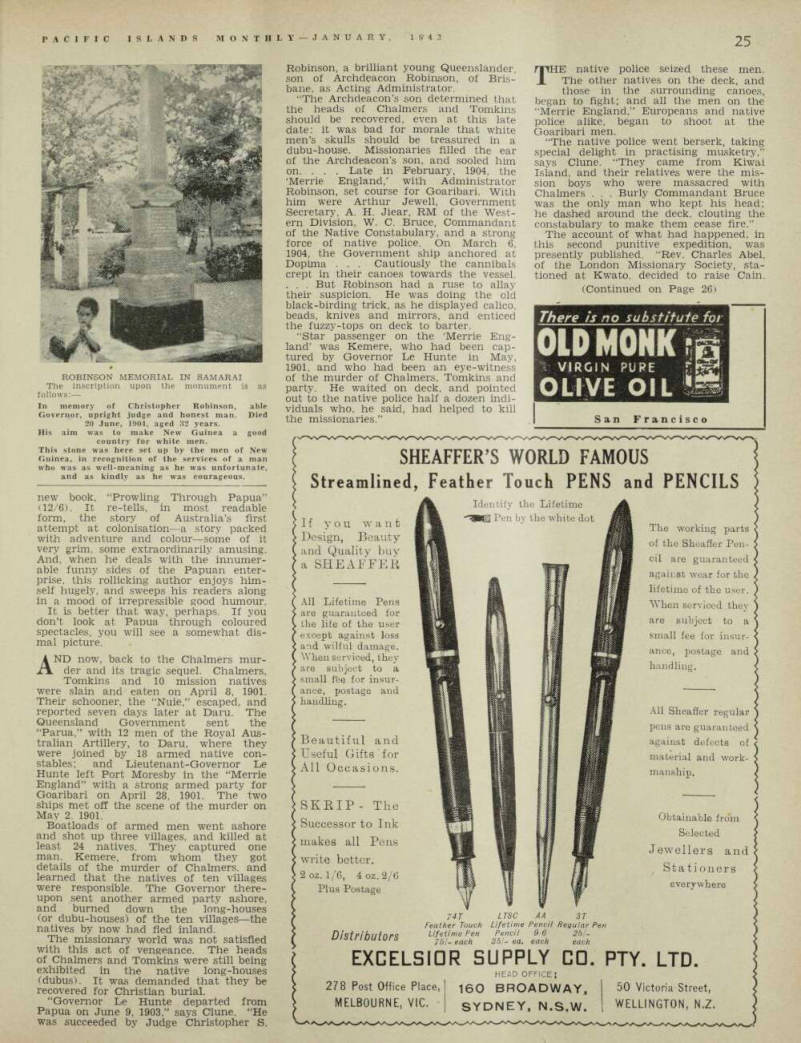
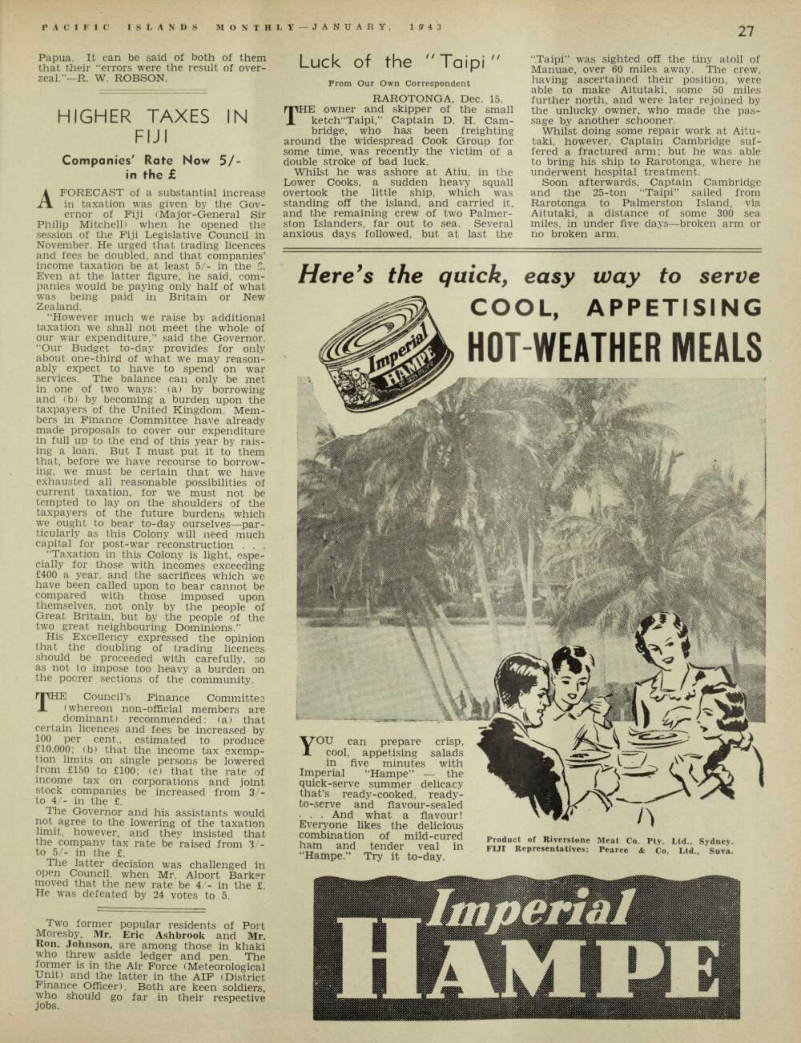
Tragic Sequel to Murder of Missionary Chalmers
TF. you wandered through Samarai in JL the days before bombs blasted that beautiful little tropical town, you may have noticed a beautiful monu ment; and, pausing to read, you may have been intrigued—as I was—by the curious wording of the inscription on the monument. (See photograph on the op posite page.) So. because I knew nothing of what had happened in 1904. I inquired con
cerning Governor Robinson; and, imme diately, I came upon a very definite “hush-hush policy.”
I was told that this had been a great tragedy; that many people believed that a very able young Administrator had been hounded to his death by missionaries— but that everyone, including the mission aries, now were sincerely sorry for what had occurred. “Better let the whole thing be forgotten,” they said.
So I put my photograph away in a file, and duly forgot it.
BUT now come two reminders —the foregoing article by Mr. Hunter and, coincidentally, a new book by that northwards-roving Australian writer, Frank Clune.
Clune cannot stay away long from the Australian tropics. Every so often, he hops a ship or a plane, and goes wander ing in Australia’s Far North, or in the colourful territories north of Australia’s Far North: and, every time, his expedi tion is followed by a book, hot off the presses of Angus and Robertson, and richly bedight with quaint phrases and shrewd observation. There may be those who do not like the Clune style, and the impish Clune faculty for making jokes out of things which must not be joked about; but we take off our hats to the tireless energy of this disrespectful fel low, and his ingenuity in producing a merry story where seemingly no story had existed.
And, for once sober and restrained, he exhumes and re-tells the tragic story of Governor Robinson. I see no reason why I should not make use of his account here. It is as well that this generation should know the circumstances: they will serve as a warning.
The story also gives some idea of the character and scope of Frank Clune’s
new book, “Prowling Through Papua” (12/6). It re-tells, in most readable form, the story of Australia’s first attempt at colonisation—a story packed with adventure and colour —some of it very grim, some extraordinarily amusing.
And, when he deals with the innumer able funny sides of the Papuan enter prise. this rollicking author enjoys him self hugely, and sweeps his readers along in a mood of irrepressible good humour.
It is better that way, perhaps. If you don’t look at Papua through coloured spectacles, you will see a somewhat dis mal picture.
AND now, back to the Chalmers mur der and its tragic sequel. Chalmers, Tomkins and 10 mission natives were slain and eaten on April 8. 1901.
Their schooner, the “Nuie,” escaped, and reported seven days later at Daru. The Queensland Government sent the “Parua,” with 12 men of the Royal Aus tralian Artillery, to Daru, where they were joined by 18 armed native con stables; and Lieutenant-Governor Le Hunte left Port Moresby in the “Merrie England” with a strong armed party for Goaribari on April 28, 1901. The two ships met off the scene of the murder on May 2. 1901.
Boatloads of armed men went ashore and shot up three villages, and killed at least 24 natives. They captured one man, Kemere, from whom they got details of the murder of Chalmers, and learned that the natives of ten villages were responsible. The Governor there upon sent another armed party ashore, and burned down the long-houses (or dubu-houses) of the ten villages—the natives by now had fled inland.
The missionary world was not satisfied with this act of vengeance. The heads of Chalmers and Tomkins were still being exhibited in the native long-houses (dubus). It was demanded that they be recovered for Christian burial.
“Governor Le Hunte departed from Papua on June 9. 1903.” says Clune. “He was succeeded by Judge Christopher S.
Robinson, a brilliant young Queenslander, son of Archdeacon Robinson, of Bris bane, as Acting Administrator.
“The Archdeacon’s son determined that the heads of Chalmers and Tomkins should be recovered, even at this late date: it was bad for morale that white men’s skulls should be treasured in a dubu-house. Missionaries filled the ear of the Archdeacon’s son, and sooled him on. . . . Late in February, 1904, the ‘Merrie England,’ with Administrator Robinson, set course for Goaribari. With him were Arthur Jewell, Government Secretary, A. H. Jiear, RM of the West ern Division, W. C. Bruce, Commandant of the Native Constabulary, and a strong force of native police. On March 6, 1904, the Government ship anchored at Dopima . . . Cautiously the cannibals crept in their canoes towards the vessel. . . . But Robinson had a ruse to allay their suspicion. He was doing the old black-birding trick, as he displayed calico, beads, knives and mirrors, and enticed the fuzzy-tops on deck to barter.
“Star passenger on the ‘Merrie Eng land’ was Kemere, who had been cap tured by Governor Le Hunte in May, 1901, and who had been an eye-witness of the murder of Chalmers, Tomkins and party. He waited on deck, and pointed out to the native police half a dozen indi viduals who, he said, had helped to kill the missionaries.”
THE native police seized these men.
The other natives on the deck, and those in the surrounding canoes, began to fight; and all the men on the “Merrie England,” Europeans and native police alike, began to shoot at the Goaribari men.
“The native police went berserk, taking special delight in practising musketry,” says Clune. “They came from Kiwai Island, and their relatives were the mis sion boys who were massacred with Chalmers . . . Burly Commandant Bruce was the only man who kept his head; he dashed around the deck, clouting the constabulary to make them cease fire.”
The account of what had happened, in this second punitive expedition, was presently published. “Rev. Charles Abel, of the London Missionary Society, sta tioned at Kwato. decided to raise Cain. (Continued on Page 26)
Robinson Memorial In Samarai
The Inscription upon the monument is as follow:- In memory of Christopher Robinson, able Governor, upright judge and honest man. Died 20 June, 1904, aged 32 years.
His aim was to make New Guinea a good country for white men.
This stone was here set up by the men of New Guinea, in recognition of the services of a man who was as well-meaning as he was unfortunate, and as kindly as he was courageous.
Although the Government party had been avenging the death of Missionary Chalmers, the procedure did not appeal to Missionary Abel.” He went south to take up the matter with the Common wealth Government, and he told reporters “that nothing less than a Royal Com mission will satisfy the European popu lation of Port Moresby—omitting to mention that Port's European population at that time consisted of 38 males and 18 females, including children.”
Mr. Clune bitterly attacks the activities of Mr. Abel. He says that the Australian newspapers—as usual, knowing nothing of local conditions and eager only for a sensational story—revelled in the gory accounts of Goaribari. as supplied by Mr.
Abel, “who achieved his ambition of becoming headline news.” The news papers clamoured for more blood, and demanded the recall of the Administrator.
“Yielding to the clamour of the press hounds, the Commonwealth Government decided to recall Administrator Robinson to Sydney for an inquiry, and appointed Captain F. R. Barton, RM of the Cen tral Division, as Administrator in his stead. Events moved quickly to a tragic climax.”
ON June 16, 1904, in accordance with his instructions, Captain Barton went to Government House. Port Moresby, and officially informed Judge Robinson of what had occurred, and of the decision to inquire into “the affray at Goaribari Island.”
“For three days, Robinson brooded over this blow to his ambitions and the dis grace of being sacked, and superseded by a junior magistrate. Then, in the early morning of June 20, a shot was fired.
Government House staff rushed into the garden. Captain Barton said: T got up and saw something white on the grass
near the flagstaff. It was Robinson, revolver in hand, still breathing, but unconscious.’ The coroner returned a verdict that the ex-Administrator had committed suicide, while temporarily insane.
"Thus,” concludes Clune, “the first Australian-born Administrator of Papua died, a victim to the newspaper hunger for sensation, fed by the mumbles of a maundering missionary; Christopher Robinson preferred death to dishonour and went out like an officer and a gentleman.”
The Royal Commission was duly held.
It found that, in the Goaribari affair, about 260 shots were fired in about seven minutes, and that at least eight natives were killed on the spot. Judge Robinson was blamed for “treacherously” seizing the prisoners after inveigling them on deck; but the Commission said that his suicide could not be regarded as the result of a feeling of guilt. “His errors were the result of over-zeal.”
On March 18, 1905. Captain Barton arrived at Goaribari with two of the six prisoners taken by Robinson, and sent them ashore to inform the natives that the Government wanted the skulls of the murdered missionaries, now believed to be displayed in the re-built dubu-house.
The villagers, after some “persuasion,” reluctantly handed over a skull, “affirmed to be that of one of the murdered mis sionaries”: and that skull was accepted as the skull of Chalmers, and reverently buried in the grave of Mrs. Chalmers, at Daru Island.
THAT is the end of Mr. dune’s story.
He says nothing of the bitter feel ing held against Charles Abel for many long years by a section of the Europeans in Papua, who believed that Mr. Robinson had been hounded to his
death.
Mr. Abel was a perfectly sincere man, but typical of the somewhat one-eyed churchmen of his time. He was one of that class who insisted on wearing top hats and frock-coats in the tropics, and wrapping the healthily-naked bodies of the natives in unhealthy clothes, because things were done that way in England.
The Goaribari affair, to him, was a cruel slaughter of trusting and semi defenceless natives. To the people who knew the country, it was a punishment of cruel, brutal and treacherous savages, thoroughly merited by the circumstances which attended the death of Chalmers.
Those natives, said the Europeans, had been worked upon for years and trusted by Chalmers, and yet they turned upon him and murdered him most foully: they never would be tamed until they under stood that, behind any treacherous abuse of the trust placed in them by the mis sionaries, there lay the implacable ven geance of the white man. Governor Robinson, they declared, did his duty properly, as he saw it; and. in to-day’s wider tolerance and vastly extended knowledge of the natives, there will be found few to combat that view.
Charles Abel remained in the London Missionary Society for many years, but eventually he broke away and established the famous mission of Kwato, near Samarai, which still is carried on by members of the Abel family. The monu ment erected to Judge Robinson on Samarai Island, close to Kwato, is the answer of the non-mission Europeans of that time to the activities of Abel in the Robinson affair.
There, the story should end. Robinson has been vindicated, and his memory is honoured. So, also, is the memory of Abel—Kwato Mission is a monument to his life-work on behalf of the natives of
Papua. It can be said of both of them that their “errors were the result of over
zeal/'—:
R. W. Robson.
Advertisements & other items, pp. 26-28 (2 items)
Burns Philp
(SOUTH SEA) CO. LTD.
Registered Office Inc. in Fiji
SUVA
FIJI
Island Traders and Shipowners Also Branches at: Fiji: Levuka, Lautoka, Labasa, Ba, Sigatoka, Rotuma.
Tonga: Nukualofa, Haapai, Vavau.
Samoa: Apia, Pago Pago (American Samoa).
Solomons: Makambo, Gizo, Faisi.
New Hebrides: Vila.
Code Address: Gilberts: Tarawa.
"Burnsouth”. Norfolk Is. Niue. Wallis Is. Futuna Is.
Old Monk
There is no substitute fot
VIRGIN PURE
OLIVE OIL
San Francisco
SHEAFFER’S WORLD FAMOUS
Streamlined, Feather Touch PENS and PENCILS
If you want Design, Beauty and Quality buy
a SHEAFFER
All Lifetime Pena are guaranteed for the life of the user except against loss and wilful damage.
When serviced, they are subject to a small ffee for insurance, postage and handling.
Beautiful and Useful Gifts for All Occasions.
SKRIP - The
Successor to Ink makes all Pens write better. 2 oz. 1/6, 4 oz. 2/6 Plus Postage Distributors Identify the Lifetime 12 Pen by the white dot
74T LTSC AA ST
Feather Touch Lifetime Pencil Regular Pen Lifetime Pen Pencil 9 6 2b/- 761- each 351- ea. each each The working parts of the Sheaffer Pencil are guaranteed against wear for the lifetime of the user.
When serviced they are subject to a small fee for insurance, postage and handling.
All Sheaffer regular pens are guaranteed against defects of material and workmanship.
Obtainable from Selected Jewellers and Sta ti oners everywhere
EXCELSIOR SUPPLY CO. PTY. LTD.
HEAD OFFICE;
278 Post Office Place, i6O BROADWAY,
MELBOURNE, VIC. SYDNEY, N.S,W.
50 Victoria Street,
WELLINGTON, N.Z.
William Atkins Pty. Ltd.
Head Office 449-451 KENT ST., SYDNEY.
Iron & Steel Merchants—Engineers' Supplies
Coach & Motor Hardware
ESTABLISHED 50 YEARS
TRADE
MARK
Cable Address: WILATKIN, Sydney
STEEL DEPARTMENT
MILD STEEL:
Rounds, Squares, Flats, Half-rounds, Hexagons, Bevel, Shoeing, Tyre, Angles, Tees, Sheets, Plates, Girder Plates, Chequer Plates, Channels, Hoops, Etc.
BRIGHT STEEL:
Rounds, Squares, Hexagons.
Extra Special High Speed Tool Steel, Mining Steel, Blister Steel and Spring Steel, Rounds, Flats & Squares.
Bar Iron— All sections and sizes.
Engineers' Supplies: Set Screws. Studs, Metal Thread Screws, Coach Screws, Files, Cotter Pins, Bright and Black Bolts, Rivets, Etc., Hack Saw Blades.
Power Transmission Gear: Including Plummer Blocks, Couplings, Collars, Etc.
Coach and Motor Hardware: Axles, Springs, Wheelstuff, Duck, Paints.
Farriers' Supplies: Horse Nails, Anvils, Vices, Etc.
Motor-Trimmers and Motor Builders' & Motor Painters' Requirements
C. A. WILLEY'S
Quick-Drying Coach and Car Paints, Roughstuff, Elastic Gloss, Synflex Enamels, Lacquers.
DUCO Lacquers and DULUX Enamels—FABREX Motor Toppings and Leather Cloths, House & Decorators' Paints, Varnishes & Brushware.
Sole Distributors of CHAMPION'S Decorators Paint Products.
Distributing Agents for BROLITE Lacquers, SYNFLEX Enamels and "POLYGLOSS" Finish.
Higher Taxes In
Fiji
Companies' Rate Now 5/in the £
A FORECAST of a substantial increase in taxation was given by the Gov ernor of Fiji (Major-General Sir Philip Mitchell) when he opened the session of the Fiji Legislative Council in November. He urged that trading licences and fees be doubled, and that companies’ income taxation be at least 5/- in the ".
Even at the latter figure, he said, com panies would be paying only half of what was being paid in Britain or New Zealand.
“However much we raise by additional taxation we shall not meet the whole of our war expenditure,’’ said the Governor.
“Our Budget to-day provides for only about one-third of what we may reason ably expect to have to spend on war services. The balance can only be met in one of two ways: (a) by borrowing and (b) by becoming a burden upon the taxpayers of the United Kingdom. Mem bers in Finance Committee have already made proposals to cover our expenditure in full up to the end of this year by rais ing a loan. But I must put it to them that, before we have recourse to borrow ing, we must be certain that we have exhausted all reasonable possibilities of current taxation, for we must not be tempted to lay on the shoulders of the taxpayers of the future burdens which we ought to bear to-day ourselves —particularly as this Colony will need much capital for post-war reconstruction . . .
“Taxation in this Colony is light, espe cially for those with incomes exceeding £4OO a year, and the sacrifices which we have been called upon to bear cannot be compared with those imposed upon themselves, not only by the people of Great Britain, but by the people of the two great neighbouring Dominions.’’
His Excellency expressed the opinion that the doubling of trading licences should be proceeded with carefully, so as not to impose too heavy a burden on the poorer sections of the community.
THE Council’s Finance Committee (whereon non-official members are dominant) recommended: (a) that certain licences and fees be increased by 100 per cent., estimated to produce £10,000; (b) that the income tax exemp tion limits on single persons be lowered from £l5O to £100; (c) that the rate of income tax on corporations and joint stock companies be increased from 3to 4 - in the £.
The Governor and his assistants would not agree to the lowering of the taxation limit, however, and they insisted that the company tax rate be raised from 3 to 5/- in the £.
The latter decision was challenged in open Council, when Mr. Alport Barker moved that the new rate be 4 - in the £ He was defeated by 24 votes to 5.
Two former popular residents of Port Moresby, Mr. Eric Ashbrook and Mr.
Ron. Johnson, are among those in khaki who threw aside ledger and pen. The former is in the Air Force (Meteorological Unit) and the latter in the AIF (District Finance Officer). Both are keen soldiers, who should go far in their respective jobs.
Luck of the "Taipi"
From Our own correspondent
Rarotonga, Dec. 15.
THE owner and skipper of the small ketch“Taipi,” Captain D. H. Cam bridge, who has been freighting around the widespread Cook Group for some time, was recently the victim'of a double stroke of bad luck.
Whilst he was ashore at Atiu, in the Lower Cooks, a sudden heavy squall overtook the little ship, which was standing off the island, and carried it, and the remaining crew of two Palmer ston Islanders, far out to sea. Several anxious days followed, but at last the
“Taipi” was sighted off the tiny atoll of Manuae, over 60 miles away. The crew, having ascertained their position, were able to make Aitutaki, some 50 miles further north, and were later rejoined by the unlucky owner, who made the pas sage by another schooner, Whilst doing some repair work at Aitu taki, however, Captain Cambridge suf fered a fractured arm; but he was able to bring his ship to Rarotonga, where he underwent hospital treatment.
Soon afterwards, Captain Cambridge and the 25-ton “Taipi” sailed from Rarotonga to Palmerston Island, via Aitutaki, a distance of some 300 sea miles, in under five days—broken arm or no broken arm.
Advertisements & other items, p. 29 (1 item)
Hampe
Here’s the quick,easy way to serve
COOL, APPETISING
HOT-WEATHER MEALS
cE Mi a <3 * * I / V- I) fc YOU can prepare crisp, cool, appetising salads in five minutes with Imperial “Hampe” the quick-serve summer delicacy that’s ready-cooked, readyto-serve and flavour-sealed • . . And what a flavour!
Everyone likes the delicious combination of mild-cured ham and tender veal in “Hampe.” Try it to-day.
Product of Riverstone Meat Co. Pty. Ltd., Sydney.
FIJI Representatives: Pearce & Co. Ltd., Suva.
Hampe
Help From USA and
N. Caledonia Is
Prosperous
Help From USA and Australia
From Our Own Correspondent
Noumea, Nov. 26.
ACTING through the Fighting French delegation in Washington, the French Pacific authorities have agreed to sell directly to America, through the Commodity Credit Corporation, the 1943 output of copra from French Pacific colonies, comprising about 15,000 tons from the New Hebrides, 20,000 tons from Tahiti and 2,000 tons from Wallis and Futuna. The New Caledonian output, which is usually round 1,500 tons, is needed for local soap manufacture, etc.
The agreement with the USA already has come into operation, under the Anglo-Franco-American price stabilisation arrangement, which accords the best price available in the Pacific on the day of sale; and transport will be in either United States or French vessels. Prices ruling here to-day for copra are 67.34
mould! and dohaVT"fo? 6 smote-dried!
less 1 per cent, brokerage fee.
In addition, the American Government has agreed to purchase all the nacre (mother-of-pearl shell) produced in Tahiti, recognised to be equal to the world’s best in quality. Samples have been sent, and prices will be fixed shortly, Under the new agreement arrived at with the Australian Government, New Caledonia now is assured of regular sup plies of rice, flour, sugar, wine, leather, boots, shoes, and articles of clothing— the same ration quota per person being
applied as that already instituted in Australia.
Articles, including meat and butter, which the French Colony is unable to get from Australia will, it is hoped, be obtainable from New Zealand under an agreement .with the Dominion Govern ment.
On his return from Sydney, in November, Governor Henri Montchamp stated that he thought the agreement arrived at was eminently fair. He was greatly impressed by the way Australian men and women have been mobilised for the war effort and by the prevailing discipline and efficiency, and expressed his gratitude for the courtesy and help fulness of Australian officials during his stay.
Mr. Ballard, who represents the Aus tralian Government in New Caledonia, and M. Puaux, head of the New Cale donian economic department, as well as the Governor’s Chef de Cabinet (Captain Da Costa), were in Australia at the time of the Governor’s visit. Since their re turn, Mr. Miller (commercial attache of the Fighting French organisation in Sydney), has arrived in Noumea to study the Colony’s requirements on the spot.
Passing of Mr. Georgius
Link With Old
Fiji
Passing of Mr. Georgius Wright
WITH the death of Mr. Georgius Tt Wright, of Nasese, Fiji, on November 13, the Colony lost one of its last links with pre-Cession Fiji, Mr. Wright was born in London, 90 years ago, and went to Fiji as a sergeant-instructor to Thakombau’s troops, in 1872.
Thakombau was king of Viti Levu and, in 1861, he and other high Fijian chiefs made strong representations to Britain to take possession of the Fijian islands —one condition being that Britain assist with a claim of £9,000 which USA had made against Thakombau in respect of damages of various kinds. But Britain had other colonial troubles at the time, and declined the offer. Thakombau then offered the islands to USA—but the Americans were busy with a civil war, and did not even reply.
During the next ten years, attempts to form some sort of Government were made and, in 1871, the “Kingdom of Fiji” was constituted and a general election for a new Parliament held. It was at this period that Mr. Wright and two com panions went to Fiji as drill instructors.
But this system of self-government was hopeless and, when the islands were finally ceded to Britain in 1874, and be came a Crown Colony, promises of large grants of land and deferred pay, which had been made to the instructors, were not honoured.
After Cession, Mr. Wright settled on Vanua Levu for a time; but, in 1876, he entered the Government Service, and in the next 36 years he served in many departments—finally becoming Governor’s Commissioner and Stipendary Magistrate for Colo West. After his retirement from the Government, in 1912, he became Curator of the Fiji Museum. His know ledge of the Colony’s early days made him a very valuable man in this position.
For the past few years he has been living in retirement at his home in Nasese.
He is survived by a wife and three sons: Maitland, Rob and Oscar.
Private H. St. George Ryder, son of Mrs. Nelson, of Suva, Fiji, has been re ported wounded in New Guinea while serving with the AIF.
Advertisements & other items, p. 30 (1 item)
A. B. Donald Ltd.
AUCKLAND
ISLAND TRADERS & GENERAL MERCHANTS
P.O. Box 1509. Cobles Gr Telegrams, "Kingdom", Auckland.
Scott’s “Renown” Brand Rope,
Cordage and
Binder
Twine
Cable Address Ropeyard, Sydney.
I
of Every
Description
MANUFACTURED AT
MASCOT, N.S.W.
J. SCOTT
PTY. LTD.
Head Office and Store:
163 CLARENCE STREET,
SYDNEY,
N.S.W.
Murdered By
Natives
Another Case in N. Caledonia
From Our Own Correspondent
Noumea, Nov. 26.
I AM reminded of considerable New Caledonian history by the announce ment that Emmanuel Bouye, a 33-years-old foreman employed by the New Caledonian Public Works Depart ment, at Hienghene, east coast, has been the victim of a brutal murder by natives of the region, who were working as a road gang under him, near Tiwande.
At the moment of resuming work on the afternoon shift, a native addressed him insolently. M. Bouye went and got his gun: for the natives of this region have a reputation for treachery, and he re turned with another foreman, M. Paim bouc. The native seized his gun by the barrel, and during the struggle that en sued the gun went off, wounding the native in the hand.
The other natives ran up. The two foremen began to retreat. In doing so, M. Bouye fell under the blotos of four attackers, of whom one split his skull with a tomahawk. Later, the natives were rounded up by New Caledonian troops, and some 35 were brought to Noumea for trial.
The region in which this drama of the New Caledonian bush occurred is one already haunted by the ghosts of sixteen white colonists who were murdered, and in certain cases mutilated, during Chief Noel’s revolt in 1917. The revolt was suppressed, after a campaign of many months in the northern half of the
island, by 300 loyal native volunteers, led by M. Ratzel, then head of the Colony’s Survey Department.
Eventually Noel, deserted by his fol lowers, doubled back on his tracks and returned to his native village, and took shelter with a former friend, an Arab.
But the Arab attacked him while he was hungrily eating a meal and, cutting off his head with a big machete, he took it along to the gendarme to claim the 2,000 francs reward offered for the bearded rebel chieftain. The head was stuck on a pole, at the cross-roads, as a warning of what happens to rebels.
A few white New Caledonian soldiers, on leave from France, took part in the chase of the rebels—the rest were all away on active service.
One of my acquaintances, now serving in a Noumea store, came back from France in 1918, to find that his own father, a bush settler, had been one of those killed and mutilated. He took his army rifle, went up to Hienghene, and shot the first native he saw. He explained to the Noumea Court that he did it be cause he felt his father’s blood calling for vengeance; and he was eventually released.
M. Ratzel, referred to above, was a boy in Alsace, in 1870, when the Germans seized his country. He tells a story about the way the German police tried to bribe him —a kid only more than five years old —with a packet of sweets, to betray his grandfather, a farmer. Though so young, he had many strange adventures, and some years elapsed before he could re join his father in French Mulhouse. To his dismay, no one was at Mulhouse station to meet him, when he crossed the frontier; and he only recognised his father when a strange man came up to him in the street and asked him if he was not young Ratzel. The whole family, of course, had elected to remain French.
M. Ratzel came out of retirement at the time of the Free French Revolution in New Caledonia, in September, 1940, and he became Governor Sautot’s Chef de Cabinet and right-hand man. He has played a distinguished part in local administration. He went back into re tirement when M. Sautot was recalled to London last May.
"Returned For Treatment"
CAPTAIN Alan de Groen, now in the service of ANGAU, was returning to his unit in New Guinea when he was intercepted by a zealous official in a northern port. Had he been vaccinated?
The captain said he had not.
“Then,” said the official, “you cannot enter Papua. Regulations!”
“But,” howled the amazed de Groen, “I’ve lived in Papua for twenty years, and I managed all right without vacci nation.”
“Sorry,” said the official. “Regulations, you know.”
The captain was at explosion point, when he learned that the same interpre tation of regulations provided that he should be returned to Sydney, to undergo treatment. Practically an extension of furlough—much better!
He ceased howling, and returned grate fully to Sydney, “for treatment.”
This was one of the occasions when the red of the absurd official tape assumed a very pretty colour in the eyes of its complacent victim.
Two of the oldest families in Fiji were united when Miss Nora Aull, daughter of Mr. and Mrs. Robert Aull, married Mr.
Clark Blakelock, in the Sacred Heart Cathedral, Suva, on October 31.
Advertisements & other items, p. 31 (1 item)
W.KOPSEN & Co. Pty.Ltd.
SIMPLEX
MARINE
TILLEY
Kerosene
LAMPS
ENGINES
Simplex engines from 3 h.p. to 12 h.p. for boats from 14 ft. to 26 ft. are Australia’s best. 2 cycle and 4 cycle with or without reverse gear.
Illustrated is the popular little 3 h.p. suitable for 14 ft. or 16 ft. boats.
Runs for 5 hours on 1 gallon petrol and costs only £29/15/-, complete with all equipment. Ready to instal into any boat, nothing else to buy.
Ask for Simplex catalogue of engines and launches.
SKARSTEN SCRAPERS
British-made Kerosene Lamps providing a steady 300 c.p. light, without flickering, and without smoke or smell.
Model TLIO (illustrated) is a handsome Table Lamp providing exceedingly brilliant illumination and at the same time a fine ornament for any home.
Stands 24 in. high and covers a large area. Attractive parchment shade is finished in autumn tones and matches any furnishings.
Also available Is the popular All- Purpose Lamp and Lantern (model EX100) and a variety of Hanging, Table, Wall and Vase Lamps.
Let us send you full details of all Tilley Lamps. 1 ■ > Remove paint, varnish, glue, oil, grease, roughness, etc., from wood and metal surfaces. Most us«eful for scraping deck and hull planks. They leave the surface smooth and dressed and ready for painting. Have renewable blades.
Prices; No. 35, 2/3; 62, 2/6; 80, 3/3.
Reversible, 7/-.
Write for leaflet.
SHIPCHANDLERY
We manufacture and stock the largest range of boat gear in Australia. Everything for boatbuilder and boatowner. Marine paints and varnishes. Rope and Cordage. Rigging. Anchors and Moorings. Copper Nails and Rod . Lighting Plants. Fire Extinguishers. Oars and Sculls, Lamps, Pumps, etc.
GET OUR PRICES FIRST.
W.KOPSEN & Co. Pty.Ltd.
376/380 KENT STREET SYDNEY
’Phone: MA 6336 (4 lines).
Est. 1868.
Cables: Kopsen . . . Sydney.
Gira And Yodda
Goldfieles
Early Discoveries in North-east Papua
By D. H. Osborne
TTI d RD msc h o e veS °were" made first, R on er thl headwaters S'M 3WTM SfJSSS lower n down movements
storekeepers, signified their intention of moving over there with any intending miners, but they stated that, although they would load their native carriers to capacity with stores, they would not carry swags, tools or equipment for anyone.
The stores, on reaching the new field, would be strictly rationed. Everyone would receive a fair share, but no favours would be shown to anyone.
The storekeepers had sent out their letters by runner on December 17, and by nightfall on the same day about 60 men—l among them—had arrived with their gear, and were camping in the palm-thatched shelters (known as “dead houses”), provided at the stores. Each store had a liquor licence and the “dead houses” were for the drunks.
By dawn on the 18th, all hands were about, their swags (of at least 50 lb. apiece) on their backs, and ready for the road.
The first day’s stage took us over the divide between Linden’s Creek and into Clunas Creek. No one knew the track, and we took all the wrong turnings, travelling twice as far as necessary, and we arrived late at the camp site in the usual afternoon deluge of rain.
In that district rain almost invariably falls between the hours of 2 p.m. and 8 p.m.—rain so heavy that in a few minutes every creek and gully is flooded. The rain—and the flood —usually lasts about an hour and then clears away as sud denly as it commenced. A wet morning is rare, and day breaks bright and cloud less; mountain tops are clear, but over the low country below one can trace each water-course by white strips of mist. As the sun rises these mists gather into large banks and, gradually rising, by 11 a.m. cover the tops of the mountains in a blanket of cloud that lasts for the re mainder of the day.
At our first camping ground we found several good huts—erected previously by other miners—and we were able to have a dry camp (that is, “dry” in the literal sense) without the necessity of erecting tent-flies. In spite of having to pack their own belongings, most of the men had managed to find room for a bottle of rum or whisky and, with the aid of it, all hands were soon merry and the hard ships of the day were forgotten. Bob Walker insisted on singing his Scotch
songs, and Jack Horan challenged all and sundry to fight—challenges which were ignored.
All were buoyed up with the miner’s perennial belief: that the creeks just ahead were paved with gold, that wealth was there for their taking. All doubts, past disappointments and heart-breaking labour were forgotten in the upwards rush of hope that once more had them in its grip. Only those who have ex perienced the thrill of the first sight of payable gold in the prospecting dish can understand why men will face such hard ships, or after disappointments numerous enough to disillusion more ordinary men, strive yet once again to find the yellow metal. All men—yellow, white or brown —all have the same love for it.
On Tuesday, the 19th, we moved on again, following the course of Clunas Creek for some distance, and then cross ing the Gira at the top of some rapids.
All crossed safely on this occasion, although some months later another miner was swept over and washed up un conscious on the beach below. Then for five days we struggled on, camping each night under our calico tent-flies and rising before day-break to light fires to dry out a little of the moisture from them, so that they might be lighter to carry.
The road took us over two mountain peaks which one of our party christened the Two Sisters, and each day as the track got steeper and the creeks rougher, so did our hopes drop and the fine optimism that we had experienced on our first night out evarporate. Rum and whisky had petered out on the second day—and we had not even that artificial aid to our hopes.
But on the Saturday after we had left the stores on the Gira, we made our ob jective, and in due course found that, although the creeks and beaches were rough, and food hard to procure, gold was there in payable quantities.
But this was worked for only a few weeks: because, at the end of January, 1900. Mat Crowe, McLelland and Archie Walker arrived, on their way to Tamata, with their news that gold existed on the much-easier-worked Yodda Valley, and all hands packed up and moved on there.
It was not until two years had passed, and the richness of the Yodda was on the wane, that miners began to return to Elliot’s. By this time the men had learned to utilise natives for mining work —especially those from the D’Entre castreau group. Several native villages up in the mountains had been induced to bring in sweet potatoes, which they traded away for knives and tomahawks, and so alleviated the food problem to some extent —and under these improved conditions rich terraces and beaches on Elliot’s Creek were successfully worked.
It was here on the headwaters of the Gira that Anton Ringel, who was just recently evacuated from Papua, spent almost a lifetime.
Fiji's "Black Bomber"
THE Auckland Boxing Association was negotiating in October with Inoke Davu, heavyweight champion of Fiji and Tonga, for a series of contests in New Zealand. Davu is known in the Islands as the “Black Bomber” and has lived up to his name, as he has an undefeated record. The Association suggests that Davu would be a suitable opponent for Don Mullett, whose record, though a short one, is excellent. However, because of the war, transport difficulties may be too severe to be overcome. Davu, through his manager, Jaswant Singh, has pro mised to go to Auckland at the first available opportunity.
Advertisements & other items, p. 32 (1 item)
Cordage,
KANGAROO BRAND
Ropes,
and Twines tor every purpose
Backed by
86 years of service.
Manufactured by
M. DONAGHY AND SONS,
Pty. Ltd.,Gcc!ong and Sydney.
Fiji Representatives:
PEARCE AND CO.
LIMITED
P.O. BOX 237, SUVA
fail E3M
For Essential Industries
Now, more than ever, speed and efficiency in industry are demanded. Only equipment of the highest reputation is worthy of consideration. You can rely on the products of — CROMPTON, PARKINSON LTD—Motors, Instruments, Transformers, Crompton Lamps.
FERRANTI LTD.—Transformers, Instruments, Meters.
HERBERT MORRIS LTD.—Pulley Blocks, Runways.
CROMPTON, PARKINSON (AUST.) PTY. LTD.—
Parkinson Motors, Crompton Minor Motors, Power Transformers.
CALLENDERS CABLES & CONSTRUCTION CO.
LTD. —Wires, Cables, Flexibles.
RANSOMES & RAPIER LTD.—Mobile and Breakdown Cranes, Excavators.
HOPKINSONS LTD. —Valves and Boiler Fittings.
NORDBERG MFG. CO. LTD.—Symons Cone Crushers, Vibrating Screens.
AUDLEY ENGINEERING CO. LTD.—“Audco”
Lubricated Plug Valves.
MATHER & PLATT LTD.—Large Electric Motors.
NOYES
11 Watt Street, Newcastle.
BROS. (SYDNEY) LTD.
115 Clarence Street, Sydney
And at Fort Kembla. 197 Elizabeth Street, Brisbane.
Dodging Japs
How a Party Escaped on Guadalcanal
REV. Leslie Stibbard, of the Melanesian Mission, who has been hi charge of the native school at Maravovo (Guadalcanal) for some years, recently escaped from enemy-occupied territory in the Solomons. He arrived in Sydney with only the clothes he wore—a slouch hat, a khaki shirt and a pair of US Army dungarees—but with an interesting tale to tell. The story of his escape—reprinted from the official journal of the Melane sian Mission —appears below.
After the occupation of the airfield on the island of Guadalcanal by our Allies, and after the remnants of the enemy force previously holding the position had been driven back into the jungle, the situation so far as the mission school at Maravovo was concerned, became par ticularly dangerous. The retreating enemy were cut-off from food supplies and, as a result, all native food gardens in the area of the retreat were raided.
It was obvious that the school, with its many acres of excellent gardens, would suffer a similar fate when the Jap marauders were compelled to widen their search for food.
It was known also that the enemy, who previously had tolerated the natives, were now shooting down all unfortunate enough to cross their path. As a precau tion against surprise, houses were built in the bush some two or three miles back in the jungle. Meanwhile, a careful watch was kept by the school-boys detailed to observation posts overlooking the ap proaches to the school. Small parties of Japs were seen, but it was not until the end of August that the school was occu pied and inhabited by the enemy.
Within a few hours the inevitable hap pened. A large force of USA dive-bomb ers and fighters bombed and straffed the enemy positions in the school and grounds. All this was witnessed from an observation post established by the school-boys on a ridge 1,000 feet high, upon the lower slopes of which were the temporary “jungle residences.”
It might still have been possible to evade the Jap forces and to have existed in the jungle for a few more weeks, but an enemy outpost was stationed in such a position near the school gardens that it would have been suicidal to approach.
Thus the native boys and Mr. Leslie Stib bard were cut off from their main sup ply of food and the necessity of seeking help arose. It was decided that a party of 15 should attempt to gain contact with
the Allied forces by travelling from the south side to the west side of the island through dense bush or jungle. The first two days of the journey were relatively simple, but the six days which followed, before reaching the safety of the Ameri can camp, were a nightmare. A few highlights of the journey are of interest.
The first day the party of 15, led by Mr. Stibbard, set out in torrential rain down a rapid-flowing river. The going was very bad because of hidden boulders.
After two hours’ scrambling down-river the party made for high land. The nar row track was wet and slippery and was the cause of frequent spills. The night was spent in a small native hut not far from the beach, mostly in trying to dry clothes and there was little sleep because of the roof leaking.
The' second day a start was made at daybreak in heavy rain. The jungle was mountainous now, and travelling was slow. A party of natives fleeing from their villages was met. They had halted to give rest to a native woman who had just given birth to a child. After some eight hours’ hard travelling a distance of only eight to ten miles had been covered.
Camp was made on the wet ground.
The third day found all smiling because a track had been found which would obviate the necessity of further cutting through the bush. Progress was made over a range of hills and a drop down to a large river, which proved incredibly difficult to negotiate because of the swift current and the size of the boulders.
There was still much rain and all were beginning to feel the strain of the hard going.
The fourth day proved much better and progress was continued down-river.
At noon the river was left for the jungle in an endeavour to reach a native vil lage known to some of the boys, and there was much excitement when the place was found. The school-boys were exhausted and much in need of food.
After a short rest the village was left behind, with much regret. Again the party had to hack its way through the jungle and progress was continued slowly for several hours. Again the night was spent in the bush with light covering— everyone being too tired to care much about anything but the need for food and sleep.
The fifth day brought hearty cheers.
It looked as though a distant gap in the mountain range led out to the goal, and so all speed was made. But, alas, within a few miles of the beach the party just escaped observation by a party of the enemy, and so doubled back and made for a village, only to find it occupied by a few Japs. The party of school-boys,
with Mr. Stibbard, seemed trapped, but hid in the bush until dark, when the least sound seemed to carry for miles. Skirt ing a third party of the enemy, seated around a fire, the lads pushed on, even tually resting for a time, waiting for day light. All were very hungry and almost done up. The rain was terrific.
On the sixth day it was decided to move off early, lest the Japs spotted the party, and a native village was avoided as likely to hold enemy troops. The “lawyer” vine was particularly trying, most of the party being cut about. At last the coast was reached and several narrow escapes were had in avoiding small parties of the enemy. It was then decided to send two lads and the head master forward as a “spearhead,” or scouting party, along a track which had, obviously, been cut for a purpose.
There were many indications of enemy presence and cigarette packets were found around. At one stage the party was hailed by a Japanese sentry, but ducked smartly and ran for it—hiding in the grass while fully-armed Japs passed by. The lads were hungry and thirsty, and lay until dark, when a move was made through the bush. Coconuts and some sugar-cane was a welcome find. .
Again the coast was found, but the whole of the seventh day was spent in hiding. On the eighth day there was much shooting, and so the party had to move even more cautiously, but after evading enemy sentries, they at last came to barbed wire entaglements, through which safety was reached. All were “done up,” starving and much-scarred.
The native lads, with their white leader, found refuge with American friends, of whose hospitality and great kindness Mr. Stibbard speaks enthusias tically. He tells many interesting experi ences of his stay as the guest of Ameri can officers. The lads were eventually sent off to places of safety and Mr. Stib bard taken to a SW Pacific port as the guest of American Naval officers, and then later to Australia.
A former Fiji resident, Private Jack Johnson, was killed in action on Novem ber 11 while serving with the AIF in New Guinea. He was the son of Mr. and Mrs.
J. T. Johnson, of Suva, and, before he left for Australia some years ago was on the staff of Morris, Hedstrom Ltd. He enlisted in the AIF in 1939 and served m the Syrian campaign. He returned to Australia and fought in the campaign across the Owen Stanley Range, in Papua, and reached Buna, where he was killed. He was a keen fisherman, yachts man and footballer, and had many friends in Fiji.
Advertisements & other items, p. 33 (1 item)
proprietary limited
To-day ALUMINIUM and ITS ALLOYS are flying over the Pacific —assisting to drive the enemy irom his island bases.
When victory comes aluminium will return again in those various applications we once could buy and which ranged from aluminium cooking utensils to aluminium truck body panels.
This Company looks forward to furnishing civilian requirements when defence demands have been fully satisfied.
PLATE . SHEET . STRIP
WIRE . SECTIONS
. SLABS . CIRCLES . TUBING . ROD . BAR
FORGINGS ALLOY INGOT . HARDENERS.
proprietary limited
( INCORPORATED
IN THE STATE OF VICTORIA)
GENERAL OFFICES AND FABRIC AT lON DIVISION : GRANVILLE. SYDNEY, N.S.W.
Roll Of Honour
(It is hoped to assemble, here, the names of men, former residents of the Pacific Territories, which appear in British and Free French casualty lists, or in lists of honours awarded.
We should be grateful if relations and friends would send us details.)
Killed
Eugene AUBRY (formerly of Tahiti), of the Air Force of Fighting France. Killed in an air accident in Great Britain.
Pilot-Officer Len BAYLISS, flying instructor In the RAAF, formerly of Rabaul, New Guinea.
Killed in Sydney, 18/11/1940, when he fell from a trainer aircraft in flight.
R. C. BENTLEY, NZEF. formerly of Fiji.
Killed in action, Middle East, June 27, 1942.
A/Bdr. Neville W. BERTWISTLE, AIF artillery (tank unit), formerly a clerk on the staff of W. R. Carpenter and Co. Ltd., of Rabaul, New Guinea. Killed in action, April. 1941.
P/O J. B. BOMFORD. RNZAF, formerly of CSR Co.’s staff, Fiji. Killed on active service in England.
Pte. W. R. M. BRADNAM, of the NZ Forces,
formerly of Fiji, Reported killed in action in the Middle East, 25/11/1941.
Warrant-Officer R. P, BRECHIN, New Guinea Force. Killed in air accident, June 17, 1942.
Formerly of NG Department of Agriculture.
Lieut.-Colonel Felix BROCHE, of the New Caledonian-New Hebridean contingent of the Fighting French Pacific Battalion. Killed in action in the battle of Bir Hacheim (Libya).
Pilot-Officer E. H. CANARD, of RAF, formerly of Fiji Civil Service. Killed in flying accident in South Africa in the course of his duty as flying instructor.
Pte. David C. GARLAND, AIF, formerly chief assayer at the Emperor gold mines, Fiji. Killed in action in New Guinea.
Pierre CHARPENTIER, of the Fighting French Pacific Battalion. Killed in action in the battle of Bir Hacheim.
Raymond CHAUTARD (formerly of New Cale donia), of the Fighting French Pacific Battalion.
Killed in action in Libya.
Flight-Lieutenant G. J. I. CLARKE, of the RAAF, formerly Assistant Flight Superintendent of Carpenter Airlines, New Guinea, killed In action during operations off Dakar (French West Africa), while attached to HMAS “Aus tralia”, September, 1940.
Georges CLEMENS, of the Free French Pacific contingent from New Caledonia. Reported killed in action in the Middle East, March, 1942.
Flying-Officer Jack R. COATH, of the RNZAP, formerly on the staff of the Bank of New Zealand, in Suva, Fiji. Killed October, 1941, when a training aircraft crashed in NZ.
Pte. Felix CRAIG, AIF, formerly of accounts department, Australasian Petroleum Co., Port Moresby, Papua, Killed in action, June, 1941.
L. J, DAWES, of the NZ Forces, formerly Dis trict Officer of Savaii, Western Samoa. Reported killed in action, February, 1942.
Pilot-Officer V. L. DEARMAN, of the RAAF (observer), formerly overseer and clerk at the
Colonial Sugar Refining Co., Ltd., Raraval, Fiji. Reported killed in action in the Middle East, October, 1941.
Capt. Jean GILBERT, of the Naval Forces of Fighting France, and formerly of Tahiti. Killed in action.
Captain Kenneth GARDEN, of the RAP Ferry Command, formerly of Guinea Airways Ltd., in New Guinea. Killed September, 1941, when a bomber he “ferried” from USA crashed on west coast of Britain.
Flying-Officer Moresby GOFTON, of the RAF, son of Mrs. F. S. Stewart, of Wau, New Guinea.
Reported missing, 17/5/1940 —presumed killed in air operations.
Rifleman J. A. GOODWIN, AIF infantry, for merly of Bulwa, TNG. Reported “accidentally killed”. April, 1942.
Ernest GOURNAC (formerly of Tahiti), of the Air Force of Fighting France. Killed in an air accident in Britain.
Pte. Wallace GRAHAM, of the NZ Forces (infantry), formerly on the staff of Morris Hedstrom Ltd., Fiji. Killed in action in the Middle East, November, 1941.
Squadron-Leader C. R. GURNEY, RAAP, a former chief pilot of Guinea Airways, Ltd.
Killed in action in the New Guinea area, May, 1942.
Gerald T. J. HARPER, RAF, son of Major and Mrs. P. Harper, of Ra, Fiji. Killed in action while navigating a Whitley bomber dur ing a raid on the Continent.
J. HEAD, RAAF, formerly of Fiji. Killed in flying accident in Australia, 1941.
Squadron-Leader Godfrey HEMSWORTH, of the RAAF, formerly a well-known commercial pilot in Morobe, TNG. Reported missing after an operational flight against the Japanese in the New Guinea area—now presumed killed in action.
Pte. Jack JOHNSON, formerly of Morris Hedstrom’s staff, Fiji. Killed in action on November 4, while serving with the AIF in New Guinea.
Flying-Officer Alan JOHNSTONE, of the RAF. who was born in Suva, Fiji, In 1915. Killed during bombing raid on Kristlansand, Norway, April, 1940.
LAC Douglas KIRBY, RAP, who left Suva, Fiji, with the first contingent of Air Force trainees. Reported killed in a flying accident in South Africa. March, 1942.
Marcel KOLLEN, of the Pacific Battalion of Fighting Prance. Killed in action in the battle of Bir Hacheim.
Emile LESSON (formerly of New Caledonia), of the Fighting French Pacific Battalion. Killed in action in Libya.
Cpl. Gaston LESSON, of the Fighting French Pacific Battalion. Killed in battle of Bir Hacheim (Libya).
Capt. (now Lt.-Colonel) Edward Tiwi LOVE, NZ Maori Battalion, husband of Mrs. Takau Rio Love, Ariki-nui of Rarotonga, Cook Islands. Re ported missing during campaign in Greece, May, 1941; later. June, 1941, reported “wounded and safe.” Officially announced, July 17, killed in action in Libya.
Flying-Officer John C. LOWE. RAAF, formerly an overseer with the CSR Co. in Fiji. Reported, 11/4/1942, “took part in air defence of Rabaul, TNG,— missing, believed killed”.
Pte. L. F. MCCARTHY, AIF infantry, form erly supercargo on W. R. Carpenter and Co.’s Inter-island vessels “Desikoko” and “Mako”, In New Guinea. Reported “killed in action” in Syria, 30/10/1941. „ , Lance-Corporal A. D. MacPHEE, son of Mr.
R. D. MacPhee, Levuka, Fiji. He was 35, was a member of the AIF, and was killed in Greece.
May. 1941.
Francois MASSON, of the Fighting French Pacific Battalion. Killed in action In the battle of Bir Hacheim.
Capt. John Malcolm METHVEN. Reported killed in action in Egypt on July 22. 1942, while serv ing with the AIF. He was born in Ocean Island, and is the youngest son of Mr. and Mrs.
Stuartson C. Methven, of Belgrave, Victoria.
Spr. A. L. MORANDINI, AIF Engineers, for merly of Konedobu, Papua. Reported killed in action. April, 1942.
F. R. J. NICHOLLS, Royal Artillery, formerly of Fiji. Killed in action, Burma, May, 1942.
J. L. C. OSBORN, NZEF, formerly of Fiji.
Killed in action, Middle East, June, 1942.
O. PILLING, RAF, formerly of Fiji. Missing; believed killed.
Pte. Edward Harold PRICE, 2nd NZEF (Machine-gun Battalion), youngest son of Mr, and Mrs. J. Price, Savu Savu West, Fiji. Killed in action during the Libyan campaign, Middle East, 27/11/1941.
Captain W. H. ROBERTS. NZEF, who was Accountant in the Samoa Treasury Dept., dur ing 1934-35. Killed in action in Libya, Decem ber, 1941.
Major A. B. ROSS, NZEF, who, between 1923- 29 was successively, Assistant Secretary for Native Affairs, Assistant Secretary to the Administration, and ADC to the Administrator of Samoa. Killed in action in Libya.
Cpl. Alex. C. SCOTT, AIF, formerly manager at Kieta, TNG. for Burns. Philp and Co. Ltd.
Killed in action In the Middle East, 19/6/1941.
J. SIMPSON, RAAF, formerly of Fiji. Killed in action over Malta, July, 19‘41.
Pte. Popoare TANGIITI, of the NZ Forces (Maori Battalion), formerly of Mangaia. Cook Islands. Reported “missing after Battle of Greece—presumed dead”, July, 1941.
Sgt. Edward WILSON, of Suva, serving in the Fiji Defence Force. Accidentally drowned in the Lami River, Fiji, April, 1942.
Died From Wounds
Pte. Ernest HENRY, AIF, formerly of the Rabaul (NG) staff of Burns. Philp and Co.
Ltd. Died from wounds received in Battle of Crete, 1/6/1941.
Pte. Alec. MUNRO. NZ Forces, formerly of Norfolk Island. Died in Libya (Middle East), December, 1941.
Pte. T. LAWRIE, AIF, son of Mr. Lawrie, for merly of Fiji. Died of wounds in Middle East.
Pte. Walter PEARSON, of first NG quota of AIF (infantry). Died from wounds received in action, 24/6/1941.
A/Bdr. W. R. SCOTT. AIF, of New Guinea.
Died from wounds, July. 1941.
Sgt.-Pilot Peter Clarkson WISE, of the RAF, son of Mr. W. Wise, OBE, Director of Public Works, Fiji. Died from wounds received during bombing raid over Germany, January, 1941.
Died From Illness
Pte. Clarence A. HUTTON, AIF, formerly of Edie Creek, TNG. Died from illness. April, 1941.
A/Sgt. J. H. STANE. Royal Australian En gineers. formerly of Port Moresby, Papua. Died from illness. May. 1942.
Cpl. R. H. SUTTON, NGVR, formerly of Wau, TNG. Died from malaria and typhoid in October, 1942.
Major P. J. WOODHILL, AIF Infantry, formerly legal assistant in the Crown Law Office. Rabaul, New Guinea. Reported “deceased”, December, 1941.
Missing
Louis ANGER, of Fighting French Pacific Battalion, Reported missing after battle of Bir Hacheim.
Pte. P. P. BAILEY, AIF infantry, of Rabaul, TNG. Reported missing. 17/2/1942.
Cpl. Jock BAIRD, AIF, formerly of Bank of NSW staff. Suva, Fiji. Reported missing in Malaya, February, 1942.
Cpl. Leon BARRENS, of Pacific Battalion of Fighting'Prance. Missing after battle of Bir Hacheim (Libya).
T. BLAKELOCH, BEF, formerly of Fiji. Miss ing.
Robert BLUM, of Fighting French Pacific Battalion. Reported missing after battle of Bir Hacheim.
Sgt. Ronald Arthur BROODBANK. formerly of Samarai, Papua, now serving with the RAAF overseas. Reported missing on May 31 while on air operations.
Sgt. Alexander BROWN, RNZAF, formerly of Rarotonga. Reported missing over Germany, on September 15, 1942.
Reginald BOULANGER, of Fighting French Pacific Battalion. Reported missing after battle of Bir Hacheim.
H. BUCKNELL, AIF, formerly of Fiji. Missing.
Sgt. R. F. BUNTING, AIF, formerly of Samarai, Papua. Missing in Malaya.
Pte. E. L. CHRISTIE. AIF infantry, of Rabaul, TNG. Reported missing, 17/2/1942.
Victor DERVAUX, of Fighting French Pacific Battalion. Reported missing after battle of Bir Hacheim.
Lucien DEVAND, of Pacific Battalion of Fight ing Prance. Missing after battle of Bir Hacheim (Libya).
Pte. A. Q. DICKSON. AIF Infantry, of Rabaul, TNG. Reported “missing, believed wounded”, 17/2/1942.
GELLER, of Fighting French Pacific Battalion. Reported missing after battle of Bir Hacheim.
J. P. GOUZENES, of Fighting French Pacific Battalion. Reported missing after battle of Bir Hacheim.
Chief-Sergeant Francois GRISCOLLI, of Fight ing French Pacific Battalion. Reported missing in Libya in April. Formerly of New Caledonia.
Pte. Andrew A. (Billo) Johnson, Ngvr.
Reported missing in New Guinea on October 29, 1942.
Georges KABAR, of Fighting French Pacific Battalion. Reported missing after battle of Bir Hacheim,
Henri LANGLOIS, of Pacific Battalion of Fighting France. Missing after battle of Bir Hacheim (Libya).
Numa LETHESER, of Pacific Battalion of Fighting France. Missing after battle of Bir Hacheim (Libya).
Rene LETOCART, of Fighting French Pacific Battalion. Reported missing after battle of Bir Hacheim.
Camille MERCIER, of Fighting French Pacific Battalion. Reported missing after battle of Bir Hacheim.
MOUTRY, of Fighting French Pacific Battalion. Reported missing after battle of Bir Hacheim.
Pte. R. J. PASCOE. AIF Infantry, of Rabaul, TNG. Reported missing, 27/1/1942.
Pilot Tom PATTERSON. of the RNZAF. formerly of Levuka. Fiji. Reported missing, in November, 1941, after bombing raid on the Continent.
Henri PAYONNE, of Fighting French Pacific Battalion. Reported missing after battle of Bir Hacheim.
Eugene PENE, of .Fighting French Pacific Battalion. Reported missing after battle of Bir Hacheim.
Andre PETRE, of Fighting French Pacific Battalion. Reported missing after battle of Bir Hacheim.
Hector PILLING, RAF, who was bom in Fiji and who was the son of Sir Guy Pilling, of Zanzibar (formerly of Fiji). Reported missing, while serving with the Royal Air Force Bomber Command.
Eugene POGNON, of Fighting French Pacific Battalion. Reported missing after battle of Bir Hacheim.
Gnr. Allan H. ROSS, AIF artillery, formerly planter in New Britain, TNG. Reported “miss ing—believed prisoner of war”, 28/9/1941.
ROUDEILLAC, of Fighting French Pacific Battalion. Reported missing after battle of Bir Hacheim.
Pte. William RUPE, of the NZ Forces (Maori Battalion), formerly of Aitutaki. Cook Islands.
Reported “missing after Battle of Greece”, July, 1941.
Pilot James SIMPSON, of the RAF, formerly of Vatukoula, Fiji. Reported missing after air operations over Malta, in the Mediterranean, 1/7/1941.
Pilot-Officer Neville George STOKES, of the RAF, formerly a pilot with Guinea Airways, Ltd., in New Guinea. Reported missing after air operations in Europe, December, 1941.
Reported Missing
Malaya Casualty List, Published 23/7/1942.
Pte. N. H. AMOS, artillery, Port Moresby.
Pte. E. L. CHRISTIE, infantry, Rabaul.
Pte. A. G. DICKSON, infantry, Rabaul.
Pte. A. I. FOLEY, artillery, Port Moresby.
W.0.l A. N. GRAY, ordnance, Rabaul.
W. 0.2 V. M. I. GORDON, artillery, Wau, New Guinea. •* Pte. J. M. HIRSCHEL, infantry. Rabaul.
Pte. J. G. NEWTON, artillery, Port Moresby.
A./Bdr. B. L. J. MEETON, artillery, Rabaul.
Pte. D. M. SPENCE, artillery, Port Moresby.
Australia and Island Stations.
Pte. W, G. EKBLADE, infantry, Rabaul.
Pte. S. W. HUNTER, infantry. Kokopo.
Wounded
Sgt. Robert ASMUS, of the Fighting French Pacific Battalion. Wounded at Bir Hacheim and evacuated.
Rene AUFANT, of the Fighting French Pacific Battalion. Wounded at Bir Hacheim.
Cpl. Thomas BAMBRIDGE, of the Fighting French Pacific Battalion. Wounded at Bir Hacheim and evacuated.
BERBERE (alias ARESKY), of the Fighting French Pacific Battalion. Wounded at Bir Hacheim.
Henri BERTHELIN, of the Fighting French Pacific Battalion. Wounded at Bir Hacheim.
Pte. V. BLANCO, AIF infantry, of Thursday Island. Wounded in action. July, 1941.
L/Cpl. J. P. BLENCOWE, AIF infantry, of Rabaul. TNG. Wounded in action, July, 1941.
Jean BRIAL, of the Fighting French- Pacific Battalion. Wounded at Bir Hacheim.
Pte. George BUCKNELL, ALP, son of Mr. and Mrs. C. Bucknell, of Korolevu, Fiji. Wounded in action in Malaya, January, 1942.
Pte. Thomas BYERS, AIF infantry, of Thurs day Island. Wounded in action, May, 1941.
Raymond CHAUTARD, of the Free French Pacific contingent from New Caledonia. Re ported a casualty in the Middle East, March, 1942.
Albert CUBADDA, of the Free French con tingent from New Caledonia. Reported a casualty in the Middle East, March, 1942.
Charles DEVEAUX, of Pacific Battalion of Fighting France. Wounded at battle of Bir Hacheim (Libya).
Sgt. EMERY, formerly of Lae, TNG. Wounded in New Guinea in October, 1942.
V. FAIRHALL, 2nd NZEF, formerly of the Treasury Department, Western Samoa. Reported wounded in action, February, 1942.
Paroa FIU, of the Fighting French Pacific Battalion. Wounded at Bir Hacheim and evacuated.
Acting Warrant-Officer V. M. I. GORDON, AIF
Infantry, of Wau, TNG. Wounded in action, February, 1942.
Pte. John GRANT, AIF infantry, of New Guinea. Wounded in neck and thigh, September, 1941; later, reported “rejoined unit”.
Henri GUILBAUD, of the Free French Pacific contingent from New Caledonia. Reported a casualty in the Middle East, March, 1942.
Sgt. C. HENDRICK, AIF infantry, of Rabaul.
TNG. Wounded in action, July, 1941.
Stanley HIGGS, son of Mr. and Mrs. Gordon Higgs, of W. R. Carpenter and Co. Ltd., New Guinea. Member of an English Lancers’ regiment, wounded during British evacuation from Dun kirk (France), May, 1940.
Lieut. Lloyd T. HURRELL, AIF Infantry, of Rabaul, TNG. Wounded in action, July, 1941.
Alexandre HUYARD, of the Free French Pacific contingent from New Caledonia. Reported a casualty in the Middle East, March, 1942.
Sgt.-Pilot Andrew KRONFELD, of the NZ Fighter Squadron attached to the RAF. Wounded in knee during operations over France, December, 1941.
Cpl. W. H. LANNEN, AIF artillery, of Rabaul, New Guinea. Wounded in action, June, 1941.
Gnr. E. G. LOBAN, AIF artillery, of Thursday Island. Wounded during campaign in Greece, May, 1941; invalided home after having his left forearm amputated.
Auguste LUTA, of the Fighting French Pacific Battalion. Wounded at Bir Hacheim and evacuated.
A/Sgt. Alastair MACLEAN, AIF infantry, of Rabaul, New Guinea. Wounded in action, in Libya, June, 1941, Sgt. J. D. McCLYMONT, NZEF, son of Capt.
D. McClymont, Harbourmaster of Apia, Western Samoa. Wounded in action, November, 1941.
Cpl. R. McKERLIE, AIF, of Yandina, BSI, wounded in face by bomb explosion, April, 1941.
T. MANEA, of the Fighting French Pacific Battalion. Wounded at Bir Hacheim and evacuated.
Jean MERIGNAC, of the Free French Pacific contingent from New Caledonia. Reported a casualty in the Middle East, March, 1942, Henri MEYER, of the Free French Pacific contingent from New Caledonia. Reported a casualty in the Middle East, March, 1942.
S/Sgt. Graham E. MIRFIELD, AIF engineers, of Rabaul. New Guinea. Wounded in action, Joseph OTHUS, of Pacific Battalion of Fight ing France. Wounded in battle of Bir Hacheim (Libya).
Pte. L. G. (“Mick”) REECE, AIF, of Bulolo, New Guinea. Wounded in action, July, 1941, Henri RIVIERE, of the Free French Pacific contingent from New Caledonia. Reported a casualty in the Middle East, March, 1942.
Pte. H. St. George RYDER, AIF, formerly of Suva, Fiji. Wounded while serving in New Guinea.
A/Cpl. N. K. SAWYER, AIF infantry, of Rabaul, TNG. Wounded in action, July, 1941.
July. 1941.
Lieut. Jeffrey SEAGOE, serving with the British forces in the Far East, formerly of Vila, New Hebrides. Reported “wounded in action”.
March, 1942.
Pte. Lance STAMPER, AIF, formerly school master at Wau, New Guinea. Wounded in action.
August, 1941.
Cpl. Raphael TEIHO, of the Fighting French Pacific Battalion. Wounded at Bir Hacheim and evacuated.
Cpl. Terii TERIITUA, of the Fighting French Pacific Battalion. Wounded at Bir Hacheim and evacuated.
Pte. Harold G. TURNER, AIF, of Samaral, Eastern Papua. Wounded in action at Bardia (Libya), January, 1941, Pte. F. D. TWISS, AIF infantry, of New Guinea. Wounded in action, August, 1941.
Camille VINCENT, of the Free French Pacific contingent from New Caledonia, Reported a casualty in the Middle East, March, 1942.
Driver Don F. WAUCHOPE, A IF. Formerly employed on his brother’s plantation in New Guinea. Wounded in action, July, 1942.
Alex. WINCHESTER, of the Fighting French Pacific Battalion. Wounded at Bir Hacheim.
Sgt.-Pilot W. WRIGHT, of the Australian Spitfire Squadron, attached to the RAF, for merly of New Guinea. Wounded in kne«e during aerial “dog-fight” over the English Channel, March, 1942.
Prisoners Of War
Lieut. CLARRIE ARCHER, NGVR. Believed prisoner of war in Japan.
ALEXANDRE BLACK, of Pacific Battalion of Fighting France. Reported killed in action at Bir Hacheim, now reported prisoner of war.
A/Cpl. Peter W. BOSGARD, AIF infantry, formerly of the Lands Department, Port Moresby, Papua. Reported prisoner of war at Sulmona, Italy, 29/6/1941; transferred to Bolzano prison camp, September. 1941.
Cpl. J. E. BROAD, NZEF, formerly of Suva, Fiji. Reported prisoner of war, Andre CHITTY, of Pacific Battalion of Fight ing France. Taken prisoner at battle of Bir Hacheim (Libya).
A/Sgt. A. A, S. COTMAN, AIF infantry, of Abau, Papua. Reported missing—believed prisoner of war, 5/5/1941; reported later, July, 1941, “wounded in chest and head by shrapnel— taken prisoner”.
Pte. J. DALTON. ATP Transport and Supply, formerly of Thursday Island. Reported prisoner of war, April, 1942.
Dick ELMOUR, formerly of New Caledonia, prisoner of war after Dunkirk. Repatriated to France in January, 1942, because of health reasons.
Pilot-Officer George Beilby EVANS, RAAP, son of Mr. and Mrs. Beilby Evans, formerly of Buka Passage, TNG. Reported prisoner of war in Java.
Sgt. Ronald Gemmell-Smith, Rap, For
merly on CSR Co.’s staff, Fiji. Reported prisoner pf war in Bengazi, Libya, in November, 1942.
Pte. W. GOSSNER. AIF infantry, formerly of the BNG Development Co.. Port Moresby. Papua.
Reported prisoner of war, Sulmona, Italy, 6/7/1941.
Lieut. J. M. HARCOURT, 2nd NZEF, son of Mr. H. W. Harcourt. formerly Deputy Treasurer in Fiji. Reported “captured in Libya and now prisoner of war”, March, 1942.
S. D. C. KERKHAM, NZEF, son of Mr. R. C.
Kerkham, Suva, Fiji. Reported prisoner of war in September, 1942.
Lieut. JEFF KILNER, NGVR. Believed prisoner of war in Japan.
Gnr. A. L. B. KING, AIF artillery, of Rabaul, TNG. Reported prisoner of war, 29/7/1941.
Major E. G. A. LETT, of the East Surrey Regiment, and son of Mr. Lewis Lett, of Port Moresby, Papua. Reported prisoner of war in Libya.
A/Cpl. John H. LONERGAN, AIF, Supply and Transport, of New Guinea, Reported prisoner of war at Corinthia, Italy, 8/7/1941, Pte. Ernest (“Paddy”) McGEADY. NZEF, son of Mrs. J. McGeady, of Suva, Fiji. Reported “missing, believed killed”, after fighting in Libya, January, 1942; reported prisoner of war in Italy, April, 1942.
Cpl. J. H. L. McGUIGAN, of the Field Ambul ance, AIF (formerly a resident of New Guinea), officially reported missing at Singapore; un officially reported a prisoner in Japanese hands.
Observer Alex. McKAY, of the RAAF, formerly of the CSR Co.’s staff, at Penang sugar-mill.
Fiji. Reported missing, 27/7/1941; reported prisoner of war In Italy, 26/10/1941.
Pte. Harry MARCHINGTON, of the NZ Forces, formerly of Fiji. Reported prisoner of war after Battle of Crete, 2/12/1941.
Emile MILLOT, of Pacific Battalion of Fight ing France. Taken prisoner in battle of Bir Hacheim (Libya).
Pte. D. R. PHILLIPS, AIF engineers, formerly of Bulwa, TNG. Reported prisoner of war, June, 1942.
Pte. John O. SMITH, of the NZ Forces, son of Captain Arthur Smith, of the Fiji inter-island vessel “Tui Kauvaro”. Missing after battle of Crete, May, 1941; reported prisoner of war in Germany, 21/10/1941.
Squadron-Leader L. C. SHOPPEE, DSO, RAF, formerly of Edie Creek, New Guinea. Was in Java during Japanese invasion; now pre sumed to be a prisoner of war.
LAC Charles SOLLITT, of the RAAF (wire less operator), son of Mr. and Mrs. C. H, Sollitt, of Nausori, Fiji. Reported missing after air operations in New Guinea, January, 1942; later, March, 1942, reported rescued from sea by Japanese—now prisoner of war.
Pte. Fred SWAN, NZ Army Medical Corps, formerly of Apia, Western Samoa. Missing after Battle of Crete, August, 1941; reported prisoner of war in Germany, November, 1941.
Lieut. CLIFF WARREN, of NZEF, serving in the Middle East, and formerly of Morris Hed strom Ltd.’s staff at Ba and Lautoka, Fiji. Re ported prisoner of war.
Mjr. N. WATCH, formerly Dr. Watch, of Rabaul, missing after Japanese invasion of Rabaul. Believed prisoner of war in Japan.
Pte. John D. WHITCOMBE, of the NZ Forces, formerly of Levuka, Fiji. Reported prisoner of war in Germany, November, 1941.
Decorations
Squadron-Leader G. U. (“Scotty”) ALLEN, RAAF, who is well-known in New Guinea and Papua, having been co-pilot on the “Faith in Australia”, on the first official air-mail flight to the Territories in 1934. Awarded the Air Force Cross for his work with Catalina flying ooats in Australia and the Pacific.
Major H. T. ALLEN, A IF, formerly of Wau, Morobe District, TNG. Awarded the OBE.
Squadron-Leader C. A, BASKETT, formerly of Bulolo, TNG. Awarded Distinguished Flying Cross for raids over enemy territory while attached to Hampden bomber squadron in Eng land.
Sgt. Henry C. S. COTTON, of the RNZAF, who was born in Samoa (his father was Secre tary of Native Affairs during the NZ military occupation). Awarded the Distinguished Flying Cross.
FREDERIC DELAVEUVE, formerly of New Caledonia. Awarded Croix de Guerre, while serving with Fighting French volunteers in Egypt.
Rifleman H. W. FORRESTER, NGVR, formerly of Bulolo, TNG. Awarded the Military Medal for operations against Japanese in New Guinea.
Squadron-Leader Godfrey HEMSWORTH, RAAF, formerly a well-known New Guinea pilot, who was killed in action against the Japanese In May. Posthumously awarded the Air Force Cross.
Flight-Lieut. R. N. DALKIN, RAAF, formerly of W. R. Carpenter and Co., Ltd., Salamaua, TNG. Awarded the DFC for bombing raids against the Japanese in Koepang area, DEL Squadron-Leader C. R. GURNEY, RAAF, for merly of Guinea Airways, Ltd., TNG. Posthu mously awarded the Air Force Cross, for bomb ing raids on Japanese-held ports in New Britain.
LUCIEN HERVOUET, formerly of New Cale donia. Awarded Croix de Guerre while serving with Fighting French volunteers in Egypt.
Lieut. Colin HILL, RANR, of the Australian destroyer, "Waterhen”, formerly second officer on the trans-Pacific liner “Niagara”. Awarded the OBE.
Flying-Officer James R. HYDE, of the RAF. formerly a Patrol Officer in Namatanal and Sepik Districts, TNG. Awarded the Distinguished Flying Cross.
Lieut.-Commander A. W. R. McNICOLL. RAN, son of Sir Ramsay McNicoll, Administrator of New Guinea, and Lady McNicoll. Awarded the George Medal.
Petty-Officer PAUL MIASON, RANVR, formerly a plantation inspector at Inus, pougainville, TNG. Awarded American Distinguished Service Cross for “extraordinary heroism in action.”
HENRI MAYER, formerly of New Caledonia.
Awarded Croix de Guerre while serving with Fighting French volunteers in Egypt.
Sgt. Geoffrey MOORE, of the RNZAF, formerly engineer on the NG inter-island vessel "Malwara” and on the trans-Pacific liner
“Aorangi”. Awarded the Distinguished Flying Medal.
ANDRE MORNAGHINI, formerly of New Cale donia. Awarded Croix de Guerre while serving with Fighting French volunteers in Egypt.
Pilot-Officer Pat RICHARDSON, RAF, son of Mr. W. Richardson, formerly of Penang, Fiji.
Awarded the Distinguished Flying Cross.
Commander Alvord S. ROSENTHAL, RAN, son of Major-General Sir Charles Rosenthal, KCB, CMG, DSO, VD, Administrator of Norfolk Island. Awarded the DSO, November, 1941; awarded the Bar to DSO, February, 1942.
F/O Leigh G. VIAL, RAAF, formerly of ADO in TNG. Awarded American DSC for outstand ing heroism in New Guinea in September, 1942.
Lieut. George Raymond WORLEDGE, of the RANVR, formerly of Fiji. Awarded the MBE (Military) Dr. Albert Edward Khan, who joined the RAAF about two years ago, has been promoted to the rank of Squadron- Leader. He is the brother of Mrs. Venus Singh, of Tavenuni, Fiji, and is well known in the Colony.
Advertisements & other items, pp. 34-38 (2 items)
Ship Chandlery Hardware
PACIFIC ISLANDS SOCIETY
Visitors from the Islands to Sydney (or those interested in Islands affairs), are advised to communicate with the honorary secretary of the above Society, which has been formed to study the history, traditions, economics, and political developments of the Pacific Islands.
Regular monthly meetings are held at History House, 8 Young Street, Sydney.
Address for Correspondence:
THE PACIFIC ISLANDS SOCIETY,
Box 2434 MM., G.P.0., Sydney.
Ship Chandlery Hardware
r Write for j
j Ship Chandlery /
L Cataioaue J
Catalogue
Special “In Bond” Prices for all Islands enquiries quoted on application.
BROOMFIELDS LIMITED
152 SUSSEX STREET :: SYDNEY.
Cables: “Boom”, Sydney.
Large and Complete Stocks of
SHIP CHANDLERY
IRONMONGERY OF ALL KINDS, PAINTS,
WHITE LEAD AND OILS.
Sole Agents for: P. H. MUNTZ Sc CO.’S 3-CROWN BRAND METAL SHEATHING.
PEACOCK Sc BUCHANS' ENGLISH READY-MIXED PAINTS.
MILLER’S...The
you can trust
YOU CAN RELY upon "Anchor" brand Ropes and Cordage: Manila. Sisal. New Zealand Coir and Cotton Rope of every description. Twine, Sewing Twine. Shop Twine, Binder Twine and Fishlines, Lashings, Halters. Plough Reins, Sash Cord, Blind Lines, etc.
LENGTH, STRENGTH
AND QUALITY
GUARANTEED
Sydney Manufactured by: JAMES MILLER & CO.
Pty. Ltd. - Melbourne. Australia SuJfl Agents: A.S.Farebrother& Co.
And at Lautoka. = ’ P.O. Box 36. Tel. 261 Agents: P. T. Taylor Pty. Ltd.
Power behind the Job!
Trained Men are Indispensable Thai’s why I.C.S. Students get the good jobs and hold them I Sirs, —Please send free prospectus showing how I can succeed in the occupation I have marked X Accountancy—Secretarial (all Inst. Ex.) Bookkeeping—General, Store, Station.
Salesmanship—Gen., Speciality, Retail.
Psychology and Personality in Business.
Advertising—Retail, Mail-Ord., Agency.
Window Disp.—Show Card, ShopTckts.
Illustrating—Newspaper, Fash., Poster, Free Lance Jour'ism —Short Story Writ.
Matriculation —Leaving-Inter.-Pub. Serv.
Gen. Education—Bus. and Sales Letters.
Police Entr. Exam., Nurses Entr. Exam.
Architecture—Structural Concrete.
Building Contracting—Air Conditioning.
Draftsmanship (Mech. & all branches).
Motor Eng.—Mtr. Mech., Mtr. Exams.
Diesel Eng.—lllumin. Engr., Weld. Eng.
Internal Comb, and Steam Drivers' Exs.
Radio Eng.—Radio Serv., Radio Exms.
Aero Eng.—Gd. Eng., Licenses, Rigging.
Elec. Eng.—Elec. Cont. & Mechs' Exms.
Civil Eng.—Shire Eng.—Shire Overseer.
Textile (all branches) —Analyt. Chem.
Dress Design—Drafting, Cutting, Mlnry. (Underline your subject above—if not on list write it here ) Enquiries cost a 2d. stamp Post Now! 1.C.5.,
140 ELIZABETH STREET,
SYDNEY.
Name...
Address,
PIM
International correspondence schools
SPACIOUS, MODERN
HOMES AT LOW COST
can be built to any architectural design with DURABESTOS (asbestos - cement) Building sheets. Booklet—of 16 homes free from Wunderlich Limited, Crown and Cleveland Sts., Redfern, Sydney.
USURP ERL/ru= j
Uurabestos
Woven Wire for all Industry
COPRA DRYING TRAYS, FLOORS, Etc.
FRUIT DRYING TRAYS, MINING SCREENS.
Heavy Mosquito Gauze in Phosphor Bronze and other Metals Impervious to Salt Sea Air.
WIRE DOOR MATS AND GENERAL WIRE WORKS
E. WRIGHT & CO. LTD.
Office and Works: 148-152 Cleveland Street, Sydney, N.S.W.
Telegraphic Address: “Wrightmake,” Chippendale. fl Or £
PINKETTES
TINY LAXATIVE
AND LIVER PILLS
Painlessly Exercise the Digestive System
Guard against Infectio
'J'ENAX Germicidal Soap used regularly is an
unsurpassed safeguard against external germ
infection. It is kind to the most sensitive skin, yet its germicidal action is eleven times as rapid as carbolic. It is non-irritant and non-poisonoua.
At All Chemists and Stores.
Now Only 9 pee Tablet. m
TENAX Genuinely Germicidal SOAP
• V APPOINTMENT
Horlicks is Ideal
for Emergency Rations
For emergencies, with the addition of water only, Horlicks is a complete food, providing warmth and energy, body-building and tissue-repairing material.
Even after it has been opened Horlicks will keep in perfect condition indefinitely if the top is firmly replaced.
It would be difficult to find a more valuable food to keep by in case of emergency.
HORLICKS
Dr. Williams*
PINK PILLS
Help to give New Strength and Energy to the System
Highest Prices Paid For
GOLD
Garrett & Davidson’s organisation is acknowledged far and wide as the main clearing house for precious metals in the Southern Hemisphere.
They have earned a reputation for accuracy and integrity in all their business dealings, which is proved by the fact that they are privileged to handle more gold from the Islands of the Pacific than any other organisation.
Therefore for your complete and lasting satisfaction, you are advised to transact all your precious metals business through the house of Garrett & Davidson.
GARRETT & DAVIDSON PTY. LTD.
ASSAYERS METALLURGISTS REFINERS
Bank of N.S.W. Buildings.
REGENT AND GEORGE STS., SYDNEY.
35
PACIFIC ISLANDS MONfHLY JANUARY, 1 ff 4 3
Plea for "Breathing Spell"
for Papuan Natives
Letter to the Editor THE able and sympathetic manner in which “G.H.V.” wrote on “What Will Happen in Papua After the War,” in the December number of the “PIM,” can not but be applauded by all those who know Papua and the Papuans.
But it must be realised that Papuans possess no national complex. Questioned, they will casually admit that they are New Guinea boys; and that is the end of it. Therefore, medals worn by them for war service would not be a treasured possession unless they carried also some thing tangible for the wearers. The medals alone would not be the equivalent of a permanent reward. In a very short while, they would be only so many baubles.
As it may be expected that not more than about 5,000 male natives would par ticipate in the distribution of war medals (if issued to them) it may be suggested that each possessor be handed a gratuity of 10 - cash, every Christmas week, until his death.
This would involve an annual expendi ture. by the Government of Australia, of £2,500, or one-twelfth of one penny per person in the Commonwealth. In the course of the next 25 years this amount would gradually show a decrease— Papuans are not long livers—so that at the end of that period the annual amount of the gratuity would be infinitesimal.
This recognition of their services the natives would understand. The people of Australia could do no less as a gesture of their appreciation, and as a form of pre-insurance against enemy invasion of their own country. Acknowledgment, if any, should be made this year, as a prompt reward for a good deed.
The emphasis laid on the need for leaving the native alone for two years is significant of the times, and is not based solely on a plea for the re-estab lishment by the native of ravaged com munal interests. After all, only a com paratively small portion of Papua has been despoiled by the Japanese—the East Cape peninsula, and the Kokoda-Buna- Mamba districts. Yet so violently has
the concussion of war come to all the native inhabitants that they clearly will require a lot of time for communal re orientation. Otherwise, there will be a danger of the element of head-belong them-go-round being introduced, and their reaction probably would be calami tous. The hair-springs of native gov ernance cannot easily be replaced. This does not mean, however, that volunteers for employment should have obstacles put in their way.
In respect of further agricultural and mining development, there certainly should not be considered any new applications, from any source, until the expiration of one year after war in the Pacific zone has ceased. This would allow the residents of the Territory (whose interests should obviously have prece dence) time in which partly to restore their fortunes.
It is not necessary, after the war, that every Papuan should be a wage-earner.
Nor is jt desirable. He ought to be able (as indeed he always has been able) to please himself as to what he does in labour matters. Other than being expected, annually, along the coastline, to pay a tax, according to his means, he is a free agent, and should not be expected to have his life made into “one long demnition grind.”
In his proposal of a breathing-space of at least two years for the natives, one thinks that “G.H.V.” may well have con sidered the period to provide an oppor tunity for intensive medical work among them. The needs in this direction will be considerable, and should have prece dence in all matters, whatever their nature.
Melbourne, 30/12/1942.
I am, etc.,
R.A.V.
Death Of Devoted Teacher
Apia, Dec. 6.
MANY of the residents of the Territory, particularly former pupils of the Marist Sisters Convent School for girls, at Savalalo, heard with deep regret of the death on October 10, of Sister Aloysia, one of the best-known and well loved teachers of the Savalalo School.
Sister Aloysia (whose lay name was Elizabeth Scheden), was born at Bern burg, Germany, in 1883, and arrived at Apia in 1904, to take up teaching at Savalalo. With the exception of 21 years of teaching at Leone (American Samoa), and a furlough in New Zealand because of ill-health, she worked at Savalalo con tinuously for 35 years as a teacher of English, French and German, and of needlework. In all branches of teaching she was thoroughly proficient, and ob tained splendid results. Sister Aloysia had been unwell for some time, but her death came unexpectedly, and was a great shock to the community and to the Marist Sisters, who find it difficult to re place this popular and efficient member of the teaching staff.
A number of Western Samoan residents have left the Territory recently for New Zealand, either on furlough or in order to take up permanent residence there.
Amongst them are; Dr. P. J. Monaghan (Chief Medical Officer), Mr, C. A. R.
McKay (Secretary of Native Affairs), Mr.
N. S. McCulloch (Secretary to the Administration), and Mrs. McCulloch, Sergeant' H. Irwin (Police Department), Mr P. Kelly (Education Department), and Mr. J. Shinnick (Treasury Depart ment). Two well-known residents who left the Territory for health reasons are Mr. F. L. McFall and Mr. August Setham.
Mr. Setham was accompanied by his family.
" German Harry "
Tragic Ending of Colourful Life
HERE, at long last, we have the true story of “German Harry,” famous as the hospitable hermit of Deliverance Island (Torres Strait), who died, un attended and alone, at the age of 80.
The story is supplied by Mr. John Earn shaw, of Sydney. Mr. Dick Roche, to whom he refers, was himself a famous tropical wanderer, and he also died tragically. He went into the interior of Dutch New Guinea, after birds-of-para dise, and apparently was murdered by natives—at any rate, he never was seen again.
“While going through a large bundle of “PlM’s” that I recently acquired,” writes Mr. Earnshaw, “I came upon many references and articles on my old friend Dick Roche, of Merauke, and German Harry, of Deliverance Island. It may in terest many of your readers to hear the exact details of old Harry's life.
“I was with Roche in 1928, when we found Harry’s body on Deliverance. He had been dead about two months when we found him. It was his practice to write the days of the month on a slate, and cross them out as they passed—thus we knew the day he died.
"The body lay half under the hut, and his left arm and right foot were missing.
“We buried him under the big tree just to the east of his hut. Under this tree were his table and stool, the table set with knife, fork and plate, ready for the meal that he never ate.
“As to the cause of his death, we could find no explanation. A white mongrel dog, that gambolled with frantic joy when we landed, was the only living thing on Deliverance.
“Somerset Maughan visited Deliverance in the early 20’s, and afterwards published an article about German Harry in the ‘Cosmopolitan Magazine.’ He predicted the circumstances of his death.
“Of the fortune in pearls that Harry was supposed to have hoarded, we found no trace. We searched his effects, but found no diaries or letters that might have recorded some of the stirring scenes that filled his adventurous life.
“Dick Roche knew Harry well, and wrote down the details of the old man’s life. The attached is a statement he sent to me shortly after Harry’s death,”
Dick Roche’S Statement
HENRY EVOLDT, born Helsingfors, Denmark, 14th October, 1848. At the age of 16, he shipped in the Danish brig “Kalitree” to Hull, then loaded coal and went to Rio de Janiero, returning to Marseilles with coffee. He joined ships trading in nitrates, for three years, be tween South America and Europe.
Later, he signed on the British brigan tine “Bella” for a year, running between England and South Africa. In London he joined the sailing ship “Waikato,” which took him to Lyttelton, New Zealand, with a number of immigrants. Return ing to Glasgow, he made one trip to Cal cutta in a ship (unnamed) with a cargo of salt.
His further movements were: ship “Middlesex” from England to Calcutta, thence to the West Indies with coolies, and back to London; “Dunbar Castle,” to Sydney, one trip; “Waikato” to New Zea land with immigrants, three trips.
He left Europe for the last time in the “Waitangi,” and, with most of the crew, he deserted in Lyttelton, being attracted by the high wages offering on the coastal boats.
The next eight years were spent on trading vessels around the New Zealand coast, and then he went across to Aus tralia. He was paid off in Townsville from a NZ schooner named “Kenilworth.”
He worked on various steamers on the
North Queensland coast, including the “Gympie' “Star of Hope,” “Burdekin” and “Palmer.” After one discharge in Townsville, he joined the Government steamer “Albatross” for three months, and was paid off in TI, and sent back to Sydney. . ... AA , Evoldt then joined the Australian ship “Gibraud,” in Newcastle, loading coal for Batavia. This ship went upon Woppa reef, and the crew was paid off in TI. All went south except Harry. Meeting an old school mate, Louis the Greek, he bought a half share in his fishing boat, and the two engaged in beche-de-mer fishing, at the Katau River, in Papua, for six years, moving to Deliverance Island in 1890. By this time they had two boats.
For nine years this partnership lasted on Deliverance, making a total of fifteen years that they were together. It might have lasted longer, only that a Frenchman from New Caledonia, named Joe Austin, who came to work for them, decamped with one boat and all the turtle shell and produce he could get, and sold the lot in TI.
Harry remained alone on Deliverance. excepting for a few months in TI and Naghir in about 1912. Mr. John Earnshaw and I found his remains at his
house on March 24, 1928.
R. Roche.
Thursday Island, April 28, 1928.
Great Feast At Samoan
Wedding
From Our Own Correspondent
Apia, Dec. 6.
ONE of the largest wedding feasts of recent years was held in November, at Aleipatem, when a high chief of Fasi-oouta, Aiono, was married to a taupou (village maid) of Aleipata.
Samoans gathered from all parts of the islands to celebrate the event in true Samoan style. Over £4,000 was collected by the families and villages of the parties concerned —evidence of the present period of prosperity and affluence amongst the natives of Western Samoa.
Mr. Said Hassan returned to Fiji in November, after an extended visit to India, and has resumed his seat in the Legislative Council.
Service
Dr Rose Goes On Active
From our own correspondent
Rarotonga, Dec. 15.
A FTER a good deal of official parley \ in nr M Roc - e Assistant MprUrii r :2 1 re i fea 2c?'for Service ' with New ZeT
Se^S 6 rSr
J? nd forces, and left Rarotonga in -uecemDer.
A heavy round of farewells preceded the departure of the popular doctor (who is also well known in Western Samoa) including that given by the Child Wel fare Association, in which he has been interested ever since he arrived in the Group some five years ago. Dr. Rose served in the Royal Navy during World War I, and goes to NZ with the rank of Major ‘ , , A heavy load now lies on the broad shoulders of Dr. Ellison, Chief Medical Officer, and only remaining doctor in the Group, but this is alleviated to a cer tain extent by the services of three efß cient NMP’s (graduates of the Suva Medical School), John Numa, Tau Cowan and Tere Williams, on whom now devolves the bulk of the Outer Islands work.
Advertisements & other items, p. 39 (1 item)
Bitumenoid Roofing
The House of Steel for Quality Cutlery CJ We have a large range of Scissors, Knives, Razors, etc.
W. JNO. BAKER
3 HUNTER STREET, SYDNEY.
Established 1888.
BITUMENOID ROOFING
MADE IN AUSTRALIA.
Bltumenold Roofings, Dampcourse and Insulating Pelts are made from the world's best raw materials. Warranted to stand the most rigid tests.
BITUMENOID THE BEST
Roofing, 1, 2, 3-ply; Flooring, Waterproof Materials; Saturated Felt; Resilient Road Jointing; Natural Asphalt Dampcourse: 2 and 3-ply Dampcourse; 1-2 lb. Lead-core Dampcourse; Roofing Cement; Asphalt Paints; Roofing Compound.
SAMPLES AND PRICE LISTS ON APPLICATION.
MAXWELL PORTER & SON LTD.
ESTABLISHED 1888. BUILDERS’ SUPPLIES
107 REDFERN ST., REDFERN, SYDNEY, N.S.W. 'Phene: M 8167. Cables Bitunenoid.
Allen Taylor & Co. Ltd.
COMMERCIAL ROAD, ROZELLE,
SYDNEY
Sowmillers and Wholesale Suppliers of Hardwoods for Constructional Purposes GIRDERS . . . PILES . . . POLES . . . SLEEPERS, Etc.
EXPORTING TO PACIFIC ISLANDS SINCE 1893
"John Williams" Mission
Schooner Sails Again
By Leigh Shaw
FOR six months after the Pacific war made the Ellice-Gilbert-Tokelau- Samoa-Fiji run impracticable, the London Missionary Society’s well-known auxiliary schooner. “John Williams,” lay idle in Suva harbour. She now is in service again.
In the little oak-panelled saloon of the “John Williams” is a brass plate which reads: “To the glory of God. and in grateful memory of Andrew Hamilton, 1862-1934, designer of this ship, and of Frank Lenwood. 1874-1934, chairman of the LMS Ship Committee, who both gave long and devoted service to the spread of the Gospel through the work of mission ary ships.”
It is not true, as the awkward phrasing of the inscription suggests, that Andrew Hamilton also designed Frank Lenwood: but he did design the “John Williams.”
Which is a pity; for it is generally agreed among all who know her that he made a poor job of what appears to the casual observer to be a trim and stately little ship.
Originally planned as a three-masted auxiliary schooner, it was early revealed that the “John Williams” was no sailer, her bluff spoon bow and fat, keel-less bottom being too much of a handicap for effective collaboration with wind and sea.
The result was that the full burden of propulsion had to fall upon the 150 h.p.
Gardner diesel, and the “John Williams” became —overnight as it were—a motor vessel. Which sounds all right until you learn that her best speed under power is a good five knots.
Aboard this sailing craft, that barely sails and only moderately chugs, the most noticeable feature is the lack of a navigating bridge. Scrutiny, however,
reveals an apology for such, carefully tucked away behind the mainmast, a square box-like structure that is fami liarly known as the “conning tower.”
From here, one has a clear view, not of the ship, but of the mainmast, and — believe it or not—of the galley funnel, which is most thoughtfully placed so as to exude crude oil fumes straight into the navigator’s eye.
And —final tragedy of errors!—from this precarious perch one cannot even see or speak to the man at the wheel who, hidden away right aft, also sees nothing of the ship but a bulkhead and a com pass card. This, mind you, on a would-be sailing ship designed to weave its way through tortuous passages in reef infested and current-swept waters.
Every man to his trade, they say; and, certainly, missionaries should not design ships. It is a striking tribute to the master, Captain E. B. Kettle, that he has managed to con this slow and cumbrous craft safely through her busy annual itinerary, for so many years.
Solomons Nurses Hide in Jungle
For Five Months
AFTER spending five months -hiding from the Japs in the jungles of the Solomons, two Melanesian Mission nurses arrived in Wellington late in December. They are: Miss E. Field, of NZ ; , and Miss C. M. Woods, of London.
They escaped into the bush when the Japanese landed at their mission centre on Malaita early in 1942.
“It was a terrible journey through the steamy dense bush and mud,” they said.
They were well off for food, as they took sugar and milk from the settlement and received many gifts from natives. For seven weeks they lived in a bamboo grove, where it rained almost unceasingly.
The nurses said they were never afraid of capture. When the Americans arrived and drove off the enemy they helped at the district’s mission station before com ing to New Zealand.
Wing-Commander W. J. Duncan was awarded the OBE in the New Year Honours List, for distinguished service in the Middle East. Four years ago he was Mr. W. J. Duncan, planter, of Buka, New Guinea; but he joined the RAAF as soon as war came. His father, the well known Captain James Duncan, of New Guinea, has been engaged on hazardous war duties during the past year.
Fiji's Honour Roll
A VALUABLE compilation, made by the “Fiji Times,” shows that about 188 Fiji and ex-Fiji residents have enlisted voluntarily in the fighting ser vices of Britain, Australia and New Zea land. Of these, 18 have been killed, 5 are missing, and 11 are prisoners of war.
One has won the Distinguished Flying Cross, and one the MBE. The names are:— Killed R. C. Bentley, NZEF, killed in action in the Middle East, June 27, 1942.
J. H. Bomford, RNZAF, killed in action on air operations, October, 1942.
W. R. M. Bradnam, killed in the Middle East, November 25, 1941.
E. H. Canard. RAF, killed while flying in South Africa, November 4, 1942.
D. C. Garland, AIF, killed in action in New Guinea, October, 1942.
J. R. Coath, RNZAF, killed in flying accident in New Zealand, October, 1941, V. Dearman, RAAF, killed in action in the Middle East, 1941.
W. Graham, NZEF, killed in action in the Middle East. 1941.
G. Harper, RAF, killed in air opera tions.
J. Head, RAAF, killed in flying acci dent in Australia, 1941.
J. Johnson, AIF, killed in action in New Guinea, November 11, 1942.
K. J. A. Johnstone, RAF, killed in air operations, April, 1940.
D. F. Kirby, RAF, killed in air accident in Rhodesia, March, 1942.
A. D. MacPhee, AIF, killed in action in the Middle East, February, 1942.
F. R. J. Nicholls, Royal Artillery, killed in action in Burma. May, 1942.
J. L. C. Osborn, NZEF, killed in the Middle East, June, 1942.
E. H. Price, killed in Libya, November 27, 1941.
J. Simpson, RAAF, killed in action in Malta, July, 1941.
Others listed as casualties, etc., are:— Missing Believed Killed
J. C. Lowe, Raaf.
H. Pilling, RAF.
Missing T. Blackelock, BEF.
H. Bucknell, AIF.
T. R. Patterson, RNZAF.
Prisoners of War J. E. Broad, NZEF.
J. M. Harcourt, NZEF.
S. O. C. Kerkham, NZEF.
E. McGeady, NZEF.
A. Mackay, RAAF.
H. H. Marchington, NZEF.
J. O. Smith, NZEF.
C. H. Sollitt, RAAF.
C. Warren, NZEF.
D. Whitcombe, NZEF.
J. D. Whitcombe, NZEF.
Wounded G. Bucknell, AIF.
Discharged J. F. Newell, RAF Volunteer.
Awarded DFC P. Richardson, RAP.
Awarded MBE G. R. Worledge, RANVR.
Mr. John Havea, of the Methodist Mis sion, Tonga, is at present doing deputa tion work in Victoria.
Corporal Jock Baird, son of Mrs. and Mrs. J. R. Baird, of the Pacific Cable Office, Fiji, who was in the Bank of New South Wales office in Suva for some time, is amongst those reported missing with the AIF in Malaya.
Advertisements & other items, p. 40 (1 item)
Old Monk
The World’s Finest Olive Oil San Francisco
PRODUCING UNIFORM GOOD RESULTS SINCE 1868
ALWAYS ASK FOR IT
Noumea Under
War
Soldiers Arrival Greats Far- Reaching Changes
From Our Own Correspondent
Noumea, Dec. 19.
“T>ONJOUR, Mademoiselle,’ ’ said the JtS smiling NZ sergeant, in his high school French, entering the cafe.
“Good-day, Kiwi,” replied the equally smiling French lass behind the bar.
Having said which she served him with a sandwich and a glass of grape-fruit juice.
This little passage shows the bi-lingual exchange that goes on daily in Noumea —and. indeed, throughout New Caledonia —since the arrival of the American forces.
Way back last year I remember a little local citizen timidly asked a tough-looking Digger (in his best English), “Do you think we are going to win the war, Monsieur?”
“Blast the war!” said the Digger (only he used a word rather stronger than “blast”). Everybody laughed at the little scene, and it was all quite friendly.
When this colony was in its infancy, 70 or 80 years ago, it was Australian and New Zealand and Cornish miners and cattlemen who brought the English words with them —such words as creek, pad dock, stockwhip, stockman, muster, mob, as well as mining terms —which have ever since been current here. Now the war is adding considerably to the num ber. Words like blackout (pronounced “blackoot”), shop and tea-room (mostly serving anything but tea) are in common use, and there is probably no French colony that understands English better than this one—or wants to understand it more. The order of words is often changed around to resemble the French way of talking, and sometimes a new order altogether is invented, like “sister for me” instead of “my sister”; but at any rate the meaning is usually plain, and after so much experience the French shopgirl knows what the soldier wants almost before he opens his mouth.
The expedients one was forced into in France during the last war—clucking like a hen, for example, when you wanted to buy some eggs—are hardly warranted here; and, although I would not try to dissuade any soldier eager to air his knowledge of a foreign tongue, I would recommend many to “say it in English” if they want to get their shopping done quickly.
Some funny things have happened in development of bi-lingualism. Noumea used to sell dress materials, perfumes, shoes, and nearly all things except prim ary foodstuffs, of French manufacture, in French sizes and with French lettering.
When, after France’s collapse, Australian goods with English printing came in instead there were some errors. I re member being told that one of the largest stores was selling toothpaste of a very special flavour, which foamed beautifully in the mouth. I went along for a tube, and found it to be a well-known brand of Australian shaving cream!
THE Colony’s Administrative Council has been holding its budget session, and it has refused the Governor’s wartime income-tax suggestion by eight votes to two. Instead, a special tax on shops, opened bv local business people since the United States forces arrived, is proposed. These shops, which have sprung up like mushrooms in Noumea and in the outer townships, are largely sandwich and soft-drink bars, and as their prices are fairly steep they have
been profit-making on a scale well beyond this formerly sleepy island’s previous experience.
Naturally, established stores are also sharing in the rapidly-expanded trade, but it is the new shops that the Council suggests should be taxed.
Every issue of the two local newspapers contains “want ads.” for “jeunes filles pour servir dans un tea-shop.” These shops, of course, fill the useful purpose of soldiers’ clubs, and are the meeting ground of men of the different services.
In them, men with a few hours’ leave sit around or stand up to the counter, dis cussing home and war news, and, when they can get a look in, they exchange a few ideas with the madamoiselle behind the counter on the difficulties they are having with the French language.
Maybe, the girl’s mother is one of those sober housewives who have taken to swelling the family budget by opening a laundry, run with Japanese and native Melanesian help, for American soldiers— who are plentifully supplied with clothes, and who, perhaps for this reason, seem to do little of their own washing, even in the bush.
In addition to the white establishments, Chinese laundries are also making hay while the sun shines. Newest opened is Noumea’s first hot - and - cold - showers establishment, in the Rue d'Alma (several street names go back to the Crimea war).
This place is a boon, even though it operates at something like normal Turk ish-bath prices.
Locally-printed elementary French grammars and phrase-books are on every stall: but, generally speaking, English novels —particularly detective stories—as well as books of the Penguin order deal ing with the war, have replaced French literature, which is no longer obtainable.
Even the stories for children one sees this Christmas are in English, and the toys the mothers are buying are of Aus tralian and American make.
Native souvenirs, apart from shell and coconut bracelets, are practically sold out; and, to take their place, “collections
of very old postage stamps” are making their appearance in the shops, while col lections of new postage stamps for sou venirs are being busily bought from the Post Office. Here and there, one notes that “evening conversation classes can be organised for American officers wishing to learn French.”
Noumea’s only daily paper, “La France Australe” (the other, the “Bulletin de Commerce,” is a bi-weekly) has gone bi-lingual, with such headings as “Grid iron Dope” and “In Lighter Vein”—the latter being extracts of the broader kind of American humour. News, translated from the French news (picked up from world-radio transmissions) is published under the heading, “The War To-day.”
Death of Wife of Nauru
Administrator
THE death occurred in Tasmania a few weeks ago, of Mrs. F. R. Chalmers, wife of Lieut.-Colonel Chalmers, Administrator of the Mandated Territory of Nauru (which Australia holds jointly with Britain and New Zealand).
There is real tragedy here. Colonel Chalmers was very happy in his family associations and he keenly felt the part ing when, in 1941, in view of the threat ening Japanese situation, all the women were sent away from Nauru. In 1942, when Japanese forces directly threatened Nauru, and practically all Europeans were evacuated, Colonel Chalmers was one of the very few Europeans who remained.
The Administrator volunteered to stay behind. It was felt that someone should remain and look after the considerable community of Nauruan natives, and the Administrator felt that that was his responsibility. There has been no news of him for some time.
Rev. D. L. and Mrs. Francis, who have been members of the Melanesian Mission serving in the Solomon Islands for several years, are at present in New Zealand. Mrs. Francis has been adding to her qualifications by doing a Plunket nursing training course, and Mr. Francis has been serving as chaplain with the New Zealand Military Forces overseas.
Advertisements & other items, pp. 41-42 (1 item)
Syfiwce and tfume alike.
KAMBALA SCHOOL
A Church of England Day and Boarding School for Girls.
Kambala Church of England School for Girls at Rose Bay, Sydney, provides complete modern education for girls from the age of five. Under the direction of the Principal, Miss F. Hawthorne, 8.A., and a fully qualified staff, Kambala offers thorough preparation for either academic or professional careers.
Sports and physical training is supervised by a competent Sports Mistress.
For full particulars apply to the Principal or Secretary.
MISS F. HAWTHORNE, B.A. Principal.
R. E. COX, Sec., 28 Bond St., Sydney.
Syfiwce and tfume alike.
Don’t panic and rush in to buy on rumours of food shortage. You have the Government’s assurance that if people would buy frugally and avoid hoarding, few would be inconvenienced.
AUNT MARY’S BAKING POWDER is
scarce. That is due to shortage of certain precious ingredients without which Aunt Mary’s would not meet the high standard that has made it the most popular Baking ¥ Powder in Australia.
gmt fume tuppHe# a£
AUNT MAR V’S BAKING POWDER
ate it tpamtgiff !
Asthma Curbed
Mendaco, proven prescription for Asthma, quickly starts relieving Asthma, easing breathing—buildingnew vitality so that you can sleep soundly.
Ask for guaranteed
Mendaco
from chemists everywhere.
Two sizes: 6/- and 12/-.
Money-hack Guaranteed for Asthma.
ciißirs
BBY BIN
Distilleries at London . . . England Toronto . . . Canada Moorabbin . . Victoria Cincinnati . . . U.S.A.
Purchases Through
New Caledonian
Imports
Purchases Through Government
From Our Own Correspondent
Noumea, Dec. 5.
OF interest to Australian exporters is information issued over the Gov ernor’s signature, following a meet ing between Government officials and the Noumea Chamber of Commerce, on December 2, relating to the new economic agreement with Australia.
Local importers are asked to supply the names of their Australian agents for the different categories of goods to the delegate of the French National Commit tee, 60 Hunter Street, Sydney, as quickly as possible. Flour, sugar, salt, potatoes, onions, tea, jams, fruit juice, canned vegetables, washing soap, leather, cement, knitting wool and alcohol belong to the category of articles to be ordered directly through the administration.
Orders must be handed in between the Ist and 15th of each month to the local Economic Bureau. Order forms have been printed, and copies of orders should be sent by importers to their Sydney agents.
Save where the Australian Government insists on approved suppliers, agents may place their orders as in the past; but where orders go to suppliers designated by that Government cheques will be made out in the name of the French National Committee, which will then look after payment.
Goods other than those specified above are not subject to restriction for the time being and may be ordered as in the past. Orders for flour must not be less than 10 tons, so importers of small quan tities are asked to group their orders.
A second category of articles is listed under the “lend-lease” agreement, namely rice, barbed wire, sheet iron, corrugated and otherwise, nails, cramps, piping, elec tric -wire and bulbs, lamps and acces sories. For these, orders must be put in at three-monthly periods and will be settled on arrival of the goods in
Noumea. Such orders must be handed in to the local Economic Bureau prior to January 1 for the first three months of next year. They will be limited to strict and justifiable necessities.
Monetary Policy
The Administrative Council has asked the Governor to cable General de Gaulle asking him to maintain the monetarv status quo in the Colony, which means continuing the circulation of the local Bank of Indo-China banknotes, at the same time postponing the proposed issue of Free French banknotes. The cable also asks that the foreign exchange at the disposal of the local bank, which derives from the sale of the Colony’s mineral and agricultural produce, should remain exclusively at the Colony’s disposal. It is also asked that advances already made by the local Treasury to finance the Free French exchequer should be covered by sterling, in accordance with the Church ill-de Gaulle agreement.
Developmental Road
The Administrative Council has voted credits for road improvements, particu larly in pushing through automobile routes to Hienghene, on the east coast, and to Ouegoa, in the north; and for public service buildings outside Noumea.
The route to Hienghene will serve one of the richest coffee centres in the island, as well as the island’s most beautiful area from the tourist point of view. It will also make a thrice-weekly postal service possible to this hitherto isolated spot, and will bring one or two restless native tribes under more adequate super vision.
War Tax
The Administrative Council has voted the continuation for 1943 of the special war tax on exports, which is fixed at 12.50 per cent, for nickel and chrome ores and matte, 20 per cent, for iron ore, 10 per cent, for deer and cattle hides, 5 per cent, for trocas and timber and 3 per cent, for other exports, save coffee and copra, which are exempt. The proceeds of this tax will no longer go to the Fighting- French exchequer overseas, but will be paid into the local treasury.
Death Of Mr. G. A. Obst
Warrant-Officer G. A. Obst Was
killed in action in New Guinea, on December 21.
Mr. G. A. Obst had been a member of the Lutheran Mission, New Guinea, for 20 years—stationed first near Madang and for the past ten years at Finsch hafen. He was the manager of the Mis sion’s Finschhafen plantation, supervised the whole of the Mission’s industrial undertakings, and also during the last few years watched over the finances of the Finschhafen Mission.
In February, 1942, he joined the Aus tralian forces and was immediately detailed for special duties. He carried them out with such distinction that he received promotion in the field.’
He was a South Australian from the Murray Flats, and in 1929 he married a Queensland member of the Mission staff, Miss Annie Schloss.
Mrs. Obst is at present in South Aus tralia with her seven little children.
This death of a highly trusted and faith ful member of its staff is a blow to the Lutheran Mission.
The death occurred recently in France of Governor-General Guyon, formerly of the French Administrations of New Hebrides and New Caledonia.
New Zealand Troops In New
Caledonia
Interesting Development of South Pacific War Situation
From Our Own Correspondent
Noumea, Nov. 27.
THE arrival in New Caledonia of the New Zealand Expeditionary Force in the Pacific releases more United States manpower for the Solomons and puts into effective operation the policy announcements made by Lieut.-General E. Puttick, CB, DSO, General Officer Commanding the New Zealand Forces, in commenting on the recent statement by the NZ Minister for Defence regarding the United States command of the New Zealand forces. • “From the moment the United States assumed responsibility for the Pacific it was recognised that unless that responsi bility included New Zealand itself there was a risk of divided control,” General Puttick said. “For example, the danger of attack on New Zealand depended very largely on the United States’ naval plan for the Pacific and upon the army and air forces stationed on various Pacific islands and their ability to mutually support each other. Only the United States commander of the Pacific area could gauge the effect of these measures on the defence of New Zealand, and obvi ously the strength of the forces required to be maintained in New Zealand depended very largely on appreciation of these factors.
"The commander of the South Pacific area, in which New Zealand is situated, was obviously in the best position to form that appreciation. He was in a position to make requests to the NZ Government for forces to be employed in the area, basing his request on the general military situation. It would be for the NZ Gov ernment, after reviewing all the factors, including manpower and other civil as well as military factors, to decide whether his requests could be acceeded to."
The training of the New Zealand forces remains a New Zealand responsi bility, although obviously any special training required to fit the troops for a particular role —and especially if co operation with United States troops is involved—will be discussed with the United States Command. Close co-opera tion has been maintained with the United States commanders of those forces which, in an emergency, would have an operational role in New Zealand home defence forces, under New Zealand command.
A considerable quantity of United States training manuals has been made available for the New Zealand forces.
The training and equipment of New
Zealand troops is almost entirely British, although large numbers of United States tommy-guns, rifles, machine-guns, veh icles, tanks and a few heavy guns have been supplied. Various factors, such as the role of New Zealand troops, whether independent or otherwise, and the time factor, will determine whether any of them will make increased use of United States equipment.
From the outset there has been close co-operation and consultation with the local United States command, which always has been invited to ask New Zea land for any assistance required, and a good deal has been done, General Put tick said, in that direction.
“Co-operation and co-ordination” was discussed with the United States Com mand in New Caledonia when the New Zealand Prime Minister (Rt. Hon. Peter Fraser) and his staff passed through Noumea about the beginning of August, bound for Washington. A more recent visitor to New Caledonia has been Lieut.- General Puttick.
The satisfactory nature of the basis of co-operation agreed upon is stressed by
the respective commanders and staffs in New Caledonia: and fraternisation among all ranks of both forces is a pleasant fea ture of the island’s present existence.
In fact, the friendly relations that existed between the Americans and the small but highly specialised and efficient Australian commando troops that were established in this island when the United States Army arrived in March 12 last, is repeating itself with the New Zealanders.
To speak of a United Nations effort in the Pacific is indeed no idle phrase, for every American knows that every Aus tralian and every New Zealander is just as ready to defend democratic civilisa tion and spill his blood if need be in smashing the Japanese as he is himself.
In such circumstances co-operation is a pleasure, presenting no difficulties that goodwill and reason cannot speedily over come.
It was in this spirit that the New Zea landers last week took the opportunity of saying “Haere Mai”—Maori for “Hail!” —at a dinner they tendered to the prin cipal United States Army officers, which was also attended by Mr. Coates (mem ber of NZ War Cabinet) and by the French Governor, Henri Montchamp, and some of his officials. I am sure the censor will allow me to say that the din ner struck just the right note.
Miss A. Uppill, of the Methodist Mis sion, returned to her work in Fiji in November, after spending some time in Australia.
Advertisements & other items, p. 43 (1 item)
sarh
(Sffl &C
379 KENT STREET,
SYDNEY.
General
Merchants
and
Agents
REPRESENTING LEADING FIRMS IN TMI PACIFIC'ISLANDS
Telephones: MJ4657 (5 lines).
Islands Produce Sold on Shippers' Account Buyers of all Islands’ requirements on Comxnis- Liberal Advances against Consignments. sion Original Invoices Furnished. 25 Years’ Islands Trade Experience.
Bankers. Bank of New South Wales. Correspondence in English and French.
About Islands People
Corporal J. E. Broad, NZEF, who for merly was purser on one of the Union Steamship Co.’s ships trading to Fiji, and later was a member of a New Zealand engineering company in Fiji, has been recently listed as a prisoner of war.
Rev. W. F. Paton, MA, BD, who has been Moderator of the Presbyterian Church of Tasmania, was recently fare welled on the eve of his return to New Hebrides to continue work there as a missionary. While in Tasmania, Mr.
Paton translated the Gospel of St. John into the language of Ambrim. The edi tion was printed by the British and Foreign Bible Society, Launceston, and is an important contribution to mission work in the Pacific.
Mr. E. J. Frame, who in pre-war days was manager of the British New Guinea Trading Co., has returned to Port Moresby with a lieutenant’s commission in Angau, and is now ofiicer-in-charge of supplies.
Private “Bill” Simpson, well known in Papua before the war, and the first of a number to enlist at Port Moresby for service overseas, has returned from the Middle East, and is now in camp near Sydney, waiting and hoping that his next move will be to Port. “Bill” is a veteran of World War I.
Mr, E. Washington, of the staff of the External Affairs Department in Sydney, is the proud possessor of the list of the first war draft of Papuan volunteers for overseas, signed by all the members and sworn-in by Captain P. Dolan, at Port Moresby. Framed, it will have pride of place on the wall of the Public Service Clubroom, when, as he remarked, “the Japs are no more and the officers of the Administration return to Port!”
Mr. A. B. Edwards, of Sigatoka, Fiji, was notified in December that his son Geoffrey, who left Fiji with the first contingent of RAF recruits, had sustained a broken leg in an air accident in South Africa.
Dr. W. Worger, Medical Officer in the Fiji Government service, has been ap pointed a District Commissioner at Levuka, in the Eastern District.
A former resident of Fiji, Mr. Esmond Kohn, died in Auckland on November 3.
He was a member of a well-known Auck land jewellery firm at the time of his death; but he formerly spent a few years with Henry Marks & Company, of Suva.
Private Cecil Purcell, of Aleipata, Samoa, has been killed in action while serving with the NZEF in the Middle East.
He is the first Samoan Euronesian to give his life in World War 11.
The death has occurred on active ser vice of Pilot-Officer John Hamilton Bom ford. He is the second son of Mrs. B. K.
Bomford, of Auckland, and the late Dr.
W. H. Bomford, of Fiji; and he was for merly employed by the CSR in Fiji. He enlisted in the Royal N.Z. Air Force in June, 1941, and went to Canada in the following November, where he completed his training as a pilot and received a commission. In June, 1942, he went to England.
The British High Commissioner for the Western Pacific (Sir Philip Mitchell) recently paid his first visit to the New Hebrides, where he decorated the British Resident Commissioner (Mr. Blandy) with the OBE.
Setareki Tuilovoni, of the Methodist Mission, who has been doing deputation work in Australia for the past two years, hopes to return to Fiji shortly. • It is expected that the following Methodist missionaries will soon visit Australia on furlough: Rev. Cecil Gribble, from Tonga; Rev. R. J. Maddox, from Samoa; and Miss Merle Farland, of BSI.
Rev. R. H. Green, of the Methodist Mission, Fiji, arrived in Sydney just before Christmas. He is at present in Melbourne with his family.
Rev. J. C. Rundle, of the Methodist Mission, has been appointed to the RAAF as a chaplain, and has left Sydney for the north. He hopes to be able to make contact with some of the Mission’s people in Papua.
Mr. Ken. Armstrong, well-known em ployee of Burns, Philp, Port Moresby, before the evacuation, is now resident in Sydney and engaged in work of an essential character.
Pilot- Officer Ivan Palmer was killed in January in operations over Malta. He was born in Levuka (Fiji) and educated in Auckland. When the American, Dwight Long, sailed his little ketch, “Idle Hour,” across the Pacific to Australia, Papua, and on to Europe, Ivan Palmer accompanied him part of the way. He was on the editorial staff of Sydney “Sun.”
Advertisements & other items, p. 44 (1 item)
E. J. Gough & Co.
For perfect cutting
under all conditions
There is a Ransomes Mower for every lawn our range covers machines for every requirement from the smooth, even surface of the putting green to the sports ground, golf course or aerodrome.
The "MOON" Mower
GANG
MOWERS
For grass such as couch, kikuyu, buffalo, etc., and grass longer than the average. 14-in. and 18-in. wide. 50 acres a day can easily be cut with a Ransomes Quintuple Mower drawn by a tractor and even larger outfits up to 25 ft. wide are available.
ansomes
Lawn Mowers
Write for illustrated literature and all information
MORRIS, HEDSTROM LTD.,
Suva, Lautoka, and Ba.
Made by RANSOMES, SIMS & JEFFERIES LTD,, IPSWICH, ENGLAND,
5 E rO S
LOTIO
For Inflamed Eyes and Eyelids
SOLD EVERYWHERE
H. A. Rose &. Co. Pty. Ltd., King St.. Sydney
SUPPLIERS OF GENERAL MERCHANDISE TO LEADING FIRMS
THROUGHOUT THE PACIFIC ISLANDS
E. J. GOUGH & CO.
1 BOND STREET, SYDNEY,
AUSTRALIA.
EXPORTERS . . . IMPORTERS . . . MANUFACTURERS' REPRESENTATIVES BANKERS: Bank of N.S.W. Comptoir National d’Escompte de Paris.
War Time Cable Address:
GOUGH CO.,
1 BONDSTREET,
SYDNEY.
Codes: Bentley 2nd and Comp. Phrase, Acme, A.8.C., sth and 6th, Peterson, 2nd and 3rd, Banking.
Telephone: B 4167.
Broadcast
Australian Short Wave Broadcast
AN Australian radio programme is broadcast daily on short wave from Lyndhurst (Vic toria) for listeners in the Western Pacific:— Call. Wave Sign. Time. Length. Frequency.
VLRB. 6.30-10.15 a.m. 25.51 metres 11,760 M/cs.
VLR3. 12.00-6.15 p.m. 25.25 metres 11,880 M/cs.
VLR. 6.45-11.30 p.m. 31.32 metres 9,580 M/cs Power: 2 kilowatts.
Times given are Australian Eastern Standard Time (10 hours ahead of Greenwich Mean Time).
WEEK DAYS.—a.m.: 6.30, Essential Services; 6.45, News; 7.15, Music; 7.45, News; 8.10, Music; 10, Devotional Service; 10.15, close, p.m.: 12, Music; 12.15; Essential Services; 12.30, News; 1, Music; 1.25, Stock Exchange Report; 1.30, News; 1.50, Music; 3.30, Talk; 4.15, BBC News; 5.30, Children’s Session; 6.15, Close; 6.45, Music; 7, News (Saturday, Summary of Sporting Results): 8, Evening Programme; 10, News; 10.20, Music; 11, BBC News; 11.30, Close.
SUNDAYS.—a.m.: 6.45, News; 7.05, Music; 9.
Australian News; 9.15, AIF Recordings; 9.30, New Releases (Recorded); 10.15, Famous Singers; 10.45, Book Reviews; 11, Church Service, p.m.: 12.15, Recorded Music; 12.50, News; 1.05, Music; 2.30, Talk (Literature); 2.50, “Foundations of Music’’; 3.45, Ballad Concert; 4.15, BBC News; 4.45, Music; 5.30, Children’s Session; 6.15, Close; 6.45, Music; 7, News; 7.30, Play; 8.30, Evening Pro gramme; 9.30, Talk; 10, News; 11, Close.
Quotations For Mining
Shares
Fiji
Mid-Nov, Mid-Dec.
Mid-Jan.
Emperor Mines ... b7/9 b8/6 b8/6 Loloma bl5/iy 2 bl6/6 bl6/6 Mt. Kasi bl/bl/3 bl/3
New Guinea
Bulolo G.D b31/3 b33/9 b33/9 Enterprise of N.G. b6/b6/9 b6/9 Guinea Gold b4/8 b5/b5/- N.G.G., Ltd bl/3 bl/8>/ 2 bl/5 Oil Search b2/3 b3/b3/3 Placer Dev b41/6 b46/6 b46/6 Sandy Creek blOd bl/4 bl/- Sunshine Gold ... b3/6 . b3/6 b4/- Cuthbert’s
Papua
b6/6 b7/b7/6 Mandated Alluvials b2/b2/6 b2/6 Orlomo Oil b8d bl/b9d Papuan Aplnaipi . bl/6 s3/bl/5 Yodda Goldfields . sl/6 bl/4 sl/6
Advertisements & other items, p. 45 (1 item)
Price Of Gold
Fine Standard oz £lO/57- oz £9/11/7
Fiji Buying Prices
Suva, December 11 'T'HE following, taken from the “Fiji Times,”
A shows the prices current in Suva on the date mentioned. The prices, of course, are given in Fiji currency, which is 12 Vz per cent, below sterling, and 12Vz per cent, above Aus tralian.
Copra, first grade, per ton £l6 Copra, second grade, per ton £l5 Coconut Charcoal, per ton £l2 Copra Sacks, per doz. in bale lots . . . . 16/11 Each 1/6 Trocas Shell, per ton £33 Kerosene per lb. (4 gallon) 15/1 Per case 30/2 1 gallon tin 3/11 Flour, per sack 25/9 Flour, 5 lb i/_ Sharps, per sack 20/4V 2 Sharps, 5 lb 1/.
Barbed Wire, per ton £3l Turtle Shell, per lb 3/6 Pearl Shell, per ton £l4 Beche-de-mer (best quality) about lb. . . 6d Turtle Hooves, per lb 3d Beche-de-mer (raw fish) about 1 lb. .. 4d
Islands Produce
THE Sydney market for the limited amount of produce offering remains steady; few changes in the mid-December rates having been reported during the past month. Exceptions were:—lndian Kapok, which rose from lid. to 1/8 per lb. c.i.f. stg. (equal to about 2/8 per lb. in store Sydney) and New Caledonian Cotton, now quoted at 12d. per lb. c.i.f. stg., an increase of iy 2 d. per lb. Other lines were unchanged at the following nominal quotations, most lines be ing under Government control:—
Cocoa
New Hebrides; Quote No. 1: £7O (in store, Sydney). Quote No. 2: £65 to £7O (c.i.f.).
Accra: £75 (in store, Sydney), New Guinea cocoa beans: No quotations.
Western Samoa: Sales reported, Ist quality £BO (f.0.b., Apia),
Coffee
No purchases are now permitted without the consent of the Tea and Coffee Control Board, to whom all offers must first be submitted!
Nominal quotations as follows; New Caledonian: Arabica, £Bl per ton (c.i.f.
Sydney). Robusta, £6B per ton (c.i.f. Sydney).
New Hebrides: Robusta, £6B per ton (c.i.f.
Sydney), Kenya and Mysore: £B5 per ton (c.i.f. stg. and War Risk Insurance).
New Guinea and Papuan: No firm quotations available.
Java: No quotations.
Vanilla Beans
White Label: 26/- per lb., C. & F., Sydney.
Green Label: 21/ -per lb., C. & F., Sydney.
Kapok
Indian kapok is being quoted for indent at 1/8 per lb. c.i.f. stg.
Market for Javanese kapok has been suspended.
Cotton
New Caledonia: Quote No. 1: 97 2 d. to 12d. lb (c.i.f., Sydney). Quote No. 2: 10V 2 d. to 12d. (c.i.f., Sydney),
Ivory Nuts
No firm quotations available.
Trochus Shell
Recent sale f.a.q. £lO3 per ton, in store, Sydney.
Rice
As a result of war conditions in the Far East, the market for Rangoon rice has been suspended.
Green Snail Shell
Small parcel sold recently at £ 103 per ton (f.a.q.) in store, Sydney.
Pearl Shell
Government-controlled price:— “B” Class. £2OO per ton. “C” Class, £l9O per ton. - “D” Class, £135 per ton.
Exchange Rates
'T'HE following exchange quotations show the ± rates existing in Sydney in mid-June:—
Fiji
Through Bank of NSW and Bank of New Zealand;—Australia on Fiji on basis of £lOO Fiji: Buying, £Alll/2/6: selling, £AII3. Fiji- London on basis of £lOO London:—
Western Samoa
Through Bank of New Zealand:—Australia on Western Samoa on basis of £lOO Samoa: Buy ing, £A99/12/6; selling, £AIOO/2/6. Samoa on London on basis of £lOO in London;—
New Guinea And Papua
Only nominal at present.
free french pacific colonies
Since the collapse of France, London banks have suspended their quotations on Paris; there fore the French Pacific Colonial bank rates formerly furnished to the “PIM” by the Comp toir National d’Escompte de Paris (Sydney) and the Bank of NSW (Sydney) are unavailable.
Most of the business between the Free French Colonies in the Pacific and Australia is being done in Australian currency; but there is in existence an unofficial, fluctuating rate of be tween 140 and 143.5 francs to the Australian £.
Buying.
Selling. £ s. d. £ s. d.
Telegraphic transfer . .. 110 15 0 112 0 0 On demand 111 17 6
Buying.
Selling. £ s. d. £ s. d.
Telegraphic transfer £125 10 0 On Demand .. . £122 18 9 125 7 6 30 days .. .. 122 8 9 125 2 6 60 days 121 18 9 124 17 6 90 days 121 3 9 124 12 6 120 days 120 18 9 —
Market Quotations
Copra
Sept. B.—Not quoted—outbreak of war Sept. 15 to 29. —Not quoted. 6 • * £ ll 15 0 [unquoted] £l2 15 0 Oct. 12. —Fixed price based on £l2/7/6 per ton, c.i.f., London, for plantation hot-air dried Jan. 8, 1940, to April 20. 1940.—Fixed price for plantation hot-air dried, £l3/5/- per ton elf London.
April 2°, 1940.—Fixed price for plantation hot air dried. £l2/17/6 per ton. c.i.f., London.
On February 18, 1942, Fiji and Tonga copra.
Ist grade was fixed at £lB per ton (Fijian).
Lo.b.; and in July: Plantation Grade, £lB/5/-* Fair Merchantable Sun-dred, £l7; and Under grade, £l6/15/-. The value are stated in Fijian get Australian or New Zealand values, add 12 per cent.; sterling values, deduct Uy 2 per cent.
Since April, 1942. unofficial quotations in Sydney been around £24 (Aust.) per ton, c.i.f., Sydney.
South Sea, Plantation.
Sun-dried Hot-air Dried.
London to London Rabaul Price on— Per ton, c.i.f.
Per ton. c.i.f.
January 1, 1932 . . £14 0 0 £14 15 0 June 17 . £13 2 6 £13 5 0 December 16 .. £14 2 6 £14 5 0 January 6, 1933 £13 0 0 £13 12 6 June 30 . £10 17 6 £11 0 0 December 1 . . £8 12 6 £9 0 0 January 5, , 1934 £8 0 0 £8 7 6 June 15 . £8 0 0 £8 12 6 December 28 .. £9 0 0 £9 12 6 January 4, , 1935 £9 5 0 £10 5 0 June 7 .. £11 15 0 £12 7 6 December 6 .. £12 17 6 £14 0 0 South Sea South Sea Plantation Smoked to Genoa Sun-i dried Hot-air Dried London and Marseilles. to London, Rabaul.
Price on— Per ton, c.i.f. Per ton, c.i.f. Per ton. c i f.
Jan. 3, ’36 £13 2 6 £13 15 0 £14 0 0 Mar. 6 . . £11 15 0 £12 15 0 £13 0 0 June 5 £11 10 0 £12 0 0 £12 17 0 Sept. 4 . £13 2 6 £13 10 0 £14 12 6 Dec. 4 . £19 7 6 £19 7 6 £20 7 d Jan. 8, ’37 £22 12 6 £22 12 6 £22 12 6 Mar. 5 . £19 0 0 £19 5 0 £20 0 0 June 4 . £15 15 0 £15 12 6 £16 12 6 Sept. 3 . £13 5 0 £13 5 0 £14 0 0 Dec. 3 . £12 10 0 £12 12 6 £13 7 6 Jan. 7, ’38 £12 12 6 £12 15 0 £13 12 6 Mar. 4 . £10 17 6 £11 0 0 £12 0 0 June 3 £9 15 0 £9 15 0 £10 12 6 Sept. 2 . £9 10 0 £9 10 0 £10 10 0 Dec. 2 £9 5 0 £9 5 0 £10 2 6 Jan. 6, '39 £9 12 6 £9 15 0 £10 10 0 Feb. 3 . £9 10 0 £9 12 6 £10 10 0 Mar. 3 . £10 0 0 £10 2 6 £11 0 0 Apr. 6 . £9 12 6 £9 15 0 £10 12 8 Maj 5 . £10 0 0 £10 5 0 £11 0 0 June 2 £10 7 6 £10 10 0 £11 7 6 July 7 . £9 2 6 £9 7 6 £10 5 0 Aug. 4 . £9 2 6 £9 5 0 £10 5 0 Sept. 1 £9 10 0 £9 12 6 £10 12 6
Rubber
London Price on— January 6. 1933 Para, per lb.
Plantation Smoked, per lb.
O Ioh
July 7 o n t A December 8 January 5, 1934 • 3.71a 4.0»/«d
A Oqh
July 6 . t.xoQ
Pt Ac J
December 28 ..
January 4, 1935 5d . . T.Ooa . 6V*d
Ajaa
July 5 .. .. • 0*78(1 rjt/ j December 6 ..
January 3. 1936 • 7 yea . 6%d #53 a a June 5 .. . • oyaa
Pt */ J
December 4 . . 7 Via Q 1 1 ($A January 8, 1937 . y i-ioa 1A1/ H June 4 .
December 3 ..
January 7, 1938 1U 72 Q 9%d 7>/ad July 1 «u December 2 ..
January 6, 1ST39 7Vi d 8d July 7 O 78U O 1 / <4 December 1 January 5, 1940 8Vid UVbd July 5 11 .o ye a
1A<I/ J
December 6 January 3, 1941 1274(1 12d February 7 . 14.** I 78u
To C 5/ J
March 7 .. .
April 4 .
Iz.OtsCI 13%d 1 A. 1 Arl May 2 .. . i*yea June 6 .. . l^.Ovaa July 4 .. .. 13.0 ve a IT ft 1 ffjM August 1 .. 13 7-lOC* 171AH September 5 13 ‘/2a October 6 . 13 /8U 17 11-1 AA October 10—Price officially fixed at .. 13 n-ioa 13%d
A merging of the Emperor and Loloma (Fiji) gold mining companies appeared to be a sound proposition, said Mr. E. G.
Theodore, director of each company, at the annual meeting of Loloma, in Mel bourne. He added that he would endeavour to bring about the merger before the next annual meeting. It would result in considerable economies, avoid boundary problems, and make possible more complete development of the two areas.
Tahiti's Lord
Haw-Haw
And the Answer to Him
From Our Own Correspondent
Papeete, Dec. 16.
TAHITI has a Lord Haw-Haw in the person of a young Euronesian (half European and half Polynesian) who was caught at Saigon when the Japs invaded Indo-China.
He broadcasts once a week, in the Tahitian language, from a radio station in the Far East. The substance of his broadcasts is the usual Nazi-Vichy pro paganda.
Our Tahiti radio broadcaster usually answers him by asking if the same Jap soldier is holding the bayonet pressed against his back while he is broadcast ing, or if the Japs work in shifts!
Our foreign colony now has been reduced to a small number of middle aged and elderly gentlemen who have disposed themselves at such distances from each other that they seldom meet.
Thus, for the first time in years, the harmony of our community is almost seraphic.
Worse Than Any
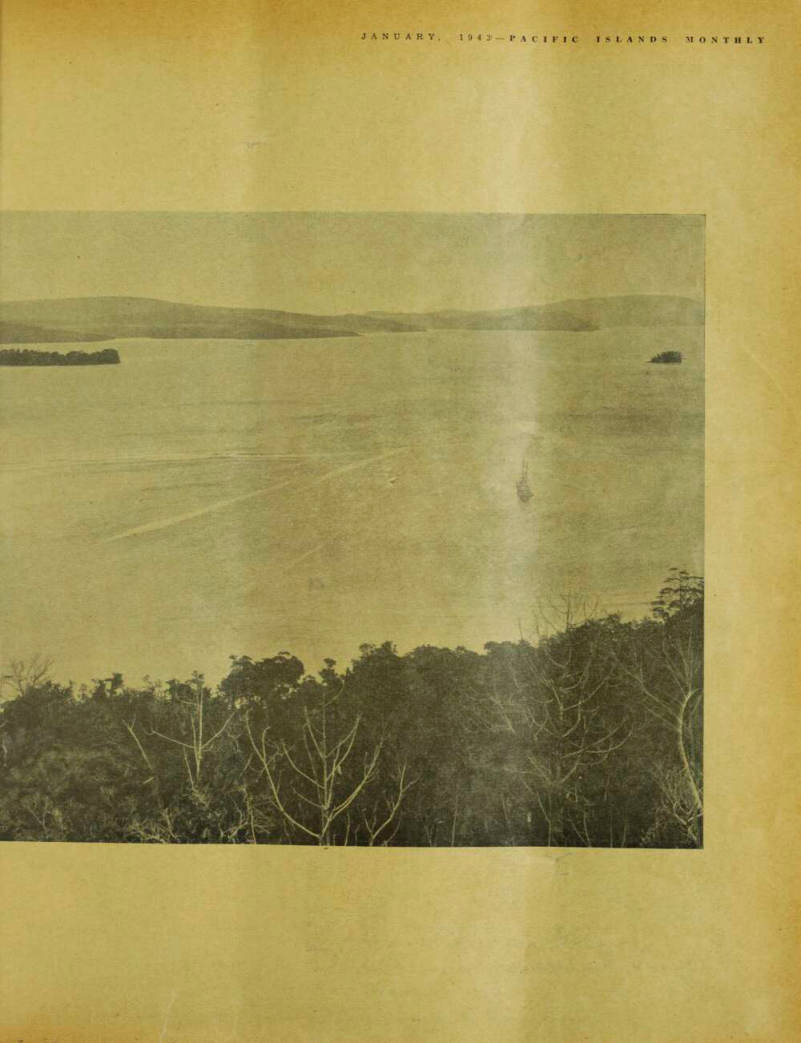
Mother-In-Law
The Feti'i of Tahiti
By A.C.R.
rpHE writer of that now moth-eaten X theme-song of South Sea tourist bureaux — A tropical moon, A romantic lagoon And You-u-u . . . very cannily stopped there. But in all fairness, he should have added a stanza about the Feti’i of Polynesia.
The Polynesian word Feti’i is a general term signifying relations of any degree up to one’s tenth cousin twice removed.
To the European spouse of one of our South Sea damsels, the word Feti’i —at first a dim cloud no larger than a man’s hand on the horizon of romance— becomes a grim shadow, blotting out all hope of tranquility.
The technique of South Sea Islands- Feti’i is suave and subtle. There is never an avalanche of Cousin Harriet with five children, a mountain of baggage, two dogs and a parrot descending on the household for an indefinite visit. On the contrary, the process in Polynesia is one of infiltration by gradual and stealthy approaches.
The European husband becomes dimly conscious of a flitting presence about the place, who is casually mentioned as a Feti’i from somewhere. The presence is never obtrusive. It flickers, but never wholly vanishes.
Then, one day, it will dawn on him that there are two flickering shapes instead of one, and that there is a gradual increase of the drain from his exchequer. Later, the number will be three, and will gradually increase to, and often beyond, “all the traffic will bear.”
The most Feti’i’-ridden man we ever knew had his home in a neighbouring island. On that' small piece of territory there was no place of refuge; so at irre gular intervals he and his wife would flee to Papeete.
There is only one boat a week, to and from the island. Our friend and his wife were sure, therefore, of that period of respite. But as the weeks came and went, the Feti’i would ooze in one by one until, in due time, the whole tribe was established in the Papeete household.
Our friend would then suddenly depart to his out-island home and the process of infiltration would go into reverse.
By thus shuttling back and forth, our friend was able to enjoy periods of peace and privacy.
Not so another of our friends. He is fettered by necessity to his domicile at Papeete. His wife is from a very distant island, where schooners seldom go. Her Feti’i have trickled in during the course of the years and have taken root —deeply, immoveably.
One day, in a spirit of mischief, we recited to him this little poem of a sophisticated society:— “How very nice it is to see Our dear relations come to tea.
But better still, it is to know That when they’ve had their tea, they’ll go.”
He looked at us with blood-shot, despairing eyes:— “Not in this blankety blanky place— Not forever and forever and forever.”
Advertisements & other items, pp. 46-48 (3 items)
44
JANUARY, 1943 PACIFIC ISLANDS MONTHLY"
Published by PACIFIC PUBLICATIONS PTY. LTD., Union House, 247 George Street, Sydney. (Telephone: BW . Wholiy set up and printed Australia by the Sydney and Melbourne Publishing Co. Pty. Ltd., 29 Alberta Street, Sydney. (Telephone. MA 4369).
Oft Moths'.
Kidneys Must
Clean Out Acids
If you suffer from Broken Sleep, Leg Pains, Dizziness, Rheumatism, Lumbago, Nerviness, Circles Under Eyes, Swollen Ankles,
Get Cystex
In 2 Sizes: 4/-, 8/-.
From Chemists Everywhere.
Money-back Guaranteed for
KIDNEYS, BLADDER, RHEUMATISM.
Wanted to Buy—Quality Guns and Rifles HIGHEST PRICES GIVEN. WILL ALSO EXCHANGE GUNS.
SI L RO H U Quality Firearms and Fishing Tackle. 143 ELIZABETH STREET (Near Market St.) SYDNEY. ’PHONE: MA 3540.
Oft MOTHS'.
it is a c °"l: ch cannot & e *hausagents * der gone the Known FUthasu. d -g tcsti , ;s o e , del>nite »" » That’s «hy Y , power. should That’s ** r„V.t~an d a'7 ayS a\\ substitutes, f refuse all* s tam, a " spray wl \_, s to human • P is harries* ld *, e r »*
* Be "In 6 the^tle.
ALWAYS KILLS
Vacuum Oil Co. Pty. Ltd. (Incorp. in Aust.), Distributors.
W. R. Carpenter & Co. Ltd.
IlSilpl
he
MMHH
- ■V. ■ $ ■-: ; ■■■ & i '
Travel by CARPENTER AIRLINES
Full particulars from Macdonald, Hamilton & Co., or Howard Smith Ltd., Sydney.
W. R. CARPENTER & CO. LTD.
MERCHANTS, SHIPOWNERS AND AIRCRAFT OPERATORS
Agents for Australian, European and American Manufacturers, and Distributors of Every Description of Merchandise.
Buyers and Shippers of Copra, Trocas, and all Classes of Islands Produce.
AGENTS FOR :
Ford Motor Company of Canada. Caterpillar Tractors. Dodge Brothers Inc.
T. G. & C. Bolinders (Engines). Electrolux Refrigerators. Westinghouse Electrical Co. etc., etc.
Branches throughout the Pacific Islands
In London: W. R. Carpenter & Co. (London) Ltd., Coronation House, 4 Lloyds Avenue, London, EC.
Head Office: 16 O’CONNELL STREET, SYDNEY