Pacific
Islands
Monthly
December 17, 1942
Vol. Xiii. No. 5.
Established 1930
[.Registered at the G.P.0., Sydney , for transmission by post as a newspaper ]
o
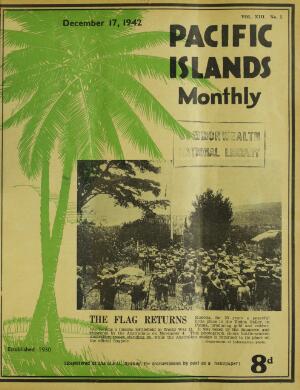
EIj'T 1C Kokoda, for 30 years a peaceful r Ij/vlj M\£jI U liilO little place in the Yodda Valley, In Papua, producing gold and rubber, has become a famous battlefield in World War II. It was taken by the Japanese, and recovered by the Australians on November 4 This photograph shows battle-scarred Australian troops standing by, while the Australian ensign is returned to its place on the Official flagpole. — Department of Information photo.
Advertisements & other items, p. 2 (1 item)
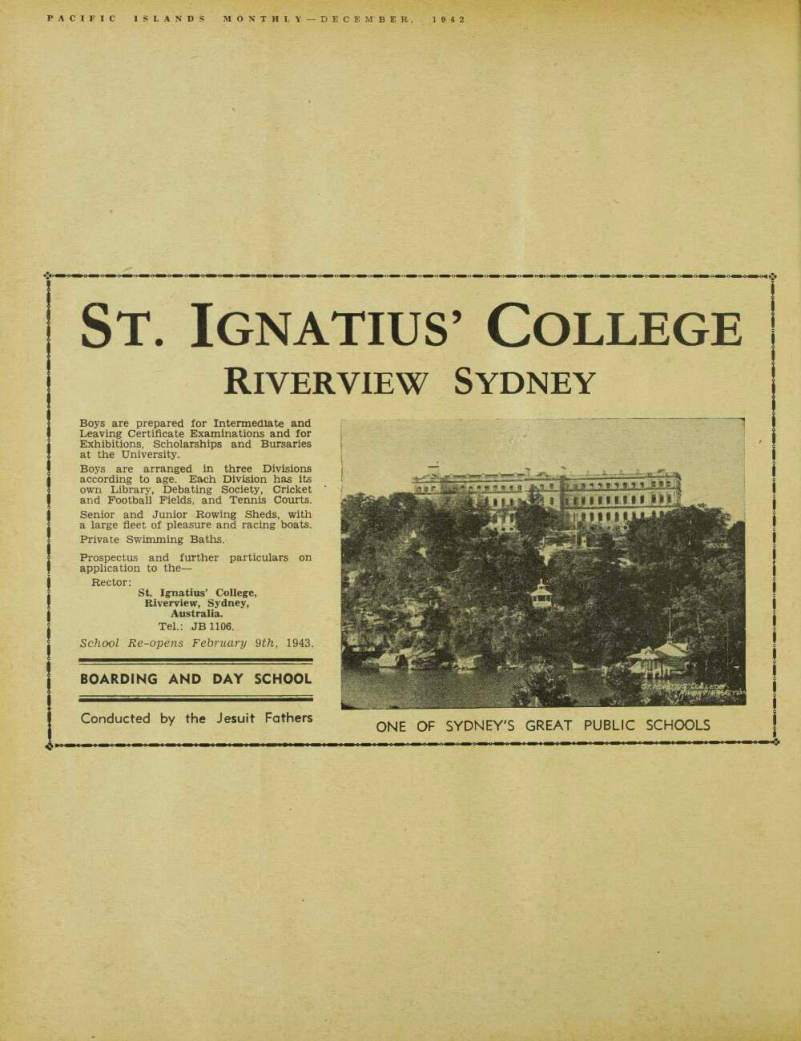
St. Ignatius’ College
Riverview Sydney
Boys are prepared for Intermediate and Leaving Certificate Examinations and for Exhibitions, Scholarships and Bursaries at the University.
Boys are arranged in three Divisions according to age. Each Division has its own Library, Debating Society, Cricket and Football Fields, and Tennis Courts.
Senior and Junior Rowing Sheds, with a large fleet of pleasure and racing boats.
Private Swimming Baths, Prospectus and further particulars on application to the — Rector: St. Ignatius’ College, Riverview, Sydney, Australia.
Tel.: JB 1106.
School Re-opens February 9th, 1943.
BOARDING AND DAY SCHOOL
Conducted by the Jesuit Fathers
111 U is —HJt- , * tm
ONE OF SYDNEY'S GREAT PUBLIC SCHOOLS
Pacific News-Review
Notes And Comment On
The Progress Of The War
From Nov. 13 To Dec. 11
Nov. 13: Allied forces which landed in Morocco and Algeria are pressing on towards Tunisia. The Vichy French have formally capitulated in Morocco and Algeria. Axis troops have taken control of all of Vichy France.
Nov. 14: The Eighth Army, which is pursuing Rommel’s broken forces from El Alamein westwards through Libya, has occupied Tobruk.
Nov. 14: American air troops have landed from British ships and occupied Bona, 150 miles west of Tunis. The Ger mans are rushing troops and equipment into Tunisia, in an attempt to occupy Tunis and Bizerta before the Allies.
Nov. 16; Americans crossed into Tunisia and are marching towards Tunis and Bizerta. French garrisons in Tunisia are resisting Axis troops who landed by air and sea.
Nov. 16; Another big naval battle has been raging off Guadalcanal (Solomons) since November 12. No details.
Nov. 16: Australians in New Guinea have captured the Wairopi Crossing of the Kumusi and are pressing on towards Buna and Gona.
Nov. 16: Tokio claims that Japanese raided New Caledonia on November 13, doing much damage.
Nov. 17: Admiral Darlan, Commander in-Chief of the French Armed Forces, has declared a clean break with Vichy, and announces that he will form a French Colonial army in North Africa to fight beside Britain and America.
Nov. 17: In the Buna area (NE Papua) American and Australian columns, in contact with each other, are jointly mov ing to the attack.
Nov. 18: US Navy claims victory, off the Solomons, in “one of the war’s decisive battles.” Enemy -losses are 11 warships, 12 transports and 20,000 to 40,000 men.
US lost 2 light cruisers and 6 destroyers.
Nov. 19: British and American troops are moving into Tunisia in a three pronged drive. Paratroops are seizing every possible aerodrome.
Nov. 23: Four Japanese warships are off Buna (NE Papua) in a last-minute endeavour to avert annihilation of Jap forces. . Allied columns have driven the Japs back to narrow beach-heads in the Buna-Gona area.
Nov. 23: British First Army, supported by American and French troops, is mass ing for an attack on the Axis hundred miles line in Tunisia.
Nov. 24: Russians have taken the offensive, north-west and south-west of Stalingrad, and in three days have advanced 50 miles, taking 18,000 prisoners.
Nov. 25: Russians’ offensive threatens to trap 300,000 Germans in the narrow corridor between the Don and the Volga, west of Stalingrad.
Nov. 25: The “High Commissioner for North Africa,’ Admiral Darlan, announces that French West Africa, including Dakar, has placed itself under his orders. Con trol of West Africa is regarded as a great military and diplomatic victory for the Allies.
Nov. 26: A great Russian victory is in sight. Stalingrad has been relieved, after a three-months’ siege.
Nov. 26: The ten miles Japanese-held strip between Buna and Gona was sub mitted to a dawn-to-dusk attack by every type of Allied aircraft.
Nov. 27: At least 250.000 Axis troops have been either killed, captured, wounded or dispersed in one week of the Russian’s offensive on the eastern front.
Nov. 27: Japs have lost two destroyers in the New Guinea area, trying to rein force their trapped forces at Buna.
Nov. 28; Practically all of the French fleet was scuttled by the French at Tou lon, when the Germans commenced the occupation of the naval base.
Nov. 30: The Russians have completed the encirclement of the Germans on the Stalingrad front and begun a drive on the central front, breaking the German lines in several sectors.
Nov. 30: The battle for the Buna-Gona beach-head continues, with very grim fighting. Every yard is bitterly contested by the trapped Japanese.
Dec. 1: There are now at least 20,000 Germans in Tunisia. An early clash is expected at Bizerta.
Dec. 1: When Japanese tried to land reinforcements on the Buna-Gona beach head, two enemy destroyers were set on fire and two others fled.
Dec. 2: British First Army in Tunisia is trying to develop a wedge between the Axis forces in the Bizerta and Tunis areas.
Dec. 3: The German winter lines in Russia appear to have been broken right along the Central and Stalingrad fronts.
Dec. 4: Japanese destroyers, trying to relieve Buna, were driven off. Twenty three Japanese raiders were shot down in air-fighting within a few hours.
Dec. 5: Snow is hampering operations on the Russian front and the Red offen sive has slowed down.
Dec. 5: Japan lost two large destroyers or cruisers, four destroyers, two trans ports and a cargo ship last week, when they again attempted to land reinforce ments on Guadalcanal (BSI).
In three separate actions between Nov ember 13 and December 3, American sea and air forces have dealt with the Japs in this fashion; — No. 1 Action—Sunk: One battleship, one battleship or heavy cruiser, six heavy cruisers, two light cruisers, six destroyers, 12 transports. Damaged: Two battleships, one cruiser, seven destroyers.
No. 2 Action. — Sunk: Two large destroyers (or cruisers); four destroyers, two transports, one supply ship.
No. 3 Action: Sunk: One . cruiser.
Probably sunk: Three other cruisers or destroyers. Shot down: Ten planes.
Japan’s total sea and air losses in the Solomons recorded to date (from August *7 to December 3), are; 132 ships sunk or damaged; 647 planes destroyed.
Dec. 5: There is violent fighting in Tunisia. In a 48-hours’ tank battle, both sides lost heavily.
Dec. 7: Axis forces have a strong hold on Tunisia towns, and they still have air-superiority. . Dec. 8: Both Axis and Allied forces are being reinforced in Tunisia and there is grim fighting around Tunis and Bizerta.
Dec. 10: Tank fighting still continues in Tunisia. The Allies are now receiving better air support.
Dec. 10: A fifth attempt by the Japan ese to relieve their forces at Buna has failed. A Japanese convoy was inter cepted off the coast by our bombers and driven away.
Dec. 11: Australians have occupied the Gona beach-head. This is the third occasion that Australian forces have been inside the village—on the two previous occasions they were forced to withdraw.
Australian casualties in New Guinea in the past 12 months were 2,190, of whom 640 were killed in action or died of wounds. These figures exclude sickness.
Over 640 dead Japanese have been buried in Gona.
Dec. 11: The RAF, based on England, made another big raid on Turin last
night—the second in 24 hours. Practic ally the whole of the populations of the big industrial cities of North Italy are now fleeing from the continuing RAP raids.
Dec. 14: Japanese have established a new airfield for land-based planes at Muna, in the island of New Georgia, 150 miles north-west of Guadalcanal, BSI.
The enemy appears to have lost two destroyers in another unsuccessful attempt to reinforce his troops on Guadalcanal.
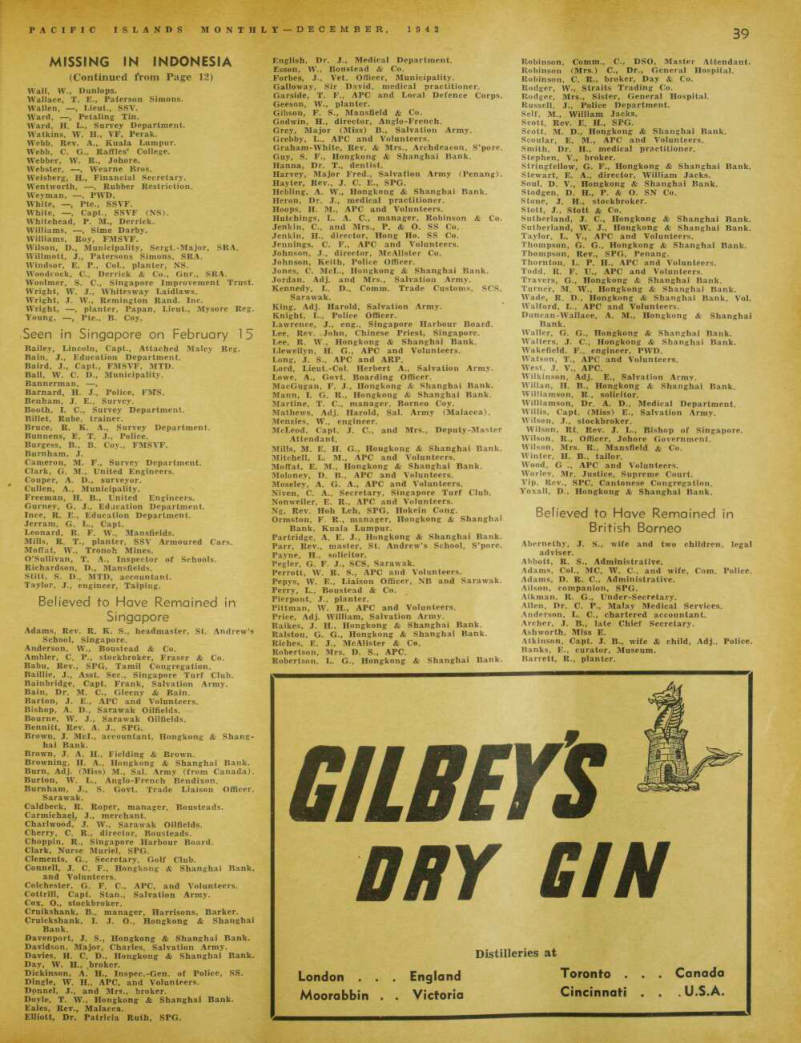
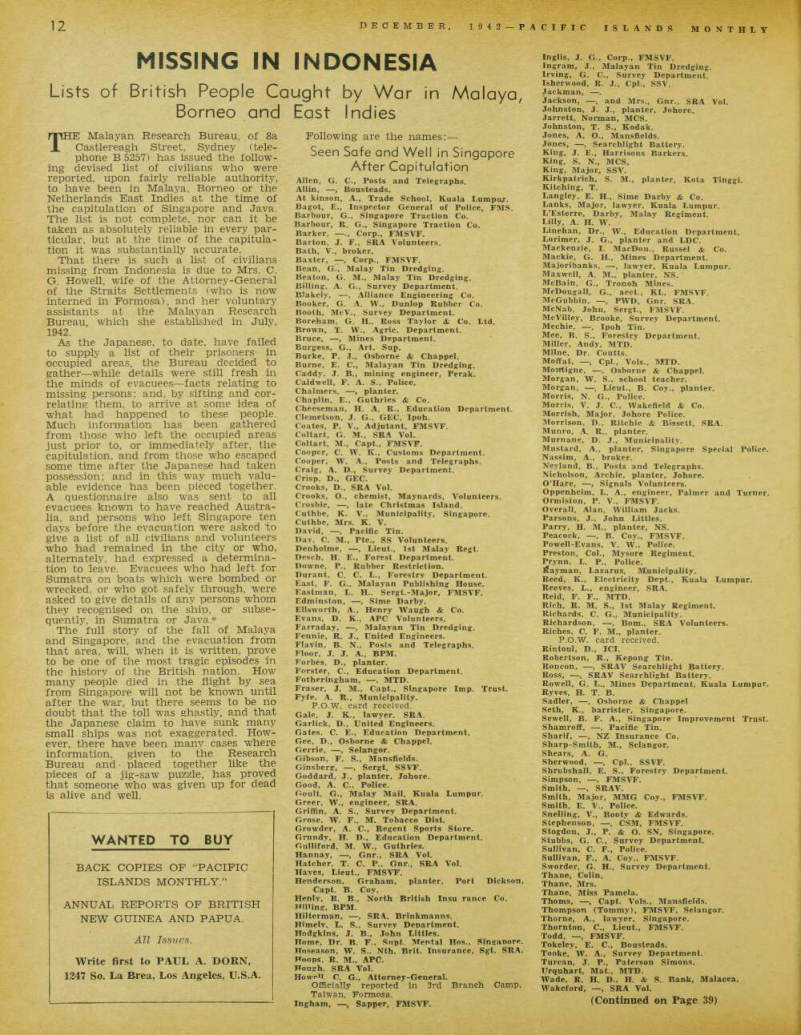
Missing In
Indonesia
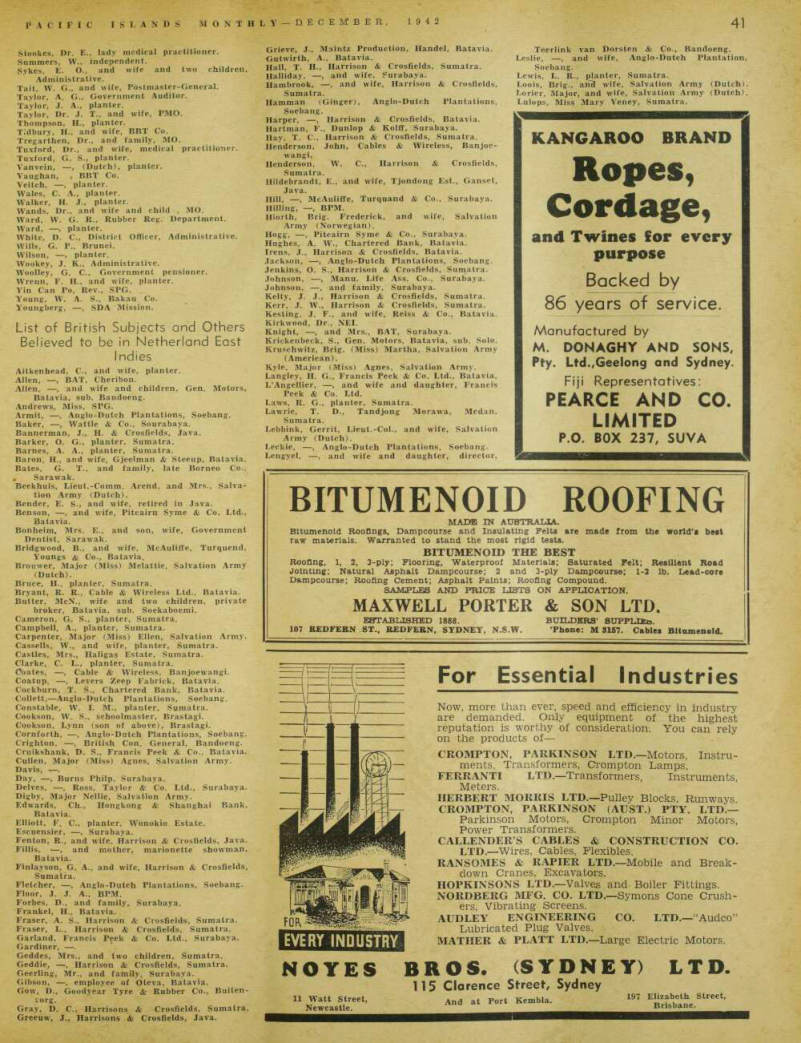
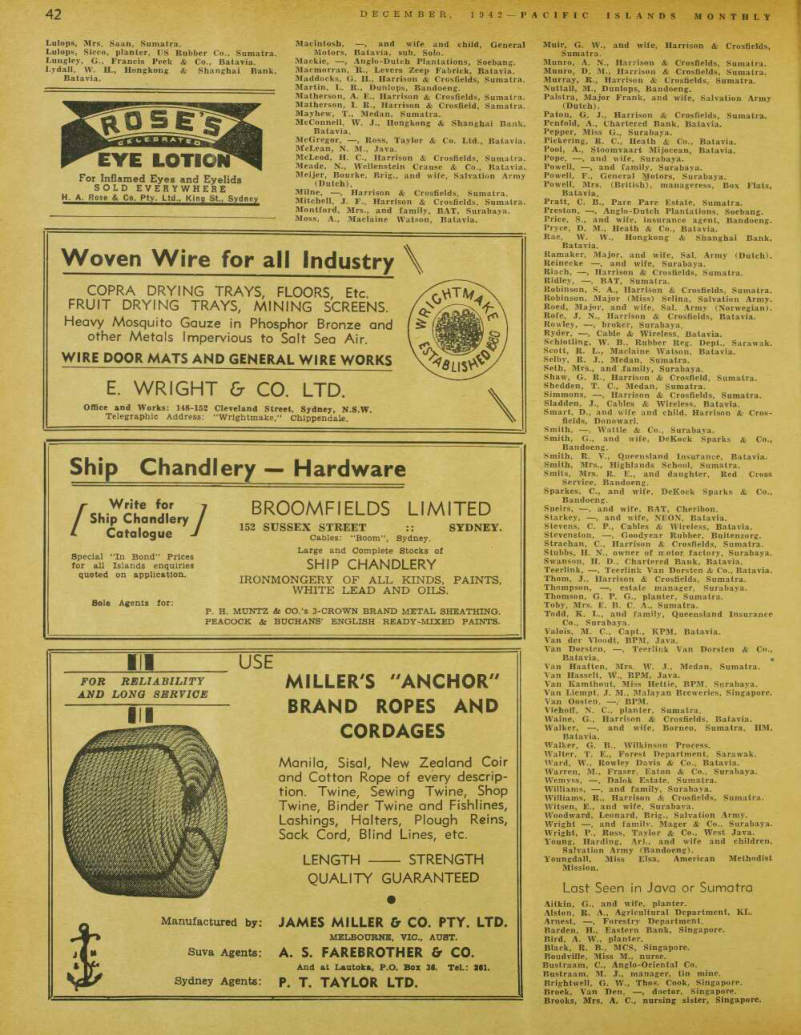
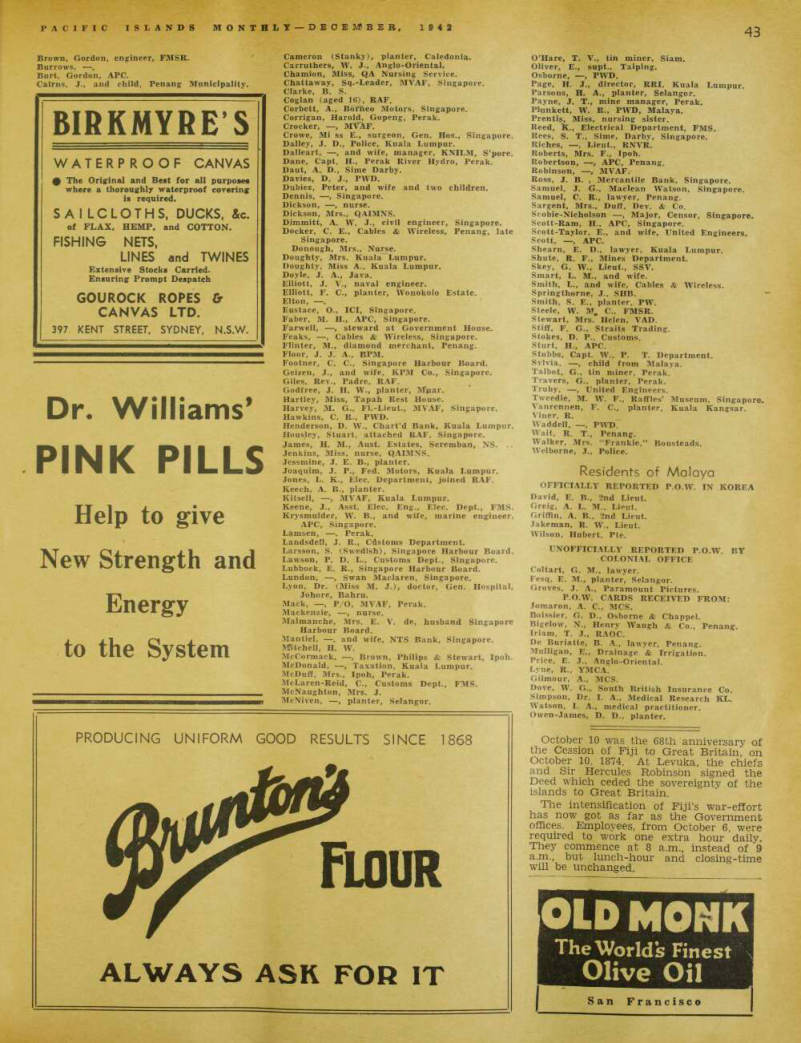
A LIST of British civilians who are missing in Malaya, Borneo and Dutch East Indies, is published in this issue (page 12). It contains 1,200 names, but is by no means complete. It represents the unselfish work of a small body of men and women, led by Mrs. C.
G Howell and Mr. Roger Dolbey, who have made this compilation from material gathered patiently in hundreds of inter views.
British Indonesian refugees are in four main groups—East Australia, West Australia, South Africa (including Natal) and India —and there are from 1,000 to 3,000 in each group. This list of 1,200 names is compiled mostly from data gathered in East Australia.
The list is being constantly added to and corrected, and will be re-published at intervals. It is hoped that, as the Indo nesian civilians are moved by the Jap anese to prisons’ camps in Formosa and Korea —a process now believed to be going on—official lists of prisoners will become available through the Red Cross.
All information should go to Mrs.
Howell, at the Malayan Research Bureau, 8a Castlereagh Street, Sydney.
Advertisements & other items, pp. 3-4 (1 item)
Public Notice
In the Estate of Gerald Bernard Gallagher, late of Gardner Island in the Gilbert and Ellice Islands Colony, an Officer of the Colonial Administrative Service—deceased.
All persons having any claims against the estate of the above-named deceased are required to submit proofs of debt, accompanied by complete invoices for the amount claimed, or, if invoices are not available, by full particulars of the amount claimed, to the undersigned at Suva, in the Colony of Fiji, not later than the 31st day of January, 1943.
In the distribution of assets regard will only be had to claims received on or before this date.
Dated at Suva, this 12th day of November, 1942. (Signed) H. VASKESS, Secretary, Western Pacific High Commission.
USEFUL ADDRESSES
fIIHE following are the Sydney addresses
X of organisations set up temporarily
to deal with Pacific Territories affairs —and especially matters connected with the evacuation of the Territories.
PAPUA, NEW GUINEA, NAURU
NORFOLK IS.
Department of External Territories (Sydney Branch) (Lately the New Guinea Trade Agency), Australia House, Carrington Street, Sydney.
Telephone: BW 1776. (Dealing with all matters connected with the Australian Pacific Territories and also the Sydney representative of the New Guinea Copra Control Committee.)
BRITISH SOLOMON ISLANDS
Sydney Office of British Solomon Islands Government, (In charge of Mr. F, E. Johnson, Treasurer of the Solomons Administration), 17 Castlereagh Street, Sydney.
Telephone: B 1710.
GILBERT AND ELLICE, AND
OCEAN IS.
Sydney Office of Gilbert and Ellice Islands Colony (In charge of Mr. S. G. Clarke, Treasurer of the G. and E. Administration), Bank of New Zealand Building, George Street, Sydney. Telephone: B 2209.
FOR PACIFIC TERRITORIES
EVACUEES GENERALLY
Pacific Territories Association (C. A. M. Adelskold, Secretary), c/o Robert Gillespie Pty., Ltd., 54a Pitt Street, Sydney.
Telephone: BW 4782.
STEAMSHIPS TRADING CO.
OF PAPUA
Sydney Office: Nelson and Robertson Pty., Ltd., Telephone: B 6461. 12 Spring Street, Sydney.
Contents
Pacific News-Review 1 Stark Facts Point to Long War " 3 NG Civilian Missing 5 Price of French Copra 5 Death of Pilot-Officer Canard ... 7 Paul Mason Awarded American DSC 7 Extraordinary Conduct of Governor- General Brunot in 1941 8 Australian Government’s Cruel Treat ment of Territories’ Evacuees 9 N. Guinea Returned Soldiers Recon stitute League 10 Three Ft. Pygmies 10 Where Japs Had a Seaplane Base — Deboyne Lagoon 11 Missing in Indonesia 12 Samoa Booming 13 Special Plea for Protection of Natives After War 14 Real Austerity 15 Isles of Tragedy—Solomons ... 16 How Sudest Gold Was Found ... 16 NZ and Fighting France Exchange Officials 17 NG Jungle Foods 18 Pacific Islanders’ Loyalty 19 Samoan Rubber 21 “Guide” to the Solomons 22 Origin of Polynesians 24 There Will be Roads in N. Guinea .. 27 Cook Islanders Warned Against NZ Attraction 27 Sly Grog in Fiji 29 Trader’s Tale 30 Fiji’s Surplus 31 Two Firms of Nelson 32 Roll of Honour 34 N. Guinea Women’s Activities ... 37 The Beginning of Tahiti 38 Markets 44
Index to Advertisers
Atkins Pty. Ltd., Wm. ... 28 A. Ltd 26 Broomfields Ltd. . . 42 Brown & Co. Ltd., G 15 Brunton’s Flour . . 44
B. (S.S.) Co. . . 15
Burns, Philp Trust Co. Ltd 17 Carlton & United Breweries Ltd. . . 21 Carpenter Ltd., W.
R cov. 4 Chivers & Sons Ltd 24 Coleman Lamp & Stove Co 31 “Cystex” 40 Donaghy & Sons Ltd 41 Donald Ltd., A. B. . 30 Dr. Williams Pink Pills 44 Electrolux Refrigerators . . 20 Poster Clark’s Cus tard Powder . . 19 “Flit” 32 Garrett & Davidson 34 Gilbey’s Gin ... 39 Gillespie’s Flour . . 38 Gourock Rope Co. . 44 Grand Pacific Hotel 2 Grove & Sons, W.
H 22 Horlicks Malted Milk 13 International Corres School 40
Kambala School for Girls 37 Kopsen & Co. Ltd. 33 Maxwell Porter Ltd. 41 “Mendaco” ... 34 Miller & Co. Pty.
Ltd 42 Nelson & Robertson Pty. Ltd is Noyes Bros. Ltd. . 41 Old Monk Olive Oil . . 22, 24, 31, 44 Pacific Is. Society . 38 “Pinkettes” ... 36 Prescott Ltd. ... 24 Public Notice . . . 1 Roverstone Meat Co.
Ltd 35 Rohu, Sil 32 Rose’s Eye Lotion . 42 St. Ignatius College . . . cov. 2 Scott Ltd., J. ... 30 Steamships Trading Co. Ltd 18 Sullivan & Co. . . 35 Swallow & Ariell . 23 Taylor & Co., A. .29 “Tenax” Soap ... 36 Tillock & Co. Ltd. 37 Trinity Grammar School 38 Union Assurance Co. Ltd 35 Wright & Co. Ltd., E 42 Wright & Co. . . 40 Wunderlich Ltd. . . 29
Advertisements & other items, p. 4 (1 item)
W ** °X de*^
Lieutenant-Colonel J. P. Magrane has been appointed to the temporary command of the Fiji Defence Force, during the absence of Colonel J. G. C. Wales, MC.
Lieut-Col. (Dr.) E. G. Sayers, formerly of the Methodist Mission, ESI, returned recently to New Zealand with a party of sick and wounded from overseas."
*■ m*m\ AS ° Ver ' ifice 1 ' 1 A P^c
W ** °X de*^
*“ W be^ (U ' o( pf SpCC ntW e te Ss t - nWe I o*** < t *« «v'*>* 5 ser ,»o«- sova ,(or ** u ;S- Cab \e. r d»f- )fe P et 10^
Pacific Islands Monthly
The Newspaper-Magazine of the South Seas IRegistered at the G.P.0., Sydney , for transmission by post as a newspaper.']
Published Once Each Month and Circulated in Australia and New Zealand and in the following Pacific Territories and Islands Groups:
Australian Territory of Papua.
Mandated Territory (Australia) of New Guinea.
Australian Territory of Norfolk Island.
New Zealand Territory of Cook Islands.
Mandated Territory (NZ) of Western Samoa.
British Colony of Fiji.
British Solomon Islands Protectorate.
British Protectorate of Tongan Islands.
British Crown Colony of Gilbert and Ellice Islands.
Mandated Territory of Nauru.
British and Free French Condominium of New Hebrides.
Free French Colony of New Caledonia.
Free French Colony of Oceania (Tahiti, etc.).
American Territory of Eastern Samoa.
American Territory of Hawaiian Islands.
Owned and Produced by Pacific Publications Pty. Ltd., Union House, 247 George Street, Sydney.
TELEPHONE ■T Managing Director BW 5037 I Business and Editorial MA 4369
P.O. Box 3408 R
Registered Address of Telegrams, Radiograms, and Cables: “Pacpub”, Sydney,
Contributions.
Articles, Stories, and Photographs dealing with Pacific Islands subjects are invited and will be paid for on publication.
Subscription Rates.
Per Annum, within British Empire, Prepaid, Post Free 8/- Per Annum, elsewhere, prepaid. Post Free. 10/- Single Copies Bd.
Editor and Publisher;
R. W. Robson, F.R.G.S.
Advertising Manager: L. W. Bailey.
Advertising Office and Printing-House: 29 Alberta Street, Sydney.
Advertising rates furnished on application.
Colours, etc., by arrangement.
Process Blocks made at Advertiser’s expense when required. Screen IDO.
Changes of Advertising Copy should reach this office by Ist of each month, otherwise previous advertisement may be repeated.
Representative In London.
W. C. Harvey, Coronation House, 4 Lloyds Avenue, London, E.C.3, from whom may be obtained copies of Pacific Islands Monthly, Pacific Is. Year Book, advertising schedules, etc.
Agents.
The following are authorised to receive sub scriptions for Pacific Islands Monthly:— Burns, Philp & Co., Ltd., and Burns Philp (South Sea) Co., Ltd. All branches.
W. R. Carpenter & Co., Ltd. All branches.
Morris, Hedstrom, Ltd. All branches.
Steamships Trading Co., Papua. All branches.
B.N.G. Trading Co., Ltd., Port Moresby, Papua.
J. Muir, Suva, Fiji.
Miss R. Castles, Suva, Fiji.
N. C. Mackenzie Hunt, Wainunu, Bua, Fiji.
Kirpal & Co., Victoria Parade, Suva, Fiji.
Cook Islands Trading Co., Rarotonga, Cook Is.
A. C. Rowland, Papeete, Tahiti.
Islands Branches and Representatives of W. H.
Grove & Sons, Ltd., Auckland, New Zealand.
Ed. Pentecost, Noumea, New Caledonia.
Kerr & Co., Noumea, New Caledonia.
Vol. XIII. No. 5.
December 17, 1942
Prirp f Bd * Per Copy rnce Prepaid: 8/- p.a.
Stark Facts Point To A Long
War
WE know that there is no hope of a peace, worthy of the name, unless we gain victory pver the Axis and completely destrov the Huns of Berlin and Tokio. But, so fiercely do we long for an end of this filth and horror, for the return of our boys and the resumption of a normal way of life, that we permit our hopes to colour our calculations, and pin our faith upon very foolish prognostications concerning the end of this war- Because we now have done with defensive war—three seemingly endless years of defeats and disasters— and because we now are delivering such mighty blows that our arrogant and cocksure enemy is himself on the defensive, some silly people are predicting “the end of the war in Europe in 1943, and the smashing of Japan in 1844.” Such prophets should be stuck in pillories on the highways, so as to be seen as a public menace, and a warning to the people against wishful thinking.
Let us soberly weigh the known and proven facts. They are sufficient to show how cruel it is to delude the people with rosy summaries of situations which ignore all the ugly angles.
Beyond doubt, Hitler’s failures have been colossal. He failed to subdue Bntain. He failed to crush Russia in 1941, and failed disastrously in 1942 in his plan to break through the
Caucasus into the Middle East. His Africa Korps failed to reach the Nile Delta, and has been overwhelmingly defeated. He was completely out witted by the Allies when they occupied French North-west Africa, His Italian partner, deprived of all African possessions, is sore and suf fering and near unto moral collapse, His Japanese partner, after spec tacular successes, has not had a real victory for six months, but has, in stead, received a severe thrashing at the hands of American naval and air forces, wherever they have met.
So it is not surprising that our wishful thinkers should fix their eager attention upon that intangible but supremely important thing called “enemy morale.” Now that the Ger man people realise that Hitler has led them into a hopeless morass (they argue), all the fight will go out of the Axis. And that is just where the wishful thinkers go far astray. They will not see the real picture from the Axis viewpoint.
TTITLER’S dream of world-conquest *1 has faded. But, if the Nazis are prepared to organise and fight a de fensive war, what a headache they can set the United Nations! Except for the poorer half of Russia, they literally control the whole of Con tinental Europe. The only countries which are nominally free—Sweden, Spain, Portugal and Switzerland—
carry out the economic orders of their terrible neighbour. All the others are slaves of the Nazis—their hundreds of millions of workers are driven to production in Nazi-controlled factories or on Nazi-controlled farms, their products and raw materials are seized ruthlessly by the Germans, and allotted according to the wishes of the “super-men” in Berlin.
It is true that Europe now is ringed around by the forces of the United Nations—Russians in the east, British and Americans and Fighting French in the west and south. But, within that ring, Germany has at her command the world’s richest continent; there she has—or can organise the produc tion of—everything needed to feed and equip her enormous armed forces.
She can construct successive lines of fortifications, and she will have the advantage of fighting upon interior lines of communication. Europe can be blockaded, up to a point; but the blockade is being defeated, to an in creasing degree, by air transportation.
If the morale of the German people holds, the European war may go on for years.
Recent events on the Russian front provide a good pointer. In November, embarrassed by the Russian winter and by the Allies’ unexpected move in French North Africa, and the Eighth Army’s victory over Rom mel, Hitler eased his pressure against the Russians. Immediately, the Russians struck, the German front lines were thrown into great con fusion, and every newspaper in the world announced colossal defeats of the enemy on the Russian front and
the imminent collapse of Germany.
But what really has happened? The Germans took fearful punishment from the Russians; but they still hold their Leningrad-Rjev-Stalingrad line, and they still are strongly resisting the Russians’ most furious onslaughts.
The enemy has been defeated in that his great strategic plan has been foiled; but he has not collapsed, and appears to be completely ready to fight a defensive war.
FOR three years, the German people were confident that, led by their screeching Hitler, they were becom ing masters of the world. And was it any wonder? Country after country fell to their irresistible armies; end less masses of booty, and countless prisoners (2,000,000 French, 250,000 Belgians, 400,000 Dutch, 60,000 British, 300,000 Russians, plus unknown num bers of Poles, Czechs, Norwegians, Greeks, Jugo-Slavs), poured cease lessly into Germany. And just when the flow was dwindling, Japan leaped to Germany’s side, and, in the name of the Axis, seized vast territories and enormous booty.
How, then, can we now expect a weakening of mprale? German masses will not be easily turned, from con templation of themselves as world conquerors, to savour the bitter flavours of defeat. These are not the starving, harassed, blockaded Ger mans of 1918. These people are being supplied and fed by the enslaved and starving millions of the conquered countries. So long as they are organ ised and fed, they will fight on in defence of their frontiers—especially when, in every German consciousness, there is a fear that countless millions of wretched Russians and Poles, Czechs and Serbs and Greeks, French and Norwegians, now are merely existing in the belief that some day they will be able to wreak bitter vengeance upon the bodies of their Teutonic torturers.
PRESSURE upon Germany’s de fences in western and southern Europe will come primarily from British and American armies, sup ported by American production. Those forces must be supported by water transportation; and Germany will strike against Allied shipping in the Atlantic with every U-boat she can bring into commission.
This, probably, is the gravest prob lem now confronting the United Nations: How to counter the U-boat?
And—as Mr. Churchill himself ack nowledges—it is far from being solved.
WE see the same grim prospect as we turn to the war in the Pacific. Here, again, is an enemy who has had enormous and intoxicating initial successes; who squats arro gantly atop of vast new territories and tens of millions of conquered peoples; who recognises probably that he is not capable of further expan sion, but who’ is completely ready to fight on indefinitely with every weapon and resource at his command.
This Jap enemy, in one way, is more formidable than the German; because, while the German at least possesses the European’s sensitive ness to reason, and will react reason ably to a conviction of defeat, the Japanese, like a trapped and mad dened animal, will go on fighting hopelessly until he is stopped by extermination.
BECAUSE of the ill-balanced pro minence given in Australia to the operations in New Guinea and the Solomons, the people of the South Pacific have got the Pacific war situation somewhat out of focus.
Many imagine that these operations represent an important part of the global war, and that Japan is being beaten.
In actual fact, the Pacific war situation has been almost static since the Japanese completed the occu pation of Indonesia some eight months ago. There have been sporadic fighting in China, and some en counters in the South Pacific Islands, involving the use of a couple of divisions, and considerable air and naval forces. Otherwise, Japan has not been fighting. Her enormous armed forces—especially military and naval forces—have been merely stand ing by, busily preparing themselves for the life-and-death struggle with the Anglo-American powers which they now know to be inevitable.
Meanwhile, through the rapid deve lopment of the territories she has captured since December 7—“ the day that will go down in infamy”—Japan has received an enormous accession to her economic strength, and every day is becoming more capable of re sistance and counter-attack.
Except that they protect Australia, and so permit of its preparation as a vital base for future attack, Allied thrusts against the Japanese in the New Guinea and Solomons areas have little military value. Even if we kill every Jap there, and re-occupy every New Guinea and Solomons island, we shall not have altered perceptibly the Pacific military situation.
But those operations have great moral value. They have proved that the Anglo-Americans, on the land, in the air and on the sea are better men in every respect than “the inspired and fanatical Sons of Heaven.” They indicate to us the shape of the war that is to come. Given the machines, we can out-fight, overwhelm and exterminate the Jap.
The Japanese now are dug into ten thousand islands, every man pre pared to die there, so long as he can inflict maximum casualties and dam age upon the Allied forces. That, in a word, is Japan’s strategy. She will fight to the finish, if only she thereby can be left in possession of the rich territories she grabbed.
WHAT is the answer? It certainly is not to be found in “peri winkle tactics”—rooting every fight ing Jap, on his thousands of fortified islands and rocks, out of his fox-hole with a bayonet. It almost certainly
does lie, in the Pacific as in Europe, in a growing naval offensive, and in the building-up of overwhelming air power.
The Jap soldier is a tough indivi dual fighter, and is at his best in the tangled tropical jungles. But the Jap bluejacket, called upon to fight with machines, is not so good—he has been well beaten every time he has met the American navy—while the Japanese airmen are definitely in ferior. The Allies can not only out fight, but also can out-build the Japanese on the sea and in the air; and Japan will be beaten, not by hammering her robot-like soldiers in the South Pacific jungles, but by crippling her navy, destroying her merchant ships, and bombing her in dustrial cities.
These South Pacific battles, while relatively unimportant, tactically, are vital to the Allies’ ultimate strategic plan, because they allow Australia to become a vast military base. Japan ultimately will be crippled by an air offensive, based on China. Her power in her new empire—which she now is so avidly hugging to herself—will be broken by the destruction of her merchant shipping. And then forces based on Australia will be able to move northwards through the islands of Indonesia, mopping up. One deals with an octopus by first destroying its head; then one may more easily deal with its arms.
THIS war cannot end quickly. The psychology of defeat has not yet entered the German soul. The Ger man will not begin to envisage his inevitable end until he finds himself being beaten in defence, and battered ceaselessly by Allied air power; and he is only now beginning to go upon the defensive.
Japan, . a first-class military and naval power, has not yet really com menced to fight. Her military opera tions against vastly inferior British and American forces in Indonesia, early in 1942, were “push-overs”; and only a small section of her navy has been engaged. She confidently be lieves herself capable of fighting off any forces which the Allies can bring against her —at least, so long as the Allies are engaged also in Europe.
Keep the war in focus. In certain circumstances, it could end within a couple of years. But, at the moment, none of those circumstances exist; and there is not one sign anywhere of an enemy collapse.
Mr. W. L. Parham, of Tailevu, Fiji, died suddenly on November 13. He was the son of the late Mr. Charles Parham, of Raku Raku Bay, and Mrs. Parham, of Suva, and was born in South Africa in 1900. He joined the Department of Agriculture in 1900. He had marked literary ability, and many of his articles were published in overseas papers and he was greatly interested in the Fijians.
He is survived by a wife and two child ren. His mother (who resides with her two daughters in Suva) is a well-known botanist, and has compiled much valu able material about the flora of Fiji.
Advertisements & other items, p. 6 (1 item)
4
DECEMBER, 1942-P A C I FI C ISLANDS MONTHLY
French Copra
Worth £33 Per Ton in Papeete on 1943 Contract
THE following is a translation of an official statement recently made in Tahiti.
It was disclosed in August last that the Government of New Caledonia had final ised certain contracts with the Govern ments of the United States and Canada for the disposal of the whole of the copra produced in the islands of French Oceania up to the end of June, 1943, with the possibility of continuance of the arrangements up to the end of the same year.
Conditions of these contracts are of great interest in connection with the general economic situation of the Col ony, and are sufficiently advantageous to allow the operation, for a period of at least one year, of a fixed price to pro ducers: — 1 fr. 75. in the Tuamotu, Gambier, Austral and Marquesas Archipelagos. 2 frs. in Papeete, for all local copra; 2 frs. 20. in Papeete, for copra from Tuamotu, Gambier, Austral and Marque sas. (This is equal to £33 per ton, Aus tralian.) But, for the purposes of the contracts, the Colony must supply minimum quan tities of copra. Every ounce of copra is needed by the Colony to meet the needs of the United Nations.
Therefore, the Government is making an urgent appeal to producers, buyers, exporters and to all those persons inter ested in copra production, to make every effort to speed up the production of copra, which is the source of the Colony’s wealth, and a factor in final victory.
Suva Not Bombed
IT was claimed by Tokio Radio, on December 11, that on Wednesday, December 9, Jap planes bombed Suva (Fiji) port and aerodrome, sank two United States destroyers and set fire to another.
Another Tokio report claimed that Japanese planes had violently attacked industrial plants and armament works at Noumea (New Caledonia), causing ex plosions and fires. The Japs claimed that an American transport, two sailing boats and several cutters were hit. The date of the attack was not given.
An announcement from Suva, late on December 11, declared that the Jap report was untrue.
New Books
EXCEPTIONAL pressure on space has made it necessary to hold some articles over until next issue.
Included in these are two book reviews:—
Busby Of Waitangi—New Zea
Land’S Forgotten Man, By Eric
Ramsden, published by Angus and Rob ertson at 15/-. The story of Busby embraces the most romantic and fascinat ing period in the history of New Zea land; and, fortunately, Ramsden the well-known historian is submerged by Ramsden the storyteller. So the book is not only an invaluable historical docu ment—it is a most interesting story.
Prowling Through Papua,
another travel book by Frank Clune, published by Angus and Robertson at 12/6. Even the “PIM” did not realise what an interesting country this is until it read some of the innumerable stories about Papua, gathered by the tireless Australian writer. We shall say more about this book in January,
Why Japs Murdered
Missionaries
ON August 17, Japanese entered the Catholic Mission Station at Rua vatu, six miles west of Aola Bay, Guadalcanal, Solomon Islands, seized Fathers Henri Oudeengbrink and Arthur Duhamel and Sisters Sylvia, Edmee, and Odilia, and took them 17 miles to an enemy post, subjected them to an inqui sition, and tried to make them go to the United States lines with a message to the effect that the Americans could not win the fight in Guadalcanal, and should quit.
The missionaries refused, and eventu ally were allowed to return to their sta tion. Ten days later, the Japs came back, and again seized the party; but Sister Edmee was ill, and could not be moved. She escaped into the jungle and, aided by loyal natives, got away to safety.
Later, the four missionaries who were taken were found dead —having been bayoneted through the throat. There is no doubt that they were killed because they would not carry the message to the Americans at the demand of the Japs.
"Yankee" Tabu
WHEN the English edition of Dr. S. M.
Lambert’s best-seller, “A Yankee Doctor in Paradise,” appeared in London, the doctor was “tickled” to find that the title had been decontaminated: it now reads, “A Doctor in Paradise”!
“I suppose,” says the doctor, in a note to the “PIM,” “they thought ‘Yankee’ would offend good British ears.” Dr.
Lambert has got it wrong. We British people have had it hammered into us for years that “Yankee” is a word offen sive to many Americans, and so most of us refrain from its use. That almost certainly explains London’s emasculation of the original title.
An Australian edition of this delightful book —the story of how Dr. Lambert fought and finally conquered the hook worm disease in the South Seas —is promised at an early date.
Civilians In Solomons
A PARTY of 31 missionaries, nursing sisters and planters were brought from Malaita to the United States lines on Guadalcanal, Solomon Islands, some weeks ago; and later they were sent away to safety. They included Mr.
Thomas Mason Robinson, a planter from the Shortland Islands.
A well-known Solomon Islands planter.
Squadron-Leader C. V. Widdy, is reported by Australian newspapers to have given the American Marines invaluable help in the Elu and Tenaru River areas of Guadal canal. It is said that his knowledge of these high-banked and treacherous streams accellerated American progress.
An American nun, Sister Theresa, who was among the missionaries who escaped from the Japanese in the north and north-western part of Guadalcanal, said that the Japanese treated them civilly enough until there arrived a “mystery man,” Ishimoto, who spoke perfect Eng lish and who is believed to have been a spy in the South Pacific territories long before the war. Ishimoto was in supreme command. He seized the property of the missions and, after that, the missionaries were treated cruelly.
As a result of a bazaar held in Somo Some. Taveuni, Fiji, on October 24. no less than £1,400 was added to Red Cross funds.
Missing In The
Territories
Additions to the Lists
WE published, in November issue, a list of Administration officials and of civilians who have been reported as ‘Missing” since the Japanese invaded New Guinea.
Hereunder are printed alterations and additions to that list, as published in November.
The mission bodies kindly have made available to us their lists of missionaries reported as missing in the various terri tories affected by the war, and these are printed hereunder.
The full list of missing, with correc tions, will be published again in January or February.
Administration
BOWMAN, H., Medical Assistant.
P.O.W. letter received. Well.
Oldroyd-Harris, J. D. (Miss),
Nurse.
P.O.W. letter received. Well.
SIMNETT, P. J„ Warrant Officer.
Reported to have died.
WOOLLEY, J. M„ assistant teacher.
Reported missing; but now reported not missing.
Civilians
BEAUMONT, J. P., sawmiller, N. Britain.
BRYEN, FRANK., clerk, Rabaul.
ELKINGTON, H. C., planter, N. Britain.
HOUGHTON, C., plantation manager.
New Britain.
P.O.W. letter received. Well.
KYLLERT, P. L., planter, New Britain.
MULLIGAN, J., baker, Rabaul.
McSHEANE, GEO., butcher. Rabaul.
NUNAN, C., sawmiller, N. Britain.
P.O.W. letter received. Well.
SPENSLEY, W. G., manager, Rabaul.
SMITH, A. A., planter, N. Britain.
WILLMET, W., plantation assistant, Rabaul.
P.O.W. letter received. Well.
Missionaries
Anglican New Guinea Mission
Papua
Rev. James Benson.
Missing, and reported killed.
Rev. Henry Matthews.
Missing, and reported drowned.
Rev. Vivian F. B. Redlich.
Missing; believed to be prisoner.
Mr. John Duffield.
Missing; believed to be prisoner.
Miss Marjorie Brenchley.
Missing; believed to be prisoner.
Miss May Hayman.
Missing; believed to have been killed.
Miss Lilla F. Lashmar.
Missing; believed to be prisoner.
Miss Mavis Parkinson.
Missing; believed to have been killed.
Roman Catholic Missions
The following is believed to be a com plete list of the Roman Catholic missionaries who were in the various territories when they were invaded by the Japanese early in 1942. Where the fate of missionaries is known, it is indicated. But, in the great majority of cases, nothing is known of what has hap pened to these people since the invasion.
New Britain
Vunapope.—RlGHT REV. LEO. SCHAR MAGH, Bishop.
Vunapope.—REVS. L. BRENNUNK
Meyer, F. Lyons, Muller, B.
Biey, H. Nollen, J. Retsch, 35
Lay Brothers; 33 Sisters.
Volavolo.—REV. J. HALT; 4 Sisters.
Malaqunan.—REV. H. JUNEMANN; 4 Sisters Takabur.—REV. J. ZWINGE; 2 Euro peans; 16 Native Sisters.
Tapo.—REV. B. MURCHE; 1 European; 6 Native Sisters.
Vunamarita. —REV. B. STAPLEMAN,
Bro. Van Der Zonden.
Matupit.—REV. W. BARROW.
Nodup-Korere.—REV. J. HALT.
Paparatava.—REV. B. MERTENS; 1 European; 5 Native Sisters.
St. Paul.—Rev. B. Stapleman; 4
Sisters.
Quananba.—REV. A. BERNHAUSER.
Reber.—Rev. O. Futscher.
Ratogor.—REV. P. GRUNDL.
Rakunai.—REV. C. LAUFER.
Tavuiliu.—Rev. G. Bogershausen; 4
Sisters.
Vunavavar.—REV. A. SCHERHAG.
Kabaira.—REV. R. SCHUMM.
Birara.—Rev. J. Oberreiter.
Ramalmal.—REV. A. WENDL.
Milmila.—Rev. A. Herzog; Bro. F.
Ruschopf; Bro. J. Jassmeier;
4 European Sisters.
Mope-Rara.—Rev. J. Schneider.
Vunadidir.—REV. J. SEELEN.
Kamanacham.—REV. A. HAGEN.
Lan.—Rev. B. Stapelmann.
Rabaul.—REV. W. BARROW: 4 Sisters.
Taililiqap.—REV. S. DARGAR; BRO. F.
Heese.
Bitokara.—B. FRANK.
Valoka.—REV. J. WEIGL.
Ulamona—Rev. M. Baumann; Rev. H.
Berger: Bros. Henneke. Plen
Gemeier. Weckhever, Brand
and ROLEFF.
Poi (Nakanai).—F. KERSKERR.
Kilege (Nakanai) .—REV. W. CADOGAM.
Bariai.—Rev. L. Bischefp.
Lomingi.—Rev. A. Meyrhofer.
Pililo.—Rev. J. Scharmach; Rev. W.
O’Connell.
Makiri.—Rev. B. Klaarwater; Bro.
J. Mahrohfer.
Valinguo.—REV. W. HEBERMAN.
Also: Revs. J. Durkin, W. Cul
Hane, E. Harris, A. Klein
Titschen,
Lay-Brothers Who Are Missing In
New Britain
Doerfler, L.; Mueller, F.; Buescher, P.; Deen, V.; van der Zanden, G.; Hatzlg, F.; Henneke, C.; Plengemeyer, J.; Sauli, P.; Hollinger, J.; Packmor, A.; Licznerski, I. Hessling, H; Boekenkoetter, B.; Aver beck, W.; Overkaemping, W.; Teutenberg, J. Lembeck, J.; Nattebrede, A.; Bah mann, F.; Weckheuer, B.; Mahrhofer, J.; Herrmann, M.; Droste, J.; Brand, J.; Kuenne, F.; Rueschhof, F.; Tisch macher, D.; Grewe, H.; Loehr, P.; Jass meyer, J.; Langkamp, J.; Roleff, B.; Severin, F.; Schaller, A.; Heese, F.; Schueltingkemper, J.; Zumkley, H.; Landinger, J.; Roesel, J.; Damen, J.; Christadler, E.; Wieschen, J.; Brenn inger, m.; Sehr, N.; Epping, B.; Homann, W.; Mutters, B.; Wochner, J.; Brennan, C.; Huth, A.
New Ireland
Ulaputur (Marianum) .—REV. CHAS.
Martin.
Namatanai.—REV. C. NEUHAUS; 4 Sisters.
Komalu.—Rev. H. Kohlsteete.
Lamekot.—REV. J. HEMIG; 5 Sisters.
Lamasong.—REV. P. KUTSCHER.
Lugagon.—REV. J. HEMIG.
Ugana.—Rev. G. Peekel.
Mapua.—Rev. W. Murphy.
Komat (Lihir).—REV. C. SCHLEUTER.
Anelaua.—Rev. J. Lakaff; Rev. Bro.
J. TEUTENBERG; 6 Sisters.
Tanqa-Anir-Sair-Afar.—REV. J. KRUT
Zenbichler.
Lavangai.—REV. J. STAMM.
Turuk.—Rev, J. Krutzenbichler.
Admiralty Islands
Papitalai.—REV. C. BORCHARDT; BRO.
C. Schaller.
Bundralis.—REV. F. UTSCH; BRO. F.
LOEHR; 4 Sisters.
Povat.—Rev. J. Dahmen.
Bipl—Rev. R. Juergens.
Also: Rev. F. Utsch.
Gilbert Islands
Tarawa.—Most Rev. Octavus, Ter
RIENNE, Bishop.
Butaritari.—REV. P. GUICHARD; 4 Sisters; 2 Brothers.
Marakei. —REV. A. VOCAT; 2 Sisters.
Apaiang North.—REV. J. LEBEAU; 2 Sisters.
Apaiang South. —REV. L. DURAND (Director of Seminary); 4 Sisters; 1 Brother.
Tarawa (Betio).—4 Sisters; 4 Brothers.
Tarawa South.—REV. M. VIALLON; 2 Sisters
Maiana.—Rev. J. Droneau.
Apemana North. —REV. E. SABATIER (also in charge of Kuria and ) Apemana South. —REV. A. MEYE; 2 Sisters; 1 Brother.
Nonouti South.—REV. A. QUOIRIER; 2 Sisters; 1 Brother.
Nonouti North. —REV. L. MARQUIS.
Tapeteuea North. —REV. C. RAMUZ; 2 Sisters.
Peru.—REV. E. CHOBLET; 2 Sisters.
Nukunau. —2 Sisters.
Ocean Island, Nauru
Ocean Island.—REV. J. PUJEBET.
Nauru.—REV. A. KAYSER (Menang); 3 Sisters.
Northern Solomon Islands
Bougainville
Bishop: Rt. Rev. James J. Wade.
Reported to be prisoner in Rabaul.
Tarlena.—Buka Passage: REV. J. Mc-
Conville; Rev. A. Morei; Bro.
Paul.
Konna.—Rev. H. Hebert; Rev. R.
Dione.
Patupatnai.—REV. R. O’SULLIVAN.
Paroran.—3 Lay Nurses.
Tsiabai—Training College for Cate
Chists: Rev. J. Hennessy, D.D.,
Ph.D.
Timbutz.—Rev. F. Alotte; Rev. A.
Label; Bro. Gregor; Bro.
HENRY; 3 Sisters.
Kieta. —Rev. C. Seiller: Rev. J.
Lamarre; Rev. J. Lebreton; 3
Sisters Tunuru.—REV. W. WEBBER.
Koromira.—REV. N. GOEDERT; 2 Sisters.
Muguai.—REV. P. SCHANK: 2 Sisters.
Turioboiru. —REV. J. B. PONCELET; 3 Sisters; 5 Native Sisters.
Motuna.—Rev. J. Schlieker.
Kataku.—Rev. J. Grisward.
Sovele.—REV. B. TONJES.
Banoni.—REV. A. MULLER.
Asitavi.—REV. H. FLUET.
Piano.—REV. F. MILTOUP and 2 Sisters.
Buka
Gagan.—Rev. P. Montauban, Sm.
Hanahan.—Rev. G. Servant, Sm; Rev.
J. Lamarre.
Lemanmanu. —REV. J. LEPPING.
Shortland Islands
Poporag.—Rev. M. Boche; Rev. G.
McHARDY; 2 Sisters.
Choiseul
Sirovana. —REV. A. BINOIS.
Nissan.—Rev. J. Conley; Rev. F.
Wache.
Southern Solomon Islands
Visale, Guadalcanal.—RlGHT REV. JOHN MARY AUBIN, Bishop.
Reported escaped and safe.
Visale.—Rev. A. Brugmans; Rev. D.
Moore; Bros. George; Peter;
MICHAEL; 7 Sisters.
Brothers George and Michael and 7 Sisters reported Vo have escaped.
Tulagi.—REV. J. WALL.
Tangarare.—REVS. E. DE KLERK; D.
Scanlon: Bro. Robert; 2 Sisters*
Rev. Father Scanlon reported to have escaped.
Avuavu.—Revs. J. M. Boudard; A. De
THEYE; 3 Sisters.
Ruavatu.—Revs. H. O. Engberink- A
DUHAMEL; 2 Sisters.
Both reported murdered.
Marau.—Revs. J. M. Coicaud; A. Van
ROUTE; 3 Brothers.
San Cristoval
Wanoni Bay.—REVS. E. COURTAIS* F DURAND; 2 Sisters.
Star Harbour.—REVS. J. B. PODEVIGNE-
M. Mcmahon.
Rev. Father McMahon reported to have escaped.
Malaita
Rokera.—Revs. J. Simler; J. Tig
GLER; 3 Sisters.
Rohinari.—REV. V. VAN DER WALLE
Buma.—Revs. D. Coicard; P. Van
Mechelen; W. Stuyvenberg;
BRO. ANTHONY; 2 Sisters.
Takwa.—Revs. J. Halbwachs; C.
PALMER; 2 Sisters.
Melanesian Mission
REV. JOHN BARGE, New Britain.
Missing—No information.
REV. B. W. F. MOORE, New Britain, Missing—No information.
Methodist Mission
New Guinea
REV. L. A. McARTHUR, Malakuna.
P.O.W. letter received.
Rev. W. L. I. Linggood, Raluana.
P.O.W. letter received.
REV. W. D. OAKES, Pinikidu.
P.O.W. letter received.
REV. R. J. PEARSON, Vunairima.
P.O.W. letter received.
REV. J. W. POOLE, Bainings.
P.O.W. letter received.
Rev. H. B. Shelton, Ulu.
REV. T. N. SIMPSON, New Hanover.
P.O.W. letter received.
REV. J. TREVITT, Vunairima.
P.O.W. letter received.
MR. S. C. BEAZLEY, Malakuna.
P.O.W. letter received.
MR. E. W. PEARCE, Rabaul.
P.O.W. letter received.
THOMAS MOW, Chinese teacher, Rabaul.
P.O.W. letter received.
Nurse J. Christopher, Malaboga.
P.O.W. letter received.
NURSE M. GREEN, Malaboga.
P.O.W. letter received.
NURSE D. BEALE, Stewart Hospital.
P.O.W. letter received.
NURSE D. E. WILSON, Stewart Hospital.
P.O.W. letter received.
MO PUI SAM, Rabaul.
P.O.W. letter received.
Steamships Trading Company, of Papua, in the year ended June 30. show a net profit of £14,221, compared with £17,056 made in the previous year. As the company was forced to cease trading in February. 1942. as a result of the evacuation of administrative and civilian personnel, the profit can be regarded as a very good one. Owing to the uncer tainty of the future, however, no ordin ary dividend has been paid. The 7 per cent, dividend on preference shares absorbs £3.500. This company has lodged with the War Damage Commission sub stantial claims for damage suffered by enemy action and for property taken over by the military.
Lantana Pest
Tahiti is Attacking it With a Bug
From Our Own Correspondent
Papeete, Nov. 1.
FORTY years ago, or thereabout, a Tahiti resident imported a tender potted plant for his garden.
He was an enthusiastic gardener. He hovered over the new plant he had intro duced, carefully packed fertiliser about its roots, watered it morning and even ing, and called in his neighbours to admire its marvellous growth.
Such was the genesis of the Franken stein Monster which has threatened agriculture, on Tahiti and its neighbour ing islands, with extinction. In the rich soil and propitious climate of Tahiti, the Lantana has become a stout, thorny bush, massed to form an impenetrable jungle, in valley and on mountain slope, where it is not constantly fought with machate and fire.
Through the enterprise of our Director of Agriculture, Monsieur Boubee, an enemy of the Lantana, in the form of an insect, Teleonemia Lantanae, has been brought to the colony. It is a bug, four millimetres in length, of a dull, grey brown, which devours the leaves and flowers so that Lantana becomes dry and dies.
This insect was thoroughly studied in Fiji and at Canberra, Australia. It has been found that it will attack only plants of the family of Verbenacees, and that it will not bite cattle or human beings. It is now being propagated and distributed in French Oceania.
"Extraordinary Heroism"
Paul Mason Gets American DSC
THE name of Petty Officer P. E. Mason, Lane Cove, Sydney, a member of the RAN Voluntary Reserve, appears with those of three other Australians in a recently-published list headed, “Ameri can Awards for Heroism.” The Ameri can Commander-in-Chief, General Mac- Arthur, awarded them the American Dis tinguished Service Cross. It was stated that “the awards are for extraordinary heroism in action, but complete citations cannot be published now, for military reasons.”
Petty Officer Mason, not long ago, was Mr. Paul Mason, of Inus, Bougainville, in the Northern (Mandated) Solomons.
He was a plantation inspector for Asso ciated Plantations Pty. Ltd.
In The Jungle
Melanesian Mission Carries On
RIGHT Rev. W. H. Baddeley, Bishop of Melanesia, two mission doctors and six church sisters are still carrying on their work for the natives on one of the islands of the Solomons.
Bishop Baddeley, who won the DSO and the MC and Bar, in the First World War, led his party into the jungle when the Japanese invaded the Tulagi area of the Solomons area last May, and they have remained there ever since. Latest reports are that they are “all well.”
Mrs. R. J. Thompson, wife of Archdeacon Thompson, recently arrived in Australia from New Guinea, and is now residing in Melbourne.
Pilot-Officer Canard
is Killed
ADVICE was received in November that Pilot-Officer E. H. Canard, of the RAF, had been killed in a flying accident in South Africa on November 4.
Before his enlistment, Pilot-Officer Canard was with the Fiji Civil Service and went to Southern Rhodesia with the first lot of RAF boys from Fiji. He showed exceptional ability as a flier and was made a flying instructor —he was serving in this capacity when he was killed. He had also been recommended for a special navigation course in Eng land, and expected to proceed there shortly.
He leaves a wife and a 3 months’ old son. Mrs. Canard is the daughter of Mrs. and Mr. H. C. Monckton —Mr. Monckton was well-known in Fiji, where he was lately Adviser on Native Affairs.
This untimely end to a young life that was full of promise adds another to the tragically growing list of Islands men who have given everything in this struggle.
Pilot-Officer Canard was a man of an adventurous spirit. After qualifying as an electrician at the Suva power sta tion, he joined an English yacht which called at Suva, in the course of a world cruise. Eventually, he reached England in this yacht, and from there made other yachting cruises to Norway and the West Indies. He returned to New Zealand on the “Awatea,” as a member of the engine room crew on her maiden voyage. Back in Fiji, he tried journalism, serving as a reporter on the “Fiji Times.” He resigned to enter the Government service, as a clerk in the Audit Department—the posi tion he was holding when he enlisted in the RAF.
Mrs. Canard accompanied him to South Africa in May, 1941, and it is expected that she will return to join her parents in Australia.
The marriage of Miss Doris Lewis, to 2nd Lieut. John Rae, was celebrated at the Holy Trinity Pro-Cathedral, Suva, Fiji, on October 9. The bride is the eldest daughter of Mr. and Mrs. A. W.
Lewis, of Suva, and the bridegroom is a New Zealander.
Pilot-Officer E. H. Canard.
Remarkable Record
Twice As Many
Samoans
Remarkable Record Under NZ Rule
THE native population of Western Samoa is now estimated at 60,000 — double that of 1920, when New Zea land took over the Mandate.
This phenomenal increase is thought to be the result of improved health—and of the work of the Native Medical Prac titioners trained in the Medical School in Suva, who have been sent to country districts to establish dressing-stations and hospitals, and who have won the confidence of the native people by their skill and knowledge. Through them, the local chiefs have seen to it that their villages are kept in a sanitary condition.
The Samoan, generally, has been well cared for by the New Zealand Adminis tration. In Savai’i, and other places, concrete bathing pools have been built; water has been laid on to villages; and electricity has been supplied to fales (native houses) at a flat rate of 4/- per month.
“Old Granny” And The
Administrator
THE “PIM,” for years, has described the stolid, unenterprising, unimagina tive rule of New Zealand in Samoa as “Old Granny Government”; and it retracts nothing of what it has said about the stupidities of New Zealand’s administrative policy.
But—credit where credit is due! For the last 10 years NZ has been exceed ingly well served in Samoa, by a suc cession of devoted officials, led by Mr. A.
C. Turnbull; and, although the country has been stagnant, the natives have been well and conscientiously cared for, and the result is seen in those remarkable figures.
“If any comment were needed upon “Old Granny Government” it may be based on the astonishing fact that NZ stubbornly declines to call Mr. Turnbull anything but “Acting Administrator.”
Yet he has been “acting” as Administra tor since 1935, and New Zealand has never had, in Samoa, a chief executive who has brought the Territory so much real peace and native progress. “Acting Administrator” (limited pay and pension rights) for seven years! Could the meanness and parsimony of Wellington go further?
Samoa's Population
According to official figures, the total population of the Territory of Western Samoa, as on June 30, 1942, was 63,428. This compares with a popu lation of 62,391 on June 30, 1941—an increase of 1,037. It should, however, be noted that these figures were affected by a migration of workers and their depen dents, mainly to American Samoa.
Killed in action in New Guinea, Private David C. Carland, AIF, was formerly chief assayer at the Emperor gold mines, Fiji, and a sergeant in the Fiji Defence Force.
R«v. P. Rightly has concluded his period of supply work at Whangarei (NZ) and he and his wife have returned to their mission station in Samoa.
A Gilbert Islander, Beneuro, who is Chief of Police at Beru, in the Southern Gilbert Islands, has been awarded the medal of the Order of the British Empire, for Meritorious Service.
Tahiti Mystery Explained
The Extraordinary Conduct of Governor-General Brunot in 1941
ON September 9 there was published Officially in Papeete a radiogram from Rear-Admiral d’Argenlieu (High Commissioner in the Pacific for Fighting France), which finally explained the Brunot-de Curton mystery, and put an end to an extraordinary situation connected with the Governorship of Oceania, in 1941.
The publication clears all cloud and blemish from the names and careers of the former Governor, Dr. de Curton, and his associates, and places the blame for the series of strange events upon the former Governor-General, Richard Brunot.
To describe what happened, it is neces sary to recapitulate tne events of 1940 and 1941.
France surrendered in June, 1940, and the French South Pacific territories of New Caledonia, French Oceania and New Hebrides were left stunned, isolated and unprotected. The Governors, and most of their chief assistants in New Caledonia and Tahiti, tried to adhere to the Ger man-controlled Vichy Government which was, from the point of view of British countries in the Pacific, an impossible situation.
In July, Henri Sautot, French Resident Commissioner in the New Hebrides, declared unequivocally for General de Gaulle and Fighting France, and for continuance of the war, beside Britain.
In September, the civil population of both New Caledonia and French Oceania voted overwhelmingly for de Gaulle, and dethroned their pro-Vichy Governors.
New Caledonia called Sautot to the post of Governor and High Commissioner for France in the Pacific; while the leading civilians of Papeete installed Edmond Mansard (a retired French military offi cer, who died a few weeks ago) as Gov ernor of French Oceania.
M. Mansard did not hold the position long. He retired voluntarily in October, 1940, and, at his wish, and the wish of all leading citizens and officials of French Oceania, the highly-respected Dr. de Cur ton was made Governor. He settled very satisfactorily into the difficult job.
EARLY in 1941, General de Gaulle sent Commander Richard Brunot into the Pacific, with the title of “Gov ernor-General.” He proceeded, via Auck land, to Noumea, where, although he evi dently superseded M. Sautot’s authority as High Commissioner (Sautot remaining Governor of New Caledonia) he seemed to get along harmoniously with the people and officials there.
Then, with his wife and suite, “Gov ernor-General” Brunot proceeded to French Oceania, arriving in Papeete on June 6, 1941. Soon afterwards, people in the Western Pacific learned with amaze ment that M. Brunot had arrested and imprisoned Governor de Curton, most of de Curton’s chief officials, and even Captain Fatoux (who had come into the Pacific with Brunot as Brunot’s aide).
THIS is how our Papeete. correspondent describes these extraordinary events: “Le Gouyerneur-General Richard Bru not, ancien Commissaire de la Republic Francaise au Cameroun, arrived at Papeete on June 6, 1941, on board the SS ‘Monterey.’ He was received with full military honours by the Governor of French Oceania, Dr. de Curton.
“It soon became known that the man
ner of his reception had aroused Gover nor-General Brunot’s deep displeasure.
Whether he had expected the august ceremonies of a Roman Triumph or (as a wag suggested) the even more spectacu lar saturnalia that accompanies the advent of a sultan of the Cameroon hinterland, no one seemed to know.
“Monsieur Brunot later made some speeches, full of ominous phrases. Then, to the amazement of the Colony, he announced that he had assumed the Gov ernship of French Oceania.
“A perusal of the ‘Journal Official’ of June 30 and July 31. 1941, will inform those interested of some of the events which followed.
“The Hotel Metropole (which imme diately became known as ‘The Bastille’) was taken over, and soon became crowded with people who had not the foggiest notion of why they were confined there. High officials who had incurred M. Brunot’s displeasure were sent to Moorea (an island not far from Tahiti).
“The door of Government House, dur ing this period, resembled the famous Lion’s Mouth of the ancient Venetian Council of Teno: people, nursing ven dettas, stealthily went there to denounce their enemies. Later, the wind of favour shifted and some of these haunters of the palace gate found themselves either in the ‘Bastille’ or under surveillance in their homes.”
COPIES of the “Journal Officiel des Etablissements Franca is de I’Oceanie,” of June 30 and July 31, 1941, are now in the possession of the “PIM.” They really are astonishing documents. Each sets out in detail the decisions and acts of the Government during June and July.
From June 1 until June 13, all Gov ernmental decrees were signed by M.
Lemonnier, who had temporarily replaced M. Brunet, Chief of Cabinet, who had resigned. Governor de Curton appears already to have been in eclipse. Then came a notable series of decisions.
On June 16, M. Brunot issued decrees in which he provisionally appointed him self Governor of French Oceania, and M.
Joseph Giovanelli to be Chief of Cabinet (or Government Secretary). Captain Anthony Doucet was appointed Army Commandant; M. Alcide Faugerat became Secretary-General of the Colony; and a number of minor appointments were made. A decree of June 27 dissolved the Papeete Town Council; and another decree, of the same date, set up a Com mission of 11 members, headed by M.
Leonce Brault, to run the Municipality.
All these decrees were signed by Brunot himself.
On the same day (June 16) that he appointed himself Governor, Brunot signed a series of eleven decrees, under which he authorised and ordered: — The arrest of Dr. de Curton (Governor) and MM Senac and Lemmonnier (Colo nial administrators), M. Delage (aide to the Governor), Captain Ravet (local troops commander), Captain Patoux (Brunot’s own aide), and M. Dedeyne.
The internment during the war of M.
Mano, Dr. Mayrac, MM Petard, Pujo, Rosmorduc, Mille, Foucard, Fagot, Loison, Senesse, Drouhet, Le Roux (most of whom were medical officials) and a number of other officials.
There were 30 other decrees, all more or less connected with the “Brunot revolution.”
MANY explanations of Richard Bru not’s extraordinary conduct have been offered, but none seems to suffice.
Our Noumea correspondent says; “The version of events generally accepted in Noumea is that Dr. de Curton, who had been elected Governor by vote of the population, was arrested and suspended by Governor-General Brunot after a per sonal quarrel, in which the doctor was accused of not having arranged a suffi ciently lavish welcome for the distin guished visitor and Madame Brunot.
Monsieur Brunot is regarded as having been anxious to become Governor of a Pacific Colony. At the time of the armis tice with Germany, he was Governor- General of the Cameroons, which rallied to General de Gaulle two months later.”
The situation in Tahiti during June, July, August and September was tense and somewhat dangerous: but the people had an assurance from General de Gaulle that it would be dealt with quickly, and they remained calm.
It was announced in London on August
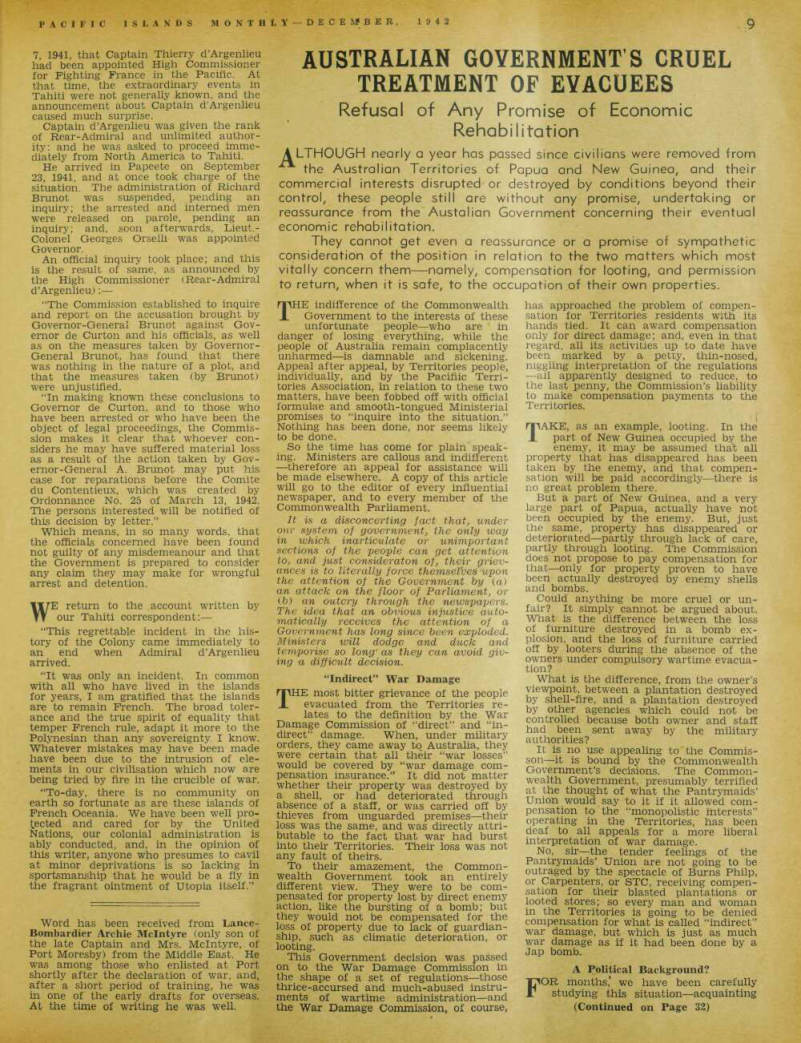
When Rear-Admiral d’Argenlieu arrived in Papeete in September, 1941, he was accorded an official reception. This photograph shows d’Argenlieu (in white) walking with Brunot (dark jacket). Over d’Argenlieu’s shoulder is seen the head of Colonel Orselli (new Governor of Tahiti).
Other high officers, in white, are in the left half of the photograph.
7, 1941, that Captain Thierry d’Argenlieu had been appointed High Commissioner for Fighting France in the Pacific. At that time, the extraordinary events in Tahiti were not generally known, and the announcement about Captain d’Argenlieu caused much surprise.
Captain d’Argenlieu was given the rank of Rear-Admiral and unlimited author ity: and he was asked to proceed imme diately from North America to Tahiti.
He arrived in Papeete on September 23, 1941, and at once took charge of the situation. The administration of Richard Brunot was suspended, pending an inquiry; the arrested and interned men were "released on parole, pending an inquiry; and, soon afterwards, Lieut.- Colonel Georges Orselli was appointed Governor.
An official inquiry took place; and this is the result of same, as announced by the High Commissioner (Rear-Admiral d’Argenlieu):— “The Commission established to inquire and report on the accusation brought by Governor-General Brunot against Gov ernor de Curton and his officials, as well as on the measures taken by Governor- General Brunot, has found that there was nothing in the nature of a plot, and that the measures taken (by Brunot) were unjustified.
“In making known these conclusions to Governor de Curton, and to those who have been arrested or who have been the object of legal proceedings, the Commis sion makes it clear that whoever con siders he may have suffered material loss as a result of the action taken by Gov ernor-General A. Brunot may put his case for reparations before the Comite du Contentieux, which was created by Ordonnance No. 25 of March 13, 1942.
The persons interested will be notified of this decision by letter.”
Which means, in so many words, that the officials concerned have been found not guilty of any misdemeanour and that the Government is prepared to consider any claim they may make for wrongful arrest and detention.
WE return to the account written by our Tahiti correspondent:— “This regrettable incident in the his tory of the Colony came immediately to an end when Admiral d’Argenlieu arrived.
“It was only an incident. In common with all who have lived in the islands for years, I am gratified that the islands are to remain French. The broad toler ance and the true spirit of equality that temper French rule, adapt it more to the Polynesian than any sovereignty I know.
Whatever mistakes may have been made have been due to the intrusion of ele ments in our civilisation which now are being tried by fire in the crucible of war.
“To-day, there is no community on earth so fortunate as are these islands of French Oceania. We have been well pro tected and cared for by the United Nations, our colonial administration is ably conducted, and, in the opinion of this writer, anyone who presumes to cavil at minor deprivations is so lacking in sportsmanship that he would be a fly in the fragrant ointment of Utopia itself.”
Word has been received from Lance - Bombardier Archie Mclntyre (only son of the late Captain and Mrs. Mclntyre, of Port Moresby) from the Middle East. He was among those who enlisted at Port shortly after the declaration of war, and, after a short period of training, he was in one of the early drafts for overseas.
At the time of writing he was well.
Australian Government’S Cruel
Treatment Of Evacuees
Refusal of Any Promise of Economic Rehabilitation
A LTHOUGH nearly a year has passed since civilians were removed from the Australian Territories of Papua and New Guinea, and their commercial interests disrupted or destroyed by conditions beyond their control, these people still are without any promise, undertaking or reassurance from the Austalian Government concerning their eventual economic rehabilitation.
They cannot get even a reassurance or a promise of sympathetic consideration of the position in relation to the two matters which most vitally concern them—namely, compensation for looting, and permission to return, when it is safe, to the occupation of their own properties.
THE indifference of the Commonwealth Government to the interests of these unfortunate people—who are in danger of losing everything, while the people of Australia remain complacently unharmed—is damnable and sickening.
Appeal after appeal, by Territories people, individually, and by the Pacifiic Terri tories Association, in relation to these two matters, have been fobbed off with official formulae and smooth-tongued Ministerial promises to “inquire into the situation.”
Nothing has been done, nor seems likely to be done.
So the time has come for plain speak ing. Ministers are callous and indifferent —therefore an appeal for assistance will be made elsewhere. A copy of this article will go to the editor of every influential newspaper, and to every member of the Commonwealth Parliament.
It is a disconcerting fact that, under our system of government, the only way in which inarticulate or unimportant sections of the people can get attention to, and just consideraton of, their griev ances is to literally force themselves upon the attention of the Government by (a) an attack on the floor of Parliament, or ib) an outcry through the newspapers.
The idea that an obvious injustice auto matically receives the attention of a Government has long since been exploded.
Ministers will dodge and duck and temporise so long' as they can avoid giv ing a difficult decision.
“Indirect” War Damage THE most bitter grievance of the people evacuated from the Territories re lates to the definition by the War Damage Commission of “direct” and “in direct” damage. When, under military orders, they came away to Australia, they were certain that all their “war losses” would be covered by “war damage com pensation insurance.” It did not matter whether their property was destroyed by a shell, or had deteriorated through absence of a staff, or was carried off by thieves from unguarded premises—their loss was the same, and was directly attri butable to the fact that war had burst into their Territories. Their loss was not any fault of theirs.
To their amazement, the Common wealth Government took an entirely different view. They were to be com pensated for property lost by direct enemy action, like the bursting of a bomb; but they would not be compensated for the loss of property due to lack of guardian ship, such as climatic deterioration, or looting.
This Government decision was passed on to the War Damage Commission in the shape of a set of regulations—those thrice-accursed and much-abused instru ments of wartime administration —and the War Damage Commission, of course,
has approached the problem of compen sation for Territories residents with its hands tied. It can award compensation only for direct damage; and, even in that regard, all its activities up to date have been marked by a petty, thin-nosed, niggling interpretation of the regulations —all apparently designed to reduce, to the last penny, the Commission’s liability to make compensation payments to the Territories. ■ [ TAKE, as an example, looting. In the part of New Guinea occupied by the enemy, it may be assumed that all property that has disappeared has been taken by the enemy, and that compen sation will be paid accordingly—there is no great problem there.
But a part of New Guinea, and a very large part of Papua, actually have not been occupied by the enemy. But, just the same, property has disappeared or deteriorated—partly through lack of care, partly through looting. The Commission does not propose to pay compensation for that—only for property proven to have been actually destroyed by enemy shells and bombs.
Could anything be more cruel or un fair? It simply cannot be argued about.
What is the difference between the loss of furniture destroyed in a bomb ex plosion, and the loss of furniture carried off by looters during the absence of the owners under compulsory wartime evacua tion?
What is the difference, from the owner’s viewpoint, between a plantation destroyed by shell-fire, and a plantation destroyed by other agencies which could not be controlled because both owner and staff had been sent away by the military authorities?
It is no use appealing to the Commis son—it is bound by the Commonwealth Government’s decisions. The Common wealth Government, presumably terrified at the thought of what the Pantrymaids’
Union would say to it if it allowed com pensation to the “monopolistic interests” operating in the Territories, has been deaf to all appeals for a more liberal interpretation of war damage.
No, sir—the tender feelings of the Pantrymaids’ Union are not going to be outraged by the spectacle of Burns Philp, or Carpenters, or STC, receiving compen sation for their blasted plantations or looted stores; so every man and woman in the Territories is going to be denied compensation for what is called “indirect” war damage, but which is just as much war damage as if it had been done by a Jap bomb.
A Political Background?
FOR months’ we have been carefully studying this situation—acquainting
(Continued on Page 32)
n °S! es m w i th f th< L de j; ails of the appeals made to the Commonwealth Government by the Pacific Territories a " d .. aw ?i‘mg with interest were Cemed ' would be g“ven to futable amimpnic nf
Sorely
a f ew official murmurings, containing no indication whatever of any desire to relax the war damage definitions, or give some promise of a resumption of economic life to the thousands of unfortunate Terri tories people who are grimly hanging on in Australia, and who, if their claims for compensation are refused, will be facing, black ruin.
Accordingly, we can come to no con elusion other than that the Common wealth Government, which should deal with this matter on a basis of pure j'us lnflienced a bv W pofitlcal consfderatioM b 6 . powerful Territories interests (who neces sarily will participate in any general corn pensation allowed) it will be putting itself on-side with influential political groups who think all rich and powerful companies should be attacked; and it can be indifferent to all the “small people” of the Territories, who are cruelly hurt and mostly ruined by such a policy, be cause those unfortunate people have no votes, anyway.
Appeal to Australian People BUT we do not believe that this Govern ment will be allowed to “get away” with such monstrous cruelty and in justice. The people of Australia, who after all are the masters of this group of wartime Caesars, will not permit it By God’s good grace, the Americans got here in time to keep the enemy out of Australia. It was the ill-fortune of war that they could not get into position m time to keep the Huns of the Pacific out of New Guinea and Papua, also. But New Guinea, and Papua, none the less, are Australian Territories; and the people who lived there are nonetheless Austra lians.
Are the Mainland Australians, who were saved, going to stand by and see the Territorial Australians, who were caught in the blast of war, facing complete ruin, and forced to start life anew? We do not think so—Curtin Government or no Curtin Government, We know politicians, and we can guess one defensive argument that our Ministers will produce. As a matter of principle and precedent (they will say, breathing heavily) Territories folk cannot be re established in their plantations and stores, in the manner suggested; because, if that were done, everv business man in Australia who has suffered under war time conditions would have an equal claim for compensation.
Actually, we see no reason why such a principle of compensation should not ultimately be adonted. Would it not be fair and proper that, at the end of the war, the lucky traders, who have a “glorious feed” upon this lavish wartime circulation of money, should contribute through special taxation to the re establishment of the unfortunate traders who have been half-ruined or wiped out by the same wartime conditions?
But that is a mainland Australian prob lem, and that issue need riot complicate the special Territories problem. What is to prevent the Commonwealth Govern ment from decreeing that, within all territories where civil administration has had to be superseded bv a militarv ad ministration, there shall be a more liberal interpretation of the regulations govern ing compensation for wartime damage?
Even a simple decision, that there shall be a more liberal interpretation in cases where owners were forced to leave their properties through wartime conditions, would put an end to much of the un certainty and unhappiness among Terri tories evacuees.
Occupation of Plantations THE other matter—the apparent inten tion of the Commonwealth Govern ment to refuse permission to Terri tories neople tc re-occupy their own properties as soon as conditions reason ably permit—may be the result of the Government’s inability to co-ordinate its nolicy with that of the Military Adminis tration of Papua and New Guinea (they call the whole area “New Guinea” now), rather than of any desire to impose hardship upon evacuees.
This thing has not come to a head, as yet. because the Japanese still hold New Guinea and are close enough to Papua to render military control essential. But, as the enemy is driven northwards, more and more plantations in Papua and New Guinea will become available for re occupation. It has been reported, more than once, that it is the intention of the military authorities to retain control of these plantations and operate them through ANGAU (that is, the Army-controlled , Australian and New Guinea Adminis trative Unit), on a basis which will allow
for a payment to the owners of some 5 per cent, on the capital value.
One can see, and, to an extent, sym pathise with, the purpose of this plan.
Even if the Japanese are driven north of our Territories, they will not be far away, and complete military control will be essential so long as there is any possibility of a renewed Japanese assault. Further more, the need for rubber and coconut oil is so great that the problem of supply is a national one.
But, with all this given in, there seems to be no reason at all why young military officers of ANGAU should be sent around to direct and control plantation opera tions, while the more elderly but * per fectly fit and efficient owners of the plan tations sit idly on their backsides in Aus tralia, and receive a dole of 5 per cent.
Which system is more likely to develop greater efficiency in the matter of rubber and copra production: Plantations con trolled by Army officials, who have no interest whatever in the matter beyond the routine fulfilment of their job? Or control of the plantations by the actual owners, who are personally interested in maintaining the plantation at its highest efficiency, and eager to secure the utmost possible production, so as to get some benefit from the prevailing high prices?
Suspected Political Factor AGAIN, there can be no real argument.
But, again, we are profoundly sus picious of certain elements in this Commonwealth Government, who would unhesitatingly sacrifice the small indivi dual planters if thereby they could “have a crack at the big fellows.”
In these Territories, especially in New Guinea, a large proportion of the plan tations are owned by the big companies and the latter, naturally, want to work them. It would be difficult to make flesh of the companies and fish of the small,
individual planters; so it is quite possible that the Canberra-cum-military regime will treat the lot as flesh, and proceed to stew it in a pot bearing a label re sembling: “Our plan for a new economic control in our Pacific Territories.”
Whatever of this kind may be going on. the Australian people must not allow all those innumerable men and women of the Territories, who fought during long years under cruelly hard conditions to establish their plantations, to be sacri ficed.
They are not articulate —the people of Australia hear little about them. But there are a great many of them; and we could give details of scores of cases where men and women, owners of what are now very valuable rubber and copra plan tations, are to-day living in Australia on a mere dole, shut off temporarily by war from the fruits of their life-work, and in danger of being permanently shut off through the operation of other than war forces.
It is a dismal and depressing picture.
These fine pioneer people, who should be the first care of Australia, really are in danger of becoming the victims of a mili tary bureaucracy and the pawns of
politics.
Appeals for some clarification of the position have been made to Canberra, again and again. All have been blandly ignored. “Perhaps we can say something when the Japs are gone.” Then, almost certainly, it will be too late —the military will have moved in.
It is up to the people of Australia to see that a gross injustice is not per petrated under the guise of military and political necessity.
Lieut. Jerry Brown, ANGAU, formerly of Lands Office, Port Moresby, is at present on sick leave in Sydney.
Advertisements & other items, p. 12 (1 item)
D^iditnr-\
N. Guinea Returned Soldiers Re-constitute Their Branch and Carry On
A MEETING of New Guinea residents who are returned soldiers, held in Sydney on November 16, took steps necessary to re-constitute and re-establish the Returned Soldiers’ League of New Guinea. The New Guinea organisation was destroyed, and all its records lost when the Japanese invaded the Territory in January, 1942.
The plan was formally approved by a meeting of the Federal Executive of the RSL later in November, and permission was given for the temporary establish ment of the branch in Australia.
The convenor of the meeting, Mr. A. J.
Gaskin, opened proceedings by requesting the gathering to observe the usual two minutes’ silence in memory of fallen comrades.
Mr. Gaskin, who was elected to take the chair, gave a brief outline of the activities of the Returned Soldiers’
League in New Guinea, and particularly in Rabaul. The financial liabilities of Rabaul sub-branch showed that approxi mately £9OO was owing, against which Anzac House and contents had been in sured for £1,250 under the War Damage Insurance scheme. It was estimated that the branch had 300 members prior to the occupation of Rabaul by the Japanese, and about 116 members were missing, or were prisoners of war. The suggestion was made that, should the branch be re formed in Australia, its main activity for the present should be to assist wives and families of members who are prisoners, and, where considered desirable, to grant monetary aid for the education of their children.
It was resolved: “That this meeting of members of the New Guinea branch of the RSSAILA desire to place on record their appreciation of the assistance rendered, and the keen interest taken in the branch by the Federal Secretary; and, further, that the action taken by the secretary of the Rabaul sub-branch be endorsed.”
It was resolved: “Providing the forth coming Federal Congress approves of the Federal Secretary’s recommendation, the New Guinea branch of the Returned Soldiers’ League be re-formed in Aus tralia, and functions in this country pending our return to New Guinea.
Further that, in a general way, the con stitution of the New Guinea branch shall apply.”
Executive It was decided that the branch officers should comprise:— Patron, president, vice-presidents (3), secretary, treasurer, committeemen (6), trustees (3), auditor.
The following officers were elected to
the respective positions, unopposed;— Patron: Hon. R. L. Clark (POW).
President: A. J. Gaskin (c/o External Territories Department, Australia House, Carrington Street, Sydney).
Vice-Presidents: J. H. Edwards (POW) Dr. E. T. Brennan, G. Renton.
Hon. Secretary; H. L. Downing.
S on ‘ W. R. C. Thomas, h« °S^^pU E ‘w h ° P T?’ « S ay “ Waters ’ w - R °g ers . E. F. Bishton, nr- m -a T A ? ratin' Brennan ’ H - L -
D^iditnr-\
riVE tor ‘ u- H ‘ Zanders. ... , , « Letters wishing the reconstituted branch every success were received from B. G.
A ’ L ‘ Robinson ’ s - McCosker, T, M. McAdam.
Finances.
The chairman reported that details were not available of certain funds con
trolled by the branch and the Rabaul sub-branch, as these had been in Savings Bank accounts, and no records were avail able in Australia. No information was available as to the financial affairs of the other sub-branches. A financial statement in respect of the branch and Rabaul sub-branch was submitted, and this showed £33/12/- in capitation ac count and £l3/2/2 in Anzac House account. The liabilities of the Rabaul sub-branch are approximately £9OO, on account of expenditure on the erection of Anzac House.
It was decided that the funds of the New Guinea branch and the Rabaul sub branch be amalgamated, and that the secretaries of the other sub-branches be requested to make all funds available to the branch for use in Australia, pending return to New Guinea.
Help for Families of Members After discussion it was decided, that in addition to the “aims and objects” of the League, as provided for in the constitu tion, the branch should concentrate upon a programme for the rehabilitation of members after the war; should assist the wives of members who are prisoners of war or missing-; and should grant mone tary aid for the completion of the edu cation of the children of members.
Care of War Graves The following resolution was carried: “That representation be made to the Federal Executive for the establishment of a War Graves Section in the Depart ment of the Army to function in the Territory of New Guinea, so as to have an organisation available to enable graves to be located and identified as soon as New Britain is recaptured.”
The question whether all members of the New Guinea Volunteer Rifles are eligible for membership was discussed, and it was decided to defer this matter until after the pending Federal Congress.
Mr. P. H. Pearce, of the New Zealand Public Works Department, has assumed the duties of Treasurer and Collector of Customs at Apia, Samoa.
This building (Anzac House) was erected in Malaguna Road, Rabaul, by the Returned Soldiers’ Associa tion, as a recreation house for the garrison, and was staffed by the Rabaul Women’s Auxiliary.
It was built by the Bay Loo Company at a cost of £2,000, officially opened on November 11, 1941 (Armistice Day) and blown to pieces by the Japanese in vaders on January 22, 1942.
Suspected Furphy From
3 Ft. Pygmies!
Suspected Furphy From N. Guinea
The following was published in the “Mudgee Guardian” (New South Wales) on October 19;— “A strange sidelight of the war in New Guinea is the discovery by Australian soldiers, patrolling in the area, of a new tribe of strange mountain pigmies. The tallest man in the village is just 3 ft. 2 in. high, and the majority are only 3 ft.
They are Moikodis, who tend native hill gardens, and clothe themselves in tree bark.
“There have been reports in the past of a small race of pigmies living in the jungles hereabouts, but the Australian troops are actually the first to confirm the reports.
“The tribe is numerically small and believed to be rapidly dying out because of interbreeding.
“The smallest people previously known in New Guinea were 4 ft. dwarfs of the Damu Valley, who were discovered shortly before the war by a miner who is now on active service.
“These people and the midgets of the Moikodi tribe are in direct contrast to the tall, fierce people of the Crokala tribe, who inhabit the remote western mountains. Average height of the Cro kalas is 6 ft.”
Editorial Note
The thing has all the earmarks of a furphy.
So far as is known, none of the New Guinea country patrolled or penetrated by Australian soldiers is unexplored, or unknown to Europeans. The only unex plored country lies far away to the west ward, between Mount Hagen, the Dutch border, and the headwaters of the Fly and Sepik Rivers, in a region not affected by the war. There may be pygmies in there. There are no Austra lian troops in that region—they could not readily get there even if they wished, except by parachute.
The only recorded pygmy community is in the Ramu country, over on the northern side of New Guinea—probably the place referred to above as “Damu.”
But those people, around 4 ft. 3 in., are fairly well known. They were originally discovered and scientifically reported and described by the late Father Kirschbaum, a well-known missionary who was killed in an aeroplane accident.
We have never heard either of 3 ft.
“Moikodis,” or of “tall, fierce Crokalas.”
Both would be interesting to science— especially the 3 ft. pygmies.
But we gravely fear that a Mudgee leg has been pulled.
Mr. E. D. Davis, formerly of the Aus tralasian Petroleum Co., in Port Moresby, and of late under engagement to Air craft Commission, Sydney, has resigned from the latter position in order to vol unteer for service with the New Guinea forces.
Corporal Ronald Hastings Sutton, NGVR, formerly of Wau, TNG, died of malaria and typhoid fever, in October last.
Mr. L. H. Wilkinson, formerly of Mis ima, Papua, who is now LAC Wilkinson, of the RAAF, writes cheerily from an Australian training-camp. He is “going well for a pilot”: but it appears there is considerable anxiety now among trainees lest the war will be over before they “can have a crack at them.”
Deboyne Lagoon, East of Samarai
Where The Japs Had A Seaplane
Base
MAN who knows the Louisiode Archipelago very well has supplied us with this interesting description of the Deboyne Lagoon, in Eastern Papua, which was occupied by the Japanese and used by them about May last as a seaplane base.
THE Deboyne Islands, in the Louisiade Archipelago, Eastern Papua, figured in the news in April and May, 1942, when they appear to have been occupied by the Japanese as a seaplane base.
Actually, it was Nivani Island that was occupied, this being one of three main islands forming (or within) the Deboyne Lagoon.
It became necessary to attack and drive the enemy out of this place; and — as was reported at the time —an oil tanker and several seaplanes were bombed from the air, and sank at the anchorage. Other Jap planes were destroyed ashore, direct hits were scored on the buildings, and fires were started.
Nothing has been published of late, and it is presumed the Japanese have been driven out. It may be that this site, so eminently suited for a seaplane base, is now occupied by the Allies—we do not know.
There are three main islands in the Deboyne Lagoon—Panaeati, Panapompom and Nivani—and they are situated 108 miles due east of Samarai, in the South east Division of Papua. Their interiors are of volcanic formation, which tapers off to coral fringes. These fringes con tinue, in semi-circular shape, from the east and west extremities of Panaeati, to form a lagoon about 14 miles by six, with several islets on this coral sea-wall, and passages through it.
Many portions of this coral sea-wall are dry at low water; but, in the pas sages and within the lagoon itself, the waters run up from 17 fathoms to shal lows, abutting on the inside, sandy beaches of the islands and islets. Very clear water, with a white sandy bottom, renders navigation very easy and, in the case of Nivani, there is excellent anchor age in almost all weathers.
Seaplanes could come down anywhere within the lagoon, and be taxied in and run ashore, upon the sandy banks, on the west and north sides. Seaplanes could ride easily at anchor in the narrow passage—a third of a mile wide—between Nivani and Panapompom, and be shel tered by the high land ashore. Nivani is 200 feet and Panapompom 800 feet high.
The fact that when the Japs wanted a seaplane base hereabouts they went straight to this ideal place, shows how thoroughly they had examined and charted all our lesser-known South-west Pacific islands.
DURING the Great War the Australian cruiser “Encounter” made use of this lagoon, whilst hunting for the Ger man raider that captured the “Matunga”; and other naval vessels have anchored there from time to time.
A glance at the map shows the Deboyne Lagoon to be due south of Rabaul, and west of the Solomons, and about equi-distant. Milne Bay would be about 130 miles away, and the lagoon is about 120 miles from the eastern main land of Papua. Misima Island, so well known for its goldmine, is in full view to the north-east, and the Calvados chain of islands lie south-east, and these merge into the Louisiades.
Prior to 1906, the territory lately known as Papua was known as British New Guinea, and was under Colonial Office rule. During the 1890’s, gold was found at Sudest, Misima, and Woodlark island. This brought white men in fairly
large numbers, to add to the few who had earlier arrived to procure beche-de mer and mother of pearl shell. Several Europeans, miners and divers, were mur dered, and it became necessary to bring the natives under control, and to estab lish a gold warden and magistrate.
Nivani Island then was selected as the Government headquarters, on account of its central position and good anchorage.
By the time that Australia took over the administration of Papua, payable alluvial gold had almost petered out, and only a few Europeans remained on Sudest and Misima. Woodlark Island became more important. The natives, too, had settled down.
The Government therefore decided to close down Nivani, and to make Wood lark Island the headquarters of the South-east Division. During the occupa tion, about 15 acres had been cleared on Nivani by prison labour, and coconuts were planted. A road around the Island was made, and other improvements effected. But the rest of the island was virgin scrub.
IN 1910, Mr. J. G. Munt, a young Eng lishman. obtained a lease of the island for 99 years, and took up his residence there. With the aid of local and imported native labor he cleared the whole of the rest of the island of scrub and planted coconuts. As this island is the favourite anchorage of most vessels proceeding to Misima and the Louisiades. it became well-known to many, especially on account of its rows of luxurious palms running through and over it, and its fruit and fish.
The island is beautifully situated, being almost right in the centre of the lagoon, and Miss Beatrice Grimshaw in her book. “When the Red Gods Call,” refers to it as “the Paradise of the Paci fic”! One wonders what it is like now after the horrors of modem war have visited it.
After 32 years of peaceful occupation Mr. J. G. Munt was forced to leave at a moment’s notice, last January, leaving behind all he possesses in this world He now is living in Brisbane, itching for the time when, he may return to his beauti ful island home.
Mr. T. W. Brownlee, formerly cashier at Morris, Hedstrom Ltd., Apia, has been appointed chief accountant, to replace the late Mr. A. P. Procter.
Mr. E. T. (“Snowy”) Frost, formerly an engineer in Fiji, and who is now serving with the Royal Army Ordnance Corps in Quetta, India, has been promoted to the rank of captain.
This photograph of Nivani Island was taken ing south. This deep, sheltered water, between the Japanese
from the foreshore of Panapompom Island, look- Panapompom and Nivani Islands, was probably seaplane base.
Deboyne
Lagoon:
drawn roughly from an Admiralty Chart.
Missing In Indonesia
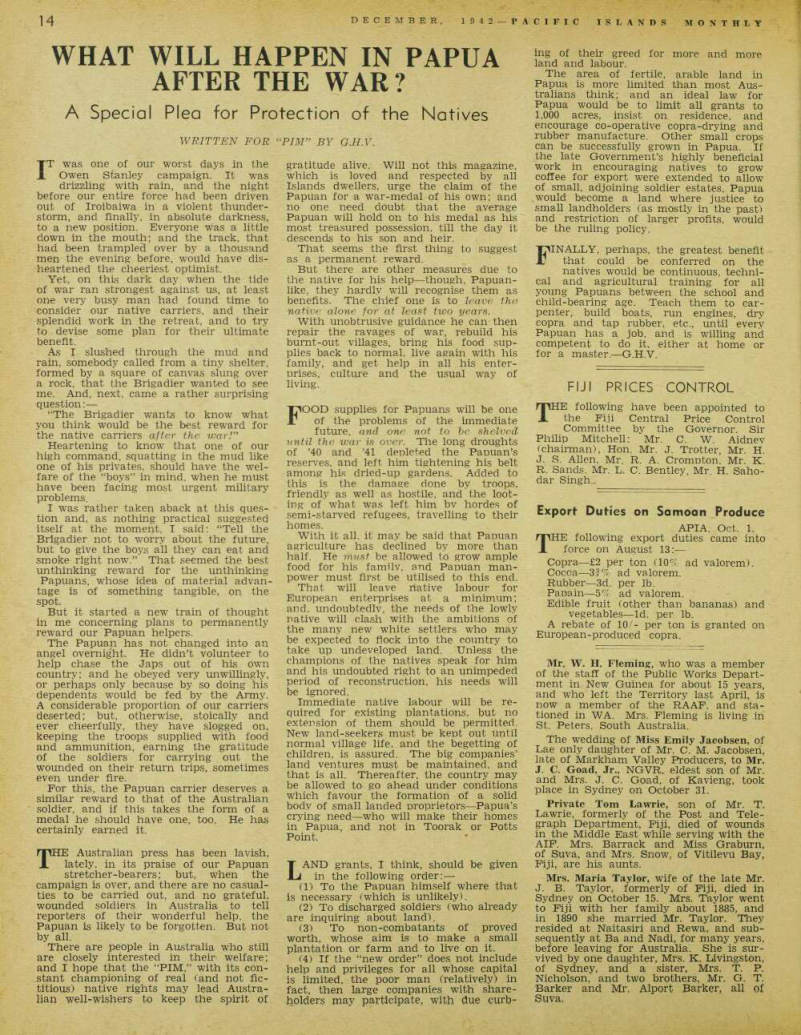
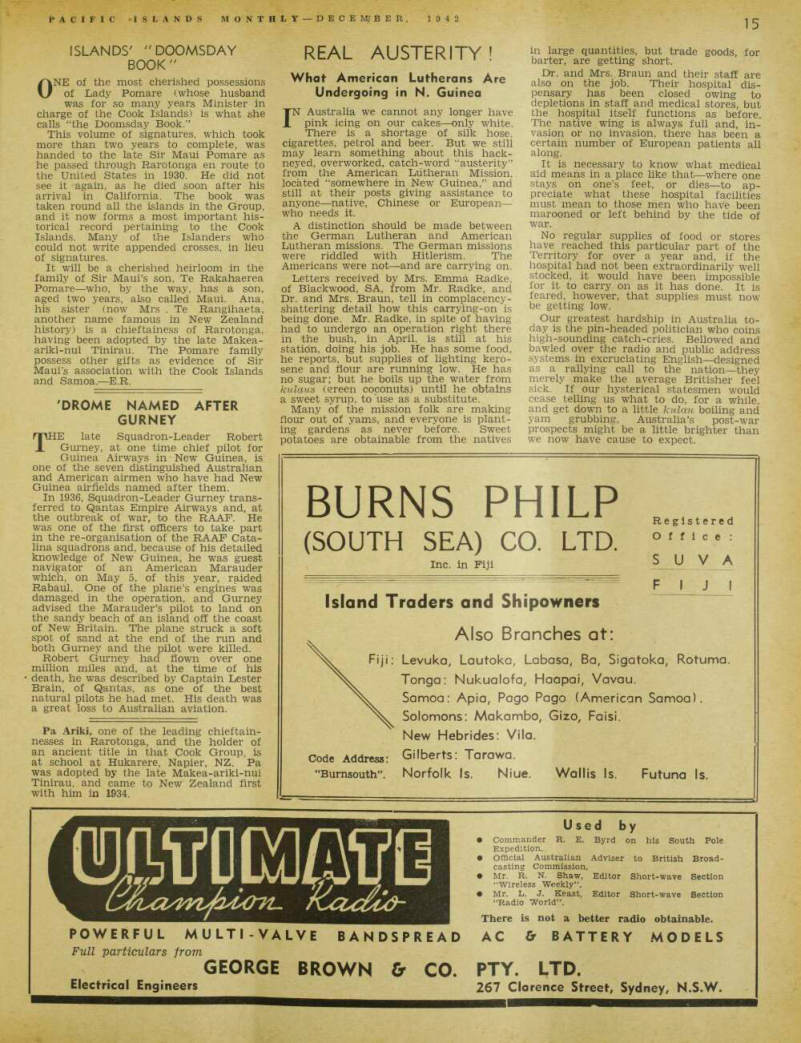
Lists of British People Caught by War in Malaya, Borneo and East Indies
THE Malayan Research Bureau, of 8a Castlereagh Street, Sydney (tele phone B 5257) has issued the follow ing devised list of civilians who were reported, upon fairly reliable authority, to have been in Malaya, Borneo or the Netherlands East Indies at the time of the capitulation of Singapore and Java.
The list is not complete, nor can it be taken as absolutely reliable in every par ticular, but at the time of the capitula tion it was substantially accurate.
That there is such a list of civilians missing from Indonesia is due to Mrs. C.
G. Howell, wife of the Attorney-General of the Straits Settlements (who is now interned in Formosa), and her voluntary assistants at the Malayan Research Bureau, which she established in July, 1942.
As the Japanese, to date, have failed to supply a list of their prisoners in occupied areas, the Bureau decided to gather—while details were still fresh in the minds of evacuees—facts relating to missing persons; and, by sifting and cor relating them, to arrive at some idea of what had happened to these people.
Much information has been gathered from those who left the occupied areas just prior to, or immediately after, the capitulation, and from those who escaped some time after the Japanese had taken possession; and in this way much valu able evidence has been pieced together.
A questionnaire also was sent to all evacuees known to have reached Austra lia, and persons who left Singapore ten days before the evacuation were asked to give a list of all civilians and volunteers who had remained in the city or who, alternately, had expressed a determina tion to leave. Evacuees who had left for Sumatra on boats which were bombed or wrecked, or who got safely through, were asked to give details of any persons whom they recognised on the ship, or subse quently, in Sumatra or Java.*’
The full story of the fall of Malaya and Singapore, and the evacuation from that area, will, when it is written, prove to be one of the most tragic episodes in the history of the British nation. How many people died in the flight by sea from Singapore will not be known until after the war, but there seems to be no doubt that the toll was ghastly, and that the Japanese claim to have sunk many small ships was not exaggerated. How ever, there have been manv cases where information, given to the Research Bureau and ■ placed together like the pieces of a jig-saw puzzle, has proved that someone who was given up for dead is alive and well.
Following are the names:—
Seen Safe and Well in Singapore
After Capitulation
Allen, G. C., Posts and Telegraphs.
Allin, —, Bousteads.
At kinson. A., Trade School, Kuala Lumpur.
Bagot, E., Inspector General of Police, FMS.
Barbour, G., Singapore Traction Co.
Barbour, R. G., Singapore Traction Co.
Barker, —., Corp., FMSVF.
Barton, J. F., SRA Volunteers.
Bath, V., broker.
Baxter, —, Corp., FMSVF.
Bean, G., Malay Tin Dredging.
Beaton, G. M., Malay Tin Dredging.
Billing, A. G., Survey Department.
Blakely, —, Alliance Engineering Co.
Booker, G. A. W., Dunlop Rubber Co.
Booth, McV., Survey Department.
Boreham, G. H., Ross Taylor & Co. Ltd.
Brown, T. W., Agric. Department.
Bruce, —, Mines Department.
Burgess, G., Art. Sup.
Burke, P. J., Osborne & Chappel.
Burne, E. C., Malayan Tin Dredging.
Caddy, J. 8., mining engineer, Perak.
Caldwell, F. A. S., Police.
Chalmers, —, planter.
Chaplin, E., Guthries & Co.
Cheeseman, H. A. R., Education Department.
Clemetson, J. G., GEC, Ipoh.
Coates, P. V., Adjutant, FMSVF.
Coltart, G. M., SRA Vol.
Coltart, M., Capt., FMSVF.
Cooper, C. W. K., Customs Department.
Cooper, W. A., Posts and Telegraphs.
Craig, A. D., Survey Department.
Crisp, D., GEC.
Crooks, D., SRA Vol.
Crooks, 0., chemist, Maynards, Volunteers.
Crosbie, —, late Christmas Island.
Cuthbe, K. V., Municipality, Singapore.
Cuthbe, Mrs. K. V.
David, —, Pacific Tin.
Dav, C. M., Pte., SS Volunteers.
Denholme, —, Lieut., Ist Malay Regt.
Desch, H. E., Forest Department.
Downe, P., Rubber Restriction.
Durant, C. C. L., Forestry Department.
East, F. G., Malayan Publishing House.
Eastman, L. H.. Sergt.-Major, FMSVF.
Edminston, —, Sime Darby.
Ellsworth, A., Henry Waugh & Co.
Evans, D. K., APC Volunteers.
Farraday, —, Malayan Tin Dredging.
Fennie, R. J., United Engineers.
Flavin, B. N., Posts and Telegraphs.
Floor, J. J. A., BPM.
Forbes, D., planter.
Forster, C., Education Department.
Fotheringham, —, MTD.
Fraser, J. M., Capt., Singapore Imp. Trust.
Fyfe. A. R., Municipality.
P.O.W, card received.
Gale, J. K., lawyer. SRA.
Garlick, D., United Engineers.
Gates. C. E., Education Department.
Gee, D., Osborne & Chappel.
Gerrie, —, Selangor.
Gibson, F. S., Mansfields.
Ginsberg, —, Sergt, SSVF.
Goddard, J., planter, Johore.
Good, A. C., Police.
Goult, G., Malay Mail, Kuala Lumpur.
Greer, W., engineer, SRA.
Griffin, A. S.. Survey Department.
Grose. W. F., M. Tobacco Dist.
Growder, A. C., Regent Sports Store.
Grundy, H. D., Education Department.
Gulliford, M. W., Guthries.
Hannay, —, Gnr., SRA Vol.
Hatcher. T. C. P.. Gnr,, SRA Vol.
Hayes, Lieut., FMSVF.
Henderson, Graham, planter, Port Dickson, Capt. B. Coy.
Henly, R. 8., North British Insu ranee Co.
Hilling, BPM.
Hilterman, —, SRA. Brinkmanns.
Himelv. L. S., Survey Department.
Hodgkins, J. 8., John Littles.
Home, Dr. B. F., Snpt. Mental Hos., Singanore.
Hoseason, W. S.. Nth. Brit. Insurance, Sgt. SRA.
Hoops, R. M., APC.
Hough. SRA Vol.
How**'! C. G., Attorney-General.
Officially reported in 3rd Branch Camp, Taiwan, Formosa.
Ingham, —, Sapper, FMSVF.
Inglis, J. G., Corp., FMSVF.
Ingram, J., Malayan Tin Dredging.
Irving, G. C., Survey Department.
Isherwood, R. J., Cpl., SSV.
Jackman, —.
Jackson, —, and Mrs., Gnr„ SRA Vol, Johnston, J. J., planter, Johore.
Jarrett, Norman, MCS.
Johnston, T. S., Kodak.
Jones, A. 0., Mansfields.
Jones, —, Searchlight Battery.
King, J. E., Harrisons Barkers.
King, S. N., MCS.
King, Major, SSV.
Kirkpatrich, S. M., planter, Kota Tinggi.
Kitching, T.
Langley, E. H., Sime Darby & Co.
Lanks, Major, lawyer, Kuala Lumpur.
L’Esterre, Darby, Malay Regiment.
Lilly, A. H. W.
Linehan, Dr., W., Education Department.
Lorimer, J, G., planter and LDC.
Mackenzie, I. Mac Don., Russel & Co.
Mackie, G. H., Mines Department.
Majoribanks, —, lawyer, Kuala Lumpur.
Maxwell, A. M., planter, NS.
Mcßain, G., Tronoh Mines.
McDougall, G., acct., KL, FMSVF.
McGubbin, —, PWD, Gnr. SRA.
McNab, John, Sergt., FMSVF.
McVilley, Brooke, Survey Department.
Mechie, —, Ipoh Tin.
Mee, B. S., Forestry Department.
Miller, Andy, MTD.
Milne, Dr. Coutts.
Moffat, —, Cpl., Vols., MTD.
Moirtigne, —, Osborne & Chappel.
Morgan, W. S., school teacher.
Morgan, —, Lieut., B. Coy., planter.
Morris, N. G., Police.
Morris, V. J. C.. Wakefield & Co.
Morrish, Major, Johore Police.
Morrison, D., Ritchie & Bissett, SRA.
Munro, A. R., planter.
Murnane, D. J., Municipality.
Mustard, A., planter, Singapore Special Police, Nassim, A., broker.
Neyland, 8.. Posts and Telegraphs.
Nicholson, Archie, planter, Johore.
O’Hare, —, Signals Volunteers.
Oppenheim, L. A., engineer, Palmer and Turner Ormiston, P. V., FMSVF.
Overall, Alan, William Jacks.
Parsons, J., John Littles.
Parry, H. M., planter, NS.
Peacock, —, B. Coy., FMSVF.
Powell-Evans, V. W., Police.
Preston, Col., Mysore Regiment.
Prynn, L, P., Police, dayman, Lazarus, Municipality.
Reed, K., Electricity Dept., Kuala Lumpur.
Reeves, L., engineer, SRA.
Reid, F. F., MTD.
Rich, R. M. S., Ist Malay Regiment.
Richards, C. G., Municipality.
Richardson, —, Bom., SRA Volunteers.
Riches, C. F. M., planter.
P.O.W. card received.
Rintoul, D., ICI.
Robertson, R., Kepong Tin.
Roncon, —, SRAV Searchlight Battery.
Ross, —, SRAV Searchlight Battery.
Rowell, G. L., Mines Department, Kuala Lumpur, Ryves, H. T. B.
Sadler, —, Osborne & Chappel Seth, K., barrister, Singapore, Sewell, B. F. A., Singapore Improvement Trust.
Shamroff, —, Pacific Tin.
Sharif, —, NZ Insurance Co.
Sharp-Smith, M., Selangor.
Shears, A. G.
Sherwood, —, Cpl., SSVF.
Shrubshall, E. S., Forestry Department.
Simpson, —, FMSVF.
Smith, —, SRAV, Smith, Major, MMG Coy., FMSVF.
Smith, E, V., Police.
Snelling, V., Booty & Edwards.
Stephenson, —, CSM, FMSVF.
Stogdon, J., P. & O. SN, Singapore.
Stubbs, G. C., Survey Department.
Sullivan, C. F., Police.
Sullivan, F., A. Coy., FMSVF.
Sworder, G. H., Survey Department.
Thane, Colin.
Thane, Mrs.
Thane, Miss Pamela.
Thoms, —, Capt. Vols., Mansfields.
Thompson (Tommy), FMSVF, Selangor.
Thorne, A., lawyer, Singapore.
Thornton, C., Lieut., FMSVF.
Todd. —, FMSVF.
Tokeley, E. C., Bousteads.
Tooke, W. A., Survey Department.
Turcan, J. P., Paterson Simons.
Urquhart, Mat., MTD.
Wade, R. H. D., H. & S. Bank, Malacca.
Wakeford, —, SRA Vol.
(Continued on Page 39)
Wall, W., Dunlops.
Wallace, T, E., Paterson Simons.
Wallen, —, Lieut., SSV.
Ward, —, Petaling Tin.
Ward, H. L., Survey Department.
Watkins, W. H., VF, Perak.
Webb, Rev. A., Kuala Lumpur.
Webb, C. G.. Raffles’ College.
Webber, W. R., Johore.
Webster, —, Wearne Bros.
Weisberg, H., Financial Secretary.
Wentworth, —, Rubber Restriction.
Weyman, —, PWD.
White, —, Pte., SSVF.
White, —. Capt., SSVF (NS).
Whitehead, P. M., Derrick.
Williams, —, Sime Darby.
Williams, Roy, FMSVF.
Wilson, D., Municipality, Sergt.-Major, SRA.
Willmott, J., Patersons Simons, SRA.
Windsor, E. P., Col., planter, NS.
Woodcock, C., Derrick & Co., Gnr., SRA.
Woolmer, S. C., Singapore Improvement Trust.
Wright, W. J., Whitesway Laidlaws.
Wright, J. W., Remington Rand. Inc.
Wright, —, planter, Papan, Lieut., Mysore Reg.
Young, —, Pte., B. Coy.
Seen in Singapore on February 15
Bailey, Lincoln, Capt., Attached Maley Reg.
Bain, J., Education Department.
Baird, J., Capt., FMSVF. MTD.
Ball, W. C. D., Municipality.
Bannerman, —.
Barnard, H. J., Police, FMS.
Benham, J. E., Survey.
Booth, I. C., Survey Department.
Billet, Rube, trainer.
Bruce, R. K. A., Survey Department.
Bunnens, E. T. J., Police.
Burgess, 8., B. Coy., FMSVF.
Burnham, J.
Cameron, M. F., Survey Department.
Clark, G. M., United Engineers.
Couper, A. D., surveyor.
Cullen, A., Municipality.
Freeman, H. 8., United Engineers.
Gurney, G. J., Education Department.
Ince, R. E., Education Department.
Jerram, G. L., Capt.
Leonard, R. F. W., Mansfields.
Mills, R. T., planter, SSV Armoured Cars.
Moffat, W., Tronoh Mines.
O’Sullivan, T. A., Inspector of Schools.
Richardson, D., Mansfields.
Stitt, S. 1)., MTD, accountant.
Taylor, J., engineer, Taiping.
Believed to Have Remained in
Singapore
Adams, Rev. R. K. S., headmaster, St. Andrew’s School, Singapore.
Anderson, W., Boustead & Co.
Ambler, C. P., stockbroker, Fraser & Co.
Babu, Rev., SPG, Tamil Congregation.
Baillie, J., Asst. Sec., Singapore Turf Club.
Bainbridge, Capt. Frank, Salvation Army.
Bain, Dr. M. C., Gleeny & Bain.
Barton, J. E., APC and Volunteers.
Bishop, A. D., Sarawak Oilfields.
Bourne, W. J., Sarawak Oilfields.
Bennitt, Rev. A. J., SPG.
Brown, J. McL, accountant, Hongkong & Shang hai Bank.
Brown, J. A. H., Fielding & Brown.
Browning, H. A., Hongkong & Shanghai Bank.
Burn, Adj. (Miss) M., Sal. Army (from Canada).
Burton, W. L., Anglo-French Bendixon.
Burnham, J., S. Govt. Trade Liaison Officer, Sarawak.
Caldbeck, R. Roper, manager, Bousteads.
Carmichael, J., merchant.
Charlwood, J. W., Sarawak Oilfields.
Cherry, C. R., director, Bousteads.
Choppin, R., Singapore Harbour Board.
Clark, Nurse Muriel, SPG.
Clements, G., Secretary, Golf Club.
Connell, J. C. F., Hongkong & Shanghai Bank, and Volunteers.
Colchester, G. F. C., APC, and Volunteers.
Cottrill, Capt. Stan., Salvation Army.
Cox, 0., stockbroker.
Cruikshank, 8., manager, Harrisons, Barker.
Cruickshank, I. J. 0., Hongkong & Shanghai Bank.
Davenport, J. S., Hongkong & Shanghai Bank.
Davidson, Major, Charles, Salvation Army.
Davies, H. C. D., Hongkong & Shanghai Bank.
Day, W. H., broker.
Dickinson, A. H., Inspec.-Gen. of Police, SS.
Dingle, W. H., APC, and Volunteers.
Donnel, J., and Mrs., broker.
Doyle, T. W., Hongkong & Shanghai Bank.
Eales, Rev., Malacca.
Elliott, Dr. Patricia Ruth, SPG.
English. Dr. J., Medical Department.
Esson, W., Boustead & Co.
Forbes, J., Vet. Officer, Municipality.
Galloway, Sir David, medical practitioner.
Garside, T. F., APC and Local Defence Corps.
Geeson, W., planter.
Gibson, F. S., Mansfield & Co.
Godwin, H., director, Anglo-French.
Grey, Major (Miss) 8., Salvation Army.
Grebby, L., APC and Volunteers.
Graham-White, Rev. & Mrs., Archdeacon, S’pore.
Guy, S. F., Hongkong & Shanghai Bank.
Hanna, Dr. T., dentist.
Harvey, Major Fred., Salvation Army (Penang).
Hayter, Rev., J. C. E., SPG.
Hebling, A. W., Hongkong & Shanghai Bank.
Heron, Dr. J., medical practitioner.
Hoops, H. M., APC and Volunteers.
Hutchings, L. A. C., manager, Robinson & Co.
Jenkin, C., and Mrs., P. & O. SS Co.
Jenkin, H., director, Hong Ho. SS Co.
Jennings, C. F., APC and Volunteers.
Johnson. J., director, McAlister Co.
Johnson, Keith, Police Officer.
Jones, C. McL., Hongkong & Shanghai Bank.
Jordan, Adj. and Mrs., Salvation Army.
Kennedy, L. D., Comm. Trade Customs, SCS, Sarawak.
King, Adj. Harold, Salvation Army.
Knight, L.. Police Officer.
Lawrence, J., eng., Singapore Harbour Board.
Lee, Rev. John, Chinese Priest, Singapore.
Lee, R. W., Hongkong & Shanghai Bank.
Llewellyn, H. G., APC and Volunteers.
Long, j. S., APC and ARP.
Lord, Lieut.-Col. Herbert A., Salvation Army.
Lowe, A., Govt. Boarding Officer.
MacGugan, F. J., Hongkong & Shanghai Bank.
Mann, I. G. R., Hongkong & Shanghai Bank.
Martine, T. C., manager, Borneo Coy.
Mathews, Adj. Harold, Sal. Army (Malacca).
Menzies, W., engineer.
McLeod, Capt. J. C., and Mrs., Deputy-Master Attendant.
Mills, M. E. H. G., Hongkong & Shanghai Bank.
Mitchell, L. M., APC and Volunteers.
Moffat, E. M., Hongkong & Shanghai Bank.
Moloney, D. 8., APC and Volunteers.
Moseley, A. G. A., APC and Volunteers.
Niven, C. A., Secretary, Singapore Turf Club.
Nonweiler, E. R., APC and Volunteers.
Ng, Rev. Hoh Leh, SPG, Hokein Cong.
Ormston, F. R., manager, Hongkong & Shanghai Bank, Kuala Lumpur.
Partridge, A. E. J., Hongkong & Shanghai Bank.
Parr, Rev., master, St. Andrew’s School, S’pore.
Payne, H., solicitor.
Pegler, G. F. J., SCS, Sarawak.
Perrott, W. R. S., APC and Volunteers.
Pepys, W. E., Liaison Officer, NB and Sarawak.
Perry, L., Boustead & Co.
Pierpont, J., planter.
Pittman, W. H., APC and Volunteers.
Price, Adj. William, Salvation Army.
Raikes, J. H., Hongkong & Shanghai Bank.
Ralston, G. G., Hongkong & Shanghai Bank.
Riches, E. J., McAlister & Co.
Robertson, Mrs. D. S., APC.
Robertson, L. G., Hongkong & Shanghai Bank.
Robinson, Comm., C., DSO, Master Attendant.
Robinson (Mrs.) C., Dr., General Hospital.
Robinson, C. R., broker. Day & Co.
Rodger, W., Straits Trading Co.
Rodger, Mrs., Sister, General Hospital.
Russell, J., Police Department.
Self, M., William Jacks.
Scott. Rev. E. H., SPG.
Scott, M. D., Hongkong & Shanghai Bank.
Scoular, E. M., APC and Volunteers.
Smith, Dr. H., medical practitioner.
Stephen, V., broker.
Stringfellow, G. F., Hongkong & Shanghai Bank.
Stewart, E. A., director, William Jacks.
Soul, D. V., Hongkong & Shanghai Bank.
Stodgen, D. H., P. & O. SN Co.
Stone, J. H., stockbroker.
Stott, J., Stott & Co.
Sutherland, J. C., Hongkong & Shanghai Bank.
Sutherland, W. J., Hongkong & Shanghai Bank.
Taylor, L. V., APC and Volunteers.
Thompson, G. G., Hongkong & Shanghai Bank.
Thompson, Rev., SPG. Penang.
Thornton, L. P. H., APC and Volunteers, Todd. R. F. U., APC and Volunteers.
Travers, G., Hongkong & Shanghai Bank.
Turner, M. W., Hongkong & Shanghai Bank.
Wade, R. D., Hongkong & Shanghai Bank, Vol.
Walford, L., APC and Volunteers.
Duncan-Wallace, A. M., Hongkong & Shanghai Bank.
Waller, G. G., Hongkong & Shanghai Bank.
Walters, J. C., Hongkong & Shanghai Bank.
Wakefield, F., engineer, PWD.
Watson, T., APC and Volunteers.
West. J. V., APC.
Wilkinson, Adj. E., Salvation Army.
Willan, H. 8., Hongkong & Shanghai Bank.
Williamson, R., solicitor.
Williamson, Dr. A. D., Medical Department.
Willis, Capt. (Miss) E., Salvation Army.
Wilson, J., stockbroker.
Wilson, Rt. Rev. J. L., Bishop of Singapore.
Wilson, R., Officer, Johore Government.
Wilson, Mrs. R., Mansfield & Co.
Winter, H. 8.. tailor.
Wood, G APC and Volunteers.
Worley, Mr. Justice, Supreme Court.
Yip, Rev., SPC, Cantonese Congregation.
Yoxall, D., Hongkong & Shanghai Bank.
Believed to Have Remained in
British Borneo
Abernethy, J. S., wife and two children, legal adviser.
Abbott, R. S., Administrative.
Adams, Col., MC, W. C., and wife, Com. Police.
Adams, D. R. C., Administrative.
Ailson, companion, SPG.
Aikman, R. G., Under-Secretary.
Allen, Dr. C. P., Malay Medical Services.
Anderson, L, C., chartered accountant.
Archer, J. 8., late Chief Secretary.
Ashworth, Miss E.
Atkinson, Capt. J. 8., wife & child, Adj., Police.
Banks, E., curator. Museum.
Barrett, R., planter.
Bate, Miss, Nurse-Matron.
Bather, —, planter.
Bauw. Dr., and wife, MO (German ref.).
Baxter, J. R., planter.
Beatty, J.. wife & child, manager, State Railways.
Beers, —, planter.
Belton, 0., planter.
Bentham, V. M., and wife, Harrisons & Crosfields.
Bettison, R. J., Customs.
Bidmead, D. E., Rubber Restrictions.
Bidmead, P. W., electrical engineer.
Bishop, H., and wife, Government Engineer.
Bomphrey, E., Island Trading Co.
Bonheim, Dr. E., Government Dentist.
Brewer, J. D., and wife, Rubber Controller.
Broadbank, A. J. D., and wife. Customs Com.
Broadhurst, Miss M. L., Malayan Nursing.
Brookes, —, Administrative.
Brown, Father D. A. W., SPG.
Brown, —, Forest Department.
Brown, J. C., planter.
Byron, H. G., planter.
Carlton, Miss, SPG.
Chan, Dr., and English wife, medical prac.
Chin, Rev. Poo Yin, SPG.
Chisholm, J. S., Administrative.
Clapham, Dr. M. J., MMS.
Clark, Dr. M. C., MO.
Goldman, E. F., and wife, Chicle Co. of NY.
Coleman, J. A., planter.
Collard, W. A., planter.
Collier, Rev. S. M., SPG.
Cook, J., Agric., Brunei.
Cousens, E. W., Sarawak Treasury.
Coward, R. H., planter.
Craw'ford, —, Coastal Patrol Officer.
Crosland, —, planter.
Daubeny, R. L., Resident, IV Division.
Dee, A. R., planter.
Del Clifford, G.. Brunei.
Deuntzer, Dr., MO.
Digby, K. H., Legal Adviser.
Dingle, J., Administrative.
Drake-Brokman, J. F., Cadet, SCS.
Edge, M. G., Lieut., Police.
Etienne Yu, and French wife.
Evans, Ivor, anthropologist.
Evans, R. F., and wife, Resident, W. Coast.
Falconer, J., planter.
Fenton, —, and wife. PMG.
Field, G. A. C., A/Comm. Trade & Customs.
Fletcher. H., BBF Co.
Gibson, Mrs. A. W. G., Med. Officer, ARP.
Graham, D., wife and two children, Harrisons Crosfield.
Graham, Dr. G. M., Brunei.
Graham, J., marine engineer.
Gray, G. L., wife and mother, Govt. Secretary.
Greenslade, Mrs., nil.
Hall, S. G., wife and child, Administrative.
Hall, W. G., Administrative.
Hawkins, H. E., wife and two children, MBT Co.
Headley, —, Administrative.
Hemming. W., Harrisons Crosfield.
Henderson, Miss E. A., Malayan Nursing Service.
Henderson, Capt. J., Rubber Restriction.
Henderson, J. A.. PWD, Labaun.
Henthorne, Rev. H., SPG.
Hollis, Right Rev. F., Bishop of Labaun and Sarawak.
Hood, J. G., Bakau Co.
Horn, C. 8., Borneo Co.
Houston, Capt., J. A., and w'ife, Director, PW.
Humphrey, A. P. H.. MCS, Labruan.
Humphries, —, planter.
Hunt, H., Bakau Co.
Ingate, G., and wife, independent.
Irene, companion, SPG.
Jacques, H., Government pensioner.
Jefferson, T. J., SOL.
Johnson, H. C., solicitor.
Johnson, R., Treasury.
Jones, R. C., Harrisons Crosfield.
Jones, R. F., and wife, planter.
Jones, —, Administrative.
Keir, A., Director Education.
Keith, H. G., wife and child, Cons. Forests.
Kidd, G. D., and wife, planter.
Kirkwood, R., Post Department.
Kratzenstein, —, and wife, medical practitioner
(German refugees).
Laband, Dr., dentist (German refugee).
Larkins, G. W. L., BBT Co.
Lascelles, D. R., Admin., SCS.
Legros-Clark, C. D., Chief Secretary, SCS.
Le Sueur, Dr. E., S. Medical Service.
Liem, Dr., and English wife.
Lingard, M., planter.
Link, Dr., and wife, hospital dispenser (Ger man refugee).
Littlejohn, —, planter.
Locke, J., and wife, planter.
Logan, —, Railways.
Longfield, J. E., Administrative.
Lowry, W., Customs, SCS.
Lucas, N. A., Borneo Co.
Ludgate, H., and wife, Harrisons Crosfield.
Lutter, R. 8., planter.
Lyon, J., Treasury. —, Administrative. ]>Jacßryan, Mrs. G. T. M., nil.
MacDonald, D.. planter.
Mackay, A., SOL.
Majoribanks, Dr. E. M., late SCS.
Malcolm, J. K. S., BBT Co.
Martin, W., Police, Brunei.
Massie, J., State Bank.
Mavor, G., and wife, Power Co.
Maw, D., planter.
McArthur, Dr., and family, malaria expert.
McGechan, R., and wife, planter.
McGechan, 8., Rubber Restriction.
McLaren, J. C., planter.
McLeod, D., Bakau Co.
Mercer, Rev. B. A. M., SPG.
Mercer, J. A. C., BBT Co.
Miles, C. L., Borneo Co. Forests.
Miller, —, and wife, planter.
Miller, (Kaminis), planter.
Mitchell, J., and wife and child, manager, Har risons Crosfield.
Moffat, G., and wife*, Treasury.
Montgomery, J. G., planter.
Morris, J., and wife, planter.
Munro, T. J. C., planter.
Noakes, J. L., Secretary for Defence.
North, Miss M., nurse-matron.
O’Connor, Dr,, & Mrs., MP, Malaya Med. Service, Packwell, J., planter.
Palmer, P. F., planter.
Parnell, H. C., BBT Co.
Paterson. A. 8., PWD, Brunei.
Payne. F. L., planter.
Pengilley, E. E., MCS, Brunei.
Penlington, J. F., and wife, Treasury.
Peralta, —, and wife (Portuguese), planter.
Phillips, H. E., manager, NBT Co.
Phillips, W., Sarawak Constabulary.
Quartermaine, 1., Treasury.
Read, H., planter.
Ricketts, 0., Government pensioner.
Riddell, W., and wife, planter.
Robertson, G., Administrative.
Robinson, F. G., and wife, BBT Co.
Rogers, P. A., Visiting Agent.
Rice-Oxley, DFC, Major F., Police.
Round-Turner, Capt. C. D., Police.
Rowlands, —, Police.
Rutter, R. A., and wife, Resident E. Coast.
Scott, J., trader.
Selous, E. M., Secretary, Chinese Affairs.
Simpson, J. 8., trader.
Skinner, E. W., Government pensioner.
Smallfield, E., surveyor.
Smelt, W. A. C., Treasurer.
Smallfield, J., Administrative.
Smith, CMG, C. R., Governor.
Speedy, T. S. J., and wife, Surveyor-General.
Sproson, —, wife and tw r o children, Railways.
Sternfield, Dr., med. practitioner (German ref.).
Stevens, V., and wife and child, planter.
Stonton, Rev. A. E.
Stookes, Dr. V. A., medical practitioner.
Stookes, Dr. E., lady medical practitioner.
Summers, W., independent.
Sykes, E. 0., and wife and two children, Administrative.
Tait, W. G., and wife, Postmaster-General.
Taylor, A. G., Government Auditor.
Taylor, J. A., planter.
Taylor, Dr. J. T., and wife, PMO.
Thompson, H., planter.
Tidbury, H., and wife, BBT Co.
Tregarthen, Dr., and family, MO.
Tuxford, Dr., and wife, medical practitioner.
Tuxford, G. S., planter.
Vanvein, —, (Dutch), planter.
Vaughan, , BBT Co.
Veitch, —, planter.
Wales, C. A., planter.
Walker, H. J.. planter.
Wands, Dr., and wife and child , MO.
Ward, W. G. R., Rubber Reg. Department.
Ward, —, planter.
White, D. C., District Officer, Administrative.
Wills, G. P., Brunei.
Wilson, —, planter.
Wookey, J. K., Administrative.
Woolley, G. C., Government pensioner.
Wrenn, F. H., and wife, planter.
Yin Can Po, Rev., SPG.
Young, W. A. S., Bakau Co.
Youngberg, —, SDA Mission.
List of British Subjects and Others
Believed to be in Netherland East
Indies
Aitkenhead, C., and wife, planter.
Allen, —, BAT, Cheribon.
Allen, —, and wife and children, Gen. Motors, Batavia, sub. Bandoeng.
Andrews, Miss, SPG.
Armit, —, Anglo-Dutch Plantations, Soebang.
Baker, —, Wattle & Co., Sourabaya.
Bannerman, J., H. & Crosfields, Java.
Barker, O. G., planter, Sumatra.
Barnes, A. A., planter, Sumatra.
Baron, H., and wife, Gjeelman & Steeup, Batavia.
Bates, G. T., and family, late Borneo Co., , Sarawak.
Beekhuis, Lieut.-Comm. Arend, and Mrs., Salva tion Army (Dutch).
Bender, E. S., and wife, retired in Java.
Benson, —, and wife, Pitcairn Syme & Co. Ltd., Batavia.
Bonheim, Mrs. E., and son, wife, Government Dentist, Sarawak.
Bridgwood, 8., and wife, McAuliffe, Turquend, Youngs & Co., Batavia.
Brouwer, Major (Miss) Melattie, Salvation Army (Dutch).
Bruce, H., planter, Sumatra.
Bryant, R. R., Cable & Wireless Ltd., Batavia.
Butter, McN., wife and two children, private broker, Batavia, sub. Soekaboemi.
Cameron, G. S., planter, Sumatra.
Campbell, A., planter, Sumatra.
Carpenter, Major (Miss) Ellen, Salvation Army.
Cassells, W., and wife, planter, Sumatra.
Castles, Mrs., Haligas Estate, Sumatra.
Clarke, C. L., planter, Sumatra.
Coates, —, Cable & Wireless, Banjoewangi.
Coatup, —, Levers Zeep Fabrick, Batavia.
Cockburn, T. S., Chartered Bank, Batavia.
Collett, —Anglo-Dutch Plantations, Soebang.
Constable, W. I. M., planter, Sumatra.
Cookson, W. S., schoolmaster, Brastagi.
Cookson, Lynn (son of above), Brastagi.
Cornforth, —, Anglo-Dutch Plantations, Soebang.
Crighton, —, British Con. General, Bandoeng.
Cruikshank, D. S., Francis Peek & Co., Batavia.
Cullen, Major (Miss) Agnes, Salvation Army.
Davis, —.
Day, —, Burns Philp, Surabaya.
Delves, —, Ross, Taylor & Co. Ltd., Surabaya.
Digby, Major Nellie, Salvation Army.
Edwards, Ch., Hongkong & Shanghai Bank, Batavia.
Elliott, F. C., planter, Wonokio Estate.
Escuensier, —, Surabaya.
Fenton, R., and wife, Harrison & Crosfields, Java.
Fillis, —, and mother, marionette showman, Batavia.
Finlayson, G. A., and wife, Harrison & Crosfields, Sumatra.
Fletcher, —, Anglo-Dutch Plantations, Soebang.
Floor, J. J. A., BPM.
Forbes, D., and family, Surabaya.
Frankel, H., Batavia.
Fraser, A. S., Harrison & Crosfields, Sumatra.
Fraser, L., Harrison & Crosfields, Sumatra.
Garland, Francis Peek & Co. Ltd., Surabaya.
Gardiner, —.
Geddes, Mrs., and two children, Sumatra.
Geddie, —, Harrison & Crosfields, Sumatra.
Geerling, Mr., and family, Surabaya.
Gibson, —, employee of Oteva, Batavia.
Gow, D., Goodyear Tyre & Rubber Co., Buiten rorg.
Gray, D. C., Harrisons & Crosfields, Sumatra.
Greeuw, J., Harrisons & Crosfields, Java.
Grieve, J., Maintz Production, Handel, Batavia.
Gutwirth, A., Batavia.
Hall, T. H., Harrison & Crosfields, Sumatra.
Halliday, —, and wife, Surabaya.
Hambrook, —, and wife, Harrison & Crosfields, Sumatra.
Hamman (Ginger), Anglo-Dutch Plantations, Soebang.
Harper, —, Harrison & Crosfields, Batavia.
Hartman, F., Dunlop & Kolff, Surabaya.
Hay, T. C., Harrison & Crosfields, Sumatra.
Henderson, John, Cables & Wireless, Banjoe wangi.
Henderson, W. C., Harrison & Crosfields, Sumatra.
Hildebrandt, E., and wife, Tjondong Est., Ganset, Java.
Hill, —, McAuliffe, Turquand & Co., Surabaya.
Hilling, —, BPM.
Hiorth, Brig. Frederick, and wife, Salvation Army (Norwegian).
Hogg, —, Pitcairn Syme & Co., Surabaya.
Hughes, A. W., Chartered Bank, Batavia.
Irens, J., Harrison & Crosfields, Batavia.
Jackson, —, Anglo-Dutch Plantations, Soebang.
Jenkins, O. S., Harrison & Crosfields, Sumatra.
Johnson, —, Manu. Life Ass. Co., Surabaya.
Johnson, —, and family, Surabaya.
Kelty, J. J., Harrison & Crosfields, Sumatra.
Kerr, J. W., Harrison & Crosfields, Sumatra.
Resting, J. F., and wife, Reiss & Co., Batavia.
Kirkwood, Dr., NEI.
Knight, —, and Mrs., BAT, Surabaya.
Krickenbeck, S., Gen. Motors, Batavia, sub. Solo.
Kruschwitz, Brig. (Miss) Martha, Salvation Army (American).
Kyle, Major (Miss) Agnes, Salvation Army.
Langley, H. G., Francis Peek & Co. Ltd., Batavia.
L’Angellier, —, and wife and daughter, Francis Peek & Co. Ltd.
Laws, R. G., planter, Sumatra.
Lawrie, T. D., Tandjong Morawa, Medan, Sumatra.
Lebbink, Gerrit, Lieut.-Col., and wife, Salvation Army (Dutch).
Leckie, —, Anglo-Dutch Plantations, Soebang.
Lengyel, —, and wife and daughter, director,
Teerlink van Dorsten & Co., Bandoeng.
Leslie, —, and wife, Anglo-Dutch Plantation, Soebang.
Lewis, L. R., planter, Sumatra.
Loois, Brig., and wife, Salvation Army (Dutch).
Lorier. Major, and wife, Salvation Army (Dutch).
Lulops, Miss Mary Veney, Sumatra.
Lulops, Mrs. Saan, Sumatra.
Lulops, Sicco, planter, US Rubber Co., Sumatra.
Lungley, G., Francis Peek & Co., Batavia.
Lydall, W. H., Hongkong & Shanghai Bank, Batavia.
Alacintosh, —, and wife and child, General Motors, Batavia, sub. Solo.
Mackie, —, Anglo-Dutch Plantations, Soebang.
Macmorran, TEt., Levers Zeejj Fabrick, Batavia.
Maddocks, G. H., Harrison & Crosfields, Sumatra.
Martin, L. R., Dunlops, Bandoeng.
Matherson, A. E., Harrison & Crosfields, Sumatra.
Matherson, I. R., Harrison & Crosfield, Samatra.
Mayhew, T., Medan, Sumatra.
McConnell, W. J., Hongkong & Shanghai Bank, Batavia, McGregor, —, Ross, Taylor & Co. Ltd., Batavia.
McLean, N. M., Java.
McLeod, H. C., Harrison & Crosfields, Sumatra.
Meade, N., Wellenstein Crause & Co., Batavia.
Meijer, Bourke, Brig., and wife, Salvation Army (Dutch).
Milne, —, Harrison & Crosfields, Sumatra.
Mitchell, J. F., Harrison & Crosfields, Sumatra.
Montford, Mrs., and family, BAT, Surabaya.
Moss, A., Maclaine Watson, Batavia.
Muir, G. W., and wife, Harrison & Crosfields, Sumatra.
Munro, A. N., Harrison & Crosfields, Sumatra.
Munro, D. M., Harrison & Crosfields, Sumatra.
Murray, R., Harrison & Crosfields, Sumatra.
Nuttall, M., Dunlops, Bandoeng.
Palstra, Major Frank, and wife, Salvation Army (Dutch).
Paton, G. J., Harrison & Crosfields, Sumatra.
Penfold, A., Chartered Bank, Batavia.
Pepper, Miss G., Surabaya.
Pickering, R. C., Heath & Co., Batavia.
Pool, A., Stoomvaart Mijocean, Batavia.
Pope, —, and wife, Surabaya.
Powell, —, and family, Surabaya.
Powell, F., General Motors, Surabaya.
Powell, Mrs. (British), manageress, Box Flats, Batavia.
Pratt, C. 8., Pare Pare Estate, Sumatra.
Preston, —, Anglo-Dutch Plantations, Soebang.
Price, S., and wife, insurance agent, Bandoeng.
Pryce, D. M., Heath & Co., Batavia.
Rae, W. W., Hongkong & Shanghai Bank, Batavia.
Ramaker, Major, and wife, Sal. Army (Dutch).
Reinecke —, and wife, Surabaya.
Riach, —, Harrison & Crosfields, Sumatra.
Ridley, —, BAT, Sumatra.
Robinson, S, A., Harrison & Crosfields, Sumatra.
Robinson, Major (Miss) Selina, Salvation Army.
Roed, Major, and wife, Sal. Army (Norwegian).
Rofe, J. N., Harrison & Crosfields, Batavia.
Rowley, —, broker, Surabaya.
Ryder, —, Cable & Wireless, Batavia.
Schiotling, W. 8., Rubber Reg. Dept., Sarawak.
Scott, R. L., Maclaine Watson, Batavia.
Selby, R. J., Medan, Sumatra.
Seth, Mrs., and .family, Surabaya.
Shaw, G. R., Harrison & Crosfield, Sumatra.
Shedden, T. C., Medan, Sumatra.
Simmons, —, Harrison & Crosfields, Sumatra.
Sladden, J., Cables & Wireless, Batavia.
Smart, D., and wife and child, Harrison & Cros fields, Donowari.
Smith, —, Wattle & Co., Surabaya.
Smith, G., and wife, DeKock Sparks & Co., Bandoeng.
Smith, R. V., Queensland Insurance, Batavia.
Smith, Mrs., Highlands School, Sumatra.
Smits, Mrs. R. E., and daughter, Red Cross Service, Bandoeng.
Sparkes, C., and wife, DeKock Sparks & Co., Bandoeng.
Speirs, —, and wife, BAT, Cheribon.
Starkey, —, and wife, NEON, Batavia.
Stevens, C. P., Cables & Wireless, Batavia.
Stevenston, —, Goodyear Rubber, Buitenzorg.
Strachan, C., Harrison & Crosfields, Sumatra.
Stubbs, H. N., owner of motor, factory, Surabaya.
Swanson, H. D., Chartered Bank, Batavia.
Teerlink, —, Teerlink Van Dorsten & Co., Batavia.
Thom, J., Harrison & Crosfields, Sumatra.
Thompson, —, estate manager, Surabaya, Thomson, G. P. G., planter, Sumatra.
Toby, Mrs. E. B. C. A., Sumatra.
Todd, K. L., and family, Queensland Insurance Co., Surabaya.
Valois, M. C., Capt., KPM, Batavia.
Van der Vloodt, BPM, Java.
Van Dorsten, —, Teerlink Van Dorsten & Co., Batavia. * Van Haaften, JVlrs. W. J., Medan, Sumatra.
Van Hasselt, W., BPM, Java, Van Kamthout, Miss Hettie, BPM, Surabaya.
Van Liempt, J. M., Malayan Breweries, Singapore.
Van Oosten, —, BPM.
Viehoff, N. C., planter, Sumatra.
Waine, G., Harrison & Crosfields, Batavia.
Walker, —, and wife, Borneo, Sumatra, HM, Batavia.
Walker, G. 8., Wilkinson Process.
Walter, T. E., Forest Department, Sarawak, Ward, W., Rowley Davis & Co., Batavia.
Warren, M., Fraser, Eaton & Co., Surabaya.
Wemyss, —, Dalok Estate, Sumatra.
Williams, —, and family, Surabaya.
Williams, R., Harrison & Crosfields, Sumatra.
Witsen, E., and wife, Surabaya.
Woodward, Leonard, Brig., Salvation Army.
Wright —. and family. Mager & Co., Surabaya.
Wright, P., Ross, Taylor & Co., West Java.
Young, Harding, Ari., and wife and children, Salvation Army (Bandoeng).
Youngdall, Miss Elsa, American Methodist Mission.
Last Seen in Java or Sumatra
Aitkin, G., and wife, planter.
Alston, R. A., Agricultural Department, KL, Arnest, —, Forestry Department.
Barden, H., Eastern Bank, Singapore.
Bird, A. W 7.. planter.
Black, R. 8., MCS, Singapore.
Boudville, Miss M., nurse.
Bustraam, C., Anglo-Oriental Co.
Bustraam, M. J., manager, tin mine.
Brightwell, G. W., Thos. Cook, Singapore.
Broek, Van Den, —, doctor, Singapore.
Brooks, Mrs. A. C., nursing sister, Singapore.
Brown, Gordon, engineer, FMSR.
Burrows, —.
Burt, Gordon, APC.
Cairns, J.. and child, Penang Municipality.
Cameron (Stanky), planter, Caledonia.
Carruthers, W. J-, Anglo-Oriental.
Chamion, Miss, QA Nursing Service.
Chattaway, Sq.-Leader, MVAF, Singapore.
Clarke, B. S.
Coglan (aged 16), RAF.
Corbett, A., Borneo Motors, Singapore.
Corrigan, Harohi, Gopeng, Perak.
Crocker, —, MVAF.
Crowe, Mi ss E., surgeon, Gen. Hos., Singapore.
Dailey, J. D., Police, Kuala Lumpur.
Dalleart, —, and wife, manager, KNILM, S’pore.
Dane, Capt. H., Perak River Hydro, Perak.
Daut, A. D., Sime Darby.
Davies, D. J., PWD.
Dubiez, Peter, and wife and two children.
Dennis, —, Singapore.
Dickson, —, nurse.
Dickson, Mrs., QAIMNS.
Dimmitt, A. W. J., civil engineer, Singapore.
Docker, C. E., Cables & Wireless, Penang, late Singapore.
Donough, Mrs., Nurse.
Doughty, Mrs. Kuala Lumpur.
Doughty, Miss A., Kuala Lumpur.
Doyle, J. A., Java.
Elliott, J. V., naval engineer.
Elliott, F. C., planter, Wonokoio Estate.
Elton, —.
Eustace, 0., ICI, Singapore.
Faber, M. H., APC, Singapore.
Farwell, —, steward at Government House.
Feaks, —, Cables & Wireless, Singapore.
Flinter, M., diamond merchant, Penang.
Floor, J. J. A., BPM.
Footner, C. C., Singapore Harbour Board.
Geizen, J., and wife, KPM Co., Singapore.
Giles, Rev., Padre, RAF.
Godfree, J. H. W., planter, Mjiar.
Hartley, Miss, Tapah Rest House.
Harvey, M. G., Fl.-Lieut., MVAF, Singapore.
Hawkins, C. R., PWD.
Henderson, D. W., Chart’d Bank, Kuala Lumpur.
Housley, Stuart, attached RAF, Singapore, James, H. M., Aust. Estates, Seremban, NS. . .
Jenkins, Miss, nurse, QAIMNS.
Jessmine, J. E. 8., planter.
Joaquim, J. P., Fed. Motors, Kuala Lumpur.
Jones, L. K., Elec. Department, joined RAF.
Keech, A. 8., planter.
Kitsell, —, MVAF, Kuala Lumpur.
Keene, J., Asst. Elec. Eng., Elec. Dept., FMS.
Krysmulder, W. 8., and wife, marine engineer, APC, Singapore.
Lamsen, —. Perak.
Landsdefl, J. R., Ciistoms Department.
Larsson, S. (Swedish), Singapore Harbour Board.
Lawson, P. D. L., Customs Dept., Singapore.
Lubbock, E. R., Singapore Harbour Board.
Lundon, —, Swah Maclaren, Singapore.
Lyon, Dr. (Miss M. J.), doctor, Gen. Hospital, Johore, Bahru.
Mack, —, P/O, MVAF, Perak.
Mackenzie, —, nurse.
Malmanche, Mrs. E. V. de, husband Singapore Harbour Board.
Mantiel, —, and wife, NTS Bank, Singapore, MJitchell, H. W.
McCormack, —, Brown, Philips & Stewart, Ipoh.
McDonald, —, Taxation, Kuala Lumpur.
McDuflf, Mrs., Ipoh, Perak.
McLaren-Reid, C., Customs Dept., FMS.
McNaughton, Mrs. J.
McNiven, —, planter, Selangor.
O’Hare, T. V., tin miner, Siam.
Oliver, E., supt., Taiping.
Osborne, —, PWD.
Page, H. J., director, RRI, Kuala Lumpur.
Parsons, H. A., planter, Selangor.
Payne, J. T., mine manager, Perak.
Plunkett, W. R., PWD, Malaya, Prentis, Miss, nursing sister.
Reed, K., Electrical Department, FMS.
Rees, S. T., Sime, Darby, Singapore.
Riches, —, Lieut., RNVR.
Roberts, Mrs. F., Ipoh.
Robertson, —, APC, Penang.
Robinson, —, MVAF.
Ross, J. B. , Mercantile Bank, Singapore.
Samuel, J. G., Maclean Watson, Singapore.
Samuel, C. R., lawyer, Penang.
Sargent, Mrs., Duff, Dev. & Co.
Scobie-Nicholson —, Major, Censor, Singapore.
Scott-Ram, H., APC, Singapore.
Scott-Taylor, E., and wife, United Engineers.
Scott, —, APC.
Shearn, E. D., lawyer, Kuala Lumpur.
Shute, R. F., Mines Department.
Skey, G. W., Lieut., SSV, Smart, L. M., and wife.
Smith, L., and wife, Cables & Wireless.
Springthorne, J., SHB.
Smith, S. E., planter, PW.
Steele, W. M„ C., FMSR.
Stewart, Mrs. Helen, VAD.
Stiff, F. G., Straits Trading.
Stokes, D. P.. Customs.
Sturt, H., APC.
Stubbs, Capt. W., P. T. Department.
Sylvia, —, child from Malaya.
Talbot, G., tin miner, Perak.
Travers, G.. planter, Perak.
Truby, —, United Engineers.
Tweedie, M. W. F., Raffles’ Museum, Singapore.
Vanrennen, F. C., planter, Kuala Kangsar.
Viner, R.
Waddell, —, PWD.
Wait, R. T., Penang.
Walker, Mrs. “Frankie,” Bousteads.
Welborne, J., Police.
Residents of Malaya
Officially Reported P.O.W. In Korea
David, E. 8., 2nd Lieut.
Greig, A. L. M., Lieut.
Griffin, A. 8., 2nd Lieut.
Takeman, R. W., Lieut.
Wilson, Hubert, Pte.
Unofficially Reported P.O.W. By
Colonial Office
Coltart, G. M., lawyer.
Fesq, E. M., planter, Selangor.
Groves, J. A., Paramount Pictures.
P.O.W. Cards Received From:
lomaron. A. C., MCS.
Boissier, G. D., Osborne & Chappel.
Bigelow, N., Henry Waugh & Co., Penang.
Iriam, T. J., RAOC.
De Buriatte, B. A., lawyer, Penang.
Mulligan, E., Drainage & Irrigation.
Price, E. J., Anglo-Oriental.
Lyne, R., YMCA.
Gilmour, A., MCS.
Dove, W. G., South British Insurance Co.
Simpson, Dr. I. A., Medical Research KL.
Watson, I. A., medical practitioner.
Owen-James, D. D., planter.
October 10 was the 68th anniversary of the Cession of Fiji to Great Britain, on October 10, 1874. At Levuka, the chiefs and Sir Hercules Robinson signed the Deed which ceded the sovereignty of the islands to Great Britain.
The intensification of Fiji’s war-effort has now got as far as the Government offices. Employees, from October 6, were required to work one extra hour daily.
They commence at 8 a.m., instead of 9 a.m., but lunch-hour and closing-time will be unchanged.
Matron Olive Angermunde, who had resided in Fiji for the past seven years, is now in charge of Strathmore Private Hospital, Cambridge Street, Stanmore, Sydney, Pilot-Officer Geoffrey Silva, who was awarded the DFC recently for “gallantry and devotion to duty” in air operations in Europe (where he is serv ing with the RAAF) is related to Matron Angermunde—her daughter is Mrs. H. F.
Silva, and Mr. H. F. Silva (assayer at Loloma gold-mines in Fiji) is a brother of the young pilot-officer.
Mr. E. E. Steeples, who was in charge of the police at Wau prior to the Japanese invasion, now holds the rank of lieutenant in the Australian Army. He clings to the hope, however, that he will soon re ceive a call to the Australian and New Guinea Administrative Unit. Mr. T.
Prince, also a well-known resident of Morobe, whom we met recently in Sydney, also is eager to be back in some sort of a job in New Guinea, and is pinning his hopes to ANGAU.
Aviator Ray Parer, of New Guinea (who was heard of some months ago, when he decided to join the merchant navy, because no other warlords would listen to his pleas) is again in flying kit, and as a pilot-officer, expects to be on his way north shortly. There he may do some blitzing of his own, to avenge his brother Kevin, killed in the first Jap raid on Salamaua. Bob Parer, Ray’s brother, who was a skilled aircraft engineer before he branched out as a miner at the Black Cat, and a keeper-of-freezers at Wewak, TNG. has reverted to his first profession and is now foreman-engineer at an aircraft production factory in Mel bourne. Bemie and Fons, of the other branch of the Parer family, are awaiting orders to go north to join ANGAU.
Mr. Guy Gemmell-Smith, of the Colo nial Sugar Refining Company, Sydney, received word in November that his son, Sergeant Robert Gemmell-Smith, RAF. was a prisoner of war in Bengazi, Libya.
Before his enlistment in the air force.
Sergeant Gemmell-Smith was employed by the Colonial Sugar Refining Company in Fiji. He was born in the Colony and, in the family tradition begun by his grandfather (who was at one time gen eral manager of CSR in Fiji), he joined the CSR service. Lieutenant G. A. Gem mell-Smith, of the AIF, who was in the siege of Tobruk, and was mentioned in despatches, is a brother. In view of the Eighth Army’s rapid advance into Libya, the position of Allied prisoners taken in the desert and not sent to POW camps in Europe, is an interesting one. There are grounds for hoping that these lads will not be long in enemy hands.
Sir Walter McNicoll, KBE, CB, DSO (Administrator of New Guinea) and Lady McNicoll, Hon. H. W. Champion, CBE (Papua), Mr. H. E. Standage (of Shang hai), and several notable officers of the United States Army were the guests of the Pacific Islands Society on November 30.
Prince Tubuatoa, heir to the throne of Tonga, has been receiving congratula tions and best wishes for his future hap piness on the eve of his departure from Sydney for Tonga, where he is shortly to be married. The young Tongan noble has not only been a successful student at the University of Sydney, where he has gained academic distinction—his charming personal qualities have gained for him countless friends.
The Fiji Defence Force will probably be known soon as the “Fiji Military Forces.’- A Bill dealing with the matter has been prepared for the Legislative Council.
Advertisements & other items, p. 14 (1 item)
Wanted To Buy
BACK COPIES OF “PACIFIC
ISLANDS MONTHLY.”
ANNUAL REPORTS OF BRITISH
NEW GUINEA AND PAPUA.
All Issues.
Write first to PAUL A. DORN, 1247 So. La Brea, Los Angeles, U.S.A.
Samoa Booming
High Rates for Produce
From Our Own Correspondent
Apia, Oct. 15.
WESTERN Samoa, under war condi tions, is, in spite of war restrictions and emergency regulations and the very high ever-increasing cost of living, still one of the most fortunate countries, not only of the Pacific area, but prob ably of the whole world.
Prices of our agricultural products are very satisfactory at present, as fixed by the Government; and native copra and cocoa producers are enjoying higher rates, after the past lean years.
European producers are in a less for tunate position, as they are faced with a very pronounced shortage of plantation labour, and with considerably increased wages for any native labour they are able to obtain.
Natives, especially on Savaii and the south and east coasts of Upolu, are busy cutting copra; and, with the higher rates ruling the natives’ purchasing power has greatly increased. Unfortunately, there exists at the same time an acute shortage of goods, particularly foodstuffs and clothing: and this shortage is marked in the trading stations in country districts outside of Apia. So the situation here is now similar to that in USA, Australia and New Zealand—people have plenty of money, but nothing to spend it on.
For clothing, apparel and drapery we now depend almost entirely on imports from the United States —which, with the high rate of exchange, are very exnensive to land. But people are quite willing to pay almost anything to get what they want.
It is expected that cocoa exports from the Territory will increase, owing to large areas of native cocoa plantations coming into bearing in all the districts of Upolu and Savaii. This is one of the reasons for the gradual decrease of banana pro duction, as many European and Samoan planters have inter-planted their bananas with cocoa, and are giving up banana cultivations as the cocoa comes into bear ing.
Native banana-growers in Western Samoa will benefit by the recent decision of the Administration, to increase the nrice of exported fruit by 6d. per case.
They will now receive a clear 5/6 per case—cases and transport to the wharf are free to native exporters. European growers, on the other hand, have the expense of both cases and transnort.
Apart from cocoa, copra and bananas, smaller quantities of other products have been exported—taro, yams, bananas, and vegetables (to American Samoa), paw paws, avocadoes, pineapples, charcoal, desiccated coconut, hides, tomatoes, and native curios (mainly basket ware) to New Zealand.
The price of bananas shipped to New Zealand has been increased from 5/- to 5/6 per case.
While sufficient supplies of flour and sugar and canned meats are available for local consumption, there are at present shortages of rice (Australian), matches and canned fish, which are staple lines of native consumption. Gasoline and kerosene are strictly rationed, and per mits for essential services have to be obtained from the Food Controller, Mr.
D. R. Eden. While the residents of Apia are mostly using' electric light provided by the Hydro-Electric Scheme, Europeans and natives in outside districts are hard hit.
Mr. R. Crompton, CBE, KC, has been re-appointed to the Executive Council of Fiji, for a further term of two years.
Advertisements & other items, p. 15 (1 item)
Horlicks
■ Y appointment
Horlicks is Ideal
for Emergency Rations
For emergencies, with the addition of water only, Horlicks is a complete food, providing warmth and energy, body-building and tissue-repairing material.
Even after it has been opened Horlicks will keep in perfect condition indefinitely if the top is firmly replaced. W'?
It would be difficult to find a more valuable food to keep by in case of emergency.
HORLICKS
After The War?
What Will Happen In Papua
A Special Plea for Protection of the Natives
Wkitten For “Pim” By G.H.V.
IT was one of our worst days in the Owen Stanley campaign. It was drizzling with rain, and the night before our entire force had been driven out of Iroibaiwa in a violent thunder storm, and finally, in absolute darkness, to a new position. Everyone was a little down in the mouth; and the track, that had been trampled over by a thousand men the evening before, would have dis heartened the cheeriest optimist.
Yet, on this dark day when the tide of war ran strongest against us, at least one very busy man had found time to consider our native carriers, and their splendid work in the retreat, and to try to devise some plan for their ultimate benefit.
As I slushed through the mud and rain, somebody called from a tiny shelter, formed by a square of canvas slung over a rock, that the Brigadier wanted to see me. And, next, came a rather surprising question:— “The Brigadier wants to know what you think would be the best reward for the native carriers after the war!”
Heartening to know that one of our high command, squatting in the mud like one of his privates, should have the wel fare of the “boys” in mind, when he must have been facing most urgent military problems.
I was rather taken aback at this ques tion and, as nothing practical suggested itself at the moment, I said: “Tell the Brigadier not to worry about the future, but to give the boys all they can eat and smoke right now.” That seemed the best unthinking reward for the unthinking Papuans, whose idea of material advan tage is of something tangible, on the spot.
But it started a new train of thought in me concerning plans to permanently reward our Papuan helpers.
The Papuan has not changed into an angel overnight. He didn’t volunteer to help chase the Japs out of his own country; and he obeyed very unwillingly, or perhaps only because by so doing his dependents would be fed by the Army.
A considerable proportion of our carriers deserted; but, otherwise, stoically and ever cheerfully, they have slogged on, keeping the troops supplied with food and ammunition, earning the gratitude of the soldiers for carrying out the wounded on their return trips, sometimes even under fire.
For this, the Papuan carrier deserves a similar reward to that of the Australian soldier, and if this takes the form of a medal he should have one, too. He has certainly earned it.
THE Australian press has been lavish, lately, in its praise of our Papuan stretcher-bearers; but, when the campaign is over, and there are no casual ties to be carried out, and no grateful, wounded soldiers in Australia to tell reporters of their wonderful help, the Papuan is likely to be forgotten. But not by all.
There are people in Australia who still are closely interested in their welfare; and I hope that the “PIM,” with its con stant championing of real (and not fic titious) native rights may lead Austra lian well-wishers to keep the spirit of
gratitude alive. Will not this magazine, which is loved and respected by all Islands dwellers, urge the claim of the Papuan for a war-medal of his own; and no one need doubt that the average Papuan will hold on to his medal as his most treasured possession, till the day it descends to his son and heir.
That seems the first thing to suggest as a permanent reward.
But there are other measures due to the native for his help—though, Papuan like, they hardly will recognise them as benefits. The chief one is to leave the native alone for at least two years.
With unobtrusive guidance he can then repair the ravages of war, rebuild his bumt-out villages, bring his food sup plies back to normal, live again with his family, and get help in all his enter prises, culture and the usual way of living.
FOOD supplies for Papuans will be one of the problems of the immediate future, and one not to he shelved until the war is over. The long droughts of ’4O and ’4l depleted the Papuan’s reserves, and left him tightening his belt among his dried-up gardens. Added to this is the damage done by troops, friendly as well as hostile, and the loot ing of what was left him bv hordes of semi-starved refugees, travelling to their homes.
With it all. it may be said that Papuan agriculture has declined by more than half. He must be allowed to grow ample food for his family, and Papuan man power must first be utilised to this end.
That will leave native labour for European enterprises at a minimum: and, undoubtedly, the needs of the lowly native will clash with the ambitions of the many new white settlers who may be expected to flock into the country to take up undeveloped land. Unless the champions of the natives speak for him and his undoubted right to an unimpeded period of reconstruction, his needs will be ignored.
Immediate native labour will be re quired for existing plantations, but no extension of them should be permitted.
New land-seekers must be kept out until normal village life, and the begetting of children, is assured. The big companies’ land ventures must be maintained, and that is all. Thereafter, the country may be allowed to go ahead under conditions which favour the formation of a solid body of small landed proprietors—Papua’s crying need —who will make their homes in Papua, and not in Toorak or Potts Point, LAND grants, I think, should be given in the following order:— (1) To the Papuan himself where that is necessary (which is unlikely). (2) To discharged soldiers (who already are inquiring about land). (3) To non-combatants of proved worth, whose aim is to make a small plantation or farm and to live on it. (4) If the “new order” does not include help and privileges for all whose capital is limited, the poor man (relatively) in fact, then large companies with share holders may participate, with due curb
ing of their greed for more and more land and labour.
The area of fertile, arable land in Papua is more limited than most Aus tralians think; and an ideal law for Papua would be to limit all grants to 1,000 acres, insist on residence, and encourage co-operative copra-drying and rubber manufacture. Other small crops can be successfully grown in Papua. If the late Government’s highly beneficial work in encouraging natives to grow coffee for export were extended to allow of small, adjoining soldier estates, Papua .would become a land where justice to small landholders (as mostly in the past) and restriction of larger profits, would be the ruling policy.
FINALLY, perhaps, the greatest benefit that could be conferred on the natives would be continuous, techni cal and agricultural training for all young Papuans between the school and child-bearing age. Teach them to car penter, build boats, run engines, dry copra and tap rubber, etc., until every Papuan has a job, and is willing and competent to do it. either at home or for a master. —G.H.V.
Fiji Prices Control
rE following have been appointed to the Fiji Central Price Control Committee by the Governor. Sir Philip Mitchell: Mr. C. W. Aidnev (chairman), Hon. Mr. J. Trotter, Mr. H.
J. S. Allen. Mr. R. A. Crompton, Mr. K.
R. Sands. Mr. L. C. Bentley, Mr. H. Saho dar Singh..
Export Duties on Samoan Produce
Apia, Oct. 1.
THE following export duties came into force on August 13;— Copra—£2 per ton (10% ad valorem).
Cocoa —31% ad valorem.
Rubber —3d. per lb.
Panain—s% ad valorem.
Edible fruit (other than bananas) and vegetables—ld. per lb.
A rebate of 10/- per ton is granted on European-produced copra.
Mr. W. H. Fleming, who was a member of the staff of the Public Works Depart ment in New Guinea for about 15 years, and who left the Territory last April, is now a member of the RAAF, and sta tioned in WA. Mrs. Fleming is living in St. Peters, South Australia.
The wedding of Miss Emily Jacobsen, of Lae only daughter of Mr. C. M. Jacobsen, late of Markham Valley Producers, to Mr.
J. C. Goad, Jr.. NGVR, eldest son of Mr. and Mrs. J. C. Goad, of Kavieng, took place in Sydney on October 31.
Private Tom Lawrie, son of Mr. T.
Lawrie, formerly of the Post and Tele graph Department, Fiji, died of wounds in the Middle East while serving with the AIP. Mrs. Barrack and Miss Graburn, of Suva, and Mrs. Snow, of Vitilevu Bay, Fiji, are his aunts.
Mrs. Maria Taylor, wife of the late Mr.
J. B. Taylor, formerly of Fiji, died in Sydney on October 15. Mrs. Taylor went to Fiji with her family about 1885, and in 1890 she married Mr. Taylor. They resided at Naitasiri and Rewa, and sub sequently at Ba and Nadi, for many years, before leaving for Australia. She is sur vived by one daughter, Mrs. K. Livingston, of Sydney, and a sister, Mrs. T. P.
Nicholson, and two brothers, Mr, G. T.
Barker and Mr. Alport Barker, all of Suva.
Islands' "Doomsday
Book"
ONE of the most cherished possessions of Lady Pomare (whose husband was for so many years Minister in charge of the Cook Islands) is what she calls “the Doomsday Book.”
This volume of signatures, which took more than two years to complete, was handed to the late Sir Maui Pomare as he passed through Rarotonga en route to the United States in 1930. He did not see it again, as he died soon after his arrival in California. The book was taken round all the islands in the Group, and it now forms a most important his torical record pertaining to the Cook Islands. Many of the Islanders who could not write appended crosses, in lieu of signatures.
It will be a cherished heirloom in the family of Sir Maui’s son, Te Rakahaerea Pomare —who, by the way, has a son, aged two years, also called Maui. Ana, his sister (now Mrs . Te Rangihaeta, another name famous in New Zealand history) is a chieftainess of Rarotonga, having been adopted by the late Makea ariki-nui Tinirau. The Pomare family possess other gifts as evidence of Sir Maui’s association with the Cook Islands and Samoa. —E.R.
'Drome Named After
Gurney
rE late Squadron-Leader Robert Gurney, at one time chief pilot for Guinea Airways in New Guinea, is one of the seven distinguished Australian and American airmen who have had New Guinea airfields named after them.
In 1936, Squadron-Leader Gurney trans ferred to Qantas Empire Airways and, at the outbreak of war, to the RAAF. He was one of the first officers to take part in the re-organisation of the RAAF Cata lina squadrons and, because of his detailed knowledge of New Guinea, he was guest navigator of an American Marauder which, on May 5, of this year, raided Rabaul. One of the plane’s engines' was damaged in the operation, and Gurney advised the Marauder’s pilot to land on the sandy beach of an island off the coast of New Britain. The plane struck a soft spot of sand at the end of the run and both Gurney and the pilot were killed.
Robert Gurney had flown over one million miles and, at the time of his death, he was described by Captain Lester Brain, of Qantas, as one of the best natural pilots he had met. His death was a great loss to Australian aviation.
Pa Ariki, one of the leading chieftain nesses in Rarotonga, and the holder of an ancient title in that Cook Group, is at school at Hukarere, Napier, NZ. Pa was adopted by the late Makea-ariki-nui Tinirau, and came to New Zealand first with him in 1934.
Real Austerity!
What American Lutherans Are Undergoing in N. Guinea
IN Australia we cannot any longer have pink icing on our cakes—only white.
There is a shortage of silk hose, cigarettes, petrol and beer. But we still may learn something about this hack neyed, overworked, catch-word “austerity” from the American Lutheran Mission, located “somewhere in New Guinea,” and still at their posts giving assistance to anyone—native, Chinese or European— who needs it.
A distinction should be made between the German Lutheran and American Lutheran missions. The German missions were riddled with Hitlerism. The Americans were not —and are carrying on.
Letters received by Mrs. Emma Radke. of Blackwood, SA, from Mr. Radke, and Dr. and Mrs. Braun, tell in complacency shattering detail how this carrying-on is being done. Mr. Radke, in spite of having had to undergo an operation right there in the bush, in April, is still at his station, doing his job. He has some food, he reports, but supplies of lighting kero sene and flour are running low. He has no sugar; but he boils up the water from kulaus (green coconuts) until he obtains a sweet syrup, to use as a substitute.
Many of the mission folk are making flour out of yams, and everyone is plant ing gardens as never before. Sweet potatoes are obtainable from the natives
in large quantities, but trade goods, for barter, are getting short.
Dr. and Mrs., Braun and their staff are also on the job. Their hospital dis pensary has been closed owing to depletions in staff and medical stores, but the hospital itself functions as before.
The native wing is always full and, in vasion or no invasion, there has been a certain number of European patients all along.
It is necessary to know what medical aid means in a place like that—where one stays on one’s feet, or dies—to ap preciate what these hospital facilities must mean to those men who have been marooned or left behind by the tide of war.
No regular supplies of food or stores have reached this particular part of the Territory for over a year and, if the hospital had not been extraordinarily well stocked, it would have been impossible for it to carry on as it has done. It is feared, however, that supplies must now be getting low.
Our greatest hardship in Australia to day is the pin-headed politician who coins high-sounding catch-cries. Bellowed and bawled over the radio and public address systems in excruciating English—designed as a rallying call to the nation—they merely make the average Britisher feel sick. If our hysterical statesmen would cease telling us what to do, for a while, and get down to a little kulau boiling and yam grubbing, Australia’s post-war prospects might be a little brighter than we now have cause to expect.
Advertisements & other items, p. 17 (2 items)
15
PACIFIC -ISLANDS MONTHLY DECEM/BEfi, 1942
Burns Philp
(SOUTH SEA) CO. LTD.
Inc. in Fiji Island Traders and Shipowners Registered Office :
SUVA
FIJI
\\ Also Branches at: Fiji: Levuka, Lautoka, Labasa, Ba, Sigatoka, Rotuma.
Tonga; Nukualofa, Haapai, Vavau.
Samoa: Apia, Pago Pago (American Samoa).
Solomons: Makambo, Gizo, Faisi.
New Hebrides: Vila.
Code Address: Gilberts: Tarawa.
“Burnsouth”. Norfolk Is. Niue. Wallis Is. Futuna Is.
M u m / nm Used by • Commander R. E. Byrd on his South Pole Expedition. • Official Australian Adviser to British Broadcasting Commission. • Mr. R. N. Shaw, Editor Short-wave Section “Wireless Weekly”. • Mr. L. J. Keast, Editor Short-wave Section “Radio World”.
There is not a better radio obtainable.
POWERFUL MULTI-VALVE BANDSPREAD
Full particulars from
GEORGE BROWN & CO.
Electrical Engineers
AC & BATTERY MODELS
PTY. LTD.
267 Clarence Street, Sydney, N.S.W.
Isles Of Tragedy
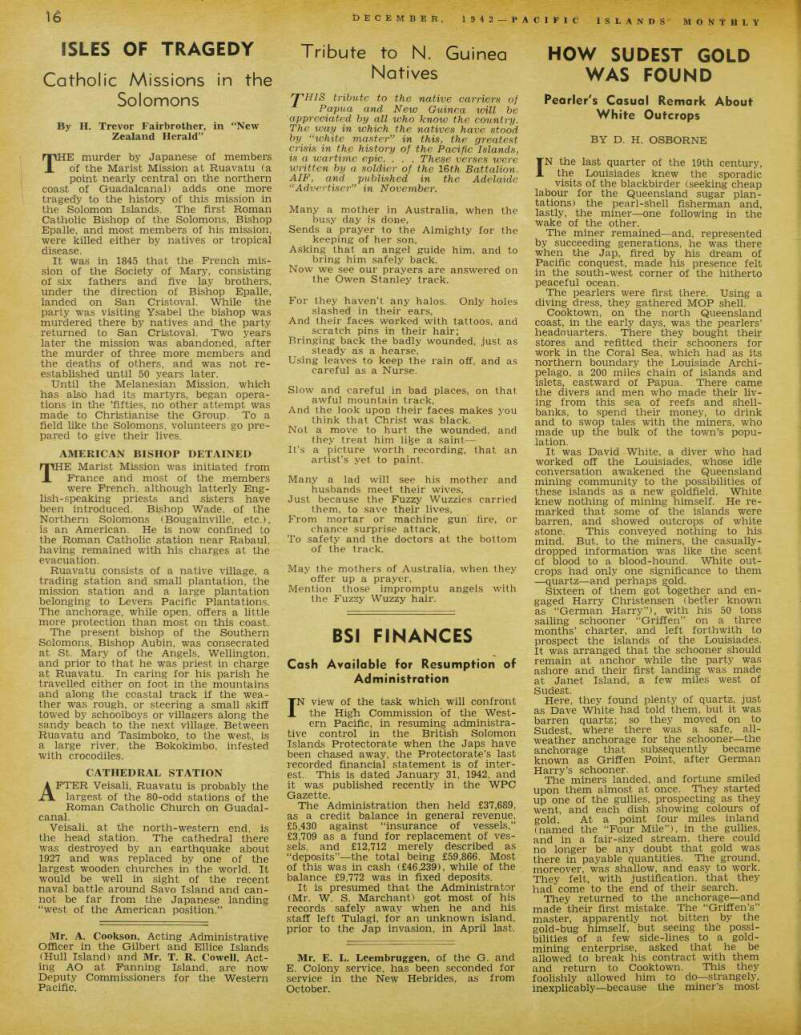
Catholic Missions in the Solomons
By H. Trevor Fairbrother, in “New Zealand Herald”
THE murder by Japanese of members of the Marist Mission at Ruavatu (a point nearly central on the northern coast of Guadalcanal) adds one more tragedy to the history of this mission in the Solomon Islands. The first Roman Catholic Bishop of the Solomons, Bishop Epalle, and most members of his mission, were killed either by natives or tropical disease.
It was in 1845 that the French mis sion of the Society of Mary, consisting of six fathers and five lay brothers, under the direction of Bishop Epalle, landed on San Cristoval. While the party was visiting Ysabel the bishop was murdered there by natives and the party returned to San Cristoval. Two years later the mission was abandoned, after the murder of three more members and the deaths of others, and was not re established until 50 years later.
Until the Melanesian Mission, which has also had its martyrs, began opera tions in the ’fifties, no other attempt was made to Christianise the Group. To a field like the Solomons, volunteers go pre pared to give their lives.
American Bishop Detained
THE Marist Mission was initiated from France and most of the members were French, although latterly Eng lish-speaking priests and sisters have been introduced. Bishop Wade, of the Northern Solomons (Bougainville, etc.), is an American. He is now confined to the Roman Catholic station near Rabaul, having remained with his charges at the evacuation.
Ruavatu consists of a native village, a trading station and small plantation, the mission station and a large plantation belonging to Levers Pacific Plantations.
The anchorage, while open, offers a little more protection than most on this coast.
The present bishop of the Southern Solomons, Bishop Aubin, was consecrated at St. Mary of the Angels, Wellington, and prior to that he was priest in charge at Ruavatu. In caring for his parish he travelled either on foot in the mountains and along the coastal track if the wea ther was rough, or steering a small skiff towed by schoolboys or villagers along the sandy beach to the next village. Between Ruavatu and Tasimboko, to the west, is a large river, the Bokokimbo, infested with crocodiles.
Cathedral Station
AFTER Veisali, Ruavatu is probably the largest of the 80-odd stations of the Roman Catholic Church on Guadal canal.
Veisali, at the north-western end, is the head station. The cathedral there was destroyed by an earthquake about 1927 and was replaced by one of the largest wooden churches in the world. It would be well in sight of the recent naval battle around Savo Island and can not be far from the Japanese landing “west of the American position.”
Mr. A. Cookson, Acting Administrative Officer in the Gilbert and Ellice Islands (Hull Island) and Mr. T. R. Cowell, Act ing AO at Fanning Island, are now Deputy Commissioners for the Western Pacific.
Tribute to N. Guinea
Natives
' T'HIS tribute to the native carriers of Papua and New Guinea will be appreciated by all who know the country.
The way in which the natives have stood by “white master” in this, the greatest crisis in the history of the Pacific Islands, is a wartime epic. . . . These verses were written by a soldier of the IQth Battalion, AIF, and published in the Adelaide “Advertiser” in November.
Many a mother in Australia, when the busy day is done, Sends a prayer to the Almighty for the keeping of her son, Asking that an angel guide him, and to bring him safely back.
Now we see our prayers are answered on the Owen Stanley track.
For they haven’t any halos. Only holes slashed in their ears, And their faces worked with tattoos, and scratch pins in their hair; Bringing back the badly wounded, just as steady as a hearse, Using leaves to keep the rain off. and as careful as a Nurse.
Slow and careful in bad places, on that awful mountain track, And the look upon their faces makes you think that Christ was black.
Not a move to hurt the wounded, and they treat him like a saint— It’s a picture worth recording, that an artist’s yet to paint.
Many a lad will see his mother and husbands meet their wives, Just because the Fuzzy Wuzzies carried them, to save their lives, From mortar or machine gun fire, or chance surprise attack, To safety and the doctors at the bottom of the track.
May the mothers of Australia, when they offer up a prayer, Mention those impromptu angels with the Fuzzy Wuzzy hair.
Bsi Finances
Cash Available for Resumption of Administration
IN view of the task which will confront the High Commission of the West ern Pacific, in resuming administra tive control in the British Solomon Islands Protectorate when the Japs have been chased away, the Protectorate’s last recorded financial statement is of inter est. This is dated January 31, 1942, and it was published recently in the WPG Gazette.
The Administration then held £37,689, as a credit balance in general revenue, £5,430 against “insurance of vessels,” £3,709 as a fund for replacement of ves sels. and £12,712 merely described as “deposits”—the total being £59,866. Most of this was in cash (£46,239), while of the balance £9,772 was in fixed deposits.
It is presumed that the Administrator (Mr. W. S. Marchant) got most of his records safely away when he and his staff left Tulagi, for an unknown island, prior to the Jap invasion, in April last.
Mr. E. L. Leembruggen, of the G. and E. Colony service, has been seconded for service in the New Hebrides, as from October.
How Sudest Gold
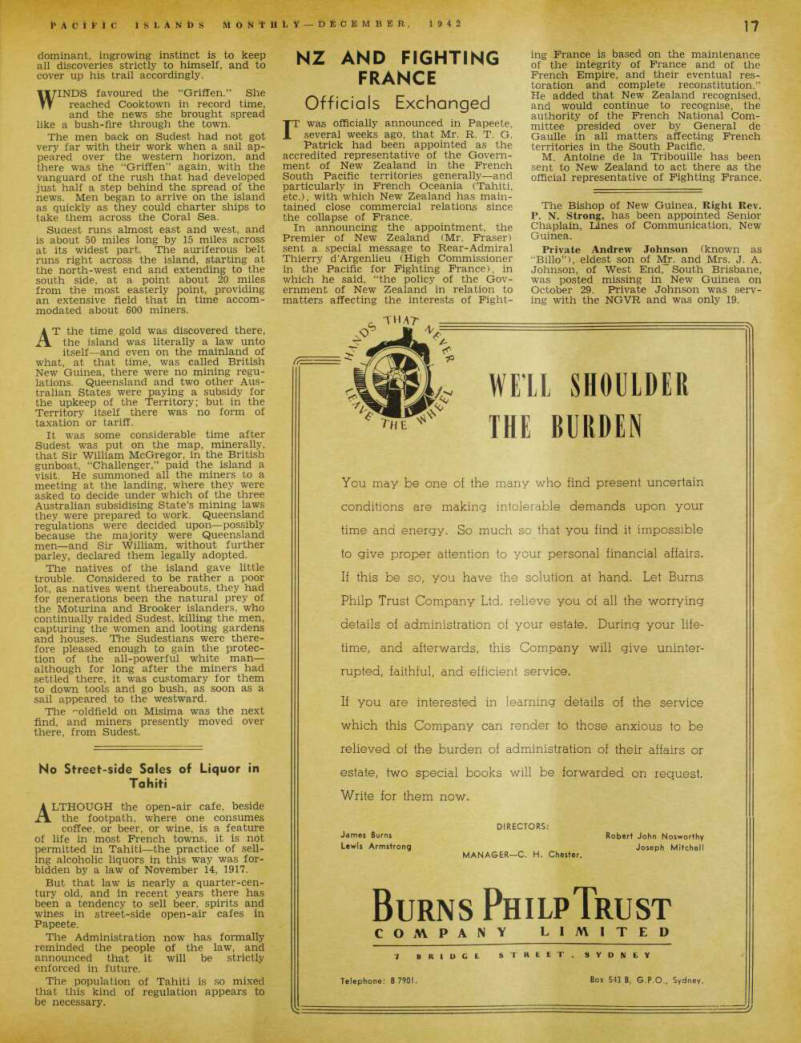
Was Found
Pearler's Casual Remark About White Outcrops
By D. H. Osborne
IN the last quarter of the 19th century, the Louisiades knew the sporadic visits of the blackbirder (seeking cheap labour for the Queensland sugar plan tations) the pearl-shell fisherman and, lastly, the miner—one following in the wake of the other.
The miner remained —and, represented by succeeding generations, he was there when the Jap, fired by his dream of Pacific conquest, made his presence felt in the south-west corner of the hitherto peaceful ocean.
The pearlers were first there. Using a diving dress, they gathered MOP shell.
Cooktown, on the north Queensland coast, in the early days, was the pearlers’ headouarters. There they bought their stores and refitted their schooners for work in the Coral Sea, which had as its northern boundary the Louisiade Archi pelago. a 200 miles chain of islands and islets, eastward of Papua. There came the divers and men who made their liv ing from this sea of reefs and shell banks, to spend their money, to drink and to swop tales with the miners, who made up the bulk of the town’s popu lation.
It was David White, a diver who had worked off the Louisiades, whose idle conversation awakened the Queensland mining community to the possibilities of these islands as a new goldfield. White knew nothing of mining himself. He re marked that some of the islands were barren, and showed outcrops of white stone. This conveyed nothing to his mind. But, to the miners, the casually dropped information was like the scent of blood to a blood-hound. White out crops had only one significance to them —quartz—and perhaps gold.
Sixteen of them got “together and en gaged Harry Christensen (better known as “German Harry”), with his 50 tons sailing schooner “Griffen” on a three months’ charter, and left forthwith to prospect the islands of the Louisiades.
It was arranged that the schooner should remain at anchor while the party was ashore and their first landing was made at Janet Island, a few miles west of Sudest.
Here, they found plenty of quartz, just as Dave White had told them, but it was barren quartz; so they moved on to Sudest, where there was a safe, all weather anchorage for the schooner—the anchorage that subsequently became known as Griffen Point, after German Harry’s schooner.
The miners landed, and fortune smiled upon them almost at once. They started up one of the gullies, prospecting as they went, and each dish showing colours of gold. At a point four miles inland (named the “Four Mile”), in the gullies, and in a fair-sized stream, there could no longer be any doubt that gold was there in payable quantities. The ground, moreover, was shallow, and easy to work.
They felt, with justification, that they had come to the end of their search.
They returned to the anchorage—and made their first mistake. The “Griffen’s” master, apparently not bitten by the gold-bug himself, but seeing the possi bilities of a few side-lines to a gold mining enterprise, asked that he be allowed to break his contract with them and return to Cooktown. This they foolishly allowed him to do—strangely, inexplicably—because the miner’s most
dominant, ingrowing instinct is to keep all discoveries strictly to himself, and to cover up his trail accordingly.
WINDS favoured the “Griffon.” She reached Cooktown in record time, and the news she brought spread like a bush-fire through the town.
The men back on Sudest had not got very far with their work when a sail ap peared over the western horizon, and there was the “Griffen” again, with the vanguard of the rush that had developed just half a step behind the spread of the news. Men began to arrive on the island as quickly as they could charter ships to take them across the Coral Sea.
Sudest runs almost east and west, and is about 50 miles long by 15 miles across at its widest part. The auriferous belt runs right across the island, starting at the north-west end and extending to the south side, at a point about 20 miles from the most easterly point, providing an extensive field that in time accom modated about 600 miners.
AT the time gold was discovered there, the island was literally a law unto itself —and even on the mainland of what, at that time, was called British New Guinea, there were no mining regu lations. Queensland and two other Aus tralian States were paying a subsidy for the upkeep of the Territory; but in the Territory itself there was no form of taxation or tariff.
It was some considerable time after Sudest was put on the map, minerally, that Sir William McGregor, in the British gunboat, “Challenger,” paid the island a visit. He summoned all the miners to a meeting at the landing, where they were asked to decide under which of the three Australian subsidising State’s mining laws they were prepared to work. Queensland regulations were decided upon—possibly because the majority were Queensland men —and Sir William, without further parley, declared them legally adopted.
The natives of the island gave little trouble. Considered to be rather a poor lot, as natives went thereabouts, they had for generations been the natural prey of the Moturina and Brooker islanders, who continually raided Sudest, killing the men, capturing the women and looting gardens and houses. The Sudestians were there fore pleased enough to gain the protec tion of the all-powerful white man— although for long after the miners had settled there, it was customary for them to down tools and go bush, as soon as a sail appeared to the westward.
The on Misima was the next find, and miners presently moved over there, from Sudest.
No Street-side Sales of Liquor in
Tahiti
ALTHOUGH the open-air cafe, beside the footpath, where one consumes coffee, or beer, or wine, is a feature of life in most French towns, it is not permitted in Tahiti—the practice of sell ing alcoholic liquors in this way was for bidden by a law of November 14, 1917.
But that law is nearly a quarter-cen tury old, and in recent years there has been a tendency to sell beer, spirits and wines in street-side open-air cafes in Papeete.
The Administration now has formally reminded the people of the law, and announced that it will be strictly enforced in future.
The population of Tahiti is so mixed that this kind of regulation appears to be necessary.
Officials Exchanged
Nz And Fighting
France
IT was officially announced in Papeete, several weeks ago, that Mr. R. T. G.
Patrick had been appointed as the accredited representative of the Govern ment of New Zealand in the French South Pacific territories generally—and particularly in French Oceania (Tahiti, etc.), with which New Zealand has main tained close commercial relations since the collapse of France.
In announcing the appointment, the Premier of New Zealand (Mr. Fraser) sent a special message to Rear-Admiral Thierry d’Argenlieu (High Commissioner in the Pacific for Fighting France), in which he said, “the policy of the Gov ernment of New Zealand in relation to matters affecting the interests of Fight
ing France is based on the maintenance of the integrity of France and of the French Empire, and their eventual res toration and complete reconstitution.”
He added that New Zealand recognised, and would continue to recognise, the authority of the French National Com mittee presided over by General de Gaulle in all matters affecting French territories in the South Pacific.
M. Antoine de la Tribouille has been sent to New Zealand to act there as the official representative of Fighting France.
The Bishop of New Guinea, Right Rev.
P. N. Strong, has been appointed Senior Chaplain, Lines of Communication, New Guinea.
Private Andrew Johnson (known as “Billo”), eldest son of Mr. and Mrs. J. A.
Johnson, of West End, South Brisbane, was posted missing in New Guinea on October 29. Private Johnson was serv ing with the NGVR and was only 19.
Advertisements & other items, p. 19 (2 items)
17
A c i H c islands monthly December, i 9 4 2
Burns Philp Trust
ft 4. /-
WELL SHOULDER
THE BURDEN
You may be one of the many who find present uncertain conditions are making intolerable demands upon your time and energy. So much so that you find it impossible to give proper attention to your personal financial affairs.
If this be so, you have the solution at hand. Let Burns Philp Trust Company Ltd. relieve you of all the worrying details of administration of your estate. During your lifetime, and afterwards, this Company will give uninterrupted, faithful, and efficient service.
If you are interested in learning details of the service which this Company can render to those anxious to be relieved of the burden of administration of their affairs or estate, two special books will be forwarded on request.
Write for them now.
James Burns Lewis Armstrong
DIRECTORS;
MANAGER—C. H. Chester, Robert John Nosworthy Joseph Mitchell
Burns Philp Trust
C O JW P A N Y
LIMITED
7 S R I U C E STREET . SYDNEY Telephone: B 790I. Box 543 B, G.P.O., Sydney.
New Guinea’S Jungle Foods
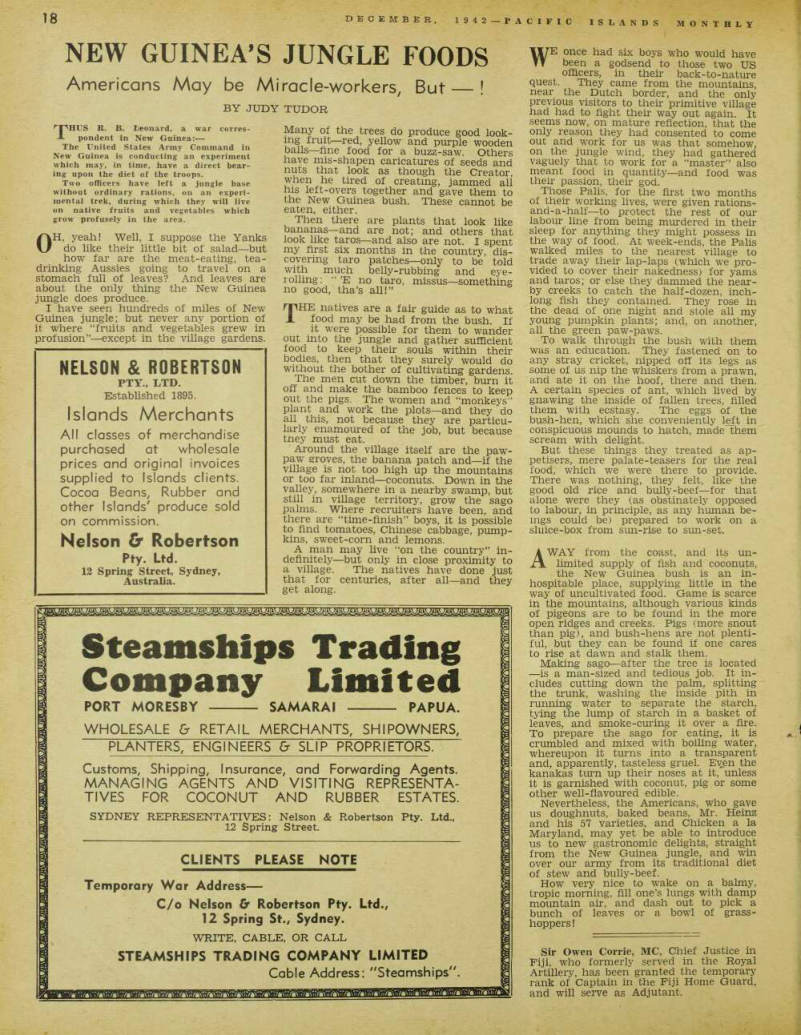
Americans May be Miracle-workers, But-!
By Judy Tudor
't'hus r b. Leonard a war correspo “ de , nt „ * ew P umea l- „ .
New is JT X perimeit Such ™ m ume haef a afreet ing upon the diet of the troops.
Two officers have left a jungle base without ordinary rations, on an experimental trek, during which they will live on native fruits and vegetables which grow profusely in the area. 0-u- i i iTT ii t , H, yeah! Well, I suppose the Yanks do like their little bit of salad—but how far are the meat-eating, teadrinking Aussies going to travel on a stomach full of leaves? And leaves are about the only thing the New Guinea jungle does produce.
I have seen hundreds of miles of New Guinea jungle; but never any portion of it where ‘‘fruits and vegetables grew in profusion”—except in the village gardens.
Many of the trees do produce good look ing fruit—red, yellow and purple wooden balls—fine food for a buzz-saw. Others have mis-shapen caricatures of seeds and nuts that look as though the Creator, when he tired of creating, jammed all his left-overs together and gave them to the New Guinea bush. These cannot be eaten, either.
Then there are plants that look like bananas—and are not; and others that look like taros—and also are not. I spent my first six months in the country, dis covering taro patches—only to be told with much belly-rubbing and eye rolling; “’E no taro, missus—something no good, tha’s all!”
THE natives are a fair guide as to what food may be had from the bush. If it were possible for them to wander out into the jungle and gather sufficient food to keep their souls within their bodies, then that they surely would do without the bother of cultivating gardens.
The men cut down the timber, burn it off and make the bamboo fences to keep out the pigs. The women and “monkeys” plant and work the plots—and they do all this, not because they are particu larly enamoured of the job, but because they must eat.
Around the village itself are the paw paw groves, the banana patch and—if the village is not too high up the mountains or too far inland—coconuts. Down in the valley, somewhere in a nearby swamp, but still in village territory, grow the sago palms. Where recruiters have been, and there are “time-finish” boys, it is possible to find tomatoes, Chinese cabbage, pump kins, sweet-corn and lemons.
A man may five “on the country” in definitely—but only in close proximity to a village. The natives have done just that for centuries, after all—and they get along.
WE once had six boys who would have been a godsend to those two US officers, in their back-to-nature quest. They came from the mountains, near the Dutch border, and the only previous visitors to their primitive village had had to fight their way out again. It seems now, on mature reflection, that the only reason they had consented to come out and work for us was that somehow, on the jungle wind, they had gathered vaguely that to work for a “master” also meant food in quantity—and food was their passion, their god.
Those Palis, for the first two months of their working lives, were given rations and-a-half—to protect the rest of our labour line from being murdered in then sleep for anything they might possess in the way of food. At week-ends, the Palis walked miles to the nearest village to trade away their lap-laps (which we pro vided to cover their nakedness) for yams and taros; or else they dammed the near by creeks to catch the half-dozen, inch long fish they contained. They rose in the dead of one night and stole all my young pumpkin plants; and, on another, all the green paw-paws.
To walk through the bush with them was an education. They fastened on to any stray cricket, nipped off its legs as some of us nip the whiskers from a prawn, and ate it on the hoof, there and then.
A certain species of ant, which lived by gnawing the inside of fallen trees, filled them with ecstasy. The eggs of the bush-hen, which she conveniently left in conspicuous mounds to hatch, made them scream with delight.
But these things they treated as ap petisers, mere palate-teasers for the real food, which we were there to provide.
There was nothing, they felt, like the good old rice and bully-beef—for that alone were they (as obstinately opposed to labour, in principle, as any human be ings could be) prepared to work on a sluice-box from sun-rise to sun-set.
AWAY from the coast, and its un limited supply of fish and coconuts, the New Guinea bush is an in hospitable place, supplying little in the way of uncultivated food. Game is scarce in the mountains, although various kinds of pigeons are to be found in the more open ridges and creeks. Pigs (more snout than pig), and bush-hens are not plenti ful, but they can be found if one cares to rise at dawn and stalk them.
Making sago—after the tree is located —is a man-sized and tedious job. It in cludes cutting down the palm, splitting the trunk, washing the inside pith in running water to separate the starch, tying the lump of starch in a basket of leaves, and smoke-curing it over a fire.
To prepare the sago for eating, it is crumbled and mixed with boiling water, whereupon it turns into a transparent and, apparently, tasteless gruel. Eyen the kanakas turn up their noses at it, unless it is garnished with coconut, pig or some other well-flavoured edible.
Nevertheless, the Americans, who gave us doughnuts, baked beans, Mr. Heinz and his 57 varieties, and Chicken a la Maryland, may yet be able to introduce us to new gastronomic delights, straight from the New Guinea jungle, and win over our army from its traditional diet of stew and bully-beef.
How very nice to wake on a balmy, tropic morning, fill one’s lungs with damp mountain air, and dash out to pick a bunch of leaves or a bowl of grass hoppers !
Sir Owen Corrie, MC, Chief Justice in Fiji, who formerly served in the Royal Artillery, has been granted the temporary rank of Captain in the Fiji Home Guard, and will serve as Adjutant.
Advertisements & other items, p. 20 (1 item)
Steamships Trading
NELSON & ROBERTSON
PTY., LTD.
Established 1895.
Islands Merchants
All classes of merchandise purchased at wholesale prices and original invoices supplied to Islands clients.
Cocoa Beans, Rubber and other Islands' produce sold on commission.
Nelson & Robertson
Pty. Ltd. 12 Spring Street, Sydney, Australia.
Steamships Trading
Company Limited
FORT MORESBY
SAMARAI
PAPUA.
WHOLESALE & RETAIL MERCHANTS, SHIPOWNERS,
PLANTERS, ENGINEERS & SLIP PROPRIETORS.
Customs, Shipping, Insurance, and Forwarding Agents.
MANAGING AGENTS AND VISITING REPRESENTA-
TIVES FOR COCONUT AND RUBBER ESTATES.
SYDNEY REPRESENTATIVES: Nelson & Robertson Pty. Ltd., 12 Spring Street.
CLIENTS PLEASE NOTE
Temporary War Address— C/o Nelson & Robertson Pty. Ltd., 12 Spring St., Sydney.
WRITE, CABLE, OR CALL
STEAMSHIPS TRADING COMPANY LIMITED
Cable Address: "Steamships".
Loyalty
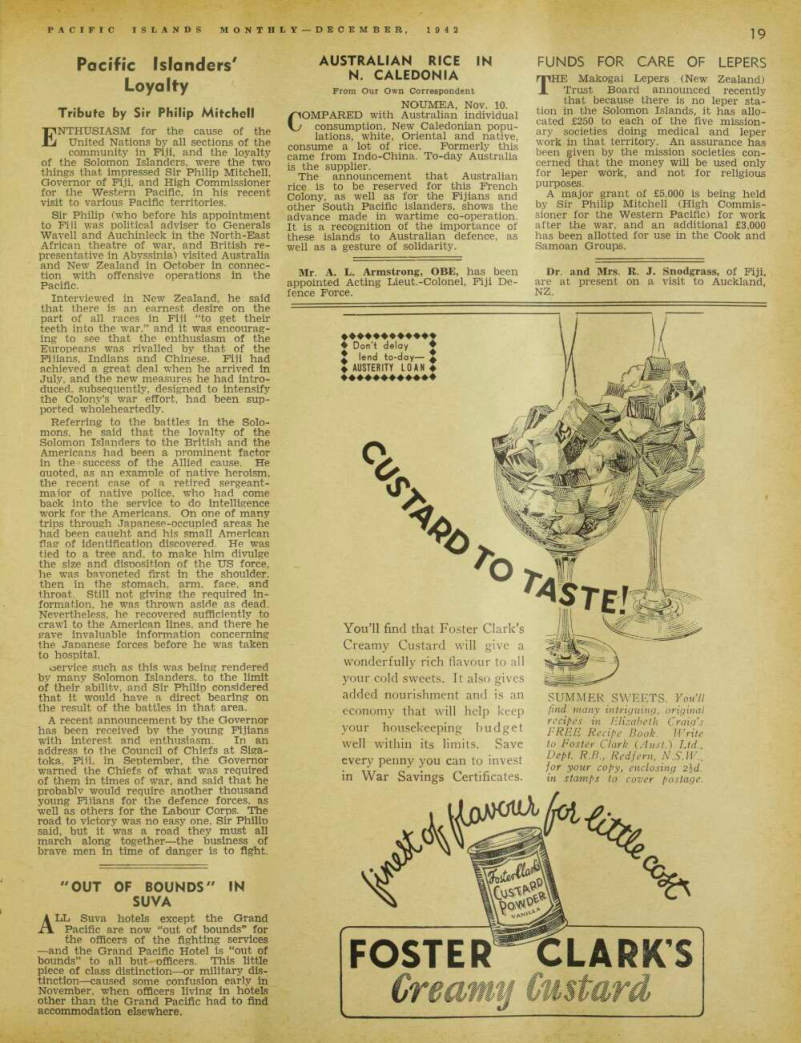
Pacific Islanders' Loyalty Tribute by Sir Philip Mitchell
Enthusiasm for the cause of the United Nations by all sections of the community in Fiji, and the loyalty of the Solomon Islanders, were the two things that impressed Sir Philip Mitchell, Governor of Fiji, and High Commissioner for the Western Pacific, in his recent visit to various Pacific territories.
Sir Philip (who before his appointment to Fiji was political adviser to Generals Wavell and Auchinleck in the North-East African theatre of war, and British re presentative in Abyssinia) visited Australia and New Zealand in October in connec tion with offensive operations in the Pacific.
Interviewed in New Zealand, he said that there is an earnest desire on the part of all races in Fiji “to get their teeth into the war,” and it was encourag ing to see that the enthusiasm of the Europeans was rivalled by that of the Fijians, Indians and Chinese. Fiji had achieved a great deal when he arrived in July, and the new measures he had intro duced. subsequently, designed to intensify the Colony’s war effort, had been sup ported wholeheartedly.
Referring to the battles in the Solo mons, he said that the loyalty of the Solomon Islanders to the British and the Americans had been a prominent factor in the success of the Allied cause. He Quoted, as an example of native heroism, the recent case of a retired sergeant maior of native police, who had come back into the service to do intelligence work for the Americans. On one of many trips through Japanese-occupied areas he had been caught and his small American flag of identification discovered. He was tied to a tree and, to make him divulge the size and disposition of the US force, he was bayoneted first in the shoulder, then in the stomach, arm, face, and throat. Still not giving the required in formation, he was thrown aside as dead.
Nevertheless, he recovered sufficiently to crawl to the American lines, and there he gave invaluable information concerning the Japanese forces before he was taken to hospital. oervice such as this was being rendered by many Solomon Islanders, to the limit of their ability, and Sir Philip considered that it would have a direct bearing on the result of the battles in that area.
A recent announcement by the Governor has been received by the young Fijians with interest and enthusiasm. In an address to the Council of Chiefs at Siga toka, Fiji, in September, the Governor warned the Chiefs of what was required of them in times of war, and said that he probablv would require another thousand young Fijians for the defence forces, as well as others for the Labour Corps. The road to victory was no easy one, Sir Philip said, but it was a road they must all march along together—the business of brave men in time of danger is to fight.
"Out Of Bounds" In
Suva
ALL Suva hotels except the Grand Pacific are now “out of bounds” for the officers of the fighting services —and the Grand Pacific Hotel is “out of bounds” to all but officers. This little piece of class distinction—or military dis tinction—caused some confusion early in November, when officers living in hotels other than the Grand Pacific had to find accommodation elsewhere.
Australian Rice In
N. Caledonia
From Our Own Correspondent
Noumea, Nov. 10.
COMPARED with Australian individual consumption, New Caledonian popu lations, white, Oriental and native, consume a lot of rice. Formerly this came from Indo-China. To-day Australia is the supplier.
The announcement that Australian rice is to be reserved for this French Colony, as well as for the Fijians and other South Pacific islanders, shows the advance made in wartime co-operation.
It is a recognition of the importance of these islands to Australian defence, as well as a gesture of solidarity.
Mr. A. L. Armstrong, OBE, has been appointed Acting Lieut.-Colonel, Fiji De fence Force.
Funds For Care Of Lepers
THE Makogai Lepers (New Zealand) Trust Board announced recently that because there is no leper sta tion in the Solomon Islands, it has allo cated £250 to each of the five mission ary societies doing medical and leper work in that territory. An assurance has been given by the mission societies con cerned that the money will be used only for leper work, and not for religious purposes.
A major grant of £5,000 is being held by Sir Philip Mitchell (High Commis sioner for the Western Pacific) for work after the war, and an additional £3,000 has been allotted for use in the Cook and Samoan Groups.
Dr. and Mrs. R. J. Snodgrass, of Fiji, are at present on a visit to Auckland, NZ.
Advertisements & other items, pp. 21-22 (1 item)
Ark’S
:♦♦♦ Don't delay ♦ J lend to-day— ▲
I AUSTERITY LOAN ♦
♦♦♦ o o. sP A You’ll find that Foster Clark’s Creamy Custard will give a wonderfully rich flavour to all your cold sweets. It also gives added nourishment and is an economy that will help keep your housekeeping budget well within its limits. Save every penny you can to invest in War Savings Certificates.
SUMMER SWEETS. You’ll
find many intriguing, original recipes in Elizabeth Craig’s FREE Recipe Book. Write to Foster Clark ( Aust .) Ltd., Dept. R. 8., Redfern, N.S.W., for your copy, enclosing 2\d. in stamps to cover postage. &
ARK’S
Modern Refrigeration for the South Sea Islands
The ELECTROLUX kerosene operated
REFRIGERATOR
ELECTROLUX OFFERS ECONOMICAL, modern and completely efficient
REFRIGERATION FOR ISLANDS' HOMES.
FREEZES CONTINUOUSLY WHILE SMALL LAMP BURNS.
Freezing controlled by simply regulating height of flame. Uses only gallon of kerosene per week.
MOTORLESS ... NO PARTS TO GET OUT OF ORDER.
MODEL L 22 MODEL L3BO MODEL LKSSO Capacity (as illustrated) Capacity 2.2 cubic feet. Capacity 4 cubic feet. 5.5 cubic feet.
GUARANTEED FOR TWO YEARS.
• Write to your Local Distributor for prices and fuil details.
OBTAINABLE FROM ALL W. R. CARPENTER & CO. LTD.
BRANCHES THROUGHOUT THE ISLANDS
Representation in Papua and New Hebrides.
Service Changes
In Western and Central Pacific
THE following rearrangements of ad ministrative staff in the Territories of the Western Pacific Commission have been officially notified: — During the temporary absence of the Resident Commissioner (Lieut.-Colonel W.
S. Marchant, CMG, QBE, from the British Solomon Islands, Mr. C. N. F.
Bengough, MBE, was District Officer in charge of BSI administration.
Mr. B. F. Blackwell, formerly an Ad ministrative Officer, has become Assistant Resident Commissioner in New Hebrides, as from September.
Mr. D. C. I. Wernham, who was Ad ministrative Officer at Funafuti, G. and E. Colony, has been appointed Adminis trative Officer in charge of the Phoenix Islands, and British representative on the Joint Administration (with United States) of Canton and Enderbury Islands.
He will be responsible for the Phoenix Islands Settlement Scheme, under which 2,000 surplus people from the Gilbert Islands have been settled in certain of the Phoenix Islands (Hull, Sydney and Gardner).
The appointment of Mr. E. A. G. Sea goe, MBE, as Acting Assistant RC in New Hebrides ended in September, and he has returned to his former position.
Mr. R. S. Bastin, chief wireless opera tor, G. and E. Colony, and Mr. R. S. Tay lor, chief wireless operator, Solomon Islands, have been given leave of absence, for military service.
Mr. P. D. MacDonald, who was Assist ant Secretary of the Western Pacific Commission, in Suva, has been seconded for service in Trinidad, West Indies, and has taken up duty there.
Mr. E. J. Doxat, who was Superinten dent of Police in the G. and E. Colony until recent months, has been transferred to the Gold Coast Colony service, as from August last.
Small Production Being
Samoan Rubber
Small Production Being Increased
rE general manager of the New Zea land Reparation Estates, Mr. D. R.
Eden, in a press interview in Nov ember, denied that the production of rubber in Samoa had been steadily fall ing off over the last decade —on the con trary, he stated that it had been increasing. The actual yield in 1935-36 svas 97,110 lb. and in 1941-42 it was 173,157 lb.—with further increases ex pected this next year.
Mr. Eden said that when Samoa was occupied by the New Zealanders in 1914, all German estates were taken over by the Government. These estates had included two rubber plantations, together covering an area of 880 acres, which were fully planted. Subsequently, another plantation of 500 acres was acquired; but when the price of rubber fell below pro duction costs in 1928, the three planta tions were abandoned. In 1935, cultiva tion and tapping were renewed, but it was found then that in the intervening years some disease had attacked the roots of the trees.
After the outbreak of the Second World War, Reparation Estates leased a private estate containing 15,000 trees,
which were brought into bearing after a great deal of difficulty.
At the present time there are 46,500 rubber trees on the Estates, and there are many other rubber-bearing trees growing wild—but these wild trees can not be tapped because of the labour shortage.
Fiji Is Trying To Grow
Potatoes
FIJI now has two other wartime acquisitions—a black market and a potato shortage.
The price of potatoes in Suva appar ently has been fixed at threepence per pound, but local residents continue to pay from 4td. to 6d. per pound.
The “Fiji Times” reports that a grower in Sigatoka has been offered £3O per ton by a retailer —and it is obvious that the retailer —who must also pay freight from Sigatoka to Suva—does not intend to re tail them at 3d. per pound (that is, at a loss). The “Times” urges a stricter con trol on potatoes in order that the public may get them at a more reasonable price; but also remarks on the interesting ex periment that Mr. D. B. Costello has made with New Zealand seed potatoes at Sigatoka. Hitherto, it was thought that New Zealand potatoes would not grow; but Mr. Costello has a good crop on the way to maturity, which he intends to sell at regulation prices. When these potatoes are harvested it should relieve the present potato position in Fiji.
Advertisements & other items, p. 23 (1 item)
Bitter
VICTORIA
ALE
o
BREWED BY
CARLTON & UNITED BREWERIES LTD.
With the AIF at Port Moresby
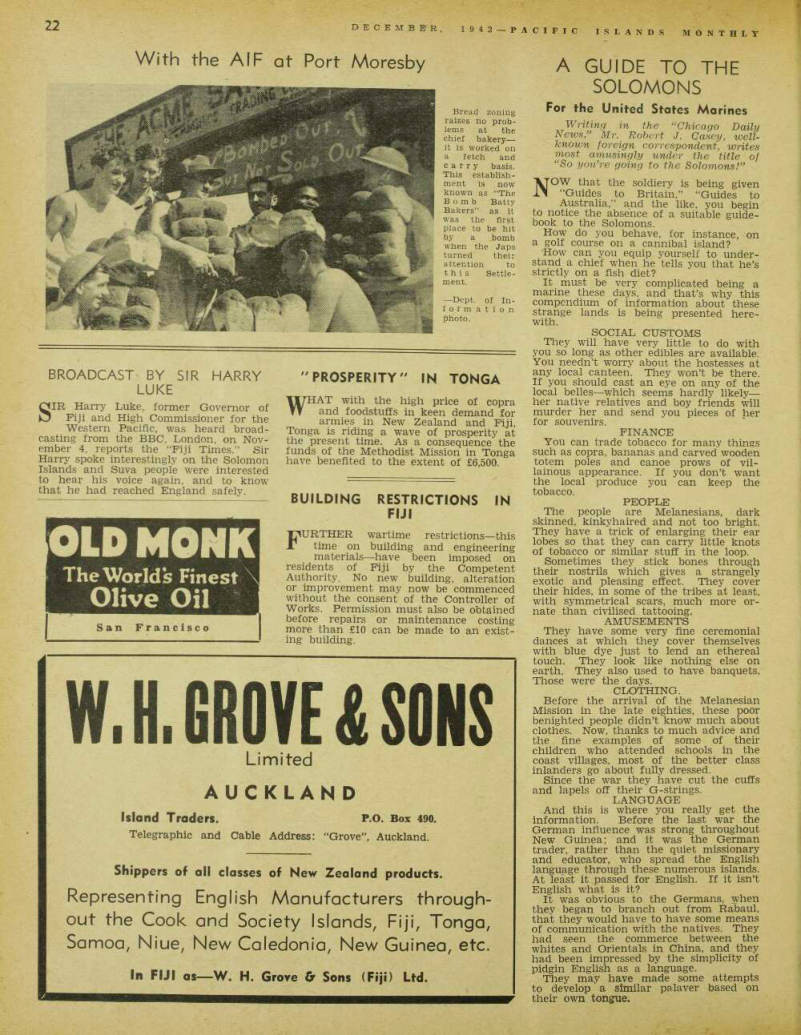
Bread zoning raises no prob lems at the chief bakery— it is worked on a fetch and carry basis.
This establish ment is now known as “The Bomb Batty Bakers” as it was the first place to be hit by a bomb when the Japs turned their attention to this Settle ment. —Dept, of In formation Photo.
Broadcast By Sir Harry
Luke
SIR Harry Luke, former Governor of Fiji and High Commissioner for the Western Pacific, was heard broad casting from the BBC, London, on Nov ember 4, reports the “Fiji Times.” Sir Harry spoke interestingly on the Solomon Islands and Suva people were interested to hear his voice again, and to know that he had reached England safely.
"Prosperity" In Tonga
WHAT with the high price of copra and foodstuffs in keen demand for armies in New Zealand and Fiji, Tonga is riding a wave of prosperity at the present time. As a consequence the funds of the Methodist Mission in Tonga have benefited to the extent of £6,500.
Building Restrictions In
Fiji
FURTHER wartime restrictions—this time on building and engineering materials—have been imposed on residents of Fiji by the Competent Authority. No new building, alteration or improvement may now be commenced without the consent of the Controller of Works. Permission must also be obtained before repairs or maintenance costing more than £lO can be made to an exist ing building.
Solomons
A Guide To The
For the United States Marines
Writing in the “Chicago Daily News ” Mr. Robert J. Qasey, well known foreign correspondent, writes most amusingly under the title of “So you’re going to the Solomons!”
NOW that the soldiery is being given “Guides to Britain,” “Guides to Australia,” and the like, you begin to notice the absence of a suitable guide book to the Solomons.
How do you behave, for instance, on a golf course on a cannibal island?
How can you equip yourself to under stand a chief when he tells you that he's strictly on a fish diet?
It must be very complicated being a marine these days, and that’s why this compendium of information about these strange lands is being presented here with.
Social Customs
They will have very little to do with you so long as other edibles are available.
You needn’t worry about the hostesses at any local canteen. They won’t be there.
If you should cast an eye on any of the local belles—which seems hardly likely— her native relatives and boy friends will murder her and send you pieces of her for souvenirs.
Finance'
You can trade tobacco for many things such as copra, bananas and carved wooden totem poles and canoe prows of vil lainous appearance. If you don’t want the local produce you can keep the tobacco.
People
The people are Melanesians, dark skinned, kinkyhaired and not too bright.
They have a trick of enlarging their ear lobes so that they can carry little knots of tobacco or similar stuff in the loop.
Sometimes they stick bones through their nostrils which gives a strangely exotic and pleasing effect. They cover their hides, in some of the tribes at least, with symmetrical scars, much more or nate than civilised tattooing.
Amusements
They have some very fine ceremonial dances at which they cover themselves with blue dye just to lend an ethereal touch. They look like nothing else on earth. They also used to have banquets.
Those were the days.
Clothing.
Before the arrival of the Melanesian Mission in the late eighties, these poor benighted people didn’t know much about clothes. Now, thanks to much advice and the fine examples of some of their children who attended schools in the coast villages, most of the better class inlanders go about fully dressed.
Since the war they have cut the cuffs and lapels off their G-strings.
Language
And this is where you really get the information. Before the last war the German influence was strong throughout New Guinea; and it was the German trader, rather than the quiet missionary and educator, who spread the English language through these numerous islands.
At least it passed for English. If it isn’t English what is it?
It was obvious to the Germans, when they began to branch out from Rabaul, that they would have to have some means of communication with the natives. They had seen the commerce between the whites and Orientals in China, and they had been impressed by the simplicity of pidgin English as a language.
They may have made some attempts to develop a similar palaver based on their own tongue.
But pidgin German just didn’t seem to be logical. So they evolved that lovely language which you now hear all through Melanesia, a German laboratory pidgin English spoken with a German accent.
The results are wonderful, as, for instance, the first two lines of the Lord’s Prayer:— “Pava me belong on top, Speak good along him . . .” „ Tl _. L * , , , , Which, of course, anybody would recogu lS u aS ar £ m Heaven ’
Tnfhp nativedialects ‘there is no such thine l as “x” and the closest eauivalent vmf g eet in conversation is ‘ikis” and ”aL g and^okiV 7 Thus a box is “bokis ” an axe is “akis ” in ° ° ’
For that reason vou are not surprised to find out that a grand piano is fella bokis ’e got toof. You fight ’im ’e sing out.” (“Toof,” of course, is “tooth.’) In Melanesian as in other tongues of the Pacific the verb to eat is kaikai.
Wood is diwai. Which prepares you for the definition of a cross-cut saw: — “Akis ’e got kalaus (claws). You push ’im ’e go. You pull ’im ’e come. Bimeby ’im kaikai diwai.” .
A sausage is “Banana belong bullamakau.”
And that’s about all you need to know about the language.
Cultural Uplift
■There Is no recent report other than But* one* recalls ‘an* effort V a f°eT veTrsTgo to imbue the natives with a love for literature and the arte.
A missionary arrived in Malaita with a magic lantern and he showed to an enthusiastic group the adventure of one “Goldilocks” and the three bears.
The natives, who had never seen bears, got the idea at once. These were certainly superior creatures. And when
‘ Goldilocks” got away in the last slide, they howled, not with satisfaction, but with rage.
The marines oueiit to have a nice time in that neighbourhood.
Advertisements & other items, p. 24 (1 item)
W. H. Grove & Sons
OLD MONK
The "Worlds Finest \ Olive Oil San Francisco
Limited
AUCKLAND
Island Traders. P.O. Box 490.
Telegraphic and Cable Address: “Grove”, Auckland.
Shippers of all classes of New Zealand products.
Representing English Manufacturers throughout the Cook and Society Islands, Fiji, Tonga, Samoa, Niue, New Caledonia, New Guinea, etc.
In FIJI as—W. H. Grove Cr Sons (Fiji) Ltd.
Ltl S wL Tanefefredto
Death Of Mr. A. P. Procter
From Our Own Correspondent A TA r\ + m
Apia, Oct. 10.
» PIA residents were deeply shocked by the recent sudden death of Mr.
Arthur Percy Procter, accountant, of Morris. Hedstrom’s Apia branch, and a popular and respected citizen of Apia for the past nine years.
Mr. Procter was 48. He went from New Zealand to Fiji to enter the Fiji Gov ernment service. In 1917 he joined the staff of Morris, Hedstrom Ltd., at Levuka, Fiji, and had remained with the firm for 25 years, first at various subsidiaries in Fiji and from 1935 on as accountant with the Apia branch. An efficient and con scientious worker, he was popular with the directors and staff of the firm and, through his friendly and unassuming wa ,y s ’ w * th ? en i?f c al outbreak of war, his wife left Zealand and is living at Devonport Auckland. His two sons are present serving with the New Zealand Forces. th^su V a G b r^ch W of W Cabie a aiS a wfreless
Ltl S wL Tanefefredto
October. His position in Suva has been Ailed by Mr, W. G. Smith, who was form erly in the Sydney office of the company.
Miss June Ewen, who has been secre tary to the New Guinea Women’s Club, Sydnev, for many months, has joined the WAAAF. Mrs. McDonald, of 44 Milson Road, Cremorne, is tne new secretary of the Club.
swept^*a%ay n fntoTaTL/^Hher‘’bffwn
And Shall We See A
Nwe Order?
fnthpr who lives in Christchurch
M at* * an IZf™ l
NZ, and is 80 years young, and wise I ?^ he W S y ? ° f m a letter what many of us are thmk _.A , . * am con fident the Anglo-Ameri can nations will come out victorious—but W ith an unlimited obligation to make the world a better place for common people to live in. There is a call, as never before, for wise and strong men, with big hearts, to lead us in world reconstruction. ‘‘The Almighty did not give this world to the millionaires and monopolists—they took it. And Hitler is trying to make everything safe for the powers that trample upon the bodies of the masses.
“Our . Governments can find millions f or the winning of the war. Can they, anc j w fn they, find millions, presently, with which to create a world fit for ordinary people to live in? <<j no t be here: but I shall go happily if only I can believe that, out of all this horror and suffering, there really wm come a new order in which my descendants will know peace, and happi negs and secur ify otherwise, God help them! In my lifetime, I have seen two generations of them (my sons and
swept^*a%ay n fntoTaTL/^Hher‘’bffwn
to pieces or hopelessly maimed, “Sometimes I see visions of the future world-a world governed by a new order a glorious world that really will be worth living in. It is a world in which all men will have certain fundamental rights—and among them a right to pro tection against the selfish hirelings of political machines and the prowling
hyenas of money-power.”
R.W.R.
Advertisements & other items, p. 25 (1 item)
Years
Ct •TTv*' »3C' c ■ o' 1 ' % (C 5
;N» 4^ 3
SWALLOW
AHULL
E :r0 w»n
ERS
DSC
ICE
CCER
Pll) 111
D D I
CRIES
MS
The Origin Of
Polynesians
Work Done —And to be Done
Letter to the Editor IT seems strangely inappropriate, at a time when American troops are located in Australia and in the Paci fic Islands, that an Australian paper such as the “Pacific Islands Monthly” (May issue, page 20) should publish statements from an undisclosed writer that reflect on the work of an American institution and the ability of American graduate students in anthropology. (See page 11 of November issue of “PIM”.) The “young cubs” mentioned by your correspondent were graduates of well known American universities, who were selected for their aptitude in the study of the culture of native peoples. What they lacked from the University in know ledge of Polynesian language, mentality, and ancient custom, they were sent out into the field to seek and to record.
Their object was not to discover the origin of the Polynesian people but to make a regional survey and record the physical characters, material culture,
social organisation, and religious concepts of the people of the Polynesian island group to which they were sent. Every body knows that the natives have dis carded and forgotten much of their old culture, but they have also retained the knowledge of much that is of value to science.
These men did as good a job as was possible under changed conditions and the limitations of time imposed by the extent of financial support available.
Their work was published by the Bishop Museum to form a foundation for the comparative study of the Polynesian people.
The work of the one-time “cubs” has been highly regarded in scientific circles and some of them have procured high teaching positions in American universi ties. Among them are E. W. Gifford, at the University of California, and Ralph Linton, at Columbia University. Your correspondent’s statement that the work of these men was based on ransacking a few burial caves and measuring a few platforms and marae is not only untrue, but insulting, both to the men them selves and to the institution which pub lished their work.
I AM not greatly concerned about criti cism of “Vikings of the Sunrise.’’
The .debatable question of whether the Polynesian ancestors came by way of Micronesia or through Melanesia is a sub
ject for continued study. I quoted Mc- Millan-Brown because I wished to dis pose of some of his theories.
I did not quote Churchill because I was not prepared to devote space to a linguistic discussion. Churchill’s theory of the Melanesian route was based on his study of language, and it is best left to some competent linguist trained in up-to-date methods.
I am perfectly well acquainted with the tradition that an ancestor of the Raiatea people is held to have come from Rotuma; but what of it? Does the inter mediate home of one ancestor indicate the route taken by the ancestors of the other branches of the Polynesians? How ever, I agree with you that we must con tinue our inquiries when the war is over.
THE fact remains that we owe it to American institutions and American money that an intensive study of one cultural area in the Pacific has been rendered possible. If we British could do something similar in such areas as Melanesia, Micronesia, or New Guinea, we would make a definite organised con tribution to our knowledge of the Pacific area.
Britain has the credit of initiating scientific field study through the Cam bridge Expedition to the Torres Straits, but her other wide interests doubtless militated against the continuation of organised research over a wider area.
Germany, in her healthy period before the poisonous growth of Nazism, organ ised an expedition for the intensive study of Micronesia.
Australia has done much in New Guinea through its Government anthro pologists: and both in New Guinea and Melanesia, Australian anthropologists of the younger school, whom your corre spondent would doubtless term “young cubs,” have done much.
But all the efforts, valuable as they are, are really reconnaissance trips, taking samples here and there as time and money permitted. We need an organised survey of each cultural area.
We should be thankful, therefore, for the lead that America has given us in Polvnesia; and, though all work invites criticism, criticism should maintain a scientific level and not descend to per sonalities.
I am, etc.,
Peter H. Buck.
Director, Bernice P. Bishop Museum.
Honolulu, 21/9/1942.
Editorial Note
Statements may have been published in May last which now are regretted: but they almost were worth while in that they have brought from Dr. Buck this interesting summary of the position of anthropological research in the Pacific.
Sooner or later, we of the United Nations will undertake the duty of plan ning a new world in the Pacific. There will be a tendency, then, to give first consideration to the mundane affairs of the present day. It will be necessary, then, for the friends of the Pacific ter
ritories to stand together, to see that proper provision is made for the native peoples in all planning for the future; and Dr. Buck’s statement serves to remind us that there, in that American endowed Bishop Museum, there is a vast accumulation of collated data dealing with every aspect of native life, from the theories of the Polynesian migrations, right up to present-day “Europeanisa tion.” American altruism created the Bishop Museum. It is to be hoped that American world-planners will see that the knowledge accumulated by the Museum is effectively used.
Advertisements & other items, p. 26 (2 items)
Pure
PRESCOTT Pty. Ltd.
SUSSEX ST. SYDNEY,
are sole wholesale agents for
PINEAPPLE BACON&HAMS
DAISY brand BUTTER "375" BUTTER in TINS llb.-21b.-slb. Sizes.
LEA & PERRINS’ Sauces and Most other Super-Quality Lines of the Trade, such as Cheese, Eggs. Etc.
c ri i v
E R 5
PURE
EOODS
GOLD MEDAL JAMS
CANNED ENGLISH FRUITS
CANNED ENGLISH
VEGETABLES
CUSTARD POWDER
OLD ENGLISH MARMALADE
JELLY CRYSTALS, ETC.
Obtainable from all Leading Grocery Stores. ... Write to Department ClilTera and Sons, Ltd., Histon, Cambridge, England, for attractive Recipe Book.
Old Monk I
There is no substitute for
VIRGIN PURE
OLIVE OIL I
San Francisco
Days in Papua
Memories of Pioneer Days in Papua
Letter to the Editor I WAS much interested in Mr. D. H.
Osborne’s articles on the early days in Eastern Papua, in your October issue. In one of the articles, he men tioned Captain Inman going to New Guinea with his wife, and putting in at one of the Louisades, and mentioned Mrs.
Inman and the son, Jim. I knew the family very well, and I turned up my photographic records. On the first page I have a copy of a picture with Jimmy Inman sitting in front of the group. I took this picture over 30 years ago, and although it has faded somewhat, it is still quite good.
Included in the same group is another man, mentioned in the same issue—Mr.
Holland, who is a missionary, and is now Reverend; also Reverend Arthur Kent Chignell, who wrote the book, “Outpost in Papua.”
Chignell was located at Wanigela, and had as an assistant missionary a man from New South Wales whose family name was Money. Money was the photo grapher who made himself famous by the picture, “Man the Protector; Woman the Slave”; and this depicted a tall Orakiva, with the proverbial wasp waist, carrying an enormous spear. Behind him was his wife, with a net-bag full of garden pro duce and, seated on the top of it, one of their offspring. The total weight which the woman was carrying was in excess of 120 pounds. When I was staying with Chignell I tested the weights of a number of similar loads, and found every one over 100 pounds, and some as high as 150.
In another article by Mr. Osborne I noticed that he mentions the Buna- Kokoda Road, and also my old friend, Mat Crowe. Here, again, I have a photo graph of one of the expeditions made by Mat, and although it is very faded, the features of all the men with him are quite clear.
Mr. C. A. W. Monckton is the same man who has written two very good books on the Doriri country, and did quite a lot of good work around the divi sion. He was resident magistrate over there. In those days civil service was more or less controlled by Downing Street, and the personnel were very important.
Monckton and Griffen were two men who could use language to make even the most hardened gold-miner stand to attention, and Mat Crowe had a lot of affection for both of them.
I am, etc.,
J. Nixon Westwood.
GPO Box 957.
Wellington, NZ.
November 19, 1942.
Strict Curfew
Morral Angle in Samoo
Our own Correspondent
Apia, Oct. 10.
WESTERN Samoa has had curfew regulations since January 31, 1942, when the curfew hours for the whole of the European and Samoan population were fixed as from 10.30 p.m. to 6 a.m.
Owing to numerous abuses, however, and a startling increase in moral delin quency amongst adolescents, the Ad ministration has issued new curfew regu
lations, which came into force as from October 1, 1942. The new regulations stipulate that except with legitimate excuse (the proof whereof shall be upon the age of 16 years shall be absent from his residence between the hours of 9 p.m. and 6 a.m. (b) No Samoan other than a matai or the wife of a matai shall be absent from his residence between the hours of 10.30 p.m. and 6 a.m. (c) No European and no Samoan matai or wife of a matai shall be absent from his residence between the hours of 11.30 p.m. and 6 a.m.
Advertisements & other items, pp. 27-28 (1 item)
Hampe
Here’s the quick , easy way to serve
COOL, APPETISING
HOT-WEATHER MEALS
& <2 * 4P
I A avT*
h YOU can prepare crisp, cool, appetising salads in five minutes with Imperial “Hampe” the quick-serve summer delicacy that’s ready-cooked, readyto-serve and flavour-sealed . . . And what a flavour!
Everyone likes the delicious combination of mild-cured ham and tender veal in “Hampe.” Try it to-day.
Product of Riverstone Meat Co. Pty. Ltd., Sydney.
FIJI Representatives: Pearce & Co. Ltd., Suva.
Hampe
m
PRODUCTION
/ or
WAR
For 29 years A.WA. has maintained a reputation for making high grade wireless apparatus in Australia.
AMALGAMATED WIRELESS (A/SIA) LTD.
AUSTRALIA'S NATIONAL WIRELESS ORGANISATION
Buy . . .
£lO NATIONAL SAVINGS BONDS
and WAR SAVINGS CERTIFICATES
There Will Be Roads In New Guinea
A Silver Lining to the War-cloud
EVEN war-clouds have a silver lining.
Evacuees from Papua may be heartened by the thought that roads are appearing in their previously notoriously un-roaded country as a direct result of the military operations in that area.
The four month’s struggle over the Owen Stanley Range has largely been one of supply—the tremendous supply problems, which proved the Japs’ undoing in their unsuccessful drive across the track to Port Moresby, automatically be came the Australians’ problem when they took the offensive and drove the Jap back to his Buna-Gona, beach head.
With the capture of Kokoda airfield— and possibly through the use of other airfields in the flatter country towards the coast—the communication problem has been solved to a certain extent; but the delivery of food and equipment to forward areas have caused many head aches to Allied commanders. Hence, roads have appeared in many localities where, five years ago, even a mule-track 'was never dreamed of.
Food cannot be cooked in the front lines without the fires presenting a first class target to the enemy. It is reported that some Army cooks heated up stew and bully-beef hashes in a kerosene tin and sent them in by carriers—a jaunt of perhaps an hour and a half. Use was made also of rubber-tyred, rickshaw-like hand-carts that the Japanese con veniently left behind during their “Back to Buna Week.”
THOSE people who knew this Owen Stanley country, stuck successfully to their theory that the Japs could not get an army—or, at least an army in fighting trim—across the Owen Stanley track to take Port Moresby in the rear, even when it appeared for a few mad weeks that the Japs were doing just that.
Many now ask how the Australians, in what is known as the “Wet Season,” have managed to reverse the process.
The answer is, firstly, undoubted Allied air superiority; secondly, native help. Our planes have been able to support actively our forward troops in combat, supply reinforcements, and at the same time prevent the Jap from blasting our bases as we blasted his from September on wards. The natives whom the Japs brought from Rabaul to transport goods and equipment, were continually sub jected to Allied straffing from the air, whenever they moved along the track.
They had no love of the Jap, in the first place, and they must have found his methods of compulsion a little dif ferent to the kid-glove tactics of the benevolent Administration to which they have been used for 25 years. Conse quently, they deserted whenever possible, either to the bush, or to the Allies.
The undoubted loyalty of the natives serving the Australians has been, on the other hand, a decisive factor in the Allied success. These natives, taking over where the plane left off, have supplied the only possible means of communi cation in areas where aerial transport can never be.
A kanaka’s idea of what constitutes a “road” is not ours. Usually it is a narrow native pad that links village to village simply by following the contours of the country. Inland natives, bred to the mountains, are not mountain-conscious, as we are, and can tackle blithely this heart-breaking terrain of serrated peaks, deep ravines and impossible tracks that attack the heights without thought of gradient—straight upwards through the
mud —and reach the top only to plunge over into the next valley and begin the process all over again.
EUROPEANS even unencumbered Europeans—drag themselves over this type of country without en thusiasm, and usually at the price of complete exhaustion. To live there and get about by the only possible means— that is, by foot — was considered a job in itself, prior to the war. One of the Territorian’s most sacred beliefs was that it was impossible for a European to do hard physical labour there without land ing very soon in the local mat-mat.
Yet Australians have not only lived there, and dragged themselves about the country, but have fought and beaten an enemy, trained since youth to harder liv ing conditions than ours.
REAL roads, as we understand the term, were few in the Mandated Territory at the outbreak of the Pacific war.
In Papua, except for the odd twenty miles out of Port Moresby, they were non-existent.
But, judging from the latest infor mation from that area, a different state of affairs will exist by the time this war is over. Engineering units, under the command of officers who were construc tional engineers in civil life, are building bridges across streams that hitherto were negotiated by canoe or on foot; and, with the help of bulldozers and other road-making machinery, are constructing roads that fully live up to that name— the kind of road that was hitherto un known in that part of the world—roads which, when military needs are served, will become “developmental” roads.
The two extremes of transportation— boys, which means long, laden lines of carriers, plodding up the precipitous slopes, and planes, used as aerial taxis and freighters—have thrown roads out of focus in the minds of Territories’ people. It was generally realised that there would be no real progress until roads came, but they were as pots of gold at the rainbow’s end, and no Administration could be cajoled into any definite action in the matter. For years the Morobe miners agitated for a road linking Wau and Salamaua and, although the route was eventually surveyed (at a cost of something like £20,000!) the matter rested there until the war came, again relieving the Administration of the necessity of going ahead with the ex pensive project.
Time and progress were largely static in our pre-war Pacific Territories —but the spur of war has worked many re volutionary changes, changes which, con verted to peacetime use should be of inestimable value to those Territories.
Friends of Captain Andy Thompson, one of the best-known skippers in the Cook Group, will be interested to learn that his son, Tony, has for some time been a member of the personnel of HMS “Achilles,” of “Graf Spee” fame. Tony went to Tahiti for his education and, later, resided in New Zealand, where he was joined by a younger brother.
The Makea-ariki-nui of Rarotonga (Mrs. Takau Love) was expected in New Zealand when the last mail left. Makea Takau is the widow of Lieutenant- Colonel Tiwi Love, who was killed in Libya while in command of the Maori Battalion. The Mokoroa, her eldest daughter, is at school at Hukurere, Napier, where her mother was educated.
Cook Islanders
Warned Against NZ Attraction
(From Our New Zealand Correspondent ) A FORMER resident of the Cook Islands has suggested that there would be no difficulty in securing the services of 1,000 or more natives from that Group for vegetable cultivation and harvesting in New Zealand.
“They are very good at such work,” he says, “and I know that many of them would jump at such a chance.” The pro posal is that they should be employed in groups, with their own cooks, in such places as Pukekohe, near Auckland, where vegetables are grown for the city market.
In former years, a few Cook Islanders have come to New Zealand for a season of hop-picking and similar work.
It would be interesting, incidentally, to know just how many Cook Islanders there are now in employment in New Zealand. Rarotongans, in particular, have been attracted here of late by the abnormal labour conditions prevailing, a result, of course, of the war. New Zea land housewives are finding it increas ingly difficult to obtain domestic help, and it is in this avenue that most Cook Islanders are employed.
It seems that a system of indenture is already in operation. By this method prospective employers pay the passages of the natives to New Zealand, and so ensure that they will remain in their employ until the debt has been extin guished.
But whether this is really in the inter ests of the natives is, of course, another matter. Glowing reports from those who have gone on ahead have incited others to make the trip. So many Rarotongans, for example, have settled in Wellington that they are forming their own social club —despite the fact that, hitherto, many Islanders have been associated with the local social centre known as the Ngati-Poneke Club.
The majority of Rarotongans are ill fitted to live in New Zealand, and par ticularly in the cities. They feel the cold intensely: almost invariably they imme diately fall victims to epidemics such as measles or mumps. Almost all (unless they come here for educational purposes only) would be far better off in their own islands, rather than become domestic servants in another country.
In fact, the native population in Auck land has increased to such an extent that there is considerable apprehension, in particular, among well-wishers of the Maori people. It is estimated that Auck land now has between 3,500 and 4,000 people of at least part-Maori blood. The Pacific Islanders are now adding to this number. Already there is some evidence of racial discrimination, and the poorly educated are being pushed rapidly into the slum areas.
Cook Islanders should think very seri ously before they leave the conditions to which they are accustomed.
The Fiji Standing Committee on Finance recommended, in November, that £6OO should be provided for an anti mosquito campaign in certain districts of the Colony. Suva already has been pro vided for—it was reported in the Novem ber issue of the “PIM” how the Govern ment had declared war on Suva mosquitos and that inspectors were making house to-house calls to examine likely breeding places of the pests.
Rabaul People In Melbourne Wedding
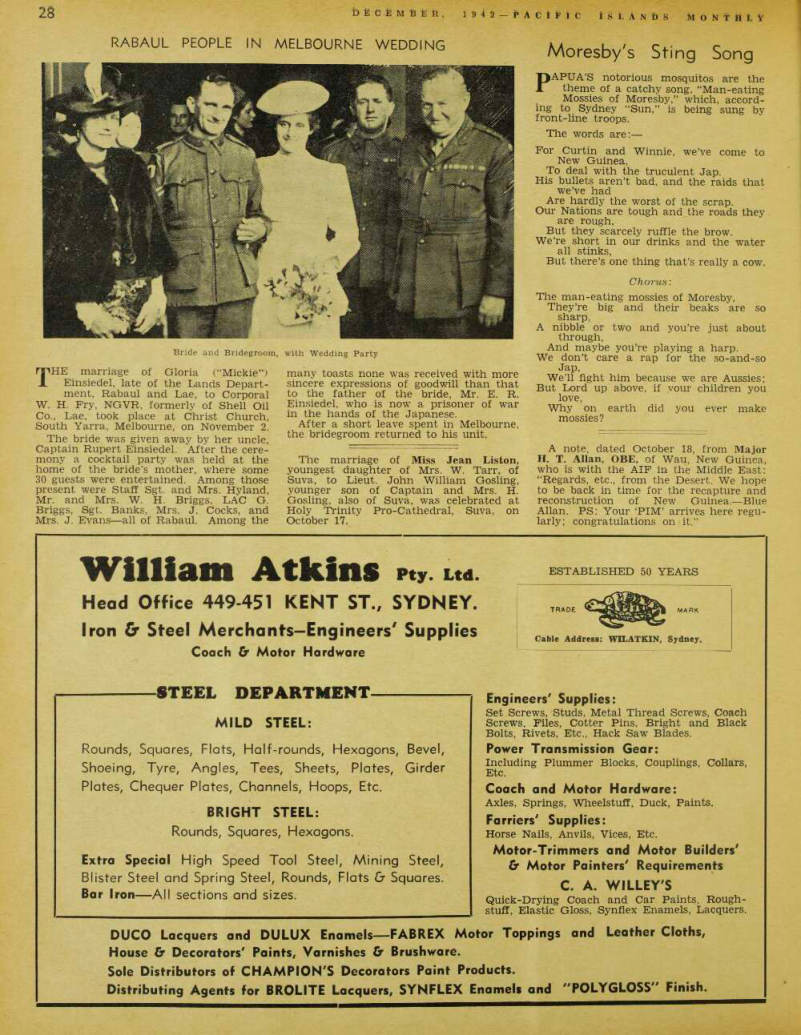
THE marriage of Gloria (“Mickie”) Einsiedel, late of the Lands Depart ment, Rabaul and Lae, to Corporal W. H. Fry, NGVR, formerly of Shell Oil Co., Lae, took place at Christ Church, South Yarra, Melbourne, on November 2.
The bride was given away by her uncle, Captain Rupert Einsiedel. After the cere mony a cocktail party was held at the home of the bride’s mother, where some 30 guests were entertained. Among those present were Staff Sgt. and Mrs. Hyland, Mr. and Mrs. W. H. Briggs, LAC G.
Briggs, Sgt. Banks, Mrs. J. Cocks, and Mrs. J. Evans —all of Rabaul. Among the
many toasts none was received with more sincere expressions of goodwill than that to the father of the bride, Mr. E. R.
Einsiedel, who is now T a prisoner of war in the hands of the Japanese.
After a short leave spent in Melbourne, the bridegroom returned to his unit.
The marriage of Miss Jean Liston, youngest daughter of Mrs. W. Tarr, of Suva, to Lieut. John William Gosling, younger son of Captain and Mrs. H.
Gosling, also of Suva, was celebrated at Holy Trinity Pro-Cathedral, Suva, on October 17.
Bride and Bridegroom, with Wedding Party
Moresby's Sting Song
PAPUA’S notorious mosquitos are the theme of a catchy song, “Man-eating Mossies of Moresby,” which, accord ing to Sydney “Sun,” is being sung by front-line troops.
The words are;— For Curtin and Winnie, we’ve come to New Guinea, To deal with the truculent Jap.
His bullets aren’t bad, and the raids that we’ve had Are hardly the worst of the scrap.
Our Nations are tough and the roads they are rough, But they scarcely ruffle the brow.
We’re short in our drinks and the water all stinks, But there’s one thing that’s really a cow.
Chorus: The man-eating mossies of Moresby, They’re big and their beaks are so sharp, A nibble or two and you’re just about through, And maybe you’re playing a harp.
We don’t care a rap for the so-and-so Jap, We’ll fight him because we are Aussies; But Lord up above, if your children you love, Why on earth did you ever make mossies?
A note, dated October 18, from Major H. T. Allan, OBE, of Wau, New Guinea, who is with the AIF in the Middle East: “Regards, etc., from the Desert. We hope to be back in time for the recapture and reconstruction of New Guinea.—Blue Allan. PS; Your ‘PIM’ arrives here regu larly; congratulations on it.”
Advertisements & other items, p. 30 (2 items)
28
bfeCfcMBER, lsh-HCIFiC ISLANDS MONTHLY
William Atkins Pty. Ltd.
Head Office 449-451 KENT ST., SYDNEY.
Iron & Steel Merchants-Engineers' Supplies
ESTABLISHED 50 YEARS
Coach & Motor Hardware Cable Address: WILATKIN, Sydney.
STEEL DEPARTMENT
MILD STEEL:
Rounds, Squares, Flats, Half-rounds, Hexagons, Bevel, Shoeing, Tyre, Angles, Tees, Sheets, Plates, Girder Plates, Chequer Plates, Channels, Hoops, Etc.
BRIGHT STEEL:
Rounds, Squares, Hexagons.
Extra Special High Speed Tool Steel, Mining Steel, Blister Steel and Spring Steel, Rounds, Flats Cr Squares.
Bar Iron—All sections and sizes.
Engineers' Supplies: Set Screws, Studs, Metal Thread Screws. Coach Screws, Files, Cotter Pins, Bright and Black Bolts, Rivets, Etc., Hack Saw Blades.
Power Transmission Gear: Including Plummer Blocks, Couplings, Collars, Etc.
Coach and Motor Hardware: Axles, Springs, Wheelstuff, Duck, Paints.
Farriers' Supplies: Horse Nails, Anvils, Vices, Etc.
Motor-Trimmers and Motor Builders' & Motor Painters' Requirements
C. A. WILLEY'S
Quick-Drying Coach and Car Paints, Roughstuff, Elastic Gloss, Synflex Enamels, Lacquers.
DUCO Lacquers and DULUX Enamels—FAßßEX Motor Toppings and Leather Cloths, House & Decorators' Paints, Varnishes & Brushware.
Sole Distributors of CHAMPION'S Decorators Paint Products.
Distributing Agents for BROLITE Lacquers, SYNFLEX Enamels and "POLYGLOSS" Finish.
For Sly Grog in Fiji
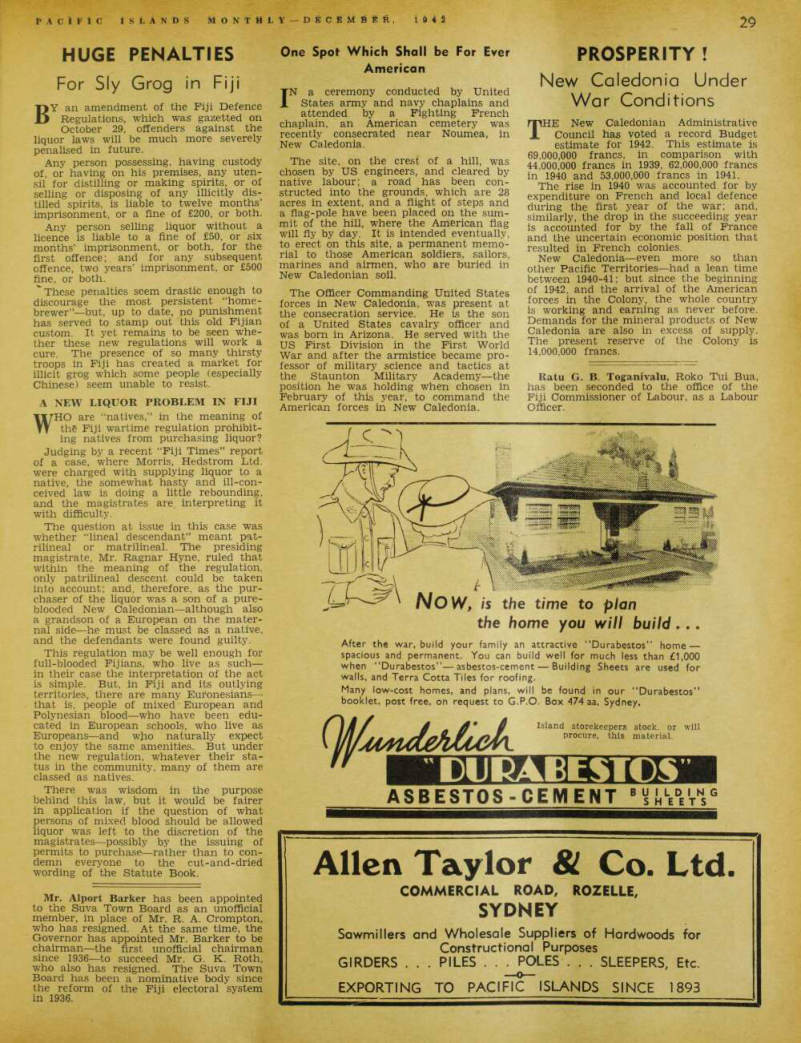
Huge Penalties
BY an amendment of the Fiji Defence Regulations, which was gazetted on October 29, offenders against the liquor laws will be much more severely penalised in future.
Any person possessing, having custody of, or having on his premises, any uten sil for distilling or making spirits, or of selling or disposing of any illicitly dis tilled spirits, is liable to twelve months’ imprisonment, or a fine of £2OO, or both.
Any person selling liquor without a licence is liable to a fine of £5O, or six months’ imprisonment, or both, for the first offence; and for any subsequent offence, two years’ imprisonment, or £5OO fine, or both.
"These penalties seem drastic enough to discourage the most persistent “home brewer”—but, up to date, no punishment has served to stamp out this old Fijian custom. It yet remains to be seen whe ther these new regulations will work a cure. The presence of so many thirsty troops in Fiji has created a market for illicit grog which some people (especially Chinese) seem unable to resist.
A New Liquor Problem In Fiji
WHO are “natives,” in the meaning of the Fiji wartime regulation prohibit ing natives from purchasing liquor?
Judging by a recent “Fiji Times” report of a case, where Morris, Hedstrom Ltd. were charged with supplying liquor to a native, the somewhat hasty and ill-con ceived law is doing a little rebounding, and the magistrates are, interpreting it with difficulty.
The question at issue in this case was whether “lineal descendant” meant pat rilineal or matrilineal. The presiding magistrate, Mr. Ragnar Hyne, ruled that within the meaning of the regulation, only patrilineal descent could be taken into account; and. therefore, as the pur chaser of the liquor was a son of a pure blooded New Caledonian—although also a grandson of a European on the mater nal side —he must be classed as a native, and the defendants were found guilty.
This regulation may be well enough for full-blooded Fijians, who live as such— in their case the interpretation of the act is simple. But, in Fiji and its outlying territories, there are many Euronesians — that is, people of mixed European and Polynesian blood—who have been edu cated in European schools, who live as Europeans—and who naturally expect to enjoy the same amenities. But under the new regulation, whatever their sta tus in the community, many of them are classed as natives.
There was wisdom in the purpose behind this law. but it would be fairer in application if the question of what persons of mixed blood should be allowed liquor was left to the discretion of the magistrates—possibly by the issuing of permits to purchase—rather than to con demn everyone to the cut-and-dried wording of the Statute Book.
Mr. Alport Barker has been appointed to the Suva Town Board as an unofficial member, in place of Mr. R. A. Crompton, who has resigned. At the same time, the Governor has appointed Mr. Barker to be chairman—the first unofficial chairman since 1936—t0 succeed Mr. G. K. Roth, who also has resigned. The Suva Town Board has been a nominative body since the reform of the Fiji electoral system in 1936.
One Spot Which Shall be For Ever
American
IN a ceremony conducted by United States army and navy chaplains and attended by a Fighting French chaplain, an American cemetery was recently consecrated near Noumea, in New Caledonia.
The site, on the crest of a hill, was chosen by US engineers, and cleared by native labour: a road has been con structed into the grounds, which are 28 acres in extent, and a flight of steps and a flag-pole have been placed on the sum mit of the hill, where the American flag will fly by day. It is intended eventually, to erect on this site, a permanent memo rial to those American soldiers, sailors, marines and airmen, who are buried in New Caledonian soil.
The Officer Commanding United States forces in New Caledonia, was present at the consecration service. He is the son of a United States cavalry officer and was born in Arizona. He served with the US First Division in the First World War and after the armistice became pro fessor of military science and tactics at the Staunton Military Academy—the position he was holding when chosen in February of this year, to command the American forces in New Caledonia.
Prosperity!
New Caledonia Under War Conditions
rE New Caledonian Administrative Council has voted a record Budget estimate for 1942. This estimate is 69,000,000 francs, in comparison with 44,000,000 francs in 1939, 62,000,000 francs in 1940 and 53.000,000 francs in 1941.
The rise in 1940 was accounted for by expenditure on French and local defence during the first year of the war; and, similarly, the drop in the succeeding year is accounted for by the fall of France and the uncertain economic position that resulted in French colonies.
New Caledonia —even more so than other Pacific Territories—had a lean time between 1940-41; but since the beginning of 1942, and the arrival of the American forces in the Colony, the whole country is working and earning as never before.
Demands for the mineral products of New Caledonia are also in excess of supply.
The present reserve of the Colony is 14,000,000 francs.
Ratu G. B. Toganivalu, Roko Tui Bua, has been seconded to the office of the Fiji Commissioner of Labour, as a Labour Officer.
Advertisements & other items, p. 31 (1 item)
Durabestos
Now, is the time to plan
the home you will build.
After the war, build your family an attractive “Durabestos” home spacious and permanent. You can build well for much less than £l,OOO when “Durabestos”—asbestos-cement—Building Sheets are used for walls, and Terra Cotta Tiles for roofing.
Many low-cost homes, and plans, will be found in our "Durabestos” booklet, post free, on request to G.P.O. Box 474 aa, Sydney.
Island storekeepers stock, or will procure, this material.
DURABESTOS
ASBESTOS-CEMENT b U l e d eV n s g
Allen Taylor & Co. Ltd.
COMMERCIAL ROAD, ROZELLE,
SYDNEY
Sawmillers and Wholesale Suppliers of Hardwoods tor Constructional Purposes GIRDERS ... PILES .. . POLES . . . SLEEPERS, Etc.
EXPORTING TO PACIFIC ISLANDS SINCE 1893
Air Raid Precautions In
Fiji
AIR-RAID precautions are being taken seriously in Fiji—rightly so, con sidering Fiji’s strategical position in the Pacific.
Periodical shelter tests are made, when all Civil Defence personnel turn out, the streets are cleared, and everyone not on defence work must go to the shelters.
All sections of the community have co-operated wholeheartedly in these tests.
The worst feature appears to be the crowding at the entrances of the shelters of people who are anxious to see what is going on outside. There has been an appeal to all those not yet engaged on direct war work to undertake the duties of shelter warden—people who will make it their business to be early on the scene after a raid warning, and who will see that good order is maintained within
the shelters.
It is considered that the Fiji Civil Defence service has reached a satisfactory standard and that the Colony is now much better prepared to meet any emer gency than it was a few months ago.
War Risk Insurance
Reduced
AN interesting sidelight, on the progress of the war is contained in the announcement, made during the month, that the Institute of London Underwriters has made a reduction in cargo war-risk insurance. Rates for trans-Pacific voyages have been reduced from 15 to per cent., while others are down to 11£ per cent. Voyages from the Pacific coast of America to Austra lasia remain at per cent., but from the American Pacific coast to New Zealand and certain islands it is now 6i per cent.
Presented At Court
A Trader’S Tale By “Tukapa
Koko"
SO long ago that it is now possible to tell of such goings-on without being shot by “Old Granny” (as the “PIM” denominates the dear old lady Government which runs our islands) the laws against immorality and insobriety were very strongly enforced on this enchanted isle of Mangaia.
Court, held every Thursday by the then Resident Agent, was often as good as a play. The inquisitor was a very deaf and irascible gent, and a rigid moralist—for the other chap!—and defendants often had occasion to shiver in their bare feet as they breasted the dock.
There was the case of Toko and Tutana, for instance.
These two sinners of the deepest dye came up before the Beak on the morning after a Wednesday dance, held in the big cargo-shed.
It was a frightful scandal. The zea lous, khaki-clad protectors of public mor ality had caught them kissing each other on an up-turned canoe, all by themselves in the moonlight.
The Beak’s face was like a fiery fur nace seven times heated, as he listened to the indictment, alternately roared in his ear, and enacted in dumb show, by the cops who had arrested the guilty pair.
He addressed Toko, the male malefac tor.
Toko had nothing to say.
“Two pounds!” roared the Beak.
The sinners, though doomed and sen tenced, made no move to make way for the next victims.
“Well, what are you waiting for?” irascibly inquired the Bench.
Toko smiled cheerfully. “Please, Mis ter, I waiting the two quid,” he replied.
On another occasion, Kake the baker, of local fame, was “presented” at this renowned Court, charged with using his yeast for other purposes than life-staff ing requirements.
Kake was, if anything, deafer than his tormenter, and the famous scene in Vic tor Hugo’s book, where the deaf prisoner faces an equally deaf judge, was repeated.
“Do you plead guilty to drunkenness?” asked the Bench.
“Oh, yes, sir, I assure you my bread is the best,” replied the ill-hearing Kake.
“Do you plead guilty?” howled the Vessel of Wrath.
“Certainly,” said the unhearing baker.
“I can supply any quantity.”
The Beak, undesirous of delay, passed sentence. “Ten shillings!” he vociferated.
Kake had not heard his preceding re marks; but the latter portion of the dis course would have got response from him out of the cold, cold ground at Judgment Day.
“Ae e te Akavanui!” (“Yes, O Resi dent”) he replied obediently. “Ten shillings worth it shall be, and I’ll send the boy along with it to the Residency at once!”
The Court was so convulsed with laughter that the malefactor slipped away in the confusion, still quite sure that he had made an excellent deal with His Excellency, Suva at last has some new air-raid sirens—there were many bitter complaints that the last ones could not be heard — and they are being tested regularly at noon on Wednesdays. It was piously hoped in official circles in October that these 1942 models would emit “the desired screaming note/’
Advertisements & other items, p. 32 (2 items)
30
DECEMBER, -1 942 PACIFIC ISLANDS MONTDL?
A. B. Donald Ltd.
AUCKLAND
ISLAND TRADERS & GENERAL MERCHANTS
P.O. Box 1509. Cobles Cr Telegrams, "Kingdom", Auckland.
Scott’s “Renown” Brand Rope,
Cable Address Ropeyard, Sydney. *
Cordage and
Binder
Twine
of Every
Description
MANUFACTURED AT
MASCOT, N.S.W.
By
J. SCOTT
PTY. LTD.
Head Office and Store;
163 CLARENCE STREET,
SYDNEY,
N.S.W.
Remarkable Buoyancy
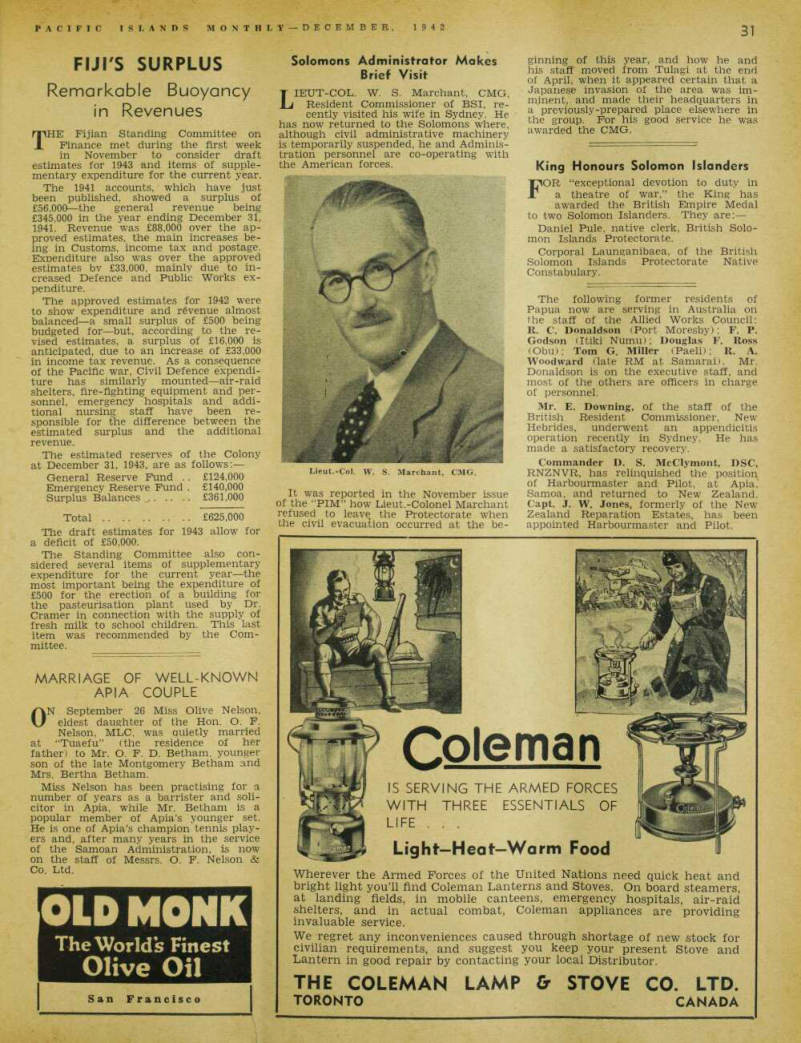
Fiji's Surplus
Remarkable Buoyancy in Revenues
THE Fijian Standing Committee on Finance met during the first week in November to consider draft estimates for 1943 and items of supple mentary expenditure for the current year.
The 1941 accounts, which have just been published, showed a surplus of £56.000 —the general revenue being £345,000 in the year ending December 31, 1941. Revenue was £BB,OOO over the ap proved estimates, the main increases be ing in Customs, income tax and postage.
Expenditure also was over the approved estimates bv £33,000, mainly due to in creased Defence and Public Works ex penditure.
The approved estimates for 1942 were to show expenditure and revenue almost balanced —a small surplus of £5OO being budgeted for —but, according to the re vised estimates, a surplus of £16,000 is anticipated, due to an increase of £33,000 in income tax revenue. As a consequence of the Pacific war, Civil Defence expendi ture has similarly mounted —air-raid shelters, fire-fighting equipment and per sonnel, emergency hospitals and addi tional nursing staff have been re sponsible for the difference between the estimated surplus and the additional revenue.
The estimated reserves of the Colony at December 31, 1943, are as follows: — General Reserve Fund .. £124,000 Emergency Reserve Fund . £140,000 Surplus Balances £361,000 Total £625,000 The draft estimates for 1943 allow for a deficit of £50,000.
The Standing Committee also con sidered several items of supplementary expenditure for the current year—the most important being the expenditure of £5OO for the erection of a building for the pasteurisation plant used by Dr.
Cramer in connection with the supply of fresh milk to school children. This last item was recommended by the Com mittee.
Marriage Of Well-Known
Apia Couple
ON September 26 Miss Olive Nelson, eldest daughter of the Hon. O. F.
Nelson, MLC, was quietly married at “Tuaefu” (the residence of her father) to Mr. O. F. D. Betham. younger son of the late Montgomery Betham and Mrs. Bertha Betham.
Miss Nelson has been practising for a number of years as a barrister and soli citor in Apia, while Mr. Betham is a popular member of Apia’s younger set.
He is one of Apia’s champion tennis play ers and, after many years in the service of the Samoan Administration, is now on the staff of Messrs. O. F. Nelson & Co. Ltd.
Solomons Administrator Makes
Brief Visit
LIEUT-COL. W. S. Marchant, CMG, Resident Commissioner of BSI, re cently visited his wife in Sydney. He has now returned to the Solomons where, although civil administrative machinery is temporarily suspended, he and Adminis tration personnel are co-operating with the American forces.
It was reported in the November issue of the “PIM” how Lieut.-Colonel Marchant refused to leave the Protectorate when the civil evacuation occurred at the be
ginning of this year, and how he and his staff moved from Tulagi at the end of April, when it appeared certain that a Japanese invasion of the area was im minent, and made their headquarters in a previously-prepared place elsewhere in the group. For his good service he was awarded the CMG.
Lieut.-Col. W. S. Marchant, CMG.
King Honours Solomon Islanders
FOR “exceptional devotion to duty in a theatre of war,” the King has awarded the British Empire Medal to two Solomon Islanders. They are:— Daniel Pule, native clerk, British Solo mon Islands Protectorate.
Corporal Launganibaea, of the British Solomon Islands Protectorate Native Constabulary.
The following former residents of Papua now are serving in Australia on the staff of the Allied Works Council: R. C. Donaldson (Port Moresby); F. P.
Godson (Itiki Numu); Douglas F. Ross (Obu); Tom G. Miller (Paeli); R. A.
Woodward (late RM at Samarai). Mr.
Donaldson is on the executive staff, and most of the others are officers in charge of personnel.
Mr. E. Downing, of the staff of the British Resident Commissioner, New Hebrides, underwent an appendicitis operation recently in Sydney. He has made a satisfactory recovery.
Commander D. S. McClymont, DSC, RNZNVR, has relinquished the position of Harbourmaster and Pilot, at Apia, Samoa, and returned to New Zealand.
Capt, J. W. Jones, formerly of the New Zealand Reparation Estates, has been appointed Harbourmaster and Pilot.
Advertisements & other items, p. 33 (2 items)
Coleman
IS SERVING THE ARMED FORCES
WITH THREE ESSENTIALS OF
LIFE . . .
Light-Heat-Warm Food
* Wherever the Armed Forces of the United Nations need quick heat and bright light you’ll find Coleman Lanterns and Stoves. On board steamers, at landing fields, in mobile canteens, emergency hospitals, air-raid shelters, and in actual combat, Coleman appliances are providing invaluable service.
We regret any inconveniences caused through shortage of new stock for civilian requirements, and suggest you keep your present Stove and Lantern in good repair by contacting your local Distributor.
THE COLEMAN LAMP & STOVE CO. LTD.
TORONTO CANADA
Old Monk
The Worlds Finest Olive Oil San Francisco
Two Firms Of
Nelson
To be Associated in Pacific Trade
THE old-established Islands agency firm of Nelson and Robertson Pty Ltd., of 12 Spring Street. Sydney. has taken over the representation in Aus- SS* $ p the N^n S a a n m d° a c n o pany, O. F. Nelson and Co. Ltd.
This should be a happy combination.
In the days before political troubles dis rupted the business, O. F. Nelson and Co. had a huge turnover in Western Samoa, and, through innumerable village stores, controlled most of the native trade. Its operations have been smaller for some years; but Western Samoa now is peace ful and, as a result of the high price of cocoa and copra very prosperous, and the Nelson firm can be expected to share in the prosperity.
Nelson and Robertson Pty. Ltd. have a high reputation among traders and shio- Mp’Mr d Tunn valuable connections. The Iva P Nel ? on ;. m bis day. was a powerful and dominating figure m Paci fic trade; and it would not be unfitting if some of his activities were resumed by his son, the present director of the busi ness, Mr. Norman Nelson. The late Mr.
Ivan Nelson, of Sydney, and Mr. O. F.
Nelson, of Apia, Samoa, although not related in any way, were warm, lifelong friends.
Advertisements & other items, p. 34 (2 items)
Cruel Treatment of Territories' Evacuees
32
DECEMBER, 1942 PACIFIC ISLANDS MONTHLY
Cruel Treatment of Territories' Evacuees (Continued from Page 9)
On Mothsj.
Wanted to Buy—Quality Guns and Rifles HIGHEST PRICES GIVEN. WILL ALSO EXCHANGE GUNS.
S I L R O H U Quality Firearms and Fishing Tackle. 143 ELIZABETH STREET (Near Market St.) SYDNEY. ’PHONE: MA 3540.
1
ON MOTHSj.
agents « h '* ne the m«‘ e «„ ,^ refuse »« sU ® sta \ n , and spray **", to humans.
F IS harmless ld *, eir »s “ ** "S the bottle- Kills [lies Moth_, Mosquitoes Cockroaches/ Silverfish Vacuum Oil Co. Pty. Ltd. (Incorp. in Aust.), Distributors.
Missionary
Death of Rev. A. Mason, Solomons Missionary
NEWS has just been received that Rev.
Albert Mason died in Christchurch, NZ, at the end of August, after 28 years’ service with the Melanesian Mission. Mr. and Mrs. Mason were in New Zealand, away from their station at Fiu, Malaita, BSI, when the Japs struck in the Solomons area, and they were un able to return. Mr. Mason was appointed priest-in-charge of St. Andrew’s, Canter bury, NZ, but towards the end of July he became seriously ill. It was thought that he would recover after treatment; but, on August 25, he passed away.
Mr. Mason was trained in England and joined the mission in 1914. The whole of his service was spent in Malaita, where much of his travelling was performed by whale boat.
He married in 1920 and has a son in the RNZAF. Mrs. Mason hopes to be allowed to return to Malaita eventually to carry on her work among native women, and also translation work.
Dr. J. M. Thomas, of Tavua, Fiji, has been granted an emergency Commission in the Indian Army Medical Service, and will leave Fiji soon to take up his duties.
The death has occurred in Noumea of Mr. Cecil Rudolph Lidgey, an English mining chemist, who first went to New Caledonia in the 1890’s, one of the band of mining experts (many of them Eng lish) who have helped to make the Caledonian industry what it is to-day.
War-useful minerals form 93 per cent, of exports of this Colony. This, together with its strategic position on the Australia-America supply line, is why Japan schemed for and coveted New Caledonia.
Advertisements & other items, p. 35 (1 item)
W.KOPSEN & Co. Pty.Ltd.
SIMPLEX
MARINE
ENGINES
Simplex engines from 3 h.p, to 12 h.p. for boats from 14 ft. to 26 ft. are Australia’s best. 2 cycle and 4 cycle with or without reverse gear.
Illustrated is the popular little 3 h.p. suitable for 14 ft. or 16 ft. boats.
Runs for 5 hours on 1 gallon petrol and costs only £29/15/-, complete with all equipment. Ready to instal into any boat, nothing else to buy.
Ask for Simplex catalogue of engines and launches.
SKARSTEN SCRAPERS
TILLEY
Kerosene
LAMPS
British-made Kerosene Lamps providing a steady 300 c.p. light, without flickering, and without smoke or smell.
Model TLIO (illustrated) is a handsome Table Lamp providing exceedingly brilliant illumination and at the same time a fine ornament for any home.
Stands 24 in. high and covers a large area. Attractive parchment shade Is finished in autumn tones and matches any furnishings.
Also available is the popular All- Purpose Lamp and Lantern (model EX100) and a variety of Hanging, Table, Wall and Vase Lamps.
Let us send you full details of all Tilley Lamps.
Remove paint, varnish, glue, oil, grease, roughness, etc., from wood and metal surfaces. Most useful for scraping deck and hull planks. They leave the surface smooth and dressed and ready for painting. Have renewable blades.
Prices: No. 35, 2/3; 62, 2/6; 80, 3/3.
Reversible, 7/-.
Write for leaflet.
SHIPCHANDLERY
We manufacture and stock the largest range of boatgear in Australia. Everything for boathuilder and boatowner. Marine paints and varnishes. Rope and Cordage. Rigging. Anchors and Moorings. Copper Nails and Rod . Lighting Plants. Fire Extinguishers. Oars and Sculls, Lamps, Pumps, etc.
GET OUR PRICES FIRST.
W.KOPSEN & Co. Pty.Ltd.
376/380 KENT STREET, SYDNEY
■Phone: MA 6336 (4 lines). Est. 1868. Cables: Kopsen . . . Sydney.
Roll Of Honour
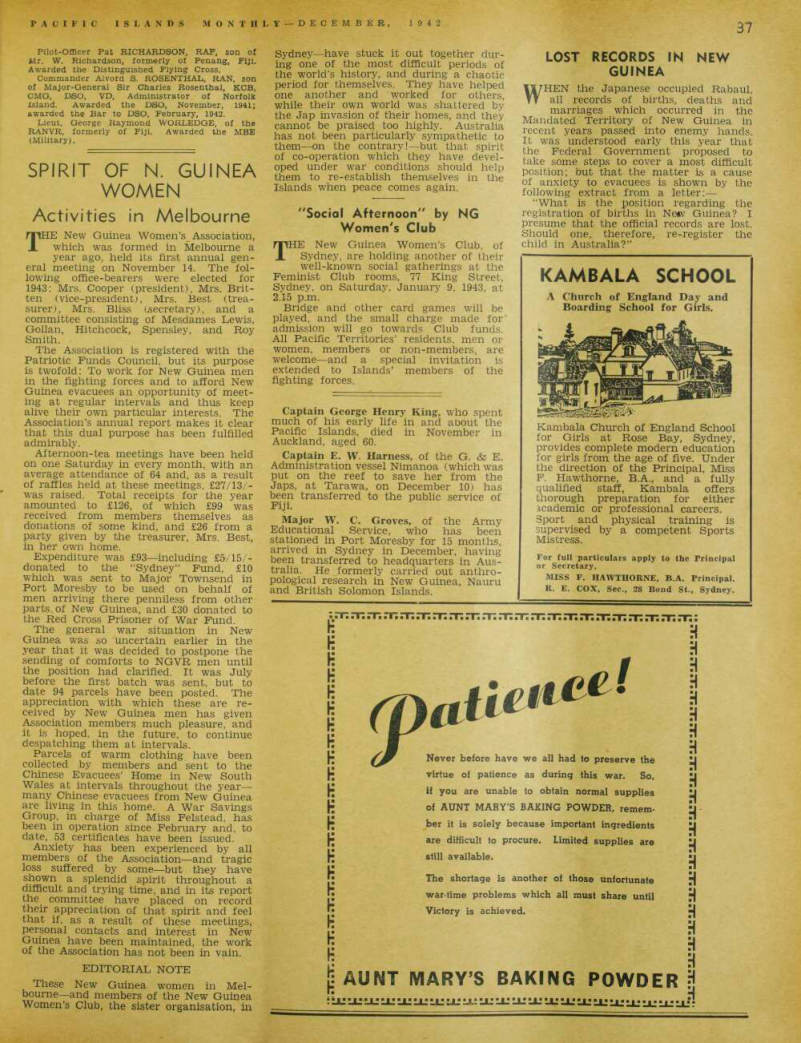
(It Is hoped to assemble, here, the names of men, former residents of the Pacific Territories, which appear in British and Free French casualty lists, or in lists of honours awarded.
We should be grateful if relations and friends would send us details.)
Killed
Eugene AUBRY (formerly of Tahiti), of the Air Force of Fighting France. Killed in an air accident in Great Britain.
Pilot-Officer Len BAYLISS, flying instructor in the RAAF, formerly of Rabaul, New Guinea.
Killed in Sydney, 18/11/1940, when he fell from a trainer aircraft in flight.
A/Bdr. Neville W. BERTWISTLE, AIP artillery (tank unit), formerly a clerk on the staff of W. R. Carpenter and Co. Ltd., of Rabaul, New Guinea. Killed in action, April, 1941.
Pte. W. R. M. BRADNAM, of the NZ Forces, formerly of Fiji. Reported killed in action in the Middle East, 25/11/1941.
Warrant-Officer R. F. BRECHIN, New Guinea Force. Killed in air accident, June 17, 1942.
Formerly of NG Department of Agriculture.
Lieut.-Colonel Felix BROCHE, of the New Caledonian-New Hebridean contingent of the Fighting French Pacific Battalion. Killed in action in the battle of Bir Hacheim (Libya).
Pilot-Officer E. H. CANARD, of RAF, formerly of Fiji Civil Service. Killed in flying accident in South Africa in the course of his duty as flying instructor.
Pierre CHARPENTTER, of the Fighting French
Pacific Battalion. Killed in action in the battle of Bir Hacheim.
Raymond CHAUTARD (formerly of New Cale donia), of the Fighting French Pacific Battalion.
Killed in action in Libya.
Flight-Lieutenant G. *J. I. CLARKE, of the RAAP, formerly Assistant Flight Superintendent of Carpenter Airlines, New Guinea. Killed in action during operations off Dakar (French West Africa), while attached to HMAS “Aus tralia”, September, 1940.
Georges CLEMENS, of the Free French Pacific contingent from New Caledonia. Reported killed in action in the Middle East, March, 1942.
Flying-Officer Jack R. COATH, of the RNZAP, formerly on the staff of the Bank of New Zealand, in Suva, Fiji. Killed October, 1941, when a training aircraft crashed in NZ.
Pte. Felix CRAIG, ALP, formerly of accounts department, Australasian Petroleum Co., Port Moresby, Papua. Killed in action, June, 1941.
L. J. DAWES, of the NZ Forces, formerly Dis trict Officer of Savaii, Western Samoa. Reported killed in action, February, 1942.
Pilot-Officer V. L. DEARMAN, of the RAAF (observer), formerly overseer and clerk at the Colonial Sugar Refining Co., Ltd., Raravai, Fiji. Reported killed in action in the Middle East, October, 1941.
Capt. Jean GILBERT, of the Naval Forces of Fighting France, and formerly of Tahiti. Killed in action.
Captain Kenneth GARDEN, of the RAP Ferry Command, formerly of Guinea Airways Ltd., in New Guinea. Killed September, 1941, when a bomber he “ferried” from USA crashed on west coast of Britain.
Flying-Officer Moresby GOFTON, of the RAF, son of Mrs. F. S. Stewart, of Wau, New Guinea.
Reported missing, 17/5/1940—presumed killed in air operations.
Rifleman J. A. GOODWIN, AIF infantry, for merly of Bulwa, TNG. Reported “accidentally killed”, April, 1942.
Ernest GOURNAC (formerly of Tahiti), of the Air Force of Fighting France. Killed in an air accident in Britain.
Pte. Wallace GRAHAM, of the NZ Forces (infantry), formerly on the staff of Morris Hedstrom Ltd., Fiji. Killed in action in the Middle East, November, 1941.
Squadron-Leader C. R. GURNEY, RAAP, a former chief pilot of Guinea Airways, Ltd.
Killed in action in the New Guinea area, May, 1942.
Gerald T. J. HARPER, RAP, son of Major and Mrs. P. Harper, of Ra, Fiji. Killed in action while navigating a Whitley bomber dur ing a raid on the Continent.
Squadron-Leader Godfrey HEMSWORTH, of the RAAF. formerly a well-known commercial pilot in Morobe, TNG. Reported missing after an operational flight against the Japanese in the New Guinea area—now presumed killed in action.
Flying-Officer Alan JOHNSTONE, of the RAF,
who was born in Suva, Fiji, in 1915. Killed during bombing raid on Kristiansand, Norway, April, 1940.
LAC Douglas KIRBY, RAP, who left Suva, Fiji, with the first contingent of Air Force trainees. Reported killed in a flying accident in South Africa, March, 1942.
Marcel KOLLEN, of the Pacific Battalion of Fighting France. Killed in action in the battle of Bir Hacheim.
Emile LESSON (formerly of New Caledonia), of the Fighting French Pacific Battalion. Killed in action in Libya.
Cpl. Gaston LESSON, of the Fighting French Pacific Battalion. Killed in battle of Bir Hacheim (Libya), Capt. (now Lt.-Colonel) Edward Tiwi LOVE, NZ Maori Battalion, husband of Mrs. Takau Rio Love, Ariki-nui of Rarotonga, Cook Islands. Re ported missing during campaign in Greece, May, 1941; later, June, 1941, reported “wounded and safe.” Officially announced, July 17, killed in action in Libya.
Flying-Officer John C. LOWE, RAAP, formerly an overseer with the CSR Co. in Fiji. Reported, 11/4/1942, “took part in air defence of Rabaul, TNG, —missing, believed killed”.
Pte. L. F. McCarthy, AIP infantry, form erly supercargo on W, R. Carpenter and Co.’s inter-island vessels “Desikoko” and “Mako”, in New Guinea. Reported “killed in action” in Syria, 30/10/1941.
Lance-Corporal A. D. MacPHEE, son of Mr.
R. D. MacPhee, Levuka, Fiji. He was 35, was a member of the AIF, and was killed in Greece, May, 1941.
Francois MASSON, of the Fighting French Pacific Battalion. Killed in action in the battle of Bir Hacheim.
Capt. John Malcolm METHVEN. Reported killed in action in Egypt on July 22, 1942, while serv ing with the AIF. He was born in Ocean Island, and is the youngest son of Mr. and Mrs.
Stuartson C. Methven, of Belgrave, Victoria.
Spr. A. L. MORANDINI, AIP Engineers, for merly of Konedobu, Papua. Reported killed in action, April, 1942.
Pte. Edward Harold PRICE, 2nd NZEF (Machine-gun Battalion), youngest son of Mr. and Mrs. J. Price, Savu Savu West, Fiji. Killed in action during the Libyan campaign, Middle East, 27/11/1941.
Captain W. H. ROBERTS, NZEF, who was Accountant in the Samoa Treasury Dept., dur ing 1934-35. Killed in action in Libya, Decem ber, 1941.
Major A. B. ROSS, NZEF, who, between 1923- 29 was successively, Assistant Secretary for Native Affairs, Assistant Secretary to the Administration, and ADC to the Administrator of Samoa. Killed in action in Libya.
Cpl. Alex. C. SCOTT, AIF, formerly manager at Kieta, TNG, for Burns, Philp and Co. Ltd.
Killed in action in the Middle East, 19/6/1941.
Pte. Popoare TANGHTI, of the NZ Forces (Maori Battalion), formerly of Mangaia, Cook Islands. Reported “missing after Battle of Greece—presumed dead”, July, 1941.
Sgt. Edward WILSON, of Suva, serving in the Fiji Defence Force. Accidentally drowned in the Lami River, Fiji, April, 1942.
Died From Wounds
Pte. Ernest HENRY, AIF, formerly of the Rabaul (NG) staff of Burns, Philp and Co.
Ltd. Died from wounds received in Battle of Crete. 1/6/1941.
Pte. Alec. MUNRO, NZ Forces, formerly of Norfolk Island. Died in Libya (Middle East), December, 1941.
Pte. T. LAWRIE, AIF, son of Mr. Lawrie, for merly of Fiji. Died of wounds in Middle East.
Pte. Walter PEARSON, of first NG quota of AIF (infantry). Died from wounds received in action, 24/6/1941.
A/Bdr. W. R. SCOTT, AIF, of New Guinea.
Died from wounds, July, 1941.
Sgt.-Pilot Peter Clarkson WISE, of the RAF, son of Mr. W. Wise, OBE, Director of Public Works, Fiji. Died from wounds received during bombing raid over Germany, January, 1941.
Died From Illness
Pte. Clarence A. HUTTON, AIF, formerly of Edie Creek, TNG. Died from illness, April, 1941.
A/Sgt. J. H. STANE, Royal Australian En gineers, formerly of Port Moresby, Papua. Died from illness. May, 1942.
Cpl. R. H. SUTTON, NGVR, formerly of Wau, TNG. Died from malaria and typhoid in October, 19'42.
Major P. J. WOODHILL, AIP infantry, formerly legal assistant in the Crown Law Office, Rabaul, New Guinea. Reported “deceased”, December, 1941.
Missing
Louis ANGER, of Fighting French Pacific
Battalion. Reported missing after battle of Bir Hacheim.
Pte. P. F. BAILEY. AIF infantry, of Rabaul, TNG. Reported missing, 17/2/1942.
Cpl. Leon BARRENE, of Pacific Battalion of Fighting France. Missing after battle of Bir Hacheim (Libya).
Robert BLUM, of Fighting French Pacific Battalion. Reported missing after battle of Bir Hacheim.
Sgt. Ronald Arthur BROODBANK, formerly of Samarai, Papua, now serving with the RAAF overseas. Reported missing on May 31 while on air operations.
Reginald BOULANGER, of Fighting French Pacific Battalion. Reported missing after battle of Bir Hacheim.
Pte. E. L. CHRISTIE, AIF infantry, of Rabaul, TNG. Reported missing, 17/2/1942.
Victor DERVAUX, of Fighting French Pacific Battalion. Reported missing after battle of Bir Hacheim.
Lucien DEVAND, of Pacific Battalion of Fight ing France. Missing after battle of Bir Hacheim (Libya).
Pte. A. G. DICKSON, AIF infantry, of Rabaul, TNG. Reported “missing, believed wounded”, 17/2/1942.
GELLER, of Fighting French Pacific Battalion. Reported missing after battle of Bir Hacheim.
J. P. GOUZENES, of Fighting French Pacific Battalion. Reported missing after battle of Bir Hacheim.
Chief-Sergeant Francois GRISCOLLI, of Fight ing French Pacific Battalion. Reported missing in Libya in April, Formerly of New Caledonia.
Pte. Andrew A. (Billo) Johnson, Ngvr.
Reported missing in New Guinea on October 29, 1942.
Georges KABAR, of Fighting French Pacific Battalion. Reported missing after battle of Bir Hacheim.
Henri LANGLOIS, of Pacific Battalion of Fighting France. Missing after battle of Bir Hacheim (Libya).
Numa LETHESER, of Pacific Battalion of Fighting France. Missing after battle of Bir Hacheim (Libya).
Rene LETOCART, of Fighting French Pacific Battalion. Reported missing after battle of Bir Hacheim.
Camille MERCIER, of Fighting French Pacific Battalion. Reported missing after battle of Bir Hacheim.
MOUTRY, of Fighting French Pacific Battalion. Reported missing after battle of Bir Hacheim.
Pte. R. J. PASCOE, AIF infantry, of Rabaul, TNG. Reported missing, 27/1/1942.
Pilot Tom PATTERSON, of the RNZAF, formerly of Levuka, Fiji. Reported missing, in November, 1941, after bombing raid on the Continent.
Henri PAYONNE, of Fighting French Pacific Battalion. Reported missing after battle of Bir Hacheim.
Eugene PENE, of Fighting French Pacific Battalion. Reported missing after battle of Bir Hacheim.
Andre PETRE, of Fighting French Pacific Battalion. Reported missing after battle of Bir Hacheim.
Hector PILLING, RAF, who was born in Fiji and who was the son of Sir Guy Pilling, of Zanzibar (formerly of Fiji). Reported missing, while serving with the Royal Air Force Bomber Command.
Eugene POGNON, of Fighting French Pacific Battalion. Reported missing after battle of Bir Hacheim.
Gnr. Allan H. ROSS, AIF artillery, formerly planter in New Britain, TNG. Reported “miss ing—believed prisoner of war”, 28/9/1941. —• ROUDEILLAC, of Fighting French Pacific Battalion. Reported missing after battle of Bir Hacheim.
Pte. William RUPE, of the NZ Forces (Maori Battalion), formerly of Aitutaki, Cook Islands.
Reported “missing after Battle of Greece”, July, 1941.
Pilot James SIMPSON, of the RAF, formerly of Vatukoula, Fiji. Reported missing after air operations over Malta, in the Mediterranean, 1/7/1941.
Pilot-Officer Neville George STOKES, of the RAF, formerly a pilot with Guinea Airways, Ltd., in New Guinea. Reported missing after air operations in Europe, December, 1941.
Reported Missing
Malaya Casualty List, Published 23/7/1942.
Pte. N. H. AMOS, artillery, Port Moresby.
Pte. E. L. CHRISTIE, infantry, Rabaul.
Pte. A. G. DICKSON, infantry, Rabaul.
Pte. A. I. FOLEY, artillery, Port Moresby.
W.0.l A, N. GRAY, ordnance, Rabaul.
W. 0.2 V. M. I. GORDON, artillery, Wau, New Guinea.
Pte. J. M. HIRSCHEL, infantry, Rabaul.
Pte. J. G. NEWTON, artillery, Port Moresby.
A./Bdr. B. L. J. MEETON, artillery, Rabaul.
Pte. D. M. SPENCE, artillery, Port Moresby.
Australia and Island Stations.
Pte. W. G. EKBLADE, infantry, Rabaul.
Pte. S. W. HUNTER, infantry, Kokopo.
Wounded
Sgt. Robert ASMUS, of the Fighting French Pacific Battalion. Wounded at Bir Hacheim and evacuated.
Rene AUFANT, of the Fighting French Pacific Battalion. Wounded at Bir Hacheim.
Cpl. Thomas BAMBRIDGE, of the Fighting French Pacific Battalion. Wounded at Bir Hacheim and evacuated.
BERBERE (alias ARESKY), of the Fighting French Pacific Battalion. Wounded at Bir Hacheim.
Henri BERTHELIN, of the Fighting French Pacific Battalion. Wounded at Bir Hacheim.
Pte. V. BLANCO, AIF infantry, of Thursday Island. Wounded in action, July, 1941, L/Cpl. J. P. BLENCOWE, AIP infantry, of Rabaul, TNG. Wounded in action, July, 1941.
Jean BRIAL, of the Fighting French Pacific Battalion. Wounded at Bir Hacheim.
Pte. George BUCKNELL, AIF, son of Mr. and Mrs. C. Bucknell, of KoroLevu, Fiji. Wounded in action in Malaya, January, 1942.
Pte. Thomas BYERS, AIF infantry, of Thurs day Island. Wounded in action, May, 1941.
Raymond CHAUTARD, of the Free French Pacific contingent from New Caledonia. Re ported a casualty in the Middle East, March, 1942.
Albert CUBADDA, of the Free French con tingent from New Caledonia. Reported a casualty in the Middle East, March, 1942.
Charles DEVEAUX, of Pacific Battalion of Fighting France. Wounded at battle of Bir Hacheim (Libya).
V. FAIRHALL, 2nd NZEF, formerly of the Treasury Department, Western Samoa. Reported wounded in action, February, 1942.
Paroa FIU, of the Fighting French Pacific Battalion. Wounded at Bir Hacheim and evacuated.
Acting Warrant-Officer V. M. I. GORDON, AIF infantry, of Wau, TNG. Wounded in action, February, 1942.
Pte. John GRANT, AIF infantry, of New Guinea. Wounded in neck and thigh, September, 1941; later, reported “rejoined unit”.
Henri GUILBAUD, of the Free French Pacific contingent from New Caledonia. Reported a casualty in the Middle East, March, 1942.
Sgt. C. HENDRICK, AIF infantry, of Rabaul, TNG. Wounded in action, July, 1941.
Stanley HIGGS, son of Mr. and Mrs. Gordon Higgs, of W. R. Carpenter and Co. Ltd., New Guinea. Member of an English Lancers’ regiment, wounded during British evacuation from Dun kirk (France), May, 1940.
Lieut. Lloyd T. HURRELL, AIP infantry, of Rabaul, TNG. Wounded in action, July, 1941.
Alexandre HUYARD, of the Free French Pacific contingent from New Caledonia. Reported a casualty in the Middle East, March, 1942.
Sgt.-Pilot Andrew KRONFELD, of the NZ Fighter Squadron attached to the RAF. Wounded In knee during operations over France, December, 1941.
Cpl. W. H, LANNEN, AIF artillery, of Rabaul, New Guinea. Wounded in action, June, 1941.
Gnr. E. G. LOBAN, AIF artillery, of Thursday Island. Wounded during campaign in Greece, May, 1941; invalided home after having his left forearm amputated.
Auguste LUTA, of the Fighting French Pacific Battalion. Wounded at Bir Hacheim and evacuated.
A/Sgt. Alastair MACLEAN, AIP infantry, of Rabaul, New Guinea. Wounded in action, in Libya, June, 1941.
Sgt. J. D. McCLYMONT, NZEF, son of Capt.
D. McClymont, Harbourmaster of Apia, Western Samoa. Wounded in action, November, 1941.
Cpl. R. McKERLIE, AIF, of Yandina, BSI, wounded in face by bomb explosion, April, 1941.
T. MANEA, of the Fighting French Pacific Battalion. Wounded at Bir Hacheim and evacuated.
Jean MERIGNAC, of the Free French Pacific contingent from New Caledonia. Reported a casualty in the Middle East, March, 1942.
Henri MEYER, - of the Free French Pacific contingent from New Caledonia. Reported a casualty in the Middle East, March, 1942.
S/Sgt. Graham B. MIRFIELD, AIP engineers, of Rabaul, New Guinea. Wounded in action, Joseph OTHUS, of Pacific Battalion of Fight ing France. Wounded in battle of Bir Hacheim (Libya).
Pte. L. G. (“Mick”) REECE, AIF, of Bulolo, New Guinea. Wounded in action, July, 1941.
Henri RIVIERE, of the Free French Pacific contingent from New Caledonia. Reported a casualty in the Middle East, March, 1942.
A/Cpl. N. K. SAWYER, AIF infantry, of
Rabaul, TNG. Wounded in action, July, 1941.
July, 1941.
Lieut. Jeffrey SEAGOE, serving with the British forces in the Far East, formerly of Vila, New Hebrides. Reported “wounded in action”.
March, 1942.
Pte. Lance STAMPER, AIF, formerly school master at Wau, New Guinea. Wounded in action, August, 1941, Cpl. Raphael TEIHO, of the Fighting French Pacific Battalion. Wounded at Bir Hacheim and evacuated.
Cpl. Terii TERIITUA, of the Fighting French Pacific Battalion. Wounded at Bir Hacheim and evacuated.
Pte. Harold G. TURNER, AIF, of Samarai, Eastern Papua. Wounded in action at Bardia (Libya), January, 1941.
Pte. F. D. TWISS, AIF infantry, of New Guinea. Wounded in action, August, 1941.
Camille VINCENT, of the Free French Pacific contingent from New Caledonia. Reported a casualty in the Middle East, March, 1942.
Driver Don F. WAUCHOPE, AIF. Formerly employed on his brother’s plantation in New Guinea. Wounded in action, July, 1942.
Alex. WINCHESTER, of the Fighting French Pacific Battalion. Wounded at Bir Hacheim.
Sgt.-Pilot W. WRIGHT, of the Australian Spitfire Squadron, attached to the RAF, for merly of New Guinea. Wounded in knee during aerial “dog-fight” over the English Channel, March, 1942.
Prisoners Of War
Lieut. CLARRIE ARCHER, NGVR. Believed prisoner of war in Japan.
ALEXANDRE BLACK, of Pacific Battalion of Fighting France, Reported killed in action at Bir Hacheim, now reported prisoner of war.
A/Cpl. Peter W. BOSGARD, AIF infantry, formerly of the Lands Department, Port Moresby, Papua. Reported prisoner of war at Sulmona, Italy, 29/6/1941; transferred to Bolzano prison camp, September, 1941.
Andre CHITTY, of Pacific Battalion of Fight ing Prance. Taken prisoner at battle of Bir Hacheim (Libya), A/Sgt. A. A. S. COTMAN, AIF infantry, of Abau, Papua. Reported missing—believed prisoner of war, 5/5/1941; reported later, July, 1941, “wounded in chest and head by shrapnel taken prisoner”.
Pte. J. DALTON, AIF Transport and Supply, formerly of Thursday Island. Reported prisoner of war, April, 1942.
Dick ELMOUR, formerly of New Caledonia, prisoner of war after Dunkirk. Repatriated to France in January, 1942, because of health reasons.
Pilot-Officer George Beilby EVANS, RAAF, son of Mr. and Mrs. Beilby Evans, formerly of Buka Passage, TNG. Reported prisoner of war in Java.
Sgt. Ronald Gemmell-Smith, Rap, For
merly on CSR Co.’s staff, Fiji. Reported prisoner of war in Bengazi, JLibya, in November, 1942.
Pte. W. GOSSNER, AIF infantry, formerly of the BNG Development Co., Port Moresby, Papua.
Reported prisoner of war, Sulmona, Italy. 6/7/1941.
Lieut. J. M. HARCOURT. 2nd NZEF, son of Mr. H. W. Harcourt, formerly Deputy Treasurer in Fiji. Reported “captured in Libya and now prisoner of war”, March, 1942.
S. D. C, KERKHAM, NZEF, son of Mr. R. C.
Kerkham, Suva, Fiji. Reported prisoner of war in September, 1942.
Lieut. JEFF KILNER, NGVR. Believed prisoner of war in Japan.
Gnr. A. L. B. KING, AIF artillery, of Rabaul, TNG. Reported prisoner of war, 29/7/1941.
Major E. G. A. LETT, of the East Surrey Regiment, and son of Mr. Lewis Lett, of Port Moresby, Papua. Reported prisoner of war in Libya.
A/Cpl. John H. LONERGAN, AIF, Supply and Transport, of New* Guinea. Reported prisoner of war at Corinthia, Italy, 8/7/1941.
Pte. Ernest (“Paddy”) McGEADY, NZEF, son of Mrs. J. McGeady, of Suva, Fiji. Reported “missing, believed killed”, after fighting in Libya, January, 1942; reported prisoner of war in Italy, April, 1942.
Cpl. J. H. L. McGUIGAN, of the Field Ambul ance, AIF (formerly a resident of New Guinea), officially reported missing at Singapore; un officially reported a prisoner in Japanese hands.
Observer Alex. McKAY, of the RAAF, formerly of the CSR Co.’s staff, at Penang sugar-mill, Fiji. Reported missing, 27/7/1941; reported prisoner of war in Italy, 26/10/1941.
Pte. Harry MARCHINGTON, of the NZ Forces, formerly of Fiji. Reported prisoner of war after Battle of Crete, 2/12/1941.
Emile MILLOT, of Pacific Battalion of Fight ing France. Taken prisoner in battle of Bir Hacheim (Libya).
Pte. D. R. PHILLIPS, AIF engineers, formerly of Bulwa, TNG. Reported prisoner of war, June, 1942.
Pte. John O. SMITH, of the NZ Forces, son of Captain Arthur Smith, of the Fiji inter-island vessel “Tui Kauvaro”. Missing after battle of Crete, May, 1941; reported prisoner of war in Germany, 21/10/1941.
Squadron-Leader L. C. SHOPPEE, DSO, RAF, formerly of Edie Creek, New Guinea. Was in Java during Japanese invasion; now pre sumed to be a prisoner of war.
LAC Charles SOLLITT, of the RAAF (wire less operator), son of Mr. and Mrs. C, H.
Sollitt, of Nausori, Fiji. Reported missing after air operations in New Guinea, January, 1942; later, March, 1942, reported rescued from sea by Japanese—now prisoner of war.
Pte. Fred SWAN, NZ Army Medical Corps, formerly of Apia, Western Samoa, Missing
after Battle of Crete, August, 1941; reported prisoner of war in Germany, November, 1941 Lieut. CLIFF WARREN, of NZEF, serving 'in the Middle East, and formerly of Morris Hed strom Ltd.’s staff at Ba and Lautoka, Fiji. Re ported prisoner of war.
Mjr. N. WATCH, formerly Dr. Watch, of Rabaul, missing after Japanese invasion of Rabaul. Believed prisoner of war in Japan.
Pte. John D. WHITCOMBE, of the NZ Forces, formerly of Levuka, Fiji. Reported prisoner of war in Germany, November, 1941.
Decorations
Squadron-Leader G. U. (“Scotty”) aLLEN, RAAP, who is well-known in New Guinea and Papua, having been co-pilot on the “Faith in Australia”, on the first official air-mail flight to the Territories in 1934. Awarded the Air Force Cross for his work with Catalina flying toats in- Australia and the Pacific.
Major H. T. ALLEN, AIF, formerly of Wau, Morobe District, TNG. Awarded the QBE.
Squadron-Leader C. A. BASKETT, formerly of Bulolo, TNG. Awarded Distinguished Flying Cross for raids over enemy territory while attached to Hampden bomber squadron in Eng land.
Sgt. Henry C. S. COTTON, of the RNZAF, who was born in Samoa (his father was Secre tary of Native Affairs during the NZ military occupation). Awarded the Distinguished Flying Cross.
FREDERIC DELAVEUVE, formerly of New Caledonia. Awarded Croix de Guerre, while serving with Fighting French volunteers in Egypt.
Rifleman H. W. FORRESTER, NGVR, formerly of Bulolo, TNG. Awarded the Military Medal for operations against Japanese in New Guinea.
Squadron-Leader Godfrey HEMSWORTH, RAAF, formerly a well-known New Guinea pilot, who was killed in action against the Japanese In May. Posthumously awarded the Air Force Dross.
Plight-Lieut. R. N. DALKIN, RAAF, formerly of W. R. Carpenter and Co., Ltd., Salamaua, TNG. Awarded the DFC for bombing raids against the Japanese in Koepang area, DEI.
Squadron-Leader C. R. GURNEY, RAAF, for merly of Guinea Airways, Ltd., TNG. Posthu mously awarded the Air Force Cross, for bomb ing raids on Japanese-held ports in New Britain.
LUCIEN HERVOUET, formerly of New Cale donia. Awarded Croix de Guerre while serving with Fighting French volunteers in Egypt.
Lieut. Colin HILL, RANR, of the Australian destroyer, “Waterhen”, formerly second officer on the trans-Pacific liner “Niagara”. Awarded the QBE.
Flying-Officer James R. HYDE, of the RAF, formerly a Patrol Officer in Namatanai and Sepik Districts, TNG. Awarded the Distinguished Flying Cross.
Lieut.-Commander A. W. R. McNICOLL, RAN, son of Sir Ramsay McNicoll, Administrator of New Guinea, and Lady McNicoll. Awarded the George Medal.
Petty-Offlcer PAUL MASON, RANVR, formerly a plantation inspector at Inus, Bougainville, TNG. Awarded American Distinguished Service Cross for “extraordinary heroism in action.”
HENRI MAYER, formerly of New Caledonia.
Awarded Croix de Guerre while serving with Fighting French volunteers in Egypt.
Sgt. Geoffrey MOORE, of the RNZAF, formerly engineer on the NG inter-island vessel “Maiwara” and on the trans-Pacific liner “Aorangi”. Awarded the Distinguished Flying Medal.
ANDRE MORNAGHINI, formerly of New Cale donia. Awarded Croix de Guerre while serving with Fighting French volunteers in Egypt.
Pilot-Officer Pat RICHARDSON, RAP, son of Mr. W. Richardson, formerly of Penang, Fiji.
Awarded the Distinguished Flying Cross.
Commander Alvord S. ROSENTHAL, RAN, son of Major-General Sir Charles Rosenthal, KCB, CMG, DSO, VD, Administrator of Norfolk Island. Awarded the DSO, November, 1941; awarded the Bar to DSO, February, 1942.
Lieut. George Raymond WORLEDGE, of the RANVR, formerly of Fiji. Awarded the MBE (Military).
Advertisements & other items, pp. 36-38 (2 items)
Gold
Asthma Mucus
Dissolved Ist. Day
Choking, gasping, wheezing Asthma and Bronchitis poison your system, sap your energy, ruin your health and weaken your heart. In 3 minutes Mendaco —the prescription of a famous doctor —circulates through the blood, quickly curbing the attacks. The very first day the strangling mucus is dissolved, thus giving free, easy breathing and restful sleep. No dopes, no smokes, no injections. Just take pleasant, tasteless Mendaco tablets at meals and be entirely free from Asthma and Bronchitis in next to no time, even though you may have suffered for years. Mendaco is so successful that it is guaranteed to give yon free, easy breathing in 2-t hours and to completely stop your Astuma m a days or money uacU on return of empty package. Get Mendaco Inrvm \ \ll n Pliam Ends Asthma . . . Now 3/-, 6/-, 12/-
Mendaco
trom your Chemist. The guarantee protects you-
Highest Prices Paid For
GOLD
Garrett & Davidson’s organisation is acknowledged far and wide as the main clearing house for precious metals in the Southern Hemisphere.
They have earned a reputation for accuracy and integrity in all their business dealings, which is proved by the fact that they are privileged to handle more gold from the Islandis of the Pacific than any other organisation.
Therefore for your complete and lasting satisfaction, you are advised to transact all your precious metals business through the house of Garrett & Davidson.
GARRETT & DAVIDSON PTY. LTD.
ASSAYERS METALLURGISTS REFINERS
Bank of N.S.W. Buildings,
REGENT AND GEORGE STS., SYDNEY.
UNION
ASSURANCE SOCIETY LTD.
(Incorporated in England)
FIRE ACCIDENT
FIJI A. E. PEARCE & CO.
RABAUL COLYER WATSON
(New Guinea) Ltd.
N. S. WALES 109 PITT STREET,
SYDNEY.
S. Morrison, Mgr.
CONTROLLING OFFICE—
-413 Collins St., MELBOURNE
ALAN H. RUSSELL,
Resident Manager.
Q
& Col
General
Merchants
dnd
Agents
379 KENT STREET,
SYDNEY.
Telephones: MJ 4657 (5 lines).
REfRE&IHTIWG LEADING FIRMS IN THE PACIFIC*' ISLANDS Islands Produce Sold on Shippers’ Account Buyers of all Islands’ requirements on Commis- Liberal Advances against Consignments. sion Original Invoices Furnished. 25 Years’ Islands Trade Experience.
Bankers: Bank of New South Wales. Correspondence in English and French.
PINKETTES
TINY LAXATIVE
AND LIVER PILLS
Painlessly Exercise the Digestive System
X
Guard against Infection with Tenax!
'Jf'ENAX Germicidal Soap used regularly is an
unsurpassed safeguard against external germ
infection. It is kind to the most sensitive skin, yet its germicidal action is eleven times as rapid as carbolic. It is non-irritant and non-poisonoua.
At All Chemists and Stores,
TENAX Qenuindy Germicidal SOAP
Now Only wm 9 per Tablet. m
SOAP
35
1* A C 1 f I C ISLANDS MONTHLY DECEMBER, 1942
Women
Spirit Of N. Guinea
Activities in Melbourne
rE New Guinea Women’s Association, which was formed in Melbourne a year ago, held its first annual gen eral meeting on November 14. The fol lowing office-bearers were elected for 1943; Mrs. Cooper (president), Mrs. Brit ten (vice-president), Mrs. Best (trea surer), Mrs. Bliss (secretary), and a committee consisting of Mesdames Lewis, Gollan, Hitchcock, Spensley, and Roy Smith.
The Association is registered with the Patriotic Funds Council, but its purpose is twofold: To work for New Guinea men in the fighting forces and to afford New Guinea evacuees an opportunity of meet ing at regular intervals and thus keep alive their own particular interests. The Association’s annual report makes it clear that this dual purpose has been fulfilled admirably.
Afternoon-tea meetings have been held on one Saturday in every month, with an average attendance of 64 and, as a result of raffles held at these meetings, £27/13/was raised. Total receipts for the year amounted to £126, of which £99 was received from members themselves as donations of some kind, and £26 from a party given by the treasurer, Mrs. Best, in her own home.
Expenditure was £93—including £5/15/donated to the “Sydney” Fund, £lO which was sent to Major Townsend in Port Moresby to be used on behalf of men arriving there penniless from other parts of New Guinea, and £3O donated to the Red Cross Prisoner of War Fund.
The general war situation in New Guinea was so uncertain earlier in the year that it was decided to postpone the sending of comforts to NGVR men until the position had clarified. It was July before the first batch was sent, but to date 94 parcels have been posted. The appreciation with which these are re ceived by New Guinea men has given Association members much pleasure, and it is hoped, in the future, to continue despatching them at intervals.
Parcels of warm clothing have been collected by members and sent to the Chinese Evacuees’ Home in New South Wales at intervals throughout the year— many Chinese evacuees from New Guinea are living in this home. A War Savings Group, in charge of Miss Felstead, has been in operation since February and, to date, 53 certificates have been issued.
Anxiety has been experienced by all members of the Association—and tragic loss suffered by some—but they have shown a splendid spirit throughout a difficult and trying time, and in its report the committee have placed on record their appreciation of that spirit and feel that if, as a result of these meetings, personal contacts and interest in New Guinea have been maintained, the work of the Association has not been in vain.
Editorial Note
These New Guinea women in Mel bourne—and members of the New Guinea Women’s Club, the sister organisation, in
Sydney—have stuck it out together dur ing one of the most difficult periods of the world’s history, and during a chaotic period for themselves. They have helped one another and worked for others, while their own world was shattered by the Jap invasion of their homes, and they cannot be praised too highly. Australia has not been particularly sympathetic to them —on the contrary!—but that spirit of co-operation which they have devel oped under war conditions should help them to re-establish themselves in the Islands when peace comes again.
"Social Afternoon" by NG
Women's Club
THE New Guinea Women’s Club, of Sydney, are holding another of their well-known social gatherings at the Feminist Club rooms, 77 King Street.
Sydney, on Saturday, January 9, 1943, at 2.15 p.m.
Bridge and other card games will be played, and the small charge made for admission will go towards Club funds.
All Pacific Territories’ residents, men or women, members or non-members, are welcome —and a special invitation is extended to Islands’ members of the fighting forces.
Captain George Henry King, who spent much of his early life in and about the Pacific Islands, died in November in Auckland, aged 60.
Captain E. W. Harness, of the G. & E.
Administration vessel Nimanoa (which was put on the reef to save her from the Japs, at Tarawa, on December 10) has been transferred to the public service of Fiji.
Major W. C. Groves, of the Army Educational Service, who has been stationed in Port Moresby for 15 months, arrived in Sydney in December, having been transferred to headquarters in Aus tralia. He formerly carried out anthro pological research in New Guinea, Nauru and British Solomon Islands.
Lost Records In New
Guinea
WHEN the Japanese occupied Rabaul, all records of births, deaths and marriages which occurred in the Mandated Territory of New Guinea in recent years passed into enemy hands.
It was understood early this year that the Federal Government proposed to take some steps to cover a most difficult position; but that the matter is a cause of anxiety to evacuees is shown by the following extract from a letter: — “What is the position regarding the registration of births in New Guinea? I presume that the official records are lost.
Should one, therefore, re-register the child in Australia?”
Advertisements & other items, p. 39 (1 item)
Aunt Mary’S Baking Powder
KAMBALA SCHOOL
A Church of England Day and Boarding School for Girls.
Kambala Church of England School for Girls at Rose Bay, Sydney, provides complete modern education for girls from the age of five. Under the direction of the Principal, Miss F. Hawthorne, 8.A., and a fully qualified staff, Kambala offers thorough preparation for either academic or professional careers.
Sport and physical training is supervised by a competent Sports Mistress.
For full particulars apply to the Frincipal or Secretary.
MISS F. HAWTHORNE, B.A. Principal.
R. E. COX, Sec., 28 Bond St., Sydney.
/W Never before have we all had to preserve the virtue of patience as during this war. So. if you are unable to obtain normal supplies
of AUNT MARY'S BAKING POWDER, remem-
ber it is solely because important ingredients are difficult to procure. Limited supplies are still available.
The shortage is another of those unfortunate war-time problems which all must share until Victory is achieved.
AUNT MARY’S BAKING POWDER
Tahiti
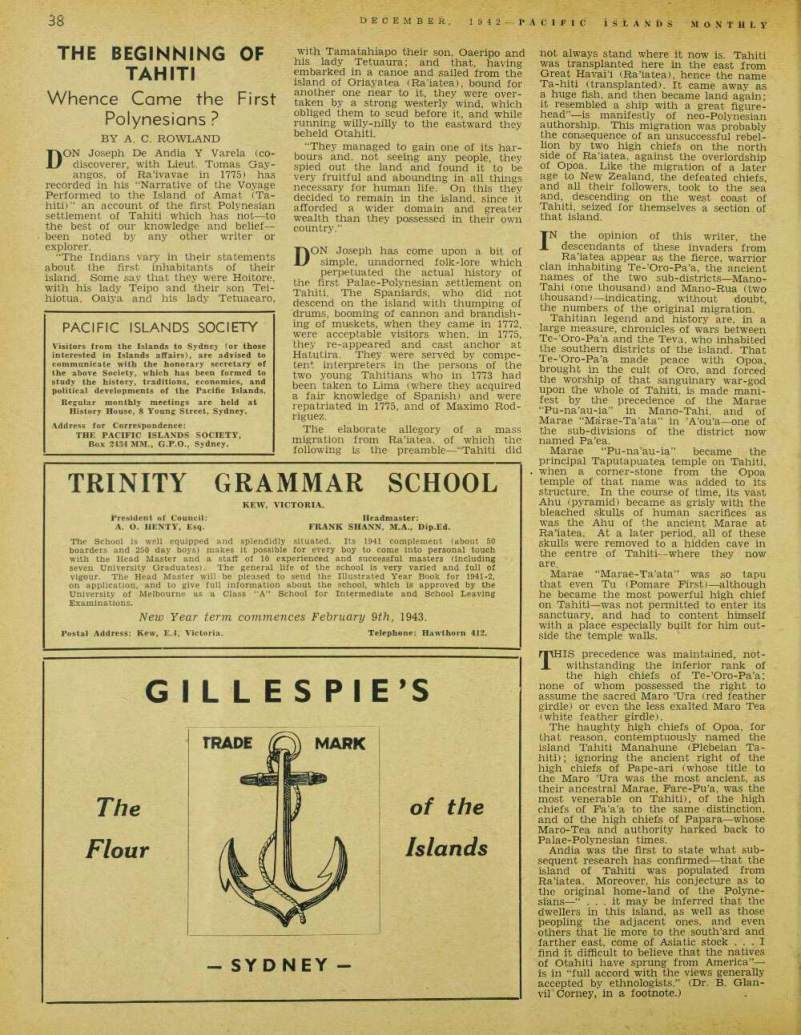
The Beginning Of
Whence Came the First Polynesians?
By A. C. Rowland
D_„ t t i, a .. TT . , ON Joseph De Andia Y Varela (co discoverer, with Lieut. Tomas Gay angos, of Ra’ivayae in 1775) has recorded in his “Narrative of the Voyage Performed to the Island of Amat (Ta hiti)” an account of the first Polynesian settlement of Tahiti which has not—to the best of our knowledge and belief — been not-ed by any other writer or . , , , St nf em tZ\l fsland Someday that they were Hoitere his ladv Teino andtheirson Tef hiotua h Oatea Ind his ladv Tetuaearo niotua, oaija and nis lady ietuaearo,
with Tamatahiapo their son, Oaeripo and his lady Tetuaura; and that, having embarked in a canoe and sailed from the island of Oriayatea (Ra’iatea), bound for another one near to it, they were over taken by a strong westerly wind, which obliged them to scud before it, and while running willy-nilly to the eastward they beheld Otahiti.
“They managed to gain one of its har bours and. not seeing any people, they spied out the land and found it to be very fruitful and abounding in all things necessary for human life. On this they decided to remain in the island, since it afforded a wider domain and greater wealth than they possessed in their own country.”
DON Joseph has come upon a bit of simple, unadorned folk-lore which perpetuated the actual history of the first Palae-Polynesian settlement on Tahiti. The Spaniards, who did not descend on the island with thumping of drums, booming of cannon and brandish ing of muskets, when they came in 1772, were acceptable visitors when, in 1775, they re-appeared and cast anchor at Hatutira. They were served by compe tent interpreters in the persons of the two young Tahitians who in 1773 had been taken to Lima (where they acquired a fair knowledge of Spanish) and were repatriated in 1775, and of Maximo Rod riguez.
The elaborate allegory of a mass migration from Ra’iatea. of which the following is the preamble—“ Tahiti did
not always stand where it now is. Tahiti was transplanted here in the east from Great Havai’i (Ra’iatea), hence the name Ta-hiti (transplanted). It came away as a huge fish, and then became land again; it resembled a ship with a great figure head”—is manifestly of neo-Polynesian authorship. This migration was probably the consequence of an unsuccessful rebel lion by two high chiefs on the north side of Ra’iatea, against the overlordship of Opoa. Like the migration of a later age to New Zealand, the defeated chiefs, and all their followers, took to the sea and, descending on the west coast of Tahiti, seized for themselves a section of that island.
IN the opinion of this writer, the descendants of these invaders from Ra’iatea appear as the fierce, warrior clan inhabiting Te-’Oro-Pa’a, the ancient names of the two sub-districts—Mano- Tahi (one thousand) and Mano-Rua (two thousand)—indicating, without doubt, the numbers of the original migration.
Tahitian legend and history are, in a large measure, chronicles of wars between Te-’Oro-Pa’a and the Teva, who inhabited the southern districts of the island. That Te-’Oro-Pa’a made peace with Opoa, brought in the cult of Oro, and forced the worship of that sanguinary war-god upon the whole of Tahiti, is made mani fest by the precedence of the Marae “Pu-na’au-ia” in Mano-Tahi, and of Marae “Marae-Ta’ata” in ’A’ou’a—one of the sub-divisions of the district now named Pa’ea.
Marae “Pu-na’au-ia” became the principal Taputapuatea temple on Tahiti, when a corner-stone from the Opoa temple of that name was added to its structure. In the course of time, its vast Ahu (pyramid) became as grisly with the bleached skulls of human sacrifices as was the Ahu of the ancient Marae at Ra’iatea. At a later period, all of these skulls were removed to a hidden cave in the centre of Tahiti —where they now are.
Marae “Marae-Ta’ata” was so tapu that even Tu (Pomare First) —although he became the most powerful high chief on Tahiti—was not permitted to enter its sanctuary, and had to content himself with a place especially built for him out side the temple walls.
THIS precedence was maintained, not withstanding the inferior rank of the high chiefs of Te-’Oro-Pa’a; none of whom possessed the right to assume the sacred Maro ’Ura (red feather girdle) or even the less exalted Maro Tea (white feather girdle).
The haughty high chiefs of Opoa, for that reason, contemptuously named the island Tahiti Manahune (Plebeian Ta hiti); ignoring the ancient right of the high chiefs of Pape-ari (whose title to the Maro ’Ura was the most ancient, as their ancestral Marae, Fare-Pu’a, was the most venerable on Tahiti), of the high chiefs of Fa’a’a to the same distinction, and of the high chiefs of Papara—whose Maro-Tea and authority harked back to Palae-Polynesian times.
Andia was the first to state what sub sequent research has confirmed —that the island of Tahiti was populated from Ra’iatea. Moreover, his conjecture as to the original home-land of the Polyne sians—“ ... it may be inferred that the dwellers in this island, as well as those peopling the adjacent ones, and even others that lie more to the south’ard and farther east, come of Asiatic stock ... I find it difficult to believe that the natives of Otahiti have sprung from America”— is in “full accord with the views generally accepted by ethnologists.” (Dr. B. Glan vil Corney, in a footnote.)
Advertisements & other items, pp. 40-45 (2 items)
xdftj
PACIFIC ISLANDS SOCIETY
Visitors from the Islands to Sydney (or those interested in Islands affairs), are advised to communicate with the honorary secretary of the above Society, which has been formed to study the history, traditions, economics, and political developments of the Pacific Islands.
Regular monthly meetings are held at History House, 8 Young Street, Sydney.
Address for Correspondence:
THE PACIFIC ISLANDS SOCIETY,
Box 2434 MM., G.P.0., Sydney.
TRINITY GRAMMAR SCHOOL
The School is well equipped and splendidly situated. Its 1941 complement (about 50 boarders and 250 day boys) makes it possible for every boy to come into personal touch with the Head Master and a staff of 10 experienced and successful masters (including seven University Graduates). The general life of the school is very varied and full of vigour. The Head Master will be pleased to send the Illustrated Year Book for 1941-2, on application, and to give full information about the school, which is approved by the University of Melbourne as a Class “A” School for Intermediate and School Leaving Examinations.
KEVV, VICTORIA.
President of Council:
A. O. HENTY, Esq.
Headmaster:
FRANK SHANN, M.A., Dip. Ed.
New Year term commences February 9th, 1943.
Postal Address: Kew, E. 4, Victoria.
Telephone: Hawthorn 412.
xdftj
CiLBEYS
DRY BIN
Distilleries at London . . . England Toronto . . .
Moorabbin . . Victoria Cincinnati . .
Canada
. U.S.A.
End Rheumatism
While You Sleep
If you suffer sharp, stabbing pains, if joints ore swollen, it shows your blood Is poisoned through faulty kidney action. Other symptoms of Kidney Disorders are Burning, Itching Passages, “Getting up Nights,” Backaches, Lumbago, Leg Pains, Nervousness, Dizziness, Headaches, Colds, Puffy Ankles, Circles under Eyes, Lack of Energy, Appetite, etc. Ordinary medicines can’t help much —you must kill the germs ruining health. Cystex ends these troubles by removing the cause. Get Cystex from any Chemist on Guarantee to put you right or money back. Act Now ! In 24 hours you will feel better and be completely well - in one week. The Guari V g £S y antee protects you. Now & 9 in 3 sizes: 1/9, 4/-, 8/-.
GUARANTEED for Kidneys, Rheumatism, Bladder
Any Employer NEEDS YOU if you are
AN I. C. S. TRAINED MAN!
Sirs, —Please send free prospectus showing how I can succeed in the occupation 1 have marked X Accountancy—Secretarial (all Inst. Ex.) Bookkeeping—General. Store, Station.
Salesmanship)—Gen., Speciality, Retail.
Psychology and Personality in Business.
Advertising—Retail, Mail-Ord., Agency.
Window Disp.—Show Card, Shop Tckts.
Illustrating—Newspaper, Fash., Poster.
Free Lance Jour'ism —Short Story Writ.
Matriculation—Leaving-Inter.-Pub. Serv.
Gen. Education—Bus. and Sales Letters.
Police Entr. Exam., Nurses Entr. Exam.
Architecture —Structural Concrete.
Building Contracting—Air Conditioning.
Draftsmanship (Mech. & all branches).
Motor Eng.—Mtr. Mech., Mtr. Exams.
Diesel Eng.—lllumin. Engr., Weld. Eng.
Internal Comb, and Steam Drivers' Exs.
Radio Eng.—Radio Serv., Radio Exms.
Aero Eng.—Gd. Eng., Licenses, Rigging.
Elec. Eng.—Elec. Cont. & Mechs' Exms.
Civil Eng.—Shire Eng.—Shire Overseer.
Textile (all branches) —Analyt. Chem.
Dress Design—Drafting, Cutting, Mlnry. (Underline your subject above—if not Enquiries cost a 2d. stamp Post Now! 1.C.5.,
140 ELIZABETH STREET.
SYDNEY.
on list write it here. ) Name...
Address
PIM
INTERNATIONAL CORRESPONDENCE SCHOOLS
Metals which combine high strength and hardness with ductility and toughness are extremely desirable but somewhat unusual; yet MONEL" possesses all these characteristics, plus corrosion-resistance.
This rustless nickel-copper alloy is of vital importance to-day, whether on sea, land or in the air, but its use must be confined solely to those applications for which there is no substitute.
If your job is of national importance and requires all the foregoing characteristics, then Monel is available in Sheet, Rods, Wires, Tubes, Wire Cloth, Rivets, Ingots for casting, etc.
WRIGHT AND COMPANY
Sole Australian Distributors of Monel
81 CLARENCE STREET, SYDNEY
"'Registered trade mark ===
KANGAROO BRAND
Ropes,
Cordage,
and Twines (or every purpose
Backed by
86 years of service.
Manufactured by
M. DONAGHY AND SONS,
Pty. Ltd.,Geelong and Sydney.
Fiji Representatives:
PEARCE AND CO.
LIMITED
P.O. BOX 237, SUVA
BITUMENOID ROOFING
MADE IN AUSTRALIA,
Bltumenold Roofings, Dampcourse and Insulating Pelts are made from the world's best raw materials. Warranted to stand the most rigid tests.
BITUMENOID THE BEST
Roofing, 1,2, 3-ply; Flooring, Waterproof Materials; Saturated Felt; Resilient Road Jointing; Natural Asphalt Dampcourse; 2 and 3-ply Dampcourse; 1-2 lb. Lead-core Dampcourse: Roofing Cement; Asphalt Paints; Roofing Compound.
SAMPLES AND PRICE LISTS ON APPLICATION.
MAXWELL PORTER & SON LTD.
ESTABLISHED 1888. BUILDERS’ SUPPUEo.
107 REDFEBN ST., REDFERN, SYDNEY, N.S.W. Phone: M 3167. Cables Bitunenold.
For Essential Industries
Now, more than ever, speed and efficiency in industry are demanded. Only equipment of the highest reputation is worthy of consideration. You can rely on the products of— CROMPTON, PARKINSON LTD.—Motors, Instruments, Transformers, Crompton Lamps.
FERRANTI LTD.—Transformers, Instruments, Meters.
HERBERT MORRIS LTD.—Pulley Blocks, Runways.
CROMPTON, PARKINSON (AUST.) PTY. LTD.—
Parkinson Motors, Crompton Minor Motors, Power Transformers.
CALLENDERS CABLES & CONSTRUCTION CO.
LTD.—Wires, Cables, Flexibles.
RANSOMES & RAPIER LTD.—Mobile and Breakdown Cranes, Excavators.
HOPKINSONS LTD.—Valves and Boiler Fittings.
NORDBERG MFG. CO. LTD.—Symons Cone Crushers, Vibrating Screens.
AUDLEY ENGINEERING CO. LTD.— Audco”
Lubricated Plug Valves.
MATHER & PLATT LTD.—Large Electric Motors.
BROS. (SYDNEY) LTD.
115 Clarence Street, Sydney
And at Port Kembla. 197 Elizabeth Street, Brisbane.
5 s s
LOTION
For Inflamed Eyes and Eyelids
SOLD EVERYWHERE
H. A. Rose & Co. Pty. Ltd., King St., Sydney
Woven Wire for all industry
COPRA DRYING TRAYS, FLOORS, Etc.
FRUIT DRYING TRAYS, MINING SCREENS.
Heavy Mosquito Gauze in Phosphor Bronze and other Metals Impervious to Salt Sea Air.
WIRE DOOR MATS AND GENERAL WIRE WORKS
E. WRIGHT & CO. LTD.
Office and Works: 148-152 Cleveland Street. Sydney, N.S.W.
Telegraphic Address; “Wrightmake,” Chippendale. fl Or $
Ship Chandlery Hardware
/Write for 7
Ship Chandlery /
Catalogue J
BROOMFIELDS LIMITED
152 SUSSEX STREET :: SYDNEY.
Cables: “Boom”, Sydney.
Special “In Bond” Prices for all Islands enquiries quoted on application.
Sole Agents for: Large and Complete Stocks of
SHIP CHANDLERY
IRONMONGERY OF ALL KINDS, PAINTS,
WHITE LEAD AND OILS.
P. H. MUNTZ & CO.’S 3-CROWN BRAND METAL SHEATHING.
PEACOCK & BUCHANS’ ENGLISH READY-MIXED PAINTS.
ill
FOR RELIABILITY
AND LONG SERVICE
USE
MILLER'S "ANCHOR"
BRAND ROPES AND
CORDAGES
Manila, Sisal, New Zealand Coir and Cotton Rope of every description. Twine, Sewing Twine, Shop Twine, Binder Twine and Fishlines, Lashings, Halters, Plough Reins, Sack Cord, Blind Lines, etc.
LENGTH STRENGTH
QUALITY GUARANTEED
Manufactured by: JAMES MILLER Cr CO. PTY. LTD.
MELBOURNE, VIC., AUST.
Suva Agents: A. S. FAREBROTHER & CO.
And at Lautoka, P.O. Box 36. Tel.: 261.
Sydney Agents: p. T. TAYLOR LTD.
BIRKMYRE’S
WATERPROOF CANVAS
0 The Original and Best for all purpose* where a thoroughly waterproof covering is required.
S A I LC LOTH S. DUCKS, &c.
of FLAX, HEMP, and COTTON.
FISHING NETS,
LINES and TWINES
Extensive Stocks Carried.
Ensuring Prompt Despatch
GOUROCK ROPES &
CANVAS LTD.
397 KENT STREET, SYDNEY, N.S.W.
Dr. Williams’
PINK PILLS
Help to give New Strength and Energy to the System
PRODUCING UNIFORM GOOD RESULTS SINCE 1868
ALWAYS ASK FOR IT
OLD MONK
The Worlds Finest \ Olive Oil San Francisco
39
MISSING IN INDONESIA
(Continued from Page 12)
PACIFIC ISLANDS MONTHLY DECEMBER, 1942
Islands Produce
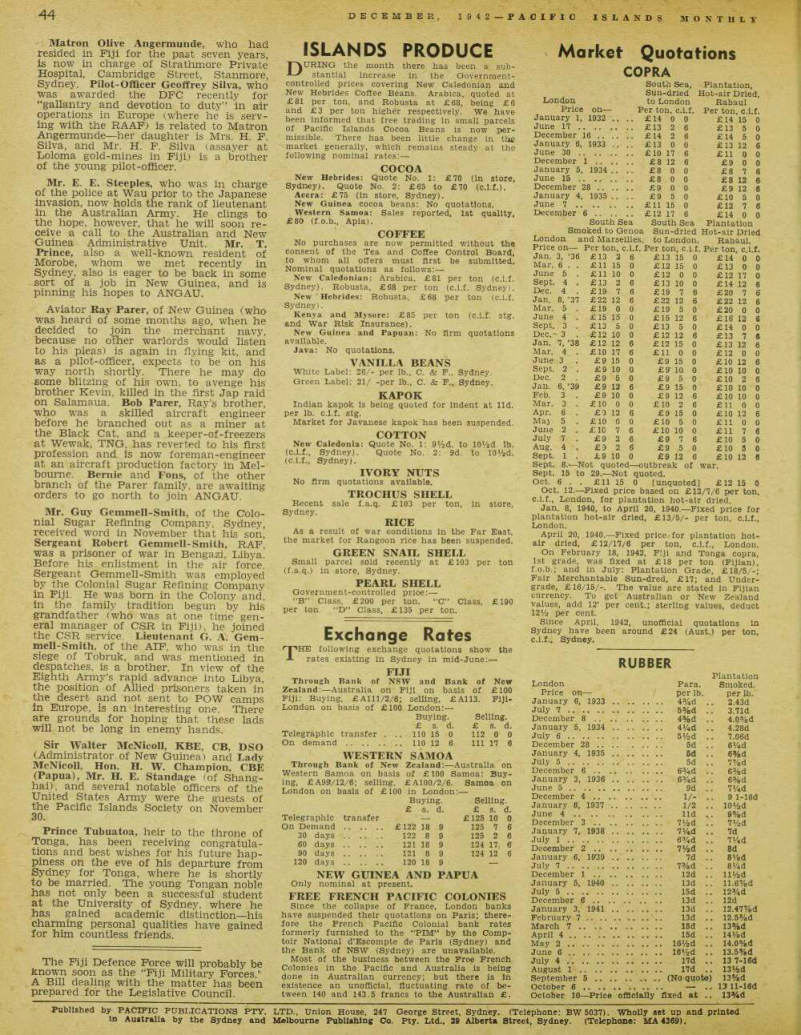
TOURING the month there has been a sub ■L' stantial increase in the Government controlled prices covering New Caledonian and New Hebrides Coffee Beans. Arabica, quoted at £Bl per ton, and Robusta at £6B, being £6 and £3 per ton higher respectively. We have been informed that free trading in small parcels of Pacific Islands Cocoa Beans is now per missible. There has been little change in the market generally, which remains steady at the following nominal rates;—
Cocoa
New Hebrides: Quote No. 1: £7O (in store, Sydney). Quote No. 2: £65 to £7O (c.i.f.).
Accra: £75 (in store, Sydney).
New Guinea cocoa beans: No quotations.
Western Samoa: Sales reported. Ist quality, £BO (f.0.b., Apia).
Coffee
No purchases are now permitted without the consent of the Tea and Coffee Control Board, to whom all offers must first be submitted.
Nominal quotations as follows: New Caledonian: Arabica, £Bl per ton (c.i.f, Sydney). Robusta, £6B per ton (c.i.f. Sydney).
New Hebrides: Robusta, £6B per ton (c.i.f.
Sydney).
Kenya and Mysore; £B5 per ton (c.i.f. stg. and War Risk Insurance).
New Guinea and Papuan: No firm quotations available.
Java: No quotations.
Vanilla Beans
White Label: 26/- per lb., C. & F., Sydney.
Green Label: 21/ -per lb., C. & F., Sydney.
Kapok
Indian kapok is being quoted for indent at lid, per lb. c.i.f. stg.
Market for Javanese kapok has been suspended.
Cotton
New Caledonia: Quote No. 1: 9*/2d. to lOVad. lb. (c.i.f., Sydney). Quote No. 2: 9d. to lOVad. (c.i.f., Sydney).
Ivory Nuts
No firm quotations available.
Trochus Shell
Recent sale f.a.q. £lO3 per ton, in store, Sydney,
Rice
As a result of war conditions in the Far East, the market for Rangoon rice has been suspended.
Green Snail Shell
Small parcel sold recently at £ 103 per ton (f.a.q.) in store, Sydney.
Pearl Shell
Government-controlled price:— “B” Class, £2OO per ton. “C” Class, £l9O per ton. “D” Class, £135 per ton.
Exchange Rates
THE following exchange quotations show the rates existing in Sydney in mid-June:—
Fiji
Through Bank of NSW and Bank of New Zealand: —Australia on Fiji on basis of £lOO Fiji: Buying, £ All 1/2/6; selling, £AII3. FIJI - on basis of £lOO London:— Buying. Selling. £ s. d. £ s. d.
Telegraphic transfer . .. 110 15 0 112 0 0 On demand 110 12 6 111 17 6
Western Samoa
Through Bank of New Zealand:—Australia on Western Samoa on basis of £lOO Samoa: Buy ing, £ A99/12/6; selling, £AIOO/2/6. Samoa on London on basis of £lOO in London: — Buying. Selling. £ s. d. £ s. d.
Telegraphic transfer £125 10 0 On Demand £122 18 9 125 7 6 30 days 122 8 9 125 2 6 60 days 121 18 9 124 17 6 90 days 121 8 9 124 12 6 120 days 120 18 9
New Guinea And Papua
Only nominal at present.
Free French Pacific Colonies
Since the collapse of Prance, London banks have suspended their quotations on Paris; there fore the French Pacific Colonial bank rates formerly furnished to the “PIM” by the Comp toir National d’Escompte de Paris (Sydney) and the Bank of NSW (Sydney) are unavailable.
Most of the business between the Free French Colonies in the Pacific and Australia is being done in Australian currency: but there is In existence an unofficial, fluctuating rate of be tween 140 and 143.5 francs to the Australian £.
Market Quotations
Copra
Sept. B.—Not quoted—outbreak of war.
Sept. 15 to 29. —Not quoted.
Oct. 6 . . £ll 15 0 (unquoted] £l2 15 0 Oct. 12.—Fixed price based on £l2/7/6 per ton, c.i.f., London, for plantation hot-air dried.
Jan. 8, 1940, to April 20, 1940.—Fixed price for plantation hot-air dried, £l3/5/- per ton, c.i.f., London.
April 20, 1940.—Fixed price for plantation hot air dried, £l2/17/6 per ton, c.i.f., London.
On February 18, 1942, F:ji and Tonga copra, Ist grade, was fixed at £lB per ton (Fijian), f.0.b.; and in July: Plantation Grade, £lB/5/-; Fair Merchantable Sun-dred, £l7; and Under grade, £l6/15/-. The value are stated in Fijian currency. To get Australian or New Zealand values, add 12’ per cent.; sterling values, deduct 12y 2 per cent.
Since April, 1942, unofficial quotations in Sydney have been around £24 (Aust.) per ton, c.i.f., Sydney.
South Sea, Plantation.
Sun-dried Hot-air Dried.
London to London Rabaul Price on— Per ton, c.i.f.
Per ton. c.i.f.
January 1. 1932 .. £14 0 i 0 £14 15 0 June 17 . £13 2 1 6 £13 5 0 December 16 .. .. £14 2 1 6 £14 5 0 January 6, 1933 .. , .. £13 C I 0 £13 12 6 June 30 . £10 n ' 6 £11 0 0 December 1 .. .. £8 12 6 £9 0 0 January 5, 1934 .. . . £8 0 I 0 £8 7 6 June 15 . £8 0 l 0 £8 12 6 December 28 .. .. £9 0 • 0 £9 12 6 January 4, 1935 .. . . £9 5 1 0 £10 5 0 June 7 ., £11 15 » 0 £12 7 6 December 6 .. .. £12 17 ’ 6 £14 0 0 South Sea South Sea Plantation Smoked to Genoa Sun-dried Hot-air Dried London and Marseilles, to London.
Rabaul.
Price on— Per ton, c.i.f. Per ton, c.i.f.
Per ton . c.i.f.
Jan. 3, '36 £13 : i 6 £13 15 0 £14 0 0 Mar. 6 . . £11 15 0 £12 15 0 £13 0 0 June 5 . £11 10 0 £12 0 0 £12 17 0 Sept. 4 . £13 2 6 £13 10 0 £14 12 6 Dec. 4 . £19 ' 1 6 £19 7 6 £20 7 6 Jan. 8, '37 £22 12 6 £22 12 6 £22 12 6 Mar. 5 . £19 0 0 £19 5 0 £20 0 0 June 4 . £15 15 0 £15 12 6 £16 12 6 Sept. 3 . £13 5 0 £13 5 0 £14 0 0 Dec. 3 . £12 10 0 £12 12 6 £13 7 6 Jan. 7, *38 £12 12 6 £12 15 0 £13 12 6 Mar, 4 . £10 17 6 £11 0 0 £12 0 0 June 3 . £9 15 0 £9 15 0 £10 12 6 Sept. 2 . £9 10 0 £9 10 0 £10 10 0 Dec. 2 . £9 £ > 0 £9 5 0 £10 2 6 Jan. 6, ’39 £9 12 6 £9 15 0 £10 10 0 Feb. 3 . £9 10 0 £9 12 6 £10 10 0 Mar. 3 . £10 ( ) 0 £10 2 6 £11 0 0 Apr. 6 . £9 12 6 £9 15 0 £10 12 6 May 5 . £10 f ) 0 £10 5 0 £11 0 0 June 2 , £10 1 r 6 £10 10 0 £11 7 6 July 7 . £9 £ 5 6 £9 7 6 £10 5 0 Aug. 4 . £3 : ! 6 £9 5 0 £10 5 0 Sept. 1 . £9 10 0 £9 12 6 £10 12 6
Rubber
Plantation London Para.
Smoked.
Price on— per lb. per lb.
January 6, 1933 . 2.43d July 7 3.71d December 8 .. . 4%d .. 4.0 %d January 5, 1934 . 4y»d .. 4.28d July 6 5V 2 d .. 7.06d December 28 .. . 5d .. 6y 4 d January 4, 1935 . 6%d July 5 5d .. 7Yad December 6 .. . 6%d January 3, 1936 . 6%d June 5 7»/ 4 d December 4 .. ., 9 l-16d January 8, 1937 . 1/2 .. ioy 2 d June 4 9 s /sd December 3 .. . 7>/ 2 d January 7, 1938 . 7V«d .. 7d July 1 VAd December 2 ., . 7y a d .. 8d January 6, 1S39 . 7d .. 8Vad July 7 7%d .. 8'Ad December 1 .. , ny 2 d January 5, 1940 . 13d .. 11.6%d July 5 12%d December 6 .. ., 12d January 3, 1941 . 13d ..
\2Avad
February 7 .. .. , 12.5%d March 7 15d .. 13%d April 4 14y 8 d May 2 ISVsd .. 14.0%d June 6 16V 2 d .. 13.5%d July 4 17d .. 13 7-16d August 1 13^d September 5 .. . 13%d October 6 — 13 ll-16d October 10—Price officially fixed at ., 13%d
Advertisements & other items, p. 46 (1 item)
44
DECEMBER, 1942 PACIFIC ISLANDS MONTHLY
Published by PACIFIC PUBLICATIONS PTY. LTD., Union House, 247 George Street, Sydney. (Telephone: BW 5037). Wholly set up and printed In Australia by the Sydney and Melbourne Publishing Co. Pty. Ltd., 29 Alberta Street, Sydney. (Telephone: MA 4369).
Australian Short Wave
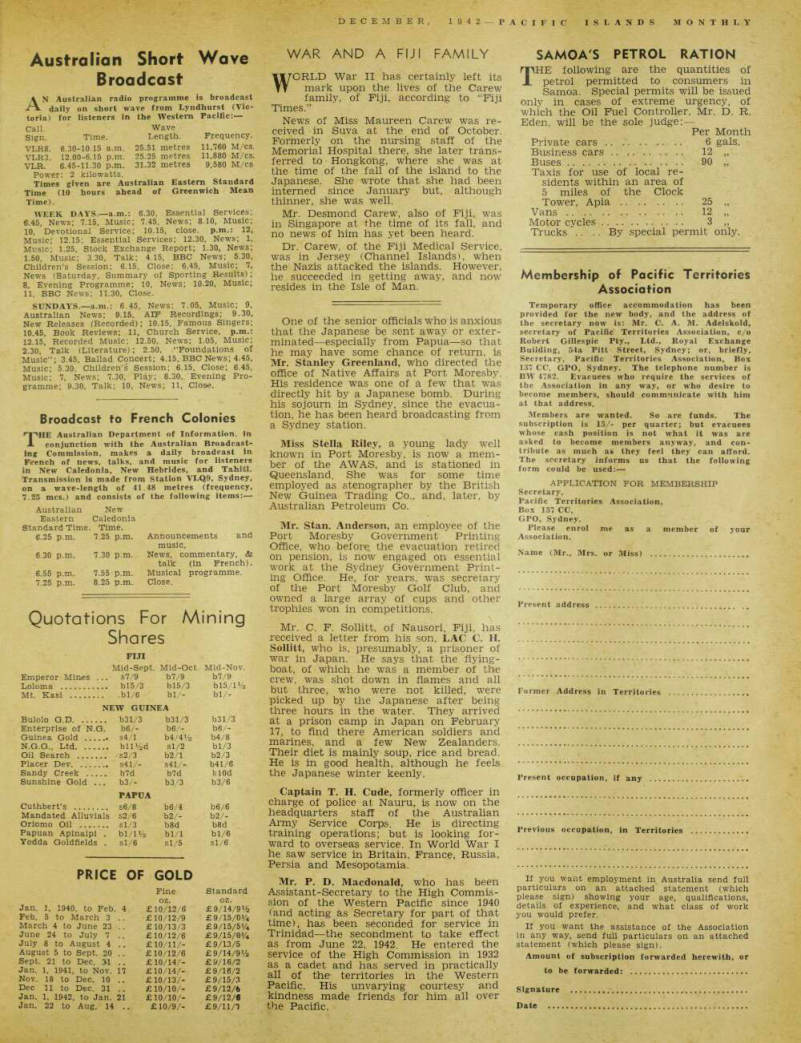
Broadcast
AN Australian radio programme is broadcast daily on short wave from Lyndhurst (Vic toria) for listeners in the Western Pacific: — Call Wave Sign. Time. Length. Frequency.
VLRB. 6.30-10.15 a.m. 25.51 metres 11,760 M/cs.
VLR3. 12.00-6.15 p.m. 25.25 metres 11,880 M/cs.
VLR. 6.45-11.30 p.m. 31.32 metres 9,580 M/cs.
Power: 2 kilowatts.
Times given are Australian Eastern Standard Time (10 hours ahead of Greenwich Mean Time).
WEEK DAYS.—a.m.: 6.30, Essential Services: 6.45, News; 7.15, Music; 7.45, News; 8.10, Music; 10, Devotional Service; 10.15, close, p.m.: 12, Music; 12.15; Essential Services; 12.30, News; 1, Music; 1.25, Stock Exchange Report; 1.30, News; 1.50, Music; 3.30, Talk; 4.15, BBC News; 5.30, Children’s Session; 6.15, Close; 6.45, Music; 7, News (Saturday, Summary of Sporting Results); 8, Evening Programme; 10, News; 10.20, Music; 11, BBC News; 11.30, Close.
SUNDAYS.—a.m.: 6.45, News; 7.05, Music; 9, Australian News; 9.15, AIP Recordings: 9.30, New Releases (Recorded); 10.15, Famous Singers; 10.45, Book Reviews: 11, Church Service, p.m.; 12.15, Recorded Music; 12.50, News; 1.05, Music; 2.30, Talk (Literature); 2.50, “Foundations of Music”; 3.45, Ballad Concert; 4.15, BBC News; 4.45, Music; 5.30, Children’s Session; 6.15, Close; 6.45, Music: 7, News; 7.30, Play; 8.30, Evening Pro gramme; 9.30, Talk; 10, News; 11, Close.
Broadcast to French Colonies
THE Australian Department of Information, in conjunction with the Australian Broadcast ing Commission, makes a daily broadcast in French of news, talks, and music for listeners in New Caledonia, New Hebrides, and Tahiti.
Transmission is made from Station VLQ9, Sydney, on a wave-length of 41.48 metres (frequency, 7.25 mcs.) and consists of the following items: — Australian New Eastern Caledonia Standard Time. Time, 6.25 p.m. 7.25 p.m. Announcements and music. 6.30 p.m. 7.30 p.m. News, commentary, & talk (in French). 6.55 p.m, 7.55 p.m. Musical programme. 7.25 p.m. 8.25 p.m. Close.
Quotations For Mining
Shares
Fiji
Mid-Sept.
Mid-Oct.
Mid-Nov.
Emperor Mines ... s7/9 b7/9 b7/9 Loloma b!5/3 b!5/3 bl5/iy 2 Mt. Kasi .bl/6 bl/bl/-
New Guinea
Bulolo G.D b31/3 b31/3 b31/3 Enterprise of N.G. b6/b6/b6/- Guinea Gold s4/l b4/4*/ 2 b4/8 N.G.G., Ltd bllVad sl/2 bl/3 Oil Search s2/3 b2/l b2/3 Placer Dev s41/s41/b41/6 Sandy Creek b7d b7d l-:10d Sunshine Gold ... b3/b3/3 b3/6 Cuthbert’s
Papua
s6/8 b6/4 b6/6 Mandated Alluvials s2/6 b2/b2/- Orlomo Oil sl/3 b8d b8d Papuan Apinaipi . bl/iy 2 bl/1 bl/6 Yodda Goldfields . sl/6 sl/5 sl/6
Price Of Gold
Pine Standard oz. oz.
Jan. 1, 1940, to Feb. 4 £10/12/6 £9/14/9% Feb. 5 to March 3 £10/12/9 £9/15/0% March 4 to June 23 £10/13/3 £9/15/5% June 24 to July 7 £10/12/6 £9/15/0% July 8 to August 4 ., £10/11/- £9/13/5 August 5 to Sept. 20 £10/12/6 £9/14/9% Sept. 21 to Dec. 31 .. £10/14/- £9/16/2 Jan. 1, 1941, to Nov. 17 £10/14/- £9/16/2 Nov. 18 to Dec, 10 .. £10/13/- £9/15/3 Dec 11 to Dec. 31 £10/10/- £9/12/6 Jan. 1. 1942, to Jan. 21 £10/10/- £9/12/6 Jan, 22 to Aug. 14 £10/9/- £9/11/7
War And A Fiji Family
WORLD War II has certainly left its mark upon the lives of the Carew family, of Fiji, according to “Fiji Times/’
News of Miss Maureen Carew was re ceived in Suva at the end of October.
Formerly on the nursing staff of the Memorial Hospital there, she later trans ferred to Hongkong, where she was at the time of the fall of the island to the Japanese. She wrote that she had been interned since January but, although thinner, she was well.
Mr. Desmond Carew, also of Fiji, was in Singapore at the time of its fall, and no news of him has yet been heard.
Dr. Carew, of the Fiji Medical Service, was in Jersey (Channel Islands), when the Nazis attacked the islands. However, he succeeded in getting away, and now resides in the Isle of Man.
One of the senior officials who is anxious that the Japanese be sent away or exter minated —especially from Papua—so that he may have some chance of return, is Mr. Stanley Greenland, who directed the office of Native Affairs at Port Moresby.
His residence was one of a few that was directly hit by a Japanese bomb. During his sojourn in Sydney, since the evacua tion, he has been heard broadcasting from a Sydney station.
Miss Stella Riley, a young lady well known in Port Moresby, is now a mem ber of the AWAS, and is stationed in Queensland. She was for some time employed as stenographer by the British New Guinea Trading Co., and, later, by Australian Petroleum Co.
Mr. Stan, Anderson, an employee of the Port Moresby Government Printing Office, who before the evacuation retired on pension, is now engaged on essential work at the Sydney Government Print ing Office. He, for years, was secretary of the Port Moresby Golf Club, and owned a large array of cups and other trophies won in competitions.
Mr. C. F. Sollitt, of Nausori, Fiji, has received a letter from his son. LAC C. H.
Sollitt, who is, presumably, a prisoner of war in Japan. He says that the flying boat, of which he was a member of the crew, was shot down in flames and all but three, who were not killed, were picked up by the Japanese after being three hours in the water. They arrived at a prison camp in Japan on February 17, to find there American soldiers and marines, and a few New Zealanders.
Their diet is mainly soup, rice and bread.
He is in good health, although he feels the Japanese winter keenly.
Captain T. H. Cude, formerly officer in charge of police at Nauru, is now on the headquarters staff of the Australian Army Service Corps. He is directing training operations; but is looking for ward to overseas service. In World War I he saw service in Britain, France, Russia, Persia and Mesopotamia.
Mr. P, D. Macdonald, who has been Assistant-Secretary to the High Commis sion of the Western Pacific since 1940 (and acting as Secretary for part of that time), has been seconded for service in Trinidad —the secondment to take effect as from June 22, 1942. He entered the service of the High Commission in 1932 as a cadet and has served in practically all of the territories in the Western Pacific. His unvarying courtesy and kindness made friends for him all over the Pacific.
Samoa's Petrol Ration
THE following are the quantities of petrol permitted to consumers in Samoa. Special permits will be issued only in cases of extreme urgency, of which the Oil Fuel Controller, Mr. D. R.
Eden, will be the sole judge:— Per Month Private cars 6 gals.
Business cars 12 „ Buses 90 „ Taxis for use of local re sidents within an area of 5 miles of the Clock Tower, Apia 25 „ Vans 12 „ Motor cycles 3 „ Trucks .. .. By special permit only.
Advertisements & other items, pp. 47-48 (1 item)
Membership of Pacific Territories
Association
Temporary office accommodation has been provided for the new body, and the address of the secretary now is: Mr. C. A. M. Adelskold, secretary of Pacific Territories Association, c/o Robert Gillespie Pty., Ltd., Royal Exchange Building, 54a Pitt Street, Sydney; or, briefly, Secretary, Pacific Territories Association, Box 137 CC, GPO, Sydney. The telephone number is BW 4782. Evacuees who require the services of the Association in any way, or who desire to become members, should communicate with him at that address.
Members are wanted. So are funds. The subscription is 15/- per quarter; but evacuees whose cash position is not what it was are asked to become members anyway, and contribute as much as they feel they can afford.
The secretary informs us that the following form could be used:—
APPLICATION FOR MEMBERSHIP
Secretary, Pacific Territories Association, Box 137 CC, GPO, Sydney.
Please enrol me as a member of your Association.
Name (Mr., Mrs. or Miss) Present address Former Address in Territories Present occupation, if any Previous occupation, in Territories If you want employment in Australia send full particulars on an attached statement (which please sign) showing your age, qualifications, details of experience, and what class of work you would prefer.
If you want the assistance of the Association in any way, send full particulars on an attached statement (which please sign).
Amount of subscription forwarded herewith, or to be forwarded: Signature Date
mm ■ ,W- -■i ( K f :
Travel by CARPENTER AIRLINES
Full particulars from Macdonald, Hamilton Cr Co., or Howard Smith Ltd., Sydney.
W. R. CARPENTER & CO. LTD.
MERCHANTS, SHIPOWNERS AND AIRCRAFT OPERATORS
Agents for Australian, European and American Manufacturers, and Distributors of Every Description of Merchandise.
Buyers and Shippers of Copra, Trocas, and all Classes of Islands Produce. •
AGENTS FOR :
Ford Motor Company of Canada. Caterpillar Tractors. Dodge Brothers Inc.
T. G. & C. Bolinders (Engines). Electrolux Refrigerators. Westinghouse Electrical Co. etc., etc.
Branches throughout the Pacific Islands
In London: W. R. Carpenter £r Co. (London) Ltd., Coronation House, 4 Lloyds Avenue, London, EC.
Head Office: 16 O’CONNELL STREET, SYDNEY