Pacific
Pacific News-Review
Notes And Comment On
The Progress Of The War
From Oct. 15 To Nov. 12
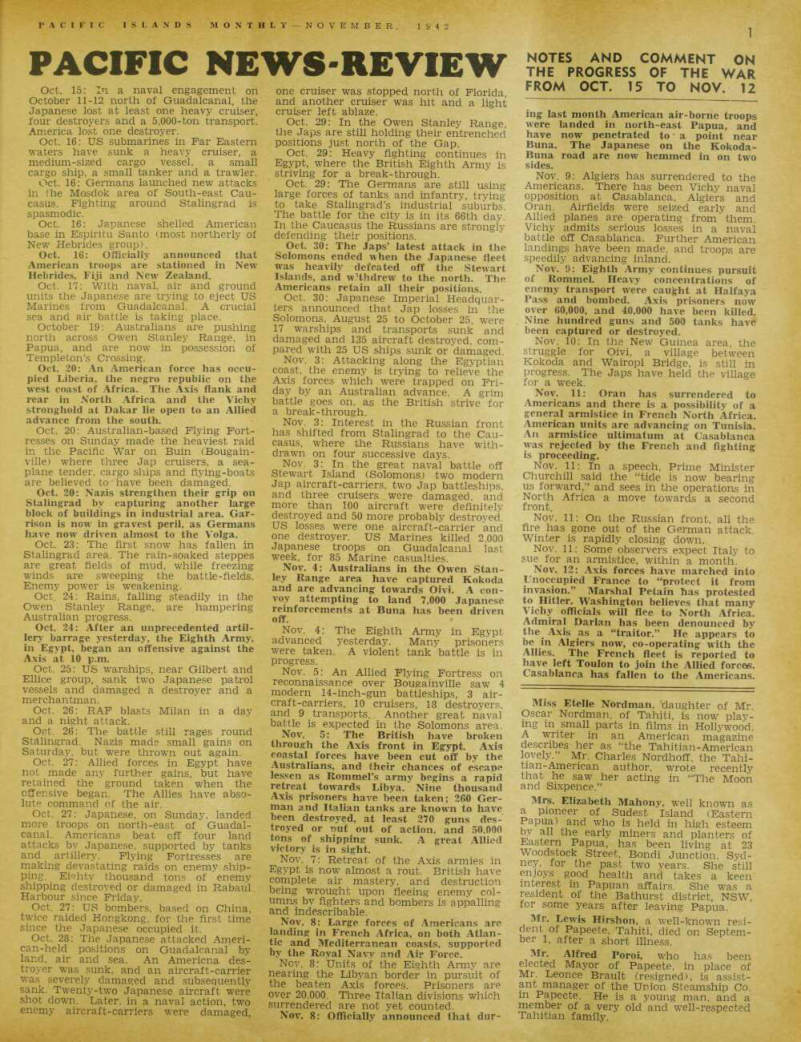
Oct. 15: In a naval engagement on October 11-12 north of Guadalcanal, the Japanese lost at least one heavy cruiser, four destroyers and a 5,000-ton transport.
America lost one destroyer.
Oct. 16: US submarines in Far Eastern waters have sunk a heavy cruiser, a medium-sized cargo vessel, a small cargo ship, a small tanker and a trawler.
Oct. 16: Germans launched new attacks in the Mosdok area of South-east Caucasus. Fighting around Stalingrad is spasmodic.
Oct. 16: Japanese shelled American base in Espiritu Santo (most northerly of New Hebrides group).
Oct. 16: Officially announced that American troops are stationed in New Hebrides, Fiji and New Zealand.
Oct. 17: With naval, air and ground units the Japanese are trying to eject US Marmes from Guadalcanal. A crucial sea and air battle is taking place.
October 19: Australians are pushing north across Owen Stanley Range, in Papua, and are now in possession of Templeton s Crossing.
Oct. 20: An American force has occupied Liberia, the negro republic on the west coast of Africa. The Axis flank and rear in North Africa and the Vichy stronghold at Dakar lie open to an Allied advance from the south. .
Oct. 20: Australian-based Flying Fortresses on Sunday made the heaviest raid in the Pacific War on Bum (BougainviHe) where three Jap cruisers, a seaplane tender, cargo ships and flying-boats are believed to have been damaged.
Oct. 20: Nazis strengthen their grip on Stalingrad by capturing another large block of buildings in industrial area. Garrison is now in gravest peril, as Germans have now driven almost to the Volga.
Oct. 23: The first snow has fallen in Stalingrad area. The ram-soaked steppes are great fields of mud, while freezing wmds are sweeping the battle-fields.
Enemy power is weakening.
Oct. 24: Rains, falling steadily in the Owen Stanley Range, are hampering Australian progress.
Oct. 24: After an unprecedented artillery barrage yesterday, the Eighth Army, in Egypt began an offensive against the Axis at 10 p.m.
Oct. 25: US warships, near Gilbert and Ellice group, sank two Japanese patrol vessels and damaged a destroyer and a a o« ma o KT * TV/T-! • Oct. 26. RAP blasts Milan m a day an o ? l i l ht^ tta ?Vf 1 fii 26 The battle still rages round Stalingrad Nazis mads small gams on Saturday but were thrown out again.
Alhe( s f £ rC6S m Eg l £ ave f>fo ny Jn r iH er fl amS ’ * Ut h ?w e wo g when the offensive began. The Allies have absolU rw° I o'7 l ? ai T d ° f tho air ' o , , Oct. 27. Japanese, on Sunday, landed cana 6 ! o * l no^ th ' eas t of Guadalcanal. Americans beat off four land attacks by Japanese, supported by tanks and artillery. Flying Fortresses are S mg E Sv ta Si dS t on en T y Ship ' ping. Eighty thousand tons of enemy Harbour damaged m Rab aul Oct V u“ bombers, based on China, iTnrt r thp de Tana on p gkong ’ f °- i h€ L first time net *9B The 0 e C co UP itoPiJi 1 a 0 • can held B ' rS^Ui™? aneSe attacked Amenland it P °d °t on Guadalcanal by land, air and sea. An Amencna destroyer was sunk, and an aircraft-carrier was severely damaged and subsequently
sh^down^'Later
snot down. Later, m a naval action, two enemy aircraft-carriers were damaged,
one cruiser was stopped north of Florida, and another cruiser was hit and a light cruiser left ablaze.
Oct. 29: In the Owen Stanley Range the Japs are still holding their entrenched positions just north of the Gap.
Oct. 29: Heavy fighting continues in Egypt, where the British Eighth Army is striving for a break-through.
Oct. 29: The Germans are still using large forces of tanks and infantry, trying to take Stalingrad’s industrial suburbs The battle for the city is in its 66th day In the Caucasus the Russians are strongly defending their positions Oct. 30: The Japs’ latest attack in the Solomons ended when the Japanese fleet was heavily defeated off the Stewart Islands, and withdrew to the north. The Americans retain all their positions Oct. 30: Japanese Imperial Headquar ters announced that Jap losses in the Solomons, August 25 to October 25 were 17 warships and transports sunk and damaged and 135 aircraft destroyed com pared with 25 US ships sunk or damaged.
Nov. 3: Attacking along the Egyptian coast, the enemy is trying to relieve the Axis forces which were trapped on Fri day by an Australian advance. A grim battle goes on, as the British strive for a break-through Nov. 3: Interest in the Russian front has shifted from Stalingrad to the Cau casus, where the Russians have with drawn on four successive days Nov. 3: In the great naval battle off Stewart Island (Solomons; two modern Jap aircraft-carriers, two Jap battleships and three cruisers were damaged and more than 100 aircraft were definitely destroyed and 50 more probably destroyed US losses were one aircraft-carrier and one destroyer. US Marines killed 2 000 Japanese troops on Guadalcanal last week, for 85 Marine casualties Nov. 4: Australians in the Owen Stan ley Range area have captured Kokoda and are advancing towards Oivi. A con voy attempting to land 7,000 Japanese reinforcements at Buna has been driven off. n o v. 4: The Eighth Army in Egypt advanced yesterday. Many prisoners were taken. A violent tank battle is in progress.
Nov. 5: An Allied Flying Fortress on reconnaissance over Bougainville saw 4 modern 14-inch-gun battleships, 3 air craft-carriers, 10 cruisers, 18 destroyers. and 9 transports. Another great naval battle is expected in the Solomons area.
N ov. 5: The British have broken through the Axis front in Egypt. Axis coastal forces have been cut off by the Australians, and their chances of escans ,essen as Rommel’s army begins a rapid retreat towards Libya. Nine thousand Axis prisoners have been taken; 260 Ger man and Italian tanks are known to have been destroyed at least 970 Hps. treyed or nut out of action, and 50,000 tons of shinning- sunk A P-reat Allied in sight Nov 7- Retreat of the Avis armies in Egypt is now almost a rout British have comnlete air mastery and desf-mpHon being wrought upon fleeing enemy col- Z’VdUribabl/”' 1 b ° mberS * aPPal ' ing Nov. 8: Large forces of Americans are landing in French Africa, on both Atlan tic and Mediterranean coasts, supported by the Royal Navy and Air Force Nov 8' Units of the Eighth Armv are nearing the Libyan border in mirsifit of
?he bfaten Axis forces PHsoners a?e
oVer 20 ’ 000 - Three Ita lian divisions which surrendered are not vet rminted
“noTI: officiary announced (hat dur
ing last month American air-borne troops were landed in north-east Papua, and have now penetrated to a point near Buna. The Japanese on the Kokoda- Buna road are now hemmed in on two sides.
Nov. 9: Algiers has surrendered to the Americans. There has been Vichy naval opposition at Casablanca, Algiers and Oran. Airfields were seized early and Allied planes are operating from them.
Vichy admits serious losses in a naval battle off Casablanca. Further American landings have been made, and troops are speedily advancing inland.
Nov. 9: Eighth Army continues pursuit of Rommel. Heavy concentrations of enemy transport were caught at Halfaya Pass and bombed. Axis prisoners now over 60,000, and 40,000 have been killed.
Nine hundred guns and 500 tanks have been captured or destroyed.
Nov. 10: In the New Guinea area, the struggle for Oivi, a village between Kokoda and Wairopi Bridge, is still in progress. The Japs have held the village for a week.
Nov. 11: Oran has surrendered to Americans and there is a possibility of a general armistice in French North Africa.
American units are advancing on Tunisia.
An armistice ultimatum at Casablanca was rejected by the French and fighting is proceeding.
Nov. 11: In a speech. Prime Minister Churchill said the “tide is now bearing us forward,” and sees in the operations in North Africa a move towards a second front.
Nov. 11: On the Russian front, all the fire has gone out of the German attack.
Winter is rapidly closing down.
Nov. 11: Some observers expect Italy to sue for an armistice, within a month.
Nov. 12: Axis forces have marched into Unoccupied France to “protect it from invasion.” Marshal Petain has protested to Hitler. Washington believes that many Vichy officials will flee to North Africa.
Admiral Darlan has been denounced by the Axis as a “traitor.” He appears to be in Algiers now, co-operating with the Allies. The French fleet is reported to have left Toulon to join the Allied forces.
Casablanca has fallen to the Americans.
Miss Etelle Nordman, daughter of Mr.
Oscar Nordman. of Tahiti, is now play ing in small parts in films in Hollywood.
A writer in an American magazine describes her as “the Tahitian-American lovely.” Mr. Charles Nordhoff, the Tahi tian-American author, wrote recently that he saw her acting in “The Moon and Sixpence.”
Mrs. Elizabeth Mahony, well known as a pioneer of Sudest Island (Eastern Papua) and who is held in high esteem by all the early miners and planters of Eastern Papua, has been living at 23 Woodstock Street, Bondi Junction, Syd ney, for the past two years. She still enjoys good health and takes a keen interest m Papuan affairs. She was a resident of the Bathurst district, NSW, for some years after leaving Papua, Mr. Lewis Hirshon, a well-known resi dent of Papeete. Tahiti, died on Septem ber 1, after a short illness.
Mr. Alfred Poroi, who has been elected Mayor of Papeete, in place of Mr Leonce Brault (resigned), is assist ant manager of the Union Steamship Co. in Papeete. He is a young man, and a member of a very old and well-respected Tahitian family.
Contents
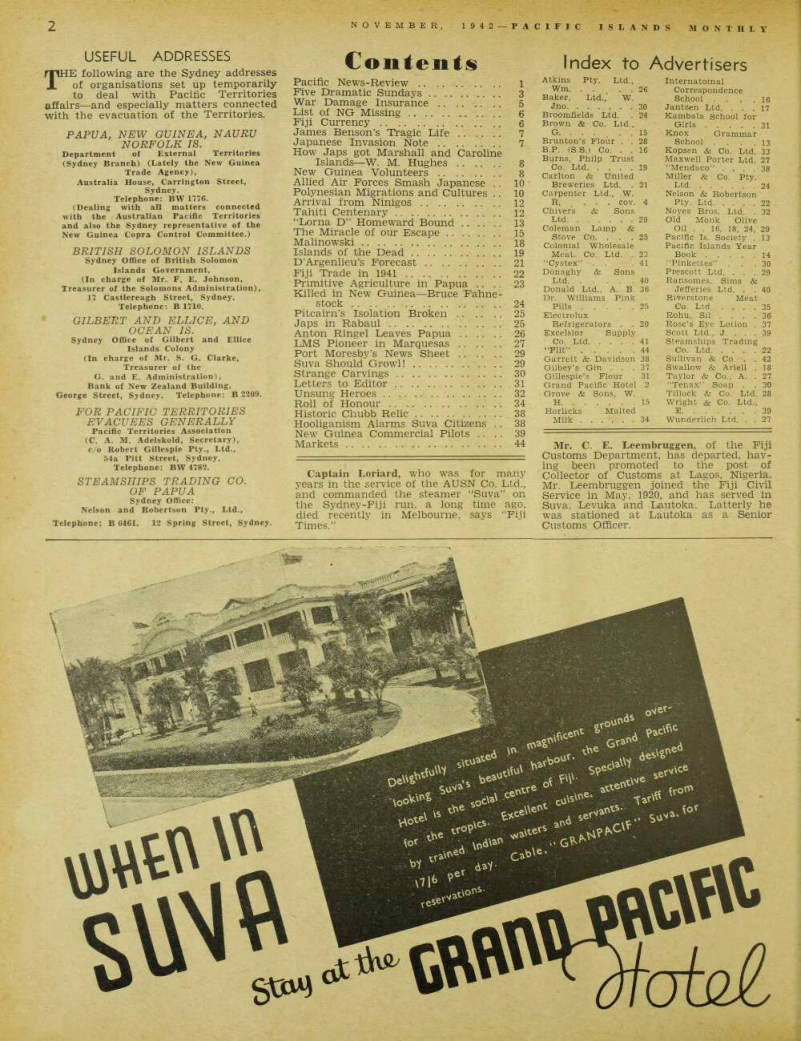
Pacific News-Review 1 Five Dramatic Sundays 3 War Damage Insurance 5 List of NG Missing 6 Fiji Currency 6 James Benson’s Tragic Life 7 Japanese Invasion Note 7 How Japs got Marshall and Caroline Islands—W. M. Hughes 8 New Guinea Volunteers 8 Allied Air Forces Smash Japanese .. 10 Polynesian Migrations and Cultures .. 10 Arrival from Ninigos 12 Tahiti Centenary 12 “Lorna D” Homeward Bound 13 The Miracle of our Escape 15 Malinowski 18 Islands of the Dead 19 D’Argenlieu’s Forecast 21 Fiji Trade in 1941 22 Primitive Agriculture in Papua ... 23 Killed in New Guinea —Bruce Fahne stock 24 Pitcairn’s Isolation Broken 25 Japs in Rabaul 25 Anton Ringel Leaves Papua 26 LMS Pioneer in Marquesas 27 Port Moresby’s News Sheet 29 Suva Should Growl! 29 Strange Carvings 30 Letters to Editor 31 Unsung Heroes 32 Roll of Honour 34 Historic Chubb Relic 38 Hooliganism Alarms Suva Citizens 38 New Guinea Commercial Pilots ... 39 Markets 44
Index to Advertisers
Atkins Pty. Ltd., Wm. . . . . 26 Baker, Ltd.," W.
Jno 30 Broomfields Ltd. . 24 Brown & Co. Ltd., G. ... 15 Brunton’s Flour . . 28
B.P. (S.S.I Co. . . 16
Burns, Philp Trust Co. Ltd 19 Carlton & United Breweries Ltd. . 21 Carpenter Ltd., W.
R. . . . cov. 4 Chivers & Sons Ltd 29 Coleman Lamp & Stove Co. ... 25 Colonial Wholesale Meat. Co. Ltd. . 23 “Cystex” . . .41 Donaghy & Sons Ltd 40 Donald Ltd., A. B. 36 Dr. Williams Pink Pills 25 Electrolux Refrigerators . . 20 Excelsior Supply Co. Ltd 41 “Flit” 44 Garrett & Davidson 38 Gilbey’s Gin ... 37 Gillespie’s Flour . 31 Grand Pacific Hotel 2 Grove & Sons, W.
H 15 Horlicks Malted Milk 34
Internatoinal Correspondence School ... 16 Jantzen Ltd. ... 17 Kambala school for Girls 31 Knox Grammar School ... 13 Kopsen & Co. Ltd. 33 Maxwell Porter Ltd. 27 “Mendaco” ... 38 Miller & Co. Pty.
Ltd 24 Nelson & Robertson Pty. Ltd 22 Noyes Bros. Ltd. . 32 Old Monk Olive Oil . . 16, 18, 24, 29 Pacific Is. Society . 13 Pacific Islands Year Book 14 “Pinkettes” ... 30 Prescott Ltd. ... 29 Ransomes, Sims & Jefferies Ltd. . . 40 Riverstone Meat Co. Ltd 35 Rohu, Sil . . . .36 Rose’s Eye Lotion . 37 Scott Ltd., J. ... 39 Steamships Trading Co. Ltd 22 Sullivan & Co. . . 42 Swallow & Ariell . 18 Taylor & Co., A. . 27 “Tenax” Soap . . 30 Tillock & Co. Ltd. 28 Wright & Co. Ltd., E 39 Wunderlich Ltd. . . 27
Advertisements & other items, p. 4 (1 item)
fcrfaz^
USEFUL ADDRESSES
rE following are the Sydney addresses of organisations set up temporarily to deal with Pacific Territories affairs —and especially matters connected with the evacuation of the Territories.
PAPUA, NEW GUINEA, NAURU
NORFOLK IS.
Department of External Territories (Sydney Branch) (Lately the New Guinea Trade Agency), Australia House, Carrington Street, Sydney.
Telephone: BW 1776. (Dealing with all matters connected with the Australian Pacific Territories and also the Sydney representative of the New Guinea Copra Control Committee.)
BRITISH SOLOMON ISLANDS
Sydney Office of British Solomon Islands Government, (In charge of Mr. F. E. Johnson, Treasurer of the Solomons Administration), 17 Castlereagh Street, Sydney.
Telephone: B 1710.
GILBERT AND ELLICE, AND
OCEAN IS.
Sydney Office of Gilbert and Ellice Islands Colony (In charge of Mr, S. G. Clarke, Treasurer of the G. and E. Administration), Bank of New Zealand Building, George Street, Sydney. Telephone: B 2209.
FOR PACIFIC TERRITORIES
EVACUEES GENERALLY
Pacific Territories Association (C. A. M, Adelskold, Secretary), c/o Robert Gillespie Pty., Ltd., 54a Pitt Street, Sydney.
Telephone: BW 4782.
STEAMSHIPS TRADING CO.
OF PAPUA
Sydney Office: Nelson and Robertson Pty., Ltd., Telephone: B 6461. 12 Spring Street, Sydney.
Mr. C. E. Leembruggen, of the Fiji Customs Department, has departed, having been promoted to the post of Collector of Customs at Lagos, Nigeria.
Mr. Leembruggen joined the Fiji Civil Service in May, 1920, and has served in Suva, Levuka and Lautoka. Latterly he was stationed at Lautoka as a Senior Customs Officer.
Captain Loriard, who was for many years in the service of the AUSN Co. Ltd., and commanded the steamer “Suva” on the Sydney-Fiji run, a iong time ago, died recently in Melbourne, says “Fiji Times.”
.'a W o s ° vaS x C e^ re ° n e atte ° ft *' n * , o c'\* v c r c u^'° s s^.'° r » c^ e - ' 7 > 6 ? „s r e^^°° *«*■**
fcrfaz^
Pacific Islands Monthly
The Newspaper-Magazine of the South Seas [Registered at the G.P.0., Sydney, for transmission by post as a newspaper .]
Published Once Each Month and Circulated in Australia and New Zealand and in the following Pacific Territories and Islands Groups:
Australian Territory of Papua.
Mandated Territory (Australia) of New Guinea.
Australian Territory of Norfolk Island.
New Zealand Territory of Cook Islands.
Mandated Territory (NZ) of Western Samoa.
British Colony of Fiji.
British Solomon Islands Protectorate.
British Protectorate of Tongan Islands.
British Crown Colony of Gilbert and Ellice Islands.
Mandated Territory of Nauru.
British and Free French Condominium of New Hebrides.
Free French Colony of New Caledonia.
Free French Colony of Oceania (Tahiti, etc.).
American Territory of Eastern Samoa, American Territory of Hawaiian Islands.
Owned and Produced by Pacific Publications Pty. Ltd., Union House, 247 George Street, Sydney.
TELEPHONE -f Managing Director .. BW 5037 I Business and Editorial MA 4369
P.O. Box 3408 R
Registered Address of Telegrams, Radiograms, and Cables: “Pacpub”, Sydney,
Contributions.
Articles, Stories, and Photographs dealing with Pacific Islands subjects are invited and will be paid for on publication.
Subscription Rates.
Per Annum, within British Empire, Prepaid, Post Free 8/.
Per Annum, elsewhere, prepaid. Post Free. 10/- Single Copies Bd.
Editor and Publisher:
R. W. Robson, F.R.G.S.
Advertising Manager: L. W. Bailey.
Advertising Office and Printing-House: 29 Alberta Street, Sydney.
Advertising rates furnished on application.
Colours, etc., by arrangement.
Process Blocks made at Advertiser’s expense when required. Screen 100.
Changes of Advertising Copy should reach this office by Ist of each month, otherwise previous advertisement may be repeated.
Representative In London.
W. C. Harvey, Coronation House, 4 Lloyds Avenue, London, E.C.3, from whom may be obtained copies of Pacific Islands Monthly, Pacific Is. Year Book, advertising schedules, etc.
Agents.
The following are authorised to receive sub scriptions for Pacific Islands Monthly;— Burns, Philp & Co., Ltd., and Burns Phllp (South Sea) Co., Ltd. All branches.
W. R. Carpenter & Co., Ltd. All branches.
Morris, Hedstrom, Ltd. All branches.
Steamships Trading Co., Papua. All branches, B.N.G. Trading Co., Ltd., Port Moresby, Papua.
J. Muir, Suva, Fiji.
Miss R. Castles, Suva, Fiji.
N. C. Mackenzie Hunt, Wainunu, Bua, Fiji.
Kirpal & Co., Victoria Parade, Suva, Fiji.
Cook Islands Trading Co., Rarotonga, Cook Is, A. C. Rowland, Papeete, Tahiti.
Islands Branches and Representatives of W. H.
Grove & Sons, Ltd., Auckland, New Zealand.
Ed. Pentecost, Noumea, New Caledonia.
Kerr & Co., Noumea, New Caledonia.
Vol, XIII. No. 4.
November 17, 1 942
Prirp i Bd> Per Copy rri'-e £ Prepaid: 8/- p.a.
Five Dramatic Sundays
A War Survey
BY
R. W. Robson.
F HAVE a 10-year-old radio receiver.
A My family insist that I shall get rid of it—it is out-moded, and grim, and no household ornament. But I cling to that set. Leaning atop of it, early and late, over three years, I have ,watched history take shape, seen European civilisation go right to the brink of the abyss, and yet be saved.
There, I heard the voice of Britain, standing alone amid the wreckage of the world that was created at Versailles:— COME THEN . . , LET US TO THE TASK, TO THE BATTLE AND THE TOIL, EACH TO OUR PART, EACH TO OUR STATION.
FILL THE ARMIES, RULE THE AIR, POUR
Out The Munitions, Strangle The
U-Boats, Build The Ships And
Honour The Brave.
Let Us Go Forward Together In
All Parts Of The Empire.
THERE IS NOT A WEEK, NOR A DAY,
Nor An Hour To Be Lost.
There, at that receiving set, on five widely-separated Sundays, I heard news announcements which carried us down to despair, and brought us back to the heights of victory and hope.
Sunday, September 3, 1939.
IT is nine o’clock. All day, we have been hanging over the radio, waiting for the dread announcement, hoping that even yet there may be a last-minute
settlement. And then, direct from Lon don, the tired, shaken voice of dis illusioned Prime Minister Chamberlain: — “The Nazis, breaking their pledged word, and in cynical disregard of all promises given to Britain and France, have invaded Poland. Britain has declared war upon Germany.”
We who had followed international affairs for 25 years knew that terrible things were ahead —but few guessed that this was the most fateful day in the history of European civilisation. We believed that British naval power, French military might, the Maginot Line, would take care of Germany. But most of us knew that enormous sociological forces were stirring—we suspected that man kind was entering a new era. But we were confident enough. We expected the old democratic system to continue —with modifications.
Sunday, June 16, 1940.
Every message that came this day was black with disaster. France was disintegrating before our eyes. France had rejected Prime Minister Churchill’s appeal to fight on, on the sea and from North Africa. France was preparing for capitulation to the triumphant Nazis.
Poland, Czechoslovakia, Norway, Den mark, Holland, Belgium and now France, were over-run and prostrate. Russia was aloof. Italy, mouth a-slaver at the pros pect of spoils, had rushed eagerly to
Germany’s side, to declare war upon Britain and France. America was “iso lationist” Japan, scenting new terri tories was stirring eagerly.
Britain now was without an ally, abso lutely alone. Her Army consisted mostly of the disorganised, unequipped men from Dunkirk; her Air Force, while magnifi cent, was ten times outnumbered by Hit ler’s Luftwaffe.
This was the darkest moment of the war—probably the most fearful day in the long history of the British Empire.
It seemed that only a miracle could save us.
Sunday, June 22, 1941.
FOUR o’clock on a dismal afternoon.
Quite suddenly and unexpectedly, out of the radio, came the announce ment:— “At dawn this morning - , without any warning or declaration of war, Hitler’s armies marched against Russia. The whole of the frontiers between Gei many and Russia are ablaze.”
It seemed too good to be true. We had come through a year in which we had seemed to survive by a series of miracles. By their supreme heroism and self-sacrifice, the outnumbered young airmen of Britain had kept the Huns out of the British Isles. Somehow, we had dealt blow after blow upon the squeal ing Italians in North Africa. Somehow, the creeping, treacherous Japanese had been persuaded to stay in Indo-China and not advance into Netherlands Indies, upon which their gaze was greedily fixed. Incredibly, the war-hating people of the United States were swinging to a
realisation that, if Britain was lost, everything that Americans hold dear could be lost.
But Britain still was alone. Germany scorned our new military formations.
German armies had smashed us in Greece and Crete and Libya; an incred ible concentration of military power had been thrown against Russia. The chorus of the moaners rose high over us all: “The Russians cannot stand up against this blitz for three weeks. They will never co-operate with us, anyway—they hate us. As soon as the Russians col lapse, the Japanese will spring upon us.
The Americans will not fight.”
I remember only one reassuring voice —that of George Bernard Shaw, octo genarian: “Russia will not be broken.
Russia will surprise the world. You can put your faith in the Soviet.”
Sunday, December 7, 1941.
BECAUSE the international date-line lies between Australia and Hawaii, it was Monday, December 8, with us, when the incredible thing came to us out of the air:— “With calculated treachery, equalled only by that of Hitler himself, the Japanese this morning hurled their forces, without warning or declaration of war. upon the Americans in Pearl Harbour and Philippines, and the British in Hongkong and Malaya.”
And thus, with one foul blow, Japan changed possibilities and probabilities into certainties. From that moment, the defeat of the Axis was certain.
The unconquerable spirit and enormous naval power of Britain; Russia’s stark courage and amazing powers of endur ance; the incalculable man-power of Rus sia and of unbeatable China; the organis ing genius, energy and endless industrial strength of 130,000,000 Americans — sud denly all these things, hitherto not linked, were welded together to form the most powerful combination in the history of the world, the United Nations. Only one spark had been needed to start the amalgam; the spar'k was supplied by Pearl Harbour. The fire which, in a few hours, created the United Nations, was the blazing anger of the United States.
Britain and Russia were no longer alone.
Sunday, November 8, 1942.
WE hung around the old radio, listen ing with grim satisfaction to a new kind of story—the story for which our hearts had hungered for three weary years—a ball-to-ball description of the destruction of a mighty German army by- British soldiers and British equipment, with superior British leadership.
Rommel’s Huns running in North Africa, Hitler’s Huns faltering and fail ing before the unbreakable Russians, Japanese attacks failing under American shells and bombs in the Solomons, Aus tralians driving the Japanese back across New Guinea, air-bome American troops appearing dramatically in North-eastern Papua—and, then, a radio voice, vibrant with the excitement of world-shaking news:— “It has just been announced that powerful American forces, supported
and protected by the British Navy and Air Force, are now landing at numer ous places on the Atlantic and Medi terranean seaboards of Morocco and Algeria. The United Nations intend to occupy all of French North Africa, with a view to taking complete possession of the Mediterranean and opening a second front against the Nazis in Europe.”
And thus was marked the most dramatic and exciting 24 hours in the history of radio. With our ears upon every capital in the world, we were spec tators (or should the word he auditors?) of the actual turning-point of the great est war in the history of the world.
We heard the steady voice of “London Calling”—brave London, that never failed us, even in the blackest days and the worst blitz of 1940 —London telling us now of victory as calmly as when we were told of apparently irretrievable defeat.
We heard President Roosevelt’s stir ring appeal to France to come in now beside the United Nations, before it was too late. We heard Amei'ica’s radio bom bardment of Frenchmen throughout the world. We heard a new note — hope, exultation —in the voices of battered, weary but unconquerable Russia: The second front, at last, thank God!
And we heard the wild screeches of the egocentric Hitler as he slang whanged President Roosevelt, and threat ened the British Isles with “unbelievable horrors, the product of German inventive genius.” Gas? We heard the gentle Jap —he whose calculated treachery is writ ten imperishably at Pearl Harbour, he who cuts the throats of helpless Islands missionaries—tell an incredulous world that America’s occupation of North Africa had been “most ungentlemanly”!
THIS strange, mad Hitler! Do you remember, after the collapse of France, what Goering said of him?
“A great, natural military genius who must become the ruler of the world” —or something like that. He is a genius, a queer freak of a man—only such an acci dent in human shape could have created Nazi Germany and come within an ace of destroying civilisation.
But only the greatest fool in history could have made the blunders he made: His failure to destroy Britain in July and August, 1940, when Britain was helpless and alone; his untimely attack upon Russia, thus irrevocably tying Germany’s hands, and giving Britain a priceless opportunity to re-arm; his blindness in thrusting Japan against the United States, and thus bringing war-fury and inflexible unity of purpose to. the world’s most powerful and most determinedly peaceful nation.
Eventually—perhaps very soon, now— Germany will awaken to the fact that in acclaiming Anton Schnickelgruber, alias Adolf Hitler, as her ‘‘beloved Fuhrer” she has been cherishing the world’s prize goat. And, then, the deluge!
AMERICAN occupation of French
North Africa, simultaneously with Britain’s destruction of the Axis armies in Libya—what a plan! It
clicks together!
It makes winter campaigning possible. (Hitler thought that the British and Americans could not strike
against him before next May.) It closes the north-west African ports against the Axis submarines in the southern Atlantic. It makes possible complete domination of the Mediter ranean by the Allies, thus re-opening the Mediterranean-Suez route to Indian and Australian shipping. It makes the conquest of Italy prac ticable and possible.
It opens the way for an advance against Germany from the Mediter ranean, to be co-ordinated with a possible advance from the west, in the Allies’ own good time. It forces Hitler to desperate measures—either to withdraw much of his strength from Russia, or to attack the Middle East British through the Black Sea region.
It gives Russia time to prepare for that final, mighty blow which Stalin believes will overwhelm Germany in 1943.
But this is not the end. It is not even the beginning of the end. It probably is the turning-point of the war. It is inconceivable that Hitler will abandon his crazy, but almost fulfilled, dream of world conquest be fore he makes attacks of incalculable ferocity and cruelty. He probably will (1) assemble his air forces for fearful blitzes against Britain; (2) completely occupy France; (3) occupy Italy, in an attempt to prop up the now stag gering Mussolini and keep the Allies out of that country; (4) call upon Japan for terrific diversionary attacks against the United Nations in the Pacific and Far East—and especially against Russia, in Siberia.
Mighty forces are moving in Europe for the destruction of Hitler and Hitlerism. And the mightiest of all are the forces of Nature. Europe, entering the winter, is threatened with a terrible famine. Out of famine come disease, demoralisation, revolu tion. Perhaps the United Nations can control and shape events for victory.
But can they control that which will
follow victory?
WHAT of Japan—this nation which now holds a new Empire, all the fabled wealth of the Indies, but which sees the forces which her greed and treachery aroused mounting daily for her own destruction?
One can only guess at the global strategy of the United Nations. It may be that the plan is to first destroy Hitlerism, and then attend to the Pacific. But we may be perfectly sure that Japan’s turn will come.
It may be that the war will end in Europe long before it ends in Asia and the Pacific. Germany will abandon Japan in the Far East just as readily as Rommel abandoned the Italian divisions in Egypt. The war-lords of Tokio probably will want the common people of Japan—poor, untaught, fanatical robots—to fight on to the end, to accept extermination, in the hope that Japan will be allowed to retain some of the territories which she so greedily snatched at, and for which she sold her international soul.
To Re-Form
New Guinea Returned Soldiers Start All Over Again
THE New Guinea Returned Soldiers’
Association, which lost all its records and many of its members when the Japanese invaded Rabaul last January, is to be re-formed at a meeting to be held in Sydney this month. The prime mover in the decision to bring the organisation into being again is Mr. A. J.
Gaskin, of the New Guinea public ser vice, who is at present in the office of the External Territories Department, Australia House, Carrington Street, Sydney.
Of the nine men who constituted the executive of the Association last January six are missing, and most of the six are believed to be prisoners of war. The six are: “Nobby” Clark, Jack Edwards. Bob Kennedy, Allan Whiteman, Jack Alber ton and Jack Barrie. The three mem bers of the executive who escaped are: A. J. Gaskin, T. H. Targett, Dr. E. T.
Brennan.
The new organisation will include, of course, not only veterans of World War I, but also returned soldiers of World War 11.
William Bentley
Death of Mr. and Mrs.
AFTER 53 years of married life. Mr.
William Bentlev and Mrs. Annie Bentley died within five days of other, in Fiii. early in September.
Both were nearly 90 years old. They had lived nearly all their lives in Fiji. Mr.
Bentley was a member of one of the best-known and most highly respected pioneer families.
The original Fiji Bentley was Henrv Bentley, who was born in England in IR3O. and who went to the Rewn and Pa districts of Fiji, in 1867, and began to grow cotton and sugar. He spent most of his life, however as a magistrate in the service of the Fiii Government, he died in Levuka in 1892, leaving six sons and four daughters.
One smi was the well-known Captain R. E. N. Bentlev, who was harbour master at Levuka: he married Miss Lavinia Hayes and died onlv a few vears ego. Another of his sons was Mr. Henry Bentley., who wac born in 1855. educated in Melbourne, and arrived with his father in Levuka in 1867.
Mr. Henry Bentley was associated with his father in planting enterprises and subseaueuth/ was a coffee planter. He became skilled in rnedical work however, and from about 1880 onwards he was m the service of the Fiii Government and the Colonial Sugar Refining Comnanv as manager 0 f various hosnitals. He fol lowed this profession until he went to live in retirement at I .ami. a few years ao-o. H’s surviving children are: Mr.
Ronald Bentlev. of Auckland, and Mrs.
Eastgate, of Suva.
Makea Nui Takau Ariki (Mrs. E. T. W.
Love) left Rarotonga for New Zealand in October to attend to the affairs of her late husband. Lieut.-Colonel Love, who was recently killed in action in Egypt.
Miss Elaine Margaret Hay, younger daughter of the late Mr. Frederick Hav (of the W. R. Carpenter staff, Rabaul) was married on October 7 to Corporal Jack Campbell. AIF, at Roseville, Sydney.
Lieutenant A. W. Lane was best man.
Ten Countries of the Pacific Delegates
Pacific Delegates to Study International Relationships
IT was announced from London on October 23. that Australia, New Zea land, Britain, Canada, United States, India. Holland. Fighting France, Russia and China, will send delegations to the conference called by the Institute of Pacific Relations (New York), which is to be held in Canada from December 4 to December 14. It was stated that Lord Hailey, a noted authority on colonial administration, would lead the British delegation.
Inquiries made in Australia did not show that any Australian institution has taken any interest in this conference, and it does not appear that any of the terri tories in the South Pacific have sent delegates.
The Institute publishes an excellent monthly journal called “Pacific Affairs.” which usually contains useful and valu able articles. But. generally, the whole organisation is redolent of “high brow” associations, and it does not appear to have served any practical purpose in this tough, work-a-day world. However, if it Tow can get sufficient backing in the United States, the Institute mav be able to give considerable help when the repre sentatives of the Pacific nations eventu ally sit at a peacetime table, and try to get some orderliness and sense into the relationships between all the manv countries and territories in and around the Pacific.
Solomons Rc
Awarded CMG For Notable Service
11THEN the Japanese invaded the TT Solomons in the early part of this year, the Resident Commissioner.
Lieut.-Colonel W. S. Marchant, and a number of his officers, refused to leave the Protectorate. They stayed on in Tulagi: but, recognising that an enemy occupation of Tulagi was likely, they made certain preparations.
Air raids on Tulagi at the end of April showed that the Japs were coming, and the RC and his staff moved away to certain places elsewhere in the groun, where they had assembled a considerable quantity of essential supplies.
The enemy fully occupied Tulagi in May; but Lieut. Colonel Marchant with drew to his new headquarters. He carried on for four months—April, May, June and July—and then, when the Americans recaptured the Tulagi zone, and drove the Japanese northwards, the administrative personnel were able to co operate at once with our Allies.
Details of what was accomplished bv the RC cannot be published; but it is significant that, in the BBC radio trans mission on November 7. his conduct was warmly praised, and it was announced that he had been awarded the distinction of CMG (Companion of the Order of St.
Michael and St. George).
Mr. V, Fox-Strangways, who arrived in Australia from Nyasaland. en route to take up the position of Resident Com missioner of the Gilbert and Ellice Islands, at the end of 1941, and who was prevented by the Japanese war from pro ceeding further, has assumed duty for mally as Resident Commissioner. He has had charge of G. &' E. affairs from August 22.
War Damage
Commission Gives a Ruling
WHERE property in Papua and New Guinea is known to have been destroyed, a contributor to the War Damage Insurance Fund is exempt from further obligation to pay war damage insurance premiums. Where property has depreciated, premiums should be based on the depreciated va],pe as assessed by the War Damage Commis sion.
These rulings—which are of great importance to Papuan and New Guinea property owners—were given to the Paci fic Territories Association by the War Damage Commission in a letter dated October 24. 1942.
If an owner is satisfied that his pro perty has been wholly destroyed, he need not renew his contribution. But if he is not certain, he should make further con tributions in case the damage should occur subsequent to January 1, 1943; because, if no voluntary contributions whatever are made in respect of damaged or depreciated property, for future years, the property will not be covered under existing regulations.
The letter from the War Damage Com mission, which is dated October 24, 1942, is as follows: “I refer to your letter of 19th instant, regarding the renewal of premiums where property has been destroyed or damaged.
“In reply, I have to advise that, where property is known to have been lost or to have reduced in value, the contributor should not be called upon to make a con tribution for ensuing years, or the con tribution should be based on the reduced value established by the Commission.
If voluntary contributions are not renewed for future years, the property will not be covered, under the regulations.
“If the owner is satisfied that his pro perty has been wholly destroyed, he will oresumably not renew the contribution.
If, however, he is unaware of the condi tion of the property, he should make a further contribution in case damage should occur subsequent to January 1 1943.
“In any case, where contributions are not paid until some time after 1/1/43, the provisions of the regulations will not extend to the propertv for the period that remains uncovered.”
Desert Spooner-Ism
A NEW story from the Middle East:— The commander of a desert post received a brief message from a portable radio carried by a mounted scout, who had gone out to reconnoitre certain enemy positions. It was brief and pointed:— “Rommel captured. Walking home.”
There was incredulity and excitement.
A party was rushed out into the desert, to meet the capturers of the German General. They met one man, very tired and very fed-up. He was alone. He said he had sent the radio message.
“But where’s Rommel?” they cried.
“Rommel what?” snarled the weary soldier. “What are you talking about?”
“But you said you’d captured Rommel!”
“That radio bloke at the post ought to be bumped.” said the patrolman. “I didn’t say ‘Rommel captured—walking home.’ I said, ‘Camel ruptured—walking home!”’ 5
Fiji's Currency
Problem
Private Firms Issue Tokens
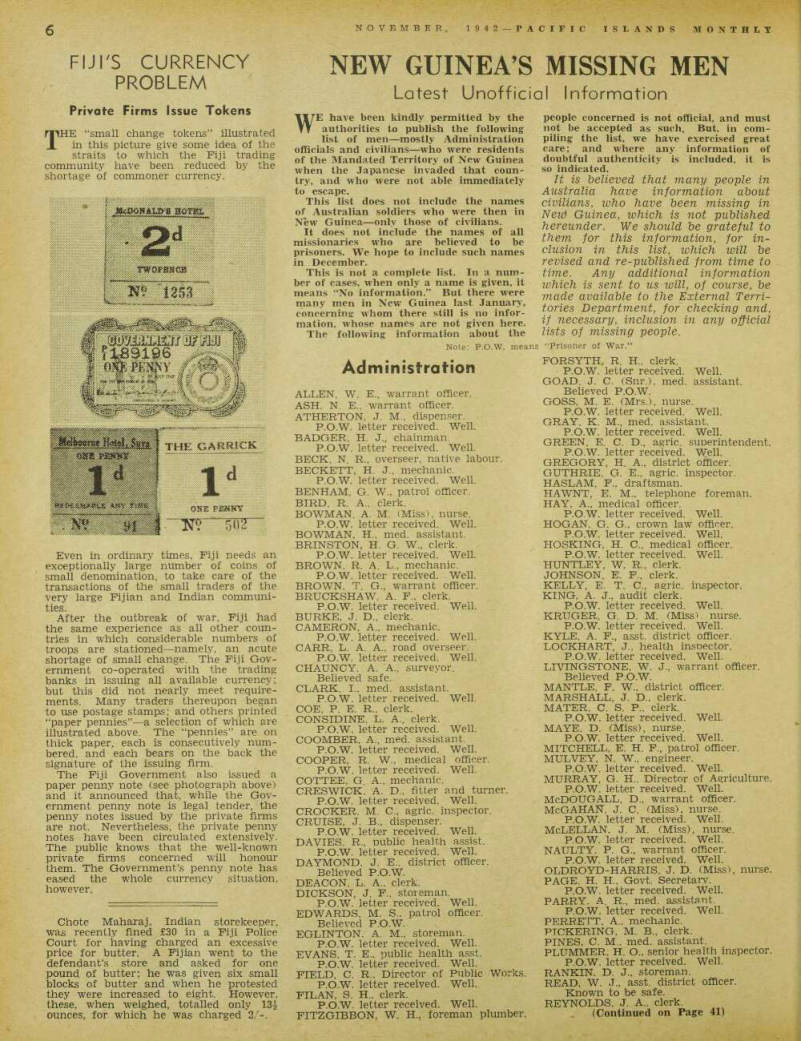
THE “small change tokens” illustrated in this picture give some idea of the straits to which the Fiji trading community have been reduced by the shortage of commoner currency.
Even in ordinary times, Fiji needs an exceptionally large number of coins of small denomination, to take care of the transactions of the small traders of the very large Fijian and Indian communi ties.
After the outbreak of war, Fiji had the same experience as all other coun tries in which considerable numbers of troops are stationed —namely, an acute shortage of small change. The Fiji Gov ernment co-operated with the trading banks in issuing all available currency; but this did not nearly meet require ments. Many traders thereupon began to use postage stamps; and others printed “paper pennies”—a selection of which are illustrated above. The “pennies” are on thick paper, each is consecutively num bered, and each bears on the back the signature of the issuing firm.
The Fiji Government also issued a paper penny note (see photograph above) and it announced that, while the Gov ernment penny note is legal tender, the penny notes issued by the private firms are not. Nevertheless, the private penny notes have been circulated extensively.
The public knows that the well-known private firms concerned will honour them. The Government’s penny note has eased the whole currency situation, however.
Chote Maharaj, Indian storekeeper, was recently fined £3O in a Fiji Police Court for having charged an excessive price for butter. A Fijian went to the defendant’s store and asked for one pound of butter; he was given six small blocks of butter and when he protested they were increased to eight. However, these, when weighed, totalled only 13£ ounces, for which he was charged 2/-.
New Guinea’S Missing Men
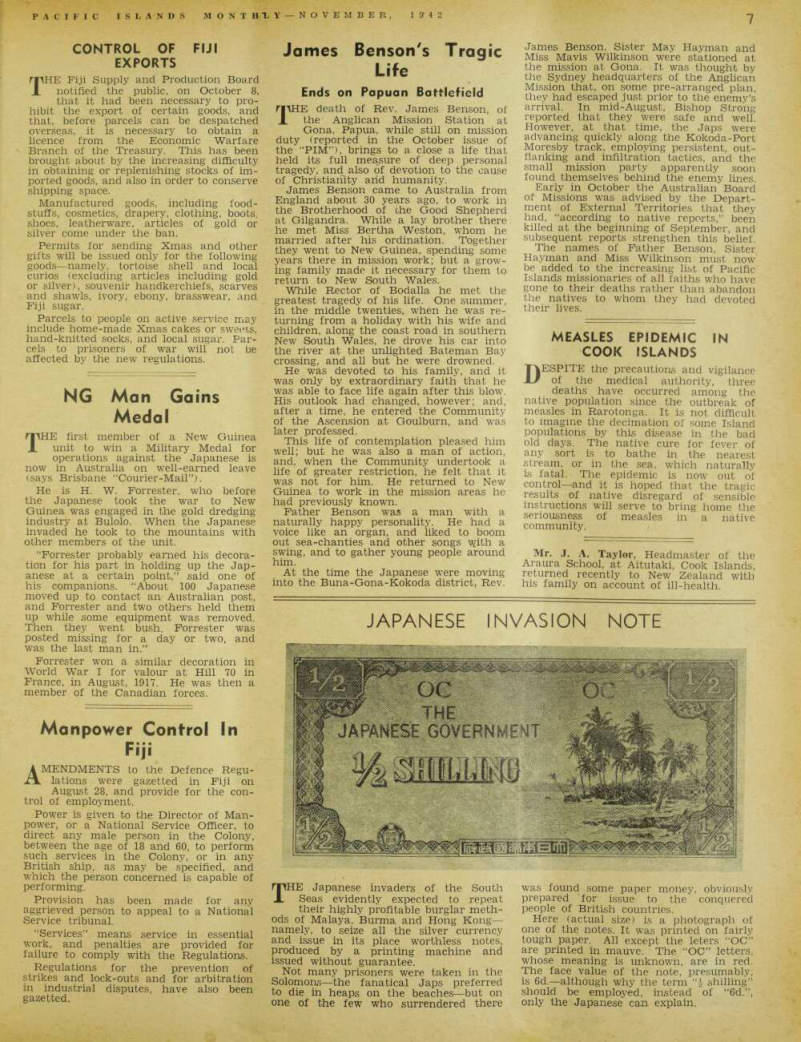
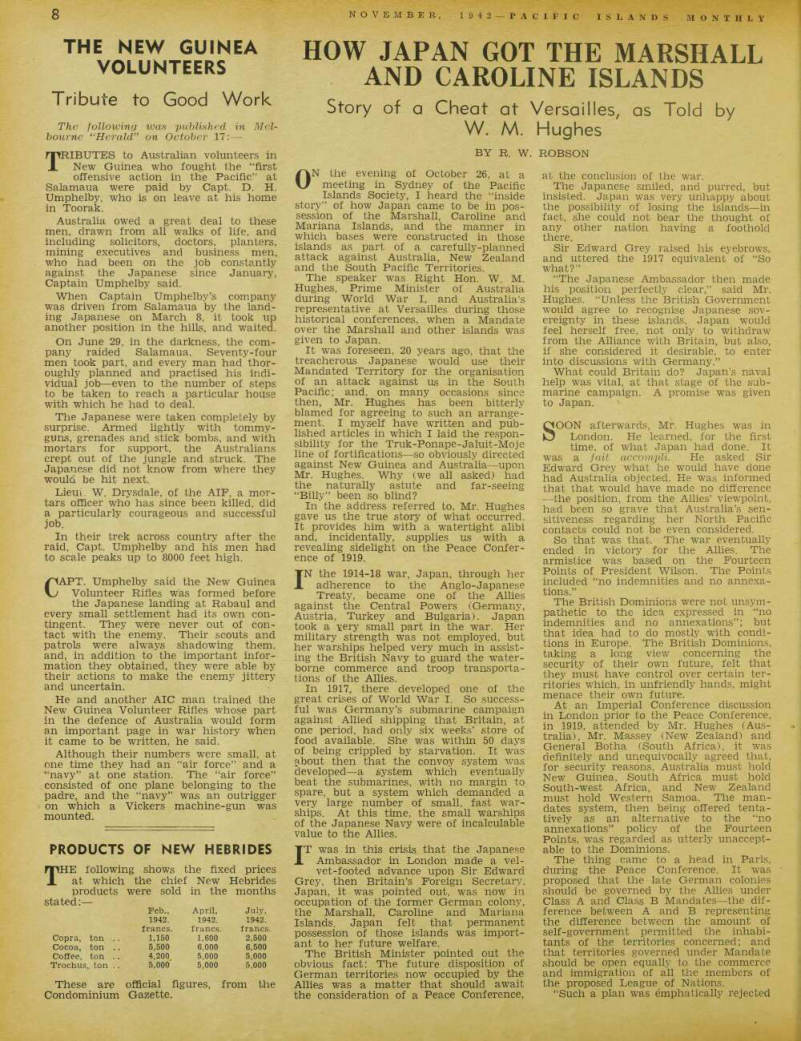
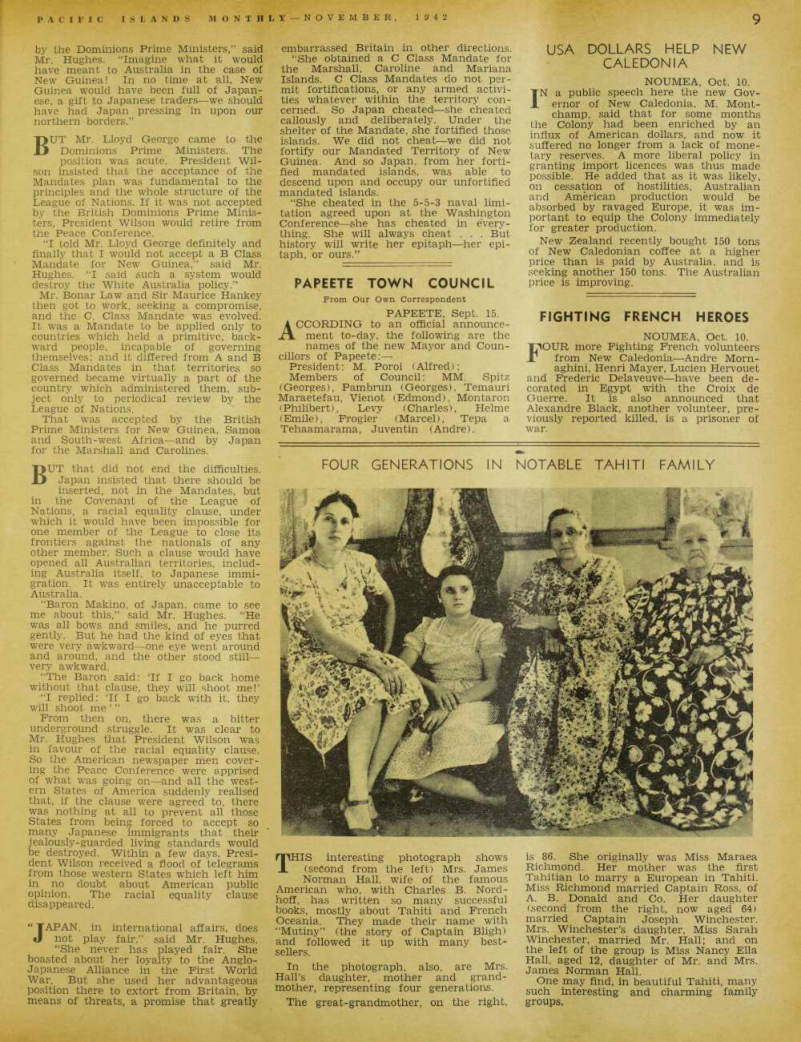
Latest Unofficial Information
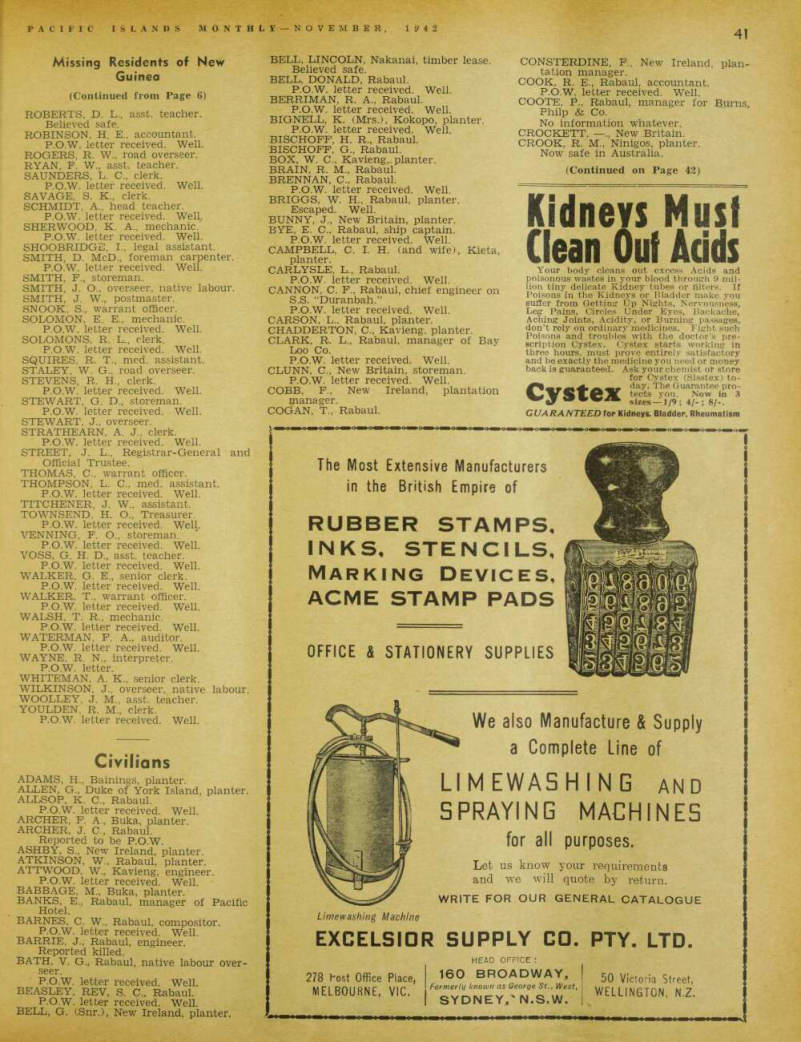
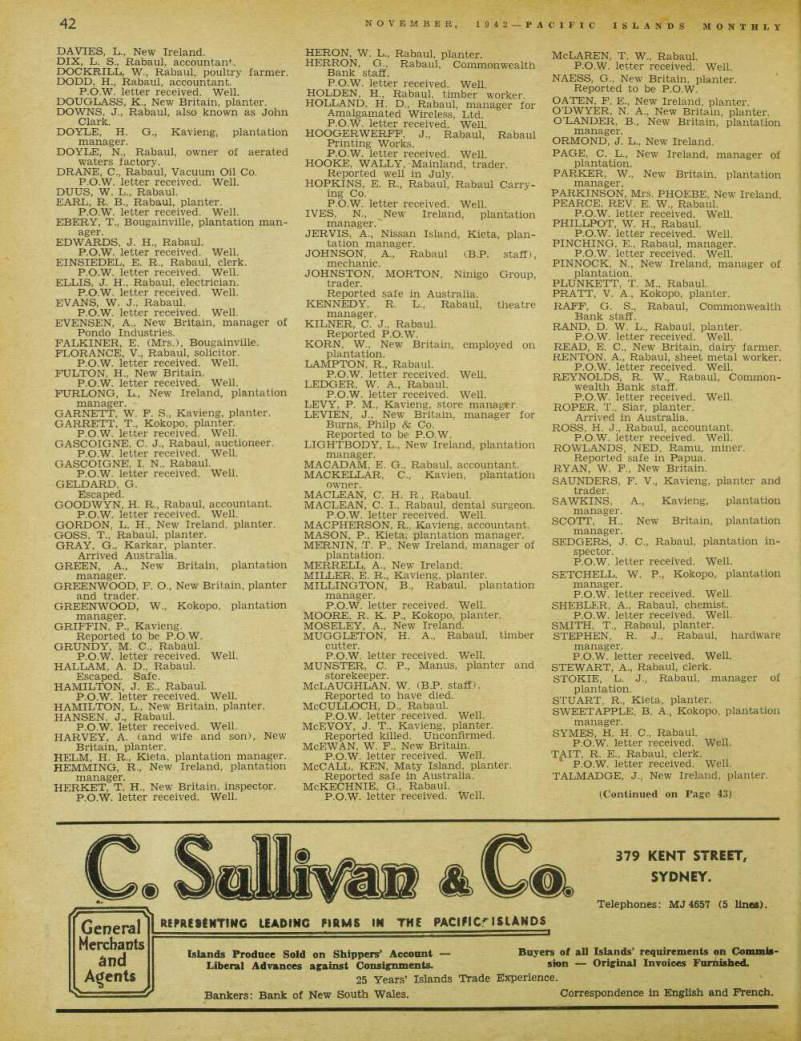
WE have been kindly permitted by the authorities to publish the following list of men—mostly Administration officials and civilians—who were residents of the Mandated Territory of New Guinea when the Japanese invaded that coun try, and who were not able immediately to escape.
This list does not include the names of Australian soldiers who were then in New Guinea —only those of civilians.
It does not include the names of all missionaries who are believed to be prisoners. We hope to include such names in December.
This is not a complete list. In a num ber of cases, when only a name is given, it means “No information.” But there were many men in New Guinea last January, concerning whom there still is no infor mation, whose names are not given here.
The following information about the
people concerned is not official, and must not be accepted as such. But, in com piling the list, we have exercised great care; and where any information of doubtful authenticity is included, it is so indicated.
It is believed that many people in Australia have information about civilians, who have been missing in Neid Guinea, which is not published hereunder. We should be grateful to them for this information, for in clusion in this list, which will be revised and re-published from time to time. Any additional information which is sent to us will, of course, be made available to the External Terri tories Department, for checking and, if necessary, inclusion in any official lists of missing people.
Note: P.O.W. means “Prisoner of War.”
Administration
ALLEN, W. E., warrant officer.
ASH. N. E.. warrant officer.
ATHERTON, J. M., dispenser.
P.O.W. letter received. Well.
BADGER. H. J., chainman.
P.O.W. letter received. Well.
BECK, N. R., overseer, native labour.
BECKETT, H. J., mechanic.
P.O.W. letter received. Well.
BENHAM, G. W., patrol officer.
BIRD, R. A., clerk.
BOWMAN. A. M. (Miss), nurse.
P.O.W. letter received. Well.
BOWMAN, H.. med. assistant.
BRINSTON, H. G. W„ clerk.
P.O.W. letter received. Well.
BROWN. R. A. L., mechanic.
P.O.W. letter received. Well.
BROWN, T. G., warrant officer.
BRUCKSHAW, A. F„ clerk.
P.O.W. letter received. Well.
BURKE, J. D.. clerk.
CAMERON, A., mechanic.
P.O.W. letter received. Well.
CARR, L. A. A., road overseer.
P.O.W. letter received. Well.
CHAUNCY. A. A., surveyor.
Believed safe.
CLARK. 1., med. assistant.
P.O.W. letter received. Well.
COE, P. E. R.. clerk.
CONSIDINE. L. A., clerk.
P.O.W. letter received. Well.
COOMBER. A., med. assistant.
P.O.W. letter received. Well.
COOPER, R. W., medical officer.
P.O.W. letter received. Well.
COTTEE, G. A., mechanic.
CRESWICK. A. D„ fitter and turner.
P.O.W. letter received. Well.
CROCKER. M. C., agric. inspector.
CRUISE, J. 8., dispenser.
P.O.W. letter received. Well.
DAVIES. R., public health assist.
P.O.W. letter received. Well.
DAYMOND, J. E.. district officer.
Believed P.O.W.
DEACON. L. A., clerk.
DICKSON, J. F.. storeman.
P.O.W. letter received. Well.
EDWARDS. M. S.. patrol officer.
Believed P.O.W.
EGLINTON. A. M„ storeman.
P.O.W. letter received. Well.
EVANS, T. E., public health asst.
P.O.W. letter received. Well.
FIELD, C. R.. Director of Public Works.
P.O.W. letter received. Well.
FILAN, S. H„ clerk.
P.O.W. letter received. Well.
FITZGIBBON, W. H., foreman plumber.
FORSYTH, R. H., clerk.
P.O.W. letter received. Well.
GOAD. J. C. (Snr.), med. assistant.
Believed P.O.W.
GOSS, M. E. (Mrs.), nurse.
P.O.W. letter received. Well.
GRAY. K. M., med. assistant.
P.O.W. letter received. Well.
GREEN, E. C. D., agric. superintendent.
P.O.W. letter received. Well.
GREGORY, H. A., district officer.
GUTHRIE, G. E., agric. inspector.
HASLAM, F.. draftsman.
HAWNT, E. M., telephone foreman, HAY, A., medical officer.
P.O.W. letter received. Well.
HOGAN, G. G., crown law officer, P.O.W. letter received. Well.
HOSKING, H. C„ medical officer.
P.O.W. letter received. Well.
HUNTLEY, W. R„ clerk.
JOHNSON. E. F., clerk.
KELLY, E. T. C., agric. inspector.
KING. A. J., audit clerk.
P.O.W. letter received. Well.
KRUGER, G. D. M. (Miss'), nurse.
P.O.W. letter received. Well.
KYLE, A. F., asst, district officer.
LOCKHART, J., health inspector.
P.O.W. letter received. Well.
LIVINGSTONE, W. J., warrant officer.
Believed P.O.W.
MANTLE, F. W.. district officer.
MARSHALL, J. D.. clerk.
MATER. C. S. P., clerk.
P.O.W. letter received. Well.
MAYE, D. (Miss), nurse.
P.O.W. letter received. Well.
MITCHELL, E. H. F., patrol officer.
MULVEY, N. W., engineer.
P.O.W. letter received. Well.
MURRAY, G. H., Director of Agriculture.
P.O.W. letter received. Well.
McDOUGALL. D.. warrant officer.
McGAHAN, J. C. (Miss), nurse.
P.O.W. letter received. Well.
McLELLAN. J. M. (Miss), nurse.
P.O.W. letter received. Well.
NAULTY. P. G., warrant officer.
P.O.W. letter received. Well.
OLDROYD-HARRIS, J. D. (Miss), nurse.
PAGE. H. H.. Govt. Secretary.
P.O.W. letter received. Well.
PARRY. A. R., med. assistant.
P.O.W. letter received. Well.
PERRETT. A., mechanic.
PICKERING, M. B„ clerk.
PINES, C. M.. med. assistant.
PLUMMER. H. 0., senior health inspector.
P.O.W. letter received. Well.
RANKIN. D. J., storeman.
READ, W. J., asst, district officer.
Known to be safe.
REYNOLDS. J. A., clerk.
(Continued on Page 41)
ROBERTS, D. L., asst, teacher.
Believed safe.
ROBINSON, H. E., accountant.
P.O.W. letter received. Well.
ROGERS, R. W., road overseer.
RYAN, F. W., asst, teacher.
SAUNDERS, L. C„ clerk.
P.O.W. letter received. Well.
SAVAGE, S. K„ clerk.
SCHMIDT, A., head teacher.
P.O.W. letter received. Well.
SHERWOOD, K. A., mechanic.
P.O.W. letter received. Well.
SHOOBRIDGE, 1., legal assistant.
SMITH, D. McD., foreman carpenter.
P.O.W. letter received. Well.
SMITH, F., storeman.
SMITH, J. 0., overseer, native labour.
SMITH, J. W„ postmaster.
SNOOK, S., warrant officer.
SOLOMON. E. E.. mechanic.
P.O.W. letter received. Well.
SOLOMONS, R. L., clerk.
P.O.W. letter received. Well.
SQUIRES, R. T.. med. assistant.
STALEY, W. G., road overseer.
STEVENS, R. H„ clerk.
P.O.W. letter received. Well.
STEWART, G. D., storeman.
P.O.W. letter received. Well.
STEWART, J., overseer.
Strathearn, A. J.. Clerk.
P.O.W. letter received. Well.
STREET, J. L., Registrar-General and Official Trustee.
THOMAS, C., warrant officer.
THOMPSON, L. C., med. assistant.
P.O.W. letter received. Well.
TITCHENER, J. W., assistant.
TOWNSEND. H. 0., Treasurer.
P.O.W. letter received. Well.
VENNING, F. 0., storeman. ' P.O.W. letter received. Well.
VOSS, G. H. D., asst, teacher.
P.O.W. letter received. Well.
WALKER, G. E., senior clerk.
P.O.W. letter received. Well.
WALKER. T., warrant officer.
P.O.W. letter received. Well.
WALSH, T. R., mechanic.
P.O.W. letter received. Well.
WATERMAN. F. A., auditor.
P.O.W. letter received. Well.
WAYNE. R. N„ interpreter.
P.O.W. letter.
WHITEMAN, A. K„ senior clerk.
WILKINSON, J.. overseer, native labour.
WOOLLEY. J. M., asst, teacher.
YOULDEN. R. M., clerk.
P.O.W. letter received. Well.
Civilians
ADAMS, H., Bainings, planter.
ALLEN, G., Duke of York Island, planter.
ALLSOP, K. C., Rabaul.
P.O.W. letter received. Well.
ARCHER, F. A,, Buka, planter.
ARCHER, J. C , Rabaul.
Reported to be P.O.W.
ASHBY, S., New Ireland, planter.
ATKINSON, W., Rabaul, planter.
ATTWOOD, W., Kavieng, engineer.
P.O.W. letter received. Well.
BABBAGE, M., Buka, planter.
BANKS, E., Rabaul, manager of Pacific Hotel.
BARNES, C. W., Rabaul, compositor.
P.O.W. letter received. Well.
BARRIE, J., Rabaul, engineer.
Reported killed.
BATH, V. G., Rabaul, native labour over seer.
P.O.W. letter received. Well.
Beasley, Rev, S. C„ Rabaul.
P.O.W. letter received. Well.
BELL, G. (Snr.), New Ireland, planter.
BELL, LINCOLN, Nakanai, timber lease.
Believed safe.
BELL, DONALD, Rabaul.
P.O.W. letter received. Well.
BERRIMAN, R. A., Rabaul.
P.O.W. letter received. Well.
BIGNELL, K. (Mrs.), Kokopo, planter.
P.O.W. letter received. Well.
BISCHOFF, H. R„ Rabaul.
BISCHOFF, G., Rabaul.
BOX, W. C.. Kavieng, planter.
BRAIN, R. M., Rabaul.
BRENNAN, C., Rabaul.
P.O.W. letter received. Well.
BRIGGS, W. H., Rabaul, planter.
Escaped. Well.
BUNNY, J., New Britain, planter.
BYE, E. C., Rabaul, ship captain.
P.O.W. letter received. Well.
CAMPBELL, C. I. H. (and wife), Kieta, planter.
CARLYSLE, L„ Rabaul.
P.O.W. letter received. Well.
CANNON, C. F.. Rabaul, chief engineer on S.S. “Duranbah.”
P.O.W. letter received. Well.
CARSON, L.. Rabaul, planter.
CHADDERTON, C., Kavieng, planter.
CLARK, R. L., Rabaul, manager of Bay Loo Co.
P.O.W. letter received. Well.
CLUNN, C., New Britain, storeman.
P.O.W. letter received. Well.
COBB, F., New Ireland, plantation manager.
COGAN, T„ Rabaul.
CONSTERDINE, F., New Ireland, plan tation manager.
COOK, R. E., Rabaul, accountant.
P.O.W. letter received. Well.
COOTE, P., Rabaul, manager for Burns.
Philp & Co.
No information whatever.
CROCKETT, —., New Britain.
CROOK, R. M., Ninigos, planter.
Now safe in Australia.
(Continued on Page 42)
DAVIES, L., New Ireland.
DIX, L. S., Rabaul, accountant.
DOCKRILL, W., Rabaul, poultry farmer.
DODD, H., Rabaul, accountant.
P.O.W. letter received. Well.
DOUGLASS, K., New Britain, planter.
DOWNS, J., Rabaul, also known as John Clark.
DOYLE, H. G., Kavieng, plantation manager.
DOYLE, N., Rabaul, owner of aerated waters factory.
DRANE, C., Rabaul, Vacuum Oil Co.
P.O.W. letter received. Well.
DUUS, W. L„ Rabaul.
EARL, R. 8., Rabaul, planter.
P.O.W. letter received. Well.
EBERY, T., Bougainville, plantation man ager.
EDWARDS, J. H., Rabaul.
P.O.W. letter received. Well.
EINSIEDEL, E, R., Rabaul, clerk.
P.O.W. letter received. Well.
ELLIS, J. H.. Rabaul, electrician.
P.O.W. letter received. Well.
EVANS, W. J., Rabaul.
P.O.W. letter received. Well.
EVENSEN, A., New Britain, manager of Pondo Industries.
FALKINER, E. (Mrs.), Bougainville.
FLORANCE, V., Rabaul, solicitor.
P.O.W. letter received. Well.
FULTON, H., New Britain.
P.O.W. letter received. Well.
FURLONG, L., New Ireland, plantation manager.
GARNETT. W. F. S., Kavieng, planter.
GARRETT, T., Kokopo, planter.
P.O.W. letter received. Well.
GASCOIGNE, C. J., Rabaul, auctioneer.
P.O.W. letter received. Well.
Gascoigne, I. N., Rabaul.
P.O.W. letter received. Well.
Geldard, G.
Escaped.
GOODWYN, H. R., Rabaul, accountant.
P.O.W. letter received. Well.
GORDON, L. H., New Ireland, planter.
GOSS, T., Rabaul, planter.
GRAY, G., Karkar, planter.
Arrived Australia.
GREEN, A., New Britain, plantation manager.
GREENWOOD, F. 0., New Britain, planter and trader.
GREENWOOD, W., Kokopo, plantation manager.
GRIFFIN, P.. Kavieng.
Reported to be P.O.W.
GRUNDY, M. C., Rabaul.
P.O.W. letter received. Well.
HALLAM, A. D., Rabaul.
Escaped. Safe.
HAMILTON, J. E., Rabaul.
P.O.W. letter received. Well.
HAMILTON, L.. New Britain, planter.
HANSEN, J., Rabaul.
P.O.W. letter received. Well.
HARVEY, A. (and wife and son), New Britain, planter.
HELM, H. R., Kieta, plantation manager.
HEMMING, R., New Ireland, plantation manager.
HERKET, T. H., New Britain, inspector.
P.O.W. letter received. Well.
HERON, W. L., Rabaul, planter.
HERRON, G., Rabaul, Commonwealth Bank staff.
P.O.W. letter received. Well.
HOLDEN, H., Rabaul, timber worker.
HOLLAND, H. D., Rabaul, manager for Amalgamated Wireless, Ltd.
P.O.W. letter received. Well.
HOOGERWERFF, J., Rabaul, Rabaul Printing Works.
P.O.W. letter received. Well.
HOOKE, WALLY, Mainland, trader.
Reported well in July.
HOPKINS, E. R., Rabaul, Rabaul Carry ing Co.
P.O.W. letter received. Well.
IVES, N., New Ireland, plantation manager.
JERVIS, A., Nissan Island, Kieta, plan tation manager.
JOHNSON, A., Rabaul (B.P. staff), mechanic, JOHNSTON, MORTON, Ninigo Group, trader.
Reported safe in Australia.
KENNEDY, R. L., Rabaul, theatre manager, KILNER, C. J., Rabaul.
Reported P.O.W.
KORN, W., New Britain, employed on plantation.
LAMPTON, R., Rabaul.
P.O.W. letter received. Well.
LEDGER, W. A., Rabaul.
P.O.W. letter received. Well.
LEVY, P. M., Kavieng, store manager.
LEVIEN, J., New Britain, manager for Burns, Philp & Co.
Reported to be P.O.W.
LIGHTBODY, L., New Ireland, plantation manager.
MACADAM, E. G., Rabaul, accountant.
MACKELLAR, C., Kavien, plantation owner.
MACLEAN, C. H. R.. Rabaul.
MACLEAN, C. 1., Rabaul, dental surgeon.
P.O.W. letter received. Well.
MACPHERSON, R., Kavieng, accountant.
MASON, P., Kieta. plantation manager, MERNIN, T. P., New Ireland, manager of plantation.
MERRELL, A., New Ireland.
MILLER, E. R., Kavieng, planter.
MILLINGTON, 8., Rabaul, plantation manager.
P.O.W. letter received. Well.
MOORE, R. K. P., Kokopo, planter.
MOSELEY, A., New Ireland.
MUGGLETON, H. A., Rabaul, timber cutter.
P.O.W. letter received. Well.
MUNSTER, C. P., Manus, planter and storekeeper.
McLAUGHLAN, W. (B.P. staff).
Reported to have died.
McCULLOCH, D., Rabaul.
P.O.W. letter received. Well.
McEVOY, J. T., Kavieng, planter.
Reported killed. Unconfirmed.
McEWAN, W. F., New Britain.
P.O.W. letter received. Well.
McCALL, KEN, Maty Island, planter.
Reported safe in Australia.
McKECHNIE, G., Rabaul.
P.O.W. letter received. Well.
McLaren, T. W„ Rabaul.
P.O.W. letter received. Well.
NAESS, G., New Britain, planter.
Reported to be P.O.W.
OATEN, F. E., New Ireland, planter, O’DWYER, N. A,, New Britain, planter.
O’LANDER, 8., New Britain, plantation manager.
ORMOND, J. L., New Ireland.
PAGE, C. L., New Ireland, manager of plantation.
PARKER, W., New Britain, plantation manager.
PARKINSON, Mrs. PHOEBE, New Ireland.
Pearce, Rev. E. W., Rabaul.
P.O.W. letter received. Well.
PHILLPOT, W. H., Rabaul.
P.O.W. letter received. Well.
PINCHING, E., Rabaul, manager.
P.O.W. letter received. Well.
PINNOCK, N., New Ireland, manager of plantation.
PLUNKETT, T. M., Rabaul.
PRATT, V. A., Kokopo, planter.
RAFF, G. S., Rabaul, Commonwealth Bank staff.
RAND, D. W. L., Rabaul, planter.
P.O.W. letter received. Well.
READ, E. C., New Britain, dairy farmer.
RENTON, A., Rabaul, sheet metal worker.
P.O.W. letter received. Well.
REYNOLDS, R. W., Rabaul, Common wealth Bank staff.
P.O.W. letter received. Well.
ROPER, T., Siar, planter.
Arrived in Australia.
ROSS, H. J., Rabaul, accountant.
P.O.W. letter received. Well.
ROWLANDS, NED, Ramu, miner.
Reported safe in Papua.
RYAN, W. F„ New Britain.
SAUNDERS, F. V., Kavieng, planter and trader.
SAWKINS, A., Kavieng, plantation manager.
SCOTT, H., New Britain, plantation manager.
SEDGERS, J. C., Rabaul, plantation in spector.
P.O.W. letter received. Well.
SETCHELL, W. P., Kokopo, plantation manager.
P.O.W. letter received. Well.
SHEBLER, A., Rabaul, chemist.
P.O.W. letter received. Well, SMITH. T., Rabaul, planter.
STEPHEN, R. J., Rabaul, hardware manager.
P.O.W. letter received. Well.
STEWART, A., Rabaul, clerk.
STOKIE, L. J., Rabaul, manager of plantation.
STUART, R., Kieta, planter.
SWEET APPLE, B. A., Kokopo, plantation manager.
SYMES, H. H. C., Rabaul.
P.O.W. letter received. Well.
TAIT, R. E., Rabaul, clerk.
P.O.W. letter received. Well.
TALMADGE, J., New Ireland, planter.
(Continued on Page 43)
TAIT, 1., Kavieng, branch manager for W. R. Carpenter & Co.
TAYLOR, G„ Kieta.
THOMAS, G., Rabaul, editor of “Rabaul Times.”
No information whatever.
THOMPSON, T., Rabaul, accountant.
TOPAL, H. J., and son, New Ireland, employed by W. R. Carpenter & Co.
Trevitt, Rev. J. W., Rabaul.
P.O.W. letter received. Well.
TRITTON, A. J., Rabaul, Commonwealth Bank staff.
TUDBERRY, A., Bougainville, plantation manager.
TUPLING, WILLIAM, Mainland, planter.
Reported well in July.
TYNAN, J.. Rabaul.
P.O.W. letter received. Well.
VINEN, E. H„ Rabaul.
P.O.W. letter received. Well.
WALLACE, T. V., Rabaul.
P.O.W. letter received. Well.
WASHINGTON, H. J., New Britain, planter.
WATCH, Dr. N. B„ Rabaul, medical practitioner.
Believed P.O.W.
WHITEHEAD, B. N., New Ireland, plan tation manager.
WILKIN. W. M„ New Ireland, planter.
WILLIAMS, L. L., New Ireland, planta tion manager.
WILIMET, 8., Rabaul, employed on plantation.
P.O.W. letter received. Well.
WILSON, H., New Britain, plantation manager.
WOODHOUSE, E., New Ireland, manager of plantation.
WOOLCOTT, L., Kavieng, manager of plantation.
Yarrington, W. M„ Rabaul, (B.P.
staff), clerk.
Miss Dolly Estall, who is shortly to marry Mr. M. Baker, Director of Agri culture at Rarotonga, has arrived in Rarotonga, after three months’ holiday
In Nz.
Control Of Fiji
Exports
THE Fiji Supply and Production Board notified the public, on October 8, that it had been necessary to pro hibit the export of certain goods, and that, before parcels can be despatched overseas, it is necessary to obtain a licence from the Economic Warfare Branch of the Treasury. This has been brought about by the increasing difficulty in obtaining or replenishing stocks of im ported goods, and also in order to conserve shipping space.
Manufactured goods, including food stuffs, cosmetics, drapery, clothing, boots, shoes, leatherware, articles of gold or silver come under the ban.
Permits for sending Xmas and other gifts will be issued only for the following goods—namely, tortoise shell and local curios (excluding articles including gold or silver), souvenir handkerchiefs, scarves and shawls, ivory, ebony, brasswear, and Fiji sugar.
Parcels to people on active service may include home-made Xmas cakes or sweets, hand-knitted socks, and local sugar. Par cels to prisoners of war will not be affected by the new regulations.
NG Man Gains
Medal
11HE first member of a New Guinea unit to win a Military Medal for operations against the Japanese is now in Australia on well-earned leave (says Brisbane “Courier-Mail”).
He is H. W. Forrester, who before the Japanese took the war to New Guinea was engaged in the gold dredging industry at Bulolo. When the Japanese invaded he took to the mountains with other members of the unit.
“Forrester probably earned his decora tion for his part in holding up the Jap anese at a certain point,” said one of his companions. “About 100 Japanese moved up to contact an Australian post, and Forrester and two others held them up while some equipment was removed.
Then they went bush. Forrester was posted missing for a day or two, and was the last man in.”
Forrester won a similar decoration in World War I for valour at Hill 70 in France, in August, 1917. He was then a member of the Canadian forces.
Manpower Control In Fiji
Fiji
AMENDMENTS to the Defence Regu lations were gazetted in Fiji on August 28, and provide for the con trol of employment.
Power is given to the Director of Man power, or a National Service Officer, to direct any male person in the Colony, between the age of 18 and 60, to perform such services in the Colony, or in any British ship, as may be specified, and which the person concerned is capable of performing.
Provision has been made for any aggrieved person to appeal to a National Service tribunal.
“Services” means service in essential work, and penalties are provided for failure to comply with the Regulations.
Regulations for the prevention of strikes and lock-outs and for arbitration in industrial disputes, have also been gazetted.
James Benson's Tragic
Life Ends on Papuan Battlefield
rE death of Rev. James Benson, of the Anglican Mission Station at Gona, Papua, while still on mission duty (reported in the October issue of the “PIM”), brings to a close a life that held its full measure of deep personal tragedy, and also of devotion to the cause of Christianity arid humanity.
James Benson came to Australia from England about 30 years ago, to work in the Brotherhood of the Good Shepherd at Gilgandra. While a lay brother there he met Miss Bertha Weston, whom he married after his ordination. Together they went to New Guinea, spending some years there in mission work; but a grow ing family made it necessary for them to return to New South Wales.
While Rector of Bodalla he met the greatest tragedy of his life. One summer, in the middle twenties, when he was re turning from a holiday with his wife and children, along the coast road in southern New South Wales, he drove his car into the river at the unlighted Bateman Bay crossing, and all but he were drowned.
He was devoted to his family, and it was only by extraordinary faith that he was able to face life again after this blow.
His outlook had changed, however; and, after a time, he entered the Community of the Ascension at Goulburn, and was later professed.
This life of contemplation pleased him well; but he was also a man of action, and, when the Community undertook a life of greater restriction, he felt that it was not for him. He returned to New Guinea to work in the mission areas he had previously known.
Father Benson was a man with a naturally happy personality. He had a voice like an organ, and liked to boom out sea-chanties and other songs with a swing, and to gather young people around him.
At the time the Japanese were moving into the Buna-Gona-Kokoda district, Rev.
James Benson. Sister May Hayman and Miss Mavis Wilkinson were stationed at the mission at Gona. It was thought by the Sydney headquarters of the Anglican Mission that, on some pre-arranged plan, they had escaped just prior to the enemy’s arrival. In mid-August, Bishop Strong reported that they were safe and well, However, at that time, the Japs were advancing quickly along the Kokoda-Port Moresby track, employing persistent, out flanking and infiltration tactics, and the small mission party apparently soon found themselves behind the enemy lines.
Early in October the Australian Board of Missions was advised by the Depart °f External Territories that they “aa, “according to native reports,” been killed at the beginning of September, and subsequent reports strengthen this belief, The names of Father Benson, Sister Hayman anci Miss Wilkinson must now *? e , ac^ec * , to .increasing list of Pacific Islands missionaries of all faiths who have &°ne to , their deaths rather than abandon the natives to whom they had devoted their lives.
Measles Epidemic In
Cook Islands
DESPITE the precautions and vigilance of the medical authority, three deaths have occurred among the native population since the outbreak of measles in Rarotonga. It is not difficult to imagine the decimation of some Island populations by this disease in the bad old days. The native cure for fever of any sort is to bathe in the nearest stream, or in the sea, which naturally is fatal. The epidemic is now out of control—and it is hoped that the tragic results of native disregard of sensible instructions will serve to bring home the seriousness of measles in a native
community.
Mr. J. A. Taylor, Headmaster of the Araura School, at Aitutaki, Cook Islands, returned recently to New Zealand with his family on account of ill-health.
Japanese Invasion Note
THE Japanese invaders of the South Seas evidently expected to repeat their highly profitable burglar meth ods of Malaya, Burma and Hong Kong— namely, to seize all the silver currency and issue in its place worthless notes, produced by a printing machine and issued without guarantee.
Not many prisoners were taken in the Solomons—the fanatical Japs preferred to die in heaps on the beaches —but on one of the few who surrendered there
was found some paper money, obviously prepared for issue to the conquered people of British countries.
Here (actual size) is a photograph of one of the notes. It was printed on fairly tough paper. All except the leters “OC” are printed in mauve. The “OC” letters, whose meaning is unknown, are in red.
The face value of the note, presumably, is 6d. —although why the term “i shilling” should be employed, instead of “6d.”, only the Japanese can explain.
Advertisements & other items, p. 9 (1 item)
7
PACIFIC ISLANDS MONT Hit NOVEMBER, IS‘42
The New Guinea
Volunteers
Tribute to Good Work
The following was published in Mel bourne “Herald” on October 17:— TRIBUTES to Australian volunteers in New Guinea who fought the “first offensive action in the Pacific” at Salamaua were paid by Capt. D. H.
Umphelby, who is on leave at his home in Toorak.
Australia owed a great deal to these men, drawn from all walks of life, and including solicitors, doctors, planters, mining executives and business men, who had been on the job constantly against the Japanese since January, Captain Umphelby said.
When Captain Umphelby’s company was driven from Salamaua by the land ing Japanese on March 8, it took up another position in the hills, and waited.
On June 29, in the darkness, the com pany raided Salamaua. Seventy-four men took part, and every man had thor oughly planned and practised his indi vidual job—even to the number of steps to be taken to reach a particular house with which he had to deal.
The Japanese were taken completely by surprise. Armed lightly with tommy guns, grenades and stick bombs, and with mortars for support, the Australians crept out of the jungle and struck. The Japanese did not know from where they would be hit next.
Lieui. W. Drysdale, of the AIF, a mor tars officer who has since been killed, did a particularly courageous and successful job.
In their trek across country after the raid, Capt. Umphelby and his men had to scale peaks up to 8000 feet high.
CAPT. Umphelby said the New Guinea Volunteer Rifles was formed before the Japanese landing at Rabaul and every small settlement had its own con tingent. They were never out of con tact with the enemy. Their scouts and patrols were always shadowing them, and, in addition to the important infor mation they obtained, they were able by their actions to make the enemy jittery and uncertain.
He and another AIC man trained the New Guinea Volunteer Rifles whose part in the defence of Australia would form an important page in war history when it came to be written, he said.
Although their numbers were small, at one time they had an “air force” and a “navy” at one station. The “air force” consisted of one plane belonging to the padre, and the “navy” was an outrigger on which a Vickers machine-gun was mounted.
Products Of New Hebrides
THE following shows the fixed prices at which the chief New Hebrides products were sold in the months stated:—
These are official figures, from the Condominium Gazette.
Feb., April, July. 1942. 1942. 1942. francs. francs. francs.
Copra, ton .. 1,150 1,600 2,500 Cocoa, ton .. 5,500 6,000 6,500 Coffee, ton .. 4,200. 5,000 5,000 Trochus, ton .. 5,000 5,000 5,000
How Japan Got The Marshall
And Caroline Islands
Story of a Cheat at Versailles, as Told by W. M. Hughes
By R. W. Robson
ON the evening of October 26, at a meeting in Sydney of the Pacific Islands Society, I heard the “inside story” of how Japan came to be in pos session of the Marshall, Caroline and Mariana Islands, and the manner in which bases were constructed in those islands as part of a carefully-planned attack against Australia, New Zealand and the South Pacific Territories.
The speaker was Right Hon. W. M.
Hughes, Prime Minister of Australia during World War I. and Australia’s representative at Versailles during those historical conferences, when a Mandate over the Marshall and other islands was given to Japan.
It was foreseen, 20 years ago, that the treacherous Japanese would use their Mandated Territory for the organisation of an attack against us in the South Pacific; and, on many occasions since then, Mr. Hughes has been bitterly blamed for agreeing to such an arrange ment. I myself have written and pub lished articles in which I laid the respon sibility for the Truk-Ponape-Jaluit-Moje line of fortifications —so obviously directed against New Guinea and Australia —upon Mr. Hughes. Why (we all asked) had the naturally astute and far-seeing “Billy” been so blind?
In the address referred to, Mr. Hughes gave us the true story of what occurred.
It provides him with a watertight alibi and, incidentally, supplies us with a revealing sidelight on the Peace Confer ence of 1919.
IN the 1914-18 war, Japan, through her adherence to the Anglo-Japanese Treaty, became one of the Allies against the Central Powers (Germany, Austria, Turkey and Bulgaria). Japan took a very small part in the war. Her military strength was not employed, but her warships helped very much in assist ing the British Navy to guard the water borne commerce and troop transporta tions of the Allies, In 1917, there developed one of the great crises of World War I. So success ful was Germany’s submarine campaign against Allied shipping that Britain, at one period, had only six weeks’ store of food available. She was within 50 days of being crippled by starvation. It was about then that the convoy system was developed—a system which eventually beat the submarines, with no margin to spare, but a system which demanded a very large number of small, fast war ships. At this time, the small warships of the Japanese Navy were of incalculable value to the Allies, IT was in this crisis that the Japanese Ambassador in London made a vel vet-footed advance upon Sir Edward Grey, then Britain’s Foreign Secretary.
Japan, it was pointed out, was now in occupation of the former German colony, the Marshall, Caroline and Mariana Islands. Japan felt that permanent possession of those islands was import ant to her future welfare.
The British Minister pointed out the obvious fact: The future disposition of German territories now occupied by the Allies was a matter that should await the consideration of a Peace Conference,
at the conclusion of the war.
The Japanese smiled, and purred, but insisted. Japan was very unhappy about the possibility of losing the islands —in fact, she could not bear the thought of any other nation having a foothold there.
Sir Edward Grey raised his eyebrows, and uttered the 1917 equivalent of “So what?”
“The Japanese Ambassador then made his position perfectly clear,” said Mr.
Hughes. “Unless the British Government would agree to recognise Japanese sov ereignty in these islands, Japan would feel herself free, not only to withdraw from the Alliance with Britain, but also, if she considered it desirable, to enter into discussions with Germany.”
What could Britain do? Japan’s naval help was vital, at that stage of the sub marine campaign. A promise was given to Japan.
SOON afterwards, Mr. Hughes was in London. He learned, for the first time, of what Japan had done. It was a fait accompli. He asked Sir Edward Grey what he would have done had Australia objected. He was informed that that would have made no difference —the position, from the Allies’ viewpoint, had been so grave that Australia’s sen sitiveness regarding her North Pacific contacts could not be even considered.
So that was that. The war eventually ended in victory for the Allies. The armistice was based on the Fourteen Points of President Wilson. The Points included “no indemnities and no annexa tions.”
The British Dominions were not unsym pathetic to the idea expressed in “no indemnities and no annexations”; but that idea had to do mostly with condi tions in Europe. The British Dominions, taking a long view concerning the security of their own future, felt that they must have control over certain ter ritories which, in unfriendly hands, might menace their own future.
At an Imperial Conference discussion in London prior to the Peace Conference, in 1919, attended by Mr. Hughes (Aus tralia), Mr. Massey (New Zealand) and General Botha (South Africa), it was definitely and unequivocally agreed that, for security reasons, Australia must hold New Guinea, South Africa must hold South-west Africa, and New Zealand must hold Western Samoa. The man dates system, then being offered tenta tively as an alternative to the “no annexations” policy of the Fourteen Points, was regarded as utterly unaccept able to the Dominions.
The thing came to a head in Paris, during the Peace Conference. It was proposed that the late German colonies should be governed by the Allies under Class A and Class B Mandates —the dif ference between A and B representing the difference between the amount of self-government permitted the inhabi tants of the territories concerned; and that territories governed under Mandate should be open equally to the commerce and immigration of all the members of the proposed League of Nations.
“Such a plan was emphatically rejected
by the Dominions Prime Ministers,” said Mr. Hughes. “Imagine what it would have meant to Australia in the case of New Guinea! In no time at all, New Guinea would have been full of Japan ese, a gift to Japanese traders —we should have had Japan pressing in upon our northern borders.”
BUT Mr. Lloyd George came to the Dominions Prime Ministers. The position was acute. President Wil son insisted that the acceptance of the Mandates plan was fundamental to the principles and the whole structure of the League of Nations. If it was not accepted by the British Dominions Prime Minis ters, President Wilson would retire from the Peace Conference.
“I told Mr. Lloyd George definitely and finally that I would not accept a B Class Mandate for New Guinea,” said Mr.
Hughes. “I said such a system would destroy the White Australia policy.”
Mr. Bonar Law and Sir Maurice Hankey then got to work, seeking a compromise, and the C. Class Mandate was evolved.
It was a Mandate to be applied only to countries which held a primitive, back ward people, incapable of governing themselves; and it differed from A and B Class Mandates in that territories so governed became virtually a part of the country which administered them, sub ject only to periodical review by the League of Nations.
That was accepted by the British Prime Ministers for New Guinea, Samoa and South-west Africa —and by Japan for the Marshall and Carolines.
BUT that did not end. the difficulties.
Japan insisted that there should be inserted, not in the Mandates, but in the Covenant of the League of Nations, a racial equality clause, under which it would have been impossible for one member of the League to close its frontiers against the nationals of any other member. Such a clause would have opened all Australian territories, includ ing Australia itself, to Japanese immi gration. It was entirely unacceptable to Australia.
“Baron Makino, of Japan, came to see me about this,” said Mr. Hughes. “He was all bows and smiles, and he purred gently. But he had the kind of eyes that were very awkward—one eye went around and around, and the other stood still — very awkward.
“The Baron said; Tf I go back home without that clause, they will shoot me!’
“I replied: Tf I go back with it, they will shoot me ’ ”
From then on, there was a bitter underground struggle. It was clear to Mr. Hughes that President Wilson was in favour of the racial equality clause.
So the American newspaper men cover ing the Peace Conference were apprised of what was going on—and all the west ern States of America suddenly realised that, if the clause were agreed to, there was nothing at all to prevent all those States from being forced to accept so many Japanese immigrants that their jealously-guarded living standards would be destroyed. Within a few days, Presi dent Wilson received a flood of telegrams from those western States which left him in no doubt about American public opinion. The racial equality clause disappeared.
“TAPAN, in international affairs, does J not play fair,” said Mr. Hughes.
“She never has played fair. She boasted about her loyalty to the Anglo- Japanese Alliance in the First World War. But she used her advantageous position there to extort from Britain, by means of threats, a promise that greatly
embarrassed Britain in other directions.
“She obtained a C Class Mandate for the Marshall, Caroline and Mariana Islands. C Class Mandates do not per mit fortifications, or any armed activi ties whatever within the territory con cerned. So Japan cheated —she cheated callously and deliberately. Under the shelter of the Mandate, she fortified those islands. We did not cheat—we did not fortify our Mandated Territory of New Guinea. And so Japan, from her forti fied mandated islands, was able to descend upon and occupy our unfortified mandated islands.
“She cheated in the 5-5-3 naval limi tation agreed upon at the Washington Conference —she has cheated in every thing. She will always cheat . . . But history will write her epitaph—her epi taph, or ours.”
Papeete Town Council
From Our Own Correspondent
Papeete, Sept. 15.
ACCORDING to an official announce ment to-day, the following are the names of the new Mayor and Coun cillors of Papeete:— President: M. Poroi (Alfred); Members of Council: MM. Spitz (Georges), Pambrun (Georges), Temauri Maraetefau, Vienot (Edmond). Montaron (Philibert), Levy (Charles), Helme (Emile), Frogier (Marcel), Tepa a Tehaamarama, Juventin (Andre).
Usa Dollars Help New
Caledonia
Noumea, Oct. 10.
IN a public speech here the new Gov ernor of New Caledonia, M. Mont champ, said that for some months the Colony had been enriched by an influx of American dollars, and now it suffered no longer from a lack of mone tary reserves. A more liberal policy in granting import licences was thus made possible. He added that as it was likely, on cessation of hostilities, Australian and American production would be absorbed by ravaged Europe, it was im portant to equip the Colony immediately for greater production.
New Zealand recently bought 150 tons of New Caledonian coffee at a higher price than is paid by Australia, and is seeking another 150 tons. The Australian price is improving.
Fighting French Heroes
Noumea, Oct. 10.
FOUR more Fighting French volunteers from New Caledonia—Andre Morn aghini, Henri Mayer, Lucien Hervouet and Frederic Delaveuve—have been de corated in Egypt with the Croix de Guerre. It is also announced that Alexandre Black, another volunteer, pre viously reported killed, is a prisoner of war.
Four Generations In Notable Tahiti Family
THIS interesting photograph shows (second from the left) Mrs. James Norman Hall, wife of the famous American who, with Charles B. Nordhoff, has written so many successful books, mostly about Tahiti and French Oceania. They made their name with “Mutiny” (the story of Captain Bligh) and followed it up with many bestsellers.
T i, , , , .
Tl }, Photograph also, are Mis.
Hall s daughter, mother and grandmother, representing four generations.
The great-grandmother, on the right,
is 86. She originally was Miss Maraea Richmond. Her mother was the first Tahitian to marry a European in Tahiti.
Miss Richmond married Captain Ross, of A. B. Donald and Co. Her daughter (second from the right, now aged 64) married Captain Joseph Winchester.
Mrs. Winchester’s daughter, Miss Sarah Winchester, married Mr. Hall; and on the left of the group is Miss Nancy Ella Hall, aged 12, daughter of Mr. and Mrs.
James Norman Hall.
One ma - n b eau tif u i Tahiti, many such interesting and charming family groups.
Allied Air Forces Smash Japanese in New
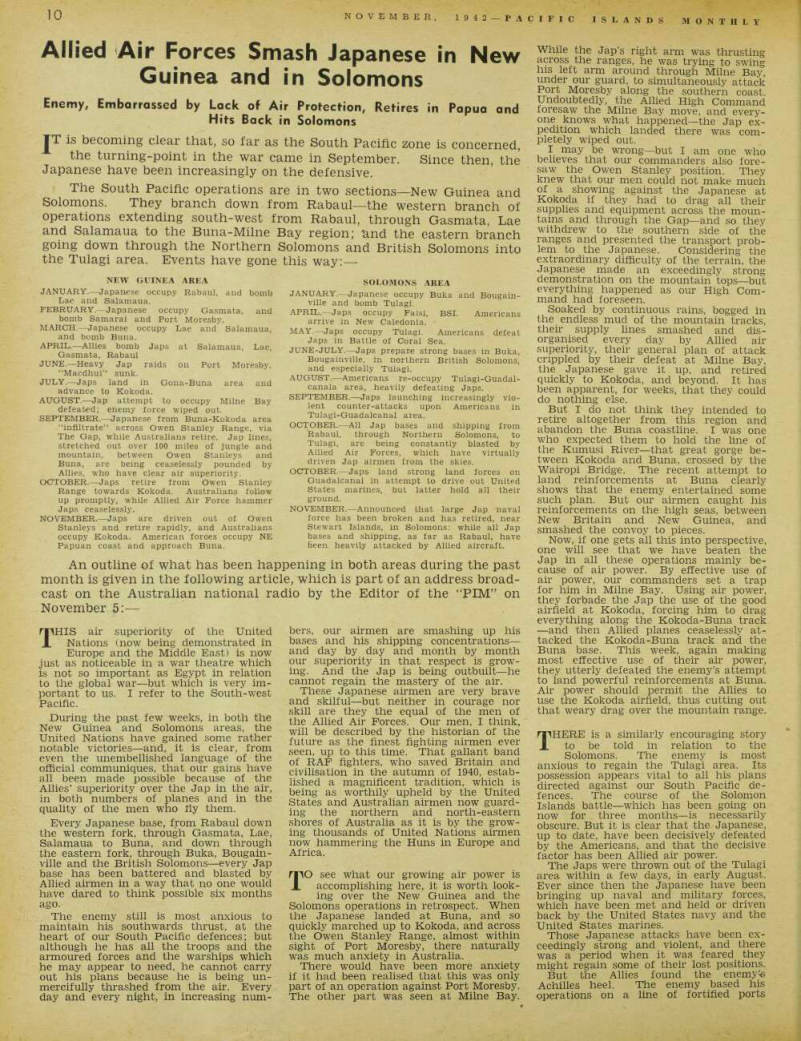
Guinea and in Solomons
Enemy, Embarrassed by Lack of Air Protection, Retires in Papua and Hits Back in Solomons JT is becoming clear that, so far as the South Pacific zone is concerned, the turning-point in the war came in September. Since then, the Japanese have been increasingly on the defensive.
The South Pacific operations are in two sections—New Guinea and Solomons. They branch down from Rabaul—the western branch of operations extending south-west from Rabaul, through Gasmata, Lae and Salamaua to the Buna-Milne Bay region; and the eastern branch going down through the Northern Solomons and British Solomons into the Tulagi area. Events have gone this way:
New Guinea Area
JANUARY.—Japanese occupy Rabaul, and bomb Lae and Salamaua.
FEBRUARY. —Japanese occupy Gasmata, and bomb Samarai and Port Moresby.
MARCH. —Japanese occupy Lae and Salamaua, and bomb Buna.
APRlL.—Allies bomb Japs at Salamaua, Lae, Gasmata, Rabaul JUNE. —Heavy Jap raids on Port Moresby.
“Macdhui” sunk.
JULY.—Japs land in Gona-Buna area and advance to Kokoda.
AUGUST.—Jap attempt to occupy Milne Bay defeated; enemy force wiped out.
SEPTEMBER. —Japanese from Buna-Kokoda area "infiltrate” across Owen Stanley Range, via The Gap, while Australians retire. Jap lines, stretched out over 100 miles of jungle and mountain, between Owen Stanleys and Buna, are being ceaselessly pounded by Allies, who have clear air superiority.
OCTOBER.—Japs retire from Owen Stanley Range towards Kokoda. Australians follow up promptly, while Allied Air Force hammer Japs ceaselessly.
NOVEMBER. —Japs are driven out of Owen Stanleys and retire rapidly, and Australians occupy Kokoda. American forces occupy NE Papuan coast and approach Buna.
Solomons Area
JANUARY.—Japanese occupy Buka and Bougain ville and bomb Tulagi.
APRIL.—Japs occupy Faisi, BSI. Americans arrive in New Caledonia.
MAY.—Japs occupy Tulagi. Americans defeat Japs in Battle of Coral Sea.
JUNE-JULY.—Japs prepare strong bases in Buka, Bougainville, in northern British Solomons, and especially Tulagi.
AUGUST.—Americans re-occupy Tulagi-Guadal canala area, heavily defeating Japs.
SEPTEMBER. —Japs launching increasingly vio lent counter-attacks upon Americans in Tulagi-Guadalcanal area.
OCTOBER.—AII Jap bases and shipping from Rabaul, through Northern Solomons, to Tulagi, are being constantly blasted by Allied Air Forces, which have virtually driven Jap airmen from the skies.
OCTOBER.—Japs land strong land forces on Guadalcanal in attempt to drive out United States marines, but latter hold all their ground.
NOVEMBER. —Announced that large Jap naval force has been broken and has retired, near Stewart Islands, in Solomons; while all Jap bases and shipping, as far as Rabaul, have been heavily attacked by Allied aircraft.
An outline of what has been happening in both areas during the past month is given in the following article, which is part of an address broad cast on the Australian national radio by the Editor of the “PIM” on November 5: —
THIS air superiority of the United Nations (now being demonstrated in Europe and the Middle East) is now just as noticeable in a war theatre which is not so important as Egypt in relation to the global war —but which is very im portant to us. I refer to the South-west Pacific.
During the past few weeks, in both the New Guinea and Solomons areas, the United Nations have gained some rather notable victories —and, it is clear, from even the unembellished language of the official communiques, that our gains have all been made possible because of the Allies’ superiority over the Jap in the air, in both numbers of planes and in the quality of the men who fly them.
Every Japanese base, from Rabaul down the western fork, through Gasmata, Lae, Salamaua to Buna, and down through the eastern fork, through Buka, Bougain ville and the British Solomons —every Jap base has been battered and blasted by Allied airmen in a way that no one would have dared to think possible six months ago.
The enemy still is most anxious to maintain his southwards thrust, at the heart of our South Pacific defences; but although he has all the troops and the armoured forces and the warships which he may appear to need, he cannot carry out his plans because he is being un mercifully thrashed from the air. Every day and every night, in increasing num
bers, our airmen are smashing up his bases and his shipping concentrations— and day by day and month by month our superiority in that respect is grow ing. And the Jap is being outbuilt —he cannot regain the mastery of the air.
These Japanese airmen are very brave and skilful —but neither in courage nor skill are they the equal of the men of the Allied Air Forces. Our men, I think, will be described by the historian of the future as the finest fighting airmen ever seen, up to this time. That gallant band of RAF fighters, who saved Britain and civilisation in the autumn of 1940, estab lished a magnificent tradition, which is being as worthily upheld by the United States and Australian airmen now guard ing the northern and north-eastern shores of Australia as it is by the grow ing thousands of United Nations airmen now hammering the Huns in Europe and Africa.
TO see what our growing air power is accomplishing here, it is worth look ing over the New Guinea and the Solomons operations in retrospect. When the Japanese landed at Buna, and so quickly marched up to Kokoda, and across the Owen Stanley Range, almost within sight of Port Moresby, there naturally was much anxiety in Australia.
There would have been more anxiety if it had been realised that this was only part of an operation against Port Moresby.
The other part was seen at Milne Bay.
While the Jap’s right arm was thrusting across the ranges, he was trying to swing his left arm around through Milne Bay, under our guard, to simultaneously attack Port Moresby along the southern coast.
Undoubtedly, the Allied High Command foresaw the Milne Bay move, and every one knows what happened—the Jap ex pedition which landed there was com pletely wiped out.
I may be wrong—but I am one who believes that our commanders also fore saw the Owen Stanley position. They knew that pur men could not make much of a showing against the Japanese at Kokoda if they had to drag all their supplies and equipment across the moun tains and through the Gap—and so they withdrew to the southern side of the ranges and presented the transport prob lem to the Japanese. Considering the extraordinary difficulty of the terrain, the Japanese made an exceedingly strong demonstration on the mountain tops—but everything happened as our High Com mand had foreseen.
Soaked by continuous rains, bogged in the endless mud of the mountain tracks, their supply lines smashed and dis organised every day by Allied air superiority, their general plan of attack crippled by their defeat at Milne Bay, the Japanese gave it up, and retired quickly to Kokoda, and beyond. It has been apparent, for weeks, that they could do nothing else.
But I do not think they intended to retire altogether from this region and abandon the Buna coastline. I was one who expected them to hold the line of the Kumusi River—that great gorge be tween Kokoda and Buna, crossed by the Wairopi Bridge. The recent attempt to land reinforcements at Buna clearly shows that the enemy entertained some such plan. But our airmen caught his reinforcements on the high seas, between New Britain and New Guinea, and smashed the convoy to pieces.
Now, if one gets all this into perspective, one will see that we have beaten the Jap in all these operations mainly be cause of air power. By effective use of air power, our commanders set a trap for him in Milne Bay. Using air power, they forbade the Jap the use of the good airfield at Kokoda, forcing him to drag everything along the Kokoda-Buna track —and then Allied planes ceaselessly at tacked the Kokoda-Buna track and the Buna base. This week, again making most effective use of their air power, they utterly defeated the enemy’s attempt to land powerful reinforcements at Buna.
Air power should permit the Allies to use the Kokoda airfield, thus cutting out that weary drag over the mountain range.
THERE is a similarly encouraging story to be told in relation to the Solomons. The enemy is most anxious to regain the Tulagi area. Its possession appears vital to all his plans directed against our South Pacific de fences. The course of the Solomon Islands battle—which has been going on now for three months —is necessarily obscure. But it is clear that the Japanese, up to date, have been decisively defeated by the Americans, and that the decisive factor has been Allied air power.
The Japs were thrown out of the Tulagi area within a few days, in early August, Ever since then the Japanese have been bringing up naval and military forces, which have been met and held or driven back by the United States navy and the United States marines.
Those Japanese attacks have been ex ceedingly strong and violent, and there was a period when it was feared they might regain some of their lost positions.
But the Allies found the enemy & Achilles heel. The enemy based his operations on a line of fortified ports
extending back to Rabaul—especially Faisi and other places in the British Solomons, and Buin, Kieta and Kessa, in Northern Solomons. In September and October, with increasing severity, and in the face of decreasing Japan resistance, American aircraft from the Southern Solomons area, and Allied aircraft from the New Guinea and Australian area bombed all those places, including Rabaul.
As a result, our Allies still hold the vital Solomons area, and the backbone of the Japanese attack against them has been shattered. The story might have been different, had it not been for Allied air power.
Neither the general position nor the prospect is discouraging. We appear now to have the measure of the Jap. We have virtually beaten him out of the air. We can beat him on the sea. Our troops— even in that cultivated Japanese art of jungle-sneaking—are definitely better than his. But he is far from being a beaten enemy. Hard and bitter fighting lies ahead. He is no longer the jubilant Jap of January, who smashed his way so confidently into New Guinea, but he will fight on, just as savagely and merci lessly. The beast of prey is never so dangerous as when he finds that he is cornered.
G. And E. Colony Finance
THE Gilbert and Ellice Islands Colony now partly under enemy occupation, holds considerable funds, according to the statement of assets and liabilities as at October 31, 1941, published recently in the Western Pacific High Commission Gazette. Deposits invested and other cash balances and reserve funds made a total of £228,930, of which £145,411 re presented investments of money held on behalf of the Banaban land-owning com munity on Ocean Island who, normally, derive rich revenue from the lease of the phosphate lands.
Food For N. Zealand
Diverse Cargo From Cook Is.
Rarotonga, Oct. 16.
A DIVERSE shipment of produce left Rarotonga recently for the New Zealand market. Exports included 2,000 bags of Kumaras —to help allay the NZ potato shortage 3,600 cases of bananas, over 4,000 boxes of tomatoes, as well as orange juice, arrowroot, taro, coconuts, copra and shell necklaces.
Although it seemed, at first, that the vessel could not be filled, it proved necessary, in the end, to cut down the quantities of taro, etc., which came forward.
Although no oranges (which usually form the bulk of Cook Islands cargoes) will now be available until next April, it is hoped that this shipment to capacity of other produce will encourage the New Zealand authorities to provide a steamer now and then.
Gaol For Bootlegger
ON August 29, Ah Fook, a Chinese trader in Nadi, Fiji, was caught sell ing sherry to soldiers at £2 per bottle.
Convicted of selling liquor without a licence, he was fined no less than £9O.
The fine was paid. On September 11, he was caught out in a similar offence. This time the Magistrate (District Commis sioner Bevington) was grim and merci less. “It is obvious that a fine has no deterrent effect on bootlegger of your sort,” he said. “Four months’ hard labour.” And he intimated that, next time, it would be gaol plus a fine. De fendant gave notice of appeal.
Polynesian Migrations and Culture
Spirited Defence of Dr. Buck's Book
Letter to the Editor
SOME of us at the Bishop Museum, and a few of our friends here who read the “Pacific Islands Monthly,” were amazed at the excerpts from a letter to you which you printed in the May, 1942, issue (page 20).
Dr. Peter Buck’s “Vikings of the Sun rise” has been hailed in the best-informed quarters as the most comprehensive and constructive effort yet made to put the solution of Polynesian cultural origins on a sound basis. But the letter which you quote ridicules it as being in its greater part based on the “speculations of a lot of young cubs who have taken a course in anthropology but know noth ing of Polynesian languages and less about native mentality and ancient custom.”
Your writer further charges these “cubs” with vandalism, arrogance, and deception: “They ransack a few burial caves, measure a few platforms and marae and then ponderously pronounce some pontifical theory to justify the time and expense of their expedition.” Who he means by “cubs” is indicated by his closing comment that the book “gives a clear outline of the results of the inves tigations by scientists of the Bishop Museum.”
These aje pretty serious charges. How much truth is in them? Dr. Buck has carried out investigations in nearly every important group in Polynesia, and his book is based largely on his own re searches. He also uses facts uncovered by other members of the scientific per sonnel of the Bishop Museum. He knows these men and would not accept their data or concur in their conclusions if their lack of knowledge of the Poly nesian language, mentality, or ancient customs would put the evidence in doubt.
Of these matters, who is beter qualified to judge than Dr. Buck, who more versed in Polynesian languages (one of them his mother tongue), in Polynesian psychol ogy, and ancient Polynesian culture?
If there is one thing for which Dr.
Buck is noted above all else, it is his skill in detecting the false, the foreign, and the untrustworthy in accounts pur porting to reveal the original Polynesian culture. So when he uses the research of an ethnologist, it is assurance enough of competence. The scientific training of the young men entrusted by Bishop Museum with expeditions has inculcated in them a deep sense of responsibility towards the truth, caution in coming to conclusions, respect for the ideas and feelings of the natives whom they study, and fairness toward the work of their fellow researchers. And they were, or rapidly became, well grounded in a know ledge of ancient Polynesian culture.
After many months of most intensive work with native informants they were far removed from being in entire ignor ance of the Polynesian language and mentality.
Why, then, does the writer of your letter so unjustly characterise them? It would appear that he seeks to belittle them because their knowledge, discov eries, and observations are upsetting to his views. You can understand how this would be true if the statements on which he bases his claims are as misleading as those in his letter to you.
Kenneth P. Emory,
Ethnologist.
Bishop Museum.
Honolulu, 17/9/1942.
(The essential part of the letter, to which reference is made by Mr. Emory, is as follows • “I have read Dr. Buck’s ‘Vikings of the Sunrise’ and I find it disappointing as a work on Polynesian migrations.
“What Dr. Buck writes from his own know ledge and study is authentic. But the greater part of his book is derived from the specu lations of a lot of young cubs who have taken a course in anthropology but know nothing of Polynesian languages and less about native mentality and ancient custom. They ransack a few burial caves, measure a few platforms and marae and then ponderously pronounce some pontifical theory to justify the time and ex pense of their expedition.
“As far as I have been able to discover, there is not a scrap of evidence or reference in the chants and legends of Central Polynesia, to justify the theory of any migration into ’ this area via Micronesia—ln the manner stated in the book.
“Dr. Buck quotes that woolly-brained pro fessor, McMillan-Brown—who was a laughing stock for all serious students when he came this way—and ignores William Churchill, whose work (published by the Carnegie Foundation) is the most able and scholarly study of the Poly nesian problem I have ever seen.
“I think there is much to support the theory of a migration, via Rotuma, inasmuch as the legends of Ra’i’atea have been the foundation on which that theory has been built.
“It would require a book to record the refer ences, quotations and detailed reasons for the Rotuma theory.
“My friend, Mr. Charles B. Nordhoff, of Tahiti, who has read Dr. Buck’s book, is of the same opinion as to its value as a document on Polynesian migrations. He tells me that Dr.
Buck is the leading authority on certain aspects of old Polynesian society, but has to take the w °rd of others in many major departments of the study of the ancient people and Islands lore.
“Dr. Buck’s book is, of course, delightful reading and gives a clear outline of the results of the investigations by scientists of the Bishop Museum.”)
Tea Restrictions In Fiji
Restrictions on the sale of tea in the Colony of Fiji were imposed on September 2, under Regulation 50 of the Defence Regulations. Briefly, this means that no retailer shall, without a written permit from the Competent Authority (Comptroller of Customs), sell in any month more than 70 per cent, of the average quantity of tea sold by him during the six months period ending August 31, 1942.
Mr. M. J. Bernhardt, of the BSI Administration, has been seconded for service to the British Service, New Hebrides. He has been typist and clerk in the Resident Commissioner’s Depart ment in the Solomons since 1932.
Mr. C. H. G. White, who has been with the Medical Department of the British Solomon Islands Protectorate since 1924, has been seconded to the British Service, New Hebrides, as Yaws and Hookworm Officer.
Mr. T. R. Cowell, a Cadet Officer of the Gilbert and Ellice Islands Colony, was appointed to act as Administrative Officer at Fanning Island from September, 1942.
Advice was received by Mr. R. C.
Kerkham, of Suva, in September, that his son, S. O. C. Kerkham, who was serving overseas with the New Zealand Forces, and who was reported missing, is now a prisoner of war.
Mr. J. I. Blaikie, inspector of police, has been appointed a member of the Township Board, Levuka, Fiji.
Arrival From Ninigos
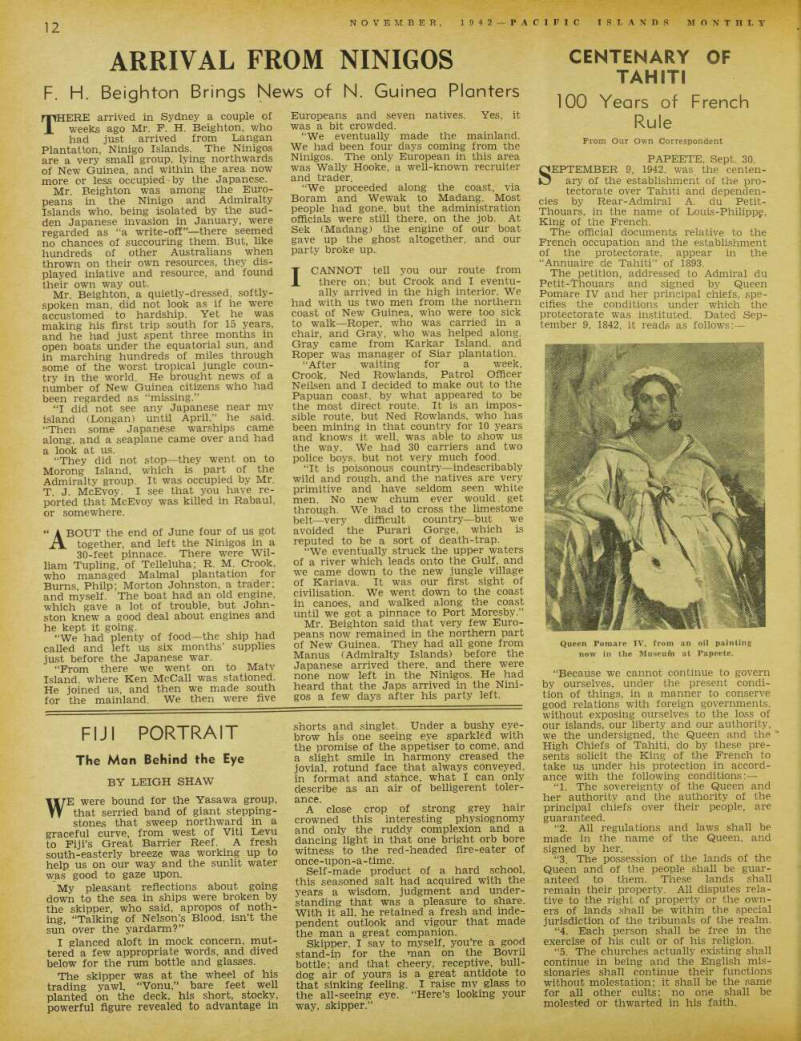
F. H. Beighton Brings News of N. Guinea Planters
THERE arrived in Sydney a couple of weeks ago Mr. F. H. Beighton, who had just arrived from Langan Plantation Ninigo Islands. The Ninigos are a very small group, lying northwards of New Guinea, and within the area now more or less occupied by the Japanese.
Mr Beighton was among the Europeans in the Ninigo and Admiralty Islands who, being isolated by the sudden Japanese invasion in January, were regarded as “a write-off”—there seemed no chances of succouring them. But, like hundreds of other Australians when thrown on their own resources, they displayed iniative and resource, and found their own way out.
Mr Beighton, a quietly-dressed, softlyspoken man did not look as if he were accustomed ’to hardship. Yet he was making his first trip south for 15 years, and he had just spent three months in open boats under the equatorial sun, and in marching hundreds of miles through some of the worst tropical jungle country in the world He brought news of a number of New Guinea citizens who had been regarded as “missing.”
“I did not see any Japanese near my island (Longan) until April.” he said.
“Then some Japanese warships came along and a seaplane came over and had a look at us.
“They did not stop—they went on to Morong Island, which is part of the Admiralty group It was occupied by Mr.
T J McEvoy. I see that you have reported that McEvoy was killed in Rabaul, or somewhere.
“ A BOUT the end of June four of us got A together, and left the Ninigos in a 30-feet pinnace. There were William Tupling of Telleluha; R. M. Crook, who managed Malmal plantation for Burns Philp; Morton Johnston, a trader; and myself. The boat had an old engine. which gave a lot of trouble, but Johnston knew a good deal about engines and he kent it going pe had plenty of food—the ship had called and left us six months’ supplies just before the Japanese war.
“From there we went on to Matv Island, where Ken McCall was stationed.
He joined us, and then we made south for the mainland We then were five
Europeans and seven natives. Yes, it was a bit crowded.
“We eventually made the mainland.
We had been four days coming from the Ninigos. The only European in this area was Wally Hooke, a well-known recruiter and trader.
“We proceeded along the coast, via Boram and Wewak to Madang. Most people had gone, but the administration officials were still there, on the job. At Sek (Madang) the engine of our boat gave up the ghost altogether, and our party broke up. 1 CANNOT tell you our route from there on; but Crook and I eventu ally arrived in the high interior. We had with us two men from the northern coast of New Guinea, who were too sick to walk —Roper, who was carried in a chair, and Gray, who was helped along.
Gray came from Karkar Island, and Roper was manager of Siar plantation.
“After waiting for a week, Crook, Ned Rowlands, Patrol Officer Neilsen and I decided to make out to the Papuan coast, by what appeared to be the most direct route. It is an impos sible route, but Ned Rowlands, who has been mining in that country for 10 years and knows it well, was able to show us the way. We had 30 carriers and two police boys, but not very much food.
“It is poisonous country—indescribably wild and rough, and the natives are very primitive and have seldom seen white men. No new chum ever would get through. We had to cross the limestone belt—very difficult country—but we avoided the Purari Gorge, which is reputed to be a sort of death-trap.
“We eventually struck the upper waters of a river which leads onto the Gulf, and we came down to the new jungle village of Kariava. It was our first sight of civilisation. We went down to the coast in canoes, and walked along the coast until we got a pinnace to Port Moresby.”
Mr. Beighton said that very few Euro peans now remained in the northern part of New Guinea. They had all gone from Manus (Admiralty Islands) before the Japanese arrived there, and there were none now left in the Ninigos. He had heard that the Japs arrived in the Nini gos a few days after his party left.
Fiji Portrait
The Man Behind the Eye
By Leigh Shaw
WE were bound for the Yasawa group, that serried band of giant stepping stones that sweep northward in a graceful curve, from west of Viti Levu to Fiji’s Great Barrier Reef. A fresh south-easterly breeze was working up to help us on our way and the sunlit water was good to gaze upon.
My pleasant reflections about going down to the sea in ships were broken by the skipper, who said, apropos of noth ing, “Talking of Nelson’s Blood, isn’t the sun over the yardarm?”
I glanced aloft in mock concern, mut tered a few appropriate words, and dived below for the rum bottle and glasses.
The skipper was at the wheel of his trading yawl, “Vonu,” bare feet well planted on the deck, his short, stocky, powerful figure revealed to advantage in
shorts and singlet. Under a bushy eye brow his one seeing eye sparkled with the promise of the appetiser to come, and a slight smile in harmony creased the jovial, rotund face that always conveyed, in format and stance, what I can only describe as an air of belligerent toler ance.
A close crop of strong grey hair crowned this interesting physiognomy and only the ruddy complexion and a dancing light in that one bright orb bore witness to the red-headed fire-eater of once-upon-a-time.
Self-made product of a hard school, this seasoned salt had acquired with the years a wisdom, judgment and under standing that was a pleasure to share.
With it all, he retained a fresh and inde pendent outlook and vigour that made the man a great companion.
Skipper, I say to myself, you’re a good stand-in for the man on the Bovril bottle; and that cheery, receptive, bull dog air of yours is a great antidote to that sinking feeling. I raise my glass to the all-seeing eye. “Here’s looking your way, skipper.”
Centenary Of
Tahiti
100 Years of French Rule
Prom Our Own Correspondent
Papeete, Sept. 30.
SEPTEMBER 9, 1942, was the centen ary of the establishment of the pro tectorate over Tahiti and dependen cies by Rear-Admiral A. du Petit- Thouars, in the name of Louis-Philippp, King of the French.
The official documents relative to the French occupation and the establishment of the protectorate, appear in the “Annuaire de Tahiti” of 1893.
The petition, addressed to Admiral du Petit-Thouars and signed by Queen Pomare IV and her principal chiefs, spe cifies the conditions under which the protectorate was instituted. Dated Sep tember 9, 1842, it reads as follows:
“Because we cannot continue to govern by ourselves, under the present condi tion of things, in a manner to conserve good relations with foreign governments, without exposing ourselves to the loss of our islands, our liberty and our authority, we the undersigned, the Queen and the High Chiefs of Tahiti, do by these pre sents solicit the King of the French to take us under his protection in accord ance with the following conditions:— “1. The sovereignty of the Queen and her authority and the authority of the principal chiefs over their people, are guaranteed.
“2. All regulations and laws shall be made in the name of the Queen, and signed by her.
“3. The possession of the lands of the Queen and of the people shall be guar anteed to them. These lands shall remain their property. AH disputes rela tive to the right of property or the own ers of lands shall be within the special jurisdiction of the tribunals of the realm.
“4. Each person shall be free in the exercise of his cult or of his religion.
“5. The churches actually existing shall continue in being and the English mis sionaries shall continue their functions without molestation; it shall be the same for all other cults: no one shall be molested or thwarted in his faith.
Queen Pomare IV, from an oil painting now in the Museum at Papeete.
“Subject to these conditions, the Queen Pomare and her high chiefs ask the pro tection of the King of the French, leav ing between his hands, and to the care of the French Government, or to the person nominated by him, and with the approbation of the Queen Pomare, the direction of all affairs with foreign gov ernments, as well as all which may con cern foreign residents, the port regula tions, etc., etc., and of taking such mea sures as he shall deem useful for the conservation of harmony and peace. (Signed) Pomare.
“Paraita (Regent), Utami, Hitoti, Tati.”
The provisional acceptance of the pro tectorate by Admiral du Petit-Thouars, bears the same date —September 9, 1842.
The ratification of du Petit-Thouars’ acceptance of the protectorate: “Given in our palace, des Tuileries” and signed, Louis Philippe, is dated March 25, 1843.
To explain why harmony and peace did not come to the kingdom until 1847, would require a volume of many pages.
The Queen was, however, eventually appeased and, on the day of her return from self-imposed exile, wrote this final paragraph in her diary: “February 9, 1847. This is the day Pomare arrived at Papeete. This was a great day of decora tion; of soldiers; of officials; of French and British warships, together with all the smaller craft; of the houses of foreigners and of those of all Tahitians as well. The bands, on board the ships and ashore, played until 6 o’clock. That night the illumination of the European houses was the splen dour of a comet.”
Qtieen Pomare IV reigned in peace and tranquility until 1877. The venerable survivors of her reign, whom this writer knew in the early years of this century, always spoke of that period as “the golden age of Tahiti.”
"Lorna D" is Homeward
Bound
By Leigh Shaw
AFTER having spent some two years looking in, and making friends, at many Pacific Islands, Captain Dav idge, his wife, and son, are now home ward-bound from Fiji to British Colum bia, in the trim little two-masted schooner, “Lorna D.” She lay in Suva for some two years.
Of the small but determined band of individualists who will go down to the sea in small ships, Captain Davidge is probably one of the last to be found roaming the ocean in these uncertain times.
Built, owned, and sailed by Captain Davidge, the “Lorna D” is, below decks, as homely and domestic a ship as one could meet on the high seas. To see the skipper chopping kindling on deck, Mrs.
Davidge stoking up the old wood-burning range and baking scones in the oven, with the ship’s cat purring contentedly on the hearth, was a tonic that warmed the heart of many a privileged Islands resident. It was claimed of the cat—an important personage—that it displayed a pronounced nautical roll on the rare occasions it ventured ashore.
For many months a familiar sight in Suva was the lean, spare figure of Cap tain Davidge, clad appropriately in peaked cap, blue sweater, and dungarees, picking grass as medicine for the cat.
Equally satisfying was the sight of Mrs.
Davidge—kind, intelligent, homely body— off to market with her basket under her arm.
To go aboard the “Lorna D,” purr with the cat, and bask in the peace and good
will that emanated from this homely craft, was a pleasing respite from the noise and bustle of a war-conscious Suva —a refuge that has sailed away.
Our Rarotonga correspondent reports that the “sturdy little schooner,” “Lorna D,” made a call there en route to Van couver. He says that Captain Davidge is now resolved to “sell the old home” (the “Lorna D”), and settle down ashore.
Shyam Singh, who was convicted of murder, in Fiji, 18 months ago, was executed in Korovou gaol on October 14.
The execution was stayed owing to notice having been given of intention to appeal, but recent advice from England was that there were no certifiable grounds for an appeal.
Total receipts for the Fiji Red Cross and War Appeal Committee were £4,874/15/- for the year ending June 30, 1942. Of this amount Suva contributed £1,357 and Vatukoula (Tavua goldfield) £1.183. Since the inception of the com mittee in September, 1939, £15,316 has been subscribed, nearly £ll,OOO of whcih has already been allocated by the Fiji War Appeals Board.
Advertisements & other items, pp. 15-16 (1 item)
Knox Grammar School
PACIFIC ISLANDS SOCIETY
Visitors from the Islands to Sydney (or those interested In Islands affairs), are advised to communicate with the honorary secretary of the above Society, which has been formed to study the history, traditions, economics, and political developments of the Pacific Islands.
Regular monthly meetings are held at History House, 8 Young Street, Sydney.
Address for Correspondence:
THE PACIFIC ISLANDS SOCIETY,
Box 2434 MM., G.P.0., Sydney.
Knox Grammar School
WAHROONGA, NEW SOUTH WALES, AUSTRALIA
(Headmaster, Dr. W. Bryden, M.Sc.) The School is situated 12 miles from Sydney, 600 feet above sea level, and accepts day boys and boarders from six years of age. Boys prepared for all usual Examinations.
Spacious playing fields, swimming pool, well equipped gymnasium, library. Cadet Corps,
etc. Prospectus on application.
■ «"» 4-, m ■ *• m m ■
PACIFIC ISLANDS YEAR BOOK
1942 (WARTIME) EDITION
Because of an Insistent Demand for this well-known Reference Book, and as 1939 Edition has been sold out, a Limited Wartime Edition has been
printed.
It contains the Latest Information relating to all Pacific Islands and Territories, including History, Geographical Description, Administration, Commerce and Industries, Character of Natives, Imports and Exports, Trading Firms, Shipping, Missions, Communications, etc., etc.
SPECIALLY INCLUDED IN THIS EDITION :
A Chronology showing dates of all Notable Events in Pacific War, from Dec. 7, 1941, to Aug., 1942.
History of International Events leading to Japan’s entry into War.
Pidgin-English Vocabulary, giving a List of Phrases and Words in Common Use.
Many Additional Maps of Pacific Territories and Islands.
The Territories dealt with include —
N. Guinea Fiji E. Indies
Papua Samoa Philippines
Solomons Tonga Hawaii
Nauru Gilbert & Ellice N. Caledonia
N. Hebrides Cook Is. Fr. Oceania
DETAILED MAPS OF PRACTICALLY ALL TERRITORIES AND GROUPS ARE INCLUDED—MANY FOR THE FIRST TIME.
Owing to Wartime Restrictions, this edition is strictly limited in number. Therefore, to avoid disappointment, Order Your Copy Now.
When ordering, please use Form as under.
Price: With stiff board cover, 9/- Australian, plus 6d. extra for postage. (Note: 9/6 Australian 9/6 New Zealand; 8/6 Fijian; United States, 1 dollar, 50 cents.)
PACIFIC PUBLICATIONS PTY. LTD.,
P.O. Box 3408 R., Sydney; or at Union House, 247 George Street, Sydney.
ORDER FOR PACIFIC ISLANDS YEAR BOOK, 1942
TO PACIFIC PUBLICATIONS PTY. LTD.,
UNION HOUSE, 247 GEORGE STREET, Date
SYDNEY.
Number of copies wanted Correct address to which to be posted or (if in city) delivered; Amount forwarded herewith Name and address of person giving this order:
Travels
Giant Toad's
Now in Many Pacific Territories
THE South American giant toad (Bufo marinus L.), introduced into Fiji from Honolulu in 1936, was liberated in New Guinea in the following year.
The accompanying extract from the 1938- 39 Report of the New Guinea Adminis tration will be of interest, as the spread of this amphibian is unlikely to be greatly modified by this area becoming a theatre of war:— “Cultivation of sweet potatoes (Ipomoea batatas) on the plantation has for many years been governed by the frequency and severity of attacks made by the larva of the moth (Hippotion celerio). These attacks became so freouent and severe that from 1935 until 1938 it was im possible to produce an economic crop, and only a very small area could be kept in cultivation by repeated dusting and hand-picking.
“In February, 1937, the giant toad (Bufo marinus) was introduced from Queensland. It quickly accustomed itself to the plantation climatic conditions and commenced to breed in large numbers.
The first results of the activities of the toad were to be seen towards the end of 1937, when attacks by cutworms on the lawns were observed to have ceased. In May and June, 1938, a large area was planted with sweet potatoes, and the crop matured and produced a very good yield.”
Both the sweet potato hawk moth and cutworms occur in Fiji (110 of the latter insect were found within the stomach of one toad dissected in 1939) so its useful ness for this Colony is hereby again de monstrated (says the “Fiji Agricultural Journal”).
Following the safe arrival of 150 adult toads sent from Suva to Funafuti Atoll in the Ellice Islands in November, 1939. the local administration had them carried to Vaitupu still further north. In the following February supplies were sent from Fiji to the British Solomon Islands Protectorate and the toads were said to be thriving on Guadalcanal and other islands much hotter and moister than any in Fiji.
Wartime Fiji Must Grow
Vegetables
THE Marketing Division of the Pro duction and Supply Board of Fiji has issued a report urging the Colony to increase its vegetable produc tion. It says that every acre of available land should be cultivated for this purpose immediately, to off-set the decreasing supply of vegetables from overseas, and the increased demand from military establishments.
There seems to be no good reason why a country like Fiji should not be com pletely self-supporting in vegetables. Cer tain varieties —such as onions and potatoes—will not grow satisfactorily on the coast, where there are native sub stitutes in yams and sweet potatoes, but all green stuffs grow well, and most tem perate zone fruits and vegetables can be produced on the high plateaus and fertile valleys of the interior of Viti Levu.
Mrs. Ellen Statham died in the War Memorial Hospital, Suva, Fiji, on October 10, at the age of 83. She came first to the Colony in 1914' as a member of the staff of A. M. Brodziak & Co., and later ran various businesses on her own ac count.
The Miracle Of Our Escape
Narrow Margin by Which Japanese Were Kept Out of South Pacific Territories
r J I HE United States authorities are now 1 —very wisely—making no attempt to conceal the extent and character of the disaster which overtook the Allies when the Japanese treacherously attacked Pearl Harbour early on Decem ber 7. A book by Blake Clark, “Remem ber Pearl Harbour!” has been published in USA and extracts from it, reproduced in July “Reader’s Digest,” give a startling picture of what happened.
Even yet, no one can explain why the Japanese did not succeed in their plan to completely smash Pearl Harbour base and paralyse America’s naval and air power in the Pacific. Their dawn attack took the Americans completely by sur prise. The destruction and • confusion were so great that, if the air attack had been followed up smartly by a naval attack and a military landing, Hawaii might have been lost, and the fate of the South Pacific Territories and Aus tralasia would have been sealed.
The Japs, despite their great initial success, blundered; and that blunder will lead, ultimately, to their defeat and destruction.
Here are extracts from the ghastly story of Pearl Harbour: — PEARL Harbour, the United States’ largest naval base, was the real objective, but before it could be attacked the Japanese had to disable the airfields which are an essential part of its defences. The army’s Wheeler and Hickam airfields, the navy’s air base at Kaneohe, and the marines’ incompleted air base at Ewa are all within quick flying time of the Harbour.
The Japanese tried to ground every plane we had. They approached from two directions simultaneously. The method of attack on each field was the same. While low-flying planes dropped well-directed bombs on hangars, other planes sprayed the long, orderly rows of aircraft on the ground with incendiary bullets.
The mustard-yellow planes flew low into Kaneohe Bay, one behind the other, no more than 50 feet above planes that lay anchored in the bay. A hundred yards away were two boats of young sea men, passing each other, the shifting crews of the anchored planes. The Jap anese opened up. Machine-gun bullets made a wide lane of geysers that led straight to the boats and the anchored planes. The planes went up in flames.
A few of the boys escaped.
The Japanese flew to the end of the
bay, made a loop and came back, head ing straight for bombing planes on the ramp and strafing them mercilessly. They came back again.
Heedless of the strafers, gun crews rushed out to salvage machine-guns from the burning planes and set them up.
Streams of fire converged upon the attackers. For 15 or 20 minutes this strafing attack kept up, the line of planes going continuously up and down, cross ing each time directly over the planes on the ramp.
During the lull which followed, men commandeered all available cars and drove them to staggered positions on the field so that if enemy planes tried to land they would crash on the cars. Civi lian employees helped put out fires and manned bulldozers to push burning planes away from the hangars.
Twenty minutes and the Japanese were back. They dropped a tremendous bomb on one hangar. They shot power ful bullets into the hurrying people on the ramp. One bullet went through a concrete wall a foot thick.
Everywhere the gallant fighters answered back, but the attackers were
flying fast and were hard to hit. Two planes were brought down.
The rest flew on toward the Marine Base at Ewa. Here the first wave con centrated fire on grounded aircraft.
During the momentary lull which fol lowed, marines rushed out and dragged unburned planes off the runway, and mounted free machine-guns on them.
The second attack was more vicious than the first. There was no protection; can non and machine-gun fire churned the ground. Yet the men stuck to their guns, pouring a stream of fire at each Japanese plane as it dived past.
Throughout the attack every man carried out his emergency duties. The marines distributed the ammunition, cleaned and serviced the guns, and got in telling shots at the enemy. Moving vehicles were special targets of attack, yet drivers of ammunition trucks and ambu lances made their trips to every part of the field without looking first to see if the sky was clear. Usually it was not.
THE first wave of bombers to arrive over Hickam Field chose as its objective the quarter-mile row of planes drawn up in front of the hangars in orderly formation. Ignoring the mer ciless strafing, the men of Hickam worked furiously to disperse the planes. Some faltered and fell, but others took their places.
In the second and most destructive raid, two rows of high-flying bombers dropped heavy demolition bombs directly
on the most populous section of Hickam Field. For what seemed a full minute after the bombs landed nothing hap pened. Th<sn the mess hall (large enough to house six basketball courts), the guard house, the fire station, the huge bar racks, and an immense hangar all seemed to rise intact from the ground, poise in mid-air, and drop back to the earth in fragments.
The third wave came strafing. Now ground defences were going full blast and accounted for several raiders. Green men acted like veterans, time and again dash ing out under fire and taking over machine-guns whose operators had just been killed.
On the apron opposite the hangars a
lone man kept up a steady stream of fire irom a .30-calibre machine-gun which he had set up in the nose of a B-18 bomber.
An enemy plane flew low, and turned the bomber into a flaming death-trap. The lone fighter did not even try to get out.
Long after the leaping flames had envel oped the nose of the plane, spectators saw the red tracer bullets from his machine-gun mounting skyward.
ALL that happened at the airfields was only a prelude. The attack on Pearl Harbour itself lasted from 7.55 a.m. to 9.15 a.m. There were prob ably 150 Japanese planes—torpedo planes, strafers, dive bombers, and high-altitude bombers. In the spacious waters were battleships, cruisers, destroyers, mine layers—all the types of ships that the US Navy boasts. Every Japanese plane seemed to have its objective selected in advance, for they separated and each went to attack a specific warship.
Horizontal bombers, flying at about 12,000 feet, dropped armor-piercing bombs almost simultaneously on the battleship “Arizona.” One sped straight down the funnel and blew up the ship’s forward magazine. Instantly torpedoes joined the bombs and the forward part of the ship blew up. Bodies flew 300 feet into the air, hurled about as tiny particles are whisked aloft in a fire. The after-part of the ship shook as if it would fall apart like a stack of cards. There was a great swishing sound as fire and smoke pushed up through the seams of the deck.
All over the harbour men were leaping from decks and portholes of burning ships, sliding down the hulls as boats capsized. But hundreds were caught in their compartments.
The attackers did not get off un scathed. One destroyer had just downed four planes when its chief radioman got a good contact on his listening appara tus . “Submarine!” They manoeuvred for the attack and dropped two depth charges; then two more. A large oil slick appeared and bubbles covered the sea for 200 feet.
Suddenly another contact was reported, apparently a submarine heading for a cruiser nearby. The destroyer made an emergency turn and losed another pair of depth charges; another oil-slick. They had sunk a second submarine.
WE learned in Honolulu that Sunday how narrow the dividing line is between the soldier and the civilian in wartime. Soon after the bombing started, a call came in to the headquar ters of the Hawaii Medical Association.
It just said, “Pearl Harbour! Ambu lances! For God’s sake, hurry!”
Within 20 minutes, doctors and volun teer workers had stripped the insides of over 100 delivery trucks of every descrip tion, equipped them neatly with previ ously-prepared stretcher frames, and were speeding to the scene of action.
Women of the Motor Corps in every available car were carrying men to Pearl Harbour. The three-lane highway was an inferno. Army trucks, official and unofficial emergency waggons, ambu lances, Red Cross cars and hundreds of taxis rushing officers and men to their battle stations screamed up and down the six-mile road. The Motor Corps women were equal to the task.
The army wounded were taken to Trip ler Hospital.
One bomb had made a direct hit on a mess hall while three or four hundred aviators were having breakfast. Maimed and bleeding, they poured into Tripler.
Surgeon King put in an emergency call to all the doctors of Honolulu: “Surgical teams, quick!”
Then occurred one of life’s breath-tak ing coincidences. At that very moment virtually every surgeon in Honolulu was listening to a lecture on war surgery delivered by Dr. John J. Moorhead, of New York. The audience departed in a body for Tripler.
The Attack on the Philippines
JT is not generally known that the * Japanese made a similarly crippling surprise attack upon American air forces in the Philippines, a few hours after the attack was launched on Pearl Harbour.
The following is from a despatch pub lished in America on April 10: THE fate of Luzon and Bataan was sealed just before 1 p.m. on Decem ber 8 (some ten hours after the Japanese attack on Pearl Harbour).
Our main bomber force was lined up on Clark Field, 40 miles north of Manila, with the crews awaiting orders to take off and bomb Japanese air and naval bases on the island of Formosa. Most of the pursuit planes. were at nearby Iba Field.
The pursuits and some bombers had been aloft during the morning but had returned to the ground for orders. While these instructions were being issued, the Japanese struck.
Fifty-four heavy bombers roared over Clark Field at 10,000 feet, raining explo sives on the grounded planes, runways and hangars. Iba Field was simultane ously bombed.
Eighty-six Japanese Zero fighters came in their wake and strafed the planes, ground forces and anti-aircraft batteries in low-level atacks. Some planes were saved, but the main strength of our air force was gone.
On December 10, about noon, the Jap anese attacked Cavite naval base (near
Manila) with devastating success. With out anti-aircraft or pursuit interference, their bombers criss-crossed the naval base for severe,l hours.
The first bomb hit the power plant, the second a fire station. Damage was wide spread, casualties were heavy and the Asiatic Fleet thus lost its sole effective base in the Philippines.
AS early as February 5, our soldiers were eating only rice and mule meat, their own pack animals. Occasion ally they were fortunate enough to bag wild pig or water buffalo, but these were few and far between. Every day our men grew more under-nourished, more exhausted from lack of food and sleep, but despite their exhaustion I never heard a complaint from them.
Their heroism is all the more glorious because they knew by now that the efforts of the War Department to bring them relief and supplies were doomed to failure.
Our forces on Bataan collapsed because they were physically exhausted. Day after day, week after week, the Japanese had fresh troops which they threw in lavishly. Our men had no such periodic relief.
Our positions were constantly shelled with heavy mortars. The detonations made it almost impossible to sleep. The men were in rags; tattered trouser legs were cut off to make shorts; shoes were in shreds from the heavy underbrush; socks were unheard of after the first few weeks.
During the last few weeks on Bataan the disease rate ran up as the drug supplies ran out. Hospital No. 2 had been keeping its patients down to 3,000 by discharging 200 to 300 daily and treating them as out-patients. At Hospital No. 1, where there were 450 beds, the number of patients jumped to 1,500 in the last three days. The patients had malaria, dysentery, malnutrition, beriberi and scurvy. There was little quinine after March 1.
Advertisements & other items, pp. 17-18 (1 item)
W. H. Grove & Sons
Limited
AUCKLAND
Island Traders. P.o. Box 490.
Telegraphic and Cable Address: “Grove”, Auckland.
Shippers of all classes of New Zealand products.
Representing English Manufacturers throughout the Cook and Society Islands, Fiji, Tonga, Samoa, Niue, New Caledonia, New Guinea, etc.
In FIJI as—W. H. Grove Cr Sons (Fiji) Ltd.
POWERFUL MULTI-VALVE BANDSPREAD
Full particulars from
GEORGE BROWN & CO.
Electrical Engineers Used by There is not a better radio obtainable.
AC & BATTERY MODELS
PTY. LTD.
267 Clarence Street, Sydney, N.S.W.
Trained Men are Indispensable That’s why I.C.S. Students get the good jobs and hold them !
140 ELIZABETH STREET,
• SYDNEY.
Sirs,—Please send free prospectus showing how l ean succeed in the occupation I have marked X Accountancy —Secretarial (all Inst. Ex.) Bookkeeping —General, Store, Station.
Salesmanship —Gen., Speciality, Retail.
Psychology and Personality in Business.
Advertising— Retail, Mail-Ord., Agency.
Window Disp.— Show Card, Shop Tckts.
Illustrating —Newspaper, Fash., Poster.
Free Lance Jour'ism —Short Story Writ.
Matriculation —Leaving-Inter.-Pub. Serv.
Gen. Education —Bus. and Sales Letters.
Police Entr. Exam., Nurses Entr. Exam.
Architecture —Structural Concrete.
Building Contracting —Air Conditioning.
Draftsmanship (Mech. & all branches).
Motor Eng.— Mtr. Mech., -Mir. Exams.
Diesel Eng. —lllumin. Engr., Weld. Eng.
Internal Comb, and Steam Drivers' Exs.
Radio Eng. —Radio Serv., Radio Exms.
Aero Eng. —Gd. Eng., Licenses, Rigging.
Elec. Eng.— Elec. Cont. & Mechs' Exms.
Civil Eng.— Shire Eng.—Shire Overseer.
Textile (all branches) —Analyt. Chem.
Dress Design— Drafting, Cutting, Mlnry. (Underline your subject above — if not on list write it here ) Enquiries cost a 2d. stamp Post Now!
PM f t
BURNS PHILP
(SOUTH SEA) CO. LTD.
Inc. in Fiji Registered Office :
SUVA
FI J I
Island Traders and Shipowners Also Branches at: Fiji; Levuka, Lautoka, Labasa, Ba, Sigatoka, Rotuma.
Tonga: Nukualofa, Haapai, Vavau.
Samoa: Apia, Pago Pago (American Samoa).
Solomons: Makambo, Gizo, Faisi.
New Hebrides: Vila.
Code Address: Gilberts: Tarawa.
“Burnsouth”. Norfolk Is. Niue. Wallis Is. Futuna Is.
OLD MONK
The World’s Finest Olive Oil San Francisco
Natives
Loyal Papuan
Why Was Civil Administration Jettisoned ?
SOME interesting remarks about war time conditions in Papua, and the value of the services given by the Papuan natives were made recently by Mr. J. W. Baldie (a former magistrate in Papua), when addressing members of the Constitutional Club in Melbourne.
He said that the natives had been completely loyal to the British, and had performed superhuman tasks in assisting the Allied cause against the invaders.
Mr. Baldie said he had found it most difficult to understand why the authori ties jettisoned the civil Administration in Papua at a time when every man should have been at his post. Many of the men who had been sent away had had long years of experience, and they had a knowledge of the country and of the natives possessed by very few.
Recent improvements to the approaches of the Wainimarama bridge, over the Rewa River, Fiji, remove what has for years been a death-trap. Formerly, the approach to the bridge was on a curve; but the river has been diverted through a xtunnel in the solid soapstone, and the old river-bed has been filled with spoil taken from the corners of the approaches.
Sleep-Walker !
A FIJIAN, Eroni Tubanaika, who appeared in the Police Court in Suva to plead guilty to a charge of being out after curfew was at least ori ginal (says “Fiji Times”). His excuse was that he had walked in his sleep.
“That is one of the best excuses I have heard yet for being out after hours,” said the Magistrate, Mr. Ragnar Hyne. He imposed a fine of 10/- and warned Eroni not to walk in his sleep again, in case his plea was not so readily accepted.
A valuable little book for anyone interested in the flora of Fiji, “Fiiian Plant Names,” was published in the Colony at the beginning of August Mr L. E. V. Parham, of the Agricultural Department, the author of the work which has 1,320 Fijian names of plants belonging to some 140 families 370 gen eral and 600 different species gave a great deal of time to its compilation In a foreword, the Director of Agriculture says that it marks a substantial advance in the recorded information regarding the flora of the Colony,
Advertisements & other items, p. 19 (1 item)
1942 Swim Suits
het us reassure you .., There will be
Janlzen
Outerwear next winter and the new
1942 Swim Suits
are already in the stores Jantzen’s famous machinery is knitting warmth tnd comfort, for r>ur fighting forces.
(AUST.) LIMITED
nr
Malinowski
Death of a Famous Anthropologist
ON May 16 of this year, Professor Bronislaw Malinowski died in the United States while still holding the professorship of Social Anthropology at Yale University.
He will be remembered well in the South Pacific area for his work among the Trobriand islanders and the natives of the South-east Division of Papua, and for his publications about those people.
His “Argonauts of the Western Pacific,” dealing with the Trobrianders, published in 1922, had a great vogue and was of interest to both scientist and layman alike.
Born in Cracow, Poland, he was advised by his doctor at an early age to seek a complete holiday from his scientific studies and, characteristically, he took this opportunity to study English through the medium of Sir James Frazer’s “Golden Bough.” Interest in this book led him to abandon his chemistry and physics, and to become, instead, an anthropologist. In 1910 he went to Eng land and entered the London School of Economics, and in 1914 came to Austra lia at the invitation of the Common wealth Government to attend the meet ing of the British Association for the Advancement of Science. The outbreak of World War I, put an untimely ter mination to this meeting and Professor Malinowski, because he was an Austrian Pole, was in danger of being interned for the duration. However, through the influence of scientific friends, he was allowed, instead, to spend those war years in Papua. His first piece of field work there was among the Mailu people of the South-eastern Division, and it was here he broke away from the accepted
anthropological practice of relying on “questioning.” Instead, he watched the everyday life of the people and came to his own conclusions.
In 1920 he returned to London with his T »vife, Elsie, the younger daughter of Sir David Orme Masson and Lady Mas son, of Melbourne, whom he had met and married while in Australia. In London, he was again associated with the School of Economics, becoming Reader in Social Anthropology and later, when the Chair was established, Professor.
After “The Argonauts” came other books dealing in detail with many aspects of Trobriand native culture. His last published work, “Coral Gardens and Their Magic,” was thought by many to have shown him at the height of his powers. At the time of his death he was engaged on another book, “Democracy and Freedom,” which set out to show the relation between anthropology, the human problems of to-day, and of post-war world reconstruction. Although unfin ished, this work is sufficiently advanced to permit the hope that it may appear posthumously.
Professor Malinowski was truly inter national in his outlook over all things.
He could enter into the spirit of all cul tures and yet, while searching for prin ciples, never forgot the human element behind them. He will be greatly missed by those young scientists whom he trained and taught, and to whom he was an inspiration.
The Director of Presbyterian Missions in New Zealand has received a bank draft for £l3/12/-, and a letter of sym pathy, from members of the congregation of St. Andrew’s, Suva, Fiji, for losses sustained by the churches in the Waira rapa district in recent severe earthquakes.
Bestial Enemy
Do Not Under-estimate the Japanese
AMERICAN public opinion now is being trained to appreciate the real character of the task of defeating the Japanese in the Pacific. For example, Mr. Joseph Grew, formerly United States Ambassador in Japan, has been making statements like this: “The Japanese won’t crack, either morally, psychologically or commercially, even when eventual defeat stares them in the face. They can be defeated only by utter exhaustion of men and mater ials. That’s the difference between the Japanese and the Germans.”
Similarly, Lieut.-Colonel Warsen Clear, of the United States General Staff Corps, who spent four years as official observer with the Japanese Army, warns in the semi-official “Infantry Journal” that the Japanese are capable of feats which the Germans find impossible.
“Their bestial savagery is the product of centuries of internecine warfare . . .
Their idea of making obeisance to their rifles is something we had better reckon with soberly.”
Advertisements & other items, p. 20 (2 items)
18
NOVEMBER, 19 4 2 -tACifIC ISLANDS MONTHLY
88 This
There is no substitute for
OLD MONK
VIRGIN PURE
OLIVE OIL
in San Francisco
88 THIS
SWJLLLIVtIBXSLLm.
MAKERS OF BISCUITS • PIOM PUDDINGS • CAKES • VITOCEN • ICE CREAM
Islands Of The
Dead
14 Missionaries Escape From Horrors of Tulagi Battlefield
PRIOR to last December—when Japan’s war-lords came to the point of fling ing themselves into a racial conflict which was to make them masters of Asia, and ultimately the world—the Solomon Islands were still in their cen turies-long sleep. They were referred to as the “Cinderella” of Pacific territories —meaning, broadly, that they were vir tually untouched by the doubtful bless ings of civilisation.
They are a group of rugged, mountain ous islands, noted for their primitive beauty and their sheltered waterways.
Residents were planters, traders and Government officials, and the Territory’s potentialities were mostly unexploited.
In the lee of Gela shore, on the three small islands of Makambo, Tulagi and Guvutu, stood the chief manifestations of “progress.” They were respectively the headquarters of Burns Philp; the Ad ministration, W. R. Carpenter & Co.; and Levers Pacific Plantations.
The Japs first bombed Tulagi in Janu ary, 1942; but it was not until early May that they appear to have landed in force and began to fortify the whole area from that point, outwards.
In August, American naval forces, air forces and marines threw them out of Tulagi, Makambo, their airfield on Gua dalcanal, and Guvutu: and, in the pro cess, Guvutu and its adjacent islet, Tan ambogo (to which it is joined by a coral causeway) became the graveyard of a thousand sons of Nippon.
Guvutu and Tanambogo, the head quarters of Levers, were together form erly a tropical paradise, a delight to those who made Islands cruises. But, when the US marines landed there on August 7 they wrested it inch by inch from the invaders, many of whom retreated into the caves for which Guvutu is famed, and there died like rats in a trap, at the mercy of United States bayonets and American airmen, who turned it into a land of bomb-craters—an island of the dead.
It was reported in the October issue of the “PIM” that four Roman Catholic missionaries, of the Marist Order, were murdered by the Japanese in Guadal canal. It has now been revealed that 14 other missionaries of the same Order escaped and have been evacuated from the Solomons.
Of these (seven priests and seven nuns), two were Australians and one a New Zealander—Brother George, of 42 Walters Street, Paddington, Sydney; Brother Michael, of Leopold Street. Kan garoo Point, Brisbane; and Father D.
Scanlon, of Miramar. Wellington, NZ.
They were led by the Bishop of the South Solomons, Right Rev. J. M. Aubin.
A former district officer in the Solo mons, D. C. Horton, now a sub-lieutenant in the RANVR, brought them to safety at Kakum, in the Guadalcanal patrol boat. Here they were transferred to an outward-bound cargo-vessel.
A CANADIAN. Father M. J. McMahon, told a graphic story of the party’s activities, between the Japanese invasion and the arrival of the Ameri cans in August.
Tulagi had been the headquarters of the Mission for three years; but. when the Japs bombed the island in January, they transferred to Visale, on the NW
tip of Guadalcanal. From here, regular missionary work was carried on.
Then, in May, the Japanese moved in.
They treated the missionaries in a friendly way, until the Americans arrived on the scene. Then, because of a fear of Japanese atrocities, everyone was cleared out of the station, on the seventh or eighth day of the American attack.
The party took to the bush and, with the help of loyal natives, who protected them in spite of enemy threats and attempts to persuade them to lead the Japs to the missionaries, they lived for four weeks in the jungle.
During that time two sisters returned to Visale to get fresh fruit and, while there, they attended a wounded Japanese airman, who had crashed. The day after his departure, the Japs arrived in force, took everything, including the livestock. and again tried to force the natives to
reveal the missionaries’ hiding-place In this they failed. The two sisters ’ got away and rejoined the party, and all shifted to Tangarere, where they re mained until rescued, Those who knew these sheltered islands in the days of peace, when life moved to the slow tempo of native workmen and the casual, inter-island schooners, and when the greatest excitement was the arrival of the six-weekly steamer from Australia, find it hard to believe that the destiny of the white races in this corner of the Pacific is being bloodily contested there in that backwater. There is con solation of a sort in the thought that, if they must be islands of the dead, it is the dead of the murderous invaders that have been buried there, But, remembering the peaceful haven that it was, this is poor recompense for the hell that it is.
Advertisements & other items, pp. 21-22 (1 item)
Burns Philp Trust
A V 9 /- (T
* ThT*'
WHY PENALISE
YOUR FRIENDS?
When you appoint a friend to be your executor or trustee you probably intend it as a compliment to him. But is it?
Don't you realise that in these difficult times, should he have to assume these responsibilities, you are actually penalising him? He probably has worries of his own to attend to. To add the anxiety of looking after your estate as well is to burden him with more than he may be able to bear. It is much more generous to your friends and beneficiaries to appoint Burns Philp Trust Company Ltd. as your trustee or executor. It is a permanent institution, under experienced and capable direction. It has the combined knowledge of fipance, taxation, and investments that no one of your friends, however capable, could equal.
And it is accustomed to bearing the responsibility of administration. Call or write for full details of the service it can give you.
James Burns Lewis Armstrong
DIRECTORS:
MANAGER—C. H. Chester.
Robert John Nosworthy Joseph Mitchell
Burns Philp Trust
COMPANY
MIXED
V BRIDGE STREET
SYDNEY
Telephone: B 7901.
Box 543 B, G.P.0., Sydney.
Modern Refrigeration for the South Sea Islands
The ELECTROLUX KEROSENE OPERATED
REFRIGERATOR
MARVEL
OF
MODERN
SCIENCE
THE
MIRACLE
OF
ICE
FROM
HEAT
ELECTROLUX offers economical, modern and completely* efficient
REFRIGERATION FOR ISLANDS' HOMES.
FREEZES CONTINUOUSLY WHILE SMALL LAMP BURNS.
Freezing controlled by simply regulating height of flame. Uses only i gallon of kerosene per week.
MOTORLESS ... NO PARTS TO GET OUT OF ORDER.
MODEL L 22
Capacity 2.2 cubic feet.
MODEL L3BO
(as illustrated) Capacity 4 cubic feet.
MODEL LKSSO
Capacity 5.5 cubic feet.
GUARANTEED FOR TWO YEARS.
• Write to your Local Distributor for prices and full details.
OBTAINABLE FROM ALL W. R. CARPENTER Cr CO. LTD.
BRANCHES THROUGHOUT THE ISLANDS
Representation in Papua and New Hebrides.
Forecast of a Second
Front Rear-Admiral D'Argenlieu's Wise Words
REAR-ADMIRAL Georges Thierry D’Argenlieu. High Commissioner for Fighting France in the Pacific, received much flattering press attention on his visit to New Zealand and Austra lia during August and September.
Rear-Admiral D’Argenlieu monk, naval officer, escaped German prisoner, one of the leaders of the daring raid on Dakar in September, 1940, and now leader of the Fighting French movement in this quarter of the globe—might well have stepped out of a page of Dumas, and most definitely has captured the imaginations of the newspapers and the public.
He entered a French naval academy at 16, and served in the French Navy dur ing the last war. In 1920 he became a Carmelite monk, rising to the position of head of that order in the Province of Paris.
He was recalled to the navy when World War II broke out, with the rank of captain. When France collapsed he was taken prisoner, but while being transported to Germany by motor lorry, he escaped in the garb of a Norman peasant and made his way, in a fishing boat, via Guernsey Island, to England.
Here he heard General de Gaulle’s rally ing appeal to all Frenchmen and joined him. immediately becoming one of the leaders of the Free French movement (later changed to “Fighting French’’).
In September, 1940, he was chief of the mission sent to Dakar. Under a white flag, he tried to win it over to the Fight ing French, but he was frustrated bv Boisson’s refusal to see him and by the threat of immediate arrest. He was fired upon: and, although badly wounded him self, he manged to extricate the launches containing his unarmed party, through a hail of machine-gun bullets.
In 1941 he was sent to Canada to introduce the Free French movement to the French-Canadians; and in August of the same year he was given his present post in the Pacific, and promoted to Rear-Admiral.
Rear-Admiral D’Argenlieu made Nou mea, New Caledonia, his headquarters, and had it not been for the outbreak of the Pacific war, he would have visited Australia at the beginning of this year.
Value Of Solomons “Push”
During his recent stay in Australia he visited Canberra. Svdney, Melbourne and Brisbane, consulted with the Common wealth Government on matters of mutual concern, and met the commanding offi cers of the Allied and Australian forces.
His expressed opinions on the war situa tion are interesting. He believes that if the Allies can maintain the offensive in the Solomons and push forward, it will ensure the security of the South-west Pacific.
In regard to the vexed question of the second front in Europe, he feels that nothing useful can be done towards fin ishing the war until the whole of Africa is cleared of Germans and Italians.
Africa was the best base from which to launch a United Nations offensive in all directions. It was also his opinion that the Vichy fleet would never fall into the hands of the Germans.
Those statements were published at the end of August: and, since that date, it has been officiallv announced that Ameri can forces have landed in Liberia, on the West Coast of Africa, and it has been
estimated that these and the Fighting French units in the same area, are numerically greater than the Eighth Army, which is at present on the offen sive in Egypt, and which they may join.
At the same time, an air blitz has been opened against Italy, and it is now thought in many quarters that the Afri can-Mediterranean theatre of war will, as Rear-Admiral D’Argenlieu indicated! be the focal point for the long-hoped-for second front.
Lieutenant “Bill” Mason, well known in the Bainings district, TNG, is now attached to ANGAU.
Rev. P. C. Williams, formerly in charge of the Melanesian Mission School at New Vureas, Aoba, New Hebrides, is now in Queenstown, New Zealand.
Death Of Dr. E. A. Neff
DR V Errol Aubrey Neff, CMG, formerly of the Fiji Medical Service, died recently, while Director of Medical Services in Cyprus.
Dr. Neff was a Canadian and came to Fiji in 1921, where he served in various districts as District Medical Officer. His outstanding work in the Colony was that of Medical Superintendent of Makogai Leper Hospital, where he served between 1924 and 1930, endearing himself to staff and patients. He received two Rockefeller Foundation Fellowships while in the Colony and, in 1931, represented Pacific Territories at the International Leprosy Conference at Manila. In that year he was transferred to Labasa and, in 1934, promoted to Cyprus. In the 1939 New Year Honours, he was created CMG.
Advertisements & other items, p. 23 (1 item)
Foster’S
LASER
I
BREWED BY
CARLTON & UNITED BREWERIES LTD.
Notable Effects of War
Fiji Trade In 1941
AS a wartime economy measure, cer tain detailed statistical tables have been omitted from the Fiji Trade Report for the year ending 1941. Never theless, items of exports and imports, which are published, reduce to hard numerical facts many sidelights on the war and of its effect on the Colony. The figures, of course, apply to the period prior to the Pacific war, and in some respects do not give a true indication of present conditions.
Total imports in the Colony in 1941 were valued at £2,162,155, as compared with £1,824,493 for the previous year.
Much of the increase was due to the presence of New Zealand troops. For instance, 302,750 gallons of beer were imported (300,000 gallons of which came from Australia), an increase of over 100 per cent, on the previous year. Cocoa and chocolate, at 58,697 lb., showed an increase of over 100 per cent.
In the last few years the dairy indus
try has been fostered and Fiji became self-supporting. In 1940, only 1,915 lb. of butter were imported. In 1941, butter imports went up to 116,030 lb. Imports of ghee, which the Indian community uses for cooking and similar purposes, have decreased steadily (from 26,000 lb. in 1937 to 6,845 lb. in 1941) and that is because Fiji butter is converted into ghee.
Dried and preserved fruits and vege tables imported, valued at £11,330, showed a big increase on 1940 figures but these (£5,210) were greatly below the average importation over the five-year period, 1937-41.
Mutton and beef rose from 390,555 lb. in 1940 to 655,079 lb. in 1941, but here again the 1940 figures were below aver age. Bacon and hams show a 60 per cent increase—lo9,47s lb., valued at £7,138, were imported.
On paper, these increases in importa tions seem phenomenal; but actually they are due to the presence of New Zea land troops.
Exports during 1941 fell by about £400,000, the figure for this year being £1,154,994. Shortage of shipping in the Pacific since the outbreak of war explains much of this decrease.
Biscuits—a secondary industry that has gone ahead in no uncertain fashion, in Fiji, during recent years—again showed a decided increase in exports. These bis cuits are exported to other Pacific Islands —Tonga, the Ellice and Gilbert groups, the New Hebrides and New Caledonia— for consumption by natives and inden tured labourers. In 1940, 138,329 lb., valued at £2,823, were exported; in 1941 there was an increase to 202,729 lb., with a value of £4,253. Butter exports have become negligible. In 1938, 336 cwt. were exported, but in the last period it has fallen to 20 cwt.
The export of bananas, almost exclu sively to New Zealand, has shown a steady fall over the whole five-year period 1937-41. In the first year of that period, 326,777 bunches, valued at £BO,OOO, were sent out; in 1940, 180,580 bunches, valued at £41,747; and in 1941 there was a further decrease to 94,648 bunches, valued at £21,887.
To compensate for this, the export of canned pineapple has increased approxi mately 15 times during 1937-41. This, of course, is due to the Colonial Sugar Refining Company’s having established canning factories in the Colony, and its organisation of the industry. In 1937, 87,669 lb. were exported; in 1940 the figure had risen to 487,783 lb.; and 1941 showed 1,297,206 lb., valued at £25,630. Of the amount exported in 1941, New Zea land took 611,624 lb., Canada 399,870 lb., United Kingdom 180,350 lb. and Australia 96,199 lb.
The export of raw sugar was 70,328 tons, as against 93,621 tons in 1940 and 129,693 tons in 1937.
Copra exports from Fiji, in common with those from all Pacific Territories, since the war, fell in 1941 —14,918 tons, valued at £85,168, as against 20,379 tons, valued at £125,063, in 1940. However, now that most of the copra-producing territories have fallen into enemy hands, and copra has become precious to the Allied war-effort, it can be expected that the copra export figures in 1942 will show a decided increase.
The export of raw rubber has increased substantially, and here, again, it can be expected that next year’s figures will show a further interesting increase. In 1937 only 159 lb. (value £2) were exported from Fiji. In 1940 it had increased to 151,311 lb. (£5,526); and in 1941 there was a further increase to 200,221 lb. (£9,034).
Timber for the last year showed a slight decline, but over the last five years, as the timber industry of the Col ony has become established, exports have increased by leaps and bounds. In 1938, 18.935 square feet were sent out of the Colony, but in 1939 the figures shot up to 523,394 square feet. In 1940 it was 660.265 and this year, 587,055 square feet, valued at £6,425. Of this last amount, 582,724 square feet, at a value of £6,335, were imported by Australia.
Samoan Rubber
Demand For New Production
THE latest official word on the subject of rubber nroduction in the Man dated Territory of Samoa, is that nothing much can be expected there, as the erea under cultivation is about worked out. But. in view of present cir cumstances. when every ounce of rubber is precious to the Allied war-effort, there has been a demand that the authorities should be more specific and state pre cisely what the ferm “worked out” means.
The output in the German era is unknown: and. apparently, there has been no planting during the period of the Mandate. In 1928, Samoa produced 167 tons of sheet-smoked rubber of good quality, and in 1929, 110 tons. Then, dur ing the depression years, immediately after that date, and because of the low price of rubber during that period—and also, perhaps, because of certain political disturbances in the Territory—there was no production at all.
Rubber again appeared on the export list in 1935: but only 25 tons of it. It rose to 51 tons the next year, and to 61 tons in 1937. Since then, the average output has been about 50 tons.
There seems no doubt that Samoan rubber plantations have been badly neglected and, although the area under cultivation is not extensive, it is felt in this time of emergency that it is of vital importance to bring back, to some sort of productiveness, every available tree.
Advertisements & other items, p. 24 (1 item)
Steamships Trading
NELSON & ROBERTSON
PTY., LTD.
Established 1895.
Islands Merchants
All classes of merchandise purchased at wholesale prices and original invoices supplied to Islands clients.
Cocoa Beans, Rubber and other Islands' produce sold on commission.
Nelson & Robertson
Pty. Ltd. 12 Spring Street, Sydney, Australia.
Steamships Trading
Company Limited
PORT MORESBY
SAMARAI
PAPUA.
WHOLESALE & RETAIL MERCHANTS, SHIPOWNERS,
PLANTERS, ENGINEERS & SLIP PROPRIETORS.
Customs, Shipping, Insurance, and Forwarding Agents.
MANAGING AGENTS AND VISITING REPRESENTA-
TIVES FOR COCONUT AND RUBBER ESTATES.
SYDNEY REPRESENTATIVES: Nelson & Robertson Pty. Ltd., 12 Spring Street.
CLIENTS PLEASE NOTE
Temporary War Address— C/o Nelson & Robertson Pty. Ltd., 12 Spring St., Sydney.
WRITE, CABLE, OR CALL
STEAMSHIPS TRADING COMPANY LIMITED
Cable Address: "Steamships".
Lessons of the Village Garden
Primitive Agriculture in Papua
By Mollie Lett
rE progressive farmer is apt to smile at the mention of native agricul ture. But that there is method and reason in some primitive practices is amply proved in Papua.
The country about Port Moresby is arid. The hills are steep and stony. The annual rainfall averages about 30 inches, but it falls only from December to March, with a chance of light showers in November and April. During the rest of the year there is no rain, stream-beds are dry and springs few and small; and the action of the tropical sun is rein forced by the salt trade-wind that blows strongly from the sea.
In such country, agriculture presents endless problems and demands unceas ing work. Yet, within two miles of Port Moresby, there was—and maybe still is— a group of villages with a population of more than 2,000 natives, who have to depend upon agriculture for food.
FOOD-GARDENS usually vary from a quarter-acre to two acres in extent.
The first* operation is to pull up, by hand, the tufts of coarse grass that are the only form of vegetation, except stunted gum. The tufts are laid neatly, side by side, in parallel rows, to cover the whole surface of the projected garden.
If there is not enough of it, more grass is brought from outside the area, until the whole of the ground is covered.
The garden is then fenced. As no suit able material grows on this barren land,
the ri S h t to cut what is needed must be bought, after keen bargaining, from the members of a neighbouring tribe.
Saplings, from one to two inches in diameter, are cut into lengths of seven to eight feet, and tied in bundles of 50 to 80. At the same time, lengths of vine are gathered and rolled into balls of 30 to 40 pounds weight; and saplings and vine are then carried on the shoulders of the men, over five or six miles of rough country, to the site of the garden.
The fence consists of sticks thrust into the ground at intervals of three inches.
Rails, composed of other sticks placed transversely at a few inches, two feet, and five feet, above the ground, are lashed in place by lengths of vine, and the fence is complete.
Such a fence, if the material is carefully selected and the work faithfully done, will serve for two years to prevent the ravages of marsupials, pigs, and wild horses. iimEN the time for planting arrives, }/\ always towards the end of the dry season, roots, slips, and suckers are taken from one of the old gardens According to the depth of soil, exposure to the prevailing winds, the amount of shade afforded by the surrounding hills, and the rapidity with which moisture will evaporate, a garden may be devoted entirely to root-crops such as yams and sweet-potatoes, to plantains and bananas, to sugar-cane, or to maize; or, more commonly, all may be grown together, without any order or method that the uninitiated can perceive.
Such points are not settled without argument. A stranger, wandering about the hills at this time of the year, might
be excused for believing that the sus tained fury of shouting and gesture among groups of natives was the pre liminary to tribal warfare, or at least to an outbreak of murder.
Women have a great deal to say in such discussions; for upon them fall the duties of planting and of the care of growing crops. They also harvest the yield of the garden and carry it to the village, so that a distance of anything over two miles from home rouses them to concerted, but ephemeral, rebellion, Again, the conditions on the site determine whether or not the ground is dug before planting.
In the bottoms of some valleys, where soil washed down from the hills by heavy rains has collected to a depth of almost a foot, the whole surface is sometimes turned over by means of wooden spades, shaped very much like canoe-paddles, On the hill sides, or in valleys where the depth of surface soil will not permit of digging, just enough of the surface is broken up with chisel-pointed staffs of palm-wood to admit of planting a root ° r f handful of slips, and the soil imme diately surrounding it is scraped to aether into a mound which will give sustenance to the growing plant W onle f^thaf be *£osubsoil but onlva ma^of^rumb 6
n/arfablv cfav Ted or white*
J J A or - w
months Tf fn thp
nHrinnfi of (; teriip ght ’ and m the rams 18 r ;. ie A BENEVOLENT Government decided ii some years ago to introduce mod em methods. Ploughing, closer
planting, rotation of crops and conse quent economy of land, the abandon ment of mixed cropping, frequent til lage, and the proper use of fertilisers, were all taught with care and persis tence. The natives were polite and attentive; and, on learning that there was no compulsion in the matter, reverted joyously to their old customs.
Ploughing, they explained, was too expensive and too difficult in that stony and boulder-strewn ground. Even the lightest ploughing disturbed the subsoil and made the ground unfit for use. And, more important, it increased enormously the erosive action of sun and wind; and where every peck of soil has its definite value, increased erosion is a disaster.
Terracing was recommended; but local experience decided that the old method of mounds was more economical. Mixed cropping was adhered to because soil variation proved that, although the ground underfoot might be suitable for yams, that a yard away must be used for
grain, while a few feet further it was fittest for plantains. Where the soil would permit unity of cropping the sys tem was already in use; and mixed crop ping was resorted to only on mixed ground. rE Government was reluctantly forced to the conclusion that mod ern science has nothing to teach these hard-working agriculturists, who are at continual war with nature in con ditions that would drive any English farmer into the nearest asylum. So they continue to cultivate by the method that the hungry land has taught them, tilling their carefully proportioned mounds no more than is needed, and adding to the grass mulch such weeds as show them selves. Gardens are kept in cultivation for two years, and are then left in fal low for eight to ten years, according to the seasons and the amount of growth that covers them.
In other parts of Panua, other methods obtain. In certain villages in the west ern swamps, vegetables are grown inten sively on raised beds fertilised by pig manure and burned village rubbish.
In the Chimbu Valley, at an elevation of 6,000 feet, the natives pull all the grass on the area, burn it, and dig the ash into the soil, while their neighbours to the east dig in green vegetation with out the preliminary burning.
The prevalent fashion in those moun tain districts, where the soil is volcanic and of great depth, is to divide the gar
dens into 10-foot squares by means of shallow and narrow trenches, throwing up the soil from the trenches onto the ground to be planted. There is no fur ther cultivation.
The trenches serve no visible purpose.
Their use is plainly a survival from early times when their ancestors lived in another country, and in very different conditions.
Advertisements & other items, pp. 25-26 (1 item)
Equal to the World’s Best
Throughout Australia and Overseas there is an ever-increasing demand for
COLONIAL & BRONTE
HIGH-GRADE CANNED MEATS
There is no better quality—none more wholesome. •
TRADE MEATS FOR THE ISLANDS
order
COLONIAL” BRAND
Roast, Corned and Boiled Beef Packed in 6. 5,4, 3,2, 1 lb. and 12 oz. tins.
Also Corned Beef in 12 oz. Taper Tins.
Roast, Corned and Boiled Mutton. 1 lb. and 12 oz. tins.
Choice Dripping
36 lb., 2 lb., 1 lb. tins, and 1 lb. packets.
S
NETT
C A N n P P
WHOUIAII
f n
MEAT
Under present conditions it is wise to ensure that you have ample stocks of all our lines.
The Colonial Wholesale Meat Coy. Pty. Ltd.
30 GROSVENOR STREET, SYDNEY
OLD MONK
The World’s Finest \ Olive Oil San Francisco
Ship Chandlery Hardware
/Write for 7
Ship Chandlery /
Catalogue J
Special “In Bond” Prices for all Islands enquiries quoted on application.
BROOMFIELDS LIMITED
152 SUSSEX STREET :: SYDNEY.
Cables: “Boom”, Sydney.
Large and Complete Stocks of
SHIP CHANDLERY
IRONMONGERY OF ALL KINDS, PAINTS,
WHITE LEAD AND OILS.
Sole Agents for: P. H. MUNTZ & CO.’S 3-CROWN BRAND METAL SHEATHING.
PEACOCK & BUCHANS’ ENGLISH READY-MIXED PAINTS.
MILLER’S...The
you can trust
YOU CAN RELY upon "Anchor" brand Ropes and Cordage: Manila, Sisal, New Zealand Coir and Cotton Rope of every description. Twine, Sewing Twine, . Shop Twine, Binder Twine and Fishlines, Lashings, Halters, Plough Reins, Sash Cord, Blind Lines, etc.
LENGTH, STRENGTH
AND QUALITY
GUARANTEED
Manufactured by: JAMES MILLER & CO.
Pty. Ltd. - - Melbourne, Australia Suva Agents: A. S. Farebrother& Co.
And at Lautoka, P.O. Box 36. Tel. 261 Agents; P. T. Taylor Pty. Ltd. !
Killed In N. Guinea
Bruce Fahnestock, Well-known Pacific Scientist
LIEUTENANT Bruce Fahnestock, an American well known in the Pacific as an expert on the languages, habits, and music of Pacific peonies, was killed in New Guinea, on October 18.
A “New York Times” correspondent, Mr.
Darnton, also lost his life.
With his brother, Captain Sheridan Fahnestock (also now serving in New Guinea), Lieutenant Fahnestock made many expeditions to the Pacific, the last with an American Museum of Natural History expedition, between February and October. 1940, in the “Director II,” a three-masted. 137 ft. auxiliary schooner, which had formerly been used in the liquor trade in the days of American prohibition, and which the Fahnestock family had purchased in 1938.
After leaving North American waters, the “Director” ran into a storm near Cuba, lost two sails and was forced to stay six weeks in Panama undergoing repairs. It then sailed on to Malpelo Island, where four of the party landed to check navigation charts—the first visitors to the island since 1860.
From there they went to the Galapa gos Group. Tower Island and Charles Island, and on to Tahiti, via the Mar quesas Group. In Tahiti they remained a month, while Mr. Bruce Fahnestock recorded native music. In Fiji, which they reached after a month spent in Samoa, he took a large number of photo granhs of carved rock inscriptions, which \yere later identified in America as “almost identical with designs engraved on stones found in India.”
He left the expedition in Fiji and returned to America, but the rest of the party went on to New Caledonia, via Conway Reef, to collect, in the interior, flora and ornithological specimens for the New York Museum of Natural History.
Early in October. 1940, they arrived in Brisbane, remained a week or so, and then started out for the Barrier Reef, where they hoped to make further scien tific collections. However, disaster over took them, and on October 18 they ran on a reef four miles from the pilot sta tion outside Gladstone, and in spite of all efforts to get the ship off with tugs, she became a total wreck.
Mr. Sheridan Fahnestock, who was in charge, said later that the expedition’s equipment, including 20,000 dollars’ worth of hydrographic equipment, was lost, but charts of the Pacific, which had been made for the British Admiralty and the United States Hydrographic Office, the insect collection, native music recordings and material on bird habitat groups, were saved.
Men like Lieutenant Bruce Fahnestock, .who gave unstintingly of their money, time and energy for the advancement of the natives of the Pacific, can ill be spared, and his death is a great loss to science and civilisation.
Pitcairn's Isolation Is
Broken
THE following letter by Mrs. F. P.
Ward, of Pitcairn Island, was writ ten in September, and has been kindlv made available for publication by the headquarters of the Seventh Day Adventists.
“We have actually received a mail— after waiting for more than 14 months!
Though the wait was twice as long as for the previous mail, we received but very few letters this time —only about a dozen, mostly from America.
“I received one nleasant surnrise in the return of my little watch. In October, 1941. we sent it to Australia for repairs; so it took just ten months to comnlete the round trip. That was good time comnared with a letter from America, which was 16 months in reaching us.
And then think of the goods we ordered more than 2i years ago—and they are not here yet!
“There were several orders that arrived in the mail for stamps and covers. It took lots of time fixing these up. One interesting letter, containing a request for stamns. was from Captain Winter- Cooke. of Melbourne, who was ADC to Maior-General Sir Ivan Mackay, He sent as a Uttle curio a half dinar note issued bv the Government of Iraq. His letter is dated a year ago to-day.
“Earlv on a recent Friday morning, one of the island men climbed up the hill and over to the other side, and to his ereat surprise he saw a shin, close in.
He ran back to the village, pausing, pant ing. on the brow of the nearest hill to call ‘Sail —o —o! Wait for me!’
“Then followed a hectic half-hour.
People were rushing about, getting fruit and curios, and running quickly to the Landing. Soon we heard the siren, while the ship was still out of sight around the point. A little later came the rattle of the chain as the anchor was dropped.
Everyone was excited. It is such a rare thing for ships to anchor.
“ ‘What ship is it?’ ‘Who can be com ing ashore?’ ‘Perhaps it is the High Commissioner! He said he would pay us a visit if he possibly could on his wav home.’ ‘The ship is from Australia; it will have all our back mail and our goods.’ Such remarks were shouted from one to another, as they hurried about making all sorts of preparations.
“From the Edge, below the cemetery, we could see, with binoculars, that a number of people were coming ashore in a small boat. Some time later the Chief Magistrate brought the captain and the doctor to met us in our home. A num ber of officers and men called in, also, as they passed.
“They had an exciting experience at the Landing. The small boat was heav ily laden with timber obtained at the ship, and there were a number of men coming ashore. As a result, the boat scraped along on the rocks and stopped.
Unable to move it, the men had to jump out, including the captain, and wade ashore. The water was in most cases up to their chests. Although they were wet and uncomfortable the men were all cheerful and enjoyed their stay of a few hours on the island.
“The Chief Magistrate allowed them to take the old ‘Bounty’ rudder out of the Post Office, and they had their photograph taken, standing beside it.
“The ship brought us no mail. She carried but a light load, but even then parted with several boatloads of boards,
of which the island is very much in need.
“Having been about three months without fresh supplies, they were glad of oranges and vegetables. In return, they gave us flour, sugar, rice, milk, and prunes.”
Japs In Rabaul
Enslavement of Natives
PROBABLY, when Australians resume occupation of New Guinea—and especially Rabaul —the acute and growing problem of the “flash coon" (that is, native labourers who have been spoiled by European associations and have become cheeky and insolent) will have disappeared. The natives will be very glad to see “white fella master" again.
Japanese troops are imposing slave conditions on Rabaul natives, according to “boys” who have escaped and reached Allied lines (says R. B. Leonard in a despatch published in “The Herald,"
Melbourne).
Although stories of the kind are always treated with reserve; there is sufficient corroboration in this case to give the account the brand of truth.
The natives claim they were con scripted at Rabaul, taken to Buna (north-east coast of Papua) in a trans port, and confined in barbed-wire enclo sures before being put to work. Orders were given in Japanese, which they could not understand, but, in spite of this, they were frequently thrashed for disobedi ence.
The natives said the Japanese had brought 300 geisha girls (prostitutes) to Rabaul and installed them in the former Chinese quarter of the town.
During a heavy raid on Buna the con scripted carriers escaped, and made their
way- to the Wau area. Their rations from the Japanese had been much less than those formerly provided by the Austra lians, and, on their way along unfamiliar and unfrequented pads, they ran short of food. Many exchanged their lap-laps, or loin-cloths, for coconuts.
The natives testified that widespread damage had been done by Allied airmen in their raids on Rabaul, harbour instal lations having been smashed and war ships sunk.
Advertisements & other items, p. 27 (1 item)
CQleman
TAKE THE
“LEAD” FEELING
OUT OF YOUR LEGS
Get More Oxygen in Your Blood and Get that Pep that Sends You Bounding Up the Stairs.
People who smother to death die because oxygen has been completely cut off from them. Just as surely you are slowly smothering if your blood lacks red corpuscles. Red corpuscles are your oxygen carriers. They carry the oxygen you breathe in to every part of your system.
Without enough oxygen-carrying corpuscles, your kidneys, liver, stomach and bowels slow down. Your skin gets pale, flabby, often pimply. Your nerves may become jittery—you tire quickly— feel depressed.
What you need is Dr. Williams’ Pink Pills. These world-famous pills help you make more and better red corpuscles and thus increase the oxygen-carrying power of your blood. Get Dr. Williams’
Pink Pills to-day at your chemist or store and see for yourself how quickly this time-proven blood-builder will help give you back your pep and clear complexion.***
CQleman
IS SERVING THE
ARMED FORCES
WITH THREE
ESSENTIALS OF
LIFE . . .
Light Heat
Warm Food
"Wherever the Armed Forces of the United Nations need quick heat and bright light you’ll find Coleman Lanterns and Stoves. On board steamers, at landing fields, in mobile canteens, emergency hospitals, air-raid shelters, and in actual combat, Coleman appliances are providing invaluable service.
We regret any inconveniences caused through shortage of new stock for civilian requirements, and suggest you keep your present Stove and Lantern in good repair by contacting your local Distributor.
THE COLEMAN LAMP & STOVE CO. LTD.
TORONTO CANADA
Anton Ringel Leaves Papua
By GEORGE H. JOHNSTON , “Argus” War Correspondent in New Guinea.
FEW theatres of this war have pro duced such a spate of human stories of adventure as New Guinea has, but few stories are as moving as the strange drama of Anton Ringel, 82-year old Czech miner, which has just ended after 45 years.
It ended when an unkempt figure in torn grey trousers and a stained felt hat barely covering a great mane of uncut silver hair walked barefooted into Port Moresby to board a ship that would take him out of the land that had given him nothing but hardship and sorrow for almost half a century.
War had done what personal tragedy, uncivilised natives, hunger, and disease had failed to do—drive the old man away from the primitive shack on the top of New Guinea’s towering mountains.
RINGET. first came to New Guinea in 1897 after having failed to find gold in the Louisiade Islands. Alone, except for native carriers, he fought his way through hostile tribes to the top slopes of 13,000-foot Mount Albert Edward, where he set up his prospecting plant and made his home. He made one fortune and lost the gold on the trip to the coast. He made a second fortune, and this time went on a visit to Austria.
But the Great War broke out. Ringel lost all his money, and was conscripted for an Austrian labour gang. He was married soon after arriving in Austria, and raised a family, but the call of New Guinea was too strong. In 1924, with his 14-year-old son, he returned to the island and to his tumbledown shack up in the
mists and rains of Mount Albert Edward.
The field was almost worked out, but Ringel would not leave. The old man and his son stayed on in that awful soli tude, with only native labourers for companions.
It was too much for the youngster, who went insane. Old Ringel sent him to an asylum in Queensland, where for years he paid for his treatment out of meagre earnings. What little was left over after his labourers had been paid went to his wife in Austria. The son died six years ago. Ringel stayed on in his mountain eyrie. When he needed stores he walked barefoot through mountain jungles to loma, 40 miles away.
THE Japanese landed at Gona and moved up the Kokoda track; the old miner was cut off. At first he refused to leave, but eventually he was persuaded to come to safety. Travelling barefooted over the mountain summit and through jungle, he reached a coastal village, where he immediately marched up to the military officer in charge to ask permission to return to his mine. His request was refused gently, and he was advised to go to the mainland for a while.
Ringel quietly accepted the decision, lifted his few belongings wrapped in soiled calico on to his thin shoulders and marched up the wharf with the sunshine gleaming on his great mop of silver hair.
Then he turned round and called out: “I’ll be back soon.”
And Anton Ringel left the Territory.
Those who watched him go wondered whether he would come back again.
Wave Of Petty Crime
Suva Has Trouble With Curfew and Liquor Laws
SOMETHING like a minor crime wave persists in Fiji and a procession of Fijians and Indians continue to appear before Acting Resident Magistrate, Mr. Ragnar Hyne, on petty charges.
Some are for failing to observe the cur few, but many more are for being unlaw fully under the influence of liquor, or being unlawfully on licensed premises; and no fines or other measures appear, as yet, to be a deterrent to offenders.
The increasing number of these offences has caused Mr. Hyne to inquire what attitude the publicans are taking, and to ask why they do not remove offenders from their premises.
But the problem is not as simple as that. Technically, publicans commit a breach of the law if they allow a native to remain on their premises. But, in these days, men are standing ten-deep around Suva’s bars, and it is difficult for any publican to know who is there and who is not. It is alleged that Fijians sneak into the bars, hiding behind the crowd, while someone else buys drinks for them.
Many and ingenuous are the excuses put up by offenders, drawing forth sar castic comment from the presiding magistrate.
In a recent case, where a Fijian soldier stated that he had been literally dragged into the bar by a visiting soldier, Mr.
Ragnar Hyne remarked that it was really pathetic how Fijians and Indians were being “dragged into bars.’’ He said that such an excuse made no impression on him—it was no compliment to the intel ligence of the people who had to listen to such pleas.
Advertisements & other items, p. 28 (1 item)
Willia
I I
Atkins Pty. Ltd.
Head Office 449-451 KENT ST., SYDNEY.
Iron & Steel Merchants-Engineers' Supplies
Coach tf Motor Hardware
ESTABLISHED 50 YEARS
Cable Address: WILATKIN, Sydney.
STEEL DEPARTMENT
MILD STEEL:
Rounds, Squares, Flats, Half-rounds, Hexagons, Bevel, Shoeing, Tyre, Angles, Tees, Sheets, Plates, Girder Plates, Chequer Plates, Channels, Hoops, Etc.
BRIGHT STEEL:
Rounds, Squares, Hexagons.
Extra Special High Speed Tool Steel, Mining Steel, Blister Steel and Spring Steel, Rounds, Flats £r Squares.
Bar Iron —All sections and sizes.
Engineers' Supplies: Set Screws. Studs, Metal Thread Screws, Coach Screws, Files, Cotter Pins, Bright and Black Bolts, Rivets, Etc., Hack £aw Blades.
Power Transmission Gear: Including Plummer Blocks, Couplings, Collars, Etc.
Coach and Motor Hardware: Axles, Springs, Wheelstuff, Duck, Paints.
Farriers' Supplies: Horse Nails, Anvils, Vices, Etc.
Motor-Trimmers and Motor Builders' Cr Motor Painters' Requirements
C. A. WILLEY'S
Quick-Drying Coach and Car Paints. Roughstuff, Elastic Gloss, Synflex Enamels, Lacquers.
DUCO Lacquers and DULUX Enamels—FAßßEX Motor Toppings and Leather Cloths, House & Decorators' Paints, Varnishes & Brushware.
Sole Distributors of CHAMPION'S Decorators Paint Products.
Distributing Agents for BROLITE Lacquers, SYNFLEX Enamels and "POLYGLOSS" Finish.
Lms Pioneer In The Marquesas
The Story of Missionary W. P. Crook
By W. W. Bolton, Ma
W. P. Crook was but 22 years of age when the London Missionary Society’s ship, “Duff,” landed him and left him alone on Tahuata, Men dana’s Santa Christina island, the first white resident in the entire Marquesan group.
He was to have had a companion, just twice his age, but Harris’s courage failed him when the test came. It was on June 6, 1797, that the mission ship drop ped anchor in Cook’s Resolution Bay, and on June 27 she sailed away. Crook gathered up his last belongings aboard, and bore off with him, as his sole com panions, his Bible and two cats!
He was a wide-awake, methodical young fellow and kept a diary, or jour nal, as he called it —a fortunate thing for us of later years, for in it we read of his daily life and doings, a vivid descrip tion of his ups and downs, told in the simplest way.
He must have been of winsome char acter, for he made friends at once with everyone. There was no tragedy for him as with his companions on Tonga, who paid for misunderstandings with their lives; nor lack of courage as with those on Tahiti, the majority of whom fled at the first sight of danger.
Teinae, the Chief in the Bay, agreed to Crook’s and Harris’s coming to reside with him. Their sea-chests and bags were landed the very next day, and Crook went ashore with the Chief. Not so Harris, who did not land until the 14th, and at once found both food and man ners highly disagreeable.
A first test came quickly. Teinea went off to the neighbouring island of Hivaoa and left them to get supplies as best they could during his absence; and food was very short ashore, owing, seemingly, to drought. He added to their larder some welcome fish on his return. Off again he set, taking Crook along with him, to another island, Uapo, leaving Harris to the care of one Tepaihena, whose con duct was very far from satisfying both as to manners and supplies. But there was yet worse to come.
The belongings of both men were at Teinae’s home, nigh a mile from the beach. Harris had a large red feather in his box and, unfortunately, he had shown it to the children of the Chief.
Such a prize was too much for them and others. Upon Crook’s return, the two men went aboard the “Duff,” Harris deter mined to quit. On the 23rd he went ashore for his chest and bags and, secur ing the aid of two natives, started at once for the beach, despite Crook’s warning against being benighted.
He was indeed benighted on the beach, and a crowd of natives gathered round him. They wanted that feather, and they broke open and plundered his box.
He was thoroughly scared.
Crook heard of his plight early next morning and, gathering up his friend’s bags, hastened to his aid. Harris was sitting disconsolate on his plundered box, gazing at the “Duff” at anchor in the Bay. On account of the heavy surf, the ship’s boat could not approach to learn of the trouble.
The younger man, an expert swimmer, without hesitation swam off to the ship.
The boat was brought as near as pos sible. the chest and bags put aboard, and Harris, unable to swim, was carried to it and safety. He had had enough.
Aboard the “Duff” was Peter the Swede,
a beachcomber from Tahiti, who was acting as interpreter for Captain Wilson.
He had with him a Tahitian lad named Harameia, who, getting ashore, secreted himself, fearing trouble over a suspicion of theft. Crook attempted his return, but without success, and the lad, belittling the white folk on his island, was a thorn Id his side. ¥ - 7rrw . the Du^ s departure, Crook ** thrown wholly upon himself. He took up residence m one of Teinea’s homes, up the valley, and made efforts t 0 grow vegetables, the seeds of which he had with him - Not only was the weather against him, but his needed tools we T e P r p™ptly stolen.
Food became increasingly short. As he could seldom procure the use of a canoe to fish in the Bay > he took to the water himself, with line and baited hook in his hand, other bait tied round his neck, and gallantly sought his supper.
With such need around him, was can nibalism resorted to? As a fact, he saw the bodies of tw o persons, killed during a ra * d on Hivaoa > cooked and eaten by the priests of Tahuata; but he notes that “it is P retty certain that persons are not
severity of this famine anyone was Killed for that purpose.”
Despite the necessities of the body, the young fellow did not starve his mind. He spent much time studying hifi Holy £ ook —so much so that the natives formed the idea that the Book was his god, and loft him alone at his worship, r T N January (1798) the harvest of bread fruit wa s a good one, and things became brighter all round. He moved to the waterfront, and started to erect a home on the stone platform which once, as a residence, had sheltered Cook, and was known as Hetehetes pipi.
In February, the “Alexander,” of Bos ton, anchored in the Bay, and stayed a few days. From its captain the lone white man received much kindness. He bore off Crook’s journal to date, together with a vocabulary of Marquesan words which he had acquired, to be forwarded to London, and which were duly received, He evidently had a gift for languages, as in less than a year he could converse with the natives, though his attempts to teach them fell on stony ground.
An Hawaiian, Tama, speaking broken English, was left by the “Alexander,” with the captain’s consent, and he be came devoted to Crook, whom he cham pioned when the natives spoke lightly of the Man with the Book, With May, came an unexpected change
for him. Seeing a vessel attempting to beat up to the harbour on the evening of the 21st, Crook went off to her in a canoe, with some natives. She proved to be the “Betsy,” an American whaler. He found that the captain, in despair of get ting in, was about to bear away.
Crook advised him to make for Nuka hiva, an_ island of which the captain had no knowledge; and the younger man, keen not to lose this opportunity of writ ing to his directors, resolved —though des titute of everything but the clothes he wore—to accompany him, knowing that it was possible later on to return to Tahuata. The natives returned without him and the belief was held that he had sailed for Beretania.
THE “Betsy” approached Port Anna Maria on the morning of May 24.
A boat, in which Crook went, was
sent in to sound the harbour. As it neared the shore of Taiohae, the natives gathered on the beach. Crook saw some priests among them, and called upon them in their own language to come to him.
On learning that he was “Kruka,” of whom they had heard, they entered the canoe and went aboard. When the anchor was dropped, the priests and Crook sprang overboard and swam to the shore.
One of the priests was of highest rank and forthwith presented Crook with the name of his little grandson, Pakouteie, which was also his own, and thereby the white man became his equal in rank.
The next morning Crook was duly installed “in his new affinity and dig nity.”
The “Betsy” duly provisioned and wat ered, departed in a few days, and Crook
found himself in a new station, minus everything. He had, however, procured a Bible and some coarse writing paper from the "Betsy"—but his cats could not be replaced! He learned later that they went wild after his departure, and their place was happily taken by the white man’s truest friend —a dog which Cap tain Fanning, of the “Betsy,” had given him.
He was in clover; everything was at his command. He sent early word to Teinea of his purpose to remain, and to let ships know of his whereabouts. . He built himself a home, and planted a gar den, natives willingly helping and build ing a fence around, against the roam ing pig. Meanwhile, he did not neglect his mission; but, despite steady effort, faffed to impress.
Seven months passed thus, the young man fitting easily into his strange sur roundings, when in December (1798) two ships anchored in Comptrollers’ Bay.
Crook went overland to the bay and boarded the vessels. They were the “Butterworth” and the “New Euphrates,” both whalers, and had come from Tahuata. Aboard the former was a chief’s son from Crook’s former island, Temoteitei. They lay in the district of Tipee, which was ever at war with the districts of Taiohae; and, though the Tipeeans freely pilfered articles, the cap tains preferred to remain where they were.
THE captain of the “Euphrates” urged Crook to accompany him to Eng land. He deliberated long upon this proposal. He felt that, alone, he could do little to uplift the Marquesans and that direct contact with the Directors might be of use to the equipment of a proper mission.
He finally informed the natives of his purpose of going, to return with better means of doing them service. They accepted the decision. The two whalers moved to Port Anna Maria on January 7, 1799, but did not anchor, standing off and on as exchanges took place through Crook —tools and earthenware goods for hogs, coconuts and native work. On January 8, Crook went aboard the “Euphrates,” where was a lad, Heko naeke, who had been shipped in Comp trollers’ Bay; and the two whalers sailed to Tahuata, where the once lone white man renewed old friendships.
They made a long stay. On January 28, Crook transferred to the “Butter worth,” it being resolved that that vessel should at once proceed Home, whilst the former continued its whaling for a while.
Aboard with him was the chief’s son, Temoteitei.
Scarcely had fhey sailed than another whaler, the “London,” appeared at Tahu ata, on which the Tahitian lad Hara meia was shipped as cabin-boy. It also was making Home. Thus Crook had the genuine article aplenty to show to his Directors.
The “Butterworth,” with Crook and the Marquesan Temoteitei, reached Lon don in May, 1799; the “New Euphrates,” with the Marquesan Hekonaeke, in Octo ber; the “London,” with the Tahitian Harameia, in November. There is a note that “the change of climate much affected the health of these three islanders.” Their fate is unknown.
CROOK’S promise that he would return with better means of service was unfulfilled. The Directors of the LMS, for their own reasons, let the opportunity pass and had other service for the young man, who had but to obey.
But Crook did not forget. Years later (1825), whilst he was stationed on Tahiti,
he sailed again for Tahuata, and left three native teachers there. With a record of fine service, he left Tahiti In 1839, retiring to Melbourne, where he died on June 14, 1846, aged 71.
With this story of a gallant young pioneer before them, let those who seem to take pleasure in casting slurs upon missionaries in general, and those of the “Duff” in particular, ask themselves one question: Would they in like circum stance have had his courage?
Advertisements & other items, pp. 29-30 (1 item)
njninsJiSMM
will make your kitchen
really modern...^/?
myoursparetime!
All tho colourful, washable advantages of ceramic wall tiles is provided at less cost when you use DU RATI LE. Write for descriptive literature. Wunderlich Ltd., Crown and Cleveland Sts., Redfern, Sydney.
UMNmUCU*
jH4-Q.iZLC
-idttiiit 1 j-j-jj ja Wttt-
Ssa
0000
Allen Taylor & Co. Ltd.
COMMERCIAL ROAD, ROZELLE,
SYDNEY
Sowmillers and Wholesale Suppliers of Hardwoods for Constructional Purposes GIRDERS .. . PILES . . POLES .. . SLEEPERS, Etc.
EXPORTING TO PACIFIC ISLANDS SINCE 1893
BITUMENOID ROOFING
MADE IN AUSTRALIA,
Bltumenold Roofings, Dampcourse and Insulating Pelts are made from the world’s best raw materials. Warranted to stand the most rigid tests.
BITUMENOID THE BEST
Hoofing, 1,2, 3-ply; Flooring, Waterproof Materials; Saturated Pelt; Resilient Road Jointing; Natural Asphalt Dampcourse: 2 and 3-ply Dampcourse; 1-2 lb. Lead-core Dampcourse: Roofing Cement; Asphalt Paints; Roofing Compound.
SAMPLES AND PRICE LISTS ON APPLICATION.
MAXWELL PORTER & SON LTD.
ESTABLISHED 1888. BUILDERS’ SUPPLIEo.
107 REDFEBN ST., KEDFERN, SYDNEY, N.S.W. Phone: M 8167. Cables BltomenoliL
Syfia %e and &kam alike.
Don’t panic and rush in to buy on rumours of food shortage. You have the Government’s assurance that if people would buy frugally and avoid hoarding, few would be inconvenienced.
AUNT MARY’S BAKING POWDER is
scarce. That is due to shortage of certain precious ingredients without which Aunt Mary’s would not meet the high standard that has made it the most popular Baking Powder in Australia.
Jf yau heme supplied of,
AUNT MARY’S BAKING POWDER
U6C it tpauu
PRODUCING UNIFORM GOOD RESULTS SINCE 1868
ALWAYS ASK FOR IT
Port Moresby's News Sheet
TO hand is a* copy of No. 38, Volume I, of “Moresby Army News Sheet,” which is “published by the Army Education Service for free distribution to defence services’ personnel in Australian New Guinea.” The editor is our old friend William C. Groves, well known in Victoria and Nauru as a school-teacher, better known in New Guinea and the Solomons as an anthropologist, and now Major in Command of the AIF Educa tion and Welfare Service “in Australian New Guinea” (otherwise, Papua and the Mandated Territory), One seems to recognise in the “News Sheet” the type-faces which once made the “Papuan Courier” distinctive; and one wonders how successful was Major Groves in rounding up Mr. E. A. James’s team of well-trained native compositors.
Well, better this than that the “Courier’s” printing-office should be idle and dete riorating.
Four Islands printing-offices have been put out of action by the war—those of the “Papuan Courier,” in Port Moresby; of the “Rabaul Times,” in Rabaul (there is still no word of the fate of Gordon Thomas, editor, and Jans Hoogerwerth, manager); of the “Morobe News,” in Lae, NG; and of the Melanesian Mission, In the Solomons.
“Moresby News Sheet” is mostly a news sheet, but Editor Groves finds space for his local poets. This one is reminis cent of “Wrap me up in my stock-whip and blanket”:— Put me deep in the heart of the ashes, Take me out of my old-fashioned tomb.
Cut the tin right away from my shoulders — Far away in the air let me zoom.
Place a crust o’er my head to conceal me, Or just bury me deep in the mire, With a dark sodden mess to surround me.
And then hang me over the fire.
Tear my innards apart and then stew me — But still it remains my belief, That I’ll come hack at night-time to haunt you, And ril still be the same Bully Beef!
Fiji Short Of Butter
VTOT WITHSTANDING the up-to-date ll butter factories that have been established in Fiji over the last few years, there was an acute butter short age in the Colony in October. This, it is reported, has caused much indignation amongst shoppers, many of whom adopted the short-sighted and unfair P°“ c y °f blaming shop-assistants. Fiji had become largely self-supporting in butter before the war, but the present position can be explained by the need for provisioning considerable numbers of troops, and plus the shortage of shipping in the Pacific area.
Suva Should
Growl!
What New Guinea Evacuees Are Enduring in Sydney
A FEW weeks ago the citizens of Suva, Fiji, were complaining bitterly about the price and scarcity of fruit and vegetables in the town. So much so, that the Director of Agriculture, Dr. H. W.
Jack, had a survey made in the main shopping centre, and stated that the fol lowing were the average prices:— Chinese cabbage, 3d. per bunch; cab bage, Bd.-9d. per lb.; lettuce, 9d.-l - per dozen; beans, 3d.-6d. per lb.; spring onions, 2d.-3d. per bunch; dalo, Id. per lb.; carrots, 3d. per bunch; kumalas, Id. per lb.; pumpkin, Id.-2d. per lb.; toma toes, 6d.-9d. per lb.; cucumbers, 2d.-4d. each; paw-paws, 3d.-4d. each; lemons, 6d. per dozen; grenadillas, 3d.-4d. each.
It was explained that in view of sea sonal difficulties, shortage of seed, trans port difficulties and heavy demands from the Services, the prices appeared to be reasonable.
Suva’s citizens would agree that they were more than reasonable if they had had to endure the vagaries of the Sydney vegetable and fruit markets, as now are evacuees from other Pacific territories.
Presumably Sydney’s “natives” can take it;, but it comes as a decided shock to New Guinea and Papua evacuees, who hitherto kept the family in such things for a week on a few sticks of trade tobacco, to find that 10/- worth of fruit and vegetables can easily be consumed by an average family in one day.
In what are so charmingly called the “better-class suburbs” of Sydney, one now pays anything up to 2/- per lb. for tomatoes, 3d. each for small apples, 4d. for oranges, Bd. per lb. for pumpkin, 1/9 per lb. for beans, 1/4 for peas, 1 - for onions, 9d. for one lettuce, 1/- per bunch for rhubarb—and so on, ad infinitum and ad nauseum. Potatoes are now spoken of only in the tones one usually adopts towards gold-nuggets, or are relegated to the realms of the dodo, and other extinct species, and forgotten.
Advertisements & other items, p. 31 (1 item)
Chi Vers
There is no substitute for » San Francisco
PRESCOTT Pty. Ltd.
SUSSEX ST., SYDNEY,
are sole wholesale agents for
PINEAPPLE BACON&HAMS
DAISY brand BUTTER "375" BUTTER in TINS Ilb.-21b.-slb. Sixes.
LEA & PERRINS’ Sauces and Most other Super-Quality Lines of the Trade, such as Cheese, Eggs. Etc.
CHI VERS
FAMOUS ENGLISH PRODUCTS
CANNED ENGLISH VEGETABLES
CANNED ENGLISH FRUITS
OLDE ENGLISH MARMALADE
GOLD MEDAL JAMS
JELLY CRYSTALS, ETC.
Obtainable from all leading Grocery Stores
WRITE TO DEPARTMENT “A”
CHIVERS & SONS LTD.
Histon, Combs., Eng.
FOR ATTRACTIVE RECIPE BOOK
u — mmfw—
CHIVfiRS
COLD
STfIAJD/JRD
FRESH
ENGLISH
PEAS
Japs in the Louisiades
IT will be remembered that when the Japanese, in May last, made their thrust into the Southern Solomons, they occupied as a seaplane base certain islands in the Louisiades Archipelago, eastwards of Eastern Papua. Actually, they went to Deboyne Lagoon, and occupied Nivani Island, Nivani Island is the home of Mr. J, G.
Munt. He had occupied it as a coconut plantation for 32 years—right up until the compulsory evacuation last January.
Mr. Munt is now residing in Brisbane.
Strange Carvings
On Rocks in Fiji
THESE glyphs are an exact reproduction of rock carvings found behind Dakuniba, Yanua Levu, Fiji, and they have been sent to us by Mr. Arthur
Robinson. They are of particular interest at the moment because they are the same carvings which the Fahnestock Expedition photographed in 1940. (The death of Lieutenant Bruce Fahnestock, while on service in New Guinea, is reported else where in this issue.) They were later described in America as being almost identical with designs engraved on stones found in India.
These carvings, some of which are five feet long and two inches deep, were dis covered by Mr. Robinson in 1933, amd shown to the first Fahnestock expedition in 1936. They are mentioned in the book, “Stars to Windward,” which was written about that voyage, but, although they were assumed to be pre-Fijian, they were not actually identified until after the second Fahnestock expedition in “Director II” in 1940.
M. Edouard Pouillet has been appointed Commander of the Home Guard in Vila, New Hebrides, and M. Jean Lods is deputy-commander.
"May God Protect
You"
How Teriiri'i Led His Men From Tahiti to Noumea
THE following weird, official appoint ment, gazetted in the “Messager de Tahiti,” on April 3, 1859, has been kept by Mr. W. W. Bolton, MA, a well known historian, of Papeete, Tahiti, as a literary curiosity for many years:— In the name of God whose mercy is infinite.
Chief Teriirii.
You ask to come with me to New Caledonia.
I consent. Come then with us. You shall follow the invincible eagles of our Emperor from the summits of Morare to the plains of Diahot. I name you from April 1, 1859, Cap tain Commandant of the native contingent of the troops stationed in New Caledonia.
You shall have 200 francs a month, and food.
May God protect you.
The Governor,
Saisset.
It was not until Mr. Bolton read an article, “Early Settlers in New Caledonia,” by H. E. L. Friday, in the June issue of the “PIM,” that he learned whom Teriirii was to fight. The near-poetical phrase, “from the summits of Morare to the Plains of Diahot,” still has him— and us—beaten. Perhaps some reader can enlighten him.
In 1859, Saisset was not only France’s Imperial Commissioner for the Society Islands, but also Governor of French Western Oceania, which included New Caledonia. Teriirii was chief of Mahina and a Toohitu (Native Judge), and on July 3, 1847, he was made a Chevalier of the Legion of Honour.
In 1853, France had taken possession of New Caledonia, but the natives could scarcely be called amenable to the idea.
In 1856, when Noumea’s population num bered only 129, Noumea was almost wiped out by a native rising, and in 1857 many hundreds of natives planned to surprise the town again. On this occasion, Cap tain Paddon warned the townspeople just in time.
In that same month (January) 13 white settlers were massacred, and their settle ment, Mont Dore, razed to the ground.
It is here that first mention is made of Teriirii, and of Tahitian-New Caledonian co-operation. He and his men helped punish the responsible tribe on that occasion, and apparently spent further considerable time there—it is not until 1859 that it is recorded that Teriirii and his 24 followers returned to their native Tahiti.
Mrs. Ada Millie Moore, wife of Inspec tor J. A. Moore, of the Fiji Police, died in Suva on September 12. Mrs. Moore was the eldest daughter of Mrs. Hope well, of Suva, and was born there.
Advertisements & other items, p. 32 (1 item)
Flabby Fat
The House of Steel
for Quality Cutlery
We have a large range of Scissors, Knives, Razors, etc.
W. JNO. BAKER
3 HUNTER STREET, SYDNEY.
Established 1888.
Unhealthy with
Flabby Fat
GOOD LOOKS AND FIGURE
VANISH
You can always tell the difference between good firm flesh and flabby fat.
There is always something so unhealthy and unattractive looking about fat. It is usually unhealthy and often gained through constipation. Waste matter clogs and congests the digestive tract, remains too long and gets absorbed into the blood stream. Sick headaches, pimply skin biliousness, bad breath result and fat tissue forms, hiding your good looks and fine figure.
Constipation always responds to treatment with gentle Pinkettes. These tiny laxative pills are compounded of safe ingredients that have an exercising and strengthening influence on the bowels.
Pinkettes painlessly clear away the digestive wastes completely and regularly, help digestion and banish sick headache, bilious attacks, pimples and unhealthy fat. Gel a bottle to-day and notice how fine and fit you feel after a few harmless dose*.—
Guard against Infection with Tenax!
N "°"’ M per Tablet.
Germicidal Soap used regularly is an
unsurpassed safeguard against external germ
infection. It is kind to the most sensitive skin, yet its germicidal action is eleven times as rapid as carbolic. It is non-irritant and non-poisonoua.
At All Chemists and Stores,
TENAX 'Uhe Genuinely Germicidal SOAP
rmm
The Betrayal of France
Letter to the Editor 1 WONDER who is that genius, Pierre Van Paassen, who inspired your recent article, “How France Was Betrayed in 1940”? Is he French? His name is not, to be sure. But in spite of that he must be a wonderful man.
Such a brain! From the beginning of the war he knew, himself alone, more than all the rest of the French nation!
He knew the personal character of Wey gand and Petain, as well as their inten tions and plans. He knew the mind of the French people at large. He knew what Mussolini was going to do the fol lowing year. He knew the ideas that were pervading the French Academy. He knew what the French General Staff and the Officers’ Corps had up their sleeves from the beginning of the war. Nay, more: He knew the treacherous intrigues that were led by that horrible Roman Catholic Hierarchy, always out for mis chief—that same Roman Catholic Hier archy (which, by the way, has nothing Roman about it, but is purely French from top to bottom) that had at its head that same Cardinal Gerlier who, a few days ago, resisted openly Laval’s order to send all Jewish children to Germany.
But I suppose this is a mere detail which could not disturb such a high minded person as Monsieur Pierre Van Paassen.
Such a wonderful man! What a pitv that he was not discovered in May, 1940. when France was so much in need of another Napoleon! He would have been the man, to be sure.
However, great as he may be, he seems to be living in the moon, and to be completely ignorant of facts which are of common knowledge. I shall take the liberty of reminding him of a few:— (1) For the last 50 years—in fact, from the beginning—the famous Republic had been piling blunder upon blunder, and had become the laughing-stock of Europe. (2) For over 40 years, the falling birth rate in France had become a public scandal—so much so that in many parts of the country there were many more graves than cradles. Had France had, in 1939, only the same rate of ponulation as England, its total population should have been 80,000,000. Then there would have been means of finding the men to fill that cruel gap at Sedan. (3) Van Paassen does not seem to know anything about those half-baked maniacs called Painleve, Caillaux and Blum, who have been at the head of French politics since the last war. Fancy Blum, at the time of a general strike at Lille, almost going on his knees before the crowd of workers, and entreating them to be good boys and to go to work; then, about the same time, sending to the Communists of Spain the tanks and the aeroplanes of the French army No wonder that a year or two later the Ger mans could invade France at the rate of 20 miles a day! (4) Has Van Paassen ever heard of a low-grade woman called Helene de Portes, a vile creature who was in the pay of Hitler, and who was holding com panionship openly with Revnaud. when the latter was at the head of the French Government, right up to the time of the armistice? Here is what a certain Louis Levy, a war correspondent now in Lon don, writes about this hideous character in his book. “The Truth About France.” p. 153: “The liaison between Paul Rey naud and Helene de Portes (since killed in a car accident), and the unfortunate influence she exercised over him, were matters of public knowledge. It was she
who introduced the capitulationists into his circle, she who tried to turn him from the proper path and suggested to him some of the unfortunate measures for which he was responsible.”
A woman—and a woman of that type— leading by the nose the Prime Minster of France in those tragic days of June, 1940! If this fact cannot bring the great Van Paassen to his senses, it’s just as well to leave him alone.
I am, etc.,
“Spectator.”
Suva, 29 9/42.
Origin Of Polynesian
Club
(Letter to the Editor) MAY I be permitted to correct a pardonable error appearing in a valedictory article on Mr. Eric Ramsden, in the September issue. Mr.
Ramsden had no hand in the founding of the Polynesian Club of Sydney; neither had Mrs. Page. They were present, at my invitation, at the first meeting of interested persons. This meeting took place at my parents’ home at Woollahra.
I was elected President (an office which I still hold), and Mrs. Waikainga Tipene was elected Chieftainess. At a later stage, Mrs. Page was Chieftainess, for a period, while Mrs. Tipene was absent in New Zealand.
My parents’ home had been a meeting place for Polynesian peoples for more than 25 years. When it was no longer available, I determined to found the Club, so that the men and women of Poly nesian blood would have a meeting-house in Sydney where they would always be welcome and at home. Our subsequent visiting list indicates that they felt just that way about the Club.
We commenced with a simple ideal, and we have maintained it. I should like to make a tribute here to the good heart and loyalty of the Polynesian people who live in Sydney, and those who have visited us. They have shown their ap preciation in that modest kind way for which they are known.
Regarding culture—that is to say, Poly nesian culture. The facts that the officers responsible for military education have seen fit to put the Club’s work on their educational list, and the concert-recitals
have met with unparalleled success at each appearance before the Forces, in dicate that, possibly, culture is not un known among us.
I am, etc.,
LEONARD MORAN, President.
Sydney, 2/11/1942.
Mr. E. J. Doxat, who was police super intendent in the Gilbert and Ellice Islands Colony until the Japanese in vasion, is now a member of the staff of Gold Coast Colony.
Mr. A. J. K. Thomas, well-known in the New Hebrides, where he was a British District Agent, died at Vila on September 3. He started his service with the Con dominium Government as a clerk to the Registrar of Land Titles in 1929, was Acting-Interpreter of the Joint Court in 1931, and was promoted to District Agent, Northern Division, in 1936. Although a young man, Mr. Thomas has been in ill health for some time.
Advertisements & other items, p. 33 (1 item)
Gillespie’S
KAMBALA SCHOOL
A Church of England Day and Boarding School for Girls.
Kambala Church of England School for Girls at Rose Bay, Sydney, provides complete modern education for girls from the age of five. Under the direction of the Principal, Miss F. Hawthorne, 8.A., and a fully qualified staff, Kambala offers thorough preparation for either academic or professional careers.
Sport and physical training is supervised by a competent Sports Mistress.
For full particulars apply to the Principal or Secretary, MISS F. HAWTHORNE, B.A. Principal.
R. E. COX, Sec., 28 Bond St., Sydney,
GILLESPIE’S
The Flour
TRADE
MARK
of the Islands
- SYD NEY -
Murderous Japs
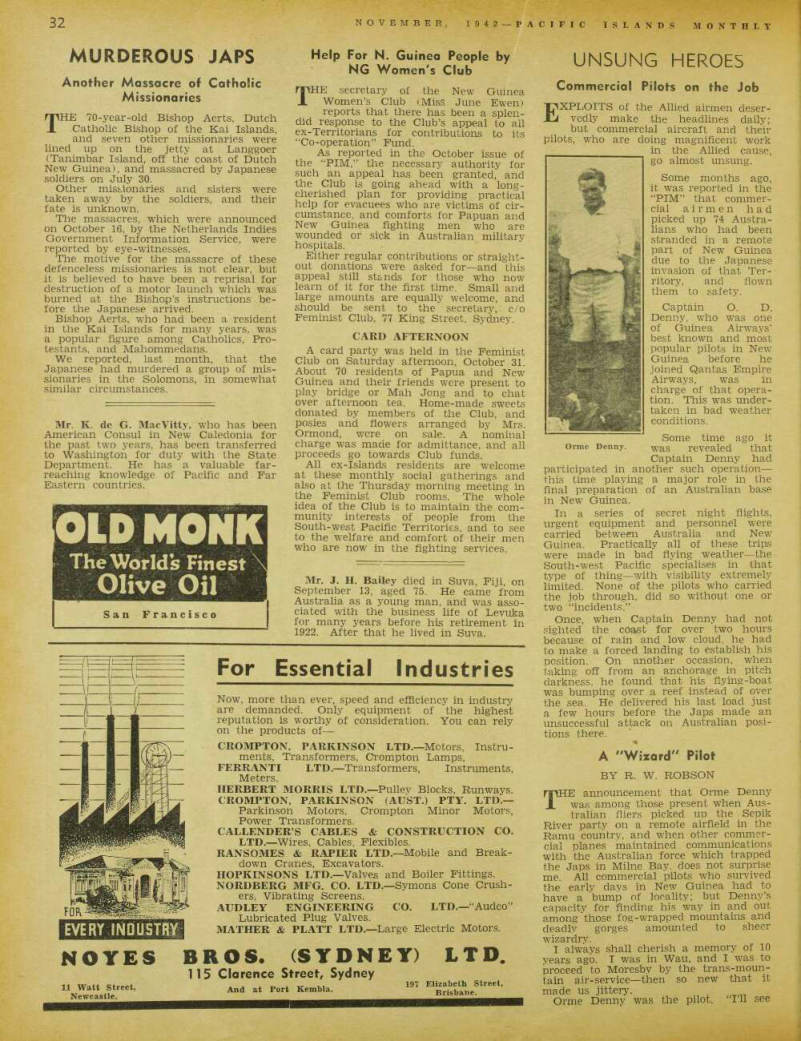
Another Massacre of Catholic Missionaries
THE 70-year-old Bishop Aerts, Dutch Catholic Bishop of the Kai Islands, and seven other missionaries were lined up on the jetty at Langgoer (Tanimbar Island, off the coast of Dutch New Guinea), and massacred by Japanese soldiers on July 30.
Other missionaries and sisters were taken away by the soldiers, and their fate is unknown.
The massacres, which were announced on October 16, by the Netherlands Indies Government Information Service, were reported by eye-witnesses.
The motive for the massacre of these defenceless missionaries is not clear, but it is believed to have been a reprisal for destruction of a motor launch which was burned at the Bishop’s instructions be fore the Japanese arrived.
Bishop Aerts, who had been a resident in the Kai Islands for many years, was a popular figure among Catholics, Pro testants, and Mahommedans.
We reported, last month, that the Japanese had murdered a group of mis sionaries in the Solomons, in somewhat similar circumstances.
Mr. K. de G. MacVitty, who has been American Consul in New Caledonia for the past two years, has been transferred to Washington for duty with the State Department. He has a valuable far reaching knowledge of Pacific and Far Eastern countries.
Help For N. Guinea People by
NG Women's Club
THE secretary of the New Guinea Women’s Club (Miss June Ewen) reports that there has been a splen did response to the Club’s appeal to all ex-Territorians for contributions to its “Co-operation” Fund.
As reported in the October issue of the “PIM,” the necessary authority for such an appeal has been granted, and the Club is going ahead with a long cherished plan for providing practical help for evacuees who are victims of cir cumstance, and comforts for Papuan and New Guinea fighting men who are wounded or sick in Australian military hospitals.
Either regular contributions or straight out donations were asked for—and this appeal still stands for those who now learn of it for the first time. Small and large amounts are equally welcome, and should be sent to the secretary, c/o Feminist Club, 77 King Street, Sydney.
Card Afternoon
A card party was held in the Feminist Club on Saturday afternoon, October 31.
About 70 residents of Papua and New Guinea and their friends were present to play bridge or Mah Jong and to chat over afternoon tea. Home-made sweets donated by members of the Club, and posies and flowers arranged by Mrs.
Ormond, v/ere on sale. A nominal charge was made for admittance, and all proceeds go towards Club funds.
All ex-Isiands residents are welcome at these monthly social gatherings and also at the Thursday morning meeting in the Feminist Club rooms. The whole idea of the Club is to maintain the com munity interests of people from the South-west Pacific Territories, and to see to the welfare and comfort of their men who are now in the fighting services.
Mr. J. H. Bailey died in Suva, Fiji, on September 13, aged 75. He came from Australia as a young man, and was asso ciated with the business life of Levuka for many years before his retirement in 1922. After that he lived in Suva.
Unsung Heroes
Commercial Pilots on the Job
EXPLOITS of the Allied airmen deser vedly make the headlines daily; but commercial aircraft and their pilots, who are doing magnificent work
in the Allied cause, go almost unsung.
Some months ago, it was reported in the “PIM” that commer cial airmen had picked up 74 Austra lians who had been stranded in a remote part of New Guinea due to the Japanese invasion of that Ter ritory, and flown them to safety.
Captain O. D.
Denny, who was one of Guinea Airways’ best known and most popular pilots in New Guinea before he joined Qantas Empire Airways, was in charge of that opera tion. This was under taken in bad weather conditions.
Some time ago it was revealed that Captain Denny had
participated in another such operation— this time playing a major role in the final preparation of an Australian base in New Guinea.
In a series of secret night flights, urgent equipment and personnel were carried between Australia and New Guinea. Practically all of these trips were made in bad flying weather —the South-west Pacific specialises in that type of thing—with visibility extremely limited. None of the pilots who carried the job through, did so without one or two “incidents.”
Once, when Captain Denny had not sighted the coast for over two hours because of rain and low cloud, he had to make a forced landing to establish his position. On another occasion, when taking off from an anchorage in pitch darkness, he found that his flying-boat was bumping over a reef instead of over the sea. He delivered his last load just a few hours before the Japs made an unsuccessful attack on Australian posi tions there.
Orme Denny.
A "Wizard" Pilot
By R. W. Robson
rE announcement that Orme Denny was among those present when Aus tralian fliers picked up the Sepik River party on a remote airfield in the Ramu country, and when other commer cial planes maintained communications with the Australian force which trapped the Japs in Milne Bay. does not surprise me. All commercial pilots who survived the early days in New Guinea had to have a “bump of locality; but Denny’s capacity for finding his way in and out among those fog-wrapped mountains and deadly gorges amounted to sheer wizardry.
I always shall cherish a memory of 10 years ago. I was in Wau, and I was to proceed to Moresby by the trans-moun tain air-service—then so new that it made us jittery.
Orme Denny was the pilot. “I’ll see
you on the drome here at 6 a.m.,” he said. “OK,” said I, and kept the appoint ment.
A little Fox Moth was ticking over merrily. Denny appeared promptly. “All ready?” he asked. “Then hop in.”
“My God!” I wailed. “We aren’t going over the top to Moresby in that thing!”
“Well, you don’t think I’m going to take the big bus over for one passenger, and him half a dead-head,” said the pilot, summing up my press status pointedly. “This is a good little plane— take it anywhere. Fine morning, too.
Hop in.”
It was glorious, up there high over the Owen Stanley Range; but I knew too much about engines to be happy. I listened to every beat of that motor, thought of all the little gadgets which might break and precipitate us into those awful, jungle-choked gorges, and ignored the scenery.
We sailed out over the top-most peaks; and the whole prospect changed. From the mountains southward, Papua lay under a thick blanket of fog. We flew on.
There was not a thing to be seen—we soon were flying through clouds which appeared to press in on us from every side. The motor, to my straining ear, seemed to be firing irregularly. I glared at Denny. He grinned cheerfully. I was not comforted —I knew enough about him to know he would grin cheerfully if we were headed into hell.
It went on that way for some time, hours it seemed to me. Then, suddenly, the earth turned over. I found myself scrambling frantically—practically stand ing on my own ear. When I got myself twisted around, we were flying low over a placid coastline and an attractive island.
“Yule Island,” bawled Denny, com placently. He had flown very high and then, by dead reckoning, had dived down to seek Yule Island —and there it was, right under his nose.
He was a Guinea Airways pilot then, and they told me he was always like that —he could take a plane of any size through the most baffling country, and set it down on some little pocket-hand kerchief of a jungle clearing which most other men could not even see from five thousand feet.
Advertisements & other items, p. 34 (1 item)
Old Monk
The Worlds Finest \ Olive Oil San Francisco
For Essential Industries
m
imiiiiWiM
Now, more than ever, speed and efficiency in industry are demanded. Only equipment of the highest reputation is worthy of consideration. You can rely on the products of— CROMPTON, PARKINSON LTD.—Motors, Instruments, Transformers, Crompton Lamps.
FERRANTI LTD.—Transformers, Instruments, Meters.
HERBERT MORRIS LTD.—Pulley Blocks, Runways.
CROMPTON, PARKINSON (AUST.) PTY. LTD.—
Parkinson Motors, Crompton Minor Motors, Power Transformers.
CALLENDERS CABLES & CONSTRUCTION CO.
LTD. —Wires, Cables, Flexibles.
RANSOMES & RAPIER LTD.—Mobile and Breakdown Cranes, Excavators.
HOPKINSONS LTD.—Valves and Boiler Fittings.
NORDBERG MEG. CO. LTD.—Symons Cone Crushers, Vibrating Screens.
AUDLEY ENGINEERING CO. LTD. —“Audco”
Lubricated Plug Valves.
MATHER & PLATT LTD.—Large Electric Motors.
NOYES
11 Watt Street, Newcastle.
BROS. (SYDNEY) LTD.
115 Clarence Street, Sydney
And at Fort Kembla. 197 Elizabeth Street, Brisbane.
Fiji Trustees Justified
A GREAT deal of interest was taken in Fiji in lengthy litigation between the beneficiaries and the trustees of the estate of the late Adam A. Coubrough, which includes valuable plantations at Sogulu, Ura and Selia Levu, on Taviuni, and at Sigatoka, on Viti Levu. The trus tees are two men well-known in the South Seas—Mr. Robert Crompton and Mr. Edward Duncan.
There are two beneficiaries, both over 60, who live in New Zealand. They had received each about £l,OOO per annum from these coconut estates. Then war and other circumstances gravely affected the copra industry, and the trustees, determined that the properties should be protected, reduced the payments to the beneficiaries to £250 per annum each. The beneficiaries claimed they were entitled to a much larger sum, to be paid out of a reserve fund, which had been specially created to meet such a contingency. They also demanded the dismissal of the trus tees.
The Chief Justice, Sir Owen Corrie, found in favour of the trustees. He suggested that the allowance to the bene ficiaries could be increased to £4OO per
annum each without damaging the capi tal position. He rejected the demands for the removal of the trustees from office.
Death Of Mr. A. G. Ross
MR. Alex G. Ross, a resident of Nausori for over 40 years, and one who had come to be looked upon as “the father of the township,” died at his resi dence on September 13, reports the “Fiji Times.”
Mr. Ross was a Lossiemouth Scot and came to Fiji via New Zealand, 60 years ago. For some time he was purser of the Union Steamship Company’s inter island ship, “Oreti,” and then he went into partnership in a general store with the late Mr. W. Patterson. Later, he joined the firm of A. M. Brodziak Sz Co., and it was while in their employ that he first made his home in Nausori.
He devoted much of his life to a close study of Fijian history, customs and lan guage. He never entered politics, but he took a prominent part in the poli tical life of the Colony. He was chair man of practically every political meet ing ever held in Nausori.
He was a prominent Mason, and an enthusiastic bowler, and it was he who prepared and gave the fine bowling green of the Rewa Club to the people of Nau sori. He is survived by a widow and four children: Esther (Mrs. M. Gaspard), Jack, Alister and Tom.
Lieutenant Cliff Warren, of the NZEF, serving in the Middle East, and form erly of Morris, Hedstrom Ltd.’s staff at Ba and Lautoka, Fiji, has been reported a prisoner of war.
Advertisements & other items, pp. 35-36 (1 item)
W.KOPSEN & Co. Pty.Ltd.
SIMPLEX
MARINE
ENGINES
Simplex engines from 3 h.p. to 12 h.p. for boats from 14 ft. to 26 ft. are Australia’s best. 2 cycle and 4 cycle with or without reverse gear Illustrated is the popular little 3 h.p. suitable for 14 ft. or 16 ft. boats.
Runs for 5 hours on 1 gallon petrol and costs only £29/15/-, complete with all equipment. Ready to instal into any boat, nothing else to buy Ask for Simplex catalogue of engines and launches.
SKARSTEN SCRAPERS
TILLEY
Kerosene
LAMPS
British-made Kerosene Lamps providing a steady 300 c.p. light, without flickering, and without smoke or smell.
Model TLIO (illustrated) is a handsome Table Lamp providing exceedingly brilliant illumination and at the same time a fine ornament for any home.
Stands 24 in. high and covers a large area. Attractive parchment shade is finished in autumn tones and matches any furnishings.
Also available is the popular All- Purpose Lamp and Lantern (model EX100) and a variety of Hanging, Table, Wall and Vase Lamps.
Let us send you full details of all Tilley Lamps.
SHIPCHANDLERY
We manufacture and stock the largest range of boat gear in Australia. Everything for boatbuilder and boatowner. Marine paints and varnishes. Rope and Cordage. Rigging. Anchors and M oorings. Copper Nails and Rod . Lighting Plants. Fire Extinguishers. Oars and Sculls, Lamps, Pumps, etc.
GET OUR PRICES FIRST.
Remove paint, varnish, glue, oil, grease, roughness, etc., from wood and metal surfaces. Most useful for scraping deck and hull planks. They leave the surface smooth and dressed and ready for painting. Have renewable blades.
Prices: No. 35, 2/3; 62, 2/9; 80, 3/7.
Reversible, 7/9.
Write for leaflet.
W.KOPSEN & Co. Pty.Ltd.
376/380 KENT STREET, SYDNEY
’Phone: MA6336 (4 lines). Est. 1868. Cables: Kopsen . . . Sydney.
by appointment
Horlkks is Ideal
for Emergency Rations
For emergencies, with the addition of water only, Horlicks is a complete food, providing warmth and energy, body-building and tissue-repairing material.
Even after it has been opened Horlicks will keep in perfect condition indefinitely if the top is firmly replaced.
It would be difficult to find a more valuable food to keep by in case of emergency.
HORLICKS
Roll Of Honour
(It is hoped to assemble, here, the names of men, former residents of the Pacific Territories, which appear in British and Free French casualty lists, or in lists of honours awarded.
We should be grateful if relations and friends would send us details.)
Killed
Eugene AUBRY (formerly of Tahiti), of the Air Force of Fighting France. Killed in an air accident in Great Britain.
Pilot-Officer Len BAYLISS, flying instructor in the RAAF, formerly of Rabaul, New Guinea.
Killed in Sydney, 18/11/1940, when he fell from a trainer aircraft in flight.
A/Bdr. Neville W. BERTWISTLE, AIP artillery (tank unit), formerly a clerk on the staff of W. R. Carpenter and Co. Ltd., of Rabaul, New Guinea. Killed in action, April, 1941.
Alexandre BLACK, of the Pacific Battalion of Fighting Prance. Killed in action in the battle of Bir Hacheim (Libya).
Pte. W. R. M. BRADNAM, of the NZ Forces, formerly of Fiji. Reported killed in action in the Middle East, 25/11/1941.
Warrant-Officer R. F. BRECHIN, New Guinea Force. Killed in air accident, June 17, 1942.
Formerly of NG Department of Agriculture.
Lieut.-Colonel Felix BROCHE, of the New Caledonian-New Hebridean contingent of the Fighting French Pacific Battalion. Killed in action in the battle of Bir Hacheim (Libya).
Pierre CHARPENTTER, of the Fighting French Pacific Battalion. Killed in action in the battle of Bir Hacheim.
Raymond CHAUTARD (formerly of New Cale donia), of the Fighting French Pacific Battalion.
Killed in action in Libya.
Flight-Lieutenant G. J. I. CLARKE, of the RAAF, formerly Assistant Flight Superintendent of Carpenter Airlines, New Guinea. Killed In action during operations off Dakar (French West Africa), while attached to HMAS “Aus tralia”, September, 1940.
Georges CLEMENS, of the Free French Pacific contingent from New Caledonia. Reported killed in action in the Middle East, March, 1942.
Flying-Officer Jack R. COATH, of the RNZAP, formerly on the staff of the Bank of New Zealand, in Suva, Fiji, Killed October, 1941, when a training aircraft crashed in NZ.
Pte. Felix CRAIG. AIP, formerly of accounts department, Australasian Petroleum Co.. Port Moresby. Papua, Killed in action, June, 1941.
L. J. DAWES, of the NZ Forces, formerly Dis trict Officer of Savaii, Western Samoa. Reported killed in action. February, 1942.
Pilot-Officer V. L. DEARMAN, of the RAAF (observer), formerly overseer and clerk at the Colonial Sugar Refining Co., Ltd., Raravai, Fiji. Reported killed in action in the Middle East, October, 1941.
Capt. Jean GILBERT, of the Naval Forces of Fighting France, and formerly of Tahiti. Killed in action.
Captain Kenneth GARDEN, of the RAF Ferry Command, formerly of Guinea Airways Ltd., in New Guinea. Killed September, 1941, when a bomber he “ferried” from USA crashed on west coast of Britain.
Flying-Officer Moresby GOPTON, of the RAF, son of Mrs, F, S. Stewart, of Wau, New Guinea.
Reported missing, 17/5/1940 —presumed killed in air operations. w Rifleman J. A. GOODWIN, AIF infantry, for merly of Bulwa, TNG. Reported “accidentally killed”, April, 1942.
Ernest GOURNAC (formerly of Tahiti), of the Air Force of Fighting France. Killed in an air accident in Britain.
Pte. Wallace GRAHAM, of the NZ Forces (infantry), formerly on the staff of Morris Hedstrom Ltd., Fiji. Killed in action in the Middle East, November, 1941.
Squadron-Leader C. R. GURNEY, RAAF, a former chief pilot of Guinea Airways, Ltd.
Killed in action in the New Guinea area, May, 1942.
Gerald T. J. HARPER, RAF, son of Major and Mrs. P. Harper, of Ra, Fiji. Killed in action while navigating a Whitley bomber dur ing a raid on the Continent.
Squadron-Leader Godfrey HEMSWORTH, of the RAAF, formerly a well-known commercial pilot in Morobe, TNG. Reported missing after an operational flight against the Japanese in the New Guinea area—now presumed killed in action.
Flying-Officer Alan JOHNSTONE, of the RAF, who was born in Suva, Fiji, in 1915. Killed during bombing raid on Kristlansand, Norway, April. 1940.
LAC Douglas KIRBY, RAF, who left Suva.
Fiji, with the first contingent of Air Force
trainees. Reported killed in a flying accident in South Africa, March, 1942.
Marcel KOLLEN, of the Pacific Battalion of Fighting France. Killed in action in the battle of Bir Hacheim.
Emile LESSON (formerly of New Caledonia), of the Fighting French Pacific Battalion. Killed in action in Libya.
Cpl. Gaston LESSON, of the Fighting French Pacific Battalion. Killed in battle of Bir Hacheim (Libya).
Capt. (now Lt.-Colonel) Edward Tiwi LOVE, NZ Maori Battalion, husband of Mrs. Takau Rio Love, Ariki-nui of Rarotonga, Cook Islands. Re ported missing during campaign in Greece, May, 1941; later, June, 1941, reported “wounded and safe.” Officially announced, July 17, killed in action in Libya.
Flying-Officer John C. LOWE, RAAF, formerly an overseer with the CSR Co. in Fiji. Reported, 11/4/1942, “took part in air defence of Rabaul, TNG, —missing, believed killed”.
Pte. L. F. MCCARTHY, AIP infantry, form erly supercargo on W. R. Carpenter and Co.’s inter-island vessels “Desikoko” and “Mako”, in New Guinea. Reported “killed in action” in Syria, 30/10/1941.
Lance-Corporal A. D. MacPHEE, son of Mr.
R. D. MacPhee, Levuka, Fiji. He was 35, was a member of the AIF, and was killed in Greece, May, 1941, Francois MASSON, of the Fighting French Pacific Battalion. Killed in action in the battle of Bir Hacheim.
Capt. John Malcolm METHVEN. Reported killed in action in Egypt on July 22, 1942, while serv ing with the AIF. He was born in Ocean Island, and is the youngest son of Mr. and Mrs.
Stuartson C. Methven, of Belgrave, Victoria.
Spr. A. L, MORANDINI, AIF Engineers, for merly of Konedobu, Papua. Reported killed in action, April, 1942.
Pte. Edward Harold PRICE, 2nd NZEF (Machine-gun Battalion), youngest son of Mr. and Mrs. J. Price, Savu Savu West, Fiji. Killed in action during the Libyan campaign, Middle East, 27/11/1941.
Captain W. H. ROBERTS, NZEF, who was Accountant in the Samoa Treasury Dept., dur ing 1934-35. Killed in action in Libya, Decem ber, 1941.
Major A. B. ROSS, NZEF, who, between 1923- 29 was successively, Assistant Secretary for Native Affairs, Assistant Secretary to the Administration, and ADC to the Administrator of Samoa. Killed in action in Libya.
Cpl. Alex. C. SCOTT, AIF, formerly manager at Kieta, TNG, for Burns, Philp and Co. Ltd.
Killed in action in the Middle East, 19/6/1941.
Pte. Popoare TANGHTI, of the NZ Forces (Maori Battalion), formerly of Mangala, Cook Islands. Reported “missing after Battle of Greece—presumed dead”, July, 1941.
Sgt. Edward WILSON, of Suva, serving in the Fiji Defence Force. Accidentally drowned in the Lami River, Fiji, April, 1942.
Died From Wounds
Pte. Ernest HENRY, AIF, formerly of the Rabaul (NG) staff of Burns, Philp and Co.
Ltd. Died from wounds received in Battle of Crete, 1/6/1941.
Pte. Alec. MUNRO, NZ Forces, formerly of Norfolk Island. Died in Libya (Middle East),
December, 1941.
Pte. Walter PEARSON, of first NG quota of AIF (infantry). Died from wounds received in action, 24/6/1941.
A/Bdr. W. R. SCOTT, AIF, of New Guinea.
Died from wounds, July, 1941.
Sgt.-Pilot Peter Clarkson WISE, of the RAF, son of Mr. W. Wise, OBE, Director of Public Works, Fiji. Died from wounds received during bombing raid over Germany, January, 1941.
Died From Illness
Pte. Clarence A. HUTTON, AIF, formerly of Edie Creek, TNG. Died from illness, April, 1941.
A/Sgt. J. H. STANE, Royal Australian En gineers, formerly of Port Moresby, Papua. Died from illness, May, 1942.
Major P. J. WOODHILL, AIF infantry, formerly legal assistant in the Crown Law Office, Rabaul, New Guinea. Reported “deceased”, December, 1941.
Missing
Louis ANGER, of Fighting French Pacific Battalion. Reported missing after battle of Bir Hacheim.
Pte. P. F. BAILEY, AIP Infantry, of Rabaul, TNG. Reported missing, 17/2/1942.
Cpl. Leon BARRENE, of Pacific Battalion of Fighting France. Missing after battle of Bir Hacheim (Libya).
Robert BLUM, of Fighting French Pacific Battalion. Reported missing after battle of Bir Hacheim.
Sgt. Ronald Arthur BROODBANK, formerly of
Samaral, Papua, now serving with the RAAF overseas. Reported missing on May 31 while on air operations.
Reginald BOULANGER, of Fighting French Pacific Battalion. Reported missing after battle of Bir Hacheim.
Pte. E. L. CHRISTIE, AIF infantry, of Rabaul, TNG. Reported missing, 17/2/1942.
Victor DERVAUX, of Fighting French Pacific Battalion. Reported missing after battle of Bir Hacheim.
Lucien DEVAND, of Pacific Battalion of Fighting France. Missing after battle of Bir Hacheim ( Llb y & )- „ Pte -, A - O. DICKSON, AIF Infantry, of Rabaul, TNG. Reported “missing, believed wounded”, 17/2/1942.
GELLER, of Fighting French Pacific Battalion. Reported missing after battle of Bir Hacheim.
J. P. GOUZENES, of Fighting French Pacific
Battalion. Reported missing after battle of Bir Hacheim.
Chief-Sergeant Francois GRISCOLLI, of Fight ing French Pacific Battalion. Reported missing in Libya in April. Formerly of New Caledonia Georges KABAR, of Fighting French Pacific Battalion. Reported missing after battle of Bir Hacheim.
Henri LANGLOIS, of Pacific Battalion of Fighting France. Missing after battle of Bir Hacheim (Libya).
Numa LETHESER, of Pacific Battalion of Fighting France. Missing after battle of Bir Hacheim (Libya).
Rene LETOCART, of Fighting French Pacific Battalion. Reported missing after battle of Bir Hacheim.
Camille MERCIER, of Fighting French Pacific Battalion. Reported missing after battle of Bir Hacheim.
MOUTRY, of Fighting French Pacific
Battalion. Reported missing after battle of Bir Hacheim.
Pte. R. J. PASCOE, AIF Infantry, of Rabaul, TNG. Reported missing, 27/1/1942.
Pilot Tom PATTERSON, of the RNZAF, formerly of Levuka, Fiji. Reported missing, in November, 1941, after bombing raid on the Continent.
Henri PAYONNE, of Fighting French Pacific Battalion. Reported missing after battle of Bir Hacheim.
Eugene PENE, of Fighting French Pacific Battalion. Reported missing after battle of Bir Hacheim.
Andre PETRE, of Fighting French Pacific Battalion. Reported missing after battle of Bir Hacheim.
Hector PILLING, RAF, who was born in Fiji and who was the son of Sir Guy Pilling, of Zanzibar (formerly of Fiji). Reported missing, while serving with the Royal Air Force Bomber Command.
Eugene POGNON, of Fighting French Pacific Battalion. Reported missing after battle of Bir Hacheim.
Gnr. Allan H. ROSS, AIF artillery, formerly planter in New Britain, TNG. Reported “miss ing—believed prisoner of war”, 28/9/19'41, ROUDEILLAC, of Fighting French Pacific Battalion. Reported missing after battle of Bir Hacheim.
Pte. William RUPE, of the NZ Forces (Maori Battalion), formerly of Aitutaki, Cook Islands.
Reported “missing after Battle of Greece”, July, 1941.
Pilot James SIMPSON, of the RAF, formerly of Vatukoula, Fiji. Reported missing after air operations over Malta, in the Mediterranean, 1/7/1941.
Pilot-Officer Neville George STOKES, of the RAF, formerly a pilot with Guinea Airways, Ltd., in New Guinea. Reported missing after air operations in Europe, December, 1941.
Reported Missing
Malaya Casualty List, Published 23/7/1942.
Pte. N. H. AMOS, artillery, Port Moresby.
Pte. E. L. CHRISTIE, infantry, Rabaul.
Pte. A. G. DICKSON, infantry, Rabaul.
Pte. A. I. FOLEY, artillery. Port Moresby.
W.0.l A. N. GRAY, ordnance, Rabaul.
W. 0.2 V. M. I. GORDON, artillery, Wau, New Guinea.
Pte. J. M. HIRSCHEL, infantry, Rabaul.
Pte. J. G. NEWTON, artillery, Port Moresby.
A./Bdr. B. L. J. MEETON, artillery, Rabaul.
Pte. D. M. SPENCE, artillery, Port Moresby.
Australia and Island Stations.
Pte. W. G. EKBLADE, infantry, Rabaul.
Pte. S. W. HUNTER, infantry, Kokopo.
Wounded
Sgt. Robert ASMUS, of the Fighting French Pacific Battalion. Wounded at Bir Hacheim and evacuated.
Rene AUFANT, of the Fighting French Pacific Battalion. Wounded at Bir Hacheim.
Cpl. Thomas BAMBRIDGE, of the Fighting French Pacific Battalion. Wounded at Bir Hacheim and evacuated. —■ BERBERS (alias ARESKY), of the Fighting French Pacific Battalion. Wounded at Bir Hacheim.
Henri BERTHELIN, of the Fighting French Pacific Battalion. Wounded at Bir Hacheim.
Pte. V. BLANCO, AIF infantry, of Thursday Island. Wounded in action, July, 1941.
L/Cpl. J. P. BLENCOWE, AIF Infantry, of Rabaul, TNG. Wounded in action, July, 1941.
Jean BRIAL, of the Fighting French Pacific Battalion. Wounded at Bir Hacheim.
Pte. George BUCKNELL, AIF, son of Mr. and Mrs. C. Bucknell, of Korolevu, Fiji, Wounded in action in Malaya, January, 19 , 42.
Pte. Thomas BYERS, AIF infantry, of Thurs day Island. Wounded in action, May, 1941.
Raymond CHAUTARD, of the Free French Pacific contingent from New Caledonia. Re ported a casualty in the Middle East, March, 1942.
Albert CUBADDA, of the Free French con tingent from New Caledonia. Reported a casualty in the Middle East, March, 1942.
Charles DEVEAUX, of Pacific Battalion of Fighting France. Wounded at battle of Bir Hacheim (Libya).
V. FAIRHALL, 2nd N£EF, formerly of the Treasury Department, Western Samoa. Reported wounded in action, February, 1942.
Paroa FIU, of the Fighting French Pacific Battalion. Wounded at Bir Hacheim and evacuated.
Acting Warrant-Officer V. M. I. GORDON, AIF infantry, of Wau, TNG. Wounded in action, February, 1942.
Pte. John GRANT, AIF infantry, of New Guinea, Wounded in neck and thigh, September, 1941; later, reported “rejoined unit”.
Henri GUTLBAUD, of the Free French Pacific
contingent from New Caledonia. Reported a casualty in the Middle East, March, 1942.
Sgt. C. HENDRICK, AIF infantry, of Rabaul, TNG. Wounded in action, July, 1941.
Stanley HIGGS, son of Mr. and Mrs. Gordon Higgs, of W. R. Carpenter and Co. Ltd., New Guinea. Member of an English Lancers’ regiment, wounded during British evacuation from Dun kirk (France), May, 1940.
Lieut. Lloyd T. HURRELL, AIF infantry, of Rabaul, TNG. Wounded in action, July, 1941.
Alexandre HUYARD, of the Free French Pacific contingent from New Caledonia. Reported a casualty in the Middle East, March, 1942.
Sgt.-Pilot Andrew KRONFELD, of the NZ Fighter Squadron attached to the RAF. Wounded in knee during operations over Prance, December, 1941.
Cpl. W. H. LANNEN, AIF artillery, of Rabaul, New Guinea. Wounded in action, June, 1941.
Gnr. E. G. LOBAN, AIF artillery, of Thursday Island. Wounded during campaign in Greece, May, 1941; invalided home after having his left forearm amputated.
Auguste LUTA, of the Fighting French Pacific Battalion. Wounded at Bir Hacheim and evacuated.
A/Sgt. Alastair MACLEAN, AIF infantry, of Rabaul, New Guinea. Wounded In action, in Libya, June, 1941.
Sgt. J. D. McCLYMONT, NZEF, son of Capt.
D. McClymont, Harbourmaster of Apia, Western Samoa. Wounded in action, November, 1941.
Cpl. R. McKERLIE, AIF, of Yandina, BSI, wounded in face by bomb explosion, April, 1941.
T. MANEA, of the Fighting French Pacific Battalion. Wounded at Bir Hacheim and evacuated.
Jean MERIGNAC, of the Free French Pacific contingent from New Caledonia. Reported a casualty in the Middle East, March, 1942.
Henri MEYER, of the Free French Pacific contingent from New Caledonia. Reported a casualty in the Middle East, March, 19'42.
S/Sgt. Graham B. MIRFIELD, AIF engineers, of Rabaul. New Guinea. Wounded in action, Joseph OTHUS, of Pacific Battalion of Fight ing France. Wounded in battle of Bir Hacheim (Libya).
Pte. L. G. (“Mick”) REECE, AIF, of Bulolo, New Guinea. Wounded in action, July, 1941.
Henri RIVIERE, of the Free French Pacific contingent from New Caledonia. Reported a casualty in the Middle East, March, 1942.
A/Cpl. N. K. SAWYER, AIF infantry, of Rabaul, TNG. Wounded in action, July, 1941.
July, 1941.
Lieut. Jeffrey SEAGOE, serving with the British forces in the Far East, formerly of Vila, New Hebrides. Reported “wounded in action”, March, 1942.
Pte. Lance STAMPER, AIF, formerly school master at Wau, New Guinea. Wounded in action, August, 1941.
Cpl. Raphael TEIHO, of the Fighting French Pacific Battalion. Wounded at Bir Hacheim and evacuated.
Cpl. Terii TERIITUA, of the Fighting French Pacific Battalion. Wounded at Bir Hacheim and evacuated.
Pte. Harold G. TURNER, AIF, of Samarai, Eastern Papua. Wounded in action at Bardia (Libya), January, 1941.
Pte. F. D. TWISS, AIF infantry, of New Guinea. Wounded in action, August, 1941.
Camille VINCENT, of the Free French Pacific contingent from New Caledonia. Reported a casualty in the Middle East, March, 1942.
“■Driver Don F. WAUCHOPE, AIF. Formerly employed on his brother’s plantation in New Guinea. Wounded in action, July, 1942.
Alex. WINCHESTER, of the Fighting French Pacific Battalion. Wounded at Bir Hacheim.
Sgt.-Pilot W. WRIGHT, of the Australian Spitfire Squadron, attached to the RAF, for merly of New Guinea. Wounded in knee during aerial “dog-fight” over the English Channel, March, 1942.
Prisoners Of War
A/Cpl. Peter W. BOSGARD, AIF Infantry, formerly of the Lands Department, Port Moresby, Papua. Reported prisoner of war at Sulmona, Italy, 29/6/1941; transferred to Bolzano prison camp, September, 1941.
Andre CHITTY, of Pacific Battalion of Fight ing France. Taken prisoner at battle of Bir Hacheim (Libya).
A/Sgt. A. A. S. COTMAN, AIF infantry, of Abau, Papua. Reported missing—believed prisoner of war, 5/5/1941; reported later, July, 1941, “wounded in chest and head by shrapnel— taken prisoner”.
Pte. J. DALTON, AIF Transport and Supply, formerly of Thursday Island. Reported prisoner of war, April, 1942.
Dick ELMOUR, formerly of New Caledonia, prisoner of war after Dunkirk. Repatriated to
France in January, 1942, because of health reasons.
Pilot-Officer George Beilby EVANS, RAAP, son of Mr. and Mrs. Beilby Evans, formerly of Buka Passage, TNG. Reported prisoner of war in Java.
Pte. W. GOSSNER, A IP infantry, formerly of the BNG Development Co., Port Moresby, Papua.
Reported prisoner of war, Sulmona, Italy, 6/7/1941.
Lieut. J. M. HARCOURT, 2nd NZEP, son of Mr. H. W. Harcourt, formerly Deputy Treasurer in Fiji. Reported “captured in Libya and now prisoner of war”, March, 1942.
S. D. C. KERKHAM, NZEF, son of Mr. R. C.
Kerkham, Suva, Fiji. Reported prisoner of war in September, 1942.
Gnr. A. L. B. KING, A IF artillery, of Rabaul, TNG. Reported prisoner of war, 29/7/1941.
Major E. G. A. LETT, of the East Surrey Regiment, and son of Mr. Lewis Lett, of Port Moresby, Papua. Reported prisoner of war in Libya.
A/Cpl. John H. LONERGAN, A IF, Supply and Transport, of New Guinea. Reported prisoner of war at Corinthia, Italy, 8/7/1941.
Pte. Ernest (“Paddy”) McGEADY, NZEP, son of Mrs. J. McGeady, of Suva, Fiji, Reported “missing, believed killed”, after fighting in Libya, January, 1942; reported prisoner of war in Italy,' April, 1942.
Observer Alex. McKAY, of the RAAP, formerly of the CSR Co.’s staff, at Penang sugar-mill, Fiji. Reported missing, 27/7/1941; reported prisoner of war in Italy, 26/10/1941.
Pte. Harry MARCHINGTON, of the NZ Forces, formerly of Fiji. Reported prisoner of war after Battle of Crete, 2/12/1941.
Emile MILLOT, of Pacific Battalion of Fight ing France. Taken prisoner in battle of Bir Hacheim (Libya).
Pte. D. R. PHILLIPS, AIF engineers, formerly of Bulwa, TNG. Reported prisoner of war, June, 1942.
Pte. John O. SMITH, of the NZ Forces, son of Captain Arthur Smith, of the Fiji inter-island vessel “Tui Kauvaro”. Missing after battle of Crete, May, 1941; reported prisoner of war in Germany, 21/10/1941.
Squadron-Leader L. C. SHOPPEE, DSO, RAF, formerly of Edie Creek, New Guinea. Was in Java during Japanese invasion; now pre sumed to be a prisoner of war.
LAC Charles SOLLITT, of the RAAF (wire less operator), son of Mr, and Mrs. C, H.
Sollitt, of Nausori, Fiji. Reported missing after air operations in New Guinea, January, 1942; later, March, 1942, reported rescued from sea by Japanese—now prisoner of war.
Pte. Fred SWAN, NZ Army Medical Corps, formerly of Apia, Western Samoa. Missing after Battle of Crete, August, 1941; reported prisoner of war in Germany, November, 1941.
Pte. John D. WHITCOMBE, of the NZ Forces, formerly of Levuka, Fiji. Reported prisoner of war in Germany, November, 1941.
Decorations
Squadron-Leader G. U. (“Scotty”) aLLEN, RAAP, who is well-known in New Guinea and Papua, having been co-pilot on the “Faith in Australia”, on the first official air-mail flight to the Territories in 1934. Awarded the Air Force Cross for his work with Catalina flying- Doats in Australia and the Pacific.
Major H. T. ALLEN, AIF, formerly of Wau, Morobe District, TNG. Awarded the OBE.
Sgt. Henry C. S. COTTON, of the RNZAF, who was born in Samoa (his father was Secre tary of Native Affairs during the NZ military occupation). Awarded the Distinguished Flying Cross.
Rifleman H. W. FORRESTER, NGVR, formerly of Bulolo, TNG. Awarded the Military Medal for operations against Japanese in New Guinea.
Squadron-Leader Godfrey HEMSWORTH, RAAF, formerly a well-known New Guinea pilot, who was killed in action against the Japanese In May. Posthumously awarded the Air Force Cross.
Flight-Lieut. R. N. DALKIN, RAAF, formerly of W. R. Carpenter and Co., Ltd., Salamaua, TNG. Awarded the DFC for bombing raids against the Japanese in Koepang area, DEI.
Squadron-Leader C. A. BASKETT, formerly of Bulolo, TNG. Awarded Distinguished Flying Cross for raids over enemy territory while attached to Hampden bomber squadron in Eng land.
Squadron-Leader C. R. GURNEY, RAAF, for merly of Guinea Airways, Ltd., TNG. Posthu mously awarded the Air Force Cross, for bomb ing raids on Japanese-held ports in New Britain.
Lieut. Colin HILL, RANR, of the Australian destroyer, “Waterhen”, formerly second officer
on the trans-Pacific liner “Niagara”. Awarded the OBE.
Flying-Officer James R. HYDE, of the RAP, formerly a Patrol Officer in Namatanai and Sepik Districts, TNG. Awarded the Distinguished Flying Cross.
Lieut.-Commander A. W. R. McNICOLL, RAN, son of Sir Ramsay McNicoll, Administrator of New Guinea, and Lady McNicoll. Awarded the George Medal.
Sgt. Geoffrey MOORE, of the RNZAF, formerly engineer on the NG inter-island vessel “Maiwara” and on the trans-Pacific liner “Aorangi”. Awarded the Distinguished Flying Medal.
Pilot-Officer Pat RICHARDSON, RAF, son of Mr. W. Richardson, formerly of Penang, Fiji.
Awarded the Distinguished Flying Cross.
Commander Alvord S. ROSENTHAL, RAN, son of Major-General Sir Charles Rosenthal, KCB, CMG, DSO, VD, Administrator of Norfolk Island. Awarded the DSO, November, 1941; awarded the Bar to DSO, February, 1942.
Lieut. George Raymond WORLEDGE, of the RANVR, formerly of Fiji. Awarded the MBE (Military) Rev. R. Rankin, of LMS station at Saroa, Papua, is at present on furlough in Melbourne.
Misses Lorraine & Dorothy Shield have recently arrived in Adelaide, after spend ing several years in Suva, Fiji. They were evacuated to New Zealand a short time ago, from Fiji. Miss R. Shield has joined the WAAF, as a radio operator, and her sister is on the staff of the Commonwealth Bank.
Mrs. F. P. Dewhirst, who has resided in Fiji ever since she left England, 32 years ago, died in the Memorial Hospital, Suva, on September 27. Mrs. T. C.
Widdowson, of Suva, is her only daughter.
One of the “prisoner of war” letters re ceived in Australia recently from Rabaul was from Mr. P. G. Naulty. Writing on March 10, he said he was well. His wife and daughter are now living at 8 Cave Street, Prospect, NSW.
Mr. E. R. Bevington, who was Adminis trative Officer at Tarawa, in the Gilbert and Ellice Colony, when the Japanese struck in December, and who was among those who escaped, was subse quently seconded to the Fiji public ser vice. He is now a District Commissioner in Nadi (Viti Levu), Mrs. Bevington and their two children are in New Zealand.
Advertisements & other items, pp. 37-38 (1 item)
H iuiiv
Here’s the quick,easy way to serve
COOL, APPETISING
HOT-WEATHER MEALS
<3 * I w YOU can prepare crisp, cool, appetising salads in five minutes with Imperial “Hampe” the quick-serve summer delicacy that’s ready-cooked, readyto-serve and flavour-sealed . . And what a flavour!
Everyone likes the delicious combination of mild-cured ham and tender veal in “Hampe.” Try it to-day.
Product of Riverstone Meat Co. Pty. Ltd., Sydney.
FIJI Representatives: Pearce & Co. Ltd., Suva.
H iuiiv
M M i-miTJiJKi Mi
Wanted to Buy—Quality Guns and Rifles HIGHEST PRICES GIVEN. WILL ALSO EXCHANGE GUNS.
S I L R O H U Quality Firearms and Fishing Tackle. 143 ELIZABETH STREET (Near Market St.) SYDNEY. ’PHONE: MA 3540.
A. B. DONALD Ltd.
AUCKLAND
ISLAND TRADERS & GENERAL MERCHANTS
P.O. Box 1509. Cables £r Telegrams, "Kingdom", Auckland.
The Blackout In
Fiji
STRICTER observance of the black out in Fiji has been demanded by the military authorities, reports “Fiji Times.”
The question as to whether there could be any relaxation in blackout regulations was taken up by the Civil Defence Advisory Committee, but military opinion was that it should be more complete.
It was pointed out that the United Nations were not yet sufficiently en trenched in the South Pacific to warrant the assumption that an attempt to raid or invade Fiji would not be made, con sequently the only revision in the black out regulations should be towards making them as complete as they were in most Islands bases in the Pacific.
On February 26, 1942, a partial black out order was issued, and stated that a partial blackout should be observed throughout the islands of Viti Levu and Ovalau, and the adjoining waters.
Since that date there has been a gradual neglect of this observance by a number of residents, but the Commissioner of Police warned the public, in October, that instructions had been issued to the police, and special police, that in future no further warnings would be given—all offenders would be prosecuted. Civilians declare that members of the military community are the worst offenders.
Arguments for and against blackouts, in principle, are endless—but that does not alter the fact that a blackout that is observed by only a proportion of the community is useless. If competent authorities consider lighting restrictions are necessary, then the restrictions should be observed to the letter.
Advertisements & other items, p. 39 (1 item)
Ehbcys
EYE LOTION
For Inflamed Eyes and Eyelids
SOLD EVERYWHERE
H. A. Rose & Co. Pty. Ltd., King St.. Sydney
EHBCYS
buy cm
Distilleries at London . . . England Toronto . . . Canada Moorabbin . . Victoria Cincinnati . . . U.S.A.
Historic Chubb
Relic
Old Safe in Rarotonga
From Our Own Correspondent
Rarotonga, Oct. 16.
AN interesting safe is in the possession of Mr. W. H. Watson, trader, of Rarotonga. The safe was made by the famous old firm of Chubb and bears the inscription:— Wesleyan Missionary Society 1839 New Zealand District Chest.
This was made in the early days of that most excellent craftsman. Unfor tunately, there is no serial number — although, presumably, records were kept even in 1839—and it is thus difficult to check up on its early history. Previous owners are now dead or have left the Group.
The safe, which is still in good condi tion and fulfils its functions admirably, is very heavy, and needs at least four men to move it even a short distance.
This fact suggests that the missionaries must have had property of some value in those early days of missionary endeavour.
Perhaps some reader will be able to comment on the “New Zealand District Chest.”
Mrs. Ellison, wife of Dr. E. P. Ellison, of Rarotonga, returned from New Zealand in October, accompanied by three children and a niece, Miss Boyd.
Hooliganism Alarms
Suva Citizens
THE following “public notice”—pub lished in the “Fiji Times” on September 15 —gives point to the contention of some of Suva’s responsible citizens, that discipline in the town is lax and that there is a great deal of hooliganism.
Notice To Passengers
It has been felt desirable to inform all intending passengers to tender correct fare in advance.
Any passenger using threat or violence shall not be served by any taxi.
Owing to rationing system a taxi can do only a limited service.
K. L. Tikaram,
Secretary, Suva Motor Union. 14th September, 1942.
As Suva has grown—especially over the last ten years—so has there been an influx from rural areas. Others are now being attracted by war work and, as well, there is the presence of many overseas troops.
Out of these factors there has evolved a definite larrikin type—the sort of person who hangs around the streets at night, tearing down signs and wilfully destr ty ing and damaging other people’s property.
The curfew has done much to keep this element within bounds. But it is generally realised that this hooliganism would be the weak link in an emergency and citizens are urging that the strongest methods of discipline be taken now.
His "Blarsted Midwife"
THE “housewife,” the handy outfit for soldiers (especially handy for those at Islands stations, where clothes are often in sad need of repair) is an article highly prized by the troops.
This happened at a kit inspection on an Islands station in the early days of the Pacific . war. All hands were stand ing at attention, with their kits before them, when the officer inspecting came to a man on his knees, hurriedly turning over the different articles of his kit.
“What’s the matter?” the officer queried.
“Sorry, sir!” the soldier answered.
“Some (indescribable) cow has pinched me blarsted midwife!”
Cook Islands
History
Valuable Society Formed
From Our Own Correspondent
Rarotonga, Oct. 16.
THE formation of a society to be called “The Cook Islands Society,” for the purpose of pooling and preserving native legends and arts and crafts, was enthusiastically approved at a public meeting convened here by Mr. A. J.
Morgan, Registrar.
Several speakers stressed the fact that the project was many years overdue; and it is feared that much ancient history has been lost for ever with the death of so many of the older folk during the last decade.
Many of the true relics of bygone days, such as spears, paddles, stone axes and other handicrafts, have been either sold or given away to visitors and collectors.
Some undoubtedly found their way to the great museums of Europe and the United States. However, a few still remain, particularly in the more remote islands of the Cook Group, and it is hoped eventually to deposit most of these in a small museum at Rarotonga.
A building (that of the old Cook Islands Federal Parliament, now disused) to house this collection is already in view, and this should be large enough to admit of a section covering natural history and a suitable library.
In the meantime, a temporary commit tee has been elected to inquire into ways and means; and help, material and financial, has been promised by all sec tions of the community.
Anyone in the Islands who is interested in, or could help the Cook Islands Society in any way, should communicate with Mr. A. J. Morgan, Registrar, Rarotonga, Cook Islands.
Fijian Fighters
Governor's Forecast of Formation of Unit
THE formation of a unit of Fijian fighting men was forecast by the Governor of Fiji (Major-General Sir Philip Mitchell), in an address to the Council of Chiefs at Sigatoka, in Sep tember. These are his exact words:— “I think it probable that I may want another thousand young Fijian men for the Defence Force, to fight for their country and for all that you and we revere and are determined to preserve; and I hope, too, that when I say ‘fight’
I have used the right word.
“There must be training first, of course; but the business of brave men in time of danger is to fight, to suffer, to die if need be; but, above all, to seek out the enemy and fight him,”
The chiefs should know, too, that steps were being taken for the organisation of labour so that those working on military tasks should do so in a Labour Corps— where Government officers would be on hand to smooth out difficulties.
War is not easy, Sir Philip added, and there is no escape from it except along one of two roads —namely: the road that leads to slavery, and the road that leads to freedom and victory. It was this road of freedom and victory, steep and pain ful though it be, that they were going to march along together.
This year, owing to war conditions, the Council of Chiefs lasted only four days.
Advertisements & other items, p. 40 (1 item)
Gold
NoAsthma Years
Two years ago J. Richards, Hamilton, Ont., Canada, was in bed with Asthma. Had lost 40 pounds weight, suffered coughing, choking and strangling every night—couldn’t sleep— expected to die. Mendaco stopped spasms first night and he has had none since—in OVER TWO YEARS. Mendaco is so successful it is guaranteed to give you free, easy breathing in 24 hours and to stop your Asthma completely in 8 days or money 11 O back on return of IflvllliClVv empty package.
Ends Asthma . . . Now 3/-, 6/- and 12/-
Highest Prices Paid For
GOLD
Garrett & Davidson’s organisation is acknowledged far and wide as the main clearing house for precious metals in the Southern Hemisphere.
They have earned a reputation for accuracy and integrity in all their business dealings, which is proved by the fact that they are privileged to handle more gold from the Islands of the Pacific than any other organisation.
Therefore for your complete and lasting satisfaction, you are advised to transact all your precious metals r business through the house of Garrett & Davidson.
GARRETT & DAVIDSON PTY. LTD.
ASSAYERS METALLURGISTS REFINERS
Bank of N.S.W. Buildings,
REGENT AND GEORGE STS., SYDNEY.
Blazed
The Trail They
Aviation, Which "Made" New Guinea, Now is Saving it From the Japs
PURE chance presented the Allies with the air-base from which they now plan a two-pronged, US-Australian attack on the Japs in the Buna region of Papua.
A couple of months ago, an Allied pilot, returning from operations, lost himself in rain clouds “somewhere over the south coast of Papua.” He cruised around until his petrol was exhausted, then found —miraculously, considering the character of the country—a smooth niece of grassland on which he could land.
He duly reported his discovery, and a partv was sent in to look it over. Asa result, this strip of kunai grass has become the air-base to which American troops were flown, before setting off for the Buna area. Our planes took in troops, ammunition, food and even Jeeps —which are apparently maintaining their reputation for all-round usefulness even on New Guinea terrain—and in a short time a small army with its modern equip ment, was established.
That young pilot’s far-reaching dis covery was sheer good luck. To find flat land, capable of accommodating even a Moth plane, is. in New Guinea, a mighty achievement—New Guinea doesn’t grow that way. The coastal strips are usually honeycombed with mangrove swamps; the mountains begin without any pre liminaries —tiers of peaks that thrust up through the clouds, jungle-covered and perpetually drenched by the rains that pour down, irrespective of whether the calendar says it is the “dry” season or the “wet.”
Yet, in spite of these natural disabili ties—because in out-port New Guinea, the only choice was between foot or plane travel, and foot travel is 100 per cent, discomfort in those latitudes—a chain of landing-fields was developed in Papua and New Guinea, between 1927 and 1939.
CARRYING on the British tradition that the miner opens up primitive country, the Australian prospector put the New Guinea mainland on the map. And. because there was no other way of tackling it, for the first 50 years or so he walked, with a heavily-laden line of native carriers trailing behind him.
In 1927, the first plane came to the Morobe district, following the discovery of rich gold, and thereafter the com munity became completely air-minded.
Many miners still walked about their business, but with this difference: Each, as he plodded on, was determined that as soon as he was “on gold” he would have a landing-field as close as possible
to his place. Gold and planes were synonymous.
When the local natives found that the newly-established “master,” or group of masters, was anxious to find a flat piece of country where a balus could “sit down” in some sort of comfort, they became intensely obliging. Tul-Tuls and Luluais, like members of rival Chambers of Commerce, travelled miles to acquaint the would-be ’drome owners of some mythical tract of land near their villages, which they fondly described as being “straight thas’all—’e no got mountain.”
Examination usually proved these areas to be 20 yards square, and covered with coconut trees: or a small space in the middle of the village sago swamp. But, by a process of elimination and endless trudging up mountains and down valleys, somewhere—perhaps four or five hours’ walk from the nearest camp, but still close for those parts—something would be found.
A river flat, hedged in by so many mountains that the pilots automatically performed a series of aerobatics whenever they took off or landed, or a mountain ridge where the scrub and coconuts could be hacked down, the surface flattened out and the whole made to resemble a third-rate country road, and about as narrow, would be honoured by the name of “drome”—the nerve-centre of the district, the place where civilisation began and ended.
Somehow the pilots of the New Guinea aerial transport companies located these weird landing fields, tucked away among or over the mountains, and acquired an intimate knowledge of their bumps and hollows and gradients, and delivered rice and mining gear, stores and mail to them as casually as the out-back Australian mail-man does his job No pilots grew tougher than the New Guinea breed. They had to be skilful— or else!—and by that skill they implanted intense air-consciousness in the minds of Territories’ residents TT is fitting that in war, as in 'peace, 1 the dominant factor in the success of our enterprise in the New Guinea area should be aircraft, the men who fly them—and landing-fields, Fifteen years ago, when commercial aviation was in its infancy, the plan envisioned by the promoters of New Guinea’s first air company was written off in most quarters as the dream of madmen. But that mad dream became a reality. A town, and all the machinery for a huge gold-mining project, were carried over the mountains by air freighters.
To-day, following the trails blazed by those pioneers, complete units of United Nations troops, and their equipment, can be transported in a few hours, direct from Australian bases to front-line battle
stations in New Guinea.
J.T.
Advertisements & other items, p. 41 (1 item)
Cordage and
Woven Wire for all Industry
COPRA DRYING TRAYS, FLOORS, Etc.
FRUIT DRYING TRAYS, MINING SCREENS.
Heavy Mosquito Gauze in Phosphor Bronze and other Metals Impervious to Salt Sea Air.
WIRE DOOR MATS AND GENERAL WIRE WORKS
E. WRIGHT & CO. LTD.
Office and Works: 148-152 Cleveland Street, Sydney, N.S.W.
Telegraphic Address; “Wrightmake,” Chippendale.
Scott’s “Renown” Brand Rope,
Cable Address Ropeyard, Sydney. -i ■ -
Cordage and
Binder
Twine
of Every
Description
MANUFACTURED AT
MASCOT, N.S.W.
J. SCOTT
PTY. LTD.
Head Office and Store:
163 CLARENCE STREET,
SYDNEY,
N.S.W.
MEANS SAFETY
W ***
>fSAV/NCS
CEWF/CAUr
NATIONAL
SAVINGS
f BONDS-
Fijian Women Learn
First Aid
SIX Fijian women, members of the Fijian Women’s Sewing and Fancy Work Club, in Suva (Dauveituberi), have passed the First Aid examination in Fijian, and were presented with their certificates at Government House, by the Governor, Sir Hary Luke, prior to his departure from Fiji.
They are the first Fijian women to take the course. The lectures were given in Fijian by Macu Salato, one of the NMP’s from the War Memorial Hospital.
They are now taking the Home Nurs ing course at the Hospital, where Sister Sinclair is giving them the lectures.
They are very interested and eager to learn all they can.
Rev. Charles Light, who was ordained in Brisbane and served on the staff of the New Guinea Mission for many years, died at Wilby Rectory, England, recently.
Donald Bell—A Correction
IN a list of Rabaul residents believed to be prisoners in the hands of the Japanese, published in the last • PIM,” there occurred the name of Mr.
Bell —and we added the words “the one who married Joan Ifould.”
This, it appears, was not correct. When the invasion occurred there were two young men in Rabaul named Bell —Lincoln Bell and Donald Bell. Lincoln Bell escaped from Rabaul and is well —it was he who married Miss Joan Ifould. The man who did not escape, and who is believed to be a prisoner, is Donald Bell.
Mr. Donald Bell, in October, 1941, mar ried Miss Elizabeth Carruthers, a daugh ter of Mr. I. H. Carruthers, a well-known merchant of Apia, Western Samoa.
The Carruthers family, of Samoa, are descendents of the famous Swain family, who gave their name to the well-known Swain’s Island, which is part of the Ter ritory of Eastern Samoa (American).
Two of the Carruthers girls, Margaret and Elizabeth, went to Sydney in recent years and both, by their vivacity and good looks, made many friends there.
Elizabeth spent only a brief time with her new husband in Rabaul—she was swept back to Australia in the evacua tion, in December, 1941, six weeks after her arrival.
Ex-Territorians To Join
Angau
IT is reported that K. T. Allen, W. M.
Middleton, F I. Patten, R. J. Booker, K. W. Ryall, R. S. Bobbie, M. B. Per kins and W. B. Battis, of New Guinea, and I. T. Jenkins and Gammell, of Papua, all of whom have been “stand ing by” in Australia for some time, have left or are about to leave for Port Moresby, to join ANGAU, each with the rank of Warrant Officer.
Captain E, W, Harness, formerly com mander of the G. and E. Colony vessel, “Nimanoa” (run on the reef at Tarawa to save her from the Japs) has joined the Fiji Service and has been appointed assistant to the Harbour-Master in Suva.
This means that he is virtually in charge of the port of Suva, while the Harbour- Master, Captain G. B. Nasmyth, is away on special duty.
Fiji on the Warpath
"Swot That Mosquito"
THE Government of Fiji has declared war on mosquitoes, and inspectors are being sent round to all private homes to examine flower vases, water containers, pot plants, drains, hollow trees, etc., in which the pests may breed.
This routine is one that is followed in most British tropical territories, particu larly those where malaria is endemic.
The presence of the anopheles mos quito in Fiji may be open to doubt, but whether it is there or not. the fact remains that the Colony has always been free from malaria. However, with the war drawing closer, and traffic to and from malaria-infected areas increasing, these precautions taken by the Govern ment are necessary.
On cursory observation, the age to which Europeans in the Colony live, appears extraordinary. Possibly this is due to a life comparatively free from worry and the pepped-up tempo of mod ern cities— l and a freedom from the malaria with which most tropical coun tries are cursed.
It would be a tragedy if this disease, and its many attendant ones, should be introduced into hitherto healthy Fiji. In any event, from the viewpoint of comfort alone, all sections of the people have been asked to co-operate with the Gov ernment in the anti-mosquito drive.
Banana Replanting
From Our Own Correspondent
Rarotonga, Oct. 10.
A Government-subsidised banana re planting scheme is now in full swing in Rarotonga.
With the recent increase in price, and more regular shipments, planters are becoming “banana-conscious,” and it is hoped that within 12 months production will have increased to over 6,000 cases per boat when, according to the present sliding scale price arrangement, a fur ther increase will be paid by the Fruit Control Board.
A cash subsidy of 10/- per hundred banana shoots planted and inspected is now being paid—s/- from the growers’ accumulated manure fund, and S advance repayable by easy stages to the Government.
Lack of shipping facilities with other countries has made the New Zealand public more conscious of the quality of the fruit from this, its island dependency —which is~ very much to the good.
Death Of Mr. Len. Stewart
THE Islands Agency business formerly conducted by the late Mr. Len.
Stewart has now been incorporated in the firm of C. Sullivan & Co., of Sydney.
Mr. Stewart, who died in August last, had made many friendships in the Paci fic over the oast 20 years or more, par ticularly in Western Samoa and Tonga, where most of his business clients were located. Len. Stewart was liked and respected by all who knew him.
Captain Ratu J. L. V. Sukuna. CBE, who was on the Fiji Reserve of Officers, has been transferred to the Active List.
He has been temporarily nromoted to the rank of Maior and will be Officer in Charge of Recruiting. Ratu Sukuna, fresh from Oxford, fought with dis tinction in the French Foreign Leeion in World War I. and was awarded the French Military Medal.
Advertisements & other items, pp. 42-45 (3 items)
Perfect
KANGAROO BRAND
Ropes,
Cordage,
and Twines for every purpose Backed by 86 years of service.
Manufactured by
M. DONAGHY AND SONS,
Pty. Ltd.,Geelong and Sydney.
Fiji Representatives;
PEARCE AND CO.
LIMITED
P.O. BOX 237, SUVA
The illustration shows the “Victory”, a popular light all - steel plough, combining maximum strength with minimum weight and draught.
Perfect
results
in any class of soil can be obtained with one implement or other in the wide selection which we offer Our range covers share and disc ploughs for animal and tractor draught, cultivators, disc harrows, planters, etc.
PLOUGHS and
IMPLEMENTS
Ransomes other manufactures Include hand, horse and motor lawn mowers, aerodrome equipment, etc. Write for illustrated literature and all information.
MORRIS, HEDSTROM LTD.,
Suva Lautoka Ba.
Made by: RANSOMES, SIMS & JEFFERIES, LTD., IPSWICH, ENG.
41
Missing Residents of New Guinea (Continued from Page 6)
PACIFIC ISLANDS MONTHLY NOVEMBER, IS’42
Clean Out Adds
Kidnevs Must
Your body cleans out excess Acids and poisonous wastes in your blood through 9 million tiny delicate Kidney tubes or filters. If Poisons in the Kidneys or Bladder make you suffer from Getting Up Nights, Nervousness, Leg Pains, Circles Under Eyes, Backache, Aching Joints, Acidity, or Burning passages, don’t rely on ordinary medicines. Fight such Poisons and troubles with the doctor's prescription Cystex. Cystex starts working in three hours, must prove entirely satisfactory and be exactly the medicine you need or money back is guaranteed. Ask your chemist or store GUARANTEED tor Kidneys. Bladder, Rheumatism
Cystex
for Cystex (Sisstex) today. The Guarantee protects you. Now in 3 sizes —l/9 ; 4/- ; 8/-.
The Most Extensive Manufacturers in the British Empire of
RUBBER STAMPS,
INKS, STENCILS,
Marking Devices,
ACME STAMP PADS
OFFICE & STATIONERY SUPPLIES
su i We also Manufacture & Supply a Complete Line of
LIMEWASHING AND
SPRAYING MACHINES
for all purposes.
Let us know your requirements and we will quote by return.
WRITE FOR OUR GENERAL CATALOGUE
Limewashing Machine
EXCELSIOR SUPPLY CO. PTY. LTD.
278 Post Office Place,
MELBOURNE, VIC.
HEAD OFFICE :
160 BROADWAY,
Former !g known as George St., West,
SYDNEY,' N.S.W.
50 Victoria Street,
WELLINGTON. N,Z.
m General Merchants dnd
Agents
c* s a
379 KENT STREET,
SYDNEY.
Telephones: MJ 4657 (5 lines).
REPRESENTING LEADING FIRMS IN THE PACIFICfISLANDS
Islands Produce Sold on Shippers' Account Buyers of all Islands’ requirements on Commb- Liberal Advances against Consignments. sion Original Invoices Furnished. 25 Years’ Islands Trade Experience.
Bankers: Bank of New South Wales. Correspondence in English and French.
A CA IMS
Flit is ssurf Potente f Potent killing ag en the bination of P . has unde g , te killing Ibe exceed e d . of known. exhaUSt That’s why you shou **s \ refuse all subs t harm i e ss^^ , not sta 'g e the »««# kj 5 Y to human*. the bottle. /)
ALWAYS KILLS
Why Tahitians Do Not Go To Church
By A. C. Rowland
IN this age of professorship and specialisation the layman has been relegated to the obscure role of a wooden-headed pawn, to be moved hither and yon over the chess-board of modern erudition by the expert hand of the master.
There are occasions, however, when the layman, by the very circumstances of his lowly state, has access to knowledge un perceived by those who dwell in the golden halls of high Olympus. This is often particularly true in ecclesiastical matters.
Until the outbreak of war, the press of the United States country, both religious and secular, devoted much space to the probable reasons for diminishing church attendance. The reasons advanced—a growing materialism, the meddling of the pulpit in matters outside the realm of the church, the spectacular attractive ness of the tinsel trappings of the Temple of Science —may be valid for North America; but they do not account for the falling off of church attendance in the South Pacific.
To Polynesians—including those who rarely enter a chapel or a meeting-house —the Church holds place above all other mundane things. They have never for gotten that the Church has released their race from a religion of fear, full of the grisly terrors of menacing gods. They have consigned the pantheon of their ancient religion to an oblivion from which only research in the writings of the early missionaries can rescue the names and attributes of principal deities.
They have, however, remembered—to a greater or less degree—the paripari fenua: heroic poems of district or islands; full of metaphor, poetic allusion to mountain, plain and valley, to the sea bearing the canoes of warriors, to ancestral deeds of valor, transfigured by the mists of time into supernatural achievements; all epics of pride of race and love of their native land.
This writer has never been able to trace
the origins of the music to which the paripari fenua were chanted. He can bear witness to the charm and dignity of its rhythms, and to the beauty of its melodic structure. In this appraisal, musicians at whose feet this writer would sit humbly as a disciple, have concurred. It was a priceless fabric of native workmanship which, in the texture of its interwoven melodies, expressed the poetic genius of a happy people.
Horrified, no doubt, by dismal hymn tunes brought ashore by the early mis sionaries, the Polynesians offered their native music to their Church, and the early missionaries had the wisdom to accept it. Reverently the native com posers fitted their polyphonic measures to appropriate passages of Scripture.
And so the Himene, which was to glorify the Church in Polynesia for seventy-five jears, was instituted. Succeeding genera tions of missionaries fostered and ap plauded it. Until one day its beautiful harmonies fell on holy but unattuned ears, accustomed to believe that not the first fruits of the genius and joy of a people, but the bitter lees of the wine press. of mediocrity are suitable for an offering of praise to the Most High—and the singing of the Himene was inter dicted!
The reason given was that similar music was used in chanting the paripari there f° r e the Himene smacked of heathenism,” and must be abolished.
The edict is equivalent to an un imaginable interdiction by the Archbishop of Canterbury of “Mid-Summer Night?
Dream,” and the banning of Mendelssohn’s church music because that composer had written incidental music for Shakespeare’s charming fairy tale.
The edict extinguishing the Himene was the death-warrant of the little meeting-houses, scattered about each dis trict, where the young people gathered several times each week under the eyes of their elders, to practise their chorus singing. The presence of the local deacon on the rostrum ensured decorum.
These Fareputuputuraa, as they are named, were the veritable seeding-ground of the Church. The young people of these assemblies matured into devout members of the central chapel of the district.
Pride in an art of their own people, and a spirit of emulation to equal or excel other neighbourhood or island groups in the perfection of their singing at the Sunday services, or on festal davs, inspired faithful attendance and dis cipline.
To-day, the young people stay at home, or wander about at night with guitars, singing ribald songs.
This writer is not altogether ignorant of the native mind. Certainly, he has heard from responsible native sources some unexpurgated opinions. The pity is that the godly, earnest men who have done this thing know nothing of what is going on in the Polynesian mind. Natives shrink from cavilling with white men— especially reverend white men.
Once, long ago, we ventured to warn these gentlemen as to what was hap pening, and why. We learned then that we are only a layman—a humble pawn destined to be moved over the chess board of ecclesiastical policy by the hand of the master, Mr. W. J. Wigrnore, planter and Euro pean member of the Fruit Advisory Committee, has now returned to Raro tonga. A business trip of two months protracted itself to nearly six owing to lack of passenger accommodation.
Australian Short Wave
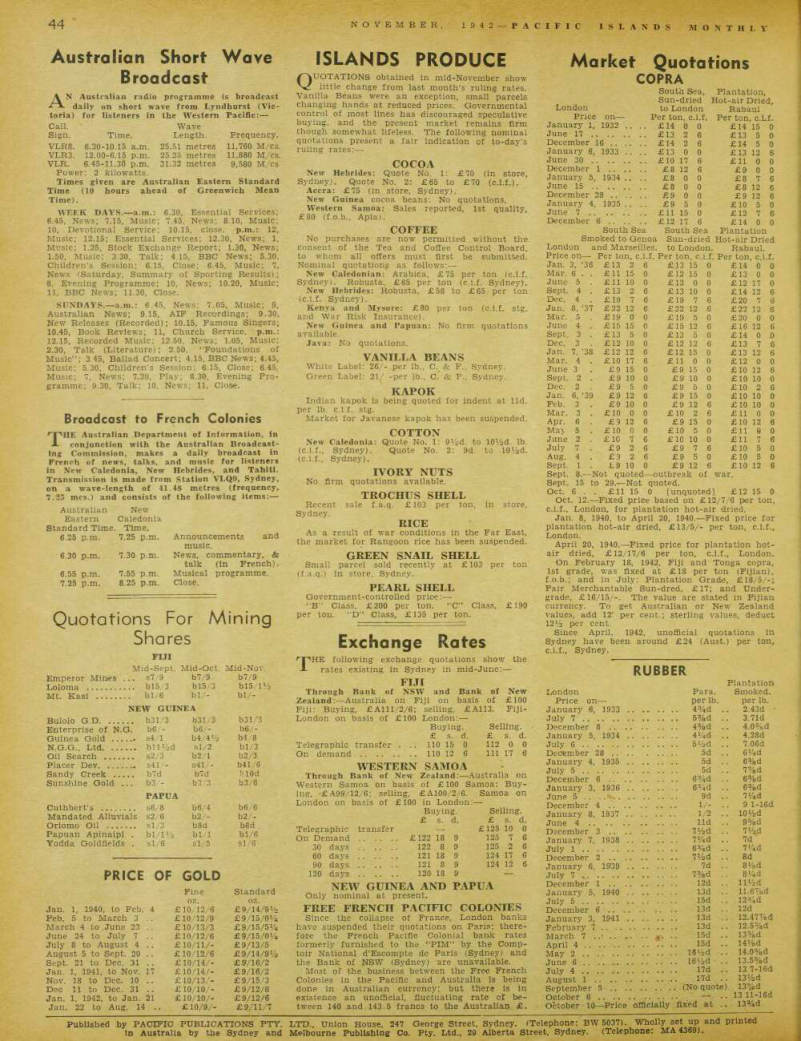
Broadcast
AN Australian radio programme is broadcast daily on short wave from Lyndhurst (Vic toria) for listeners in the Western Pacific:—
Times given are Australian Eastern Standard Time (10 hours ahead of Greenwich Mean Time).
WEEK DAYS.— a.m.: 6.30, Essential Services; 6.45, News; 7.15, Music; 7.45, News; 8.10, Music; 10, Devotional Service; 10.15, close, p.m.: 12, Music; 12.15; Essential Services; 12.30, News; 1, Music; 1.25, Stock Exchange Report; 1.30, News; 1.50, Music; 3.30, Talk; 4.15, BBC News; 5.30, Children’s Session; 6.15, Close; 6.45, Music; 7, News (Saturday, Summary of Sporting Results); 8, Evening Programme; 10, News; 10.20, Music; 11, BBC News; 11.30, Close.
SUNDAYS.—a.m.: 6.45, News; 7.05, Music; 9.
Australian News; 9.15, ATP Recordings; 9.30, New Releases (Recorded); 10.15, Famous Singers; 10.45, Book Reviews: 11, Church Service, p.m.: 12.15, Recorded Music; 12.50, News; 1.05, Music; 2.30, Talk (Literature); 2.50, “Foundations of Music”; 3.45, Ballad Concert; 4.15, BBC News; 4.45, Music; 5.30, Children’s Session; 6.15, Close; 6.45, Music; 7, News; 7.30, Play; 8.30, Evening Pro gramme; 9.30, Talk; 10, News; 11, Close.
Broadcast to French Colonies
THE Australian Department of Information, in conjunction with the Australian Broadcast ing Commission, makes a daily broadcast in French of news, talks, and music for listeners in New Caledonia, New Hebrides, and Tahiti.
Transmission is made from Station VLQ9, Sydney, on a wave-length of 41.48 metres (frequency, 7.25 mcs.) and consists of the following items:—
Call.
Wave Sign.
Time.
Length.
Frequency.
Vlr8.
6.30-10.15 a.m. 25.51 metres 11,760 M/cs.
Vlr3.
12.00-6.15 p.m. 25.25 metres 11,880 M/cs.
Vlr.
6.45-11.30 p.m. 31.32 metres 9,580 M/cs Power; 2 kilowatts.
Australian New Eastern Caledonia Standard Time. Time. 6.25 p.m. 7.25 p.m. Announcements and music. 6.30 p.m, 7.30 p.m. News, commentary, & talk (In French). 6.55 p.m. 7.55 p.m. Musical programme. 7.25 p.m. 8.25 p.m. Close.
Quotations For Mining
Shares
Fiji
Mid-Sept.
Mid-Oct.
Mid-Nov.
Emperor Mines ... s7'9 b7/9 b7/9 Loloma bl5 3 bl5/3 b15/1 Vi Mt. Kasi bl/6 bl 'bl/-
New Guinea
Bulolo G.D b31/3 b31/3 b31/3 Enterprise of N.G. b6 b6/b6/- Guinea Gold s4/l b4/4 1/ 2 b4/8 N.G.G., Ltd bllV 2 d sl/2 bl/3 Oil Search s2/3 b2/l b2/3 Placer Dev s41/s41/b41/6 Sandy Creek b7d b7d !?10d Sunshine Gold ... b3/b3/3 b3/6 Cuthbert’s
Papua
s6/8 b6/4 b6 6 Mandated Alluvials s2/6 b2/b2/- Oriomo Oil sl/3 b8d b8d Papuan Apinaipi . bl/H/2 b 1 /1 bl/6 Yodda Goldfields . sl/6 sl/5 sl/6
Price Of Gold
Fine Standard oz. oz.
Jan. 1, 1940, to Feb. 4 £10/12/6 £ 9/14/9V2 Feb. 5 to March 3 £10/12/9 £9/15/01/4 March 4 to .June 23 £10/13/3 £9/15/51/4 June 24 to July 7 £ 10/12/6 £9/15/0V4 July 8 to August 4 .. £10/11/- £9/13/5 August 5 to Sept. 20 .. £10/12/6 £9/14/91/2 Sept. 21 to Dec. 31 £10/14/- £9/16/2 Jan. 1, 1941, to Nov. 17 £10/14/- £9/16/2 Nov. 18 to Dec. 10 .. £ 10/13/- £9/15/3 Dec 11 to Dec. 31 .. £ 10/10/- £9/12/6 Jan. 1, 1942, to Jan. 21 £10/10/- £9/12/6 Jan. 22 to Aug, 14 ,. £ 10/9/- £9/11/7
Islands Produce
QUOTATIONS obtained in mid-November show little change from last month’s ruling rates.
Vanilla Beans were an exception, small parcels changing hands at reduced prices. Governmental control of most lines has discouraged speculative buying, and the present market remains firm though somewhat lifeless. The following nominal quotations present a fair indication of to-day’s ruling rates:—
Cocoa
New Hebrides: Quote No. 1: £7O (in store, Sydney). Quote No. 2: £65 to £7O (c.i.f.).
Accra: £75 (in store, Sydney).
New Guinea cocoa beans: No quotations.
Western Samoa: Sales reported, Ist quality, £BO (f.0.b., Apia).
Coffee
No purchases are now permitted without the consent of the Tea and Coffee Control Board, to whom all offers must first be submitted.
Nominal quotations as follows: New Caledonian: Arabica, £75 per ton (c.i.f.
Sydney). Robusta, £65 per ton (c.i.f. Sydney).
New Hebrides: Robusta, £5B to £65 per ton (c.i.f. Sydney).
Kenya and Mysore: £BO per ton (c.i.f. stg. and War Risk Insurance).
New Guinea and Papuan: No firm quotations available.
Java: No quotations.
Vanilla Beans
White Label: 26/- per lb., & F., Sydney.
Green Label: 21/ -per lb., C. & F., Sydney.
Kapok
Indian kapok is being quoted for indent at lid. per lb. c.i.f. stg.
Market for Javanese kapok has been suspended.
Cotton
New Caledonia: Quote No. 1: 9 J /2d. to lOMjd. lb. (c.i.f., Sydney). Quote No. 2: 9d. to lOVzd. (c.i.f., Sydney).
Ivory Nuts
No firm quotations available.
Trochus Shell
Recent sale f.a.q. £ 103 per ton, in store, Sydney.
Rice
As a result of war conditions in the Far East, the market for Rangoon rice has been suspended.
Green Snail Shell
Small parcel sold recently at £ 103 per ton (f.a.q.) in store, Sydney.
Pearl Shell
Government-controlled price:— “B” Class, £2OO per ton. “C” Class, £l9O per ton. “D” Class, £135 per ton.
Exchange Rates
THE following exchange quotations show the rates existing in Sydney in mid-June:—
Fiji
Through Bank of NSW and Bank of New Zealand;—Australia on Fiji on basis of £lOO Fiji: Buying, £Alll/2/6; selling, £AII3. Fiji- London on basis of £lOO London;—
Western Samoa
Through Bank of New Zealand;—Australia on Western Samoa on basis of £lOO Samoa: Buy ing, £A95'/12/6; selling, £AIOO/2/6. Samoa on London on basis of £lOO in London:—
New Guinea And Papua
Only nominal at present.
Free French Pacific Colonies
Since the collapse of France, London banks have suspended their quotations on Paris; there fore the French Pacific Colonial bank rates formerly furnished to the “PIM” by the Comp toir National d’Escompte de Paris (Sydney) and the Bank of NSW (Sydney) are unavailable.
Most of the business between the Free French Colonies in the Pacific and Australia is being done in Australian currency: but there is in existence an unofficial, fluctuating rate of be tween 140 and 143.5 francs to the Australian £.
Buying.
Selling. £ s. d. £ s. d.
Telegraphic transfer . .. 110 15 0 112 0 0 Op demand .. 110 12 6 111 17 6
Buying.
Selling. £ s. d. £ s. d.
Telegraphic transfer — £125 10 0 On Demand £122 18 9 125 7 6 30 days 122 8 9 125 2 6 60 days 121 18 9 124 17 6 90 days 121 8 9 124 12 6 120 days 120 18 9 —
Market Quotations
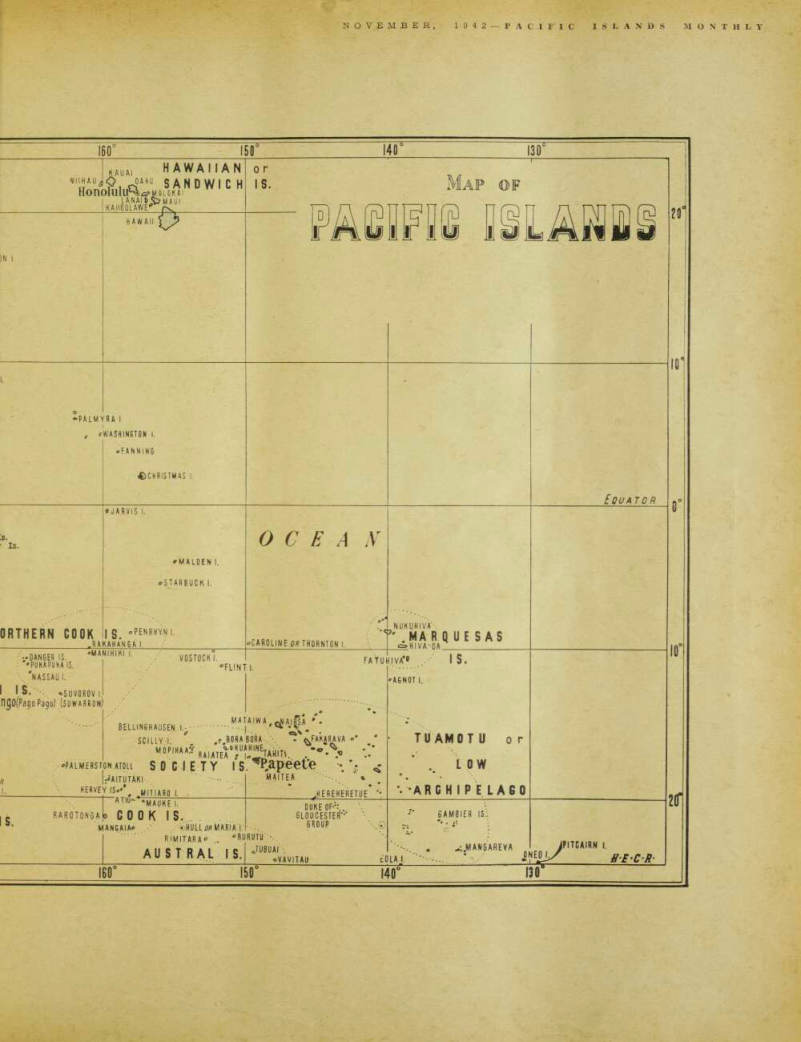
Oct. 6 . . £ll 15 0 [unquoted] £l2 15 0 Oct. 12. —Fixed price based on £l2/7/6 per ton, c.i.f., London, for plantation hot-air dried.
Jan. 8, 1940, to April 20, 1940. —Fixed price for plantation hot-air dried, £l3/5/- per ton, c.i.f., London.
April 20, 1940. —Fixed price for plantation hot air dried, £l2/17/6 per ton, c.i.f., London.
On February 18, 1942, Fiji and Tonga copra, Ist grade, was fixed at £lB per ton (Fijian), f.0.b.; and in July: Plantation Grade, £lB/5/-; Fair Merchantable Sun-dred, £l7; and Under grade, £l6/15/-. The value are stated in Fijian currency. To get Australian or New Zealand values, add 12’ per cent.; sterling values, deduct 12 Vz per cent.
Since April, 1942, unofficial quotations in Sydney have been around £24 (Aust.) per ton, c.i.f., Sydney.
London
Copra
South Sea, Sun-dried to London Plantation, Hot-air Dried, Rabaul Price on— Per ton, c.i.f.
Per ton. c.Lf.
January 1, 1932 , . £14 0 0 £14 15 0 June 17 , £13 2 6 £13 5 0 December 16 .. £14 2 6 £14 5 0 January 6, 1933 £13 0 0 £13 12 6 June 30 . £10 17 6 £11 0 0 December 1 .. £8 12 6 £9 0 0 January 5, , 1934 £8 0 0 £8 7 6 June 15 . £8 0 0 £8 12 6 December 28 .. £9 0 0 £9 12 6 January 4, , 1935 £9 5 0 £10 5 0 June 7 .. £11 15 0 £12 7 6 December 6 South Sea £12 17 6 South Sea £14 0 Plantation 0 Smoked to Genoa Sundried Hot-air Dried London and Marseilles to London.
Rabaul.
Price on— Per ton, i c.i.f.
Per ton, c.i.f.
Per ton, c.i. f.
Jan. 3, ’36 £13 2 6 £13 15 0 £14 0 0 Mar. 6 . . £11 15 0 £12 15 0 £13 0 0 June 5 . £11 10 0 £12 0 0 £12 17 0 Sept. 4 , £13 2 6 £13 10 0 £14 12 6 Dec. 4 . £19 7 6 £19 7 6 £20 7 6 Jan. 8, ’37 £22 12 6 £22 12 6 £22 12 6 Mar. 5 . £19 0 0 £19 5 0 £20 0 0 June 4 . £15 15 0 £15 12 6 £16 12 6 Sept, 3 . £13 5 0 £13 5 0 £14 0 0 Dec. 3 . £12 10 0 £12 12 6 £13 7 6 Jan. 7, ’38 £12 12 6 £12 15 0 £13 12 6 Mar, 4 . £10 17 6 £11 0 0 £12 0 0 June 3 £9 15 0 £9 15 0 £10 12 6 Sept. 2 . £9 10 0 £9 10 0 £10 10 0 Dec. 2 . £9 5 0 £9 5 0 £10 2 6 Jan. 6, ’39 £9 12 6 £9 15 0 £10 10 0 Feb. 3 . £9 10 0 £9 12 6 £10 10 0 Mar. 3 . £10 0 0 £10 2 6 £11 0 0 Apr. 6 . £9 12 6 £9 15 0 £10 12 6 May 5 . £10 0 0 £10 5 0 £11 0 0 June 2 . £10 7 6 £10 10 0 £11 7 6 July 7 . £9 2 6 £9 7 6 £10 5 0 Aug. 4 . £3 2 6 £9 5 0 £10 5 0 Sept. 1 . £9 10 0 £9 12 6 £10 12 6 Sept. 8.—Not quoted—outbreak of Sept. 15 to 29. —Not quoted. war.
Rubber
Plantation London Para.
Smoked.
Price on— per lb. per lb.
January 6, 1933 4 3 /4d .. 2.43d • July 7 5%d .. 3.71d December 8 .. . 4%d .. 4.0%d January 5, 1934 . 4V 4 d .. 4.28d July 6 5V 2 d .. 7.06d December 28 .. . 5d .. ey 4 d January 4, 1935 . 5d .. 6%d July 5 5d ., 7 7 /ad December 6 .. . 6%d .. 6%d January 3, 1936 . 6 3 /id .. 6%d June 5 9d .. 7y 4 d December 4 . . . 1/- .. 9 l-16d January 8, 1937 . 1/2 .. ioy 2 d June 4 lid .. 9 s /sd December 3 .. . 7V 2 d .. 7y a d January 7, 1938 . 7V 4 d .. 7d July 1 6%d .. ?y 4 d December 2 .. . ?y 2 d .. 8d January 6, 1939 . 7d .. 8‘/ad July 7 7%d . . sy 4 d December 1 .. . 12d ny 2 d January 5, 1940 . ... 13d .. 11.6%d July 5 15d .. 12%d December 6 .. .. 13d .. 12d January 3, 1941 . 13d .. 12.47 7 /ad February 7 .. .. 13d .. 12.5 5 /ad March 7 .. .. » . .. o •• 15d .. 13%d April 4 15d .. 14y s d May 2 16y 2 d .. 14.0 %d June 6 iey 2 d .. 13.5%d July 4 17d .. 13 7-16d August 1 17d 13y 2 d September 5 .. . (No quote) 13 %d October 6 . . 13 ll-16d October 10 — Price officially fixed at .. 13 3 / 4 d
Advertisements & other items, pp. 46-48 (2 items)
44
NOVEMBER, 1942 PACIFIC ISLANDS MONTHLY
Published by PACIFIC PUBLICATIONS PTY. LTD., Union House. 247 George Street, Sydney. (Telephone: BW 5037). Wholly set up and printed In Australia by the Sydney and Melbourne Publishing Co. Pty. Ltd., 29 Alberta Street, Sydney. (Telephone: MA 4369).
W. R. Carpenter & Co. Ltd.
• ' ■ ■*: iv v '\: I „ , f-H J>,?jij V> jK* ■ ...V! f: ? ■■ i ; :K mihH ' ?iV; m trv * 4 SM M \ i ■ v ini i ■ iplll i
Travel by CARPENTER AIRLINES
Full particulars from Macdonald, Hamilton Cr Co., or Howard Smith Ltd., Sydney.
W. R. CARPENTER & CO. LTD.
MERCHANTS, SHIPOWNERS AND AIRCRAFT OPERATORS
Agents for Australian, European and American Manufacturers, and Distributors of Every Description of Merchandise.
Buyers and Shippers of Copra, Trocas, and all Classes of Inlands Produce.
Ford Motor Company of Canada.
T. G. &■ C. Bolinders (Engines).
AGENTS FOR :
Caterpillar Tractors.
Electrolux Refrigerators, etc., etc.
Dodge Brothers Inc.
Westinghouse Electrical Co.
Branches throughout' the Pacific Islands
In London: W. R. Carpenter & Co. (London) Ltd., Coronation House, 4 Lloyds Avenue, London, EC.
Head Office: 16 O’CONNELL STREET, SYDNEY