Pacific
Islands
Monthly
October 17, 1942
Vol. Xiii. No. 3.
Established 1930
I Registered at the G.P.0., Sydney , for transmission by post as a newspaper ]
8 a
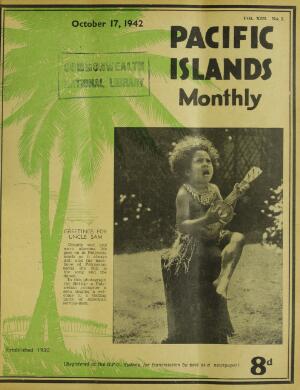
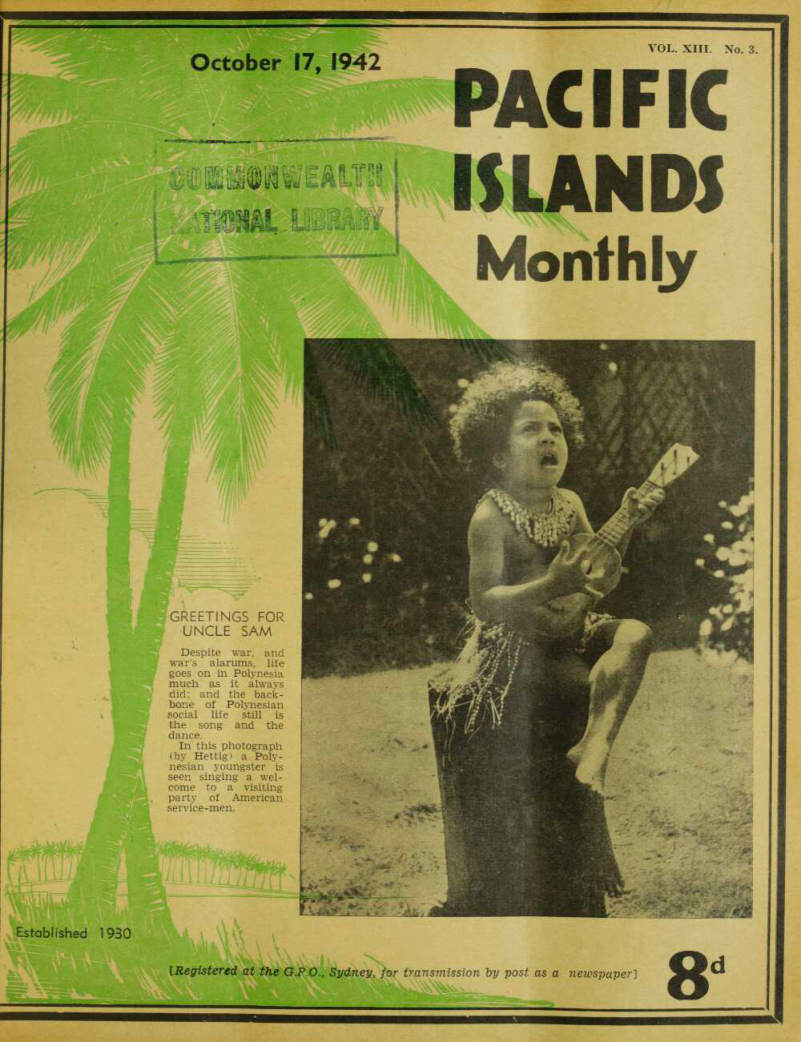
Greetings For
Uncle Sam
Despite war, and war’s alarums, life goes on in Polynesia much as it always did; and the back bone of Polynesian social life still is the song and the dance.
In this photograph (by Hettig) a Poly nesian youngster is seen singing a wel come to a visiting party of American service-men.
Pacific News-Review
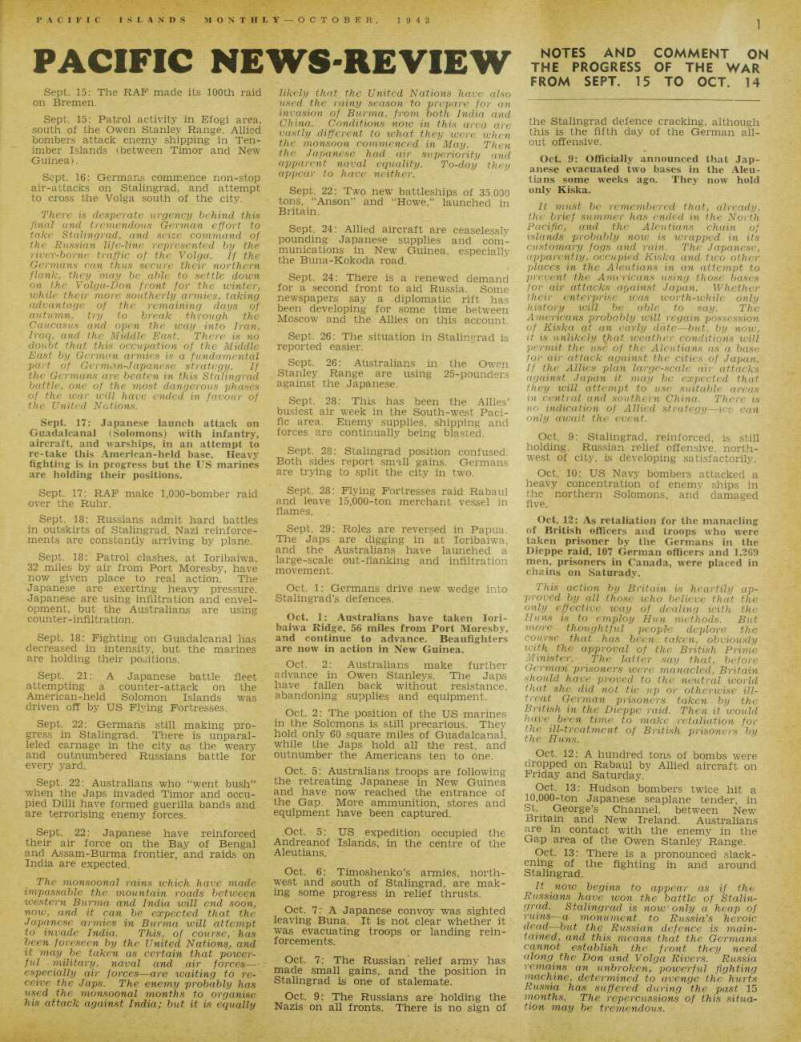
Notes And Comment On
The Progress Of The War
From Sept. 15 To Oct. 14
Sept. 15; The RAF made its 100th raid on Bremen.
Sept. 15: Patrol activity in Efogi area, south of the Owen Stanley Range. Allied bombers attack enemy shipping in Ten imber Islands (between Timor and New Guinea).
Sept. 16: Germans commence non-stop air-attacks on Stalingrad, and attempt to cross the Volga south of the city.
There is desperate urgency behind this final and tremendous German effort to take Stalingrad, and seize command of the Russian life-line represented by the river-borne traffic of the Volga. If the Germans can thus secure their northern flank, they may be able to settle down on the Volga-Don front for the winter, while their more southerly armies, taking advantage of the remaining days of autumn, try to break through the Caucasus and open the way into Iran, Iraq, and the Middle East. There is no doubt that this occupation of the Middle East by German armies is a fundamental part of Germa.n-Japanese strategy. If the Germans are beaten in this Stalingrad battle, one of the most dangerous phases of the war will have ended in favour of the United Nations.
Sept. 17: Japanese launch attack on Guadalcanal (Solomons) with infantry, aircraft, and warships, in an attempt to re-take this American-held base. Heavy fighting is in progress but the US marines are holding their positions.
Sept. 17: RAF make 1,000-bomber raid over the Ruhr.
Sept. 18: Russians admit hard battles in outskirts of Stalingrad. Nazi reinforce ments are constantly arriving by plane.
Sept. 18: Patrol clashes, at loribaiwa, 32 miles by air from Port Moresby, have now given place to real action. The Japanese are exerting heavy pressure.
Japanese are using infiltration and envel opment, but the Australians are using counter-infiltration.
Sept. 18: Fighting on Guadalcanal has decreased in intensity, but the marines are holding their positions.
Sept. 21: A Japanese battle fleet attempting a counter-attack on the American-held Solomon Islands was driven off by US Flying Fortresses.
Sept. 22: Germans still making pro gress in Stalingrad. There is unparal leled carnage in the city as the weary and outnumbered Russians battle for every yard.
Sept. 22: Australians who “went bush” when the Japs invaded Timor and occu pied Dilli have formed guerilla bands and are terrorising enemy forces.
Sept. 22; Japanese have reinforced their air force on the Bay of Bengal and Assam-Burma frontier, and raids on India are expected.
The monsoonal rains which have made impassable the mountain roads between western Burma and India will end soon, now, and it can be expected that the Japanese armies in Burma will attempt to invade India. This, of course, has been foreseen by the United Nations, and it may be taken as certain that power ful military, naval and air forces — especially air forces —are waiting to re ceive the Japs. The enemy probably has used the monsoonal months to organise his attack against India; but it is equally
likely that the United Nations have also used the rainy season to prepare for an invasion of Burma, from both India and China. Conditions now in this area are vastly different to what they were when the monsoon commenced in May. Then the Japanese had air superiority and apparent naval equality. To-day they appear to have neither.
Sept. 22: Two new battleships of 35.000 tons, “Anson” and “Howe,” launched in Britain.
Sept. 24: Allied aircraft are ceaselessly pounding Japanese supplies and com munications in New Guinea, especially the Buna-Kokoda road.
Sept. 24: There is a renewed demand for a second front to aid Russia. Some newspapers say a diplomatic rift has been developing for some time between Moscow and the Allies on this account.
Sept. 26: The situation in Stalingrad is reported easier.
Sept. 26: Australians in the Owen Stanley Range are using 25-pounders against the Japanese.
Sept. 28: This has been the Allies’ busiest air week in the South-west Paci fic area. Enemy supplies, shipping and forces are continually being blasted.
Sept. 28: Stalingrad position confused.
Both sides report small gains. Germans are trying to split the city in two.
Sept. 28: Flying Fortresses raid Rabaul and leave 15,000-ton merchant vessel in flames.
Sept. 29: Roles are reversed in Papua.
The Japs are digging in at loribaiwa, and the Australians have launched a large-scale out-flanking and infiltration movement.
Oct. 1: Germans drive new wedge into Stalingrad’s defences.
Oct. 1: Australians have taken lori baiwa Ridge, 56 miles from Port Moresby, and continue to advance. Beaufighters are now in action in New Guinea.
Oct. 2; Australians make further advance in Owen Stanleys. The Japs have fallen back without resistance, abandoning supplies and equipment.
Oct. 2: The position of the US marines in the Solomons is still precarious. They hold only 60 square miles of Guadalcanal, while the Japs hold all the rest, and outnumber the Americans ten to one.
Oct. 5: Australians troops are following the retreating Japanese in New Guinea and have now reached the entrance of the Gap. More ammunition, stores and equipment have been captured.
Oct. 5: US expedition occupied the Andreanof Islands, in the centre of the Aleutians.
Oct. 6: Timoshenko’s armies, north west and south of Stalingrad, are mak ing some progress in relief thrusts.
Oct. 7: A Japanese convoy was sighted leaving Buna. It is not clear whether it was evacuating troops or landing rein forcements.
Oct. 7: The Russian relief army has made small gains, and the position in Stalingrad is one of stalemate.
Oct. 9: The Russians are holding the Nazis on all fronts. There is no sign of
the Stalingrad defence cracking, although this is the fifth day of the German all out offensive.
Oct. 9: Officially announced that Jap anese evacuated two bases in the Aleu tians some weeks ago. They now hold only Kiska.
It must be remembered that, already, the brief summer has ended in the North Pacific, and the Aleutians chain of islands probably now is wrapped in its customary fogs and rain. The Japanese, apparently, occupied Kiska and two other places in the Aleutians in an attempt to prevent the Americans using those bases for air attacks against Japan. Whether their enterprise was worth-while only history will be able to say. The Americans probably will regain possession of Kiska at an early date — but. by now, it is unlikely that weather conditions will permit the use of the Aleutians as a base tor air attack against the cities of Japan.
If the Allies plan large-scale air attacks against Japan it may be expected that they will attempt to use suitable areas in central and southern China. There is no indication of Allied strategy—we can only await the event.
Oct. 9: Stalingrad, reinforced, is still holding. Russian relief offensive, north west of city, is developing satisfactorily.
Oct. 10; US Navy bombers attacked a heavy concentration of enemy ships in the northern Solomons, and damaged five.
Oct. 12: As retaliation for the manacling of British officers and troops who were taken prisoner by the Germans in the Dieppe raid, 107 German officers and 1,269 men, prisoners in Canada, were placed in chains on Saturady.
This action by Britain is heartily ap proved by all those who believe that the only effective way of dealing with the Huns is to employ Hun methods. But more thoughtful people deplore the course that has been taken , obviously with the approval of the British Prime Minister. The latter say that, before German prisoners were manacled, Britain should have proved to the neutral world that she did not tie up or otherwise ill treat German prisoners taken by the British in the Dieppe raid. Then it would have been time to make retaliation for the ill-treatment of British prisoners by the Huns.
Oct. 12: A hundred tons of bombs were dropped on Rabaul by Allied aircraft on Friday and Saturday.
Oct. 13: Hudson bombers twice hit a 10,000-ton Japanese seaplane tender, in St. George’s Channel, between New Britain and New Ireland. Australians are in contact with the enemy in the Gap area of the Owen Stanley Range.
Oct. 13: There is a pronounced slack ening of the fighting in and around Stalingrad.
It now begins to appear as if th-e Russians have won the battle of Stalin grad. Stalingrad is now only a heap of ruins—a monument to Russia’s heroic dead—but the Russian defence is main tained, and this means that the Germans cannot establish the front they need along the Don and Volga Rivers. Russia remains an unbroken r powerful fighting machine, determined to avenge the hurts Russia has suffered during the past 15 7nonths. The repercussions of this situa tion may be tremendous.
Contents
Japan is Out on the End of a Bough 3 Cartoon by ROX 4 Practical Help for Evacuees .. ... 5 Battles in South Pacific .. . .. .. 3 M. Mansard Dead 6 Capt. MacEachran Killed by Enemy Shell 7 Buna-Kokoda Region 8 Letters From Rabaul Men 9 National Service in Fiji 10 Henri Sautot 11 Solomon Islands Battle 12 Port Moresby’s Third Club 14 Nippon is “Wining” 16 Vava of the Tiare 19 What Hurricane Did to Palmerston Island 20 Tahiti Chinese as Barometer 21 Tahiti’s Earliest Aviators 22 Roll of Honour 23 Use of Coconuts 26 Fighting for Their Rights 28 Missing Submarine 30 “Week-end Heaven” 31 Old Days in Louisiades 34 Death of Rev. O. C. Lelean 35 Free French Finance 36 First Battles on Buna-Kokoda Road 37
Advertisers
Amalgamated Wire less (A/sia) Ltd. 312 Atkins Pty Ltd., Wm 26 Broomfields Ltd. . . 38 Brown & Co. Ltd., G 13 Brunton’s Flour . . 24 B.P. (S.S.) Co. . . . 20 Burns, Philp Trust Co. Ltd 15 Carlton & United Breweries Ltd. . . 19 Carpenter Ltd., W.
R cov. 4 Chivers & Sons Ltd. 22 Coleman Lamp & Stove Co 39 “Cystex” 39 Donaghy & Sons Ltd 35 Donald Ltd., A. B. . 28 Dr. Williams Pink Pills 41 Electrolux Refrigerators ... 18 “Flit” 38 Foster Clark (Aust.) Ltd 36 Garrett & Davidson 34 Gilbey’s Gin . . . .40 Gillespie’s Flour . . 31 Grand Pacific Hotel 2 Grove & Sons, W.
H 16 Holbrook’s Ltd. . . 37
International Correspondence School 13 Jantzen Ltd. . . .IT Kambala School for Girls 16 Kopsen & Co. Ltd. . 29 Maxwell Porter Ltd. 42 “M?ndaco” ... 40 Miller & Co. Pty.
Ltd 41 Nelson & Robertson Pty. Ltd 27 Noyes Bros. Ltd. . . 35 Old Monk Olive Oil . . 16, 20, 24, 31 Pacific Is. Society . 33 “Pinkettes” ... 30 Prescott Ltd 22 Riverstone Meat Co.
Ltd 25 Rohu, Sil 39 Rose’s Eye Lotion . 44 Scott Ltd., J 28 Steamships Trading Co. Ltd 33 Sullivan & Co. ... 48 Swallow & Ariell . . 21 Taylor & Co., A. . . 42 “Tenax” Soap ... 30 Tillock & Co. Ltd. . 24 “Vi-stim” 34 Wright & Co. ... 42 Wright & Co. Ltd., E 27 Wunderlich Ltd. . . 27
Advertisements & other items, p. 4 (3 items)
Useful Addresses
rE following are the Sydney addresses of organisations set up temporarily to deal with Pacific Territories affairs —and especially matters connected with the evacuation of the Territories.
PAPUA, NEW GUINEA, NAURU
NORFOLK IS.
Department of External Territories (Sydney Branch) (Lately the New Guinea Trade Agency), Australia House, Carrington Street, Sydney.
Telephone: BW 1776. (Dealing with aU matters connected with the Australian Pacific Territories and also the Sydney representative of the New Guinea Copra Control Committee.)
BRITISH SOLOMON ISLANDS
Sydney Office of British Solomon Islands Government, (In charge of Mr. F. E. Johnson.
Treasurer of the Solomons Administration), 17 Castlereagh Street, Sydney.
Telephone: B 1710.
GILBERT AND ELLICE, AND
OCEAN IS.
Sydney Office of Gilbert and Ellice Islands Colony (In charge of Mr. S. G. Clarke, Acting Resident Commissioner of G. and E. Administration), Bank of New Zealand Building, George Street, Sydney. Telephone: B 2309.
FOR PACIFIC TERRITORIES
EVACUEES GENERALLY
Pacific Territories Association (C. A. M. Adelskold, Secretary), c/o Robert Gillespie Pty., Ltd., 54a Pitt Street, Sydney, Telephone: BW 4782.
STEAMSHIPS TRADING CO.
OF PAPUA
Sydney Office: Nelson and Robertson Pty., Ltd., Telephone: B 6461. 12 Spring Street, Sydney.
Mr. Arthur Barnes, formerly account-
Mr. Arthur Barnes, formerly accountant with Burns, Philp & Co.. Port Moresby, has been engaged in attending to the affairs of the British New Guinea Trading Co. in Sydney since the departure of Mr. E. J, Frame, who is now stationed at Townsville (Q.).
Mr. Ivan Champion, formerly patrol officer and magistrate in Papua, with many notable explorations to his credit, is now the captain of a vessel once wellknown in New Guinea waters. Reports
fjcss®
from New Guinea say he has been responsible for much good and useful service, not the least of which was the rescue of a number of residents who escaped after the Japanese occupied Rabaul.
A new book by Mr. Lewis Lett, “Papuan Achievement,” will be published shortly by the Melbourne University Press.
Hsr As oVer ' oro^ dS , ftC ‘Gr> PlC d «* '" l rb oor- ** , , w W . **£* — — **%« .. *** . $»'*•• * 0 * • O b ' e '
fjcss®
Pacific Islands Monthly
The Newspaper-Magazine of the South Seas [Registered at the G.P.0., Sydney , for transmission by post as a newspaper A
Published Once Each Month and Circulated in Australia and New Zealand and in the following Pacific Territories and Islands Groups;
Australian Territory of Papua.
Mandated Territory (Australia) of New Guinea.
Australian Territory of Norfolk Island.
New Zealand Territory of Cook Islands.
Mandated Territory (NZ) of Western Samoa.
British Colony of Fiji.
British Solomon Islands Protectorate.
British Protectorate of Tongan Islands.
British Crown Colony of Gilbert and Ellice Islands.
Mandated Territory of Nauru.
British and Free French Condominium of New Hebrides.
Free French Colony of New Caledonia.
Free French Colony of Oceania (Tahiti, etc.).
American Territory of Eastern Samoa.
American Territory of Hawaiian Islands,
Owned and Produced by Pacific Publications Pty. Ltd., Union House, 247 George Street, Sydney.
TELEPHONE f Managing Director .. BW 5037 I Business and Editorial MA 4369
P.O. Box 3408 R
Registered Address of Telegrams, Radiograms, and Cables: “Pacpub”, Sydney,
Contributions.
Articles, Stories, and Photographs dealing with Pacific Islands subjects are invited and will be paid for on publication.
Subscription Rates.
Per Annum, within British Empire, Prepaid, Post Free 8/- Per Annum, elsewhere, prepaid, Post Free. 107- Single Copies sd.
Editor and Publisher:
R. W. Robson, F.R.G.S.
Advertising Manager: L. W. Bailey.
Advertising Office and Printing-House: 29 Alberta Street, Sydney.
Advertising rates furnished on application.
Colours, etc., by arrangement.
Process Blocks made at Advertiser’s expense when required. Screen 100.
Changes of Advertising Copy should reach this office by Ist of each month, otherwise previous advertisement may be repeated.
Representative In London.
W. C. Harvey, Coronation House, 4 Lloyds Avenue, London, E.C.3, from whom may be obtained copies of Pacific Islands Monthly, Pacific Is. Year Book, advertising schedules, etc.
Agents.
The following are authorised to receive sub scriptions for Pacific Islands Monthly:— Burns, Philp & Co., Ltd., and Burns Philp (South Sea) Co., Ltd. All branches.
W. R. Carpenter & Co., Ltd. All branches.
Morris, Hedstrom, Ltd. All branches.
Steamships Trading Co., Papua. All branches.
B.N.G. Trading Co., Ltd., Port Moresby, Papua.
J. Muir, Suva, Fiji.
Miss R. Castles, Suva, Fiji.
N. C, Mackenzie Hunt, Wainunu, Bua, Fiji.
Kirpal & Co., Victoria Parade, Suva, Fiji.
Cook Islands Trading Co., Rarotonga, Cook Is.
A. C. Rowland, Papeete, Tahiti.
Islands Branches and Representatives of W. H.
Grove & Sons, Ltd., Auckland, New Zealand.
Ed. Pentecost, Noumea, New Caledonia.
Kerr & Co., Noumea, New Caledonia.
Vol. XIII. No. 3.
October 17, 1 942
Prir<° i Bd > Per Copy rnce £ Prepaid: 8/- p.a.
the hithprtn^inrbnL h I J ndo ;9 hlna :
JAPAN IS OUT ON THE END OF A BOUGH
months have passed since the A Japanese reached the farthest limit of their territorial gains—Tulagi, on May 4, and Western Burma, about May 14—and we of the Pacific are inclined to believe that a “turningpoint” has been reached. Some expect to see the growing forces of the United Nations very soon driving the Japs back out of the equatorial islands, as a first step in their policy of “Japan for the Japanese.”
That is foolish, wishful thinking, see i? aS r before exodus Ja P an ? se now of thp ai ßrnf<fn f + ll P° s ? essiol J Honekonff Maifv! Rur territories of Islands g ßn^npn ya, Nmli n ?- a ’ . Andama 4 nart nf thP G^ a L a ? d the FrP7nph 6 ? r d^ Gl /^ ertS; the hithprtn^inrbnL h I J ndo ;9 hlna : Siam- thp AmpHnS?? 11 ? ? a i 10 r? ° f monwealth the huge, valuable Dutch territory of Netherlands Indies. And among the many Western ideas adopted by Japan is that first expressed in London in the phrase “What we have we hold.”
We may not forget the history of Japan’s occupation of the Marshall and Caroline Islands, after World War I. Japan, with a cynical grin, accepted from the League of Nations an open Mandate to govern the Carolmes, Marianas and Marshalls.
But the Japanese immediately took such complete possession of the three groups that no Europeans were
allowed to enter any except the main port; and the policy of rooting out every trace of Europeans was carried to such a limit that even Euronesian families (descendants of Germans who had married Marshall and Caro line women) were driven out—most of them to the British Gilberts.
Within a few years, Japan had left the League of Nations, and the Man date farce ended. The Marshall, Caroline and Mariana Islands became the closest possible preserve of Japan.
One may see the same spirit and principle in the history of Japanese “colonisation” in Korea and Man churia. Having once got in, the little men hang on with tooth and claw.
Only a large club applied to the honourable head, or a larger bomb placed near the even more honour able tail, will separate the Jap from his territorial booty.
FIVE months have passed, and the only apparent changes on the Asia-Pacific front appear to be in our favour—the important naval defeats inflicted on the Japanese in the Coral Sea, at Midway Island and in the Solomons, and comparatively un important land operations on the mainland of New Guinea.
But, beneath the surface in this Pacific area, there are terrific move ment and preparation. We have some idea of what our United Nations are doing. We may be perfectly cer tain that the enemy is similarly busy.
Let us remember what happened in the Solomons.
The 'Japs occupied Tulagi on May 4. When the Americans, in August, threw the enemy out of the Tulagi area, we were startled to find out how much he had accomplished in three months. All the headlands and little islands around Tulagi had been fortified; accommodation and sup plies had been provided for large numbers of troops; a seaplane base had been established, and a naval base (for which a surprising amount of equipment had been brought for ward) was well advanced; a new landing-field for planes had been hewn out of the coastal jungle of primitive Guadalcanal.
If the Japanese could do all this so quickly, at the extreme end of their dangerously long lines of communi cation, imagine what is happening in all the occupied countries nearer to Japan—especially in territories like Malaya, Singapore, Philippines, Bor neo, East Indies, and Indo-China and Burma, where the invaders can en slave unlimited local labour, and use enormous quantities of material abandoned by the Allies. We may be certain that every territory is not only being stripped of all its available wealth by swarms of Jap organisers and technicians, but also that all the energy and skill of Japan’s armed forces are being directed to creating, in each territory, a defence calculated to break the heart of any attack.
'T'HESE recent weeks have repre- JL sented, in a sense, a turning point in the Pacific war; but not a
point at which the Japanese turn back. They represent, rather, a change in the character of the war.
The Japanese have ceased their out wards thrust. They show no dis position to throw their forces against Che defences_created by the United Nations in India and Ceylon, China and Australia, the South Seas Islands and Hawaii.
The Japs are, instead, getting ready to defend their territorial gains, with every device of modern war. They have grabbed, with much success; now they must hold what they have grabbed. The hyena is digging in his claws for a firm grip on the bodies of his victims, and his snarl indicates that he will fight, with ruthlessness and fanaticism, so that he may retain at least a portion of his evil booty.
Japan, in the matter of territorial gains—“counters with which to bar gain”—appears to be in a position of some advantage. But let us not sup pose that Japan is either happy or confident. The headache that is be ing suffered by Mr. Tojo of Tokio is comparable only with that which furrows the noble brow of Mr. Hitler of Berlin.
Because, prior to December 7, we held Japan coo cheaply; and because, after December 7, we beheld with dismay the success of a new technique designed for jungle-sneaking and islands-hopping, and perfected in long, secret years of intensive train ing, at which we had not even guessed . . . because of these things, we are inclined now to credit the Japanese with initiative, aggressive ness and omniscience which they do not possess. If one listened long to the quacking of some arm-chair strategists, one v/ould suppose that all military genius is concentrated in Berlin and Tokio, and that the men who directed magnificent peacetime organisations from London, New York and Moscow are incapable of switch ing over to the direction of a great war.
WHEN the Atlantic Charter was signed, and when the United States, Great Britain, Russia and China went to war as the United Nations, the United Nations’ leaders began to plan for a victory that would be a certainty, and not a com promise. They started a long way back, and they began to dig deep.
Seeing them at work, one is some how reminded of the way that an Anglo-American concern, Bulolo Gold Dredging, Limited, began operations in New Guinea. There was a valley, in Central New Guinea, thick with gold, but cut off from the sea and civilisation by impenetrable moun tains (the same kind of mountains which have baffled the Japs). Many people called it a hopeless proposi tion. BGD, making the fullest use of commercial genius and technical ex perts, dealing with conditions entirely unique, prepared a deliberate, long distance plan.
Great, freight-carrying planes were bought in Europe, wherewith to carry over the mountains the necessary men and supplies; dredges, with
which to dig the gold, were fabricated in America and Australia, in such a manner that every bit could be carried in aeroplanes; hydro-electric plant was designed and built and flown in to specially selected places among the mountain streams, so that hydroelectric power was available to drive the dredges, light the little towns which sprang up, run the cinemas and do the cooking in the modern bungalows provided for the staff.
There had to be far-reaching as well as long-distance planning—expert aviators, and groundsmen for the aeroplanes, gardens to provide fresh foodstuffs, sawmillers and roadmakers and school teachers. The plan extended over several years; and everything clicked into place as if it were a piece of beautifully-turned machinerv. BGD started with a remote, tropical valley and an idea; ten years later, eight modern dredges were operating, four towns buzzed, and New Guinea was getting the benefit of a gold production worth over two millions per annum.
That is exactly what the United Nations are doing in relation to this global war: precise, calculated, long-distance planning, that admits of no failure. Everything is clicking into place. The growing power of the United Nations is as irresistible as their spirit is unquenchable. This war will be won; and a shrewd observer, if he can get these worldwide events into focus, should be able to say when it will be won.
These things are better known to
our enemy than to us. The troubled brows of Tokio’s war-lords, if we could but see them, would indicate their anxiety, very plainly. Then, one naturally asks, why did Japan go to war? Did she expect to gain more than she has gained? Did she not work to a clear-cut plan, and did she not expect the democracies to fight back?
The answer is that Japan’s great plan of Asiatic-Pacific conquest did go most seriously awry, and Japan’s leaders now are anxiously preparing for a long and bitter war.
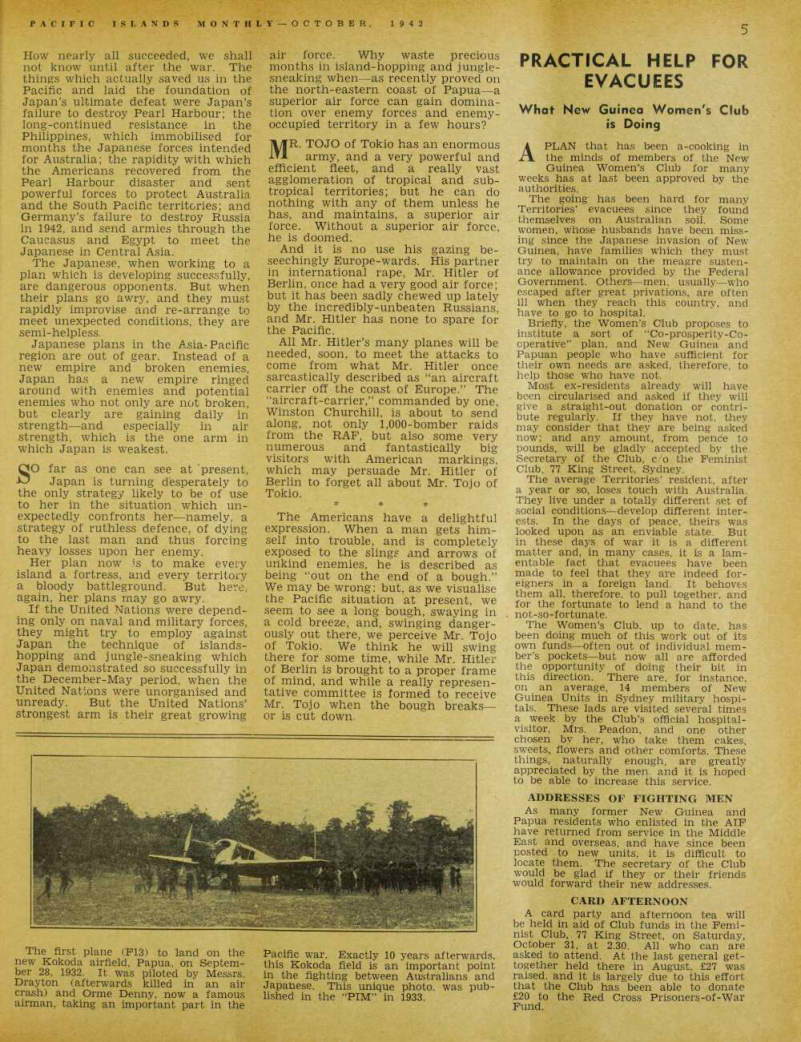
THE plan upon which Japan launched herself on December 7 envisaged the seizure and occupation of all the countries which she has seized and over-run. But Japan knew that, if she were to hold her gains, she must render a successful counter attack from the United States and Britain unlikely. Vital parts of her plan were:— The destruction of the Pe*arl Harbour base and the crippling of American naval power in the Pacific; The destruction of British naval power in the Far East, so that Singa pore and the East Indies could be made useless, and India raised against Britain; The over-running and crippling of China; The occupation of Australia, New Zealand and the South Pacific Islands, so as to deny the democracies a possible base for operations from the south.
Only one of those plans succeeded.
First Burglar (organiser of "New Order in Europe"), to Second Burglar (organiser of "Co-Prosperity Sphere"): "Don't look round now-But!"
How nearly all succeeded, we shall not know until after the war. The things which actually saved us in the Pacific and laid the foundation of Japan’s ultimate defeat were Japan’s failure to destroy Pearl Harbour; the long-continued resistance in the Philippines, which immobilised for months the Japanese forces intended for Australia; the rapidity with which the Americans recovered from the Pearl Harbour disaster and sent powerful forces to protect Australia and the South Pacific territories; and Germany’s failure to destroy Russia in 1942, and send armies through the Caucasus and Egypt to meet the Japanese in Central Asia.
The Japanese, when working to a plan which is developing successfully, are dangerous opponents. But when their plans go awry, and they must rapidly improvise and re-arrange to meet unexpected conditions, they are semi-helpless.
Japanese plans in the Asia-Pacific region are out of gear. Instead of a new empire and broken enemies, Japan has a new empire ringed around with enemies and potential enemies who not only are not broken, but clearly are gaining daily in strength—and especially in air strength, which is the one arm in which Japan is weakest.
SO far as one can see at present, Japan is turning desperately to the only strategy likely to be of use to her in the situation, which un expectedly confronts her—namely, a strategy of ruthless defence, of dying to the last man and thus forcing heavy losses upon her enemy.
Her plan now is to make every island a fortress, and every territory a bloody battleground. But here, again, her plans may go awry.
If the United Nations were depend ing only on naval and military forces, they might try to employ against Japan the technique of islands hopping and jungle-sneaking which Japan demonstrated so successfully in the December-May period, when the United Nations were unorganised and unready. But the United Nations’ strongest arm is their great growing
air force. Why waste precious months in island-hopping and jungle sneaking when—as recently proved on the north-eastern coast of Papua—a superior air force can gain domina tion over enemy forces and enemy occupied territory in a few hours?
MR. TOJO of Tokio has an enormous army, and a very powerful and efficient fleet, and a really vast agglomeration of tropical and sub tropical territories; but he can do nothing with any of them unless he has, and maintains, a superior air force. Without a superior air force, he is doomed.
And it is no use his gazing be seechingly Europe-wards. His partner in international rape, Mr. Hitler of Berlin, once had a very good air force; but it has been sadly chewed up lately by the incredibly-unbeaten Russians, and Mr. Hitler has none to spare for the Pacific.
All Mr. Hitler’s many planes will be needed, soon, to meet the attacks to come from what Mr. Hitler once sarcastically described as “an aircraft carrier off the coast of Europe.” The “aircraft-carrier,” commanded by one, Winston Churchill, is about to send along, not only 1,000-bomber raids from the RAF, but also some very numerous and fantastically big visitors with American markings, which may persuade Mr. Hitler of Berlin to forget all about Mr. Tojo of Tokio. * * ♦ The Americans have a delightful expression. When a man gets him self into trouble, and is completely exposed to the slings and arrows of unkind enemies, he is described as being “out on the end of a bough.”
We may be wrong: but, as we visualise the Pacific situation at present, we seem to see a long bough, swaying in a cold breeze, and, swinging danger ously out there, we perceive Mr. Tojo of Tokio. We think he will swing there for some time, while Mr. Hitler of Berlin is brought to a proper frame of mind, and while a really represen tative committee is formed to receive Mr. Tojo when the bough breaks — or is cut down.
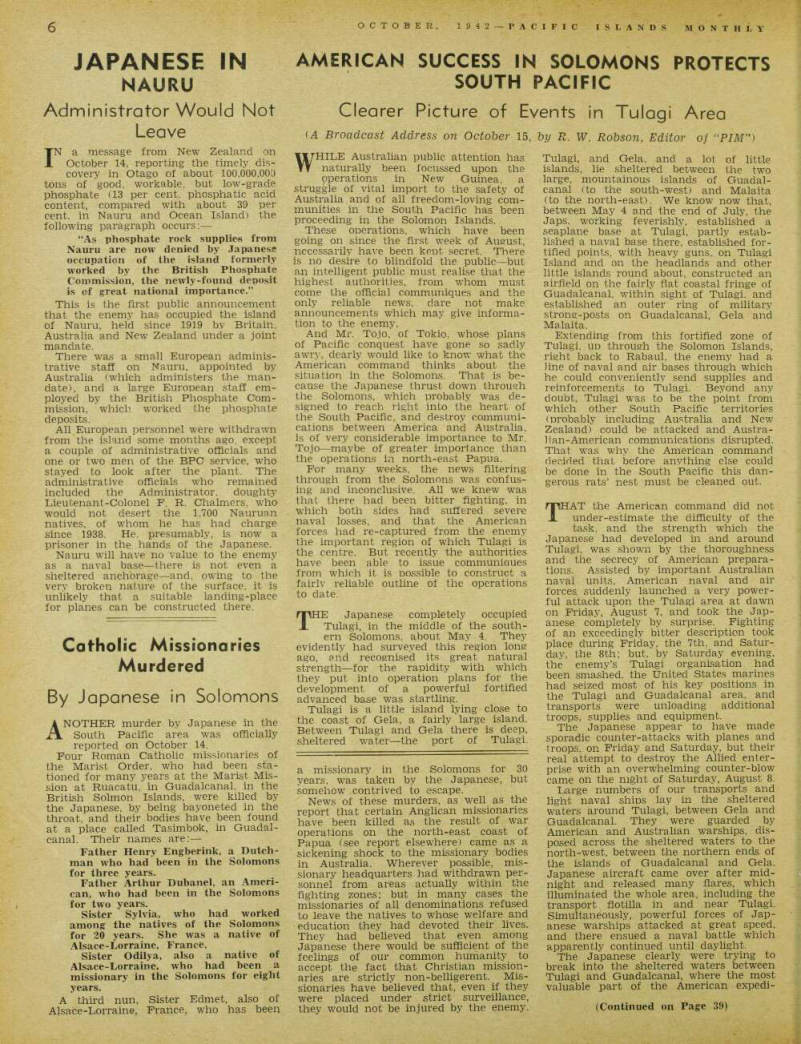
The first plane (Fl 3) to land on the new Kokoda airfield, Papua, on Septem ber 28, 1932. It was piloted by Messrs.
Drayton (afterwards killed in an air crash) and Orme Denny, now a famous airman, taking an important part in the
Pacific war. Exactly 10 years afterwards, this Kokoda field is an important point in the fighting between Australians and Japanese. This unique photo, was pub lished in the "PIM” in 1933.
Evacuees
Practical Help For
What New Guinea Women's Club is Doing
A PLAN that has been a-cooking in the minds of members of the New Guinea Women’s Club for many weeks has at last been approved by the authorities.
The going has been hard for many Territories’ evacuees since they found themselves on Australian soil. Some women, whose husbands have been miss ing since the Japanese invasion of New Guinea, have families which they must try to maintain on the meagre susten ance allowance provided by the Federal Government. Others —men. usually—who escaped after great privations, are often ill when they reach this country, and have to go to hospital.
Briefly, the Women’s Club proposes to institute a sort of “Co-prosperity-Co cperative” plan, and New Guinea and Papuan people who have sufficient for their own needs are asked, therefore, to help those who have not.
Most ex-residents already will have been circularised and asked if they will give a straight-out donation or contri bute regularly. If they have not, they may consider that they are being asked now; and any amount, from pence to pounds, will be gladly accepted by the Secretary of the Club, c/o the Feminist Club, 77 King Street, Sydney.
The average Territories’ resident, after a year or so, loses touch with Australia.
They live under a totally different set of social conditions—develop different inter ests. In the days of peace, theirs was looked upon as an enviable state. But in these days of war it is a different matter and, in many cases, it is a lam entable fact that evacuees have been made to feel that they are indeed for eigners in a foreign land. It behoves them all. therefore, to pull together, and for the fortunate to lend a hand to the not-so-fortunate.
The Women’s Club, up to date, has been doing much of this work out of its own funds —often out of individual mem ber’s pockets—but now all are afforded the opportunity of doing their bit in this direction. There are, for instance, on an average, 14 members of New Guinea Units in Sydney military hospi tals. These lads are visited several times a week by the Club’s official hospital visitor, Mrs. Peadon, and one other chosen by her, who take them cakes, sweets, flowers and other comforts. These things, naturally enough, are greatly appreciated by the men, and it is hoped to be able to increase this service.
Addresses Of Fighting Men
As many former New Guinea and Papua residents who enlisted in the AIF have returned from service in the Middle East and overseas, and have since been posted to new units, it is difficult to locate them. The secretary of the Club would be glad if they or their friends would forward their new addresses.
Card Afternoon
A card party and afternoon tea will be held in aid of Club funds in the Femi nist Club, 77 King Street, on Saturday, October 31, at 2.30. All who can are asked to attend. At the last general get together held there in August, £27 was raised, and it is largely due to this effort that the Club has been able to donate £2O to the Red Cross Prisoners-of-War Fund.
Japanese In
Nauru
Administrator Would Not Leave
IN a message from New Zealand on October 14. reporting the timely dis covery in Otago of about 100,000,000 tons of good, workable, but low-grade phosphate (13 per cent, phosphatic acid content, compared with about 39 per cent, in Nauru and Ocean Island) the following paragraph occurs:— “As phosphate rock supplies from Nauru are now denied by Japanese occupation of the island formerly worked by the British Phosphate Commission, the newly-found deposit is of great national importance.”
This is the first public announcement that the enemy has occupied the island of Nauru, held since 1919 by Britain, Australia and New Zealand under a joint mandate.
There was a small European adminis trative staff on Nauru, appointed by Australia (which administers the man date), and a large European staff em ployed by the British Phosphate Com mission, which worked the phosphate deposits.
All European personnel were withdrawn from the island some months ago, except a couple of administrative officials and one or two men of the BPC service, who stayed to look after the plant. The administrative officials who remained included the Administrator, doughty Lieutenant-Colonel F. R. Chalmers, who would not desert the 1,700 Nauruan natives, of whom he has had charge since 1938. He, presumably, is now a prisoner in the hands of the Japanese.
Nauru will have no value to the enemy as a naval base—there is not even a sheltered anchorage—and, owing to the very broken nature of the surface, it is unlikely that a suitable landing-place for planes can be constructed there.
By Japanese in Solomons
Catholic Missionaries Murdered By Japanese in Solomons
ANOTHER murder by Japanese in the South Pacific area was officially reported on October 14.
Four Roman Catholic missionaries of the Marist Order, who had been sta tioned for many years at the Marist Mis sion at Ruacatu, in Guadalcanal, in the British Solmon Islands, were killed by the Japanese, by being bayoneted in the throat, and their bodies have been found at a place called Tasimbok, in Guadal canal. Their names are: — Father Henry Engberink. a Dutch man who had been in the Solomons for three years.
Father Arthur Dubanel, an Ameri can, who had been in the Solomons for two years.
Sister Sylvia, who had worked among the natives of the Solomons for 20 years. She was a native of Alsace-Lorraine, France.
Sister Odilya, also a native of Alsace-Lorraine, who had been a missionary in the Solomons for eight years.
A third nun, Sister Edmet, also of Alsace-Lorraine, France, who has been
a missionary in the Solomons for 30 years, was taken by the Japanese, but somehow contrived to escape.
News of these murders, as well as the report that certain Anglican missionaries have been killed as the result of war operations on the north-east coast of Papua (see report elsewhere) came as a sickening shock to the missionary bodies in Australia. Wherever possible, mis sionary headquarters had withdrawn per sonnel from areas actually within the fighting zones; but in many cases the missionaries of all denominations refused to leave the natives to whose welfare and education they had devoted their lives.
They had believed that even among Japanese there would be sufficient of the feelings of our common humanity to accept the fact that Christian mission aries are strictly non-belligerent. Mis sionaries have believed that, even if they were placed under strict surveillance, they would not be injured by the enemy.
American Success In Solomons Protects
South Pacific
Clearer Picture of Events in Tulagi Area
(A Broadcast Address on October 15, by R. W. Robson , Editor of “PIM '”)
WHILE Australian public attention has naturally been focussed upon the operations in New Guinea, a struggle of vital import to the safety of Australia and of all freedom-loving com munities in the South Pacific has been proceeding in the Solomon Islands.
These operations, which have been going on since the first week of August, necessarily have been kept secret. There is no desire to blindfold the public—but an intelligent public must realise that the highest authorities, from whom must come the official communiques and the only reliable news, dare not make announcements which may give informa tion to the enemy.
And Mr. Tojo, of Tokio, whose plans of Pacific conquest have gone so sadly awry, dearly would like to know what the American command thinks about the situation in the Solomons. That is be cause the Japanese thrust down through the Solomons, which probably was de signed to reach right into the heart of the South Pacific, and destroy communi cations between America and Australia, is of very considerable importance to Mr.
Tojo—maybe of greater importance than the operations in north-east Papua.
For many weeks, the news filtering through from the Solomons was confus ing and inconclusive. All we knew was that there had been bitter fighting, In which both sides had suffered severe naval losses, and that the American forces had re-captured from the enemy the important region of which Tulagi is the centre. But recently the authorities have been able to issue communioues from which it is oossible to construct a fairlv reliable outline of the operations to date.
THE Japanese completely occupied Tulagi, in the middle of the south ern Solomons, about May 4. They evidently had surveyed this region long ago, and recognised its great natural strength—for the rapidity with which they put into operation plans for the development of a powerful fortified advanced base was startling.
Tulagi is a little island lying close to the coast of Gela, a fairly large island.
Between Tulagi and Gela there is deep, sheltered water —the port of Tulagi.
Tulagi, and Gela. and a lot of little islands, lie sheltered between the two large, mountainous islands of Guadal canal (to the south-west) and Malaita (to the north-east). We know now that, between May 4 and the end of July, the Japs, working feverishly, established a seaplane base at Tulagi, partly estab lished a naval base there, established for tified points, with heavy guns, on Tulagi Island and on the headlands and other little islands round about, constructed an airfield on the fairly flat coastal fringe of Guadalcanal, within sight of Tulagi. and established an outer ring of military strong-posts on Guadalcanal, Gela and Malaita.
Extending from this fortified zone of Tulagi. up through the Solomon Islands, right back to Rabaul, the enemy had a line of naval and air bases through which he could conveniently send supplies and reinforcements to Tulagi. Beyond any doubt, Tulagi was to be the point from which other South Pacific territories (probably including Australia and New Zealand) could be attacked and Austra lian-American communications disrupted.
That was why the American command decided that before anything else could be done in the South Pacific this dan gerous rats’ nest must be cleaned out. rAT the American command did not under-estimate the difficulty of the task, and the strength which the Japanese had developed in and around Tulagi, was shown by the thoroughness and the secrecy of American prepara tions. Assisted by important Australian naval units, American naval and air forces, suddenly launched a very power ful attack upon the Tulagi area at dawn on Friday, August 7, and took the Jap anese completely by surprise. Fighting of an exceedingly bitter description took place during Friday, the 7th, and Satur day, the Bth; but, by Saturday evening, the enemy’s Tulagi organisation had been smashed, the United States marines had seized most of his key positions in the Tulagi and Guadalcanal area, and transports were unloading additional troops, supplies and equipment.
The Japanese appear to have made sporadic counter-attacks with planes and troops, on Friday and Saturday, but their real attempt to destroy the Allied enter prise with an overwhelming counter-blow came on the night of Saturday, August 8.
Large numbers of our transports and light naval ships lay in the sheltered waters around Tulagi, between Gela and Guadalcanal. They were guarded by American and Australian warships, dis posed across the sheltered waters to the north-west, between the northern ends of the islands of Guadalcanal and Gela.
Japanese aircraft came over after mid night and released many flares, which illuminated the whole area, including the transport flotilla in and near Tulagi.
Simultaneously, powerful forces of Jap anese warships attacked at great speed, and there ensued a naval battle which apparently continued until daylight.
The Japanese clearly were trying to break into the sheltered waters between Tulagi and Guadalcanal, where the most valuable part of the American expedi
(Continued on Page 39)
defeated, and at daylight they cleared tionary force was lying. They were away towards their sub-bases in the Northern Solomons, to the north-west.
Allied losses were severe and included the Australian cruiser “Canberra” (10,000 tons), and three American cruisers, Quincy, Vincennes and Astoria, each of about the same tonnage. The Japanese also suffered considerable losses—but, owing to the confused nature of the fight ing in the darkness, details are not known.
THE effective occupation of the Tulagi area by American forces continued during the next few days, while the Japanese land forces, which had been thrust back into the jungles of the larger islands, and Japanese planes which ap parently came from bases on Malaita and the larger Solomon Islands to the north westwards, counter-attacked savagely at all hours of the day and night. There were reports of another naval battle hav ing occurred about the 14th or 15th, but we have had no authentic news of any thing important.
It seems clear that whenever the Japanese sent in naval or air forces in daylight, Americans from the Tulagi and Guadalcanal positions went out to meet them, and generally broke up the enemy formations and drove them away. So the enemy became cautious about day-time raids, but he sent in, practically every night, considerable land reinforcements to help the Japanese still in the jungles of the larger islands around Tulagi. These Japanese seem to have attacked with the same fanaticism as their brothers in the New Guinea jungles. On one occasion 700 of them, who had just been landed from speed boats at night, came screaming down upon a force of United States marines, and, although they were trapped and shot to pieces, they would not sur render until 670 had been killed.
A fortnight later, the Japs were ready for another supreme effort to recapture Tulagi. On August 23rd they sent a powerful air force against the Americans on Guadalcanal. They failed and lost 31 planes. On August 24th, a powerful force of Jap cruisers, destroyers and transports —believed to be part of a big Japanese fleet in the vicinity—came in from the north, past the northern end of Malaita, but they were met by American aircraft before they got near Tulagi and retired, after apparently losing half a dozen ships, including a cruiser. The Jap air force again attacked Guadalcanal on August 25, and was driven away with the loss of 12 planes.
Since then, six weeks have passed, and the Japanese appear to have attacked almost daily with small harassing forces of naval and aircraft. About September 15 and September 20 they made major attacks with warships and planes, which
were beaten off. Then apparently they concentrated on night landings of troops on the remoter coasts of the big islands, for infiltration through the jungles against the Americans. But on the night of October 11 (last Sunday) the Americans caught them at this, and sank a couple of cruisers and some smaller vessels.
Admiral Nimitz, American Commander-
in-Chief, expresses confidence that the Americans can at least hold their gains in the Solomons; and a survey of all that has happened there suggests that that is, if anything, an under-statement. I think that Australia, whose future is vitally bound up with it all, has no reason for dissatisfaction with what has happened or is happening in the Solomons.
Of particular interest at present is this old photograph of the old American Station at Butaritari, Northern Gilbert Islands. Robert Louis Steven son lived in a house near this spot. Butaritari is now in the occupation of the Japanese— they landed there on Decem ber 8.
Futuna-Wallis
Now Within Fighting France Administration
From Our Own Correspondent
Noumea, Sept. 10.
rE announcement here that Medical Captain Jean Baptiste Mattei, form erly medical officer at Ponerihouen, New Caledonia, has been appointed French Resident Administrator in the Wallis and Futuna group (an isolated Polynesian dependency of New Cale donia, lying between Fiji and Samoa) puts an end to a curious administrative situation, to which reference was made in the “PIM” in recent months.
Captain Mattei will take the place of Dr. Vignaud.
When French Oceania, New Caledonia (including Loyalty Islands) and the French community in the New Hebrides declared overwhelmingly for Free France and the British Alliance, in July and August, 1940, the Futuna-Wallis adminis tration held aloof. The position was not clear; but it was indicated that some of the officials in the little place were pro- Vichy.
Apparently, Futuna-Wallis was too small to be regarded seriously, and so it was left alone. From about the end of 1940 until some time in 1942, there was no communication, except radio, between Futuna-Wallis and the outside world, and no ship called, either to pick up copra or deliver necessary supplies.
But, a few months ago—as indicated recently in the “PIM,” communication with the dependency was restored, and supplies have since been sent there.
Fighting France headquarters, at Nou mea, have made a special budget grant for the help of the Futuna-Wallis groups.
Death Of Mr. J. F. Newman,
Of Malekula
MR. J. F. Newman, planter and trader, of Tisman, Malekula, New Hebrides, died in St. Vincent’s Hospital, Syd ney, on August 6, after a short illness, aged 71. Mr. Newman was a Norwegian.
He served with the British Imperial Horse in the Boer War Mr. Newman, who had resided in the New Hebrides for many years, was noted for his ready wit and his equally ready hospitality to all travellers who passed through the Group by way of Malekula.
His widow and two daughters—Olive (Mrs. S. Breusch) and Thora (Madame Louis Page)—are at present residing at Narrabeen, NSW.
Native Pastors Are
Carrying On
LMS headquarters in Sydney report that remarkably good work is being done by their South Seas assistant ministers in Papua. In spite of the hard ships and strains imposed by the war, and without the help of resident Euro pean missionaries, they nevertheless are standing to their posts, and are doing much to help the morale of the natives.
Aseti leremia writes that he is conduct ing a school “somewhere in the interior,” and that many school children are com ing up from the coast.
Rev. P. Chatterton, LMS missionary in Papua, recently wrote that he had just completed a fortnight’s journey through eastern Papua and Motuan evacuee camps. Native morale was excellent everywhere, and he felt satisfied with the way teachers and church members were facing up to wartime difficulties.
Shell
Killed By Enemy
Captain John MacEachran, of BSI
ANOTHER well-known South-west Pacific personality, Captain John MacEachran, of Gizo, BSI, was killed, on August 13, through enemy action, north of Australia, in the coursa of his duty.
Captain MacEachran was skipper of the ship on which Rev. H. Matthews met his death while escorting a party of half-castes from Port Moresby to a safer location. The death of Mr. Matthews, from drowning, and the fact that only one half-caste was saved from the whole complement of the ship, was reported in the September issue of the
“Pim.”
Mrs. MacEachran has been informed that at 11 a.m. on the day the vessel was sunk, the captain, chief engineer and wireless-operator, were standing on the bridge, when the first shell from a Japanese submarine made a direct hit, and killed all three.
Captain MacEachran had been in the Solomons as a planter and trader since 1916. He came from China, where he had been Superintendent-Captain in the Butterfield and Swines Shipping Com pany. Wishing to branch out for him self, he, in partnership with a Mr. Mus grave, bought a yacht, a most palatial affair, filled her with trade goods and nests of camphor-wood boxes, and set sail for the South Seas. Mrs. MacEach ran, who had preceded them by steamer, they picked up in Rabaul, and then they went on to the Solomons. Here the partnership ended—Mr. Musgrave taking to trading and the MacEachrans to planting at Vella Lavella, in the Gizo district, BSI.
Nature disposed of the £15,000 yacht.
A storm capsized it at its anchorage where it filled and sank, and could not be refloated, A few years ago, Captain MacEachran, while dynamiting fish, blew off his arm, and Mrs. MacEachran (who had been a nurse in Shanghai before her marriage) being all alone except for natives, took him away north to Rabaul in a small boat—a journey of many agonising days —where he could receive medical atten tion.
By the time World War II began, they had between 200 and 300 acres planted at Vella Lavella. Then a blight fell on the world of the South Seas planter; and, with the MacEachrans, as with many, it became a matter of digging in one’s heels and waiting, and hoping, for the storm to blow over. About a year before the Japs struck southwards, Burns Philp offered John MacEachran a job as skipper of one of their inter-island ships, and he was still serving in this capacity when, on August 13, he was killed.
And so enemy action removed a man who was held in high regard by all who knew him; whose good character and tireless energy deserved well of life; and who yet was one who experienced an extraordinary amount of bad luck. A storm destroyed his valuable yacht, an accident cost him his arm, the vagaries of the copra market destroyed his living, and a cruelly unlucky shot from a prowl ing enemy took away his life.
Mrs. MacEachran was evacuated from Gizo early in the year, and is now resid ing in Wynyard, Tasmania.
Death of Harold Beck
MR. Harold Beck, formerly a planter of Ranonga, BSI. was another who lost his life in the ill-fated ship which was sunk off the Papuan coast by enemy action, on August 13. Mr. Beck joined the vessel as second engineer, at the same time as Captain MacEachran.
Cameraman In New Guinea
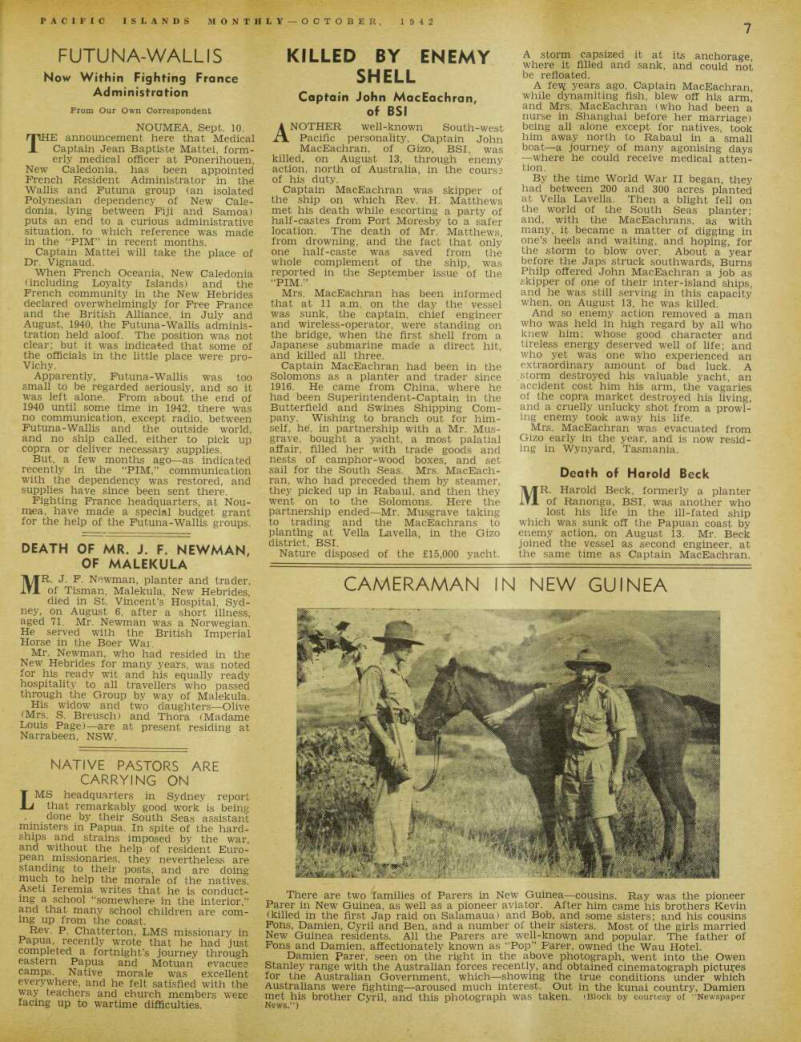
There are two families of Parers in New Guinea—cousins. Ray was the pioneer Parer in New Guinea, as well as a pioneer aviator. After him came his brothers Kevin (killed in the first Jap raid on Salamaua) and Bob, and some sisters; and his cousins Fons, Damien, Cyril and Ben, and a number of their sisters. Most of the girls married New Guinea residents. All the Parers are well-known and popular. The father of Fons and Damien, affectionately known as “Pop” Parer, owned the Wau Hotel.
Damien Parer, seen on the right in the above photograph, went into the Owen Stanley range with the Australian forces recently, and obtained cinematograph pictures for the Australian Government, which —showing the true conditions under which Australians were fighting—aroused much interest. Out in the kunai country, Damien met his brother Cyril, and this photograph was taken. (Block by courtesy of “Newspaper News.”)
Buna-Kokoda Region
Scene of Recent Operations Described by Old Resident
By G. M. Rio
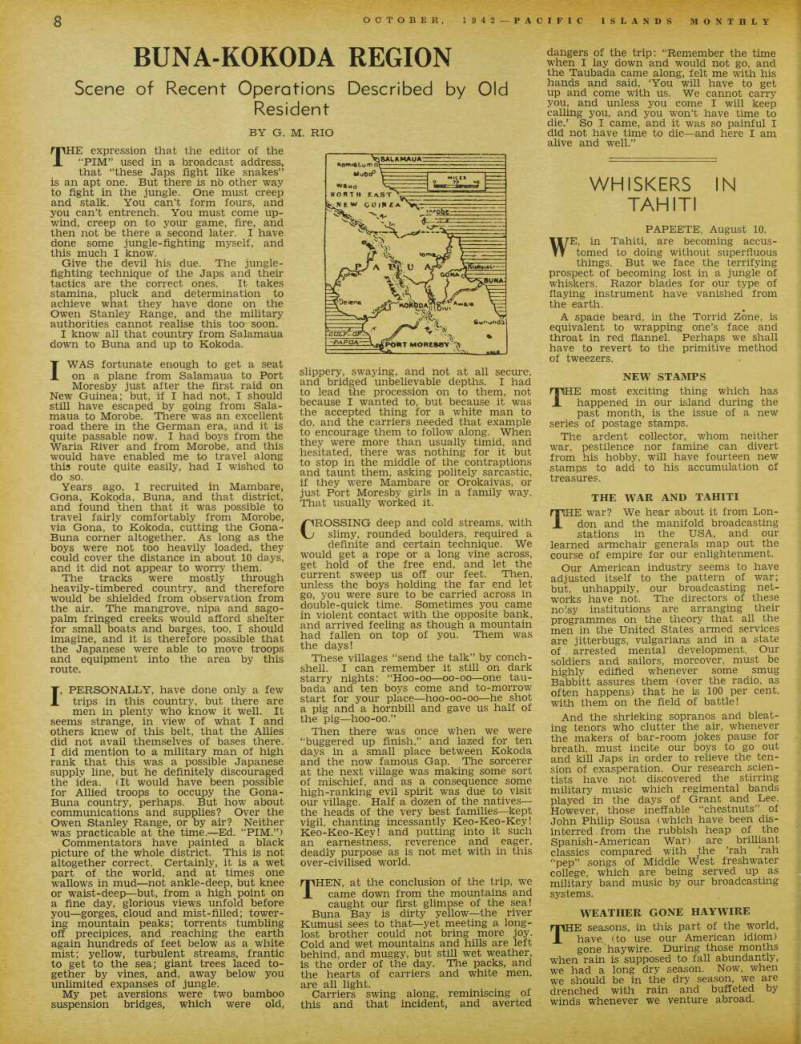
THE expression that the editor of the “PIM” used in a broadcast address, that “these Japs fight like snakes” is an apt one. But there is no other way to fight in the jungle. One must creep and stalk. You can’t form fours, and you can’t entrench. You must come up wind, creep on to your game, fire, and then not be there a second later. I have done some jungle-fighting myself, and this much I know.
Give the devil his due. The jungle fighting technique of the Japs and then tactics are the correct ones. It takes stamina, pluck and determination to achieve what they have done on the Owen Stanley Range, and the military authorities cannot realise this too soon.
I know all that country from Salamaua down to Buna and up to Kokoda.
IWAS fortunate enough to get a seat on a plane from Salamaua to Port Moresby just after the first raid on New Guinea: but, if I had not, I should still have escaped by going from Sala maua to Morobe. There was an excellent road there in the German era, and it is quite passable now. I had boys from the Waria River and from Morobe, and this would have enabled me to travel along this route quite easily, had I wished to do so.
Years ago, I recruited in Mambare, Gona, Kokoda, Buna, and that district, and found 'then that it was possible to travel fairly comfortably from Morobe, via Gona, to Kokoda, cutting the Gona- Buna corner altogether. As long as the boys were not too heavily loaded, they could cover the distance in about 10 days, and it did not appear to worry them.
The tracks were mostly through heavily-timbered country, and therefore would be shielded from observation from the air. The mangrove, nipa and sago palm fringed creeks would afford shelter for small boats and barges, too. I should imagine, and it is therefore possible that the Japanese were able to move troops and equipment into the area by this route. 1, PERSONALLY, have done only a few trips in this country, but there are men in plenty who know it well. It seems strange, in view of what I and others knew of this belt, that the Allies did not avail themselves of bases there.
I did mention to a military man of high rank that this was a possible Japanese supply line, but he definitely discouraged the idea. (It would have been possible for Allied troops to occupy the Gona- Buna country, perhaps. But how about communications and supplies? Over the Owen Stanley Range, or by air? Neither was practicable at the time. —Ed. “PIM.”) Commentators have painted a black picture of the whole district. This is not altogether correct. Certainly, it is a wet part of the world, and at times one wallows in mud—not ankle-deep, but knee or waist-deep—but, from a high point on a fine day, glorious views unfold before you—gorges, cloud and mist-filled; tower ing mountain peaks; torrents tumbling off precipices, and reaching the earth again hundreds of feet below as a white mist; yellow, turbulent streams, frantic to get to the sea; giant trees laced to gether by vines, and, away below you unlimited expanses of jungle.
My pet aversions were two bamboo suspension bridges, which were old,
slippery, swaying, and not at all secure, and bridged unbelievable depths. I had to lead the procession on to them, not because I wanted to, but because it was the accepted thing for a white man to do, and the carriers needed that example to encourage them to follow along. When they were more than usually timid, and hesitated, there was nothing for it but to stop in the middle of the contraptions and taunt them, asking politely sarcastic, if they were Mambare or Orokaivas, or just Port Moresby girls in a family way.
That usually worked it.
CROSSING deep and cold streams, with slimy, rounded boulders, required a definite and certain technique. We would get a rope or a long vine across, get hold of the free end, and let the current sweep us off our feet. Then, unless the boys holding the far end let go, you were sure to be carried across in double-quick time. Sometimes you came in violent contact with the opposite bank, and arrived feeling as though a mountain had fallen on top of you. Them was the days!
These villages “send the talk” by conch shell. I can remember it still on dark starry nights: “Hoo-oo—oo-oo —one tau bada and ten boys come and to-morrow start for your place—hoo-00-oo—he shot a pig and a hornbill and gave us half of the pig—hoo-oo.”
Then there was once when we were “buggered up finish,” and lazed for ten days in a small place between Kokoda and the now famous Gap. The sorcerer at the next village was making some sort of mischief, and as a consequence some high-ranking evil spirit was due to visit our village. Half a dozen of the natives— the heads of the very best families—kept vigil, chanting incessantly Keo-Keo-Key!
Keo-Keo-Key! and putting into it such an earnestness, reverence and eager, deadly purpose as is not met with in this over-civilised world.
THEN, at the conclusion of the trip, we came down from the mountains and caught our first glimpse of the sea!
Buna Bay is dirty yellow—the river Kumusi sees to that —yet meeting a long lost brother could not bring more joy.
Cold and wet mountains and hills are left behind, and muggy, but still wet weather, is the order of the day. The packs, and the hearts of carriers and white men, are all light.
Carriers swing along, reminiscing of this and that incident, and averted
dangers of the trip: “Remember the time when I lay down and would not go, and the Taubada came along, felt me with his hands and said, ‘You will have to get up and come with us. We cannot carry you, and unless you come I will keep calling you, and you won’t have time to die.’ So I came, and it was so painful I did not have time to die —and here I am alive and well.”
Whiskers In
Tahiti
PAPEETE, August 10.
WE, in Tahiti, are becoming accus tomed to doing without superfluous things. But we face the terrifying prospect of becoming lost in a jungle of whiskers. Razor blades for our type of flaying instrument have vanished from the earth.
A spade beard, in the Torrid Zone, is equivalent to wrapping one’s face and throat in red flannel. Perhaps we shall have to revert to the primitive method of tweezers.
New Stamps
mHE most exciting thing which has X happened in our island during the past month, is the issue of a new series of postage stamps.
The ardent collector, whom neither war, pestilence nor famine can divert from his hobby, will have fourteen new stamps to add to his accumulation of treasures.
The War And Tahiti
rE war? We hear about it from Lon don and the manifold broadcasting stations in the USA, and our learned armchair generals map out the course of empire for our enlightenment.
Our American industry seems to have adjusted itself to the pattern of war; but, unhappily, our broadcasting net works have not. The directors of these no'sy institutions are arranging their programmes on the theory that all the men in the United States armed services are jitterbugs, vulgarians and in a state of arrested mental development. Our soldiers and sailors, moreover, must be highly edified whenever some smug Babbitt assures them (over the radio, as often happens) that he is 100 per cent, with them on the field of battle!
And the shrieking sopranos and bleat ing tenors who clutter the air, whenever the makers of bar-room jokes pause for breath, must incite our boys to go out and kill Japs in order to relieve the ten sion of exasperation. Our research scien tists have not discovered the stirring military music which regimental bands played in the days of Grant and Lee.
However, those ineffable “chestnuts” of John Philip Sousa (which have been dis interred from the rubbish heap of the Spanish-American War) are brilliant classics compared with the ’rah ’rah “pep” songs of Middle West freshwater college, which are being served up as military band music by our broadcasting systems.
Weather Gone Haywire
THE seasons, in this part of the world, have (to use our American idiom) gone haywire. During those months when rain is supposed to fall abundantly, we had a long dry season. Now, when we should be in the dry season, we are drenched with rain and buffeted by winds whenever we venture abroad.
Currency Problems
Australian Sixpences Are Legal Tender in Fiji
IT was announced in the official Gazette, in the middle of August, that Aus tralian sixpences are now legal tender in the Colony of Fiji.
This is the first time that this arrange ment has been made, and it is no doubt the outcome of the acute shortage of small coins from which Fiji has suffered in recent months.
There is 12s per cent, difference be tween the respective values of Australian and Fijian currency. The Fiji £ is worth £l/2/6 Australian. This means that, on exchange, the Australian 6d. officially is worth only s:id. Fijian. As it is proposed to make 6d. Australian worth 6d. Fijian, there is a chance for racketeers to get busy.
The Fiji Government has seen this, of course. If all Australian coins were to be made legal tender in Fiji, there would be a danger of exchange disorganisation: but it is felt that this temporary honour ing of the Australian 6d. can be con trolled. A man would have to transfer thousands of Australian sixpences to Fiji to make any worth-while profit out of the new arrangement.
The whole position of exchange in the South Pacific is exceedingly interesting at present. Normally, there are five in dependent currencies—Australian, New Zealand, Fiji, French Colonies and United States. All were linked, for purposes of exchange, with the £ sterling.
Apart from the re-valuation of the Fighting French franc, after the fall of France, the pre-war exchange standards have not altered. But, owing to the dis appearance of a large part of the trade between Britain and the Pacific, and the much wider distribution of United States currency by USA forces in the Pacific, some early readjustment of exchange values seems inevitable.
Water Shortage
Drastic Action in Suva
SUVA residents were warned again re cently that, under the Defence (Water Supply) Regulations, the use of water from the piped supply for water ing of gardens by hose, watering-can, stirrup pump or anything else, is pro hibited.
The present-day population of Suva is much greater than that for which the supply was originally intended, and it has been calculated that every man, woman and child in the town uses 80 gallons of water per day. Cooking, bath ing and laundry take up a certain amount, but certainly nothing approach ing 80 gallons a head—wastage must ac count fqr the greater part of it. At the stand-pipes, for instance, which are scat tered about the town, and where natives and others make a practice of washing under the running tap, the wastage must be out of all proportion to the amount of water actually required for the job.
Mr. Gerald G. Smith, who was well known in Port Moresby before the eva cuation, when he conducted a trading business under the name of Gerald Smith & Co., and who was treasurer of the Pacific Territories Association for a time, after the evacuation, has taken over the Club Hotel in Yass, NSW. He writes that he likes the district very much.
Death Of Well-Known
Cook Is. Ariki
Rarotonga, Aug. 17.
rpHE death occurred on July 31 at her X home, Ngaru Rutu, Rarotonga, of Makea Karika Takau Ariki, OBE (not to be confused with Makea Nui Takau Ariki—Mrs. E. T. W. Love).
Karika, as she was generally known,
took a keen interest in the welfare of the Rarotongan people and her Girl Guide, Child Welfare and “Au Vaine” (women’s organisation) activities ren dered her friend to Polynesian and Euro pean alike.
Her “Taonga Ariki” (title) now passes to her son, Quartermaster-Sergeant Geo.
Karika, DCM, who will be known as Makea Pa George Karika Ariki.
Those familiar with Polynesian history will remember that Karika and Tangiia were the original chiefs from “Avaiki” who, with their followers, first discov ered and peopled the island, and Karika genealogy can be traced as far back as any in the Pacific.
Captain To Pilot-Officer
CAPTAIN J. D. CAMPBELL, who joined the Royal New Zealand Air Force in 1941, is now Pilot-Officer Camp bell, and is located “somewhere overseas” as an instructor in an Officers’ School.
It says much for his fitness and spirit that, after his lengthy service in the last war and his long residence in the tropics, he is again serving in World War 11.
He was well-known in the Cook Islands, where he was president of the Returned Soldiers’ Association for 20 years. He was still holding this position when he left the Islands, at his own expense, in order that he might once more serve King and country.
The death of Mrs. Rachel Fanny Edwards occurred in Suva, Fiji, on August 23. She is survived by her hus band, Mr. H. Edwards, of Domain Road, and two sons and five daughters. For many years Mr. and Mrs. Edwards lived on Vanua Levu, where Mr. Edwards was engaged in planting, in partnership with Mr. Hall. Later, they moved to Samabula, but had been living in retirement in Suva for several years.
Letters From Rabaul
Men
News of 18 Prisoners of War
WIVES or next-of-kin of about 18 New Guinea residents who have been missing since the Japanese occupied Rabaul in January, received letters from them in September.
These —dated February 11—appear to have been part of the prisoners’ mail dropped over Port Moresby by the Japanese some months ago, and which, by some mischance, were not immediately delivered.
Through their medium comes news of the following men—all of them well known in Rabaul and New Guinea:— O. Townsend, Harold Page, R. L. Clark, Hugh Goodwin, Ken Alsop, Wayne, Solo mons, Sgt. lan Maclean, Colin Mater, Bell (the one who married Joan Ifould) Dickson. J. Trevitt, Pearce, S. Beasley!
Stuart Nottage, McEwan (from BP’s>!
Jack Evans (Colyer Watson), A. Ross’
Phillpot (BP's), Bob Reynolds.
All were brief notes of about one page, and, naturally enough, they gave little information beyond the fact that the writers were well, and were being “reason ably treated.” • Those who received them however, were unanimous in the opinion that they were perfectly natural in style, and there were no indications that they were written under duress or that the men were suffering from nervous tension of any sort.
According to Mr. Clark—Mr. Clark was a member of the New Guinea Legislative Assembly—they were permitted to write because on that day the Japs were cele brating some national festival. He said that, because he was a “warden,” he was allowed a few special privileges.
Mr. Harold Page said that he was a prisoner of war in Rabaul, that he was in very good health, and that they were getting plenty of food—mostly meat, rice and tea. He asked that the letter be shown to the appropriate Federal authori ties in order that wives and children of the prisoners could be provided with a sustenance allowance.
No news has been received of many other prominent New Guinea men, in cluding BP’s manager (Mr. Philip Coote), Mr. Gordon Thomas, and Mr. George Murray, of the Department of Agricul ture; but, in view of the delay in the delivery of these last letters, it is prob able that they, too, are safe and well.
Mrs. Copp, Mrs. Edwards, and Mrs.
Knight, wives of LMS missionaries serv ing in Samoa, recently arrived in New Zealand. Mrs. H. White, of Malua, went on to Queensland, at about the same time.
The death of Miss Daisy Jane Hansen occurred in Suva, Fiji, on August 21.
Miss Hansen spent most of her life in the Colony, where she was born —her father was for many years foreman in the Pub lic Works Department. Mr. W. Hansen and Mr. A. Hansen, both of Suva, are her brothers.
Mr. S. C. Beazley, who was a technical instructor with the Methodist Mission in Rabaul, was taken prisoner when the Japs overwhelmed the township—news was re ceived of him in the last batch of letters from New Guinea POW, in September, Mrs. Beazley previously was evacuated to Australia, and a daughter was recently born to the couple—but it may be some time before the baby’s father is aware of her existence.
Legislative Council
National Service
In Fiji
Legislative Council Approves
THE Fiji Legislative Council, on August 26, unanimously approved the prin ciple of compulsory national service.
The Colonial Secretary said, in pro posing the motion, that, although the necessary legislative power already existed in Defence Regulations, it was thought that Council should have the opportunity of expressing its opinion on such an im portant matter. There was no intention of upsetting the labour market —quite the reverse—but it was necessary to have powers for directing the services of in dividuals wherever they were most needed.
Mr. Alport Barker seconded the motion.
He was of the opinion that if the measure did no more than ensure a constant sup ply of labour for copra, sugar and gold production, it would be justified.
Ratu J. L. V. Sukuna assured the Gov ernment of the support of the Fijian community, and Mr. Vishnu Deo expressed support on behalf of the Indians.
The motion was discussed at some length by members—from the points of view of foodstuffs production, labour con ditions, establishment of a Labour Corps, and the expressed wish of Indian mem bers that, if compulsory labour were in stituted, there should be no discrimination in pay and allowances to Indians.
The Governor thanked the members for their views. Criticisms and suggestions would be considered by either of the committees, the Executive Council or the War Council. Every possible precaution would be taken for the protection of labour in dangerous areas, and compen sation would be paid for anyone killed or wounded as a result of enemy action while so employed.
Details of Organisation Explained
AT a meeting of the Fiji Executive Council, held in Suva on August 4, it was decided that the Governor, with the Executive Council, will function also as the WaT Council of the Colony.
For convenience sake subjects directly connected with the war or arising out of it, have been classified, and committees and directors appointed to deal with them.
The classifications are as follows: — (1) The armed forces (military, naval and air), and liaison between Service Commanders and the Civil authority. As most of this business is of a highly secret nature it has been given into the per sonal charge of the Governor and the Colonial Secretary, who will act in his absence (2) Supply, Production, Finance, Cur rency, Import and Export Control. This is, in many respects, the most complicated, and has been further divided into four divisions: (a) Imports and Exports and reciprocal aid between the Colony and the United Kingdom and USA; (b) pro duction of foodstuffs and marketing— sub-committees will be formed to deal with industries; meat, fish and dairying; vege tables and fruit; (c) works, transport and communications, with sub-committees to deal with works; petrol, tyres and spares; communications; <d) prices and rents.
Four Controllers, one for each subject, together with the Financial Secretary, form the Board. (3) Civil Defence and Emergency Ser vices: Hon. Dr. McGusty, Secretary for Indian Affairs,-has been appointed to act as Director. He will be assisted by a Central Advisory Committee, a Central
(Continued on page 11)
Executive Committee and District Com mittees. (4) Labour. (5) National Service and Allocation of Manpower.
As (4) and (5) are so closely related in actual operation, it is thought that the Committees may later be fused. Mr. S.
H. Ellis has become Director of Man power, and Mr. Pennefather is Director of Labour. Both will organise their own Advisory Committees, but in such a way that there will be the closest co-operation between them. (6) Conciliation, Industrial Appeal, National Service Appeal Tribunals: Mr.
R. Crompton has undertaken the chair manship of such conciliation matters, and also becomes Director of Propaganda and Publicity. (7) Drafting of Legislation, Regulations and Legal Advice. The Attorney-General will be responsible for all the legal aspects of the activities of the War Council.
It was expected that these measures would be put into force within the shortest possible time. Much depends upon the energy, ability and sense of the various committees and directors; but the people of the Colony generally appear to have an adequate realisation of their posi tion, and, like their Governor, are deter mined to “wage war.”
Advertisements & other items, p. 12 (1 item)
Pacific Islands Year Book
1942 (WARTIME) EDITION
Because of an Insistent Demand for this well-known Reference Book, and as 1939 Edition has been sold out, a Limited Wartime Edition has been
printed.
It contains the Latest Information relating to all Pacific Islands and Territories, including History, Geographical Description, Administration, Commerce and Industries, Character of Natives, Imports and Hxports, Trading Firms, Shipping, Missions, Communications, etc., etc.
SPECIALLY INCLUDED IN THIS EDITION :
A Chronology showing dates of all Notable Events in Pacific War, from Dec. 7, 1941, to Aug., 1942.
History of International Events leading to Japan’s entry into War.
Pidgin-English Vocabulary, giving a List of Phrases and Words in Common Use.
Many Additional Maps of Pacific Territories and Islands.
The Territories dealt with include—
N. Guinea Fiji E. Indies
Papua Samoa Philippines
Solomons Tonga Hawaii
Nauru Gilbert & Ellice N. Caledonia
N. Hebrides Cook Is. Fr. Oceania
DETAILED MAPS OF PRACTICALLY ALL TERRITORIES AND GROUPS ARE INCLUDED—MANY FOR THE FIRST TIME.
Owing to Wartime Restrictions, this edition is strictly limited in number. Therefore, to avoid disappointment, Order Your Copy Now.
When ordering, please use Form as under.
Price: With stiff board cover, 9/- Australian, plus 6d. extra for postage. (Note: 9/6 Australian 9/6 New Zealand; 8/6 Fijian; United States, 1 dollar, 50 cents.)
PACIFIC PUBLICATIONS PTY. LTD.,
P.O. Box 3408 R., Sydney; or at Union House, 247 George Street, Sydney.
ORDER FOR PACIFIC ISLANDS YEAR BOOK, 1942
TO PACIFIC PUBLICATIONS PTY. LTD.,
UNION HOUSE, 247 GEORGE STREET, Date
SYDNEY.
Number of copies wanted Correct address to which to be posted or (if in city) delivered: Amount forwarded herewith Name and address of person giving this order:
Canadian Japs
Migration Policy, Similar to That of USA, Removes Them From Pacific Coast
WHEN Japan attacked the United Nations last December, there were 150,000 Japs in Hawaii, 109,000 in the western part of United States, and 23,400 on the coast of British Columbia.
Canada.
We do not know how the Hawaiian problem was handled; but (as described in the “PIM” in August) USA authorities already have carried out one of the big gest jobs in Pacific history by shifting the 109,000 Japs away from their Pacific region.
“Far Eastern Survey,” of July 27 reports that, following USA example, Canada has removed the whole of the Japanese from her Pacific coastline Although a large proportion of them were Canadian-born, they had remained Japanese, preserving their language, institutions and allegiances. Most of them were coastal fishermen, and they clearly constituted a grave danger. So they were gathered from all along the coast into special camps in Hastings Park, Vancouver; and from that point they are being distributed elsewhere— “re-located,” it is called.
Some 2,000 men have been sent to road-making camps, 3,100 (all ages and both sexes) to the sugar-beet industry of Alberta and Manitoba; others to agricul tural and lumbering industries in Ontario.
These compulsory, large-scale migra tions have imposed hardships on the United States and Canadian Japs. But, having learned the true character of the Japanese, no democratic nation dare take any chances with the Jap communities already within their boundaries. For tunately, there are no Japanese com munities in the Pacific, south of the equator.
Lieutenant A. Wardrop, formerly Port Moresby’s chief of telephones, is now serving in the Army Service Corps. He is a highly qualified engineer, and is doing useful work at a military camp near Sydney. * H
Freedom For Fighting
French Guarantee Given by New Zealand
From Our Noumea Correspondent THE economic position of French Oceania became very difficult after France capitulated in June, 1940, and New Zealand, as the nearest British Dominion, gave Tahiti and its outlying dependencies all possible help. Conse quently, there developed a considerable measure of economic collaboration be tween New Zealand and French Oceania Enemy propagandists have tried to alarm French people by declaring that Britain plans interference with their independ ence.
As a result of this, the New Zealand Government has defined its policy towards the Fighting French in an exchange of letters between the Prime Minister Mr Peter Fraser, and the French Pacific High Commissioner.
Mr. Fraser declares that the policy of New Zealand is based on the maintenance of the integrity of France and the French Empire intact. He considers the French National Committee, of which General de Gaulle is President, as the official Gov ernment of Frenchmen wherever they may be. The Government of the Dominion will continue in the future, as in the past, to treat with the National Committee in all questions concerning collaboration with Fighting France and, in particular, with French colonial territories and possessions.
Recognition is given to the efforts that have been and are being made by Fight ing France and her adherents for the common cause against aggression, and for the liberation of peoples now subjected to slavery.
Mr. Fraser also declares that it is a matter of “special interest to New Zea land" that the authority of the French National Committee must be maintained over all French territories in the Pacific, including French Oceania, “the which territories are and must remain French.’’
The New Zealand Government recog nises that the authority of the National Committee extends to all civil and mili tary questions in these possessions. Mr.
Fraser adds that his Government wel comes the appointment of M. Antoine de la Tribouille as delegate of the French National Committee in New Zealand. He will handle all matters of common in terest and will look after the interests of Free Frenchmen in the Dominion.
Mr. R. J. Keegan, an administrative officer in the service of the Gilbert and Ellice Islands Colony, has been spend ing furlough in Australia. He was sta tioned in Tarawa for some time, but in 1941 he was placed in charge of Fanning Island; and, when the Japanese attack came, he was “out on the end of a bough.” Nothing worthy of mention happened at Panning Island, however; and Mr. Keegan left there, after the Battles of the Coral Sea and of Midway Island had made the Central Pacific a little safer for our isolated British com munities. Mr. Keegan sent his wife and child away from Fanning Island in November, by a small ship which was connected with the cable service: and the Japanese blitz on Pearl Harbour and Honolulu commenced just as the little vessel was entering Honolulu on the morning of December 7 last. Mrs. Kee gan came safelv through the bombing, and then remained several months in Hawaii before coming to Australia to meet her husband.
Henri Sautot
Important Post in West Africa
From Our Own Correspondent
Noumea, Sept. 5.
IT has been announced that M. Henri Sautot, who first rallied the French people of the South Pacific to Fight ing France in 1940, and whose term as Governor of New Caledonia and High
Commissioner of the French Pacific Colonies will have deserved recognition when the Pacific chapter of World War II is written, has been appointed Governor of the great French Equatorial African Colony of Oubangai-Chari.
The unexpected departure of M. Sautot from New Caledonia in April last, to obey a summons to London by General de Gaulle, caused much comment —and some discontent among the people of New Caledonia, by whom he was highly esteemed. The fact that he has been given an important post in West Africa (where he served the French Colonial Office many years ago) has given general satisfaction.
The death in Brisbane recently of Mr.
P. N. Charpentier removes one of the oldest settlers of Papua. Mr. Charpentier was a Frenchman and scholar and was well-known and respected by the resi dents of Port Moresby. He owned a pro perty on the Loloki River.
Two marriages in Sydney in October were of interest to residents of Papua.
Miss Eileen Healy, youngest daughter of the late Mr. M. Healy and Mrs. Healy, of Port Moresby, married Lieutenant J.
Lukin, of the New Guinea Administrative Unit; and Miss Rita Humphries, eldest daughter of Mr. W. R. Humphries (Resi dent Magistrate in Port Moresby until the evacuation) married Mr. Kevin John Kenny, of Balgowlah, Sydney.
M. Henri Sautot.
Solomon Islands Battle
How Americans and Australians Recovered Tulagi Area From Japs
This striking pen-picture of the Battle of the Solomons, which took place early in August, was written by an Australian naval officer, and published in the "Melbourne Herald" early in October.
“CITAND by for an important announce ment by the Captain.” Expectancy was on every face on board the leader of the Australian Squadron sail ing in company with US Naval and Marine Forces. At the appointed hour mess-deck “buzzes” were things of yes terday—here was their captain speaking.
Grouped around the various broadcast ing amplifiers of the ship on the upper and main decks were keyed gatherings— seasoned veterans of other campaigns stood alongside the youngest rating on his first adventure.
Then the captain spoke—with that concise understatement which is usual on such occasions.
We were to attack and capture the Japanese-held islands of Tulagi and Guadalcanal: we were to lead the screen against Guadalcanal: and zero hour was at dawn on Friday, August 7.
Only later did we see the coincidence.
Pearl Harbour was attacked on the 7th; the Coral Sea affair in which the ship had fought strenuously and decisively took place on the 7th; and now that date was chosen for the first Allied offensive in tliG Pacific Soon maps, charts and drawings of these hitherto little-known islands were being studied everywhere in the ship.
Anticipation reached its highest tension when some hours before dawn on Friday, the ship’s company went quietly to its action stations.
Everyone was in battle dress. A ghostly stillness was in the air, and it seemed as though even the ship’s great engines were rumbling more quietly than they should at such speed.
LAND ahead! To the north lay the Solomons, majestic in their detach ment from the man-made scene.
Our ship proudly and defiantly led the attacking force assigned to Guadalcanal into the combat area, while the ill starred “Canberra” parted company to screen the Tulagi transports.
First to break the silence and dark was a small destroyer abeam to starboard.
Gunfire, first star-shells, then the real thing broke loose in earnest.
On the Tulagi side, the Japanese lost their entire air force almost as soon as hostilities opened, our Naval fighters destroying the machines on the water.
These Japanese seaplanes were there to spot precisely some such approach as ours.
At Guadalcanal, the first bombardment was begun before dawn, and soon the first enemy naval casualty was suffered; a small schooner ahead of us was engaged by destroyers and in a few min utes she was in flames, having been fin ished off by the Navy planes which were patrolling everywhere. Fire and smoke ■ rose along the coastline as the salvoes from the attacking ships fell on their appointed targets.
Our main armament went into action early, and our salvoes seemed to be the curtain-raiser for dive-bombing and machine-gunning from our supporting Navy aviators. As the bombing from the air was pressed home, we continued to rake the coast, the aerodrome and the
strategic defences and communications.
The disembarkation area was reached, and we signalled the transports to stop, We continued our attacks while we steamed around the transports, shepherd ing them. Metal poured against the island’s defences, ... h rnn bp imagined TV the™ days of wide air. rlco^ naissance, no naval strategist can toM Certainly, no such surprise was or could have been hoped tor among the most Wtamshc Wh ° planned and Yet suclTft “ The appearance of an attacking force, transports and land ing craft on that day off the Solomons was the most complete of surprises for Hal Sen meals were found in the various barracks that were later occupied —keys in the ignition switches of aban doned motor cars-belongings and eqmp- SSm to thl recesses of tee Sand’s dSSe ““hen the assault on the beach began, While the warships cruised around pro and 3 " theSra^orte
w?vT o^ma^wL"maktog ?or the
be ach and the penis that lay ahead. sun’? y Se th t^ougS th o e ur C froa 0 £
fuen awjfss EM
in the exposed positions on the upper deck that a beachhead had been estab fished.
The “Guadalcanal Ferry Service” was opened. “A ruddy bridge and it’d be Sydney,” said one wit near me. Back and forth from ships to shore, the barges took the men and material, and con tinned thereafter night and day.
Meanwhile, each to his allotted task.
Knowing the sterling qualities and fine training of the US Marines, those on board never lost sight of their own task, which was to protect the transports, by now edging closer inshore, so as to reduce the ferry-run distance to a minimum, Never once did the cruiser’s men relax their observation of the skies and hori zon for the enemy’s counters, which we all knew must come from the air and sea, as well as from ashore.
“Repel Aircraft”—the enemy was send ing destructive aid to his beleaguered garrisons. First blood to us—down in flames over Savo crashes one of the van of the enemy attackers, Soon all the ships were firing at what only trained observers could see was a tight formation of about 27 enemv high level bombers escorted by Zero fighters, One of our fighters roars down out of the clouds and the splashes from the anti aircraft fire which now fitter the sky he is out of control. We watch the lad skilfully trying to level out, but he is unable to rise, and as he loses height, he crashes astern of us on the water. Later he is saved.
Meanwhile, his shipmate aviators up
above keep up a rattle of machine-gun fire, as the attackers’ bombs continue to fall into the sea.
The bombs fell around the disembar kation area, but it is apparent that our fighters and anti-aircraft fire have saved the ships, at any rate for the time being.
You don’t think too far ahead on such occasions.
We did not under-estimate our foe’s tenacity. We knew he would return, so we ate hastily at our action stations. We were not long kept waiting. As “repel aircraft” again sounded on the bugle, we donned our anti-flash helmets and gloves and had the guns trained. Dive-bombing tactics this time. At least the Jap does not disappoint with lack of variety.
Again our hard-worked Navy boys went up to do combat. We saw two bombers crash amid the din and fury of the attack, while ships left serpentine wakes everywhere. fpHROUGHOUT the day and night we JL soon became accustomed to heavy gunfire, from near and far. As dusk approached, we prepared for night attacks. There was to be no relaxation, either for those below or on deck. On through the night, the marines toiled at their unloading and ferrying.
With dawn came renewed attacks from the air. “Air alarm —torpedo-bombers attacking!”
“There they are”—and sure enough the naked eye could soon detect the enemy force sweeping low towards us from over the southern hillv tip of Florida Island.
At least this form of attack was no novelty to us. and we had already learned in the Coral Sea with what sui cidal fixity the Nips pressed home such attacks. Gunfire from ships must not merely deter such an attacker; it must blast him out of the skies.
In came the torpedo-carrying bombers.
We saw them first—old friends—and opened fire at once. Then hell broke loose, and HA. fire spurted everywhere.
What a sight! Bomber after bomber seemed to be ripped to pieces; large tor pedoes dropped from their bellies to steer an erratic course to the manoeuvring ships.
“Transport hit!” A bomber on fire already crashes on the ship’s superstruc ture. setting a spectacular blaze. There are fires and columns of thick smoke all round us on the water from crashed tor pedo bombers. Through the glasses, we can see the Japs in the “drink.”
Then the torpedoes “hit” —not us, but where we were, and later the Guadal canal foreshore is dotted with columns of water and smoke as the exploding tor pedoes end their vain, targetless run.
On the bridge, officers and lookouts scream through the din: “Torpedo to starboard, sir!” But the captain has seen the wake of the “fish”; he raps his orders to the engine room and steering position, and returns to starboard to gaze below at the effect of his avoiding action.
So much excitement was going on that the non-gunners among us scarcely rea lised that a high-level bombing attack was then being synchronised against our transports. Never had so much metal been seen pouring out at the one time from every piece of our armament; she threw it up, as her gunners toiled in that tropical noonday.
AS the bombers crashed into the sea. and the tornedoes failed to find their mark, the remaining aircraft renewed the attack with raking machine gun fire at our decks.
Strangest of all was our casualty list— one rating only who had collected a bul let from a machine-gun, luckily going
straight through his upper arm.
Last of all before the barrage ceased were the underwater explosions of some of the torpedoes. Then comparative silence, and the debris of Nippon’s hopes floated by on the tide.
Fanaticism was illustrated when one of our destroyers later attempted to rescue a couple of the Japanese airmen who had managed to scramble on to an inflated raft. As the destroyer steamed close by, they drew pistols and attempted to slay their rescuers. They then shot them selves. Perhaps they expected death at our hands. Prisoners whom the marines later captured ashore said that they fully expected to be killed, and were astounded at the humane treatment they got in an Allied port.
Life aboard the ship during these days was far from easy. Men toiled and sweated in humidity and heat below, and the thick air caused by the ship being secured for action produced a soporific fatigue on all who worked between decks, which includes the greater part of the ship’s complement.
No man left his action station—we fed, slept and some even bathed where they worked. Officers and men shared the same food and conditions. It was no uncommon sight to see a hefty gunner scrubbing his torso in between “events,” in a kerosene tin by his gun.
AFTER that the canteen was opened, and “Zam” (as well known to the RAN as the Gunnery Pocket Book) mixed “goffers” for thirsty men. Officers filtered into the Wardroom to recount experiences to the doctors who had remained there in the improvised action casualty ward ready to attend, to the casualties that, happily, never occurred.
The news of the loss of “Canberra” stunned us all. Only a short time ago, we had been in company of her men ashore and aboard. With feelings of gratitude we learned of the fine rescue work undertaken by nearby American destroyers.
Soon the mess decks were busy col lecting clothing and money to help the survivors. Most of them, when we later saw them, looked like doughboys, thanks to our American shipmates’ generosity.
When Guadalcanal was finally cap tured the marines began mopping up operations ashore, assisted by their Naval pilot “buddies” who ceaselessly skimmed the hills of the hinterland, riddling enemy positions with machine-gun fire or attacking Japanese stragglers in their combing operations.
Finally, we completed our screen of the Guadalcanal victors, and steered a course towards Tulagi. where heavy gunfire was continuous, telling us that heavy night and day resistance was still being encountered. Here we joined forces with the Tulagi detachment. It was later that the capture of Tulagi and Gavutu was completed.
THE job done, we retired from the Solomons, and in the comparative respite, were able to piece together our experiences of those stirring days.
The tension over, the reaction set in, and we began to understand the power of the mind over physical fatigue, especially when the spirit is offensive.
The fortunate ones had souvenirs of the show —pieces of flak, bullets, shrap nel, and of the battle-frayed ensign which had defiantly streamed from our foremast throughout.
The adventure ended on the note of understatement with which it began. As we silently came to anchor, the shrill bo’sun’s mate’s pipe sounded off. and— “D’y’ear there? It is now permitted to state in your letters as follows: T have taken part in the operations in the Solo mons, of which you have probably heard or read.’ ”
Vale to “Canberra’s” dead, to our naval airmen and marines whom we left behind.
“Does not the gravestone on such bones sit light?
Posterity applauds: from such a spright, From such a tomb, from ashes blessed so Shall there not violets in cartloads grow?”
We dreamed wistfully of leave, but everywhere was manifest the desire to hit the enemy again. We knew that the offensive begun on that grey August mom was the turning-point in the Pacific war.
Fiji Women's Voluntary
Services
rfIHE Women’s Voluntary Services, re cently established in Fiji, is now well under way.
Mrs. Newboult, the organiser, has asked women with spare time to volunteer under one of the following categories:— (1) Immediate work, or when and as the occasion arises. For example: part or whole-time clerical work, cyphering, canteen duties, darning or mending, house-to-house inquiry, or explanation work, or in support of anti-rumour or anti-waste campaigns. (2) Work during an emergency, such as first aid units, telephonists, wardens, ambulance drivers, transport work, emergency canteen work, rest centre work. (3) Work after a raid, such as tracing missing people, caring for those who have been bombed out of their homes, work in community kitchens, evacuation camps and hospitals.
Brs. J. A. R. Dovi, and W. G. Mac naughton, Government Medical Officers in Fiji, have been granted leave of absence “for the duration” in order to serve with the Defence Forces.
Distinguished Service
OF 45 commendation cards, signed by General Thomas Blarney, Com mander-in-Chief of the Allied Land Forces in South-west Pacific area, and issued to members of the Australian mili tary forces, several have been received by former residents of Port Moresby. Among them are:— Lieutenant Allan Timperley, of the Administrative Unit, for courage and initiative. Lieutenant Timperley, for merly a patrol officer, joined the Papuan Public Service in 1937, as a cadet in the Magisterial Branch. It was not long be fore he was promoted to patrol officer and Acting Assistant Magistrate, and his work in that connection was outstanding.
He is a native of Ipswich (Qld.), and has been a resident of Papua for nine years.
Private Bernard McMahon Ritchie (Administrative Unit), rewarded for ser vices in the New Britain area during March, is an old public servant, and, be fore enlisting, was the engineer of the Papuan patrol steamer “Laurabada.”
Private Ronald Moresby Stewart • Administrative Unit), rewarded for ser vices in the New Britain area, is a son of the late Mr. Robert Stewart* and Mrs.
Stewart, of Napa Napa. He is a native of Port Moresby.
Advertisements & other items, p. 15 (1 item)
George Brown & Co.
Any Employer NEEDS YOU if you are
AN 1. C.S. TRAINED MAN!
f C 140 ELIZABETH STREET,
SYDNEY.
Sin,—Please send free prospectus showing how 1 can succeed in the occupation I have marked X Accountancy—Secretarial (all Inst. Ex.) Bookkeeping—General. Store, Station.
Salesmanship—Gen., Speciality, Retail.
Psychology and Personality in Business.
Advertising—Retail, Mail-Ord., Agency.
Window Disp.—Show Card, Shop Tclcts.
Illustrating—Newspaper, Fash., Poster.
Free Lance Jour'ism—Short Story Writ.
Matriculation—Leaving-Inter.-Pub. Serv, Gen. Education—Bus. and Sales Letters.
Police Entr. Exam., Nurses Entr. Exam.
Architecture—Structural Concrete.
Building Contracting—Air Conditioning.
Draftsmanship (Mech. & all branches).
Motor Eng.—Mtr. Mech., Mtr. Exams.
Diesel Eng.—lllumin. Engr., Weld. Eng.
Internal Comb, and Steam Drivers' Exs.
Radio Eng.—Radio Serv., Radio Exms.
Aero Eng.—Gd. Eng., Licenses, Rigging, Elec. Eng.—Elec. Cent. & Mechs' Exms.
Civil Eng.—Shire Eng.—Shire Overseer.
Textile (all branches) —Analyt. Chem.
Dress Design—Drafting, Cutting, Mlnry. (Underline your subject above—ll not on list write It here ) Enquiries cost a 2d. stamp Post Howl Name Address
PIM
INI ERNATIONAL tORRESPONDCNLF S'.'HOOi
POWERFUL MULTI-VALVE BANDSPREAD
Full particulars from
GEORGE BROWN & CO.
Electrical Engineers Used by There is not a better radio obtainable.
AC & BATTERY MODELS
PTY. LTD.
267 Clarence Street, Sydney, N.S.W.
Port's Third
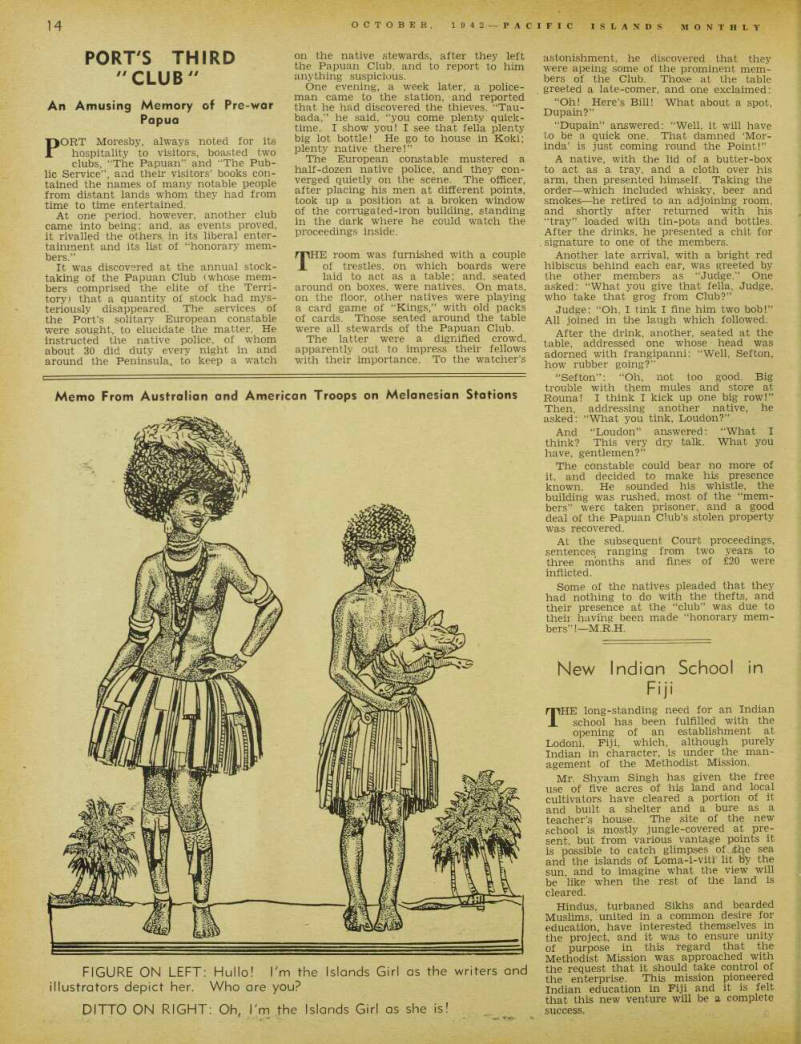
"Club"
An Amusing Memory of Pre-war Papua
PORT Moresby, always noted for its hospitality to visitors, boasted two clubs, “The Papuan” and “The Pub lic Service”, and their visitors’ books con tained the names of many notable people from distant lands whom they had from time to time entertained.
At one period, however, another club came into being: and, as events proved, it rivalled the others in its liberal enter tainment and its list of “honorary mem bers.”
It was discovered at the annual stock taking of the Papuan Club (whose mem bers comprised the elite of the Terri tory) that a quantity of stock had mys teriously disappeared. The services of the Port’s solitary European constable were sought, to elucidate the matter. He instructed the native police, of whom about 30 did duty every night in and around the Peninsula, to keep a watch
on the native stewards, after they left the Papuan Club, and to report to him anything suspicious.
One evening, a week later, a police man came to the station, and reported that he had discovered the thieves. “Tau bada,” he said, “you come plenty quick time. I show you! I see that fella plenty big lot bottle! He go to house in Koki; plenty native there!”
The European constable mustered a half-dozen native police, and they con verged quietly on the scene. The officer, after placing his men at different points, took up a position at a broken window of the corrugated-iron building, standing in the dark where he could watch the proceedings inside. rE room was furnished with a couple of trestles, on which boards were laid to act as a table; and, seated around on boxes, were natives. On mats, on the floor, other natives were playing a card game of “Kings,” with old packs of cards. Those seated around the table were all stewards of the Papuan Club.
The latter were a dignified crowd, apparently out to impress their fellows with their importance. To the watcher’s
astonishment, he discovered that they were apeing some of the prominent mem bers of the Club. Those at the table greeted a late-comer, and one exclaimed: “Oh! Here’s Bill! What about a spot, Dupain?”
“Dupain” answered: “Well, it will have to be a quick one. That damned ‘Mor inda’ is just coming round the Point!”
A native, with the lid of a butter-box to act as a tray, and a cloth over his arm, then presented himself. Taking the order—which included whisky, beer and smokes —he retired to an adjoining room, and shortly after returned with his “tray” loaded with tin-pots and bottles.
After the drinks, he presented a chit for signature to one of the members.
Another late arrival, with a bright red hibiscus behind each ear, was greeted by the other members as “Judge.” One asked: “What you give that fella. Judge, who take that grog from Club?”
Judge; “Oh. I tink I fine him two bob!”
All joined in the laugh which followed.
After the drink, another, seated at the table, addressed one whose head was adorned with frangipanni; “Well, Sefton, how rubber going?”
“Sefton”: “Oh, not too good. Big trouble with them mules and store at Rouna! I think I kick up one big row!”
Then, addressing another native, he asked: “What you tink, Loudon?”
And “Loudon” answered: “What I think? This very dry talk. What you have, gentlemen?”
The constable could bear no more of it, and decided to make his presence known. He sounded his whistle, the building was rushed, most of the “mem bers” were taken prisoner, and a good deal of the Papuan Club’s stolen property was recovered.
At the subsequent Court proceedings, sentences ranging from two years to three months and fines of £2O were inflicted.
Some of the natives pleaded that they had nothing to do with the thefts, and their presence at the “club” was due to their having been made “honorary mem
bers”!-
M.R.H.
Memo From Australian and American Troops on Melanesian Stations
FIGURE ON LEFT: Hullo! I'm the Islands Girl as the writers and illustrators depict her. Who are you?
DITTO ON RIGHT: Oh, I'm the Islands Girl as she is!
Fiji
New Indian School in Fiji
THE long-standing need for an Indian school has been fulfilled with the opening of an establishment at Lodoni, Fiji, which, although purely Indian in character, is under the man agement of the Methodist Mission.
Mr. Shyam Singh has given the free use of five acres of his land and local cultivators have cleared a portion of it and built a shelter and a bure as a teacher’s house. The site of the new school is mostly jungle-covered at pre sent, but from various vantage points it is possible to catch glimpses of ihe sea and the islands of Loma-i-viti’ lit by the sun, and to imagine what the view will be like when the rest of the land is cleared.
Hindus, turbaned Sikhs and bearded Muslims, united in a common desire for education, have interested themselves in the project, and it was to ensure unity of purpose in this regard that the Methodist Mission was approached with the request that it should take control of the enterprise. This mission pioneered Indian education in Fiji and it is felt that this new venture will be a complete success.
Hoeflich, of Samoa
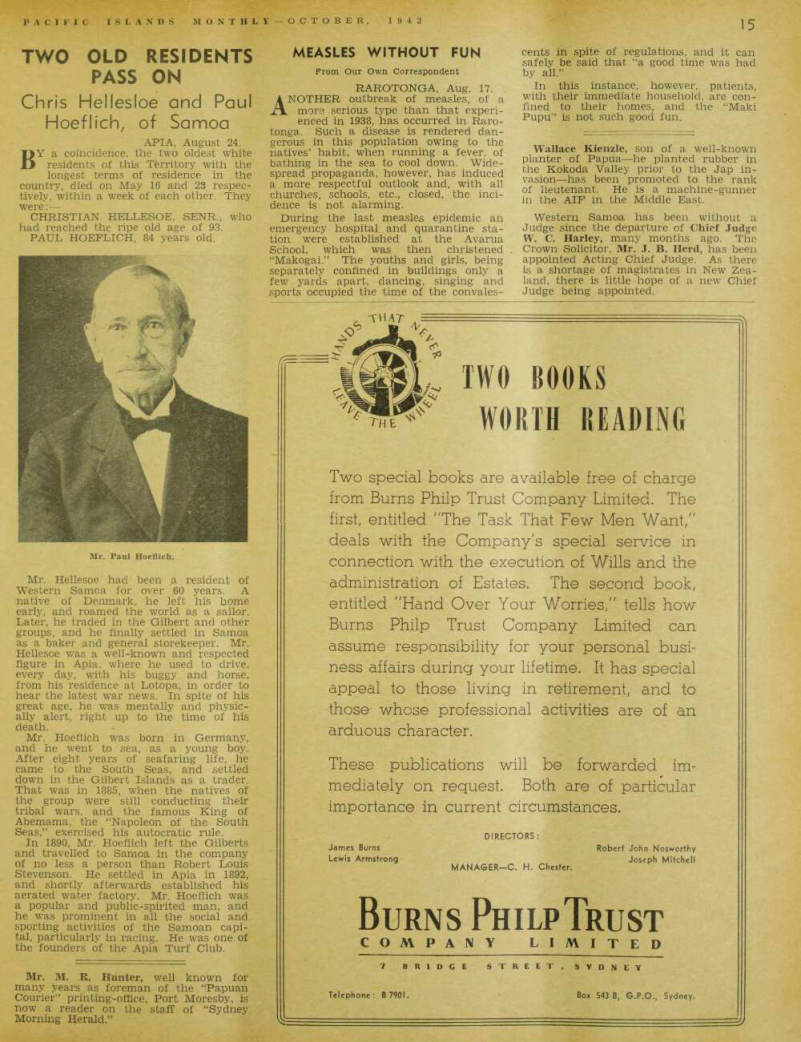
Two Old Residents
Pass On
Chris Heilesloe and Paul Hoeflich, of Samoa
APIA, August 24.
BY a coincidence, the two oldest white residents of this Territory with the longest terms of residence in the country, died on May 16 and 23 respec tively, within a week of each other. They were:—
Christian Hellesoe, Senr.. Who
had reached the ripe old age of 93.
PAUL HOEFLICH, 84 years old.
Mr. Hellesoe had been a resident of Western Samoa for over 60 years. A native of Denmark, he left his home early, and roamed the world as a sailor.
Later, he traded in the Gilbert and other groups, and he finally settled in Samoa as a baker and general storekeeper. Mr.
Hellesoe was a well-known and respected figure in Apia, where he used to drive, every day, with his buggy and horse, from his residence at Lotopa, in order to hear the latest war news. In spite of his great age, he was mentally and physic ally alert, right up to the time of his death.
Mr. Hoeflich was born in Germany, and he went to sea, as a young boy.
After eight years of seafaring life, he came to the South Seas, and settled down in the Gilbert Islands as a trader.
That was in 1885, when the natives of the group were still conducting then tribal wars, and the famous King of Abemama, the “Napoleon of the South Seas,” exercised his autocratic rule.
In 1890, Mr. Hoeflich left the Gilberts and travelled to Samoa in the company of no less a person than Robert Louis Stevenson. He settled in Apia in 1892, and shortly afterwards established his aerated water factory. Mr. Hoeflich was a popular and public-spirited man, and he was prominent in all the social and sporting activities of the Samoan capi tal, particularly in racing. He was one of the founders of the Apia Turf Club.
Mr. M. R. Hunter, well known for many years as foreman of the “Papuan Courier” printing-office, Port Moresby, is now a reader on the staff of “Sydney Morning Herald.”
Mr. Paul Hoeflich.
Measles Without Fun
Prom Our Own Correspondent
Rarotonga, Aug. 17.
ANOTHER outbreak of measles, of a mors serious type than that experi enced in 1938, has occurred in Raro tonga. Such a disease is rendered dan gerous in this population owing to the natives’ habit, when running a fever, of bathing in the sea to cool down. Wide spread propaganda, however, has induced a more respectful outlook and, with all churches, schools, etc., closed, the inci dence is not alarming.
During the last measles epidemic an emergency hospital and quarantine sta tion were established at the Avarua School, which was then christened “Makogai.” The youths and girls, being separately confined in buildings only a few yards apart, dancing, singing and sports occupied the time of the convales
cents in spite of regulations, and it can safely be said that “a good time was had by all.”
In this instance, however, patients, with their immediate household, are con fined to their homes, and the “Maki Pupu” is not such good fun.
Wallace Kienzle, son of a well-known planter of Papua—he planted rubber in the Kokoda Valley prior to the Jap in vasion—has been promoted to the rank of lieutenant. He is a machine-gunner in the AIF in the Middle East.
Western Samoa has been without a Judge since the departure of Chief Judge W. C. Harley, many months ago. The Crown Solicitor, Mr. J. B. Herd, has been appointed Acting Chief Judge. As there is a shortage of magistrates in New Zea land, there is little hope of a new Chief Judge being appointed.
Advertisements & other items, p. 17 (1 item)
Burns Philp Trust
'THAT
TWO BOOKS
WORTH READING
Two special books are available free of charge from Burns Philp Trust Company Limited. The first, entitled "The Task That Few Men Want," deals with the Company's special service in connection with the execution of Wills and the administration of Estates. The second book, entitled "Hand Over Your Worries," tells how Burns Philp Trust Company Limited can assume responsibility for your personal business affairs during your lifetime. It has special appeal to those living in retirement, and to those- whose professional activities are of an arduous character.
These publications will be forwarded immediately on reguest. Both are of particular importance in current circumstances.
Burns Philp Trust
DIRECTORS:
James Burns Lewis Armstrong MANAGER—C. H. Chester.
Robert John Nosworthy Joseph Mitchell
COMPANY LIMITED
7 BRIDGE STREET. SYDNEY
Telcphi lone : B 7901 Box 543 B, G.P.0., Sydney.
Major A. B. Ross Killed
In Action
From Our Own Correspondent APIA, August 24.
NEWS has been received that Major A.
B. Ross, of the New Zealand Forces, was killed in action in Libya.
Major Ross was well-known in Samoa, where from 1923 to 1929 he occupied the positions of Assistant Secretary of Native Affairs, Assistant Secretary to the Ad ministration, Secretary of the Adminis tration, and ADC to the Administrator (Colonel S. Allen). In 1929 he was transferred to the Department of Exter nal Affairs, in Wellington, where he was in charge of Samoan affairs, and later he was appointed Assistant Secre tary of External Affairs. He was greatly interested in military matters and orga nised the Boy Scout movement among the Samoans.
Nippon Is
"Wining"
Proclamation to New Guinea Natives
RECENTLY, we published the quaint proclamations issued by the Japanese in New Guinea, when they invaded that territory—one, it will be remembered, by the “Navy of Nippon,” which was in fairly good English, and the other by the military, at Rabaul, which was almost incomprehensible.
The Japanese now have issued another proclamation, evidently directed to the few natives who can read and understand English. For sheer ingenuousness, it would take some beating. It is repro duced here exactly as it was issued in New Guinea: — “We guarantee your life and property.
Nippon has declared war against the United States of America and England, and is going to the glorious war with them to keep the independence and honor of the yellow race.
“Already Navy of Nippon is wining a victory everywhere and occupied all Bismarck Archipelago.
“Therefore, you don’t belong to the sovereignty of England but the sovereignty of Nippon.
“See your circumstances in past time.
There is nothing but oppression and squeeze of the white race. Follow us.
And happiness and wealth will be given.—
Navy Of Nippon.”
Exhibiting a copy of this document, a military spokesman in Australia said that the proclamation was issued for circu lation among the educated natives, who were expected to spread the story sum marised in the proclamation to other natives unable to read or speak English.
Packs of Japanese “notes” have been captured by Allied forces in recent oper ations, and apparently they had been intended for use when the enemy cap tured British territories. They are for £1 (dark green, 64 in. by 3 in.); 10 - (brown, 5-> in. by 3 in.); 1 - (light green, in. by 2 1 in.); and “half shilling” (light green, in. by 2 in.).
On the face of the notes are the words, “Japanese Government” in bold black lettering, and at the right-hand side of each is an island scene.
Tahiti Has Some Jap
Prisoners
Tahiti, July 25.
rIS war-alert South Sea capital, still a thousand miles from any Japan ese aggression, is laying claim to the distinction of having been the first Paci fic island to capture Japanese prisoners.
And they have been captured, and now are interned here for the duration—eight of them.
How these Japs found their way into the deep South Pacific—where thousands of Chinese are the merchantmen —is no mystery, and may help to explain how the men of Nippon succeeded in spread ing their fishing nets over the many islands of the Pacific in slow preparation for their later hostilities.
The eight Japanese, of varying ages, were taken into custody on the island of Makatea, the small but important island 132 miles east of Tahiti. Makatea, of course, is important because it produces phosphates. Phosphate is a valuable munitions and agricultural commodity because it contains nitrates, and until the Allied Nations’ embargo against Japan took full effect, the Japanese bought and shipped away a good portion of Makatea’s phosphate. Seldom was the time when a Japanese ship was not loading there.
Since Japan was Makatea’s best cus tomer, it became a simple matter for the Japs to leave one or two of their “crew” on the island each year, to work at various “occupations.” The result was that, when the war started in earnest last December, eight unusually intelli gent Japanese were found “working” on Makatea. French and British interests control the phosphate deposits, and most of the Nipponese were working as house boys for phosphate company officials!
Definite evidence and all the facts and findings of the case have not been released here, and may have to wait for the war’s end. But it is fairly obvious that the Oriental patriots served pur poses similar to those of their brothers who posed as fishermen along the Cali fornia coast, Hawaii, New Caledonia, Aus tralia, and Vancouver.
Makatea is one of General de Gaulle’s most valuable assets in the South Paci fic, and Tokio for a long time resented the fact that the Japanese were forced to make business for the French and English in order to obtain Makatea’s phosphate. The Japanese would like to possess the little island of Makatea. but the seizure of eight “houseboys” may be very discouraging. They are now in terned in newly-constructed native houses. They have freedom—almost an acre of it. And they may also continue to be houseboys—for each other.
In the Fiji Legislative Council Cham ber, on August 21, the Governor of Fiji, Sir Phillip Mitchell, invested Mr. John F.
Grant with the insignia of membership of the Most Excellent Order of the Brit ish Empire—an Order recently conferred upon him.
Advertisements & other items, p. 18 (3 items)
Kambala School
A Church of England Day and Boarding School for Girls.
Kambala Church of England School for Girls at Rose Bay, Sydney, provides complete modern education for girls from the age of five. Under the direction of the Principal, Miss F. Hawthorne, 8.A., and a fully qualified staff, Kambala offers thorough preparation for either academic or professional careers.
Sport and physical training is supervised by a competent Sports Mistress.
For full particulars apply to the Principal or Secretary.
MISS F. HAWTHORNE, B.A. Principal.
R. E. COX, Sec., 28 Bond St., Sydney.
W. H. Grove A Sons
Limited
AUCKLAND
Island Traders. p O Box 490 Telegraphic and Cable Address: “Grove”, Auckland.
Shippers of all classes of New Zealand products.
Representing English Manufacturers throughout the Cook and Society Islands, Fiji, Tonga, Samoa, Niue, New Caledonia, New Guinea, etc.
In FIJI as—W. H. Grove & Sons (Fiji) Ltd.
There is no substitute for
OLD MONK H
VIRGIN PURE 111 l
OLIVE OIL®
San Francisc o
Tahiti's New Supply
Potatoes From
Rapa
Papeete, Sept. 1.
THE first Irish potatoes, or “spuds,” we have ever known to mature in the islands, were brought to Papeete from the island of Rapa, early in July.
Kumera, or sweet potatoes, grow everywhere in Polynesia, but ordinary potatoes demand a temperate climate.
They undoubtedly would mature on the high plateaux in the interior of Tahiti, just as strawberries fruited on Rupe Plateau—under the shadow of Diadem Peak, when the governors of the colony had a summer villa there.
Access to these high places is by steep paths which wind along perilous cliffs.
No one follows these paths except hunt ers of wild pig and men in quest of Pel— the mountain plantain.
Ancient stone platforms and marae (temples) of primitive pattern abound on the high plateaux and lofty slopes of the mountains: but since the coming of Europeans, no one has lived in the moun tainous interior of Tahiti. In conse quence, all such things as potatoes, onions, apples, peaches and grapes are imported from Australasia and the United States.
Rapa, although an island of Polynesia, is far outside the Tropic of Capricorn.
Coconut trees will not bear on Rapa and heretofore its only standard crops have been taro and coffee.
In the wintry months of July and August, the winds howl among the peaks of the island and the ill-clad inhabitants have to burrow into the depths of veritable haystacks of native grasses, at night, to keep warm. Europeans seldom go there.
At one time a man from New Zealand lived in lonely splendour on Rapa and, later, a Frenchman, whose room was considered, by his superiors, to be some what better than his company, was sent there to perform the negative duties of Administrator.
Like most of the yachting parties that came to Papeete in the piping times of peace, the twain did not long dwell together in unity.
Unlike other parts of Polynesia where, in legend and history, womankind has held an honourable, and often a superior place, in the community and household, Rapa custom elevates the male of the species to a lordly hegemony. This egregious egoist does not deign to feed himself. At the hour of dinner he sits on his haunches, after the manner of a hound-dog, expectantly awaiting largess from his master’s table, while his womenfolk toss balls of taro paste and fragments of fish, into his open mouth.
Mr. H. J. Morgan, Registrar of the High Court and Native Land Court of the Cook Islands, has been appointed Commissioner of the Native Land Court, by warrant.
Canon John Jones, whose death is re ported from Hove, Sussex, after a brief period of ministry there, was at one time Dean of the Quetta Cathedral, on Thurs day Island. Later he became chairman of the Australian Board of Missions and organised missionary work in Melanesia.
The engagement is announced of Mr.
M. B. Baker, Director of Agriculture at Rarotonga, Cook Island, to Miss Dolly Estall, third daughter of Mr. Marcus Estall, of Arorangi, Rarotonga.
Cook Is. Tomatoes
Rarotonga, Aug. 17.
PRICES for Rarotonga tomatoes this season have been the highest for many years. This is due not only to the shortage in New Zealand, but also to the reduced cargo space available Between 2,000 and 2,500 boxes is the maximum shipment yet cleared—a quan tity which might barely affect the Auck land market, let alone the rest of the country.
Prices to date have ranged from 9/- to 13/- f.o.b. for a box of 22 lb. net weight —an excellent return to the grower,
although he may be able to ship only a portion of his crop.
There has been a natural rush with late planting, in the hopes of a more substantial shipment when the orange season is over. The possibility of any ship ping services at all, towards the end of the year, is quite in the air, however.
Tomatoes are one of the few classes of produce that have not yet been taken under control by the New Zealand Gov ernment.
Mr. H. H. Hickling, Resident Agent of Mangaia Island, in the Lower Cook Group, has been appointed Resident Agent of Aitutaki.
Advertisements & other items, pp. 19-20 (1 item)
Swim Suit
TAKE CARE OF THAT
IT CAN BE MADE TO LAST LONGER!
Follow these instructions carefully and you’ll be surprised at the extra wear you’ll get out of your swim suit. 1 After using, rinse suit at once in clear, cold water. 2 Squeeze water out —do not twist or wring. 3 Do not use hot water or soap. 4 Avoid hot showers on suit. 5 Avoid rough or abrasive surfaces. 6 Dry thoroughly , away from sun or direct heat, before putting away. 7 Protect from moths or other insects. 8 Do not use cleaning solvents yourself. These should only be applied by professional cleaners. 9 Suntan oils are harmful to “Lastex”. Keep them away from your suit if it contains “Lastex”. 10 Any swim suit containing “Lastex” may be harmed if allowed to remain in the sun between wearings.
The above information is presented for your benefit by
1/ (AUSTRALIA)
LIMITED
Manufacturers of the World's Finest Swimming Attire, whose machinery is at present knitting warmth and comfort for our fighting boys.
Modern Refrigeration for the South Sea Islands
The ELECTROLUX KEROSENE OPERATED
REFRIGERATOR
ELECTROLUX OFFERS ECONOMICAL, modern and completely efficient
REFRIGERATION FOR ISLANDS 7 HOMES.
FREEZES CONTINUOUSLY WHILE SMALL LAMP BURNS.
Freezing controlled by simply regulating height of flame. Uses only \ gallon of kerosene per week MOTORLESS ... NO PARTS TO GET OUT OF ORDER.
MODEL L 22 MODEL L3BO MODEL LKSSO Capacity • (as illustrated) * Capacity 2.2 cubic feet. Capacity 4 cubic feet. 5.5 cubic feet.
GUARANTEED FOR TWO YEARS,
• Write to your Local Distributor for prices and full details.
OBTAINABLE FROM ALL W. R. CARPENTER & CO. LTD.
BRANCHES THROUGHOUT THE ISLANDS
Representation in Papua and New Hebrides.
Lovina's Reign
Vava Of The Tiare
Amusing Memories of Lovina's Reign
ONE of the characters who gave atmosphere to that picturesque caravansary at Papeete, the Tiare Hotel, was Vava.
Vava was a deaf-mute. No one knew his real name. The Tahitian custom of giving to an individual the name of his infirmity had fastened on him the term “Vava,*’ which signified a deaf and dumb person.
In the entourage about Lovina (the Tiare proprietress) he was master-of-the horse (the internal-combustion engine had not yet abolished that noble animal), and court jester.
Nature had compensated his deprivation of speech and hearing by an extraordinary gift of observation and appraisal. Like the coloured house servants of the Old South in the United States, he could tell at a glance who were “quality folk” and who “poor white trash.” His signs— comprehended only by Lovina and a few of the initiated —were descriptive or ribald, according to Vava’s estimate of the quality of persons involved in the drama of his narratives.
Lovina—who cared nothing for money (she had inherited a fortune safely in vested in Hawaii) and kept open ] rouse only because she enjoyed the excitement of new faces—held daily Durbars in her audience chamber on the back verandah of the Tiare Hotel, and it was on these occasions that Vava brought his glean ings of news and gossip from the high ways and byways of Papeete.
Vava’s language had nothing to do with alphabets, nor was it pantomime. His gestures had more the significance of Chinese ideographs or primitive picture writing, and were punctuated by staccato barks which served as adjectives and adverbs.
Vava was a terrible revealer of secrets.
In his wanderings about the byways and warrens of Papeete, he surprised happen ings which had escaped even the sleep less eyes and ears of the market school for scandal.
Once he was sent to the Freemason’s Hall to serve at the hour of refreshment after an initiation. The brethren, know ing him to be a deaf-mute, did not pay much attention to his goings and com ings. The next day, at the Durbar, Vava’s description of things, usually hidden from the uninitiated, was so accurate that the Freemasons kept him at a distance from their ceremonies forever after.
BEHIND the veil of the Tahitian lan guage, the character and habits of each stranger were discussed (even in his presence) at those assemblies on the back verandah, with a thoroughness which would have startled him were he able to comprehend. The chambermaid expatiated on the quality of his wardrobe and the tidiness (or otherwise) of his habits; the laundress on the state of his linen; the waitress on the refinement of his table manners. Vava, fresh from nocturnal prowling, had dramatic tidings of the stranger’s activities and wander ings—both open and surreptitious—that stoked the fires of gossip to incandescence.
Lovina’s appraisal was, however, the final pronouncement—built, as it were, on more material foundations. She had visited the States and had resided for a period at Honolulu, where she had ac quired a knowledge of modern social values.
Whenever a stranger appeared she ob served, first of all, his footwear. If he
were shod in well-fashioned, expensive leather, he was admitted to the beau monde. If, in addition, he enriched his daily repast with a bottle of vintage more exalted than the plebian vin ordinaire , Lovina bestowed on him her accolade of knighthood:—“He buys wine. He is a millionairei” , ’ ...
To be a millionaire, in those far-off days, was the summit of distinction; equal to the eminence of a scienitst or a Hollywood actor in a later age. There was no higher distinction attainable by man. . , J The stranger s social prestige was henceforth established, beyond all cavil, as one of the elect, with nearly all who frequented the Tiare. The only dissenters were a small minority of discriminate
persons who, in general, held their peace —and Vava.
The idiosyncrasies an inexorable Nature had imposed on the newcomer were ap parent to Vava’s uncanny perception, and he caricatured them without mercy— much to the delight of the assembly. This frequently brought upon him the pains and penalties of royal displeasure, result ing in his banishment for more or less lengthy periods.
But inasmuch as Vava was indispensable in his office of master-of-the-horse, as well as intelligence agent and court jester, his absences were never prolonged beyond what Lovina considered a disciplinary period. In due time, incorrigible, he was
again the “life of the party.”-
A. C.R.
Advertisements & other items, p. 21 (1 item)
Bitter
ALE
o
BREWED BY
CARLTON & UNITED BREWERIES LTD.
v.i
Why Pacific Territories Association
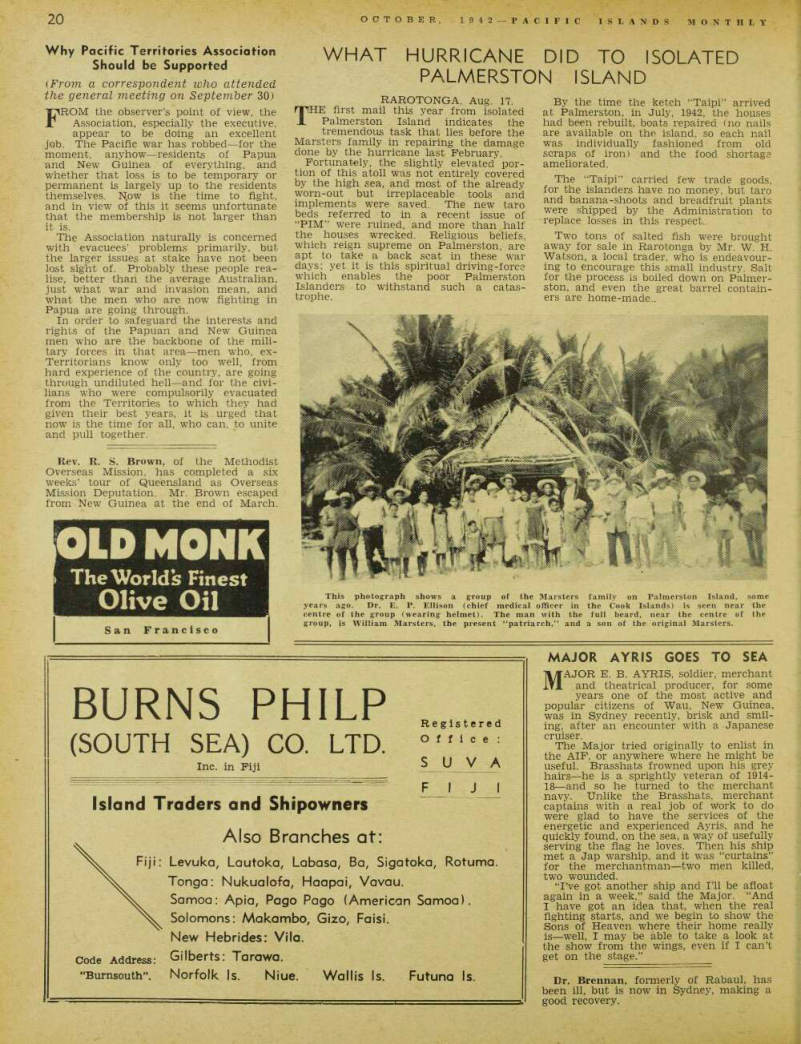
Should be Supported
(From a correspondent who attended
the general meeting on September 30)
FROM the observer’s point of view, the Association, especially the executive, appear to be doing an excellent job. The Pacific war has robbed —for the moment, anyhow—residents of Papua and New Guinea of everything, and whether that loss is to be temporary or permanent is largely up to the residents themselves. N.ow is the time to fight, and in view of this it seems unfortunate that the membership is not larger than it is.
The Association naturally is concerned with evacuees’ problems primarily, but the larger issues at stake have not been lost sight of. Probably these people rea lise, better than the average Australian, just what war and invasion mean, and what the men who are now fighting in Papua are going through.
In order to safeguard the interests and rights of the Papuan and New Guinea men who are the backbone of the mili tary forces in that area—men who, ex- Territorians know only too well, from hard experience of the country, are going through undiluted hell —and for the civi lians who were compulsorily evacuated from the Territories to which they had given their best years, it is urged that now is the time for all, who can, to unite and pull together.
Rev. R. S. Brown, of the Methodist Overseas Mission, has completed a six weeks’ tour of Queensland as Overseas Mission Deputation. Mr. Brown escaped from New Guinea at the end of March.
Advertisements & other items, p. 22 (1 item)
ln Tnd bSadfmit nllnts
WHAT HURRICANE DID TO ISOLATED
PALMERSTON ISLAND
RAROTONGA. Aug. 17.
rpHE first mail this year from isolated A Palmerston Island indicates the tremendous task that lies before the Marsters family in repairing the damage done by the hurricane last February. . Fortunately, the slightly elevated por- J-ion of this atoll was not entirely covered by the high sea, and most of the already worn-out but irreplaceable tools and implements were saved. The new taro beds referred to m a recent issue of “PIM” were ruined, and more than half the houses wrecked. Religious beliefs, which reign supreme on Palmerston, are a Pt to take a back scat in these war da ys: yet it is this spiritual driving-force which enables the poor Palmerston Islanders to withstand such a catastrophe.
By the time the ketch “Taipl” arrived at Palmerston, in July, 1942, the houses had been rebuilt, boats repaired (no nails are available on the island, so each nail was individually fashioned from old scraps of iron) and the food shortage ameliorated.
Th « Taini » rarripH fpw traHP o-noHc
f Zanders monef huf
ln Tnd bSadfmit nllnts
bv the to S c fw p ; inthif resnSt U re P lace losses m this respect.
Two tons of salted fish were brought away for sale in Rarotonga by Mr. W. H.
Watson, a local trader, who is endeavour ing to encourage this small industry. Salt for the process is boiled down on Palmer ston, and even the great barrel contain ers are home-made..
This photograph shows a group of the Marsters family on Palmerston Island, some years ago. Dr. E. P. Ellison (chief medical officer in the Cook Islands) is seen near the centre of the group (wearing helmet). The man with the full beard, near the centre of the group, is William Marsters, the present “patriarch,” and a son of the original Marsters.
Major Ayris Goes To Sea
MAJOR E. B. AYRIS, soldier, merchant and theatrical producer, for some years one of the most active and popular citizens of Wau, New Guinea, was in Sydney recently, brisk and smil ing, after an encounter with a Japanese cruiser.
The Major tried originally to enlist in the AIF, or anywhere where he might be useful. Brasshats frowned upon his grey hairs —he is a sprightly veteran of 1914- 18 —and so he turned to the merchant navy. Unlike the Brasshats, merchant captains with a real job of work to do were glad to have the services of the energetic and experienced Ayris, and he quickly found, on the sea, a way of usefully serving the flag he loves. Then his ship met a Jap warship, and it was “curtains” for the merchantman —two men killed, two wounded.
“I’ve got another ship and I’ll be afloat again in a week,” said the Major. “And I have got an idea that, when the real fighting starts, and we begin to show the Sons of Heaven where their home really is—well, I may be able to take a look at the show from the wings, even if I can’t get on the stage.”
Dr. Brennan, formerly of Rabaul, has been ill, but is now in Sydney, making a
good recovery.
Advertisements & other items, p. 22 (1 item)
Old Monk
> The Worlds Finest Olive Oil San Francisco
BURNS PHILP
(SOUTH SEA) CO. LTD.
Inc. in Fiji Island Traders and Shipowners Registered Office :
SUVA
FIJI
\\ Also Branches at: Fiji: Levuka, Lautoka, Labasa, Ba, Sigatoka, Rotuma.
Tonga: Nukualofa, Haapai, Vavau.
Samoa: Apia, Pago Pago (American Samoa).
Solomons: Makambo, Gizo, Faisi.
New Hebrides: Vila.
Code Address; Gilberts: Tarawa.
“Burnsouth”. Norfolk Is. Niue. Wallis Is. Futuna Is.
Chinese As A
Barometer
Left Papeete En Masse in December :: Return in July
PAPEETE, August 10.
ALL along the Broom Road now, from Papeete on through the formerly fabulous districts of Punaauia and Paea. out to Papara, 20 miles from town, Tahiti’s Chinese population is moving out of its rented houses and filing in order back to the squalid stores and shops of Papeete.
From Beverly Hills estates they come, from the great houses filled with the memory of Americans that have gone; from ramshackle hovels that had known no occupants in this generation, the Chinese and their 5 or 10 or 15 children.
From the dry and pretty popaa districts they are emerging in orderly fashion, Chinese are moving bfck into town What we see here is the end of the picture. This Chinese return to normalcy represents onlv the final few strokes of the brush that now complete a larger canvas. For the beginning we must roll the months back to a quiet Sunday last December . . . back to Pearl Harbour.
It was early Sunday morning when the crime took place, and by Sunday evening Tahiti’s radios had blared it forth; and Tahiti was pandemonium.
Twenty-four hundred miles below Oahu was the little town of Papeete, where thousands of Chinese lived hud died in the backs of stores, or in fragile tropic houses, or in buildings built before bombs. They are strongly instinctive, for even before the eventful hour arrived,
some of them had P acked their goods.
But many were not ready, and there was mad confusion. They, best of all, knew the sly traits of their oldest enemy.
They knew that the wily Jap might strike at random across this broadest ocean.
PROM a quiet, tropical Sunday there JT slowly arose the mounting crescendo of a great exodus. Children were halted at evening play and delegated to many of the tasks that accompany fleeing. Belongings were snatched from here and there and thrown into baskets and boxes with no thought of packing.
Throughout the black night and far into the next day, every available vehicle and mode of transportation were rounded up and regimented by these Orientals, fleeing for their lives to the wide-open districts. Trucks, buses, battered automobiles running on their rims, bony horses without saddles, little children swaying and dragging a loaded cart, motor cycles that had to be pushed for lack of gasoline, bent and battered bicycles-all were regimented to the cause of safety. Some even rode cows.
One elderly Chinese was selling ice S ream on ,^?? y ornmg when he sud- ■iF SltTnnpn rcH S d^ a PPeared behind a dark building. Ten Sr n^QTp^t^ic he w^K S iv Po in all Sfc l^ riC fa SI X S ?JH a wking ebiekens, and a squealing pig 0 extricate itself from under a mattress.
For two days this great migration continued. And then a possible dire consequence of the great movement occurred to someone. Most of the fleeing Chinese owned markets and stores in Papeete. and they were carting their provisions with them. All the canned goods and
edibles, intended to feed the entire island, were being hauled away to the country and the hills. They were taking Japan’s declaration of a “ten years war’’ literally!
Chains were put across the Broom Road, leading out from town. Soldiers wearing the Cross of Lorraine searched every vehicle, every pedestrian No more canned goods or other food items could ? e taken ff 01 ? 1 Pa P^ ete - was all right to takf > that P rec J° us , ht . tle something FfiP 6 ? * or vwJr 6 S x. all , rignt to houses arounS the Sand that
had lone vacant becausl ofth^
dechne and fall oftourismwere sud denlv bursting with Chinese Bie houses and small houses shanties ’ and shacks and great country’places-every thing and anvthine thev could hes nr rent in fhc ] US h ereen auiet of Punaauia Paca Panare snrune: to life and beWan to dance a lie to Chinese music g The rents P-athcreri were’ evnrhitant From an average rental fee of 500 francs f month the nrice suddenl? zoomS tn 20S and 3 000 and even 4 000 francs a month But thev nSd thenriceand “ Pa,d PnC6 ’ and A ND there they have relaxed in their A new freedom since those dusky December days of Pearl Harbour, They have watched events transpire in their homeland, and on all the shores of the Paclfic , Perhaps thev are wise in their Orien tal way of evaluating an old enemy. They knew what they were doing, let us say, when they fled from possible bombs nearly a year ago. They know their old enemy. Perhaps they know what they are doing, now.
For all along the Broom Road, now, from Papeete out to Papara, 20 miles from town, Tahiti’s Chinese population is moving out of its rented houses and returning to the squalid stores and shops of Papeete.
Advertisements & other items, p. 23 (1 item)
88 Years
til
•V sr ( .ui> vTv .s> <a,t v•„ „ <!»vu& (£S
S WALLOW sIRIE LL ltd.
MAKERS OF BISCUITS • PLUM PUDDINGS • CAKES • VIIOCEN • ICE CREAM sJi^ 51 ' '~: S 3 'JU
Tahiti's Earliest Aviators
Quaint Gentlemen Who Sought Treasure in Brown Bottles
By A. C. Rowland
AEROPLANES have been a common enough sight in the skies over Tahiti during recent years, but it was long after other lands had become accustomed to the mechanical vultures, that the first were brought to our island.
Their advent was accompanied with no little comedy. The earliest to arrive was imported by a young man of the States, reputed to be the possessor of pots of money and of an urge to be an explorer.
What he proposed to explore in these waters, he did not say.
The aeroplane was one of those early contraptions which had wings attached to the body by iron bolts, and held in place by piano wire. Everybody expected, and some hoped, to see it dissolve into its several elements and descend in a shower of bolts, wings and engine parts.
Timid residents of Papeete soon learned to move each eye independently, as does the chameleon; one eye to keep watch on the wild chauffeurs of our metropolis, the other to cock aloft in wary alarm. Some hardy souls did venture up with the owner and, to the amazement of everyone, re turned from the sky, safe and sound.
The final flight was an exploring ex pedition to the not very distant district of Mahina. It is presumed that the objective was liquid treasure, hidden in bottles reposing in the cellar of a resident of that district.
The treasure having been discovered, the aviator and two guests (one a woman), squeezed themselves into the narrow cockpit and taxied over a narrow lagoon, through a pass in the barrier reef, into the towering waves of an angry sea.
With difficulty the guest extricated him self, drew the woman from the flooded cockpit by her hair, and swam with her to an islet on the reef. The aviator salvaged himself and his plane by some miracle.
Later the machine was brought over One Tree Hill on a truck to Papeete, where it was presented by the owner to a local chauffeur, shortly before his de parture for his native country. The plane never soared again—much to the relief of the timid, who could henceforth use both eyes to preserve them from the perils on the ground.
THE second aeroplane was brought by Mr. Winkleby. Mr. Winkleby had visited our island before—several times before. Each time he had brought with him some marvel from civilisation intended to astonish the natives. By some perversity the natives were never impressed by these imnorted marvels; but were always very much astonished at Mr Winklebv himself.
Mr. Winkleby was not reputed to have pots of money. He was not the type of individual to leave intelligence of such importance to the vague mistiness of rumour and renute. His nerson and con versation perpetually tinkled with • coins of the realm. * The American Consul—who had seen Mr. Winkleby before—was not at all pleased when, from the wharf, he beheld Mr. Winklebv’s gladsome face peering over the railing of the approaching steamer. On the contrary, the British Consul—who was gifted with a keen sense of humour and who, also, had seen Mr.
Winkleby before—greeted his arrival with paeans of joy. Those were the days when life on Tahiti was simple and primitive and the Escape from Prohibition had not yet begun.
The Saga of Mr. Wiukleby’s sojourns in Tahiti would fill a volume replete with stories such as the episode of Mr. Wink leby’s diamond ring which, although it convulsed the island with laughter, is not fit and proper for the chaste eve of “PIM” readers; the letter to the Head of the Colony, beginning “dear Governor,” which brought the harried American Consul to the verge of apoplexy; the last moment seizure of his baa-gage by in dignant creditors, whom Mr. Winkleby had forgotten to pay, which delayed the steamer’s departure and nearly caused twin strokes of apoplexy to both the ship’s captain and the American Consul.
Our space permits onlv an account of Mr. Winkleby’s one solo flight. Mr.
Winklebv. too, was an explorer for trea sure, hidden in the depths of brown and green bottles.
One day. when the skv appeared to be full of rainbows. Mr. Winklebv resolved to go in search of the not of gold which, as everybody knows, is to be found at the rainbow’s end. Ascending from Vain iniiore. he followed the curve of the rain bow through a perfect arc, which ended, alas, not at a pot of gold, but in a mighty splash in the centre of the harbour.
They fished Mr. Winkleby and his aero plane out of the sapphire water, to dis cover that, while the Plane was askew, Mr. Winkleby. except for a few minor bruises, was uninjured—much to the regret of the American Consul.
A few days later the mail steamer arrived. The aeroplane was hoisted by the ship’s winches and deposited in the hold. Mr. Winkleby (who that day was seeing triple rainbows) was escorted aboard and deposited in a deck cabin.
Since that time there have been no civilian-owned aeroplanes at Tahiti.
A Samoan native, Vaiusu. was arrested at Safotu, Savafi, charged with the mur der of a German half-caste and resident of Safotu, Henry Schmidt, who was found dead in his bed on June 4, with head injuries caused by blows with a club. The accused native had had a violent controversy with the dead man a short time before.
The yacht “Lorna D” (which, owing to war conditions, lay in Suva Harbour for about two years after it brought its own ers, Mr. and Mrs. Davidge, on a Pacific wander from British Columbia) left Fiji a few weeks ago on its return voyage to British Columbia.
Advertisements & other items, p. 24 (1 item)
Foods
PRESCOTT Pty. Ltd.
SUSSEX ST., SYDNEY,
ore sole wholesale agents for
PINEAPPLE BACON&HAMS
DAISY brand BUTTER "375" BUTTER in TINS llb.-21b.-slb. Sizes.
LEA & PERRINS’ Sauces and IMost other Super-Quality Lines of the Trade, such as Cheese, Eggs. Etc.
CnIV E R s
PURE
FOODS
\cm
GOLD MEDAL JAMS
CANNED ENGLISH FRUITS
CANNED ENGLISH
VEGETABLES
CUSTARD POWDER
OLD ENGLISH MARMALADE
JELLY CRYSTALS, ETC.
Obtainable from all Leading Grocery Stores.
Write to Department A.
K.7C.
Chivers and Sons, Ltd., Histon, Cambridge, England, for attractive Recipe Book.
Guinea 2 V " GORDON > artillery, Wau, New
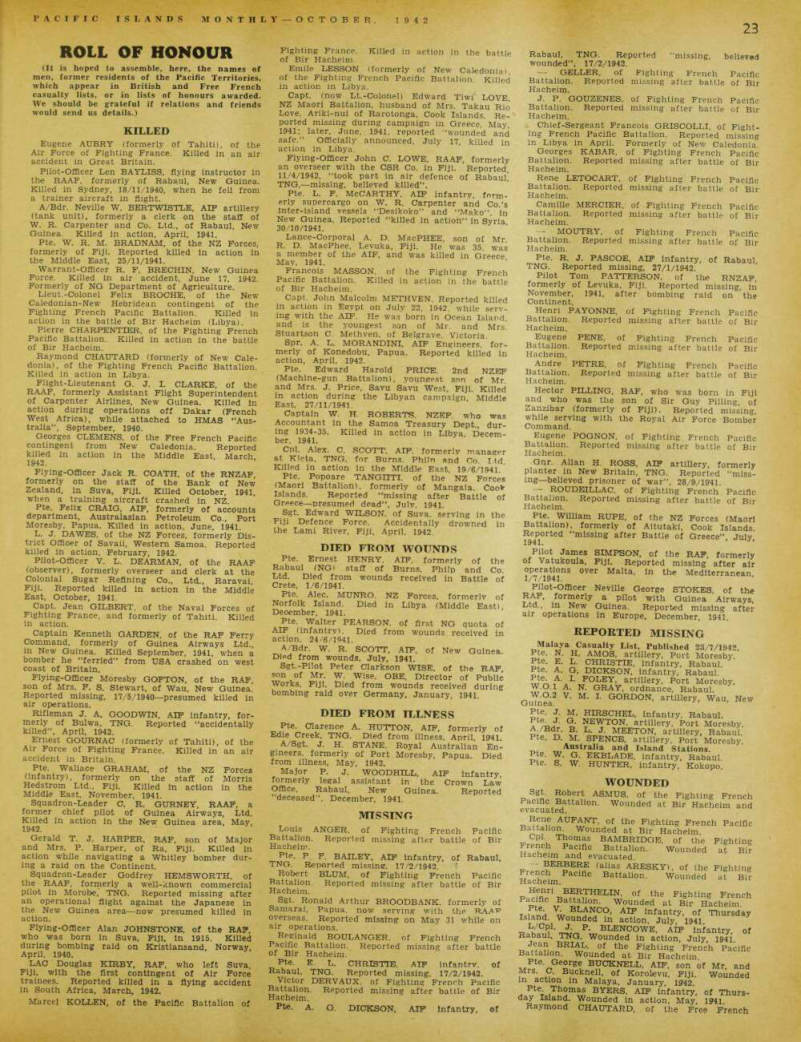
Roll Of Honour
(It is hoped to assemble, here, the names of men, former residents of the Pacific Territories, which appear in British and Free French casualty lists, or In lists of honours awarded.
We should be grateful if relations and friends would send us details.)
Killed
Eugene AUBRY (formerly of Tahiti), of the Air Force of Fighting France. Killed in an air accident in Great Britain.
Pilot-Officer Len BAYLISS, flying instructor in the RAAF, formerly of Rabaul, New Guinea.
Killed in Sydney, 18/11/1940, when he fell from a trainer aircraft in flight.
A/Bdr. Neville W, BERTWISTLE, AIF artillery (tank unit), formerly a clerk on the staff of W. R. Carpenter and Co. Ltd., of Rabaul, New Guinea. Killed in action, April, 1941.
Pte. W. R. M. BRADNAM, of the NZ Forces, formerly of Fiji. Reported killed in action in the Middle East. 25/11/1941.
Warrant-Officer R. F. BRECHIN, New Guinea Force. Killed in air accident, June 17, 1942.
Formerly of NG Department of Agriculture.
Lieut.-Colonel Felix BROCHE, of the New Caledonian-New Hebridean contingent of the Fighting French Pacific Battalion. Killed in action in the battle of Bir Hacheim (Libya).
Pierre CHARPENTLER, of the Fighting French Pacific Battalion. Killed in action in the battle of Bir Hacheim.
Raymond CHAUTARD (formerly of New Cale donia), of the Fighting French Pacific Battalion.
Killed in action in Libya.
Flight-Lieutenant G. J. I. CLARKE, of the RAAF, formerly Assistant Flight Superintendent of Carpenter Airlines, New Guinea. Killed In action during operations off Dakar (French West Africa), while attached to HMAS “Aus tralia”, September, 1940.
Georges CLEMENS, of the Free French Pacific contingent from New Caledonia. Reported killed in action in the Middle East, March. 1942.
Flying-Officer Jack R. COATH, of the RNZAF, formerly on the staff of the Bank of New Zealand, in Suva, Fiji. Killed October, 1941, when a training aircraft crashed in NZ.
Pte. Felix CRAIG, AIF, formerly of accounts department, Australasian Petroleum Co., Port Moresby, Papua. Killed in action, June, 1941.
L. J. DAWES, of the NZ Forces, formerly Dis trict Officer of Savaii, Western Samoa. Reported killed in action, February, 1942.
Pilot-Officer V. L. DEARMAN, of the RAAF (observer), formerly overseer and clerk at the Colonial Sugar Refining Co., Ltd., Raravai, Fiji. Reported killed in action in the Middle East, October, 1941.
Capt. Jean GILBERT, of the Naval Forces of Fighting France, and formerly of Tahiti. Killed in action.
Captain Kenneth GARDEN, of the RAF Ferry Command, formerly of Guinea Airways Ltd., in New Guinea. Killed September, 1941, when a bomber he “ferried” from USA crashed on west coast of Britain.
Flying-Officer Moresby GOFTON, of the RAF, son of Mrs, F. S. Stewart, of Wau, New Guinea.
Reported missing, 17/5/1940—presumed killed in air operations.
Rifleman J. A. GOODWIN, AIF infantry, for merly of Bulwa, TNG. Reported “accidentally killed”, April, 1942.
Ernest GOURNAC (formerly of Tahiti), of the Air Force of Fighting France, Killed in an air accident in Britain.
Pte. Wallace GRAHAM, of the NZ Forces (infantry), formerly on the staff of Morris Hedstrom Ltd., Fiji. Killed in action in the Middle East, November, 1941.
Squadron-Leader C. R. GURNEY, RAAP, a former chief pilot of Guinea Airways, Ltd.
Killed in action in the New Guinea area, May, 1942.
Gerald T. J. HARPER, RAP, son of Major and Mrs. P. Harper, of Ra, Fiji. Killed in action while navigating a Whitley bomber dur ing a raid on the Continent.
Squadron-Leader Godfrey HEMSWORTH, of the RAAF, formerly a well-known commercial pilot in Morobe, TNG. Reported missing after an operational flight against the Japanese in the New Guinea area—now presumed killed in action.
Flying-Officer Alan JOHNSTONE, of the RAP, who was born in Suva, Fiji, In 1915. Killed during bombing raid on Kristiansand, Norway, April, 1940.
LAC Douglas KIRBY, RAF, who left Suva, Fiji, with the first contingent of Air Force trainees. Reported killed in a flying accident in South Africa, March, 1942.
Marcel KOLLEN, of the Pacific Battalion of
Fighting France. Killed in action in the battle of Bir Hacheim.
Emile LESSON (formerly of New Caledonia) of the Fighting French Pacific Battalion. Killed in action in Libya.
Capt. (now Lt.-Colonel) Edward Tiwi LOVE, NZ Maori Battalion, husband of Mrs. Takau Rio Love, Ariki-nui of Rarotonga, Cook Islands. Re ported missing during campaign in Greece, May, 1941; later. June, 1941, reported “wounded and safe.” Officially announced, July 17, killed in action in Libya.
Flying-Officer John C. LOWE. RAAP, formerly an overseer with the CSR Co. in Fiji. Reported 11/4/1942, “took part in air defence of Rabaul!
TNG, —missing, believed killed”.
Pte. L. F. MCCARTHY. AIF infantry, form erly supercargo on W. R. Carpenter and Co.’s Inter-island vessels “Desikoko” and “Mako”. in New Guinea. Reported “killed in action” in Syria 30/10/1941.
Lance-Corporal A. D. MacPHEE, son of Mr R. D. MacPhee, Levuka, Fiji. He was 35. was a member of the AIF, and was killed in Greece Mav, 1941.
Francois MASSON, of the Fighting French Pacific Battalion. Killed in action in the battle of Bir Hacheim.
Capt. John Malcolm METHVEN. Reported killed in action in Eeypt on July 22, 1942. while serv ing with the AIF. He was born in Ocean Island, and is the youngest son of Mr. and Mrs!
Stuartson C. Methven, of Belgrave, Victoria Spr. A. L. MORANDINT. AIF Engineers, for merly of Konedobu, Papua. Reported killed in action, April, 1942.
Pte. Edward Harold PRICE. 2nd NZEF (Machine-gun Battalion), youngest son of Mr. and Mrs. J. Price, Savu Savu West, Fiji. Killed in action during the Libyan campaign, Middle East. 27/11/1941.
Captain W. H. ROBERTS. NZEF. who was Accountant in the Samoa Treasury Dept., dur ing 1934-35. Killed in action in Libya. Decem ber. 1941.
Cpl. Alex. C. SCOTT. AIF. formerly manager at Kieta. TNG, for Burns. Philn and Co. Ltd Killed in action in the Middle East. 19/6/1941.' Pte. Popoare TANGITTI. of the NZ Forces (Maori Battalion), formerly of Mangaia. Cook Islands. Reported “missing after Battle of Greece—presumed dead”, July, 1941.
Sgt. Edward WILSON, of Suva, serving in the Fiji Defence Force. Accidentally drowned in the Lami River, Fiji, April, 1942.
Died From Wounds
Pte. Ernest HENRY. ATP. formerly of the Rabaul (NG) staff of Burns. Philp and Co.
Ltd. Died from wounds received in Battle of Crete, 1/6/1941.
Pte. Alec. MUNRO. NZ Forces, formerly of Norfolk Island. Died in Libya (Middle East).
December, 1941.
Pte. Walter PEARSON, of first NG quota of AIF (infantry). Died from wounds received in action. 24/6/1941.
A/Bdr. W. R. SCOTT. AIF, of New Guinea.
Died from wounds, July, 1941.
Sgt.-Pilot Peter Clarkson WISE, of the RAP. son of Mr. W. Wise. OBE, Director of Public Works, Fiji. Died from wounds received during bombing raid over Germany, January, 1941.
Died From Illness
Pte. Clarence A. HUTTON, AIF. formerly of Edie Creek, TNG. Died from illness. April, 1941.
A/Sgt, J. H. STANE. Royal Australian En gineers. formerly of Port Moresby, Papua. Died from illness, May, 1942.
Major P. J. WOODHILL, AIF Infantry, formerly legal assistant in the Crown Law Office, Rabaul, New Guinea. Reported “deceased”, December, 1941.
Missing
Louis ANGER, of Fighting French Pacific Battalion. Reported missing after battle of Bir Hacheim.
Pte. P F. BAILEY, AIF Infantry, of Rabaul, TNG. Reported missing. 17/2/1942.
Robert BLUM, of Fighting French Pacific Battalion. Reported missing after battle of Bir Hacheim.
Sgt. Ronald Arthur BROODBANK, formerly of Samarai, Papua, now serving with the RAA* 1 overseas. Reported missing on May 31 while on air operations.
Reginald BOULANGER, of Fighting French Pacific Battalion. Reported missing after battle of Bir Hacheim.
Pte. E. L. CHRISTIE. AIF infantry. of Rabaul, TNG. Reported missing, 17/2/1942.
Victor DERVAUX. of Fighting French Pacific Battalion. Reported missing after battle of Bir Hacheim.
Pte. A. G. DICKSON, AIF Infantry, of
Rabaul, TNG. Reported “missing, believed wounded”, 17/2/1942.
GELLER. of Fighting French Pacific Battalion. Reported missing after battle of Bir Hacheim.
J. P. GOUZENES. of Fighting French Pacific Battalion. Reported missing after battle of Bir Hacheim.
Chief-Sergeant Francois GRISCOLLI, of Fight ing French Pacific Battalion. Reported missing in Libya in April. Formerly of New Caledonia.
Georges KABAR, of Fighting French Pacific Battalion. Reported missing after battle of Bir Hacheim.
Rene LETOCART, of Fighting French Pacific Battalion. Reported missing after battle of Bir Hacheim.
Camille MERCIER, of Fighting French Pacific Battalion. Reported missing after battle of Bir Hacheim.
MOUTRY, of Fighting French Pacific Battalion. Reported missing after battle of Bir Hacheim.
Pte. R. J. PASCOE, AIF Infantry, of Rabaul TNG. Reported missing, 27/1/1942.
Pilot Tom PATTERSON. of the RNZAF formerly of Levuka, Fiji. Reported missing, in November, 1941, after bombing raid on the Continent.
Henri PAYONNE, of Fighting French Pacific Battalion. Reported missing after battle of Bir Hacheim.
Eugene PENE, of Fighting French Pacific Battalion. Reported missing after battle of Bir Hacheim.
Andre PETRE, of Fighting French Pacific Battalion. Reported missing after battle of Bir Hacheim, Hector PILLING, RAF, who was born in Fiji and who was the son of Sir Guy Pilling, of Zanzibar (formerly of Fiji). Reported missing, while serving with the Royal Air Force Bomber Command.
Eugene POGNON. of Fighting French Pacific Battalion. Reported missing after battle of Bir Hacheim.
Gnr. Allan H. ROSS, AIF artillery, formerly planter in New Britain, TNG. Reported “miss ing—believed prisoner of war”, 28/9/1941.
ROUDEILLAC, of Fighting French Pacific Battalion. Reported missing after battle of Bir Hacheim.
Pte. William RUPE, of the NZ Forces (Maori Battalion), formerly of Aitutakl, Cook Islands 194 P l° rted * ,missing after Battle of Greece”, July, Pilot James SIMPSON, of the RAF, formerly of Vatukoula, Fiji. Reported missing after air l/7/194i n * OVCr Malta ’ ln Med,terranean - Pilot-Officer Neville George STOKES, of the ’ I formerl y a Pilot with Guinea Airways, Ltd., in New Guinea. Reported missing after air operations In Europe, December, 1941.
Reported Missing
Malaya Casualty List, Published 23/7/1942.
Pte. N. H. AMOS, artillery, Port Moresby.
Pte. E. L. CHRISTIE, infantry. Rabaul.
Pte. A. G. DICKSON, infantry, Rabaul. , A - foI EY. artillery. Port Moresby.
W.0.l A. N. GRAY, ordnance, Rabaul.
Guinea 2 V " GORDON > artillery, Wau, New Pte. J. M. HIRSCHEL. Infantry, Rabaul.
I - new TON, artillery, Port Moresby.
A /Bdr, B. L. J. MEETON. artillery, Rabaul.
Pte. D. M SPENCE, artillery, Port Moresby, Australia and Island Stations.
Pte. W. G. EKBLADE, infantry. Rabaul.
Pte. S. W. HUNTER, infantry. Kokopo.
Wounded
3gt. Robert ASMUS, of the Fighting French Pacific Battalion. Wounded at Bir Hacheim and evacuated.
UFANT ’ of the Fi g h ting French Pacific Battalion. Wounded at Bir Hacheim.
Cpl Thomas BAMBRIDGE, of the Fighting French Pacific Battalion. Wounded at Bir Hacheim and evacuated. (alias ar ESKY). of the Fighting Hacheim ° Battalion - Wounded at Bir BERTHELIN - of the Fighting French Pamfic Battalion. Wounded at Bir Hacheim.
BL j CO ’ AJF infantry, of Thursday Island. Wounded in action, July, 1941 rJ- P ; Tr BEENCOWE. AIF Infantry, of Rabaul, "piG. Wounded in action, July, 1941. p/t e^nn^Rl^r L ’ °i he Fighting French Pacific Battalion. Wounded at Bir Hacheim.
Bte - Ge ° r e® BUCKNELL. AIF, son of Mr. and Mrs. C. Bucknell, of Korolevu, Fiji. Wounded in action in Malaya, January 1942 Pte Thomas BYERS, AIF Infantir, of Thurs day Island. Wounded in action, May, 1941 Raymond CHAUTARD, of the Free French
Pacific contingent from New Caledonia. Reported a casualty in the Middle East, March, 1942.
Albert CUBADDA, of the Free French contingent from New Caledonia. Reported a casualty in the Middle East, March, 1942.
V. FAIRHALL, 2nd NZEF, formerly of the Treasury Department, Western Samoa. Reported wounded in action, February, 1942.
Paroa FIU of the Fighting French Pacific Battalion Wounded at Bir Hacheim and , r T PnDnnw .Gn
w^ 0 tno V ‘ Wonnlslan
' nf , antry - ’ TN °‘ Wounded in actK>n * Pte* John GRANT, AIF infantry, of New Guinea. Wounded in neck and thigh. September, 1941; later, reported “rejoined unit”.
Henri GUILBAUD, of the Free French Pacific contingent from New Caledonia. Reported a casualty in the Middle East, March, 1942.
Sgt. C. HENDRICK, AIF infantry, of Rabaul.
TNG. Wounded in action, July, 1941.
Stanley HIGGS, son of Mr. and Mrs. Gordon Higgs, of W. R. Carpenter and Co. Ltd., New Guinea. Member of an English Lancers’ regiment, wounded during British evacuation from Dunkirk (France), May, 1940.
Lieut. Lloyd T. HURRELL, AIF infantry, of Rabaul, TNG. Wounded in action, July, 1941.
Alexandre HUYARD, of the Free French Pacific contingent from New Caledonia. Reported a casualty in the Middle East, March, 1942, Sgt.-Pilot Andrew KRONFELD, of the NZ Fighter Squadron attached to the RAF. Wounded ( n knee during operations over Prance, December, 1941 Cpl . w. H, LANNEN, AIF artillery, of Rabaul, New Guinea> WoU nded in action, June, 1941. r. E. G. LOBAN, AIF artillery, of Thursday d. Wounded during campaign in Greece, May, 1941; invalided home after having his left forearm amputated.
Auguste LUTA, of the Fighting French Pacific Battalion Wounded at Bir Hacheim and evacuated , , A/Sgt. Alastair MACLEAN, AIF infantry, of Rabaul. New Guinea. Wounded in action, in Libya, June, 1941.
Sgt. J. D. McCLYMONT, NZEF, son of Capt.
D. McClymont, Harbourmaster of Apia, Western Samoa. Wounded in action, November, 1941.
Cpl. R. McKERLIE, AIF, of Yandina, BSI, wounded in face by bomb explosion, April, 1941.
T. MANEA, of the Fighting French Pacific
Battalion. Wounded at Bir Hacheim and evacuated.
Jean MERIGNAC, of the Free French Pacific contingent from New Caledonia. Reported a casualty in the Middle East, March, 1942.
Henri MEYER, of the Free French Pacific contingent from New Caledonia. Reported a casualty in the Middle East, March, 1942.
S/Sgt. Graham B. MIRFIELD, AIF engineers, of Rabaul, New Guinea. Wounded in action, Pte. L. G. (“Mick”) REECE, AIF, of Bulolo, New Guinea. Wounded in action, July, 1941.
Henri RIVIERE, of the Free French Pacific contingent from New Caledonia. Reported a casualty in the Middle East, March, 1942.
A/Cpl. N. K. SAWYER, AIF infantry, of Rabaul, TNG. Wounded in action, July, 1941.
July, 1941.
Lieut. Jeffrey SEAGOE, serving with the British forces in the Far East, formerly of Vila, New Hebrides, Reported “wounded in action”.
March, 1942.
Pte. Lance STAMPER, AIF, formerly school master at Wau, New Guinea. Wounded in action, August, 1941.
Cpl. Raphael TEIHO, of the Fighting French Pacific Battalion. Wounded at Bir Hacheim and evacuated.
Cpl. Terii TERIITUA, of the Fighting French Pacific Battalion. Wounded at Bir Hacheim and evacuated.
Pte. Harold G. TURNER. AIF. of Samarai, Eastern Papua. Wounded in action at Bardia (Libya). January. 1941.
Pte. P. D. TWISS, AIF infantry, of New Guinea. Wounded in action, August, 1941.
Camille VINCENT, of the Free French Pacific contingent from New Caledonia. Reported a casualty in the Middle East, March, 1942.
Driver Don F. WAUCHOPE, AIF. Formerly employed on his brother’s plantation in New Guinea. Wounded in action. July, 1942.
Alex. WINCHESTER, of the Fighting French Pacific Battalion. Wounded at Bir Hacheim.
Sgt.-Pilot W. WRIGHT, of the Australian Spitfire Squadron, attached to the RAF, for merly of New Guinea. Wounded in knee during aerial “dog-fight” over the English Channel, March. 1942.
Prisoners Of War
A/Cpl. Peter W. BOSGARD. AIF infantry, formerly of the Lands Department, Port Moresby, Papua. Reported prisoner of war at Sulmona, Italy, 29/6/1941; transferred to Bolzano prison camn. September. 1941.
A/Sgt. A. A, S. COTMAN, ALP infantry, of Abau, Papua. Reported missing—believed prisoner of war, 5/5/1941; reported later, July, 1941, “woun/ded in chest and head by shrapnel— taken prisoner”.
Pte. J. DALTON. AIF Transport and Supply, formerly of Thursday Island. Reported prisoner of war, April, 1942.
Dick ELMOUR, formerly of New Caledonia, prisoner of war after Dunkirk. Repatriated to France in January, 1942, because of health reasons.
Pilot-Officer George Beilby EVANS, RAAF, son of Mr. and Mrs. Beilby Evans, formerly of Buka Passage, TNG. Reported prisoner of war in Java.
Pte. W. GOSSNER, AIF infantry, formerly of the BNG Development Co., Port Moresby, Papua.
Reported prisoner of war, Sulmona, Italy, 6/7/1941.
Lieut. J. M. HARCOURT, 2nd NZEF, son of Mr. H. W. Harcourt, formerly Deputy Treasurer in Fiji. Reported “captured in Libya and now prisoner of war”, March, 1942.
Gnr. A. L, B. KING, AIF artillery, of Rabaul, TNG, Reported prisoner of war. 29/7/1941.
A/Cpl. John H. LONERGAN, AIF, Supply and Transport, of New Guinea. Reported prisoner of war at Corinthia, Italy, 8/7/1941.
Pte. Ernest (“Paddy”) McGEADY, NZEF, son of Mrs. J. McGeady, of Suva, Fiji. Reported “missing, believed killed”, after fighting in Libya, January, 1942; reported prisoner of war in Italy, April, 1942.
Observer Alex. McKAY, of the RAAF, formerly of the CSR Co.’s staff, at Penang sugar-mill,
Fiji. Reported missing, 27/7/1941; reported prisoner of war in Italy, 26/10/1941.
Pte. Harry MARCHINGTON, of the NZ Forces, formerly of Fiji. Reported prisoner of war after Battle of Crete, 2/12/1941.
Pte. D. R. PHILLIPS, AIF engineers, formerly of Bulwa, TNG. Reported prisoner of war, June, 1942.
Pte. John O. SMITH, of the NZ Forces, son of Captain Arthur Smith, of the Fiji inter-island vessel “Tui Kauvaro”. Missing after battle of Crete, May, 1941; reported prisoner of war in Germany, 21/10/1941.
Squadron-Leader L. C. SHOPPEE, DSO, RAF, formerly of Edie Creek, New Guinea. Was in Java during Japanese invasion; now pre sumed to be a prisoner of war.
LAC Charles SOLLITT, of the RAAP (wire less operator), son of Mr. and Mrs. C. H.
Sollitt, of Nausori, Fiji. Reported missing after air operations in New Guinea, January, 1942; later, March, 1942, reported rescued from sea by Japanese—now prisoner of war.
Pte. Fred SWAN, NZ Army Medical Corps, formerly of Apia, Western Samoa. Missing after Battle of Crete, August, 1941; reported prisoner of war in Germany, November, 1941.
Pte. John D. WHITCOMBE, of the NZ Forces, formerly of Levuka, Fiji. Reported prisoner of war in Germany, November, 1941.
Decorations
Squadron-Leader G. U. (“Scotty”) ALLEN, RAAF, who is well-known in New Guinea and Papua, having been co-pilot on the “Faith in Australia”, on the first official air-mail flight to the Territories in 1934. Awarded the Air Force Cross for his work with Catalina flying boats in Australia and the Pacific.
Major H. T. ALLEN, A IF, formerly of Wau, Morobe District, TNG. Awarded the OBE.
Sgt. Henry C. S. COTTON, of the RNZAF, who was born in Samoa (his father was Secre tary of Native Affairs during the NZ military occupation). Awarded the Distinguished Flying Cross.
Squadron-Leader Godfrey HEMSWORTH, RAAF, formerly a well-known New Guinea pilot, who was killed in action against the Japanese (n May, Posthumously awarded the Air Force Cross.
Flieht-Lieut. R. N. DALKTN, RAAF, formerly of W. R. Carpenter and Co.. Ltd., Salamaua, TNG. Awarded the DFC for bombing raids against the Japanese in Koepang area, DEI.
Squadron-Leader C. R. GURNEY. RAAP, for merly of Guinea Airways. Ltd.. TNG. Posthu mously swarded the Air Force Cross, for bomb ing raids on Japanese-held ports in New Britain.
Lieut. Colin HILL. RANR, of the Australian destroyer, “Waterhen”, formerly second officer on t>>« trans-Pacific liner “Niagara”. Awarded the OBE.
Flying-Officer James R. HYDE, of the RAP. formerly a Patrol Officer in Namatanal and Sepik Districts, TNG. Awarded the Distinguished Flying Cross.
Lieut.-Commander A. W. R. McNTCOLL, RAN. son of Sir Ramsay McNlcoll. Administrator of New Guinea, and Lady McNicoll. Awarded the George Medal.
Sgt. Geoffrey MOORE, of the RNZAF, formerly engineer on the NG inter-island vessel “Maiwara” and on the trans-Pacific liner “Aorangi”. Awarded the Distinguished Flying Medal.
Pilot-Officer Pat RICHARDSON. RAF, son of Mr. W. Richardson, formerly of Penang, Fiji.
Awarded the Distinguished Plying Cross.
Commander Alvord S. ROSENTHAL, RAN, son of Major-General Sir Charles Rosenthal. KCB.
CMG, DSO, VD, Administrator of Norfolk Island. Awarded the DSO. November. 1941; awarded the Bar to DSO, February. 1942.
Lieut. George Raymond WORLEDGE, of the RANVR, formerly of Fiji. Awarded the MBE (Military),
Advertisements & other items, p. 26 (1 item)
(pati**** l
(pati*** l
SW Never before have we all had to preserve the virtue of patience as during this war. So, if you are unable to obtain normal supplies
of AUNT MARY'S BAKING POWDER, remem-
ber it is solely because important ingredients are difficult to procure. Limited supplies are still available.
The shortage is another of those unfortunate war-time problems which all must share until Victory is achieved.
AUNT MARY’S BAKING POWDER
PRODUCING UNIFORM GOOD RESULTS SINCE 1868
ALWAYS ASK FOR IT
Ilrfd San Francisco
Samoa's New Revenues
APIA, August 26.
WESTERN Samoa, like the other island groups which have been spared the horrors of Japanese invasion, is enjoying the benefits of much increased produce prices.
Higher rates are ruling for our two main products, copra and cocoa, and also for our small production of rubber.
Against the higher revenue of the pro
ducers, however, must be placed the more than 100 per cent, increase in the cost of living, and a consequent wage increase fer all classes of labourers. Essential foodstuffs like rice, flour, sugar, canned meats and fish have not only gone up considerably in price, but supplies are scarce, and have to be rationed. Transport also is suffering from the severe rationing of fuel.
Clothing and drapery, in particular, are difficult to obtain, and all Apia stores are showing empty shelves. Hardware is in short supply. Even native food—stuffs like taro, yams and bananas
—are locally selling at much increased rates.
Owing to favourable weather, the pre duction of copra and cocoa is higher this year than last year, and the increased price is, of course, a further stimulant. All European producers are, however, faced with an acute shortage of labour.
The curren t ra t e paid at present for plantation cocoa is £7O to £BO, according to quality and quantity. Like last year’s crop, this year’s crop is a very good one and so far shipping facilities have been fairly satisfactory.
Advertisements & other items, p. 27 (1 item)
Hot-Weather Meals
Here’s the quick, easy way to serve
COOL, APPETISING
ef YOU can prepare crisp, cool, appetising salads in five minutes with Imperial “Hampe” the quick-serve summer delicacy that’s ready-cooked, readyto-serve and flavour-sealed . . . And what a flavour!
Everyone likes the delicious combination of mild-cured ham and tender veal in “Hampe.” Try it to-day.
Product of Riverstone Meat Co. Pty. Ltd., Sydney.
FIJI Representatives: Pearce & Co. Ltd., Suva.
Sr <J a 'H L\
A A FT
A
Use Of Coconuts
As Food, Oil, Fertiliser
CINCE Japan struck, and the great coconut-growing territories of Philip pines, Dutch East Indies, and Malaya passed under Axis control, the products of the coconut palm have attained a new value in the Anglo-American world.
Messrs. H. W. Jack and R. J. A. Lever, director and editor respectively of the Fijian “Agricultural Journal” —one of the best tropical agricultural journals in the world—recently have published some valuable and timely articles, describing how to make the best use of the coco nut. Extracts follow :— Coconut Recipes
Coconut Butter
Coconut butter is being very largely used in place- of dairy butter in the United Kingdom and France, and, before the war, it was largely used in Germany.
It can be used wherever dairy butter is used. Here is the process:—Grate or grind in a mill the meat of the nut as fine as it can be ground, and for the meat of each average nut add a pint of boiling water. Put this in a press, so that the milk can be squeezed out separate from the pulp. This milk can be used in place of cow’s milk, for any purpose, and is specially good with stewed fruit.
To make butter, this milk can be separated in a separator or let stand in a pan to let the cream rise, which it should do in about the same time as the cream in cow’s milk. This can be set to ripen and churned in the usual way. The whole process is in every respect the same as in making dairy butter. Wash out the buttermilk; add salt to taste. As a rule, this butter is white, and annatto colour
ing can be added. According to the size of the nuts, it should take from six to ten nuts to make 1 lb. of butter. The churning should be done in a cool tem perature, say, between 60 to 70 deg.
Coconut Rice
To the grated meat of one coconut add two cups of hot water; squeeze this in a strainer cloth and add sufficient water to make four cups of liquid; add four table spoons of sugar, a spoonful of ginger, and two cups of rice; cook in a double boiler for nearly one hour. Serve for dessert. (In Spanish America, ginger is almost always added to coconut dishes; it promotes digestion.)
Coconut And Tapioca Pudding
Mix one cup of “minute tapioca” with four tablespoons of grated coconut “meat,” the yolks of four eggs well beaten, one cup of white sugar and one litre of “natural" tinned or dairy milk. Bake for one-half hour and add meringue made of the whites of four eggs and three tablespoons of sugar.—“ New Guinea Agri cultural Gazette.”
Picking Versus Natural Fall in Coconut Harvesting In the main eastern copra producing areas, it has always been the custom to pick the ripe nuts from the palms at re gular intervals —six weeks being regarded as the ideal interval.
In view of the copra depression of the past decade, experimental data were col lected over a series of years which showed no significant difference between the numbers of nuts which fell naturally from the palms and the numbers of nuts which could be collected from palms growing under comparable conditions.
In yield of copra, however, the picking of the nuts from the palms resulted in an increase in the weight of copra per unit
area compared with nuts which had fallen naturally from palms growing under similar conditions.
Obviously, the decreased return in copra from nuts which had fallen naturally was due to the material percentage of ger mination which is always found in such nuts. In the experiments in question, it was found that of all the nuts which were allowed to fall naturally, 28 per cent, had already germinated.
This percentage was found where nut collections were made at regular monthly intervals—at longer intervals the per centage of germinations would certainly have been much higher. In the same experiment the nuts picked from the palms showed a negligible amount of germination, the proportion being less
than one per cent.-
H.W.J.
Copra Quality Now that the maximum output of copra is required as a war effort, attention should be given to the curing of the copra so as to secure the utmost quantity of high-arade produce. Low-grade copra means a definite and material loss to the producer. Each producer can prove this to his own satisfaction by collecting 2,000 nuts, dividing them equally and produc ing copra from each lot of 1,000 nuts separately. With one lot reasonable care should be taken to make good copra only; with the second lot indifferent copra should be made —irregular drying, ex posure to rain or dew, etc. It will be found that the weight of the copra made carefully from the one lot will materially outweigh the copra which was made care lessly—in fact, the loss in making poor copra may, in bad cases, amount to 25-30 per cent, or even more, after a period of one or two months have elapsed.
The initial material was the same in each case, so that the loss is entirely due to lack of attention to methods or pro
cedure in curing the copra. The loss due to making bad copra does not affect the merchant or the manufacturer —it affects only the producer. Hence each producer should strive to reduce his losses on manufacture as much as possible and thus secure the maximum remuneration for his produce. Much loss can be obviated with the exercise of a little more care and better supervision coupled with im provements to available drying equip ment.—H.W.J.
Conversion of Coconut Oil Into a Solid Crystalline Mass While engaged in the study of thermal decomposition of coconut oil. J, Banzon (“The Philippine Agriculturist”) observed that a particular catalyst unique property of converting coconut oil into a crystalline solid mass.
The process is the simple distillation of coconut oil with ferric oxide or finely divided iron. The distillate thus obtained is dark-yellowish with a bluish fluores cence. On cooling, it sets to a crystalline greenish-yellowish mass, which may be purified by repeated washings with methylated spirits.
The purified product is a light, white, crystalline powder, tasteless, and with a faint odour similar to stearic acid. It melts sharply at 55 deg. Cent., to a clear transparent, colourless liquid, and solidifies to a hard, rather brittle, crystalline solid. Owing to its close re semblance to paraffin, this solid may possibly be used interchangeably with the latter, as, for example, in candle-making.—
H.W.J.
Manufacture of Coconut Oil From Fresh Coconut Meat An interesting account of a process for extracting oil directly from fresh coconut meat without its conversion into copra is given in the Philippine “Coconut Journal” by Pedro E. Torres.
The author claims that oil extraction from copra suffers from several dis advantages of which the chief are;— (1) Despite utmost care in handling and storage, the oil produced always contains free fatty acids and is usually discoloured thereby requiring additional refining operations. (2) The only by-products are copra meal and cake which are dirty and be come rancid and can only be used for animal feeds.
He describes the necessary processes for direct oil extraction in chrono logical order and indicates types of equipment already in use for other com mon industries, that may be used for each purpose. He also indicates uses for by-products. Claims are made that the process is commercially feasible but no manufacturing costs are mentioned.
A copy of the article concerned will be made available to any interested appli
cants,-
H.W.J.
Advertisements & other items, p. 28 (1 item)
William Atkins «». m.
Head Office 449-451 KENT ST., SYDNEY.
Iron & Steel Merchants—Engineers' Supplies
Coach & Motor Hardware
ESTABLISHED 50 YEARS
Cable Address: WILATKIN, Sydney.
STEEL DEPARTMENT
MILD STEEL:
Rounds, Squares, Flats, Half-rounds, Hexagons, Bevel, Shoeing, Tyre, Angles, Tees, Sheets, Plates, Girder Plates, Chequer Plates, Channels, Hoops, Etc.
BRIGHT STEEL:
Rounds, Squares, Hexagons.
Extra Special High Speed Tool Steel, Mining Steel, Blister Steel and Spring Steel, Rounds, Flats & Squares.
Bar Iron—All sections and sizes.
Engineers' Supplies: Set Screws, Studs, Metal Thread Screws, Coach Screws, Files, Cotter Pins, Bright and Black Bolts, Rivets, Etc., Hack Saw Blades.
Power Transmission Gear: Including Plummer Blocks, Couplings, Collars, Etc.
Coach and Motor Hardware: Axles, Springs, Wheelstuff, Duck, Paints.
Farriers' Supplies: Horse Nails, Anvils, Vices, Etc.
Motor-Trimmers and Motor Builders' & Motor Painters' Requirements
C. A. WILLEY'S
Quick-Drying Coach and Car Paints, Roughstuff, Elastic Gloss, Synflex Enamels, Lacquers.
DUCO Lacquers and DULUX Enamels—FAßßEX Motor Toppings and Leather Cloths, House & Decorators' Paints, Varnishes & Brushware.
Sole Distributors of CHAMPION'S Decorators Paint Products.
Distributing Agents for BROLITE Lacquers, SYNFLEX Enamels and "POLYGLOSS Finish^
Cook Is. Fruit
Tragedy of the Disappearing Orange
From Our Own Correspondent
Rarotonga, Aug. 8.
A PUBLIC notice to-day announces increased prices for Cook Is. citrus fruits and bananas, payable by the NZ Government Internal Marketing De partment. These include an extra 6d. per packed case to the growers for both Native and Special Variety oranges. All new prices for citrus fruits take effect from the beginning of the 1942 season.
Prices for grapefruit, lemons, mandarines and tangerines have also advanced.
The price of bananas has now been
placed on a quantity of shipment basis, i.e., 4 6 per packed case for shipment of under 6,000; 4/9 from 6,000 to 7,000 cases, and 5/- for over 7,000 cases—presumably in an effort to stimulate interest in the industry.
Since fruit prices have hitherto re mained at pre-war level, whereas the cost of living has increased by at least 25 per cent., the all-round increases are hailed with satisfaction. The additional pay out due on this season’s shipments to date is to be completed as soon as
possible.
With regard to Rarotonga oranges (other islands in the Lower Cook Group are not so badly affected as yet) it appears that the people will not be in a position to enjoy increased prices, or any price at all for that matter, for many more years. The great majority of the trees are ancient and now disease-ridden seedlings, which are rapidly passing out.
Each year, dead branches are pruned off until, by a regular process, nothing remains.
Fifty years ago one of the main indus tries on the island was the export of the juice of the wild lime tree; now not a single wild lime remains. Ten years hence this may well be the case with the Rarotonga “native” orange.
Model Advertisement (a suggestion to car salesmen): “For Sale—Five nearly new tyres and six gallons of petrol, £4OO.
Late model sedan thrown in free.”
Girl Friend: “Tell me, Sargie, why do u call your car ‘Shasta’?'’ Sergeant: , -Because shasta have petrol and shasta IlciVo Oil.
Advertisements & other items, p. 29 (2 items)
27
1* A C I F 1 C ISLANDS MONTHLY OCTOBER, 1942
Diraiesios
NELSON & ROBERTSON
PTY., ltd.
Established 1895.
Islands Merchants
All classes of merchandise purchased at wholesale prices and original invoices supplied to Islands clients.
Cocoa Beans, Rubber and other Islands' produce sold on commission.
Nelson & Robertson
Pty. Ltd. 12 Spring Street, Sydney, Australia.
Woven Wire for all Industry \
COPRA DRYING TRAYS, FLOORS, Etc.
FRUIT DRYING TRAYS, MINING SCREENS.
Heavy Mosquito Gauze in Phosphor Bronze and other Metals Impervious to Salt Sea Air.
WIRE DOOR MATS AND GENERAL WIRE WORKS
E. WRIGHT & CO. LTD.
Office and Works: 148-152 Cleveland Street, Sydney, N.S.W, Telegraphic Address; “Wrightmake,” Chippendale.
“While searchlights cast
their watchful eyes . . . !”
BY NIGHT as by day the wheels of Wunderlich skill of Wunderlich craftsmen, production of vital war-time »tos” asbestos - cement Building particular, leave our plants in casing quantities so that military ents, munition annexes and warnay be properly housed to carry
itly.
tory is achieved, and you plan to ttractive, spacious home there nple supplies of “Durabestos”.
ASBESTOS - CEMENT BUILDING SHEETS
DIRAIESIOS
Island r bestos” available. requirements of “Durafor essential buildings
Fighting For Their Rights
Executive Reports to General Meeting of Pacific Territories Association
NOTHING of a definite character has been heard from the responsible authorities since Pacific Territories Association delegates succeeded in obtaining an interview with the Minister of External Territories, Senator Frazer, on September 7, and putting before him the problems and plight of Pacific evacuees.
A report of the deputation was printed in the September issue of “PIM.”
The deputation sought official action concerning a large number of matters, which were grouped under four general headings—namely, compensation for war damage; the plan of the military
administration to take control of plan tations and operate same, on a basis of paying the owners a percentage on the assessed capital value; the non-payment of moneys due by the Defence authori ties and by the Territories Administra tions; and the matter of planning for conditions in the Territories after the war.
At a general meeting of the Associa tion held in Sydney, on September 30, a report of the activities of the Associa tion, up to date, was submitted by the Executive and discussed, in varying degrees of heat, by members who had
met the brick-wall of apparent official disinterest in the problems created by their evacuation from the Territories.
Members generally were angry and dis appointed at the complete lack of inter est displayed by Ministers and officials in them and their affairs.
Miners And Planters
rERE appeared to be some heart burnings on the part of a few min ing members, in that the interests of the planters apparently were taking up the time and activities of the Asso ciation (or its executive) to the exclusion of all else.
It was pointed out that the much discussed “Plantation Order No. 4”— although it was officially known as such —applied to all New Guinea property, whether mining, planting or anything else. With regard to the question of looting—a question that takes priority over all else in the Association’s fight to obtain justice for evacuees—probably the miners stand to lose, or to gain, more than other ex-residents of the Ter ritories.
The case of the Papuan planter, nevertheless, is slightly different from that of others, in that his property actually may be worked; and it was on his behalf that strong representations were made to the Minister, on Septem ber 7, that, as soon as possible, planters should be allowed to return. It is argued that the production of copra, cocoa, rubber or any other raw material, is vital to the Allies’ war-effort. The production of gold is not.
Papuan Plantations
TWO letters have been received from the Department of the Army by the Association—the last on September I—each1 —each referring to this question of repatriation of planters. The matter had been referred to the G.O.C. Austra lian Forces in Port Moresby, and he intimated that repatriation was not pos sible under conditions existing then— that is, in August.
It is known that men have been recruited in Australia for the purpose of conducting Papuan plantations for the military authorities. A few of them have actually left Australia to do that job; but many more are still here, and what is to become of them ultimately is a close, Departmental secret.
Captain Stanfield reported that at the present time no plantations at all were being worked in Papua—there is no labour available for anything but mili tary projects. He was of opinion that if the Association could formulate a cut and-dried plan for working these, the ANGAU might accept it, as they appeared to be at a loss as to how to go about it themselves.
Damage To Mining Property
rE news which Captain Stanfield gave of Wau should set the mining fra ternity’s minds at rest as regards war damage, if nothing else. There is no need to worry about “consequential damage’’ or looting—it is all “direct,” and compensation must be paid accord ingly.
Interview With Minister
MR. L. P. B. Armit (Port Moresby) spoke at some length on the memo randum which was submitted to the Federal Government and more explicitly on the matters discussed with Senator Frazer bv the delegation. He was of the opinion that a general meeting should have been called beforehand and all concerned given a chance to air their opinions.
It was pointed out that Ministers of External Territories are not people who
can be kept waiting until general meet ings are called —and that after trying, in vain, for four months, to gain the ear of anyone in authority, it was necessary for the Association to grasp the opportunity at once, when at last someone showed signs of being prepared to listen to their grievances. Further, if an association elects an executive committee, members should be prepared for it to act for them in an emergency.
Insurance Of Produce
11HE War Damage Commission advised the Association on August 24 that prices for Ist Grade Hot-air or Sun dried copra, on which contributions were to be calculated and compensation assessed, were as follows: F. 0.8. Rabaul and Port Moresby: £9/10/- per ton.
F. 0.8. Madang: £B/18/- per ton.
F. 0.8. Kavieng: £9/1 - per ton.
The price fixed for smoke-dried copra was £1 lower than the above.
If any planter has insured his copra at higher rates, therefore, he is entitled to apply for a refund.
There seems still to be doubt in the minds of planters as to what is insurable in regard to crops and copra; and what is not. The position is defined by the following extract from a letter from the War Damage Commission received by the Association on September 5: — “Any compensation assessed under National Security (War Damage to Pro perty) Regulations, must be in respect of ‘war damage.’ Loss of income through inability to collect and dispose of crops due to enemy action, occupation, etc., will not come under this definition.
“Coconuts: Compensation will be assessed only for damage to the trees and the nuts on the trees—not for nuts on the ground.
‘‘The above applies also to cocoa trees and beans.
“Rubber trees: The ‘potential crop’ is contained in the trees, therefore trees should be insured.”
Evacuees And Income Tax
ACCORDING to the reply from the Taxation Department regarding evacuees’ income tax, the position is as follows: — (1) Evacuees are liable for income tax if their income from all sources in Aus tralia was more than £156 during the year ending June 30, 1942. (2) Returns must be furnished for the total income when it exceeds £156. (3) Even if total incomes were not in excess of £156 during the year ending June 30 and the taxpayer now earns more than £3 a week, it is necessary to lodge a return on the prescribed form in order to obtain an Exemption Certificate.
It is necessary to warn evacuees, how ever. that these Exemption Certificates merely exempt them from having taxa tion deducted from their wages by their employers. If they earn an income in excess of £156 they will have to lodge a return and pay tax when the appropriate time arrives.
Rents And Claims Outstanding
MEMBERS of the Association and others still complain that moneys owing to them for rent, cars, boats and property taken over by the military, have not been met.
A letter received by the Association, on September 25, states that “the military situation in New Guinea and Papua neces sarily imposes some delay in the investi gation of matters arising from the impressment of chattels, occupation of
buildings, etc. However, the subject of your (the Association’s) comment is being referred to the authorities at Port Moresby, and receipt of this report is expected at an early date.”
The letter goes on to say, further, that rents have been already paid up until February s—the date on which Port Moresby was evacuated by order of the G.O.C. Australian Forces in the Terri tory.
In view of this statement, the Associa tion asks those members who are affected to send particulars of unpaid claims, whether they apply to the period before or after February 5, to the secretary of the Association.
Post-War Planning
rIS was one of the four major issues taken up with the Minister on Sep tember 7. Senator Frazer asked the Association, on that occasion, to prepare notes for consideration by a research board that was then compiling informa tion on the subject.
For this purpose, therefore, the Execu tive would be glad to receive notes of any plans or suggestions from individual members. These should be sent to the secretary, Mr. Adelskold, as soon as possible.
Quinine
EVACUEES are finding it particularly
difficult to obtain quinine—or quin ine in any worthwhile quantities.
Due to the Association’s efforts, the Department of Health now advises that if these people obtain a certificate of identification from the Association, or a like body, certifying that they are bona fide Pacific Territories evacuees, they will be able to obtain quinine from any public hospital.
Advertisements & other items, pp. 30-31 (2 items)
28
OCTOBER, 1942 —fAC i F I t ISLANDS MONTHLY
A. B. Donald Ltd.
AUCKLAND
ISLAND TRADERS & GENERAL MERCHANTS
P.O. Box 1509. Cobles Gr Telegrams, "Kingdom", Auckland.
Scott’s “Renown” Brand Rope,
Cordage and
Binder
Cable Address: Ropeyard, Sydney.
Twine
of Every
Description
MANUFACTURED AT
MASCOT, N.S.W.
J. SCOTT
PTY. LTD.
Head Office and Store:
163 CLARENCE STREET,
SYDNEY,
N.S.W.
SIMPLEX
MARINE
ENGINES
Simplex engines from 3 h.p. to 12 h.p. for boats from 14 ft. to 26 ft. are Australia’s best. 2 cycle and 4 cycle with or without reverse gear.
Illustrated is the popular little 3 h.p. suitable for 14 ft. or 16 ft. boats.
Runs for 5 hours on 1 gallon petrol and costs only £29/15/-, complete with all equipment. Ready to instal into any boat, nothing else to buy.
Ask for Simplex catalogue of engines and launches.
SKARSTEN SCRAPERS
/ Remove paint, varnish, glue, oil, grease, roughness, etc., from wood and metal surfaces. Most useful for scraping deck and hull planks. They leave the surface smooth and dressed and ready for painting. Have renewable blades.
Prices: No. 35, 2/3; 62, 2/9; 80, 3/7.
Reversible, 7/9.
Write for leaflet.
TILLEY
Kerosene
LAMPS
British-made Kerosene Lamps providing a steady 300 c.p. light, without flickering, and without smoke or smell.
Model TLIO (illustrated) is a handsome Table Lamp providing exceedingly brilliant illumination and at the same time a fine ornament for any home.
Stands 24 in. high and covers a large area. Attractive parchment shade is finished in autumn tones and matches any furnishings.
Also available is the popular All- Purpose Lamp and Lantern (model EX100) and a variety of Hanging, Table, Wall and Vase Lamps.
Let us send you full details of all Tilley Lamps.
SHIPCHANDLERY
We manufacture and stock the largest range of boatgear in Australia. Everything for hoatbuilder and boatowner. Marine paints and varnishes. Rope and Cordage. Rigging. Anchors and Moorings. Copper Nails and Rod . Lighting Plants. Fire Extinguishers. Oars and Sculls, Lamps, Pumps, etc.
GET OUR PRICES FIRST.
W.KOPSEN & Co. Pty.Ltd.
376/380 KENT STREET, SYDNEY
’Phone; MA 6336 (4 lines). Est. 1868. Cables; Kopsen . . . Sydney.
Shall He Die In
Vain?
HE dwelt at peace with fellow men, Content in heart and mind, And in a calm and pleasant land Tranquility did find.
Year after year his level way He went, and loved it well.
Simple his tasks, but in each one His aim was to excel.
Riches he sought not; to his mind Ambition was a sin.
Yet whirlpools of ambitious greed Combined, and sucked him in.
Far from his land and those he loved— Like others of his kind — He died; and whom he leaves must keep That sacrifice in mind; And. when the time is come for them To build the world again.
Devote their lives to keeping peace— Or he has died in vain.
Sheila Mchugh, Suva.
Mr. J. Barker, who successfully estab lished a cattle and dairy farm in the Bulolo Valley, near Wau, New Guinea, was in a Sydney military hospital in September, undergoing special treat ment. He wore the stripes of a non com. in a New Guinea' unit. He enlisted last January, and has seen, since then, some interesting sides of the jungle campaign.
Missing Submarine
Mystery of the AE2
(The following note was written to the editor of the “ PIM” hy Mr. J. H. L.
Waterhouse, not long before he died, in August. Mr. Waterhouse was in charge of the native school at Nodup, near Rabaul, and he lived there, and had facilities for making the inquiries he refers to. Unfortunately, he died before he could give us any further details of his theory regarding the disappearance of the submarine—but he was very sure of his theory.) IWAS greatly interested in the article in “PIM” about the Australian sub marine that disappeared off Rabaul in the last war.
When I first arrived in Rabaul, in 1917, the mystery of the submarine was still being discussed. The newer inci dent of the “Matunga’s” disappearance (she was captured by an enemy raider) had not yet been cleared up, and doubt less revived memories of the earlier tragedy.
During my first residence in Rabaul I had little opportunity of making inquiries about the submarine mystery—or, rather, I followed the usual Islands way and accepted current explanations.
After several years, I was transferred to BSI Protectorate, to take charge of some special native educational work, and was away from New Guinea until 1933. Then, at the invitation of General Griffiths, I returned to the Mandated Territory to take charge of the newly opened Nodup School. Looking out across historic St. George’s Channel, each day, my. thoughts returned to the still unknown fate of the submarine. I offered a standing reward for any article ever recovered by the natives, which could possibly have any bearing on the
subject.
In the course of some eight years, the only article that was brought to me was the battered frame of a large pair of binoculars of Zeiss or similar make, from which lenses, etc., had all gone. Just what else may have been found during earlier years I have no idea. Nor did I ever hear of any other sustained search being made.
But in the course of many detailed inquiries through the years, I did obtain information in the vernacular from native sources, which has left little doubt in my own mind as to the submarine’s fate, and even the locality.
I do not know that I should ever have written this, except that there may be a grim sequel some day. You may be interested to put on record what I have in mind.
and Copra
Samoan Prices
High
New Rates For Cocoa and Copra
From Our Own Correspondent APIA, August 24.
WAR conditions have affected the banana industry unfavorably, and banana shipments have been some what irregular.
Copra
AT present (August 21) the copra price paid locally is considerably below that paid in neighbouring Tonga and Fiji (£lB and £l6 per ton respectively), while the price to Euro pean producers at Apia is £B/5/- per ton.
August 28.
It is now announced that the Samoan Administration, in accordance with the policy of other South Seas Administra tions —notably, the Fiji and Tonga Gov ernments—has taken over the purchase and handling of Islands produce, like copra and cocoa-beans, and is arranging the shipping and sale of it. The follow ing prices have been fixed for the pur chase of copra from producers by copra merchants and traders as from August 24; Native Copra: Apia and “A” Dis trict, 9/- per 100 lb.; “B” and “C”
District, 8/6 per 100 lb.; “D” Dis trict, 8/3 per 100 lb.
European Copra, ex plantation, naked, £l2/12/6 per ton.
As to cocoa-beans, the following rates were fixed as on August 28: — Plantation hot-air-dried, delivered to store at Apia, in bags:— First grade: £72 per ton, lots and over; £7l per ton, under h ton lots, graded; £6B per ton, under ton lots, ungraded.
Second grade: £63 per ton, i-ton lots and over; £62 per ton, under i-ton lots.
Plantation sun-dried, delivered to store at Apia, in bags:— First grade: £67 per ton, i-ton lots and over; £66 per ton, under \ton lots, graded; £63 per ton, under ton lots, ungraded.
Second grade: £5B per ton, i-ton lots and over: £57 per ton, under i-ton lots.
Native sun-dried, prices effective as from 28/8/42: Apia and “A” District, 12 cents per lb.; “B,” “C” and “D” Districts, Ilf cents per lb.
Advertisements & other items, p. 32 (2 items)
Flabby Fat
Unhealthy with
GOOD LOOKS AND FIGURE
VANISH
You can always tell the difference between good firm flesh and flabby fat.
There is always something so unhealthy and unattractive looking about fat. It is usually unhealthy and often gained through constipation. Waste matter clogs and congests the digestive tract, remains too long and gets absorbed into the blood stream. Sick headaches, pimply skin, biliousness, bad breath result and fat tissue forms, hiding your good looks and fine figure.
Constipation always responds to treatment with" gentle Pinkettes. These tiny laxative pills are compounded of safe ingredients that have an exercising and strengthening influence on the bowels.
Pinkettes painlessly clear away the digestive wastes completely and regularly, help digestion and banish sick headache, bilious attacks, pimples and unhealthy fat. Get a bottle to-day and notice how fine and fit you feel after a few harmless dose*.—
Guard against Infection with Tenax!
f
Germicidal Soap used regularly is an
unsurpassed safeguard against external germ
infection. It is kind to the most sensitive skin, yet its germicidal action is eleven times as rapid as carbolic. It is non-irritant and non-poisonous.
At All Chemists and Stores.
Now Only m AX 9 per Tablet.
SOAP
TENAX 'Uhe Genuinely Germicidal SOAP
Week-End "Heaven"
A Two-days' Jaunt Out of Lautoka
By “Tui Yasawa I Lau”
“11TOULD you like to go for a trip to TT ‘Mountain Heaven,’ sahib?” asked our Indian sidar.
The very name, as he pronounced it, appealed to us immensely, and we decided on the spot to make the trip, thinking that possibly this would be as near as any one of us would ever get to heaven, in Fiji.
We discovered that the trip actually was to a native village at the foot of Mount Evan, a high range situated on the northern side of Viti Levu. Attired in clothes suitable for the bush, and with haversacks and gunnies containing neces sities —food and changes of clothes— three companions (Messrs. Dunn, Clay ton and Goulding) and I left “home” at 2 p.m. one Saturday and went by car to a small Indian settlement at Matavua, where four horses awaited us.
As one of us had not ridden a horse for some time, we suggested that he try a preliminary canter around a bure; which he did. Although he re-appeared on the other side of the house sitting just behind the horse’s ears, he said he felt confident enough to carry on.
So we headed in single file towards the mist-enveloped hills and dales, many miles inland from Lautoka. Hearty bursts of song, an occasional stop to transfer a gunny of eats from one rider to another, or to gaze at small mobs of wild cattle roaming about in perfect freedom, or to look back and admire the beauty of the numerous small islands which dot the surface of the ocean off the coast of Lautoka, helped to while away the first li hours of our journey.
We met some natives on the track, laden with baskets of bananas, breadfruit and tobacco, and found that they were the inhabitants of the village to which we were headed. Bidding them "Sa yadra” we were asked where we were going; and, on being told, they were full of apologies, and informed us that owing to the death of a chief in another vil lage, the whole of the townspeople were going to pay their last respects, and would not return to their own village for three or four days. However, they urged upon us that we were quite welcome in their village, and told us to make use of the biggest bure there.
Another hour’s riding found us within sight of a gorgeous waterfall, and a dis tinct change in the atmosphere was noticeable. One could not help but note how healthy all plant-life appeared.
As we went on, we somehow missed the main track. But we kept on the same way, and at last saw the village of Nagaga, in the distance. It seemed far away, and, with the mist gradually creeping lower, and evening approaching, it looked as if we might spend the night in the open.
Urging on our tired horses, we even tually reached the village just on dark; and tethered our horses among the luxuriant growth of grass.
We fossicked around in the darkness of the bure, and luckily found a lantern.
Then, in a few more minutes, we had a regular "Boy Scouts” camp fire going, and the kettle on. Later, a heavy down pour of rain set in. Would we be able to get back on the morrow—for the track up. in places, is almost impassable in wet weather?
But the rain went with the darkness.
Soon after dawn, we were outside and admiring the native plantations. Bread
fruit, tobacco, yams, tapioca, bananas and mummy apples grew in profusion.
We decided to go up as far as the waterfall, and proceeded on foot up the creek, climbing over and around rocks of all shapes and sizes. We bathed in one of the many pools—cold but invigorating.
The fall is a sheer drop of at least 90 feet of pure, icy-cold water. A con venient rock enables us to sit within six feet of it and enjoy a shower of spray that makes the body tingle.
But time waits for no man. Back at our village, we quickly assemble a meal, before making an early start for Lau toka. Seeking something a bit more sub stantial than, bread with our meat, we decided for some boiled tapioca, and went out to one of the ‘‘tei teis”—the owner, on our way up, having told us that we were welcome to whatever there was. Pulling up just sufficient for our requirements, the two “locals” set to work and prepared them for the pot.
After an enjoyable meal, we straight ened things up and left the bure just as we found it, together with a little pre sent of kava for the owner, to show our appreciation of the courtesies extended to us.
A couple of miles down the trail we came across a herd of wild horses, with a magnificent stallion, head erect and mane and tail flowing in the breeze, standing on guard. As we approached, he snorted, and away they all went, at top speed, further away into the wide open spaces and freedom.
Governor-General J. Guyon, a former popular Governor of New Caledonia, died recently in France. He arrived in the Colony in 1923, on a special mission. He returned as Governor and High Commis sioner of the French Pacific Colonies in 1925. He found New Caledonia almost roadless, and raised a loan in France to push through the west coast Route Colo niale No. 1, and tracks to the east coast.
Flight-Sergeant Keith Phillips, who was born in Suva, has returned to Australia after three years’ service with the RAAF Sunderland Squadron in England. He has a brother and sister in Suva—Staff Sergeant C. Phillips and Mrs. H. J.
Sabben.
Bad Language !
IN the early days of the war, the CO of a naval unit stationed at Port Moresby was fortunate in securing a furnished residence.
Soon after his wife (a nervous little woman) had arrived, he sent for a lieu tenant who had had some experience with the natives.
“I want you, Mr. Thompson, to go along to my house. There are three boys there whom my wife cannot understand.
Will you go and allot them their duties?”
The lieutenant, at the house, instructed the bovs (cook, laundry and house-boy) as to their duties.
The following week he was requested to report immediately to the CO. He found that officer in a bad temper.
"Look here. Mr. Thompson,” he snap ped. "My wife has just ’phoned me that the laundry boy is using frightful lan guage ! ”
“What did he do. sir?”
"He went into the lounge, where my wife was entertaining some lady visitors and. holding up an old shirt of mine with a tear in the back, said. ‘Look, sinabada, he all buggerup.’ Damn it, I’ll not have it!”
It took the lieutenant some little time to convince him that the term is one commonly used by the natives to indi cate an end, or complete finish, and car
ries no disrespect to employers.
M.H.
Mr. C. W. T. Johnson, Assistant Colo nial Secretary; Mr. J. S. Smith, Conser vator of Forests; and Mr. C. S. de C.
Reay, Commissioner of Labour, have been appointed official members of the Legislative Council in Fiji.
Advertisements & other items, pp. 33-34 (1 item)
Old Monk
There is no substitute for
VIRGIN PURE
OLIVE OIL
m San Francisco
GILLESPIE’S
The Flour
TRADE
MARK
of the Islands
- SYD NEY -
PRODUCTION
/ or
WAR
For 29 years A.WA. has maintained a reputation for making high grade wireless apparatus in Australia.
AMALGAMATED WIRELESS (A/SIA) LTD.
AUSTRALIA'S NATIONAL WIRELESS ORGANISATION
Buy . . .
£lO NATIONAL SAVINGS BONDS
and WAR SAVINGS CERTIFICATES
Fighting French
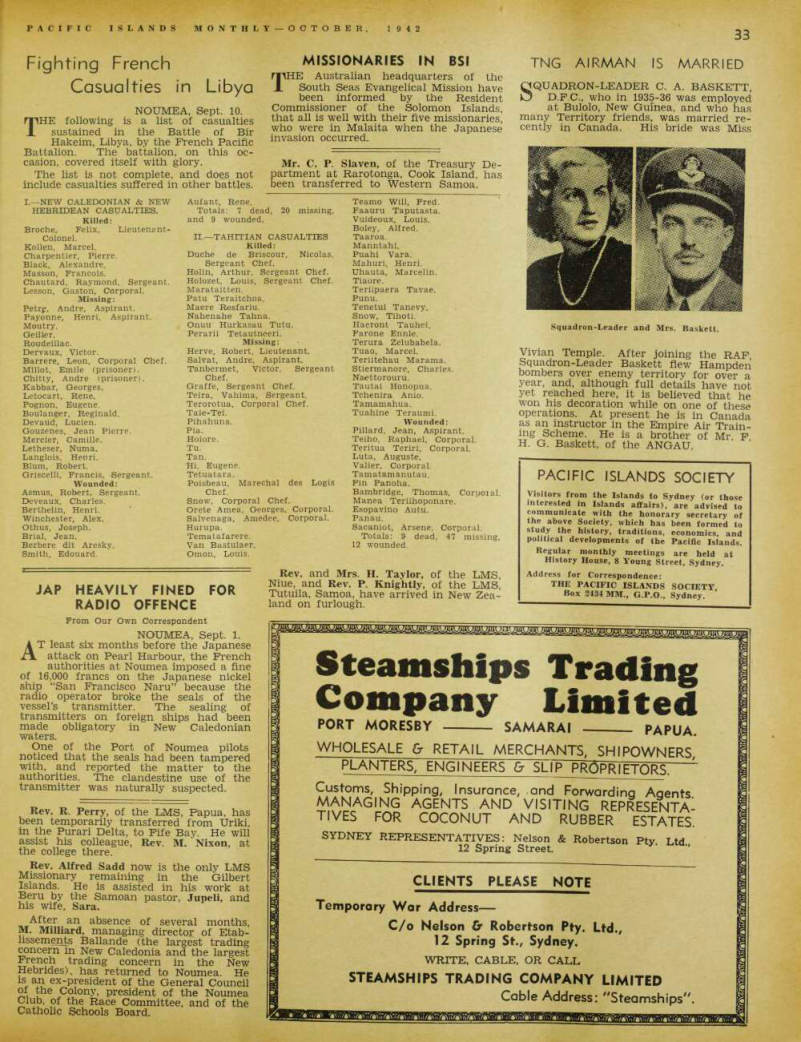
Casualties in Libya
Noumea, Sept. 10.
THE following is a list of casualties sustained in the Battle of Bir Hakeim, Libya, by the French Pacific Battalion. The battalion, on this oc casion, covered itself with glory.
The list is not complete, and does not include casualties suffered in other battles.
I.—New Caledonian & New
Hebridean Casualties.
Killed: Broche, Felix, Lieutenant- Colonel.
Kollen, Marcel.
Charpentier, Pierre.
Black, Alexandre.
Masson, Francois.
Chautard, Raymond, Sergeant.
Lesson, Gaston, Corporal.
Missing: Petr£, Andre, Aspirant.
Payonne, Henri, Aspirant.
Moutry.
GeilLer.
Roudeillac.
Dervaux, Victor.
Barrere, Leon, Corporal Chef.
Millot, Emile (prisoner).
Chitty, Andre (prisoner).
Kabbar, Georges.
Letocart, Rene.
Pognon, Eugene.
Boulanger, Reginald.
Devaud, Lucien.
Gouzenes, Jean Pierre.
Mercier, Camille, Letheser, Numa.
Langlois, Henri.
Blum, Robert.
Griscelli, Francis, Sergeant.
Wounded: Asmus, Robert, Sergeant.
Deveaux, Charles.
Berthelin, Henri.
Winchester, Alex.
Othus, Joseph.
Brial, Jean.
Berbere dit Aresky.
Smith, Edouard.
Aufant, Rene.
Totals: 7 dead, 20 missing, and 9 wounded.
Li.—Tahitian Casualties
Killed: Ducbe de Briscour, Nicolas, Sergeant Chef.
Holin, Arthur, Sergeant Chef.
Holozet, Louis, Sergeant Chef.
Marataitten.
Patu Teraitchoa.
Maere Resfariu.
Nahenahe Tahna.
Onuu Hurkasau Tutu.
Perarii Tetautneeri.
Missing: Herve, Robert, Lieutenant.
Salvat, Andre, Aspirant.
Tanbermet, Victor, Sergeant Chef.
Graffe, Sergeant Chef.
Teira, Vahima, Sergeant.
Terorotua, Corporal Chef.
Taie-Tei.
Pihahuna.
Pia.
Hoiore.
Tu.
Tan.
Hi, Eugene.
Tetuatara.
Poisbeau, Marechal des Logis Chef.
Snow, Corporal Chef.
Orete Amea, Georges, Corporal.
Salvenaga, Amedee, Corporal.
Hurupa.
Tematafarere.
Van Bastulaer.
Omon, Louis.
Teamo Will, Fred.
Faauru Taputasta.
Vuideoux, Louis.
Boley, Alfred.
Taaroa.
Manntahi, Puahi Vara.
Mahuri, Henri.
Uhauta, Marcelin.
Tiaore.
Teriipaera Tavae.
Punu.
Tenetui Tanevy.
Snow, Tihoti.
Haeront Tauhei.
Farone Ennle.
Terura Zelubabela.
Tuao, Marcel.
Teriitehau Marama.
Stiermanore, Charles.
Naettorouru.
Tautai Honopua.
Tchenira Anio.
Tamamahua.
Tuahine Teraumi.
Wounded: Pillard, Jean, Aspirant.
Teiho, Raphael, Corporal.
Teritua Teriri, Corporal.
Luta, Auguste.
Valier, Corporal.
Tamatamanutau.
Fin Panoha.
Bambridge, Thomas, Corpoial.
Manea Teriihoponare.
Esopavino Autu.
Panau.
Sacaniot, Arsene, Corporal.
Totals: 9 dead, 47 missing, 12 wounded.
Jap Heavily Fined For
Radio Offence
From Our Own Correspondent
Noumea, Sept. 1.
AT least six months before the Japanese attack on Pearl Harbour, the French authorities at Noumea imposed a fine of 16,000 francs on the Japanese nickel ship “San Francisco Naru” because the radio operator broke the seals of the vessel’s transmitter. The sealing of transmitters on foreign ships had been made obligatory in New Caledonian waters.
One of the Port of Noumea pilots noticed that the seals had been tampered with, and reported the matter to the authorities. The clandestine use of the transmitter was naturally suspected.
Rev. R. Perry, of the LMS, Papua, has been temporarily transferred from Uriki, in the Purari Delta, to Fife Bay. He will assist his colleague, Rev. M. Nixon, at the college there.
Rev. Alfred Sadd now is the only LMS Missionary remaining in the Gilbert Islands. He is assisted in his work at Beru by the Samoan pastor, Jupeli, and his wife, Sara.
After an absence of several months, M. Milliard, managing director of Etab lissements Ballande (the largest trading concern in New Caledonia and the largest French trading concern in the New Hebrides), has returned to Noumea. He is an ex-president of the General Council £he Colony, president of the Noumea Club, of the Race Committee, and of the Catholic Schools Board.
Rev. and Mrs. H. Taylor, of the LMS, Niue, and Rev. P. Knightly, of the LMS.
Tutuila, Samoa, have arrived in New Zea land on furlough.
Missionaries In Bsi
THE Australian headquarters of the South Seas Evangelical Mission have been informed by the Resident Commissioner of the Solomon Islands, that all is well with their five missionaries, who were in Malaita when the Japanese invasion occurred.
Mr. C. P. Slaven, of the Treasury De partment at Rarotonga, Cook Island, has been transferred to Western Samoa.
Tng Airman Is Married
Squadron-Leader C. A. Baskett,
D.F.C., who in 1935-36 was employed at Bulolo, New Guinea, and who has many Territory friends, was married re cently in Canada. His bride was Miss
Vivian Temple. After joining the RAF, Squadron-Leader Baskett flew Hampden bombers over enemy territory for over a year, and, although full details have not yet reached here, it is believed that he won his decoration while on one of these operations. At present he is in Canada as an instructor in the Empire Air Train ing Scheme. He is a brother of Mr P H. G. Baskett, of the ANGAU.
Squadron-Leader and Mrs. Baskett.
In the six months ended June 30, 1942, Norfolk Island exported £6,022 worth of produce (all to Australia) and imported £5,905 worth (all from Australia). In the same period of last year the figures were: Exports, £9,019; imports, £10,850.
Although all European members of the Methodist Overseas Mission were com pelled to leave Papua at the time of the civil evacuation, the society’s headquarters in Sydney report that the Tongan ministers have been carrying on with success, and that, due to their efforts, the ordinary work of the mission has been maintained.
The Methodist Church in New Zealand has decided to establish a “Rehabilita tion Fund” so that mission work in the Solomon Islands may be resumed as soon as, the opportunity presents itself.
Advertisements & other items, pp. 35-36 (1 item)
Company Limited
PACIFIC ISLANDS SOCIETY
Visitors from the Islands to Sydney (or those interested in Islands affairs), are advised to communicate with the honorary secretary of the above Society, which has been formed to study the history, traditions, economics, and political developments of the Pacific Islands.
Regular monthly meetings are held at History House, 8 Young Street, Sydney.
Address for Correspondence:
THE PACIFIC ISLANDS SOCIETY,
Box 2434 MM., G.P.0., Sydney.
Steamships Trading
Company Limited
PORT MORESBY
SAMARA!
PAPUA,
WHOLESALE & RETAIL MERCHANTS, SHIPOWNERS.
PLANTERS, ENGINEERS & SLIP PROPRIETORS.
Customs, Shipping, Insurance, and Forwarding Agents
MANAGING AGENTS AND VISITING REPRESENTA-
TIVES FOR COCONUT AND RUBBER ESTATES.
SYDNEY REPRESENTATIVES: Nelson & Robertson Ptv Ltd 12 Spring Street. ’ *’
CLIENTS PLEASE NOTE
Temporary War Address— C/o Nelson fir Robertson Pty. Ltd., 12 Spring St., Sydney.
WRITE, CABLE, OR CALL
STEAMSHIPS TRADING COMPANY LIMITED
Cable Address: "Steamships".
Vigour Restored,
Glands Made Young
In 24 Hours
It is no longer necessary to suffer from loss of vigour and manhood, weak memory and body, nervousness, impure blood, sickly skin, depression, and poor sleep, because an American Doctor has discovered a quick, easy way to end these troubles.
This discovery is in pleasant, easy-to-take tablet form, is absolutely harmless, does away with gland operations and is bringing new youth and vigour to thousands. It works directly on the glands and nerves, and puts new, rich blood and energy in your veins. In 24 hours you can see and feel yourself getting younger. Your eyes sparkle, you feel alive and full of youthful vigour and power.
And this amazing, new gland and vigour restorer, called Vi-Stim, is guaranteed. It has been proved by thousands in America and is now distributed by chemists here under a guarantee of satisfaction or money back.
Vi-Stim must make you feel full of vigour and energy and from 10 to 20 years younger, or you merely return the empty package and get your money back. A special, double-strength bottle of 48 Vi-Stim tablets costs little, and the guarantee protects you.
GUARANTEED
to Restore Manhood and Vitality . . .
Highest Prices Paid For
GOLD
Garrett & Davidson’s organisation is acknowledged far and wide as the main clearing house for precious metals in the Southern Hemisphere.
They have earned a reputation for accuracy and integrity in all their business dealings, which is proved by the fact that they are privileged to handle more gold from the Islands of the Pacific than any other organisation.
Therefore for your complete and lasting satisfaction, you are advised to transact all your precious metals business through the house of Garrett & Davidson.
GARRETT & DAVIDSON PTY. LTD.
ASSAYERS METALLURGISTS REFINERS
Bank of N.S.W. Buildings,
REGENT AND GEORGE STS., SYDNEY.
Old Days in The Louisiades Memories
Louisiades Memories of the First Recruiter
By D. H. Osborne
THE Louisiades, consisting of hundreds of islands ranging in size from mountainous Misima, Sudest and Rossel, to tiny coral atolls, are strung out in several groups, altogether about 200 miles in extent, eastwards of Sama rai.
Until the Battle of the Coral Sea, few beyond Papuan planters, miners, pearl ers and others who made their living in this part of the Pacific, knew of the Archipelago. Then, briefly, in May, 1942, it came into prominence as the northern boundary of the Coral Sea, where a decisive naval battle was fought.
Jap seaplanes and naval craft sheltered in the Louisiades, at that time.
But the Louisiades were known to the “blackbirders” in the days when South Seas labour was recruited for work on Queensland and Fijian sugar plantations.
A man named Captain Inman appears to have been one of the first to cash in on this hitherto unexploited labour sup ply in the Louisiades —and that by pure chance. He left Maryborough, Queens land, in his sailing ship, intending to recruit in the Solomons, and he took his wife and small son, Jimmy, along as pas sengers. A few days out they ran into bad weather and Mrs. Inman became very ill. The Captain altered course and headed for the nearest land, where he hoped to shelter until his wife recovered.
The nearest land happened to be Sudest.
Now this area was suffering a severe drought, and the natives on Sudest and Rossel were practically starving, and for once a recruiting ship must have appeared to them as a craft straight from their heathen heaven. Inman had practically to beat them off, so eager were they to recruit. He was back in Queensland with a full complement in the time it usually took to get to the Solomons —no doubt highly pleased with himself.
He made a second trip, with the same
result, and then a third. But the drought had broken. Result: food was plentiful —the natives’ bellies were full—no more cheap recruits for Captain Inman.
Apparently, in due course, some of these natives were returned to their vil lages, and it is reported that when Sir William MacGregor visited Sudest years later, he was surprised to find natives whp could speak English. Amusingly enough, these natives’ knowledge of Australian-ese is indicated by the fact that even to-day they call their feasts “races.”
The late Captain Colin Thompson claimed to be one of the first to land on another of the Louisiade islands, Motu rena. Here, later, the Europeans on another ship were murdered by the natives, helped by the native members of the crew. At neighbouring Brooker Island, practically an identical mass murder occurred; and the British Navy, in the good, old, high-handed fashion of the period, arrived a considerable time afterwards and shelled both islands, as a reprisal.
Early European visitors found the houses of the Louisiade natives decorated with human bones and skulls and assumed, naturally enough, that they were head-hunters. This was not so, however. The bones were merely memen toes of deceased friends and relatives.
The Moturena inhabitants appear to have been a particularly violent lot. and to have indicated their dislike of the European every time opportunity per mitted. Nicholas Minister—better known as Nicholas the Greek —once ran foul of them while anchored off their island.
They attended to him with a tomahawk and then threw him overboard, and obvi ously expected that that would be suffi cient to remove anv normal human being from earthly circulation. They felt per fectly safe in going below and opening up his trade goods.
But Nicholas was more than a normal human being—considerably more. He swam to the bows of his boat, and climbed up the anchor-chain, and appeared before the would-be murderers, very bloody but certainly unbowed. They were knocked speechless, momentarily, until it dawned on them that this could be nothing less than Nicholas’ ghost.
Then, with screams of fright and anguish, they rushed to the side of the boat, tumbled into the water, and swam for the shore. Nicholas was free to wan der, unmolested, in any of those parts ever after.
Later, Captain Craig and his crew were murdered while pearl-fishing off Janet Island, near Sudest, and the schooner burned to the water’s edge. Sir William MacGregor offered a reward for the murderers, dead or alive —and, according to that gentleman himself, Nicholas came into the picture once more, by the simple act of shooting the chief of the village, lopping off his head and presenting it to the amazed and furious Sir William, with a claim for the cash prize. He threatened to arrest Nicholas for murder.
True or false, this was a tale that Nicholas loved to tell. Nicholas was quite a lad, and, it is feared, he had more than a few skeletons in his cup board.
Captain Les. Hilder, who was a member of the Intelligence Corps at Port Moresby until his retirement through ill-health, is now in Sydney. His health is now im proved, and he is “doing his bit” as an official of the Department of the Interior.
Great Missionary Passes
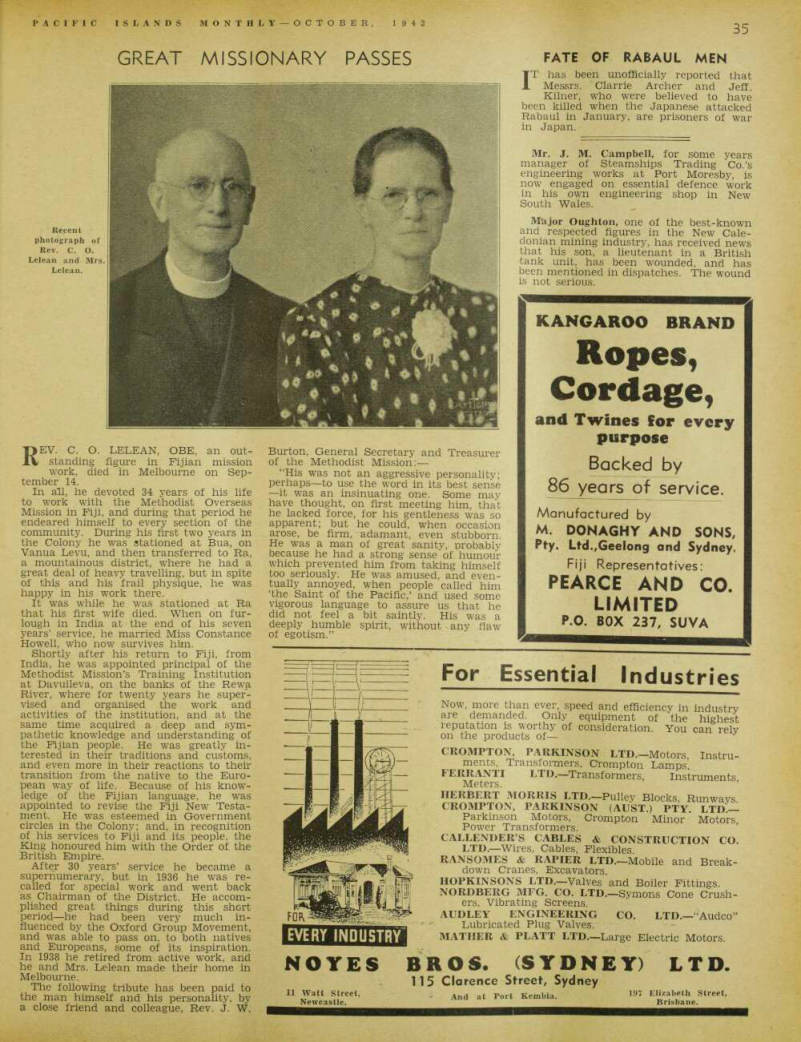
REV. C. O. LELEAN, QBE, an out standing figure in Fijian mission work, died in Melbourne on Sep tember 14.
In all, he devoted 34 years of his life to work with the Methodist Overseas Mission in Fiji, and during that period he endeared himself to every section of the community. During his first two years in the Colony he was stationed at Bua, on Vanua Levu, and then transferred to Ra, a mountainous district, where he had a great deal of heavy travelling, but in spite of this and his frail physique, he was happy in his work there.
It was while he was stationed at Ra that his first wife died. When on fur lough in India at the end of his seven years’ service, he married Miss Constance Howell, who now survives him.
Shortly after his return to Fiji, from India, he was appointed principal of the Methodist Mission’s Training Institution at Davuileva, on the banks of the Rewa River, where for twenty years he super vised and organised the work and activities of the institution, and at the same time acquired a deep and sym pathetic knowledge and understanding of the Fijian people. He was greatly in terested in their traditions and customs, and even more in their reactions to their transition from the native to the Euro pean way of life. Because of his know ledge of the Fijian language, he was appointed to revise the Fiji New Testa ment. He was esteemed in Government circles in the Colony; and, in recognition of his services to Fiji and its people, the King honoured him with the Order of the British Empire.
After 30 years’ service he became a supernumerary, but in 1936 he was re called for special work and went back as Chairman of the District. He accom plished great things during this short period—he had been very much in fluenced by the Oxford Group Movement, and was able to pass on, to both natives and Europeans, some of its inspiration.
In 1938 he retired from active work, and he and Mrs. Lelean made their home in Melbourne.
The following tribute has been paid to the man himself and his personality, by a close friend and colleague, Rev. J. W.
Burton, General Secretary and Treasurer of the Methodist Mission:— “His was not an aggressive personality: perhaps—to use the word in its best sense —it was an insinuating one. Some may have thought, on first meeting him, that he lacked force, for his gentleness was so apparent; but he could, when occasion arose, be firm, adamant, even stubborn.
He was a man of great sanity, probably because he had a strong sense of humour which prevented him from taking himself too seriously. He was amused, and even tually annoyed, when people called him ‘the Saint of the Pacific,’ and used some vigorous language to assure us that he did not feel a bit saintly. His was a deeply humble spirit, without any flaw of egotism.”
Recent
photograph of
Rev. C. O.
Lelean and Mrs.
Lelean.
Fate Of Rabaul Men
IT has been unofficially reported that Messrs. Clarrie Archer and Jeff.
Kilner, who were believed to have been killed when the Japanese attacked Rabaul in January, are prisoners of war in Japan.
Mr. J. M. Campbell, for some years manager of Steamships Trading Co.’s engineering works at Port Moresby, is now engaged on essential defence work in his own engineering shop in New South Wales.
Major Oughton, one of the best-known and respected figures in the New Cale donian mining industry, has received news that his son, a lieutenant in a British tank unit, has been wounded, and has been mentioned in dispatches. The wound is not serious.
Advertisements & other items, p. 37 (1 item)
Ropes,
KANGAROO BRAND
Cordage,
and Twines for every purpose
Backed by
86 years of service.
Manufactured by
M. DONAGHY AND SONS,
Pty. Ltd.,Geelong and Sydney.
Fiji Representatives:
PEARCE AND CO.
LIMITED
P.O. BOX 237, SUVA
FOR.
For Essential Industries
Now, more than ever, speed and efficiency in industry are demanded. Only equipment of the highest reputation is worthy of consideration. You can rely on the products of— * CROMPTON, PARKINSON LTD.—Motors Instruments, Transformers, Crompton Lamps.
FERRANTI LTD.—Transformers, Instruments, Meters.
HERBERT MORRIS LTD.—Pulley Blocks, Runways
CROMPTON, PARKINSON (AUST.) PTY. LTD.—
Parkinson Motors, Crompton Minor Motors Power Transformers.
CALLENDER’S CABLES & CONSTRUCTION CO.
LTD.—Wires, Cables, Flexibles.
RANSOMES & RAPIER LTD.—Mobile and Breakdown Cranes, Excavators.
HOPKINSONS LTD.—Valves and Boiler Fittings.
NORDBERG MFG. CO. LTD.—Symons Cone Crushers, Vibrating Screens.
AUDLEY ENGINEERING CO. LTD.—‘‘Audco”
Lubricated Plug Valves.
MATHER & PLATT LTD.—Large Electric Motors.
NOYES BROS. (SYDNEY) LTD
11 Watt Street, Newcastle.
115 Clarence Street, Sydney
And at Port Kembia.
Elizabeth Street, Brisbane.
Free French
Finance
Operation of Central Bank
From Our Own Correspondent
Noumea, Aug. 14.
A COMMUNIQUE issued by the Free French Administration in Noumea explained the purpose of the Fi;ee French Caisse Centrale or (Central Treasury), and the reason why New Cale donian funds have been transferred to London.
The communique points out that a cer tain uneasiness had been shown regarding the role the Caisse Centrale, created by General de Gaulle in December, 1941, had
been called upon to play. The communi que continues:— “In particular, allusion has been made to a deposit made to this Caisse of 1,300,000 dollars from the New Caledonian Office des Changes. It has been alleged even that these dollars have been lost to the Colony since they would no longer be made available to importers.
“This allegation is absolutely mislead ing. The role of the Caisse Centrale is notably to receive on deposit funds of which the local colonial treasuries of colonies rallied to Free France do not stand in immediate need. These funds, therefore, form a reserve susceptible of giving free access for imports into the colonies concerned. It is an organisation for mutual help, conforming with that carried on through the intermediary of the Bank of France prior to the Franco- German armistice.
“But the funds so deposited are not lost to the colony making the deposit, for in case of need that colony may ask that
they be placed at its disposal. This system has already been functioning in regard to New Caledonia, since the Cale donian Office des Changes, which through the Bank of Indo-China has transferred to the Caisse Centrale the above 1,300,000 dollars (equivalent to 57,000,000 francs) has since withdrawn, for import needs, various sums to the value of 27,000,000 francs.
“Uneasiness has also been shown re garding the eventual issue in New Cale donia of notes issued by the Caisse Cen trale (the so-called Free Franc). In formation on this subject will be issued at a later date.”
Footing
Fiji On A War
Action by New Governor
Major-general sir Phillip Mitchell, Fiji’s new Governor, wasted no time in summoning a meeting of the Legislative Council after his arrival.
“I do not propose to address you at length,” he said to members. “I think we must all realise that this is no time for making speeches, but rather for doing deeds.”
He laid before them two measures, both in the form of resolutions—one express ing the approval of the Legislative Coun cil to the introduction of compulsory National Service; and one for the setting up of a Standing Committee of Finance.
The Government, he said, did not imagine thaT large numbers of people for essential war work were going to be ob tained merely by the introduction of compulsion—most people in the Colony were already usefully employed—but the reasons for this National Service were briefly three —(1) That in these days of national peril every man was under an obligation to render whatever service he could; (2) so that plans could be made for the best use of manpower; and (3) so that all occupations in the Colony could be reviewed and some order of priority and importance arrived at.
With regard to the setting up of a Standing Finance Committee, he said that he looked upon it as an essential piece of machinery to enable Unofficial Members of the Council to keep in touch with the Colony’s finances.
Sir Phillip then went on to inform members of the additional measures the Council had taken towards the complete organisation of the Colony for war. In consultation with his advisers, he had come to the conclusion that the Executive Council of the Colony was the right body to assume the responsibilities of War Council, and it had therefore undertaken these duties and responsibilities.
He was deeply appreciative of the ef forts that already had been made in Fiji; but, in planning the new war-time mea sures, he and the Council were working on the assumption that all races and all sections of the community realised that there is scope for more to be done and that all wished to participate in the ef fort that was to be made.
He concluded as follows: “We shall not hesitate to change any part of our pro posals which experience in actual working or changing circumstances may show to need change, nor shall I be reluctant to admit mistakes if the event shows that I have made them, for if you do not make mistakes you are unlikely to make any thing else. Nevertheless, on the general lines of the plan laid before you in the Council paper, I believe we can do what needs to be done. What remams now for us to do is to go to it.”
Advertisements & other items, p. 38 (2 items)
36
OCTOBER, 1942 TACIEIC ISLANDS MONTHLY
Foster*Xlark’S
o c A There has never been a more per feet accompaniment to fruit than the fine rich flavour of Foster Clark’s Creamy Custard.
Very important, too, is the fact that fine ingredients make Creamy Custard wholesome and nourishing.
You get more than value for money with Foster Clark’s delicious Creamy Custard.
STRAWBERRY PUFFS. A really
delectable sweet given in Elizabeth Craig’s FREE illustrated Recipe Book. Obtain your copy by writing to Foster Clark ( Aust .) Ltd., Dept.
R. 8., Redfern, N.S.W., enclosing 2hd. in stamps to cover postage. r L V W %
FOSTER*XLARK’S
First Battles On Buna-
Kokoda Road Memories of Over 40 Years Ago
By D. H. Osborne
riTHE entry of the Japanese into the A Buna-Kokoda district brings back to me memories of the first Euro pean incursions in that part of Papua.
During 1898, Alic Clunas and a party made the first expedition. They left from Tamata and took a route across the Opi River and on to the Kumusi, near Bogi. Then, still keeping to the west bank of this river, past Papangi, they crossed the divide into the Mambare and followed it up into the Yodda Valley— the Yodda Valley being on the Mambare watershed.
They found a well-populated and highly cultivated country—the gardens of the Yodda Valley especially taking their eye—and the natives everywhere ap peared to be friendly. On their return they were able to make a favourable report in this regard, therefore, but as far as their own business was concerned they drew a complete blank and did not find any trace of gold.
Soon afterwards, however, a party of four, including George Arbuck, George Griffith and Bob Peel, with their native carriers, also left Tamata for further prospecting in the area. All went well until they were about ten miles past Bogi, where the natives inexplicably and suddenly turned hostile. Crossing a stony creek, with steep banks, they walked straight into an ambush—natives rushed them from all sides and they were quickly overpowered.
This expedition might have ended there, in disaster, had not one carrier managed to free himself and pick up a rifle. He did not know how to cock it; but, when he flung it away from him, it landed, providentially, beside one of the party who was grappling with an attacker —and this attacker the carrier, very sensibly, proceeded to knock uncon scious with a stone.
The white man, making good his escape, pounced on the loaded rifle and opened fire. The natives fled and thus the party was saved—although most of them had received wounds of some sort and had been bruised in the scuffle.
They returned forthwith to Tamata.
Expedition 111, was in the latter part of 1899, and had a much more tangible result. It was led by Mat Crowe —one whose name has gone down in Papuan history—and from it developed the Yodda goldfield. With him were Sam McLen nelland and Archie Walker—the three of them on prospecting bent—and a man called Day, who was hunting birds-of paradise.
Until they had penetrated far into the Yodda Valley and discovered what was to be known as the Yodda field, all was well. But, as usual in this sort of adven ture, food became a problem, and the party went on to Kokoda, then a barri caded village, twelve miles away, in order to buy native food.
The inhabitants were hostile and attacked, killing one or two carriers, and wounding others. Crowe, McLennelland and Walker then returned to Tamata by crossing the Chirima, at the head of the Mambare, and then following the Gira down to the coast. Day remained in the mountains, and nothing but his outfit ever came out—his carriers brought that in to Tamata some time later and re ported his death from illness.
Crowe and party applied for reward claims on the field they had found; and, after the Warden at Tamata had jour
neyed out and thoroughly prospected the ground, and they were granted, the Yodda field became an established fact, with every miner, actual and would-be, who could get the carriers, leaving the Gira River —or wherever or whatever he had been about—and heading straight for the new find.
As with all such goldfields, it was one thing to walk in and peg a claim —quite another to keep oneself and one’s boys supplied with the wherewithal for carry ing on. The job of transporting stores from the coast to the Yodda was any thing but a picnic. First, they were landed at the mouth of the Kumusi by a boat from Samarai and taken up to Bogi, 62 miles inland. The river was rapid, always discoloured, and full of snags, which continually fouled the propellers of the launches with which Ted Aubach and Whitten Brothers were trying to estab lish some sort of service. Finally, these storekeepers reverted to whaleboat, pad dled by natives, but even then these were liable to be capsized by striking obstruc tions, and loud and long were the lamen tations when the precious goods thus found a watery grave.
At Bogi, the cargo was dumped and done up in 50-lb. packs for the five-days carry to the field—and as the Orakiva natives along the track took two years to reconcile themselves to the white man’s advent, and took every conceivable op portunity of showing their displeasure during that period, the lines of carriers had, during these early days, always to be accompanied by a European.
That first road did not cross the main branch of the Kumusi; but, later, C. A.
W. Monckton, while Resident Magistrate of the North-eastern Division, opened a road from Buna Bay—a road that was two or three days longer for carriers, but had the advantage of cutting out the long Kumusi River freight. The chief obstacle was the crossing of the Kumusi, but the Government built a wire-rope suspension bridge; and, as a result, the new Buna-Kokoda road came into use, and the storekeepers moved from Bogi to Buna—2o miles nearer Samarai than was the Kumusi mouth.
Fiji's New Governor
Sir Philip Mitchell, The New
Governor of Fiji, visited Lautoka in August, soon after his arrival in the Colony.
During his stay His Excellency was the guest of the District Commissioner at Lautoka, Mr. J. Judd, and he was afforded every opportunity of meeting members of the European, Indian and Fijian com munities.
On his way to and from the town he visited the mining district of Tavua, and Ba, Nadi, Sigatoka and Navua.
Messrs. V. S. Jackson, E. L. P. Bradnam, and D. J. Rounds, all of Fiji, are at present in Britain, training with the RAF.
Mr. Jackson has been selected as a pilot, Mr. Bradnam as an observer, and Mr.
Rounds as an air-gunner.
Mr. A. H. Martin, well known in Fiji for his interest in sport, and especially in hockey, has left the Colony to reside in New Zealand. He was entertained at a farewell party in the Grand Pacific Hotel, Suva, by the Hockey Association, and presented, on the Association’s behalf, by Sir Henry Scott, with a com bination clock and inkstand, in recogni tion of his services.
Rev. Harold Sloman, recently appointed chaplain at Norfolk Island, was married to Miss Hilda Furley, at St. Andrew’s Cathedral, Sydney, on September 19.
Advertisements & other items, p. 39 (1 item)
'funn ftosk
Ho(t*u>o
IOHUIdo SoMCt,
(ofilch i htatLl
'funn ftosk
fomaioQS
inmj axa
|k cnt\ ika fi
is a quality
OwJt IS d&i Cl CrtXS
(A/ifk kdf
ika fi
Try a grill this tasty way 2 tablespoons Holbrooks Plum 2 tablespoons Holbrooks Worcestershire Sauce 2 tablespoons Holbrooks Tomato Sauce A little Salt, Pepper and Mustard Mix all ingredients together.
Pour over raw steak and allow to soak for half an hour. Grill steak as desired. Heat remaining sauce and serve with grill
tnJLocfs.
Jam IS-1
China's Hatred
Of Japan
"Manchukuo" is an Offence
DR. Tuan Mao Lan, Consul-General for China, was the guest of honour and speaker at the September meeting of the Pacific Islands Society. Mr.
Alfred E. Stephen, the president, when welcoming Dr. Tuan, said he was a doc tor of philosophy of the Nan Tai Univer sity, at Tientsen, and he had held vari ous important diplomatic offices before coming to Australia.
Dr. Tuan described Chinese political and national evolution, the struggle between ancient Chinese traditions of human philosophy and the assimilation of modern world conditions, and how the teachings of Confucius, Mencius, Taoism and of Buddha had in turn cultivated a restrained philosophical outlook on life and thought which made it difficult for the mass of Chinese people to adopt modern world customs.
The fall of the corrupt Manchu Dyn asty, and the revolution of 30 years ago, he said, established a new era, when the Chinese instituted a republican system of government. This awakening of China, and the adoption of many institutions of
democratic government, seemed to alarm the Japanese, who embarked on various subtle methods of peaceful penetration in order to disrupt China’s rapid progress.
They encouraged vices, and the disor ganisation of Chinese national works by bribery, etc.
Manchuria was set up by the Japan ese military missions as a separate king dom, with a puppet Emperor, Pu Yi, and a Government which was subject to the will of Japan. The name “Manchukuo” (which was assigned to Manchuria by Japan) means “the Kingdom of Man churia” and it is very offensive to Chin ese nationalists.
Japanese military aggression and ruth lessness, he said, have done more to unite the Chinese nation, in seven years, than centuries of peaceful conditions would possibly have done.
The sufferings of the Chinese people have not broken their morale; and they recognise better the importance of their Allies in this world conflict. Large Chin ese colonies exist in the Philippines, Malaya, and Dutch East Indies; and Japanese domination in the Pacific is opposed vigorously by the Chinese Nationalists.
Melanesian Mission Headquarters in Sydney report “all well” with their Islands’ missionaries.
News is to hand of the death, some time ago, of Mr. A. H. Nicholls, formerly Chief of Customs in the New Hebrides.
Mr. Nicholls had been in the service of the New Hebrides Condominium for 12 years. He had previously resided in New Caledonia, where he had been connected with mining activities since his early manhood. His father was one of the early mining pioneers of New Caledonia.
Major E. G. A. Lett, of the East Sur rey Regiment, and a son of Mr. Lewis Lett, of Port Moresby, Papua, was re ported “missing” in Libya, and is now officially reported to be a prisoner of war in Italy. He was attached to an Indian Division, and he and his Indians saw a great deal of fighting in Abyssinia and Libya, and were several times men tioned in despatches.
Advertisements & other items, pp. 40-41 (1 item)
Hone
Membership of Pacific Territories
Association
Temporary office accommodation has been provided for the new body, and the address of the secretary now is: Mr. C. A. M. Adelskold, secretary of Pacific Territories Association, c/o Robert Gillespie Pty., Ltd., Royal Exchange Building, 54a Pitt Street, Sydney; or, briefly, Secretary, Pacific Territories Association, Box 137 CC, GPO, Sydney. The telephone number is BW 4783. Evacuees who require the services of the Association in any way, or who desire to become members, should communicate with him at that address.
Members are wanted. So are funds. The subscription is 15/- per quarter; but evacuees whose cash position is not what it was are asked to become members anyway, and contribute as much as they feel they can afford.
The secretary informs us that the following form could be used:—
APPLICATION FOR MEMBERSHIP
Secretary, Pacific Territories Association, Box 137 CC, GPO, Sydney.
Please enrol me as a member of your Association.
Name (Mr., Mrs. or Miss) Present address Former Address in Territories Present occupation, if any lf Previous occupation, in Territories If you want employment in Australia send full particulars on an attached statement (which please sign) showing your age, qualifications, details of experience, and what class of work you would prefer.
If you want the assistance of the Association in any way, send full particulars on an attached statement (which please sign).
Amount of subscription forwarded herewith, or to be forwarded; Signature Date
Ship Chandlery Hardware
BROOMFIELDS LIMITED
152 SUSSEX STREET :: SYDNEY.
Cables: “Boom”, Sydney.
Large and Complete Stocks of
SHIP CHANDLERY
IRONMONGERY OF ALL KINDS, PAINTS,
WHITE LEAD AND OILS.
P. H. MUNTZ Si CO.’S 3-CROWN BRAND METAL SHEATHING.
PEACOCK Si BUCHANS' ENGLISH READY-MIXED PAINTS.
/Write for j
Ship Chandlery /
Catalogue J
Special “In Bond” Prices for all Islands enquiries quoted on application.
Sole Agents for;
HONE
“SfisSSs \
u nderS one n d \s °*
"“JSShjSI
I ;-s s£ s Tl shotiW a nd refuse »« m I f'! 1 T e f FUt 'C?to>« 5 &V a "Ve s u-e ** to hutoa" 5 ' the bott j=pj s o\d\er riii ■
ALWAYS
yjt
R
KILLS
Wanted to Buy—Quality Guns and Rifles HIGHEST PRICES GIVEN. WILL ALSO EXCHANGE GUNS.
SIL RO H U Qualify Firearms and Fishing Tackle. 143 ELIZABETH STREET (Near Market St.) SYDNEY. ’PHONE: MA 3540.
wn
Coleman
IS SERVING THE
ARMED FORCES
WITH THREE
ESSENTIALS OF
LIFE . . .
Light Heat
Warm Food
"Wherever the Armed Forces of the United Nations need quick heat and bright light you’ll find Coleman Lanterns and Stoves. On board steamers, at landing fields, in mobile canteens, emergency hospitals, air-raid shelters, and in actual combat, Coleman appliances are providing invaluable service.
We regret any inconveniences caused through shortage of new stock for civilian requirements, and suggest you keep your present Stove and Lantern in good repair by contacting your local Distributor, THE COLEMAN LAMP & STOVE CO. LTD.
TORONTO CANADA
Rid Kidneys Of
Poisons And Adds
Your Kidneys are a marvellous structure.
Within them are 9 million tiny tubes which act as filters for the blood. When poisons and acids attack them you suffer from Burning, Itching Passages, “Getting Up Nights,” Leg Pains, Dizziness, Rheumatism, Lumbago, Nerviness, Circles under Eyes or Swollen Ankles, etc. Ordinary medicines can’t do much good. The cause must be removed.
Cystex rids Kidneys of poisons and acids in 2 hours, therefore a speedy end to kidney troubles. In 24 hours you’ll feel fitter, stronger than for years, in a few days, complete health is restored. Cystex is guaranteed to put you right or money back. Ask your Chemist for Cystex today. The guarantee protects you.
Now in 3 sizes: 1/9, 4/-, 8/-. jvjui. lor uys
Cystex
CUARANTEEDIor Kidneys, Bladder, Rheumatism
Unique Value in Maintaining Supply Lines
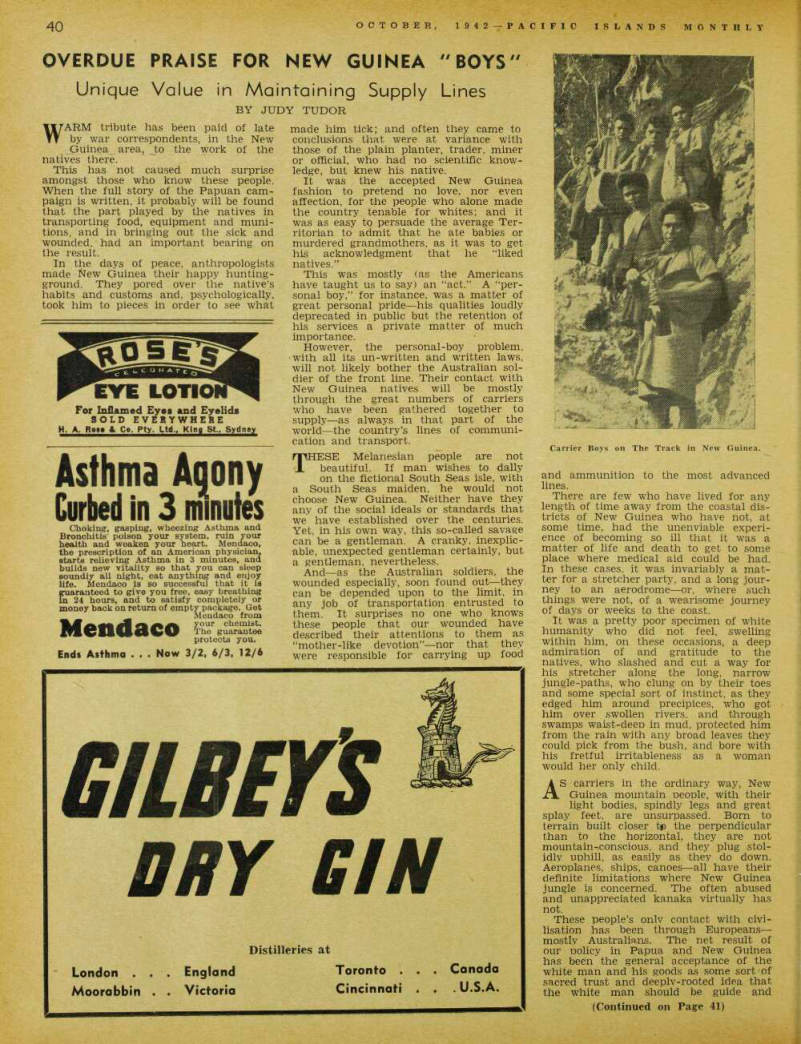
Overdue Praise For New Guinea "Boys"
By Judy Tudor
WARM tribute has been paid of late by war correspondents, in the New Guinea area, to the work of the natives there.
This has not caused much surprise amongst those who know these people.
When the full story of the Papuan cam paign is written, it probably will be found that the part played by the natives in transporting food, equipment and muni tions, and in bringing out the sick and wounded, had an important bearing on the result.
In the days of peace, anthropologists made ftew Guinea their happy hunting ground. They pored over the native’s habits and customs and, psychologically, took him to pieces in order to see what
made him tick; and often they came to conclusions that were at variance with those of the plain planter, trader, miner or official, who had no scientific know ledge, but knew his native.
It was the accepted New Guinea fashion to pretend no love, nor even affection, for the people who alone made the country tenable for whites; and it was as easy to persuade the average Ter ritorian to admit that he ate babies or murdered grandmothers, as it was to get his acknowledgment that he “liked natives.”
This was' mostly (as the Americans have taught us to say) an “act.” A “per sonal boy,” for instance, was a matter of great personal pride—his qualities loudly deprecated in public but the retention of his services a private matter of much importance.
However, the personal-boy problem, with all its un-written and written laws, will not likely bother the Australian sol dier of the front line. Their contact with New Guinea natives will be mostly through the great numbers of carriers who have been gathered together to supply—as always in that part of the world —the country’s lines of communi cation and transport. rESE Melanesian people are not beautiful. If man wishes to dally on the fictional South Seas isle, with a South Seas maiden, he would not choose New Guinea. Neither have they any of the social ideals or standards that we have established over the centuries.
Yet, in his own way, this so-called savage can be a gentleman. A cranky, inexplic able, unexpected gentleman certainly, but a gentleman, nevertheless.
And —as the Australian soldiers, the wounded especially, soon found out—they can be depended upon to the limit, in any job of transportation entrusted to them. It surprises no one who knows these people that our wounded have described their attentions to them as “mother-like devotion” —nor that they were responsible for carrying up food
and ammunition to the most advanced lines.
There are few who have lived for any length of time away from the coastal dis tricts of New Guinea who have not, at some time, had the unenviable experi ence of becoming so ill that it was a matter of life and death to get to some place where medical aid could be had.
In these cases, it was invariably a mat ter for a stretcher party, and a long jour ney to an aerodrome —or, where such things were not, of a wearisome journey of days or weeks to the coast.
It was a pretty poor specimen of white humanity who did not feel, swelling within him, on these occasions, a deep admiration of and gratitude to the natives, who slashed and cut a way for his stretcher along the long, narrow jungle-paths, who clung on by their toes and some special sort of instinct, as they edged him around precipices, who got him over swollen rivers, and through swamps waist-deen in mud, protected him from the rain with any broad leaves they could pick from the bush, and bore with his fretful irritableness as a woman would her only child.
AS carriers in the ordinary way, New Guinea mountain people, with their light bodies, spindly legs and great splay feet, are unsurpassed. Bom to terrain built closer tf> the perpendicular than to the horizontal, they are not mountain-.conscious. and they plug stol idly uphill, as easily as they do down.
Aeroplanes, ships, canoes—all have their definite limitations where New Guinea jungle is concerned. The often abused and unappreciated kanaka virtually has not.
These people’s onlv contact with civi lisation has been through Europeans— mostly Australians. The net result of our policy in Papua and New Guinea has been the general acceptance of the white man and his goods as some sort of sacred trust and deeplv-rooted idea that the white man should be guide and
(Continued on Page 41)
Carrier Boys on The Track in New Guinea.
philosopher to the native when occasion demanded. There have been individual lapses from grace on both sides; but, broadly, it has worked very well.
OUR own standards of ethics and behaviour, and our moral values, mean literally nothing to the kan aka —with one exception. As one man, they admire strength—mental, physical or any other variety. A master who "savvies fight,” who can shoot, or who can walk or run or climb better than any other "master” around the district, or one who can impose his strength of mind and purpose upon those about him, has their whole-hearted admiration and hero-worship.
It can be easily imagined, therefore, that those Australian soldiers of ours, whose chief purpose in life at the pre sent moment is to fight, and kill, and pit their strength against an enemy for whom the natives had no love in the first place, are coming in for a good deal of this hero-worship.
Advertisements & other items, p. 42 (1 item)
C/Lbeys
5 e SO s
LOTIO
For Inflamed Eyes end Eyelids
SOLD EVERYWHERE
H. A. Ro»> A Co. Pty. Ltd., King St.. Sydney
Asthma Agony
Curbed in 3 minutes
Choking, gasping, wheezing Asthma and Bronchitis poison your system, ruin your health and weaken your heart. Mendaco, the prescription of an American physician, starts relieving Asthma in 3 minutes, and builds new vitality so that you can sleep soundly ail night, eat anything and enjoy life. Mendaco is so successful that it is guaranteed to give you free, easy breathing m 24 hours, and to satisfy completely or money back on return of empty package. Get Mendaco from
Mendaco
protects you.
Ends Asthma . . . Now 3/2, 6/3, 12/6
C/LBEYS
DRY BIN
Distilleries at London . . . England Toronto . . . Canada Moorabbin . . Victoria Cincinnati . . . U.S.A.
Missionaries Reported
Killed North-east Coast of Papua
EARLY in October the Australian Board of Missions were advised by the Department of External Terri tories that "according to native reports” three of their missionaries, formerly sta tioned at Gona (north-east coast of Papua) had been killed at the begin ning of September.
The three referred to were Rev. James Benson, Sister May Hayman, and Miss Mavis Parkinson.
A further report from native sources was that the staff of the Sangara Mis sion had been taken prisoner. These would include Rev. Henry Holland. Mr.
J. Duffill, Rev. R. V, Redlich, Sister Margery Brenchley and Miss Lilia Lash mar.
The authorities pointed out that the reports were not confirmed, although it seemed probable that they were true.
A number of women attached to the Anglican Mission staff, at the direction of the military authorities, have now returned to Australia—Sister M. Arliss, Misses Caswell, Clarke, Devitt, Inman, Kekwick, Somerville, Sisters Kent. Mills, Tomkins and Williams and Mesdames Lane, Newman, Thompson and Taylor.
There arrived with the mission sisters 15 half-caste children who were being specially cared for by the Anglican Mis sion, and arrangements were made for these also to come to Australia.
Black Lip Pearl Shell
In Demand
IT was reported in Sydney on October 14 that Black Lip pearl shell is being quoted in Tahiti at £6O per ton, f.o.b.
This remarkable rise is in line with that ot all similar products. Trochus shell, during the past 12 months, has increased 50 per cent, in quoted value.
Mrs. May, the wife of Captain A. E.
May. who until recently was in Port Moresby with the forces, is in Fairfield Hospital, Melbourne, suffering from meningitis. Dr. May was medical officer Moresby until early this year Mrs May’s condition was reported this week to be improving.
War Risk Compensation Muddle In
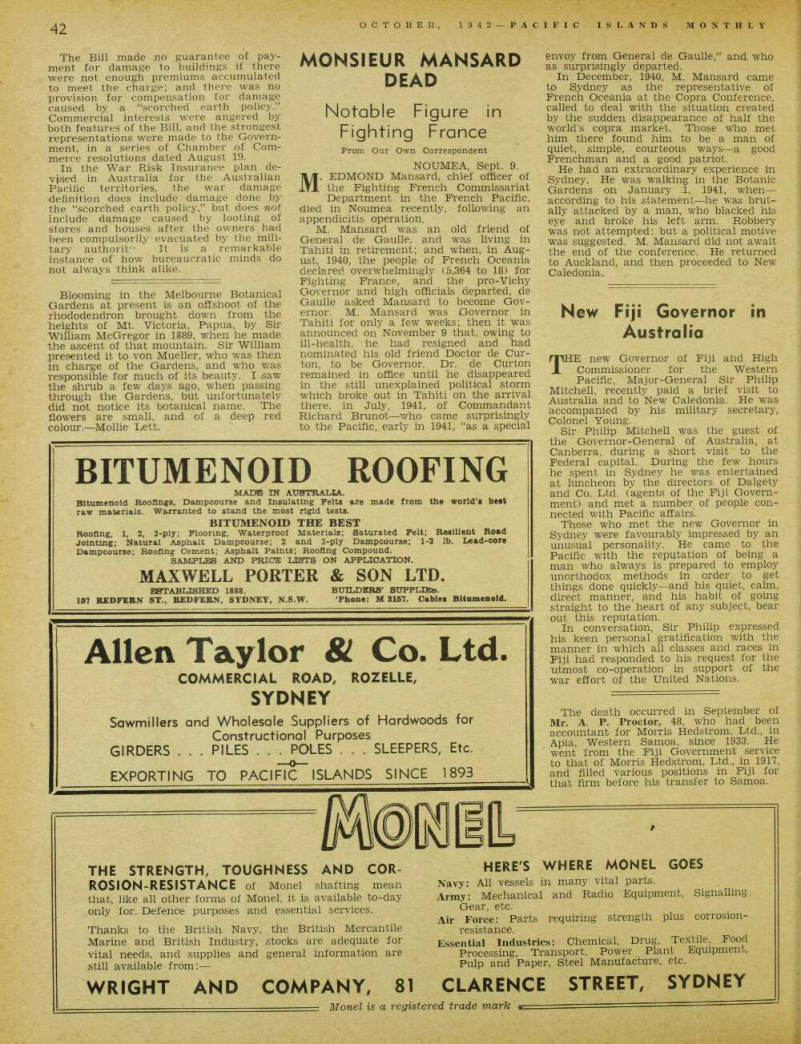
Fiji
Chamber of Commerce Makes Forthright Charge of Breach of Good Faith
THERE has been much perturbation in the Colony of Fiji, and in the Territories of the Western Pacific Commission, which apparently are af fected by the same set of circumstances, concerning the new announcement by the British Colonial Office that no special provision now is to be made to cover war damage L o property suffered by the people in the Territories referred to.
This announcement came as a greater shock because it was clearly inferred, in official announcements made early this year in Suva, that compensation for war damage would be provided in some form.
The first intimation came in a Govern ment statement published in the "Fiji Times,” on August 8, that the whole posi tion had been reviewed and that the British Government undertook to provide compensation for war damage eventually, if it was found that the local resources of the territories concerned could not take care of this obligation.
On August 27, the following Govern ment notice appeared in the "Fiji Times” : "As announced in notices published in the Press on the 7th February and the 10th February, 1942, proposals for war damage legislation in Fiji have been under consideration by Government in consultation with His Majesty’s Govern ment in the United Kingdom and represen tatives of local Industry and Commerce.
"His Majesty’s Government in the United Kingdom have recently stated their policy regarding war damage legislation throughout the Colonial Em pire, and after further consultation with local representative bodies it has been decided not to proceed with the legis lation in Fiji. The general aim of His Majestv’s Government after the war will be as stated in the notice published on the Bth August.”
Chamber Of Commerce
Indignant
THIS development naturally alarmed the Fiji business community, and on September 9 the matter was con sidered by the Suva Chamber of Com merce, with Mr. Alport Barker in the chair.
The facts were recounted, and it was reported that the Colonial Secretary, in a formal letter, said "the two notices published in the Press on the 7th and 10th February last respectively did not contain any promise of protection in the matter of war damage.”
Mr. H. E. Snell moved, and Mr. M.
Brqdie seconded, the following resolution, which was carried unanimously: ‘That a letter be written to the Colonial Secretary— “(a) Setting out verbatim (1) the notices published by Government on the 7th and 10th February last; (2) the second paragraph of the * Colonial Secretary’s letter to the Chamber of 27th August last; ‘‘(b) Asking that the Governor should suitably censure the officer of Govern ment who is the effective author of the second paragraph of the letter of 27th August for his narrow and legalistic interpretation of public announcements made by a British Government to its citizens in a time of threatened emer gency; ‘(c) Stating that these two announce ments by Government as defined by the third announcement of 16th February indubitably led the citizens of Fiji to be lieve that, subject to the kind of con dition indicated in the announcement,
compensation would be arranged by Government to induce that belief; that until the second paragraph of the letter of 27th August is corrected by Govern ment, it will be difficult for members of the Chamber to believe that announce ments are made by Government in that proper spirit of good faith which should apply between a British Government and its citizens.”
The following is from "Fiji Times and Herald” of February 7:— "Official Announcement.—We received the following announcement from His Excellency the Governor after we went to press yesterday afternoon: The Secretary of State for the Colonies, having ap proved of the formulation of a scheme of War Risk Insurance to meet local needs, a Committee with unofficial membership is actively engaged in working out such a scheme in the light of the figures just received from the insurance companies operating in this Colony. It is hoped to make a further announcement when the scheme is sufficiently advanced; in the meantime, the Secretary of State has been approached telegraphically on the principle of making such legislation re trospective to cover loss sustained by enemy action prior to the passage of the Bill.”
From "Fiji Times and Herald” of 10th February:— "War Risk Insurance—To Be Retro spective.—With reference to the an nouncement made by Government in the Press on Saturday last about war risk insurance, the Secretary of State has informed His Excellency the Governor that there is no objection to a public announcement being made to the effect that the legislation which it is proposed to pass on the subject will cover war damage caused after Ist January, 1942.
As previously stated, the whole question is now being actively considered by a Committee, and a special meeting of the Legislative Council will be summoned to consider the draft legislation when it is ready for submission to the Council ”
From "Fiji Times and Herald” of 16th February:— "Public Announcement—War Damage Insurance Legislation.—lt having come to the notice of the Committee which is considering this subject that the an nouncements already made on the ques tion of war damage insurance have been interpreted by some persons as meaning that all property owners are in effect covered against war damage, the Com mittee wish to state that in their opinion it should be made clear that war damage cover will be only in accordance with coneurrence of the Secretary of State, i ne Committee have been considering the various possible schemes, and the basis of the scheme which the Committee are now considering for recommendation to Government is the following: War dam age cover available only to those persons holding fire insurance policies, arid the war damage indemnity limited to the amount covered by the fire insurance policy on the identical interest.—E. E.
Jenkins, A. R. W. Robertson, R. Crompton, Committee ” f War Damage Ins urance
Strange Difference Between
Fiji And Australia
PRIOR to the above development, a lively controversy had taken place between the Government and Fiji commercial interests concerning certain provisions of the War Risk Insurance Bill then proposed by the Fiji Government.
The Bill made no guarantee of pay ment for damage to buildings if there were not enough premiums accumulated to meet the charge; and there was no provision for compensation for damage caused by a “scorched earth policy.”
Commercial interests were angered by both features of the Bill, and the strongest representations were made to the Govern ment, in a series of Chamber of Com merce resolutions dated August 19.
In the War Risk Insurance plan de vised in Australia for the Australian Pacific territories, the war damage definition does include damage done by the “scorched earth policy,” but does not include damage caused by looting of stores and houses after the owners had been compulsorily evacuated by the mili tary authority It is a remarkable instance of how bureaucratic minds do not always think alike.
Blooming in the Melbourne Botanical Gardens at present is an offshoot of the rhododendron brought down from the heights of Mt. Victoria, Papua, by Sir William McGregor in 1889, when he made the ascent of that mountain. Sir William presented it to von Mueller, who was then in charge of the Gardens, and who was responsible for much of its beauty. I saw the shrub a few days ago, when passing through the Gardens, but unfortunately did not notice its botanical name. The flowers are small, and of a deep red colour. —Mollie Lett.
Fighting France
Monsieur Mansard
Dead
Notable Figure in Fighting France
From Our Own Correspondent
Noumea, Sept. 9.
M. EDMOND Mansard, chief officer of the Fighting French Commissariat Department in the French Pacific, died in Noumea recently, following an appendicitis operation.
M. Mansard was an old friend of General de Gaulle, and was living in Tahiti in retirement; and when, in Aug ust, 1940, the people of French Oceania declared overwhelmingly (5,364 to 18) for Fighting France, and the pro-Vichy Governor and high officials departed, de Gaulle asked Mansard to become Gov ernor. M. Mansard was Governor in Tahiti for only a few weeks; then it was announced on November 9 that, owing to ill-health, he had resigned and had nominated his old friend Doctor de Cur ton, to be Governor. Dr. de Curton remained in office until he disappeared in the still unexplained political storm which broke out in Tahiti on the arrival there, in July, 1941, of Commandant Richard Brunot —who came surprisingly to the Pacific, early in 1941, “as a special
envoy from General de Gaulle,” and who as surprisingly departed.
In December, 1940, M. Mansard came to Sydney as the representative of French Oceania at the Copra Conference, called to deal with the situation created by the sudden disappearance of half the world’s copra market. Those who met him there found him to be a man of quiet, simple, courteous ways—a good Frenchman and a good patriot.
He had an extraordinary experience in Sydney. He was walking in the Botanic Gardens on January 1, 1941, when — according to his statement—he was brut ally attacked by a man, who blacked his eye and broke his left arm. Robbery was not attempted: but a political motive was suggested. M. Mansard did not await the end of the conference. He returned to Auckland, and then proceeded to New Caledonia.
New Fiji Governor in Australia
Australia
rE new Governor of Fiji and High Commissioner for the Western Pacific, Major-General Sir Philip Mitchell, recently paid a brief visit to Australia and to New Caledonia. He was accompanied by his military secretary, Colonel Young.
Sir Philip Mitchell was the guest of the Governor-General of Australia, at Canberra, during a short visit to the Federal capital. During the few hours he spent in Sydney he was entertained at luncheon by the directors of Dalgety and Co. Ltd. (agents of the Fiji Govern ment) and met a number of people con nected with Pacific affairs.
Those who met the new Governor in Sydney were favourably impressed by an unusual personality. He came to the Pacific with the reputation of being a man who always is prepared to employ unorthodox methods in order to get things done quickly—and his quiet, calm, direct manner, and his habit of going straight to the heart of any subject, bear out this reputation.
In conversation, Sir Philip expressed his keen personal gratification with the manner in which all classes and races in Fiji had responded to his request for the utmost co-operation in support of the war effort of the United Nations.
The death occurred in September of Mr. A. P. Proctor, 48, who had been accountant for Morris Hedstrom, Ltd., in Apia, Western Samoa, since 1933. He went from the Fiji Government service to that of Morris Hedstrom, Ltd., in 1917, and filled various positions in Fiji for that firm before his transfer to Samoa.
Advertisements & other items, p. 44 (2 items)
Bitumenoid Roofing
MADE IN AUSTRALIA.
Bltumenold Roofings, Dampcourse and Insulating Pelts are made from the world’s beet raw materials. Warranted to stand the most rigid tests.
BITUMENOID THE BEST
Roofing, 1,2, 3-ply; Flooring, Waterproof Materials; Saturated Pelt; Resilient Road Jointing; Natural Asphalt Dampcourse; 2 and 3-ply Dampcourse; 1-2 lb. Lead-core Dampcourse; Roofing Cement; Asphalt Paints; Roofing Compound.
SAMPLES AND PRICE LISTS ON APPLICATION.
MAXWELL PORTER & SON LTD.
ESTABLISHED 1888. BUILDERS’ SUPPLIES*.
107 REDFEEN ST., EEDFEEN, SYDNEY, N.S.W. ’Phone: M 8157. Cables Bltumenold.
Allen Taylor &! Co. Ltd.
COMMERCIAL ROAD, ROZELLE,
SYDNEY
Sawmillers and Wholesale Suppliers of Hardwoods for Constructional Purposes GIRDERS . . . PILES . . . POLES . . . SLEEPERS, Etc.
EXPORTING TO PACIFIC”ISLANDS SINCE 1893
Clarence Street, Sydney
THE STRENGTH, TOUGHNESS AND COR-
ROSION-RESISTANCE of Monel shafting mean that, like all other forms of Monel, it is available to-day only for- Defence purposes and essential services.
Thanks to the British Navy, the British Mercantile Marine and British Industry, stocks are adequate for vital needs, and supplies and general information are still available from: —
WRIGHT AND COMPANY, 81
HERE'S WHERE MONEL GOES
Navy: All vessels in many vital parts.
Army: Mechanical and Radio Equipment, Signalling Gear, etc.
Air Force: Parts requiring strength plus corrosionresistance Essential Industries: Chemical, Drug, Textile. Food Processing, Transport, Power Plant Equipment, Pulp and Paper, Steel Manufacture, etc.
CLARENCE STREET, SYDNEY
Monel is a registered trade mark
Australian Short Wave
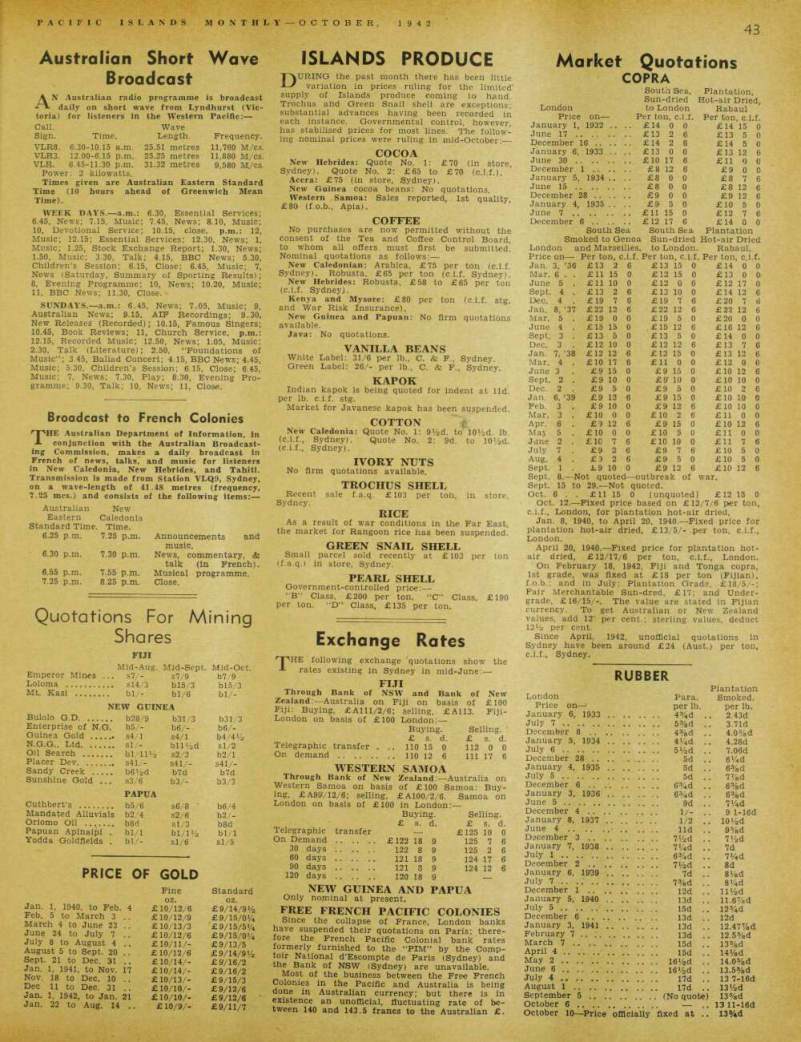
Broadcast
AN Australian radio programme is broadcast daily on short wave from Lyndhurst (Vic toria) for listeners in the Western Pacific:—
Times given are Australian Eastern Standard Time (10 hours ahead of Greenwich Mean Time).
WEEK DAYS.—a.m.: 6.30, Essential Services; 6.45, News; 7.15, Music; 7.45, News; 8.10, Music; 10, Devotional Service; 10.15, close, p.m.: 12, Music; 12.15; Essential Services: 12.30, News; 1, Music; 1.25, Stock Exchange Report; 1.30, News; 1.50, Music; 3.30, Talk; 4.15, BBC News; 5.30, Children’s Session; 6.15, Close; 6.45, Music; 7, News (Saturday, Summary of Sporting Results); 8, Evening Programme; 10, News; 10.20, Music; 11, BBC News; 11.30, Close.
SUNDAYS.—a.m.: 6.45, News; 7.05, Music; 9, Australian News; 9.15, AIF Recordings; 9.30, New Releases (Recorded); 10.15, Famous Singers; 10.45, Book Reviews; 11, Church Service, p.m.; 12.15, Recorded Music; 12.50, News; 1.05, Music; 2.30, Talk (Literature); 2.50, “Foundations of Music”; 3.45, Ballad Concert; 4.15, BBC News; 4.45, Music; 5.30, Children’s Session; 6.15, Close; 6.45, Music; 7, News; 7.30, Play; 8.30, Evening Pro gramme; 9.30, Talk; 10, News; 11, Close.
Broadcast to French Colonies
THE Australian Department of Information, in conjunction with the Australian Broadcast ing Commission, makes a daily broadcast in French of news, talks, and music for listeners in New Caledonia, New Hebrides, and Tahiti.
Transmission is made from Station VLQ9, Sydney, on a wave-length of 41.48 metres (frequency, 7.25 mcs.) and consists of the following items: — Australian New Eastern Caledonia Standard Time. Time, 6.25 p.m. 7.25 p.m. Announcements and music. 6.30 p.m. 7.30 p.m. News, commentary, & talk (in French). 6.55 p.m. 7.55 p.m. Musical programme. 7.25 p.m. 8.25 p.m. Close.
Call.
Wave Sign.
Time.
Length.
Frequency.
Vlr8.
6.30-10.15 a.m. 25.51 metres 11,760 M/cs.
Vlr3.
12.00-6.15 p.m. 25.25 metres 11,880 M/cs.
Vlr.
6.45-11.30 p.m. 31.32 metres 9.580 M/cs.
Power; 2 kilowatts.
Quotations For Mining
Shares
Fiji
Mid-Aug.
Mid-Sept.
Mid-Oct.
Emperor Mines ... s7/s7/9 b7/9 Loloma si 4/3 bl5/3 bl5/3 Mt. Kasi bl/bl/6 bl/-
New Guinea
Bulolo G.D b28/9 b31/3 b31/3 Enterprise of N.G. b5/b6/b6/- Guinea Gold s4 /1 s4/l b4/4V 2 N.G.G.. Ltd Si/bllVad sl/2 Oil Search bl/llVa s2/3 b2/l Placer Dev s41/s41/s41/- Sandy Creek beV-jd b7d b7d Sunshine Gold ... s3/6 b3/b3/3 Cuthbert’s
Papua
b5/6 s6/8 b6/4 Mandated Alluvials b2 4 s2/6 b2/- Oriomo Oil b8d sl/3 b8d Papuan Apinaipl . bl/1 bl/lVa bl/1 Yodda Goldfields . bl/sl/6 sl/5
Price Of Gold
Fine Standard oz. oz.
Jan. 1. 1940, to Feb. 4 £10/12/6 £9/14/9V 2 Feb. 5 to March 3 £10/12/9 £9/15/0V 4 March 4 to June 23 £ 10/13/3 £9/15/51/4 June 24 to July 7 £10/12/6 £9/15/01/4 July 8 to August 4 £10/11/- £9/13/5 August 5 to Sept. 20 £10/12/6 £9/14/91/2 Sept. 21 to Dec. 31 .. £10/14/- £ 9/16/2 Jan. 1, 1941, to Nov. 17 £10/14/- £9/16/2 Nov. 18 to Dec. 10 £10/13/- £9/15/3 Dec 11 to Dec. 31 .. £10/10/- £9/12/6 Jan. 1, 1942, to Jan. 21 £10/10/- £9/12/6 Jan. 22 to Aug. 14 £ 10/9/- £9/11/7
Islands Produce
DURING the past month there has been little variation in prices ruling for the limited' supply of Islands produce coming to hand.
Trochus and Green Snail shell are exceptions; substantial advances having been recorded in each instance. Governmental control, however, has stabilised prices for most lines. The follow ing nominal prices were ruling in mid-October;—
Cocoa
New Hebrides: Quote No. 1: £7O (in store, Sydney), Quote No. 2; £65 to £7O (c.i.f.).
Accra: £75 (in store, Sydney).
New Guinea cocoa beans: No quotations.
Western Samoa; Sales reported, Ist quality, £BO (f.0.b., Apia).
Coffee
No purchases are now permitted without the consent of the Tea and Coffee Control Board, to whom all offers must first be submitted.
Nominal quotations as follows: New Caledonian: Arabica, £75 per ton (c.i.f, Sydney). Robusta, £65 per ton (c.i.f. Sydney).
New Hebrides: Robusta, £5B to £65 per ton (c.i.f. Sydney).
Kenya and Mysore: £BO per ton (c.i.f. stg. and War Risk Insurance).
New Guinea and Papuan: No firm quotations available.
Java: No quotations.
Vanilla Beans
White Label: 31/6 per lb., C. & F., Sydney.
Green Label: 26/- per lb., C. & F., Sydney.
Kapok
Indian kapok is being quoted for indent at lid. per lb. c.i.f. stg.
Market for Javanese kapok has been suspended.
Cotton
New Caledonia: Quote No. 1: 9y 2 d. to 10V 2 d. lb (c.i.f., Sydney). Quote No. 2: 9d. to loy 2 d. (c.i.f., Sydney).
Ivory Nuts
No firm quotations available.
Trochus Shell
Recent sale f.a.q. £lO3 per ton, in store.
Sydney.
Rice
As a result of war conditions in the Far East, the market for Rangoon rice has been suspended.
Green Snail Shell
Small parcel sold recently at £ 103 per ton (f.a.q.) in store, Sydney.
Pearl Shell
Government-controlled price:— “B” Class, £2OO per ton. “C” Class, £l9O per ton. “D” Class, £135 per ton.
Exchange Rales
'T'HE following exchange quotations show the A rates existing in Sydney in mid-June:—
Fiji
Through Bank of NSW and Bank of New Zealand; —Australia on Fiji on basis of £lOO Fiji: Buying, £Alll/2/6; selling, £AII3. Fiji- London on basis of £lOO London;— Buying. Selling. £ s. d. £ s. d.
Telegraphic transfer . .. 110 15 0 112 0 0 On demand 110 12 6 111 17 6
Western Samoa
Through Bank of New Zealand; —Australia on Western Samoa on basis of £lOO Samoa: Buy ing, £A9&’/12/6; selling, £AIOO/2/6. Samoa on London on basis of £lOO in London:—
New Guinea And Papua
Only nominal at present.
Free French Pacific Colonies
Since the collapse of France, London banks have suspended their quotations on Paris; there fore the French Pacific Colonial bank rates formerly furnished to the “PIM” by the Comp toir National d’Escompte de Paris (Sydney) and the Bank of NSW (Sydney) are unavailable.
Most of the business between the Free French Colonies in the Pacific and Australia is being done in Australian currency; but there is in existence an unofficial, fluctuating rate of be tween 140 and 143.5 francs to the Australian £.
Buying.
Selling. £ s. d. £ s. d.
Telegraphic transfer £125 10 0 On Demand .. .. £122 18 9 125 7 6 30 days 122 8 9 125 2 6 60 days 121 18 9 124 17 6 90 days 121 8 9 124 12 6 120 days 120 18 9 —
Market Quotations
Copra
Sept. B.—Not quoted—outbreak of war.
Sept. 15 to 29. —Not quoted.
Oct. 6 . . £ll 15 0 [unquoted] £l2 15 0 Oct. 12.—Fixed price based on £l2/7/6 per ton, c.i.f., London, for plantation hot-air dried.
Jan. 8, 1940, to April 20, 1940. —Fixed price for plantation hot-air dried, £l3/5/- .per ton, c.i.f., London.
April 20, 1940.—Fixed price for plantation hot air dried, £l2/17/6 per ton, c.i.f., London.
On February 18, 1942, Fiji and Tonga copra, Ist grade, was fixed at £lB per ton (Fijian), f.0.b.; and in July; Plantation Grads, £lB/5/-; Fair Merchantable Sun-dred, £l7; and Under grade, £ 16/15/-. The value are stated in Fijian currency. To get Australian or New Zealand values, add 12’ per cent.; sterling values, deduct 12 V 2 per cent.
Since April, 1942, unofficial quotations in Sydney have been around £24 (Aust.) per ton, c.i.f., Sydney.
South Sea, Plantation, Sun-dried Hot-air Dried.
London to London Rabaul Price on— Per ton, c.i.f.
Per ton. c.i.f.
January 1, 1932 . . £14 0 0 £14 15 0 June 17 . £13 2 6 £13 5 0 December 16 .. £14 2 6 £14 5 0 January 6, , 1933 £13 0 0 £13 12 6 June 30 . £10 17 6 £11 0 0 December 1 . . £8 12 6 £9 0 0 January 5, 1934 . . £8 0 0 £8 7 6 June 15 . £8 i 0 0 £8 12 6 December 28 .. £9 i 0 0 £9 12 6 January 4, 1935 . . £9 5 0 £10 5 0 June 7 ., £11 15 0 £12 7 6 December 6 .. £12 17 6 £14 0 0 South Sea South Sea Plantation Smoked to Genoa Sun-dried Hot-air Dried London and Marseilles. to London.
Rabaul.
Price on— Per ton, c.i.f.
Per ton, c.i.f, , Per ton, c.i.f.
Jan. 3. ’36 £13 3 6 £13 15 0 £14 0 0 Mar. 6 . . £11 15 0 £12 15 0 £13 0 0 June 5 . £11 10 0 £12 0 0 £12 17 0 Sept. 4 . £13 2 6 £13 10 0 £14 12 6 Dec. 4 . £19 7 6 £19 7 6 £20 7 6 Jan. 8. ’37 £22 12 6 £22 12 6 £22 12 6 Mar. 5 . £19 0 0 £19 5 0 £20 0 0 June 4 . £15 15 0 £15 12 6 £16 12 6 Sept. 3 , £13 5 0 £13 5 0 £14 0 0 Dec. 3 . £12 10 0 £12 12 6 £13 7 6 Jan. 7, ’38 £12 12 6 £12 15 0 £13 12 6 Mar, 4 . £10 17 6 £11 0 0 £12 0 0 June 3 £9 15 0 £9 15 0 £10 12 6 Sept. 2 . £9 10 0 £9 10 0 £10 10 0 Dec. 2 . £9 5 0 £9 5 0 £10 2 6 Jan. 6, '39 £9 12 6 £9 15 0 £10 10 0 Feb. 3 . £9 10 0 £9 12 6 £10 10 0 Mar. 3 . £10 0 0 £10 2 6 £11 0 0 Apr. 6 . £9 12 6 £9 15 0 £10 12 6 Maj 5 . £10 0 0 £10 5 0 £11 0 0 June 2 . £10 7 6 £10 10 0 £11 7 6 July 7 . £9 2 6 £9 7 6 £10 5 0 Aug. 4 . £3 2 6 £9 5 0 £10 5 0 Sept. 1 . £9 10 0 £9 12 6 £10 12 6
Rubber
Plantation London Para.
Smoked.
Price on— per lb. per lb.
January 6, 1933 .. 4%d .. 2.43d July 7 3.71d December 8 4%d .. 4.0 5 /ad January 5, 1934 4»/ 4 d .. 4.28d July 6 .. 5y 2 d .. 7.06d December 28 5d ., 6V 4 d January 4, 1935 5d .. 6 3 /sd July 5 5d .. 7y B d December 6 . 6%d .. 6%d January 3, 1936 . 6%d .. 6%d June 5 9d ,. 7>/ 4 d December 4 1/- .. 9 l-16d January 8, 1937 1/2 .. 10 J / 2 d June 4 lid .. 9 5 /ad December 3 7V2d .. 7V 2 d January 7, 1938 7*/ 4 d .. 7d July 1 . 6%d .. ?y 4 d December 2 . 7 J / 2 d .. 8d January 6, 1939 7d ..
S'/ad July 7 .. 7%d .. ay 4 d December 1 12d .. ny 2 d January 5, 1940 .. .. 13d .. 11.6 7 /ad July 5 15d .. 12 3 Ad December 6 13d .. 12d January 3, 1941 .. . . 13d .. 12.47y a d February 7 13d .. 12.5 5 /ad March 7 15d .. 13 s /ad April 4 15d .. 14y a d May 2 . 16»/ 2 d .. 14.0 5 /ad June 6 . 16y 2 d .. 13.5 5 /ad July 4 17d .. 13 7-16d August 1 17d .. 13«/ 2 d September 5 . (No quote) 13%d October 6 — 13 ll-16d October 10—Price officially fixed at .. 13%d
Scots In The South
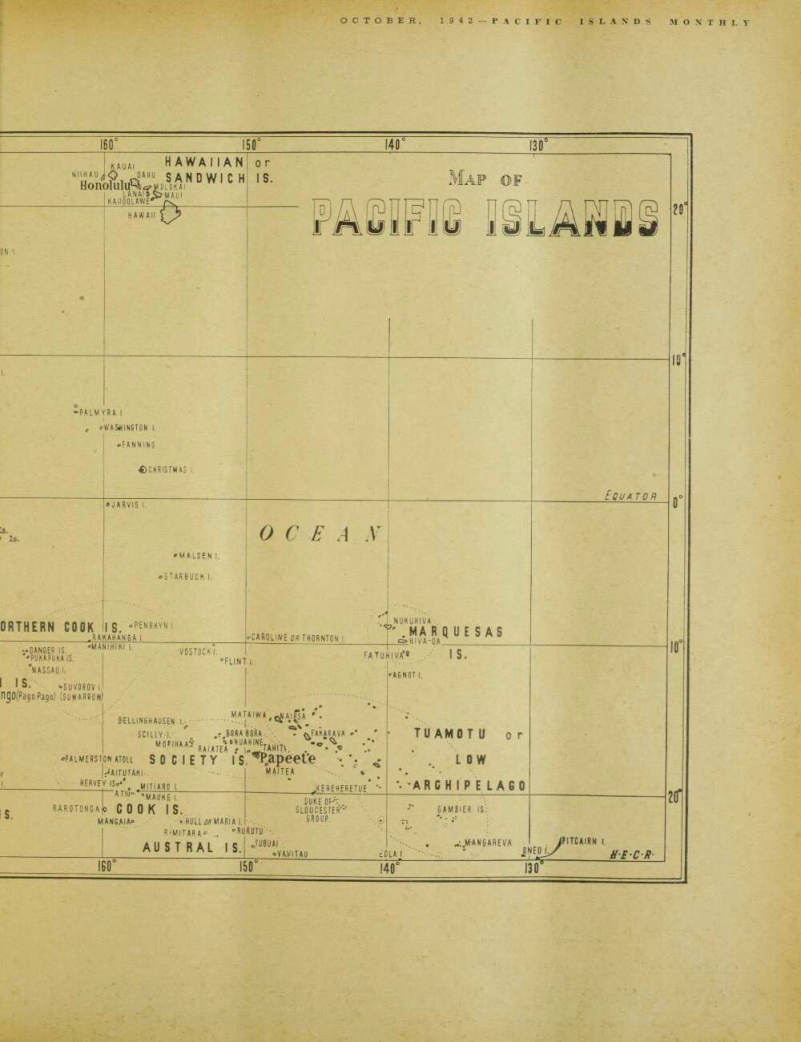
Seas
A Trader's Bitter Tale, by "Tukapa Koko"
BEING a trader at Mangaia, Cook Is., is not all beer and skittles.
The beer element is generally “bush,” and located only within the native cus tomers, during those months of the year when oranges are ripe. It is also dan gerous, by reason of that charming law that makes association with those who have quaffed an offence, construable as “aiding and abetting”—whereby it be hoves a trader to beware whom he shall admit into his establishment. (Bush beer is the fermented juice of oranges.—Ed. “PIM”.) As to skittles, these are of a financial nature. It is the trader’s earnest endea vor to knock down as many of them as he can; but the well-developed “sales jesistance” of the prospective benefi ciaries is a slight obstacle.
The Mangaian is shrewd. He is aware to a nicety of the bean-problem expressed by 2 plus 2 plus 1. Besides his mathe matical acumen, he possesses a personal, or intrinsic, dislike to such tyranny as making two coins do work that one could —in his view—quite efficiently perform.
On the other hand, where the white man is the buyer, these seemly scruples vanish, and there is no objection to a sort of conscription of wealth. Particularly
where vegetables are concerned! After paying ninepence for six small carrots, and 1 6 for a cabbage, one hardens. A dwarf chicken, that has never had a square meal in its life and given up the ghost in that deferred hope that sick eneth the heart, costs 2/-. After a meal of such “good capon,” one enters the store with stem, set face, ready to take up the white man’s burden.
Tableau: A small village store, with the usual lines; also one only trader, and ditto customer.
Dialogue (never varied from year to year), is as follows: — Customer; “How much are your matches?” (In classical Mangaian, of course.) Trader: “One penny per box.” (In the same high-piping Pehlevi.) Silence for some twenty seconds.
Customer: “Och, mon (or its native equivalent), dae ye no’ gie ae deescoont?”
Then, further: — Enter a Brown Brother, smiling coyly.
The first customer, with that now-well understood dislike of letting another see what he is buying—or NOT buying—fades from the midst, with a disgruntled look.
It is an old Mangaian custom, that has its counterpart in the provision by pawn brokers in civilisation of separate cells for the seekers of aid (an idea I must try some time, though it will be hard to partition my little, short, counter).
B.B.: “Gie me a tin o’ meat” (continu ing the Doric translation).
I shove it over the counter.
8.8. (grabbing the canister of “bully” and backing to the door, after hurling three pence on the counter): “I’ll breeng ye the sheelin’ the morn’s morn, dinna fash!”
I do fash: but it is too late to do any thing, 88. being well away. Still, he may keep his word. If he doesn’t, I will men tion it —slightly.
Here comes, now, Mrs. Tipenu. She, as I know of old, is a hard bargainer; had I an assistant. I would order him to “take over,” and flee to the rear veran dah. But as I haven’t, I must face the coming fray.
Mrs. Tipenu is a withered old brown dame, like a gypsy fortune-teller at a fair, but not so respectable-looking.
She comes for elastic; finds it is three pence a yard, but declares it ought to be a penny. I argue at some length, and make a sale; but the lady is not sat isfied to take things as they are. She objects to the fact that at every few yards, the rubber portion of the elastic is seen through the covering—probably owing to some process of joining—and insists that I cut between the joins— which, I know, is not seemly so to do.
Leaving, she raises a piping voice in a squeak of doubt that she would have been better to “gang tae the’ Beach.” to again translate the vernacular into the most fitting idiom.
Is it to be wondered that the con sumption of by traders of alcoholic pain deadeners is increasing?
Advertisements & other items, pp. 46-48 (3 items)
44
OCTOBER, 1942 PACIFIC ISLANDS MONTHLY
Published by PACIFIC PUBLICATIONS PTY. LTD., Union House. 247 George Street. Sydney (Telephone: BW up and printed in Australia by the Sydney and Melbourne Publishing Co. Pty. Ltd.. 29 Alberta Street. Sydney. (Telephone. MA 4369).
“Lead” Feeling
TAKE THE
OUT OF YOUR LEGS
Get More Oxygen in Your Blood and Get that Pep that Sends You Bounding Up the Stairs.
People who smother to death die because oxygen has been completely cut off from them. Just as surely you are slowly smothering if your blood lacks red corpuscles. Red corpuscles are your oxygen carriers. They carry the oxygen you breathe in to every part of your system.
Without enough oxygen-carrying corpuscles, your kidneys, liver, stomach and bowels slow down. Your skin gets pale, flabby, often pimply. Your nerves may become jittery—you tire quickly— fool Hp'nroQQPrl What you need is Dr. Williams’ Pink Pills. These world-famous pills help you make more and better red corpuscles and thus increase the oxygen-carrying power of your blood. Get Dr. Williams’
Pink Pills to-day at your chemist or store and see for yourself how quickly this time-proven blood-builder will help give you back your pep and clear complexion.***
II
FOR RELIABILITY
AND LONG SERVICE
USE
MILLER'S "ANCHOR"
BRAND ROPES AND
CORDAGES
Manila, Sisal, New Zealand Coir and Cotton Rope of every description. Twine, Sewing Twine, Shop Twine, Binder Twine and Fishlines, Lashings, Halters, Plough Reins, Sack Cord, Blind Lines, etc.
LENGTH STRENGTH
QUALITY GUARANTEED
• Manufactured by: JAMES MILLER & CO. PTY. LTD.
MELBOURNE, VIC., AUST.
Suva Agents: A. S. FAREBROTHER & CO.
And at Lautoka, P.O. Box 36. Tel.: 261.
Sydney Agents: p. T. TAYLOR LTD.
c
379 KENT STREET,
SYDNEY.
Telephones: MJ 4657 (5 lines).
General
Merchants
and
Agents
REPRESENTING LEADING FIRMS IN THE PACIEIC" ISLANDS Islands Produce Sold on Shippers’ Account Liberal Advances against Consignments. 25 Years’ Islands Trade Experience.
Bankers: Bank of New South Wales.
Buyers of all Islands’ requirements on Commission Original Invoices Furnished.
Correspondence in English and French.
gipi^" 11
®l»««. HHI
■ ■ v'.'v > -A- jt .13 28 '■• ■■ V - 1 11 - * I TE iiH :-: m m wm mm~t,s ... i .
Travel by CARPENTER AIRLINES
Full particulars from Macdonald, Hamilton & Co., or Howard Smith Ltd., Sydney.
IV. R. CARPENTER & CO. LTD.
MERCHANTS, SHIPOWNERS AND AIRCRAFT OPERATORS
jents for Australian, European and American Manufacturers, and Distributors of Every Description of Merchandise.
Buyers and Shippers of Copra, Trocas, and all Classes of Islands Produce.
Ford Motor Company of Canada.
T. G. & C. Bolinders (Engines).
AGENTS FOR:
Caterpillar Tractors.
Electrolux Refrigerators, etc., etc.
Dodge Brothers Inc.
Westinghouse Electrical Co.
Branches throughout 1 the Pacific Islands
In London; W. R. Carpenter & Co. (London) Ltd., Coronation House, 4 Lloyds Avenue, London, EC.
Head Office: 16 O’CONNELL STREET, SYDNEY