Pacific
Islands
Monthly
September 17, 1942
Vol. Xiii. No. 2.
Established 1930
[ Registered at the G.P.0., Sydney, for transmission by post as a
8 d
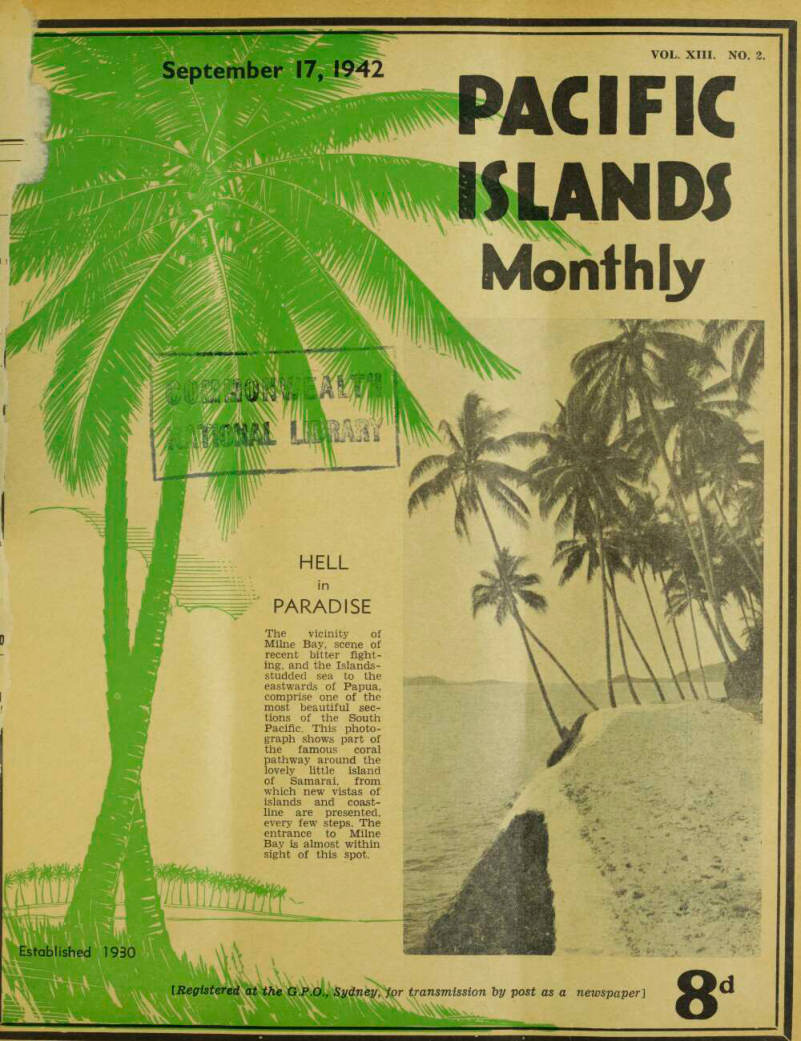
Hell
in
Paradise
The vicinity of Milne Bay, scene of recent bitter fight ing, and the Islands studded sea to the eastwards of Papua, comprise one of the most beautiful sec tions of the South Pacific. This photo graph shows part of the famous coral pathway around the lovely little island of Samarai, from which new vistas of islands and coast line are presented, every few steps. The entrance to Milne Bay is almost within sight of this spot.
Pacific News-Review
Notes And Comment On
The Progress Of The War
From Aug. 17 To Sept. 14
Aug. 17: The battle for possession of the Don bend, in southern Russia, has taken a critical turn—the Nazis have driven a wedge into Russian defences.
Probably, the historian of the future will say that this event opened the most critical phase of World War 11. Here, in the Eastern Ukraine, two great rivers flow, roughly, north and south—the Don into the Black Sea and the Volga into the Caspian. The Volga, carrying an immense river traffic, is literally the Russians’ life-line —along it come vital supplies of oil from the Caucasus and munitions from Britain and America, via Iran.
If the Germans get possession of these two rivers before the Russian winter closes down in October, Russia may be industrially and economically crippled.
If, on the other hand, the Russians can hold the tremendous German armies on the last defensible front represented by the Don and Volga Rivers {of which Stalingrad is the centre), then at last the Germans will be faced definitely with the prospect of defeat.
The battle for Stalingrad, therefore, has world-wide significance.
Aug. 18: The Japanese pressure in north-east Papua has been renewed, and the Japs have made a slight advance in the foothills of the Owen Stanley Range.
Aug. 18: Announced that Mr, Churchill is in Moscow and conferences are taking place between him and M. Stalin.
This announcement, and the subse quent announcement by Mr. Churchill that he and M. Stalin had reached a complete and harmonious understanding, has cleared away many doubts that were troubling the minds of war commenta tors. The Russians urgently have been demanding that Britain and America open a second front against Germany so as to relieve the pressure on the Don- Volga front; but the announcements indicate that the leaders have agreed upon a strategy which takes care of this Russian demand, Aug. 19: It is announced that the Americans, supported by Australian naval units, after intense preparation and a fortnight’s fighting, have regained pos session of the Tulagi area of the Solo mons from the Japs. HMAS “Canberra” (10,000 tons) was sunk.
Aug. 20: About 15,000 British made their biggest Commando raid on Dieppe area.
Aug. 20: The battle for Stalingrad has commenced.
Aug. 24: Brazil, owing to repeated sink ings of Brazilian coastal ships, declared war on Germany and Italy.
The entrance of Brazil into the war, like that of Mexico, means little in terms of men and armaments, but it does mean a good deal on the economic side, and also in relation to Atlantic strategy. The fact that Mexico is now one of the United Nations has helped the Allies consider ably in meeting the submarine menace in the Carribean Sea and Central Atlantic —Allied warships can use Mexican ports as freely as their own.
Similarly, Brazil’s decision means not only that the very considerable numbers of Germans, Italians and Japanese who have been carrying on pro-Axis activities in Brazil will be removed, but also that Brazilian ports will be available to Allied warships engaged on the submarine hunt
in the narrowest (and therefore a most important ) part of the Atlantic—that is, between the Brazilian coast of South America and the coast, of West Africa.
The fact that Brazil is now a United Nation belligerent will affect the situa tion in West Africa. The Germans will put pressure on Vichy to permit them to occupy and fortify Dakar, which directly faces Brazil, on the West African side of the Atlantic.
Aug. 26: Duke of Kent killed in air accident while on his way to Iceland.
Aug. 27: Japanese were defeated in air and naval counter-attacks against Americans in Solomons. * Aug. 25: Thirteen Jap aircraft were shot down in stratosphere battle over Darwin.
Aug. 26: Japanese landed at Milne Bay, but are meeting with resistance from Australian ground troops and Allied air craft.
Aug. 26: Enemy naval force which approached Guadalcanal, BSI, was so badly hammered that it withdrew.
Aug. 28: RAF made 500-bombers raid on Kassel, in south Prussia, centre of the Herschel locomotive works.
Aug. 28: Red Air Force bombed Berlin.
Night after night, week after week, with such monotonous regularity that the event is losing its news-value and is not prominently displayed in the news papers, the RAF is systematically attack ing and demolishing the ports and indus trial cities of Western Germany. If, as is believed, these operations are being carried out on a co-ordinated plan, the destruction of the German railway trans port system, as well as the industrial system is systematically proceeding.
Two important developments have re cently taken place in these raids upon Germany—increasing numbers of very powerful American aircraft are co operating with the RAF, but operating as independent American units under Ameri can command; and large numbers of Russian bombers, coming from the east, are frequently attacking cities in eastern Prussia and in Hungary, and are occa sionally bombing Berlin itself.
Aug. 31: Japanese, with a cruiser and eight destroyers, landed reinforcements at Milne Bay, under cover of bad weather.
Sept. 1: Falling into a carefully-laid trap, Japanese invaders have been driven into the northern peninsula at Milne Bay and are being systematically exterminated by Australians. Some may have been evacuated under cover of darkness.
Sept. 1: Japanese Foreign Minister Togo resigned for “personal reasons,” and is replaced by Premier Tojo. This is thought to indicate Japan’s intention to attack Siberia.
Observers in many countries, especially in China, have been insisting that all signs indicate Japan’s determination to attack Russia, through Siberia, at an early date.
It is believed that Japan had agreed to attack Russia in this way as soon as the Germans had taken Stalingrad and. secured command of the Volga. Obvi ously, there has been a considerable delay in the German campaign in south Russia and this may have knocked out Japan’s Siberian schedule.
The probability of a Japanese attack on Vladivostock and the peninsula behind that city, which so clearly menaces Japan from the air-raid point of view, may now be regarded as disappearing, with the approach of winter. Japan may contem plate a winter campaign in this country, but it is unlikely. Therefore, Japanese forces will probably be diverted from Siberia to the attack against China, India and Australia.
Sept. 2; Communiques report persistent enemy infiltration in Kokoda area of Papua.
Sept. 2: Germans increase pressure, but Stalingrad still holds.
Sept. 4: Rommel attempts an advance and fighting flares up again in Egypt.
Allied guns and planes are pounding Axis forces.
Sept. 5: Enemy concentrations have been withdrawn in Egypt, but a new Ger man drive is expected. British are attacking.
Sept. 9: Japanese now are near the Gap, in Owen Stanley Range, beyond Kokoda.
Sept. 9; Britain presents cruiser Shropshire” to Australia, to take place of sunken “Canberra.”
Sept. 11: Two-way bombing of Ger niauy, by the RAF and the Russian Air Force, is now almost a nightly occur rence.
Sept. 14: Japanese have crossed Owen Stanley Range, and are on southern slopes overlooking Papua, 40 miles from Port Moresby. Allied aircraft are strik mg constantly at the Japanese base at Buna.
Sept. 14; Japanese, with strong naval, air and military forces, have launched heavy counter-attack on newly-won American positions in and near Guadal canal, BSI. The battle is still going on.
Caledonia
traders busy in new
Acute Lock of Small Change
Prom Our Own Correspondent NOUMEA, August 10.
THE lack of small change in this Col ony has been acute since the arri val of the American Forces. To overcome the shortage, the local Trea sury is issuing paper money (bons de caisse) the value of which will be the same as the coin currency, namely 2 francs, 1 franc and 50 centimes. These a £ e k Ol P£ printed locally, and the value of the issue will be 250,000 francs.
Cafes, and fruit-juice and sandwich bars for the men of the American Forces are being opened everywhere, and there are numerous applications still to be dealt with-—for a licence is necessary for such a business. The word “Hamburger” has appeared for the first time on a Noumea shop-window.
A French military camp in New Cale donia has been named Camp Lieutenant- Colonel Broche, after the leader of the Free French Pacific Battalion, killed at Bir Hakheim, Libya.
Contents
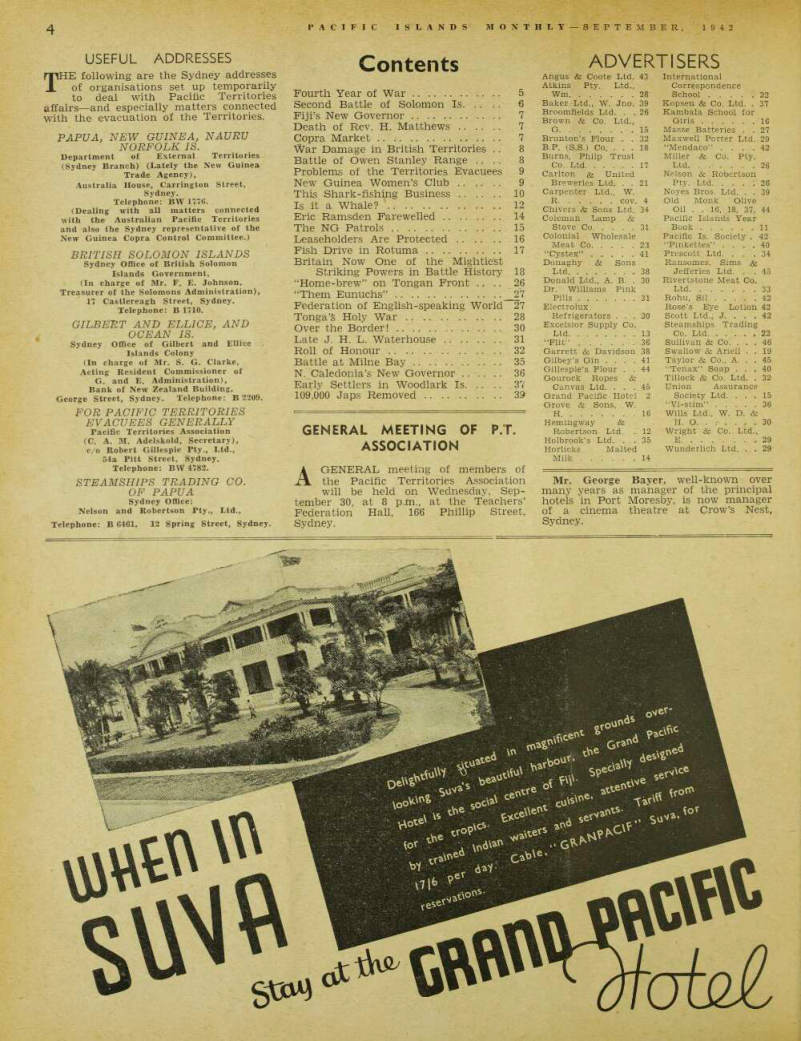
Fourth Year of War 5 Second Battle of Solomon Is 6 Fiji’s New Governor 7 Death of Rev. H. Matthews 7 Copra Market 7 War Damage in British Territories .. 8 Battle of Owen Stanley Range ... 8 Problems of the Territories Evacuees 9 New Guinea Women’s Club 9 This Shark-fishing Business 10 Is it a Whale? 12 Eric Ramsden Farewelled 14 The NG Patrols 15 Leaseholders Are Protected 16 Fish Drive in Rotuma 17 Britain Now One of the Mightiest Striking Powers in Battle History 18 "Home-brew” on Tongan Front .. .. 26 “Them Eunuchs” 27 Federation of English-speaking World 27 Tonga’S Holy War 28 Over the Border! 30 Late J. H. L. Waterhouse 31 Roll of Honour 32 Battle at Milne Bay 35 N. Caledonia’s New Governor 36 Early Settlers in Woodlark Is 37 109,000 Japs Removed 39
General Meeting Of P.T.
Association
A GENERAL meeting of members of the Pacific Territories Association will be held on Wednesday, Sep tember 30, at 8 p.m., at the Teachers’
Federation Hall, 166 Phillip Street, Sydney.
Mr. George Bayer, well-known over many years as manager of the principal hotels in Port Moresby, is now manager of a cinema theatre at Crow’s Nest, Sydney.
Advertisers
Angus & Coote Ltd. 43 Atkins Pty. Ltd., Wm 28 Baker Ltd., W. Jno. 39 Broomfields Ltd. . . 26 Brown & Co. Ltd., G 15 Brunton’s Flour . . 32 B.P. (S.S.) Co. . . . 18 Burns, Philp Trust Co. Ltd 17 Carlton & United Breweries Ltd. . . 21 Carpenter Ltd., W.
R cov. 4 Chivers & Sons Ltd. 34 Coleman Lamp & Stove Co 31 Colonial Wholesale Meat Co 23 “Cystex” 41 Donaghy & Sons Ltd 38 Donald Ltd., A. B. . 30 Dr. Williams Pink Pills 31 Electrolux Refrigerators ... 20 Excelsior Supply Co.
Ltd 13 “Flit” 36 Garrett & Davidson 38 Gilbey’s Gin ... 41 Gillespie’s Flour . . 44 Gourock Ropes & Canvas Ltd. ... 45 Grand Pacific Hotel 2 Grove & Sons, W.
H 16 Hemingway & Robertson Ltd. . 12 Holbrook’s Ltd. . . 35 Horlicks Malted Milk 14
International Correspondence School 22 Kopsen & Co. Ltd. . 37 Kambala School for Girls 16 Masse Batteries . . 27 Maxwell Porter Ltd. 29 “Mendaco” ... 42 Miller & Co. Pty.
Ltd 26 Nelson & .Robertson Pty. Ltd 26 Noyes Bros. Ltd. . . 39 Old Monk Olive Oil . . 16, 18, 37, 44 Pacific Islands Year Book 11 Pacific Is. Society . 42 “Pinkettes” ... 40 Prescott Ltd. . . .34 Ransomes, Sims & Jefferies Ltd. . . 45 Rlvertstone Meat Co.
Ltd 33 Rohu, Sil 42 Rose’s Eye Lotion 42 Scott Ltd., J. ... 42 Steamships Trading Co. Ltd 22 Sullivan & Co. ... 46 Swallow & Ariell . . 19 Taylor & Co., A. . . 45 “Tenax” Soap ... 40 Tillock & Co. Ltd. . 32 Union Assurance Society Ltd. ... 15 “Vi-stim” 36 Wills Ltd., W. D. & H. 0 30 Wright & Co. Ltd., E 29 Wunderlich Ltd. . . 29
Advertisements & other items, p. 4 (2 items)
Useful Addresses
rE following are the Sydney addresses of organisations set up temporarily to deal with Pacific Territories affairs —and especially matters connected with the evacuation of the Territories.
PAPUA, NEW GUINEA, NAURU
NORFOLK IS.
Department of External Territories (Sydney Branch) (Lately the New Guinea Trade Agency), Australia House, Carrington Street, Sydney.
Telephone: BW 1776. (Dealing with all matters connected with the Australian Pacific Territories and also the Sydney representative of the New Guinea Copra Control Committee.)
BRITISH SOLOMON ISLANDS
Sydney Office of British Solomon Islands Government, (In charge of Mr. F. E. Johnson, Treasurer of the Solomons Administration), 17 Castlereagh Street, Sydney.
Telephone: B 1710.
GILBERT AND ELLICE, AND
OCEAN IS.
Sydney Office of Gilbert and Ellice Islands Colony (In charge of Mr. S. G. Clarke, Acting Resident Commissioner of G. and E. Administration), Bank of New Zealand Building, George Street, Sydney. Telephone: B 2209.
FOR PACIFIC TERRITORIES
EVACUEES GENERALLY
Pacific Territories Association (C. A. M. Adelskold, Secretary), c/o Robert Gillespie Pty., Ltd., 54a Pitt Street, Sydney, Telephone: BW 4782.
STEAMSHIPS TRADING CO.
OF PAPUA
Sydney Office: Nelson and Robertson Pty., Ltd., Telephone: B 6461. 12 Spring Street, Sydney.
fate£
& P A\ Uttiu . As ov er ' j \n tVv® A«*\sL' t ' e^ **-c» -*• \tt * e &&**■ d s erv^ s - 50 ... *' ** w ;S" '*??>'** l taW' eA O b ' e ’ er iaV ‘
M 6 pe ns
f •
fate£
Pacific Islands Monthly
The Newspaper-Magazine of the South Seas [.Registered at the G.P.0., Sydney, for transmission by post as a newspaper .]
Published Once Each Month and Circulated in Australia and New Zealand and in the following Pacific Territories and Islands Groups:
Australian Territory of Papua.
Mandated Territory (Australia) of New Guinea.
Australian Territory of Norfolk Island.
New Zealand Territory of Cook Islands.
Mandated Territory (NZ) of Western Samoa.
British Colony of Fiji.
British Solomon Islands Protectorate.
British Protectorate of Tongan Islands.
British Crown Colony of Gilbert and Ellice Islands.
Mandated Territory of Nauru.
British and Free French Condominium of New Hebrides.
Free French Colony of New Caledonia.
Free French Colony of Oceania (Tahiti, etc.).
American Territory of Eastern Samoa.
American Territory of Hawaiian Islands.
Owned and Produced by Pacific Publications Pty. Ltd., Union House, 247 George Street, Sydney.
TELEPHONE f Managing Director BW 5037 1 Business and Editorial MA 4369
P.O. Box 3408 R
Registered Address of Telegrams, Radiograms, and Cables: “Pacpub”, Sydney.
Contributions.
Articles, Stories, and Photographs dealing with Pacific Islands subjects are invited and will be paid for on publication.
Subscription Rates.
Per Annum, within British Empire, Prepaid, Post Free 8/- Per Annum, elsewhere, prepaid, Post Free. 107- Single Copies Bd.
Editor and Publisher:
R. W. Robson, F.R.G.S.
Advertising Manager; L. W. Bailey.
Advertising Office and Printing-House: 29 Alberta Street, Sydney.
Advertising rates furnished on application.
Colours, etc., by arrangement.
Process Blocks made at Advertiser’s expense when required. Screen 100.
Changes of Advertising Copy should reach this office by Ist of each month, otherwise previous advertisement may be repeated.
Representative In London.
W. C. Harvey, Coronation House, 4 Lloyds Avenue, London, E.C.3, from whom may be obtained copies of Pacific Islands Monthly, Pacific Is. Year Book, advertising schedules, etc.
Agents.
The following are authorised to receive sub scriptions for Pacific Islands Monthly:— Burns, Philp & Co., Ltd., and Burns Philp (South Sea) Co., Ltd. All branches.
W. R. Carpenter & Co., Ltd. All branches.
Morris, Hedstrom, Ltd. All branches.
Steamships Trading Co., Papua. All branches.
B.N.G. Trading Co., Ltd., Port Moresby, Papua.
J. Muir, Suva, Fiji.
Miss R. Castles, Suva, Fiji.
N. C. Mackenzie Hunt, Wainunu, Bua, Fiji.
Kirpal & Co., Victoria Parade, Suva, Fiji.
Cook Islands Trading Co., Rarotonga, Cook Is.
A. C. Rowland, Papeete, Tahiti.
Islands Branches and Representatives of W. H.
Grove & Sons, Ltd,* Auckland, New Zealand.
Ed. Pentecost, Noumea, New Caledonia.
Kerr & Co., Noumea, New Caledonia.
Vol. xm. No. 2.
September 17, 1 942
Pi- ( Bd. Per Copy, rnce [ Prepaid: 87- p.a.
Prospect
THREE YEARS OF WAR — AND A GRIM
A YEAR ago, we faced the third year of the war with confidence —and even with some hope that 1942 might see the end. To-day, we go on into the fourth year of war with hope and confidence undimmed, but chas tened by memories of many recent defeats and disasters, and by the knowledge that, if we are to survive as a free people—or, indeed, survive at all—we shall need all our courage, all our skill and organising genius, all our capacity for sacrifice.
Looking back over the events of 1939-42, we can but marvel at the miracle of our survival. According to every Hitlerian calculation, we should long ago have ceased to exist as a great nation and a free people; and that gentleman’s calculations have been horribly accurate. We could have been left helpless at Dunkirk— but our armies escaped. We could have been over-run and enslaved in the autumn of 1940; but somehow our little RAF defied and defeated the mighty Luftwaffe. We could have been starved into submission by the submarines in 1941: but our merchant ships got through. We should have been crushed under the double weight of Germany and Japan in 1942—f0r now there is no doubt whatever that the Axis conspired to smash Russia in 1941, and destroy Britain in 1942, while scaring United States into non belligerency. But Russia survived, the time-table of the Axis plot was dis
located, and there descended upon Tokio a madness which induced the Japanese war-lords to launch upon the United States an attack so treacherous in character that it brought the Americans instantly to the side of Britain and Russia, more united in anger and war than they ever were in peace.
That, in actual fact, was the greatest miracle of all. If Japan had held back her greedy hand, the United States would have come eventually into the war, but might not have been the united, hard-hitting, grimly resolute people whom we know to-day. Until Japan’s treachery made the issue clear even to the poorest intelligence, there were tens of mil lions of Americans who could see no real reason for active belligerency. A disunited United States would have been a poor ally; but now, thanks to Japan, a united USA is a sure guaran tee of victory. We hope that Tokio, some day, will appreciate that bit of grim humour.
A YEAR ago, in 1941, we hoped that Japan, fearing America, might remain merely a sleeping partner of the Axis, and stay out of the war. We know now that that hope was foolish and uninformed. Japan and Germany had long been in agreement con cerning what they were going to do, and when they were going to do it.
For at least four years before she
struck, Japan was training her troops for tropical jungle warfare and islands-hopping, and preparing her navy and air force, with great fore thought and meticulous detail, for the day when she would seize the Indonesian and Pacific territories of Britain, France and Holland. Ger many and Italy were to destroy France and the small democracies; Germany was to destroy Russia; Germany and Japan were to destroy Britain. If the United States did not quietly accept a fait accompli, she was to be crippled by a vast, well organised Fifth Column.
We need only read the history of the black months of this black year to realise how nearly the Axis plot succeeded. We have lost Hongkong, Malaya, Singapore, Burma, Borneo, New Guinea and the Solomons; and our Allies have lost the Philippines and the Netherlands Indies. We have lost important sources of supply of such commodities as rubber, tin, copra, tea, petroleum, rice. The sub marine threat to our water-borne transport, which seemed conquered a year ago, is as grave to-day as it ever was.
TTOWEVER, we still survive, and still -■-A are capable of creating the forces and the weapons which ultimately will destroy the Axis. The United Nations have lost the most valuable part of European Russia, and all their Indonesian Empire; but no other part of their vast territories is in enemy hands. The spirit of our peoples is high, and unconquerable; our endless
resources of men and materials are being organised; all our industries, and our economic, political and social systems are being geared to war on a scale never known before in human history.
But—how slowly! The years pass, and still we are on the defensive. In organisation and production for war.
Hitler’s Huns still are far ahead of us. The little, Robot-like men of Japan, having all the advantages of four years’ preparation, remain triumphantly in occupation of South east Asia and our North-west Pacific, gloating over what they believe to be an epoch-making defeat of the hitherto invincible European. Is it any wonder that many people, know ing that we really have within us the high spirit and unquenchable resolve that is the will to victory, become angry as the passing months bring us no victories, and accuse our leaders of fumbling and futility?
There is only one course open to the peoples of the United Nations.
They must wait while millions of men are transferred from peacetime in dustries to new and unaccustomed wartime duties; to wait while hun dreds of thousands of technicians and tens of thousand of officers are trained in the complex arts of modern war; to wait while every aspect of our daily lives is altered, so that all the nation’s activities can be harnessed to and co-ordinated in the supreme purpose of winning the war and re taining our freedom. They must be patient while our Governments, by a painful process of trial and error, find men capable of directing and leading our vast, new wartime forces.
If that waiting involves much suf fering and sacrifice, mental as well as physical, all must be accepted philosophically. There is no alter native. A weakening of our spirit now will spell defeat, the destruction of our nation and our cherished in stitutions, centuries of slavery under creatures like Hitler and Himmler, or outright extermination by the bar barian Japs. But a grim and un breakable resolution, now, surely will carry us through this, the greatest crisis in the history of mankind.
A YEAR ago, we hoped for victory and the end of the war “in 1942 or 1943.” Now, we know that there is little likelihood of an early termina tion of the struggle—if we are to survive. The events of 1942 have altered the whole outlook. The United Nations cannot develop their maxi mum strength for a couple of years yet. Meanwhile, Germany holds all Europe enslaved and, using her colossal genius in organisation, is transforming Europe into one vast armaments factory. Japan, in 1942, is being outbuilt and outfought by the United States. But Japan, with feverish haste, is organising for war purposes the resources of the great new empire she has seized; and she now has at her command 90,000,000 Japanese and over 100,000,000 Indo nesians.
While we organise and strive and build, the Axis Powers, with many
years’ start over us, also are organis ing, and striving and building. Can any sane man see, in such circum stances, an early end of this war?
Comparisons with 1914-18 are use less. Then, our enemy really was blockaded. To-day, Germany and Japan is each in command of a self contained world of its own, and can defy any blockade. Neither can be put under economic pressure, while it holds its present territories. Each can be defeated only by overwhelming force—and that force eventually will come from the skies. Such an air force cannot be created in a year or two.
Britain held the Hun in 1940.
Russia has held him in 1941 and 1942.
United States and Britain, after grievous losses, have held the Jap in 1942. In 1943, Britain and America must hold the Hun in Europe and the Jap in the Pacific, while they are arming China, building up their air fleets and giving Russia a chance to recover. Beyond that, it is impossible to see.
Advertisements & other items, p. 6 (1 item)
& Co. Ltd.
W. R. CARPENTER
Effect of War on Turnover
ALTHOUGH the operations of W. R.
Carpenter & Co., Ltd., in New Guinea, Solomons and Gilbert Islands have ceased entirely, owing to the Japanese invasion, the company dis closed a net profit of £66,280 for the year ended June 30 last, compared with £115,989 for the previous year; and the accounts generally indicate much inter nal strength.
With £90,562 brought forward from last year, the directors had £156,842 avail able for distribution; but they wisely decided to cut the dividend down to 5 per cent. (£38,750), and to carry £118,092 forward into the current year.
The net profit was arrived at in spite of very heavy wartime costs, which included £23,264 for taxation and a sum of £26,706 placed to one side to cover debts which are now considered irrecov erable “owing to war conditions having forced individuals from their industries and peacetime occupations.”
The sum of £25,000, which was set aside some time ago to meet additional taxa tion, has not been drawn upon, and remains in the company’s accounts as a taxation contingency.
The directors, in their annual report, make the following interesting com ments;— “Declarations have been lodged with the War Damage Commission for all assets capable of being contributed for under the regulations.
“The company’s shipping operations continue to function satisfactorily. One small motor ship was lost by enemy action during the year, but was covered by War Risk insurance.
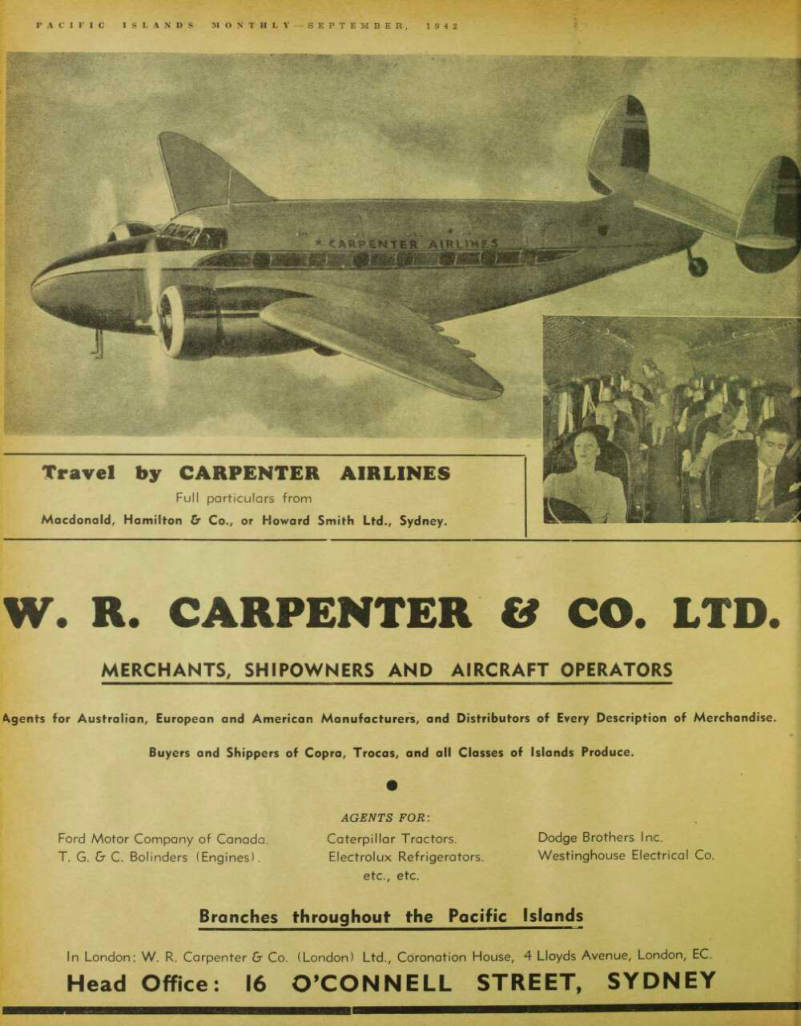
“The air service to New Guinea has been suspended, and our aircraft nlant and equipment are now employed on work of national importance. Operating results have, for the year, proved satis factory. We regret to record the deaths of Captain E. D. Crisp and First Officer C. Bernard whilst engaged on work of national service, which resulted in the
loss of one of our Lockheed aircraft.
“The Southern Pacific Insurance Co.
Ltd, has continued to make progress, and paid a dividend of 7 per cent, for the year ended March 31, 1942.
“Cur Fijian subsidiary, w. R. Carpen ter & Co. (Fiji) Ltd., made very satis factory progress during the year, and paid a dividend of 10 per cent, for the year ended March 31, 1942, on ordinary shares.”
The chairman of the company, Sir Walter Carpenter, is still in Canada, where the company is interested in the operation of Canada’s only copra-crush ing enterprise, and Mr. R. B. Carpenter is acting-chairman.
Solomons
Second Battle of the Solomons Japs Launch Heavy Attacks From September 12-15
ON the night of Saturday, September 12, the Japanese, using reinforced infantry, aircraft and warships, commenced a heavy attack in an attempt to recapture, from the Americans, the sections of Guadalcanal which the Ameri cans took from the Japanese in August. (See “First Battle of Solomons,” on page 24.) The Japanese have directed their prin cipal effort towards the recapture of the airfield, which the Japanese constructed, and which the Americans appear to have been using very effectively as a base against Japanese-held positions in Gizo, Faisi, the coast of Ysabel, and even as far north as Bougainville.
On the night of the 12th, Jap surface vessels shelled American positions, and there was considerable fighting. On the 13th, two flights of about 28 bombers each, supported by fighters, attacked the Guadalcanal airfield; and four bombers and four fighters were destroyed.
On the night of the 13th, the American positions were again shelled by surface craft, and American troops became heav ily engaged with Japanese land forces who tried to capture the airfield. The Japanese were defeated.
On the 14th, another flight of 28 bomb ers, with fighters, attacked Guadalcanal, and the Americans shot down one bomber and five fighters.
The Japs, in this fighting, lost 21 planes in five days.
The battle was still going on on the 15th, with the Americans still holding their positions.
Press messages from Hawaii, on Sep tember 16, expressed the view that a naval battle, on a major scale, is immi nent in the Solomons region.
Will There Be Another
" Hms Fiji"?
WHEN, in 1939, Britain decided to name a new cruiser “HMS Fiji” the people of Fiji decided to express their pleasure by presenting to the cruiser the following articles: a silver kava bowl, suitable for use as a punch bowl; a silver bell, which was to hang on the quarter-deck: and two silver bugles.
War broke out before the formal pre sentation took place; and, subsequently, “HMS Fiji” was lost in one of the battles off Crete.
Since then the articles have been stored in England, with the intention of returning them to Fiji after the war.
The hope has been expressed, however, that another new British cruiser will be named “Fiji.”
New Governor
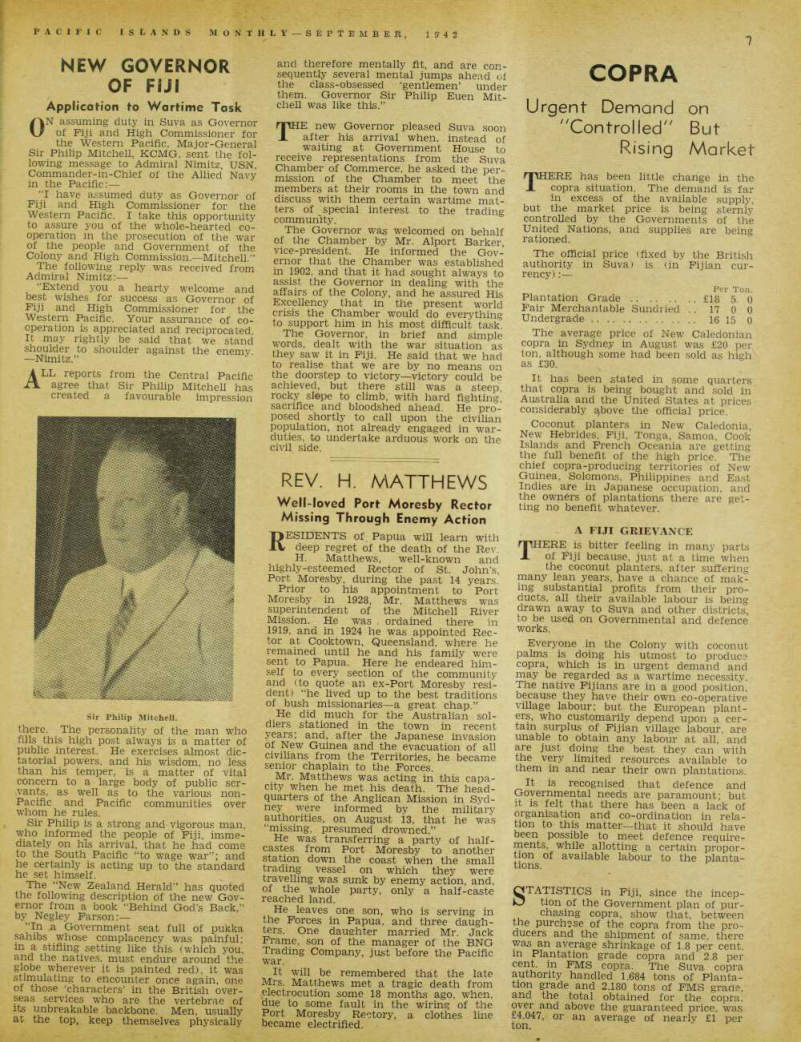
Of Fiji
Application to Wartime Task
ON assuming duty in Suva as Governor of Fiji and High Commissioner for the Western Pacific, Major-General Sir Philip Mitchell, KCMG, sent the fol lowing message to Admiral Nimitz, USN, Commander-in-Chief of the Allied Navy in the Pacific:— “I have assumed duty as Governor of Fiji and High Commissioner for the Western Pacific. I take this opportunity to assure you of the whole-hearted co operation in the prosecution of the war of the people and Government of the Colony and High Commission.—Mitchell.”
The following reply was received from Admiral Nimitz:— “Extend you a hearty welcome and best wishes for success as Governor of Fiji and High Commissioner for the Western Pacific. Your assurance of co operation is appreciated and reciprocated It may rightly be said that we stand shoulder to shoulder against the enemy —Nimitz.”
ALL reports from the Central Pacific agree that Sir Philip Mitchell has created a favourable impression
there. The personality of the man who fills this high post always is a matter of public interest. He exercises almost dic tatorial powers, and his wisdom, no less than his temper, is a matter of vital concern to a large body of public ser vants, as well as to the various non- Pacific and Pacific communities over whom he rules.
Sir Philip is a strong and vigorous man, who informed the people of Fiji, imme diately on his arrival, that he had come to the South Pacific “to wage war”; and he certainly is acting up to the standard he set himself.
The “New Zealand Herald” has quoted the following description of the new Gov ernor from a book “Behind God’s Back,” by Negley Farson:— “In a Government seat full of pukka sahibs whose complacency was painful; in a stifling setting like this (which you, and the natives, must endure around the globe wherever it is painted red), it was stimulating to encounter once again, one of those ‘characters’ in the British over seas services who are the vertebrae of its unbreakable backbone. Men, usually at the top, keep themselves physically
and therefore mentally fit, and are con sequently several mental jumps ahead ol the class-obsessed ‘gentlemen’ under them. Governor Sir Philip Euen Mit chell was like this.”
THE new Governor pleased Suva soon after his arrival when, instead of waiting at Government House to receive representations from the Suva Chamber of Commerce, he asked the per mission of the Chamber to meet the members at their rooms in the town and discuss with them certain wartime mat ters of special interest to the trading community.
The Governor was welcomed on behalf of the Chamber by Mr. Alport Barker, vice-president. He informed the Gov ernor that the Chamber was established in 1902, and that it had sought always to assist the Governor in dealing with the affairs of the Colony, and he assured His Excellency that in the present world crisis the Chamber would do everything to support him in his most difficult task.
The Governor, in brief and simple words, dealt with the war situation as they saw it in Fiji. He said that we had to realise that we are by no means on the doorstep to victory—victory could be achieved, but there still was a steep rocky stepe to climb, with hard fighting sacrifice and bloodshed ahead. He pro posed shortly to call upon the civilian population, not already engaged in war duties, to undertake arduous work on the civil side.
Sir Philip Mitchell.
Rev. H. Matthews
Well-loved Port Moresby Rector Missing Through Enemy Action
RESIDENTS of Papua will learn with deep regret of the death of the Rev.
H. Matthews, well-known and highly-esteemed Rector of St. John’s, Port Moresby, during the past 14 years.
Prior to his appointment to Port Moresby in 1928, Mr. Matthews was superintendent of the Mitchell River Mission. He was . ordained there in 1919, and in 1924 he was appointed Rec tor at Cooktown, Queensland, where he remained until he and his family were sent to Papua. Here he endeared him self to every section of the community and (to quote an ex-Port Moresby resi dent) “he lived up to the best traditions of bush missionaries—a great chap.”
He did much for the Australian sol diers stationed in the town in recent years; and, after the Japanese invasion of New Guinea and the evacuation of all civilians from the Territories, he became senior chaplain to the Forces.
Mr. Matthews was acting in this capa city when he met his death. The head quarters of the Anglican Mission in Syd ney were informed by the military authorities, on August 13, that he was “missing, presumed drowned,”
He was transferring a party of half castes from Port Moresby to another station down the coast when the small trading vessel on which they were travelling was sunk by enemy action, and, of the whole party, only a half-caste reached land.
He leaves one son, who is serving in the Forces in Papua, and three daugh ters. One daughter married Mr. Jack Frame, son of the manager of the BNG Trading Company, just before the Pacific war.
It will be remembered that the late Mrs. Matthews met a tragic death from electrocution some 18 months ago, when, due to some fault in the wiring of the Port Moresby Rectory, a clothes line became electrified.
Copra
Urgent Demand on "Controlled" But Rising Market
rERE has been little change in the copra situation. The demand is far in excess of the available supply, but the market price is being sternly controlled by the Governments of the United Nations, and supplies are being rationed.
The official price (fixed by the British authority in Suva) is (in Fijian cur rency) :—
The average price of New Caledonian copra in Sydney in August was £20 per ton, although some had been sold as high as £30.
It has been stated in some quarters that copra is being bought and sold in Australia and the United States at prices considerably the official price.
Coconut planters in New Caledonia, New Hebrides, Fiji, Tonga, Samoa, Cook Islands and French Oceania are getting the full benefit of the high price. The chief copra-producing territories of New Guinea, Solomons, Philippines and East Indies are in Japanese occupation, and the owners of plantations there are get ting no benefit whatever.
A Fiji Grievance
THERE is bitter feeling in many parts of Fiji because, just at a time when the coconut planters, after suffering many lean years, have a chance of mak ing substantial profits from their pro ducts, all their available labour is being drawn away to Suva and other districts, to be used on Governmental and defence works.
Everyone in the Colony with coconut palms is doing his utmost to produce copra, which is in urgent demand and may be regarded as a wartime necessity.
The native Fijians are in a good position, because they have their own co-operative village labour; but the European plant ers, who customarily depend upon a cer tain surplus of Fijian village labour, are unable to obtain any labour at all, and are just doing the best they can with the very limited resources available to them in and near their own plantations.
It is recognised that defence and Governmental needs are paramount; but it is felt that there has been a lack of organisation and co-ordination in rela tion to this matter—that it should have been possible to meet defence require ments, while allotting a certain propor tion of available labour to the planta tions.
STATISTICS in Fiji, since the incep tion of the Government plan of pur chasing copra, show that, between the purchase of the copra from the pro ducers and the shipment of same, there was an average shrinkage of 1.8 per cent. m Plantation grade copra and 2.8 per cent, in FMS copra. The Suva copra authority handled 1,684 tons of Planta tion grade and 2,180 tons of FMS grade, and the total obtained for the copra, over and above the guaranteed price, was £4.047, or an average of nearly £1 per ton.
Per Ton.
Plantation Grade £18 5 0 Fair Merchantable Sundried .. 17 0 0 Undergrade 16 15 0
Tahitians Give Lives For Free France
Free France
Tahiti, July 25.
AN unpretentious notice in the local, Government - owned newspaper brought the first full impact of the war to Tahiti.
Headed simply “Deaths for France,” the announcement read; “The Governor of the French Establishments of Oceania has the sad duty of bringing to the population of French Oceania news of the death on the field of honour of volunteers Trom the Batallion of the Pacific, the names of which follow: — Seargant Louis Holozet.
Ist class soldier Huriaau Onuu. 2nd class soldier Tetautaurii Puarii Maratai. 2nd class soldier Tahua Nahenahe Path. 2nd class soldier Tufariu Maere.
“The chief of the colony expresses to the families his most sincere con dolences.”
Native himaas and religious services were held for the individuals in their re spective districts, while a collective service was held later at the Paofai school in Papeete.
The deaths occurred at the great battle of Bir Hacheim, in Libya, where Free French forces made a spectacular stand late in June. They represent Tahiti’s first casualties in the w 7 ar.
War Damage
British Colonial Authority Announces Policy
THE following announcement, published in Suva on August 8, applies to Fiji and to all the territories under the High Commission of the Western Pacific (Solomons, Gilbert & Ellice, Tonga, Pit cairn) : “His Majesty’s Government in the United Kingdom have found it necessary to review the whole question of war damage in the Colonies. The following statement is published for general infor mation: — “It will be the general aim of His Majesty’s Government after the war that, with a view to the well-being of the people and the resumption of productive activities, property and goods destroyed or damaged in the Colonial Empire should be replaced or repaired to such an extent and over such period of time as resources permit. If the resources of any part of the Colonial Empire are insuffi cient to enable this purpose to be achieved without aid, His Majesty’s Gov ernment would be ready to give what assistance they can in conjunction with such common funds or organisations as may be established for post-war recon struction.”
Perforated!
THIS happened in Vanua Levu, Fiji.
A Euronesian entered a store, hesi tated. and asked for “a tin of per forated milk.”
The storekeeper chewed hard, swal lowed twice, and then gave him what he wanted —namely, a tin of evaporated milk.
Battle Of Owen Stanley Range
Japs Make Extraordinary Effort to Attack P. Moresby in Rear
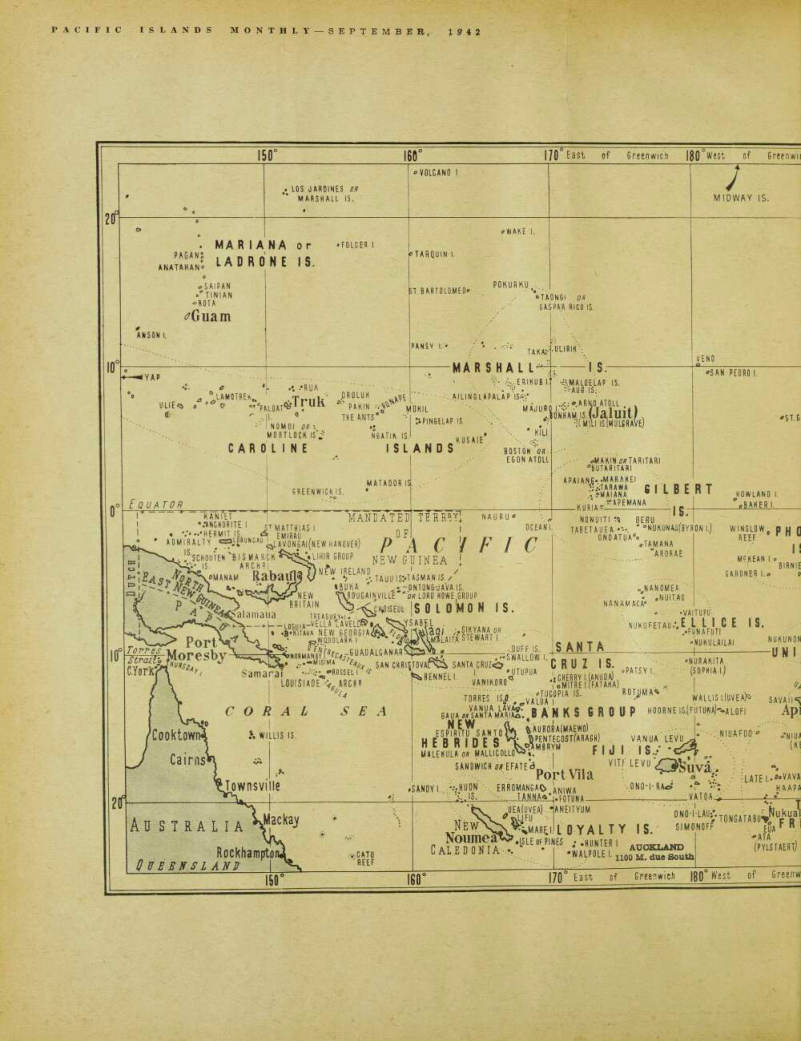
WAR developments in the New Guinea- Papua-Solomons area during the past month have been important and significant. They may be sum marised thus:— SOLOMONS: The Americans, in the First Battle of the Solomons, threw the Japanese out of the Tulagi area and occupied positions of considerable strate gical importance. The Japanese, in the Second Battle in the Solomons, are using considerable forces in trying to recover these lost positions. The first battle of the Solomons is described on page 24, and the second battle, now pro ceeding, on page 6.
PAPUA—MILNE BAY: The Japanese made a landing here, in Eastern Papua, apparently as part of a plan to develop a new attack on Port Moresby and the Australian coast. They trapped and severely defeated. The Battle of Milne Bay is described on page 35.
Papua—Owen Stanley Range:
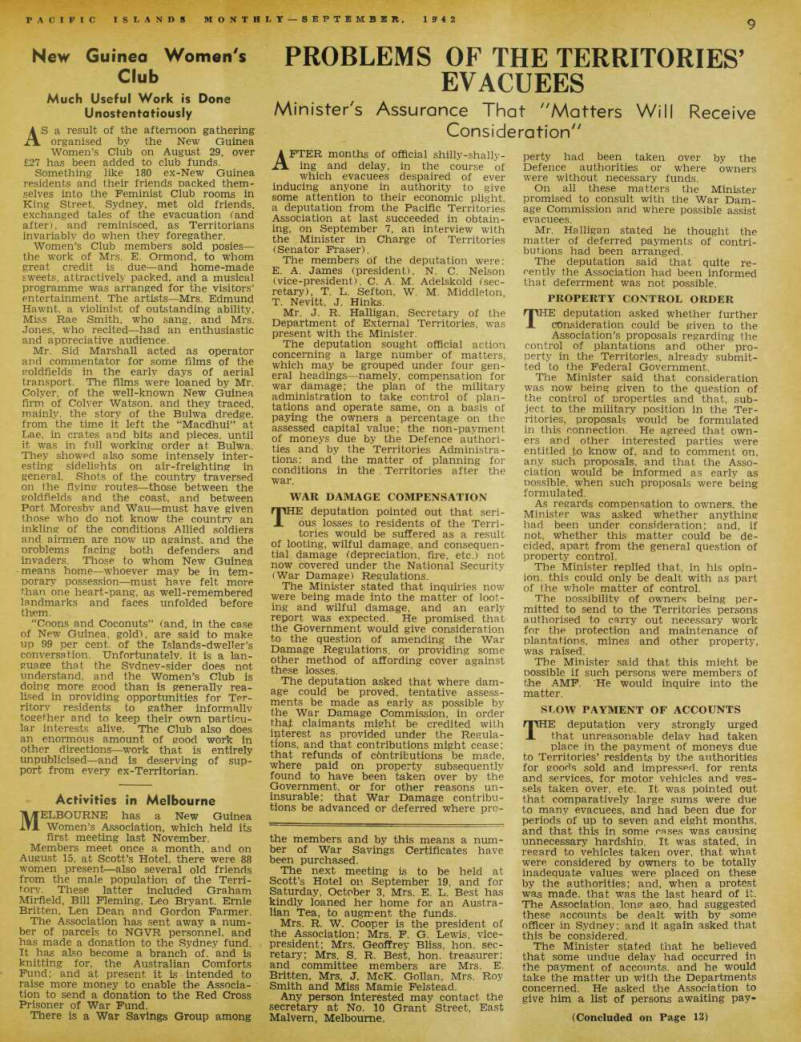
Defeated at Milne Bay, the Japanese, from the Buna area of North-eastern Papua, thrust strongly and fiercely across the Owen Stanley Range, at the Kokoda Gap, and the Australians retired to the southern slopes of the Owen Stanley Range, where the fighting is now pro ceeding. This operation is described in the following article. rE Battle of the Owen Stanley Range may be shown in the fol lowing chronological order.
Tuesday, July 21. —Jap convoy seen off Ambasi- Buna coast, and attacked.
July 22—Japs land about 2,000 men at Gona, near Buna. Our planes attack incessantly.
One 8.000 ton transport sunk.
July 23.—Five plane attacks by our planes—an oil transport probably destroyed.
July 26. —Allied patrols clash with Japs at Awala,. 22 miles inland, on Buna-Kokoda track.
July 27.—Clashes at Oivi, 55 miles inland, near Kokoda.
July 28.—Clashes at Kokoda.
July 29'.—Close skirmishes in Kokoda area.
July 30.—Jap transport apparently destroyed 100 miles off coast.
August 4. —All quiet in Kokoda area. Enemy apparently has received reinforcements.
August 18.—Enemy renews pressure at Kokoda.
August 26-September I.—Japs land at Milne Bay, and are heavily defeated.
September 2.—Enemy commences attack at Kokoda.
September 9.—Enemy reported on top of Owen Stanley Range.
September 14.—Enemy on southern slopes of Owen Stanley Range, overlooking Central Papua.
Australians made little attempt to hold the region between Kokoda and Buna. Obviously, they could not offer any strong resistance in this region because they had to depend for their sunnlies upon lines of carriers, using the extremely difficult track over the Owe-n Stanlev Range, between Kokoda and Port Moresby. So they fell back into the foothills of the Owen Stanley Range, near Kokoda. and the Japanese, receiv ing supplies by sea from Salamaua or Rabaul, advanced from Buna up to Kokoda and established themselves there.
In the latter part of August, the Jap anese apparently planned to make two land thrusts at Port Moresby—one across the Owen Stanley Range, at Kokoda, and the other from the direction of Milne Bay. Their plans went seriously wrong
at Milne Bay at the end of August, how ever, when their Milne Bay expedition was smashed by the Australians. There upon they very quickly developed a powerful thrust, from a point on the Owen Stanley Range, near Kokoda.
Most people who knew the country expected the Australians to hold the mountain tops, and what is called the Gap, south-westwards of Kokoda, against the Japanese. But, to their surprise, the Japanese, using jungle infiltration meth ods and outflanking tactics, creeping up and down the precipitous slopes of the razor-back ridges, fighting like fanatics in the dense jungle and deep gorges, slowly forced the Australians back to the southern slopes of the Owen Stanley Range, and obtained possession of the Gap.
They now are astride the Owen Stan ley Range, in the vicinity of the Gap, and it is expected that they will make an attempt to drive down on Port Moresby from this position.
IT is reported by the various correspond ents that the Australians still hold a number of the high, precipitous ranges which lie between the Gap and the more open jungle country which runs on to Port Moresby, and that the Japanese, in order to dislodge the Aus tralians from these strong positions, will have to bring across the Owen Stanley Range reinforcements, heavy munitions and some considerable equipment.
This will not be an easy task—but the Japanese are experts in handling tasks that are not easy.
The two factors in favour of the Aus tralian defenders are that the Japanese have to haul everything up the long jungle track from Buna to Kokoda, and then across the mountains to their pre sent positions; and the Allies, in this region, have definite air superiority, and daily and hourly are blasting the Japan ese supply bases at Buna, and their sun ply parties, who are working along the jungle tracks.
All observers are agreed that the Aus tralian commanders appear confident that they can hold the Port Moresby area against any attack that the Japanese may develop from the Gap, in the Ow T en Stanley Range.
(Continued on Page 41)
Map of Kokoda area of north-eastern Papua.
AS all Territories residents know, the rainy season is now approaching in New Guinea —and the rainy season will very definitely handicap jungle fighters and air-fighters in this great island.
Many questions have been asked as to when the rainy season actually com mences.
Actually, it covers different periods in different parts of the mainland. Along the north-eastern slopes of the Owen Stanley Range, in the country now occu pied by the Japs between Buna and Salamaua, the rains piobably already have commenced. It is quite likely that the Japanese there are suffering extremes of inconvenience and discomfort on their track from Buna right up to their pre sent lines overlooking the Port Moresby country. But, on the southern side of the range, in the region of Port Moresby, the rains probably will not really com mence until December. The Australian commanders knew this, and there may have been shrewd design in their with drawal from the Kokoda area to their present positions.
Nevertheless, many people are asking why the Australians were so quickly and unexpectedly withdrawn from the Kokoda district to the southern slopes of the mountains.
WE cannot do better than quote from a despatch from F. C. Folkard, cor respondent of Melbourne ■'Herald” and Sydney “Sun,” published on Sep tember 14.
When Mr. Folkard first went to Port Moresby, many months ago, he caused Territories residents great irritation by writing too confidently about conditions that he obviously did not understand.
But, of all the correspondents who went to that front, he has learned most quickly, and secured so good an under standing of a confusing and confused situation that his despatches are most enlightening and valuable. His com ments follow; THE Australian soldier cannot be blamed for letting the Japanese across the range. It was not his fault.
He was asked to fight an enemy numerically superior and at the same time trained to the utmost in every method of cover-fighting. Visible and vulnerable himself—because of an insuffi cient development of camouflage—he had to fight an unseen enemy, a “phantom army” in the true sense of the term.
Seen by the Japanese because his uni form did not blend well enough with the background, the Australian soldier had to fight blind when attacked. He fired at noises, not at sight, saw Japanese snipers tumble from treetops, found others dead when he advanced. For him it was a nightmare war, a joust with shadows, a battle of the senses . . .
Most of the lessons learned in Malaya had been expounded to our men, many of our old fighting faults exposed. They were told that they were fighting men of high calibre, men tough enough to throw back a German advance.
But they found this war was different.
It was so eerie, so full of unseen menace that their desire “to get at the enemy and annihilate him” was checkmated by the jungle itself.
From that picture I think that these questions are permissible:— Knowing that we would have to fight the Japanese in the jungle, did we sufficiently train our men for the job?
(2) With the object-lessons of the amazingly clever Japanese camouflage, did we dress our men so that they, too, would merge as closely with the jungle background? (3) Did we place too much confidence in our physical superiority and not enough in the development of cunning and tactics that would outmatch the Japanese at his game of infiltration? (4) Did we overload our soldiers with equipment so that he could not move so freely through the jungle as the Japan ese? (5) Did we develop to the full the essential merit of small counter-infiltrat ing parties?
To-day’s history is answering those questions. If some are in the negative, I have sufficient faith in our military leaders in New Guinea to know that they will be rectified.
Lieut.-General Rowell is one of the most qualified and most adaptable lead ers. Under him are young, keen, clever officers from the Middle East.
The deficit is not in leadership. It is not in cur men. If anywhere, it is in our almost nationally characteristic re fusal to prepare fully for a coming event.
We have now to adapt ourselves to con ditions which we should have understood all along.
Pessimistic as the news may seem, there is no need to lose faith nor to call for heads. Unfortunately, among some of our leaders there has been a marked tendency to cry down demands for an Army completely Commando-trained . . .
In the meantime, I feel confident that Port Moresby will be able to withstand and defeat any Japanese attack from the rear.
But the time will come when we must throw the Jap out of his jungle posses sions and this can only happen when we have troops who are better than he in every conceivable phase of this strangest of all modern warfare.
The answer, I am convinced, lies not in isolated bands of Commandos but in a Commando army where every man knows the counter to every Japanese trick and manoeuvre.
Although we learned much from Malaya and Indies, we did not learn enough. We trained our troops in jungle warfare, but did not develop our tactics
sufficiently to out-manoeuvre, outfight,
and match with better cunning the ingenuity of the enemy.
Australia still has lessons to learn in the art of jungle fighting. The battle for New Guinea is far from lost—in fact, it has only just started, and the familiar cry, “Too little, too late,” can find no echo.
Miss Elsie Edgar, who was formerly with the Presbyterian Mission in the New Hebrides, is at present doing district nursing work in Adelaide.
New Guinea Women's
Club Much Useful Work is Done Unostentatiously
AS a result of the afternoon gathering organised by the New Guinea Women’s Club on August 29, over £27 has been added to club funds.
Something like 180 ex-New Guinea residents and their friends packed them selves into the Feminist Club rooms in King Street, Sydney, met old friends, exchanged tales of the evacuation (and after), and reminisced, as Territorians invariably do when they foregather.
Women’s Club members sold posies— the work of Mrs. E. Ormond, to whom great credit is due —and home-made sweets, attractively packed, and a musical programme was arranged for the visitors’ entertainment. The artists—Mrs. Edmund Hawnt, a violinist of outstanding ability, Miss Rae Smith, who sang, and Mrs.
Jones, who recited—had an enthusiastic and appreciative audience.
Mr. Sid Marshall acted as operator and commentator for some films of the goldfields in the early days of aerial transport. The films were loaned by Mr.
Colyer, of the well-known New Guinea firm of Colyer Watson, and they traced, mainly, the story of the Bulwa dredge, from the time it left the “Macdhui” at Lae, in crates and bits and pieces, until it was in full working order at Bulwa.
They showed also some intensely inter esting sidelights on air-freighting in general. Shots of the country traversed on the flying routes—those between the goldfields and the coast, and between Port Moresby and Wau —must have given those who do not know the country an inkling of the conditions Allied soldiers and airmen are now up against, and the nroblems facing both defenders and invaders. Those to whom New Guinea means home—whoever may be in tem porary possession—must have felt more than one heart-pang, as well-remembered landmarks and faces unfolded before them.
“Coons and Coconuts” (and, in the case of New Guinea, gold), are said to make up 99 per cent, of the Islands-dweller’s conversation. Unfortunately, it is a lan guage that the Svdney-sider does not understand, and the Women’s Club is doing more good than is generally rea lised in providing opportunities for Ter ritory residents to gather informally together and to keep their own particu lar interests alive. The Club also does an enormous amount of good work in other directions—work that is entirely unpublicised—and is deserving of sup port from every ex-Territorian.
Activities in Melbourne
MELBOURNE has a New Guinea Women’s Association, which held its first meeting last November.
Members meet once a month, and on August 15, at Scott’s Hotel, there were 88 women present—also several old friends from the male population of the Terri tory. These latter included Graham Mirfield, Bill Fleming, Leo Bryant. Ernie Britten. Len Dean and Gordon Farmer.
The Association has sent away a num ber of parcels to NGVR personnel, and has made a donation to the Sydney fund.
It has also become a branch of. and is knitting for, the Australian Comforts Fund: and at present it is intended to raise more money to enable the Associa tion to send a donation to the Red Cross Prisoner of War Fund.
There is a War Savings Group among
the members and by this means a num ber of War Savings Certificates have been purchased.
The next meeting is to be held at Scott’s Hotel on September 19, and for Saturday, October 3, Mrs. E. L. Best has kindly loaned her home for an Austra lian Tea, to augment the funds.
Mrs. R. W. Cooper is the president of the Association; Mrs. F. G. Lewis, vice president; Mrs. Geoffrey Bliss, hon. sec retary; Mrs. S. R. Best, hon. treasurer: and committee members are Mrs. E.
Britten, Mrs. J. McK. Gollan, Mrs. Roy Smith and Miss Mamie Felstead.
Any person interested may contact the secretary at No. 10 Grant Street, East Malvern, Melbourne,
Evacuees
Problems Of The Territories’
Minister's Assurance That "Matters Will Receive Consideration"
AFTER months of official shilly-shally ing and delay, in the course of which evacuees despaired of ever inducing anyone in authority to give some attention to their economic plight, a deputation from the Pacific Territories Association at last succeeded in obtain ing, on September 7, an interview with the Minister in Charge of Territories (Senator Fraser).
The members of the deputation were: E. A. James (president). N. C. Nelson (vice-president). C. A. M. Adelskold (sec retary), T. L. Sefton, W. M. Middleton, T. Nevitt, J. Hinks.
Mr. J. R. Halligan, Secretary of the Department of External Territories, was present with the Minister.
The deputation sought official action concerning a large number of matters, which may be grouped under four gen eral headings—namely, compensation for war damage; the plan of the military administration to take control of plan tations and operate same, on a basis of paying the owners a percentage on the assessed capital value; the non-payment of moneys due by the Defence authori ties and by the Territories Administra tions: and the matter of planning for conditions in the Territories after the war.
War Damage Compensation
rE deputation pointed out that seri ous losses to residents of the Terri tories would be suffered as a result of looting, wilful damage, and consequen tial damage (depreciation, fire, etc.) not now covered under the National Security (War Damage) Regulations.
The Minister stated that inquiries now were being made into the matter of loot ing and wilful damage, and an early report was expected. He promised that the Government would give consideration to the question of amending the War Damage Regulations, or providing some other method of affording cover against these losses.
The deputation asked that where dam age could be proved, tentative assess ments be made as early as possible by the War Damage Commission, in order that claimants might be credited with interest as provided under the Regula tions, and that contributions might cease; that refunds of cbntributions be made, where paid on property subsequently found to have been taken over by the Government, or for other reasons un insurable; that War Damage contribu tions be advanced or deferred where pro
perty had been taken over by the Defence authorities or where owners were without necessary funds.
On all these matters the Minister promised to consult with the War Dam age Commission and where possible assist evacuees.
Mr. Halligan stated he thought the matter of deferred payments of contri butions had been arranged.
The deputation said that quite re cently the Association had been informed that deferrment was not possible.
Property Control Order
THE deputation asked whether further consideration could be given to the Association’s proposals regarding the control of plantations and other pro perty in the Territories, already submit ted to the Federal Government.
The Minister said that consideration was now being given to the question of the control of properties and that, sub ject to the military position in the Ter ritories, proposals would be formulated in this connection. He agreed that own ers and other interested parties were entitled to know of, and to comment on, any such proposals, and that the Asso ciation would be informed as early as nossible. when such proposals were being formulated.
As regards compensation to owners, the Minister was asked whether anything had been under consideration; and, if not, whether this matter could be de cided, apart from the general question of property control.
The Minister replied that, in his opin ion. this could only be dealt with as part of the whole matter of control.
The possibility of owners being per mitted to send to the Territories persons authorised to csrry out necessary work for the protection and maintenance of plantations, mines and other property, was raised.
The Minister said that this might be possible if such persons were members of the AMP. He would inquire into the matter.
Slow Payment Of Accounts
THE deputation very strongly urged that unreasonable delav had taken place in the payment of moneys due to Territories’ residents by the authorities for goods sold and impressed, for rents and services, for motor vehicles and ves sels taken over, etc. It was pointed out that comparatively large sums were due to many evacuees, and had been due for periods of up to seven and eight months, and that this in some cases was causing unnecessary hardship. It was stated, in regard to vehicles taken over, that what were considered by owners to be totally inadequate values were placed on these by the authorities; and, when a protest was made, that was the last heard of it.
The Association, long ago, had suggested these accounts be dealt with by some officer in Sydney: and it again asked that this be considered.
The Minister stated that he believed that some undue delay had occurred in the payment of accounts, and he would take the matter up with the Departments concerned. He asked the Association to give him a list of persons awaiting pay
(Concluded on Page 13)
ment of interest on these overdue accounts.
The deputation was informed that this request would be noted, but it was not thought likely that the Government would agree.
Asked about the possibility of an early distribution of money to those persons who had shipped produce to the New Guinea Copra Board, and which produce was subsequently lost by enemy action, the Minister said that all necessary claims had been submitted to the War Damage Commission for the copra lost, and that consideration was being given to the possibility of an advance being made against such copra.
The deputation asked that the War Damage Commission be urged to expe dite the assessment and payment of these claims, and this the Minister pro mised to do.
Regarding accounts still due by Terri tories’ Administrations, the deputation was informed that the Commonwealth Government is at present collecting all possible data concerning the liabilities of the Administrations, and it is hoped that it will soon be in a position to consider payment of such liabilities.
Post-War Planning
THE deputation informed the Minister that the Association most certainly was not confining its activities to the present disabilities of evacuees only, but felt that an important part of its functions was to assist in planning for the post-war administration and devel opment of the Territories. In this con nection, the deputation handed the Minister a memorandum.
The Minister said he agreed as to the necessity of early planning for . future administration and development, and that consideration was already being given this matter by the Federal Gov ernment. He agreed that those with interests and long experience in the Ter ritories had a right to have their opin ions considered in any such planning, and that the assistance of the Associa tion would be of great benefit to the Government.
He added that he would keep the Association informed on this matter and, in the meantime, he suggested the Asso ciation prepare notes for consideration by a research board which was now compil ing information on the subject. These notes could be forwarded through the Secretary of his Department.
The Minister was thanked for his care ful attention to the submissions by the deputation, and for his promises of assistance.
In response, Senator Fraser said he was very pleased to have met the Asso ciation’s representatives, and he assured them of his sympathetic assistance on the matters put before him and also in any future matters the Association might wish to bring to his notice.
Monsieur Henri David, Chevalier of the Legion of Honour, died in the Colonial Hospital, Noumea, on July 19, aged 74.
Rev - F- O. Theile, DD, representative of the Lutheran Missions, working in New Guinea, recently underwent a series of operations in Brisbane, and has now re covered.
The death was reported recently of Madame Leuis Evalis, of Noumea, New Caledonia. Madame Evalis came to New Caledonia in 1873 and, by her fine pion eering work, did much for the advance ment of the Colony, where she was held m great esteem.
This Shark-Fishing Business
A Line-up on a Strange Pastime
By G. F. Russell, Suva, Fiji
rOM time to time, in this journal, you have carried articles touching on various aspects of commercial shark-fishing; and, as I recently spent some 18 months trying vainly to estab lish myself as the “shark king” of Fiji, some of your readers may be interested in my reactions to this odorous but exhilarating activity.
Perhaps a glance at early efforts to establish this industry is not out of place, as a commencement.
To the best of my knowledge, shark fishing, as a separate industry, was first organised on a commercial basis some 25 years ago, early public companies operat ing on the coasts of Australia, Africa, the West Indies, and the United States.
The method of fishing was either with nets or set lines —mostly the former—and in nearly every case shore stations were set up and equipped with expensive plant designed to utilise the whole carcase — liver, hide, flesh, bones, fins, teeth, and whatnot.
However, although some remarkable catches were made, and dividends paid here and there for a season or two, none of these efforts was truly successful. But a good deal was learned.
Most important, perhaps, were the findings (a) that in cold climates the relatively short seasonal movements of sharks did not justify expensive and per manent shore stations, and (b) that in the tropics expensive shore stations were equally uneconomic because, operating in a big way with nets, the immediate vicinity would be “fished out” in a mat ter of months and the shore factory left idle in the middle of a comparatively sharkless area. This last was the rather embarrassing fate of at least one of the early Australian companies.
An interesting attempt to offset this lack of mobility was then made by con verting a large steam yacht into a shark factory ship. The whole thing was clev erly planned to deal with every by-pro duct in quick time, and exploit almost everything but the smell. But the ves sel struck a reef on her maiden voyage, foundered—and that was that.
For many years little more was heard of costly shore-stations and factory ships, and the catching of sharks was largely left to professional fishermen and to some of the established fishery organisa tions that had equipped a part or the whole of their fishing fleets to cope with sharks in quantity when and where they were caught. Here and there, too, pri vate individuals carried on in a small way with a trawler or lugger, some operating with a Government subsidy of so much per shark. The liver oil was then worth about 3/- to 5/- per gallon.
WITH the advent of World War 11, shark liver oil showed a healthy tendency to rise, and my partner and I became interested. At that time the then Governor of Fiji, Sir Harry Luke, had appointed Professor Hornell, of Madras, to investigate and report upon the commercial prospects of organ ised fishing in Fiji, with the laudable object of both exploiting and conserving the edible wealth in these waters.
Following some correspondence with the Fiji Government, it was arranged that I should make an initial survey of these waters in a vessel placed at our disposal and report upon the prospects
of commercial shark-fishing. This I did, in June, 1940, receiving every assist ance from the local authorities.
However, owing to the inevitable lia bilities and commitments of war, the Government was not able to grant the financial assistance we required to tackle this venture with adequate equipment and I had to box-on as well as I could with the very slender resources at our disposal. As a result, progress was neces sarily slow and many months were spent awaiting analyses of oil samples and seeking buyers on a fish-oil market that was, at the time, chaotic, owing to gen eral commercial ignorance (a) of the supply of fish oils available for both war and commerce; and (b) of the medicinal and industrial properties of shark oil.
Best-known of all the fish oils is cod liver oil, and it is the particular balance of vitamins A and D, peculiar to this oil, that has maintained it as fish oil No. 1 to within recent years. But shark liver oil is much richer in vitamin A than cod, and to-day there is a world shortage of, and growing demand for, vitamin A, which cannot, like vitamin D, be manufactured artificially. When, therefore, Hitler invaded Norway and the world’s chief source of cod-liver oil was cut off, it was only natural that shark-liver oil should jump, as it did, from 5/- a gallon to 10/-, 12/-, 15/-, and more.
NOW, the shark most common to Fiji waters is the Tiger, and the liver of the average 10 to 12 ft. Tiger shark yields about six gallons of oil, ranging from some four gallons in the qase of a lean and hungry male, to some nine gallons in the case of a fat and ferocious female. With the oil fetching from 15/- up per gallon, it is plain that, if you can maintain a good turnover in such sharks, you’ve got something.
But that’s the problem—turnover. In Fiji waters, and most likely in all Paci fic groups, the best catches are made in reef passages, and my experience sug gests that the more exposed the reefs, the better the chances. As a result, the weather plays a decisive part and one needs a stout, seaworthy, and reliable craft, well-equipped and well-handled, to work such passages with any frequency.
Let me say at this stage that the set line is the only feasible catching method for those operating in a small way in coral seas, as the cost and maintenance of nets is quite prohibitive. In any case, the use of nets is really out of the ques tion in coral-infested waters.
My own shark-fishing was done either with a single line or a set-line, the lat ter comprising some 100 fathoms of 3 in. manilla, anchored at both ends and buoyed to the surface with ten-gallon drums, a drop-line with strong steel trace, swivel and hook being attached to each buoy.
Set-line procedure is somewhat as fol lows: First find a nice, exposed reef passage and approach same on the first occasion that an adequate supply of bait (often a problem) coincides with settled weather. Lay your set-line as near across the passage as coral patches, depth of water, direction of wind and/or current, will permit, and bait your drop lines with fish or meat (the riper the better). . .
Now make for a safe anchorage for
the night, and hope for the best. What you are reiving upon is the shark’s sense of smell, which is, fortunately, remark ably keen. And once he gets the scent, and likes it, he is yours, providing he does not bite through your drop-line, break your trace, bend your hook, or get eaten up on the hook by a brother or sister shark (and this latter quite often happens).
In the morning (if weather permits) “under-run” your set-line, remove sharks (if any), dispatch same (an art in itself), hoist catch on board, remove livers and fins, and dump carcases; then either rebait or take in, your set-line (as wea ther, catch, bait supply, and other cir cumstances dictate).
Now make for shelter again and get busy rendering those livers, for the oil must be fresh and sharks begin to putrefy some six hours after death. In no-time your whole being will be per meated with as cloying an odour as you can imagine—shark oil being like that.
THERE are, of course, lots of other things you could do with your car cases; but, under ruling conditions, the small operator learns not to bother.
Converting the flesh and bones into stock food and fertiliser demands a fac tory ship plus big turnover; preserving the pancreatic gland for extraction of insulin requires special plant and cold storage; and cutting out the jaws and removing the teeth is sheer unremunera tive hard work at present values The skinning and fleshing of the hide is very different from the skinning of a beast, and proficiency is only acquired after considerable practice. The nearest simile I can suggest is that the skinning of a shark compares to the skinning of a beast as the skinning of a prune com pares to the peeling of a banana. Ship ping hides is a problem, too, as most ships running in normal times to the only established market (USA) will not handle wet hides. , In any case the oil, at to-day s price, represents some 60 per cent, of the total value. Rendering the ml is a straight forward job; and, bearing in mind the six-hour puterfaction time limit, it is well to concentrate on this and rest content. Even the fins are of doubtful value at present, owing to the disloca tion of the Oriental market.
JUST how sharks are distributed in the Pacific and elsewhere, and what their local and seasonal movements are no one really knows. This is infor mation that can only be acquired by co-ordinated study in many places over many years. It is safe to say, however that sharks are fairly common in all temperate Pacific waters and I should say that the Fiji quota is more or less typical of most island groups.
I say most groups, because wherever enquiries are made regarding sharks, there is always someone who knows some place that is “alive with them. It is quite likely that there are certain pro lific spots in these waters, but all evi dence points to such places being so far from normal trade routes as to be (a) too expensive to check up on, and (b) too isolated from markets. Sharks being a species of fish, and fish-stones being what they are, one learns early in the shark business to insist on visual proof.
There are certainly more big sharks in Fiii waters than the average resident imagines, and yet there are not enough to justify commercial shark-fishing as a separate and full-toe activity.
And now that I have admitted the whole truth I hope H.M. Fiji Government will note ’its narrow escape from financia! involvement in an unsuccessful ventuie.
BUT, as a subsidiary to general fishing activities, catch sharks by all means. Providing the price of oil remains near its present level, it will be easy and profitable to equip your com mercial fishing craft with simple plant to cope with sharks caught with, or in between, other hauls. And the indica tions are that the price will remain attractive for a long time to come.
And just as well, for in these waters present war conditions make it very dif ficult to promote commercial shark-fish ing. The maritime restrictions in opera tion almost everywhere, the excessive ruling freights, the uncertainty of ship ping, disorganisation of markets, and the scarcity of boat and fishing gear—all these things tend to turn a speculative venture into a real gamble.
Personally, I can speak only of pre sent conditions in the Pacific. The restrictions mentioned do not apply where there exist great fishing banks on the coastline of a major market.
Such a place is the west coast of the United States, where there is now fever ish activity on the part of professional fishermen and shore organisations, co operating in wholesale exploitation of a species of school-shark that swarms in that area. Regarded until quite recently as the fisherman’s curse, this “soup-fin” shark is now sought day and night with nets and set-lines by whole fishing fleets, the catches being unloaded at the near est port into waiting refrigerated trucks that speed away to specially-erected rendering factories, strategically placed.
The liver of this once-despised school shark is particularly rich in vitamin A, and many fishing crews are now making as much per week as they do normally per season on straight commercial fish ing.
I have said nothing about the thrills of shark-fishing. But they are there in plenty, and easily compensate for the discomforts and odours inseparable from this pastime. To get the better of these half-ton monsters of the deep provides all the excitement and satisfaction that any man has the right to ask. Make these thrills lucrative, and, as I said before, you’ve got something.
"No Fright," Now
rpHIS story, which is perfectly true, may JL interest some of our Papuan friends (writes Lieutenant G. A. Loudon).
Mary is a decent old native woman who lives near Port Moresby. She is very bright; but after the first bombings of Port Moresby she was very frightened. I was passing her house, a very dilapidated structure nearly falling down.
G.A.L.: Morning, Mary. You very frightened this Japanese man bombing?
Mary: Yes, Taubada, I very fright.
G.A.L.: Mary, what for you fright; this house belong you, I no think he worth £5.
Mary; True, Taubada!
G.A.L.: This Japanese bomb he cost £2OO.
Mary: True, Taubada.
G.A.L.: You think this Japanese man he fool? He throw £2OO bomb along £5 house?
Mary: You talk true, Taubada. Now I no fright.
Rev. H. J. G. Short, of the London Mission Society, New Guinea, writes that, although “this spot’' is somewhat exposed, the brown brethren are not showing any sign of cold feet. He concludes: “It will be great to see you and Sydney again , . but, if not, salaams to you all.”
Advertisements & other items, pp. 11-12 (1 item)
Pacific Islands Year Book
1942 (WARTIME) EDITION
Because of an Insistent Demand for this well-known Reference Book, and as 1939 Edition has been sold out, a Limited Wartime Edition has been
printed.
It contains the Latest Information relating to all Pacific Islands and Territories, including History, Geographical Description, Administration, Commerce and Industries, Character of Natives, Imports and Exports, Trading Firms, Shipping, Missions, Communications, etc., etc.
SPECIALLY INCLUDED IN THIS EDITION :
A Chronology showing dates of all Pidgin-English Vocabulary, giving Notable Events in Pacific War, a List of Phrases and Words in from Dec. 7, 1941, to Aug., 1942. Common Use, History of International Events Many Additional Maps of Pacific leading to Japan’s entry into War. Territories and Islands.
The Territories dealt with include— M. Guinea Papua Solomons Nauru N. Hebrides
Fiji
Samoa
Tonga
Gilbert fir Ellice Cook Is.
E. Indies
Philippines
Hawaii N. Caledonia Fr. Oceania DETAILED MAPS OF PRACTICALLY ALL TERRITORIES AND GROUPS ARE INCLUDED —MANY FOR THE FIRST TIME.
Owing to Wartime Restrictions, this edition is strictly limited in number. Therefore, to avoid disappointment, Order Your Copy Now.
When ordering, please use Form as under.
Price: With stiff board cover, 9/- Australian, plus 6d. extra for postage. (Note: 9/6 Australian = 9/6 New Zealand; 8/6 Fijian; United States, 1 dollar, 50 cents.)
PACIFIC PUBLICATIONS PTY. LTD.,
P.O. Box 3408 R., Sydney; or at Union House, 247 George Street, Sydney.
ORDER FOR PACIFIC ISLANDS YEAR BOOK, 1942
TO PACIFIC PUBLICATIONS PTY. LTD.,
UNION HOUSE, 247 GEORGE STREET, Date
SYDNEY.
Number of copies wanted Correct address to which to be posted or (if in city) delivered: Amount forwarded herewith Name and address of person giving this order:
NOW IS THE TIME
Business is having a difficult time at present because of the shortage of trained men to carry on the work of those who have been called to other national duties.
This fact means that younger—and older—men must take up the running; but to do this efficiently and successfully requires training.
Now is the time to start training, because even partially trained men are of more value to business and to themselves, than those without any specific training.
Men with even an elementary knowledge of Accountancy, Secretarial and Cost Accountancy principles and practice are required in hundreds to take the place of those who have been called into the administrative branches of the Forces and the Government special Services.
WHAT ARE YOU GOING TO DO ABOUT IT?
Are you going to drift along—or are you going to fit yourself for one of these vitally important positions that H. & R. are being asked every day to fill?
Are you going to start now to train yourself quickly to take advantage of present-day conditions that offer the trained and partially trained man opportunities for bigger jobs and bigger pay—and security of position during and after the war?
NOW IS THE TIME
to discuss with Hemingway & Robertson your training plan for your future. So write, ’phone or call and consult our advisory staff NOW.
Department of Accountancy and Commerce
HEMINGWAY &
ROBERTSON
The Accountancy Specialists
FOUNDERS OF COMMERCIAL EDUCATION
IN AUSTRALASIA.
127 A Bank House, Bank Place, Melbourne 127 A Chalfont Chambers, 142 Phillip St., Sydney.
Offices in all Capital Cities, Newcastle and Launceston.
To HEMINGWAY & ROBERTSON,
Please send me FREE copy of the 108-page illustrated handbook, “The Guide to Careers in Business”.
Name Age Address 127AA/532
Days
Is It A Whale?
Queer Arrival on New Caledonia Beach Stirs Memories of Whaling Days
Noumea, Aug. 8.
AMARINE monster that seems to have been a war casualty has been washed up on a New Caledonian beach.
It was seen at sea, some time back, and then it drifted inshore, on to a small reef, and from there on to the beach, where it now lies. It is 50 feet long, 15 wide and higher than an ordinary doorway, and locally has been nick named the “Pocket Submarine.” The colour is that of chamois leather (it has also been likened to the colour of bread) and the feature which astonished people was the long (8 or 9 feet) ivory tusks or bones sticking out from the jaws. The question is being asked whether part of the head had not been destroyed, leaving these queer projections stick ing out, minus the flesh that usually covers them.
The animal seems to be a species of whale, for three quarters of the back is deeply rifled and the riflings crossed with horizontal lines, and there is a round mark which may be the aperture through which it blows. Rich, oily blubber was a foot or two thick on its sides, and it is a pity nobody was able to get to work and slash it off during the first day or two.
The animal’s two fins seem to be only two or three feet long.
Sharks are attacking the tail, and the creature daily is smelling stronger; also decreasing considerably in size by a sort of internal shrinkage. It will be some time before the place becomes a picnic spot for people anxious to see the monster’s bones.
WHALES are so much scarcer in the Pacific than they used to be. In the days when the industry flourished in New Zealand and Australia, New Caledonia was also the haunt of Massachusetts and Australasian whalers.
Some of them settled in the Loyalty Islands and lived with native women. That is why there are so many Anglo-Saxon names among the natives to-day—in certain Lifou villages, for example.
The Noumea “Moniteur Imperial” of October 24, 1869, informed its readers that many English and American whalers had begged the New Caledonian Administration for authorisation to hunt whales in the region of the Loyalties.
The masters of these vessels, needing men for their exploi tation, at the same time asked for permission to engage local native crews. Both requests were granted, on certain con ditions, and the Governor told his representative at Lifou to encourage this industry by all means possible.
Nor was whaling round the Caledonian outer reef to be despised. In 1862, it is on record, the French whaler “Winslow,” operating off the north-west of the Colony, cap tured 21 whales in three months, yielding 900 barrels of oil.
Whale oil was also shipped to Noumea from the New Hebrides, the local price being £26 per ton. • The yield varied from I'k to 7 tons of oil per whale, but the latter would be regarded a large fish for these waters (Greenland whales are much bigger).
IN the whaling season the natives would make fires on the beach and dance and sing “as at Harvest Home.” The missionaries objected to this as perpetuating heathen customs.
“The men,” says one writer, “were all paid m cash, and they could realise a very nice sum in a good year. The natives liked the work, which was the only thing in the shape of exciting sport which entered into their lives. They laid out their dollars in stores, tobacco, calico, etc.”
It was, of course, Captain Faddon who started the in dustry here. Sometimes news would come in that whales were in the vicinity of the outer reef, and his boats, seven men in each, including officer, harpooner and five rowers, would leave in all haste. The fight over, we can imagine the monster being towed in to Paddon’s special pier, where it would be cut into strips and carried to the blubber-room.
Pacific Islands Yearbook
rE 1942 Edition of the well-known reference book, Pacific Islands Yearbook, has been published. It contains over 400 pages of matter, in small type, relating to the Pacific Territories. Included in this issue are a history and chronology of the Pacific war. which commenced when the Japanese attacked Pearl Harbour on December 7, 1941; a Pidgin-English vocabulary, which should be of use to new comers in New Guinea, Solomons, etc.; and a considerable number of additional maps.
The edition is strictly limited. Details of price, and an order form will be found pn page 11.
Death Of Captain John
Methven
Captain John Malcolm Methven,
23, reported killed in action, in Egypt, July 22, 1942, while serving in the AIF, was born on Ocean Island in 1918. He was educated at Xavier Pre paratory and Caulfield Grammar Schools, Melbourne, and was on the staff of the Bank of Australasia, He was the youngest son of Mr. and Mrs. Stuartson C Methven, of Belgrave, Victoria, and a brother of Flt./Sgt. Methven, SC, who was born in Suva, Fiji, in 1912, and who is with the RAAF in England. His father, who served in the South African War, was in the Fiji public service, 1911-13, Gilbert and Ellic Islands service, 1914-34 and served in the Great War, 1916-ls! with AIF.
M. Lucien Beaumont, a well-known and respected colonist of New Caledonia, died suddenly at Moindou. He was for a num ber of years a member of the Conseil- General. He was interested in the culti vation of tobacco, and gave much time to establishing a small factory for its manufacture in New Caledonia.
Flying-Officer John C. Lowe, RAAF, formerly a CSR Co. overseer in Fiji, is missing (believed killed), from air opera tions over Rabaul, in which he took part on April 11, 1942.
New Company Operating
Fiji Timber
New Company Operating on Vanua Leva
IN spite of the shortage of labour and a shortage of shipping, the develop ment of the timber industry of Fiji is proceeding rapidly. If this is main tained under peace conditions, the Fiji timber industry must become one of the most important in the Colony.
Behind Buca Bay, at the western end of the large island of Vanua Levu there are vast forests, and these timber re sources now are being worked and the timber shipped to Suva for local con sumption.
A company called Turners Timbers Limited has erected a large plant at the bottom of Buca Bay, at a place called Mayalalevu, and a road has been con structed from the site of the mill into the concession granted to the company for the conveyance of logs.
The organisation of such an enterprise is very difficult under war conditions, but anyone who develops the timber industry of Fiji at the present time is due for a rich reward.
Madame Armand Marlier died in Noumea, New Caledonia, on July 7.
Advertisements & other items, pp. 13-14 (2 items)
Evacuees' Problems
13
PACIFIC ISLANDS MONTHLY SSPTIUBIR, 1 9 4 %
Evacuees' Problems (Continued from Page 9)
Pty. Ltd.
SHEAFFER’S WORLD FAMOUS
Streamlined, Feather Touch PENS and PENCILS
If you want Design, Beauty and Quality buy
a SHEAFFER
All Lifetime Pens are guaranteed for the life of the user except against loss and wilful damage.
When serviced, they are subject to a small fee for insurance, postage and handling.
Beautiful and Useful Gifts for All Occasions.
SKRIP - The
Successor to Ink makes all Pens write better. 2oz. 1/6, 4oz. 2/6 Plus Postage Identify the Lifetime K 2 Pen by the white dot 74T Feather Touch Lifetime Pen 761- each
LTSC
AA 3T
Lifetime Pencil Regular Pen Pencil 9,6 26/- 351- ea. each each Distributors
EXCELSIOR SUPPLY CO
HEAD OFFICE;
160 BROADWAY,
SYDNEY, N.S.W.
The working parts of the Sheafier Pencil are guaranteed against wear for the lifetime of the user.
When serviced they are subject to a small fee for insurance, postage and handling.
All Sheafier regular pens are guaranteed against defects of material and workmanship.
Obtainable from Selected Jewellers an Stationers everywhere .1
PTY. LTD.
278 Post Office Place,
MELBOURNE, VIC.
50 Victoria Street,
WELLINGTON, N. 2.
BY APPOINTMENT
Horlicks is Ideal
for Emergency Rations
For emergencies, with the addition of water only, Horlicks is a complete food, providing warmth and energy, body-building and tissue-repairing material.
Even after it has been opened Horlicks will keep in perfect condition indefinitely if the top is firmly replaced.
It would be difficult to find a more valuable food to keep by in case of emergency.
HORLICKS
Society
Eric Ramsden
Farewelled
Founder of Pacific Islands Society
MR. Eric Ramsden, who is the founder of the Pacific Islands Society, Syd ney, has gone to New Zealand to join the editorial staff of “The Press ”
Christchurch. He will be missed in Sydney.
Several years ago, Mr. Ramsden, Mr.
Moran, Mrs. Alfred Page, and their associates were instrumental in forming in Sydney the Polynesian Club—a happy organisation whereat people from the Central and Eastern Pacific, and espe cially people of part-Polynesian blood, met for social intercourse. Their first “do” took place at a flat in Potts Point, and their first guest of honour was the Earl of Beauchamp, a former Governor of New South Wales. He was the man who made the resounding faux pas about “birthstains” and who lived in Tahiti for some time before he died. He had a keen eye for a pretty woman, and he was delighted with the Polynesian dances presented to him on that occasion by the Polynesian Club ladies.
The Club flourished; but, eventually, there came a split. Some members fol lowed Mr. Ramsden, who wanted the Club to be more educational and cul tural; and others remained with Mr.
Moran, who favoured social activities only.
Mr. Ramsden and his friends then formed the Pacific Islands Club (after wards Society); while the remainder carried on the Polynesian Club as a purely social institution—and, each, in its way, has been quite successful. If you want to see pretty girls, and enjoy the colourful dances and haunting songs of Polynesia, you may go to the Polynesian Club. If you want to meet the solid, somewhat older people who are the back bone of Pacific administration, culture and commerce, you will find them in the Pacific Islands Society.
Mr. Ramsden had good fortune in gaining the interest of some outstanding men. who acted as president—and he was particularly lucky in finding Mr. A. E.
Stephen, who is now president, and whose unflagging interest in the Society’s affairs is seen in large attendances at the monthly meetings.
Mr. Ramsden now moves on to New Zealand, and he will be sadly missed by the Society, for which he acted for so long as honorary secretary and organiser.
Mr. Ramsden And Maori
Situation
fIIHE Pacific Islands Society’s meeting X at History House, Sydney, on Aug ust 26, was well attended. A vale dictory address was given by Mr. Eric Ramsden, the promoter of the Society, and its energetic hon. secretary until his recent ill-health necessitated his relin quishing the office, on the eve of his departure for New Zealand. Mr. and Mrs. Ramsden and their young son were the principal guests of honour.
“The Maori Situation To-day” was the subject of Mr. Ramsden’s address; and, as he has given a lifetime of study to the history of the Maori race, and its condition, he was followed by his audi ence with close interest.
The European came originally to New Zealand with the superior equipment of that day in transport, standard of living and armament, and it was difficult for the Maori to fully understand this change or compete with these customs,
said Mr. Ramsden. Nonetheless, the Maori was strong enough to stand, up for his traditional rights, and to oppose the frequent lack of consideration and inroads of the pakeha.
The “Treaty of Waitangi,” in which the rights of the Maoris were to be guar anteed, was explained: but his audience learned with a shock that the Treaty never had been recognised—it was not incorporated in the constitution or laws of New Zealand —a source of bitter feel ing among the Maoris.
The difficulties of assimilating Euro pean customs by a race like the Maori, with their centuries-old traditions, was described. But the younger generations were adopting better hygienic conditions of living, and acquiring technical train ing, so that there are now good prospects of the survival and general progress in the future of this intelligent, hospitable and famous race. Infant mortality has notably lessened and the population is increasing.
Mr. Ramsden was farewelled in the traditional Maori fashion by Noho Toki.
A_vote of thanks to Mr. Ramsden was moved by the president and supported by Mr. J. T. Bensted and Dr. Mackaness, and the guest’s valuable services in the formation and conduct of the Society were warmly praised—and especially his personal kindliness, notable literary attainments and his deep interest in the progress and welfare of the Pacific Islanders.
Mr. Ramsden’s book, “Busby of Wai tangi,” has just been published in New Zealand. It is a valuable addition to the historical records of the Dominion.
S.E.A.
Missionaries In North
East Papua
I GET no rest on the subject of white women left behind in Papua after the evacuation (says a writer in Mel bourne “Herald”). I thought there were only two, but now the secretary of the Australian Board of Missions comes at me with the fact that, north of the Owen Stanley Range, which is the Church of England’s mission area (on the north east coast of Papua) there are still 16 women missionaries who refuse to leave.
The Anglican missionary strength there is 37 persons, and all of them stayed The latest news says that they are all well, although there is some doubt about three. These three—one clergyman and two women—were at the mission’s main hospital centre at Gona when the Jap anese decided to call.
However, all reports received indicate that the three got away safely before the landing, although the information has yet to be confirmed.
Jungles
The Ng Patrols
Good Work in the Jungles
A TIMELY word from a former well known resident of New Guinea:— “The newspapers in these days carry much about the courage and initiative of the AIF, the AMF, the Americans, and so forth—all thoroughly well deserved— but I do not think nearly enough recog nition is being given to the splendid ser vice rendered by the New Guinea Patrolmen.
“These are the men with the know ledge of the country and of how to use the country and the native workers, and it is they more than anyone else who deserve credit for the Japanese set-backs along the north-eastern coast of New Guinea. That hiding inflicted on the Japs at Milne Bay was by no means the first they had had in that quarter. Wait until the. story of operations at Sala maua and the Markham Valley can be told—and great kudos then will go to the members of the NG Patrol.
“When the Japs landed at Gona and Milne Bay, all our calamity-howlers insisted that these ‘marvellous Jap jungle-fighters’ would find their way through the bush and the mountains to Port Moresby. But it was not the Japs who conquered the problems of the jungle and the mountains—it was the Australians. They were the real jungle fighters, and it was the Japs who col lected all the hurry-up about the place.
And I’ll bet my last bit of twist that the men of the NG Patrols were right in the front line of all those operations.
“I wish I could tell your readers some of the things accomplished by the Patrol men in New Guinea and New Britain; but I suppose it will have to wait until after the war,”
Sir Harry Luke
, who retired recently from the post of Governor of Fiji and High Commissioner for the Western Pacific, and who spent July and August in New Zealand, was the guest of the New Zealand Government, at a farewell luncheon, in Wellington, late in August. The New Zealand Ministers and chief officials learned to hold Sir Harry in high regard during his four years’ term in Fiji, and some very compli mentary things have been said of him. m Wellington.
Sir Harry Luke, after spending a holi day with his family in England—whom he has not seen for four years—will pro ceed to whatever further duty the Colonial Office allots to him.
"Belly Tanks" Over
Papua
ONE or two people have made a very nice collection of “belly tanks ” writes a Papua correspondent.
The Japs sling an aluminium tank under their Zero fighters, which holds about 100 to 120 gallons of benzine. This enables them to cross the Central Range But, before they enter a scrap, they re lease a very strong spring, which gets rid of the tank. These dron around here and are collected bv the natives. These have to be sent then to headquarters in tact, as the value of the metal is con siderable.
The Australian soldier is the greatest curio and souvenir collector I have ever met.
Prosperity In W. Samoa
IN a letter to the General Secretary of the Methodist Overseas Mission, Rev R. J. Maddox (Chairman of the Samoan district), states that, as a result of the great wave of prosperity in Samoa, mission contributions have reached the large total of £6,500 for the year.
Mr. Maddox wished to retire at the end of the year, but the board suggested that he remain until the war situation is clearer. e . v * Be H. of the Presbyterian Mission, has returned to his station in the New Hebrides.
Advertisements & other items, p. 15 (1 item)
Union
ASSURANCE SOCIETY LTD.
(Incorporated in England)
FIRE ACCIDENT
FIJI A. E. PEARCE & CO.
RABAUL COLYER WATSON
(New Guinea) Ltd.
N. S. WALES 109 PITT STREET,
SYDNEY.
S. Morrison, Mgr.
CONTROLLING OFFICE—
-413 Collins St., MELBOURNE
ALAN H. RUSSELL,
Resident Manager.
POWERFUL MULTI-VALVE BANDSPREAD
Full particulars from
C 1 . GEORGE BROWN & CO.
Electrical Engineers
Used by
• Commander R. E. Byrd on his South Pole Expedition. • Official Australian Adviser to British Broadcasting Commission. • Mr. R. N. Shaw, Editor Short-wave Section “Wireless Weekly”. • Mr. L. J. Keast, Editor Short-wave Section “Radio World”.
There is not a better radio obtainable.
AC & BATTERY MODELS
PTY. LTD.
267 Clarence Street, Sydney, N.S.W.
Currency Troubles in Fiji
Printing Own
Pennies
IT is a remarkable and interesting fact that, wherever large bodies of troops have been gathered together, the currency of the civil population among which they are established becomes inadequate for trading purposes.
In Fiji, the position is really acute.
Ordinarily. Fiji has £l, 10/- and 5/- notes and the usual coins—2/-, 1/-, 6d., 3d., and copper coins. But, during recent months, coins in Fiji have proved com pletely inadequate, and the Government has issued much additional coinage, besides printing and issuing 2/- and 1 notes.
But even these measures have not overcome the problem: and the following article from a recent issue of the “Fiji
Times” will give some indication of the straits to which traders have been driven.
“The action now being taken by private concerns in printing tokens which re present one penny in their stores, reflects the inability shown by Government to appreciate the needs of trade and com merce.
“Apart from the serious aspect of the currency shortage from the trader’s view point, there is some humour in a situation which apparently has got out of Govern ment control to the extent that people are now printing their own currency, or rather pieces of cardboard which, in the place where they are issued, represents money.
If the practice becomes general a rather amusing situation will develop.
“We can imagine a citizen proceeding about his shopping with pockets full of tokens from various stores, and attempt ing to work out his tokens in buying this at one place and that at another. He may even be compelled to go out on the street and accost passers-by in an en deavour to swap one Morris, Hedstrom, Ltd., for one Burns Philp (South Sea), Pty., Ltd., at par.
“Bad as the token system is, it is not so annoying as the Post Office practice of giving half-penny stamps in change, and which are more or less useless.
“Unless the Government can see some relief forthcoming, it should issue its own paper pennies immediately, and, also, paper sixpences. They will be a terrible nuisance, but not so great a nuisance as being without this unit of currency.
“The paper shilling and the two shill ing note have worked reasonably well, particularly if one takes the trouble to improvise a small note case in which to carry them.”
The Governor of Fiji has confirmed the appointment of Mr. R. A. Derrick, as principal of the Technical School, Suva.
Pastor F. Noack, formerly with the Lutheran Mission in New Guinea, is at present a member of the Lutheran Ministry in South Australia.
Mr. F. C. Exon, manager of Amalga mated Wireless, Suva, became involved in a traffic accident on July 31, when the car he was driving came into collision with a truck. His car was badly dam aged, but Mr. Exon was thrown clear and was unhurt.
Leaseholders Are
Protected
War Regulation Applies to Papua and New Guinea
ALTHOUGH, through the kindness of officials in Canberra, a copy of National Security Regulations cover ing the Territories of New Guinea and Papua was in our hands early in August, we did not recognise the regulations as dealing with the vexed question of New Guinea mining leases.
There are, in New Guinea, hundreds of thousands of pounds invested in gold and plantation leases; and the leases impose upon their holders many obligations, including that of reasonably continuous occupation. With the evacuation, of course, the leaseholders could not dis charge their obligations, and there has been much anxiety on their account and many appeals to the Commonwealth Government, on their behalf, to do something to regularise the position.
This the Commonwealth Government now has done; but we may be pardoned if we did not immediately realise the full significance of this legal verbiage:— 34. — (1) Any lease or other interest in, or any licence, permit, right or authority in relation to, any land, or any licence, permit, right or authority in relation to any other matter, granted by the Crown or by the Administration of the Territory of Papua or the Territory of New Guinea and in force on the eleventh day of February, 1942, shall, of this Regu lation, be suspended, deemed to have been suspended as on and from that date, until a date to be fixed by the Minister by notice published in the Gazette. (2) The power given to the Minister by the last preceding sub-Regulation to fix a date for the termination of the suspension shall include power to fix a date for any particular case, or for cases of any particular class, determined according to circumstances. (3) During the period of suspension under this Regulation of any lease, interest, licence, permit, right or authority, the holder thereof shall have and may exercise the like powers of dealing with it as if it was not suspended but shall not be required to perform any obligations im posed on him in respect of the lease, interest, licence, permit, right or authority. (4) Upon the termination of the suspension, the lease, interest, licence, permit, right or authority shall revive and shall continue for a period equivalent to the period of the lease, interest, licence, permit, right or authority which was unexpired at the eleventh day of February, 1942.
Which means, in simple language, that mining or other leases are to be extended by a period equal to the period from February 11, 1942, to the date of re-occupation of the Territories (which will be notified by Gazette); and that, during that period, the leaseholders still will be the legal leaseholders, but they are released from all the obligations which the lease otherwise would impose upon them.
Mrs. Gabrielle Castex, who lived for some years in New Caledonia, died at Manly, on September 9.
Mr. L. Twyman, of the Unevangelised Fields Mission, Papua, is at present do ing “deputation” work in the Invercargill district (NZ).
Advertisements & other items, p. 16 (2 items)
W. H. Grove & Sons
KAMBALA SCHOOL
Rose Boy, Sydney
A Church of England Day and Boarding School for Girls.
SCHOLARSHIPS.
Two Entrance Scholarships, each of £4O p.a., and tenable for 3 years, are open to intending boarders under the age of 14 years at Ist January, 1943. Entries close 20th October.
For full particulars apply to the Principal or Secretary.
MISS F. HAWTHORNE, B.A. Principal.
R. E. COX, Sec., 28 Bond St., Sydney.
W. H. GROVE & SONS
Limited
AUCKLAND
Island Traders. PO * Box 49 °- Telegraphic and Cable Address: “Grove”, Auckland.
Shippers of all classes of New Zealand products.
Representing English Manufacturers throughout the Cook and Society Islands, Fiji, Tonga, Samoa, Niue, New Caledonia, New Guinea, etc.
In FIJI as—W. H. Grove & Sons (Fiji) Ltd.
Old Monk
There Is no substitute for
VIRGIN PURE
OLIVE OIL
Rotuma
A Fish Drive In
By “Amel'’
THE sun beat down from a clear blue sky. It sought out the beautiful colours of the deeper water among the coral patches and covered them with a million sparkles. It shone on the light-green, swaying coconut palms and on the snowy whiteness of the beaches beneath them.
It shone on us, sitting in the dinghy, where we sizzled and stewed, and baked and boiled.
Although it was three hours from noon, the sun had a fierceness that hurt.
A gentle breeze skimmed across the water, and we breathed it gratefully. We envied the scores of Rotuman men and women, standing waist-deep in the sea, holding their nets. They, on the other hand, envied us, for most of them had been there since dawn, and were cramped and chilled.
Far in the distance, a long line of black blobs, stretching from the outside reef almost to the edge of the beach, came steadily closer. They had started on the falling tide to drive the fish into the trap so neatly prepared for them.
Two walls of coral, built like a triangle without a base, were manned by another crowd of Rotumans armed with nets, spears, sticks and knives. The apex of the triangle was extended into a race very thoroughly lined with more nets and manned by more natives, and this was where the fish would meet their doom.
The chief, Alepat Kaitu’u, sporting an elegant eye-shade of plaited coconut leaf, sat in our dinghy and anxiously watched proceedings. This was a trial drive, and he wanted it to be a success.
A boy sat in the bows, holding aloft a white flag on the end of a long pole This was a signal to the distant fisher folk to keep advancing, and when it was lowered, they were to stop until the fish entering the nets were emptied out.
After a while, they looked more like human beings, and we could hear them laughing, talking and slapping the water Half a dozen canoes darted in and out among them, like destroyers with a convoy.
At last, the beaters closed in to form the base of the triangle, and fish began to pour into the race. Alepat, whose expression said that he could bear the suspense no longer, plunged overboard and floundered to the mouth of the race to direct operations.
The excitement rose to fever heat.
Everyone talked, and nobody listened.
The flag boy, gazing entranced at the swarming fish, was indifferent to all else until someone poked him in the ribs.
Then the flag collapsed with a thud, and the beaters stopped, while hundreds of fish of various sizes and rainbow hues were tipped into the two dinghies, a punt and a canoe.
Escapees were deftly speared and added to the pile. Those hiding under rocks were gouged out.
Everywhere we looked, there were fish “going for their lives”. But, towards the close of the drive, everyone grew slightly blase about them, and could even watch one escaping without batting an eyelid.
Alepat Kaitu’u, minus his eye-shade, but beaming with pleasure, waded along the race, as the last sprat was shaken from the net. He clambered aboard the dinghy, which headed for the shore, thus ending an interesting morning—to which the Commissioner, aided by a pair of
sandshoes, supplied the finishing touch by giving us an inimitable exhibition of how to make a forced landing on a pile of slippery fish!
'Flu In New Caledonia
RECENTLY, postal services in New Caledonia were seriously disorgan ised by an influenza epidemic among personnel. The position became so difficult that an appeal was made to the public, by the head of the depart ment, to co-operate with the authorities and assist in maintaining services, by refraining from the use of telegraph and telephone except in cases of urgency.
Mrs. A. J. Bretag, wife of Mr. A. J.
Bretag, MLC, of New Guinea, gave birth to her first daughter at Helenie Private Hospital, Randwick, Sydney, on July 27.
The new New Guinea-ite has been christened Barbara Isabel Ann.
Those Oranges!
The following was overheard one day when a well-known ship visited Rotuma.
Greenhorn member of personnel (mak ing desperate efforts to climb a bread fruit tree): “I’ll climb this so-and-so tree if it takes me a week. Give us a leg up, Pal!”
Pal (giving him a leg up): “Right you are. But you’ll never get up there. You need a ladder. The trunk is too smooth and the first branch is too far from the ground. Anyway, what’s the big idea?”
Greenhorn M.O.P. (gazing wistfully up aloft): “I want to pick some of those lovely oranges!”
“Amel”.
Pilot-Officer Loudon, after about 15 months on Spitfires in England, is now back in Papua, and has been in some of the very recent fighting there.
Advertisements & other items, p. 17 (1 item)
Burns Philp Trust
that
TWO BOOKS
WORTH READING
Two special books are available free of charge from Burns Philp Trust Company Limited. The first, entitled The Task That Few Men Want/ 1 deals with the Company's special service in connection with the execution of Wills and the administration of Estates. The second book, entitled "Hand Over Your Worries," tells how Burns Philp Trust Company Limited can assume responsibility for your personal business affairs during your lifetime. It has special appeal to those living in retirement, and to those whose professional activities are of an arduous character.
These publications will be forwarded immediately on request. Both are of particular importance in current circumstances.
Burns Philp Trust
COMPANY LIMITED
DIRECTORS;
James Burns Lewis Armstrong Robert John Nosworthy Joseph Mitchell MANAGER-C. H. Chester.
1 BRIDGE STREET. SYDNEY
Telephone: B 7901. Box 543 B. G.P.0., Sydney.
Forces In Battle History"

Britain Now “One of Mightiest Striking Forces In Battle History"
Remarkable American Tribute to What the Old Country Has Done and is Doing
rj I HE following is a condensation of a remarkable article by Harvey Klem mer, in the August issue of “The National Geographic Magazine”.
This writer succeeds, as few have done, in getting the position of Great Britain into correct focus in relation to World War 11. We publish the following extracts, because the whole Pacific situa tion now is bound up with the “global war”; and the courage and strength of Britain soon will be joined to the high spirit and tremendous strength of Amer ica, and the amazing tenacity and forti tude of Russia, in taking control of the “global war”; and shaping the destiny of the world.
Every word of this American tribute to our common Motherland is soundly based. Let us never forget that it was Britain that saved European civilisation from the Hun and the Jap, in August- September, 1940.
TWO years ago the German hosts, drunk with victory, stood on the English Channel and prepared exul tantly for the conquest of Britain.
The Nazis had swept everything before them—Poland, Denmark, Norway, the Low Countries, France. There remained only a cluster of islands nearly the size of the State of Oregon to complete the
subjugation of western Europe.
It looked like an easy job. The British had been thrown out of Norway. They had been sent reeling back from the front in France and Belgium, their fight ing strength nearly exterminated on the beach at Dunkirk. Italy had come into the fray and Japan hovered expectantly in the background.
Perhaps the British, seeing what had happened to their allies, would adopt the course of wisdom and sue for peace. If they didn’t, if they persisted in being stubborn —well, the Fuehrer had had an answer for everything so far, and he probably had an answer for Britain.
THE weeks went by. The British didn’t sue for peace and Hitler got ready to administer the coup de grace. Long-range guns were mounted on the French coast; invasion barges were assembled; troops were moved into position: supplies were brought up; air fields were made ready for a kind of assault unknown to the Spaniards in the days of the Armada and unknown to Napoleon. With binoculars one could see from Dover the German preparations.
Britain braced herself for the blow.
There was no thought of surrender, regardless of what the odds might be.
Machine-guns were mounted by the sea.
Coastal areas were closed, barricades erected, tank traps installed.
The great weakness, of course, was the lack of equipment. Nearly a thousand cannon had been lost in France. Tanks were few. There were not even enough rifles to go around. The outlook wasn’t very bright in Britain that summer, and we who were privileged to be there felt like mourners at the bier of a friend.
The Germans massed for the kill. But something happened. The kill didn’t come off. The German guns were answered, shell for shell. The invasion
barges were dispersed. The Luftwaffe was sent scuttling back to its lair.
Britain stood.
It was no accident that Hitler failed to take the British Isles. He tried hard enough. He failed because he under estimated the British will to resist and the British capacity to take punishment.
Above all, he failed because he under estimated the scope of the British war effort.
Hitler is not the only one to err in the latter regard. Again and again, since returning to America, I have been sur prised at the lack of understanding here concerning the resources of Britain and the manner in which those resources have been massed to build up the coun try’s military strength. This, in my opinion, is one of the great stories of the war.
ONE explanation for our failure to grasp the magnitude of Britain’s war effort is the British habit of understatement. The Luftwaffe was pub licised to the point where it was gener ally regarded as invincible. We heard very little about the Royal Air Force; yet, when the showdown came, it was the RAF which came out on top.
I saw thirty or forty air battles in Great Britain. I never saw one in which the RAF boys weren’t tearing the Nazis to pieces. The simple fact is that the Nazis aren’t nearly so good as they said they were, while the British are a whale of a lot better.
Another explanation for our lack of understanding stems from the emphasis placed on “life as usual” during the blitz.
In an effort to minimise the effect of German bombs, the British —and their friends as well —got into the habit of portraying a country where everything went on as before, including activities which have no place in a beleaguered fortress. To say that everyone is work ing hard, and that soldiers, sailors, air men are at their posts, does not make much of a “story”.
Britain, even under fire, was forging the greatest military machine in the his tory of the Empire and one of the mightiest striking forces in battle history.
Some nations are strong in the air. some on the sea, some on the land. Britain manages to be strong in all three branches The United States may displace her in the air, on the sea, and on the land, but I do not believe that it is any exaggera tion to rate Britain, as of June 1, 1942, as the greatest all-round military force on earth.
The Colonies and Dominions have helped splendidly, of course, but the bulk of this incredible job has been done by a little country with a third the popu lation of the United States, a fourth of the industrial capacity, and about a thirty-third of the area. The all-out assault of the Axis enemy has been met by an all-out response.
The foundation upon which the Brit ish war effort rests is a simple obligation known as National Service. Everybody in Britain is expected to contribute to the common cause.
Nine million men are registered for service in the armed forces or employed in vital war work. Another 5,000.000 are registered for fire watching. Every two weeks a new age group is called upon to register.
Men are liable for military service between the ages of 18 a and 51. So many men have been taken into the Army that there has been a clamor for the release of coal miners, agricul tural workers, and others considered necessary to keep up production of muni-
Uons and food. The military has yielded llttl€ - MORE than five million women have registered for work in tbo „ n i. formed services, in civil defence, in armament facories, or in some other branch of the war effort. Like men, women are liable to compulsory service up to the age of 51, although only unmarried women between 20 and 30 are now being recruited. Married women between those ages may volunteer.
Women even serve with combatant units—with anti-aircraft batteries for example—but such service is voluntary.
The three branches of military service air, sea, and land—all have women’s auxiliaries. Women, by doing work formerly done by men, have done much to release men for combatant service A million and a half boys and girls from 16 to 18 years old have signed up
KSM Mt£r the
vice" 6 if B applied would result in an enrolment of 60,000,000 persons. r., ... . ..
E exploits of the RAF are by now a familiar saga. The boys of the RAF stopped the Nazis at a time when they might well have over-run the British Isles and those remaining portions of western Europe still undespoiled by virtue of the existence of a free Britain.
The achievements of the RAF came as a thrilling surprise to many of us who were abroad at the time; we had heard so many stories of the size of the German Air Force, of the Reich’s great research facilities, and the superiority of planes. miVh? hJ S ah£ k^ n foST had % e RAF might be able to take care of itself came to erourttai from the British put an umbrella of
planes over the French coast and kept it there for three days while some 335 000 men were saved from death or capture.
Later I met a plane builder who did not seem to be at all worried about the prospects in the air, and still later I talked with an airman who said: “We have air superiority over these islands.
Eventually we shall gain air superiority over the Continent. That will be the beginning of the end.”
This was on the eve of the Battle of Britain. The airman’s assertion proved to be true. The Germans were never able to gain mastery over more than a fringe of British coast and they were soon forced to relinquish that. When they lost 185 planes in a single day, they stopped coming in the daytime. For eight, months they came over at night but eventually they decided that these raids, too, were not worth the expense of putting them on.
The British concentrated on fighting quality rather than quantity in the pro duction of planes.
There is no doubt that Great Britain is first in the air. The RAF may or may not be the biggest air force in the world, but it is certainly the strongest Eventually the United States, with its larger population and superior industrial capacity, should rule the skies. As this is written, Britain enjoys that distinction From the beginning of the war to date, the British—the Dominion and Allied squadrons operating with them—have brought down 10,000 German and Italian planes. RAF losses have been around 4,000.
The most deadly months for the Axis were August and September of 1940 when some 2,400 planes were lost over Britain compared to less than 800 lost by the RAF. The British were knocking them down so fast during the summer and fall of 1940 that people began to
joke about which was the greater men ace, falling bombs or fallinl bombers' i A ag ?, the pe ?P le of Britain were cleaning up the wreckage caused bv Per- To-day, bombers are going the , ,ot h er dll ! ectlon - More than a thousand P lanes m a single night now i? ai ov ’ er Gerrnan y and the occupied strewing countless incendiaries and o«?P2 m ? hl ? h ' ex P losi ve bombs of a size and destructiveness never before achieved, Raids are planned with the co-opera tion of the Ministry of Economic War fare to insure maximum destruction of Plants and supplies necessary to the enemy war effort. Railway centres come m for special attention. The British deny any intention to punish the civilian population, but one would have to be extremely naive to deny that civilian casualties are bound to result from such raids.
F
trem “^
S rff fhn n.i g the Nazis * Sp Saw® * th pulvensm g power of vL , .
Thundering night assaults completely kn °cked out the Baltic war-supply ports of Lubeck and Rostock. Then came the attack on Cologne by more than a thousand planes, featuring Britain’s mighty four-engined bombers. In 90 minutes pn the night of May 30 eight s Q u are miles of Cologne were laid waste, with ar mament and engine factories smashed or burned.
Thousands of men are now becoming available through the Empire Training Scheme, which is for men of the British Dominions.
The additional thousands being trained in the United States are chieflv English men There ls a lack of space in B?Uata and plenty of space in the United States.
Americans now as a rule join the US Army Air Forces.
THE backbone of British defence has hitherto been the Royal Navy. If we accept Admiral Mahan’s classic hypothesis that seapower consists of fighting ships plus merchant vessels plus bases, then Britain is first at sea.
We may outbuild her in merchant ships from now on, but at this point the Brit ish merchant marine is equal to that of the rest of the free world put together.
Britain has bases everywhere.
At the outbreak of war, the Royal Navy included 15 battleships, seven air craft-carriers, 58 cruisers, 205 destroyers, and 57 submarines. Many ships have been lost, of course, including such fam ous vessels as the “Hood”, “Repulse”, and the new “Prince of Wales”. British shipyards, however, have turned out a substantial amount of new tonnage, and 50 over-age destroyers were secured from the United States. As a result, the Navy to-day is stronger than it was at the beginning of the war.
SIDE by side with the Royal Navy go the vessels of the Merchant Navy.
British shipping has suffered griev ously in this war, as in the last. Hun dreds of ships have been sent to the bot tom and thousands of sailors have lost their lives.
It takes a special kind of courage to go to sea to-day. Death by drowning or by torpedo blast is about the best fate to which a seaman may look forward.
The experiences of men in lifeboats have become so commonplace that many are hardly reported in the newspapers; yet some of them make the epic of Bligh of the “Bounty” look like a Sunday school picnic. There are men who have spent a month in a lifeboat in the North Atlantic in the middle of winter. Liter ally hundreds have died in a sea of blaz ing oil.
British shipyards, in addition to naval vessels, have also been pushing ahead with all possible speed on the construc tion of merchant ships.
Even bombs do not silence the roar of the riveters. Work goes on dav and night, and it now appears that, with the aid of America’s huge building pro gramme, British seapower will once more be able to weather the strain of a major conflict. rpHE British Army, with the possible X exception of the Russian, is by far the most democratic in Eurone. A large proportion of its officers, including its generals, have, for a century past, risen from the ranks. To-day, every offi cer must pass through the ranks.
The Regular Army consisted of appro ximately 250.000 men in time of peace To-dav it embraces 2.250.000, to which must be added some 1,750,000 members of the Home Guard.
The Home Guard Is a unioue force.
It sprang into being in May. 1940, when onerations of Nazi parachute troons in France, Norway. Belgium, and the Neth erlands made the British realise their own danger from such attacks. After the fall of France, when everyone ex pected that the Germans would imme diately trv to invade the British Isles the force increased enormously. The men of Britain just seized whatever weapons they could get their hands on and went into the fields to watch for parachutists.
Those who could not get rifles used shot guns; those who could not get shotguns used nitchforks; those who could not get pitchforks used clubs.
Men of the Home Guard range from 17 to 65 years of age—officially. Actu ally, I have seen boys under 17 in the
fields, and many below that age are now enrolled in a cadet force and other juvenile organisations. As for the older men, many a village patriarch who cannot remember when he was 65 is prepared to resist invaders with whatever weapon may come to hand.
Smce December, 1941 membership in the Home Guard has been compulsory for men between 18 and 51 not called for Members of the Home Guard serve in their spare time and without pay. They £9, ads ’ guard strategic points, and meanwhile prepare to impede the enemy ln everypossible way. ...
They have received special training in guerrilla warfare, and if an enemy should succeed m setting foot on the soil of Britain he would find himself opposed by thousands of guerrillas skilled in the art
of individual combat and animated bv a fierce determination to die rather than submit to an alien conqueror This determination to defend their islands is a fanaticism with the British It has been in their blood for a thousand years, and it is a factor which prospec tive invaders would do well not to ignore 6 rpHERE has been much speculation as 1 land in the summer of 1940. To us in London the first intimation that some thing was afoot came when a group of German prisoners passed through.
We were used to seeing German air men in the railway stations. These men, however, were not airmen; they were infantrymen, and immediately the country began to seethe with rumours
that the Germans had attempted an invasion and had been repulsed with heavy losses.
The British have never settled the matter officially. The only evidence I encountered of an attempted invasion was the report of a friend on the south east coast who said that splintered barges and some bodies were being washed ashore. Hotelkeepers in the vicinity were said to have secured enough wood for the winter from the barge remnants.
Joe Harsch, formerly Berlin corres
pondent for the “Christian Science Moni tor,” later told me that he had seen trainloads of wounded soldiers passing through Berlin at the time of the rum oured invasion attempt. William Shirer, in “Berlin Diary,” mentions these same trains.
My personal opinion is that the Germans were all set to invade, but that the RAF succeeded in smashing up the invasion fleet before it was able to get under way.
The British Army is the third strong est in existence. The great land powers of the moment are Germany and the Soviet Union. The question of which is the greater is now being resolved. On the land, as on the sea and in the air, the United States is growing rapidly in power. But to-day Britain is supreme, after Germany and Russia.
The British, realising that with their limited population they cannot hope to compete with Germany on a quantity basis, are attempting to train a force of unexcelled striking power. Churchill describes his men as “hardened, nimble and alert.”
According to those who have seen them in action, this is another understatement.
The men are getting the hardest kind of battle training.
SPECIALLY trained to raid the enemy coast are the famed Commandos.
These tough troopers, under the brilliant leadership of Lord Louis Mount batten, have made daring raids into enemy territory and no doubt will make many more.
An individual Commando raid may not be important, but this type of warfare has great possibilities for confusing and harassing the enemy. English raids were highly successful in the Napoleonic Wars, and they have begun auspiciously in this war The enemy never knows where the Commandos will strike next, and he never knows when a raid may develop into an invasion. When the United Nations invade —as they eventually will —the disconcerting attacks of the Com mandos undoubtedly will play an im portant part in the operation.
Much has been said and written, but little is actually known about the Com mandos. The men must be good physical specimens; they must have a thorough knowledge of hand-to-hand fighting, and they must be extremely resourceful.
They have some unique weapons, includ ing a combination knife-knuckle duster, which is said to be very useful at close quarters.
Landing in the face of enemy fire is one of the most difficult of all military operations. The fact that Hitler couldn’t do it when he had everything on his side shows what the United Nations are going to be up against when it is their turn to invade.
THE defeats suffered by Britain thus far in the war have led some to question her ability ever to chal lenge Germany on land. There are two explanations for these defeats: One is the fact that such landings as the one iQ Greece were lost causes from the beginning, undertaken only as delaying actions and to fulfil commitments which could not honorably be disregarded.
A second explanation involves what must inevitably be the pattern of Brit ain’s land strategy until she gets sub stantial assistance from her allies —the hit-and-run attack as distinguished from pitched battles in the classic sense.
Britain has neither the arms nor the men to slug it out with Germany. She must pursue a different kind of strategy, one that will permit her to make use of her overwhelming superiority in sea power and her developing superiority in air power.
Britain, with Germany, is like a pack of dogs harrying a bull. The bull is stronger than any one of the dogs, and he can break out of the ring at will. He can’t escape, though, and eventually the dogs bring him down.
The RAP, the Royal Navy, and the armies of the British Commonwealth are the dog pack which has been harass ing the Nazi bull for nearly three years.
With the Russians holding the front on the east, and with our help on the other sides, the pack eventually should be able to close in and bring this encounter to an end. rE all-out war effort has not been achieved without a harrowing ex penditure of blood and suffering.
There is a miserable canard to the effect that Britain lets others do her fighting for her. The Nazis employ this canard on every possible occasion, and they change it to appeal to whatever country they happen to be “softening up” at the moment.
According to Goebbels, Britain is always fighting to the “last Frenchman,” the “last Dutchman,” the “last Greek.” Now Britain is supposed to be fighting to the “last American.” We had a variant of this canard some years ago under the title, “England Expects Every American to Do His Duty.”
I am happy to help spike this kind of propaganda. The British are not angels, nor are they supermen. They are sub ject to all the frailties and the limita tions of others. There is one thing, how ever. that can’t truthfully be said about them. That is that they are afraid to do battle when it is necessary to do battle in defence of their country. A million Britons laid down their lives in the combined effort to win the last war.
The British are prepared, if necessary, to do it again.
Empire casualties for the first two years of the war aggregated 183,550. Of these, 48,973 were killed, 46,363 wounded, 58,458 taken prisoner, and 29,756 re ported missing. Seventy out of every 100
men killed or wounded in land fighting have been British.
The ravages of the Battle of Britain, it goes without saying, were borne more or less exclusively by the inhabitants of the islands. Some 43,000 men, women, and children have been killed to date in this ghastly encounter. More than fifty thousand have been seriously injured, many of them maimed for life. rERE are a thousand bomb victims still lying in the hospitals of Brit ain, and 1,500 war orphans are available for adoption by the kind hearted people of the world.
Property losses of the war—bomb dam age, sunken ships, destroyed or captured installations, lost supplies, and so on — run into many billions.
It takes money to win a war, and the British are spending money to the limit of the national exchequer. More money was spent in the first two and a half years of this war than in the four and a quarter years of the last war.
Hugh Dalton, President of the Board of Trade, describes Britain’s present sys tem as “fortress economics.’’ Business goes through the motions of producing at a profit, and labour goes through the motions of working for wages, but the whole thing boils down to a kind of Spartan socialism under which employer and employee alike work for the State and are allowed to retain just enough of the necessities of life to enable them to
keep going.
It’s the same system used by the Axis, except that this one is voluntary and the producers hope to get rid of it, or at least to ameliorate it, when the war is over.
BRITAIN is definitely beginning to look shabby. The people try to keep up appearances, to keep their cities clean and their clothes in repair, but the facilities and the materials just aren’t available. Meanwhile, food is rigorously plain and scarce.
The basic sugar ration is half a pound a week per person. The ration for fats is the same, for bacon or ham four ounces, jam four ounces, cheese three ounces, tea two ounces. The fat ration, which includes two ounces of butter a week, is about half the amount per per son consumed here. Meat is rationed by price, each person being allowed 24 cents’ worth of meat per week.
Milk is rigidly controlled. Expectant and nursing mothers, and children under five, are allowed a pint a day; others get two pints a week, plus one tin of canned milk a month and one tin of dried skimmed milk per family per month. Milk is supplied free to per sons in the first group if the family income is below a certain figure.
Eggs are like nuggets. The allotment is three a month, but few people are able to average more than two.
Clothing is rationed by coupon to about half the peacetime average.
Soap is also rationed, each person being allowed about a pound a month. Coal is allocated at a rate of roughly one ton a month. Motoring for pleasure has been abolished.
Shortages are rapidly becoming acute.
Country housewives are lighting fires with flint to save matches. Ten million goldfish are starving for want of im ported food. Bottles are standardised to save glass. Business executives use kit chen tables in lieu of desks. It is always
difficult and sometimes impossible to get anything repaired.
THE British carry on. Their morale is incredible. Out of the thousands of persons I met in Britain, only one was willing to concede the possibility of defeat.
They pan the Government and heckle speakers and vote unpopular candidates out of office. They growl at Churchill and Churchill growls back. They criti cise the military and clamor loudly for a second front. A Nazi, planked down in their midst, would think that it was all over, that Hitler and Goering and Goebbels and Himmler had only to walk across the Channel and take charge.
It’s a mistake that has been made before. These people take their democ racy seriously. They insist on the exer cise of their civil liberties with an enemy at the door. They insist on the right to overthrow, through the exercise of the ballot, any Government which does not prosecute the war to their satisfaction.
They insist that the sacrifices they are making, and will make, shall not be in vain. Britons in every walk of life envision a land where the lust for power is supplanted by the will to do good, where the evils of the factory system are cured, where the cruelties of the struggle for existence are assuaged, where the inequities of an archaic social system are removed.
And the people of Britain, in dream ing of this new land, envision it as part of a world where nations are able to trade with one another and exchange people and spread culture and grow great
(Continued on Page 24)
(Continued from page 23)
without the periodical recourses to arms which have characterised world history up to now.
The people of Britain have gone all out to win the war. I think we may count on their co-operation in the even more difficult job of winning the peace.
Advertisements & other items, pp. 18-23 (2 items)
Burns Philp
There is no substitute for
OLD MONK
VIRGIN PURE
OLIVE OIL
iiii San Francisco
BURNS PHILP
(SOUTH SEA) CO. LTD.
Inc. in Fiji Island Traders and Shipowners Registered Office :
S U_V A
FIJI
Also Branches at: \Fiji: Levuka, Lautoka, Labasa, Ba, Sigatoka, Rotuma.
Tonga: Nukualofa, Haapai, Vavau.
Samoa; Apia, Pago Pago (American Samoa).
Solomons: Makambo, Gizo, Faisi.
New Hebrides: Vila.
Code Address: Gilberts; Tarawa.
“Burnsouth”. Norfolk Is. Niue. Wallis Is. Futuna Is.
" > J ViSt\fi~t gh #* Wfr4wBßfQ[^ <£s ss
7EAHS
mm ss& 4k
■3'iHW
SlM#
SWALLOW
ABIELL in
c
HIE
BISCOIT S
CAKE
VITO
iCE -7) m J m $ »> > 'j, «£
Modern Refrigeration for the South Sea Islands
The ELECTROLUX
KEROSENE OPERATED
REFRIGERATOR
MARVEL
OF
MODERN
SCIENCE
i
THE
MIRACLE
OF
ICE
FROM
HEAT
ELECTROLUX offers economical, modern and completely efficient
REFRIGERATION FOR ISLANDS' HOMES.
FREEZES CONTINUOUSLY WHILE SMALL LAMP BURNS.
Freezing controlled by simply regulating height of flame. Uses only J gallon of kerosene per week MOTORLESS ... NO PARTS TO GET OUT OF ORDER.
MODEL L 22
Capacity 2.2 cubic feet.
MODEL L3BO
® (as illustrated) Capacity 4 cubic feet.
GUARANTEED FOR TWO YEARS.
Write to your Local Distributor for prices and full details.
MODEL LKSSO
Capacity 5.5 cubic feet.
OBTAINABLE FROM ALL W. R. CARPENTER & CO. LTD.
BRANCHES THROUGHOUT THE ISLANDS
Reoresentation in Papua and New Hebrides.
CARLTON
BREWED BY
UNITED BREWERIES LTD.
—is //ie -
Power behind the Job!
Trained Men are Indispensable That’s why I.C.S Students get the good jobs and hold them !
Sirs, — Please send free prospectus showing how I can succeed in the occupation 1 have marked X Accountancy —Secretarial (all Inst. Ex.) Bookkeeping —General. Store, Station.
Salesmanship —Gen., Speciality, Retail.
Psychology and Personality in Business.
Advertising —Retail, Mail-Ord., Agency.
Window Disp.— Show Card, ShopTckts.
Illustrating —Newspaper, Fash., Poster.
Free Lance Jour'ism— Short Story Writ.
Matriculation —Leaving-Inter.-Pub. Serv.
Gen. Education —Bus. and Sales Letters.
Police Entr. Exam., Nurses Entr. Exam.
Architecture —Structural Concrete.
Building Contracting —Air Conditioning.
Draftsmanship (Mech. & all branches).
Motor Eng. —Mtr. Mech., Mtr. Exams.
Diesel Eng. —lllumin. Engr., Weld. Eng.
Internal Comb, and Steam Drivers' Exs.
Radio Eng.— Radio Serv., Radio Exms.
Aero Eng. —Gd. Eng., Licenses, Rigging.
Elec. Eng. —Elec. Cont. & Mechs' Exms.
Civil Eng.— Shire Eng.—Shire Overseer.
Textile (all branches) —Analyt. Chem.
Dress Design —Drafting, Cutting, Mlnry. (Underline your subject above —if not on list write it here ) Enquiries cost a 2d. stamp Post Now!
Name P/M Address
140 ELIZABETH STREET,
SYDNEY.
INTERNATIONAL CORRESPONDENCE SCHOOLS
Steamships Trading
Company Limited
PORT MORESBY
SAMARAI
PAPUA.
WHOLESALE & RETAIL MERCHANTS, SHIPOWNERS,
PLANTERS, ENGINEERS Cr SLIP PROPRIETORS.
Customs, Shipping, Insurance, and Forwarding Agents.
MANAGING AGENTS AND VISITING REPRESENTA-
TIVES FOR COCONUT AND RUBBER ESTATES.
SYDNEY REPRESENTATIVES: Nelson & Robertson Pty. Ltd., 12 Spring Street.
CLIENTS PLEASE NOTE
Temporary War Address— C/o Nelson & Robertson Pty. Ltd., 12 Spring St., Sydney.
WRITE, CABLE, OR CALL
STEAMSHIPS TRADING COMPANY LIMITED
Cable Address: "Steamships".
Equal to the World’s Best
Throughout Australia and Overseas there is an ever-increasing demand for
COLONIAL & BRONTE
HIGH-GRADE CANNED MEATS
There is no better quality—none more wholesome. •
TRADE MEATS FOR THE ISLANDS
order
COLONIAL” BRAND
Roast, Corned and Boiled Beef Packed in 6,5, 4,3, 2, 1 lb. and 12 oz. tins.
Also Corned Beef in 12 oz. Taper Tins.
Roast, Corned and Boiled Mutton. 1 lb. and 12 oz. tins.
Choice Dripping
36 lb., 2 lb., 1 lb. tins, and 1 lb. packets. » ♦
I lb NETT
£AMP PI E s „«n
WHOtESAL! «t*T CO. i '
DELICIOUS
"BRONTE" HOT MEALS
Steak and Kidney Podding.
Beef Steak Padding.
Saasages and Tomato.
Sansages and Vegetable.
Lamb and Green Peas.
Corned Beef and Boston Beans with Tomato Saoce.
Steak and Tomato.
Under present conditions it is wise to ensure that you have ample stocks of all our lines.
The Colonial Wholesale Meat Coy. Pty. Ltd.
30 GROSVENOR STREET, SYDNEY
20
SEPTEMBER, 1942 PACIPIC ISLANDS MONTHLY
Panoramic Photograph Of Central Part Of The Scene Of The Solomon Island Battle
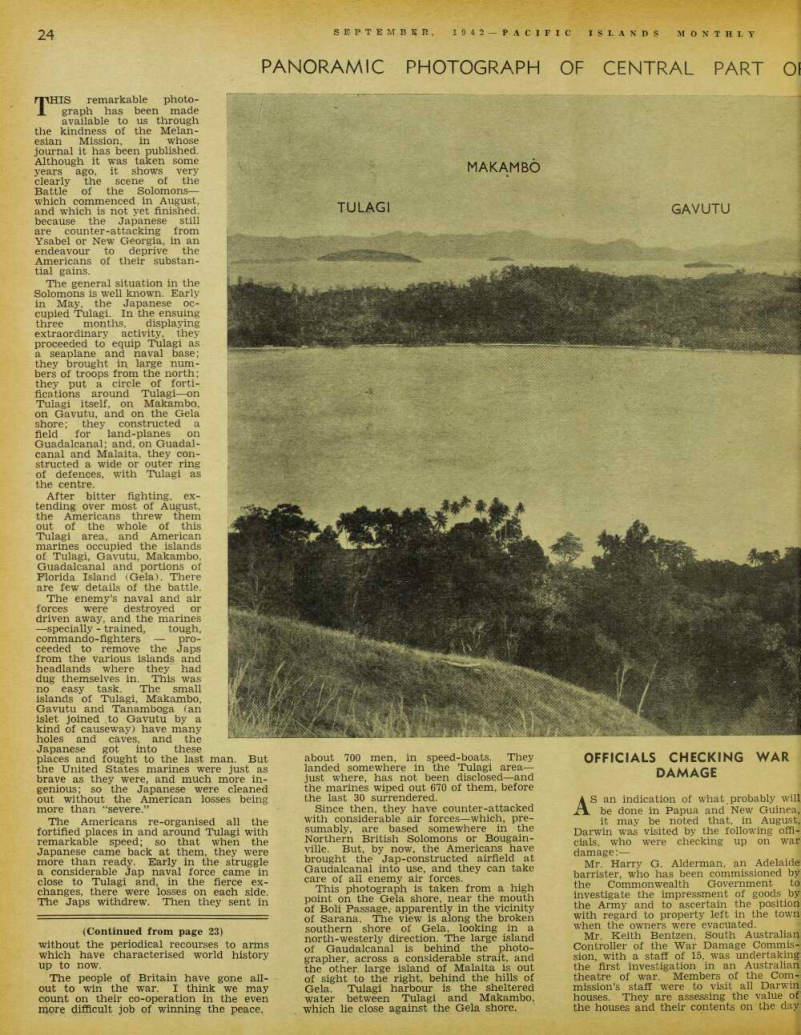
THIS remarkable photo graph has been made available to us through the kindness of the Melan esian Mission, in whose journal it has been published.
Although it was taken some years ago, it shows very clearly the scene of the Battle of the Solomons — which commenced in August, and which is not yet finished, because the Japanese still are counter-attacking from Ysabel or New Georgia, in an endeavour to deprive the Americans of their substan tial gains.
The general situation in the Solomons is well known. Early in May, the Japanese oc cupied Tulagi. In the ensuing three months, displaying extraordinary activity, they proceeded to equip Tulagi as a seaplane and naval base; they brought in large num bers of troops from the north; they put a circle of forti fications around Tulagi—on Tulagi itself, on Makambo, on Gavutu, and on the Gela shore; they constructed a field for land-planes on Guadalcanal; and, on Guadal canal and Malaita, they con structed a wide or outer ring of defences, with Tulagi as the centre.
After bitter fighting, ex tending over most of August, the Americans threw them out of the whole of this Tulagi area, and American marines occupied the islands of Tulagi, Gavutu, Makambo, Guadalcanal and portions of Florida Island (Gela). There are few details of the battle.
The enemy’s naval and air forces were destroyed or driven away, and the marines —specially - trained, tough, commando-fighters pro ceeded to remove the Japs from the various islands and headlands where they had dug themselves in. This was no easy task. The small islands of Tulagi, Makambo, Gavutu and Tanamboga (an islet joined to Gavutu by a kind of causeway) have many holes and caves, and the Japanese got into these
places and fought to the last man. But the United States marines were just as brave as they were, and much more in genious; so the Japanese were cleaned out without the American losses being more than “severe.”
The Americans re-organised all the fortified places in and around Tulagi with remarkable speed; so that when the Japanese came back at them, they were more than ready. Early in the struggle a considerable Jap naval force came in close to Tulagi and, in the fierce ex changes, there were losses on each side.
The Japs withdrew. Then they sent in
about 700 men, in speed-boats. They landed somewhere in the Tulagi area— just where, has not been disclosed —and the marines wiped out 670 of them, before the last 30 surrendered.
Since then, they have counter-attacked with considerable air forces —which, pre sumably, are based somewhere in the Northern British Solomons or Bougain ville. But, by now, the Americans have brought the Jap-constructed airfield at Gaudalcanal into use, and they can take care of all enemy air forces.
This photograph is taken from a high point on the Gela shore, near the mouth of Boli Passage, apparently in the vicinity of Sarana. The view is along the broken southern shore of Gela, looking in a north-westerly direction. The large island of Gaudalcanal is behind the photo grapher, across a considerable strait, and the other large island of Malaita is out of sight to the right, behind the hills of Gela. Tulagi harbour is the sheltered water between Tulagi and Makambo, which lie close against the Gela shore.
Officials Checking War
Damage
AS an indication of what, probably will be done in Papua and New Guinea, it may be noted that, in August, Darwin was visited by the following offi cials, who were checking up on war damage:— Mr. Harry G. Alderman, an Adelaide barrister, who has been commissioned by the Commonwealth Government to investigate the impressment of goods by the Army and to ascertain the position with regard to property left in the town when the owners were evacuated.
Mr. Keith Bentzen, South Australian.
Controller of the War Damage Commis sion, with a staff of 15, was undertaking' the first investigation in an Australian, theatre of war. Members of the Com mission’s staff were to visit all Darwin houses. They are assessing the value of the houses and their contents on the day
fore the first raid, assessing the dam e done by enemy action and fire and iking an inventory of the present con its'of the houses.
ON Wednesday, June 24, when every British man in the world was displaying anger, disappointment and dismay over the resounding British defeat in Libya, I noticed that my desk diary for the day (printed mavbe a year ago) carried this quotation from Shakespeare:— This England never did, nor never shall Lie at the proud foot of a conqueror.
Come the three corners of the world in arms.
And we shall shock them: nought shall make ns rue If England to herself do rest but true.
R.W.R.
Native "Profiteers" In
Papua
J 1 HE following appeared in a despatch from F. C. Folkard, published in “The Herald,” Melbourne :— THE influence of the Commonwealth Prices Commissioner (Professor Cop land) has not spread to the natives of Papua.
Grass skirts valued at two sticks of tobacco—just sixpence—are being sold to souvenir-hunting Australian soldiers for 25/- each. Simply-carved palmwood swagger sticks bring 10/-.
Administration officials are becoming concerned over some of the get-rich natives who would obviously rather whittle wood than work on roads and quarries or carry 40 lb. packs for six hours a day. Steps may be taken to bring in local price-fixing for souvenirs.
Tobacco is still the main currency
among New Guinea natives, and 480,000 lb. has been ordered for distribution at the rate of two sticks per native worker per week or to soldiers for the purchase of food from villagers.
One stick of tobacco—there are 26 to the pound—can buy a bunch of bananas, or a pineapple, or 30 betel nuts, or a dozen sweet potatoes or four yams.
Many natives, after working for the whites under present conditions, return to the villages as virtual millionaires, having saved up to 15 lb. of tobacco, which is sufficient to purchase a wife and live in comparative luxury for a long period.
Australian tobacco sticks are not popu lar because they are of plug type and easily fray.
Rev. M. Nixon, of the LMS, is reported to be safe and still carrying on his work at Lawes College, Fife Bay, Papua—un affected by the close proximity of the war.
Advertisements & other items, p. 25 (1 item)
25
PACIFIC ISLANDS MONTHLY SEPTEMBER, 15* 42
’HE SCENE OF THE SOLOMON ISLANDS BATTLE
Lutheran Mission In
N. Guinea
THE Lutheran Missions at Madang and Finschafen, New Guinea, were exempted from National Security (Enemy Property) Regulations by an Order gazetted in Canberra on July 29 by the Australian Government. Property held or managed for the missions, including debts in respect of balances or bank deposits due to them, are exempted from the whole of the pro visions of the Regulations.
“Home Brew” On The Tongan
Front
And a Petition to the Government
From a Special Correspondent
HOME brew brings back democracy.
That’s a sentence to conjure with.
Like all true stories, it’s stranger than fiction. Let me tell you the story; and, since this is a story in the old classic meaning, it has a moral.
Out here in Tongatabu we witness many interesting things. Nothing is so fascinating as the sight of a native mak ing his version of that alcoholic beverage, cousin to beer, namely, “home brew.”
You probably have brewed it in your kitchen, and so have your friends. Many a bath tub has been recruited for its manufacture. And many a friendship has been strained because of boasts that one friend makes better home-brew than another —not to mention the friendships that have been made, warmed and cemented because of an evening spent drinking home-brew and talking.
Home-brew, the drink within the reach of every man, the democratic beer! Alas, its manufacture requires a certain know ledge, a certain culture, a definite know how. It’s not enough to be told what the ingredients are. One must know how to brew it; one must have an understand
ing of the chemistry involved, however amateurish.
Thus it is that the sight of a native making home-brew is fascinating. He is innocent of even the remotest know ledge of what should be mixed, what should be done, what is supposed to hap pen before the mixture is to be taken.
Having seen perhaps a European manufacture the product, he, taking pride in his superior genius, will immediately proceed to manufacture it on his own.
And so he mixes anything that comes within reach of his hands. Tobacco, sugar, methylated spirits, vinegar, hops, water and what-not, in any or no pro portions. One can well imagine the devilish and horrible concoction that re sults. And the sickness, * the pain, the eating away of the innards, the death that follows. Lest we forget, the violence and refusal to work his plantation!
IN order to put an end to this frightful state of affairs, the Government of Tonga recently passed a law prohibit ing the manufacture of all alcoholic liquors. Home-brew was exiled from the kingdom, just because natives were abus ing the right to make it.
Now, certain thinking people were for a law forbidding its manufacture by natives, when they saw the nameless stuff the natives were brewing and its effects upon the native, his private and social life.
But what was objected to, in better informed circles, was the complete and absolute prohibition of the manufacture of home-brew.
It was felt that the law was badly drawn in that it made no distinction be tween the European, who possessed know ledge of its manufacture, and who made it solely for his own consumption and not for sale, and the native, who was abnor mally ignorant as to what should be done, and how, and who made it for sale. It was also felt that the European was be ing penalised for the natives’ abuses and faults.
Then, again, it was argued that the prohibition would mean the increased im portation of beer and thus hamper the war effort, inasmuch as the space set aside for beer could be used for the trans portation of much-needed foodstuffs and manufactured articles. The price of beer having risen, it was reasonable to suppose that only the better-fixed people would be able to afford sufficient bottles of beer.
The average fellow would have to severely limit himself —if he were lucky to get any, after the more influential have had their full.
It was the considered opinion of many business men and traders that the impor tation of manufactured articles rather than beer would be beneficial to the war effort, since it would give the native an incentive to manufacture and sell copra.
As it is, the shelves of the stores are empty, and the natives, having no use for the money they already have, find little reason to work. Consequently, copra pro duction has dropped to an alarming level, despite the prevalent high price.
Rev. John Havea, described as “repre senting the fourth generation of his fam ily in the Ministry of the Tongan Metho dist Church,” arrived in Perth in Aug ust, and was the subject of an interview headed, “Tonga Ready to Fight,” in the “West Australian.”
Advertisements & other items, p. 26 (1 item)
Ship Chandlery Hardware
NELSON & ROBERTSON
PTY., LTD.
Established 1895.
Islands Merchants
All classes of merchandise purchased at wholesale prices and original invoices supplied to Islands clients.
Cocoa Beans, Rubber and other Islands 7 produce sold on commission.
Nelson & Robertson
Pty. Ltd. 12 Spring Street, Sydney, Australia.
Ship Chandlery Hardware
BROOMFIELDS LIMITED
152 SUSSEX STREET :: SYDNEY.
Cables; "Boom”, Sydney.
Large and Complete Stocks of
SHIP CHANDLERY
IRONMONGERY OF ALL KINDS, PAINTS,
WHITE LEAD AND OILS.
P. H. MUNTZ & CO.’S 3-CROWN BRAND METAL SHEATHING.
PEACOCK & BUCHANS’ ENGLISH READY-MIXED PAINTS.
/Write for j
Ship Chandlery /
Catalogue J
Special "In Bond” Prices for all Islands enquiries quoted on application.
Sole Agents for:
II
USE
FOR RELIABILITY
AND LONG SERVICE
MILLER'S "ANCHOR"
BRAND ROPES AND
CORDAGES
Manila, Sisal, New Zealand Coir * and Cotton Rope of every description. Twine, Sewing Twine, Shop Twine, Binder Twine and Fishlines, Lashings, Halters, Plough Reins, Sack Cord, Blind Lines, etc.
Manufactured by: Suva Agents: Sydney Agents:
LENGTH
STRENGTH
QUALITY GUARANTEED
JAMES MILLER & CO. PTY. LTD.
MELBOURNE, VIC., AUST.
A. S. FAREBROTHER & CO.
And at LautoXa, P.O. Box 36. TeL: 361.
P. T. TAYLOR LTD.
"Them Eunuchs"
AN old friend who is now a member of the New Guinea Patrolmen writes bitterly to a wholly sympathetic editor: — “Something should be done to restrain the philologic ingenuity of these Aus tralians. They have respect for neither man, nor officer, nor woolly-headed Papuan—some of the names they have coined are clever, and funny, but quite unprintable—and I am afraid that Papua, after they have done with the language, will never be the same again.
“Take our local organisation of fight ers, for example They have done pretty well —I and my friends here are proud to be members of the New Guinea Patrol So naturally we were a bit upset to find ourselves referred to by the Aussie soldiers as ‘Them Eunuchs’. We knew of no reason for so unfortunate a term, and we demanded enlightenment.
But it was only the Aussie way of twist ing the name of the ‘New Guinea Unit,’
The Australian soldiers just naturally called us ‘New Guinea Eunuchs’ —and, finally, just ‘Them Eunuchs’.
“Can’t you do something about it?”
EDITORIAL NOTE: Sorry. We know those Australians. There is nothing that one can do. Better accept the term, and glorify it—after the style of the “Rats of Tobruk.”
Quinine Shortage
THE War Production Board of the United States, on August 18, ordered druggists to return excess stocks of quinine and similar drugs to suppliers, because of a shortage resulting from the conquest of Java.
United States military operations in the tropical malaria belt have caused an increased demand for quinine. The order also prohibited the sale of quinine, cin chonine, cochonidine, quinidine, and tota quine, except for use as an anti-malarial agent.
Plans are under way for the large scale production of a synthetic quinine.
Scientists of the Allied nations now face the task of creating quinine syn thetically, or of producing it by a slight chemical twist from related substances found in the bark of other trees (says H. C. McKay, in “Smith’s Weekly”). At present there are two promising quinine substitutes (both originating in pre-war Germany) which are being used freely in Australia and on our tropical fronts, but of which stocks will run out unless we devise a quick, cheap way of making them. These are atebrin and plasmo quin.
Neither is a complete cure for malaria, but, used in turn, wipe out the parasites in different stages of their development in patients’ blood. Atebrin kills the earlier stage, plasmoquin the later stage, in which the animals (actually the para sites are tiny animals, not germs) have developed separate sexes, male and female. With the worst type of malig nant malaria, however, Army doctors rely on quinine bichloride (a very soluble form) injected straight into a vein for the first few days, followed by separate five-day courses of atebrin and plasmo quin in turn.
Word has been received from the three members of the Anglican Mission who were stationed at Gona when the Japanese invaded that part of Papua.
They state that they are “safe and well.”
Speaking World
Federation of English- Speaking World
By Nicholas Hagen, Noumea
1 THINK readers of the “Pacific Islands Monthly” will be interested in some thing that I came upon in a book, the other day. It was written by Julian Thomas, otherwise known as “The Vaga bond.”
He was a great advocate, in earlier days, in of what may be called “The Renaissance of the South Seas.” His books gave a vivid picture of South Seas life in the early days.
His view of the future was expressed in the terminal lines of his book, “Canni bals and Convicts” —published in London in 1887, but written some years earlier. I quote:—
“Looking into the far future, I see a time, not that of which the poet wrote When the war drums throbbed no longer And the battle flags were furled In a parliament of men, The Federation of the World. but of a Grand Federation of the whole English-speaking world, when cannibals and convicts will have disappeared from the South Seas; when our dear old Motherland, with her eldest-born, the United States of America, and the Dominion of Canada, and Australia, peopled by millions, all bone of one bone, flesh of one flesh, shall be joined together heart and heart, hand and hand, and shall be so mighty in war that they can impose peace on the nations of the world.”
Let us continue to have confidence in those who have our destinies in their hands. Let us be well disciplined, and prepared for the after-war.
Advertisements & other items, p. 27 (1 item)
'Masse Batteries
!!k 3k 53£5fc MM If a battery is needed, there is a
Masse designed specially for the job
are Tigers for work—they simply lap it up !
OBTAINABLE EVERYWHERE . . . Ask your Island distributors.
MA 3.H
Sir Maynard Hedstrom
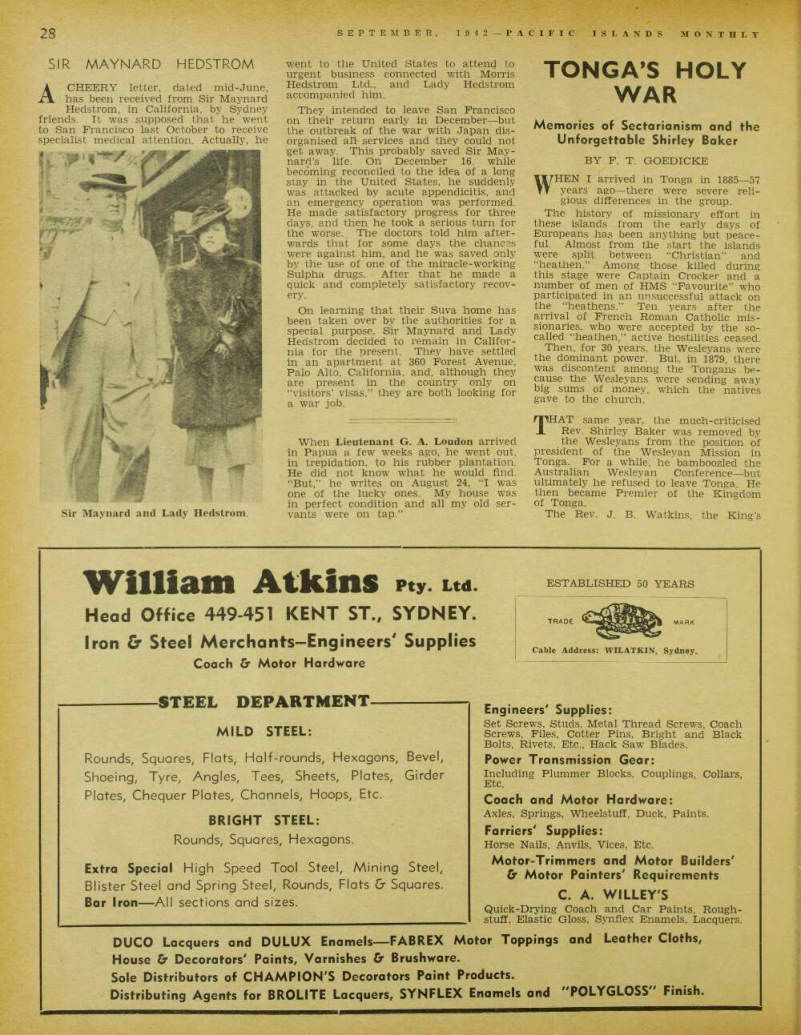
A CHEERY letter, dated mid-June, has been received from Sir Maynard Hedstrom, in California, by Sydney friends. It was supposed that he went to San Francisco last October to receive specialist medical attention. Actually, he
went to the United States to attend to urgent business connected with Morris Hedstrom Ltd., and Lady Hedstrom accompanied him.
They intended to leave San Francisco on their return early in December —but the outbreak of the war with Japan dis organised ah services and they could not get away. This probably saved Sir May nard’s life. On December 16, while becoming reconciled to the idea of a long stay in the United States, he suddenly was attacked by acute appendicitis, and an emergency operation was performed.
He made satisfactory progress for three days, and then he took a serious turn for the worse. The doctors told him after wards that for some days the chances were against him, and he was saved only by the use of one of the miracle-working Sulpha drugs. After that he made a quick and completely satisfactory recov ery.
On learning that their Suva home has been taken over by the authorities for a special purpose, Sir Maynard and Lady Hedstrom decided to remain in Califor nia for the present. They have settled in an apartment at 360 Forest Avenue, Palo Alto, California, and, although they are present in the country only on “visitors’ visas,” they are both looking for a war job.
When Lieutenant G. A. Loudon arrived in Papua a few weeks ago, he went out, in trepidation, to his rubber plantation.
He did not know what he would find.
“But,” he writes on August 24, "I was one of the lucky ones. My house was in perfect condition and all my old ser vants were on tap.”
Sir Maynard and Lady Hedstrom.
Tonga’S Holy
War
Memories of Sectarianism and the Unforgettable Shirley Baker
By F. T. Goedicke
WHEN I arrived in Tonga in 1885 —57 years ago—there were severe reli gious differences in the group.
The history of missionary effort in these islands from the early days of Europeans has been anything but peace ful. Almost from the start the islands were split between “Christian” and “heathen.” Among those killed during this stage were Captain Crocker and a number of men of HMS “Favourite” who participated in an unsuccessful attack on the “heathens.” Ten years after the arrival of French Roman Catholic mis sionaries, who were accepted by the so called “heathen,” active hostilities ceased.
Then, for 30 years, the Wesleyans were the dominant power. But, in 1879, there was discontent among the Tongans be cause the Wesleyans were sending away big sums of money, which the natives gave to the church.
THAT same year, the much-criticised Rev. Shirley Baker was removed by the Wesleyans from the position of president of the Wesleyan Mission in Tonga. For a while, he bamboozled the Australian Wesleyan Conference—but ultimately he refused to leave Tonga. He then became Premier of the Kingdom of Tonga.
The Rev. J. B. Watkins, the King’s
most popular missionary, was recalled and sent to Queensland, and the Rev.
J. E. Moulton, who was appointed Presi dent of the Wesleyan Mission, became the object of the dislike of King George Tubou.
It was mamly for this reason that the King and Shirley Baker established a church of their own, plainly in opposi tion to the Wesleyans. But, when the Rev. J. B. Watkins returned to Tonga, he was appointed President of the Church inaugurated by the King. The active spirit was Baker’s, however, and it would seem that Watkins had little to say or do with the persecution that fol lowed.
The Rev. J. B. Watkins was a sincere and deeply religious man, but at this time he was not strong enough to stand against the dominating personality of Baker, and a period of what can only be described as persecution set in. The Wes leyan missionaries strenuously opposed the effort to convert their members to the new Church.
THE light of the Gospel burned with rather a lurid glow in Tonga in those days. King George Tubou, who had fought the “heathen” when he and the Wesleyans were boon compan ions, was an eloquent speaker. With those whom he could not convert to the white man’s religion, in the early days, he took other methods —for, as he said, in a letter to the Wesleyans after the break with their mission: “You call me a murderer, but I killed only to make them join your Church—now I only ask them to join mine.”
Just as the Wesleyan missionaries in the early days had introduced warriors from the other two main islands for the purpose of forcing the “heathens” into the Wesleyan faith, Rev. Shirley Baker and King George now brought men from there to put pressure on the Wesleyans.
On the pretence that there was an insurrection against the King’s authority in Tongatabu, Baker summoned warriors from Haapai and Vavau, who came and spread over the country. No doubt, influ enced by the fact that Tongatabu was their old enemy, they joyfully plundered the houses of the Wesleyans, flogging and insulting all who refused to join the new Church.
Two hundred of the more staunch Wesleyan adherents were deported to Fiji. Others were gaoled, and many were forced to flee to the bush. Baker passed laws that gravely harassed the rival church. The police looted and insulted all who would not assist the “Tavatina” Church (Free Church).
SIR Charles Mitchell, Governor of Fiji at that time, said in his report of the affair: . . . “that the King, chiefs and people wished to assume a more independent position in the Wes leyan body than that hitherto accorded them. I cannot think that the Confer ence (Australian) could have been well informed as to the grave discontent that even then existed in the minds of both King and people by reason of so large a sum of money leaving Tonga without the people, who subscribed it, having any real voice as to its disposal—notably in 1876, this surplus is admitted to have reached £2,000 to £3,000. The King and his supporters had therefore a very real grievance.”
However, the Governor’s report cer tainly did not favour the Rev. Shirley Baker’s methods of persuading natives to join the King’s new Church.
The Rev. Shirley Baker was ultimately deported by the British Government of Fiji. So the Wesleyans managed to sur vive the fight, but only after sustaining
a great set-back.
Baker returned to Tonga and started a church of his own in Haapai (Church of England) and was later succeeded by the Right Rev. Alfred Willis, formerly Bishop and Court Chaplain to the Queen of Hawaii.
QUEEN Salote is now the head of the Wesleyan Free Church of Tonga.
The late Royal Consort, Prince Tugi, was a Wesleyan, and an ardent supporter of that Church. In 1924, Queen Salote made an effort to amalgamate the Free Church of Tonga with the Wes leyan Church, and she partly succeeded.
The statistics showing the adherents of the religion of the Kingdom are;— Free Church of Tonga .. 10,000 Wesleyan Church .. .. 18,000 Roman Catholics 4,500 Church of England . . . . 480 Latter Day Saints .. .. 650 Seventh Day Adventists . 250 Lutheran 14 Other Churches 180 No Religion 11 After much litigation, the Free Church was compelled to disband and hand over its property to the Wesleyans. This mis sion now is the stronghold of the churches in Tonga.
All these churches still make big col lections of money. When I visited a small village in Haapai, the Wesleyan Church was holding its “Missonili” (mis sion meeting). It was a day when all else was put aside. At the church, the natives sang, and dropped their money in a big wash-basin; and the missionary thanked them and praised their genero sity. They continued, and again the pastor thanked them; and, finally, at the end of the meeting, over 1,000 dollars had been collected! The natives regard this giving as their duty— and what would their neighbours and friends think of them if they did not give. So they make copra, and save for months, so as to be able to throw their all into the Church collection.
Advertisements & other items, p. 28 (1 item)
William Atkins p«y. i«.
Head Office 449-451 KENT ST., SYDNEY.
Iron & Steel Merchants-Engineers' Supplies
ESTABLISHED 50 YEARS
Coach Cr Motor Hardware Cable Address: WILATKIN, Sydney.
STEEL DEPARTMENT
MILD STEEL:
Rounds, Squares, Flats, Half-rounds, Hexagons, Bevel, Shoeing, Tyre, Angles, Tees, Sheets, Plates, Girder Plates, Chequer Plates, Channels, Hoops, Etc.
BRIGHT STEEL:
Rounds, Squares, Hexagons.
Extra Special High Speed Tool Steel, Mining Steel, Blister Steel and Spring Steel, Rounds, Flats & Squares.
Bar Iron— AH sections and sizes.
Engineers' Supplies: Set Screws, Studs, Metal Thread Screws, Coach Screws, Files, Cotter Pins, Bright and Black Bolts, Rivets, Etc., Hack Saw Blades.
Power Transmission Gear: Including Plummer Blocks, Couplings, Collars, Etc.
Coach and Motor Hardware: Axles, Springs, Wheelstuff, Duck, Paints.
Farriers' Supplies: Horse Nails, Anvils, Vices, Etc.
Motor-Trimmers and Motor Builders' Cr Motor Painters' Requirements
C. A. WILLEY'S
Quick-Drying Coach and Car Paints, Roughstuff, Elastic Gloss, Synflex Enamels, Lacquers.
DUCO Lacquers and DULUX Enamels—FAßßEX Motor Toppings and Leather Cloths, House Cr Decorators' Paints, Varnishes Cr Brushware.
Sole Distributors of CHAMPION'S Decorators Paint Products.
Distributing Agents for BROLITE Lacquers, SYNFLEX Enamels and "POLYGLOSS Finish.
New Caledonia's Dead
A DENSE crowd thronged the Cathe dral in Noumea, recently, on the occasion of a memorial service for all those men of New Caledonia who fell in the Libyan campaign. The service was conducted by the Rev. Father Baileau, in the presence of civil and military officials of Fighting France and the Allies.
Advertisements & other items, p. 29 (1 item)
Bitumenoid Roofing
PERMANENT ROOFING FOR
ALL TYPES OF BUILDINGS
can be readily obtained when you specify CORRU- GATED DURABESTOS (asbestos-cement) sheets. They cannot corrode, they resist salt air, industrial fumes, rain and hail. Descriptive booklet free. Wunderlich Limited (Estd. 52 years), Crown and Cleveland Sts., Redfern, Sydney.
' V imSmeti tii — ■CjejTvajvt'
• / DEEP CORRUGATED
DURABESTOS
ROOFING & lURLL SIDING SHEETS
Woven Wire for all Industry
COPRA DRYING TRAYS, FLOORS, Etc,
FRUIT DRYING TRAYS, MINING SCREENS.
Heavy Mosquito Gauze in Phosphor Bronze and other Metals Impervious to Salt Sea Air.
WIRE DOOR MATS AND GENERAL WIRE WORKS
E. WRIGHT & CO. LTD.
Office and Works: 148-152 Cleveland Street, Sydney, N.S.W.
Telegraphic Address: “Wrightmake,” Chippendale.
VVV/U
Or tr &
isv^
BITUMENOID ROOFING
MADE IN AUSTRALIA,
Bltumenold Roofings, Dampcourse and Insulating Pelts are made from the world’s best raw materials. Warranted to stand the most rigid tests.
BITUMENOID THE BEST
Roofing, 1,2, 3-ply; Flooring, Waterproof Materials; Saturated Felt; Resilient Road Jointing; Natural • Asphalt Dampcourse: 2 and 3-ply Dampcourse; 1-2 lb. Lead-core Dampcourse: Roofing Cement; Asphalt Paints; Roofing Compound.
SAMPLES AND PRICE LISTS ON APPLICATION.
MAXWELL PORTER & SON LTD.
ESTABLISHED 1888. BUILDERS’ SUPPLIEo,
107 REDFERN ST., REDFERN, SYDNEY, N.S.W. ’Phone: M 8157. Cables Bitomenold,
Noumea's Hostel for American
Nurses
NOUMEA has established a comfortable rest-home for American nurses in the Genie Valley. The establish ment was officially opened in June last, and represents a friendly gesture to the United States forces by the inhabitants of New Caledonia. The home is set in the midst of a beautiful garden; and a tireless committee, under the leadership of Mme. Hagen, Mme. Morlet. M. Martin and Mme. Martin, has succeeded in mak ing the interior of the “Foyer des Infirm ieres Americaines” at once artistic and comfortable.
Mr. T. A. Greene, of the British Service, New Hebrides, resigned on May 7. He entered the service in the Western Pacific in February, 1913, and transferred to the New Hebrides in 1940.
Papua
Over The Border!
New Guinea Labourers in Papua
THE following appeared in an article, published in Melbourne “Herald” on August 31, from F. C. Folkard, “a ‘Herald’ war correspondent”:— “Now that New Guinea and Papua are under the one * administrative control, pidgin-speaking natives from the Mandated Territory are mixing freely with the Motuan-speaking Papuans. This is designed to break down the old territorial prejudices.”
And so there disappears, under the impact of war conditions, one of Papua’s most valued and jealously-guarded privi leges—namely, the protection of Papua’s natives against New Guinea’s recruiters.
One can almost hear Sir Hubert Mur ray turning in his grave.
The guiding principle of Sir Hubert Murray’s long administration was his determination that, no matter how urgent the demand for native labour, the natives should be encouraged to retain their tribal independence, or to become peasant farmers and planters, rather than that they should be indentured as labourers. The recruiting of natives for plantations, mines, wharves, and indus trial establishments was permitted, of course, and Papua never was really short of labour; but “the old Governor,” with grim resolution, saw to it that the pro portion of natives undergoing this kind of “Europeanisation” was so small that it would not affect the Papuan natives as a whole, while they were adapting them selves slowly to the white man’s world.
When the total of indentured natives employed on the nearby Morobe goldfield of New Guinea crept up well beyond the 10,000 mark, and New Guinea recruiters were finding the going “tough,” Sir Hubert watched his borders like a wary old hawk. “Wouldn’t those fellows like to get their hands into the reservoirs of manpower on our side of the border!” I have heard him exclaim.
Natives from the Mandated Territory were not allowed into Papua, and vice versa. Both administrations were very strict about it. An occasional patrol officer or prospector, who penetrated the mountain barrier from one Territory into the other, with native carriers, found himself under closest surveillance, until his natives were returned home.
Sir Hubert Murray’s insistence on keep ing Pidgin-English out of Papua was another indication *of the principles of native administration to which he adhered. Motuan was selected to be the official native language of Papua, and its use encouraged in every possible way.
Nonetheless, while the New Guinea Pid gin was kept out, a kind of Pidgin- English, much simpler and clearer than the New Guinea variety, has been com ing more and more into use, in recent years.
Now, since the two Territories are to be as one, we may expect that the irre sistible Pidgin soon will be as common in Port Moresby as in Wau or Rabaul.
Personally, I never expected that Papua and New Guinea could indefinitely be kept so rigidly apart, and the attempt to maintain the two territories, in two separate and watertight compart ments always seemed to me illogical and impractical. But, in relation to the administration and protection of Pacific native races, I regard the late Sir Hubert Murray as the most sincere and able man I eyer met; and, if Australia throws aside his native policy and his lifetime of work in Papua, without first examin ing carefully his principles and the things he accomplished, then Australia will be making a very grave mistake.
The old borders must go; the two Ter ritories are certain to be merged; but that is not to say that the Murray native policy was wrong or misguided. There are only two Australian territorial ad ministrations for which Australia has received the unqualified praise of colonial government experts—namely, those of Sir William MacGregor and Sir Hubert Murray, in Papua. That should not be forgotten.
It is known that on July 10 last three members of the Methodist Foreign Mis sionary Society (Sister Merle Farland, Rev. A. W. Silvester and Rev. J. R. Met calfe) were carrying on their work in the Solomon Islands, free of enemy inter ference.
Advertisements & other items, p. 30 (1 item)
Capstan
A. B. DONALD Ltd
AUCKLAND
ISLAND TRADERS & GENERAL MERCHANTS
P.O. Box 1 509. Cables & Telegrams, "Kingdom", Auckland.
CAPSTAN
in m m W The Empire’s favourite cigarette
J. H. L Waterhouse
Death Removes a Pacific Education Expert
AN expert on native education, Mr. J.
H. L. Waterhouse —a man whose whole life was dominated by a spirit of altruism, expressed in terms of inter est in, and eagerness to help, the native peoples of the Pacific —died at Lindfield, Sydney, on August 20. With his passing, we lose one of those too-rare personali ties who, in contrast with muddling poli ticians and insular busy-bodies, do much to raise European prestige among those whom they rule.
Son of the late John Waterhouse, MA, former headmaster of Sydney Boys’ High School and great-grandson of that John Waterhouse who landed in Hobart in 1839, to become first General Superin tendent of the Wesleyan Mission in Aus tralia, he carried on the family tradition of public service. From 1908 to 1917 he was in Fiji with the Methodist Mission, and was headmaster of the Boys’ High School; in 1918, he joined the staff of the mission in Rabaul, TNG. There he was officially an accountant, but his dominant interest lay in the natives themselves. He made a study of their languages, and in 1920 published a “New Britain Phrase Book.” Later, he trans ferred to the New Zealand branch of the Society and spent some years at Roviana, New Georgia, Solomon Islands, where his work was mainly in the mission schools.
Here, too, he continued his language study and compiled and published a “Roviana Phrase Book” and, in 1928, a “Roviana-English Dictionary.” Radio began to interest him at this period and, for some time, he was in charge of the mission’s wireless station.
Much valuable scientific and linguistic material was lost in March, 1923, when the SS “Mindini” went up on Mellish Reef and he, with other passengers, spent 24 hours on a sand cay.
During the depression, mission work was curtailed, making it necessary for Mr. Waterhouse to give up his teaching position. But grants were made him by Kew Gardens, London, and Yale Uni versity, USA, and thus he was able to spend the years between 1930 and 1933 collecting botanical specimens in Bou gainville, studying native languages and culture, and doing other anthropological work.
As a result of a chance meeting with Brig.-General Griffiths, then Adminis trator of New Guinea, in 1933, he was offered and accepted a post as headmas ter of the Administration’s school for native boys at Nodup, near Rabaul, and here he remained until evacuated to Aus tralia in December, 1941. Here he did most valuable work, to which he devoted all his knowledge, skill and industry; and it is with this part of his life that present-generation Pacific residents are most familiar.
Mr. Waterhouse kept a remarkable visitors’ book covering this period—which his widow has made available to us Between the first entrv (of General Griffiths, on December 12, 1933) to the last (that of Sir Walter McNicoll, on December 18, 1941) there is a veritable pageant of people from the four corners of the earth, as well as from the Pacific Territories.
Authors', journalists and wanderers, missionaries and teachers, paid warm, spontaneous tribute to the work to which Mr - Waterhouse devoted himself so un selfishly, But the surest proof of his success came from Territory residents.
Dyed-in-wool Territorians planters, miners, policemen—totally unsentimental, and knowing the, native from hard experience—and not always loving him as a brother —they yet, in scores of instances, expressed their admiration for the work that was being done for him in this school.
Natives who attended the school, while being encouraged to retain their own native crafts and cultures, were given a broad “general knowledge” education in English and special subjects; and, at the time of the invasion, “old boys” were scattered all over the Territory as wire less operators, native teachers or work ing in the Native Police Force, the Dis trict Services or Medical Departments.
Cricket and football were played with all the natives’ enthusiasm for snort. A rela tion of some past nupils had made land available for a garden, where native and European vegetables were grown. An elderlv native had been nersuaded to give a series of weeklv talks on native house-building, canoe-building, garden ing. fishing, etc.
In 1938 Mr, Waterhouse published yet another language book—“A New Guinea Language Book (Blanche Bay Dialect).”
In a foreword, Sir Walter Ramsay Mc- Nicoll expresses his appreciation and admiration for the work—which would lighten the Administration’s burden when going amongst new peoples—and for the labour it had entailed over a period of ten years. Noduo School. Sir Walter said was valued highlv by both the authori ties and the public, and it was recog nised that much of its success was due to Mr. Waterhouse’s knowledge of the local language, which enabled him to eet behind the thoughts of the natives, to understand their point of view and, therefore, to enjoy their complete confi dence.
Mr. Waterhouse suffered a long period of ill-health. He was a sick man when
he and Mrs. Waterhouse went south at the beginning of the year, just prior to the Japanese invasion.
Private H. G. Turner, of the AIP, has returned to Australia after two years in the Middle East, during which he was wounded at the Battle of Bardia, Janu ary, 1941. His father, Mr. Jack Turner, of Samarai, Papua, died not long ago; and his mother now resides at Elizabeth Bay, Sydney.
Advertisements & other items, p. 31 (1 item)
“Lead” Feeling
TAKE THE
OUT OF YOUR LEGS
Get More Oxygen in Your Blood and Get that Pep that Sends You Bounding Up the Stairs.
People who smother to death die because oxygen has been completely cut off from them. Just as surely you are slowly smothering if your blood lacks red corpuscles. Red corpuscles are your oxygen carriers. They carry the oxygen you breathe in to every part of your system.
Without enough oxygen-carrying corpuscles, your kidneys, liver, stomach and bowels slow down. Your skin gets pale, flabby, often pimply. Your nerves may become jittery—you tire quickly— feel depressed.
What you need is Dr. Williams’ Pink Pills. These world-famous pills help you make more and better red corpuscles and thus increase the oxygen-carrying power of your blood. Get Dr. Williams’
Pink Pills to-day at your chemist or store and see for yourself how quickly this time-proven blood-builder will help give you back your pep and clear complexion.* *•
Coleman
IS SERVING THE
ARMED FORCES
WITH THREE
ESSENTIALS OF
LIFE . . .
Light Heat
Warm Food
Wherever the Armed Forces of the United Nations need quick heat and bright light you’ll find Coleman Lanterns and Stoves. On board steamers, at landing fields in mobile canteens, emergency hospitals, air-raid shelters, and in actual combat Coleman appliances are providing invaluable service.
We regret any inconveniences caused through shortage of new stock for civilian requirements, and suggest you keep your present Stove and Lantern in good repair bv contacting your local Distributor.
THE COLEMAN LAMP & STOVE CO. LTD.
TORONTO CANADA
Roll Of Honour
(It Is hoped to assemble, here, the names of men, former residents of the Pacific Territories, which appear in British and Free French casualty lists, or in lists of honours awarded.
We should be grateful if relations and friends would send us details.)
Killed
Pilot-Officer Len BAYLISS, flying instructor in the RAAF, formerly of Rabaul, New Guinea.
Killed in Sydney, 18/11/1940, when he fell from a trainer aircraft in flight.
A/Bdr. Neville W. BERTWISTLE, AIF artillery (tank unit), formerly a clerk on the staff of W. R. Carpenter and Co. Ltd., of Rabaul, New Guinea. Killed in action, April, 1941.
Pte. W. R. M. BRADNAM, of the NZ Forces, formerly of Fiji. Reported killed in action in the Middle East, 25/11/1941.
Warrant-Officer R. F. BRECHIN, New Guinea Force. Killed in air accident, June 17, 1942.
Formerly of NG Department of Agriculture.
Flight-Lieutenant G. J. I. CLARKE, of the RAAF, formerly Assistant Flight Superintendent
of Carpenter Airlines, New Guinea. Killed in action during operations off Dakar (French West Africa), while attached to HMAS “Aus tralia”, September, 1940.
Georges CLEMENS, of the Free French Pacific contingent from New Caledonia. Reported killed in action in the Middle East, March, 1942.
Flying-Officer Jack R. COATH, of the RNZAP, formerly on the staff of the Bank of New Zealand, in Suva, Fiji. Killed October, 1941, when a training aircraft crashed in NZ.
Pte. Felix CRAIG, AIF, formerly of accounts department, Australasian Petroleum Co., Port Moresby, Papua. Killed in action, June, 1941.
L. J. DAWES, of the NZ Forces,. formerly Dis trict Officer of Savaii, Western Samoa. Reported killed in action, February, 1942.
Pilot-Officer V. L. DEARMAN, of the RAAF (observer), formerly overseer and clerk at the Colonial Sugar Refining Co., Ltd., Raravai, Fiji. Reported killed in action in the Middle East, October, 1941.
Captain Kenneth GARDEN, of the RAF Ferry Command, formerly of Guinea Airways Ltd., in New Guinea. Killed September, 1941, when a
bomber he “ferried” from USA crashed on west coast of Britain.
Flying-Officer Moresby GOFTON, of the RAF, son of Mrs. F. S. Stewart, of Wau, New- Guinea.
Reported missing, 17/5/1940 —presumed killed in air operations.
Rifleman J. A. GOODWIN, AIP infantry, for merly. of Bulwa, TNG. Reported “accidentally killed”, April, 1942.
Pte. Wallace GRAHAM, of the NZ Forces (infantry), formerly on the staff of Morris Hedstrom Ltd., Fiji. Killed in action in the Middle East, November, 1941.
Squadron-Leader C. R. GURNEY, RAAF, a former chief pilot of Guinea Airways, Ltd.
Killed in action in the New Guinea area, May, 1942.
Gerald T. J. HARPER, RAF, son of Major and Mrs. P. Harper, of Ra, Fiji. Killed in action while navigating a Whitley bomber dur ing a raid on the Continent.
Squadron-Leader Godfrey HEMSWORTH, of the RAAF, formerly a well-known commercial pilot in Morobe, TNG. Reported missing after an operational flight against the Japanese in the New Guinea area—now presumed killed in action.
Flying-Officer Alan JOHNSTONE, of the RAF, who was born in Suva, Fiji, in 1915. Killed during bombing raid on Kristiansand, Norway, April, 1940.
LAC Douglas KIRBY, RAF, who left Suva, Fiji, with the first contingent of Air Force trainees. Reported killed in a flying accident in South Africa, March, 1942.
Flying-Officer John C. LOWE, RAAF, formerly an overseer with the CSR Co. in Fiji. Reported, 11/4/1942, “took part in air defence of Rabaul, TNG, —missing, believed killed”.
Pte. L. F. McCarthy, ALP infantry, form erly supercargo on W. R. Carpenter and Co.’s Inter-island vessels “Desikoko” and “Mako”, in New Guinea, Reported “killed in action” in Syria, 30/10/1941.
Lance-Corporal A. D. MacPHEE, son of Mr.
R. D. MacPhee, Levuka, Fiji. He was 35, was a member of the AIF, and was killed in Greece, May, 1941.
Spr. A. L. MORANDINI, AIF Engineers, for merly of Konedobu, Papua. Reported killed in action, April, 1942.
Pte. Edward Harold PRICE, 2nd NZBF (Machine-gun Battalion), youngest son of Mr. and Mrs. J. Price, Savu Savu West, Fiji. Killed in action during the Libyan campaign, Middle East, 27/11/1941.
Captain W. H. ROBERTS, NZEF, who was Accountant in the Samoa Treasury Dept., dur ing 1934-35. Killed in action in Libya, Decem ber, 1941.
Cpl. Alex. C. SCOTT, AIF, formerly manager at Kieta, TNG, for Burns, Philp and Co. Ltd.
Killed in action in the Middle East, 19/6/1941.
Pte. Popoare TANGIITI, of the NZ Forces (Maori Battalion), formerly of Mangaia, Cook Islands. Reported “missing after Battle of Greece —presumed dead”, July, 1941.
Sgt. Edward WILSON, of Suva, serving in the Fiji Defence Force. Accidentally drowneid in the Lami River, Fiji, April, 1942.
Died From Wounds
Pte. Ernest HENRY, AIF, formerly of the Rabaul (NG) staff of Burns, Philp and Co.
Ltd. Died from wounds received in Battle of Crete, 1/6/1941.
Pte. Alec. MUNRO, NZ Forces, formerly of Norfolk Island. Died in Libya (Middle East), December, 1941.
Pte. Walter PEARSON, of first NG quota of AIF (infantry). Died from wounds received in action, 24/6/1941.
A/Bdr. W. R. SCOTT, AIR, of New Guinea.
Died from wounds, July, 1941.
Sgt.-Pilot Peter Clarkson WISE, of the RAF, son of Mr. W. Wise, OBE, Director of Public Works, Fiji. Died from wounds received during bombing raid over Germany, January, 1941.
Died From Illness
Pte. Clarence A. HUTTON, AIF, formerly of Edie Creek, TNG. Died from illness, April, 1941.
A/Sgt. J. H. STANE, Royal Australian En
gineers. formerly of Port Moresby, Papua. Died from illness, May, 1942.
Major P J. WOODHILL, AIF infantry, formerly legal assistant in the Crown Law Office, Rabaul, New Guinea. Reported “deceased”, December, 1941.
Missing
Pte. P. F. BAILEY, AIF infantry, of Rabaul, TNG. Reported missing, 17/2/1942.
Pte. E. L. CHRISTIE, AIF infantry, of Rabaul, TNG. Reported missing, 17/2/1942.
Pte. A. G. DICKSON, AIF Infantry, of Rabaul, TNG. Reported “missing, believed wounded”, 17/2/1942.
Pte. R. J. PASCOE, AIF infantry, of Rabaul, TNG. Reported - missing, 27/1/1942.
Pilot Tom PATTERSON, of the RNZAF, formerly of Levuka, Fiji. Reported missing, in November, 1941, after bombing raid on the Continent.
Hector PILLING, RAF, who was born in Fiji and who was the son of Sir Guy Pilling, of Zanzibar (formerly of Fiji). Reported missing, while serving with the Royal Air Force Bomber Command.
Gnr. Allan H. ROSS, AIR artillery, formerly planter in .New Britain, TNG. Reported “miss ing—believed prisoner of war”, 28/9/1941.
Pte. William RUPE, of the NZ Forces (Maori Battalion), formerly of Aitutaki, Cook Islands.
Reported “missing after Battle of Greece”, July, 1941.
Pilot James SIMPSON, of the RAF, formerly of Vatukoula, Fiji. Reported missing after air operations over Malta, in the Mediterranean, 1/7/1941.
Pilot-Officer Neville George STOKES, of the RAF, formerly a pilot with Guinea Airways, Ltd., in New Guinea. Reported missing after air operations in Europe, December, 1941.
Reported Missing
Malaya Casualty List, Published 23/7/1942.
Pte. N. H. AMOS, artillery, Port Moresby.
Pte. E. L. CHRISTIE, infantry, Rabaul.
Pte. A. G. DICKSON, infantry, Rabaul.
Pte. A. I. FOLEY, artillery, Port Moresby.
W.0.l A. N. GRAY, ordnance, Rabaul.
W. 0.2 V. M. I. GORDON, artillery, Wau, New Guinea. v Pte. J. M. HIRSCHEL, infantry, Rabaul.
Pte. J. G. NEWTON, artillery, Port Moresby.
A./Bdr. B. L. J. MEETON, artillery, Rabaul.
Pte. D. M. SPENCE, artillery, Port Moresby.
Australia and Island Stations.
Pte. W. G. EKBLADE, infantry, Rabaul.
Pte. S. W. HUNTER, infantry, Kokopo.
Wounded
Pte. V. BLANCO, AIF infantry, of Thursday Island. Wounded in action, July, 1941.
L/Cpl. J. P. BLENCOWE, AIF infantry, of Rabaul. TNG. Wounded in action, July, 1941.
Pte. George BUCKNELL, AIF, son of Mr, and Mrs. C. Bucknell, of Korolevu, Fiji. Wounded in action in Malaya, January, 1942.
Pte. Thomas BYERS, AIF infantry, of Thurs day Island. Wounded in action, May, 1941.
Raymond CHAUTARD, of the Free French Pacific contingent from New Caledonia. Re ported a casualty in the Middle East, March, 1942.
Albert CUBADDA, of the Free French con tingent from New Caledonia. Reported a casualty in the Middle East, March, 1942.
V. FAIRHALL, 2nd NZEF, formerly of the Treasury Department, Western Samoa. Reported wounded in action, February, 1942.
Acting Warrant-Officer V. M. I. GORDON, AIF infantry, of Wau, TNG. Wounded in action, February, 1942.
Pte. John GRANT, AIF infantry, of New Guinea. Wounded in neck and thigh, September, 1941; later, reported “rejoined unit”.
Henri GUILBAUD, of the Free French Pacific contingent from New Caledonia. Reported a casualty in the Middle East, March, 1942.
Sgt. C. HENDRICK, AIF infantry, of Rabaul, TNG. Wounded in action, July, 1941.
Stanley HIGGS, son of Mr. and Mrs. Gordon Higgs, of W. R. Carpenter and Co. Ltd., New Guinea. Member of an English Lancers’ regiment, wounded during British evacuation from Dun kirk (Prance), May, 1940.
Lieut. Lloyd T. HURRELL, AIF Infantry, of Rabaul, TNG. Wounded in action, July, 1941.
Alexandre HUYARD, of the Free French Pacific contingent from New Caledonia. Reported a casualty in the Middle East, March, 1942.
Sgt.-Pilot Andrew KRONFELD, of the NZ Fighter Squadron attached to the RAF. Wounded in knee during operations over France, December 1941.
Cpl. W. H. LANNEN, AIF artillery, of Rabaul, New Guinea. Wounded in action, June, 1941.
Gnr. E. G. LOBAN, AH’ artillery, of Thursday Island. Wounded during campaign in Greece, May, 1941; Invalided home after having his left forearm amputated.
Capt. (now Lt -Colonel) Edward Tiwi LOVE, NZ Maori Battalion, husband of Mrs. Takau Rio Love, Ariki-nui of Rarotonga, Cook Islands. Reported missing during campaign in Greece, May, 1941; later, June, 1941, reported “wounded and saf 4 e • 4 A 1 4 .
A/Sgt. Alastair MACLEAN, AIF infantry, of Rabaul, New Guinea. Wounded in action, in Libya, June, 1941. S f J,' D Mc £ L ' s r MONT ’ NZEF > son of Capt.
D. McClymont, Harbourmaster of Apia, Western Samoa Wounded in action, November, 1941.
Cpl. R. McKERLIE, AIF, of Yandina, BSI, wounded in face by bomb explosion, April, 1941 Jean MERIGNAC, of the Free French Pacific contingent from New Caledonia. Reported a casualty in the Middle East, March, 1942.
Henri MEYER, of the Free French Pacific contingent from New Caledonia. Reported a casualty in the Middle East, March, 19'42.
S/Sgt. Graham B. MIRFIELD, AIF engineers,
of Rabaul. New Guinea Wounded in action Pte. L. G. (“Mick”) REECE, AIF, of Bulolo’
New Guinea. Wounded in action, July 1941 Henri RIVIERE, of the Free French Pacific contingent from New Caledonia. Reported a casualty in the Middle East, March, 1942, A/Cpl. N. K. SAWYER, AIP infantry of Rabaul, TNG. Wounded in action, July 1941 July> 294!. ’ ‘ Lieut. Jeffrey SEAGOE, serving with the British forces in the Far East, formerly of Vila New Hebrides, Reported “wounded in action”’
March, 19'42.
’ T at™ * , ,
Pt , L f ™ STAMPER, AIF formerly school a^o^f aU ’ N6W Gumea - w °unded in action, Ue,usc ’ iy<u.
Pte - Har °ld G. TURNER, AIF, of Samarai, Eastern Papua. Wounded in action at Bardia (Libya), January, 1941.
Pte. F. D. TWISS, AIP infantry, of New
Guinea. Wounded in action, August, 1941.
Camille VINCENT, of the Free French Pacific contingent from New Caledonia. Reported a casualty in the Middle East, March, 1942.
Driver Don F. WAUCHOPE, AIF. Formerly employed on his brother’s plantation in New Guinea. Wounded in action, July, 1942.
Sgt.-Pilot W. WRIGHT, of the Australian Spitfire Squadron, attached to the RAF, for merly of New Guinea. Wounded in knee during aerial “dog-fight” over the English Channel, March, 1942.
Prisoners Of War
A/Cpl. Peter W. BOSGARD, AIF infantry, formerly of the Lands Department, Port Moresby, Papua. Reported prisoner of war at Sulmona, Italy, 29/6/1941; transferred to Bolzano prison camp, September, 1941.
A/Sgt. A. A. S. COTMAN, AIF infantry, of Abau, Papua. Reported missing—believed prisoner of war, 5/5/1941; reported later, July, 1941, “wounded in chest and head by shrapnel— taken prisoner”.
Pte. J. DALTON, AIF Transport and Supply, formerly of Thursday Island. Reported prisoner of war, April, 1942.
Pilot-Officer George Beilby EVANS, RAAF, for merly of New Guinea. Reported prisoner of war in Batavia (Java), June, 1942.
Pte. W. GOSSNER, AIF infantry, formerly of the BNG Development Co., Port Moresby, Papua.
Reported prisoner of war, Sulmona, Italy, 6/7/1941.
Lieut. J. M. HARCOURT, 2nd NZEF, son of Mr. H. W. Harcourt, formerly Deputy Treasurer in Fiji. Reported “captured in Libya and now prisoner of war”, March, 1942.
Gnr. A. L. B. KING, AIF artillery, of Rabaul, TNG. Reported prisoner of war, 29/7/1941.
A/Cpl. John H. LONERGAN, AIF, Supply and Transport, of New Guinea. Reported prisoner of war at Corinthia, Italy, 8/7/1941.
Pte. Ernest (“Paddy”) McGEADY, NZEF, son of Mrs. J. McGeady, of Suva, Fiji. Reported “missing, believed killed”, after fighting in Libya, January, 19'42; reported prisoner of war in Italy, April, 1942.
Observer Alex. McKAY, of the RAAF, formerly of the CSR Co.’s staff, at Penang sugar-mill, Fiji. Reported missing, 27/7/1941; reported prisoner of war in Italy, 26/10/1941.
Pte. Harry MARCHINGTON, of the NZ Forces, formerly of Fiji. Reported prisoner of war after Battle of Crete, 2/12/1941.
Pte. D. R. PHILLIPS, AIF engineers, formerly of Bulwa, TNG. Reported prisoner of war, June, 1942.
Pte. John O. SMITH, of the NZ Forces, son of Captain Arthur Smith, of the Fiji inter-island vessel “Tui Kauvaro”. Missing after battle of Crete, May, 1941; reported prisoner of war in Germany, 21/10/1941.
Squadron-Leader L. C. SHOPPEE, DSO, RAF, formerly of Edie Creek, New Guinea. Was in Java during Japanese invasion; now pre sumed to be a prisoner of war.
LAC Charles SOLLITT, of the RAAF (wire less operator), son of Mr. and Mrs. C. H.
Sollitt, of Nausori, Fiji. Reported missing after air operations in New Guinea, January, 1942; later, March, 1942, reported rescued from sea by Japanese—now prisoner of war.
Pte. Fred SWAN, NZ Army Medical Corps, formerly of Apia, Western Samoa. Missing after Battle of Crete, August, 1941; reported prisoner of war in Germany, November, 1941.
Pte. John D. WHITCOMBE, of the NZ Forces, formerly of Levuka, Fiji. Reported prisoner of war in Germany, November, 1941.
Decorations
Squadron-Leader G. U. (“Scotty”) ALLEN, RAAF, who is well-known in New Guinea and Papua, having been co-pilot on the “Faith in Australia”, on the first official air-mail flight to the Territories in 1934. Awarded the Air Force Cross for his work with Catalina flying boats in Australia and the Pacific.
Major H. T. ALLEN, AIP, formerly of Wau, Morobe District, TNG. Awarded the OBE.
Sgt. Henry C. S. COTTON, of the RNZAF, who was born in Samoa (his father was Secre tary of Native Affairs during the NZ military occupation). Awarded the Distinguished Flying Cross.
Squadron-Leader Godfrey HEMSWORTH, RAAF, formerly a well-known New Guinea pilot, who was killed in action against the Japanese In May. Posthumously awarded the Air Force Cross.
Flieht-Lieut. R. N. DALKIN, RAAF, formerly of W. R. Carpenter and Co., Ltd., Salamaua, TNG. Awarded the DFC for bombing raids against the Japanese in Koepang area, DEI.
Squadron-Leader C. R. GURNEY. RAAF, for merly of Guinea Airways, Ltd., TNG. Posthu mously awarded the Air Force Cross, for bomb ing raids on Japanese-held ports in New Britain.
Lieut. Colin HILL, RANR, of the Australian destroyer, “Waterhen”, formerly second officer on thp trans-Pacific liner “Niagara”. Awarded the OBE.
Flying-Officer James R. HYDE, of the RAP, formerly a Patrol Officer in Namatanai and Sepik Districts, TNG. Awarded the Distinguished Flying Cross.
Lieut.-Commander A. W. R. McNICOLL, RAN. son of Sir Ramsay McNicoll, Administrator of New Guinea, and Lady McNicoll. Awarded the George Medal.
Sgt. Geoffrey MOORE, of the RNZAF, formerly engineer on the NG inter-island vessel “Maiwara” and on the trans-Pacific liner “Aorangi”. Awarded the Distinguished Flying Medal.
Pilot-Officer Pat RICHARDSON, RAF, son of Mr. W. Richardson, formerly of Penang, Fiji.
Awarded the Distinguished Flying Cross.
Commander Alvord S. ROSENTHAL, RAN, son of Major-General Sir Charles Rosenthal, KCB, CMG, DSO, VD, Administrator of Norfolk Island. Awarded the DSO, November, 1941; awarded the Bar to DSO. February, 1942.
Lieut. George Raymond WORLEDGE. of the RANVR, formerly of Fiji. Awarded the MBE (Military)
Advertisements & other items, pp. 32-34 (1 item)
Old Monk
Ssfia xe and &fiwte alike..
Don’t panic and rush in to buy on rumours of food shortage. You have the Government’s assurance that if people
would buy frugally and avoid hoarding,
few would be inconvenienced.
AUNT MARY’S BAKING POWDER is
scarce. That is due to shortage of certain precious ingredients without which Aunt Mary’s would not meet the high standard that has made it the most popular Baking Powder in Australia.
Jf you fume tupypliet of
AUNTMARY’S BAKING POWDER
uae it tpcvdngly,!
PRODUCING UNIFORM GOOD RESULTS SINCE 1868
ALWAYS ASK FOR IT
OLD MONK
The World’s Finest Olive Oil San Francisco
Here’s the quick, easy way to serve
COOL, APPETISING
HOT-WEATHER MEALS
4 ■■
oMi§i
mW: W*. :: v;r -1 ■ •V*
r if*
I
Hfc
xx r'j VN YOU can prepare crisp, cool, appetising salads in five minutes with Imperial “Hampe” the quick-serve summer delicacy that’s ready-cooked, readyto-serve and flavour-sealed . . . And what a flavour!
Everyone likes the delicious combination of mild-cured ham and tender veal in “Hampe.” Try it to-day.
Product of Riverstone Meat Co. Pty. Ltd., Sydney.
FIJI Representatives: Pearce & Co. Ltd., Suva. / A
PRESCOTT Pty. Ltd.
SUSSEX ST., SYDNEY,
are sole wholesale agents for
PINEAPPLE BACON&HAMS
DAISY brand BUTTER "375" BUTTER in TINS Itb.-21b.-slb. Si*e».
LEA & PERRINS’ Sauces and Most other Super-Quality Lines of the Trade, such as Cheese, Eggs. Etc.
CHI VERS
FAMOUS ENGLISH PRODUCTS
CANNED ENGLISH VEGETABLES
CANNED ENGLISH FRUITS
OLDE ENGLISH MARMALADE
GOLD MEDAL JAMS
JELLY CRYSTALS, ETC.
Obtainable from all leading Grocery Stores
WRITE TO DEPARTMENT “A”
CHI VERS & SONS LTD.
Histon, Combs., Eng.
FOR ATTRACTIVE RECIPE BOOK
:c< nrc^jp
CH|V£RS
COLO
stand** 0
FRESH
ENGLISH
PEAS
Matches Rationed in New Hebrides
New Hebrides
IN a new Joint Regulation (penalty for any infringement thereof, £5O, or six months’, or both), people of the New Hebrideans are prohibited from import ing matches from Australia except through one of four firms—Burns Philp & Co.. Comptoirs Francois des Nouvelles- Hebrides, Gubbay Freres, or Maison Barrau (Santo).
This new addition to the ever-increasing list of wartime regulations is designed to “control the importation of matches from Australia in view of anticipated shortage of supplies.” In Australia, smokers and housewives have known for some time that the shortage is no longer antici pated. It is here, larger than life, and matches have joined those other things, for the purchase of which, it is necessary to approach the shopkeeper with tact, a display of personality and an ingratiating manner. „ , , , Time was when Islands folk bought the things (origin Hongkong and variously branded, in lots of a gross of packets. All done up in a lead container, they were a “boy’s load” and were “thrown away” (along with razor blades!) for such,trivial things as a paw-paw, a green coconut or a couple of taros.
Rev. James Edwards, of the Melanesian Mission, will act as chaplain teacher at the Lockhart River Mission, in Australia, until the way is open for him to return to his former work in the Solomon Islands.
Battle At Milne Bay
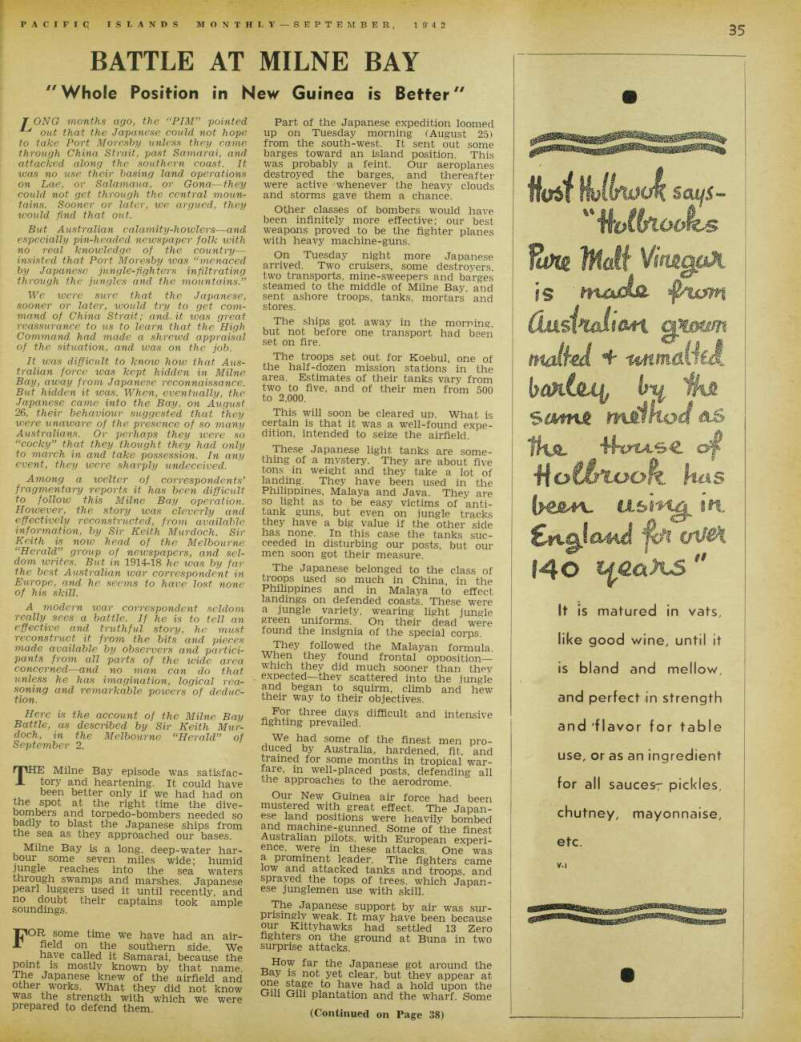
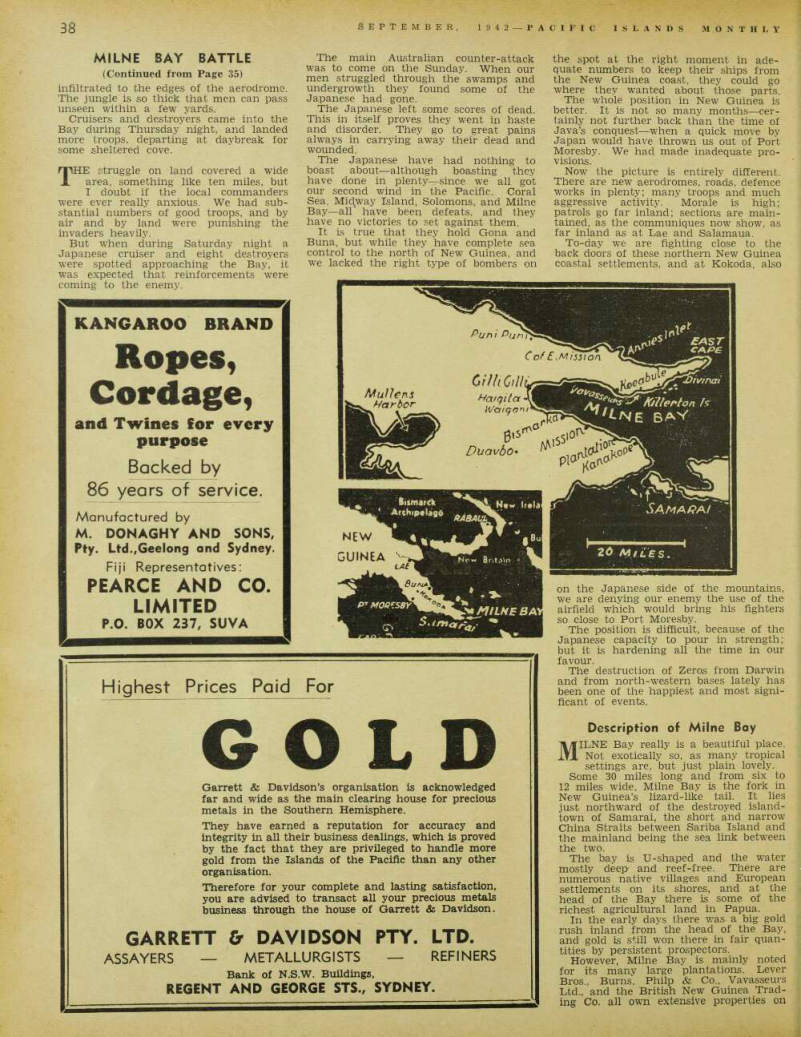
"Whole Position in New Guinea is Better"
T ONG months ago, the “PIM” pointed out that the Japanese could not hope to take Port Moresby unless they came through China Strait, past Samarai, and attacked along the southern coast. It was no use their basing land operations on Lae, or Salamaua, or Gona—they could not get through the central moun tains. Sooner or later, we argued, they would find that out.
But Australian calamity-howlers—and especially pin-headed newspaper folk with no real knowledge of the country— insisted that Port Moresby was “menaced by Japanese jungle-fighters infiltrating through the jungles and the mountains.”
We were sure that the Japanese, sooner or later, would try to get com mand of China Strait; and it was great reassurance to us to learn that the High Command had made a shrewd appraisal of the situation, and was on the job.
It was difficult to know how that Aus tralian force was kept hidden in Milne Bay, away from Japanese reconnaissance.
But hidden it was. When, eventually, the Japanese came into the Bay, on August 26, their behaviour suggested that they were unaware of the presence of so many Australians. Or perhaps they were so “cocky” that they thought they had only to march in and take possession. In any event, they were sharply undeceived.
Among a welter of correspondents’ fragmentary reports it has been difficult to follow this Milne Bay operation.
However, the story was cleverly and effectively reconstructed, from available information, by Sir Keith Murdoch. Sir Keith is now head of the Melbourne “Herald” group of newspapers, and sel dom writes. But in 1914-18 he was by far the best Australian war correspondent in Europe, and he seems to have lost none of his skill.
A modern war correspondent seldom really sees a battle. If he is to tell an effective and truthful story, he must reconstruct it from the bits and pieces made available by observers and partici pants from all parts of the wide area concerned—and no man can do that unless he has imagination, logical rea soning and remarkable powers of deduc tion.
Here is the account of the Milne Bay Battle, as described by Sir Keith Mur doch, in the Melbourne “Herald” of September 2.
THE Milne Bay episode was satisfac tory and heartening. It could have been better only if we had had on the spot at the right time the dive bombers and torpedo-bombers needed so badly to blast the Japanese ships from the sea as they approached our bases.
Milne Bay is a long, deep-water har bour some seven miles wide; humid jungle reaches into the sea waters through swamps and marshes. Japanese pearl luggers used it until recently, and no doubt their captains took ample
soundings.
FOR some time we have had an air field on the southern side. We have called it Samarai, because the pomt is mostly known by that name.
The Japanese knew of the airfield and other works. What they did not know was the strength with which we were prepared to defend them.
Part of the Japanese expedition loomed up on Tuesday morning (August 25) from the south-west. It sent out some barges toward an island position. This was probably a feint. Our aeroplanes destroyed the barges, and thereafter were active whenever the heavy clouds and storms gave them a chance.
Other classes of bombers would have been infinitely more effective; our best weapons proved to be the fighter planes with heavy machine-guns.
On Tuesday night more Japanese arrived. Two cruisers, some destroyers, two transports, mine-sweepers and barges steamed to the middle of Milne Bay, and sent ashore troops, tanks, mortars and stores.
The ships got away in the morning, but not before one transport had been set on fire.
The troops set out for Koebul, one of the half-dozen mission stations in the area. Estimates of their tanks vary from two to five, and of their men from 500 to 2,000.
This will soon be cleared up. What is certain is that it was a well-found expe dition, intended to seize the airfield.
These Japanese light tanks are some thing of a mystery. They are about five tons in weight and they take a lot of landing. They have been used in the Philippines, Malaya and Java. They are so light as to be easy victims of anti tank guns, but even on jungle tracks they have a big value if the other side has none. In this case the tanks suc ceeded in disturbing our posts, but our men soon got their measure.
The Japanese belonged to the class of troops used so much in China, in the Philippines and in Malaya to effect landings on defended coasts. These were a jungle variety, wearing light jungle green uniforms. On their dead were found the insignia of the special corps.
They followed the Malayan formula.
When they found frontal opnosition— which they did much sooner than they expected—-they scattered into the iungle and began to squirm, climb and hew their way to their objectives.
For three days difficult and intensive fighting prevailed.
We had some of the finest men pro duced by Australia, hardened, fit, and trained for some months in tropical war fare, in well-placed posts, defending all the approaches to the aerodrome.
Our New Guinea air force had been mustered with great effect. The Japan ese land positions were heavily bombed and machine-gunned. Some of the finest Australian pilots, with European experi ence, wore in these attacks. One was a prominent leader. The fighters came low and attacked tanks and troops, and sprayed the tops of trees, which Japan ese junglemen use with skill.
The Japanese support by air was sur prisingly weak. It may have been because Ki ttyhawks had settled 13 Zero fighters on the ground at Buna in two surprise attacks.
How far the Japanese got around the Bay is not yet clear, but they appear at stage to have had a hold upon the Gin Gih plantation and the wharf. Some
(Continued on Page 38)
infiltrated to the edges of the aerodrome.
The jungle is so thick that men can pass unseen within a few yards.
Cruisers and destroyers came into the Bay during Thursday night, and landed more troops, departing at daybreak for some sheltered cove.
THE struggle on land covered a wide area, something like ten miles, but I doubt if the local commanders were ever really anxious. We had sub stantial numbers of good troops, and by air and by land were punishing the invaders heavily.
But when during Saturday night a Japanese cruiser and eight destroyers were spotted approaching the Bay, it was expected that reinforcements were coming to the enemy.
The main Australian counter-attack was to come on the Sunday. When our men struggled through the swamps and undergrowth they found some of the Japanese had gone.
The Japanese left some scores of dead.
This in itself proves they went in haste and disorder. They go to great pains always in carrying away their dead and wounded.
The Japanese have had nothing to boast about—although boasting they have done in plenty—since we all got our second wind in the Pacific. Coral Sea. Midway Island, Solomons, and Milne Bay—all have been defeats, and they have no victories to set against them.
It is true that they hold Gona and Buna, but while they have complete sea control to the north of New Guinea, and we lacked the right type of bombers on
the spot at the right moment in ade quate numbers to keep their ships from the New Guinea coast, they could go where they wanted about those parts.
The whole position in New Guinea is better. It is not so many months —certainly not further back than the time of Java’s conquest—when a quick move by Japan would have thrown us out of Port Moresby. We had made inadequate pro visions.
Now the picture is entirely different.
There are new aerodromes, roads, defence works in plenty; many troops and much aggressive activity. Morale is high; patrols go far inland; sections are main tained, as the communiques now show, as far inland as at Lae and Salamaua.
To-day we are fighting close to the back doors of these northern New Guinea coastal settlements, and at Kokoda, also
on the Japanese side of the mountains, we are denying our enemy the use of the airfield which would bring his fighters so close to Port Moresby.
The position is difficult, because of the Japanese capacity to pour in strength; but it is hardening all the time in our favour.
The destruction of Zeros from Darwin and from north-western bases lately has been one of the happiest and most signi ficant of events,
Descripfion of Milne Bay
MILNE Bay really is a beautiful place.
Not exotically so, as many tropical settings are, but just plain lovely.
Some 30 miles long and from six to 12 miles wide, Milne Bay is the fork in New Guinea’s lizard-like tail. It lies just northward of the destroyed island town of Samarai, the short and narrow China Straits between Sariba Island and the mainland being the sea link between the two.
The bay is U-shaped and the water mostly deep- and reef-free. There are numerous native villages and European settlements on its shores, and at the head of the Bay there is some of the richest agricultural land in Papua.
In the early days there was a big gold rush inland from the head of the Bay, and gold is still won there in fair quan tities by persistent prospectors.
However, Milne Bay is mainly noted for its many large plantations. Lever Bros., Burns. Philp & Co., Vavasseurs Ltd., and the British New Guinea Trad ing Co. all own extensive properties on
the shores of the Bay.
Lever’s “Gili Gili” and Vavasseurs’
“Ahioma” estates were used exclusively for the manufacture of desiccated coco nut and their factories employed many hundreds of native workers.
Also in the Bay are many stations of the Kwato Industrial Mission, which has done splendid work for the Papuan natives. The headquarters of this mis sion were at Kwato Island near Samarai, and the mission specialised in teaching the natives useful trades such as car pentry and boat-building.
Two members of this mission, Mr. Cecil Abel, son of the mission’s founder, the late Mr. Charles Abel, and Mr. Geoffrey Baskett, remained behind at the time of the general evacuation, to carry on their work among the natives.
The northern side of Milne Bay is joined by a long and narrow peninsula, the eastern point of which is East Cape, the easternmost tip of New Guinea.
Some 200 odd miles to the north-east from this cape is Buna, where the Jap anese made their first sortie on Papuan soil.
Eastward from Milne Bay begin the string of islands that form the Louisiades Archipelago. At least one of these islands—Pana Pom Pom in the De Boyne group—has already been occupied by the Japanese, and 400 miles further east ward, of course, are the Solomons.
A dozen miles northward from Milne Bay is Normanby Island, of the D’Entre casteaux group, a rugged and mountain ous cluster of islands with many fine harbours—one of which, Sewa Bay, is among the finest of the world, capable of sheltering all Japan’s Navy. The channel between Normanby Island and East Cape is known as the Goschen Straits.
Sixty miles north of the D’Entrecas teaux group are the Trobriand Islands, and somewhere between these two groups the invading Japanese convoy was sighted and bombed.
The death was announced, on August 5, of Mrs. J. P. Watt. She was the widow of the late Rev. W. Watt and a link with the older tradition of New Hebridean mission work. She was a fund of infor mation on the Group, and retained her interest in this field to the last.
Mr. H. Robinson, who was a missionary with the Methodist Mission in Papua, is now a Warrant Officer in the New Guinea Forces. He writes that he was able to visit Dobu, and made contact with a number of Papuan and other Island teachers.
Advertisements & other items, p. 35 (2 items)
35
PACIFiq ISLANDS MONTHLY SEPTEMBER, 1 S' 4 2
140 tjQaK"
fkrtf HvlinWim
"fk>f6too(es
fam. Theft
ss tnoda t
dusl'uJi&n gloom
tnaihd + unmaliiA
i*ji
S tkmk AS
"HiJL “Hvtt6<, of'
jiatJtrXaoh. has
hcA*\, ain i
fcA
140 tjQaK"
It is matured in vats, like good wine, until it is bland and mellow, and perfect in strength and 'flavor for table use, or as an ingredient for all saucesr pickles, chutney, mayonnaise, etc. v.|
Pension Rights Of Enlisted
Men
NEW legislation in Fiji provides for continuity of civil service for the purpose of Colonial Office pensions, in respect of officers serving with the armed forces during the war period. It is provided that service with the forces' shall count as service on full pay for the purposes of Colonial pensions, while the period between leaving the Colonial service and commencing military service, or vice versa, is to count as 4eave with out salary.
Papua Missionaries
Carrying on on North-east Coast
WORD comes from Bishop Strong, of Papua, that Archdeacon Gill, Rev.
J. Benson, Miss May Hayman and Miss M. Parkinson, who were at Gona when the Japanese invaders appeared, are now safe and well. Those mission aries who were in the vicinity of East Cape are also reported to be safe and were carrying on their work, in mid- August.
Rotuma's War Effort
rE war-effort of the people of Rot uma, the small island dependency of the Colony of Fiji, is going to take some beating.
In early August, the District Officer at Rotuma informed the Colonial Treasurer that the Chiefs of the island had in formed him that the inhabitants were prepared to give a percentage of their copra sales towards winning the war.
As copra is the only important export, times in the past have been hard for Rctumans, and it says much for the gen erous spirit of the people that, now that their produce ,is finding a market again, they willingly and spontaneously made this contribution.
It is estimated that about £l,OOO will be made available in this way.
The only ceremony held in Noumea to commemorate France’s National Day (July 14) was the march-past of Fight ing French and Allied troops. A dense and enthusiastic crowd witnessed the review of the troops by Contre-amiral Thierry d’Argenlieu, General Patch and Fighting French and Allied officers.
Fiji
"Home-Brew "
An Acute Problem in Fiji
RECENTLY when a Fijian was brought before the Police Court in Suva on a charge of being unlawfully in possession of liquor, the superintendent of police asked the Bench to deal sev erely with the case, because this class of offence was not only prevalent but actu ally was getting beyond control. The liquor, he said, was “home-brew” and was much stronger than ordinary beer.
The demand for liquor is so acute that natives and others are being induced to make “home-brew.”
The Fijian, when the police entered his house, which was in the vicinity of a military camp, was found to be in pos session of over 100 bottles of home brewed beer. He was fined £lO or two months’ imprisonment.
In presenting to the magistrate another man, a Chinese, who had been caught supplying liquor to members of the armed forces, the police again pressed for a heavy penalty. Since the law prohibit ing the sale of liquor by the bottle had come into operation, they said, there had been a sudden and alarming increase in purchases of liquor wholesale by certain Chinese, who were suspected of retail ing it to soldiers.
The Chinese, who pleaded guilty, was fined £3O, or two months’ imprisonment.
Another Chinese, who was caught sell ing a bottle of whisky to a soldier for 25/-, was fined £5O or three months’ imprisonment.
It is reported that in spite of these heavy penalties, the offences against the liquor laws continue and that the fines are paid—the offenders do not go to gaol.
Paper Substitute
mHE paper-mulberry tree, which is X found on many of the South Sea Islands, has been put to a new use.
Normally the bark of the tree is made into tapa by the islanders who, until the arrival of European traders, had no other cloth. The method of preparation, which is carried out by women and girls, is to beat the raw product into strips, which are soaked in water, dried and joined together with the gum of the breadfruit tree. Stencilled designs of various colours are often added.
A resident of one of the Pacific groups told the New Zealand “Herald” that, before he left the islands large quanti ties of the bark of the paper-mulberry were being dried and exported to the United Kingdom to be used in the manu facture of paper.
Mr. W. E. Donevan, Chief Clerk of the Treasury, Fiji, was appointed to act temporarily as Deputy-Treasurer and Accountant-General in August, in the absence of Mr. A. R. W. Robertson.
Mr. H. M. W. Richardson, of the Mala yan Civil Service, who was seconded to the Fiji Government to act as Adviser on Air Raid Precautions, has been doing good work in the Colony. He has been getting large audiences together and giv ing useful lectures, describing the con ditions with which the people of Fiji would have to cope in the event of an air raid. The wisdom of this kind of preparation is apparent, as Fiji would be exposed to enemy attack in the event of the Allies’ defences giving way. m the Solomons, or further west.
Advertisements & other items, p. 36 (1 item)
Gland Discovery
Restores Youth
In 24 Hours
Sufferers from loss of vigour, nervousness, weak body, impure blood, failing memory, and who are old and worn-out before their time will be delighted to learn of a new gland discovery by an American Doctor.
This new discovery makes it possible to quickly and easily restore vigour to your glands and body, to build rich, pure blood, to strengthen your mind and memory and feel like a new man in only 8 days. In fact, this discovery, which is a home medicine in pleasant, easy-to-take tablet form, does away with gland operations and begins to build new vigour and energy in 24 hours, yet it is absolutely harmless and natural in action.
The success of this amazing discovery, called Vi-Stim has been so great in America that it is now being distributed by all chemists here under a guarantee of complete satisfaction or money back. In other words, Vi-Stim must make you feel full of vigour and energy and from 10 to 20 years younger, or you merely return the empty package and your money will be refunded. A special, double-strength bottle of 48 Vi-Stim tablets costs little and the guarantee protects you.
Vi-Stim
GUARANTEED
h to Restore Manhood and Vitality . • .
ON it ac ° . r u cannot exVi aUS " agents «h.ch the "«»*, un o«n refuse a V,. s t stain, an ° spray **" to hum an f*
P ,s harmless - er lS
V Be sure the Kills Flies Motihsi Mosquitoes Cockroaches/ Silverfish Bed Bugs I Ants •Sp^mllnotW*
ALWAYS KILLS
Vacuum Oil Co. Pty. Ltd. (Incorp. in Aust.), Distributors.
Fiji
Women's Voluntary Service in Fiji
IT is probable that Fiji might have compulsory national service, stated the new Governor (Major- General Sir Philip Mitchell) in a message to the organisers of the inau gural meeting of the Women’s Volunteer Service in Fiji.
It is. however, in the best interests of the Colony that people should be used in the jobs for which they are best suited; and it is with the object of training for those jobs that the women of Suva met in the Regal Theatre recently and elected Mrs. Newboult, the wife of the newly-arrived Colonial Secretary, to be organiser of the new service.
Mrs. Newboult has had considerable experiences of the “blitzes” in Britain, and she gave the meeting some vivid descriptions of life during the bombing of London and country districts.
Mrs. Elizabeth Teall and Sister R.
Cunnold, of the Melanesian Mission, are in Sydney at present waiting, impatiently, for completion of arrangements for their return to their work in the New Hebrides.
Early Settlers In
Woodlark Is.
By D. H. Osborne
WHO were the earliest settlers in what is now Eastern Papua?
The Roman Catholic Mission made a settlement on Woodlark Island, but did not remain long. Some of the concrete foundations of their building still remain to mark the old site of the station.
A German settled in the Laughlin group off Woodlark, before Papua became a British possession. The Laughlins were recognised as a German possession, for a time, but were exchanged between the British and Germans for some other terri tory. The late Mr. R. E. Lee and his wife lived there for a time. At one time, a lot of copra was produced there —probably the first copra shipped from Papua. Of late years, the crops on the coconut trees have been small, due to the age of the trees.
The first traces of gold on Woodlark Island were found by a man named Burke. He was collecting orchids and birds. He saw colours of gold in a stoney bar in one of the water-courses. He re ported the matter to Dick Ede and Charlie Lobb. They prospected the creeks and found payable gold. Woodlark was a fairly rich field and living was cheap.
Some gold was worked on the coast.
There are several good anchorages, and boats from Cooktown could anchor near the mining camp. This Woodlark rush developed before the days of motor boats, and steamers were few. Miners had to depend on sailing craft. The S.E. winds were beam winds from Cooktown, and the sailing boats made fast passages during the S.E. season. The natives were friendly, and a fair quantity of native
food was obtainable at a reasonable price.
The late Jim Gallah was a hot-headed Irishman. He had hung his blankets outside his camp before leaving for his work, some distance from his camp. An other white man, passing, saw rain com ing and threw the blankets on to Gallah’s bunk. Gallah returned to the camp and missed the blankets. Without looking in his camp, he rushed off to a native village and started knocking the natives about. Two natives tackled him, one with a spear, the other with a stick. He was badly knocked about, but recovered after a few weeks’ nursing by other miners. The natives (father and son) were sentenced to imprisonment in Samarai for a short term, and the old man died before his term was finished.
Two or three years later a man named Penny was murdered by two Woodlark natives. Penny’s body was found in the water, and his death was put down to a crocodile. Later, it was proved that he was murdered, and two natives were hung for the crime. Penny had a brutal tem per and had served 9 months in Samarai goal for a savage assault on his mate on Woodlark. Penny was a hard worker.
While he was serving his sentence he cut the well known road around the island of Samarai. It was only a narrow track then, but since it has been cut much wider.
Mr. and Mrs. A. E. Barker, formerly of the Methodist Overseas Mission, Suva, Fiji, have now taken up residence in Western Australia.
Miss Helen Fagan, of the Melanesian Mission, has returned to her station on the island of Aoba, New Hebrides.
Mile. Ludovia Ozoux, formerly on the staff of Etablissements Ballande, Noumea, was chosen as the Free French “Queen” for Allies’ Day, held recently in Sydney.
Advertisements & other items, pp. 37-39 (3 items)
Old Monk
The Worlds Finest Olive Oil San Francisco
SIMPLEX
MARINE
ENGINES
Simplex engines from 3 h.p. to 12 h.p. for boats from 14 ft. to 26 ft. are Australia’s best. 2 cycle and 4 cycle with or without reverse gear.
Illustrated is the popular little 3 h.p. suitable for 14 ft. or 16 ft. boats.
Runs for 5 hours on 1 gallon petrol and costs only £29/15/-, complete with all equipment. Ready to instal into any boat, nothing else to buy.
Ask for Simplex catalogue of engines and launches.
SKARSTEN SCRAPERS
Remove paint, varnish, glue, oil, grease, roughness, etc., from wood and metal surfaces. Most useful for scraping deck and hull planks. They leave the surface smooth and dressed and ready for painting. Have renewable blades.
Prices: No. 35, 2/3; 62, 2/9; 80, 3/7.
Reversible, 7/9.
Write for leaflet.
TILLEY
Kerosene
LAMPS
British-made Kerosene Lamps providing a steady 300 c.p. light, without flickering, and without smoke or smell.
Model TLIO (illustrated) is a handsome Table Lamp providing exceedingly brilliant illumination and at the same time a fine ornament for any home.
Stands 24 in. high and covers a large area. Attractive parchment shade Is finished in autumn tones and matches any furnishings.
Also available is the popular All- Purpose Lamp and Lantern (model EX100) and a variety of Hanging, Table, Wall and Vase Lamps.
Let us send you full details of all Tilley Lamps.
SHIPCHANDLERY
We manufacture and stock the largest range of boat gear in Australia. Everything for boatbuilder and boatowner. Marine paints and varnishes. Rope and Cordage. Rigging. Anchors and M oorings. Copper Nails and Rod . Lighting Plants. Fire Extinguishers. Oars and Sculls, Lamps, Pumps, etc.
GET OUR PRICES FIRST.
W.KOPSEN & Co. Pty.Ltd.
376/380 KENT STREET, SYDNEY
’Phone: MA6336 (4 lines).
Est. 1868.
Cables; Kopsen . . . Sydney.
38
SEPTEMBER, 1942 PACIFIC ISLANDS MONTHLY
MILNE BAY BATTLE
(Continued from Page 35)
Gold
KANGAROO BRAND
Ropes,
Cordage,
and Twines Cor every purpose
Backed by
86 years of service.
Manufactured by
M. DONAGHY AND SONS,
Pty. Ltd..Geelong and Sydney.
Fiji Representatives:
PEARCE AND CO.
LIMITED
P.O. BOX 237, SUVA
Highest Prices Paid For
GOLD
Garrett & Davidson’s organisation is acknowledged far and wide as the main clearing house for precious metals in the Southern Hemisphere.
They have earned a reputation for accuracy and integrity in all their business dealings, which is proved by the fact that they are privileged to handle more gold from the Islands of the Pacific than any other organisation.
Therefore for your complete and lasting satisfaction, you are advised to transact all your precious metals business through the house of Garrett & Davidson.
GARRETT & DAVIDSON PTY. LTD.
ASSAYERS METALLURGISTS REFINERS
Bank of N.S.W. Buildings,
REGENT AND GEORGE STS., SYDNEY.
The House of Steel for Quality Cutlery n CD We have a large range of Scissors, Knives, Razors, etc.
W. JNO. BAKER
3 HUNTER STREET, SYDNEY.
Established 1888.
Removed
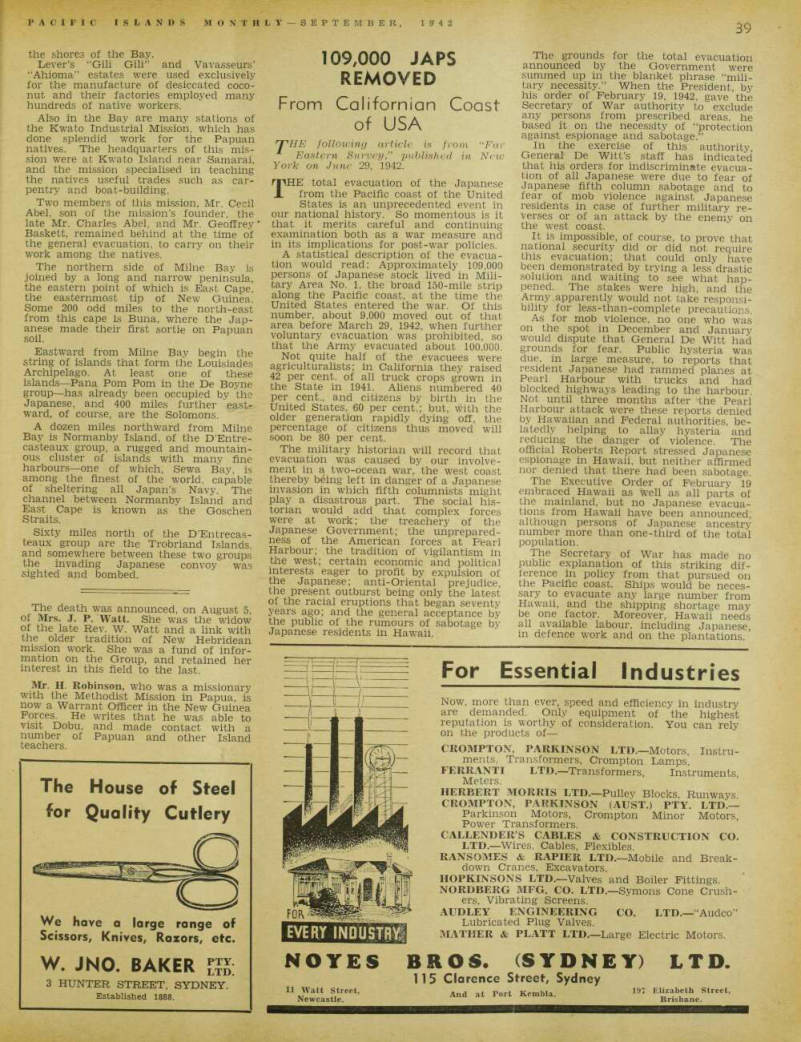
109,000 Japs
From Californian Coast of USA
r THE following article is from “Far x Eastern Survey,” published in New York on June 29, 1942.
Ttttt + - , .. #, 1 1 HE total evacuation of the Japanese from the Pacific coast of the United States is an unprecedented event in our national history. So momentous is it that it merits careful and continuing examination b<pth as a war measure and in its implications for post-war policies.
A statistical description of the evacua tion would read: Approximately 109,000 persons of Japanese stock lived in Mili tary Area No. 1, the broad 150-mile strip a lc) ng the Pacific coast, at the time the United States entered the war. Of this number, about 9,000 moved out of that area before March 29. 1942, when further I2 ll i n fu ry A evacuatlon was prohibited, so that the Army evacuated about 100.000.
Not quite half of the evacuees were agriculturalists; in California they raised S p !£ c . ent - all truck cr °P s grown in the State in 1941. Aliens numbered 40 per cent., and citizens by birth in the United States, 60 per cent.; but, with the older generation rapidly dying off, the percentage of citizens thus moved will soon be 80 per cent.
The military historian will record that evacuation was caused by our involve ment in a two-ocean war, the west coast thereby being left in danger of a Japanese invasion in which fifth columnists “might play a disastrous part. The social his torian would add that complex forces were at work; the treachery of the Japanese Government; the unprepared ness of the American forces at Pearl Harbour; the tradition of vigilantism in the west; certain economic and political mterests eager to profit by expulsion of the Japanese: anti-Oriental prejudice, the present outburst being only the latest of the racial eruptions that began seventy years agn; and the general acceptance by the public of the rumours of sabotage by Japanese residents in Hawaii.
The g rounds for the total evacuation announced by the Government were summed up in the blanket phrase “mili tary necessity.” When the President, by his order of February 19, 1942, gave the Secretary of War authority to exclude any persons from prescribed areas, he based it on the necessity of “protection against espionage and sabotage.”
In the exercise of this authority, General De Witt’s staff has indicated that his orders for indiscriminate evacua tion of all Japanese were due to fear of Japanese fifth column sabotage and to fear of mob violence against Japanese residents in case of further military re verses or of an attack by the enemy on the west coast.
It is impossible, of course, to prove that national security did or did not require this evacuation; that could only have been demonstrated by trying a less drastic solution and waiting to see what han pened. The stakes were high, and the Army apparently would not take responsi bility for less-than-complete precautions As for mob violence no one who was on the s£StlnMember and January would dispute that General De Witt had grounds for fear. Public hysteria was due, in large measure, to reports that resident Japanese had rammed planes at Pearl Harbour with trucks and had blocked highways leading to the harbour Not until three months after the Pearl Harbour attack were these reports denied by Hawaiian and Federal authorities be latedly helping to allay hysteria and reducing the danger of violence. The official Roberts Report stressed Japanese espionage in Hawaii, but neither affirmed nor denied that there had been sabotage, The Executive Order of February 19 embraced Hawaii as well as all parts of the mainland, but no Japanese evacua tions from Hawaii have been announced although persons of Jananese ancestry number more than one-third of the total population.
The Secretary of War has made no public explanation of this striking dif ference in policy from that pursued on the Pacific coast. Ships would be neces sary to evacuate any large number from Hawaii, and the shipping shortage mav be one factor. Moreover, Hawaii needs all available labour, including Japanese in defence work and on the plantations.'
Advertisements & other items, p. 39 (1 item)
For Essential Industries
Now, more than ever, speed and efficiency in industry are demanded. Only equipment of the highest reputation is worthy of consideration. You can rely on the products of— CROMPTON, PARKINSON LTD.—Motors, Instruments, Transformers, Crompton Lamps.
FERRANTI LTD.—Transformers, Instruments, Meters.
HERBERT MORRIS LTD.—Pulley Blocks, Runways
CROMPTON, PARKINSON (AUST.) PTY. LTD.—
Parkinson Motors, Crompton Minor Motors, Power Transformers.
CALLENDER’S CABLES & CONSTRUCTION CO.
LTD.—Wires, Cables, Flexibles.
RANSOMES & RAPIER LTD.—Mobile and Breakdown Cranes, Excavators.
HOPKINSONS LTD.—Valves and Boiler Fittings.
NORDBERG MEG. CO. LTD.—Symons Cone Crushers, Vibrating Screens.
AUDLEY ENGINEERING CO. LTD.—“Audco”
Lubricated Plug Valves.
MATHER & PLATT LTD.—Large Electric Motors.
BEOS. (SYDNEY) LTD.
115 Clarence Street, Sydney
And at Port Kembla. 19 “ Elizabeth Street,
100 Years Ago
How English Mission Took Christianity to Loyalties
Prom Our Own Correspondent NOUMEA, August 8.
THE island of Lifou, largest of the Loyalty group, which lies 50 miles off and parallel to the east coast of New Caledonia, has just been celebrating a centenary—that of the beginning of the island’s evangelisation by a Samoan named Fao.
In 1840, the English missionary, John Williams, embarked on the brig “Cam den” a number of Samoan teachers who were to spread Christianity throughout the South-west Pacific. They were put ashore at various parts of the New Heb rides; but, on landing at Erromango, John Williams himself was killed and eaten. The “Camden” then touched at the Isle of Pines, and the Loyalties, before landing other teachers on the west coast of New Caledonia, at the Bay of St. Vincent.
Of the Loyalty islands, Mare was the first to receive attention, the three lay brothers, Tataio, Taniela and Fao being landed. Thev were cordially received by hisrh chief Naisseline, grandfather of the present chief, so many of whose subjects
have volunteered for the Free French naval and military forces.
But in 1841, which was the time of the Samoans’ arrival, the neighbouring isle of Lifou was the scene of an insurrection, chief Boula and his family, known as the Api Co, having been chased away by their subjects, the Angaetra. They took refuge at the village of Gaitcha, with chief Zeoula, and sent an envoy, named Nazohri, by canoe, to Mare, to demand help from chief Naisseline.
The latter assembled his best warriors and embarked them on his war fleet, together with the three Samoans. They landed on the beach at Ahrarewed, near a place called Mou, where they camped.
From here, they sent a message to the council of chiefs owning allegiance to Boula, through chief Lue Melem, who had been elected head of the Angaetra at the time of the ruling family’s flight.
Naiselline demanded that Boula should be re-established on the throne and that the Samoan Fao should remain on Lifou to teach the gospel. Otherwise, war to the knife.
Luc Melem accepted these conditions and made his peace with Boula, and Fao was authorised to teach the Lifouans Christianity. He built the first church on Ahrarewed beach, where he had landed, and it is here that a monument recording the centenary has just been erected., Unfortunately, owing to war rationing and drought, the fete could not be kept up for long. One of Lifou’s high chiefs, incidentally, is still a Boula; one meets him, as well as Naisseline, when official business calls to Noumea.
In May, 1884, a decree obliged all schools in the Loyalties to teach French.
Those, which for decades had taught in the native languages and in English were closed altogether. The few English mis sionaries. who had. done sterling work there, were forced out of the country— being sneered at on passing through Noumea as “English Tartuffes.” One of them, the Rev. Mr. Jones, who worked for years in Mare, recently died in Syd ney at a ripe old age. French Protestant missionaries who succeeded him have paid tribute to his work.
Good Wishes to "France
Combattante"
NOUMEA, August 10.
ON the eve of his departure from,. Fiji the British High Commissioner (Sir Harry Luke) addressed a telegram to High "Commissioner d’Argenlieu, ex pressing his sincere wishes for the future prosperity of the French Pacific Terri tories, and for the success of the cause of France Combattante and that of democratic liberty, of which France had so long been champion.
Too Many Mongoose
Fiji Pays a Bonus For Tails
THE mongoose, which came to Fiji from India with the Indians, is becoming so serious a pest in the large island of Viti Levu, that the Government has been forced to take action.
A substantial bonus for mongoose tails has been offered by the Department of Agriculture, and it is hoped that, as a result of this, the spread of the crea tures may be limited.
Unfortunately, this bonus applies only to mongoose caught within the peninsula of Suva. Country dwellers protest that the mongoose is a greater pest with them than it is about the city of Suva, and they ask for remedial action. But, of course, funds for this purpose are limited, and it is not expected that the plea of the country-dwellers will be given much consideration.
The mongoose, in India, is a ferocious little animal which is regarded as a friend of man, because of its activity in killing snakes. In Viti Levu, however, it has been diverted from its original pur pose—which apparently was anti-rat — and it now preys upon fowl-yards to such an extent that in many cases entire com munities of hens have been destroyed.
The Fijian island of Viti Levu provides an interesting example of how stupid interference by man can disturb a bal ance of nature achieved over thousands of years of natural evolution. The limited indigenous fauna of Viti Levu has been practically wiped out during the past quarter-century, and there is now established there the minah and the bul bul, two birds from Asia which have driven the Fijian birds back into the recesses of the inland mountains; the mongoose, from India, which seems to have taken possession of the thickets in the manner described; and the giant toad, an amiable reptile introduced from America to cope with pests in the plan tations. but which has flourished and multiplied to such an extent that it now is found in every water-hole and patch of grass.
Deer In New Caledonia
NOUMEA, August 10.
DEER are reported in very large num bers this year in the Hienghene region. A great many have been shot.
The Colony’s meatworks have resumed the killing of cattle, a sufficient supply of tin for canning having been obtained from abroad.
Advertisements & other items, pp. 40-41 (3 items)
Flabby Fat
Unhealthy with
GOOD LOOKS AND FIGURE
VANISH
You can always tell the difference between good firm flesh and flabby fat.
There is always something so unhealthy and unattractive looking about fat. It is usually unhealthy and often gained through constipation. Waste matter clogs and congests the digestive tract, remains too long and gets absorbed into the blood stream. Sick headaches, pimply skin, biliousness, bad breath result and fat tissue forms, hiding your good looks and fine figure.
Constipation always responds to treatment with gentle Pinkettes. These tiny laxative pills are compounded of safe ingredients that have an exercising and strengthening influence on the bowels.
Pinkettes painlessly clear away the digestive wastes completely and regularly, help digestion and banish sick headache, bilious attacks, pimples and unhealthy fat. Get a bottle to-day and notice how fine and fit you feel after a few harmless doses.— **•
TENAX Genuinely Germicidal SOAP
s
Guard against Infection with Tenax!
Germicidal Soap used regularly is an
unsurpassed safeguard against external germ
infection. It is kind to the most sensitive skin, I" yet its germicidal action is eleven times as rapid as carbolic. It is non-irritant and non-poisonous.
At All Chemists and Stores.
wmm
M per Tablet-
W H TOil£T
mm*
TENAX Genuinely Germicidal SOAP
Put all your Savings info
SAVINGS BONDS
Slop Kidney
Poisoning To-day
If you suffer from Rheumatism, Get up Nights, Leg Pains, Backache, Lumbago, Nervousness, Headaches and Colds, Dizziness, Circles under Eyes, Swollen Ankles, Loss of Appetite or Energy, you should know that your system is being poisoned because germs are impairing the vital process of your kidneys. Ordinary medicines can’t help much, because you must kill the germs which cause these troubles, and blood can’t be pure till kidneys function normally. Stop troubles by removing cause with Cystex— the new scientific discovery which starts benefit in 2 hours. Cystex must prove entirely satisfactory and be exactly the medicine you need or money back is guaranteed. Ask your chemist for Cystex today.
The guarantee gL . ® V £2% W protects you. Now In J wJA 3 sizes; 1/9, 4/-, 8/-.
GUARANTEEDforKidneys, Bladder, Rheumatism
RY BIN
Distilleries at London . . , England Toronto . . . Canada Moorabbin . . Victoria Cincinnati . . . U.S.A.
41
Owen Stanley Range Battle (Continued from Page 8)
PACIFIC ISLANDS MONTHLY SEPTEMBER, 1542
Solomons Magistrate Is
Kept Very Busy
MR. RAGNAR HYNE, who was legal adviser and Chief Magistrate in the Solomon Islands until the Japanese invasion early this year, is now acting as Resident Magistrate in Suva, and prob ably he has been busier in recent months than ever before in his official life.
In Fiji, at present, a number of extra ordinary wartime laws are operating— especially one which places sharp restric tions upon the drinking of alcoholic liquor and the purchase of single bottles, and another which imposes a curfew, so that all persons—Europeans, Indians and Fijians—have to be home well before mid night. Both laws are being rigorously administered by the police, and the Magistrate is daily imposing fines for liquor offences and breaches of the curfew regulations.
Papuan Public Servants
]VT R '/ r ' BYRN J? and Mr ' A - M - Mi /°S lle .
Sydney, have n“pS P “o* with that Department. Mr. Byrne has been transferred to Canberra, and Mr. gone to a Victorian muni wons iactor y- Mr, A. E. Dettmann, also of the Papuan service, has joined the AIF, with the rank of lieutenant.
Mr. S. Smith and Mr. E. Washington are still attending to war damage affairs in the Territories Department in Sydnev.
New Church At Labasa,
Fiji
THE new church which has been built at the foot of the CSR Company’s residential hill, in Labasa, Vanua Levu, Fiji, was opened on July 26, and will be re-dedicated during the next visit of the Bishop.
Previous to May 25, two church build ings existed —both situated away from the centre of the district. The older building, known as All Saints’ Church, was dedicated by Bishop Twitchwell in 1918; the other, originally used by lady members of the staff as residential quar ters, was latterly used for services in Hindi.
Demolition of the old buildings began on May 25, and the new church began to take shape under the direction of Mr.
B. Williams. Its appearance on the opening day was pleasing, but much remains to be done in the grounds. Mr.
H. B. Gibson has promised to give a
lych gate.
Advertisements & other items, p. 42 (2 items)
Dissolved Ist. Day
Membership of Pacific Territories
Association
Temporary office accommodation has been provided for the new body, and the address of the secretary now is: Mr. C. A. M. Adelskold, secretary of Pacific Territories Association, c/o Robert Gillespie Pty., Ltd., Royal Exchange Building, 54a Pitt Street, Sydney; or, briefly, Secretary, Pacific Territories Association, Box 137 CC, GPO, Sydney. The telephone number is BW 4782. Evacuees who require the services of the Association in any way, or who desire to become members, should communicate with him at that address.
Members are wanted. So are funds. The subscription is 15/- per quarter; but evacuees whose cash position is not what it was are asked to become members anyway, and contribute as much as they feel they can afford.
The secretary informs us that the following form could be used:—
APPLICATION FOR MEMBERSHIP
Secretary, Pacific Territories Association, Box 137 CC, GPO, Sydney.
Please enrol me as a. member of your Association.
Name (Mr., Mrs. or Miss) Present address Former Address in Territories Present occupation, if any Previous occupation, in Territories If you want employment In Australia send full particulars on an attached statement (which please sign) showing your age, qualifications, details of experience, and what class of work you would prefer.
If you want the assistance of the Association in any way, send full particulars on an attached statement (which please sign).
Amount of subscription forwarded herewith, or to be forwarded: Signature Date
Asthma Mucus
Dissolved Ist. Day
Choking, gasping, wheezing Asthma and Bronchitis poison your system, sap your energy, ruin your health and weaken your heart.' In 3 minutes Mendaco—the prescription of a famous doctor—circulates through the blood, quickly curbing the attacks. The very first day the strangling mucus is dissolved, thus giving free, easy breathing and restful sleep. No dopes, no smokes, no injections. Just take pleasant, tasteless Mendaco tablets at meals and be entirely free from Asthma and Bronchitis in next to no time, even though you may have suffered for years. Mendaco is so successful that it is guaranteed to give you free, easy breathing in 24 hours and to completely stop your Asthma m o days or money oaok on return of empty package. Get Mendaco - from your Chem- Syf >st. Theguarantee protects you.
Ends Asthma . . . Now 3/-, 6/-, 12/-
Cordage and
PACIFIC ISLANDS SOCIETY
Visitors from the Islands to Sydney (or those interested in Islands affairs), are advised to communicate with the honorary secretary of the above Society, which has been formed to study the history, traditions, economics, and political developments of the Pacific Islands.
Regular monthly meetings are held at History House, 8 Young Street, Sydney.
Address for Correspondence:
THE PACIFIC ISLANDS SOCIETY,
Box 2434 MM., G.P.0., Sydney.
E *0 s
LOT SO
For Inflamed Eyes and Eyelids
SOLD EVERYWHERE
H. A. Rose A. Co. Pty. Ltd., King St.. Sydney
Wanted to Buy—Quality Guns and Rifles HIGHEST PRICES GIVEN. WILL ALSO EXCHANGE GUNS.
S I L RO H U Qualify Firearms and Fishing Tackle. 143 ELIZABETH STREET (Near Market St.) SYDNEY. ’PHONE: MA 3540.
Scott’s “Renown” Brand Rope,
Cordage and
Cable Address: Ropeyard, Sydney.
Binder
Twine
of Every
Description
MANUFACTURED AT
MASCOT. N.S.W.
By
J. SCOTT
PTY. LTD.
Head Office and Store:
163 CLARENCE STREET,
SYDNEY,
N.S.W.
Tahiti Has Plenty of
Vichy Lies Are
Hurled Back
Tahiti Has Plenty of Good Food
Tahiti, July 25.
“/CHAGRINED minds, defeatists, propa- Vy gandists sold to the enemy are repeating, after the Franco- Japanese radio of Saigon, that an economic crisis is suffered at Tahiti, that certain essential products are lacking.
There is no crisis in Tahiti. Essential products are not lacking. One must say it loudly and be proud of it!”
These are the words of Governor Georges Orselli, the fiery Corsican, head of Free France’s island possessions in French Oceania. Spoken here and widely circulated on the island, it is believed his words were intended as a sharp rebuke to what he termed the “Franco-Japanese radio of Saigon,” which has been hurling invectives and Nazi propaganda nightly in this direction for several months.
“Never has Tahiti been so rich, never has so much money come in here,”
Orselli said. He quoted statistics show ing that Tahiti and the Society Islands received three times as much money last year as in 1940. Many essential food products such as flour, canned meat, rice, sugar, canned milk, and butter were pro portionately received in greater degree, he said.
Figures quoted on the importation and consumption of food items were taken as a direct assault on the Indo-China radio, which has been declaring with great repetition that Tahiti is slowly starving for lack of essential foods, that it should Join the “greater prosperity sphere” as Indo-China has, and have fat stomachs again!
“Think of France,” said Governor Orselli, “of Europe, of Japan, of Indo- China, for that matter, and compare them with your abundance. And if some defeatists put before you their sad plight, pray them to read the statistics of the Tahiti customs.”
The Governor cited figures showing that canned meat, one of Tahiti’s great deficiencies—according to the Saigon radio —was imported to the amount of 478 tons in 1941, as against 167 tons in 1940. Rice, another item often mentioned in the nightly Axis propaganda programme, was imported to the amount of 1,559 tons last year, as against 1,373 tons in 1940. Most of Tahiti’s rice formerly came from Burma.
“Of C9urse,” the Governor said, “we are receiving less wine, fewer cigarettes, less whisky, less of certain luxury pro ducts; but these are economies which permit an abundance of essential foods and the constitution of reserves for any future.
“Tahiti is rich, but this wealth is not equally distributed, and that is a problem for all time. Certain ones have too much, while others don’t have enough.
But our care will be that those who don’t have enough may have more, that a greater justice reigns, and in this task we will all help.”
Fighting French Report All Well
RADIOS received by the families of some of the New Caledonian Vol unteers, who were fighting in the Western Desert at the beginning of Aug ust, report that Rene Petre. Paul Dacoin Georges Cettia, Eugene Pene, Adelphe and Adrien de Geoffrey, Yves Boyer, and Louis Viratel are safe, after the heroic
defence of Bir Hacheim by the Fighting- French.
Andre Petre was posted as missing.
Cordier Alexandre cabled that he and Louis Anger are convalescing at Beirut (Syria).
Berlin Radio claimed that the number of Fighting French captured at Bir Hacheim was nearly 2,000.
Station
Makogai Leper
MRS. C. J. Austin, wife of Dr. C. J.
Austin. OBE, medical superintendent of the Central Leper Station on Makogai Island (Fiji Group), has been visiting her daughter, who is at school in Hawke’s Bay, New Zealand, and she has given interesting data to NZ newspapers.
The hosnital at wac nnpnpH 1911, with 40 patients, most of them in the advanced stage of the disease, and therefore incurable. The majority of the 650 patients there at present are in the being released in frorn three tcf five° years* the Pe mse n ale UP ° n Ume teken t 0 alTest a I- , • , sffiTF yS • h f ghest £’ lbut ! to *t ;he sisters, whose devotion to the sufferers is wonderful. Comforts, including toys for the children, are received from New Zealand, and talkies a T,r Sh °r. < £‘ he °. nce V eek tionpd nn d tm fH haVe fTo 11 sta “ tioned on Makogai for the past 12 years and m recognition of his work, the New°Year S blf ° BE in the laSt i\ew Year Honours list.
"New Guinea"
Apparent Changes in Names
THERE is a marked and growing ten dency, in recent semi-official refer ences to the Australian Pacific Ter ritories, to group Papua and New Guinea together as “British New Guinea.” This, probably, is a result of the stand taken by the existing military administration in treating both Territories as one.
The idea has milch to commend it.
Past references to “Papua,” when mean ing the south-eastern section of New Guinea, and to “New Guinea” when only the north-eastern section (included in the Mandated Territory) was meant, have caused much confusion.
But, if a new system is planned, it should be officially announced and clearly understood. “New Guinea” then would mean the mainland of New Guinea; and the big islands of New Britain, New Ire land and Bougainville (now officially part of New Guinea) could then stand under their own names.
Mr. H. H. Hickling, who has been Resi dent Agent at Mangaia in the Cook Islands for the last three years, left the island recently for Rarotonga. It is understood that he is on transfer to another position in the New Zealand Service.
A vessel which lifted Tahiti’s accumu lation of copra, some time ago, took away also the remnants of the American colony-leaving there onlv half a dozen whose roots are so deeply embedded in Tahitian soil that they may be regarded as permanent residents.
Advertisements & other items, p. 43 (1 item)
Angus & Coote
WARTIME ANNOUNCEMENT
by
500 George Street, Sydney.
To our Friends in the Southern Seas everywhere. We greatly regret the necessity to announce the suspension of our mail order service for some time. This means we cannot execute any more orders—possibly for the duration of the war.
We do this most reluctantly. Circumstances force it upon us.
The shortage of goods is extreme. Apart from present importing difficulties, Government restrictions absolutely prohibit the manufacture of jewellery, silverplate and many other goods.
The result is we cannot replace stocks as they become exhausted.
However, we can, of course, view these distressing circumstances from another, happier angle. Restrictions at this time mean more effort in winning the war, and a quicker return to the days of peace with its opportunities for us to serve you as before . . . Moreover, the restrictions still permit us to make Wedding Rings, Identification Discs, and to engage in repair work. Therefore, please still send us your orders for such goods, as well as your jewellery and old silverware for repairs.
With many thanks for your custom in the past, we remain, Yours faithfully,
ANGUS & COOTE.
P.S.: We still buy Old Gold!
Death of Captain
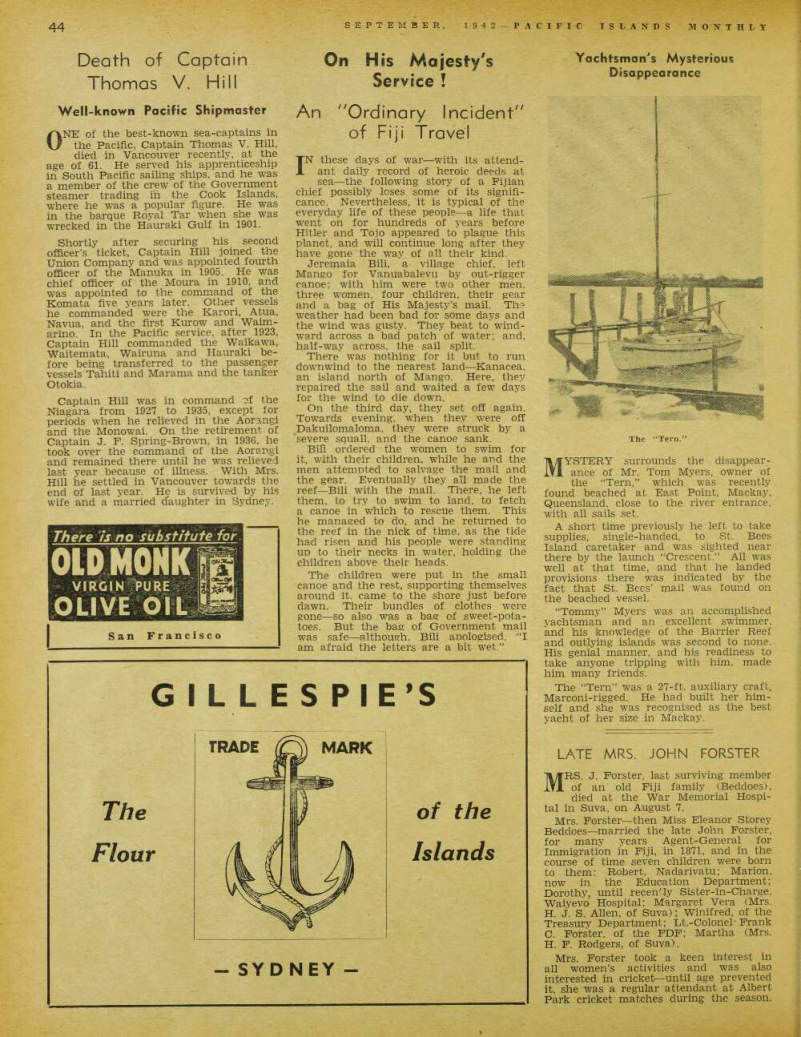
Thomas V. Hill Well-known Pacific Shipmaster
ONE of the best-known sea-captains in the Pacific, Captain Thomas V. Hill, died in Vancouver recently, at the age of 61. He served his apprenticeship in South Pacific sailing ships, and he was a member of the crew of the Government steamer trading in the Cook Islands, where he was a popular figure. He was in the barque Royal Tar when she was wrecked in the Hauraki Gulf in 1901.
Shortly after securing his second officer’s ticket, Captain Hill joined the Union Company and was appointed fourth officer of the Manuka in 1905. He was chief officer of the Moura in 1910, and was appointed to the command of the Komata five years later. Other vessels he commanded were the Karori, Atua, Navua, and the first Kurow and Waim arino. In the Pacific service, after 1923, Captain Hill commanded the Waikawa, Waitemata, Wairuna and Hauraki be fore being transferred to the passenger vessels Tahiti and Marama and the tanker Otokia.
Captain Hill was in command of the Niagara from 1927 to 1935, except for periods when he relieved in the Aorangi and the Monowai. On the retirement of Captain J. F. Spring-Brown, in 1936, he took over the command of the Aorangi and remained there until he was relieved last vear because of illness. With Mrs.
Hill he settled in Vancouver towards the end of last year. He is survived by his wife and a married daughter in Sydney.
Service !
On His Majesty's Service !
An "Ordinary Incident" of Fiji Travel
IN these days of war—with its attend ant daily record of heroic deeds at sea—the following story of a Fijian chief possibly loses some of its signifi cance. Nevertheless, it is typical of the everyday life of these people—a life that went on for hundreds of years before Hitler and To jo appeared to plague this planet, and will continue long after they have gone the way of all their kind.
Jeremaia Bili, a village chief, left Mango for Vanuabalevu by out-rigger canoe; with him were two other men, three women, four children, their gear and a bag of His Majesty’s mail. Tho weather had been bad for some days and the wind was gusty. They beat to wind ward across a bad patch of water; and, half-way across, the sail split.
There was nothing for it but to run downwind to the nearest land —Kanacea, an island north of Mango. Here, they repaired the sail and waited a few days for the wind to die down.
On the third day, they set off again.
Towards evening, when they were off Dakuilomaloma, they were struck by a severe squall, and the canoe sank.
Bill ordered the women to swim for it, with their children, while he and the men attempted to salvage the mail and the gear. Eventually they all made the reef—Bili with the mail. There, he left them, to try to swim to land, to fetch a canoe in which to rescue them. This he managed to do, and he returned to the reef in the nick of time, as the tide had risen and his people were standing up to their necks in water, holding the children above their heads.
The children were put in the small canoe and the rest, supporting themselves around it. came to the shore just before dawn. Their bundles of clothes were gone—so also was a bag of sweet-pota toes. But the bag of Government mail was safe—although, Bili apologised. “I am afraid the letters are a bit wet.”
Yachtsman's Mysterious
Disappearance
MYSTERY surrounds the disappear ance of Mr. Tom Myers, owner of the “Tern,” which was recently found beached at East Point, Mackay, Queensland, close to the river entrance, with all sails set.
A short time previously he left to take supplies, single-handed, to St. Bees Island caretaker and was sighted near there by the launch “Crescent.” All was well at that time, and that he landed provisions there was indicated by the fact that St. Bees’ mail was found on the beached vessel.
“Tommy” Myers was an accomplished yachtsman and an excellent swimmer, and his knowledge of the Barrier Reef and outlying islands was second to none.
His genial manner, and his readiness to take anyone tripping with him, made him many friends.
The “Tern” was a 27-ft. auxiliary craft, Marconi-rigged. He had built her him self and she was recognised as the best yacht of her size in Mackay.
The “Tern.”
Late Mrs. John Forster
MRS. J. Forster, last surviving member of an old Fiji family (Beddoes), died at the War Memorial Hospi tal in Suva, on August 7.
Mrs. Forster—then Miss Eleanor Storey Beddoes—married the late John Forster, for many years Agent-General for Immigration in Fiji, in 1871. and in the course of time seven children were born to them; Robert, Nadarivatu; Marion, now in the Education Department; Dorothy, until recently Sister-in-Charge, Waiyevo Hospital; Margaret Vera (Mrs.
H. J. S. Allen, of Suva); Winifred, of the Treasury Department; Lt.-Coloneh Frank C. Forster, of the FDF; Martha (Mrs.
H. F. Rodgers, of Suva).
Mrs. Forster took a keen interest in all women’s activities and was also interested in age prevented it, she was a regular attendant at Albert Park cricket matches during the season.
Advertisements & other items, p. 44 (1 item)
Gillespie’S
There is no substitute for San Francisco
The Flour
TRADE
MARK
of the Islands
- SYD NEY -
Fiji
That Secret Radio Station An Incident of Outer Fiji
By Ga Ni Bulu
THE professor was worried. Deep, black lines were under his eyes. He had had nq restful sleep for several nights. His students were being neglected, because the Professor could not concen trate on his class.
He had listened, night after night, for a week, to what seemed to him to be Morse code messages going out from a secret station close to his school. Some nights it started sending at 10 p.m., other nights at 3 a.m.; but never a night had the spy missed sending out his code in long dots and still longer dashes —not an expert, but a very careful sender, who made sure his messages would be cor rectly received and read.
The secret station was close to his school. He had searched vainly during the days, but no sign could he find of a secret set.
There was nothing else to be done. He must call in the local ARP for assist ance.
The local wireless operator was in cluded, to take down the spy messages, as sent.
The ARP, the police and the wireless operator were all in position, duly posted around the Professor’s school. The night was a nasty one. It rained yards, not inches.
The night dragged on. The Professor explained that this was probably one of the 3 a.m. sending times. The troops were all alert. The mosquitoes attended to that. All the mosquitoes on the coast had been mobilised.
Dot—dot! What’s that? Yes, it’s the start of the sending. The position is clear: the spy is situated down on the flat.
The Professor and the officer in com mand decide to surround the position; to creep up on the spy and take him alive, if possible. But, at all costs, he must be taken, dead or alive.
The wireless operator is taking down the dots and very long dashes, but is puzzled by the tone of the set the spy is sending on. It is quite unlike any he has heard before. It must be foreign.
The signals are getting louder and louder as the troops draw closer to the sender. The circle is almost closed. The messages are stronger and still stronger.
They seem to be coming up out of the ground. The spy is underground!
The Professor gives the order to flash the torches on the enemy, and calls on him to surrender. Lights flash, and the enemy is captured alive.
He now reposes in a bottle o 2 spirit in the Professor’s academy—to wit, one large toad of the variety now so common in Fiji, the first and last he ever wants to see.
P-8-—This is a truthful statement of what actually occurred. No one can blame the Professor. These giant toads which were new to him —undoubtedly do utter a queer sort of croak—a kind of long dot-dash effect.
Mr. Lance Wilkinson, formerly a mem ber of the mines staff at Misima, East- Papua, is now Leading-Aircraftman Wilkinson, and undergoing training for the RAAF.
Jewish Pacific Community
mHE only Jewish congregation in the X Pacific Islands is at Honolulu. Prior to the American annexation in 1898 (says Mr. A. M. Gurau, of Apia, in a paper read in Sydney, recently) there were 100 Jews settled in Hawaii, and a Jewish cemetery of a much earlier date existed.
The British Chief Rabbi Hertz, who visited Honolulu in 1921, commented on the fact that, outside of the naval base, there was little Jewish communal religi ous activity. However, the Aloha Jewish Centre was established in 1922 by the Jewish Welfare Board, on which occa sion Princess David Kawanuakoa volun tarily loaned a Sefer Torah, which had been kept in her family as an heirloom.
Jewish artisans from the East, principally Harbin, came in 1925, and the Jewish population eventually rose to 300. Now there are a flourishing synagogue and school in Honolulu under the direction of a rabbi. Practical help has been given to Jewish refugees who have passed through that port in recent years. Many prominent army and navy officers who have served in Hawaii have been Jews.
E.R.
The General Secretary of the Methodist Overseas Mission in Sydney reports that, although negotiations for the return of some of their missionaries to Papua are still in progress, there seems to be little hope of their return until the present war situation in the near north is clearer.
N. Caledonian Coffee
From Our Own Correspondent NOUMEA, August 6.
OWING, to the better price now being obtained overseas for New Cale donian coffee, the bonus hitherto accorded to growers was cancelled as from August 1. Prices now obtainable at Noumea are, for good quality Arabica, 8.75 francs the kilo; and for Robusta, 7.20 francs the kilo.
Advertisements & other items, p. 45 (1 item)
mansomes
BIRKMYRE’S
WATERPROOF CANVAS
0 The Original and Best for all purposes where a thoroughly waterproof covering is required.
S A I L CLOTHS, DUCKS, &c.
of FLAX. HEMP, and COTTON.
FISHING NETS.
LINES and TWINES
Extensive Stocks Carried.
Ensuring Prompt Despatch
GOUROCK ROPES &
CANVAS LTD.
397 KENT STREET. SYDNEY, N.S.W.
Allen Taylor 81 Co. Ltd.
COMMERCIAL ROAD, ROZELLE,
SYDNEY
Sawmillers and Wholesale Suppliers of Hardwoods for Constructional Purposes GIRDERS . . . PILES . . . POLES . . . SLEEPERS, Etc.
EXPORTING TO PACIFIC ISLANDS SINCE 1893
able
eflS
i n disp
/or
aerodromes
and other large .
d?awn rC hv a * *!rL* Can C^ Sily be . CUt with a Ransomes Quintuple Mower able Thif l at ’ and eve “ lar^er outflts "P to 25 «• wide are availnensable Jo „ CapaClty makes Ransomes Gang Mowers indisnnii-in.* t 0 a i controlling aerodromes, large sports grounds, etc., re- S JfA frequent cutting. With no other machine could these large areas be kept in such good condition. 8 Sizes: Triple 7 ft., Quintuple 11 y a ft.. Septuple 16 ft., up to 11 units—2s ft. wide. Also a sulky mower 30 in. wide for hilly land.
mansomes
GANG MOWERS
RANSOMES, SIMS O JEFFERIES, LTD. Ip.wloh. England.
We illustrate our standard machine.
For longer grass and heavier work, we offer the “ Magna - Gang ” pattern.
Illustrated catalogue showing a complete range of hand, animal draught and motor lawn mowers will be sent on application.
MORRIS,
HEDSTROM, LTD.,
Suva, Lautoka and Ba.
Australian Short Wave
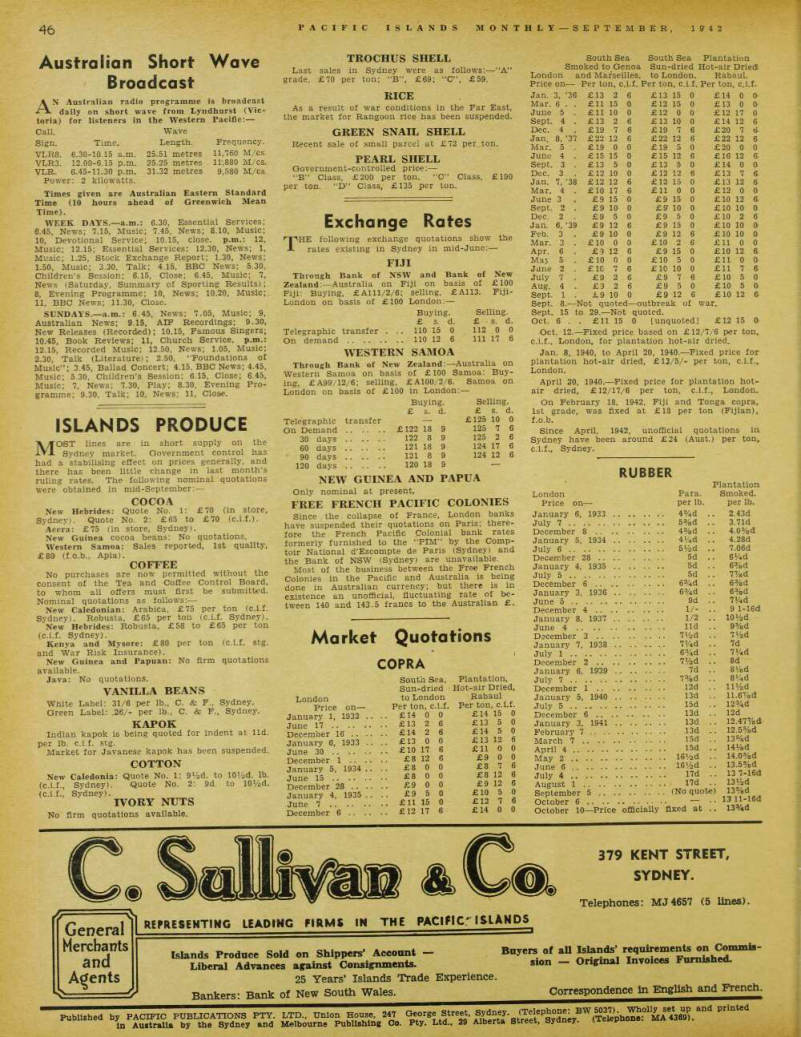
Broadcast
AN Australian radio programme is broadcast daily on short wave from Lyndhurst (Vic toria) for listeners in the Western Pacific: —
Times given are Australian Eastern Standard Time (10 hours ahead of Greenwich Mean Time).
WEEK DAYS.—a.m.: 6.30, Essential Services; 6.45, News; 7.15, Music; 7.45, News; 8.10, Music; 10, Devotional Service; 10.15, close, p.m.: 12, Music; 12.15; Essential Services; 12.30, News; 1, Music; 1.25, Stock Exchange Report; 1.30, News; 1.50, Music; 3.30, Talk; 4.15, BBC News; 5.30, Children’s Session; 6.15, Close; 6.45, Music; 7, News (Saturday, Summary of Sporting Results); 8, Evening Programme; 10, News; 10.20, Music; 11, BBC News; 11.30, Close.
SUNDAYS. —a.m.: 6.45, News; 7.05, Music; 9, Australian News; 9.15, AIF Recordings; 9.30, New Releases (Recorded); 10.15, Famous Singers; 10.45, Book Reviews: 11, Church Service, p.m.: 12.15, Recorded Music; 12.50, News; 1.05, Music; 2.30, Talk (Literature); 2.50, “Foundations of Music”; 3.45, Ballad Concert; 4.15, BBC News; 4.45, Music; 5.30, Children’s Session; 6.15, Close; 6.45, Music; 7, News: 7.30, Play; 8.30, Evening Pro gramme; 9.30, Talk; 10, News; 11, Close.
Call.
Wave Sign.
Time.
Length.
Frequency.
Vlr8.
6.30-10.15 a.m. 25.51 metres 11,760 M/cs.
Vlr3.
12.00-6.15 p.m. 25.25 metres 11,880 M/cs.
Vlr.
6.45-11.30 p.m. 31.32 metres 9,580 M/cs.
Power ■; 2 kilowatts.
Islands Produce
MOST lines are in short supply on the Sydney market. Government control has had a stabilising effect on prices generally, and there has been little change in last month’s ruling rates. The following nominal quotations were obtained in mid-September;—
Cocoa
New Hebrides: Quote No. 1: £7O (in store, Sydney). Quote No. 2: £65 to £7O (c.i.f.).
Accra: £75 (in store, Sydney).
New Guinea cocoa beans: No quotations.
Western Samoa: Sales reported, Ist quality, £BO (f.0.b., Apia).
Coffee
No purchases are now permitted without the consent of the Tea and Coffee Control Board, to whom all offers must first be submitted.
Nominal quotations as follows: — New Caledonian: Arabica, £75 per ton (c.i.f.
Sydney). Robusta. £65 per ton (c.i.f. Sydney).
New Hebrides: Robusta, £5B to £65 per ton (c.i.f. Sydney).
Kenya and Mysore; £BO per ton (c.i.f. stg. and War Risk Insurance).
New Guinea and Papuan: No firm quotations available.
Java: No quotations.
Vanilla Beans
White Label; 31/6 per lb., C. & F., Sydney.
Green Label: .26/- per lb., C. & F.. Sydney.
Kapok
Indian kapok is being quoted for indent at lid. per lb. c.i.f. stg.
Market for Javanese kapok has been suspended.
Cotton
New Caledonia: Quote No. 1: 9V2d. to lb. (c.i.f., Sydney). Quote No. 2: 9d. to lOVad. (c.i.f., Sydney).
Ivory Nuts
No firm quotations available.
Trochus Shell
Last sales in Sydney were as followsA” grade, £7O per ton; “B”, £69; “C”, £59.
Rice
As a result of war conditions in the Far East, the market for Rangoon rice has been suspended.
Green Snail Shell
Recent sale of small parcel at £72 person.
Pearl Shell
Government-controlled price:— “B” Class, £2OO per ton. “C” Class, £l9O per ton. “D” Class, £135 per ton.
Exchange Rates
THE following exchange quotations show the rates existing in Sydney in mid-June: —
Fiji
Through Bank of NSW and Bank of New Zealand;—Australia on Fiji on basis of £lOO Fiji: Buying, £Alll/2/6: selling, £AII3. Fiji- London on basis of £lOO London:—
Western Samoa
Through Bank of New Zealand:—Australia on Western Samoa on basis of £lOO Samoa: Buy ing, £ A9s’/12/6; selling, £AIOO/2/6. Samoa on London on basis of £lOO in London;—
New Guinea And Papua
Only nominal at present.
Free French Pacific Colonies
Since the collapse of France, London banks have suspended their quotations on Paris; there fore the French Pacific Colonial bank rates formerly furnished to the “PIM” by the Comp toir National d’Escompte de Paris (Sydney) and the Bank of NSW (Sydney) are unavailable.
Most of the business between the Free French Colonies in the Pacific and Australia is being done in Australian currency; but there is in existence an unofficial, fluctuating rate of be tween 140 and 143.5 francs to the Australian £.
Buying.
Selling. £ s. d. £ s. d.
Telegraphic transfer . .. 110 15 0 112 0 0 On demand .. 110 12 6 111 17 6
Buying.
Selling. £ s. d. £ s. d.
Telegraphic transfer — £125 10 0 On Demand £122 18 9 125 7 6 30 days 122 8 9 125 2 6 60 days 121 18 9 124 17 6 90 days 121 8 9 124 12 6 120 days 120 18 9 —
Market Quotations
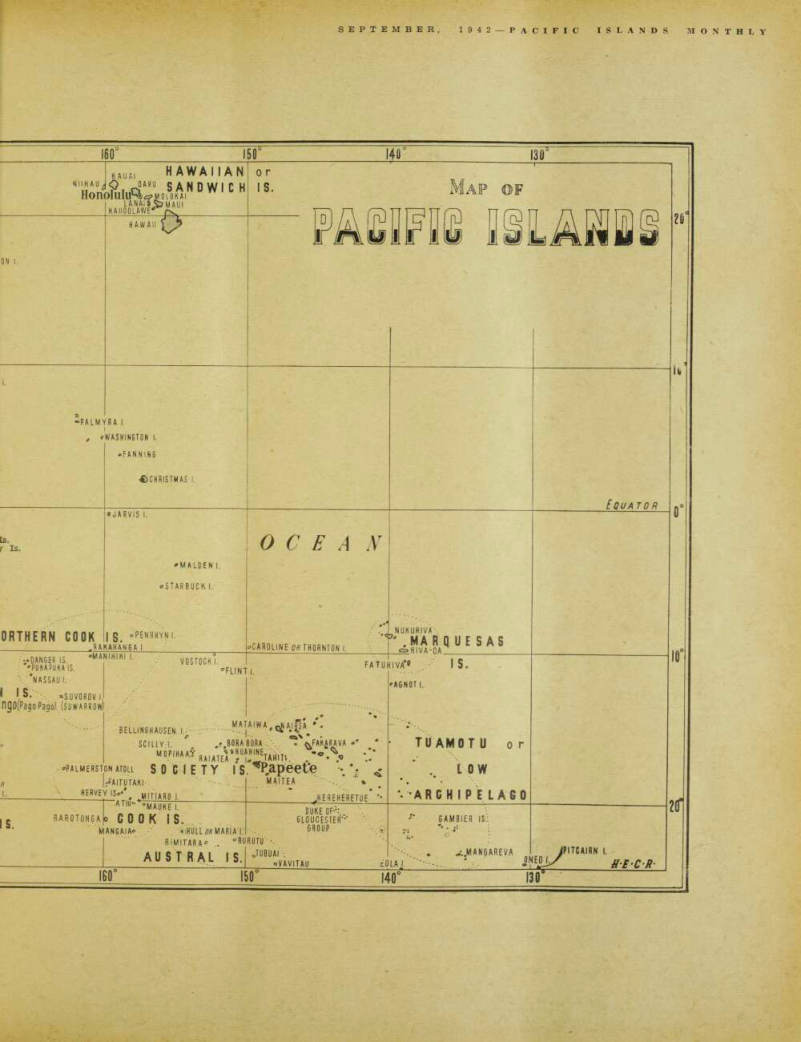
Sept. B.—Not quoted—outbreak of war.
Sept. 15 to 29.—Not quoted.
Oct. 6 . . £ll 15 0 [unquoted] £l2 15 0 Oct. 12. —Fixed price based on £l2/7/6 per ton, c.i.f., London, for plantation hot-air dried.
Jan. 8, 1940, to April 20, 1940. —Fixed price for plantation hot-air dried, £l3/5/- per ton, c.i.f., London.
April 20, 1940. —Fixed price for plantation hot air dried, £l2/17/6 per ton, c.i.f., London.
On February 18, 1942, Fiji and Tonga copra, Ist grade, was fixed at £lB per ton (Fijian), f.o.b.
Since April, 1942, unofficial quotations in Sydney have been around £24 (Aust.) per ton, c.i.f.. Sydney.
Copra
South Sea.
Plantation, Sun-dried Hot-air Dried, London to London Rabaul Price on— Per ton, c.i.f.
Per ton , c.i.f.
January 1, 1932 ,. .. £14 0 0 £14 15 0 June 17 .. £13 2 6 £13 5 0 December 16 .. .. £14 2 6 £14 5 0 January 6, 1933 .. £13 0 0 £13 12 6 June 30 .. £10 17 6 £11 0 0 December 1 .. £8 12 6 £9 0 0 January 5, 1934 .. £8 0 0 £8 7 6 June 15 £8 0 0 £8 12 6 December 28 .. .. £9 0 0 £9 12 6 January 4, 1935 .. £9 5 0 £10 5 0 June 7 .. £11 15 0 £12 7 6 December 6 .. .. .. £12 17 6 £14 0 0
South Sea Smoked to Genoa South Sea Sun-dried Plantation Hot-air Dried London and Marseilles. to London.
Rabaul.
Price on Per ton, c.i.f.
Per ton, c.i.f.
Per ton
, c.i.f.
Jan. 3, ' 36 £13 2 6 £13 15 0 £14 0 0 Mar. 6 . , . £11 15 0 £12 15 0 £13 0 0 June 5 £11 10 0 £12 0 0 £12 17 0 Sept. 4 , £13 2 6 £13 10 0 £14 12 6 Dec. 4 £19 7 6 £19 7 6 £20 7 d Jan. 8, 37 £22 12 6 £22 12 6 £22 12 6 Mar. 5 £19 0 0 £19 5 0 £20 0 0 June 4 . £15 15 0 £15 12 6 £16 12 6 Sept. 3 £13 5 0 £13 5 0 £14 0 0 Dec. 3 £12 10 0 £12 12 6 £13 7 6 Jan. 7, 38 £12 12 6 £12 15 0 £13 12 6 Mar. 4 . £10 17 6 £11 0 0 £12 0 0 June 3 . £9 15 0 £9 15 0 £10 12 6 Sept. 2 . £9 10 0 £9 10 0 £10 10 0 Dec. 2 £9 5 0 £9 5 0 £10 2 6 Jan. 6, '39 £9 12 6 £9 15 0 £10 10 O Feb. 3 £9 10 0 £9 12 6 £10 10 0 Mar. 3 , £10 0 0 £10 2 6 £11 0 0 Apr. 6 £9 12 6 £9 15 0 £10 12 & May 5 . £10 0 0 £10 5 0 £11 0 o June 2 £10 7 6 £10 10 0 £11 7 6 July 7 £9 2 6 £9 7 6 £10 5 0 Aug. 4 . £9 2 6 £9 5 0 £10 5 0 Sept. 1 . £9 10 0 £9 12 6 £10 12 &
Rubber
Plantation London Para.
Smoked.
Price on— per lb. per lb.
January 6, 1933 . 4 3 Ad . 2.43d July 7 3.71d December 8 . . . 4%d . 4.0 %d January 5, 1934 . 4V 4 d . 4.28d July 6 5V 2 d . 7.06d December 28 .. . 5d . 6‘Ad January 4, 1935 . 5d . 6 3 /ad July 5 5d . 7 7 /ad December 6 .. . 6 3 Ad . 6%d January 3, 1936 . 6 3 Ad . 6%d June 5 9d . 7‘Ad December 4 .. . 9 l-16d January 8, 1937 . 1/2 . 10V 2 d June 4 lid . 9%d December 3 .. . 7V 2 d . 7y 2 d January 7, 1938 . 7 J Ad . 7d July 1 6 3 Ad . 7‘Ad December 2 .. . 7%d . 8d January 6, 1939 . 7d . sy 8 d July 7 sy 4 d December 1 .. . 12d ny 2 d January 5, 1940 . 13d . 11.6 7 /ad July 5 15d . 12 3 Ad December 6 .. .. 13d . 12d January 3, 1941 . 13d . 12.47 7 /ad February 7 .. .. 13d . 12.5 5 /ad March 7 15d . 13 5 /ad April 4 15d . 14y a d May 2 16V 2 d . 14.0 s /ad June 6 16V 2 d . 13.5 5 /ad July 4 17d . 13 7-16d August 1 17d . 13‘/ 2 d September 5 .. .
October 6 .. .. (No quote) 13 s /ad — .. 13 ll-16d October 10 —Price officially fixed at . 13 3 Ad
Advertisements & other items, pp. 46-48 (2 items)
46
PACIFIC ISLANDS MONTHLY SEPTEMBER, 1 ? 4 2
Published by PACIFIC PUBLICATIONS PTY. LTD., Union House, 247 Ge°rge Street. Strelt^SydSe y BW «69K Pnnted In Australia by the Sydney and Melbourne Publishing Co. Pty. Ltd., 29 Alberta street, &yu ey. <. v
Agents
c <D
General
Merchants and
Agents
REPRESENTING LEADING FIRMS IN THE ISLANDS
379 KENT STREET,
SYDNEY.
Telephones: MJ4657 (5 lines) Islands Produce Sold on Shippers' Account - Buyers of all Liberal Advances against Consignments. «on - Original Invoices Furnished. 25 Years’ Islands Trade Experience.
Bankers: Bank of New South Wales. Correspondence in English and French.
* ' ■ jy .& ■■: »- Ji J* W ■•» ■H s » 5 .
V •';.' ... * . CLfr ■Mi . & * S ■: ;•>
Travel by CARPENTER AIRLINES
Full particulars from Macdonald, Hamilton Cr Co., or Howard Smith Ltd., Sydney.
W. R. CARPENTER & CO. LTD.
MERCHANTS, SHIPOWNERS AND AIRCRAFT OPERATORS
Agents for Australian, European and American Manufacturers, and Distributors of Every Description of Merchandise.
Buyers and Shippers of Copra, Trocas, and all Classes of Islands Produce. •
AGENTS FOR :
Ford Motor Company of Canada. Caterpillar Tractors, Dodge Brothers Inc.
T. G. & C. Bolinders (Engines). Electrolux Refrigerators. Westinghouse Electrical Co. etc., etc.
Branches throughout the Pacific Islands
In London: W. R. Carpenter & Co. (London) Ltd,, Coronation House, 4 Lloyds Avenue, London, EC.
Head Office: 16 O’CONNELL STREET, SYDNEY