Islands
Pacific
Monthly
June 17, 1943
Vol. Xiii. No, 11.
Established 1930
[Registered at the G.P.0., SMbtejfrfpr transmission by post as a newspaper]
8"
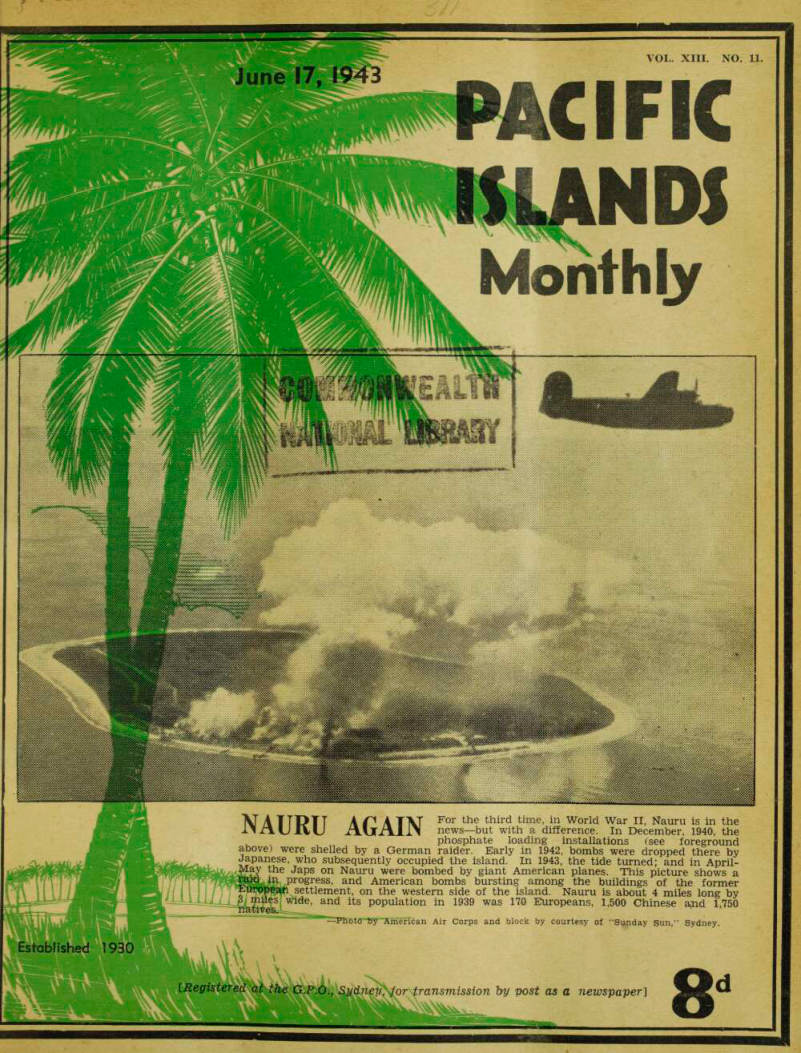
NAURU AGAIN For third time, in World War II, Nauru is in the news—but with a difference. In December, 1940, the phosphate loading installations (see foreground above) were shelled by a German raider. Early in 1942, bombs were dropped there by Japanese, who subsequently occupied the island. In 1943, the tide turned; and in April- May the Japs on Nauru were bombed by giant American planes. This picture shows a raid in progress, and American bombs bursting among the buildings of the former European settlement, on the western side of the island. Nauru is about 4 miles long by 3 milies wide, and its PoP ul ation in 1939 was 170 Europeans, 1,500 Chinese and 1,750 natives -Photo by American Air Corps and block by courtesy of “Sunday Sun," Sydney.
Roll Of Honour
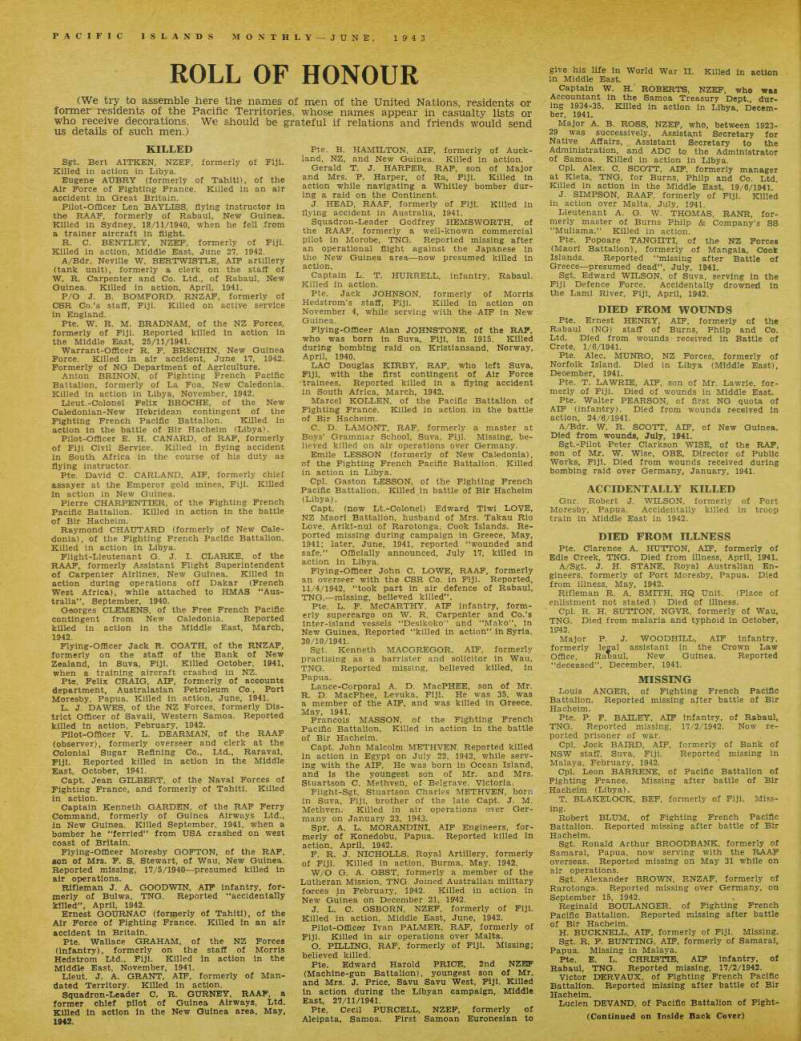
(We try to assemble here the names of men of the United Nations, residents or former residents of the Pacific Territories, whose names appear in casualty lists or who receive decorations. We should be grateful if relations and friends would send us details of such men.)
Killed
Sgt. Bert AITKEN, NZEP, formerly of Fiji.
Killed in action in Libya.
Eugene AUBRY (formerly of Tahiti), of the Air Force of Fighting France. Killed in an air accident in Great Britain.
Pilot-Officer Len BAYLISS, flying instructor in the RAAF, formerly of Rabaul, New Guinea.
Killed in Sydney, 18/11/1940, when he fell from a trainer aircraft in flight.
R. C. BENTLEY, NZEF, formerly of Fiji.
Killed in action, Middle East, June 27, 1942.
A/Bdr. Neville W. BERTWISTLE, AIF artillery (tank unit), formerly a clerk on the staff of W. R. Carpenter and Co. Ltd., of Rabaul, New Guinea. Killed in action, April, 1941.
P/O J. B. BOMFORD, RNZAF, formerly of CSR Co.’s staff, Fiji. Killed on active service in England.
Pte. W. R. M. BRADNAM, of the NZ Forces, formerly of Fiji. Reported killed in action in the Middle East, 25/11/1941.
Warrant-Officer R. F. BRECHIN, New Guinea Force. Killed in air accident, June 17, 1942.
Formerly of NG Department of Agriculture.
Anton BRINON, of Fighting French Pacific Battalion, formerly of La Foa, New Caledonia.
Killed in action in Libya, November, 1942.
Lieut.-Colonel Felix BROCHE, of the New Caledonian-New Hebridean contingent of the Fighting French Pacific Battalion. Killed in action in the battle of Bir Hacheim (Libya).
Pilot-Officer E. H. CANARD, of RAF, formerly of Fiji Civil Service. Killed in flying accident in South Africa in the course of his duty as flying instructor.
Pte. David C. GARLAND, AIF, formerly chief assayer at the Emperor gold mines, Fiji. Killed in action in New Guinea.
Pierre CHARPENTIER, of the Fighting French Pacific Battalion. Killed in action In the battle of Bir Hacheim.
Raymond CHAUTARD (formerly of New Cale donia), of the Fighting French Pacific Battalion.
Killed in action in Libya.
Flight-Lieutenant G. J. I. CLARKE, of the RAAF, formerly Assistant Plight Superintendent of Carpenter Airlines, New Guinea. Killed in action during operations off Dakar (French West Africa), while attached to HMAS “Aus tralia”, September, 1940.
Georges CLEMENS, of the Free French Pacific contingent from New Caledonia. Reported killed in action in the Middle East, March, 1942.
Flying-Officer Jack R. COATH, of the RNZAF, formerly on the staff of the Bank of New Zealand, in Suva, Fiji. Killed October, 1941, when a training aircraft crashed in NZ.
Pte. Felix CRAIG, AIP, formerly of accounts department, Australasian Petroleum Co., Port Moresby, Papua. Killed in action, June, 1941.
L. J. DAWES, of the NZ Forces, formerly Dis trict Officer of Savail, Western Samoa. Reported killed in action, February, 1942.
Pilot-Officer V. L. DEARMAN, of the RAAF (observer), formerly overseer and clerk at the Colonial Sugar Refining Co., Ltd., Raraval, Fiji. Reported killed in action in the Middle East, October, 1941.
Capt. Jean GILBERT, of the Naval Forces of Fighting France, and formerly of Tahiti. Killed in action.
Captain Kenneth GARDEN, of the RAF Ferry Command, formerly of Guinea Airways Ltd., in New Guinea. Killed September, 1941, when a bomber he “ferried” from USA crashed on west coast of Britain.
Flying-Officer Moresby GOPTON, of the RAF. son of Mrs. F. S. Stewart, of Wau, New Guinea.
Reported missing, 17/5/1940 —presumed killed in air operations.
Rifleman J. A. GOODWIN, AIP infantry, for merly of Bulwa, TNG. Reported "accidentally killed”, April, 1942.
Ernest GOURNAC (formerly of Tahiti), of the Air Force of Fighting France. Killed in an air accident in Britain.
Pte. Wallace GRAHAM, of the NZ Forces (infantry), formerly on the staff of Morris Hedstrom Ltd., Fiji. Killed in action in the Middle East, November, 1941.
Lieut. J. A. GRANT, AIF, formerly of Man dated Territory. Killed in action.
Squadron-Leader C. R. GURNEY, RAAF, a former chief pilot of Guinea Airways, Ltd.
Killed in action in the New Guinea area, May, 1942.
Pte. B. HAMILTON, AIP, formerly of Auck land, NZ, and New Guinea. Killed in action.
Gerald T. J. HARPER, RAF, son of Major and Mrs. P. Harper, of Ra, Fiji. Killed in action while navigating a Whitley bomber dur ing a raid on the Continent.
J. HEAD, RAAF, formerly of Fiji. Killed in flying accident in Australia, 1941.
Squadron-Leader Godfrey HEMSWORTH, of the RAAF, formerly a well-known commercial pilot in Morobe, TNG. Reported missing after an operational flight against the Japanese in the New Guinea area—now presumed killed in action.
Captain L. T. HURRELL, infantry, Rabaul.
Killed in action.
Pte. Jack JOHNSON, formerly of Morris Hedstrom’s staff, Fiji. Killed in action on November 4, while serving with the AIF in New Guinea.
Flying-Officer Alan JOHNSTONE, of the RAF, who was born in Suva, Fiji, in 1915. Killed during bombing raid on Kristlansand, Norway, April, 1940.
LAC Douglas KIRBY, RAP, who left Suva, Fiji, with the first contingent of Air Force trainees. Reported killed in a flying accident in South Africa, March, 1942.
Marcel KOLLEN, of the Pacific Battalion of Fighting France. Killed in action in the battle of Bir Hacheim.
C. D. LAMONT, RAF, formerly a master at Boys’ Grammar School, Suva, Fiji. Missing, be lieved killed on air operations over Germany.
Emile LESSON (formerly of New Caledonia), of the Fighting French Pacific Battalion. Killed in action in Libya.
Cpl. Gaston LESSON, of the Fighting French Pacific Battalion. Killed in battle of Bir Hacheim (Libya).
Capt. (now Lt.-Colonel) Edward Tiwi LOVE, NZ Maori Battalion, husband of Mrs. Takau Rio Love, Ariki-nui of Rarotonga, Cook Islands. Re ported missing during campaign in Greece, May, 1941; later, June, 1941, reported “wounded and safe.” Officially announced, July 17, killed in action in Libya.
Flying-Officer John C. LOWE, RAAF, formerly an overseer with the CSR Co. in Fiji. Reported, 11/4/1942, “took part in air defence of Rabaul, TNG, —missing, believed killed”.
Pte. L. F. McCarthy, AIP infantry, form erly supercargo on W. R. Carpenter and Co.’s inter-island vessels “Desikoko” and “Mako”, in New Guinea. Reported “killed in action” in Syria, 30/10/1941.
Sgt. Kenneth MACGREGOR, AIF, formerly practising as a barrister and solicitor in Wau, TNG. Reported missing, believed killed, in Papua.
Lance-Corporal A. D. MacPHEE, son of Mr.
R. D. MacPhee, Levuka, Fiji. He was 35, was a member of the AIP, and was killed in Greece, May, 1941.
Francois MASSON, of the Fighting French Pacific Battalion. Killed in action in the battle of Bir Hacheim.
Capt. John Malcolm METHVEN. Reported killed in action in Egypt on July 22, 1942, while serv ing with the AIF. He was born in Ocean Island, and is the youngest son of Mr. and Mrs.
Stuartson C. Methven, of Belgrave. Victoria.
Flight-Sgt. Stuartson Charles METHVEN, born in Suva, Fiji, brother of the late Capt. J. M.
Methven. Killed in air operations over Ger many on January 23, 1943.
Spr. A. L. MORANDINI, AIP Engineers, for merly of Konedobu, Papua. Reported killed in action. April, 1942.
F. R. J. NICHOLLS, Royal Artillery, formerly of Fiji. Killed in action, Burma, May, 1942.
W/O G. A. OBST, formerly a member of the Lutheran Mission, TNG. Joined Australian military farces in February, 1942. Killed in action in New Guinea on December 21, 1942.
J. L. C. OSBORN, NZEF, formerly of Fiji.
Killed in action, Middle East, June, 1942.
Pilot-Officer Ivan PALMER, RAF, formerly of Fiji. Killed in air operations over Malta.
O. PILLING, RAF, formerly of Fiji. Missing; believed killed.
Pte. Edward Harold PRICE, 2nd NZEF (Machine-gun Battalion), youngest son of Mr. and Mrs. J. Price, Savu Savu West, Fiji. Killed in action during the Libyan campaign, Middle East, 27/11/1941.
Pte. Cecil PURCELL, NZEP. formerly of Aleipata, Samoa. First Samoan Euronesian to
give his life in World War 11. Killed in action in Middle East.
Captain W. H. ROBERTS. NZEP, who was Accountant in the Samoa Treasury Dept., dur ing 1934-35. Killed in action in Libya, Decem ber, 1941.
Major A. B. ROSS, NZEP, who, between 1923- 29 was successively, Assistant Secretary for Native Affairs, Assistant Secretary to the Administration, and ADC to the Administrator of Samoa. Killed in action in Libya.
Cpl. Alex. C. SCOTT, ATP, formerly manager at Kieta, TNG, for Burns, Philp and Co. Ltd.
Killed in action in the Middle East, 19/6/1941.
J. SIMPSON, RAAF, formerly of Fiji. Killed in action over Malta, July, 1941.
Lieutenant A. G. W. THOMAS, RANR, for merly master of Burns Philp & Company’s SS “Muliama.” Killed in action.
Pte. Popoare TANGIITI, of the NZ Forces (Maori Battalion), formerly of Mangaia, Cook Islands. Reported “missing after Battle of Greece—presumed dead”, July, 1941.
Sgt. Edward WILSON, of Suva, serving in the Fiji Defence Force. Accidentally drowned in the Lami River, Fiji, April, 1942.
Died From Wounds
Pte. Ernest HENRY, AIP, formerly of the Rabaul (NG) staff of Burns, Philp and Co.
Ltd. Died from wounds received in Battle of Crete, 1/6/1941.
Pte. Alec. MUNRO, NZ Forces, formerly of Norfolk Island. Died in Libya (Middle East), December, 1941.
Pte. T. LAWRIE, ALP, son of Mr. Lawrie, for merly of Fiji. Died of wounds in Middle East.
Pte. Walter PEARSON, of first NG quota of AIF (infantry). Died from wounds received in action, 24/6/1941.
A/Bdr. W. R. SCOTT, AIP, of New Guinea.
Died from wounds, July, 1941.
Sgt.-Pilot Peter Clarkson WISE, of the RAF. son of Mr. W. Wise, OBE, Director of Public Works, Fiji. Died from wounds received during bombing raid over Germany, January, 1941.
Accidentally Killed
Gnr. Robert J. WILSON, formerly of Port Moresby, Papua. Accidentally killed in troop train in Middle East in 1942.
Died From Illness
Pte. Clarence A. HUTTON, AIP, formerly of Edie Creek, TNG. Died from illness, April, 1941.
A/Sgt. J. H. STANE, Royal Australian En gineers, formerly of Port Moresby, Papua. Died from illness, May, 1942.
Rifleman R. A. SMITH, HQ Unit. (Place of enlistment not stated.) Died of illness.
Cpl. R. H. SUTTON, NGVR, formerly of Wau, TNG. Died from malaria and typhoid in October, 1942.
Major P. J. WOODHILL. AIF Infantry, formerly legal assistant in the Crown Law Office, Rabaul, New Guinea. Reported “deceased”, December, 1941.
Missing
Louis ANGER, of Fighting French Pacific Battalion. Reported missing after battle of Bir Hacheim.
Pte. P. F. BAILEY, AIP infantry, of Rabaul, TNG. Reported missing, 17/2/1942. Now re ported prisoner of war.
Cpl. Jock BAIRD, AIP, formerly of Bank of NSW staff, Suva, Fiji. Reported missing in Malaya, February, 1942.
Cpl. Leon BARRENS, of Pacific Battalion of Fighting Prance. Missing after battle of Bir Hacheim (Libya).
T. BLAKELOCK, BEF, formerly of Fiji. Miss ing.
Robert BLUM, of Fighting French Pacific Battalion. Reported missing after battle of Bir Hacheim.
Sgt. Ronald Arthur BROODBANK, formerly of Samarai, Papua, now serving with the RAAF overseas. Reported missing on May 31 while on air operations.
Sgt. Alexander BROWN, RNZAF, formerly of Rarotonga. Reported missing over Germany, on September 15, 1942.
Reginald BOULANGER, of Fighting French Pacific Battalion. Reported missing after battle of Bir Hacheim.
H. BUCKNELL, AIF, formerly of Fiji. Missing.
Sgt. R. P. BUNTING, AIF, formerly of Samarai, Papua. Missing in Malaya.
Pte. E. L. CHRISTIE, AIF infantry, of Rabaul, TNG. Reported missing, 17/2/1942.
Victor DERVAUX, of Fighting French Pacific Battalion. Reported missing after battle of Bir Hacheim.
Lucien DEVAND, of Pacific Battalion of Flght (Contlnued on Inside Back Cover)
of war at Corinthia, Italy, 8/7/1941.
Pte. Ernest ("Paddy”) McGEADY, NZEF, son of Mrs. J. McGeady, of Suva, Fiji. Reported "missing, believed killed”, after fighting In Libya, January, 1942; reported prisoner of war in Italy, April, 1942.
Cpl. J. H. L. McGUIGAN, of the Field Ambulance, AIF, formerly of the Public Health Department, New Guinea. Officially reported missing at Singapore; unofficially reported a prisoner in Japanese hands. Reported prisoner of war in Malaya, May 24, 1943.
Observer Alex. McKAY, ol the RAAF, formerly of the CSR Co.’s staff, at Penang sugar-mill, Fiji. Reported missing, 27/7/1941; reported prisoner of war in Italy, 26/10/1941.
Pte. Harry MARCHINGTON, of the NZ Forces, formerly of Fiji. Reported prisoner of war after Battle of Crete, 2/12/1941.
Emile mu .LOT, of Pacific Battalion of Fight ing France. Taken prisoner in battle of Bir Hacheim (Libya).
Pte. D. R, PHILLIPS, ALP engineers, formerly of Bulwa, TNG. Reported prisoner of war, June, 1942.
Pte. John O. SMITH, of the NZ Forces, son of Captain Arthur Smith, of the Fiji inter-island vessel "Tui Kauvaro”. Missing after battle of Crete, May, 1941; reported prisoner of war in Germany, 21/10/1941.
Squadron-Leader L, C. SHOPPEE, DSO, RAF, formerly of Edie Creek, New Guinea. Was in Java during Japanese invasion; now pre sumed to be a prisoner of war.
LAC Charles SOLLITT, of the RAAF (wire less operator), son of Mr. and Mrs. O. H.
Sollitt, of Nausori, Fiji. Reported missing after air operations in New Guinea, January, 1942; later, March, 1942, reported rescued from sea by Japanese—now prisoner of war.
Pte. Fred SWAN, NZ Army Medical Corps, formerly of Apia, Western Samoa. Missing after Battle of Crete, August, 1941; reported prisoner of war in Germany, November, 1941.
Signalman J. C. E. SWINBOURNE, 6th Div.
Signals, AIF, formerly of Fiji and the Gilbert & Ellice Islands Colony. Taken prisoner at Crete, June, 1941, now in prison camp at Stalag, VILA, Germany.
Lieut. CLIFF WARREN, of NZEF, serving in the Middle East, and formerly of Morris Hed strom Ltd.’s staff at Ba and Lautoka, Fiji. Re ported prisoner of war.
Mjr. N, WATCH, formerly Dr. Watch, of Rabaul, missing after Japanese invasion of Rabaul. Believed prisoner of war in Japan. Now reported POW in Japan.
Gnr. D. S. WHITCOMBE, NZEF, formerly of Fiji and Tonga. Wounded in Crete and reported prisoner of war in Germany.
Pte. John D. WHITCOMBE, of the NZ Forces, formerly of Levuka, Fiji. Reported prisoner of war in Germany, November, 1941.
Decorations
Squadron-Leader G. U. (“Scotty”) aLLEN,
RAAF, who is well-known in New Guinea and Papua, having been co-pilot on the "Faith in Australia”, on the first official air-mail flight to the Territories in 1934. Awarded the Air Force Cross for his work with Catalina flylng- Ooats in Australia and the Pacific.
Major H, T. ALLEN, A IF, formerly of Wau, Morobe District, TNG. Awarded the OBE.
Squadron-Leader C. A. BASKETT, formerly of Bulolo, TNG. Awarded Distinguished Flying Cross for raids over enemy territory while attached to Hampden bomber squadron in Eng land.
Major W. F. M. CLEMENTS, of the British Solomon Islands Defence Force. Awarded Military Cross for exceptional devotion to duty in a theatre of war.
Sgt. Henry C. S. COTTON, of the RNZAF, who was born in Samoa (his father was Secre tary of Native Affairs during the NZ military occupation). Awarded the Distinguished Flying Cross.
FREDERIC DELAVEUVE, formerly of New Caledonia. Awarded Croix de Guerre, while serving with Fighting French volunteers in Egypt.
Flight-Lieut. R. N. DALKIN, RAAF, formerly of W. R. Carpenter and Co., Ltd., Salamaua, TNG. Awarded the DFC for bombing raids against the Japanese in Koepang area, DEI.
Squadron-Leader R. A. DUNN, RAAF, formerly of Carpenter Airways New Guinea Service.
Awarded the Distinguished Flying Cross for bravery while leading his squadron against the Japanese.
Squadron-Leader C. R. GURNEY, RAAF. for merly of Guinea Airways, Ltd., TNG. Posthu mously awarded the Air Force Cross, for bomb ing raids on Japanese-held ports in New Britain.
Rifleman H. W. FORRESTER, NGVR, formerly of Bulolo, TNG. Awarded the Military Medal for operations against Japanese in New Guinea.
Squadron-Leader Godfrey HEMSWORTH, RAAF, formerly a well-known New Guinea pilot, svho was killed in action against the Japanese In May. Posthumously awarded the Air Force Cross.
LUCIEN HERVOUET, formerly of New Cale donia. Awarded Croix de Guerre while serving with Fighting French volunteers in Egypt.
Lieut. Colin HILL, RANR, of the Australian destroyer, “Waterhen”, formerly second officer on the trans-Pacific liner “Niagara". Awarded the OBE.
Flying-Officer James R. HYDE, of the RAF, formerly a Patrol Officer in Namatanai and Sepik Districts, TNG. Awarded the Distinguished Flying Cross.
Lieut.-Commander A. W. R, McNICOLL, RAN, son of Sir Ramsay McNicoll, Administrator of New Guinea, and Lady McNicoll. Awarded the George Medal.
Petty-Officer PAUL MASON, RANVR, formerly a plantation inspector at Inus, Bougainville, TNG. Awarded American Distinguished Service Cross for "extraordinary heroism in action.”
HENRI MAYER, formerly of New Caledonia.
Awarded Croix de Guerre while serving with Fighting French volunteers in Egypt.
Sgt. Geoffrey MOORE, of the RNZAF, formerly engineer on the NG inter-island vessel "Maiwara” and on the trans-Paciflc liner "Aorangi". Awarded the Distinguished Flying Medal.
ANDRE MORNAGHINI, formerly of New Cale donia. Awarded Croix de Guerre while serving with Fighting French volunteers in Egypt.
Pilot-Officer Pat RICHARDSON, RAF, son of Mr, W. Richardson, formerly of Penang, Fiji.
Awarded the Distinguished Flying Cross.
Commander Alvord S. ROSENTHAL, RAN, son of Major-General Sir Charles Rosenthal, KCB, OMG, DSO, VD, Administrator of Norfolk Island. Awarded the DSO, November, 1941; awarded the Bar to DSO, February, 1942.
F/O Leigh G. VIAL, RAAF. formerly ADO in TNG. Awarded American DSC for outstand ing heroism in New Guinea in September, 1942.
Lieut, George Raymond WORLEDGE, of the RANVR, formerly of Fiji. Awarded the MBE (Military) Mr. Leslie Gill, formerly a well-known planter in New Georgia, British Solomon
Islands, is now carrying out important
work for the Allies in the Central sec tion of the South Pacific.
Mr. Arthur Beavis, of Milne Bay, Papua, has joined the ranks of ANGAU, with the rank of sergeant.
(Continued From Inside Front Cover) ing Prance. Missing after battle of Bir Hacheim (Libya).
Pte. A. Q. DICKSON, AIF infantry, of Rabaul, TNG. Reported “missing, believed wounded”. 17/2/1942.
GELLER, of Fighting French Pacific Battalion. Reported missing after battle of Bir Hacheim.
J. P. GOUZENES, of Fighting French Pacific Battalion. Reported missing after battle of Bir Hacheim.
Chief-Sergeant Francois GRISCOLLI, of Fight ing French Pacific Battalion. Reported missing in Libya in April. Formerly of New Caledonia.
Acting Flight-Lieut. Don A. IRVING, RAAF, formerly chemist in CSR Co., Labasa, Fiji. Miss ing, presumed dead, in air operations over Germany, February 27, 1942.
Pte. Andrew A. (Billo) Johnson, Ngvr.
Reported missing in New Guinea on October 29, 1942.
Georges KABAR, of Fighting French Pacific Battalion. Reported missing after battle of Bir Hacheim.
Henri LANGLOIS, of Pacific Battalion of Fighting France. Missing after battle of Bir Hacheim (Libya).
Numa LETHESER, of Pacific Battalion of Fighting France. Missing after battle of Bir Hacheim (Libya).
Rene LETOCART, of Fighting French Pacific Battalion. Reported missing after battle of Bir Hacheim.
Camille MERCIER, of Fighting French Pacific Battalion. Reported missing after battle of Bir Hacheim.
MOUTRY, of Fighting French Pacific Battalion. Reported missing after battle of Bir Hacheim.
Pte. R. J. PASCOE, AIF infantry, of Rabaul, TNG. Reported missing, 27/1/1942.
Pilot Tom PATTERSON, of the RNZAF, formerly of Levuka, Fiji. Reported missing, in November, 1941, after bombing raid on the Continent.
Henri PAYONNE, of Fighting French Pacific Battalion. Reported missing after battle of Bir Hacheim.
Eugene PENE, of Fighting French Pacific Battalion. Reported missing after battle of Bir Hacheim.
Andre PETRE, of Fighting French Pacific Battalion. Reported missing after battle of Bir Hacheim.
Hector PILLING, RAF, who was born in Fiji and who was the son of Sir Guy Pilling, of Zanzibar (formerly of Fiji). Reported missing, while serving with the Royal Air Force Bomber Command.
Eugene POGNON, of Fighting French Pacific Battalion. Reported missing after battle of Bir Hacheim.
Gnr. Allan H. ROSS, AIF artillery, formerly planter in New Britain, TNG. Reported “miss ing—believed prisoner of war”. 28/9/1941.
ROUDEILLAC, of Fighting French Pacific Battalion. Reported missing after battle of Bir Hacheim.
Pte. William RUPE, of the NZ Forces (Maori Battalion), formerly of Aitutakl, Cook Islands.
Reported “missing after Battle of Greece”, July, 1941.
Pilot James SIMPSON, of the RAF, formerly of Vatukoula, Fiji. Reported missing after air operations over Malta, in the Mediterranean, 1/7/1941.
Pilot-Officer Neville George STOKES, of the RAF, formerly a pilot with Guinea Airways, Ltd., in New Guinea. Reported missing after air operations in Europe, December, 1941.
Reported Missing
Malaya Casualty List, Published 23/7/1942.
Pte. N. H. AMOS, artillery, Port Moresby.
Pte. E. L. CHRISTIE, infantry, Rabaul.
Pte. A. G. DICKSON, infantry, Rabaul.
Pte. A. I. FOLEY, artillery, Port Moresby.
W. 0.2 V. M. I. GORDON, artillery, Wau, New Guinea.
Pte. J. M. HIRSCHEL, infantry, Rabaul.
Pte. J. G. NEWTON, artillery, Port Moresby.
A./Bdr. B. L. J. MEETON, artillery, Rabaul.
Pte. D. M. SPENCE, artillery, Port Moresby.
Australia and Island Stations.
Pte. S. W. HUNTER, infantry, Kokopo.
Wounded
Sgt. Robert ASMUS, of the Fighting French Pacific Battalion. Wounded at Bir Hacheim and evacuated.
Rene AUFANT, of the Fighting French Pacific Battalion. Wounded at Bir Hacheim.
Cpl. Thomas BAMBRIDGE, of the Fighting French Pacific Battalion. Wounded at Bir Hacheim and evacuated.
BERBERE (alias ARESKY), of the Fighting
French Pacific Battalion. Wounded at Bir Hacheim, Henri BERTHELIN, of the Fighting French Pacific Battalion. Wounded at Bir Hacheim.
Pte. V. BLANCO, AIF Infantry, of Thursday Island. Wounded in action, July, 1941.
L/Cpl, J. p. BLENCOWE, AIF infantry, of Rabaul, TNG. Wounded in action, July, 1941.
Jean BRIAL, of the Fighting French Pacific Battalion. Wounded at Bir Hacheim.
Pte. George BUCKNELL, AIF, son of Mr. and Mrs. C. Bucknell, of KoroLevu, Fiji. Wounded in action in Malaya, January, 1942.
Pte. Thomas BYERS, ALP infantry, of Thurs day Island. Wounded in action, May, 1941.
Raymond CHAUTARD, of the Free French Pacific contingent from New Caledonia. Re ported a casualty in the Middle Bast, March, 1942.
Pte. A. J. CORLASS, AIF, formerly of Rabaul.
Wounded in action.
Albert CUBADDA, of the Free French con tingent from New Caledonia. Reported a casualty in the Middle East, March, 1942.
Charles DEVEAUX, of Pacific Battalion of Fighting France. Wounded at battle of Bir Hacheim (Libya).
Sgt. EMERY, formerly of Lae, TNG. Wounded in New Guinea in October, 1942.
Lieut. M. G. EVENSEN, AIF, formerly of Rabaul. Wounded in action.
V. FAIRHALL, 2nd NZEF, formerly of the Treasury Department, Western Samoa. Reported wounded in action, February, 1942.
Paroa FIU, of the Fighting French Pacific Battalion. Wounded at Bir Hacheim and evacuated.
Acting Warrant-Officer V. M. I. GORDON, AIF Infantry, of Wau, TNG. Wounded in action, February, 1942.
Pte. John GRANT, ALP infantry, of New Guinea. Wounded in neck and thigh, September, 1941; later, reported “rejoined unit”.
Henri GUILBAUD, of the Free French Pacific contingent from New Caledonia. Reported a casualty in the Middle East, March, 1942.
Sgt. C. HENDRICK, AIF infantry, of Rabaul, TNG. Wounded in action, July, 1941.
Stanley HIGGS, son of Mr. and Mrs. Gordon Higgs, of W. R. Carpenter and Co. Ltd., New Guinea. Member of an English Lancers’ regiment, wounded during British evacuation from Dun kirk (France), May, 1940.
Lieut. Lloyd T. HURRELL, AIF Infantry, of Rabaul, TNG. Wounded in action, July, 1941, Alexandre HUYARD, of the Free French Pacific contingent from New Caledonia. Reported a casualty in the Middle East, March, 1942.
Sgt.-Pilot Andrew KRONFELD, of the NZ Fighter Squadron attached to the RAF. Wounded in knee during operations over France, December, 1941, Cpl. W. H. LANNEN, AIF artillery, of Rabaul, New Guinea. Wounded in action, June, 1941.
Gnr. E. G. LOBAN, ALP artillery, of Thursday Island. Wounded during campaign in Greece, May, 1941; invalided home after having his left forearm amputated.
Auguste LUTA, of the Fighting French Pacific Battalion. Wounded at Bir Hacheim and evacuated.
A/Sgt. Alastair MACLEAN, ATP Infantry, of Rabaul, New Guinea. Wounded in action, in Libya, June, 1941.
Sgt. J. D. McCLYMONT, NZEF, son of Capt.
D. McClymont, Harbourmaster of Apia, Western Samoa. ■ Wounded in action, November, 1941.
Cpl. R. McKERLIE, AIF, of Yandina, BSI, wounded in face by bomb explosion, April, 1941.
T. MANEA, of the Fighting French Pacific Battalion. Wounded at Bir Hacheim and evacuated.
Jean MERIGNAC, of the Free French Pacific contingent from New Caledonia. Reported a casualty in the Middle East, March, 1942.
Henri MEYER, of the Free French Pacific contingent from New Caledonia. Reported a casualty in the Middle East, March, 1942.
S/Sgt. Graham B. MIRFIELD, AIF engineers, of Rabaul. New Guinea. Wounded in action, Joseph OTHUS, of Pacific Battalion of Fight ing Prance. Wounded in battle of Bir Hacheim (Libya).
Lieut. A. G. PEARCE, AIF, formerly of Salamaua, TNG. Wounded in action.
Pte. L. G. (“Mick”) REECE, AIF. of Bulolo, New Guinea. Wounded in action, July, 1941.
Henri RIVIERE, of the Free French Pacific contingent from New Caledonia. Reported a casualty' in the Middle East, March, 1942.
Pte. H. St. George RYDER, AIF, formerly of Suva, Fiji. Wounded while serving in New Guinea.
A/Cpl. N. K. SAWYER. AIF infantry, of Rabaul, TNG. Wounded in action, July, 1941, July, 1941.
Lieut. Jeffrey SEAGOE, serving with the British forces in the Far East, formerly of Vila,
New Hebrides. Reported “wounded in action”, March, 1942.
John Oswald SMITH, NZEF, formerly of Fiji.
Taken prisoner of war in Greece in April, 1941.
Pte. Lance STAMPER, A IF, formerly school master at Wau, New Guinea. Wounded in action, August, 1941.
Cpl. Raphael TEIHO, of the Fighting French Pacific Battalion. Wounded at Bir Hacheim and evacuated.
Cpl. Terii TERIITUA, of the Fighting French Pacific Battalion. Wounded at Bir Hacheim and evacuated.
Lieut. P. A. TUCKEY, infantry, formerly of New Guinea. Wounded in action.
Pte. Harold G. TURNER, A IF, of Samaral, Eastern Papua. Wounded in action at Bardla (Libya), January, 1941.
Pte. F. D. TWTSS, AIF infantry, of New Guinea. Wounded in action, August, 1941.
Camille VINCENT, of the Free French Pacific contingent from New Caledonia. Reported a casualty in the Middle East, March, 1942.
Driver Don F. WAUCHOPE, AIF. Formerly employed on his brother’s plantation in New Guinea. Wounded in action, July, 1942.
Alex. WINCHESTER, of the Fighting French Pacific Battalion. Wounded at Bir Hacheim.
Pte. K. M. WHITE, AIF, formerly of Bulwa, TNG. Wounded in action.
Sgt.-Pilot W. WRIGHT, of the Australian Spitfire Squadron, attached to the RAP, for merly of New Guinea. Wounded in knee during aerial “dog-fight” over the English Channel, March, 1942.
Prisoners Of War
Lieut. CLARRIE ARCHER. NGVR. Believed prisoner of war in Japan. Reported prisoner of war in February, 1943, in prison camp on island south of Japan.
ALEXANDRE BLACK, of Pacific Battalion of Fighting France. Reported killed in action at Bir Hacheim, now reported prisoner of war.
A/Cpl. Peter W. BOSGARD, AIF Infantry, formerly of the Lands Department, Port Moresby, Papua. Reported prisoner of war at Sulmona, Italy, 29/6/1941; transferred to Bolzano prison camp, September, 1941.
Cpl. J. E. BROAD, NZEF, formerly of Suva, Fiji. Reported prisoner of war.
Andre CHITTY, of Pacific Battalion of Fight ing France. Taken prisoner at battle of Bir Hacheim (Libya).
Sgt. Peter COGGINS, AIF, formerly of Fiji.
Taken prisoner in Malaya, and now reported prisoner of war in Borneo camp.
A/Sgt. A. A. S. COTMAN, AIF infantry, of Abau, Papua. Reported missing—believed prisoner of war, 5/5/1941; reported later. July, 1941, “wounded in chest and head by shrapnel— taken prisoner”.
Pte. J. DALTON, AIF Transport and Supply, formerly of Thursday Island. Reported prisoner of war, April, 1942.
Dick ELMOUR, formerly of New Caledonia, prisoner of war after Dunkirk. Repatriated to Prance in January, 1942, because of health reasons.
Pte. W. G. ECKBLADE, AIF, formerly of Rabaul. Previously reported missing; now re ported missing; believed prisoner of war.
Pilot-Officer George Beilby EVANS, RAAP, son of Mr. and Mrs. Beilby Evans, formerly of Buka Passage, TNG. Reported prisoner of war in Java.
Sgt. Ronald Gemmell-Smith, Raf, For
merly on CSR Co.’s staff, Fiji. Reported prisoner of war in Bengazi, Libya, in November, 1942.
Pte. W. GOSSNER, AIF Infantry, formerly of the BNG Development Co., Port Moresby, Papua.
Reported prisoner of war, Sulmona, Italy. 6/7/1941.
W/OI A. N. GRAY, AIF, formerly of Rabaul, TNG. Reported prisoner of war.
Lieut. J. M. HARCOURT, 2nd NZEF, son of Mr. H. W. Harcourt, formerly Deputy Treasurer in Fiji, Reported “captured in Libya and now prisoner of war”, March, 1942.
S. D. C. KERKHAM, NZEF, son of Mr. R. C.
Kerkham, Suva, Fiji. Reported prisoner of war in September, 1942.
Lieut. JEFF KILNER, NGVR. Believed prisoner of war in Japan.
Gnr. A. L. B. KING, AIF artillery, of Rabaul, TNG. Reported prisoner of war, 29/7/1941.
Lieut. G. G. KINNER, New Guinea Forces, formerly of Rabaul. Reported prisoner of war.
Major E. G. A. LETT, of the East Surrey Regiment, and son of Mr. Lewis Lett, of Port Moresby Papua. Reported prisoner of war in Libya.
A/Cpl. John H. LONERGAN, AIF, Supply and Transport, of New Guinea. Reported prisoner
(Continued on Page 40)
Pacific News-Review
Notes And Comment On
The Progress Of The War
From May 14 To June 14
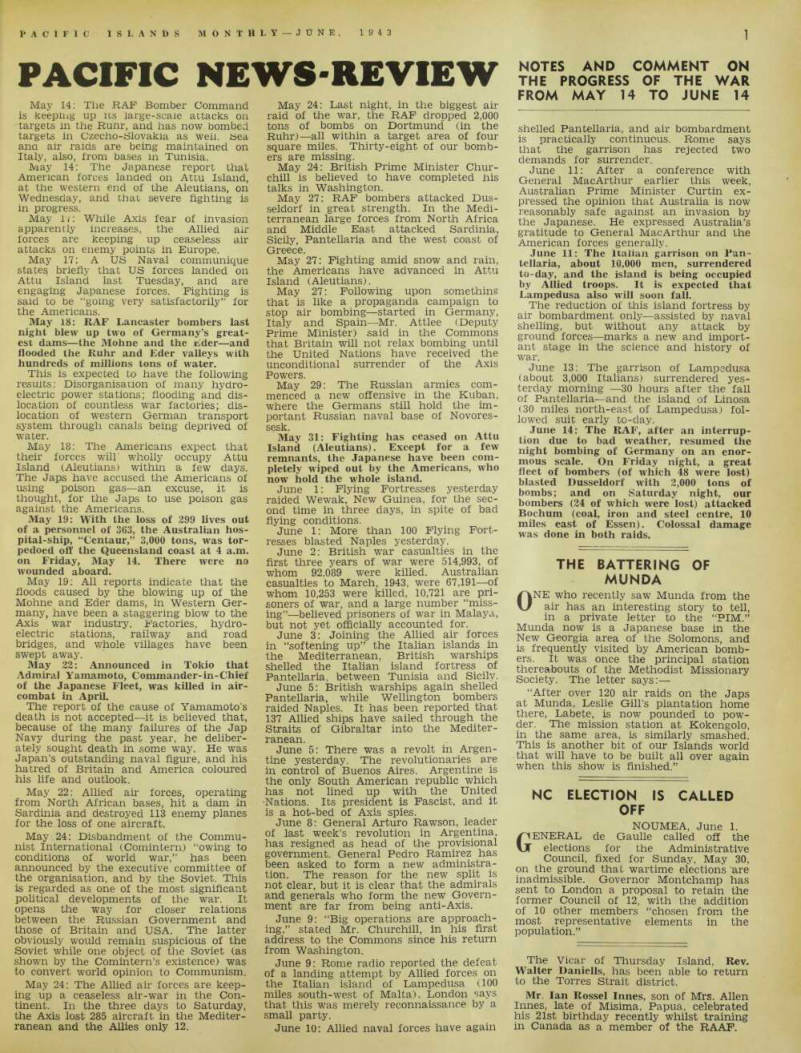
May 14; The RAF Bomber Command is keeping up its large-scale attacks on targets in the Runr, and has now bombed targets in Czecho-Slovakia as well, fciea ana air raids are being maintained on Italy, also, from bases in Tunisia.
May 14: The Japanese report that American forces landed on Attu Island, at the western end of the Aleutians, on Wednesday, and that severe fighting is in progress.
May it: While Axis fear of invasion apparently increases, the Allied air forces are keeping up ceaseless air attacks on enemy points in Europe.
May 17: A US Naval communique states briefly that US forces landed on Attu Island last Tuesday, and are engaging Japanese forces. Fighting is said to be “going very satisfactorily” for the Americans, May 18: RAF Lancaster bombers last night blew up two of Germany’s great est dams—the Mohne and the Eder—and flooded the Ruhr and Eder valleys with hundreds of millions tons of water.
This is expected to have the following results; Disorganisation of many hydro electric power stations; flooding and dis location of countless war factories; dis location of western German transport system through canals being deprived of water.
May 18: The Americans expect that their forces will wholly occupy Attu Island (Aleutians) within a few days.
The Japs have accused the Americans of using poison gas—an excuse, it is thought, for the Japs to use poison gas against the Americans.
May 19: With the loss of 299 lives out of a personnel of 363, the Australian hos pital-ship, “Centaur,” 3,000 tons, was tor pedoed off the Queensland coast at 4 a.m. on Friday, May 14. There were no wounded aboard.
May 19; All reports indicate that the floods caused by the blowing up of the Mohne and Eder dams, in Western Ger many, have been a staggering blow to the Axis war industry. Factories, hydro electric stations, railway and road bridges, and whole villages have been swept away.
May 22: Announced in Tokio that Admiral Yamamoto, Commander-in-Chief of the Japanese Fleet, was killed in air combat in ApriL The report of the cause of Yamamoto's death is not accepted—it is believed that, because of the many failures of the Jap Navy during the past year, he deliber ately sought death in some way. He was Japan’s outstanding naval figure, and his hatred of Britain and America coloured his life and outlook.
May 22: Allied air forces, operating from North African bases, hit a dam In Sardinia and destroyed 113 enemy planes for the loss of one aircraft.
May 24: Disbandment of the Commu nist International (Comintern) “owing to conditions of world war,” has been announced by the executive committee of the organisation, and by the Soviet. This is regarded as one of the most significant political developments of the war. It opens the way for closer relations between the Russian Government and those of Britain and USA. The latter obviously would remain suspicious of the Soviet while one object of the Soviet (as shown by the Comintern’s existence) was to convert world opinion to Communism.
May 24; The Allied air forces are keep ing up a ceaseless air-war in the Con tinent. In the three days to Saturday, the Axis lost 285 aircraft in the Mediter ranean and the Allies only 12.
May 24: Last night, in the biggest air raid of the war, the RAF dropped 2,000 tons of bombs on Dortmund (in the Ruhr) —all within a target area of four square miles. Thirty-eight of our bomb ers are missing.
May 24: British Prime Minister Chur chill is believed to have completed his talks in Washington.
May 27: RAF bombers attacked Dus seldorf in great strength. In the Medi terranean large forces from North Africa and Middle East attacked Sardinia, Sicily, Pantellaria and the west coast of Greece.
May 27: Fighting amid snow and rain, the Americans have advanced in Attu Island (Aleutians).
May 27: Following upon something that is like a propaganda campaign to stop air bombing—started in Germany, Italy and Spain—Mr. Attlee (Deputy Prime Minister) said in the Commons that Britain will not relax bombing until the United Nations have received the unconditional surrender of the Axis Powers.
May 29: The Russian armies com menced a new offensive in the Kuban, where the Germans still hold the im portant Russian naval base of Novores sesk.
May 31: Fighting has ceased on Attu Island (Aleutians). Except for a few remnants, the Japanese have been com pletely wiped out by the Americans, who now hold the whole island.
June 1: Flying Fortresses yesterday raided Wewak, New Guinea, for the sec ond time in three days, in spite of bad flying conditions.
June 1: More than 100 Flying Fort resses blasted Naples yesterday.
June 2: British war casualties in the first three years of war were 514,993, of whom 92,089 were killed. Australian casualties to March, 1943, were 67,191 —of whom 10,253 were killed, 10,721 are pri soners of war, and a large number “miss ing”—believed prisoners of war in Malaya, but not yet officially accounted for.
June 3: Joining the Allied air forces in “softening up” the Italian islands in the Mediterranean, British warships shelled the Italian island fortress of Pantellaria, between Tunisia and Sicily.
June 5: British warships again shelled Pantellaria, while Wellington bombers raided Naples. It has been reported that 137 Allied ships have sailed through the Straits of Gibraltar into the Mediter ranean.
June 5: There was a revolt in Argen tine yesterday. The revolutionaries are in control of Buenos Aires. Argentine is the only South American republic which has not lined up with the United •Nations. Its president is Fascist, and it is a hot-bed of Axis spies.
June 8: General Arturo Rawson, leader of last week’s revolution in Argentina, has resigned as head of the provisional government. General Pedro Ramirez has been asked to form a new administra tion. The reason for the new split is not clear, but it is clear that the admirals and generals who form the new Govern ment are far from being anti-Axis.
June 9: “Big operations are approach ing,” stated Mr. Churchill, in his first address to the Commons since his return from Washington.
June 9: Rome radio reported the defeat of a landing attempt by Allied forces on the Italian island of Lampedusa (100 miles south-west of Malta). London says that this was merely reconnaissance by a small party.
June 10: Allied naval forces have again
shelled Pantellaria, and air bombardment is practically continuous. Rome says that the garrison has rejected two demands for surrender.
June 11: After a conference with General MacArthur earlier this week, Australian Prime Minister Curtin ex pressed the opinion that Australia is now reasonably safe against an invasion by the Japanese. He expressed Australia’s gratitude to General MacArthur and the American forces generally.
June 11; The Italian garrison on Pan tellaria, about 10,000 men, surrendered to-day, and the island is being occupied by Allied troops. It is expected that Lampedusa also will soon fall.
The reduction of this island fortress by air bombardment only—assisted by naval shelling, but without any attack by ground forces —marks a new and import ant stage in the science and history of war.
June 13: The garrison of Lampedusa (about 3,000 Italians) surrendered yes terday morning —3O hours after the fall of Pantellaria —and the island of Linosa (30 miles north-east of Lampedusa) fol lowed suit early to-day.
June 14: The RAF, after an interrup tion due to bad weather, resumed the night bombing of Germany on an enor mous scale. On Friday night, a great fleet of bombers (of which 48 were lost) blasted Dusseldorf with 2,000 tons of bombs; and on Saturday night, our bombers (24 of which were lost) attacked Bochum (coal, iron and steel centre, 10 miles east of Essen). Colossal damage was done in both raids.
The Battering Of
Munda
ONE who recently saw Munda from the air has an interesting story to tell, in a private letter to the “PIM.”
Munda now is a Japanese base in the New Georgia area of the Solomons, and is frequently visited by American bomb ers. It was once the principal station thereabouts of the Methodist Missionary Society. The letter says:— “After over 120 air raids on the Japs at Munda, Leslie Gill’s plantation home there, Labete, is now pounded to pow der. The mission station at Kokengolo, in the same area, is similarly smashed.
This is another bit of our Islands world that will have to be built all over again when this show is finished.”
Nc Election Is Called
Off
Noumea, June 1.
GENERAL de Gaulle called off the elections for the Administrative Council, fixed for Sunday, May 30, on the ground that wartime elections are inadmissible. Governor Montchamp has sent to London a proposal to retain the former Council of 12, with the addition of 10 other members “chosen from the most representative elements in the population.”
The Vicar of Thursday Island, Rev.
Walter Daniells, has been able to return to the Torres Strait district.
Mr. lan Rossel Innes, son of Mrs. Allen Innes, late of Misima, Papua, celebrated his 21st birthday recently whilst training in Canada as a member of the RAAF.
Contents
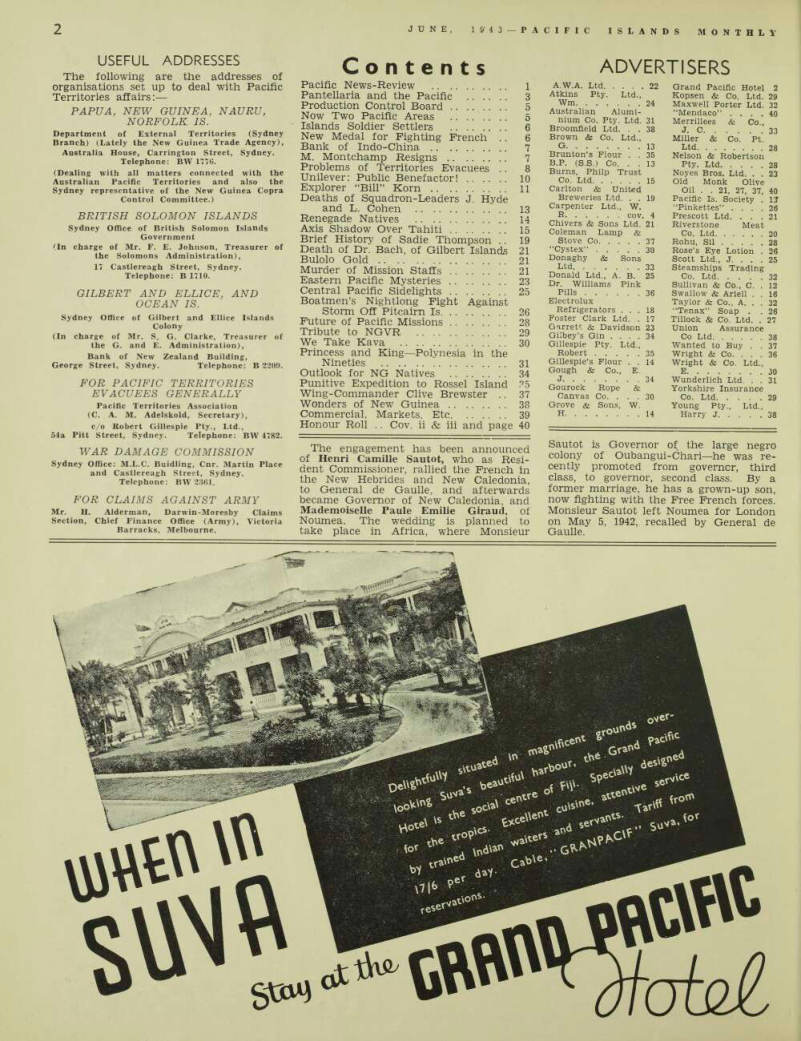
Pacific News-Review 1 Pantellaria and the Pacific 3 Production Control Board 5 Now Two Pacific Areas 5 Islands Soldier Settlers 6 New Medal for Fighting French .. 6 Bank of Indo-China 7 M. Montchamp Resigns 7 Problems of Territories Evacuees .. 8 Unilever: Public Benefactor! 10 Explorer “Bill” Korn 11 Deaths of Squadron-Leaders J. Hyde and L. Cohen 13 Renegade Natives 14 Axis Shadow Over Tahiti 15 Brief History of Sadie Thompson .. 19 Death of Dr. Bach, of Gilbert Islands 21 Bulolo Gold 21 Murder of Mission Staffs 21 Eastern Pacific Mysteries 23 Central Pacific Sidelights 25 Boatmen’s Nightlong Fight Against Storm Off Pitcairn Is 26 Future of Pacific Missions 28 Tribute to NGVR 29 We Take Kava 30 Princess and King—Polynesia in the Nineties 31 Outlook for NG Natives 34 Punitive Expedition to Rossel Island ?5 Wing-Commander Clive Brewster .. 37 Wonders of New Guinea 38 Commercial, Markets. Etc 39 Honour Roll .. Cov. ii & iii and page 40
Advertisers
A.W.A. Ltd 22 Atkins Pty. Ltd., Wm 24 Australian Alumi nium Cos. Pty. Ltd. 31 Broomfield Ltd. . . 38 Brown & Cos. Ltd., G 13 Brunton’s Flour . . 35
B.P. (S.S.) Cos. . . 13
Burns, Philp Trust Cos. Ltd 15 Carlton & United Breweries Ltd. . . 19 Carpenter Ltd., W.
R cov. 4 Chivers & Sons Ltd. 21 Coleman Lamp & Stove Cos 37 “Cystex” 30 Donaghy & Sons Ltd 33 Donald Ltd., A. B. 25 Dr. Williams Pink Pills 36 Electrolux Refrigerators ... 18 Foster Clark Ltd. . 17 Garrett & Davidson 23 Gilbey’s Gin ... 34 Gillespie Pty. Ltd., Robert 35 Gillespie’s Flour . . 14 Gough & Cos., E.
J 34 Gourock Rope & Canvas Cos. ... 30 Grove & Sons, W.
H 14
Grand Pacific Hotel 2 Kopsen & Cos. Ltd. 29 Maxwell Porter Ltd. 32 “Mendaco” ... 40 Merrillees & Cos., J. C 33 Miller & Cos. Pt.
Ltd 28 Nelson & Robertson Pty. Ltd 28 Noyes Bros. Ltd. . . 23 Old Monk Olive Oil . . 21, 27, 37, 40 Pacific Is. Society . 13 “Pinkettes” ... 26 Prescott Ltd. . . .21 Riverstone Meat Cos. Ltd 20 Rohu, Sil 28 Rose’s Eye Lotion . 26 Scott Ltd., J. ... 25 Steamships Trading Cos. Ltd 32 Sullivan & Cos., C. . 12 Swallow & Ariell . . 16 Taylor & Cos., A. , . 32 “Tenax” Soap . . 26 Tillock & Cos. Ltd. . 27 Union Assurance Cos Ltd 38 Wanted to Buy . . 37 Wright & Cos. ... 36 Wright & Cos. Ltd., E 30 Wunderlich Ltd. . . 31 Yorkshire Insurance Cos. Ltd 29 Young Pty., Ltd., Harry J 38
Advertisements & other items, p. 4 (3 items)
Useful Addresses
The following are the addresses of organisations set up to deal with Pacific
Territories affairs:—
PAPUA, NEW GUINEA, NAURU,
NORFOLK IS.
Department of External Territories (Sydney Branch) (Lately the New Guinea Trade Agency), Australia House, Carrington Street, Sydney.
Telephone: BW 1776. (Dealing with all matters connected with the Australian Pacific Territories and also the Sydney representative of the New Guinea Copra Control Committee.)
BRITISH SOLOMON ISLANDS
Sydney Office of British Solomon Islands Government (In charge of Mr. F. E. Johnson, Treasurer of the Solomons Administration), 17 Castlereagh Street, Sydney.
Telephone: B 1710.
GILBERT AND ELLICE, AND
OCEAN IS.
Sydney Office of Gilbert and Ellice Islands Colony (In charge of Mr. S. G. Clarke, Treasurer of the G. and E. Administration), Bank of New Zealand Building, George Street, Sydney. Telephone: B 2209.
FOR PACIFIC TERRITORIES
EVACUEES GENERALLY
Pacific Territories Association (C. A. M. Adelskold, Secretary), c/o Robert Gillespie Pty., Ltd., 54a Pitt Street, Sydney. Telephone: BW 4782.
WAR DAMAGE COMMISSION
Sydney Office: M.L.C. Buidling, Cnr. Martin Place and Castlereagh Street, Sydney.
Telephone: BW 2361.
FOR CLAIMS AGAINST ARMY
Mr. H. Alderman, Darwin-Moresby Claims Section, Chief Finance Office (Army), Victoria Barracks, Melbourne.
. 4W des^ ed
Sautot is Governor of the large negro colony of Oubangui-Chari—he was recently promoted from governor, third class, to governor, second class. By a former marriage, he has a grown-up son, now fighting with the Free French forces.
Monsieur Sautot left Noumea for London on May 5, 1942, recalled by General de Gaulle.
, n to ce "\ Gt»oi paC ' f ' C rt>6 x 0 .r e - rt> k, '“ Svi^ a s
. 4W des^ ed
~«. serv4 ce ce ott e °' atteot' ye , o c»' c c u\s' n » S ° t *ce"** C
\e «°P' CS '
ta t>« <r °"' a „d a '' lS ' * a ttet* „ G^ C
Cab'®'
d»Yfe P e er-jat' 0 " 4 (010S®
The engagement has been announced
of Henri Camille Sautot, who as Resident Commissioner, rallied the French in the New Hebrides and New Caledonia, to General de Gaulle, and afterwards became Governor of New Caledonia, and Mademoiselle Paule Emilie Giraud, of Noumea. The wedding is planned to take place in Africa, where Monsieur
Pacific Islands Monthly
The Newspaper-Magazine of the Sonth Seas [Registered at the G.P.0., Sydney, for transmission by post as a newspaper .]
Published Once Each Month and Circulated in Australia and New Zealand and in the following Pacific Territories and Islands Groups;
Australian Territory of Papua.
Mandated Territory (Australia) of New Guinea.
Australian Territory of Norfolk Island.
New Zealand Territory of Cook Islands.
Mandated Territory (NZ) of Western Samoa.
British Colony of Fiji.
British Solomon Islands Protectorate.
British Protectorate of Tongan Islands.
British Crown Colony of Gilbert and Ellice Islands.
Mandated Territory of Nauru.
British and Free French Condominium of New Hebrides.
Free French Colony of New Caledonia.
Free French Colony of Oceania (Tahiti, etc.).
American Territory of Eastern Samoa.
American Territory of Hawaiian Islands.
Owned and Produced by Pacific Publications Pty. Ltd., Union House, 247 George Street, Sydney.
tttt FPtrnNTr f Managing Director .. BW 5037 TELEPHONE £ Business and Editorial MA 4369
P.O. Box 3408 R
Registered Address of Telegrams, Radiograms, and Cables: “Pacpub”, Sydney,
Contributions.
Articles, Stories, and Photographs dealing with Pacific Islands subjects are invited and will be paid for on publication.
Subscription Rates.
Per Annum, within British Empire, Prepaid, Post Free 8/- Per Annum, elsewhere, prepaid, Post Free. 10/- Slngle Copies Bd.
Editor and Publisher:
R. W. Robson, F.R.G.S.
Advertising Manager: L. W. Bailey.
Advertising Office and Printing-House; 29 Alberta Street, Sydney.
Advertising rates furnished on application.
Colours, etc., by arrangement.
Process Blocks made at Advertiser’s expense when required. Screen 100.
Changes of Advertising Copy should reach this office by Ist of each month, otherwise previous advertisement may be repeated.
Representative In London.
W. C. Harvey, Coronation House, 4 Lloyds Avenue, London, E.C.3, from whom may be obtained copies of Pacific Islands Monthly, Pacific Is. Year Book, advertising schedules, etc.
Agents.
The following are authorised to receive sub scriptions for Pacific Islands Monthly:— Burns, Philp & Co., Ltd., and Burns Phllp (South Sea) Co., Ltd. All branches.
W. R. Carpenter & Co., Ltd. All branches.
Morris, Hedstrom, Ltd. All branches.
Steamships Trading Co., Papua. All branches.
B.N.G. Trading Co., Ltd., Port Moresby, Papua.
J. Muir, Suva, Fiji.
Miss R. Castles, Suva, Fiji.
N. C. Mackenzie Hunt, Wainunu, Bua, Fiji.
Cook Islands Trading Co., Rarotonga, Cook Is.
A. C. Rowland, Papeete, Tahiti.
Islands Branches and Representatives of W. H.
Grove & Sons. Ltd., Auckland, New Zealand.
Ed. Pentecost, Noumea, New Caledonia.
Kerr & Co., Noumea, New Caledonia.
Vol. Xiii. No. 11.
June 17, 1943
Priro f Bd * Per Copy> ' 'ICS £ Prepaid; 8'- p.a.
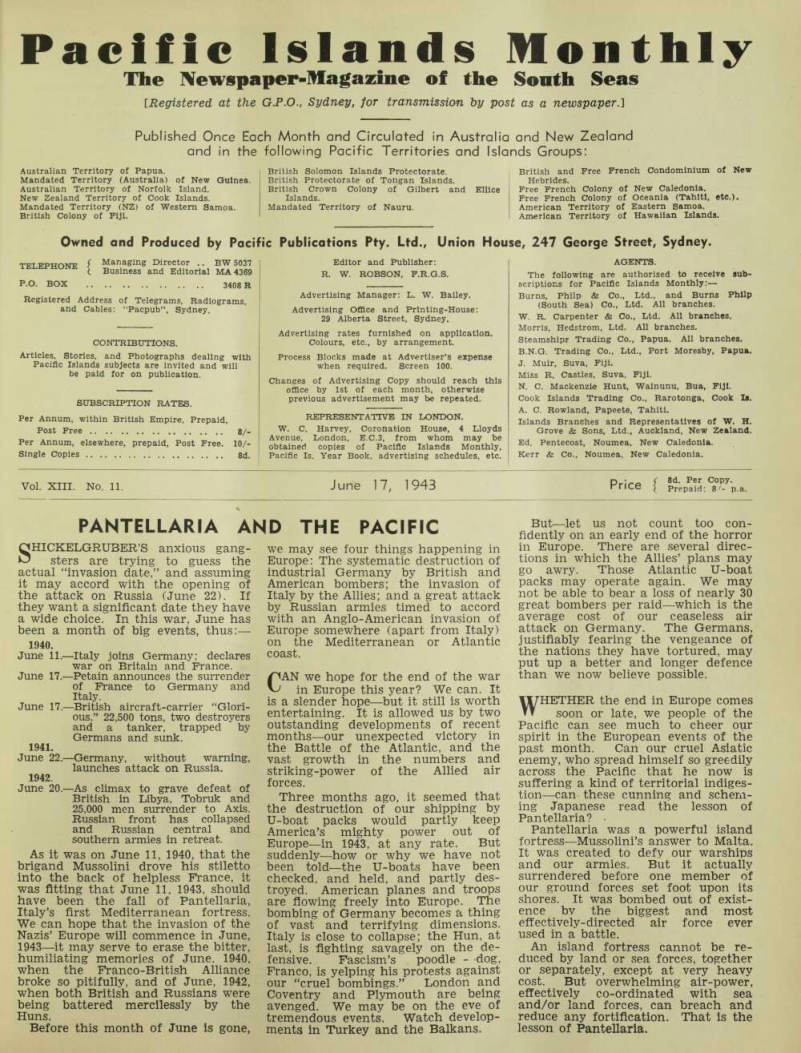
Pantellaria And The Pacific
SHICKELGRUBER’S anxious gang sters are trying to guess the actual “invasion date,” and assuming it may accord with the opening of the attack on Russia (June 22). If they want a significant date they have a wide choice. In this war, June has been a month of big events, thus:— 1940.
June 11.—Italy joins Germany; declares war on Britain and France.
June 17.—Petain announces the surrender of France to Germany and Italy.
June 17.—British aircraft-carrier “Glori ous,” 22,500 tons, two destroyers and a tanker, trapped by Germans and sunk. 1941.
June 22—Germany, without warning, launches attack on Russia. 1942.
June 20. —As climax to grave defeat of British in Libya, Tobruk and 25,000 men surrender to Axis.
Russian front has collapsed and Russian central and southern armies in retreat.
As it was on June 11, 1940, that the brigand Mussolini drove his stiletto into the back of helpless France, it was fitting that June 11, 1943, should have been the fall of Pantellaria, Italy’s first Mediterranean fortress.
We can hope that the invasion of the Nazis’ Europe will commence in June, 1943—it may serve to erase the bitter, humiliating memories of June. 1940, when the Franco-British Alliance broke so pitifully, and of June, 1942, when both British and Russians were being battered mercilessly by the Huns.
Before this month of June is gone,
we may see four things happening in Europe: The systematic destruction of industrial Germany by British and American bombers; the invasion of Italy by the Allies; and a great attack by Russian armies timed to accord with an Anglo-American invasion of Europe somewhere (apart from Italy) on the Mediterranean or Atlantic coast.
CAN we hope for the end of the war in Europe this year? We can. It is a slender hope—but it still is worth entertaining. It is allowed us by two outstanding developments of recent months—our unexpected victory in the Battle of the Atlantic, and the vast growth in the numbers and striking-power of the Allied air forces.
Three months ago, it seemed that the destruction of our shipping by U-boat packs would partly keep America’s mighty power out of Europe—in 1943, at any rate. But suddenly—how or why we have not been told —the U-boats have been checked, and held, and partly des troyed. American planes and troops are flowing freely into Europe. The bombing of Germany becomes a thing of vast and terrifying dimensions.
Italy is close to collapse; the Hun, at last, is fighting savagely on the de fensive. Fascism’s poodle - dog, Franco, is yelping his protests against our “cruel bombings.” London and Coventry and Plymouth are being avenged. We may be on the eve of tremendous events. Watch develop ments in Turkey and the Balkans.
But—let us not count too con fidently on an early end of the horror in Europe. There are several direc tions in which the Allies’ plans may go awry. Those Atlantic U-boat packs may operate again. We may not be able to bear a loss of nearly 30 great bombers per raid—which is the average cost of our ceaseless air attack on Germany. The Germans, justifiably fearing the vengeance of the nations they have tortured, may put up a better and longer defence than we now believe possible.
WHETHER the end in Europe comes soon or late, we people of the Pacific can see much to cheer our spirit in the European events of the past month. Can our cruel Asiatic enemy, who spread himself so greedily across the Pacific that he now is suffering a kind of territorial indiges tion—can these cunning and schem ing Japanese read the lesson of Pantellaria? • Pantellaria was a powerful island fortress—Mussolini’s answer to Malta.
It was created to defy our warships and our armies. But it actually surrendered before one member of our ground forces set foot upon its shores. It was bombed out of exist ence by the biggest and most effectively-directed air force ever used in a battle.
An island fortress cannot be re duced by land or sea forces, together or separately, except at very heavy cost. But overwhelming air-power, effectively co-ordinated with sea and/or land forces, can breach and reduce any fortification. That is the lesson of Pantellaria.
THE Japs have thrown around their new Pacific Islands empire a vast perimeter of defence. Ever since the Coral Sea, Solomon Islands and North-west Papua battles, in mid -1942, turned back their southwards thrusting expeditions, they have been feverishly building fortified bases upon scores and scores of islands, along that 5 000-miles front from the Gilberts to Sumatra. “If you want your Territories back,” says Mr. Tojo, of Tokio, “Come and take them!”
Guadalcanal and Tulagi, Buna and Gona and Attu, showed that the Japs could be thrown out of their forti fications and their foxholes —but at a cost. Were the Allies prepared to the cost of dislodging them from scores of such places? Mr. Tojo calculated that they were not.
Fortunately, speculation on that point is not necessary. The thing that Japan forgot, when she made her far-reaching plan to seize the South east Asian and Pacific countries, was the potential of air-power.
The flying - machine, carrying machine-guns and cannon and bombs, placing its missiles with deadly accuracy, ignores water-barriers, and jungle-barriers, mountains and forti fications; employing high explosive and the law of gravitation, it needs only a good base on land, and a few skilled men, to defeat the finest plans of military and naval technicians. It is doing it in Germany; it has done it in Pantellaria; it can do it in the islands of the Western and North west Pacific.
IT may not be necessary to use military forces to reduce Japan’s innumerable islands fortresses in the Western Pacific. It may not be neces sary to reduce them at all. When a man is attacked bv an octopus he does not exhaust himself in fighting the tentacles —he goes for the head.
Destroy the head, and the tentacles lose their strength and terror.
Japan knows her danger, now.
Tokio is getting jittery. Tokio says that every American bomber that approaches Japan will be destroyed by suicide squads of young Japs, who will hurl their fighting-planes upon the bombers. But America probably anticipated that one, and her answer may be seen, in due course.
Pantellaria, plus the ever-mounting air-power of the Allies, plus the cer tain knowledge that we can over whelmingly outbuild the aircraft factories of the Axis, brings to the beleagured peoples of the Pacific an assurance of victory, and freedom.
But let us not be impatient. We cannot expect to do much more than hold the Jap in the Pacific until Nazi power is destroyed in Europe.
Meanwhile, the Jap is most actively preparing to fight to the end. That he will fight to the end, we can have no doubt. We can only guess at the shape of the strategy which the United Nations will employ against him. We believe it will be based on air-power; but, beyond that, all is guess-work.
We shall not see the full picture in the Pacific until after Schickelgruber and Mussolini have been compulsorily
retired from the business of dictatorship, aggrandisement and the torturing of captive peoples. That may not occur in 1943—though the omens, at the moment, are favourable.
Death Of Mr. C. E. Hill,
Of N. Hebrides
A WELL-KNOWN New Hebrides planter, Mr. Chris. E. Hill, of Emae Island, died in hospital early in May.
He and his wife settled in the New Heb rides about 25 years ago, and, in a life time of hard work, they built up a fine plantation property. In February, 1940, when they were spending a long-awaited holiday in Australia, one of the worst hurricanes ever known struck their part of the New Hebrides and almost com pletely destroyed their plantation home.
A few months later (July, 1940), in a let ter which was published in the “PIM,”
Mr. Hill described what he found on his return, and how he was applying him self to the heartbreaking task of re building and re-planting. “I am not as young as I was when we established this plantation and rebuilt after the hurri cane of 1932,” he wrote. “I sometimes feel that I am not capable of going on with this task.” Now he is dead. He was a good, kindly man—one of the best types of British pioneers, found all over the world.
Corporal W. F. Cullen, of Thursday Island, and Private F. C. Mayo, believed to have been a resident of New Guinea, formerly reported missing, are now reported to be prisoners of war.
Mr. F. W. Burke, formerly of Papua and more recently engaged in an air craft factory in Victoria, is now in the AIF with the rank of sergeant.
Australian Department
Damien Parer
Brilliant Photographer Leaves Australian Department
AMONG several resignations from the staff of the Australian Department of Information—which is not held in much respect by the various organisa tions which seek war information—is that of Mr. Damien Parer, a member of the well-known New Guinea family, who won great kudos as a camera-man with the Australian forces in Libya, Greece, Syria and New Guinea. Some of his work became world-famous—especially his pictures, taken from a plane, of the Battle of the Bismarck Sea.
Probably the notable work of this young man did more than anything else to justify the existence of the Depart ment of Information. It certainly put this young man in the foremost rank of world news photographers.
It appears that young Parer was paid what is. in the circumstances, a very small salary, and, on top of that, his allowances were miserable. He received a whole 25/- per week, for instance, to cover “additional accommodation costs involved when travelling”—for which American photogranhers or correspond ents practically write their own tickets.
Mr. A. F. Parer, now manager of the Plaza Hotel, Sydney, a brother of Damien, told Sydney newspapers that the Department would not even provide Damien with adequate nhoto equipment for his job. He had to borrow from his friends equipment which the Department refused to obtain for him. Lack of proper organisation hindered him at every step.
The Rev, and Mrs. J. W. P. Gillan, of the Presbyterian Mission, New Hebrides, are at present in Melbourne on furlough.
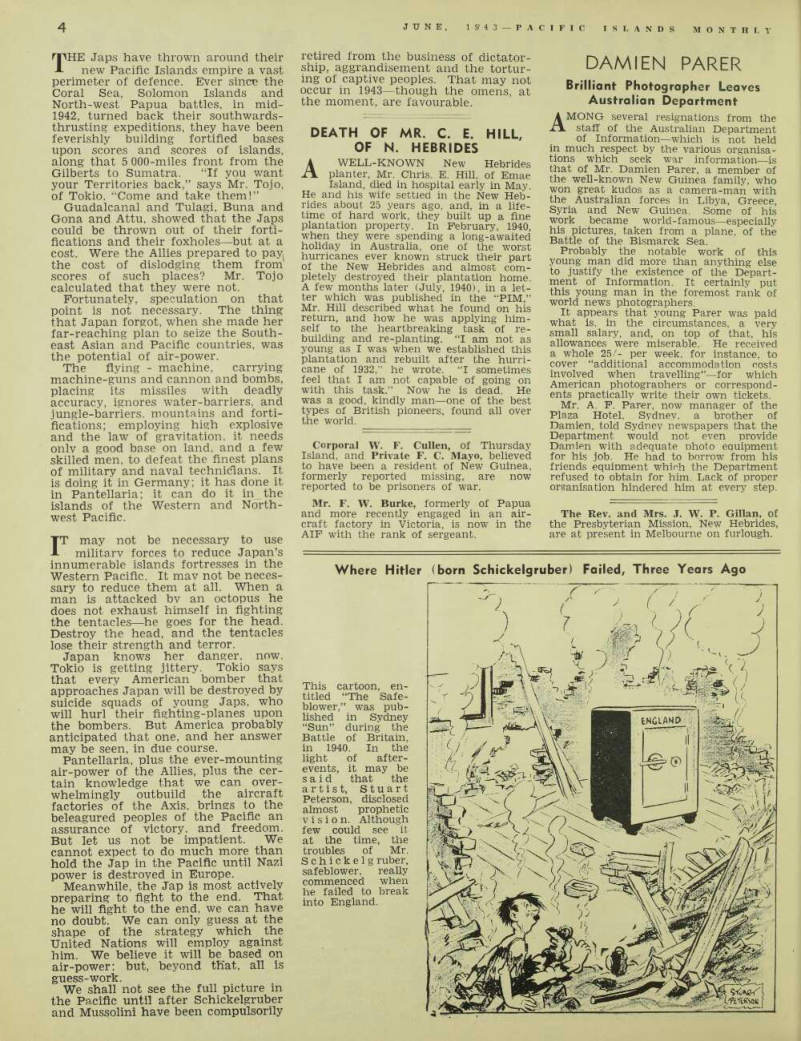
Where Hitler (born Schickelgruber) Failed, Three Years Ago
This cartoon, en titled “The Safe blower,” was pub lished in Sydney “Sun” during the Battle of Britain, in 1940. In the light of after events, it may be said that the artist, Stuart Peterson, disclosed almost prophetic vision. Although few could see it at the time, the troubles of Mr.
Schickelg ruber; safeblower, really commenced when he failed to break into England.
Advertisements & other items, p. 6 (1 item)
4
JUNE, IS’ 43 P ACIFIC ISLANDS MONTHLY
Higher
Central Pacific
Trading
BP (SS) Co. Profits Higher
IN last issue of the “PIM,” we referred to the annual accounts of Burns, Philp & Co., Ltd., which despite the fact that most of its Pacific territories are under enemy or military occupation, showed a net profit of £201,464, which compared favourably with those of recent years.
We now have the annual report of the allied company. Burns, Philp (South Sea) Co., Ltd., which operates in Fiji, Tonga, Samoa and New Hebrides, all of which territories have escaped war damage.
The figures, compared with those of previous years (to January 31. in all cases) are as follow: —
Another £lO,OOO has been added to the general reserve fund, bringing it up to £140.000. The issued capital is £750,000.
The directors (Messrs. James Burns, Lewis Armstrong, R. J. Nosworthy, Joseph Mitchell, P. T. W. Black and Sir Henry Milne Scott) report that, as there are no Government war damage insur ance schemes to cover their territories, provision to cover wartime losses has been made at the various branches.
Net Profit.
Dividend. 1941 .. .. £38,971 5 p.c. 1942 .. . . 45,661 5 p.c. 1943 . . . . 53,243 6]p.c.
First Enemy Bomb on Australian Soil
Australian Soil
THE first bomb to land on Australian soil fell on Kitava Island, Trobriand Group, Eastern Papua—of course, the Mandated Territory was bombed before —on Thursday, January 22, 1942.
The Jap plane flew over the island between 11.30 a.m. and 12.30 p.m., and dropped three bombs. Two fell in the sea and one on land. Then, again, at 3 a.m. on the following Monday (Jan. 26) they dropped three bombs. The eva cuation of the eastern end of Papua started from then.
The only white man settled in Kitava is Mr. C. B. Cameron, who has a coco nut plantation and has been there 30 years. Mr. Cameron is a Tasmanian by birth, and is one of the family that owns Mona Vale, or Calendar House, as it is generally known. The Camerons enter tained George V, when he visited Aus tralia as Duke of York; and Edward VIII. when Prince of Wales, and the present King, when he visited Australia.
Premier Of Tonga
AS some confusion appears to have been caused by an incorrect state ment in this journal early this year, that Prince Tuboutoa had assumed office as Premier of Tonga, we repeat the cor rection published here in May—that High Chief Ata still is Premier of Tonga, and that Prince Tuboutoa is associated with him in the Government as Minis ter for Education.
Production Control Board For Papua
AND N. GUINEA (See also Page 9)
THE new Australian organisation which is to control and stimulate the pro duction of rubber and copra in Papua and New Guinea is called the Australian New Guinea Production Con trol Board (Australian New Guinea is the new official name of the combined Territories.) A full description of the Board’s functions will be found in the May issue of the “PIM”; and there are further details in the report of the Pacific Ter ritories Association meeting (see page 8).
The Board, during this war period, so far as the planters are concerned, is virtually the controller and ruler of the Territories. Its personnel, therefore, is important. It is:— Brigadier D. M. Cleland, MBE, chairman.
Brigadier Cleland, prior to his enlistment in 1939. was a prominent lawyer in Western Aus tralia. He had a distinguished record with the 2nd- AIF in the Middle East, and has been with the forces in New Guinea for some months.
Mr. W. Kirkhope, OBE, Finance.
Mr. Kirkhope has been granted leave from the A IF. He is a chartered accountant of many years’ standing in Victoria, and has served with the Finance Section of the AIF in the Middle East, Australia and New Guinea since 1939, rising to the rank of colonel.
Mr. E. J. Frame, Commerce.
Mr. Frame has had over 20 years’ commer cial experience in Papua, and some months ago was appointed to ANGAU, where he holds the rank of major. He has been granted leave without pay to join the Board. For many years, he was manager of the British New Guinea Development Co., in which Burns, Philp & Co., Ltd., have a controlling interest.
One to be appointed, to be experienced in Tropical Agriculture.
It will be seen that this is a military body, which will work in close associa tion with ANGAU, another military body, now under the command of Major- General Morris.
Most Territorians appear to regard the prospect of the successful operation of this scheme pessimistically. Messrs. Cle land and Kirkhope are unknown to them, and there is nothing to show that these gentlemen understand the peculiar con ditions surrounding the planting indus try in New Guinea. The inclusion of Mr.
Frame in the team gives them some hope, however. He knows New Guinea, and is a man well liked and respected.
If the two first-named are reasonable men, and Canberra, on the one hand, and ANGAU, on the other, leaves the Board alone, to do its job. the plan may work out as desired. But there are many “ifs.”
In Territories affairs, the ways of Can berra are past all understanding. If it was in order to nominate a Burns Philp man, in Mr. Frame, to direct Commerce under the Board, what could be wrong in seeking the services of Mr. A. S.
Fitch, representing the other big trading company in the Territory, to direct Agri culture under the Board?
That would have given a fair and proper balance to the Board, while the Commonwealth would have gained the services of a man well versed in Papuan rubber-growing. Why go outside of Aus tralia for a rubber-growing expert, as apparently is proposed? There are at least three prominent Papuan men —Mr.
Fitch is one of them—any one of whom could worthily fill a place on the Board as the member in charge of Agriculture.
Now Two Pacific
"Areas"
American-Australian in West and American-NZ in East
Adapted from an Address by R. W. Robson, Broadcast by BBC from London on June 8.
NEWSPAPER announcements during the past few days give us a fairly clear picture of the distribution of Australian and New Zealand troops in association with the Americans in the South-western Pacific.
The New Zealanders now have been given responsibility for garrisoning Tonga and Norfolk Island; and there have been New Zealand troops in Fiji since 1939. (Americans, New Zealanders and some very excellent native Fijian units now comprise the garrison of the Colony of Fiji—which, in a strategical sense, is highly important.) New Zealand also is responsible for the administration of Western Samoa and the Cook Islands, to the eastward of Fiji.
We are now advised that there is a New Zealand division with the Ameri cans in New Caledonia, and that troops from Guadalcanal have been sent south wards to New Zealand for recuperation, indicating that New Zealanders actually have joined the Americans in this par ticular battle area.
The fact that New Zealand is garri soning Norfolk Island is very interesting, because Norfolk Island is, and always has been, an Australian territory.
IT would appear that New Zealand, in association with the Americans, is helping to garrison all the islands from about the longitude of Norfolk Island, just eastwards of Australia, right across to French Oceania—because the presence of New Zealand troops has now been reported in Norfolk Island, New Caledonia, Southern Solomons, Tonga and Fiji, and the presence of New Zea landers in the New Zealand territories of Samoa and Cook Islands is presumed.
On the western side of that line of longitude are the islands of the New Guinea and Papua area, where there are Australian troops, also operating in close co-operation with the Americans. It is to be presumed, of course, that Austra lian forces are occupying the whole of northern or tropical Australia, from the Coral Sea right across the Continent to Darwin and Broome, which face the Japs in the Dutch East Indies.
THUS is may be seen that southwards of the equator, in the Pacific, there are actually two separate areas under American control. There is the South-west Pacific area, under General MacArthur, where American and Austra lian forces are operating together in per fect harmony, and which comprises all the region lying between the East Indies, New Guinea, New Britain and the North ern Solomons, in the north, and North ern Australia, in the south. And then there is what may be called the Central Pacific area, garrisoned by Americans and New Zealanders and extending right across the Pacific eastwards from about the longitude of Norfolk Island, and comprising the region generally east wards of Australia, south of the equator.
This division of the Pacific area should be borne in mind. It explains why com muniques relating to the Australian-New Guinea-East Indies front are issued by General MacArthur from his head quarters in the South-west Pacific, while communiques on the Guadalcanal area, and all points north and north-east thereof, are issued in Washington.
Gallant Maori
Wins Vc
IN last “PIM” there was described the extraordinary heroism of a number of men of a Maori Battalion, with the New Zealand forces, in Tdnisia.
When the British were held up by the enemy on a steep hill near El Hamma met, they stormed the hill, and held it, in the face of many counter-attacks.
It since has been disclosed that the gallant leader of that gallant band was Second Lieutenant M. L. A. Ngarimu.
He personally led his men to the top, and personally wiped out two enemy machine-gun posts. He was twice wounded, but refused to leave his men.
Next day, he was killed, while firing his tommy-gun from his hip.
Lieutenant Ngarimu has been post humously awarded the Victoria Cross— the first Maori, and the first Polynesian, to receive what probably is the world’s most coveted medal for bravery.
Spirit Of Fighting
France
Purpose of New Medal
BY a decree dated February 9, General de Gaulle has instituted a medal which has been called the Medaille de la Resistance Francaise. It will be awarded “in recognition of outstanding acts of faith and courage in France, the French Empire or in foreign countries, which have contributed to the resistance of the French people against the enemy or against those who have been accom plices of the enemy since June 18, 1940.”
In the French Colonies this medal will be awarded by the leader of the Fighting French on the recommendation of the National Commissioner for Colonies. The following persons or representative French groups are eligible:— (1) Those who have taken an effective and exemplary part in resisting the invader and his accomplices in national territory. (2) Those who have taken an effective and important part in rallying the French Territories to Fighting France or have rendered signal service in the war effort of those territories. (3) Those who have played an impor tant and active part in organising the Fighting French movement in foreign countries, or in propaganda designed to group together and support the forces of resistance. (4) Those who rallied French troops, the navy or the air force in difficult, dangerous and exceptional circumstances. (5) Those who rejoined the Fighting French forces under circumstances which were particularly dangerous and meri torious.
The Medaille de la Resistance Francaise is to be worn on the left breast of the coat and after the Legion d’Honneur, the Croix de la Liberation, the Medaille Militaire, the Croix de Guerre, 1914-18 and 1939, the Croix de Guerre des T.O.E. and the Medaille des Evades.
Edward Viii Pennies
WE have an inquiry for those Edward VIII pennies, which were minted for circulation in New Guinea, and which became a sort of curio when Edward VIII gave up the throne. Our correspondent says he would buy “large quantities” at 3d. each.
Islands Soldier
Settlers
Vague Plans and Discussions
rE New Guinea Branch of the RSSAILA, which at present func tions in Sydney, is interested in soldier-settlement after the war, as it applies to Papua and New Guinea.
Members are anxious that any land settlement scheme in these Territories should be controlled by those who thor oughly understand the peculiarities of tropical agriculture. With this in view they drew up a list of recommendations, which was forwarded to the Soldier Land Settlement Conference of State represen tatives. which recently concluded its sittings in Melbourne. This Conference was called together by the Returned Sailors’, Soldiers’ and Airmen’s Imperial League of Australia.
The Conference agreed that, in the past. Soldier Land Settlement had been a failure and, with a view to avoiding an other failure, eight recommendations have been made. A draft Bill, embodying these essential principles, will be sub mitted to the Commonwealth Govern ment at an early date. It will be seen that these recommendations do not refer specifically to New Guinea or to any other part of the Commonwealth —but they are the basic principles upon which it is hoped all Soldier Land Settlement in all parts of Commonwealth Territory will be based. As such, they are of in terest to Territorieans generally. The eight recommendations follow: — (1) That any future scheme, in all its phases, be a full Commonwealth re sponsibility. (2) That any interest chargeable shall not exceed 2 per cent. (3) Land shall be secured and allotted to ex-servicemen at a reasonable price. (4) Sufficient capital will be advanced to provide stock, plant, water supply, housing, and all facilities necessary to ensure decent living conditions. (5) Payment of rental and the repay ment of advances shall not commence until the stage of productivity has been reached; and, until it has been reached, adequate sustenance shall be paid. (6) The right type of settler shall be selected, and provision made for his training, where considered necessary and advisable.
(7) Where a settler fails through no fault of his own, he shall not be de barred from further repatriation benefits. (8) Proper care to be taken in the selection and allocation of land, with the object of ensuring that all products shall be marketable and on a profitable basis.
EDITORIAL NOTE; The plan, as far as it goes, is excellent. But it stops short at the most important point—markets.
New Guinea, for example, will grow any thing—cool country stuff on the plateaus, and tropical products in the coastal re gions. But what is the use of establish ing planters to grow things unless the planter and his backers know (a) where their markets are, and (b) what they may expect as fair average returns? What is the use of sending soldier-settlers into the tropics to grow coconuts if the copra market of the world is to continue to be the plaything of the Unilever Combine?
The RSSAILA is starting at the wrong end. Let it, first of all, decide the pro ducts for which there is a fairly regular demand; and then let it work back, through markets, availability and cost of transport, availability of land and labour, to the suitability of the soldier-settler. To start with the soldier-settler, and finish vaguely on production, without any assur ance regarding markets, is simply to re peat the disastrous soldier-settler blunders of the 1919-1925 period.
Death Of Dr. I. M. Bourke
1 NOTICE, in a recent English news paper, an announcement of the death of Isadore McWilliam Bourke. Dr.
Bourke spent some time in British New Guinea and was very well liked, especially by the mining fraternity of Lakekamu.
He was never in that district, but was very interested in the various diseases which the miners had to contend with, and, as a malarial fever specialist, was one of the best-known in those quarters.
He left British New Guinea for the First World War, and was in charge of a very large Tiospital in Cairo. I met him there several times.—J. NIXON WESTWOOD.
The Rev. James Edwards, of the Melanesian Mission, who was in Australia when the Japanese attacked the Solomon Islands, and was therefore unable to re turn to Melanesia, has been doing tem porary work at the Lockhart River Mission. The Bishop of Melanesia now thinks that Mr. Edwards may return to Melanesia shortly.
Rubber From Banyan Trees
South Pacific Base, June 1.
WITH the encouragement of their chiefs, the native tribes of New Caledonia, whom the US Army are changing into industrious citizens, are collecting rubber from banyan trees, to help the United Nations’ war effort. The Army is collecting and paying for it at the rate of 50 francs a kilogramme (a kilogramme is 2.2 lb.).
The rubber is of excellent quality, according to an analysis made in Washington, and among other things it is suitable for using in certain types of bombs. The Army is also making use of the rubber for local purposes in New Caledonia. The supply, of course, is limited. Thirty years ago banyan rubber was produced here commercially for the French market.
The trees are usually situated in isolated groves in the native bush, generally far apart from one another, towards or up in the mountains, and they are known
in some cases only to the older natives, whose bush knowledge is greater than that of the young kanaka of to-day . All over these giant, many-rooted trees incisions are made, and the milk is bled into tins, which the natives attach to the boughs and trunks From these tins it is poured into buckets. Then it is painted in layers on hot, galvanised iron sheets, where it coagulates; after which it is easily rolled into a ball. . .
These natives used to be great cricket players usually throwing the ball instead of bowling it. The balls they use were made of this banyan rubber, and would often bounce to enormous distances. When Sir Leslie Moorshead was a manager of the Orient Line (he is now a famous Australian general) he visited Noumea to arrange for tourist cruises. These banyan rubber-ball cricket matches used to fascinate him, and he could be dragged away from them only with difficulty,
H. E. L. Friday.
M. Montchamp
Resigns Gove rnorship of New Caledonia
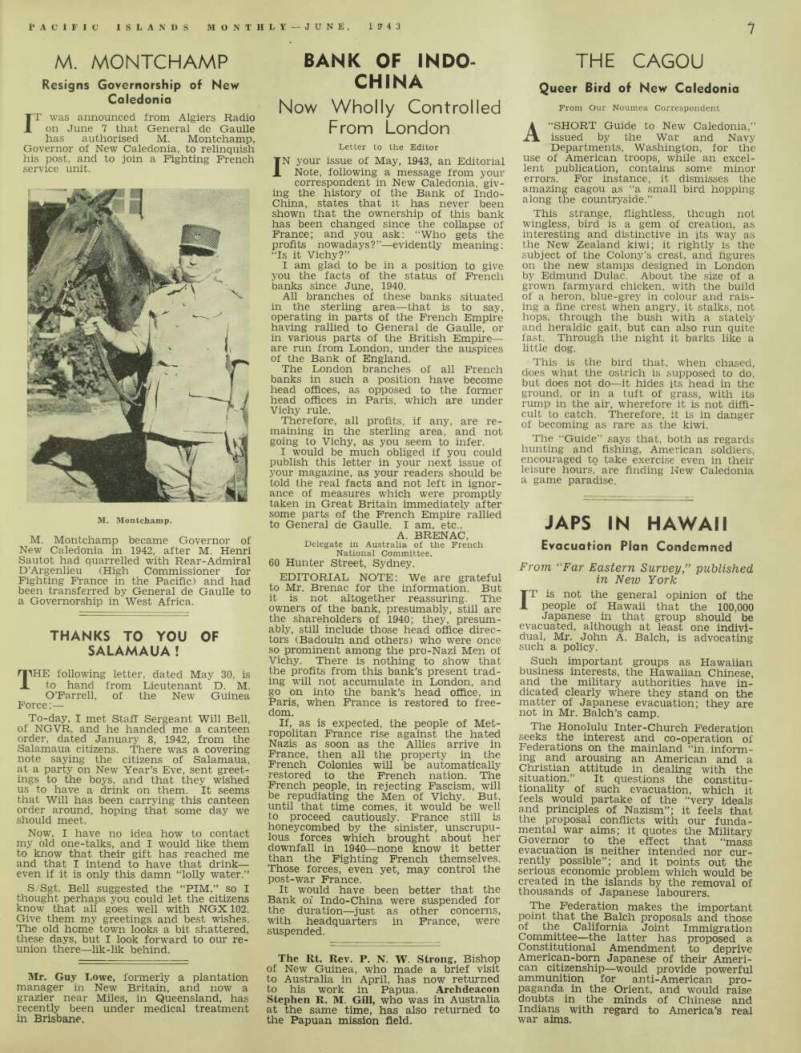
IT was announced from Algiers Radio on June 7 that General de Gaulle has authorised M. Montchamp, Governor of New Caledonia, to relinquish his post, and to join a Fighting French service unit.
M. Montchamp became Governor of New Caledonia in 1942, after M. Henri Sautot had quarrelled with Rear-Admiral D’Argenlieu (High Commissioner for Fighting France in the Pacific) and had been transferred by General de Gaulle to a Governorship in West Africa.
M. Montchamp.
Thanks To You Of
Salamaua!
THE following letter, dated May 30, is to hand from Lieutenant D. M.
O’Farrell, of the New Guinea Force:— To-day, I met Staff Sergeant Will Bell, of NGVR, and he handed me a canteen order, dated January 8, 1942, from the Salamaua citizens. There was a covering note saying the citizens of Salamaua, at a party on New Year’s Eve, sent greet ings to the boys, and that they wished us to have a drink on them. It seems that Will has been carrying this canteen order around, hoping that some day we should meet.
Now, I have no idea how to contact my bid one-talks, and I would like them to know that their gift has reached me and that I intend to have that drink— even if it is only this damn “lolly water.”
S/Sgt. Bell suggested the “PIM,” so I thought perhaps you could let the citizens know that all goes well with NGXIO2.
Give them my greetings and best wishes.
The old home town looks a bit shattered, these days, but I look forward to our re union there—lik-lik behind.
Mr. Guy Lowe, formerly a plantation manager in New Britain, and now a grazier near Miles, in Queensland, has recently been under medical treatment in Brisbane.
Bank Of Indo
China
Now Wholly Controlled From London
Letter to the Editor IN your issue of May, 1943, an Editorial Note, following a message from your correspondent in New Caledonia, giv ing the history of the Bank of Indo china, states that it has never been shown that the ownership of this bank has been changed since the collapse of France; and you ask: “Who gets the profits nowadays?”—evidently meaning: “Is it Vichy?”
I am glad to be in a position to give you the facts of the status of French banks since June, 1940.
All branches of these banks situated in the sterling area—that is to say, operating in parts of the French Empire having rallied to General de Gaulle, or in various parts of the British Empire— are run from London, under the auspices of the Bank of England.
The London branches of all French banks in such a position have become head offices, as opposed to the former head offices in Paris, which are under Vichy rule.
Therefore, all profits, if any, are re maining in the sterling area, and not going to Vichy, as you seem to infer.
I would be much obliged if you could publish this letter in your next issue of your magazine, as your readers should be told the real facts and not left in ignor ance of measures which were promptly taken in Great Britain immediately after some parts of the French Empire rallied to General de Gaulle. I am, etc.,
A. Brenac,
Delegate in Australia of the French National Committee. 60 Hunter Street, Sydney.
EDITORIAL NOTE: We are grateful to Mr. Brenac for the information. But it is not altogether reassuring. The owners of the bank, presumably, still are the shareholders of 1940; they, presum ably, still include those head office direc tors (Badouin and others) who were once so prominent among the pro-Nazi Men of Vichy. There is nothing to show that the profits from this bank’s present trad ing will not accumulate in London, and go on into the bank’s head office, in Paris, when France is restored to free dom.
If, as is expected, the people of Met ropolitan France rise against the hated Nazis as soon as the Allies arrive in France, then all the property in the French Colonies will be automatically restored to the French nation. The French people, in rejecting Fascism, will be repudiating the Men of Vichy. But, until that time comes, it would be well to proceed cautiously. France still is honeycombed by the sinister, unscrupu lous forces which brought about her downfall in 1940—none know it better than the Fighting French themselves.
Those forces, even yet, may control the post-war France.
It would have been better that the Bank of Indo-China were suspended for the duration—just as other concerns, with headquarters in Prance, were suspended.
The Rt. Rev. P. N. W. Strong, Bishop of New Guinea, who made a brief visit to Australia in April, has now returned to his work in Papua. Archdeacon Stephen R. M. Gill, who was in Australia at the same time, has also returned to the Papuan mission field.
The Cagou
Queer Bird of New Caledonia
From Our Noumea Correspondent A “SHORT Guide to New Caledonia,” issued by the War and Navy Departments, Washington, for the use of American troops, while an excel lent publication, contains some minor errors. For instance, it dismisses the amazing cagou as “a small bird hopping along the countryside.”
This strange, flightless, though not wingless, bird is a gem of creation, as interesting and distinctive in its way as the New Zealand kiwi; it rightly is the subject of the Colony’s crest, and figures on the new stamps designed in London by Edmund Dulac. About the size of a grown farmyard chicken, with the build of a heron, blue-grey in colour and rais ing a fine crest when angry, it stalks, not hops, through the bush with a stately and heraldic gait, but can also run quite fast. Through the night it barks like a little dog.
This is the bird that, when chased, does what the ostrich is supposed to do, but does not do —it hides its head in the ground, or in a tuft of grass, with its rump in the air, wherefore it is not diffi cult to catch. Therefore, it is in danger of becoming as rare as the kiwi.
The “Guide” says that, both as regards hunting and fishing, American soldiers, encouraged to take exercise even in their leisure hours, are finding New Caledonia a game paradise.
Japs In Hawaii
Evacuation Plan Condemned
From “Far Eastern Survey,” published in New York IT is not the general opinion of the people of Hawaii that the 100,000 Japanese in that group should be evacuated, although at least one indivi dual, Mr. John A. Balch, is advocating such a policy.
Such important groups as Hawaiian business interests, the Hawaiian Chinese, and the military authorities have in dicated clearly where they stand on the matter of Japanese evacuation; they are not in Mr. Balch’s camp.
The Honolulu Inter-Church Federation seeks the interest and co-operation of Federations on the mainland “in,inform ing and arousing an American and a Christian attitude in dealing with the situation.” It questions the constitu tionality of such evacuation, which it feels would partake of the “very ideals and principles of Nazism”; it feels that the proposal conflicts with our funda mental war aims; it quotes the Military Governor to the effect that “mass evacuation is neither intended nor cur rently possible”; and it points out the serious economic problem which would be created in the islands by the removal of thousands of Japanese labourers.
The Federation makes the important point that the Balch proposals and those of the California Joint Immigration Committee—the latter has proposed a Constitutional Amendment to deprive American-born Japanese of their Ameri can citizenship—would provide powerful ammunition for anti-American pro paganda in the Orient, and would raise doubts in the minds of Chinese and Indians with regard to America's real war aims.
Mrs. Isobel Field Says
Farewell
mHE following letter is to hand from an X old friend, Mrs. Isobel Field, step daughter of Robert Louis Stevenson.
She was with him in Samoa, up to the time of his death on December 3, 1894. and she is herself a notable writer. Mrs.
Field is now a resident of Carpintaria, California, USA:— <c lt is with real regret that I ask you to discontinue sending me the ‘‘PIM. 1 I have taken it for many years, and I have always found it good reading. But my eyes are not strong, and the print of the magazine is too small for me. I have been using a magnifying glass, for I could not resist reading the copies which reached me. But I must not damage my eyes—at my age, 85, I must treat them kindly.”
Rls Cottage In Tahiti
A WELL-KNOWN resident of New Guinea, Mr. B. H. Edgell, now tem porarily a resident of Tasmania, wrote recently to the “PIM":— “When I was in Tahiti in 1936 I visited the village of Tantira and was sorry to see that the cottage in which Robert Louis Stevenson lived and wrote was fall ing into disrepair. I have often thought I should like to move in the matter of having it renovated; but I hardly know how to go about it, especially in a French Colony ... If you care to open a fund and arrange for the work to be done and supervised, I shall be happy to forward a contribution of £3/3/-.”
No Building Material
We referred the matter to two Tahiti gentlemen interested in history—Messrs.
A. C. Rowland and W. W. Bolton. Mr.
Rowland’s reply is interesting:— “We are agreed that, much as we should wish to carry out Mr. Edgell's proposal, building and repairing of houses are undertakings which will have to await the end of the war. Not a stick of lumber, or an iron nail, is available in the whole archipelago. People who are in urgent need of building material are buying up old houses, at very high prices.”
" Picture Night " For
Territorians
THE New Guinea Women’s Club, of Sydney, will hold a “picture night” on Tuesday, June 29, at 8 p.m., in the Radio Theatre, Crystal Palace Arcade, 590 George Street, Sydney (next Century Theatre). The theatre is on the first floor and seats 400 people. The Club hopes to fill all seats; the programme is a good one and proceeds will be in aid of Club funds. The first half of the programme will consist of pictures con cerning New Guinea, and the second of dramatic sketches and musical items.
Tickets are 2/6 each and may be obtained from members of the committee or the Feminist Club, 77 King Street, Sydney.
Information regarding the entertainment or tickets may be obtained by ringing JA 6379. A cordial invitation is extended to all Territorians and their friends and all who are interested in New Guinea.
Annual General Meeting
The annual general meeting of the New Guinea Women’s Club will be held in the Feminist Club Rooms, on Satur day, July 17, at 2 o’clock. All members and intending members are asked to attend to hear a report of the Club’s activities of the past year and to discuss plans for the future.
Problems Of Territories
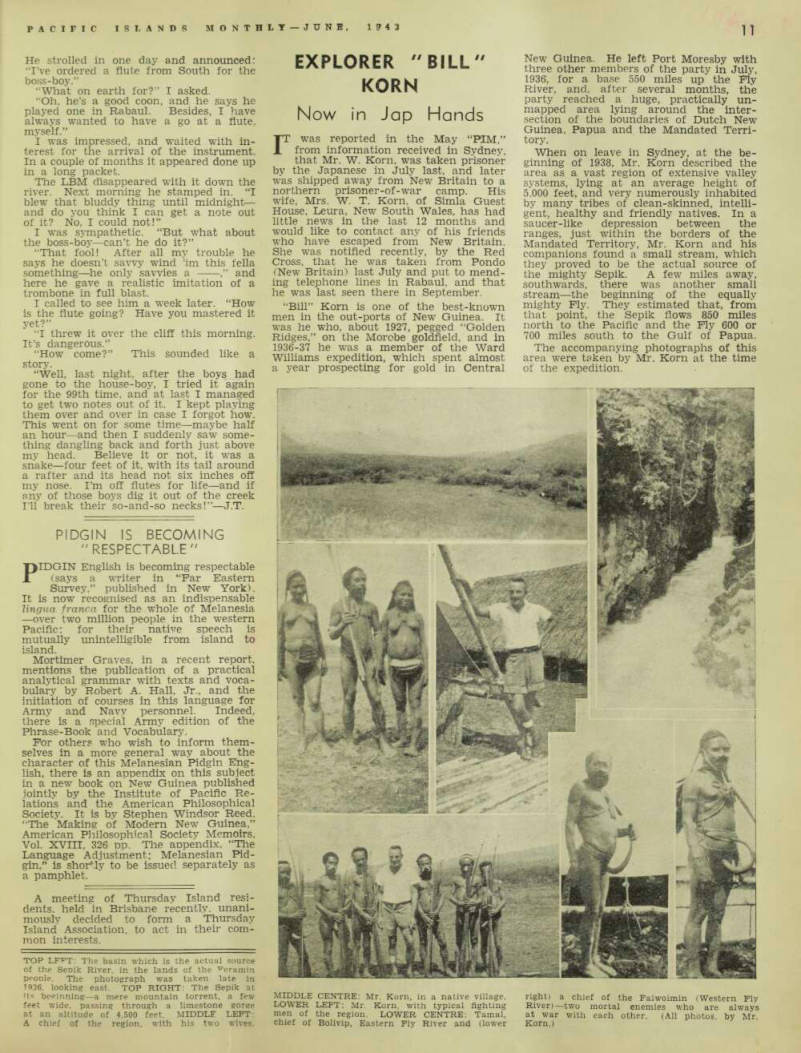
Evacuees
Annual Meeting of the Pacific Territories Association
jyjUCH satisfaction with the good work done by the Executive, but profound dissatisfaction with the treatment of Papua and New Guinea evacuees by an indifferent and unsympathetic Australian Gov ernment, were the key-notes of the discussion at the annual meeting of the members of the Pacific Territories Association held in Sydney on June 9. There were over 100 members present, and the president (Mr.
E. A. James) was in the chair.
A STATEMENT of finance showed that, during the year, nearly £5OO had been received in subscriptions and donations. Two-thirds of this had been spent on legal advice, publicity, costs of meetings, secretary and office, and over £lOO remained on hand. The president warned that, as the Association probably would be compelled to engage legal assistance in their fight for members’ rights, funds would be very necessary in the future.
Mr. A. S. Pitch said that his company (Steamships Trading Co.) would donate £2O to the funds, he personally would donate £lO, and his fellow-director, Mr.
Crisp, would give £5. Mr. S. R. Young, treasurer of the New Guinea Evacuated Miners’ Association, said that his mem bers were in favour of donating all their remaining funds (about £200) to the Pacific Territories' Association, to assist in the good work that was being done.
Other evidence of appreciation of the Association’s good work came at the end of the meeting, when evacuees from the Solomon Islands sought—and were gladly granted—permission to join the Associa tion. It was emphasised that the Association is not confined to evacuees from the Australian territories; its con stitution allowed it to include people from other territories, and to make re presentations on their behalf.
The Years Work
THE president, on behalf of the Exe cutive, submitted the following re port;— During the year, the Executive met on 54 occasions. A considerable amount of time was taken up during the year in deputations to Ministers and others re garding the affairs of the Association.
Among those were:— Conference with the War Damage Commission regarding all aspects of the Regulations as they affect evacuees.
Minister for the Army, Mr. Forde, when the Association’s proposals re garding the return of civilian planters to the Territory of Papua were sub mitted (on 13th July, 1942).
Minister for External Territories, regarding all matters affecting evacuees.
Mr. A. Padden, regarding War Dam age and Industries Control Order No. 4.
Mr. P. C. Spender re payment of military accounts, and particularly as regards the attitude of Mr. H. G.
Alderman.
Mr. H. G. Alderman regarding his decisions in respect to non-payment of rents, basis of arriving at valua tions, and generally.
Numerous delegations consisting of members of the Executive had interviews with Mr. J. R. Halligan (Assistant Secre tary, Department of External Territories) and Executive officers of the War Damage Commission.
The main matters dealt with during the year were:—War Damage Insurance; In dustries Control Order No. 4; return of planters; payment of accounts owing by military authorities; income tax; mortgage bank; civilian prisoners of war and their dependants; post-war reconstruction.
The Executive desire to express thanks to the following firms who have donated various sums to the funds;—Bank of NSW, £lO/10/-; Sandy Creek Gold Sluic ing Co., £10; Koranga Gold Sluicing Co., £5/5/-; Gold & Power, Ltd., £5; Koitaki Para Rubber Estates, Ltd., £lO/10/-; Anglo-Papuan Plantations, Ltd., £2/2/-; Burns Philp & Co., Ltd., £5O.
War Damage Insurance—During
the year many aspects of the War Dam age Insurance Regulations received the attention of the Executive, and in some cases a certain amount of finality has been reached; but it is apparent that the only way in which the Pacific Territories’ residents can be fully and adequately compensated for their losses, will be by the amending of the Regulations to cover the peculiar circumstances of the Terri tories. The main losses, which are not covered by the Regulation, will be “Con sequential,” and in this regard it is not within the scope of the War Damage Commission to make any adjustments in respect to any damage unless as defined in the Regulations. Your Executive are, therefore, pressing the Federal Govern ment to have the necessary amendments made in the Regulations.
The Assessor Panels, on which represen tatives with local knowledge are sitting, are now assessing many of the claims submitted and, from reports received, finality is being reached in quite a num ber of cases, and it is considered that this will assist members, in that they will know what amount they will be due to receive when payments are made, and be credited with interest. Another im portant matter is the deferment of con tributions in cases where the payment of same would entail hardship; and in this regard your Executive are now in com munication with the Chairman of the War Damage Commission, and hope to have a satisfactory reply at an early date.
Industries Control Order No.
4 And Return Of Planters.—As You
are aware, the Federal Govermnent has now issued the necessary Regulations to allow of the planters returning to Papua to manage their estates under the control of a Board to be known as the Australian New Guinea Production Control Board.
The basis of the scheme, now imple
mented, was contained in a memorandum submitted by the Executive to the Minister for the Army (Mr. Forde) on July 13, 1942.
As is only natural, there are a number of matters in the Regulations which are not in conformity with the Association’s recommendations or the opinions of owners, but these, it is hoped, will be straightened out in due course. On this matter a special report, prepared by the planting representatives on the Executive, will be submitted.
Payment Of Military Accounts.
—The clearing up of accounts owing by the military authorities, in respect of rents, goods and chattels regularly im pressed and goods taken by the military authorities, in Australian New Guinea, was placed in the hands of Mr. H. G.
Alderman by the Federal Government.
Apparently, Mr. Alderman has complete power to arrive at his own methods of valuation, and also to define goods for which he will authorise payment; and, in this matter, the Executive has raised ob jections to many of his proposals, particularly in respect to his decision that no rentals will be paid in respect of properties occupied by the military forces.
His method of arriving at the valuation of chattels is not- in accord with any known business practice and is at total variance with the method adopted by the War Damage Commission. Furthermore, Mr. Alderman refuses to consider any claims for looting of certain types of chattels by the members of the forces.
Against these various decisions by Mr.
Alderman we have appealed to the Prime Minister, who has replied that Mr. Alder man’s actions have the approval of the Federal Government. The Executive and other members met Mr. Alderman in Sydney, and he gave a resume of his reasons for valuations, etc. This was not agreed to by the members present .and your Executive are, therefore, obtaining legal opinion on a number of the points.
INCOME TAX.—Your Executive sub mitted to the Federal Treasurer a request that special consideration be given to the position of evacuees in respect to pay ment of income tax. Unfortunately, the Government decided that they could not do anything in regard to evacuees as a body, but each individual case will be treated on its merits, and when it is proved that payment of taxation would cause distress, the Commissioner may allow a reduction in the amount pay able.
Post-War Reconstruction.—At
the request of the Minister for External Territories, your Executive, after consult ing all members, submitted proposals regarding post-war reconstruction in the Territories.
The report of the Executive was for mally approved. The meeting, on the motion of Mr. R, W. Robson, accorded the president, the Executive and the secre tary a very hearty vote of thanks in appreciation of the enormous amount of gratuitous work carried out on behalf of members during the year.
Return Of Planters To
Papua
THE conditions under which planters are being allowed to return to their plantations in Papua, to produce rubber and copra, under the Australian New Guinea Production Control Board, came in for much discussion.
Two reports were submitted by the Papuan and New Guinea planter mem bers of the Executive (Messrs. T. L.
Sefton and E. V. O’Brien).
Mr. Sefton’S Report
I submit a summary of the position regarding the return of planters to Papua, and of the results of interviews, to date,
with the Chairman, the Finance and the Stores and Supply members of the Aus tralian New Guinea Production Control Board, who are respectively—Brigadier D M. Cleland (chairman), Mr. W. Kirkhope (finance), and Mr. E. J. Frame (com merce) .
Provision is made for a member to be appointed to the Board to represent agriculture, but that position has not yet been filled. The Board might for a time perhaps, operate without such an ap pointee and use its powers under the Regulations to co-opt technical or special advisers to the Board from amongst the planters of the Territory. But that is surmise only. Under the Regulations the Board can also delegate its powers and functions to any person or persons in any locality.
Persons wishing to re-enter the Terri tory as lessee of any land, or an employee of a lessee, for the purpose of producing rubber, copra, or any other primary pro ducts, must first make application for permission to return to the Territory to the Secretary, Department of External Territories, setting out his full name, length of former residence in Papua, age. properties in which interested and capacity in which he will be emploved.
All produce must be sold to the Board at a price to be fixed by the Minister.
Any person thus selling who is dissatisfied with such a price fixed by the Minister, may request the Board to refer the price for determination by an arbitrator, ap pointed by the Governor-General.
Native labourers in Papua will be em ployed in accordance with the provisions of the Native Labour Ordinance 1941 of Papua, and those in the Territory of NG made under the provisions of Native Labour Ordinance of that Territory.
We are told that the estates will be handed back to the owner under the pro visions of the Regulation as on July 1, 1943; and owners or their representatives are invited to return prior to that date, to enable them to look over the properties and prepare to take delivery.
The trip to Papua will be first to Townsville by rail, thence to Port Moresbv by ship or air, where all persons will report to the Board. A residence in Konidobu has been set aside to accom modate returning planters while they are in Port Moresby, and will also be used by them more or less as a residential club when they visit Port Moresby on business.
Approval has been given for 16 civilian planters or their representatives to return to the Territory, and for a further 57 planters, overseers or managers to be granted leave without pay from the Army to enable them to work as civilians under their former employers.
We are told that prices to be paid for produce have not yet been definitely fixed, and that when they are announced they may be tentative only, and may be reviewed after a period of 2 or 3 months’ operation by the Board, when it may be found that a higher price can be paid, especially if shipping is better organised and freight costs reduced.
A tentative suggestion from the De partment was a price of 1/5 per pound on the estate for rubber and of between £l5 and £l6 per ton on the estate for copra; but those prices were suggestions only. Arguments were used by producers for higher prices, and it may be that those contentions will carry weight when a definite price is really fixed. All prices paid will be for produce at the usual picking-up point by land or coastal trans port.
It is understood that the Board will virtually act as bankers, and at direction from the owners will transfer surplus proceeds for produce to the owners’ ac counts in Australia, after first deducting any moneys owing to the Board for stores
or services rendered, and for natives' wages accrued each month.
The Board’s attention has been drawn to the fact that the flat rate they pro pose to charge for recruiting, signing on and repatriation of native labourers to and from estates anywhere in the Terri tory is rather unfair to an owner who usually recruited his labour at very little cost.
Statements of the owner’s accounts with the Board will be issued monthly, as in ordinary commercial practice, though there may be a delay in the first month, and until the Board’s office staff is properly organised.
Regarding the price to be paid to owners for the produce acquired by the Army between April 25, 1942, and July 1, 1943, I hope to have something definite this week, after a visit to Canberra. A tentative suggestion from the Department for rubber was 6d. per lb., after deduct ing costs of production, but that is inconsistent with the proposed price to be paid from July 1, under the Board.
No clarification could be drawn from the Department regarding the working of the estates under Industries Control Order No. 4, suspended about November 1, 1942. With regard to copra produced by the Army between April 25, 1942, and July 1, 1943, it appeared that records of production from ANGAU were incom plete, and that cargoes of copra had been landed at various places on the Australian coast, requiring transhipment to its des tination in coastal ships, and total cost of freights was then not available. This position is being inquired into.
The finance member of the Board states that, with regard to men “on leave without pay” from the Army, the legal position is that they have no claim against the Army if injured or killed while on such leave.
The Board, under the Regulations, may take possession of any land in the Terri tory on which operations are not being carried on by the lessee, or are not, in the opinion of the Board, being carried on satisfactorily, and may carry on operations on that land for the produc tion of any primary produce. In such case, compensation would be paid to the owner as fixed by the Minister. Owners would have the right to appeal to an arbitrator, as in other cases.
Regarding the prices to be charged by the Board for stores and supplies, while a price for various items could not be stated, we were told that it was not the wish nor function of the Government to make profits out of us in that direction, and we were given to understand that prices would cover landed cost, handling, distribution and other legitimate percen tages on landed costs.
Mr. O’Brien’S Report
After reviewing the conditions under which owners and their agents and em ployees may return to Papua, I would say that if the same conditions were applied to the Territory of New Guinea at the appropriate time, the following points would have to be clarified:— (1) With reference to paragraph 6 (IV): “Plantation supplies must be obtained from the Board at the price fixed by the Board.” The percentage to be charged on the landed cost of such supplies should be stated, also, and whether the invoices for same will be available at all times for scrutiny by the owners or their agents. (2) Re paragraph 12: The fixing of prices are most important. When the Copra Pool was operating in TNG, the several companies acting as receivers for the Pool were allowed 17/6 per ton to cover storage and handling charges on copra received into their stores. An addi tional 2/6 per ton was reckoned as being
(Continued on Page 32)
ample to cover administrative costs.
Freights ranged from 7 6 per ton to £3 per ton, according to the distance from the port of concentration, lack of com petition and the isolation of the property, etc. For instance, freight charges ruling on the mainland of the TNG by sea, up to January, 1942, were as follows: Alexishafen and inter mediate plantations to Madang 7/6 per ton.
Bogia and intermediate plantations (includnig Kar Kar) to Madang (70 miles) 15/- per ton.
Sepik River and Aitape
Districts to Madang (200 miles) £1 per ton.
Manon (Ninigo Group) to Rabaul (isolated and approx. 450 miles) £3 per ton.
The freight rate on copra from Port Moresby to Sydney has recently been increased from 25/- to 50/- per ton and 35 per cent, surcharge, making a new rate of £3/7/6 per ton. In view of this, I am of the opinion that the maximum freight to be fixed by the Board of Con trol for concentrating plantation produce in Papua at the port of shipment should not exceed £2 per ton. (Mr. Fitch inter
jected that the new rate to Sydney was 60/-, not 50/- per ton.) (3) Re paragraph 14: It is imperative that the owners or their agents should have the same rights, in engaging and terminating the services of their em ployees, as they enjoyed in normal times, as by reason of their expert knowledge of the production of rubber and copra they are the best judges of the capacity of their employees.
Discussion
Mr. Fitch said that many matters had to be cleared up as between the planters and those who administer the Regu lations, before the operation of the plantations became practicable. For in stance, the planters might go back and put their driers and equipment in order, and produce copra; but there was no guarantee as to when their copra would be picked up and when they would be paid for it. Under private ownership, stores were delivered as close to the plan tations as possible—transport was a very important item of cost. Could they de pend upon that under Government control? Or would stores be dumped somewhere in the district, and the planter have to bear the cost of going and pick ing them up? The Board should pay for the copra when the planter reported that the copra was ready for shipment— otherwise there inevitably would be con fusion and loss. (Applause.) The chairman: That is a very important point. We can only hope that these matters will be understood and ap preciated by the Board. When the Board was first suggested, I was in favour of it, because I thought it would be better than purely military control—l thought it would comprise at least some nominees of the owners.
A member: Is it proposed to make any allowance or advance to owners, to en able them to put their plantations into order again, and finance their operations until such time as they are getting some payment for their produce?
Mr. Sefton: That matter was brought up when we saw Brigadier Cleland and Mr. Halligan. They said that it was to be presumed that the Board would have to carry the lag—that is, the cost of getting the plantations into order and waiting for payments. It is a matter that I hope to discuss further in Canberra this week. (Later: Mr. Sefton visited Canberra on June 11 but received no further infor mation.) Mr. Roy Staker: Why does the Commonwealth Government, in this matter, not adopt the principle put into operation by the British Government in its purchase of Australian wool —that is, give a definite guarantee of prompt pay ment of certain rates for all rubber and copra produced during the war period, and for a year afterwards. Then planters would know what they were doing, Mr. Fitch said he had made that very suggestion, based on the Australian wool guarantee, to the Minister for the Terri tories in a letter only a few days ago.
Mr. Jewell said they might assume, for the present, that all supplies required for the plantations would be delivered by coastal vessel, and that such vessels would bring back all plantation produce.
Mr. Fitch: One can take nothing for granted when dealing with Governments and Boards. Anyway, a good many plan tations are not on the coast; they are in land.
The chairman said there was serious confusion regarding the power of the Board to control plantation staffs, both European and native. It seemed that owners would not have the right to en gage or dismiss their white employees; and, according to one reading of the
Regulations, the Board seemed to have the same power over native labourers.
Mr. Fitch: I can see an endless amount of trouble in this section of the Regu lations. It will be impossible to run plantations properly if owners are not to have control over their staffs. All this is due to the fact that these Canberra officials drew up the Regulations without any consultation with practical and ex perienced men. These points should be cleared up before the planters consent to return. (Applause.)
Missing Gold
A MEMBER asked why the authorities had permitted the removal of gold from New Guinea in large quan tities, while the small parcels of gold had been held back, and had now apparently disappeared. The gold accumulated by Bulolo and New Guinea Goldfields up to the time of evacuation had been brought out; but gold parcels belonging to the “small men,” transport of which had been refused at the time of the evacuation, had been lost.
The secretary: No one seems to know what has happened to those gold parcels —there are all sorts of stories —but it seems to have disappeared. I suppose it will have to be claimed for under insur ance.
Voices: No—they are saying now that gold lost like that is not direct war dam age, and cannot be claimed for.
Mr. Bellamy; The whole position is a scandal —the little men were not allowed to bring their gold out, but the big fellows were—and so the little fellows are the losers.
Mr. Hinks: I do not think that that gold is an insurable loss, according to present regulations.
Mr. Young: While I was at Wau, dur ing the evacuation, I saw Perriman and Sedgers and a policeman taking the gold from the passengers going in the planes, and locking it up in Mandated Airlines safe —they were cutting down the weight, they said. What became of those parcels?
Voices: Were receipts given for the gold.
Mr. Young: I do not think so.
The Executive was asked to inquire further concerning the missing gold parcels, and to urge that this was a loss that should be recovered as insurable war damage.
Flea For Rabaul Prisoners
THE president reported that the follow ing letter had been sent to the Prime Minister of Australia: — “We beg to bring to your attention the urgent need for the immediate formu lation of a general policy of assistance and rehabilitation for the New Guinea
civilian prisoners in Japanese hands— r and their families.
“The circumstances surrounding the capture of these men are perhaps un known to you, and we feel sure you will agree that assistance to them is as deserving and urgent as that required for the men of the services.
“In December, 1941, all white women and children in New Guinea were com pulsorily evacuated to Australia; but no provision was made for the removal of civilian men (as was done in Papua) although we believe opportunities did occur, immediately before the Japanese occupation; but they were not taken ad vantage of by the Administration—and the civilians were left with the soldiers to do such duties required of them in the sudden state of emergency.
“When the invasion of Rabaul took place on 22nd January, they were officially told ‘they could either surrender or “go bush.” ’
“The male community consisted of members of the Defence Forces, members of the Civil Service, and men engaged in industrial occupations. All these men (soldiers and civilians) were in exactly the same position on the arrival of the Japanese forces. Some of these men surrendered, some escaped to Australia; but a number of them fell into enemy hands and became ‘prisoners of war’ and as such a national responsibility.
“We would, therefore, submit, as a very just claim, that these civilians, and their wives and families, should be placed in all respects on the same basis of relief as soldiers of the AlF—to be considered on these points:— “(1) Medical care and attention after repatration—and pension if dis abled or injured in 'any way as direct result of the treatment re ceived as prisoners—or from long suffering as fugitives in the bush —on soldiers’ terms, “(2) That they be eligible to share in plans for rehabilitation and land settlement—as applied to the mem bers of the forces.
“(3) That a minimum allotment and separation allowance to wives and children be granted—irrespective of the wife’s earning capacity.
“(4) Their children to receive educa tional benefits and share oppor tunities in post-war reconstruction plans equal to those of soldiers’ children.
“We, therefore, respectfully ask that under the circumstances the same con sideration and policy of relief be accorded to these men, and their depen dants, as is being given to the members of the fighting forces who have become prisoners of war.”
The only reply was that the matter was
receiving consideration.
About Mr. Alderman
THE meeting, with much asperity and at considerable length, discussed the activities of Mr. H. G. Alderman (the Adelaide barrister who has been given plenary powers by the Common wealth Government in connection with the “settlement” of claims against the Army in Papua and New Guinea)—and especially his attitude towards claimants generally.
The attitude of Mr. Alderman was in dicated in the following extracts from a letter which he wrote on March 6, 1943: RENT. —I shall not authorise any payments for rent of premises in or near Port Moresby. I shall advise the Government—and I believe that that advice will be accepted—that no compen sation should be made for the occupation of your premises from sth February, 1942, until such times as the areas ceases to be evacuated.
If the Commonwealth undertakes, as it will, to restore your premises to the same condition as they were in when the forces first occupied them (excluding the effect of such war damage as is covered by the War Damage Commission) you will not suffer any “loss or damage” by reason of the occupation. On the contrary, your pre mises will be in a better condition because, if they suffered from nothing worse than lack of
(Continued on Page 36)
Fijian Decorated for Bravery
IT was announced in Suva, on May 25, that the King has awarded the British Empire Medal to Private Ramelusi Dri Ma, of the Fiji Labour Corps, for conspicuous bravery and de votion to duty.
Last December while he was employed as a winchman, lifting cargo from a barge to a ship, a mobile repair van got out of control and swayed wildly, with the rolling of the ship.
Disregarding his own safety, Ramelusi remained at his winch, ducking as the vehicle swayed overhead, gradually lower ing it until it was level with the hatch combings and then into the hold, where it could be secured. If he had left the winch the loading gear could not have borne the strain for very long, and serious loss of life and damage would have re sulted if the van had crashed into either the ship or the barge.
The Rev. Ernest Clarke, of the Methodist Overseas Mission, Papua, is at present doing deputation work in the Wimmera district in Victoria.
Dr. Frederick James Williams has been registered as a medical practitioner in the Colony of Fiji.
Sister Dorothea Tomkins, of the New Guinea Anglican Mission, has undertaken temporary service at the Yarrabah Mission, and will be in charge of the hospital until her return to New Guinea.
use, they would deteriorate substantially. You could not let them privately. In another evacuated area, owners have offered free occu pation of their premises in exchange for a similar undertaking. The undertaking will apply to tanks, stoves and other fixtures which are ordinarily regarded as being part of the land or building.
FURNITURE.—Most of the places in, or near, Port Moresby are empty of the chattels which belonged there, some having been stolen. Some have been used. An owner, left without his strict legal rights would, probably, not be able to establish a claim, because he could seldom trace his goods. Stolen goods will not be paid for. To do so, would establish a far-reaching principle which is unsound. I have, therefore, notionally divided the contents of each building into three categories or classes; —(a) Chattels which can be shown (by receipt or otherwise) to have been taken officially, if somewhat irregularly; (b) chattels which are more likely to have been the object of theft or vandalism; (ci chattels which are likely to have been used officially, but without due form.
For chattels in category (a) we shall, of course, pay. For goods in class (b) I shall not authorise payment. In this category are cloth ing, jewellery and personal effects, picture books, brassware and other vases and ornaments, light shades, curtains, blinds, decorations, wireless sets, pianos, musical instruments and tools. Also included in this category are poultry, foodstuffs, benzine and consumable goods in houses. I shall treat all those as being stolen until it is reason ably proved that they are within class (a).
I am, for the present, willing to assume that all the furniture and other effects (including any refrigerator) belonging to you in or near Port Moresby are in category (c). On that assumption I offer you £225 for all your chattels in this class and in full settlement of all claims you may have arising out of their use by the Commonwealth.
Your rights as regards chattels in class (b) are not affected. You can still claim against the Commonwealth if it should ever appear that the chattels are within class (a) or against any person who has wrongfully converted them.
The amount of the offer is based on a valua tion of the goods as second-hand goods at the time when they were taken over—if they were taken over. The considerable depreciation in their value caused by the evacuation and the bombing is an indirect consequence of war. I cannot compensate for that. I am merely act ing on behalf of the Commonwealth as a buyer of goods.
MOTOR CAR.—I intend to have further valua tions made of all motor vehicles used by the forces in Moresby. They will be made by an independent Brisbane expert.
In reply to an inquiry, Mr. Alderman had stated that all his decisions were
reported to the War Damage Commission,
and, once he had adjudicated upon a claim and the claimant had accepted his decision, the claimant could make no further claim upon the War Damage Commission. His decisions were based upon the utilitarian value of the article
or service, from the Army viewpoint.
Thus, a silver mug was valued merely as a drinking vessel, and not as a silver mug.
The chairman said that the Executive
sent to the Prime Minister a protest against the extraordinary and dictatorial powers given to Mr. Alderman, against the character of his decisions, against his attitude towards claimants generally, and against the absence of any channel of appeal. After repeated letters and tele grams, the Association had only that day received a curt intimation that all the actions of Mr. Alderman had the full approval of the Commonwealth Govern ment.
This was greeted with a chorus of angry interjections, such as “What a Hitler!” and “Give all the facts to the press.”
The chairman said that, as it appar ently was useless to appeal Mr. Alderman, or to the Australian Government, the Executive had now placed all the facts in the hands of learned counsel to ascer tain whether, under the Constitution, they could claim the fundamental rights of citizens. It would be wise to await that opinion, before appealing to the news papers.
Mr. Robson said that the muddling of the present Australian Government had so angered all classes in Australia that a change of Government, in a few months’ time, appeared certain. Prob ably, a new Government would give bare justice to evacuees—or at least give some reasonable consideration to their repre sentations.
Office-Bearers
The whole of the office-bearers were re-elected for the ensuing year, without an election. They are as follows: — President: Mr. E. A. James.
Vice-President: N. C. Nelson.
Treasurer: E. J. O’Donnell.
Executive: Miners: J. Hinks (Papua), H. Taylour (New Guinea).
Planters; T. L. Sefton, (Papua), E. B. O’Brien (New Guinea).
Commercial; F. J. Mackenzie (New Guinea), H. R. Clay (Papua).
Auditor: A. Lussick.
Unilever: Public
Benefactor!
It Has a Plan for Eliminating Want
By R. W. Robson
THE mailman played a quaint trick upon me, the other day.
The first letter I opened was from a planter in French Oceania. He sent a cutting from an American newspaper, which reported that, in 1942, the level of net farm income in the United States was the highest in history, and American primary producers had benefited accord ingly.
“Compare this with the lean times the coconut planters are suffering,” wrote our friend. “Is it that our Old Man of the Sea (Unilever) is still riding on the backs of the Islands Sinbads?”
THE very next letter I opened was from another old friend, a resident of London. He is interested in the South Pacific because he has substantial investments in New Guinea coconut plantations.
“I am sending you a copy of London ‘Daily Mail’ of January 22. Knowing your affection for the Unilever mon strosity, I am sure you will be interested in an article on the leader page.”
The “Daily Mail” duly turned up; and there, lavishly displayed, was an article: “One Great Firm’s Plan for a World Without Want.” by an unknown writer named Charles Sutton. It is a hymn of love and thanksgiving, full of praise for the achievements and the plans of Uni lever. I have read the thing two or three times, but it contains no new social or economic panacea. There is merely a superficial sort of argument, urging that “big firms” should refuse to sack staffs in times of slump; such men, it is con tended, should be paid wages while being trained for other work, and the Govern ment should assist by making available funds which have been accumulated in the boom years.
It was the kind of article that is pro duced by hack writers the world over and published conspicuously, to boost some powerful firm or interest. The article appears to be news or views: actually, it is just cunningly disguised propaganda. This may have been quite r genuine effort, made on behalf of Unilever; but, to my eyes, which have seen so many of these ugly things, it had all the marks of the journalistic devil. Front-rank newspapers do not lend themselves to stunts of this kind.
But the “Daily Mail” has fallen a long way since the day of Alfred Harmsworth.
MAYBE I am unduly suspicious. But who would not be suspicious and scornful on discovering Unilever in the guise of economic reformer! Uni lever, one of the most powerful of the international combines; which completely controls all the markets from which it draws its raw materials; which, because it manufactures in 39 different countries, is able to laugh at any Government which seeks to check the rapacity of its buying and selling; Unilever, which for nearly two decades has been daily cursed by every coconut planter in the Pacific!
In pre-Unilever days, copra was ship ped to highly competitive markets, in Europe and elsewhere. The London copra market was one of the liveliest in the world. Buyers from many crushing mills completed there for copra from all over the world. Buyers from many Independent soap and food manufactur
ers competed for coconut oil. Private enterprise then was possible in soap and food manufacturing, copra crushing, copra trading. The copra-producer, wherever he was, benefited from the free operation of the law of supply and demand.
Then came the cunningly-planned, insidious operation which created, first, an international “understanding,” and then the powerful and ruthless combine universally known as Unilever. It com pletely dominates the manufacture and distribution of soap, margarine, and a score of allied commodities in practically every country in the world. It controls the market prices of every vegetable oil, and probably of every competing animal fat, such as tallow and whale oil.
If coconut oil is running short, and the price is rising in favour of the pro ducer, Unilever promptly throws in whale oil or soya bean oil —and down comes the price of coconut oil.
BUT, while the combine, can set all the producers at each other’s throats, it completely controls the price and distribution of its manufactured pro ducts, and can make exactly what profit it fancies. And what profits!
But it is too cunning to make profits out of what might appear a high price to consumers. It keeps its prices just on the hapoy mean where the consumer will not howl, and where they effectively cut out any possible competition; and it makes its huge profits out of extraordin arily efficient methods of mass production ard distribution.
This combine will argue that it is a public benefactor, because its genius for organisation gives the people a wide variety of good commodities at a reason ably low price. (That is a trick of com bines the world over!) It refuses haughtily to even discuss the fact that it has bludgeoned all small competitors —especially “one-man shows” —out of existence: and that it imposes a bread line existence upon tens of thousands of primary producers all over the world.
WHEN I was in London, in 1930, I made a personal investigation of the conditions then governing the copra industry; and I was literally sickened by the evidence I found of the ruthless, growing power of Unilever. I stood, with a broken-down old copra trader, in the empty and abandoned Copra Ex change; I was supplied with the names of brokers who had given up the fight; I was told that the last two independent crushing mills in England had just been absorbed by the combine.
In a series of articles published in this journal, early in 1931, I described what I had found —and what I believed was the future of the coconut planter. It was not a cheerful picture—and every line of it was justified by the events of the next ten years.
The oil-seed producers of the world are helpless in the grip of the Unilever com bine. Their only hope is that, out of this war, there will arise conditions which will make life difficult for combines.
Personally, I do not expect any change.
The combines are too clever. They sense theh danger, and already they are at work on public opinion. The public are to be shown that people who organise com bines are really public benefactors.
Hence, a little propaganda in complaisant journals like the London “Daily Mail.”
The Rev. Susie Rankin who, with hp" husband, was a LMS missionary in Papua, is at present in Melbourne on deputation work. Mr. Rankin will preach at the Collins Street Congregational Church on June 20.
Charms!
Music Hath
Dan Crawley Takes Over in Papua
FROM “Somewhere in New Guinea” we are told that W/O Dan Crawley has been appointed Bandmaster to the Royal Papuan Constabulary, and that his task will be a difficult one because he must instruct “wild young natives” to play the instruments to be provided.
Don’t correspondents know that “music hath charms to soothe the savage breast”?
W/O Crawley was best known in Rabaul before the war as Bandmaster of the local police-boys’ band; and the local police-boys’ band was the pride of Rabaul. When it played through the streets —approximately once a fortnight— every house-boy who had not the stern eye of authority directly upon him, left his place of business and followed behind it, bemused with adoration, wherever it might lead.
How Dan Crawley, in spite of his ten years’ service with the Ninth Queen’s Royal Lancers’ band, taught these natives (for the most part they could neither read nor write) to read music, was one of the major mysteries of Rabaul.
The band’s repertoire was said to be large; although, having lived on the “Colonel Bogey” section of the fortnightly march, I can vouch for that tune only.
They beefed the “Colonel” out with all they had; the drummer almost beat his arms off; the euphonium player blew until his eyes popped, and the rest of the band until their peaked caps trembled on top of their mops of hair.
Then the cavalcade passed, still blow ing and beating, and the show was over.
W/O Crawley escaped from Rabaul after the Japanese occupation and, after many months’ wandering in New Britain, reached the Australian mainland. He is now back on the job in Papua, and it is reported how, after being transferred to his new job as Bandmaster of the Papuan Constabulary, one of the first people whom he met was his former second cornet player from the Rabaul band. This native, after being impressed for a labour gang by the Japs, escaped to the Australian lines and later joined the police force in Papua.
The islanders of the South-western Pacific have no music comparable with that of Polynesia. They have not —so far, anyway—been responsible for the type of ditty which Mr. A. C. Rowland of Tahiti describes as the “Island lagoon—tropical moon—and ye-e-w” type. But they have their idea of rhythm, and they love to sing. Many a small native church rocks on Sundays to the vigor of their efforts in this direction.
Snake-Charming, A La New
Guinea
REFERRING back to my remark that “music soothes,” here is a New Guinea version of a snake-charmer story:— The man down the river became ill, and departed “South,” and a substitute arrived to look after his place. The sub stitute was a large blond man who had become famous in Wau for having bitten off the local dentist’s ear. This had hap pened during a gentlemanly brawl in a Wau pub; as they struggled on the floor, the LBM hesitated long enough to inquire of the dentist: “Is everything in?” He was told that it was and, honour satisfied, he bit off the ear nearest him.
But that is by the way; and, removed to the sterner atmosphere of the Sepik district, where there were no hotels and no dentists with ears, he became very bored, and his thoughts turned to music.
He strolled in one day and announced: “I’ve ordered a flute from South for the boss-boy.”
“What on earth for?” I asked.
“Oh, he’s a good coon, and he says he played one in Rabaul. Besides, I have always wanted to have a go at a flute, myself.”
I was impressed, and waited with in terest for the arrival of the instrument.
In a couple of months it appeared done up in a long packet.
The LBM disappeared with it down the river. Next morning he stamped in. “I blew that bluddy thing until midnight— and do you think I can get a note out of it? No, I could not!”
I was sympathetic. “But what about the boss-boy—can’t he do it?”
“That fool! After all my trouble he says he doesn’t savvy wind ’im this fella something—he only savvies a ,” and here he gave a realistic imitation of a trombone in full blast.
I called to see him a week later. “How is the flute going? Have you mastered it yet?”
“I threw it over the cliff this morning.
It’s dangerous.”
“How come?” This sounded like a story.
“Well, last night, after the boys had gone to the house-boy, I tried it again for the 99th time, and at last I managed to get two notes out of it. I kept playing them over and over in case I forgot how.
This went on for some time—maybe half an hour —and then I suddenly saw some thing dangling back and forth just above my head. Believe it or not, it was a snake —four feet of it, with its tail around a rafter and its head not six inches off my nose. I’m off flutes for life—and if any of those boys dig it out of the creek I’ll break their so-and-so necks!”—J.T.
Pidgin Is Becoming
"Respectable"
PIDGIN English is becoming respectable (says a writer in “Far Eastern Survey,” published in New York).
It is now recognised as an indispensable lingua franca for the whole of Melanesia —over two million people in the western Pacific: for their native speech is mutually unintelligible from island to island.
Mortimer Graves, in a recent report, mentions the publication of a practical analytical grammar with texts and voca bulary by Robert A. Hall, Jr., and the initiation of courses in this language for Army and Navy personnel. Indeed, there is a special Army edition of the Phrase-Book and Vocabulary.
For others who wish to inform them selves in a more general way about the character of this Melanesian Pidgin Eng lish, there is an appendix on this subject in a new book on New Guinea published jointly by the Institute of Pacific Re lations and the American Philosophical Society. It is by Stephen Windsor Reed.
“The Making of Modern New Guinea,”
American Philosophical Society Memoirs, Vol. XVIII, 326 pp. The anpendix. “The Language Adjustment; Melanesian Pid gin,” is shortly to be issued separately as a pamphlet.
A meeting of Thursday Island resi dents. held in Brisbane recently, unani mously decided to form a Thursday Island Association, to act in their com mon interests.
Now in Jap Hands
Explorer "Bill"
Korn
rwas reported in the May “PIM,” from information received in Sydney, that Mr. W. Korn, was taken prisoner by the Japanese in July last, and later was shipped away from New Britain to a northern prisoner-of-war camp. His wife, Mrs. W. T. Korn, of Simla Guest House, Leura, New South Wales, has had little news in the last 12 months and would like to contact any of his friends who have escaped from New Britain.
She was notified recently, by the Red Cross, that he was taken from Pondo (New Britain) last July and put to mend ing telephone lines in Rabaul, and that he was last seen there in September. ‘‘Bill” Korn is one of the best-known men in the out-ports of New Guinea. It was he who, about 1927, pegged “Golden Ridges,” on the Morobe goldfield, and in 1936-37 he was a member of the Ward Williams expedition, which spent almost a year prospecting for gold in Central
New Guinea. He left Port Moresby with three other members of the party in July, 1936, for a base 550 miles U P River, and, after several months, the party reached a huge, practically un mapped area lying around the inter section of the boundaries of Dutch New Guinea, Papua and the Mandated Terri tory.
When on leave in Sydney, at the be ginning of 1938, Mr. Korn described the area as a vast region of extensive valley systems, lying at an average height of 5,000 feet, and very numerously inhabited by many tribes of clean-skinned, intelli gent, healthy and friendly natives. In a saucer-like depression between the ranges, just within the borders of the Mandated Territory, Mr. Korn and his companions found a small stream, which they proved to be the actual source of the mighty Sepik. A few miles away, southwards, there was another small stream—the beginning of the equally mighty Fly. They estimated that, from that point, the Sepik flows 850 miles north to the Pacific and the Fly 600 or 700 miles south to the Gulf of Papua.
The accompanying photographs of this area were taken by Mr. Korn at the time of the expedition.
TOP LEFT: The basin which is the actual source of the Seoik River, in the lands of the Feramin peonle. The photograph was taken late in 1936. looking east. TOP RIGHT: The Sepik at its beginning—a mere mountain torrent, a few feet wide, passing through a limestone gorge at an altitude of 4,500 feet. MIDDLE LEFT: A chief of the region, with his two wives.
MIDDLE CENTRE: Mr. Korn, in a native village.
LOWER LEFT: Mr. Korn, with typical fighting men of the region. LOWER CENTRE: Tamal, chief of Bolivip, Eastern Fly River and (lower
right) a chief of the Faiwoimin (Western Ply River) —two mortal enemies who are always at war with each other. (All photos, by Mr.
Korn.)
Advertisements & other items, p. 14 (2 items)
12
JUNE, 15' 43 PACIFIC ISLANDS MONT II L
C. Sullivan & Co.
V
WE REGRET...
that we are not able to supply the requirements of our clients in full. The restriction of supplies and of shipping space, and other wartime difficulties, make shortages for civilian use inevitable.
We must accept these inconveniences. We are all agreed that the needs of our Fighting Services must come first, at all costs. After all, the contribution being made by the civilians to our common effort is small, in comparison with that of our fighting men. They offer everything.
This war will go on until Victory is won; and then we shall return to normal conditions of trading. Then our clients will find that, while we have forgotten nothing, we shall have learned much that will help us in providing them with an even better service.
Yours faithfully,
25 YEARS’
ISLANDS
TRADE
EXPERIENCE
C. SULLIVAN & CO.
GENERAL MERCHANTS ISLANDS AGENTS
REPRESENTING LEADING FIRMS IN THE PACIFIC ISLANDS.
Islands Produce sold on Shippers’ Account—Liberal Advances against Consignments.
Buyers of all Islands’ Requirements on Commission—Original Invoices Furnished.
Bankers : Bank of New South Wales .. Bank of New Zealand .. Compton National d’Escompte de Paris.
Wartime Cable Address: Sullivan, Kentstreet, Sydney.
379 KENT STREET, SYDNEY, N.S.W.
Deaths Of Brave
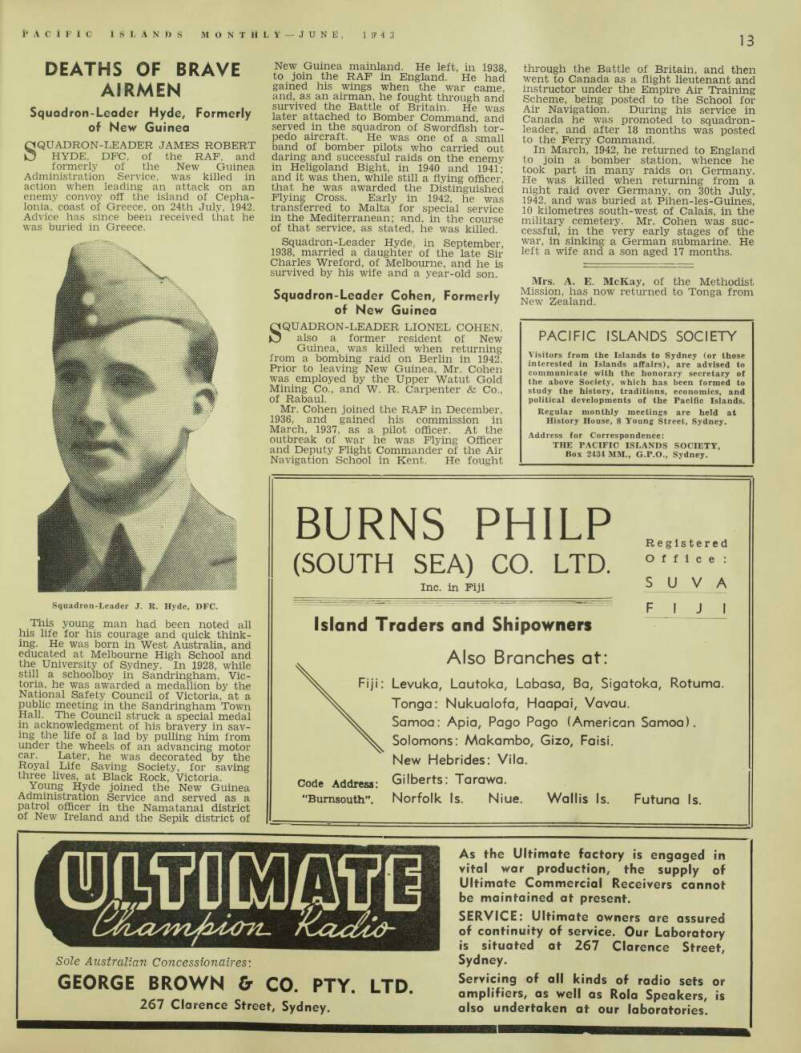
Airmen
Squadron-Leader Hyde, Formerly of New Guinea
Squadron-Leader James Robert
HYDE, DEC, of the RAF, and formerly of the New Guinea Administration Service, was killed in action when leading an attack on an enemy convoy off the island of Cepha lonia, coast of Greece, on 24th July, 1942.
Advice has since been received that he was buried in Greece.
This young man had been noted all his life for his courage and quick think ing. He was born in West Australia, and educated at Melbourne High School and the University of Sydney. In 1928, while still a schoolboy in Sandringham, Vic toria, he was awarded a medallion by the National Safety Council of Victoria, at a public meeting in the Sandringham Town Hall. The Council struck a special medal in acknowledgment of his bravery in sav ing the life of a lad by pulling him from under the wheels of an advancing motor car. Later, he was decorated by the Royal Life Saving Society, for saving three lives, at Black Rock, Victoria.
Young Hyde joined the New Guinea Administration Service and served as a patrol officer in the Namatanai district of New Ireland and the Sepik district of
New Guinea mainland. He left, in 1938, to join the RAF in England. He had gained his wings when the war came, and, as an airman, he fought through and survived the Battle of Britain. He was later attached to Bomber Command, and served in the squadron of Swordfish tor pedo aircraft. He was one of a small band of bomber pilots who carried out daring and successful raids on the enemy in Heligoland Bight, in 1940 and 1941; and it was then, while still a flying officer, that he was awarded the Distinguished Flying Cross. Early in 1942. he was transferred to Malta for special service in the Mediterranean; and, in the course of that service, as stated, he was killed.
Squadron-Leader Hyde, in September, 1938, married a daughter of the late Sir Charles Wreford, of Melbourne, and he is survived by his wife and a year-old son.
Squadron-Leader Cohen, Formerly
of New Guinea
Squadron-Leader Lionel Cohen,
also a former resident of New Guinea, was killed when returning from a bombing raid on Berlin in 1942.
Prior to leaving New Guinea, Mr. Cohen was employed by the Upper Watut Gold Mining Co., and W. R. Carpenter & Co., of Rabaul.
Mr. Cohen joined the RAF in December, 1936, and gained his commission in March, 1937, as a pilot officer. At the outbreak of war he was Flying Officer and Deputy Flight Commander of the Air Navigation School in Kent. He fought
through the Battle of Britain, and then went to Canada as a flight lieutenant and instructor under the Empire Air Training Scheme, being posted to the School for Air Navigation. During his service in Canada he was promoted to squadron leader, and after 18 months was posted to the Ferry Command.
In March, 1942, he returned to England to join a bomber station, whence he took part in many raids on Germany.
He was killed when returning from a night raid over Germany, on 30th July, 1942, and was buried at Pihen-les-Guines, 10 kilometres south-west of Calais, in the military cemetery. Mr. Cohen was suc cessful, in the very early stages of the war, in sinking a German submarine. He left a wife and a son aged 17 months.
Mrs. A. E. McKay, of the Methodist Mission, has now returned to Tonga from New Zealand.
Squadron-Leader J. R. Hyde, DFC.
Advertisements & other items, p. 15 (2 items)
13
tACiFiC ISLA N I) S MONTHLY JUNE, 19? 4 3
Burns Philp
PACIFIC ISLANDS SOCIETY
Visitors from the Islands to Sydney (or those interested in Islands affairs), are advised to communicate with the honorary secretary of the above Society, which has been formed to study the history, traditions, economics, and political developments of the Pacific Islands.
Regular monthly meetings are held at History House, 8 Young Street, Sydney.
Address for Correspondence:
THE PACIFIC ISLANDS SOCIETY,
Box 2434 MM„ G.P.0., Sydney.
BURNS PHILP
(SOUTH SEA) CO. LTD.
Inc. in Fiji Island Traders and Shipowners Registered Office :
SUVA
FIJI
\\ Also Branches at: Fiji: Levuka, Lautoka, Labasa, Ba, Sigatoka, Rotuma.
Tonga: Nukualofa, Haapai, Vavau.
Samoa: Apia, Pago Pago (American Samoa).
Solomons: Makambo, Gizo, Faisi.
New Hebrides: Vila.
Code Address: Gilberts: Tarawa. ‘‘Burnsouth’’. Norfolk Is. Niue. Wallis Is. Futuna Is.
Sole Australian Concessionaires :
GEORGE BROWN & CO. PTY.
267 Clarence Street Sydney.
As the Ultimate factory is engaged in vital war production, the supply of Ultimate Commercial Receivers cannot be maintained at present.
SERVICE: Ultimate owners are assured of continuity of service. Our Laboratory is situated at 267 Clarence Street, Sydney.
Servicing of all kinds of radio sets or amplifiers, as well as Rola Speakers, is also undertaken at our laboratories.
Renegade
Natives
Horrible Crimes in NE Papua
The following, from a special
correspondent in Papua, was pub lished in “Sydney Morning Herald ” on May 17: MANY renegade natives who murdered Allied Servicemen and handed over Europeans, including women, to the Japanese have been arrested and tried.
These crimes occurred between July and September, 1942, after the Japanese land ing at Buna and Gona.
Three parties, totalling 19 Europeans and a half-caste, were involved.
The ringleader was an outlaw named Embogi, who is now dying. It is thought that his enemies have “made poison
against him,” the Papuan equivalent of “pointing the bone,” and he has lost the desire to live.
The natives who murdered Allied troops have been tried and sentenced to death.
The fate of the others who handed the white people over to the Japanese has not yet been decided.
Captain W. R. Humphries, formerly Chief Resident Magistrate of Papua, who has been in charge of the investigations, has found that all the natives he inter viewed have given him all possible aid to detect the culprits.
A high executive officer in the Austra lian New Guinea Administrative Unit said to-day: “The perpetrators of these crimes were a small minority of the New Guinea people. They were the Quislings, led by one of the foulest characters in the country, an outlaw named Embogi.
There is a scum in all races and you do not judge a people by its worst types.”
THE first party of victims consisted of a priest, a female European teacher,
aged 21, and a nurse, aged 27, of Gona Mission; a lieutenant and sergeant of a Papuan infantry unit, three privates, who were coastline spotters, and five American airmen who had baled out from a bomber.
These groups linked up at Deunia, about 20 miles from Gona, on the Kumusi River. The full party was met by natives, and two of those natives betrayed them to a Japanese detachment. The Japanese attacked, and the three spotters and two of the Americans were killed. The rest of the party scattered.
The two women struggled through the bush and were found by natives, who handed them over to the Japanese. The Japanese kept the women in captivity.
One morning they were taken to a small coffee plantation at Huhuru, where graves were already dug.
A Japanese guard attempted to rape one of the women. She resisted, and he drew his bayonet in full view of the other woman and stabbed her many times be fore she fell. Another Japanese stabbed the second woman in the throat.
The lieutenant, after two days and nights, became so fatigued that he dropped down beside a tree exhausted.
Three natives took him to Embogi. It is not known what happened to him.
THE three Americans had become lost in the jungle, when they were accosted by a number of unfriendly natives. One of the Americans was speared and the others beaten to death with bludgeons.
Seven natives have been sentenced to death for this crime.
The priest was last seen at Sanada, where he had gone to seek a responsible Japanese officer to get safe conduct for his party.
THE other party was at Sangara Mission Station, 20 miles along the Kokoda track from Gona, where the Japanese landed. It consisted of two women teachers, aged 35, Commander Austin, the Controller of Plantations for the area, two clergymen, a mission layman, and a half-caste.
When they heard of the landing they set out to reach the coast. Natives seized the party and stripped them all naked.
The Europeans were taken to Embi village. There is no evidence that the natives attempted to molest the women.
Next they drove them on again, allowing the women to cover themselves with the scantiest clothing.
At Dobodura they handed them over to the Japanese. They were taken by motor vehicles to Buna, and evidence is fairly conclusive that the entire party was be headed on Buna Beach, and their bodies flung into the sea. One hundred and twenty natives were arrested in connec tion with this crime, but after taking evidence it was found that there were only 25 directly implicated.
The other case was that of an unknown American airman who was murdered.
Five natives convicted of this crime have been sentenced to death.
Some Reports Not True
The Bishop of New Guinea (Right Rev.
Dr. Strong), who was recently through the Gona and Sangara areas, wrote as follows on May 29 to the Australian Board of Missions: — “I was assured that no Christian natives were concerned in the betrayal; and that some earlier reports that had been circulated about raping by the natives were not true, and that the re port about the stripping of the Sangara party was not true. The tragedy is that this native treachery occurred in an area which we had been unable to touch. That group of villages had often asked us to extend our work among them, but we had been unable to do so, owing to lack of funds and workers.
Advertisements & other items, p. 16 (1 item)
sdfgtj
W. H.GROVE i SONS
Limited
AUCKLAND
Island Traders. po Box 49# - Telegraphic and Cable Address: “Grove”, Auckland.
Shippers of all classes of New Zealand products.
Representing English Manufacturers throughout the Cook and Society Islands, Fiji, Tonga, Samoa, Niue, New Caledonia, New Guinea, etc.
In FIJI as—W. H. Grove & Sons (Fiji) Ltd.
Axis Shadow Over Tahiti
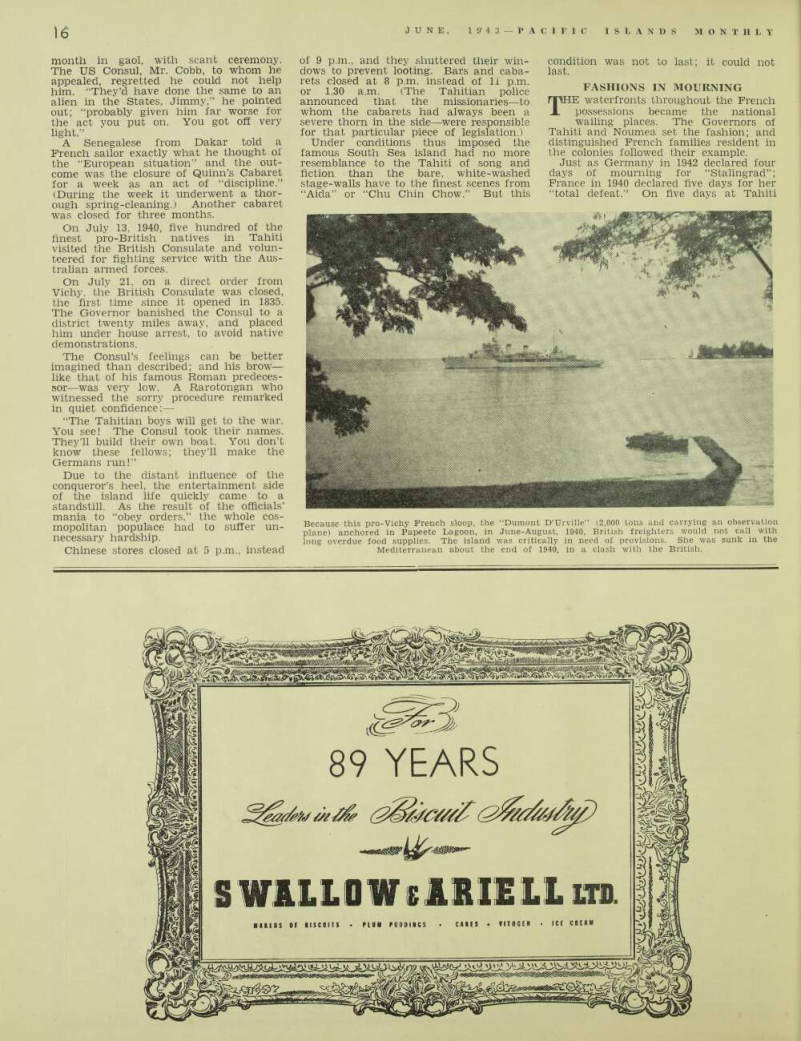
The Dork Days of June-September, 1940
ITERE is the story, told by Edward C. Snow, for the first time, of what happened in Tahiti in those black days after France surrendered and before the French Colonies rallied to de Gaulle—June to September, 1940.
IWAS in Tahiti in 1939; and from there I saw the opening of the European war and the calamity which, in June, 1940, fell upon the colonies of the French Empire.
During the first six months, the Americans used the term “Phoney War,” while the French used their familiar expression for “nothing to report” (“rien signaler”). And except for an ominous warning: “Do not ask about ships,” “rien signaler” was all the French censor dis played on colonial post office notice boards.
The brief three weeks’ fight, and the overthrow of French in 1940, came like a violent thunderstorm. It was all over before the colonies could follow the speedy events; though the aftermath is with them yet, and may be with them for a long time.
“The enemy may reach the Loire before they are held,” said the British Consul at Papeete, after the break through at Sedan. He moved a wavy line of flags across the map of Europe, according to the latest radio news. But, in the meantime, Marshal Petain, who had scant intention of holding anywhere, decided the issue by surrendering. (In doing so, he carried out his original 1917 intention, as anticipated by General Edmund Ironsides and forestalled by Foch.) General de Gaulle was at Leopoldville (Belgian Congo) while the 1940 Armistice was made. Colonial France drifted and disintegrated as though it were a fleet of rudderless ships.
Mysterious Drama
WHAT human experience could be more bitter than the sudden loss of property, power and wealth? In trying to save something from the wreck, like drowning men grasping at straws, French admirals, generals, governors and officials only fell deeper and more heavily into German power. It came about with the greatest of ease, though it was obscure and mystifying to the rest of the world, who expected an “honourable surrender.”
Many of France’s highest officials were super-individualists, not patriots, and in their blind, fundamental efforts to re trieve anything at all of their former power and wealth, they merely played the poisonous and infamous game of Vichy.
Almost every influential family in the French colonies had relatives in and around Paris. After the surrender, many of the French in Tahiti sent cablegrams of inquiry.
The German High Command, in con trol at the Paris Post Office, was fully prepared for them (and had the same system in readiness for the disruption of the British Commonwealth, had London fallen!). Every name and address was tabulated before delivery, replies were intercepted and altered, and a fake answer preceded the relative’s name.
The answer to twenty separate cables read exactly the same;— “We are alright; we are fine. Please obey orders.”
One doubting French colonist, with more money than wisdom, cabled a second time in the Tahitian language,
. . . „ , J asking for confirmation of the first cable’s veracity. It brought no reply.
A temporarily stranded British doctor in Papeete was derisive and contemptu ous. “Obeying German orders will save nothing,” he declared, with emphasis.
“It will only delay the inevitable Ger man double-cross. The cables are just a waste of good money. Right down through the history of conquered coun tries, once the psychological shock of invasion and defeat wear off, the major
ity of people left alive settle down to conditions as they found them.”
French colonial officials could not see it and, in their semi-delirious efforts to save face before their African and Poly nesian subjects, commenced to carry out “Vichy” orders. The first result was at Oran, when Admiral Gensoul put per sonal interests before his country and his fleet—and saved nothing. That was followed by a succession of peculiar inci dents at Dakar, Syria, Martinique, and Madagascar, as the German Gestapo system operated through its liaison offi cers at Vichy.
AT Tahiti, the situation vacillated from obscure to “sticky” (as an old English resident expressed it).
“We’re on the spot; the only thing to do is to lay low and keep quiet till it blows over,” he added.
An American, named James Quinlan, a resident of some twelve years’ duration, did not keep quiet, and was given a
month in gaol, with scant ceremony.
The US Consul, Mr. Cobb, to whom he appealed, regretted he could not help him. “They’d have done the same to an alien in the States, Jimmy,” he pointed out; “probably given him far worse for the act you put on. You got off very light.”
A Senegalese from Dakar told a French sailor exactly what he thought of the “European situation” and the out come was the closure of Quinn’s Cabaret for a week as an act of “discipline.” (During the week it underwent a thor ough spring-cleaning.) Another cabaret was closed for three months.
On July 13, 1940, five hundred of the finest pro-British natives in Tahiti visited the British Consulate and volun teered for fighting service with the Aus tralian armed forces.
On July 21, on a direct order from Vichy, the British Consulate was closed, the first time since it opened in 1835.
The Governor banished the Consul to a district twenty miles away, and placed him under house arrest, to avoid native demonstrations.
The Consul’s feelings can be better imagined than described; and his brow — like that of his famous Roman predeces sor —was very low. A Rarotongan who witnessed the sorry procedure remarked in quiet confidence; — “The Tahitian boys will get to the war.
You see! The Consul took their names.
They’ll build their own boat. You don’t know these fellows; they’ll make the Germans run!”
Due to the distant influence of the conqueror’s heel, the entertainment side of the island life quickly came to a standstill. As the result of the officials’ mania to “obey orders,” the whole cos mopolitan populace had to suffer un necessary hardship.
Chinese stores closed at 5 p.m., instead
of 9 p.m., and they shuttered their win dows to prevent looting. Bars and caba rets closed at 8 p.m. instead of 11 p.m. or 1.30 a.m. (The Tahitian police announced that the missionaries—to whom the cabarets had always been a severe thorn in the side —were responsible for that particular piece of legislation.) Under conditions thus imposed the famous South Sea island had no more resemblance to the Tahiti of song and fiction than the bare, white-washed stage-walls have to the finest scenes from “Aida” or “Chu Chin Chow.” But this
condition was not to last; it could not last.
Fashions In Mourning
THE waterfronts throughout the French possessions became the national wailing places. The Governors of Tahiti and Noumea set the fashion; and distinguished French families resident in the colonies followed their example.
Just as Germany in 1942 declared four days of mourning for “Stalingrad”; France in 1940 declared five days for her “total defeat.” On five days at Tahiti
Because this pro-Vichy French sloop, the “Dumont D’Urville" (2,000 tons and carrying an observation plane) anchored in Papeete Lagoon, in June-August, 1940, British freighters would not call with long overdue food supplies. The island was critically in need of provisions. She was sunk in the Mediterranean about the end of 1940, in a clash with the British.
flags were flown at half-mast and there was copious weeping.
A nonplussed American asked a British resident what he thought of it all. The latter shrugged and said he didn’t understand such Continental behaviour.
“The word that I do understand begins with ‘V’,” he said.
“That’s the way I like to hear a man talk,” said the American.
The French defeat seemed to be a double affair. There was not merely the loss of France. There was the loss of face in Colonial France. Before the derision and contempt of their coloured subjects, many high-strutting fonction naires, men who naturally adhered to Vichy, found life almost unendurable.
Fortunately, these super-individualists were a small minority. The majority of Frenchmen were made of better stuff and they became the patriots of Fighting France.
The “Dumont D’Urville”
INCIDENTS involving the French sloop, “Dumont D’Urville” precipitated the crisis and brought matters to a head.
The pro-Vichy commander of the sloop, Toussaint Quievrecourt, quarrelled with the Tahiti Governor, Monsieur Chastenet de Gery, as to who should govern the island. The Governor refused to step down, so the commandant, unable to obtain satisfaction, put to sea for 19 days, for an unknown destination.
Speculation immediately became rife as to the sloop’s mission. As the coconut radio got to work, flights of fancy reached unpublishable proportions.
Public opinion decided that it would return, flying the Allied colours, and, if not exactly over-flowing with milk and honey, at least bringing some flour, of which the island had had none for at least ten weeks.
When the sloop duly returned it did not fly another flag, to which the Gov ernor might surrender in homage. It brought some Sydney flour, but unloaded it at night, into the Naval Stores. For the public it brought nothing—nothing except a virulent brand of Prussic acid from Berlin, via Vichy.
The return of the sloop did little to help the island’s difficult position, but a lot to hinder it. Its continued presence in Papeete, and its dubious attitude, caused the diversion of a British freighter, with some 4,000 tons of essen tial foodstuffs for the Society Group.
Though badly in need of it, the islands lost the lot; and. worse than that, owing to the obscure situation, the trans-Pacific cargo service was suspended, so far as Tahiti was concerned.
Feeling ran high when the news became known. One Canadian offered 1,000 dollars for a passage to anywhere.
The port captain at Papeete was requested to send the French sloop to sea, and on August 15 it went out, and away to Noumea. Its unwelcome arrival there was blamed on Governor Pelicier, and that precipitated the “September Revolution” described by the “Pacific Islands Monthly” in 1940-41.
Meanwhile, General de Gaulle had reached London and had there estab lished the headquarters of “Libre Fran cais,” at Carlton Terrace.
The end of the Vichy regime came quickly in Tahiti. In the plebiscite taken in French Oceania, soon after the sloop departed, only 18 voted for Vichy: thou sands were for de Gaulle and Free France. Governor de Gery departed for the United States; de Gaulle officials took charge; and there began a long, slow, painful weeding-out of Vichy sympathisers.
As for the 500 native zealots, they renewed their offers as volunteers with
the Australian forces, and 300 single and fit were accepted. It wasn’t necessary for them to build their own boat, however.
Ships were found, and carried contingents from Noumea and Tahiti. One man, Peter Cowan, whose father was a Cook Islander, passed as eligible for the AIF. After training at Liverpool, NSW they joined the Allies in the Middle East and, wherever they went, they maintained their reputation as being among the world’s best singers, dancers—and warriors.
Advertisements & other items, pp. 17-18 (3 items)
15
P ACIFIC ISLANDS MONTHLY JUNE, 1 S' 4 3
Burns Philp Trust
TH A 7
|' WHAT IS
y YOUR TIME WORTH?
One of the major problems to-day is to find time to give proper attention to one's personal financial affairs time which must be spent, very often, at the expense of earning capacity.
And not only time, but worry and nervous strain. In these particularly anxious times, with all their complications and problems, it would be a very great advantage to you to be relieved of the necessity for worrying about your personal financial affairs. Let Burns Philp Trust Company Limited relieve you of the details of administration of your estate. During your lifetime and afterwards, this Company will give uninterrupted, faithful, and efficient service.
If you are interested in learning details of the service which this Company can render to those anxious to be relieved of the burden of administration of their affairs or estate, two special books will be sent on reguest. Write for them now.
Burns Philp Trust
COMPANY LIMITED
7 BRIDGE STREET, SYDNEY
James Burns Lewis Armstrong
DIRECTORS:
MANAGER-C. H. Chester.
Robert John Nosworthy Joseph Mitchell Telephone: B 7901.
Box 543 B, G.P.0., Sydney.
BP 24-43 y
i &
SSWS^aRjWWi*
89 YEARS
ir .:j
SISC*
&S
YYL:
y^
S WILLOW £llllll LTD.
X MAKERS OF lISCOITS . PIOH PUDDINGS • CARES * VITOGEN • ICE CREAM m w j
16
June, H 43 - HctHc islands monthly
World's Greatest Precipice
SOUTH of Mount Leonard Darwin, in Dutch New Guinea, is the greatest precipice in the world, with an estimated height of 10,500 feet. It is considered that this stupendous earth feature is comparable with the walls of the lunar craters.—From “The Australian Museum Magazine.”
Jitterbug Arrives In
Polynesia
POLYNESIANS on a certain small Pacific island are learning to jitter bug; and, as they have an experi enced teacher, they are making rapid progress. He is Sgt. Nicholas John Mar coni, from Philadelphia, who once enter tained in USO clubs in various parts of the United States.
In his South Sea island, Marconi found weekly dances in the villages, and naturally he went along to one. The girls there saw him jitterbug, for the first time, and they stood around him, giggling their astonishment. Then they began following his movements, and soon everyone was trying to jitterbug.
Marconi says the natives pick up dances more quickly than American girls.
They eagerly taught him some of their own South Sea dances, brought him gifts, and recently presented him with a horse.
Advertisements & other items, pp. 19-20 (1 item)
Foster Tilark’S
G Ut am y. & si v= v * There are so many ways in which you can use Foster Clark’s Creamv Custard. In addition to the usual custard, it can be used as a basic ingredient to give a perfect flavour to many unusual dishes. Foster Clark’s Creamy Custard is extremely nourishing and even canny housewife on a wartime budget will appreciate its full value for money.
PINEAPPLE FRITTERS: Just one of the original recipes in Elizabeth Craig's FREE illustrated Recipe Book. Obtain your copy by writing to Foster Clark ( Aust .) Ltd., Dept.
R. 8., Red fern, N.S.W., enclosing 2\d. in stamps for postage. m 'i«&r
FOSTER tILARK’S
Modern Refrigeration for the South Sea Islands
The ELECTROLUX KEROSENE OPERATED
REFRIGERATOR
MARVEL
OF
MODERN
SCIENCE
w ■ v m y wn
THE
MIRACLE
OF
ICE
FROM
HEAT
ELECTROLUX OFFERS ECONOMICAL, modern and completely efficient
REFRIGERATION FOR ISLANDS' HOMES,
freezes continuously while small lamp burns.
Freezing controlled by simply regulating height of flame. Uses only gallon of kerosene per week MOTORLESS ... NO PARTS TO GET OUT OF ORDER.
MODEL L 22
Capacity 2.2 cubic feet.
MODEL L3BO
« (as illustrated) Capacity 4 cubic feet.
MODEL LKSSO
Capacity 5.5 cubic feet.
GUARANTEED FOR TWO YEARS.
• Write to your Local Distributor for prices and full details.
OBTAINABLE FROM ALL W. R. CARPENTER & CO. LTD.
BRANCHES THROUGHOUT THE ISLANDS
Representation in Papua and New Hebrides.
Sadie Thompson
The Brief History of Sadie Thompson
THIS is the sort of thing that should never be written.
In the first place, everybody—except the Italians —knows there is a war going on, and the thing to do is to talk about the war.
And maybe you will agree that it should never be written after you’ve hit your head against a few dangling ver bals, and split yourself on some choice infinitives. But the thing we mean is that nobody should ever write about such a thing as Sadie Thompson in “PIM.”
Because, in the first place, everybody, except some Australian Ministers, reads “PIM”; and, when they read it, they begin with the palm tree on the cover and go straight through to Mr. Carpen ter’s address at the bottom of the last advertisement. Everybody, that is, except a few bridge-playing Americans on Tahiti, who somehow don’t give two whoops about the quotations on Bulolo gold, and so skip that. And, anyway, Sadie Thompson is not a Pacific Islands subject, really.
As we want to talk about Sadie Thompson, who was not a lady, but a dog, the thing that will happen is this: Everyone from Carnarvon to Clipperton will think about some dog he wants to tell about; and the next thing we know, the editor of “PIM” will become an FRCS instead of an ERGS, the C stand ing for Canine.
So you just wait and see.
But meanwhile, and in spite of the war, did anyone ever see such dogs as there are in the Pacific Islands?
In Rooseveltland, and parts of the Curtin Commonwealth, people know whether a dog’s parents were up to no good or whether, shall we say, they were out to maintain the White Australia policy.
But this Pacific Island animal life has us going.
Now, to start the aforementioned con troversial roll bawling—or rather the ball rolling—let’s talk about Sadie Thompson, a canine that didn’t vary from the jumble that Polynesian dogs have worked themselves into.
WE called her Sadie because she had, very obviously, weathered many loves. She was almost the mellow brown that distinguishes German police dogs (not the Gestapo type). Of course, Sadie had a few white spots here and there, and a few black and blue spots hither and yon, but she was mostly a mellow brown.
Her nose had been borrowed from an English bull. Her tail had started to be short, only to change its mind several times in the darndest places. It had fin ally decided to go on at great length, leaving little kinks each time its mind had changed. Sadie’s ears wouldn’t have been bad at all, if they had matched. One of them resembled the leaf of the banana tree, while the other was not unlike a burnt waffle.
And her chassis! Well, maybe that’s why we called her Sadie Thompson. The whole back half of Sadie’s torso was rheumatic, and she dragged it around after her as though she was ashamed.
Everytime anybody looked she would sit on it. And between the middle and the end, there was a whole extra joint! Sadie looked like the Lord had finished her and then tacked on a caboose.
She was at least 25. She sagged in the middle like the Wairope bridge, and her skin was so wrinkled there was enough room for five kangaroos.
Sadie’s children were of three cate
gories, if not distinct categories, and they roamed the Tahitian neighbourhood like a green-clad Jap might try to pick out the best tree in Timor. They begged people at back-doors to crack them a coconut.
WELL, only a few weeks ago we dis covered that Sadie was due to become a great-grandmother—or whatever it is they become when they are united in unholy wedlock with the step-father of their grand-niece.
Suddenly the old girl disappeared. We looked everywhere. A week passed.
Then, one day, a native came down from the mountains with a load of fei, and told us he had seen her. She was high up in the valley, digging her grave.
And that was the last of Mrs. Thompson.
She was an exception to Tahitian dogs only in personality. Had she lived to be one hundred, Sadie still would have been the favorite of all the boys in the dis trict. Most dogs here don’t have per sonalities, They just bark at everything and never bite anything.
Sadie never barked. Maybe she was afraid a good strong bark would capsize her.
But there’s no doubt about it, South Sea dogs are something very, very spe cial. If not for their often ghastly appearance, certainly for the food they eat. For where, in the rest of the world, could one find dogs that live almost exclusively on coconuts?
Now, as we began by saying, we’ll move over and you can tell us about your dog.
And to heck with the war!
R.P.D
Advertisements & other items, p. 21 (1 item)
Ale
o
BREWED BY
CARLTON & UNITED BREWERIES LTD.
"Mister Potato "
THERE is a Frenchman in New Gale -1 donia known to his more intimate cobbers as “Monsieur Pomme de Terre.”
The story goes back to the day after Pearl Harbour, when Japanese residents were being rounded up all over the island. The Frenchman in question was on board a Nickel Cos. ship since lost, and was examining cargo with the help of one of those spike-like instru ments used by Customs officials. Fre quently he came to a pile of sacks into which he began carelessly plugging his spike, when he was startled by a plain
tive voice saying: “Ne pique pas, ne pique Potatoes tCTre ” ( . ’ potatoes - Potatoes! ) This stirred him, and he faced the sacks with the intentness of Aladdin—or whoever it was who was searching for Forty Thieves. Presently he made e l e \ balefuUy regarding him through a hole m the sacking, He barked out the French for “Hey, come out of it!” and there emerged a little brush-headed Japanese who was quickly taken care of and put behind barbed wire. It is since this encounter that his friends sometimes call Monsieur
B , “Mister Potato.”-
H.E.L.F.
Dengue Fever
A PUBLICATION dealing with all aspects of dengue fever has been received from the Sydney University School of Tropical Medicine. It is officially intended for the use of “the clinician, the researcher and the hygien ist.” Written by two Australians, Dr. G F. Lumley and Mr. F. H. Taylor, it stresses the Australian viewpoint. Never theless, it should be of inestimable jyalue in all Pacific Territories where Aedes aegypti mosquitoes and dengue are pre valent.
The book is in two parts: Medical, by Dr. Lumley, and Entomological, by Mr.
Taylor. It is pointed out, in the intro duction, that, although the first written record of dengue was given by four French missionaries in the West Indies, in 1635, the disease is not medically well known, owing to the facts that relatively few practitioners have to deal with dengue, and that literature on the sub ject is largely in journals which are not found outside public libraries.
Dengue has often been a paralysing scourge in peacetime; to-day, our war effort could be affected disastrously, both on the home front and in the field, by large-scale epidemics. During the last 21 years there have been three great world epidemics of dengue—one of which occurred in Australia during 1925-26. On that occasion, an estimated 560,000 people developed dengue in Queensland and northern New South Wales.
In the medical section, Dr. Lumley gives a full history of dengue, its geographical distribution, the fullest detailed clinical descriptions of the disease, the part played by mosquitoes in transmitting it and the factors associated with its oc currence in epidemic form. The Ento mological section contains a full descrip tion of the species of mosquitoes concerned, their life-histories and various methods of controlling them.
It is claimed that not onjy can dengue be controlled but that, in Australia, it can be prevented and the vector mos quitoes responsible eradicated.
This publication is not for general sale, but those interested should address all inquiries to the School of Public Health and Tropical Medicine, University of Sydney.
First Americans in New Caledonia
Prom Our Noumea Correspondent NOW and again, in the foothills of the central mountain chain, and under the giant banyan trees, parties of American soldiers in New Caledonia come across bleached piles of human bones and skulls, and remains of the old native feasting middens, where sometimes white sailors as well as black warriors were roasted to a turn. In actual fact, the first American crew ever to set foot on New Caledonian soil were promptly knocked on the head and eaten.
That was some years before the French took possession of the isle.
It happened at Balade, where the natives had just looted the first Catholic mission. The local chief, a thorough old scoundrel, saved for himself a particu larly handsome cassock, in which he was fond of parading up and down the beach, with the idea of tempting white men to land. In his hands he would hold' a breviary, which he pretended to read in the manner of the “white witch doctors.”
The crew of a Yankee schooner named “The Cutter” mistook him for a mission ary and went ashore to talk with him.
But they were massacred, and put into the tribal ovens. As a strategist that old cannibal was not to be despised.
Advertisements & other items, p. 22 (1 item)
MylllElii
Here’s the quick, easy way to serve
COOL, APPETISING
HOT-WEATHER MEALS
■' <3 V* YOU can prepare crisp, cool, appetising salads in five minutes with Imperial “Hampe” the quick-serve summer delicacy that’s ready-cooked, readyto-serve and flavour-sealed . . . And what a flavour!
Everyone likes the delicious combination of mild-cured ham and tender veal in “Hampe.” Try it to-day.
Product of Riverstone Meat Co. Pty. Ltd., Sydney.
FIJI Representatives: Pearce & Co. Ltd., Suva.
— w Imperial
MylllElii
Death of Dr. Bach, Lately
Gilbert Is. Bishop
THE death occurred, in Lewisham Private Hospital, Sydney, on May 22, of Most Reverend Joseph M. Bach, MSC, DD, Titular Bishop of Eriza, and lately Vicar Apostolic of the Gilbert Islands.
Dr. Bach spent 32 years of his life in missionary work in the South Pacific Islands, and was a well-known figure at mission stations in Torres Strait (Thurs day Island), Papua and the Gilbert Islands. He was raised to the status of Bishop, and given charge of the Gilbert Islands, many years ago: and he lived at Tarawa, in the Central Gilberts, until his retirement about 1937. Since then, he had resided quietly at Bowral, NSW. He was a distinguished member of the Order of the Sacred Heart of Jesus, and his passing will be mourned by many lay men, as well as by missionaries of all faiths, all over the South Pacific.
Bulolo Gold
Great Financial Strenath Available for Resumption of Operations
THE remarkable financial strength of Bulolo Gold Dredging, Ltd. (which operated eight dredges in the Bulolo Valley, New Guinea, until the Jap in vasion caused cessation in January, 1942) was disclosed in the accounts presented at the annual general meaning, held in Vancouver on March 29. The accounts were for the year ended Mav 31, 1942.
Operations up to January, 1942. returned a nrofit of $2,354,644. which, with $2,053,680 brought forward, left $4,408 324 in nrnfit and loss account. The directors distributed $1,500,000 among holders of the $5,000,000 of issued shares (eaual to 30 ner cent.) and out $2,000,000 away in a War Contingencies reserve.
This company holds the following assets: — Current assets (being mostly bank balances and stocks) $2,426,417 Fixed assets (being approx, value of land, machinery, equipment, etc.) 16,685,739 The gold-bearing property is, of course, a dwindling asset, so the company has created against it an Amortisation Fund of $2,915,800, which is in cash and invest ments; and various kinds of reserves (including War Contingencies Reserve) of no less than $12,006,110.
Details are lacking, but it is reported that the company’s New Guinea properties have been severely damaged by war con ditions. Accordingly, the company has lodged with the Australian War Damage Commission preliminary claims amount ing to $993,273 on account of lost stock. $901,985 on account of damage to fixed assets.
This brief glance at its accounts sug gests, that this company will show the same efficiency and sureness in resuming operations in a recaptured New Guinea, as it did in planning its vast enterprise, and putting its plans so successfully into operation in the decade before the war.
Staffs
Murder Of Mission
Official Muddling Imposes Cruelty on Relations
EARLY in October the Australian Board of Missions' was informed that the Rev. James Benson, Miss Mavis Parkinson and Sister May Hay man, Anglican missionaries stationed at Gona, Papua, had, according to native reports, been killed. This report has since been confirmed with regard to the two women (see page 14 of this issue).
In October, the ABM received also a report that the staff at the Sangara mis sion had become prisoners.
The following extract is from the “Aus tralian Board of Missions Review” of June 1, 1943: — Details have appeared in the press concern ing events which happened in the Buna-San gara district between July and October of last year, and we are informed that, in addition to Sister May Hayman and Miss Mavis Parkinson, the Sangara and Isivita staffs also perished.
These would include the Rev. Henry Holland, the Rev. Vivian Redlich, Mr. John Duffill, Sister Margery Brenchley and Miss Lilia Lashmar. We extend our profound sympathy to their relatives.
It is a matter :or much regret that this press account appeared without first making the facts available to the relatives themselves, or to the organisations which could have advised those concerned. We had already been warned that
bad riews might come as a result of investiga tions that were taking place now that the Japanese had been driven from Papua. There was, however, a clear understanding with the authorities at Canberra that we should be offi cially advised before any facts were made pub lic. Inquiry is now being made as to why this undertaking was disregarded, causing that addi tional distress to the relatives which we thought we had taken adequate precautions to avoid.
There is still no definite news of the Eev.
James Benson, of whom it was stated that he set out to find a responsible Japanese officer, hoping to arrange safe conduct for the two women. It is officially reported that Mr. Ben son was last seen on the road to Sanananda.
On that occasion he spoke to a half-caste boy, saying that he was a prisoner and on his way to Buna, and expected later to be taken to Rabaul. It would appear that, though the chances seem to be against it, there remains a glimmer of hope that Mr. Benson is still alive.
There is no excuse for such official muddling. These tragedies have made
the Australian public physically sick; the
feelings of the relations of the unfor
tunate people on being first acquainted
with the facts through the cold medium of the press can be imagined.
The Rev. Dennis Taylor, of the Anglican Mission, Papua, is at present in Australia, for health reasons. He is
making satisfactory progress and is doing
locum work in Brisbane.
Advertisements & other items, pp. 23-24 (2 items)
rooDS
PRESCOTT Pty. Ltd.
SUSSEX ST., SYDNEY,
ore sole wholesale agents for
PINEAPPLE BACON&HAMS
DAISY brand BUTTER "375" BUTTER in TINS Ilb.-21b.-slb. Size*.
LEA & PERRINS’ Sauces and Most other Super-Quality Lines of the Trade, such as Cheese, Eggs. Etc.
CM I V E R S
PURE
rooDS
SSS
GOLD MEDAL JAMS
CANNED ENGLISH FRUITS
CANNED ENGLISH
VEGETABLES
CUSTARD POWDER
OLD ENGLISH MARMALADE
JELLY CRYSTALS, ETC.
Obtainable from all Leading; Grocery Stores.
Write to Department A., 1.71 CbJven and Sons, Ltd., Histon, Cambridge, England, for attractive Recipe Book.
Services
COMMUNICATIONS
BEAM SERVICE
rinc SKSw w.reeess serwce manufacturing
SSTn "
wireless d ZT* SSScast receivers
rRO ADC ASTI NO
OWNERS AND OPERATOR ns
lirs?-
"•SSI^S
AMALGAMATED WIRELESS (A'sia) LIMITED
Australia’s National Wireless Organisation
Old Monk
There is no substitute for
VIRGIN PURE ? j
OLIVE OIL
San Francisco
Eastern Pacific “Mysteries”
Sharp Challenge to Some Theories About Easter Island
By A. C. Rowland
IHAVE just received a most welcome letter from Mr. Charles Reed, of Samoa, which I shall take pleasure in answering. He tells me that he is lost in the jungle of controversy among the scientists over Easter Island, and he asks me for a compass and map to get him out again.
My friend, Mr. Edmunds —who lived for 25 years on Easter Island when that unhappy speck of land swarmed with expeditions—has about the same opinion of scientists as have I.
It does not require much imagination to picture what would happen to a com pany of primitive people, headed by a bevy of priests, when cast on a bleak spot of land like Easter. The first thing a priest would think of would be an image of the principal god (such as they had back home) to bless the crops. The quarry of easily worked stone they found in an old crater, gave some priest the bright idea of erecting statues of all the gods in the pantheon. This pious under taking would keep the nation united and prevent them from incubating ideas which always lead to mischief.
Of course, the carrying out of the priestly plan required the work of many generations—after the manner of the cathedral building by our mediaeval ancestors. First, the principal gods were honoured by the fashioning of colossal images and stone platforms erected to support their dignity. Then followed the lesser gods who were given images of smaller stature. Then the demi-gods, and so on.
In the meanwhile, their constant battle with the sea in quest of food, taught succeeding generations to build more seaworthy boats, the set of currents and winds and, perhaps, some rudiments of navigation by the stars. In due time some venturesome navigator found the islands to the north-west and subsequent exneditions discovered the southern Tua motus.
A YEAR may have passed, or a cen tury, before a fleet of canoes, sail ing from one island of the northern Tuamotus to another, was blown by a boisterous maraamu (south wind) to the Marquesas.
When intelligence of this new discov ery reached Easter—as it eventually did —the exodus from that dismal land to the lush paradise in the north, was like the rush to the California goldfields, in the middle of the nineteenth century.
The half-completed statues in the quarry on Easter, and the tools scattered about, give evidence of eager haste to get away.
THE present inhabitants of Easter— according to their own legends—are the debris of a neo-Polvnesian wave which came, in comparatively recent times, from the Cook Islands through the Australs and southern Tuamotu islands. They neither have, nor ever did have, the foggiest idea of the origin of the images. When they had established themselves on Easter, these newcomers divided into groups and amused them selves by trying to destroy each other— a history which vindicates the wisdom of the old Sweet Potato priesthood.
The engraved wooden-tablets, which have sent the scientists on mirage-chas ing expeditions to Mohenjo-Daro, to primitive Egypt, and to the Lost Conti
nent of Mu, are (in my opinion) nothing more or less than mnemonic directives to prevent errors in ceremonies at the several marae. They served the same purpose as did the knotted coconut leaves which refreshed the memory of Ra’iatea priests. The celebrated Bous trophedon arrangement was to avoid any chance of skipping a line and thus com mitting the unpardonable sin of altering the sequence of invocations, chants, postures and offerings which in latter day Polynesia had become most com plicated.
Some crafty old Easter Island natives, with a lively expectation of liberal rewards of tobacco and pareu cloth, have given visiting scientists alleged transla tions of these mystical characters graven on the tablets. But inasmuch as no two native savants agree as to their inter pretation. the scientific college is still in a whirl of controversy over their origin and meaning.
There being no coconut leaves on Easter to knot, some clever priest invented a system of arbitrary characters and engraved them on wooden tablets to aid his memory—that is all there is to it, in my judgment.
There was no form of ideograph, sylla bic or alphabet writing in the South Pacific from the dawn of time until the missionaries taught the miracle to the people of the islands.
WHEN one studies the history, the legends and traditions of Central Polynesia, he becomes conscious of the almost total isolation of the Mar quesas from the sister archipelagoes of that area.
It is true that most of the legend and poetry which have come down to us date from the neo-Polynesian period. There is every reason to believe that the neo- Polynesian wave never reached the Mar
quesas; or, if it did, was repulsed by the fierce warriors of those impregnable fortress-like islands. Yet echoes from the palae-Polynesian period are equally silent.
In the roster of palae-Polynesian gods who were summoned to the great Pa’i- Atua ceremony at Opoa, in the days when Ra’iatea was the Sacred Isle, no ghostly messenger was despatched to
(Continued on next page)
Nu’uhiva (the Marquesas). Nor was there, among the fleet assembled from every corner of Polynesia to attend that august ceremony, a ship from the Mar quesas Islands.
The most likely explanation of all this is that from a very early period the Marquesans were looked upon as non conformists and heretics. They had established on the fertile Marquesas a new and more happy Olympus for their gods, when the first palae-Polynesians came to the Central Pacific.
There is much evidence of pre-Poly nesian elements in the religion, the lan guage and the culture of Eastern and Central Polynesia. Perhaps these primi tive influences had in the Polynesian colony on the Marquesas, established usages not acceptable to the priesthood of Ra’iatea. Moreover the all-powerful hierophants of Opoa could not brook a rival Olympus so near at hand. Unable to crush these heretics by force of arms, they laid them under interdict and excommunication.
This theory has the virtue of providing appeasement to warring advocates of both South American and Indonesian origins of migrations into the Central Pacific. There is also the suggestion that scientists would not waste their time should they seek in the East the solu tion of problems which, hitherto, have baffled them.
WE have in the Gambier Islands a modern Easter Island where, under similar conditions, vast religious edifices and public works have been erected by a primitive people inspired by religious zeal.
On Mangareva and its sister island, Akamaru, as much stonework was fash ioned and piled up in a generation as was carved and put in place on Easter Island during the course of centuries.
The church at Mangareva—a great edi
fice, with massive twin towers, 75 full paces by 23 paces in measurement, and built wholly of rock faced with white coral lime —stands on a platform of huge coral slabs, 110 yards long by 50 yards across. This building could accommo date 1,000 persons seated in orderly rows, or double that number standing.
At Roruru, on Mangareva, was built a nunnery, under the scarped face of Mount Duff. A massive and towering rock wall —its face long, its sides reach ing back to the precipice—surrounds it.
Stone roads composed of slabs laid by hand lead over the countryside.
On the island of Akamaru is another large church, having twin towers—one surmounted by a cross, the other by a statue of the Holy Virgin and Child.
These structures do not complete the catalogue of stone structures erected on the several Gambier Islands during the period of one generation.
The assertions by the scientists as to the resources and population necessary to have fashioned and erected the images and platforms on Easter Island are absurd. The further assertion by scien tists that, because the South Americans of the Inca period were landlubbers, no migration into the islands of the South Pacific from the west coast of South America was possible, is likewise absurd.
WE have also in the Gambier Islands an example of how seacraft and knowledge of navigation can be lost.
When the Gambier Islands were first visited by Europeans, the art of fashion ing canoes had become forgotten. The vast lagoon, in which the several Gam bier Islands lie, had within its depths and around its shores all that was neces sary to sustain the life of the islands. To navigate its calm waters only rafts were necessary. And so a race of islanders, whose ancestors were the greatest marin ers in all human history, forgot how to
fashion a simple canoe.
The Inca civilisation was agricultural, commercial and self-contained by virtue of the resources of the plateaux, the interior valleys and the metals of the mountains. Does that prove that the pre-Inca South Americans were not in a measure dependant on the resources of the sea and were, therefore, learned in the art of ship-building and, by conse quence, gifted with some knowledge of navigation?
The average young cub (and many of the old bruins as well) of the scientific fraternity under-estimates the mental capacity and resourcefulness of those members of primitive races, who were the leaders or medicine-men. Through all ages, the culture, the aspirations, the common weal of races and nations have been moulded and directed by a few who were more enlightened or forceful than the average of the mass.
Easter Island is no mystery if we examine it in the light of the most obvi ous possibilities.
Advertisements & other items, p. 25 (1 item)
Gold
Purchasers at Full Market Prices on Assay Value of
SILVER
PLATINUM
And Platinum Group Metals
SOME OF OUR SERVICES
ASSAYERS & ANALYSTS—
Assays of Bullion, Ores, etc.
Analyses of Metals, Minerals, Alloys, etc.
SCIENTIFIC & INDUSTRIAL
METALLURGISTS—
Our range of precious metal manufactures covers all industries—Gold and Silversmiths, Electrical Trades, Dental Profession, Glass Silverers, Electro-Platers, etc., etc.
REFINERS—
Purchasers and Refiners of Bullion, Scrap, Mining By-Products, and Trade Residues of every description carrying Precious Metals.
GARRETT & DAVIDSON
PTY. LTD.
824 George St., Sydney. Works: Surry Hills and Chippendale, N.S.W.
Official Assayers to the Bank of New South Wales. Gazetted Agents of the Commonwealth Bank of Australia, under the Gold Regulations of the National Security Act.
•J I
SMT
FOR
EVERY INDUSTRY
For Essential Industries
Now, more than ever, speed and efficiency in industry are demanded. Only equipment of the highest reputation is worthy of consideration. You can rely on the products of— CROMPTON, PARKINSON LTD.—Motors, Instruments, Transformers, Crompton Lamps.
FERRANTI LTD.—Transformers, Instruments Meters, HERBERT MORRIS LTD.—Pulley Blocks, Runways
CROMPTON, PARKINSON (AUST.) PTY. LTD.—
Parkinson Motors, Crompton Minor Motors Power Transformers,
CALLENDER’S CABLES & CONSTRUCTION CO.
LTD. —Wires, Cables, Flexibles.
RANSOMES & RAPIER LTD.—Mobile and Breakdown Cranes, Excavators.
HOPKINSONS LTD.—Valves and Boiler Fittings, NORDBERG MEG. CO. LTD.—Symons Cone Crushers, Vibrating Screens.
AUDLEY ENGINEERING CO. LTD.—“Audco”
Lubricated Plug Valves.
MATHER & PLATT LTD.—Large Electric Motors.
NOYES
11 Watt Street, Newcastle.
BROS. (SYDNEY) LTD.
115 Clarence Street, Sydney
And at Port Kembla. 197 Elizabeth Street, ' Brisbane.
No More Rarotongan Domestics
for NZ
ACCORDING to a reply received from the Cook Islands Department by an Aucklander last month, ho more Rarotongan girls will be permitted to leave the island to take up domestic ser vice in New Zealand. It was stated by the Department that, in view of the social and economic conditions in the islands, it has been decided to discontinue the issuing of permits to these girls.
A scheme whereby English-speaking and medically fit Raratongan girls were brought to New Zealand for domestic work, was instituted last year. No official figures of the number admitted to the Dominion have been given.
Advertisements & other items, p. 26 (2 items)
24
JUNE, 19'43 P ACIFIC ISLANDS MONTHLY
Willia
I I
Atkins Pty. Ltd.
Head Office 449-451 KENT ST., SYDNEY.
Iron & Steel Merchants—Engineers' Supplies
Coach & Motor Hardware
ESTABLISHED 50 YEARS
Cable Address: WILATKIN, Sydney.
STEEL DEPARTMENT
MILD STEEL:
Rounds, Squares, Flats, Half-rounds, Hexagons, Bevel, Shoeing, Tyre, Angles, Tees, Sheets, Plates, Girder Plates, Chequer Plates, Channels, Hoops, Etc.
BRIGHT STEEL:
Rounds, Squares, Hexagons.
Extra Special High Speed Tool Steel, Mining Steel, Blister Steel and Spring Steel, Rounds, Flats & Squares.
Bar Iron—All sections and sizes.
Engineers' Supplies: Set Screws, Studs, Metal Thread Screws, Coach Screws, Files, Cotter Pins, Bright and Black Bolts, Rivets, Etc., Hack Saw Blades.
Power Transmission Gear: Including Plummer Blocks, Couplings, Collars, Etc.
Coach and Motor Hardware: Axles, Springs, Wheelstuff, Duck, Paints.
Farriers' Supplies: Horse Nails, Anvils, Vices, Etc.
Motor-Trimmers and Motor Builders' fir Motor Painters' Requirements
C. A. WILLEY'S
Quick-Drying Coach and Car Paints, Roughstuff, Elastic Gloss, Synflex Enamels, Lacquers.- DUCO Lacquers and DULUX Enamels—FAßßEX Motor Toppings and Leather Cloths, House & Decorators' Paints, Varnishes & Brushware.
Sole Distributors of CHAMPION'S Decorators Paint Products.
Distributing Agents for BROLITE Lacquers, SYNFLEX Enamels and "POLYGLOSS" Finish.
lights
Central Pacific Side lights
UNUSUAL and interesting sidelights on administrative conditions in the South Pacific appeared in an address to members of the British Empire Society given in November by Sir Harry Luke, KCMG, late Governor of Fiji, and High Commissioner for the Western Pacific. * * * He said that he would not describe Pitcairn Island as “a British possession,” which was a term wrongly used, and implying that Britain extracted some thing profitable from such places. The relationship between Great Britain and the countries under her flag was precisely the converse. He said that Pitcairn was an island that was British by settlement. * * * There are only three Condominia in the world —the Soudan, governed jointly by Britain and Egypt; New Hebrides (Britain and France); and Canton and Enderbury Islands (Britain and United States). * * * “The Polynesians are probably the finest and most lovable of the primitive peoples of the world—doughty fighters and capable of a very high level of civilisation.” * * * The native Fijians now have a degree of literacy of 95 per cent. * * * More gold was exported from Fiji in 1941 than from New Zealand; and Fiji contains the biggest sugar mill in the Southern Hemisphere. * * * Anyone who wanted to see true demo cracy functioning should study the system in vogue in the Gilbert and Ellice Islands —a system evolved by the natives them selves and preserved by the British and incorporated in the colonial adminis tration. * ♦ “The Tongans have contrived the per fect blend of native institutions, and such European customs as the present age makes necessary.” * * ♦ Captain Cook left, as a present to the High Chief in Tonga, a pair of tortoises.
The female died, but the male is still alive and well on into his third century.
“He is blind, and his shell has a great dent in it, but otherwise his vigour is unimpaired.” * * * “The Suva Medical School was started in the 1880’s for Fiji alone and at that time enlisted only Fijians; but as its value became known other Governments asked to be allowed to send their specially selected natives, with the result that the school now takes students, not only from Fiji and the High Commission Territories, but from the New Zealand mandated islands, from Nauru, and from the United States and French islands. It is, in fact, a rpedical University for the natives of the Pacific, and its expansion as such has been made possible by the generosity of the Rockefeller Foundation.” $ * * “The treatment at the Makogai leper Colony, in Fiji, is so humane the patients are not afraid to notify the disease as soon as they knew they have got it, with the result that the island has a higher percentage of discharges as cured than almost any other leprosarium in the world.” * * * “Ocean Island, the tiny capital of the Gilbert and Ellice Group, has an abori ginal population of 750 in all. From certain funds belonging to them they said they wished to give £lO,OOO to war funds.
I said it was far too much and that £2,000 would be more than generous. They re plied that the figure of £lO,OOO stood but would now be paid in pounds sterling, which raised the gift to £12,500 in their Australian pounds.”
Their offer to care for 35 evacuated British children having been refused, owing to transport difficulties, the 190 people on Pitcairn Island began to make walking sticks for disabled soldiers, and up to 1942 they had made and supplied about 1,000 sticks.
Since her return to South Australia from New Guinea, Miss E. M. Devitt, of the Anglican Mission, has been doing de putation work. She has visited many parishes in the country and the metro politan area delivering addresses, and her services are eagerly sought.
Splendid Photographs Of
Papua
IT is seldom one has a chance of seeing such a valuable collection of photo graphs of native life as those taken by Mr. A. C. English, ERGS, of Rigo, Papua. Mr. English is the oldest living pioneer of Papua, where he landed 60 years ago, before the British Protectorate was proclaimed.
An extensive series of lantern slides, made from Mr. English’s photographs, was shown at the monthly meeting of the Pacific Islands Society on May 19.
The commentary on the slides was given by Mrs. McCarthy, who was born in Papua, where her father (Hon. W. B.
Bramell) was Commissioner for Native Affairs. The photographs probably have unique historical value.
THE native peoples of the South Seas are learning to hate, are learning to kill again. We are making them unlearn the lesson that a hundred years of missionary effort taught them; the lesson of Christian love. Maybe, we have no alternative; maybe, in the tragic situation in which we find ourselves, we must use every ally at our disposal. At least, we can make sure that the mis sionaries remain at their posts as an antidote to war’s gospel of hate; at least, we can make sure that, at war’s end, they will be there to teach their people to love instead of to hate, to heal instead of to kill.—Catholic Missions Magazine.
It was stated in “New Zealand Herald” on March 10, that whisky was being sold in New Caledonia for £3/2/- per bottle, gin at £2/10/-, red wine at 6/4 and beer, in some places, at 6/4 per large bottle.
Advertisements & other items, pp. 27-28 (1 item)
A. B. Donald Ltd.
AUCKLAND
ISLAND TRADERS & GENERAL MERCHANTS
P.O. Box 1509. Cables Cr Telegrams, ''Kingdom", Auckland.
Scott’s “Renown” Brand Rope,
Cordage and
Binder
Twine
Cable Address Ropeyard, Sydney. ,w ::: s
of Every
Description
MANUFACTURED AT
MASCOT, N.S.W.
By
J. SCOTT
PTY. LTD.
Head Office and Store:
163 CLARENCE STREET.
SYDNEY,
N.S.W.
For Inflamed Eyes and Eyelids
SOLD EVERYWHERE
H. A. Rose L C». Pty. Ltd., Klw St.. Sydney
After taking Pinkettes you should feel brighter, happier, and free from sick headaches, bilious attacks and liverishness. For
PINKETTES
are tiny laxative and liver pills, which painlessly exercise the digestive system.
Boatmens Nightlong Fight Against
Storm Off Pitcairn Is.
By Ada M. Christian
A RADIO message from the High Commissioner of the Western Paci fic informed the Chief Magistrate that provisions and goods which had been ordered for the people were on the way. All Pitcairn Island looked for ward to their arrival.
For many weeks the weather had been beautiful—all that could be desired. But early Friday morning, February 12, the wind sprang to a breeze, blowing harder every hour, until it blew to almost a gale. The sea was rough with heavy swells and long rolling sea-tops, which grew worse as the wind increased.
About 4 p.m. the call of “Sail-ho!” and the hurried ringing of the bell was heard above the noise of the tempest. This is a call which sends a thrill through any one in better weather. But not so to-day.
It was an unwelcome and doleful sound.
As it was a foggy day, the ship could not be seen till it was close in, so every body knew that it meant hurry and rush to get out quickly to meet the ship. All work or play was immediately put aside, the women and children helped fathers, husbands and brothers to collect their fruits and souvenirs and rush them to the Landing.
Quickly as possible, three boats were launched, into which men and boys crowded with their baskets. Fortunately, it was smooth in the bay, and it was not long before the boats were out from the harbour, and into the rolling seas.
A quotation from one of the men in the boats: “The farther off we got from land the rougher the seas were. Actually, some of the less experienced boys were afraid. We were under reefed sails, with the wind and waves on our starboard quarter. The boats were quite close together; but, even so, the swells were so high that as the boats went into the trough of the seas we lost sight of each other.”
Despite the difficulties, they were soon alongside the steamer.
IT was too rough alongside to put the cargo into the’ boats, so the ship steamed away to the west side of the island, where there is a good lee, and an anchorage where ships large and small may anchor in such circumstances. The boats followed.
By this time it was getting late and, so as to discharge the cargo before dark, the Chief Magistrate asked the captain if he could not go closer in, into smoother water, and drop his anchor.
But the captain, though eager to get rid of his cargo, kept well out, so that the
boats were finally eight or ten miles away to the west.
It was after hark when the heavily laden boats finally left the ship, and it took them the wnoie long nignt to get to land in a small cove on the west side (where they always go on such occa sions) rowing against hard wind, heavy swells and breaking sea-tops.
Instead of decreasing, the storm in creased during the night to almost a fury, with additional showers of rain which, with the sea-water occasionally pouring into the boats, drenched the men to the skin and soaked the cargo and mail.
Most fortunately, two men had remem bered flashlights in their baskets, so two boats had lights with which to signal to each other during the night. The “Ho Ho,” Captain Tommy, had no light, but followed the lights of the other two.
During the early part of the night a huge sea-top broke into the “Clipper,”
Captain Elwyn’s boat, and all but sub merged it. All light cargo floated in the water, which had more than half-filled the boat. They knew that if one more sea-top broke into the boat, that would be the end of them. However, an SOS call was answered by the “Ho Ho” and the “Rodney,” Captain Warren. The “Clipper” was soon relieved of some of her cargo and passengers.
After a night of turmoil, they landed safely.
HERE is an account of what happened out on that wild sea, by Nelson D.
Dyett, who is a Government official on the island, and who had gone out in one of the boats.
“I was a passenger in the most heavily-laden boat and, as soon as the lee made by the ship had been cleared, it became obvious that we would have to fight to get ashore. Sailing would have been suicidal and so, ten miles from the island, there was nothing to do but pull for our dear lives. Pull we did, all hands taking a spell at the oars, and refusing to realise that there were many hours’ hard work before us.
“The first of many snarling, swirling sea-tops dashed into the boat before we were any distance from where the ship had been left. Although half-swamped, many willing hands on the bailers (any thing that would hold water was used) quickly made the boat light again. A few minutes later, another huge sea, with a short roar, hit the side of the boat and poured all over us. Nobody made a move to throw out the cargo of flour, sugar, fat, etc. Many months had elapsed since these commodities had been enjoyed, and
it was worth a sporting chance to try and save them.
“Providence must have played a hand in our destinies, for one of our lads had traded for a flashlight out at the ship.
All realised, when we took in the second sea, that the boat was overladen for such weather, and that, if we were to get our selves ashore, it would be necessary to transfer some men and cargo to the other boats.
“It was not known where the other boats were in that inky blackness, with the wind thrashing the sea-tops up into such an angry, seething mass that we couldn’t hear one another from one end of the boat to the other. So the captain gave orders to send out SOS in the hope that our distress signals would be seen.
“Just at this time, our boat was floun dering around, hardly recovered from the last swamping, when a mountainous sea, driven to a frenzy by a hard, gusty squall, literally burst all over the boat and left us with but the barest margin of free board. Our signalman was still gamely sending out his message of distress.
Another bucketful of water in that labouring boat would have sent us all to the bottom.
“Fortunately, one of the other boats, which also carried a torch, realised that we were in trouble and was seen to put about. Soon the two boats, which appar ently had been running together, came down upon us, and no time was lost in lightening our boat. All spare hands transferred to the other two and, while some bailed frantically, others heaved cargo out of the swamped boat to the other two. This was no mean task, for in those seas the work was highly dan gerous and an utter gamble. I was one of those who changed boats, not being a crew member.
“There was a moon, at times, but one of the pale, watery variety, and this set about 2 a.m. The only light we then had was one which our thoughtful and wor ried womenfolk had taken to the summit of the island earlier in the night.
“The first streaks of dawn showed the tired, haggard faces of our rowers.
Everybody was suffering from exposure and fatigue, and the wind, instead of abating, rose in force with the new day.
At first, no signs of the other boats were seen. Soon, however, one was seen some distance away on our port bow, prepar ing to get under sail. Their efforts were watched with doubt and anxiety, but fortunately the sails were hoisted with out serious mishap, and the boat, in trim and under way, was soon out of sight, heading for land.
“Seeing that boat sail away dampened our spirits, for our boat had not only a dangerous cargo of petrol drums, but had been smashed, out at the ship, and could not be sailed. The boys continued to row,, with about five miles to go, and still no lee from the island —all of us miser ably wet and cold, faces and lips burnt by wind and water, and tongues like number six sandpaper. Slowly but surely we were gaining on land.
“The third boat, which up to now had not been seen, was sighted a long way off astern, on our port side. The encour aging sign of the land growing larger, together with the competitive spirit which always exists between the boats’ crews, spurred the tired oarsmen to still greater energies and, although the crew in our boat was young as compared with those in the other boat, a good losing effort was made and we were only a little behind the second boat, but about six hours behind the first, in reaching land.”
THERE was not much rest or sleep on shore. Women and children went back and forth, peering into the darkness to see if there was any sign of the boats.
Nothing was seen, however, until Alta and Laura, with their lights, climbed up the muddy, slippery road to “Big Ridge,” the highest point, where the ocean stretches out in full view. They did not know that the men had the two torches in the boats, but their joy was indescribable when, in answer to their lights, two flashlights shone out in the distant darkness.
Together they raced to the village where they were joined by others, and again they climbed up to “Big Ridge.”
Hilda Morsed with her torch to see if the men were all right. The answer came back, “We are OK.”
A big lantern (a Coleman, like that advertised in the “PIM”) was left burn ing for the rest of the night, casting its rays across the dark waters to cheer the hearts of the weary seafaring men.
Once belonging to him, this lantern is a reminder of Mr. H. E. Maude, Gov ernment representative, who was here two years ago.
In the early morning, the women and children were waiting at Water Valley with dry clothes for the men to put on, and food for them. The men were so overcome by fatigue that, when jumping from the boats onto the rocks, some of them fell and had to be helped.
Having rested for a few hours, the weary men continued their journey on to Bounty Bay; but only the most able ones, and just enough to man the boats —the others would have been extra two against wind and waves, their hope weight.
After struggling for an hour all hope of landing was abandoned, for the sea at Bounty Bay had risen and huge breakers were rolling in. As it was im possible for them to land, they had to go back to Water Valley, but this took little time. Peaking their oars, they let the wind drive them along.
Understanding the situation, the other men who had come ashore got axes to cut timbers on which to haul the boats up to safety, and were soon climbing back over the ridge to the little harbour on the western side. The indispensable women and children, too, trudged the weary way back to help. By the time the cargo was discharged and the boats hauled up to safety and all the folk returned, it was almost dark.
The distribution of the goods took place the next morning down at the place of landng. Representatives of all the families were there to get their shares. But what disappointment!
It wasn’t so bad for the clothes. They could be washed and dried and still be none the worse for the soaking. But the provisions! Out of the 16 bags of sugar that came, eight melted away in the water. Two of the 15 bags of flour were lost through their severe wetting.
Peas and rice had to be washed, then dried in the oven. It rained the whole week, so there was no sun to help. Rice cured that way did quite well, but peas left for any length of time became musty.
But we are grateful for the goods that have arrived, especially when many other orders are long overdue. We are glad, too, that no lives were lost in the hazardous task of bringing them to land.
We hope that next time we shall enjoy more pleasant weather, which will ensure the safe landing of all the precious food.
Advertisements & other items, pp. 28-29 (1 item)
TENAX Genuinely Germicidal SOAP
Guard against Infection with Tenax!
Germicidal Soap used regularly is an unsurpassed safeguard against external germ infection. It is kind to the most sensitive skin, yet its germicidal action is eleven times as rapid as carbolic. It is non-irritant and non-poisonoua.
At All Chemists and Stores .
TENAX Genuinely Germicidal SOAP
OLD MONK
The Worlds Finest Olive Oil San Francisco
AUNT
MARYS
BAKING POWDER
“ITS QUALITY NEVER VARIES 99
In war-time, as in peace-time, Aunt Mary’s Baking Powder gives the same “even rising” results. Limited supplies are being released, as opportunity affords, so use your purchase sparingly while precious ingredients in Aunt Mary’s Baking Powder are difficult to obtain for normal requirements. • AUNT MARY’S SCONES are always a luxury treat when good friends meet to accept your hospitality.
Future Of Pacific
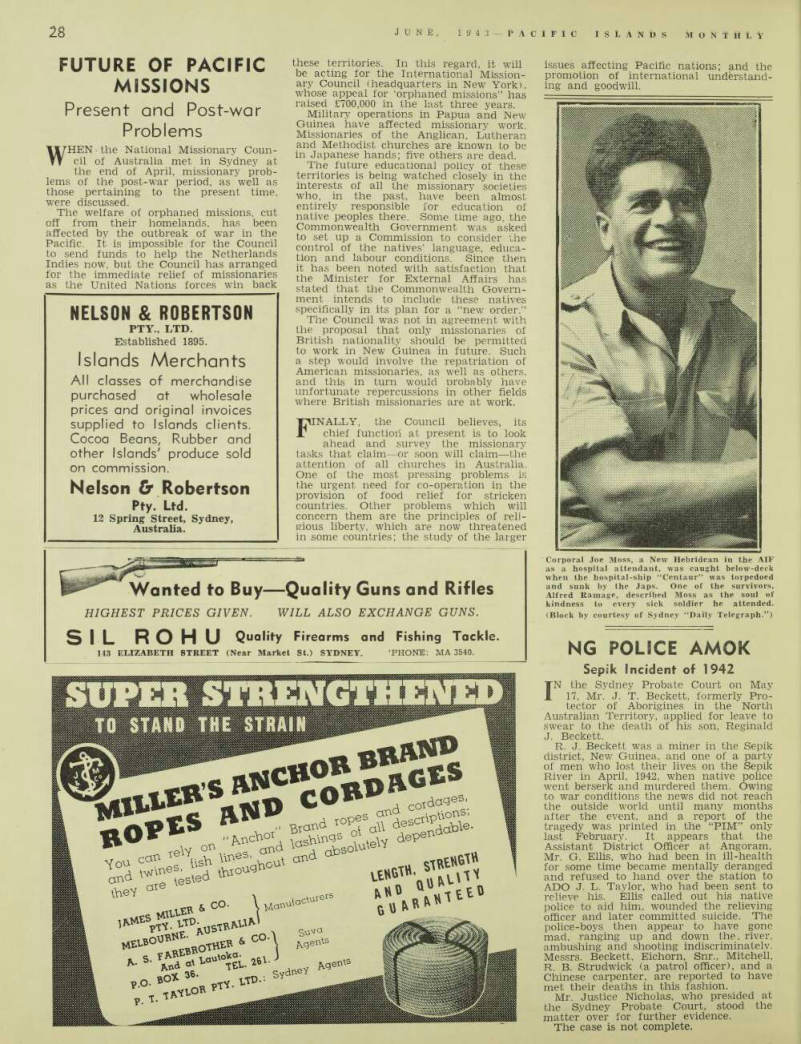
Missions
Present and Post-war Problems
WHEN - the National Missionary Coun cil of Australia met in Sydney at the end of April, missionary prob lems of the post-war period, as well as those pertaining to the present time, were discussed.
The welfare of orphaned missions, cut off from their homelands, has been affected by the outbreak of war in the Pacific. It is impossible for the Council to send funds to help the Netherlands Indies now. but the Council has arranged for the immediate relief of missionaries as the United Nations forces win back
these territories. In this regard, it will be acting for the International Mission ary Council (headquarters in New York), whose appeal for ‘orphaned missions” has raised £700,000 in the last three years.
Military operations in Papua and New Guinea have affected missionary work.
Missionaries of the Anglican, Lutheran and Methodist churches are known to be in Japanese hands; five others are dead.
The future educational policy of these territories is being watched closely in the interests of all the missionary societies who, in the past, have been almost entirely responsible for education of native peoples there. Some time ago, the Commonwealth Government was asked to set up a Commission to consider the control of the natives' language, educa tion and labour conditions. Since then it has been noted with satisfaction that the Minister for External Affairs has stated that the Commonwealth Govern ment intends to include these natives specifically in its plan for a “new order.”
The Council was not in agreement with the proposal that only missionaries of British nationality should be permitted to work in New Guinea in future. Such a step would involve the repatriation of American missionaries, as well as others, and this in turn would nrobably have unfortunate repercussions in other fields where British missionaries are at work.
FINALLY, the Council believes, its chief function at present is to look ahead and survey the missionary tasks that claim—or soon will claim —the attention of all churches in Australia.
One of the most pressing problems is the urgent need for co-operation in the provision of food relief for stricken countries. Other problems which will concern them are the principles of reli gious liberty, which are now threatened in some countries; the study of the larger
issues affecting Pacific nations; and the promotion of international understand ing and goodwill.
Corporal Joe Moss, a New Hebridean in the AIF as a hospital attendant, was caught below-deck when the hospital-ship “Centaur” was torpedoed and sunk by the Japs. One of the survivors, Alfred Ramage, described Moss as the soul of kindness to every sick soldier he attended. (Block by courtesy of Sydney “Daily Telegraph.”)
Ng Police Amok
Sepik Incident of 1942
IN the Sydney Probate Court on May 17, Mr. J. T. Beckett, formerly Pro tector of Aborigines in the North Australian Territory, applied for leave to swear to the death of his son, Reginald J. Beckett.
R. J. Beckett was a miner in the Sepik district, New Guinea, and one of a party of men who lost their lives on the Sepik River in April, 1942, when native police went berserk and murdered them. Owing to war conditions the news did not reach the outside world until many months after the event, and a report of the tragedy was printed in the “PIM” only last February. It appears that the Assistant District Officer at Angoram, Mr. G. Ellis, who had been in ill-health for some time became mentally deranged and refused to hand over the station to ADO J. L. Taylor, who had been sent to relieve his. Ellis called out his native police to aid him, wounded the relieving officer and later committed suicide. The police-boys then appear to have gone mad, ranging up and down the. river, ambushing and shooting indiscriminately.
Messrs. Beckett, Eichorn, Snr., Mitchell, R. B. Strudwick (a patrol officer), and a Chinese carpenter, are reported to have met their deaths in this fashion.
Mr. Justice Nicholas, who presided at the Sydney Probate Court, stood the matter over for further evidence.
The case is not complete.
Advertisements & other items, p. 30 (2 items)
28
•ihiSTE. isl3-p ACIFIC ISLANDS monthly
i-S£Ss^*\
NELSON & ROBERTSON
PTY., LTD.
Established 1895.
Islands Merchants
All classes of merchandise purchased at wholesale prices and original invoices supplied to Islands clients.
Cocoa Beans, Rubber and other Islands 7 produce sold on commission.
Nelson & Robertson
Pty. Ltd. 12 Spring Street, Sydney, Australia.
Wanted to Buy—Quality Guns and Rifles HIGHEST PRICES GIVEN. WILL ALSO EXCHANGE GUNS.
SI L RO H U Quality Firearms and Fishing Tackle. 143 ELIZABETH STREET (Near Market St.) SYDNEY. ’PHONE: MA 3540.
n i . _^rr\a<g eS ' #S*' rfiW C
cotvo
J rOC© S ?
B 3 i\N» I I •pU^ -r C T You 1 \Vu° uC3
*«® AVn to
6\J \ CO iw*»
i-S£Ss^*\
*■ •- Sl ... 1
AVIS'
tfEVBO’
C.i’- ... , LauVoVca
Rnd <* U IEI
V.o. B° X *
Tribute To Ngvr
11/ HEN that famous unit, the New Guinea Volunteer Rifles (formed when war was declared in 1939, and brought into action in January, 1942, under the grimmest conditions ever faced by civilian troops in the South Seas ) was. officially disbanded a few weeks ago, there was not one word of appreciation spoken by any high officer of the Aits tralian Army.
This spontaneous tribute to as fine a body of men as ever donned the King’s khaki comes spontaneously from Paul Deutscher, formerly a Lutheran mission ary at Finschhafen, TNG, and now liv ing at Glenlee, Nhill, Victoria.
IT is with extreme regret that I learned that the NGVR has been disbanded, and passed into oblivion.
As an old New Guinea man, having spent 19 years in the Mandated Terri tory, I feel that far too little has been said of what this unit has accomplished.
I have also had opportunity of witness ing what it has done, as well as having been able to get first-hand information.
I was evacuated from Finschhafen Mission Station on February 16. 1942, and I finally got to Australia on June 4. 1942. During that time I personally witnessed what a fine, brave body the NGVR was.
We were a party of five, which left Lae for the mission station, Gabmazung, 26 miles out, and the adjoining military camp, Nadzup, in charge of a number of NGVR men. There were four trucks, mostly loaded up with goods, etc., for the interior.
The road was in a terrible mess and, to the ordinary individual, appeared to be quite impassable. There had been
very heavy rains. It was, however, re markable to see how those soldiers sur mounted all difficulties. Culverts and bridges had to be repaired en route. Most of the men had previously had no experi ence of this class of work, yet the team work they performed, without a murmur, was an eye-opener to my companions and myself. They were largely men who had previously been accustomed to office work and such like. We got safely through.
A garrison was left at Lae, but even tually it was forced to leave. Its route then lay along the road I have men tioned. They had stuck magnificently to their task, and now they fell back in good order, and while the rain was com ing down in torrents.
It was well known to the party that the Japanese were almost on their heels. They came to a river. The waters were rising rapidly. An attempt was made to cross the river but the motor truck got stuck in the bed. The soldiers had to climb up the opposite bank and take to the bush.
A Japanese armoured car was after them but, fortunately, the flood-waters, which were still rising, prevented its further progress, and they got to Nadzup.
They suffered some machine-gunning from the air, at this place, but no very serious casualties occurred.
Owing to poor health, I had to stay at the Morobe goldfields towns for a couple of months, and I heard of num erous cases in which the NGVR did some wonderful work, reconnoitring and keep ing communications open, although they were (up to that time) only poorly equipped.
It speaks volumes for their ability and bravery that they managed to hold the fort, as it were, until the troops from the south were able to come in.
The above is only a mere fraction of what the NGVR did, but it was enough to inspire anyone with the greatest respect for this unit. As for myself, I shall always be ready to say “Hats off to the NGVR!” even if it has now passed out of existence.
Advertisements & other items, p. 31 (1 item)
W.KOPSEN & Co.Pty.Ltd.
THE
YORKSHIRE
INSURANCE
CO. LTD.
(Incorporated in England)
FIRE
ACCIDENT
MARINE
FIRE POLICIES ISSUED
IN PAPUA
All information from —
E. A. JAMES,
14 Spring St., Sydney.
Tel. 86347. Attorney for Papua,
SIMPLEX
MARINE
ENGINES
Simplex engines from 3 h.p. to 12 h.p. for boats from 14 ft. to 26 ft. are Australia’s best. 2 cycle and 4 cycle with or without reverse gear.
Illustrated is the popular little 3 h.p. suitable for 14 ft. or 16 ft boats Runs for 5 hours on 1 gallon petrol and costs only £29/15/-, complete with all equipment. Ready to instal into any boat, nothing else to buy Ask for Simplex catalogue of engines and launches.
SKARSTEN SCRAPERS
Remove paint, varnish, glue, oil, grease, roughness, etc., from wood and metal surfaces. Most useful for scraping deck and hull planks. They leave the surface smooth and dressed and ready for painting. Have renewable blades.
Prices: No. 35, 2/3; 62, 2/6; 80, 3/3.
Reversible, 7/-.
Write for leaflet.
TILLEY
Kerosene
LAMPS
British-made Kerosene Lamps providing a steady 300 c.p. light, without flickering, and without smoke or smell.
Model TLIO (illustrated) is a handsome Table Lamp providing exceedingly brilliant illumination and at the same time a fine ornament for any home.
Stands 24 in. high and covers a large area. Attractive parchment shade is finished in autumn tones and matches any furnishings.
Also available is the popular All- Purpose Lamp and Lantern (model EX100) and a variety of Hanging, Table, Wall and Vase Lamps.
Let us send you full details of an Tilley Lamps.
SHIPCHANDLERY
We manufacture and stock the largest range of boat gear in Australia. Everything for hoatbuilder and boatowner. Marine paints and varnishes Rope and Cordage. Rigging. Anchors and M oorings. Copper Nails and Rod Lighting Plants. Fire Extinguishers. Oars and Sculls, Lamps, Pumps, etc.
GET OUE PRICES FIRST.
W.KOPSEN & Co.Pty.Ltd.
376/380 KENT STREET, SYDNEY
’Phone. MA 6336 (4 lines). Est. 1868. Cables! Kopsen . . . Sydney
Poisonous Fish
AN illustrated guide to the poisonous and harmful fishes likely to be encountered in Australia, New Gui nea, and the islands of the South-west Pacific has been issued as Bulletin 159 of the Australian Council for Scientific and Industrial Research. Hope is expressed that it will be of use to members of the forces. The guide, which was written by C. P. Whitley, includes methods of treat ment for food poisoning and for wounds from venomous fishes.
The Rev. W. F. Paton—now in Mel bourne —hopes to return to the New Hebrides shortly.
We Take Kava
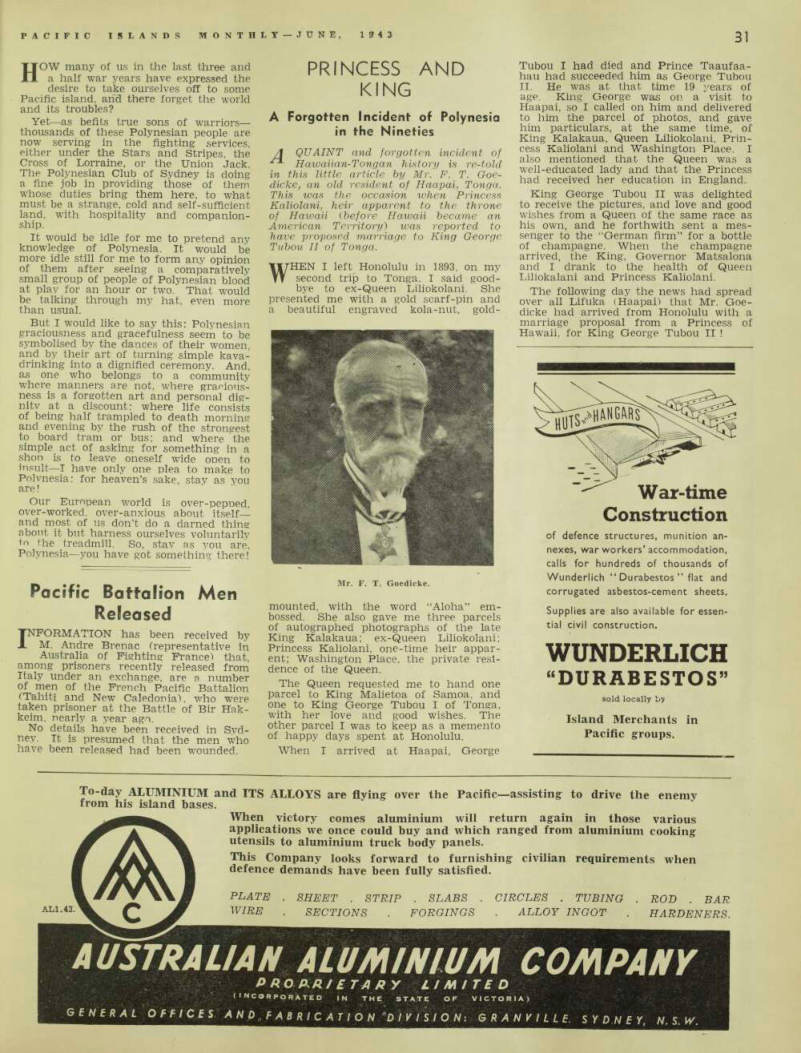
An Evening With the Polynesian Club in Sydney
By Judy Tudor
IHAVE often been told, right here in this office, that the trouble with me is that I know only Melanesia —I should see Polynesia.
“Is that so?” I have always replied.
“I like my romance strongly laced with reality. I can get all my tropical lagoon stuff at the movies—watching Dorothy Lamour disporting in a sarong. Melane sia will do for me!”
But now I ask leave to reserve my judgment on Polynesia until such time as I can get at it and see for myself.
On June I—the coldest night I have ever experienced in Sydney—the Poly nesian Club met at 250 George Street, and with an unpretentious clubroom, a piano, a violin, half a dozen ukeleles and guitars, plus the abundant personalities of its members, infused a spiritual warmth into the 'atmosphere that never existed in similar gatherings in Mela nesia.
Come to think of it, there are so many things that are “simply not done” in Melanesia proper (and I exclude Fiji here). that the creation of any such atmosphere would be impossible. Pos sibly it is this friendliness and com mingling of these people, gathered as they are from many different Pacific Territories which fly three distinct national flags, that impresses itself most upon the mind of one who has been
inculcated with the “must-not” tradi tions of the Australian Territories in the South-west Pacific. It has inspired in me, at least, a desire to see these people on their native soil, minus the trappings of Sydney-civilisation. So, Polynesia, here I come! (When Tojo permits.) rK principal guest of the evening was Corporal Richard Hahn, formerly of Tonga and Sydney, and now of the AIF, and on short leave in Sydney. Cor poral Hahn is an old friend of the club, and has returned from somewhere in the North with a profound respect for our American Allies, who, he considers, are doing a magnificent and often unappre ciated job.
“Dick” met many Polynesians serving in the US forces, and, on his own confes sion, never misses an opportunity of making their acquaintance. On his way south he visited a theatre and was shown to a seat next a copper-skinned gentle man.
After a time passed in silent scrutiny he asked, politely: “Which island do you come from?”
The serviceman looked at him in amazement for a moment, and then drawled:— “Say. buddy, haven’t you ever heard of Red Indians!”
Other guests were Alphonse Mai, of Tahiti, a descendant of both the Tahitian and the Bora Bora branches of the Society Islands’ Royal Family: and Sergeant Keo Kalani, an Hawaiian mem ber of the United States forces, and the first Hawaiian to be welcomed to the club.
During the evening kava (“vaka Viti”) was made by Ratu Peni, a junior member of the Cakobau family of Bau, Fiji, in honour of Richard Hahn. He was assisted by three other young Fijians.
I HAD been instructed, beforehand, that if kava were offered me. I must on no account refuse it. I agreed; I could not imagine why I should be asked to partake, anyway. But, after it had been variously described to me as tasting like toothpaste flavoured with pepper, dirty dishwater, and several other un pleasant things; and I had seen it made with solemn ceremony and handed around to guests in a brimming coconut shell, and drunk with further ceremony and a few graceful words in a Polynesian tongue, and had seen a Polynesian lady pull a wry face when the cup was offered her—l began to be worried seriously lest I, ungracefully European and unschooled in the art of kava drinking, should have to drink, simply because by some acci dent. I have been squeezed into the table of the guest of honour. I need not have worried: the kava bowl passed me by. I was able to have my initial experience of it later —in private, thank God.
Love of kava must surely be acquired with pain and perseverance. Peppered toothpaste—no; dirty dishwater —still no; but I imagine that it is faintly remi niscent of blue-water after a large and soapy family wash. Yet, strangely, it leaves a clean, astringent, and pleasant after-taste. Some Europeans eat olives to clean the palate between courses of a meal. It is common not to like olives, I have been told. I’m common —I loathe them; but I venture the suggestion that kava would have the same effect as olives, and be a darned sight more plea sant to take.
At the close of the evening the lady members of the club entertaihed the quests with Polynesian dances; a tiny lass, Hinemoa Mahomet, with all the charm of her Polynesian forebears, gave a special kopikopi. and Mrs. Goodman (formerlv of Tahiti) a hula which soon had half the men of the company out on the floor accompanying her.
HOW many of us in the last three and a half war years have expressed the desire to take ourselves off to some Pacific island, and there forget the world and its troubles?
Yet—as befits true sons of warriors— thousands of these Polynesian people are now serving in the fighting services, either under the Stars and Stripes, the Cross of Lorraine, or the Union Jack.
The Polynesian Club of Sydney is doing a fine job in providing those of them whose duties bring them here, to what must be a strange, cold and self-sufficient land, with hospitality and companion ship.
It would be idle for me to pretend any knowledge of Polynesia. It would be more idle still for me to form any opinion of them after seeing a comparatively small group of people of Polynesian blood at play for an hour or two. That would be talking through my hat, even more than usual.
But I would like to say this: Polynesian graciousness and gracefulness seem to be symbolised by the dances of their women, and by their art of turning simple kava drinking into a dignified ceremony. And. as one who belongs to a community where manners are not, where graeious ness is a forgotten art and personal dig nity at a discount: where life consists of being half trampled to death morning and evening by the rush of the strongest to board tram or bus; and where the simple act of asking for something in a shon is to leave oneself wide open to insult—l have only one plea to make to Polynesia: for heaven’s sake, stay as you are!
Our European world is over-pepned, over-worked, over-anxious about itself— and most of us don’t do a darned thing about it but harness ourselves voluntarily to the treadmill. So, stav as you are.
Polynesia—you have got something there!
Advertisements & other items, p. 32 (1 item)
Rheumatism, Ankles Puffy,
In normal times we carry extensive stocks of
FLAX CANVAS
COTTON DUCKS
"BIRKMYRE'S "
WATERPROOF CANVAS
also
COTTON FISHING NETS
LINES & TWINES
GOUROCK ROPES
& CANVAS LTD.
257 CLARENCE ST„ SYDNEY
Woven Wire for all Industry
COPRA DRYING TRAYS, FLOORS, Etc.
FRUIT DRYING TRAYS, MINING SCREENS.
Heavy Mosquito Gauze in Phosphor Bronze and other Metals Impervious to Salt Sea Air.
WIRE DOOR MATS AND GENERAL WIRE WORKS
E. WRIGHT & CO. LTD.
Office and Works: 148-152 Cleveland Street, Sydney, N.S.W.
Telegraphic Address: “Wrightmake,” Chippendale,
Rheumatism, Ankles Puffy, Backache, Kidneys Strained?
If you’re feeling out o-sorts, or suffer from Dizziness, Nervousness, Backache, Leg Pains, Swollen Ankles, Rheumatism, Excess Acidity, or Loss of Energy and feel old before your time, Kidney Trouble is the true cause.
Wrong foods and drinks, worry, colds or overwork may create an excess of acids and place a heavy strain on your kidneys so that they function poorly and need help to properly refresh your blood and maintain health and energy.
Help Kidneys Doctors' Way
Many doctors have discovered by scientific clinical tests and in actual practice that a quick and sure way to help the kidneys clean out excess poisons and acids is with a scienti-
fically prepared prescription called
Cystex. Hundreds and hundreds of Doctors’ records prove this.
No Benefit—No Pay
The very first dose of Cystex goes right to work helping your Kidneys remove excess acids. Quickly, this makes you feel like new again. And so certain are the makers that Cystex will satisfy you completely they ask you to try it under a money back guarantee. You be the judge. If not entirely satisfied just return the empty package and get your money Cystex costs little at chemists and stores and the money back guarantee protects you. Now in 2 sizes— 4/- and 8/-.
IDNEYS
VJ 9 A B LADDER
The Guaranteed Treatment. RHEUMATISM
Pacific Battalion Men
Released
F FORMATION has been received by M. Andre Brenac (representative in Australia of Fighting France) that, among prisoners recently released from Italy under an exchange, are a number of men of the French Pacific Battalion (Tahiti and New Caledonia), who were taken prisoner at the Battle of Bir Hak keim, nearly a year ago.
No details have been received in Syd ney. It is presumed that the men who have been released had been wounded.
Princess And
King
A Forgotten Incident of Polynesia in the Nineties
A QUAINT and forgotten incident of Hawaiian-Tongan history is re-told in this little article by Mr. F. T. Goe dicke, an old resident of Haapai, Tonga.
This was the occasion when Princess Kaliolani, heir apparent to the throne of Hawaii (before Hawaii became an American Territory) was reported to have proposed marriage to King George Tubou II of Tonga.
WHEN I left Honolulu in 1893, on my second trip to Tonga. I said good bye to ex-Queen Liliokolani. She presented me with a gold scarf-pin and a beautiful engraved kola-nut, gold-
mounted, with the word “Aloha” em bossed. She also gave me three parcels of autographed photographs of the late King Kalakaua; ex-Queen Liliokolani; Princess Kaliolani, one-time heir appar ent; Washington Place, the private resi dence of the Queen.
The Queen requested me to hand one parcel to King Malietoa of Samoa, and one to King George Tubou I of Tonga, with her love and good wishes. The other parcel I was to keep as a memento of happy days spent at Honolulu.
When I arrived at Haapai, George
Tubou I had died and Prince Taaufaa hau had succeeded him as George Tubou 11. He was at that time 19 years of age. King George was on a visit to Haapai, so I called on him and delivered to him the parcel of photos, and gave him particulars, at the same time, of King Kalakaua, Queen Liliokolani, Prin cess Kaliolani and Washington Place. I also mentioned that the Queen was a well-educated lady and that the Princess had received her education in England.
King George Tubou II was delighted to receive the pictures, and love and good wishes from a Queen of the same race as his own, and he forthwith sent a mes senger to the “German firm” for a bottle of champagne. When the champagne arrived, the King, Governor Matsalona and I drank to the health of Queen Liliokalani and Princess Kaliolani.
The following day the news had spread over all Lifuka (Haapai) that Mr. Goe dicke had arrived from Honolulu with a marriage proposal from a Princess of Hawaii, for King George Tubou II !
Mr. F. T. Goedicke.
Advertisements & other items, pp. 33-36 (2 items)
Company
HUTS
War-time
Construction
of defence structures, munition annexes, war workers’accommodation, calls for hundreds of thousands of Wunderlich “ Durabestos ” flat and corrugated asbestos-cement sheets.
Supplies are also available for essential civil construction.
WUNDERLICH
“DURABESTOS”
sold locally by Island Merchants in Pacific groups.
To-day ALUMINIUM and ITS ALLOYS are flying: over the Pacific—assisting to drive the enemy from his island bases.
When victory comes aluminium will return again in those various applications we once could buy and which ranged from aluminium cooking utensils to aluminium truck body panels.
This Company looks forward to furnishing civilian requirements when defence demands have been fully satisfied.
PLATE . SHEET . STRIP . SLABS . CIRCLES . TUBING . ROD . BAR WIRE . SECTIONS . FORGINGS . ALLOY INGOT . HARDENERS.
A
COMPANY
A ) GENERAL OFFICES AND FABRICATION *0 IVIS I O N: GRANVILLE. SYDNEY, N.S.W.
PROPRIETARY LIMITED
(INCORPORATED IN THE STATE OF VICTORIA)
Allen Taylor & Co. Ltd.
COMMERCIAL ROAD, ROZELLE,
SYDNEY
Sawmillers and Wholesale Suppliers of Hardwoods for Constructional Purposes GIRDERS . . . PILES . . . POLES . . . SLEEPERS, Etc.
EXPORTING TO PACIFIC ISLANDS SINCE 1893
BITUMENOID ROOFING
MADE IN AUSTRALIA.
Bltumenold Roofings, Dampcourse and Insulating Pelts are made from the world’s best raw materials. Warranted to stand the most rigid tests.
BITUMENOID THE BEST
Roofing, 1,2, 3-ply; Flooring, Waterproof Materials; Saturated Pelt; Resilient Road Jointing; Natural Asphalt Dampcourse: 2 and 3-ply Dampcourse; 1-2 lb. Lead-core Dampcourse: Roofing Cement; Asphalt Paints; Roofing Compound.
SAMPLES AND PRICE LISTS ON APPLICATION.
MAXWELL PORTER & SON LTD.
ESTABLISHED 1888. BUILDERS’ SUPPLIES.
107 REDFERN ST,, REDFERN, SYDNEY, N.S.W. ’Phone: M 3157, Cables Bitumenoid.
Steamships Trading
Company Limited
PORT MORESBY
SAMARAI
PAPUA.
WHOLESALE & RETAIL MERCHANTS, SHIPOWNERS,
PLANTERS, ENGINEERS & SLIP PROPRIETORS.
Customs, Shipping, Insurance, and Forwarding Agents.
MANAGING AGENTS AND VISITING REPRESENTA-
TIVES FOR COCONUT AND RUBBER ESTATES.
SYDNEY REPRESENTATIVES: Nelson & Robertson Pty. Ltd., 12 Spring Street.
CLIENTS PLEASE NOTE
Temporary War Address— C/o Nelson & Robertson Pty. Ltd., 12 Spring St., Sydney.
WRITE, CABLE, OR CALL
STEAMSHIPS TRADING COMPANY LIMITED
Cable Address: "Steamships".
KANGAROO BRAND
Ropes,
Cordage,
and Twines for every purpose Backed by 86 years of service.
Manufactured by
M. DONAGHY AND SONS,
Pty. Ltd.,Geelong and Sydney.
Fiji Representatives:
PEARCE AND CO.
LIMITED
P.O. BOX 237, SUVA
Qualite par Excellence.
J A N
VOK Liqueurs
New Hebrides and New Caledonia: Fiji & Tonga: •
TRADE
ENQUIRIES TO:
DISTRIBUTING AGENTS
MAURICE PELLETIER, 16 BRIDGE STREET, SYDNEY.
NORTHERN HOTELS LTD., LAUTOKA & BA, FIJI.
J. C. MERRILLEES & CO.
ISLAND MERCHANTS
Challis House, Martin Place, Sydney
Bankers: Bank of New South Wales.
BIIBIYS
BUY BIN
Distilleries at London . . . England Toronto . . . Canada Moorabbin . . Victoria Cincinnati . . U.S.A.
32
JUNE, IS'43 PACIFIC ISLANDS MONTHLY
Problems of Pacific Territories Continued from Page 9
Outlook For Ng
Natives
Will They be Harmed by Economic Development?
rE effect upon New Guinea natives of the economic development of their country was the subject of an address given recently by Dr. lan Hogbin (lecturer in anthropology) before the Geographical Society in the University of Sydney.
Dr. Hogbin pointed out that a twofold problem presents itself to Australia in administrating New Guinea. Firstly, Australia has bound herself to secure the well-being of the population: while the task of exploiting the natural resources of the country is regarded by many Euro peans almost as another moral duty.
The question arises; Are these two things incompatible?
Dr. Hogbin said the answer to this question is closely interwoven with land and labour distribution in New Guinea.
It is a fact that, in the past, native properties were taken over by Europeans for various reasons, without even con sidering whether these areas were essen tial to the local population’s food supply.
Similar mistakes are rarely made now; but, before alienating any land, an offi cial investigation should be made to ascertain its food-supply value. The use of large tracts is necessary under native methods of “shifting agriculture.”
As to indentured labour, Dr. Hogbin said that It was claimed that this was the best and easiest way of introducing the natives to European civilisation. This, of course, was a fallacy, because the native sees and learns very little of “civilisation” by working on a planta tion. He makes no real acquaintance with Europeans, who, in many cases, do not even bother to speak to him in cor rect Pidgin English. Furthermore, any hygiene the natives learn from contact with white men, is of little use, simply because they cannot apply it when they return to their villages. Finally, meth ods of agriculture, as applicable to European conditions, and as used by European planters are obviously of little practical value to the natives for grow ing their own crops.
Again, the effect of the indentured labour system on the native community is not beneficial. The young men leave the villages during their best years, with a resultant decline in birthrate. When they ultimately return, many of them show a lack of discipline and obedience to the elders of the community, which is such an essential feature of a healthy native community.
Epidemics are still prevalent on both plantations and goldfields, despite the fact that the various authorities have guaranteed to look after the well-being of the natives, insofar as decent living and working conditions are concerned. Edu cation, as a whole, is discouraged, and all sorts of excuses put forward—but the real reason is undoubtedly the fear of what native demands might follow edu cation. To most Europeans, the natives are only a source of cheap labour; and so health and education schemes are regarded as harmful.
As for the importation of coolies, Dr.
Hogbin explained that an idea of the ultimate effect of this scheme could be gained by studying conditions in Fiji, where Indians nearly outnumber the Fijians, and probably will do so in the near future.
The exploitation of native labour and the promotion of native welfare are incompatible. Australia will either con tinue to exploit New Guinea, irrespective of native welfare; or alternatively, she will leave the natural resources of the country untouched, until the time comes when the natives are capable of using those resources for their own benefit.
Dr. Hogbin concluded by stating that the latter course undoubtedly was the fairer, despite strong opposition from various quarters, which have but little interest in the well-being of the natives.
Mrs. Dorothy Fleming, younger daughter of Major and Mrs. Swinbourne, formerly of Fiji, and the Gilbert and Ellice Islands Colony, presented her husband, Lieut.
Talbot Fleming, AIF (returned), with a daughter, at Manly, NSW, on May 16.
Advertisements & other items, p. 36 (1 item)
E. J. Gough & Co.
SUPPLIERS OF GENERAL MERCHANDISE TO LEADING FIRMS
THROUGHOUT THE PACIFIC ISLANDS
1 BOND STREET, SYDNEY,
AUSTRALIA.
EXPORTERS . . . IMPORTERS . . . MANUFACTURERS' REPRESENTATIVES BANKERS: Bank of N.S.W. Comptoir National d’Escompte de Paris.
Page From the Past
Punitive Expedition to Rossel Island
By D. H. Osborne
SOON after the discovery of gold on Sudest in the ’Bo’s, two French escapees from the penal settlement on New Caledonia, arrived on the island in a twenty-foot, square-sterned cutter, which they had stolen. They had called in at Rossel Island en route, and here the natives had given them food and water, which allowed them to proceed on their way. borne time previous to this event, Sir William McGregor, then Administrator of Papua, had experienced great trouble with New Caledonian officials over con vict escapees, and he had decreed that Frenchmen who behaved themselves could, if they wished, remain in the Territory. Accordingly, the two new arrivals sold the boat to John Mahony, settled in Sudest, and took up gold mining; and after a time they made good.
One of them, Lucien Fiolini, was able to buy the boat back, and he left for Rossel Island, with the intention of settling there. But only a short time afterwards he was murdered by the islanders.
Had the murderers sunk the boat, their crime might have gone undetected; but they took it outside the reef, set the sails with the sheet close-hauled, and let it go. It drifted with tide and wind, and eventually was picked up by Sudest natives, near the east end of their island, inside the barrier reef, which it must have negotiated at full tide.
The Sudest natives delivered the boat to Griffen Point. Foul play was suspected immediately by the Europeans, and the Administrator was informed, THE following is Sir William McGregor’s report on the expedition that was sent to inquire into the murder. It is copied from Armstrong’s book on Rossel Island.
“On August 1. the steamer anchored at the head of Yonga Bay, and prepara tions were made for visiting the south coast of the island next day. Mr, Morton, the Magistrate of the District, and the Commandant with some police, were directed to march across the island near the place where it was understood the murder had been committed; I went round the west end of the island in a whale boat, in the hope of winning over the different tribes along the coast.
“In this we were completely success ful; the co-operation of every tribe was secured, up to Tama, where Lucien was killed. My boat was beached about two miles west of that place, so that it was not seen by the Tama people, and my crew and a number of volunteers from Bamba and Kwanija went to the first Tama houses and were successful at once in arresting one of those implicated in Lucien’s murder. The rest of the Tama tribe fled to the mountains, without offer ing any resistance.
“The Kwaija tribe, near neighbour of Tama on the west, were naturally very shy and timid, but they were soon secured for the Government side. About fifteen or sixteen men and youths received me in their village, but in a somewhat peculiar way.
“Under the largest house, which was built on six posts about five or six feet long, they had built a sort of fence of leaves from the coconut palms, laid on their edges, and about a yard high. When I appeared, the Chief and three or four of the leading men were seated inside this enclosure, but before I reached the place the’other grown men also went in
side it and remained there during the whole of my visit. The idea seemed to be that it was a sacred place where they would be safe from molestation.
“On the way back (from an unsuccess ful attempt to reach the Island of Loa) we met three canoes at the head of Nyebe Bay, which had come down to the Nyavo Creek to fish. They were of the usual peaceful and friendly character of the Yela (Rossel) people and carried no spears or other arms in their canoes.
“On returning to Tama, I found that the volunteers from Bomba, Kwanji and Kwaiji, had captured two of the principals in the murder. Unfortunately, the secur ing of one of them had a fatal result.
It appears that two men found one of the criminals and tied him up with cords put round his legs, thighs, arms and fore arms. I could not find that any ligatures were applied so as to compress his chest, so I am unable to say whether the un fortunate man died from natural causes, from fright, or from constriction of the bands which were used to confine him.
There was certainly no intention what ever on the part of the men that secured him to inflict any injury on him. They
were, I believe, entirely unarmed, “There seems to be no doubt as to the cause of the murder. The same reason for it was given to me by the natives at the east end of Tagula, and from Yonga Bay to Tama or Yela; they all main tained that Lucien was killed because he was after their women.
“The Yela people are peculiar in many ways, but in nothing are they more dif ferent from their northern neighbours of Kiriwana than in their scrupulous care of their women. I have not yet seen a native woman on the island, so jealously do they guard them from strangers.
“There was every reason to be pleased with the attitude and the conduct of the tribes along the coast. They unanimously condemned the Tama people for killing Lucien and fully approved of them being punished. They answered me there was no inter-tribal fighting on the island and all the men and canoes we met carried no arms.”
One of the murderers was sentenced to ten years’ hard labour at Woodlark Island.
He returned to Rossel, after serving his term, and led a peaceful life thereafter.
(Continued on Next Page)
(Continued from Page 35)
IN spite of the fact that these natives told Sir William that it was because Lucien had interfered with their women that he was murdered, other natives told my brother that it was be cause the Frenchman had interfered with tabus —which is much more likely.
Rossel was a maze of tabus —against which it was fatally easy to offend, with out being aware of it. My brother Frank had an uneasy four days there when he felled a tree on tabu’ed ground. Shortly after the felling, a heavy thunder storm came up, which led the natives to believe that the spirits were angry. They shut my brother up in a hut and, if it had not been for a ferocious dog, which kept them off him while he was asleep, and rain-water, which provided him with drink, he might have been allowed to perish.
After some parley, he discovered that the natives believed that if the timber were cut from this ground, the spirits of the dead from a certain village could not rest; he also discovered that there were old men who could remove the tabu.
Brother paid—and the tabu was removed!
There are many reasons for tabus. Some are purely religious, others are designed for the protection of fish or game, and serve the same purpose as our ‘close seasons.” And. incidentally, any fish or game that is not plentiful is reserved by tabu to the older people—a sort of native old-age pension scheme!
Contact with Europeans, and natives from other islands, have broken down many of these tabus.
Advertisements & other items, pp. 37-38 (1 item)
giUESPJl’Sebvic
a
BUYING AGENTS
FOR ALL PACIFIC TERRITORIES
Island Produce Sold on Commission
YOUR ORDERS RECEIVE PERSONAL ATTENTION
ROBERT GILLESPIE PTY. LIMITED
54a PITT STREET, SYDNEY
Cables: ROBERGILL. G.P.O. BOX 137 CC.
PRODUCING UNIFORM GOOD RESULTS SINCE 1868
ALWAYS ASK FOR IT
Restlessness and sleeplessness, when due to run-down nerves, frequently respond to treatment with Dr. Williams" Pink Pills.
Dr. Williams’
PINK PILLS
help to enrich the blood, which has a beneficial and restorative effect upon the nervous system.
Death of Mr. C. G. Howell
Mrs. C. G. Howell, who is at present living in Sydney, has received a cable from the Secretary of State for the Colonies, that her husband, Mr. Charles Gough Howell, KC, who was Attorney- General of the Straits Settlement until the Japanese occupation, died in a prisoners’ camp at Taiwan, in Formosa.
He was 48 years old, was educated at Cambridge, served in World War I, and he was Attorney-General in Fiji before being transferred to the Straits Settle ment. It was mostly due to Mrs. Howell’s efforts that the valuable Malayan Re search Bureau was established in Sydney in July, 1942.
Advertisements & other items, p. 38 (2 items)
36
JUNE, 1543 PACIFIC ISLANDS MONTHLY
Meeting of Pacific Territories Association—From page 33
Clarence Street, Sydney
THE STRENGTH, TOUGHNESS AND COR-
ROSION-RESISTANCE of Monel shafting mean that, like all other forms of Monel, it is available to-day only for Defence purposes and essential services.
Thanks to the British Navy, the British Mercantile Marine and British Industry, stocks are adequate for vital needs, and supplies and general information are still available from: —
WRIGHT AND COMPANY, 81
HERE'S WHERE MONEL GOES
Navy: All vessels in many vital parts.
Army: Mechanical and Radio Equipment, Signalling Gear, etc.
Air Force: Parts requiring strength plus corrosionresistance.
Essential Industries: Chemical, Drug, Textile, Food Processing, Transport, Power Plant Equipment, Pulp and Paper, Steel Manufacture, etc.
CLARENCE STREET, SYDNEY
Monel is a registered trade mark
Lutherans Being Brutally
Treated
DR. O. THEILE, Director of the Lutheran Mission, New Guinea, re ports that 19 members of the mission staff, including the superintendent, are in the hands of the Japanese, and that it has been established that they are being subjected to very harsh and brutal treat ment. Apart from a few Australians, most of these men are Americans.— “Australian Christian World.”
Wing-Commander Clive
Brewster
The following , from Sydney “Sun” of June 14, is about a man very well known in Fiji.
VETERAN Australian air fighter of the last war, Wing-Commander Clive Brewster took time off from an administrative job on land to act as gunner in a United States bomber dur ing Friday’s raid of Koepang.
Wing-Commander Brewster, OBE, MC, Legion of Honor, Cross of St. Olaf, is in command of the RAAF officers’ School of Administration, in Melbourne.
He got in touch with Captain Howard Merkel, pilot of one of the Liberators, and Merkel agreed to take him on the raid.
In the last war, Brewster fought with the British Flying Corps against Rich thofen’s famous souadron. and was offi cially credited with shooting down eight German planes, and probably destroying a score.
He had never used .50 guns, but they looked like the familiar Vickers.
“To hold those two guns against the slipstream was no mean physical feat, but I managed to get six Zeros directly in my sight before pressing the triggers.
“When I fired my first burst over Koe pang, I was using a gun in the air for the first time since the last war. I think it is a good thing to leave the lee ture room for short periods like this, and get some realism into one’s training.”
Brewster piloted a Sopwith fighter in France during the last war, firing his last combat shots in 1917. His chief
regret over Friday’s raid was that only one of the six Zeros he sighted decided to give battle.
Sgt-Pilot Ronald Mackay, RAAF, form erly a popular resident of Thursday Island, was killed in a flying accident in England after training in Canada.
Trooper Arthur T. Filewood, of Thurs day Island, has been wounded in action.
Mr. Ray Parer, attached to the “small boats” of the Navy, has “made the head lines” again with some daring exploits on the NE Papuan coast.
Advertisements & other items, pp. 39-40 (2 items)
Coleman
WANTED TO BUY
‘back COPIES OF “PACIFIC
ISLANDS MONTHLY.”
ANNUAL REPORTS OF BRITISH
NEW GUINEA AND PAPUA.
All Issues.
Write first to PAUL A. DORN, 1247 So. La Brea, Los Angeles, U.S.A.
There is no substitute for
OLD MONK
VIRGIN PURE
OLIVE OIL i
San Francisco
KEEP LANTERNS AND
STOVES WORKING
WITH GENUINE
Coleman
PARTS
To help you take care of your Coleman Lantern, Stove, Iron or other Appliance, the Coleman factory is doing everything possible to keep your Dealer supplied with Genuine Coleman Parts.
Ask his advice about making your Coleman appliance last longer. He will make repairs and keep it in satisfactory working order.
THE COLEMAN LAMP & STOVE CO. LTD.
TORONTO - - CANADA
the COLEMAN EXPORT CORPORATION, CHICAGO, ILL., U.S.A.
UNION
ASSURANCE SOCIETY LTD.
(Incorporated in England)
FIRE ACCIDENT
FIJI A. E. PEARCE & CO.
RABAUL COLYER WATSON
(New Guinea) Ltd.
N. S. WALES 109 PITT STREET,
SYDNEY.
S. Morrison, Mgr.
CONTROLLING OFFICE—
-413 Collins St., MELBOURNE
ALAN H. RUSSELL,
Resident Manager.
Ship Chandlery Hardware
Write for
/yyriTe ror j
Ship Chandlery /
Catalogue J
Special “In Bond” Prices for all Islands enquiries quoted on application.
BROOMFIELDS LIMITED
152 SUSSEX STREET :: SYDNEY.
Cables: “Boom”, Sydney.
Large and Complete Stocks of
SHIP CHANDLERY
IRONMONGERY OF ALL KINDS, PAINTS,
WHITE LEAD AND OILS.
Sole Agents for: P. H. MUNTZ & CO.’S 3-CROWN BRAND METAL SHEATHING.
PEACOCK & BUCHANS’ ENGLISH READY-MIXED PAINTS.
HARRY J. YOUNG PTV. LTD.
379 KENT STREET, SYDNEY
EXPORT REPRESENTATIVES FOR . . .
Bond's Industries Ltd.
Manufacturers of Hosiery and Underwear. Cotton Spinners.
Cottee's Passiona Ltd.
Makers of PASSIONA, Fruit Cordials, Fountain Syrups, Fruit Spreads, Peanut Butter and Peanut Products.
Horry Peck Cr Co. (Aust.) Pty. Ltd.
Makers of the famous "Anchovette" Fish Paste.
Specialists in Potted Delicacies, INQUIRIES THROUGH YOUR USUAL CHANNELS WILL RECEIVE
PROMPT ATTENTION.
Bankers: Bank of New South Wales.
Membership of Pacific Territories
Association
Temporary office accommodation has been provided for the new body, and the address of the secretary now is: Mr. C. A. M. Adelskold, secretary of Pacific Territories Association, c/o Robert Gillespie Pty M Ltd., Royal Exchange Building, 54a Pitt Street, Sydney; or, briefly, Secretary, Pacific Territories Association, Box 137 CC, GPO, Sydney. The telephone number is BW 4782. Evacuees who require the services of the Association in any way, or who desire to become members, should communicate with him at that address.
Members are wanted. So are funds. The subscription is 40/- per annum; but evacuees whose cash position is not what it was are asked to become members anyway, and contribute as much as they feel they can afford.
The secretary informs us that the following form could be used:—
APPLICATION FOR MEMBERSHIP
Secretary, Pacific Territories Association, Box 137 CC, GPO, Sydney.
Please enrol me as a member of your Association.
Name (Mr., Mrs. or Miss) Present address Former Address In Territories Present occupation, if any Previous occupation, in Territories If you want employment in Australia send full particulars on an attached statement (which please sign) showing your age, qualifications, details of experience, and what class of work you would prefer.
If you want the assistance of the Association in any way, send full particulars on an attached statement (which please sign).
Amount of subscription forwarded herewith, or to be forwarded: Signature
Museum Magazine's
Wonders Of New
Guinea
Museum Magazine's Useful Articles
THE latest issue of “The Australian Museum Masrazine,” dated March 30 (it is nublished quarterly), has been devoted entirelv to New Guinea. It will prove interesting to civilian and soldier alike, and its articles should disnel apparently ineradicable ideas that Allied soldiers are likely to be eaten bv tieers or chased bv mad elephants in the New Guinea jungle.
It is snecially recommended to war correspondents.
Native methods of hunting and agri culture are described bv F. D. McCarthy.
He shows how the native is constantly preoccupied by the necessity of replenish ing the stores of garden and other produce.
Contrary to the general belief that Pacific islanders have nothing to do but sit around waiting for ripe fruit to drop into their laps, maintaining the com munity’s food supply—whether it be by gardenine. hunting or fishing—is a matter of hard and constant work.
Ingenious native methods of snaring and trapping animals, birds and fish are described, and there is an account of Melanesian cooking technioue. McCarthy makes it clear that the native has adapted himself to his somewhat meagre
surroundings with skill and initiative.
“It is apparent that the success of the natives in obtaining an adequate supply of food depends, not only upon skill in gardening, hunting and fishing, but on a logical division of labour between the sexes and members of a community, a deep knowledge of the factors affecting the crops, such as the seasons and the soil, and an intimate association with their environment. A limited equipment is adapted to the habits of the innumer able terrestrial and marine creatures sought for food and other purposes, just as methods are varied to meet abnormal seasons. Co-operative work is more im portant than individual effort, and specialists play an important part in the maintenance of the food supply.’' r those who know New Guinea in all its phases, from the humid deltas of its great rivers to the mist covered peaks, T. Hodge-Smith’s article on the geology of New Guinea will have great appeal.
For the better appreciation of the natural history of New Guinea, it is essential that we have some under standing of its geology and geographical history. New Guinea, with Sumatra, Java and Timor, is a prolongation of the Himalayan-Burmese arc, through the Malay Peninsula—and a region that is characterised by great movements of the earth’s crust, which have caused intense folding of the rocks.
The crustal movements responsible for this great Himalayan-New Guinea arc took place during the Pliocene period— that is, about two million years ago—or comparatively recently, according to geological times. The last great compar able crustal movements in Australia died out about 250 million years ago. These crustal movements in New Guinea are actually going on to-day, as shown by subsidences in various parts of the main land and island groups, and by the fre quency of earthquakes.
In Cretaceous times (which ended 60 million years ago) New Guinea was joined to both Australia and Asia, which explains the curious commingling there of Australian and Oriental plants and animals.
Gold, osmiridium, platinum, silver, copper, lead, zinc, iron, manganese, sul phur, gypsum, phosphate, are all known to exist in New Guinea; while oil has been found associated with certain lime stones at Matapau, on the north coast of the mainland above Wewak, and in the Torricelli Ranges. A great deal of oil prospecting work has been done and, while no sensational discoveries have yet been made, great things are still hoped for in this region.
Other articles in the magazine concern the furred animals of New Guinea, Papuan insects, butterflies, and strange New Guinea beetles.
All articles are well illustrated. The magazine is a worth-while production, of great value to all who are interested in the South Pacific. Copies may be ob tained from the Australian Museum, Sydney, or from newsagents, for 1/- per copy, or 4/- per year, plus postage.
Rev. Eric Ure, of the LMS, Papua, is on sick leave, and is staying at Bellerive (Tasmania). He has given several talks on the work of the mission in Papua under present conditions.
Mr. Paul Helbig, of the Lutheran Mission Staff, New Guinea, has arrived in Australia, and is staying with his son, Rev. E. Helbig, of Milbrulong (NSW).
One of the last of the mission staff to be evacuated, Mr. Helbig has served as a lay-helper in New Guinea for the last 37 years. He went to New Guinea in 1906, after he had completed his studies at Immanuel College in South Australia.
Australian Short Wave
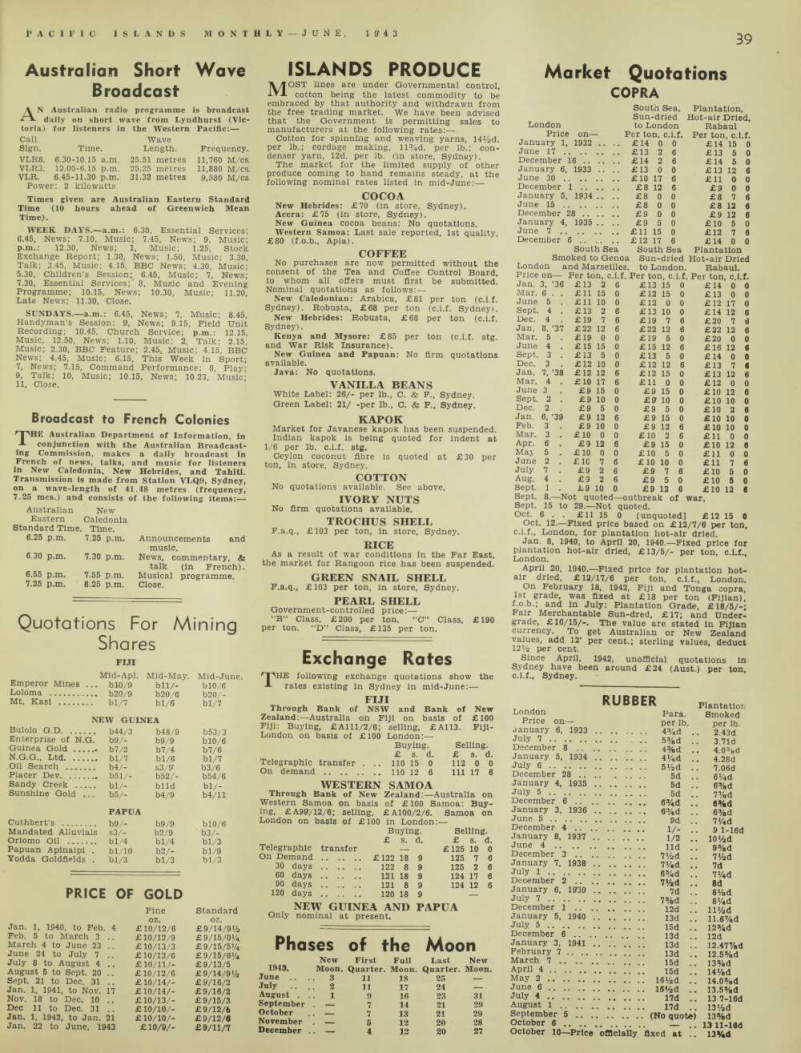
Broadcast
AN Australian radio programme is broadcast daily on short wave from Lyndhurst (Vic toria) for listeners in the Western Pacific:— Call. Wave Sign. Time. Length. Frequency.
VLRB. 6.30-10.15 a.m. 25.51 metres 11,760 M/cs.
VLR3. 12.00-6.15 p.m. 25.25 metres 11,880 M/cs.
VLR. 6.45-11.30 p.m. 31.32 metres 9,580 M/cs Power: 2 kilowatts Times given are Australian Eastern Standard Time (10 hours ahead of Greenwich Mean Time).
WEEK DAYS.—a.m.: 6.30, Essential Services: 6.45, News; 7.10, Music; 7.45, News; 9, Music; p.m.: 12.30, News; 1, Music; 1.25, Stock Exchange Report; 1.30, News; 1.50, Music; 3.30, Talk; 3.45, Music; 4.15, BBC News; 4.30, Music; 5.30, Children’s Session; 6.45, Music; 7, News; 7.30, Essential Services; 8, Music and Evening Programme; 10.15, News; 10.30, Music; 11.20, Late News; 11.30, Close.
SUNDAYS.—a.m.: 6.45, News; 7, Mlusic; 8.45, Handyman’s Session; 9, News; 9.15, Field Unit Recording: 10.45, Church Service; p.m.: 12.15, Music, 12.50, News; 1.10, Music; 2, Talk; 2.15, Music; 2.30, BBC Feature; 2.45, Music; 4.15, BBC News; 4.45, Music; 6.15, This Week in Sport; 7, News; 7.15, Command Performance; 8, Play; 9, Talk; 10, Music; 10.15, News; 10.23, Music; 11, Close.
Broadcast to French Colonies
r T''HE Australian Department of Information, in A. conjunction with the Australian Broadcast ing Commission, makes a daily broadcast in French of news, talks, and music for listeners in New Caledonia, New Hebrides, and Tahiti.
Transmission is made from Station VLQ9, Sydney, on a wave-length of 41.48 metres (frequency, 7.25 mcs.) and consists of the following items:—
Australian New Eastern Caledonia Standard Time. Time. 6.25 p.m. 7.25 p.m. Announcements and music. 6.30 p.m. 7.30 p.m. News, commentary, <Ss talk (in French). 6.55 p.m. 7.55 p.m. Musical programme. 7.25 p.m. 8.25 p.m. Close.
Quotations For Mining
Shares
Fiji
Mid-Apl.
Mid-May.
Mid-June.
Emperor Mines ... blO/9 bll/blO/6 Loloma b20/9 b20/6 b20/- Mt. Kasl bl/7 bl/6 bl/7
New Guinea
Bulolo G.D b44/3 b48/9 b53/3 Enterprise of N.G. b9/b9/9 blO/6 Guinea Gold b7/2 b7/4 b7/6 N.G.G., Ltd bl/7 bl/6 bl/7 Oil Search b4/s3/ff b3/6 Placer Dev b51/b52/b54/6 Sandy Creek hl/blld bl/- Sunshine Gold ... b5/b4/9 b4/ll Cuthbert’s
Papua
b9/b9/9 blO/6 Mandated Alluvials s3/b2/9 b3/- Oriomo Oil bl/4 bl/4 bl/3 Papuan Aplnaipi . bl/10 b2/bl/9 Yodda Goldfields . bl/3 bl/3 bl/3
Price Of Gold
Jan. 1, 1940, to Feb 4 Fine oz. £10/12/6 Standard oz. £9/14/914 Feb. 5 to March 3 £10/12/9 £9/15/0y 4 March 4 to June 23 £10/13/3 £9/15/51/4 June 24 to July 7 .. £10/12/6 £9/15/01/4 July 8 to August 4 ., £10/11/- £9/13/5 August 5 to Sept. 20 £10/12/6 £9/14/9i/ 2 Sept. 21 to Dec. 31 £10/14/- £9/16/2 Jan. 1, 1941, to Nov. 17 £10/14/- £9/16/2 Nov. 18 to Dec. 10 .. £ 10/13/- £9/15/3 Dec 11 to Dec. 31 .. £10/10/- £9/12/6 Jan. 1, 1942, to Jan. 21 £10/10/- £9/12/8 Jan. 22 to June, 1943 £10/9/- £9/11/7
Islands Produce
MOST lines are under Governmental control, cotton being the latest commodity to be embraced by that authority and withdrawn from the free trading market. We have been advised that the Government is permitting sales to manufacturers at the following rates:— Cotton for spinning and weaving yarns, 14V 2 d. per lb.; cordage making, ll 3 / 4 d. per lb.; con denser yarn, 12d. per lb. (in store, Sydney).
The market for the limited supply of other produce coming to hand remains steady, at the following nominal rates listed in mid-June:—
Cocoa
New Hebrides: £7O (in store, Sydney).
Accra: £75 (in store, Sydney).
New Guinea cocoa beans: No quotations.
Western Samoa: Last sale reported, Ist quality, £BO (f.0.b., Apia).
Coffee
No purchases are now permitted without the consent of the Tea and Coffee Control Board, to whom all offers must first be submitted.
Nominal quotations as follows: New Caledonian: Arabica, £Bl per ton (c.i.f.
Sydney). Robusta, £6B per ton (c.i.f. Sydney).
New Hebrides: Robusta, £6B per ton (c.i.f.
Sydney).
Kenya and Mysore: £B5 per ton (c.i.f, stg. and War Risk Insurance).
New Guinea and Papuan: No firm quotations available.
Java: No quotations.
Vanilla Beans
White Label: 26/- per lb., C. & F., Sydney.
Green Label: 21/ -per lb., C. & P., Sydney.
Kapok
Market for Javanese kapok has been suspended.
Indian kapok is being quoted for indent at 1/6 per lb. c.i.f. stg.
Ceylon coconut fibre is quoted at £3O per ton, in stare, Sydney.
Cotton
No quotations available. See above.
Ivory Nuts
No firm quotations available.
Trochus Shell
F.a.q., £lO3 per ton, in store, Sydney.
Rice
As a result of war conditions in the Far East, the market for Rangoon rice has been suspended.
Green Snail Shell
F.a.q., £lO3 per ton, in store, Sydney.
Pearl Shell
Government-controlled price:— “B” Class, £2OO per ton. “C” Class, £l9O per ton. “D” Class, £135 per ton.
Exchange Rates
THE following exchange quotations show the rates existing in Sydney in mid-June: —
Fiji
Through Bank of NSW and Bank of New Zealand:—Australia on FIJI on basis of £lOO Fiji: Buying, £Alll/2/6; selling. £AII3. FIJI - on basis of £lOO London:—
Western Samoa
Through Bank of New Zealand: —Australia on Western Samoa on basis of £lOO Samoa: Buy ing, £ A99/12/6; selling, £AIOO/2/6. Samoa on London on basis of £lOO in London: —
Buying.
Selling. £ s. d. £ s. d.
Telegraphic transfer . .. 110 15 0 112 0 0 On demand 111 17 6
Buying. £ s. d.
Selling. £ s. d.
Telegraphic transfer £125 10 0 On Demand £122 18 9 125 7 6 30 days 122 8 9 125 2 6 60 days 121 18 9 124 17 6 90 days 121 8 9 124 12 6 120 days 120 18 9 —
New Guinea And Papua
Only nominal at present.
Phases of the Moon
New First Full Last New 1943.
Moon.
Quarter.
Moon.
Quarter.
Moon.
June 3 11 18 25 July .. 2 11 17 24 August . 1 9 16 23 31 September 7 14 21 29 October 7 13 21 29 November 5 12 20 28 December — 4 12 20 27
Market Quotations
Oct. 6 . . £ll 15 0 [unquoted] £l2 15 0 Oct. 12.—Fixed price based on £l2/7/6 per ton, c.i.f., London, for plantation hot-air dried.
Jan. 8, 1940, to April 20, 1940.—Fixed price for plantation hot-air dried, £l3/5/- per ton, c.i.f,, London.
April 20, 1940.—Fixed price for plantation hot air dried, £l2/17/6 per ton, c.i.f., London.
On February 18, 1942, Fiji and Tonga copra, Ist grade, was fixed at £lB per ton (Fijian) f.0.b.; and In July: Plantation Grade, £lB/5/-; Fair Merchantable Sun-dred, £l7; and Under grade, £l6/15/-. The value are stated In Fijian currency. To get Australian or New Zealand values, add 12’ per cent.; sterling values, deduct 12 Va per cent.
Since April, 1942, unofficial quotations in Sydney have been around £24 (Aust.) per ton c.i.f., Sydney.
Copra
South Sea, Plantation, Sun-dried Hot-air Dried.
London to London Rabaul Price on— Per ton, c.i.f.
Per ton. c.i.f.
January 1, , 1932 . . . . £14 0 0 £14 15 0 June 17 . £13 2 6 £13 5 0 December 16 .. . £14 2 6 £14 5 0 January 6, , 1933 . . . £13 0 0 £13 12 6 June 30 . £10 17 6 £11 0 0 December 1 .. ., £8 12 6 £9 0 0 January 5, 1934 ., * £8 0 0 £8 7 6 June 15 . £8 0 0 £8 12 6 December 28 .. . £9 0 0 £9 12 6 January 4, , 1935 ., £9 5 0 £10 5 0 June 7 ., £11 15 0 £12 7 6 December 6 .. .. £12 17 6 £14 0 0 South Sea South Sea Plantation Smoked to Genoa Sun-dried Hot-air Dried London and Marseilles. to London.
Rabaul.
Price on— Per ton, c.i.f. Per ton, c.i.f. Per ton. c.i.f.
Jan. 3, *36 £13 : 2 6 £13 15 0 £14 0 0 Mar. 6 . . £11 15 0 £12 15 0 £13 0 0 June 5 . £11 10 0 £12 0 0 £12 17 0 Sept. 4 . £13 : 2 6 £13 10 0 £14 12 6 Dec, 4 . £19 1 7 6 £19 7 6 £20 7 d Jan. 8, '37 £22 12 6 £22 12 6 £22 12 6 Mar. 5 . £19 1 Q 0 £19 5 0 £20 0 0 June 4 , £15 15 0 £15 12 6 £16 12 6 Sept, 3 . £13 1 5 0 £13 5 0 £14 0 0 Dec. 3 . £12 10 0 £12 12 6 £13 7 8 Jan. 7. ’38 £12 12 6 £12 15 0 £13 12 6 Mar. 4 . £10 17 6 £11 0 0 £12 0 0 June 3 £9 15 0 £9 15 0 £10 12 6 Sept. 2 . £9 10 0 £9 10 0 £10 10 0 Dec. 2 . £9 ! 5 0 £9 5 0 £10 2 6 Jan. 6. ’39 £9 12 6 £9 15 0 £10 10 0 Feb. 3 . £9 10 0 £9 12 6 £10 10 0 Mar. 3 . £10 ( ) 0 £10 2 6 £11 0 0 Apr. 6 . £9 12 6 £9 15 0 £10 12 6 Maj 5 . £10 ( ) 0 £10 5 0 £11 0 0 June 2 , £10 1 r 6 £10 10 0 £11 7 6 July 7 . £9 i ! 6 £9 7 6 £10 5 0 Aug. 4 . £3 j ! 6 £9 5 0 £10 S 0 Sept. 1 . £9 10 0 £9 12 6 £10 12 6 Sept. 8.—Not quoted—outbreak of war.
Sept. 15 to 29. —Not quoted.
Rubber
Plantation London Para.
Smoked Price on— per lb. per lb January 6, 1933 2.43d July 7 3.7ld December 8 .. . 4.0 5 8 c) January 5, 1934 4.26d July 6 7.06d December 28 .. . 5d 6*/4d January 4, 1935 63/ad July 5 7 7 /sd December 6 .. . 6%<S January 3, 1936 . 6%d June 5 7y,d December 4 .. . 9 l-16d January 8, 1937 . lOVad June 4 9 9 /ad December 3 .. . 7Vad January 7, 1938 . 7d July 1 7Vid December 2 .. . 8d January 6, 1?39 . 8 Vad July 7 8y 4 d December 1 .. . liyad January 5, 1940 . 11.6 7 /ad July 5 12%d December 6 .. .. 12d January 3, 1941 . 12.47 7 /ad February 7 .. .. , 12.5 3 /ed March 7 13%d April 4 14y«d May 2 14.0%d June 6 13.5 s /ad July 4 13 7-16d August 1 13^d September 5 ., . 13%d October 6 13 ll-10d October 10—Price officially fixed at .. 13%d
Tribute To Late Mrs.
Mahony
1 APPRECIATE the “PIM” article about Mrs. Elizabeth Mahony, form erly of Sudest and Samarai. I first met this fine old lady in 1897, on Wood lark Island goldfield, on her way to Sudest. She had been down to Cook town, and she was on her way back — with a baby. They were on the schooner “Ivanhoe,” with Captain Steele. The bar-tender and cook (“Billy the Cook”) was on a bender, and Captain Steele asked Mrs. Mahony to take charge of the commissariat. Later, for three months, on Sudest, I had my meals with the Mahony family. Mrs. Mahony was a very wonderful woman. Reports, which I do not doubt, said that she saved the lives of many white men in the early days of the Sudest goldfield. All who knew her had the highest regard for her—A. S.
Meek.
Turtle Meat For Us
Soldiers
Noumea, June 1.
AMERICAN soldiers at one large South Pacific base, where fresh meat is hard to get, are enjoying plenty of fresh turtle-meat.
The turtles weigh 200 to 300 lb., and range from to feet long. They are purchased alive from native fishermen, who are adept in catching them.
US soldiers assigned to look after the turtles after they have been caught find them difficult to handle until they learn the trick of turning them over on their backs. Natives have been hired to carry out killing and butchering in the proper way. The Army method is to freeze the meat for at least two days prior to dis tribution.
Advertisements & other items, pp. 42-44 (2 items)
Roll Of Honour
40
June, ihs-pacific islands monthly
(Continued from Inside Back Cover)
Published by PACIFIC PUBLICATIONS PTY. LTD., Union House, 247 George Street, Sydney. (Telephone: BW and prlnted to Australia by the Sydney and Melbourne Publishing Co. Pty. Ltd.. 29 Alberts Street. Sydney. (Telephone. MA 4389).
Old Monk
There is no subsfifu_t e J ot
VIRGIN PURE
OLIVE OIL "
'I San Francisco
Asthma, bronchitis Coughing, Curbed in 3 Minutes
Do you have attacks of Asthma or Bronchitis so bad that you can’t sleep?
Do you feel weak, unable to work, and have to be careful not to take cold and can’t eat certain foods?
No matter how long you have suffered or what you have tried, there is new hope for you in a Doctor’s prescription called Mendaco. No dopes, no smokes, no injections, no atomizer. All you do is take two tasteless tablets at meals and in 3 minutes Mendaco starts working through your blood, aiding nature to remove phlegm, promote free, easy breathing and bring sound sleep the first niglit, so that you soon feel years younger and stronger.
No Asthma in 2 Years
Mendaco not only brings almost immediate comfort and free breathing, but builds up the system to ward off future attacks. For instance, J. Richards, Hamilton, Ont., Canada, had lost 40 lb., suffered coughing every night, couldn’t
sleep. Mendaco stopped Asthma spasms first night and he has had none since in over two years.
Money Back Guarantee
The very first dose of Mendaco goes right to work circulating through your blood and helping nature rid you of the effects of Asthma. Try Mendaco under an iron-clad money back guarantee. You be the judge. If you don’t feel fully satisfied after taking Mendaco just return the empty package and the full purchase price will be refunded. Get Mendaco from your Chemist to-day and see how well you sleep to-night and how much better you will feel to-morrow. The guarantee protects you.
RELIEVES ASTHMA
Mendaco
Now in 2 sizes: 6/- & 12/-
«|r:pf
i - - ■■: ; ..'Ai- j*a ■ 1 1 ■HH . 7 -.., ■ 1 S . i » ca mm * m ;: m m
Travel by CARPENTER AIRLINES
Full particulars from Macdonald, Hamilton tr Co., or Howard Smith Ltd., Sydney.
W. R. CARPENTER & CO. LTI
MERCHANTS, SHIPOWNERS AND AIRCRAFT OPERATORS
Agents for Australian, European and American Manufacturers, and Distributors of Every Description of Merchand Buyers and Shippers of Copra, Trocas, and all Classes of Islands Produce.
Ford Motor Company of Canada.
T. G. Gr C. Boiinders (Engines).
AGENTS FOR :
Caterpillar Tractors.
Electrolux Refrigerators, etc., etc.
Dodge Brothers Inc.
Westinghouse Electrical Co.
Branches throughout the Pacific islands
In London: W. R. Carpenter Gr Co. (London) Ltd., Coronation House, 4 Lloyds Avenue, London, EC.
Head Office: 16 O’CONNELL STREET, SYDNEY