Pacific

Islands
Monthly
Vol. Xii. No. 5.
December 15, 1941
Established 1930
ci theG.P .O i.JSMney Jpr transmission by post as a ]
8 a
The
Tree
OF
Life
This
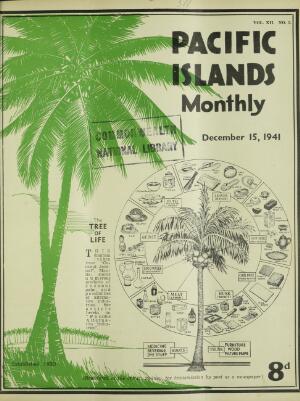
diagram (taken from “Co conut Jour nal”, Man ila) shows numerous products of coconut palm, and possibilities of alterna tive indus tries. See article herein on “Possible Alterna tive Indus tries”.
Advertisements & other items, p. 2 (1 item)
W. R. Carpenter & Co. Ltd.
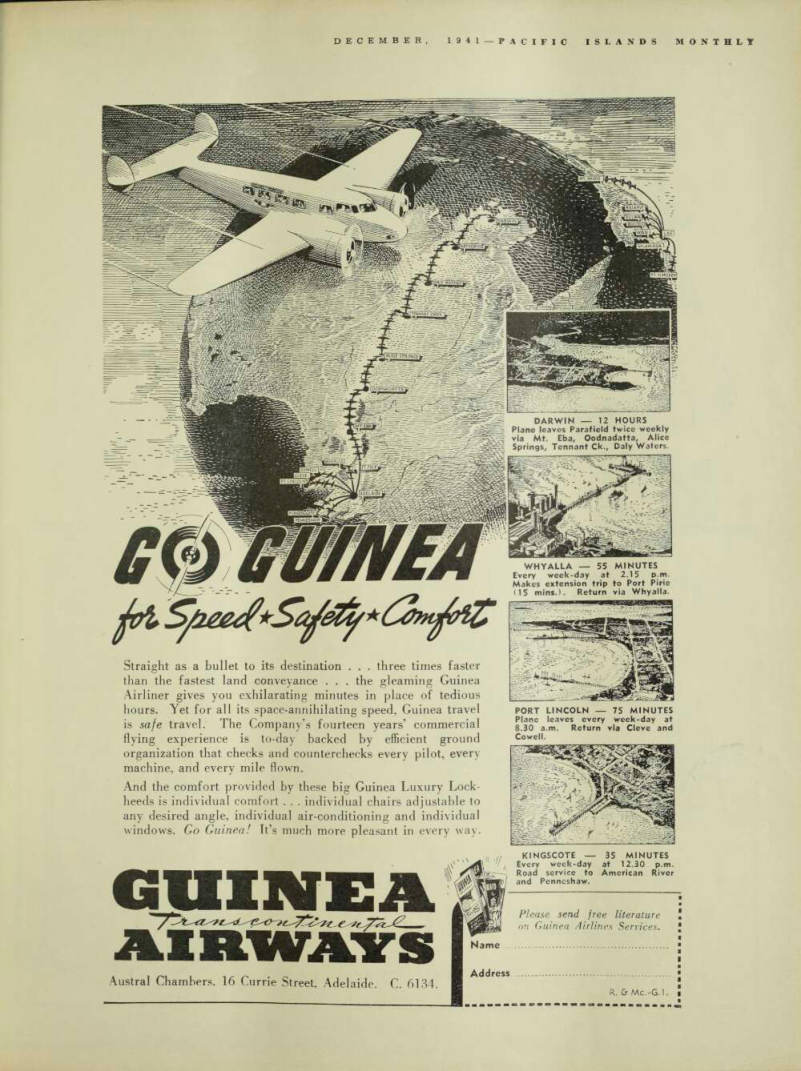
TRAVEL THE NEW GUINEA—AUSTRALIA AIR ROUTE IN THE 11l 111 w r c VP ' ;*v .• / ••■v--
IfggmrnlSßm
EFFORTLESS SPEED and LUXURIOUS COMFORT
OF A "LOCKHEED 14
CARPENTER AIRLINES, by the recent installation of worldrenowned Lockheed "14" aircraft on their regular weekly service between Sydney and Rabaul, bring to this airway the high standard of the worlds best air services. Every detail of comfort and convenience has been studied to assure that travellers may thoroughly enjoy, in every respect, their flight over this most glorious of scenic air routes.
FREIGHT
A special feature of "Lockheed 14" Aircraft is their large freight capacity and consignees are now assured that all Freight booked will be despatched without delay.
Minimum Charge 5/-.
Full particulars regarding time-table, fares, etc., are available from the following agencies.
SYDNEY: Macdonald, Hamilton Cr Co. PAPUA: Burns, Philp & Co. Ltd. „ Howard Smith Ltd. NEW GUINEA: W. R. Carpenter Cr Co. Ltd.
W. R. CARPENTER & CO. LTD.
Merchant's and Shipowners.
\GENTS for Australian, European and American Manufacturers, and Distributors of Every Description of Merchandise Complete Range of all Stocks Carried.
Head Office: 19-21 O’CONNELL STREET, SYDNEY
Branches at: RABAUL (New Britain), KAVIENG (New Ireland). MADANG, SALAMAUA, WAU (New Guinea), TULAGI (Solomon Islands), SUVA (Fiji), and other Pacific Islands; and in LONDON.
Buyers and Shippers of: Copra, Trocas, and all Classes of Islands Produce.
Pacific News-Review
Notes And Comment On
The Progress Of The War
From Nov. 14 To Dec. 10
Nov. 14; German armies, in an attempt to reach the vital Caucasus oil regions, are thrusting forward in the Crimea, and slowly occupying whole of peninsula.
Position is very grave. Another German assault on Moscow has been launched from the north-west.
Nov. 16: Although session of Japanese Diet which began yesterday had been awaited with world-wide interest, as promising a clarification of Japan’s in tentions, the principal speakers expressed themselves only in general terms. Japan’s special peace envoy, Kurusu, has reached Washington.
Nov. 16: British aircraft-carrier, “Ark Royal”, 22,000 tons, sank on Thursday while being towed to Gibraltar, after torpedoing. No loss of life.
Nov. 17: Nazis are claiming capture of Kerch, at eastern end of Crimea, and gateway to the Caucasus. Moscow Radio admits that Germans have now pene trated southern and western suburbs of Moscow, where the position is extremely critical.
Nov. 18: Japanese Premier Tojo laid down four points which Japan considers necessary for Pacific settlement —namely, no third-power interference in China; economic blockade of Japan to cease; Britain, America, and Netherlands to promise that encirclement of Japan shall end; and Japan’s normal trade to be restored Nov. 18: Berlin says that the fall of Kerch means that a new struggle for possession of the Caucasian oilfields has begun, and the Germans apparently ex pect that the British will take over the defence of the Caucasus oilfields.
Nov. 18: Confidential talks between Japanese peace envoy, Kurusu, Japanese Ambassador Nomura, President Roosevelt and Mr. Cordell Hull, have now com menced.
Nov. 18: At dawn to-day, Bth British Army, under General Sir Alan Cunning ham, attacked the Axis forces in Libya on 130-miles front, and by nightfall British, New Zealand, South African, and Indian troops had penetrated 50 miles into enemy territory, where big-scale tank battles are developing.
Nov. 19: Thousands of lorries, organised in transport lines, have commenced car rying British and American war material to Russia across Iran.
Nov. 19: The Germans, continuing their south Russian drive, claim to have iso lated Rostov-on-Don, and expect to enter the Caucasus.
Nov. 19; British forces in Libya have seized Rezegh, on the escarpment, a few miles south-east of Tobruk.
Nov. 22: Extremely fierce fighting is proceeding on the Southern Russian front, and Moscow front, where enemy obviously is making desperate efforts to gain im portant successes before winter closes down.
Nov. 22: New Zealanders in Libya, ad vancing along the coast, captured Fort Capuzzo, while the Tobruk garrison is ad vancing southwards to junction with British at Rezegh, Great tank battles over wide area are described as “confused dog fights”.
Nov. 23: American-Japanese discussi<pns are still proceeding in Washington, being subject to much delay owing to the Jap anese envoy’s frequent references to Tokyo.
Nov. 23: Great coal strike in United States, which threatened to paralyse war production, ended suddenly, with accep tance of President Roosevelt’s plan for arbitration.
Nov. 24; Terrific tank battles are pro ceeding between British and Axis forces in Central Libya. The British, by making junction with the Tobruk garrison, have
encircled the German panzer divisions, but the fighting is inconclusive. British, in these operations, enjoy complete air superiority.
Nov. 25: Marshal Timoshenko has launched a successful counter-offensive against Germany’s South Russian armies around Rostov. This operation is being studied intensely by military critics. It is regarded as Russia’s last hope of keep ing the Nazis out of the Caucasus oilfield.
Meanwhile, the German thrusts at Mos cow, only 40 miles from the city, are most dangerous.
Nov. 26: Great tank battle in Libya has continued with unabated fury and incon clusive results for four days. The fighting is confused and desperate. Nazis have successfully resisted the British efforts to trap them in north-eastern Libya.
Nov. 27: Timoshenko’s armies in South ern Russia are now advancing strongly on a wide front, and German General von Kleist’s armies, which apparently were about to enter the Caucasus region, are now in rapid and disorderly retreat to the westward. The Russians are still hold ing Moscow.
Nov. 28: Japanese-American discussions have almost collapsed, and America has informed the Japanese envoys that she takes an extremely grave view of the in creasing Japanese troop concentrations in and around Indo-China.
Nov. 28: The trapped German tank divisions are fighting desperately to break westwards through the British ring in Libya. They are making attack after at tack upon New Zealand, Indian and South African forces. , Dec. 1; Announced in Canberra that famous Australian cruiser “Sydney”. 6 830 tons, completely disappeared on November 25, after sinking a heavily armed German merchant-raider. 42 offi cers and 603 other ranks are missing. The “Sydney” apparently approached the raider, which was flying Norwegian flag, off West Australian coast, for examination, and raider unexpectedly opened fire. About 250 Germans from the raider reached West Australian coast, and they say en gagement took place at dusk and they last saw “Sydney” ablaze about 10 miles away. x Dec. 1; American-Jananese talks are still proceeding in an atmosphere of in
creasing pessimism.
Dec. 1: Russia has gained her greatest victory to date in the war against Ger many. The German southern armies are in full retreat on a wide front, having broken under a series of ferocious Rus sian counter-attacks.
Dec 1: It is estimated that half the enemy tanks in the Rezegh area in Libya have been disabled.
Dec. 1; While fighting continues bit terly on the Russian and Libyan fronts, large RAF formations from Britain are nightly battering at Western German industrial centres.
Dec. 2: A state of emergency has been declared in Singapore. Manila reports that a Japanese fleet headed by cruisers and aircraft-carriers is not far from North Borneo.
Dec. 3: Australian destroyer “Parra matta” torpedoed and sunk, with a loss of 141 officers and men.
Dec. 3: Russian armies from north and south are closing in on the German ar mies retreating westward from Rostov, “gateway of the Caucasus”. Some critics now say confidently that here the Ger mans have suffered their greatest defeat since September, 1939. The Russians are still holding the enemy at Moscow, al though he is within 36 miles of the city.
Dec. 3: Formally announced in Tokyo that the negotiations for a Pacific peace will be continued in Washington.
Dec. 3: The Axis tank forces, on Decem ber 1, broke the British ring between Tobruk and Rezegh, in Libya, and thus escaped the British trap and reunited their forces. The Britisn divisions are being reformed and reinforced. The tempo of this fighting has slackened considerably.
Dec. 3: Large British naval units headed by the new battleship “Prince of Wales’’, 35,000 tons, have arrived at Singapore.
Dec, 4: Many reports agree that Ger many is putting great pressure upon Vichy France to grant her the use of the French fleet and North African bases for use against the British.
Dec. 4: Russians now are not only per suing the retreating Germans in Southern Russia, but they are also launching strong counter-attacks against the German drive on Moscow.
Dec. 5: American officials say that Britain now has three battleships at Singapore.
Dec. 5: Libyan fighting has died down, while the British and Axis forces are re-organising and re-fitting.
Dec. 5: American-Japanese peace talks are dragging on. America says bluntly that a general settlement depends on the acceptance by Japan of the non-aggres sion policies repeatedly and recently out lined by America.
Dec. 6; Negotiations between Japan and USA having apparently broken down; pre pared plans for collaboration between Australia and the Netherlands East Indies, and precautionary movements by Austra lian air and army units, have been or dered into operation.
Dec. 6: Having driven the Germans back nearly 100 miles in Southern Russia, Marshal Timoshenko has launched an of fensive on a 70-miles front across the Donets River, with Kharkov as his objective.
Dec. 6: President Roosevelt, in a last minute effort to maintain Pacific peace with Japan, has sent a personal message to the Emperor of Japan, pleading with him to intervene and prevent a general explosion in the Far East.
Dec. 7: The Germans are now retreat ing in disorder from several points around Moscow, where the Russians have strongly counter-attacked.
Dec. 7: Before dawn to-day, without warning, large Japanese aerial forces, evi dently from Japanese aircraft-carriers, attacked Pearl Harbour naval base in Hawaii, Hickman airfield, nearby, and the city of Honolulu. They apparently caught the American forces unprepared, and did enormous damage, including the disable ment of an undisclosed number of Ameri can warships, the destruction of large numbers of planes, and the killing and wounding of possibly 3,000 persons.
Several hours later, Japan formally de clared war against the United States and Britain. Washington pointed out that when the treacherous attack upon Hawaii was being launched, Japan peace delegates ac tually were in the State Department in Washington, still carrying on negotiations.
Japan also launched attacks with aerial, naval, and military forces upon many American and British territories in the North Pacific notably Wake Island, Guam, many places in the Philippines (including Manila), North Borneo, several points in Malaya, Singapore, and at least three places in Thailand. It is also re ported that bombs were dropped on Nauru and Ocean Island. The unexpected and wide-spread character of the attack has disorganised news services and relia ble information is lacking.
Dec. 8; Both Houses, of Congress, within a few minutes, and unanimously, endorsed President Roosevelt’s request, and de clared war upon Japan. All isolationists are supporting the Government, and the nation is united as never before in history, Dec. 8: Japan is landing large forces in the Kra isthmus region of Thailand, evidently with the intention of launching attacks upon the British and Australian forces in Malaya.
Dec. 8: The Germans are now announc ing that, owing to the rigours of the Russian winter, they are suspending all further operations on the Russian front until the spring. Meanwhile the Russians, who still hold Leningrad, Moscow and the Donets region (guarding the Caucasus), are now counter-attacking strongly, and the enemy is retreating in many places, with severe losses and privations.
Dec. 9: Unofficially reported that American planes have bombed Tokio and Formosa. The Japanese are preparing a big attack upon Singapore.
Dec. 10: British battleship “Prince of Wales” and battle-cruiser “Repulse” sunk off Malaya by Japanese aircraft.
This is a very grave naval disaster; and even more serious in that it ap parently gives Japan naval superiority in the Pacific. This disaster, plus the cir cumstances of the Hawaii disaster, indicate that the Japanese possess a new weapon of tremendous potentiality — probably an aerial torpedo.
Confusion In
N. Guinea
Effect of Hurried Move From Rabaul : And the Cloud's Silver Lining
rpHERE are indications that the deci- X sion to remove the administrative headquarters from Rabaul to Lae has introduced into New Guinea a period of confusion—commercial and industrial, as well as administrative.
Owing to lack of money and prepara tion, it is impossible to assemble all the removed departments immediately at Lae. Some have to go to Salamaua, while others will remain for a time at Rabaul.
It is difficult, at the moment, to say where the capital of New Guinea actu ally is. The Administrator took up his residence at Lae on November 25, but the offices of Central Administration, at the head of which is the Govt. Secretary (Mr. Page) are still in Rabaul, and may remain there until February. (See our correspondent’s article on page 44.) It may be argued that the capital of the territory is where the Administrator lives. Actually, for business purposes, the administrative headquarters seem to be where Central Administration is located—and that still is Rabaul.
It can be understood that the wide scattering of departments and adminis trative officials is not only confusing but also very expensive. Communications between the departments have now to be maintained by radio and Government vessels.
So far as the big firms are concerned, the position is complicated. The two principal firms, Burns, Philp & Co. Ltd., and W. R. Carpenter & Co., are appar ently making plans independently of each other. The latest information is that the Burns, Philp establishment probably will go to Kenabot Plantation, near the present township of Kokopo, 20 miles around the Rabaul Harbour, on the safe side of the volcanoes; while the W. R. Carpenter establishment may be
divided between Timbur, near Kokopo, and Toboi, about two miles west of Rabaul. n lf rr if r ?, us Chinese establishments where half the retail and artisan trade is done—do not know where they are going, and probably will end by remain ing exactly where they are.
AS an illustration of the commercial confusion, one may cite the case of the “Rabaul Times”. This large printing office has produced Rabaul’s weekly newspaper for over 20 years, and also has carried out, under contract, most of the Government printing. The deci sion to move the Administration else where means that a large portion of the Rabaul printing establishment must either go with the Administration or be closed down altogether. The “Rabaul Times” management, when it learned that Central Administration was to move to Lae in December, announced that the “Rabaul Times” would cease operations at the end of December. But as it has now been decided that Central Adminis tration shall remain in Rabaul for another month or two, it is possible that the “Rabaul Times” will carry on.
It is doubtful, however, whether there will be enough printing and advertising business left in Rabaul after the removal of the Government to justify the pub lication of a weekly newspaper, and in ordinary circumstances it might be expected that the “Rabaul Times” estab lishment would be moved to Lae.
However, the alert people who estab lished the “Morobe News” recently at Wau moved their printing works to Lae immediately it was known that Lae was to be Governmental headquarters; so that there already is a weekly newspaper in existence at Lae—although it is prob able that there is not sufficient printing plant there to cope with Governmental printing. It is expected that either the Government will purchase sufficient plant to do its own printing in Lae, or that the owners of the “Rabaul Times” and the “Morobe News” will amalgamate their businesses.
THEN there is confusion in regard to mainland transport facilities It is apparent that if the capital of New Guinea is to be at Lae, reading communication must be established with the interior. This certainly means a good arterial road up the Markham Val ley onto the Ramu-Purari tableland, and it may then be expected that a branch road will go up the Bulolo Valley into Wau.
In the meantime, the Wau miners are still insisting on the use of the short route between Salamaua and Wau —over the mountains—and their latest plan, as described elsewhere, is to cut a mule track over the mountains and organise mule transport. This, as a stop-gap between now and the time when the arterial road will go up the Markham and Bulolo Valleys, may prove a sound idea.
THE silver lining to this picture of confusion and expense *is the cer tainty that the placing of the New Guinea capital on the mainland of New Guinea will lead quickly to the develop ment of the vast internal plateaux—the fertile lands lying at an average height of 5,000 feet and authoritatively de scribed in the last couple of as “a second Kenya”.
The outbreak of the Rabaul volcanoes, leading to the abandonment of Rabaul as Governmental headquarters, may in many ways be regarded as a disaster; but, if at last it brings about the devel opment of this vast territory on sound economic lines, it will not be an unmiti gated disaster.
Drought in Suva
From Our Own Correspondent
Ixt1 Xt , Suva, Nov. 26.
N a place where the annual rainfall averages 130 inches, one would not expect water restrictions. Yet, a lower rainfall than usual in October and November has caused a ban on garden hoses in Suva.
Most people with an experience of Suva and its ram, will wonder why hoses are ever necessary; or why, if necessary, they should ever be forbidden. The trouble lies partly in the small reservoir accom modation, some of which was badly built and cannot be fully used. But, perhaps, the main cause is the smallness of the local catchment area, the water from which is supplemented by pumping from lower levels—though here again the pumps are inadequate for the demand.
For these reasons, the Suva water rate payer finds his supply reduced just when he most needs it. In most months, a 400gallon tank outside the kitchen door would oe refilled from the roof so often that it would suffice for all ordinary household needs.
Pacific Cultural Organisations
rpHE Pacific Islands Society, in Sydney X on December 8, said farewell to Crown Prince Tuboutoa, of Tonga, and his brother, Prince Jione Gu, on the eve of their departure for the Friendly Islands; and also to the four members of the Burman Civil Service at the Univer sity of Sydney, who had planned to leave for their homes.
As a souvenir of their association with the Society, the honorary secretary (Mr.
Eric Ramsden), presented Mo Myit, BA (who spoke for the Burman members), with a ceremonial paddle from Raro tonga, which had once been in the pos session of the late Sir Maui Pomare.
“With this you can paddle your way back if you find things too hot in Burma!” he said. “A welcome will always await you here.”
Mrs. E. Marie Irvine presented Lefagaoalii (Mrs, Alfred Page) with a Christmas gift from members, and paid tribute to the charming and courteous manner in which she, as chieftainess, had acted as the Society’s hostess since its inception. The Society had no more popular member than Mrs. Page.
Prince Tuboutoa, when replying, de clared that the Society had undoubtedly played a part in creating good feeling among former residents in the Islands, and served a very useful purpose by bringing them together for' social and cultural purposes. He deeply appreciated the compliment paid to his brother and himself.
Polynesian Club
A number of bright and colourful en tertainments have been given by members of the Sydney Polynesian Club for the benefit of various war funds. The most striking of these entertainments took place in November, when a wide variety of Polynesian dances, done in authentic costumes, was presented. A programme of no less than 20 items included many Maori songs and dances, Tahitian songs, posture dances of Samoa, the kava cere mony of Tonga, posture dances of Wallis Island, Futuna and Funafuti; and the various farewell songs of Polynesia. The performers included Cora Young, Gwen Lisner, Waikainga Tipene, Marjorie Ziele, Ivy Buffett, and Madame Annie Glading.
Inspector Moncur, of the New Guinea Police Force, arrived in Sydney last month by airliner from Rabaul, on fur lough. He is being relieved by Warrant Officer Allen.
Advertisements & other items, p. 4 (1 item)
War Review—Continued From
PAGE 1
2
December, nu-nemc islands mon*blv
Pacific Islands Travellers
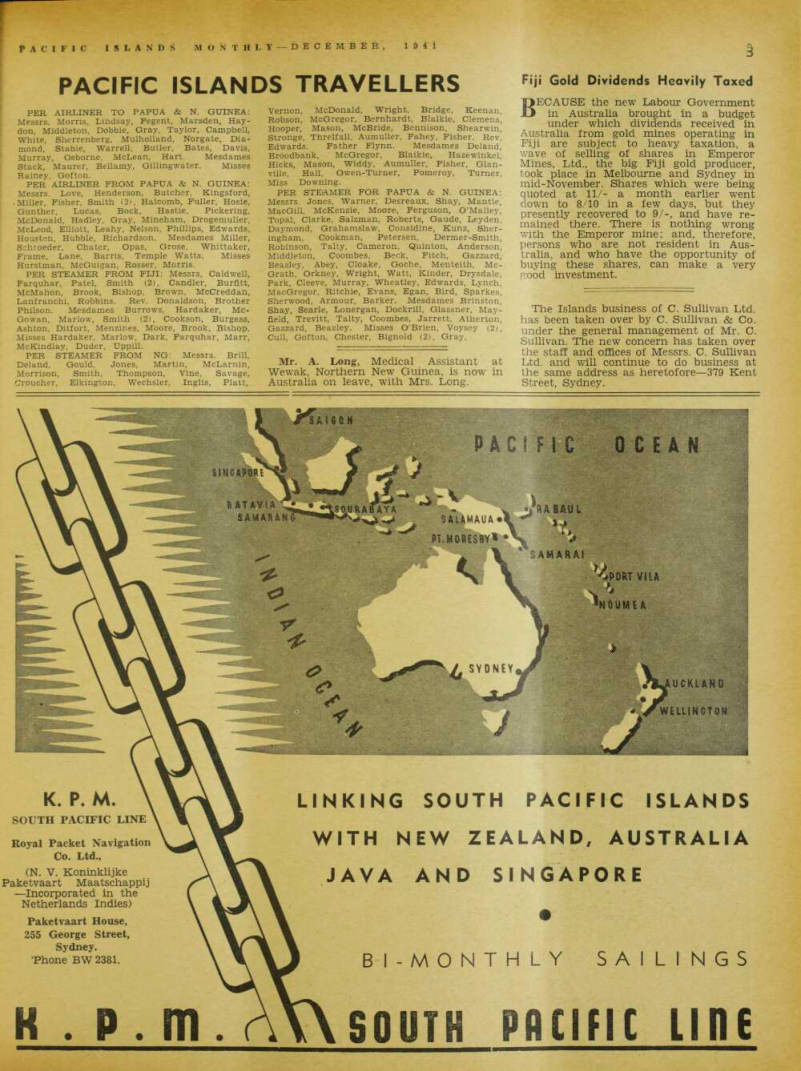
PER AIRLINER TO PAPUA & N. GUINEA; Messrs. Morris, Lindsay, Fegent, Marsden, Hay don, Middleton, Dobbie, Gray, Taylor, Campbell, White, Sherrenberg, Mulholland, Norgate, Dia mond, Stable, Warrell, Butler, Bates, Davis, Murray, Osborne, McLean, Hart. Mesdames Stack, Maurer, Bellamy, Gillingwater. Misses Rainey, Gofton.
PER AIRLINER FROM PAPUA & N. GUINEA; Messrs. Love, Henderson, Butcher, Kingsford, • Miller, Fisher, Smith (3), Halcomb, Fuller, Hosie, Gunther, Lucas, Bock, Hastie, Pickering, McDonald, Hadley, Gray, Mineham, Drogemuller, McLeod, Elliott, Leahy, Nelson, Phillips, Edwards, Housten, Hubble, Richardson. Mesdames Miller, Schroeder, Chater, Opas, Grose, Whittaker, Frame, Lane, Barris, Temple Watts. Misses Hurstman, McGuigan, Rosser, Morris.
PER STEAMER FROM FIJI: Messrs. Caldwell, Farquhar, Patel, Smith (2), Candler, Burfitt, McMahon, Brook, Bishop, Brown, McCreddan, Lanfranchi, Robbins. Rev. Donaldson, Brother Philson. Mesdames Burrows, Hardaker, Mc- Gowan, Marlow, Smith (2), Cookson, Burgess, Ashton, Ditfort, Menzines, Moore, Brook, Bishop.
Misses Hardaker, Marlow, Dark, Farquhar, Marr, McKindlay, Duder, Uppill.
PER STEAMER FROM NG: Messrs. Brill, Deland, Gould, Jones, Martin, McLarnin, Morrison, Smith, Thompson, Vine, Savage, Croucher, Elkington, Wechsler, Inglis, Platt,
Vernon, McDonald, Wright, Bridge, Keenan, Robson, McGregor, Bernhardt, Blaikie, Clemens, Hooper, Mason, Mcßride, Bennison, Shearwin, Stronge, Threlfall, Aumuller, Fahey, Fisher. Rev.
Edwards. Father Flynn. Mesdames Deland, Broodbank, McGregor, Blaikie, Hazewinkel, Hicks, Mason, Widdy, Aumuller, Fisher, Glan ville, Hall, Owen-Turner, Pomeroy, Turner.
Miss Downing.
PER STEAMER FOR PAPUA & N. GUINEA: Messrs. Jones, Warner, Desreaux, Shay, Mantle, Mac Gill, McKenzie, Moore, Ferguson, O’Malley, Topal, Clarke, Salzman, Roberts, Gaude, Leyden, Daymond, Grahamslaw, Considine, Kunz, Sher ingham, Cookman, Petersen, Dermer-Smith, Robinson, Talty, Cameron, Quinton, Anderson, Middleton, Coombes, Beck, Fitch, Gazzard, Beazley, Abey, Cloake, Goche, Menteith, Mc- Grath, Orkney, Wright, Watt, Kinder, Drysdale, Park, Cleeve, Murray, Wheatley, Edwards, Lynch, MacGregor, Ritchie, Evans, Egan, Bird, Sparkes, Sherwood, Armour, Barker. Mesdames Brinston, Shay, Searle, Lonergan, Dockrill, Glassner, May field, Trevitt, Talty, Coombes, Jarrett, Atherton, Gazzard, Beazley. Misses O’Brien, Voysey (2), Cull, Gofton, Chester, Bignold (2), Gray.
Mr. A. Long, Medical Assistant at Wewak, Northern New Guinea, is now in Australia on leave, with Mrs. Long.
Fiji Gold Dividends Heavily Taxed
BECAUSE the new Labour Government in Australia brought in a budget under which dividends received in Australia from gold mines operating in Fiji are subject to heavy taxation, a wave of selling of shares in Emperor Mines, Ltd., the big Fiji gold producer, took place in Melbourne and Sydney in mid-November. Shares which were being quoted at 11/- a month earlier went down to 8/10 in a few days, but they presently recovered to 9/-, and have re mained there. There is nothing wrong with the Emperor mine; and, therefore, persons who are not resident in Aus tralia, and who have the opportunity of buying these shares, can make a very good investment.
The Islands business of C. Sullivan Ltd. has been taken over by C. Sullivan & Co. under the general management of Mr. C.
Sullivan. The new concern has taken over the staff and offices of Messrs. C. Sullivan Ltd. and will continue to do business at the same address as heretofore —379 Kent Street, Sydney.
Advertisements & other items, p. 5 (1 item)
South Pacific Line
1C - i? m BA SA PI
S AM AS Al
VIU
x *
OUWIA
* . \ •V« « u « j;iil • /
NEY
SV J
K. P. M.
SOUTH PACIFIC LINE
Royal Packet Navigation Co. Ltd., (N. V. Koninklijke Paketvaart Maatschappij —lncorporated in the Netherlands Indies) Paketvaart House, 255 George Street, Sydney. ’Phone BW 2381.
UNKING SOUTH PACIFIC ISLANDS
WITH NEW ZEALAND, AUSTRALIA
JAVA AND SINGAPORE
81-MONTHLY SAILINGS
k . p . m.
SOUTH PACIFIC Line
Advertisers
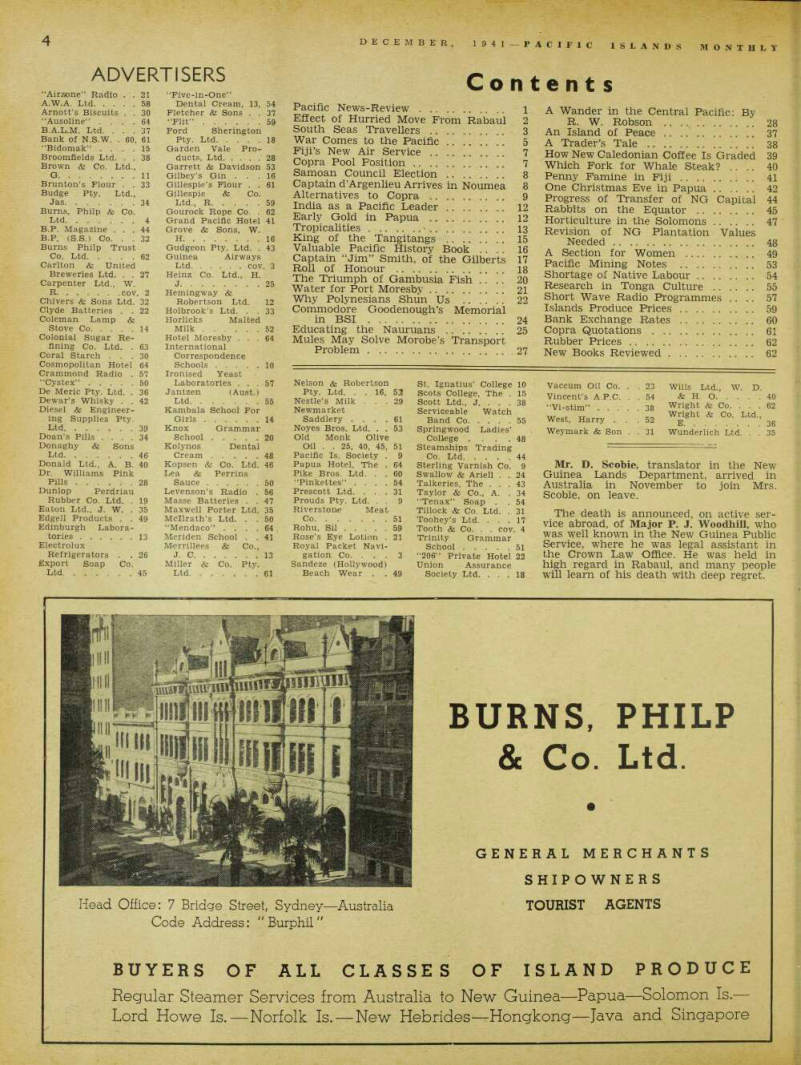
“Airzone” Radio . . 21 A. Ltd 58 Arnott’s Biscuits . . 30 “Ausoline” ... 64 B. Ltd. ... 37 Bank of N.S.W. . 60, 61 “Bidomak” ... 15 Broomfields Ltd. . . 38 Brown & Co. Ltd., G 11 Brunton’s Flour . . 33 Budge Pty. Ltd., Jas 34 Burns, Philp & Co.
Ltd 4 B.P. Magazine ... 44
B.P. (S.S.) Co. . . 32
Burns Philp Trust Co. Ltd 62 Carlton & United Breweries Ltd. . . 27 Carpenter Ltd., W.
R cov. 2 Chivers & Sons Ltd. 32 Clyde Batteries . . 22 Coleman Lamp & Stove Co 14 Colonial Sugar Re fining Co. Ltd. . 63 Coral Starch ... 30 Cosmopolitan Hotel 64 Crammond Radio . 57 “Cystex” 50 De Meric Pty. Ltd. . 36 Dewar’s Whisky . . 42 Diesel & Engineer ing Supplies Pty.
Ltd 39 Doan’s Pills ... 34 Donaghy & Sons Ltd 46 Donald Ltd., A. B. 40 Dr. Williams Pink Pills 28 Dunlop Perdriau Rubber Co. Ltd. . 19 Eaton Ltd., J. W. . 35 Edgell Products . . 49 Edinburgh Labora tories 13 Electrolux Refrigerators . . 26 Export Soap Co.
Ltd 45
“Five-in-One”
Dental Cream, 13, 54 Fletcher & Sons . . 37 “Flit” 59 Ford Sherington Pty. Ltd 18 Garden Vale Pro ducts, Ltd 28 Garrett & Davidson 53 Gilbey’s Gin ... 16 Gillespie’s Flour . . 61 Gillespie & Co.
Ltd., R 59 Gourock Rope Co. . 62 Grand Pacific Hotel 41 Grove & Sons, W.
H 16 Gudgeon Pty. Ltd. . 43 Guinea Airways Ltd cov. 3 Heinz Co. Ltd., H.
J 25 Hemingway & Robertson Ltd. 12 Holbrook’s Ltd. . . 33 Horlicks Malted Milk 52 Hotel Moresby ... 64 International Correspondence Schools 10 Ironised Yeast Laboratories ... 57 Jantzen (Aust.) Ltd 55 Kambala School For Girls 14 Knox Grammar School 20 Kolynos Dental Cream 48 Kopsen & Co. Ltd. 46 Lea & Perrins Sauce 50 Levenson’s Radio . 56 Masse Batteries . . 47 Maxwell Porter Ltd. 35 Mcllrath’s Ltd. . . 50 “Mendaco” ... 64 Meriden School . . 41 Merrillees & Co., J. C 13 Miller & Co. Pty.
Ltd 61
Nelson & Robertson Pty. Ltd. . . 16, 53 Nestle’s Milk ... 29 Newmarket Saddlery ... 61 Noyes Bros. Ltd. , . 53 Old Monk Olive Oil . . 25, 40, 45, 51 Pacific Is. Society . 9 Papua Hotel, The . 64 Pike Bros. Ltd. . . 60 “Pinkettes” ... 54 Prescott Ltd. ... 31 Prouds Pty. Ltd. . . 9 Riverstone Meat Co 51 Rohu, Sil 59 Rose’s Eye Lotion . 21 Royal Packet Navi gation Co. ... 3 Sandeze (Hollywood) Beach Wear . . 49
St. Ignatius’ College 10 Scots College, The . 15 Scott Ltd., J. ... 38 Serviceable Watch Band Co 55 Springwood Ladies’
College ... 48 Steamships Trading Co. Ltd 44 Sterling Varnish Co. 9 Swallow & Ariell . . 24 Talkeries, The ... 43 Taylor & Co., A. . 34 “Tenax” Soap . . 54 Tillock & Co. Ltd. . 31 Toohey’s Ltd. ... 17 Tooth & Co. . . cov. 4 Trinity Grammar School 51 “206” Private Hotel 22 Union Assurance Society Ltd. ... 18
Vaccum Oil Co. . . 23 Vincent’s A.P.C. . . 54 “Vi-stim” 38 West, Harry ... 52 Weymark & Son . . 31
Wills Ltd., w. D. & h. o 40 Wright & Co. ... 62 Wright & Co. Ltd., E 36 Wunderlich Ltd. . . 35
Mr, D. Scobie, translator in the New Guinea Lands Department, arrived in Australia in November to join Mrs, Scobie, on leave.
The death is announced, on active ser vice abroad, of Major P. J. Woodhill, who was well known in the New Guinea Public Service, where he was legal assistant in the Crown Law Office. He was held in high regard in Rabaul, and many people will learn of his death with deep regret.
Contents
Pacific News-Review i Effect of Hurried Move From Rabaul 2 South Seas Travellers 3 War Comes to the Pacific 5 Fiji’s New Air Service 7 Copra Pool Position 7 Samoan Council Election 8 Captain d’Argenlieu Arrives in Noumea 8 Alternatives to Copra 9 India as a Pacific Leader ! 12 Early Gold in Papua 12 Tropicalities 13 King of the Tangitangs 15 Valuable Pacific History Book ... 16 Captain “Jim” Smith, of the Gilberts 17 Roll of Honour 18 The Triumph of Gambusia Fish ... 20 Water for Port Moresby 21 Why Polynesians Shun Us 22 Commodore Goodenough’s Memorial in BSI 24 Educating the Nauruans 25 Mules May Solve Morobe’s Transport Problem 27
A Wander in the Central Pacific: By R. W. Robson 28 An Island of Peace 37 A Trader's Tale 38 How New Caledonian Coffee Is Graded 39 Which Fork for Whale Steak? ... 40 Penny Famine in Fiji 41 One Christmas Eve in Papua 42 Progress of Transfer of NG Capital 44 Rabbits on the Equator 45 Horticulture in the Solomons 47 Revision of NG Plantation Values Needed 48 A Section for Women 49 Pacific Mining Notes 53 Shortage of Native Labour 54 Research in Tonga Culture 55 Short Wave Radio Programmes ... 57 Islands Produce Prices 59 Bank Exchange Rates 60 Copra Quotations 61 Rubber Prices 62 New Books Reviewed 62
Advertisements & other items, p. 6 (1 item)
Burns, Philp
* Hi
SUP
Itl
IS I I 111 M - Head Office: 7 Bridge Street, Sydney—Australia Code Address: " Burphil"
BURNS, PHILP
& Co. Ltd.
GENERAL MERCHANTS
SHIPOWNERS
TOURIST AGENTS
BUYERS OF ALL CLASSES OF ISLAND PRODUCE Regular Steamer Services from Australia to New Guinea —Papua—Solomon Is. — Lord Howe Is.—Norfolk Is. New Hebrides—Hongkong—Java and Singapore
Pacific Islands Monthly
The Newspaper-Magazine of the South Seas [Registered at the G.P.0., Sydney, for transmission by post as a newspaper .]
Published Once Each Month and Circulated in Australia and New Zealand and in the following Pacific Territories and Islands Groups:
Australian Territory of Papua.
Mandated Territory (Australia) of New Guinea, Bismarck Archipelago and Northern Solomon Islands.
Australian Territory of Norfolk Island.
New Zealand Territory of Cook Islands.
Mandated Territory (New Zealand) of Western Samoa.
British Colony of FIJI.
British Solomon Islands Protectorate.
British Protectorate of Tongan Islands.
British Crown Colony of Gilbert and Ellice Islands.
Mandated Territory of Nauru.
British and Free French Condominium of New Hebrides.
Free French Colony of New Caledonia.
Free French Colony of Oceania (Tahiti, etc.).
American Territory of Eastern Samoa.
American Territory of Hawaiian Islands.
American Territory of Guam.
Owned and Produced by Pacific Publications Pty. Ltd., Union House, 247 George Street, Sydney.
C Managing Director .. BW 5037 TELEPHONE £ Business and Editorial MA 7101
P.O. Box 3408 R
Registered Address of Telegrams. Radiograms, and Cables; “Pacpub”, Sydney.
Contributions.
Articles, Stories, and Photographs dealing with Pacific Islands subjects are invited and will be paid for on publication.
Subscription Rates.
Per Annum, within British Empire, Prepaid, Post Free 8/- Per Annum, elsewhere, prepaid, Post Free. 107- Single Copies Bd.
Editor and Publisher:
R. W. Robson, F.R.G.S.
Assisted by Selwyn Hughes.
Advertising Manager; L. W. Bailey.
Advertising Office and Printing-House: 29 Alberta Street, Sydney.
Advertising rates furnished on application.
Colours, etc., by arrangement.
Process Blocks made at Advertiser’s expense when required. Screen 100.
Changes of Advertising Copy should reach this office by Ist of each month, otherwise previous advertisement may be repeated.
Representative In London.
W. C. Harvey, Coronation House, 4 Lloyds Avenue, London, E.C.3, from whom may be obtained copies of Pacific Islands Monthly, Pacific Is. Year Book, advertising schedules, etc.
Agents.
The following are authorised to receive sub scriptions for Pacific Islands Monthly:— Burns. Philp & Co., Ltd., and Burns Phllp (South Sea) Co,, Ltd. All branches.
W. R. Carpenter & Co., Ltd. All branches.
Morris, Hedstrom, Ltd. All branches.
T. A. Olsson, Wau, New Guinea.
G. Thomas & Co., Rabaul. New Guinea.
Whitten Bros., Ltd., Samaral. Papua.
Steamships Trading Co.. Papua. All branches.
B.N.G. Trading Co., Ltd., Port Moresby, Papua.
J. Muir, Suva. Fiji.
Miss R. Castles, Suva, Fiji.
N. C. Mackenzie Hunt, Walnunu, Bua, FIJI.
Kirpal & Co., Victoria Parade, Suva, FIJI.
Kapadia and Co.. Suva, Fiji.
Cook Islands Trading Co.. Rarotonga, Cook Is.
A. C. Rowland, Papeete. Tahiti.
Islands Branches and Representatives of W. H.
Grove & Sons, Ltd., Auckland. New Zealand.
Ed. Pentecost. Noumea. New Caledonia.
Kerr & Co., Noumea, New Caledonia.
Vol. XII. No. 5.
December 15, 1941
Prirp f Pre P aid: 8/- P-a rrice I Bd. Per Copy.
War Comes To The Pacific
UNDER conditions of treachery almost without parallel in his tory, Japan attacked the United States on December 7, and now the Pacific Ocean is ablaze with war.
Japan has committed national suicide; but her fateful decision has been received with relief by the de mocratic countries, for these reasons: (a) We now are free, without com punction and without mercy, to deal with this most unpleasant, restless and untrustworthy neighbour in such a way that she no longer may be a disturber of the Pacific peace. (b) Her attack upon the United States brought the Americans face to face with realities as nothing else could have done; and now the United States, united as never before, is wholeheartedly beside us in the war for the preservation of individual freedom and human decencies. (c) There remain, in the world, no more embarrassing international un certainties. There now are no more nations, like Russia, and United States and Japan, whose allegiances are un certain and whose final decisions may influence the course of the war. The job, and the alternatives, are spread out clearly before us. There is no more guesswork. We, the great demo cratic powers (British Empire, United States, Russia, with Holland and
China) must destroy the Axis nations and the Axis viewpoint, or be our selves utterly destroyed.
The task before us is grim, terrible and colossal; but we can envisage the whole thing now, and we may con template, with confidence, our ulti mate success, and discern the shape and character of the victory to come.
The entry into the war of United States and Japan indicates that the war will be long and exhausting; but, also, it gives us an assurance of final victory that was but wishful thinking a year ago. If the prospect seems de pressing, let us compare the position to-day with the position in June, 1940, when Germany and Italy stood triumphant in Europe, America was irresolute, Russia was withdrawn and apparently hostile, and only our staunch old Britain, battered but un beaten, stood between us and the Nazi concentration camps.
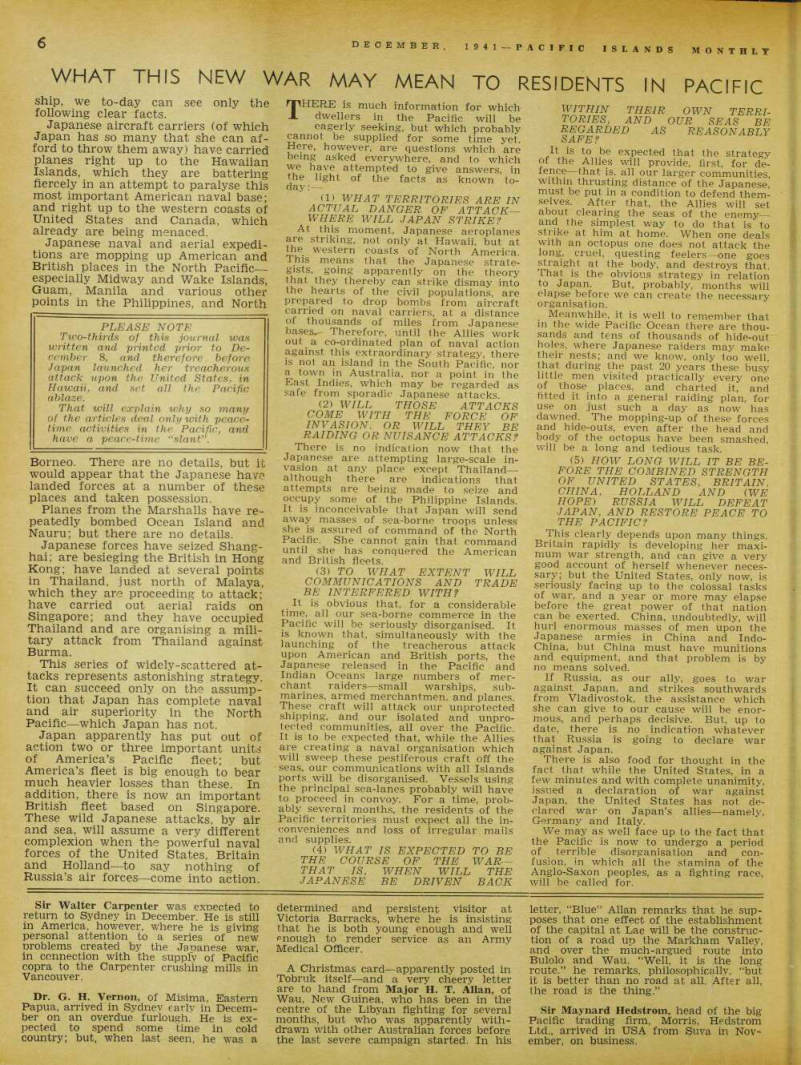
It is worth-while, at this stage, to make a balance-sheet of the war situation:
Allies
British Empire— Population Great Britain 40,000,000 India 350,000,000 Dominions 20,000,000 United States 130,000,000 Russia 170,000,000 China 422,000,000 Netherlands Ind 60,000,000
Axis
German Reich — Population Germany 70,000,000 Austria 7,000,000 Italy : 45,000,000 Japan 90,000,000 Hungary 9,000,000 Roumania 20,000,000 Bulgaria 6,000,000 Finland 4,000,000 Advantages with Allies. —Unlimited manpower; command of the seas; unlimited resources of foodstuffs and raw materials; tremendous in dustrial potential in Britain, United States and Russia.
Advantages with Axis.—German military and organising genius exercised on internal lines of communication; great industrial potential, not only in German Reich and Italy, but also in the enslaved nations (Prance, Belgium. Holland, Norway, Denmark, Poland, Czechoslovakia, Jugo slavia, Greece—total population, over 100,000,000).
Disadvantages with Allies. —Extreme slowness in organising for war.
Disadvantages with Axis. —Risk of trying to hold down 100,000,000 enslaved people; danger of running short of essential supplies, especially oil. * * * BECAUSE Japan, under the direction of Nazis and militaristic lunatics, has gone to war, the tempo and character of life has changed for every European resident in the Pacific Islands.
The change, at the moment of this
writing (December 9), is bewildering,
and the whole Pacific situation is obscure and confused. The Japanese, striking out like madmen, and scat tering their naval and aerial forces, like madmen, all over the Northern Pacific, have done a great deal of damage, some of it important.
Through the veil of necessary censor
ship, we to-day can see only the following clear facts.
Japanese aircraft carriers (of which Japan has so many that she can af ford to throw them away) have carried planes right up to the Hawaiian Islands, which they are battering fiercely in an attempt to paralyse this most important American naval base; and right up to the western coasts of United States and Canada, which already are being menaced.
Japanese naval and aerial expedi tions are mopping up American and British places in the North Pacific— especially Midway and Wake Islands, Guam, Manila and various other points in the Philippines, and North
Borneo. There are no details, but it would appear that the Japanese have landed forces at a number of these places and taken possession.
Planes from the Marshalls have re peatedly bombed Ocean Island and Nauru; but there are no details.
Japanese forces have seized Shang hai; are besieging the British in Hong Kong; have landed at several points in Thailand, just north of Malaya, which they are proceeding to attack; have carried out aerial raids on Singapore; and they have occupied Thailand and are organising a mili tary attack from Thailand against Burma.
This series of widely-scattered at tacks represents astonishing strategy.
It can succeed only on the assump tion that Japan has complete naval and air superiority in the North Pacific—which Japan has not.
Japan apparently has put out of action two or three important units of America’s Pacific fleet; but America’s fleet is big enough to bear much heavier losses than these. In addition, there is now an important British fleet based on Singapore.
These wild Japanese attacks, by air and sea, will assume a very different complexion when the powerful naval forces of the United States, Britain and Holland—to say nothing of Russia’s air forces—come into action.
Sir Walter Carpenter was expected to return to Sydney in December. He is still in America, however, where he is giving personal attention to a series of new problems created by the Japanese war, in connection with the supply of Pacific copra to the Carpenter crushing mills in Vancouver.
Dr. G. H. Vernon, of Misima, Eastern Papua, arrived in Sydney early in Decem ber on an overdue furlough. He is ex pected to spend some time in cold country; but, when last seen, he was a
determined and persistent visitor at Victoria Barracks, where he is insisting that he is both young enough and well enough to render service as an Army Medical Officer.
A Christmas card —apparently posted in Tobruk itself —and a very cheery letter are to hand from Major H. T. Allan, of Wau, New Guinea, who has been in the centre of the Libyan fighting for several months, but who was apparently with drawn with other Australian forces before the last severe campaign started. In his
letter, “Blue” Allan remarks that he sup poses that one effect of the establishment of the capital at Lae will be the construc tion of a road up the Markham Valley, and over the much-argued route into Bulolo and Wau. “Well, it is the long route,” he remarks, philosophically, “but it is better than no road at all. After all, the road is the thing.”
Sir Maynard Hedstrom, head of the big Pacific trading firm, Morris, Hedstrom Ltd., arrived in USA from Suva in Nov ember, on business.
Please Note
Two-thirds of this journal was written and printed prior to De cember 8, and therefore before Japan launched her treacherous attack upon the United States, in Hawaii, and set all the Pacific ablaze.
That will explain why so many of the articles deal only with peace time activities in the Pacific, and have a peace-time (e slant”.
What This New War May Mean To Residents In Pacific
THERE is much information for which dwellers in the Pacific will be eagerly seeking, but which probably cannot be supplied for some time yet.
Here, however, are questions which are being asked everywhere, and to which we have attempted to give answers, in the light of the facts as known to day:—
(1) What Territories Are In
Actual Danger Of Attack—
Where Will Japan Strike?
At this moment, Japanese aeroplanes are striking, not only at Hawaii, but at me western coasts of North America.
This means that the Japanese strate gists, going apparently on the theory that they thereby can strike dismay into the hearts of the civil populations, are prepared to drop bombs from aircraft carried on naval carriers, at a distance of thousands of miles from Japanese bases. Therefore, until the Allies work out a co-ordinated plan of naval action against this extraordinary strategy, there is not an island in the South Pacific, nor a town in Australia, nor a point in the East Indies, which may be regarded as safe from sporadic Japanese attacks.
(2) Will Those Attacks
Come With The Force Of
Invasion, Or Will They Be
Raiding Or Nuisance Attacks?
There is no indication now that the Japanese are attempting large-scale in vasion at any place except Thailand— although there are indications that attempts are being made to seize and occupy some of the Philippine Islands.
It is inconceivable that Japan will send away masses of sea-borne troops unless she is assured of command of the North Pacific. She cannot gain that command until she has conquered the American and British fleets.
(3) To What Extent Will
Communications And Trade
Be Interfered With?
It is obvious that, for a considerable time, all our sea-borne commerce in the Pacific will be seriously disorganised. It is known that, simultaneously with the launching of the treacherous attack upon American and British ports, the Japanese released in the Pacific and Indian Oceans large numbers of mer chant raiders—small warships, sub marines, armed merchantmen, and planes.
These craft will attack our unprotected shipping, and our isolated and unpro tected communities, all over the Pacific.
It is to be expected that, while the Allies are creating a naval organisation which will sweep these pestiferous craft off the seas, our communications with all Islands ports will be disorganised. Vessels using the principal sea-lanes probably will have to proceed in convoy. For a time, prob ably several months, the residents of the Pacific territories must expect all the in conveniences and loss of irregular mails and supplies.
(4) What Is Expected To Be
The Course Of The War—
That Is, When Will The
Japanese Be Driven Back
Within Their Own Terri
Tories, And Our Seas Be
Regarded As Reasonably
Safe?
It is to be expected that the strategy of the Allies will provide, first, for de fence—that is, all our larger communities, within thrusting distance of the Japanese, must be put in a condition to defend them selves. After that, the Allies will set about clearing the seas of the enemy— and the simplest way to do that is to strike at him at home. When one deals with an octopus one does not attack the long, cruel, questing feelers—one goes straight at the body, and destroys that.
That is the obvious strategy in relation to Japan. But, probably, months will elapse before we can create the necessary organisation.
Meanwhile, it is well to remember that in the wide Pacific Ocean there are thou sands and tens of thousands of hide-out holes, where Japanese raiders may make their nests; and we know, only too well, that during the past 20 years these busy little men visited practically every one of those places, and charted it, and fitted it into a general raiding plan, for use on just such a day as now has dawned. The mopping-up of these forces and hide-outs, even after the head and body of the octopus have been smashed, will be a long and tedious task. (5) HOW LONG WILL IT BE BE
Fore The Combined Strength
Of United States, Britain .
China, Holland And (We
Hope) Russia Will Defeat
Japan, And Restore Peace To
The Pacific?
This clearly depends upon many things.
Britain rapidly is developing her maxi mum war strength, and can give a very good account of herself whenever neces sary; but the United States, only now, is seriously facing up to the colossal tasks of war, and a year or more may elapse before the great power of that nation can be exerted. China, undoubtedly, will hurl enormous masses of men upon the Japanese armies in China and Indo- China, but China must have munitions and equipment, and that problem is by no means solved.
If Russia, as our ally, goes to war against Japan, and strikes southwards from Vladivostok, the assistance which she can give to our cause will be enor mous, and perhaps decisive. But, up to date, there is no indication whatever that Russia is going to declare war against Japan.
There is also food for thought in the fact that while the United States, in a few minutes and with complete unanimity, issued a declaration of war against Japan, the United States has not de clared war on Japan’s allies —namely, Germany and Italy, We may as well face up to the fact that the Pacific is now to undergo a period of terrible disorganisation and con fusion, in which all the stamina of the Anglo-Saxon peoples, as a fighting race, will be called for.
Fiji's New Air
Service
From Our Own Correspondent
Suva, Nov. 27.
APART from the incalculable conveni ence of the quick air-mails, the new trans-Pacific Clipper service is likely to be of great passenger value to Fiji.
The shorter trips south-bound than north bound mean that a great deal of space and carrying power is available for the hop from Suva to Noumea and Noumea to Auckland, and a surprising number of people seem likely to face the rather heavy cost of air travel. This tendency will be increased by the gradual diminu tion of passenger-carrying marine vessels.
Passengers say that air-travel, with its early morning starts and other disabilities, is riot particularly comfortable in itself, despite the magnificent equipment of the planes used. But it has the great advan tage of fair punctuality and, above all, speed.
Jobs For Office Girls
In Fiji
From Our Own Correspondent
Suva. Nov. 27.
IN normal times, Fiji recruits most of its young women employees from New Zealand or Australia. There appear to be no very serious restrictions on women leaving Australia for the Pacific Islands, but the ready availability of jobs in Australian towns has cut short the supply of women willing to leave. In New Zealand, there are emigration restrictions which prevent the departure of young women.
These shortages have meant that Fiji has had to live on its own resources in this direction, and the resources are limited. Any woman with any claim to office experience can now get a job easily in Suva; and, with the pressure for em ployees, wage standards are increasing, and conditions of work are being eased.
Thus, office women are beginning to realise their importance and to hold their heads rather high—even though the heads may be wearied by the constant, nightly round of military-flavoured parties usual under our present circumstances.
Uncle Sam's Money
Big Trickle Into W. Samoa
From Our Own Correspondent
Apia, Nov. 20.
WESTERN Samoa has benefited sub stantially from the expenditure of a huge sum of money on the construc tion of a naval base at Pago Pago, Ameri can Samoa. A large number of our crafts men and labourers are profitably engaged there; and, in recent months, we have found, in Pago Pago, a very good market for many of cur products, especially bananas, taro, pineapples, avocados, mummy-apples and vegetables.
Sixty American officers and marines from the naval base came over to Apia early in November, on a three-days’ visit.
They were royally welcomed and enter tained —and they left many welcome American dollars here.
in Fiji
Building Material Rationed in Fiji
Prom Our Own Correspondent
Suva, Nov. 27.
IN mid-November, Fiji was startled by a Commodities Control order, forbid ding the sale of building materials.
The order was absolute and unconditional, and in its first shape prevented the ac quisition of so much as half a pound of nails or a plank of timber. It has since been slightly modified.
The motive was to preserve stocks for defence requirements. In some directions, supplies of building materials from over seas have been very hard to secure, ana there was bound to be a shortage; but a little foresight could have provided ample supplies of materials for both military and civilian needs. However, neither the governmental nor the military mind is given to exercising overmuch foresight in such minor directions.
There is a serious housing shortage m Suva—hotels and boarding-houses are crammed to capacity, and until the “stop supplies” order came out, there was a good deal of civilian building in progress, people apparently feeling that despite the greatly increased costs of house construc tion, such costs will be worse before they are better. Those people, left with half built houses on their hands, and faced with the approaching wet-cum-hurricane season, are in an unfortunate position.
Queer Creature From The Sea
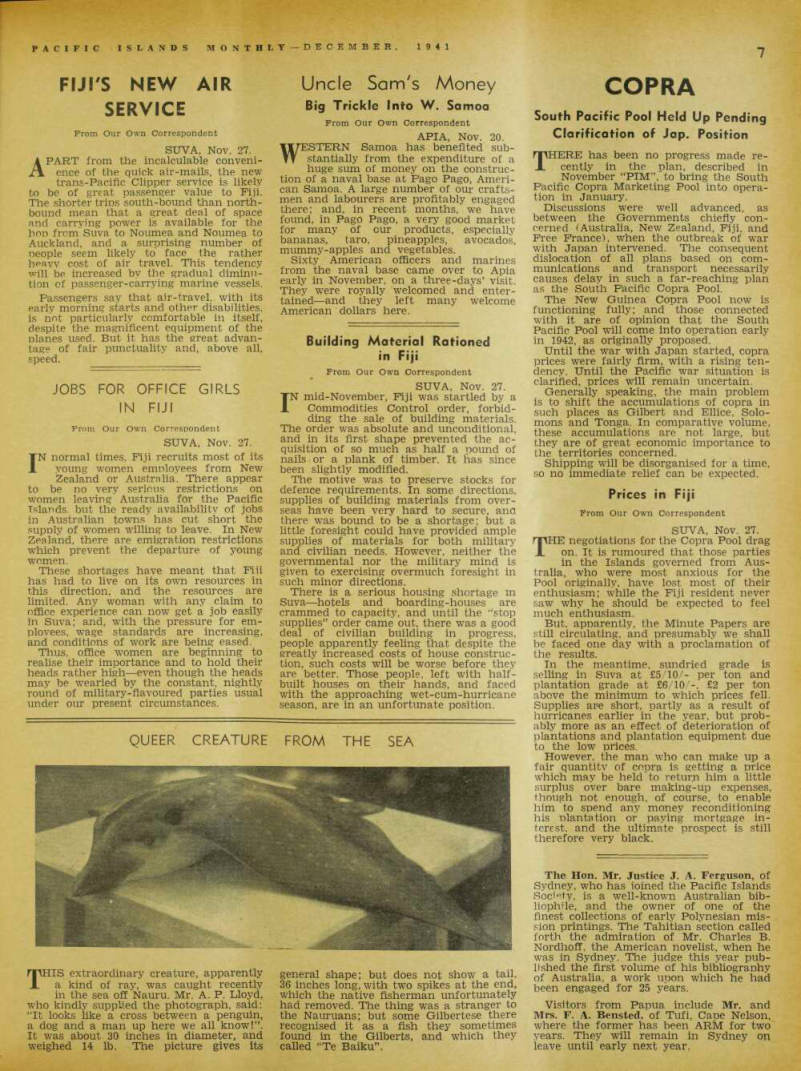
THIS extraordinary creature, apparently
a kind of ray, was caught recently in the sea off Nauru. Mr. A. P. Lloyd, who kindly supplied the photograph, said: “It looks like a cross between a penguin, a dog and a man up here we all know!”, It was about 30 inches in diameter, and weighed 14 lb. The picture gives its
general shape; but does not show a tail, 36 inches long, with two spikes at the end, which the native fisherman unfortunately had removed. The thing was a stranger to the Nauruans; but some Gilbertese there recognised it as a fish they sometimes found in the Gilberts, and which they called “Te Baiku”.
Copra
South Pacific Pool Held Up Pending Clarification of Jap. Position
THERE has been no progress made re cently in the plan, described in November “PIM”, to bring the South Pacific Copra Marketing Pool into opera tion in January.
Discussions were well advanced, as between the Governments chiefly con cerned (Australia, New Zealand, Fiji, and Free France), when the outbreak of war with Japan intervened. The consequent dislocation of all plans based on com munications and transport necessarily causes delay in such a far-reaching plan as the South Pacific Copra Pool.
The New Guinea Copra Pool now is functioning fully; and those connected with it are of opinion that the South Pacific Pool will come into oneration early in 1942, as originally proposed.
Until the war with Japan started, copra prices were fairly firm, with a rising ten dency. Until the Pacific war situation is clarified, prices will remain uncertain.
Generally speaking, the main problem is to shift the accumulations of copra in such places as Gilbert and Ellice, Solo mons and Tonga. In comparative volume, these accumulations are not large, but they are of great economic importance to the territories concerned.
Shipping will be disorganised for a time, so no immediate relief can be expected.
Prices in Fiji Prom Our Own Correspondent
Suva, Nov. 27.
THE negotiations for the Copra Pool drag on. It is rumoured that those parties in the Islands governed from Aus tralia, who were most anxious for the Pool originally, have lost most of their enthusiasm; while the Fiji resident never saw why he should be expected to feel much enthusiasm.
But. apparently, the Minute Papers are still circulating, and presumably we shall be faced one day with a proclamation of the results.
In the meantime, sundried grade is selling in Suva at £5/10/- per ton and plantation grade at £6/10/-, £2 per ton above the minimum to which prices fell.
Supplies are short, partly as a result of hurricanes earlier in the year, but prob ably more as an effect of deterioration of plantations and plantation equipment due to the low prices.
However, the man who can make up a fair quantitv of copra is getting a price which may be held to returp him a little surplus over bare making-up expenses, though not enough, of course, to enable him to spend any money reconditioning his plantation or paying mortgage in terest. and the ultimate prospect is still therefore very black.
The Hon. Mr. Justice J. A. Ferguson, of Sydney, who has joined the Pacific Islands Society, is a well-known Australian bib liophile, and the owner of one of the finest collections of early Polynesian mis sion printings. The Tahitian section called forth the admiration of Mr. Charles B.
Nordhoff, the American novelist, when he was in Sydney. The judge this year pub lished the first volume of his bibliography of Australia, a work upon which he had been engaged for 25 years.
Visitors from Papua include Mr. and Mrs. F. A. Bensted, of Tufi, Cape Nelson, where the former has been ARM for two years. They will remain in Sydney on leave until early next year.
Samoan Council
Election
Prom Our Own Correspondent
Apia, Nov. 20.
rE three-yearly election of two Euro pean elected members to the West ern Samoan Legislative Council took place on November 5, and resulted in the victory of the sitting member, Hon. O. F.
Nelson (who, after having at first an nounced his intention to withdraw, de cided to stand again for election) and, for the first time in the history of the Council, of a member of the Samoan Labour Party, Mr. A. Stowers.
The Labour victory came as a surprise, as it was expected that Mr. A. G. Smyth, a popular and public-spirited resident of Apia, would be elected as second member.
The number of electors had been in creased by over 200 through the efforts of the various candidates.
Features of the election campaign were the large number of plump votes thrown for single candidates, instead of for the possible two candidates; the absence of any reference to the war in the speeches: and the absence of a large number of electors who are working on the US Naval Base at Pago Pago. The results of the election were as follows; Olaf Frederick Nelson .. .. 367 votes Amando Stowers 238 A. G. Smyth 221 Percy W. Glover 140 „ Arthur Williams 116 The newly elected member, Hon. A.
Stowers, is a planter, and one of the founders and president of the Samoan Labour Party.
in Sydney
New Guinea Women's Club Busy in Sydney
FORMED only a short time ago the New Guinea Women’s Club, of Syd ney, has already sent 160 parcels of comforts to New Guinea men serving with the fighting forces overseas.
The club consists of New Guinea women who are residing temporarily in Australia, or who have lived in the Mandated Terri tory. Membership numbers 48 and regular meetings are held at the Feminist Club, 77 King Street, Sydney; any funds necessary are raised by card parties, etc.
Office-bearers are well known in New Guinea: Mrs. H. Page, wife of the Gov ernment Secretary, is president; Mrs. B.
B. Perriman, whose husband was manager of W. R. Carpenter & Co. interests in New Guinea for many years and who is now with the Sydney office, is vice president; Mrs. Harry Adams, the treas urer, has spent 22 years in the Territory where her husband is a planter; Mrs.
Barry Parkes, secretary, is daughter of Captain and Mrs. Savage, of Rabaul, and lives in Hong Kong. The committee con sists of Mesdames W. B. Rowe (of Kokopo), C. H. Maclean (15 years in New Guinea), A. Kelly (Rabaul), and Mrs. J.
Newport, whose husband was Director of Agriculture some years ago.
Other members include Mesdames Bald win, Bates, Duncan, Dwyer, Edgell, Ewen, Farlow, Foxcroft, Garton, Green, lan Maclean, Maxwell, Margetts, Mears, New port (2), Thompson, Twist, Wanliss, Wauchope, Waugh, Woodhill and Miss Maxwell.
Until her departure recently for Rabaul, where her husband is a member of the Government Service, Mrs. R. Brinston was secretary; and Mrs. Steven Lonergan relinquished her position as treasurer for a similar reason.
Captain d'Argenlieu Arrives in N. Caledonia
From Our Own Correspondent
Noumea, Nov. 17.
ENERAL de Gaulle’s representative, Captain Georges Thierry d’Argenlieu, High Commissioner of the French Pacific, arrived in Noumea on November 5, accompanied by his staff. He has been busy ever since, in the knowledge that the possessions administered by him play a fundamentally important role in Pacific strategy, now that aerial com munications and the organisation of land ing grounds for aerial fleets are the prime consideration in the defence of such a huge, island-dotted ocean.
The High Commissioner arrived aboard a French vessel. Interviewed, he said that Hungs were now as they should be in Tahiti, under Lieut.-Colonel Orselli of whom he spoke highly. The new Governor there, he said, was particularly fitted for , P os t, owing to his acquaintance with Japan and his knowledge of econo mic problems in the Pacific, quite apart from his standing as an airman,'as a Poly technicien, and as a several-times-decor ated veteran of the last war. Orselli is now 46 years old.
The High Commissioner, en route from Papeete, touched at Rarotonga, Suva and Port Vila. He discussed economic collab oration and defence with Sir Harrv Luke and the French and British Resident Commissioners in the New Hebrides.
One important question he is investiga ting is policy towards Japan, against
whom a temporary ban has been imposed on Caledonian mineral exports.
The High Commissioner is accompanied by Frigate Captain Cabanier, a popular submarine officer with a fine career, who is in charge of defence, and by Lieut.-
Commander Galsworthy, RN, British liaison officer, whose father was a cousin of the author, John Galsworthy. Noumea will be their headquarters.
The High Commissioner was received with ceremony; and, later, at Government House, he forcefully addressed the as sembled fonctionnaires, telling them that because of Free French effort, France ap peared across the world as a nation which did not capitulate. France had one enemy —Germany—and she would continue the fight alongside Great Britain until that enemy was destroyed. His words; “France does not capitulate and will never capitu late” roused a great burst of applause.
Among the 22 civil and military officials who arrived with the High Commissioner (eight of whom are accompanied by their wives) are M. Fourcade, formerly an African official, of the Colonial Adminis tration; Dr. Devaud, formerly of the Mes sageries Maritimes shin “Ville d’Amiens”, and hence well known in Noumea; and M. Brault, jnr., whose father is an avocat in Tahiti.
It is of interest that M. Fourcade is a Caledonian, though he left this Colony as long ago as 1919. After a successful career as student, he entered the service and was finally appointed to the Cameroons.
It was at the capital of this Colony, Yaounde, where Brunot was Governor- General, that he rallied to de Gaulle in June last year.
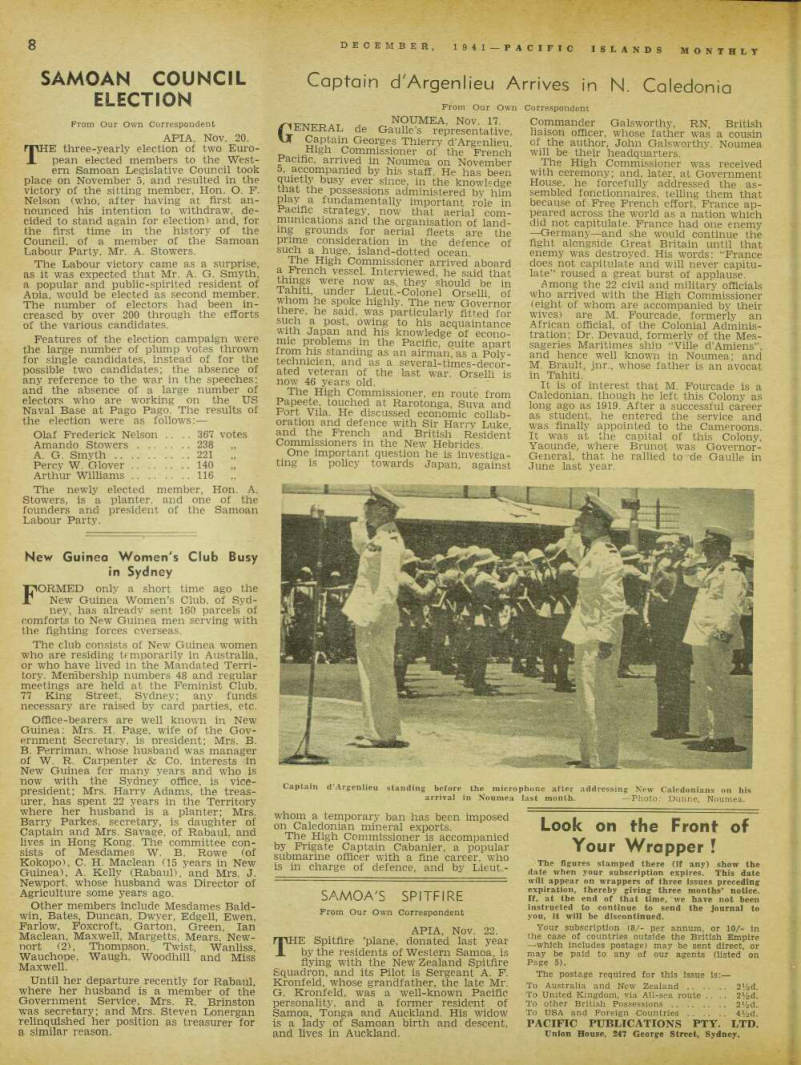
Captain d’Argenlieu standing before the microphone after addressing New Caledonians on his arrival in Noumea last month. —Photo: Dunne, Noumea.
Samoa's Spitfire
From Our Own Correspondent
Apia, Nov. 22.
rE Spitfire ’plane, donated last year by the residents of Western Samoa, is flying with the New Zealand Spitfire Squadron, and its Pilot is Sergeant A. P.
Kronfeld, whose grandfather, the late Mr.
G. Kronfeld, was a well-known Pacific personality, and a former resident of Samoa, Tonga and Auckland. His widow is a lady of Samoan birth and descent, and lives in Auckland.
Advertisements & other items, p. 10 (1 item)
Look on the Front of
Your Wropper !
The figures stamped there (if any) show the date when your subscription expires. This date will appear on wrappers of three issues preceding expiration, thereby giving three months’ notice.
If, at the end of that time, we have not been instructed to continue to send the journal to you, it will be discontinued.
Your subscription (8/- per annum, or 10/- in the case of countries outside the British Empire —which includes postage) may be sent direct, or may be paid to any of our agents (listed on Page 5).
The postage required for this issue is:— To Australia and New Zealand 2V 2 d.
To United Kingdom, via All-sea route .. .. 2 1 />d.
To other British Possessions 2V 2 d.
To USA and Foreign Countries 4y 2 d.
PACIFIC PUBLICATIONS PTY. LTD.
Union House, 247 George Street, Sydney.
Alternatives To Copra
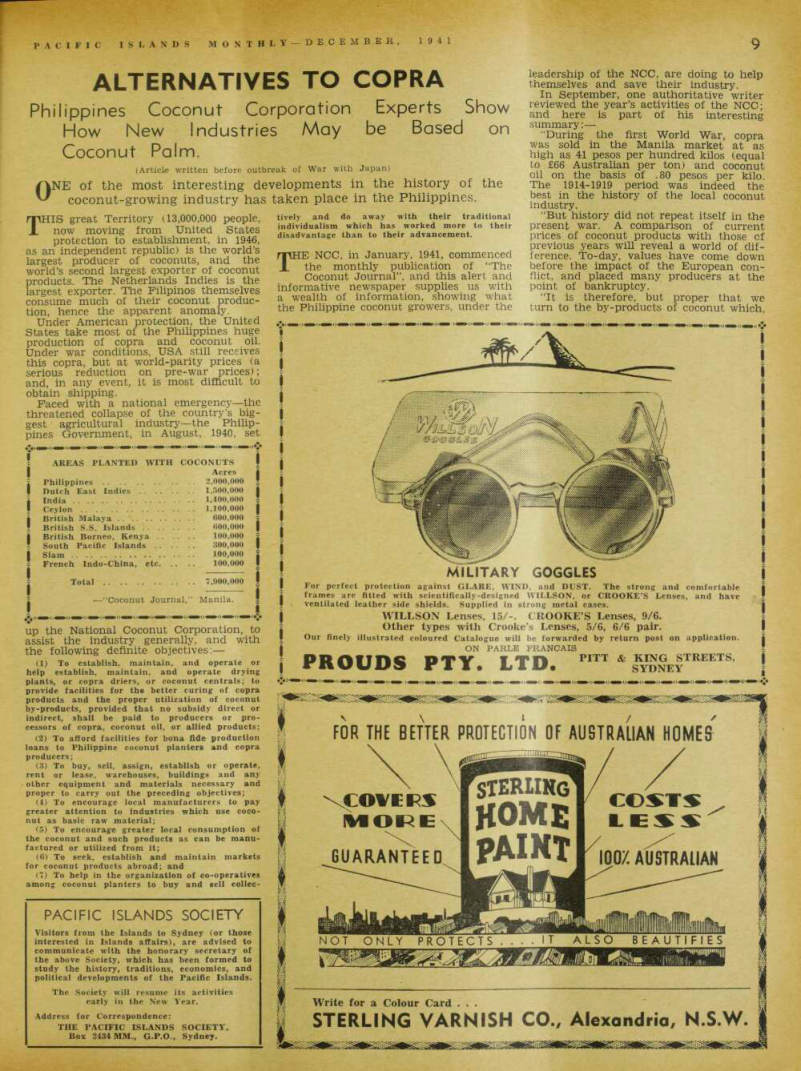
Philippines Coconut Corporation Experts Show How New Industries May be Based on Coconut Palm.
(Article written before outbreak of War with Japan) ... ONE of the most interesting developments in the history of the coconut-growing industry has taken place in the Philippines.
rIS great Territory (13,000,000 people, now moving from United States protection to establishment, in 1946, as an independent republic) is the world’s largest producer of coconuts, and the world’s second largest exporter of coconut products. The Netherlands Indies is the largest exporter. The Filipinos themselves consume much of their coconut produc tion, hence the apparent anomaly.
Under American protection, the United States take most of the Philippines huge production of copra and coconut oil.
Under war conditions, USA still receives this copra, but at world-parity prices (a serious reduction on pre-war prices); and, in any event, it is most difficult to obtain shipping.
Faced with a national emergency—the threatened collapse of the country’s big gest agricultural industry—the Philip pines Government, in August, 1940, set
up the National Coconut Corporation, to assist the industry generally, and with
the following definite objectives:—
(1) To establish, maintain, and operate or help establish, maintain, and operate drying plants, or copra driers, or coconut centrals; to provide facilities for the better curing of copra products and the proper utilization of coconut by-products, provided that no subsidy direct or indirect, shall be paid to producers or pro cessors of copra, coconut oil, or allied products; (2) To afford facilities for bona fide production loans to Philippine coconut planters and copra producers; (3) To buy, sell, assign, establish or operate, rent or lease, warehouses, buildings and any other equipment and materials necessary and proper to carry out the preceding objectives; (4) To encourage local manufacturers to pay greater attention to industries which use coco nut as basic raw material; (5) To encourage greater local consumption of the coconut and such products as can be manu factured or utilized from It; (6) To seek, establish and maintain markets for coconut products abroad; and (7) To help in the organization of co-operatives among coconut planters to buy and sell collec
lively and do away with their traditional individualism which has worked more to their disadvantage than to their advancement. rE NCC, in January, 1941, commenced the monthly publication of “The Coconut Journal”, and this alert and informative newspaper supplies us with a wealth of information, showing what the Philippine coconut growers, under the
leadership of the NCC, are doing to help themselves and save their industry.
In September, one authoritative writer reviewed the year’s activities of the NCC; and here is part of his interesting summary:— “During the first World War, copra was sold in the Manila market at as high as 41 pesos per hundred kilos (equal to £66 Australian per ton) and coconut oil on the basis of .80 pesos per kilo.
The 1914-1919 period was indeed the best in the history of the local coconut industry.
“But history did not repeat itself in the present war. A comparison of current prices of coconut products with those cf previous years will reveal a world of dif ference. To-day, values have come down before the impact of the European con flict, and placed many producers at the point of bankruptcy.
“It is therefore, but proper that we turn to the by-products of coconut which,
properly industrialized, can displace such costly importations as gasoline, crude oil, kerosene, mineral carbon, paints, sacks, and other articles.
“To form a nucleus of an enormous body of skilled workers in the industriali
zation of the coconut raw materials, the National Coconut Corporation has set up a number of schools, notably the one in Sariaya, for the teaching of home in dustries all over the country, to train men and women in the skill necessary to turn cut the standardized products which the corporation plans to manu facture out of the coconut raw materials.
These schools will teach the following:— Better method of making copra—improved dry ing process; Methods of making soap in the home—Nacoco sosa (a Manila preparation), mixed with an equal amount of coconut oil, produces a good soap by means of a process which a five-year old can master in one demonstration; Production of good lard and butter from the coconut meat juice; Weaving of hats from strips of processed coconut leaves; Making from coconut leaves braids to be ex ported to the United States for manufacture into various articles; Preparation of coconut dishes—home-cooking department of the schools dedicated to the en couragement and introduction of coconut dishes in our daily diet; Preparation of coconut charcoal for gas masks, a national defence item, with possibilities of profitable exportation; Preparation of a wood preservative from coconut shell —the NCC technicians got a hint from the fact that coconut shells are never attacked by termites and forthwith developed a process for extracting a preservative for wood from the coconut shell; Manufacture of coir from the coconut husk— the long fibres for the making of door mats, brushes, brooms, and similar articles; Manufacture of a panelling material from the “shorts” of coir fibre, mixed with cement and asbestos, the product having been proven as fire-proof, sturdy, durable, and capable of com peting with the commercial wall board used in house construction; Preparation of coconut shell charcoal for motor fuel—the NCC technicians have developed a device by which charcoal is converted into gas and runs motors. The charcoal costs only .02 pesos a kilo and 45 kilos, costing .90 pesos are all that is necessary to run a motor truck
from Manila to Sariaya, a trip which normally costs from 4.80 pesos to 5.00 pesos in gasoline (Note: A pesos is worth 3/3] Australian, a kilo is 2Vz lb.) Manufacture of sugar and rice bags from coir to replace the jute bags, which are difficult to get these days, because of the war pre occupation of India and the disruption of mari time transportation; and Production of margarine and other edible products from copra. ‘‘ A U the products to be turned out by £°. me ind ustries and the plants of the NCC are to be standardized, so they can be marketed in quantities, whether locally or abroad, without any difficulty arising from variation in specifications.
Developing these home industries, based on the coconut, the NCC expects to increase the total employment of the population in gainful work, and at the same time augment the total wealth producing activity of the country.
“The self-sufficiency motif in the NCC’s rehabilitation of the coconut industry is dramatized by the NCC’s own use of coconut oil, coconut shell as charcoal and raw shell for motor fuel in all its plants, instead of imported crude oil, gasoline kerosene or coal.”
Co-Operative Societies
IN the following article we summarise some of the outstanding material which has been published in the Coconut Journal”, which may be regarded of interest to coconut planters, generally It was announced in January, 1941, that the Philippines Government proposed to organise coconut-growers and their em ployees into producers’ co-operative socie ties; to assist Filipino retailers to compete with foreign retailers on at least equal terms; and to lend all possible assistance to individuals to organise consumers into co-operative societies. At the same time, steps were being taken to organise schools of instruction throughout the Territory where Filipinos might be trained in al
ternative and extended uses of the coconut.
The NCC announced that it would ac cept, in its bonded warehouses, through out the Group, any coora that might be delivered there, provided that the copra was in the standard specifications of from 6 per cent, to 7 per cent, moisture, and less than 1 per cent, fatty acid. A loan based on 70 per cent, of the actual market value of the copra at the time or delivery would be made to the growers, bearing 6 per cent, interest p.a. Similar financial accommodation was being ar ranged for all by-products of the coconut, such as fibre, coconut shell, oil, etc.
Coir And Charcoal
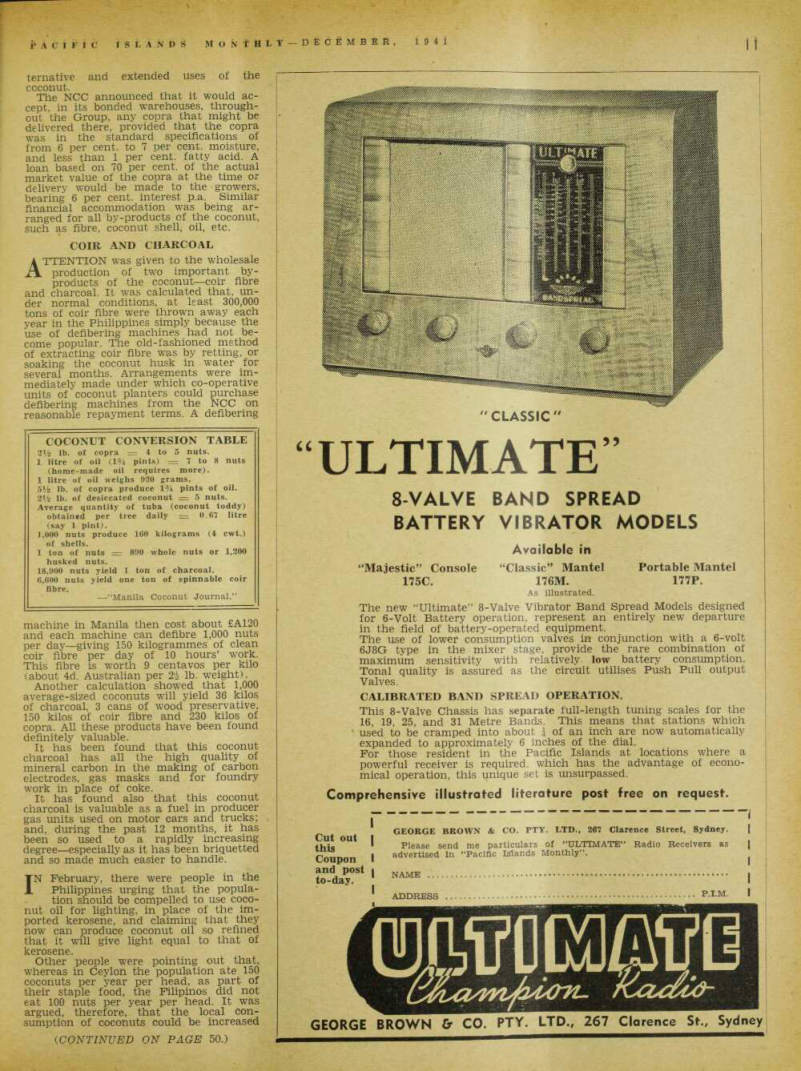
ATTENTION was given to the wholesale production of two important by products of the coconut —coir fibre and charcoal. It was calculated that, un der normal conditions, at least 300,000 tons of coir fibre were thrown away each year in the Philippines simply because the use of defibering machines had not be come popular. The old-fashioned method of extracting coir fibre was by retting, or soaking the coconut husk in water for several months. Arrangements were im mediately made under which co-operative units of coconut planters could purchase defibering machines from the NCC on reasonable repayment terms. A defibering
machine in Manila then cost about £AI2O and each machine can defibre 1,000 nuts per day—giving 150 kilogrammes of clean coir fibre per day of 10 hours’ work.
This fibre is worth 9 centavos per kilo (about 4d. Australian per 2k lb. weight).
Another calculation showed that 1,000 average-sized coconuts will yield 36 kilos of charcoal, 3 cans of wood preservative, 150 kilos of coir fibre and 230 kilos of copra. All these products have been found definitely valuable.
It has been found that this coconut charcoal has all the high quality of mineral carbon in the making of carbon electrodes, gas masks and for foundry work in place of coke.
It has found also that this coconut charcoal is valuable as a fuel in producer gas units used on motor cars and trucks; and, during the past 12 months, it has been so used to a rapidly increasing degree—especially as it has been briquetted and so made much easier to handle.
IN February, there were people in the Philippines urging that the popula tion should be compelled to use coco nut oil for lighting, in place of the im ported kerosene, and claiming that they now can produce coconut oil so refined that it will give light equal to that of kerosene.
Other people were pointing out that, whereas in Ceylon the population ate 150 coconuts per year per head, as part of their staple food, the Filipinos did not eat 100 nuts per year per head. It was argued, therefore, that the local con sumption of coconuts could be increased
(Continued On Page 50.)
by about 50 per cent., thus cutting out considerable food importation.
Co-Operative Plant Units
ARTICLES in favour of establishing co operative machinery units among coconut growers have appeared in practically every issue of the journal. It is claimed that coconut growers can help themselves if they co-operate in estab lishing plants for drying copra, and thus producing a higher grade; by organising agencies for selling their own copra; by purchasing plant for the extraction of oil from copra; by establishing mills for the production of desiccated coconut; by es tablishing plants for productions made from the edible oil of the coconut; and by an organisation for buying goods in ex change for copra and other coconut products.
As in the case in all countries, co operative enterprises can be described most convincingly in theory, but they rarely work out well in practice, and this appears to be the case in the Philippines There has been much talk of co-operative societies, but little indication that this movement has developed strongly.
Products Of The Coconut
IT was announced early in 1941 that the NCC school was being attended by 150 students, who were receiving tuition in how to make the best economic use of the coconut and it was further an nounced that everything the school could produce was being sold immediately—in fact, the demand was greater than the supply. The products of the school in cluded the following articles—all made from the coconut: Asbestos tiles, bags, baskets, braid, brushes, carpets, charcoal, coconut shell novelties, coconut oil, con fectionery, doormats, hats, helmets, in sulating board, rope, rugs, sacks, slippers, soaps, wood preservatives, wooden shoes, and yarn from coir fibre.
Medicinal Value
IN the March issue, Dr. Leon, physician and scientist, described the medicinal uses of some of the products of the coconut palm. He said that fresh coconut milk can be a substitute for animal milk.
“It has an advantage over the animal milk, for it has a mild laxative effect and as such is ideal food or drink for persons suffering from high blood pressure and constipation. It contains vitamins A, C, D and E, and calcium and phosphorus, which are necessary for the maintenance of re sistance, nutrition and normal functioning of the body. It is useful to nursing
mothers and TB patients especially, be cause of the vitamins C and D, and the happy combination of calcium and phos phorus. ... It should be taken with sugar, and the amount to meet the individual’s requirements should be calculated, for there are people who are easily affected by its laxative effect. When a stronger laxative effect is desired a bigger amount can be taken. . . . Another important pro perty of coconut milk is its anti-sterility effect. This Is attributed to its vitamin E content.”
The doctor says that the meat of the young coconut has almost the same nutri tive value as coconut milk. Like the coco nut milk, it is good for nursing mothers.
TB patients, and anaemic and debilitated individuals, and growing children. It can be taken alone or mixed with sugar or milk.
The doctor makes a distinction between coconut milk and coconut water. Coconut milk apparently is the thick white liquid produced by squeezing certain portions of the coconut meat. Coconut water is the clear liquid found in young coconuts.
He says that coconut water is good for kidney trouble, because of its deuretic properties for increased urination. Coconut water contains a fair amount of vitamins C and D. It is a good drink for TB pa tients, convalescents, peonle afflicted with febrile diseases and nursing mothers. The doctor says that the spongy meat of the young coconut is a nutritious food con taining carbo-hydrate, fats and vitamins A. B, C and D.
The core of the coconut tree is astrin gent and styptic, and hence is useful in hemorrhagic conditions, and it is also anti-diarrheic. It must be given in the form of infusion or decoction to the patient. In simple diarrhoea cases the core of the coconut tree may be given as food, or part of the diet by boiling it in water with a little salt, the whole to be taken by the patient, including the cooked core. This also furnishes good nutrition and it contains carbo-hydrates, proteins, fats, minerals and vitamins.
The soft shell of the young coconut is anti-diarrheic and anti-hemorrhagic. It may be given internally by eating it raw, or applying it locally after it has been triturated.
The powder of the old dry shell of a matured coconut, made by scraping it with a knife, is a valuable powder for wounds and ulcers. Besides, it stimulates the growth of tissues and hastens the healing process. It can be mixed with iodoform powder in dressing deep wounds and ulcers. It is also a good deodorant.
Production Of Sacks
BY July, 1941, the NCC had created a country - wide organisation under which spinning wheels were being distributed all over the Philippine Group and a large number of teachers and de monstrators were out, showing the people how to devote their full or their spare time to spinning yarn from coconut coir, weaving such yarn into sackcloth, and if possible, making finished sacks out of the cloth.
It was reported that so many people had taken up this new industry of spin ning and producing sacks from coconut fibre that the two centres established to
manufacture coir were being hard put to it to supply the demand for coir, while the available factories able to make spinning wheels were similarly overwhelmed with orders. The NCC has not only created this organisation, but has fixed a daily
quota, showing the number of sacks to be produced by a large number of Philip pine centres. The quota is based on a total production of 10,000 sacks per day.
One section of the NCC is studying the problem of considerably increasing the
quantity of live stock raised on coconut plantations. Attention is being given to cattle, goats and sheep.
In the August journal, a scientist, Mr.
Lava, examined the food value of the coconut, and said that, “while coconut milk is not cow milk, preliminary experi ments have shown that by proper adjust ment, coconut milk may be made as nutritious as cow milk. Furthermore, coco nut milk may have other desirable physio logical properties”. He says also: “A flour can be produced from the coconut cake, by-product of coconut oil, that has more crude fibre and proteins than wheat flour but less soluble carbo-hydrates. Mixed with wheat flour, it produces good bread cake and confectionery. By substituting coconut flour for wheat flour to the extent of 20 per cent., a substantial importation of wheat flour may be avoided.”
A leading electrical engineer describes the great and hitherto unsuspected value of the carbon from coconut shell in sup plying essential parts (electrolodes, etc) for flashlight batteries, telephone bat teries, radio batteries, motor accessories, graphite, etc. It appears that, in this direction, an important industry already has been established in Manila^.
Space forbids the summarising of any more of this interesting material. In the last issue of “Coconut Journal” to hand (October, 1941) one notices the following significant headings to articles: “Coir Spinning and the Production of Sand Bags”; “The Sninning Wheel a Symbol of Personal Freedom”: “Flour Substitutes from Coconut”: “The Progess of the NCC Campaign for New Copra Driers”.
It would appear that the South Pacific has something important to learn from the Philippines in regard to the reor ganisation and stabilisation of the coconut industry.
Areas Planted With Coconuts
Philippines Dutch East Indies India Ceylon British Malaya British S.S. Islands British Borneo. Kenya South Pacific Islands Siam Acres 2,000,000 1.500.000 1.400.000 1.100.000 600,000 600,000 100,000 300.000 100.000 French Indo-China, etc. . . . 100,000 Total 7,900,000 —“Coconut Journal,"
Manila.
Advertisements & other items, pp. 11-12 (2 items)
Home
MILITARY GOGGLES
For perfect protection against GLARE, WIND, and DUST. The strong and comfortable frames are fitted with scientifically-designed WILLSON, or CROOKE’S Lenses, and have ventilated leather side shields. Supplied in strong metal cases.
WILLSON Lenses, 15/-. CROOKE’S Lenses, 9/6.
Other types with Crooke’s Lenses, 5/6, 6/6 pair.
Our finely illustrated coloured Catalogue will be forwarded by return post on application.
ON PARLE FRANCAIS
PITT & KING STREETS,
SYDNEY
PROUDS PTY. LTD.
FOR THE BETTER PROTECTION OF AUSTRALIAN HOMES
MORE
COSTS
LESS
STERLING
HOME
paint
GUARANTEED
1007. AUSTRALIAN
ilm
NOT ONLY PROTECTS... .IT ALSO BEAUTIFIES
Write for a Colour Card . . .
STERLING VARNISH CO., Alexandria, N.S.W.
PACIFIC ISLANDS SOCIETY
Visitors from the Islands to Sydney (or those interested in Islands affairs), are advised to communicate with the honorary secretary of the above Society, which has been formed to study the history, traditions, economics, and political developments of the Pacific Islands.
The Society will resume its activities early in the New Year.
Address for Correspondence;
THE PACIFIC ISLANDS SOCIETY,
Box 2434 MM., G.P.0., Sydney.
Any Employer NEEDS YOU if you are ' ■ 7 Lllljliuyci MLLI7J I V7U II yUU dTt ■ AN I. C. S. TRAINED MAN! J Sirs, —Please send free prospectus showing how I can ? succeed in the occupation 1 have marked X !
Accountancy—Secretarial (all Inst. Ex.) !
Bookkeeping—General. Store, Station. \ Salesmanship—Gen., Speciality, Retail. S Psychology and Personality in Business. ■ Advertising—detail, Mail-Ord., Agency. ■ Window Disp.—Show Card, Shop Tckts. g Illustrating — Newspaper, Fash., Poster, g Free Lance Jour'ism —Short Story Writ. Matriculation—Leaving-Inter.-Pub. Serv. Gen. Education—Bus. and Sales Letters. Police Entr. Exam., Nurses Entr. Exam. Architecture—Structural Concrete. Building Contracting—Air Conditioning. I Draftsmanship (Mech. & all branches). I Motor Eng.—Mtr. Mech., Mtr. Exams. I Diesel Eng.—lllumin. Engr., Weld. Eng. ■ Internal Comb, and Steam Drivers' Exs. i Radio Eng.—Radio Serv., Radio Exms. 1 Aero Eng.—Gd. Eng., Licenses, Rigging. I Elec. Eng.—Elec. Cont. & Mechs' Exms. I Civil Eng.—Shire Eng.—Shire Overseer. ® Textile (all branches) —Analyt. Chem. B Dress Design—Drafting, Cutting, Mlnry. ■ (Underline your subject above—if not ■ on list write it here ) ■ Enquiries cost a 2d. stamp Post Now! ■ 1.C.5.,
140 ELIZABETH STREET,
SYDNEY.
Name Address
PIM
INTERNATIONAL CORRESPONDENCE SCHOOLS
St. Ignatius’ College
Riverview Sydney
Boys are prepared for Intermediate and Leaving Certificate Examinations and for Exhibitions, Scholarships and Bursaries at the University.
Boys are arranged in three Divisions according to age. Each Division has its own Library, Debating Society, Cricket and Football Fields, and Tennis Courts.
Senior and Junior Rowing Sheds, with a large fleet of pleasure and racing boats.
Private Swimming Baths.
Prospectus and further particulars on application to the— Rector: St. Ignatius’ College, Riverview, Sydney, Australia.
Tel.: JB 1106.
BOARDING AND DAY SCHOOL
M -V m Conducted by the Jesuit Fathers
ONE OF SYDNEY'S GREAT PUBLIC SCHOOLS
10
fiECEMSER, IHI-f ACiHC ISLANDS MoNltttjf
Coconut Conversion Table
2Vz lb. of copra 4 to 5 nuts. 1 litre of oil (194 pints) = 7 to 8 nuts (home-made oil requires more). 1 litre of oil weighs 920 grams, OV2 lb. of copra produce 194 pints of oil. 2V2 lb. of desiccated coconut = 5 nuts.
Average quantity of tuba (coconut toddy) obtained per tree daily = 0.67 litre (say 1 pint). 1,000 nuts produce 160 kilograms (4 cwt.) of shells. 1 ton of nuts = 890 whole nuts or 1,200 husked nuts. 18,900 nuts yield 1 ton of charcoal. 6,600 nuts yield one ton of spinnable coir fibre. —“Manila Coconut Journal.”
Advertisements & other items, pp. 13-14 (1 item)
Ultimate”
n I 1 fec-Wsw «5i ' *** S :■■'■■■: mmmmm ... >:: :••
CLASSIC
8-VALVE BAND SPREAD
BATTERY VIBRATOR MODELS
Available in
“Majestic” Console “Classic” Mantel Portable Mantel
175C. 176M. 177P.
As illustrated.
The new “Ultimate” 8-Valve Vibrator Band Spread Models designed for 6-Volt Battery operation, represent an entirely new departure in the held of battery-operated equipment.
The use of lower consumption valves in conjunction with a 6-volt 6J8G type in the mixer stage, provide the rare combination of maximum sensitivity with relatively low battery consumption.
Tonal quality is assured as the circuit utilises Push Pull output Valves.
CALIBRATED BAND SPREAD OPERATION.
This 8-Valve Chassis has separate full-length tuning scales for the 16, 19. 25, and 31 Metre Bands. This means that stations which ' used to be cramped into about 1 of an inch are now automatically expanded to approximately 6 inches of the dial.
For those resident in the Pacific Islands at locations where a powerful receiver is required, which has the advantage of economical operation, this unique set is unsurpassed.
Comprehensive illustrated literature post free on request.
I Cut out I this Coupon I and post i to-day.
GEORGE BROWN & CO. PTY. LTD., 267 Clarence Street, Sydney.
Please send me particulars of “ULTIMATE” Radio Receivers as advertised in “Pacific Islands Monthly”.
NAME
ADDRESS P.I.M.
M I
ffi
U / & GEORGE BROWN & CO. PTY. LTD., 267 Clarence St., Sydney
a mioltt e”
man-power
TtT ODAY is vital to you ... a golden opportunity to the man who does not allow himself or his ideas to become “obsolete.” Few think of obsolescence in terms of man-power . . . but the facts are, of course, that men do become obsolete under modern conditions. The difference between man and machines is that man can re-vitalise himself, re-design his ideas, re-plan activities, and become a leader. Opportunities abound today, for Industry is seeking new men ... for new ways ... in new times.
SPECIAL TRAINING FACILITIES
The House of H. & R. has always provided a service to the Australian community and now extends that service throughout the Islands and the East to cater for the needs of ambitious men and women in those areas. H, & R. training has, during their 44 years as Business Educationists, invariably given the most thorough and up-to-date career education and unexcelled service. Through H. & R. is provided a “tailor-made” training for business, which provides a permanent source of soundly trained modernized man-power . . . familiar with the needs and methods of Business.
In short, H. & R. trained men are the man-power with the knowledge and background that make them the most efficient and productive, and the most profitable to employ. And the H. & R. Free Employment Service is freely utilised by employer and student to their mutual benefit.
CAREER TRAINING FOR 1942. . and after
Courses Developed and Modernised to meet
NEW Conditions
The House of Hemingway & Robertson has developed new courses and re-designed existing training plans to ensure the most efficient tuition service for present-day conditions of business. The career training plans cover:— Department of Accountancy and Commerce Accountancy Municipal Clerks’ Exams. Effective English and Personal Efficiency Cost Accountancy (Vic., S.A. and Q’land.) Secretarial Practice Municipal Auditors’
Bookkeeping Farm and Station Bookkeeping Banking and/or Securities Bankers’
Institute Psychology Business Arithmetic Business Shorthand Board (Vic.) Companies’ Auditors’
Board (Vic.) Effective Correspondence Private Secretaryship (for ladies)
Department of Distribution
Marketing and Selling Marketing and Sales & Mail Order Salesmanship & Sales Advertising Correspondence Management Practical Retail Ticket & Show-card Selling Writing All General Business Subjects
Department of Business Administration
Modern Business Administration Modem Merchandising Course Course and Service (for executives) and Service
Hemingway & Robertson
PTY.LTD.
Founders of Commercial Education in Australasia 127 A BANK HOUSE, BANK PLACE, MELBOURNE 127 A BARRACK HOUSE, 16 BARRACK ST., SYDNEY Offices in all Capital Cities, Newcastle and Launceston.
To HEMINGWAY & ROBERTSON.
Please send me FREE copy of the new 108-page illustrated handbook, “The Guide to Careers in Business,” and details of how the H. & R. Personal-Individual Tuition Method will train me successfully for the career marked below.
Name. .Age.
Address Career interested in.
U7AA
Why Not India?
Should Supplant Japan in Pacific Leadership
rE great and growing part that India is taking in the British war effort was described in an impressive address before the Pacific Islands Society on November 26 by Mr. R. R Saksena, who at present is Trade Commissioner for the Indian Govermnent in Australia. A number of other Indians, officials and officers, were also present.
A plea for a new viewpoint on the future of the Pacific in relation to Asia, was made by a member of the Society who moved a vote of thanks to the speaker. He pointed out that for far too long, we Europeans in the South Pacific territories have regarded Japan as the inevitable leader of Asiatic nations in an matters involving a closer relationship between Asia and the Pacific territories.
“But,” he asked “why Japan?” “The Japanese,” he added, are not good neighbours; they are aggressive and land-hungry.
They have created in the Pacific, during the past two decades when** !arisfnevit e a a bt nOSS h&S gr ° Wn Steadily to the poini: we P e °P le of the Anglo-Saxon nations not accept India, rather than Japan, as the natural leader of the Asiatic nations?
“The j n( j| an em pj re jg potentially far more powerful than the Japanese empire; the culture of India was old when that y° Ul ?g: the people of India are just as clever adaptable—probably more so—than the people of Japan il dians * re m uch * earer t 0 us ’ racially, than the Japanese! a £ove all, the people of India, as they have shown in their civil behavioui, and in the gallantry of their armies in the present war are good neighbours, and they are thoroughly trust worthy in their professed allegiances. The behaviour of India in this crisis, clearly places upon Britain an obligation to assist India towards greater freedom, greater power, and greater economic progress. 8 r <W ° uld it: be s ound policy in the future to insist that fndia be accepted as the natural leader of Asia in all matters affecting the Pacific territories, rather than the aggressive sabre-rattling and untrustworthy Japanese?”
Early Gold in Papua
Letter to the Editor rpHE article in the September number of the “PIM” “Prospect- X ing on the Fly River, 1875”, by R. B. Howard, of’Fiji, brings back to my mind the time I visited Port Moresby in 1884 0 “? vlted b y Mr - Goldy (representing Bums, Philp & Co.) to be his guest during rfiy stay, and I met there a German by the name of Hanstein, who was shooting birds-of-paradise for export to Australia. After speaking one day about some gold which I had brought with me from North Australia.
Hanstein went to his box and produced a piece of pure gold which he said he had found in the stomach of a bird-of-paradise! shot about 40 miles up the Fly River. On returning to the' same place, later on, he noticed a Papuan wearing a piece of gold, in the shape of an S, through the lobe of his ear. When he asked the native where he had obtained the gold, the native pointed to the bank of the river; but that was all he could get from the native.
Mr. Goldy also informed me that he himself had on several occasions received small pieces of pure gold from natives, obtained, so they said, in the vicinity of the Fly River. There might have been some truth in the reports by “German Harry” and “Nick the Greek”, as mentioned by Mr. Howard in his article.
Leaving Port Moresby, after the hoisting of the British Flag in 1884, I returned by HMS “Swinger” to Newcastle. As soon as the “Swinger” had dropped her anchors, reporters boarded the vessel to obtain from the paymaster first-hand news about New Guinea. The paymaster handed the reporters over to me, saying, “Mr. Goedicke has been longer in NG and knows more than I could tell you!” Being asked about gold in New Guinea, 1 repeated the stories I had heard from Messrs. Hanstein and Goldy.
On my arrival in Sydney, the following day, I heard the snewspaper-boys crying out; “Sunday Times—Gold in New Guinea!” I bought one of these papers and this is what I read: “Brisbane, Wednesday—A correspondent on Thursday Island telegraphed to the ‘Courier’ as follows: ‘We have received a telegram reporting the arrival at Newcastle by HMS “Swinger” of Mr. F. T. Goedicke, with splendid samples of gold obtained about 20 miles inland near the Fly River. Mr. Goedicke arrived here from Port Darwin and went to Port Moresby in the ‘Elsa’.”
I am, etc.,
Haapai, Tonga, 10/10/1941.
F, T. Goedicke.
Tropicalities
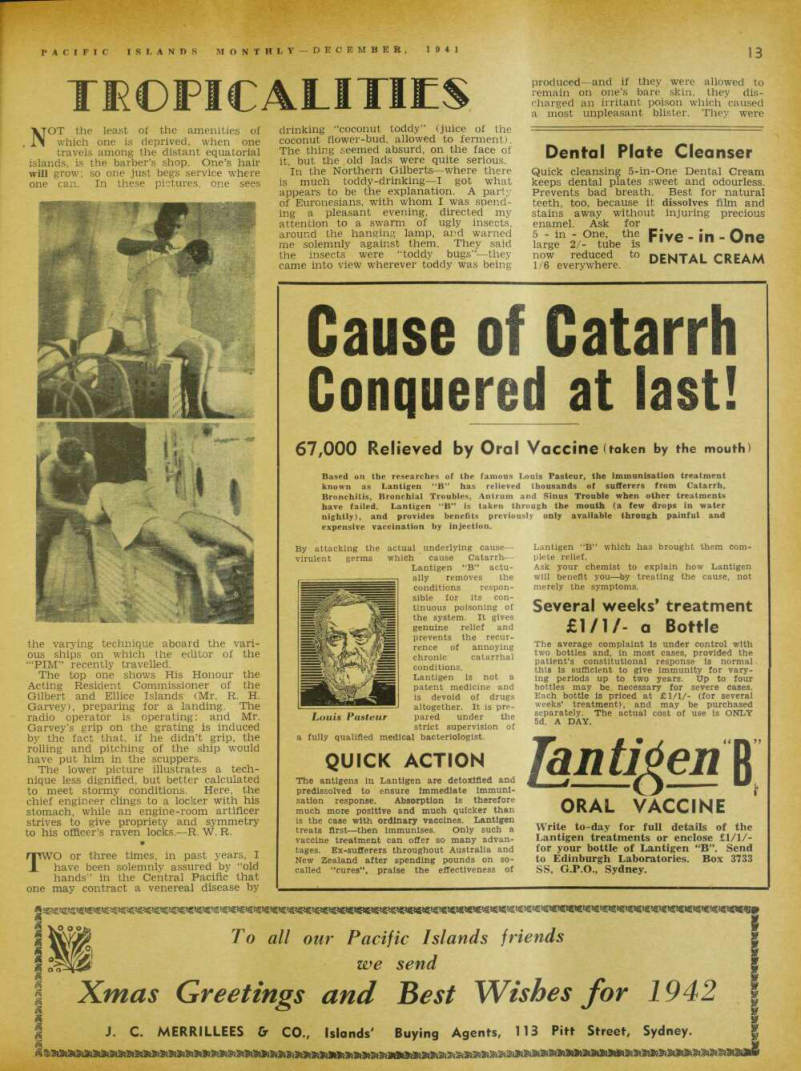
NOT the least of the amenities of which one is deprived, when one travels among the distant equatorial islands, is the barber’s shop. One’s hair will grow; so one just begs service where one can. In these pictures, one sees
the varying technique aboard the vari ous ships on which the editor of the ‘“PIM” recently travelled.
The top one shows His Honour the Acting Resident Commissioner of the Gilbert and Ellice Islands (Mr. R. H.
Garvey), preparing for a landing. The radio operator is operating: and Mr.
Garvey’s grip on the grating is induced by the fact that, if he didn’t grip, the rolling and pitching of the ship would have put him in the scuppers.
The lower picture illustrates a tech nique less dignified, but better calculated to meet stormy conditions. Here, the chief engineer clings to a locker with his stomach, while an engine-room artificer strives to give propriety and symmetry to his officer’s raven locks. —R. W. R. « TWO or three times, in past years, I have been solemnly assured by “old hands’’ in the Central Pacific that one may contract a venereal disease by
drinking “coconut toddy’’ (juice of the coconut flower-bud, allowed to ferment).
The thing seemed absurd, on the face of it, but the old lads were quite serious.
In the Northern Gilberts —where there is much toddy-drinking—l got what appears to be the explanation. A party of Euronesians, with whom I was spend ing a pleasant evening, directed my attention to a swarm of ugly insects, around the hanging lamp, and warned me solemnly against them. They said the insects were “toddy bugs’’—they came into view wherever toddy was being
produced—and if they were allowed to remain on one’s bare skin, they dis charged an irritant poison which caused a most unpleasant blister. They were
liable to fall into one’s beer; and if one inadvertently drank any liquid in which a toddy-bug had drowned, one’s urine and organs were usually affected in such a way .that one, for some days, dis played all the symptoms of gonorrhoea.
I sat back, and fiercely guarded my beer against toddy-bugs; and recalled, with chuckles, a story told to me plain tively in Samoa by the late John Andrew, old-time trader, concerning an ailment which had befallen him mys
teriously in the Line Islands, after he had been toddy-drinking.
The pestilential character of the toddy-bug was afterwards confirmed to me by other Gilbertese sufferers.—R.W.R. • MEN from the peripatetic services, who decide to break the monotony of tropical existence with a little unconventional revelry, are occasionally seen in Port Moresby. Recently, a visit ing seaman caused a sensation in a hotel lounge by stalking past the tables, minus his trousers, and challenging all who dared “to take him on”.
When the invitation was ignored, and it was urged that the gentleman clothe himself more suitablv in the presence of ladies, he became violent, and attacked his companion. A general scuffle fol lowed, on the floor, when another of his mates, thinking that perhaps things had gone a little too far. settled the affair with a well-aimed kick in the eve. This ended the fight, but not the disturbance.
Order was restored when two policemen came and persuaded the wounded hero to go with them to the nolice station, where he received first-aid, and accom modation for the night. * ' T'HIS is not a “proper” story, and the 1 Central Pacific official who included it in a private letter to the editor did not intend it for vublication. But it is really so funny that it must go into print:— ONE night we were all at Willie’s, and he told ns about some of the girls he had known. Mrs. Willie (Tiara) teased him about the time when thev were first married and she went travel ling with him.
He was a supercargo on a schooner.
She said that whenever thev arrived at an island he would take her on one
side and point out the particular girl he’d had on that island in his single days, so that if there should be any loose talk, and the matter should hap pen to come up, his wife could always retort: “Yes, that might be quite true, but he didn’t marry you, did he? He married me.”
Willie, by this time, had become a little tight and was telling us about some girls that Tiara had not heard about, and she took it up.
“Hey. Willie, you didn’t tell me about this before.”
“Eh? Oh. no, maybe not. But I haven’t told you everything. I was sail ing about these places before you were born. Why, I knew your mother when she was a young girl.”
Without stopping to think. Tiara shot ba'-'k. “Go on, now! Maybe you’re my father!”
Willie was so astonished that he stop ped drinking, and looked at her over the rim of his glass, and then he exploded: “Don’t be so damn silly! Woman, you’re crazy!”
He spent the rest of that evening mumbling to himself; and, everv now and then, he would mutter into his empty glass: “Damn woman’s crazy!”
Mr. Norman Wood, of Thurley’s Pty.
Ltd., importers and Islands merchants of Melbourne, returned to Australia last month after a visit to Western Samoa in connection with the cocoa trade.
Mrs. Margaret Simpson, the oldest resident of Thursday Island, died in Oc tober at the age of 92. She went to TT when the settlement at Somerset (Cape York Peninsula. Northern Queensland) was abandoned in 1877. Her husband was Superintendent of Prisons on Thursday Island and died there in 1899.
Advertisements & other items, pp. 15-16 (1 item)
lantigen B
Dental Plate Cleanser
Quick cleansing 5-in-One Dental Cream keeps dental plates sweet and odourless.
Prevents bad breath. Best for natural teeth, too, because it dissolves film and stains away without injuring precious enamel. Ask for 5 -in - One, the Fjyg _in Qng large 2/- tube is rive m vne now reduced to ntkJTAL CREAM 1/6 everywhere. UtINIAL LKtAM
Cause of Catarrh
Conquered at last!
67,000 Relieved by Oral Vaccine* taken by the mouth) Based on the researches of the famous Louis Pasteur, the immunisation treatment known as Lantigen “B” has relieved thousands of sufferers from Catarrh, Bronchitis, Bronchial Troubles, Antrum and Sinus Trouble when other treatments have failed. Lantigen “B” is taken through the mouth (a few drops in water nightly), and provides benefits previously only available through painful and expensive vaccination by injection.
By attacking the actual underlying cause— virulent germs which cause Catarrh— Lantigen “B” actually removes the conditions responsible for its continuous poisoning of the system. It gives genuine relief and prevents the recurrence of annoying chronic catarrhal conditions.
Lantigen is not a patent medicine and is devoid of drugs altogether. It is prepared under the strict supervision of a fully qualified medical bacteriologist.
QUICK ACTION
The antigens in Lantigen are detoxified and predissolved to ensure immediate immunisation response. Absorption Is therefore much more positive and much quicker than is the case with ordinary vaccines. Lantigen treats first—then immunises. Only such a vaccine treatment can offer so many advantages. Ex-sufferers throughout Australia and New Zealand after spending pounds on socalled “cures”, praise the effectiveness of Louis Pasteur Lantigen “B” which has brought them complete relief.
Ask your chemist to explain how Lantigen will benefit you—by treating the cause, not merely the symptoms.
Several weeks* treatment
£l/1/- a Bottle
The average complaint is under control with two bottles and, in most cases, provided the patient’s constitutional response is normal this is sufficient to give immunity for varying periods up to two years. Up to four bottles may be necessary for severe cases.
Each bottle is priced at £l/1/- (for several weeks’ treatment), and may be purchased separately. The actual cost of use is ONLY sd. A DAY.
lantigen B
ORAL VACCINE
Write to-day for full details of the Lantigen treatments or enclose £l/1/for your bottle of Lantigen “B”. Send to Edinburgh Laboratories. Box 3733
SS, G.P.0., Sydney.
OOD
o n To all our Pacific Islands friends we send Xmas Greetings and Best Wishes for 1942 J. C. MERRILLEES & CO., Islands' Buying Agents, 113 Pitt Street, Sydney.
KAMBALA
Church of England Girls’ School I si M O
-XMj
Kambala Church of England School for Girls at Rose Bay, Sydney, provides complete modem education for girls from the age of five. Under the direction of the Principal. Miss F. Hawthorne, 8.A., and a fully qualified staff. Kambala offers thorough preparation for either academic or professional careers, and excellent physical training.
NEW TERM COMMENCES
FEBRUARY 10th.
For full prospectus please consult the Principal, or R. E. Cox, Secretary, 28 Bond Street, Sydney.
eman
3^
AuwMuaosl,
&[■ ilm niql^t!
7 y y r CB ' 500
CANDLE
POWER
4 300 *<&
CANDLE
POWtR
EASE
All Types Mantles
BRIGHTER LIGHT
for
BETTER SIGHT
Coleman Products can be obtained from all Leading Firms throughout the Pacific Island®.
Instant Lighting Irons Kerosene Pressure Stoves
OF OPERATION
combines
ECONOMY with COMFORT
In case of difficulty in obtaining supplies write to:— Pearce & Co., Suva, Fiji Is.
Tangitangs
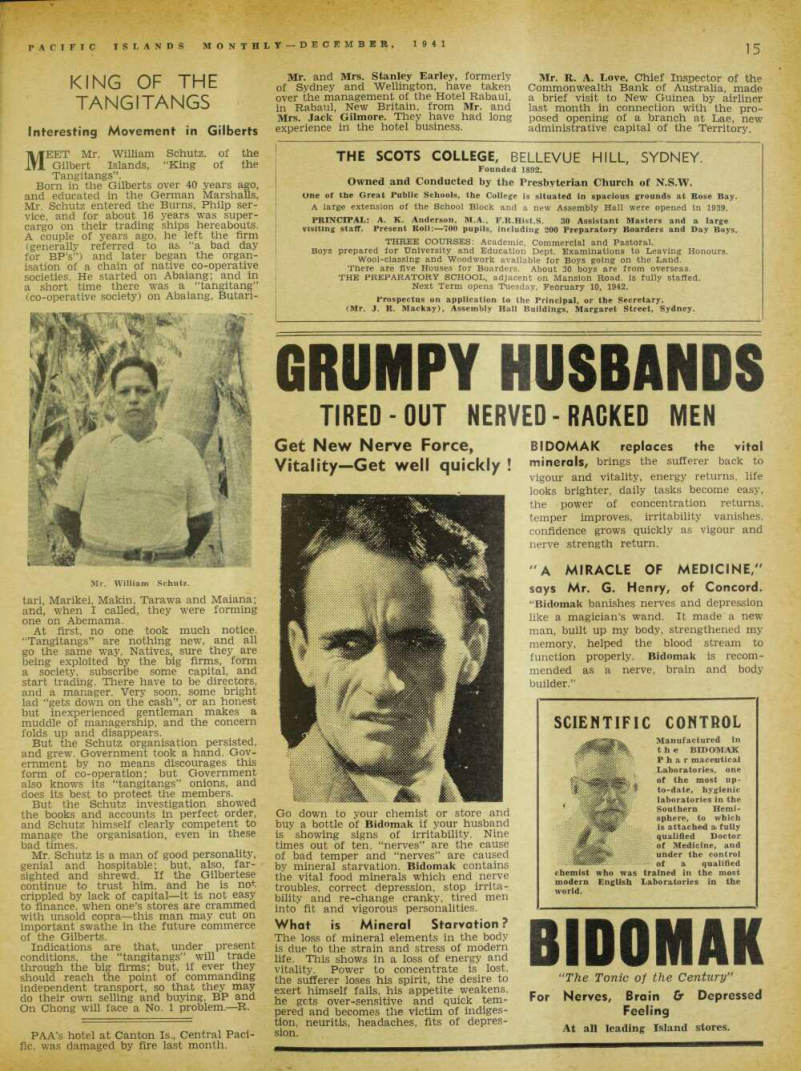
King Of The
Interesting Movement in Gilberts
MEET Mr. William Schutz, of the Gilbert Islands, “King of the Tangitangs”.
Born in the Gilberts over 40 years ago, and educated in the German Marshalls, Mr. Schutz entered the Burns, Philp ser vice, and for about 16 years was super cargo on their trading ships hereabouts.
A couple of years ago, he left the firm (generally referred to as “a bad day for BP’s”) and later began the organ isation of a chain of native co-operative societies. He started on Abaiang; and in a short time there was a “tangitang” (co-operative society) on Abaiang, Butari-
tari, Marikei, Makin, Tarawa and Maiana; and, when I called, they were forming one on Abemama.
At first, no one took much notice.
“Tangitangs” are nothing new, and all go the same way. Natives, sure they are being exploited by the big firms, form a society, subscribe some capital, and start trading. There have to be directors, and a manager. Very soon, some bright lad “gets down on the cash”, or an honest but inexperienced gentleman makes a muddle of managership, and the concern folds up and disappears.
But the Schutz organisation persisted, and grew. Government took a hand. Gov ernment by no means discourages this form of co-operation; but Government also knows its “tangitangs” onions, and does its best to protect the members.
But the Schutz investigation showed the books and accounts in perfect order, and Schutz himself clearly competent to manage the organisation, even in these bad times.
Mr. Schutz is a man of good personality, genial and hospitable; but, also, far sighted and shrewd. If the Gilbertese continue to trust him, and he is not crippled by lack of capital—it is not easy to finance, when one’s stores are crammed with unsold copra—this man may cut on important swathe in the future commerce of the Gilberts.
Indications are that, under present conditions, the “tangitangs” will trade through the big firms; but, if ever they should reach the point of commanding independent transport, so that they may do their own selling and buying, BP and On Chong will face a No. 1 problem.—R.
PAA’s hotel at Canton Is., Central Paci fic, was damaged by fire last month.
Mr. and Mrs. Stanley Earley, formerly of Sydney and Wellington, have taken over the management of the Hotel Rabaul, in Rabaul, New Britain, from Mr. and Mrs. Jack Gilmore. They have had long experience in the hotel business.
Mr. R. A. Love, Chief Inspector of the Commonwealth Bank of Australia, made a brief visit to New Guinea by airliner last month in connection with the pro posed opening of a branch at Lae, new administrative capital of the Territory.
Mr. William Schutz.
Glycerine and Coconuts
GLYCERINE, the basic ingredient of dynamite (nitro-glycerine) can be obtained from coconut oil in three different ways;— 1. From the washings in big soap fac tories, plenty of glycerine can be recov ered. 2. A Russian chemist, Sergius Petroff, has discovered a formula for cracking coconut oil into three things: petroleum, gasoline and glycerine. This process is commercially profitable only if the cost of oil is below £ll (A) per ton. 3. In the United States, a machine is available in the market to extract gly cerine directly from coconut oil.
Glycerine alone is only one-half of the story. To manufacture nitro-glycerine (or dynamite) it is necessary to have nitric and sulphuric acids.
Advertisements & other items, pp. 17-18 (1 item)
Grumpy Husbands
THE SCOTS COLLEGE, BELLEVUE HILL, SYDNEY.
Founded 1892.
Owned and Conducted by the Presbyterian Church of N.S.W.
One of the Great Public Schools, the College is situated in spacious grounds at Rose Bay.
A large extension of the School Block and a new Assembly Hall were opened in 1939.
PRINCIPAL: A. K. Anderson, M.A., F.R.Hist.S. 30 Assistant Masters and a large visiting staff. Present Roll:—700 pupils, including 200 Preparatory Boarders and Day Boys.
THREE COURSES: Academic, Commercial and Pastoral.
Boys prepared for University and Education Dept. Examinations to Leaving Honours.
Wool-classing and Woodwork available for Boys going on the Land.
There are five Houses for Boarders. About 30 boys are from overseas.
THE PREPARATORY SCHOOL, adjacent on Mansion Road, is fully staffed.
Next Term opens Tuesday, February 10, 1942.
Prospectus on application to the Principal, or the Secretary, (Mr. J. R. Mackay), Assembly Hall Buildings, Margaret Street, Sydney.
GRUMPY HUSBANDS
TIRED-OUT NERVED-RACKED MEN
Get New Nerve Force,
Vitality—Get well quickly !
Go down to your chemist or store and buy a bottle of Bidomak if your husband is showing signs of irritability. Nine times out of ten, “nerves” are the cause of bad temper and “nerves” are caused by mineral starvation. Bidomak contains the vital food minerals which end nerve troubles-, correct depression, stop irritability and re-change cranky, tired men into fit and vigorous personalities.
What is Mineral Starvation?
The loss of mineral elements in the body is due to the strain and stress of modern life. This shows in a loss of energy and vitality. Power to concentrate is lost, the sufferer loses his spirit, the desire to exert himself fails, his appetite weakens, he gets over-sensitive and quick tempered and becomes the victim of indigestion, neuritis, headaches, fits of depression.
BIDOMAK replaces the vital
minerals, brings the sufferer back to vigour and vitality, energy returns, life looks brighter, daily tasks become easy, the power of concentration returns, temper improves, irritability vanishes, confidence grows quickly as vigour and nerve strength return.
" A MIRACLE OF MEDICINE/'
says Mr. G. Henry, of Concord.
“Bidomak banishes nerves and depression like a magician’s wand. It made a new man, built up my body, strengthened my memory, helped the blood stream to function properly. Bidomak is recommended as a nerve, brain and body builder.”
SCIENTIFIC CONTROL
Manufactured in
the BIDOMAK
P h a r maceutical Laboratories, one of the most upto-date, hygienic laboratories in the Southern Hemisphere, to which is attached a fully qualified Doctor of Medicine, and under the control of a qualified chemist who was trained in the most modern English Laboratories in the world.
BIDOMAK
“The Tonic of the Century”
For Nerves, Brain & Depressed
Feeling
At all leading Island stores. rf" 1 *
BEEBE" ALL-STEEL
WINCHES
Genuinely portable, 5 tons capacity.
Weight 120 lb.
Ideal for all Mining, Timber-getting and general purposes.
Immediate delivery ex Rabaul to all parts of the Islands.
PARTICULARS:
Nelson & Robertson Pty. Ltd.
12 SPRING STREET, SYDNEY.
W 1 GROVE £ SONS
Limited
AUCKLAND
Island Traders. P.o. Box 490.
Telegraphic and Cable Address; “Grove”, Auckland.
Shippers of all classes of New Zealand products.
Representing English Manufacturers throughout the Cook and Society Islands, Fiji, Tonga, Samoa, Niue, New Caledonia, New Guinea, etc.
In FIJI as—W. H. Grove Cr Sons (Fiji) Ltd.
strength
saps
it bac
Rich in jumper and healthful herbs % ■« i I
Pacific History
Valuable New Book of Pacific History
IN “International Rivalry in the Pacific Islands, 1800-1875”, Dr. Jean Ingram . ... Brookes supplies us with a thing hitherto grievously missing—namely, a political history of all the South Pacific Territories, from the beginning of Euro pean penetration, up until the later part of last century. The book—a large one of 450 pages, including bibliography, in dex and maps, published by University of California Press, Berkeley, USA, for ss—must have entailed a vast amount of research, cross-checking and compilation; but it does, as the publishers claim, sup ply the essentail background to any understanding of present events, tenden cies and conflicts in the Pacific Islands area.
The author describes the manner in which the Europeans came, step by step, into the Pacific: how the Islands, first of all, were merely places of refreshment and carousal for whalers and sealers; how runaway sailors, convicts and all sorts of human derelicts found succour there; how traders followed the discovery of the values of sandalwood, coconuts, beche-de-mer, and so on: and how the missionaries kept pace with the traders.
She shows how Britain, France, United States and finally Germany began to show an increasing interest in the an nexation of South Pacific islands; al though it is clear that Britain (now the biggest landowner in the Pacific) was by far the most reluctant to accept such territories, and consistently rejected many pleas for annexation.
Here we find, carefully straightened out in correct chronological order, many hitherto confusing episodes in the early history of Hawaii, Tahiti, Fiji, Samoa, Tonga, New Caledonia and New Hebrides.
For instance, we are given a full descrip tion of the “Pritchard affairs” of Tahiti and Fiji, both of which caused some poli tical convulsions. The book makes it clear that there were two Consul Pritchards, George and W. T. —father and son—and not one. George was hurriedly transferred from Tahiti to Samoa, and then was vir tually removed from Samoa. His son, W. T.. was appointed consul in Fiji, and was dismissed five years later.
There is not an event of any importance in the South Pacific, in all the Territories, between 1800 and 1875, which is not described, and fitted into its proper place, in this invaluable record of history. It is a book that must be included in every good reference library; and it will be much called for, in future.
High Prices For Samoan
Cocoa
THE representative of a Melbourne firm, who has iust returned from Samoa, after visiting 1 that Territory in order to buy cocoa beans for Australian in terests, informs us that Western Samoan planters are now getting from £52 to £6O per ton. f.o.b. Apia, for their cocoa beans —the best prices known in that country for many years.
New Hebrides cocoa also is in demand: but. for some reason. New Guinea cocoa still is not regarded with favour by Aus tralian confectionery manufacturers —they sav that NG producers seem unable to get the right grade, in curing the beans.
Mr. Edmond Buterl. Joint Court Regis try Clerk in the New Hebrides, has been relieving Mr. C. Steinmitz as Acting Court Registrar and Acting Registrar of Land Titles at Vila, while Mr. Steinmitz has been absent from the Group on six months’ furlough.
Captain "Jim"
Smith
A Link With Bully Hayes
“11/ELL.” I said, “for an old man you ff are in extraordinary good shape how do you do it?”
“Old!” shouted Captain “Jimmie” Smith, of Abemama, Gilbert Islands. “Old! I’m not old—l’m only 83. Look here,” with an
appraising glance at my honourable con vexity. “I’ll race you down to the front gate.” And he meant it.
I met two or three such men in the Gilberts. Apparently, having endured the toughness of early life in those unfertile islands, they can survive anything, and live far beyond the three-score-years and-ten.
It is over 50 years since Captain Smith first saw the Gilberts—he had been wandering about the Central Pacific since the eighties—in 1894; he was in the labour trade and he sailed from Honolulu down among the equatorial is lands. In the following years, he was in and out of most ports in the Marshalls, Gilberts, Fijis, etc. About 23 years ago, he settled down in the Gilberts.
Captain Smith is one of the last sur viving links with Captain Bully Hayes— he was the last owner of the “Lotus”.
The “Lotus” was the little vessel which Hayes was sailing from Apia to Jaluit (Marshalls) in 1877, when he was mur dered. The "Lotus” was sold in Jaluit, and eventually came into the hands of “Black Tom”, well known in Samoa in Hayes’ day.
“Black Tom” raffled the “Lotus”, at one dollar a ticket, and Captain “Jimmie”
Smith’s ticket won. By this time, the “Lotus” was in poor shape, and on July 4. 1886, Captain Smith decided to make of her an American Independence Day bonfire: and thus she disappeared in a blaze of glory.
“Old Jack Sandberger, who was the sole survivor of Bully Hayes’ team of traders in these islands, died a few years asro at the age of 90,” said Captain Smith.
“He has a daughter, living on Tabautea.”
R. W. R.
Mr. Vic. Gabriel arrived at Samarai, Papua, from Rabaul, TNG, last month to act as relieving manager of Burns, Philp & Co.’s branch for a couple of months.
Samoa's Problems
How NZ Mishandles Samoa's Problems
From Our Own Correspondent
Apia, Nov. 3.
THE recent Fono of Faipule (Native Parliament) petition to the NZ Gov ernment to impose the death penalty upon Samoan murderers is another in stance of how New Zealand wrongly deals with Samoa’s problems.
During the past two or three years, there have been a large number of mur ders committed in a brutal manner and for trivial reasons by natives against natives. Whenever the murderers were caught, they have been tried by judge and jury and mostly sentenced to death by hanging. But the NZ Labour Govern ment having abolished the death penalty
in New Zealand, has in every case com muted the sentence to life imprisonment.
The Samoans, following the biblical “ a ijf e f or a ufe” principle, fail to under stand such an attitude, knowing full well that imprisonment is no deterrent to serious crime.
Misplaced humanitarianism has also caused the NZ Government to veto the placing in irons of dangerous criminals in Samoa. As a result, two of the most notorious Samoan convicts, Osea and Simaile, serving prison sentences for life and 12 years respectively and who have hgured in previous gaol breaks, have again escaped from custody. They have been roaming the country, making and Samoans afraid for the safety of their women and children. —TT: .
Corporal Epenen Dakuitoga, of the Fiji Police Force, has been awarded the Colo nial Police Long Service Medal.
Advertisements & other items, pp. 19-20 (1 item)
Rsss
» 7" o o no 7^ i s £?y ST. vV.
'lllniih
Cf*\ %k\ \*» '\
UNION
ASSURANCE SOCIETY LTD.
(Incorporated in England)
FIRE ACCIDENT
FIJI A. E. PEARCE & CO.
RABAUL COLYER WATSON
(New Guinea) Ltd.
N. S. WALES 109 PITT STREET,
SYDNEY.
S. Morrison, Mgr.
CONTROLLING OFFICE—
-413 Collins St., MELBOURNE
ALAN H. RUSSELL,
Resident Manager.
THE SMARTEST LOW-PRICED
TRAVEL CASE OBTAINABLE!
v> K 9 Made of hard-wearing, weatherproof, weight-saving fibre, Leatherlike Travel Case No. 720 is finished like leather, with sewn edges, sturdy corner guards, solid leather straps and handle. It's a roomy, serviceable, quality case at an economy price.
LEATHER LIKE
TRAVEL CASE NO. 720
If unobtainable from your regular storekeeper, please write to address below. Traders are invited to apply for trade list and full particulars.
FORD SHERINGTON LTD.
Manufocturers, Kippax Street, Sydney
Roll Of Honour
(It is hoped to assemble, here, the names of men former residents of the Pacific Territories, which appear in British and Free French casualty lists, or in lists of honours awarded.
We should be grateful if relations and friends would send us details.)
Killed
Pilot-Officer Len BAYLISS, flying instructor in the RAAF, formerly of Rabaul, New Guinea Killed in Sydney, 18/11/1940. when he fell from a trainer aircraft in flight.
A/Bdr. Neville W. BERTWISTLE, AIF artillery (tank unit), formerly a clerk on the staff of W. R. Carpenter and Co., Ltd., of Rabaul, New Guinea. Killed in action, April, 1941.
Flight-Lieutenant G. J. I. CLARKE, of the RAAF, formerly Assistant Flight Superintendent of Carpenter Airways, New Guinea. Killed in action during operations off Dakar (French West Africa), while attached to HMAS “Aus tralia”, September, 1940.
Flying-Officer Jack R. COATH, of the RNZAP, formerly on the staff of the Bank of New Zealand, in Suva, Fiji. Killed October, 1941, when a training plane' crashed in NZ.
Pte. Felix CRAIG, AIF, formerly of accounts department, Australasian Petroleum Co., Port Moresby, Papua. Reported killed, June, 1941.
Observer V. L. DEARMAN, of the RAAF, for merly overseer and clerk at the Colonial Sugar Refining Co., Ltd., Rarawai, Fiji. Reported killed in action in the Middle East, October 1941.
Captain Kenneth GARDEN, of the RAP Ferry Command, formerly chief pilot of Guinea Air
ways Ltd., in New Guinea. Killed, 2/9/1941 when the bomber he flew from USA crashed on west coast of Britain.
Flying-Officer Moresby GOFTON. of the RAF rs - F - ?. Stewart, of Wau, New Guinea.’ kilted l6(l miSSmg ’ 17 /5/1940—now presumed Flying-Officer Alan JOHNSTONE, of the RAF who was born in Suva, Fiji, in 1915. Killed in action during bombing raid on Kristiansand Norway, April, 1940.
Pte. L. F. McCarthy, ALP infantry, form erly supercargo on W. R. Carpenter and Co’s mter-island vessel “Mako”, in New Guinea Reported “wounded in action and missing believed prisoner of war”, 15/7/1941; reported killed in action”. 30/10/1941. c. SCOTT, AIF, formerly manager at Kieta, TNG. for Burns, Philp and Co., Ltd Killed in action in the Middle East, 19/6/1941.
Died From Wounds
Pte. Ernest HENRY, AIF, formerly of the Rabaul (NG) staff of Burns, Philp and Co., Ltd. Died from wounds received during Battle of Crete, 1/6/1941.
Pte. Walter PEARSON, of first NG quota of AIF (infantry). Died from wounds received in action, 24/6/1941.
A/Bdr. W. R. SCOTT. AIF, of New Guinea Died from wounds, July, 1941.
Sergeant-Pilot Peter Clarkson WISE, of the RAF. son of Mr. W. Wise. OBE, Director of Public Works, Fiji. Died from wounds received during bombing raid over Germany, January 1941.
Died From Illness
Pte. Clarence A. HUTTON, AIF, formerly of Edie Creek, New Guinea. Died from Illness April, 1941,
Missing
Pilot John CLARK, of the RAAF, son of Mr, and Mrs. R. L. Clark, of Rabaul, New Guinea.
Reported missing, 1/11/1941, after an operational flight, in the Middle East.
Gnr. Allan H. ROSS, AIF artillery, formerly planter in New Britain, TNG. Reported missing —believed prisoner of war, 28/9/1941.
Pilot James SIMPSON, of the RAF, formerly of Vatukoula, Fiji. Reported missing after air operations over Malta, in the Mediterranean 1/7/1941.
Pte. Fred SWAN, NZ Army Medical Corps, formerly of Apia, Western Samoa. Reported in August, 1941, “missing after Battle of Crete”.
Wounded
Pte. V. BLANCO, AIF Infantry, of Thursday Island. Reported wounded in action. 8/7/1941.
L/Cpl, J. P. BLENCOWE. AIF infantry, of Rabaul, TNG. Reported wounded in action, 15/7/1941.
Pte. Thomas BYERS, ALP infantry, of Thurs day Island. Reported wounded in action. May, 1941.
Pte. John GRANT, AIF infantry, of New Guinea. Reported wounded in neck and thigh, 21/9/1941; later, reported “rejoined unit”.
Sgt. C. HENDRICK, AIF infantry, of Rabaul, TNG. Reported wounded in action, 15/7/1941, Stanley HIGGS, son of Mr. and Mrs. Gordon Higgs, of W. R. Carpenter and Co., Ltd., well known in New Guinea. Member of an English Lancers’ regiment, wounded during British evacuation from Dunkirk (France). May, 1940.
Lieut. Lloyd T. HURRELL, AIF infantry, of Rabaul, TNG. Reported “wounded in action, remaining on duty”, 29/7/1941.
Cpl, W. H. LANNEN, AIF artillery, of Rabaul, New Guinea. Reported "wounded in action on seriously ill list, 30/6/1941; removed from seriously ill list, 25/7/1941”.
Gnr. E. G. LOBAN, AIF artillery, of Thursday Island, wounded during Greek campaign. May, 1941, Invalided home after having his left forearm amputated.
Capt. Edward Tiwl LOVE, NZ Maori Battalion, husband of Mrs. Takau Rio Love, Arlkl-nul of Rarotonga, Cook Islands. Reported missing dur ing Greek campaign, 27/5/1941; later. 22/6/1941, reported “wounded and safe”.
Cpl. R. McKERLIE, AIF, of Yandina, BSI, wounded in face by bomb explosion, April, 1941.
A/Sgt. Alastair MACLEAN, AIF infantry, of Rabaul, New Guinea. Wounded in action, in Libya. 30/6/1941.
S/Sgt. Graham B. MIRFIELD, AIF engineers, of Rabaul, New Guinea. Wounded in action, 16/7/1941.
Pte. L. G. (“Mick”) REECE, of Bulolo, New Guinea. Wounded in action with AIF, July, 1941.
A/Cpl. N. K. SAWYER, AIF infantry, of Rabaul, TNG. Reported wounded in action, 22/7/1941.
Pte. Lance STAMPER, AIF, formerly school master at Wau, New Guinea. Reported wounded in action, August, 1941.
Pte. Harold G. TURNER, AIF, of Samaral, Eastern Papua. Wounded in action at Bardia (Libya), January, 1941.
Pte. F. D. TWISS, AIF infantry, of New Guinea. Reported wounded in action, August, 1941.
Prisoners Of War
A/Cpl. Peter W. BOSGARD, AIF infantry, formerly of the Lands Department, Port Moresby, Papua. Reported prisoner of war at Sulmona, Italy, 29/6/1941.
A/Sgt. A. A. S. COTMAN, AIF infantry, of Abau, Papua. Reported missing—believed prisoner of war, 5/5/1941; reported later, July, 1941, “wounded in chest and head by shrapnel— taken prisoner”.
Pte. W. GOSSNER, AIF infantry, formerly of the BNG Development Co., Port Moresby, Papua.
Reported prisoner of war, Sulmona, Italy, 6/7/1941.
Gnr. A. L. B. KING, AIF artillery, of Rabaul, TNG. Reported prisoner of war, 29/7/1941, A/Cpl. John H. LONERGAN, AIF, Supply and Transport, of New Guinea. Reported prisoner of war at Corinthia, Italy, 8/7/1941.
Observer Alex. McKAY, of the RAAF, formerly of the CSR Co.’s staff, at Penang sugar-mill, Fiji. Reported missing, 27/7/1941; reported prisoner of war in Italy, 26/10/1941.
Pte. John O. SMITH, of the NZ Forces, son of Captain Harry Smith, of “Tui Kauvaro”, and Mrs. Smith, of Suva, Fiji. Reported missing, 29/5/1941, after Battle of Crete; reported prisoner of war, 21/10/1941.
Decorations
Sgt. Henry C. S. COTTON, of the RNZAF. who was born in Samoa (his father was Secre tary of Native Affairs during the NZ military occupation). Awarded the Distinguished Plying Cross.
Lieut. Colin HILL, RANR, of the Australian destroyer, “Waterhen”, formerly second officer on the trans-Pacific liner “Niagara”. Awarded Order of the British Empire for salvaging a burning oil tanker near Suda Bay, Crete.
Flying-Officer James R. HYDE, of the RAF, formerly a Patrol Officer in Namatanai and Sepik Districts, TNG. Awarded the Distinguished
Flying Cross for bombing raids on Heligoland Bight, in the North Sea.
Lieutenant-Commander A. W. R. McNICOLL, RAN, son of Sir Ramsay McNicoll, Adminis trator of New Guinea, and Lady McNicoll.
Awarded the George Medal “for gallantry and undaunted devotion to duty”, Sgt. Geoffrey MOORE, of the RNZAF, for merly engineer on the NG inter-island vessel “Maiwara” and on the trans-Pacific liner “Aorangi”. Awarded the Distinguished Flying Medal for “shooting down an enemy fighter and driving off two others, and having displayed great courage and a high standard of gunnery at all times”.
Commander Alvord S. ROSENTHAL, RAN, son of Major-General Sir Charles Rosenthal, KCB, CMG, DSO, VD, Administrator of Norfolk Island. Awarded the DSO for service in the Mediterranean.
No Minerals For Japan
From Our Own Correspondent
Noumea, Nov. 22.
OWING to the ban on minerals to Japan, the Japanese controlled Societe le Fer recently put off 200 of its 600 Javanese workmen.
A second Japanese mining concern, the Societe Miniere de I’Oceanie, following suit, is also slowing up production at its nickel mines at Kua, where 30 of 260 Javanese employees have been dismissed.
They are being found work in other parts of the Colony. Further reductions are expected to be made by the company.
Miss W. E. Neibuhr, who until late last year was a worker for the Seventh Day Adventist Mission in Papua, has been appointed to take charge of the Mission’s training school at Rarotonga, Cook Is lands. She expects to take up duty in January.
Copra In Solomons
Letter to the Editor AS no one else seems prepared to do so, and as you have continued to repeat in your recent issues, statements to the effect that “there was now a market for all South Pacific copra” (“PIM”, Sept., page 7), I feel impelled to flatly contradict those furphies, at least as re gards the Gizo District, which is perhaps the most important copra producing dis trict in the British Solomons.
I know of narcels of smoked copra which have been seeking a buyer since July. 1940. Yes, 1940! Some of them are on my own estates, whilst other pro ducers have accumulations for which they have been seeking. buyers for the best part of a year.
In the face of such bitter facts, why turn the knife in our wounds by re peatedly printing such nonsense as the
above quotation?
It would be much more to the point were you to print the names of these coy buyers of “all South Pacific copra”, and tell us where they are to be found—and then step quickly aside to avoid being trampled to death in the rush.
I am, etc.,
Leslie F. Gill.
Gizo, BSI, 8/11/1941.
EDITORIAL NOTE: Our correspondent is quite right; far too much has been made of the fact that Fiji and New Guinea copra is being shipped, while everyone has ignored the embarrassing accumulations in Tonga, Gilbert and El lice, Solomons, etc. One of the main objects of the new South Pacific Copra Board is to shift these accumulations of copra from the smaller territories.
Advertisements & other items, p. 21 (1 item)
Popular Car Tyre
SILENT
Dunlop
TENNIS
RACKETS
Dunlop “Maxp 1 y” tennis rackets are used by the Australian Champion and by countless other championship players throughout Australia. In the Dunlop range you will find the racket you want, at the price you want to pay.
Australia s Most
Popular Car Tyre
Proved by the fact that to-day more Dunlop Silent '9o' tyres are sold than any other tyre.
Dunlop
WATERPROOF
FOOTWEAR
The range of Dunlop Waterproof Footwear is complete. There are over 20 guaranteed waterproof styles for Men, Women and Children. Smart, Longwearing, Comfortable and keenly priced.
DUNLOP PERDRIAU RUBBER CO. LTD. (Inc. in Vic.). 27 Dunlop
REINFORCED
KINKLESS
GARDEN HOSE
Dunlop supply Garden Hoses for every purpose and at prices to suit every pocket.
Wrapped and Moulded types both of which give years of sun and abrasion resisting service.
33 WENTWORTH AVENUE, SYDNEY, N.S.W.
How Our Copra Reached
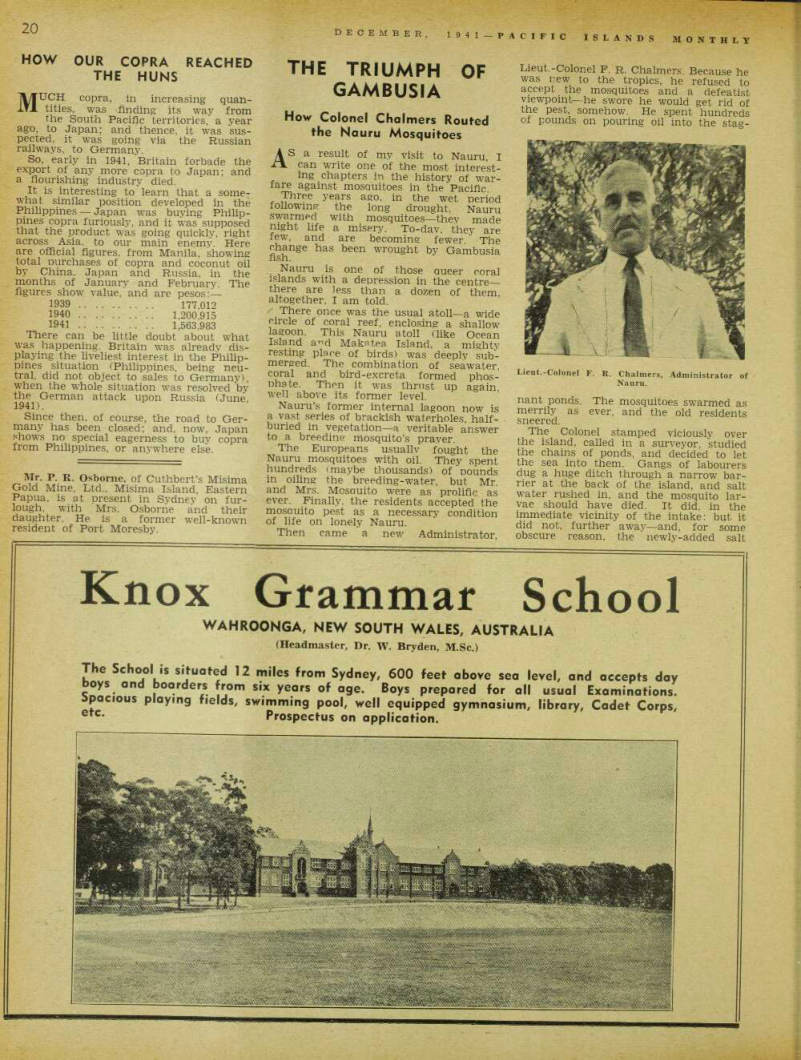
The Huns
MUCH copra, in increasing quan tities, was finding its way from the South Pacific territories, a year ago, to Japan; and thence, it was sus pected. it was going via the Russian railways, to Germany.
So, early in 1941, Britain forbade the export of any more copra to Japan; and a flourishing industry died.
It is interesting to learn that a some what similar position developed in the Philippines Japan was buying Philip pines copra furiously, and it was supposed that the product was going quickly, right across Asia, to our main enemy. Here are official figures, from Manila, showing total nurchases of copra and coconut oil by China. Japan and Russia, in the months of January and Februarv. The figures show value, and are pesos:— 1939 177.012 1940 1,200.915 1941 1,563,983 There can be little doubt about what was happening. Britain was alreadv dis playing the liveliest interest in the Philip pines situation (Philippines, being neu tral, did not object to sales to Germany), when the whole situation was resolved by the German attack upon Russia (June. 1941).
Since then, of course, the road to Ger many has been closed; and, now, Japan shows no special eagerness to buy copra from Philippines, or anywhere else.
Mr. P. R. Osborne, of Cuthbert’s Misima Gold Mine, Ltd., Misima Island, Eastern Papua, is at present in Sydney on fur lough. with Mrs. Osborne and their daughter. He is a former well-known resident of Port Moresby.
Gambusia
The Triumph Of
How Colonel Chalmers Routed the Nauru Mosquitoes
AS a result of my visit to Nauru I can write one of the most interest ing chapters in the history of war fare against mosquitoes in the Pacific.
Three years ago, in the wet period following the long drought. Nauru swarmed with mosquitoes—thev made night life a misery. To-day. they are few, and are becoming fewer The change has been wrought by Gambusia fish.
Nauru is one of those queer coral islands with a depression in the centre there are less than a dozen of them altogether, I am told.
There once was the usual atoll—a wide circle of coral reef, enclosing a shallow lagoon. This Nauru atoll (like Ocean Island Maks tea Island, a mighty resting place of birds) was deeply sub merged. The combination of seawater, coral and bird-excreta formed phos nhate. Then it was thrust up again well above its former level.
Nauru’s former internal lagoon now is a vast series of brackish waterholes, half buried in vegetation—a veritable answer to a breeding mosquito’s prayer.
The Europeans usuallv fought the Nauru mosquitoes with oil. They spent hundreds (maybe thousands) of pounds in oiling the breeding-water, but Mr. and Mrs. Mosouito were as prolific as ever. Finally, the residents accepted the mosouito pest as a necessary condition of life on lonely Nauru.
Then came a new Administrator,
Lieut.-Colonel F. R. Chalmers. Because he was new to the tropics, he refused to accept the mosquitoes and a defeatist viewpoint—he swore he would get rid of the pest, somehow. He spent hundreds of pounds on pouring oil into the stag-
nant ponds. The mosquitoes swarmed as merrily as ever, and the old residents sneered.
The Colonel stamped viciously over the island, called in a surveyor, studied the chains of ponds, and decided to let the sea into them. Gangs of labourers dug a huge ditch through a narrow bar rier at the back of the island, and salt water rushed in, and the mosquito lar vae should have died. It did, in the immediate vicinity of the intake: but it did not, further away—and, for some obscure reason, the newly-added salt
Lieut.-Colonel F. R. Chalmers, Administrator of Nauru.
water quickly disappeared, and the ponds resumed their former level.
Colonel Chalmers himself bitterly named his ditch “Chalmers’ Folly”.
Meanwhile, the Rev. C. L. Welch. LMS missionary, had gone away on a visit to Ocean Island, and places eastward.
“Welch,” said the Administrator, “if you can find some of those Gambusia fish over there, try and bring a few back to Nauru. Perhaps they can live in these blasted ponds.” He had heard of the experiments with Gambusia in the Gilbert and Ellice Colony, carried out by Major C. A. Swinbourne.
Many weeks later, Mr. Welch returned to Nauru. With him, in three earthen ware jars, tenderly cherished, he had 18 Gambusia.
Administrator and missionary tended those tiny fish as if they were precious orchids. They called in Chedwin, a native police pensioner, and made him Director of Fisheries, or something. The three of them fed the fish, and coddled them, and encouraged cohabitation and multiplication; and in a few weeks they were releasing jar-fulls of them in the ponds.
The Administrator declares that the result had to be seen, to be believed.
Ponds, which had been almost stiff with mosquito larvae, in a few months showed only clear water, through which darted countless thousands of tiny Gambusia. The pest was beaten.
“Talk about your rabbits and guinea pigs,” said Colonel Chalmers. “When it comes to a rapid natural increase, I’ll back my Gambusia against anything on earth! Let it be known that if anyone wants Gambusia, I can supply ’em, in hundreds or in millions!”
I walked beside those ponds in the evening, under heavy foliage. I saw the waters teeming with little fish, but I did not meet a single mosquito. They now go singly, where once they screamed in thousands.
Nauru’s 1,700 natives have their vil lages scattered over the pleasant island, mostly near the ponds. The change in their living and health conditions, as a result of the new control over the mos quito pest, can be imagined.
R. W. R.
Private J. D. McClymont, elder son of Captain D. McClymont (harbourmaster at Apia, Western Samoa) and Mrs. Mc- Clymont, who is serving overseas with the NZ Forces, has been promoted to sergeant. He joined up the day war was declared and took part in the Greece and Crete campaigns.
Mr. and Mrs. W. G. (“Bill”) Royal, of New Guinea, are at present in Sydney on holidays. Mr. Royal, who was one of the original discoverers of the rich Morobe goldfield, has been mining in Wewak Dis trict in recent years, with some success.
Before going across to the mainland, 20 years ago, he had an engineering business in Rabaul.
One of the ponds, or lakes, in the interior of Nauru.
Advertisements & other items, pp. 22-23 (1 item)
Knox Grammar School
WAHROONGA, NEW SOUTH WALES, AUSTRALIA
(Headmaster, Dr. W. Bryden, M.Sc.) The School is situated 12 miles from Sydney, 600 feet above sea level, and accepts day oys and boarders from six years of age. Boys prepared tor all usual Examinations, spacious playing fields, swimming pool, well equipped gymnasium, library. Cadet Corps, etc * Prospectus on application.
5E§
LOTIO
For Inflamed Eyes and Eyelids
SOLD EVERYWHERE
H. A. Rose & Co. Pty. Ltd., King St.. Sydney
BV)W-*
OP\CS
r
a«d Bf er
NWorld-^ de
• « fe^s M 11 m »• «» !SS NEW Airzone “Concert Star” brings you easy selective tuning, full power for those difficult distant stations, dual - wave for world-wide reception plus glorious lifelike tone . . . the richest voice in radio.
Buy Airzone and be safe!
Before production was ever started on “Concert Stars” the special needs of island
listeners climate-proofing,
powerful short-wave reception with natural tone, reduction of fading and noise, were fully investigated. The result is a radio that is perfect for the tropics, in components, performance and tone.
THE “CONCERT STAR"
PICK THE MODEL YOU NEED . .
"Concert Stars" are available in models to suit every requirement. -A' A.C. Model 6552 A—5 valve Dual Wave it A.C.-D.C. Model 6652 U—5 valve Dual Wave It Vibrator Operated Model 6852 V—5 valve Dual Wave ★ Battery Operated Model 6752D —5 valve 1-4 volt Dual Wave Console models also available if you wish.
Agents:
W. R. CARPENTER & CO. LTD.
19 O'Connell Street, Sydney; Salomaua, Rabaut, Kavieng, Madang, N.G., and Tulagi, Solomon Islands.
Designed and manufactured by Airzone ( 1931) Ltd., Camperdown, N.S.W
HA4II
Water For Port
Moresby
From Our Own Correspondent
Port Moresby, Dec. 1.
OLD residents, with bitter memories of recurrent droughts and water short ages, soon will have a first-class water-supply from the Laloki River; and a transformation in the appearance of the town may be expected.
A pumping station, situated on the picturesque banks of the Laloki River, some 12 miles from Port Moresby, will shortly commence operations. From the Laloki. a 24-in. main will carry water from the intake into a concrete shaft (34 ft.. 17 ft. below river bed) from where, after purification, it is forced by a 50 h.p. engine into large filter tanks;
where, again after further purification, it is pumped into a reservoir of 100,000 gallons. Thence, water when needed is pumped through a 10-in. main into the town reservoir, by means of a 120 h.p. engine, capable of pumping 25,000 gal lons an hour. Every pump and engine in this complicated and modern con struction is in duplicate, so should any mechanism break, there is no danger of the service being interrupted.
Mr. and Mrs. J. F. Morrell have taken up residence on Kalili Estate, New Brit ain, New Guinea. Mr, Morrell was dis charged a few months ago from the AIF as the result of a leg injury he received while on active service with the AIF in Tobruk, Libya.
Mr. Yamashita, Japanese Consul in New Caledonia, is returning to Japan for health reasons. Vice-Consul Maruo will replace him. Mr. Yamashita has been in Noumea since January this year, his predecessor being Mr. T. Kurochi, now Consul at Saigon, Indo-China.
Hon. A. Jewell, well-known non-official member of the Papuan Legislative Council, arrived in Australia recently. He was accompanied by Mrs. Jewell, who for some months has been the energetic organiser of the Port Moresby Comforts Club.
Advertisements & other items, p. 23 (1 item)
21
PACIFIC ISLANDS MONTHLt DECEMBER, 1941
B. O.—Phew!
Why Village Dogs Howl and Polynesians Shun Us
By A.C.R.
THOSE of us who were born in the Victtprian Age and grew up in the tradition of Kipling, are profoundly shocked when someone draws aside the veil concealing the inner thoughts of na tive peoples who, in those days, were classed as “the white man’s burden’’.
One of the most embarrassing dis closures is to be found in a chapter of the book “Four Hundred Million Cus tomers’’ which explains why dogs in Chinese villages go into tempests of sound and fury whenever Europeans appear.
The short, descriptive Anglo-Saxon words which explain that hostility were, m the period of basques and bustles, ex cluded from the lexicon of polite society; but, in this less polished age, stare at us from pages and hoardings that advertise chemically-saturated soaps, synthetic bath-salts and strangely compounded lotions warranted to render the user tolerable to his fellow men.
The Chinese, ever reluctant to say any thing that may wound the self-respect of a guest, confessed to the author that Europeans are rather suffocating
Polynesians are less reticent. They not only emphatically confirm the timid avowal of the Chinese, but specify Nordics and other Taata Pupure (blond persons; as always inciting their dogs to greater rage and clamour than do other types.
All of this is very disheartening to pompous individuals who visit the Islands expecting reverent recognition of the importance of their persons.
But that is not the worst. Recently, we came across the original meaning of this word Pupure in an old dictionary published nearly a century ago. To-day, the word is currently used as an adjec tive signifying blond—as Vahine Pupure (blonde woman). In the old dictionary the significance, at the time it was first applied to white persons, was “the leprosy, or native disease resembling it; also the person affected”.
This recalls the story we have often heard that the Tahitians viewed the first white people who visited their island, with great compassion; believing their pale complexion to be due to some wast ing disease.
A study of the old missionary records reveals that the apparently affectionate welcome accorded the early voyagers was not due to any regard for their persons; but because canny high chiefs, recog nizing the superiority of their weapons, hoped to induce the visitors to assist them against their enemies.
To-day in Polynesia (sad to relate), “gentlemen prefer blondes” only when their demeanour inspires a lively expec tation of favours, tangible and material, to come.
Tahitians affirm that many Europeans regard water merely as a substance useful for making onion and garlic soup. Native servants tell in the Papeete market-place how their employers, on arising in the morning, stick their arms out of their bedroom windows, pour a few cups full of water over their hands, and consider that they have bathed for the day.
They cite also the man who, in khaki shorts, was long a familiar figure about Papeete. One day he was at the post office addressing letters. In shaking down his fountain pen, a large drop of ink stained the bare calf of his leg. A fortnight later that ink spot was still there! Natives notice such things.
To Polynesians, who eagerly seize every opportunity to plunge into a river or get under a shower-bath, this fear of water is amazing.
Papuan Explorer's Medal
EARLY last month, Mrs. S. M. Karius, of Sydney, presented to the Com monwealth Government the Pat ron’s Medal of the Royal Geographical Society awarded to the late C. H. Karius for his exploration work in Papua. It will be placed among the historic exhi bits in Parliament House, Canberra.
Charles Henry Karius served in Papua for 20 years as Patrol Officer, Assistant Resident Magistrate and RM. In 1927, in company with Mr. Ivan F. Champion, he crossed Papua and New Guinea from south to north, through entirely un known country. Describing this expedi tion, Sir Hubert Murray (Lieutenant- Governor) wrote: “It was by far the most important and difficult feat of exploration ever performed in New Guinea or any of the adjacent islands.”
Mr, Karius died in Sydney a year ago, while on leave prior to retiring from the Papuan Service.
Miss J. Dunstan, matron of Samarai Hospital, Papua, arrived in Port Moresby last month to act as matron at the PM Hospital for a time.
Advertisements & other items, pp. 24-25 (4 items)
22
December, i94i~t»Acinc islands monthly
Clvde
Islands' Visitors to Sydney Will find excellent accommodation at
”206" PRIVATE HOTEL
204-8 Victoria Street, Kings Cross, Sydney.
Every Comfort, Splendid Table.
Tariff from 35/- per week.
MRS. C. PYATT, Proprietress.
Tel. FL 4272.
GUARANTEED
UNCONDITIONALLY
/ f° L l
2
YEARS
Introducing THE NEW-
CLVDE
MASTER BATTERY
(Available In the New Year).
The Battery with the specially constructed Heavy Duty Plates, built by the pioneers of Battery manufacture in Australia.
" MORE POWER TO YOU"
The new Clyde Master is built to meet petrol shortage conditions. It gives an instant spark and quicker starting, saving your petrol allowance, giving you more mileage. Instal the new Clyde Master with confidence, and remember, that it is unconditionally guaranteed for efficient and' long life by—
THE CLYDE ENGINEERING Co. Ltd.
GRANVILLE, N.S.W.
Main Sales & Service Division: 61-65 Wentworth Avenue, Sydney. ’Phone: M 6738 (5 lines).
And at Brisbane, Melbourne and Adelaide.
23
7TCTT I C ISLANDS M U N T H D "" * v > * “ * *
Amd Toug H
ITS
... a sure protection—right from the moment the starter turns the engine until you attain your fastest speed Mobiloil, the World's Quality Oil. Summer conditions call for the BEST oil you can buy.
The maker of YOUR car approves Mobiloil and affirms the need to drain and refill at regular intervals.
Next time specify Mobiloil—for better summertime protection at all speeds and temperatures and greater m.p.g.
Vacuum Oil Company
-j Pty. Ltd.
(Incorp. in Aust.)
VACUUM
QUALITY PRODUCT
mm
I||CL
m % ./ :■■■• ■■ f I * \ ■ ■ * % i ■ a HEEE lITI* mi ATI Ail Him IAICii
Raiders Keep Off
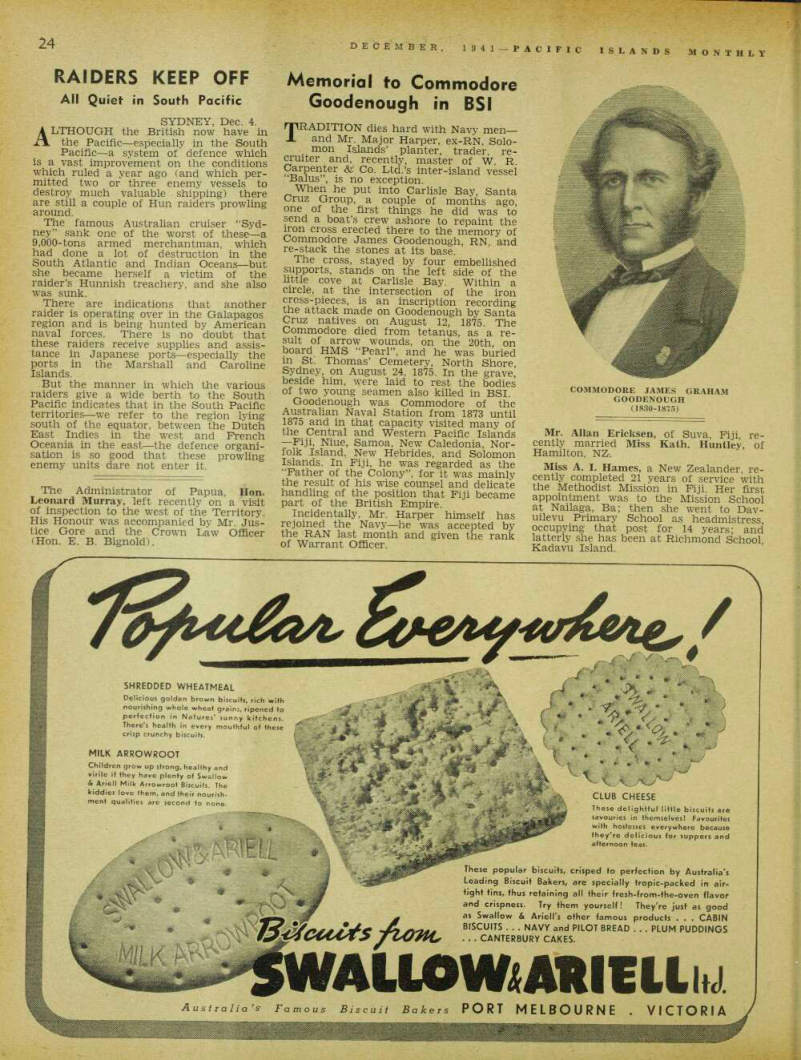
All Quiet in South Pacific
Sydney, Dec. 4.
ALTHOUGH the British now have in the Pacific—especially in the South Pacific—a system of defence which is a vast improvement on the conditions which ruled a year ago (and which per mitted two or three enemy vessels to destroy much valuable shipping) there are still a couple of Hun raiders prowling around.
The famous Australian cruiser “Syd ney” sank one of the worst of these —a 9,000-tons armed merchantman, which had done a lot of destruction in the South Atlantic and Indian Oceans—but she became herself a victim of the raider’s Hunnish treachery, and she also was sunk.
There are indications that another raider is operating over in the Galapagos region and is being hunted by American naval forces. There is no doubt that these raiders receive supplies and assis tance in Japanese ports—especially the ports in the Marshall and Caroline Islands.
But the manner in which the various raiders give a wide berth to the South Pacific indicates that in the South Pacific territories—we refer to the region lying south of the equator, between the Dutch East Indies in the west and French Oceania in the east—the defence organi sation is so good that these prowling enemy units dare not enter it.
The Administrator of Papua, Hon.
Leonard Murray, left recently on a visit of inspection to the west of the Territory.
His Honour was accompanied by Mr. Jus tice Gore and the Crown Law Officer (Hon. E. B. Bignold).
Memorial to Commodore
Goodenough in BSI
TRADITION dies hard with Navy men— and Mr. Major Harper, ex-RN, Solo mon Islands’ planter, trader, re cruiter and, recently, master of W. R.
Carpenter &' Co. Ltd.’s inter-island vessel Bams”, is no exception.
When he put into Carlisle Bay, Santa Cruz Group, a couple of months ago, one of the first things he did was to send a boat’s crew ashore to repaint the iron cross erected there to the memory of Commodore James Goodenough, RN, and re-stack the stones at its base.
The cross, stayed by four embellished supports, stands on the left side of the little cove at Carlisle Bay. Within a circle, at the intersection of the iron cross-pieces, is an inscription recording the attack made on Goodenough by Santa Cruz natives on August 12, 1875. The Commodore died from tetanus, as a re sult of arrow wounds, on the 20th, on board HMS “Pearl”, and he was buried m St. Thomas’ Cemetery, North Shore Sydney, on August 24, 1875. In the grave, beside him, were laid to rest the bodies of two young seamen also killed in BSI.
Goodenough was Commodore of the Australian Naval Station from 1873 until 1875 and in that capacity visited many of the Central and Western Pacific Islands —Fiji, Niue, Samoa, New Caledonia, Nor folk Island, New Hebrides, and Solomon Islands. In Fiji, he was regarded as the “Father of the Colony”, for it was mainly the result of his wise counsel and delicate handling of the position that Fiji became part of the British Empire.
Incidentally. Mr. Harper himself has rejoined the Navy—he was accepted by the RAN last month and given the rank of Warrant Officer.
Mr. Allan Ericksen, of Suva, Fiji, re cently married Miss Kath. Huntley, of Hamilton, NZ-, Miss A. I. Hames. a New Zealander re
at^SlSl S &° 01
Commodore James Graham
Goodenough
(1830-1875)
Advertisements & other items, p. 26 (1 item)
Wauowtameuia
SHREDDED WHEATMEAL
Delicious golden brown biscuits, rich with nourishing whole wheat grains, ripened to perfection in Natures’ sunny kitchens.
There's health in every mouthful of these crisp crunchy biscuits.
MILK ARROWROOT
Children grow up strong, healthy and virile if they have plenty of Swallow <St Ariel I Milk Arrowroot Biscuits. The kiddies love them, and their nourishment qualities are second to none.
LK & * a m I IM * <*• R m a These * ".V . ■ A m % ■ % . i H( a ,^ ■
CLUB CHEESE
These delightful little biscuits are savouries in themselves! Favourites with hostesses everywhere because they're delicious for suppers and afternoon teas. popular biscuits, crisped to perfection by Australia's Leading Biscuit Bakers, are specially tropic-packed in airtight tins, thus retaining all their fresh-from-the-oven flavor and crispness. Try them yourself! They're just as good as Swallow & Ariell's other famous products . . . CABIN BISCUITS . . . NAVY and PILOT BREAD . . . PLUM PUDDINGS
. . . CANTERBURY CAKES.
ifr
exacts fame,
WAUOWtAMEUia
Australia’s Famous Biscuit Bakers PORT MELBOURNE . VICTORIA
Too Much Geelong
Difficulties of Nauru Technical Education Plan
IN Nauru, they do not think much of the “Geelong plan”—under which a select dozen oi Nauru’s youth have been given technical education under the direction of Mr. H. E. Hurst, of Geelong, Victoria.
The idea of providing technical educa tion for the young islanders is not criticised. It has cost the Nauruan Ad ministration (which pays all charges) a very substantial sum; but the principle of teaching Nauruans to do Nauru’s technical work is quite sound. In 1936- 1940, Nauru warmly praised Mr. Hurst’s plan.
But now, in Nauru, they unanimously condemn Mr. Hurst for insisting that the boys shall remain so long in Australia— some are back, but some have been there, now, for over four years. It is inevitable that, apart altogether from education, so long a sojourn there will unsettle the youths, and give them “swelled heads’’.
That is the general comment there, and I should say that it is well justified.
The maintenance of the boys for over four years, in a place like Geelong (or any other large city), has reduced a good plan to an absurdity. There are only 1,700 Nauruans altogether, and Nauru is an isolated little place. The kind of training that four years in Geelong represent is not needed in Nauru. The ideal plan would have been a very brief spell in a European city, and a technical training provided in Nauru itself.
Some of Mr. Hurst’s boys are back.
They are pleasant, courteous lads, who speak good English; but they are like fish out of water. They are expected to take their places as members of the Nauru community; but it is obvious that they find their social contacts embarrassing and inadequate. They have been over educated and over-Europeanised—a thing to be guarded against, always, in relation to small Polynesian communities.
Standing beside the main road, in Nauru, with an old resident, I saw an incident that was illuminating. The Ad ministrator was driving along, in his old tourer. He met two Nauruans, on bicycles.
They immediately dismounted, and re spectfully saluted the Administrator.
A moment later, a great, flashing sedan appeared, full of Nauruans. It rushed past the Administrator in a cloud of dust, without courtesy of any kind, and forcing the official car onto the roadside grass.
“There you see the old and the new” remarked my friend. “The flash lad driving that car was a ‘Geelong boy’.”
R.W.R.
Old File Of "Pim"
IF anyone requires an almost complete set of “Pacific Islands Monthly” files, extending back to the estab lishment of the journal in 1930, he is invited to communicate directly with Captain I. R. Handley, Tarawa, Gilbert Islands, via Ocean Island, Central Pacific.
Among a contingent of Free French volunteers which left Noumea, New Caledonia, for overseas recently was Corporal Jean Mouledous. Corporal Mouledous went across to Noumea from Sydney some time ago with the inten tion of joining the second Free French military contingent; but when the Gov ernment decided to raise a naval con tingent instead, he joined this force, and was placed in command of the body of volunteers.
Samoa's Quarantine Laws
Amended
THE NZ Government recently gazetted amendments to Samoa’s immigration and quarantine regulations.
Samoan Quarantine Amendment Order, 1941, gives the Chief Medical Officer at Apia wider powers concerning the fumi gation of Islands trading vessels, the emptying of water carafes on vessels, and generally ensuring that malaria-bearing mosquitoes are not carried into the Territory.
Under the Samoan Immigration Amend ment Order, 1941, visitors, who hitherto have been required to lodge a deposit up to £5O, or a return ticket to their port of embarkation, are now required to lodge a deposit of £250. These regulations cover voyagers in small schooners and cruising yachts in the same way as travellers in large ships.
Mr. J. Pedersen, well known in Fiji as manager of Millers Ltd., sawmillers, of Walu Bay, retired recently and re turned to New Zealand. He has made his home on one of his properties in the Dominion.
Mr. K. Gribben, formerly of Samarai, Papua, arrived at Wau, New Guinea, recently, to take up a position with W.
R. Carpenter & Co. Ltd.’s branch.
Advertisements & other items, pp. 27-28 (2 items)
Heinz
There is no substitute for
OLD MONK
VIRGIN PURE
OLIVE OIL
San Francisco
57 AIDS TO BETTER MENUS
TOMATO
KETCHUP
TOMATO H
SAUCE
TOMATO KETCHUP — Made
from Sun-ripened Tomatoes.
Medium Bottles .. 8 ozs.
TOMATO SAUCE A Pure
Appetising Sauce.
Large Bottles .. 13 ozs.
OVEN-BAKED
BEANS
WITH PORK AND
TOMATO SAUCE.
ALSO VEGETARIAN
Individual Tins, 4 ozs.
Small Tins, 8 ozs.
Medium Tins, 16 ozs.
TOMATO JUICE
A delicious health-giving and appetising drink Small Tins, 8 oz.
Med. Tins, 16 oz.
No.sTins,6ooz.
SPAGHETTI
Cooked in Tomato Sauce with Cheese Individual Tins, 4 ozs.
Small Tins, 8 oz Med. Tins, 16 oz.
FAMOUS
HEINZ
PRODUCTS
MADE IN AUSTRALIA
HEINZ
PERFECT
* SOUPS
READY-TO-SERVE
In 8 oz. and 16 oz. Tins
CREAM OF TOMATO
CREAM OF ASPARAGUS
CREAM OF CELERY
CREAM OF CHICKEN
CREAM OF GREEN PEA
CREAM OF MUSHROOM
CREAM OF ONION
CREAM OF SPINACH
CREAM OF TOHEROA
BEAN SOUP with HAM
CHICKEN VEGETABLE
KIDNEY SOUP
MULLIGATAWNY
OXTAIL
VEGETABLE
GENUINE TURTLE SOUP
VEGETABLE
SALAD
Garden-fresh Vegetables with Mayonnaise. Small Tins, Boz.
H. J. HEINZ CO. PTY. LTD.
:egd. Office: BENDIGO ST., RICHMOND E.l, VICTORIA
MACARONI
Cooked in Cream Sauce with Cheese.
Individual Tins, 4 ozs.
Small Tins, 8 ozs.
Medium Tins, 16 ozs.
MAYONNAISE
Delightful on Salad.
Small Bottles, 4 ozs.
Med. Bottles, 7 ozs. 18 oz. Bottles 57 oz. Bottles
BEEFSTEAK
SAUCE
Fruits, Vegetables and Spices, skilfully blended.
Medium Bottles, ozs.
STRAINED FOODS
For Infant Feeding and Special Diets.
Strained Carrots Strained Beets Strained Prunes Strained Green Beans Strained Vegetable Soup Strained Beef and Liver
SWEET GHERKINS
Small Bottles
SWEET MUSTARD
PICKLE
Small Bottles Heinz delicious varieties are available from Storekeepers
throughout Papua,
Netv Guinea and Pacific Islands.
Modern Refrigeration for the South Sea Islands
The ELECTROLUX kerosene OPERATED
REFRIGERATOR
ELECTROLUX offers economical, modern and completely efficient
REFRIGERATION FOR ISLANDS' HOMES.
FREEZES CONTINUOUSLY WHILE SMALL LAMP BURNS.
Freezing controlled by simply regulating height of flame. Uses only i gallon of kerosene per week, MOTOBLESS ... NO PARTS TO GET OUT OF ORDER.
MODEL L 22 MODEL L3BO MODEL LKSSO GapßeUy ® (as Illustrated) Capacity 2.2 cubic feet. Capacity 4 cubic feet. 5.5 cubic feet.
GUARANTEED FOR TWO YEARS.
• Write to your Local Distributor for prices and full details.
Obtainable from: W. R. Carpenter & Company Ltd.—Sydney, and the following New Guinea Branches: Rabaul, Salamaua, Wau, Kavieng, Madang, and Wewak.
W. R. Carpenter & Coy. (Solomon Is.) Pty. Ltd.—Tulagi.
British Solomon Islands.
On Chong & Company Pty. Ltd.—Butaritari, Gilbert and EUioe Islands.
Representation in Papua and New Hebrides.
26
DECEMBER, UU-fACmc ISLANDS MONTHLY
Wau-Salamaua
Road Problem May be Solved by Use of Mules
From Our Own Correspondent WAU, Dec. 1.
IT is probable that, at long last, the Morobe miners will solve their trans port problem. For years, they planned to use motor traffic on a road over the mountains between Salamaua and Wau, thus escaping the heavy air freights.
Now, as a road plan appears imprac ticable, they propose to cut a mule track and use mule transport.
The executive of the New Guinea Min ing Association has been considering some means whereby the present surveyed shortest route, from Salamaua to Wau, may be put to use. All plans for the construction of a motor road over this costly surveyed route (it has cost some thing like £20,000 to survey) having been disregarded by Canberra, the Association decided to act in some other way.
Useful and concrete information having been received, relative to the possibility of cutting a mule track over this route, a special meeting of miners and other interested persons was held in Wau on Sunday, November 23. A comprehensive outline of the mule-track project was put to the meeting by Mr. W. W. Cameron, who is the sponsor of the plan.
It was unanimously decided to approach the undertaking by constitutional methods.
Mr. Cameron was appointed as the As sociation’s delegate, to proceed to Lae, and interview the Administrator on his arrival there.
Mr. Cameron was on the Administrator’s door-step within twenty four hours of the latter’s arrival. He was immediately granted an interview, at which His Honour expressed himself as entirely sympathetic towards the suggestion.
Territory funds being at a very low ebb, thanks, to Mount Tavurvur. His Honour said that it was impossible for Public Works to undertake the job; but all possible help would be given within the scope of funds available.
The miners are prepared to take the work in hand, at their own expense, be yond the help that can be given by the Administration, and they intend to start without delay. Many offers of labour, tools, and finance were given at Sunday’s meeting, and a go-ahead and efficient sub-committee, composed of Messrs. W.
W. Cameron, C. Gee, J. Wright, T. Prince and R. Day was appointed, with the Association’s president and hon. secretary ex-officio.
Figures presented at the meeting in dicated that freight on necessary com modities, such as food for indentured labour, could be reduced to somewhere in the vicinity of £5 per ton, as against the £lB per ton at present being charged for air freight (with increases looming).
An important phase of the problem is the possibility of further reductions in the already depleted air services by fur ther accidents, and the difficulty of pro curing pilots, in the present crisis.
It is stated that, with a keen overseer and 100 natives, the work of cutting the mule track (much of which is already trafficable for mules) can be carried out within two months.
Flying Officer Jack Rua Coath, who was well known at Suva, Fiji, where, from 1934 until 1937, he was a member of the Bank of New Zealand staff, was killed when a training plane crashed in NZ recently. His father. Mr. W. Coath. also was connected with the Bank of NZ and for a time served in Fiji.
Mrs. S. C. Axam
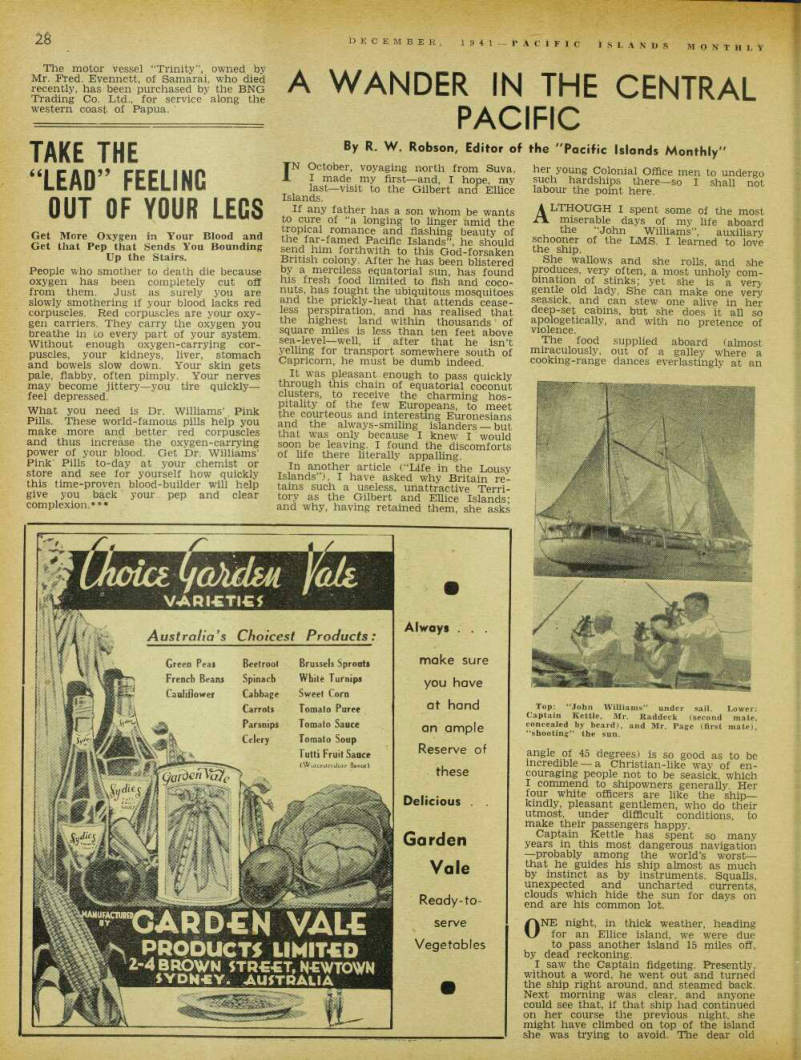
Death of Old New Hebrides Settler
From a Special Correspondent
Vila. Nov. 10.
MRS. Alice Axam, wife of Mr. Sydney C. Axam, who had lived on South Santo for 36 years, died in the French Hospital at Segond Channel on October 25, a few minutes after admis sion.
As Miss Watson, she came to the New Hebrides from Australia with her par ents in 1005 to join her brothers, Wil liam and Robert, who had acquired land on Santo Island a year or two previ ously. In 1914, she and Mr. Axam (who had taken up planting on a neighbour ing block of land in 1904) were married by Rev. F. G. Bowie. MA, of the Presby terian Mission.
Mrs. Axam left two sons, George and Frank (both in the AIF), and a daugh ter, Margaret, who is living with her father on Santo.
The small European community on South Santo is, and has been for many years, particularly happy in that plant ers, traders, Government officials, and missionaries pull together for their mutual good, and for the good of the local natives and the students at the Teachers’ Training Institute on Tangoa.
Not the least contributing factor to this, perhaps unique, state of affairs was the life of the late Mrs. Axam, who will be sadly missed by all who knew her.
Mr. W. Holloway, of Rockhampton, Queensland, has replaced Mr. Charles W.
Dickenson at the Thursday Island branch of the National Bank of Australasia. Mr.
Dickenson is now serving at the Brisbane branch.
The motor vessel “Trinity”, owned by Mr. Fred. Evennett, of Samarai, who died recently, has been purchased by the BNG Trading Co. Ltd., for service along the western coast of Papua.
Advertisements & other items, pp. 29-30 (1 item)
Ictoria
BITTER
Si nm
THE
f m i
TAKE THE
“LEAD” FEELING
OUT OF YOUR LEGS
Get More Oxygen in Your Blood and Get that Pep that Sends You Bounding Up the Stairs.
People who smother to death die because oxygen has been completely cut off from them. Just as surely you are slowly smothering if your blood lacks red corpuscles. Red corpuscles are your oxygen carriers. They carry the oxygen you breathe in to every part of your system.
Without enough oxygen-carrying corpuscles, your kidneys, liver, stomach and bowels slow down. Your skin gets pale, flabby, often pimply. Your nerves may become jittery—you tire quickly— feel depressed.
What you need is Dr. Williams’ Pink Pills. These world-famous pills help you make more and better red corpuscles and thus increase the oxygen-carrying power of your blood. Get Dr. Williams’
Pink Pills to-day at your chemist or store and see for yourself how quickly this time-proven blood-builder will help give you back your pep and clear complexion.***
Always . . make sure you have at hand an ample Reserve of these Australia’s Choicest Products: m Green Peas Beetroot Brussels Sprouts French Beans Spinach While Turnips Cauliflower Cabbage Sweet Corn Carrots Tomato Puree Parsnips Tomato Sauce A Celery Tomato Soup IritA Tutti ru '* aoce iff*? I"** 1 "** -A(Worcestershire flavor) m m i !
yafteh\a7 t
Delicious US
Garden
T^l Vale U Ready-toserve Vegetables
A Wander In The Central
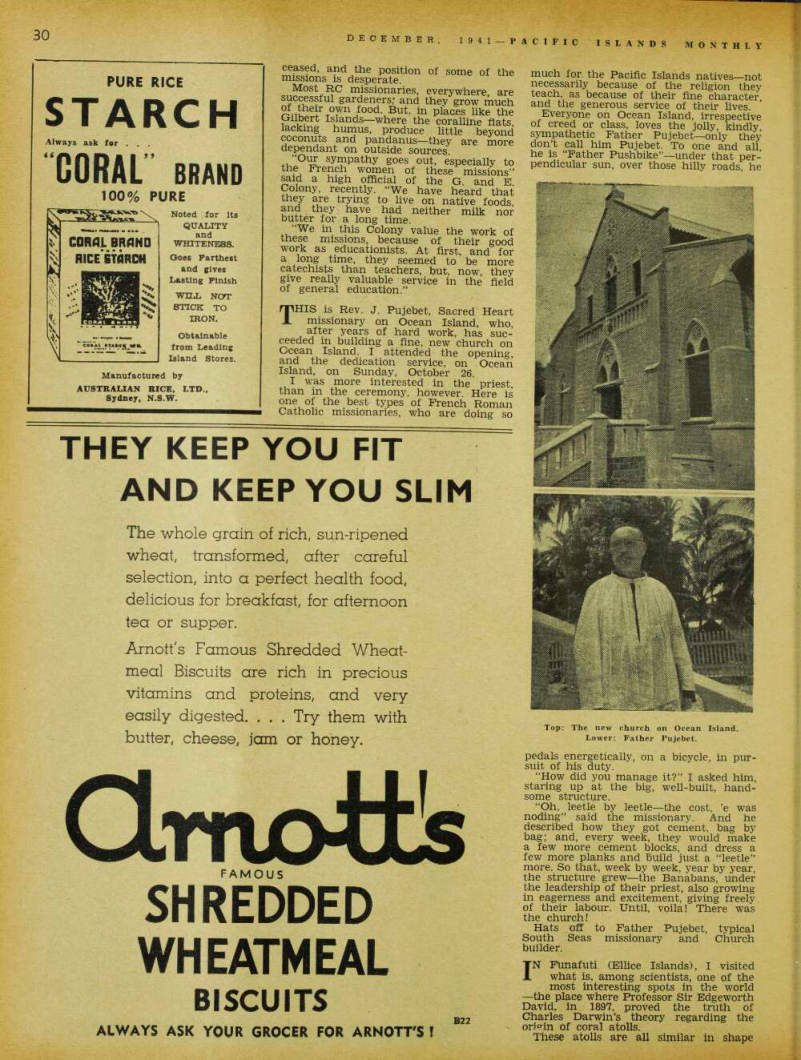
Pacific
By R. W. Robson, Editor of the "Pacific Islands Monthly"
IN October, voyaging north from Suva, I made my first —and, I hope, my last—visit to the Gilbert and Ellice Islands.
If any father has a son whom be wants to cure of “a longing to linger amid the tropical romance and flashing beauty of the far-famed Pacific Islands’’, he should send him forthwith to this God-forsaken British colony. After he has been blistered by a merciless equatorial sun, has found his fresh food limited to fish and coco nuts, has fought the übiquitous mosquitoes and the prickly-heat that attends cease less perspiration, and has realised that the highest land within thousands of square miles is less than ten feet above sea-level—well, if after that he isn’t yelling for transport somewhere south of Capricorn, he must be dumb indeed.
It was pleasant enough to pass quickly through this chain of equatorial coconut clusters, to receive the charming hos pitality of the few Europeans, to meet the courteous and interesting Euronesians and the always-smiling islanders but that was only because I knew I would soon be leaving. I found the discomforts of life there literally appalling.
In another article (“Life in the Lousy Islands”), I have asked why Britain re tains such a useless, unattractive Terri tory as the Gilbert and Ellice Islands; and why, having retained them, she asks
her young Colonial Office men to undergo such hardships there—so I shall not labour the point here.
ALTHOUGH I spent some of the most miserable days of my life aboard the “John Williams’’, auxiliary schooner of the LMS. I learned to love the ship.
She wallows and she rolls, and she produces, very often, a most unholy com bination of stinks; yet she is a very gentle old lady. She can make one very seasick, and can stew one alive in her deep-set cabins, but she does it all so apologetically, and with no pretence of violence.
The food supplied aboard (almost miraculously, out of a galley where a cooking-range dances everlastingly at an
angle of 45 degrees) is so good as to be incredible a Christian-like way of en couraging people not to be seasick, which I commend to shipowners generally Her four white officers are like the ship kindly, pleasant gentlemen, who do their utmost, under difficult conditions, to make their passengers happy.
Captain Kettle has spent so many years in this most dangerous navigation —probably among the world’s worst— that he guides his ship almost as much by instinct as by instruments. Squalls, unexpected and uncharted currents, clouds which hide the sun for days on end are his common lot.
ONE night, in thick weather, heading for an Ellice island, we were due to pass another island 15 miles off, by dead reckoning.
I saw the Captain fidgeting. Presently, without a word, he went out and turned the ship right around, and steamed back.
Next morning was clear, and anyone could see that, if that ship had continued on her course the previous night, she might have climbed on top of the island she was trying to avoid. The dear old
Top; “John Williams” under sail. Lower; Captain Kettle, Mr. Raddeck (second mate, concealed by beard), and Mr, Page (first mate), “shooting” the sun.
thing, bucking a head sea and a mys terious set. had been doing about li knots forward —and 1 knot sideways!
NOT long ago, when there was profit in buying native sun-dried copra in the outer islands, this was the sub stantial house of the Burns, Philp man ager in Funafuti, Ellice Group. To-day, it is empty, open, derelict —the home ot friendly birds and scampering rats.
There is no store on Funafuti now—all the European traders have gone, and the natives obtain their supplies through a native co-operative society. The natives
will gladly make copra, in order to buy cereals, canned meat, kerosene, etc., but the co-ops.—which have taken the place of the defeated traders on most of these islands —have great difficulty in selling the commodity, even at 20/- or 30/- per ton.
Copra will be good again, when the war-clouds pass; but, when I see these derelict stores and houses—BP represented on every Gilbert arid Ellice island in 1939, now maintain an establishment only at Tarawa—l wonder what the future trading organisation will be. Will these native co-operative societies take the place of the small branch stores and the individual Islands trader?
COLLINS started it.. Gazing dreamily aloft, at the “John Williams” mainmast, he asked: “What’s that on the LMS flag? Doves?’' “Look more like eagles,” said Mr.
Garvey, squinting up, sleepily.
“Immaterial, so long as they’re birds of pray” said I, thus pulling off my best quip of the voyage.
Actually, I believe, the three birds on the flag of the great mission organisation represent Faith, Hope, and Charity, winging out over the Pacific. rE establishment of the gold-mining industry in Fiji is the happiest thing in the economic history of that for tunate Colony—it came just in time to take the place of the copra industry, partly and temporarily collapsed as a result of the war.
There are indications, furthermore, that the industry will not be confined to the two known fields. Prospectors are still out, searching optimistically; and, when I was in Suva in September, I heard that Pat. Costello (who, with William Borthwick, located Tavua), was “on” to something good in the hills behind Lautoka.
That same week, a well-known Suva man showed me a sample of mercury, in a bottle, which had been taken from a lode in Viti Levu and concerning which some hopes are entertained.
HARDSHIP, amounting in places to real suffering, has been placed by war conditions upon the French Roman Catholic Missions, serving in the South Pacific. These nuns, priests and brothers are the teachers of the natives in some of the poorest of the islands; and, hitherto, they have depended partly for their sustenance on remittances from France.
Since June, 1940, those remittances have
ceased, and the position of some of the missions is desperate.
Most RC missionaries, everywhere, are successful gardeners; and they grow much T °^ n , fooc *- Bu t> * n places like the Gilbert Islands—where the coralline flats lacking humus, produce little beyond coconuts and pandanus—they are more dependant on outside sources. Our sympathy goes out, especially to the French women of these missions” said a high official of the G. and E Colony, recently. “We have heard that they are trying to live on native foods, have had neither milk nor butter for a long time.
“We in this Colony value the work of these missions, because of their good work as educationists. At first, and for a long time, they seemed to be more catechists than teachers, but, now, they give really valuable service in the field of general education.”
THIS is Rev. J. Pujebet. Sacred Heart missionary on Ocean Island, who. after years of hard work, has suc ceeded in building a fine, new church on Ocean Island. I attended the opening, and the dedication service, on Ocean Island, on Sunday, October 26 I was more interested in the priest, than in the ceremony, however. Here is one of the best types of French Roman Catholic missionaries, who are doing so
much for the Pacific Islands natives—not necessarily because of the religion they teach, as because of their fine character and the generous service of their lives.
Everyone on Ocean Island, irrespective of creed or class, loves the jolly, kindly, sympathetic Father Pujebet—only they don’t call him Pujebet. To one and all he is “Father Pushbike”—under that per pendicular sun, over those hilly roads he
pedals energetically, on a bicycle, in pur suit of his duty.
“How did you manage it?” I asked him, staring up at the big, well-built, hand some structure.
“Oh, leetle by leetle—the cost, ’e was noding” said the missionary. And he described how they got cement, bag by bag; and, every week, they would make a few more cement blocks, and dress a few more planks and build just a “leetle” more. So that, week by week, year by year, the structure grew—the Banabans, under the leadership of their priest, also growing in eagerness and excitement, giving freely of their labour. Until, voila! There was the church!
Hats off to Father Pujebet, typical South Seas missionary and Church builder, IN Funafuti (Ellice Islands), I visited what is, among scientists, one of the most interesting spots in the world —the place where Professor Sir Edgeworth David, in 1897, proved the truth of Charles Darwin’s theory regarding the ori pin of coral atolls.
These atolls are all similar in shape
Top: The new church on Ocean Island.
Lower: Father Pujebet.
and character—a ring of coral, sur rounding a comparatively shallow lagoon, dropping sheer to great depths on the seaward side, and a series of narrow islets being perched on the circular reef.
Having learned that the coral insect cannot live below a certain depth—com paratively shallow Darwin formulated the theory that th? atolls were formed by slow submergence. The insects, aeons ago, began to build in shallow water; the ground slowly sank, and the insects kept on building up so as to remain within the depth of water in which they can live. So this deep Pacific became dotted over with what are virtually coral stalks.
That was the theory. David proved it by taking a drilling plant to Funafuti, a typical atoll. There, he put a bore down 1,100 feet—and the drill was still in coral.
Obviously, the coral must have sunk—the insects could not have worked at that depth. . , There is nothing now to mark the site of the bore except some coal-dust, and a bit of rusty iron, showing just above the earth’s surface. Some institution should put* a stone tablet on the spot in another 50 years it will be lost and forgotten.
CLANG— bang—clatter—b-r-r-r-!
A little old, red Austin car began to chug its way across the island of Tarawa— and pandemonium broke loose.
Dogs howled, and bolted for the pandanus thickets. Children screamed in terror, and sought sanctuary at mother’s skirts—in
vain, for mother mostly was legging it for her sheltered hut, where, she hoped, the noisy red devil would not penetrate.
Thus, a few months ago, civilisation’s modern transport first reached the capital of the Gilbert Islands. The Colony’s director of health, Dr. Kingsley Steenson, had become tired of pushing a bicycle around the flat little island; so, when he returned from furlough, he brought with him £lO worth of second-hand Austin.
At first, it was regarded with horror by the natives; but, now, it causes no ex citement as it puffs around the palm shaded roads.
But, down in his little office, the local tax-gatherer, Mr. F. T. English, broods bitterly. He knows that, in more sophis ticated countries, treasurers wax rotund and rich from import duties, registration fees, driver’s licenses, petrol taxes, and God-knows-what, extracted gleefully from motor-owners.
In Tarawa, the motor-owner careers blithely across the landscape—he pays not a tax nor a fee. He is not even obliged to put a plate with “Tarawa 1” on the back of his car. There are no speed limits.
He can drive right across the island on the right-hand side of the road. The native policeman makes deep obeisance as he passes.
Dr. Steenson says the car is a godsend; but Mr. English thinks that something should be done about it.
FROM the spathe of a growing coconut, right up in the head of the palm,
the natives obtain a juice which, permitted to ferment (which it does, easily and readily), becomes the famous coconut toddy.
In the atoll islands, it is greatly esteemed, for its nutrition value. But, like beer, if it is taken in excess, it will make one intoxicated though its alcoholic content is less than that of beer.
Because of this, some missions— especially the LMS—have set their faces
against toddy-drinking. In the Gilbert and Ellice Colony, an ignorant and well meaning Government actually made toddy unlawful.
This caused much trouble. The other wise tractable natives, guided by their instinct rather than by white man’s law, would not give up toddy-drinking, Then it was discovered that this coconut beverage contains much of the important vitamin Bl—of which there is
Dr. Steenson in his notorious Austin.
otherwise a deficiency in the equatorial atolls. So the G. and E. Government very wisely restored toddy-making and ™S; dr i nkmg V> th ® list ° f law£ul things. A man of good repute now may make but may not sell toddy; and, if ?nH^ US6 I hIS pnv i lege ’ hl ® as a l°^.^‘ ma^e r may be cancelled.
The LMS fought hard against the new Beru, and I missed the chance of seeing the famous Beru establishment and of meeting Mr. G. H. Eastman and Mr, ®aaa.
Toddy-making is permitted by the Australian Administrator in Nauru for health reasons But here also, drunkenness is sternly discouraged.
ONE of the greatest luxuries and most 5 re£ s, teS r * uxm * es a j ld md ft healthful, foods I have found on the little ships among the equatorial islands is canned pineapple juice, served
out of the freezer It is nut im in tim containing about 1' pints by the Colonial Pineapple Packing Co of Ovalau Fiii and I "understood teat it can on our breakfast tables for 4/- opt dozen (4d. per can) Such enterprise with such a delicious beverage, at such ’a low cost is worth encouraging even if it means making canned juice \ com- PUISOTy rati ° n ° n aU ships.
T7WERYONE in the Ellice and Gilbert £j islands speaks with affection of the Rev . A. L sldd) 1 who Is associated with Rev. G. H. Eastman in directing the LMS operations there 1 g Mr. Sadd is an energetic, quick-thinking impulsive man of whom some delightful stories are told. s a There was the occasion when Mr. Sadd took a boat, a crew, and some explosive out to the reef to blast and enlarge the boat-passage—a difficult and dangerous task. 5
They were there for some time, making careful preparations. Then Mr. Sadd lit the fuse.
"Row, boys, row!” he shouted, and the boys rowed like furies.
But the boat didn’t move. They had forgotten to pull up the anchor!
With one accord, the boys and their absent-minded master dived overboard, and swam madly away. A few seconds later, the boat “went up”—but no one was hurt.
The story is almost too good to be true.
But they told it to me on the “John Williams”, where they think the world of Mr. Sadd.
HERE, probably, is the finest Residency in the South Seas—it cost about £17,000, and it houses the Resident Commissioner at Ocean Island. It was completed in 1938.
The design, for such a purpose and in such a climate—it is right on the equator —is practically perfect. Generous reception rooms on the ground floor; offices behind; a bonny sweep of staircase leading to the bedrooms above, each with its own
balcony, and plenty of bathrooms, shower rooms, etc. Every room catches a breeze, from whatever direction. There is thought and finish in every corner—seen in little things like fans, bedside lights, tea al coves. The structure—simple, impressive, dignified, buried in tropical foliage stands high on Ocean Island’s hill, looking out to the northeast.
It is the design of Mr. Hedges, a New Zealand architect, who was also singu larly successful in designing that fine, imposing white block which now houses the Fiji Government Offices in Suva.
IT is interesting to recall other South Pacific Residencies.
Government House at Namanula, Rabaul, is spacious, impressive in design, and beautifully situated; it is sad to think that it must remain there, on the lip of the muttering volcano, while the Adminis trator goes with the Administration to the new capital.
Government House at Port Moresby has a charming situation, on a hill, some two miles out; but it is an old, rambling struc ture, typical of the pioneer style of 50 years ago.
The Residency at Tulagi is small, but pleasantly situated on a hill. That at Vila is bigger and better—also pleasantly situated, on a little island in the harbour.
Government House, Suva, is spacious, impressive, rambling, old-fashioned, and gloriously situated among tropical gardens, on a hill overlooking the sea.
The Residency at Apia, Samoa, is notable at once for its situation and its history. Apia is hot and humid; but “Vailima”, four miles out, and 500 feet up in the foothills of the central ranges, enjoys always a cool breeze. “Vailima” was built in 1890, as his Samoan home, by Robert Louis Stevenson, and later was added to. It is rambling and old-fashioned, but very picturesque.
THIS American practice of cutting short the long names of well-known in stitutions grows upon journalists, who
are fighting, under wartime conditions, for every inch of space.
But I shall have to watch my step.
I have found a horrid example in the Central Pacific.
When the High Commission for the Western Pacific launched the plan of re populating the Phoenix Group, the plan was officially and quite naturally desig nated the Phoenix Islands Settlement Scheme.
No one saw the trap until a hurried official in Suva, sending a letter to the Officer Commanding, Phoenix Islands Settlement Scheme, used initials only.
The result seemed greatly to cheer the young men who have been bucketing about for two years between the Gilberts and the Phoenix, trying to make the settlement plan go. 1 DON’T know whether this should be called “Tarawa’s Wailing Wall” or “Bevington’s Labour of Sisyphus”— it has the characteristics of both.
Big ships come into Tarawa Lagoon, but
they must lie far out from the islet where commerce is cen tred. So past generations of Administrative officers built a long boat-jetty, out over shal lows that are bare at low tide, to allow the easier working of ships. The outer part of this jetty was cemented together; the two-thirds nearest shore comprised simply blocks of coral, roughly fitted together.
EVERY year, £3O was allot ted for this jetty’s main
tenance, and should have been spent on cement; but, every year, officials with an economy complex returned the £3O to the Treasury, with whoops of triumph. Every year, the westerly gales smashed the non-cemented jetty to pieces; every year, sweating thieves and adulterers from the local gaol built it up again.
The present AO, conscientious young Bevington, found it fiat; and, week by week, with infinite toil, his police and prisoners built it up once more.
The day I landed, it was stone-perfect.
Next morning, it was being lashed by a westerly, and I stood there and watched it literally disintegrate, like sugar, and took this photograph. When I left, only the cemented end was standing. £5O worth of cement would have saved endless work, worry and inconvenience.
ON two occasions in his short official career, Mr. E. R. Bevington, now Administrative Officer at Tarawa
(Gilbert Islands) has been aided in a remarkable way, by the great current which, during part of the year, sweeps south-eastward from New Guinea and the regions northward thereof.
Late in 1940, Mr. Bevington was landed on the large island of Tabiteuea (Central Gilberts) to deal with native affairs. The Government vessel was to come back for him within a few days.
But a series of terrific westerly gales set in, and several weeks passed before a ship could get near Tabiteuea. Mr.
Bevington’s supplies soon ran out, except tea and canned milk, and he did the best he could with native foods.
He had used his last sugar and milk, in mid-December, 1940, when a couple of ship’s lifeboats, and a great quantity of miscellaneous wreckage, came ashore on Tabiteuea. In one boat there was a large quantity of canned milk, and other sup plies, which kept the marooned official going until he was rescued.
The wreckage came from the five ships
which the German ' raiders sank off Nauru. It arrived on Tabiteuea five days after the shelling—which means that it had drifted, before the north-westerly gale, about 100 miles per day.
ON the other occasion, Mr. Bevington was AO at Beru (Southern Gilberts).
He finally had persuaded the natives to build a substantial bridge between two of the islets of the atoll, but they could not complete it owing to lack of timber.
And then, driven before a westerly gale, no less than 100 large, well-cut logs came providentially ashore on Bern’s western coast. Mr. Bevington thinks they came from New Guinea, and his description suggests they were “New Guinea walnut” —a big boom of lumber must have broken adrift in New Britain.
Mr Bevington did not question this act of God. He secured the co-operation of the LMS Mission; and the Mission’s sawmill turned the great logs into planks;
and the bridge was completed, in sub stantial fashion.
We wonder who, in New Guinea or thereabouts, lost that timber.
IN Suva, in the highest circles of the Western Pacific High Commission, they read with interest the report that triplets had been born on Pitcairn Island, to a direct descendant of a ‘‘Bounty” mutineer. Pitcairn is in the W.P. territory.
Mr. Vaskess wondered if the parents could apply for the King’s Bounty, given to British-born triplets everywhere H. E. was sympathetic.
R. H. Garvey grinned. ‘“Bounty”’ said he. “‘Bounty’! Isn’t that getting a bit close to the bone?”
They laughed, and suppressed him; and I think that, if the death of one of the triplets is not considered a disqualification, the bounty may be sought.
IT was in Suva, late, and bright moon light.
A young naval engineer of my acquaintance, at the end of a festive evening, was walking, unsteadily, near Albert Park.
Suddenly, he stopped dead, and stared, in horror, at an object in the roadway.
It appeared to be a large paper bag; and, although there was not a breath of wind, it was rolling and hopping along.
The engineer hurried away. Then he stopped again, and looked shyiy back. The paper bag still was hopping—and he could hear it crackling and rattling, as it encountered grass.
My young friend sat upon a bench, and held his head, and moaned slightly, and swore off liquor for life. He kept his pledge, too —until he heard about the giant toad.
The giant toad was brought from Hawaii to Viti Levu to clean up slugs and insects which were proving very destruc tive in the sugar plantations; and it has done its job so well that it has wiped
out most of Fiji’s garden pests—and has, itself, taken their place.
There now must be millions of toads there. They hop happily about the gar dens. Ditches and water-courses are alive with them. Even money there is a toad m every hole on the golf course.
TTiey are harmless, friendly fellows, and Fiji does not object to them. Young Fiji practises two stock jokes upon them They are tied into paper bags, and left to hop blindly about the landscape, to the consternation of harmless alcoholics or a lighted cigarette is placed in their mouths. The toad’s hooked teeth hold the cigarette in place, and he puffs out smoke in realistic fashion. The sight of a toad calmly smoking a cigarette, is only slightly less startling than that of the peripatetic bag.
In an endeavour to reduce insect pests —especially mosquitoes—in the northern islands, the toads have been taken from Fiji to Funafuti (Ellice) and Tarawa and Abemama (Gilberts); but there they do not seem to be flourishing. The atoll is lands probably are too dry. 1 ADMIRED the trim lines of “RCS Nimanoa”; and then asked, “What does the RCS stand for—Resident Commissioner’s ship?’’ “No” I was told "Royal Colonial Ship”. But many of the natives hereabouts still believe it means “Roman Catholic Ship”.
Actually, the Roman Catholic ship in the Gilberts is the “Theresa”, a very shapely little schooner, with a strong auxiliary, built in Tarawa by Mr. William Reiher, a clever man of German-Marshall parentage. There are three brothers, Reiher, in the Gilberts—William, Fritz, and Henry—all exceedingly able crafts men. They were driven out of the Mar shalls, in fairly recent years, by the Japanese.
FOR long years, Mr. G. M. Murdoch, an educated and cultivated Englishman, was an administrative officer in the service of the Gilbert and Ellice Islands Colony. He was stationed mostly at Tarawa. He married a Gilbertese girl, and had several children.
Through his wife, he acquired sub stantial land interests in Kuria; and, when he retired from the service, he settled on Kuria, as a trader and planter.
He lived strictlv according to European standards, and insisted that his children be properly educated.
Of one daughter, Agnes, he was es pecially fond she was good-looking, vivacious and intelligent. So he sent her to San Francisco, to be educated.
When she returned, she was a slim and attractive young girl, with plenty of poise, and a full-bodied American accent.
She should have married a European, but young European men were not plentiful in the equatorial islands in those Great War days. She married, instead, a son of the king of Abemama.
Readers of Islands romances will find plenty about Abemama and its “royal family” in Stevenson’s book. The Abem ama kings were ferocious warriors, and. when Britain took over the group, they held all Abemama, and the neighbouring
islands of Kuria and Aranuka, in subjection.
Agnes Murdoch now is an elderly woman. Briefly, while a boat waited to take me back to the ship through a menacing surf, I interviewed her at her home in Abemama, not one hundred yards from the spot where Stevenson lived, during his sojourn there. She still is slim, and straight and distinctive, with a charming voice and an American ac cent; and, in spite of her isolation, she can talk interestingly of people and affairs.
She has two handsome sons —and, in this picture, she is seen between the two of them. When the old king died, Agnes Murdoch’s brother-in-law became king; and now he is dead, and Agnes Murdoch’s elder son (seen in the photograph) has taken his place, as paramount chief.
These boys have been educated. The elder has married the daughter of Captain “Jimmie” Smith, a well-known Abemama resident, who married a Gilbertese woman.
BUT all is not well with Abemama’s royal family. In the over-populated Gilbert Islands, land is man’s most precious possession, and the allocation of land titles is a most complex and delicate business. The British Administration generally allots titles on the status quo, fixed when it took control. On that basis, most of the land in Abemama, Kuria and Aranuka belongs primarily to the Abem ama royal family.
But the land-hungry peoples of Kuria and Aranuka see no reason why they should continue to pay tribute in the shape of rent to the kingly house in Abemama; and, when I was along there in October, they were holding many meet ings, and talking revolt, and generally seething. Agnes Murdoch, on behalf of her son, expressed great anxiety in rela tion to the position.
It looked to me like a No. 1 headache for the Administration. The fact is that the G. and E. Colony Lands Commission, to which has been given the responsibility of hearing thousands of land claims, and clarifying countless titles, has done little for some years, and the work is far behind schedule, and is becoming every year more involved.
Practice and principle in Polynesia (Nauru is a good example) both indicate that the simplest and quickest way of cleaning up an accumulation of land claims is to put the whole job into the
hands of the local councils of native chiefs. They cut out much of our weari some procedure, but they go straight to the point, and decide it in accordance with local knowledge and tradition. There is no corruption or back-door greasing of hands, and sound justice is done.
WHEN I left Funafuti (Ellice Islands) I carried with me a piece of white, clean, aromatic soap, made out of local coconut oil, with a couple of chemi cals added, by the Administrative Officer there, Mr. D. C. I. Wernham.
Captain Kettle, of the “John Williams”, noticed it. “I have wondered, often, why people in the Islands don’t make their own soap” he said. “We carry tons and tons of city-manufactured soap into the Islands, and yet the people could make all they want, if ‘they were inclined, at a low cost.”
IF you drive around the pleasant island of Nauru (11 miles) you will see many pigs feeding languidly in the coconut groves. Most are black, rangy brutes —real “Captain Cookers”—but a proportion are square and rotund in shape, and red in colour.
I expressed interest, and the Adminis trator (Lieut.-Colonel Chalmers) explained the position.
“When I came here, three years ago, I did not know much about tropical con
ditions, but I do know farming” he said.
“Those native pigs were an offence to the eye, and to every stocklover.
“So I sent down to the Hawkesbury Agricultural College, and got a number of pedigree boars, Tamworth Reds. I gave instructions that every native boar on the island should be castrated. The change, in a couple of years, has been remarkable and the natives are de lighted. They now are getting pigs that are much increased in weight.”
In Nauru, pigs indeed are wealth. There are hundreds of Chinese employed in the phosphate works, and the Chinese
pay liberally for fresh food. The Nauruans S«^£? od mone y hy producing food for the Chinese—pigs, fowls, bananas, pine apples, taro, etc. The Chinese will pay An C H°r a f f l plg nearly twice its Australian value.
AS we steamed through the lovely strait between Taveuni and Vanua Levu a ? d u 1 Jt dr ™ red the 30-miles-long row of beautiful (and what were once highly profitable) coconut plantations, David Collins told me a story about i aveuni.
It appears that this big, mountainous
island is placed exactly astride the 180th degiee of longitude. In the bad old days, before they provided for Fiji’s convenience by giving the date-line a twist to the ea stward, and when the old day ended and the new day began on the 180th certain planters of Taveuni, with hooked noses and no industrial morals, worked a labour racket.
Clearly, when it was Saturday on the eastern end of Taveuni, it was Sunday on the western end—the day’s nomenclature changed at the island’s midway point So the gentle racketeers eliminated Sun day from their labour gang’s week. , Ti \ e J would, for example, work the oewildered labourers at the western end of the island until Saturday evening* then they would move them to the eastern end, where it still was Friday evening; on Saturday evening (eastern end) they would move them back to the western end, where it was now officially Sunday evening; and there they were, all ready for a start on Monday morning—in accordance with white man’s magic You can believe it or not—but Collins said it was true.
BERU is the G. and E. headquarters of the LMS—a beautiful and attractive place, ashore, but heartily cursed by all sailors. There is no sheltered anchor age- Jf the weather is fine, they anchor off the boat passage; and their passengers arid cargo are ferried, for miles, through the lagoon. If the weather is rough ships do the best they can in the lee of the island.
When we arrived, a howling westerly made the anchorage untenable; and, in Bern’s lee, in bounding seas and heavy rain, we transferred to another ship, and crawled away northwards, in the teeth of the storm. I was disappointed in not seeing Mr. Eastman and Mr. Sadd, of whose work at Beru I had heard so muci.
When I am king, I shall decree a much more suitable place than Beru as LMS headquarters. In this Group, the LMS is wholly dependant upon sea transport; yet Beru, in the language of one disgusted mate, “isn’t a port’s bootlace”.
The gentle old “John Williams” has to supply all the Ellice and some of the Gilberts with stores, etc., using Beru as a centre, and returning to Beru again and again. Surely a dog’s life, in westerly weather, for ship and men.
Advertisements & other items, pp. 31-40 (2 items)
Nestle Ss&Milr
sweete H ® spared SPEClA^fj#^
•?*Sr.?* Ep ARED IN ■
m' 1 .;
hot
fa 1 & s s I* n \3 s Prepared Sr»-
WCETA*® 0
HKut AND Mi!
NG>®
S \NT
IM3ST
U> Nestle’s Sweetened Condensed Milk perfectly solves the problem of providing a safe milk supply for tropical climates. Nestle’s Sweetened Condensed Milk is milk supplied from healthy cows grazing on rich pastures r.nd from the moment it is received at the condensery until it is finally sealed into its dust-proof, germ-proof containers the most effective precautions are taken to ensure its purity. Whenever you use Milk use Neslle’s Sweetened Condensed Milk—it is absolutely pure and safe.
COPYRIGHT 8227
NESTLE Ss&MILR
PURE RICE
STARCH
Always ask for it
CORAL BRAND
100% PURE
CORAL BRAND
RICE STARCH
N; *s
CORAL IMICJ I
Noted for Its
QUALITY
and
WHITENESS.
Goes Farthest and gives Lasting Finish
WILL NOT
STICK TO
IRON.
Obtainable from Leading Island Stores.
Manufactured by
AUSTRALIAN RICK, LTD.,
Sydney, N.S.W.
THEY KEEP YOU FIT
AND KEEP YOU SLIM
The whole grain of rich, sun-ripened wheat, transformed, after careful selection, into a perfect health food, delicious for breakfast, for afternoon tea or supper.
Arnott's Famous Shredded Wheatmeal Biscuits are rich in precious vitamins and proteins, and very easily digested. ... Try them with butter, cheese, jam or honey.
CLmottk
FAMOUS
SHREDDED
WHEATMEAL
BISCUITS
822 ALWAYS ASK YOUR GROCER FOR ARNOTT'S I
PRESCOTT Pty. Ltd.
SUSSEX ST., SYDNEY,
are sole wholesale agents for
PINEAPPLE BACON&HAMS
DAISY brand BUTTER "375" BUTTER in TINS Ilb.-21b.-slb. Sizes.
LEA & PERRINS’ Sauces and Most other Super-Quality Lines of the Trade, such as Cheese, Eggs. Etc.
We are Specialists . . . .
V ’Phones: MA 8612 (4 lines).
Cable Address: “Weymarkson.”
Codes—Bentleys Private.
Let us have your confidence. Sixty years is our record of supplying the leading Houses throughout the World in - - - -
FRESH FRUIT VEGETABLES PRODUCE
WEYMARK & SON LTD.
FRUIT AND PRODUCE MERCHANTS
14-18 STEAMMILL STREET - - - SYDNEY
PACKED AS THEY’RE PICKED
TO PRESERVE FLAVOUR AND NUTRIMENT
Aunt Mary’s
PREPARED
VEGETABLES
only require heating and are then ready to serve, full flavoured, attractive and satisfying.
Green Peas, Celery, Cauliflower and other Aunt Mary's prepared vegetables are specially packed for Tropical conditions in 1 lb. hermetically sealed cans.
SOLD BY ALL PACIFIC ISLAND STORES
Order an assortment. Be sure it is Aunt Mary's brand; packed by Tillock & Co., Pty., Ltd., Sydney.
BURNS PHILP
Registered
(SOUTH SEA) CO. LTD.
Inc. in Fiji SUVA
FI J I
Island Traders and Shipowners \Also Branches at: Fiji: Levuka, Lautoka, Labasa, Ba, Sigatoka, Rotuma.
Tonga: Nukualofa, Haapai, Vavau.
Samoa: Apia, Pago Pago (American Samoa).
Solomons: Makambo, Gizo, Faisi.
New Hebrides: Vila. . Gilberts: Tarawa.
Code Address: “Burnsouth”. Norfolk Is. Niue. Wallis Is. Futuna Is.
cn i v
v®| E R 5
PURE
FOODS
GOLD MEDAL JAMS
CANNED ENGLISH FRUITS
CANNED ENGLISH
VEGETABLES
CUSTARD POWDER
OLD ENGLISH MARMALADE
JELLY CRYSTALS, ETC.
Obtainable from all Leading Grocery Stores.
Write to Department A., E.7®.
Chlvers and Sons, Ltd., Histon, Cambridge, England, for attractive Recipe Book
I li
MU' 1 *:.':,.-
* 'ffo&’toofe.S
lotvudo
luck i Wcuil
%mn fusJr. *ipe
ilpTfUliodS Oh%M
tlmo £i%i &fijlwyi£.d
f*ur*n. fk fta&Ls
is a {jualjfif
attcl is dJ us
outfit k.dt(/i cotA.
A Try a grill this tasty way 2 tablespoons Holbrooks Plum Jam 2 tablespoons Holbrooks Worcestershire Sauce 2 tablespoons Holbrooks Tomato Sauce A little Salt, Pepper and Mustard Mix all ingredients together.
Pour over raw steak and allow to soak for half an hour Grill steak as desired. Heat remaining sauce and serve with grill ■T Si
PRODUCING UNIFORM GOOD RESULTS SINCE 1868
Flour
ALWAYS ASK FOR IT
Allen Taylor & Co. Ltd.
COMMERCIAL ROAD, ROZELLE,
SYDNEY
Sowmillers and Wholesale Suppliers of Hardwoods for Constructional Purposes GIRDERS . . . PILES . . . POLES . . , SLEEPERS, Etc.
EXPORTING TO PACIFIC ISLANDS SINCE 1893
JAMES BUDGE LTD
REFRIGERATION . .
“BUDGE” Automatic or Manually-controlled Refrigeration and Ice-making Plants, with or without insulated Cabinets or Rooms, ranging from 4 cubic feet to 1000 cubic feet or larger, using ammonia in the large and sulphur dioxide (SO2) in the small units. Where electricity is not available, crude oil engines may be utilised for driving the larger plants and petrol engines for driving the smaller machines. The accompanying illustration is of a petrol engine driven SO2 unit. Enquirers please state power (if any), size of cabinet and amount of ice required per day.
ALL CLASSES OF REFRIGERATION EQUIPMENT.
JAMES BUDGE PTY. LIMITED
Refrigeration and General Engineers Office and Works:
McEvoy and Harley Streets ..
ALEXANDRIA, SYDNEY. Established 1890.
Timber, Joinery
ETC.
PREPARED BUILDINGS ready for erection a specialty.
SHIP AND BOAT BUILDING.
TIMBERS specially catered for.
PIBROLITE. PLYWOODS.
GALVANISED IRON.
CONSIGNMENTS shipped
by RETURN STEAMERS
to the Islands.
John W. Eaton
PTY. LTD.
WEST CRESCENT STREET,
NORTH SYDNEY.
Telephones: XB 4051 (6 lines.)
BITUMENOID ROOFING
MADE IN AUSTRALIA.
Bltumenold Roofings, Dampcourse and Insulating Felts are made from the world s best raw materials. Warranted to stand the most rigid tests.
BITUMENOID THE BEST
Roofing, 1,2, 3-ply; Flooring, Waterproof Materials: Saturated Pelt, R . e * ll ® n - Road Jointing; Natural Asphalt Dampcourse; 2 and 3-ply Dampcourse; 1-2 lb. Lead-core Dampcourse; Roofing Cement; Asphalt Paints; Roofing Compound.
SAMPLES AND PRICE LISTS ON APPLICATION.
MAXWELL PORTER & SON LTD.
ESTABLISHED 1888.
107 REDFERN ST., REDFERN, SYDNEY. N.S.W.
BUILDERS’ SUPPLIES.
’Phone: M 3157. Cables Bltumenold.
Build a modern, ipacLouA.
home ai JjBM. cosi
WSPS*.
llisg il Si, :
S«rrMs
A Durabestos Home built from a design in our Free booklet.
Note: In the Islands, Corrugated Durabestos would ensure a weather-tight roof.
WUNDERLICH LIMITED, (Estd. 52 Years), REDFERN, SYDNEY.
WUND€RLIC«
DURABESTOS
ERifvnsn!
ENI BUILDING SHEETS
Woven Wire for all Industry
COPRA DRYING TRAYS, FLOORS Etc
FRUIT DRYING TRAYS, MINING SCREENS.
Heavy Mosquito Gauze in Phosphor Bronze and other Metals Impervious to Salt Sea Air.
W[RE DOOR MATS AND GENERAL WIRE WORKS
E. WRIGHT & CO. LTD.
Office and Works: 148-152 Cleveland Street, Sydney NSW Telegraphic Address: “Wrightmake,” Chippendale.' * *
MADE TO GOVERNMENT SPECIFICATIONS !
Save waste and expense . . . make sure of high quality and absolute purity ... by ordering
DE MERIC’S
Creosote, Coal Tar,
Stockholm Tar, Pitch
and Neatsfoot Oil
DE M ERIC’S Standard Products give maximum service under exacting conditions. They cut overhead costs and reduce the labour of maintenance.
Obtainable at good stores everywhere. Traders are invited to write for full wholesale list.
DE MERIC PTY., LTD.
Commonwealth and State Government Contractors DOODY ST., ALEXANDRIA. N. S.W 'PHONE. MASCOT 571
Vigour Restored,
Glands Made Young
In 24 Hours
It is no longer necessary to suffer from loss of vigour and manhood, weak memory and body, nervousness, impure blood, sickly skin, depression, and poor sleep, because an American Doctor lias discovered a quick, easy way to end these troubles.
This discovery is in pleasant, easy-to-take tablet form, is absolutely harmless, does away with gland operations and is bringing new youth and vigour to thousands. It works directly on the glands and nerves, and puts new, rich blood and energy in your veins. In 24 hours you can see and feel yourself getting younger. Your eyes sparkle, you feel alive and full of youthful vigour and power.
And this amazing, new gland and vigour restorer, called Vi-Stim, is guaranteed. It has been proved by thousands in America and is now distributed by chemists here under a guarantee of satisfaction or money back.
Vi-Stim must make you feel full of vigour and energy and from 10 to 20 years younger, or you merely return the empty package and get your money back. A special, double-strength bottle of 48 Vi-Stim tablets costs little, and the guarantee protects you.
Vi-Stim
GUARANTEED
to Restore Manhood and Vitality . . .
Kidneys May
34
DECEMBER, 194 1- PACIFIC ISLANDS MONTHLY
IF BACK ACHES
KIDNEYS MAY
NEED HELP
Flush Out Your 15 MILES of Kidney
Tubes — Get Quick Relief
Don’t expect rubbing to make your aching back well and strong again—if the trouble is caused by tired kidneys.
All the blood in your body circulates through your kidneys every 15 minutes to be strained of acids and wastes. Healthy persons pass about 3 pints a day and so get rid of 3 pounds of waste matter. When the kidney tubes become tired, bladder passages are often scanty and difficult. Instead of being filtered out, wastes and acids get back-washed into the blood and may become poisonous. This is often the beginning of nagging backaches, leg pains, loss of pep and energy, getting up nights, lumbago, swollen feet and ankles, puffiness under the eyes, rheumatic pains and dizziness.
Don’t wait for serious trouble to lay you up. Ask your chemist or store for DOAN’S BACKACHE KIDNEY PILLS and get the same quick relief they have been giving millions for many years. If backache is bothering you due to tired kidneys, try DOAN’S BACKACHE KIDNEY PILLS to-day.
Another Pioneer Passes
Prom Our Own Correspondent
Samarai, Nov. 18.
MR. William Sheddon, aged 77, died in Samarai European Hospital, Papua, last month. Born in Scotland, Mr. Sheddon came to Papua in the late ’9o’s and took part in the gold-rush at Woodlark Island. He was also mining on the Mambare and Gira fields in the early days. Later he settled in the Trobriand Islands, where he engaged in beche-de mer fishing.
In recent years, Mr. Sheddon lived in retirement in Samarai, with occasional trips to Australia. He had a wide circle of friends in Papua, and flags were flown at half-mast here as a mark of respect to the old-timer.
Mr. S. Scholes, who has been manager of the Bank of NSW at Salamaua for some time, arrived in Australia by air liner from New Guinea recently, with Mrs. Scholes. He has been transferred to Western Australia.
Rev. J. Hennessy, DD, PhD, who has been in charge of the Chabai School, conducted by the Marist Mission at Buka Passage, Bougainville, New Guinea, for the past few years, will return to USA shortly on furlough.
Advertisements & other items, p. 38 (1 item)
36
E O E M E E R , 194 l PAPli?ir i tct * tv ’ 1J 4 J lACI F I C ISLANDS MONTHLY
Where All Is Peace
From Our Own Correspondent
Papeete, Nov. 6.
AT a time when the thunders of war are echoing among Greenland’s icy mountains, across the continents, over the islands of the oceans even to Little America in the Antarctic, there is one lonely island not many days sail from Tahiti, where the noise of the turmoil does not penetrate to blemish the tran quillity of the life of its people.
This island we shall not designate fur ther than to place it as one of the islands long ago protected by the Gov ernment of French Oceania from alien visitation and settlement.
For this reason and because its value for commerce is not great, power schooners seldom voyage thither. The island is very fertile, but the products of its plantations are needed for the in habitants. Its exports—fine pandanus mats, pigs, fowl, a confection made of the fruit of the banana named “piere”, and sometimes tapa cloth —are conveyed to Papeete on board the small sailing vessel built and manned by the Islanders.
We once were invited to visit this is land in the company of a relative of the highest ranking chief, who was returning after a long absence, to meet his kin.
Almost we were persuaded. Later, we congratulated ourselves that we did not go. The voyage out was speedy and without incident. Returning, however, when the schooner had come within sight of the highest mountain summits of Tahiti, a dead calm held her motion less for 15 days. Food and water were exhausted before a breeze arose to waft the vessel to its destination.
Shortly afterwards, a schooner from the same island, dismasted by a sudden squall, drifted for 50 days until the cur rents of the sea carried her near the coast of Tahiti off Hitia’a, where the emaciated crew were rescued barely in time to save their lives.
Incidents such as these and the later interdict against landing or settlement by anyone not native-born, have safely es tablished the island’s isolation.
No European resides there —not even the usual French gendarme. The agents representing the Colonial Government are the hereditary chiefs who are responsible to the Governor of French Oceania at Papeete. To the best of our knowledge and belief, there is no radio receiver on the island, nor is there a wireless tele graph station. Motor-cars, motor-cycles and other modern purveyors of noise have never been brought ashore to dis turb the peace.
There is a little colony of these Islanders in Papeete and even there they observe scrupulously a polite insular clannishness.
As the Island is hilly, has no harbour, and is on the way to nowhere, it could be of no strategic value to anyone even if war should spread to the Pacific.
Here, indeed, is one tiny oasis of hap piness and health and tranquillity which is almost unique in our present-day world.
Mr. John McGeady, who had resided in Fiji for more than 40 years, died at Suva recently at the age of 78. After a varied career in Australia, Mr. Mc- Geady went to the Colony as a stock man for the late Armstrong Brothers, and later worked in a similar capacity with other Fiji landowners. He is sur vived by Mrs. McGeady, of Suva, a daughter, and four sons—Messrs, Gordon McGeady, of Suva; Staff Sergeant Frank McGeady, Fiji Defence Force; Mr. C.
McGeady, of Auckland: and Ernest Mc- Geady, now serving with the NZ Forces in the Middle East.
Beating The Slump On
Lord Howe Is.
FOR years, tiny Lord Howe Island (mid-way between Australia and Norfolk Is.) has been the home of the Kentia palm, and export of palm seeds has provided a profitable, regular income for the 150 settlers there. But the war sounded the death-knell of this trade, and LHI fell on evil days.
Then, like many another Pacific com munity, the Island people took steps to make Lord Howe self-supporting. They established a sawmill to cut timber for sheds, pigsties and fruit cases; intro duced bees to provide polination for agriculture; liberated selected birds to overcome insect pests; and grew 35,000 tomato plants for seed production—they expect to obtain more than £l,OOO from this seed contract.
Fishing, no longer the pastime of leisurely amateurs, is now a growing industry, and there are two refrigerating chambers on the Island to hold the catch until it is taken to the Sydney market.
Early next year, the Chief Secretary of NSW (Mr. Baddeley), to whom the Lord Howe Island Board of Control is responsible, will visit the Island to see for himself the results of these experi ments in self-sufficiency.
Mr. A. E. Spence recently took charge of NGG Ltd.’s farm at Wau, New Guinea, from Mr. G. M. Lane, who resigned to go to Lae, where he has purchased a farm ing property from Mr. Henry Eekhoff.
Mr. J. Morrissey, of the New Zealand Reparation Estates’ staff at Apia, West ern Samoa, returned to New Zealand recently to enlist for service overseas.
Advertisements & other items, pp. 39-40 (1 item)
- and I use
H U
DISTRIBUTORS: Greenwood & Laws, Ltd., Rabaul and Wau; Steamships Trading Co., Ltd., Port Moresby and Samaral; Millers, Ltd., Suva, Fiji.
FOR BEST RE-
SULTS USE
“ B. A. L. M. ”
PAINT. It’s results that count and “8.A.L.M.”
Paint is better because it lasts longer, retains its gloss and resists fading. “8.A.L.M.”
Paint won’t crack or flake and eventually the film wears down to a perfect surface for re-painting.
A Product of British Australian Lead Manufacturers Pty., Ltd., makers of “Dulux” Finishes.
Do You Know that the Famous
YOUNGER
STOVES and
RANGES
made with extended Firebox specially for long Wood fuel, are Self-Setting and, provided sufficient Flue Piping is attached, can be used in almost any position?
The No. 7W “Younger” Ranger can now be supplied fitted with Legs, as per Illustration.
Younger Stoves are Widely Used Ask for quotation for this Range, also illustrated Catalogue Throughout the and Price List for both Single and Double Oven Stoves. ’■’ ,l Pacific Islands.
G. FLETCHER & SON 50 Oxford Street, Sydney.
Ship Chandlery Hardware
BROOMFIELDS
152 SUSSEX STREET :: SYDNEY.
Cables: "Boom”, Sydney.
Large and Complete Stocks of
SHIP CHANDLERY
IRONMONGERY OF ALL KINDS, PAINTS,
WHITE LEAD AND OILS.
P. H. MUNTZ & CO.’S 3-CROWN BRAND METAL SHEATHING.
PEACOCK & BUCHANS’ ENGLISH READY-MIXED PAINTS.
LIMITED
r Write for 7
/ Ship Chandlery /
* Catalogue J Special "In Bond” Prices for all Islands enquiries quoted on application.
Sole Agents for:
Scott’s “Renown” Brand Rope,
Cordage and
Binder
Twine
Cable Address Ropeyard, Sydney.
of Every
Description
MANUFACTURED AT
MASCOT, N.S.W.
By
J. SCOTT
PTY. LTD.
Head Office and Store:
163 CLARENCE STREET,
SYDNEY,
N.S.W.
A Trader's Tale
Cocktails on March 21
By “Tukapa Koko"
WHEN “Wilkie”, veteran of two former wars, teller of innumerable tales of hairbreadth escapes and mortal com bat, left our island of Mangaia to taste again the sweets of civilisation, I quite expected his firm to close up the local branch, with a dreary cry of “What’s the use?”.
They didn’t. The hope that sprang eternal in the firm’s corporate breast in spired them to send over a new manager —not another “Wilkie”, but albeit a war veteran also—a personality as different from “Wilkie’s” as chalk from cheese.
The new incumbent was a rum old bird; solemn, incongruously bedight in lumber-jacket and drill shorts, sneaker shod, he first swam into my astonished ken en route from his store to the post office. He did not walk; he proceshed, head up, ambling with the dignity of a zoo penguin marching to the manger.
We got acquainted. His name, a highly aristocratic one, precluded familiar salu tation. But I christened him The Old Bloke, and he smote me not, wherefore I judged that my thrown-out cap fitted, and it remained on.
We met often for discussion, for The Old Bloke was a man of original mind though his philosophy was founded more on the school of Schopenhauer and Jere miah than that of Mr. Mark Tapley.
He would declaim; he would thump the counter in vigorous denunciation of those things he was not pleased to approve; the play of his features was as entertaining as his discourse. He would alternately grin and grimace with wrath at his wrongs and pride at his wit, as some particularly bon mot came to birth; and it seemed as if I, humble competitor, was the ac coucheur of my exalted fellow-trader’s travailing wit.
In my absence, he had no converse With that face-sharpening co-wise-cracker that his caustic humour demanded. He was clown to an empty circus. He could not speak native. And, indeed, had be been able to do so, I know no Maori dialect equal to the strain of carrying the peak-load of that mixture of crusti ness and bitter jest.
In appearance, The Old Bloke was— well, distinctive. He was triangular at all points; his sharp nose, his small, stubborn, stubbly chin, his sloping forehead, adorned with fast-vanishing grey hair— he resembled a bold, pugnacious kangaroo.
In trade, he was all that went with his bold pugnacious ’roo-looks; he could sell you anything you didn't want on the magic of his sales-talk alone.
A day in the merry month of March brought relief to Mangaia. For the twenty first day of the month is the official end of the hurricane season. If no destructive wind occurs up to that date, it will not occur after. To those with anything to lose, the passing of hurricane-days with out a hurricane is an occasion for joy.
Hoarded liquor-supplies, niggardly rationed by a paternal Administration, are on the night of March 21, recklessly squandered.
The evening of the great day was moon lit and fair, and Teremoana and I were at home. The oil-lamp-light was golden, mellow, within the hut. I read; Teremoana sewed.
Came a knock at the door; a voice, thickly jovial, calling “Anyone home?”.' I opened the door.lt was company: The Old Bloke, still in lumber-jacket and shorts, bearing gifts. Under one arm he held a bottle; under the other a square tin, obviously the sarcophagus of biscuits.
Approaching, his breath would have motivated a schooner-engine.
He was not alone. Mrs. Old Bloke, a most slashing young lady, decades younger than her mate, was with him.
He put the bottle and the tin on the table, and at my invitation the pair took seats.
The Old Bloke opened the bottle, and vociferously insisted that I get glasses and drink to the departed hurricane season. Teremoana, devout native Church member, viewed the bottle and glasses with some apprehension, for female Mangaia may not be gay within the fold of Salvation—may not even appear to be being about to be gay.
The Old Bloke, with piratical oaths, in sisted on our being gay. The pinkish fluid in the bottle, designated cocktail, was forced on us, and it set an ember to our lips. At least, that seemed to be the Old Bloke’s intention.
We sang not; neither did we scream with joy. The liquor, a hell-brew made out of sour orange-juice, rum, and onions, flavoured with the juices of other citrus fruits that could have been used as acid soldering-flux, surpassed in nastiness the recollections of a lifetime’s nightmares.
The Old Bloke was annoyed. He would not hear of a refusal. We drank again, and the grimaces of Teremoana were as sandpaper to his aesthetics, for this was his own special cocktail, learned in the States, in which he was well pleased.
We weren’t! And it was impossible to conceal the fact.
The Old Bloke was more annoyed.
Calling us “a dead bunch”, he pressed us into procession with him round the houses, resuming his burden of bottle and tin.
Mrs. Old Bloke made perfunctory con demnation of her spouse’s condition. He be-swore her, and we, thus warned, offered no resistance.
He, and we, went first to the big store of the other major firm. Its manager was in bed, and blasphemously announced his intention of staying there.
We, and the Old Bloke, went to the radio-station. “Makoni” desired not cock tails. There was but one more port of call —the minor store of Mr. and Mrs. Free man. The Old Bloke, listing slightly to starboard, took us there. As we came to the door, open and emitting lamplight, I thought I heard a fierce whisper— a hiss, rather —followed by a weary male exclamation of “Oh, God!”.
Here, again, was no demand for cock tails a la Old Bloke.
The Old Bloke weakened; became first vociferous, then lachrymose, then drowsy.
We got him home to his own store quar ters, and to bed.
The Twenty-First of March had passed without a hurricane; but I, safely back home and receiving the Rounds of the Kitchen at midnight, opined that one storm had only stepped aside to make room for another, and worse.
The Old Bloke, recovering conscious ness and sobriety some hours later, had occasion to reach the same conclusion.
O Tlachtecolotl, Princess of Mexico, bestower on explorers of a mixed drink that has made thy name immortal, what reversed blessings did I not that night call down upon thee!
How New Caledonian Coffee is
Graded
Letter to the Editor IN your review of October you write: “The announcement recently that the New Caledonian Government in tends to grade the Colony’s 1941-42 coffee crop is commented upon favourably by Sydney agents”. Further on you give quotations for grades “A” and “B”.
Such statements are not quite correct, as the New Caledonian coffee has been graded for many years past, and the grades are not “A” and “B”.
Sydney agents will certainly like to know something about the grading, which is very severe, and rather mathe matical, as you will see, the grade being determined by the number of blemishes contained in a sample of 500 grammes (nearly 18 oz.) taken from the lot of coffee to be exported. So whether the parcel be one bag, 10 bags or a hundred, the sample drawn from the bags is al ways 500 grammes in weight. As everyone knows, our coffee is exported in bags containing 60 kilos (133 lb. net) according to market regulations in Havre (France).
Arabica
No. 1 grade.—Dry, sound, homogeneous coffee, of uniform size and colour (bluish green) with a sui generis odour, contain ing no stones, no foreign matter, no black beans, no husks nor unhusked fruits, nor crushed or broken beans.
No. 2 grade.—Dry, sound, homogeneous coffee, of a size representing, on the whole, the fair average size of the season’s crop, with a true sui generis odour, of uniform colour, containing no stones, no foreign matter, no husks nor unhusked fruits, not more than 3 black or blackish beans and not more than 5 brownish, parched, crushed or broken beans.
No. Z grade.—Dry, sound, homogeneous
coffee, without any bad smell, of a size representing, on the whole, the average of the season, of uniform colour, not answering the conditions required by grades 1 and 2 but not containing more than 3 per cent, of blemishes.
No. 4 grade.—Dry, sound, homogeneous coffee, not answering the conditions re quired for grades 1, 2 and 3, but not con taining more than 15 per cent, of blemishes.
As it will be seen, it is exceedingly difficult to obtain No. 1 grade. As 500 grammes of coffee contain about 3,500 beans, a few more broken or crushed beans than is allowed by No. 2 throws the parcel into No. 3 grade, in which a maximum of 100 blemishes is allowed.
It is therefore obvious that No. 2 grade is a high-class coffee.
Robusta
For New Caledonian Robusta coffee, only three grades are provided. The No. 3 of Arabica does not exist.
No. 1 grade.—Same as for Arabica coffee.
No. 2 grade.—Same as for Arabica coffee.
No. 3 grade.—As it comes. Dry, sound, homogeneous coffee, not answering the conditions required for grades 1 and 2 but not containing more than 15 per cent, of blemishes.
Well, 15 per cent, of blemishes means 500 or 525 in a sample of 500 grammes.
A No. 3 Robusta may be very good coffee, as it may contain only 6 crushed or broken grains. Here, again, it is obvious the grading is too severe and such coffee should be sampled by the buyer in Sydney.
I am, etc.,
Nc Coffee.
Noumea, 15/11 1941.
Mr. C. H. W. Larsen, private secretary to Judge H. F. Ayson, CMG (Resident Commissioner of the Cook Islands) is at present in New Zealand with his family, on four months’ furlough.
Crown Prince Tuboutoa, and his brother Prince Jione Gu, sailed from Sydney this month to spend the Christmas holidays in Tonga. The brothers will return to Australia in the New Year. Prince Tuboutoa will continue his legal studies at Sydney University, and Prince Jione will study tropical agriculture in Queensland. The Pacific Islands Society arranged a farewell function for them on December 8.
Advertisements & other items, pp. 41-42 (1 item)
Fairbanks Morse
Backed by a great name !
Manufacturers of
DIESEL ENGINES, STATIONARY, MARINE
AND DREDGE SERVICE, from 10 to 1,500 H.P.
FAIRBANKS SCALES AND WEIGHING
MACHINES.
FARM ENGINES and FEED GRINDERS.
RAILROAD EQUIPMENT.
DIESEL ELECTRIC SETS, 6 to 1,200 KW„
ALTERNATING or DIRECT CURRENT.
"FAIRDAY" WASHING MACHINES and
IRONERS.
PUMPING EQUIPMENT for EVERY SERVICE.
HOME LIGHTING SETS.
'YIV'
Fullest information and data available from
DIESEL & ENGINEERING SUPPLIES PTY. LTD.
(Successors to Fairbanks Morse (A/sia) Pty. Ltd.) 29-33 CLARENCE STREET, SYDNEY. g.p.o. Box No. 82672EE.
There /s no substitute for
OLD MONK
VIRGIN PURE
OLIVE OIL
San Francisco
A. B. DONALD Ltd.
AUCKLAND
ISLAND TRADERS & GENERAL MERCHANTS
P.O. Box 1509. Cables & Telegrams, "Kingdom", Auckland.
Capstan Cigarettes round airtight 50s Medium and Full strength cr strength
Navy Cut
Cigarettes.
,J :& a H.oTwVi-t*
. L« d ., sydnM SjA Capstan Navy Cut Tobacco in airtight tins
CAPSTAN
TOBACCO and CIGARETTES
House ?
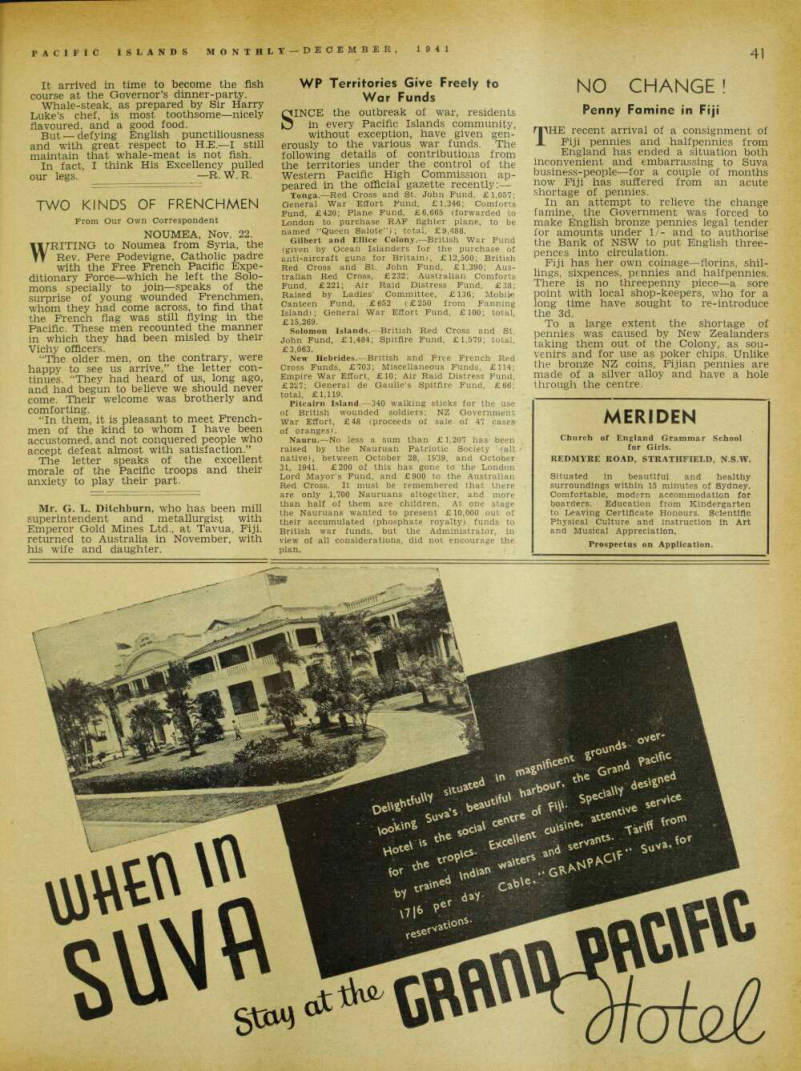
Did We Use the Wrong Fork at Government House ?
MY vivacious neighbour, at a Govern ment House dinner, in Suva, was keeping my wits busy, and I auto matically helped myself from the dish presented by the deft Indian steward.
I turned a preoccupied eye upon the food. It was the second course. “Steak, doodled up in some way—obviously an entree”, I thought; picked up a plain knife and fork; and hurried back to meet the lady’s latest sally.
Apparently, she had been watching me.
She also took a heavy knife and fork and carried on.
Then, in mid-air, she stopped, in frozen horror “°h, God!” she whispered.
It’s fish! Look at H.E.!”
Sir Harry Luke, most charming but most punctilious of hosts—his dinners are renowned for the manner in which traditional British ceremony and decorum are observed—was blandly eating the strange dish with a fish-fork and knife, and those near him were doing the same.
I glared around. Thank heaven, we were not alone! Others, further down the gracious board, were confusedly dropping heavy cutlery, and reaching for the im plements with which etiquette demands that fish be eaten.
“But what is it, anyway?” I said. A menu lay near us—and this is what we read;—
Whale steak! ‘‘Well, how would anyone guess that this is fish?” asked the lady, defensively.
I looked suspiciously at the Governor.
He was talking seriously; but I am con vinced that he missed nothing of his guests’ amusing reactions to what was— as he told me afterwards—“the first whale steak ever to appear on a Govern ment House menu”. rE story of how he had acquired the whale steak also was amusing. He recently had been in Tonga. There was excitement in Nukualofa when it became known that a whale had been killed —the Tongans are exceedingly fond of whale meat.
Sir Harry was interested, and went out, some distance along the beach, to see the ceremony of cutting up and dis tributing the whale.
Someone suggested that he “might like to try whale-steak”, and His Excellency thought so, too. He was returning to Suva immediately by plane, so a package of whale-meat was added to his luggage.
Back in Fiji, His Excellency learned, to his chagrin, that the whale-steak was missing. He added the dismal information to a radio message he was sending to Nukualofa.
Nukualofa was angry. High officials and police went out on the war-path.
It was discovered that the package had been entrusted to a Tongan lorry-driver who loved whale-steak more than he loved liberty. So he had “pinched” the Governor’s package.
Nukualofa put the lorry-driver in gaol, and radio’d apologies to H.E.
There was a sequel. As a fast ship was about to depart for Suva, Nukualofa caught another whale; and so one of the choicest cuts was sent, in the freezer, to the Governor, to replace that which had betrayed the lorry-driver.
It arrived in time to become the fish course at the Governor’s dinner-party.
Whale-steak, as prepared by Sir Harry Luke’s chef, is most toothsome—nicely flavoured, and a good food.
But defying English punctiliousness and with great respect to H.E.—I still maintain that whale-meat is not fish.
In fact, I think His Excellency pulled
our legs.
R. W. R.
Advertisements & other items, p. 42 (1 item)
Menu
Consomme Glace Grilled Whale Steak Risotto Milanese * Filet de Boeuf Garni Mince Pies * Dessert Government House, Ist October, Suva. 1941.
Two Kinds Of Frenchmen
From Our Own Correspondent
Noumea, Nov. 22.
WRITING to Noumea from Syria, the Rev. Pere Podevigne, Catholic padre with the Free French Pacific Expe ditionary Force—which he left the Solo mons specially to join—speaks of the surprise of young wounded Frenchmen, whom they had come across, to find that the French flag was still flying in the Pacific. These men recounted the manner in which they had been misled by their Vichy officers.
“The older men, on the contrary, were happy to see us arrive,” the letter con tinues. “They had heard of us, long ago, and had begun to believe we should never come. Their welcome was brotherly and comforting.
“In them, it is pleasant to meet French men of the kind to whom I have been accustomed, and not conquered people who accept defeat almost with satisfaction.”
The letter speaks of the excellent morale of the Pacific troops and their anxiety to play their part.
Mr. G. L. Ditchburn, who has been mill superintendent and metallurgist with Emperor Gold Mines Ltd., at Tavua, Fiji, returned to Australia in November, with his wife and daughter.
WP Territories Give Freely to War Funds
War Funds
SINCE the outbreak of war, residents in every Pacific Islands community, without exception, have given gen erously to the various war funds. The following details of contributions from the territories under the control of the Western Pacific High Commission ap
peared in the official gazette recently:—
Tonga.—Red Cross and St. John Fund, £ 1,057; General War Effort Fund, £1,346; Comforts Fund, £420; Plane Fund, £6,665 (forwarded to London to purchase RAF fighter plane, to be named “Queen Salote”) ; total, £9,488.
Gilbert and Ellice Colony.—British War Fund (given by Ocean Islanders for the purchase of anti-aircraft guns for Britain), £ 12.500; British Red Cross and St. John Fund, £1,390; Aus tralian Red Cross, £232; Australian Comforts Fund, £221; Air Raid Distress Fund, £3B; Raised by Ladies’ Committee, £136; Mobile Canteen Fund, £652 i £250 from Fanning Island); General War Effort Fund, £100; total, £15,269.
Solomon Islands.—British Red Cross and St.
John Fund, £1,484; Spitfire Fund, £1,579; total, £3,063.
New Hebrides.—British and Free French Red Cross Funds, £703; Miscellaneous Funds, £114; Empire War Effort, £10; Air Raid Distress Fund, £227; General de Gaulle’s Spitfire Fund, £66; total, £1,119.
Pitcairn Island—34o walking sticks for the use of British wounded soldiers; NZ Government War Effort, £4B (proceeds of sale of 47 cases of oranges).
Nauru. —No less a sum than £ 1,207 has been raised by the Nauruan Patriotic Society (all native), between October 28, 19'39, and October 31, 1941. £2OO of this has gone to the London Lord Mayor’s Fund, and £9OO to the Australian Red Cross. It must be remembered that there are only 1,700 Nauruans altogether, and more than half of them are children. At one stage the Nauruans wanted to present £lO,OOO out of their accumulated (phosphate royalty) funds to British war funds, but the Administrator, in view of all considerations, did not encourage the plan.
No Change !
Penny Famine in Fiji
THE recent arrival of a consignment of Fiji pennies and halfpennies from England has ended a situation both inconvenient and embarrassing to Suva business-people—for a couple of months now Fiji has suffered from an acute shortage of pennies.
In an attempt to relieve the change famine, the Government was forced to make English bronze pennies legal tender for amounts under 1- and to authorise the Bank of NSW to put English three pences into circulation.
Fiji has her own coinage—florins, shil lings, sixpences, pennies and halfpennies.
There is no threepenny piece—a sore point with local shop-keepers, who for a long time have sought to re-introduce the 3d.
To a large extent the shortage of pennies was caused by New Zealanders taking them out of the Colony, as sou venirs and for use as poker chips. Unlike the bronze NZ coins, Fijian pennies are made of a silver alloy and have a hole through the centre.
Advertisements & other items, p. 43 (1 item)
attV
MERIDEN
Church of England Grammar School for Girls.
REDMYRE ROAD, STRATHFIELD, N.S.W.
Situated In beautiful and healthy surroundings within 15 minutes of Sydney.
Comfortable, modern accommodation for boarders. Education from Kindergarten to Leaving Certificate Honours. Scientific Physical Culture and instruction in Art and Musical Appreciation.
Prospectus on Application.
% attV
Plague Outbreak In New

Caledonia
A YOUNG New Caledonian native died from pneumonic plague and another was stricken by bubonic plague when an outbreak of disease occurred In mid-November at St. Louis, a Catholic Mission village 10 miles from Noumea.
The pneumonic victim was the 13years-old son of the chief of an East Coast tribe.
Health authorities took all precautions and the locality was isolated by a military cordon. Noumea carries a full stock of medicaments to deal with an emergency.
Because of the outbreak, PAA Clippers for several trips did not stay over-night at Noumea, but remained in port only for an hour or so.
Mr. John Falvey, of the Fiji District Administration, recently won the Fiji Golf Club Championship, at Suva course.
One Christmas Eve In Papua
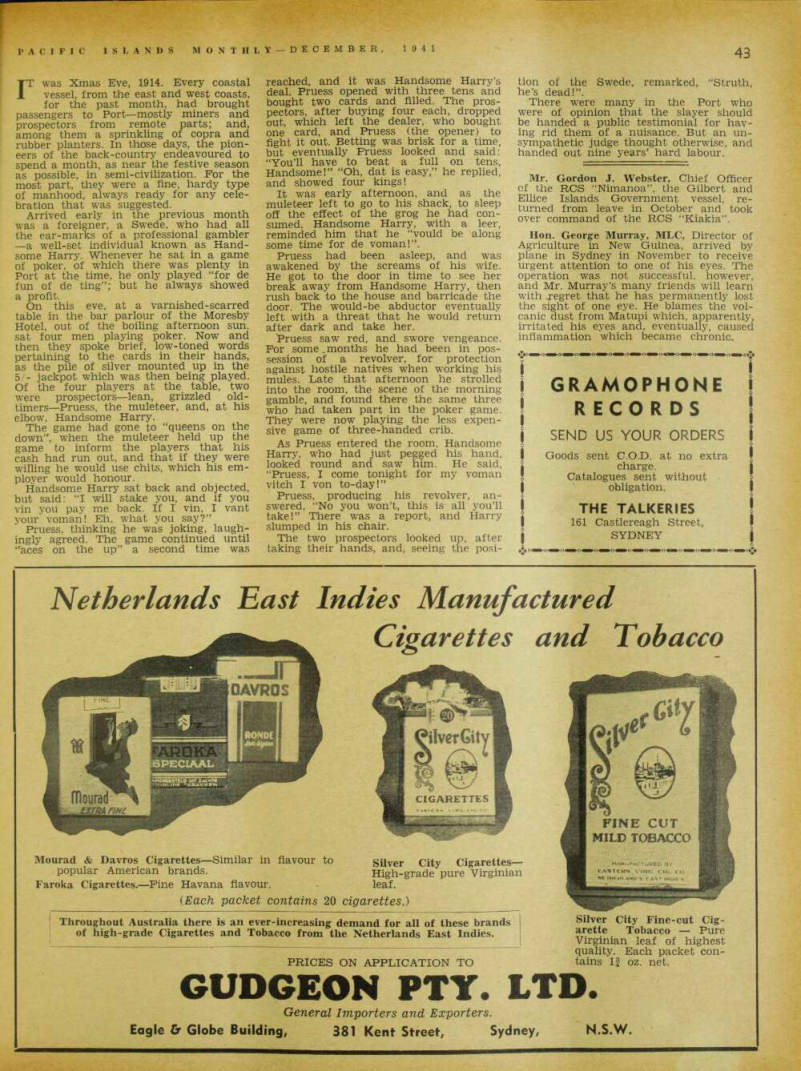
By M, R. Hunter
PORT Moresby, one of Australia’s out posts in the Pacific, was at the time of this story quite different from the PM of to-day.
Jack MacDonald, one-time warrant officer of the Government patrol boat “Merrie England”, had, since the depar ture of Sir William Macgregor, trans ferred to a land post as gaoler at Port Moresby. It was a job in which his duties embraced road-building. His prison labourers (for the most part serving terms for murder) were treacherous, con tinually plotting to escape, and often succeeding, caused him many times to regret the day he resigned the patrol boat to take up the land job.
Jack was engaged in making a road, with the aid of a big gang of native
prisoners, from Port Moresby to Rouna, the gateway of the rubber country, and had made such headway that he was now in the vicinity of Sapphire Creek.
One day, he was returning to his camp on horseback after unsuccessfully at tempting re-capture of three prisoners who had made a break-away, when, his mount shied at a snake, and threw him over a precipice.
Clawing frantically, and attempting to get a foot-hold, he was relieved to find that, at a depth of about 8 feet, he had struck a ledge. Looking upward, he noticed that where the iron toe-caps of his boots had scraped the stone, it showed a shine of metal.
Jack got back to the top of the cliff, and found his horse standing near, still trembling with fright. In little time he was making for the prison camp, to pro cure a pick, and a bag for a few samples, which he decided to take that night to Port. A boat leaving for Aus tralia the following morning carried away his specimens for analysis; and, within a month, a report was received showing that the specimens carried a very high percentage of copper. The report was responsible for the formation of a local syndicate to work the find, with Jack appointed chairman.
Though still in the employ of the Gov ernment, he found time to supervise the mining and transporting of the ore to Port Moresby, from there to be shipped to Cooktown for treatment. Most of the transport was done by mules, and all went merrily for a while.
THEN Jack struck a big spot of bother.
His native muleteer had staggered into camp one morning with his body pin-cushioned with arrows; he had been ambushed by one of the nearby tribes, and his mules driven off. While an endeavour was being made to remove the ugly, bone-tipped arrows, he died.
The mules were afterwards recovered; but, with all the natives refusing the job of muleteer, work was at a stand-still.
Jack had spent hours in Port, offering all sorts of inducements to both whites and natives to take on the job, but with no success. Wandering along the Port road, he noticed a trading boat from Australia making fast to the dilapi dated wharf, and, knowing the chief en gineer, he decided to pay Rim a visit.
He discovered his friend in his cabin with a bottle of “Scotch” at his elbow.
Jack told his friend of his problem.
“Angus,” he asked, “you haven't got anyone in the crew that is likely to know anything about mules, I suppose?”
“No”, replied the chief. Then added: “There’s a chap stowed aboard at Cook town —he’s working his passage—you can see him if you like. He seems a likely lad!”
The stowaway was called in; and, when questioned by Jack as to whether he un derstood mules, he smiled and said, “Mules? Why, they’re my second name!
I love ’em!” Jack beamed, and told him of the job going. And that is how Pruess enters this story, which tells you of how Jack lost his second muleteer.
Ten months elapsed, and Pruess proved himself an adept in handling his string of mules, and the work at Sapphire Creek, the location of the find, was going ahead —every boat leaving for Queensland load ing many tons of copper-ore.
The muleteer, however, proved to have a weakness for the native village belles.
Before many months had elapsed he had married (native fashion) one of the beauties of a nearby village.
IT was Xmas Eve, 1914. Every coastal vessel, from the east and west coasts, for the past month, had brought passengers to Port—mostly miners and prospectors from remote parts; and, among them a sprinkling of copra and rubber planters. In those days, the pioneers of the back-country endeavoured to spend a month, as near the festive season as possible, in semi-civilization. For the most part, they were a fine, hardy type of manhood, always ready for any celebration that was suggested.
Arrived early in the previous month was a foreigner, a Swede, who had all the ear-marks of a professional gambler —a well-set individual known as Handsome Harry. Whenever he sat in a game of poker, of which there was plenty in Port at the time, he only played “for de fun of de ting”; but he always showed a profit.
On this eve, at a varnished-scarred table in the bar parlour of the Moresby Hotel, out of the boiling afternoon sun, sat four men playing poker. Now and then they spoke brief, low-toned words pertaining to the cards in their hands, as the pile of silver mounted up in the 5 - jackpot which was then being played.
Of the four players at the table, two were prospectors—lean, grizzled oldtimers—Pruess, the muleteer, and, at his elbow, Handsome Harry.
The game had gone to queens on the down”, when the muleteer held up the game to inform the players that his cash had run out, and that if they were willing he would use chits, which his employer would honour.
Handsome Harry sat back and objected, but said: “I will stake you, and if you vin you pay me back. If I vin, I vant your voman! Eh, what you say?”
Pruess, thinking he was joking, laughingly agreed. The game continued until “aces on the up” a second time was
reached, and it was Handsome Harry’s deal. Pruess opened with three tens and bought two cards and Piled. The prospectors, after buying four each, dropped out, which left the dealer, who bought one card, and Pruess (the opener) to fight it out. Betting was brisk for a time, but eventually Pruess looked and said: “You’ll have to beat a full on tens, Handsome! Oh, dat is easy, he replied, and showed four kings.
It was early afternoon, and as the muleteer left to go to his shack, to sleep off the effect of the grog he had consumed, Handsome Harry, with a leer, reminded him that he “vould be along some time for de voman!”.
Pruess had been asleep, and was awakened by the screams of his wife.
He got to the door in time to see her break away from Handsome Harry, then rush back to the house and barricade the door. The would-be abductor eventually left with a threat that he would return alter dark and take her. pruess saw red, and swore vengeance, p or some .months’ he had been in pos session of a revolver, for protection against hostile natives when working his mu les. Late that afternoon he strolled i n to Hie room , the scene of the morning gamble, and found there the same three w ft o j iad taken part in the poker game.
They were now playing the less expensive g ame of three-handed crib. . *L . , , T , As Pruess entered the room, Handsome Harry, who had just pegged his hand, j£° ked round and saw him. He said, Pru es s> 1 c< i me , for my voman vitch I von to-day.
Pruess producing his revolver, answered, “No you won’t, this is all you 11 r6P ’ V slumped in ms cnair.
The two prospectors looked up, after taking their hands, and, seeing the posi
tion of the Swede, remarked, “Struth, he’s dead!”.
There were many in the Port who were of opinion that the slayer should be handed a public testimonial for hav ing rid them of a nuisance. But an un sympathetic judge thought otherwise, and handed out nine years’ hard labour, ■ ■ M r d T Webster Chief Offieer • RCS “Nimanoa” the Gilbert and Islands Government vessel re V ?P n o ct ober and’ took over commTnd of the RCS “Kiakia” k over commancl 01 tne Klakia .
Hon, George Murray, MLC, Director of Agriculture in New Guinea, arrived by plane in Sydney in November to receive urgent attention to one of his eyes. The operation was not successful, however, and Mr. Murray’s many friends will learn with regret that he has permanently lost the sight of one eye. He blames the vol canic dust from Matupi which, apparently, irritated his eyes and, eventually, caused inflammation which became chronic,
Advertisements & other items, pp. 44-45 (3 items)
42
DECEMBER, 1941-RACIEIO ISLANDS MONTHLY
Dewar?Dewar'?Dewar'?Dewar*?Dewar'?Dewar?D£Wfr’?Dewar?
rT f. i
DE WAR'S DEW AH?
AR? DE WAH ? DEWA R?
VAR'? DEWAR ? DEWAR'?
vWAR*?DEWAR ?DENAR'?
• war? dewaß? dewar'S
DEWA
DEWA
DEWA;
DEW'AR
DEWAR
DE WAR'?D'> DEWAR’? DEWAR'? DE WAR'?
OEWAR ’ ? o£WWiUir AH■ ?DAW*R':•• DEWAR'? DE WAR'?
OR WAR? DEWAR'? EW.WAR? DE WAR? DRW A R ? DEWAR'? DE WAR'? DEWAR?
DE.WAR'? DE WAR ? DEWAR? DEWAR’EDEXVAR ?;>;:,WAR'S DRW.fR? DEWaR?
DEWAr?DEWAR'?DEWAR'?DEWAR*?DEWAR'?DEWAR?D£wfR’?DEWAR?
A E? DEWAR'?
'AR'? DEWAR'?
f<>E WAR'?DEWAR'? 0E WAR ? DEWAR ?DE W
OKWAR 1 ? DEWAR ? DEWaR*?I>«WAR'SORA
DEW.A.R'?
DEwJk?
DEWAR
DEWAR
DEWA
DEW
DEW,
DEW
aR \E
JEW
AR ? DE/n ltg:iAß;; DEWAR'? !-IT>fyVFmaß* DEWAR’?
MtmWvTZ -i- dewar? dewar*?
DEWaR*? DEWAR'? DE WAR'?
DEWA R*?DE WA R'? DE WA R'? DEWAR'?
R ?TDE W A R *? DE WA R' ? DE W A R? DEW A R'? DEWAR’? aR? DEWAR'? DEWAR ? DEWAR ? DEWAR'? DEWAR ? •?DEWAR ? DEWAR'? DEWAR ? DEWaR? DEWAR'?DEWAR'?
DEWAR'?DE;WAR/?DEW'AR'?DEWAR’?DEWAK?DEWAR'?DEWAR'?DEWAR;?
DEWAR'? DEWAR'? DEWAR’? DEWaR ? DEWAR ? DE WAR'? DE WAR ? DEWAR’?
DEWAR’? DEWAR ?DEWaR ?DEWAR’?DE waR'SDEW'aR ? DEWAR ?DEWAR ?
DEWAR'? DEWAR ? DEWAR'S DE WAR ?DEWAR’? DEWaR'? DEWAR'? DEWAR-'?
DEWAR'? DE WAR/?DEWAR? DEWAR’? DEWAR? DEWAR? DEWAR'? DEWAR'?
DE WA R? DEWAR’? DE WA R? DEWa R'? DE WA R':> DE WAR'? DE WAR? DEWAR?
' DEWAR 1 ? DEWAR’? DEWAR ?DE WAR'? DEWAR'?DEWAR ?DE WAR’? DEWaR ?
DEWAR*? DEWAR'? DEWAR? DRWAR'Sf frW//?? DEf/'-Jj? DEWAR?
DEWAR'? DEWAR'? DEW A;?
D E W A R' ? DEWAR’ ?DEWA<
DEWAR ? DEWAR? DEWARi
DE WA R'? DEWA R' ? DEWA J
DEWAR'S DE WAR'? DE WAlf
OS WAR*? DEWAR ? DEW.'
W'A.R
R'? DEWAR'?
WA;.r? DE WAR'?DEWAR'?
,R'?DEWAR'?DEWAR'? DEWAR;?
AR ? Of# AR ?DEWaR*?DEWAR?DEWAR ?
iRWAR ?DEWAR ? DEWAR ? DEWAR ?DEWAR'?
DEWaR ? DEWAR'S DE WAR ? OS WAR'?DEWAR*?; DEXVAR'? DEWaR'? DEWAR'? DEWAR'? DE WAR'? DE WAR I ?DE -WAR ? DEWAR ?
DEVVAR'?DEWAR'?DEWAR'?DEWAR'?DEWAiR?DEWAR <DEV£AR'?DEWAR'?
•. R DE :: v AJ- AR
J R Vi
DE
WAR
DE
DEW
DEW'
DEW
DEW
DEWAR ? DEWaR'? DEWAR'? DE WAR
DEWAR'? DEWAR"? DE WAR ? DE W;
DEWAR'? I
DEWA R ? DEWARTpHJB? ?
DEWA R • ? DEWA R*r*EW/uD? D AR'?
AR/? :ar?
R?
R'?
AR’? DEWAR.’?
EWaR*? DEWAR*?
E WAR'? DEWAR'?
DEWAR/? DEWAR'?
DEWA R/?j DEWAR’?
DEWAR'?DEWAR'?DEWAR'?DEWAR‘?DEWaR’?DEWaR*?DEWaR*?E>EWAR'?
DEWAR? DEWAR? DEWAR? DEWaR? DEWAR ? DE WAR'? DEWAR'? DEWAR'?
DEWAR'?DEWAR ?DEWAR SDEWAR ?DEWAR ? DEWAR ?DEWAR'?DEWAR'?
DEWAR'? DEWAR'? DEWAR'? DEWAR? DEWAR ? DEWAR? DEWAR'S DEWAR’?
DEWAR'? DEWAR'? DEWAR? DEWAR? DEWAR'? DEW aR* ? DEWAR’? DEWAR'?
DEWAR'?DEWAR'?DEWAR?DEWAR'?DEWAR'SDEWAR:?DEWAR’?DKWAR?
Gudgeon Pty. Ltd.
GRAMOPHONE
RECORDS
SEND US YOUR ORDERS
Goods sent C.O.D. at no extra charge.
Catalogues sent without obligation.
THE TALKERIES
161 Castlereagh Street,
SYDNEY
Netherlands East Indies Manufactured
Cigarettes and Tobacco
DAVROS
N-:
ilverGit
CIGARETTES
Mourad & Davros Cigarettes— Similar in flavour to popular American brands.
Faroka Cigarettes.— Fine Havana flavour. {Each packet contains 20 cigarettes.) Silver City Cigarettes— High-grade pure Virginian leaf.
Throughout Australia there is an ever-increasing demand for all of these brands of high-grade Cigarettes and Tobacco from the Netherlands East Indies.
PRICES ON APPLICATION TO
FINE CUT
MILD TOBACCO
Silver City Fine-cut Cigarette Tobacco Pure Virginian leaf of highest quality. Each packet contains 13 oz. net.
GUDGEON PTY. LTD.
General Importers and Exporters.
Eagle & Globe Building, 381 Kent Street, Sydney,
N.S.W.
War Work In New
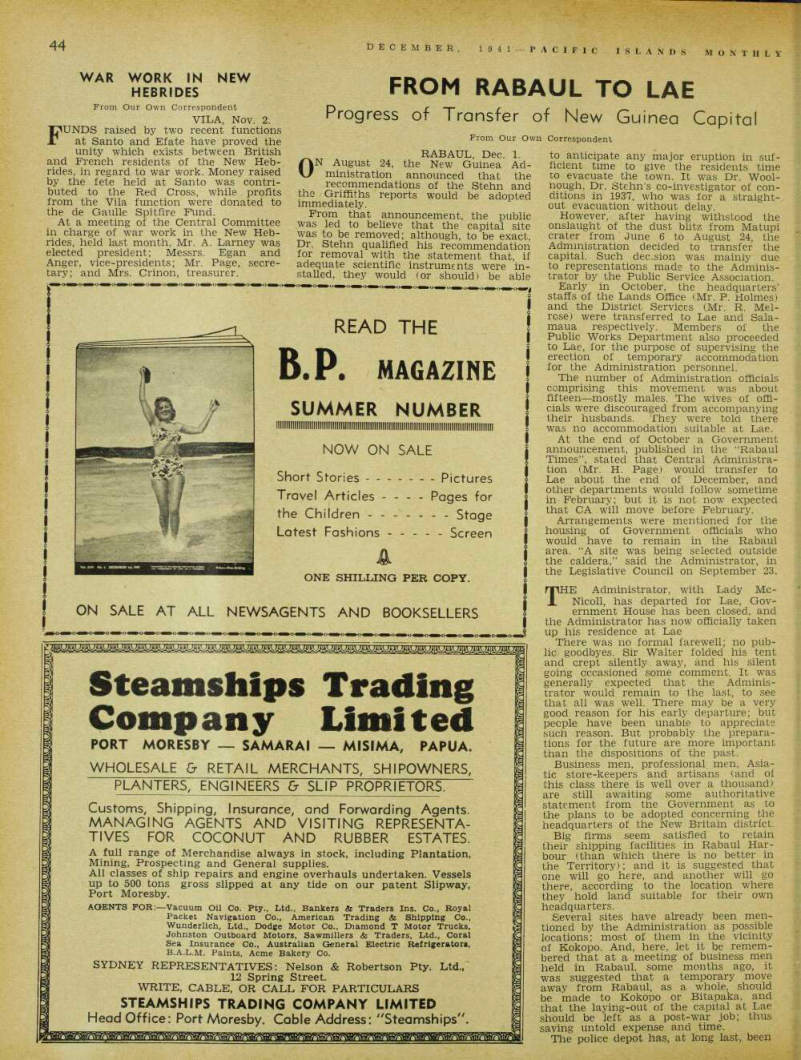
Hebrides
From Our Own Correspondent
Vila, Nov. 2.
FUNDS raised by two recent functions at Santo and Efate have proved the unity which exists between British and French residents of the New Heb rides, in regard to war work. Money raised by the fete held at Santo was contri buted to the Red Cross, while profits from the Vila function were donated to the de Gaulle Spitfire Fund.
At a meeting of the Central Committee in charge of war work in the New Heb rides, held last month, Mr. A. Larney was elected president; Messrs. Egan and Anger, vice-presidents; Mr. Page, secre tary; and Mrs. Crinon, treasurer.
From Rabaul To Lae
Progress of Transfer of New Guinea Capital
From Our Own Correspondent
0 Rabaul, Dec. 1.
N August 24, the New Guinea Ad ministration announced that the recommendations of the Stehn and the Griffiths reports would be adopted immediately.
From that announcement, the public was led to believe that the capital site was to be removed; although, to be exact, Dr. Stehn qualified his recommendation for removal with the statement that, if adequate scientific instruments were in stalled, they would (or should) be able
to anticipate any major eruption in suf ficient time to give the residents time to evacuate the town. It was Dr. Wool nough, Dr. Stehn’s co-investigator of con ditions in 1937, who was for a straight out evacuation without delay.
However, after having withstood the onslaught of the dust blitz from Matupi crater from June 6 to August 24, the Administration decided to transfer the capital. Such dec-sion was mainly due to representations made to the Adminis trator by the Public Service Association.
Early in October, the headquarters’ staffs of the Lands Office (Mr. P. Holmes) and the District Services (Mr. R. Mel rose) were transferred to Lae and Sala maua respectively. Members of the Public Works Department also proceeded to Lae, for the purpose of supervising the erection of temporary accommodation for the Administration personnel.
The number of Administration officials comprising this movement was about fifteen —mostly males. The wives of offi cials were discouraged from accompanying their husbands. They were told there was no accommodation suitable at Lae.
At the end of October a Government announcement, published in the “Rabaul Times”, stated that Central Administra tion (Mr. H. Page) would transfer to Lae about the end of December, and other departments would follow sometime in February; but it is not now expected that CA will move before February.
Arrangements were mentioned for the housing of Government officials who would have to remain in the Rabaul area. ‘‘A site was being selected outside the caldera,” said the Administrator, in the Legislative Council on September 23.
THE Administrator, with Lady Mc- Nicoll, has departed for Lae, Gov ernment House has been closed, and the Administrator has now officially taken up his residence at Lae There was no formal farewell; no pub lic goodbyes. Sir Walter folded his tent and crept silently away, and his silent going occasioned some comment. It was generally expected that the Adminis trator would remain to the last, to see that all was well. There may be a very good reason for his early departure; but people have been unable to appreciate such reason. But probably the prepara tions for the future are more important than the dispositions of the past.
Business men, professional men, Asia tic store-keepers and artisans (and of this class there is well over a thousand) are still awaiting some authoritative statement from the Government as to the plans to be adopted concerning the headquarters of the New Britain district.
Big firms seem satisfied to retain their shipping facilities in Rabaul Har bour (than which there is no better in the Territory); and it is suggested that one will go here, and another will go there, according to the location where they hold land suitable for their own headquarters.
Several sites have already been men tioned by the Administration as possible locations; most of them in the vicinity of Kokopo. And, here, let it be remem bered that at a meeting of business men held in Rabaul, some months ago, it was suggested that a temporary move away from Rabaul, as a whole, should be made to Kokopo or Bitapaka, and that the laying-out of the capital at Lae should be left as a post-war job; thus saving untold expense and time.
The police depot has, at long last, been
transferred outside the caldera, to a location resumed by the Administration for the erection of a native hospital, and over which there was considerable trouble with the native owners, who re fused to countenance the resumption, and to this day claim the deal did not go through.
At first, it was intended to erect native material houses for the police barracks and European officers; but, owing to the drought conditions, no kunai (native grass) was obtainable, so it was found necessary for the police-boys to dismantle buildings at Rapindik and utilise the iron for the police barracks.
CONDITIONS at the new capital must of necessity, for some time to come, be of a primitive nature. It is ac cepted that the temporary buildings to house officials in the immediate future will be erected on the flat near the coast at Lae, and that the town proper, with an elaborate town-nlanning design, will not be erected on the terraces, be hind, until after the war, when funds are expected to be made available.
Much depends upon the available sup plies of building materials, of which, apparently, there is a great shortage.
Meanwhile, to make everyone feel foolish, the volcano is quiet, there is no dust, there has been some rain out of the north-west and the trees and grass are sprouting green again.
Mr. George Moore, manager of BP’s branch at Port Moresby, returned recently after a few months’ visit to Australia.
Mrs. Moore will return early in the New Year, Mr. Les. Clout, of the Public Works Department at Salamaua, New Guinea, recently arrived in Sydney by airliner.
He intends to undergo a course of medi cine while in Australia.
Advertisements & other items, p. 46 (1 item)
B.P. Magazine
READ THE
SUMMER NUMBER
lIIIIIIIIIIIIIIIIIIIIIIIIIIIIIIIIIIIIIIIIIIIIIIIIIIIIIIIIIIIIIIIIIIIIIIIIIIIIIIIIIIIIIIIII^
NOW ON SALE
Short Stories Pictures Travel Articles - - - - Pages for the Children --- Stage Latest Fashions --- Screen A
ONE SHILLING PER COPY.
ON SALE AT ALL NEWSAGENTS AND BOOKSELLERS
Steamships Trading
Company Limited
PORT MORESBY SAMARAI MISIMA, PAPUA.
WHOLESALE & RETAIL MERCHANTS, SHIPOWNERS,
PLANTERS, ENGINEERS & SLIP PROPRIETORS.
Customs, Shipping, Insurance, and Forwarding Agents.
MANAGING AGENTS AND VISITING REPRESENTA-
TIVES FOR COCONUT AND RUBBER ESTATES.
A full range of Merchandise always in stock, including Plantation, Mining, Prospecting and General supplies.
All classes of ship repairs and engine overhauls undertaken. Vessels up to 500 tons gross slipped at any tide on our patent Slipway, Port Moresby.
AGENTS FOR:—Vacuum Oil Co. Pty., Ltd., Bankers & Traders Ins. Co., Royal Packet Navigation Co., American Trading & Shipping Co., Wunderlich, Ltd., Dodge Motor Co., Diamond T Motor Trucks, Johnston Outboard Motors, Sawmillers & Traders, Ltd., Coral Sea Insurance Co., Australian General Electric Refrigerators, B.A.L.M. Paints, Acme Bakery Co.
SYDNEY REPRESENTATIVES: Nelson & Robertson Pty. Ltd., 12 Spring Street.
WRITE, CABLE, OR CALL FOR PARTICULARS
STEAMSHIPS TRADING COMPANY LIMITED
Head Office: Port Moresby. Cable Address: "Steamships".
Equator
Rabbits On The
Strange Colony at Phoenix Is.
rIS interesting nature note from the Pacific was given to me by Mr. E. R.
Bevington (now an AO in the Gil bert Islands), who, with a number of other officials, was ashore on Phoenix Island (Central Pacific) three or four years ago.
Some time in last century, someone released rabbits on uninhabited Phoenix Island: and, although it is a waterless, tree-less, flat coralline island, the animals settled in, lived on the rough herbage, and multiplied.
Mr. Bevington says that they are there in large numbers. They are well-grown, in good condition, and they may be had in almost any hue—intensive inbreeding has produced a wide range of colours.
They do not run away from men as fast as the average wild rabbit, probably because they are not accustomed to men; and, if thev can be headed off from their burrows—which they share with the numerous seabirds—they can be caught by hand. The young men of Mr. Beving ton’s party ran down a satisfactory supply of fresh meat.
Mr. Bevington took 32 of the captives to Beru, in the Southern Gilberts, where he was AO for a time, and released them there, in the hope that they would start a colony and provide a supply of meat.
But, although the rabbits fed eagerly upon coconuts, they did not prosper. Mr.
Bevington said that when he was last in Beru, in January, 1941, there were only
two or three left.
R. W. R.
Mr. A. Olsen, planter, of Guadalcanal, Solomon Islands, arrived in Sydney re cently to join the AIF.
Radio Communications In
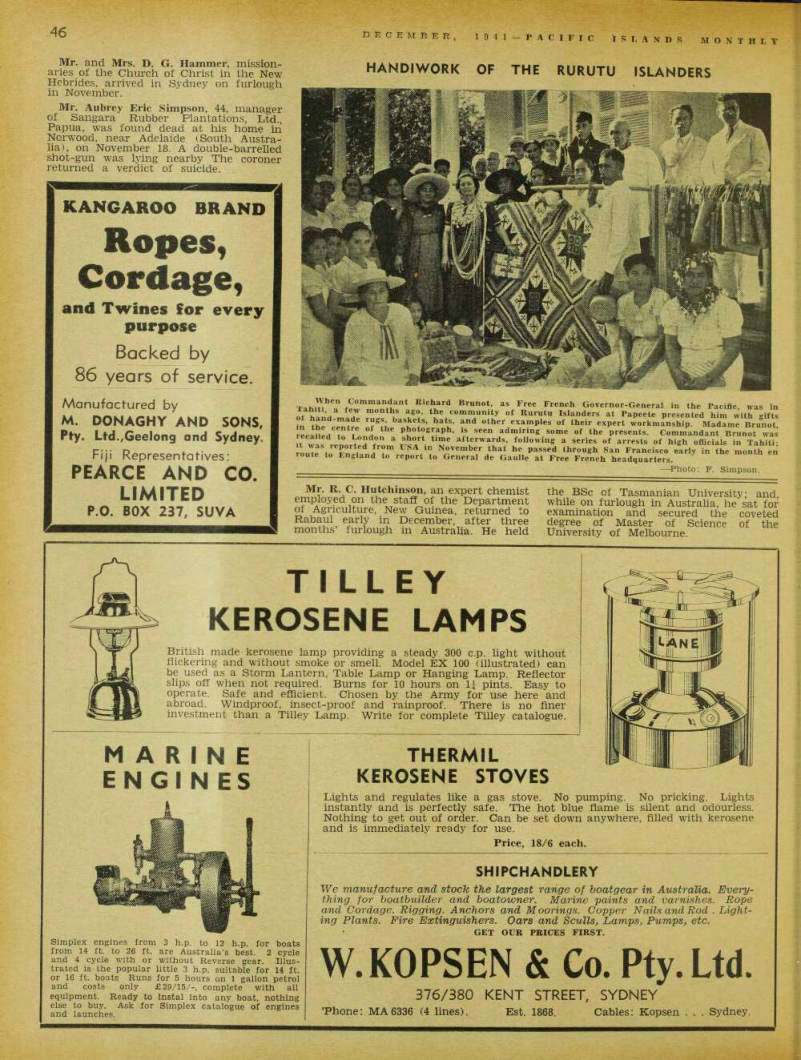
The Pacific
PARALLEL with the development of the Pacific Territories has been the prodigious growth of the radio communications network in the Islands. To-day, after little more than a decade of pioneering work, Amalgamated Wire less (A/sia), Ltd., has linked practically every major group in the South Seas and many of the minor islands.
The difficult work of maintaining contact with the outside world in war-time is one of the unsung stories of the Pacific and the full account of what is being done cannot, of course, be told at this stage.
Addressing the 33rd annual general meeting in Sydney on November 17, AWA’s chairman of directors, Sir Ernest Fisk (wireless pioneer in Australasia), told shareholders that 1940-41 profit had been £133,089, with a £66,528 increase in revenue. Dividend was the usual 10 per cent.
He emphasised that the Co. had placed all its production resources at the service of the Commonwealth Government and that 80 per cent, of its output—radios, valves (important munitions of war) and other highly-technical equipment—is for defence purposes.
Mrs. Colin Marr arrived in Sydney from Rabaul by the November steamer.
She will reside in Australia while her husband, Lieut. C. G. Marr, formerly an inspector and instructor in the NG De partment of Agriculture, is abroad with the AIF.
Mr. and Mrs. D. G. Hammer, mission aries of the Church of Christ in the New Hebrides, arrived in Sydney on furlough in November.
Mr. Aubrey Eric Simpson, 44, manager of Sangara Rubber Plantations, Ltd., Papua, was found dead at his home in Norwood, near Adelaide (South Austra lia), on November 18. A double-barrelled shot-gun was lying nearby The coroner returned a verdict of suicide.
Advertisements & other items, pp. 47-48 (1 item)
Export Soap Company
OLD MONK
The Worlds Finest
Olive Oil
• f - L . . A San Francisco
We are Specialists in Trade for Na Sen d us your enquiries
EXPORT SOAP COMPANY
41 Church Street, Newtown, Sydney, N.S.W.
Cable Address: XSOAF, Sydney. "Phone: LA 2436.
KANGAROO BRAND
Ropes,
Cordage,
and Twines for every purpose
Backed by
86 years of service.
Manufactured by
M. DONAGHY AND SONS,
Pty. Ltd..Geelong and Sydney.
Fiji Representatives:
PEARCE AND CO.
LIMITED
P.O. BOX 237, SUVA
TILLEY
KEROSENE LAMPS
British made kerosene lamp providing a steady 300 c.p. light without flickering and without smoke or smell. Model EX 100 (illustrated) can be used as a Storm Lantern, Table Lamp or Hanging Lamp. Reflector slips off when not required. Burns for 10 hours on 1£ pints. Easy to operate. Safe and efficient. Chosen by the Army for use here and abroad. Windproof, insect-proof and rainproof. There is no finer investment than a Tilley Lamp. Write for complete Tilley catalogue.
MARINE
ENGINES
THERMIL
KEROSENE STOVES
I
LAN
• / v Lights and regulates like a gas stove. No pumping. No pricking. Lights instantly and is perfectly safe. The hot blue flame is silent and odourless.
Nothing to get out of order. Can be set down anywhere, filled with kerosene and is immediately ready for use.
Price, 18/6 each.
SHIPCHANDLERY
We manufacture and stock the largest range of boat gear in Australia. Everything for boatbuilder and boatowner. Marine paints and varnishes. Rope and Cordage. Rigging. Anchors and M oorings. Copper Nails and Rod . Lighting Plants. Fire Extinguishers. Oars and Sculls, Lamps, Pumps, etc.
GET OUR PRICES FIRST.
Simplex engines from 3 h.p. to 12 h.p. for boats from 14 ft. to 26 ft. are Australia’s best. 2 cycle and 4 cycle with or without Reverse gear. Illustrated is the popular little 3 h.p. suitable for 14 ft. or 16 ft. boats Runs for 5 hours on 1 gallon petrol and costs only £29/15/-, complete with all equipment. Ready to Instal into any boat, nothing else to buy. Ask for Simplex catalogue of engines and launches.
W.KOPSEN & Co. Pty.Ltd.
376/380 KENT STREET, SYDNEY
’Phone: MA6336 (4 lines). Est. 1868. Cables: Kopsen . . . Sydney.
Handiwork Of The Rurutu Islanders
Mr. R. C. Hutchinson, an expert chemist employed on the staff of the Department of Agriculture, New Guinea, returned to Rabaul early in December, after three months’ furlough in Australia. He held
the BSc of Tasmanian University; and, while on furlough in Australia, he sat for examination and secured the coveted degree of Master of Science of the University of Melbourne.
When Commandant Richard Brunot, as Free French Governor-General in the Pacific, was in Tahiti, a few months ago, the community of Rurutu Islanders at Papeete presented him with gifts of hand-make rugs, baskets, hats, and other examples of their expert workmanship. Madame Brunot. in the centre of the Photograph, is seen admiring some of the presents. Commandant Brunot was recalled to london a short time afterwards, following a series of arrests of high officials in Tahiti; it was reported from USA in November that he passed through San Francisco early in the month en route to England to report to General de Gaulle at Free French headquarters. —Photo: P. Simpson.
Horticulture in the Solomons
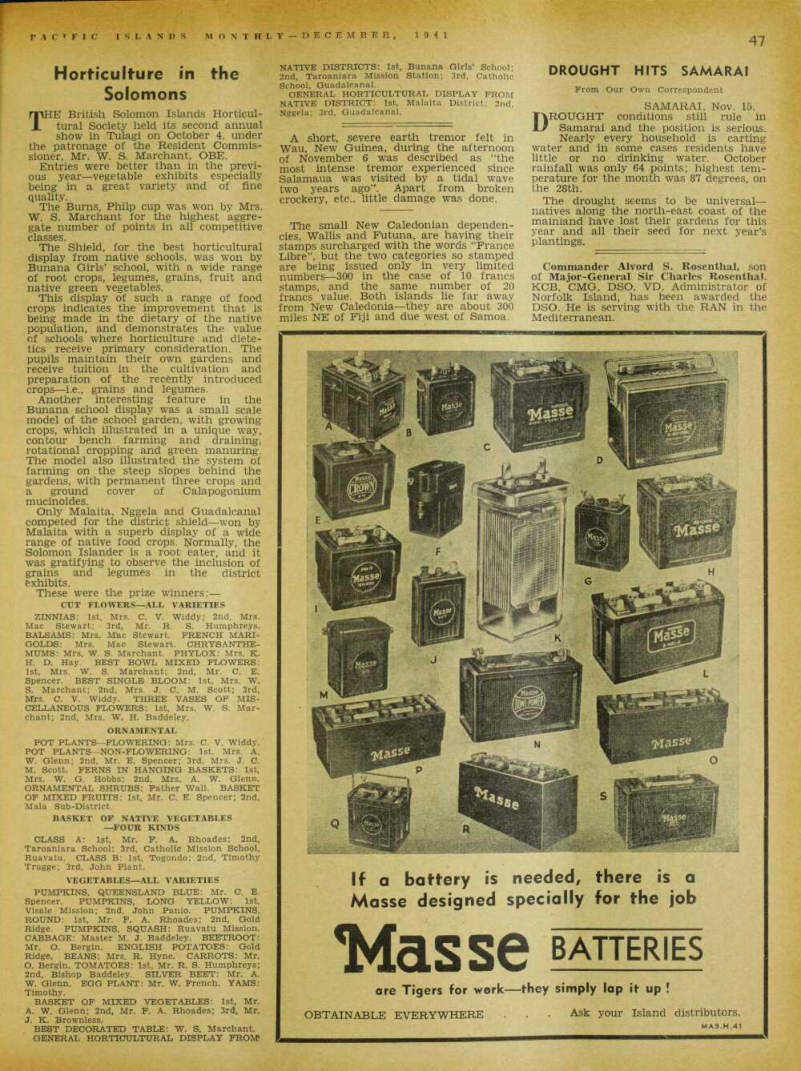
Solomons
rE British Solomon Islands Horticul tural Society held its second annual show in Tulagi on October 4, under the patronage of the Resident Commis sioner, Mr. W. S. Marchant, OBE.
Entries were better than in the previ ous year—vegetable exhibits especially being in a great variety and of fine quality.
The Burns, Philp cup was won by Mrs.
W. S. Marchant for the highest aggre gate number of points in all competitive classes.
The Shield, for the best horticultural display from native schools, was won by Bunana Girls’ school, with a wide range of root crops, legumes, grains, fruit and native green vegetables.
This display of such a range of food crops indicates the improvement that is being made in the dietary of the native population, and demonstrates the value of schools where horticulture and diete tics receive primary consideration. The pupils maintain their own gardens and receive tuition in the cultivation and preparation of the recently introduced crops—i.e., grains and legumes.
Another interesting feature in the Bunana school display was a small scale model of the school garden, with growing crops, which illustrated in a unique way, contour bench farming and draining, rotational cropping and green manuring.
The model also illustrated the system of farming on the steep slopes behind the gardens, with permanent three crops and a ground cover of Calapogonium mucinoides.
Only Malaita, Nggela and Guadalcanal competed for the district shield—won by Malaita with a superb display of a wide range of native food crops, formally, the Solomon Islander is a root eater, and it was gratifying to observe the inclusion of grains and legumes in the district exhibits.
These were the prize winners:—
Cut Flowers—All Varieties
ZINNIAS: Ist, Mrs. C. V. Widdy; 2nd, Mrs.
Mac Stewart; 3rd, Mr. R. S. Humphreys.
BALSAMS: Mrs. Mhc Stewart. FRENCH MARI GOLDS: Mrs. Mac Stewart. CHRYSANTHE MUMS: Mrs. W. S. Marchant. PHYLOX: Mrs. K.
H. D. Hay. BEST BOWL MIXED FLOWERS: Ist, Mrs. W. S. Marchant: 2nd, Mr. C. E.
Spencer. BEST SINGLE BLOOM: Ist, Mrs, W.
S. Marchant: 2nd, Mrs. J. C. M. Scott; 3rd, Mrs. C. V. Widdy. THREE VASES OF MIS CELLANEOUS FLOWERS: Ist, Mrs. W. S. Mar chant; 2nd, Mrs. W. H. Baddeley.
Ornamental
Pot Plants—Flowering: Mrs. C. V. Widdy.
Pot Plants—Non-Flowering: Ist, Mrs. A.
W. Glenn; 2nd, Mr. E. Spencer; 3rd, Mrs. J. C.
M. Scott. FERNS IN HANGING BASKETS; Ist, Mrs. W. G. Hobbs; 2nd, Mrs. A. W. Glenn.
Ornamental Shrubs; Father Wall. Basket
OP MIXED FRUITS: Ist, Mr. C. E. Spencer; 2nd, Mala Sub-District.
Basket Of Native Vegetables
—Four Kinds
CLASS A; Ist, Mr, P. A. Rhoades; 2nd, Taroaniara School; 3rd, Catholic Mission School, Ruavatu. CLASS B: Ist, Togondo; 2nd, Timothy Trugge; 3rd, John Plant.
Vegetables—All Varieties
Pumpkins, Queensland Blue; Mr. C. E.
Spencer. Pumpkins, Long Yellow: Ist,
Visale Mission; 2nd, John Panic. PUMPKINS, ROUND: Ist, Mr. F. A. Rhoades; 2nd, Gold Ridge. PUMPKINS, SQUASH: Ruavatu Mission.
CABBAGE: Master M. J. Baddeley. BEETROOT; Mr. O. Bergin. ENGLISH POTATOES: Gold Ridge. BEANS: Mrs. R. Hyne. CARROTS: Mr.
O. Bergin. TOMATOES: Ist, Mr. R. S. Humphreys; 2nd, Bishop Baddeley. SILVER BEET: Mr. A.
W. Glenn. EGG PLANT: Mr, W. French. YAMS: Timothy.
Basket Of Mixed Vegetables: Ist, Mr.
A. W. Glenn; 2nd, Mr. F. A. Rhoades; 3rd, Mr.
J. K. Brownless.
Best Decorated Table: W. S. Marchant.
General Horticultural Display From!
NATIVE DISTRICTS: Ist, Bunana Girls’ School; 2nd, Taroaniara Mission Station; 3rd, Catholic School, Guadalcanal.
General Horticultural Display From
NATIVE DISTRICT: Ist, Malaita District; 2nd, Nggela; 3rd, Guadalcanal.
A short, severe earth tremor felt in Wau, New Guinea, during the afternoon of November 6 was described as “the most intense tremor experienced since Salamaua was visited by a tidal wave two years ago’'. Apart from broken crockery, etc., little damage was done.
The small New Caledonian dependen cies, Wallis and Futuna, are having their stamps surcharged with the words “France Libre”, but the two categories so stamped are being issued only in very limited numbers —300 in the case of 10 francs stamps, and the same number of 20 francs value. Both islands lie far away from New Caledonia —they are about 300 miles NE of Fiji and due west of Samoa.
Drought Hits Samarai
From Our Own Correspondent
Samarai, Nov. 15.
DROUGHT conditions still rule in Samarai and the position is serious.
Nearly every household is carting water and in some cases residents have little or no drinking water. October rainfall was only 64 points; highest tem perature for the month was 87 degrees, on the 28th.
The drought seems to be universal— natives along the north-east coast of the mainland have lost their gardens for this year and all their seed for next year’s plantings.
Commander Alvord S. Rosenthal, son of Major-General Sir Charles Rosenthal.
KCB, CMG, DSO, VD, Administrator of Norfolk Island, has been awarded the DSO. He is serving with the RAN in the Mediterranean.
Advertisements & other items, pp. 49-50 (1 item)
'Masse Batteries
*9 If a battery is needed, there is a
Masse designed specially for the job
are Tigers for work —they simply lap it up !
OBTAINABLE EVERYWHERE
Ask your Island distributors.
M A3.H.41
r A r y 8$ e treriVogNtO m ,
COMES A LEGEND of SILAU
A MAH mo MCA ME A CWCOP/Ct f / f althohoh hap/ho the sop pof a 3
C£o£OoU£ , H/S TEETH •<■
AHP TO HO HE HEM A/HEP
T//OGF nY si. /MAM , ,_
.-IV -„ t I/#*"
»gefW*
.-r"
O* **■
Plea For Revision of NG
Plantation Valuations
Letter to the Editor IN your issue of August you publish a letter from “Leatherneck”, about existing conditions in the copra business. I think he covers all the ground excepting his method of altering present conditions by some “passive resistance” of the planters. This, to my mind, would be more injurious to the planters than the merchants.
To review past history of the copra trade in New Guinea—it may be remem bered that the plantations were tendered for at a time when the price of copra was around £2O per ton, and it is now fixed at £4/10/- by the Copra Marketing Board. There was such a rush for plan tations that people paid high prices for their places, which was mainly caused by the high prices of copra. They also agreed to cruel conditions of repayment, under an inequitable agreement. These conditions included 8 per cent, interest, and other conditions. Some of these, which were objectionable to the mer chants, have since been removed, but there still remain the “tied house” clauses, allowing merchants to charge their prices, no matter the objection.
As the prices for copra got lower, the unfortunate planters found themselves working for the merchants, and these practically controlled the planters, and gave only such credit as suited them selves, often without salary.
All the copra supplied to the merchants is credited to them in the merchants’ books, and rations are supplied at their prices, and other charges, including the 8 per cent, interest on interest, are also included, without reference to the planter, and he gets the usual monthly statement of their charges. Under this “tied house” arrangement, there is no possibility of ever getting free Through no fault of the merchants— and planters, too, for that matter —the price of copra has fallen to £4/10/- or, with carriage paid, to about £5 odd.
This, you will see, is about one fourth the price of that received, at the time of tendering.
Taking everything into account, is this not a suitable time to reduce the prices of the plantations, and interest by half, to allow the planters to continue on their plantations? For, certainly, it will be found that merchants are not paving anything like the former bank rate, and should meet the planters. It is no longer possible for the planters to work for the mer chants under the old conditions, under an inequitable agreement. They should be allowed to draw 10 per cent, against deliveries, as there are other creditors.
The above facts, being taken into ac count, have nothing to do with the price of copra, so are not affected by the Copra Marketing Board. But legislation should be introduced now to protect present fand, after the war, future) soldiers, from the inequitable agreement conditions now existing in New Guinea.
I am, etc.,
Starvation.
Rabaul, 10/10/1941.
Advertisements & other items, p. 50 (1 item)
Springwood Ladies" College
Af Bine Mountains—Sprlngwood, N.S.W.
Est. 1897. Kindergarten to Leaving Certificate. Tennis, Riding, Swimming, Team Games. Unequalled climate. Pure Jersey Milk. Senior and Junior Houses.
Open-air sleeping. Inclusive fees. Special vacation arrangements for Island pupils.
M. E. DURAND, Principal.
A Section For Women

By "Therese"
SMART simplicity is the keynote of all our summer frocks, whether they be for sports, day, or evening wear. If we hanker after a strong display of femininity, this can be achieved by accessories.
Daytime clothes have short skirts made full with pleats, or flares in front, yet still man aging to keep the slender line. In many of them, pockets appear with good effect. For active sports wear, stick to simple clothes— blouses and skirts, tailored shorts with accom panying skirts, and slacks and trouser skirts.
For parties, choose cotton and you’ll be a success. Evening dresses of cotton are cool and attractive and much-to-be-desired possessions.
A shirtmaker design of sheer cotton in pastel blue has a long flowing skirt topped with a wide belt of self material and a blouse with pointed collar and short sleeves.
Gingham and seersucker also come into their own as party frocks in blouse and skirt fashion.
Choose a bright plaid or gay floral for the full flared skirt and toning cotton for the short sleeved blouse and you will be happily clad for informal evenings.
Sun clothes are well cut and have a defin itely feminine air. A tailored sun-suit in pin striped cotton is a “must-have” in your ward robe, particularly when it is made on tailored lines, with two patch pockets in the shirt, pleats in the shorts and a well-cut skirt to don for more formal occasions.
TRY these new recipes to lend variety to the usual daily diet: —
Oyster Cocktail
Juice of 1 lemon, 1 teaspoon Worcestershire sauce, 1 teaspoon anchovy sauce, 2 tablespoons tomato sauce, a little cream.
Put oysters in glasses, pour the mixture over
them, add a teaspoon of cream to each glass and serve with thin slices of brown bread and butter.
Prune Savouries
Remove the stones from large soft prunes.
Insert a pickled onion (or devilled almond i, stuffed olive, small piece of cheese (or gherkini.
Roll the prune up in a small piece of thin bacon. Skewer it to keep in position. Cook between two enamel plates in a hot oven or fry in a pan without additional fat.
Maryland Salad
Three teaspoons powdered gelatine, 1 cup canned sweet corn, 3 bananas, V 2 cup hot water, salt and pepper.
Dissolve gelatine in hot water, add to sweet corn. Mash bananas to a pulp and blend thoroughly with the mixture. Add seasonings to taste. Pour into a shallow mould and chill.
Using a sharp knife dipped in hot water and dried, cut into squares and serve on lettuce.
If setting in ice chest or refrigerator, use only 2(4 teaspoons gelatine.
Cheese Eggs
Four eggs, IV2 oz. butter, 1 teaspoon chopped parsley, 4 dessertspoons grated cheese, salt, pepper and buttered toast.
Make 4 to 6 pieces of buttered toast and keep warm. Beat the eggs; grate cheese finely and add to the eggs; add chopped parsley. Melt butter in saucepan, add eggs, etc. and stir over a very slow fire till cheese melts and eggs thicken and set. Pile on hot toast and serve at once.
Chocolate Velvet
This is a delicious sweet. Melt >4 ib. un sweetened chocolate in 3 or 4 tablespoons of milk, stirring until quite smooth. Put pint of milk in a saucepan, sweeten to taste, bring to the boil and add the melted chocolate. Simmer
for 10 minutes, then beat up the yolks of 3 eggs in a basin, with a little cold milk; add to the chocolate mixture, gradually, stirring all the time. Simmer till the cream thickens, then remove from the fire. Stir again for a few minutes and let stand until quite cold. Serve as cold as possible, with fresh, stewed or baked fruits.
Household Hints
'T'O keep your home cool take a tray of ice A cubes from your refrigerator, place it in front of an electric fan. Close the windows thus shutting out the heat, draw the curtains and allow the fan to rotate and blow the ice cold air through the room. As the ice cubes melt return tray to the refrigerator and take out the next tray.
When the clothes-line gets dirty, take it down, wind it round the washing-board and scrub thoroughly. This is by far the easiest way of cleaning it.
Soak net curtains in cold water over-night to prevent them shrinking, when being washed the next day. Iron while still damp, length ways of the material.
Over a tin in which you have put a cake mixture, invert another tin exactly the same size. You can then leave the cake to bake without bothering to look at it. The cake will be even on top—a great asset if you intend to • ice it.
To remove scorch from silk mix the juice of a large onion, Vz cup soap jelly, V 2 cup vine gar and 2 tablespoons of Fuller’s earth. Boil, cool, and spread all over the scorched area.
Dry the garment in the sun, then wash in the usual way.
If hot milk is poured into a jug standing in cold water, no skin will form on the milk.
Advertisements & other items, pp. 51-54 (3 items)
Edgell
* m match and contrast different wild flower colours ... lupinp blue, ffillium rose, buUereuj* yellow, cactus green and a dozen others. C&pride>:j^M Order C.0.D., giving bust, waist and hip measurements, from
SPORTS LIFE
City Chambers, Edward St., Brisbane Write for Free Hollywood Catalogue.
Edgell
QUALITY PRODUCTS
Edged Asparagus
The best in the world. Available in season only.
Edged Cauliflower
Choice heart of the cauliflower. No stalk, no waste. Packed in cartons of 3 dozen 16 oz. cans.
Edged Brussels Sprout's
Garden green—firm cooked.
Packed in cartons of 3 dozen 16 oz. or cases of 2 dozen 30 oz. cans.
Edged Green Peas
Picked and canned the same day, avoiding extra handling and bruising.
Graded in three sizes, large, medium and petits pois. Large and medium packed in 10i oz., 16 oz. and 30 oz. cans. Petits pois are packed in cartons of 4 dozen 10i oz. cans only. All packs are available with or without mint flavour.
Edged Carrots
The sweetmeat of canned vegetables. Whole young carrots are packed in cartons of 4 dozen 10i oz. cans. Split carrots are available in cartons of 3 dozen 16 oz. cans.
Edged Concentrated Soups
Asparagus. Tomato, Celery, Pea, Vegetable and Assorted.
These are heavy bodied soups—an extra tin of milk or water may be added to each tin. Made from sun-ripened, specially selected ingredients.
ISLANDS DISTRIBUTORS :
C. SULLIVAN LTD. 37 Iv k d^ st
lUe/ieii
SAUCE
Tided bii Chebf the World ever
ECONOMICAL. BECAUSE VOUNEED
JUST A FEW DROPS AT A TIME -
SEND YOUR NEXT GROCERY ORDER
TO
McILRATH’S
OF SYDNEY
WHERE YOUR MONEY BUYS MORE
“Rosa”, besc quality Self-raising Flour .. 2-lb„ 6id. pkt.; 4-lb., 1/1 pkt “Sunshine” Full Cream Milk, 12-oz 1/2* tin; 14/3 doz.
“Yoga” Tea—Australia’s Best Tea Value .. 3/2 lb.; 6-lb. tins, 3/3 lb “Rosa” Pure Coffee, 8-oz., l/6i jar, 18/- doz.; 16-oz., 2/9 jar, 32/- doz.
Choice Evaporated Apricots l/4i lb * 16/- doz Choice Evaporated Apple Rings, Hid. lb.; 11 3 doz.; 28-lb. boxes, 10id. lb.
New Season’s Hops 6-oz., 2/3 pkt.; 26/- doz.
“Garden Vale” Green Peas 16-oz., Bid. tin, 8/3 doz.; Case lots of 4 doz 7/3 doz “Edgell” Cauliflower, 16-oz., 9d. tin, 8/9 doz.; case lots of 3 doz., 8/- doz “1.X.L.” Baked Beans, 4-oz„ 3/9 doz.; 8-oz., 6/3 doz.; 16-oz., 9/- doz.
“Greenacres” Choice Sheep Tongues, 12-oz 1/2 tin; 13/9 doz “Red Feather” Camp Pie. 4-oz., 3/9 doz.; 8-oz., 5/9 doz.; 12-oz., 7/9 doz “Imperial” Fancy Asstd. Meats ... 8-oz., 8/9 doz.; 16-oz., 12/6 doz “1.X.L.” Tomato Juice 10-oz., 5/3 doz.; 15-oz„ 7/3 doz.
“Brooke’s” Grape Fruit Juice 10-oz., Bid. tin; 8/3 doz. ‘T.X.L,” Tomato Soup 8-oz., 5/6 doz.; 16-oz., 9/3 doz.
“1.X.L.” Vegetable Soup 8-oz., 6/3 doz.; 16-oz., 10/3 doz.
“1.X.L.” Diced Fruit Salad 16-oz., lOd. tin, 9/9 doz.; .. 30-oz 1/4 tin; 15/9 doz.
Nestle’s Pure Reduced Cream .. 4-oz. 3/9 doz.; case lots, 8 doz., 3/6 doz.
All Prices f.o.b. Space Available all Steamers. Cases and Packing Free.
McILRATH’S Rty. Ltd.
MAIL ORDER DEPT.
202 PITT STREET, SYDNEY
AUSTRALIA.
Slop Kidney
Poisoning To-day
If you suffer from Rheumatism, Get up Nights, Leg Pains, Backache, Lumbago, Nervousness, Headaches and Colds, Dizziness, Circles under Eyes, Swollen Ankles, Loss of Appetite or Energy, you should know that your system is being poisoned because germs are impairing the vital process of your kidneys. Ordinary medicines can’t help much, because you must kill the germs which cause these troubles, and blood can’t be pure till kidneys function normally. Stop troubles by removing cause with Cystex the new scientific discovery which starts benefit in 2 hours. Cystex must prove entirely satisfactory and be exactly the medicine you need or money back is guaranteed. Ask your chemist for Cystex today. - The guarantee C WT protects you. Now in V J 9 A 3 sizes: 1/9, 4/-, 8/-.
GUARANTEED for Kidneys, Bladder, Rheumatism
SCHAFFER & CO., SYDNEY,
TRINITY GRAMMAR SCHOOL
The School is well equipped and splendidly situated. Its 1941 complement (about 50 boarders and 250 day boys) makes it possible for every boy to come into personal touch with the Head Master and a staff of 10 experienced and successful masters (including seven University Graduates). The general life of the school is very varied and full of vigour. The Head Master will be pleased to send the Illustrated Year Book for 1941-2, on application, and to give full information about the school, which is approved by the University of Melbourne as a Class “A” School for Intermediate and School Leaving Examinations.
KEW, VICTORIA,
President of Council:
A. O. HENTY, Esq.
Headmaster:
FRANK SHANN, M.A., Dip. Ed.
New Year term commences February 10th, 1942.
Postal Address: Kew, E. 4, Victoria.
Telephone: Hawthorn 412.
Delicious
Meals-in-a-Moment
Ready- to - Serve Always
FLAVOUR SEALED IN GOLD LINED CANS
Imperial Good Foods save hours of cooking . . . just open and serve, that’s the secret of preparing “Imperial” meals in next to no time.
Imperial
Serve these spicy, savoury , treats: Imperial Camp Pie or Corned Beef Loaf.
Any hour of any day serve a tasty meal with these savoury meats packed by the makers of "Imperial" Good Foods.
"FITZROY" Luncheon Beef. Pork or Beef Sausages. "WESTFIELD" Corned, Boiled or Roast Mutton. "OX & PALM ' and "RIVERSTONE" Corned, Boiled or Roast Beef.
"Health and Freshness Sealed in Cans."
Products of
RIVERSTONE MEAT CO.
5-7 O'CONNELL STREET,
FIJI AGENTS: PEARCE & CO
sS i % ?
Til
m m n m Try These Tasty NEW Delicacies.
Imperial full flavoured, creamy TOMATO SOUP; Imperial choice, tender ASPARAGUS
TIPS and PIECES.
PTY. LTD.
SYDNEY
, SUVA.
OLD MONK
The Worlds Finest Olive Oil San Francisco
ISLAND STORE MANAGER
MAKES GOOD RECOVERY
COURAGE IS A GRAND THING, BUT SOMETIMES COURAGE ALONE ISN’T ENOUGH. TAKE THE CASE OF ARTHUR WEBSTER, FOR ONE EVENING HE WAS WALKING DOWN THE STREET WITH HIS FRIEND, BILL THOMPSON, WHEN BILL SAID :
“Things pretty good at the store, Arthur?”
“Y-yes. We’re doing all right.”
But the store wasn't doing as well as it should have been. Arthur Webster was really worried. That night he had a heart to heart chat with his wife.
“Arthur darling, you worry too much —things’ll be all right soon.”
“I wish I didn’t feel so tired all the time! I seem to wake up tired lately. I suppose I’ll just have to pull myself together and do a real job for the next couple of months.”
Arthur Webster tried hard but just couldn’t make the grade. The final sales figures showed he was well down. One evening when he was slumped in a chair looking thoroughly despondent his wife came over to him.
“Darling, there's something really wrong with you. I know what you’re going through ... but I’m sure there’s something behind this day after day tiredness of yours. Why don’t you see a doctor?”
So Arthur Webster took his wife’s advice and saw his doctor. After giving him a thorough examination his doctor said :— “Mr. Webster, your whole trouble is Night-Starvation. You see, all night long your heart and lungs
are using up energy. Your heart has to beat 35,000 times and your lungs make 20,000 muscular movements during your eight hours’ sleep.
“So you can see for yourself if energy isn’t replaced during sleep you wake tired, feel run down and get behind in your work. You need Horlick’s. Start drinking Horlick’s every night before you go to bed.”
Arthur Webster started drinking Horlick’s every night before bed.
Soon he lost that heavy , tired feeling and found that he could put twice as much drive into his work .
His sales figures bucked up and for the first time since he had been on the Island the Head Office sat up and took some notice of him.
Do you feel tired all day? Wake tired? Find it hard to concentrate on your work? Feel dull and nervy? Then the chances are that you, too, are suffering from Night-Starvation, Remember, Horlick’s guards against Night-Starvation, keeps you wonderfully fit. Ask your chemist or storekeeper to-day for a bottle of Horlick’s. You can buy Horlick’s in towns out the Pacific Islands. all main through- British
f*ORUCO
50
DECEMBER, 1941-PACIFIC ISLANDS MONTHLY
ALTERNATIVES TO COPRA
(CONTINUED PROM PAGE 11)
51
PACIFIC ISLANDS MONT If LY DECEMBER, 1941
Mining Shares
Quotations For Islands
Fiji
Mid-May.
Mid-Sept.
Mid-Dec.
Emperor Mines . . b9/10 bll/4 s9/- Loloma b25/s20/- Mt. Kasi b2/9 s2/2 Bulolo G.D
New Guinea
. s £ 4/17/6 b£ 4/9/s£4/10/- Enterprise of N.G b7/6 blO/s20/- Guinea Gold . blO/6 blO/2 blO/9 N.G.G., Ltd. . . . bl/7 bl/4 Oil Search ... .. b5/3 b5/5 s4/3 Placer Dev • s61/b62/9 b56/- Sandy Creek . blOd bl/3 bl/- Sunshine Gold ... . b7/3 blO/2 b8/- Cuthbert’s
Papua
. bl2/10 bl3/6 bl3/- G.M. of Papua ... . s2d sld Mandated All. ... . b2/ll b2/8 b4/5 Oriomo Oil . b2/10 bl/1 Papuan Apinaipi . . b3/6 b3/5 bl/6 Yodda Goldfields . . bl/7 b2/3 bl/9
Price Of Gold
Rev. C. L. Welch, who has been LMS missionary on Nauru for several years, resigned recently, and left the island in October. He arrived at Auckland, New Zealand, where he will take up a tem porary pastorate, early in November.
Rev. Welch was held in high esteem by all classes in Nauru and his departure caused much regret.
Fine Standard oz. oz.
Jan. 1 to Feb. 4, 1940 .. £10/12/6 £9/14/9 Vi Feb. 5 to March 3 .. £ 10/12/9 £9/15/0V 4 March 4 to June 23 . . £10/13/3 £9/15/53/4 June 24 to July 7 .. £10/12/6 £ 9/15/0 y 4 July 8 to August 4 . . £10/11/- £9/13/5 August 5 to Sept. 20 .. £ 10/12/6 £ 9/14/9Vi Sept. 21 to Dec. 31 . . £10/14/- £9/16/2 Jan. 1, 1941, to Nov. 17 £10/14/- £9/16/2 Nov. 18 to Dec. 10 .. £ 10/13/- £9/15/3
Advertisements & other items, p. 54 (1 item)
52
DECK M RET?. 1941 PAPTP’Tr' T .
J 4 1 IACI F I c ISLANDS MONTHLY
Mining News
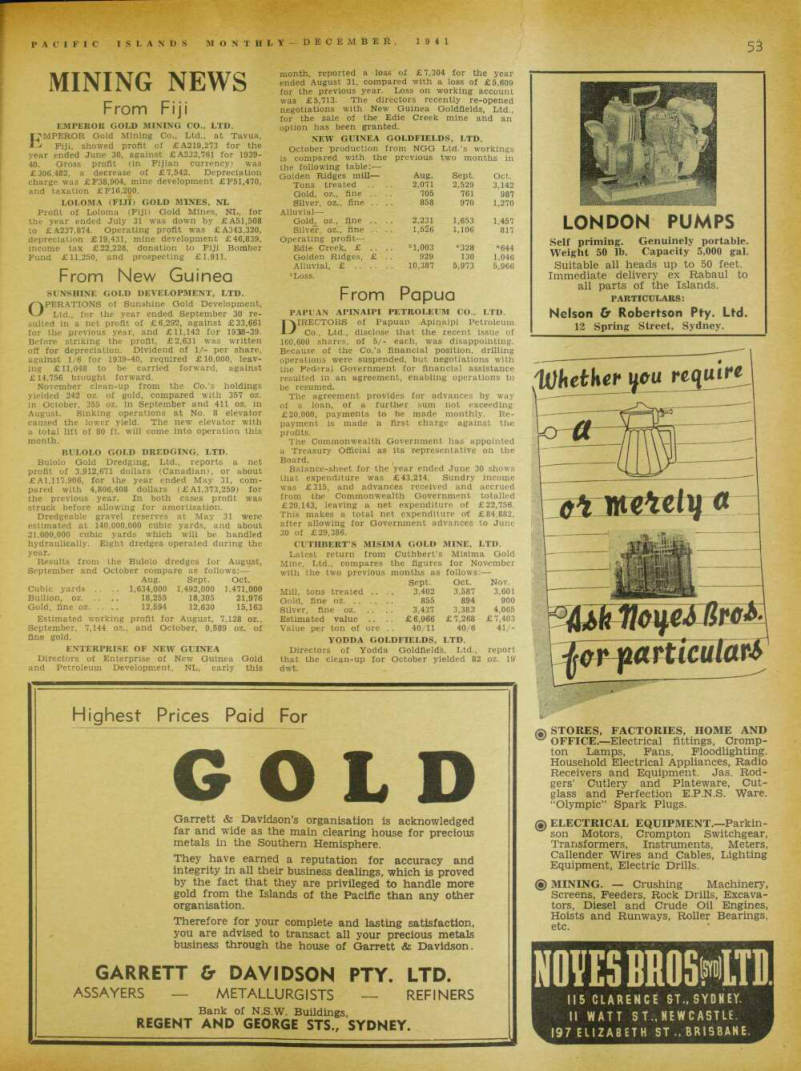
From Fiji
Emperor Gold Mining Co., Ltd.
E EMPEROR Gold Mining Co., Ltd., at Tavua, J Fiji, showed profit of £A219,273 for the year ended June 30, against £A232,761 for 1939- 40. Gross profit (in Fijian currency) was £306,482, a decrease of £7,542. Depreciation charge was £F38,904, mine development £F51,470, and taxation £F16,200.
Loloma (Fiji) Gold Mines, Nl
Profit of Loloma (Fiji) Gold Mines, NL, for the year ended July 31 was down by £A51,508 to £ A 237.874. Operating profit was £A343,320, depreciation £19,431, mine development £46,839, income tax £22,228, donation to Fiji Bomber Fund £11,250, and prospecting £1,911.
From New Guinea
Sunshine Gold Development, Ltd.
OPERATIONS of Sunshine Gold Development, Ltd., for the year ended September 30 re sulted in a net profit of £6,292, against £33,661 for the previous year, and £11,142 for 1938-39.
Before striking the profit, £2,631 was written off for depreciation. Dividend of 1/- per share, against 1/6 for 1939-40, required £lO,OOO, leav ing £11,048 to be carried forward, against £ 14,756 brought forward.
November clean-up from the Co.’s holdings yielded 242 oz. of gold, compared with 357 oz. in October, 355 oz. in September and 411 oz. in August. Sinking operations at No. 8 elevator caused the lower yield. The new elevator with a total lift of 80 ft. will come Into operation this month.
Bulolo Gold Dredging, Ltd.
Bulolo Gold Dredging, Ltd., reports a net profit of 3,912,671 dollars (Canadian), or about £ A 1,117,906, for the year ended May 31, com pared with 4,806,408 dollars (£ A 1,373,259) for the previous year. In both cases profit was struck before allowing for amortisation.
Dredgeable gravel reserves at May 31 were estimated at 140,000,000 cubic yards, and about 21,000,000 cubic yards which will be handled hydraulically. Eight dredges operated during the year.
Results from the Bulolo dredges for August, September and October compare as follows:
Estimated working profit for August, 7,128 oz., September, 7,144 oz., and October, 9,589 oz. of fine gold.
Enterprise Of New Guinea
Directors of Enterprise of New Guinea Gold and Petroleum Development, NL, early this
month, reported a loss of £7,304 for the year ended August 31, compared with a loss of £5,609 for the previous year. Loss on working account was £5,713. The directors recently re-opened negotiations with New Guinea Goldfields, Ltd., for the sale of the Edie Creek mine and an option has been granted.
New Guinea Goldfields, Ltd.
October "production from NGG Ltd.’s workings is compared with the previous two months in the following table; —
From Papua
Papuan Apinaipi Petroleum Co., Ltd.
DIRECTORS of Papuan Apinaipi Petroleum Co., Ltd., disclose that the recent issue of 160,600 shares, of 5/- each, was disappointing.
Because of the Co.’s financial position, drilling operations were suspended, but negotiations with the Federal Government for financial assistance resulted in an agreement, enabling operations to be resumed.
The agreement provides for advances by way of a loan, of a further sum not exceeding £20,000, payments to be made monthly. Re payment is made a first charge against the profits.
The Commonwealth Government has appointed a Treasury Official as its representative on the Board.
Balance-sheet for the year ended June 30 shows that expenditure was £43,214. Sundry Income was £315, and advances received and accrued from the Commonwealth Government totalled £20,143, leaving a net expenditure of £22,756.
This makes a total net expenditure of £84,882, after allowing for Government advances to June 30 of £29,386.
Cuthbert’S Misima Gold Mine. Ltd.
Latest return from Cuthbert’s Misima Gold Mine, Ltd., compares the figures for November with the two previous months as follows: —
Yodda Goldfields, Ltd.
Directors of Yodda Goldfields, Ltd., report that the clean-up for October yielded 82 oz. 19' dwt.
Aug. Sept. Oct.
Cubic yards .. .. 1,634,000 1,492,000 1,471,000 Bullion, oz 18,255 18,305 21,976 Gold, fine oz 12,594 12,630 15,163
Golden Ridges mill— Aug. Sept. Oct.
Tons treated . . . . 2,071 2,529 3,142 Gold, oz., fine ... 705 761 987 Silver, oz., fine . . . . 858 970 1,270 Alluvial — Gold, oz., fine .. .. 2,231 1,653 1,457 Silver, oz., fine .. .. 1,526 1,106 817 Operating profit— Edie Creek, £ . . .. *1,003 *328 *644 Golden Ridges, £ . . 929 130 1,046 Alluvial, £ 10,387 5,973 5,966 ♦Loss.
Sept.
Oct.
Nov.
Mill, tons treated .. 3,402 3,587 3,601 Gold, fine oz 855 894 900 Silver, fine oz 3,437 3,3831 4,065 Estimated value .. £6,966 £7,268 £7,403 Value per ton of ore .. 40/11 40/6 41/-
Advertisements & other items, pp. 55-56 (2 items)
53
PACIFIC ISLANDS MONTHLt DECEMBER, 1941
Gold
m \
LONDON PUMPS
Self priming. Genuinely portable.
Weight 50 lb. Capacity 5,000 gal.
Suitable all heads up to 50 feet.
Immediate delivery ex Rabaul to all parts of the Islands.
PARTICULARS:
Nelson & Robertson Pty. Ltd. 12 Spring Street, Sydney.
'Whether yw require
a * , J
STORES, FACTORIES, HOME AND
w OFFICE. —Electrical fittings, Crompton Lamps, Fans, Floodlighting.
Household Electrical Appliances, Radio Receivers and Equipment. Jas. Rodgers’ Cutlery and Plateware, Cutglass and Perfection E.P.N.S. Ware.
“Olympic” Spark Plugs.
(g) ELECTRICAL EQUIPMENT.—Parkin-
son Motors, Crompton Switchgear, Transformers, Instruments, Meters, Callender Wires and Cables, Lighting Equipment, Electric Drills. (§) MINING. — Crushing Machinery, Screens, Feeders, Rock Drills, Excavators, Diesel and Crude Oil Engines, Hoists and Runways, Roller Bearings, etc.
NOVESBROMTD
115 CLARENCE ST., SYDNEY.
II WATT ST..NEWCASTLE.
L 197 ELIZABETH ST .. BRISBANE, 1
Highest Prices Paid For
GOLD
Garrett & Davidson’s organisation is acknowledged far and wide as the main clearing house for precious metals in the Southern Hemisphere.
They have earned a reputation for accuracy and integrity in all their business dealings, which is proved by the fact that they are privileged to handle more gold from the Islands of the Pacific than any other organisation.
Therefore for your complete and lasting satisfaction, you are advised to transact all your precious metals business through the house of Garrett & Davidson.
GARRETT & DAVIDSON PTY. LTD.
ASSAYERS METALLURGISTS REFINERS
Bank of N.S.W. Buildings,
REGENT AND GEORGE STS., SYDNEY.
SWEET BREATH
Keep your breath sweet, your teeth sparkling white with 5-in-One Dental Cream. This better toothpaste cleans both natural and artificial teeth perfectly. It simply floats stains and film away.
Ask for 5-in-One—the r • • large 2/- tube now riVC'ltl-Olie w“ y 1/6 every - DENTAL CREAM
SURE , SAFE WAY TO
Take mcmim
mm (omm/
When you take Genuine Vincent’s A.P.C. Powders or Tablets you are taking the original, scientific prescription of Aspirin, Phenacetin and Caffeine as first used in one of Australia’s largest public hospitals. That is why you can be so confident of safer, more soothing relief from the pain of all tropical complaints.
Does Not Affect the Heart.
Powders & Tablets, 1/6 and 2/6.
Singles, 2d. ea.
FOR SAFETY’S SAKE—SAY “VINCENT’S.”
Papeete's Municipal Councillors
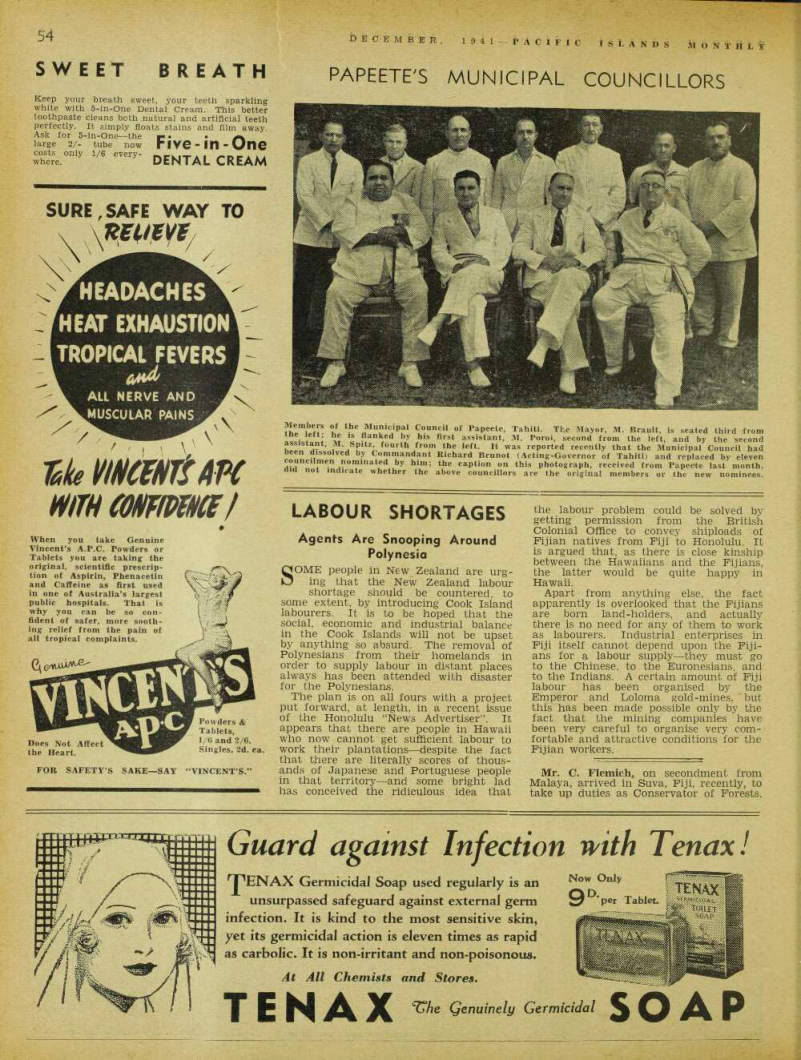
Members of the Municipal Council of Papeete, Tahiti. The Mayor, M. Brault, is seated third from the left; he is flanked by his first assistant, M. Poroi, second from the left, and by the second assistant, M. Spitz, fourth from the left - It was reported recently that the Municipal Council had been dissolved by Commandant Richard Brunot (Acting-Governor of Tahiti) and replaced by eleven councilmen nominated by him; the caption on this photograph, received from Papeete last month, did not indicate whether the above councillors are the original members or the new nominees.
Labour Shortages
Agents Are Snooping Around Polynesia
SOME people in New Zealand are urg ing that the New Zealand labour shortage should be countered, to some extent, by introducing Cook Island labourers. It is to be hoped that the social, economic and industrial balance in the Cook Islands will not be upset by anything so absurd. The removal of Polynesians from their homelands in order to supply labour in distant places always has been attended with disaster for the Polynesians.
The plan is on all fours with a project put forward, at length, in a recent issue of the Honolulu “News Advertiser”. It appears that there are people in Hawaii who now cannot get sufficient labour to work their plantations—despite the fact that there are literally scores of thous ands of Japanese and Portuguese people in that territory—and some bright lad has conceived the ridiculous idea that
fche la bour problem could be solved by getting permission from the British Colonial Office to convey shiploads of Fijian natives from Fiji to Honolulu. It * s ar S ue d that, as there is close kinship between the Hawaiians and the Fijians, the latter would be quite happy in Hawaii.
Apart from anything else, the fact apparently is overlooked that the Fijians are born land-holders, and actually there is no need for any of them to work as labourers. Industrial enterprises in Fiji itself cannot depend upon the Fiji ans for a labour supply—they must go to the Chinese, to the Euronesians, and to the Indians. A certain amount of Fiji labour has been organised by the Emperor and Loloma gold-mines, but this has been made possible only by the fact that the mining companies have been very careful to organise very com fortable and attractive conditions for the Fijian workers, -- - ■ Mr. C. Flemich, on secondment from Malaya, arrived in Suva, Fiji, recently, to take up duties as Conservator of Forests.
Advertisements & other items, p. 56 (1 item)
Guard against Infection with Tenaxl
// 4-fflTN O J I Germicidal Soap used regularly is an unsurpassed safeguard against external germ infection. It is kind to the most sensitive skin, \ m - • yet its germicidal action is eleven times as rapid as carbolic. It is non-irritant and non-poisonous.
At All Chemists and Stores, ry ‘per Tablet. w Tmrr
TENAX Tthe Qenuinely Germicidal SOAP
Culture

Research in Tonga Culture
THE Bishop Museum, Hawaii, has had Tonga in view, for research, for some time, and, but for the war, the Director, Professor Peter H. Buck (Te Rangi Hiroa) would have spent some months there this year.
In a letter to the secretary of the Pacific Islands Society, Sydney (Mr. Eric Ramsden), wherein he expressed his deep regret at the passing of his old friend, Prince Tugi (Premier of Tonga), Professor Buck stated that he had been reading a manuscript on the material culture of Tonga by McKern, with a view to its publication by the Museum as a special bulletin. McKern and Gifford (the latter is well known for his pub lication on Tonga) were members of the Bayard Dominick Expedition which visited Tonga in 1920, oh behalf of the Bishop Museum.
Gifford completed his work and it was duly published. McKern had specialised in archaeology and material culture. The first section was finished, but it was not until this year that the second portion of his work came into the hands of the Museum. At one time, Dr. Buck thought of collaborating with this subject, but that intention had to be abandoned. “I had the idea”, he writes, “of going to Tonga and filling in the missing parts, particularly as I had collected much in formation from objects in European and American museums. The Tongans had much richer material in mats, baskets, pillows, etc., than Samoa, and I wanted to get such additional details as might be possible in the field on technique.”
Some of the baskets that he had seen in Vienna and Berne were collected by Cook and Webber.
However, the McKern manuscript has now been completed in detail, and, with the help of revision by Dr. Buck on the parts relating to houses and textiles (con cerning which he is an acknowledged authority), it is hoped to publish it in due course. “There is still enough for me to clear up, later, as the Tonga, Samoa, and Fiji area have so much in common in their arts and crafts,” he says, “that the whole subject requires a comparative
study.”
E. R.
They May Not Search for Oil in
N. Guinea
MANY people with interests in New Guinea have expressed irritation with the Australian Government’s decision that no more permits are to be given to expeditions to go into “uncon trolled” country in search of oil—although certain expeditions are eager to go, and it is believed that there are good prospects of an oilfield on the northern sides of the dividing range. The reason officially given for the refusal is difficulty in find ing enough patrol officers to accompany such expeditions.
Critics urge that the fact of the war should be sufficient to justify special means being taken to encourage the search for oil, which is vital to the Empire’s war effort.
The excuse in relation to shortage of patrol officers is regarded as shilly shallying. There are many trustworthy prospectors, with a wide knowledge of Territory conditions, who are as capable of maintaining good relations with the natives as the average patrol officer. Pro tection of native interests must always be a paramount consideration in New Guinea administration; but a short-sighted offi cialdom can easily allow the thing to get out of focus.
Mr. N. E. Nilsen, general manager of Lcloma Gold Mines NL, of Tavua, ar rived in Sydney from Suva in November, with Mrs. Nilsen.
Advertisements & other items, pp. 57-58 (4 items)
55
1* AC m C ISLANDS MOfiT H L t DECEMBER, 1941
Wet Or Dry
The “ Serviceable”
COTTON WATCH BAND
for ladies' and gent's watches
• WASHABLE
• DURABLE
• DRESSY
Assorted colours. A size to fit every watch.
Special shades to suit the Fighting Services.
ASK YOUR LOCAL
STOREKEEPER
Wholesale only from —
Serviceable Watch
Band Co.
27 PRINCE ALBERT STREET,
MOSMAN, N.S.W.
•p
JANTZEN
WET or DRY
you're loveliest
in your Jantzen
Always remember this. Each Jantzen owes its beauty to its fabric, its figure control, its stunning simplicity of line.
Not for Jantzen those fussy folderols and gadgets that disguise hurried workmanship—wilt when wet. That’s why, when you wear a Jantzen, you can take as much time to walk up from the water as you do to enter it.
Wet or dry, you’re loveliest in your Jantzen.
Illustrated. The “Flair”.
Tailored from J antzen’s Satin-Knit fabric (“Lastex” yarn and acetate rayon) and printed with Polka Dots.
LEARN MORSE CODE. “LIKE-A-
FLASH” KITS. KEYS & BUZZERS.
P.M.G. type Key with Professional Buzzer &. Battery, all assembled on Base Board, 42/6.
Kl ///,
STt;
■y Morse Set Buzzer or light with single switch. All parts include adjustable Key, Switch, Buzzer, Lamp and Battery, all assembled on Base Board, 30/-.
Morse Code Set “De Luxe”. Adjustable High-grade Key, Buzzer and Battery. All mounted on base board ready for use, 27/6. \\l/y Adjustable Morse Code Key on Bakellte Base, highly plated parts, 12/6. High-grade instrument. 39/6
ngo
Em Morse Code Light and Buzzer Set.
A precision De-luxe outfit that cannot be bettered. Perfect Adjustable Morse Code Key, with professional type Buzzer. Light to Buzzer throw-over Switch, and Battery, all ready mounted.
Rubber Water Goggles, snug fit for under or over water wear, 11/6 English make, 16/6.
RADIO VALVES.—We guarantee a Better Price. Send your order
ALL DRY BATTERIES STOCKED.
LEVENSON'S
SPECIALISE IN RADIO
SETS FOR THE ISLANDS
TRADE
100% satisfaction guaranteed.
Liberal prices—no mass production sets real he-man radio designed and built for your particular location. Short wave and dual wave radio for dry battery or electric current operation.
Microphones for Song or Music. Hook-up in a Jiffy to any set. 15/-, 17/6, 18/6 complete.
Batteryless Type Hand - holding Microphones, fit any set, 25/-.
Ormond 3 In. Front-panel Vernier Dial, 2 actions, 8/6.
Make your safety razor blade last for months with this Razor Blade Sharpener, 3/6. Easy to use—nothing to get out of order.
BOOKS! BOOKS! BOOKS! The Be-
sinners’ Book of Radio. The Radio Beginners’ Dictionary. 2/- the 2. The Wireless Constructor's Encyclopaedia. Giant size, 7/6. Newnes “Everyman’s” Wireless Book, 6/6.
The Book of Practical Radio, also The Book of Practical Television, 8/6 each. Levenson’s Giant “Party and Fun Book”, 1/6, Humorous Stories and Recitation, 3/9. Card and Conjuring Tricks, 3/9. Tea-Cup Fortune Telling, 8/9. 100 Party Games for Old and Young, 1/9.
Popular Magic and Amateur Conjurer, 1/9. 50 Best Party Games, 1/6. Tricks with Cards, 1/6.
How to make 1 & 2 valve Battery Sets, 1/-.
New Radio and Other Books Just Landed. Everyman’s Wireless Book, 8/6; Toy Making for Amateurs, 2/-; Sixty Tested Circuits, 6/6; How to Make Models, 2/6; The First Course in Wireless, 9/6; Wireless Terms Explained, 6/6. 12 Snappy Books —Jokes, Have Fun, etc., 5/6 the lot.
All About Aerial Booklet, 1-/. Radio Dictionary, 1/-. Morse Code Book, 1/-. Radio Alphabet, 1/-. The 4 books for 3/3.
Roulette Wheels, complete, 25/-.
Dice of all kinds in stock. Poker Dice, 6/6, 7/6, 8/6, 10/6, set of 5.
Crown & Anchor Dice, set of 3, 5/6.
Full Set with Cloth and Shaker, 10/6. H. & T., 5 & 6, and Hazard Dice Stocked.
Glass Insulators, Pyrex, 1/-, 6/6; and extra large transmitting type, 30/- each.
The Best Trick Pack of Cards available, 3/6. Hundreds of Tricks you can do. Fullest, simple instructions provided.
Now available (not less than 10/parcels); Magic Wand, 1/6 Jafet’s Wallet 1/-; Obedient Ball 1/6; Magic Penny, 2/6; Mystic Head Chopper, 2/6; Shy Lock, 2/-; Dribble Glass, 2/-: Ventrillo, 1/-; Magic Coin, 1/-; Nest of Nests, 5/-; Voice Echoer, 1/-; Magic Bottle, 1/-; 3 Bell Trick, 1/-.
Magic Wand 1/6; Wonderful Rattle Box Trick, 2/6. Mixed Parcels of Tricks, 10/-, 20/-, 30/-, 40/-, 50/-.
Parcel of Jokes, 10/-, 12/6, 15/-.
SAFETY RAZOR
BLADE
SHARPENER
WORLD'S LATEST
GAMES
Darts Boards with 6 Darts, 8/6.
Play Brass Competition Darts, Set of 3, 3/11, 4/6, 5/6. Monopoly, 11/6.
Totopoly, n/6. Bucaneer, 11/6. 3 of the World’s Most Popular Games.
Chinese Checkers, 2/9, 5/-, 9/-.
Tripoly Card Game , 5/3. De Luxe Type, 11/6. Poker Rummy, l/i.
HEADPHONES.
12/6, 17/6.
S.T.C., British, 30/-; 8.T.H., 30/-; Lissen, British, 19/6. All 4,000 ohms.
Rubber Head-’phone Pads, 2/6 pr.
Ericcson’s Professional Type, 47/6. m A new hobby—Rough Castings of Modern Planes, Ash Trays, Paper Knives, etc., etc. Write for Free Booklet.
B.G.E. Table Model Microphone for Speech or Music—fits and suits ali sets; as good a performer as any £6/6/- Model. Now 45/-.
Small Table Model British Built Microphone, for all sets, 15/-, 21/-, 22/6, for speech or music. 2 Reading Pocket Volt Meters, 5/6.
Portable battery operated Light with pull switch and Battery Block, 8/6. 4r"“ Gramophone Pick-ups. Fit and suit all radios. “Collard” 50/-, “Cosmocord” 35/-, “Like-a-Plash” 30/-. All complete with leads.
Tone and volume control. Crystal Types 49/6 and 50/-. All British makes. »o'6
Ift
*. {Radio ■
ftLNDftoOK
RADIO
Just arrived. The most outstanding Radio Publication for amateur or professional alike. Everything you want to know in Radio, properly illustrated.
Electric Bell Outfits. Bells made in England, 5/6, 6/6, 7/6, 8/6. Bell Wire, 1/6 doz. yards. Bell Pushes, 1/-, 1/6 each. Dry Batteries, 2/9.
Aerial Stay-wire strainers, 2/6.
De Luxe Model Brltlsh-built Lightning Arresters, complete for Indoor or outdoor use, 6/-.
Non-Jam Pulleys with halyard bolt, 1/9. Special Radio Earth Spike 4/6. 4 in. 4 in 1 Nickel Screw Drivers, bakelite or metal, 2/-. , Fountain Pen size. Cone Speaker Units, 25/-; Now 12/6. 1,500 ft. Beam Electric Torches, 5 Cell, 8/6. Both use Standard Batteries. Everyman’s Wireless Book, 8/6. Bakelite Pocket Torch, 5/-. 2 to 3 Cell Expandable Torches.
Nickelled Case —Dimmer incorporated.
Daylight Globes, 10/6.
Swiss Music Boxes for Cigarette, Trinkets, etc., 25/-, 30/-. 45/-.
Steel Money and Deed Boxes, 63/-.
They ring when opened or lifted.
A Splendid Article.
Wet Battery Testers, 3/-.
Nickel Cased Volt Meters, Pocket Type, 2 Reading, High & Low, 4/6.
British Make 3 Readings, 10/6.
Bench I Reads Type All in Meter Radio, I 30/-.
POCKET VOLT
METERS.
Two Reading Pocket Meter, for A and B Batteries, S/9, 4/9, 7/6 3 Reading, A and B Batteries, and up to 30 M/A, 10/6. 3 Reading De Luxe Model, 12/6. 4 Reading, 14/-.
Sheffield Sheath or Bushman’s Knives with leather sheaths, 8/6.
Midget Throwing Knives, made in Sheffield, perfectly balanced, unbreakable handles, 7/6 each. 15/the pair. Set of 3, 21/-. All in sheaths.
Remington, U.S.A., made, Hunting and Sports Knife, in Leather Sheath, 12/6. Others 15/-, 18/6.
Best Stainless Pocket Knife, 6/6.
Leather Money Belts, Splendid quality. Give waist measurement, when ordering, 9/6, 11/6 each.
iiinnrnfnnnmni
Write for Punch Board Leaflets
nnnmniiniinnn
Cable address: “Leveradioh”. Goods forwarded V.P.P. or Sight Draft. Satisfaction and Service Guaranteed. We can supply by mall all General Merchandise at a Better Price. Quotations with pleasure. Please add freight and packing. Write for full list of interesting leaflets of Games, Hobbles, Novelties, and Eleetrleal Goods. Write for full list of Radio Meters.
J.LEVENSON Radio
GAMES, NOVELTIES AND HOBBIES.
226 A PITT STREET, SYDNEY
Manufacturers, Importers, and Exporters.
N.S.W., AUSTRALIA.
iiinniiiiiiniiiiiiiiiii Write for Pin-Game, Totem and other Leaflets.
iiiiiiniiiiiinnnniß
We Can Supply, at a Keen Price, Any Available Article You Require.
Flabby Fat
Unhealthy with
GOOD LOOKS AND FIGURE
VANISH
You can always tell the difference between good firm flesh and flabby fat.
There is always something so unhealthy and unattractive looking about fat. It is usually unhealthy and often gained through constipation. Waste matter clogs and congests the digestive tract, remains too long and gets absorbed into the blood stream. Sick headaches, pimply skin, biliousness, bad breath result and fat tissue forms, hiding your good looks and fine figure.
Constipation always responds to treatment with gentle Pinkettes. These tiny laxative pills are compounded of safe ingredients that have an exercising and strengthening influence on the bowels.
Pinkettes painlessly clear away the digestive wastes completely and regularly, help digestion and banish sick headache, bilious attacks, pimples and unhealthy fat. Get a bottle to-day and notice how fine and fit you feel after a few harmless doses.—
56
DECEMBER, 1941-PACIPIC ISLANDS MONTHLY
Broadcast
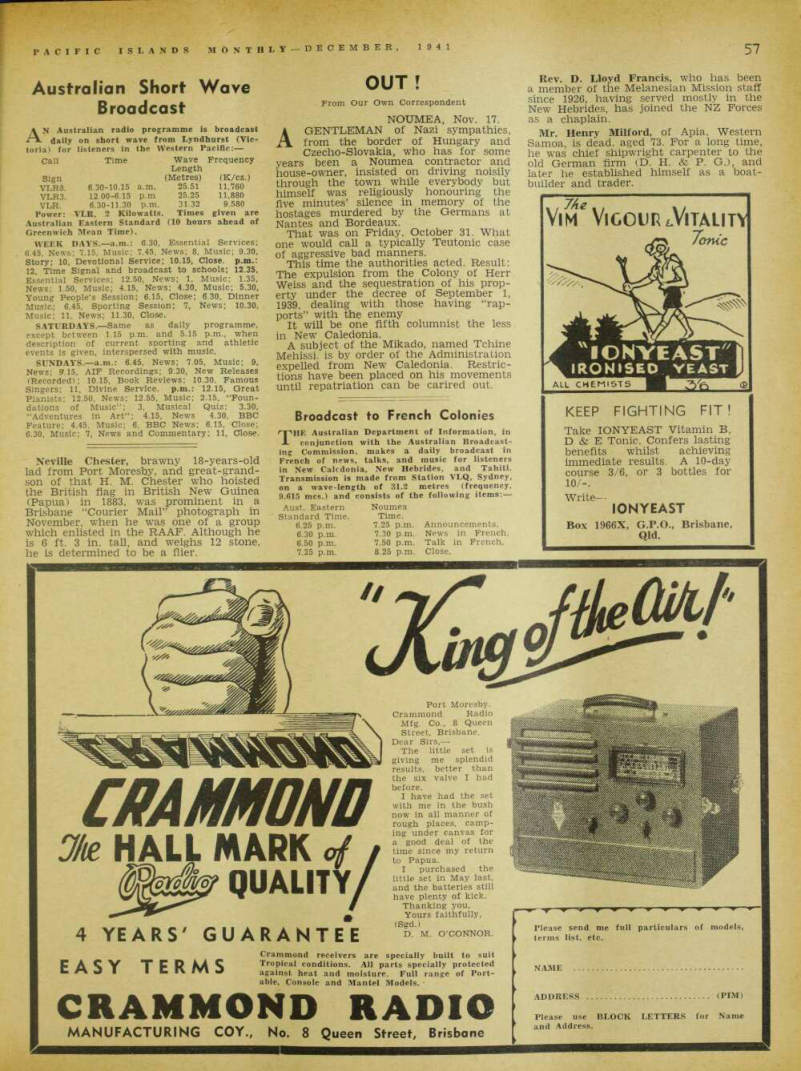
Australian Short Wave Broadcast
AN Australian radio programme is broadcast daily on short wave from Lyndhurst (Vic toria) for listeners in the Western Pacific:—
Power: VLR, 2 Kilowatts. Times given are Australian Eastern Standard (10 hours ahead of Greenwich Mean Time).
WEEK DAYS.—a.m.: 6.30, Essential Services: 6.45, News; 7.15, Music; 7.45, News; 8, Music; 9.30, Story; 10, Devotional Service; 10.15, Close, p.m.; 12, Time Signal and broadcast to schools; 12.35, Essential Services; 12.50, News; 1, Music; 1.35, News: 1.50, Music; 4.15, News; 4.30, Music; 5.30, Young People’s Session; 6.15, Close; 6.30, Dinner Music.; 6.45, Sporting Session; 7, News; 10.30, Music; 11, News; 11.30, Close.
SATURDAYS.—Same as daily programme, except between 1.15 p.m. and 5.15 p.m., when description of current sporting and athletic events is given, interspersed with music.
SUNDAYS.—a.m.: 6.45, News; 7.05, Music; 9, News; 9.15, AIF Recordings; 9.30, New Releases (Recorded); 10.15, Book Reviews; 10.30. Famous Singers: 11, Divine Service, p.m.: 12.15, Great Pianists; 12.50, News; 12.55, Music; 2.15, “Foun dations of Music”: 3, Musical Quiz; 3.30, “Adventures in Art”; 4.15, News 4.30, BBC Feature: 4.45. Music; 6, BBC News; 6.15, Close; 6.30, Music; 7, News and Commentary; 11, Close.
Neville Chester, brawny 18-years-old
lad from Port Moresby, and great-grand son of that H. M. Chester who hoisted the British flag in British New Guinea (Papua) in 1883, was prominent in a Brisbane “Courier Mail” photograph in November, when he was one of a group which enlisted in the RAAF. Although he is 6 ft. 3 in. tall, and weighs 12 stone, he is determined to be a flier.
Call Time Wave Frequency Length Sign (Metres) (K/cs.)
Vlr3.
6.30-10.15 a.m. 25.51 11,760
Vlr3.
12.00-6.15 p.m 25.25 11,880
Vlr.
6.30-11.30 p.m. 31.32 9,580
Out !
From Our Own Correspondent
Noumea, Nov. 17.
A GENTLEMAN of Nazi sympathies, from the border of Hungary and Czecho-Slovakia, who has for some years been a Noumea contractor and house-owner, insisted on driving noisily through the town while everybody but himself was religiously honouring the five minutes’ silence in memory of the hostages murdered by the Germans at Nantes and Bordeaux.
That was on Friday, October 31. What one would call a typically Teutonic case of aggressive bad manners.
This time the authorities acted. Result; The expulsion from the Colony of Herr Weiss and the sequestration of his prop erty under the decree of September 1, 1939, dealing with those having “rap ports” with the enemy It will be one fifth columnist the less in New Caledonia.
A subject of the Mikado, named Tchine Mehissi. is by order of the Administration expelled from New Caledonia. Restric tions have been placed on his movements until repatriation can be carired out.
Broadcast to French Colonies
THE Australian Department of Information, in conjunction with the Australian Broadcast ing Commission, makes a daily broadcast in French of news, talks, and music for listeners in New Caledonia, New Hebrides, and Tahiti.
Transmission is made from Station VLQ, Sydney, on a wave-length of 31.2 metres (frequency, 9.615 mcs.) and consists of the following items:—
Rev. D. Lloyd Francis, who has been a member of the Melanesian Mission staff since 1926, having served mostly in the New Hebrides, has joined the NZ Forces as a chaplain.
Mr. Henry Milford, of Apia, Western Samoa, is dead, aged 73. For a long time, he was chief shipwright carpenter to the old German firm (D. H. & P. G.) and later he established himself as a boat builder and trader.
Aust. Eastern Noumea Standard Time.
Time. 6.25 p.m. 7.25 p.m.
Announcements. 6.30 p.m. 7.30 p.m.
News in French. 6.50 p.m. 7.50 p.m.
Talk in French. 7.25 p.m. 8.25 p.m.
Close.
Advertisements & other items, pp. 59-60 (1 item)
Crammond
Vim* Vigour
Tcmic
ALL CHEMISTS
KEEP FIGHTING FIT!
Take lON YE AST Vitamin B, D & E Tonic. Confers lasting benefits whilst achieving immediate results. A 10-day course 3/6, or 3 bottles for 10/-.
Write--
lONYEAST
Box 1966 X, G.P.0., Brisbane, Qld.
CRAMMOND
Ok HALL MARK J
m
QUALITY
4 YEARS' GUARANTEE
Port Moresby.
Crammond Radio Mfg. Co., 8 Queen Street, Brisbane.
Dear Sirs, — The little set is giving me splendid results, better than the six valve I had before.
I have had the set with me in the bush now in all manner of rough places, camping under canvas for a good deal of the time since my return to Papua.
I purchased the little set in May last, and the batteries still have plenty of kick.
Thanking you, Yours faithfully, (Sgd.)
D. M. O’CONNOR.
EASY TERMS
Crammond receivers are specially built to suit Tropical conditions. All parts specially protected against heat and moisture. Full range of Portable, Console and Mantel Models.
CRAMMOND RADIO
MANUFACTURING COY., No. 8 Queen Street, Brisbane Please send me full particulars of models, terms list, etc.
NAME
ADDRESS
(PIM)
Please use BLOCK LETTERS for Name and Address.
!k Protect your business and personal interests: by installing Teleradio 3B Radio-Telephone communication apparatus. . . . Instantaneous contact with the outside world has become a necessity in households beyond the reach oi landlines . . , not only to expedite business transactions but to provide a means ot acquiring medical or other service in time? ot emergency.
TELERADIO 3B
A.W.A. Radio Stations at Suva, Rabauf, Pt.
Moresby and other Island Centres will be glad to supply information on this equipment.
AMALGAMATED WIRELESS (A'SIA) LIMITED
47 YORK STREET, SYDNEY, AUSTRALIA
Islands Produce
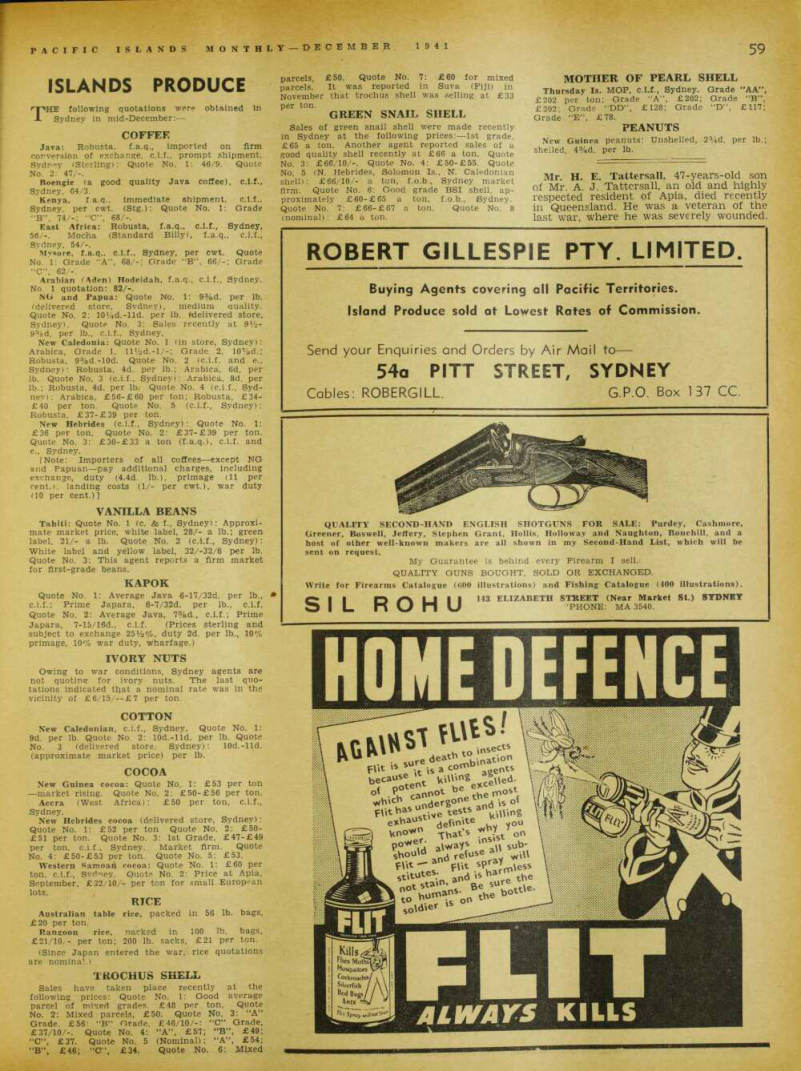
THE following quotations were obtained in Sydney in mid-December: —
Coffee
Java: Robusta. f.a.q., imported on firm conversion of exchange, c.i.f., prompt shipment, Sydney (Sterling): Quote No. 1: 46/9. Quote No. 2; 47/-.
Boengie (a good quality Java coffee), c.1.f., Sydney. 64/3.
Kenya, f.a.q.. immediate shipment, c.1.f..
Sydney, per cwt. (Stg.): Quote No. 1: Grade “B”, 74/-; “C”, 68/-.
East Africa: Robusta, f.a.q., c.1.f., Sydney, 56/-. Mocha (Standard Billy), f.a.q., c.i.f., Sydney, 54/-.
Mysore, f.a.q.. c.1.f., Sydney, per cwt. Quote No. 1: Grade “A”, 68/-; Grade “B”, 66/-; Grade “C”, 62/-.
Arabian (Aden) Hodeidah, f.a.q., c.i.f., Sydney.
No. 1 quotation: 82/-.
NG and Papua: Quote No. 1: 9%d. per lb. (delivered store, Sydney), medium Quality.
Quote No. 2: KUAd.-lld. per lb. delivered store, Sydney). Quote No. 3: Sales recently at 9V 2 - 9 5/ Rd. per lb., c.i.f., Sydney.
New Caledonia: Quote No. 1 (in store, Sydney); Arabica, Grade 1, HVsjd.-l/-; Grade 2, 10 7 /sd.; Robusta, 9 3 /sd.-10d. Quote No. 2 (c.i.f. and e., Sydney): Robusta, 4d. per lb.; Arabica, 6d. per lb. Quote No. 3 (c.i.f., Sydneyi: Arabica, Bd. per lb.; Robusta, 4d. per lb. Quote No. 4 (c.i.f., Syd ney); Arabica, £56-£6O per ton; Robusta, £34- £4O per ton. Quote No. 5 (c.i.f., Sydney): Robusta, £37-£39 per ton.
New Hebrides (c.i.f., Sydney); Quote No. 1: £36 per ton. Quote No. 2: £37-£39 per ton.
Quote No. 3: £3O-£33 a ton (f.a.q.), c.i.f. and e., Sydney. [Note: Importers of all coffees—except NG and Papuan—pay additional charges, including exchange, duty (4.4 d. lb.), primage (11 per cent.i. landing costs (1/- per cwt.), war duty (10 per cent.)]
Vanilla Beans
Tahiti: Quote No. 1 (c. & f., Sydney): Approxi mate market price, white label, 28/- a lb.; green label. 21/- a lb. Quote No. 2 (c.i.f., Sydney): White label and yellow label, 32/-32/6 p«r lb.
Quote No. 3: This agent reports a firm market for first-grade beans.
Kapok
Quote No. 1: Average Java 6-17/32d. per lb., c.i.f.; Prime Japara, 6-7/32d. per lb., c.i.f.
Quote No. 2: Average Java, 7%d., c.i.f.; Prime Japara, 7-15/16d., c.i.f. (Prices sterling and subject to exchange 25V 2 %, duty 2d. per lb., 10% primage, 10% war duty, wharfage.)
Ivory Nuts
Owing to war conditions, Sydney agents are not quoting for ivory nuts. The last quo tations indicated tfiat a nominal rate was in the vicinity of £6/15/--£7 per ton.
Cotton
New Caledonian, c.i.f., Sydney. Quote No. 1; 9d. per lb. Quote No. 2: lOd.-lld. per lb. Quote No. 3 (delivered store, Sydney): lOd.-lld. (approximate market price) per lb.
Cocoa
New Guinea cocoa: Quote No. 1: £53 per ton —market rising. Quote No. 2: £5O-£56 per ton.
Accra (West Africa): £5O per ton, c.i.f., Sydney.
New Hebrides cocoa (delivered store, Sydney); Quote No. 1: £52 per ton Quote No. 2: £5O - per ton. Quote No. 3: Ist Grade, £47-£49 per ton. c.i.f., Sydney. Market firm. Quote No. 4: £5O-£53 per ton. Quote No. 5: £53.
Western Samoan cocoa: Quote No. 1: £6O per ton. c.i.f., Quote No. 2: Price at Apia, September, £32/10/- per ton for small European lots.
Rice
Australian table rice, packed in 56 lb. bags, £2O per ton.
Rangoon rice, nacked in 100 lb. bags, £2l/10/- per ton; 200 lb. sacks, £2l per ton. (Since Japan entered the war, rice quotations are nominal.)
Trochus Shell
Sales have taken place recently at the following prices: Quote No. 1: Good average parcel of mixed grades £4B per ton. Quote No. 2: Mixed parcels, £5O. Quote No. 3: “A”
Grade. £56: “B” Grade. £46/10/-: “C” Grade, £37/10/-. Quote No. 4: “A”, £57; “B”. £49; “C”, £37. Quote No. 5 (Nominal): “A”, £54; “B”, £46; “C”, £34. Quote No. 6; Mixed
parcels, £5O. Quote No. 7: £6O for mixed parcels. It was reported in Suva (Fiji) in November that trochus shell was selling at £33 per ton.
Green Snail Shell
Sales of green snail shell were made recently in Sydney at the following prices:—Ist grade, £65 a ton. Another agent reported sales of a good quality shell recently at £66 a ton. Quote No. 3: £66/10/-. Quote No. 4: £5O-£55. Quote No. 5 (N. Hebrides, Solomon Is., N. Caledonian shell): £66/10/- a ton, f.0.b., Sydney market firm. Quote No. 6: Good grade BSI shell, ap proximately £6O-£65 a ton, f.0.b., Sydney.
Quote No. 7: £66-£67 a ton. Quote No. 8 (nominal): £64 a ton.
Mother Of Pearl Shell
Thursday Is. MOP, c.1.f., Sydney. Grade "AA”, £202 per ton; Grade “A”, £202; Grade “B”, £202; Grade “DD”, £128; Grade “D”, £117; Grade “E”, £7B.
Peanuts
New Guinea peanuts: Unshelled, 2%d. per lb.; shelled, 4%d. per lb.
Mr. H. E. Tattersall, 47-years-old son of Mr. A. J. Tattersall, an old and highly respected resident of Apia, died recently in Queensland. He was a veteran of the last war, where he was severely wounded.
Advertisements & other items, p. 61 (1 item)
Home Defence
ROBERT GILLESPIE PTY. LIMITED.
Buying Agents covering all Pacific Territories.
Island Produce sold at Lowest Rates of Commission.
Send your Enquiries and Orders by Air Mail to—
-54a PITT STREET, SYDNEY
Cables: ROBERGILL. G.P.O. Box 137 CC.
QUALITY SECOND-HAND ENGLISH SHOTGUNS FOR SALE: Purdey, Cashmore, Greener, Boswell, Jeffery, Stephen Grant, Hollis, Holloway and Naughton, Bonehill, and a host of other well-known makers are all shown in my Second-Hand List, which will be sent on request.
My Guarantee is behind every Firearm I sell.
QUALITY GUNS BOUGHT, SOLD OR EXCHANGED.
Write for Firearms Catalogue (000 illustrations) and Fishing Catalogue (400 illustrations).
S| 143 ELIZABETH STREET (Near Market St.) SYDNEY L FI U H U PHONE; MA 3540.
HOME DEFENCE
i
fUtS
. to »*' seC death h\nat’»
-JSSSJ»^?S
tssj js: r.i,£
should and rlluse 3 « F«» T* F»>t *P;*'n,>es» sure the k to human 5 - the bo«l • soldier it
Exchange Rates
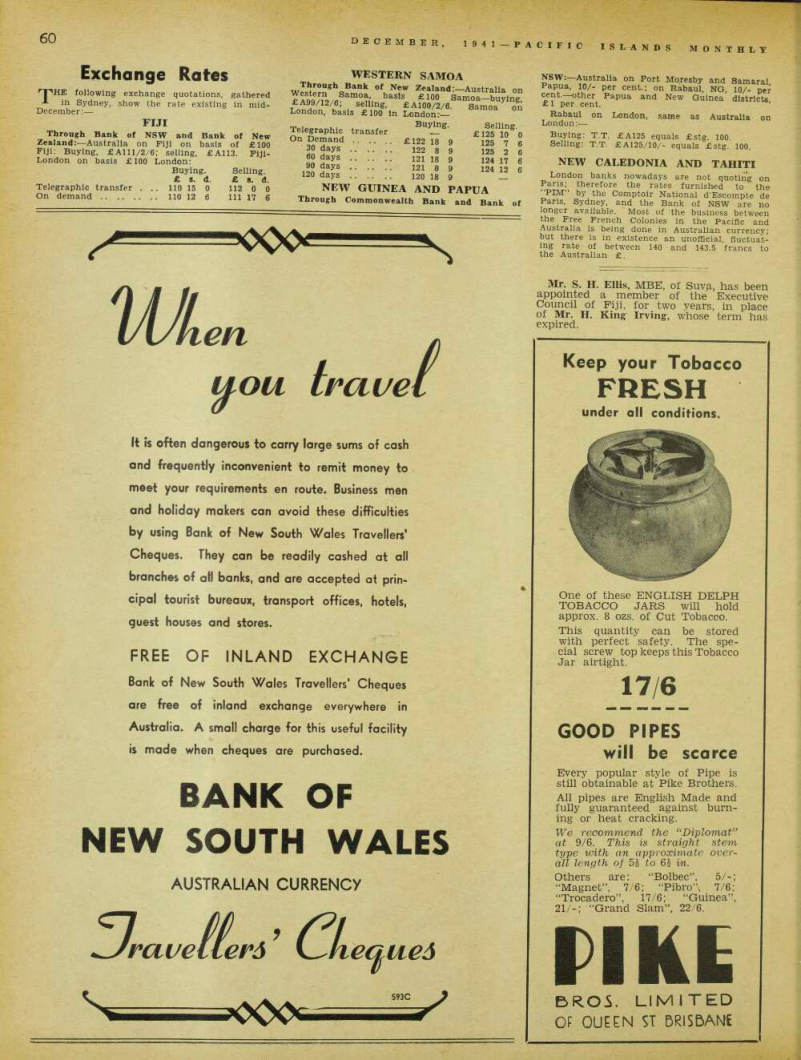
'T'HE following exchange quotations, gathered in Sydney, show the rate existing in mid- December:—
Fiji
Through Bank of NSW and Bank of New Zealand: —Australia on Fiji on basis of £lOO Fiji; Buying, £Alll/2/6; selling, £AII3. Fiji- London on basis £lOO London:
Western Samoa
wSm !k w! 0f K N f w Zea,an d : —Australia on Samoa, basis £lOO Samoa—buying £ A99/12/6; selling, £AIOO/2/6. Samoa Y on London, basis £lOO In London:—
New Guinea And Papua
Through Commonwealth Bank and Bank of
NSW:—Australia on Port Moresby and Samaral Papua, 10/- per cent.; on Rabaul, NG, 10/- per cent.—other Papua and New Guinea districts £1 per cent.
Rabaul on London, same as Australia on London;— Buying: T.T. £AI2S equals £stg. 100.
Selling: T.T. £AI2S/10/- equals £stg. 100.
New Caledonia And Tahiti
London banks nowadays are not quoting on Pans; therefore the rates furnished to the “PIM” by the Comptoir National d’Escompte de Pans, Sydney, and the Bank of NSW are no longer available. Most of the business between the Free French Colonies in the Pacific and Australia is being done in Australian currency; but there is in existence an unofficial, fluctuat ing rate of between 140 and 143.5 francs to the Australian £.
Mr. S. H. Ellis, MBE, of Suv£, has been appointed a member of the Executive Council of Fiji, for two years, in place of Mr. H. King Irving, whose term has
expired.
Buying.
Selling. £ s. d. £ s. d.
Telegraphic transfer . .. 110 15 0 112 0 0 On demand .. 110 12 6 111 17 6
Telegraphic transfer g ' £ 125 ° n H ei ? and £122 18 9 125 7 6 JJ days 122 8 9 125 2 6 days 121 18 9 124 17 6 days 121 8 9 124 12 6 120 days 120 18 9
Advertisements & other items, p. 62 (1 item)
travel
m en
uou
It is often dangerous to carry large sums of cash and frequently inconvenient to remit money to meet your requirements en route. Business men and holiday makers can avoid these difficulties by using Bank of New South Wales Travellers' Cheques. They can be readily cashed at all branches of all banks, and are accepted at principal tourist bureaux, transport offices, hotels, guest houses and stores.
FREE OF INLAND EXCHANGE
Bank of New South Wales Travellers' Cheques are free of inland exchange everywhere in Australia. A small charge for this useful facility is made when cheques are purchased.
BANK OF
NEW SOUTH WALES
AUSTRALIAN CURRENCY
e
chiles
593 C
Keep your Tobacco
FRESH
under all conditions.
One of these ENGLISH DELPH TOBACCO JARS will hold approx. 8 ozs. of Cut Tobacco.
This quantity can be stored with perfect safety. The special screw top keeps this Tobacco Jar airtight. 17/6
GOOD PIPES
will be scarce
Every popular style of Pipe is still obtainable at Pike Brothers.
All pipes are English Made and fully guaranteed against burning or heat cracking.
We recommend the “Diplomat” at 9/6, This is straight stem type with an approximate overall length of 51 to 61 in.
Others are: “Bolbec”, 5/-; “Magnet”, 7/6; “Pibro”, 7/6; “Trocadero”, 17/6; “Guinea”, 21/-; “Grand Slam”, 22/6.
mti
BROS. LIMITED
OF OUECN SI BRISBANE
Market Quotations
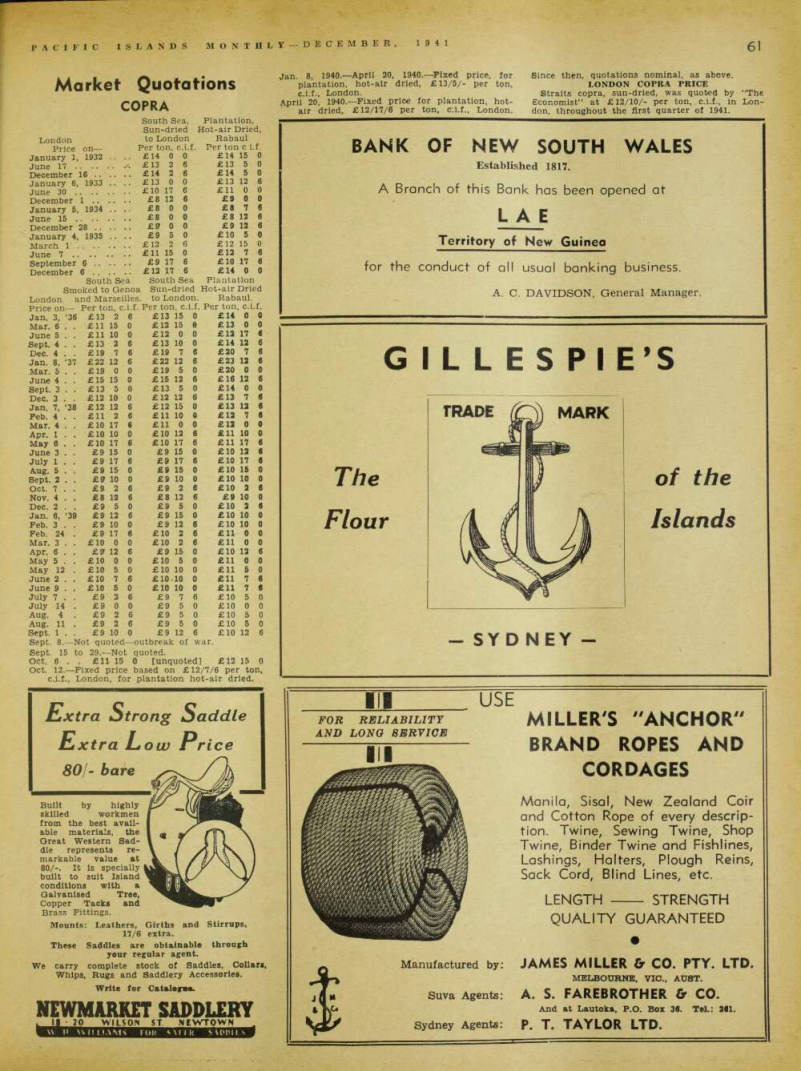
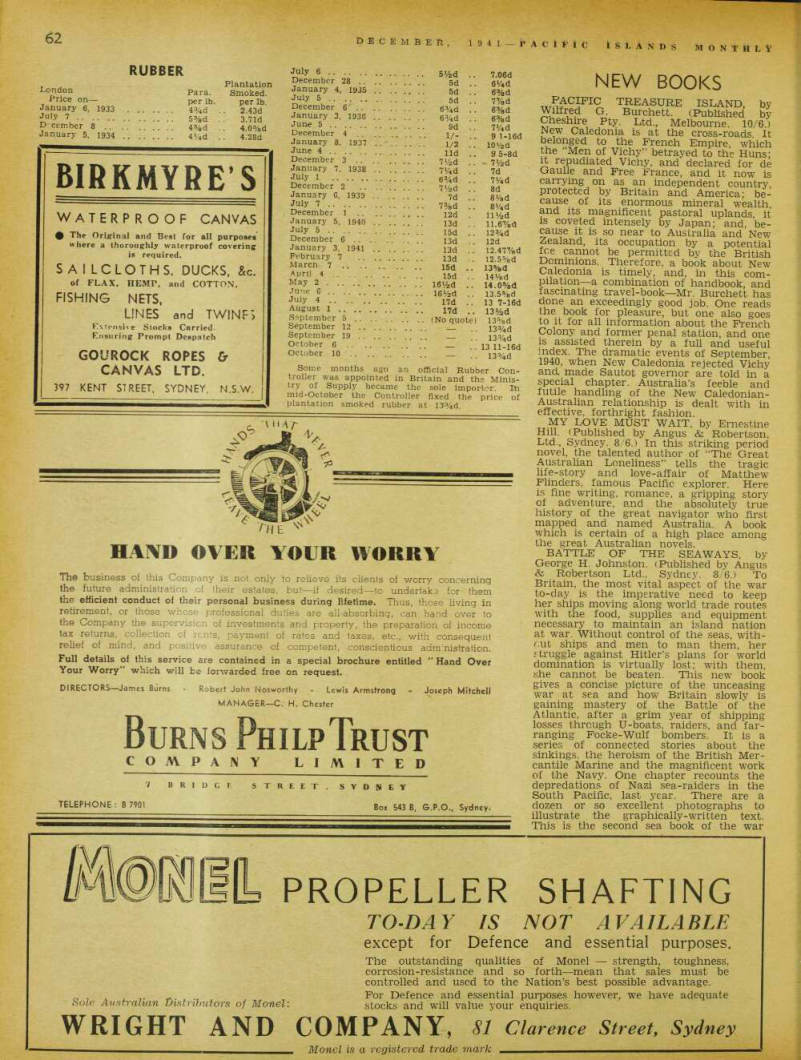
Jan. 8, 1940.—April 20, 1940.—Fixed price, for plantation, hot-air dried, £l3/5/- per ton, c.i.f., London.
April 20. 1940.—Fixed price for plantation, hotair dried, £l2/17/6 per ton, c.i.f., London.
Since then, quotations nominal, as above,
London Copra Price
Straits copra, sun-dried, was quoted by “The Economist” at £l2/10/- per ton, c.i.f., in Lon don, throughout the first quarter of 1941.
Copra
South Sea, Plantation, Sun-dried Hot-air Dried, London to London Rabaul Price on— Per ton, c.i.f.
Per ton c i.f.
January 1 1932 £14 0 0 £14 15 0 June 17 . £13 2 6 £13 5 0 December 16 .. £14 2 6 £14 5 0 January 6, 1933 . . £13 0 0 £13 12 6 June 30 . £10 17 6 £11 0 0 December 1 .. . . . £8 12 6 £9 0 0 January 5 1934 £8 0 0 £8 7 6 June 15 £8 0 0 £8 12 6 December 28 .. £9 0 0 £9 12 6 January 4 1935 , . £9 5 0 £10 5 0 March 1 £12 2 6 £12 15 0 June 7 £11 15 0 £12 7 6 September 6 .. £9 17 6 £10 17 6 December 6 . . £12 17 6 £14 0 0 South Sea South Sea Plantation Smoked to Genoa Sun-dried : Hot-air Dried London and Marseilles, to London.
Rabaul.
Price on— Per ton, c.i.f.
Per ton, c.i.f. Per ton, c.i.f.
Jan. 3, ’36 £13 2 6 £13 15 0 £14 0 0 Mar. 6 . . £11 15 0 £12 15 e £13 0 0 June 5 . . £11 10 0 £12 0 0 £12 17 6 Sept. 4 . . £13 2 6 £13 10 0 £14 12 6 Dec. 4 . . £19 7 6 £19 7 6 £20 7 6 Jan. 8. ’37 £22 12 6 £22 12 6 £23 12 6 Mar. 5 . . £19 0 0 £19 5 0 £20 0 0 June 4 . . £15 15 0 £15 12 6 £16 12 6 Sept. 3 . . £13 5 0 £13 5 0 £14 0 0 Dec. 3 . . £12 10 0 £12 12 6 £13 7 6 Jan. 7. *38 £12 12 6 £12 15 0 £13 12 6 Peb. 4 . . £11 2 6 £11 10 0 £12 7 6 Mar. 4 . . £10 17 6 £11 0 0 £12 0 0 Apr. 1 . . £10 10 0 £10 12 6 £11 10 0 May 6 . . £10 17 6 £10 17 6 £11 17 6 June 3 . . £9 15 0 £9 15 0 £10 12 6 July 1 . . £9 17 6 £9 17 6 £10 17 0 Aug. 5 . . £9 15 0 £9 15 0 £10 IS 0 Sept. 2 . . £9 10 0 £9 10 0 £10 10 0 Oct. 7 . . £9 2 6 £9 2 6 £10 2 6 Nov. 4 . . £8 12 6 £8 12 6 £9 10 0 Dec. 2 . . £9 5 0 £9 5 0 £10 2 6 Jan. 6, ’39 £9 12 6 £9 15 0 £10 10 0 Feb. 3 . . £9 10 0 £9 12 6 £10 10 0 Peb. 24 . £9 17 6 £10 2 6 £11 0 0 Mar. 3 . . £10 0 0 £10 2 6 £11 0 0 Apr. 6 . . £9 12 6 £9 15 0 £10 12 6 May 5 . . £10 0 0 £10 5 0 £11 0 0 May 12 . £10 5 0 £10 10 0 £11 5 0 June 2 . . £10 7 6 £10 10 0 £11 7 6 June 9 . . £10 5 0 £10 10 0 £11 7 6 July 7 . . £9 2 6 £9 7 6 £10 5 0 July 14 . £9 0 0 £9 5 0 £10 0 0 Aug. 4 £9 2 6 £9 5 0 £10 5 0 Aug. 11 . £9 2 6 £9 5 0 £10 5 0 Sept. 1 . . £9 10 0 £9 12 6 £10 12 6 Sept. 8. —Not quoted—outbreak of war.
Sept. 15 to 29.- -Not quoted.
Oct. 6 . . £11 15 0 {unquoted] £12 15 0 Oct. 12. —Fixed price based on £12/7/6 per ton, c.i.f., London, for plantation hot-air dried.
Some months ago an official Rubber Con troller was appointed in Britain and the Minis try of Supply became the sole importer. In mid-October the Controller fixed the price of plantation smoked rubber at 13>%d.
Rubber
London Price on— January 6, 1933 July 7 .
Para, per lb. 43/ 4 d Plantation Smoked, per lb. 2.43d 3 ?ld D cember 8 4 3 / 8 d 4.0 5 / 8 d 4.28d January 5, 1934
July 6 December 28 . . . 7.06d Cl /.A January 4, 1935 .. .
July 5 December 6 .. .
January 3, 1936 .. ..
June 5 .. . 6%d 7y 8 d 6%d 6%d *71/. h December 4 January 8. 1937 ..
June 4 . . . .
December 3 .. . 1/- .. ... 1/2 ..
I 74 U 9 l-16d lOVfcd 9 5-8d January 7, 1938 ..
July 1 i / 2U 7d •71/- H December 2 ... 74 0 January 6, 1939 ou 8V s d July 7 December 1 8V 4 d January 5, 1940 .. ..
July 5 December 6 . . ..
January 3. 1941 .. .. 11/20 n.6%a 12 3 Ad 12d 12.47%d 12.5 s /sd 13%d 14 Vsd 14.0 5 /ad 13.5 5 /sd February 7 March 7 ..
April 4 May 2 June 6 . . . .
July 4 August 1 September 5 . . .
September 12 .. ..
September 19 October 6 October 10 13 7-16d 13»/ 2 d 13%d 13 3 Ad 13 3 Ad 13 ll-16d 13 3 Ad
Advertisements & other items, pp. 63-64 (1 item)
Gillespie’S
BANK OF NEW SOUTH WALES
Established 1817.
A Branch of this Bank has been opened at
LAE
Territory of New Guinea for the conduct of all usual banking business.
A. C. DAVIDSON, General Manager.
GILLESPIE’S
The Flour
TRADE
MARK
of the Islands
-SYDNEY-
Extra Strong
Extra Low
Saddle
Price
80/- bare
Built by highly skilled workmen from the best available materials, the Great Western Saddle represents remarkable value at 80/-. It Is specially built to suit Island conditions with a Galvanised Tree, Copper Tacks and Brass Fittings.
Mounts: Leathers, Girths and Stirrups, 17/6 extra.
These Saddles are obtainable through your regular agent.
We carry complete stock of Saddles, Collars, Whips, Rugs and Saddlery Accessories.
Write for Catalog-M.
NEWMARKET SADDLERY
II 20 WILSON ST NEWTOWN
11
FOR RELIABILITY
AND LONG SERVICE
USE
MILLER'S "ANCHOR"
BRAND ROPES AND
CORDAGES
Manila, Sisal, New Zealand Coir and Cotton Rope of every description. Twine, Sewing Twine, Shop Twine, Binder Twine and Fishlines, Lashings, Halters, Plough Reins, Sack Cord, Blind Lines, etc.
LENGTH STRENGTH
QUALITY GUARANTEED
Manufactured by: JAMES MILLER Cr CO. PTY. LTD.
MELBOURNE, VIC., AUBT.
Suva Agents: A, S. FAREBROTHER tr CO.
And at Lautolca, P.O. Box 38. Tel.: 361.
Sydney Agents: R. T. TAYLOR LTD.
BIRKMYRE’S
WATERPROOF CANVAS
0 The Original and Best for all purposes where a thoroughly waterproof covering is required.
SAILCLOTHS. DUCKS, &c.
of FLAX. HEMF. and COTTON.
FISHING NETS.
LINES and TWINES
Extensive Stocks Carried- Ensuring Prompt Despatch
GOUROCK ROPES &
CANVAS LTD.
397 KENT STREET, SYDNEY, N.S.W.
HAND OVER YOUR WORRY
Th© business of this Company is not only to relieve its clients of worry concerning the future administration of their estates, but—if desired —to undertake for them the efficient conduct of their personal business during lifetime. Thus, those living in retirement, or those whose professional duties are all-absorbing, can hand over to the Company the supervision of investments and property, the preparation of income tax returns, collection of rents, payment of rates and taxes, etc., with consequent relief of mind, and positive assurance of competent, conscientious administration.
Full details of this service are contained in a special brochure entitled "Hand Over Your Worry" which will be forwarded free on request.
DIRECTORS —James Burns - Robert John Nosworthy - Lewis Armstrong = Joseph Mitchell MANAGER—C. H. Chester
Burns Philp Trust
COMPANY LIMITED
7 BRIDGE STREET. SYDNEY
TELEPHONE : B 7901 Box 543 B G.P.0., Sydney,
IT 5 E;
PROPELLER SHAFTING
TO-DAY IS NOT AVAILABLE
except for Defence and essential purposes.
Sole Australian Distributors of Monel'.
The outstanding qualities of Monel strength, toughness, corrosion-resistance and so forth —mean that sales must be controlled and used to the Nation’s best possible advantage.
For Defence and essential purposes however, we have adequate stocks and will value your enquiries.
WRIGHT AND COMPANY, 81 Clarence Street, Sydney Monel is a registered trade mark
New Books
pacific treasure ISLAND, by Wilfred G. Burchett. (Published by Cheshire Pty. Ltd., Melbourne. 10/6.) New Caledonia is at the cross-roads. It belonged to the French Empire, which the Men of Vichy” betrayed to the Huns; it repudiated Vichy, and declared for de Gaulle and Free France, and it now is carrying on as an independent country, protected by Britain and America; be cause of its enormous mineral wealth, and its magnificent pastoral uplands, it is coveted intensely by Japan; and, be cause it is so near to Australia and New Zealand, its occupation by a potential fee cannot be permitted by the British Dominions. Therefore, a book about New Caledonia is timely, and, in this com pilation—a combination of handbook, and fascinating travel-book—Mr. Burchett has done an exceedingly good job. One reads the book for pleasure, but one also goes to it for all information about the French Colony and former penal station, and one is assisted therein by a full and useful index. The dramatic events of September, 1940, when New Caledonia rejected Vichy and made Sautot governor are told in a special chapter. Australia's feeble and futile handling of the New Caledonian- Australian relationshin is dealt with in effective, forthright fashion.
MY LOVE MUST WAIT, by Ernestine Hill. (Published by Angus & Robertson, Ltd., Sydney. 8/6.) In this striking period novel, the talented author of “The Great Australian Loneliness” tells the tragic life-story and love-affair of Matthew Flinders, famous Pacific explorer. Here is fine writing, romance, a gripping story of adventure, and the absolutely true history of the great navigator who first mapped and named Australia. A book which is certain of a high place among the great Australian novels.
Battle Of The Seaways, By
George H. Johnston. (Published by Angus & Robertson Ltd., Sydney. 8/6.) To Britain, the most vital aspect of the war to-day is the imperative need to keep her ships moving along world trade routes with the food, supplies and equipment necessary to maintain an island nation at war. Without control of the seas, with out ships and men to man them, her struggle against Hitler’s plans for world domination is virtually lost; with them, she cannot be beaten. This new book gives a concise picture of the unceasing war at sea and how Britain slowly is gaining mastery of the Battle of the Atlantic, after a grim year of shipping losses through U-boats, raiders, and far ranging Focke-Wulf bombers. It is a series of connected stories about the sinkings, the heroism of the British Mer cantile Marine and the magnificent work of the Navy. One chapter recounts the depredations of Nazi sea-raiders in the South Pacific, last year. There are a dozen or so excellent photographs to illustrate the graphically-written text.
This is the second sea book of the war
by Mr. Johnston, who is a Melbourne shipping reporter—the first was “Grey
Gladiator”, about the exploits of HMAS Sydney”, in the Mediterranean.
Nemarluk, King Of The Wilds,
by lon L. Idriess. (Published by Angus & Robertson Ltd., Sydney. 4/6.) The author’s note says: “This is the story of Nemarluk . . . king of the wilds. One of the last of the ‘Stone Age’ men, he de served a better fate. I know the ‘wild lands’; I knew Nemarluk personally. . . .
This is a true page from our frontier history: every man and woman lived, or is living now. It is a story of endurance that fought on until the last—the story of the hopeless fight of the ‘Stone Age’ men.” A typical Idriess book, eminently readable, and breathing the spirit of the Australian bush.
A New Fijian Grammar, By C.
Maxwell Churchward, MA, Litt.D. (Pub lished for the Fiji Government by the Australasian Medical Publishing Co., Sydney. 4/-.) A handy and reliable guide
to a knowledge of the Fijian language, explaining the structure and laws of the Bau dialect. In two sections (general and detailed), it gives an abundance of examples and provides a clear explana tion of Fijian words and phrases. The author is a Methodist missionary, who lived for many years in the Colony and who compiled the “Rotuman Grammar and Dictionary’', some time ago.
In The Economics Of Peace,
Australia’s leading banker, Sir Alfred Davidson, supplies a masterly summary, in 76 pages, of the economic and social problems with which the nations will be confronted immediately the war is over.
It is a rather terrifying picture. Despite his associations, Sir Alfred Davidson is a man of liberal, and even radical views; and he clearly recognises that, unless far reaching reforms are introduced, there will be the gravest danger of a breakdown of national economic systems. He realises, also, that our only hope of escaping from the morass is the election to the Parlia ments of “men who are prepared to look ahead to the long-term effect of policy, rather than merely to the next elections”.
A dismal prospect. Still, it is interesting to have this clear picture of what is coming up over the post-war horizon. (Published by Angus & Robertson Ltd., Sydney, at 3/6.)
Practical Navigation, By Thomas
Gilchrist. (Published by Robertson & Mullens Ltd., Melbourne. 8/6.) Written in response to a very real need for a small, reasonably-priced, and easily com prehended work on practical navigation, this book provides in plain language a complete course, by example and ex planation. A series of diagrams and a draft chart serve to enhance the value of the book to students and for practical reference. It should be of use to both the professional and amateur.
Purred Animals Of Australia,
by Ellis Troughton. (Published by Angus &; Robertson, Sydney. 14/6.) Australia, in a zoological sense, is one of the strangest places in the world. It was cut off from other countries such a long time before the present oceans were formed that its reptiles and mammals developed along lines of their own—hence, the marsupials, and queer rodents, and the platypus— survivals from the very dawn of mam malian life. In this monumental work, describing in detail, and with illustra tions, practically all Australian mammals, Mr. Troughton gives to the world a book that not only has great scientific value, but which also has fascinating interest for all nature students.
GELA FOR BEGINNERS, by C. E. Fox, MA, Litt.D. (Published by the Melanesian Mission Press, BSI. 1/6.) An introduction to the Gela language—most widely used and easiest to learn of the Solomon Is lands dialects. It contains four parts— a Gela grammar; sentences; English - Gela vocabulary; and, translation of a Gela folk-tale.
Advertisements & other items, pp. 64-68 (4 items)
62
DECEMBER, i 941-PACtFIc ISLANDS MONTHLY
63
PACIFIC ISLANDS MoNtml - DECEMBER, 1941
Masonite Temprtile
Some suggestions for using
L«b>.iZ
□ □ Kitchen walls can be given tile effects at low cost by applying Masonite Temprtile over Cane-ite insulation.
For kitchens with eight-foot ceilings the 12 x 4 foot sections of Temprtile are applied horizontally, with upper wall of Tempered Presdwood applied in the same way.
Ideal for bathrooms. Masonite Temprtile is all-wood, grainless and moisture-resisting. It will not warp, chip, split or crack when properly applied. This is a major advantage—especially in places where hot showers and steaming tubs of water lend to fill the air with moisture. m A lavatory under the stairs can be sparkled up considerably with glistening Temprtile walls. Here Temprtile is shown as a wainscot with aluminium or chrome moulding. Masonite Temprtile is exceptionally easy to apply because it can be cut or sawed to any size or shape with an ordinary saw.
IS etc importance can be given to the basemen! laundry when Masonite Temprtile is applied right over cement walls. The housewife likes Temprtile because it is so easy to keep clean. In this laundry, built-in cabinets and folding ironing board are surfaced with Australian-made Tempered Presdwood.
mmn
Presdwood .
Quarlr board
. Tempered Presdwood De-Luxe • . Temprtile THE COLONIAL SUGAR REFINING CO. LTD. (Building Materials Division) Sydney Melbourne Brisbane Perth_ slA34.4Q
Asthma Agony
Curbed in 3 minutes
Choking, gasping, wheezing Asthma and Bronchitis poison your system, ruin your health and weaken your heart. Mendaco, the prescription of an American physician, starts relieving Asthma in 3 minutes, and builds new vitality so that you can sleep soundly all night, eat anything and enjoy life. Mendaco is so successful that it is guaranteed to give you free, easy breathing in 24 hours, and to satisfy completely or money back on return of empty package. Get Ends Asthma . . . Now 3/2, 6/3, 12/6
Mendaco
Mendaco from your chemist.
The guarantee protects you.
IT ATTRACTS —THEY EAT IT —THEY DIE
TING
USOLINE
NEVER
KNOWN
TO FAIL!
AUSOLI N E CO.
314 CROWN STREET, SYDNEY
(Established 1919)
COCKROACH
DESTROYER
IT'S A PASTE !
Packed in 6 oz., 1 lb. & 3 lb. tins.
Obtainable from Islands Stores of:—
BURNS, PHILP & CO. LTD.
W. R. CARPENTER & CO.
LTD.
MORRIS, HEDSTROM LTD.
W. S. TAIT & CO. PTY. LTD.
COSMOPOLITAN
SAMARA I
HOTEL
FIRST-CLASS
ACCOMMODATION
For Tourists & Commercials Electric Light, Ballroom Billiards, Freezing Works, Cold Store.
Best Brands of Liquors.
MODERATE TARIFF.
Fishing Trips and Launch Excursions Arranged.
WHERE TO STAY IN
HOTEL MORESBY
NEAR THE
WHARF.
MODERN
ACCOMMODATION
ONLY THE BEST
BRANDS OP
WINES, SPIRITS
AND BEERS
IN STOCK.
LICENSEE;
Hotel Moresby
Ltd.
PORT MORESBY
The PAPUA
HOTEL
(JUST COMPLETED)
Catering specially for Tourists and Travellers.
Licensee:
Papua Hotel, Ltd.
First-class Accommodation. Parties Arranged.
Situated on high ground overlooking both coasts, its Spacious Lounges are always Cool and comfortable . , . Cars meet all Steamers.
ss
DARWIN 12 HOURS
Plane leaves Parafield twice weekly via Mt. Eba, Oodnadatta, Alice Springs, Tennant Ck., Daly Waters. » 1 M
WHYALLA 55 MINUTES
Every week-day at 2.15 p.m.
Makes extension trip to Port Pirie (15 mins.). Return via Whyalla. * * - Ar ®.-r- -u tm ifi.i'.ll' '. .* -rAsmm Straight as a bullet to its destination . . . three times faster than the fastest land conveyance . . . the gleaming Guinea Airliner gives you exhilarating minutes in place of tedious hours. Yet for all its space-annihilating speed, Guinea travel is safe travel. The Company’s fourteen years’ commercial flying experience is to-day backed by efficient ground organization that checks and counterchecks every pilot, every machine, and every mile flown.
And the comfort provided by these big Guinea Luxury Lockheeds is individual comfort . . . individual chairs adjustable to any desired angle, individual air-conditioning and individual windows. Go Guinea! It’s much more pleasant in every way.
GUINEA.
PORT LINCOLN 75 MINUTES
Plane leaves every week-day at 8.30 a.m. Return via Cleve and Cowell.
Austral Chambers. 16 Currie Street. Adelaide. C. 6134.
Name
KINGSCOTE 35 MINUTES
Every week-day at 12.30 p.m.
Road service to American River and Penncshaw.
Please send free literature on Guinea Airlines Services.
Address
R. & Mc.-G.I.
TT % M 1 H % ..
S\ 2\ ■ ••
FIRST CHOICE... with those
who prefer a bitter beer
If you like a bitter beer—you'll enjoy the rich wholesome flavor of Resch's Waverley Bitter Ale. Best appreciated after a hot, trying day—Waverley Bitter Ale is a real health drink for the tropics. For a refreshing change, make YOUR next order - - - -
WAVERLEY BITTER ALE
IN THE BOTTLE WITH THE GREEN LABEL
64
December. im-puinc islands monthly
Published by PACIFIC PUBLICATIONS PTY. LTD., Union House, 247 George Street, Sydney. ("Telephone: BW 5037). Wholly set up and printed in Australia by the Sydney and Melbourne Publishing Co. Pty. Ltd., 29 Alberta Street, Sydney. (Telephone: MA7101).