Pacific
Islands
Monthly
Vol. Xii. No. 6.
January 15, 1942
Estoblished 1930
IRegistcredat GJ 5 O Sydney, for transmission by post as a newspaper ]
8“
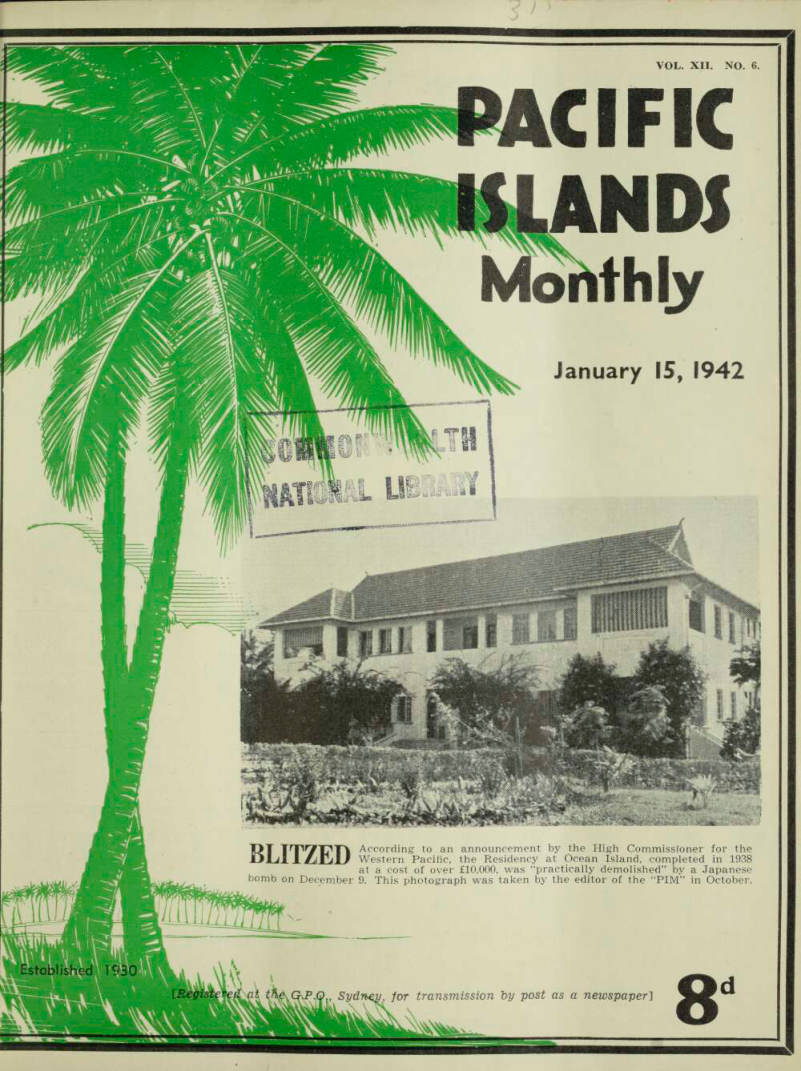
BLITZED According to an announcement by the High Commissioner for the Western Pacific, the Residency at Ocean Island, completed in 1938 at a cost of over £10,000 was “practically demolished” by a Japanese bomb on December 9. This photograph was taken by the editor of the “PIM” in October.
Advertisements & other items, p. 2 (1 item)
W. R. Carpenter & Co. Ltd.
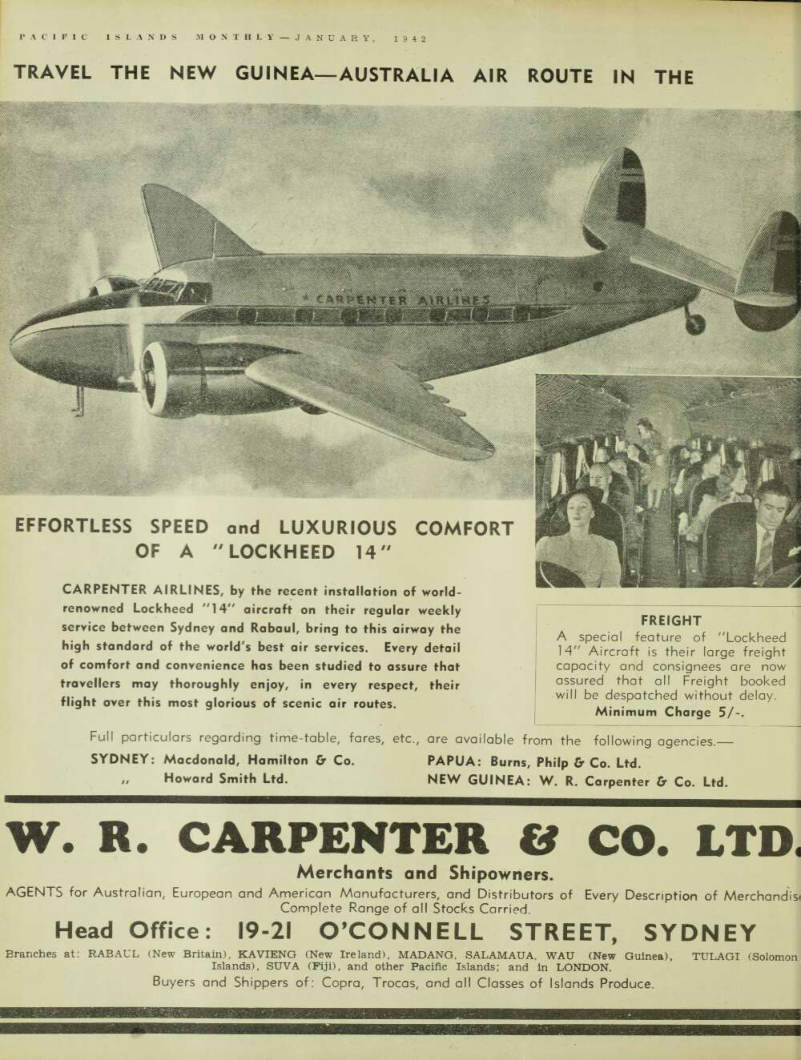
TRAVEL THE NEW GUINEA—AUSTRALIA AIR ROUTE IN THE m m i, i
ill
£ ■ : m
EFFORTLESS SPEED and LUXURIOUS COMFORT
OF A "LOCKHEED 14
CARPENTER AIRLINES, by the recent installation of worldrenowned Lockheed "14" aircraft on their regular weekly service between Sydney and Rabaul, bring to this airway the high standard of the world's best air services. Every detail of comfort and convenience has been studied to assure that travellers may thoroughly enjoy, in every respect, their flight over this most glorious of scenic air routes.
FREIGHT
A special feature of "Lockheed ]4" Aircraft is their large freight capacity and consignees are now assured that all Freight booked will be despatched without delay.
Minimum Charge 5/-.
Full particulars regarding time-table, fares, etc., are available from the following agencies.— SYDNEY: Macdonald, Hamilton Cr Co. PAPUA: Burns, Philp Cr Co. Ltd. „ Howard Smith Ltd. NEW GUINEA: W. R. Carpenter & Co. Ltd.
W. R. CARPENTER & CO. LTD.
Merchants and Shipowners.
AGENTS for Australian, European and American Manufacturers, and Distributors of Every Description of Merchandise Complete Range of all Stocks Carried.
Head Office: 19-21 O’CONNELL STREET, SYDNEY
Branches at: RABAUL (New Britain), KAVIENG (New Ireland), MADANG, SALAMAUA. WAU (New Guinea), TULAGI (Solomon Islands), SUVA (Fiji), and other Pacific Islands; and in LONDON.
Buyers and Shippers of: Copra, Trocas, and all Classes of Islands Produce.
Pacific News-Review
Notes And Comment On
The Progress Of The War
From Dec. 11 To Jan. 14
Dec. 11: Germany has officially announced that she is calling off her offensive against the Russians on her eastern front until the spring. The Rus sian armies are how attacking at many points along the snow-bound front.
Dec. 14; The Russian Ambassador in Washington announced that a complete understanding would be arrived at among the powers opposing the Axis.
Dec. 15: Allied leaders are unanimous that Germany, in her failure to break the Russian front and capture the Rus sian cities of Moscow and Leningrad and the Caucasus, has suffered a disas trous defeat. A Russian counter-offen sive is developing all along the Eastern battlefront.
Dec. 16: The campaign in Libya has been resumed, and British and German forces are now fighting out a tank battle in the region of Gonzala.
Dec. 18: German armies are continu ing their retreat on all sections of the Russian front and the Russians, in high spirit, are now attacking everywhere and recovering many towns and villages.
Dec. 18: Axis forces in Eastern Lioya are in full retreat, following a five-days’ battle in which the remaining resources of the Germans and Italians were thrown in to try to delay the British advance.
Dec. 19; The RAF made its heaviest raid yet upon German warships immobi lised in the French naval base of Brest.
It is believed that several bombs hit the warships.
These renewed attacks on German warships and naval bases are designed to prevent Germany sending big naval units into the Pacific, to increase the naval superiority now apparently enjoyed by the Japanese.
Dec. 22; Nearly 7,000,000 men have been called to the colours in the US, under the new Draft Bill.
Dec. 22: Hitler has displaced the Ger man Commander in Chief, Marshal von Brauchitsch, and has appointed himself Supreme Military Commander. The offi cial announcement says: “The Fuhrer will follow his intuitions, and reserve to himself all essential decisions.”
This, of course, is the result of the German failure on the Russian front.
The German armies could not carry out Hitler’s explicit orders that the Russian front must be broken and Moscow and Leningrad seized before winter came, and Hitler, in order to “save face” before the German population, is himself tak ing the supreme military command. He is expected to “get away with it”—there is much discontent in German military circles, but the Nazis still are supreme in Germany.
Dec. 22: British Prime Minister, Mr.
Churchill, arrived in Washington to-day to engage in vital conferences concern ing the future conduct of the war. It is expected that a Supreme Allied War Council will be created, to direct and co-ordinate strategy on every front and sea.
Dec. 25: The Germans in Libya are still retreating, and the British have now occupied Benghazi, the chief port of Eastern Libya, about 300 miles west of Tobruk.
Dec. 25: Except in the Crimea, the Germans are still retreating along the whole of the Russian front, and the Russian armies are closely following them up and launching incessant counter attacks. The Germans appear to be suffering terribly from the excessive cold, as well as from the Russians.
Dec. 26: While Japanese forces in
increasing numbers, and with heavy equipment, are pushing down the penin sula towards Singapore, conferences in Washington, presided over by President Roosevelt and Mr. Churchill, emphasise the importance of Singapore as the key to the South-western Pacific and the Indian Ocean, the value of its dockyards, the strength of its fortifications, and the reasons why it must be held at all costs by a concentration of Anglo-American strength.
Dec. 28; British Prime Minister re ceived a tumultuous welcome when he addressed a joint session of US Con gress yesterday. Referring to Allied War Council discussions in Washington, he said that they “had advanced far along the road towards the ultimate objective —a crushing defeat of the attackers.”
Dec. 29: During the latter part of December an important exchange of views took place in Moscow between Stalin, Dictator of Russia, and the Brit ish Foreign Secretary, Mr. Eden. The conversations are regarded as constitut ing a new and important step towards closer Anglo-Soviet* collaboration.
Dec. 31: The Russians have had an outstanding success in the Crimea in recapturing the fortress of Kerch, which the Germans had regarded as the gate way to the Caucasus. This development may cause the Germans to evacuate the Crimean peninsula.
Dec. 31: Mr. Churchill has arrived in Canada and has addressed the Canadian Parliament in Ottawa.
Jan. 2; British and Norwegian com mando forces raided the Lofoten Islands, on the coast of Norway, on December 26, and disrupted German sea communica tion.
Jan. 3: Mr. Churchill has returned to Washington and very important inter - Allied conferences are proceeding.
Jan. 5: It was officially announced at the week-end, in British and American capitals, that 26 nations of the New and Old World have signed a Solidarity Pact, formally pledging themselves to employ their full resources against the Axis Powers, and not to make a separate
armistice or peace with their common enemies, or any of them.
Jan. 5: The defeated Axis forces in Libya are trying to dig themselves in on a 50-miles front, south of Benghazi, Jan. 8: The Germans continue a fairly orderly retirement all along the Russian front, and the Russians are harassing them with ceaseless counter-attacks. A Russian force succeeded in landing on the western coast of the Crimea, and the German army there is threatened with encirclement, and important devel opments are likely.
Jan. 8: Terrific damage was done by the RAF in an attack on aerodromes in Sicily.
Jan. 8: Roosevelt has announced that USA, in 1942, will build 60,000 planes, 45,000 tanks, 20,000 anti-aircraft guns and 8,000,000 tons of merchant shipping.
The production in 1943 will be 125,000 planes, 75,000 tanks, 35,000 anti-aircraft guns, and 10,000,000 tons of shipping.
The response to the President’s appeal from all over the US is most encourag ing and satisfactory—a united nation gives him a guarantee that this colossal amount of arms, which will eventually decide the war, will be provided.
Jan. 8: President Roosevelt announced that American military, naval and air forces would take up positions in the British Isles, and it is also announced that a great base has been equipped in Northern Ireland for American forces.
Two secret* bases have been prepared in Scotland for American use.
Jan. 8; The Axis columns in Libya escaped from their positions, southwards of Benghazi, in a great dust storm, and are now hurrying away westwards, to wards Tripoli, with the British columns in hot pursuit.
Jan. 10: The Germans, retiring on the Russian fronts, are abandoning enor mous quantities of equipment. They are apparently withdrawing from the Crimea, and are expected to raise their siege of Sebastopol.
The World War In The Pacific
Dec. 11: The Japanese attack upon northern Malaya is continuing with increasing numbers of troops. British aerodromes have been rendered unser viceable by heavy enemy air attacks.
Dec. 11: Increasing numbers of Jap anese are continuing to make landings about 150 miles north of Manila, capital of the Philippines, in their attempt to invade Luzon (principal island of the group).
Dec. 11: US bombers strongly attacked Japanese warships covering Philippines landings. A Jap battleship of the “Hiranuma” class, 29,330 tons, eight 14inch guns, was sunk and another, the “Kongo”, same class, was seriously dam aged by bombs, Dec. 11: Over 2,000 men have been saved from the lost British battleships, “Prince of Wales” and “Repulse”. Their total complement was 2,705.
Dec. 11: Increasing Japanese forces are attacking the British colony of Hong kong. The British have repulsed two attacks on Kowloon (mainland).
Dec. 12: Chinese are attacking Japan ese in the vicinity of Canton, in the rear of the Japanese armies attacking Hongkong. This is an attempt to relieve the pressure on Hongkong.
Dec. 14: Penang, in western Malaya, has been heavily bombed, evidently as a
preliminary to an attempt at its cap ture by the Japanese, and European women and children have been evacu ated to Singapore.
Dec, 14: The Japanese now appar ently occupy the whole of Thailand, which has thrown in its lot with Japan, and some attempt is being made by the enemy to penetrate into Burma.
Dec. 15: The Japanese are attacking Hongkong with aircraft and artillery.
The British are evacuating the Kowloon (mainland) section.
Dec. 15: The Japanese are now astride the Kra Isthmus (between Malaya and Thailand) and threaten an attack on northern Malaya.
Dec. 16: Japanese landings in the Philippines continue. A Japanese expe ditionary force landed in a stiff gale on the coast of British North Borneo and is taking possession of the country.
Dec. 16: Officially announced that the Japanese, in their attack on Pearl Har bour base, Hawaii, on December 7, destroyed one battleship, three destroy ers, one training ship and one mine layer A second battleship and a num ber of other warships were damaged.
The whole of the US Pacific Fleet is now at sea, and in good order.
Dec, 17: Japanese forces have landed in Sarawak (west coast of Borneo).
British forces withdrew, after destroying valuable oil wells and refineries.
Dec. 18: The Japanese have occupied all Kowloon (mainland section of Hong kong). All British forces have withdrawn to the island of Hongkong.
Dec. 18: Australian and Dutch mili tary forces have occupied the Portu guese section of the island of Timor. 400 miles from Australia’s north-west coast, in order to prevent occupation by Jap anese. The Government of Portugal is protesting.
Dec. 19: Japanese have landed in force on island of Hongkong and heavy fight ing is in progress. The position is serious.
Dec. 19: Japanese are advancing southward along the Malayan peninsula, and the British town of Penang is being rapidly evacuated.
Dec. 21: Large Japanese forces have landed on Mindanao, the most southerly and largest of the Philippines, where there already was a very large Japanese population. Bitter fighting is in pro gress, but the invaders have established themselves firmly.
Dec. 21: A treaty of alliance has been signed between Thailand and Japan and the Allies have declared Thailand enemy territory.
Dec. 23: Steadily increasing numbers of Japanese are pushing back the American defenders of the Philippines and the British defenders of Malaya.
Further withdrawals of the British forces towards central Malaya are expected.
Dec. 23: Large Japanese forces now occupy the whole of Hongkong, except the string of mountain fortresses, where the British are still stubbornly resisting.
Dec. 23: Japanese to-day made a mass raid on Rangoon, capital of Burma.
Their aircraft were intercepted by Brit ish and American fighters and nine bombers and one fighter were destroyed.
Dec. 24: Three large Japanese trans ports and one tanker were sunk by the Allies off the coast of Sarawak. Borneo.
Dec. 25: Japanese planes yesterday raided the thickly populated port area of Manila, causing many civilian casual ties.
Dec. 26; The Hongkong garrison, after surviving seven days of relentless artil lery fire, and 45 air raids, surrendered on Christmas Day.
Dec. 26: Growing masses of Japanese troops are closing in on Manila, and the American authorities, in an attempt to prevent the destruction of the capital, have declared Manila an open city.
Dec. 28: Despite its declaration to be an open city, Japanese carried out sav age air raids upon Manila throughout the week-end, and caused many casual ties and much destruction.
Dec. 28: In a week of raids on roads and air-fields in Burma, culminating in an attack on Xmas Day on the Rangoon aerodrome, the Japanese have lost 42 planes.
Dec. 31: The Japanese continue steady progress in the Philippines, where they are closing in on Manila; and in Malaya, where they are steadily advancing down the peninsula towards Singapore.
The Japanese have captured Ipoh, capi tal of the Malayan state of Perak, from the British.
Dec. 31: The American commander in the Philippines says: “The enemy is driving forward in ereat force from the north and the south. Japanese bomb ers practically control the roads from (he air. The enemy is using great quan tities of tanks and armoured units. The American lines are being pushed back.”
The capture of Manila by the Japan ese cannot be long delayed.
Jan. 1: Air Marshal Sir Robert Brooke-
Popham has been removed from the command in the Malayan war theatre and General Sir Henry Pownall has been appointed in his place. General Pownall, in a special communique, declared that it was intended to fight for every inch of the ground all the way down the Malayan peninsula. He added that considerable help was on the way.
Jan. 4: Simultaneously announced in Washington and Canberra that all anti- Axis sea, land and air forces in the South-West Pacific have been placed under the unified command of General Sir Archibald Wavell, with Major- General Brett, chief of staff of the US Army Air Corps, as Deputy Supreme Commander. Admiral Thomas C. Hart, Commander of the US Asiatic Fleet, will be in charge of all Allied naval forces, and General Sir Henry Pownall will be General Wavell’s Chief of Staff. General Chiang Kai Shek, the Chinese Generalis simo, is to be Supreme Commander in the Chinese theatre, including such por tions of Indo-China and Thailand as may become available to Allied troops.
Jan. 5: The Japanese are now in full occupation of Manila. General Mac- Arthur’s American and Filipino forces have been re-grouped north and north west of the capital, while American forces strongly hold the island fortress of Corregidor, at the entrance of the Bay of Manila, and the occupation of which by the Americans will prevent the Japanese using Manila as a naval base.
Jan. 5; Sixty Japanese bombers vainly attacked Corregidor. The success of the Japanese at Manila will release large Japanese forces for Malaya.
Jan. 5: It is announced that units of the US fleet will operate from Austra lian bases.
Jan. 8: Aided by their control of the sea and air, which allows them to make landings practically where they like along the eastern and western coasts of Malaya, the Japanese are steadily thrusting southwards through the Mala yan peninsula, upon the vital fortress of Singapore. The British are retreating step by step, inflicting terrible punish ment, but it is feared that the import ant Malayan town of Kuala Lumpur cannot be held.
Jan. 8: RAF from Burma heavily attacked the Japanese in Bangkok, capi tal of Thailand, and did an enormous amount of damage. All our raiders returned safely.
Jan. 8: The Japanese have been over whelmingly defeated by the Chinese armies at Changsha, in Central China.
Apparently, five Japanese divisions have been annihilated or dispersed.
Jan. 11: Japanese forces have landed in three places in the extreme north of the island of Celebes, Dutch East Indies, where there are important and valuable oil fields. Japanese have also made fur ther landings in northern Borneo at Tarakan.
It would appear that the enemy is planning to by-pass Singapore, block the vital Straits, and advance on East Indies, New Guinea and North Australia.
Jan. 11: There have been further with drawals of British troops after severe battles in Central Malaya. The Japan ese have occupied Kuala Lumpur.
Jan. 12: British troops in Malaya have been withdrawn to a new line, 30 miles south of Kuala Lumpur, after very severe fighting.
Jan. 12: The Japanese say that “Australian troops bore the brunt of the fighting in the Kuala Lumpur area but were forced to retreat.”
Jan. 12: Fourteen shells were fired into the United States naval station at Pago Pago, American Samoa, by a light Jap anese naval vessel, which immediately
Ped. No damage was done.
Jan. 12: US heavy bombers three times hit and set afire a Jap battleship in the Southern Philippines.
Jan. 13: A report that Major-General Gordon Bennett, Australian Commander in Malaya, has been captured by Japs is not confirmed.
Jan. 13: RAF raiders from Burma are doing enormous damage to Japanese concentrations in Thailand.
Jan. 13: In attacks on Japanese naval forces near Celebes, in which Jap cruiser was hit, two Australian Hudsons were shot down and two more are missing.
Jan. 14: After three days’ gallant resistance, the Dutch garrison at Tara kan Island (north-east Borneo) was overwhelmed by masses of Japanese invaders.
Jan. 14: Canberra officially states that Jap reports are lies —AIF troops have not been in action and Major-General Ben nett is not missing.
and Papua
To Assist Women From N. Guinea and Papua
IT is proposed to create an organisa tion for the assistance, where necessary, of women residents of New Guinea and Papua, who recently have gone to reside in Australia.
Some of the women have not visited Australia for many years, and others have few friends or relations there.
Others, owing to the exigencies of the times, may be cut off temporarily from their homes or families. In these cases, an organisation should be of some value.
All women from the Territories are urged to send their names and addresses to the New Guinea Trade Agency, Commonwealth Offices, Sydney, or to the Editor, “Pacific Islands Monthly”, Union House, 247 George Street, Sydney: so that, when the organisation gets under way, it will be possible to write to them, and describe the services that will be available to them.
Australian Black Wasps
Sent After Coconut Pest in Samoa
IN an attempt to control the rhinoceros beetle pest in Western Samoa, Mr.
W. H. Simmonds, formerly Govern ment entomologist in Fiji, has made a collection of the Australian black wasp (Scolia Soror) and has shipped a number of specimens.
The consignment went from Sydney to the Department of External Affairs, Wellington, NZ, by air; and there will await shipment to Apia.
Mr. Simmonds indicated that the ex periment is purely an experiment—he could not say whether the black wasps actually would attack the rhinoceros beetle or not. Two years ago he procured another kind of wasp, Scolia Oryctophaga, from Zanzibar and sent the specimens to Samoa, in the hope that they would flourish and deal with the pest; but nothing further had been heard of the Zanzibar wasp.
Something must be done about the rhinoceros beetle in Samoa, however.
Slowly and steadily, this pest is spread ing over and destroying the coconut plan tations —increasing, in spite of all that has been done by the planters and the administration.
Pacific Development Ltd. was struck off the register of Papuan companies last month.
Tahiti Man
Death of Well-Known Tahiti Man
From Our Own Correspondent
Papeete, Dec. 20.
MR. Edward Simmons died at Papeete on November 5, 1941. His passing has severed another link with the old days in Tahiti and, more, with that America we knew in our younger days.
Mr. Simmons was a coloured man from the Deep South of the United States.
One unacquainted with the plantation life of the Old South, as it existed before and following the Civil War, can never understand the relationship be tween the white and coloured man. It had its foundations in mutual respect, which softened the circumstance of master and retainer, and inspired in the coloured man a loyalty and affection which bound him to the household until the end of his days.
Mr. Simmons was born in that period, 86 years ago. He had travelled all over the world before he finally settled at Tahiti: but he never lost that quiet courtesy and dignity which was his heri tage from the plantation in the Old
South where he had passed his child hood, A conversation with him brought to memory the gracious, cultured manner of life which has departed forever with those who practised it.
Mr. Simmons was greatly respected by all of our European colony at Tahiti.
For so many years has he been a fami liar figure in Papeete that he had become an essential and valued part of the community.
Residents of Fiji who were included in the New Year Honours List were: Dr.
Cyril John Austin, medical officer at Makogai Leper Hospital, QBE.. and Mr.
John F. Grant, of Indian parentage, resident at Suva, MBE.
It was officially announced in Papeete, Tahiti, early in December, that Mr. D.
Cameron had been appointed British Consul in Tahiti, and would take charge of the British Consulate about the middle of December. By invitation of the British Consul-General, Mr, Archer, and Mrs.
Archer, all British subjects there as sembled at the Blue Lagoon Hotel, Papeete, on December 6, to formally meet Mr. and Mrs. D. Cameron.
Soap-Making Enterprise
In Fiji
Remarkable progress is being made by the Fiji concern called Union Soaps Pty. Limited, which is operating in Suva under the manager ship of Mr. M. M. Brodie, and which produces a considerable and increasing variety of soaps and oils.
This company uses a considerable quantity of Fiji copra and all the tallow that the Colony of Fiji produces. Its products include ordinary washing soap, two or three varieties of good toilet soap, a special brand of edible coconut oil (for which there is a sharply increasing demand), mustard oil (much used as an article of diet by the Indians), peanut oil, coconut meal (in much demand as fodder for stock) and some smaller lines.
This enterprising Fiji company recently imported a good deal of new plant and the indications are that its turnover is increasing every month.
Rev. E, F. Roe, of the Marist Mission, Suva, Fiji, is now serving as a chaplain with the British Army in England.
Advertisements & other items, p. 5 (1 item)
South Pacific Line
p 111
AC 1 F
Urnkm. * V
% *■ SAH Ai
V \
SYDNEY
AN i
i&Sa
K. P. M.
SOUTH PACIFIC LIP?E
Royal Packet Navigation Co. Ltd., (N. V. Koninklijke aketvaart Maatschappij —lncorporated in the Netherlands Indies) Paketvaart House, 255 George Street Sydney. ’Phone BW 2381.
K
LINKING SOUTH PACIFIC ISLANDS
WITH NEW ZEALAND, AUSTRALIA
JAVA AND SINGAPORE
81-MONTHLY SAILINGS
SOUTH PACIFIC Line
Advertisers
“Airzone” Radio . 15 Angus & Coote Ltd. 12 Arnott’s Biscuits . 27 “Ausoline” ... 30 Baker Ltd., W. Jno. 51 Bank of N.S.W. . . 56 Berger’s Paints . . 38 “Bidomak” ... 13 Broomfields Ltd. . 32 Brown. & Co. Ltd., G 11 Brunton’s Flour . . 29 Burns, Philp & Co.
Ltd 2 B.P. Magazine . . 42
B.P. (S.S.) Co. . . 28
Burns Philp Trust Co. Ltd 40 Carlton & United Breweries Ltd. . . 23 Carpenter Ltd., W.
R cov, 2 Chivers & Sons Ltd. 28 Clyde Batteries . . 49 Coleman Lamp & Stove Co. ... 18 Colonial Wholesale Meat Co 47 Coral Starch ... 27 Cosmopolitan Hotel 58 “Cystex” 48 Dewar’s Whisky . . 43 Doan’s Pills ... 30 Donaghy & Sons Ltd 30 ponald Ltd., A. B. . 36 Dr. Williams Pink Pills 52 Dunlop Perdriau Rubber Co. Ltd. . 41 Eaton Ltd.. J. W. . 31 Edgell Products . . 45 Edinburgh Labora tories 19 Electrolux Refrigerators . . 22 Excelsior Supply Co.
Ltd 21 Export Soap Co.
Ltd 35 Fletcher & Sons . 33 Ford Sherington Pty. Ltd 34
“Flit” 54 Foster Clark Ltd. . 44 Garden Vale Pro ducts Ltd. ... 52 Garrett & Davidson 49 Gilbey’s Gin ... 14 Gillespie’s Flour . 42 Grand Pacific Hotel 37 Grove & Sons, W.
H 14 Guinea Airways Ltd cov. 3 Guinness’ Stout . . 51 Heinz Co. Ltd., H.
J 24 Holbrook’s Ltd. . . 29 Hotel Moresby . . 58 international Correspondence Schools ... 18 Ironised Yeast Laboratories . . 49 fCambala School For Girls ... 8 Knox Grammar School 10 Kolynos Dental Cream 16 Kopsen & Co. Ltd. 20 Lea & Perrins Sauce 46 Levenson’s Radio , 50 Masse Batteries . . 39 Maxwell Porter Ltd. 31 Mcllrath’s Ltd. . . 46 “Mendaco” ... 40 Meriden School . . 37 Miller & Co. Rty.
Ltd 54 Nelson & Robertson Pty. Ltd. . . 10 & 48 Newmarket Saddlery ... 55 Noyes Bros. Ltd. . 48 Did Monk Olive Oil . . 14, 20. 35, 46 pacific Is. Society . 9 Papua Hotel, The . 58 pike Bros. Ltd. . . 57 '“Pinkettes” ... 58 Prescott Ltd. ... 26 Prouds Pty. Ltd. . 9 Riverstone Meat Co. 45
Ransome Sims & Jefferies Ltd. . . 55 Rohu, Sil 12 Rose’s Eye Lotion . S - Royal Packet Navi gation Co 1 St, Ignatius’ College 8 Scott Ltd., J. ... 32 Serviceable Watch Band Co 34 Smyth Pty. Ltd., J.
H 47 Springwood Ladies’
College 44 Steamships Trading Co. Ltd 53 Sterling Varnish Co. 9 Sullivan & Co. . . 57
Swallow & Ariell . 25 Talkeries, The . . 21 Taylor & Co., A. . 30 “Tenax” Soap . . 53 Tillock & Co. Ltd. 26 Toohey’s Ltd. ... 17 Tooth & Co. . cov. 4 “206” Private Hotel 13 Vincent’s A.P.C. . . 53 “Vi-stim” ... 32 West, Harry ... 55 Weymark & Son . 26 Wills Ltd., W. D. & H. 0 36 Wright & Co. Ltd., E 31 Wunderlich Ltd. . . 31
Contents
Page.
Pacific News-Review i Death of Well-known Tahiti Man .. 1 The Pacific Faces Grim Months of Endurance and Sacrifice 3 Back to Rabaul? 4 Catholic Sisters Safe in Gilbert Is. 5 Exploitation of New Caledonian Metals 5 Copra Position 5 PAA Airmail Suspended 6 G. & E. Residents Cut Off by Jap Attack 6 Bombs on Rabaul 7 World War in the Pacific—Progress of Events and What They Signify 7-12 Re-planting Rarotonga’s Valleys .. 13 Free France in the South Pacific .. 14 Plane Wrecked in New Guinea ... 16 Fiji in the Front Line 16 Ketch “Golden Hind” Nearly Wrecked 17 Roll of Honour 18 Life on the “Lousy Islands” 21 Can Gold Hold its Value? 28 Jeeves of Cathay—A Trader’s Tale .. 29 Demand for Copra When War Ends 30 Is Treasure Buried on Moorea? . 31
Page, Fiji’s Taxes 32, 49 A Maritime Farce in Papua 33 Rossel Island’s Wrecks 34 Capt. I. R. Handley, of the Gilberts 36 New Laws in Fiji 37 High Court Upholds Papuans’ Appeal 38 Beekeeping as an Islands Industry 39 Passing of Mr. A. G. Wilkinson (Cook Is.) 40 Trans-Pacific in a Leaky Old Junk 41 Ceylon-Type Copra Driers 42 Rarotonga’s Three Pests 44 New Books 45 The Patons of New Hebrides .. .. 46 Islands Mining News 47 Ocean Island Rats! ! 51 Short Wave Radio Programmes .. 51 Centenary of Henderson & Macfar lane Ltd 52 Geoffrey Henry, RA at Puka Puka 53 Islands Produce Prices 54 Copra and Rubber Quotations .. .. 55 Pacific Exchange Rates 56 The Plane That Came Out of the East 57 About Islands People 58 The Land of the Pharaohs—Verse .. 58
Advertisements & other items, p. 6 (1 item)
lilll
Miss A. M. Uphill, of the Methodist Mission station at Nadroga, Fiji, is at present in South Australia, on leave.
Mr. H. Terry has taken over the management of the Shell Oil Company's depot at Lae, New Guinea, from Mr. W. Fry, who recently came South to Australia.
Mr. and Mrs. D. G. Hammer, Church of Christ missionaries in the New Hebrides, are spending furlough in Adelaide this month.
Miss Edith Cates, of Brunswick, Victoria, has been accepted by the ABM for the New Guinea Mission staff in Papua.
!l!l!
Hill I
HIM
lilll
«' W in in m
lifH
Head Office: 7 Bridge Street, Sydney—Australia Code Address: " Burphil"
BURNS, PHILP
& Co. Ltd.
GENERAL MERCHANTS
SHIPOWNERS
TOURIST AGENTS
BUYERS OF ALL CLASSES OF ISLAND PRODUCE Regular Steamer Services from Australia to New Guinea —Papua—Solomon Is. — Lord Howe Is.—Norfolk Is. New Hebrides —Hongkong—Java and Singapore
Pacific Islands Monthly
The Newspaper-Magazine of the South Seas [Registered at the G.P.0., Sydney, for transmission by post as a newspaper .]
Published Once Each Month and Circulated in Australia and New Zealand and in the following Pacific Territories and Islands Groups:
Australian Territory of Papua.
Mandated Territory (Australia) of New Guinea, Bismarck Archipelago and Northern Solomon Islands.
Australian Territory of Norfolk Island.
New Zealand Territory of Cook Islands.
Mandated Territory (NZ) of Western Samoa.
British Colony of FIJI.
British Solomon Islands Protectorate.
British Protectorate of Tongan Islands.
British Crown Colony of Gilbert and Ellice Islands.
Mandated Territory of Nauru.
British and Free French Condominium of New Hebrides.
Free French Colony of New Caledonia.
Free French Colony of Oceania (Tahiti, etc.).
American Territory of Eastern Samoa.
American Territory of Hawaiian Islands,
Owned and Produced by Pacific Publications Pty. Ltd., Union House, 247 George Street, Sydney.
f Managing Director .. BW 5037 £ Business and Editorial MA 7101
P.O. Box 3408 R
Registered Address of Telegrams, Radiograms, and Cables: “Pacpub”, Sydney.
Contributions.
Articles, Stories, and Photographs dealing with Pacific Islands subjects are invited and will be paid for on publication.
Subscription Rates.
Per Annum, within British Empire, Prepaid, Post Free 8/- Per Annum, elsewhere, prepaid, Post Free. 10/- Single Copies Bd,
Editor and Publisher:
R. W. Robson, F.R.G.S.
Assisted by Selwyn Hughes.
Advertising Manager; L. W. Bailey.
Advertising Ofißce and Printing-House: 29 Alberta Street, Sydney.
Advertising rates furnished on application.
Colours, etc., by arrangement.
Process Blocks made at Advertiser’s expense when required. Screen 100.
Changes of Advertising Copy should reach this office by Ist of each month, otherwise previous advertisement may be repeated.
Representative In London.
W. C. Harvey, Coronation House, 4 Lloyds Avenue, London, E.C.3, from whom may be obtained copies of Pacific Islands Monthly, Pacific Is. Year Book, advertising schedules, etc.
Agents.
The following are authorised to receive sub scriptions for Pacific Islands Monthly:—■ Burns, Philp & Co., Ltd., and Burns Philp (South Sea) Co., Ltd. All branches.
W. R. Carpenter & Co., Ltd. All branches.
Morris, Hedstrom, Ltd. All branches.
T. A. Olsson, Wau, New Guinea.
G. Thomas & Co., Rabaul. New Guinea.
Whitten Bros., Ltd., Samarai. Papua.
Steamships Trading Co., Papua. All branches.
B.N.G. Trading Co., Ltd., Port Moresby, Papua.
J. Muir, Suva. Fiji.
Miss R. Castles, Suva, Fiji.
N. C. Mackenzie Hunt, Walnunu, Bua, FIJI.
Kirpal & Co., Victoria Parade, Suva, Fiji.
Kapadia and Co.. Suva, Fiji.
Cook Islands Trading Co.. Rarotonga, Cook Is.
A. C. Rowland, Papeete. Tahiti.
Islands Branches and Representatives of W. H.
Grove & Sons, Ltd., Auckland, New Zealand.
Ed. Pentecost, Noumea, New Caledonia.
Kerr & Co., Noumea, New Caledonia.
Vol. XII. No. 6.
January 15, 1942
D r \ r a f Prepaid: 8/- p.a. rnoe £ 8d Per Copy
and Sacrifice
The Pocific Faces Grim Months at Endurance and Sacrifice
T tt „ ...
HE position in the Pacific is fai more serious and menacing than was thought possible two months ago.
The Japanese have been successful almost everywhere (see details on page 7); and, Jhi 8 moment (January 14), the safety and future of Singapore, East Indies, Australia, and all the Islands territories soutn of _Jk e Eqaator ar , e Savely imperilled.
When Japan struck, suddemy and treacherously, in the dawn of Decern- Q? r f 7 ’ 80 btates mat USA would taiK peace, or remain out of me war, wnne sne X ipe< i r OU V he (?t ISh fi, Free French m the Pacific. The plan did not succeed. but it did achieve enough to leave Hong Kong, Philippines, Malaya, Borneo, and all the territories to the south and east temporarily without naval and air protection, and depending for defence upon inadequate military nnninloto „ in the North-west Pacific, has rushed masses of troops against Britisxr> American and Dutch territories: and the Allies everywhere are falling back, fighting delaying actions, and obviously in difficulties. It is a terrible confession to make, after the complacent certainty of our generals and admirals that they were quite
, . . . . T capable of taking care of Japan, any where and at any time. But facts must be faced.
The present is black, and almost terrifying. The future has a rosie. appearance. rrHE Pacific war goes badly; but the X general world-war situation is good. We are holding the Hun, now, in the Battle of the Atlantic; he is having great and increasing trouble in k eep i n g hi s hold over the “con- Quered” peoples; he has suffered a most serious defeat i n that he has faile d to break Russia and seize her g reat cities, as promised by Hitler; he hag been beaten and driven out of Eastern Libya by the British; and Italy has been so mauled and hammered by the British that she now . g little more than a cipher, Already, in November, the Huns were facing a cr i S j S But Japan’s en^ry into war, and the involve ment of the United States and all the Pacifi c, and Japan’s startling initial successes, gave the Axis new hope and WE regard this present phase of ” the Japanese war as tem porary. For the present, and prob-ably until May or June, we in the Central and South Pacific must just “take it”, while we await the deye lopment of American and British
matical certainty that Japan, later on, will be overwhelmed by our naval and air forces. Every mile she thrusts southwards and eastwards ma kes her more vulnerable, We know that somewhere out in the b iue of the ’ Pacific there are powerful American naval forces sup ported by British and Dutch. Some of us ask, impatiently, why they do not hurl themselves upon the Japanese, strung out over thousands of miles of the north-western sea, and put an end to the enemy’s ceaseless, stealthy, southwards ap proach.
For the present, the risks are too great. The Japanese navy is equal, in numbers, to that of USA. If, under present conditions, we were to meet the Japanese in a full-blown naval battle, and our naval forces were crippled, let alone defeated, all would be lost—not only the Pacific war, but also probably the world war.
If, however, our fleets avoid a de cisive battle, while our naval and aviation workshops outbuild the Axis, in six or twelve months we shall have such sea and air superiority nrp Hrivp tVip pupidv the sea and the air and surroun d and exte rminate him on land, , „ rpiME, very emphatically, is on our side. Meanwhile, we must hold on and endure; and, so far as the invader is concerned, in the words of
Sir Keith Murdoch, broadcast from London, “delay—delay—delay”.
Amateur strategists will fret, and cheap newspapers will screech, and the unhappy dwellers in the Pacific, facing virtual ruin, will be in des pair; but we must somehow hold on until the enormous armed weight of America falls upon these fanatical yellow hordes from Asia. Victory is certain, even though dearly bought; but the alternative does not even bear thinking about.
THIS Pacific war is linked closely with the World War. Russia proves that. Russia is now our ally, and is as eager as we for the defeat of Japan. But Russia still is not at war with Japan. Russia regards the defeat of Germany, in Europe, as of paramount importance; and she will divert none of her strength by open ing up a new front against Japan in Siberia. If she did attack Japan from Vladivostock, Japan would be gravely weakened in her present Pacific war; but that probably would relax Russian pressure upon Ger many, and enable Germany to strike down through the Middle East, in the hope of opening a way through Asia and making junction with the Japanese. At present, Russia is keep ing Mr. Hitler exceedingly busy.
The real struggle between Russia and Germany is still to come. The bellowing of our cheap and unin formed newspapers about “‘great Russian victories” should be ignored.
The German armies, foiled in their attempt to smash Russia, are slowly retreating: but they still are unbroken and orderly, and they eventually will stand upon a line, well inside Russia, from which, in the spring, they will resume their attack upon Russia. But the Russians, now fighting with great spirit, should be able to keep them fully employed, so that there will be few Hun armies to spare for enter prises elsewhere.
Our democracies move with mad dening slowness. But the Allies, late in 1942, should be in a position to drive the Japanese back home, to give Italy the coup de grace, and to deliver, upon the western frontiers of a Germany already in the grip of Russia, such blows that Hitlerism will begin to stagger and collapse.
Miss A. Mann, of the Samoan Adminis tration staff at Apia, returned to New Zealand recently.
Mrs. L. E. Austen, wife of the Con troller of Government Coffee Plantations in North-eastern Papua, arrived in Sydney after an adventurous journey.
Owing to heavy rain, she could not travel by motor truck from the planta tion to the coast, so she made the jour ney on horse-back. Then she travelled for a considerable distance in a native canoe. She boarded a schooner to con tinue the journey along the coast, but the engine broke down and she spent one unpleasant night encamped on the coast. Eventually she arrived in Sama rai, whence she travelled to Port Moresby by sea-plane, and joined a steamer. Not a bad effort for one small woman— horse, canoe, schooner, sea-plane, and steamer!
Back To Rabaul?
NG Administration In Awkward Position
OWING to the proximity of Jap bases in the Marshall and Caroline Is lands, the Australian Territory of New Guinea is in the front line of the Pacific war; and the conditions of life there have changed vastly since the Japanese attacked British and American countries on December 7.
A heavy additional burden has been thrown upon the administrative staffs of New Guinea and Papua—a burden made no easier by the fact that a number of members of the female staffs (secretaries, typists, clerks, etc.) have gone to Aus tralia. The public officials have “turned out trumps”, however, and have earned the gratitude of the civil population for the manner in which they have carried out their duties.
New Guinea’s administration was in a very awkward position when war broke out —it was engaged in the change-over of administrative headquarters from Rabaul to Lae. Some departments were at Rabaul, some at Salamaua, and some at Lae, with the Administrator.
The Administrator (Sir Walter Mc- Nicoll) and Lady McNicoll, who had just taken up their residence at Lae, returned to Government House, Rabaul, in December; and, so far as is known, they are still there.
Presumably, if the present threat to New Guinea is removed, the transfer to Lae will proceed, as planned. If there is a long hold-up, the departments may return to Rabaul. Since the cessation of the south-east trade wind, and the com ing of rain, the Matupi dust nuisance has gone, and life in Rabaul is tolerable again.
Thanks!
Letter to the Editor HAVING recently arrived in Sydney from Kwato, Eastern Papua, we would like to express through your paper our gratitude for all the kind ness and help we received during our trip to Sydney. We especially thank the pilots and crew of the plane, who looked after us so well, and the Tourist Bureau, who transacted all the necessary busi ness at hotels and railway stations, and provided us with every available com fort on the journey, as well as kindness and courtesy.
We are, etc.,
Mrs. D. W. Baskett,
Mrs. R. P. Whale.
Chatswood, Sydney, 13/1/1942.
New Trade For Fiji
IT was announced in Wellington on December 13 that the NZ Govern ment would allow the transfer to Queensland and Fiji of the licence for the importation of tinned pineapples from Malaya.
It should be easier to ship canned pineapples from Fiji to NZ than from Queensland to NZ, so Fiji should gather up the bulk of this valuable trade.
Mr. L. Doile is relieving Mr. J. Rutter, of Rabaul Electricity Ltd,, at Rabaul, New Britain, while the latter is on fur lough in Australia. Mr. Doile was in New Guinea a couple of years ago, in con nection with the installation of hydro electric plant in the Watut District.
War News On Other
Pages
, Page Japs Land in Celebes ... ii Japs Raid Rabaul 7, 9 Malaya Over-run 8 Japs Seize Philippines and Borneo 8 Ocean Is., Nauru, Gilberts .. 9, 10 Pago Pago Shelled 12
Honour For Dr. De Curton
From Our Own Correspondent
Papeete, Dec. 13
ON November 5 a ball and dinner were given at Papeete in honour of Dr. de Curton (former Governor of French Oceania), on the eve of his departure for London, and of a number of others whose destination is the Middle East, where they will join up with the de Gaulle forces in the field.
On account of lighting restrictions, the ball was held at an historic old mansion at Taaone, not very distant from Papeete, known in recent years as the Rougier Place. This is a spacious brick structure of a type of architecture quite common in the cotton States of North America.
Fined £100
A FIJIAN, Neori Balawa, master of a cutter called “Tui Makasi”, was fined £lOO, in December, for attempting to overload his vessel on a proposed trip from Suva to Kadavu.
The little ship is licensed to carry one passenger and a crew of five. In view of the war situation, the Customs De partment allowed a total of 14 to be carried to Kadavu. But the officials saw the ship trying to leave with no less than 135 passengers aboard. Thev ordered the excess passengers off, and the cutter did not sail. Next morning, the cutter left port with excess passen gers, and the Customs officials gave chase and caught her outside the reef, where there was a punt-load of Fijians waiting to join her. Apart from the people on the punt, the officials found 102 people on board.
The defendant said that the people insisted upon going aboard his cutter, declaring that they would rather die in Kadavu than in Suva.
Mrs. Massy Baker, of Kerema, Papua, who is making her first visit to Austra lia for 25 years, fell down in Sydney last week and broke her arm. She is making a good recovery.
Mrs. James Ewen, wife of the manager of the Kokopo branch of Burns, Philp & Co. Ltd., New Guinea, died in Sydney early in January after a serious opera tion. She was well known and highly esteemed in Rabaul and Kokopo. Her daughter, Miss June Ewen, is a member of the NG public service. Mr. and Mrs.
Ewen lived in Fiji for about 10 years and in 1926 they made their home in New Guinea.
The NZ Prime Minister, Mr. P. Fraser, paid a short visit to Fiji in the latter part of December. He conferred in Suva with the High Commissioner for the Western Pacific and Governor of Fiji (Sir Harry Luke). There was much to discuss—for the Japanese war was then developing seriously, and NZ appears to be equally interested with the British authorities in the defence of Fiji, Samoa and the islands to the northward.
Catholic Sisters
Still in Northern Gilberts
WITH reference to the article pub lished on page 10 of this issue, concerning the whereabouts of the Catholic sisters in the Northern Gilberts: we made an inquiry of the High Com missioner for the Western Pacific, and on January 13 we were courteously advised from Suva as follows; “Twenty-one nuns from Butaritari and Marakei, who were being evacuated, are now at Tarawa. Four remain at Abaiang.”
Japanese were reported occupying Tarawa early in December, but are believed to have abandoned it again, so it is possible that the 21 nuns, together with the nuns who were stationed at Tarawa, are now out of enemy hands.
It is understood, however, that the Japanese remain in occupation of Butari tari and Abaiang, and probably Marakei.
“All Well”
We were officially informed on Janu ary 14: “Tarawa is no longer in enemy occupation and latest information re ceived indicates that all personnel are well.” (See also articles on pages 10 and 21.)
Windfall For Ngg
SHAREHOLDERS in New Guinea Gold fields Limited have received an un expected windfall, in a dividend of 3d. per share out of profits earned, and 3d. per share out of premiums on share capital—an item which has been kicking around in the balance sheet for some years. People who bought their shares at about 1/6 —they have been available and strongly recommended by the “PIM” at this price for a couple of years—will thus enjoy a profit of over 33 per cent.
This Co., operating large areas in New Guinea, survived a strike and a long drought during the year. It is a well managed company, nowadays, and should be a good investment. But, within the last few days, share quotations have fallen from 1/5 to 9d.
Natives In New
Caledonia
Noumea, Dec. 27.
THE number of native children receiving elementary instruction in October, 1941, was 3858 (compared with 4,262 in 1940), of whom 2,197 were boys and 1,661 girls. The table was made up as follows:
The native population of the islands is steadily growing. In 1927 it was 27,100; in 1941 it is 29,824.
Mrs. Eilene Hertz, one of the outstand ing people in New Guinea, and a woman very highly esteemed, died suddenly at an Australian port on December 27, when she was put ashore from a vessel on which she was travelling to Austra lia. She was originally Miss Eilene Beery, of Sydney, and in 1917 she mar ried Mr. Steve Whiteman, and lived with him in Rabaul, where her home was a centre of social life. When her husband died, she carried on his store and trad ing business for several years, and about 1925 she settled down on her plantation at Kokola, in the Namatanai district of New Guinea. She married Mr. O. Hertz in 1929, but divorced him later.
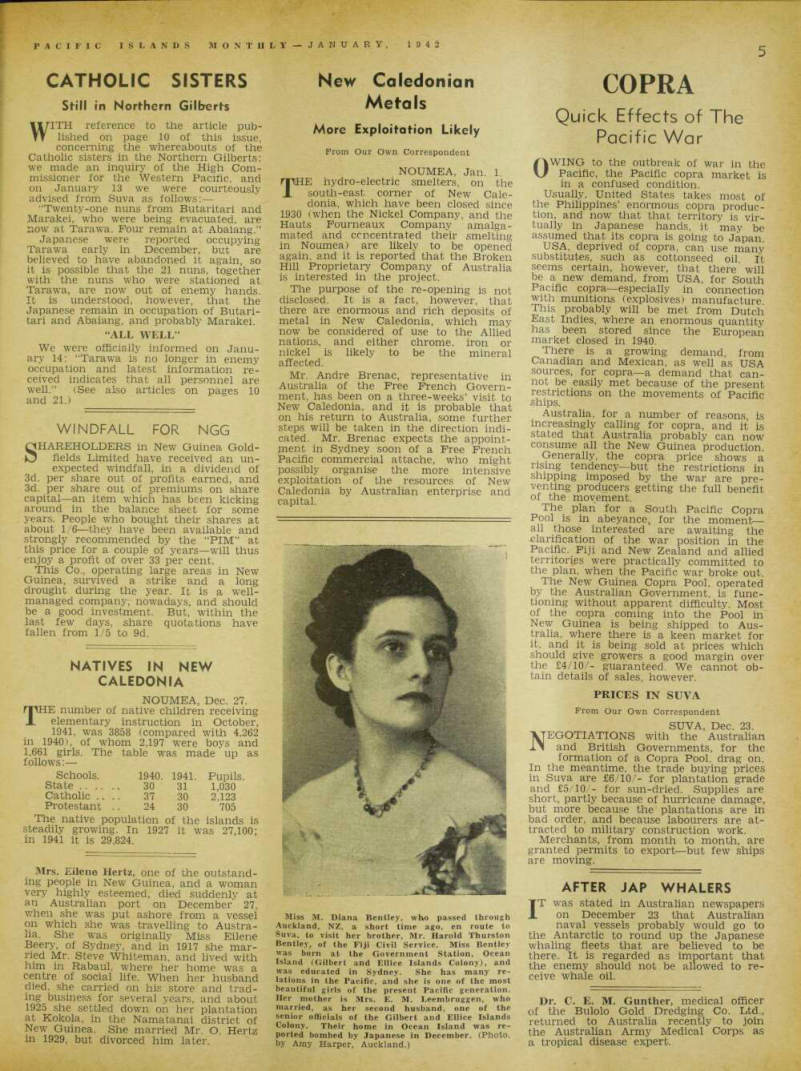
Miss M. Diana Bentley, who passed through Auckland, NZ, a short time ago, en route to Suva, to visit her brother, Mr. Harold Thurston Bentley, of the Fiji Civil Service. Miss Bentley was born at the Government Station, Ocean Island (Gilbert and Ellice Islands Colony), and was educated in Sydney. She has many re lations in the Pacific, and she is one of the most beautiful girls of the present Pacific generation.
Her mother is Mrs. E. M. Leembruggen, who married, as her second husband, one of the senior officials of the Gilbert and Ellice Islands Colony. Their home in Ocean Island was re ported bombed by Japanese in December. (Photo, by Amy Harper, Auckland.)
Schools, 1940, 1941. Pupils.
State 30 31 1,030 Catholic ... 37 30 2,123 Protestant .. 24 30 705
New Caledonian
Metals More Exploitation Likely
Prom Our Own Correspondent
Noumea, Jan. 1.
rE hydro-electric smelters, on the south-east corner of New Cale donia, which have been closed since 1930 (when the Nickel Company, and the Hauts Fourneaux Company amalga mated and concentrated their smelting in Noumea) are likely to be opened again, and it is reported that the Broken Hill Proprietary Company of Australia is interested in the project.
The purpose of the re-opening is not disclosed. It is a fact, however, that there are enormous and rich deposits of metal in New Caledonia, which may now be considered of use to the Allied nations, and either chrome, iron or nickel is likely to be the mineral affected.
Mr. Andre Brenac, representative in Australia of the Free French Govern ment, has been on a three-weeks’ visit to New Caledonia, and it is probable that on his return to Australia, some further steps will be taken in the direction indi cated. Mr. Brenac expects the appoint ment in Sydney soon of a Free French Pacific commercial attache, who might possibly organise the more intensive exploitation of the resources of New Caledonia by Australian enterprise and capital.
Copra
Quick Effects of The Pacific War
OWING to the outbreak of war in the Pacific, the Pacific copra market is in a confused condition.
Usually, United States takes most of the Philippines’ enormous copra produc tion, and now that that territory is vir tually in Japanese hands, it may be assumed that its copra is going to Japan USA, deprived of copra, can use many substitutes, such as cottonseed oil It seems certain, however, that there will be a new demand, from USA, for South Pacific copra—especially in connection with munitions (explosives) manufacture This probably will be met from Dutch East Indies, where an enormous quantity has been stored since the European market closed in 1940.
There is a growing demand, from Canadian and Mexican, as well as USA sources, for copra—a demand that can not be easily met because of the present restrictions on the movements of Pacific ships.
Australia, for a number of reasons, is increasingly calling for copra, and it is stated that Australia probably can now consume all the New Guinea production.
Generally, the copra price shows a rising tendency—but the restrictions in shipping imposed by the war are pre venting producers getting the full benefit of the movement.
The plan for a South Pacific Copra Pool is in abeyance, for the moment>— all those interested are awaiting the clarification of the war position in the Pacific. Fiji and New Zealand and allied territories were practically committed to the plan, when the Pacific war broke out.
The New Guinea Copra Pool, operated by the Australian Government, is func tioning without apparent difficulty. Most of the copra coming into the Pool in New Guinea is being shipped to Aus tralia, where there is a keen market for it, and it is being sold at prices which should give growers a good margin over the £4/10/- guaranteed. We cannot ob tain details of sales, however.
Prices In Suva
From Our Own Correspondent
Suva, Dec. 23.
NEGOTIATIONS with the Australian and British Governments, for the formation of a Copra Pool, drag on, In the meantime, the trade buying prices in Suva are £6/10/- for plantation grade and £5/10/- for sun-dried. Supplies are short, partly because of hurricane damage, but more because the plantations are in bad order, and because labourers are at tracted to military construction work.
Merchants, from month to month, are granted permits to export—but few ships are moving.
After Jap Whalers
IT was stated in Australian newspapers on December 23 that Australian naval vessels probably would go to the Antarctic to round up the Japanese whaling fleets that are believed to be there. It is regarded as important that the enemy should not be allowed to re ceive whale oil.
Dr. C. E. M. Gunther, medical officer of the Bulolo Gold Dredging Co. Ltd., returned to Australia recently to join the Australian Army Medical Corps as a tropical disease expert.
Pacific Airmail
Suspended
PAA Staff Leaves Noumea
OWING to the development of the Japanese war in the Pacific, the trans-Pacific air services, con ducted by PAA. from San Francisco, across the Northern Pacific to Hong Kong, and from Hawaii across the South Pacific to Auckland, have been suspended.
Now that the airmail services between Auckland (New Zealand) on the one hand, and New Caledonia, Fiji and Hawaii on the other, have been cut out, people are beginning to realise how valuable they were. We now are depen dent on much-reduced steamer services.
The Pan American Airways “Pacific Clipper”, which was in Auckland when the Japanese attacked Hawaii, flew back to the United States by going west instead of east, and thus encircling the globe. The route has not been dis closed, but it apparently was across Africa and the Atlantic. The flight took 22 days in all, including 12 flying days.
The airmail service between Austra lia and New Zealand is still operating.
Preparations to evacuate the staff of Pan American Airways from Noumea (described by PAA officials as a routine staff transfer in preparation for a change of route) had been made before the Japanese war, and became effective late in December. There have been no indications as to whether New Caledonia is to be abandoned by PAA or of any new route that is favoured. As it is hoped that the suspension of PAA ser vice is only temporary, information in regard to this matter is anxiously awaited.
Mr. E. J. Gough, who has been mana ger of C. Sullivan Ltd., Islands mer chants, of Sydney, for a number of years, has resigned and gone into busi ness on his own account. He now is trading as an exporter and importer, under the name of E. J. Gough and Co., at 1 Bond Street, Sydney. For the past 20 years, Mr. Gough has been intimately connected with the South Seas, particu larly Tahiti, and he has travelled exten sively throughout the Western, Central and Eastern Pacific, where he is well and favourably known.
by Japanese Attack
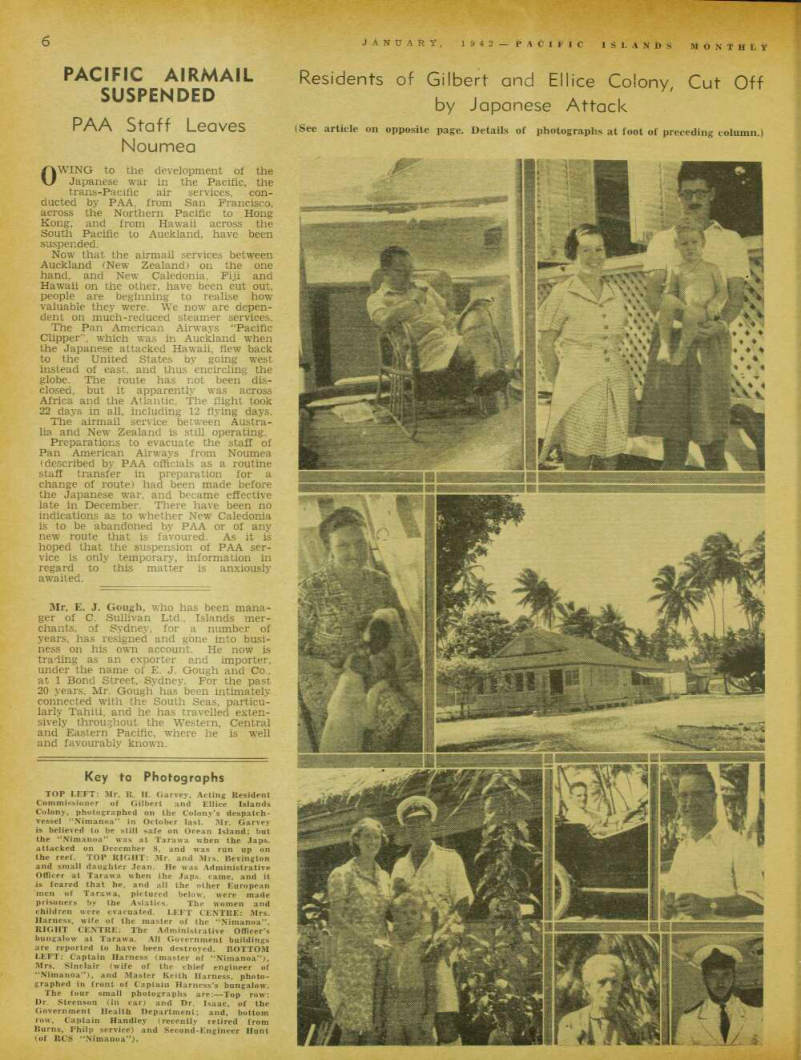
Residents of Gilbert and Ellice Colony, Cut Off
(See article on opposite page. Details of photographs at foot of preceding column.)
Key to Photographs
TOP LEFT: Mr. R. H. Garvey, Acting Resident Commissioner of Gilbert and Ellice Islands Colony, photographed on the Colony’s despatch vessel “Nimanoa” in October last. Mr. Garvey is believed to be still safe on Ocean Island; but the “Nimanoa” was at Tarawa when the Japs, attacked on December 8, and was run up on the reef. TOP RIGHT: Mr. and Mrs. Bevington and small daughter Jean. He was Administrative Officer at Tarawa when the Japs, came, and it is feared that he, and all the other European men of Tarawa, pictured below, were made prisoners by the Asiatics. The women and children were evacuated. LEFT CENTRE: Mrs.
Harness, wife of the master of the “Nimanoa”.
RIGHT CENTRE; The Administrative Officer’s bungalow at Tarawa. All Government buildings are reported to have been destroyed. BOTTOM LEFT: Captain Harness (master of “Nimanoa”, Mrs. Sinclair (wife of the chief engineer of “Nimanoa”), and Master Keith Harness, photo graphed in front of Captain Harness’s bungalow.
The four small photographs are;—Top row: Dr. Steenson (in car) and Dr. Isaac, of the Government Health Department; and, bottom row, Captain Handley (recently retired from Burns, Philp service) and Second-Engineer Hunt (of RCS “Nimanoa”).
Bombs On Rabaul
Some Interesting Sidelights
From Our Own Correspondent
Rabaul, Jan. 9.
THE first enemy bombs to be dropped on Australian soil, in all its history, fell near the golf links at Rabaul on Sunday last, killing 12 natives and in juring in varying degrees some 30 other natives, amongst whom were 11 natives from the Trobriand Islands. They had been rescued from the sea after being several weeks adrift in a native canoe, during which two died of exposure and hunger.
Thus pass a dozen natives of a race over whom Australia has fanatically observed the “sacred trust” given by the idealistic League of Nations, and which now is deader than the dodo. The bombs from the 16 Japanese heavy bombers put the finishing touches to the mandatory sys tem, which has been only a farce since its inception in 1921.
We were given a mandate over New Guinea, and we were scrupulous in not arming New Guinea. Japan was given a similar mandate over Carolines and Marshalls and armed them to the teeth.
Those bombers attacking unprotected Rabaul, came from the Carolines.
The story of Australia’s unpreparedness in the Pacific will be told after this war.
God help officialdom if any of us can ever get at it!
AT 10.45 a.m. on Sunday, January 4, Japanese heavy bombers approached the town from the north-west; and immediately an air-raid siren sounded.
They flew steadily on towards the south east, straight towards Matupi crater.
Other warnings sounded, and then came loud detonations trom the vicinity of the golf links. Columns of black dirt and smoke (so like the spewings of the crater) arose; the aircraft flew on, and disappeared into the east.
First Aid forces from the local PHD rushed out and worked steadily until late in the afternoon on the wounded natives —relieving those past recovery, attending those with awful lacerations from the flying bomb splinters. Some had limbs half-torn from their bodies, some were nearly disembowelled.
At one corner of a labour house, there lay five distorted forms, as death had found them on this bright sunny Sunday morning, evincing a keen interest in this striking demonstration of the “balus” — the symbol of civilisation which was being thrust upon them.
Another “alarm” was sounded that night, about 7 p.m., and enemy aircraft circled over the harbour, made a wide sweep and eventually dropped many bombs, with deafening detonations, on the upland grass country across the bay.
One native, sitting in his garden alone, was killed. Material damage was slight. rIS is now the sixth day since the first raid. Every day we have either an “alert”, an “alarm”, or a raid. Damage has been done, but the extent has not been divulged. There have been no European deaths or casualties up to the present.
We expect there will be more visitations from our northern neighbours.
Asiatics and natives are either fearful or philosophic. If the former, they “go bush”, leaving their business or work to look after itself.
Many of the tailor shops in Chinatown have been closed since Sunday; res taurants have discontinued to function; house-boys have gone home to their villages. But those that remain seem to take their cue from the Europeans: If it comes, then it comes. So what?
World-War In The Pacific
Progress of Events and What They Signify
The following shows, at a glance, the events in the Pacific War, from the moment that Japan struck at the United States, in the dawn of December 7, up to the present time. (See also page ii).
Pearl Harbour base partly smashed.
HMS Prince of Wales and Repulse sunk.
Guam and Wake Islands seized.
Hong Kong captured.
Thailand occupied.
Celebes (DEI) attacked.
Half of Malaya taken.
Philippines partly occupied.
North Borneo occupied.
Nauru and Ocean Is. bombed.
Northern Gilberts occupied.
Rabaul repeatedly bombed.
American Samoa (Pago Pago) shelled.
Japan clearly put into operation a plan that had been under preparation for months—probably years—and she has had, with it, enormous initial success.
THE Japanese, using Japan as their centre, are striking out, in many directions, as if towards the cir cumference of a half-circle, thus:— WEST, BY SOUTH, against China (partly occupied).
SOUTH-WEST, against Indo-China (occupied), Thailand (occupied), Hong Kong (occupied), Malaya (partly occu pied), Burma (bombed) and Dutch East Indies (bombed).
SOUTH-WEST BY SOUTH, against Philippines (partly occupied) and Brit ish Borneo (occupied).
SOUTH-EAST, against Nauru (bomb ed), Ocean Island (bombed), Guam (occupied), Australian New Guinea (bombed) and Gilbert Islands (partly occupied).
SOUTH-EAST BY EAST, against Wake Island (occupied), Midway Island (bombed), Johnson and Palmyra Islands (bombed) and Hawaii (severely raided and bombed).
Effect Of Japan’S Victories
AN examination of the general situa tion, thus disclosed, shows that the strength of the Japanese was ter ribly under-estimated, and that Japan already has won a series of important victories, which have placed Britain, United States and Netherlands Indies very gravely upon the defensive in the Pacific. Details of those events will be found on page 2, but Japan’s victories, and their effect, may be summarised thus:— Japan’s smashing attack upon Pearl Harbour (Hawaii) and her rapid occu pation of Guam and Wake Islands, crippled American plans for offensive air and naval operations across the Northern Pacific, against Japan.
Japan’s outstanding success in sinking the British battleships “Prince of Wales” and “Repulse” off Malaya crippled Anglo-American plans for naval defence there and gave Japan unchallenged com mand of the South China Sea, and allowed her to send great armies against the Philippines and Malaya.
The seizure by Japan of Hong Kong and the Philippines deprives the Allies of any base, nearer than Singapore, which they may use against Japan — except Vladivostock, and there is no indication at all that Russia intends to fight Japan, The seizure by Japan of important territories gives Japan supplies of vital raw materials, of which the Allies are correspondingly deprived—namely, Phil ippines (world’s biggest producer of copra and coconut oil); North-west Borneo (large oil-wells); Malaya (rub ber and tin).
The occupation of Thailand gave the
enemy large quantities of rice, tin and rubber.
The Japanese Advances
UP to January 14, Japan has suffered only one serious reverse—the crush ing defeat of a large army by the Chinese at Changsha—and her armies are pressing on in Malaya, in the hope of capturing Singapore, and in the hope ,of destroying the still-resisting remnant of American and Filipino forces, near Manila.
If the Philippines are completely occupied, and Japanese naval power remains supreme in the North-west Pacific, it is possible that the Japanese will try to push on through Borneo, to attack the Dutch East Indies and Aus tralian New Guinea. If Singapore falls, such a move is certain.
But the tempo of Japanese advances and successes is perceptibly slower, and there are indications that great Anglo- American forces, having recovered from the first shock of Japan’s smashing vic tories, are coming ponderously into action, and presently may challenge the Japanese advance.
The Immediate Outlook
THE keys to the immediate outlook in the Pacific lie in three places, namely— SINGAPORE. If it is held, the enemy will be taking grave risks in advancing on East Indies. If it is lost, East Indies, New Guinea, Northern Australia and South Pacific Islands will be “for it”.
CHINA AND BURMA. An attempt at a great, concerted Anglo-Indian-Chinese drive against the western flank of the Japanese (in South China, Indo-China and Thailand) seems inevitable. If it succeeds, the whole Pacific position will be relieved.
VLADIVOSTOCK. Russian bombers,
Progress' Of The War In The Pacific
only 500 miles away from Japan’s prin cipal cities, could alter the Japanese situation in a week or two. So far, Rus sian strategy is based on the belief that it is far more important to destroy Hitlerism in Europe than open up another front in the East. rIS Pacific war-field is not compar able with the European war-field,
except that in each field the Allies are facing one very powerful enemy, fighting outwards on well-organised internal defence lines.
In Europe, all operations are land based, while in Asia they are almost wholly sea-based. In Europe, the Ger mans can carry on without command of the sea; but if the Japanese lose control of the North-western Pacific, their whole southwards-thrusting campaign will collapse like a pricked balloon. In Europe, the fronts are independent. In Asia and the Pacific, they are inter dependent—that is, if the Japanese are defeated in Malaya, they must lose the Philippines; if they are smashed in the north or west, they must lose in the south and east.
Therefore, it is important to give an outline of developments on the several Pacific fronts.
South-East Asia—Singapore-
East Indies
JAPANESE armies fully occupy the south-eastern corner of Asia (Indo china and Thailand), and are thrusting strongly southwards, down the Malayan peninsula, towards Singa pore and Dutch East Indies. They have over-run all British defences in North ern Malaya, seized many places produc ing rubber and tin, and occupied num erous aerodromes, from which Singa pore can be attacked.
The enemy is now half-way down the pqninsula. The British are retiring slowly, their obvious tactics being to delay the enemy as much as possible, while Anglo-American forces assemble.
A very large army of British, Indian and Chinese is gathering in Burma, whence it is likely to make a powerful
attack, through Thailand, upon the Japanese flank. Meanwhile, a smashing defeat of Japanese armies before Chang sha, in China, may vitally affect the Malayan position.
From their new bases in Northern Malaya and Southern Thailand, Japan ese are constantly raiding places in the East Indies, but they do only minor damage.
The most southerly DEI island is Timor, close to the Australian coast; and the eastern half of Timor is Portu guese. As Japan always has shown a lively interest in Portuguese Timor, and it would be an ideal place from which to raid Australia, a joint Dutch - Australian force moved in in December and took possession of the territory.
Philippines and Borneo
rE American forces in Philippines were no more adequate for pur poses of defence than the British in Malaya; and the Japanese, enjoying sea and air supremacy, kept on pouring in fresh troops until they secured prac tically the whole group.
The Japs received much help from the very large “fifth column” they have in the Philippines. At least 40 per cent, of the group’s retail trade is in Japanese hands, and the large island of Mindanao carried a Jap population of at least 20,000. Officially, ~the Filipinos fought beside the Americans for their freedom (the Philippines were to become com pletely independent in 1946), but actu ally many Filipinos are pro-Japanese.
The Japs had no difficulty in making landings all over the group, and so closed in on and captured Manila.
North and West Borneo was not seri ously defended by the British and Dutch.
The latter claimed that they destroyed the important oil-wells before with
drawing; but Tokio since has announced that the Japs have the oilfields back in production.
Raids on Rabaul SOON after the Pacific war started, it transpired that the Japanese had constructed a sea-plane base at Kapingamarangi (or Greenwich) Island, which is part of the Caroline Islands, and which lies just north of the equa tor, 400 miles north-east of the Man dated Territory of New Guinea. It was an unpleasant shock to the public to find that the Asiatics had secretly pre pared a base so close to us—not a word of it had been heard until the Japs came over in December, This island lies far to the south of the rest of the Caro lines, towards ’New Guinea and Solo mons, so the secret building of the base there clearly was directed at us.
It evidently was known to the RAAF, however, because our planes attacked the Kapingamarangi base before the Japs attacked Rabaul.
Kapingamarangi, lying almost on the equator, 400 miles west of Nauru, con sists of 28 islets, lying along a circular reef which is 14 miles across from north to south and 8i miles across, east to west. There are between 100 and 200 native inhabitants. It now evidently is a base for big sea-planes, and the lat ter, in addition to carrying out many reconnaissance flights over the New Guinea islands, made the following direct attacks on Rabaul: — Jan. 4 —Noon: Sixteen twin-engined Jap long-range bombers, flying in a double echelon, at about 12,000 feet, dropped 10 bombs, which fell along the edge of the RAAF airfield. Twelve natives were killed and 22 wounded. No Europeans were hurt and little material damage was done. RAAF aircraft attempted interception, but the enemy dispersed widely.
Jan. 4—B p.m.: Eleven enemy machines dropped bombs, but there was no dam age or casualties.
Jan. 6. —Long-range flying-boats drop ped bombs on the RAAF aerodrome to night. Slight damage. RAAF fighters vainly attempted interception.
Jan. 7. —Japanese planes dropped bombs on the RAAF aerodrome. Some damage was done to RAAF aircraft on the ground.
Since then, there have been other raids.
The Jap method is to appear from a great height, drop a few bombs, and disperse and disappear quickly. Such attacks cannot be guarded against, or intercepted—but they do little damage.
The Japs come from the Caroline
Islands—probably Kapingamarangi—and
the latter base has been repeatedly attacked by RAAF planes. The latter’s first attack was made on December 18, when an aircraft on the ground was damaged and interceptors driven off.
Another Australian raid took place on January 2, when fires were started and damage done to buildings and personnel.
In these and subsequent raids, the Australians have stirred up the Kapin gamarangi Japs in no uncertain fashion.
These long-distance, hit-and-run raids on New Guinea and Solomons are likely to continue so long as the Japs remain in the Carolines, and enjoy air suprem acy in their part of the North-west Pacific.
Nauru—Ocean Is.—Gilbert
Islands
STRIKING southward from the Mar shall and Caroline Islands, the
Japanese have attacked the British islands of Nauru (phosphate), Ocean Island (phosphate) and Northern Gil berts. which lie roughly in a line, west to east, along the equator, north-east of New Guinea.
Nauru has been bombed repeatedly, but no reports of any damage have been published. This is an Australian-admin istered territory. All women and child ren were evacuated months ago, except three nurses. Mrs. (Dr.) Tothill and two Australian sisters. Four Catholic sisters were evacuated.
Ocean Island has been bombed sev eral times. All women and children (except two Australian nurses) had been evacuated. A Jap plane flew over on December 8, and on the morning of December 9, three Jap four-engined fly ing-boats arrived and dropped bombs,
one of which “practically demolished” the new Residency.
This attack by the Japanese on Ocean Island had some curious features. The buildings and factories of the great phosphate - working installation are massed on the shores of a small bay, at the south-west side of Ocean Island, and are a most conspicuous target from
the air. The Residency, on the other hand, was a large white building on the north-eastern side of the island, about three miles from the phosphate installa tion. The Residency probably was about the most conspicuous single build ing on the island. The only buildings near it are the Government offices, about 150 yards away, the radio station, another 100 yards further away, and the residence of Mr. S. G. Clarke, Government Treasurer. The Residency, with its big flag-pole and conspicuously waving flag, could not be mistaken for anything else.
The fact that the enemy bombed the Residency and not the phosphate works gives colour to the belief that the Japan
ese plan to seize these immensely valu able phosphate islands of Ocean Island and Nauru, and work them for their own benefit. rE Residency, which has been des troyed, was described only in the last issue of the “Pacific Islands Monthly”, as the finest residency in the South Seas. It was completed a couple of years ago at a cost of over £lO.OOO and it was a big, cool, handsome build ing, very cleverly designed to provide comfort for Europeans in that hot equa torial region. A photograph of the Residency, taken in October last, is printed on the front page of this issue.
Mr. R. H. Garvey, one of the best known of the officials of the Western Pacific High Commission, was in resi dence at Ocean Island, acting as Resi dent Commissioner of the G. & E. Col ony, when the bombing occurred, and he appaarently escaped unhurt—although his loss in personal effects must have been serious. Mr. Fox Strangways, the new Resident Commissioner, passed through Melbourne on his way to the Central Pacific, from Tanganyika, a few weeks ago, but it is not thought that he has yet reached Ocean Island. Mrs.
Garvey and their two children are awaiting Mr. Garvey in Suva. Mr. Gar vey is to proceed to Tanganyika as Dis trict Officer as soon as Mr. Fox Strang ways arrives in Ocean Island.
Japs in the Gilberts
WITHIN two days of declaring war, Japanese forces arrived at and occupied the Northern Gilbert islands of Butaritari, Abaiang and Tar awa, and made prisoners of all Euro peans remaining there.
It is not known how many Europeans
were taken prisoner; but it is feared that most of the men staffing the Administration, the Catholic missions, the stores of Burns, Philp and On Chong & Co., and three or four resident trad ers, were seized by the invaders.
It is reported in Sydney that about 25 sisters from the Catholic missions in the Northern Gilberts were evacuated before the Japanese arrived.
On January 8, we learned that the LMS schooner, “John Williams”, which arrived at Suva from the Gilberts before Christmas, brought Mrs. Eastman and another lady from LMS headquarters at Beru (Southern Gilberts) and also seven women and four children, being the families of European officials at Tarawa.
It is presumed that these comprise Mrs.
Bevington and two children, Mrs. Steen son, Mrs. and Miss Holland, Mrs. Eng lish, Mrs. Harness and one child, and Mrs. Sinclair. This news was received with much relief in Sydney, where there had been anxiety for the safety of the women and children who were still on Tarawa in November.
Rev. J. H. Spivey, of Abaiang, was the only LMS missionary in the Northern Gilberts; and he, with his wife and four .children, fortunately came south on furlough some time ago.
Soon afterwards, it was reported that the Japs had abandoned Tarawa, but it is not known whether they abandoned also the prisoners they took there.
The atolls of Makin (or Butaritari) and Abaiang, still in Japanese occupa tion, are fairly good ports. Tarawa lagoon is not so good, although ithe chief British port on the group.
The Government vessel, “Nimanoa”, about 200 tons, which was lying in Tarawa lagoon, was run up on the reef there. The fate of the schooners, “Kia kia” (Government), “Helena” (Burns,
Philp), and “Theresa” (Roman Catholic Mission), which also usually lay in Tarawa, is unknown here.
There never were more than two or three score Europeans in the economic ally-useless Gilberts: but there is a large community of a very good type of Euro nesian.
An interesting fact is that most of these half-castes are the descendants of German fathers and Marshall Island mothers, who were born in the Marshall Islands prior to the Japanese taking them over in 1914 from Germany. Dur ing the last 20 years the Japanese have carried out a ceaseless and ruthless campaign for the elimination of all European elements in the Marshall Islands: and, as a consequence, a con siderable number of these Euronesians have been driven from the Marshall Islands into the Gilbert Islands, where they were accorded freedom and full rights of citizenship under the British flag. Therefore, although some of them are still German nationals, their hatred of the Japanese generally outweighs any anti-British sentiment they may have, and their position under the new condi tions will be tragic.
Attacks Upon Hawaii and Other
Islands
Simultaneously with the devas tating attack upon American naval and air forces in Hawaii, on Decem ber 7. the Japanese attacked advanced American bases at Guam (Mariana Islands), Wake Is. and Midway Is., and demonstrated off the coast of California.
The attack on Pearl Harbour (Hawaii) caused disorganisation which temporarily paralysed the Anglo-American plan for meeting any Japanese thrust. USA lost one battleship, a training-ship which was an old battleship, three destroyers and an old minelayer, as well as 91 offi cers and 2638 men killed and 656 wounded. Very many aircraft were destroyed, and several other warships were severely damaged.
Japan’s plan to paralyse USA by a sudden knock-out blow failed, because the American fleet was at sea, ready for anything, within 24 hours; but the provisional Anglo-American plan to meet a possible Japanese attack was seriously dislocated.
Within four days, on December 11, the Japanese over-ran and captured the American island of Guam, in the Man anas. This was always expected to be an early development of an American- Jap war—the island is right in among scores of fortified Japanese islands.
Wake Island (north of the Marshalls and half-way between Hawaii and Guam) was regarded as important; and, when war broke out, there were upon it, in addition to 400 well-armed marines, about 1000 workmen who were con structing a powerful naval and air base.
Although the Japs threw very powerful forces at the island, the little garrison put up a magnificent defence, held off the invaders for 14 days before they were overwhelmed on December 22, and sank no less than seven Jap warships, including one light cruiser and three destroyers.
The Japs attacked Midway Island, a fortified base nearer to and north-west of Hawaii, but Midway is still in Ameri can possession.
Johnston and Palmyra, fortified islands respectively south-west and south of Hawaii, have been both shelled by Jap submarines, but damage was negligible.
(Continued On Next Page)
Japan, on January 5, claimed that Jap warships attacked a Hawaiian port and destroyed an American warship and damaged another, and blew up military establishments elsewhere in Hawaii.
USA did not reply.
Free France With Allies In
Pacific
VICHY radio, on December 11, announced that Vichy France and Japan had reached an agreement confirming the policy of French neutral ity in the Pacific. This spectacle of the men of Vichy, bowing their heads to the Asiatics, is even more sickening than the sight of Vichy France’s pathetic “collaboration” with Hitlerism.
Fortunately, the Frenchmen of the Pacific do not belong to Vichy. The Free French of New Caledonia, New Hebrides and French Oceania, under the inspiring leadership of High Commis sioner d’Argenlieu and Governor Henri Sautot, are co-operating right worthily with the ABCD Powers in meeting the new menace in the Pacific.
It was announced in the New Cale donian newspapers late in December that “the de Gaulle representative in the United States was negotiating with the American Government for the crea tion of Allied bases in New Caledonia, Loyalty Islands. Tahiti and Marquesas”.
Wake and Midway Islands
MIDWAY and Wake Islands have been the scene of heavy expenditure by American civil and naval aviation interests. They are on the direct North Pacific air route between Hawaii and the Philippines. Pan American Airways Clippers, on their way to Asia, flew 1320 miles north-west to Midway, and re mained there overnight; then 1260 miles south-west to Wake, and remained there overnight; and thence on to Guam, Manila and Hong Kong.
Midway, Wake, Guam, Manila and Hong Kong were all equipped for this passenger service; and, also, all were being equipped, at huge cost, as air and naval bases. This was the trans pacific bridge across which American forces would have to advance to attack Japan.
Within three weeks of Japan’s opening attack, four of the five places named were in Japanese hands: and it is obvious not only that the Japanese have cap tured enormous quantities of American stores and equipment, but also that those places must be recaptured before the war against Japan can be carried home.
Wake and Midway Islands, until about 1935. were merely low heaps of sunbaked sand. By 1941 they had become busy stations, equipped with hotels, wireless stations, weather bureaux, and repair
facilities for the aircraft. Formerly remote from the world, they now attained to regular contact with it. They had become links in the great air-bridge of 5860 miles between Hawaii and the Philippines. Next step was to fortify both islands. At Midway, fortification programme was fairly advanced, at Wake much less so.
Before the outbreak of war in the Pacific, a chief difficulty of the Midway authorities was to get American labour ers to “stick” on the island, for more than three months, even at 600 dollars a month.
“Here,” wrote one American visitor, after calling at Midway, a few months ago, “on this second stepping-stone to America’s Manifest Destiny, are several lonely thousands of the unsung heroes of our unwaged war.”
Then, when America’s war was no longer, unwaged, the men of Midway were no longer unsung. Nor were they suffering from boredom.
They had to put into practice the spirit of a ceremony enacted on the island only last August, when “To the Colours” was blown, the Flag was run up, a watch was posted, and the Navy’s new station came into commission.
Wake, less strongly fortified, is only about three miles long and half a mile wide at any point—is shaped like a V, and is, therefore, by way of being a double island—two coral atolls heavily carpeted with sand and besprinkled with low vegetation.
“There was not even a coconut palm to be seen,” Lady Diana Duff Cooper complained recently. “Just those great red dredges and cranes and tractors to remind one that even such a remote spot, in the middle of the Pacific, could be touched by the fingers of war.”
Wake was staffed at the same time as Midway. It has the standard Pan Ameri can Airways hotel, some few houses, and the vital airfield.
Shells on Pago Pago
A HIT-AND-RUN attack by a light Japanese naval vessel was made on the US naval station at Pago Pago, on the island of Tutuila, Eastern Samoa. Fourteen light shells were fired before the raider fled. The shells did no damage, but three people were injured slightly.
Conditions in Tahiti From Our Own Correspondent
Tahiti, Dec. 10.
ALTHOUGH the great war is now much closer to us, conditions in this terri tory are quiet and we have settled down to a normal way of life. We are under some rationing restrictions, but we are suffering nothing whatever in the way of hardship.
Advertisements & other items, pp. 11-16 (5 items)
Look on the Front of
Your Wrapper !
The figures stamped there (if any) show the date when your subscription expires. This date will appear on wrappers of three issues preceding expiration, thereby giving three months’ notice.
If, at the end of that time, we have not been instructed to continue to send the journal to you, it will be discontinued.
Your subscription (8/- per annum, or 10/- in the case of countries outside the British Empire —which includes postage) may be sent direct, or may be paid to any of our agents (listed on Page 3).
The postage required for this Issue is:— To Australia and New Zealand iy 2 d.
To United Kingdom, via All-sea route .. iy 2 d.
To other British Possessions iy 2 d.
To USA and Foreign Countries SVs-d.
PACIFIC PUBLICATIONS PTY. LTD.
KAMBALA
Church of England Girls’ School n
unj
mimm. m Kambala Church of England School for Girls at Rose Bay, Sydney, provides complete modem education for girls from the age of five. Under the direction of the Principal, Miss F. Hawthorne, 8.A., and a fully qualified staff. Kambala offers thorough preparation for either academic or professional careers, and excellent physical training.
NEW TERM COMMENCES
FEBRUARY 10th.
For full prospectus please consult the Principal, or R. E. Cox, Secretary, 28 Bond Street, Sydney.
St. Ignatius’ College
Riverview Sydney
Boys are prepared for Intermediate and Leaving Certificate Examinations and for Exhibitions, Scholarships and Bursaries at the University.
Boys are arranged in three Divisions according to age. Each Division has its own Library, Debating Society, Cricket and Football Fields, and Tennis Courts.
Senior and Junior Rowing Sheds, with a large fleet of pleasure and racing boats.
Private Swimming Baths.
Prospectus and further particulars on application to the— Rector: St. Ignatius’ College, Riverview, Sydney, Australia.
Tel.: JB 1106.*
BOARDING AND DAY SCHOOL
by the Jesuit Fathers II M 1
ONE OF SYDNEY'S GREAT PUBLIC SCHOOLS
PACIFIC ISLANDS SOCIETY
Visitors from the Islands to Sydney (or those interested in Islands affairs), are advised to communicate with the honorary secretary of the above Society, which has been formed to study the history, traditions, economics, and political developments of the Pacific Islands.
Regular monthly meetings are held at the Hotel Carlton, Sydney.
Address for Correspondence:
THE PACIFIC ISLANDS SOCIETY,
Box 2434 MM., G.P.0., Sydney.
MILITARY GOGGLES
For perfect protection against GLARE, WIND, and DUST. The strong and comfortable frames are fitted with scientifically-designed WILLSON, or CROOKE’S Lenses, and have ventilated leather side shields. Supplied in strong metal cases.
WILLSON Lenses, 15/-. CROOKE’S Lenses, 9/6.
Other types with Crooke’s Lenses, 5/6, 6/6 pair.
Our finely illustrated coloured Catalogue will be forwarded by return post on application.
ON PARLE FRANCAIS
PROUDS PTY. LTD.
PITT & KING STREETS,
SYDNEY
FOR THE BETTER PROTECTION OF AUSTRALIAN HOMES
X^OVIRS
MOKE
STERLING
HOME
paikt
COSTS
LESS
GUARANTEED
100/ AUSTRALIAN
ALSO
BEAUTIFIES
PROTECTS . . ■
si
NOT ONLY
Write for a Colour Card . . .
STERLING VARNISH CO., Alexandria, N.S.W.
m
fei
LONDON PUMPS
Self priming. Genuinely portable.
Weight 50 lb. Capacity 5,000 gal.
Suitable all heads up to 50 feet.
Immediate delivery ex Rabaul to all parts of the Islands.
PARTICULARS:
Nelson Cr Robertson Pty. Ltd. 12 Spring Street, Sydney.
Knox Grammar School
WAHROONGA, NEW SOUTH WALES, AUSTRALIA
(Headmaster, Dr. W. Bryden, M.Sc.) The School is situated 12 miles from Sydney, 600 feet above sea level, and accepts day boys and boarders from six years of age. Boys prepared for all usual Examinations.
Spacious playing fields, swimming pool, well equipped gymnasium, library. Cadet Corps, etc. Prospectus on application. 9*
SSL
t: T4:7 ***?* " I •’ HU £ S 1 1 5 v- — roi
UUgATI
m ~3i t; M m
f it i
I$ : i « EPiiMßftiWfeai i; : s
CLASSIC
U
ULTIMATE
8-VALVE BAND SPREAD
BATTERY VIBRATOR MODELS
“Majestic” Console 175 C.
Available in “Classic” Mantel 176 M.
As illustrated.
Portable Mantel 177 P.
The new “Ultimate” 8-Valve Vibrator Band Spread Models designed for 6-Volt Battery operation, represent an entirely new departure in the field of battery-operated equipment.
The use of lower consumption valves in conjunction with * a 6-volt 6JBG type in the mixer stage, provide the rare combination of maximum sensitivity with relatively low battery consumption.
Tonal quality is assured as the circuit utilises Push Pull output Valves.
CALIBRATED BAND SPREAD OPERATION.
This 8-Valve Chassis has separate full-length tuning scales for the Ip. 19, 25, and 31 Metre Bands. This means that stations which used to be cramped into about i of an inch are now automatically expanded to approximately 6 inches of the dial.
For those resident in the Pacific Islands at locations where a powerful receiver is required, which has the advantage of economical operation, this unique set is unsurpassed.
Comprehensive illustrated literature post free on request.
I Cut out I this Coupon I and post to-day.
GEORGE BROWN & CO. PTY. LTD., 267 Clarence Street, Sydney.
Please send me particulars of “ULTIMATE” Radio Receivers as advertised in “Pacific Islands Monthly”.
NAME
ADDRESS
P.I.M.
M m E I U ft * GEORGE BROWN & CO. PTY. LTD. f 267 Clarence St. Sydney
m 22/6
She Will Cherish
YOUR Gift
Beyond all others, and proudly wear your insignia Send her the emblem of your unit, through ANGUS & COOTE’S “active-service mail-order plan.
Drop us a line, stating choice of article; address of the recipient; text of giftcard, which we include Enclose remittance to the bare cost of the gift chosen, to ANGUS & COOTE.
We attend to the rest, and your gift is guaranteed safe delivery, post FREE. 9 ct. Gold, silverlined Locket, with strong chain. Holds 1 photo A.I.F. emblem embossed on front.
R. A. N. emblem Brooch in sterling Silver. The solid Silver bar is fitted with strong clasp-pin at back. Here is a delightful gift for your friend back home. 12/6 55/ R.A.A.F. Wings, with strong clasp-pin at back. The Brooch is in sterling Silver and is studded with twinkling brilliants. The letters R.A.A.F. are in red, white and blue enamel. 27/6 Enamel colour-patch, on a 9 ct. solid Gold Bar Brooch. There is a strong clasp-pin at back. All units stocked.
AND HERE’S SOMETHING FOR YOURSELF.
Post Free. * C *gj
■CPggL
< a m ~'V with Ches durah m and Draughts.
Dominoes It will fit into yot tunic pocket. The “men are In celluloid and ar marked “Chess” one sid< and “Draughts” the othe: Covered in Pig skin, 13/6; Cro codile-skin, 8/6 Leatherette, 4/- Pocket “Dorn inoes”, in a nea Leatherette wal let. that fit flat i the pocket. Pric 4/6. Also tha fascinating gam< “Backeroo”, i Crocodile, 7/11; Leatherette, 4/1 *
Angus & Coote
500 GEORGE STREET, SYDNEY
QUALITY SECOND-HAND ENGLISH SHOTGUNS FOR SALE: Purdey, Cashmore, Greener, Boswell, Jeffery, Stephen Grant, Hollis, Holloway and Naughton, Bonehill, and a host of other well-known makers are all shown in my Second-Hand List, which will be sent on request.
My Guarantee is behind every Firearm I sell.
QUALITY GUNS BOUGHT, SOLD OR EXCHANGED.
Write for Firearms Catalogue (600 illustrations) and Fishing Catalogue (400 illustrations).
S| O 143 ELIZABETH STREET (Near Market St.) SYDNEY L nU n U ’PHONE: MA 3540.
9
Progress Of The War In The Pacific
PACIFIC ISLANDS MONTHLY JANUARY, 1942
10
JANUARY, 1942 PACIFIC ISLANDS MONTHLY
Progress Of The War In The Pacific
11
PACIFIC ISLANDS MONTHLY JANUARY, 1942
Progress Of The War In The Pacific
12
JANUARY, 1942-PACIFIC ISLANDS MONTHLY
Progress Of The War In The Pacific
Re-planting Rarotonga's
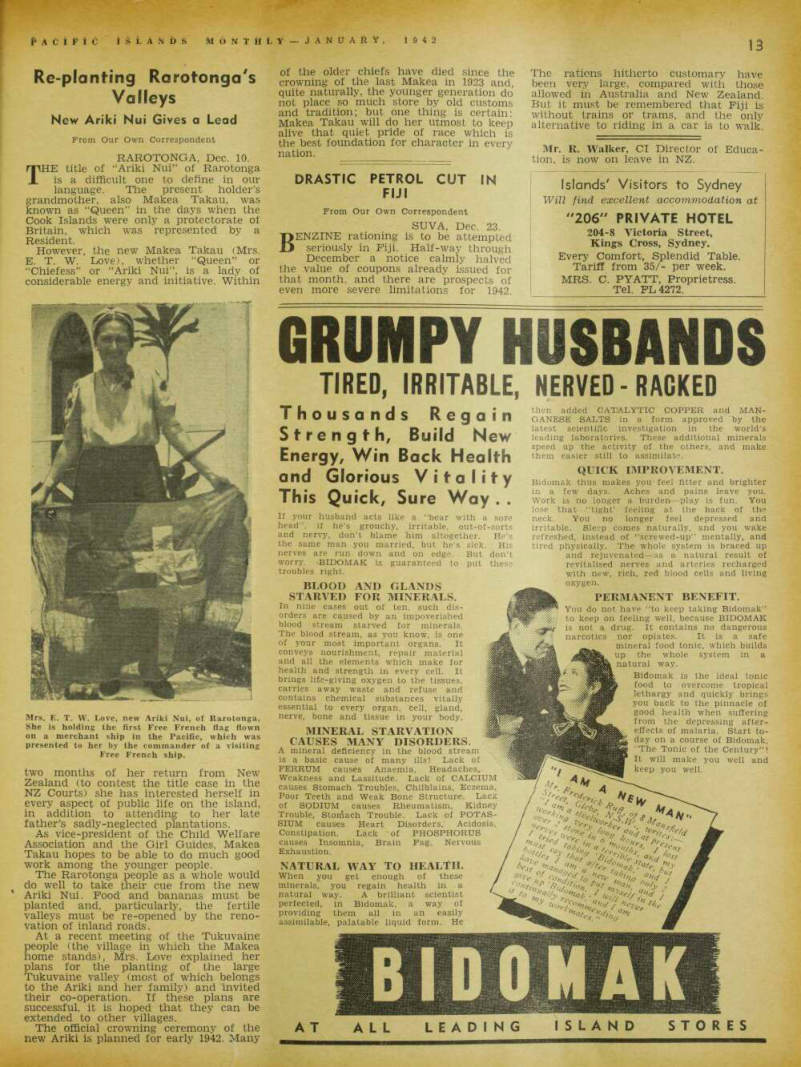
Valleys New Ariki Nui Gives a Lead
From Our Own Correspondent
Rarotonga, Dec. 10.
THE title of “Ariki Nui” of Rarotonga is a difficult one to define in our language. The present holder’s grandmother, also Makea Takau, was known as “Queen” in the days when the Cook Islands were only a protectorate of Britain, which was represented by a Resident.
However, the new Makea Takau (Mrs.
E. T. W. Love), whether “Queen” or “Chiefess” or “Ariki Nui”, is a lady of considerable energy and initiative. Within
two months of her return from New Zealand (to contest the title case in the NZ Courts) she has interested herself in every aspect of public life on the island, in addition to attending to her late father’s sadly-neglected plantations.
As vice-president of the Child Welfare Association and the Girl Guides, Makea Takau hopes to be able to do much good work among the younger people.
The Rarotonga people as a whole would do well to take their cue from the new Ariki Nui. Food and bananas must be planted and, particularly, the fertile valleys must be re-opened by the reno vation of inland roads.
At a recent meeting of the Tukuvaine people (the village in which the Makea home stands), Mrs. Love explained her plans for the planting of the large Tukuvaine valley (most of which belongs to the Ariki and her family) and invited their co-operation. If these plans are successful, it is hoped that they can be extended to other villages.
The official crowning ceremony of the new Ariki is planned for early 1942. Many
of the older chiefs have died since the crowning of the last Makea in 1923 and, quite naturally, the younger generation do not place so much store by old customs and tradition; but one thing is certain: Makea Takau will do her utmost to keep alive that quiet pride of race which is the best foundation for character in every nation.
Mrs. E. T. W. Love, new Ariki Nui, of Rarotonga, She is holding the first Free French flag flown on a merchant ship in the Pacific, which was presented to her by the commander of a visiting Free French ship.
Drastic Petrol Cut In
Fiji
From Our Own Correspondent
Suva, Dec. 23.
BENZINE rationing is to be attempted seriously in Fiji. Half-way through December a notice calmly halved the value of coupons already issued for that month, and there are prospects of even more severe limitations for 1942.
The rations hitherto customary have been very large, compared with those allowed in Australia and New Zealand.
But it must be remembered that Fiji is without trains or trams, and the only alternative to riding in a car is to walk.
Mr. K. Walker, Cl Director of Educa tion, is now on leave in NZ.
Mr. C. J. S. Shore took over the office of Postmaster at Apia, Western Samoa, recently, from Mr. G. W. Marston, when the latter returned to New Zealand with his wife and two children.
Miss Mary Dow, a Victorian who has been undergoing training in Sydney at the Australian Board of Missions’ Hostel, will shortly leave for Papua to join the New Guinea Mission staff.
Advertisements & other items, pp. 17-18 (2 items)
13
{* A c i f t c Islands Monthly 1942
Ihiitii
Islands' Visitors to Sydney Will find excellent accommodation at
"206" PRIVATE HOTEL
204-8 Victoria Street, Kings Cross, Sydney.
Every Comfort, Splendid Table.
Tariff from 35/- per week.
MRS. C. PYATT, Proprietress.
Tel. FL 4272.
GRUMPY HUSBANDS
TIRED, IRRITABLE, NERVED-RACKED
Thousands Regain
Strength, Build New
Energy, Win Back Health
and Glorious Vitality
This Quick, Sure Way . .
If your husband acts like a “bear with a sore head”, if he’s grouchy, irritable, out-of-sorts and nervy, don’t blame him altogether. He’s the same man you married, but he’s sick. His nerves are run down and on edge. But don’t worry. BIDOMAK is guaranteed to put these troubles right.
BLOOD AND GLANDS
STARVED FOR MINERALS.
In nine cases out of ten, such disorders are caused by an impoverished blood stream starved for minerals.
The blood stream, as you know, is one of your most important organs. It conveys nourishment, repair material and all the elements which make for health and strength in every cell. It brings life-giving oxygen to the tissues, carries away waste and refuse and contains chemical substances vitally essential to every organ, cell, gland, nerve, bone and tissue in your body.
MINERAL STARVATION
CAUSES MANY DISORDERS.
A mineral deficiency in the blood stream is a basic cause of many ills! Lack of FERRUM causes Anaemia, Headaches, Weakness and Lassitude. Lack of CALCIUM causes Stomach Troubles, Chilblains, Eczema, Poor Teeth and Weak Bone Structure. Lack of SODIUM causes Rheumatism, Kidney Trouble, Stomach Trouble. Lack of POTAS- SIUM causes Heart Disorders, Acidosis, Constipation. Lack of PHOSPHORUS causes Insomnia, Brain Fag, Nervous Exhaustion.
NATURAL WAY TO HEALTH.
When you get enough of these minerals, you regain health in a natural way. A brilliant scientist perfected, in Bidomak, a way of providing them all in an easily assimilable, palatable liquid form. He then added CATALYTIC COPPER and MAN- GANESE SALTS in a form approved by the latest scientific investigation in the world’s leading laboratories. These additional minerals speed up the activity of the others, and make them easier still to assimilate.
QUICK IMPROVEMENT.
Bidomak thus makes you feel fitter and brighter in a few days. Aches and pains leave you.
Work is no longer a burden —play is fun. You lose that “tight’ feeling at the back of the neck. You no longer feel depressed and irritable. Sleep comes naturally, and you wake refreshed, instead of “screwed-up” mentally, and tired physically. The whole system is braced up and rejuvenated—as a natural result of revitalised nerves and arteries recharged with new, rich, red blood cells and living oxygen.
PERMANENT BENEFIT.
You do not have “to keep taking Bidomak” to keep on feeling well, because BIDOMAK is not a drug. It contains no dangerous narcotics nor opiates. It is a safe mineral food tonic, which builds up the whole system in a natural way.
Bidomak is the ideal tonic food to overcome tropical lethargy and quickly brings you back to the pinnacle of good health when suffering from the depressing aftereffects of malaria. Start today on a course of Bidomak, “The Tonic of the Century”!
It will make you well and keep you well. mr
IHIITIi
AT ALL LEADING ISLAND STORES
There is no substitute for
OLD MONK
VIRGIN PURE
OLIVE OIL
m SjjhwwM!
San Francisco
WIG ROVE no NS
Limited
AUCKLAND
Island Traders. P.O. Box 490.
Telegraphic and Cable Address: “Grove”, Auckland.
Shippers of all classes of New Zealand products.
Representing English Manufacturers throughout the Cook and Society Islands, Fiji, Tonga, Samoa, Niue, New Caledonia, New Guinea, etc.
In FIJI as—W. H. Grove & Sons (Fiji) Ltd.
(k \ 'i ssSSSss»
REFRESHING 6
Free France In The South Pacific
South Pacific
From Our Own Correspondent
Noumea, Dec. 6.
INTERESTING political and economic developments are reported from the Free French Colonies in the Pacific.
Generally, it may be said that they now have settled down quietly under the Free French Administration, directed from London through High Commis sioner d’Argenlieu, in Noumea; that their trade (especially the large and growing metals production of New Caledonia) is being divided between Australia and United States; and that all the French South Pacific Colonies are co-operating completely with the ABCD Powers in fighting Japan in the Pacific.
Only a few days before the outbreak
of war with Japan, Commandant d’Argenlieu announced the completion of a new organisation, designed to meet the possible war situation in the Pacific.
Commandant d’Argenlieu is now High Commissioner for Free France in the Pacific. He directly governs the islands of Wallis, Futuna, etc., and France’s share of New Hebrides; but New Cale donia and French Oceania (Tahiti, etc.) are under separate Governors, who are responsible to d’Argenlieu. Henri Sautot remains Governor of New Caledonia, but is not High Commissioner. Many people will not like Free France’s treatment of the very staunch and loyal Sautot; but war exigencies may have created situa tions to justify what has been done.
“We must be prepared for every even tuality,” said High Commissioner d’Ar genlieu, in a radio broadcast to New Caledonians, on December 5, in which he extolled “the bloodless substitution of the government of Free France for that of Vichy on September 19 last year, in spite of the presence of the gunboat ‘Dumont d’Urville’ and her guns.” He added, in giving cordial greetings from General de Gaulle, that what struck him as the most profound feeling in the Col ony was the patriotism of its people, particularly those of the bush, and their attachment to France.
Reviewing the war, the High Commis sioner paid a sterling tribute to Britain, Russia and United States, and explained that the object of his mission was to fortify the authority of Free France in the Pacific and to put in hand all means of defence against possible attack — which might come soon. “I bring you military aid, both in experienced officers and in material,” he said. “Despite what has already been accomplished there is still much to do.”
“As I was preparing this broadcast,” he continued, “a long message from General de Gaulle informed me that, in view of the Pacific situation, the need for perfect co-ordination and to assure continuity and cohesion of Free French policy, the Comite National has decided to confide to me all questions concerning the Pacific, with the title of Commis saire National and delegate for the Pacific. New Caledonians will realise how great is the task entrusted to me, and my need of your support.”
Trade With America
Governor Sautot has received a letter from M. Louis Dieu, president of the Tropical Trading Company Inc., New York, which has been formed with the approval of Free French headquarters in London, to act as a trading house for the French Colonies which are rallied to de Gaulle. The letter states that the company offers New Caledonia the same advantages already availed of by French Equatorial Africa.
Uneasiness expressed by the Noumea Chamber of Commerce at the lack of US dollar exchange, in spite of New Cale donia’s mineral exports to the USA, is the subject of a letter from Governor Sautot, who explains that he has approached both the Free French Gov ernment and the exporting companies in order to obtain the dollar exchange due.
A sum equal to about 20 per cent, of the amount due has already been released to allow importers to buy much-needed goods and it is hoped that a further distribution may soon be made.
At the same time, Governor Sautot draws' the attention of local merchants to the fact that US dollar exchange must always be reserved for the purchase of utilitarian articles which it is impossible to find in countries belonging to the sterling group. Dollars not indispensable
to local economy are earmarked for the needs of the Allies’ war effort.
The letter adds that the local clearing house, owing to the sale of nickel matte, is now in possession of a considerable sum of Canadian dollars. If the efforts now being made to change these into US dollars are unsuccessful, it is sug gested that importers may find it oppor tune to obtain their requirements in Canada.
Yate Smelters For War
Purposes
It is understood that negotiations are under way for Broken Hill Proprietary Company Ltd. to take over the hydro electric smelters at Tate, south coast of New Caledonia, for war purposes, and for the duration of the war. In the hinterland are the big unexploited iron fields of the Colony.
The smelters, which can produce up to 22,000 kilowats, have not been working since the amalgamation in 1930 of the Nickel Company and the Hauts Four neaux Company, for as a result of this amalgamation nickel smelting was con centrated in Noumea. The working of Yate by an Australian company would represent a significant extension of war time co-operation between the two countries.
Remarkable Personality
rHE following article, 'published re cently in an American newspaper, describes the remarkable man who has taken charge of Free France in the South Pacific : — THE new High Commissioner is Father Georges Thierry d’Argenlieu, an extraordinary personality, whose fame as a fighting man is almost as great among Frenchmen as his distinc tion as a religious leader.
In peace-times he is head of the French Carmelites—le Provincial des Carmes de Frances —one of the strictest orders of monks, and he has served in both world wars as a naval captain.
After fighting at sea from 1914-18, Father d’Argenlieu, member of a family with an ancient title to nobility, became a Carmelite monk and took the name of Father Louis de la Trinite.
Two of his brothers are in holy orders.
One of them is a well-known Dominican.
A sister of his, who died young, was a nun.
Father d’Argenlieu soon became the head of the Carmelite order in France.
Some of the articles he has written on religious subjects are internationally known.
When the present war broke out he was mobilised and given back his rank as naval commander.
The Germans took him prisoner on June 19, 1940, at Cherbourg, but he escaped four days later from a prison car, made his way to the coast, and thence, with three French naval ratings, to England, where all joined the de Gaulle movement.
For a time thereafter he served as chaplain of the Free French Navy, but he volunteered for the Dakar expedition and went as a commander.
He emerged as the hero of that ill fated sortie when, serving as a chief of the emissaries negotiating with Dakar under a flag of truce, he prevented cap ture of those accompanying him.
He was shot and seriously wounded in the thigh, but, according to an eye witness reporter, “stood erect in a small boat under a hail of machine-gun fire . . . while . . . blood soaked his white uniform . . . and directed withdrawal of the landing party”.
Another wounded by his side at the time was Air-Force Captain Becourt Foch, grandson of the French Marshal.
Pure Fiction!
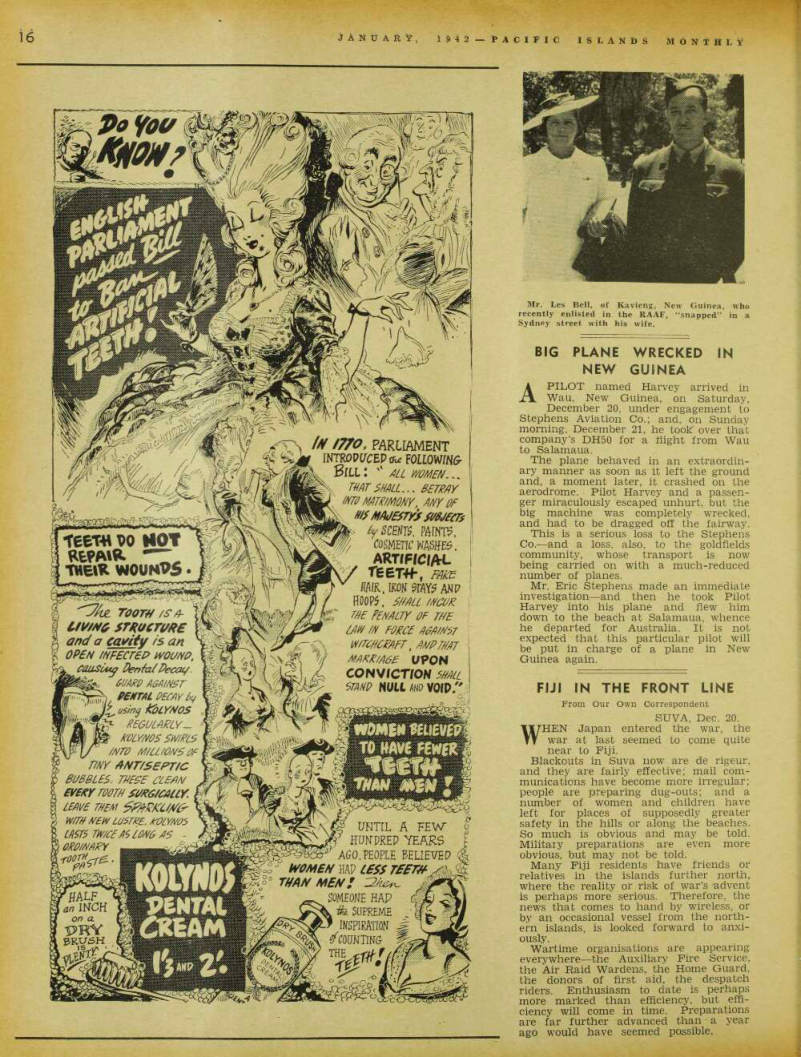
NORFOLK Islanders, who are known to safeguard jealously the secrets of the past, were set by the ears recently when they read a short story in a Sydney magazine under the name of a well-known Australian writer. The author recounted how he had landed on the island, and interviewed one of the Pitcairn descendants who showed him what purported to be a journal written by an old NX convict. The document, she declared, had never before been shown to a visitor. When the story was published, the writer received a letter from a Norfolk Islander asking for more particulars. All the old women had been approached on this matter, he said, and not one admitted possession of the original document. This, of course, was true as the published story was pure fiction!—“Vakatini”.
Mr. B. W t . Taylor, Headmaster of Pro vincial Schools in Fiji, is at present on lon g leave prior to retirement. He has ser ved in the Colony’s Education Depart ment since 1924.
Sister M. G. Moore, formerly of the Colonial War Memorial Hospital. Suva, Fiji, now is in the NZ Army Nursing Service. After taking part in the evacuation from Greece, she returned to New Zealand for a short furlough. She now has gone back to the Middle East for further service.
A wedding of interest was celebrated at Fiji, recently, when Mr. Ross C.
Ba r £ !ay, f „?is W s rd B^r^l ay ’
Barolay of Sydney, waf mar'ried by the District Commissioner to Miss Marguerite R. Mulholland, daughter of the late Rev. H. C. Mulholland and Mrs.
Mulholland, Northern Ireland. Mr. Barclay is an engineer on the staff of the CSR at Labasa.
Mr. Les Bell, of Kavieng, New Guinea, who recently enlisted in the RAAF, “snapped” in a Sydney street with his wife.
Advertisements & other items, pp. 19-20 (2 items)
15
PACIFIC ISLANDS !Vf ONlHtl JANUARY, 1942
Bvjw-'
oP'^ r /
Better
a cm de
Wor^
terun-g
Lis
21 m ■ "Saif NEW Airzone “Concert Star” brings you easy selective tuning, full power for those difficult distant stations, dual - wave for world-wide reception plus glorious lifelike tone . . . the richest voice in radio.
Buy Airzone and be safe!
Before production was ever started on “Concert Stars” the special needs of island listeners climate-proofing, powerful short-wave reception with natural tone, reduction of fading and noise, were fully investigated. The result is a radio that is perfect for the tropics, in components, performance and lone.
THE “CONCERT STAR'
PICK THE MODEL YOU NEED . .
"Concert Stars" are available in models to suit every requirement.
A.C. Model 6552 A—5 valve Dual Wave ★ A.C.-D.C. Model 6652 U—5 valve Dual Wave •jt Vibrator Operated Model 6852 V—5 valve Dual Wave it Battery Operated Model 6752 D—5 valve 1-4 volt Dual Wave Console models also available if you wish.
Agents:
W. R. CARPENTER & CO. LTD.
19 O'Connell Street, Sydney; Salamaua, Rabaul, Kavieng, Madang, N.G., and Tulagi, Solomon Islands.
Designed and manufactured by Airzone ( 1931 ) Ltd., Camperdoivn, N.S.W.
HA4II
po you
Km? \v
mit
a. w «p9y ■T
If/ 1770, PARLIAMENT
IHTROVUCEVtte
Bill: '* all women...
THAT SHALL... BETRAY
INTO MATRIMONY,
uf majesty! subjects
fySC&K. PAINT?,
cosmetic washes, ■
ARTIFICIAL
Teer+f,
MIR., KOtT STAYSANP
HOOP? , SHALL
THE PENALTY OE TNE
LAW IN EO/LCE
W/TCHCPAET, AMP \
MANR/A6E UPON
CONVICTION SHALL !
STAND NULL M VOIP,"
iy jr- Yl "A si teew po MOT
THEV* WOUNDS •
TOOTH ISA- Mil
I CLUING STRUCTURE
g and a cavity is an
OPEN fNFECTEP INOUNP,
Causing BenLaL Peccu/.
GUARP AGAINST
DENTAL PECAYby
I&LYNOS
fefr REGULARLY <
ROLYNOS SWIRLS
/NTP MILLIONS OF
F/NY ANTISEPTIC
BURBLES. THESE CLEAN
EVERY TOOTH SURGICALLY.
LEAVE THEM
WITH HEN LUSTRE. ROLYNOS
LASTS TWICE AS LONG AS -
ORPINARY
HALF
3 art INCH <?rt a. smv /-in
BRUSH
\\ ?T W' L\i
UNTIL A FEW'
HUNPREP YEARS
AGO. PEOPLE 3ELIEVEP
HAP 73SFW
i»“ THAN MEN!
SOMEONE HAP
tfe SUPREME
INSPIRATION J
/COUNTING I
Big Plane Wrecked In
New Guinea
A PILOT named Harvey arrived in Wau, New Guinea, on Saturday, December 20, under engagement to Stephens Aviation Co.; and, on Sunday morning, December 21, he took over that company’s DH50 for a flight from Wau to Salamaua.
The plane behaved in an extraordin ary manner as soon as it left the ground and, a moment later, it crashed on the aerodrome. Pilot Harvey and a passenger miraculously escaped unhurt, but the big machine was completely wrecked, and had to be dragged off the fairway.
This is a serious loss to the Stephens Co.—and a loss, also, to the goldfields community, whose transport is now being carried on with a much-reduced number of planes.
Mr. Eric Stephens made an immediate investigation—and then he took Pilot Harvey into his plane and flew him down to the beach at Salamaua, whence he departed for Australia. It is not expected that this particular pilot will be put in charge of a plane in New Guinea again.
Fiji In The Front Line
From Our Own Correspondent
Suva, Dec. 20.
WHEN Japan entered the war, the war at last seemed to come quite near to Fiji.
Blackouts in Suva now are de rigeur, and they are fairly effective; mail com munications have become more irregular; people are preparing dug-outs; and a number of women and children have left for places of supposedly greater safety in the hills or along the beaches.
So much is obvious and may be told.
Military preparations are even more obvious, but may not be told.
Many Fiji residents have friends or relatives in the islands further north, where the reality or risk of war’s advent is perhaps more serious. Therefore, the news that comes to hand by wireless, or by an occasional vessel from the north ern islands, is looked forward to anxi ously.
Wartime organisations are appearing everywhere—the Auxiliary Fire Service, the Air Raid Wardens, the Home Guard, the donors of first aid, the despatch riders. Enthusiasm to date is perhaps more marked than efficiency, but effi ciency will come in time. Preparations are far further advanced than a year ago would have seemed possible.
Cupid at the Helm
Lovesick Tongon Nearly Wrecks Ketch "Golden Hind"
A COUPLE of months ago, Mr. H. R.
Jenkins, of Auckland, who has been cruising in the South Seas for nearly a year in his 93 ft. ketch, “Golden Hind”, joined a steamer at a Central Pacific port and returned south to New Zealand to bid adieu to son Graham, leaving for overseas service with the RNZAF. His crew of two Tongans sailed the yacht north to Honolulu.
While awaiting the arrival of Mr.
Jenkins at Honolulu, the Tongans did a little quiet wooing among their comely Polynesian cousins on Oahu. One of the lads, smitten and bewitched by a dainty Hawaiian vahine, didn’t care how long the “Golden Hind’s” owner took to rejoin them.
But this is the Machine Age; and, within a short time, Mr. Jenkins step ped from a PAA Clipper at Honolulu.
Then, with the skipper on deck, came the day of departure. The vahine wailed; the Tongan tarried a while longer. Finally, Mr. Jenkins persuaded the lovesick sailor to board ship.
Headed south-west, the “Golden Hind” sped along, making good progress each day. But, as the weeks slipped by and no land smudged the horizon, Mr. Jen kins’ puzzled frown deepened, and more and more he snorted and quietly cursed those so-and-so Pacific sets.
Then, one evening, when the ketch was 28 days out of Honolulu, the skip per heard breakers ahead and came up just in time to put her about and avoid piling up on a reef.
Presently, when Mr. Jenkins went ashore in the dinghy, he was hailed by a voice, in an unmistakable American accent, “Welcome to Canton Island, bud!” And Skipper Jenkins had imag ined he was in Samoa!
It transpired that each night the lovesick Tongan, when on watch as the others slept, altered course in the hope of somehow getting back to Honolulu— and his Honolulu girl.
They were very kind, at the PAA base.
The “Golden Hind’s” auxiliary engine fuel was almost exhausted, and the food supply low; a roaring squall had car ried away the mainsail. But the well equipped store on Canton soon took care of these things, and once more the ketch was shipshape.
A few days later, the “Golden Hind”, Mr. Jenkins grimly at the helm and with one first-class Tongan mate and one slightly discredited Tongan deck-hand standing by, resumed her interrupted voyage to New Zealand.
Rain At Last!
Prom Our Own Correspondent
Pt. Moresby, Dec. 20.
THE first rain since April last fell in a heavy and very welcome shower on December 18. It continued throughout the following day, much to the general relief of the drought-stricken district of Port Moresby, which had suffered from one of the driest spells in the history of the Territory.
Had it not been for the plentiful supply of water from the new water scheme, there would have been extreme discomfort in the town and conditions would have been comparable to those of 1937, when water was carted in by lor ries from the Laloki River and rationed to householders at the rate of 6 gallons
a day.
The Cooks
A Free-Lance Trader In
From Our Own Correspondent
Rarotonga, Dec. 10
AN interesting venture has been made by Captain D. Cambridge, formerly skipper of the Cl schooner “Tiar'e Taporo”, who has re-appeared now in the Cook Islands with his own small schooner, “Taipi”, as a free-lance trader.
Bought in Suva and re-named in the Rarotongan language, the sturdy little ship, with no auxiliary engine, has already sailed immense distances among these far-flung islands, picking up many odd commissions and freights in com petition with the larger schooners.
The “Taipi”, after landing a cargo of arrowroot and mangoes from Aitutaki, was to leave Rarotonga for Honolulu, via Aitutaki, Palmerston, Penrhyn, Suwar row, Puka Puka, Christmas and other
islands. A large assortment of shell necklaces, fine mats and other Islands articles was to be loaded, en route, for the Hawaiian tourist trade, even pos sibly for transhipment to USA. But the Japanese war may alter all this.
In April, after the South Pacific hur ricane season is over, the “Taipi” is scheduled back in the Cook Islands. Her cargo may then be anything—from salted fish from lonely Palmerston Island to barrels of sand from Timbuctoo.
Mr. A. Andrews, manager of the Union S. S. Co. Ltd., Apia, Western Samoa, was in New Zealand last month on leave. Mr.
B. Russell acted as Apia manager during his absence.
Mr. Nura Khan, a Fiji-born Indian who had been associated with Stinson’s photo graphic studios in Suva for many years, died at Lautoka recently, aged 49. He was a prominent member of the Fiji Muslim League.
Mr. Henry J. Stevenson resigned re cently from the New Guinea Police Force.
Mr. A. A. Bloxham, who has been sta tioned for some time at Salamaua, New Guinea, has been transferred to Lae, where he will hold the office of ADO.
Advertisements & other items, pp. 21-22 (1 item)
Ihtwedl
I > v' y *' 7 f U ' I , • - ";: : W ' f. . * ' w '■■■' *’ '*'• *•*<: • -
Tooheqs 1
STOUT.
Power behind the Job!
Trained Men are Indispensable That’s why I.C.S. Students get the good jobs and hold them !
Sirs, —Please send free prospectus showing how I can ! succeed in the occupation I have marked X m Accountancy—Secretarial (all Inst. Ex.) g Bookkeeping—General, Store, Station, i Salesmanship—Gen., Speciality, Retail. Psychology and Personality in Business. Advertising—Retail, Mail-Ord., Agency, g Window Disp.—Show Card, Shop Tckts. g Illustrating—Newspaper, Fash., Poster, g Free Lance Jour'ism—Short Story Writ, g Matriculation—Leaving-Inter.-Pub. Serv. R Gen. Education—Bus. and Sales Letters. I Police Entr. Exam., Nurses Entr. Exam. I Architecture—Structural Concrete. I Building Contracting—Air Conditioning. ■ Draftsmanship (Mech. & all branches). ■ Motor Eng.—Mtr. Mech., Mtr. Exams. I Diesel Eng.—lllumin. Engr., Weld. Eng. ■ Internal Ccmb. and Steam Drivers' Exs. ■ Radio Eng.—Radio Serv., Radio Exms. J Aero Eng.—Gd. Eng., Licenses, Rigging. ■ Elec. Eng.—Elec. Cont. & Mechs' Exms. ■ Civil Eng.—Shire Eng.—Shire Overseer. ■ Textile (all branches) —Analyt. Chem. J Dress Design—Drafting, Cutting, Mlnry. ■ (Underline your subject above —if not z on list write it here ) 5 Enquiries cost a 2d. stamp Post Now! ■ 1.C.5.,
140 ELIZABETH STREET,
SYDNEY.
Name...
Address,
PIM
INTERNATIONAL CORRESPONDENCE SCHOOLS
/ «PS ✓ 500
CANDLE
POWER
I 300
CANDLt
POWER
BRIGHTER LIGHT
for
BETTER SIGHT
Coleman Products can be obtained from all Leading Firms throughout the Pacific Islands.
eman
off ike, niqlvt!
All Types Mantles Ox Instant Lighting Irons Kerosene Pressure Stoves
EASE OF OPERATION
combines
ECONOMY with COMFORT
In case of difficulty in obtaining supplies write to;— Pearce & Co., Suva, Fiji Is
Roll Of Honour
(It is hoped to assemble, here, the names of men, former residents of the Pacific Territories, which appear in British and Free French casualty lists, or in lists of honours awarded.
We should be grateful if relations and friends would send us details.)
Killed
Pilot-Officer Len BAYLISS, flying instructor in the RAAF, formerly of Rabaul, New Guinea.
Killed in Sydney, 18/11/1940, when he fell from a trainer aircraft in flight.
A/Bdr, Neville W. BERTWISTLE, AIF artillery (tank unit), formerly a clerk on the staff of W. R. Carpenter and Co., Ltd,, of Rabaul, New Guinea. Killed in action, April, 1941, Flight-Lieutenant G. J. I. CLARKE, of the RAAF, formerly Assistant Flight Superintendent of Carpenter Airways, New Guinea. Killed in action during operations off Dakar (French West Africa), while attached to HMAS “Aus tralia”, September, 1940.
Flying-Officer Jack R. COATH, of the RNZAF, formerly on the staff of the Bank of New Zealand, in Suva, Fiji. Killed October, 1941, when a training aircraft crashed in NZ.
Pte. Felix CRAIG, AIF, formerly of accounts department, Australasian Petroleum Co., Port Moresby, Papua. Reported killed, June, 1941.
Observer V. L. DEARMAN, of the RAAF, for merly overseer and clerk at the Colonial Sugar Refining Co., Ltd., Rarawai, Fiji. Reported killed in action in the Middle East, October 1941.
Captain Kenneth GARDEN, of the RAP Ferry Command, formerly chief pilot of Guinea Air ways Ltd., in New Guinea. Killed, 2/9/1941, when the bomber he flew from USA crashed on west coast of Britain.
Flying-Officer Moresby GOFTON, of the RAF, son of Mrs, F. S. Stewart, of Wau, New Guinea.
Reported missing, 17/5/1940 —now presumed killed in action.
Pte. Wallace GRAHAM, of the NZ Forces (infantry), formerly on the staff of Morris Hedstrom Ltd., Fiji. Killed in action in the Middle East, November, 1941.
Flying-Officer Alan JOHNSTONE, of the RAF, who was born in Suva, Fiji, in 1915. Killed in action during bombing raid on Kristiansand, Norway, April, 1940.
Pte. L. F. McCarthy, AIF infantry, form erly supercargo on W. R. Carpenter and Co.’s
Inter-island vessels “Desikoko” and “Mako”, in New Guinea. Reported “wounded in action and missing—believed prisoner of war”, 15/7/1941; reported “killed in action” in Syria, 30/10/1941’.
Cpl. Alex. C. SCOTT, AIF, formerly manager at Kieta, TNG, for Burns, Philp and Co.. Ltd.
Killed in action in the Middle East, 19/6/1941.
Pte. Popoare TANGIITI, of the NZ Forces (Maori Battalion), formerly of Mangaia, Cook Islands. Reported “missing after Battle of Greece—presumed dead”, July, 1941.
Died From Wounds
Pte. Ernest HENRY, AIF, formerly of the Rabaul (NG) staff of Burns, Philp and Co., Ltd. Died from wounds received in Battle of Crete, 1/6/1941.
Pte. Walter PEARSON, of first NG quota of AIF (infantry). Died from wounds received in action, 24/6/1941.
A/Bdr. W. R. SCOTT, AIF, of New Guinea.
Died from wounds, July, 1941.
Sergeant-Pilot Peter Clarkson WISE, of the RAF, son of Mr. W. Wise, OBE, Director of Public Works, Fiji. Died from wounds received during bombing raid over Germany, January, 1941.
Died From Illness
Pte. Clarence A. HUTTON, ATP, formerly of Edie Creek, New Guinea. Died from Illness April, 1941.
Major P. J. WOODHILL, AIF infantry, formerly legal assistant in the Crown Law Office, Rabaul, New Guinea. Reported “deceased”, December, 1941.
Missing
Pilot John CLARK, of the RAAF, son of Mr. and Mrs. R. L. Clark, of Rabaul, New Guinea.
Reported missing, 1/11/1941, after an operational flight, in the Middle East.
Pilot Tom PATTERSON, of the RNZAF, formerly of Levuka, Fiji. Reported missing, in November, 1941, after bombing raid on the Continent.
Gnr. Allan H. ROSS, AIF artillery, formerly planter in New Britain, TNG. Reported missing —believed prisoner of war, 28/9/1941.
Pte. William RUPE, of the NZ Forces (Maori Battalion), formerly of Aitutaki, Cook Islands.
Reported “missing after Battle of Greece”, July, 1941.
Pilot James SIMPSON, of the RAF, formerly of Vatukoula, Fiji. Reported missing after air
operations over Malta, in the Mediterranean, 1/7/1941.
Pilot-Officer Neville George STOKES, of the RAF, formerly a pilot with Guinea Airways, Ltd., in New Guinea. Reported missing follow ing air operations over enemy territory in Europe, December, 1941.
Wounded
Pte. V. BLANCO, AIP infantry, of Thursday Island. Reported wounded In action, 8/7/1941, L/Cpl. J. P. BLENCOWE, AIF Infantry, of Rabaul. TNG. Reported wounded In action, 15/7/1941.
Pte. Thomas BYERS, AIF infantry, of Thurs dav Island. Reported wounded in action, May, 1941.
Pte. John GHANT, AIF infantry, of New Guinea. Reported wounded in neck and thigh, 21/9/1941; later, reported “rejoined unit”.
Sgt. C. HENDRICK, AIP infantry, of Rabaul, TNG. Reported wounded in action, 15/7/1941.
Stanley HIGGS, son of Mr. and Mrs. Gordon Higgs, of W. R. Carpenter and Co.. Ltd., well known in New Guinea. Member of an English Lancers’ regiment, wounded during British evacuation from Dunkirk (France), May, 1940.
Lieut. Lloyd T. HURRELL, AIF infantry, of Rabaul, TNG. Reported “wounded In action, remaining on duty”, 29/7/1941.
Cpl. W. H. LANNEN, AIP artillery, of Rabaul, New Guinea. Reported "wounded in action— on seriously ill list, 30/6/1941; removed from seriously 111 list. 25/7/1941”.
Gnr. E. G. LOBAN, AIP artillery, of Thursday Island, wounded during Greek campaign, May, 1941. Invalided home after having his left forearm amputated.
Capt. Edward Tiwi LOVE. NZ Maori Battalion, husband of Mrs. Takau Rio Love. Arlki-nul of Rarotonga. Cook Islands. Reported missing dur ing Greek campaign, 27/5/1941; later, 22/6/1941, reported “wounded and safe”.
Cpl. R. McKERLIE. AIF, of Yandina, BSI, wounded in face by bomb explosion, April, 1941.
A/Sgt. Alastalr MACLEAN, AIP Infantry, of Rabaul, New Guinea. Wounded In action, in Libya. 30/6/1941.
S/Sgt. Graham B. MLRFIELD, AIP engineers, of Rabaul, New Guinea. Wounded in action, 16/7/1941.
Pte. L. G. (“Mick”) REECE, of Bulolo, New Guinea. Wounded in action with AIF, July, 1941.
A/Cpl. N. K. SAWYER, AIP infantry, of Rabaul, TNG. Reported wounded in action, 22/7/1941.
Pte, Lance STAMPER, AIP, formerly school master at Wau, New Guinea. Reported wounded in action. August, 1941.
Pte. Harold G. TURNER. AIP, of Samaral, Eastern Papua. Wounded in action at Bardia (Libya), January, 1941.
Pte. P. D. TWISS, ALP infantry, of New Guinea. Reported wounded in action, August, 1941.
Prisoners Of War
A/Cpl, Peter W. BOSGARD, AIP Infantry, formerly of the Lands Department, Port Moresby, Papua. Reported prisoner of war at Sulmona, Italy, 29/6/1941; transferred to Bolzano prison camp, September, 1941.
A/Sgt. A. A. S. COTMAN, AIF infantry, of Abau, Papua. Reported missing—believed prisoner of war, 5/5/1941; reported later, July, 1941, “wounded in chest and head by shrapnel— taken prisoner”.
Pte. W. GOSSNER, AIF infantry, formerly of the BNG Development Co., Port Moresby, Papua.
Reported prisoner of war, Sulmona, Italy, 6/7/1941.
Gnr. A. L. B. KING, AIF artillery, of Rabaul, TNG. Reported prisoner of war, 29/7/1941.
A/Cpl. John H. LONERGAN, AIF, Supply and Transport, of New Guinea. Reported prisoner of war at Corinthia, Italy, 8/7/1941.
Observer Alex. McKAY, of the RAAF, formerly of the CSR Co.’s staff, at Penang sugar-mill, Fiji. Reported missing, 27/7/1941; reported prisoner of war in Italy, 26/10/1941.
Pte. Harry MARCHINGTON, of Fiji, serving with the NZ Forces in the Middle East. Reported prisoner of war 2/12/1941, after Battle of Crete.
Pte. John O. SMITH, of the NZ Forces, son of Captain Harry Smith, of “Tul Kauvaro”, and Mrs. Smith, of Suva, Fiji, Reported missing, 29/5/1941, after Battle of Crete; reported prisoner of war, 21/10/1541.
Pte. John D. WHITCOMBE, formerly of Levuka, Fiji, serving with the NZ Forces in the Middle East. Reported prisoner of war in Ger many, November, 1941.
Pte. Fred SWAN, NZ Army Medical Corps, formerly of Apia, Western Samoa. Reported August, 1941,. “missing after Battle of Crete”; reported November, 1941, “prisoner of war in Germany”.
Decorations
Sgt. Henry C. S. COTTON, of the RNZAF, who was born in Samoa (his father was Secre tary of Native Affairs during the NZ military occupation). Awarded the Distinguished Flying Cross.
Lieut. Colin HILL, RANK, of the Australian destroyer, “Waterhen”, formerly second officer on the trans-Pacific liner “Niagara”. Awarded OBE for salvaging a burning oil tanker near Suda Bay. Crete.
Flying-Officer James R. HYDE, of the RAP, formerly a Patrol Officer in Namatanai and Sepik Districts, TNG. Awarded the Distinguished Flying Cross for bombing raids on Heligoland Bight, in the North Sea.
Lieutenant-Commander A. W. R. McNICOLL, RAN, son of Sir Ramsay McNlcoll, Adminis trator of New Guinea, and Lady McNlcoll.
Awarded the George Medal “for gallantry and undaunted devotion to duty”.
Sgt. Geoffrey MOORE, of the RNZAF, for merly engineer on the NG inter-island vessel “Maiwara” and on the trans-Pacific liner “Aorangi”. Awarded the Distinguished Flying Medal.
Commander Alvord S. ROSENTHAL, RAN, son. of Major-General Sir Charles Rosenthal, KCB, CMG, DSO, VD, Administrator of Norfolk Island. Awarded the DSO for service in the Mediterranean.
Lieut. George Raymond WORLEDGE, of the RANVR, formerly of Fiji. Awarded the MBE (Military).
Private Wallace Graham
ONE of the first men to leave Fiji, upon the declaration of war in 1939, to enlist for service abroad, Private Wallace Graham, of the NZ Forces, was killed in action in the Middle East at the end of November. For many years he was a member of the staff of Morris, Hed strom Ltd., in Fiji. Originally, he was accepted by the Royal New Zealand Air Force and for a couple of months under went Air Force training, but later was rejected as medically unfit. Thereupon, he enlisted with the infantry section of the New Zealand Expeditionary Forces and sailed for the Middle East. His parents live at Samabula, in Fiji, and his brother, lan Graham, is a Second- Lieutenant in the NZ Army.
By a recent order of the Joint Court of the New Hebrides, the islands of Tongoa, Tongariki, Buninga and Ewose in the Shepherd Group (Southern New Hebrides) have been declared “closed” districts. No person, other than a Government official, may visit them without first obtaining a licence from the Condominium Govern ment.
Advertisements & other items, p. 23 (1 item)
Boils, Carbuncles
Proved fastest way to clear up
TROPIC ULCERS T * J
and Septic Skin Conditions
without INJECTIONS, LANCING or SCARRING
by ORAL VACCINE (taken through the mouth) Here is the ONE treatment that can give you prompt relief from skin complaints—because it actually provides, in most cases, an antidote to those germs which cause many of these diseases.
Hundreds of sufferers who had tried all kinds of so-called “cures” without success are delighted with the results obtained with the LANTIGEN “D” immunisation treatment, based on the researches of Louis Pasteur. LANTIGEN, which contains no drugs, has been developed by a leading bacteriologist, and has proved itself effective in the treatment of deep-sealed bacterial
QUICK RELIEF FROM PAIN
LANTIGEN “D” quickly stops the pain of Boils and Carbuncles, and then heals them up thoroughly and rapidly, without the need of lancing and without leaving a scar or mark.
By providing antigens to incite the creation of antibodies in the system to destroy disease - causing bacteria, LANTI- GEN “D” kills the germs which cause Boils, Carbuncles, Acne, Pimples, Eczema, Septic Sores, Abscesses, etc.
If applied on a cotton-wool pad to a Boil or Carbuncle, the pain will diminish within 24 hours, and the trouble will be completely gone in vr Louis Pasteur
a few days. There are no cores to extract they simply disappear, leaving the skin normal and healthy once again.
LANTIGEN “D” should also be taken by mouth (a few drops in water at bedtime) to purify the system from the poisonous germs, and build up bodily resistance against further attacks. It takes the place of painful, expensive vaccination by injection.
Several weeks’ treatment £l/1/9 per bottle. Two bottles are usually necessary for the average case.
Ask your Chemist.
“Q”
ORAL VACCINE
Product of
EDINBURGH LABORATORIES
103 York Street, Sydney.
American
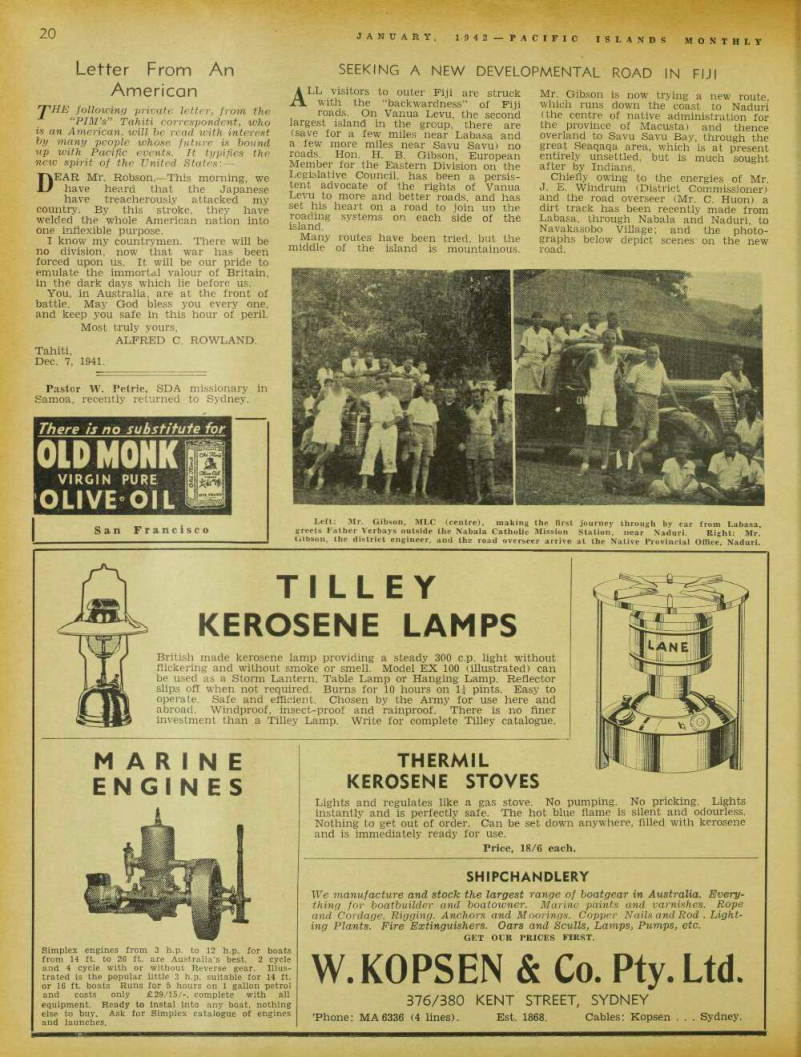
Letter From An American
ITHE following private letter, from the “PlM’s” Tahiti correspondent, who is an American, will he read with interest by many people whose future is bound up with Pacific events. It typifies the new spirit of the United States: — DEAR Mr. Robson, —This morning, we have heard that the Japanese have treacherously attacked my country. By this stroke, they have welded the whole American nation into one inflexible purpose.
I know my countrymen. There will be no division, now that war has been forced upon us. It will be our pride to emulate the immortal valour of Britain, in the dark days which lie before us.
You, in Australia, are at the front of battle. May God bless you every one, and keep you safe in this hour of peril.
Most truly yours,
Alfred C. Rowland.
Tahiti, Dec. 7, 1941.
Pastor W. Petrie, SDA missionary in Samoa, recently returned to Sydney.
Seeking A New Developmental Road In Fiji
ALL visitors to outer Fiji are struck with the “backwardness” of Fiji roads. On Vanua Levu, the second largest island in the group, there are (save for a few miles near Labasa and a few more miles near Savu Savu) no roads. Hon. H. B. Gibson, European Member for the Eastern Division on the Legislative Council, has been a persis tent advocate of the rights of Vanua Levu to more and better roads, and has set his heart on a road to join ud the reading systems on each side of the island.
Many routes have been tried, but the middle of the island is mountainous.
Mr. Gibson is now trying a new route, which runs down the coast to Naduri (the centre of native administration for the province of Macusta) and thence overland to Savu Savu Bay, through the great Seaqaqa area, which is at present entirely unsettled, but is much sought after by Indians.
Chiefly owing to the energies of Mr.
J. E. Windrum (District Commissioner) and the road overseer (Mr. C. Huon) a dirt track has been recently made from Labasa, through Nabala and Naduri, to Navakasobo Village; and the photo graphs below depict scenes on the new road.
Left: Mr. Gibson, MLC (centre), making the first journey through by car from Labasa, greets Father Verbays outside the Nabala Catholic Mission Station, near Naduri. Right: Mr.
Gibson, the district engineer, and the road overseer arrive at the Native Provincial Office, Naduri.
Advertisements & other items, p. 24 (1 item)
W.KOPSEN & Co. Pty.Ltd.
There is no substitute for
OLD MONK
VIRGIN PURE
OLIVE-OIL
KBTil San Francisco
TILLEY
KEROSENE LAMPS
British made kerosene lamp providing a steady 300 c.p. light without flickering and without smoke or smell. Model EX 100 (illustrated) can be used as a Storm Lantern, Table Lamp or Hanging Lamp. Reflector slips off when not required. Burns for 10 hours on li pints. Easy to operate. Safe and efficient. Chosen by the Army for use here and abroad. Windproof, insect-proof and rainproof. There is no finer investment than a Tilley Lamp. Write for complete Tilley catalogue.
MARINE
ENGINES
THERMIL
KEROSENE STOVES
Lights and regulates like a gas stove. No pumping. No pricking. Lights instantly and is perfectly safe. The hot blue flame is silent and odourless.
Nothing to get out of order. Can be set down anywhere, filled with kerosene and is immediately ready for use.
Price, 18/6 each.
SHIPCHANDLERY
We manufacture and stock the largest range of boatgear in Australia. Everything for boatbuilder and boatowner. Marine paints and varnishes. Rope and Cordage. Rigging. Anchors and M oorings. Copper Nails and Rod . Lighting Plants. Fire Extinguishers. Oars and Sculls, Lamps, Pumps, etc.
GET OUR PRICES FIRST.
Simplex engines from 3 h.p. to 12 h.p. for boats from 14 ft. to 26 ft. are Australia’s best. 2 cycle and 4 cycle with or without Reverse gear. Illustrated is the popular little 3 h.p. suitable for 14 ft. or 16 ft. boats Runs for 5 hours on 1 gallon petrol and costs only £29/15/-, complete with all equipment. Ready to instal into any boat, nothing else to buy. Ask for Simplex catalogue of engines and launches.
W.KOPSEN & Co. Pty.Ltd.
376/380 KENT STREET, SYDNEY
’Phone: MA6336 (4 lines). Est. 1868. Cables: Kopsen . . . Sydney.
Life On The “Lousy Islands"


Some Impressions of a Visit to the Equatorial Atolls The Horrors of a Balanced Budget in G. and E. Colony.
By R. W. Robson
THIS article was written in November, before Japan launched her treacher ous attack upon the Anglo-Saxon Powers.
Since then, the line of Nauru, Ocean Island and the Gilberts has represented our northern frontier, close to and fac ing Japanese territory; and we do not know what has been happening there. I keep wondering about the fate of all the kindly, hospitable people I met there only a few weeks ago—young Bevington, AO at Tarawa, and his pretty young wife and infant children; loyal old Captain Hand ley; young Wernham, the grim and efficient AO at Funafuti; Dr. and Mrs.
Steenson, Dr. Isaac, and Mr. and Mrs.
English, all famed for their ready hospitality; Captain and Mrs. Holland, and their attractive daughter; Jenner and Clarke, of the BP store; young Williams, carrying out a weary job up in exposed Butaritari; Captain Harness and Engineers Sinclair and Hunt, and their pretty and charming young wives— what has happened to all those kindly Gilbert Islands people, there within 200 miles of the little yellow men?
We are anxious, also, for the safety of the folk on Ocean and Nauru Islands, which have been bombed repeatedly— Ronald Garvey, Acting RC, and one of the most hospitable men I’ve ever met; David Collins, just transferred from comparatively peaceful Suva; Cartwright and Clarke, and Leembruggen, and all those other officers whose spontaneous kindness made life on Ocean Island en durable; the remarkable J. G. Bridges— remarkable because he still so efficiently manages the great British Phosphate installation after two decades of that foul climate—one wonders how they ara making it.
What has happened in Nauru, where there are hundreds of Australian men, facing a Jap blitz?
Did Colonel Chalmers, Nauru’s doughty Administrator, treat Japanese bombs like he treated German shells? 1 was told that, a year ago, while the Huns were battering the cantilever, from a distance of a few hundred yards, the enraged Colonel, armed with a walkingstick, marched out to the beach, and stood out there in the open, and sneered at them.
He hadn’t even a pop-gun with which to defend his island; but he wanted the Huns to see that no one was afraid of them, anyway.
They are real people, those British and Australian folk up on our front line; and we anxiously await news of them.
R.W.R.
TiHE “Lousy Islands”—“lousy” being used in the modern sense, as applied to something poor, mean, comfortless, unattractive—lie along the Equator, eastwards of New Guinea, and northwards of Fiji, Samoa and the Southern Cooks.
Within the opprobrious term I include the Gilbert and Ellice groups, Ocean Island, the Phoenix group, the Tokelaus, and the Northern Cooks. Nauru escapes, by virtue of its pleasant valleys, leading down to cool beaches. Sunbaked Ocean Island is 460 feet high; but it is just one big. rounded lump of phosphate rock, surrounded by cliffs, with few valleys or beaches: and, in my jaundiced opinion, not a fit place for European habitation.
Except Ocean, not one of the Lousy Islands is more than 8 or 10 feet above sea-leveh—the average is about four.
Imagine it! Thousands and thousands
of square miles, dotted with islands, and not a hillock nor a running stream among the lot of them.
These, of course, are coralline atolls.
Each “island” really is a series of islets, strung out along a circular reef, which encloses a shallow lagoon. The lagoons range from five to 40 miles across. The width of each islet—and there may be 20 or 30 of them on a reef—is seldom over 300 yards; its length, up to 10 miles.
The islets are mostly on the eastern side of the lagoons, and the villages are mostly on the lagoon side of the islets.
The islets are practically all covered thickly with 50-feet high coconut palms and pandanius scrub.
Work that out, and you will under
stand why few of the villages get the south-east trades, which are about the only thing in this wide region to make life worth living.
AS a youth, I partook lavishly of Louis Becke and other colourful writers, whose Islands romances were based mostly on these equatorial atolls. I had always wanted to see the Line Islands.
Well, I have seen them: and my first reaction is to write this unpleasant, snarling article, in which I publicly won der why on earth Britain wants to retain possession of such a useless, comfortless territory.
Of course, the girl motive enters largely into the writings of Becke and Company. And I will admit that if an affair with a pretty Polynesian girl is a prime consideration in life, one can make happy contacts here with a brown, clean-skinned race of handsome island ers, whose manner is amiable, whose morals are easy, and who still retain a delightful respect for the wandering pa'alangi.
But, if one must frivol, why frivol in a continual bath of perspiration, where the only fresh water is that precariously collected in tanks, where mosquitoes howl in chorus the whole night through, and where one’s fresh food is confined rigidly within the limits of coconuts, fish, pigs and fowls?
The frivolities which entice imagina tive, ageing men to the Islands can be conducted so much more comfortably in those delightful Polynesian groups where clear, cold streams rush ceaselessly down out of mountains, and one can get bananas and pawpaws and green vege tables for the asking, and a mouthful of cold air occasionally, and one has some hope of avoiding sweat rashes.
In relation to those things, an Ellice or Gilbert islander has nothing in charm over a Samoan or Tahitian.
I went to the Lousy Islands with a lively curiosity; no man could have received greater kindness and hospitality than I enjoyed at the hands of all the Europeans there; but I came away with the conviction that one visit there, in a lifetime, is enough for any white man.
IHAVE spoken of creature comforts in relation to accommodation—food, and shelter and so forth. But, in one matter of sheer discomfort, the Lousy Islands can put it over all others.
I refer to transport.
From Funafuti north to Butaritari, from Ocean Island east to Manihiki, there is not one port worthy of the name —not one wharf at which even a ketch may tie up. At a limited number of the islands, your ship may anchor in a quiet lagoon, whence you are ferried ashore.
But, in most places, the ship rolls at an anchorage outside, while your boat either paddles frantically through the lagoon-passage, trying to keep ahead of a surging wave, or hops the reef into the lagoon. At first, it is adventurous, and good fun—what’s a ducking or two, among friends!—but one soon becomes fed up of it. I am not one who takes kindly to a wet bottom.
But this is nothing—the real problem of transport in the Lousy Islands are the sudden, satanic westerlies. They come screeching out of a clear sky, with little warning; and, at the first whisper of them, the captains up-anchor and head out strongly for the open sea.
Nearly all the anchorages are on the west of the atolls, and God help the ship that is caught by a westerly on a lee shore.
So, if you are a traveller in the Lousy Islands, you not only can suffer all the discomforts of sea-sickness and bucketing about—for nearly all the ships which go among these reefs are little, round-bottomed things that can roll like nothing on earth —but ycu are in ever lasting danger of being marooned.
Again and again. I heard of people who went ashore for a couple of hours, and remained for a couple of months, having been cut off by a ruthless west erly. They just settled down in a native
village, where time is not, and applied themselves philosophically to keeping the mtestmal tract active on a diet of coconuts and fish.
Only yesterday I heard of an elderly woman who had been hanging off an island for a week, with husband, in a little trading vessel, waiting for the sea to go down. Our ship’s doctor was called for urgently. She had been gripping her wire mattress for so many days, holding her position against the pitching of the ship, that the skin was torn from her hands and they had become badly infected.
Think of that, Madame Suva or Miss Rabaul, when next you travel in your comfortable liner. , T ... . , ND navigation! I still have the horrors when I remember even my modest experiences little ships bucking into enormous swells; creeping forward slowly in thick weather on a
charted course, and sliding sideways almost as rapidly on unsuspected sets and currents; skippers, who hadn’t seen sun or s t ar s f or days, frowning anxiously over charts that bristled with islands and reefs; ploughing ahead in the smothering darkness, knowing that you cannot locate these low, crouching atolls until you climb on top of them, if i were an insurance company I would charge these shipowners a pre mium of 110 per cent, per annum, on the principle that a man must make a 10 per cent, profit somehow, But one must give full honours to the skippers of the Lousy Islands—there are astonishingly few wrecks. They are real seamen. But that kind of voyaging has no pleasure in it for imaginative people who P cling to life as i do * l\/| OST of the Lousy Islands are Itl included in the Gilbert and Ellice Colony, governed by the British
Colonial Office, through the High Commissioner for the Western Pacific (Suva). The Phoenix Islands, an uninhabited Cinderella group which had been leased by Burns, Philp & Co. Ltd., were taken over by the G. and E. Administration in 1938; and, since then, nearly 2.000 people have been transported from the over-crowded Gilbert Islands to the Phoenix.
The Tokelaus and the Northern Cooks —two groups of useless little atolls, of little or no economic value—are administered by New Zealand, the one through Samoa and the other through Raro tonga. If Britain is going to hang on to the Gilbert and Ellice, she certainly ought to have charge of the Tokelams and Northern Cooks. They are all exactly the same kind of coconut-growing atoll, requiring exactly the same kind of administrative attention.
Twenty, or even ten years ago, I should have said that possession of these
Lousy Islands was not worth having Only Ocean Island, with its phosphate Bonanza, has any notable economic value. The G. and E. Colony in a nor mal year, produces copra worth around £60,000, and nothing else; and the cost of the Administration is around £60,000 per annum. If it were not for the revenues accruing from the £300,000 worth of phosphate produced each year in Ocean Island, the G. and E. Colony would be hopelessly bankrupt, But, to-day, there are two inter national factors to be considered. fIIHE first is Japan. If Britain walks 1 out of the Gilbert and Ellice, Japan walks in. And that is a matter of vital concern to all British communities to the southward.
The Japanese are too close now, for comfort, and they are not good neigh hours. They took over the Marshall and Caroline Groups, on a League of Nations
Mandate—which means that the people of other nations were to have reasonable access to them. But the Japanese never have granted access to anyone. On the contrary, they sternly have kept Europeans away, and they have ruth lessly hunted out most of the people of part-European blood who already were domiciled in the Marshalls and Caro lines.
But one of their Marshall Islands trad ing firms has been allowed to establish itself in Butaritari, in the Gilberts (Brit ish) ; and it periodically expresses its great sorrow because its repeated appli cations for permission to place branch trading stores throughout the group have been refused. The Japanese have no sense of humour.
So, for reasons of strategy, Britain must retain control of the Gilbert and Ellice Islands, as a sort of outer defence screen for the more valuable territories, further south. rpHE second factor, to be considered JL to-day, is the new value attained by the equatorial islands as landing places for trans-Pacific airlines. Recent Anglo-American competition for Canton Island (Phoenix Group) is an effective illustration of how a little equatorial island, useless and scorned and disowned, may attain international aviation value overnight.
The Lousy Islands may not be wanted as commercial airline stations; but, if Japan walked in there, there soon would be military aircraft stations around and about, and these chains and clusters of atolls, instead of being merely our outer defence screen, would attain a new, far more sinister signifi cance.
NO, unfortunately—we must keep the Lousy Islands; so let (us see if they could be better administered. I am definitely of opinion that they could.
I cast no aspersions upon the hand ful of devoted men of the British Colo nial Service who now govern the G. and E., with self-sacrifice and devotion to duty. I am throwing the largest brick my pen will carry at the system under which this Colony is governed.
Somewhere, sometime, some compla cent old official rooster, secure in the amenities of a good job and a cool cli mate, laid down the rule that the Gil bert and Ellice Colony should be gov erned in accordance with a balanced budget. The Colony’s revenues must take care of the Colony’s expenditure—and all sorts of surprising, extraneous things, like the pensions paid to retired G. and E. officials, and some of the cost of run ning the High Commission for the WP, are loaded onto the expenditure.
The Colony’s revenue comes from cus toms taxes, taxes on exports (phosphate and copra) and a few license fees, etc.
Even with the phosphate industry, there isn’t enough money for more than a skeleton administrative organisation.
So what happens? So far as I could see, the Colonial Office balances the G. and E. gets as near as pos sible to a balance—by depriving its unfortunate officials of many of the amenities of life. I was shocked to learn of the privations of these people, due to their isolation, lack of transport and the unproductive soil of these miserable, cor aline atolls. Not one of them whined, or uttered a word of complaint to me— that is not the young Britisher’s way; I saw it all for myself.
WHEN I was through there, the administrative officials had been without fresh food supplies, and mails, for many weeks. They were
ingeniously producing tasty dishes out of tins—but if you want to know how loathesome canned food can be, live on one of the Lousy Islands with it for a few weeks.
Fresh fish could be had, and the milk of a grated coconut; and sometimes, after a wild scramble, the house-boys returned triumphantly with a couple of eggs. But there was no milk, very little butter, no green vegetables, no fruit, no fresh meat.
I went out around various bungalows, and saw the pathetic remains of efforts made by various AO’s to grow vegetables and fruits. All had failed. The Lousy mlts!^ S pandamis W an 0t occasional breadfruit and a coarse variety of taro. No bananas, no oranges, no vegetables, and —except for a few miserable specimens —no pawpaws.
Hydroponics (the system of growing vegetables in tubs of water impregnated with chemicals) is favoured in this Colony; but there is a wartime lack of chemicals.
MR. Bevington, AO at Tarawa, in an effort to provide milk for his two young children, procured two goats, male and female. The cynical beasts destroyed Mr. Bevington’s lingering plants, ate Mrs. Bevington’s towels, committed nuisance in the outhouses; but there was not a sign of milk, or milk procedure.
I saw a good deal of the living conditions of officials in the Gilbert and Ellice Islands, and I was appalled. They are supplied with “tropical” houses, and some rough and primitive furniture, and a modest salary, and some rather miserable “allowances” (all in the depreciated
Australian currency!); and, after that, they have to fight like tomcats for any additional equipment and amenities.
One would imagine that, there on the equator, where coolness is only a dream, a refrigerator would be standard equipment in every official’s home. Not on your life! The average official seems to get one only by fighting for it. If he wants a little electric lighting set for his house and office, he buys it himself.
All this, because complacent and comfortable officialdom somewhere says the G. and E. Colony must balance its budget. In the name of commonsense and fairness, Why?
WHY, because these equatorial islands TT are incapable of developing economic value, and are held mostly for strategical reasons, should these keen, highly-educated and carefullyselected young men be cruelly punished?
Why, since these men are prepared to serve the Colonial Office anywhere, and the luck of it brings them to the G. and E. Colony, should the Colonial Office not see to it that they are given the reasonable amenities of our civilisation?
Why should good housing, and comfortable transport, and refrigeration and lighting, and a dependable supply of fresh food and mails, depend upon whether the Gilbertese cut a lot of copra, or the Chinese at Ocean Island dig a lot of phosphate?
If Europeans go trading or planting in these islands, they choose their own lives, and lie upon the beds which they themselves make. But the administrative officer simply goes where he is told.
I take off my hat to these young men of the Colonial Office, for their cheeriness and loyalty under the most com-
fortless equatorial conditions I have seen. But why should they have to put up with it? If Britain wants the Lousy Islands, let her see to it that the men who take care of them for her live in reasonable comfort, A S a matter of fact, the whole posi tion, in relation to the administra tion of these small copra-producing islands of the equatorial belt, is due for review. Nothing will be done while the war con tinues; but there is no harm in discussing the matter now, in prepara tion f or the inevitable post-war re arrangement of Pacific territories. ** wc s oftanhosDhlte 0 f ta nhosDhlte ouf of'the^Lousv Elands there reason whv Britain
“ s * IS?
should continue to hold of except stxategical and aviation reasons.
morf Mtein
Zealand much more closely man Britain.
For purposes of administration and control, would it not be far better that the Gilbert and Ellice, all the Line islands to the eastward, the Phoenix Islands, the Tokelaus and the Northern Cooks, be thrown together into one dis trict or territory, under the control of Australia and/or New Zealand? It is necessary to hold them for the defence of the Dominions—then, let the Domin ions pay for them. That, surely, is a better plan than the Colonial Office one of trying to make the islands pay their way—and giving an unfortunate bunch of able young officers a taste of diluted hell, in the process, T , , , Island and Nauru are simply V/ phosphate deposits, useless for any other purpose: and they should be
thrown together in one administration.
The present arrangement is absurd.
Australia, under a mandate held jointly by Britain, Australia and New Zealand, governs Nauru. Britain, through the High Commissioner for the Western Pacific, and the Gilbert and Ellice Administration, governs Ocean Island—although there is not the slight est community of interest between Ocean Island and the rest of the Colony, while there is complete community of interest between Nauru and Ocean Island.
The real ruler of both islands is the British Phosphate Commission, which works the phosphate deposits, controls the shipping, directs the commerce and runs practically all the public services on each island, except education, police and health.
And it is an efficient organisation. It must get very tired of the jumble of governmental authorities with which it has to deal, between the two islands.
There seems to be no reason, except one of sentiment, why the BPC should
not be left to run both islands—an administrative officer or two being left on each to represent the official govern ment (Britain, or Australia, or New Zea land, as the case may be) and see to the welfare of the natives, of whom there are about 1700 on each island. Such an arrangement would be just as efficient as the present one, and far cheaper.
The only reason why Ocean Island is the headquarters of the G. and E. Col ony, or why it is included in the Colony at all, is that it is the Colony’s main source of revenue. But that reason is disappearing. Ocean Island phosphate deposits will be worked out in another 20 or 30 years; and then, one presumes, the place will 'be abandoned, and G. and E. headquarters will go elsewhere.
IHEAR echoes of a discussion as to the most suitable place for head quarters, after OI is finished— Tarawa, or Abemama, or Abaiang, or Butaritari. So far as I could see, there is little choice between them—each pro vides a sheltered lagoon into which medium-sized ships can go, and a mis erable, coconut-covered, unfertile island.
Rather than seek another headquar ters, this might be a suitable time to consider the whole future organisation and administration of these poor Cen tral Pacific Islands, on the lines indi cated.
In the meantime, Mr. Colonial Office, please forget that old fogey idea of bal ancing the G. and E. budget; and try to make living conditions reasonably tolerable for the handful of young men (and women, for their wives are stand ing by, most loyally) whom the ill-luck of the game has sent to keep the flag flying in the Lousy Islands.
Advertisements & other items, pp. 25-30 (1 item)
Excelsior Supply Co. Pty. Ltd,
GRAMOPHONE
RECORDS
SEND US YOUR ORDERS
Goods sent C.O.D. at no extra charge.
Catalogues sent without obligation.
THE TALKERIES
161 Castlereagh Street,
SYDNEY
SHEAFFER’S WORLD FAMOUS
Streamlined, Feather Touch PENS and PENCILS
If you want Design, Beauty and Quality buy
a SHEAFFER
All Lifetime Pens are guaranteed for the life of the uccr except against loss and wilful damage.
When serviced, they are subject to a small fee for insurance, postage and handling.
Beautiful and Useful Gifts for All Occasions.
SKRIP - The
Successor to Ink makes all Pens write better. 2 oz. 1/6, 40z.2/6 Plus Postage Distributors
74T LTSC AA 3T
Feather Touch Lifetime Pencil Regular Pen Lifetime Pen Pencil 9 6 26/- 761- each 361- ea. each each The working parts of the Sheafier Pencil are guaranteed against wear for the lifetime of the user.
When serviced they are subject to a small fee for insurance, postage and handling.
All Sheaffer regular pens are guaranteed against defects of material and workmanship.
Obtainable from Selected Jewellers and Stationers everywhere
EXCELSIOR SUPPLY CO. PTY. LTD,
278 Post Office Place,
MELBOURNE, VIC.
HEAD OFFICE J
160 BROADWAY,
SYDNEY. N.S.W.
50 Victoria Street,
WELLINGTON, N.Z.
Modern Refrigeration for the South Sea Islands
The ELECTROLUX kerosene operated
REFRIGERATOR
ELECTROLUX offers economical, modern and completely efficient
REFRIGERATION FOR ISLANDS' HOMES.
FREEZES CONTINUOUSLY WHILE SMALL LAMP BURNS.
Freezing controlled by simply regulating height of flame. Uses only J gallon of kerosene per week.
MOTORLESS ... NO PARTS TO GET OUT OF ORDER.
MODEL L 22
Capacity 2.2 cubic feet.
MODEL L3BO
(as illustrated) Capacity 4 cubic feet.
MODEL LKSSO
Capacity 5.5 cubic feet.
GUARANTEED FOR TWO YEARS.
• Write to your Local Distributor for prices and full details.
Obtainable from: W. R. Carpenter & Company Ltd.—Sydney, and the following New Guinea Branches: Rabaul, Salamaua, Wau, Kavieng, Madang, and Wewak.
Representation in Papua W. R. Carpenter & Coy. (Solomon Is.) Pty. Ltd.—Tulagi, British Solomon Islands.
On Chong & Company Pty. Ltd.—Butaritari, Gilbert and Ellice Islands, and New Hebrides.
AUSTRALIA’S
1
AC A
'He m Wo* w LiJ A L: 4LT u
jPW
FOSTER'S LAGER
AUSTRALIA’S NATIONAL BEVERAGE
57 AIDS TO BETTER MENUS
TOMATO
KETCHUP
TOMATO
SAUCE
TOMATO KETCHUP Made
from Sun-ripened Tomatoes.
Medium Bottles .. 8 ozs.
Pure
TOMATO SAUCE A
Appetising Sauce.
Large Bottles .. 13 ozs.
OVEN-BAKED
BEANS
WITH PORK AND
TOMATO SAUCE.
ALSO VEGETARIAN
Individual Tins, 4 ozs.
Small Tins, 8 ozs.
Medium Tins, 16 ozs.
TOMATO JUICE
A delicious health-giving and appetising drink Small Tins, 8 oz.
Med. Tins, 16 oz.
No. 5 Tins, 60 oz.
SPAGHETTI
Cooked in Tomato Sauce with Cheese Individual Tins, 4 ozs.
Small Tins, 8 oz Med. Tins, 16 oz.
VEGETABLE
SALAD
Garden-fresh Vegetables with Mayonnaise. Small Tins, Boz.
HEINZ
FAMOUS iILIiIA PRODUCTS
MADE IN AUSTRALIA
HEINZ
PERFECT
SOUPS
READY-TO-SERVE
In 8 oz. and 16 oz. Tins
CREAM OF TOMATO
CREAM OF ASPARAGUS
CREAM OF CELERY
CREAM OF CHICKEN
CREAM OF GREEN PEA
CREAM OF MUSHROOM
CREAM OF ONION
CREAM OF SPINACH
CREAM OF TOHEROA
BEAN SOUP with HAM
CHICKEN VEGETABLE
KIDNEY SOUP
MULLIGATAWNY
OXTAIL
VEGETABLE
GENUINE TURTLE SOUP
MACARONI
Cooked in Cream Sauce with Cheese.
Individual Tins , 4 ozs.
Small Tins, 8 ozs.
Medium Tins, 16 ozs.
MAYONNAISE
Delightful on Salad.
Small Bottles, 4 ozs.
Med. Bottles, 7 ozs. 18 oz. Bottles 57 oz. Bottles
BEEFSTEAK
SAUCE
Fruits, Vegetables and Spices, skilfully blended.
Medium Bottles, 7* ozs.
STRAINED FOODS
For Infant Feeding and Special Diets.
Strained Carrots Strained Beets Strained Prunes Strained Green Beans Strained Vegetable Soup Strained Beef and Liver
SWEET GHERKINS
Small Bottles
SWEET MUSTARD
PICKLE
Small Bottles
H. J. HEINZ CO. PTY. LTD.
Regd. Office: BENDIGO ST., RICHMOND E.l, VICTORIA Heinz delicious varieties are available from Storekeepers throughout Papua , New Guinea and Pacific Islands.
s>.
aft
m BISCUITS Popular Everywhere! "Milk Arrowroot," full of nourishment, ideal for kiddies. "Club Cheese," a savory in itself, and "Shredded Wheatmeal," Swallow's own delicious new health biscuit.
CANTERBURY CAKES Chockful of flavour . . rich, fruity . . and with an inviting "Home Made" flavour.
Plain . . Fruit . . Seed, etc. There's a variety fo suit every taste.
.. ONLY IF ITS SmL LOWS
Tasty eating comes only from good cooking and finest ingredients, and Swallow & Arieli's products have both. So always say SWALLOW'S when ordering Biscuits . . . Puddings . . . Cakes . . . Cabin Biscuits . . . Navy and Pilot Bread.
Remember that all Swallow's Products are specially tropic-packed in air-tight tins to retain their freshness.
SWALLOWARIELL L-
PORT MELBOURNE, VICTORIA, AUSTRALIA
PLUM PUDDINGS Expertly prepared by Swallow's master cooks. Everyone loves "Olde Englyshe" style plum pudding and the rich goodness of Swallow's is unique.
PRESCOTT Pty. Ltd.
SUSSEX ST., SYDNEY,
are sole wholesale agents for
PINEAPPLE BACON&HAMS
DAISY brand BUTTER "375" BUTTER in TINS llb.-21b.-slb. Sizes.
LEA & PERRINS’ Sauces and Most other Super-Quality Lines of the Trade, such as Cheese, Eggs, Etc.
We are Specialists . . . . \ Let us have your confidence. Sixty years is our record of supplying the leading Houses throughout the World in - - - -
FRESH FRUIT VEGETABLES PRODUCE
’Phones: MA 8612 (4 lines).
Cable Address: “Weymarkson.”
Codes—Bentleys Private.
WEYMARK & SON LTD.
FRUIT AND PRODUCE MERCHANTS
14-18 STEAMMILL STREET - - - SYDNEY
READY TO HE
AND SERVE!
Aunt Mary’s
PREPARED SOUPS AND
TASTY MEAL-TIME PRODUCTS
include delicious Mulligatawny, Tomato. Pea and other rich Soups, also Baked Beans with Tomato Sauce, Curried Baked Beans, Spaghetti with Cheese, Curried Spaghetti and other appetizing, wholesome food products. Ready to heat and serve 1
Aunt Mary’s
PREPARED
VEGETABLES
offer a great variety of fullflavoured, nutritious dinner vegetables; ready to heat and serve. All Aunt Mary's food products are packed in 1 lb. cans for Tropical conditions
and SOLD BY ALL STORES.
tqmatc#
Value Of Coconut Fibre
Letter to the Editor ISAW an article in your paper about the coir industry in New Guinea, by Mr. Thomas Wallace, and regret that he was not given a fair show.
Sixty years ago, I saw the coconut fiore worked by a machine, driven by two mules, on a tread-mill, in the island of Wakaya, 10 miles from Levuka, Fiji.
The husks were soaked in salt water, in tubs, and then beaten, and held to the machine. The fibres were bound in bales, and exported.
Eight years ago I was running a 200tons schooner to the island of Rotuma, and there I saw the natives making coir rope, for tethering their animals, out of long-fibre husks, by hand. To the best of my recollection, it was plaited. So many plaited strands were used, accord ing to the size and strength required.
The first two portions were twisted together, then the third was put on at the finish. An Indian who lives there taught them the art.
The natives of these Fiji Islands plait the fibres and put them up in large blocks. They use them in house build ing and canoe work.
I believe the plaits make a stronger rope, because it is interlocked in the plaiting—the fibres are too short for mere spinning. I have seen the fault in imported coir ropes.
A machine could be got to do the plaiting.
My father bought the sinnets from natives, and made ropes for his use of three strands. He used three handles, and one at the rear to twist the rope.
I am, etc.,
Pioneer Sprig.
Suva, Nov. 10, 1941.
With Aif In Malaya
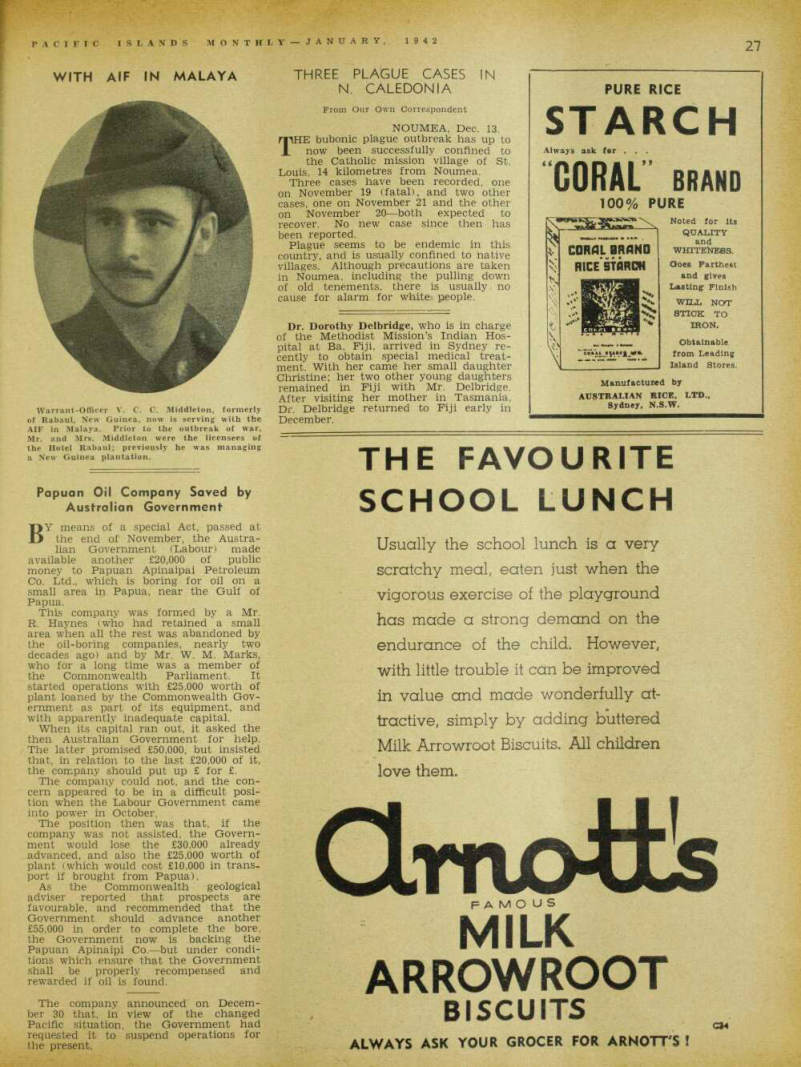
Warrant-Officer V. C. C. Middleton, formerly of Rabaul, New Guinea, now is serving with the AIF in Malaya, Prior to the outbreak of war, Mr. and Mrs. Middleton were the licensees of the Hotel Rabaul; previously he was managing a New Guinea plantation.
Papuan Oil Company Saved by
Australian Government
BY means of a special Act, passed at the end of November, the Austra lian Government (Labour) made available another £20,000 of public money to Papuan Apinaipai Petroleum Co. Ltd., which is boring for oil on a small area in Papua, near the Gulf of Papua.
This company was formed by a Mr.
R. Haynes (who had retained a small area when all the rest was abandoned by the oil-boring companies, nearly two decades ago) and by Mr. W. M. Marks, who for a long time was a member of the Commonwealth Parliament. It started operations with £25,000 worth of plant loaned by the Commonwealth Gov ernment as part of its equipment, and with apparently inadequate capital.
When its capital ran out, it asked the then Australian Government for help.
The latter promised £50,000, but insisted that, in relation to the last £20,000 of it, the company should put up £ for £.
The company could not, and the con cern appeared to be in a difficult posi tion when the Labour Government came into power in October.
The position then was that, if the company was not assisted, the Govern ment would lose the £30,000 already advanced, and also the £25,000 worth of plant (which would cost £lO,OOO in trans port if brought from Papua).
As the Commonwealth geological adviser reported that prospects are favourable, and recommended that the Government should advance another £55,000 in order to complete the bore, the Government now is backing the Papuan Apinaipi Co. —but under condi tions which ensure that the Government shall be properly recompensed and rewarded if oil is found.
The company announced on Decem ber 30 that, in view of the changed Pacific situation, the Government had requested it to suspend operations for the present.
Three Plague Cases In
N. Caledonia
From Our Own Correspondent
Noumea, Dec. 13.
THE bubonic plague outbreak has up to now been successfully confined to the Catholic mission village of St.
Louis, 14 kilometres from Noumea.
Three cases have been recorded, one on November 19 (fatal), and two other cases, one on November 21 and the other on November 20—both expected to recover. No new case since then has been reported.
Plague seems to be endemic in this country, and is usually confined to native villages. Although precautions are taken in Noumea, including the pulling down of old tenements, there is usually no cause for alarm for white people.
Dr. Dorothy Delbridge, who is in charge of the Methodist Mission’s Indian Hos pital at Ba. Fiji, arrived in Sydney re cently to obtain special medical treat ment. With her came her small daughter Christine: her two other young daughters remained in Fiji with Mr. Delbridge.
After visiting her mother in Tasmania, Dr. Delbridge returned to Fiji early in December.
Mrs. Eva Standen, who, with her husband, conducts a mission station in the Delta country, near Daru, Western Papua —one of the most unattractive places in the tropics—had to make a hurried visit to Port Moresby recently to receive urgent medical attention. A serious illness followed repeated Httaeks of rnalaria p ea ted attacks of malaria.
Mr. Lewis Lett, of Port Moresby, author of several books dealing with Papua, recently completed the manuscripts of two further volumes—“ The Papuan Achievement” and “Rainbow Gold”. The former is an historical survey of the Territory’s administrative policy during the regime cf the late Sir Hubert Murray and will be published by the Commonwealth Literary Fund Committee. “Rainbow Gold” tells the story of the Yodda Goldfield (which lies in the Northern Division over the Owen Stanley Range, at the back of Port Moresby); it will be issued shortly by Angus & Robertson Ltd., Sydney.
Advertisements & other items, pp. 31-32 (1 item)
CLmottls
PURE RICE
STARCH
Always ask for . a
CORAL BRAND
100% PURE
CORAL BRAND
RICE STARCH
S
COIU
Noted for Its
QUALITY
and
WHITENESS.
Goes Farthest and gives Lasting Finish
WILL NOT
STICK TO
IRON.
Obtainable from Leading Island Stores.
Manufactured by
AUSTRALIAN RICE. LTD.,
Sydney, N.S.W.
THE FAVOURITE
SCHOOL LUNCH
Usually the school lunch is a very scratchy meal, eaten just when the vigorous exercise of the playground has made a strong demand on the endurance of the child. However, with little trouble it can be improved in value and made wonderfully attractive, simply by adding buttered Milk Arrowroot Biscuits. All children love them.
CLmottls
F A M O US
MILK
ARROWROOT
BISCUITS
c ALWAYS ASK YOUR GROCER FOR ARNOTT'S !
BURNS
(SOUTH SEA)
Inc. in Fiji SUVA
FIJI
Island Traders and Shipowners Also Branches at; Levuka, Lautoka, Labasa, Ba, Sigatoka, Rotuma.
Tonga: Nukualofa, Haapai, Vavau.
Samoa; Apia, Pago Pago (American Samoa).
Solomons: Makambo, Gizo, Faisi.
New Hebrides: Vila.
Gilberts: Tarawa.
Code Address: “Burnsouth”. Norfolk Is. Niue. Wallis Is. Futuna Is.
Fiji:
PHILP
CO. LTD.
Registered Office :
CHI VERS
FAMOUS ENGLISH PRODUCTS
CANNED ENGLISH VEGETABLES
CANNED ENGLISH FRUITS
OLDE ENGLISH MARMALADE
GOLD MEDAL JAMS
JELLY CRYSTALS, ETC.
Obtainable from all leading Grocery Stores
WRITE TO DEPARTMENT “A”
CHI VERS & SONS LTD.
Histon, Combs., Eng.
FOR ATTRACTIVE RECIPE BOOK
c<;
CHIV£RS
COLD
standard fresh
i ENGLISH i
PEAS
n*!2S
Can Gold Hold Its
Value?
IT is difficult to see how gold is going to hold its present value, even if Nazi Germany is smashed. If the Nazis win, of course, the gold standard will be destroyed.
While the world, under British influ ence, was largely a free-trade world, the use of gold was essential for the con venient adjustment of international trade balances. When Britain, in the early thirties, abandoned free trade, and the disastrous period of “national self sufficiency” was introduced by the Ottawa Conference and similar short sighted panaceas, gold was in decreasing demand.
The metal got a new lease of life
because of the economic mess in which United States found herself, as a result of the Great War, the Great Depression, and the British Empire’s abandonment of free trade. It was essential to America’s economy that she continue to export oil, films, motor cars, and great masses of manufactured goods; but she had created a mad-headed tariff system under which few nations could sell America sufficient goods to pay for oil, films, cars, etc.
The position, in the thirties, became so acute—American economy was threat ened with collapse—that America decided to become an unlimited purchaser of raw gold, at a high price. Since then, most of the world’s gold production has gone to the United States, where it is stored in Fort Knox, Kentucky. Here is the world’s principal gold production (1939 or 1940 figures):—
America buys the gold: but actually she Days for it with oil, films, cars, etc., and thus keens going her vast producing industries, which depend on export.
If America did not buy that gold, and did not alter her import tariffs, a great section of American industry would col lapse. But America is not using the e-old—she is simply burying it aeain, at Fort Knox. Its use as a backing for new internal credits does not mean any thing. It is only being really used if it is flowing out again, naturally, as a medium of international exchange.
It stands to reason that this American process of buying gold, and immobilising it, cannot go on indefinitely—it must •break down, even under peace conditions.
There must come a point when America will realise that she has accumulated, in her “hole in the ground’’, all the gold this and future generations of Americans can possibly want. Actually, that point was reached some time ago. But Amer ica dare not recognise it.
Lately, discussions in the United States show signs of uneasiness, in relation to the gold position. It is oointed out, for instance, that thousands of men are working in Canadian gold-mines, to pro duce gold, wherewith to buy American dollars, wherewith to buv war materials.
“Wbv not a simple book-keeping entry under the Lease and Lend Act?” say the critics. “We do not really need Canada’s gold, so the dollars we pay for it are really a gift. And war goods supplied under the Lease and Lend Act will never be paid for. so they are a gift. So why not short-circuit the operation, and turn those thousands of Canadian men over from useless gold-production to useful war production?”
That argument was put forward in Washington by monetary experts in recent weeks, and it is significant.
Mr. W. H. Donald, Australian-born ad viser to the Chinese leader, General Chiang Kai-shek, who was in Tahiti for some months recently, writing his memoirs, has now returned to China.
Dr. C. M. Deland, Medical Officer at Manus. New Guinea, has been in Sydney with his wife and family, on furlough.
Mr. David Callender Campbell, Deputy Chief Secretary of Uganda since 1936, has been appointed Colonial Secretary of Fiji, in place of Mr. C. J. J. T. Barton, who has been transferred to Nyasaland. Mr. Camp bell joined the Colonial Service in 1919 and he has held administrative posts in Tanganyika and Uganda.
Fine ounces.
Canada 5,275,000 South Africa 14,045,000 United States 4,650.000 Russia 4.500.000 Australia 1,645,000
Jeeves of Cathay
A Trader's Tale
As Told To “Tukapa Koko”
UNTIL I went to Papeete for The Firm, I never knew there were so many Chinese outside of Pekin as that charming Society Island city can show.
There are several varieties of them — even fifty-seven, perhaps, for all I know to the contrary!—Chinese and Tonkin ese. Annamites and Javanese, beside Tahiti’s sad sea waves. I, newcomer, inherited a Chinese houseboy.
What a lad was he! Somewhere on the sunny side of 60, he was afflicted by Buddha with a frightful double squint, buck teeth, and a very pock-marked countenance. I liked to have him around: he made me feel handsome.
His duties were many: to cook, to press the clothes that another son of the sen suous Orient washed, to run errands to Maxwell’s or the Kong Ah, and to func tion as factotum generally. All of which he did, to my approval mostly. But at our first meeting his methods were a trifle too original quite to suit my taste.
Upon a day—the day of our first meeting, when my outgoing predecessor tremblingly introduced me to Hop Lee, hoping I would suit HIS taste as an employer—l began my take-over by ordering Hop to make some bread. ]y[y predecessor went. The flour was kneaded, while I supported the fainting mortal frame with cabin biscuit, pend ing the final baking.
The staff of life appeared at breakfast; but, for a baker as experienced as Hop claimed to be, it was singularly woebe gone. Ducks, fed with it, would have sunk.
I called the knowledgeable Hop.
“Hop Lee,” quoth I, “No good this bread.”
“Yassuh,” said the Son of Far Cathay, dead-panned. I might have been telling him it was a fine day.
“You savvy,” said I, trying again. “No good this bread. Too much heavy.”
“Ncssuh,” said the Oriental wizard.
This was satisfying; but I felt a cer tain lack of enlightenment as to the whys and wherefores.
“How come, Hop Lee?” I inquired.
“You no usem yeast?”
“Nossuh,” replied the old retainer. “I usem bakinee powdah.”
Baking powder? It was my predeces
sor’s pet aversion; a thing he never allowed to be used in any cooking done for him. I believe his mother had once been frightened by a Seidlitz powder.
Anyhow, I knew there was none in the house, although the little I had eaten of the offending bread had certainly tasted alkaline.
“You bring, show me,” I commanded.
With the air of an honest bank clerk who is suddenly and causelessly ordered by his manager to turn out his pockets, Hop Lee went out to the back regions and returned with a tin. His air was that of the bank clerk aforesaid trium phantly producing a pocketful of small change with his name marked on every three-penny-bit.
“Here, suh,” he said, beaming at his nose in two different directions at an angle of 45 degrees, registering thereby quiet and devoted faithfulness to me, the receiver of the beam on a slightly slanted wave-length. He presented the canister.
“Bakinee powder?” said I.
“Bakinee. powdah, suh.”
The tin was broad; the tin was flat: the tin bore the legend in the tongue of Old Castille, “For Hacer Su Proprio Jafcon”.
Remember that unscrupulous commer cial who sold to a hotel-keener in Wales a sign, framed, “Ici on Parle Francais”?
The unfortunate Boniface thought it meant “God bless our home”.
“Por Hacer Su Proprio Jabon” means “To make your own soap”.
A tin of caustic soda!
Hop Lee lost some of that “face” which is so highly prized in the langour ous East.
Mr. Harold Nicholls, of Ba, Fin, eldest son of Mr. and Mrs. H. Warne N’cholls, of Nadroga, recently married Miss Joan May Allman, eldest daughter of Mr. and Mrs. A. E. Allman, of Cuvu. The cere mony took Diace in St. Peter’s Church.
Lautoka. After a brief honeymoon, the counle (both members of well-known Fiji families) took up residence at Ba.
Mr. E. J. Wauchope, of Awar Plantation, Madang, New Guinea, was in Sydney last month spending a short holiday with Mrs. Wauchope and daughter Pat.
Rev. James Edwards, principal of the Melanesian Mission’s Training College for Native Clergy and Teachers at Taroaniara, Solomon Islands has arrived in Aus tralia to do deputation work for the Aus tralian Board of Missions.
Pilot Officer G. E. Miller, formerly of Misima Island, Eastern Papua, is now a captain in a bomber squadron of the RAF in England and has been taking part in raids over Berlin, Cologne, Frank furt and other German cities, as well as Northern France. At one time, Mr. Miller was cashier in Burns, Philp & Co.’s branch at Rabaul, TNG, and later he was sta tioned at Lombrum, before going to Misima.
Advertisements & other items, pp. 33-34 (1 item)
Uj?p€tise?i
nl Sms-
If
OUfIOO
Sauce /«as 6ceH
"T/ta OTc^Ms
Uj?p€tise?i
fdi
Always serve it at table and use it when cooking, too, for it will savor the soup and add a delightful zest to every meat or made-up dish Try this recipe for a Worcestershire Omelette-a favorite breakfast or luncheon dish; Vi lb cold Chicken or Mutton 2 teaspoons Holbrooks Worcestershire Sauce Vi pint Milk 4 eggs Pepper and Salt Butter a glass baking dish, half fill with the minced chicken *or mutton seasoned with the Holbrooks Worcestershire Sauce. Beat the eggs and add milk, pepper and salt. Pour over meat and bake in moderate oven until custard is set. Serve very hot.
PRODUCING UNIFORM GOOD RESULTS SINCE 1868
jpS-
ALWAYS ASK FOR IT
KANGAROO BRAND
Ropes,
Cordage,
and Twines for every purpose Backed by 86 years of service.
Manufactured by
M. DONAGHY AND SONS,
Pty. Ltd./Geelong and Sydney.
Fiji Representatives:
PEARCE AND CO.
LIMITED
P.O. BOX 237, SUVA
Allen Taylor & Co. Ltd.
COMMERCIAL ROAD, ROZELLE,
SYDNEY
Sawmillers and Wholesale Suppliers of Hardwoods for Constructional Purposes GIRDERS . . . PILES . . . POLES . . . SLEEPERS, Etc.
EXPORTING TO PACIFIC ISLANDS SINCE 1893
IT ATTRACTS —THEY EAT IT —THEY DIE viNe
USOLINE
NEVER
KNOWN
TO FAIL!
AUSOLI N E CO.
314 CROWN STREET, SYDNEY
(Established 1919)
COCKROACH
DESTROYER
IT'S A PASTE !
Packed in 6 oz., 1 lb. & 3 lb, tins.
Obtainable from Islands Stores of:—
BURNS, PHILP & CO. LTD.
W. R. CARPENTER & CO.
LTD.
MORRIS, HEDSTROM LTD.
W. S. TAIT & CO. PTY. LTD.
Copra
When War Ends
Urgent Demand For Copra
'J'HE following United Press message from Washington, USA, recently, summarised the position and pros pects of the world’s oil and fat industries, prior to the outbreak of the Pacific war :— THE end of the European hostilities will see an urgent demand for copra and other oil-bearing products from the Philippines, South America and else where, according to Charles El Lund, US Commerce Department foodstuffs specia list.
Writing in the official “Commerce De partment Weekly”, Lund pointed out that large supplies of copra and oil seeds of various kinds are accumulating in the Philippines and South America because of the lack of shipping and the British blockade of Europe.
Despite German efforts to attain self sufficiency in oil and fats, there are still important deficiencies in these items in Europe, and the demand for them will be great when the war ends.
Lund said, however, that war damage to crushing and refining machinery may necessitate at first large purchase of finished products of this type from the United States, such as lard, vegetable shortening, refined oils and relative pro ducts.
Discussing the importance of fats and oils in war-time, Lund said: “An adequate supply of fats and oils is a leading consideration in any nation’s defence preparations. Europe learned
this in the 1914-18 conflict, when a short age of these vital materials in the blockaded zone became one of the factors m the ultimate outcome of that war.
Most European nations are still depen dent on overseas imports for the bulk of their fat and oil supplies, which to-day are subject to blockade and war-time shipping risks.
“The products finally reaching their destinations carry increased transpor tation charges, and the higher costs of war-time production in the supplying countries.
“Europe has therefore searched and is still endeavouring to find both alternate and synthetic materials which can be procured with the least expenditure of foreign exchange and can be obtained as far as possible, either from domestic sources or from colonial possessions.
“Germany has concentrated on this programme for a decade or more. Its progress in the development of syn thetics and the reclamation of fats from former waste materials is well known.”
Lund pointed out that while oils are thought of chiefly in terms of food, many of them are important in industry and national defence.
Coconut oil is used in the manufac ture of plastics, alkyd resins, and rubber.
Its principal use is in the manufacture of soap, the source of the nation’s glycerine supply,” Lund said.
“Glycerine is important in the manu facture of explosives. Palm oil is par ticularly important in the manufacture (( tin-plate and of textile soaps.
“Sulphur olive oil is essential in the process of degumming silk used in mak ing parachutes, and parilla oil is valued in the manufacture of high-gloss paints now being employed in large quantities in finishing the walls of hospitals.
“Spar varnishes prepared with tung oil are recommended in US Navy speci fications, and they also find wide use for the coating of shells and for insulating materials.
“Linseed oil from America’s domestic crop is widely used as a paint oil in the expanding national defence construction activities.
“American ingenuity has successfully developed several substitutes to alleviate the shortage of fast-drying oils imported from the Orient. Research chemists have developed substitutes for tung oil in certain formulas that are reaching the market in increasing quantities. In the drying-oil field, the use of fraction ated castor oil, and of soybean-oil acids has been greatly stimulated by short supplies of drying oils from war-torn Asia.
“In addition to short supplies from Asia, imports of olive oil and cod-liver oil from Europe have about reached the vanishing point. California olive-oil pro duction has been greatly expanded, and more domestically produced vegetable oils are now being used in the salad and cooking oil field.
“The liver oil of the North Sea cod fish was formerly depended upon very largelv for vitamins A and D; but at present some 600 boats in California waters are fishing for sharks of the soupfin species, whose liver oil has a vitamin A content much greater than that of cod-liver oil. Sardine oil has also been found to be a moderately good source of vitamin D, and tuna livers at present, mostly from Japan, are valuable for their vitamin C content.”
Mrs. Elizabeth McCreadie, wife of Mr.
William McCreadie, formerly a resident of Suva, Fiji, for many years, died at Wiley Park, NSW, recently, aged 70. Mr, McCreadie at one time was editor of the Suva daily newspaper, “The Fiji Times and Herald”.
Lovely Moorea
Is Treasure Buried There ?
By A. C. Rowland
MOOREA, satellite of Tahiti, differs greatly from the other islands of the Society Archipelago; resembling, rather, the * picturesque Marquesas Islands.
Its landscape of strangely shaped peaks, pinnacles, battlemented ridges and shadowy gorges, would be forbidding were it not for the dazzling green of foliage which cascades from the highest summits, over scarp and precipice, to the shores of bays that penetrate deeply to the heart of the mountains.
By night, these unearthly mountains,
as shadows against the stars, move the unaccustomed stranger to believe him self transported to some fantastic king dom of wizards, ogres and black en chantments. The more so when the night bird, the Upoa, flies unseen through the darkness; its cry (like the despairing wail of a lost spirit) echoing among the precipices. The true centre and citadel of all the warlocks, sorcerers and witch-doctors of Polynesia—one would imagine.
Surprisingly little legend or tradition concerning Moorea has ccme down to us, although massive marae ruins and stone faced terraces on the slopes of the val leys bear mute witness of a teeming population in pre-historic times.
If, however, they have lacked in the wisdom and practice of the black arts, the inhabitants of Moorea have always excelled in that lighter magic known in the South Seas as the “coconut tele graph”. Moorea people know more about the happenings and gossip of other islands than do the inhabitants of those islands themselves. There is an old say ing—still current—“lf you wish to hear all the gossip of Tahiti, be on the wharf when the boat from Moorea comes in.”
LIKE many another island in these waters, Moorea is reputed to be the hiding-place of vast treasure.
The arrival of a mysterious schooner, which came to anchor in Opunohu Bay, opposite MacFarlane’s place, while we were staying there 32 years ago, set tongues wagging about that treasure story.
The native pilot who brought her in told his friends that the vessel hailed from Peru and had come to Moorea without reporting at Papeete—the port of entry to the colony. He said they were a queer lot aboard: very secretive, and did not want any visitors from shore.
Some years before, a missionary on the island had received a letter from Chile.
Accompanying the letter was an outline drawing, manifestly depicting the Moorea mountains. In the text, the writer alluded vaguely to revolution and the spiriting away of plate and jewels from churches and cathedrals to a distant island of strangely-shaped mountains.
Did the missionary know of any island such as pictured in the drawing?
The pastor made inquiries on Moorea and found some very old natives who, searching their recollection, remembered the coming of a gunboat. Guards had been put ashore to keep the natives at a distance, and there had been much going and coming to some secret place in the mountains. After the gunboat sailed away the natives, thinking some
kind of foreign tapu was over the place, never explored thereabout.
The pastor, after reflection, decided to
Moua Pita (Pierced Mountain), on Moorea—one of the jagged peaks of that interesting island.
The hole through the peak can be discerned as a white dot, just below the peak.
leave the letter unanswered.
Moorea, at that period, was an un spoiled Polynesian island. The missionf r y. fearful of the consequences of an invasion of treasure-hunters to its calm serenity, allowed the incident of the let ter to fade into misty forgetfulness; where it remained until the Peruvian schooner appeared.
Her stealthy arrival became known, in due time, to the authorities at Tahiti, and the police came over to investigate, The schooner thereupon sailed out Of Opunohu Bay and vanished. vparc i a tor a , later, the islands were destined to witness many a treasure-hunt, in full cry. But. with the exception of the SUS n° expedition in quest of the Chilean trea sure on Moorea has ever been under taken, ’ . . fTIHE missionary’s care to preserve the 1 p i acid tranquillity of the island’s nntivo Ufo noctnnnprl o 7 , native 1116 postponed, for a few years, the inevitable. But Moorea, like many another paradise of peace and serenity, was eventually “discovered” and « nnt jL man”
P"r. on nmP This writer has not set foot on Moorea for over 20 years; yet daily he looks unon its distant mountains, with nostalgic Viewed from Papeete, Moorea stands athwart the western horizon. At the summer solstice in December, the sun
sets a little distance to the south; at the June solstice, a few degrees to the north of the island. During its procession with the seasons, the sun goes down succes sively behind each peak in a blaze of splendour unsurpassed in any other part of the world.
Whatever may have happened on the coasts and in the valleys, the picturesque silhouette of Moorea is still unsullied.
“Discovery” and exploitation have not, as yet, brought sky-line advertising to the South Seas.
Advertisements & other items, pp. 35-36 (1 item)
Bitumenoid Roofing
Timber, Joinery
ETC.
PREPARED BUILDINGS ready for erection a specialty.
SHIP AND BOAT BUILDING.
TIMBERS specially catered for.
FIBROLITE, PLYWOODS.
GALVANISED IRON.
CONSIGNMENTS shipped
by RETURN STEAMERS
to the Islands.
John W. Eaton
PTY. LTD.
WEST CRESCENT STREET,
NORTH SYDNEY.
Telephones: X 84051 (6 lines.)
Woven Wire for all Industry
COPRA DRYING TRAYS, FLOORS, Etc.
FRUIT DRYING TRAYS, MINING SCREENS.
Heavy Mosquito Gauze in Phosphor Bronze and other Metals Impervious to Salt Sea Air.
WIRE DOOR MATS AND GENERAL WIRE WORKS
E. WRIGHT & CO. LTD.
Office and Works: 148-152 Cleveland Street, Sydney, N.S.W.
Telegraphic Address: “Wrightmake,” Chippendale. vvr f! £ &
mill make your kitchen
really modern... daft
myourspare time!
All the colourful, washable advantages of ceramic wall tiles is provided at less cost when you use DURATILE. Write for descriptive literature. Wunderlich Ltd., Crown and Cleveland Sts., Redfern, Sydney.
WUNDERLICH*
GEB:
000 mm
DURATILE
BITUMENOID ROOFING
MADE TN AUSTRALIA.
Bltumenold Roonngs. Dampcourse and Insulating Felts are made from the world’s best raw materials. Warranted to stand the most rigid tests.
BITUMENOID THE BEST
Roofing l 2 3-ply Flooring. Waterproof Materials; Saturated Felt; Resilient Road Jointing; Natural Asphalt Dampcourse: 2 and 3-ply Dampcourse; 1-2 lb. Lead-core Dampcourse; Roofing Cement: Asphalt Paints; Roofing Compound.
SAMPLES AND PRICE LISTS ON APPLICATION.
MAXWELL PORTER & SON LTD.
ESTABLISHED 1888
107 REDFERN ST., REDFERN, SYDNEY, N.S.W.
BUILDERS’ SUPPLIES.
'Phone: M 3167. Cables Bitomenoid.
Gland Discovery
Restores Youth
In 24 Hours
Sufferers from loss of vigour, nervousness, weak body, impure blood, failing memory, and who are old and worn-out before their time will be delighted to learn of a new gland discovery by an American Doctor.
This new discovery makes it possible to quickly and easily restore vigour to your glands and body, to build rich, pure blood, to strengthen your mind and memory and feel like a new man in only 8 days. In fact, this discovery, which is a home medicine in pleasant, easy-to-take tablet form, does away with gland operations and begins to build new vigour and energy in 24 hours, yet it is absolutely harmless and natural in action.
The success of this amazing discovery, called Vi-Stim has been so great in America that it Is now being distributed by all chemists here under a guarantee of complete satisfaction or money back. In other words, Vi-Stim must make you feel full of vigour and energy and from 10 to 20 years younger, or you merely return the empty package and your money will be refunded. A special, double-strength bottle of 48 Vi-Stim tablets costs little and the guarantee protects you.
Vi-Stim
GUARANTEED
fe to Restore Manhood and Vitality . . .
Ship Chandlery Hardware
r Write for j
j Ship Chandlery /
* Catalogue J
Special “In Bond” Prices for all Islands enquiries quoted on application.
BROOMFIELDS LIMITED
152 SUSSEX STREET :: SYDNEY.
Cables: “Boom”, Sydney.
Large and Complete Stocks of
SHIP CHANDLERY
IRONMONGERY OF ALL KINDS, PAINTS,
WHITE LEAD AND OILS.
Sole Agents for: P. H. MUNTZ & CO.’S 3-CROWN BRAND METAL SHEATHING.
PEACOCK & BUCHANS’ ENGLISH READY-MIXED PAINTS.
Scott’s “Renown” Brand Rope,
Cordage and
Binder
Twine
Cable Address: Ropeyard, Sydney.
of Every
Description
MANUFACTURED AT
MASCOT, N.S.W.
By
SCOTT
PTY. LTD.
Head Office and Store:
163 CLARENCE STREET,
SYDNEY,
N.S.W.
J.
Fiji's Taxes
Prom Our Own Correspondent
Suva, Dec. 10.
fpHE Colony of Fiji, hitherto one of X the most fortunate places in the world in the matter of income taxa tion, is now beginning to “take it in the neck”—as, of course, was inevitable under war conditions.
The income tax, for companies, is being increased from 1/6 to 3/- in the pound. The rate of the individual tax remains at 1/3. Exemptions are to be reduced from £425 to £4OO for married men. and from £175 to £l5O for single people. A new war tax has been intro duced, based on a sliding scale, of 1 per cent, of the whole income for a taxable income of £2OO-£4OO. increasing by 1 per cent, for each £2OO increase in taxable income.
Nonetheless, Fiji still escapes lightly, compared with the taxation now being imposed in Australia and New Zealand.
The Profits of a Witch-
Doctor
From Our Own Correspondent
Noumea. Dec. 19.
AS a result of deaths, combined with the prolonged drought, native tribes near Bourail, west coast—particu larly that of Pothe—have been carrying on a war against the Doghis (or devils) of the Central Chain, who, it is claimed, have been avenging themselves by mak ing the women sterile.
The ancients held a meeting, as the result of which they brought over from Ponerihouen. east coast centre, a re nowned witch-doctor to combat the Dog his —a man with a tribal reputation as a healer of all maladies, including lack of fecundity among women.
The natives of Pothe surrounded this “takata” (corruption of the English word “doctor”) and he pointed out those among them who were menaced by the Doghis. He separated them from the rest and poured on their heads water from the waterfall of Ba. during which time he pronounced incantations: follow ing which he distributed a magic drink.
He then went away with his pockets well lined.
A writer in a local paper (“La France Australe”, of Noumea) reveals that the witch-doctor is a notorious undesirable, already expelled from the centres of Canala and Bouloupari, and living under the surveillance of the gendarmerie at Ponerihouen; a man. also, who has pre viously been convicted for illegal prac tice of medicine.
Rev. John W. P. Gillan, Presbyterian missionary in the New Hebrides, returned to Tangoa Island, recently, after fur lough in Victoria. He is a grandson of the late Dr. John G. Paton. pioneer Presbyterian missionary in the New Hebrides.
Uncertificated Native
Masters A Maritime Farce in Papua
Letter to the Editor AN article of interest to most Papuan residents appeared in “PIM", Aug ust issue. It is pointed out that a native canoe, in the G. and E. Group, must be seaworthy in every respect; properly equipped with sails, paddles, steer-oar, and other serviceable gear; must ship sufficient experienced seamen, one an experienced navigator; and that ample supplies of food and water are to be carried. A certificate to this effect must be obtained from the village head man, before a canoe is permitted to sail.
In Port Moresby, the authorities are most careful to have all commercial ves sels (over 10 tons register) surveyed annually. The surveyor, a most compe tent officer, sees that the vessel is sound and complies with the Navigation Act regarding life-saving gear, etc. On the surveyor reporting all in order, a sea going certificate is issued, signed by the Treasurer.
Now comes the comic-opera part of the business. After all the cost of slip ping, surveying, etc., the vessel is allowed to proceed to sea with a native in charge.
All shipping people are aware that a ves sel proceeding to sea without a certifi cated master in charge, is unseaworthy.
At time of writing only one vessel Is commanded by a European Master (cer tificated).
The Marine Board of Papua has been granting Coasting Master’s Certificates to Europeans for a number of years.
These men are examined by a master mariner, and must pay a fee of £2/10/for each certificate. One wonders why a European must prove his ability, and be duly licensed before commanding, when a native may clear a 60-tons schooner on the Shipping Master’s per mission.
From personal experience, I am able to state that not one of these natives (in charge of vessels) knows the “rules of the road”, and as for navigation— “nuff sed”. We older hands remember the old Administration cry—“Papua for the Papuans”. But this is going too far.
European women and children are com pelled to travel on these coasters and very often they are not accompanied by their lawful protectors. Few planters and traders have forgotten the “Viviri” disaster, when a Resident Magistrate and his four children were lost, as well as a number of natives.
I am, etc.,
“Momokani".
Port Moresby, 26/11/1941.
A gravity meter, which was, until recently, used in connection with the search for oil in Papua, has been pre sented to the University of Sydney by the Vacuum Oil Company Pty. Ltd. This costly and delicate instrument is used for determining variations in the inten sity of gravity at different points in the earth’s surface, and these variations are a helpful guide as to what may lie below.
Only 24 gravity meters of the type con cerned have ever been built. They were developed especially for oil exploration work—in which a large number of ex ceedingly scientific instruments are now used —and are capable of measuring variations in the force of gravity with an accuracy of 1 part in 10 million!
Dr. Peter H. Buck
ANYONE acquainted with the Poly nesians is aware of the dread in which members of that race hold the bones of their ancestors. Judge the horror, therefore, of Dr. Peter H. Buck (“Te Rangi Hiroa”) when, as a medical student, he once entered the sacred pre cincts of the Medical School at Otago University, Dunedin (NZ), and read a notice offering various prices for Maori skulls, pelves, and complete skeletons.
This gave him such a shock that he al most abandoned his quest for Western knowledge. However, in later years, on returning to New Zealand on a troop ship after the last war, he put his knowledge of anatomy to excellent pur
pose. It provided him with a unique opportunity for measuring Polynesian craniums. In all, 424 full-blooded Maoris were examined with the help of a craniometer, and his conclusions were subsequently published. The Bishop Museum of Hawaii (of which Dr. Buck is now Director), was the first scientific institution to tackle this subject on a comprehensive scale. More than 2,500 living people from representative parts of Polynesia have been examined. The results, which have not yet been pub lished, should be extremely valuable.
“Eriki”.
Mr. Geoffrey Buckland, of the AWA station at Rabaul, New Guinea, has returned to Sydney.
Mr. J. Sedgers, plantation inspector for W. R. Carpenter and Co. Ltd., in New Guinea, was in Sydney in December, on furlough.
Advertisements & other items, pp. 37-38 (1 item)
Steamships Trading
Company Limited
PORT MORESBY SAMARAI MISIMA, PAPUA.
WHOLESALE & RETAIL MERCHANTS, SHIPOWNERS,
PLANTERS, ENGINEERS & SLIP PROPRIETORS.
Customs, Shipping, Insurance, and Forwarding Agents.
MANAGING AGENTS AND VISITING REPRESENTA-
TIVES FOR COCONUT AND RUBBER ESTATES.
A full range of Merchandise always in stock, including Plantation, Mining, Prospecting and General supplies.
All classes of ship repairs and engine overhauls undertaken. Vessels up to 500 tons gross slipped at any tide on our patent Slipway, Port Moresby.
AGENTS FOR: —Vacuum Oil Co. Pty., Ltd., Bankers «fe Traders Ins. Co., Royal Packet Navigation Co., American Trading & Shipping Co., Wunderlich, Ltd., Dodge Motor Co., Diamond T Motor Trucks, Johnston Outboard Motors, Sawmillers & Traders, Ltd,, Coral Sea Insurance Co., Australian General Electric Refrigerators, B.A.L.M. Paints, Acme Bakery Co.
SYDNEY REPRESENTATIVES: Nelson & Robertson Pty. Ltd., 12 Spring Street.
WRITE, CABLE, OR CALL FOR PARTICULARS
STEAMSHIPS TRADING COMPANY LIMITED
Head Office: Port Moresby. Cable Address: "Steamships".
If you want "Perfection in Cooking" use a
“Younger” cooking stove
r These stoves have been on the market in Australia for over Sixty Years, and are still recognised as “The Best”.
They are made with Extended Firebox specially for Long Wood fuel, also special stoves with Cast Iron Oven suitable for Island requirements.
Send for Illustrated Catalogue and Price of Single and Double Oven Stoves.
G. FLETCHER & SON
50 OXFORD STREET, SYDNEY.
The “ Serviceable
COTTON WATCH BAND
for ladies' and gent's watches
• WASHABLE
• DURABLE
• DRESSY
Assorted colours. A size to fit every watch.
Special shades to suit the Fighting Services.
ASK YOUR LOCAL
STOREKEEPER
Wholesale only from —
Serviceable Watch
Band Co.
27 PRINCE ALBERT STREET,
MOSMAN, N.S.W.
A NEW
LIGHTWEIGHT,
MEDIUM - PRICED CASE
IN ALL NEEDED SIZES !
Made by on improved new process, the new Fordite fibre is harder-wearing and longer-lasting. It is glossy and smooth . , . providing a highly serviceable travel case at a moderate price. It saves weight . . . pick up a new Fordite and you'll see at once how much lighter it is!
NEW FORDITE
TRAVEL CASES
Attache, No. 707. Suit Case, No. 718.
All storekeepers can supply. Traders are invited to apply for price list and full particulars.
FORD SHERINGTON LTD.,
Manufacturers, Kippax Street, Sydney.
Is New Caledonia's Coffee
Graded?
LAST month the “PIM” published a letter from a New Caledonian reader who gently corrected our erroneous belief that no grading system existed in regard to the Colony’s coffee crop. The letter went into the details of what, apparently, was a severe grad ing system, and assured us that it had been in operation “for many years past”.
This journal then asked the principal Sydney importers of New Caledonian coffee for their views on the matter.
Here are some of their comments: — First importer: “Some of the stuff I have seen could only be described as filthy.”
Second importer: “If there is a system of grading I can only say that I don’t think it is efficient.”
Third importer: “I have had a num ber of shipments in recent months, but none of the coffee has been graded.”
Fourth importer: “There is no grading system!”
Mr. Thomas Pryor, Protector of Is landers and Aboriginals in Torres Strait, left Thursday Island recently, having enlisted in the Australian military forces.
Rossel Island
Wrecks
Memories of "St, Paul"
Horror
'T'WO or three times, in recent years, the “PIM” has published half-for gotten details of the “St. Paul” horror— an incident of 1858, when the French ship was wrecked on Rossel Island (Eastern Papua) ; when her complement of Chinese labourers was seized by the natives and put in a compound; and when the Chinese were removed, at the rate of one or two per day, and killed and eaten.
We now have the following interesting letter from Mr. W. H. Osborne, now a resident of Rossel Island: — IAM interested in that tale of how the Chinese were eaten—how the natives always ate one a day. Once a year I make a feast, on my place, here. All the natives are invited, and about half the population turns up. All the flesh that is left from two bullocks, after a couple of hours, would not feed a pet magpie.
About 58 years ago I was about eight years of age, and living in a cedar-get ter’s camp, on the Daintree River. North Queensland.
I heard a white man there tell the Chinese cook that if he did not cook better food, he would send him to New Guinea, to the mialls to eat. I asked questions, and was told a gruesome story how a ship, with 300 Chinese, had been wrecked. The natives had built a pen, fattened the Chinese, and each day would pick out one of the fattest and eat him.
Since then, I have heard the story scores of times. People whom I have not heard of before send me clippings out of papers and magazines.
It is strange that in these later years my home should be about 12 miles from the scene of that wreck, on the opposite side of this island. All that remains of the wreck, now, are the anchors and chains, and pieces of iron which can be seen sticking out of the coral; the coral has grown over the wreck.
The “St. Paul” must have piled up on the reef when she struck, as she broke up and slipped back into deeper water. It is on the north side of the island, about three miles N.W. of Heron Island. The barrier reef is almost dry at low tide (the rise and fall in the tide is from three to five feet). Heron Island is about half a mile off Rossel, with a deep channel between, about 150 yards wide. It is the eastern entrance to Rossel Lagoon. The lagoon is about 40 miles long, and varying to five miles wide, and extends 25 miles to the west of Rossel.
In the south-east season, the “St.
Paul” wreck is on the lee side of the island. There would not be much sea when the wreck occurred and launching boats would have been simple. It would have been easy for some of the boats to have escaped and landed on the Queens land coast. There are big passages between here and the east end of Basilisk, where boats could have passed without being seen from any of the islands.
My brother Frank was the first white man to settle on the island, in 1902—he had been on visits to the island a couple of years earlier. Thirty-two Rossel natives were recruited for the Mambare (Gira) goldfield and only 12 returned.
The others died of dysentery or were killed by the Orakivas.
My brother was in charge of the boat
that landed the survivors, the first time he visited the island. He lived on the island for about 25 years—the first five years alone. He had a small cutter and used to visit Sudest to replenish his stores. But, although he understood the natives fairly well, he could not get any information about the Chinamen.
At the time my brother came to the island, all the reefs were owned by cer tain tribes, and anyone going round the island would have to get permission, or pay tolls. The boundaries were marked by bushes, stuck up in the coral; certain bushes used had a silver-coloured leaf.
When they were fishing, if a fish crossed the boundary, they had to let it go.
The Government now does not recog nise any boundary below high tide mark. Beche-de-mer and shelling boats, coming from other parts, broke up most of the boundaries. We bought a few of them out. Local boys would not pass over them, so we would have to look for the owner.
On occasions, ships came to take away the island’s produce. There are three wrecks on the barrier reef of Rossel. The “St. Paul” is about three miles N.W. of Heron Island, on the north side of Ros sel. The “Inhomaru” was wrecked on January 6, 1922. The crew of 41 Japan ese remained six days on board, await ing 'instructions from Japan; she was equipped with wireless. A Japanese pas senger steamer on her way to Japan from Brisbane called and picked up the crew.
This Japanese ship had struck the northern reef, about half-way between the east end of Rossel and Adele Island, on the extreme eastern point of Rossel Reef. She was bound to Wil liamstown (Victoria) to load 6,000 tons of wheat. There was a famine in Japan at the time, and a coal strike in Austra
lia, and she was carrying sufficient coal for the return journey. She struck the reef at 3.15 a.m. Visibility was bad, due to a haze on the water and a calm sea, and the strong current had set the ship 15 miles west of her course.
The other is an unrecorded wreck, on the south side of the reef, between Ros sel and Adele Island. Five anchors, heaps of chain, and a lot of iron remain.
She was a wooden ship. Copper nails and fastenings are lying about the reef —the copper sheathing was picked up years ago.
Years ago, every village on Rossel had heaps of enamel-ware, from dinner sets to bedroom utensils. It was heavy ware, blue and white. Natives said it was taken from the wreck on the southern reef.
I have the deep-sea lead out of the “St‘ Paul” on my boat; it weighs 72 lb.
I have heard there is a museum at Thursday Island that collects souvenirs from wrecks. If the trustees would care to have it, I will forward it to them, free of charge.
Mr. C. E. Mitchell, of Vilirupu, Papua, has succeeded Pastor W. N. Locke as head of the SDA Mission in the Territory. Mr.
Locke now is superintendent of the Mis sion in North Queensland, with head quarters at Townsville.
Mr. P. F. Wood, who had lived in Fiji for over 30 years, died recently at Waiyevo Cottage Hospital, Taveuni Island, aged 72. Before going to Taveuni, about 12 years ago, as Government Road Overseer, he was a well-known builder on Viti Levu —he was responsible for the con struction of Walu Bay Slip, Nadi Bridge, Garrick Hotel (Suva), and a number of Labasa buildings.
Ships For Fiji Sugar
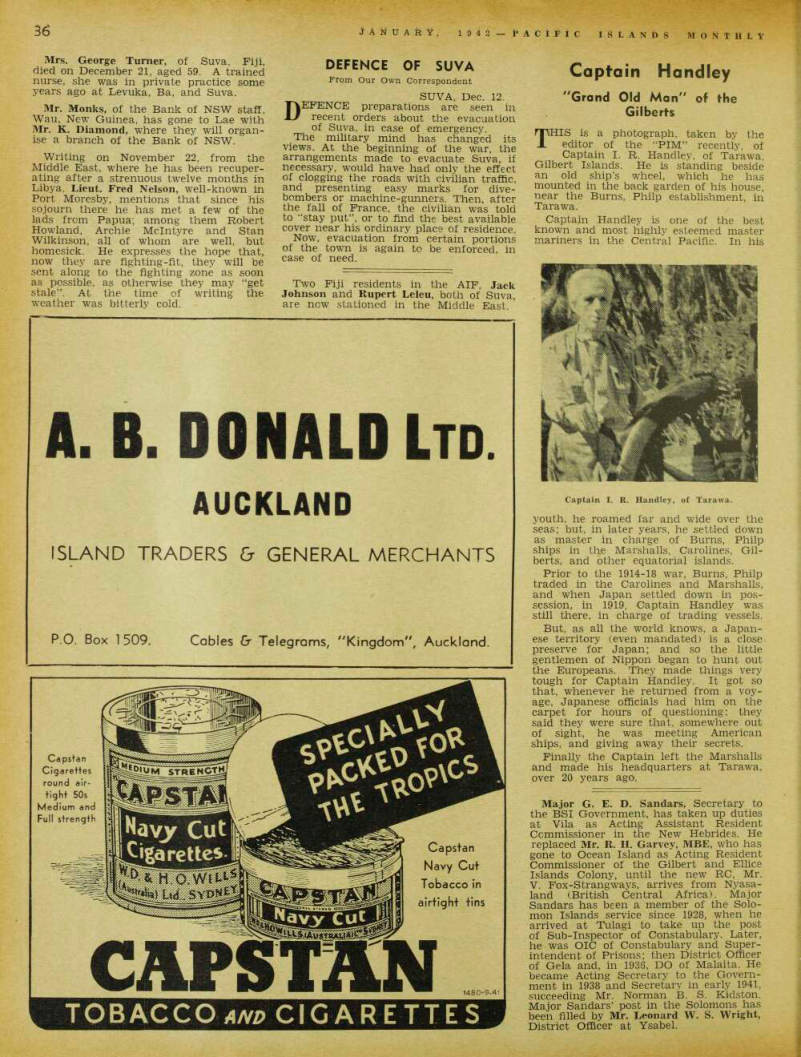
From Our Own Correspondent
Suva. Dec. 12.
SHIPMENT of the 1941 sugar crop from Fiji has been very much delayed. On at least one occasion, storage sheds were full and the mills had to stop crush ing. However, it would now seem that the 1941 crop will be got away, even though late, and though reduced by the “wasting” that was ordered in mill processes. There is still no assurance that the 1942 crop will be bought, and the planters, now largely Indian, are getting very anxious.
Gold remains Fiji’s one certain export of value. America buys it all; it continues to go into a hole in the ground in Ken tucky, with regularity, and to the profit of the British Exchange Control. It is an odd world which sees utility in such a course at a time when sugar and copra, which have their direct edible values to the world’s inhabitants, should be prac tically unsaleable. (Odd, indeed! But it cannot last much longer. See article in this issue on “Can Gold Hold Its Value?” —Editor.) Mr. S. J. Anderson, of the Papuan Gov vernment Printing Office, is at present on long leave, prior to retirement.
Mrs. George Turner, of Suva, Fiji, died on December 21, aged 59. A trained nurse, she was in private practice some years ago at Levuka, Ba, and Suva.
Mr. Monks, of the Bank of NSW staff, Wau, New Guinea, has gone to Lae with Mr. K. Diamond, where they will organ ise a branch of the Bank of NSW.
Writing on November 22, from the Middle East, where he has been recuper ating after a strenuous twelve months in Libya. Lieut. Fred Nelson, well-known in Port Moresby, mentions that since his sojourn there he has met a few of the lads from Papua; among them Robert Howland, Archie Mclntyre and Stan Wilkinson, all of whom are well, but homesick. He expresses the hope that, now they are fighting-fit, they will be sent along to the fighting zone as soon as possible, as otherwise they may “get stale”. At the time of writing the weather was bitterly cold.
Advertisements & other items, pp. 39-40 (1 item)
Export Soap Company
There is no substitute for
OLD MONK
VIRGIN PURE
OLIVE OIL
San Francisco
We are Specialists in Trade Soap for Na Se nd us your enquiries
EXPORT SOAP COMPANY
41 Church Street, Newtown, Sydney, N.S.W.
Cable Address: XSOAP, Sydney. 'Phone: LA 2436.
A. B. DONALD Ltd.
AUCKLAND
ISLAND TRADERS & GENERAL MERCHANTS
P.O. Box 1 509. Cables Gr Telegrams, "Kingdom", Auckland.
Capstan Cigarettes round airtight 50s Medium and Full strength feiyw STRENGTH • 1
Navy Cut
Cigarettes
& H.O.
Ud~. SYPg^
Capstan Navy Cut Tobacco in airtight tins
CAPSTAN
1480-9.41
CIGARETTES
Defence Of Suva
From Our Own Correspondent
Suva, Dec. 12.
DEFENCE preparations are seen in recent orders about the evacuation of Suva, in case of emergency.
The military mind has changed its views. At the beginning of the war, the arrangements made to evacuate Suva, if necessary, would have had only the effect of clogging the roads with civilian traffic, and presenting easy marks for dive bombers or machine-gunners. Then, after the fall of France, the civilian was told to “stay put”, or to find the best available cover near his ordinary place of residence.
Now, evacuation from certain portions of the town is again to be enforced, in case of need.
Two Fiji residents in the AIF, Jack Johnson and Rupert Leleu, both of Suva, are now stationed in the Middle East.
Captain Handley
"Grand Old Man" of the Gilberts
THIS is a photograph, taken by the editor of the “PIM” recently, of Captain I. R. Handley, of Tarawa, Gilbert Islands. He is standing beside an old ship’s wheel, which he has mounted in the back garden of his house, near the Burns, Philp establishment, in Tarawa.
Captain Handley is one of the best known and most highly esteemed master mariners in the Central Pacific. In his
youth, he roamed far and wide over the seas; but, in later years, he settled down as master in charge of Burns, Philp ships in the Marshalls, Carolines, Gil berts, and other equatorial islands.
Prior to the 1914-18 war, Burns, Philp traded in the Carolines and Marshalls, and when Japan settled down in pos session, in 1919, Captain Handley was still there, in charge of trading vessels.
But, as all the world knows, a Japan ese territory (even mandated) is a close preserve for Japan; and so the little gentlemen of Nippon began to hunt out the Europeans. They made things very tough for Captain Handley. It got so that, whenever he returned from a voy age, Japanese officials had him on the carpet for hours of questioning: they said they were sure that, somewhere out of sight, he was meeting American ships, and giving away their secrets.
Finally the Captain left the Marshalls and made his headquarters at Tarawa, over 20 years ago.
Major G. E. D. Sandars, Secretary to the BSI Government, has taken up duties at Vila as Acting Assistant Resident Commissioner in the New Hebrides. He replaced Mr. R, H. Garvey, MBE, who has gone to Ocean Island as Acting Resident Commissioner of the Gilbert and Ellice Islands Colony, until the new RC, Mr.
V. Fox-Strangways, arrives from Nyasa land (British Central Africa). Major Sandars has been a member of the Solo mon Islands service since 1928, when he arrived at Tulagi to take up the post of Sub-Inspector of Constabulary. Later, he was OIC of Constabulary and Super intendent of Prisons; then District Officer of Gela and, in 1936, DO of Malaita. He became Acting Secretary to the Govern ment in 1938 and Secretary in early 1941, succeeding Mr. Norman B. S. Kidston.
Major Sandars’ post in the Solomons has been filled by Mr. Leonard W. S. Wright, District Officer at Ysabel,
Captain I. R. Handley, of Tarawa.
New Laws In
Fiji
Trade Unions Methylated Spirits Control of Credit
From Our Own Correspondent
Suva, Dec. 20.
THE remark is heard frequently that, amid war’s fevers and alarms, the Government has chosen an un fortunate time to introduce some harass ing and apparently unnecessary legislation.
The answer probably is that the Council programme was all prepared and complete before Japan struck on December 7; and the Government just let the wheels go round.
Few people believe that the new law providing machinery for trade unions and compulsory arbitration will be much in voked, or if invoked will contribute to the general peace; but such legislation is in fashion just now throughout the British Empire, and was probably inevitable The early trade unionists, who set great store on individual effort and initiative, and who relied on the union to its own battles against the State, would have been surprised at the modern doctrine which lays it down that if a man does not want to be a trade unionist the State should train him so to want.
An instance of petty, troublesome legis lation is the new control for methylated spirits, sales of which now have to be registered The theory is that much methylated spirits is drunk, and that the denaturalisation chemically possible and enforced by law is insufficient to stop men drinking it. Some men appear genuinely to like drinking eau de Cologne, and possibly some rare souls really like methylated spirits. If they do like it, it is difficult to see how they will be stopped by the need of registering their purchase,
or the trouble of making their purchase through some friend whose drinking pro clivities are not suspected by the police.
The ordinance would seem to be a waste of time and paper.
More contentious is the attempt the Government is making to control credit as well as cash-sale prices. The proposal cannot be called unpopular, because pur chasers are more numerous than sellers, and most purchasers under-estimate the amount of profit a seller needs to carry on his business. On the other hand, in a remotely situated place like Fiji, which imports from long distances so much of what it consumes, the amount of capital locked up in the very large stocks cus tomarily held here must get some reason able reward —otherwise owners may decide to sell off, and invest their money in Government stocks.
The original bill put forward by the Government bore every sign of hastiness and lack of trade knowledge, but was improved by negotiations with the Suva Chamber of Commerce.
Fiji has always been a credit country, but the creditor will not lend unless his prospective profits or interest are suffi ciently attractive, and it seems inevitable that the ordinance will be followed by considerable restriction of the amount of credit allowed. Probably such a tendency would be ultimately beneficial, because most of us are happier if we have money in hand with which to pay the baker or the grocer, but the immediate con sequences are likely to be uncomfortable.
Mr. Alan Hooper has joined the staff of Amalgamated Wireless in Rabaul. He has had many interesting experiences in the South Pacific. He recently was on service in the British Solomon Islands and, over a year ago, he was an opera tor on Nauru Island, when that terri tory was bombarded by a German raider.
CI Copra Stores Full
From Our Own Correspondent
Rarotonga, Dec. 6.
COPRA is not being bought by Cook Islands merchants at present, owing to exhaustion of storage accommo dation. No appreciable quantity of copra has been lifted from this group since the outbreak of war in 1939.
Copra is the only exportable product of 8 out of the 14 inhabited Cook Islands, and the chief export of a further one (Penrhyn or Tongareva Island where the dwindling pearl-diving industry still holds out).
Mr. Clive Farquhar, of Ba, who was well known throughout Fiji, died in Sydney recently, aged 45. Born in Fiji (his father, Mr. Walter Farquhar, was mill manager for the CSR Co. at Rara wai), he was educated in Australia, at King’s School, Parramatta, and Sydney University. After a short period in New Guinea, he joined the CSR Co. and returned to Fiji where he served for the past 20-odd years. He came to Sydney in October to seek medical attention, fol lowing a severe illness.
Mr. Thomas Francis Tague, late chief officer of the Western Pacific High Com mission’s steam yacht “Ranadi” and formerly master of several inter-island vessels in Fiji, died recently in Auckland Hospital, New Zealand, aged 56.
Rev. Pierre Bochu, who had served the Marist Mission for many years in the New Hebrides, died recently at Vila, aged 75.
Mr. J. K. Brownlees, District Officer in the Solomon Islands, where he has served since 1933, has been seconded to the Tongan Government Service, accord
ing to a Western Pacific High Commis sion Gazette issued in November. He is a BA of Oxford University and at various times has been stationed in BSI at Malaita, Ysabel, and Gizo.
Rev. R, A. Nicholls, of Wangaratta, Victoria, has been accepted by the Aus tralian Board of Missions for work in Papua.
Mr. B. T. Griffiths, an Englishman who served with the Colonial Sugar Refining Co. Ltd. in Fiji for nearly 30 years before retiring in 1940, died last month at Lautoka.
Advertisements & other items, pp. 41-42 (1 item)
(flOS*
MERIDEN
Church of England Grammar School for Girls.
REDMYRE ROAD, STRATHFIELD, N.S.W.
Situated In beautiful and healthy surroundings within 15 minutes of Sydney.
Comfortable, modern * accommodation for boarders. Education from Kindergarten to Leaving Certificate Honours. Scientific Physical Culture and instruction In Art and Musical Appreciation.
Prospectus on Application.
, s 0M® r ' pacXfic *• “?*** «"’;., »-«** o 1 w-
-1 C-* “’T. »“”*•“T «* •"
« lhe ■ ni se^ tt ' .. su .».' or *• TUw »W ei C» b ' e ’ -“ .v |b 9 eV
(flOS*
BY COMPASS-
m & & < A 5? 3f 7 3* R 8? u
AND SCXTfINT/
the mariner can locate his exact position and know just what he is doing. But
WHEN IT COMES TO HOUSE PAINTING
results obtained are according to the material used.
With "8.P.” BERGER’S PAINT (Prepared) you are assured of satisfaction. "8.P.” is guaranteed on the can, not to crack, chip nor peel. Its covering capacity, durability and, therefore, economy leave nothing to be desired. Be sure to use — mm F i D
Paul
(PREPARED)
AGENTS THROUGHOUT THE ISLANDS.
"8.P.” Keeps on Keeping on !
Papuans' Appeal
High Court Upholds Papuans' Appeal Compensation For an Aerodrome Site
THE High Court of Australia has unani mously upheld the apneal of Kila Kila natives against the valuation by the Central Court of Parma of 89 acres of land resumed by the Administra tion for an aerodrome.
Leader of the appeal was Geita Sebea, headman of the Kila people; and the case for the Papuans was prepared by Mr.
R. D. Bertie, Pt. Moresby solicitor."
The Papuan Administration leased the land, used as a garden area by the natives, in 1937 at £l5 a year, for 10 years. Later, the land was resumed. To the Adminis tration’s offer of £269 as compensation, the natives replied with a claim for £4,479/12/6, plus 10 per cent, for compul sory acquisition, and £l,OOO damages for severance.
Mr. Justice Gore, in the Central Court of Papua, last year, awarded the natives £454. They made an appeal to the High Court last February. It was adiourned for several months, while the High Court judges sought information from Judge Gore on native customs and other questions.
Finally, the case was argued in Mel bourne in mid-October, Mr. T. W. Smith annearing for the Territory of Papua.
Judgment was reserved.
In Sydney on November 25. Mr. Justice Starke gave judgment, upholding the ap neal. He ordered the case to be remitted to the Papuan Court to award compensa tion on the basis of the value of the land at January 1, 1939. The respondent was required to pay costs of the appeal.
The High Court judge expressed the hope that the Administration of Papua would consider appropriating the com pensation payable for the permanent wel fare of the natives and “not allow it to be wasted in exchange for shells, beads, or coloured cloths”.
"We'll Buy Food"
From Our Own Correspondent
Pt. Moresby. Dec. 17.
WHEN Geita Sebea was questioned what he would do with the large sum of money coming to him and his tribes men as the result of the successful appeal, he replied simply, “Give it to all our people and their relations to buy food”.
And this answer reflects the general attitude in Papua to-day as the result of the exceptional drought, which has des troyed many native gardens. Food, or the shortage of it. has caused grave concern, even in districts noted for excessive rainfall.
Geita Sebea and his people will receive nearly £5,000 for onlv 89 acres and this seems at first sight ah enormous sum for natives to handle. It should be realised, though, that this sum must be divided among approximately 300 people, and that the land represented almost their only remaining garden-lands. The sum of £l5 per head seems small recompense for land which, as Geita stated in Court, had been theirs for three generations and which was sufficient to provide food for their whole village.
Though Kila Kila, as with most villages in Papua, has been affected gravely by the drought, many of the natives are finding employment in Pt. Moresby. They buy European food with their wages and dis tribute it among their friends and rela tions. Villages further out, not having this opportunity, have suffered severely.
Islands Industry
Beekeeping As An Islands Industry Part I—General
By F. J. Morgan
HONEY was man’s chief source of sweetening for thousands of years.
Bees-wax provided the first candles.
Even in these synthetic days, no real sub stitute has been found for either of these products.
Honey has been termed the perfect food. Chemically, it has a completely balanced vitamin content, and it can be produced almost anywhere in the world, so long as one has bees, and does not live in a treeless desert. From the food angle alone, the prospect of keeping one or two hives should be considered by readers living ip Pacific Islands, where the addi tion to the menu of one’s own honey, still in the comb, would be a welcome break from the endless diet of tinned preserves.
Climate is not a prohibiting factor.
There are commercial apiaries in North Queensland and many parts of the Pacific.
The Hawaiian Islands export more than 1,500,000 pounds weight of honey annually to USA.
Beekeeping is not difficult to learn, and there are probably more people keeping one or two hives, as a hobby, than there are commercial apiarists. It is difficult to state definitely how much honey or wax one hive will produce in a season—so many local factors enter into it. The New Zealand Government Department of Agriculture’s Bulletin No. 128, says on page 4: “As an estimate, from a well conducted apiary, in a good district, the nett profits per colony of bees should reach from 25/- to 35/- per annum, through a number of successive seasons,
and this estimate is well within the mark”.
Bees can be kept for either honey or wax. In advanced agricultural and in dustrial countries, bees are kept for honey, but it is an economic fact that such countries become bees-wax importers.
WHEN bees are kept in modern hives, the combs, when filled with honey, are taken from the hives, and the honey either drained or spun out in a centrifugal machine called a honey ex tractor. The combs, when emptied of honey in this way, are replaced in the hive for refilling, and may be used several times.
If the colony is very strong in num bers, and there is plenty of honey for the bees to gather, they may fill all the combs in an ordinary hive very quickly, and still have an abundance; in which case the bee-keeper adds another section on top of the hive, making sure that it is fitted with frames containing wax-comb foundation, to give the bees a start. TTie use of comb-foundation, or of old combs from which honey has been extracted, saves a bee wasting time producing wax, and saves honey too, since a bee engaged in building honey-comb, consumes honey instead of gathering it.
BEES- WAX is a product of the bee it self. A bee, making wax-cells for honey storage or for the queen to lay eggs in, as the case may be, produces the wax in the form of small leaves, from wax glands in its abdomen.
It is generally held that bees consume about 7 lb. of honey to produce 1 lb. of wax. This may be about right, but ex periments at the Schleswig - Holstein State Agricultural College, in 1932, pro duced complete combs of wax, on standard frames, through the artificial feeding of 20 lb. of sugar, dissolved in water, to naked swarms of bees in empty hives.
Each colony, also, from the same feeding,
built up sufficient store of honey for the winter.
This method of feeding may have to be resorted to at some time in almost any apiary, if the bee-keeper finds that the bees cannot gather sufficient nectar from the local foliage to build up a good store of honey. By placing molasses, or sugar and-water syrup, in a container, at the entrance of the hive, without blocking the traffic, the bees can be kept alive and may direct their energies to comb building.
When directing the bees’ energies to wax production, they must be allowed to store sufficient honey for food to keep them alive, while they are building and
also during the off season. The bees, not suspecting the plot against them, in stinctively commence building up cells on the wax-foundation in the hive, to hold the honey they intend to gather. The bee-keeper watches the work closely and, before the cells are filled and capped, he removes the almost completed comb, cuts off the walls of the cells which the bees have built up, and replaces the wax foun dation sheet in the hive for further building.
IN Pacific Islands from which there are no direct shipping services to the large honey-importing markets of Great Britain and USA, bee-keeping for wax-production can be recommended as most profitable, secure in the knowledge that a large and growing market for the product can be found in Australia. Until recent times, it was not considered a pro fitable enterprise to keep bees for wax instead of honey production. Bee-keepers
m Australia were unanimous in the opinion that to make wax production pay, a price of at least 2, - per pound was needed for the wax. The present rates in Australia are between 2/- and 2/4 per lb.
Commonwealth consumption of beeswax is far in excess of local production and the demand is keeping pace with the rapid expansion of secondary industries.
Next issue: Part ll.—Honey Production and How a Colony is Worked.
Rev. F. W. Noack, Lutheran missionary in New Guinea, has been relieving his brother, Rev. H. Noack, in Walpeup parish, Victoria.
Mr. Chung Ah Sam, an old respected member of the Chinese community in Fiji, died in Suva last month at the age of 82. He was the first Chinese market gardener in Fiji, having arrived in the Colony over 50 years ago.
Advertisements & other items, pp. 43-44 (1 item)
’Masse
Serious Chances
Are Taken in Neglecting a Simple
Case of Piles
Any person takes serious chances in neglecting an attack of Piles.
This ailment has a tendency to become chronic and there is also danger of ulceration, and forming of Fistula, both very difficult to cure. The safest remedy for any form of Piles, whether itching or protruding, is DOAN’S OINTMENT.
In using it there is no detention from daily occupation, and the many cures made by it have made it famous in every corner of the world. It enjoys a greater demand and more enthusiastic popularity than any other Pile remedy ever placed on the market.
Let DOAN’S OINTMENT give
you the relief you so sorely need.
Refuse all substitutes. Remember the name DOAN’S.
MASSE CAN TAKE IT - -
BETTER LIGHTING
«L U
LONGER LIFE
MORE STARTS
BRIGHTER
LIGHTS
SPRUNG
AGAINST ROAD
SHOCKS
CRYSTAL
CLEAR RECEPTION
whether it is for cor, motor
cycle, radio or house light-
ing plant.
If you want to keep clear of battery troubles fit Masse —there’s no more reliable battery made. Rugged plates and case, Supercol Separators and rigid testing during manufacture make for long life under all conditions. Insist on Masse next time.
’Masse
BATTERIES
ore Tigers for Work—they simply lap
it up !
OBTAINABLE EVERYWHERE . . . ASK YOUR
ISLAND DISTRIBUTOR.
THAT
►J' M < H E
RELIEF FROM PERSONAL WORRIES
Two special books are available, free of charge, from Burns Philp Trust Co. Ltd.
The first, entitled, " The Task That Few Men Want/' deals with the Company's special service in connection with the execution of Wills and the administration of Estates. The second book (" Hand Over Your Worry ") tells how Burns Philp Trust Co. Ltd. can assume-responsibility for your personal business affairs during your lifetime. It has special appeal to those living in retirement and to those whose professional activities are of an arduous character.
These publications will gladly be forwarded on request. Both are of particular importance in current circumstances.
DIRECTORS—James Burns - Robert John Nosworthy - Lewis Armstrong - Joseph Mitchell MANAGER—C. H. Chester
Burns Philp Trust
COMPANY LIMITED
7 BRIDGE STREET. SYDNEY
TELEPHONE: B 7901 Box 543 B, G.P.0., Sydney.
Coughing, Strangling Asthma, Bronchitis Curbed in 3 Minutes
Do you have attacks of Asthma or Bronchitis so bad that you choke and gasp for breath and can’t sleep ? Do you cough so hard you feel like you were being ruptured ?
Do you feel weak, unable to work, and have to be careful not to take cold and can’t eat certain foods ?
No matter how long you have suffered or what you have tried, there is new hope for you in a Doctor’s prescription called Mendaco. No dopes, no smokes, no injections, no atomizer. All you do is take two tasteless tablets at meals and your attacks seem to vanish like magic. In 3 minutes Mendaco starts working through your blood aiding nature to dissolve and remove strangling phlegm, promote free easy breathing and bring sound sleep the first night so that you soon feel years younger and stronger.
No Asthma in 2 Years
Mendaco not only brings almost immediate comfort and free breathing but builds up the system to ward off future attacks. For instance, J. Richards, Hamilton, Ont., Canada, had lost 40 lbs., suffered coughing,
choking and strangling every night, couldn’t sleep, expected to die. Mendaco stopped Asthma spasms first night and he has had nonj since in over two years.
Money Back Guarantee
The very first dose of Mendaco goes right to work circulating through your blood and helping nature rid you of the effects of Asthma. Try Mendaco under an iron-clad money back guarantee. You be the judge.
If you don’t feel entirely well, like a new person, and fully satisfied after taking Mendaco Just return the empty package and the full purchase price will be refunded.
Get Mendaco from your Chemist today and see how well you sleep tonight and how much better you will fed. ifl COWQUf Its 1 A ST H MX
Mendaco
Now iu 3 sizes
3/-. 6/- and 12/-
"Wilkie" Passes
Adventurous Life of Cook Is.
Trader
THE Cook Islands have lost another well-known character, in the death at Mangaia, on September 6, of Alfred George Wilkinson affectionately known throughout the Cook Group and further afield as “Wilkie”.
Into his 62 years of life, “Wilkie” crowded a wealth of romance and ad venture such as rarely falls to the lot of one man.
Son of a well-known Bristol family, he was a soldier and adventurer from
his earliest days, leaving home as a youth to fight in the Boer War.
Later, he wan dered on to New Zealand, where he sampled horse breaking and lumber - jacking, among other pur suits, until the lure of the Islands claimed him.
In the service first of Maxwells, of Tahiti, and later of A. B. Donald Ltd., he became a familiar figure on practically all the islands and atolls
of the Central and Eastern Pacific as trader, supercargo and pearler.
During the great hurricane of 1906 he was stationed on Rakahanga atoll (Northern Cooks) and is affectionately remembered by the natives for his brave efforts on their behalf during that terrible ordeal.
On the outbreak of hostilities in 1914, he immediately enlisted and served throughout the war, being wounded several times. Upon his discharge, he returned to the Islands and, after a long spell on Penrhyn, he finally settled in Mangaia.
In 1938, he left with his popular Tahitian wife on a round-the-world trip, to visit England, and they were bn their way back when war broke out.
“Wilkie” bitterly regretted that the powers-that-be considered him too old to “have another crack at ’em”.
Returning to the Cook Islands, he took over his former post of manager for A. B. Donald Ltd., in Mangaia. but he was in failing health and did not long survive his return.
During his latter years, “Wilkie” was a source of entertainment for the younger hands, with his rich fund of South Sea tales. He was a keen fisher man and loved a tussle with a shark.
From early boyhood until the end of his days, he was a remarkably skilful marks man with a rifl£> “Wilkie” was buried in Mangaia. Native returned soldiers served as pall-bearers
and formed a guard of honour.-
W.S.B.
Captain Roger Pocock, who had a career of extraordinary adventure, which included a term as a missionary in New Caledonia, died in London recently, aged 76. He founded the Legion of Frontiersmen in 1904.
Leading Aircraftsman Kenneth Lee, who was educated at Suva Boys’ Gram mar School, Fiji, received a commission, with the rank of Pilot Officer, in the NZ Air Force last month. He is only 19 years’ old.
Mr. A. G. Wilkinson.
Trans-Pacific In a Leaky
Old Junk
From Our Own Correspondent
Samarai, Dec. 20.
AN extraordinary story of Pacific voyaging was told here recently, in a lecture for the benefit of the Red Cross, by Dr. Petersen, who has arrived in these islands, with his wife, in the Chinese junk, “Hummel Hummel”.
Dr. and Mrs. Petersen were touring, in China, when the Sino-Japanese war broke out in 1937. They were eye-wit nesses of the murder of panic-stricken Chinese, in Japanese air raids on Nan king. They, themselves, were arrested by Japanese officials for trespassing in closed parts of the city, and were released through the intervention of the American Embassy.
Having purchased the junk, and being assured by their friends that there were many better ways of committing suicide, and accompanied by two White Rus sians, they gaily set off. down the Hwang Ho River, for Shanghai, en route to Japan. After a lot of wrestling with unfamiliar charts, and a false start, they were eventually found by some Japanese fishermen, and towed into the harbour of Nagasaki—which, to their dismay, was a closed port. In Yokohama, they were acclaimed as heroes. They took in food and water and, after repair ing the ship, headed off across the Pacific.
Eighty-five days of weary navigating of their tiny craft, battling with heavy seas and suffering extreme cold while passing the Aleutian Islands, and they arrived finally in Los Angeles, where
they set down their two passengers.
Ironically, their next passenger was a man who used to be in the submarine service!
They met very bad weather along the Mexico Coast, and they were 90 days going 600 miles. They had to tack all the way from Panama to Ecuador. The junk was leaking very badly, and the doctor and his wife were bailing 200 gallons of water daily—no mean feat for a tiny person like Mrs. Petersen (an American-educated Japanese lady).
In a Peruvian port, the craft was extensively repaired; and they decided, then, that the easiest way to get to New York was to go around the world, and thus dodge the contrary currents on the Peruvian coast. So they set sail for the Marquesas Islands.
The weather now was very favourable, and the trip was without incident to Pago Pago. From Apia, they planned to sail across to Port Moresby.
After leaving Apia, they ran into a heavy south-east gale, and nearly sank.
The sea came into the forward hold, the fore deck was awash, and the boat was out of control. They threw out two sea-anchors, and travelled with the bow down for six days.
They lost food, clothing and practic ally all their personal belonging in that stretch. As their charts had ended at Pago Pago, they travelled blind. They somehow got through Snake Passage, in Eastern Papua, but they then were blown onto the reef at Sudest Island, where they were helped off by Mr. Harry Pierce.
The junk is now being repaired on the slip at Kwato, near Samarai. The doctor told many amusing anecdotes, indicating that a great sense of humour possessed by him and his wife helped
them through a voyage that would strike terror into the hearts of most. I am no explorer, and, after one look at that junk, I have decided my voyaging will be done under less venturesome circum stances. They did plan to carry on westwards to New York, but the Japan ese war may alter their plans.
Fiji Bridegroom Charged With Murder
Murder
Preparations for a native wedding were in full swing at Drekena Koro, in the Rewa Delta, Fiji, one morn ing in mid-December, when a police party, under Inspector Halstead, arrived and arrested the prospective bridegroom, Seru Vorokitaki.
This, it appears, was the sequel to the murder of Yee Wong, who was manager of a Chinese store at Vuna Taveuni, in Eastern Fiji. Yee Wong disappeared some time before this arrest was made. Subsequently, his body was found, and it was discovered that about £3OO in cash was missing from the safe in the store.
The search by the police of the bure occupied by the accused Fijian brought to light a sum of £ll5 in notes. The Fijian was remanded in custody to appear for preliminary trial at Taveuni.
Lieut. J. C. Mullaly, of New Guinea, has been appointed temporary Captain, as from October 17, in the Australian Intelligence Corps.
Two members of the New Guinea Crown Law Office at Rabaul, Messrs. G. Maun sell-Turner and Mr. P. M. Doyle, were in Australia on leave in December.
Advertisements & other items, p. 45 (1 item)
Australia s Fastest Selling Tyre
SILENT
Dunlop
•65’ GOLF
BALLS
The fastest selling first-line ball in Australia. Known for its; Sealed Power, Greater Distance and Exclusive Permanised Pattern for Longer Accurate Life.
IN AUSTRALIA , AS
VICTOR
Dunlop
SPORT &
SANDSHOES
Comfort and Wear in Every Pair of Dunlop Sport and Sandshoes. Available in all popular styles for sports wear. £1 Dunlop
WEATHER
COATS
E x ceptionally smart, well fitting Weather Coats for Men, Women and Children. Tailored styles in the latest thoroughly waterproof materials.
OTHER Dunlop
PRODUCTS
Tennis Equipment.
Belting.
Car Accessories.
Bathing Caps.
Cycle Tyres.
Garden Hose.
Household Gloves and Aprons, etc.
THROUGHOUT THE BRITISH EMPIRE, MOST PEOPLE RIDE ON DUNLOP TYRES.
DUNLOP PERDRIAU RUBBER CO. LTD. (Inc. in Vic.). 27-33 WENTWORTH AVENUE, SYDNEY, N.S.W.
Hew Hebrides Notes
From Our Own Correspondent
Pt. Vila, Dec. 4.
THE French Resident Commissioner for Free France in the New Heb rides, Mr. R. Kuter, visited the principal islands in the north of the group in November. He was satisfied with what he had seen in regard to the way in which planters are maintaining the standard of production, assisted materially by the goodwill of their labourers—both native and Indo-Chinese.
Planters and business men in the archipelago, always generally in favour of investing in what they believe is a good risk, would prefer free trade with the outside world in preference to accepting the limitations of the South Pacific Copra Pool. They feel that they can benefit more from the facilities that appear to be given to the export of copra to America. (This, of course, was
written just prior to the outbreak of war with Japan.—Ed. “PIM”.) Good news has been received of the de Gaulle volunteers from the New Hebrides, who are with the Allied armies in the Middle East: all have been trained in modern warfare and are acquitting themselves well. In the Syria campaign they showed themselves inde fatigable in carrying out their tasks.
The Armistice Day fete held in Port Vila in November produced 20,000 francs for war work in the Condominium.
Mr. T. H. Claude Booth, of the BNG Trading Co. Ltd.’s staff at Port Moresby, Papua, recently married Miss Marie Lynch, of Queensland.
Mr. R. Spiers, of Wellington, NZ, is relieving Mr. E. J. Sutch as assistant secretary in the Western Samoan Ad ministration during Mr. Sutch’s absence on four months’ furlough.
Copra Driers
Ceylon-Type is Best
JJ/ITH restricted markets for copra, these days, buyers mostly are seeking only the best grades of hot air dried copra. Smoke-cured copra, for merly sent to Marseilles {France), is in very weak demand. Mr. G. H. Murray, head of the Agriculture Department of the NG Administration, in the following article, written at the invitation of the New Guinea Copra Board, urges planters to abandon the old system of producing smoked copra in favour of improved, up to-date methods.
MOST planters in the Mandated Terri tory are using what is commonly known as the German New Guinea hot air drier for curing their copra. This drier is costly to construct but, providing it is kept in good order, it turns out a fairly good product.
On the other hand, there are many planters and traders still adhering to the old smoke drying method of curing copra, known as “South Sea”, which has been common in the Pacific for 100 years or more.
The Ceylon drier is recognised through out the tropical world as producing the finest copra and modifications of this drier are in use in many copra-producing countries. For several years the NG Department of Agriculture has advocated this type of drier, but, unfortunately, many are still prejudiced against it be cause it is something they are not accustomed to. Most NG planters have come from Australia without having seen a copra drier elsewhere, and have simply accepted the German drier in use in this Territory.
The writer submitted to local planters a design of a drier in common use in Ceylon, and those who gave it a fair trial were fully satisfied with it. Natur ally, native labourers —always conser vative —objected to the Ceylon method at first, but after they had become thor oughly familiar with the process they preferred it to the old system.
One planter who produces 1,000 tons of copra per annum informed me that his Ceylon driers, built of native material, cost about £3O each. It took his labourers three months before they became expert, but since then he has had no trouble and the labourers them selves like the work. This planter has always obtained a premium of 7/6 up wards per ton over ruling prices for hot air which surely indicates his copra is of superior quality.
IT would certainly be uneconomic for those planters who have gone to the expense of erecting German NG driers to abandon them for Ceylon driers, especially at a time like the present, but those planters who still ad here to smoke drying methods are strongly recommended to adopt the more modern Ceylon drier.
Many smoke driers that have been well constructed can be altered to the Ceylon type at little extra cost. Apart from the drying structures, the main dif ference between smoke and Ceylon dry ing methods is the fuel; that of the latter must be dried coconut shell in half-shells, as free of fibre as possible, whilst for the former, coconut husks or almost any kind of fuel may be used.
Mr. F. C. Cooke, Copra Investigation Officer of the Department of Agriculture in the Federated Malay States, designed small driers described as “cabinets”, operated on the Ceylon system of dry ing which the writer saw in his 1935 and
1939 visits to that country. On his re turn to New Guinea in 1936, two such small driers were erected here, one at Nodup and a slightly larger one at Matanatar, but they are only suitable for Malay and other small peasant pro prietors.
These driers cost but a few shillings to construct and turn out first-class copra, equal to Ceylon, but their small size did not appeal to our natives. The New Guinea native ordinarily is not an individualist and the term peasant pro prietor is not applicable to him, conse quently, the small drier did not appeal to him.
The average New Guinea native does not like the regular consistent work re quired by the small cabinet drier turning out small quantities of copra daily for the individual producer. In Rabaul dis trict, natives seem to prefer the more expensive German New Guinea drier and the Department of Agriculture has assisted many native capitalists in their construction.
The less sophisticated village native supplied coconuts or green copra to the owners of these driers who, in some cases, exploited their less intelligent fellows just as much as the most un scrupulous trader.
Formerly, numerous small hot air driers were to be seen in Rabaul district erected by native capitalists who charged from 1/- to 4/- per bag for curing the copra according to the shrewdness of the native supplying the green copra.
After the boom of a couple of years ago, most of the small native driers dis appeared to become scrap iron.
THE Ceylon drier consists of an en closed shed with hip roof open along the full length of the ridge pole and covered with a jack roof which permits the escape of evaporated mois ture from copra on the drying platform below, yet giving protection from the weather.
The structure can be built entirely of native material, and there is practically no risk of fire if only dry coconut shell, free from fibre, is used as fuel. How ever, for additional safety, galvanised iron can be used for the walls, sides and partitions of the fire-pit. The roof can be of thatch-nipa, sak sak or kunai.
The drying platform extends the full length of the building with a passage along one side to permit movements of the labourers. The platform is in five sections with partitions cross-wise, 15 in. or 18 in. high, made of saplings. The firing pit is 4 ft. below ground level and immediately under the drying platform, which is 3 ft. above the ground, thus 7 ft. from bottom of fire pit.
The fire pit should be walled with concrete or_ galvanised iron to the height of the drying platform. In Ceylon, the fire pit walls are sometimes made of blocks of laterite. The fire pit is divided into sections with partitions of galvanised iron on concrete walls to correspond with the partitions of the drying table.
Sometimes an opening is left in the wall, dividing each section of the firing pit to permit movements of the labourers when attending to the fires. A more satisfactory way, however, is to have a small entrance to each fire pit section on the inside wall which may be kept closed when necessary.
A plan of a Ceylon drier can be ob tained from the New Guinea Department of Agriculture (Rabaul) which will clearly illustrate the above particulars.
IN the best coconut growing districts in Ceylon, the dry season is longer and more pronounced than in many parts of New Guinea, so that it is usually found possible to give the newly split coconuts several hours’ sun-drying
before placing on the drying platform.
In such cases, therefore, there are only four divisions on the platform, but in the NG climate it is advisable to have the platform in five sections to give an extra day for drying. There should also be a door opening from the fifth section to a verandah or nearby shed for sorting and bulk storing the copra.
It is always advisable to avoid making copra in very wet weather, and this can be done by having a second drier and thus being able to deal with the accumulated nuts when necessary.
For curing in the Ceylon drier, the nuts must be brought to the drying depot where they are husked and split and left exposed on a barbecue or clean piece of ground in the sun, for a few hours if possible. The husking at first is considered a costly task, but it has been proved on more than one NG plantation that a native can husk 1,200 coconuts per day. After the nuts are split and receive a preliminary drying,
weather permitting, they are placed on the first division of the drying platform, The half nuts should be laid with regu larity on this platform, avoiding cupping, which would check the evaporation of moisture from the surface of the coco nut meat. The half coconuts can be stacked in this way to a depth of 15 inches, and under a good smokeless coco nut shell fire will soon lose their surface moisture, and thus give less opportunity for mould development, On the second day, the half coconuts are thrown into the second partition, so that those on the bottom of the first partition will be on the top of the next and vice versa. This action is repeated daily on the other partitions until, on the fifth day, the copra should be well dried.
On the third day, most of the coconut meat will have separated from the shells. Throwing the half coconut shells from one partition to the next is only a matter of a few minutes, and once the
labourers become accustomed to this method of drying, they prefer it to the old method of- cutting the green copra into fingers and placing it on trays.
The coconut shells as they separate from the meat should be stored at one end of the drier to be used as fuel later To' those unused to this method, it may seem tedious, and native labourers do not like it at first, but in a few months they become proficient. This has been the experience of all those who have given the Ceylon method a fair trial, A DRIER with a capacity of 5 tons, i.e., turning out 1 ton of copra per day, should be the largest size. A very large drier means a large air space in which ventilation will not be so easy to regulate. When production is more than 1 ton per day, it is advisable to have a second drier,
It is most important that the coconut shell fuel is thoroughly dry and free from excessive fibre, otherwise the fires will smoke or blaze. rp, , lf , .. , Pl] teJLvfil 8 ? 18 shoU o4. be lined or h p PP fll r g n he th fi roWS '? ' a f rt aCfOSS floor of the fire-pit, and in every concave sides should be n T ' h f oppos tc direction, Under the second and third day plat forms double firing should be adopted, two bnes ,°f shells 2 ft. apart. On the A ±th da y> necessary, the drying should oe so advanced that the wider single row firing should be sufficient. Due care must be taken at this stage, as over firing will result in scorching or dis colouring the copra, In starting the fires, every alternate line should be lighted at opposite ends and they should, of course, be started before placing the green copra on the platforms.
Advertisements & other items, pp. 46-48 (2 items)
dfgf
READ THE
B.P. MAGAZINE
SUMMER NUMBER
iiiiiiiiiiiiiiiiiiiiiiiiiniiiiiiiiiiiiiiiiiiiiiiiiiiiiiiiiiiiiiiiiiiiiiiiiiiiiiiiiiiiiiiiiiiiiin
NOW ON SALE
Short Stories Pictures Travel Articles - - - - Pages for the Children --- Stage Latest Fashions Screen A
ONE SHILLING PER COPY.
ON SALE AT ALL NEWSAGENTS AND BOOKSELLERS * era
dfgf
itwith
r 0-1%
The
Time
July
16 1883
SOCIAL EVENT
HOMECOMING AND ENGAGEMENT
qThe engagement of Miss
Penelope Darcy to Lieu-
tenant Anthony Hope—but
lately, returned from the
Soudan—was announced at
a brilliant party, qlt is re-
ported that Mistress Penel-
ope delighted in preparing
many of the supper dishes
herself, and is to be con-
gratulated on new and ele-
gant custard confections.
fk AT
ALL THE BR
PARTIES .
GHTEST
Over 70 years ago Foster Clark's Creamy Custard was first made, and graced the gay party tables of Victorian hostesses. They soon discovered how it improved jellies, fruit, and puddings of all kinds. si For delicious flavour and health value, there is nothing to equal Foster Clark's Creamy Custard.
PEOPLE WHO APPRECIATE
GOOD FOOD
always insist on Foster Clark's Creamy Custard. Its fine ingredients have made it the popular Custard wherever the British flag flies. There are no artificial flavours in Foster Clark's Creamy Custard ! It is flavoured with the purest fruit juices, and is rich in the vitamins that build sound, healthy bodies.
Serve delicious Foster Clark's Creamy Custard to your family often.
THE BEST IS THE MOST ECONOMICAL
It pays to buy Foster Clark's Creamy Custard. Its fine, rich quality provides many more helpings per packet or tin. Choose from four delicious flavours—Vanilla, Lemon, Almond and Standard —and various sizes to suit all households. There is a penny packet try ! Refuse cheap substitutes. Custards that are made merely to at a low price cannot compare with Foster Clark's. Always ask for Foster Clark's, the Custard with the reputation! WIIB2B
Rarotonga's Pests
Rats, Flying-foxes and Prowling Pigs
Prom Our Own Correspondent
Rarotonga, Dec. 7.
A FURTHER £5O has been set aside by the Cl Administration for the extermination of rats. At the price of two for Id., this sum should account for 24,000 rodents. Unfortunately, no more rat-traps are available, and any other method of catching the vermin is apparently not worth the reward, par ticularly as the price for rats always has been in the past Id. each.
The lack of shot-gun ammunition is the cause of a marked increase in flying foxes on Rarotonga. These night-raid ing bats do much damage to all fruit crops.
Also, as a result of lack of ammuni tion, the wandering pig is becoming a real menace, since native owners of pigs have no further fear of losing their animals by the action of angry planters.
The majority of Rarotongans keep their pigs tied with rope or bark by one leg. Such a system is pernicious in every respect—pig-owners should be compelled to make suitable pens. Plenty of stones are available to do the job and in this way the very real cruelty which now exists could be avoided.
Planters would be relieved of much unnecessary damage to their crops and the owners themselves would benefit considerably in the long run.
Such a by-law seems simple, necessary and progressive, but somehow it never comes to pass.
On Wharf Without A
Pass: Fined £10
Prom Our Own Correspondent
Ft. Moresby Dec. 20.
IN the Court of Petty-Sessions early in December, before the Acting RM Mr. A. C. Rentoul, A. A. Brandscheid, of Port Moresby, was charged under National Security Regulations with being on the wharf, a prohibited area, without a pass. Evidence showed that the pass had been borrowed.
Mr. Rentoul fined defendant £lO, in default two months’ imprisonment. The fine was paid.
Territories
No Summer Time In
ALTHOUGH summer time was offi cially introduced in Australia on January 1, when all clocks were advanced one hour, the altered time has not been adopted in the territories of Papua and New Guinea. That fact should be borne in mind in connection with radio communication between Aus tralia and the territories. Australian Eastern Standard Time is still standard time in New Guinea and Papua.
Advertisements & other items, p. 48 (1 item)
Springwood Ladies" College
At Blue Mountains—Sprlngwood, N.S.W.
Est. 1897. Kindergarten to Leaving Certificate. Tennis, Riding, Swimming, Team Games. Unequalled climate. Pure Jersey Milk. Senior and Junior Houses.
Open-air sleeping. Inclusive fees. Special vacation arrangements for Island pupils.
M. E. DURAND, Principal.
New Books
SONS OF THE SEA, by T. M. Jones.
Published by Angus & Robertson, Sydney. 4 '6. The author is a sea man torpedo-man on HMAS “Australia”, and this is his second book. It has been written under difficult conditions—while in action, chasing enemy raiders, escort ing copvoys, during air-raids and almost all the incidents are true. It is written in simple language, and is an admirable volume for any lad who han kers after the navy and wants to know how he may go from cadet to senior officer.
Reconstruction—A Programme
FOR PROSPERITY, by James Crockett.
Published by Angus & Robertson, Syd ney. 6/-. A wearisome treatise on “the causes of our present evils, and how they may be oured”. The writer thinks logically, and puts his finger unerringly on the cankers which destroy our so called “democratic” system namely, private land ownership, and uncontrolled money-power. But his remedies are wrapped in masses of archaic verbiage, and they seem impractical, anyhow— mostly a plea for “justice and truth”,
Profits And Price Control:
Addresses by Professor Copland, Com monwealth Prices Commissioner. Pub lished by Angus & Robertson, Sydney. 1/-.
THIS AUSTRALIA! Over 190 pages of strange and fascinating facts about the world’s least-known continent, by Bill Beatty. The Chinese first discov ered Australia; the Melbourne Cup has never been won by horse No. 6 or 7; a little blue-eyed Australian fish had a big share in building Panama Canal; our principal trees shed their bark instead of their leaves; in Sydney, before 1800 AD, a man could buy an English wife for four gallons of rum; the Tichborne family paid out £92,000 in legal expenses before they could prove that Lady Tichborne’s so-called son was actually an imposter, a butcher named Arthur Orton, of Wagga, NSW. There are hundreds of such facts and stories.
Angus & Robertson, Sydney. 4/6.
The Great Boomerang, By Lon
Idriess. Published by Angus & Robert son, Sydney. 8/6. A typical Idriess story of the “Dead Heart of Australia” (South west Queensland, Western NSW, Eastern South Australia); a description of the grim lives of people who fight for exist ence in what is virtually desert, but which once was a land of mighty for ests and great lakes. The climax of the book stirs the imagination, for the author visualises a plan to introduce water into this vast, dust-cursed region, and bring it to life again. It is interesting to note that this is lon Idriess’s 21st book.
Dictionary Of Australian
SLANG, by Sidney J. Baker. (Robertson & Mullens Ltd., Melbourne. 3/6.) Mr.
Baker, who was a Commonwealth Literary Fellow for 1941, has collected well over 2,000 words, terms, and expressions to show that Australia has something to say for herself apart from “bonzer” and “dinkum”. All English and American slang has been weeded out and the result is the native Australian product—terse, apt and colourful. If, having a “Jimmy Woodser”, you should be perplexed by hearing the “barber” threaten to “hoist” a “swippington” nearby, then you should make the acquaintance of this little handbook.
Mr. D. Fahey, operator at Rarotonga radio station, Cl, was in New Zealand on furlough in December. He was accompanied by Mrs. Fahey.
Rev. Vincent Moryan, who had been a Marist missionary for 50 years at St.
Joseph mission station, Uvea Island, in the Loyalty Group (east of New Galedonia), died recently at the age of 85.
Mr. H. H. Hickling, Resident Agent of Mangaia, Cook Islands, who was form erly in Fiji, is at present spending fur lough in New Zealand, with his wife and two children.
Advertisements & other items, pp. 49-50 (1 item)
Imperial Hampe
Edgell
QUALITY PRODUCTS
Asparagus. Cauliflower. Brussels Sprouts.
Green Peas. Carrots.
Soups.
Islands Distributors: C. SULLIVAN & CO., 379 Kent St., Sydney.
Better
than HAM
but costs
tar less !
Impe
rw ft m ft. W&k 0
Imperial Hampe
SERVE THESE SPICY
SAVOURY TREATS
"FITZROY" Corned Beef. Pork or Beef Sausages. "WESTFIELD"
Corned, Boiled or Roast Mutton. "OX & PALM"
and "RIVERSTONE"
Corned, Boiled or Roast Beef. • (Pronounced “Hamp-y”) y I Flavour-Sealed—Ready-to-Serve Until you try Hampe, you’re missing: a real summer meal-time thrill, you’re missing the most appetising, most tempting and easiest- to serve summer delicacy of all.
Hampe is a savoury combination of mildcured ham and tender veal—cooked in the can, in vacuum, to retain its delicious flavour. Try Hampe, fried with eggs—it’s something really new for breakfast.
Imperial’s Newest Delicacies —
TOMATO SOUP ASPARAGUS
TIPS AND PIECES
Products of
RIVERSTONE MEAT CO. PTY. LTD.
5-7 O’Connell Street, Sydney.
Fiji Agents: Pearce & Co., Suva.
a P
SAUCE
\lied bii Chebs theWcrld ever
ECONOMICAL. BECAUSE YOIINEIP
JUST A FEW DROPS AT A TIME -
SEND YOUR NEXT GROCERY ORDER
McILRATH’S
OF SYDNEY
WHERE YOUR MONEY BUYS MORE
“Sunshine” Full Cream Milk, 12 oz 1/2* tin; 14/3 doz.
“Yoga” Tea —Australia’s Best Tea Value ... 3/2 lb.; 6 lb. tins, 3/3 lb.
“Rosa” Pure Coffee .. 8 oz., l*/6i jar, 18/- doz.; 16 oz., 2 9 jar. 32/- doz.
Choice Apricot Jam. 24 oz 10*d. tin; 10/4* doz.
Choice Plum Jam, 24 oz 9d. tin; 8/10* doz.
“Rosa” Peaches in Syrup, 30 oz 10*d. tin; 10 doz.
“1.X.L.” Canned Cherries, 16 oz., 10 9 doz.; 30 oz., 18/6 doz.
“Nestles” Pure Cream, 4 oz 4d. tin; 3 9 doz.
“Rbsa” Custard Powder, 16 oz 1 - pkt.; 11/6 doz.
“Rosa” Best Quality Jelly Crystals, 4 oz 4/3 doz.
“Foster Clark’s” Ice Cream Mixture, 4 oz 6*d. pkt.; 6/3 doz.
Best Quality Western Honey, 2 lb. jar 1/6*; 18/- doz.
“1.X.L.” Best Assorted Jam 12 oz., 7/- doz.; 24 oz., 11/6 doz.
“Victory” Sheep Tongues, 12 oz 1/3 tin; 14/9 doz.
“Mayfair” Ham Loaf, 16 oz 1/8 tin; 19/6 doz.
“Kraft” Assorted Pastes, 1* oz 6d. jar; 5 9 doz.
“Rosa” Pure Household Boap, large bars 5 6 doz.
Assorted Toilet Soaps, 4 oz 2 3 doz.; 22 6 gross Mcllrath’s Spec. Vintage Dry Sherry, 26 oz 2 6 bot.; 29/6 doz.
Mcllrath’s Spec. Vintage Brown Muscat, 26 oz. .. 2/2 bot.; 25/6 doz.
Half-dozen lots charged at dozen rates.
All prices f.o.b. Sydney. Cases and Packing Free.
Detailed Export Lists available, post free, on application.
McILRATH’S Pty. Ltd.
EXPORT DEPARTMENT
202 PITT STREET, SYDNEY
AUSTRALIA.
The Patons Of
N. Hebrides
Remarkable Family Record Recalled by Death of Rev. F. J. Raton
rE second of the three generations of the Paton missionary family, who have given three successive life times of service to the primitive natives of the New Hebrides, passed away in mid-December, in the person of the Rev.
Frederick James Paton. He was 74 years old, and he had given nearly 50 years to New Hebrides mission work.
The pioneer was Rev. J. G. Paton, whose extraordinarily interesting notes and reminiscences concerning his early work in the South Pacific may be found in the biography, “John G. Paton, Mis sionary to the New Hebrides”, published in 1889. His son, late Rev. F. J. Paton, was born on the island of Aniwa (New Hebrides) in 1867; and he was educated at Scotch College, Melbourne. Melbourne University and Ormond Theological- Col lege. After service in Australia as a Presbyterian minister, he went to the New Hebrides Mission in 1892, and spent most of his life in most devoted
and .faithful service on Malekula. In 1917-18, he was an AIF chaplain in France. He had one son—Mr. J. G.
Paton, a well-known Sydney journalist.
THE Paton family was introduced to the New Hebrides in August, 1858, when Rev. John Gibson Paton, 34 years old, and his young wife, Mary Ann Robson, fresh from Glasgow, landed on Aneityum from an American ship, “Fran cis P. Sage”. They settled down in a rebuilt mission station at Port Resolu tion. Tanna; but they suffered great hardships and dangers, and severe ill ness, and the young wife died in Feb ruary, 1859. The Scotsman carried on grimly, and alone: but the Tanna natives were exceedingly cruel and incor rigible savaees, and they made his life a minor hell on earth. Finally, in 1862, he was driven out of Tanna, losing everything except his life. He was the last of the Scottish missionaries in the southern islands—all the others had been murdered, or killed bv disease.
But nothing could stop J. G. Paton.
He went to Sydney in a sandalwooder, whose drunken captain nearly killed him; and, utterly unknown, and with only one shirt to his back, he began to organise the Presbvterian Mission in the New Hebrides. He personally collected thousands of pounds, in Australia and in Britain; saw the mission ship “Day spring” built; set going, in 1863-65, the machinery under which the General Assembly of the Victorian Presbyterian Church became responsible for the NH Mission; and induced several new mis sionaries to follow him back to the islands. In 1864. in Scotland, he mar ried Margaret Whitecross, a woman of great culture and fine character.
In 1866, they went back to the New Hebrides Mr. Paton wanted to return to and conquer Tanna: but the church sent him to Aniwa, and there, during the ensuing 20 years, he converted the whole native population to Christianity, and was himself the backbone and pillar of the New Hebrides Mission. In 1887, when 63 years old, he again toured Aus tralia and Britain on behalf of his missions.
This great missionary had six child ren: I—Rev. Robert Paton, who was a minister in Victoria, and whose son, Rev. Wilfred Paton, is now a missionary at Malekula; 2—Rev. F. J. Paton, New Hebrides missionary, whose death is the original subject of this article; 3—Rev.
Frank H. L. Paton, MA. BD, who was for some years a missionary on Tanna, NH, and who is now a well-known min ister in Victoria—his son, now Professor George Whitecross Paton. of Melbourne University, was a Victorian Rhodes Scholar: 4—Dr. James Paton; s—Mr.
John Paton; 6—a daughter, who mar ried Rev. John Gillan, a New Hebrides missionary, now dead —and their son.
Rev. John Gillan, is now a missionary on Malekula.
No family has given more mission aries, or better missionaries, to the Paci fic than the family of the original J. G.
Paton.
Advertisements & other items, p. 50 (1 item)
Old Monk
The Worlds Finest Olive Oil San Francisco
Mining News
From Fiji
Emperor And Loloma Companies
BOTH Emperor Mines, Ltd., and Loloma (Fiji) Gold Mines, NL., the two large Fiji gold producers, reported lower annual profits at their general meetings in Melbourne on December 5.
Emperor’s profit was £A153,521 against £A213,007 in 1939-40, and Loloma’s £A237,874 compared with £ A 289.382 the previous year.
Directors decided to postpone further dividend declarations because of the Pacific war, greatly increased tax in Fiji, and the possibility of hav ing to provide loans to help the Fijian war ef fort. The Emperor Co. has also to outlay a considerable sum for additional treatment plant.
The companies have a controlling interest in Solomon Gold Exploration, Ltd., which is carry ing out an extensive prospecting programme in the Solomons. Some time will elapse before any progress results become available because of the extensive preparatory work necessary before testing can be done.
Emperor and Loloma jointly took an option over an area on Vanua Levu, near Natewa Bay (known as Waimotu), about 40 miles north-east of Mount Kasi mines. A lode near the surface has been disclosed for 175 feet, averaging ap proximately 7 dwt. a ton over 36 in. Diamond drilling is being carried out to test the down ward continuation of lode and values.
Directors of the two companies criticised the recent rendering of Fijian gold dividends liable to Federal taxation, when dividends from Aus tralian and New Guinea mines were exempt.
Representations have been made to the Common wealth Government.
Fiji Prospecting Co., Nl.
First and final distribution of 1/- a share was made in December by Fiji Prospecting Co., NL, from funds in hand. Formed in Melbourne in 1935, when a boom in Fiji gold was responsible for a dozen or so mining syndicates and con cerns springing up literally over-night, the Co. sent a prospecting party to Suva in charge of Mr. A. G. Campbell, well-known Australian min
ing engineer. An option was secured over an area in Korolevu Bay district (known as the Sigatoka area), but was abandoned a couple of months later. Nominal capital was £lO,OOO in 2,000 £5 shares—it was disclosed when the Fiji property was relinquished that 1,530 shares had been subscribed for and paid up to £2. Direc tors were Messrs. W. H. Smith, T. R. Victor, R.
A. Rowe, E. R. Jeffery, and L. de J. Grut.
From New Guinea
Enterprise Of Ng Gold
IN a circular to shareholders, directors of Enterprise of New Guinea Gold and Petro leum Development, NL, state that, although they had recently decided to realize on certain assets in New Guinea outside of the option given over the mine, any immediate realisation could only be effected at a sacrifice because of recent inter national developments in the Pacific. For that reason a call of 1/- a share has been made for the maintenance of the mining lease and up keep of the mine. When the Pacific position improves, sufficiently, realization of assets will be proceeded with. The call brings the paid-up value of shares to £3/16/- each.
In their recent annual report, directors said they have information that lends colour to their belief that petroleum of national significance exists in portion of the “uncontrolled” area in New Guinea. Their belief that oil exists there was placed before the present and former Federal Governments, but both decided to con tinue the ban on entry into “uncontrolled” areas in New Guinea. The chairman of the Co. (Mr. Frank Watkins) has in his possession two official maps of Dutch and German origin which, he states, supports the Co.’s contention.
Bulolo Gold Dredging, Ltd.
Results from the Bulolo dredges for September, October and November compare as follows;
Estimated working profit for September was 7,144 oz. of fine gold; October, 9,589 oz. of fine gold; and November, 8,102 oz. of fine gold.
Sandy Creek Gold Sluicing, Ltd.
Production from the Sandy Creek Co.’s areas for December is compared with the two previous months in the following table:—
Sunshine Gold Development, Ltd,
December yield from the holdings of Sunshine Gold Development, Ltd., was 367 oz. of gold, compared with 242 oz. in November and 357 oz. in October.
New Guinea Goldfields, Ltd.
November production from NGG, Ltd.’s., work ings is compared with the previous two months in the following table:—
Loss on alluvial was due to overburden re moval at Edie Creek and new location of pipe line and plant at Kaili.
NGG, Ltd., earned net profit of £60,027 for
Sept.
Oct.
Nov.
Cubic yards .. . . 1,492,000 1,471,000 1,374,000 Bullion, oz. .. 18,305 21,976 18,656 Gold, fine oz. .. 12,630 15,163 12,873
Oct.
Nov.
Dec.
Treated, cub. yds 37,832 11,764 27,040 Gold, oz 593 392 280 Average value, per cub. yd. 2/6 5/4 1/8 Average working cost, per cub. yd 7d 1/4 —
Golden Ridges mill— Sept. Oct. Nov.
Tons treated .. .. 2,529 3,142 3,049 Gold, oz.. fine .. .. 761 987 814 Silver, oz., fine .. .. 970 1,270 1,175 Alluvial— Gold, oz., fine .. . . 1,653 1,457 686 Silver, oz.. fine .. .. 1,106 817 428 Operating profit— Golden Ridges, £ . . 130 1,046 *355 Edie Creek, £ . . . . *328 *644 *566 Alluvial, £ 5,973 5,966 *25 ♦Loss.
the year ended September 30, 1941, compared with £113,511 for the previous year. The re
duction in profit, arrived at after providing £23,894 for depreciation, was caused by a loss on underground operations of £3,073, after pro viding £16,554 for administration, royalty, and Commonwealth Excise Tax, and charging to working expenses £20,183 for development re demption.
In addition to the dividend of 3d. a share to be paid out of mining profits, a dividend of 3d. is recommended from the “casual profits” realised by the appreciation of share capital received in London in 1929 and later sold to bankers in Australia at favourable exchange rates. The appreciation, totalling £59,025, ap pears in the balance sheet as “Premiums from share capital”.
Alluvial earnings and tribute receipts were £62,798, compared with £68,153 for the previous year. The Co.’s share of the earnings from the Koranga Alluvial joint workings arrangement amounted to £39,684, of which £12,995 was credited to development redemption account and £26,689 to profits.
Placer Development, Ltd.
Placer Development, Ltd., which has holdings in Bulolo Gold Dredging, Ltd., showed a profit for the year ended April 30. This compares with of 1,089,264 dollars (Canadian), or £A311,218, 1,100,660 dollars (£A314,474) for 1930-40. A half yearly dividend of 60 cents (Canadian), less absentee tax of 15 per cent, was paid on December 23.
From Papua
AN advance of £lO,OOO by the Common wealth Government proved insufficient, the annual report of Mandated Alluvials, NL, states.
The Co. applied for a further £2,500, and asked that repayments of the original advances be deferred. As a condition of the additional advance, the Ministry of Munitions recom mended that three nominees of the Government should be appointed to the board in an honorary capacity. At the coming annal meeting a re solution will be submitted to increase the total number of directors from five to seven.
The Co. showed a loss of £1,334 for the year ended July 31, compared with a profit of £1,461 for 1939-40. A debit balance of £1,123 was carried forward.
Value of plant increased from £4,819 to £10,909, but the directors claim that, as a production unit, its real value is nearer £20,000.
Further capital expenditure on plant should not exceed £5OO. Because of development and plant extension, and of a shortage of oxidised ore, the plan ran for only 15 weeks, in which it treated 1,862 tons of oxidised ore and 2,065 tons of sulphide ore for 1,064 oz. of gold, 3,182 oz. of silver, and 55M> tons of copper, of a gross value of £16,464.
Substantial progress was made in opening up the sulphide ore body in the Laloki mine, en suring constant supplies of payable ore. In the Sapphire mine, at least 5,500 tons of oxidised ore, carrying good gold values, are indicated.
Sulphide ores will keep the plant in full pro duction for several years.
Oriomo Explorations, Ltd.
In their report for the year ended August 31, 1941, recently issued, directors of Oriomo Ex plorations, Ltd., stated that the Co. now holds 5.500 shares of 5/- each in Oil Search and 100 shares of 5./- each in Oriomo Oil at a total cost of £1,441.
Cuthbert’S Misima Gold Mine, Ltd.
Returns from Cuthbert’s Misima Gold Mine, Ltd., compares the figures for December with the two previous months as follows: . Oct. Nov. Dec.
Mill, tons treated . . .. 3,587 3,601 3 523 Gold, fine oz 89’4 900 ’BB3 Silver, fine oz 3,383 4,065 3,155 Estimated value .. .. £7,268 £7,403 £7,163 Value per ton of ore .. 40/6 41/- 40/8 Interim dividend, No. 15, of 1/- per share was paid on December 23.
Gold Mines Of Papua, Ltd.
Maintenance expenses of Gold Mines of Papua, Ltd., for the year ended June 30 were £567, bringing the debit balance to £134,628, against issued capital of £135,000. Creditors are set down at £38,473. Fixed assets, less sales, £856, during the year appear at £37,444.
Cash and debtors amount to £1,401. During the year £856 was realized from the sale of plant and equipment, and since the close of the accounts part of the mill has been sold for about £1,700.
Dominion Gold, Ltd.
Expenses of £317, and the writing-off of a loan of £2OO, increased the debit balance of Dominion Gold, Ltd., to £3,813 during the year ended July 31. The major portion of the Co.’s assets consists of shares in Mandated Alluvials, NL, operating in Papua.
Oriomo Oil, Ltd.
Holding by Oriomo Oil, Ltd., of shares in Oil Search, Ltd., of Papua, was recently increased by the acquisition of a further 700 shares, and now totals 407,496 paid shares of 5/- each, re presenting approximately 2Ms Oil Search shares for every four Oriomo Oil 5/- shares. The directors state in their report for the year ended June 30, 1941, that they do not attach much value to the 12,140 paid shares of 5/in Oriomo Explorations, Ltd., appearing in the balance sheet at cost price of £2,772.
Oil Search, Ltd.
“The Co.’s recent issue of 80,000 shares. has met with a poor response, and only about one fourth has been subscribed,” said the chair man, Mr. W. A. Freeman, at the annual meet ing of Oil Search, Ltd., in mid-December.
“The Co.’s funds, however, are sufficient to enable it to take up 11,000 additional £1 shares in Australasian Petroleum Co., which is deep drilling for oil at Kariava, Papua,” Mr. Free man added. “Our shareholding partners have agreed to extend the date by which we may acquire the balance of our quota of a 20 per cent, interest in Australasian Petroleum until seven days before the next issue of shares.”
Papuan Apinaipi Petroleum Co., Ltd.
Papuan Apinaipi Petroleum Co., Ltd., has stopped drilling for oil for the present. Direc tors received a communication from the Com monwealth Government stating that, in view of the changed international position—particu larly in the Pacific —the Government had con cluded that operations of the Co. should cease.
A further issue of 160,000 shares of 5/- each, at par some months ago, having met with a disappointing response, the directors negotiated with the Commonwealth Government for finan cial assistance to continue drilling. An agree ment was recently completed by which the Government decided to lend the Co. £20,000 in advances not exceeding £5,000 a month.
Advertisements & other items, pp. 51-52 (1 item)
Equal to the World’s Best
WANTED TO PURCHASE
Used stamps of all Pacific Islands.
Highest prices paid. Regular consignments solicited. Remittances guaranteed by return mail.
J. H. SMYTH PTY. LTD.,
114 Castlereagh St., Sydney, Aust.
Equal to the World’s Best
Throughout Australia and Overseas there is an ever-increasing demand for
COLONIAL & BRONTE
HIGH-GRADE CANNED MEATS
There is no better quality—none more wholesome.
TRADE MEATS FOR THE ISLANDS
order
“COLONIAL” BRAND
Roast, Corned and Boiled Beef Packed in 6,5, 4,3, 2, 1 lb. and 12 oz. tins.
Also Corned Beef in 12 oz. Taper Tins.
Roast, Corned and Boiled Mutton. 1 lb. and 12 oz. tins.
Choice Dripping 36 lb., 2 lb,, 1 lb. tins, and 1 lb. packets.
CA M P s P jyCHSf
WHOUSALI
prr
Ml AT
Under present conditions it is wise to ensure that you have ample stocks of all our lines.
The Colonial Wholesale Meat Coy. Pty. Ltd.
30 GROSVENOR STREET, SYDNEY
las*** 8
ALL-STEEL
BEEBE
WINCHES
Genuinely portable, 5 tons capacity.
Weight 120 lb.
Ideal for all Mining, Timber-getting and general purposes.
Immediate delivery ex Rabaul to all parts of the Islands.
PARTICULARS:
Nelson tr Robertson Pty. Ltd.
12 SPRING STREET, SYDNEY.
{Whether ifc require
o\ merel a
rticulart
(S) STORES, FACTORIES, HOME AND
OFFlCE.—Electrical fittings, Crompton Lamps, Fans, Floodlighting.
Household Electrical Appliances, Radio Receivers and Equipment. Jas. Rodgers’ Cutlery and Plateware, Cutglass and Perfection E.P.N.S. Ware.
“Olympic” Spark Plugs.
(§) ELECTRICAL EQUIPMENT.—Parkin-
son Motors, Crompton Switchgear, Transformers, Instruments, Meters, Callender Wires and Cables, Lighting Equipment, Electric Drills. ® MINING. Crushing Machinery, Screens, Feeders, Rock Drills, Excavators, Diesel and Crude Oil Engines, Hoists and Runways, Roller Bearings, etc.
NINES BROSLTD
115 CLARENCE ST.. SYDNEY.
11 WATT ST.,NEWCASTLE.
L 197 ELIZABETH ST BRISBANE. J
Ankles Swollen, Backache, Nervous, Kidneys Strained!
if you’re feeling out o-sorts. Get Up Nights, or suffer from Dizziness, Nervousness, Backache, Leg Pains, Rheumatism, Swollen Ankles, Burning Passages, Excess Acidity, or Loss of Energy and feel old before your time, Kidney and Bladder Weakness may be the true cause.
Wrong foods and drinks, worry, colds or overwork may create an excess of acids and place a heavy strain on your kidneys so that they function poorly and need help to properly refresh your blood and maintain health and energy
Help Kidneys Doctors* Way
Many Doctors have discovered by scientific clinical tests and in actual practice that a quick and modern way to help the kidneys clean out excess poisons and acids is with a scientifically prepared prescription
called Cystex. Hundreds and hundreds of Doctors’ records prove this. And former sufferers write daily saying that they feel vastly improved in 24 to 48 hours after taking Cystex.
Guaranteed to Put You Right or Money Back Get Cystex from your chemist or store today. Give it a thorough test. Cystex Is guaranteed to make you feel younger, stronger, better in every way, in 24 hours and to be completely well in 1 week or your money back on return of empty package.
Act now ! Now in 3 sizes—1/9, 4/-, 8/-.
Cystex
for Kidneys, Bladder, Rheumatism
Lucky Fiji
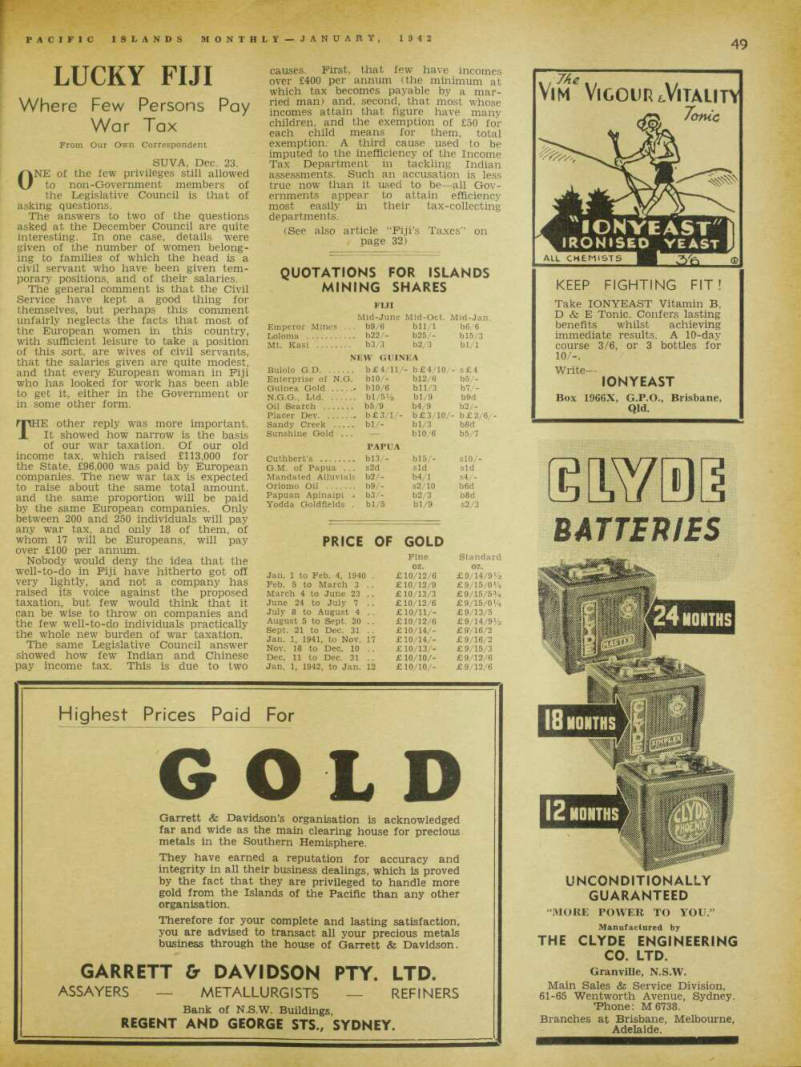
Where Few Persons Pay War Tax
From Our Own Correspondent
Suva, Dec. 23.
ONE of the few privileges still allowed to non-Government members of the Legislative Council is that of asking questions.
The answers to two of the questions asked at the December Council are quite interesting. In one case, details were given of the number of women belong ing to families of which the head is a civil servant who have been given tem porary positions, and of their salaries.
The general comment is that the Civil Service have kept a good thing for themselves, but perhaps this comment unfairly neglects the facts that most of the European women in this country, with sufficient leisure to take a position of this sort, are wives of civil servants, that the salaries given are quite modest, and that every European woman in Fiji who has looked for work has been able to get it, either in the Government or in some other form. rE other reply was more important.
It showed how narrow is the basis of our war taxation. Of our old income tax, which raised £113,000 for the State, £96,000 was paid by European companies. The new war tax is expected to raise about the same total amount, and the same proportion will be paid by the same European companies. Only between 200 and 250 individuals will pay any war tax, and only 18 of them, of whom 17 will be Europeans, will pay over £lOO per annum.
Nobody would deny the idea that the well-to-do in Fiji have hitherto got off very lightly, and not a company has raised its voice against the proposed taxation, but few would think that it can be wise to throw on companies and the few well-to-do individuals practically the whole new burden of war taxation.
The same Legislative Council answer showed how few Indian and Chinese pay income tax. This is due to two
causes. First, that few have incomes over £4OO per annum (the minimum at which tax becomes payable by a mar ried man) and, second, that most whose incomes attain that figure have many children, and the exemption of £5O for each child means for them, total exemption. A third cause used to be imputed to the inefficiency of the Income Tax Department in tackling Indian assessments. Such an accusation is less true now than it used to be —all Gov ernments appear to attain efficiency most easily tn their tax-collecting departments. (See also article “Fiji’s Taxes” on page 32)
Quotations For Islands
Mining Shares
Fiji
Mid-June Mid-Oct.
Mid-Jan.
Emperor Mines . . . b9/6 bll/1 b6/6 Loloma b22/b25/bl5/3 Mt. Kasi b3/3 b2/3 bl/1
New Guinea
Bulolo G.D b£4/ll/ - b £ 4/10 - s £ 4 Enterprise of N.G. blO/b!2/6 b5/- Guinea Gold blO/6 bll/3 b7/- N.G.G., Ltd bl/5Va bl/9 b9d Oil Search b5/9 b4/9 b2/- Placer Dev b £ 3/1/b £ 3/10 - b £ 2/6/- Sandy Creek bl/bl/3 b8d Sunshine Gold ... — blO/6 b5/7 Cuthbert’s
Papua
b!3/b!5/slO/- G.M. of Papua ... s2d sld sld Mandated Alluvials b2/b4/l s4/- Oriomo Oil b9/- S2/10 b6d Papuan Apinaipi b3/b2/3 b8d Yodda Goldfields . bl/5 bl/9 s2/3
Price Of Gold
Fine Standard oz. oz.
Jan. 1 to Feb. 4, 1940 £10/12/6 £9/14/9’ 2 Feb. 5 to March 3 £10/12/9 £ 9/15/0 >/4 March 4 to June 23 .. £10/13/3 £9/15/5% June 24 to July 7 £10/12/6 £ 9/15/0 V 4 July 8 to August 4 £10/11/- £9/13/5 August 5 to Sept. 20 £10/12/6 £9/14/912 Sept. 21 to Dec. 31 £ 10/14/- £9716/2 Jan. 1, 1941, to Nov. 17 £10/14/- £9/16/2 Nov. 18 to Dec. 10 £10/13/- £9/15/3 Dec. 11 to Dec. 31 £ 10/10/- £9/12/6 Jan. 1, 1942, to Jan. 12 £10/10/- £9/12/6
Advertisements & other items, pp. 53-54 (1 item)
Gold
7Ae
Vim Vigour
OfHC
ALL CHEMISTS
26
KEEP FIGHTING FIT!
Take lON YEAST Vitamin B.
D & E Tonic. Confers lasting benefits whilst achieving immediate results. A 10-day course 3/6, or 3 bottles for 10/-.
Write-
lONYEAST
Box 1966 X, G.P.0., Brisbane, Qld.
BATTERIES
12 MONTHS
UNCONDITIONALLY
GUARANTEED
MORE POWER TO YOU.”
Manufactured by
THE CLYDE ENGINEERING
CO. LTD.
Granville, N.S.W.
Main Sales & Service Division, 61-65 Wentworth Avenue, Sydney. ’Phone: M 6738.
Branches at Brisbane, Melbourne, Adelaide.
Highest Prices Paid For
GOLD
Garrett & Davidson’s organisation is acknowledged far and wide as the main clearing house for precious metals in the Southern Hemisphere.
They have earned a reputation for accuracy and integrity in all their business dealings, which is proved by the fact that they are privileged to handle more gold from the Islands of the Pacific than any other organisation.
Therefore for your complete and lasting satisfaction, you are advised to transact all your precious metals business through the house of Garrett & Davidson.
GARRETT & DAVIDSON PTY. LTD.
ASSAYERS METALLURGISTS REFINERS
Bank of N.S.W. Buildings,
REGENT AND GEORGE STS., SYDNEY.
LEVENSON'S
I SPECIALISE IN RADIO
I SETS FOR THE ISLANDS
TRADE
\ 100% satisfaction guaranteed,
i Liberal prices—no mass pro- = duction sets real he-man i radio designed and built for e your particular location. Short i wave and dual wave radio for dry battery or electric current
operation.
Microphones for Speech, Song or Music. Hook-up in a Jiffy to any set. 15/-, 17/6, 18/6 complete.
Batteryless Type Hand - holding Microphones, fit any set, 25/-, Ormond 3 In. Front-panel Vernier Dial, 2 actions, 8/6.
Dice of all kinds in stock. Poker Dice, 6/6, 7/6, 8/6, 10/6, set of 5.
Crown & Anchor Dice, set of 3, 5/6, Full Set with Cloth and Shaker, 10/6. H. & T., 5 & 6, and Hazard Dice Stocked.
Glass Insulators, Pyrex, 1/-, 6/6; and extra large transmitting type, 30/- each.
The Best Trick Pack of Cards available, 3/6. Hundreds of Tricks you can do. Fullest, simple instructions provided.
Now available (not less than 10/parcels): Magic Wand, 1/6 Jafet’s Wallet 1/-; Obedient Ball 1/6; Magic Penny, 2/6; Mystic Head Chopper, 2/6; Shy Lock, 2/-; Dribble Glass, 2/-; Ventrillo, 1/-; Magic Coin, 1/-; Nest of Nests, 5/-; Voice Echoer, 1/-; Magic Bottle, 1/-; 3 Bell Trick, 1/-.
Magic Wand 1/6; Wonderful Rattle Box Trick, 2/6. Mixed Parcels of Tricks, 10/-, 20/-, 30/-, 40/-, 50/-.
Parcel of Jokes, 10/-, 12/6, 15/-.
Make your safety razor blade last for months with this Razor Blade Sharpener, 3/6. Easy to use—nothing to get out of order.
BOOKS! BOOKS! BOOKS! The Be-
ginners’ Book of Radio. The Radio Beginners’ Dictionary- */- the t. Tha Wireless Constructor’s Eneyele* paedia. Giant size, 7/6. Newnes "Everyman’s” Wireless Book, 6/6.
The Book of Practical Radio, also The Boob of Practical Television, 8/6 each. Levenson’s Giant "Party and Fun Book”, 1/6. Humorous Stories and Recitation, 3/9. Card and Conjuring Tricks, 3/9. Tea-Cup Fortune Telling, 3/9. 100 Party Games for Old and Young, 1/9.
Popular Magic and Amateur Conjurer, 1/9. 50 Best Party Games, 1/6. Tricks with Cards, 1/6, How to make 1 Sc 2 valve Battery Sets, 1/-.
New Radio and Other Books Just Landed. Everyman’s Wireless Book, 8/6; Toy Making for Amateurs, 2/-; Sixty Tested Circuits, 6/6; How to Make Models, 2/6; The First Course in Wireless, 9/6; Wireless Terms Explained, 6/6. 12 Snappy Books —Jokes, Have Fun, etc., 5/6 the lot.
All About Aerial Booklet, 1-/. Radio Dictionary, 1/-. Morse Code Book, 1/-. Radio Alphabet, 1/-. The 4 books for 3/3.
Roulette Wheels, complete, 25/-.
SAFETY RAZOR
pi a r>c
BLADE
SHARPENER
Rubber Water Goggles, snug fit for under or over water wear, 11/6.
English make, 16/6.
LEARN MORSE CODE. "LIKE-A-
FLASH” KITS. KEYS & BUZZERS.
►jsons y P.M.G. type Key with Professional Buzzer <b Battery, all assembled on Base Board, 42/6.
Morse Set Buzzer or light with single switch. All parts include adjustable Key, Switch, Buzzer, Lamp and Battery, all assembled on Base Board, 30/-.
A I//.
Morse Code Set "De Luxe”. Adjustable High-grade Key, Buzzer and Battery, All mounted on base board ready for use, 27/6.
Adjustable Morse Code Key on Bakellte Base, highly plated parts, 12/6. High-grade instrument.
I //- 39 Morse Code Light and Buzzer Set.
A precision De-luxe outfit that cannot be bettered. Perfect Adjustable Morse Code Key, with professional type Buzzer. Light to Buzzer throw-over Switch, and Battery, all ready mounted, RADIO VALVES.—We guarantee a Better Price. Send your order.
ALL DRY BATTERIES STOCKED.
WORLD'S LATEST
GAMES
Darts Boards with 6 Darts, 8/6.
Play Brass Competition Darts, Set of 3, 3/11, 4/6, 5/6. Monopoly, 11/6.
Totopoly, 11/6. Bucaneer, 11/6. 3 of the World’s Most Popular Games.
Chinese Checkers, 2/9, 5/-, 9/-.
Tripoly Card Game , 5/3. De Luxe Type. 11/6. Poker Rummy, 1/1.
lOfe
m
K/V&Vo
nMDBOOK
radio Just arrived. The most outstanding Radio Publication for amateur or professional alike. Everything you want to know in Radio, properly illustrated.
HEADPHONES.
12/6, 17/6.
S.T.C., British, 30/-; 8.T.H., 30/-; Lissen, British, 19/6. All 4,000 ohms.
Rubber Head-’phone Pads, 2/6 pr.
Ericcson’s Professional Type, 47/6.
A new hobby—Rough Castings of Modern Planes, Ash Trays, Paper Knives, etc., etc. Write for Free Booklet.
B.G.E. Table Model Microphone for Speech or Music—fits and suits all sets; as good a performer as any; £6/6/- Model. Now 45/-.
Small Table Model British Built Microphone, for all sets, 15/-, 21/-, 22/6, for speech or music. 2 Reading Pocket Volt Meters, 5/6.
Portable battery operated Light with pull switch and Battery Block, 8/6.
Electric Bell Outfits. Bells made in England, 5/6, 6/6, 7/6, 8/6. Bell Wire, 1/6 doz. yards. Bell Pushes, 1/-, 1/6 each. Dry Batteries, 2/9.
Gramophone Pick-ups. Fit and suit all radios. “Collard” 50/-, “Cosmocord” 35/-, “Like-a-Flash” 30/-. All complete with leads.
Tone and volume control. Crystal Types 49/6 and 50/-. All British makes.
Aerial Stay-wire strainers, 2/6.
De Luxe Model British-built Lightning Arresters, complete for Indoor or outdoor use, 6/-.
Non-Jam Pulleys with halyard bolt, 1/9. Special Radio Earth Spike 4/6. 4 in. 4 in 1 Nickel Screw Drivers, bakelite or metal, 2/-. . Fountain Pen size. Cone Speaker Units, 25/-; Now 12/6. 1,500 ft. Beam Electric Torches, 5 Cell, 8/6. Both use Standard Batteries. Everyman’s Wireless Book, 8/6. Bakelite Pocket Torch, 5/-. 2 to 3 Cell Expandable Torches.
Nickelled Case —Dimmer incorporated.
Daylight Globes, 10/6.
Swiss Music Boxes for Cigarette, Trinkets, etc., 25/-, 30/-, 45/-, Steel Money and Deed Boxes, 63/-.
They ring when opened or lifted.
A Splendid Article.
Wet Battery Testers, 3/-.
Nickel Cased Volt Meters, Pocket Type, 2 Reading, High & Low, 4/6.
British Make 3 Readings, 10/6.
Bench [ Reads Type All in Meter Radio, I 30/-.
POCKET VOLT
METERS.
Two Reading Pocket Meter, for A and B Batteries, 3/9, 4/9, 7/6. 3 Reading, A and B Batteries, and up to 30 M/A, 10/6. 3 Reading De Luxe Model, 12/6. 4 Reading, 14/-.
AMPLION British built Gramo- Radio Pick-up with volume control.
Moulded bakelite tone arm. List Price 37/6. Now 32/6. Dealers write for wholesale price, COLLARD Spring Gramophone Motor and Turntable, 27/6.
Midget Throwing Knives, made in Sheffield, perfectly balanced, unbreakable handles, 7/6 each. 15/the pair. Set of 3, 21/-. All in sheaths.
Remington, U.S.A., made, Hunting and Sports Knife, In Leather Sheath, 12/6. Others 15/-, 18/6.
Best Stainless Pocket Knife, 6/6.
Leather Money Belts, Splendid quality. Give waist measurement, when ordering, 9/6, 11/6 each.
(iinnniinnm
Write for Punch Board Leaflets nirninniinimnn
J. LEVEMSON Radio
GAMES, NOVELTIES ANO HOBBIES.
mniiiiiiiiniiiiiiiiiii
Write for Pin-Game, Totem 226 A PITT STREET, SYDNEY ? „a other ' Leaflets.
Manufacturers, Importers, and Exporters. n.s.w., Australia. jiiiiimiiiiiiiiiiinni Cable address; “Leveradioh”. Godds forwarded V.P.P. or Sight Draft. Satisfaction and Service Guaranteed. We can supply by mail all General Merchandise at a Better Price. Quotations with pleasure. Please add freight and packing. Write for full list of interesting leaflets of Games, Hobbies, Novelties, and Electrical Goods. Write for full list of Radio Meters.
We Can Supply, at a Keen Price, Any Available Article You Require
Ocean Is. Rats !
HAVE you ever found yourself, with out warning, surrounded by rats — scurrying, scampering, dodging rats —fat and agile and cheeky? That was my extraordinary experience recently on Ocean Island.
I had gone out for a stroll, along a jungle-embowered track, and I thought that all the liveliness in the under growth around was due to lizards, or something. Then I investigated, and I found that, as I walked along, rats were being disturbed from their afternoon siesta, and were bounding off in all directions. So I reversed my heavy stick and, using it a la golf club, I went after every rat I saw. It was great fun, while it lasted: but the climate of that scorched island is definitely against lively exercise, so I knocked off when the death-roll was eight, and my tempera ture about 110.
Residents told me that the rats always are numerous on Ocean Island, but just now they are undergoing one of their recurrent swarming periods. Presently, nature will strike a balance, and some plague or natural enemy will reduce the pest. I got used to them after a day or two: but, as I walked along, I seldom could resist the call of the chase —reverse stick; three quick steps; smack!—and,
once again, le rat mort.-
R.W.R.
Australian Short Wave
Broadcast
AN Australian radio programme is broadcast daily on short wave from Lyndhurst (Vic toria) for listeners in the Western Pacific: —
Power: VLR, 2 Kilowatts. Times given are Australian Summer Time (11 hours ahead of Greenwich Mean Time).
WEEK DAYS.—a.m.: 6.30, Essential Services: 6.45, News; 7.15, Music; 7.45, News; 8, Music; 9.30, Story; 10, Devotional Service; 10.15, Close, p.m.: 12. Time Signal and broadcast to schools; 12.35, Essential Services; 12.50, News; 1, Music; 1.35, News; 1.50, Music; 4.15, News; 4.30, Music; 5.30, Young People’s Session; 6.15, Close; 6.30, Dinner Music; 6.45, Sporting Session; 7, News; 10.30, Music; 11, News; 11.30, Close.
SATURDAYS.—Same as daily programme, except between 1.15 p.m. and 5.15 p.m., when description of current sporting and athletic events is given, interspersed with music.
SUNDAYS.— a.m.: 6.45, News; 7.05, Music; 9, News; 9.15, AIF Recordings; 9.30, New Releases (Recorded); 10.15, Book Reviews; 10.30, Famous Singers: 11, Divine Service, p.m.: 12.15, Great Pianists; 12.50, News; 12.55, Music; 2.15, “Foun dations of Music”; 3, Musical Quiz; 3.30, “Adventures in Art”; 4.15, News 4.30, BBC Feature; 4.45, Music; 6, BBC News; 6.15, Close; 6.30, Music; 7, News and Commentary; 11, Close.
Broadcast to French Colonies
r T''HE Australian Department of Information, in , conjunction with the Australian Broadcast ing Commission, makes a daily broadcast in French of news, talks, and music for listeners in New Caledonia, New Hebrides, and Tahiti.
Transmission is made from Station VLQ, Sydney, on a wave-length of 31.2 metres (frequency, 9.615 mcs.) and consists of the following items:—
Miss H. Nicholson, for two years popu school-mistress to the European children of Rarotonga, arrived in New Zealand from the Cook Islands in December.
Call Time Wave Frequency Length Sign (Metres) (K/cs.) VLR8. 6.30-10.15 a.m. 25.51 11,760 VLR3. 12.00-6.15 p.m 25.25 11.880 VLR. 6.30-11.30 p.m. 31.32 9,580
Australian Noumea Summer Time.
Time. 6.25 p.m. 6.25 p.m.
Announcements. 6.30 p.m. 6.30 p.m.
News in French. 6.50 p.m. 6.50 p.m.
Talk in French. 7.25 p.m. 7.25 p.m.
Close.
Together
Japs and Tax-gatherer Arrive Together
IN view of what happened within 30 days, an issue of the Gilbert and Ellice Islands Gazette, on Novem ber 5, is regarded as a piece of grim humour.
The Gazette provides that, as from January 1, 1942, income tax shall be payable within the Colony as follows: Single persons without dependents, 1/3 in the £ on all income over £175 a year; married persons or persons with other dependents, 1/3 in the £ on all income over £425 up to £2,500; 2 6 in the £ on incomes from £2,500 to £3,000; 3 9 in the £ on £3,000 to £5,000 and 5/- in the £ on incomes over £5,000.
On December 8, the Japanese arrived in the Gilberts, where two firms (Bums, Philp & Co. and On Chong & Co.) had been trying desperately to carry on; and now there will be no income to pay
taxes with. In the Ellice Group, the copra industry is dead, for the moment.
There may be a few taxpayers left among the Phosphate Co. staff on Ocean Island, but their contributions will be modest.
Advertisements & other items, pp. 55-56 (1 item)
My Goodness-My GUINNESS
The House of Steel for Quality Cutlery a 0. ...
C_j We have a large range of Scissors, Knives, Razors, etc.
W. JNO. BAKER Eg;
3 HUNTER STREET, SYDNEY.
Established 1888.
My Goodness-My GUINNESS
Stocked by all branches of
BROWN & JOSKE LTD.
BURNS PHILP & CO. LTD.
W. R. CARPENTER & CO. LTD.
Advrt'sement of Export Bottlers Ltd., London.
A. Macfee & Co. Ltd., Wapping, Liverpool, England.
MORRIS HEDSTROM LTD.
TAKE THE
“LEAD” FEELING
OUT OF YOUR LEGS
Get More Oxygen in Your Blood and Get that Pep that Sends You Bounding Up the Stairs.
People who smother to death die because oxygen has been completely cut off from them. Just as surely you are slowly smothering if your blood lacks red corpuscles. Red corpuscles are your oxygen carriers. They carry the oxygen you breathe in to every part of your system.
Without enough oxygen-carrying corpuscles, your kidneys, liver, stomach and bowels slow down. Your skin gets pale, flabby, often pimply. Your nerves may become jittery—you tire quickly— feel depressed.
What you need is Dr. Williams’ Pink Pills. These world-famous pills help you make more and better red corpuscles and thus increase the oxygen-carrying power of your blood. Get Dr. Williams’
Pink Pills to-day at your chemist or store and see for yourself how quickly this time-proven blood-builder will help give you back your pep and clear complexion.***
i; iS Australia’s Choicest Products: M 1C( Cauliflower
garden^.
Always . . . make sure you have at hand an ample Reserve of these Delicious . .
Ready-toserve Vegetables
Centenary of Henderson
and Macfarlane Ltd.
Auckland Firm's Long Connection With the Pacific
11/ITH the advent of 1942, the NZ firm, h Henderson and IMacfarlane Ltd., celebrates its centenary—exactly 100 years ago, in 1842, Thomas Hender son> a Scottish-born engineer, and John Macfarlane, joined in partnership to found the company at Auckland.
Mr -. Henderson was one of the most S^S en Jo|!f rly ett £ ers the new cql ony m 1840 and he assisted also in establishing the Bank of New Zealand, the NZ Loan and Mercantile Aeency Co., and the NZ Insurance Co. In later years, he served on the Legislative Council. One of his sons, Mr. Harry Henderson, spent much of his youth In the South Seas, before settling down in Sydney.
With the growth of Auckland pro vince, Henderson and Macfarlane Ltd.’s business expanded until its connections extended over the Australasian colonies, the Pacific Islands, Gt. Britain and USA. It established and partly built the fleet of vessels known as the Circular Saw Line. This fleet included the cele brated barque “Novelty” (built at Mech anics Bay by the late Mr. Henry Niccol), which holds the sailing record between Sydney and Auckland, Other crack H. and M. vessels were the “Alice Cameron”, “Kate”, “Breadal bane”, “Sir George Grey” and “Neva”, which were employed carrying cargoes to
and from Polynesia, Australia and Cali fornia.
Before the coming of steam, the firm ran the first regular line of packet ves sels between NZ and Australia and the service was continued until the estab lishment of the Panama Steam Ship Co. in 1865. H. and M. thereupon withdrew its vessels from the Sydney run and employed them as traders in various parts of the globe. Then, in 1870, they were confined exclusively to the South Seas.
When the Union Steam Ship Co. was formed, Henderson and Macfarlane became its Auckland agent and con tinued as such until the USS Co. opened its own branch there under Mr. Thomas Henderson, Jnr.
In September, 1898, H. and M. sold its Western Pacific trade to the well-known Pacific Islands Company, which also acquired the SS “Archer” and several sailing ships.
In 1912 the firm was appointed New Zealand agent for the Pacific Phosphate Co. Ltd., which owned the phosphate deposits on Nauru and Ocean Island.
After the war, the British, Australian and New Zealand Governments assumed control of the phosphate workings on these islands, and the British Phosphate Commission was formed. This Commis sion appointed Henderson and Macfar lane Ltd. as NZ distributors of Nauru- Ocean phosphate, and it acted in this capacity until the BPC opened a branch in Auckland.
At present, the company is chief agent in NZ for the Matson Navigation Co., the Oceanic Steamship Co., and Pan American Airways. It also represents many of the leading steamship and air lines, including Burns, Philp and Co., A. and O. Line, Aberdeen and Common wealth, P. and 0., Tasman Empire Air ways, and Hawaiian Airways.
Executive head of Henderson and Macfarlane Ltd. is Mr. Edward Ander son, managing director, who also is a director of a number of leading NZ business houses, in addition to occupy ing the position of president of the Auckland Savings Bank.
VESSELS OWNED BY H. & M., LTD.
(Circular Saw Line).
Dr. Edward Pohau Ellison, Chief Medi cal Officer of the Cook Islands, arrived in NZ from Rarotonga, with his wife and family, in December. After four months’ leave, Dr. Ellison, who is well known throughout Polynesia for his medical research work and promotion of useful Maori education, will return for a last term, in which he hopes to estab lish the sanatorium for consumptives for which he has been labouring so long.
Schooners: Barques: “Will of the Wisp"
“Breadalbane”
“Sybil”
“Kate”
“Neva”
“Constance”
“Ryno”
“Novelty”
“Kremhilda”
“Alice Cameron”
“Peerless”
“Sir George Grey”
“Orwell”
“Haversham”
“Mazeppa”
“Domiga”
“Coronet”
“Benjamin Heape”
“Belle Brandon”
“Bella Marina”
“Ika Vuka”
“India”
“Sunbeam”
“Glimpse”
“Gazella”
Cutters; Brigs: “Tickler”
“Spencer”
“Teaser”
“Pakeha”
“Triad”
“Albion”
“Tartar”
“Susan”
“Tweed”
“Moa”
“Alma”
Steamers: “Trusty Millar”
“Phoebe”
“Harvest Home”
“Airedale”
“Willie Winkie”
“Lord Ashley”
“Isabel”
“Rose Casey”
“Stag”
"Archer”
Capable Islander
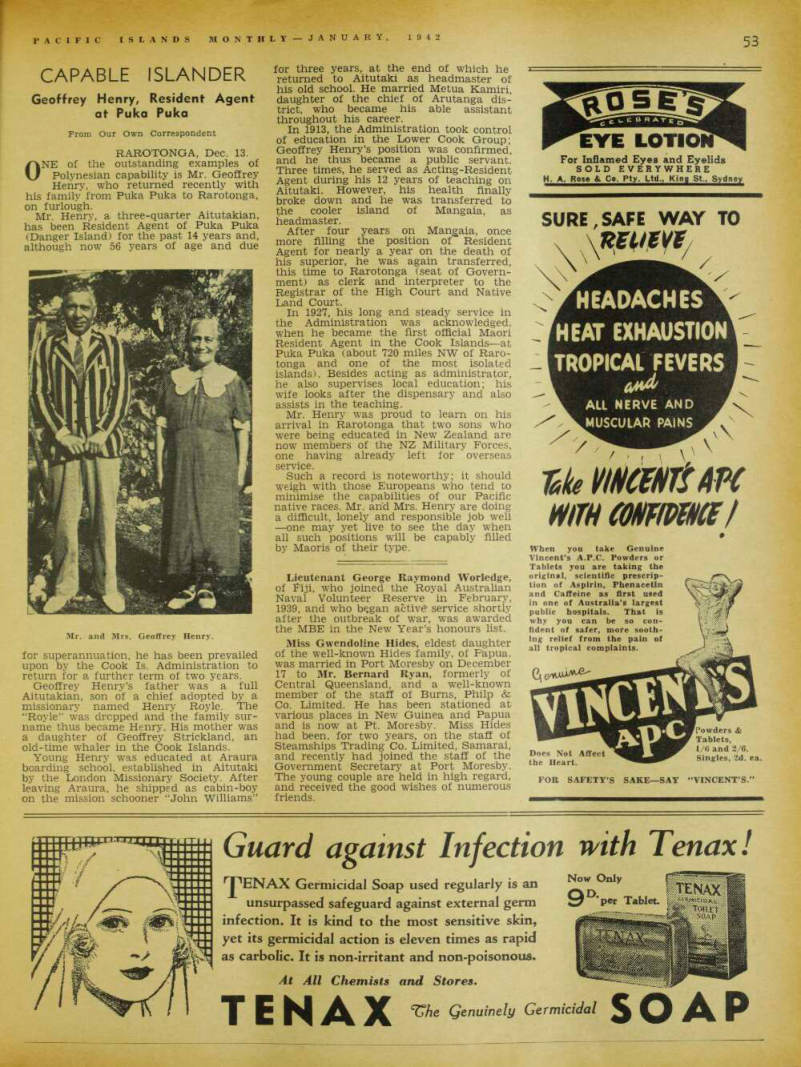
Geoffrey Henry, Resident Agent at Puka Puka
From Our Own Correspondent
Rarotonga, Dec. 13.
ONE of the outstanding examples of Polynesian capability is Mr. Geoffrey Henry, who returned recently with his family from Puka Puka to Rarotonga, on furlough.
Mr. Henry, a three-quarter Aitutakian, has been Resident Agent of Puka Puka (Danger Island) for the past 14 years and, although now 56 years of age and due
for superannuation, he has been prevailed upon by the Cook Is. Administration to return for a further term of two years.
Geoffrey Henry’s father was a full Aitutakian, son of a chief adopted by a missionary named Henry Royle. The “Royle” was dropped and the family sur name thus became Henry. His mother was a daughter of Geoffrey Strickland, an old-time whaler in the Cook Islands.
Young Henry was educated at Araura boarding school, established in Aitutaki by the London Missionary Society. After leaving Araura, he shipped as cabin-boy on the mission schooner “John Williams”
for three years, at the end of which he returned to Aitutaki as headmaster of his old school. He married Metua Kamiri, daughter of the chief of Arutanga dis trict, who became his able assistant throughout his career.
In 1913, the Administration took control of education in the Lower Cook Group; Geoffrey Henry’s position was confirmed, and he thus became a public servant.
Three times, he served as Acting-Resident Agent during his 12 years of teaching on Aitutaki. However, his health finally broke down and he was transferred to the cooler island of Mangaia, as headmaster.
After four years on Mangaia, once more filling the position of Resident Agent for nearly a year on the death of his superior, he was again transferred, this time to Rarotonga (seat of Govern ment) as clerk and interpreter to the Registrar of the High Court and Native Land Court.
In 1927, his long and steady service in the Administration was acknowledged, when he became the first official Maori Resident Agent in the Cook Islands—at Puka Puka (about 720 miles NW of Raro tonga and one of the most isolated islands). Besides acting as administrator, he also supervises local education; his wife looks after the dispensary and also assists in the teaching.
Mr. Henry was proud to learn on his arrival in Rarotonga that two sons who were being educated in New Zealand are now members of the NZ Military Forces, one having already left for overseas service.
Such a record is noteworthy; it should weigh with those Europeans who tend to minimise the capabilities of our Pacific native races. Mr. and Mrs. Henry are doing a difficult, lonely and responsible job well —one may yet live to see the day when all such positions will be capably filled by Maoris of their type.
Lieutenant George Raymond Worledge, of Fiji, who joined the Royal Australian Naval Volunteer Reserve in February, 1939, and who began active* service shortly after the outbreak of war, was awarded the MBE in the New Year’s honours list.
Miss Gwendoline Hides, eldest daughter of the well-known Hides family, of Papua, was married in Port Moresby on December 17 to Mr. Bernard Ryan, formerly of Central Queensland, and a well-known member of the staff of Burns, Philp & Co. Limited. He has been stationed at various places in New Guinea and Papua and is now at Pt. Moresby. Miss Hides had been, for two years, on the staff of Steamships Trading Co. Limited, Samarai, and recently had joined the staff of the Government Secretary at Port Moresby.
The young couple are held in high regard, and received the good wishes of numerous friends.
Mr. and Mrs. Geoffrey Henry.
Advertisements & other items, p. 57 (1 item)
Ue mcmim
SE'S
SO
LOTIO
For Inflamed Eyes and Eyelids
SOLD EVERYWHERE
SURE,SAFE WAY TO
\ neum
HEAT EXHAUSTION
TROPICAL FEVERS
kU NERVE AND
(USCULAR PAINS
f
Ue mcmim
mm comma
When you take Genuine Vincent’s A.P.C. Powders or Tablets you are taking the original, scientific prescription of Aspirin, Phenacetin and Caffeine as first used in one of Australia’s largest public hospitals. That is why you can be so confident of safer, more soothing relief from the pain of all tropical complaints.
Cv, Does Not Affect the Heart.
Powders & Tablets, 1/6 and 2/6.
Singles, 2d. ea
FOR SAFETY’S SAKE—SAY “VINCENT’S.’
/ i V; 1
Guard against Infection with Tenax!
Now Only Germicidal Soap used regularly is an unsurpassed safeguard against external germ y P er Tablet. infection. It is kind to the most sensitive skin, yet its germicidal action is eleven times as rapid as carbolic. It is non-irritant and non-poisonous.
At All Chemists and Stores.
TENAX c C%e Genuinely Germicidal SOAP
TENAX
Tout
Islands Produce
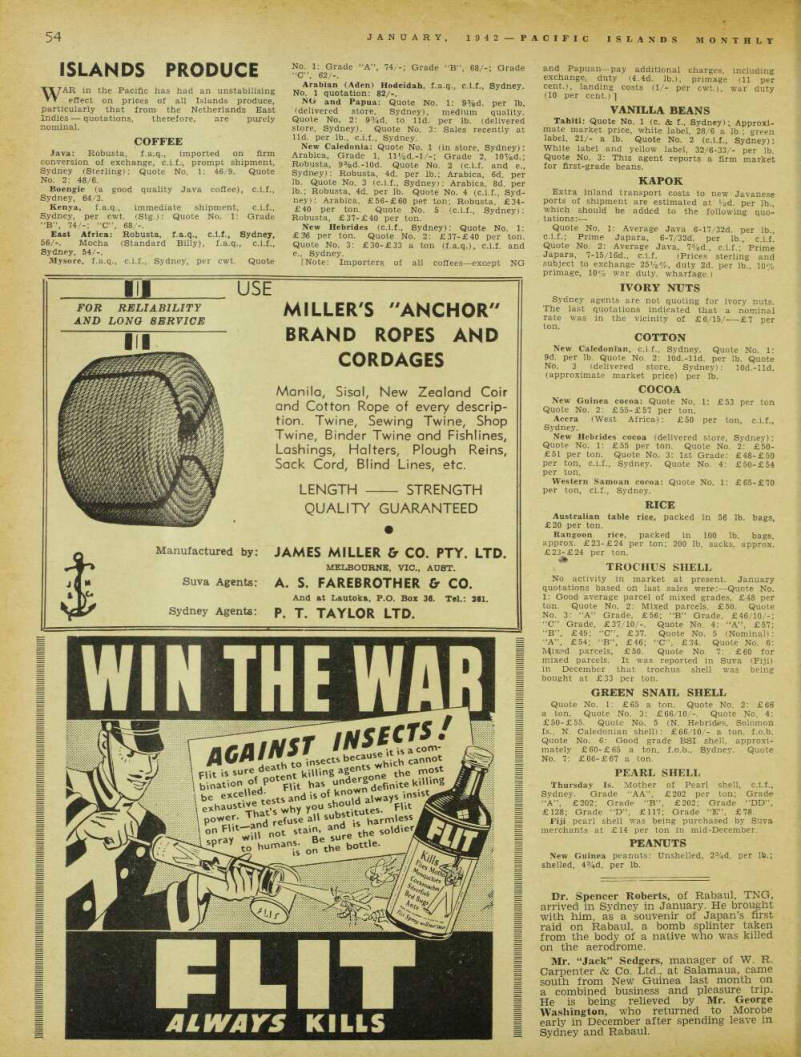
WAR in the Pacific has had an unstabilising effect on prices of all Islands produce, particularly that from the Netherlands East Indies quotations, therefore, are purely nominal.
Coffee
Java: Robusta, f.a.q., imported on firm conversion of exchange, c.i.f., prompt shipment, Sydney (Sterling); Quote No. 1; 46/9. Quote No. 2: 48/6.
Boengie (a good quality Java coffee), c.i.f., Sydney, 64/3.
Kenya, f.a.q., immediate shipment, c.i.f., Sydney, per cwt. (Stg.): Quote No. 1: Grade “B”, 74/-; “C”, 68/-.
East Africa: Robusta, f.a.q., c.i.f., Sydney, 56/-. Mocha (Standard Billy), f.a.q., c.i.f., Sydney, 54/-.
Mysore, f.a.q., c.i.f., Sydney, per cwt. Quote
No. 1: Grade “A”, 74/-; Grade “B”, 68/-; Grade “C”, 62/-, Arabian (Aden) Hodeidah, f.a.q., c.i.f., Sydney.
No. 1 quotation: 82/-.
NG and Papua: Quote No. 1: 9%d. per lb. (delivered store, Sydney), medium quality.
Quote No. 2: 9%d. to lid. per lb. (delivered store, Sydney). Quote No. 3: Sales recently at lid. per lb., c.i.f., Sydney.
New Caledonia: Quote No. 1 (in store, Sydney): Arabica, Grade 1, liy 2 d.-l/-; Grade 2, 10 7 / B d.; Robusta, 9%d.-10d. Quote No. 2 (c.i.f, and e., Sydney): Robusta, 4d. per lb.; Arabica, 6d. per lb. Quote No. 3 (c.i.f., Sydney): Arabica, Bd. per lb.; Robusta, 4d. per lb. Quote No. 4 (c.i.f., Syd ney): Arabica, £56-£6O pef ton; Robusta, £34- £4O per ton. Quote No. 5 (c.i.f., Sydney): Robusta, £37-£4O per ton.
New Hebrides (c.i.f., Sydney); Quote No. 1: £36 per ton. Quote No. 2: £37-£4O per ton.
Quote No. 3: £3O-£33 a ton (f.a.q.), c.i.f. and e., Sydney. [Note: Importers of all coffees—except NG
and Papuan—pay additional charges, including exchange, duty (4.4 d. lb.), primage (11 per cent.), landing costs (1/- per cwt.), war duty (10 per cent.)]
Vanilla Beans
Tahiti: Quote No. 1 (c. & f., Sydney); Approxi mate market price, white label, 28/6 a lb.; green label. 21/- a lb. Quote No. 2 (c.i.f., Sydney): White label and yellow label, 32/6-33/- per lb.
Quote No. 3: This agent reports a firm market for first-grade beans.
Kapok
Extra inland transport costs to new Javanese ports of shipment are estimated at y 2 d. per lb., which should be added to the following quo . tations:— Quote No. 1: Average Java 6-17/32d. per lb., c.i.f.; Prime Japara, 6-7/32d. per lb., c.i.f.
Quote No. 2; Average Java, 7 s / B d., c.i.f.; Prime Japara, 7-15/16d., c.i.f. (Prices sterling and subject to exchange 25V 2 %, duty 2d. per lb., 10% primage, 10% war duty, wharfage.)
Ivory Nuts
Sydney agents are not quoting for ivory nuts.
The last quotations indicated that a nominal rate was in the vicinity of £6/15/—£7 per ton.
Cotton
New Caledonian, c.i.f., Sydney. Quote No. 1: 9d. per lb. Quote No. 2: lOd.-lld. per lb. Quote No. 3 (delivered store, Sydney); lOd.-lld. (approximate market price) per lb.
Cocoa
New Guinea cocoa: Quote No, 1: £53 per ton Quote No. 2: £55-£57 per ton.
Accra (West Africa): £5O per ton, c.i.f., Sydney.
New Hebrides cocoa (delivered store, Sydney): Quote No. 1: £55 per ton. Quote No. 2; £5O - per ton. Quote No, 3: Ist Grade: £4B-£5O pier ton, c.i.f., Sydney. Quote No. 4; £5O-£54 per ton.
Western Samoan cocoa: Quote No. 1: £65-£7O per ton, ci.f., Sydney.
Rice
Australian table rice, packed in 56 lb. bags, £2O per ton.
Rangoon rice, packed in 100 lb. bags, approx. £23-£24 per ton; 200 lb. sacks, approx. £23-£24 per ton.
Trochus Shell
No activity in market at present. January quotations based on last sales were;—Quote No. 1: Good average parcel of mixed grades, £4B per ton. Quote No. 2: Mixed parcels, £5O. Quote No. 3: “A” Grade, £56; “B” Grade, £46/10/-; “C” Grade, £37/10/-. Quote No. 4: “A”, £57; “B”, £49; “C”, £37. Quote No. 5 (Nominal); ‘A”, £54; “B”, £46; “C”, £34. Quote No. 6: Mixed parcels, £5O. Quote No. 7: £6O for mixed parcels. It was reported in Suva (Fiji) in December that trochus shell was being bought at £33 per ton.
Green Snail Shell
Quote No. 1: £65 a ton. Quote No. 2: £66 a ton. Quote No. 3: £66/10/-. Quote No. 4: £5O-£55. Quote No. 5 (N. Hebrides, Solomon Is., N. Caledonian shell): £66/10/- a ton, f.o.b.
Quote No. 6: Good grade BSI shell, approxi mately £6O-£65 a ton, f.0.b., Sydney. Quote No. 7: £66-£67 a ton.
Pearl Shell
Thursday Is. Mother of Pearl shell, c.i.f., Sydney. Grade “AA”, £202 per ton; Grade “A”, £202; Grade “B”, £202; Grade “DD”, £128; Grade “D”, £117; Grade “E”, £7B.
Fiji pearl shell was being purchased by Suva merchants at £l4 per ton in mid-December.
Peanuts
New Guinea peanuts; Unshelled, 2%d. per lb.; shelled, 4%d. per lb.
Dr. Spencer Roberts, of Rabaul, TNG, arrived in Sydney in January. He brought with him, as a souvenir of Japan’s first raid on Rabaul, a bomb splinter taken from the body of a native who was killed on the aerodrome.
Mr. “Jack” Sedgers, manager of W. R.
Carpenter & Co. Ltd., at Salamaua, came south from New Guinea last month pn a combined business and pleasure trip.
He is being relieved by Mr. George Washington, who returned to Morobe early in December after spending leave in Sydney and Rabaul.
Advertisements & other items, p. 58 (1 item)
Win The Wab
11
FOR RELIABILITY
AND LONG SERVICE
USE
MILLER'S "ANCHOR"
BRAND ROPES AND
CORDAGES
Manila, Sisal, New Zealand Coir and Cotton Rope of every description. Twine, Sewing Twine, Shop Twine, Binder Twine and Fishlines, Lashings, Halters, Plough Reins, Sack Cord, Blind Lines, etc.
LENGTH STRENGTH
QUALITY GUARANTEED
Manufactured by: JAMES MILLER Cr CO. PTY. LTD.
MELBOURNE, VIC., AUST.
Suva Agents: A. S. FAREBROTHER Cr CO.
And at Lautoka, P.O. Box 36. Tel.: 261.
Sydney Agents: p. T. TAYLOR LTD.
WIN THE WAB
A ca humans. the bottle. /,
ALWAYS KILLS
Market Quotations
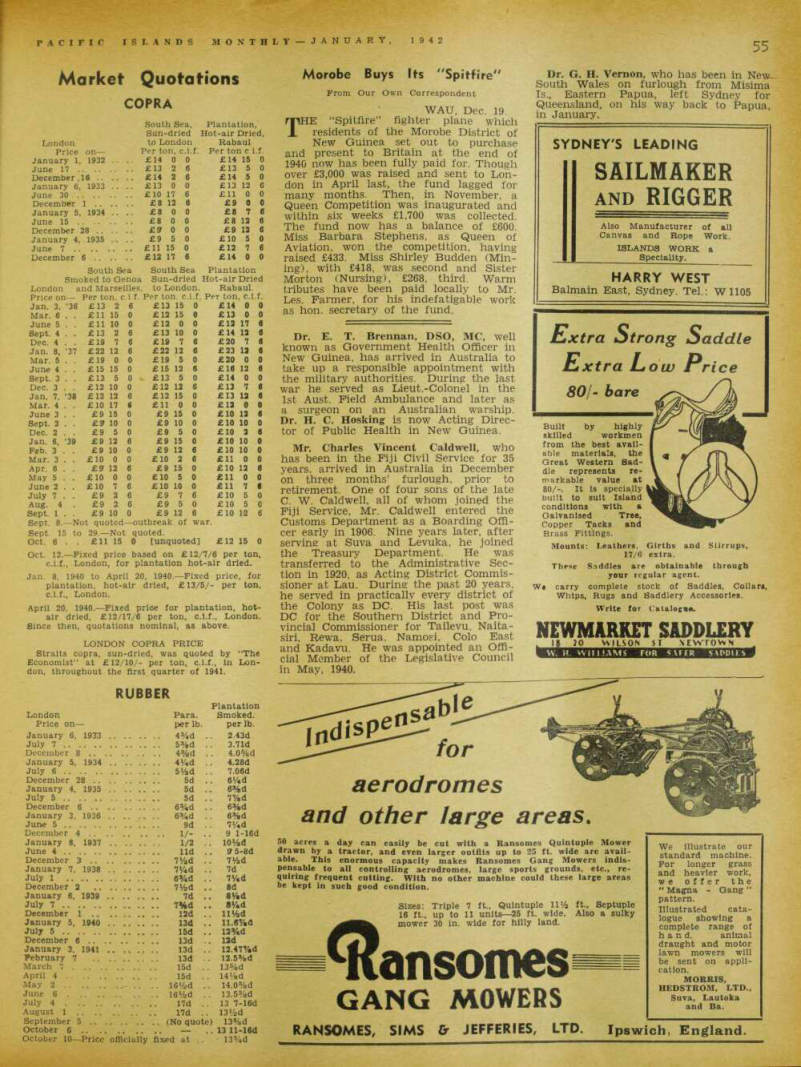
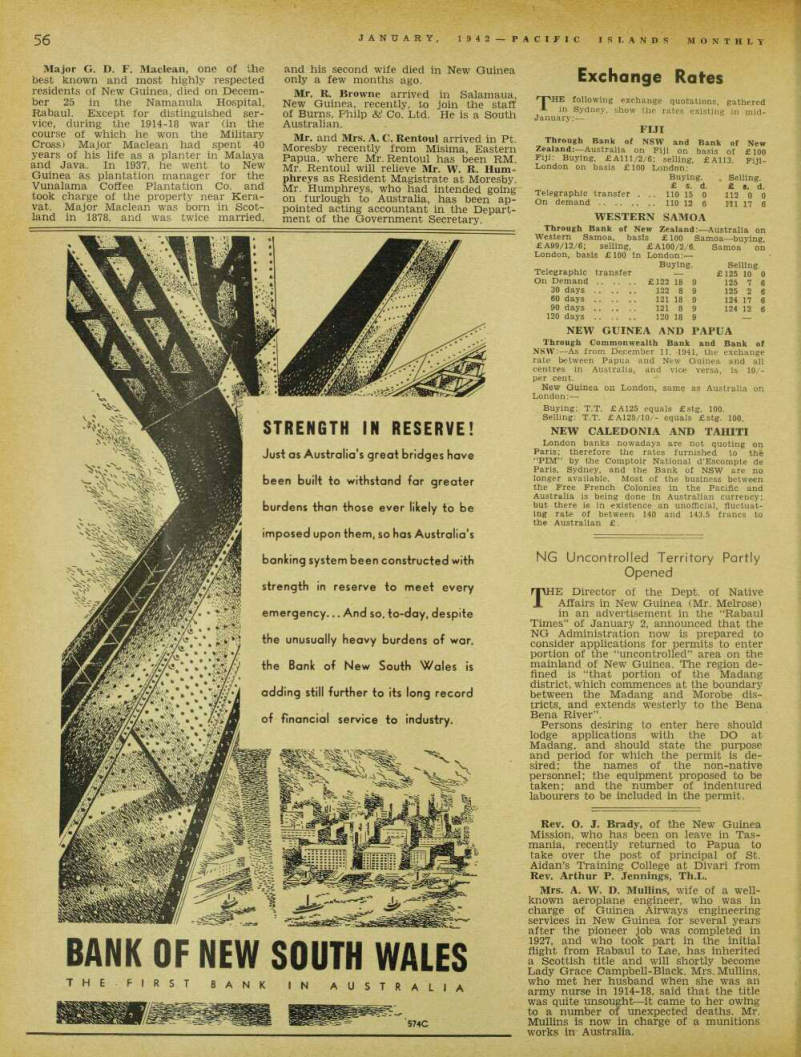
Morobe Buys Its "Spitfire"
From Our Own Correspondent WAU, Dec. 19.
THE “Spitfire” fighter plane which residents of the Morobe District of New Guinea set out to purchase and present to Britain at the end of 1940 now has been fully paid for. Though over £3,000 was raised and sent to Lon don in April last, the fund lagged for many months. Then, in November, a Queen Competition was inaugurated and within six weeks £1,700 was collected.
The fund now has a balance of £6OO.
Miss Barbara Stephens, as Queen of Aviation, won the competition, having raised £433. Miss Shirley Budden (Min ing). with £4lB, was second and Sister Morton (Nursing), £268. third. Warm tributes have been paid locally to Mr.
Les. Farmer, for his indefatigable work as hon. secretary of the fund.
Dr. E. T. Brennan, DSO, MC, well known as Government Health Officer in New Guinea, has arrived in Australia to take up a responsible appointment with the military authorities. During the last war he served as Lieut.-Colonel in the Ist Aust. Field Ambulance and later as a surgeon on an Australian warship.
Dr. H. C. Hosking is now Acting Direc tor of Public Health in New Guinea.
Mr. Charles Vincent Caldwell, who has been in the Fiji Civil Service for 35 years, arrived in Australia in December on three months’ furlough, prior to retirement. One of four sons of the late C. W. Caldwell, all of whom joined the Fiji Service, Mr. Caldwell entered the Customs Department as a Boarding Offi cer early in 1906. Nine years later, after serving at Suva and Levuka, he joined the Treasury Department. He was transferred to the Administrative Sec tion in 1920, as Acting District Commis sioner at Lau. During the past 20 years, he served in practically every district of the Colony as DC. His last post was DC for the Southern District and Pro vincial Commissioner for Tailevu, Naita siri, Rewa, Serua. Namosi, Colo East and Kadavu. He was appointed an Offi cial Member of the Legislative Council in May, 1940.
Dr. G. H. Vernon, who has been in New- South Wales on furlough from Misima Is., Eastern Papua, left Sydney for Queensland, on his way back to Papua, in January.
Copra
South Sea, Plantation, Sun-dried Hot-air Dried, London to London Rabaul Price on— Per ton. c.i.f.
Per ton c i.f.
January 1, 1932 £14 0 0 £14 15 0 June 17 .. .. £13 2 6 £13 5 0 December 16 . . £14 2 6 £14 5 0 January 6. 1933 £13 0 0 £13 12 6 June 30 . . . . £10 17 6 £11 0 0 December 1 .. £8 12 6 £9 0 0 January 5, 1934 £8 0 0 £8 7 6 June 15 . . .. £8 0 0 £8 12 6 December 28 . . £9 0 0 £9 12 6 January 4, 1935 £9 5 0 £10 5 0 June 7 .. .. £11 15 0 £12 7 6 December 6 . , £12 17 6 £14 0 0 South Sea South Sea Plantation Smoked to Genoa Sun-dried Hot-air Dried London and Marseilles to London.
Rabaul.
Price on— Per ton. c.i.f.
Per ton. c.i.f.
Per ton, c.i.f.
Jan. 3. ’36 £13 2 6 £13 15 0 £14 0 0 Mar. 6 . . £11 15 0 £12 15 0 £13 0 0 June 5 . . £11 10 0 £12 0 0 £12 17 6 Sept. 4 . . £13 2 6 £13 10 0 £14 12 6 Dec. 4 . . £19 7 6 £19 7 6 £20 7 6 Jan. 8, ’37 £22 12 6 £22 12 6 £23 12 6 Mar. 5 . . £19 0 0 £19 5 0 £20 0 0 June 4 . . £ 15 15 0 £15 12 6 £16 12 6 Sept. 3 . . £13 5 0 £13 5 0 £14 0 0 Dec. 3 . . £12 10 0 £12 12 6 £13 7 6 Jan. 7. ’38 £12 12 6 £12 15 0 £13 12 6 Mar. 4 . . £10 17 9 £11 0 0 £12 0 0 June 3 . . £9 15 0 £9 15 0 £10 12 6 Sept. 2 . . £ 9 10 0 £9 10 0 £10 10 0 Dec. 2 . . £9 5 0 £9 5 0 £10 2 6 Jan. 6. ’39 £9 12 6 £9 15 0 £10 10 0 Feb. 3 . . £9 10 0 £9 12 6 £10 10 0 Mar. 3 . . £10 0 0 £10 2 6 £11 0 0 Apr. 6 . . £ 9 12 6 £9 15 0 £10 12 6 May 5 . . £10 0 0 £10 5 0 £11 0 0 June 2 . . £10 7 6 £10 10 0 £11 7 6 July 7 . . £9 2 6 £9 7 6 £10 5 0 Aug. 4 . £9 2 6 £9 5 0 £10 5 0 Sept. 1 . . £9 10 0 £9 12 6 £10 12 6 Sept. 8.—Not quoted—outbreak of war.
Sept. 15 to 29.- -Not quoted.
Oct. 6 . . £11 15 0 [unquoted] £12 15 0 Oct. 12.—Fixed price based on £12/7/6 per ton, c.i.f., London , for plantation hot-air dried.
Jan. 8. 1940 to .
April 20. 1940. —Fixed price, for plantation, hot-air dried. £13/5/- per ton, c.i.f., London.
April 20, 1940.—Fixed price for plantation, hotair dried. £12/17/6 per i ton, c.i.f., London.
Since then, quotations nominal, as above.
London
Copra
Price
Straits copra, sun-dried, was quoted by "The Economist” at £12/10/per ton, c.i.f., in London, throughout the first quarter of 1941.
Rubber
Plantation London Para.
Smoked.
Price on— per lb. per lb.
January 6. 1933 4 3 / 4 d 2.43d July 7 5 3 /ad 3.71d December 8 ., . 4%d . . 4.0 s /ad January 5, 1934 4‘/ 4 d 4.28d July 6 5‘/ad 7.06d December 28 .. 5d .. 6V 4 d January 4, 1935 5d .. 6%d July 5 5d 7 7 /«d December 6 6 3 / 4 d 6%d January 3, 1936 6 3 / 4 d 6%d June 5 9d 7‘/ 4 d December 4 .. , 1/- .. 9 l-16d January 8. 1937 1/2 .. lOMid June 4 lid 9 5-8d December 3 .. 7Vid 7Vid January 7, 1938 7V 4 d .. 7d July 1 6%d 7Vid December 2 7 Vad 8d January 6, 1939 7d 8V.d July 7 7%d .. ay 4 d December 1 ._ 12d .. ny.d January 5, 1940 13d .. 11.8%d July 5 I5d .. 12%d December 6 .. . 13d . 12d January 3, 1941 13d .. 12.47%d February 7 13d . 12.5 s / a d March 7 15d . . 13 5 /ad April 4 15d . . 14 Vad May 2 .. 16‘/ad . . 14.0 5 /ed June 6 .. 16‘/ad . . 13.55'ad July 4 17d . . 13 7-16d August 1 .. .. 17d . . 13‘/ad September 5 .. .
October 6 .. .. — .. 13 ll-16d October 10—Price officially fixed at . 13 3 / 4 d
Major G. D. F. Maclean, one of the best known and most highly respected residents of New Guinea, died on Decernher 25 in the Namanula Hospital, Rabaul. Except for distinguished service, during the 1914-18 war (in the course of which he won the Military Cr ° ss) Major Maclean had .spent 40 years of his life as a planter m Malaya and Java. In 1937, he went to New Gumea as plantation manager for the Vunalama Coffee Plantation Co. and took charge of the property near Keravat. Major Maclean was born in Scotland in 1878, and was twice married,
and his second wife died in New Guinea only a few months ago.
Mr. R. Browne arrived in Salamaua, New Guinea, recently, to join the staff of Burns, Philp &' Co. Ltd. He is a South Australian.
Mr. and Mrs. A. C. Rentoul arrived in Pt.
Moresby recently from Misima, Eastern Pa pua, where Mr. Rentoul has been RM.
Mr. Rentoul will relieve Mr. W. R. Hum phreys as Resident Magistrate at Moresby.
Mr. Humphreys, who had intended going 0 n furlough to Australia, has been ap pointed acting accountant in the Depart ment of the Government Secretary.
Advertisements & other items, pp. 59-60 (1 item)
ansomes
SYDNEY'S LEADING
SAILMAKER
AND RIGGER
Also Manufacturer of all Canvas and Rope Work.
ISLANDS WORK a
Speciality.
HARRY WEST
Balmain East, Sydney. Tel.: W 1105
Extra Strong
Extra Loiv
80/ - bare
Saddle
Price
Built by highly skilled workmen from the best available materials, the Great Western Saddle represents remarkable value at 80/-. It Is specially built to suit Island conditions with a Galvanised Tree, Copper Tacks and Brass Fittings.
Mounts: Leathers, Girths and Stirrups, 17/6 extra.
These Saddles are obtainable through your regular agent.
W* carry complete stock of Saddles, Collars, Whips, Rugs and Saddlery Accessories.
Write for Catalogue.
NEWMARKET SADDLERY
18 20 WILSON ST NEWTOWN
indlsp
eii s^
b> e
for
aerodromes
and other large .
50 acres a day can easily be cut with a Ransomes Quintuple Mower drawn by a tractor, and even larger outfits up to 25 ft. wide are available. This enormous capacity makes Ransomes Gang Mowers indispensable to all controlling aerodromes, large sports grounds, etc., requiring frequent cutting. With no other machine could these large areas be kept in such good condition.
Sizes: Triple 7 ft., Quintuple UVa ft., Septuple 16 ft., up to 11 units—2s ft. wide. Also a sulky mower 30 in. wide for hilly land.
ansomes
GANG MOWERS
We Illustrate our standard machine.
For longer grass and heavier work, we offer the “ Magna - Gang ” pattern.
Illustrated catalogue showing a complete range of hand, animal draught and motor lawn mowers will be sent on application.
MORRIS,
HEDSTROM, LTD.,
Suva, Lautoka and Ba.
RANSOMES, SIMS & JEFFERIES, LTD. Ipswich, England.
K; > ■., • • r •■a Q\v N 'r& •A ?A
STRENGTH IN RESERVE!
Just as Australia's great bridges have been built to withstand far greater burdens than those ever likely to be imposed upon them, so has Australia's banking system been constructed with strength in reserve to meet every emergency... And so. to-day, despite the unusually heavy burdens of war, the Bank of New South Wales is adding still further to its long record of financial service to industry.
til
■ Sf—
BANK OF NEW SOUTH WALES
THE FIRST BANK IN AUSTRALIA
574 C
Exchange Rates
HPHE following exchange quotations, gathered A in Sydney, show the rates existing in mid- January:—
Fiji
Through Bank of NSW and Bank of New Zealand: —Australia on Fiji on basis of £lOO Fiji: Buying, £Alll/2/6; selling, £AII3. Fiji- London on basis £lOO London:
Western Samoa
Through Bank of New Zealand; —Australia on Western Samoa, basis £lOO Samoa—buying £ A99/12/6; selling, £AIOO/2/6. Samoa on London, basis £lOO In London;—
New Guinea And Papua
Through Commonwealth Bank and Bank of NSW; —As from December 11, 1941, the exchange rate between Papua and New Guinea and all centres in Australia, and vice versa, is 10/per cent.
New Guinea on London, same as Australia on London:— Buying: T.T. £AI2S equals £stg. 100.
Selling; T.T. £AI2S/10/- equals £stg. 100.
New Caledonia And Tahiti
London banks nowadays are not quoting on Paris; therefore the rates furnished to the “PIM” by the Comptoir National d’Escompte de Paris, Sydney, and the Bank of NSW are no longer available. Most of the business between the Free French Colonies in the Pacific and Australia is being done In Australian currency; but there is in existence an unofficial, fluctuat ing rate of between 140 and 143.5 francs to the Australian £.
Buying. , Selling. £ s. d. £ s. d.
Telegraphic transfer . .. 110 15 0 112 0 0 On demand .. .. .. 111 17 6
Buying. Selling.
Telegraphic transfer — £125 10 0 On Demand £122 18 9 125 7 6 30 days 122 8 9 125 2 6 60 days 121 18 9 124 17 6 90 days 121 8 9 124 12 6 120 days 120 18 9 —
Opened
NG Uncontrolled Territory Partly Opened
THE Director of the Dept, of Native Affairs in New Guinea (Mr, Melrose) in an advertisement in the “Rabaul Times” of January 2, announced that the NG Administration now is prepared to consider applications for permits to enter portion of the “uncontrolled” area on the mainland of New Guinea. The region de fined is “that portion of the Madang district, which commences at the boundary between the Madang and Morobe dis tricts, and extends westerly to the Bena Bena River”.
Persons desiring to enter here should lodge applications with the DO at Madang, and should state the purpose and period for which the permit is de sired; the names of the non-native personnel; the equipment proposed to be taken; and the number of indentured labourers to be included in the permit.
Rev. O. J. Brady, of the New Guinea Mission, who has been on leave in Tas mania, recently returned to Papua to take over the post of principal of St.
Aidan’s Training College at Divari from Rev. Arthur P, Jennings, Th.L.
Mrs. A. W. D. Mullins, wife of a well known aeroplane engineer, who was in charge of Guinea Airways engineering services in New Guinea for several years after the pioneer job was completed in 1927, and who took part in the initial flight from Rabaul to Lae, has inherited a Scottish title and will shortly become Lady Grace Campbell-Black. Mrs. Mullins, who met her husband when she was an army nurse in 1914-18, said that the title was quite unsought—it came to her owing to a number of unexpected deaths. Mr.
Mullins is now in charge of a munitions works in Australia.
Out of the East
The Plane That Came Out of the East
‘TpHAT brute of a hawk will be the end 1 of me yet,” said Mum, panting up the steps to the verandah.
We sat around the tea-table, waiting patiently for her return from one of her frequent and futile sorties in pursuit of the elusive bird—a pest well known in our Fiji isles.
"More likely of us,” retorted Pops, drily.
“For God’s sake, put that gun away!” He had been nervous ever since, rushing off the other day at the sight of her enemy, she had turned almost a somersault down the verandah steps—dogs, gun and all.
“Pops,” I broke in, hastily, to head off the inevitable hawk-story, which at the moment seemed somehow more than I could bear. (You are apt to get that way, after a stretch of unmitigated South-Sea- Island-Magic. It is locally known as “the Northerly wind”. I might add that there are only the three of us on this “Dead Man’s Chest”—not counting a handful of Fijian labour, and a copra plantation.) “Pops, did you see in the ‘PIM’ that the Clippers are to call at Suva, after all?
Those great American flying-boats—the mere thought thrills me.”
“Is that so?” he said, friendly, but not too enthusiastic—at which, with this black mood upon me, I took offence.
“Oh, can't you get up some steam?” I wailed. “You, of all people, after going around the Horn as a youth, in little sailing ships, time and again—and now you could fly Home—all this in one life time — ”
“You mean,” he laughed “a sort of a final flourish before I kick the bucket?
That’s not a bad idea. Let’s all go! How about it, Mum?”
“Count me out of that party,” and Mum shook her head emphatically. “I wouldn’t go in one of those contraptions for all the tea in China. It’s bad enough in the launch, when the engine peters out; or in a car, playing tricks miles from home.
But in the air—the mere thought makes my inside go queer.”
SUDDENLY, we pricked up our ears.
From somewhere there came a faint drone, like the starting of a motor.
We looked at each other in mute question.
The separator? Too early. Or the boy tuning up the Rattlesnake (our old bus)?
“It’s a boat!” I yelled, and rushed out —a boat, let me tell you, being the event in this isolation, with anything from four to six weeks between therh.
The word had hardly left my mouth before the drone increased to a roar, quite beyond the capacities of the dugouts which tootle around here.
And then, over the hill, in the centre of the island, there came the great Clipper plane—the first our island had seen!
She looked like a giant silver bird against the deep blue of the sky, seeming to tilt her blunt head ponderously to stare with great unblinking eyes down at our little world. Circling wide, she dipped
behind a headland, and reappeared to swoop, with the most terrific noise, quite low over our homestead. My stomach gave a lurch and my knees started wob bling, as she came straight at us. Just when it looked like a head-on collision with the bungalow, the plane rose without a flick of tail or wing, topped the last row of hurricane-battered palms on the sea-front, and roared away.
For a moment, pandemonium had raged.
Fowls, geese and turkeys rushed squawk ing in all directions, the ducklings sprint ing in the rear with wildly fluttering wings and legs; dogs, sows and piglets, our fat cook —I never saw them run so fast. Soon the place was empty. Only a little calf was left in the wash of this wave of terror.
We watched the plane disappear -into the western sky, and then made our way slowly back over the silent and deserted lawns to finish our tea.
EVERYONE seemed strangely de-pepped.
I felt excruciatingly left behind and out. Pops looked grim and Mum muttered something about the last so and-so Fiji canoe having brought a cold, as blinking hard, she fished a hanky from Pops’ shirt pocket.
I thought of the letters from England . . . their gay, off-hand accounts of dash ing around in ambulances during night raids taking on a different complexion, after sampling the sensation of having a bomber come right at one. That plane had suddenly made the ghastliness of war seem real.
“What with Japs and raiders, it's rather a relief to see that we aren’t left entirely to stew in our own stew,” mused Pops.
“They’ll be in Suva in a little more than an hour.”
A devastating thought struck me. “Oh there’s a dance in Suva, tonight, in the GPH! Oh, gosh, with a thing like that” — here I went into a mental tailspin—“in an hour to Suva! to Life! and everything.”
Mum jerked up in her chair, as if a hornet had stung her.
“Whatever is the matter now?” asked Pops.
“With a thing like that,” she said, dramatically, blue eyes afire, hands clenched tightly round the flyswatter, “My word! Couldn’t you get after that hawk!”
For a moment we stared at her, then broke into roars of laughter. Mum zoom ing around the sky, in baffled rage, after her old adversary—it was a riotous thought.
“Yes, darling,” I said, happily. “By all means. But, just as a finishing touch, do let me recommend a ‘Chicago organ’.”
E. Hennings.
Mr. A. S. Hart, of Toowoomba, Queens land, arrived in Lae, New Guinea, last month to open a new branch of the Commonwealth Bank. He was accom panied by Mr. J. Rowse, who has been a member of the bank staff at Rabaul for the past 18 months.
The “Fiji Times” says that, within a few hours of the outbreak of war, all Japanese in Fiji were rounded up and interned.
Two RAAF officers and six airmen were killed when a Catalina flying-boat crashed into a hillside, shortly after taking off from Port Moresby one evening in mid- December.
The British community in New Cale donia has subscribed no less than £350 to the Australian fund for the purchase of a new cruiser, to take the place of HMAS “Sydney”, lost recently through enemy action.
The Tahiti canning factory, of which Mr. Lewis Hershon is principal owner, has partly solved the problem of lost markets (caused by the war) by canning tomatoes, pineapple jam and by drying pineapples for the Islands market in Polynesia. Mr. Hershon has solved also the problem of a regular supply of onions. Having learned from the Philip pine Islands that onions will mature in the tropics from the seed of the Ber muda variety, he has imported a quan tity of this seed from the Bermuda Islands for planting on Tahiti.
Advertisements & other items, pp. 61-62 (1 item)
Pike
The "CALCUTTA"
INDIAN PITH
HELMET
Cool and comfortable headwear is essential for your personal comfort during Summer. Wear a ‘‘Calcutta’’ Helmet and you’ll realise why it is so popular within the tropics.
Covered with White Drill and complete with self puggaree.
Head lining of Red with Green beneath brim. Special air circulation between head leather and hat. Leather chin strap. 25/6 Don’t forget to state size required when ordering.
PIKE
BROTHERS LTD.
Queen Street, Brisbane
C.S n a
an & co.
379 KENT STREET,
SYDNEY.
Telephones: MJ 4657 (5 lines).
General
Merchants
and
Agents
REPRESENTING LEADING FIRMS IN THE PACIFICMSLANDS
Islands Produce Sold on Shippers’ Account Liberal Advances against Consignments. 25 Years’ Islands Trade Experience Bankers: Bank of New South Wales.
Buyers of all Islands’ requirements on Commission Original Invoices Furnished.
Correspondence in English and French.
Unhealthy with
Flabby Fat
GOOD LOOKS AND FIGURE
VANISH
You can always tell the difference between good firm flesh and flabby fat.
There is always something so unhealthy and unattractive looking about fat. It is usually unhealthy and often gained through constipation. Waste matter clogs and congests the digestive tract, remains too long and gets absorbed into the blood stream. Sick headaches, pimply skin, biliousness, bad breath result and fat tissue forms, hiding your good looks and fine figure.
Constipation always responds to treatment with gentle Pinkettes. These tiny laxative pills are compounded of safe ingredients that have an exercising and strengthening influence on the bowels.
Pinkettes painlessly clear away the digestive wastes completely and regularly, help digestion and banish sick headache, bilious attacks, pimples and unhealthy fat. Get a bottle to-day and notice how fine and fit you feel after a few harmless doses.—
COSMOPOLITAN
SAMARA I
HOTEL
FIRST-CLASS
ACCOMMODATION
For Tourists & Commercials Electric Light, Ballroom Billiards, Freezing Works, Cold Store.
Best Brands of Liquors.
MODERATE TARIFF.
Fishing Trips and Launch Excursions Arranged.
WHERE TO STAY IN PORT MORESBY
HOTEL MORESBY
NEAR THE
WHARF.
MODERN
ACCOMMODATION
ONLY THE BEST
BRANDS OP
WINES. SPIRITS
AND BEERS
IN STOCK.
LICENSEE:
Hotel Moresby
Ltd.
The PAPUA
HOTEL
(JUST COMPLETED)
Catering specially for Tourists and Travellers.
Licensee:
Papua Hotel, Ltd.
First-class Accommodation. Parties Arranged.
Situated on high ground overlooking both coasts, its Spacious Lounges are always Cool and comfortable . . . Cars meet all Steamers.
Personal Notes
Sir Alfred Karney Young, who was Chief Justice of Fiji and Chief Judicial Commissioner for the Western Pacific from 1923 until 1929, died at Cape Town, South Africa, early in January.
Rev. and Mrs. A. Mason, of Malaita, Solomon Islands, who have been serving with the Melanesian Mission in BSI for well over 25 years, passed through Syd ney in December. They went on to New Zealand to spend furlough and visit their son John, who is at school in the Dominion.
Private E. A. J. Edwards, of Norfolk Island, who now is in the AIF, was offi cially reported in December as “on the seriously ill list”; early in January his condition improved, however, and his name was removed from the list.
Mr. Robert Cameron, Financial Agent in Sydney for the London Missionary Society, returned to Australia in Decem ber after a visit to Papua.
A Xmas card indicates that an old friend, Mr. M. Harper, formerly a trader and planter in the Solomons, is now a Warrant Officer on active service in the Australian Navy.
Archdeacon A. E. Teall, of the Mela nesian Mission, Lolowai, New Hebrides, and Mrs. Teall, are at present in Tas mania on furlough.
Messrs. George Brunt, Eric Groves, Bernard Hoppe, and David Souton, for mer residents of Western Samoa, now are serving overseas with the NZ Forces.
Miss Joyce Gridley, daughter of Mr. and Mrs. H, Gridley, of Kieta, New Guinea, was married to Mr. Dudley Young, at Wooloowin Methodist Church, Queensland, on December 23.
Mr. William Parker, RAN, married Miss Rita Legge at St. George’s Church, Rabaul, New Guinea, on December 6.
Land Of The Pharaohs
Private E. H. Price, of the New Zealand Expe ditionary Force, on active service abroad, has sent to his mother, Mrs. J. Price, of Savu Savu West, Vanua Levu, Fiji, the following amusing verses, labelled “written in a dug-out’’.
'V/'OU’VE heard of this land of the Pharaohs, Through which flows the old river Nile, Where the Sphinx and the Pyramids gambol In Egypt’s most dignified style?
To this land of sin, sand and sorrow.
We came in the bloom of our youth.
You have heard that we’re all of us heroes— But now you will hear all the truth.
It was there in the sands of the desert, That I wasted two years of my life, A-cursing the Nazis and Hitler, And thinking of home and the wife.
Cursing the flies and the sandstorms.
Which cover our rifles with dust, And the rats which ran over our faces, While searching for stray bits of crust. ’Twas there I developed a loathing, For the endless old bully and beans, And I’d lie in my bunk at night dreaming, Of trifles and jellies and cream.
The scorpions, snakes and beetles, Creep into our blankets at night, And if one’s not careful next morning They give one a hell of a fright.
Now that the winter has started, The fungus commences to grow.
And all of the boys who are able, Are sporting a seven-a-side mo’.
Some of the lads are ambitious, And aim at the Kaiser Bill style, But other chaps' herbacious borders Look just like a hedge that’s on trial.
When first we arrived in the desert, We thought we’d see Arabs and Sheiks, But though we’ve been up here for months now We’ve not seen an Arab for weeks.
The Sheik owns a mud-covered hovel, Which he shares with the flies and the ants, And if you like dirt, filth and odours, Then here is your chance for romance.
We’d read of the palm-green oasis, With date palms asway in the breeze.
And wells with their crystal-clear water— I wish I could find one of these.
For I never saw even a palm tree, And the water was never too clear— It was dirty and stank like a cesspit— No wonder we drink so much beer!
You can see why we’re sick of the desert.
The sand and the flies and the dust.
We wouldn’t stay here for a minute— It’s simply the fact that we must.
But when all the Nazis are finished, And our work in the army is o’er, We’ll leave all our troubles behind us.
And return home to roam—never more!
Every Saturday morning the Suva Red
Cross Shop is open for business, selling everything from flowers and plants through cakes, sweets and preserves to
second-hand clothing and what-have-you.
Since March, 1941, (when it reopened
after a two months’ spell during the worst of the hot weather) to December, 1941, the
takings reached the quite respectable
total of £1,302.
Advertisements & other items, pp. 62-64 (2 items)
58
JANUARY, 1942 PACIFIC ISLANDS MONTHLY
Published by PACIFIC PUBLICATIONS PTY. LTD., Union House, 247 George Street, Sydney. (Telephone: BW 5037). Wholly set up and printed in Australia by the Sydney and Melbourne Publishing Co. Pty. Ltd., 29 Alberta Street, Sydney. (Telephone: MA7101).
Speed
IS VITAL TO THE WELFARE
OF THE NATION!
Our defence needs this speedy transport r A Imagine camel transport to v
Darwin ! /
In business competition —its first there wins! i Every hour saved is an it extra hour s j holiday . . . . ! J m m Time saved by flying has saved many patients
SgUp/ ~..we dislike j
long, fatiguing
Rrcj journeys. Flying '
is both quick I and comfortable I No job these days can afford to wait da v s
I I V
for workmen sm Adelaide - Port Lincoln, 75 minutes, returning via Cleve and Cowell. m Adelaide - Kingscote, 35 minutes. Road service to American River, Penneshaw. (Please send free literature on Guinea Airways Services Name Adc r. e The Nation’s interests . . . your personal business . . . ever\ worthwhile objective demands the utmost of every minute!
Guinea Airways travel is geared to cut travelling time to the barest minimum. Its big. doubly powered Lockheeds carve hours off short trips. . . days off the long transcontinental route . . . and deliver their passengers safely unfatigued . . . actuallv refreshed and exhilarated by the smoothest, most comfortable of journeys. The comfort provided bv these big Guinea Lockheeds is individual comfort . . . individual chairs adjustable to anv desired angle, individual air-conditioning and individual windows. Co Guinea! It’s much more pleasant in every way.
GUINEA
2/ : !. * Address
R. & Me. G. 2.
■ Austra 1 Chambers, 16 Currie Street, Adelaide. C. 6134
or.
' ,Vv' lift It”
'tooth l s,wAvuiirwi^ S**'y 6 21
V OJ,
x V' \'\JW
ensures a
PERFECT DRINK
am/,t/ie c&cwn 4ea/
PRESERVES THE FLAVOUR
When ordering lager, first look for the Diamond-shaped Label—that is your guarantee of quality. Then notice the "Spot" Crown Seal, it is designed to retain that quality, and ensure perfect freshness and flavour in any climate.
lESCHS<f*IACER