Pacific
Islands
Monthly
Vol. Xii. No. 4.
November 15, 1941
Established 1930
[Registered transmission Toy post as a newspaper l
8
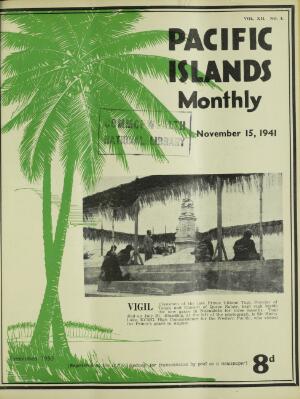
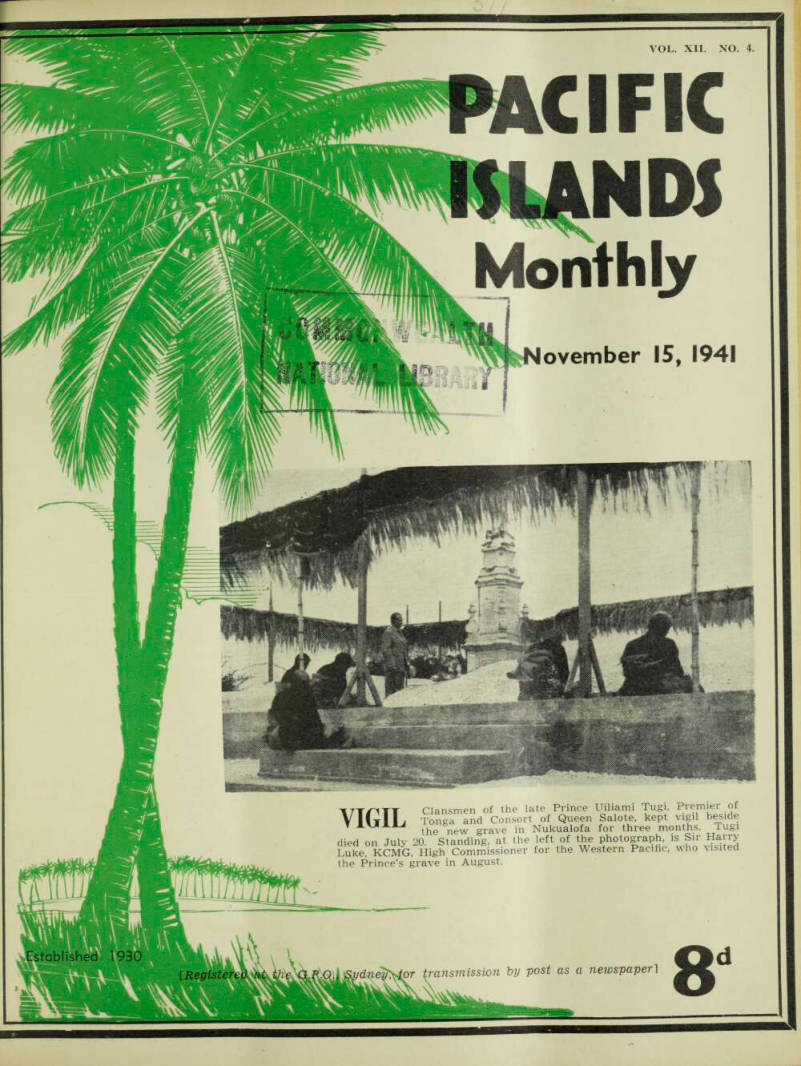
VIGIL Clansmen Of the late Prince Uiliami Tugi, Premier of Tonga and Consort of Queen Salote, kept vigil beside the new grave in Nukualofa for three months. Tugi died on July 20. Standing, at the left of the photograph, is Sir Harry Luke, KCMG, High Commissioner for the Western Pacific, who visited the Prince’s grave in August.
Advertisements & other items, p. 2 (1 item)
Co. Ltd.
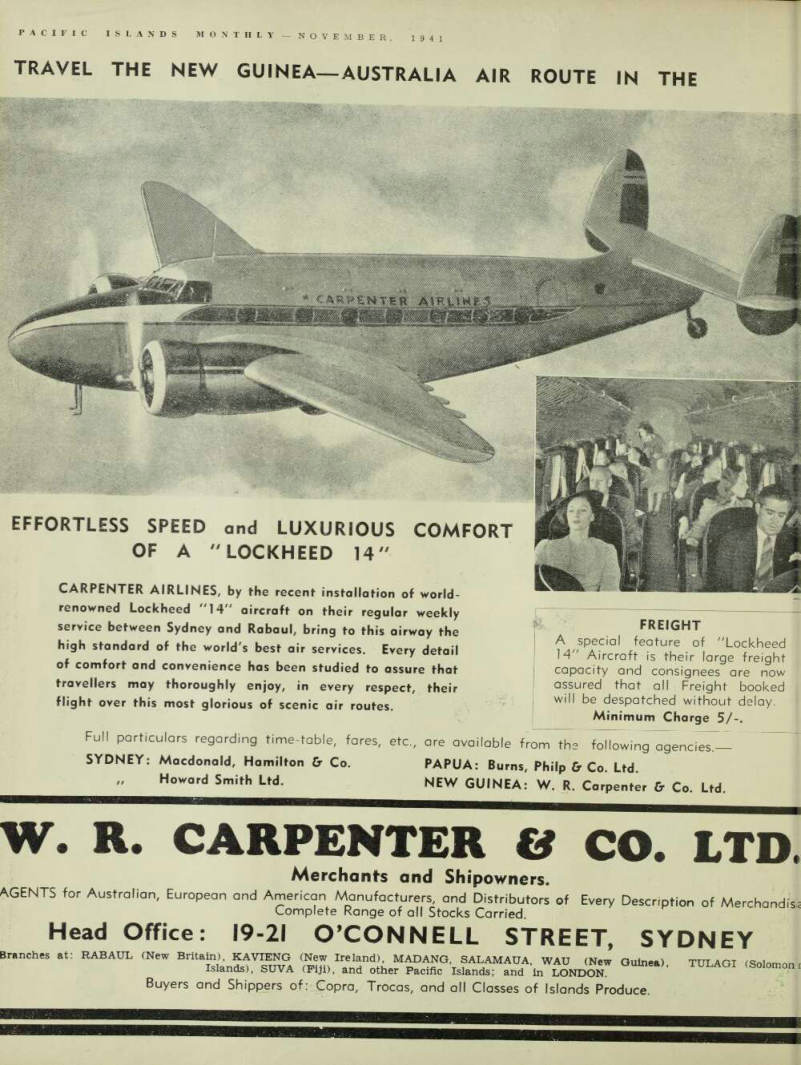
TRAVEL THE NEW GUINEA—AUSTRALIA AIR ROUTE IN THE Hi ■ .
C. v : K mm S I 1 :« m i m m ■ : m B (■ - H i ■* MM i
EFFORTLESS SPEED and LUXURIOUS COMFORT
OF A " LOCKHEED 14
CARPENTER AIRLINES, by the recent installation of worldrenowned Lockheed 14" aircraft on their regular weekly service between Sydney and Rabaul, bring to this airway the high standard of the world's best air services. Every detail of comfort and convenience has been studied to assure that travellers may thoroughly enjoy, in every respect, their flight over this most glorious of scenic air routes.
FREIGHT
A special feature of "Lockheed 14" Aircraft is their large freight capacity and consignees are now assured that all Freight booked will be despatched without delay.
Minimum Charge 5/-.
Full particulars regarding time-table, fares, etc., are available from the following agencies.- SYDNEY: Macdonald, Hamilton & Co. PAPUA: Burns, Phiip & Co. Ltd.
Howard Smith Ltd. NEW GUINEA: W. R. Carpenter & Co. Ltd.
W. R. CARPENTER &
Merchants and Shipowners.
AGENTS for Australian, European and American Manufacturers, and Distributors of Complete Range of all Stocks Carried.
CO. LTD.
Every Description of Merchandise
Head Office: 19-21 O’CONNELL STREET, SYDNEY
Branches at: RABAUL (New Britain), KAVIENG (New Ireland), MADANG, SALAMAUA, WAU (New Guinea) Islands), SUVA (Fiji), and other Pacific Islands; and in LONDON.
Buyers and Shippers of: Copra, Trocas, and all Classes of Islands Produce.
TULAGI (Solomon
Pacific News-Review
Notes And Comment On
The Progress Of The War
From Oct. 16 To Nov. 13
Oct. 16: Since US warships began es corting convoys across North Atlantic to Iceland, not a single ship has been lost by enemy action. Tms is a clear indication tnat the vital Battle of Atlantic has taken a favourable turn.
Oct. 16: British and Axis tanks, outside the Australian-held post of Tobruk (Libya), engaged in a close range battle yesterday, at times within 50 yards of each other. Observers believe that increased enemy tank patrols on the Egyptian bor der and near Tobruk are aue to Axis anxiety to discover whether British forces intend starting an early offensive in North Africa.
Oct. 16: RAAF Spitfire Squadron counted for five of tne 20 German aircraft shot down over the Channel yesterday.
Pre-occupied in Russia, Goering’s Luft waffe is making only sporadic raids on Britain. RAF now is at such battle strength that Nazi planes rarely pass the coastline of Britain in daytime and the lew that elude the night deiences have done comparatively little damage.
Oct. 16: Germans have made slight advance towards Moscow in battle tnat has assumed gigantic proportions, both sides throwing in masses oi fresh troops.
In the south, Russians have evacuated Mariupol, Black bea port. Pressure agamst Leningrad, in the north, has been relaxed to enable Germans to hurl all available troops against Moscow. Nazi radio propa ganda is blaring that the outcome of the war with Russia already has been decided from a military point of view—it remains only lor tne Germans to “clean up” and occupy Moscow.
Oct. 16: Prince Konoye’s Japanese Cabinet formed last year, re-organised last July, has resigned. Cause: “failure to reach complete agreement on the method of • pursuing national policy”—in other words, the more radical element is seek ing to gain control of Japan’s destiny.
Oct. 17: Evacuation of non-combatants from Moscow is being speeded up to avoid last minute rush of refugees, such as im peded army movements in the Battle of France. Feverish activity is going on in side Moscow to prepare the city impreg nable in siege.
Oct. 17: Aviation-expert, Lt.-General Eiki Tojo, 57, is forming a new Japanese Cabinet.
In London, commentators view the Cabinet change, coming at a critical time in the Russo-German war, as a triumph for the “hot-heads” in Tokyo and predict that swift events may precipitate a crisis in the Far East. Prince Konoye’s Cabinet team, it is said, was reluctant to push on towards war either with Russia or in the South Pacific —the extremists believed that the time had come for action, in view of the Russian situation.
Oct. 19: Soviet Army appears to have regained some of the ground lost last week—they claim to have recaptured Kalinin and Orel.
Oct. 19: Spokesman of the new Army controlled Japanese Cabinet stated it pre pared to resume “peace” talks with United States. Foreign Minister in new Cabinet is Mr. Shigenori Togo, former Ambassador to Berlin and Ambassador to Russia until the middle of last year.
Oct. 19: US destroyer “Kearny” (1,630 tons) hit by torpedo 350 miles south-west of Iceland, but made port under her own power.
Oct. 20: General Tojo, Japanese Premier, in broadcast, declared “Japan’s unshakable policy lies in a successful settlement of the Sino-Japanese conflict and the establishment of an East Asia Co-Prosperity Sphere. I am fully con vinced that speedy action and iron will
are the only way out of the present difficulties.”
Oct. 20; Moscow Radio states that Soviet Army is holding the enemy on all fronts. Staiin has re-shuffled his High Command Marshal Timoshenko has gone to the southern sector to take over from Cavalry Marshal Budenny, who now will organise an army east of the Urals.
General Zhukov has succeeded Timo shenko as defender of Moscow. While Moscow must be saved, it is equally im perative that the Nazi threat in the south to cut Russia off from her oil supplies and from her great industries in the Ukraine must be smashed.
Oct. 20: Revealed now that 10 Americans were killed and 11 injured when des troyer “Kearny” was torpedoed by U-boat.
This incident is likely to have an im portant bearing on the US Senate controversy over modification of the Neutrality Act to arm all American merchantmen.
Oct. 21: Japan will ask USA for a definite “yes” or “no” to the minimum Japanese propositions before resuming the Washington talks.
Oct. 21: With their southern and nor thern pincer claws held up by the Russians at Orel and Kalinin, the Nazis are again attacking in central sector. Stalin has announced seat of Soviet Government been transferred from Moscow to Kuibishev, 550 miles east.
Oct. 22: RAF raided Naples, in Italy, for five hours last night.
Oct. 22: Three more US-owned mer chant ships have been sunk—“ Lehigh” (5,000 tons), “Bold Venture” (3,200 tons) and “West Amangosa” (5,500 tons). These sinkings have aroused the American people and Isolationists in Congress are noticeably silent.
Oct. 22: Russians say they have halted German advance in the south; but Nazis declare they merely are slowing down for a “breather”. Heavy weather on this front is making roads almost impassable.
Oct. 22: British submarine, rising in middle of heavily-escorted Italian convoy bound for Libya, torpedoed two supply ships and then escaped.
Oct. 22: Sir Robert Brooke-Popham, British Gommander-in-Chief in the Far East, now is in Australia conferring with defence heads of the Commonwealth.
Oct. 23: Intense fighting, with enormous losses on each side, still is going on before Moscow. It is evident Hitler has failed in plan to smash his way into Moscow for winter quarters within a short time.
On the southern front, Nazi Marshal von Rundstedt is massing a million and a half men against industrial centres of the Donets Basin and is redoubling his efforts to crush defences at entrance to the Crimea Peninsula.
Oct. 23: British Supply Minister, Lord Beaverbrook, gave House of Lords im posing list of war material and food al ready sent to Russia. He forecast exacting demands on British industry to fulfil all the aid promised to the Soviet.
Oct. 23; Change in the Far East situa tion has -necessitated alteration in the route of US ships carrying supplies to Russia —the Pacific supply route has been abandoned in favour of the Boston- Archangel route. While displaying a firm attitude, America apparently does not wish to provoke hostile Tokyo action by sending ships loaded with war munitions for Russia by way of Vladivostok, close to Japan.
Oct. 24: Re-grouped and reorganised, the German Army in central sector has launched a new, “final” assault on Mos cow. Nazi communiques declare German guns in some places are within 35 miles of city.
Oct. 24: Japan has offered her “assis tance” to Thailand, if needed—but the Thai people have politely refused, reitera ting tneir desire 10 preserve neutrality.
Uct. 25: Simultaneously with the sink ing of another American oil tanker, “W.
C. Teagie”, in the North Atlantic, the uS Navy Department announced that in future n will control all American ship ping operations and determine all routes lor merchantmen.
Oct. 25; British Foreign Secretary, Mr.
Eden, gave assurance m Commons that British Government would not negotiate or enter into talks with Hitler or his associates, including Mussolini.
Oct. 26: Despite a prodigious concen tration of men and materials, Germans have not succeeded in gaining appreciable ground on Moscow tront, though the clanger in Donets Basin area is increasing.
Sheer weight of men and metal is slowly forcing Russians back in vicinity of Rostov-on-Don, in south, which is gate way to the Caucasus and its vast oil resources.
Oct. 26: Commenting on deterioration of Pacific situation, Colonel Knox, US Navy Secretary, declared “We are satisfied that the Japanese do not intend to give up their expansion plans. If they pursue them, a collision is inevitable”. Tokyo press characterised this statement as "more American bluff”.
Oct. 26: For the third night in suc cession, RAF bombers pounded Naples with thousands of high-explosive bombs.
Oct. 26: Nazi cruelty in Occupied France reached new level of fury when 50 hostages were executed to-day as reprisal for attacks on German soldiers.
Oct. 27: In spite of terrible weather conditions, there appears to be no slack ening of the tremendous Nazi drives against the outer defences of Moscow and into the Donets Basin.
Oct. 27: British public clamour for opening up of a second front, as a direct military aid to Russia, may be answered by a move of British and Dominion troops up through Iran to defend the Caucasus oilfields. General Wavell, in Iran, is reported to be in command of 1,000,000 Empire men, well-equipped with mechanised vehicles, arms, and ammuni tion supplied from Britain and USA by the Red Sea route, Oct. 28: Japan is seeking a time limit to her talks with USA. She has served notice on Washington that if any accord is to come from negotiations between the two countries it must be reached before November 15, when an extraordinary meeting of the Japanese Diet opens in Tokyo.
Oct. 28: Rostov-on-Don is under fire from German long-range guns; both sides are bringing up reinforcements and a great battle is imminent. Kharkov, between Moscow and Rostov, is believed to have been taken by the Germans.
Around Moscow, General Zhukov is re pulsing every Nazi attack.
Oct. 29; Tentative discussions have be gun between Britain and US Governments to grant to America use of bases through out the Empire. Informed sources say this is the answer to the question often asked in USA: “What immediate quid pro quo is America to receive for the Lease-Lend material given Britain?”. It is pointed out, too, that in the post-war world the burden of safeguarding international peace probably will fall most heavily upon Britain and America, and joint strategic air and naval bases for policing purposes will be a prime essential.
Oct. 29: Australian Labour Prime Minister Curtin announced £325,000,000 budget for 1941-42. It provided for much
higher income and company taxation, and gives Commonwealths fighting forces slight rise in pay.
Oct. 30: In special broadcast to the Japanese, Rear-Admiral Luetzow, Ger man Admiralty spokesman, urged Japan to invade Australia, He said Australia cannot defend herself against invasion and surprise landings could be under taken at points along her vast, flat coast line. An invader could secure a landing by air superiority, operating from air craft carriers. Belittling Australia’s de fences, he declared the Commonwealth possessed only a small fleet and a small air force, and her man-power must be drawn from a population of less than 7,000,000.
Oct. 30: Russian bombers raided Berlin last night, dropping quantities of in cendiary and high-explosive bombs.
Oct. 31: Renewed activity against Mos cow by German army and air force is being met by fierce Soviet resistance. In the Crimea, Germans claim to have scored number of successes after long, heavy fighting.
Nov. 1: Southern claw of German pincers move towards Moscow appears to be gaining some ground.
Nov. 2. Statements by Domei, semi official Japanese Newsagency, indicate that Japan is completing her war struc ture for an armed clash in the Pacific.
Nov. 2: Another US destroyer, "Reuben James”, was sunk by a torpedo when in convoy west of Iceland. 95 of the crew are missing. Despite the US Navy’s policy of silence, there is increasing evidence that American Atlantic patrols in recent weeks have sunk a number of U-boats attempting to attack convoys and the “Reuben James” presumably was hit when driving off German submarines.
Nov. 2: RAF’s 24 hours a day offensive is being maintained—fighters yesterday made low-level attacks on Northern France, while bombers raided North-west Germany.
Nov. 3: Position in Crimea is most serious. Panzer divisions are spreading out in fan-like move down through the peninsula, dividing Russians into two groups. Nazis claim 10 Soviet troopships sunk and 14 damaged by dive-bombers while attempting to evacuate Russian troops from Crimea.
Nov. 3: Washington announces that US navy and air force is patrolling a large part of the Pacific, within a radius of 1,000 miles of Hawaii and 750 miles of Midway, Wake and Guam bases.
Nov. 3: Palermo seaplane base, in Sicily, and port of Naples were bombed by RAF last night for six hours.
Nov. 4: British submarines destroyed three more Italian merchant ships in Central Mediterranean.
Nov. 5: Latest developments on southern front in Russia indicate the beginning of the Battle of the Caucasus, with Germans moving nearer the vital oilfields. Nearly 100 Nazi divisions have been brought ud to the Russian front from conquered European countries, leaving only 28 divisions to maintain occupation.
Nov. 5: Torpedo attack on American oil tanker “Salinas” has provoked bitter debate in US Senate on Isolationist delay in voting on Neutrality Act Revision Bill.
Nov. 5: Mr. Saburo Kurusu, former Japanese ambassador to Berlin, is leaving immediately by air for Washington to “arrive at the earliest possible settlement in view of the prevailing international situation”.
The Japanese press has published the following seven-point programme for the maintenance of friendly relations between USA and Japan: (1) USA must discon tinue aid to China; (2) It must leave China free to deal direct with Japan for the ending of hostilities and the estab lishment of economic collaboration; (3) It must encourage China to make peace; (4) It must acknowledge Japan’s Co-
Prosperity Sphere, and Japan’s leadership in the Western Pacific: (5) It must recog nise Manchukuo; (6) It must lift the order “freezing” Japanese credits: (7) It must negotiate a new trade treaty with Japan, lifting all restrictions on shipping and commerce.
Nov. 6: Though Marshal von Boch has begun his fifth offensive against Moscow, the capital’s defences are showing no signs of weakening. Fighting during the past three days has been the fiercest of the war.
Nov. 6: When Japanese steamer “Kibi Maru” (4,500 tons) was struck by floating mine in Sea of Japan, 17 passengers were drowned. Tokyo’s Foreign Office is convinced that the mine drifted from Soviet territorial waters and will protest to Russia.
Nov. 7: Roosevelt has authorised loan to Russia equivalent to £A312,500,000, un der the Lease-Lend programme. Repay ment, spread over 10 years, will partly consist of raw materials and commodities.
Nov. 7: Washington regards the despatch of Mr. Kurusu as an indication of the weakness of Japan’s position. Little hope is held out that his efforts will bring about a settlement of differences between USA and Japan.
Nov. 8: Stalin, in broadcast to Red Army, said Russia’s two handicaps were: (1) Lack of a second military front in Europe—“but such a front must definitely appear in the immediate future”; and, (2) Inferiority in the number of tanks, compared with the Nazis.
Nov. 8: Senate by 50 votes to 37 passed law revising Neutrality Act to allow arm ing of US merchant vessels and per mitting them to enter combat zones. The Bill goes before the House of Represen tatives next week.
Nov. 9: 1,000 aircraft took part in two British raids within the last 48 hours— one on Berlin, Cologne and Mannheim, and the other on industrial centres in Western Germany. 54 RAF planes were lost. This was the greatest air attack ever delivered by any country Nov. 9: Winter snow and sleet has brought German assault on Moscow al most to standstill. In Crimea, Germans are driving on slowly towards Kerch, at the eastern end of the peninsula; Sebas topol, Russian naval base on the Black Sea, has suffered severe bombing. Lenin grad, in north, is still under siege, but important industries inside the city still are functioning and food supplies appear to be adequate.
Nov. 10: Mr. Churchill to-day warned Japan that should USA’s efforts to pre serve Pacific peace fail and she be in volved in war with Japan, a British declaration of war would follow within an hour. He stated that Britain now is strong enough to provide powerful, heavy battleships of the Navy, with ancillary vessels, for service in the Pacific, if needed.
Nov. 10: British Navy destroyed convoy of 10 Axis supply ships in Central Medi terranean. Three escorting Italian des troyers were blown up—making 15 lost by Italy since she entered the war.
Nov. 10: With a temporary lull on the Moscow front, Germans are concentrating on the northern and southern extremities of their battle line, in an effort to cut off Anglo-American aid to Russia.
Nov. 10; Clipper carrying Mr. Kurusu, special Japanese envoy to USA, has been held up at Midway Island by engine trouble and bad weather.
Nov. 11: Large-scale Nazi reinforce ments moving up to central front indicate that Germans may try last desperate attempt to storm Moscow before they settle down for the winter outside the city.
Nov. 12: Reviewing war position, Prime Minister Churchill announced Britain’s shipping losses for four months ended October 31 averaged 180,000 tons monthly,
compared with average 500,000 in same period to June 30. Enemy losses in Mediterranean have been particularly sev ere and Axis is finding it extremely diffi cult to keep its African armies supplied.
Britain’s food position is good—the corn crop this year is 50 per cent, greater than in 1939.
Nov. 13: China has appealed to Britain and America for military help in the event of a Japanese drive against the Burma Road.
P.A.A. Clippers
May Call at Sydney
NEGOTI A TIONS are in progress between Australia, New Zealand, and USA and Pan American Air ways for an extension of PAA’s South Pacific service to Sydney. Auckland (NZ) is the present terminal point.
Clippers now leave San Francisco and call at Hawaii, Canton Island, Suva, Noumea and Auckland. It has been sug gested that instead of flying from New Caledonia to NZ and then on to Australia, they should come direct to Sydney from Noumea. NZ passengers and freight would connect with the PAA flying-boats at Sydney, using the trans-Tasman service.
An alternative plan is that the Clippers make a round trip comprising Noumea- Auckland-Sydney-Noumea, then back to
Usa.
A third scheme put forward is that they should fly from Noumea to Brisbane- Sydney-Auckland-Noumea on one trip and from Noumea to Auckland-Sydney- Noumea on the next.
It can be taken as certain, however, that NZ (which took an active part in the establishment of the present service) will not readily agree to any proposal under which the Dominion is “skipped” over by the main service and served merely by a subsidiary airline.
First Flight To Suva
THE first flight in PAA’s service to Auckland via Suva (Fiji) was made early this month. According to the company’s Sydney office, the “Pacific Clipper” left San Francisco on November 5 and arrived at Suva on November 9. The following morning it took off for Noumea and reached Auckland on November 11.
The initial flight on the new service by way of Fiji was delayed some days, but in future Clippers will leave San Francisco on alternate Thursdays. The new route brings Suva within 3 days of USA, U days from Auckland and 2’h days from Sydney. As less fuel is required, Clippers now are able to carry 45 passengers between NZ and Fiji, in addition to heavier freight loads. Previously, 20-24 passengers were provided for.
The single fare from Suva to Auckland is £6O (£lOB return) and, using the trans- Tasman service, to Sydney is £9O (£l6B return).
Nothing further has been heard of PAA’s application to the US Government for permission to use Palmyra Island, mid-way between Honolulu and Canton Island, as a re-fuelling base.
In mid-October PAA commenced a bi weekly Sikorsky Clipper service between Manila and Hong Kong, and a weekly Boeing Clipper service between Manila and Singapore. The latter connects at Singapore with British and Dutch airlines to Australia.
Captain M. Harper, master of W. R.
Carpenter & Co.’s BSI inter-island motor vessel “Balus”, is at present in Sydney.
He came to Australia, via Papua, last month, to undergo an operation on his jaw and now is recuperating.
Pacific Islands Travellers
Per Steamer From Fiji; Messrs. Free,
Ditchburn, Smith, Costello, Warburton, Knevitt, Cradick, Parfett, Grey, . Robertson, Theodore, Johannessen, Savery, Neil, McKee, Anderson, Oldmeadow. Mesdames Ditchburn, Grey, Smith, Warburton, Knevitt, Cradick, Harris, Neil.
Misses Ditchburn, Kermode, Warburton, Cradick, Hughes, Harris, Delbridge, Neil, Lindsay. Dr.
Dorothy Delbridge. FROM PAGO PAGO: Mr.
Sim. Mrs. Powys.
PER STEAMER FROM BSI, NG & PAPUA: Messrs. Cook, Elliott, Simpson, Yarrow, Harri son, Hollis, Hughes, Blakey, Finch, Hall, Tee, Downing, Doyle, Stevenson, Brownlees, Goodman, Adam, Ferris, Olsen, Pascoe, Prince, Weston, Alexander, Dermer-Smilh, Talty. Mesdames Svensen, Thomas, Blakey, Cambridge, Down ing. Atkinson, Olsen, Cairns, Cadden, Neilsen, Adam. Misses Kelly, Whitehouse, MacDonald, Coleman, Dalziell, Pennefather, Skelly.
PER STEAMER FOR BSI, NG & PAPUA: Messrs. Wilson, Benson, Taylor, Speedie, John ston, Mann, Deacon, Pratt, Gilbert, Boermel, Read, Williams, Doyle, Hancock, Elkington, Greathead, Anderson, Crosbie, Dobbie, Wood, Smith, Gribben, Evans, Hamilton, Stewart, Bell. Father McEnroe. Mesdames McEwan, Edwards, Taylor, Mann, Doyle, Hancock, Low, Hazewinkel. Misses Couzens, Civil, Read, Hac kett, Lynch, Hides, Davis.
PER STEAMER FOR NG: Messrs. Bell, Ed
wards, Browne, Cooper, Still, Bates, Terry, Cooper, Thomson, Brennan, Bird, Waddell, Blox ham, Earley, Job. Mesdames Bell, Edwards, Thornley, Thwaites, Gilbert, Rudd, Brennan,’
Maclean, Gregory, Warren, Bloxham, Earley.
Misses Gilmore, Chen, Maye, Muir.
PER STEAMER FROM BSI, N. HEBRIDES, NI AND LORD HOWE IS.: Messrs. Hammer, Hol lingsworth, Burden, Buffett (2), Adams, Bel lairs, Maher, Piper, Bushell, Bennett, Graves, Taylor, Woolnough. Mesdames Hammer, Lin gan, Page, Hollingsworth, Bailey, Bellairs, Maher, Quintal, Austic, Marlin, Thompson, Wilson.
PER STEAMER FROM PAPUA & NG: Messrs.
Ansell, Ahlberg, Buckland, Bunt, Brown, Bell, Bensted, Cheers, Crerar, Chadderton, Coe, Doyle, English, Egington, Elwood, Gorman, Griffiths, Green, Hughes, Hey, Hyde (2), Harrison, Havi land, Hunter, Howard, Jackson, Long, Lavender, Lillicrapp, Lugg, Lee, Leydin, McCarthy, Moy, Murray, Nicoll, Ormsby, O’Hara, O’Donnell, Olsson, Oxenbridge, O’Sullivan, Osborne, Reid, Royal, Rideout, Ritchie, Scobie, Spencer, Shaw, Street, Turner, Veitch, Williams, Warner, Wau chope, Renton, Horton, Mason, Etheridge, Armi stead, Budden, Bowman, Cummins, Campbell, Cheyne, Christian, Coleman, Durham, Foggitt, Garrod, Griffith, Hunter, McGlynn, McArthur, O’Toole, Reinhart, Sheehan, Schmidt, Upton, Wright, Wilson (2), Watts, Young. Mesdames Ansell, Bensted, Garrick, Clarke, Chadderton,
Day, Edwards (2), Farthing, Green, Hyde, Havi land, Hunter, Jackson, Long, Marr, Murray, O’Hara, Olsson, Oxenbridge, Pinquet, Reid!
Ross, Royal, Ritchie, Rowley, Reece, Schuler, Spencer, Skew, Street, Vaughan, Veitch, Wil liams (3), Warner, White, Renton, Mason, Blumson, Broughton, Brudo, Gordon, Shaw (2), Targett, Travers, Wilson. Miss MacKinnon.
PER STEAMER FOR LORD HOWE IS., NI, N. HEBRIDES & BSI; Messrs. Bullock, Har ford, Lowe, Wilson, Doughty, Radiney (2), Meader, Weights, Piez, Shadbolt, MacGregor, Potts, Keith, Miller, Doyle. Rev. McDonnell, Rev. Gillon, Rev. Lawton. Mesdames Blake, Wilson, Hall, White, Grassick, Woolnough, Thompson, Weights, Kirby, Piez, Lawton, Hagarblucher, Potts, Keith, Miller, Doyle.
PER AIRLINER TO NG & PAPUA: Messrs.
Piper, Fisher, Bryce, Goodwin, Housley, Hut chinson, Gough, Glassener, Laurence, Hockey, Eldridge, Bathgate, Shoobridge, Batze, Lock hart, Cameron, Clay, Heath, Love, Cunning ham, Smith. Kingsford, Rondahl, Mudge, Ser geyeff. Smith, Phillips, Leonard, Bell, Washing ton, Deacon, Keenan. Mesdames Fraser, Good win, Stevens, Batze, Rondahl, Chater, Govier.
Miss Hanlon.
PER AIRLINER FROM NG & PAPUA; Messrs.
Clout, Wooden, Wilde, Dwyer, Murray, Rae, Mai ler, Carey, Harper, Farmer, Carpenter, Brush, Barker, Neal, Jewell, Briggs, Washington, Mon cur, Dixon, Bowden, Whitley, Osborne, Hut chinson, Sedgers, Housley, Spence, Cram, Wood, Durcher. Bishop Strong. Mesdames Wilde, Kirke, Jewell, McClafferty, Hay, Louden. Miss Louden.
Advertisements & other items, p. 5 (1 item)
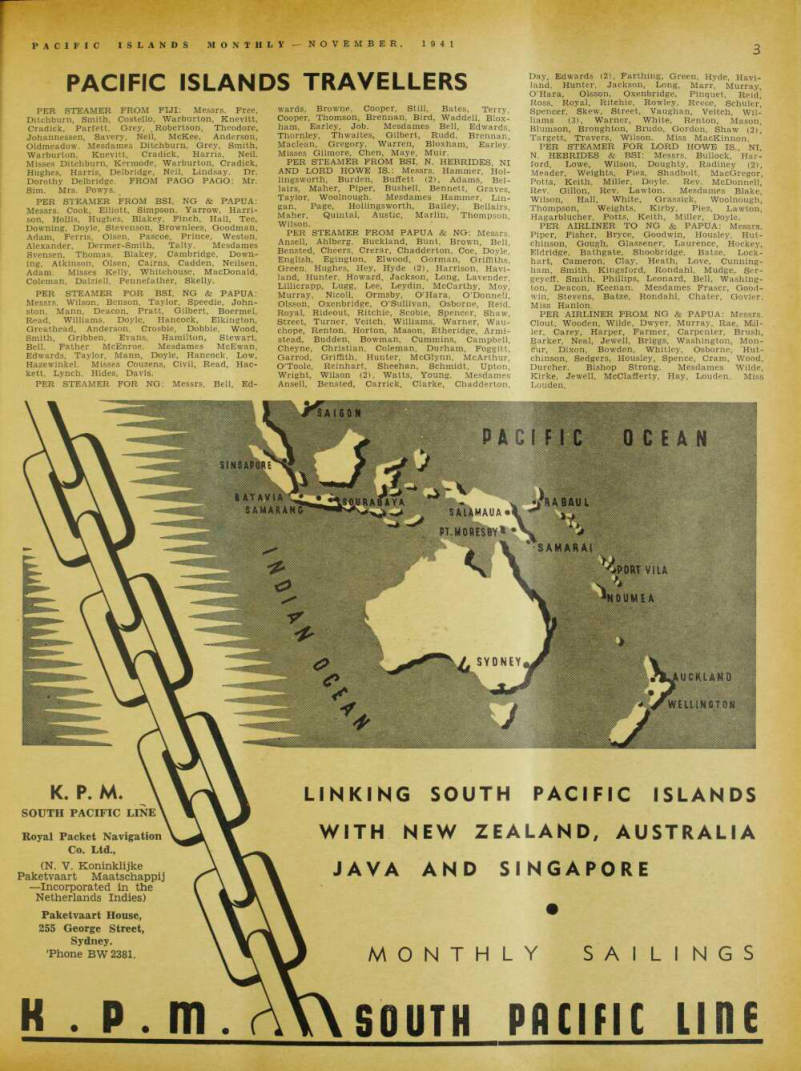
South Pacific Line
LINKING SOUTH PACIFIC ISLANDS
WITH NEW ZEALAND, AUSTRALIA
JAVA AND SINGAPORE
MONTHLY SAILINGS
SOUTH PACIFIC Line
Advertisers
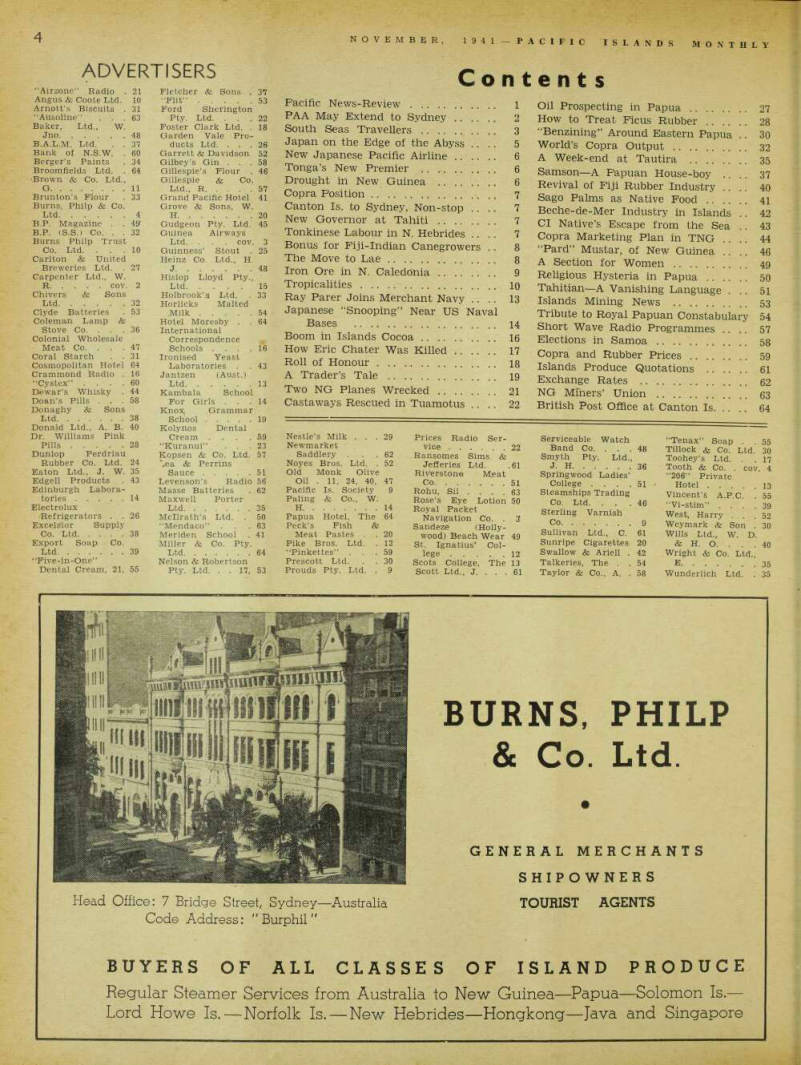
“Airzone” Radio . 21 Angus & Coote Ltd. 10 Arnott’s Biscuits . 31 “Ausoline” ... 63 Baker, Ltd., W.
Jno 48
B.A.L.M. Ltd. . . 37
Bank of N.S.W. . 60 Berger’s Paints . 34 Broomflelds Ltd. . 64 'Brown & Co. Ltd., G 11 Brunton’s Flour . 33 Burns, Philp & Co.
Ltd 4 B.P. Magazine . . 49 1
B.P. (S.S.) Co. . . 32
Burns Philp Trust Co. Ltd. ... 10 Carlton & United Breweries Ltd. .27 Carpenter Ltd., W.
R cov. 2 Chivers & Sons Ltd 32 Clyde Batteries .53 Coleman Lamp & Stove Co. ... 36 Colonial Wholesale Meat Co. . . . 47 Coral Starch . . 31 Cosmopolitan Hotel 64 Crammond Radio . 16 “Cystex” ... 60 Dewar’s Whisky . 44 Doan’s Pills ... 58 Donaghy & Sons Ltd 38 Donald Ltd., A. B. 40 Dr. Williams Pink Pills 28 Dunlop Perdriau Rubber Co. Ltd. 24 Eaton Ltd., J. W. 35 Edgell Products . 43 Edinburgh Laboratories 14 Electrolux Refrigerators . . 26 Excelsior Supply Co. Ltd 38 Export Soap Co.
Ltd 39 “Five-in-One”
Dental Cream, 21, 55
Fletcher & Sons . 37 “Flit” 53 Ford Sherington Pty. Ltd. ... 22 Foster Clark Ltd. . 18 Garden Vale Pro ducts Ltd. ... 26 Garrett & Davidson 52 Gilbey’s Gin ... 58 Gillespie’s Flour . 46 Gillespie & Co.
Ltd., R 57 Grand Pacific Hotel 41 Grove & Sons, W.
H 20 Gudgeon Pty. Ltd. 45 Guinea Airways Ltd. . . . cov. 3 Guinness’ Stout . 25 Heinz Co. Ltd., H.
J 48 Hislop Lloyd Pty., Ltd 15 Holbrook's Ltd. . 33 Horlicks Malted .Milk 54 Hotel Moresby . . 64 International Correspondence Schools ... 16 Ironised Yeast Laboratories . 43 Jantzen (Aust.) Ltd 13 Kambala School For Girls ... 14 Knox Grammar School 19 Kolynos Dental Cream ... 59 “Kuranui” ... 23 Kopsen & Co. Ltd. 57 v je a & Perrins Sauce 51 Levenson’s Radio 56 Masse Batteries . 62 Maxwell Porter Ltd 35 Mcllrath’s Ltd. . 50 “Mendaco” ... 63 Meriden School . 41 Miller & Co. Pty.
Ltd 64 Nelson & Robertson Pty. Ltd. . . 17, 53
Nestle’s Milk ... 29 Newmarket Saddlery ... 62 Noyes Bros. Ltd. . 52 Old Monk Olive Oil . 11, 24, 40, 47 Pacific Is. Society 9 Paling & Co., W.
H 14 Papua Hotel, The 64 Peck’s Fish & Meat Pastes . . 20 Pike Bros. Ltd. . 12 “Pinkettes” ... 59 Prescott Ltd. . . 30 Prouds Pty. Ltd. . 9
Prices Radio Ser vice 22 Ransomes Sims & Jefferies Ltd. .61 Riverstone Meat Co 51 Rohu, Sil . . . . 63 Rose’s Eye Lotion 50 Royal Packet Navigation Co. . 3 Sandeze (Holly wood) Beach Wear 49 st. Ignatius’ Col lege 12 Scots College, The 13 Scott Ltd., J. ... 61
Serviceable Watch Band Co. ... 48 Smyth Pty. Ltd., J. H .36 Springwood Ladies’
College ... 51 Steamships Trading Co. Ltd. ... 46 Sterling Varnish Co 9 Sullivan Ltd., C. 61 Sunripe Cigarettes 20 Swallow & Ariell . 42 Talkeries, The . . 54 Taylor & Co., A. . 58
“Tenax” Soap . . 55 Tillock & Co. Ltd. 30 Toohey’s Ltd, . . 17 Tooth & Co. . cov. 4 “206” Private Hotel 13 Vincent’s A.P.C. . 55 “Vi-stim” ... 39 West, Harry ... 52 Weymark & Son . 30 Wills Ltd., W. D. & H. O. ... 40 Wright & Co. Ltd., E 35 Wunderlich Ltd. . 35
Contents
Pacific News-Review 1 PAA May Extend to Sydney 2 South Seas Travellers 3 Japan on the Edge of the Abyss ... 5 New Japanese Pacific Airline 6 Tonga’s New Premier 6 Drought in New Guinea 6 Copra Position 7 Canton Is. to Sydney, Non-stop ... 7 New Governor at Tahiti 7 Tonkinese Labour in N. Hebrides ... 7 Bonus for Fiji-Indian Canegrowers .. 8 The Move to Lae 8 Iron Ore in N. Caledonia 9 Tropicalities 10 Ray Parer Joins Merchant Navy ... 13 Japanese “Snooping” Near US Naval Bases 14 Boom in Islands Cocoa 16 How Eric Chater Was Killed 17 Roll of Honour is A Trader’s Tale 19 Two NG Planes Wrecked 21 Castaways Rescued in Tuamotus ... 22
Oil Prospecting in Papua 27 How to Treat Ficus Rubber 28 “Benzining” Around Eastern Papua .. 30 World’s Copra Output 32 A Week-end at Tautira 35 Samson—A Papuan House-boy ... 37 Revival of Fiji Rubber Industry ... 40 Sago Palms as Native Food 41 Beche-de-Mer Industry in Islands .. 42 Cl Native’s Escape from the Sea .. 43 Copra Marketing Plan in TNG ... 44 “Pard” Mustar, of New Guinea ... 46 A Section for Women 49 Religious Hysteria in Papua 50 Tahitian—A Vanishing Language ... 51 Islands Mining News 53 Tribute to Royal Papuan Constabulary 54 Short Wave Radio Programmes ... 57 Elections in Samoa 53 Copra and Rubber Prices 59 Islands Produce Quotations 61 Exchange Rates 32 NG Miners’ Union 63 British Post Office at Canton Is 64
Advertisements & other items, p. 6 (1 item)
Burns, Philp
ill Hill
HMBpL
SnSiBR m
fill
mi JU!
HI 111
ill
ill
; m Head Office: 7 Bridge Street, Sydney—Australia Code Address: "Burphil"
BURNS, PHILP
& Co. Ltd.
GENERAL MERCHANTS
SHIPOWNERS
TOURIST AGENTS
BUYERS OF ALL CLASSES OF ISLAND PRODUCE Regular Steamer Services from Australia to New Guinea—Papua—Solomon Is.— Lord Howe Is.—Norfolk Is. New Hebrides—Hongkong—Java and Singapore
Pacific Islands Monthly
The Newspaper-Magazine of the South Seas [Registered at the G.P.0., Sydney, for transmission by post as a newspaper .]
Published Once Each Month and Circulated in Australia and New Zealand and in the following Pacific Territories and Islands Groups:
Australian Territory of Papua.
Mandated Territory (Australia) of New Guinea, Bismarck Archipelago and Northern Solomon Islands.
Australian Territory of Norfolk Island.
New Zealand Territory of Cook Islands.
Mandated Territory (New Zealand) of Western Samoa.
British Colony of FIJI.
British Solomon Islands Protectorate.
British Protectorate of Tongan Islands.
British Crown Colony of Gilbert and Ellice Islands.
Mandated Territory of Nauru.
British and Free French Condominium of New Hebrides.
Free French Colony of New Caledonia.
Free French Colony of Oceania (Tahiti, etc.).
American Territory of Eastern Samoa.
American Territory of Hawaiian Islands.
American Territory of Guam.
Mandated Territory (Japan) of Marshall, Caroline and Mariana Islands.
Owned and Produced by Pacific Publications Pty. Ltd., Union House, 247 George Street, Sydney
f Managing Director .. BW 5037 TEijEr’riuwrj £ Business and Editorial MA 7101
P.O. Box 3408 R
Registered Address of Telegrams, Radiograms, and Cables: "Pacpub”, Sydney.
Contributions.
Articles, Stories, and Photographs dealing with Pacific Islands subjects are invited and will be paid for on publication.
Subscription Rates.
Per Annum, within British Empire, Prepaid, Post Free 8/- Per Annum, elsewhere, prepaid, Post Free. 10/- Single Copies Bd.
Editor and Publisher;
R. W. Robson, F.R.G.S.
Assisted by Selwyn Hughes.
Advertising Manager; L. W. Bailey.
Advertising Office and Printing-House: 29 Alberta Street, Sydney.
Advertising rates furnished on application.
Colours, etc., by arrangement.
Process Blocks made at Advertiser’s expense when required. Screen 100.
Changes of Advertising Copy should reach this office by Ist of each month, otherwise previous advertisement may be repeated.
Representative In London.
W. C. Harvey, Coronation House, 4 Lloyds Avenue, London, E.C.3, from whom may be obtained copies of Pacific Islands Monthly, Pacific Is. Year Book, advertising schedules, etc.
Agents.
The following are authorised to receive sub scriptions for Pacific Islands Monthly;— Burns. Philp & Co., Ltd., and Burns Phllp (South Sea) Co., Ltd. All branches.
W. R. Carpenter & Co., Ltd. All branches.
Morris, Hedstrom, Ltd. All branches.
T. A. Olsson. Wau, New Guinea.
G. Thomas & Co., Rabaul, New Guinea.
Whitten Bros., Ltd.. Samarai. Papua.
Steamships Trading Co., Papua. All branches.
B.N.G. Trading Co.. Ltd., Port Moresby, Papua.
J. Muir, Suva. Fiji.
Miss R. Castles, Suva, Fiji.
N. C. Mackenzie Hunt. Wainunu. Bua, FIJI.
Kirpal & Co., Victoria Parade, Suva, Fiji.
Kanadia and Co.. Suva, Fiji.
Cook Islands Trading Co.. Rarotonga, Cook Is.
A. C. Rowland. Papeete. Tahiti.
Islands Branches and Representatives of W. H.
Grove & Sons. Ltd.. Auckland, New Zealand.
Ed. Pentecost Noumea New Caledonia.
Kerr & Co., Noumea, New Caledonia.
Vol. XII. No. 4.
November 15, 1941
Prlrp f Prepaid: 8/ - pa rrict: l 3d. per Copy.
an d"LS guaranteed
Japan On the Edge of the Abyss
PROBABLY, before this journal is In distribution, Japan will have made a decision which will mean peace or war m the Pacific. If it is to be war, all British and allied communities in the Pacific will enter a period of great difficulty and danger, the inevitable end of which will be the removal of a menace which, for too long, has rendered life uneasy under the Southern Cross, Ever since Hitler plunged the world into war, Japan has been “dithering” on the fence, eager to join the predatory Powers in carving up the British and French and Dutch Empires; but not quite certain that there will be spoils for division. Japan is divided between the militaristic clique, which is avid for war at any price, and the money clique, which does not want any more war unless it is certain to bring great aggrandisement in new territories and new trade.
When Hitler overthrew France and Holland, and Britain was isolated and apparently ready for the slaughter, Japan saw apparently the greatest opportunity in her history— the chance to grab Indo-China and New Caledonia (French), East Indies (Dutch), and Malaya. Burma. Borneo, and the valuable British territories to the southward. It was then (October, 1940) that Japan confidently announced her adherence to the Axis, and her quaint “Co-Prosperity League
of Eastern Asia” was formulated as the basis of her foreign and Pacific Policy- But the plan went awry. Bntam, to the disgust of the Axis, kept on fighting; and an undefeated Britain meant that the Dutch could retain the East Indies. That section of the French Empire which declared for Free France was similarly protected ready after the shock of France’s caDit y u lation to accent the fact of an victory’ took new hope from the
Ax .f
fncreaSne confidence to the assist the democracies' and finally * nc ? ° i f t ctar Zt anv ’ interference the wmiiH nnt bp tolerated Th bitter days for Japan Th Prn o npr it v League” seemed 0 0 near? vef Japan dare not Britain was unbroken, , . Amer ican fleets cruised
Svir S east Pacific
g Y ‘ f .
A STUDY of Japan’s diplomatic A antics during the first half of 1941 is most diverting. The little men were so pathetically eager to do the right thing, and so desperately afraid of doing the wrong one. Ger many was brutal to her Asiatic partner. “If you want us to support your territorial ambitions”, said the Huns, “go to war with the United States, keep American aid from reach ing Britain, and then, when we have
finished with Britain, we shall make peace with America, and you can do Van ted more 1 than that
an d"LS guaranteed
It will be remembered that Mr. „ linkn wont tn Berlin Rome and Mn „« nw returned smilingly to Moscow, the Russ^-Japanese Aggression Pact in his P little liints of Cop rosDer i+ in his press inter started with anything, Germany and Russia began fighting (on June 22), and the Japanese diplomats again were offside.
All this time, Japan was creeping, slowly and stealthily, upon Indo- China. Britain and USA did nothing, They would have protected New Caledonia, which had declared for de Gaulle, but not Indo-China, which had remained Vichy French. If Japan had completed the penetration of Indo-China in this fashion the democracies might have ignored the typically Japanese procedure. Pro- Vichy Indo-China is not worth fight mg over. , But when the Japanese suddenly sounded the big drum a outcome of the Russo-German he lopment—-and marched French Colony with flags uyi g, obviously < C 0 I kl .^f. ia q^ 00 T tqa democracies, Bpi tam and USA swiftly. They thp dure much to keep peace m the Pacific but they knew that y ignored this, the Asiatic m d
regard it as weakness, and before long the Japanese would move against the East Indies, or Burma.
SO Japan’s assets were “frozen” throughout USA and the British Empire, and a virtual blockade was clamped upon all trade with Japan.
The effect of this has been devas tating. Japan’s national economy, already gravely disturbed and weak ened by the China war, is now in grave danger of collapse. USA and Britain virtually said: “You are act ing in a threatening way. You may not trade with any of our enemies, and we shall not trade with you until you have given us certain guarantees in regard to the future”.
That was on July 27. For three months, Japan wriggled, and twisted, and her newspapers and more belli gerent Ministers threatened first Britain and then America; and then, as the economic freeze-up became ever more paralysing, the nation split on the question of lighting, or seek ing an agreement with the demo cracies. The Government resigned, a new, apparently pro-war Govern ment took office late in October—and British and American forces in the Pacific went to action-stations.
But, while the situation remains tense, there has been no shooting.
Japan is now discussing the situation in Washington ; and an agreement may be expected, and a new and better era may dawn in Anglo- American-Japanese relations.
GOD help Japan if she decides for war! The democracies are finished with fine phrases and face saving. America is ready to fight, at the fall of a flag; Britain has based very large military and air forces upon Singapore, and has brought a fleet of surprising strength into the Pacific; and Mr. Churchill has an nounced (November 10) that Britain will declare war upon Japan “within
an hour” of Japan going to war with the United States. If Japan decides for war, she will be crushed under the combined weight of America, Britain, China, and the Dutch and Russian forces in the Far East.
And few will regret it—for too long, the sabre-rattling of Japanese mili tarists, and the absurd babblings of her “Co-Prosperity” propagandists, have disturbed our Pacific peace.
If the Huns had taken Leningrad and Moscow, or had reached the oil fields of the Middle East, the Fascists of Japan would have thrown the country into war. As it is, Japan probably will seek a peaceful settle ment. But she has been a bad neigh bour, and it is to be hoped that an alarmed and armed Britain and America, having brought matters to this stage, will deal with her merci lessly, but with firmness and justice.
Drought
New Guinea in Grip of Drought
From Our Own Correspondent
Rabaul, Nov. 5.
f|N his return from an official visit to Vf the NG mainland, the Administrator (Sir Walter McNicoll) stated that drought conditions prevailed everywhere.
All along New Britain, the coast was brown from drought or black from the effects of fires. On the mainland, one could see hundreds of miles of brown and black country. Smoke hung every where like a thick fog.
This long continued drought will have a serious effect upon native foods. Hun dreds of acres have been destroyed. On the Sepik River, even the sago swamps have been burnt out, necessitating the natives travelling 40 miles in some places to cultivate small food areas.
Reports from the Morobe District, too, tell of abnormal conditions and bush fires in the Bulolo Valley, Madang, and Wewak. At Wau, the lack of water has caused a reduction in the output from alluvial mining operations.
Bowling Green Opened On Fiji Goldfield
View of the new Vatukoula Bowling Club’s eight-rinks green officially opened on October 5 on the Tavua Goldfield, Fiji. Representatives from the Suva, Ba, Lautoka, and Rewa clubs played on the opening day. The greens have been floodlit for night play. Loloma and Emperor Mining Co. employees now are well catered for in sport—they have a choice of tennis, golf or bowls.
Tonga's New Premier
High Chief Ata, Minister for Lands, has been appointed Premier of Tonga, in succession to the late Prince Tugi, CBE.
The new Premier, who is one of the Kingdom’s most popular nobles, was educated at New
ington College, Syd ney. Prior to be coming Minister for Lands some years ago, he held a number of high positions in the Tongan Civil Ser vice over a long period. He is in his late 50’s.
Ata visited Aus tralia and New Zea land in 1938, in company with the Governor of Vavau (Hon. Seteki Akau ola) and everywhere created a favour able impression.
Other changes in the Tongan Civil Service, recently gazetted, include the appointment of T. Afu Taumoe beau. formerly Magistrate, to the position of Acting Minister for Lands; J. Talia’uli, form erly Registrar of the Supreme Court,
to Acting Magistrate; and T. Tu’ibulotu, Clerk and Interpreter of the Supreme Court, to be also Acting Court Registrar.
Hon. Ata.
Japanese Airline
Extends
Strategic Palau-Dilli Service Commences This Month
THE Japanese Dai Nippon Airways’ service from Tokyo to Palau, in her Mandated Caroline Islands, will be extended to Dim (Portuguese Timor) on November 17.
Dilli is only 450 miles north-west of Darwin, and the advent of the new fort nightly service, cutting across the line of communications between Australia and the Dutch East Indies, has been viewed with concern in Australia. Press comment is that the airline extension represents just another phase of Japan’s southward thrust.
During the past 18 months, Dai Nippon Airways has made six survey flights from Palau to Timor, using four-engined flying-boats.
Dilli is a sleepy little centre on the western coast of the northern half of Timor (the southern half is owned by the Dutch). Its commercial value is not great, though it is important from a strategic point of view. There are only about 15 Japanese resident there, but the powerful Nanyo Kohatsu Kaisha (South Sea Development Co.) is well entrenched in the Colony.
The Australian-owned Qantas Empire Airways, since January, 1941, has called at Dilli once a fortnight, on the Australia- DEI-India service.
Mr. C. J. J. T. Barton, Colonial Secre tary of Fiji since 1936, has been appointed Chief Secretary in Nyasaland, Africa. He has been in England since December last.
Copra
Outlook Much Improved :: South
Pacific Pool to Operate Early in
1942 Sales at £B/10/- f.o.b.
Rabaul.
THE South Pacific Ccpra Marketing Pool will come into operation early in the New Year. It will receive, store, and market the copra production of the fol lowing territories, and return the net proceeds of the sales to the individual ccpra producers: —
Australian British
New Guinea Fiji Papua Solomons
New Zealand Tonga
Samoa Gilbert & Ellice Cook Islands FREE FRENCH
Condominium Tahiti
New Hebrides New Caledonia The various Governments concerned are moving slowly and carefully towards the completion of the plan. As a result of discussions and a better understanding all round, much of the hostility of the big Pacific trading firms has disappeared.
It is clearly the intention of the Pool managers, while making the interests of the individual planters their primary con sideration, to use, as far as possible, the transport, storage and marketing facilities of the big firms, and not to interfere unduly with the existing machinery.
The plan is now being operated by Australia, so far as it affects the Man dated Territory of New Guinea. A local New Guinea Copra Committee receives the copra from the producers, and is responsible for the care of same, and for distributing proceeds to the planters.
A COPRA Marketing Committee, head quarters in Canberra, sells the copra.
The Committee at present comprises Messrs. J. F. Murphy (Denartment of Commerce), J. R. Halligan (Territories Department) and C. E. Leake (New Guinea Trade Agency), with Mr. Leake as executive officer. The Committee, so far, has sold the New Guinea copra at £B/10/- per ton, f.o.b. Rabaul, export duty on buyer’s account—a very good price, in the circumstances, which should give the grower £6/10/- per ton, net.
As soon as the full Pool functions, representatives of the other Governments will be added to the present Australian Marketing Committee, which then will become the South Pacific Copra Marketing Board, with local Committees in all the Territories, as well as in New Guinea.
The New Guinea price (now £B/10/- Australian, f.0.b., Rabaul) probably will be the top of the current quotation. Fiji’s present grade is not as good as New Guinea’s, and that of the other Territories less than that of Fiji.
The present Australian Marketing Com mittee has high hopes of an improving market —it believes that £B/10/- f.o.b.
Rabaul will be left behind in 1942.
It is expected that the full Copra Mar keting Board will give prompt attention to removing stocks accumulated in the outlying groups—especially Tonga and Gilbert and Ellice Colony. There is, at present, no accumulation in New Guinea, Solomons or Fiji.
The Governments say that, as a pre liminary to operating the Pool, they are giving “reasonable consideration” to mer chants who have entered into contracts for future shipments of copra. Shipping licences, formerly restricted to end of November, have been successively ex tended to end of December, of January, and. very recently, of February. These methods are allowing most people and in terests concerned to adjust themselves to the new conditions of a Government controlled industry.
No one in Australia appears to know
why Hon. Gerald Hogan resigned from the NG Copra Committee, where he was doing good work. His resignation has not been accepted. He has been asked to carry on, and is doing so.
Canton Is. to Sydney
A CATALINA PBY flying-boat made a record non-stop flight across the Pacific early this month when it flew direct from Canton Island to Sydney, a distance of 3,300 miles.
Captain P. G. Taylor, well known for his Pacific flight with the late Sir Charles Kingsford Smith, in 1934, was navigator, and Captain Russel Tapp, of Qantas Empire Airways was pilot.
The machine was one of a number of giant US-built airboats bought by the Commonwealth Government for long range patrol in Australia and the Pacific.
Previously, late in October, Captain Taylor and Captain Lester Brain, made aviation history by flying a Catalina direct from Suva to Sydney, 2,000 miles.
It is significant that since Australia first took delivery of these huge flying boats, some months ago, there has been no reported activity of raiders in the South Pacific.
Two airmen well known in New Guinea —Orme Denny and Aubrey Koch—are also ferrying Catalinas across the Pacific.
Governor Inspects His Troops
M. Henri Sautot, Governor of New Caledonia, reviewed the Colony’s troops at a parade in Noumea at the end of October. The photographs show:—Top: Young Caledonian-born Frenchmen and New Caledonian natives comprise the colour party. At right, in the background, with M. Sautot, is Commandant Jardin, military commander of New' Caledonia. Lower: The guard of honour presents arms to M. Sautot.
Another Governor
Lieut.-Colonel Orselli Appointed to Tahiti
From Our Own Correspondent
Noumea, Oct. 27.
LIEUTENANT-Colonel Georges Orselli, of the Free French Air Force, who arrived in Tahiti recently with the D’Argenlieu Mission, has been appointed Governor of French Oceania.
After the political upheavals of the last few months, Tahiti now has settled down again to normal conditions, accord ing to reports reaching here.
It was expected that Captain Thierry d’Argenlieu, the new High Commissioner for Free France in the Pacific, would visit Noumea this month, but a message received by the New Caledonian Governor stated that his departure from Papeete had been postponed for a time.
Frigate Captain Cabanier, who arrived in Tahiti a short time ago to take up duties as head of the French Pacific defences, is a former submarine com mander. He was awarded the DSO by King George VI for his exploits with the Free French submarine “Rubis”,
Supply of Tonkinese
Labourers Concern in the New Hebrides
From Our Own Correspondent
Vila, Nov. 2.
PLANTERS here are concerned about continuation of supplies of Ton kinese (Indo-China) labourers in the future.
Since 1921, the French authorities have drawn plantation labour from Indo- China, and at the outbreak of war there were over 1,000 Tonkinese in the Con dominium. These workers are indentured for five years, with the option of re engagement for a further two years or repatriation at the end of their term.
Shortly before France collapsed, M.
Sautot, then French Resident Commis sioner of the New Hebrides, announced that British planters in the Group would be permitted to use Tonkinese on their plantations—a concession the British had sought for many years.
After the events of June, 1940, Indo- China decided to support the Vichy ad ministration; but the French colonies in the Pacific —New Hebrides, New Cale donia and French Oceania —declared for de Gaulle and Free France. With the severing of diplomatic relations between the two groups, the svstem of supplying Tonkinese to the New Hebrides and New Caledonia collapsed.
In New Caledonia, the authorities have not relied solely upon Indo-China for labour, and a number of Javanese are indentured each year. Planters in the New Hebrides hope that the authorities will take steps to secure a similar supply of Javanese labourers for the Con dominium.
It is understood that the British, Free French and Dutch Governments have discussed the possibility of using Java nese labourers for working minerals in New Caledonia, and New Hebrides plan ters suggest that this plan should be widened to include labour for copra and other plantations.
Mr. R. W. Robson, editor of “Pacific Islands Monthly”, who has been absent in the Central Pacific for two months, returned to Sydney on November 12.
Articles by Mr. Robson, describing con ditions in Nauru. Ocean Island, Fiji, Gilbert and Ellice Colony, etc., will appear in the December and following issues.
£90,000 Bonus
For Indian Cane-Growers in Fiji
rpHE Colonial Sugar Refining Co. Ltd., X in Fiji paid out £90,000 last month as a gratuitous payment to Indian cane-growers in the Colony. This re presented a bonus of 2/3 per ton for the 1940 cane crop, bringing the total bonus to 4/3.
Because of shortage of shipping, Brit ain is unable to take her normal sugar quota and the industry in Fiji is under a cloud at present. Only about two thirds of the crop will be exported this year.
The CSR Co. is working in close co operation with the Fiji Government in the matter and has voluntarily under taken to make no profit on treating and handling the unexportable portion of the cane crop.
Sugar storage space has become a problem and it was announced by the Government recently that the sugar crushing mills at Lautoka and Rarawai would close down for a short period until some of the accumulated stocks were shipped out of the Colony.
Mr. J. Leslie Johnstone, who served with the Fiji Administration for 34 years, died in New Zealand in mid- October at the age of 72. Born in NSW.
Mr Johnstone went to Fiji as a child with his father, a planter. After being educated abroad, he joined the Fiji Civil Service, and held a number of positions.
He retired in 1920 and had lived at Manurewa, NZ, with his family since 1924.
Air Service to Samarai
From Our Own Correspondent
Samarai, Nov. 3.
VTEGOTIATIONS still are proceeding 11 between the Administration and Guinea Airways Ltd. for an aerial service between Port Moresby and Samarai.
The latest proposal is that an alternate weekly service be provided along the Papuan coast —one week to Samarai (at the eastern end of the Territory) and the next to Daru (in the Western Division). The plane would leave Port Moresby the same day the Sydney-NG plane arrived there, en route to Rabaul.
It is understood that Guinea Airways are seeking a subsidy of £3,000 for the service.
Indications are that the passenger fare by air from Ft. Moresby to Samarai would be £4/10/-, which is the same as by steamer, and from Pt. Moresby to Daru, £6/10/-, which works out at £l/5/above the boat rate. Freight charges would be 3d., 4d., and 6d. per pound, according to the distance carried.
Saw Mill Destroyed At
Wau
From Our Own Correspondent WAU, Nov. 7.
MR. Alan Fuller’s valuable and up to-date saw-mill was completely destroyed by fire on November 2.
Recently, mischievous natives have started a number of small fires and this —during the present dry spell—has been a source of worry to local police. Some offenders have been caught and punished.
It is possible that the blaze which swept through the saw-mill was started by some irresponsible native.
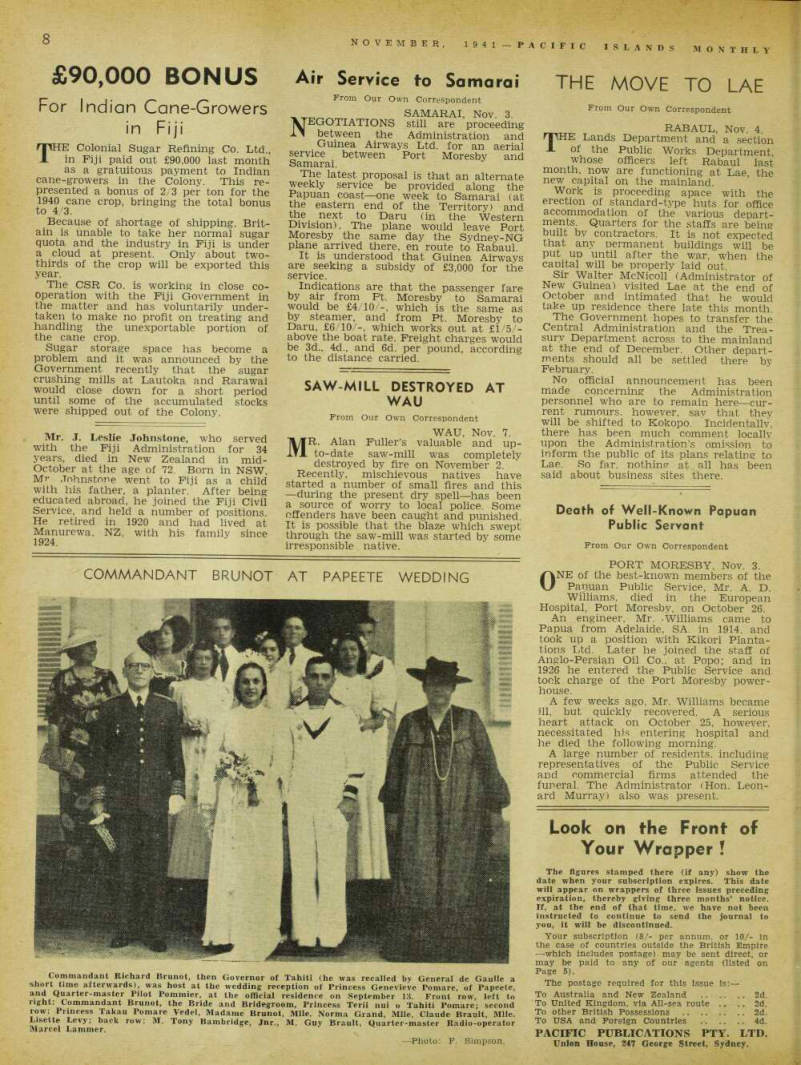
Commandant Brunot At Papeete Wedding
Commandant Richard Brunot, then Governor of Tahiti (he was recalled by General de Gaulle a short time afterwards), was host at the wedding reception of Princess Genevieve Pomare, of Papeete, and Quarter-master Pilot Pommier, at the official residence on September 13. Front row, left to right: Commandant Brunot, the Bride and Bridegroom, Princess Terii nui o Tahiti Pomare; second row: Princess Takau Pomare Vedel, Madame Brunot, Mile. Norma Grand, Mile. Claude Brault, Mile.
Lisette Levy; back row: M, Tony Bambridge, Jnr., M, Guy Brault, Quarter-master Radio-operator Marcel Lammer, —Photo; F. Simpson,
The Move To Lae
Prom Our Own Correspondent
Rabaul, Nov. 4.
THE Lands Department and a section of the Public Works Department whose officers left Rabaul last month, now are functioning at Lae, the new capital on the mainland.
Work is proceeding apace with the erection of standard-type huts for office accommodation of the various depart ments. Quarters for the staffs are being built by contractors. It is not expected that any permanent buildings will be put up until after the war, when the canital will be properly laid out.
Sir Walter McNicoll (Administrator of New Guinea) visited Lae at the end of October and intimated that he would take up residence there late this month The Government hopes to transfer the Central Administration and the Trea sury Department across to the mainland at the end of December. Other depart ments should all be settled there by February.
No official announcement has been made concerning the Administration personnel who are to remain here—cur rent rumours, however, sav that they will be shifted to Kokopo. Incidentallv, there has been much comment locally upon the Administration’s omission to inform the public of its plans relating to Lae. So far. nothing at. all has been said about business sites there.
Death of Well-Known Papuan
Public Servant
From Our Own Correspondent
Port Moresby, Nov. 3.
ONE of the best-known members of the Panuan Public Service, Mr. A. D.
Williams, died in the European Hospital, Port Moresby, on October 26.
An engineer, Mr. .Williams came to Papua from Adelaide, SA. in 1914. and took up a position with Kikori Planta tions Ltd. Later he joined the staff of Anglo-Persian Oil Co., at Popo; and in 1926 he entered the Public Service and took charge of the Port Moresby power house.
A few weeks ago, Mr. Williams became ill, but quickly recovered. A serious heart attack on October 25, however, necessitated his entering hospital and he died the following morning.
A large number of residents, including representatives of the Public Service and commercial firms attended the funeral. The Administrator (Hon. Leon ard Murray) also was present.
Advertisements & other items, p. 10 (1 item)
Look on the Front of
Your Wropper !
The figures stamped there (if any) show the date when your subscription expires. This date will appear on wrappers of three issues preceding expiration, thereby giving three months’ notice.
If, at the end of that time, we have not been instructed to continue to send the journal to you, it will be discontinued.
Your subscription (8/- per annum, or 10/- in the case of countries outside the British Empire —which includes postage) may be sent direct, or may be paid to any of our agents (listed on Page 5).
The postage required for this issue is:— To Australia and New Zealand 2d.
To United Kingdom, via All-sea route .. .. 2d.
To other British Possessions 2d.
To USA and Foreign Countries 4d.
PACIFIC PUBLICATIONS PTY. LTD.
Union House, 247 George Street, Sydney.
Tongan Health Officer
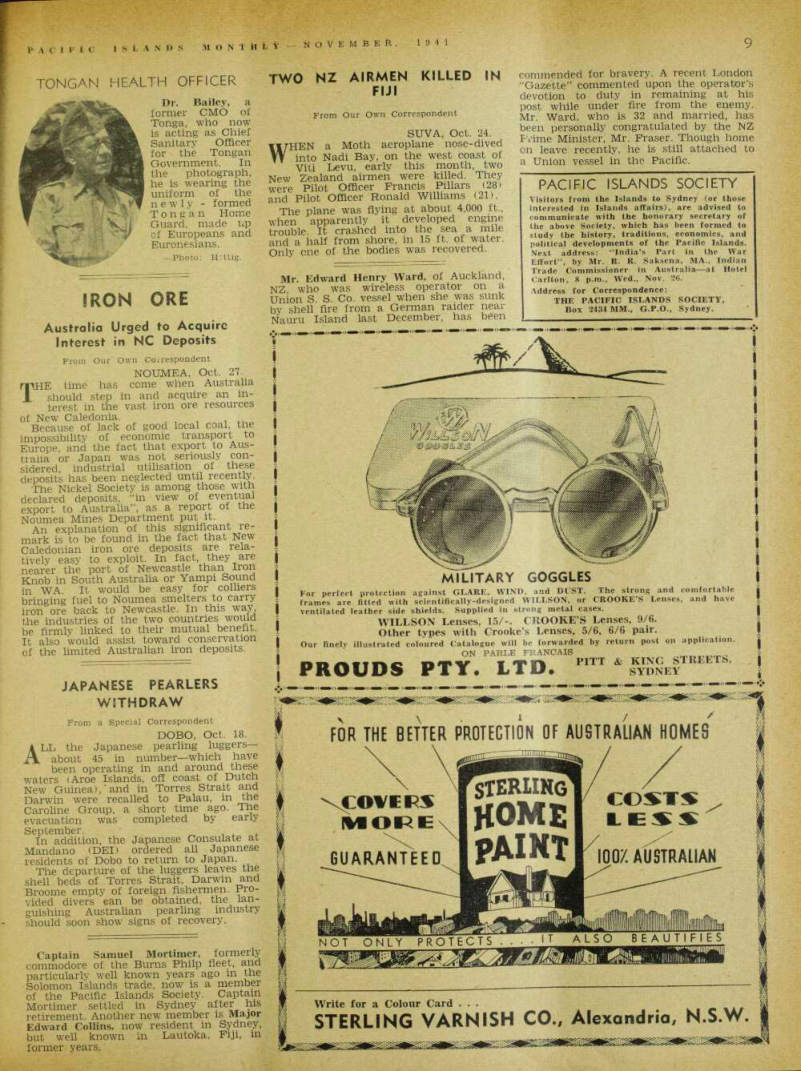
Dr. Bailey, a former CMO of Tonga, who now is acting as Chief Sanitary Officer for the Tongan Government. In the photograph, he is wearing the uniform of the newly - formed Tongan Home Guard, made up of Europeans and Euronesians, -Photo: Hcttig.
Iron Ore
Australia Urged to Acquire Interest in NC Deposits
From Our Own Correspondent
Noumea, Oct. 27.
THE time has come when Australia should step in and acquire an in terest in the vast iron ore resources of New Caledonia. , , .
Because of lack of good local coal, the impossibility of economic transport to Europe, and the fact that export to Aus tralia or Japan was not seriously con sidered, industrial utilisation of these deposits has been neglected until recently.
The Nickel Society is among those with declared deposits, “in view of eventual export to Australia”, as a report of the Noumea Mines Department put it.
An explanation of this significant re mark is to be found in the fact that New Caledonian iron ore deposits are rela tively easy to exploit. In fact, they are nearer the port of Newcastle than Iron Knob in South Australia or Yampi Sound in WA. It would be easy for colliers bringing fuel to Noumea smelters to carry iron ore back to Newcastle. In this way, the industries of the two countries would be firmly linked to their mutual benefit.
It also would assist toward conservation of the limited Australian iron deposits.
Japanese Pearlers
Withdraw
From a Special Correspondent
Dobo, Oct. 18.
ALL the Japanese pearling luggers— about 45 in number—which have been operating in and around these waters (Aroe Islands, off coast of Dutch New Guinea),'and in Torres Strait and Darwin were recalled to Palau, in the Caroline Group, a short time ago. The evacuation was completed by early September. . . , In addition, the Japanese Consulate at Mandano (DEI) ordered all Japanese residents of Dobo to return to Japan.
The departure of the luggers leaves the shell beds of Torres Strait, Darwin and Broome empty of foreign fishermen. Pro vided divers can be obtained, the lan guishing Australian pearling industry should soon show signs of recovery.
Captain Samuel Mortimer, formerly commodore of the Burns Philp fleet, and particularly well known years ago in the Solomon Islands trade, now is a member of the Pacific Islands Society. Captain Mortimer settled in Sydney after his retirement. Another new member is Major Edward Collins, now resident in Sydney, but well known in Lautoka, Fiji, in former years.
Two Nz Airmen Killed In
Fiji
From Our Own Correspondent
Suva, Oct. 24.
WHEN a Moth aeroplane nose-dived into Nadi Bay, on the west coast of Viti Levu, early this month, two New Zealand airmen were killed. They were Pilot Officer Francis Pillars (28) and Pilot Officer Ronald Williams (21).
The plane was flying at about 4,000 ft., when apparently it developed engine trouble. It crashed into the sea a mile and a half from shore, in 15 ft. of water.
Only one of the bodies was recovered.
Mr. Edward Henry Ward, of Auckland, NZ who was wireless operator on a Union S S. Co. vessel when she was sunk by shell fire from a German raider near Nauru Island last December, has been
commended for bravery. A recent London “Gazette” commented upon the operator’s devotion to duty in remaining at his post while under fire from the enemy.
Mr. Ward, who is 32 and married, has been personally congratulated by the NZ Prime Minister, Mr. Fraser. Though home on leave recently, he is still attached to a Union vessel in the Pacific.
Advertisements & other items, pp. 11-12 (1 item)
Home
PACIFIC ISLANDS SOCIETY
Visitors from the Islands to Sydney (or those interested in Islands affairs), are advised to communicate with the honorary secretary of the above Society, which has been formed to study the history, traditions, economics, and political developments of the Pacific Islands.
Next address: “India’s Part in the War Effort”, by Mr. R. R. Saksena, MA., Indian Trade Commissioner in Australia —at Hotel Carlton. S p.m., Wed., Nov. 26.
Address for Correspondence:
THE PACIFIC ISLANDS SOCIETY,
Box 2434 MM., G.P.0., Sydney.
MILITARY GOGGLES
For perfect protection against GLARE, WIND, and DUST. The strong and comfortable frames are fitted with scientifically-designed WILLSON, or CROOKE’S Lenses, and have ventilated leather side shields. Supplied in strong metal cases.
WILLSON Lenses, 15/-. CROOKE’S Lenses, 9/6.
Other types with Crooke’s Lenses, 5/6, 6/6 pair.
Our finely illustrated coloured Catalogue will be forwarded by return post on application.
ON PARLE FRANCAIS
PROUDS PTY. LTD. PITT & gYDNEY
FOR THE BETTER PROTECTION OF AUSTRALIAN HOMES \ ncowirs
MOPE
GUARANTEED
steriing
HOME
PAINT , IOOZ AUSTRALIAN
COSTS
LESS
iMliiiifciiahilliiiiftiik.
NOT ONLY PROTECTS . . IT ALSO BEAUTIFIES wMMmm Write for a Colour Card ...
STERLING VARNISH CO., Alexandria, N.S.W.
THE“£coromy’BßEAD BOX
32/6
Ssk
as Something new! No need now, to waste those extra slices of bread . . . for no woman likes to waste bread. Here is an ideal receptacle for keeping those, “few too many” slices perfectly fresh for to-morrow.
The holder is of gleaming A 1 Silverplate and contains a heavy Pyrex Jar, with close fitting lid. Jar is 6V 2 in. square and in. deep. A real money-saver. i Sponge Sandwich Tray, complete with server.
The tray is 9Vs in. across and is made from very heavy white metal, generously plated with pure Silver. This lovely tray will make your sponge look even MORE appetizing As a Gift ... you will be PROUD to present it. ★ Are you sure your name is on ANGUS & COOTE’S Mailing List? The New Catalogue is ready and is packed with wonderful Gift values. 30/- A 1 Silverplated Salt and Pepper Shakers, so large that it will be a long time between fills. They stand 4Va in. high and have a strong screw-on base. An acceptable present.
ANGUS & COOTE pay highest prices for Old Gold and Diamonds. Forward yours for valuation, by registered post. 47/6 Cold Water Jug, in A 1 Silverplate. • Just the thing for clear, cool water, cordial, or fruitjuice. The Jug holds 2 pints, has a firm, heavy base and highly decorative spout and handle.
★ SAFE
DELIVERY
Guaranteed Anywhere, A few shillings deposit will secure any article . . . pay off the balance to suit your convenience. An excellent idea to think over. 25/- A Nest of Cork Table Mats, complete in a beautiful A 1 Silver plated Stand The&3 mats will protect your table surface from damage by hot dinner plates. Mats measure 5 3 4 in. across . . . complete unit stands 7 in. above the table.
Angus & Coote
500 GEORGE STREET, SYDNEY
Teopicalities
BRITAIN’S new “secret weapon”? The Italian propaganda radio, broadcastmg from Rome on October 8, H? l 0 S n S “The English are reduced to such straits that they have had to the f Armv” lbalS frCm the Fiji Islands to the Army . * T HE first European to settle in Tahiti, X as far as published records show, o w J ls m Spaniard. This man, who a death sentence, was a member of the crew of the “Aguila”, commanded by Don Domingo Boenechea, who arrived m Tahiti in 1772 and anchored at Teahupo o off the Taiarapu peninsula.
Boenechea gave the island the name of Isla d’Amat, after the Viceroy of Peru who had sent the expedition to the South Seas. He had occasion to sentence four of the ship’s company to death for misconduct. The fifth escaped the penalty by hiding in the mountains. This man was subsequently adopted into the family of the high chief, Vehiatua. It is said that traces of Spanish blood can be found in the countenances of his descendants at Teahuno’o to this day. —“Vakatini ” « • TTNTIL February, 1940, when the Huns U over-ran Holland and destroyed postal communications, the former
Sly 01 te
“PIM” y ’wS was re forw r arde e d d to S D°°™’ S olla " d V b t y his boyhood friend Goedicke, now sl resident of to & the 1 ’“ PIM ” a ' savs Sat d when 1 h P a to tne ± iivi , says mat wnen ne was a b?y in Mecklenberg, the late Kaiser and his brother, Prince Henry, were living S-PHAr,^ lle l Mac eir fathe r,, (C - rown Prince Frederick) was away with his regiment r T ?^ C ?- Pr H l - S t an ar h- two Princes and Goedicke and his brother. we s e Pf a y ma t e s during a whole summer, and the acquaintanceship thus begun lasted during their lives. In the early
’eighties, Mr. Goedicke was at Darwin Northern Australia, and there he went on a shooting expedition with the Duke of Manchester, who was a close perFonal friend of Crown Prince Frederick It was the Duke who suggested to Mr. Goedicke during a kangaroo hunt at the back of Darwin, that he should become a British
was' SS touS*‘&
Goedicke has letters from the late Kaiser’s Chamberlain, saying that Wil helm 11, who always took a keen interest in Pacific affairs, carefully read every issue of the “PIM”. * T'feFFORF ix/Tr tt K M J? - denklns - of th e yacht Golden x Hmd returned to New Zealan d from Tahiti recently, with the anchor of the ship “Bounty” which acquired from the Chief of Arue - tde Auckland War Memorial Museum ss??5 s ?? August “PIM”), he made two presen rations to the Papeete Museum. One was rar ?, and valuable Volumes I, 11, and it 1 9* the “Transactions” of the London Missionary Society workers in French Oceania, covering the years 1797 to 1808, w. hlC x he had recently purchased from the London office of the Society. The other gift was a choice collection of Moa bones from Doubtless Bay, New Zealand. ♦ WE who dwell in the Antipodes know " tha f A , meri £ a is -wouXlfn/and
L*M be takes SnSrt thTdTrkLS
out of the northern sk“ ° f the Here is D£irt of a theeditor of the “PIM”, from Mrs. Isobel Field of Serene pQiifnmio • “In every town, city and village of the United States there is a group of people working for Britain; subscriptions coming in from the people themselves, not from the Government, though supplies are going over in increasing quantities; and the armament factories are working overtime ”
Mrs. Field is the step-daughter of
Robert Louis Stevenson, and lived with him in Samoa, some 50 years ago.
Mrs Field sent the following two little poems, as embodying American sentiment towards Britain:—
Refugee
I shall remember, till I die, Manhattan traced against the sky, Alabaster, ivory, Rising baseless from the sea; A dream-white city, morning-kissed To rose and pearl and amethyst; A toery fabric piled upon The insubstantial mists of dawn, And lovely to my wondering eyes As the far shores of Paradise.
I shall remember, till I die, Her glistening towers, the tranquil sky And how I wept—who did not weep For bombs and guns and murdered sleep— To see a path of gold ’twixt me And the calm strength of Liberty.
For A War Pilot
(Note by an editor in Montana, where the poem was first published:—-“The following verses were written by a little Montana girl, as her tribute to the RAF. They seem to me re markable, both in themselves, and as evidence of the emotion which the exploits of the British pilots rouse in the hearts of the American people,”) If I must die, let it be swift and shattered flight Through the smoking, violated night In a rush of space.
Let not my face Be warped with fright.
But, at God’s height And far beyond the blight Of this mad, murderous race, There may I trace My name in flames, fire-bright, If I must die. —Gretchen Wellman, Hardin, Montana. ♦ IT has often been written of the Tahi tians that they have long lost all understanding of racial pride. Such, however, is not the case as the following incident, related by Mr. Eric Ramsden, secretary of the Pacific Islands Society, when speaking before the Royal Austra lian Historical Society in Sydney in October, testified. At a recent function in Sydney, he had occasion to introduce one of the Tahitian de Gaulle vqlunteers to a French member of the Society. In presenting the soldier, by way of com pliment to the lady, Mr. Ramsden referred to him as a “taata Firani” (a French man). The Tahitian shook hands, and then said, in his own language; “No, I am not a Frenchman. I am a Tahitian!
The speaker contrasted this declaration with the reception a Maori resident of Sydney received lately at the hands of a young Maori air trainee. Seeing this young man in uniform in the street, he went and addressed him with the courteous and traditional: “Tena koe”.
“Oh, how do you do,” the youth, who understood his own tongue thoroughly, replied. Instead of proffering his nose in the hongi, he merely offered his hand. * VISITORS to Suva who inspect the imposing block of Government buildings invariably pause at the entrance to the Legislative Council Cham bers to admire a fine bronze bust of a Fiji hillman, which stands on a granite
pedestal in a prominent position. There
is an interesting story connected with
this statue, symbol of the proud Fijian race.
In 1933, Mr. John W. Vandercook. an American traveller and novelist (one of his thrillers” is entitled “Murder in fU 1 • anc * .wife made a trip across the island of Viti Levu, in company with their fellow-countryman, Dr. S. M.‘ bert, then Rockefeller Foundation repre sentative in the Pacific. They were greatly taken with the natives of the interior and particularly impressed by a stalwart Fijian who was carrying for them. Mrs.
Vandercook, a sculptress, took a number of photographs of him and made measure ments of his head. On her return to USA. she modelled a splendid bust of the Fijian. A short time afterwards, she died Ah her work was cast in bronze and exhibited at a leading New York Art Gallery. Later, Mr. Vandercook, through Dr. Lambert, presented the statue to the Government of Fiji, and it was mounted and placed in its present position.
IT is interesting to note how even “hard-boiled” and educated Euro peans succumb to superstitious ideas after living several years in the more remote islands of the Pacific. So-called “ghosts” and strange coincidences are easily disposed of with the lights of the city all round, but in the gentle silence of a tropical evening, the sceptic pauses, and thinks, and recalls how little man knows of the supernatural.
An apt instance of such superstition in the Polynesian islands is the impor tance attached to the defilement of a “marae” (chiefly burial-ground and place of sacrifice,). For instance, should a native in the Cook Islands be stricken with a disease, particularly elephantiasis, his record will be delved into and it will soon emerge that, at one time or another, he defiled a “marae”, either by removing
the stones, lighting a fire there, or some other such action.
The average European will dismiss this with a shrug, but give him a couple of years residence in the Pacific and he is not so confident. Another five years will convince him that there may be some thing in it, and there are few “old timers” who would care to tear up a known “marae” (he would have to do the job with his own hands, as no native labourer would be willing to take the risk) even though it should be on his own land.
What is it they say about the Islands?
In three months you know everything, after two years you are not so sure, and after ten years you realise that you know practically nothing.—R.l. • GREAT oaks from little acorns grow.
A friend in Britain, writing last December to Mrs. James Burns, wife of a director of Burns, Philp &' Co Ltd., Sydney, mentioned that she might care to raise funds among her acquaint ances to purchase a mobile canteen for the “blitzed” areas of England. Mrs.
Burns got busy and formed a small com mittee. BP provided office accommodation for them and assisted in a number of other directions. The response was so immediate and generous that nearly £24,000 was subscribed in six months.
So, instead of one canteen, it was possible to purchase a fleet of 21 mobile canteens, three dinner van canteens, 14 motor cycles, 20 auto cycles, and 24 bicycles. These were formally handed' over to the Women’s Voluntary Services in Britain on October 21, when the Queen inspected the entire fleet of vehicles.
Mr. G. Briggs, roadmaster, of Nama tanai, TNG, has arrived in Sydney to join the RAAP.
Advertisements & other items, pp. 12-14 (1 item)
Special Service
A 9 C
6 Tf I E
A
Special Service
to Executors
Executorship is a heavy burden. For reasons of health, business or desire to travel, you may be unable or unwilling to act. In such case Burns Philp can assume your responsibilities. Even if you have already obtained a grant of probate, you can allow this Company to take over the duties of administration— either in their entirety or in part. Full details are contained in the free booklet, " The Task That Few Men Want.” Why not write for it ?
Write to or call at the Company's offices, 7 Bridge Street, Sydney, or any Branch of Burns, Philp & Company Limited, or Burhs Philp (South Sea) Company, Limited, for further information.
DIRECTORS James Burns - Robert John Nosworthy - Lewis Armstrong - Joseph Mitchell MANAGER —C. H. Chester
Burns Philp Trust
COMPANY LIMITED
’Phone : B 7901.
BRIDGE STREET, SYDNEY
Box 543 B, G.P.0., Sydney.
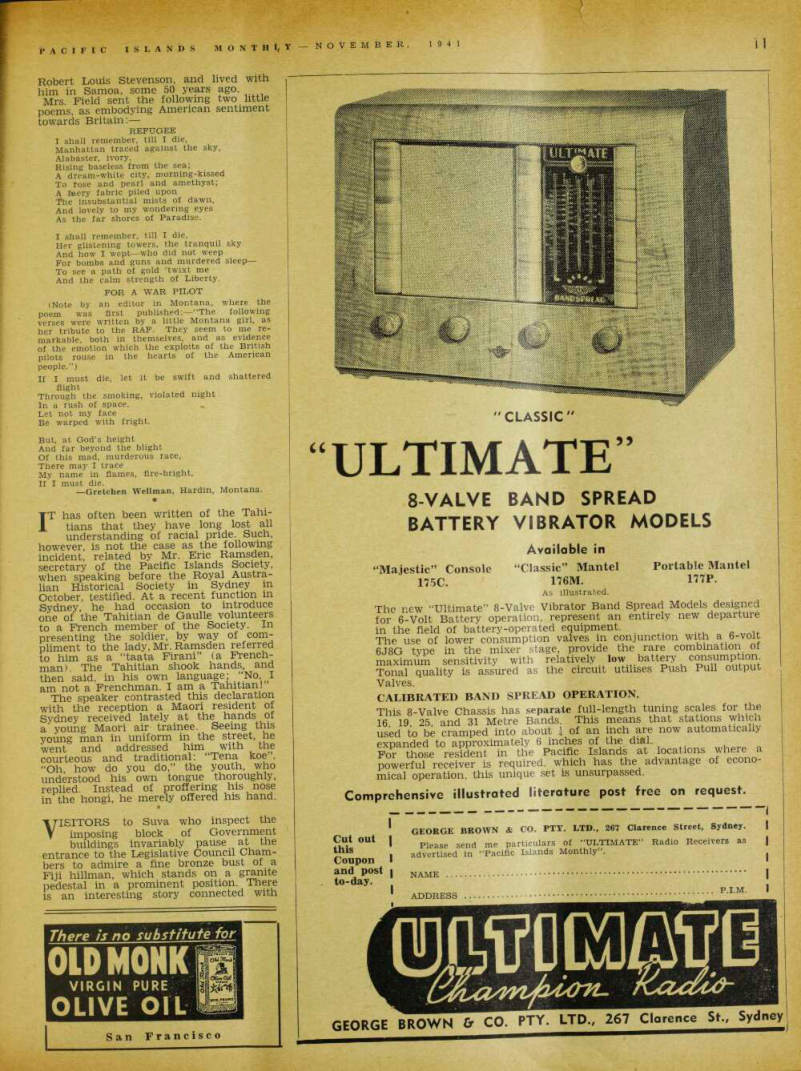
CLASSIC"
U
ULTIMATE
8-VALVE BAND SPREAD
BATTERY VIBRATOR MODELS
“Majestic” Console 175 C.
Available in “Classic” Mantel 176 M.
As illustrated.
Portable Mantel 177 P.
The new “Ultimate” 8-Valve Vibrator Band Spread Models designed for 6-Volt Battery operation, represent an entirely new departure in the field of battery-operated equipment.
The use of lower consumption valves in conjunction with a b-volt 6JBG type in the mixer stage, provide the rare combination of maximum sensitivity with relatively low battery consumption Tonal quality is assured as the circuit utilises Push Pull output Valves.
CALIBRATED BAND SPREAD OPERATION.
This 8-Valve Chassis has separate full-length tuning scales for the 16 19 25, and 31 Metre Bands. This means that stations which used to be cramped into about 1 of an inch are now automatically expanded to approximately 6 inches of the dial. , oro Q For those resident in the Pacific Islands at locations where a powerful receiver is required, which has the advantage of economical operation, this unique set is unsurpassed.
Comprehensive illustrated literature post free on request.
I Cut out I this Coupon I and post j to-day.
GEORGE BROWN & CO. PTY. LTD., 267 Clarence Street. Sydney.
Please send me particulars of “ULTIMATE” Radio Receivers as advertised in “Pacific Islands Monthly ’.
NAME ...
ADDRESS
P.I.M.
I
AVTi
M I U / GEORGE BROWN & CO. PTY. LTD., 267 Clorence St., Sydney
There is no substitute for
OLD MONK
VIRGIN PURE
OLIVE OIL
San Francisco
A GIFT
any man
would appreciate
Such a gift will give years of service . . . Something a man will be proud to own and pleased to use. The
ROLLS RAZOR
is English made—it’s good—and well made. Complete with Razor hone and strop. Supplied in strong nickel-plated presentation case 57/6 Silver-plated, presentation model 67/6 Mail your order immediately and save possible disappointment
PIKE BROTHERS
LIMITED
Queen Street, Brisbane
St. Ignatius’ College
Riverview Sydney
Boys are prepared for Intermediate and Leaving Certificate Examinations and for Exhibitions, Scholarships and Bursaries at the University.
Boys are arranged in three Divisions according to age. Each Division has its own Library, Debating Society, Cricket and Football Fields, and Tennis Courts.
Senior and Junior Rowing Sheds, with a large fleet of pleasure and racing boats.
Private Swimming Baths.
Prospectus and further particulars on application to the— Rector: St. Ignatius’ College, Riverview, Sydney, Australia.
Tel.: JB 1106.
BOARDING AND DAY SCHOOL
Conducted by the Jesuit Fathers ' ill
ONE OF SYDNEY'S GREAT PUBLIC SCHOOLS
New Caledonion "Mummies"
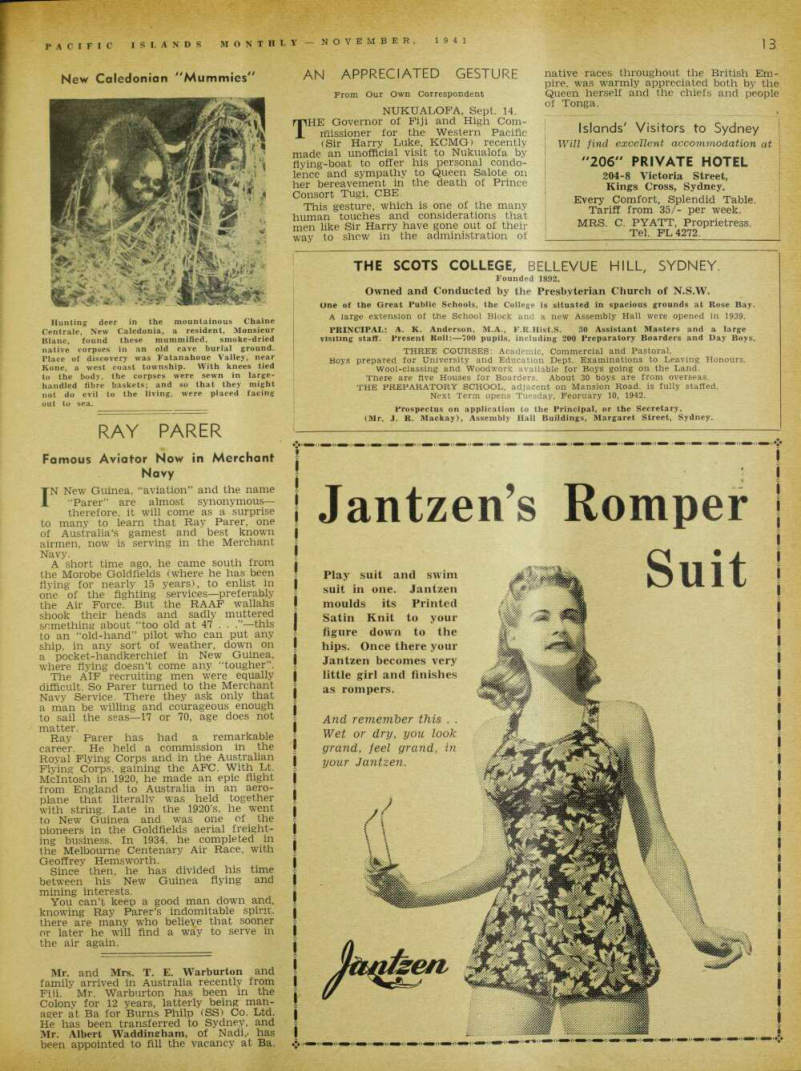
Hunting deer in the mountainous Chaine Centrale, New Caledonia, a resident. Monsieur Blanc, found these mummified, smoke-dried native corpses in an old cave burial ground.
Place of discovery was Fatanahoue Valley, near Kone, a west coast township. With knees tied to the body, the corpses were sewn in large handled fibre baskets; and so that they might not do evil to the living, were placed facing out to sea.
Ray Parer
Famous Aviator Now in Merchant Navy
IN New Guinea, “aviation” and the name "Parer” are almost synonymous— therefore, it will come as a surprise to many to learn that Ray Parer, one of Australia’s gamest and best known airmen, now is serving in the Merchant Navy.
A short time ago, he came south from the Morobe Goldfields (where he has been flying for nearly 15 years), to enlist in one of the fighting services—preferably the Air Force. But the RAAF wallahs shook their heads and sadly muttered something about “too old at 47 . . .”—this to an “old-hand” pilot who can put any ship, in any sort of weather, down on a pocket-handkerchief in New Guinea, where flying doesn’t come any “tougher”.
The AIF recruiting men were equally difficult. So Parer turned to the Merchant Navy Service. There they ask only that a man be willing and courageous enough to sail the seas—l 7 or 70, age does not matter.
Ray Parer has had a remarkable career. He held a commission in the Royal Flying Corps and in the Australian Flying Corps, gaining the AFC. With Lt.
Mclntosh in 1920, he made an epic flight from England to Australia in an aero plane that literally was held together with string. Late in the 1920’5, he went to New Guinea and was one of the pioneers in the Goldfields aerial freight ing business. In 1934, he completed in the Melbourne Centenary Air Race, with Geoffrey Hems worth.
Since then, he has divided his time between his New Guinea flying and mining interests.
You can’t keep a good man down and, knowing Ray Parer’s indomitable spirit, there are many who believe that sooner nr later he will find a way to serve in the air again.
Mr. and Mrs. T. E. Warburton and family arrived in Australia recently from Fiii. Mr. Warburton has been in the Colony for 12 years, latterly being man ager at Ba for Burns Philp (SS) Co. Ltd.
He has been transferred to Sydney, and Mr, Albert Waddingham, of Nadi,- has been appointed to fill the vacancy at Ba.
An Appreciated Gesture
From our own correspondent
Nukualofa, Sept. 14.
THE Governor of Fiji and High Com rflissioner for the Western Pacific (Sir Harry Luke, KCMG) recently made an unofficial visit to Nukualofa by flying-boat to offer his personal condo lence and sympathy to Queen Salote on her bereavement in the death of Prince Consort Tugi, CBE.
This gesture, which is one of the many human touches and considerations that men like Sir Harry have gone out of their way to show in the administration of
native races throughout the British Em pire. was warmly appreciated both by the Queen herself and the chiefs and people of Tonga.
Advertisements & other items, pp. 15-16 (1 item)
Jantzen's Romper
Islands' Visitors to Sydney Will find excellent accommodation at
"106" PRIVATE HOTEL
204-8 Victoria Street, Kings Cross, Sydney.
Every Comfort, Splendid Table.
Tariff from 35/- per week.
MRS. C. PYATT, Proprietress.
Tel. FL 4272.
THE SCOTS COLLEGE, BELLEVUE HILL, SYDNEY.
Founded 1892.
Owned and Conducted by the Presbyterian Church of N.S.W.
One of the Great Public Schools, the College is situated in spacious grounds at Rose Bay.
A large extension of the School Block and a new Assembly Hall were opened in 1939.
PRINCIPAL: A. K. Anderson, M.A., F.R.Hist.S. 30 Assistant Masters and a large visiting staff. Present Roll:—700 pupils, including 200 Preparatory Boarders and Day Boys.
THREE COURSES: Academic, Commercial and Pastoral.
Boys prepared for University and Education Dept. Examinations to Leaving Honours.
Wool-classing and Woodwork available for Boys going on the Land.
There are five Houses for Boarders. About 30 boys are from overseas.
THE PREPARATORY SCHOOL, adjacent on Mansion Road, is fully staffed.
Next Term opens Tuesday, Feoruary 10, 1942.
Prospectus on application to the Principal, or the Secretary, (Mr. J. R. Mackay), Assembly Hall Buildings, Margaret Street, Sydney.
Jantzen's Romper
Suit
Play suit and swim suit in one. Jantzen moulds its Printed Satin Knit to your figure down to the hips. Once there your Jantzen becomes very little girl and finishes as rompers.
And remember this . .
Wet or dry, you look grand, feel grand, in your Jantzen. m / /; m
sen
RECORDS
BY MAIL
PALING’S stock of all types of records exceeds 10,000.
Every title is immediately available. Order from Paling’s with confidence. Your records will be securely packed and dispatched on the same day.
Write now for full information
and FREE LISTS.
388 GEORGE STREET, SYDNEY.
Proved fastest way to clear up
BOILS, CARBUNCLES
TROPIC ULCERS
and Septic Skin Conditions
without INJECTIONS, LANCING or SCARRING
by ORAL VACCINE (taken through the mouth) Here is llie ONE treatment that can give you prompt relief from skin complaints—because it actually provides, in most cases, an antidote to those germs which cause many of these diseases.
Hundreds of sufferers who had tried all kinds of so-called “cures” without success are delighted with the results obtained with the LANTIGEN “D” immunisation treatment, based on the researches of Louis Pasteur. LANTIGEN, which contains no drugs, has been developed by a leading bacteriologist, and has proved itself effective in the treatment of deep-seated bacterial disorders.
QUICK RELIEF FROM PAIN
LANTIGEN “D” quickly stops the pain of Boils and Carbuncles, and then heals them up thoroughly and rapidly, without the need of lancing and without leavmg a scar mark. or Louis Pasteur buncles, Acne, Septic Sores, Abscesses, etc.
By providing antigens to incite the creation of antibodies in the system to destroy disease - causing bacteria, LANTI- GEN “D” kills the germs which cause Boils, Car- Pimples, Eczema, a few days. There are no cores to extract they simply disappear, leaving the skin normal and healthy once again.
LANTIGEN “D” should also be taken by mouth (a few drops in water at bedtime) to purify the system from the poisonous germs, and build up bodily resistance against further attacks. It takes the place of painful, expensive vaccination by injection.
Several weeks’ treatment £l/1/9 per bottle. Two bottles are usually necessary for the average case.
Ask your Chemist.
Janti£en «p”
ORAL VACCINE
If applied on a cotton-wool pad to a Boil or Carbuncle, the pain will diminish within 24 hours, and the trouble will be completely gone in Product of
EDINBURGH LABORATORIES
103 York Street, Sydney.
Death Of Old Cook Is
Priest
From Our Own Correspondent
T Tt Rarotonga, Oct. 2.
HE death occurred recently in Auckland (NZ), of Father Joachim Kerdal, of the Cook Is. He was 68 years of age As a young Breton, he entered the Con gregation of the Sacred Hearts of Jesus and Mary and volunteered for foreign mission service. After his ordination, he was sent to the Cook Islands, where he laboured for 41 years. He went to New Zealand for medical treatment last July, and was showing signs of a full recovery when he suddenly collapsed on the evening of August 8.
Many past and present Cl residents and travellers on Pacific schooners will remember kindly this old priest, who spent the greater part of his life on the lonely atoll of Manihiki, over 200 miles away from the nearest white man His funeral was attended by the Bishop of Auckland and many other dignitaries of the NZ Catholic Church.
Mrs. L. Jackaman, well-known resident of Levuka, Fiji, died last month, aged 67.
Japanese Naval

Vessels
Snooping Near US Pacific Bases
THE Japanese Navy has lately been guilty of very unfriendly activities in American Pacific waters, cabled Mr. Hallett Abend, roving US journalist to the “New York Times”, from Honolulu on November 1.
American naval authorities patiently withheld retaliative action, but much was learned of Japanese tactics and aims, al though the authorities simulated ignor ance of what the ships were doing, re ported Mr. Abend.
Now, it is possible to reveal that a Japanese submarine has lately been in Hawaiian territorial waters, remaining submerged during the day and coming up after dark. Daylight observations were conducted with only the periscope showing.
The American naval authorities are chuckling over this abortive Japanese naval reconnaissance, since they have ob served every move of the submarine since she was about 400 miles outside Hawaiian waters.
Other semi-hostile Japanese naval ac tions have been openly conducted without the slightest attempt at secrecy. Their fast ships have provocatively cruised at high speed all round Midway, Wake.
Johnson, Palmyra, and other Pacific Is lands bases, always keeping 2,000 yards beyond the utmost range of American coast defence batteries.
The only disturbing feature of this phase of Japanese naval activity is how Japanese agents have so accurately learned the extreme shooting range of the shore batteries on individual islands.
Captain C. Rattray, Acting Command ing Officer of the Rarotonga Defence Force, went back to New Zealand in October, following the return ©f Captain R. M. Gladney to resume command.
A son, David Graham, was born to Mr. and Mrs. L. Dexter, of F’apua, at Grange Private Hospital, Brisbane (Qld.), in September. Mr. Dexter is now stationed at Aroa for Coconut Products Ltd.; previously he was a resident of Misima Island.
Mr. George Ellis has returned to Wewak, New Guinea, where he is a mem ber of the District Services Department,, after completing furlough.
Advertisements & other items, pp. 16-18 (1 item)
Kam Bala
Church of England Girls’ School a i
ini
if u Kambala Church of England School for Girls at Rose Bay, Sydney, provides complete modern education for girls from the age of five. Under the direction of the Principal, Miss F. Hawthorne, 8.A., and a fully qualified staff, Kambala offers thorough preparation for either academic or professional careers, and excellent physical training.
NEW TERM COMMENCES
FEBRUARY 10th.
For full prospectus please consult the Principal, or R. E. Cox, Secretary, 28 Bond Street, Sydney.
REJUVENATE, YOUR ENGINE WITH
-HI j V.*' p* r> c ■/ 0 'A w ft & \ .T* a«- s fOfl. ysro c.* s «.e v t Ot" 266
Science’s Amazing Discovery !
Reconditions While You Drive!
Saves Expensive Rebores and Fitting New Rings !
Stops Oil and Petrol Waste.
Good for 10,000 Miles.
Cannot Injure the Motor.
Recommended by "Motor", "Autocar", and Others.
OVRHAUL reconditions your motor while you drive. It pays for itself in oil and Patrol savings in no time, and is good for old or new cars. To treat a motor, merely deposi OVRHAUL on top of the pistons through the spark plug openings. As soon as the motor starts, OVRHAUL is carried behind and between the compression rings and ring grooves.
It works into scores of the cylinder walls and into pits in the valve seats Expansion then takes place. Expansion of OVRHAUL compensates for both ring and cylinder wear. OU pumping, smoking and piston slap are checked. It increases the compression. Oil consump tion is cut up to 50 per cent. Petrol mileage jumps up to 45 per cent. New Cai zip an power is restored. For cars, trucks, marine engines, etc.
THE ANSWER TO YOUR QUESTIONS!
Q. How can OVRHAUL recondition an engine?
A. Its expansion restores lost compression. This brings back “New Car” power and quiet—saves petrol and oil; stops smoking; increases speed.
Q. What about carbon?
A. It is unnecessary to clean carbon or grind valves if OVRHAUL is used.
When oil pumping is stopped, carbon will not form. The old carbon in an engine will soon harden and blow out the exhaust.
Q. Should I get new piston rings?
A. No. Expansion of OVRHAUL takes up excess clearance, allowing old rings to work perfectly.
Q. Will it stop up the screen or oil lines?
A. No. It functions in the upper part of the motor and cannot get into the crankcase. For this reason it will not stop a bearing knock.
Q. Can it harm my motor in any way?
A. Absolutely not. It contains no acids, chemicals, ether, camphor, or anything to harm the finest motor. Certified laboratory tests prove this.
Q. Is it good for new cars?
A Yes. It prevents valves from sticking, and it protects cylinder walls.
OVRHAUL keeps new cars new.
CUT OUT THIS COUPON AND POST TO-DAY HISLOP LLOYD PTY. LTD., 335 PITT STREET. SYDNEY. of 26/6 for one tube of Ovrhaul. Please send post free to:— enclose the sum Name
Post free
Manufactured in Great Britain
RECONDITIONS
WHILE YOU
DRIVE
SOLE DISTRIBUTORS: HISLOP LLOYD PTY. LTD.,
Address My engine is; (Name) (Year)
335 PITT STREET,
SYDNEY.
\fin ffettfji men:
Any Employer NEEDS YOU if you arc
AN I. C. S. TRAINED MAN!
¥ C 140 ELIZABETH STREET,
SYDNEY.
Sirs, — Please send free prospectus showing how I can succeed in the occupation I have marked X Accountancy —Secretarial (all Inst. Ex.) Bookkeeping— General. Store, Station.
Salesmanship— Gen., Speciality, Retail.
Psychology and Personality in Business.
Advertising —Retail, Mail-Ord., Agency.
Window Disp. —Show Card, Shop Tckts.
Illustrating —Newspaper, Fash., Poster.
Free Lance Jour'ism— Short Story Writ.
Matriculation —Leaving-Inter.-Pub. Serv.
Gen. Education —Bus. and Sales Letters.
Police Entr. Exam., Nurses Entr. Exam.
Architecture —Structural Concrete.
Building Contracting —Air Conditioning.
Draftsmanship (Mech. & all branches).
Motor Eng. —Mtr. Mech., Mtr. Exams.
Diesel Eng. —lllumin. Engr., Weld. Eng.
Internal Comb, and Steam Drivers' Exs.
Radio Eng. —Radio Serv., Radio Exms.
Aero Eng. —Gd. Eng., Licenses, Rigging.
Elec. Eng.— Elec. Cont. & Mechs' Exms.
Civil Eng. —Shire Eng.—Shire Overseer.
Textile (all branches) —Analyt. Chem.
Dress Design —Drafting, Cutting, Mlnry. (Underline your subject above— if not on list write it here ) Enquiries cost a 2d. stamp Post Now!
Name...
Address pm
INTERNATIONAL CORRESPONDENCE SCHOOLS.
WORLD-WIDE TRAVEL TOURS
At the Speed of Light -— —" mno io..s» 3 \ The * lanage nd R adio C °” now that » am ry « lUch ’
With Q \ 0-SS2- . am S outi> Ik #BL lWh4i» HkJT Wal \ ,o« from tb e S ood J world tour llsU burbs suburb . b \Vagg a ’
B. v „„, too. can \ mi- s Ttf too «f ■ SJS. m 4 ‘ £ enjoy “world- \ s ba ne; i' ke lhe a n/ list ened ®V k^the^ 62l ’ so 1 IS wide” trips \ .; d id ”°ioomba) . a « d wS , H»« and RoU nd went UKe t*e s Misso urr ; —with a Cram- \ huV b” tT® «hang bal ,* like 3»P hour ° r , S cn mewh ere^ r vri friends
oS2£iS%&* lrS&iS&sS
Speed of Light
with
WEW 9*'/0-
with a Crammond as your magic carpet.
Longe Longe range reception, troublef tee operation, and remarkable economy.
WAR NEWS,
MUSIC, SON(
Am k A 9 M. /- Ut d°H s < n t S a went on a 0 f *^ t ‘trotted to ™«f e ,
aq^ssfesttpffafeTni
“suburb” o ; T .'« Sun SU %»r»T * SeI h'* » i 5 « «» ere toy ‘be P?b* their »»!* t Vn> » ee „, this «•» , tM ies
i^ ; S^^^ 058 ‘ the
(TIVJIV , „ WI ,, W i politics, * part Ot a battery tIXO N
NotL Minutes \?igC
Whatever air that is in the you waaat to whenever and know, whenever and from wherever you choose, you can be of reception
CRAMMOND.
with a
4 YEARS' G
Crammond Receivers are Specially Built to Suit Tropical Conditions.
All parts are specially protected against heat and moisture . . . ideal for the islands.
CRAMMOND RADIO
MANUFACTURING CO.
NO. 8 QUEEN STREET, BRISBANE.
Please send me full particulars of models, terms list, etc.
Name Address (“P.1.M.”) Please use BLOCK Letters for Name and Address.
Islands Cocoa
Opportunity for Expanding the N.G. Industry
CONTINUING its steady upward trend, Islands cocoa was quoted by Sydney merchants during the month at: New Guinea cocoa, £5O-55 per ton; Western Samoan, £6l; and New Hebrides, £52. Two years ago, just before the outbreak of war, NG cocoa was being bought for £26 per ton!
The main factor influencing the price rise is apparently the lack of supplies coming forward from Accra (West Africa), which normally meets about nine-tenths of Australia’s requirements. Last month, the “Australasian Confectioner”, organ of the sweet-making industry, authoritatively stated that no shipping space will be available to carry the new season’s cocoa beans from West Africa to Australia.
Nowadays in New Guinea, youngest of the three main cocoa-producing terri tories in the Pacific, increasing interest is being disnlayed in the cultivation of the crop. Correspondents in the local press have suggested that the present is a Heaven-sent opportunity to expand the industry and they urge the establishment of a cocoa investigation committee to inquire thoroughly into the position—land and labour available, financial assistance, advice and instruction to planters, marketing, etc.
Cocoa is a crop eminently suited to the Mandated Territory and, as has been pointed out on a number of occasions in this journal, can profitably be carried on in conjunction with a copra-producing estate. Actually, only one quarter the area needed for economic copra produc tion is required for cocoa.
Polynesian Club Of
Sydney
AMONG visitors to the . Polynesian Club of Sydney during October was , 4. r ; T aid Abdalla, well-known resi d|niof Noumea and a foundation member of the Club. With him came four young men from Wallis Island (Uvea) who were welcomed by the Islands and Maori memoers in the traditional manner, with song and dance.
Free French sailors also present at the gathering entertained with songs of the sea and military ditties in French. Madame Boshier, formerly of Tahiti, was in the French party, with her daughter, Mrs Odette Christian, wife of George Starr Christian, of Norfolk Island.
Another Pacific visitor was Mrs Iser- Ime Gosnell, formerly of Suva, Fiji who is a descendant of Gauna You, a noble lady of Tonga and aunt of Vila!
Tubou (brother of Queen Salote of Tonga).
On show at this function was a fine autographed photo of the new Makea nui Takau anki, of Rarotonga (Mrs. T Lovei who is a vice-president of the Club. The Makea’s husband is a cousin of Wikita Tupene, one of the Club members now on active service. .. Mr ; y* G. Smith, one of the best known knights of the road” in the Western Pacific paid one of his usual visits to Rabaul, New Guinea, last month by airliner.
Mr. R. (“Bob”) Bunting, formerly of Samarai, Papua, and now a corporal with the AIF in Malaya, “celebrated” in mid- October when he received news of the birth of a daughter—Beverley— to his wife in Sydney.
Propeller
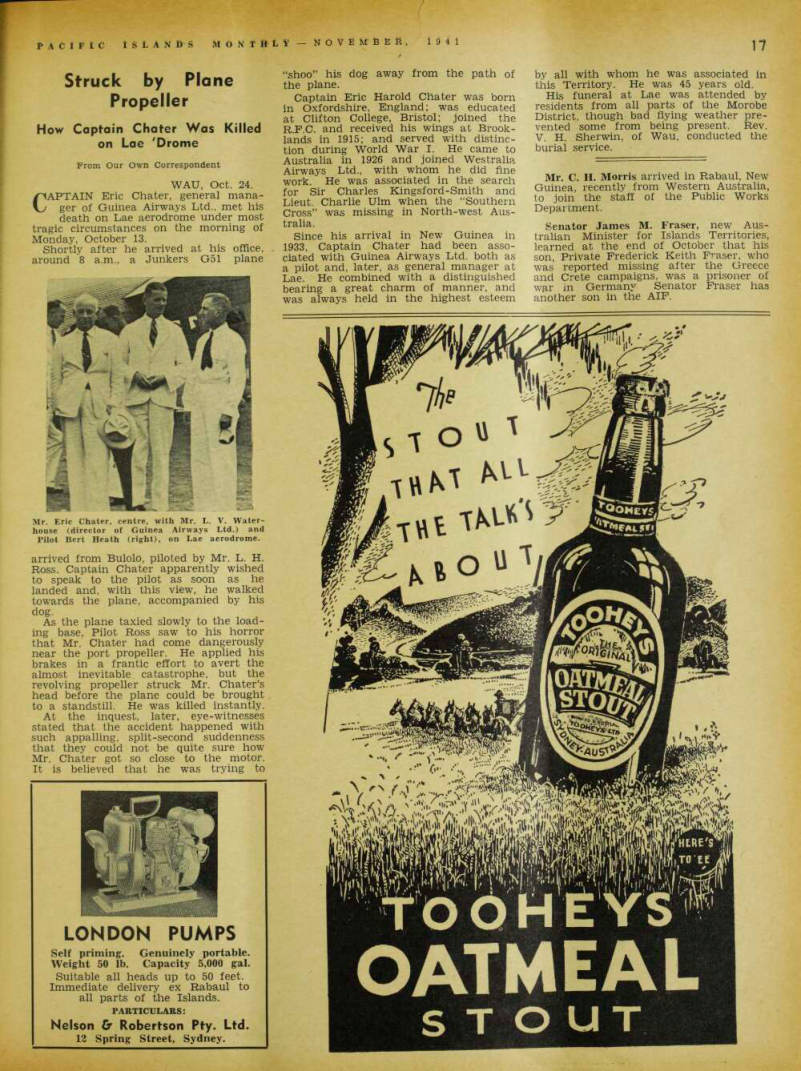
Struck by Plane Propeller How Captain Chater Was Killed on Lae 'Drome
From Our Own Correspondent WAU, Oct. 24.
CAPTAIN Eric Chater, general mana ger of Guinea Airways Ltd., met his death on Lae aerodrome under most tragic circumstances on the morning of Monday, October 13.
Shortly after he arrived at his office, around 8 a.m., a Junkers G5l plane
Mr. Eric Chater, centre, with Mr. L. V. Water house (director of Guinea Airways Ltd.) and Pilot Bert Heath (right), on Lae aerodrome. arrived from Bulolo, piloted by Mr. L. H.
Ross. Captain Chater apparently wished to speak to the pilot as soon as he landed and, with this view, he walked towards the plane, accompanied by his dog.
As the plane taxied slowly to the load ing base, Pilot Ross saw to his horror that Mr. Chater had come dangerously near the port propeller. He applied his brakes in a frantic effort to avert the almost inevitable catastrophe, but the revolving propeller struck Mr. Chater’s head before the plane could be brought to a standstill. He was killed instantly.
At the inquest, later, eye-witnesses stated that the accident happened with such appalling, split-second suddenness that they could not be quite sure how Mr. Chater got so close to the motor.
It is believed that he was trying to
“shoo” his dog away from the path of the plane.
Captain Eric Harold Chater was born in Oxfordshire, England; was educated at Clifton College, Bristol; joined the R.F.C. and received his wings at Brook lands in 1915; and served with distinc tion during World War I. He came to Australia in 1926 and joined Westralia Airways Ltd., with whom he did fine work. He was associated in the search for Sir Charles Kingsford-Smith and Lieut. Charlie Ulm when the “Southern Cross” was missing in North-west Aus tralia.
Since his arrival in New Guinea in 1933, Captain Chater had been asso ciated with Guinea Airways Ltd. both as a pilot and, later, as general manager at Lae. He combined with a distinguished bearing a great charm of manner, and was always held in the highest esteem
by all with whom he was associated in this Territory. He was 45 years old.
His funeral at Lae was attended by residents from all parts of the Morobe District, though bad flying weather pre vented some from being present. Rev.
V. H. Sherwin, of Wau, conducted the burial service.
Mr. C. H. Morris arrived in Rabaul, New Guinea, recently from Western Australia, to join the staff of the Public Works Department.
Senator James M. Fraser, new Aus tralian Minister for Islands Territories, learned at the end of October that his son, Private Frederick Keith Fraser, who was reported missing after the Greece and Crete campaigns, was a prisoner of war in Germany Senator Fraser has another son in the AIF.
Mr. R. V. Pratt, who managed Pat langat Plantation, New Britain, a few years ago, before coming to Australia, passed his final medical examination at Melbourne University in October. He is the son of Mr. Victor A. Pratt, of Tobera Plantation, TNG.
Mr. Clifford Gessler, of Oakland, Cali fornia, in a note to the editor of “PIM”, says that the Appleton-Century Co., of USA, will publish next year another South Seas book written by him, titled tentatively “The Leaning Wind”. He was a member of the Bishop Museum party on Tepuka and other islands in the Tuamotu Group (French Oceania) in 1934 and the new book will cover other of his ex periences with the expedition not included in his previous volume “Road My Body Goes”, Mr. Gessler is the author, too, of “Hawaii: Isles of Enchantment”, “Tropic Landfall”, and “Kanaka Moon”.
Advertisements & other items, pp. 19-20 (2 items)
17
pacific islands month-lit November,, is4i
rasfe
!>-•** y %
-IT'S \ :
* % I* t\ ✓ y i . \lf>, -- -,7 5 r *T- ►
rasfe
j—. =&-t « ifN
kv;-5l
’J =^ v * s A> O O *D SP. ■sr «:
llnii/ii
%K\
LONDON PUMPS
Self priming. Genuinely portable.
Weight 50 lb. Capacity 5,000 gal.
Suitable all heads up to 50 feet.
Immediate delivery ex Rabaul to all parts of the Islands.
PARTICULARS:
Nelson Cr Robertson Pty. Ltd. 12 Spring Street, Sydney.
ft FORTUNE FOR THE TAKING
GOLD DISCOVERV REPORTED—RUSH TO LEAVE ENGLAND.
London—lBB4. 0 Confirmation has been received of the exciting discovery of a gold field in West Australia.
The field has been named Kimberley, after the famous mines of South Africa. Many young married couples and families are venturing to try their fortunes, and are setting out for the colony in great baste. <3 Although there has been considerable development of the colony recently, the Kimberley field is remote, and hardships will have to be endured by adventurers. m
THE
FROM ENGLAND AND OF MORE
VALUE THAN GOLD!
To sustain the health that is more valuable than wealth, these Australian adventurers were able to bring with them a plentiful supply of delicious and nourishing Foster Clark's Creamy Custard.
Over 70 years ago Foster Clark's Creamy Custard won approval for its quality and easy preparation. Now, Foster Clark's is the popular Custard wherever the British flag flies, famed for its pure, fine ingredients. It is rich in the vitamins that build sound, healthy bodies. Serve it to your family often.
SINCEREST FORM
FLATTERY.
There are many imitations of Foster Clark's Creamy Custard. But Custards that are made merely to sell at a low price cannot compare with Foster Clark's. There are no artificial flavours in Foster Clark's Custard!
Refuse cheap substitutes. Insist on Foster Clark's, the Custard with the reputation! & IT PAYS TO BUY THE BEST !
It pays to buy Foster Clark's Creamy Custard, because it goes further! You have the choice of Vanilla, Lemon, Almond and Standard and various sizes, including a penny packet! Ask for Foster Clark's
Creamy Custard.
V11678.
Roll Of Honour
(It is hoped to assemble, here, the names of men, former residents of the Pacific Territories, which appear in British and Free French casualty lists, or in lists of honours awarded.
We should be grateful if relations and friendj would send us details.)
Killed
Pilot-Officer Len BAYLISS, flying instructor in the RAAF. formerly of Rabaul, New Guinea.
Killed in Sydney, 18/11/1940, when he fell from a trainer aircraft in flight.
A/Bdr, Neville W. BERTWISTLE, AIF artillery (tank unit), formerly a clerk on the staff of W. R. Carpenter and Co., Ltd., of Rabaul, New Guinea. Killed in action, April, 1941.
Flight-Lieutenant G. J. I. CLARKE, of the RAAF, formerly Assistant Flight Superintendent of Carpenter Airways, New Guinea. Reported missing after operations off Dakar (French West Africa), while attached to HMAS "Australia”, 25/9/1940—now presumed killed.
Pte. Felix CRAIG, AIF, formerly of accounts department, Australasian Petroleum Co., Port
Moresby, Papua. Reported killed, June, 1941.
V. L. DEARMAN, of the RAAF, formerly of the Colonial Sugar Refining Co. Ltd., in Fiji.
Reported killed in action in the Middle East, October, 1941.
Captain Kenneth GARDEN, of the RAF Perry Command, formerly chief pilot of Guinea Air ways Ltd., in New Guinea. Killed, 2/9/1941, when the bomber he flew from USA crashed on west coast of Britain.
Flying-Officer Moresby GOFTON, of the RAP, son of Mrs. F. S. Stewart, of Wau, New Guinea.
Reported missing, 17/5/1940—now presumed killed.
Flying-Officer K. J. A. JOHNSTONE, of the RAF, who was born in Suva, Fiji, in 1915. Re ported missing after bombing raid on Norway, 1/5/1940 —now presumed killed.
Pte. L. F. McCarthy, AIF infantry, form erly supercargo on W. R. Carpenter and Co.’s inter-island vessel “Mako”, in New Guinea.
Reported “wounded in action and missing— believed prisoner of war”, 15/7/1941; reported “killed in action”, 30/10/1941.
Cpl. Alex. C. SCOTT, AIF, formerly manager at Kieta, TNG, for Burns, Philp and Co,, Ltd.
Killed in action in the Middle East, 19/6/1941.
Died From Wounds
Pte. Ernest HENRY, AIF, formerly of the Rabaul (NG) staff of Burns, Philp and Co., Ltd. Died from wounds received during Battle of Crete, 1/6/1941.
Pte. Walter PEARSON, of first NG Quota of ALP (infantry). Died from wounds received in action, 24/6/1941.
A/Bdr. W. R. SCOTT, AIF, of New Guinea.
Died from wounds, July, 1941.
Sergeant-Pilot Peter Clarkson WISE, of the RAF, son of Mr. W. Wise. OBE, Director of Public Works, Fiji. Died from wounds received during bombing raid over Germany, January, 1941.
Died From Illness
Pte. Clarence A. HUTTON, AIF, formerly of Edie Creek, New Guinea. Died from illness.
April, 1941.
Missing
A/Sgt. A. A. S. COTMAN, AIF infantry, of Abau, Papua. Reported missing—believed prisoner of war, 5/5/1941.
Alex. McKAY, of the RAAF, formerly engineer at the Colonial Sugar Refining Co.’s mill, Penang, Fiji. Reported missing, August, 1941, Gnr. A. H. ROSS, AIF artillery, of Rabaul, TNG. Reported missing—believed prisoner of war, 28/9/1941.
James SIMPSON, of the RAF, formerly of Vatukoula, Fiji. Reported missing ’ after air operations over Malta, in the Mediterranean. 1/7/1941.
Pte. John O. SMITH, of the NZ Forces, son of Captain Smith, of “Tui Kauvaro”, and Mrs.
Smith, of Suva, Fiji. Reported missing, 29/5/1941, during Greek campaign.
Pte. FRED. SWAN, NZ Army Medical Corps, formerly of Apia, Western Samoa, Reported in August, 1941, “missing after Battle of Crete”.
Wounded
Pte, V. BLANCO, AIF infantry, of Thursday Island. Reported wounded in action, 8/7/1941.
L/Cpl. J. P. BLENCOWE, AIF infantry, of Rabaul, TNG. Reported wounded in action, 15/7/1941.
Pte. Thomas BYERS, AIF infantry, of Thurs day Island. Reported wounded in action. May, 1941.
Sgt. C. HENDRICK, AIF infantry, of Rabaul, TNG. Reported wounded in action, 15/7/1941.
Stanley HIGGS, son of Mr. and Mrs. Gordon Higgs, of W. R. Carpenter and Co., Ltd., well known in New Guinea. Member of an English Lancers’ regiment, wounded during British evacuation from Dunkirk (France), May, 1940.
Lieut. L. T. HURRELL, AIF infantry, of Rabaul, TNG. Reported “wounded in action, remaining on duty”, 29/7/1941.
Cpl. W. H. LANNEN, AIF artillery, of Rabaul, New Guinea. Reported "wounded in action — on seriously ill list, 30/6/1941; removed from seriously ill list, 25/7/1941”.
Gnr. E. G. LOBAN, AIF artillery, of Thursday Island, wounded during Greek campaign, May, 1941. Invalided home after having his left forearm amputated.
Capt. Edward Tiwi LOVE, NZ Maori Battalion, husband of Mrs. Takau Rio Love, Ariki-nui of Rarotonga, Cook Islands. Reported missing dur ing Greek campaign, 27/5/1941; later, 22/6/1941, reported “wounded and safe”.
Cpl. R. McKERLIE, AIF, of Yandina, BSI, wounded in face by bomb explosion, April, 1941.
A/Sgt. Alastair MACLEAN, AIF infantry, of Rabaul, New Guinea. Wounded in action, in Libya, 30/6/1941.
S/Sgt. Graham B. MIRFIELD, AIF engineers, of Rabaul, New Guinea. Wounded in action, 16/7/1941.
Pte. L. G. REECE, of Bulolo, New Guinea. Re ported wounded in action with AIF, July, 1941.
A/Cpl. N. K. SAWYER, AIF infantry, of Rabaul, TNG. Reported wounded in action, 22/7/1941.
Pte. Lance STAMPER, AIF, formerly school master at Wau, New Guinea. Reported wounded in action, August, 1941.
Pte. H. G. TURNER, AIF, of Samarai, Eastern Papua. Wounded in action at Bardia (Libya), January, 1941.
Pte. F. D. TWISS, AIF infantry, of New Guinea. Reported wounded in action, August, 1941.
Prisoners Of War
A/Cpl. Peter W. BOSGARD, AIF infantry, formerly of the Lands Department, Port Moresby, Papua. Reported prisoner of war at Solmona, Abruzzi, Italy, 29/6/1941.
Pte. W. GOSSNER, AIF infantry, of Port Moresby, Papua. Reported prisoner of war, Abruzzi, Italy, 6/7/1941.
Gnr. A. L. B. KING, AIF artillery, of Rabaul, TNG. Reported prisoner of war, 29/7/1941.
A/Cpl. John H. LONERGAN, AIF, Supply and Transport, of New Guinea. Reported prisoner of war at Corinthia, Italy, 8/7/1941.
Decorations
Lieut. Colin HILL, RANR, of the Australian destroyer, “Waterhen”, formerly second officer on the trans-Pacific liner “Niagara”. Awarded Order of the British Empire for salvaging a burning 'oil tanker near Suda Bay, Crete.
Flying-Officer James R. HYDE, of the RAF, formerly a Patrol Officer in Namatanai and Sepik Districts, TNG. Awarded the Distinguished Flyiifg Cross for bombing raids on Heligoland Bight, in the North Sea.
Lieutenant-Commander A. W. R. McNICOLL, RAN, son of Sir Ramsay McNicoll, Adminis trator of New Guinea, and Lady McNicoll.
Awarded the George Medal “for gallantry and undaunted devotion to duty”.
Sgt. Geoffrey MOORE, of the NZRAF, for merly engineer on the NG inter-island vessel “Maiwara” and on the trans-Pacific liner “Aorangi”. Awarded the Distinguished Flying Medal for “shooting down an enemy fighter and driving off two others, and having displayed great courage and a high standard of gunnery at all times”.
Private L. F. McCarthy
NOTIFICATION was received in Rabaul at the end of October that Private L. F. McCarthy, AIF infantry (mem ber of the New Guinea quota) was killed in action during the recent fight ing in Syria. Previously, he had been reported “wounded in .action and missing —believed prisoner of war”.
McCarthy was well known in New Guinea as supercargo on W. R. Carpenter & Co.’s inter-island vessels, having served on the “Bopple”, “Coombar”, “Desikoko” and “Mako”, prior to enlistment. He first went to New Guinea in 1936, as an assis tant plantation overseer in the Western Islands group; later he was at Ulaveo plantation and then Pondo.
Partially Lifted
New Caledonian Freight Tax Partially Lifted
From Our Own Correspondent
Noumea, Oct. 14.
rE freight tax amounting to \2l per cent, will not in future be paid on imports from Australia of flour, rice, sugar, chemical goods, condensed milk, washing soap, cooking oil, and leather. It will, however, still apply to other merchandise.
Mr. V. W. Maxwell, prominent New Guinea rubber planter, is at present in Sydney on holidays. He joined the AIF some time ago, but was discharged for health reasons. Mr. Maxwell’s daughter, Miss Sonia Maxwell, who at present is doing an Arts and Social Science course at the Sydney University, has been ac cepted as a wireless telegraphist in the Women’s Auxiliary Air Force.
A Trader's Tale
By “Tukapa Koko”
WHAT is, a six-months-long Hurricane Season to you, dwellers on those islands where a monthly steamer calls! And what, even, to you, safe and salaried Europeans on the isolated outer isles, where funds suffice for a laying-in of six months’ necessary luxuries landed from the final schooner of the year!
The Polynesian is not so well off. His, by grace of Nordic civilisation, the taste for such white-man’s “kai” as tinned meats, salmon, and sardines; his the “kaki” for biscuits, the “yen”, so to speak, for butter; but he has to “kaki” in vain, in such times as funds are not.
And, at Mangaia, since copra became a cypher in the market, the days of poverty run through half the year.
Wherefore, of Tokoroa.
Tokoroa was one of those natives, old seeming but not even really elderly, who pass from the “mapu” stage, the strut ting Don Juan-ism of village youth, to the stodgy middle-age of matrimony at 20; and, at 40, rank as elderly nonentities, without that dignity that goes with a recognised patriarchy. Consider it well, ye who begrudge the Polynesian his brief hour of glorious life around the “bush beer” bowl, and the delights of nocturnal adventure.
Tokoroa was not very old. Hard work was his lot, up to the waist day after day in a stinking taro-swamp, and he realised there was a price to pay when he developed a cough that pained his chest and left him weak.
He worked some more, ignored the handicap. The years went by. He packed and shipped oranges, earning the case money in the sweat of great labour, and
spending it on the needs of his family, for he had many children.
There were clothes to buy; taxes to
pay; European food, at stiff prices, to be got for those days when the dan gerous reef of Mangaia was a locked
door to the Ocean of Kiwa, and fish not to be had.
Came the hurricane season and the opening months of the year proved cruelly lean. One cannot live by taro alone; I doubt if even the heathen of ancient days enjoyed the rubbery root as a whole menu from soup to nuts. It may be for that reason they were cannibals!
Tokoroa, their modern descendant, would have died rather than eat the “long pig”, for he was a devout Ekalesia, or native Church - Member. Tokoroa worked, fished, and tried all he could to feed his family well; but there were short-commoned days, and rough seas for weeks at a time.
The cough, reaching a climax, went on to haemorrhage; and Tokoroa realised he had “TB”. No more fishing, no more hard work; but, yet, no other means of living.
I don’t know how the family lived; but, with their head hors de combat, it is likely they went short.
I would have liked to help; but my finances were as strait as theirs, until a ship should arrive—and that was not to be till April.
Tokoroa went through January; en dured February, with its rains; survived March, with its minor hurricane. The coughing and haemorrhages were worse; he found it hard to speak.
The April boat came, and Tokoroa was nearly above the palms; but he hung on, inspired by the desire to taste once more his favourite “kai”—cabin biscuits, with butter on them.
I, deep in debt, was hard up; but, as soon as the ship arrived, I hastened to buy two-shillings’-worth of the luxury, and a tin of butter, out of the newly unpacked cases. Leaving my mail, my parcels, I rushed up the rocky stairway, the Jacob’s ladder that leads from the beach to the inland village, the planta tions and the mountain.
Come what might to-morrow, or next day, or next week, Tokoroa’s little luxury was secure to him—after the long, dreary hurricane-months that cut Mangaia off from all shipping communication.
As I climbed, the hooting from the steamer’s whistle rang inland, arousing all Mangaia to the joyful news of plenty after dearth—lashings of money, tons of food, a good time. Till funds ran out again! But it mattered little, for the steamer was to call every month till at least July.
I reached the peak of the inland road; paused, panting, at the door of the little, dark hut that Tokoroa called his home.
The door, of reeds in a wooden frame, was shut. The sunshine, perhaps, worried the sick man’s weakened eyes. I knocked.
The frame door opened. Mrs. Tokoroa looked out. She was pitifully ragged; her black, expressionless eyes, round as a moth’s, looked into mine.
“Here are the butter and biscuits for Toko,” said I, in my best vernacular.
The dark, moth-like eyes blinked, the brown woman burst into a wail of “Aue, aue, aue!”
“Here, cheer up,” said I. “Give some to Toko, and have a few yourself—happy days are here again.”
“Tokoroa, my man, he die,” said the widow of fifteen minutes, weeping.
Koitaki Para Rubber Estates Ltd., of Papua, earned net profit of £6,755 for the vear ended June 30, compared with £12,156 for 1939-40. Ordinary dividend has been reduced from 121 to 10 per cent., and requires £7,501. Prefer ence dividend amounts to £l9. The carry forward is £3, against £768 brought for ward. The report states that, owing to drought conditions, output fell to 503,827 lb. of dry rubber, which was 36,149 lb. less than the preceding year.
Advertisements & other items, pp. 21-22 (1 item)
Knox Grammar School
WAHROONGA, NEW SOUTH WALES, AUSTRALIA
(Headmaster, Dr. W. Bryden, M.Sc.) The School is situated 12 miles from Sydney, 600 feet above sea level, and accepts day boys and boarders from six years of age. Boys prepared for all usual Examinations.
Spacious playing fields, swimming pool, well equipped gymnasium, library. Cadet Corps, etc. Prospectus on application. -vs m - :
FISH Cr MEAT PASTES
For lunches or savouries for suppers or breakfast dishes, you can’t beat Peck’s fish and meat pastes . . .
Discriminating hostesses everywhere are using Peck’s Pastes in a hundred different ways. Try them to-day.
Get your supplies from
HARRY J. YOUNG
PTY. LTD.
379 Kent Street, Sydney A Product of Harry Peck & Co. (Aust.), Pty., Ltd., Sydney.
W.H. GROVE £ SONS
Limited
AUCKLAND
Island Traders. P.O. Box 490.
Telegraphic and Cable Address: “Grove”, Auckland.
Shippers of all classes of New Zealand products.
Representing English Manufacturers throughout the Cook and Society Islands, Fiji, Tonga, Samoa, Niue, New Caledonia, New Guinea, etc.
In FIJI as—W. H. Grove & Sons (Fiji) Ltd.
English Cigarettes of Quality
HILL'S famous
Sunripe
In case of difficulty in obtaining supplies, write to Box 1861 K., G.P.0., Sydney
Death Of Tongan Leader
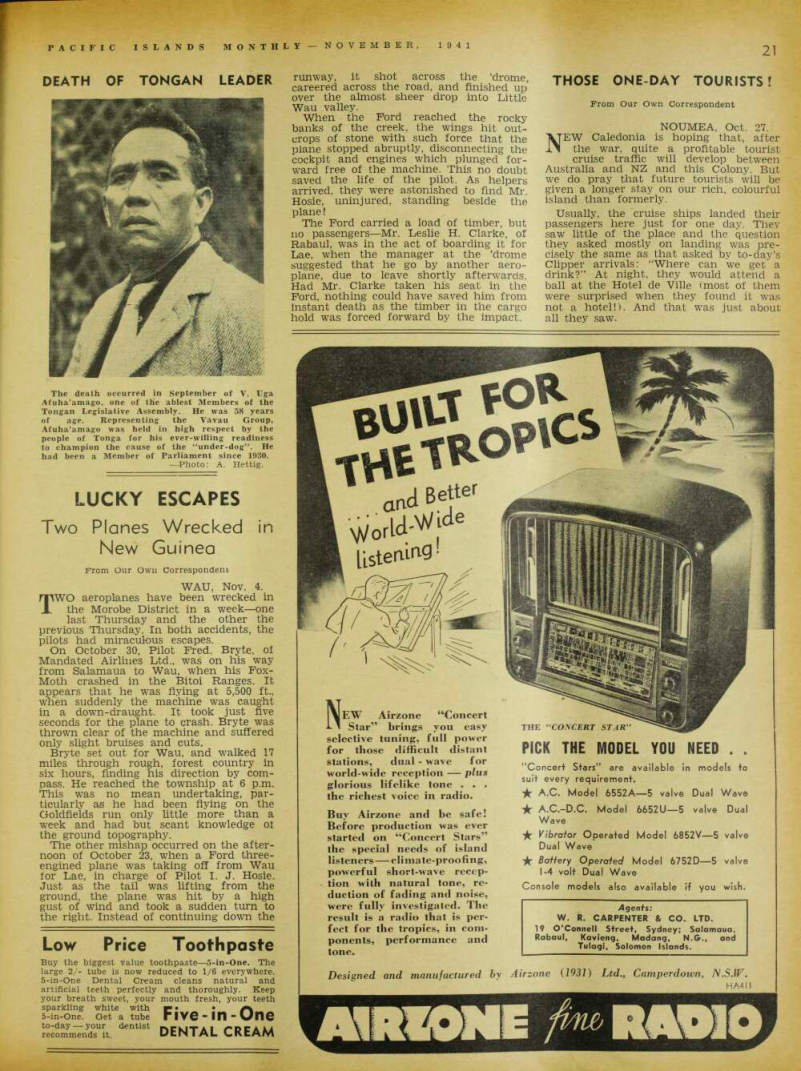
The death occurred in September of V. Uga Afuha’amago, one of the ablest Members of the Tongan Legislative Assembly. He was 58 years of age. Representing the Vavau Group, Afuha’amago was held in high respect by the people of Tonga for his ever-willing readiness to champion the cause of the “under-dog”. He had been a Member of Parliament since 1930. —Photo: A. Hettig.
New Guinea
Lucky Escapes
Two Planes Wrecked in New Guinea
From Our Own Correspondent
Wau, Nov. 4.
TWO aeroplanes have been wrecked in the Morobe District in a week—one last Thursday and the other the previous Thursday. In both accidents, the pilots had miraculous escapes.
On October 30, Pilot Fred. Bryte, of Mandated Airlines Ltd., was on his way from Salamaua to Wau, when his Fox- Moth crashed in the Bitoi Ranges. It appears that he was flying at 5,500 ft., when suddenly the machine was caught in a down-draught. It took just five seconds for the plane to crash. Bryte was thrown clear of the machine and suffered only slight bruises and cuts.
Bryte set out for Wau, and walked 17 miles through rough, forest country in six hours, finding his direction by com pass. He reached the township at 6 p.m.
This was no mean undertaking, par ticularly as he had been flying on the Goldfields run only little more than a week and had but scant knowledge of the ground topography.
The other mishap occurred on the after noon of October 23, when a Ford three engined plane was taking off from Wau for Lae, in charge of Pilot I. J. Hosie.
Just as the tail was lifting from the ground, the plane was hit by a high gust of wind and took a sudden turn to the right. Instead of continuing down the
runway, it shot across the ’drome, careered across the road, and finished up over the almost sheer drop into Little Wau valley.
When the Ford reached the rocky banks of the creek, the wings hit out crops of stone with such force that the plane stopped abruptly, disconnecting the cockpit and engines which plunged for ward free of the machine. This no doubt saved the life of the pilot. As helpers arrived, they were astonished to find Mr.
Hosie, uninjured, standing beside the plane!
The Ford carried a load of timber, but no passengers—Mr. Leslie H. Clarke, of Rabaul, was in the act of boarding it for Lae, when the manager at the ’drome suggested that he go by another aero plane, due to leave shortly afterwards.
Had Mr. Clarke taken his seat in the Ford, nothing could have saved him from Instant death as the timber in the cargo hold was forced forward by the impact.
Those One-Day Tourists!
From Our Own Correspondent
Noumea, Oct. 27.
NEW Caledonia is hoping that, after the war, quite a profitable tourist cruise traffic will develop between Australia and NZ and this Colony. But we do pray that future tourists will be given a longer stay on our rich, colourful island than formerly.
Usually, the cruise ships landed their passengers here just for one day. They saw little of the place and the question they asked mostly on landing was pre cisely the same as that asked by to-day’s Clipper arrivals: “Where can we get a drink?” At night, they would attend a ball at the Hotel de Ville (most of them were surprised when they found it was not a hotel!). And that was just about all they saw.
Mr. H. Humble, of Wau, TNG, has taken up a position at Madang as accountant with Colyer. Watson (NG) Limited.
Advertisements & other items, p. 23 (1 item)
oP' cS
and Betwr
World^‘ ie
Uste^-
Kip
MU NEW Airzone “Concert Star” brings you easy selective tuning, full power for those difficult distant stations, dual - wave for world-wide reception plus glorious lifelike tone . . . the richest voice in radio.
Buy Airzone and be safe!
Before production was ever started on “Concert Stars” the special needs of island listeners climate-proofing, powerful short-wave reception with natural tone, reduction of fading and noise, were fully investigated. The result is a radio that is perfect for the tropics, in components, performance and tone.
THE “CONCERT STAR ”
PICK THE MODEL YOU NEED . .
"Concert Stars" are available in models to suit every requirement. fa A.C. Model 6552 A—5 valve Dual Wave fa A.C.-D.C. Model 6652 U—5 valve Dual Wave fa Vibrator Operated Model 6852 V—5 valve Dual Wave fa Battery Operated Model 6752 D—5 valve 1-4 volt Dual Wave Console models also available if you wish.
Agents:
W. R. CARPENTER & CO. LTD.
19 O'Connell Street, Sydney; Salamaua, Rabaul, Kavieng, Madang, N.G., and Tulagi, Solomon Islands.
Designed and manufactured by Airzone {1931) Ltd., Camperdown, N.S.W.
HA4II
Low Price Toothpaste
Buy the biggest value toothpaste—s-in-One. The large 2/- tube is now reduced to 1/6 everywhere. 5-in-One Dental Cream cleans natural and artificial teeth perfectly and thoroughly. Keep your breath sweet, your mouth fresh, your teeth sparkling white with • • 5-in-One. Get a tube rive-in to-day your dentist r\CkJT A I rnr aki recommends it. ULNIAL LKtAM
One
Four Castaways
Rescued
Six Months on Uninhabited Tuamotu Isle
From Our Own Correspondent
Papeete, Sept. 29.
SINCE the day of Daniel Defoe, novelists and tellers of tales have filled the world with variations of the story of castaways on an uninhabited island.
Few have ventured to abandon their characters to the chances of fortune without providing for them supplies and implements to aid in their battle with nature.
Robinson Crusoe had his flint and steel, his musket and ammunition. In more modern tales, cases of tinned ox-tongue and of caviare, boxes of vitamin tablets, and magnums of champagne always float ashore from the wrecked yacht to com fort Mr. Babbit and his stranded guests.
Such is fiction. Here follows a storv of the real thing.
Late in July of this year, the motor schooner “Denys”, of Papeete, was sail ing through an unfrequented part of the Tuamotu Archipelago, the vast barrier ot coral atolls and reefs to the east of Tahiti. As the “Denys” was passing a
small coral island named Paraoa, smoke and <^ blg fire were seen on shore. Now, the Denys” company knew that Paraoa has been uninhabited for generations: so they sailed over to investigate.
When they reached the island, they found there three men and a woman whom all French Oceania long ago had believed to be at the bottom of the sea.
Stranded on the reef was the battered hull of the cutter “Saint Pierre”
The three-ton cutter “Saint Pierre”, owned by the Roman Catholic Mission, left Nukutavake (an island of the eastern Tuamotus) for the Gambier Islands on January 16. On board were Pere Stanislas (priest of the eastern islands parish) and seven natives—six men and a woman.
On the 19th, they called at the island of Vananga, and on the 20th proceeded on their voyage. Late that night a hurri cane struck, breaking the mast and cap sizing the cutter. After an hour, clinging to the hull, they succeeded in righting the vessel. The following day, Pere Stanislas and a native died.
It was not until the 24th that the survivors emptied the boat of water.
Three days later they got un to the atoll Teuarunga. Two men, who were stronger than the rest, went ashore in search of water. No coconut trees grow on that part of the island, and the two went farther afield in quest of a water hole. When, after three hours, they re turned. there was no sign of the “Saint Pierre” and her four passengers.
The three men and the woman rescued by the “Denys” have no clear recollection of how they arrived at Paraoa. Winds and currents had borne them to an islet where coconuts grew. Weak and ema ciated, they crept to the shelter of the trees. Fortunately, some young trees, in bearing, were nearby and they were able to get a few niaa (nuts in the stage best for drinking). The sweet water and the nutrient, creamy pulp revived them somewhat.
Their next care was to kindle a fire.
The ancient art of hi’a-i-te-auahi (pro ducing fire by friction) has been for gotten in most of Central Polynesia, but still survives on Nukutavake where matches are scarce. A pointed stick (called the aurima) held in both hands is rubbed quickly and with increasing pressure along a groove formed in a piece of soft, dry wood (called the ’au’ati). The fine wood-dust produced in the groove soon smoulders and glows. Tinder of coconut husk and dry grass are kindled from this glowing dust and blown into flame.
Fish that swarm about coral reefs of uninhabited atolls have not the inherited fear of man as have those in waters about populated islands. Thev swim fear lessly by, in and out of the shallow pools.
The castaways had but to block, with lumps of coral, the channels leading to the sea, and they had at hand an ample supply of fish. Lonely coral reefs also are strewn with shell-fish of many kinds.
As they waxed in strength, the four were able to contrive tackle—by plaiting the fibres of the coconut into fine, strong ’aha (sinnet), as lines for hooks fashioned of iron-hard makimaki wood and bones —for catching deep sea fish.
The coconut palm served them in many ways and gave lavishly. Both the niaa and opaa (the mature nut) provided food and drink in variety such as Islanders alone know the secrets of preparation.
The creamy liquid—rito haari—squeezed from freshly grated coconut and seasoned with sea-water is the favourite sauce to flavour fish and other comestibles. Coco nut fronds, plaited, formed the thatch and walls of the shelters they erected.
For clothing, the coconut also supplied them with the coarse integument (aa haari) which grows about the trunk of young trees.
When the “Denys” picked up the cast
aways, after six months on the island, they were well nourished, strong and healthy and had experienced no sickness whatsoever, save nostalgia for friends and kindred. She took them to Nukutavake whence they had set out nearly seven months before. Their reappearance caused a sensation.
The other two natives, who went ashore at Teuarunga, had built a raft and made their way to the inhabited atoll of Vahanga, whence they were brought by the Government motor-schooner “Tam ara” to Papeete. Here, they told the story of the voyage and the loss of their com panions. When the news reached Nuku tavake, mass for the dead was said and the women of the families of those pre sumed lost at sea cut off their long braids of hair, as is the custom.
M. and Mme. Pierre Jeannin, of Noumea, New Caledonia, arrived at Auck land, NZ, by PAA Clipper on October 24.
While in NZ, he will.undergo an operation.
Dr. N. H, Fisher, Government geologist and vulcanologist at Rabaul, New Guinea, returned to the Mandated Territory in October after an extended holiday in Australia. Late in the month, he left for Papua on a several weeks’ visit.
Advertisements & other items, pp. 24-26 (2 items)
New Fordite
Radio
REPLACEMENT
Parts
MAY we help you with that "hard-to-secure" part? If not available from stock we can have it made for you.
Send full details of set, make and model, and, if possible, send the faulty component.
PRICE’S Radio Service 5 & 6 Angel Place, SYDNEY
A NEW
LIGHTWEIGHT,
MEDIUM - PRICED CASE
IN ALL NEEDED SIZES !
Mode by an improved new process, the new Fordite fibre is harder-wearing and longer-lasting. It is glossy and smooth . . . providing a highly serviceable travel case at a moderate price. It saves weight . . . pick up a new Fordite and you'll see at once how much lighter it is!
NEW FORDITE
TRAVEL CASES
Attache, No. 707. Suit Case, No. 718.
All storekeepers can supply. Traders are invited to apply for price list and full particulars.
FORD SHERINGTON LTD.,
Manufacturers, Kippax Street, Sydney.
Asthma, Catarrh
AMAZING MEDICAL DISCOVERY!
HAY FEVER, BRONCHITIS SUCCESSFULLY TREATED!
RESULTS ARE GUARANTEED OR YOUR MONEY REFUNDED No matter how chronic your condition, the Rev. Edgar Ward’s World Famous Herbal Discovery, “Kuranui 47” will work Miracles for you. Thousands of sufferers who had given up all hope now testify to the amazing
properties of “Kuranui 47.”
Science Discovers Cause of ASTHMA
Medical science has recently proved conclusively that Asthma, Catarrh, Hay Fever and Bronchial affections are not merely “Local” Complaints, BUT ARE THE MANIFESTATION OK “RESULT” OF SOME DEEP-SEATED
NERVOUS, BLOOD-STREAM OR FUNCTIONAL DERANGEMENT.
Therefore it will be readily realised that “Local” remedies such as “expectorants,” “inhalants,” “drops,” etc., cannot possibly achieve more
than mere TEMPORARY LOCAL RELIEF.
HOW “KURANUI 47” BRINGS COMPLETE RELIEF
Kuranui does not rely upon ONE method in its attack, for every sufferer knows that there may be several contributing causes. Moreover, Asthma or Catarrh in any two sufferers may be the result of two quite different causes. The phenomenal success of Kuranui is due to the fact that it contains REMARKABLE HERBAL INGREDIENTS, which attack Asthma, Hay Fever, Catarrh, etc., in FIVE DISTINCT WAYS.
TREATMENT
NEW "FIVEWAY"
FIRSTLY KURANUI IMME-
DIATELY soothes and relaxes the bronchial passages, freeing toughened mucus and phlegm so that it comes away easily. It relieves dry, hacking coughs.
SECONDLY
KURANUI acts directly upon the stomach, enabling the system to appropriate ail the nutriment required for natural repair. It prevents the formation of poisonous toxins. KURANUI corrects digestive troubles.
THIRDLY kuranui*s
powerful tonic properties soothe
and feed the entire nervous system, relaxing the spasms which contract bronchial tubes and lungs, enabling you to breathe freely and without wheezing or choking.
FOURTHLY kuranui
purifies and restores to natural healthful action the whole intestinal tract, the seat of Catarrhal infection.
FIFTHLY kuranui acts through the blood-stream, preventing the formation of impurities and mucus, eliminating one of the main deep-seated causes of Asthma.
BREAKING THE “VICIOUS CIRCLE”
THUS: By freeing and preventing the formation of mucus —by enabling the stomach to assimilate vital nourishment —by strengthening the nervous system - killing the toxins restoring the whole system to normal functioning and building resistance —KURANUI breaks the “vicious circle” and overcomes the deep, destructive CAUSES of Asthma, Catarrh, Hay Fever and Bronchitis and Lung Troubles.
THE
COLON
r The Rev. Edgar Ward Minister and Qualified Pharmaceutical Chemist. Discoverer of the herbal formula “Ward’s 47,” now known as the
WORLD-FAMOUS
“KURANUI 47”
No matter what is the cause of your Asthma, Catarrh, Hay Fever, etc., no matter how many other “one-action” remedies you have tried without results, “KURANUI 47” will bring complete relief IF YOU WILL BUT GIVE IT A
CHANCE.
But you must act now' —while this wonderful remedy can help you so easily.
The longer you put off trying Kuranui the worse your condition may become. So start on the Kuranui road now and watch your health return with every succeeding day.
Kuranui Brings Blessed Relief where other remedies fail
“FAMOUS IRISH PROFESSOR PRAISES
KURANUI.
Ireland.
Dear Rev. Ward, A friend of mine who has suffered from Asthma for a great many years asked me to state to you that the one supply of Kuranui has completely cured him, and now after a lapse of six months he remains cured. Asthma has been a disease of his family and he has undergone treatment by several doctors without result. I tender you his sincerest thanks of a good work well done for suffering humanity. (Signed) Joseph McCullough, Dip. Com. Econ., Univ., London.”
“FREE FOR 2 YEARS.
My husband has had Asthma and Kuranui is the only medicine which gives lasting relief. He has not had a bad turn for 2 years. Yours very truly, (Signed) G. Taylor.’
“TWO DOCTORS VERIFIED LING
ACTIVITY CEASED.
I have now completed 6 months’ treatment on patient. I have had her examined by two separate doctors with the same result in both cases —no activity, lung healed. This I consider an excellent report. (Signed) R.D.’
IMPROVED HEALTH.
29th May, 1941 : “I have not. had any bouts of Asthma during the whole time I was taking the last five packets of treatment. I have also put on lOlbs. in weight, so you can see I have received much benefit from the treatment.”
F.F.T., NAMBOUR, Q.
KURANUI IS SAFE Kuranulcon .
tains no harmful drugs and cannot harm the heart. Its various herbal ingredients are so mild and safe that Kuranui ran be taken by the youngest’child. No bothersome inhalations or expensive injections and no apparatus is required.
THE REV.
EDGAR WARD’S
MONEY-BACK
GUARANTEE.
If you are not entirely satisfied that Kuranui has achieved all that is claimed of it, you may return the unused portion of the „ Treatment and youi money will be refunded promptly and in full. Can you -ask for a fairer and I more honest offer ? And remember, you . will be the sole I judge.
FULL KURANUI TREATMENT
COSTS ONLY DAY
pm*
diM
The full 54-day Kuranui Treatment costs only 12/6!
It’s no use “just wishing” for miracles to happen; you can never get relief that way. You must do something about it. Send for the wonderful “Kuranui j 47” Treatment To-day. Attach 12/6 to the coupon below and your treatment will be forwarded by return mail.
Send
A.
Coupon To-day
J. SWANN
to Our Fijian Agent
I
A. J. SWANN !
Chemists, Victoria Parade,
SUVA, FIJI.
Also Australia: KURANUI TREATMENT ROOMS, MANCHESTER UNITY
BUILDING, 185 ELIZABETH STREET, SYDNEY, N.S.W.
Also New Zealand: KURANUI CLINICS, 84 LAMBTON QUAY, j
WELLINGTON, N.Z.
CHEMISTS, VICTORIA PARADE,
SUVA, FIJI. I
Dear Sirs,— I Please send me by return mail under plain wrapper a complete 54-Day Treatment of the Rev. Ward’s World Famous “Kuranui I 47”. I understand that if I am not entirely satisfied with results j I I may return the balance of the Treatment and my money will ' j be refunded promptly and in full. I enclose 12/6—complete cost 1 of the Treatment. i
NAME I
I I
ADDRESS
I I Safe Delivery is guaranteed.
(“P.I.M.”)
(Print name in Block Letters).
OLD MOHK
The World’s Finest Olive Oil San Francisco
& I
SILENT
Australia*s Fastest Selling Tyre
Dunlop
‘6s’ GOLF
BALLS
The fastest selling first-line ball in Australia. Known for its: Sealed Power, Greater Distance and Exclusive Permanised Pattern for Longer Accurate Life.
IN AUSTRALIA,
VICTOR
Dunlop
SPORT &
SANDSHOES
Comfort and Wear in Every Pair of Dunlop Sport and Sandshoes. Available in all popular styles for sports wear.
Dunlop
WEATHER
COATS
E x coptionally smart, well fitting Weather Coats for Men, Women and Children. Tailored styles in the latest thoroughly waterproof materials.
OTHER Dunlop
PRODUCTS
Tennis Equipment.
Belting.
Car Accessories.
Bathing Caps.
Cycle Tyres.
Garden Hose.
Household Gloves and Aprons, ete.
AS THROUGHOUT THE BRITISH EMPIRE, MOST PEOPLE RIDE ON DUNLOP TYRES.
DUNLOP PERDRIAU RUBBER CO. LTD. (Inc. in Vic.). 27-33 WENTWORTH AVENUE, SYDNEY, N.S.W.
A Fatal Error
RECENTLY, three New Zealand soldiers in Fiji were sentenced to long periods of imprisonment, with hard labour.
They had severely beaten up and robbed an Indian taxi-driver.
Here is the story behind it all.
The three lads, on leave for the even ing, talked to an Indian taxi-driver in Suva. He agreed, for £l, to take them to a house where morals do not run ac cording to law. He drove them to a quiet place, waited until they disem barked; and then he laughed at them, and drove away.
The soldiers made the remarks usual in such circumstances—and noted down the number of the car.
The next time they were on leave, they searched through the town for that taxi— found it, and engaged it to drive them to a locality outside the town. There, they reminded the driver of his perfidy, and gave him a thrashing calculated to make him remember the incident all his life.
They found 12/3 in his pocket, and this they took, on the ground that he owed it to them, anyway, for non-fulfilment of contract.
This was fine. But it was the wrong taxi-driver.
In this town, anything up to half a dozen Indians seem to take turns in driving one taxi; and even an experi enced European could easily mistake one for the other.
American medical scientists report that the ill-effects of the war-time shortage of quinine have been minimised by the discovery of two sulphanilamide deriva tives, effective against malaria. Sulpha drugs are not regarded as preferable, but are highly suitable substitutes for quinine.
Advertisements & other items, p. 26 (1 item)
New Samoan Inter-Island
BOAT
The new motor-vessel “Captain Steffany”, at Apia wharf. She recently commenced a regular service between Apia (Western Samoa) and Pago Pago (American Samoa). —Photo; A. P. McFarland.
Electricity Comes to Vila
From Our Own Correspondent
Vila, Oct. 13.
AFTER a preliminary trial, when the British and Free French High Com missioners for the Pacific were here a short time ago, the new electricity service was inaugurated at the end of September and has since been function ing regularly.
Installation was carried out by the Union Electrique Coloniale Company of New Caledonia, and M. Paul Laubreaux, of Noumea, is in charge of the plant.
Banana Prices
Would a Strike Help?
Letter to the Editor IWAS impressed with the article by “Leatherneck”, in August “PIM”, headed: "Why Not a Strike of
Copra-Growers?”
In Rarotonga, we have practically stopped making copra, and are giving our coconuts to pigs and fowls, which provide a better return than copra making; however, we grow bananas and oranges. Unfortunately, fruit prices are controlled by the NZ Minister of Mar keting, and growers have no say in the price of their own produce.
Prices now being paid are so low that there is general dissatisfaction among all planters—so “Why Not a Strike of Banana and Orange Growers” in Fiji, Samoa, Tonga and the Cook Islands?
A Pacific Island Banana-Growers’ Asso ciation is what we want. Then we could organise and stop selling bananas unless the buyer, or rather the NZ Minister of Marketing, is prepared to pay growers at the rate of 8/- for every 100 lb. net of packed bananas—cases to be supplied.
I am, etc..
Banana-Grower.
Rarotonga, Cl. 4/10/1941.
Superstition Still Lingers
In Tonga
From Our Own Correspondent
Nukualofa, Oct. 2.
IN c:mmon with other branches of the Polynesian race, Tongans still have a firm superstitious belief in their ancient signs and portents of death and ill-fortune, despite the influence of Christianity and* Western civilization.
An instance of these old beliefs is the legend, unyieldingly believed by present day Tongans, that whenever a white flying fox appears among the multitude of flying foxes that inhabit trees in the middle of Kolovai village, Hihifo (Tonga tabu), it presages the death of the holder of the hereditary title Ata, chief of the village, or some other high chief closely connected with his family. There are many inhabitants of Kolovai still living who witnessed the appearance of a white flying fox three days before the death of the father of the present Ata.
Although his people were certain that the old chief would die and made prepara tions for his funeral, the time-honoured ill-omen was never disclosed to him.
Strangely enough, a white flying fox was seen at the hanging place of the flying foxes by the people of Kolovai three days before Prince Consort Tugi, who was closely related to the Ata family, passed away.
The uninitiated babalagi (whiteman), new to the ways of the Islands, may frown with scepticism at these superstitious native beliefs, but “old hands”, who have seen strange happenings in the South Seas, will smile with tolerance, for they know that there are some queer things in the Islands which the babalagi can never understand.
Mr. G. W. Marston, Postmaster and Chief Radio Officer at Apia, Western Samoa, for the past four years, has returned to New Zealand.
Messrs. F. Swanston, T. Olifent and L.
Pitt left Rarotonga, Cook Is., recently, for overseas service with the NZ Mili tary Forces.
Administrator Visits
Eastern Papua
From Our Own Correspondent
Port Moresby, Oct. 16.
THE Administrator (Hon. H. L. Mur ray) accompanied by Mrs. Murray and Mr. D. Murray, returned re cently from an extensive inspection tour of all Government stations to the east of Port Moresby. Visits were made also to the mines at Misima and Woodlark Island, the desiccated coconut factory at Ahioma, and the head stations of the Anglican and Methodist Missions at Dogura and Dobu.
Accompanying His Honour was Rev. J.
D. Bodger, who as non-official Member of the Legislative Council took advan tage of the tour to make contact with districts and settlers he had previously not visited. Others in the party were
Mr. Justice Gore, Hon. E. B. Bignold, and Mrs. Bignold.
Leaving the drought-stricken district of Port Moresby, the party not unrea sonably hoped to find “green pastures” further east, but they were disappointed.
They found the same drought conditions throughout their tour —even Woodlark Island, famed for its excessive rainfall, was suffering severely from a shortage of water.
Mrs. Murray, who had not been to the Eastern Papua islands for many years— in fact, not since her last tour in the old "Merrie England”, 30 years ago— renewed many pleasant associations while at Misima, Woodlark Island, and the Trobriands.
Mr. J. R. Herd, Crown Solicitor at Apia, Western Samoa, was in New Zea land in October spending leave with Mrs. Herd and their young son.
Advertisements & other items, pp. 27-28 (1 item)
My Goodness-My GUINNESS
Advertisement of Export Bottlers Ltd., London.
A. Macfee & Co. Ltd., Wapping, Liverpool, England. 0 Stocked by all branches of
BROWN & JOSKE LTD.
BURNS PHILP & CO. LTD.
W. R. CARPENTER & CO. LTD.
MORRIS HEDSTROM LTD.
Modern Refrigeration for the South Sea Islands
The ELECTROLUX
KEROSENE OPERATED
REFRIGERATOR
ELECTROLUX offers economical, modern and completely efficient
REFRIGERATION FOR ISLANDS' HOMES.
FREEZES CONTINUOUSLY WHILE SMALL LAMP BURNS.
Freezing controlled by simply regulating height of flame. Uses only gallon of kerosene per week.
MOTORLESS ... NO PARTS TO GET OUT OF ORDER.
MODEL L 22 MODEL L3BO MODEL LKSSO Capacity & (as Illustrated) Capacity 2.2 cubic feet. Capacity 4 cubic feet. 5.5 cubic feet.
GUARANTEED FOR TWO YEARS.
• Write to your Local Distributor for prices and full details.
Obtainable from: W. R. Carpenter & Company Ltd.—Sydney, and the following New Guinea Branches: Rabaul, Salamaua, Wau, Kavieng, Madang, and Wewak.
Representation in Papua W. R. Carpenter & Coy. (Solomon Is.) Pty. Ltd.—Tulagi, British Solomon Islands.
On dumg & Company Pty. Ltd.—Butaritari, Gilbert and Ellice Islands. and New Hebrides.
Papua
Oil Prospecting in Papua ARC Spends a Million Pounds to Put Down Deepest Test Well
SINCE Australasian Petroleum Company Pty. Ltd. was formed at the end of 1938 and began an intensive search for oil in Papua and New Guinea, £1,000,000 has been spent on the project.
The Co. recently increased its capital from £1,000,000 to £2,000,000.
When APC (as the concern in known in the Territories) took over the areas held under special permit by Oil Search Ltd., the first task was to make a com prehensive aerial survey, in 12 months photographing 28,000 sq. miles of territory mostly unmapped and largely unknown.
Armed with maps produced from these aerial photographs, geological and geo physical survey parties went into the jungle to examine, on the ground, the more likely looking features detected by aerial photography.
As a result, the site for the first deep test well was selected in March, 1940. at Kariava, 75 miles up the Vailala River from the coast of the Gulf of Papua.
A difficult engineering problem now had to be faced —transporting and erec ting heavy drilling equipment, purchased at a cost of £200,000. This outfit, capable of going down to a depth of 10,000 ft., comprised many heavy lifts of over five tons. To handle these, wharves, jetties and cranes were erected on the banks of the Vailala where previously was only primeval jungle.
While these handling facilities were being built, a road from the river base to the drilling site was constructed. Al though only 3J miles long, this road was a difficult, expensive undertaking, cutting entirely through dense jungle, over sharply dissected ground, and in an area of extremely heavy rainfall. But, by November, 1940, the road was through to the drilling location, and erection of the plant commenced.
In March this year, the installation of the drilling plant was sufficiently far advanced to allow operations to commence.
Throughout the period of drilling plant installation, work proceeded with the construction of living quarters for staff and labour, offices and laboratories, work shop and power station, water storage tanks and pipe lines.
Since the commencement of drilling, good progress has been maintained, and a depth exceeding 5,000 ft. has now been reached, which is far in excess of the depth reached by any previously drilled test well in Papua. Drilling started in a 23-inch hole and the first string of 18i-inch casing was cemented at 895 ft.
A second string of 151-inch casing was cemented at 2,327 ft., and it is intended to insert and cement the third string of Hi-inch casing at the present depth.
It is expected that the present well will be completed before the middle of 1942.
Geological field work is continuously be ing carried out in order to choose other promising drilling areas.
Shareholders in APC are Vacuum Oil Co. Pty. Ltd. (wholly-owned subsidiary of Standard-Vacuum, of New York), D’Arcy Exploration Co. Ltd. (wholly-owned sub sidiary of Anglo-Iranian Oil Co. Ltd., London) and Nominated Holdings Pty., Ltd. (wholly-owned subsidiary of Oil Search Ltd., Sydney).
Mr. A. J. Batchelor, of the New Guinea Mission in Papua, has been in Australia during the past two months on furlough, part of which has been spent delivering lectures about the Mission in Western Australia.
From New Caledonia To
Syria
From Our Own Correspondent
Noumea, Oct. 16.
MONSIEUR Bayardelle, until recently New Caledonian Secretary General (the most important official in the Colony after the Governor), has been nominated to take up a Free French Government appointment at Beirut, Syria, now completely under British and Free French control.
During the past couple of months, M.
Bayardelle has been working at Free French headquarters in London, under General de Gaulle.
Following the collapse of France, the Bordeaux (Vichy) Government appointed M. Bayardelle Governor of New Caledonia in place of Monsieur Pelicier, but he re fused the appointment. It was accepted instead by Lieut.-Col. Denis, whose un popular reign lasted only three weeks—
but long enough to bring about the “revolution” in favour of Free France.
The Administration has announced that the Bataillon de la Pacifique, consisting of New Caledonian and Tahitian volun teers, is now serving in Syria.
Mr. Bjarne Christensen, an officer on Pan American Airway’s luxury yacht “Southern Seas” at Noumea, recently married Mademoiselle Irene Pesnel, at Noumea Cathedral. M. Nicolas Hagen, prominent New Caledonian merchant, and Captain Beardsall, of the “Southern Seas”, took part in the ceremony.
Mr. Fritz Bunge-Krueger, formerly of Apia, left Rarotonga, Cook Is., in October on a business trip to New Zealand and Western Samoa. This young man has shown just what an enterprising Euro nesian can do —arriving in Rarotonga two years ago, he built and opened a modern bakery and tea-shop, both of which have been successfully conducted.
The major golf event on the Morobe Goldfields of New Guinea, the Waterhouse Trophy, was won by Bulolo team in October, beating Wau 10 matches to 5 in the final.
Advertisements & other items, pp. 29-30 (1 item)
Sparkling
refreshment from pure Malt and Hops... tUoi
FOSTER'S
LAGER
TAKE THE
“LEAD” FEELING
OUT OF YOUR LEGS
Get More Oxygen in Your Blood and Get that Pep that Sends You Bounding Up the Stairs.
People who smother to death die because oxygen has been completely cut off from them. Just as surely you are slowly smothering if your blood lacks red corpuscles. Red corpuscles are your oxygen carriers. They carry the oxygen you breathe in to every part of your system.
Without enough oxygen-carrying corpuscles, your kidneys, liver, stomach and bowels slow down. Your skin gets pale, flabby, often pimply. Your nerves may become jittery—you tire quickly— feel depressed.
What you need is Dr. Williams’ Pink Pills. These world-famous pills help you make more and better red corpuscles and thus increase the oxygen-carrying power of your blood. Get Dr. Williams’
Pink Pills to-day at your chemist or store and see for yourself how quickly this time-proven blood-builder will help give you back your pep and clear complexion.***
►/ Australia’s Choicest Products Green Peas Beetroot French Beans Spinach Cauliflower Cabbage Beetroot Brussels Sprouts Spinach While Turnips Cabbage Sweet Coro Carrots Tomato Puree Parsnips Tomato Sauce Celery Tomato Soup Tutti Fruit Sauce I* sr*j i
ga^enVoy,
m m sm m mmm Always . . . make sure you have at hand an ample Reserve of these Delicious . .
Garden
Vale
Ready-toserve Vegetables
Method of Treatment

Ficus Rubber
A NUMBER of New Guinea planters these days have a regular, profitable . source of income from the production ? c^ s ru bber—a “scrap” rubber, dis rubber fr ° m and not aS good aS para Recently, a cocoa planter in Western Samoa, having learned of the NG ficus rubber industry from articles in the “PIM”, sought information on how to tap and cure this “scrap”. It appears that in Samoa, many years ago, ficus trees were inter-planted with cocoa as wind breaks and for shade, but to-day these rubber trees have outgrown their use fulness and, in some cases, have destroyed plantations and handicapped cocoa production on others, . The present method of treating ficus * n New Guinea was evolved by a leading planter of Madang, Mr. V. w. Maxwell; and, in an interview in Sydney, last he courteously supplied the following details to the “PIM”.
TAPPT>jr Avn rninrrTmr
Tapping And Collecting
THIRST, the top side of the ficus tree ao^T?^?'nclie 1 s m V. s t be cut 1R . sharp arSiS? a t distances not IGSS tn.3,n 12 in. &p&rt. Th.o IcitGX (or gUm) will floW from these cuts and run down the trunk, where it coagulates and d r j es on the bark, Thus, obviously, it i S not prudent to work too close to the base of the tree The dried latex is collected a week after the incisions are made. Under no
circumstances should collecting be left more than 9 days as, from this time onwards, deterioration rapidly sets in— the rubber becomes discoloured, tacky and loses elasticity. Care should be taken to see that it is not wound up too tightly Mr. Maxwell estimates that, under super vision, a native can collect uo to 15 lb of “scrap” daily.
The raw “scrap” is now taken to a curing shed to be treated.
The Curing Shed
A CURING shed can be made quite easily and cheaply with native materials and chicken wire. It usually is 12 ft. square, with walls 14 ft. high, while in the centre of the floor a fire pit is made. A curing room, or chamber, is then built about 8 ft. from the ground. The floor of this is of narrow wooden boards, widely spaced to allow smoke from the fire below free passage into the room.
After the floor has been built, racks for the rubber must be made. Mr.
Maxwell suggests three rows of racks: one running along each side of the curing room and a third along the centre for
about three parts the length of the room.
This means that there is a passage 2 ft. wide right around the centre row of racks and alongside each of the other two. The two side racks are 2 ft. 6 in. in width and centre row, 3 ft.
The curing room is 6 ft. high, and the racks on which the ficus rubber is placed can be built of chicken wire. These rack compartments are divided into four sections, each 18 ins. high, by building three horizontal “shelves”. The first shelf is constructed 18 ins. above the floor boards; the next about 18 ins. above that; and the third 18 ins. higher again.
Practically any material, thatch for in stance, can be used for roofing. One important point, however, must not be overlooked—the apex of the roof should not be completely closed off, but left open along its entire length. Over the top of this opening a miniature, or jack, roof is built, so that full protection is given from rain, but at the same time allowing the smoke to escape.
With the raw “scrap” placed along the wire racks, a fire giving off heavy smoke is built in the pit on the ground floor of the shed. Smoke then rises up through the widely-spaced flooring of the curing chamber, up through the wire racks, and out of the shed at the little opening un der the jack roof. The “scrap” is sub jected to heavy smoke treatment for 48 hours, at a moderate temperature (not exceeding 120 degrees). It then is ready
Sketch of a typical curing shed.
for the packing centre to be baled and shipped.
100 Lb. Bales Best
RUBBER is freighted by measurement, and in order to reduce shipping space and to facilitate handling, Mr.
Maxwell believes that it should be baled in a hand press. Interior measurements of the box portion of the press should be 24 ins. in length, 12 ins. in breadth, and 16 ins. in depth. This gives a 100 lb. bale of convenient size. To obviate the collection of dust and foreign matter, rubber should be baled as soon as possible after leaving the curing shed. Having been pressed, the ficus bale is dusted with French chalk, covered with an inner wrapping cf unbleached calico and given an outer wrap of hessian.
Mr. Maxwell said that every 5,000 trees require a line of approximately 18 “boys”—ls cutters and collectors, 1 “boss boy”. 1 packer and 1 “fire-boy”. Work should be apportioned as follows: cutting for 6 days, then collecting 8 days. This will produce about 2,800 lb. of “scrap” rubber per month.
Planters in New Guinea receive for their ficus rubber a price very close to the quotation for “scrap” para rubber.
Passing Of A Fine Papuan
From a Special Correspondent
Pt. Moresby. Oct. 5.
ONE of the oldest links with the early work of the London Missionary Society in Papua was severed by the death of Tom Nau last month, at Hood Point, Central Division.
Brought up by Rev. R. Lister Turner, MA, he had special training as a cabinet maker and builder. He served for many years as technical instructor in the College, and bore the main burden of the removal of the building of that institution to Fife Bay.
Twelve years ago he felt led to go into active preaching work and served at Pelagai, where he built a splendid cement church, and carried out the work of erecting the great church at Hood Point.
Last year he went to Hula as head teacher under Rev. H. J. E. Short; and, there, was one of the many victims of the recent enidemic of pneumonic influenza.
One of the deacons, who had just com pleted a splendid racing canoe, insisted on it being cut up to make a worthy coffin for his pastor.
Drought Kills Cattle
In N. Caledonia
From Our Own Correspondent
Noumea, Oct. 17.
MANY cattle are dying on New Cale donian stations, more particularly on the west coast plains, owing to the drought, which has lasted for many months.
Caledonians are anxiously watching Aus tralian weather reports, for local ob servations covering 40 years seem to indicate that this country often gets rain about a fortnight after heavy falls on the eastern parts of Australia.
Judge Donald G. Bathgate, of Sydney, arrived in Rabaul at the end of October to relieve the Acting Chief Judge of New Guinea, Judge P. Griffiths, while he is on furlough.
Mr. D. Lamacraft, formerly of Guinea Airways, Ltd., Salamaua, who arrived in Australia from New Guinea a short time ago to join the AIF, has been undergoing training recently at an officers’ college.
Anthropological Society of NSW
AT the annual meeting of the Anthropological Society of NSW, on October 20, Professor A. P. Elkin, MA.
Ph.D, of the University of Sydney, was elected president for 1941-42. Vice-presidents are Mr. F. L. S. Bell. MA (who carried out scientific research work in New Guinea a lew years ago) and Mr.
H j. Wright. Of four lectures delivered before the Society this year, two have << ? a with the Pacific Islands—namely, Applied Anthropology in the Trobriand islands by Mr. Leo Austen, Resident Magistrate of the Western Division, £ nc L <T £ e .Fijians” by Dr. A.
Australian National Re has ,? nf n0 K w
fishes a^n'at^
Advertisements & other items, pp. 31-32 (1 item)
Nestle Ssmlr
For the health of the family
2^ Y
? IUI
t
YOU MUST HAVE
MILK
Nothing is so beneficial, indeed essential, to the health of children and grown-ups as an adequate supply of pure milk. But, it is important to guard against contaminated milk, especially in hot climates, and that is why you should always use Nestle’s Sweetened Condensed Milk.
Nestle’s Sweetened Condensed Milk is sealed against all risk of contamination and you can open every Nestle’s tin in the certain knowledge that the contents are absolutely pure and fresh. Nestle’s Sweetened Condensed Milk is the safest milk you can buy.
sweeten es?
m ■ nuu |I- r^ ared SPECIALLY i :&st. Spared in xvsrzMk
ANGLO-SWISSW|p
(AUSTRALASIA) LTMg
NESTLE SSMLR
COPYRIGHT B.
PRESCOTT Pty. Ltd.
SUSSEX ST., SYDNEY,
are sole wholesale agents for
PINEAPPLE BACON&HAMS
DAISY brand BUTTER 375 BUTTER in TINS 1 lb.-21b.-51b. Sixes.
LEA & PERRINS’ Sauces and Most other Super-Quality Lines of the Trade, such as Cheese, Eggs, Etc.
We are
Specialist’s ...
Let us have your confidence. Sixty years is our record of supplying the leading Houses throughout the World in - - - -
FRESH FRUIT VEGETABLES PRODUCE
’Phones: MA 8612 (4 lines).
Cable Address: “Weymarkson.”
Codes—Bentleys Private.
WEYMARK & SON LTD.
FRUIT AND PRODUCE MERCHANTS
14-18 STEAMMILL STREET - - - SYDNEY
READY TO HEAT
AND SERVEI
Aunt Mary’s
PREPARED SOUPS AND
TASTY MEAL-TIME PRODUCTS
include delicious Mulligatawny, Tomato, Pea and other rich Soups, also Baked Beans with Tomato Sauce, Curried Baked Beans, Spaghetti with Cheese, Curried Spaghetti and other appetizing, wholesome food products. Ready to heat and serve 1
Aunt Mary’s
PREPARED
VEGETABLES
offer a great variety of fullflavoured, nutritious dinner vegetables; ready to heat and serve. All Aunt Mary's food products are packed in 1 lb. cans for Tropical conditions
and SOLD BY ALL STORES.
lifW
TOMATPj^
of Samarai
North and West of Samarai "Benzining" Around the Eastern Papuan Islands
IT was on April 1 that we departed from Bwagaoia, the port on Misima Islan d. South-eastern Papua, in our 26-ft. auxiliary cutter. They all said we were fools—but they would have done e ven if it hadn’t been April 1. But, it took more than a little pessimism to damp our spirits for we were off on a month’s cruise among those beautiful little islands, dotted around the south eastern end of Papua.
Ail we knew about boats and sailing was learned by driving a Ford over country roads, so although inured to the rocking about, we had very little idea of navigation, beyond noting where the sun rose or set.
However, we got away, with only a few debt collectors on the wharf to mar a particularly pleasant take-off. Waving to creditors gives a departure an uplifting, if somewhat gruesome touch. One local storekeeper, an obnoxious person, followed us along to the last point of land.
At 3.30 p.m. on April 1, the admiral, captain, chief officer, chief engineer and crew looked through his binoculars and shouted “Land ahoy!” to himself. The land was a small sand island, called Nibub on our charts, close to a group of islands round the Redlick Lagoon. It was purported to have a good anchorage, so we decided, as the sun was well over the yard-arm, we had better spend the night there.
Nibub is about half a mile long, a hundred yards wide, covered with a dense growth of shrubs, coconuts and odd trees.
Pigeons are plentiful on it and we were lucky in bringing down a few Torres Strait species. These birds are practically all white, with black points, and are very good eating when tinned meat has been the main item on the menu. After cooking and demolishing a couple of these in good sea-dog style, we settled down ashore to enjoy the beauties of a tropical night from the meagre comfort of a camp stretcher. The moon came up and its soft light gave us a touch of what romantic writers write about. Far in the distance Misima could be seen, rising gradually from one end up to Mt. Oitau, on the other, Nirvani, a small island planted with coconuts, was in view.
RISING at daylight, and smashing savagely at any mosquitoes which had been stupid enough to sit too long over their bloody meal, we roared for the cook-boy, and worked our dirty liver off on him to a certain degree. The boat-boy came in for his share, after breakfast.
So began a new day in a world of our own, bounded by water, clouds and sky.
After nearly capsizing the dinghy and its contents of captain, crew, rear-admiral and bedding, we got safely aboard our craft, and headed south-west. All our calculations were approximate. It’s so much easier. We steamed—or, rather, “benzined”—majestically past Nirvani, and then headed for the Conflict Group, pas sing the Torlesse Group and Pananui on our route.
We reached an island of the Conflict Group, called Honiara in our book, at 6.30 p.m. and anchored for another night.
It was blowing south-west and Honiara is not the best anchorage in this weather.
So we slept on the boat this night, in case a storm came up.
NEXT day, we passed the Conflicts, which are flat islands, 6 to 12 feet above sea level and all, about a dozen, planted with coconuts. They are
owned by a company, and the manager has a residence on Panasasa, at the western end of the group.
We had the tides against us this day —also every other day. We suspect that we have some magical influence on tides.
If we go one way they go the other.
Anyhow, we made Panasasa in due time and stayed the night under the hospitable roof of the manager.
It was about 10 a.m. next day that our good ship, after a lot of hammering and bad language in the engine room, got under way. There was very little ex citement from there on to Tua Tua.
It was beautiful weather when we en tered Sewa Bay, on the west coast of Normanby Island. Sewa is a wonderful harbour. Its entrance is practically closed by an island, right in the centre, making the passage hard to see at all from any distance out. However, it is deep enough water to allow a warship to enter, and, when inside, it opens up into a bay about 12 miles by 5 miles. There is a Government rest-house and a wharf on one of the numerous points and, liking the place, we decided to stay a day or so.
Crocodiles abound in Sewa Bay. There is also good pigeon-shooting, with num bers of the big blue pigeon, as well as the Torres Strait variety.
Our next port of any interest was Bagasse, where the Salamo Mission sta tion is situated.
FROM here, we visited some hot springs on Fergusson Island. These are one of the most interesting things we have seen. They are about a mile or so in from the coast. Two creeks merge at the saltwater. Both run warm water, one being particularly hot. We went in, in a dinghy, with a guide, the boat-boy and the cook-boy with us.
At the mouth of the creek is a sand bank which, at low tide, will stop a loaded dinghy. When we touched bottom we roared at the black complement to un burden the dinghy of their weight. The cook-boy hopped over the side —and, not expecting hot water, leapt high in the air and landed in the dinghy again. He was pale round the gills, and it was some time before he regained his composure.
We went up the creek for about half a mile and then walked along a foot pad.
In places the ground is a bit shaky and it is not safe to go off the track, in case of breaking through the surface. A de posit of some stone, resembling limestone, about an acre in extent is seen before coming to the first spring. This is a big pool, about 50 feet across, with a regular fountain of boiling water, rising about 6 feet above the surface in the centre. A continual stream of water runs out and down over the stone deposits.
Further in, there is a crack in the ground, about 50 yards long, full to about 6 feet below the surface with hot water.
At regular intervals of about 5 minutes, a gurgling noise is heard coming from way down below, gradually rising, and finally shooting water and steam out to about 20 feet in the air. As with most things we don’t really understand, it is rather awe-inspiring and, to use a com mon Australian phrase, we “had the breeze up”, somewhat.
These springs cover a few acres in ex tent and, in thousands of places, there are small holes, belching steam at in tervals. This was where the cook-boy got into more trouble.
Being blessed with a curious mind, he poked his big toe into one of these and was feeling around when a jet of steam came up. A jet of steam emerging from a small hole is a formidable thing to check. However, the cook didn’t resist.
He went as the steam, and was 50 yards away before the sound of his first yell of pain had died from our ears. It would have required no Watt or Stephenson to have seen the power in steam. We had an inspiration in relation to horse-racing.
From Bagasse, we headed round the northern end of Fergusson Island and over to Goodenough Island.
The Goodenough Islanders, in the early days of Papua, gave the Government a good deal of trouble, but now they are among the best and most peaceful in the Territory.
FROM Goodenough we crossed to the Trobriands. We headed for the Amphlet Group, and after a rough trip arrived at Dom Dom Island, about 5 p.m.
At Dom Dom, the reef comes out about 100 yards from the shore and then drops off sheer into very deep water. There is only about 20 yards in which to anchor.
Any closer to the shore will be too shallow, and any further out will be too deep. So we cast our anchor on the edge, with the boat tailing inshore.
The tide turned round and, just when we had decided to “hit the hay”, we dis covered we were drifting. We had dragged our anchor over the edge. If we had gone to sleep, by morning we would probably have been miles away, or washed up on some reef. Anyhow, after a bit of naviga ting in the dark, we found an anchorage, and spent a peaceful time.
Next day, we reached Sinaketa, one of the Trobriand Group, after a tussle with two rain squalls.
The Trobriands are very flat islands
and, from a distance, look like a pencil mark on the horizon. The people in many respects are totally different from any other natives in Papua. A big portion of their diet is fish, which abound in the enormous lagoon that practically sur rounds the group. The’ir morals are different from those of any other Papuans’, and by some are regarded as deplorable. As with all primitive peoples, they have a moral code of their own, but it need not be bad because it is different from ours. They abide by their code more scrupulously than we observe our own.
A lot of carving is done in one of the villages and we purchased a few articles to litter up the house and leave us less room on the boat. The land is very fertile and some of the best yams in the Terri tory are grown there.
FROM the Trobriands, we journeyed back via Dobu Passage to Samarai.
From Samarai to Misima is just
24 hours’ run. About 140 miles, but it took us five good long days to reach it.
We had a heavy head wind and in places very rough seas. One stretch of about 40 miles, took us 13 hours of battling. That is what the sea and a small boat can do if they really set out to do it. However, there is something thriUmg in being out in a small boat, ™th the weather raining and blowing like Hades, waves slopping over the decks dark as a dog’s guts (that’s a seafaring term!) and being soaked to the Uver We were glad when we again entered Bwagaoia harbour. So were our creditors
L. H. W.
Miss Nance Sefton, of Koitaki, Papua won first prize of £75 in the No. 1 Lakatoi Lottery, in October. The lotteries will be held regularly to assist Papua’s war funds; about £6O was cleared from this first one.
Advertisements & other items, pp. 33-34 (1 item)
Qrriotts
PURE RICE
STARCH
Always ask for . . .
"CORAL” BRAND
100% PURE
Noted for Its
QUALITY
and
WHITENESS.
Goes Farthest and gives Lasting Finish
WILL NOT
STICK TO
IRON.
Obtainable from Leading Island Stores.
Manufactured by
AUSTRALIAN RICE, LTD..
Sydney, N.S.W. *
COBOL BRAND
RICE STARCH
CO»*L IfiKJlW*.
THEY KEEP YOU FIT
AND KEEP YOU SLIM
The whole grain of rich, sun-ripened wheat, transformed, after careful selection, into a perfect health food, delicious for breakfast, for afternoon tea or supper.
Arnott's Famous Shredded Wheatmeal Biscuits are rich in precious vitamins and proteins, and very easily digested. ... Try them with butter, cheese, jam or honey.
Qrriotts
FAMOUS
SHREDDED
WHEATMEAL
BISCUITS
B 2 ALWAYS ASK YOUR GROCER FOR ARNOTT'S !
BURNS PHILP
(SOUTH SEA) CO. LTD.
Inc. in Fiji Island Traders and Shipowners Registered Office :
SU V A
FIJI
Also Branches at; Fiji: Levuka, Lautoka, Labasa, Ba, Sigatoka, Rotuma.
Tonga: Nukualofa, Haapai, Vavau.
Samoa: Apia, Pago Pago (American Samoa).
Solomons: Makambo, Gizo, Faisi.
New Hebrides: Vila.
Gilberts: Tarawa.
Niue. Wallis Is. Futuna Is.
Code Address. . , , „ .
“Burnsouth”. Norfolk Is
CHI VERS
FAMOUS ENGLISH PRODUCTS
CANNED ENGLISH VEGETABLES
CANNED ENGLISH FRUITS
OLDE ENGLISH MARMALADE
GOLD MEDAL JAMS
JELLY CRYSTALS, ETC.
Obtainable from all leading Grocery Stores
WRITE TO DEPARTMENT “A”
CHI VERS & SONS LTD.
Histon, Combs., Eng.
FOR ATTRACTIVE RECIPE BOOK
mi
CHIV£RS
COLD
standard
FRESH
English
PEAS
World's Copra
Output
1940 Production Was 40 Per Cent.
Below Normal
RELIABLE estimates of world copra production during 1940 indicate that the output fell nearly 40 per cent, below the normal peace-time figure of 1,400,000 tons per annum. This, of course, was the direct result of depressed copra prices in all countries.
A review made recently by Hank Fehr and Co., London oilseed merchants, gives 1940 figures of the main copra-producing countries, together with those of 1939 and 1938, as follows:
average normal copra production of the Pacific Islands (the territories south of the equator, from New Guinea in the west to French Oceania in the east) was between 200,000 and 220,000 tons per annum. Output has steadily decreased in recent years, but 1940’s production was abnormally low.
Now that the copra industry in the various South Seas territories is being brought under Government control and stabilised, it is expected that production will gradually rise again. New Guinea, alone, is capable of exporting 75.000 tons yearly when the industry is in full stride; Fiji and the Solomon Islands usually produce about half that amount. Top figure for most of the other Islands groups is just under 15,000 tons.
One interesting fact emerging from the above table is that Ceylon appar ently was the only copfa-producing country to increase her exports—prob ably in fulfilment of the demands of wartime Britain. > Philippines output held fairly well, the bulk of it going to USA. In the Philip pines, nowadays, there is a live and active organisation, the National Coco nut Corporation (semi-Government in character); and much has been done there in utilising locally-crushed coconut oil in every possible manner and in establishing new industries based on the coconut and its derivatives.
1940 1939 1938 Tons Tons Tons Philippines . .. 327,168 395,460 342,631
Dei
266,271 528,506 553,367 Straits S 93,142 157,429 166,177 Ceylon 78,284 52,920 75.265 Pacific Is. 75,000 120.000 150,000 East Africa .. 35,000 53,000 60.000 It has always been taken that the
Rarotonga Fruit Committee
From Our Own Correspondent
Rarotonga, Oct. 2.
ELECTIONS held recently in the vari ous districts of Rarotonga resulted in the appointment of the follow ing four members of the local Fruit Advisory Committee for a term of two years:— Tuaine Nicholas, District of Avarua re-elected); Teariki Tuavera. District of Takitumu; Napa Tauei, District of Arorangi (re elected) ; and W. J. Wigmore, representing European planters (re-elected).
Mr. Eric Ashbrook, accountant at BP’s Port Moresby branch, married Miss Mar gory Jean Yates, at St. John’s Anglican Church, Papua, last month. The bride is a daughter of Mr. J. H. Yates, who has been in business in the Territory for over 25 years.
Building a Tongan Fale
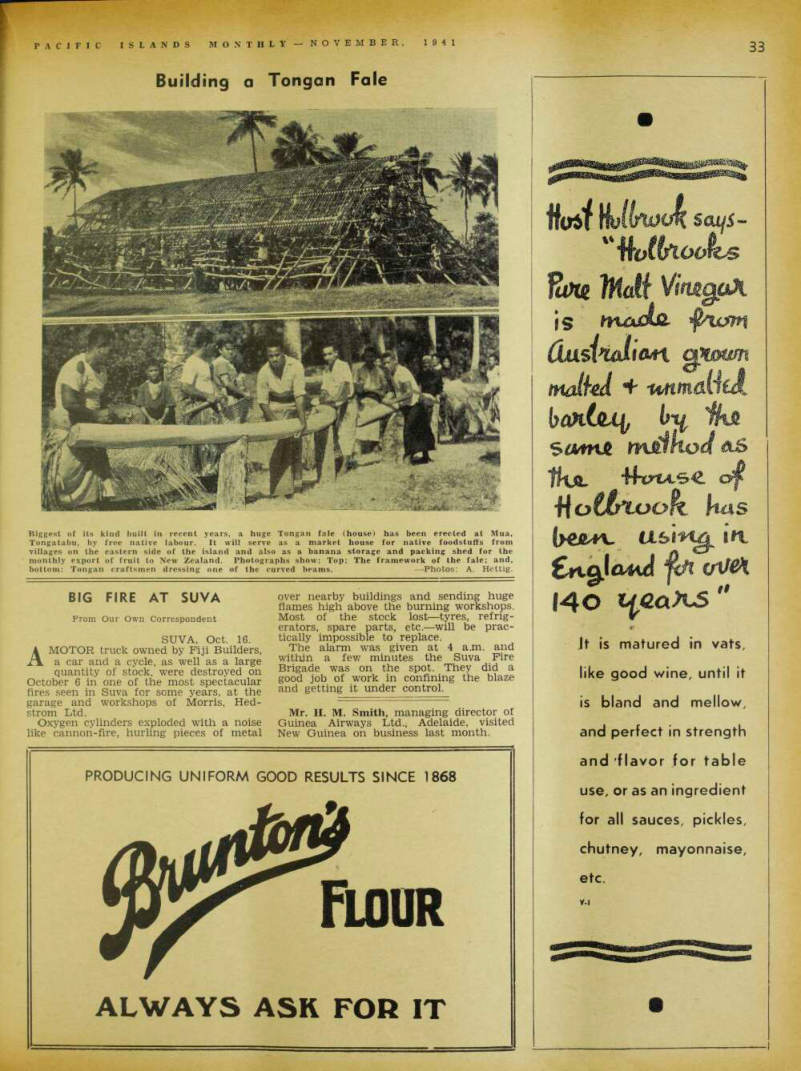
Biggest of its kind built in recent years, a huge Tongan fale (house) has been erected at Mua, Tongatabu, by free native labour. It will serve as a market house for native foodstuffs from villages on the eastern side of the island and also as a banana storage and packing shed for the monthly export of fruit to New Zealand. Photographs show: Top: The framework of the fale; and, bottom: Tongan craftsmen dressing one of the curved beams. —Photos: A. Hettig.
Big Fire At Suva
From Our Own Correspondent
Suva, Oct. 16.
A MOTOR truck owned by Fiji Builders, a car and a cycle, as well as a large quantity of stock, were destroyed on October 6 in one of the most spectacular fires seen in Suva for some years, at the garage and workshops of Morris, Hed strom Ltd.
Oxygen cylinders exploded with a noise like cannon-fire, hurling pieces of metal
over nearby buildings and sending huge flames high above the burning workshops.
Most of the stock lost—tyres, refrig erators, spare parts, etc. —will be prac tically impossible to replace.
The alarm was given at 4 a.m. and within a few minutes the Suva Fire Brigade was on the spot. They did a good job of work in confining the blaze and getting it under control.
Mr. H. M. Smith, managing director of Guinea Airways Ltd., Adelaide, visited New Guinea on business last month.
Advertisements & other items, p. 35 (1 item)
bmtiui %£
SaijS-
"Mhooks
fane lKa(f
j § maci&
dusifuJian mimn
nwlied +
bmtiui %£
SiMnM msikod
tfua. ■tfvusc
Hotfriaok has
u m
140 tfjzaKS "
p it is matured in vats, like good wine, until it is bland and mellow, and perfect in strength and flavor for table use, or as an ingredient for all sauces, pickles, chutney, mayonnaise, etc.
V.|
PRODUCING UNIFORM GOOD RESULTS SINCE 1868
ALWAYS ASK FOR IT
40 Years In Cook Group
From Our Own Correspondent
Rarotonga, Oct. 3.
MR. A. G. Wilkinson, manager for A. B.
Donald Ltd., at Mangaia, in the Lower Cook Group, died there on September 6, at the age of 63, He had lived in the Cook Group for over 40 years, acting as schooner supercargo and then representing his firm at Aitutaki, Pen rhyn and, finally, Mangaia.
“Wilkie” had a break of four years to serve with distinction in the Great War. during last few years, he was fond of reminding all and sundry that he was still on the Reserve”, it was a hard blow when his offer of serV ice in the present Hitler war was regretfully declined Man y friends all over the Eastern Pacific Groups, and particularly in Papeete, will miss Mr. Wilkinson’s cheery face. Mrs. Wilkinson, a French-Tahitian alone survives her husband, there being no children.
Sentence Reduced
Tonga's "Tin Can Mailman" and "Theft" of a Puppy
From Our Own Correspondent
Nukualofa, Oct. 1.
THE case of Mr. C. S. Ramsay, well known throughout the Pacific as the “Tin Can Mailman”, who was sentenced last year by Judge Stuart (now in British Guiana) to six months’ imprisonment for the “theft of a young pup”, has at last been finalised.
Mr. Ramsay appealed to the Privv Council Court against the magistrate’s decision and that body, while upholding the lower court’s judgment, reduced the sentence to one month. Mr. Ramsay was placed on good behaviour probation for the period.
So ends a case that attracted much attention and caused quite a stir in Nukualofa.
Evidence at the Police Court, when Ramsay was first charged with the offence, disclosed that a small puppy, property of a Tongan lad, had wandered away from its owner; that Ramsay had fed and taken care of it for three weeks; and that he had had sharp words with the native when the latter eventually found and claimed the animal.
A number of people in Nukualofa were of opinion that the judge did not deal justly with the matter in a calm and balanced manner.
Pate decided the future of the puppy over which the trouble arose—shortly after the first hearing it was run over by a motor-lorry and killed.
De Gaulle Committee In
New Hebrides
From Our Own Correspondent
Vila, Oct. 3.
AT its initial meeting recently, the newly-formed New Hebrides de Gaulle Committee commemorated the first anniversary of the rallying of Condominium French residents to the standard of Free France.
Members of the Committee are:— Messieurs M. Jocteur (president), Em.
Geurlain (vice-president), L. G. Frouin (vice-president), H. Russet, Ch. Anger, G. Rolland, Ed. Poullet, Ch. Pouillet, Baure Brae, Aug. Henin, Draghiceviz, Th. Nicholls, G. Rolland (Santo), A.
Naturel, and L. Wright.
Kokopo Harbour V. Lae
From Our Own Correspondent
Rabaul, Oct. 24.
IT has been pointed out by Kokopo residents that the statement in the article, “Transfer From Rabaul to Lae”, on page 64 of September “PIM” wherein it refers to the Lae and Kokopo harbours is not quite correct. It said: “. . . but it (Lae) has no harbour. Kokopo has exactly the same disability. Ships can anchor, in safety, off Kokopo, far out. They can anchor off Lae, close in.”
Experienced seafaring men express the opinion that the description should be reversed, for Kokopo is safe close in, and Lae further out. An examination of an up-to-date chart has borne this out, inasmuch as any ship anchored from Ralum to Tibur, in the Kokopo area, is well sheltered from both the NW and SE.
Advertisements & other items, p. 36 (1 item)
Berger’s Paint
Bi
THE BERGER TRADITION
For almost two centuries the policy of making only the finest products possible has been the ruling principle of the House of Berger.
This great firm has pioneered many manufacturing advances and its laboratories everywhere have combined their experience and resources in developing a complete line of paint products, each of the most durable quality, and each specially formulated for a particular type of surface and decorative effect.
To-day there is more Berger's Paint used than any other brand, eloquent testimony to the fact that the public puts its complete faith in the Berger tradition.
Berger’s Paint
"Keeps On Keeping On"
There is a Berger Agent near you Ask for Colour Cards
Tautira
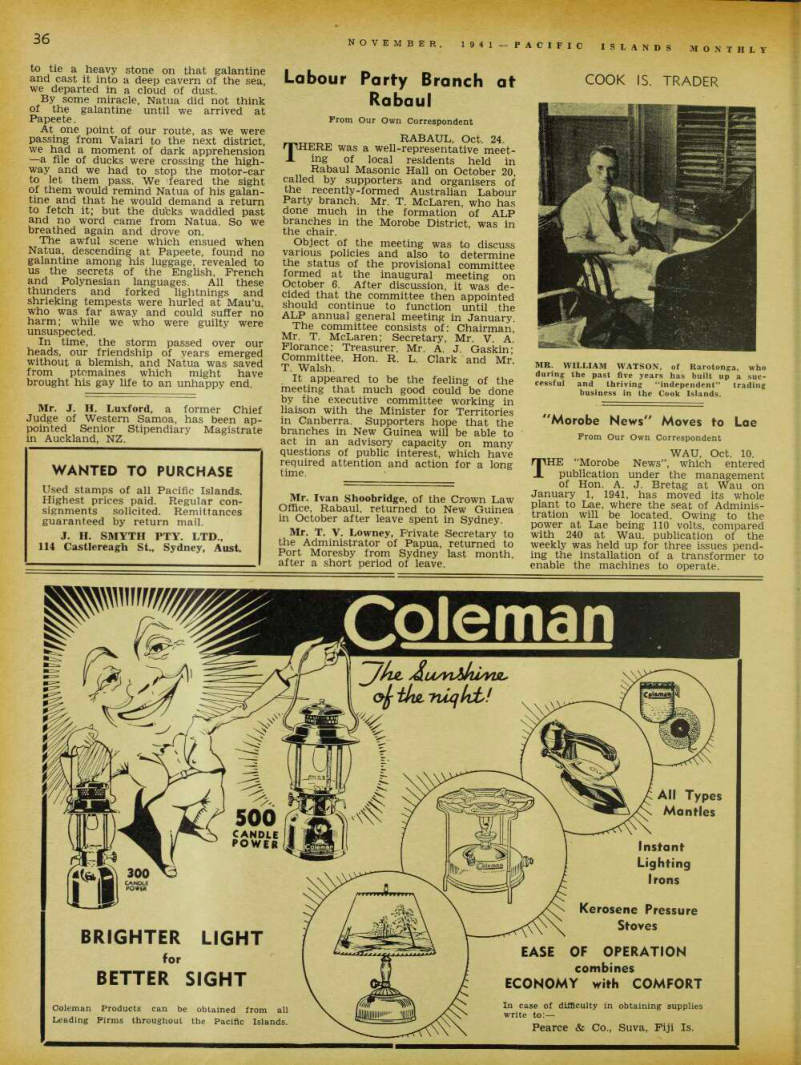
A Week-End At
Memories of a Tahitian Gourmand —and Galantine!
By A. C. Rowland
ONE of our most joyous, most satisfying memories is of a week-end at Tautira, at a time when Tahiti and the world were happier than they are to-day.
The two chief characters of the oc casion were Kennedy and Natua Kennedy, because he was a host beyond compare; Natua, because he brought to the company, sparkle and laughter with out end. Natua was a Euronesian; in ap pearance a European, the Polynesian— strong within him —revealed itself in picturesque speech in three languages, in the mannerisms of an arioi comedian, and most of all in the zest and fervour with which he addressed himself to the pleasures of the table.
Kennedy’s house —a great Tahitian style structure —was on a point of land commanding, on one hand, a view of the central peaks of Taiarapu, through the corridor of Ata’aroa Valley; and, to the north-west, of the high broken massif of Tahiti-Nui.
To spare his guests the tiresome land journey, Kennedy had chartered the motor-schooner “Tiare Variau”. She bore us from Papeete along the north and east coast of Tahiti-Nui (following in reverse the track of Wallis and Cook), pausing off Matavai to pick up a guest who came out on an out-rigger canoe, called for an hour at Hitia’a for no other purpose than to allow us to inspect that then isolated settlement, and thence away over the open sea to Tautira.
Natua, as was usually his habit, missed the boat, but did not miss the party. At the hour of dinner he arrived to the sound of a clanging gong attached to the motor-bus on which he journeyed. He entered with the air and circumstance of a Roman Imperator—and the party was complete.
The dinner was a chef-d’oeuvre of an Empress of cuisineres from the island of Martinique: an exquisite puree; that ambrosia of Neptune—varo; turkey from Tupuai; shrimp from cold mountain streams; a dozen exotic delights; and galantine.
Galantine is a compound of duck, herbs, spices and a sort of transparent jelly, that is very delectable to some palates.
Natua had already sustained his repu tation as a noble trencherman before the galantine had been brought in. He then fell to, and surpassed all his earlier records. Kennedy had lodged us at several houses in the village; but Natua preferred to camp on a settee in the living-room in order to forage, during the early hours of the morning, and refresh him self with galantine.
Now, galantine is a tender flower which under the heat of the tropics, fades into something quite different from its natal splendour. Consequently, when we had returned—at the end of the second day—from an expedition to the ultima thule of Tahiti which is known as the Pari (the cliffs), galantine did not appear on the menu of our evening repast.
There was, however, one remaining in the larder, and Natua discovered it as we were about to depart on the morning of the third day. One of our company had sent his motor car and six of us (including Natua) elected to return by land, stopping en route at Mau’u’s (in Vaiari) for luncheon.
At the moment of departure, there was a spirited colloquy between Kennedy and Natua over the galantine. Kennedy said
he did not wish any of his guests to die of ptomaine poisoning. Natua replied that it would be better for him to have the galantine than any of Kennedy’s servants, who would surely eat it the moment Kennedy’s back was turned.
We finally comforted Kennedy by the privately-given assurance that we would see to it the galantine disappeared during the journey to Papeete.
There was no opportunity to jettison the galantine before our arrival at Vaiari.
Natua guarded his treasure with jealous care. Before luncheon he put it into the hands of Mau’u for safe keeping.
A surreptitious interview with Mau’u, during the hubbub of luncheon, ac quainted him with the urgency of the occasion, and he promised to aid in our undertaking.
The repast at Mau’u’s was the standard Tahitian bill of fare that included roast sucking pig. It was the pig that solved our problem.
Mau’u, knowing Natua well, had re served for him the head of the pig, and at the moment of departure, presented it on a tin plate wrapped in a snowy napkin. Natua's delight over this new acquisition was so great that he forgot the galantine for the time being, and we hastened to get under weigh before the ecstasy should pass.
With a whispered admonition to Mau’u
to tie a heavy stone on that galantine and cast it into a deep cavern of the sea, we departed in a cloud of dust.
By some miracle, Natua did not think of the galantine until we arrived at Papeete.
At one point of our route, as we were passing from Vaiari to the next district, we had a moment of dark apprehension —a file of ducks were crossing the high way and we had to stop the motor-car to let them pass. We feared the sight of them would remind Natua of his galan tine and that he would demand a return to fetch it; but the dubks waddled past and no word came from Natua. So we breathed again and drove on.
The awful scene which ensued when Natua, descending at Papeete, found no galantine among his luggage, revealed to us the secrets of the English, French and Polynesian languages. All these thunders and forked lightnings and shrieking tempests were hurled at Mau’u, who was far away and could suffer no harm; wdiile we who were guilty were unsuspected.
In time, the storm passed over our heads, our friendship of years emerged without a blemish, and Natua was saved from ptomaines which might have brought his gay life to an unhappy end.
Mr. J. H. Luxford, a former Chief Judge of Western Samoa, has been ap pointed Senior Stipendiary Magistrate in Auckland, NZ.
Advertisements & other items, pp. 37-38 (1 item)
Duratile
Timber, Joinery
ETC.
PREPARED BUILDINGS ready for erection a specialty.
SHIP AND BOAT BUILDING.
TIMBERS specially catered for.
PIBROLITE. PLYWOODS.
GALVANISED IRON.
CONSIGNMENTS shipped
by RETURN STEAMERS
to the Islands.
John W. Eaton
PTY. LTD.
WEST CRESCENT STREET,
NORTH SYDNEY.
Telephones: XB 4051 (6 lines.)
Woven Wire for all Industry
COPRA DRYING TRAYS, FLOORS, Etc.
FRUIT DRYING TRAYS, MINING SCREENS.
Heavy Mosquito Gauze in Phosphor Bronze and other Metals Impervious to Salt Sea Air.
WIRE DOOR MATS AND GENERAL WIRE WORKS
E. WRIGHT & CO. LTD.
Office and Works: 148-152 Cleveland Street, Sydney, N.S.W.
Telegraphic Address: “Wrightmake,” Chippendale.
will make your kitchen
really modern...
in your spare time!
All the colourful, washable advantages of ceramic wall tiles is provided at less cost when you use DURATILE. Write for descriptive literature. Wunderlich Ltd., Crown and Cleveland Sts., Redfern, Sydney.
U/UND£RUCH<
QOOO
JJJJ
JJJ-J
DURATILE
BITUMENOID ROOFING
MADE IN AUSTRALIA.
Bltumenold Roofings, Dampcourse and Insulating Felts are made from the world’s best raw materials. Warranted to stand the most rigid tests.
BITUMENOID THE BEST
Roofing, 1,2, 3-ply: Flooring, Waterproof Materials; Saturated Felt; Resilient Road Jointing; Natural Asphalt Dampcourse: 2 and 3-ply Dampcourse; 1-2 lb. Lead-core Dampcourse; Roofing Cement; Asphalt Paints; Roofing Compound.
SAMPLES AND PRICE LISTS ON APPLICATION.
MAXWELL PORTER & SON LTD.
ESTABLISHED 1888. BUILDERS’ SUPPLIES.
107 REDFERN ST., REDFERN, SYDNEY, N.S.W. 'Phone: M 8167. Cables Bltumenold.
WANTED TO PURCHASE
Used stamps of all Pacific Islands.
Highest prices paid. Regular consignments solicited. Remittances guaranteed by return mail.
J. H. SMYTH PTY. LTD.,
114 Castlereagh St., Sydney, Aust.
Labour Party Branch at Rabaul
Rabaul
From Our Own Correspondent
Rabaul, Oct. 24.
ERE was a well-representative meet ing of local residents held in Rabaul Masonic Hall on October 20 called by supporters and organisers of the recently-formed Australian Labour Party branch. Mr. T. McLaren, who has done much in the formation of ALP branches in the Morobe District, was in the chair.
Object of the meeting was to discuss various policies and also to determine the status of the provisional committee formed at the inaugural meeting on October 6. After discussion, it was de cided that the committee then appointed should continue to function until the ALP annual general meeting in January.
The committee consists of: Chairman.
Mr. T. McLaren; Secretary, Mr. V. A Florance; Treasurer. Mr. A. J. Gaskin; Committee, Hon. R. L. Clark and Mr.
T. Walsh.
It appeared to be the feeling of the meeting that much good could be done by the executive committee working in liaison with the Minister for Territories in Canberra. Supporters hope that the branches in New Guinea will be able to act in an advisory capacity on many questions of public interest, which have required attention and action for a long time.
Mr. Ivan Shoobridge, of the Crown Law Office, Rabaul, returned to New Guinea in October after leave spent in Sydney.
Mr. T. V. Lowney, Private Secretarv to the Administrator of Papua, returned to Port Moresby from Sydney last month, after a short period of leave.
Advertisements & other items, p. 38 (1 item)
Cook Is. Trader
MR. WILLIAM WATSON, of Rarotonga, who during the past five years has built up a suc cessful and thriving “independent” trading business in the Cook Islands.
"Morobe News” Moves to Lae
Prom Our Own Correspondent WAU, Oct. 10.
THE “Morobe News”, which entered publication under the management of Hon. A. J. Bretag at Wau on January 1, 1941, has moved its whole plant to Lae, where the seat of Adminis tration will be located. Owing to the power at Lae being 110 volts, compared with 240 at Wau, publication of the weekly was held up for three issues pend ing the installation of a transformer to enable the machines to operate.
Advertisements & other items, p. 38 (1 item)
eman
6
off iha ivLqkt!
s r* M .<N -N 500 1«
CANDLE
POWER
300
CANDLE
POWER
EASE
All Types Mantles
BRIGHTER LIGHT
for
BETTER SIGHT
Coleman Products can be obtained from all Leading Firms throughout the Pacific Islands.
Instant Lighting Irons Kerosene Pressure Stoves
OF OPERATION
combines
ECONOMY with COMFORT
In case of difficulty in obtaining supplies write to:— Pearce & Co., Suva, Fiji Is.
Samson
My Papuan House-Boy
By “Samarai”
HOME, to me, is a bachelor’s bungalow where I occasionally sleep and look in, now and again, to see if it is being kept clean. A wrinkled old heathen, wearing a permanent expression of dis gust, his equally corrugated better half (her whole body is lavishly tattooed in a series of concentric circles), together with their sprightly son and heir, aged 14, constitute my total menage—l should say menagerie, for their antics at times are reminiscent of the monkey-house at Taronga!
They bear me no animosity—which is very kind. I must say!—but their general disposition when I am around is one of endurance under provocative conditions, and their work, a staccato series of ac tions which can only be interpreted as great condescension on their part that they should labour for me when they could be sitting around doing nothing.
The one bright spot in their existence comes on the first of every month when I pay their wages. On this day, instead of the usual “Good-morning, Taubada” greeting that jolts me into consciousness at dawn, there comes in regular rhythm, “This day No. 1 day, Taubada”. For the next few hours there is a continual scurrying of feet, arms, brooms and furniture; and when I return that even ing I discover a spotless house and six questioning eyes in three smirky faces, with one huge itching palm oscillating in readiness to grasp the moment I show signs of paying out. Only one palm, for the old man is keeper of all the family finance which women and children are definitely not allowed to touch.
When he first approached me for en gagement I was doubtful of his capa bilities in the house-work line, but this indecision was dispelled when he reached into the cavity of a tattered fibre “dilly bag” and produced a torn and finger begrimed reference from a one-time em ployer. It read “The bearer of this is named Samson and his strength lies in his ability to wangle out of any trouble he may get into. He’s good at his job, but wants watching for he’ll take the sugar out of your tea”. It was signed by a prominent resident whom I know does not exaggerate.
One week of Samson and I found out only too well that he was truly versed in the arts of deception and conception and, with a totally inadequate Delilah as his spouse, he was having an unrestricted go at using his talents to the full.
Household bills shinned up as high as they could the moment he put the ’fluence upon them. Odds and ends that could be used for other purposes did dis appearing tricks that would have left Houdini scratching his head. If I called for a cup of tea, then a full teapot made its appearance and he developed the habit of putting one spoonful of sugar in my cup and two over the side, these to be scooped up later into a dirty paw and dumped into the remains of the teapot.
It was great while it lasted but it suc cumbed through over exertion, for I promptly got a blunt axe into operation and trimmed Samson’s beard down to the roots.
RESTRICTED in his immediate ac quirements, his fertile brain con cocted a new method of spoliation, revealing him as one of the “I want” lads who constitute the “gimme” brigade— highwaymen of the first water.
It started a week ago with a demure request for an empty tobacco tin. He got
that without any opposition and it was stored away safely in his box. Next day he produced the tin and asked for some tobacco to put in it. With the tobacco went a cigarette paper and some matches.
Yesterday he discovered, quite suddenly and unknown even to himself, that he has a mother living m penury in a village some miles down the coast and, with true filial devotion, he must write her a letter but as writing paper and envelopes are not part of his stock in trade, would I please provide? In overlooking the fact that he cannot write and his mother cannot read, he is only keeping up to form, for Samson has no use for trivial details. , , .
TO-DAY, I wonder what is going to happen. There has been a lull for 24 hours, but that’s probably because he has not yet worked out a'll the details of his next act of piracy.
My footsteps on the verandah bring a
pattering response from the kitchen.
“You come, Taubada?”
“Yes, I come.’’
“You have kai-kai? Yes?”
“No.”
The light of expectancy that burnt so fiercely a few moments ago dies out suddenly. Apparently, there is no free feed to be worked out of me to-day.
“You can bring me a cup of tea,” I request.
He shuffles off with a look on his face that gives a modicum of hope to his stomach.
Soon he returns, rattling a cup and saucer and spilling 25 per cent, of its contents in all directions. The sugar in the small basin starts to heave and the black, stupified form of an ant appears, A few others break surface within a second or two. My frown deepens, “Ants ’e stop. Shall I t’row ’im away?”
The platonic Samson reaches out a hand but I halt the dispensation of the
sugar with a wild look. He stands back and hovers around like an unpaid bill.
“Well. What do you want now?”
“Please sir, me friend belong you.” (Great Scott! That’s twice to-day.) “My piccanniny, ’e want ’im marry one village girl.”
“Well, what about it? That’s his mis fortune.”
“Yes sir. ’E want ’im little bit money.
No much. Only free pound, thas all.”
“And where do you think I get money from?”
“My friend ’e say, ‘You go ask ’im Taubada. ’lm white man, ’e got plenty’.”
Behold the philanthropic Croesus, mat rimonial agent, et seq.
“What friend?” I ask.
“Brother belong this girl. Ts father my sister, ’im uncle belong me.”
Ye Gods! What a genealogical con fusion. We go into a discussion on the tangled roots of a tribal family tree and I sift a variety of confused statements which I tabulate as follows: 1. —The son and the girl are cousins; 2.—The father of the girl is the lad’s sister; 3—The friend is the sister of the uncle and the brother of the girl and the lad; 4.—They’re all related to each other; and, s.—They’re not related at all.
I’m afraid to go any further with this inquiry because he has not yet introduced the mother, the cost of, living, or what the Government wants to do. So I tear
up these deductions and scatter them to the four winds. The vital question still remains—what about the three pound notes?
Nothing doing. I can’t afford to lay out good, cold, hard cash on such a flimsy excuse as marriage.
So poor old Samson toddles off with a crocodile tear in his eye and his brain working overtime to discover where he slipped.
PEACE for a while and I am able to settle down in an easy chair to do a spot of steady reading. Intuition tells me to raise my eyes and there is Samson, full of good cheer, bright and breezy and with a sparkle of expectancy in his eyes.
“Well?”
“Taubada, I no got benzine.” Which is as good as to say “No benzine, no ironed clothes”.
“Why you no tell me yesterday? To-dav Sunday.” J “Yesterday I finish 'im. To-day ’e no stop.”
Quite a simple matter after all. Why the worry? I scribble a note and send him down to Tom, honing that I might be able to borrow sufficient until the morrow.
Back to the chair and remember a paper that I haven’t read. After a diligent search, I discover it is missing.
A howl of woe g(3es over the air, to be answered by a wide eyed and mouthed youth.
“Where’s my paper?”
“Samson ’e take ’im.”
“What for?”
“ ’E want ’im tobacco paper.”
“Bring it back right away.”
It returns, minus the front and back pages and three middle ones. I glance through it but all there is to read is two pages of racing gossin and one on hints for young housewive's.
By this time Samson is back. He has managed to scrounge a bottle of benzine and disappears into the kitchen to com mence operations. There is a violent pumping—then a tumultuous “bang!”
Just as I am expecting the roof to lift at any minute, the perspiring Papuan appears and informs me: “Iron ’e no go”.
More trouble. So, heigh-ho, into the kitchen.
On the table is the open benzine bottle, whilst alongside stands the still smoulder ing iron. A dull redness lights un its in terior anatomy and a cloud of pungent, black smoke rises like a threatening genii.
Have you ever wrestled with an ob streperous and dejected benzine iron? It is an amusement that usually ends in one of three ways—it goes up in flames and sets your house alight; it goes out of the window with your kindest regards; or else it doesn’t go at all and you leave it in exasperation for someone else to fix.
I unscrewed the top plate and removed that, but when I lifted it up to the light it promptly committed “hari-kari” by emitting its entire innards on to the floor.
Half-an-hour of five finger exercises was sufficient to restore its shattered entrails and, by that time, I discovered that the cause of the trouble was the weeping condition of the tank. It’s heartbreaking when a flat-iron becomes lachrymose!
Samson’s glow of appreciation broad ened as he realised there would be no ironing for him until the following day.
He begins a hymn of praise as I dis appear round the corner and yell for his heir apparent to make a shower. rESH again, I am in the middle of dropping myself into a pair of trousers that are sufficiently starched to be able to stand them up and jump into them, when I hear the footsteps of
friend Thomas coming along for our Sunday afternoon assimilation of news and nectar.
We meet only once a week and our conversation ranges as far and wide as the Caliph’s Magic Carpet. No subject is too trite nor distance too far for our capacious minds and from the depths of our easy chairs we govern affairs on the ethics of meum and teum.
But this afternoon we centre our thoughts morbidly upon our immediate circumstances and handicaps, for Tom, like myself, has frustrated ambitions in the shape of a house-boy who muddles along sufficiently well enough to avoid the dangers of sudden extermination, the lifting influence of a well-shod foot or immediate decapitation from a swinging right hander. The pronounciation of “I’ll knock your head off” causes bobbing operations to commence automatically, but Tom is hoping that one of these days he’ll forget to duck in time. I trust I’m there when it happens because 200 pounds travelling at 20 miles an hour must make quite an impression on any thing it hits!
We are just sitting back quietly and respectably talking about the easiest way of eliminating Samson without leaving any evidence behind, when the object of our affections exposes a woolly head around the door.
“You want ’im drink, Taubada?”, quoth the oracle.
“Too right. What are y’ having, Tom?
Mine’s a beer.”
“Gin for me, thanks.”
Samson side slips into oblivion, and by the time he returns with a beer and the gin bottle I, barman, have the glasses ready.
“Cheerio. Here goes.”
“Good-ch. ... Ye Gods! What’s this stuff?”
“That, my friend, is dyed-in-the-wool spirit flavoured with juniper berries, un
adulterated and pleasant to the thirsty palate.”
“Is that so? Well, you taste it. It seems like aqua pura to me.”
I gobble a bit and, sure enough, it’s H.O.
“Samson!”
“Me ’ere, Taubada.”
“What the devil have you done to this gin?”
“That no gin, Taubada. That one water.
This gin I t’row ’im away. ’E smell too much—l no like.”
“Thomas. Get me an axe and lead me to the slaughter. But no, my friend. Let us sit down and take it like gentlemen. , . . What’ll y’ have?”
“Make mine a beer, too, thanks.”
Advertisements & other items, pp. 39-40 (1 item)
pAllSlir
RALM
fSi OBABE pure PR tM i.
'cHf.st pAUt ru " 1 p «pab7
pAllSlir
- and I use
DISTRIBUTORS: Greenwood St Laws, Ltd., Rabaul and Wau; Steamships Trading Co., Ltd., Port Moresby and Samaral; Millers, Ltd., Suva, FIJI.
FOR BEST RE-
SULTS USE
“ B. A. L. M. ”
PAINT. It’s results that count and “8.A.L.M.”
Paint is better because it lasts longer, retains its gloss and resists fading. “8.A.L.M.”
Paint won’t crack or flake and eventually the film wears down to a perfect surface for re-painting.
A Product of British Australian Lead Manufacturers Pty., Ltd., makers of “Dulux” Finishes.
Do You Know that the Famous
YOUNGER
STOVES and
RANGES
made with extended Firebox specially for long Wood fuel, are Self-Setting and, provided sufficient Flue Piping is attached, can be used in almost any position?
The No. 7W "Younger” Ranger can now be supplied fitted with Legs, as per Illustration. Younger Stoves are Widely Used Ask for quotation for this Range, also illustrated Catalogue Throughout the and Price List for both Single and Double Oven Stoves. Paclfle w “ dß * G. FLETCHER & SON 50 Oxford Street, Sydney.
KANGAROO BRAND
Ropes,
Cordage,
and Twines ior every purpose
Backed by
86 years of service.
Manufactured by
M. DONAGHY AND SONS,
Pty. Ltd..Geelong and Sydney.
Fiji Representatives:
PEARCE AND CO.
LIMITED
P.O. BOX 237, SUVA
The Most Extensive Manufacturers in the British Empire of
RUBBER STAMPS,
INKS, STENCILS,
Marking Devices,
ACME STAMP PADS
OFFICE & STATIONERY SUPPLIES
We also Manufacture & Supply a Complete Line of
LIMEWASHING AND
SPRAYING MACHINES
for all purposes.
Let us know your requirements and we will quote by return.
WRITE FOR OUR GENERAL CATALOGUE
Limewashing Machine
EXCELSIOR SUPPLY CO. PTY. LTD.
278 Host Office Place,
MELBOURNE, VIC.
HEAD OFFICE r
160 BROADWAY,
Formerly known as George St., West,
SYDNEY/ IM.S.W.
50 Victoria Street,
WELLINGTON, N.Z.
Raider Prisoners Released
From Our Own Correspondent
Noumea, Oct. 10.
THE Caledonian Nickel Co. has learned from its Marseilles agent that the , nine white officers of the collier “Notou”, sunk by a Nazi raider between Sydney and Noumea on August 16, 1940, have just been released in Paris by the Germans. The master, Captain Jego, is a Breton, but the others are all Caledonian born.
The native crew (Loyalty Islanders and Indo-Chinese) were landed many months ago at Emirau Island (New Guinea) along with the crews of other vessels sunk in the Pacific.
Mr. Pat Costello, who has business and large goldmining interests in Fiji, arrived in Sydney last month from Suva.
Early in November, he went South to Victoria to watch the running of the Melbourne Cup.
Friends in Rarotonga were grieved to hear of the death in New Zealand, on September 8, of Reureu, elder daughter of Mr. and Mrs. Raitia Tepuretu. Miss Tepuretu, who died after an operation, was educated in Auckland and became typiste for A. B. Donald Ltd., in Raro tonga. Her father is Sergeant-Major in the Rarotonga Defence Force.
Mr. F. W. Burke, of Orokolo, Papua, married Miss E. Cooper, of Tasmania, at Ela Protestant Church, Port Moresby, early in October. The bridegroom is a well-known resident of the Gulf country of Papua, and his bride, who recently arrived in the Territory, was formerly a nursing sister at an AIF camp in Australia.
Advertisements & other items, pp. 41-42 (1 item)
sMaiMHUM
Gland Discovery
In 24 Hours
Sufferers from loss of vigour, nervousness, weak body, impure blood, failing memory, and who are old and worn-out before their time will be delighted to learn of a new gland discovery by an American Doctor.
This new discovery makes it possible to quickly and easily restore vigour to your glands and body, to build rich, pure blood, to strengthen your mind and memory and feel like a new man in only 8 days. In fact, this discovery, which is a home medicine in pleasant, easy-to-take tablet form, does away with gland operations and begins to build new vigour and energy in 24 hours, Yet it is absolutely harmless and natural in action.
The success of this amazing discovery, called Vl-Stim has been so great in America that it is now being distributed by all chemists here under a guarantee of complete satisfaction or money back. In other words, Vi-Stlm must make you feel full of vigour and energy and from 10 to 20 years younger, or you merely return the empty package and your money will be refunded. A special, double-strength bottle of 48 Vi-Stlm tablets costs little and the guarantee protects you.
GUARANTEED
» to Restore I Manhood and ■ Vitality . . .
vi-sti
‘//,y
PHONE LA 243 B
sMaiMHUM
41 CHURCH ST NEWTOWN
SYDNEY N-S-W
-fe/k
ANTISEPTIC CREASE REMOVING
CLEANS Eft
r
CABLE ADDRESS - X SOAP SYDNEY
Specialising in the Manufacture of Soaps for the Islands WORKPAL CLEANER—"The Housewife's Friend" WACO ANTISEPTIC GREASE-REMOVING SOAP w ORKPAL is the modern cleaner for Baths, Sinks, Walls, Floors, Paint-work, etc., and also for cleaning all kitchenware. Being free from harmful ingredients, it may be used without fear of damage to any surface. Workpal is a real pal in the home—it saves that hard rubbing and scrubbing.
I [TS super-softness makes instant appeal. It can be used with safety and will quickly remove grease and grime. Specially valuable for children’s and feet—it prevents infection. Waco is indispensable for Painters, Engineers, Mechanics, etc.
TRADERS ARE INVITED TO APPLY TO
EXPORT SOAP CO. FOR PRICES AND FULL PARTICULARS
OLD MONK
The Worlds Finest Olive Oil San Francisco
A. B. DONALD Ltd.
AUCKLAND
ISLAND TRADERS O GENERAL MERCHANTS
P.O. Box 1509. Cables Gr Telegrams, "Kingdom", Auckland.
I
STRENGTH
I4PST;
5
P EC
IA
PA OKEDcn Y
T "E To* F °H
Ltd.. SYX>N|i
THOPi
es Capstans are available in both
MEDIUM and FULL STRENGTH
GAPSTA
TOBACCO AND CIGARETTES
69 s*^2-1
A Freak Of Nature
From Our Own Correspondent
Rarotonga, Oct. 3.
AN extraordinary freak of nature came to light recently at Rarotonga when a native brought to the Department of Agriculture the body of joined twin pigs. They were connected at the neck, having only one head but opening out into two bodies, each complete with a tail and four legs. The pigs have been preserved in a large container and are on show to an inquisitive public.
At the request of relatives of the late Pilot F. Buchanan, who was killed a year ago in a plane crash in the Bitoi Ranges, Morobe District, New Guinea, his body was exhumed and sent to Australia from Wau last month.
Fiji Rubber
Revival of an Old Industry
THE arrival in Australia last month of a shipment of 33,118 lb. of planta tion sheet rubber from Fiji sug gests that the time is ripe for a revival of this industry in the Colony.
Though much agricultural develop ment has been done in Fiji, the absence of a large-scale rubber industry is to be regretted—particularly when conditions there for rubber cultivation are so excel lent. Probably, the main reason for this has been the low price of rubber ruling in recent years. It is a fact, though, that rubber trees thrive in the wet zones of Fiji, which extend from the sea to the mountains and cover about half the area of the islands. Rate of growth and yield compare favourably with other
rubber-producing countries.
Cultivation of rubber on a commercial scale was commenced in Fiji in 1906, when the Agriculture Department im ported seedlings from Ceylon. Prior to that small consignments had been intro duced by the Government and distri buted free of cost.
The late Captain David Robbie was one of the early pioneers of the indus try, establishing a rubber estate on Vanua Levu. Later the Government set up a two-acres plantation at Nasinu.
Towards the end of 1907, several large blocks of land on the south-east coast of Viti Levu were taken up by individual planters and companies. In 1914, just as the industry was getting on its feet and was ready to expand normally, war broke out and interest in Fiji rubber dwindled.
Rubber continued lifeless until 1922, when 9,142 lb. were exported. Then commenced a mild boom, as the follow ing production figures show:— 1923 89,753 lb. 1924 159,995 „ 1925 144,313 „ 1926 233,990 „ 1927 221,238 „ Then rubber slumped, and the output during 1928 fell to 95,661 lb. The follow ing year barely 6.800 lb. (valued at £224) were exported. Shortly afterwards, pro duction practically ceased. As one writer pointed out at the time, “its revival would depend entirely on an increase in price to a figure which would make rubber sufficiently attractive to the pro ducer”.
An interesting point about rubber cultivation in Fiji is the fact that costs, when estates were in full swing, com pared favourably with those of the Federated Malay States. Tapping usually was carried out by Indians and little difficulty was experienced in obtaining labour, as work on rubber plantations was much lighter than on cane or coco nut estates.
During the past few years, the London market price for rubber has gradually risen and this recovery was given added impetus by the outbreak of war, in 1939.
To-day, with plantation smoked rubber steady around 13|d. per lb. and the report that Mr. John P. Bayly shipped from Suva 295 bales of plantation sheet rubber to Australia in October, there is reason for believing that, in time, rub ber may be rehabilitated to its rightful position among the Colony’s agricultural industries.
Miss Patricia Paley, only daughter of Dr. and Mrs. W. Paley, of Suva, Fiji, was married recently to Pilot Officer William Downs, of Wellington, NZ.
Sago Palms
Neglected Source of Native Food in Fiji
FOR years now, Fijians have used the sago palm, one of the commonest indigenous palms in the Group, to provide thatching material for their dwellings, but it is a remarkable fact that they never have used it as a source of foodstuff.
In New Guinea, Papua, BSI, and the East, sago has been one of the main articles of food for the bulk of the popu lation for centuries, but the Fijians appear to have been ignorant of the fact that the trunk of this indigenous species contained starch and they never learned how to extract it Writing in the “Agricultural Gazette” a short time ago, Mr. B. E. V. Parham, MA, an officer of the Fiji Department of Agriculture, drew attention to this curious state of affairs and he gave some inter esting information about the sago palm (Metroxylon vitiensis), which is known to the Fijians as “soga”.
It occurs in extensive groves in swamps throughout the main island of Viti Levu and grows to a height of 30 to 40 feet, with a trunk 4 to 6 feet in girth. The large pinnate fronds attain a length usually of about 20 feet.
Some time ago, stated Mr. Parham, a quantity of sago flour was produced ex perimentally at the Central Agricultural Station, Fiji. Mature palms were felled and the stems cut into lengths of 3 to 4 feet —which were split and the whole of the pith removed and grated by hand into a vessel containing water. The starch washed out of the material settled al most immediately, and three or four washings and then sieving through gauze netting were sufficient to produce a starch
of a pale pink colour .(almost white).
After washing and settling, the starch was cut out in blocks and dried in the sun or over charcoal fires.
The quantity of starch obtained de pends upon the age and maturity of the tree. Maximum starch content of the trunk occurs just before the palm flowers, only once in a life time at the age of 10 to 20 years. After fruiting the palm normally dies, so that the utilization of a tree for starch production does not in volve the destruction of potentially valuable material.
It was estimated that, using simple tools, two Fijians could handle a palm tree in five days. Production per palm would be around 600 lb. of starch, yield ing about 200 lb. of sago.
In New Guinea, sago represents 80 per cent, of the food requirements of over 700,000 native people. There, four “boys” can wash 600 lb. of starch a day. The NG price for sago to be issued as a plan tation-labour ration is £l2 per ton, com pared with £22 per ton for rice, 21 lb. of rice being equivalent to 2 lb. of sago.
The cost of labour to make it is about £5/10/- per ton.
The sago of commerce is obtained by mixing sago flour or meal with water to form a paste which is pressed through cloth and then through sieves with fine meshes. It falls into a shallow pan heated over a fire and is thus granulated to form “pearl” sago.
Mr. Jack Crockett, who is well-known on the Morobe goldfields, New Guinea, is at present undergoing training with an AIF infantry battalion at Dubbo,
Nsw.
Mr. Eric Owen-Turner has taken over the position of accountant at Burns, Philp & Co. Ltd.’s Samarai branch in place of Mr, S. Mason who has been transferred to Townsville, Queensland.
Export Ban Hits Japanese
Mines In N. Caledonia
From Our Own Correspondent
Noumea, Oct. 14.
OWING to the ban which has been placed on the export of New Cale donian minerals to Japan, two Japanese-controlled mining concerns operating here —the Societe le Per and the Societe Miniere et Metallurgique de I’Oceanie —are restricting their output.
The Societe le Per has already dis missed from its iron mine at Goro, in the south, 200 of its 600 Javanese labourers, who have been found other employment in the Colony. The two com panies are expected to close down if the ban continues.
Mr. Nevill Young, of Kwato, Papua, arrived in Australia recently to enlist for service overseas.
Monsieur Delannoy, a senior public ser vice official, who recently arrived in Noumea, New Caledonia, from French Equatorial Africa, now is attached to the French administration at Port Vila, New Hebrides.
Advertisements & other items, pp. 43-44 (2 items)
Sta*i
MERIDEN
Church of England Grammar School for Girls.
REDMYRE ROAD, STRATHFIELD, N.S.W.
Situated In beautiful, and healthy surroundings within 15 minutes of Sydney.
Comfortable, modern accommodation for boarders. Education from Kindergarten to Leaving Certificate Honours. Scientific Physical Culture and instruction in Art and Musical Appreciation.
Prospectus on Application.
IP
Sta*i
, P ac\f' c Gr^ d tVv® ■,o\ " atb , be**' s^ a • M *•“** B « SP eC '* V sef^ce soC .V **“ \s l " e t^ e " e a s ev' ,a< ' tS \e P ' C " ***» . Sov»-'° r ~6 * C»'°' e ’ , r da'fpe'
’ta’SS££
Beche de Mer
A "Side-line" Industry in the Islands
ONE of the little-known “side-line” in dustries in the Pacific Islands that has been carried on steadily for many years, without fuss, is the export of beche de mer or trepang (sometimes known as sea-cucumbers).
Regular consignments come to Australia from the Solomon Islands and Papua, together with smaller lots from New Guinea, New Hebrides, and New Cale donia. All of it is shipped to the East where it is eagerly sought as a table delicacy. Torres Strait islands’ production goes direct from Thursday Island to China, At one time, considerable quan tities of beche de mer were exported from the Gilbert Islands, but the industry there has fallen off in recent years.
Sausage-like creatures, beche de mer are among the queerest of sea-denizens.
Scientifically, they are referred to as “Holothuroidea”. Globe-wide in distribu tion, living in all zones and depths, about 700 species are known throughout the world, but it is in the shallows of the warm coral seas that they excel in size and numbers.
There are nearly 40 species of beche de mer present in tropical seas, according to one authority. Some attain a length of 3 ft. and more, with a girth of five or six inches. They are of all colours, black, brown, dark-green, red, and purple, and they all conform to the conventional cucumber or sausage in the shape of the body. The body wall is leathery in tex ture and in some species is extremely thick. Beche de mer are by no means pleasant to look at —in fact, no more un attractive creatures could be imagined,
r l^c^ OV g5TSiS£i in a
’ta’SS££
where elderly Chinese gentlemen have
soup madf 'from^ de
possible to recapture lost attributes of youth. Accordingly, merchants in China pay prices ranging from £3O to £lBO a ton for beche de mer caught in the Pacific and Australia’s tropic seas.
The creatures are found on the white sandy floor of coral pools or in the shallow water alongside coral reefs, whlre they seem to spend the whole of their exis tence seeking food. They are gathered by natives, usually working in dinghies from a five- or six-ton lugger The “bovs” paddle about until they sight the beche de mer—easily distinguished against the sandy sea-floor—then they commence diving. As they are procured the beche de mer are placed in bags ’or baskets later being transferred to the “mother” schooner.
Curing is usually done on a near-by island, though in Northern Australia it sometimes is carried out on board the “mother” vessel. Each beche de mer is slit open longitudinally and thoroughly cleaned, then boiled in water until the saltiness of the flesh is removed After boiling, the beche de mer are flattened out and small sticks of bamboo placed in the slits to keep the flesh apart They are then placed in the sun to dry. When most of the moisture has been evaporated by the sun. the beche de mer are cured over a smoky fire. The curing takes two days, and the process turns the trepang into small, hard, flattish lumps, which look for all the world like so many pieces of badly charred beef-steak. The bamboo sticks are then removed, and the beche de mer packed for export.
sweeping through th? Central a^mwp
Bush Fires Rage In Papua
Pt. Moresby Oct 23
A ?n r t V ™ Pa J! ° f G bangS over tricts fires C wbth d * lS '
sweeping through th? Central a^mwp
remote districts PVPrv come renorts firJf
exSptfonaly dT conditio^
*7 SSS Y c . onclltlons^
iAL J okoda > , extensive fires caused of S Mr d % m^ 6 c-^rS 10 rubber Plantation 01 Ml - E - c - Searle. a result of the thick haze which affected visibility at high levels, flying conditions have been dangerous. On October 20, a plane making for the Goi lala Police Camp in the interior, with passengers and cargo, was forced back OW i n S to the impossibility of finding the landing ground.
There are fears that natives living in the more remote districts, especially in the grasslands, have suffered severely through the fires, -- ™ , Mr - Harry Morton, a retired plumber, , who had lived in Fi j i since 1910 > col la P sed and died in Suva in October. For many years, until he retired because of iU-health, he had been a member of the Suva Fire Brigade and when he heard a fire alarm on the morning of October 7 he left his home to see where it was.
He had gone only a couple of hundred yards along the street when he was seized by a sudden heart attack. A keen follower of football. Mr. Morton had many friends in Rugby Union circles, having played with one of the leading Suva teams from 1914 to 1928 Born in NZ, he was in his 58th year
Advertisements & other items, p. 44 (2 items)
42
NOVEMBER, 1941-PACIFrC ISLANDS MONTHLY
Plum Pudding
m. z
iJuL
mmmmm 0 I •e.
PLUM PUDDING
You'll earn frlbufe from your family when you serve Swallow's delicious Plum Pudding. They're full flavoured and expertly prepared by Swallow's master cooks. Everybody loves plum pudding and the rich goodness of Swallow's is unique.
Specially tropic-packed in air-tight tins of exact quantities. . . but always allow for extra helpings. lb. ... 3 serves, 1 lb, ... 6 serves, 1 lb. ... 9 serves, 2 lb. ... 12 serves, 3 lb. ... 18 serves.
SWALLOW & ARIELL LTD.
Port Melbourne, A ustralia
Escape From The
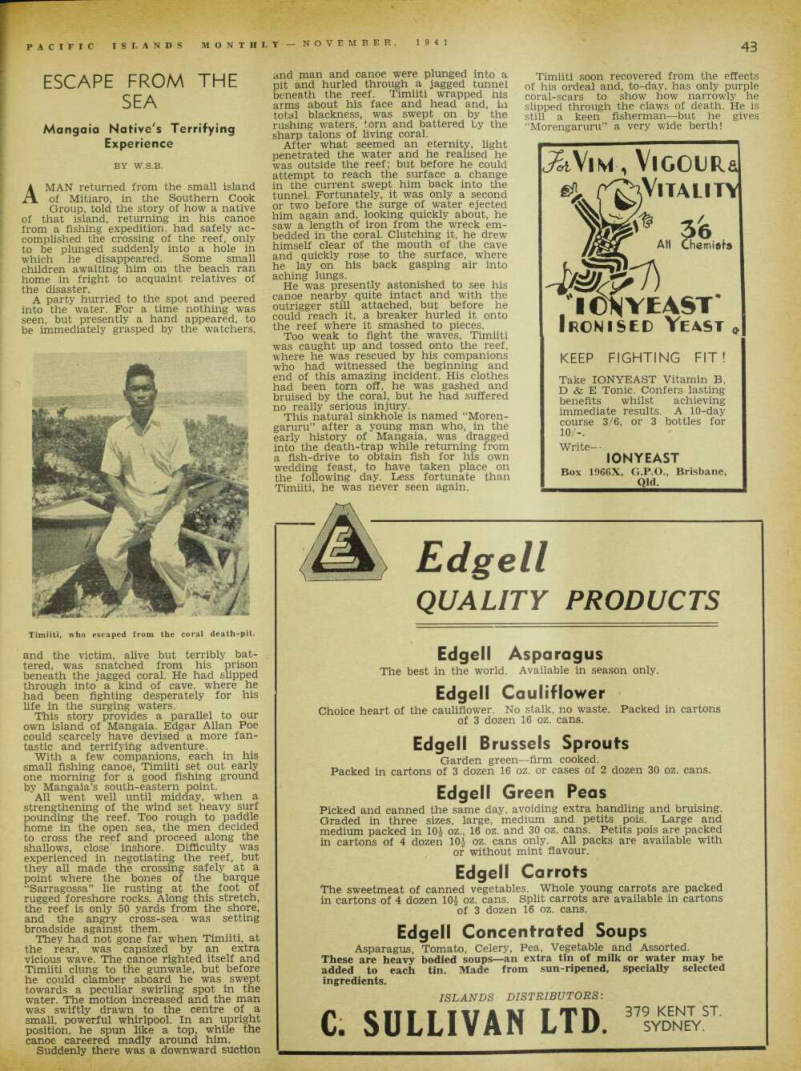
Sea
Mangaia Native's Terrifying Experience
By W.S.B.
A MAN returned from the small island of Mitiaro, in the Southern Cook Group, told the story of how a native of that island, returning in his canoe from a fishing expedition, had safely ac complished the crossing of the reef, only to be plunged suddenly into a hole in which he disappeared. Some small children awaiting him on the beach ran home in fright to acquaint relatives of the disaster.
A party hurried to the spot and peered into the water. For a time nothing was seen, but presently a hand appeared, to be immediately grasped by the watchers,
and the victim, alive but terribly bat tered, was snatched from his prison beneath the jagged coral. He had slipped through into a kind of cave, where he had been fighting desperately for his life in the surging waters.
This story provides a parallel to our own island of Mangaia. Edgar Allan Poe could scarcely have devised a more fan tastic and terrifying adventure.
With a few companions, each in his small fishing canoe, Timiiti set out early one morning for a good fishing ground by Mangaia’s south-eastern point.
All went well until midday, when a strengthening of the wind set heavy surf pounding the reef. Too rough to paddle home in the open sea, the men decided to cross the reef and proceed along the shallows, close inshore. Difficulty was experienced in negotiating the reef, but they all made the crossing safely at a point where the bones of the barque “Sarragossa” lie rusting at the foot of rugged foreshore rocks. Along this stretch, the reef is only 50 yards from the shore, and the angry cross-sea was setting broadside against them.
They had not gone far when Timiiti, at the rear, was capsized by an extra vicious wave. The canoe righted itself and Timiiti clung to the gunwale, but before he could clamber aboard he was swept towards a peculiar swirling spot in the water. The motion increased and the man was swiftly drawn to the centre of a small, powerful whirlpool. In an upright position, he spun like a top, while the canoe careered madly around him.
Suddenly there was a downward suction
and man and canoe were plunged into a pit and hurled through a jagged tunnel beneath the reef. Timiiti wrapped his arms about his face and head and, in total blackness, was swept on by the rushing waters, torn and battered by the sharp talons of living coral.
After what seemed an eternity, light penetrated the water and he realised he was outside the reef; but before he could attempt to reach the surface a change in the current swept him back into the tunnel. Fortunately, it was only a second or two before the surge of water ejected him again and, looking quickly about, he saw a length of iron from the wreck em bedded in the coral. Clutching it, he drew himself clear of the mouth of the cave and quickly rose to the surface, where he lay on his back gasping air into aching lungs.
He was presently astonished to see his canoe nearby quite intact and with the outrigger still attached, but before he could reach it, a breaker hurled it onto the reef where it smashed to pieces.
Too weak to fight the waves, Timiiti was caught up and tossed onto the reef, where he was rescued by his companions who had witnessed the beginning and end of this amazing incident. His clothes had been torn off, he was gashed and bruised by the coral, but he had suffered no really serious injury.
This natural sinkhole is named “Moren garuru” after a young man who, in the early history of Mangaia, was dragged into the death-trap while returning from a fish-drive to obtain fish for his own wedding feast, to have taken place on the following day. Less fortunate than Timiiti, he was never seen again.
Timiiti soon recovered from the effects of his ordeal and, to-day, has only purple coral-scars to show how narrowly he slipped through the claws of death. He is still a keen fisherman —but he gives ‘Morengaruru” a very wide berth!
Timiiti, who escaped from the coral death-pit.
Mr. Gordon Farmer, of the Audit De partment of the New Guinea Public Service, arrived in Australia recently to enlist for overseas service. Prior to his departure from the Territory, Mr. Farmer was farewelled at a gathering in Rabaul.
Mrs. Farmer preceded him South a short time ago.
Captain Harry Rochford Hughes, who for nearly 30 years was an officer, then master, of the Pacific Cable Board’s ship “Iris”, died in Auckland in October at the age of 66. During his long service, he gained a high reputation as an ex pert in laying and repairing cables in Central Pacific and NZ waters. When the “Iris” was armed and sent out from Auckland in the last war to search for Count Felix von Luckner, who had es caped from internment on Motuihi Island, Captain Hughes was in command of the shore party at the Kermadec Is lands, where the Germans were recap tured. Later the “Iris” was re-named “Recorder” and passed to the ownership r f Cable and Wireless Ltd. Captain Hughes retired from the sea in 1932.
Advertisements & other items, pp. 45-46 (1 item)
Edgell
£ iVIM, VIGOLIIa
1
Vitality
36 All Chemidfd
ICN Vt AST
Iron isel Yeast
KEEP FIGHTING FIT!
Take lONYEAST Vitamin B, D & E Tonic. Confers lasting benefits whilst achieving immediate results. A 10-day course 3/6, or 3 bottles for 10/-.
Write—
lONYEAST
Box 1966 X, G.P.0., Brisbane, Qld.
Edgell
QUALITY PRODUCTS
Edged Asparagus
The best in the world. Available in season only.
Edged Cauliflower
Choice heart of the cauliflower. No stalk, no waste. Packed in cartons of 3 dozen 16 oz. cans.
Edged Brussels Sprouts
Garden green—firm cooked.
Packed in cartons of 3 dozen 16 oz. or cases of 2 dozen 30 oz. cans.
Edged Green Peas
Picked and canned the same day, avoiding extra handling and bruising.
Graded in three sizes, large, medium and petits pois. Large and medium packed in 10i oz., 16 oz. and 30 oz. cans. Petits pois are packed in cartons of 4 dozen 10J oz. cans only. All packs are available with or without mint flavour.
Edged Carrots
The sweetmeat of canned vegetables. Whole young carrots are packed in cartons of 4 dozen 10i oz. cans. Split carrots are available in cartons of 3 dozen 16 oz. cans.
Edged Concentrated Soups
Asparagus, Tomato, Celery, Pea, Vegetable and Assorted.
These are heavy bodied soups—an extra tin of milk or water may be added to each tin. Made from sun-ripened, specially selected ingredients.
ISLANDS DISTRIBUTORS:
C. SULLIVAN LTD. 37 I£S ST
f^ itwith
Comment by President of Planters' Association
Copra Marketing Plan In New Guinea
Letter to the Editor
NO doubt planters in this Territory read with interest the article pub lished in September “PIM” under the heading, “Copra Marketing Plan Under Fire”. Personally, speaking as one who has followed the slow progress of the Commonwealth Government’s plan to give permanent relief to New Guinea copra-growers, I consider it does not give a true picture of the present and past position.
The sum total of the article indicates that the Commonwealth Government, the Administration and the planters of this Territory are trying to create a position which is unbearable and opposed to the interests of the big local trading firms, lam sure this is far from being the case For those who have short and con venient memories, I should like to take
their minds back to the conditions which existed in New Guinea from June, 1940 to June, 1941.
I quote here the opening paragraph of a letter which I received from one of the big trading firms: “We regret to have to advise you that until further notice we are forced to cease purchasing your copra”. Other letters could be quoted. From another trading firm, a letter demanding payment in advance for supplies before orders would be executed —this after many years of trading on a credit basis.
This was the state of affairs that existed in 1940-41. Copra producers faced bankruptcy. Is it any wonder they turned to the Administration and Canberra for assistance? It was considered by most planters that, as the impasse was due solely to war conditions, the copra in dustry should be placed under Govern ment control and receive Government assistance.
To our early request, the Federal Gov ernment instructed the NG Administration to assist those planters who were finan cially strangled by offering them 4 per cent, interest-bearing loans. This action was appreciated, and was availed of by many; but it was evident that this alone could not solve the then difficult position.
In short, temporary relief at interest would only involve the growers and further burden them financially.
After consultation with the Adminis tration, managers of the three principal trading firms and mission societies, a scheme to give permanent relief to the industry under Government control was placed before the Commonwealth Gov ernment in September, 1940, by the executive of the Planters’ Association of New Guinea (see “PIM”, November, 1940, p. 29, “NG Plan to Aid Copra Industry”).
If one studies the scheme referred to, it will be recognised that many of the salient points now are contained in the Copra Control Regulations which came into operation in October, 1941.
As late as June, 1941, a number of New Guinea planters had given up curing copra. Others , had signed off practically all their labour. The upkeep of the plan tations was being neglected. In many other cases, copra had accumulated on the plantation for months with the owner unable to sell.
I take it for granted that the writer of your article was fully cognisant of the Copra Control Regulations, gazetted in June, 1941. Yet the article infers that the terms and conditions of the regula tions had only just been forced on an unwilling group of vitally interested firms, whereas, in fact, the regulations were gazetted three months before it was written.
Who could imagine the regulations to mean other than a compulsory pool?
Again, where is it exnressed in the regu lations that “the New Guinea Copra Committee was to have absolute authority in disposing of the copra”? The Govern ment clearly stated that a Pacific Mar keting Board or some marketing authority would dispose of the copra.
Again, who is the authority to say “the procedure would almost certainly result in a serious diminution in the nett return planters otherwise would receive for the copra they produced”? I should say that the reverse of this statement would be more than a probability.
Why did “important copra interests beg the Commonwealth Government to let the industry run free”? Every planter could give a reasonable answer to that question. I would say because the firms
have their own interests solely at heart.
These company interests state “some marketing plan probably was necessary to assist the industry early in 1941; there was no necessity for it now”. This from the firms who shut down on the industry 12 months ago, and probably would do so again if similar conditions existed.
No-one but a fool is going to throw away the substance for the shadow, the substance being £4/10/- per ton at plantation, in addition, profits made by sales of copra to be distributed among contributors to the pool, and guaranteed by the Commonwealth Government under National Security Regulations.
Why should the article advance the case of the big firms? Why not consider the interests of private individuals as well? Many men and women have the best years of their life’s work at stakethis surely should be taken into account when values are the consideration. t mint** op'Ciin* “Mnrh of thp npw r uinßeinvestments of the bis firms have ma^ical^^gone 11 west’ ’ \ 6 Who *said so?
Quote again: “Under the recent moratorium the firms now have no control whatever over the plantations on which they advanced money”. One would imagine that the Mortgagors' Relief Ordinance is to remain in force until the end of time, whereas in fact it has less than 12 months to run. The advance mentioned in many cases consisted mainly of highly-priced goods and commodities charged to the producer plus 8 per cent. interest Many clients were “talked” into buving a nice new expensive car or other luxury when the big firms should have known their clients’ financial position warranted no more than a pushbike or less Balance sheets will show how badlv hit the big firms have been One feature of the Copra Control Regulations is that should the copra situation collapse, the big firms’ interests would be safeguarded by-the Government,
inasmuch as copra would continue to be purchased. Therefore, property values would not depreciate to any great extent. we should like to draw your attention to Hon. Gerald Hogan’s second reading speech on the Mortgagors’ Relief Ordinance a t the NG Legislative Council’s recent meeting. If further evidence is necessary to support the Government’s contention that the Amendment to the Mortgagors’ Relief Ordinance was undoubtedly essential, we have in our possession evidence of the crippling interest charges that formed a substantial portion of many copra-producers’ costs.
Tf th bi firms in future will not 1 Wanting enterprise it will be fhel? foss P Under the “New Order” nroriYirprs hone to see established a Finance it has been a shameful neglect on n 0 a f S the Government that such werenot availableyears aeo h 'f the o.hhJeak of the Present war Sinco tine outbreak oi tn.o proSonx war, Australia’s demand for copra has steadily increased. To-day. planters may expect to see a very large percentage, if not
homl
consigned to Australia. With the home S cnsUmptlo r n i^^ ai fov«7avH SSi, ducers may look forward with confidence manaser of one of the bis The « laL as this month firms assured me as J^f d ! Relcom™ ?he that ms company would welcome me pool system, and that he personally, was one of the first in this Territory to advocate the compulsory pool system. Why shouldn’t he be?—the system has many advantages. Being a Government measure, its conduct is open to criticism, if criticism is wanted. Trading firms are invited to co-operate with the Government in disposing of the copra of this Territory and, which is important, the Governments of all British countries and its Allies are its agents.
For many years the “PIM” has ad-
vocated co-operation in the Pacific, in regard to the copra industry. Here, in my opinion, is the answer. Never before, in Pacific history, has such an opportunity for co-operation presented itself. As private individuals, the same success would take years, if ever, to achieve, and yet the Government has done all this with no cost to the industry. Furthermore, the Commonwealth Government has sub sidised the industry to the extent of the cost of inter-island freights, which will, I estimate, amount to over £50,000 p.a.
With the scheme thus far advanced, there are many signs to indicate that its continuance is absolutely necessary. The local Copra Control Board, in their un tiring efforts, have already overcome many obstacles. They are to be congra tulated for the manner in which they have played their part. Let us, as pro ducers and merchants, play ours. Let our motto be “One for all and all for one!"
I am, etc.,
H. Adams, Mlc,
President, Planters’ Association of New Guinea.
Rabaul, TNG. 22/10/1941.
Mr. L. Odgers, of the NG District Ser vices Department, has been transferred from Rabaul to Wewak. Formerly he was a member of the staff of the Cus toms Department, Mr. W. G. Robinson, well-known Suva businessman, has left the Colony after 37 years’ residence. Prior to his depar ture, Mr. Robinson was entertained by residents and representatives of various sporting bodies, who presented him with an inscribed cigarette case. Mr. Robinson took a keen interest in horse racing in the Colony and, in addition to racing his own horses, was official starter at the Brighton Park course.
Mr. “Jock” Marshall, former president of the Pacific Islands Society, and well known authority on bird life in the Pacific, is now the self-styled “Backyard Naturalist” for the Australian Broad casting Commission. His mail nowadays is chock full of specimens that range from bugs to fossils of the Pleistocene period, not to mention crocodile teeth and an occasional leg bone from an Islands marsupial. Incidentally, the popularity of these potted scientific discourses has been proved by the quantity of “fan” mail that this enterprising young Australian, who is as well known in New Guinea as he is in the New Hebrides, receives from all parts of Australasia. In addition, he is Tutor in Zoology at St. Paul’s College, University of Sydney, and manages to find time for journalistic activities.
Advertisements & other items, pp. 47-48 (1 item)
Gudgeon Pty. Ltd.
Netherlands East Indies Manufactured
Cigarettes and Tobacco
DAVROS
$ Nl
ilverGit
CIGARETTES
Mourad & Davros Cigarettes—Similar in flavour to popular American brands, Faroka Cigarettes.—Fine Havana flavour. (Each packet contains 20 cigarettes.) Silver City Cigarettes— High-grade pure Virginian leaf.
Throughout Australia there is an ever-increasing demand for all of these brands of high-grade Cigarettes and Tobacco from the Netherlands East Indies.
PRICES ON APPLICATION TO
0%
FINE CUT.
MILD TOB ACC
Silver City Fine-cut Cigarette Tobacco Pure Virginian leaf of highest quality. Each packet contains 11 oz. net.
GUDGEON PTY. LTD.
General Importers and Exporters.
Eagle & Globe Building, 381 Kent Street, Sydney, N.S.W.
GP
Steamships Trading
Company Limited
PORT MORESBY SAMARA! MISIMA, PAPUA.
WHOLESALE & RETAIL MERCHANTS, SHIPOWNERS,
PLANTERS, ENGINEERS & SLIP PROPRIETORS.
Customs, Shipping, Insurance, and Forwarding Agents.
MANAGING AGENTS AND VISITING REPRESENTA-
TIVES FOR COCONUT AND RUBBER ESTATES.
A full range of Merchandise always in stock, including Plantation, Mining, Prospecting and General supplies.
All classes of ship repairs and engine overhauls undertaken. Vessels up to 500 tons gross slipped at any tide on our patent Slipway.
Port Moresby.
AGENTS FOR:—Vacuum Oil Co. Pty., Ltd., Bankers & Traders Ins. Co., Royal Packet Navigation Co., American Trading & Shipping Co., Wunderlich, Ltd., Dodge Motor Co., Diamond T Motor Trucks, Johnston Outboard Motors, Sawmillers & Traders, Ltd., Coral Sea Insurance Co., Australian General Electric Refrigerators, B.A.L.M. Paints, Acme Bakery Co.
SYDNEY REPRESENTATIVES: Nelson & Robertson Pty. Ltd., 12 Spring Street.
WRITE, CABLE, OR CALL FOR PARTICULARS
STEAMSHIPS TRADING COMPANY LIMITED
Head Office; Port Moresby. Cable Address: “Steamships”.
Caledonia
Javanese Festival In New
From Our Own Correspondent
Noumea, Oct. 11.
THE seven or eight thousand Javanese labourers in New Caledonia will celebrate their New Year between October 22 and 24. Employers have been asked to release them for the festive occasion. In Noumea and the larger country centres there will be the usual mass feasting and junketings, accom panied by masked theatrical shows and dancing to the music of the gamelan orchestra. They also will place a wreath on the Noumea War Memorial.
Story Of "Pard"
Mustar
Airman Who Flew First Plane to Morobe Goldfield
rpHE fascinating, romantic story of how A aeroplanes opened up the pheno menally-rich Morobe Goldfield in N ew Guinea was first told by lon Idriess in Gold-dust and Ashes” seven years ago. In it, two men stood out—C. J.
Levien, whose vision and tireless energy made possible the use of aerial transport and Pilot Ernest (“Pard”) Mustar, who flew the first plane from Rabaul to Lae, from Lae into the mining camp at Wau Now, m “D’Air Devil”, just published, Frank Clune, another Australian “pop ular” author, tells the story of “Pard”
Mustar’s adventure-packed life, from his youthful wireless-tinkering days in Mel bourne right up to the present.
Mustar was among the first contingent of Australian troops to go overseas in October, 1914, and, as a member of a signals unit, took part in the landing at Gallipoli. His war experiences in Egypt, Palestine and other of the Middle East countries, with the Light Horse, make interesting reading. Transferring to the Australian Flying Corps, he soon won the Distinguished Flying Cross for his exploits as observer-gunner with the intrepid Ross Smith.
Returning to Australia after the ar mistice, Ern. Mustar took up farming, but the call of the air was not to be denied; so, with a companion, he bought an old, battered aeroplane and “barn stormed” around the Commonweath From 1922 to 1926, he served again with the AFC as pilot-instructor.
During this period, he made an air survey of the Barrier Reef and marked out aerodromes at Port Moresby (Papua) and Rabaul (New. Guinea), working in association with HMAS “Geranium”.
Late in 1926, while instructing with the Victorian Aero Club, he accepted an offer from Guinea Gold NL, to go to the Mandated Territory and fly a DH37 plane from Rabaul to the mainland coast and thence in to the newly-discovered goldfield at Wau.
AN El Dorado had been found in the interior of New Guinea, but food, equipment, supplies, everything had to be laboriously carried in by natives, over a steamy, tortuous track that climbed the rugged mountains. C. J. Levien, former Administration district officer, who had pegged precious leases for Guinea Gold NL, conceived the idea of using planes to solve the transport problem.
Crated and shipped on the old “Melu sia”, the DH37 left for Rabaul in March, 1927, under the tender care of Mustar and his wizard-mechanic friend, Mullins.
It was a fearful trip from Townsville to New Britain—whipped by a cyclone, the BP vessel (on her last trip) did every thing but stand on her nose! Every minute Mustar expected the aeroplane to break loose and plunge overboard or smash itself against the sides of the well-deck. But the lashings held and the “Melusia” made Rabaul 36 hours late.
On March 30, with the plane assembled and tested, Mustar circled over Rabaul, flew down the northern coast of New Britain, across Dampier Strait and landed at Lae, where Levien’s “boys” had pre pared a make-shift aerodrome. Then came the real test—to find Wau, in the unknown interior.
Three times, between April 16 and 18, Mustar crossed the mountain ranges that fringe the coast and searched for a tiny clearing that would be Wau; and three times he returned without success.
Finally, with a miner named Lewers as passenger, spotting familiar landmarks,
he found the landing-ground. A 45 minutes’ flight against nearly a fort night’s gruelling trek!
With the advent of the aeroplane, freighting goods at 1/- per lb. and pas sengers at £25 a head, a new era dawned on the goldfield. Soon other air com panies appeared on the scene. The men associated with Guinea Gold NL launched the very successful Guinea Airways Ltd., with Mustar as managing director, to handle the aerial freighting service they had pioneered.
Mustar went to Europe and brought back from Germany a huge all-metal, diesel-engined Junkers W 34 machine, capable of lifting a ton. This new mono plane soon enabled Guinea Airways to outstrip their competitors—within three months the company carried 500 tons of cargo and 1,000 passengers to the field.
A second W 34 was flown from Mel bourne to Lae by Mustar, in uneventful easy stages. Two more similar machines arrived in New Guinea in 1929 and GA soon were carrying more freight in one month than the combined commercial air fleets of the world were lifting in a year! Cargo ranged from rice to riffles, from picks to phonographs, from beer to bedsteads —in fact everything needed by a growing mining township that was on good gold.
IN March, 1929, Mustar, suffering from the effects of malaria, resigned from Guinea Airways and returned to Australia', where he joined the Vacuum Oil Co. as aviation representative. Then he married and prepared to settle down and live quietly for a time. But New Guinea had not seen the last of him.
Placer Development Co., an influential mining concern with interests all over the world, took up options over Bulolo Valley leases —and found itself faced with the
problem of transporting enormous dredg ing machinery to the field by air. Mustar was called in and he induced them to purchase two Junkers G3l three-engined planes, each costing £31,000. He himself went to New Guinea to establish a fuel depot for Vacuum and to give Allan Cross, his successor at Guinea Airways a helping hand.
Piece by piece, the mass of machinery to build Dredge No. 1 was flown in with out difficulty—even the biggest part, a tumbler-shaft weighing 3 1 tons.
Then, one warm, sun-lit day in March, 1932, the dredge was started up. Mustar was present at the ceremony, but the other pioneer, C. J. Levien, had not lived to see his life’s ambition fulfilled. His ashes were scattered over the Bulolo Valley from an aeroplane the same day the dredge began to win gold from the rich flats.
Captain Mustar lived in New Guinea with his wife and child until September, 1934, when he came south to Melbourne for good. Now, in 1941, with the Empire again at war, he is in uniform once more —Squadron-Leader Mustar, DFC, of the Royal Australian Air Force.
Throughout “D’Air Devil”, linked with the story of Mustar’s career in New Guinea, are scattered the names of many who played their part in pioneering the Morobe Goldfield—Holdgate, Mackenzie, Wells, Lapthorne, and McGilvery, of Guinea Gold NL and Guinea Airways Ltd ; Prank Griffin, Charles Banks, and Tom Harris, of Placer and Bulolo com panies; Ray Parer, Major Berryman, Medical Assistant Lambert (of Wau); and a host of other men well known in the Territory.
“D’AIR DEVIL”—The Story of “Pard” Mus tar, by Frank Clune. Published by Angus and Robertson Ltd., Sydney. Price, 6/-.
Cost Of Re-Building At

Rabaul
QUESTIONS asked in the Australian Federal Parliament, Canberra, re cently, elicited the following infor mation concerning the amount of money spent by the NG Administration on re conditioning Rabaul after 1937’s volcanic eruption;— During 1937-1938 and 1938-1939, £22,071 was expended upon the rehabilitation of roads, etc., and £4,821 Upon the rehabili tation of buildings in Rabaul area. From July 1, 1937, to June 30, 1941, £63,602 was spent in connection with the maintenance of buildings, the establishment of a vul canological observatory, harbour works, road developments, and maintenance of aerodromes, etc.
In addition, a considerable sum was in curred by private companies and individuals.
Mr. H. Sim. who recently resigned from the staff of Burns Philp (SS) Co. Ltd., Apia, Western Samoa, arrived in Sydney last month by Matson liner from Pago Pago.
Miss Hazel Savage recently joined the WRC staff at Salamaua, New Guinea.
The Pacific Islands Society’s latest romance —Mr. and Mrs. Robin Band, who were married in Sydney in October.
The bride (nee Miss Gabrielle Gosset) is the only daughter of the late Mr. R. W. G. Gos set, formerly of Raro tonga, Cook Is., and of Mrs. Gosset. An Ox ford graduate, the bridegroom is a member of the Malayan Civil Service, and was until recently Administrative Officer at Christmas Island in the Indian Ocean. They met this year at one of the PI Society’s functions in Sydney. —Photo; May Moore.
Advertisements & other items, pp. 49-50 (1 item)
Equal to the World’s Best
There is no substitute for
OLD MONK
VIRGIN PURE
OLIVE OIL
Trr- San Francisco
Equal to the World’s Best
Throughout Australia and Overseas there is an ever-increasing demand for
COLONIAL & BRONTE
HIGH-GRADE CANNED MEATS
There is no better quality—none more wholesome. •
TRADE MEATS FOR THeHsLANDS
order
COLONIAL’ BRAND
Roast, Corned and Boiled Beef Packed in 6,5, 4,3, 2, 1 lb. and 12 oz. tins.
Also Corned Beef in 12 oz. Taper Tins.
Roast, Corned and Boiled Mutton. 1 lb. and 12 oz. tins.
Choice Dripping 36 lb., 2 lb., 1 lb. tins, and 1 lb. packets. i
NETT
c A M R
COlO«| AL
WMOUSALS
MS AT
Under present conditions it is wise to ensure that you have ample stocks of all our lines.
The Colonial Wholesale Meat Coy. Pty. Ltd.
30 GROSVENOR STREET, SYDNEY
The House of Steel for Quality Cutlery □ CD We have a large range of Scissors, Knives, Razors, etc.
W. JNO. BAKER [?£
3 HUNTER STREET, SYDNEY.
Established 1888.
57 AIDS TO BETTER MENUS
TOMATO M
KETCHUP FM
TOMATO FI
SAUCE
TOMATO KETCHUP—
/rom Sun-ripened Tomatoes.
Medium Bottles .. 8 ozs.
TOMATO SAUCE A Pure
Appetising Sauce.
Large Bottles .. 13 ozs.
OVEN-BAKED
BEANS
WITH PORK AND
TOMATO SAUCE.
ALSO VEGETARIAN
Individual Tins, 4 ozs.
Small Tins, 8 ozs.
Medium Tins, 16 ozs.
TOMATO JUICE
A delicious health-giving and appetising drink Small Tins. Boz Med. Tins, 16 oz.
No.sTins.6ooz.
SPAGHETTI
Cooked in Tomato Sauce with Cheese Individual Tins. 4 ozs.
Small Tins, 8 oz Med. Tins, 16 oz.
VEGETABLE
SALAD
Garden-fresh Vegetables with Mayonnaise. Small Tins, Boz.
HEINZ
FAMOUS iiljliUi PRODUCTS
MADE IN AUSTRALIA
HEINZ
PERFECT
SOUPS
READY-TO-SERVE
In 8 oz. and 16 oz. Tins
CREAM OF TOMATO
CREAM OF ASPARAGUS
CREAM OF CELERY
CREAM OF CHICKEN
CREAM OF GREEN PEA
CREAM OF MUSHROOM
CREAM OF ONION
CREAM OF SPINACH
CREAM OF TOHEROA
BEAN SOUP with HAM
CHICKEN VEGETABLE
KIDNEY SOUP
MULLIGATAWNY
OXTAIL
VEGETABLE
GENUINE TURTLE SOUP
MACARONI
Cooked in Cream Sauce with Cheese.
Individual Tins, 4 ozs.
Small Tins. 8 ozs.
Medium Tins, 16 ozs.
MAYONNAISE
Delightful on Salad.
Small Bottles, 4 ozs.
Med. Bottles, 7 ozs. 18 oz. Bottles 57 oz. Bottles
BEEFSTEAK
SAUCE
Fruits, Vegetables and Spices, skilfully blended.
Medium Bottles, 7J ozs.
STRAINED FOODS
For Infant Feeding and Special Diets.
Strained Carrots Strained Beets Strained Prunes Strained Green Beans Strained Vegetable Soup Strained Beef and Liver
SWEET GHERKINS
Small Bottles
SWEET MUSTARD
PICKLE
Small Bottles
H. J. HEINZ CO. PTY. LTD.
Regd. Office: BENDIGO ST., RICHMOND E.l, VICTORIA Heinz delicious varieties are available from Storekeepers throughout Papua , New Guinea and Pacific Islands.
New Guinea Gives £13,000
To War Funds
Prom Our Own Correspondent
1, T „ Rabaul, Oct. 24.
N the second annual report of the NG Division of the Red Cross Society, it is shown that £1,834 has been forwarded to Australia during 1940-41 At the commencement of the year, there were 10 separate Red Cross companies in the Territory but, owing to a number of the helpers departing for Australia for the duration of the war, four closed down.
In her report, Lady McNicoll, presi dent of the NG Division, referred to the manner in which New Guinea residents have responded to appeals of the various funds, and she showed that the Terri tory has contributed £4,300 to the Lon don Relief Fund; £1,500 to the NG Com forts Fund; £l,lOO to the Common wealth Government for war purposes (known locally as the Fighting Fund); £4,940 to the Spitfire Fund; together with £1,974 donated to the Red Cross.
This makes a total of well over £13,000.
Officers of the Division are: President, Lady McNicoll; Chairman, Hon. E. T.
Brennan; Hon. Treasurer. Mr. R. H. Sig gins; Council: Messrs. H. H. Page, P.
Coote, R. L. Clark, W. H. Carpenter, G.
Thomas and Dr. Hosking, Mesdames P.
Coote, W. H. Carpenter and R. L. Clark.
Mr. H. Hugo, of Buka, New Guinea, arrived in Australia in October to enlist for active service abroad.
Advertisements & other items, p. 50 (2 items)
48
NOVEMBER, 1941-P A C 1 P C ISLANDS MONTHLY
Cotton Watch Band
The “Serviceable”
for ladies 7 and gent's watches
• WASHABLE
• DURABLE
• DRESSY
Assorted colours. A size to fit every watch.
Special shades to suit the Fighting Services.
ASK YOUR LOCAL
STOREKEEPER
Wholesale only from —
Serviceable Watch
Band Co.
27 PRINCE ALBERT STREET,
MOSMAN, N.S.W.
A Section For Women
By "Therese"
ONE of the most popular and novel ideas to-day is the broomstick skirt.
It has numerous tiny rough pleats that offer no laundry problems. Each skirt is sold with a broomstick and when laundered is not wrung, but tied to the broomstick and squeezed gently and there it stays until dry.
Pinafore frocks made of sail cloth are ideal for lazy days and they do not re quire ironing which is another virtue in their favour. One seen recently had the pinafore of off-white appliqued with falling leaves in autumn tones and was banded with a deep hem of manzanita (the new russet colour), the blouse being of the same shade.
White trimmed with navy is cool and nautical in appearance. A white jersey shirt-maker banded in blue at neck and bodice makes an ideal possession. Wear navy and white shoes and accentuate the cool effect of the dress.
Shoes for beach and sports wear are attractive and utilitarian. Wedgies are well to the fore, which is no cause for wonder since they are so comfortable to wear. Peep-toe sandals find equal favour for beach or spectator sports wear and the shoe of macrame with wooden heels is a safe bet for all sports occasions.
Recipes To Please
SAVOURIES are the answer to the query, “What shall I give my guests for supper?”
Try these next time friends are coming:—
Anchovy Biscuits
Three oz. flour, iy 2 oz. butter, V 2 teaspoon anchovy paste, salt, yolk of egg and a little water to mix.
Sift the flour and rub the butter in well.
Beat the anchovy paste, egg yolk and a little water together, and mix into a stiff paste. Roll out and cut with small round or fancy cutter.
Bake in a fairly quick oven until golden brown.
Cheese Biscuits
Three oz. flour, l»/ 2 oz. butter, salt and cayenne pepper, 3 oz. grated cheese and 1 egg.
Sift together the flour and salt, and add the pepper and cayenne. Rub in the butter, add the grated cheese and sufficient egg yolk and a little water to make a stiff paste. Roll out the paste *4 in. thick and cut with small fancy cutters. Prick each one to prevent rising and bake in a hot oven for 10 minutes.
Celery Biscuits
Same as cheese biscuits, but add 2 or 3 tea spoons of celery salt. Also cut some of the biscuits into small squares.
Cheese “Carrots”
About 1 cup grated Cheddar cheese, 1 des sert-spoon butter, lemon juice, salt, cayenne pepper and parsley.
Cream the butter, add the cheese and sea soning and moisten with lemon juice. The amount of cheese depends on the number of “carrots” to be made. Take -a little in the palm of the hand (about 1 teaspoonful i and roll into a small ball, then into the shape of a carrot (with a little practice it is easily done). Keep in a refrigerator and when re quired put in a little sprig of parsley at the stem end to represent a carrot-top.
Stuffed Eggs
Three hard-boiled eggs, 2 oz. chopped ham (cooked), a little lettuce, a few drops of onion juice, a dessert-spoon of minced cucumber, let tuce leaves, salad dressing, parsley and sea soning.
Shell the eggs, cut in half cross-ways, and cut a little white off each, if necessary, to make the cups stand firm. Turn out the yolks carefully and mash with a fork. Add the finely chopped ham, shredded lettuce, minced cucum ber, onion juice, and seasoning to taste.
Moisten with salad dressing, then fill the whites with the mixture, piling it high. Gar nish each with a tiny sprig of parsley. Serve on a bed of lettuce.
Cheese And Apricot Sandwiches
Mix together equal parts of cheese and apri cot pulp (made by pressing through a sieve stewed or tinned apricots, well-drained). Add enough mayonnaise to give a good spreading consistency. Spread between thin buttered slices of brown bread. Remove crusts and cut sandwiches diagonally.
Household Hints
TT is surprising what a number of uses can -I be found for kerosene in the household: It quickly removes stains from linoleum and imparts a polish. It penetrates crevices, cracks, etc., and removes grease stains from sinks, baths and aluminium, and takes verdigris off brass and metal ware.
It is useful for removing blood stains. Finish by washing in warm, soapy water.
The addition of a tablespoon of kerosene to the starch will render ironing less arduous.
Two tablespoons added to the water in the copper greatly facilitates removal of dirt from clothes and helps make them white.
A further £535, contributed by Europeans and natives of the Outer Islands of the Cook Group, was forwarded to the NZ Patriotic Fund in October.
Mr. J. F. M. Coote, a member of the Suva staff of the Bank of New Zealand, left Fiji in October on transfer to the Dominion.
Mr. W. Hancock, manager of the Union Steamship Co. Ltd. at Newcastle, NSW, who for many years was a well known and popular resident of Suva, is keeping up his reputation of being a builder, earned in Fiji where he was responsible for the construction of new USS Co. offices at Suva and Lautoka. Under his energetic guidance, new offices for the Union Company have recently been built and opened at Newcastle.
Advertisements & other items, pp. 51-52 (1 item)
B.P. Magazine
* v >: - % . •• t:\ ii flo ■;•• , .
A
; : ivMf
Made ofSmieztt^S^iws&
cring) Sailcloth l Fitted bust' line■■ straps fasten at hack,, fust what a girl iwcds for fun m the sun ! One of a host of Sandeze Hollywood'designed garments.
Priced at 22/3. m i Order C.0.D., giving bust, waist and hip measurements, from
SPORTS LIFE
City Chambers, Edward St., Brisbane Write for Free Hollywood Catalogue.
READ THE
B.P. MAGAZINE
SPRING NUMBER
lllllllllllllllllllillllllllllllllllllllllllllllllllllllllllllllllllllllllllllllllllllllllllllllllllllll
ON SALE DECEMBER 1, 1941
Short Stories Pictures Travel Articles - - - - Pages for the Children --- Stage Latest Fashions Screen
ONE SHILLING PER COPY.
ON SALE AT ALL NEWSAGENTS AND BOOKSELLERS
5 E S
LOTIO
For Inflamed Eyes and Eyelids
SOLD EVERYWHERE
H. A. Rose & Co. Pty. Ltd., King St.. Sydney
SEND TO . . .
McILRATH S Sydney
FOR YOUR XMAS GROCERIES
Where your money buys more and you
obtain better and fresher goods
The following are a few lines selected from our comprehensive List Send for a complete export
catalogue.
Mcllrath’s Xmas Cakes. 3 lb. boxes 3/9 each Mcllrath’s Special Quality Xmas Cakes, with motto, holly and fancy band. 2,3, 4. 5 & 6 lb. size 1/7 lb.
Mcllrath’s Special Quality Xmas Cakes, Iced and Decorated on top, fancy band, 2,3, 4. 5. & 6 lb. size 1/KH lb.
Arnott’s Christmas Puddings, 1 lb. Glass Bowls .. 2/- each; 23/6 doz.
Arnott’s Christmas Puddings, 2 lb. Glass Bowls .. 3/4 each; 39/- doz.
Mcllrath’s Special Quality Mild Cured S/Cloth Hams (12 to 14 lb.) 1/6 lb.
Pineapple Export Quality Christmas Hams in Seed, 12 to 14 lb., 1/11 lb.
Mayfair Cooked Boneless Hams 1 lb., 3/6 tin; 2 lb.. 6/9 tin Best Fruit Mincemeat, 12 oz 1/2 jar; 13 6 doz.
Fresh Roasted Peanuts Hid. lb.; 11/3 doz.
Walnuts in Shell 1/4 lb.; 15/6 doz.
Dessert Almonds in Shell 1/6 lb.; 17/6 doz.
Dessert Almond Kernels 4 oz. for 1/3 Eta Ground Almonds 4 oz.. l/6i tin; 8 oz., 2/11 tin New Season’s Muscatel Clusters 8 oz., Hid. pkt.; 16 oz., 1/8 pkt.
Finest Crystallised Stem Ginger Nobs 1/10 lb.
Preserved Ginger in Syrup, 16 oz 1/8 jar; 19/6 doz.
Mixed Cake and Pudding Fruit, with Peel, 8 oz., 7id. pkt.; 7/3 doz. 16 oz., 1/li pkt.; 13/3 doz.
Best Jelly Crystals, all Flavours, 4 oz 4id. pkt.; 4/3 doz.
Cut Mixed Peel (ready for use), 8 oz 7id. pkt.; 7/3 doz.
New Season’s Extra Choice Currants 7id. lb.; 7/3 doz.
New Season’s Extra Choice Sultanas 7d. lb.; 6/9 doz.
New Season’s Finest Pitted Dates 9d. lb.; 8/6 doz.
“Rosa” Bartlett Pears 16 oz., 7/10i doz.; 30 oz., 11/3 doz.
“Rosa” Sliced Peaches 16 oz.. 7/3 doz.; 30 oz., 10/3 doz.
Choice Fruit Salad 16 oz., 8/3 doz.; 30 oz., 13 3 doz.
Nestle’s Pure Reduced Cream, 4 oz 4d. tin; 3/9 doz.
Schweppe’s Lime Juice Cordial, 26 oz 1/11 bot.; 22/6 doz.
Schweppe’s Lemon Juice Cordial. 26 oz 1/5 bot.; 16/6 doz.
Mcllrath’s Royal Reserve Port, 26 oz 3/6 bot.; 41/- doz.
Mcllrath’s R.R. Dry Sherry, 26 oz 3/6 bot.; 41/- doz.
Mcllrath’s Brown Muscat, 26 oz 2/2 bot.; 25/6 doz.
Special Gold Lacquer Champagne or Hock, 26 oz. .. 4/9 bot.; 55/6 doz.
Seppelt’s Fine Old Solero Sherry, 26 oz. Sweet, 3/9 bot.
Extra Dry 4/3 bot.
All prices f.o.b. Sydney.
No charges for cases or packing.
Space available all steamers.
McILRATH’S Rty. Ltd.
EXPORT DEPARTMENT,
202 PITT STREET, SYDNEY
AUSTRALIA.
"Mekeo Madness"
Queer Religious Hysteria in Papua
Prom Our Own Correspondent
Pt. Moresby, Oct. 3.
EVERY new and again an epidemic of “craziness” breaks out among natives in the Gulf Division of Papua. Some months ago, the ravings of a demented native school-girl precipitated a wave of religious hysteria in Mekeo District, which resulted in an attack being made upon Father Goitre, a Roman Catholic Mis sionary, at Inawaia village (see “PIM", March, 1941). Recently, there occured another such outbreak.
The second disturbance started when a young girl named Philo told the Inawaia people of a dream she had. Heaven, Philo declared, was the friend of Inawaia, and presently from Heaven would come a shower of all those things the natives hold dear money, calico, galvanised iron, tinned meats, motor lorries, etc.
The people of Inawaia were told they would have to co-operate, if the “down pour” was to come soon. They must build houses for the Heavenly messengers who were to accompany the gifts from the clouds; they must give up work and pray incessantly; and they must ignore the teachings of the Missions and Govern ment. If the villagers persisted in their old industrious ways, any man or woman who worked in the gardens would turn into a weed; fishermen would become fish; huntsmen would take the form of pigs; and boatmen would change to logs.
In spite of the disapproval of the local “sorcerers”, the people of Inawaia took up Philo’s idea with enthusiasm. “Wire less” masts were erected in the swamps and remote scrub, and young men were detailed to stand by them day and night awaiting fulfilment of the celestial promises.
Soon food became scarce and as hunger grew, the natives’ frenzy increased. The Government, however, had been keeping a watchful eye on events and Mr. W. H.H.
Thompson, ARM. who has had consid erable experience in these matters, promptly arrested Philo for “spreading lying reports”. She was taken to Kairuku, the Government station on Yule Island, tried, and sentenced to three months’ gaol. .
While Philo languished in gaol, the movement continued. One native en thusiast produced a shilling, which, he declared, had come down from Heaven.
This story was exploded by an envious “sorcerer” who. after examining the coin, pointed out that it bore the King’s head, not God’s.
Undeterred, the natives decided to make Philo’s return to Inawaia a triumphal procession. She was to ride a white horse, which would be supplied from the same source as the other expected gifts. By an odd coincidence, a white horse was missed from one of the neighbouring Mission stations and later was found inside the fence of a neglected garden.
The day of Philo’s return arrived; and. escorted bv a squad of the Royal Papuan Constabulary in charge of a patrol officer, the prophetess entered Inawaia.
There was only a mild demonstration. No feast materialised, for the simple reason that all work had been declared “tabu”— and no food had appeared from Heaven.
There the matter rests for the present.
But it is feared that there is a thin time coming for the indolent religious enthu siasts of Inawaia. Sister M. Franklin, well known in Papua, has taken up a position on the staff of the European hospital at Wau.
New Guinea.
A Vanishing Language
LIKE the Gaul of Caesar’s Commen taries, the native language of the Society Islands is divided into three parts Tahitian, Franco-Tahitian, and “pidgin” Tahitian.
The Tahitian —a speech from which, through the centuries, all gutterals, nasals and sibilants have been cast out; its syntax moulded for euphony; its vocabulary rich with terms to express the poetic genius of the Polynesian mind is obsolescent. In recent years, it has been heard only in some of the churches; in Fareputuputuraa, when some venerable elder expounded the Volume of the Sacred Law; or when that prince of orators, High Chief Teriierooiterai, spoke at public occasions.
The average young person on Tahiti uses Franco-Tahitian to express the profundity of his thought. This form of speech is a compound of French and Tahitian in which the grammatical struc ture of both languages has been jet tisoned, the inflection of the verb con signed to the realm of forgotten things and the vocabulary reduced to the cere brations of the Jazz Age.
It is a pity; for the French language, when spoken by educated Tahitians, has added beauty from the soft intonation of their voices. The classic Tahitian, for merly spoken with rhythmic cadence, was a delight to the ear.
Compared with its Tahitian equivalent, “pidgin” English is a medium worthy of the polished periods of an Addison. This jargon of Tahiti, which we believe to be the world’s masterpiece of formless gibberish, has become the lingua franca of Central Polynesia.
After the passage of another genera tion or two, the beautiful soft Tahitian will have taken its place beside Sanskrit as a museum piece, having passed forever from the speech of man.
That this degeneration of language is no new thing in the Islands, the author of “Ra’iatea La Sacree” (who wrote in the latter years of the last century) bears witness: “Those who wrote in the middle of the 19th century complain that al ready the traditions and customs are effaced; that the use of the ancient lan guage is departing. They declare that the old people can talk among themselves without any fear of being comprehended
by the young folk. What shall we say of the actual state of the language at this time? At Tahiti, the old Tahitian language —too difficult to master—has given place to the ‘language of the beach’, a species of ‘petit n’egre’. One must fly to the Leeward Islands: he must go in the remote districts of Ra’iatea, or rather, to Porapora, to Maupiti, to recover some fine old words, some antique expressions.”
During the subsequent 40-odd years since the above was written, the break ing up of old language and custom has
steadily proceeded.
Few people in the world, and certainly no branch of the Polynesian race, have so thoroughly discarded the traditions, the customs and the language of their ancestors as have the Tahitians. —A.C.R.
Mr. G. W. L. Townsend, District Officer at Salamaua, New Guinea, arrived in Australia recently on leave.
Mr. J, S. Smith, who has been Con servator of Forests in Fiji since 1938, ar rived in Australia recently en route to Malaya. He was accompanied by Mrs.
Smith.
Mr - and Mrs - G ' L wilson ' and their In' Plantation,
Miss Lucy Willoughby resigned from the New Guinea Mission and returned to Australia in September. She joined the Mission in 1929 and spent several years in Papua, her last station being Boianai.
Recently, she has been suffering from ill health.
Advertisements & other items, pp. 53-54 (1 item)
Imperial
At Blue Mountains —Sprlngwood, N.S.W.
Springwood Ladies* College
Est. 1897. Kindergarten to Leaving Certificate. Tennis, Riding, Swimming, Team Games. Unequalled climate. Pure Jersey Milk. Senior and Junior Houses.
Open-air sleeping. Inclusive fees. Special vacation arrangements for Island pupils.
M. E. DURAND, Principal.
Delicious
Meals-in-a-Moment
Ready - to - Serve Always
FLAVOUR SEALED IN GOLD LINED CANS
Imperial Good Foods save hours of cooking . . . just open and serve, that’s the secret of preparing “Imperial” meals in next to no time.
Imperial
Serve these spicy, savoury treats: Imperial Sheep Tongues, Camp Pie or Corned Beef Loaf.
R f k "Vo sss I r K i
MANGO CMUTWJ
Any hour of any day serve a tasty meal with these savoury meats packed by the makers of "Imperial" Good Foods.
Try These Tasty NEW Delicacies.
"FITZROY" Luncheon Beef. Pork or Beef Sausages. "WESTFIELD" Corned, Boiled or Roast Mutton. "OX & PALM" and "RIVERSTONE" Corned, Boiled or Roast Beef.
"Health and Freshness Sealed in Cans.
Imperial full flavoured, creamy TOMATO SOUP; Imperial choice, tender ASPARAGUS
TIPS and PIECES.
Products of
RIVERSTONE MEAT CO. PTY. LTD.
5 O’CONNELL STREET, SYDNEY.
Whiffet
u uie/ul
J’t'ewnt
Different
Present but a
SENSIBLE
ONE
fa
U/^pWR
I >
SYDNEY'S LEADING
SAILMAKER
AND RIGGER
Also Manufacturer of all Canvas and Rope Work.
ISLANDS WORK a
Speciality.
HARRY WEST
Balmain East, Sydney. Tel.: W 1105
.Whether ycru require
I a K)/
4c r particulars
(5) STORES, FACTORIES, HOME AND
OFFICE. —Electrical fittings, Crompton Lamps. Fans, Floodlighting.
Household Electrical Appliances, Radio Receivers and Equipment. Jas. Rodgers’ Cutlery and Plateware, Cutglass and Perfection E.P.N.S. Ware.
“Olympic” Spark Plugs.
(5) ELECTRICAL EQUIPMENT.—Parkin-
son Motors, Crompton Switchgear, Transformers, Instruments, Meters, Callender Wires and Cables, Lighting Equipment, Electric Drills. (5) MINING. Crushing Machinery, Screens, Feeders, Rock Drills, Excavators, Diesel and Crude Oil Engines, Hoists and Runways, Roller Bearings, etc.
NOTES BROSwITD.
115 CLARENCE ST., SYDNEY.
II WATT ST..NEWCASTLE.
L 197 ELIZABETH ST .. BRISBANE, i
How Sydney Escaped
Papeete's Fate
HOW Sydney might have suffered bom bardment by German cruisers during the last war, as actually happened in Tahiti, was recounted by Rear-Admiral H. J. Peakes in an address to the Pacific Islands Society in Sydney on October 29.
The fact that in HMAS “Australia”, the Royal Australian Navy had a warship with more powerful guns, saved the city.
If the Germans had not been aware of the cruiser’s strength, declared the Ad miral, when emphasising the importance of the part played by the RAN in the last war, they would have treated Sydney in a similar manner to the way they shelled Papeete.
The lecture was illustrated by a selec tion of slides that showed the ancient Tahitian pahu—the Polynesian “warship” of Cook’s day—and a number of naval vessels familiar in many parts of the Pacific.
Other guests of honour included Prince Jicne Gu, of Tonga, Admiral and Mrs.
Grace, Lady Hunter, of New Zealand, Lieutenants Hassan and Buswani, of the Royal Indian Navy, Captain Samuel Mortimer (formerly well-known BP skip per in the Pacific), Major Edward Collins (once of Lautoka, Fiji), Mrs. Isabel Maskelyne (who had just arrived from Tahiti), and Mr. and Mrs. E. J. Savage, long resident in Rabaul, who now are settled in Sydney.
A special welcome was accorded Prince Jione and the Indian officers by Noho Toki, the Society’s “talking chief”, who wore ceremonial attire. The Tongan prince was greeted with the traditional hongi, or nose pressing. Later, Noho and his daughter. Marama, sang a group of Maori songs, and the latter poi-ed for . the visitors.
Pte. W. A. Hallows, who is well known in the Morobe District, New Guinea, is now serving with a machine gun bat talion in the Middle East. Prior to his enlistment he was a member of the New Guinea Volunteer Rifles and was an instructor with the Edie Creek platoon.
Quotations For Islands
Mining Shares
Fiji
Emperor Mines ., Loloma Mid-April.
Mid-Aug.
Mid-Nov. ■ • sll/blO/9 blO/4 Mt. Kasl b24/6 b2/6 b23/9 s2/2
New Guinea
Bulolo G.D Enterprise of N.G . b£4/13/ blO - 6 b £ 4/9 bl2/6 b £ 4/10/ s25/~ blO/9 Guinea Gold . blO/3 N.G.G., Ltd . bl/8y 2 bl/4 bl/7 Oil Search b5/3 b3/8 Placer Dev h p i n /r b£2/19/- Sandy Creek ut-j/u/o •• blOV 2 d bl/4 bl/2 Sunshine Gold .. . . b8, 1
Papua
blO/b8/3 Cuthbert’s . bl3/9 bl3/3 bl3/6 G.M. of Papua .. ., Sid sld Mandated All. ... • b3/b2/b4/3 Oriomo Oil .. b9 b3/s2/9 Papuan Apinaipi .. b3/6 b2 '9 b2/3 Yodda Goldfields • bl/9 b2/b2/-
Price Of Gold
Fine Standard oz. oz.
Jan. 1 to Feb. 4, 1940 .. £10/12/6 £9T/14/9V 2 Feb. 5 to March 3 .. £10/12/9 £ 9/15/0 V4 March 4 to June 23 . . £10/13/3 £9/15/5 3 /4 June 24 to July 7 .. £10/12/6 £9/15/0^ July 8 to August 4 .. £10/11/- £9/13/5 August 5 to Sept. 20 . . £ 10/12/6 £ 9/14/9 V 2 Sept. 21 to Dec. 31 £ 10/14/- £9/16/2 Jan. 1, 1941, to Nov. 14 £10/14 - £9/16/2
Port Moresby Water Board
Prom Our Own Correspondent
Port Moresby. Nov. 7.
AS work on Port Moresby’s new water scheme nears completion, the Administrator (Hon. Leonard Mur ray) has announced the appointment of a Water Board.
It will consist of the following mem bers; Hon. A. P. Lyons (chairman), Director of Public Works; Mr. G. O.
Heywood, Chief Commonwealth Auditor to Papua; Mr. H. .G. Hannam, Com monwealth Works Director, Port Mor esby; and Mr. E. A. James, public accountant and proprietor of the “Papuan Courier”, who will represent ratepayers on the new Board.
Advertisements & other items, p. 54 (1 item)
Gold
Highest Prices Paid For
Garrett & Davidson’s organisation is acknowledged far and wide as the main clearing house for precious metals in the Southern Hemisphere.
They have earned a reputation for accuracy and integrity in all their business dealings, which is proved by the fact that they are privileged to handle more gold from the Islands of the Pacific than any other organisation.
Therefore for your complete and lasting satisfaction, you are advised to transact all your precious metals business through the house of Garrett & Davidson.
GARRETT & DAVIDSON PTY. LTD.
ASSAYERS METALLURGISTS REFINERS
Bank ol N.S.W. Buildings,
REGENT AND GEORGE STS., SYDNEY.
Mining News
From Papua
Oil Search Ltd.
DIRECTORS of Oil Search Ltd. have decided to make a new issue of 80,000 ordinary shares of 5/- each. The company, through its subsidiary, Nominated Holdings Pty. Ltd., has a fifth interest in Australasian Petroleum Co.
Pty., Ltd., which is increasing its subscribed capital from £1.000,000 to £1,080,000 by the issue of 80.000 shares of £1 each at par.
Yodda Goldfields Ltd.
Yodda Goldfields Ltd. reports a net profit of £2,078 for the year ended April 30. compared with £2,064 for 1939-40. A dividend of 3d. a share, requiring £ 1,094, was paid during the year, leaving £2,261 to be carried forward, against £ 1,277 brought forward. A further dividend of 3d. a share was paid last June. Gold produced was 884 oz., returning a net income of £6,697, against 961 oz., worth £7,950, for the previous year. The average value a cubic yard was 2/11, against 3/2.
Cuthbert’S Misima Gold Mine Ltd.
The latest return from Cuthbert’s Misima Gold Mine Ltd. compares the figures for October with the two previous months as follows;
From New Guinea
New Guinea Goldfields Ltd.
SEPTEMBER production from NGG Ltd.’s workings is compared with the previous two months in the following table:—
Estimated operating profit at Koranga Allu vials for the quarter ended September 30 was £7,830.
Upper Watut And Irowat Gold
Alluvials, Nl
Upper Watut Gold Alluvials, NL (capital £200,0001 and Irowat Gold Alluvials, NL (capi tal £100,000) will be struck off the register of mining companies in New Guinea in December unless cause is shown to the contrary, accord ing to a recent notice in the official NG Gaz ette. Both formed in 1935, with the same direc tors (Messrs. D. J. McClelland. F. T. Leahy, and C. Mackay), these two companies acquired dredging claims on the Watut River from Mt.
Lawson Prospecting and Options Syndicate, NL.
Plant and equipment was sent to New Guinea and operations commenced in 1936. However, after only a little more than a year’s work, during which time the management of both companies were frequently under severe fire of criticism from Australian shareholders, they went into liquidation.
Sandy Creek Gold Sluicing Ltd.
Production from the Sandy Creek Co.’s areas for October is compared with the two previous months in the following table:
Sunshine Gold Development Ltd.
The field manager of Sunshine Gold Devel opment Ltd. reports that October clean-up yielded 357 oz. gold. This compares with 355 oz. in September, 411 oz. in August, and 329 oz. in July.
Aug.
Sept.
Oct.
Mill, tons treated . . 3,528 3,402 3,587 Gold, fine oz 883 855 894 Silver, fine oz 2,804 3,437 3,383 Estimated value £7,145 £6,966 £7,268 Value per ton of ore . . 40 6 40/11 40/6
July. Aug. Sept.
Golden Ridges mill— Tons treated . . . . 2,281 2,071 2,529 Gold. oz.. fine ... 771 705 761 Silver, oz., fine . . . . 1,242 858 970 Alluvial- Gold. oz.. fine . . . . 1.686 2.231 1,653 Silver, oz., fine .. .. 1,216 1,526 1,106 Operating profit— Edie Creek, £ ., .. *1,484 *1,003 *328 Golden Ridges, £ .. 996 929 130 Alluvial, £ 7,541 10,387 5,973 ♦Loss.
Aug.
Sept.
Oct.
Treated, cub. yds 23,419 38,376 37,832 Gold, oz 402 600 593 Average value, per cub. yd. 2/8'/a 2/6 2 6 Average working cost, per cub. yd 8%d 1/1% 8%d
Miner's Death At Wau
From Our Own Correspondent
Wau, Nov. 2.
ALEXANDER Dickson, who had been mining in the Morobe District in many capacities for a number of years, was found dead in his bed at the Hotel Wau on October 31.
Dickson had recently obtained a holding near Bulwa, after having been associated with New Guinea Goldfields Ltd. off and on for some years. He had been in Wau on business for a few days, staying at the hotel.
He was a brother of Dr. lan Dickson, who was Medical Officer for NGG Ltd. and general practitioner in Wau some eight years ago, prior to receiving an appointment in Malaya.
Mr, R. Pickwell, of the New Guinea Public Health Department, is relieving Mr. Jack Long at Wewak during the latter's absence on furlough.
Dr. S. Warren Carey, a geologist who has been doing field work for Australasian Petroleum Co. in Western Papua, for some months, is expected to arrive in Australia shortly.
Advertisements & other items, pp. 55-56 (1 item)
Flies
"BEEBE" ALL-STEEL
WINCHES
Genuinely portable, 5 tons capacity.
Weight 120 lb.
Ideal for all Mining, Timber-getting and general purposes.
Immediate delivery ex Rabaul to all parts of the Islands.
PARTICULARS:
Nelson & Robertson Fty. Ltd.
12 SPRING STREET, SYDNEY.
/why DIDN’T'
BUY A
CLYDE
G CD Stop experimenting with trouble.
How can you possibly know that you’ll get from here to there with an unsponsored battery you bought at a bargain price?
Stick to Clyde—the Batteries that not only have Australia’s largest commercial Engineering Works as a birthplace, but Batteries that are guaranteed unconditionally for long life and efficiency.
CLYDE
BATTERIES
"MORE POWER TO YOU"
Manufactured by
THE CLYDE ENGINEERING
CO. LTD.
Granville, N.S.W.
Main Sales & Service Division, 61-65 Wentworth Avenue, Sydney. ’Phone: M 6738.
Branches at Brisbane, Melbourne, Adelaide.
FLIES
«nnor^'°x4|,f? ten t n^riing b ag aUSe “ is a 3 S ufa y F , t d X"y oo u y \
Kills ,
files Mosquitoes fockroatlies, Silvcrfish ®fd Bugs Ants
ALWAYS KILLS
Two Letters . . .
Frank Peters hit his nails as he read the letter. His wife sat opposite, watching. . . . She looked worried, depressed.
“Bad news, Frank?”
“Read it yourself. Couldn’t be much worse.”
This is what she read: — Dear Frank, — When the Board of Directors decided to give you charge of our Islands Branch, I was absolutely certain that you were the right man for the job. As a matter of fact, Frank, you know as well as I do that it was my influence that finally turned the vote in your favour. Now I have to write and tell you, Frank, that we are dissatisfied with your work. The last few months have been a great disappointment. What’s happened to you? Your sales figures for the months of February and March are far lower than last year’s, and lower than they have been for the past five years for the same two months.
There must be a reason for this.
Frank, so write at once and give me a full explanation so that I will have something to tell the Board.
In the meantime, for Pete’s sake get your sales figures up, otherwise nothing I can say will alter the fact—we’ll have to make a change.
Kindest regards to you and Mary,
JOHN.
“He says he wants an explanation.
What are you going to tell him, Frank?”
“What can I tell him? Everything he says is true. Sales are down.
There’s no doubt about it, I’m a flop. How can I put my heart and soul into my work when I always feel like this—tired all the time. I even wake up tired nowadays.”
“Darling, I know you haven’t been yourself for the last couple of months. You haven’t got your old energy. You’d better go down and see Doctor Martin.”
So Frank saw Doctor Martin. After giving him a thorough examination Doctor Martin said: — “Frank, the reason why you’re run
down, nervy and tired all the time is very simple. Naturally, this climate takes it out of you. And that’s not all! Tiredness, nerviness —these things are really symptoms of Night-Starvation. You’ve probably never realised it, but while you sleep your body goes on burning up energy. Your heart has to beat 35.000 times and your lungs make 20.000 muscular movements. Naturally, this takes it out of you, and if energy isn’t replaced during sleep you wake tired, and stay tired all day long. You get nervy, run down, and lose your confidence. My advice is, drink a cupful of Horlicks every night before you go to bed.
And so Frank started drinking Horlicks every night before bed.
Three months passed. We meet Frank again. He is opening another letter. When he finishes reading it, he passes it across to Mary. . . .
“Darling, read this\ Isn’t it marvellous?”
This is what Mary read : — Dear Frank, — Your latest sales figures were the best thing you could possibly have sent down. There’s no doubt about it, Frank, you can turn on the heat when you have to. All the talk about calling you back to Sydney has been forgotten. As a matter of fact, confidentially, you might find a little something in your stocking at Christmas. Keep up the good work.
JOHN.
Do you find yourself waking tired in the morning, even after a good night’s sleep? Do you get nervy, irritable, over small things that don’t really matter? Is the climate getting you down? Then the chances are that you, too, are suffering from Night-Starvation. Horlicks replaces energy lost during sleep, so that you wake refreshed, clear eyed and alert. Start drinkorlicks at and you’ll yet back ur old and 1
Sacr
Erl
“Savages in Serge”
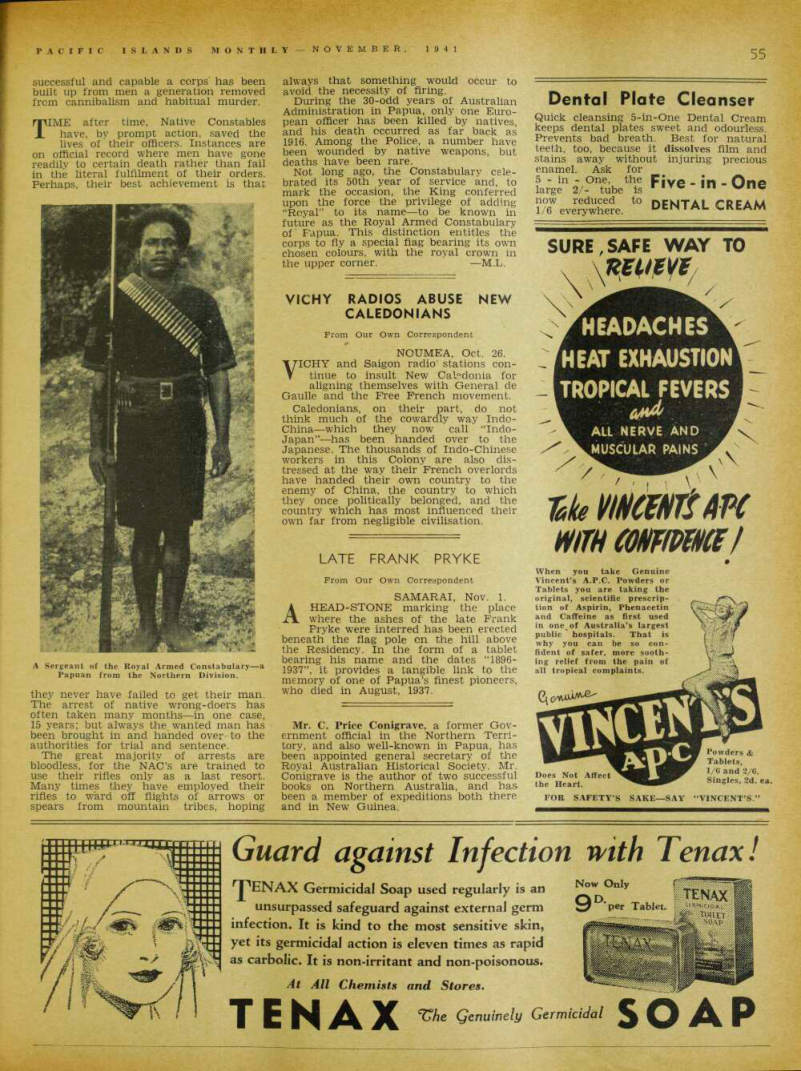
Tribute to Royal Papuan Constabulary
ONE of the finest feats of colonial administration in the British Empire has been the bloodless pacification of more than 250,000 primitive Papuan natives.
In this vast country, there still are many natives who have never seen a European and who still live under Stone Age conditions; but gradually they are being brought under control and prepared for the impact of modern civilisation.
The Papuans themselves, as members of the Royal Armed Constabulary (formerly known as the Native Armed Constabulary) are playing no small part in this work of pacification.
This little force of native police has done splendid work in maintaining law and order among its own people during the past 50 years and, in that time, has built up a reputation and record equal to any other similar body in the world.
The Constabulary have been dubbed “savages in serge”, but they are a hardy and vigorous body of men, muscular and well set up. On patrol, with their packs and rifles, they cut picturesque figures as they swing along, in their uniform of navy and red.
THE Native Armed Constabulary was instituted in 1889 bv Sir William Macgregor. Through the Fiji Gov ernment, he recruited 12 Solomon Islanders and 2 Fijian NCO’s, from the Fiji Police Force and, with them, formed the nucleus of the Service. Later, the force was expanded with Papuan natives, eight being recruited in the first year.
These new recruits did very well and their number was rdpidly increased.
When the Solomon Islanders and Fijians completed their three-year term of service, it was decided not to replace them. A few were re-engaged, but all other vacancies were filled by Papuans.
Within a few years, the Service became wholly Papuan in character.
The record of the Constabulary has been consistently good, from the time of its inauguration until the present day.
Without it, the pacification of Papua might never have been achieved. True, the force has been well led; but not the most perfect leadership could have suc ceeded in the difficult task without the unquestioning loyalty and the unfailing courage the men have always given their officers.
A good deal of the success of the Constabulary has been due to the careful manner in which recruits have been trained and to the system which in culcates a sense of duty and of loyalty from the outset. It reflects great credit, too, on the native character that so
successful and capable a corps has been built up from men a generation removed from cannibalism and habitual murder.
TIME after time, Native Constables have, by prompt action, saved the lives of their officers. Instances are on official record where men have gone readily to certain death rather than fail in the literal fulfilment of their orders.
Perhaps, their best achievement is that
they never have failed to get their man.
The arrest of native wrong-doers has often taken many months —in one case, 15 years; but always the wanted man has been brought in and handed over-to the authorities for trial and sentence.
The great majority of arrests are bloodless, for the NAC’s are trained to use their rifles only as a last resort.
Many times they have employed their rifles to ward off flights of arrows or spears from mountain tribes, hoping
always that something would occur to avoid the necessity of firing.
During the 30-odd years of Australian Administration in Papua, only one Euro pean officer has been killed by natives, and his death occurred as far back as 1916. Among the Police, a number have been wounded by native weapons, but deaths have been rare.
Not long ago, the Constabulary cele brated its 50th year of service and, to mark the occasion, the King conferred upon the force the privilege of adding “Royal” to its name—to be known in future as the Royal Armed Constabulary of Fapua. This distinction entitles the corps to fly a special flag bearing its own chosen colours, with the royal crown in
the upper corner.
-M.L.
A Sergeant of the Royal Armed Constabulary—a Papuan from the Northern Division.
Advertisements & other items, p. 56 (1 item)
Gramophone
RECORDS
SEND US YOUR ORDERS
Goods sent C.O.D. at no extra charge.
Catalogues sent without obligation.
THE TALKERIES
161 Castlereagh Street,
SYDNEY
Vichy Radios Abuse New
Caledonians
From Our Own Correspondent
Noumea, Oct. 26.
VICHY and Saigon radio stations con tinue to insult New Caledonia for aligning themselves with General de Gaulle and the Free French movement.
Caledonians, on their part, do not think much of the cowardly way Indo china —which they now call “Indo- Japan”—has been handed over to the Japanese. The thousands of Indo-Chinese workers in this Colony are also dis tressed at the way their French overlords have handed their own country to the enemy of China, the country to which they once politically belonged, and the country which has most influenced their own far from negligible civilisation.
Late Frank Pryke
From Our Own Correspondent
Samarai, Nov. 1.
AHEAD-STONE marking the place where the ashes of the late Frank Pryke were interred has been erected beneath the flag pole on the hill above the Residency. In the form of a tablet bearing his name and the dates “1896- 1937”, it provides a tangible link to the memory of one of Papua’s finest pioneers, who died in August, 1937.
Mr. C. Price Conigrave, a former Gov ernment official in the Northern Terri tory, and also well-known in Papua, has been appointed general secretary of the Royal Australian Historical Society. Mr.
Conigrave is the author of two successful books on Northern Australia, and has been a member of expeditions both there and in New Guinea.
Advertisements & other items, pp. 57-58 (1 item)
m mcmsm
Dental Plate Cleanser
Quick cleansing 5-in-One Dental Cream keeps dental plates sweet and odourless.
Prevents bad breath. Best for natural teeth, too, because it dissolves film and stains away without injuring precious enamel. Ask for
Five - in - One
5 -in - One, the large 2/- tube is now reduced to 1/6 everywhere.
DENTAL CREAM
SURE,SAFE WAY TO
mm- ‘V7l
HEAT EXHAUSTION
iPICAL FEVERS
A M
ALL NERVE AND
m mcmsm
mm comm/
When you take Genuine Vincent’s A.P.C. Powders or Tablets you are taking the original, scientific prescription of Aspirin, Phenacetin and Caffeine as first used in one of Australia’s largest public hospitals. That is why you can be so confident of safer, more soothing relief from the pain of all tropical complaints.
Does Not Affect the Heart.
Powders & Tablets, 1/6 and 2/6.
Singles, 2d. ea.
FOR SAFETY’S SAKE—SAY “VINCENT’S.
PJ » M JJ
m •* / / /
Guard against Infection with Tenax!
Germicidal Soap used regularly is an unsurpassed safeguard against external germ infection. It is kind to the most sensitive skin, - yet its germicidal action is eleven times as rapid as carbolic. It is non-irritant and non-poisonous.
At All Chemists and Stores, Now Only
I TENAX
per Tablet
TENAX ‘Uhe Genuinely Germicidal SOAP
LEARN MORSE CODE. “LIKE-A-
FLASH” KITS. KEYS & BUZZERS.
mm P.M.G. type Key with Professional Buzzer & Battery, all assembled on Base Board, 42/6.
Morse Set Buzzer or light with single switch. All parts include adjustable Key, Switch, Buzzer, Lamp and Battery, all assembled on Base Board, 30/-.
Morse Code Set ”De Luxe”. Adjustable High-grade Key, Buzzer and Battery. All mounted on base board ready for use, 27/6. \\l// Adjustable Morse Code Key on Bakelite Base, highly plated parts, 12/6. High-grade Instrument.
De Luxe Junior Morse Code Outfit.
Mounted Key Buzzer and Battery. 15/3 complete. Morse Book, 1/-. \\ \///■; 39/6 x „ J Morse Code Light and Buzzer Set.
A precision De-luxe outfit that cannot be bettered. Perfect Adjustable Morse Code Key, with professional type Buzzer. Light to Buzzer throw-over Switch, and Battery, all ready mounted. 240 volt A.C.-D.C. Electric “Voco”
Speakers £5/5/- for 50/-. Brand new.
RADIO VALVES.—We guarantee a Better Price. Send your order.
ALL DRY BATTERIES STOCKED.
WORLD'S LATEST
GAMES
Darts Boards with 6 Darts, 8/6.
Play Brass Competition Darts, Set of 3, 3/11, 4/6, 5/6. Monopoly, 11/6.
Totopoly, 11/6. Bucaneer, 11/6. 3 of the World’s Most Popular Games.
Chinese Checkers, 2/9, 5/-, 9/-.
Tripoly Card Game 5/3. De Luxe Type, 11/6. Poker Rummy, 1/1
HEADPHONES.
12/6, 17/6.
S.T.C., British, 30/-; 8.T.H., 30/-; Lissen, British, 19/6. All 1,000 ohms. m Rubber Head-’phone Pads, 2/6 pr Ericcson’s Professional Type, 47/6.
A new hobby—Rough Castings of Modern Planes, Ash Trays, Paper Knives, etc., etc. Write for Free Booklet. 3.G.E. Table Model Microphone for Speech or Music—fits and suits all sets; as good a performer as any; £6/6/- Model. Now 45/-.
Small Table Model British Buil.
Microphone, for all sets, 15/-, 21/-. 12/6, for speech or music. 1 Reading Pocket Volt Meters, 5/6.
Portable battery operated Light with pull switch and Battery Block, 8/6.
SPECIAL! SPECIAL!
Cosmocord Crystal Pickup.
British manufacture.
List Price 84/- Now 49/6 Special price to traders, lots of 6 or more.
Gramophone Pick-ups. Fit and suit all radios." “Collard” 50./-, “Cosmocord” 35/-, “Like-a-Flash” 30/-. All complete with leads.
Tone and volume control. Crystal Types 49/6 and 50/-. All British makes.
Pick-up Heads. British make. Fit all standard Tone Arms (just remove present gramophone speaker).
Swiss Musical Cigarette Boxes.
Plays two tunes. 45/- and 55/-.
LEVENSON'S
SPECIALISE IN RADIO
SETS FOR THE ISLANDS
TRADE
100% satisfaction guaranteed.
Liberal prices—no mass production sets real he-man radio designed and built for your particular location. Short wave and dual wave radio for dry battery or electric current operation.
Aerial Stay-wire strainers, 2/6.
Eke Luxe Model British-built Lightning Arresters, complete for indoor or outdoor use, 6/-.
Non-jam Pulleys with halyard bolt, 1/9. Special Radio Earth Spike 4/6. 4 in. 4 in 1 Nickel Screw Drivers, bakelite or metal, 2/-. . Fountain Pen size. Cone Speaker Units, 25/-; Now 12/6. 1,500 ft. Beam Electric Torches, 5 Cell, 8/6. Both use Standard Batteries. Everyman’s Wireless 3ook, 8/6. 2 to 3 Cell Expandable Torches, Nickelled Case —Dimmer incorporated.
Daylight Globes, 10/6.
Swiss Music Boxes for Cigarette, Trinkets, etc., 25/-, 30/-, 45/-.
Steel Money and Deed Boxes, 63/-.
They ring when opened or lifted. \ Splendid Article.
Microphones for Speech, Song or Music. Hook-up in a jiffy to any set. 15/-, 17/6, 18/6 complete.
Batteryless Type Hand - holding Microphones, fit any set, 25/-.
Ormond 3 In. Front-panel Vernier Dial, 2 actions, 8/6.
Wet Battery Testers, 3/-.
Nickel Cased Volt Meters, Pocket Type, 2 Reading, High & Low, 4/6.
British Make 3 Readings, 10/6.
The Best Trick Pack of Cards available, 3/6. Hundreds of Tricks you can do. Fullest, simple instructions provided.
Bench Type Meter Reads All in Radio, 30/-.
POCKET VOLT
METERS.
Two Reading Pocket Meter, for A and B Batteries, 3/9, 4/9, 7/6. 3 Reading, A and B Batteries, and up to 30 M/A, 10/6. 3 Reading De Luxe Model, 12/6. 4 Reading, 14/-.
Dice of all kinds in stock. Poker Dice, 6/6, 7/6, 8/6, 10/6, set of 5.
Crown & Anchor Dice, set of 3, 5/6.
Full Set with Cloth and Shaker, 10/6. H. & T., 5 & 6, and Hazard Dice Stocked. Write for Lists.
Throwing Knives, made in Sheffield, 8/9. As illustrated.
Remington, U.S.A., made, Hunting and Sports Knife, in Leather Sheath, 12/6. Others 15/-, 18/6.
Best Stainless Pocket Knife, 6/6.
‘Collard” British-built Gramophone Motor, with all fittings, 27/6. Turntable included.
Make your safety razor blade last for months with this Razor Blade Sharpener, 3/6. Easy to use—nothing to get out of order.
BOOKS! BOOKS! BOOKS! The Be
pinners’ Book of Radio. The Radio Beginners’ Dictionary. Z/~ the t. The Wireless Constructor’s Enoycla' paedia. Giant size, 7/6. Newnes “Everyman’s” Wireless Book, 6/6.
The Book of Practical Radio, also The Book of Practical Television, 8/6 each. Levenson’s Giant “Party and Fun Book”, 1/6. Humorous Stories and Recitation, 3/9. Card and Conjuring Tricks, 3/9. Tea-Cup Fortune Telling, 3/9. 100 Party Games for Old and Young, 1/9.
Popular Magic and Amateur Conjurer, 1/9. 50 Best Party Games, 1/6. Tricks with Cards, 1/6.
How to make 1 & 2 valve Battery Sets, 1/-.
New Radio and Other Books Just Landed. Everyman’s Wireless Book, 8/6; Toy Making for Amateurs, 2/-; Sixty Tested Circuits, 6/6; How to Make Models, 2/6; The First Course in Wireless, 9/6; Wireless Terms Explained, 6/6. 12 Snappy Books—Jokes, Have Fun, etc., 5/6 the lot.
All About Aerial Booklet, 1-/. Radio Dictionary, 1/-. Morse Code Book, 1/-. Radio Alphabet, 1/-. The 4 books for 3/3.
Roulette Wheels, complete, 25/-.
Sydney Cup Spinning Wheel Race Game. Result shows winning horse and winner’s price. 63/- (with betting sheet!. Smaller Wheel 22/6.
For home, dance, party, family and fun.
Now available (not less than 10/parcels): Magic Wand. 1/6 Jafet’s Wallet 1/-; Obedient Ball 1/6; Magic Penny, 2/6; Mystic Head Chopper, 2/6; Shy Lock, 2/-; Dribble Glass. 2/-; Ventrillo. 1/-; Magic Coin, 1/-; Nest of Nests, 5/-; Voice Echoer, 1/-; Magic Bottle, 1/-; 3 Bell Trick, 1/-.
Magic Wand 1/6; Wonderful Rattle Box Trick, 2/6. Mixed Parcels of Tricks, 10/-, 20/-, 30/-, 40/-, 50/-.
Parcel of Jokes, 10/-, 12/6, 15/-.
SHARPENER
SAFETY RAZOR
BLADE
Leather Money Belts, Splendid quality. Give waist measurement, when ordering, 9/6, 11/6 each.
J.LEVENSON Radio SS"
GAMES, NOVELTIES AN© HOBBIES. Totem and
226 A PITT STREET, SYDNEY £ dd n s , and Manufacturers, Importers, and Exporters. Leaflets N.S.W., AUSTRALIA. *llllllllllllllllllllllll Cable address: "Leveradloh”. Goods forwarded V.P.P. or Sight Draft. Satisfaction and Service Guaranteed. We can supply by mall all General Merchandise at a Better Price. Quotations with pleasure. Please add freight and packing. Write for full list of interesting leaflets of Games, Hobbies, Novelties, and Electrical Goods. Write for fall list of Radio Meters.
iiinnmimnniinj
Write for Punch Board Leaflets nirninnunininii
We Can Supply, at a Keen Price, Any Available Article You Require.
Australian Short Wave
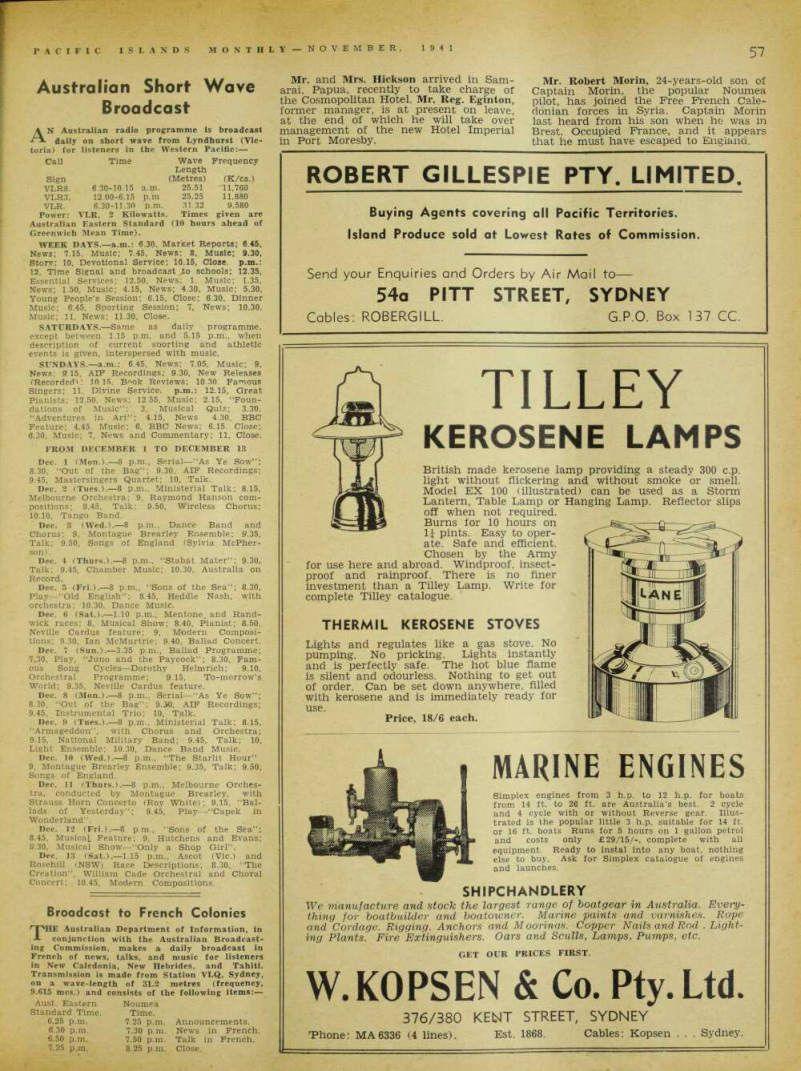
Broadcast
AN Australian radio programme Is broadcast daily on short wave from Lyndhurst (Vic toria) for listeners in the Western Pacific:—
Power: VLR, 2 Kilowatts. Times given are Australian Eastern Standard (10 hours ahead of Greenwich Mean Time).
WEEK DAYS.—a.m.: 6.30. Market Reports; 6.45, News; 7.15. Music; 7.45, News; 8. Music; 9.30, Story; 10. Devotional Service; 10.15, Close, p.m.: 12, Time Signal and broadcast .to schools; 12.35, Essential Services; 12.50, News; 1. Music; 1.35, News; 1.50, Music; 4.15, News; 4.30, Music; 5.30, Young People’s Session; 6.15, Close; 6.30, Dinner Music; 6.45, Sporting Session; 7, News; 10.30, Music; 11, News; 11.30, Close.
SATURDAYS. —Same as daily programme, except between 1.15 p.m. and 5.15 p.m., when description of current snorting and athletic events is given, interspersed with music.
SUNDAYS. —a.m.: 6.45, News; 7.05, Music; 9, News: 9.15. ATP Recordings; 9.30, New Releases (Recorded'*: 10 15. Reviews; 10.30 Famous Singers: 11, Divine Service, p.m.: 12.15, Great Pianists: 12.50, News; 12.55, Music; 2.15. “Foun dations of Music”; 3, Musical Quiz; 3.30.
“Adventures in Art”; 4.15, News 4.30, BBC Feature: 4.45. Music; 6, BBC News; 6.15. Close; 6.30, Music; 7, News and Commentary; 11, Close.
From December 1 To December 13
Dec. 1 (Mon.).—B p.m., Serial—“As Ye Sow”; 8.30, “Out of the Bag”; 9.30, AIF Recordings; 9.45, Mastersingers Quartet; 10, Talk.
Dec. 2 (Tues.). —8 p.m., Ministerial Talk; 8.15, Melbourne Orchestra; 9, Raymond Hanson com positions; 9.45, Talk; 9.50, Wireless Chorus; 10.10, Tango Band.
Dec. 3 (Wed.). —8 p.m., Dance Band and Chorus: 9, Montague Brearley Ensemble; 9’.35, Talk; 9.50, Songs of England (Sylvia McPher son) .
Dec. 4 (Thurs.).—B p.m., “Stabat Mater”; 9.30, Talk; 9.45, Chamber Music; 10.30, Australia on Record.
Dec. 5 (Fri.). —8 p.m., “Sons of the Sea”; 8.30, Play—“ Old English”: 8.45, Heddle Nash, with orchestra; 10.30, Dance Music.
Dec. 6 (Sat.). —1.10 p.m., Mentone, and Rand wick races; 8, Musical Show; 8.40, Pianist; 8.50, Neville Cardus feature; 9, Modern Composi tions; 9.30, lan McMurtrie; 9.40, Ballad Concert.
Dec. 7 (Sun.). —3.35 p.m., Ballad Programme; 7.30, Play, “Juno and the Paycock”; 8.30, Fam ous Song Cycles—Dorothy Helmrich; 9.10, Orchestral Programme; 9.15, To-morrow’s World; 9.35, Neville Cardus feature.
Dec. 8 (Mon.). —8 p.m., Serial—“As Ye Sow”; 8.30, “Out of the Bag”; 9.30, AIF Recordings; 9.45, Instrumental Trio; 10, Talk.
Dec. 9 (Tues.). —8 p.m.. Ministerial Talk; 8.15, “Armageddon”, with Chorus and Orchestra; 9.15, National Military Band; 9.45, Talk; 10, Light Ensemble; 10.30, Dance Band Music.
Dec. 10 (Wed.).—B p.m., “The Starlit Hour” 9, Montague Brearley Ensemble; 9.35, Talk; 9.50, Songs of England.
Dec. 11 (Thurs.). —8 p.m., Melbourne Orches tra, conducted by Montague Brearley, with Strauss Horn Concerto (Roy White); 9.15, “Bal lads of Yesterday”: 9.45, Play—“ Capek in Wonderland”.
Dec. 12 (Fri.). —8 p.m., “Sons of the Sea”; 8.45, Musical Feature; 9, Hutchens and Evans; S’.3o, Musical Show—“ Only a Shop Girl”; Dec. 13 (Sat.). —1.15 p.m., Ascot (Vic.) and Rosehill (NSW) Race Descriptions: 8.30, “The Creation”, William Cade Orchestral and Choral Concert: 10.45, Modern Compositions.
Call Time Wave Frequency Length Sign (Metres) (K/cs.)
Vlr3.
6 30-10.15 a.m. 25.51 11,760
Vlr3.
12.00-6.15 p.m 25.25 11,880
Vlr.
6.30-11.30 p.m. 31.32 9.580
Broadcast- to French Colonies
THE Australian Department of Information, in conjunction with the Australian Broadcast ing Commission, makes a daily broadcast in French of news, talks, and music for listeners in New Caledonia, New Hebrides, and Tahiti.
Transmission is made from Station VLQ, Sydney, on a wave-length of 31.2 metres (frequency, 9.615 mcs.) and consists of the following items;—
Mr. and Mrs. Hickson arrived in Samarai, Papua, recently to take charge of the Cosmopolitan Hotel. Mr. Reg. Eginton, former manager, is at present on leave, at the end of which he will take over management of the new Hotel Imperial in Port Moresby.
Mr. Robert Morin, 24-years-old son of Captain Morin, the popular Noumea pilot, has joined the Free French Cale donian forces in Syria. Captain Morin last heard from his son when he was in Brest, Occupied France, and it appears that he must have escaped to England.
Aust. Eastern Noumea Standard Time. Time. 6.25 p.m. 7.25 p.m. Announcements. 6.30 p.m. 7.30 p.m. News in French. 6.50 p.m. 7.50 p.m. Talk in French. 7.25 p,m. 8.25 p.m. Close.
Advertisements & other items, pp. 59-60 (1 item)
Tilley
ROBERT GILLESPIE PTY. LIMITED.
Buying Agents covering all Pacific Territories.
Island Produce sold at Lowest Rates of Commission.
Send your Enquiries and Orders by Air Mail to —
54a PITT STREET, SYDNEY
Cables: ROBERGILL. G.P.O. Box 137 CC.
TILLEY
KEROSENE LAMPS
British made kerosene lamp providing a steady 300 c.p. light without flickering and without smoke or smell.
Model EX 100 (illustrated) can be used as a Storm Lantern, Table Lamp or Hanging Lamp. Reflector slips off when not required.
Burns for 10 hours on li pints. Easy to operate. Safe and efficient.
Chosen by the Army for use here and abroad. Windproof, insectproof and rainproof. There is no finer investment than a Tilley Lamp. Write for complete Tilley catalogue.
THERMIL KEROSENE STOVES
Lights and regulates like a gas stove. No pumping. No pricking. Lights instantly and is perfectly safe. The hot blue flame is silent and odourless. Nothing to get out of order. Can be set down anywhere, filled with kerosene and is immediately ready for use.
Price, 18/6 each.
UNE
MARINE ENGINES
Simplex engines from 3 h.p. to 12 h.p. for boats from 14 ft. to 26 ft. are Australia’s best. 2 cycle and 4 cycle with or without Reverse gear. Illustrated is the popular little 3 h.p. suitable for 14 ft. or 16 ft. boats Runs for 5 hours on 1 gallon petrol and costs only £29/15/-, complete with all equipment. Ready to instal into any boat, nothing else to buy. Ask for Simplex catalogue of engines and launches.
SHIPCHANDLERY
We manufacture and stock the largest range of boatgear in Australia. Everything for boatbuilder and boatowner. Marine paints and varnishes. Rope and Cordage. Rigging. Anchors and Moorings. Copper Nails and Rod . Lighting Plants. Fire Extinguishers. Oars and Sculls, Lamps, Pumps, etc.
GET OUR PRICES FIRST.
W.KOPSEN & Co. Pty.Ltd.
376/380 KENT STREET, SYDNEY
’Phone: MA6336 (4 lines). Est. 1868. Cables: Kopsen . . . Sydney.
HELP
KIDNEYS PASS
3 LBS. A DAY
Doctors say your kidneys contain 15 miles of tiny tubes or filters which help to purify the blood and keep you healthy. Most people pass about 3 pints a day or about 3 pounds of waste.
An excess of acids or poisons in your blood are the cause of frequent or scanty passages with smarting and burning, nagging backache, rheumatic pains, leg pains, loss of pep and energy, getting up nights, swollen feet and ankles, puffiness under the eyes, headaches and dizziness.
If kidneys don’t empty 3 pints a day and get rid of more than 3 pounds of waste matter, your body will take up these poisons causing serious trouble. Don’t wait! Ask your chemist or store for DOAN’S
BACKACHE KIDNEY PILLS . . .
used successfully the world over by millions of people. They give quick relief and will help to flush out the 15 MILES of kidney tubes.
Get DOAN’S BACKACHE KIDNEY
PILLS at your chemist or store.
Allen Taylor & Co. Ltd.
COMMERCIAL ROAD, ROZELLE,
SYDNEY
Sawmillers and Wholesale Suppliers of Hardwoods for Constructional Purposes GIRDERS . . . PILES . . . POLES . . . SLEEPERS, Etc.
EXPORTING TO PACIFIC” ISLANDS SINCE 1893
gather saps
s Rich in juniper and healthful herbs ... *
OF GENERATIONS
Samoan Elections
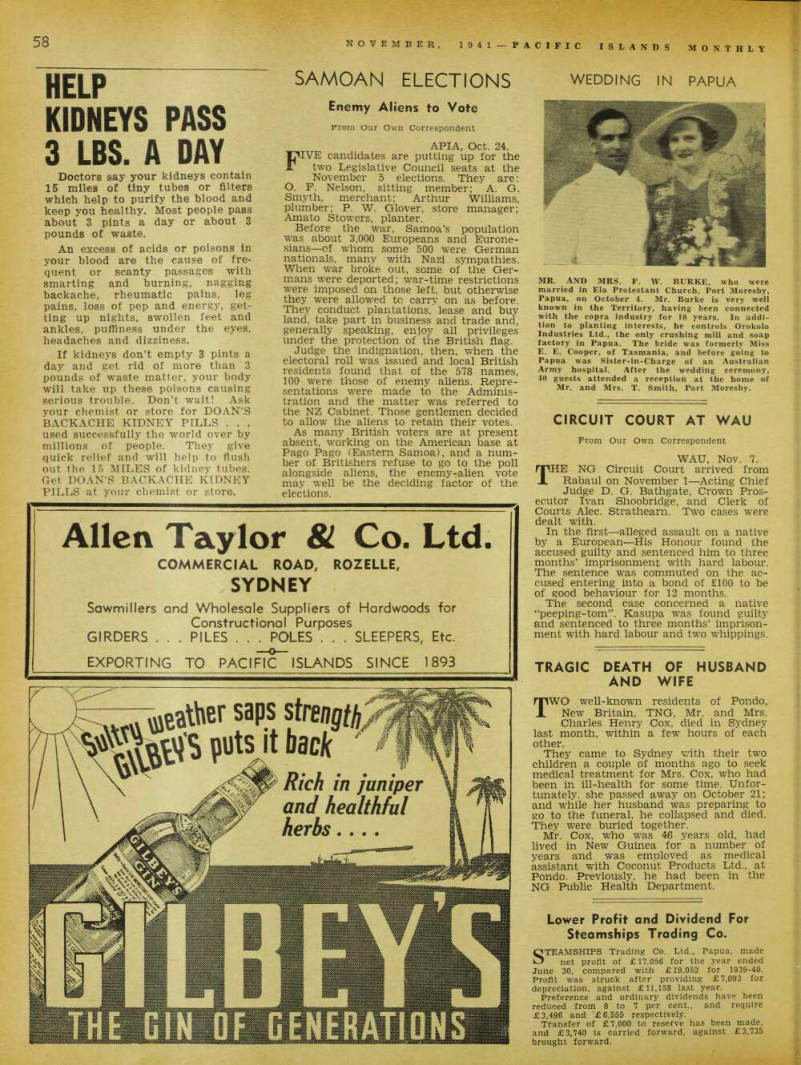
Enemy Aliens to Vote
From our Own Correspondent
Apia, Oct. 24.
FIVE candidates are putting up for the two Legislative Council seats at the November 5 elections. They are: O. F. Nelson, sitting member; A. G.
Smyth, merchant; Arthur Williams, plumber; P. W. Glover, store manager; Amato Stowers, planter.
Before the war, Samoa’s population was about 3,000 Europeans and Eurone sians—of whom some 500 were German nationals, many with Nazi sympathies.
When war broke out, some of the Ger mans were deported; war-time restrictions were imposed on those left, but otherwise they were allowed to carry on as before.
They conduct plantations, lease and buy land, take part in business and trade and, generally speaking, enjoy all privileges under the protection of the British flag.
Judge the indignation, then, when the electoral roll was issued and local British residents found that of the 578 names, 100 were those of enemy aliens. Repre sentations were made to the Adminis tration and the matter was referred to the NZ Cabinet. Those gentlemen decided to allow the aliens to retain their votes.
As many British voters are at present absent, working on the American base at Pago Pago (Eastern Samoa), and a num ber of Britishers refuse to go to the poll alongside aliens, the enemy-alien vote may well be the deciding factor of the elections.
Wedding In Papua
MR. AND MRS. F. W. BURKE, who were married in Ela Protestant Church, Port Moresby, Papua, on October 4. Mr. Burke is very well known in the Territory, having been connected with the copra industry for 18 years. In addi tion to planting interests, he controls Orokolo Industries Ltd., the only crushing mill and soap factory in Papua. The bride was formerly Miss E. E. Cooper, of Tasmania, and before going to Papua was Sister-in-Charge of an Australian Army hospital. After the wedding ceremony, 40 guests attended a reception at the home of Mr. and Mrs. T. Smith, Port Moresby.
Circuit Court At Wau
From Our Own Correspondent WAU, Nov. 7.
THE NG Circuit Court arrived from Rabaul on November I—Acting Chief Judge D. G. Bathgate, Crown Pros ecutor Ivan Shoobridge, and Clerk of Courts Alec. Strathearn. Two cases were dealt with.
In the first—alleged assault on a native by a European—His Honour found the accused guilty and sentenced him to three months’ imprisonment with hard labour.
The sentence was commuted on the ac cused entering into a bond of £lOO to be of good behaviour for 12 months.
The second case concerned a native “peeping-tom”. Kasupa was found guilty and sentenced to three months’ imprison ment with hard labour and two whippings.
Tragic Death Of Husband
And Wife
TWO well-known residents of Pondo, New Britain, TNG, Mr. and Mrs.
Charles Henry Cox, died in Sydney last month, within a few hours of each other.
They came to Sydney with their two children a couple of months ago to seek medical treatment for Mrs. Cox, who had been in ill-health for some time. Unfor tunately. she passed away on October 21; and while her husband was preparing to go to the funeral, he collapsed and died.
They were buried together.
Mr. Cox, who was 46 years old, had lived in New Guinea for a number of years and was employed as medical assistant with Coconut Products Ltd., at Pondo. Previously, he had been in the NG Public Health Department.
Steamships Trading Co.
Lower Profit and Dividend For Steamships Trading Co.
STEAMSHIPS Trading Co. Ltd., Papua, made net profit of £17,056 for the year ended June 30, compared with £19,052 for 1939-40.
Profit was struck after providing £7,093 for depreciation, against £11,158 last year.
Preference and ordinary dividends have been reduced from 8 to 7 per cent., and require £3,496 and £6,555 respectively.
Transfer of £7,000 to reserve has been made, and £3*740 is carried forward, against £3,735 brought forward.
Market Quotations
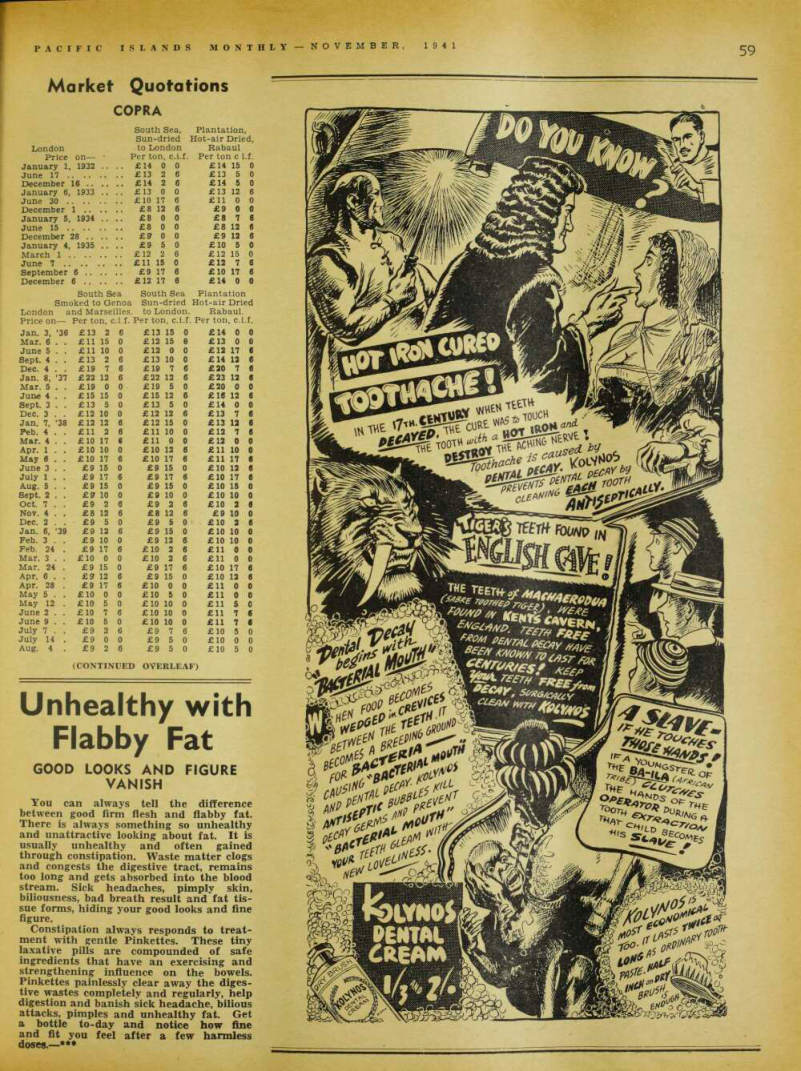
Copra
South Sea, Plantation, Sun-dried Hot-air Dried, London to London Rabaul Price on— • Per ton, c.i. ,f.
Per ton c i.f.
January 1, , 1932 . . . . £14 0 0 £14 15 0 June 17 . £13 2 6 £13 5 0 December 16 .. £14 2 6 £14 5 0 January 6, , 1933 .. ., £13 0 0 £13 12 6 June 30 . £10 17 6 £11 0 0 December 1 .. £8 12 6 £9 0 0 January 5, , 1934 .. .. £8 0 0 £8 7 6 June 15 . £8 < 0 0 £8 12 6 December 28 .. £9 0 0 £9 12 6 January 4, , 1935 , , , . £9 5 0 £10 5 0 March 1 , £12 : 2 6 £12 15 0 June 7 ., £11 15 0 £12 7 6 September 6 .. £9 17 6 £10 17 6 December 6 .. £12 17 6 £14 0 0 South Sea South Sea Plantation Smoked to Genoa Sun-dried Hot-air Dried London and Marseilles, to London.
Rabaul.
Price on— Per ton, i c.i.f.
Per ton, c.i.f. Per ton, c.i.f.
Jan. 3. ’36 £13 2 6 £13 15 0 £14 0 0 Mar, 6 . . £11 15 0 £12 15 e £13 0 0 June 5 . . £11 10 0 £12 0 0 £12 17 6 Sept. 4 . . £13 2 6 £13 10 0 £14 12 6 Dec. 4 . . £19 7 6 £19 7 6 £20 7 6 Jan. 8, '37 £22 12 6 £22 12 6 £23 12 6 Mar. 5 . . £19 0 0 £19 5 0 £20 0 0 June 4 . . £15 15 0 £15 12 6 £16 12 6 Sept. 3 . . £13 5 0 £13 5 0 £14 0 0 Dec. 3 . . £12 10 0 £12 12 6 £13 7 6 Jan. 7, ’38 £12 12 6 £12 15 0 £13 12 6 Peb. 4 . . £11 2 6 £11 10 0 £12 7 6 Mar. 4 . . £10 17 6 £11 0 0 £12 0 0 Apr. 1 . . £10 10 0 £10 12 6 £11 10 0 May 6 . . £10 17 6 £10 17 6 £11 17 6 June 3 . . £9 15 0 £9 15 0 £10 12 6 July 1 . . £9 17 6 £9 17 6 £10 17 6 Aug. 5 . . £9 15 0 £9 15 0 £10 15 0 Sept. 2 . . £9 10 0 £9 10 0 £10 10 0 Oct. 7 . . £9 2 6 £9 2 6 £10 2 6 Nov. 4 . . £8 12 6 £8 12 6 £9 10 0 Dec. 2 . . £9 5 0 £9 5 0 £10 2 6 Jan. 6, ’39 £9 12 6 £9 IS 0 £10 10 0 Feb. 3 . . £9 10 0 £9 12 6 £10 10 0 Peb. 24 . £9 17 6 £10 2 6 £11 0 0 Mar. 3 . . £10 0 0 £10 2 6 £11 0 0 Mar. 24 . £9 15 0 £9 17 6 £10 17 6 Apr. 6 . . £9 12 6 £9 15 0 £10 12 6 Apr. 28 . £9 17 6 £10 0 0 £11 0 0 May 5 . . £10 0 0 £10 5 0 £11 0 0 May 12 . £10 5 0 £10 10 0 £11 5 0 June 2 . . £10 7 6 £10 10 0 £11 7 6 June 9 . . £10 5 0 £10 10 0 £11 7 6 July 7 . . £9 2 6 £9 7 6 £10 5 0 July 14 . £9 0 0 £9 5 0 £10 0 0 Aug. 4 . £9 2 6 £9 5 0 £10 5 0
(Continued Overleaf)
Aug. 11 . £9 2 6 £9 5 0 £lO 5 0 Sept. 1 . . £9 10 0 £9 12 6 £lO 12 6 Sept. B.—Not quoted—outbreak of war.
Sept. 15 to 29.—Not quoted.
Oct. 6 . . £ll 15 0 [unquoted] £l2 15 0 Oct. 12.—Fixed price based on £l2/7/6 per ton, c.i.f., London, for plantation hot-air dried.
Jan. 8, 1940.—April 20, 1940.—Fixed price, for plantation, hot-air dried, £l3/5/- per ton, c.i.f., London.
April 2o[ 1940.—Fixed price for plantation, hotair dried, £l2/17/6 per ton, c.i.f., London.
Since then, quotations nominal, as above.
London Copra Price
Straits copra, sun-dried, was quoted by “The Economist” at £l2/10/- per ton, c.i.f., in London, throughout the first quarter of 1941.
Some months ago an official Rubber Con troller was appointed in Britain and the Minis try of Supply became the sole importer. Since then, variations in the London rubber price have been made public only by official announcement, from time to time. There has been no information published since mid- October.
Rubber
Plantation London Para.
Smoked.
Price on— per lb. per lb.
January 6, 1933 .. 2.43d July 7 .. 3.71d December 8 4.0 s / 8 d January 5, 1934 4»/ 4 d 4.28d July 6 .. 7.06d December 28 . . 6*/ 4 d January 4, 1935 5d .. 6%d July 5 .. 77sd December 6 . . ey 4 d . . 63/sd January 3, 1936 6%d . . 6%d June 5 7>/ 4 d December 4 .. 1/- 9 l-16d
January 8, 1937 .. . . lOVad June 4 9 5-8d December 3 7Vad January 7, 1938 .. .. ... VAd 7d July 1 VAd December 2 8d January 6, 1939 .. .. 8y„d July 7 8y 4 d December 1 ny a d January 5, 1940 . . . . ... 13d n.cy.d July 5 12 3 / 4 d December 6 12d January 3, 1941 .. .. 12.47 7 / a d February 7 12.5 5 /ad March 7 ,, 13%d April 4 14y 8 d May 2 .. 14.0 5 /ad June 6 13.5%d July 4 13 7-16d August 1 13Vad August 8 , m 13.6y«d August 15 .. .. 17d 13.55/ad August 22 .. .. 17d 13%d August 29 13 5 /ad September 5 13 s /ad September 12 13 3 / 4 d September 19 ... — 13 %d October 6 .. .. 13 ll-16d October 10 , , 13 3 Ad
Advertisements & other items, pp. 61-62 (1 item)
mff* %S**M
um mi rm y. z •1M
TtET*
when
CVO&
TOUCH
i wm \Ht6v> and. we '/■'^S^iSreuße iro* H(>l ; th a.
TOOfH
UJL
THE
p tSSP
afflbgffejra
® rtt’Tfi fOUNV IH ¥
mff* %S**M
9^.
!iSs^ak
V*JS*t
1& ,P iWW&fll Tut: J * V^/1
r.M oZ^TdTs?^
wf aSteS
I SjjSsASs
**£ £A/' 2r. '*«■» o/^ s St**er°y Bs
P'C^k
1 "B* C > *Mii v , A\i
■^Sess*!
ssr H**
felYNOj
100* I* o ** if#* lUftl* -foo
hrtssgH
■/r*Z
Unhealthy with
Flabby Fat
GOOD LOOKS AND FIGURE
VANISH
You can always tell the difference between good firm flesh and flabby fat.
There is always something so unhealthy and unattractive looking about fat. It is usually unhealthy and often gained through constipation. Waste matter clogs and congests the digestive tract, remains too long and gets absorbed into the blood stream. Sick headaches, pimply skin, biliousness, bad breath result and fat tissue forms, hiding your good looks and fine figure.
Constipation always responds to treatment with gentle Pinkettes. These tiny laxative pills are compounded of safe ingredients that have an exercising and strengthening influence on the bowels.
Pinkettes painlessly clear away the digestive wastes completely and regularly, help digestion and banish sick headache, bilious attacks, pimples and unhealthy fat. Get a bottle to-day and notice how fine and fit you feel after a few harmless doses.—
V 4 r x v * ‘'AVVfi vnu.;k \ ; •SiiW-vlUi, vVwMfeW; ' V V > ,•' r\\)/ I (/%.' r -., '.’VV' If' (>»' i v V; f y// ;, Hi ,•//
vV>V , ••■;..
mv.
■V.ifl
m - <' y ; EVER ONWARD! ... In these progressive days the urgent call is for still greater speed . . . more intensive organization.
The problems involved in this aim are being successfully solved by Australian industry at war. Hand in hand with industry, and in the same progressive spirit, the Bank of New South Wales is helping to speed up the Empire drive to victory. 595 C
End Rheumatism
While You Sleep
If you suffer sharp stabbiug pains, if joints are swollen, it shows your blood is poisoned through faulty kidney action.
Other symptoms of Kidney Disorders are Backache, Aching Joints and Limbs, Sciatica, Neuritis, Lumbago, Getting up Nights, Dizziness, Nervousness, Circles under Lyes, Burning, Itching Passages, Loss of Energy and Appetite and Frequent Headaches and Colds, Etc. Ordinary medicines can’t help much because you must get to the root cause of the trouble.
The Cystex treatment is specially compounded to soothe, tone and clean raw, sore, sick kidneys and bladder and remove acids and poisons from your system safely, quickly and surely, yet contains no harmful or dangerous drugs.
Cystex works in 3 ways to end your troubles. 1. Starts killing the germs which are attacking your Kidneys, Bladder and Urinary System in two hours, yet is absolutely harmless to human tissue. 2. Gets rid of health-destroying, deadly poisonous acids with which your system has become saturated. 3. Strengthens and reinvigorates the kidneys, protects from the ravages of disease-attack on the delicate filter organism, and stimulates the entire system. r
Praised by Doctors, Chemists, and
One-time Sufferers Cystex is approved by Doctors and Chemists in 73 countries and by one-time sufferers from the troubles shown above. Mr. Reg. Thomas, Townsville, Queensland, recently wrote : “My joints were all stiff, I had leg pains, my hack used to ache day and night. My bladder was weak. I had headaches and no appetite. The first dose of Cystex helped me and before I finished three boxes my health and strength came back."
Guaranteed to Put You Right or Money Back Get Cystex from your chemist today. Give it a thorough test.
Cystex is guaranteed to make you feel younger, stronger, better in every way, in 2-4 hours and to be completely well in 1 week or your money back if you return the empty package. Act now ! Now In 3 sizes —l/9, 4/-, 8/-.
DO NT Rt
OLD AT .
30*»40; You..
Alive hilll
-Cystex
This is a
CUARANTEEDy
' Remedy
for Your Kidneys, Bladder, Rheumatism
Islands Produce
THE following quotations were obtained In Sydney in mid-November: —
Coffee
Java: Robusta, f.a.q.. imported on firm conversion of exchange, c.i.f., prompt shipment, Sydney (Sterling): Quote No. 1; 46/9. Quote No. 2: 49/-.
Boengie (a good quality Java coffee), c.i.f., Sydney, 64/3.
Kenya, f.a.q., Immediate shipment, c.i.f., Sydney, per cwt. (Stg.): Quote No. 1; Grade “B”, 74/-; “C”, 68/-.
East Africa: Robusta, f.a.q., c.i.f., Sydney, 56/-. Mocha (Standard Billy), f.a.q., c.i.f., Sydney, 54/-.
Mysore, f.a.q., c.i.f., Sydney, per cwt. Quote No. 1: Grade “A", 76/-; Grade “B", 68/-; Grade “C”, 62/-.
Arabian (Aden) Hodeidah, f.a.q., c.i.f., Sydney.
No. 1 quotation: 82/-.
NO and Papua: Quote No. 1: 9%d. per lb. (delivered store, Sydney), medium quality.
Quote No. 2: 10y 4 d.-lld. per lb. (delivered store, Sydney). Quote No. 3: Sales recently at 9Vz- 9 5 / B d. per lb., c.i.f., Sydney.
New Caledonia: It is expected that the New Caledonian Government’s plan to grade the Colony’s 1941-42 coffee crop will have the effect of increasing prices. At present New Caledonian coffee varies considerably, and each parcel must be treated on its merits. Quotations from several different sources in November were:— Quote No. 1 (in store, Sydney): Arabica, Grade “A”, UVad.-l/-; “B”, 10 7 / B d.; Robusta, 9%d.lOd. Quote No. 2 (c.i.f. and e., Sydney): Robusta, 4d. per lb; Arabica, 6d. per lb. Quote No. 3 (c.i.f., Sydney): Arabica, Bd. per lb.; Robusta, 4d. per lb. Quote No. 4 (c.i.f., Syd ney); Arabica, £56-£6O per ton; Robusta, £34- £4O per ton. Quote No. 5 (c.i.f., Sydney); Robusta, £37-£39 per ton.
New Hebrides (c.i.f,, Sydney); Quote No. 1: £36 per ton. Quote No. 2: £37-£39 per ton.
Quote No. 3: £3O-£33 a ton (f.a.q.), c.i.f. and e., Sydney. [Note: Importers of all coffees —except NG and Papuan—pay additional charges, Including exchange, duty (4.4 d. lb.), primage (11 per cent.), landing costs (1/- per cwt.), war duty (10 per cent.)]
Vanilla Beans
Tahiti: Quote No. 1 (c. & f., Sydney): Approxi mate market price, white label, 28/- a lb.; green label. 21/- a lb. Quote No. 2 (c.i.f., Sydney); White label and yellow label, S2/-32/6 per lb.
Quote No. 3: This agent reports a firm market for first-grade beans.
Kapok
Quote No. 1: Average Java 6-17/32d. per lb., c.i.f.; Prime Japara, 6-7/32d. per lb., c.i.f.
Quote No. 2: Average Java, 7 5 /sd., c.i.f.; Prime Japara, 7-15/16d., c.i.f. (Prices sterling and subject to exchange 25V2%, duty 2d. per lb., 10% primage, 10% war duty, wharfage.)
Ivory Nuts
Owing to war conditions, Sydney agents are not quoting for ivory nuts. The last quo tations, some months ago, Indicated that a nominal rate was in the vicinity of £7 per ton.
Cotton
New Caledonian, c.i.f., Sydney. Quote No. 1: 9d. per lb. Quote No. 2: lOd.-lld. per lb. Quote No. 3 (delivered store, Sydney): lOd.-lld. (approximate market price) per lb.
Cocoa
New Guinea cocoa; Quote No 1: £49 per ton —market rising. Quote No. 2: £5O-£52 per ton.
(Continued On Next Page)
Accra (West Africa): £5O per ton, c.i.f., Sydney.
New Hebrides cocoa (delivered store, Sydney): Quote No. 1; £52 per ton Quote No. 2; £5O - per ton. Quote No. 3: Ist Grade, £47-£49 per ton, c.i.f., Sydney. Market firm. Quote No. 4: £5O-£53 per ton.
Western Samoan cocoa: Quote No. 1: £6O per ton, c.i.f., Sydney. Quote No. 2: Price at Apia, September, £32/10/- per ton for small European lots.
Rice
Australian table rice, packed in 56 lb. bags £2O per ton.
Rangoon rice, packed in 100 lb. bags £2l/10/- per ton; 200 lb. sacks, £2l per ton.
Trochus Shell
Sales have taken place recently at the following prices; Quote No. 1; Good average parcel of mixed grades, £4B per ton. Quote No. 2: Mixed parcels, £5O. Quote No. 3: “A”
Grade, £56; “B” Grade, £46/10/-; “C” Grade, £B7/10/-. Quote No. 4: “A”, £57; “B”, £49; “C”, £37. Quote No. 5 (Nominal); “A”! £54; “B”, £46; “C”, £34. Quote No. 6: Mixed parcels, £5O. Quote No. 7: £6O for mixed parcels.
Green Snail Shell
Sales of green snail shell were made recently in Sydney at the following prices:—Ist grade £62 a ton; mixed parcel, £5B/10/- a ton!
Another agent reported sales of a good quality shell recently atr* £66 a ton. Quote No 3- Quote No - 4: £5O-£55. Quote No. 5 < N - nebndes, Solomon Is., N. Caledonian shell): £66/10/- a ton. f.o.b. Sydney market firm. Quote No- 6; Good grade BSI shell, approximately £6O-£65 a ton, f.0.b.. Sydney. This agent states that markets and freights are changing periodic ally. Quote No. 7: £66-£67 a ton. Quote No. 8 (nominal): £64 a ton.
Mother Of Pearl Shell
Thursday Is. MOP, c.i.f., Sydney. Grade “AA” £202 per ton; Grade “A”, £202; Grade , B"’ £202; Grade "DD”, £128; Grade “D” £ll7 - ' Grade “E”, £7B.
Peanuts
New Guinea peanuts; Unshelled, 2%d. per lb • shelled, 4 3 / 4 d. per lb.
Dr. G. H. Vemon, well-known Govern ment Medical Officer at Misima Island, Papua, recently made an extended medi cal survey in the Northern Division of the Territory prior to his departure for Australia on leave.
Exchange Rates
r T' HE following exchange quotations, gathered A in Sydney, show the rate existing in mid- November:—
Fiji
Through Bank of NSW and Bank of New Zealand:— Australia on Fiji on basis of £100 Fiji. Buying, £Alll/2/6; selling, £A113 Fiii- London on basis £100 London:
New Guinea And Papu£
Through Commonwealth Bank and Bank of NSW:—Australia on Port Moresby and Samarai Papua, 10/- per cent.; on Rabaul, NG, 10/- per cent.—other Papua and New Guinea districts, £1 per cent.
Rabaul on London, same as Australia on London:— Buying: T.T. £A125 equals £stg. 100 Selling; T.T. £A125/10/- equals £stg. 100.
Western Samoa
Through Bank of New Zealand:— Australia on Western Samoa, basis £100 Samoa—buying £ A99/12/6; selling, £A100/2/6. Samoa on London, basis £100 in London;—
New Caledonia And Tahiti
London banks nowadays are not quoting on Paris; therefore the rates furnished to the “PIM” by the Comptoir National d’Escompte de Paris, Sydney, and the Bank of NSW are no longer available. Most of the business between the Free French Colonies in the Pacific and Australia is being done in Australian currency; but there is in existence an unofficial, fluctuat ing rate of between 140 and 143.5 francs to the Australian £.
Buying.
Selling. £ s. d. £ s. d.
Telegraphic transfer . .. 110 15 0 112 0 0 On demand 111 17 6
Buying. Selling.
Telegraphic transfer — £125 10 0 On Demand £122 18 9 125 7 6 30 days 122 8 9 125 2 6 60 days 121 18 9 124 17 6 90 days 121 8 9 124 12 6 120 days 120 18 9
Advertisements & other items, pp. 63-64 (1 item)
Cordage and
■ There Is a Ransomes Mower for every lawn—our range covers W machines for all conditions, not only for ordinary lawns of all sizes, but for areas such as tennis courts, bowling greens, putting courses, etc., where a specially line surface is essential.
Whether you require a light side-wheel machine or a petrol or electric motor mower, there Is a Ransomes model which will give complete satisfaction.
Made by:
RANSOMES, SIMS & JEFFERIES,
LTD., Ipswich, England.
ansornes
LAWN MOWERS
Write for illustrated literature and all Information.
MORRIS, HEDSTROM, LTD.,
Suva, Lautoka and Ba.
Scott’s “Renown” Brand Rope,
Cordage and
Cable Address Ropeyard, Sydney.
MW '•^l* S ss
Binder
Twine
of Every
Description
MANUFACTURED AT
MASCOT, N.S.W.
J. SCOTT
PTY. LTD.
Head Office and Store
163 CLARENCE STREET,
SYDNEY,
N.S.W.
u C.S w mm Ld
General
Merchants
and
Agents
REPRESENTING LEADING FIRMS IN THE PACIFIC ISLANDS
379 KENT STREET,
SYDNEY.
Cable Address; “Trocas”, Sydney.
Telephones; MJ 4657 (5 lines).
Buyers of all Islands’ requirements on Commission Original Invoices Furnished.
Islands Produce Sold on Shippers’ Account Liberal Advances against Consignments. 25 Years Islands Experience.
Bankers: Bank of New South Correspondence in English and French.
Extra Strong
Extra Low
801- bare
Saddle
Price
Built by highly skilled workmen from the best available materials, the Great Western Saddle represents remarkable value at 80/-. It is specially built to suit Island conditions with a Galvanised Tree, Copper Tacks and Brass Fittings.
Mounts: Leathers, Girths and Stirrups, 17/6 extra.
These Saddles are obtainable through your regular agent.
We carry complete stock of Saddles, Collars, Whips, Rugs and Saddlery Accessories.
Write for Catalog**.
NEWMARKET SADDLERY
.. 18 -20 ■> WILSON ST NEWTOWN W H WILLIAMS lOR S'AI f R
FOR YOUR BOAT
Fit Masse for lighting, for wire-
less, for starting
Masse Batteries ore made of the finest materials obtainable in the largest and most scientifically equipped factory in the Southern Hemisphere.
Investigate Masse's scientific design and rugged construction and you will be convinced there is no better battery made.
'Masse
BATTERIES
Masse Batteries are Tigers for Work—they simply lap it up!
OBTAINABLE EVERYWHERE.
Ask your Island Distributor.
M '■
N.G. Miners' Union
Letter to the Editor AN article in August "PIM” implies that executives of the ALP Wau branch do not favour trade unions in New Guinea. As one executive of this body, may I be allowed to enlighten readers to the contrary?
Civilised democratic countries recognise the necessity for trade labour unions and encourage them, so why make New Guinea an exception?
The mining history of the Morobe Goldfields has been blotted with disputes and grievances between employer and employee and always it has been a one sided argument, with sole arbitrary powers held by the employer.
It was indicated in the September issue that a large majority of miners seemed hostile towards the formation of a union.
How does this reconcile with the fact that in a ballot taken on September 17, the elected officers were those in favour of a trade union? Voting was open to all eligible members and nearly all centres voted 100 per cent.
Our Union, in its future policy, is desirous above all things for peace and harmony in the NG gold mining industry.
We shall look after the general welfare of workers and endeavour to obtain the maximum in wages and conditions pos sible, in the best interests of the com munity in general. We shall conduct the Union in a constitutional and orderly manner.
The award made by Cogmmissioner Arthur Blakeley was announced only after an intensive inquiry. He made an extensive survey lasting several weeks.
Witnesses, both for and against, were summoned and the Commissioner’s deter minations were justly and fairly arrived at on the evidence tendered and con ditions generally in the Morobe District, I am, etc.,
King Laurance,
Secretary, NG and Papuan Miners and Workers’ Union.
Wau, TNG, 16/10/1941.
Death Of Former Bishop
Of N. Caledonia
From Our Own Correspondent
Noumea, Oct. 26.
rE death occurred at Noumea on October 17 of Monseigneur C. Chan rion, SM, DD, former Catholic Bishop of New Caledonia. He was 76.
Arriving in the Colony in 1890, he filled the office of vicar at Noumea Cathedral, and afterwards was missionary at La Roche (Mare Island). In 1905, he was chosen as provicaire by Mgr. Fraysse, and on the death of the latter was consecrated Bishop of Noumea in March, 1906. He filled this office for over 30 years, but a stroke in 1938 obliged him to lead a less active life.
His funeral on October 21, was attended by Governor Sautot, Commandant Jardin, and leading officials and citizens. Pere Boileau, cure at the Cathedral, pro nounced the funeral oration in the ab sence of Bishop Bresson, who was away, visiting the Catholic mission in the Belep Islands (north of New Caledonia).
Mrs. R. A. Derrick, who founded the Fijian Women's Guilds 17 years ago, re cently was awarded the Most Excellent Order of the British Empire; and at the annual meeting of the Guilds in Suva last month, the Governor, Sir Harry Luke, KCMG, presented her with the insignia.
Advertisements & other items, pp. 65-66 (1 item)
Dissolved in 1 Day
Firearm Repairs”—“OUß HANDS MAKE GOOD ARMS”—Goods sent C.O.D.
BOLT ACTION .22 CAL. SINGLE SHOT RIFLES.
"Cooey" Rifle, Single Shot Bolt Action, .22 Col. Rifle, 24 inch barrel.
Elevating Rear Sight and Blade Fore Sight. British Empire Product.
Price 45/-. Postage extra.
No. 87b. Winchester New Model, 67 Single Shot Bolt Action .22 Cal. Rifle. 27 inch barrel. Safety lock Bead Front and Elevating Rear Sight. Price 61/6.
FIREARMS CATALOGUES ON REQUEST. PHONE; MA 3540.
SIL ROHU
143 ELIZABETH STREET (Near Market St.) SYDNEY Quality Firearms and Pishing Tackle. ’Phone: MA 3540.
Asthma Munis Dissolved in 1 Day
Since the discovery of Mendaco by a famous physician it is no longer necessary for anyone to suffer from choking, wheezing, gasping Asthma. Mendaco does away with expensive injections and offensive smokes.
All you do is to take 2 tasteless tablets with meals and Mendaco starts circulating through the blood in 10 minutes. Soon the choking mucus and phlegm dissolves. You breathe easily and freely. Your nerves relax, you get good, fresh, pure air into your lungs, and vigour returns.
Sleep Like a Baby
Thousands of former sufferers from Asthma say that the very first dose of Mendaco brought them glorious ease and comfort, and that they slept soundly the very first night. Then their vigour returned and they felt healthier and stronger, and 5 to 10 years younger. The reason for this is that Mendaco acts in natural ways to overcome the effects of Asthma. (1) It dissolves, liquefies and removes the strangling mucus or phlegm ; (2) It relaxes thousands of tiny muscles in your bronchial tubes so that the air can get in and out of your lungs ; (3) It promotes body vigour, and stimulates the building of rich, revitalised blood.
Ho Asthma for Five Years
Mendaco not only brings almost immediate results, free breathing and comfort and enables you to sleep, but also builds up the system to ward off future attacks. Mr. J. R.
writes : “I was almost dead with Asthma.
Had lost 40 lbs. in weight, suffered coughing, choking and strangling every night—couldn’t sleep—expected to die. Mendaco stopped spasms first night and I have had no Asthma since in over 2 years.” Mrs. A. W. writes : “I had Asthma for 25 years. After using Mendaco I can sleep all night and have not had an attack since taking it.” Mrs. G. E. C. writes : “I bless the day I first heard of Mendaco. What a god-send it is to a poor woman like me who for 35 years never knew what it was to have a good night’s rest.
The constant fight between Asthma and sleep was wearing me down, but I feel now I want to forget my past suffering.”
Benefits Immediate
The very first dose of Mendaco goes right to work circulating through your blood and helping nature rid you of the effects of Asthma. Try Mendaco under an iron-clad money back guarantee. You be the judge.
If you don’t feel entirely well and fully satisfied after taking Mendaco just rcttirn the package and the purchase price will be refunded. Get Mendaco from your Chemist today and see how well you sleep tonight and how much better you will feel. mm oONQUffIJ • A S T M M 4
Mendaco
Now in 3 sizes
3/- 6/- and 12/-
IT ATTRACTS —THEY EAT IT —THEY DIE riNo
USOLINE
NEVER
KNOWN
TO FAIL!
AUSOLINE CO
314 CROWN STREET, SYDNEY
(Established 1919) • /
COCKROACH
DESTROYER
IT'S A PASTE !
Packed in 6 oz., 1 lb. & 3 lb. tins.
Obtainable from Islands Stores of:—
BURNS, PHILP & CO. LTD.
W. R. CARPENTER & CO.
LTD.
MORRIS, HEDSTROM LTD.
W. S. TAIT & CO. PTY. LTD.
Ship Chandlery Hardware
/Write for j
Ship Chandlery /
Catalogue J
Special “In Bond’’ Prices for all Islands enquiries quoted on application.
BROOMFIELDS LIMITED
152 SUSSEX STREET SYDNEY.
Cables: “Boom’’, Sydney.
Large and Complete Stocks of
SHIP CHANDLERY
IRONMONGERY OF ALL KINDS, PAINTS,
WHITE LEAD AND OILS.
Sole Agents for: P. H. MUNTZ & CO.’S 3-CROWN BRAND METAL SHEATHING.
PEACOCK & BUCHANS’ ENGLISH READY-MIXED PAINTS.
11l
FOR RELIABILITY
AND LONG SERVICE
USE
MILLER'S "ANCHOR"
BRAND ROPES AND
CORDAGES
Manila, Sisal, New Zealand Coir and Cotton Rope of every description. Twine, Sewing Twine, Shop Twine, Binder Twine and Fishlines, Lashings, Halters, Plough Reins, Sack Cord, Blind Lines, etc.
LENGTH STRENGTH
QUALITY GUARANTEED
Manufactured by: JAMES MILLER tr CO. PTY. LTD.
MELBOURNE, VIC., AUST.
Suva Agents: A. S. FAREBROTHER & CO.
And at Lautoka, P.O. Box 38. Tel.: 261.
Sydney Agents: p. J. TAYLOR LTD.
COSMOPOLITAN
SAMARA I
u
HOTEL
FIRST-CLASS
ACCOMMODATION
For Tourists & Commercials Electric Light, Ballroom Billiards, Freezing Works, Cold Store.
Best Brands of Liquors.
MODERATE TARIFF.
Fishing Trips and Launch Excursions Arranged.
WHERE TO STAY IN
HOTEL MORESBY
X
SJKT
NEAR THE
WHARF.
MODERN
ACCOMMODATION
ONLY THE BEST
BRANDS OP
WINES, SPIRITS
AND BEERS
IN STOCK.
LICENSEE:
Hotel Moresby
Ltd.
PORT MORESBY
The PAPUA
HOTEL
Catering specially for Tourists and Travellers.
Licensee: Papua Hotel, Ltd.
First-class Accommodation. Parties Arranged.
Situated on high ground overlooking both coasts, its Spacious Lounges are always Cool and comfortable . . . Cars meet all Steamers.
Canton Is.
British Post Office At
THE establishment of a British post office at Canton Island is announced by the Western Pacific High Com mission. It will begin operations on January 1, 1942, and on that date will commence to send air mails by PAA Clippers to all parts of the world. Postage stamps used will be those of the Gilbert and Ellice Islands Colony.
The Government anticipates that many philatelists will be anxious to secure special “First Flight Covers”, to be issued in conjunction with the opening of the new service. These will be dealt with solely by Mr. A. Herrick, PO Box 166 Suva, Fiji, and stamp-collectors should despatch their orders to reach Mr. Her rick not later than December 15 An agent’s fee of 2*id. per letter will be made.
Air mail charges are: Canton to Fiji, letters lOd. per I oz., postcards 5d.; to New Caledonia, lOid. and 6d.; to NZ and Australia, 1/9 and lid.; to Hawaii, lOid. and 6d.; to USA, 2/7 h and 1/4. Rates to other countries were published in a special G. & E. proclamation issued last month.
Saved Launch; Lost Life
From Our Own Correspondent
Noumea, Oct. 26.
A YOUNG New Hebridean named Ata, in the employ of M. Edward Spahr, of Timbia, New Caledonia, seeing his boss’s launch in danger of destruction during a coastal storm, swam out in company with a Lifou boy and anchored it in safety. Unfortunately, diving into the sea for the return journey ashore, he disappeared completely.
It is presumed he was taken by a shark, for the bays in the locality are infested with them.
New Caledonian sharks have the repu tation locally of being less hungry for human victims than those in Australian waters, the explanation given being that our lagoon is exceptionally rich in fish.
During the trochus season, divers plunge hundreds of times daily and encounter scores of sharks, but are seldom worried by them, unless they attack the monsters with spears, which is simply asking for trouble.
Mr. W. H. Carpenter, who is head of W. R. Carpenter & Co. in New Guinea, arrived in Sydney last month by airliner.
It is Mr. Carpenter’s first holiday for four years.
Mr. T. C. Barclay arrived recently at Suva, Fiji, and proceeded to Vatukoula, where he has joined the staff of Loloma (Fiji) Gold Mines Ltd., in place of Mr.
A. R. Reed, who has returned to the United States.
Advertisements & other items, pp. 66-68 (3 items)
64
NOVEMBER, 1941 PACIFIC ISLANDS MONTHLY
Published by PACIFIC PUBLICATIONS PTY. LTD., Union House, 247 George Street, Sydney. (Telephone: BW 5037). Wholly set up and printed in Australia by the Sydney and Melbourne Publishing Co. Pty. Ltd., 29 Alberta Street, Sydney. (Telephone: MA7101).
November, 1941-P Acific Islands Monthly
-%^SiSSr
E m r 5 m i 9m i «* #.
'.-5' NATURE buried unfold wealth in the heart of New Guinea . . . ringed it with mighty ranges, thick jungle, and deep rushing rivers, and issued a challenge to Man.
Nature won the first round . . . Native carriers could only struggle 35 miles in 10 days . . .
The going was difficult and dangerous, and costs enormously high, but Man triumphed— Man took wings.
Transportation by Aeroplane overcame the major difficulties vital machines, tools, dredging plants and the whole of the European civilisation and its needs were flown quickly to the goldfields. The aeroplane made possible the winning of New Guinea's gold, and as pioneers of the Skyway Highway, Guinea Airways played a prominent part in the development of New Guinea.
To-day, Guinea Airways 'planes maintain regular services throughout New Guinea and Papua, transporting all kinds of freight and carrying thousands of passengers safely, swiftly, surely to their destination.
-%^SiSSr
,s aV L. sW 5 Guinea Airways provide fast passen ger and freight, land and sea 'planes for charter within New Guinea and Papua. Obtain full particulars of this service when planning a visit to mines in the interior, and when machinery is vitally needed on the field.
SP£C/M
CAM AT£P
/franc/? offices are/Agents
• of HMUSALAMAm*
New Guinea Office: LAE , Mandated Territory of New Guinea. PORT'MORfSBYahc/SYDNEY
A Tropical Thirst
demands a Satisfying Drink
p j
, * QNI'V fROX THE FINEST
) JOTTLED BV
V TOOTH & CO., LIMI*E|
SYDNEY. AUSTRALIA^
that’s why K.B. is so po
south of the ”
All through the tropics, wherever there are men who like good beer, you’ll always find K. B. It’s the drink that men appreciate —a drink just made fe ' '/> satisfy a tropical thirst! m m r % fk J 1
TOOTH'S
KB
LAGER.