Pacific
Islands
Monthly
Vol. Xii. No. 3.
October 16, 1941
Established 1930
[Registered at tke &.Pp.. Sydney, for transmission by post as a newspaper ]
8"
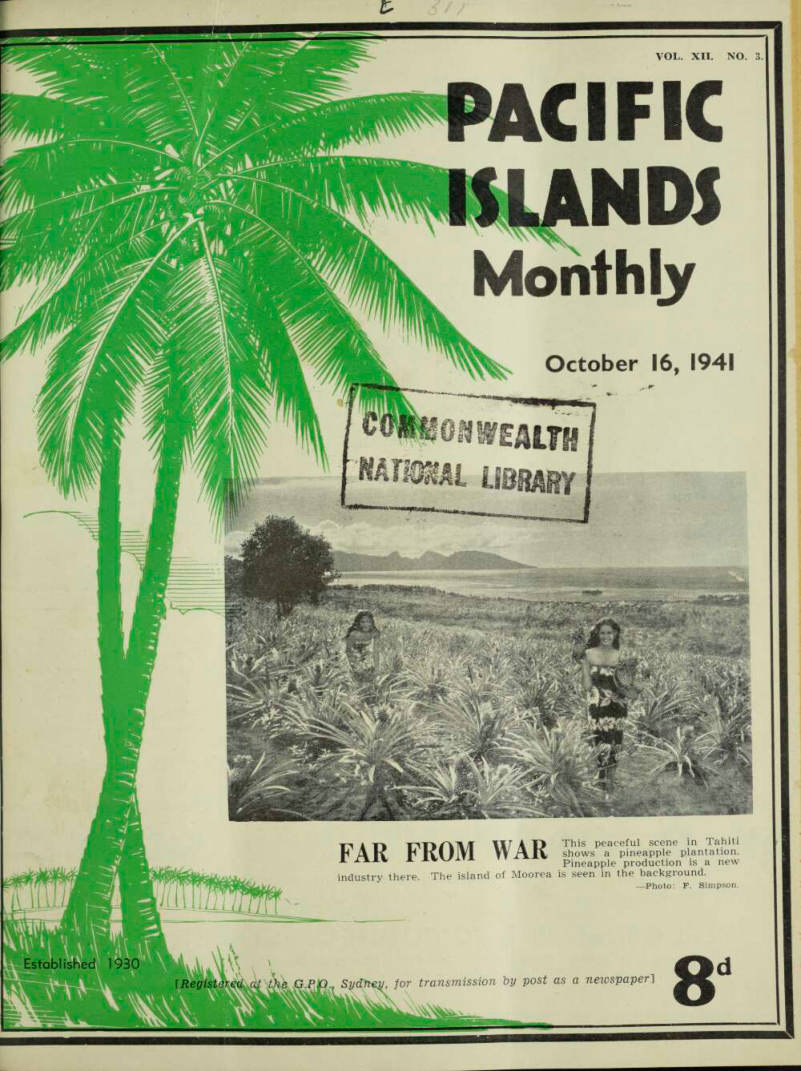
Far From War
this peaceful scene in tahiti shows a pineapple plantation. pineapple production is a new industry there. There island of Moorea is seem in the background. -photo: F. Simpson.
Advertisements & other items, p. 2 (1 item)
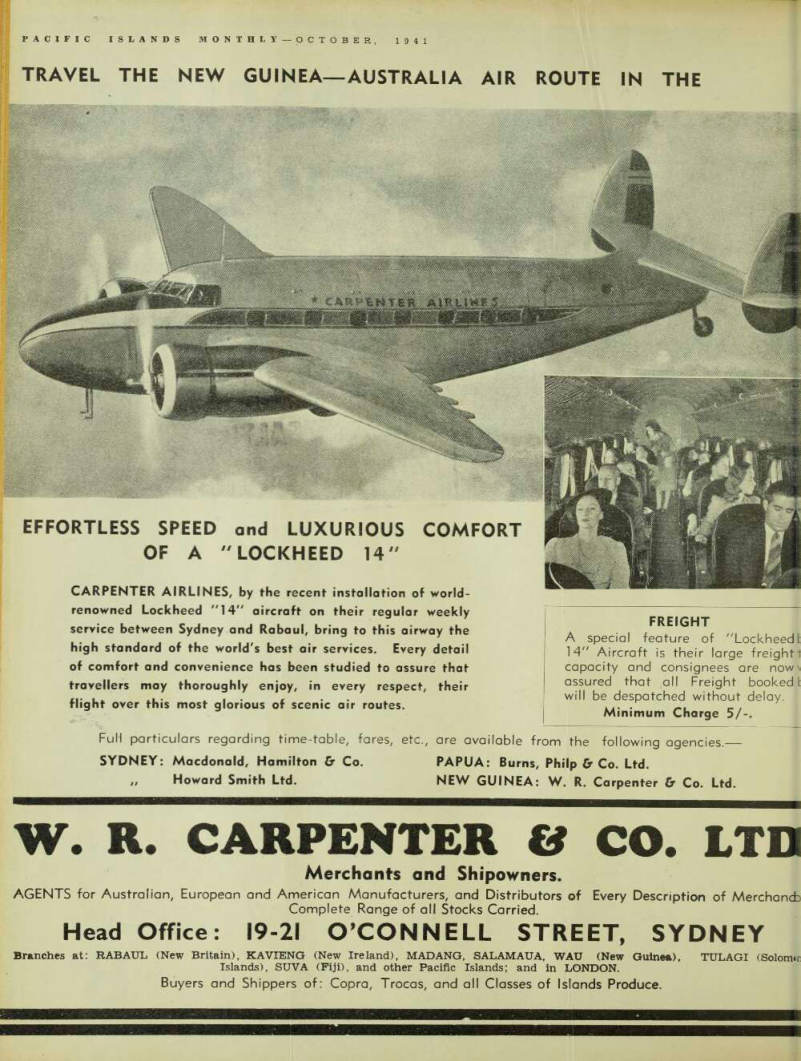
W. R. Carpenter & Co. Ltd
TRAVEL THE NEW GUINEA—AUSTRALIA AIR ROUTE IN THE 1 li ■ jligiSiiiiiii m; ■ m i n £ m i
EFFORTLESS SPEED and LUXURIOUS COMFORT
OF A "LOCKHEED 14
CARPENTER AIRLINES, by the recent installation of worldrenowned Lockheed "14" aircraft on their regular weekly service between Sydney and Rabaul, bring to this airway the high standard of the world's best air services. Every detail of comfort and convenience has been studied to assure that travellers may thoroughly enjoy, in every respect, their flight over this most glorious of scenic air routes.
FREIGHT
A special feature of "Lockheedt 14" Aircraft is their large freight 1 capacity and consignees are nowv assured that all Freight booked I: will be despatched without delay.
Minimum Charge 5/-.
Full particulars regarding time-table, fares, etc., are available from the following agencies.
SYDNEY: Macdonald, Hamilton & Co. PAPUA: Burns, Philp & Co. Ltd. #/ Howard Smith Ltd. NEW GUINEA: W. R. Carpenter & Co. Ltd.
W. R. CARPENTER & CO. LTD
Merchants and Shipowners.
AGENTS for Australian, European and American Manufacturers, and Distributors of Every Description of Merchancb Complete Range of all Stocks Carried.
Head Office: 19-2 I O’CONNELL STREET, SYDNEY Branches at: RABAUL (New Britain), KAVIENG (New Ireland), MADANG, SALAMAUA, WAU (New Guinea), Islands), SUVA (Fiji), and other Pacific Islands; and in LONDON.
Buyers and Shippers of: Copra, Trocas, and all Classes of Islands Produce.
TULAGI (Solormc
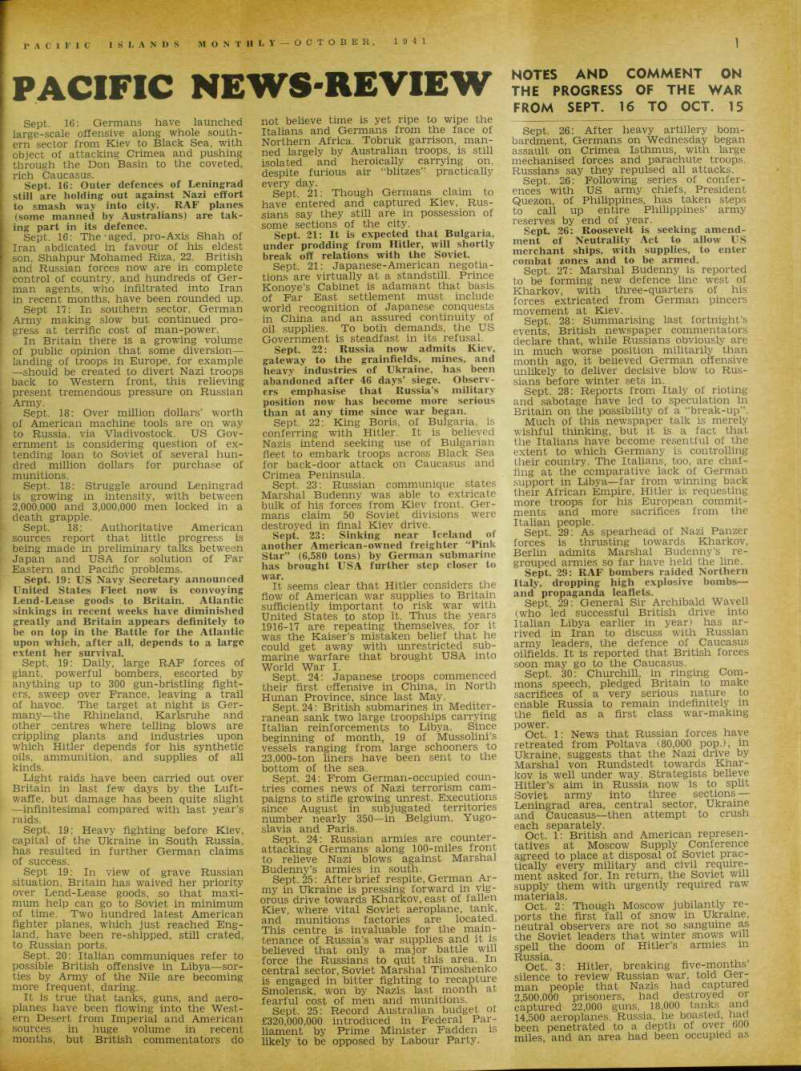
Pacific News-Review
Notes And Comment On
The Progress Of The War
From Sept. 16 To Oct. 15
Sept. 16: Germans have launched large-scale offensive along whole south ern sector from Kiev to Black Sea, with object of attacking Crimea and pushing through the Don Basin to the coveted, rich Caucasus.
Sept. 16: Outer defences of Leningrad still are holding out against Nazi effort to smash way into city. RAF planes (some manned by Australians) are tak ing part in its defence.
Sept. 16: The'aged, pro-Axis Shah of Iran abdicated in favour of his eldest son. Shahpur Mohamed Riza, 22. British and Russian forces now are in complete control of country, and hundreds of Ger man agents, who infiltrated into Iran in recent months, have been rounded up.
Sept 17: In southern sector, German Army making slow but continued pro gress at terrific cost of man-power.
In Britain there is a growing volume of public opinion that some diversion — landing of troops in Europe, for example —should be created to divert Nazi troops back to Western front, this relieving present tremendous pressure on Russian Army.
Sept. 18: Over million dollars’ worth of American machine tools are on way to Russia, via Vladivostock. US Gov ernment is considering question of ex tending loan to Soviet of several hun dred million dollars for purchase of munitions.
Sept. 18: Struggle around Leningrad is growing in intensity, with between 2,000,000 and 3,000,000 men locked in a death grapple.
Sept. 18: Authoritative American sources report that little progress is being made in preliminary talks between Japan and USA for solution of Far Eastern and Pacific problems.
Sept. 19: US Navy Secretary announced United States Fleet now is convoying Lend-Lease goods to Britain, Atlantic sinkings in recent weeks have diminished greatly and Britain appears definitely to be on top in the Battle for the Atlantic upon which, after all, depends to a large extent her survival.
Sept. 19: Daily, large RAF forces of giant, powerful bombers, escorted by anything up to 300 gun-bristling fight ers, sweep over France, leaving a trail of havoc. The target at night is Ger many—the Rhineland, Karlsruhe and other centres where telling blows are crippling plants and industries upon which Hitler depends for his synthetic oils, ammunition, and supplies of all kinds.
Light raids have been carried out over Britain in last few days by the Luft waffe, but damage has been quite slight —infinitesimal compared with last year’s raids.
Sept. 19; Heavy fighting before Kiev, capital of the Ukraine in South Russia, has resulted in further German claims of success.
Sept 19: In view of grave Russian situation, Britain has waived her priority over Lend-Lease goods, so that maxi mum help can go to Soviet in minimum of time. Two hundred latest American fighter planes, which just reached Eng land, have been re-shipped, still crated, to_ Russian ports.
Sept. 20: Italian communiques refer to possible British offensive in Libya—sor ties by Army of the Nile are becoming more frequent, daring.
It is true that tanks, guns, and aero planes have been flowing into the West ern Desert from Imperial and American sources in huge volume in recent months, but British commentators do
not believe time is yet ripe to wipe the Italians and Germans from the face of Northern Africa. Tobruk garrison, man ned largely by Australian troops, is still isolated and heroically carrying on, despite furious air “blitzes” practically every day.
Sept. 21: Though Germans claim to have entered and captured Kiev, Rus sians say they still are in possession of some sections of the city.
Sept. 21: It is expected that Bulgaria, under prodding from Hitler, will shortly break off relations with the Soviet.
Sept. 21: Japanese-American negotia tions are virtually at a standstill. Prince Konoye’s Cabinet is adamant that basis of Far East settlement must include world recognition of Japanese conquests in China and an assured continuity of oil supplies. To both demands, the US Government is steadfast in its refusal.
Sept. 22: Russia now admits Kiev, gateway to the grainfields, mines, and heavy industries of Ukraine, has been abandoned after 46 days’ siege. Observ ers emphasise that Russia’s military position now has become more serious than at any time since war began.
Sept. 22: King Boris, of Bulgaria, is conferring with Hitler. It is believed Nazis intend seeking use of Bulgarian fleet to embark troops across Black Sea for back-door attack on Caucasus and Crimea Peninsula.
Sept. 23: Russian communique states Marshal Budenny was able to extricate bulk of his forces from Kiev front. Ger mans claim 50 Soviet divisions were destroyed in final Kiev drive.
Sept. 23: Sinking near Iceland of another American-owned freighter “Pink Star” (6,580 tons) by German submarine has brought USA further step closer to war.
It seems clear that Hitler considers the flow of American war supplies to Britain sufficiently important to risk war with United States to stop it. Thus the years 1916-17 are repeating themselves, for it was the Kaiser’s mistaken belief that he could get away with unrestricted sub marine warfare that brought USA into World War I.
Sept. 24: Japanese troops commenced their first offensive in China, in North Hunan Province, since last May.
Sept. 24: British submarines in Mediter ranean sank two large troopships carrying Italian reinforcements to Libya. Since beginning of month, 19 of Mussolini’s vessels ranging from large schooners to 23,000-ton liners have been sent to the bottom of the sea.
Sept. 24: From German-occupied coun tries comes news of Nazi terrorism cam paigns to stifle growing unrest. Executions since August in subjugated territories number nearly 350—in Belgium, Yugo slavia and Paris.
Sept. 24: Russian armies are counter attacking Germans along 100-miles front to relieve Nazi blows against Marshal Budenny’s armies in south.
Sept. 25; After brief respite, German Ar my in Ukraine is pressing forward in vig orous drive towards Kharkov, east of fallen Kiev, where vital Soviet aeroplane, tank, and munitions factories are located.
This centre is invaluable for the main tenance of Russia’s war supplies and it is believed that only a major battle will force the Russians to quit this area. In central sector, Soviet Marshal Timoshenko is engaged in bitter fighting to recapture Smolensk, won by Nazis last month at fearful cost of men and munitions.
Sept. 25: Record Australian budget of £320,000,000 introduced in Federal Par liament by Prime Minister Fadden is likely to be opposed by Labour Party.
Sept. 26: After heavy artillery bom bardment, Germans on Wednesday began assault on Crimea Isthmus, with large mechanised forces and parachute troops.
Russians say they repulsed all attacks.
Sept. 26; Following series of confer ences with US army chiefs, President Quezon, of Philippines, has taken steps to call up entire Philippines’ army reserves by end of year.
Sept. 26: Roosevelt is seeking amend ment of Neutrality Act to allow US merchant ships, with supplies, to enter combat zones and to be armed.
Sept. 27: Marshal Budenny is reported to be forming new defence line west of Kharkov, with three-quarters of his forces extricated from German pincers movement at Kiev.
Sept. 28; Summarising last fortnight’s events, British newspaper commentators declare that, while Russians obviously are in much worse position militarily than month ago, it believed German offensive unlikely to deliver decisive blow to Rus sians before winter sets in.
Sept. 28: Reports from Italy of rioting and sabotage have led to speculation in Britain on the possibility of a “break-up”.
Much pf this newspaper talk is merely wishful thinking, but it is a fact that the Italians have become resentful of the extent to which Germany is controlling their country. The Italians, too, are chaf fing at the comparative lack of German support in Libya—far from winning back their African Empire, Hitler is requesting more troops for his European commit ments and more sacrifices from the Italian people.
Sept. 29: As spearhead of Nazi Panzer forces is thrusting towards Kharkov, Berlin admits Marshal Budenny’s re grouped armies so far have held the line.
Sept. 29; RAF bombers raided Northern Italy, dropping high explosive bombs— and propaganda leaflets.
Sept. 29: General Sir Archibald Wavell (who led successful British drive into Italian Libya earlier in year) has ar rived in Iran to discuss with Russian army leaders, the defence of Caucasus oilfields. It is reported that British forces soon may go to the Caucasus.
Sept. 30: Churchill, in ringing Com mons speech, pledged Britain to make sacrifices of a very serious nature to enable Russia to remain indefinitely in the field as a first class war-making power.
Oct. 1: News that Russian forces have retreated from Poltava (80,000 pop.), in Ukraine, suggests that the Nazi drive by Marshal von Rundstedt towards Khar kov is well under way. Strategists believe Hitler’s aim in Russia now is to split Soviet army into three sections Leningrad area, central sector, Ukraine and Caucasus —then attempt to crush each separately.
Oct. 1: British and American represen tatives at Moscow Supply Conference agreed to place at disposal of Soviet prac tically every military and civil require ment asked for. In return, the Soviet will supply them with urgently required raw materials.
Oct. 2: Though Moscow jubilantly re ports the first fall of snow in Ukraine, neutral observers are not so sanguine as the Soviet leaders that winter snows will spell the doom of Hitler’s armies in Russia. „ , Oct. 3: Hitler, breaking five-months silence to review Russian war, told Ger man people that Nazis had captured 2,500,000 prisoners, had destroyed or captured 22,000 guns, 18,000 tanks and 14,500 aeroplanes. Russia, he boasted, had been penetrated to a depth of over 600 miles, and an area had been occupied as
great as pre-1933 Germany. He explained that he had declared war on the Soviet because he feared '‘Russian aggression and had been subjected to impossible Soviet demands”, Oct. 4: Australian Federal Government defeated by Labour Party on Budget censure vote, 36-33. New Labour Govern ment formed, led by 56-years-old John Curtin, former West Australian journalist.
Oct. 4: Failure of Japanese offensive in Hunan Province constitutes most severe defeat Japan has suffered in four years of war in China.
Oct. 5: Rio de Janiero reports state powerful units of US fleet are operating off “bulge” of Brazil, searching for an Axis raider which sank the US-owned tanker “I. C. White” (7,000 tons), a few days ago.
Oct. 5: Nazi drive on Kharkov is taking form of familiar pincers technique, aimed at pinching out Kharkov rather than face the frontal defences upon which Marshal Budenny has been working feverishly since the Kiev retreat. Rus sians still are counter-attacking before Crimea region, where Germans are bringing up huge reinforcements.
Oct. 5: Russians give out German casualty figures as ’ more than 3,000,000 killed, wounded, and taken prisoner; 11,000 tanks, 13,000 guns and 9,000 air craft destroyed or captured.
Oct. 5; British Commander-in-Chief in Far East, Air Chief Marshal Sir Robert Brooke-Popham, has reached Manila to confer with US Commander-in-Chief of Far East, Lieut.-General D. Macarthur.
Significantly after the meeting, spoke Sir Robert thus; “Britain is ready to meet any move in the Far East. . . I think the Japanese are beginning to wonder if they have not been let down by the Axis —in fact, backed the wrong horse”.
Oct. 6: Aimed at taking Moscow at any cost, Germans have launched big offen sive in central sector, in two thrusts.
Oct. 7; Admiralty states British sub marines sunk or damaged 11 more enemy ships in Mediterranean.
Oct. 8: Berlin Radio states new Nazi offensive is “greatest in history”. Hitler, apparently, is all out to take Moscow, realising the difficulty of wintering his armies without city accommodation. It is believed he hoped to capture Leningrad before advancing on Moscow, but Lenin grad has repulsed every assault by Marshal von Leeb’s million men.
Oct. 8: Germans, in drive on Moscow, are reported to have reached approaches to Viazma, 140 miles south-east of capital. Vast battles of annihilation are taking place. Marshal Budenny, in the Ukraine, is trying to relieve increasing German pressure against Kharkov by series of brilliant counter-attacks.
Oct. 8; Sir Earle Page, Australia’s en voy to Britain, discussed Commonwealth’s part in Pacific affairs and defence with US army chiefs in Philippines at further important Manila conferences.
Oct. 8: Spectacular mock battles and large-scale manoeuvres in South England during last week tested England’s anti invasion strength. Army leaders were satisfied.
Oct. 9: Reported from New York that USA, Britain, and Dutch East Indies, have agreed to stop all oil shipments to Japan.
Oct. 9: Seriousness of Moscow drive is undeniable. Soviet High Command, an nouncing evacuation of Orel, important railway junction 200 miles south of Mos cow, does not minimize that its loss represents a grave threat to Russia’s industrial centres. Twice previously, Marshal Timoshenko has thrown back the Germans attempting to reach Moscow; the question now is: Can he do it a third time?
Military commentators emphasise that this Moscow drive gives a realistic glimpse of the titanic power of the German war
machine. For four months now the Ger man armies have staged one great offen- Sive after another on a front of 1,600 miles. The offensives were on a scale unheard of in previous wars, and were made at an enormous cost of men and material. In spite of colossal problems of transport and supply, they have been able to organise and put into effect this tremendous offensive.
Oct. 9: Encouraging reports from Britain tell of RAP's growing strength, fighter forces now are strongest in world and bomber striking power has doubled what it was a year ago. America is send ing across a constant, inexhaustible flow of medium bombers and fighters, while Britain herself is concentrating largely on producing heavy bombers.
Oct. 10: Throwing in division after division regardless of losses, Hitler’s of fensive has lost little of its momentum.
Most promising news is that the Russians, while admitting position is extremely grave, are inflicting heavy toll and are falling back in fighting order. If Timo shenko is getting the major portion of his armies away, it is expected that a German victory, even if it gives them Moscow, will not prove to be the decisive, final victory that Hitler promised his people. Viazma, key town in the path of the invaders, appears to be holding out still. The civil population everywhere is fighting side by side with the Russian troops.
Oct. 10; American reports say Stalin has asked Britain for an immediate military diversion on the Western front to force a diminution of the pressure on Russia’s centre, but that Britain has replied indicating her inability to provide a sufficiently large and well-equipped force to achieve such a purpose.
Oct. 12: There are indications that Russians at last have succeeded in stem ming the Germans’ advance. Streams of Soviet reinforcements, mostly mechanised and winter-clothed, are arriving to stiffen the defence of Moscow’s approaches.
Oct. 12: Revealed that recently US naval party captured Nazi radio outpost in Greenland. This is first reported activity of American forces in US-protected Danish islands.
Oct. 12: Isolationist move to prohibit granting of portion of 6,000,000 dollars Lease-and-Lend appropriation to Russia has been defeated in US House of Representatives.
Oct. 12: RAF bombers attacked the Rhineland and Ruhr in Germany, last night, after week’s spell of bad flying weather.
Oct. 12: Washington reports state American-Japanese talks on Pacific sta bility have been resumed.
Oct. 13: Timoshenko, Russian com mander on central front, now is at tempting to form long defence line, as German offensive slackens. Key-town of Viazma, captured by Nazis, has been won back by Soviet forces.
Oct. 14: German High Command has ordered Von Leeb to storm Leningrad this week, using artillery and dive-bombers.
If the city still resists, it is to be razed to the ground.
Oct. 14: Bringing up masses of ar moured units and infantry, Hitler has re-taken Viazma. Situation along entire Russian front appears to be highly con fused and fluid —changing hourly; but reliable reports to London state Nazi advance units apparently are about 65 miles west of Moscow and that the Red Army is retreating into new positions.
Oct. 15: Massing 250,000 fresh troops from France and two full air fleets (10,000 planes), Germans are preparing for new wave designed to carry them into Moscow.
Capital now is menaced from three sides, but Russian leaders defiantly state Red soldiers and civilians can hold city against all attacks until vast Russian reserves are brought up.
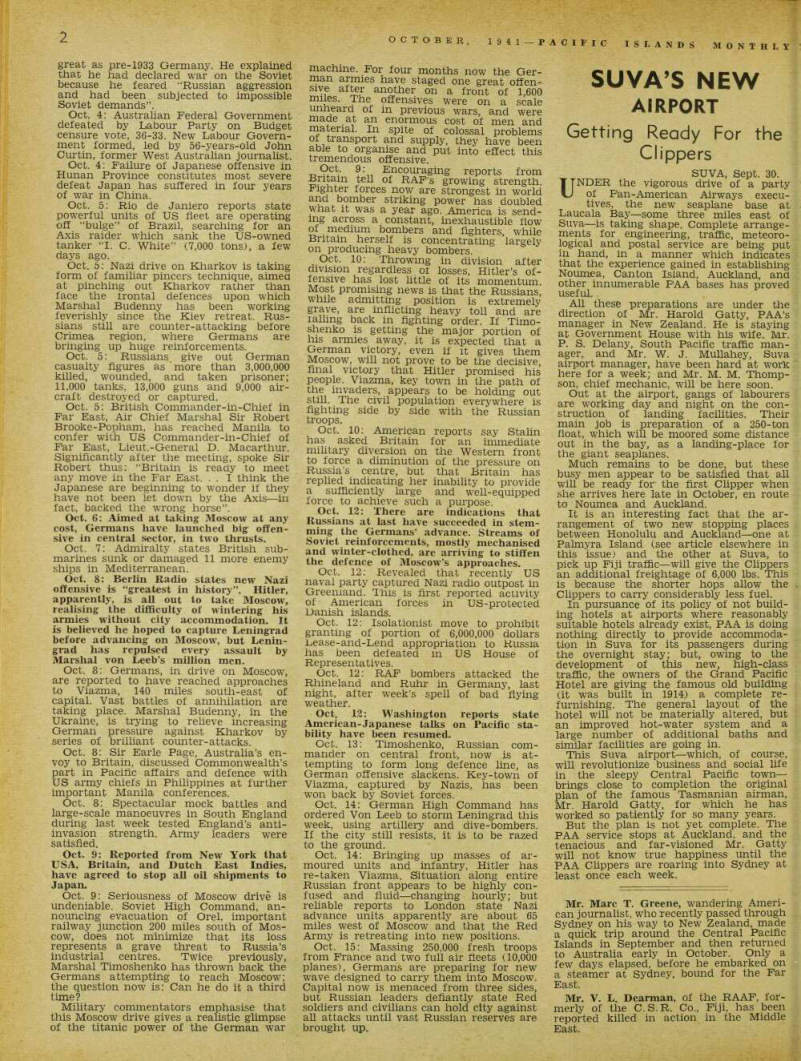
Suva’S New
Airport
Getting Ready For the Clippers
SUVA, Sept. 30.
TINDER the vigorous drive of a party U of Pan-American Airways execu tives, the new seaplane base at Laucala Bay—some three miles east of Suva—is taking shape. Complete arrange ments for engineering, traffic, meteoro logical and postal service are being put in hand, in a manner which indicates that the experience gained in establishing Noumea, Canton Island, Auckland, and other innumerable PAA bases has proved useful All these preparations are under the direction of Mr. Harold Gatty, PAA’s manager in New Zealand. He is staying at Government House with his wife. Mr.
P. S. Delany, South Pacific traffic man ager, and Mr. W. J. Mullahey, Suva airport manager, have been hard at work here for a week; and Mr. M. M. Thomp son, chief mechanic, will be here soon.
Out at the airport, gangs of labourers are working day and night on the con struction of landing facilities. Their main job is preparation of a 250-ton float, which will be moored some distance out in the bay, as a landing-place for the giant seaplanes.
Much remains to be done, but these busy men appear to be satisfied that all will be ready for the first Clipper when she arrives here late in October, en route to Noumea and Auckland.
It is an interesting fact that the ar rangement of two new stopping places between Honolulu and Auckland —one at Palmyra Island (see article elsewhere in this issue) and the other at Suva, to pick up Fiji traffic —will give the Clippers an additional freightage of 6,000 lbs. This is because the shorter hops allow the Clippers to carry considerably less fuel.
In pursuance of its policy of not build ing hotels at airports where reasonably suitable hotels already exist, PAA is doing nothing directly to provide accommoda tion in Suva for its passengers during the overnight stay; but, owing to the development of this new, high-class traffic, the owners of the Grand Pacific Hotel are giving the famous old building (it was built in 1914) a complete re furnishing. The general layout of the hotel will not be materially altered, but an improved hot-water system and a large number of additional baths and similar facilities are going in.
This Suva airport—which, of course, will revolutionize business and social life in the sleepy Central Pacific town — brings close to completion the original plan of the famous Tasmanian airman, Mr. Harold Gatty, for which he has worked so patiently for so many years.
But the plan is not yet complete. The PAA service stops at Auckland, and the tenacious and far-visioned Mr. Gatty will not know true happiness until the PAA Clippers are roaring into Sydney at least once each week.
Mr. Marc T. Greene, wandering Ameri can journalist, who recently passed through Sydney on his way to New Zealand, made a quick trip around the Central Pacific Islands in September and then returned to Australia early in October. Only a few days elapsed, before he embarked on a steamer at Sydney, bound for the Far East.
Mr. V. L, Dearman, of the RAAF, for merly of the C.S.R. Co., Fiji, has been reported killed in action in the Middle East.
Advertisements & other items, p. 4 (1 item)
2
OCTOBER, 1941-PACIFIC ISIANDS MONTtttT
Pacific Islands Travellers
PER STEAMER FROM NG & PAPUA: Messrs.
Beck Bliss, Barrow, Brady, Bradley, Barron, Coomber, Cram, Crockett, Cunningham, Clarke, Daymond, Duffy, Ewen, Fienberg, Fry, Fahey, Fletcher, ’ Fisher, Fitton. Goodwin, Gazzard, Guinan. Herket, Johnson, Jones, Johnston, Julius, Lusted, McLaren, McMillan, Marr Mamwaring, Milne, Middleton, Norden, O Connor, Parer (2», Rawnsley, Rockett, Slattery, Searle, Strong, Selle, Salzmann, Tutty, Thorgesen, Vagg, Vicary, Vesper, Webb, Whitbread Winters, Walker Watson. Mesdames Bailey, Bliss, Brown, Beales, Barron, Coomber, Creary, Cram, Cameron, Charlton, Clarke, Daymond, Ewen, Eginton, Fletcher, Gazzard, Guinan, Harvey, Holliday. Johnson, Kensett. McMillan, Miller, Mainwaring, Ridge, Rundle, Rossiter, Strong, Tntiv vae-e Vicarv Wilkins Misses Coulson, Si£- Sr Sin H te. Krell, O’Brien
wmouehbv ’
PER STEAMER FROM BSI, N. HEBRIDES. NI.
TORD HOWE IS - Messrs. Burden Buffett, Goulton Moore Dunstone Trench, Walker, Gubbay, Smoothey Treagust, Ward, Wilson, Adams!
Buffett Gregerson Legge, Randall,
yfaman Digman, llnton, Kirby,
Pavten Potts Thompson Andrews, Quintal (3).
MpSiies Davison ? Legge Mitchell Perry WhiskS Teaman* 1 ' Fenton N chols, Potts wnisKer, xeama , e > ’ ’
Mccr S °wimams Johnston ' Mlsses
per' steamier FOR no' & PAPDA: Messrs.
Meillis, Johnson, Hickson, Pavitt, vertigan, Plummer, Ash, Parry, Renton, Morris, Chan, Stein, Wettig, Anderson, Searle, Ellis, Parry, McLeod, Fyffe, Lowney. Scanlon, Nicholls, Fisher, Pillond Lyons Douglas B!ssaker Rutledge, Crawley Howard Brother Dmgels.
Mesdames Mefflis Walsh, Rhodes Lord Johnson, Cay, Clarke, Lockhart Hickson Cook, Stott, (2) Doran, Milne, Cooper, Franklyn, Williams.
Sister triro wot? t ot?o mowf nt m PER STEAMER FOR LORD HOWE IS., NL, N.
HEBRIDES & BSL Messrs. McWhinney, Cramer- Roberts Davis Rennison, Wilson Brown Dunstone Buffett (2), Randall, Gallagher, Tarcett, Piper, Lenevez. Bergeron. Rev. Thompson. Mesdames McWhinney, Whisker, Scott, Wilson, Bailey, Jones, Gallagher, Lenevez. Misses Baxendale.
Per Steamer From Rabaul (Ng): Messrs.
Bennie, Corless, Cox (2), Davies, Field, Jones, Knowless, Mossman, Robins, Savage, Pryor, Best, Monger. Mesdames Adams, Corless, Carr, Clark, Evans, Field, Hutchinson, Hawnt, Jones, Mossman, Melrose, Pennefather, Best, Cox, Clark.
Misses Field, Mossman (2).
Per Steamer To Port Moresby (Papua);
Mesdames Godwin, Hides, Morgan. Master TTjHfrc H '^ S R steamer PROM FIJI: Messrs. Free, Ditchburn, Smith, Costello, Warburton, Knevitt,
Cradick, Parfett, Grey, Robertson, Theodore, Johannessen, Savery, Neil, McKee, Anderson, Oldmeadow. Mesdames Ditchburn, Grey, Smith, Warburton, Knevitt, Cradick, Harris (2), Neil.
Misses Ditchburn, Kermode, Smith, Warburton, Cradick, Hughes, Harris, Delbridge, Neil, Lindsay.
FROM PAGO PAGO: Messrs. Sim. Mrs. Powys.
PER AIRLINER TO PAPUA & NG: Messrs.
Richardson, Ahearn, Meurant, McLean, Mars land, Brodsky, McDonald, Eppel, Olles, Anderson, Dale, Rossiter, Wharton, Eiseman, Widdy, McEwen, Edgerton, Rumney, McLaren, Allica, Julian, Spencer, McCulloch, Salter, Richter, Kruttschnitt, Muir, Smith, Arrowsmith, Adels kold, Chater, Yovier, Leonard, Ryan, Head, Phillips, Stubbs, Treman, Gunther, Smith, Jewell, Millward, Gillingwater, Poland, Wallace, Perry, Gordon, Ratcliffe. Mesdames Carlysle', Edgerton, Ziablitsky, Morton, Barris, Philips, Treman, Groome, Jenyns, Millward, Day. Misses Cole, Morris, Savage, Fulton, Day.
PER AIRLINER FROM PAPUA & NG: Messrs.
Perriman, McDonald, Berry, Taylor, Nettheim, Campbell, Richards, Leslie, Gunther, Grigg, Dawes, Lamond, Olles, Davis, Morris, Eppell, Batze, Ryan, Scholes, Williams (2), Kienzle (2), Butler, Anderson, Scope, Middleton, McGee, Lawrence, Anderson, Hooper, Kirsten, Cook, Grahamslaw, Johnson, Dowie, Johns, Krutt schnitt, Brodsky, Power, Allan, Rumney, Mc- Culloch, Jackson, Campbell, Watson. Mesdames Turner, Richards, Griffiths, Drummond, Scholes, Danielson, Morgan, Forrest, Kienzle, Johns, Nand, Allan, Campbell, Gray, Hill. Misses Kienzle, Matthews.
Advertisements & other items, p. 5 (1 item)
south pacific line
mmmmmgm v - : :■
P & CI
$} —«•« I IPi i
D««Af«YA " . v •TSAIftUI
|*UMAUA.W , f .
, HT.KOBESBY* *\
:• fe'' a# B
■ : 1 K P / ii III; ( ■
C E AN
1
SAMAR Al ;
CKi m a
SYDNEY
K. P. M.
SOUTH PACIFIC LINE
Royal Packet Navigation Co. Ltd., (N. V. Koninklijke Paketvaart Maatschappij —lncorporated in the Netherlands Indies) Paketvaart House, 255 George Street Sydney. ’Phone BW 2381
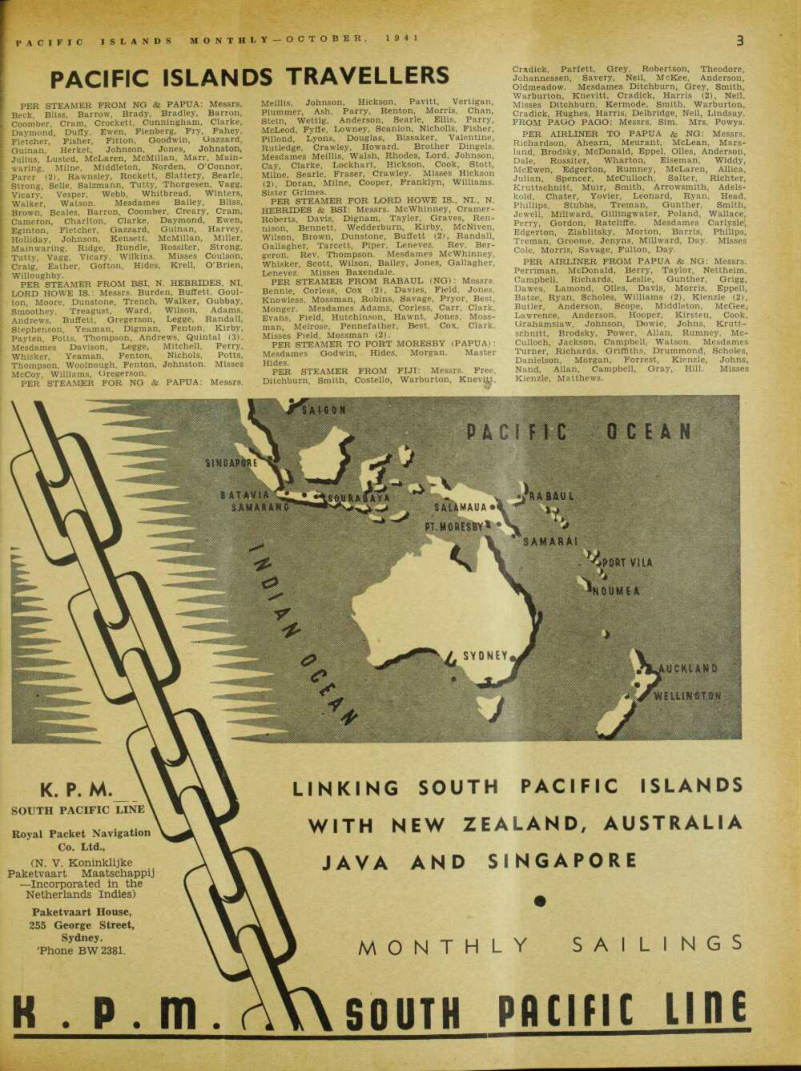
LINKING SOUTH PACIFIC ISLANDS
WITH NEW ZEALAND, AUSTRALIA
JAVA AND SINGAPORE
MONTHLY SAILINGS
south pacific line
Advertisers
Amalgamated Wire less of Aust., Ltd. 56
Amplldn (A/sia)
Ltd 41 Angus & Coote Ltd. 15 Arnott’s Biscuits . 33 “Ausoline” ... 54
B.A.L.M. Ltd. ... 39
Bank of N.S.W. . . 64 “Bidomak” ... 25 Broomfields Ltd. . . 40 Brown & Co. Ltd., G 9’
Brunton’s Flour . . 35 Budge & Co. Ltd., Jas 38 Burns, Philp & Co.
Ltd 4 B.P. Magazine ... 48
B.P. (S.S.) Co. . . 34
Burns Philp Trust Co. Ltd 52 Carlton & United Breweries Ltd. . . 29 Carpenter Ltd., W.
R cov. 2 Chivers & Sons Ltd. 34 Clyde Batteries . . 54 Coleman Lamp & Stove Co. . . 38, 46 Colonial Sugar Re fining Co. Ltd. . 36 Cooper & Nephews Ltd., Wm 47 Coral Starch ... 33 Cosmopolitan Hotel 68 Crammond Radio . 19 “Cystex” 45 De Meric Pty. Ltd. 44 Dewar’s Whisky . . 16 Doan’s Pills ... 68 Donaghy & Sons Ltd 44 Donald Ltd.. A. B. . 42 Dr. Williams Pink Pills 30 Dunlop Perdriau Rubber Co. Ltd. . 21 Eaton Ltd., J. W. . 37 Edgell Products . . 50 Edinburgh . Labora tories 17 Electrolux Refrigerators . . 28
Export Soap Co.
Ltd 45 “Five-in-One”
Dental Cream, 12, 66 Fletcher & Sons . . 39 “Flit” 58 Ford Sherington Pty. Ltd 20 Foster Clark Ltd. . 27 Garden Vale Pro ducts Ltd 30 Garrett & Davidson 55 Gilbey’s Gin ... 52 Gillespie’s Flour . . 32 Gillespie & Co. Ltd., R 17 Gold Flake Cigar ettes 18 Grand Pacific Hotel 43 Grove & Sons, W.
H 18 Gudgeon Pty. Ltd. . 63 G u i n ea Airways Ltd cov. 3 Heinz Co. Ltd., H.
J 26 Hislop Lloyd Pty., Ltd 13 Holbrook’s Ltd. . . 35 Horlicks Malted Milk 14 Hotel Moresby ... 68 In Memorium ... 9 International Correspondence Schools 67 Iron i s e d Yeast Laboratories ... 20 Jantzen (Aust.) Ltd. 53 Kodak (A/sia) Ltd. 10 Kopsen & Co. Ltd. 22 Lea & Perrins Sauce 50 Levenson’s Radio . 60 Masse Batteries . . 61 Maxwell Porter Ltd. 37 Mcllrath’s Ltd. . . 51 “Mendaco” ... 65 Meriden School . . 23 Miller & Co. Pty.
Ltd 58 Nelson & Robertson Pty. Ltd. . . 13, 55 Nestle’s Milk ... 31
Newmarket Saddlery ... 65 Noyes Bros. Ltd. . 55 Old Monk Olive Oil . . 24, 26, 50, 64 Pacific Is. Society . 10 Paling & Co., W, H 61 Papua Hotel, The . 68 Peck’s Pish & Meat Pastes 67 “Pinkettes” ... 62 Positions Wanted ... 43, 63 Prescott Ltd. ... 32 Price’s Radio Ser vice 54 Prouds Pty. Ltd. . . 11 Riverstone Meat Co. 57 Rohu, Sil 66
Rose's Eye Lotion . 17 Royal Packet Navi gation Co. . . . 3* Sandeze (Holly wood) Beach Wear 49 St. Ignatius College 23 Scots College, The . 49 Scott Ltd., J. ... 40 Single Wire Fence Co 65 Springwood Ladies’
College 48 Steamships Trading Co. Ltd 66 Sterling Varnish Co. 59 Sullivan Ltd., C. . . 67 Sunripe Cigarettes . 44 Swallow & Ariell . 24 Talkeries, The ... 46 Taylor & Co., A, . 38
“Tenax” Soap ... 53 Tillock & Co. Ltd. 48 Toohey’s Ltd. ... 12 Tooth & Co. . cov. 4 “206” Private Hotel 21 Union Assurance Co, Ltd 59 Vincent’s A.P.C. . . 62 “Vi-stim” 40
West, Harry ... 64 Weymark & Son . 32 Wills Ltd., W. r>. & H. 0 42 Wright & Co. . . 59 Wright & Co. Ltd., E 62 Wunderlich Ltd. . . 37
Dr. S. M. Lambert, well known for his work in the South Pacific on behalf of the Rockefeller Institute, has returned to Suva. He visited Fiji a couple of months ago, and went back to his home in California. But, apparently, the call of the South Seas is too strong—he is back again on the scene of his life’s work.
Contents
Pacific News-Review 1 Suva’s New Airport ’ * . ‘ 2 South Seas Travellers 3 A Union of Pacific Territories After the War 5 New Makea Returns to Rarotonga 6 D’Argenlieu Arrives in Tahiti 6 Copra Plan in Operation in New Guinea 7 Eric Chater Killed in Air Accident .. 7 Piece-Meal Transfer of NG Ad ministration 8 Luxury Hotel at Noumea 8 Mr. J. C. Barley Retires from Gilberts 9 Tropicalities 10 Central Pacific Expects Copra Pool to Operate 12 Gilbertese Moved to Phoenix Group . 16 Chinese Trade Stores in Wau 17 New Books 18 Roll of Honour 20 “Uncontrolled" Areas in New Guinea 22 Papua’s Nine Administrators 24 Mika’s Pink Pearl 29 In a Polynesian Hospital—A Trader’s Tale 32
Papua and Rice-growing 34 Papeete’s Museum 35 Food Crops For the Islands ... 39 Haapai’s Ancient Cannon 40 Death of “Joe" Binskin, of BSI ... 41 Boat Day in Rotuma 42 Housekeeping in Tahiti 44 The Light That Failed—a Cook Is.
Tale 47 Profit in Honey and Beeswax 48 A Section For Women 49 All Calm in Central Pacific 51 Air Base at Palmyra Is 52 Labour For Fiji’s Mining Industry .. 54 Islands Mining News 55 Von Spec’s Pacific Raiders ... 57 Another Australian Minister for Territories 59 Short-Wave Radio Programmes .. .! 61 Officers of NG Mining Union 62 Anniversary of Sautot’s Landing ... 63 Islands Produce Quotations 64 Copra and Rubber Prices ... 66 “Nut-Fall" in BSI “ 67 NG Legislative Council Meeting ... 67 Nature’s Balance Upset at Wake Is. .. 68
Advertisements & other items, p. 6 (2 items)
4
OCTOBER, 1941 PACIFIC ISLANDS MONIHLI
Burns, Philp
J urn Tliii mm. 111: till it on mm m Head Office: 7 Bridge Street, Sydney—Australia Code Address: " Burphil"
& Co. Ltd.
GENERAL MERCHANTS
SHIPOWNERS
TOURIST AGENTS
BUYERS OF ALL CLASSES OF ISLAND PRODUCE Regular Steamer Services from Australia to New Guinea —Papua—Solomon Is. — Lord Howe Is. —Norfolk Is. New Hebrides —Hongkong—Java and Singapore
Pacific Islands Monthly
The Newspaper-Magazine of the South Seas [Registered at the G.P.0., Sydney, for transmission by post as a newspaper .]
Published Once Each Month and Circulated in Australia and New Zealand and in the following Pacific Territories and Islands Groups:
Australian Territory of Papua.
Mandated Territory (Australia) of New Guinea, Bismarck Archipelago and Northern Solomon Islands Australian Territory of Norfolk Island.
New Zealand Territory of Cook Islands.
Mandated Territory (New Zealand) of Western Samoa.
British Colony of Fiji.
British Solomon Islands Protectorate.
British Protectorate of Tongan Islands.
British Crown Colony of Gilbert and Ellice Islands.
Mandated Territory of Nauru.
British and Free French Condominium of New Hebrides.
Free French Colony of New Caledonia.
Free French Colony of Oceania (Tahiti, etc.).
American Territory of Eastern Samoa.
American Territory of Hawaiian Islands.
American Territory of Guam.
Mandated Territory (Japan) of Marshall, Caroline and Mariana Islands.
Owned and Produced by Pacific Publications Pty. Ltd., Union House, 247 George Street, Sydney.
„ f Managing Director . . BW 5037 TELEPHONE £ Business and Editorial MA 7101
P.O. Box 3408 R
Registered Address of Telegrams, Radiograms, and Cables: “Pacpub”, Sydney.
Contributions.
Articles, Stories, and Photographs dealing with Pacific Islands subjects are invited and will be paid for on publication.
Subscription Rates.
Per Annum, within British Empire, Prepaid, Post Free 8/- Per Annum, elsewhere, prepaid, Post Free. 10/- Single Copies Bd.
Editor and Publisher:
R. W. Robson. F.R.G.S.
Assisted by Selwyn Hughes.
Advertising Manager: L. W. Bailey.
Advertising Office and Printing-House: 29 Alberta Street, Sydney.
Advertising rates furnished on application.
Colours, etc., by arrangement.
Process Blocks made at Advertiser’s expense when required. Screen 100.
Changes of Advertising Copy should reach this office by Ist of each month, otherwise previous advertisement may be repeated.
Representative In London.
W. C. Harvey, Coronation House, 4 Lloyds Avenue, London, E.C.3, from whom may be obtained copies of Pacific Islands Monthly.
Pacific Is. Year Book, advertising schedules, etc.
Agents.
The following are authorised to receive sub scriptions for Pacific Islands Monthly; Burns, Philp & Co., Ltd., and Burns Philp (South Sea) Co., Ltd. All branches.
W. R. Carpenter & Co., Ltd. All branches.
Morris, Hedstrom, Ltd. All branches.
T. A. Olsson, Wau, New Guinea.
G. Thomas & Co.. Rabaul, New Guinea.
Whitten Bros., Ltd.. Samarai. Panua.
Steamships Trading Co., Papua. All branches.
B.N.G. Trading Co.. Ltd., Port Moresby, Papua.
J. Muir, Suva. Fiji.
N. C. Mackenzie Hunt, Wainunu, Bua, Fiji.
Kirpal & Co.. Victoria Parade, Suva. Fiji.
Cook Islands Trading Co.. Rarotonga, Cook Is.
A. C. Rowland. Papeete. Tahiti.
Islands Branches and Representatives of W. H.
Grove & Sons. Ltd., Auckland. New Zealand.
Kerr & Co., Noumea, New. Caledonia.
Vol. Xii. No. 3.
October 16, 1941
n r : ro f Prepaid; 8/- p.a. rnce 8d Per copy.
A Union of Pacific Territories After the War?
IT is far too early, yet, to start speculating about the probable political future associations of the Pacific Territories; but, even now, speculation can be interesting.
Dwellers in the Pacific wonder, natur ally enough, where they are going, and under what flag their future will lie.
The Nazis will be defeated in their plan of world hegemony. The char acter of their defeat will determine the extent to which they, in future, will dominate the Continent of Europe. Neither they, nor their allies, will dictate the political future of Pacific countries.
Probably, after this war, there will be a conference of all the nations, victorious and defeated and non belligerent; but in this conference the dominant voices will be those of a strong, intensively-armed Britain, Russia and United States—three Powers determined that, on this oc casion, something really will be done to abolish from the earth the systems which produce war—and they will have the failures of Versailles and the League of Nations to guide them.
We may expect a genuine effort to retain the League of Nations and make it work. But it will work only if it is fully supported by the United States, and is given teeth. In other
words, there must be always at the disposal of the League of Nations forces powerful enough to curb and cow the dictators and the predatory nations of the future.
A LEAGUE of Nations, or some thing of the kind, may solve some of the Pacific’s political prob lems. Future world opinion, most definitely, will be against territorial aggrandisement. That means that a number of important Pacific Terri tories, now floating around loose—one refers particularly to the Mandated Territories of New Guinea and Western Samoa, the now semi-inde pendent Commonwealth of the Philip pines, the French colonies of New Caledonia, New Hebrides and French Oceania—may not be permitted to follow their natural desire to be per manently attached to one or other gf the Powers, but may be compelled to exercise some form of self-govern ment under League control.
New Guinea and New Hebrides, for example, may wish to become Austra lian territories. But world opinion— and especially American opinion— almost certainly will be against any additions to the already swollen British Empire. If it could be shown that Australia, during her twenty years of Mandate guardianship, had
done anything worth noting in deve loping the natural resources of New Guinea, or in improving the educa tional and living standards of the 750 o qo natives Australia might put up a g OOC i case f or taking over New Guinea permanently and perhaps a I SO f o r bringing New Hebrides and j- hp Solomons under her wins But— -1 * from the establishment of the gold industry, for which official Aus tralia can claim no credit—Australia’s re cord in New Guinea is unimpressive a 20-years period in which Austra lian ex-politicians have been allowed t 0 sit in the “ CUS hy” j 0 b of Adminis trator and twiddle futile thumbs N ’ thplp „ unless some eood
iSaL
under Wlll remam unde Australian control, The position of the Philippines is intriguing. America definitely is committed to giving the group corn plete independence. The country al ready is half-way through the change over; and, in a few years, unless the United States Congress goes into re verse on Philippines’ policy, the Re public of the Philippines will be born, But, already, the open maw of a wait ing Japan has scared the Filipinos, and they have lost all their formei eagerness for independence. They think they would like to stay with America. But America is not en thusiastic. It seems an open-and
shut proposition for League of Nations protection.
EVERYONE is guessing about the future of the French colonies.
One hears, in places, “New Caledonia and New Hebrides to Australia and French Oceania to the United States”.
But, most definitely, that disposition is wanted neither by Australia nor the United States. If France could be quickly restored to her 1939 con dition, all would be simple. But it is doubtful whether even the complete overthrow of Germany in Europe would bring about either a united France or a re-united French Empire.
The stain of Vichy must be wiped out —perhaps in blood—before France again will control an Empire. Mean while, what of New Caledonia and French Oceania, now overwhelmingly anti-Vichy?
MAYBE, this is a time when we might consider the prac ticability of some kind of Pacific Islands Confederation, or Union, to function under the protection of a League of Nations.
Omitting the Philippines, we may note that, south of the Equator, there are (west to east) the terri tories of Papua, New Guinea, Solo mons, New Caledonia, Gilbert and Ellice Colony, Fiji, Tonga, Western and Eastern Samoa, Cook Islands and French Oceania. They are governed from either London, Washington, Canberra, Wellington or (nominally) Paris. Not one territory seems satis fied with its government—almost all complain of non-representation of taxpayers.
The conditions of administration and the problems of government in all of them are almost identical. Yet governmental bureaus in London, Washington, Paris, Wellington and Canberra, knowing little or nothing of tropical islands’ conditions, have been struggling with the problems for decades—and, for the most part, without any consultation one with the other!
Why not a federal authority, estab lished in a central place like Suva, to
protect the interests of all the groups, to encourage their development, to study their problems, to give all of them adequate representation, and to act as a clearing-house for adminis trative data?
If something like that could be established, in the post-war settle ment, a new era surely would dawn in the Pacific Islands.
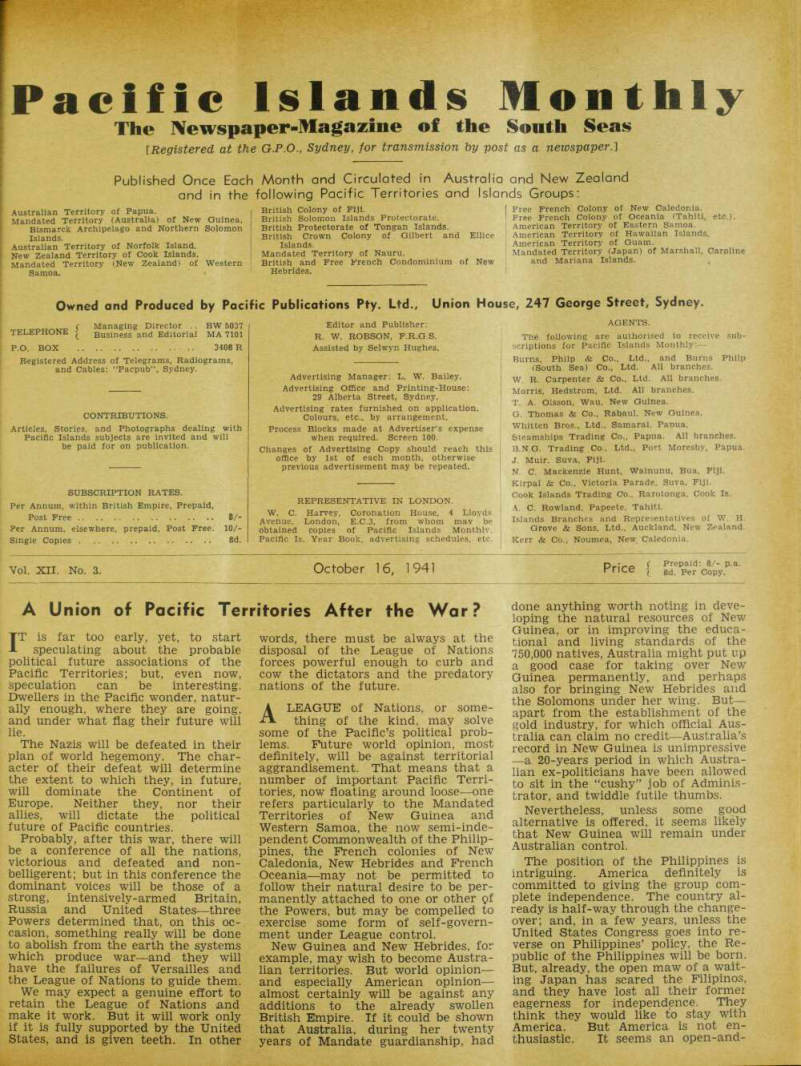
Nearly £1,500 was raised for war funds in Port Moresby during August and September, when the Papuan Comforts Club, headed by Mrs. Arthur Jewell, conducted a Popular Girl Com petition. Winner was Miss Lorna James (Burns, Philp and Co.’s candidate), whose supporters subscribed £476. Photograph, taken at dance function in Moresby Institute Hall, on September 19, when the girls were presented to the Deputy Administrator’s wife, Mrs. H. W. Champion, shows (left to right): Patricia Sinclair (Steamships Trading Co.), Margaret Leydin (British New Guinea Trading Co.), Lorna James (winner), Stella Rielly (Australasian Petroleum Co,), Laurel Preston (G. Smith and Co.), and Valerie Mathews (Public Service Association). There were two other candidates, not included in the group. Dawn Flannery (Papua Hotel) and Nora Smith (Department of Interior).
Rarotonga's New
Makea
Returns to Cook Islands
ONE of the conditions under which Takau (Mrs. E. T. Love), daughter of the late Makea-Ariki-nui of Rarotonga, was awarded that ancient title by Judge Ayson, was that she should cake up residence on the island. Now chat legal proceedings concerning the award of the title have, presumably, been settled once and for all in her favour, she has decided to return to Avarua and make her home in the palace.
The new Makea had planned to return to her people before Christmas, but she decided to go sooner, and should be in Rarotonga by now.
Mokoroa and Ina-nui, her twin daugh ters, aged 11, will continue their studies in New Zealand. The Makea herself was educated at Hukarere School, Hawkes Bay, where many of the daughters of NZ chiefs have attended. Veia, another daughter, aged 10, remained with rela tives in the Cook Islands. Myra, the baby of the family, who is 7, will stay at Petone, near Wellington, with her grand mother, Mrs. Hapi Love, snr.
Report Of Raider In
Galapagos Is.
UNITED States newspapers, at the end of September, carried stories to the effect that several British and Dutch vessels from NZ and DEI were considerably overdue at Panama. Ships arriving in the Canal zone reported re ceiving distress messages from vessels attacked by a German raider near the Galapagos Islands (in remote Eastern Pacific).
Washington said that the US Navy was hunting the raider, believed to be a heavily-armed merchantman.
D'Argenlieu Arrives in
Tahiti New French High Commissioner Takes Office
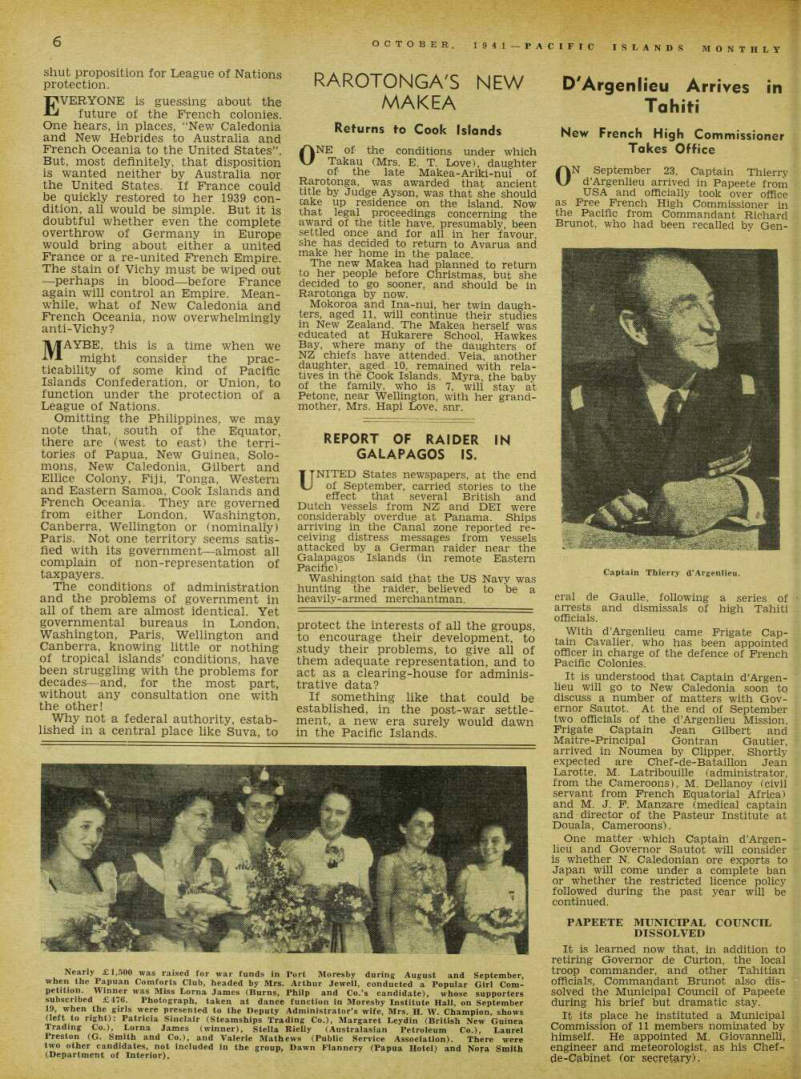
ON September 23, Captain Thierry d’Argenlieu arrived in Papeete from USA and officially took over office as Free French High Commissioner in the Pacific from Commandant Richard Brunot, who had been recalled by Gen-
eral de Gaulle, following a series of arrests and dismissals of high Tahiti officials.
With d’Argenlieu came Frigate Cap tain Cavalier, who has been appointed officer in charge of the defence of French Pacific Colonies.
It is understood that Captain d’Argen lieu will go to New Caledonia soon to discuss a number of matters with Gov ernor Sautot. At the end of September two officials of the d’Argenlieu Mission, Frigate Captain Jean Gilbert and Maitre-Principal Gontran Gautier, arrived in Noumea by Clipper. Shortly expected are Chef-de-Bataillon Jean Larotte, M. Latribouille (administrator, from the Cameroons), M. Dellanoy (civil servant from French Equatorial Africa) and M. J. F. Manzare (medical captain and director of the Pasteur Institute at Douala, Cameroons).
One matter 'Which Captain d’Argen lieu and Governor Sautot will consider is whether N. Caledonian ore exports to Japan will come under a complete ban or whether the restricted licence policy followed during the past year will be continued.
Papeete Municipal Council
Dissolved
It is learned now that, in addition to retiring Governor de Curton, the local troop commander, and other Tahitian officials, Commandant Brunot also dis solved the Municipal Council of Papeete during his brief but dramatic stay.
It its place he instituted a Municipal Commission of 11 members nominated by himself. He appointed M. Giovannelli, engineer and meteorologist, as his Chef de-Cabinet (or secretary).
Captain Thierry d’Argenlieu.
Guinea
Copra Plan In Operation In New
All Copra Pooled :: Marketing Committee Appointed in Sydney :: NG Chairman Tenders Resignation
BY regulations gazetted in Canberra on October 1, the New Guinea Copra Pool came into force from that date.
The following day, a New Guinea Copra Marketing Committee, was set up in Sydney to arrange and handle all copra sales from the Mandated Territory.
It comprises.— J. F. Murphy, Secretary of the Com monwealth Department of Com merce (Chairman); J. R. Halligan, Department of Ex ternal Territories; and C. E. Leake, head of the New Guinea Trade Agency in Sydney (Exe cutive Member).
This Committee will function until the full Pacific Marketing Board is established when Central Pacific Territories are brought within the orbit of the scheme expected to be within the next few months.
Under present arrangements, all copra produced in New Guinea, either by in dependent planters or on the estates of the big commercial firms, will go into a compulsory pool. Collection of copra within the Territory is under the super vision of the New Guinea Copra Com mittee (Messrs. Gerald Hogan, J. C.
Archer, and F. J. Mackenzie) and it will use the commercial organisations already in existence.
The NG Board, in September, notified that copra would be received at the fol lowing depots;— RABAUL: Stores of W. R. Carpenter & Co. Ltd.. Bums. Philp & Co. Ltd., and Colver Watson (NG) Ltd.
TIMBUR: Stores of Burns, Philp and W. R. Carpenter.
MADANG; Stores of Burns, Philp and W. R. Carpenter and the Administration store, used by Colyer Watson.
KAVIENG: Old Administration store (W. R. Carpenter) and new Adminis tration store (Colyer Watson).
MANUS: Salami and Lorengau stores of Colyer Watson.
It is understood that the firms con cerned will receive 17/6 per ton for all copra handled by them.
Additional Payments Later
PLANTERS will receive the guaranteed £4/10/- per ton. on the plantation.
Periodically, probably at six-months’ intervals, the Copra Committee will make additional payments to producers from the profits of copra shipments, after all expenses have been met.
The Sydney Committee is of opinion that no difficulty should be experienced in disposing of New Guinea’s pooled copra at a fair price. In recent months, large consignments have been lifted from the Territory and there was little accumulation of copra stocks when the Committee took over on October 1.
One or two copra shipments loaded at Rabaul early this month were granted exemption from the new regulations by the Minister—arrangements already had been completed before the regulations were gazetted. The Minister has power to grant exemption to any person or firm at any time, but it is unlikely that this will happen in the future.
Papua, as yet, has not been broueht into the copra marketing scheme —the Territory’s present production is not much more than 5,000 tons p.a., and ordinary trading channels will take care of that.
The position in Fiji and other Central
Pacific Territories is dealt with separately in an article on page 12.
IT was reported from Rabaul on October 10 that the Chairman of the New Guinea Copra Control Board, Hon.
Gerald Hogan, MLC, has tendered his resignation as a member of the Board to the Minister for External Territories.
No official announcement has been made, as we go to press, whether it has been accepted or not.
Moratorium In Force
THE NG Legislative Council, at the end of September, passed the Mort gagors’ Relief Bill, which was held up in July by direction of the then Minister for Territories (Mr. McDonald).
By its provisions, planters whose estates are under mortgage are relieved of the obligation to pay interest. The measure does not apply to future loans or ad vances. Mortgagees can obtain redress from the NG Supreme Court if sufficient grounds be shown for such action. The currency of the ordinance is until Sep tember, 1942, when the position will again be reviewed.
Port Moresby's Exasperation Days
Are Over
From Our Own Correspondent
Pt. Moresby, Oct. 1. .
IT is expected that the reticulation mains of the new water system will shortly be supplying water to the public. Work on the installation of pumping plant and other equipment is proceeding rapidly, and in a short time, Port Moresby will be free from the water problem which for many long years has exasperated residents.
Eric Chater
Guinea Airways' Manager Killed in Accident at Lae
MR. Eric Chater, general manager of Guinea Airways Ltd., was struck by a whirling propeller and killed in stantaneously on Lae aerodrome, New Guinea, on October 13.
One of the best known flying men in New Guinea, Mr. Chater had been in the Territory since 1933, manager since 1936.
An Englishman, he served as a flight lieutenant with the Royal Flying Corps in the last war. He came to Australia in 1932, intending to take up farming, but after only six months on the land, re turned to flying.
For some years he was a pilot in West Australia Airways, then manager of Mel bourne Aero Club. In 1933, when he went to New Guinea for Guinea Airways Ltd., he flew all types of planes, including the Bulolo Gold Dredging Co.’s big machines.
Highly regarded in New Guinea for his skill as an airman, he was very popular with all sections of the Morobe com munities. He had had over 9,000 flying hours to his credit without a serious accident.
Samoa to Have New Legislative
Councillors
From Our Own Correspondent APIA, Sept. 20. rE election of two European members of the Samoa Legislative Council will be held early in November.
The present members, Hon. O. F. Nel son and Hon. C. M. Dawson, are not standing for re-election, the former on account of ill-health and the latter hav ing left the territory for good.
So far, no other candidates have come forward, though there is a possibility that a former member, Mr. A, G. Smyth, will put up for office again.
Royal Funeral In Tonga
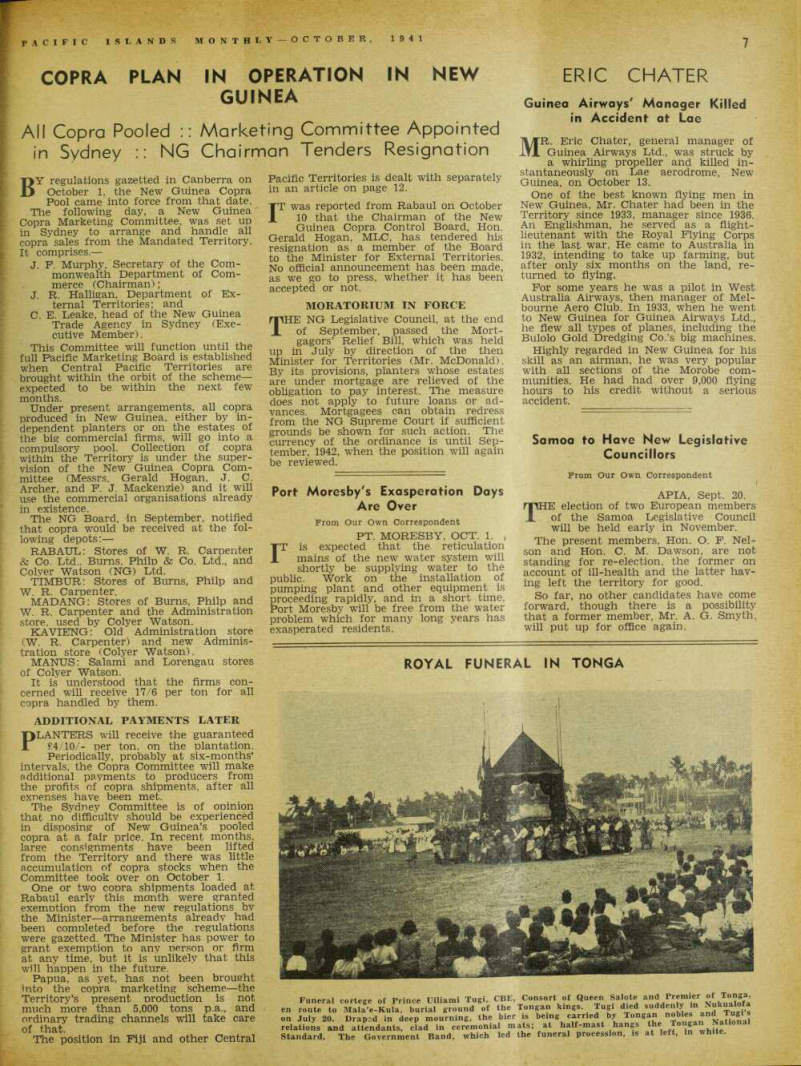
Funeral cortege of Prince Uiliami Tugi, CBE, Consort of Queen Salote and Premier of Tonga en route to Mala’e-Kula. burial ground of the Tongan kings. Tugi died suddenly in Nukualofa on July 20. Draped in deep mourning, the bier is being carried by n obl e s and tugi's relations and attendants, clad in ceremonial mats; at half-mast hangs the tongan National Standard. The Government Band, which led the funeral procession, is at left, in white.
Administration
Piece-Meal Transfer Of N.G
Lands Department Goes to Lae, District Services to Salamaua :: Protest by Rabaul Businessmen Dust Conditions Improve
From Our Own Correspondent
Rabaul, Oct. 3.
FIRST of the projected transfer of Government departments from Rabaul to the new capital, Lae, will be the Lands Department sometime this month. The Department of District Ser vices will be shifted across to Salamaua, into temporary quarters for the time being.
Other sections of the Administration will be transferred —as the Government spokesman put it —“as accommodation becomes available”.
It is understood that £60,000 has been made available for the removal of Ad ministration headquarters during the present financial year.
In the Legislative Council last week, the Administrator made the following announcement: “As it will be necessary to have prepared a lay-out of the new town on a contour survey and on modern town-planning lines, some time must elapse before permanent buildings are erected. In the meantime, every effort is being made to effect the earliest possible and most economical transfer. Designs have been prepared for the erection of temporary office and living accommo dation on lines which will permit the re use of most of the material.
“Parallel with these projects, attention is being given to the problem of housing people who are required to remain in Rabaul district. The native hospital patients have been removed from Rapindik to Bitalobo. The native police depot is in progress of being transferred to a location on the North Coast.
“Inquiry is being made regarding the possibility of acquiring land in suitable location outside the caldera and safe from Matupi dust, so that sites may be made available for the housing of Rabaul resi dents both official and non-official.”
“Will Benefit Only 1 in 10”
ON September 18, a meeting of Rabaul businessmen confirmed a radio message that was despatched to the Australian Prime Minister (Mr. Fadden) several days earlier, in which protests were lodged to the effect that the decision to remove administrative headquarters only benefited 1 in 10 of Rabaul’s popu lation. The radio read. — ‘‘Strong- opposition here against transfer of administrative centre, which benefits less than 1 in 10 of Rabaul’s population. No request has been made for this transfer from any section of the community outside the Public Service, nor has any section been consulted or in any way invited to give an expression of opinion. The Administrator’s recommendations speaks for a small minority of Rabaul’s 2,000 permanent European and Asiatic population. We feel the Minister has not been made aware of these facts. ‘‘No major eruption is either predicted or anticipated; therefore, we consider the expendi ture of a quarter of a million or more pounds to avoid discomfort to a minority group of 100 Administration officials and their families as definitely not warranted. Money should be de voted to the Empire’s war effort, unless we are having a walk-over and do not require it. ‘‘Six months’ complete immunity from present conditions, even if Matupi continues blowing, can be expected within a few weeks with com ing north-west winds. Suggest, as no actual danger threatening, definite action be suspended for three months to gauge wind-change effects on present conditions and Matupi given that time to settle down. Position could then be re viewed and, if necessary, less expensive and quite
safe temporary move be made outside caldera to Kokopo or Bitapaka. Permanent shift to Lae to be made post-war problem.”
The meeting authorised Mr. D. S.
Davies, the local chemist, who was pro ceeding to Australia on furlough, to wait on the proper authorities in Canberra and take such measures as are necessary to safeguard the interests of Rabaul business people.
Public comment on the situation amounts to this: If the danger exists sufficiently for administrative head quarters to be removed in war-time, then it should be a matter for the evacuation
of the whole community, including all Europeans, Chinese and natives. On the face of it, it appears that huge sums of money are about to be expended for a few favoured Public Servants.
North-West Season Close at Hand CONDITIONS in the town in recent weeks have not been so bad as in the past. Several showers of rain have done wonders to the dust menace, though it is still uncomfortable.
The wind now is beginning to blow from the North-west. When the N.W. season sets in properly, within a couple of weeks with any luck, Matupi's dust will be falling out to sea where only a few native canoes will catch it.
The official vulcanological report for the week ended September 30 stated: “The decline in local volcanic seismic activity, as recorded on the Matupi Ob servation Post instruments, continued throughout this week. The decline has been progressive both in the amplitude and the frequency of the tremors and at present the seismic activity is very slight. Eruptive activity continued to be very mild. No cauliflowering clouds were seen”.
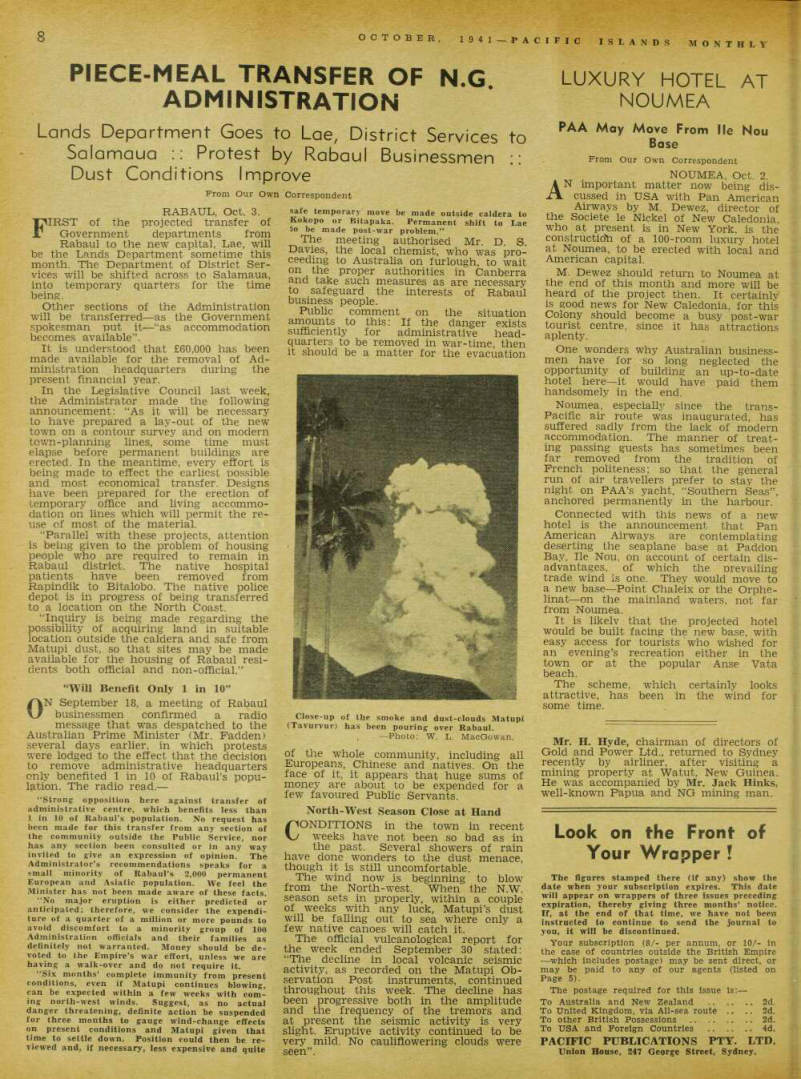
Close-up of the smoke and dust-clouds Matupi (Tavurvur) has been pouring over Rabaul. —Photo: W. L. MacGowan.
Noumea
Luxury Hotel At
PAA May Move From Me Nou Base
From Our Own Correspondent
Noumea, Oct. 2.
AN important matter now being dis cussed in USA with Pan American Airways by M. Dewez, director of the Societe le Nickel of New Caledonia, who at present is in New York, is the construction of a 100-room luxury hotel at Noumea, to be erected with local and American capital.
M. Dewez should return to Noumea at the end of this month and more will be heard of the project then. It certainly is good news for New Caledonia, for this Colony should become a busy post-war tourist centre, since it has attractions aplenty.
One wonders why Australian business men have for so long neglected the opportunity of building an up-to-date hotel here—it would have paid them handsomely in the end.
Noumea, especially since the trans pacific air route was inaugurated, has suffered sadly from the lack of modern accommodation. The manner of treat ing passing guests has sometimes been far removed from the tradition of French politeness; so that the general run of air travellers prefer to stay the night on PAA’s yacht, “Southern Seas”, anchored permanently in the harbour.
Connected with this news of a new hotel is the announcement that Pan American Airways are contemplating deserting the seaplane base at Paddon Bay, He Nou, on account of certain dis advantages, of which the nrevailing trade wind is one. They would move to a new base —Point Chaleix or the Orphe linat—on the mainland waters, not far from Noumea.
It is likelv that the projected hotel would be built facing the new base, with easy access for tourists who wished for an evening’s recreation either in the town or at the popular Anse Vata beach.
The scheme, which certainly looks attractive, has been in the wind for some time.
Mr. H. Hyde, chairman of directors of Gold and Power Ltd., returned to Sydney recently by airliner, after visiting a mining property at Watut, New Guinea.
He was accompanied by Mr. Jack Hinks, well-known Papua and NG mining man.
Advertisements & other items, p. 10 (1 item)
Your Wropper !
Look on the Front of
The figures stamped there (if any) show the date when your subscription expires. This date will appear on wrappers of three Issues preceding expiration, thereby giving three months’ notice.
If, at the end of that time, we have not been instructed to continue to send the journal to you, it will be discontinued.
Your subscription (8/- per annum, or 10/- in the case of countries outside the British Empire —which includes postage) may be sent direct, or may be paid to any of our agents (listed on Page 5).
The postage required for this issue is:— To Australia and New Zealand 2d.
To United Kingdom, via All-sea route .. .. 2d.
To other British Possessions 2d.
To USA and Foreign Countries 4d.
PACIFIC PUBLICATIONS PTY. LTD.
Union House, 247 George Street, Sydney.
Gilbert and Ellice
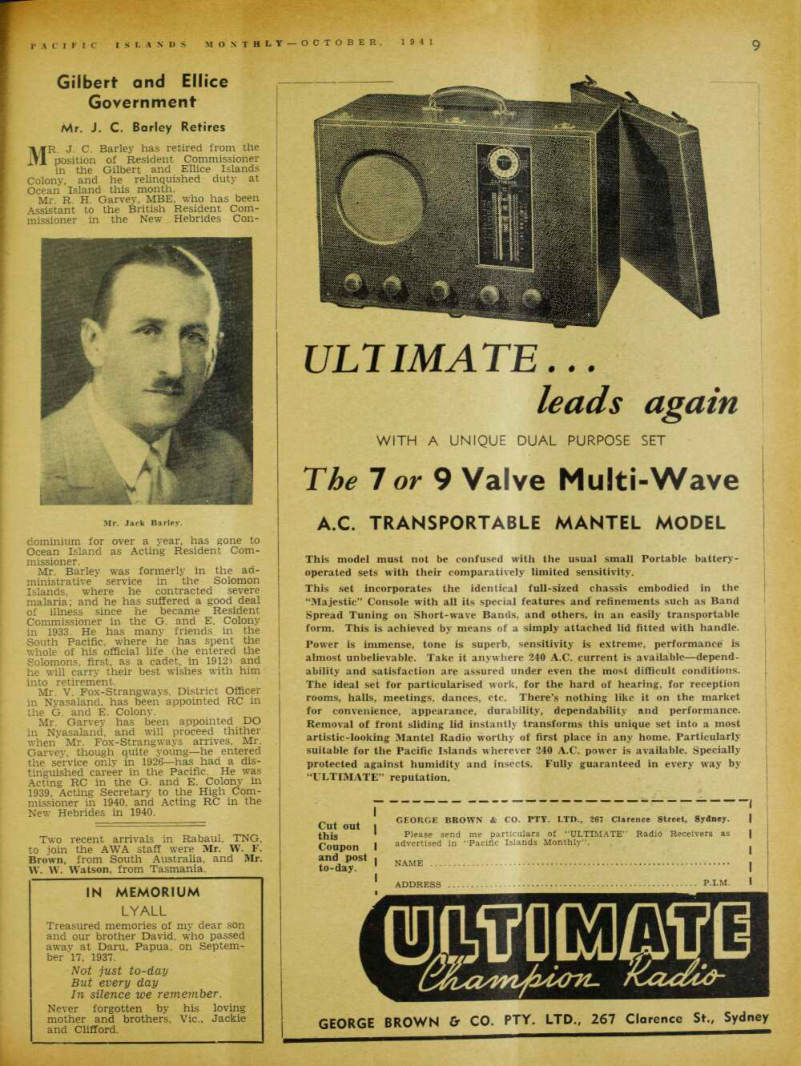
Government Mr. J. C. Barley Retires
j|/|R. J. C. Barley has retired from the IVI position of Resident Commissioner in the Gilbert and Ellice Islands Colony, and he relinquished duty at Ocean Island this month.
Mr. R. H. Garvey, MBE, who has been Assistant to the British Resident Com missioner in the New Hebrides Con-
dominium for over a year, has gone to Ocean Island as Acting Resident Com missioner.
Mr. Barley was formerly in the ad ministrative ' service in the Solomon Islands, where he contracted severe malaria; and he has suffered a good deal of illness since he became Resident Commissioner in the G. and E. Colony in 1933. He has many friends in the South Pacific, where he has spent the whole of his official life (he entered the Solomons, first, as a cadet, in 1912) and he will carry their best wishes with him into retirement.
Mr. V. Fox-Strangways, District Officer in Nyasaland, has been appointed RC in the G. and E. Colony.
Mr. Garvey has been appointed DO in Nyasaland, and will proceed thither when Mr. Fox-Strangways arrives. Mr.
Garvey, though quite young—he entered the service only in 1926—has had a dis tinguished career in the Pacific. He was Acting RC in the G. and E. Colony in 1939. Acting Secretary to the High Com missioner in 1940, and Acting RC in the New Hebrides in 1940.
Two recent arrivals in Rabaul. TNG, to join the AWA staff were Mr. W, F.
Brown, from South Australia, and Mr.
W. W. Watson, from Tasmania.
Mr. Jack Barley.
Advertisements & other items, pp. 11-12 (1 item)
Avfiie
ULTIMATE...
leads again
WITH A UNIQUE DUAL PURPOSE SET
The 1 or 9 Valve Multi-Wave
A.C. TRANSPORTABLE MANTEL MODEL
This model must not be confused with the usual small Portable batteryoperated sets with their comparatively limited sensitivity.
This set incorporates the identical full-sized chassis embodied in the “Majestic” Console with all its special features and refinements such as Band Spread Tuning on Short-wave Bands, and others, in an easily transportable form. This is achieved by means of a simply attached lid fitted with handle.
Power is immense, tone is superb, sensitivity is extreme, performance is almost unbelievable. Take it anywhere 240 A.C. current is available —dependability and satisfaction are assured under even the most difficult conditions.
The ideal set for particularised work, for the hard of hearing, for reception rooms, halls, meetings, dances, etc. There’s nothing like it on the market for convenience, appearance, durability, dependability and performance.
Removal of front sliding lid instantly transforms this unique set into a most artistic-looking Mantel Radio worthy of first place in any home. Particularly suitable for the Pacific Islands wherever 240 A.C. power is available. Specially protected against humidity and insects. Fully guaranteed in every way by “ULTIMATE” reputation. . , GEORGE BROWN & CO. PTY. LTD., 267 Clarence Street, Sydney.
Cut out I thk 1 Please send me particulars of “ULTIMATE” Radio Receivers as Coupon I advertised in Pacific Islands Monthly”.
SJJT 1
ADDRESS P.I.M.
AVFIiE
ill
M U GEORGE BROWN Cr CO. PTY. LTD., 267 Clarence St., Sydney
IN MEMORIUM
LYALL
Treasured memories of my dear son and our brother David, who passed away at Daru, Papua, on September 17, 1937.
Not just to-day But every day In silence we remember.
Never forgotten by his loving mother and brothers. Vic., Jackie and Clifford.
PACIFIC ISLANDS SOCIETY
Visitors from the Islands to Sydney (or those interested in Islands affairs), are advised to communicate with the honorary secretary of the above Society, which has been formed to study the history, traditions, economics, and political developments of the Pacific Islands.
Next social gathering: Hotel Carlton, 8 p.m., Wednesday, October 29.
Address for Correspondence:
THE PACIFIC ISLANDS SOCIETY,
Box 2434 MM., G.P.0., Sydney.
THEV ALL WANT
A KODAK
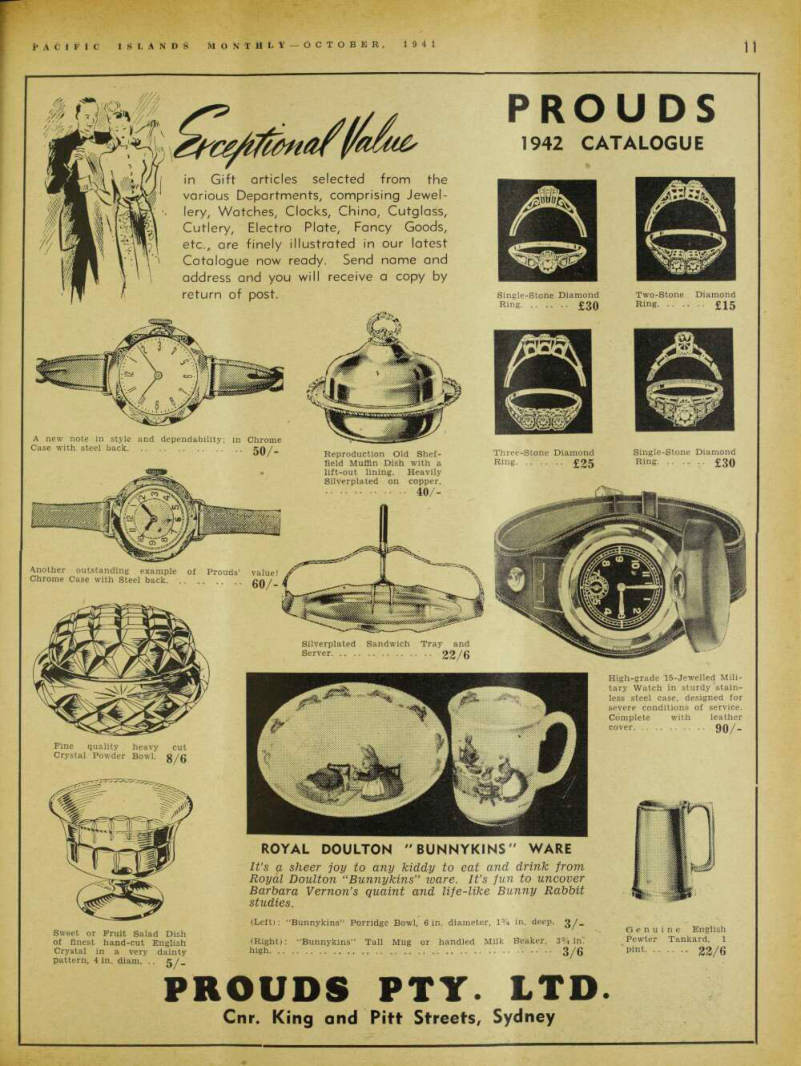
The Popular Brownie (Price 10/9) and every other Brownie is sure of a warm welcome. .
Modern Folding Models, too ; in an extensive range see them.
use cc
From Christmas
)/9> morning onwards
... the happy snapshots
of your Gift KODAK
will be a continuous
reminder of your
thoughtfulness.
See the fine display at
your nearest Kodak Dealers
FREE!
WRITE FOR LATEST
PHOTOGRAPHIC BOOKLETS
Add to the tun wit h KouAK HoMt
MOVIES
• OF ALL KODAK DEALERS AND
KODAK(Aasia|PTY.LTD.
379 GEORGE STREET, SYDNEY
9 WOLFE STREET, NEWCASTLE
Tropicalities
1 T \ s . an 1 astomshln g thing that, in all the long water-frontage of Suva, vi... n ° f sats5 at 5 ha l been pro " ivr d^ d /oi the students of the Suva Medical School. This large group of careyoung men, from all over the South pac !fic, contmns keen swimmers and athletes of all kinds, and one would have supposed that a swimming bath for their use would have been one of the
first facilities provided. There is a swim ming bath in Suva for Europeans and another for the Indian population! But the Indian bath apparently has never been used—it was one way in which the Indians have shown resentment of a dis tinction made between Europeans and Indians Is there any reason why the unused Indian bath should not be made available for the medical students? « IN a Sydney “movie-fan” magazine last month:— fo« h £ r,e * S Lau s hton (‘‘Captain Bligh t, wife Elsa NOUS'S M nd , Jon HaU go lit. ,h?
'can?, f?‘, sto / y - ‘ Tattles of Tahiti", y” cant fool any of them on tropic atmosnherc Laughton and Elsa soaked it up in the celluloid lITT'L Mau * ha “’s ‘ Beachcmnber \ cane’\° n th<? ° ther N - and H - “m-tale “Hur ri : KiSrfyJff app f ar T s that Messrs. Charles Tahiti ff nroh d M Jan Norman Hall, of probably to-day’s best known y have ‘‘clicked” once again.
Their outstanding trilogy, “Mutiny” (the mad y e fnt? 6 which was lafSr S> ade --P f fil^ l >’ ‘ Men A S a inst the bea and Pitcairn’s Island I ’, won fame and fortune for them a couple of years a f°- ever y thin S from their pens has been eagerly snapped up bv American publishers providing of agents to' it C ° Uld b6at the Hcdiywood /fifties of Tahiti” was originally pub -Qof d top-flight American weekly ? a^ rday . Ey enmg Post”, under the title February 1M0). “ PIM ” Tropicalties ' • PIDGIN English, the Lingua Franca of Melanesia, contains many quaint words and phrases that are self evident; for instance, few could mistake house wash wash” (bathroom), “glass look look” (hand mirror), “Masta grass” (bearded man), or “Go catchim bore now secrew belong turnim” (I want the brace and bit). But there are other terms whose origin is not so clear—one, in particular, being “maski”, a word widely used m New Guinea, meaning “never mind or “it doesn’t matter”. A “PIM” subscriber suggests that “maski” is a relic from the days when the Germans held New- Guinea—a contraction of “macht nicht” which literally is “makes nothing”.
Mangaia, we were discussing the V/ freak weather experienced in the Pacific during recent years,” writes a Cook Islands correspondent, “when up spoke one old-timer:— “ ‘We used to get weather pretty good and calm in these here parts years ago.
But when they opened that there bloomin’ Panama Canal and let the cold, rough Atlantic in—well, it’s never been the same since.’
“I’ve never heard that one before!” ♦ ADDRESSING the Pacific Islands Society, last month, Mr. J. T. Ben sted, former MLC of Papua, told of the manner in which salutes were fired in Port Moresby in the “early days”, when visiting dignitaries and officials arrived. Having nothing heavier than a shot-gun or a Schneider carbide, dyna mite was placed in large biscuit tins and spaced at regular intervals around the hillside. When the great moment came, the local gaoler w r ould race frantically from tin to tin, lighting the fuses with a fire-stick, and then dive for cover.
Dr. Rose, of Rarotonga, returned re cently to the Cook Islands, after furlough spent in New- Zealand.
Mr. Jack Salzman arrived in Sydney in September from Naniu, Papua, where he is attached to the New Guinea Mission staff. After a short stay in Sydney, he later proceeded North to Brisbane where he will complete his furlough.
Mr. and Mrs. H. T. Kienzle and family arrived in Australia from Papua recently.
Mr. Kienzle is well known in the Yodda district as manager of Yodda Goldfields, Ltd., and he will spend several weeks' holiday in Australia.
Advertisements & other items, pp. 13-14 (1 item)
Prouds
Vf
mia/
in Gift articles selected from the
various Departments, comprising Jewel-
lery, Watches, Clocks, China, Cutglass,
Cutlery, Electro Plate, Fancy Goods,
etc., are finely illustrated in our latest Catalogue now ready. Send name and address and you will receive a copy by return of post.
PROUDS
1942 CATALOGUE
& go u Single-Stone Diamond Ring. .. £3O Two-Stone Diamond Ring. . . £l5 s A new note in style and dependability; in Chrome Case with steel back j Reproduction Old Sheffield Muffin Dish with a lift-out lining. Heavily Silverplated on copper. 40/- Three-Stone Diamond £2s Single-Stone Diamond Ring. . . £3O 60/- ».
V Another outstanding example of Prouds Chrome Case with Steel back. at Silverplated Sandwich Tray and Server 22/6 Fine quality heavy cut Crystal Powder Bowl, g/g % High-grade 15-Jewelled Military Watch in sturdy "stainless steel case, designed for severe conditions of service.
Complete with leather cover 907- Sweet or Fruit Salad Dish of finest hand-cut English Crystal in a very dainty pattern, 4 in. diam. .. g/_
ROYAL DOULTON " BUNNYKINS" WARE
lt*s a sheer joy to any kiddy to eat and drink from Royal Doulton ‘‘Bunnykins” ware. It’s fun to uncover Barbara Vernon’s quaint and life-like Bunny Rabbit studies. (Left): “Bunnykins’" Porridge Bowl, 6 in. diameter, 1 3 4 in. deep. 3 / (Right): “Bunnykins” Tall Mug or handled Milk Beaker, 3% in', high 3/g Genuine English Pewter Tankard, 1 P int 22/6
PROUDS PTY. LTD
Cnr. King and Pitt Streets, Sydney
SWEET BREATH
Keep your breath sweet, your teeth sparkling white with 5-in-One Dental Cream. This better toothpaste cleans both natural and artificial teeth perfectly. It simply floats stains and film away.
Ask for 5-in-One —the p • • large 2/- tube now rive-in-Une costs only 1/6 every- rkCMTAI DCAki
where. DENTAL CREAM
\ V V r*v mm, 4.>l_ /So P*N *= O O Or U-l v^X s s K & Jj? « 2a ■s* . - —««• * £ -
OUT
Central Pacific Expects Complete
Pooling Plan To Operate
Governments and Big Firms Faced With Many Awkward Problems
By R. W. Robson
SUVA, Sept. 29.
TNDICATIONS here are that the A Fijian Government (which, for this purpose, includes the Western Pacific High Commission) is facing a diffi cult position, in relation to the Copra Marketing Pool. It appears as if the Pool will come into operation.
The Suva merchants can sell most of the copra hereabouts at prices that, by
and large, are substantially better than the A£4/10/- guaranteed by the New Guinea Pool. The best price current here just now is £6 Fijian per ton—equal to £6/15/- Australian per ton, in store at shipping port.
That is £2/5/- per ton more than the big New Guinea producers are offered by the New Guinea Pool for Rabaul hot air-dried, which is virtually the No. 1 copra of the Pacific.
Everything in relation to copra here was going along encouragingly, until late August, when there came indications that the Fijian Government proposed to put the South Pacific Copra Marketing Pool into operation.
This gave the merchants a distinct shock. W. R. Carpenter & Co. now are operating vigorously here; this branch was buying good grade Fiji copra from all interests for the Carpenter crushing mill in Canada; and the price was firm and rising. “Leave us alone, and well solve this thing” said the merchants.
But the Government was not happy.
Some little time ago, it tried again to introduce copra grading. The Carpenter mill—to which the Government is very favourably disposed—wants guaranteed high grade; and perhaps it asked the Government for compulsory grading.
But opposition to grading came so strongly from certain quarters that the Governor, with reluctance, dropped the grading plan.
In this fashion, perhaps, some of the big firms put themselves off-side.
They were not to know that the Gov ernment had two major copra problems on its hands. The first lay in the fact that there is a huge accumulation of unsold copra in the Solomons and in Tonga. The second was the pressure, coming suddenly, and maybe unex pectedly, from Australia, in favour of a South Pacific Copra Pool.
This is only guess-work. But one can imagine the embarrassed Governor say ing: “Very well! They won’t have copra grading. Let’s see how they like copra marketing through a compulsory pool”.
The merchants did not like it a bit.
They received, with consternation, a copy of a draft agreement between Aus tralia, New Zealand, Fiji, the Western Pacific High Commission, and the Free French Government in the Pacific, which already has been approved by the Gov ernments concerned. That agreement is closely based on the “plan” created at the Pacific Copra Conference in Sydney last January, and which was published in the “PIM” in May issue. rpHE Suva merchants were informed.
JL early in September, that permission to export copra was about to be withdrawn —evidently as a preliminary to the introduction of the Pool.
This caused greater perturbation. They had—and, at this date, still have—in quiries for thousands of tons of good Fiji copra, for Canada and elsewhere.
The Carpenter mill literally is clamouring for copra; and the indications now are that, if it is not to be supplied from New Guinea and Fiji, it will be bought by the Canadian mill from Philippines or East Indies. The Canadian mill, built to crush copra, cannot be expected to stand idle, while Governments engage in leisurely arguments and public servants play golf on Saturdays. A copra mill
must make its copra-supply contracts months ahead.
The Suva merchants, I understand, have placed these considerations urgently before the Fiji Government, and sought permission to make export contracts, at least up to the end of November. But, at the moment of this writing, nothing has been done.
I guess again; and my guess is that Suva is awaiting word of some kind from Canberra, and Canberra, as usual, is awaiting a decision by some Minister or Ministers who is playing hop-skip-and jump around the political ring.
It is a shocking thing, that sales of Fiji copra should be lost, and good money kept out of the Colony, just because pub lic servants somewhere will not hurry on with decisions.
IT is my belief —based on circumstances as I know them personally in Aus tralia, New Guinea and Fiji—that the course of events will be as follows: — (1) The South Pacific Copra Pool will be brought into operation before the end of 1941. There will be a Control Board in Sydney, and a Control Committee, with pretty wide powers, in each of the several Territories affected. All copra produced in the South Pacific will go automatically into the Pool. Planters will receive a guaranteed price, which may vary in the different Territories, and a promise that, if the Pool gets more than the guaranteed price, the balance remaining after costs are deducted will be divided pro rata among producers. (2) As it is obvious that the Pool can not begin marketing until its organisation is complete, and some copra buyers are threatening to go elsewhere, the Gov ernments concerned will give the mer chants authority to buy and ship until, say, the end of the year. (3) As the Governments try to plan their Pool organisation, and make it function, they will be appalled by the number and complexity of the practical difficulties that will arise; and it might even happen that, presently, they will hold another Copra Conference, to decide whether they will go on with the Plan.
I think most of the high officials con cerned know, now, a great deal more about the tricks and troubles of the copra industry than they knew 7 a year ago. But it is more likely that they will modify their original plan to provide for far more co-operation with the big South Sea companies than they had at first contemplated.
I admire the High Commission officials for their determination to do something for the gravely embarrassed copra pro ducers of Solomons, Tonga and G. and E.
Colony. The Suva merchants are “sitting pretty”, at the cross-roads of the South Pacific; and they can sell and ship all of Fiji’s annual production of 20,000 tons (for production has fallen to that, from 35,000 tons p.a.). But planters in the smaller, more isolated groups have shipped scarcely a ton for many months, and their position is desperate. The Suva Government is determined that the well placed section of the industry shall carry the unlucky section.
IF the Plan, as it is now, is brought into operation, I think it will fail unless it is adjusted so as to take into account certain vital practical con siderations.
For instance, while the Control Board can force all production into the Pool, it cannot compel buyers to buy from the Pool. There still is a great deal more copra available for sale in the non- Hunnish world than can be consumed through ordinary channels.
It is certain that, if the Board is not going to co-operate fully with the big companies in using their facilities for storage, marketing and shipment (and
the original idea seemed to be to "restrict the monopolistic powers of the big firms’’), the organisation which the Board will create (on public service lines, probably) will be so expensive that growers will receive little, if anything, more than the £4/10/- or so they are originally guaranteed. Thus, growers will support the big firms in agitating against the Pool.
The Pool’s only hope of success seems to lie in co-operating with the big companies.
But, for this co-operation, the com panies doubtless' have a price. They naturally will want protection in relation to their huge mortgage investments among coconut planters; and they are going to ask why the high grade copra ihey produce on their own very numerous plantations should be “pooled” with much lower-grade stuff, so that their present good prices are destroyed.
A little thought suggests that, if special consideration is to be given to the big companies, the whole structure of the
Plan may have to be altered. This ap pears unlikely at present It is more likely that there will be a period of modification and compromise and of placating the big companies.
Otherwise, it win be war with the big companies, and bad business for everyone.
IT is my opinion that the South Pacific Copra Conference, in January started off on the wrong foot.
It should have recognised the huge, far-reaching and very-sensitive power and * n kig trading companies m the South Pacific, and immediately have sought their co-operation and good will. Then, something really practical— and, maybe, something of a permanent nature would have been achieved quickly.
The power of the big companies in the South Pacific is great. They have reaped the due and deserved reward of bold pioneering, ceaseless enterprise and shrewd trading. But their power has grown until, now, it is monopolistic—and the far-sighted men on their directorates probably would be the first to acknow ledge it. It is my belief that those men could have been enlisted to act, with the embarrassed Governments, in creating, out of the crisis in the copra industry, what virtually would have been a New Order in the Pacific.
That way, everyone would have saved a little—the Governments, their prestige; the big companies, their vast organisations and their immense investments (atten uated, maybe, but secure); and, above all, the small planter and trader would have seen his home protected, and the way opened, later, to greater freedom of life and enterprise.
The present Plan, if persisted in, in its original form, win lead inevitably to turmoil, and if it breaks down, even tually, the companies will carrv on, stronger than ever.
But, after informal chats, extending over three days, with merchants, shippers, Government officials and plain citizens, I am hopeful that moderate counsels will prevail, and wisdom find a way out.
HERE are a number of practical ob jections to the South Pacific Pool, as planned in the draft agreement between the Governments. These objec tions come from merchants in general, and especially from Suva:— (1) The Board of Control will comprise a chairman and 4 members. Australia ap points the chairman and 1 member; New Zealand 1 member; Fiji (and High Com mission) 1 member; Free French Colonies 1 member. Yet this Board is to have almost absolute power over disposal of funds; and Australian Territories’ pro duction is only slightly more than Fijian and Western Pacific Territories’ produc tion. NZ Territories’ production is in significant. Clearly, Australia never very friendly to Fiji in a commercial sense (witness the banana fiasco!), is to have far too big a voice in this Board. (2) The financial powers and respon sibilities of the Board and the Territorial Committees are vague and ill-defined.
After all, the real purpose of the Plan is to get as much money as possible into the hands of producers as soon as pos sible. But the Plan apparently regards a score of other things as more important.
Economical administration is vital to the Plan. (3) The Plan wipes out all advantages which some territories enjoyed over others in regard to shipment. It looks like complete equalisation, among all producers in all territories. This is good for planters in the Solomons, Tonga, G. and E. Colony; but bad for those in New Guinea, Fiji, Samoa, where freights have been as much as £2 per ton lower. (4) There is insufficient provision for the protection of contracts of sale and
shipment in existence when the Plan comes into operation. (5) Why is the Unilever concern in Australia specifically exempt from the operation of the Plan (the BSI copra it produces may be taken to Australia, free of the Pool), while no provision is made for exempting other concerns simi larly situated? (E.g.: Under the Plan, copra produced on the Carpenter plan tations in New Guinea must go into the Pool: yet it is destined just as directly for the Carpenter mill in Canada as is the BSI copra for the Lever mill in Sydney.) (6) The Board is given complete dis cretionary power regarding the distri bution of funds remaining, after growers have got their guaranteed price, and after all “costs” have been provided for.
In the opinion of practical men, this is going to lead to endless trouble between the various interests concerned. They urge that, instead, the Board be made to conform to a definite formula, and not
be allowed to “distribute in such propor tion as it thinks fit”. (7) The Plan, apparently, provides that there shall be special Territory costs charged against copra sales (which would be deducted from moneys sent to that Territory for distribution), and that, if storage charges anywhere are exceptional some of the storage costs shall be charged against the general fund instead of the Territory fund. This is regarded as likely to prove inequitable, and open to abuse.
The last of the Tahitian soldiers in Sydney is Eugene Te Tutavae, a volun teer from Papeete. Since the departure of his comrades, he has been an inmate of one of the military hospitals suffering from asthma. However, he now is on the mend. In the same hospital is Volunteer Andree, of Noumea, New Cale donia, who is still in plaster as a result of a train accident.
Advertisements & other items, pp. 15-18 (3 items)
13
PACIFIC ISLANDS MONtHtV OCTOBER, 1941
Betterbilt
LONDON PUMPS
Self priming. Genuinely portable.
Weight 50 lb. Capacity 5,000 gal.
Suitable all heads up to 50 feet.
Immediate delivery ex Rabaul to all parts of the Islands.
PARTICULARS:
Nelson Cr Robertson Pty. Ltd. 12 Spring Street, Sydney.
\ m
BETTERBILT
Retread Tyres
SAVE BIG MONEY
SURER DE LUXE HEAVY TYRES
Guaranteed for at least 7,000 miles
* IN MILEAGE r h b J K a„“o the Island motorist’s requirements ... a tyre that’s sturdy, tough , . . able to stand up to relentless driving conditions over any kind of road.
You can depend on Betterbilts to give long mileage—and at half the cost of the original tyre!
W |kj Cl ye A tread as thick as Betterbilt MUST have more mileage in it! The wider, deeper cut of Betterbilt is your «assurance of longer, trouble-free life.
Betterbilt means every word it says! ★I Kl CACCTY Rigid inspection of worn covers, and the high ■ I I grade materials built into the construction of Betterbilts guarantees a fatigue-proof tyre. You get a balanced retread, maximum protection against blow r -outs. A Betterbilt is a SAFER retread. 99 6.25-16 6.50- 7 . 00- 7.00- 7.50- 7.50- 3 12 3 14 3 14 31 14 3 17 4 11
AIR WHEEL TYRES
SIZE PRICE
£ s d 5.25-16 2 14 9 5.50-16 2 18 0 5.75-16 3 3 0 6.00-16 •• •• 311 0
TRUCK AND BUS BALLOON
TYRES
SIZE PRICE
£ s d 6.00- 5 5 6 6.50- 5 18 9 7.00- 7 4 9 7.50- 7 19 9
TRUCK HIGH PRESSURE
TYRES
SIZE
PRICE
£ s d 30x5 32x6 36x6 34x7 .. .. 715 .. .. 7 17 ... 99
SYDNEY
Only Obtainable From :—
HISLOP LLOYD Pty. Ltd.
335-7 PITT STREET, SYDNEY
Cable Address: “Hisloyd”, Sydney. We Ship by Return Boat.
Many a man is discussed
like this by his employers
The scene is the Board of Directors room in a big company in Sydney.
It is Friday morning at 10.30. The Board is sitting.
CHAIRMAN OP THE BOARD: “Well,
here’s the salary list. Johnson’s asking for a rise—says that living expenses are very heavy up in the Islands, as well as having two girls to educate down here in Sydney.”
Ist DIRECTOR: “That’s all very well, but does Johnson’s work justify a rise? Personally, I don’t think so.” 2nd DIRECTOR: “I agree. Johnson isn’t turning out to be quite the success we thought he would be.
As a matter of fact, I really think we should consider a change.” 3rd DIRECTOR: “Well, frankly, I’m sorry for Johnson, because I recommended him and you must agree he did a lot of excellent work in the past. Still, the general feeling seems to be against him, so we’d better forget that rise of his.”
And what about Johnson? Why was it he was not the success he should have been? Let us look inside his bunaglow and see. . . .
Fred Johnson is leaning against the verandah rail talking to his wife, Rita.
“Darling, I really think that tiredness of yours is serious. It’s not right for you to always feel like that—l’ve noticed it. Now look— for my sake will you go and see Dr.
Morris?”
And so Fred Johnson went along and saw Dr. Morris. Dr. Morris gave him a thorough examination.
Then, when he had finished, he said: “Fred, you’ve probably never realised it, but you’re suffering from night starvation. You see, it’s not a well-known fact, but while you sleep your body goes on burning up energy. Heart beats, breathing and other automatic actions—these take it out of you. Naturally unless energy is replaced during sleep you’re bound to wake tired and feel unequal to your job. Now the best thing for you, Fred, is Horlicks.
Horlicks guards against night starvation and helps you to wake refreshed.”
So Fred started drinking Horlicks every night and it made a wonderful difference to him. We meet him again two months later. He is hurrying up the garden path to his bungalow carrying a letter in his hand. As he approaches the door he calls . . .
“I don’t know Rita—none of the things we dreamed about seem to be coming true, do they? I thought that when we came up here we could really get in amongst the money. It seems to take twice as much to live here as anywhere else.
Bills—bills—l’ve never finished paying bills!”
“Cheer up, Fred, it’s not as bad as all that.”
“Not as bad—it’s worse! The trouble is this rotten tiredness of mine The everlasting tiredness—l even wake up tired nowadays. How can a man put his mind on his job when he’s got this tiredness hanging over his head?”
“Rita—Rita.”
“Yes dear—what is it?”
“Darling, I landed that order I was telling you about. This means a rise for me now” . . .
Do YOU wake tired—feel run down?
Are YOU worried about your job?
If so, drink a cupful of Horlicks regularly last thing at night. You see tiredness, lack of energy and dulness are really symptoms of night starvation, and Horlicks guards against night starvation.
*OBL|CO
lorl vm
„Q V SANTA SPEAKS
Angus & Coote have a great
range of Gifts this
year and we'll send them
free to you or anywhere.
Safe delivery guaranteed.
ill".
vo o o £B/10/0 O
post
A spa rkling centre Diamond in a “hexagonal” setting . . . very popular.
Platinum Settings. r £l5 A “Pillar- ■'claw” setting with two flashing centre Diamonds. *7/15/o,™° pot, Basin and Jug is very modern and is guaranteed A 1 by A. & C Silverplated Teaset, tea- Lovely A 1 quality Tray to match, £7/10/0 Nice shaped Silverplated Coffee Pot, Al, £3/!5/0 “ ' " “VIO/O fla *. ing single Diamond in a lovely “Coronet” setting.
This beautiful polished Jacobean Oak Canteen contains 47 pieces. The knives are of Stainless Steel, mirror-finished with curved blades and round xylonite handles. m W .v nr £45 A gorgeous J sparkling single Diamond, with 10 smaller Gems in the shoulders.
Spoons and forks are A & C Special Silverplate.
Complete with Carvers. «SI2 QQ/_ Ladies’ Watch, Gold-filled ' case, complete with gilt Bracelet. Perfect timepiece. 15-jewelled Swiss movement.
Watches warranted for 10 years. £5 „ Ladies’ smart Watch, Goldfilled case, complete with modern gilt Bracelet. 15-jewelled Swiss move- New! ment.
Watches regulated FREE for one year. 25/- 30/- “Keep-it-Cool” Butter ' Dish. Compartment for water or ice-cubes separate tray for butter.
Write for Angus & Coote’s
FREE
CATALOGUE.
9 L I 21/- CM O Nest of Cork Table Mats . . .
SVs in. across, in Al Silverplate Stand. This is a marvellously handy little outfit, and it will fill a long-felt need.
Use Angus & Coote’s Lay-By and Pay it Off.
Strong Leather Money-belt, with extension fastening strap. £g “The Indestructible Lever”. A perfect timepiece, made for tough work.
It is WATERPROOF—SHOCKPROOF—DUSTPROOF and is unaffected by Magnetism or Electricity. Written warranty for 25 years’ service and unconditionally guaranteed for one year. pint Collapsible Drinking Mug, with leather pouch. Mug in Al Silverplate.
Pretty Wedding Rings.
r 15/- 9 ct - y ellow Gold Ring, ' hand-cut, in modern 47/6 Excellent Cold ' Water Jug of Al Silverplate, with decorative handle and spout.
Stands perfectly on its broad base and holds 2 pints.
Smart 9 ct. Gold Tie Pin. Silverlined, 3/6. Gold-lined,. 8/6. £2/2/0 15/- Ladies’ 9ct. Gentlemen’s 9ct.
Gold Signet Ring. Gold Signet Ring.
Superior Spirit Flask, with screw-on cap.
Measures 5x 3% in. and holds 10 ozs. g/5 Stain less' 1 Nickel Spoon and Pork. Solid handled Knife, complete with leather pouch.
42/ !Bct.
1 Ring . yellow Gold . very smart.
White gold 5/6 extra.
ANGUS & COOTE
500 GEORGE STREET, SYDNEY.
16/6 Inexpensive Manicure Case, 9 x 5Vg in. . . . fitted with everything needed for a good manicure.
Dili u S' x =•7.^ r. dew
D£ WA
DA .yii . i ,
DAW'AR'S^& ///vl
DA WAR':}:):}
DEWAR’S DRWaR
a % :■;. 3> 3. WA 5< S DEW A R S A :< S D A WA R SDRW A R V
V A R’S DRWAR S DEWAR'S
RWA R'S. DEWAR S DEWAR'S
DA WAR'S DR WAR’S DEWAR'S
<'S DEWAR'S DEWAR’S DA WAR'S
tEWA'R'S OAW A A' if. 3. ; AW A 3<'S DA WA R'S 0A W A A S DEWAR'S DA. W A ;*' A DA WAR'S DRWAR S DA WAR'S DA WAR'S DSWAR’S DA WAR'S DA WAR'S DA WAR'S DRWAR SDEWA RS DA WAR'S DRW.fRS DRWaRS DA WAR'S DA WAR'S DEWAR'S DA WAR'S D A WAR'S DA WA RS D£wfß‘ S DRWARS DA WAR'S DEWAR'S OAWa R' S DEWAR S DA W DKWAR'S DEWAR S DEWaR S DA DEV
DENVER'S
DAwJk'S
DEWAR
DRWA
DEWA
DSW
DE A R R'S A R VR
aRSDEWAR'S
AR'S DA WAR'S
JDS DA WAR'S
A R'S DA WAR’S
DEWAR S DEWAR'S
a. R’S DA WAR'S DA WAR'S DA WAR'S
A.RSDE
'A DA WA R S DA WA R'S DA WA R'S DAW A R'S AAWaR’S Di; WAR'S DA WARS DA WAR'S DRWARS A R'S DAWAR'S DS WAR'S DA WARS DA WAR'S DEWAR'S
SDAWARS DAWAR'SD£W.aR SDEW aRSDEWAR'SDEWAR'S
DEWAE'SDEWAR'SDSWAR'SDEWARSDEWAR'SDEWAR'SDAWA33; ; SDSWARS
DEWAR'S DEWAR'S DA WARS DEWaR S DAW'A R'S DA WAR'S DA WAR’S DEWAR'S DEWAR’SDEWaR'SDEWa'R SD3:.WA3rS DA WAR'S DEWaR SDRW.aR'S DEWAR'S DAWaR'S DAWAR'S DA WAR'S DA WAR‘SD?iWAR'SDR\VAR'S DA; W'AR'S DAW/'R'S DEWAR'S DAWAR'S DS WAR S DEWAR’S DEWARS DE WA R'S DA WAR'S DAWAR'S DS WARS DS WAR’S DEWa AS DAW'a R'S AvA WAR'S DA WA3< S DEWAR'S DA WAR- DS WAR'S DAWAR'S DAWAR S DA WAR'S DA WAR'S DA
DAW'AR SDAW'A R'S DAWAR'S D 3
DA WA R'S DAW A 3D S D AW A DAWA R' S DA: WAR'S DRW A
DK WAR’S DAWARS DAWA
DK WA R'S DAWA R'S DA W'A DA W'A R'S DA WAR'S DA WAR’
DS WAR'S DAWAR S DRW
A R S DAWAR’S DEWA R S
■A?* R’S DAWA R A
AR'S|*fW 'ff-: R'S DA WAR'S
R 4J : MA S'S 3>3i; WAR'S
WAR’S DA WAR'S DAWAR'S
R'S DEWAR'S DAWAR'S OS WAR’S
A R'S DfJft'A R S DRW a R DEWARS DAWAR'S S WAR Si DRW A R S DA W'A R’S 3>A. WAR'S DEWAR'S EWaRS DEWAR’S DA W AR'S DS WAR'S DSWAR'S DKWaE'SDEWaR S DAW'A R'S DA W'A R'S DA WAR'S DEW a R’S DR WARS DRWARS
DEWAR'SDEWAR'SDEWAR'SDEWAR'SDEWAfRSDRWAR < 3 DEWAR'S
DS
DRW
DAW
DAWA
?>sw<
DEW
DEWAR S DAW'aJC ' s DA W'A R' S DA WA R'S D A WAR 'S DSW A R S OR WA R' S DR W'A R’S I
AR'S
R S R'S
A.RS
DA W'A R'S DA W'A R'S DA WAR'S DS WAR'S D A WARS DRW % '•>
DR WAR SDR WAR
DAWaR'SDAWAA“t
S DAW'A R'S DA W'A R'S
WAR'S DAWAR'S
DS W A S DRW A R'S
.. DR WARS DAWAR’S
WAR'S DA WAR'S DA WAR S DEWAR’SDRW a R> DAWaR S DEWaR'S3'3AWAR'S DEWARS DRWARS DRWaRS DAWaR'S DAW'A R S DA WAR'S DEWAR'S DSWAR'S DAWaR'S DAW'aRS DAWA R S DA; W'A R'S DA WARS DAWA3DS DSWAR'S DEWAR'S DEWAR'S Dif. WAR'S DA WAR'S DAWAR'S DEWAR S DR WAR ?• DEWAR'S DR WAR’S DEAR'S DSWAR'S DEWARS DR W'A R'S DRWAR/S DAW'aRS DRW'AR’S DEWAR'S DR WAR'S D W A R’S DR WAR'S DEWARS
14
October, io4i_pAciPic islands monthly
Notable Occasion
Sir Harry Luke (British High Commissioner for the Western Pacific) and M. Henri Sautot (French High Commissioner in the Pacific), photographed together at Vila in July, 1941. This was the first time since 1907 that the British and French High Commissioners had met on Con dominium Territory.
Gilbertese Moved
To Phoenix
Tragedy Marks Completion of Big Migration
SUVA, Sept. 30. rAGEDY attended the completion of the two-years’ task of transferring about 2,000 Gilbertese from the Gilbert Islands (where there is over population) to the Phoenix Group (where there has been no population at all).
When the last shipload of Gilbertese was being taken into the Phoenix Group, the officer who has been in charge of the plan, Mr, G. B. Gallagher, aged 29, died suddenly from peritonitis. He was taken suddenly ill; and, at Gardner Is land, Dr. MacPherson, of Suva, who was in that locality, deemed it necessary to perform an urgent shipboard operation.
It was too late, however, and so the death occurred of one of the most able and popular young men in the service of the Western Pacific High Commission.
Mr. Gallagher came to Fiji in 1937 as a cadet-officer and made many friends in Suva. He was unmarried.
The transfer of the Gilbertese to cer tain of the Phoenix Islands—namely Hull, Sydney and Gardner—has been carried out in accordance with a careful plan.
The families taken from the poverty stricken Gilbertese districts where there is no more available land—were carefully selected; the localities of the new villages were chosen with due regard for quality of soil, water supply, etc.; wells have been sunk and hospitals pro vided; and a proper system of native administration has been created.
There is little doubt that the new settlement in the Phoenix Islands will be a complete success.
Chinese Trade Stores
in Wau
Letter to the Editor I SHOULD like to make known certain facts re the Chinese trade store question, as it exists in Wau District at present.
From time to time, I had been assured by officials that when Chinatown was an accomplished fact in Wau, it would be the means of solving the Chinese trade store question. But, now, when China town has become an accomplished fact, there appears to be no move on the part of Chinese occupying key sites in Wau township, to shift into Chinatown proper.
This unsatisfactory state of affairs will continue so long as it remains op tional for the Chinese to move into Chinatown or remain as they are at present, scattered among the European population of Wau.
I am convinced that Wau Chinatown came into being only as a means of ab sorbing all the surplus Chinese that are continually arriving from Rabaul, and that the Chinese already established here have not the slightest intention of relinquishing their key positions. Ap parently, the New Guinea Administration is auite content to allow this state of affairs to go on indefinitely.
On the occasion of the Administrators recent visit to Wau, with the Minister for Territories (Mr. McDonald), I was given definite assurance that upon his return to Rabaul the whole question of Chinese trade stores, would be gone into most thoroughly and adjusted. So far. that nromise has not been fulfilled, and the Chinese, and Europeans “dummying” for them, are allowed to go on their way rejoicing. „ .
I might add that the average Chinese trade store in Wau, is a meeting place for all the worst native element of the Dis trict. In view of the Wilson crime perpetrated in our midst some little time back, one would be inclined to think that the Administration would do every thing in its power to have such a menace ps this removed as far as possible from the European quarter of Wau.
It would appear that one or two more crimes must be committed against Euro peans before the Administration awakes from its slumber.
I am, etc.,
A. G. Villiers.
Wau. New Guinea, October 1, 1941.
Samoan Cocoa And
Bananas
From Our Own Correspondent APIA, Sept. 13. rIS season a good cocoa crop is exnected and prospects for higher prices seem much brighter in view of inquiries from Australia and USA.
Banana shipments to NZ still are effected by irregular shipping facilities, though these are expected to improve during the next few months. One out let for Samoan produce that benefits growers is Pago Pago, which absorbs large quantities .of local-grown fruit, etc.
The death took place in Sydney as the result of a motor accident in September of Mr. L. S. Cumming, who was well known in the timber trade in Fiji. Mr.
Cumming had travelled extensively in the Pacific, and as recently as July, showed some of his colour-films of Tahiti, Samoa, and other territories before members of the Pacific Islands Society.
N. Caledonia May Refine
Own Nickel
Prom Our Own Correspondent
Noumea, Sept. 27.
THE New Caledonian Nickel Co.’s engineer, M. Peloux, is expected to arrive shortly by Clipper from USA, where he has been investigating the prospects of purchasing machinery for a nickel refinery. This would be a valu able addition to the nickel smelters at Point Doniambo, Noumea, which at pre
sent can only turn out nickel matte, leaving America to do the refining.
Advertisements & other items, p. 19 (1 item)
Boils, Carbuncles
5 B s
LOTIO
For Inflamed Eyes and Eyelids
SOLD EVERYWHERE
H. A. Rose & Co. Pty. Ltd., King St., Sydney
ARE YOU BUYING TO THE BEST ADVANTAGE?
To ensure that you receive your goods at the lowest rates send your orders, by Air Mail, if possible, to: —
ROBERT GILLESPIE PTY. LIMITED
ROBEBGILL. 54A PITT ST„ SYDNEY, N.S.W. kc'"
Proved fastest way to clear up
BOILS, CARBUNCLES
and Septic Skin Conditions
without INJECTIONS, LANCING or SCARRING
by ORAL VACCINE (taken through the mouth) Here is die ONE treatment that can give you prompt relief from skin complaints—because it actually provides, in most cases, an antidote to those germs which cause many of these diseases.
Hundreds of sufferers who had tried all kinds of so-called “cures” without success are delighted with the results obtained with the LANTIGEN “D” immunisation treatment, based on the researches of Louis Pasteur. LANTIGEN, which contains no drugs, has been developed by a leading bacteriologist, and has proved itself effective in the treatment of deep-seated bacterial disorders.
a few days. There are no cores to extract they simply disappear, leaving the skin normal and healthy once again.
LANTIGEN ‘‘D” should also be taken by mouth (a few drops in water at bedtime) to purify the system from the poisonous germs, and build up bodily resistance against further attacks. It takes the place of painful, expensive vaccination by injection.
Several weeks’ treatment 19 per bottle. Two bottles are usually necessary for the average case.
Ask your Chemist.
“p”
ORAL VACCINE
Product of
EDINBURGH LABORATORIES
103 York Street, Sydney.
QUICK RELIEF FROM PAIN
LANTIGEN “D” quickly stops the pain of Boils and Carbuncles, and then heals them up thoroughly and rapidly, without the need of lancing and without leaving a scar or mark.
By providing antigens to incite the creation of antibodies in the system to destroy disease - causing bacteria, LANTI- GEN “D” kills TouUPasteur the germs which cause Boils, Carbuncles, Acne, Pimples, Eczema, Septic Sores, Abscesses, etc.
If applied on a cotton-wool pad to a Boil or Carbuncle, the pain will diminish within 24 hours, and the trouble will be completely gone in.
New Indian School-House Opened At Nausori, Fiji
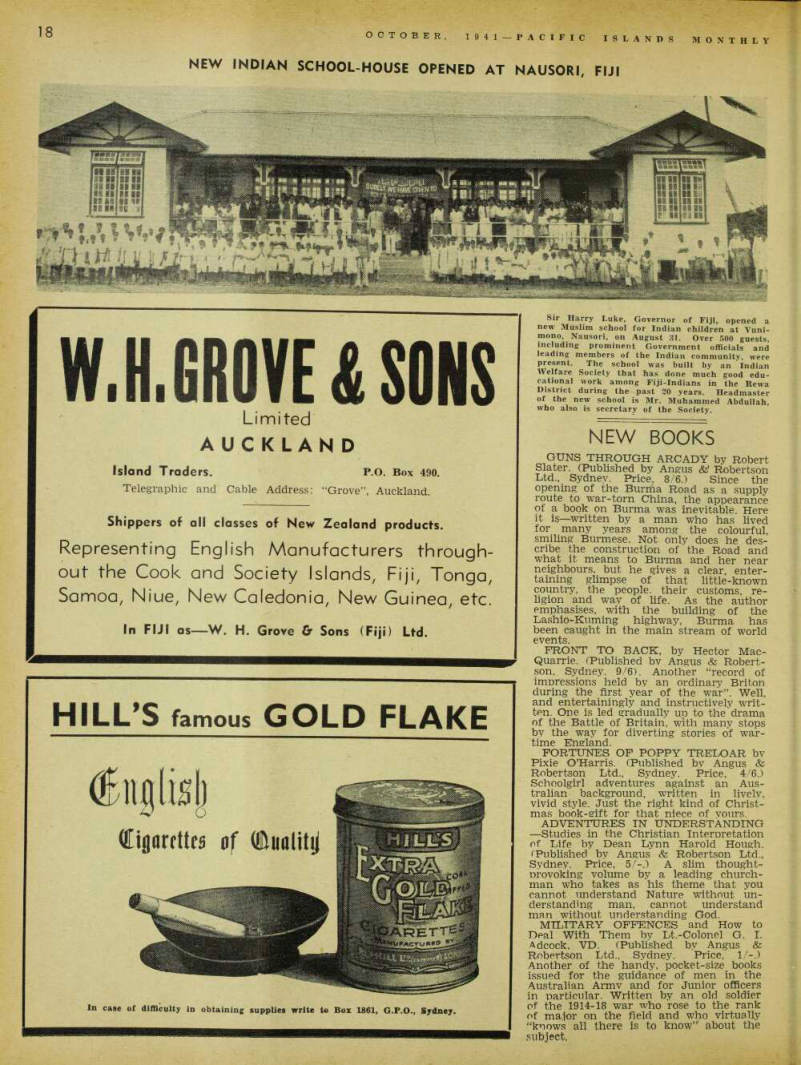
Sir Harry Luke, Governor of Fiji, opened a new Muslim school for Indian children at Vuni mono, Nausori, on August 31. Over 500 guests, including prominent Government officials and leading members of the Indian community, were present. The school was built by an Indian Welfare Society that has done much good edu cational work among Fiji-Indians in the Rewa District during the past 20 years. Headmaster of the new school is Mr. Muhammed Abdullah, who also is secretary of the Society.
New Books
Guns Through Arcady By Robert
Slater. (Published by Angus & Robertson Ltd., Sydney. Price, 8/6.) Since the opening of the Burma Road as a supply route to war-torn China, the appearance of a book on Burma was inevitable. Here it is—written by a man who has lived for many years among the colourful, smiling Burmese. Not only does he des cribe the construction of the Road and what it means to Burma and her near neighbours, but he gives a clear, enter taining glimpse of that little-known country, the people, their customs, re ligion and way of life. As the author emphasises, with the building of the Lashio-Kuming highway, Burma has been caught in the main stream of world events.
FRONT TO BACK, by Hector Mac- Quarrie. (Published bv Angus & Robert son, Sydney. 9/6). Another “record of impressions held by an ordinary Briton during the first year of the war”. Well, and entertainingly and instructively writ ten. One is led gradually up to the drama of the Battle of Britain, with many stops by the way for diverting stories of war time England.
Fortunes Op Poppy Treloar Bv
Pixie O’Harris. (Published bv Angus & Robertson Ltd., Sydney. Price, 4/6.) Schoolgirl adventures against an Aus tralian background, written in lively, vivid style. Just the right kind of Christ mas book-gift for that niece of vours.
Adventures In Understanding
—Studies in the Christian Interpretation of Life by Dean Lynn Harold Hough. (Published by Angus & Robertson Ltd., Sydney. Price, 5/-.) A slim thought nrovoking volume by a leading church man who takes as his theme that you cannot understand Nature without un derstanding man, cannot understand man without understanding God.
Military Offences And How To
Deal With Them by Lt.-Colonel G. I.
Adcock, VD. (Published by Angus & Robertson Ltd.. Sydney. Price, 1/-.) Another of the handy, pocket-size books issued for the guidance of men in the Australian Armv and for Junior officers in particular. Written by an old soldier of the 1914-18 war who rose to the rank of major on the field and who virtually “knows all there is to know” about the
subject.
Advertisements & other items, pp. 20-22 (2 items)
W.H.6Rove £ Sons
Limited
AUCKLAND
Island Traders. P.O. Box 490.
Telegraphic and Cable Address: “Grove”, Auckland.
Shippers of all classes of New Zealand products.
Representing English Manufacturers throughout the Cook and Society Islands, Fiji, Tonga, Samoa, Niue, New Caledonia, New Guinea, etc.
In FIJI as—W. H. Grove & Sons (Fiji) Ltd.
HILL’S famous GOLD FLAKE
(Ogurrttn of
R mt* UR«» In case of difficulty in obtaining: supplies write to Box 1861, G.P.0., Sydney.
Crammond
cm m
'rm<-
Turns
gs. i
DAY
into
Here is Proof of SENSATIONAL
Daylight Reception!
Hawkins Hill, Georgetown, Q.
Crammond Radio Mfg. Co., 8 Queen Street, Brisbane.
Dear Sir, My receiver is still behaving very satisfactorily. I am giving you a list of broadcast stations which I logged at mid-day about two weeks ago. You may use them in any way you wish: 2CR, 3WV, 2FC, 4QN, SCK, 2CO, 4AT, 2NR, 4QS, 4TO, 4QG, SAN, 4RK, 4QR, 4AY, 4CA, 4SB, 4BC, 7LR, 4AK, 4BK, 2UW, and 3DB.
I have never heard of any other set picking up any more than five stations at that time of the day. I think this is an outstanding performance, considering I am so far away from the stations; 4AT would be the closest station to here, which is 300 miles away.
Yours faithfully, (Sgd.) NEV. PRIOR.
Never a “BLACKOUT”
with a CRAMMOND
Night and day is one and the same to a Crammond—it gives a 24 hour service of 100 per cent, performance. The long range daylight reception has indeed made the Crammond “King of the Air”.
4 YEARS GUARANTEE
EASY TERMS ANYWHERE
* CRAMMOND RECEIVERS are specially built to suit Tropical conditions.
All parts are specially protected against heat and moisture . . . ideal ■for the Islands. SENSATIONAL LONG RANGE RECEPTION, and troublefree operation. *
CRAMMOND Radio
MANUFACTURING CO., No. 8 Queen St., Brisbane ; Please send me full particulars of Models, terms list, etc.
NAME
ADDRESS
(P.I.M.)
State whether Battery, Vibrator, Air Cell, All-Electric. Please use BLOCK LETTERS for Name and Address.
I&VW, Vigours
i
Vitality
36 All Chemigfs -Wp) .
, ■ CNvasT
Ironised Yeast
KEEP FIGHTING FIT!
Take lON YE AST Vitamin B, D & E Tonic. Confers lasting benefits whilst achieving immediate results. A 10-day course 3/6, or 3 bottles for 10/-.
Write- -
lONYEAST
Box 1966 X, G.P.0., Brisbane, Qld.
A Disappearing Surplus
Four years ago, the New Guinea Administration possessed a nest-egg surplus of some £60,000, mainly the result of buoyant revenues from the Morobe gold industry. To-day, that sur- Pl 1^ 8 ™ as keen whittled down to a trifling £6,000.
This was revealed in the comparative statement of revenue and expenditure of the Mandated Territory for the year ended June 30, 1941, published in Sep tember in the official New Guinea Gazette. Revenue amounted to £423,750 (a decrease of £86,270 on the previous year), and expenditure totalled £431,791 (down £73,143). The 1940 surplus was thus reduced from £14,022 to £5,981.
For some years now, critics have decried the NG Administration’s inability to level off expenditure and revenue and to trim sails in the cost of maintaining certain departments; the 1940-41 accounts merely provide them with further ammunition.
Dr. Dorothy Delbridge, of the Methodist Mission hospital at Ba, Fiji, will return to Australia shortly for furlough.
Mr. and Mrs. G. E. Bliss, of Sarang Plantation, Madang, arrived in Australia recently from New Guinea on furlough
Roll Of Honour
(It is hoped to assemble, here, the names of men former residents of the Pacific Territories, which appear in British and Free French casualty lists, or in lists of honours awarded.
We should be grateful if relations and friendj would send us details.)
Killed
Pilo xh°® cer Len BAYL ISS, flying instructor in the RAAF, formerly of Rabaul. New Guinea.
Killed in Sydney, 18/11/1940, when he fell from a trainer aircraft, in flight, without a para chute.
A/Bdr. Neville W. BERTWISTLE, AIF artillery (tank unit), formerly a clerk on the staff of W. R. Carpenter and Co., Ltd., of Rabaul, New Guinea. Killed in action, April, 1941. «fl^ ht ; LieUtenant G - J - L CLARKE, of the RAAF, formerly Assistant Flight Superintendent of Carpenter Airways, New Guinea. Reported missing after operations off Dakar (French West Africa), while attached to HMAS “Australia” 25/9/1940—now presumed killed.
Pte. Felix CRAIG, AIF, formerly of accounts department, Australasian Petroleum Co, Port Moresby, Papua. Reported killed, June, 1941 Captain Kenneth GARDEN, of the RAP Ferry Command, formerly chief pilot of Guinea Air ways, Ltd., in New Guinea. Killed in air accident, 2/9/1941, when bomber, which he had flown across Atlantic from USA, crashed near west coast of Britain.
Flying-Officer Moresby GOFTON, of the RAP son of Mrs. F. S. Stewart, of Wau, New Guinea.’
Reported missing, 17/5/1940—now presumed killed.
Flying-Officer K. J. A. JOHNSTONE, of the RAF, who was born in Suva, Fiji, in 1915. Re ported missing, 1/5/1940 —now presumed killed.
Cpl. Alex. C. SCOTT, AIF, formerly manager at Kieta, TNG, for Burns, Philp and Co., Ltd.
Killed in action in the Middle East, 19/6/1941.
Died From Wounds
Pte. Ernest HENRY, AIF, formerly of the Rabaul (NG) staff of Burns, Philp and Co., Ltd. Died from wounds received during Battle of Crete, 1/6/1941.
Pte. Walter PEARSON, of first NG Quota of AIF (infantry). Died from wounds received in action, 24/6/1941.
A/Bdr. W. R. SCOTT, AIF, of New Guinea.
Died from wounds, July, 1941.
Sergeant-Pilot Peter Clarkson WISE, of the RAF, son of Mr. W. Wise, OBE, Director of Public Works, Fiji. Died from wounds received during bombing raid over Germany, January 1941.
Died From Illness
Pte. Clarence A. HUTTON, AIF, formerly of Edie Creek, New Guinea. Died from illness, April, 1941.
Missing
A/Sgt. A. A. S. COTMAN, AIF infantry, of Abau, Papua. Reported missing—believed prisoner of war, 5/5/1941.
Pte. L. F. McCarthy, AIF infantry, of Rabaul, TNG. Reported “wounded in action and missing —believed prisoner of war”, 15/7/1941.
Alex. McKAY, of the RAAF, formerly engineer at the Colonial Sugar Refining Co.’s mill, Penang, Fiji. Reported missing, August, 1941.
Gnr. A. H. ROSS, AIF artillery, of Rabaul, TNG. Reported missing—believed prisoner of war, 28/9/1941.
Pte. John O. SMITH, of the NZ Forces, son of Captain Smith, of “Tui Kauvaro”, and Mrs.
Smith, of Suva, Fiji. Reported missing, 29/5/1941, during Greek campaign.
Pte. FRED. SWAN, NZ Army Medical Corps, formerly of Apia, Western Samoa. Reported in August, 1941, “missing after Battle of Crete”.
Wounded
Pte. V. BLANCO, AIF infantry, of Thursday Island. Reported wounded in action, 8/7/1941.
L/Cpl. J. P. BLENCOWE, AIF Infantry, of Rabaul, TNG. Reported wounded in action, 15/7/1941.
Pte. Thomas BYERS, AIF infantry, of Thurs day Island. Reported wounded in action, May, 1941.
Sgt. C. HENDRICK, AIF infantry, of Rabaul, TNG. Reported wounded in action, 15/7/1941.
Stanley HIGGS, son of Mr. and Mrs. Gordon Higgs, of W. R. Carpenter and Co., Ltd., well known in New Guinea. Member of an English Lancers’ regiment, wounded during British evacuation from Dunkirk (France), May, 1940.
Lieut. L. T. HURRELL, AIF infantry, of Rabaul, TNG. Reported “wounded in action, remaining on duty”, 29/7/1941.
Cpl. W. H. LANNEN, AIP artillery, of Rabaul, New Guinea. Reported “wounded in action — on seriously ill list, 30/6/1941; removed from seriously ill list, 25/7/1941”.
Gnr. E. G. LOBAN, AIF artillery, of Thursday Island, wounded during Greek campaign, May, 1941. Reported August, 1941, he had been in valided home after having his left forearm amputated.
Capt. Edward Tiwi LOVE, NZ Maori Battalion, husband of Mrs. Takau Rio Love, Ariki-nui of Rarotonga, Cook Islands. Reported missing dur ing Greek campaign, 27/5/1941; later, 22/6/1941, reported “wounded and safe”.
Cpl. R. McKERLIE, AIF, of Yandina, BSI, wounded in face by bomb explosion, April, 1941.
A/Sgt. Alastair MACLEAN, AIF infantry, of Rabaul, New Guinea. Reported wounded in action, in Libya, 30/6/1941.
S/Sgt. Graham B. MIRFIELD, AIF engineers, of Rabaul, New Guinea. Reported wounded in action, 16/7/1941.
Pte. L. G. REECE, of Bulolo, New Guinea. Re ported wounded in action with AIF, July, 1941.
A/Cpl. N. K. SAWYER, AIF infantry, of Rabaul, TNG. Reported wounded in action, 22/7/1941.
Pte. Lance STAMPER, AIF, formerly school master at Wau, New Guinea. Reported wounded in action, August, 1941.
Pte. H. G. TURNER, AIF, of Samarai, Eastern Papua, wounded in action at Bardia (Libya), January, 1941.
Pte. F. D. TWISS, ALP infantry, of New Guinea. Reported wounded in action, August, 1941.
Prisoners Of War
A/Cpl. Peter W. BOSGARD, AIF infantry, formerly of the Lands Department, Port Moresby, Papua. Reported prisoner of war at Solmona, Abruzzi, Italy, 29/6/1941.
Pte. W. GOSSNER, AIF infantry, of Port Moresby, Papua. Reported prisoner of war, Abruzzi, Italy, 6/7/1941.
Gnr. A. L. B. KING, AIF artillery, of Rabaul, TNG. Reported prisoner of war, 29/7/1941.
A/Cpl. John H. LONERGAN, AIF, Supply and Transport, of New Guinea. Reported prisoner of war at Corinthia, Italy, 8/7/1941.
Decorations
Lieut. Colin HILL, RANK, of the Australian destroyer, “Waterhen”, formerly second officer on the trans-Pacific liner “Niagara”. Made a member of the Order of the British Empire for salvaging a burning oil tanker near Suda Bay, Crete.
Flying-Officer James R. HYDE, of the RAF, formerly a Patrol Officer in Namatanai and Sepik Districts, TNG. Awarded the Distinguished Flying Cross for bombing raids on Heligoland Bight, in the North Sea.
Lieutenant-Commander A. W. R. McNICOLL, RAN, son of Sir Ramsay McNicoll, Adminis trator of New Guinea, and Lady McNicoll.
Awarded the George Medal “for gallantry and undaunted devotion to duty”.
Sgt. Geoffrey MOORE, of the NZ RAF, for merly engineer on the NG inter-island vessel “Maiwara” and on the trans-Pacific liner “Aorangi”. Awarded the Distinguished Plying Medal for “shooting down an enemy fighter and driving off two others, and having displayed great courage and a high standard of gunnery at all times”.
Advertisements & other items, p. 22 (1 item)
New Fordite
A NEW
LIGHTWEIGHT,
MEDIUM - PRICED CASE
IN ALL NEEDED SIZES !
Mode by an improved new process, the new Fordite fibre is harder-wearing and longer-lasting. It is glossy and smooth . , . providing a highly serviceable travel case at a moderate price. It saves weight . . . pick up a new Fordite and you'll see at once how much lighter it is!
NEW FORDITE
TRAVEL CASES
Attache, No. 707. Suit Case, No. 718.
All storekeepers can supply. Traders are invited to apply for price list and full particulars.
FORD SHERINGTON LTD.,
Manufacturers, Kippax Street, Sydney.
Yawl "Marie" Returns to NZ
THE 34-ft. auxiliary yawl “Marie” (Cap tain Frank Dona) returned to Auckland, NZ, in mid-September, after a year’s absence visiting Niue Island, Samoa and Fiji. Mr. H. Davenport, of Suva, was Captain Dona’s sole companion on the last stage of the voyage.
The yawl was wrecked on a reef at Savaii (Samoa) last November and Cap tain Dona lived on the island with the natives for seven months while repairing the damage to the keel and hull.
Mr. J. E. Hills, formerly first officer of the Fiji Government yacht “Viti”, has been gazetted as a Lieutenant in the Royal Australian Naval Reserve.
New French Currency In
N. Hebrides
ON October 1, a new Free French monetary arrangement came into force in the New Hebrides.
The Bank of Indo-China notes hitherto in circulation in the Condominium have been replaced by notes of the same bank in a special design bearing the Cross of Lorraine (symbol of Free France) and marked “Nouvelle Hebrides France Libre”.
To handle and control the transfer of funds between New Hebrides and New Caledonia and Australia, a new Govern ment department has been set up at Vila, the New Hebrides Franc Control Service, in charge of Monsieur Emile Bon (chief clerk of the Treasury) and Monsieur Gaston Crinon (accountant). The new currency is not legal tender in New Caledonia, The N.H. note issue is backed by a fund of between 14,000,000 and 15,000,000 francs (in pounds sterling) advanced by the Free French authorities in London.
Mr. Pat Savage, well known resident of Rabaul, New Guinea, arrived in Australia recently on leave.
Advertisements & other items, p. 23 (1 item)
Popular Car Tyre
Islands 7 Visitors to Sydney Will find excellent accommodation at
"206" PRIVATE HOTEL
204-8 Victoria Street, Kings Cross, Sydney.
Every Comfort, Splendid Table.
Tariff from 35/- per week.
MRS. C. PYATT, Proprietress.
Tel. FL 4272.
& f Dunlop
TENNIS
RACKETS
Dunlop “Maxp 1 y” tennis rackets are used by the Australian Champion and by countless other championship players throughout Australia. In the Dunlop range you will find the racket you want, at the price you want to pay.
SILENT
Australia's Most
Popular Car Tyre
Proved by the fact that to-day more Dunlop Silent '90 7 tyres are sold than any other tyre.
Dunlop
WATERPROOF
FOOTWEAR
The range of Dunlop Waterproof Footwear is complete. There are over 20 guaranteed waterproof styles for Men, Women and Children. Smart, Longwearing, Comfortable and keenly priced.
Dunlop
REINFORCED
KINKLESS
GARDEN HOSE
Dunlop supply Garden Hoses for every purpose and at prices to suit every pocket.
Wrapped and Moulded types both of which give years of sun and abrasion resisting service.
DUNLOP PERDRIAU RUBBER CO. LTD. (Inc. in Vic.). 27-33 WENTWORTH AVENUE, SYDNEY, N.S.W.
Moresby
Dry Spell Broken at Port Moresby
From Our Own Correspondent
Pt. Moresby, Oct. 3.
THE intolerably dry conditions in Port Moresby were relieved somewhat on September 30. After exceptionally muggy weather, a light misty rain devel oped into a fairly heavy downpour, and over 60 points were registered. This has helped to lay the dust which for months past has been a serious problem in the town.
Messrs. D. M. Fienberg and L. M.
McLaren, of the New Guinea Adminis tration, arrived in Australia recently to enlist for overseas service.
Mr. I. J. L. Wood, of the NG Depart ment of Agriculture, together with Mrs.
Wood, arrived in Australia in September on leave.
"Uncontrolled" Areas in N
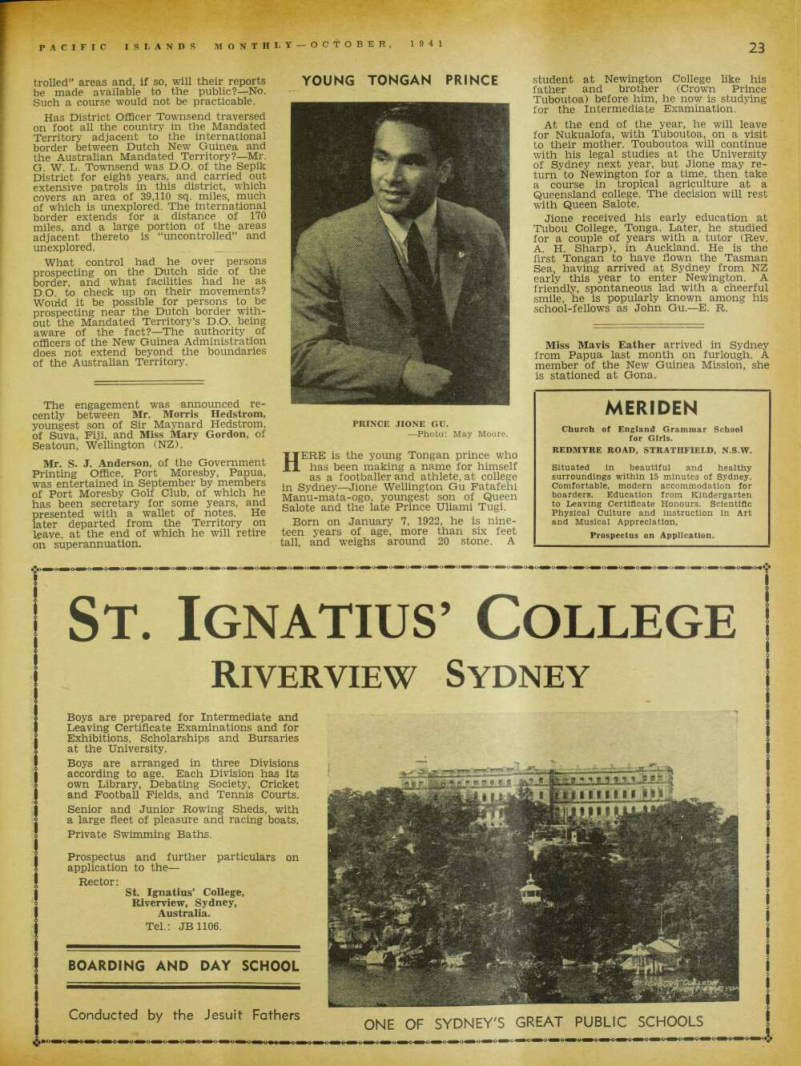
N. Guinea Man Who Upset Government Asks Some Questions
ON September 25, when the tottering UAP-UCP Federal Government was nearing the end of its tether, a number of questions relating to “uncon trolled areas” in New Guinea were put to Mr. McDonald, Minister for Territories, in the House of Representatives, Can berra, by Mr. Alex. Wilson (Victorian Independent).
Perhaps it was the unsatisfactory an swers that helped Mr. Wilson make up his mind to throw out the Government, for his vote the following week was one of two that defeated the Government and put Labour on the ministerial benches.
Mr. Wilson’s searching questions and
the Minister’s not too enlightening answers were as follows: Did a combined deputation from the NG Mining Association and the NG branch of the Australian Labour Party interview the Minister during his visit to Wau?—Yes.
Is it a fact that the Administrator was present and, in reply to a question, stated that he considered there were among non-official residents, men as capable as Government officials of carrying out ex ploration work in “uncontrolled” areas? —Sir Walter McNicoll was present at the deputation. He has been asked for advice in regard to this inquiry and the infor mation is being obtained.
Why does the Government persist in refusing to allow such non-official resi dents to enter, explore and prospect the “uncontrolled” areas?—The policy rela ting to “uncontrolled” areas, as expressed in the “Uncontrolled” Areas Ordinance, 1925-1938, is designed to ensure the open ing up of unexplored country in an orderly manner, having regard to the welfare of the natives. Entry to such areas may be made only in accordance with the provisions of the ordinance.
When does the Government intend to amend the ordinance to permit European non-official residents to enter “uncon trolled” areas? —Amendment of the “Un controlled” Areas Ordinance is not contemplated.
Did an Australian prospector, known as “Sharkeye” Park, nearly 20 years ago, at his own expense and without Govern ment assistance or protection, live for months in the “uncontrolled” area in TNG and make the gold discovery which resulted in the present highly developed mining industry on which the Adminis tration has depended for revenue to carry on its function of government?—Accord ing to reports of mining operations in New Guinea, Australian gold-seekers, including W. Park, were prospecting in Morobe District before and after the 1914-1918 war. Park is stated to have discovered gold in the Bulolo River and to have commenced operation in 1922 on Koranga Creek, a tributary of the Bulolo River.
Is it a fact that “Sharkeye” Park, and other Australian prospectors who pene trated deeply into the “uncontrolled” areas, benefited rather than acted detri mentally towards the welfare of the natives?—ln some cases the activities of prospectors materially assisted the Ad ministration in bringing natives under control; in other cases such activities had a harmful effect.
What steps is the Government taking to open up “uncontrolled” areas and encourage prospecting and the develop ment of the Territory’s “uncontrolled” areas generally?—Areas which have been classified as “uncontrolled” will be brought gradually under administrative control in accordance with the Govern ment’s policy of peaceful penetration.
When a sufficient degree of control has been established, prospectors and others are permitted entry.
What was the total cost, including overhead charges, of the Mount Hagen patrol carried out by A. D. O. Taylor in 1938-39?—£11,002.
Why were geological and agricultural experts not sent out with this patrol to report upon the natural resources of the country traversed?—The patrol was an exploratory one for administrative pur poses and it was considered necessary to keep its personnel to a minimum. In clusion of geologists and agricultural ex perts would have interfered seriously with the patrol’s mobility and hampered its progress.
Will the Government in future insist upon such experts accompanying all patrols into unexplored and “uncon
trolled” areas and, if so, will their reports be made available to the public?—No.
Such a course would not be practicable.
Has District Officer Townsend traversed on foot all the country in the Mandated Territory adjacent to the international border between Dutch New Guinea and the Australian Mandated Territory?—Mr.
G. W. L. Townsend was D.O. of the Sepik District for eight years, and carried out extensive patrols in this district, which covers an area of 39,110 sq. miles, much of which is unexplored. The international border extends for a distance of 170 miles, and a large portion of the areas adjacent thereto is “uncontrolled” and unexplored.
What control had he over persons prospecting on the Dutch side of the border, and what facilities had he as D.O. to check up on their movements?
Would it be possible for persons to be prospecting near the Dutch border with out the Mandated Territory’s D.O. being aware of the fact?—The authority of officers of the New Guinea Administration does not extend beyond the boundaries of the Australian Territory.
The engagement was announced re cently between Mr. Morris Hedstrom, youngest son of Sir Maynard Hedstrom, of Suva, Fiji, and Miss Mary Gordon, of Seatoun, Wellington (NZ).
Mr. S. J. Anderson, of the Government Printing Office, Port Moresby, Papua, was entertained in September by members of Port Moresby Golf Club, of which he has been secretary for some years, and presented with a wallet of notes. He later departed from the Territory on leave, at the end of which he will retire on superannuation.
Advertisements & other items, p. 24 (2 items)
22
October, i94i-Hcmc islands mokibli
Tilley
KEROSENE LAMPS
British made kerosene lamp providing a steady 300 c.p. light without flickering and without smoke or smell.
Model EX 100 (illustrated), can be used as a Storm Lantern, Table Lamp or Hanging Lamp. Reflector slips off when not required.
Burns for 10 hours on li pints. Easy to operate. Safe and efficient.
Chosen by the Army for use here and abroad. Windproof, insectproof and rainproof. There is no finer investment than a Tilley Lamp. Write for complete Tilley catalogue.
THERMIL KEROSENE STOVES
Lights and regulates like a gas stove. No pumping. No pricking. Lights instantly and is perfectly safe. The hot blue flame is silent and odourless. Nothing to get out of order. Can be set down anywhere, filled with kerosene and is immediately ready for use.
Price, 18/6 each.
UN v-
MARINE ENGINES
Simplex engines from 3 h.p. to 12 h.p. for boats from 14 ft. to 26 ft, are Australia’s best. 2 cycle and 4 cycle with or without Reverse gear. Illustrated is the popular little 3 h.p. suitable for 14 ft. or 16 ft. boats Runs for 5 hours on 1 gallon petrol and costs only £29/15/-, complete with all equipment. Ready to instal into any boat, nothing else to buy. Ask for Simplex catalogue of engines and launches.
SHIPCHANDLERY
We manufacture and stock the largest range of boatgear in Australia. Everything for boatbuilder and boatowner. Marine paints and varnishes. Rope and Cordage. Rigging. Anchors and M coring s. Copper Nails and Rod . Lighting Plants. Fire Extinguishers. Oars and Sculls, Lamps, Pumps, etc.
GET OUR PRICES FIRST.
W.KOPSEN & Co. Pty.Ltd.
376/380 KENT STREET, SYDNEY
’Phone: MA6336 (4 lines). Est. 1868. Cables: Kopsen . , . Sydney.
Young Tongan Prince
HERE is the young Tongan prince who has been making a name for himself as a footballer and athlete, at college in Sydney—Jione Wellington Gu Fatafehi Manu-mata-ogo, youngest son of Queen Salote and the late Prince Uliami Tugi.
Born on January 7, 1922, he is nine teen years of age, more than six feet tall, and weighs around 20 stone. A
student at Newington College like his father and brother (Crown Prince Tuboutoa) before him, he now is studying for the Intermediate Examination.
At the end of the year, he will leave for Nukualofa, with Tuboutoa, on a visit to their mother. Touboutoa will continue with his legal studies at the University of Sydney next year, but Jione may re turn to Newington for a time, then take a course in tropical agriculture at a Queensland college. The decision will rest with Queen Salote.
Jione received his early education at Tubou College, Tonga. Later, he studied for a couple of years with a tutor (Rev.
A. H. Sharp), in Auckland. He is the first Tongan to have flown the Tasman Sea, having arrived at Sydney from NZ early this year to enter Newington. A friendly, spontaneous lad with a cheerful smile, he is popularly known among his school-fellows as John Gu.—E. R.
Miss Mavis Eather arrived in Sydney from Papua last month on furlough. A member of the New Guinea Mission, she is stationed at Gona.
Prince Jione Gu.
—Photo: May Moore.
Advertisements & other items, p. 25 (1 item)
St. Ignatius’ College
MERIDEN
Church of England Grammar School for Girls.
REDMYRE ROAD, STRATHFIELD, N.S.W.
Situated In beautiful and healthy surroundings within 15 minutes of Sydney.
Comfortable, modern accommodation for boarders. Education from Kindergarten to Leaving Certificate Honours. Scientific Physical Culture and instruction in Art and Musical Appreciation.
Prospectus on Application.
St. Ignatius’ College
Riverview Sydney
Boys are prepared for Intermediate and Leaving Certificate Examinations and for Exhibitions, Scholarships and Bursaries at the University.
Boys are arranged in three Divisions according to age. Each Division has its own Library, Debating Society, Cricket and Football Fields, and Tennis Courts.
Senior and Junior Rowing Sheds, with a large fleet of pleasure and racing boats.
Private Swimming Baths.
Prospectus and further particulars on application to the— Rector: St. Ignatius’ College, Riverview, Sydney, Australia.
Tel.: JB 1106.
BOARDING AND DAY SCHOOL
s mi 11..) Conducted by the Jesuit Fathers
ONE OF SYDNEY'S GREAT PUBLIC SCHOOLS
Rich Nickel Find In New
Caledonia
REPORTS received in Australia from New Caledonia, in September, in dicate the discovery of rich nickel pyrites, similar to the pyrites of Canada, in the Kouaoua region, on the east coast of the Colony The nickel content, 46 per cent., is exceptional, and the ore is also said to contain copper, gold and possibly platinum. The absence of nickel pyrites in New Caledonia has always been taken for granted, the nickel content of the usual Caledonian ores being between 3 and 7 per cent. Closer investigation of the find is now in progress.
Mr. E. Ryan, arrived in Sydney from New Guinea recently by WRC airliner.
He is a member of W. R. Carpenter & Co. Ltd.’s staff at Kavieng and will un dergo medical treatment in Australia.
Mr. H. J. Rawnsley, of Burns, Philp &' Co. Ltd., Rabaul, New Guinea, has been transferred to the Sydney office.
Papua’S Nine Administrators
Sir Wm. Macgregor and Sir Hubert Murray Stand Out
rE passing parade of Papua’s Gov ernors and officials was reviewed and the story of the Territory’s progress since the “early days” was outlined when Mr. j. t. Bensted addressed the Pacific Islands Society in Sydney on September 24.
Now living in retirement, Mr. Bensted spent over 30 years in the Papuan Ser vice and for a long period was Director of Public Works.
Although, in a material sense, the ad ministration of Papua did not commence until Dr. (afterwards Sir William) Mac gregor assumed control, Sir Peter Scratch ley was the first Special Commissioner in 1885, said Mr. Bensted. He died from malaria three months after taking office.
Sir Peter was succeeded by Mr. H. H.
Romilly, who took over as Deputy Com missioner until the arrival of Hon. John Douglas, CMG, formerly Premier of Queensland, who was appointed Special Commissioner. Douglas was followed by Dr. Macgregor.
Mr. Bensted paid high tribute to the administration of Sir William Macgregor.
“It is not always realised that upon the foundations laid down by him the Papua of Sir Hubert Murray was built,” he emphasised.
Macgregor was responsible for what could be termed the fundamentals of government. He gave the Territory (known as British New Guinea) its land laws, securing native tenure; and its laws against liquor, opium and firearms—all for the protection of the natives. The
Native Regulations, drafted and enacted by Sir William, have changed little in the succeeding years and have not been altered at all in principle. He established the Native Constabulary and the Village Police. The keynote of his policy was “to deal righteously and justly by the natives, to pacify the country, and to develop it into a British Colony”.
In later years, it was to Sir Hubert Murray’s credit that he did not meddle with the foundations Macgregor laid down. Upon them he shaped his own policy, revealing one fundamental of his greatness and outstanding success—he could leave well alone.
MR. Bensted described Sir William Macgregor’s transfer as “unfor tunate”—had he carried on for a few more years, the Colony might have been spared some of the later trials and setbacks. However, Judge Francis Winter took office for a year (1898-1899); perhaps he would have made a successful ad ministrator if given full control Then came Sir George Le Hunte. He was not of a type particularly suited to the task of native administration or to control people still in the Stone Age, for while he had a kindly disposition, strong religious leanings and high ideals, he was not of the pioneering stuff.
“He was a sailor by inclination,” said Mr. Bensted, “and took little interest in opening up the country. His pleasure was to navigate the official vessel ‘Merrie
England’. As a contrast, Sir George wore a monocle and spats; Sir Hubert Murray moleskin pants and a trade shirt.”
Le Hunte was succeeded by Judge C. S.
Robinson as Deputy and Acting Adminis trator for one year. Mr. Bensted referred to Robinson as “a good Australian who never was given a chance to make good in Papua”. He committed an unfortunate mistake at Goaribari Island, where the LMS missionaries Chalmers and Tomp kins had been killed, and his enemies seized upon it to pull him down.
Previously, Le Hunte had gone to Goaribari, and had caused some deaths in clashes with natives. Robinson went to Goaribari to straighten things out after Le Hunte’s punitive expedition, but, in a mistaken idea of self defence, was respon sible for the death of a few natives.
Thereupon, he was made a scapegoat.
Disnlaced from his position, he shot him self outside Government House, after handing over to Captain F. R. Barton.
The Barton administration, 1904 to 1907, was anything but a complete success, and came under severe fire of criticism.
Sir Hubert Murray took over control in 1907, when the Territory was at its lowest ebb, stated Mr. Bensted; and if he had not been an administrative genius, Papua might have experienced a much different fate. Fortunately, he proved himself one of Australia’s most brilliant sons and when he died in early 1940, was acknowledged throughout the world as probably the Empire’s foremost colonial administrator.
Because of his ultimate triumph, it must not be supposed that the Murray regime was all “plain sailing” Like most men of great learning and intellectual capabilities, said Mr. Bensted, Sir Hubert was somewhat aloof —one could not get close enough to him. He was not a man to inspire intimate friendship—in fact, he appeared to be an extremely lonelv man.
Never did he seem to separate himself from his iob and others perforce had to follow suit.
Twenty years ago, continued Mr. Ben sted, a number of residents felt that Sir Hubert was pursuing a policv opposed to the true interests of the Territory. In fact, there were appeals to Australia for his removal and a public meeting actually was advertised for the express purpose of passing a resolution for his deportation, together with two senior officials.
The outcome was that the public ser vants intimated they would attend the meeting and move an amendment for the addition of three extra names to the deportation list the three leaders against the Government! Ridicule, then, killed the whole affair.
A sequel to this a few days later gave an insight into Sir Hubert’s character.
When the steamer for Australia was leaving, the Governor did a thing not usual for him —he went down to the wharf at sailing time. Practically all the residents were there and through this assembly the Governor stalked. All that happened was a lifting of hats and “Good dav, sir” This was the very boat by which he was to have been deported!
The changing years proved only too well how right Sir Hubert’s policy was, but in those days the short-sighted critics could not see it.
TO illustrate Sir Hubert’s keen sense of humour, Mr. Bensted told of an in cident at Samarai, where electric lighting was being installed.
The RM (Mr. A. P. Lyons) had been worrying me for extra lamps—one, in uarticular to light Clunn’s wharf, said Mr. Bensted. I declined to issue them.
Later, going ashore from the “Laurabada” to have dinner with Lyons, I walked over the edge of the wharf into deep water.
After being fished out, I returned to the
“Laurabada” to find Sir Hubert seated right at the gangway.
Having listened to my explanation he just chuckled and said: Well, Bensted, I bet Lyons gets his light now”. And Lyons did!
Mr. D. Cunningham, of Madang, New Guinea, arrived in Australia recently on leave. He is a member of the Madang staff of Colyer, Watson I*l Mr. A. Jamieson, of the Mines Depart ment in the New Guinea Public Service, has resigned and left the Mandated Territory.
Advertisements & other items, p. 26 (2 items)
There is no substitute for X San Francisco
X San Francisco
Today!
. \ \odaVl I - s S*a"°* ' iT'-' ' h al en.On» jpe c ‘ a raVe '° ' 3e e Q p e n- Can>« V,u ''* 00 ’«W*“ rie h, uo them' I I\aVOU^ V° U ': Y h<> cWu' ®* *'** . e ve>Y •VVieV " 0 „a v ' ea ” (,u«Y' a " d 9
mou>W»«
*6 OP * ana ve d G»n9 er , . eU 's ?re :^^ a "T c» bin e g^o , '9 ' ’ j
'Ter P .i' iW
° H j6l scu"s-
Bije«>*V ail)g and »•
plo«* pu ° ■:«
PORT MELBOURNE, VICTORIA, AUSTRALIA
of Mol-esby' PrmClPal
New Roads for Port Moresby
prom our own correspondent „
Pt. Moresby, Oct. 7.
YYTORK has commenced on the re ” Sstrlct Plant' a and I %uSment° r have arriV ed and already d op Q era P tions have arrived and already operatoions have
of Mol-esby' PrmClPal
The 7-mile deviation on Sapphire Creek road has also been opened and work on the new road has commenced.
Advertisements & other items, p. 27 (1 item)
>PoSf „
Rm going
"home
T-f k
808 MT£D L£AmC SO
“I just can’t stay out late any more, Mum.
My nerves go to
•>/ pieces. I don’t
blame Bob for
being cross.”
LAT£P OM~
“We’re off to another 'Tt A grand party. What a wonderful difference BIDOMAK has made S^k\ to me:
v'iT&t.
r * \ “Doctors say rundown nerves are caused by lack of minerals. BIDO- MAK is the best mineral tonic.
Why don’t you take it?”
HUSBAND AND WIFE
“PACK OF NERVES”
“My husband and I were a pack of nerves. I could not sleep or stand the least noise, and was frightened of everything. After a few doses of BIDOMAK we could sleep without worrying. We never felt better in our lives.” (Signed) M.L., East Prahan, Victoria. 4 If you feel run-down, nervy,
depressed, headachey—if you tire
easily discover how quickly
extra minerals in BIDOMAK will make you well. BIDOMAK is guaranteed to do you good in 7 days, or you may have your money back!
NERVES, BRAIN AND
"DEPRESSED FEELING"
Take Guaranteed BIDOMAK
BIDOMAK provides iron, manganese and copper for the blood, calcium for bone development and sound teeth, phosphates and for nerves and muscles, sodium for digestion It’s “The Tonic of the Century’
It is prepared by a qualified chemist in consultation with a doctor of medicine.
Get a bottle of BIDOMAK to-day.
It must do you good, or it will cost you nothing!
for COUGHS. COLDS. " " MIXTURE
Re-opened
King Case to Be Re-opened Did New Guinea Cort Err?
At mocjt a Traov ocrr\ i\/Tv t t a LMOST a year ago, Mr. J. J. A. King, a New Guinea prospector who had been sentenced in 1935 to 10 years’ imprisonment for “attempting to do bodfly harm by firing on natives”, was released from an Australian gaol.
At that time, the “PIM” was gathering together mformation with the object of seeking a review of the case, in the belief that King had been wrongly convicted and excessively punished In a note to the “PIM” editor, in September, Mr. King states that he in tends soon to go to New Guinea to re-open the case and prove that he was the victim of a grave miscarriage of justice. Only the cost involved, he says, has prevented him taking action before this.
.AJ moment, Mr. King is on the civil staff of the Victorian Army Canteen Se l at Puckapunyal camp.
Briefly, the circumstances surrounding the King case were that, for protection, he j 0 med a party of three German pros pectors in hostile country on the Sepik, in 1934- that the Germans later were found guilty of wantonly shooting natives and raping their women; and that be cause of his association with the Germans King was arrested and tried on several similar charges, eventually being con victed and sentenced on a charge of hav mg fired upon unoffensive natives There were many people in New Guinea who held that the evidence against King was inconclusive and that he had been punished by the NG Court merely for keeping bad company Mr. S. Best, of Rabaul, New Guinea, was entertained recently by the staff of W R. Carpenter & Co. Ltd., prior to his departure for Sydney to join the RAAF.
Swept To Sea
Santa Cruz Natives Lost in Fierce South-east Season
Prom a Special Correspondent
Vanikoro, Sept. 5.
11THEN Captain M. Harper, of W. R. f ▼ Carpenter and Co.’s MV “Balus”, landed eight thin, sun-peeled Ticopia natives and a canoe here this week, the story of yet another sea tragedy in these Islands came to light.
On August 30, when the “Balus” lay at anchor at Sabbin Bay, Utupua Island, sheltering from the wild south-east season weather, the natives went aboard and asked to be returned to their home on Ticopia. Captain Harper promised them passage as far as Vanikoro Island when they told him of their extraordinary experience.
It appears that three boys from Ticopia (part of the Santa Cruz Group) were out in a canoe, in sight of their people on shore, when strong seas and fierce winds drove them from view. Thereupon, two canoes—one with five boys in it and the other with three —put out to rescue them. But so boisterous were wind, tide and seas that they themselves were swept away, too.
After three days, they sighted Vanikoro, which is 120 miles to the west of Ticopia; but again the seas beat them as they tried to paddle ashore, so they decided to make for Utupua, 20 or 30 miles further west. They had only two coconuts and one coconut-shell of water to sustain them, when they left Ticopia. Two days after passing Vanikoro, they sighted Utupua and managed to shoot the reef around the island and reach the com paratively safe waters inside.
Unfortunately, a short time before making Utupua one boy was washed out of a canoe and, being very weak, sank before the others could get to him.
Crossing the reef, one of the canoes was smashed to pieces in the breakers and the other badly knocked about.
It was a minor miracle that any of the boys reached Utupua safely, when one considers the ferocity of the south east weather experienced in this part of the Solomons recently and their small, roughly-built canoes.
The three natives who were first swept away have not been heard of since and are presumed to have perished at sea.
Captain Harper learned during his voyage here that so far this season eight other Utupua boys have been lost, making a total of 11, in addition to the native who was lost overboard from the would be-rescuers’ canoe.
At the moment, the Ticopia boys are waiting here in the hope that later they will be able to get across to their home.
Isolated in the south-east of Santa Cruz Group, Ticopia is seldom visited by ships.
There are less than 1.500 natives on the little three by two miles island and they probably are the least “Europeanised” people of the Solomons. Scientists believe the Ticopians to be Polynesian in origin.
Mr. R. Wood, radio operator at Lae, New Guinea, recently married Miss Dorothy Stewart, of Sydney.
Advertisements & other items, p. 28 (2 items)
Heinz
57 AIDS TO BETTER MENUS
TOMATO
KETCHUP
ER
TOMATO M
SAUCE
TOMATO KETCHUP— Made
from Sun-ripened Tomatoes.
Medium Bottles .. 8 ozs.
TOMATO SAUCE A Pure
Appetising Sauce.
Large Bottles .. 13 ozs.
OVEN-BAKED
BEANS
WITH PORK AND
TOMATO SAUCE.
ALSO VEGETARIAN
Individual Tins, 4 ozs.
Small Tins, 8 ozs.
Medium Tins, 16 ozs.
TOMATO JUICE
A delicious health-giving and appetising drink Small Tins, 8 oz.
Med. Tins, 16 oz.
No.sTins,6ooz.
SPAGHETTI
Cooked in Tomato Sauce with Cheese Individual Tins. 4 ozs.
Small Tins, 8 oz.
Med. Tins. 16 oz.
VEGETABLE
SALAD
Garden-fresh Vegetables with Mayonnaise. Small Tins, Boz.
HEINZ
FAMOUS IlliilUi PRODUCTS
MADE IN AUSTRALIA
HEINZ
PERFECT
SOUPS
READY-TO-SERVE
In 8 oz. and 16 oz. Tins
CREAM OF TOMATO
CREAM OF ASPARAGUS
CREAM OF CELERY
CREAM OF CHICKEN
CREAM OF GREEN PEA
CREAM OF MUSHROOM
CREAM OF ONION
CREAM OF SPINACH
CREAM OF TOHEROA
BEAN SOUP with HAM
CHICKEN VEGETABLE
KIDNEY SOUP
MULLIGATAWNY
OXTAIL
VEGETABLE
GENUINE TURTLE SOUP
MACARONI
Cooked in Cream Sauce with Cheese.
Individual Tins, 4 ozs.
Small Tins, 8 ozs.
Medium Tins, 16 ozs.
MAYONNAISE
Delightful on Salad.
Small Bottles, 4 ozs.
Med. Bottles, 7 ozs. 18 oz. Bottles 57 oz. Bottles
BEEFSTEAK
SAUCE
Fruits, Vegetables and Spices, skilfully blended.
Medium Bottles, 7J ozs.
STRAINED FOODS
For Infant Feeding and Special Diets, Strained Carrots Strained Beets Strained Prunes Strained Green Beans Strained Vegetable Soup Strained Beef and Liver
SWEET GHERKINS
Small Bottles
SWEET MUSTARD
PICKLE
Small Bottles
H. J. HEINZ CO. PTY. LTD.
Regd. Office: BENDIGO ST., RICHMOND E.l, VICTORIA Heinz delicious varieties are available from Storekeepers throughout Papua , Netv Guinea and Pacific Islands.
Old Monk
There is no substitufe for
VIRGIN PURE
OLIVE OIL
San Francisco
New Caledonia's Timber
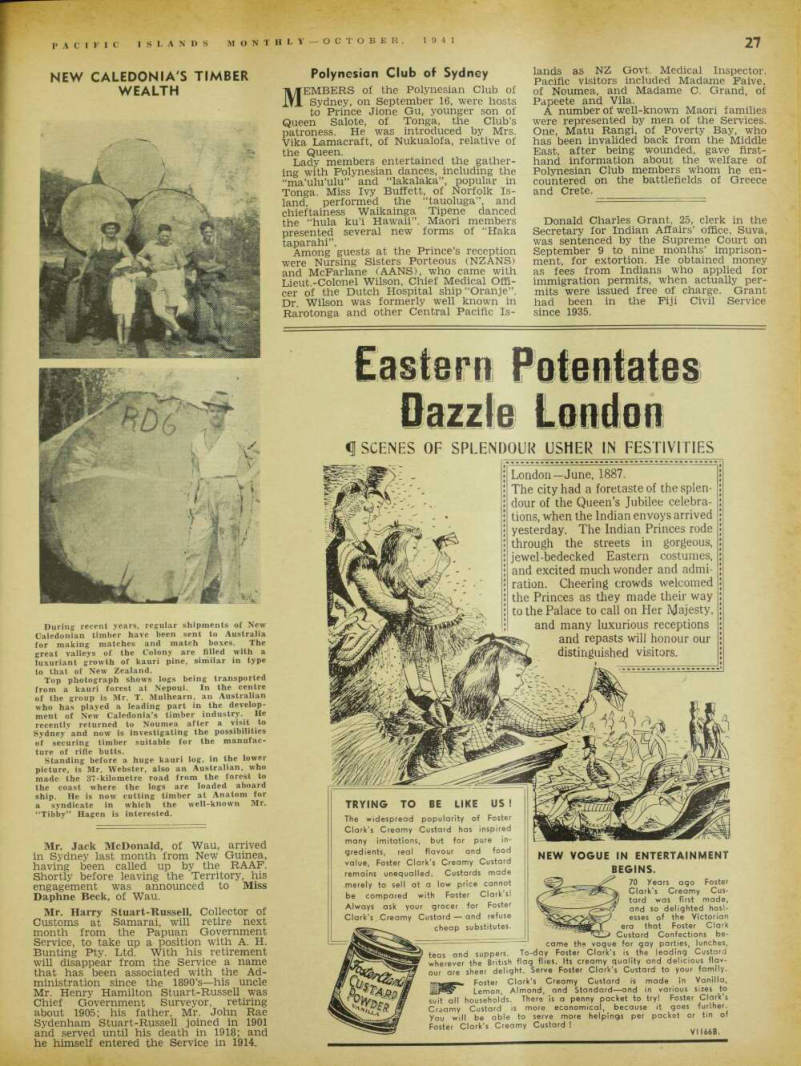
Wealth
Mr. Jack McDonald, of Wau, arrived in Sydney last month from New Guinea, having been called up by the RAAF.
Shortly before leaving the Territory, his engagement was announced to Miss Daphne Beck, of Wau.
Mr. Harry Stuart-Russell, Collector of Customs at Samarai, will retire next month from the Papuan Government Service, to take up a position with A, H.
Bunting Pty. Ltd. With his retirement will disappear from the Service a name that has been associated with the Ad ministration since the 1890’s —his uncle Mr. Henry Hamilton Stuart-Russell was Chief Government Surveyor, retiring about 1905; his father, Mr. John Rae Sydenham Stuart-Russell joined in 1901 and served until his death in 1918; and he himself entered the Service in 1914.
During recent years, regular shipments of New Caledonian timber have been sent to Australia for making matches and match boxes. The great valleys of the Colony are filled with a luxuriant growth of kauri pine, similar in type to that of New Zealand.
Top photograph shows logs being transported from a kauri forest at Nepoui. In the centre of the group is Mr. T. Mulhearn, an Australian who has played a leading part in the develop ment of New Caledonia’s timber industry. He recently returned to Noumea after a visit to Sydney and now is investigating the possibilities of securing timber suitable for the manufac ture of rifle butts.
Standing before a huge kauri log, in the lower picture, is Mr. Webster, also an Australian, who made the 37-kilometre road from the forest to the coast where the logs are loaded aboard ship. He is now cutting timber at Anatom for a syndicate in which the well-known Mr.
“Tibby” Hagen is interested.
Polynesian Club of Sydney
MEMBERS of the Polynesian Club of Sydney, on September 16, were hosts to Prince Jione Gu, younger son of Queen Salote, of Tonga, the Club’s patroness. He was introduced by Mrs.
Vika Lamacraft, of Nukualofa, relative of the Queen.
Lady members entertained the gather ing with Polynesian dances, including the “ma’ulu’ulu” and “lakalaka”, popular in Tonga. Miss Ivy Buffett, of Norfolk Is land, performed the “tauoluga”, and chieftainess Waikainga Tipene danced the “hula ku’i Hawaii”. Maori members presented several new forms of “Haka taparahi”.
Among guests at the Prince’s reception were Nursing Sisters Porteous (NZANS) and McFarlane (AANS), who came with Lieut -Colonel Wilson, Chief Medical Offi cer of the Dutch Hospital ship “Oranje”.
Dr. Wilson was formerly well known in Rarotonga and other Central Pacific Is
lands as NZ Govt. Medical Inspector.
Pacific visitors included Madame Faive, of Noumea, and Madame C. Grand, of Papeete and Vila.
A number of well-known Maori families were represented by men of the Services.
One, Matu Rangi, of Poverty Bay, who has been invalided back from the Middle East, after being wounded, gave first hand information about the welfare of Polynesian Club members whom he en countered on the battlefields of Greece and Crete.
Donald Charles Grant, 25, clerk in the Secretary for Indian Affairs’ office, Suva, was sentenced by the Supreme Court on September 9 to nine months’ imprison ment, for extortion. He obtained money as fees from Indians who applied for immigration permits, when actually per mits were issued free of charge. Grant had been in the Fiji Civil Service since 1935.
Advertisements & other items, pp. 29-30 (1 item)
distinguished visitors.
Li B
<J SCENES OF SPLENDOUR USHER IN FESTIVITIES !w
TRYING TO BE LIKE US
London—June, 1887.
The city had a foretaste of the splen-
dour of the Queen’s Jubilee celebra-
tions, when the Indian envoys arrived
yesterday. The Indian Princes rode
through the streets in gorgeous,
jewel-bedecked Eastern costumes,
and excited much wonder and admi-
ration. Cheering crowds welcomed
the Princes as they made their way to the Palace to call on Her Majesty,
and many luxurious receptions
and repasts will honour our
distinguished visitors.
The widespread popularity of Foster Clark's Creamy Custard has inspired many imitations, but for pure ingredients, real flavour and food value, Foster Clark's Creamy Custard remains unequalled. Custards made merely to sell at a low price cannot be compared with Foster Clark's!
Always ask your grocer for Foster Clark's Creamy Custard and refuse cheap substitutes.
M L‘
NEW VOGUE IN ENTERTAINMENT
BEGINS.
70 Years ago Foster Clark's Creamy Custard was first made, and so delighted hostesses of the Victorian era that Foster Clark Custard Confections became the vogue for gay parties, lunches, teas and suppers. To-day Foster Clark's is the leading Custard wherever the British flag flies. Its creamy quality and delicious flavour are sheer delight. Serve Foster Clark's Custard to your family. rrTggm*. Foster Clark's Creamy Custard is made in Vanilla, Lemon, Almond, and Standard —and in various sizes to suit all households. There is a penny packet to try! Foster Clark's Creamy Custard is more economical, because it goes further.
You will be able to serve more helpingis per packet or tin of Foster Clark's Creamy Custard!
Modern Refrigeration for the South Sea Islands
The ELECTROLUX
KEROSENE OPERATED
REFRIGERATOR
ELECTROLUX offers economical, modern and completely efficient
REFRIGERATION FOR ISLANDS 7 HOMES.
FREEZES CONTINUOUSLY WHILE SMALL LAMP BURNS
Freezing controlled by simply regulating height of flame. Uses only gallon of kerosene per week, MOTORLESS ... NO PARTS TO GET OUT OF ORDER.
MODEL L 22
Capacity 2.2 cubic feet.
MODEL L3BO
(as Illustrated) Capacity 4 cubic feet.
MODEL LKSSO
Capacity 5.5 cubic feet.
GUARANTEED FOR TWO YEARS.
• Write to your Local Distributor for prices and full details.
Obtainable from: W. R. Carpenter & Company Ltd.—Sydney, and the following New Guinea Branches: Rabaul, Salamaua, Wau, Kavieng, Madang, and Wewak.
W. R. Carpenter & Coy. (Solomon Is.) Pty. Ltd.—Tulagi British Solomon Islands.
On Chong & Company Pty. Ltd.—Butaritari, Gilbert and Ellice Islands.
Representation in Papua and New Hebrides.
Mika's Pink Pearl
By A. Cross
MIKA and Joeli were good friends.
They went pig hunting together, and they helped each other with their plantings. So it was only natural that they should go pearling together, Mika owned a small punt, and they arranged to fish a certain reef for the pearl-shell, which they could sell to the local Chinese store.
“Suppose we could find a pearl,” said Joeli, as he skilfully poled the punt over the placid waters.
“Well, whoever finds a pearl keeps it, replied Mika, as he busily baled the punt dry, •‘Good!” said Joeli, “Each will put his shell at opposite ends of the punt.” And so it was arranged.
When they reached the diving-ground, each donned goggles and, with this scanty equipment, they dived and fished until the incoming tide warned them to climb aboard and call it a day.
Each had quite a pile of the pearl oysters at his end of the punt; and Mika took the pole on the homeward journey, while Joeli busied himself opening his oysters, all of which proved quite barren of any kind of pearl. He piled the cleaned shell into a basket, and took over the pole from Mika, so that he could open his shell.
Mika’s pile was quickly disposed of.
But, as he opened his last shell, he found to his delight a pink pearl of wonderful size and beauty. He held the perfect sphere between his finger and thumb for Joeli to see, and the rays of the setting sun made it glow like a live thing.
Joeli gasped: “Mika, what will you do with it?”
“Keep it until some honest trader offers a fair price,” replied his friend, tying the beautiful gem carefully into the cor ner of his neck cloth; and the two friends continued on their way to the village.
Although they spoke of the pearl only under their breath, the news leaked out somehow, and Mika was pestered with requests to show his pearl. The local Chinese storekeeper offered him £5 for it, but Mika refused to sell.
One day, the tribal chief arrived at the village, and a goodly number of chickens met their fate, to provide the usual spread, for such is Fiji custom. The chief must have the best the town could offer.
After he had dined, and while the finger bowl was being passed around, the chief said, “I hear ojie of your young men has found a big pearl”.
This simple remark was rightly inter preted as a command for the pearl to be brought to him. Someone hastened to tell Mika that the chief was inquiring after the gem; but Mika refused to take heed The native drink, kava, was served, and after partaking of a bowl, the chief re peated his statement. He had heard that one of their number had found a pearl.
Another messenger hastened to Mika and said, “His lordship in the Big House wants to see your pearl”. Mika replied to the effect that he could want.
But when a third party hurried to him with the same request, and foretold the dire ill luck that would befall the town if the chief’s whim was ignored, poor Mika betook himself to the chief’s house, and after creeping on all fours, he handed the dirty handkerchief, with the pearl knotted in one corner, to the chief, who leisurely untied it and rolled the beautiful gem into his fat palm, exclaiming over its beauty. Lying there, it appeared to be shot with a dozen different tints.
Calmly slipping it into his wallet, the old chief magnanimously said: “Very pretty indeed. Go to the store and select a couple of shirts and a sulu for your
self, and tell them to charge it to me”.
Poor Mika had no alternative but give his humble thanks, and crawl out back wards from the presence. Not long after wards, I heard that the pearl had been sent to a European market and the in surance alone was £lOO.
Such is the fear and respect the natives of Fiji have for their chiefs. Mika cheer fully collected his shirts from the store; and, I am told, is still diving for
pearlshell
A Papuan native, Salawai, who had been employed for 13 years by Pt. Moresby Customs Department, was drowned on September 15, when attending to his evening duty of lighting the harbour beacon on a reef near the main wharf.
Swimming to secure his dinghy which had broken adrift, he failed to reach it and, attempting to return to the beacon,
disappeared.
Papua
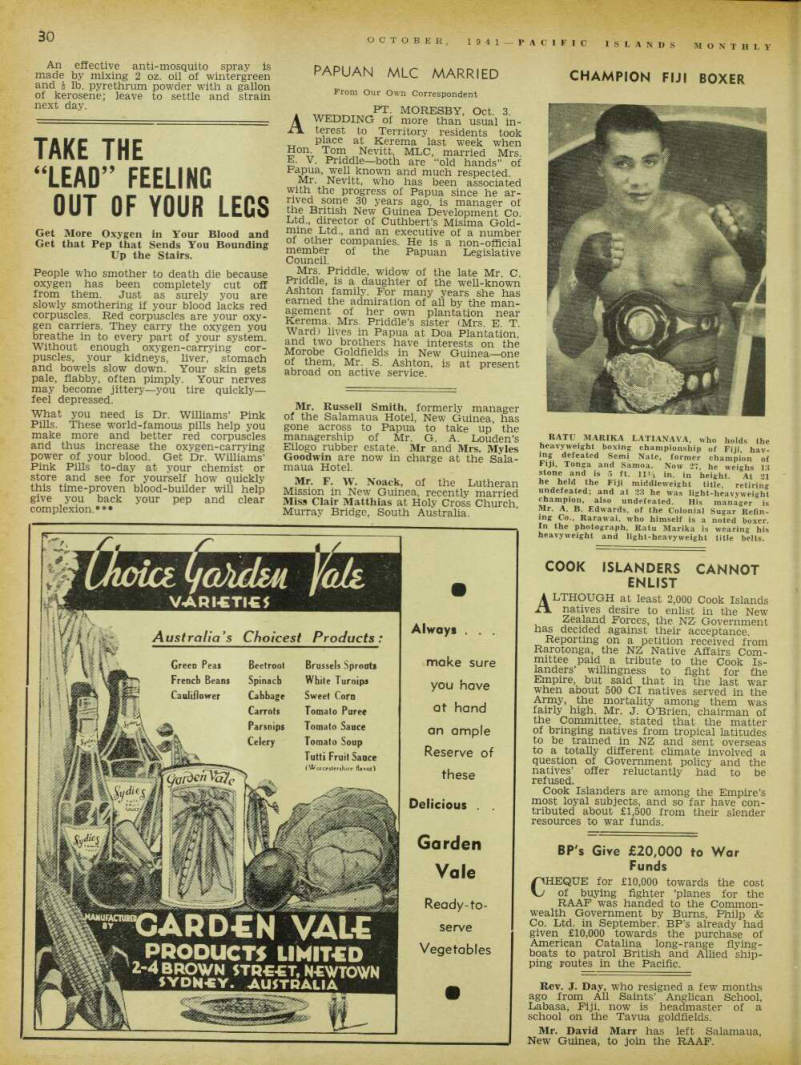
Chinese Junk Ashore in Eastern Papua
From Our Own Correspondent
Samarai, Sept. 21.
FOR four days recently, the Chinese junk “Hummel Hummel”, which crossed the Pacific, east to west, was ashore on a reef near Togula, Sudest Island, in Eastern Papua. She was pulled off by Mr. Harry Pearce. A fair sized hole was torn in the bottom of the junk and a couple of her planks were badly chewed. When repaired, she will con tinue on to Port Moresby.
On board are Dr. and Mrs. E. A. Peter sen, who left California nearly two years ago on a cruise around the world. They were in Samoa a couple of months ago, and previous to that in the Marquesas Group. The “Hummel” flies the Stars and Stripes.
An effective anti-mosquito spray is made by mixing 2 oz. oil of wintergreen and h lb. pyrethrum powder with a gallon of kerosene; leave to settle and strain next day.
Advertisements & other items, pp. 31-32 (1 item)
Viikotoria
BITTER
is vftw NS 1 * Mssmmut
RAM
m
TAKE THE
“LEAD” FEELING
OUT OF YOUR LEGS
Get More Oxygen in Your Blood and Get that Pep that Sends You Bounding Up the Stairs.
People who smother to death die because oxygen has been completely cut off from them. Just as surely you are slowly smothering if your blood lacks red corpuscles. Red corpuscles are your oxygen carriers. They carry the oxygen you breathe in to every part of your system.
Without enough oxygen-carrying corpuscles, your kidneys, liver, stomach and bowels slow down. Your skin gets pale, flabby, often pimply. Your nerves may become jittery—you tire quickly— feel depressed.
What you need is Dr. Williams’ Pink Pills. These world-famous pills help you make more and better red corpuscles and thus increase the oxygen-carrying power of your blood. Get Dr. Williams’
Pink Pills to-day at your chemist or store and see for yourself how quickly this time-proven blood-builder will help give you back your pep and clear complexion.***
Papuan Mlc Married
From Our Own Correspondent A„ t „ PT. MORESBY, Oct. 3.
WEDDING of more than usual in terest to Territory residents took place at Kerema last week when g on - Tom Nevitt, MLC, married Mrs.
E. V. Priddle—both are “old hands” of Papua, well known and much respected. w *lo as been associated with the progress of Papua since he ar rived some 30 years ago, is manager of the British New Guinea Development Co.
Ltd., director of Cuthbert’s Misima Gold mine Ltd., and an executive of a number of other companies. He is a non-official member of the Papuan Legislative Council.
Mrs. Priddle, widow of the late Mr C Priddle, is a daughter of the well-known Ashton family. For many years she has earned the admiration of all by the man agement of her own plantation near Kerema. Mrs. Priddle's sister (Mrs E T Ward) lives in Papua at Doa Plantation, and two brothers have interests on the Morobe Goldfields in New Guinea—one of them, Mr. S. Ashton, is at present abroad on active service.
Mr. Russell Smith, formerly manager of the Salamaua Hotel, New Guinea, has gone across to Papua to take up the managership of Mr. G. A. Louden’s Eilogo rubber estate. Mr and Mrs. Myles Goodwin are now in charge at the Sala maua Hotel.
Mr. F. W. Noaek, of the Lutheran Mission in New Guinea, recently married Miss Clair Matthias at Holy Cross Church Murray Bridge, South Australia.
Champion Fiji Boxer
RATH MARIKA LATIANAVA, who holds the heavyweight boxing championship of Fiji, hav ing defeated Semi Nate, former champion of Fiji, Tonga and Samoa. Now 27, he weighs 13 stone and is 5 ft. 11¼ in. in height. At 21 he held the Fiji middleweight title, retiring undefeated; and at 23 he was light-heavyweight champion, also undefeated. His manager is Mr. A. B. Edwards, of the Colonial Sugar Refin ing Co., Rarawai, who himself is a noted boxer.
In the photograph, Ratu Marika is wearing his heavyweight and light-heavyweight title belts.
Cook Islanders Cannot
Enlist
ALTHOUGH at least 2,000 Cook Islands natives desire to enlist in the New Zealand Forces, the NZ Government has decided against their acceptance.
Reporting on a petition received from Rarotonga, the NZ Native Affairs Com mittee paid a tribute to the Cook Is landers’ willingness to fight for the Empire, but said that in the last war when about 500 Cl natives served in the Army, the mortality among them was fairly high. Mr. J. O’Brien, chairman of the Committee, stated that the matter of bringing natives from tropical latitudes to be trained in NZ and sent overseas to a totally different climate involved a question of Government policy and the natives’ offer reluctantly had to be refused.
Cook Islanders are among the Empire’s most loyal subjects, and so far have con tributed about £1,500 from their slender resources to war funds.
BP's Give £20,000 to War
Funds
CHEQUE for £lO,OOO towards the cost of buying fighter ’planes for the RAAF was handed to the Common wealth Government by Burns, Phllp & Co, Ltd. in September. BP’s already had given £lO,OOO towards the purchase of American Catalina long-range flying boats to patrol British and Allied ship ping routes in the Pacific.
Rev. J. Day, who resigned a few months ago from All Saints’ Anglican School, Labasa, Fiji, now is headmaster of a school on the Tavua goldfields.
Mr. David Marr has left Salamaua, New Guinea, to join the RAAF.
Advertisements & other items, p. 32 (1 item)
Garden
Australia s Choicest Products Green Pea* French Bea Cauliflower Cabbage Sweef Corn Carrots Tomato Puree Parsnips Tomato Sauce Celery Tomato Soup Tutti Fruit Sance (Worcestershire flavor) * 4\ • i • Always . . . make sure you have at hand an ample Reserve of these Delicious . .
Vale
Ready-toserve Vegetables
Islands Men in the AIF
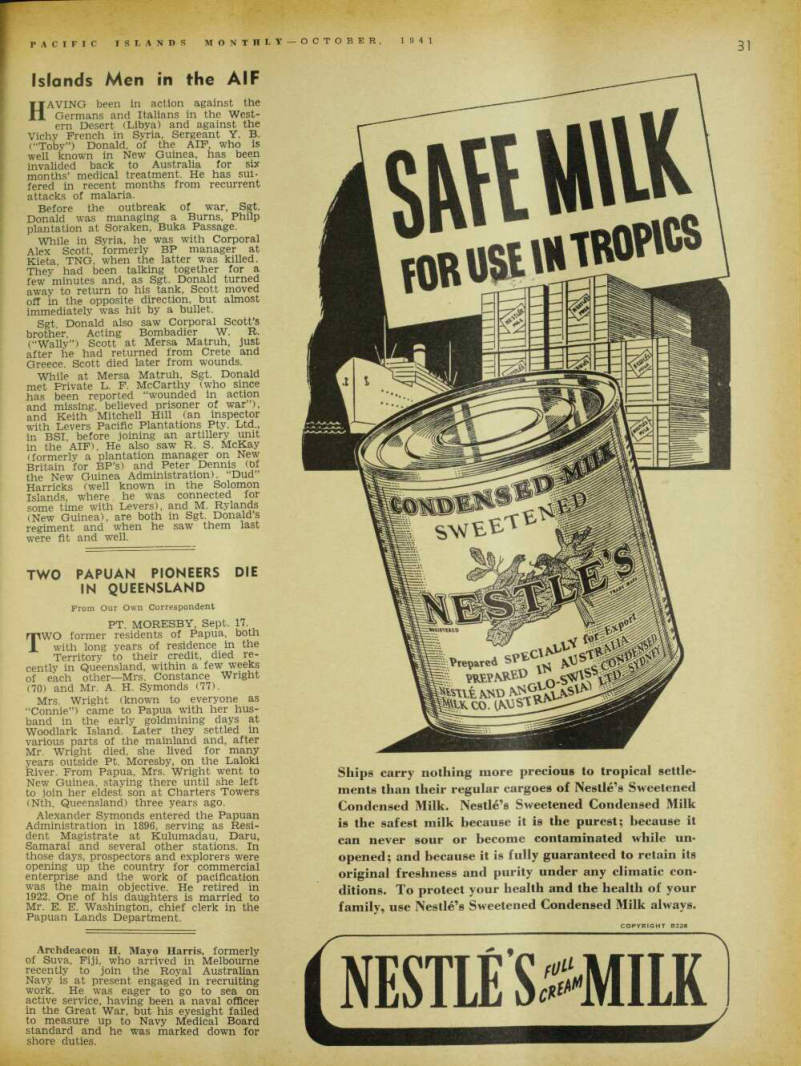
HAVING been in action against the Germans and Italians in the West ern Desert (Libya) and against the Vichy French in Syria, Sergeant Y. B. (“Toby”) Donald, of the AIF, who is well known in New Guinea, has been invalided back to Australia for six months’ medical treatment. He has sul fered in recent months from recurrent attacks of malaria.
Before the outbreak of war, Sgt.
Donald was managing a Burns, Philp plantation at Soraken, Buka Passage.
While in Syria, he was with Corporal Alex Scott, formerly BP manager at Kieta, TNG, when the latter was killed.
They had been talking together for a few minutes and, as Sgt. Donald turned away to return to his tank, Scott moved off in the opposite direction, but almost immediately was hit by a bullet.
Sgt Donald also saw Corporal Scott’s brother, Acting Bombadier W. R. (“Wally”) Scott at Mersa Matruh, just after he had returned from Crete and Greece. Scott died later from wounds.
While at Mersa Matruh, Sgt. Donald met Private L. F. McCarthy (who since has been reported “wounded in action and missing, believed prisoner of war”), and Keith Mitchell Hill (an inspector with Levers Pacific Plantations Pty. Ltd., in BSI, before joining an artillery unit in the AIF). He also saw R. S. McKay (formerly a plantation manager on New Britain for BP's) and Peter Dennis (Of the New Guinea Administration). “Dud”
Harricks (well known in the Solomon Islands, where he was connected for some time with Levers), and M. Rylands (New Guinea), are both in Sgt. Donald’s regiment and when he saw them last were fit and well.
In Queensland
Two Papuan Pioneers Die
From Our Own Correspondent
Pt. Moresby, Sept. 17.
TWO former residents of Papua, both with long years of residence in the Territory to their credit, died re cently in Queensland, within a few weeks of each other—Mrs. Constance Wright (70) and Mr. A. H. Symonds (77).
Mrs. Wright (known to everyone as “Connie”) came to Papua with her hus band in the early goldmining days at Woodlark Island. Later they settled in various parts of the mainland and, after Mr. Wright died, she lived for many years outside Pt. Moresby, on the Laloki River. From Papua, Mrs. Wright went to New Guinea, staying there until she left to join her eldest son at Charters Towers (Nth. Queensland) three years ago.
Alexander Symonds entered the Papuan Administration in 1896, serving as Resi dent Magistrate at Kulumadau, Daru, Samarai and several other stations. In those days, prospectors and explorers were opening up the country for commercial enterprise and the work of pacification was the main objective. He retired in 1922. One of his daughters is married to Mr. E. E. Washington, chief clerk in the Papuan Lands Department.
Archdeacon H. Mayo Harris, formerly of Suva, Fiji, who arrived in Melbourne recently to join the Royal Australian Navy is at present engaged in recruiting work. He was eager to go to sea on active service, having been a naval officer in the Great War, but his eyesight failed to measure up to Navy Medical Board standard and he was marked down for shore duties.
Advertisements & other items, p. 33 (1 item)
Nestle Si's'milr
Ships carry nothing more precious to tropical settlements than their regular cargoes of Neslle’s Sweetened Condensed Milk. Nestle’s Sweetened Condensed Milk is the safest milk because it is the purest; because it can never sour or become contaminated while unopened ; and because it is fully guaranteed to retain its original freshness and purity under any climatic conditions. To protect your health and the health of your family, use Nestle’s Sweetened Condensed Milk always.
COPYRIGHT 8226
Nazi Bombs Destroy Pacific
Artifacts
IT is reported in the Quarterly Journal of the Polynesian Society (Druids Building, Woodward Street, Wel lington, NZ) that Nazi bombs have destroyed the famous Cranmore Museum of Ethnology, in Kent, England, well known in the Pacific because of the care with which Director H. G. Beasley had built up a section devoted to Pacific Islands artifacts. This is a serious loss to science and to mankind. The Museum housed a great number of Pacific speci mens, many of them irreplaceable.
The Journal (the 50th of the Society’s
vigorous publishing life) contains inter esting and valuable material. We note especially a long article by Samuel L.
Elbert on the “Chants and Love-songs of the Marquesas”, from which certain history relating to the Polynesians may be deduced, and a continuation of Mrs.
H. B. R. Parham’s annotated lists of Fijian plants.
Mr. C. Slattery, of the NG Adminis tration staff at Lae, arrived in Australia recently to enlist in the RAAF.
Mr. H. Sabben, of the Fiji Public Works Department, was in New Zealand last month spending short furlough.
A Trader's Tale
In a Polynesian Hospital
By “Tukapa Koko”
I ONCE, by grace of a bad tin of trade beef, spent a holiday—not in Hono lulu, but on another island almost as important, as a patient in the Ad ministration Hospital, whiling the hours away. Listening to the music of badly played guitars, and hearing ukuleles— made out of half-coconuts—emit foul noises in the native part of the estab lishment, a few yards away.
My “Au revoir”, two months later, was not a weepful one! But, during that time, I certainly saw life.
The native nurses were quite attractive girls, and it was just too bad to be hors de combat in such promising surroundings, for I was European Patient No. I—the only one, as a matter of fact—and got a lot of attention.
The solemn law of “no visitors” that began my hosnital career was later rescinded, and I began to hold levees.
The Matron, an acidulated little spinster lady 40 years’young, commented adversely on my associating with the near neigh bors of the burnished sun—forgetting, apparently, that their ills were her raison d’etre, and belike her salary-ticket. We had a few duels, as is customary when a strong-minded male, temporarily indis posed, comes under an unaccustomed and pernicious petticoat rule of the wrong sort.
Teupu was the comedienne of the hos pital. A prisoner for some misdemeanor or other, she was filling in time as a maid at the Aesculapian institution, and it was in that capacity that she came to minister to me.
Teupu was great fun. She was a Mangaian, and therefore a fellow countryman; and we, conversing in the vernacular of our home island, were the cause of much amusement to the popu lace—for, on the “head” island, the dialect of Mangaia is like unto broad Scotch heard on a London street. It is likely to attract attention, and at times even brickbats. Teupu was clever in her imitations of doctors and matron. She feared not detection, for hers was an advantageous position; she could not get the sack till her sentence expired. With the result that I, through Teupu, enjoyed a sort of vicarious freedom of speech, that else were highly reprehensible.
For this, I loved the handmaid passing well.
One lamplit evening, after the doctor had made his rounds and the matron had ceased from troubling her subor dinates, we made high revel in my room.
Two of the nurses, who had come to have their palms read (a minor specialty of mine), Teupu, bedight in goodly blue silk instead of the old gingham gown of her daily servitude—and “last, but not least in love, Trebonius” —in other words, the Patient, my humble self.
There was a tray of thermometers, which were en route from the typhoid department (there was an epidemic of it at the time) to the steriliser.
Teupu, grabbing one, unaware of its deadly potentialities, shoved the glass rod into her month and began to play “patient”.
We, the onlookers, had no time to pre vent her. Polynesian women, nurses at that, do not faint; but the medical ladies stared aghast, bereft of speech and motion, the palm-reading of their original intention entirely forgotten.
I took charge. Sternly ordering Teupu to have her mouth washed out with a germicide, I delayed the necromancy till the deed was done. In five minutes, Teupu, grimacing over a mouthful of Condy’s, re-entered, and the levee was resumed. The palm-reading was a suc
cess; but it did not strike the girl friends that my powers had not run to prophecy of Teupu’s future health, for the germs of typhoid die hard.
A NOTHER of my visitors was Rakau — i\ his native nickname. Tall, languid Old Etonian, novelist and astute bean-mathematician, he was a constant visitor for purposes of intellectual polish ing-up. It was mutual: our countenances were sharpened equally, both sides. In fact, I wouldn’t be. surprised if Rakau learned a thing or two!
Our discussions of Russian literature, rare and hard-to-get books by Weininger and Freud, and similar works, put the matron’s little pointed nose badly out of joint. She plainly disapproved of Rakau, though he had the manners of Lord Chesterfield and the dignity of an arch bishop. We were interested in the Occult.
The matron overheard our feasts of reason with pious horror, for she was a very devout exponent of Orthodoxy.
By the same token, my room, I found, was reputed to be haunted. And, indeed, there was foundation for the idea.
The man who planned that hospital must have been a genius; he located the dread “theatre” right alongside the rooms intended for white patients. I realised, full oft, that it was so, for another of his omissions was a sound proof wall between —Ugh! let’s not talk of that.
Rakau kindly informed me that the room I was occupying was famed for the fact that all its occupants, previous to me, had been carried out. It was en lightening; but I had no ambitions for the honour of a Mission funeral — reverence a specialty.
In the end, I went to a New Zealand health-hotel, and was there re-souled and healed.
Rakau, politely devastating, Cytherean knight of the pen, went into trade. But I am looking forward to his next book — “The Thermometer Murder”!
Advertisements & other items, p. 34 (1 item)
Prescott Pty. Ltd.
SUSSEX ST., SYDNEY,
are sole wholesale agents for
PINEAPPLE BACON&HAMS
DAISY brand BUTTER "375" BUTTER in TINS llb.-21b.-slb. Sizes.
LEA & PERRINS’ Sauces and Most other Super-Quality Lines of the Trade, such as Cheese, Eggs. Etc.
We ore Specialists
’Phones: MA 8612 (4 lines).
Cable Address: "Weymarkson.”
Codes—Bentleys Private.
Let us have your confidence. Sixty years is our record of supplying the leading Houses throughout the World in - - - -
FRESH FRUIT VEGETABLES PRODUCE
WEYMARK & SON LTD.
FRUIT AND PRODUCE MERCHANTS
14-18 STEAMMILL STREET
- SYDNEY
“ANCHOR FLOUR
THE STANDARD OF QUALITY
3» . m m % m * i
GILLESPIE BROS. PTY. LTD.
SYDNEY - AUSTRALIA
Titles Sought
Investigation of Cook Is. Land Titles Sought
A PETITION presented to NZ Parlia ment on August 28 requested that a judge of the NZ Native Land Court be sent to the Cook Islands to in vestigate land titles and to record native customary laws.
The petitioners stated that there are hundreds of applications for succession and investigation of titles not yet heard by the Rarotongan Land Court. Some have been standing for 10 years and ap plication fees have been paid to the Administration, The action of the Land Court in chang ing the customary native laws without consulting the people is resented, and it is alleged that loss of land and titles to the true owners has occurred in several cases.
It was also stated that the people have no means of appealing to the NZ Supreme Court against any judgment of the Rarotongan Land Court, on account of the cost involved.
Mr. L. Abell, mining engineer at Vatukoula, Fiji, was in Melbourne in September, on furlough.
Sgt. Richard Cardew, who was a mem ber of the First New Guinea Quota of the AIF, recently received his commission and now is an Intelligence Officer in the Middle East. He saw service earlier this year in both Greece and Crete.
Mr. H. G. Carter, director of Rabaul Electricity Co., recently visited New Guinea and Papua. He made a journey to Misima Island in Eastern Papua to in spect the workings of Cuthbert’s Misima Goldmine Ltd., with which he is connected.
Ratu Sukuna
rE office of vice-president of the Pacific Islands Society has been accepted by Hon. Ratu Josef a Lala balavu Vanaaliali Sukuna, MLC, CBE, of Fiji, one of the most distinguished men of the Central Pacific. Ratu Sukuna wrote: “I very much appreciate the resolution passed by your Society, and I have great pleasure in accepting the office. I regard the resolution as yet another token of that friendly feeling that exists between the Europeans of the South Pacific and the native races of the Islands, including those of Fiji.”
Ratu Sukuna is the son of the late Ratu Madraiwiwi. He was educated at the Wanganui Collegiate School, in New Zealand, and at Wadham College, Ox ford, and became a barrister-at-law of the Middle Temple, London, in 1913.
During the last war he served with the French Foreign Legion, and subsequently was an officer in the Fijian Labour Corps, in France. He was a Fijian representative at the Coronation of King George VI. He has had wide experience as a native administrator in Fiji, and is a member of the Legislative Council.
Mr. J. Bradley, former District Officer in Fiji, is now in the Royal Navy.
Advertisements & other items, p. 35 (1 item)
CLrrtotts
PURE RICE
STARCH
Always ask for 4 6
CORAL BRAND
100% PURE
Noted for Its
QUALITY
and
WHITENESS.
Goes Farthest and gives Lasting Finish
WILL NOT
STICK TO
iron.
Obtainable from Leading Island Stores. * $ \\
CORAL BRAND
RICE STARCH
US Manufactured by
AUSTRALIAN RICE, LTD.,
Sydney, N.S.W.
THE FAVOURITE
SCHOOL LUNCH
Usually the school lunch is a very scratchy meal, eaten just when the vigorous exercise of the playground has made a strong demand on the endurance of the child. However, with little trouble it can be improved in value and made wonderfully attractive, simply by adding buttered Milk Arrowroot Biscuits. All children love them.
CLrrtotts
famous
MILK
ARROWROOT
BISCUITS
c ALWAYS ASK YOUR GROCER FOR ARNOTT'S !
French
Sir Harry Luke And Free
Prom Our Own Correspondent SUVA, Sept. 16.
OUR Governor, Sir Harry Luke, being also High Commissioner for the Western Pacific, makes frequent visits to the French colonies in the Pacific. His long years in the Mediter ranean fit him very well to be Britain's emissary to the Free French of the South Pacific.
Mr. M. Wright, of the field staff of the NG District Services Department, arrived in Australia in mid-September to enlist in the Navy. He had been in New Guinea for six years.
Mr, Leslie Stokie, plantation overseer in the Bainings District, New Britain, married Miss Helen Mason, of Bougain ville, at Rabaul Registry Office last month.
tolt
Papua Could Grow
Rice
How to Save Ships and Exchange
Letter to the Editor , ... , comply with regulations, thousands -*■ of tons of rice have to be imported £9 Papua for the purpose of feeding the big army of native labourers em ployed by the oil companies, plantations and the Administration.
“hfkfn?
which C ould b p e reserved k for more’im nortant raro-np<? AirenHv hil
tolt
there may be a shortage of rice The warning has been followed by reducing the issue of rice to Government em ployees from 8 lb. per week to 5 lb per week per employee.
It has been proved that rice can be grown m this Territory. In the Mekeo district, the RC Mission has been growing nee of good quality for years. In the same district, the local magistrate at Kairuku succeeded in getting the natives to grow rice. This he accomplished on his own initiative and without official backmg. It is believed in some quarters that the present Administrator is not sympathetic to rice growing under Gov ernment patronage. It is a pity. By grow ing and successfully harvesting the rice crop in the Mekeo district, the magis trate created a source of revenue for the local natives by which they were able to pay their taxes. Rice can be grown also m the Trobriands and in the Samarai district. The Kwato Mission is growing rice and may soon be self-supporting in this commodity. The Gulf Division is also suitable for rice-growing.
Some years ago, under a Government plan, rice was grown in the Kerema dis trict of the Gulf Division of Papua, but passive resistance on the part of the natives and official inertia (after the ex penditure of a large sum of money on the inauguration of the scheme) allowed the project to die and the local native to exult in what he calls his “win over the Government”! The late Sir Hubert Murray some years ago admitted that the Gulf natives, to use his own words, “humbugged the scheme”.
Unless a more vigorous policy is adopted in relation to agriculture in general, and rice in particular, the Terri tory may suffer from a serious shortage of essential foods.
Native foods cannot be grown in quan tities sufficient to feed the many natives working in districts away from their tribal villages. In fact, in past years, a number of villages in different parts of Papua have suffered from a temporary food shortage, and Government assistance was rendered by the distribution of rice to tide them over the famine periods. It is hoped that our Administrator will be wise and take time by the forelock, and introduce measures to increase local agricultural products and introduce others. A rice-growing plan, similar to the coffee-growing scheme in the North ern Division, would be beneficial, and its success would confer a boon upon European and native alike. It is the duty of an Administrator to save the natives from their own indolence and short comings.
In the year ended June, 1940, 3,430 tons of rice, valued at approximately £37,000, was imported to Papua.
I am, etc.,
Trying To Help.
Sydney, 28/8/’4l.
Two NG Natives Awarded RHS
Medals
FOR acts of bravery, two Rabaul natives have been awarded medals by the Royal Humane Society of Australia —Tomat, a silver medal, and Tokalule, a bronze one.
Half a dozen natives were bathing at Pila Pila, near Rabaul, last January, when one (Tiut) was attacked by a shark.
Tomat went to his aid, dragging him from the shark by the wrist. Helped by Tokalule, he brought Tiut to the shore, but the injured native died later in hospital, from his lacerations.
Mr. Stan. Clarke, of Koranga, New Guinea, recently married Miss Phyllis Crouch, of Wau, at Wau Roman Catholic Church, TNG.
Rev. H. S. Cocks, BA, who was Angli can chaplain to the Australian troops who took German New Guinea in 1914, died in England last month. He was at Rabaul for a number of years.
Advertisements & other items, p. 36 (1 item)
Pure
BURNS PHILP
(SOUTH SEA) CO. LTD.
Inc. in Fiji Island Traders and Shipowners Registered Office :
SUVA
FIJI
Also Branches at; Fiji: Levuka, Lautoka, Labasa, Ba, Sigatoka, Rotuma.
Tonga: Nukualofa, Haapai, Vavau.
Samoa: Apia, Pago Pago (American Samoa).
Solomons: Makambo, Gizo, Faisi.
New Hebrides: Vila, Gilberts: Tarawa.
Niue. Wallis Is. Futuna Is.
Code Address: . . ...
“Burnsouth”. Norfolk Is.
c W>
vr r s
PURE
POODS
GOLD MEDAL JAMS
CANNED ENGLISH FRUITS
CANNED ENGLISH
VEGETABLES
CUSTARD POWDER
OLD ENGLISH MARMALADE
JELLY CRYSTALS, ETC.
Obtainable from all Leading Grocery Stores, Write to Department A. 8.7 C.
Chi vers and Sons, Ltd., Histon, Cambridge. England, for attractive Recipe Book
Papeete's Museum
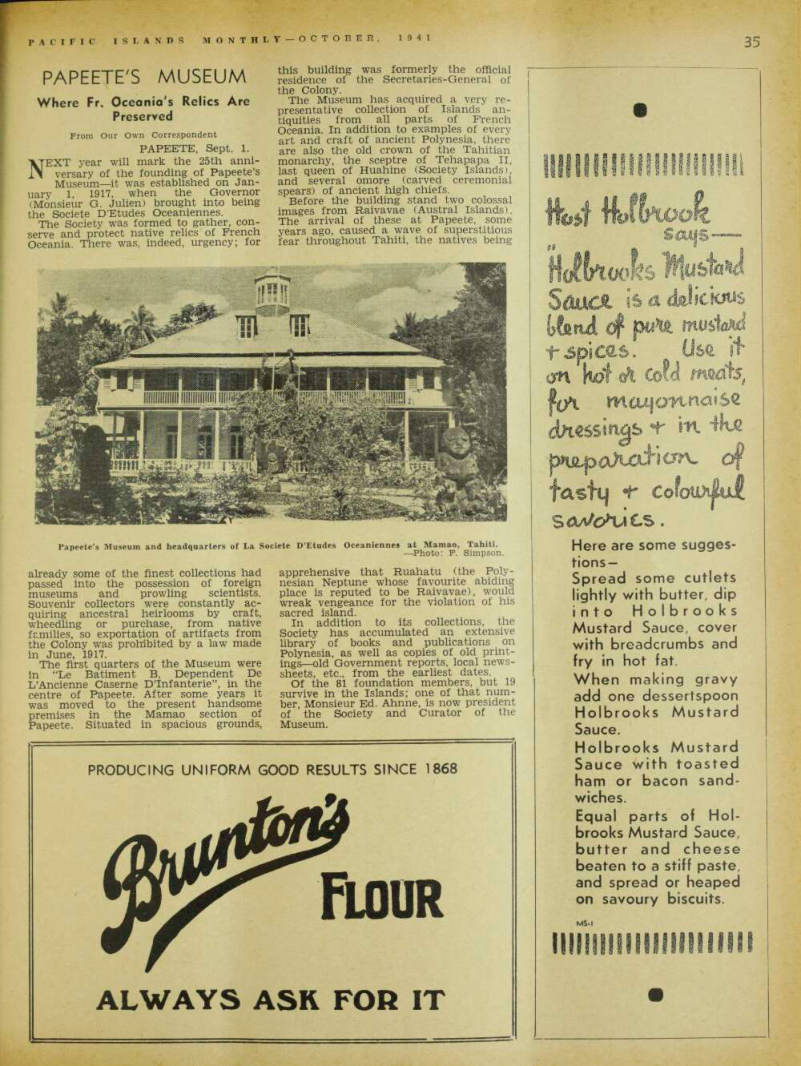
Where Fr. Oceania's Relics Are Preserved
„ From our Own Co p
Papeete, Sept. 1.
NEXT year will mark the 25th anni versary of the founding of Papeete’s Museum—it was established on Jan uarv 1 1917, when the Governor (Monsieur G. Julien) brought into being the Societe D’Etudes Oceaniennes.
The Society was formed to gather, con serve and protect native relics of French Oceania. There was, indeed, urgency; for
already some of the finest collections had passed into the possession of foreign museums and prowling scientists.
Souvenir collectors were constantly acquiring ancestral heirlooms by craft, wheedling or purchase, from native families, so exportation of artifacts from the Colony was prohibited by a law made in June, 1917.
The first quarters of the Museum were in “Le Batiment B. Dependent De L’Ancienne Caserne DTnfanterie”, in the centre of Papeete. After some years it was moved to the present handsome premises in the Mamao section of Papeete. Situated in spacious grounds,
this building was formerly the official residence of the Secretaries-General of the Colony.
The Museum has acquired a very re presentative collection of Islands an tiquities from all parts of French Oceania. In addition to examples of every art and craft of ancient Polynesia, there are also the old crown of the Tahitian monarchy, the sceptre of Tehapapa 11, last queen of Huahine (Society Islands), and several omore (carved ceremonial spears) of ancient high chiefs.
Before the building stand two colossal images from Raivavae (Austral Islands).
The arrival of these at Papeete, some years ago, caused a wave of superstitious fear throughout Tahiti, the natives being
apprehensive that Ruahatu (the Poly nesian Neptune whose favourite abiding place is reputed to be Raivavae), would wreak vengeance for the violation of his sacred island.
In addition to its collections, the Society has accumulated an extensive library of books and publications on Polynesia, as well as copies of old prmt ings—old Government reports, local news sheets, etc., from the earliest dates.
Of the 81 foundation members, but 19 survive in the Islands; one of that num ber, Monsieur Ed. Ahnne, is now president of the Society and Curator of the Museum.
Papeete’s Museum and headquarters of La Societe D’Etudes Oceaniennes at Mamao, Tahiti. —Photo: F. Simpson.
Advertisements & other items, pp. 37-38 (1 item)
MmWMS Wustw
fell
tt * ( , * §
SdUCt is a <kllcious
Ijfeni 4 wusW
tsp\CQ.s. > Use. it
an kof a cold moats,
fo\ rHcujortnaise
in tkc
pnjtp aXoii on. of
fasttj *r Cofotih£u£
sa^c^cs.
Here are some suggestions- Spread some cutlets lightly with butter, dip into Holbrooks Mustard Sauce, cover with breadcrumbs and fry in hot fat.
When making gravy add one dessertspoon Holbrooks Mustard Sauce.
Holbrooks Mustard Sauce with toasted ham or bacon sandwiches.
Equal parts of Holbrooks Mustard Sauce, butter and cheese beaten to a stiff paste, and spread or heaped on savoury biscuits.
MS-1
PRODUCING UNIFORM GOOD RESULTS SINCE 1868
ALWAYS ASK FOR IT
& rS> M 3 i 4 cer most and new altera IdmS only bm ma]° r Not are For yoll more are nly an y on ta i home give ble liva his I than an more more ar i vill he An the but yoU dance stop gni dal He U‘‘ a re imP ar hich ols aten takes rience mis exp e those his makmS
‘voithont
ble 4> A
Bath
room
FOR TEN OR ELEVEN
POUNDS !
You can give your bathroom a “millionaire” atmosphere by spending somewhere around ten or eleven pounds. You can have a bathroom with glistening “tiled” walls, smoothly and delightfully finished in any colour scheme you like thanks to Masonite Temprtile.
Masonite Temprtile is a strong, rigid, splinterless, grainless board (already pressed into 4 inch “tiles”) which can be installed (over existing walls, if necessary) with ordinary tools, then painted, lacquered or enamelled. Temprtile has the appearance, washability and durability of real tiles—yet, in most areas, only costs approximately 5/- a yard plus painting. In other parts of the house, too, you’ll find the other Masonite boards ideal for modernisation; Masonite Quartrboard De-Luxe . .
Presdwood and Tempered Presdwood . . the boards which have so impressed Australian architects and builders that millions upon millions of square feet were sold in 1940! Ask the Colonial Sugar Refining Company (Building Materials Division) for details.
MODERNISE
Masonite boards are made in Australia from Australian timbers hitherto thought commercially useless. They possess the advantages ol wood without its disadvantages. is used for both modernisation and new con- -1 rvi a o - 4 1 I (1114 struction; for floors, counter tops, for “tiling' for partitioning —in fact, for “1,000 uses' th'e colonial sugar REFINING CO.
PRESDWOOD . . . TEMPERED PRESDWOOE
QUARTRBOARD DE-LUXE . , . TEMPRTILE
LTD. (Building Materials Division) . . Sydney . . Melbourne Brisbane . . Adelaide . . Peril
ARE YOU
HANDY WITH
TOOLS ?
Inexpensive Masonite “Shorts’ 3 are just the thing for making those odd cupboards and pieces of furniture that make all the difference to a home. We have just published an interesting booklet, “Forty-five Things You Can Make from Masonite ‘Shorts 3,3 a copy waiting your request.
CUPBOARDS
is
LETTER BOX
BEDSIDE CABINET
" Second Kenya"
What Australian Minister Found in Central New Guinea
WHEN the Australian Minister for Territories (Mr. McDonald) arrived by plane recently at the NG De partment of Agriculture’s experimental station on the Upper Ramu, in the interior of the mainland of New Guinea, he got one of the surprises of his New Guinea tour. He ate strawberries and cold-country vegetables in the residence of the agricultural official, Mr. R. S.
Brechin, and his wife; and he admired a bonny array of sweet peas and Shirley poppies.
Up there, on that sunny, cool and fer tile plateau, the Minister found not only all kinds of cold-country fruits and vege tables, but also an impressive plantation of cinchona trees (from which a consid erable amount of quinine bark has already been taken), tea trees, and coffee.
He saw cinchona bark and coffee already packed for shipment. He also saw some excellent Romney Marsh wool from sheep which apparently are doing well on those uplands. He saw pigs and goats flourishing, and he was shown some beautiful specimens of timber.
The possibilities of tea-growing, up there, seemed particularly to impress Mr. J. R. Halligan, who accompanied the Minister.
It is several years since Mr. Murray, the Director of Agriculture, established this experimental station on the Upper Ramu to show the possibilities of Cen tral New Guinea (“a second Kenya”); and this official party dropped in on Mr.
Brechin in August, without notice, so that the impressive things which Mr.
Brechin showed the official party were unrehearsed.
It is to be hoped that Canberra now will begin to recognise the enormous value of the central plateaux of New Guinea. The plan to establish the new capital of New Guinea at Lae, near the mouth of the Markham, which is the natural outlet for the Upper Ramu and Purari tablelands, may hasten on some long overdue developmental activities.
Value of the Chufa
Nut
THIS excellent little edible nut is pro duced, in a big bunch, at the roots of a small, grass-like plant; and the nuts are ready to eat in about two months from the planting of the seed.
Few other crops will bring such joy to the kiddies as these little Chufa, or “tiger” nuts; while a four-square-yards patch will be a boon and a blessing to the housewife.
First, the nuts may be eaten raw, as they come out of the soil. They are like large, wrinkled, green-brown peas. The nuts are the seed, and may be planted for future crops.
Second, the housewife will love the creamy consistency of the expressed “milk” from a pint or so of the nuts, that have been put through the family mincing machine. The rich, walnut-like flavour of this “cream” is delicious when used with a fruit salad, or when poured over some diced Avocado-pears, or even tinned fruits.
But the cream can be used in dozens of ways. It can be used as a superb ice cream, as a shortening for cakes and biscuits, and for beating into mashed potatoes (or yams or cassava). When roasted and ground, the Chufa nut makes a very excellent cereal-coffee.
As with the peanut, the Chufa is sweet and nutritive. A child can grow the nuts by merely sticking the seed-nuts into the soil, at about six inches between the seeds, and about eighteen inches between the rows.
The plant resembles ordinary grass when it comes through the soil; but the nuts soon begin to develop, and become brown and crisp, when mature.
Chufa seed is perhaps best obtained from seedsmen in USA. A 10-cent package will plant about four square yards of garden soil— H. C. R.
Rabaul Electricity Co.'s Profit
Lower
AFTER charging £1,918 depreciation and amortisation, a profit of £1,968 was earned by Rabaul Electricity, Ltd. (New Guinea), for the year ended June 30 last. This compares with £2,685 in 1940, when depreciation and amortisation took £ 1,783.
Interim dividend of 3 p.c. is to be supple mented by a final 4 p.c., making 7 p.c. for the year. The full appropriation takes £2,084.
Previous year’s dividend was 12 p.c.
Consumers at balancing date numbered 552 15 more than on June 30, 1940. Economic con ditions caused a decline in revenue, which, however, tended to expand towards the close of the year.
A New Hebrides de Gaulle Committee has been formed at Vila, comprising 15 residents of the Condominium. Its ob jects are to establish close unity among the Free French people of the Group and to strengthen the links between British and Free French Administrations.
Advertisements & other items, pp. 39-40 (1 item)
BiiMa modeto.imicwuA
Timber, Joinery
ETC.
PREPARED BUILDINGS ready for erection a specialty.
SHIP AND BOAT BUILDING.
TIMBERS specially catered for.
PIBROLITE, PLYWOODS.
GALVANISED IRON.
CONSIGNMENTS shipped
by RETURN STEAMERS
to the Islands.
John W. Eaton
PTY. LTD.
WEST CRESCENT STREET,
NORTH SYDNEY.
Telephones; XB 4051 (6 lines.)
BITUMENOID ROOFING
MADE IN AUSTRALIA.
Bltumenold Roofings, Dampcourse and Insulating Felts are made from the world’s best raw materials. Warranted to stand the most rigid tests.
BITUMENOID THE BEST
Roofing 1,2, 3-ply; Flooring, Waterproof Materials; Saturated Felt; Resilient Road jointing: Natural Asphalt Dampcourse; 2 and 3-ply Dampcourse; 1-2 lb. Lead-core Dampcourse; Roofing Cement; Asphalt Paints; Roofing Compound.
SAMPLES AND PRICE LISTS ON APPLICATION.
MAXWELL PORTER & SON LTD.
ESTABLISHED 1888. BUILDERS’ SUPPLIES.
107 BEDFEBN ST., REDFERN, SYDNEY, N.S.W. ’Phone: M 8167. Cables Bltumenold.
BiiMa modeto.imicwuA
W"*' home at
A Durabestos Home built from a design in our Free booklet.
Note: In the Islands, Corrugated Durabestos would ensure a weather-tight roof, WUNDERLICH LIMITED, (Estd. 52 Years), REDFERN, SYDNEY.
WUNDERLICH
DURABESTOS
ASBESTOS CEMENT BUILDING SHEETS
SIMILAR TO EUROPEAN MAKES
now made by
COLEMAN LAMP & STOVE CO.
LTD.
Toronto, Ontario, Canada and sold by All Leading Stores in the Pacific Islands.
In case of difficulty in obtaining supplies write to —
PEARCE & CO.—SUVA, FIJI IS.
Motor Spirit From Copra?
Australian newspapers recently stated that from one ton of copra costing about £4/10/-, about 100 gallons of second-grade motor spirit could be produced, which could be usefully mixed with petrol.
The Minister for Development, com menting on this report, said that up to the present the use of petrol in the manner suggested had not been re commended. Molasses, sugar and wheat were being used in the manufacture of power alcohol. He had requested his Department’s technical officers to inves tigate motor spirit possibilities in relation to copra.
Archer » a chemist, and Mr.
Gilbert Tomlinson, an engineer, claim that they have discovered, in a spirit distilled from copra (which can be pro duced commercially for about 9d. per gallon), a unifying agent which will allow methylated spirits to be blended with petrol. . 9 n e of the problems of the motor fuel industry has been to find some way of blending methylated spirits, which is cheaply produced, with petrol—and these two men claim that they have discovered the way. They say that a distilling unit, which would cost £15,000, could produce 2,000,000 gallons per annum of this copra spirit.
Details have been sent to the Com monwealth Government.
Motor engineers profess scepticism—but admit that if the discovery is what it is claimed to be, it will be a fine thing for Australia. It also will be a fine thing for copra producers, Mr. T. Gough, Chief Police Officer at Port Moresby, Papua, arrived in Brisbane last month to spend a brief holiday with Mrs. Gough and their daughter.
Fiji-lndion Leader's
Protest
THE following is from “Sydney Morn
ing Herald” of September 12; Mr Said Hasan, a member of the Legislative Council of Fiji, who has arrived in Sydney on his way to Cal cutta, complained yesterday that immi gration and Customs authorities in Aus tralia and New Zealand were discrimi nating unfairly between Indians and white aliens.
He said that recently his wife was not allowed to leave the ship while it was at Auckland, but American passengers were allowed to land. When he left to loin his wife in Calcutta the Governor of Fiji (Sir Harry Luke) had sent a cable to the Australian and New Zealand Gov ernments asking them to give him every assistance.
EDITORIAL NOTE: It is a fact that the ships’ inspection services at ports like Sydney and Auckland could do with an overhaul. Too many “rules and regu lations hounds” are given the import ant task of interviewing the people who arrive on ships and seek entry to Brit ish countries. They deal easily and promptly with people of British names and nationality; but they regard as suspect all persons of non-British names, and all non-Europeans—and thereby give endless offence to travellers who, very often, are people of importance, and good friends of the British. Men of tact and initiative are needed for such duties, with sufficient authority to treat every traveller as non-suspect until he is proved suspect. For example, Mr. Said Hasan, and Indian leaders of similar standing in Fiji, have as good a status, as loyal Britishers, as has any man of Anglo-Saxon blood in the Empire: and it is intolerable that they should be given cause for offence in the manner complained of above.
Mr. S. C. Beazley, technical instructor of the Methodist Mision at Mulakuna, New Britain, who has been in Australia during the past 12 months, will return to Rabaul at the end of October. He re cently underwent an operation in Sydney for appendicitis, and is making a good recovery.
Mr. H. O’Donnell, who has been Sub- Collector of Customs at Thursday Island for three years, has been transferred to Australia. Mr. Robert Gauld has taken his place at TI.
Advertisements & other items, p. 40 (2 items)
Allen Taylor & Co. Ltd.
COMMERCIAL ROAD, ROZELLE,
SYDNEY
Sawmillers and Wholesale Suppliers of Hardwoods for Constructional Purposes GIRDERS . . . PILES . . . POLES . . . SLEEPERS, Etc,
EXPORTING TO PACIFIC ISLANDS SINCE 1893
James Budge Pty. Limited
JAMES BUDGE LTD
REFRIGERATION . .
“BUDGE” Automatic or Manually-controlled Refrigeration and Ice-making Plants, with or without insulated Cabinets or Rooms, ranging from 4 cubic feet to 1000 cubic feet or larger, using ammonia in the large and sulphur dioxide (SO2) in the small units. Where electricity is not available, crude oil engines may be utilised for driving the larger plants and petrol engines for driving the smaller machines. The accompanying illustration is of a petrol engine driven SO2 unit. Enquirers please state power (if any), size of cabinet and amount of ice required per day.
ALL CLASSES OP REFRIGERATION EQUIPMENT.
JAMES BUDGE PTY. LIMITED
Refrigeration and General Engineers Office and Works:
McEvoy and Harley Streets
ALEXANDRIA, SYDNEY. Established 1890.
Grow More Food
What You Can Do in the Islands
By Charles Reed, Apia
FEW people living in the Pacific Islands ever come to know the value of the many splendid, nourishing roots and fruits that are quite common to the Is lands. More often than not, some of these edibles abound in your locality, close by.
These valuable foodstuffs, being in the category of so-called native foods are, only too often, despised. Less than 10 per cent, of white residents in the South Seas to-day are conversant with the use and value of such foodstuffs as, say, cassava-tubers, kumeras, tanias, tropical potatoes, white taro, white yam, the coco nut, and the chufa-nut.
When the present uncertainty of regular future supplies of our customary foodstuffs is considered, it behoves the man who has anything like a quarter acre at his disposal to plant up, in a small variety, the common foodstuffs of the tropics.
Very often, this writer has entertained guests at a dinner wholly produced from a relatively small area of land, near his back door. The production of sufficient foodstuffs for one’s family requirements does not take up much of one’s time or labour, for the above-mentioned crops are among the most easily grown of any on earth.
Press a single six-inch piece of the stem of the cassava shrub into the soil.
This will produce, without any attention, enough laundry-starch for a week’s wash ing, or enough tubers for a family meal.
Yet how many people are aware of even the name of this most productive of all known tropical plants? It is the manihot; better known, perhaps, as manioca or cassava; and, in Queensland, as tapioca.
Take, for instance, a native family meal, such as will be commonly prepared in most of the Pacific Islands. Young cassava tubers are peeled and baked, or boiled like Irish potatoes. There is but little difference in the white, floury tex tme of these tubers, and ordinary potatoes. As soon as the tubers are ten der —say in about 10 minutes —the water is strained off, the tubers remain in the saucepan, and a “sauce” made from the cream pressed from a grated coconut; and to this is added salt and pepper, and either chopped onion or shallots. The sauce is then poured on to the steaming hot vegetables in the pot, and allowed to cook for about two minutes longer—just enough to cook the cream. When, some years ago, this writer served the Prince of Wales with cassava-cream (at Vai lima, Samoa) he took a second helping!
The other root-stocks mentioned above are all equally nutritious, and all most easily grown, with very little trouble.
There are no pests, in particular, that worry these common crops of the tropics.
Some of them will keep over many months, especially the yams and the tanias. Cassava, like taro, must be used in the fresh state, but it can be grown to produce all the year round.
CASSAVA, too, will yield, from a few stools of tubers, sufficient laundry starch, of the best grade, to save the household washing-bill many pounds, in a year. This starch is quite simple to make. The tubers are peeled and washed, grated and pressed. A piece of sack-cloth is used for the pressing.
Water is mixed with the yellowish, creamy juice—and the pure white starch will settle down at the bottom of the utensil, or tub. In about four hours, or more, the starch water is drained off, and the starch put out in the sun to dry, in lumps. Cleanly prepared cassava
starch will keep almost indefinitely it stored in a dry, covered tin. The residual meal will feed pigs and poultry, either fresh or sun-dried.
But, in South America, this cassava meal forms a nutritive form of cake, being baked with the cream expressed from the coconut, or from the “chufanut”. With Europeans, however, it may be years before we realize how really valuable some of these so-called “waste products” can be.
Actually, we Europeans are poor economists. The possibility of growing and producing foodstuffs for our own table never occurs to us—except perhaps a small garden for salad-stuffs. For everything, we “just go” to the store. But, in the future, will the store in the Islands be assured of a regular and continuous supply? No harm will come to the extra foodstuffs if a planting is made right now.
Whippings Ordered in NG
Assault Cases
From ° ur ° wn correspondent . . WAU, Sept. 20.
FpwO cases of indecent assault by na- X. tives were dealt with when the NG Circuit Court (Chief Judge Griffiths and Assistant Crown Law Officer Maunsell-Turner) visited Wau a few days ago.
Charged with indecent assault against a European woman, Lukmaulin was sen tenced to three months’ imprisonment with hard labour and a five-stroke whipping.
Popukki, found guilty of indecent as sault against a European two-years-old girl, was ordered to undergo two whip pings each of five strokes, in addition to a year’s imprisonment with hard labour.
Advertisements & other items, pp. 41-42 (1 item)
- and I use
»I'
rman
DISTRIBUTORS: Greenwood & Laws, Ltd., Rabaul and Wau: Steamships Trading Co., Ltd., Port Moresby and Samaral; Millers, Ltd., Suva, Fiji.
FOR BEST RE-
SULTS USE
“ B. A. L. M. ”
PAINT. It’s results that count and “8.A.L.M.”
Paint is better because it lasts longer, retains its gloss and resists fading. “8.A.L.M.”
Paint won’t crack or flake and eventually the film wears down to a perfect surface for re-painting.
A Product of British Australian Lead Manufacturers Pty,, Ltd., makers of “Dulux” Finishes.
Do You Know that the Famous
YOUNGER
STOVES and
RANGES
made with extended Firebox specially for long Wood fuel, are Self-Setting and, provided sufficient Flue Piping is attached, can be used in almost any position?
The No. 7W “Younger” Ranger can now be supplied fitted with Legs, as per Illustration. Younger Stoves are Widely Used Ask for quotation for this Range, also illustrated Catalogue Throughout the and Price List for both Single and Double Oven Stoves. Paclflc viands.
G. FLETCHER & SON 50 Oxford Street, Sydney.
Vigour Restored,
Glands Made Young
In 24 Hours
It is no longer necessary to suffer from loss of vigour and manhood, weak memory and body, nervousness, impure blood, sickly skin, depression, and poor sleep, because an American Doctor has discovered a quick, easy way to end these troubles.
This discovery is in pleasant, easy-to-take tablet form, is absolutely harmless, does away with gland operations and is bringing new youth and vigour to thousands. It works directly on the glands and nerves, and puts new, rich blood and energy in your veins. In 24 hours you can see and feel yourself getting younger. Your eyes sparkle, you feel alive and full of youthful vigour and power.
And this amazing, new gland and vigour restorer, called Vi-Stim, is guaranteed. It has been proved by thousands in America and is now distributed by chemists here under a guarantee of satisfaction or money back.
Vi-Stim must make you feel full of vigour and energy and from 10 to 20 years younger, or you merely return the empty package and get your money back. A special, double-strength bottle of 48 Vi-Stim tablets costs little, and the guarantee protects you.
Vi-Stim
GUARANTEED
to Restore Manhood and Vitality . . .
Ship Chandlery Hardware
/Write for j
Ship Chandlery /
Catalogue J
Special “In Bond” Prices for all Islands enquiries quoted on application.
Sole Agents for;
BROOMFIELDS LIMITED
152 SUSSEX STREET SYDNEY.
Cables: “Boom”, Sydney.
Large and Complete Stocks of
SHIP CHANDLERY
IRONMONGERY OF ALL KINDS, PAINTS,
WHITE LEAD AND OILS.
P. H. MUNTZ & CO.’S 3-CROWN BRAND METAL SHEATHING.
PEACOCK & BUCHANS’ ENGLISH READY-MIXED PAINTS.
Scott’s “Renown” Brand Rope,
Cordage and
Binder
Cable Address Ropeyard, Sydney.
M :::
Twine
of Every
Description
MANUFACTURED AT
MASCOT, N.S.W.
J. SCOTT
PTY. LTD.
Head Office and Store:
163 CLARENCE STREET,
SYDNEY,
N.S.W.
Ancient Cannon at Was if
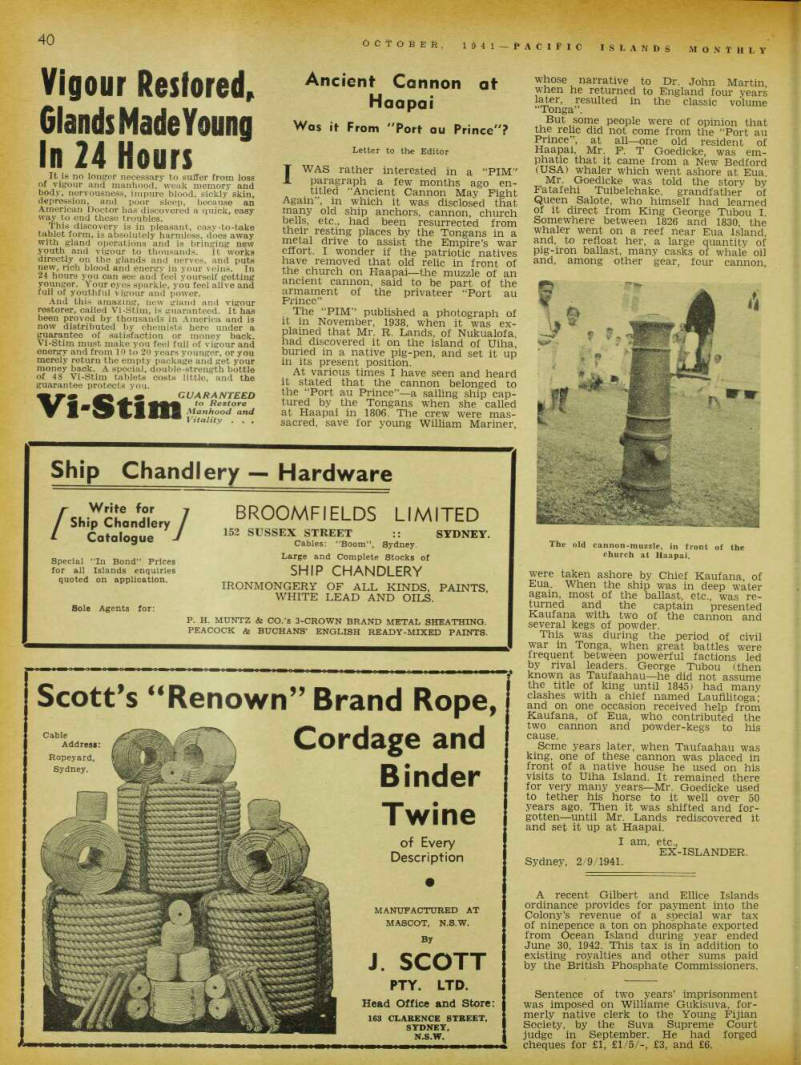
Was if From "Fort au Prince"?
Letter to the Editor T WAS rather interested in a “PIM”
I narnornnh a f DnT A a mon ths ago en- A . Ancient Cannon May Fight Again , in which it was disclosed that many old ship anchors, cannon, church bells pfp T , Pcm , f^Awi their rP-stVno- resuirected from places by the Tongans in a metal drive to assist the Empire’s war effort. I wonder if the patriotic natives have removed that old relic in front of the church on TTnnnch 7 u muzzle of an ancient cannon, said to be part Of the armament of the privateer “Port au PTince”
The “PIM” published a photograph Of it in November iQqa whoVi if nla neH p I S , r .\ Lands, of Nukualofa, i} ac * discovered it on the island of Uiha, buried in a native pig-pen, and set it up in its present position At various times I have seen and heard stated that the cannon belonged to the ‘‘Port au Prince”—a sailing ship cap tured by the Tongans when she called at Haapai in 1806. The crew were mas sacred, save for young William Mariner,
whose narrative to Dr. John Martin, when he returned to England four years res ulted in the classic volume Tonga”.
But some people were of opinion that the relic did not come from the “Port au Prince”, at all—one old resident of Haapai, Mr. P. T Goedicke, was em phatic that it came from a New Bedford (USA) whaler which went ashore at Eua.
Mr. Goedicke was told the story by Fatafehi Tuibelehake, grandfather of Queen Salote, who himself had learned of it direct from King George Tubou I Somewhere between 1826 and 1830, the whaler went on a reef near Eua island, and, to refloat her, a large quantity of pig-iron ballast, many casks of whale oil and, among other gear, four cannon,
were taken ashore by Chief Kaufana, of Eua. When the ship was in deep water again, most of the ballast, etc., was re turned and the captain presented Kaufana with two of the cannon and several kegs of powder.
This was during the period of civil war in Tonga, when great battles were frequent between powerful factions led by rival leaders. George Tubou (then known as Taufaahau—he did not assume the title of king until 1845) had many clashes with a chief named Laufilitoga; and on one occasion received help from Kaufana, of Eua, who contributed the two cannon and powder-kegs to his cause.
Some years later, when Taufaahau was king, one of these cannon was placed in front of a native house he used on his visits to Uiha Island. It remained there for very many years—Mr. Goedicke used to tether his horse to it well over 50 years ago. Then it was shifted and for gotten—until Mr. Lands rediscovered it and set it up at Haapai.
I am, etc.,
Ex-Islander.
Sydney, 2/9/1941.
A recent Gilbert and Ellice Islands ordinance provides for payment into the Colony’s revenue of a soecial war tax of ninepence a ton on phosphate exported from Ocean Island during year ended June 30, 1942. This tax is in addition to existing royalties and other sums paid by the British Phosphate Commissioners.
Sentence of two years’ imprisonment was imposed on Williame Gukisuva, for merly native clerk to the Young Fijian Society, by the Suva Supreme Court judge in September. He had forged cheques for £l, £l/5/-, £3, and £6.
The old cannon-muzzle, in front of the church at Haapai.
Death Of "Joe"
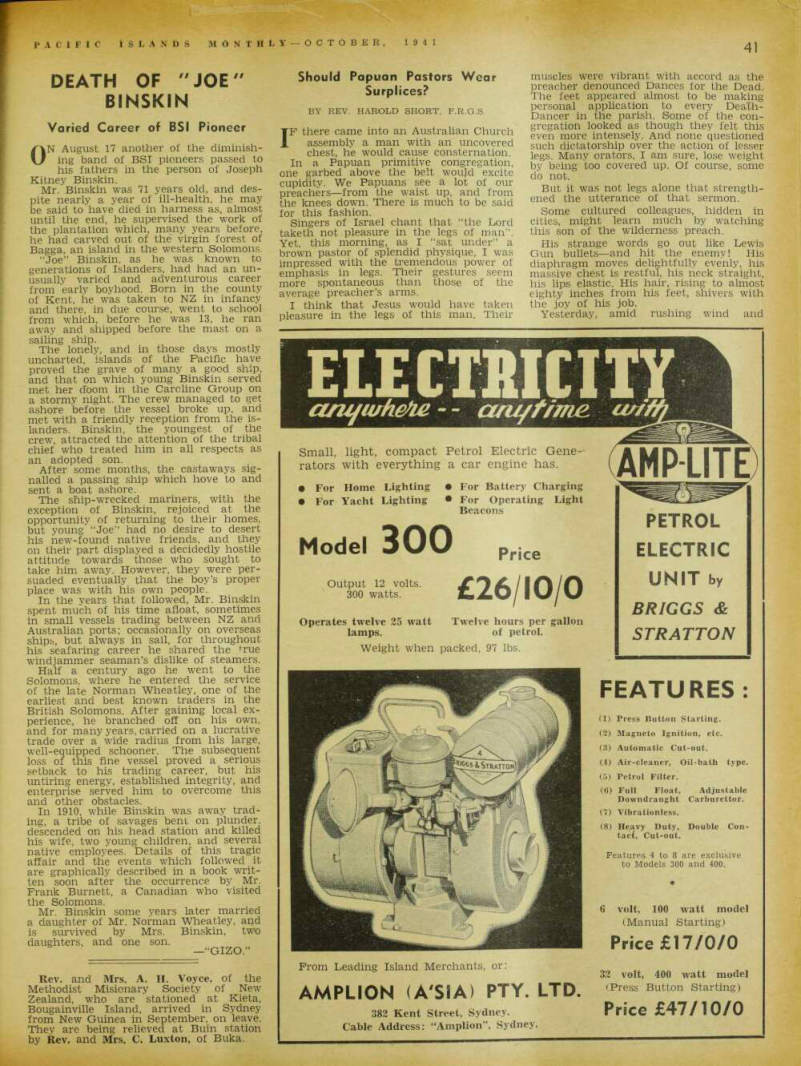
Binskin
Varied Career of BSI Pioneer
ON August 17 another of the diminish ing band of BSI pioneers passed to his fathers in the person of Joseph Kitney Binskin.
Mr. Binskin was 71 years old, and des pite nearly a year of ill-health, he may be said to have died in harness as, almost until the end, he supervised the work of the plantation which, many years before, he had carved out of the' virgin forest of Bagga, an island in the western Solomons.
“Joe” Binskin, as he was known to generations of Islanders, had had an un usually varied and adventurous career from early boyhood. Born in the county of Kent, he was taken to NZ in infancy and there, in due course, went to school from which, before he was 13, he ran away and shipped before the mast on a sailing ship.
The lonely, and in those days mostly uncharted, islands of the Pacific have proved the grave of many a good ship, and that on which young Binskin served met her doom in the Caroline Group on a stormy night. The crew managed to get ashore before the vessel broke up, and met with a friendly reception from the is landers. Binskin, the youngest of the crew, attracted the attention of the tribal chief who treated him in all respects as an adopted son.
After some months, the castaways sig nalled a passing ship which hove to and sent a boat ashore.
The ship-wrecked mariners, with the exception of Binskin, rejoiced at the opportunity of returning to their homes, but young “Joe” had no desire to desert his new-found native friends, and they on their part displayed a decidedly hostile attitude towards those who sought to take him away. However, they were per suaded eventually that the boy’s proper place was with his own people.
In the years that followed, Mr. Binskin spent much of his time afloat, sometimes in small vessels trading between NZ and Australian ports; occasionally on overseas ships, but always in sail, for throughout his seafaring career he shared the frue windjammer seaman’s dislike of steamers.
Half a century ago he went to the Solomons, where he entered the service of the late Norman Wheatley, one of the earliest and best known traders in the British Solomons. After gaining local ex perience, he branched off on his own, and for many years, carried on a lucrative trade over a wide radius from his large, well-equipped schooner. The subsequent loss of this fine vessel proved a serious setback to his trading career, but his untiring energy, established integrity, and enterprise served him to overcome this and other obstacles.
In 1910, while Binskin was away trad ing, a tribe of savages bent on plunder, descended on his head station and killed his wife, two young children, and several native employees. Details of this tragic affair and the events which followed it are graphically described in a book writ ten soon after the occurrence by Mr.
Frank Burnett, a Canadian who visited the Solomons.
Mr. Binskin some years later married a daughter of Mr. Norman Wheatley, and is survived by Mrs. Binskin, two daughters, and one son.
“Gizo.”
Rev. and Mrs, A. H. Voyce, of the Methodist Misionary Society of New Zealand, who are stationed at Kieta, Bougainville Island, arrived in Sydney from New Guinea in September, on leave.
They are being relieved at Buin station by Rev. and Mrs. C. Luxton, of Buka.
Surplices?
Should Papuan Pastors Wear Surplices?
By Rev. Harold Short, F.R.G.S.
IF there came into an Australian Church assembly a man with an uncovered chest, he would cause consternation.
In a Papuan primitive congregation, one garbed above the belt would excite cupidity. We Papuans see a lot of our preachers—from the waist up, and from the knees down. There is much to be said for this fashion.
Singers of Israel chant that “the Lord taketh not pleasure in the legs of man’’.
Yet, this morning, as I “sat under” a brown pastor of splendid physique, I was impressed with the tremendous power of emphasis in legs. Their gestures seem more spontaneous than those of the average preacher’s arms.
I think that Jesus would have taken pleasure in the legs of this man. Their
muscles were vibrant with accord as the preacher denounced Dances for the Dead, The fee £ appeared almost to be making personal application to every Death- Dancer in the parish. Some of the con gregatioh looked as though they felt this even more intensely. And none questioned such dictatorship over the action of lesser legs. Many orators, I am sure, lose weight being too covered up. Of course, some not.
But « 1 ene( * the utterance of that sermon, Some cultured colleagues, hidden in cities, might learn much by watching this son of the wilderness preach.
His strange words go out like Lewis Gun bullets—and hit the enemy! His diaphragm moves delightfully evenly, his massive chest is restful, his neck straight, his lips elastic. His hair, rising to almost eighty inches from his feet, shivers with the joy of his job.
Yesterday, amid rushing wind and
spray, I clung to the mast of that preacher’s big canoe. He stood with toes gripping the deck planks, five long fin gers controlling the steering paddle, the other hand directing his responsive crew.
His glance awaited the intentions of wind and waves, and signs from surfspread reefs. I admired him then, as a Captain who needed no insignia of rank; but more, this morning, as spokesman of the Pilot Who is saving Papua.
Surplices really do not matter much.
Spiritual impulses cannot be covered by them. But I feel that one on this friend of mine would conceal something infinitely more impressive than the art of seamstresses.
Yet, if it be suggested again that Papuan pastors wear surplices I shall advocate stronelv that <?ome should advocate strongly that some should. —Reprint fr-am “Australian Christian World , 1931. The pastor referred to was Taureka, who died in July, 1941.
Advertisements & other items, p. 43 (1 item)
Model 300 Price
Small, light, compact Petrol Electric Gene-'
rators with everything a car engine has. • For Home Lighting • For Battery Charging • For Yacht Lighting • For Operating Light Beacons
£26/10/0 Twelve hours per gallon of petrol.
Weight when packed, 97 lbs.
Output 12 volts. 300 watts.
Operates twelve 25 watt lamps. r ' From Leading Island Merchants, or:
AMPLION (A'SiA) PTY. LTD
382 Kent Street, Sydney.
Cable Address: “Amplion”, Sydney.
PETROL
ELECTRIC
UNIT by
BRIGGS &
STRATTON
FEATURES :
(1) Press Button Starting. (2) Magneto Ignition, etc. (3) Automatic Cut-out. (4) Air-cleaner, Oil-bath type. (5) Petrol Filter. (6) Full Float, Adjustable Downdraught Carburettor. (7) Vibrationless. (8) Heavy Duty, Double Contact, Cut-out.
Features 4 to 8 are exclusive to Models 300 and 400. • 6 volt, 100 watt model (Manual Starting)
Price £l7/0/0
32 volt, 400 watt model (Press Button Starting)
Price £47/10/0
Civil Servants and Military Service
SUVA, Sept. 12. fTTHE Suva Chamber of Commerce X recently asked for formal informa tion from the Government as to the number of young civil servants who are exempted from military training, and the reason for exemption. The general opinion is that discretionary powers given in this direction have been exer cised on too generous a scale.
It is difficult for the layman to under stand how a clerk on, say, £2OO a year can be classed by a big office as a per son essential to the Department’s per formance of its duties. There is no evi dence that exceptions on a scale any thing like that apparently customary in Government Departments have been asked for by commercial houses, and there is still less evidence to suggest that, if asked for, they would be granted.
Rotuma
Boat Day In
By “Amel”
ALONG, loud moan from her whistle advertises the fact that the boat is once more upon us.
She usually manages to arrive about midnight, when nobody can see her, when managers and such are sound asleep, when the tide is flat out and when it is raining, if possible.
Under these circumstances, tempers get decidedly frayed. The manager rises blas phemously from his bed, and the post master quits his in similar frame of mind. The launch, which was so carefully anchored out earlier in the evening, is found to be lying gracefully on its side in the seaweed. It will be several hours before it floats. Meanwhile, we gnash our teeth and tear our hair, and think longingly of our mail a mile off shore, nicely out of reach.
We vow bitterly that we would arrange things very differently if we owned the ship. As for the captain . . . ! We quietly debate what we would like to do with him. Many suitable forms of torture occur to us, but we finally decide that we will let him off fairly lightly. Walking the plank or stringing him from the yard-arm would be a little harsh. So we will simply sentence him to serve six months on Rotuma.
By morning, however, we have returned to normal. The mail has been sorted, we have our letters, we exchange items of news and everyone is happy. There is activity on ship and shore. Rotumans stroll along the “main street”, laughing, talking, playing guitars and ukuleles and saying goodbye to those who are going away. The crew of the boat fraternise with the local natives and are given oranges and drinking nuts. The boat is in. It is an event—a red-letter day—for it does not happen very often in this isolated little Fiji island.
We meet the cheery, popular captain again. He is not now the ogre we thought he was. In fact, he is a fine chap, and we greatly enjoy the all-too-brief pleasure of his company.
The day draws to a close, and the ship’s departure is nigh. We go out for a spin in the launch that takes the cap tain and the passengers, and, for half an hour or so, we know the thrill of being on a big boat again. Then the captain shoos us back to the launch and waves goodbye.
Half way to the wharf, we look at the boat just once more. But, by that time, she is only a dim- grey shape in the gathering darkness.
Sgt. Robert Page, son of Hon. H. H.
Page (Government Secretary in New Guinea since 1923) has been granted a commission in an AIF Pioneer battalion.
His father had a fine record of service with the AIF in the Great war, attaining the rank of major and collecting the DSO and MC.
Mr. Henry Guy Pilling, who was in the Fiji Civil Service and the Western Pacific High Commission from 1907 to 1929, rising from cadet to Assistant to the High Commissioner for the Western Pacific, recently received the knighthood honour of KCMG. When he left Fiji in 1929, he went to British Honduras, then Kenya and lately has been Governor of St. Helena. He married Miss Gladys Gar rick, of Suva, in 1912.
Mr. Ray Parer, pioneer Australian and New Guinea airman, who during the past 10 years has divided his time between aeroplanes and gold-patches in the Morobe District, arrived in Australia in mid-September. Though over Service flying age, he is seeking to join the RAAF.
Advertisements & other items, p. 44 (1 item)
A. B. Donald Ltd.
AUCKLAND
ISLAND TRADERS & GENERAL MERCHANTS
P.O. Box 1509. Cables £r Telegrams, "Kingdom", Auckland.
strength
I4PST-
S R £ C IA m l ly Wills
PAc *eo
S?lia)
SYDNEY
Ltd
For
the
TROPi
: H ow
sL^SMuSTRAUA)^
Cs Capstans are available in both
MEDIUM and FULL STRENGTH
CAPSTA
TOBACCO AND CIGARETTES
895-^
Chinese Students Visit Suva
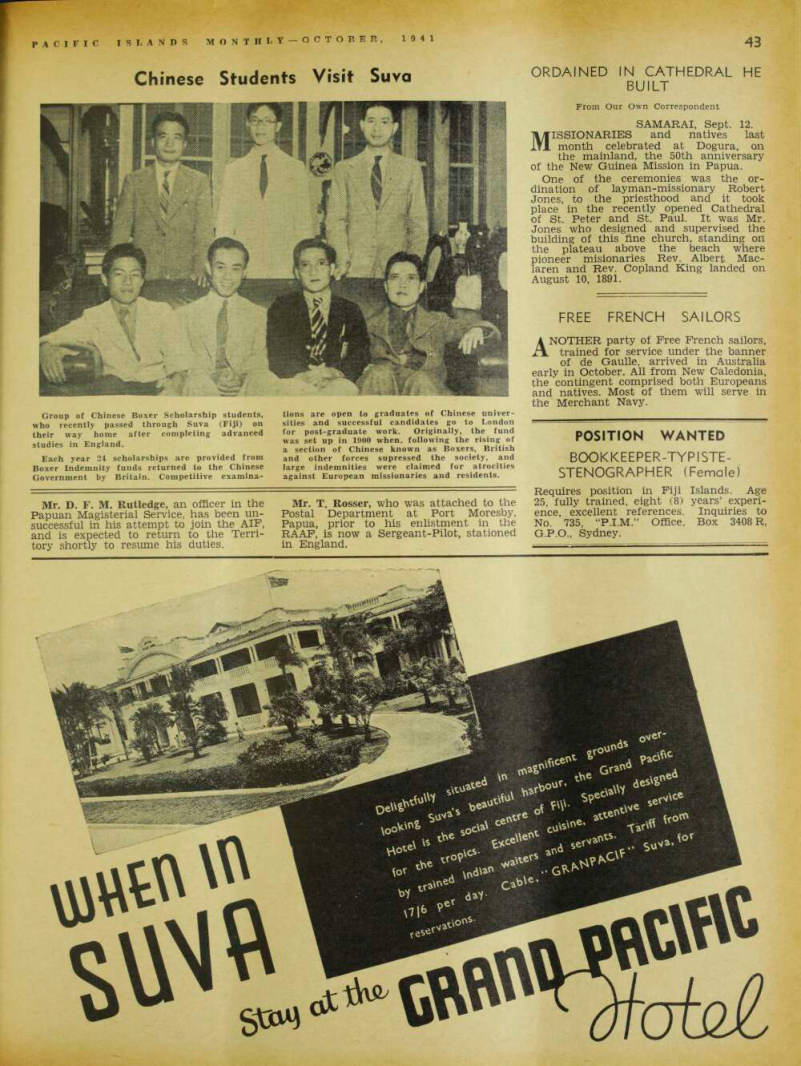
Mr. D. F. M. Rutledge, an officer in the Papuan Magisterial Service, has been un successful in his attempt to join the AIF, and is expected to return to the Terri tory shortly to resume his duties.
Mr. T. Rosser, who was attached to the Postal Department at Port Moresby, Papua, prior to his enlistment in the RAAP, is now a Sergeant-Pilot, stationed in England.
Group of Chinese Boxer Scholarship students, who recently passed through Suva (Fiji) on their way home after completing advanced studies in England.
Each year 24 scholarships are provided from Boxer Indemnity funds returned to the Chinese Government by Britain. Competitive examina-
tions are open to graduates of Chinese univer sities and successful candidates go to London for post-graduate work. Originally, the fund was set up in 1900 when, following the rising of a section of Chinese known as Boxers, British and other forces supressed the society, and large indemnities were claimed for atrocities against European missionaries and residents.
Ordained In Cathedral He
Built
From Our Own Correspondent
Samarai, Sept. 12.
Missionaries and natives last month celebrated at Dogura, on the mainland, the 50th anniversary of the New Guinea Mission in Papua.
One of the ceremonies was the or dination of layman-missionary Robert Jones, to the priesthood and it took place in the recently opened Cathedral of St. Peter and St. Paul. It was Mr.
Jones who designed and supervised the building of this fine church, standing on the plateau above the beach where pioneer misionaries Rev. Albert Mac laren and Rev. Copland King landed on August 10, 1891.
Free French Sailors
ANOTHER party of Free French sailors, trained for service under the banner of de Gaulle, arrived in Australia early in October. All from New Caledonia, the contingent comprised both Europeans and natives. Most of them will serve in the Merchant Navy.
Advertisements & other items, pp. 45-46 (1 item)
s OSSL o
POSITION WANTED
BOOKKEEPER-TYPISTE-
STENOGRAPHER (Female)
Requires position in Fiji Islands. Age 25, fully trained, eight (8) years’ experience, excellent references. Inquiries to No. 735, “P.1.M.” Office, Box 3408 R, G.P.0., Sydney.
)l %'S** I M\
■HBB -i
4 . -‘"*“"*r® , “ 4 'i *- r> <:>* . sum» s oW e °' frofl ,
*• r;r- -t >*''
tr aW cd O b ' e ’ r 6*l- - 9 eT
ese^'°^
s OSSL o
KANGAROO BRAND
Ropes,
Cordage,
and Twines for every purpose Backed by 86 years of service.
Manufactured by
M. DONAGHY AND SONS,
Pty. Ltd.,Geelong and Sydney, Fiji Representatives:
PEARCE AND CO.
LIMITED
P.O. BOX 237, SUVA
DESTROY GERMS AND INSECTS ...
Inexpensively, easily and effectively with De Meric's Standard Products.
De Meric's Disinfectants are mode in liquid and powder form. They are ideal for island conditions. They re obtainable at good stores everywhere ... ask for De Meric's Lysol, Napthalene, Non-Staining Fly Spray, Moth Bolls, etc.
DE MERIC’S
STANDARD PRODUCTS
Traders are invited to write for full wholesale list to
DE MERIC PTY. LTD.
Commonwealth and State Government Contractors, Doody Street, Alexandria, N.S.W.
Housekeeping in Tahiti
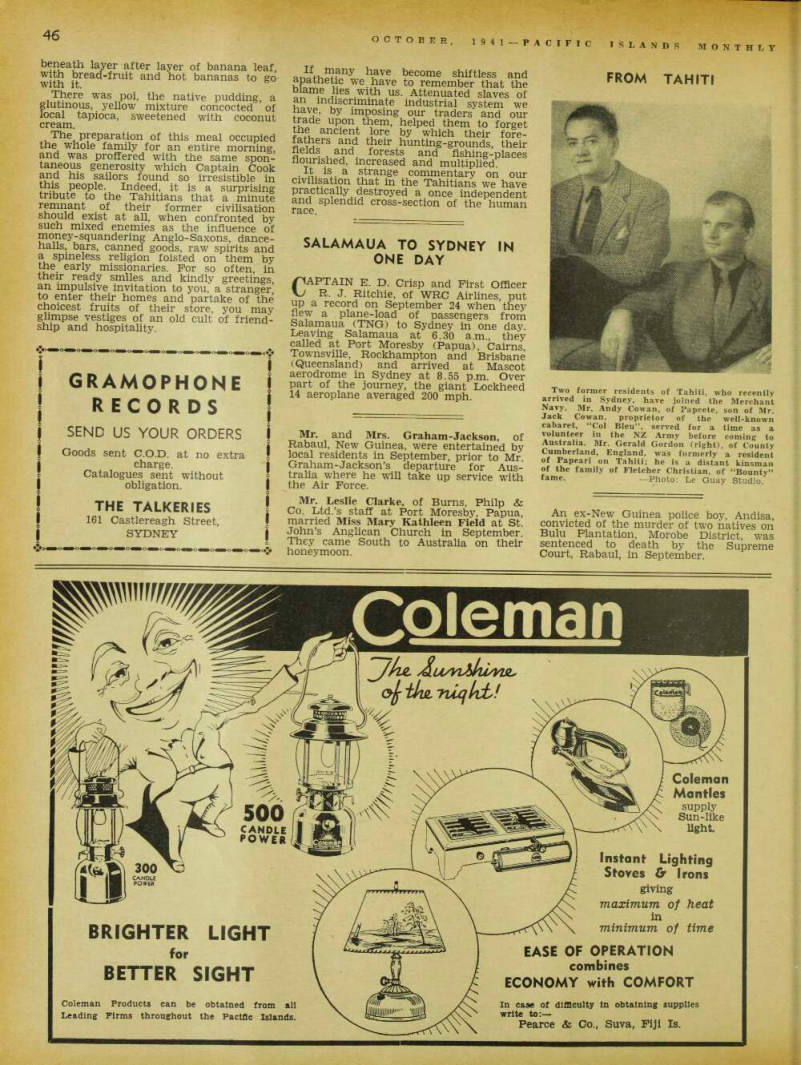
Some Illusions Are Destroyed
By Mary Atherton
AFTER I had been a week in Tahiti, I found myself adopting a formula: No European lives in Papeete un less he has to. You should take a house m one of the districts, Punaavia or Paea.
Have you been out there? There are some charming houses, and almost all are empty, as so many of the foreigners have gone home.”
“I ought—l will,” I would reply. “But how does one go about housekeeping?”
I had no car, and the only market is m Papeete—the best market in the Paci fic, I had been told. I had not yet seen the market, which is active at 5 a.m, and by 6 a.m. there is nothing left to buy.
“You needn’t worry. The trucks pass all day long, and Alec or Claret will always bring you what you want from town if you ask them. Then there is always the Chinaman, with bread and vegetables.”
All sights dissolve in a vision of the in scrutable Oriental who dominates the commercial life of Papeete. His slant eyes watch you across every counter. He is the
groeer, the tailor and the sandal-maker. 6 Ho S i°~^ u i th is asic * e —has been known to deal in foreign exchange. He provides y oifl want from a bicycle to a bunch of carrots. Ah Choon, of Papeete ic the guide, philosopher and friend of many a European lost in the intricacies of housekeeping in Tahiti.
HAVING selected a house in the midst of coconut palms fringing the lagoon with a coral beach of my own I transferred myself and my luggage bv camionette (“little truck”) early one morning to my new abode, at the 19th kilometre, in the “wilds” of Paea, taking the precaution of bringing some stores with me. At almost every house along the road the camionette stopped to dis charge a passenger with a marketing basket, or a basket alone without a passenger. fil S ese -£ asket . s ’, of Plaited palm-leaf, are filled with perishables from town which by some mysterious agency, are collected for the country-dweller who cannot get to market, and deposited at his gate-post in the shade of the hibiscus-hedge The truck driver toots his horn and, before the house-holder has even appeared to claim his day’s provisions, moves off to the next kilometre.
In each district there is a ramshackle Chinese store, crowded with children, who stare at you silently, whilst scrawny chick ens and stray, featherless ducks peck at crumbs and dust and insects on the wooden floor. Sugar and tea, cloth for pareus, thread, soap and tobacco, are sold in these grim little stores, where nobody appears to speak French or English, or even Tahitian.
Nevertheless, you are handed what you ask for, the amount you owe being in dicated by coins on the counter. The transaction is carried through in com plete unsmiling silence on the part of the store-keeper, with a superfluity of words and signs from yourself. There is never a flicker of response to your india rubber smiles.
The Chinaman here is the absolute embodiment of indifference; and this Chinese element in Tahiti, where the Chinese have acquired so much land, run all the local commerce, and are a law unto themselves, with their own closely guarded tribal secrets, is a story in itself Wherever you go, from the district of Pare to Tautira or Teahupoo, le Chinois who speaks little even of his own lan guage is an important factor in daily life.
THE place I have rented consists of three separate houses: the main house, a spacious affair open all round, pandanus-thatched in the native style, where I lounge, work, and sleep; the dining-house, with small kitchen attached; and a small guest-house. I seem to be in possession of a miniature estate, which necessitates a good deal of wandering to and fro under the coconuts.
The Chief of the district paid me a call next day, staggering under a load of bananas and a basket of mangoes, for which, after amiabilities had been exchanged, he politely asked five francs (roughly, ninepence). I was delighted.
From him, I also ordered charcoal with which cooking is done on a stove made of a kerosene tin with a grid. My visitor left me with the impression that I had but to say the word and he would see that the abundance of Tahiti was mine.
Since then, though I have repeatedly hinted that I wished to taste the prawns which I had been told were to be found in myriads in all the rivers (and cne runs alongside the Chief’s house), that I would buy any fish he had to spare (and he has several sons who go fishing),
neither prawns nor sea-food have yet appeared.
THE fact is—and now the hard truth must be told —this ease of life, this teeming abundance, this care-free existence where you have but to put out your hands and all the fruits of heaven fall into them, are all part of a tremendous illusion.
True, there are fish, masses of them leaping and jumping in the lagoon; the roads are yellow with mangoes rotting where they have fallen; limes and avocados weigh down the branches of trees in the valleys waiting to be plucked; there are forests of bread-fruit trees, grove after grove of bananas.
But unless you go after these things yourself—an occupation which would take up three-quarters of your existence—you must procure them from the market, or do without. The natives appear to have the minimum of energy to expend, even upon themselves, much less for you.
If it were not for the Chinamen, who travel the roads, blowing a conch-shell to announce their passing with baskets of bread, and vegetables which with great labour they force from the over-burdened earth, you must renounce all hope of balanced meals. The übiquitous coconut may stay hunger, but as a steady diet, may prove monotonous and indigestible.
Certainly, the trucks go up and down, morning and afternoon, and for a small consideration the drivers are willing to do your marketing in Papeete and see that you receive supplies; but, when you live off the highway, as I do, you some how never catch the trucks, unless you plant yourself by the side of the road with a book, resigned to waiting anything from 20 minutes to an hour. And, then, if you order meat or fish, you must be home to eat it, since neither will keep more than a few hours, if you are one of the unfortunates who cannot afford ice.
This can be delivered, every day, if you are willing to pay an enormous amount for stuff of which half has entirely melted before it reaches you.
THERE are mango-fed cows on the island, but they produce hardly any milk, and this ingredient must be banished from your recipes. Cream is obtaining by grinding the flesh of a coco nut and squeezing it in a piece of muslin; it is quite pleasant with coffee and as a basis for salad dressing. Cheese does not Butter is imported in well-sealed tins from New Zealand. For this, there is an immensely long waiting-list; the last ship brought only four cases, and this supply soon ran out. In place of butter, we make a paste of avocado pear, faintly flavoured with garlic—a damnable substitute. Flour and rice are unobtainable without a permit.
The pork is good, and an enterprising Czech in town manufactures bacon and sausages which are an excellent stand-by.
The fish is coarse, but very nourishing.
Clams, wrested from the reef, pickled in lime and coconut milk, and sold in hollow sticks of green bamboo, sealed with a bit of banana leaf, are available locally.
The native coffee is good and cheap (roughly, ninepence a pound).
Beer brewed from melons and pine apple is refreshing and surprisingly po tent. There is rum, no longer so much of the good Martinique variety, but a native mixture that is adequate. The stocks of French wine have run dry and there is no hope of any more.
So much for housekeeping in Tahiti; a strenuous business calling for the utmost patience, ingenuity and a sense of humour.
In all fairness it must be admitted that the war and consequent shortage of supplies have enhanced the complications.
The native women avoid working when
they can. They, have not always had the necessity; for can they not squat in the sun outside their little huts the whole day through, nourishing themselves on the ever-present bread-fruit and the coconuts which fall around them?
HERE is my experience of Tahitian hospitality. I had read of a certain native’s reputation as a cook, and decided to visit him. He received me cor dially, in his bamboo house, by the water’s edge. I found him charming, hospitable and intelligent, but a sick man.
He turned his daughter out of her house to provide me with shelter on a rainy night, and the next day ordered his family to prepare a special luncheon.
There was melon, and raw fish done in the native manner—pickled in lime-juice and soaked in coconut milk; and there was sucking-pig baked on hot stones,
b^\? a £ h la , yer after layer of banana leaf, with bread-fruit and hot bananas to go with it.
There was poi, the native pudding, a glutinous, yellow mixture concocted of local tapioca, sweetened with coconut cream.
The preparation of this meal occupied the whole family for an entire morning, and was proffered with the same spon faneous generosity which Captain Cook ana sailors found so irresistible in this people. Indeed, it is a surprising tribute to the Tahitians that a minute r £ mi^ nt of their former civilisation should exist at all, when confronted by such mixed enemies as the influence of money-squandering Anglo-Saxons, dance halls, bars, canned goods, raw spirits and a spineless religion foisted on them by the early missionaries. For so often, in their ready smiles and kindly greetings, an impulsive invitation to you, a stranger to enter their homes and partake of the choicest fruits of their store, you may glimpse vestiges of an old cult of friend ship and hospitality.
* f^ ny have become shiftless and H e s! c we have to remember that the blame lies with us. Attenuated slaves of an indiscriminate industrial system we have, by imposing our traders and our trade upon them, helped them to forget the ancient lore by which their fore ar*d their hunting-grounds, their fields and forests and fishing-places flourished, increased and multiplied .It is a strange commentary on our civilisation that in the Tahitians we have practically destroyed a once independent and splendid cross-section of the human race.
Advertisements & other items, pp. 47-48 (1 item)
«Mi)(«HiMll
End Rheumatism
While You Sleep
If you suffer sharp, stabbing pains, if joints are swollen, it shows your blood is poisoned through faulty kidney action. Other symptoms of Kidney Disorders are Burning, Itching Passages, “Getting up Nights,” Backaches, Lumbago, Leg Pains, Nervousness, Dizziness, Headaches, Colds, Puffy Ankles, Circles under Eyes, Lack of Energy, Appetite, etc. Ordinary medicines can’t help much —you must kill the germs ruining health. Cystex ends these troubles by removing the cause. Get Cystex from any Chemist on Guarantee to put you right or money back. Act Now ! In 24 hours you will feel better and be completely well in one week. The Guarantee protects you. Now in 3 sizes: 1/9, 4/-, 8/-.
GUARANTEED for Kidneys, Rheumatism, Bladder
Cystex
\ & T, - >
PHONE LA 243 6
«Mi)(«HiMll
41 CHURCH ST NEWTOWN
SYDNEY N-S-W
2^ antiseptic crease removing
CLEAN St A
CABLE ADDRESS - X SOAP SYDNEY
Specialising in the Manufacture of Soaps for the Islands WORKPAL CLEANER—"The Housewife's Friend" WACO ANTISEPTIC GREASE-REMOVING SOAP w ORKPAL is the modern cleaner for Baths, Sinks, Walls, Floors, Paint-work, etc., and also for cleaning all kitchenware. Being free from harmful ingredients, it may be used without fear of damage to any surface. Workpal is a real pal in the home—it saves that hard rubbing and scrubbing.
I 'TS super-softness makes instant appeal. It can be used with safety and will quickly remove grease and grime. Specially valuable for children’s hands and feet it prevents infection. Waco is indispensable for Painters, Engineers, Mechanics, etc.
TRADERS ARE INVITED TO APPLY TO
EXPORT SOAP CO. FOR PRICES AND FULL PARTICULARS
GRAMOPHONE
RECORDS
SEND US YOUR ORDERS
Goods sent C.O.D. at no extra charge.
Catalogues sent without obligation.
THE TALKERIES
161 Castlereagh Street,
SYDNEY
Salamaua To Sydney In
One Day
CAPTAIN E. D. Crisp and First Officer R. J. Ritchie, of WRC Airlines, put up a record on September 24 when they new a plane-load of passengers from Salamaua (TNG) to Sydney in one day.
Leavmg Salamaua at 6.30 a.m., they called at Port Moresby (Papua), Cairns, Townsville, Rockhampton and Brisbane (Queensland) and arrived at Mascot aerodrome in Sydney at 8.55 p.m Over part of the journey, the giant Lockheed 14 aeroplane averaged 200 mph.
Mr. and Mrs. Graham-Jackson, of Rabaul, New Guinea, were entertained by local residents in September, prior to Mr.
Graham-Jackson’s departure for Aus tralia where he will take up service with the Air Force.
Mr, Leslie Clarke, of Burns, Philp & Co. Ltd.’s staff at Port Moresby, Papua, married Miss Mary Kathleen Field at St.
John’s Anglican Church in September.
They came South to Australia on their honeymoon.
From Tahiti
An ex-New Guinea police boy Andisa convicted of the murder of two natives on Bulu Plantation, Morobe District was sentenced to death bv the Sunreme court, Rabaul. in September. P
Two former residents of Tahiti, who recently arrived in Sydney, have joined the Merchant Navy. Mr. Andy Cowan, of Papeete, son of Mr.
Jack Cowan, proprietor of the well-known cabaret, “Col Bleu”, served for a time as a volunteer in the NZ Army before coming to Australia. Mr. Gerald Gordon (right), of County Cumberland, England, was formerly a resident of Papeari on Tahiti; he is a distant kinsman of the family of Fletcher Christian, of "Bounty" fame . —Photo; Le Guay Studio.
Advertisements & other items, p. 48 (1 item)
Coleman
i y r 3 500
CANDLE
POWER
I 300 ‘Vk
CANDLE
POW£«
Coleman
ofr the. nicfkti
BRIGHTER LIGHT
for
BETTER SIGHT
Coleman Products can be obtained from all Leading Firms throughout the Pacific Islands.
Coleman Mantles supply Sun-like light.
Instant Lighting Stoves & Irons giving maximum of heat in minimum of time
EASE OF OPERATION
combines
ECONOMY with COMFORT
In case of difficulty In obtaining supplies write to:— Pearce & Co., Suva, Fiji Is.
Failed

The Light That
By W. S. Bond
I HAD not, as yet, fully realised the tremendous grip that the movie cowboy has on the Maori imagina tion. If you are able to do anything that the cowboy is supposed to do, your popularity in the Cook Islands is assured.
When I first gave a little exhibition of rope-spinning, at Muri, for the enter tainment of village friends, I never dreamed that, by the following day, all Rarotonga would be talking of my skill and clamouring for a demonstration.
The upshot of it was that the manage ment of the far-famed “Royal Hall” invited me to “do my stuff”, where all who had the price of a ticket might view it from the comfort of a wooden form.
I must say that the management treated me very well, as regards the advertising. They were kind enough to emphasise that I was “greater than Tom Mix”. Naturally, I appreciated the com pliment—but I was thankful that Raro tonga was sufficiently remote from Tom Mix’s regular hang-outs to ensure that that fast-shooting gentleman was un aware of the statement.
A few days before the advertised date, I went to the Royal Hall for a stage rehearsal, accompanied by the Raro tongan who was acting as my personal manager. Immediately I stepped on the stage, before the large picture screen, I was possessed by the idea that it would produce a very striking effect if, during my rope-spinning act, all lights were blacked out and the spot-light concen trated upon me, throwing a strong silhouette of myself and the twirling rope onto the screen.
The manager of the theatre was ac quainted with the idea and agreed that it would indeed be effective. The operator would be carefully instructed as to what was required of him.
Came the great night. Having left my show costume back home, I had contrived a handsome pair of “chaps” from my wife’s best camel-hair blanket, decorated with “silver dollars” cut from cocoa tins.
A tennis shirt, dyed vermilion, and a gay neckerchief completed the outfit. The effectiveness of the rig was proved by the admiring chorus that greeted my appearance.
Before going on, I had inquired if the lighting arrangements were thoroughly understood. The manager assured me that everything was O.K. —he himself would stand in the wings and give the signals to the operating-box. I thanked him. The band struck up. I was on!
The first part of the act, with the long rope, went well enough. Now I changed to the short spinning-rope, and stepped to the centre of the stage. This was the pre-arranged point for “Black out!” and “Spot!”.
I started to spin. Nothing happened to the lights. I glanced towards the “flies”.
The manager beamed back and nodded assuringly, as he waved a white hand kerchief.
Moments passed, and still nothing happened. I looked again to the “flies”, and whispered out of the corner of my mouth: “Lights!” The manager nodded back and went on waving.
More moments passed; and I looked round anxiously. The manager wasn’t smiling now, and he was using the hand kerchief to mop his brow. I could distinctly hear him swearing.
I was feeling pretty warm myself. Rope spinning requires fine concentration; and this was where I did my best fancy twiddly-bits.
“Lights!” I appealed, in a desperate stage-whisper.
Things started to happen. The lights started to go out—not smoothly and directly, but sort of bobbing up and down in an undecided manner. At last, a moment of Stygian blackness—then the blessed spotlight!
My relief was short-lived. A couple of hall lights bobbed up. Somebody swore, and that seemed to scare them out again.
Another couple of seconds of spot-light —and the hall lights popped up agam.
Then some more hall lights—and the spotlight faded into oblivion.
I was all steamed up, and the vermilion dye was running. I mopped my face with my free arm, and the vermilion sleeve caused a quick-change from cowboy to Red Indian.
I managed to stagger through the act
without hog-tying or strangling myself, Then I made a hurried exit and went back-stage, to make a few observations on the subject of lights, My personal manager was despatched to find out what was what. Some con siderable time later he returned, hacking bis way methodically through half a blimp-sized water-melon, and ejecting Pips with machine-gun-like precision.
“I found out about the lights,” he said, between volleys. “The boy in the operating-box was enjoying your show immensely—but he said that when he tried the spotlight, it was no good, be cause the beam dazzled him and he couldn’t see you himself—so he had to put the hall lights on again!”
However, the show appeared to have
gone over all right. Next day, there were many horses drifting about without their anchor cables, and mothers were search ing for missing clothes-lines—while boys, from 8 to 80, were assiduously practising the intricate cowboy art of rope-spinning.
Some were even wearing sugar-bag “chaps”.
Rev. G. Voss, who is well known on New Britain, TNG, where for some time he was a worker for the Melanesian Mission, has joined the New Guinea Education department and will be sta tioned at Pila Pila. He returned to Rabaul recently after unsuccessfully applying to go overseas with the AIF.
Advertisements & other items, pp. 49-50 (1 item)
To Keep Docs
FIT AND HAPPY
* ✓ Cooper Dog Remedies are known the world over for their quality and efficiency, and are the result of constant research by the largest manufacturers of insecticides and parasticides in the world to-day.
PULVEX VERMIN POWDER_ D efi,.iui y kills oil fleas lice and body vermin—does not merely stupefy them. Penetrates well into the coat, preventing re-infestation, tor a considerable time. Nonpoisonous, very economical, odourless, clean, harmless and easy to use.
KUR-MANGE_ a non-poisonous, non-irritant remedy for Mange, Ringworm, Dry Eczema and all skin diseases of a parasitic nature.
Non-carbolic, a powder, it is a non-greasy remedy far superior to ointments and oily dressings.
COOPER'S CONDITION POWDERS Invaluable
for impure or overheated blood, loss of appetite, listlessness, dull coat, continual scratching, sluggish liver, debility. As a general tonic after recovering from distemper or any debilitating disease, they are without equal.
LAYENE Liquid Shoitipoo —An economical, convenient,
cleansing wash for dogs, with wonderful coat conditioning properties.
Removes dirt and scurf, at the same time killing all parasites and imparting a rich lustre to the coat.
COOPER'S LIQUID WORM REMEDY— a cur,
both Round and Tape Worms in dogs and puppies of all breeds. No rigorous dieting necessary.
Cooper Dog Remedies are Obtainable at all Chemists and Stores Write for fuller details to the Manufacturers WILLIAM COOPER & NEPHEWS (AUSTRALIA). PTY. LTD,
O'Connell Street, Sydney cg, 2
Obtainable from branches of Burns Philp & Co., Ltd., throughout the Pacific Islands.
£ m •g * m * *
READ THE
B.P. MAGAZINE
SPRING NUMBER
NOW ON SALE
Short Stories Pictures Travel Articles - - - - Pages for the Children Stage Latest Fashions --- Screen A
ONE SHILLING PER COPY.
ON SALE AT ALL NEWSAGENTS AND BOOKSELLERS
PACKED AS THEY’RE PICKED
TO PRESERVE FLAVOUR AND NUTRIMENT
Aunt Mary’s
PREPARED
VEGETABLES
only require heating and are then ready to serve, full flavoured, attractive and satisfying.
Green Peas, Celery, Cauliflower and other Aunt Mary s prepared vegetables are specially packed for Tropical conditions in 1 lb. hermetically sealed cans.
SOLD BY ALL PACIFIC ISLAND STORES
Order an assortment. Be sure it is Aunt Mary's brand; packed by Tillock & Co., Pty., Ltd., Sydney.
Beeswax
Profit in Honey and Beeswax
By H. C. Reed, Apia
YOUR contributor, Mr. F. J. Morgan, has written a very timely article on the value of bees. Realizing that but few people are conversant with the many uses and the commercial value of beeswax I append some additional comments.
First, there exist in many of the larger islands of the Pacific, in the wild state, abundant quantities of both good yellow honey, and the comb-wax. But this is
not; the product of the small, stingless.
Tngona bee, mentioned by Mr. Morgan as obtaining through New Guinea and the entire tropic-belt. This useful insect builds a round, ball-like comb, filled with excellent honey, yet ©Hording but little wax.
It is the Italian bees, and their “hy brids , which have largely escaped from the hives of beekeepers when “swarming” and have taken up their abode in the tops of coconut palms, hollow trees, and in rocky caves, which give the beeswax In some of the caves of the islands around New Caledonia, great quantities of honey and wax can be obtained. This writer collected 12 benzine-tins of honey and rendered 80 pounds of wax, from the enormous wild colonies of bees, which had built combs in sections, like so many organ-pipes hanging from the roof of a cave.
In Western Samoa alone, the writer could easily collect a ton of wax; but this needs experience. As a qualified apiarist, speaking of beekeeping for pro fit in the Pacific Islands, 1 would com mend this as a really profitable hobby, to anyone living where the coconut palm grows. Italian bees will thrive anywhere that the coconut tree abounds. These palms are continuously in flower, and afford considerable nectar for the bees, apart from other sources of honey-flora.
WHILE it is not possible to give direc tions for installing a hive of bees, in this brief account, it may said that, with the aid of a small textbook on beekeeping, a standard hive and a “nucleus”, or small swarm of imported Italian bees, anyone in the Islands can start beekeeping as' a very pleasant, and interesting sideline.
Honey can take the place of sugar for tea and coffee, jams and jellies, honey mead and wines, beer and ginger-beer, vinegar-making; ices; puddings and cakes; confectionery; brown bread making; soaps and sauces; and, in fact, every kind of preserve that is intended for long keeping.
What quantity of honey can be ex pected from a single hive? It can be said that a single frame (not section), filled with honey, may yield up to seven pounds of pure honey, apart from the wax. This is the writer’s actual experience in Samoa, where from 60 to 70 pounds of honey was extracted, by machine, from each hive of a “brood-chamber” and four “supers”.
It may be said that there is no winter, or cold season, in the Islands, and there fore the honey-bee works non-stop throughout the year. But the honey only comes in, in real quantity, during what is called the “honey-flow”. This amounts to the dry period, when the jungle-trees come into flower, prior to the rainy season.
If a single hive is well populated with a good queen bee, and a swarm of or dinary hybrid-bees, as generally found in the Pacific Islands —a “swarm” is really the most practical commencement for the beginner the “swarm” can be accom modated in a benzine-case, pending removal to the proper frame-hive.
Never tackle bees without providing a piece of mosquito-net to cover a broad brimmed hat. This should be tucked in side one’s coat. But bees can be quite easily handled, when one knows how to handle them, and without any sting.
Advertisements & other items, p. 50 (2 items)
48
OCTOBER, 1941-RACIfIC ISLANDS MONTMLV
Springwood Ladies" College
At Bine Mountains—Springwood, N.S.W.
Est. 1897. Kindergarten to Leaving Certificate. Tennis, Riding, Swimming, Team Games. Unequalled climate. Pure Jersey Milk. Senior and Junior Houses.
Open-air sleeping. Inclusive fees. Special vacation arrangements for Island pupils.
M. E. DURAND, Principal.
A Section For Women
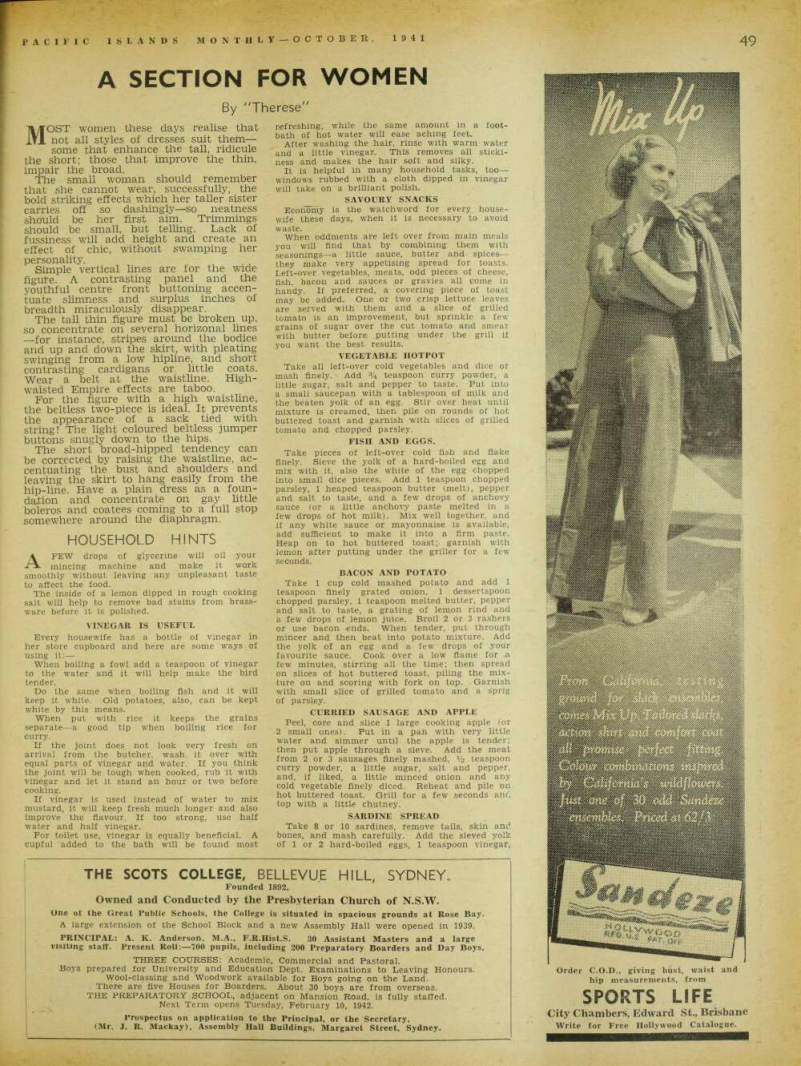

By "Therese"
MOST women these days realise that not all styles of dresses suit them — some that enhance the tall, ridicule the short; those that improve the thin, impair the broad.
The small woman should remember that she cannot wear, successfully, the bold striking effects which her taller sister carries off so dashingly—so neatness should be her first aim. Trimmings should be small, but telling. Lack of fussiness will add height and create an effect of chic, without swamping her personality.
Simple vertical lines are for the wide figure. A contrasting panel and the youthful centre front buttoning accen tuate slimness and surplus inches of breadth miraculously disappear.
The tall thin figure must be broken up, so concentrate on several horizonal lines —for instance, stripes around the bodice and up and down the skirt, with pleating swinging from a low hipline, and short contrasting cardigans or little coats.
Wear a belt at the waistline. High waisted Empire effects are taboo.
For the figure with a high waistline, the beltless two-piece is ideal. It prevents the appearance of a sack tied with string! The light coloured beltless jumper buttons snugly down to the hips.
The short broad-hipped tendency can be corrected by raising the waistline, ac centuating the bust and shoulders and leaving the skirt to hang easily from the hip-line. Have a plain dress as a foun dation and concentrate on gay little boleros and coatees coming to a full stop somewhere around the diaphragm.
Household Hints
A FEW drops of glycerine will oil your mincing machine and make it work smoothly without leaving any unpleasant taste to affect the food.
The inside of a lemon dipped in rough cooking salt will help to remove bad stains from brass ware before it is polished.
Vinegar Is Useful
Every housewife has a bottle of vinegar in her store cupboard and here are some ways of using it:— When boiling a fowl add a teaspoon of vinegar to the water and it will help make the bird tender.
Do the same when boiling fish and it will keep it white. Old potatoes, also, can be kept white by this means.
When put with rice it keeps the grains separate—a good tip when boiling rice for curry.
If the joint does not look very fresh on arrival from the butcher, wash it over with equal parts of vinegar and water. If you think the joint will be tough when cooked, rub it with vinegar and let it stand an hour or two before cooking.
If vinegar is used instead of water to mix mustard, it will keep fresh much longer and also improve the flavour. If too strong, use half water and half vinegar.
For toilet use, vinegar is equally beneficial. A cupful added to the bath will be found most
refreshing, while the same amount in a foot bath of hot water will ease aching feet.
After washing the hair, rinse with warm water and a little vinegar. This removes all sticki ness and makes the hair soft and silky.
It is helpful in many household tasks, too— windows rubbed with a cloth dipped in vinegar will take on a brilliant polish.
Savoury Snacks
Economy is the watchword for every house wife these days, when it is necessary to avoid waste.
When oddments are left over from main meals you will find that by combining them with seasonings—a little sauce, butter and spices— they make very appetising spread for toasts.
Left-over vegetables, meats, odd pieces of cheese, fish, bacon and sauces or gravies all come in handy. If preferred, a covering piece of toast may be added. One or two crisp lettuce leaves are served with them and a slice of grilled tomato is an improvement, but sprinkle a few grains of sugar over the cut tomato and smear with butter before putting under the grill if you want the best results.
Vegetable Hotpot
Take all left-over cold vegetables and dice or mash finely. Add 3 A teaspoon curry powder, a little sugar, salt and pepper to taste. Put into a small saucepan with a tablespoon of milk and the beaten yolk of an egg. Stir over heat until mixture is creamed, then pile on rounds of hot buttered toast and garnish with slices of grilled tomato and chopped parsley.
Fish And Eggs.
Take pieces of left-over cold fish and flake finely. Sieve the yolk of a hard-boiled egg and mix with it, also the white of the egg chopped into small dice pieces. Add 1 teaspoon chopped parsley, 1 heaped teaspoon butter (melt), pepper and salt to taste, and a few drops of anchovy sauce (or a little anchovy paste melted in a few drops of hot milk). Mix well together, and if any white sauce or mayonnaise is available, add sufficient to make it into a firm paste.
Heap on to hot buttered toast; garnish with lemon after putting under the griller for a few seconds.
Bacon And Potato
Take 1 cup cold mashed potato and add 1 teaspoon finely grated onion, 1 dessertspoon chopped parsley, 1 teaspoon melted butter, pepper and salt to taste, a grating of lemon rind and a few drops of lemon juice. Broil 2 or 3 rashers or use bacon ends. When tender, put through mincer and then beat into potato mixture. Add the yolk of an egg and a few drops of your favourite sauce. Cook over a low flame for a few minutes, stirring all the time; then spread on slices of hot buttered toast, piling the mix ture on and scoring with fork on top. Garnish with small slice of grilled tomato and a sprig of parsley.
Curried Sausage And Apple
Peel, core and slice 1 large cooking apple (or 2 small ones). Put in a pan with very little water and simmer until the apple is tender; then put apple through a sieve. Add the meat from 2 or 3 sausages finely mashed, Vz teaspoon curry powder, a little sugar, salt and pepper, and, if liked, a little minced onion and any cold vegetable finely diced. Reheat and pile on hot buttered toast. Grill for a few seconds and top with a little chutney.
Sardine Spread
Take 8 or 10 sardines, remove tails, skin and bones, and mash carefully. Add the sieved yolk of 1 or 2 hard-boiled eggs, 1 teaspoon vinegar,
Vz dessertspoon anchovy sauce, pepper and 2 tablespoons white sauce. Spread on buttered toast, gril] under hot griller for a few seconds, then garnish with circles of the whites of the eggs and scatter with chopped parsley. Serve with half slices of lemon.
Advertisements & other items, pp. 51-52 (1 item)
i:lcnsemhl&*'Pfks
m nmw ■ l— all promise perfect fitting.
Colour combinations inspired by California's wild flowers.
Just one of 30 odd Sandcze
i:lcnsemhl&*'Pfks
Order C.0.D., giving bust, waist and hip measurements, from
SPORTS LIFE
City Chambers, Edward St., Brisbane Write for Free Hollywood Catalogue.
THE SCOTS COLLEGE, BELLEVUE HILL, SYDNEY.
Founded 1892.
Owned and Conducted by the Presbyterian Church of N.S.W.
One of the Great Public Schools, the College is situated in spacious grounds at Rose Bay.
A large extension of the School Block and a new Assembly Hall were opened in 1939.
PRINCIPAL: A. K. Anderson, M.A., F.R.Hist.S. 30 Assistant Masters and a large visiting staff. Present Roll;—700 pupils, including 200 Preparatory Boarders and Day Boys.
THREE COURSES: Academic, Commercial and Pastoral.
Boys prepared for University and Education Dept. Examinations to Leaving Honours.
Wool-classing and Woodwork available for Boys going on the Land.
There are five Houses for Boarders. About 30 boys are from overseas.
THE PREPARATORY SCHOOL, adjacent on Mansion Road, is fully staffed.
Next Term opens Tuesday, February 10, 1942.
Prospectus on application to the Principal, or the Secretary, (Mr. J. R. Mackay), Assembly Hall Buildings, Margaret Street, Sydney.
nte/iek
SAUCE
IfdedbuOteks UwWctfld ever
ECONOMICAL. BECAUSE YOU NEED
JUST A FEW DROPS AT A TIME -
Edgell
QUALITY PRODUCTS
Edged Asparagus
The best in the world. Available in season only.
Edged Cauliflower
Choice heart of the cauliflower. No stalk, no waste. Packed in cartons of 3 dozen 16 oz. cans.
Edged Brussels Sprouts
Garden green—firm cooked.
Packed in cartons of 3 dozen 16 oz. or cases of 2 dozen 30 oz. cans.
Edged Green Peas
Picked and canned the same day, avoiding extra handling and bruising.
Graded in three sizes, large, medium and petits pois. Large and medium packed in 10i oz., 16 oz. and 30 oz. cans. Petits pois are packed in cartons of 4 dozen 10i oz. cans only. All packs are available with or without mint flavour.
Edged Carrots
The sweetmeat of canned vegetables. Whole young carrots are packed in cartons of 4 dozen oz. cans. Split carrots are available in cartons of 3 dozen 16 oz. cans.
Edged Concentrated Soups
Asparagus, Tomato, Celery, Pea, Vegetable and Assorted.
These are heavy bodied soups—an extra tin of milk or water may be added to each tin. Made from sun-ripened, specially selected ingredients.
ISLANDS DISTRIBUTORS:
C. SULLIVAN LTD. 37 1S^ T
Bulolo, TNG
Woman Accidentally Shot at Bulolo, TNG
From Our Own Correspondent C T „_ WAU, Sept. 20.
LEANING a .32 rifle one evening last week, Mrs. R. McGlynn, of Bulolo, accidentally dropped it onto the floor, with the result that it exploded and shot her in the stomach. She was brought to Wau hospital, but died early the following morning.
In recent months, since the murder of young Jean Wilson last June, a number of European women have had firearms near at hand, while their menfolk are on night shiftwork with the mining companies.
Beauty And The Beach
TNTERESTED in beach and sports wear? Then -*■ the smart Sandeze catalogue of uncrushable sail-cloth in the newest colour combinations is exactly what you need. Slickly designed, lavishly illustrated, it parades Hollywood’s latest up-to the-minute informal wear, all just right for ladies of the tropics. Handy feature for future ordering is a new colour chart, within the catalogue—displaying 18 fashionable wildflower shades that can be blended in any combination to suit the most fastidious. For your free copy write to: Sports Life, City Chambers, Edward Street, Brisbane, Queensland.— *** Miss Merle Charlton, of Dogura, Papua,
passed through Sydney in September en
route to Victoria, where she will spend several weeks’ furlough. She is a member of the New Guinea Mission staff.
Popular Apia Girl
An attractive study of Miss Jean Croudace, a charming and popular young lady of Apia, Western Samoa, who recently sailed for the United States on an extended holiday tour. A short time ago, she visited Australia, where she took part in several functions arranged by the Polynesian Club of Sydney.
Report Of Ng Native
Labour Commission
AFTER considerable delay, the report of the Native Labour Commission in New Guinea in 1939-40 has been made public. It comprises two separate reports—one of 49 foolscap pages compiled by Hon. R. Melrose (Director of District Services), Hon. G. Hogan (Crown Law Officer), and Mr. W. H. Carpenter (Rabaul merchant); and the other, half its size, by Dr. H. C. Hosking (Govt.
Medical Officer) and Mr. D. Hore-Lacy (planter).
The Commission examined 200 replies to a questionnaire sent to officials, mis sionaries, native labour employers and others, and took evidence from over 100 witnesses in Rabaul, Kavieng, Salamaua, Wewak, Madang and Wau.
Aspects dealt with, in detail, in the report include: Demand for and supply of Labour, the Indenture System, Recruiting, Repatriation of Time-expired Labourers, Wages, Non-Indentured Labourers and Contracts, and Administration of the Native Labour Ordinance.
The majority report states the Com mission came to the conclusion that the indenture system is the only one suited to the present stage of development of the New Guinea native; furthermore, it has an important educational value.
Miss M. Kelly, of the NG Audit Dept., has arrived in Sydney on leave.
Advertisements & other items, p. 52 (1 item)
Old Monk
The Worlds Finest Olive Oil San Francisco
Pacific
All Calm in Central Pacific What USA is Doing in Samoa
By Marc T. Greene
Auckland, Sept. 15.
IHAVE lately returned from a short trip through the Islands: Fiji, Samoa, Tonga and Niue. And a delightful experience it is, especially on so pleasant and well-served a craft as the Union Company’s island steamer.
But just now it is a good deal more than that kind of experience. It gives one a most interesting close-up on how the Islands and their folk are getting along in these uncertain days, how they are “reacting”—as the Americans would say—to the war, and what they think of the future prospects of the South Seas.
The thing that struck me at the start was the tranquility everywhere, the ab sence of apprehension, the serene con fidence and among Britishers the unshakable assurance that ultimate vic tory in the war was only a matter of time—and, of course, probable further sacrifice In Fiji there are New Zealand soldiers, and the money they spend enhances the prosperity of an already very prosperous Crown Colony. Yet there is little if any advance in living costs there. Also, much may be had that is now unattainable in New Zealand. Such, for example, as English-made cigarettes. That may not seem very important—until you have had a go at those made in New Zealand!
Banno Brothers
EVERYBODY is doing a good business, and the Japanese concern, Banno Brothers, is carrying on, even though credit and assets are frozen.
In this connection, the day I was in Nukualofa a notice decreeing the same thing in respect of the Banno Brothers branch there was posted. I visited the Jap. shop, and its management received me very politely. One of them took me on a long drive around the island, where they have had many branch shops, but all now Closed. I asked what they would do in the face of the freezing decree.
“Cannot tell.” my Japanese acquain tance said. “Can only wait, see what happen. Not much business, anyway. No money in Tonga. Besides that, cannot get goods from Japan any more.”
It is but too true. Things are indeed bad in Tonga, because of the state of the copra market. However, these pro ductive islands will always furnish the fundamental native needs. And if Tonga, or all the rest of the South Seas for that matter, can no longer support any body but the natives, will somebody be so good as to give me a convincing: reason why the white man—who has worked un speakable havoc in every last isle and atoll in the Pacific —has any claim to be supported by these islands?
Tranquil Samoa
HOWEVER, in Samoa the economic condition is better than it used to be a»d the Mandate is now about paying expenses. There is complete tran quility there now, and a good deal of the credit for that goes to Acting Adminis trator Alfred C. Turnbull, whose kindli ness toward and interest in the natives have got him closer to them than any of his predecessors came anywhere to being.
And it is not only absurd, but alto gether iniquitous, that he should remain there in an “acting” capacity, without the emolument or—what is more im portant to him —the assurance of the retirement allowance that goes with a job he has been holding down for six
years with more success than anybody who preceded him. The whole position is a tribute to the niggardliness of the present New Zealand Government.
Samoa is, therefore, a more delightful place than ever. But the fact that a couple of thousand Samoans and forty or fifty Europeans are new working on the American naval-base over at Pago Pago, and making more money than they ever dreamed of making before, is going to create a serious economic problem in both parts of the Group when this work is completed. None of these natives—who are making 8/- a day now—is going to take kindly to returning to work on
plantations or highways at a quarter of that wage.
Moreover, the United States has taken over much of the native land at Pago Pago, remunerating the owners in the generous figure of $BOO an acre, and when these people no longer have work on the base, likewise no more quarters pro vided for them to live in, where are they going and what is to become of them?
Samoa And America
QUITE a number of people in Apia are hinting that the answer to that one is to turn Western Samoa over to America, perhaps by a lease under the
famous Lease-and-Lend Act. Then the matter of defence in case of need, as well as all economic problems would be taken care of, and nothing in any way required would have to be withheld for financial reasons.
The Mau still exists, and has its meet ings at Vaimoso. Also, there are occa sional Fono of Faipule, as usual. But all that happens is the long-winded talk so dear to Samoans. Famuina, now “Mataafa”, is a sergeant of native police and a “good boy”. He is the same out standing native leader that he always was, and probably had he been main tained in uninterfered-with leadership of his race, as ought to have been, and not become the tool of others, there never would have been any trouble in Samoa.
The natives of this group are somewhat truculent, as everybody knows, but they can be handled and kept content and peaceable if a little commonsense and justice is used in the attempt. Turnbull has shown that, and it is the reason for the success of his administration. He is accused by some people of “following the path of least resistance”—though I didn ! t hear anybody define that path with any conviction—but the main thing is that he has kept tranquility in Samoa, which is sufficiently to his credit.
After leaving these still happy Islands, where so little sign of what is forward in the rest of the world is apparent, one certainly returns to that world with ex ceeding reluctance. The South Seas are a mighty good place to be living in just now—most of them, anyway.
Advertisements & other items, pp. 53-54 (1 item)
McILRATH’S Sydney
SEND TO . . .
FOR YOUR XMAS GROCERIES
Where your money buys more and you
obtain better and fresher goods
The following are a few lines selected from ,our comprehensive List Send for a complete export
catalogue.
Mcllrath’s Xmas Cakes. 3 lb. boxes 3/9 each Mcllrath’s Special Quality Xmas Cakes, with motto, holly and fancy band, 2,3, 4. 5 & 6 lb. size 1/7 lb.
Mcllrath’s Special Quality Xmas Cakes. Iced and Decorated on top, fancy band. 2,3, 4,5, & 6 lb. size l/10i lb.
Arnott’s Fruit Cake, 16 oz. sealed tins 1/6 tin; 17/6 doz.
Arnott’s Christmas Puddings, 1 lb. Glass Bowls .. 2/- each; 23/6 doz.
Arnott’s Christmas Puddings, 2 lb. Glass Bowls .. 3/4 each; 39/- doz.
Mcllrath’s Special Quality Mild Cured S/Cloth Hams (12 to 14 lb.) 1/6 Pineapple Export Quality Christmas Hams in Seed, 12 to 14 lb., 1/11 lb.
Mayfair Cooked Boneless Hams 1 lb., 3/6 tin; 2 lb., 6/9 tin Best Fruit Mincemeat, 12 oz 1/1 jar; 12/6 doz.
Fresh Roasted Peanuts Hid. lb.; 11/3 doz.
Walnuts in Shell 1/4 lb.; 15/6 doz.
Dessert Almonds in Shell 1/6 lb.; 17/6 doz.
Dessert Almond Kernels • 4 oz. for 1/1 5 Eta Ground Almonds 4 oz., l/6i tin; 8 oz., 2/11 tin New Season’s Muscatel Clusters ... 8 oz., Hid. pkt.; 16 oz., 1/8 pkt.
Finest Crystallised Stem Ginger Nobs 1/10 lb.
Preserved Ginger in Syrup. 16 oz 1/8 jar; 19/6 doz.
Mixed Cake and Pudding Fruit, with Peel, 8 oz., 7id. pkt.; 7/3 doz. 16 oz., 1/li pkt.; 13/3 doz.
Best Jelly Crystals, all Flavours, 4 oz 4id. pkt.; 4/3 doz.
Cut Mixed Peel (ready for use), 8 oz 7id. pkt.; 7/3 doz.
New Season’s Extra Choice Currants 7id. lb.; 7/3 doz.
New Season’s Extra Choice Sultanas 7d. lb.; 6/9 doz.
New Season’s Finest Pitted Dates 9d. lb.; 8/6 doz.
“Rosa” Bartlett Pears 16 oz., 7/10i doz.; 30 oz., 11/3 doz.
“Rosa” Sliced Peaches 16 oz., 7/3 doz.; 30 oz., 10/3 doz.
Choice Fruit Salad 16 oz., 8/3 doz.; 30 oz., 12/9 doz.
Nestle’s Pure Reduced Cream, 4 oz 4d. tin; 3/9 doz.
Schweppe’s Lime Juice Cordial. 26 oz 1/11 bot.; 22/6 doz.
Schweppe’s Lemon Juice Cordial, 26 oz 1/5 bot.; 16/6 doz.
Mcllrath’s Royal Reserve Port, 26 oz 3/6 bot.; 41 - doz.
Mcllrath’s R.R. Dry Sherry, 26 oz 3/6 bot.; 41/- doz.
Mcllrath’s Brown Muscat, 26 oz 2/2 bot.; 25/6 doz.
Special Gold Lacouer Champagne or Hock, 26 oz. .. 4/9 bot.; 55/6 doz. •Seppelt’s Fine Old Solero Sherry, 26 oz. Sweet, 3/9 bot.
Extra Dry 4/3 bot.
All prices f.o.b. Sydney.
No charges for cases or packing.
Space available all steamers.
McILRATH’S Pty. Ltd.
EXPORT DEPARTMENT,
202 PITT STREET, SYDNEY
AUSTRALIA.
c, T'MT
M SI
the nN
ADVICE WORTH SEEKING
Are you satisfied that the arrangements made for administration of your estate cannot be improved? Are you convinced that there are no loopholes? Have you definite and complete assurance that your wishes cannot be misinterpreted? If you have the slightest doubt in your mind, or any problem, it is suggested that you call on Burns Philp Trust Co. Ltd. for advice. The matter can be discussed in absolute confidence and without obligation. Counsel given will be unbiassed and completely friendly. If a personal call is not possible, a letter will bring an immediate and helpful response.
An interesting Brochure is available setting out the features of the special services this Company is able to render. The book (entitled " The Task That Few Men Want ") will be forwarded free of charge on request.
DIRECTORS—James Burns - Robert John Nosworthy - Lewis Armstrong - Joseph Mitchell MANAGER—C. H. Chester
Burns Philp Trust
COMPANY LIMITED
7 BRIDGE STREET . SYDNEY
TELEPHONE; B 7901.
Box 543 B, G.P.0., Sydney.
r tc P H
it back
$ Rich in jumper and healthful herbs &
iHiSiBN BF BIiIRITIOHS
Palmyra
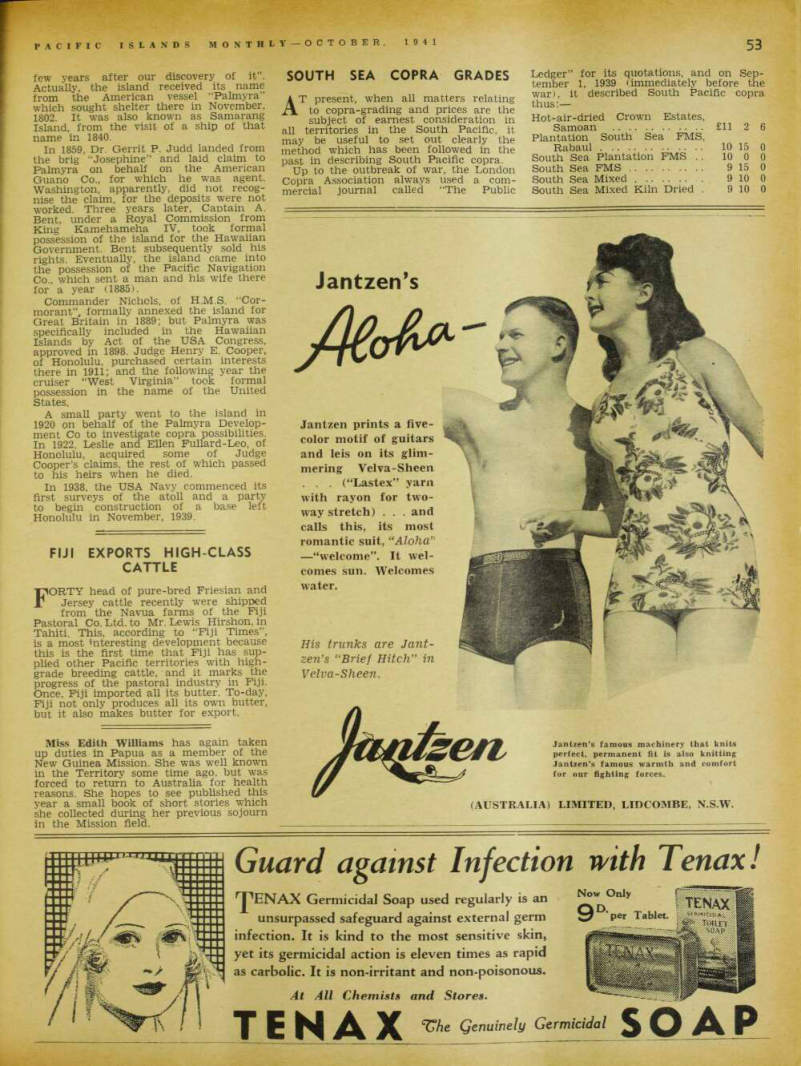
PAA's Proposed New Bose
ALTHOUGH it is definite that Suva will be included in Pan American Airways South Pacific air service as from mid-October, there has been no official announcement yet, concerning PAA’s application to the USA Government to use Palmyra Island as a refuelling: base. Presumably, the matter is still under discussion in Washington.
A glance at a map of the Pacific re veals the significance of Suva and Palmyra. At present, Clippers leave San Francisco, call at Canton Island, Nou mea (New Caledonia), and thence fly on to the terminal port. Auckland (NZ). The distances between Honolulu and Canton, and Canton and Noumea necessitate long non-stop flights and this, in turn, means that large quantities of fuel have to be carried at the expense of passengers and freight. If Clippers call at Palmyra and Suva, these two long hops will be
broken up into four smaller trips, enabling larger quantities of freight, etc., to be carried.
A veil of secrecy has been drawn over USA activities on Palmyra during the past year or so, but Mr. Edward H. Bryan, jnr., in a book just published, gives some in teresting information about this little island.
Lying 350 miles north of the Equator, it is about 960 miles south-west of Hono lulu. The atoll consists of some 50 small islets totalling 250 acres, and these sur round three lagoons. A platform of coral and hard sand runs around the islets and lagoons and, even at high water, one can walk from one islet to another. These islets are only 5 or 6 feet above sea level, but dense vegetation rises to a height of 75 feet. The whole atoll is only five miles long by Vh miles wide.
Palmyra has no sheltered harbour, and landing by sea is difficult owing to the large number of coral heads in the ap proaches. Three lagoons run down the centre of the atoll and are separated by reefs. Mr. Bryan, in his book, says: “If these reefs which separate the lagoon basins were removed, the atoll would make a splendid air base”. It is presumed that this already has been done by the USA naval authorities, who commenced construction of a base there in November, 1939.
THE question of ownership of Palmyra Island has been the subject of negotiations between the British and USA Governments for some time, although lately the atoll has been de clared a USA naval defence area and all foreign public and private vessels and planes are prohibited from landing.
Captain Edmund Fanning, in command of the American ship “Betsy”, first saw the island on June, 13. 1798: and he is reported to have stated: “Captain S.
Mackay, in command of the schooner ‘Brothers’, visited this land, which re ceived the name of Palmyra’s Island, a
few years after our discovery of it”.
Actually, the island received its name from the American vessel ‘‘Palmyra” which sought shelter there in November, 1802. It was also known as Samarang Island, from the visit of a ship of that name in 1840.
In 1859, Dr. Gerrit P. Judd landed from the brig “Josephine” and laid claim to Palmyra on behalf on the American Guano Co., for which he was agent.
Washington, apparently, did not recog nise the claim, for the deposits were not worked. Three years later, Captain A.
Bent, under a Royal Commission from King Kamehameha IV, took formal possession of the island for the Hawaiian Government. Bent subsequently sold his rights. Eventually, the island came into the possession of the Pacific Navigation Co., which sent a man and his wife there for a year (1885).
Commander Nichols, of H.M.S. “Cor morant”, formally annexed the island for Great Britain in 1889; but Palmyra was specifically included in the Hawaiian Islands by Act of the USA Congress, approved in 1898. Judge Henry E. Cooper, of Honolulu, purchased certain interests there in 1911; and the following year the cruiser “West Virginia” took formal possession in the name of the United States.
A small party went to the island in 1920 on behalf of the Palmyra Develop ment Co to investigate copra possibilities.
In 1922, Leslie and Ellen Fullard-Leo, of Honolulu, acquired some of Judge Cooper’s claims, the rest of which passed to his heirs when he died.
In 1938, the USA Navy commenced its first surveys of the atoll and a party to begin construction of a base left Honolulu in November, 1939.
Fiji Exports High-Class
Cattle
FORTY head of pure-bred Friesian and Jersey cattle recently were shipped from the Navua farms of the Fiji Pastoral Co. Ltd. to Mr. Lewis Hirshon, in Tahiti. This, according to “Fiji Times”, is a most interesting development because this is the first time that Fiji has sup plied other Pacific territories with high grade breeding cattle, * and it marks the progress of the pastoral industry in Fiji.
Once, Fiji imported all its butter. To-day, Fiji not only produces all its own butter, but it also makes butter for export.
Miss Edith Williams has again taken up duties in Papua as a member of the New Guinea Mission. She was well known in the Territory some time ago, but was forced to return to Australia for health reasons. She hopes to see published this year a small book of short stories which she collected during her previous sojourn in the Mission field.
South Sea Copra Grades
AT present, when all matters relating to copra-grading and prices are the subject of earnest consideration in all territories in the South Pacific, it may be useful to set out clearly the method which has been followed in the past in describing South Pacific copra.
Up to the outbreak of war, the London Copra Association always used a com mercial journal called ‘‘The Public
Ledger” for its quotations, and on Sep tember 1, 1939 (immediately before the war), it described South Pacific copra thus: —
Hot-air-dried Crown Estates, Samoan £11 2 6 Plantation South Sea FMS.
Rabaul 10 15 0 South Sea Plantation FMS .. 10 0 0 South Sea FMS 9 15 0 South Sea Mixed 9 10 0 South Sea Mixed Kiln Dried . 9 10 0
Advertisements & other items, pp. 55-56 (1 item)
Guard against Infection with Tenax!
Jantzen’s
Jantzen prints a fivecolor motif of guitars and leis on its glimmering Velva-Sheen . . . (“Lastex” yarn with rayon for twoway stretch) . . . and calls this, its most romantic suit, “Aloha" —“welcome”. It welcomes sun. Welcomes water.
His trunks are Jantzen’s “Brief Hitch” in Velva-Sheen. r "i H Jantzen’s famous machinery that knits perfect, permanent fit is also knitting Jantzen’s famous warmth and comfort for our fighting forces.
(AUSTRALIA) LIMITED, LIDCOMBE, N.S.W.
*T2 1 1! /
Guard against Infection with Tenax!
Now Only Tablet.
Germicidal Soap used regularly is an
unsurpassed safeguard against external germ
infection. It is kind to the most sensitive skin, yet its germicidal action is eleven times as rapid as carbolic. It is non-irritant and non-poisonous.
At All Chemists and Stores .
TENAX <Uhe Genuinely Germicidal SOAP
tenax r twiet m soap
Radio
REPLACEMENT
Parts
MAY we help you with that "hard-to-secure" part? If not available from stock we can have it made for you.
Send full details of set, make and model, and, if possible, send the faulty component.
PRICE’S Radio Service 5 & 6 Angel Place, SYDNEY
woo
Cr
"THE NEXT TIME I'll
'BUY A CLYDE-"
Grieving over the early death of a cheap battery won’t help mileage. Main thing is to be right from the start—with a Clyde.
Clyde Batteries—products of Australia’s premier Engineering Works —are guaranteed UNCONDITION- ALLY for long life and efficiency.
Whether you use a Clyde Master, Clyde Simplex or Clyde Phoenix you’ll find them at the top of their respective classes for battery value. Clyde Batteries mean
‘MORE POWER TO YOU’
CLVDE
BATTER IE S
Manufactured by
THE CLYDE ENGINEERING
CO. LTD.
Granville, N.S.W.
Main Sales & Service Division, 61-65 Wentworth Avenue, Sydney ’Phone: M 6738.
Branches at Brisbane, Melbourne, Adelaide.
Mines Industry
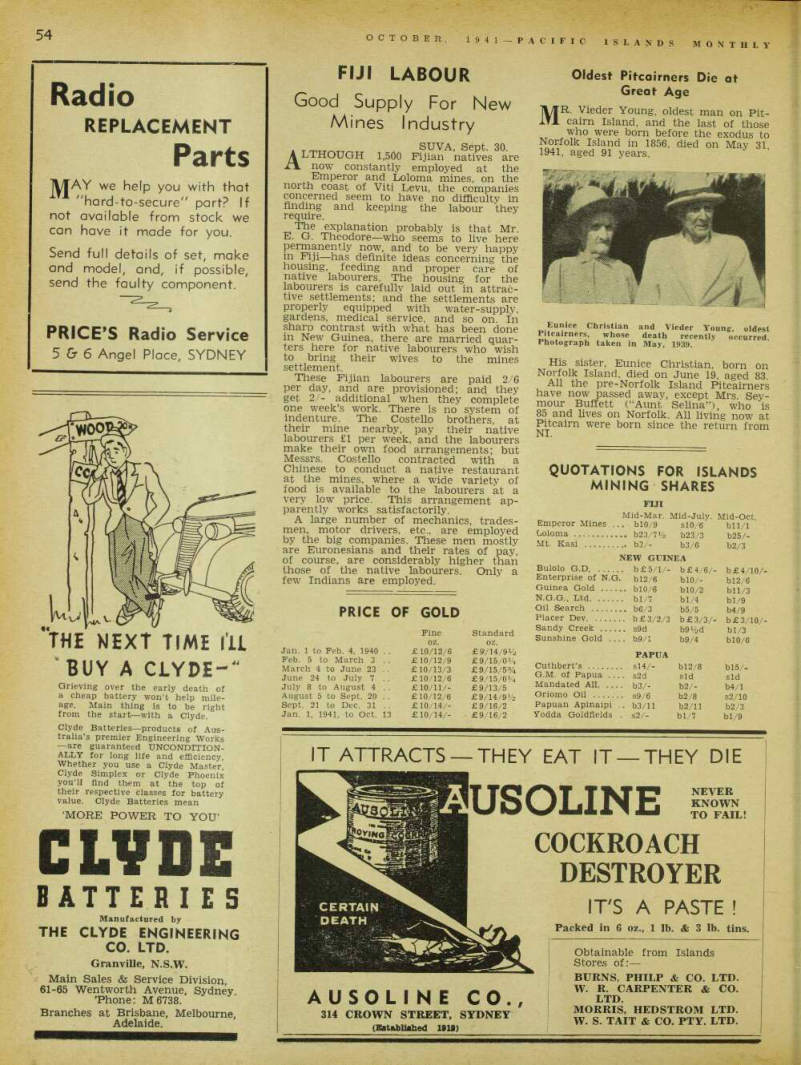
Fiji Labour
Good Supply For New Mines Industry
At SUVA, Sept. 30.
LTHOUGH 1,500 Fijian natives are now constantly employed at the Emperor and Loloma mines, on the north coast of Viti Levu, the companies concerned seem to have no difficulty in finding and keeping the labour they require.
The explanation probably is that Mr.
E. G. Theodore—who seems to live here permanently now, and to be very happy in Fiji—has definite ideas concerning the housing, feeding and proper care of native labourers. The housing for the labourers is carefully laid out in attrac tive settlements; and the settlements are properly equipped with water-supply, gardens, medical service, and so on. In sharp contrast with what has been done in New Guinea, there are married quar ters here for native labourers who wish to bring their wives to the mines settlement.
These Fijian labourers are paid 2/6 per day, and are provisioned; and they get 2/- additional when they complete one week’s work. There is no system of indenture. The Costello brothers, at their mine nearby, pay their native labourers £1 per week, and the labourers make their own food arrangements; but Messrs. Costello contracted with a Chinese to conduct a native restaurant at the mines, where a wide variety of food is available to the labourers at a very low price. This arrangement ap parently works satisfactorily.
A large number of mechanics, trades men, motor drivers, etc., are employed by the big companies. These men mostly are Euronesians and their rates of pay, of course, are considerably higher than those of the native labourers. Only a few Indians are employed.
Price Of Gold
Pine Standard oz. oz.
Jan. 1 to Feb. 4, 1940 .. £10/12/6 £9714/9% Feb. 5 to March 3 .. £10/12/9 £9/15/0V 4 March 4 to June 23 .. £10/13/3 £9/15/5% June 24 to July 7 .. £10/12/6 £9/15/0V4 July 8 to August 4 .. £10/11/- £9/13/5 August 5 to Sept. 20 .. £10/12/6 £9/14/9y 2 Sept. 21 to Dec. 31 .. £10/14/- £9/16/2 Jan. 1, 1941, to Oct. 13 £10/14/- £9/16/2
Great Age
Oldest Pitcairners Die at Great Age
MR. Vieder Young, oldest man on Pit cairn Island, and the last of those who were born before the exodus to Norfolk Island in 1856, died on May 31 1941, aged 91 years.
His sister, Eunice Christian, born on Norfolk Island, died on June 19, aged 83 All the pre-Norfolk Island Pitcairners have now passed away, except Mrs Sey mour Buffett (“Aunt Selina”), who is 85 and lives on Norfolk. All living now at Pitcairn were born since the return from NI.
Eunice Christian and Vieder Young, oldest Pitcairners, whose death recently occurred.
Photograph taken in May, 1939.
Mining Shares
Quotations For Islands
Fiji
Mid-Mar. Mid-Julv.
Mid-Oct.
Emperor Mines .. . blO/9 slO/6 bll/1 Loloma b23/3 b25/- Mt. Kasi b3/6 b2/3 Bulolo G.D
New Guinea
. b£5/1/- b£4 6/- ■ b £4/10/- Enterprise of N.G . bl2/6 blO/bl2/6 Guinea Gold .. blO/6 blO/2 bll/3 N.G.G., Ltd . bl/7 bl/4 bl/9 Oil Search b5/5 b4/9 Placer Dev .. b£ 3/2/3 b £ 3/3/- ■ b £ 3/10/- Sandy Creek b9V 2 d bl/3 Sunshine Gold .. .. b9/l b9/4 blO/6 Cuthbert’s
Papua
. s!4/bl2/8 bl5/- G.M. of Papua .., .. s2d sld sld Mandated All. ... • b3/b2/b4/l Oriomo Oil . s9/6 b2/8 S2/10 Papuan Apinaipi .. b3/ll b2/ll b2/3 Yodda Goldfields . s2/bl/7 bl/9
Advertisements & other items, p. 56 (1 item)
Usoline
IT ATTRACTS —THEY EAT IT —THEY DIE
°*INQ
CERTAIN
DEATH
2*
USOLINE
NEVER
KNOWN
TO FAIL!
AUSOLINE CO.,
314 CROWN STREET, SYDNEY
(Established 1918)
COCKROACH
DESTROYER
IT'S A PASTE !
Packed in 6 oz., 1 lb. & 3 lb. tins.
Obtainable from Islands Stores of:—
BURNS, PHILP & CO. LTD.
W. R. CARPENTER & CO.
LTD.
MORRIS, HEDSTROM LTD.
W. S. TAIT & CO. PTY. LTD.
Mining News
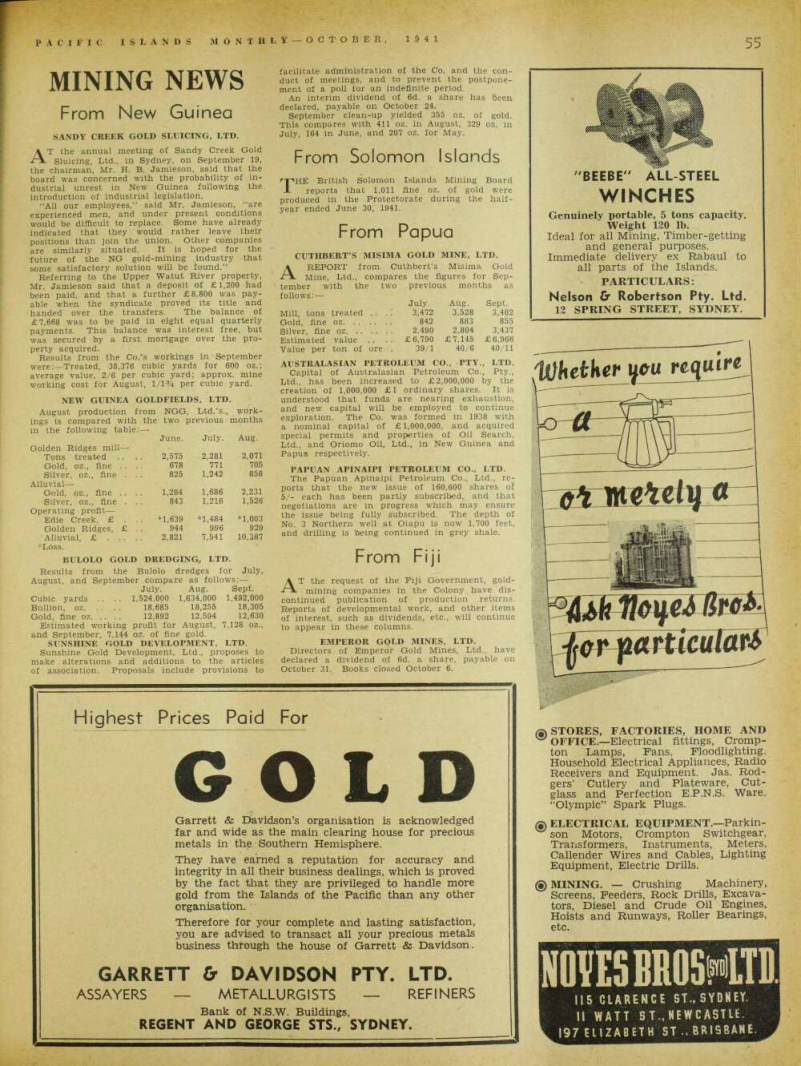
From New Guinea
Sandy Creek Gold Sluicing, Ltd.
AT the annual meeting of Sandy Creek Gold Sluicing, Ltd., in Sydney, on September 19, the chairman, Mr. H. B. Jamieson, said that the board was concerned with the probability of in dustrial unrest in New Guinea following the introduction of industrial legislation.
“All our employees,” said Mr. Jamieson, “are experienced men, and under present conditions would be difficult to replace. Some have already indicated that they would rather leave their positions than join the union. Other companies are similarly situated. It is hoped for the future of the NG gold-mining industry that some satisfactory solution will be found.”
Referring to the Upper Watut River property, Mr. Jamieson said that a deposit of £1,200 had been paid, and that a further £B,BOO was pay able when the syndicate proved its title and handed over the transfers. The balance of £7,668 was to be paid in eight equal quarterly payments. This balance was interest free, but was secured by a first mortgage over the pro perty acquired.
Results from the Co.’s workings in September were; —Treated, 38,376 cubic yards for 600 oz.; average value, 2/6 per cubic yard; approx, mine working cost for August, 1/1% per cubic yard.
New Guinea Goldfields, Ltd.
August production from NGG, Ltd.’s., work ings is compared with the two previous months in the following table; —
Bulolo Gold Dredging, Ltd.
Results from the Bulolo dredges for July, August, and September compare as follows:
Sunshine Gold Development, Ltd.
Sunshine Gold Development, Ltd., proposes to make alterations and additions to the articles of association. Proposals include provisions to
facilitate administration of the Co. and the con duct of meetings, and to prevent the postpone ment of a poll for an indefinite period.
An interim dividend of 6d. a share has been declared, payable on October 24.
September clean-up yielded 355 oz. of gold.
This compares with 411 oz. in August, 329 oz. in July, 164 in June, and 207 oz. for May.
From Solomon Islands
THE British Solomon Islands Mining Board reports that 1,011 fine oz. of gold were produced in the Protectorate during the half year ended June 30, 1941.
From Papua
Cuthbert’S Misima Gold Mine, Ltd.
A REPORT from Cuthbert’s Misima Gold Mine, Ltd., compares the figures for Sep tember with the two previous months as follows: —
Australasian Petroleum Co., Pty., Ltd.
Capital of Australasian Petroleum Co., Pty., Ltd., has been increased to £2,000,000 by the creation of 1,000,000 £1 ordinary shares. It is understood that funds are nearing exhaustion, and new capital will be employed to continue exploration. The Co. was formed in 1938 with a nominal capital of £ 1,000,000, and acquired special permits and properties of Oil Search, Ltd., and Oriomo Oil, Ltd., in New Guinea and Papua respectively.
Papuan Apinaipi Petroleum Co., Ltd.
The Papuan Apinaipi Petroleum Co., Ltd., re ports that the new issue of 160,600 shares of 5/- each has been partly subscribed, and that negotiations are in progress which may ensure the issue being fully subscribed. The depth of No. 3 Northern well at Oiapu is now 1,700 feet, and drilling is being continued in grey shale.
From Fiji
AT the request of the Fiji Government, gold mining companies in the Colony have dis continued publication of production returns.
Reports of developmental work, and other items of interest, such as dividends, etc., will continue to appear in these columns.
Emperor Gold Mines, Ltd.
Directors of Emperor Gold Mines, Ltd., have declared a dividend of 6d. a share, payable on October 31. Books closed October 6.
June.
July.
Aug.
Golden Ridges mill — Tons treated 2,575 2,281 2,071 Gold, oz., fine .. 678 771 705 Silver, oz., fine . .. 825 1,242 858 Alluvial — Gold, oz., fine .. 1,284 1,686 2,231 Silver, oz., fine . .. 843 1,216 1,526 Operating profit— Edie Creek, £ . ♦1,639 ♦1,484 ♦1,003 Golden Ridges, £ . . 944 996 929 Alluvial, £ 2,821 7,541 10,387 ♦Loss.
July. Aug. Sept.
Cubic yards . . 1,524,000 1,634,000 1,492,000 Bullion, oz 18,685 18,255 18,305 Gold, fine oz 12,892 12,594 12,630 Estimated working profit for August, 7,128 oz., and September, 7,144 oz. of fine gold.
July.
Aug.
Sept.
Mill, tons treated .. 3,472 3,528 3,402 Gold, fine oz 842 883 855 Silver, fine oz 2.490 2,804 3,437 Estimated value £6,790 £7,145 £6,966 Value per ton of ore . 39/1 40/6 40/11
Advertisements & other items, pp. 57-58 (1 item)
Gold
"BEEBE" ALL-STEEL
WINCHES
Genuinely portable, 5 tons capacity.
Weight 120 lb.
Ideal for all Mining, Timber-getting and general purposes.
Immediate delivery ex Rabaul to all parts of the Islands.
PARTICULARS:
Nelson Cr Robertson Pty. Ltd.
12 SPRING STREET, SYDNEY.
iOhether yeu require
hVoye* fire*
/» STORES, FACTORIES, HOME AND
OFFlCE.—Electrical fittings, Crompton Lamps, Fans, Floodlighting.
Household Electrical Appliances, Radio Receivers and Equipment. Jas. Rodgers’ Cutlery and Plateware, Cutglass and Perfection E.P.N.S. Ware.
“Olympic” Spark Plugs.
(5) ELECTRICAL EQUIPMENT.—Parkin-
w son Motors, Crompton Switchgear, Transformers, Instruments, Meters, Callender Wires and Cables, Lighting Equipment, Electric Drills. (5) MINING. Crushing Machinery, Screens, Feeders, Rock Drills, Excavators, Diesel and Crude Oil Engines, Hoists and Runways, Roller Bearings, etc.
NOVESBROShLTD.
lIS CLARENCE ST., SYDNEY.
II WATT ST.,NEWCASTLE.
L 197 ELIZABETH ST BRISBANE, i
Highest Prices Paid For
GOLD
Garrett & Davidson’s organisation is acknowledged far and wide as the main clearing house for precious metals in the Southern Hemisphere.
They have earned a reputation for accuracy and integrity in all their business dealings, which is proved by the fact that they are privileged to handle more gold from the Islands of the Pacific than any other organisation.
Therefore for your complete and lasting satisfaction, you are advised to transact all your precious metals business through the house of Garrett & Davidson.
GARRETT & DAVIDSON PTY. LTD.
ASSAYERS METALLURGISTS REFINERS
Bank of N.S.W. Buildings,
REGENT AND GEORGE STS., SYDNEY.
'k
TELERADIO 3B
Protect your business and personal interests by installing Teleradio 3B Radio-Telephone communication apparatus. . . . Instantaneous contact with the outside world has become a necessity in households beyond the reach ol landlines . . , not only to expedite business transactions but to provide a means oi acquiring medical or other service in times ol emergency.
A.W.A. Radio Stations at Suva, Rabaul, Pt.
Moresby and other Island Centres will be glad to supply information on this equipment.
AMALGAMATED WIRELESS (A'SU) LIMITED
47 YORK STREET, SYDNEY, AUSTRALIA
Von Spee’S Pacific Raiders
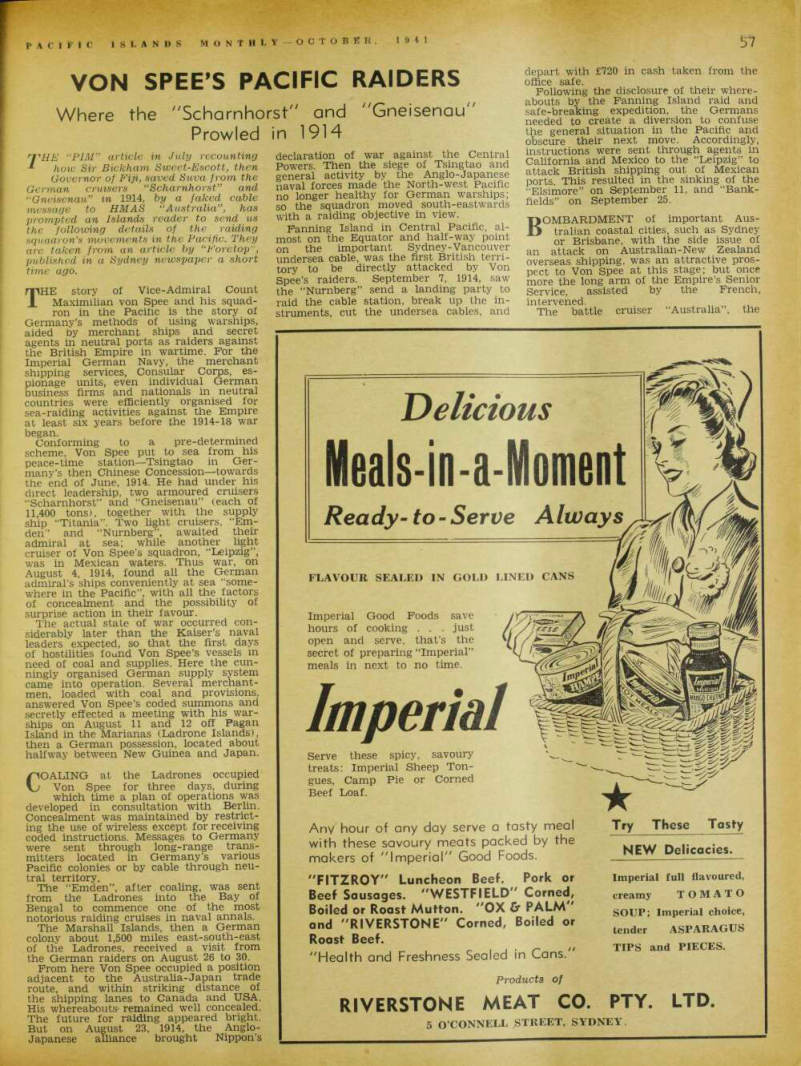
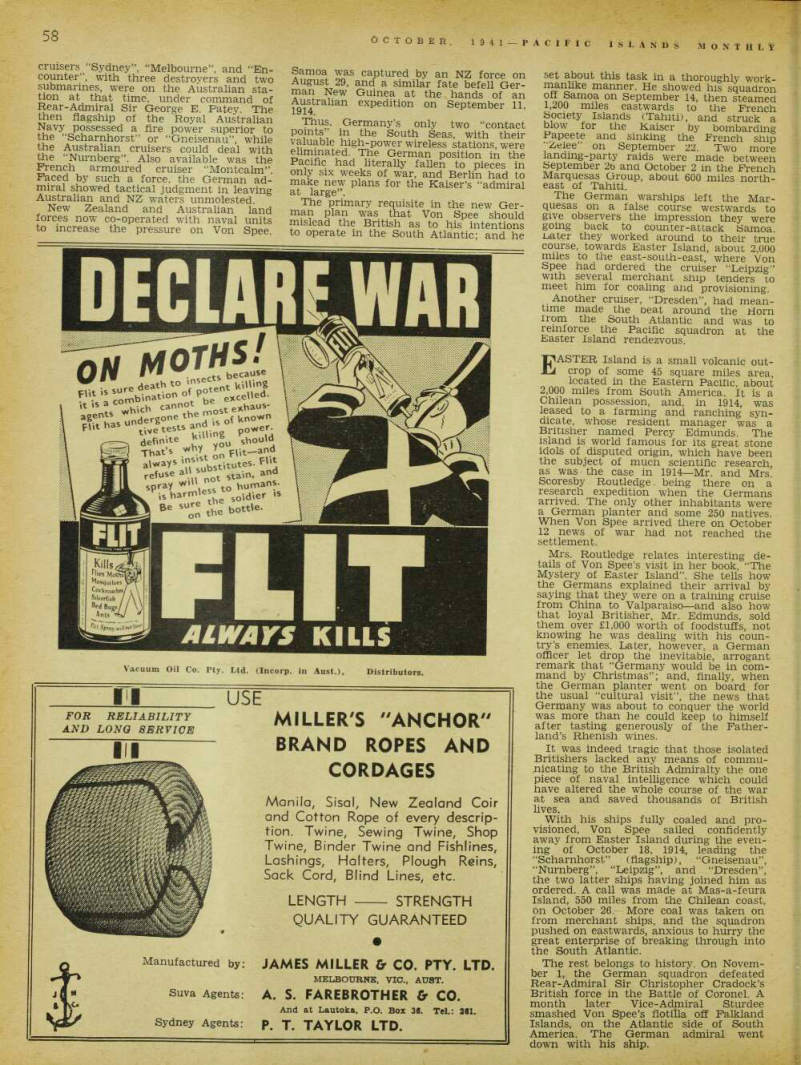
Where the "Scharnhorst" and "Gneisenau"
Prowled in 1914
7^ HE “ PIM” article in July recounting how Sir Bickham Sweet-Escott , then Governor of Fiji , saved Suva from the German cruisers “Scharnhorst” and “ Gneisenau” in 1914, by a faked cable message to HMAS “Australia”, has prompted an Islands reader to send us the following details of the raiding squaaron’s movements in the Pacific. They are taken from an article by “Foretop", published in a Sydney newspaper a short time ago.
THE story of Vice-Admiral Count Maximilian von Spee and his squad ron in the Pacific is the story of Germany’s methods of using warships, aided by merchant ships and secret agents in neutral ports as raiders against the British Empire in wartime. For the Imperial German Navy, the merchant shipping services. Consular Corps, es pionage units, even individual German business firms and nationals in neutral countries were efficiently organised for sea-raiding activities against the Empire at least six years before the 1914-18 war began.
Conforming to a pre-determined scheme, Von Spee put to sea from his peace-time station—Tsingtao in Ger many’s then Chinese Concession—towards the end of June, 1914. He had under his direct leadership, two armoured cruisers “Scharnhorst” and “Gneisenau” (each of 11,400 tons), together with the supply ship “Titania”. Two light cruisers, “Em den” and “Nurnberg”, awaited their admiral at sea; while another light cruiser of Von Spec’s squadron, “Leipzig”, was in Mexican waters. Thus war, on August 4, 1914, found all the German admiral’s ships conveniently at sea “some where in the Pacific”, with all the factors of concealment and the possibility of surprise action in their favour.
The actual state of war occurred con siderably later than the Kaiser’s naval leaders expected, so that the first days of hostilities found Von Spec’s vessels m need of coal and supplies. Here the cun ningly organised German supply system came into operation. Several merchant men, loaded with coal and provisions, answered Von Spec’s coded summons and secretly effected a meeting with his war ships on August 11 and 12 off Pagan Island in the Marianas (Ladrone Islands), then a German possession, located about halfway between New Guinea and Japan.
COALING at the Ladrones occupied Von Spee for three days, during which time a plan of operations was developed in consultation with Berlin.
Concealment was maintained by restrict ing the use of wireless except for receiving coded instructions. Messages to Germany were sent through long-range trans mitters located in Germany’s various Pacific colonies or by cable through neu tral territory.
The “Emden”, after coaling, was sent from the Ladrones into the Bay of Bengal to commence one of the most notorious raiding cruises in naval annals.
The Marshall Islands, then a German colony about 1,500 miles east-south-east of the Ladrones, received a visit from the German raiders on August 26 to 30.
From here Von Spee occupied a position adjacent to the Australia-Japan trade route, and within striking distance of the shipping lanes to Canada and USA.
His whereabouts remained well concealed.
The future for raiding appeared bright.
But on August 23, 1914, the Anglo- Japanese alliance brought Nippon’s
declaration of war against the Central Powers. Then the siege of Tsingtao and general activity by the Anglo-Japanese naval forces made the North-west Pacific no longer healthy for German warships; so the squadron moved south-eastwards with a raiding objective in view.
Fanning Island in Central Pacific, al most on the Equator and half-way point on the important Sydney-Vancouver undersea cable, was the first British terri tory to be directly attacked by Von Spec’s raiders. September 7, 1914, saw the “Nurnberg” send a landing party to raid the cable station, break up the in struments, cut the undersea cables, and
depart with £720 in cash taken from the Following the disclosure of their where abouts by the Fanning Island raid and safe-breaking expedition, the Germans needed to create a diversion to confuse the general situation in the Pacific and obscure their next move. Accordingly, instructions were sent through agents in California and Mexico to the “Leipzig” to attack British shipping out of Mexican ports. This resulted in the sinking of the “Elsimore” on September 11, and “Bank fields” on September 25.
BOMBARDMENT of important Aus tralian coastal cities, such as Sydney or Brisbane, with the side issue of an attack on Australian-New Zealand overseas shipping, was an attractive pros pect to Von Spee at this stage; but once more the long arm of the Empire’s Senior Service, assisted by the French,
intervened. , .
The battle cruiser “Australia”, the
cruisers “Sydney”, “Melbourne”, and “En counter”, with three destroyers and two submarines, were on the Australian sta tion at that time, under command of Rear-Admiral Sir George E. Patey. The then flagship of the Royal Australian Navy possessed a fire power superior to the “Scharnhorst” or “Gneisenau”, while the Australian cruisers could deal with the “Nurnberg”. Also available was the French armoured cruiser “Montcalm”.
Faced by such a force, the German ad miral showed tactical judgment in leaving Australian and NZ waters unmolested.
New Zealand and Australian land forces now co-operated with naval units to increase the pressure on Von Spee.
Samoa was captured by an NZ force on August 29, and a similar fate befell Ger man New Guinea at the hands of an Australian expedition on September 11, Thus, Germany’s only two “contact points in the South Seas, with their valuable high-power wireless stations, were eliminated. The German position in the Pacific had literally fallen to pieces in only six weeks of war, and Berlin had to make new plans for the Kaiser’s “admiral at large”.
The primary requisite in the new Ger man plan was that Von Spee should mislead the British as to his intentions to operate in the South Atlantic; and he
set about this task in a thoroughly work manllke manner. He showed his squadron ?o n « amoa on September 14, then steamed 1,200 miles eastwards to the French Society Islands (Tahiti), and struck a blow for the Kaiser by bombarding Papeete and sinking the French ship "Zeiee” on September 22. Two more landing-party raids were made between September 26 and October 2 in the French Marquesas Group, about 600 miles north east of Tahiti.
The German warships left the Mar quesas on a false course westwards to give observers the impression they were going back to counter-attack Samoa. i-.ater they worked around to their true course, towards Easter Island, about 2,000 miles to the east-south-east, where Von Spee had ordered the cruiser “Leipzig” with several merchant ship tenders to meet him for coaling and provisioning.
Another cruiser, “Dresden”, had mean time made the Peat around the Horn from the South Atlantic and was to reinforce the Pacific squadron at the Easter Island rendezvous.
EASTER Island is a small volcanic out crop of some 45 square miles area, located in the Eastern Pacific, about 2,000 miles from South America. It is a Chilean possession, and, in 1914, was leased to a farming and ranching syn dicate, whose resident manager was a Britisher named Percy Edmunds. The island is world fanupus for its great stone idols of disputed origin, which have been the subject of much scientific research, as was the case in 1914—Mr. and Mrs Scoresby Routledge being there on a research expedition when the Germans arrived. The only other inhabitants were a German planter and some 250 natives.
When Von Spee arrived there on October 12 news of war had not reached the settlement.
Mrs. Routledge relates interesting de tails of Von Spec’s visit in her book, “The Mystery of Easter Island”. She tells how the Germans explained their arrival by saying that they were on a training cruise from China to Valparaiso—and also how that loyal Britisher, Mr. Edmunds, sold them over £l,OOO worth of foodstuffs, not knowing he was dealing with his coun try’s enemies. Later, however, a German officer let drop the inevitable, arrogant remark that “Germany would be in com mand by Christmas”; and, finally, when the German planter went on board for the usual “cultural visit”, the news that Germany was about to conquer the world was more than he could keep to himself after tasting generously of the Father land’s Rhenish wines.
It was indeed tragic that those isolated Britishers lacked any means of commu nicating to the British Admiralty the one piece of naval intelligence which could have altered the whole course of the war at sea and saved thousands of British lives.
With his ships fully coaled and pro visioned, Von Spee sailed confidently away from Easter Island during the even ing of October 18, 1914, leading the “Scharnhorst” (flagship), “Gneisenau”, “Nurnberg”, “Leipzig”, and “Dresden”, the two latter ships having joined him as ordered. A call was made at Mas-a-feura Island, 550 miles from the Chilean coast, on October 26. More coal was taken on from merchant ships, and the squadron pushed on eastwards, anxious to hurry the great enterprise of breaking through into the South Atlantic.
The rest belongs to history. On Novem ber 1, the German squadron defeated Rear-Admiral Sir Christopher Cradock’s British force in the Battle of Coronel. A month later Vice-Admiral Sturdee smashed Von Spec’s flotilla off Falkland Islands, on the Atlantic side of South America. The German admiral went down with his ship.
Advertisements & other items, pp. 59-60 (2 items)
Imperial
Delicious
Meals-in-a-Moment
Ready-to-Serve Always
FLAVOUR SEALED IN GOLD LINED CANS
Imperial Good Foods save hours of cooking . . . just open and serve, that’s the secret of preparing “Imperial” meals in next to no time.
Imperial
Serve these spicy, savoury treats: Imperial Sheep Tongues, Camp Pie or Corned Beef Loaf.
Any hour of any day serve a tasty meal with these savoury meats packed by the makers of "Imperial" Good Foods. % {%% t. Vk m JA "Vo sss £5 & Tasty These NEW Delicacies.
"FITZROY" Luncheon Beef. Pork or Beef Sausages. "WESTFIELD" Corned, Boiled or Roast Mutton. "OX & PALM ' and "RIVERSTONE" Corned, Boiled or Roast Beef.
"Health and Freshness Sealed in Cans."
Imperial full flavoured, creamy TOMATO SOUP; Imperial choice, tender ASPARAGUS
TIPS and PIECES.
Products of
RIVERSTONE MEAT CO. PTY. LTD.
5 O’CONNELL STREET, SYDNEY.
ON MOTHSI
Combination ooi 0 oi
it is a w\ch cannot e *haus- (k „own —3, definite Jo" * should That’s *ny * pr,t—and always ‘"Substitutes. F"‘ refuse a" su “ st aio, and spray ' wll to humans, is harmless t dier IS *« SU o r n the bottle.
KiUs p lies MotSs( Mosquitoes ' Cockroaches/ Silverfish n "lpraymlh*& r
ALWAYS KILLS
Vacuum Oil Co. Pty. Ltd. (Incorp. in Aust.), Distributors.
II
FOR RELIABILITY
AND LONG SERVICE
USE
MILLER'S "ANCHOR"
BRAND ROPES AND
CORDAGES
Manila, Sisal, New Zealand Coir and Cotton Rope of every description. Twine, Sewing Twine, Shop Twine, Binder Twine and Fishlines, Lashings, Halters, Plough Reins, Sack Cord, Blind Lines, etc.
LENGTH
STRENGTH
QUALITY GUARANTEED
Manufactured by: Suva Agents: Sydney Agents:
JAMES MILLER Cr CO. PTY. LTD.
MELBOURNE, VIC., AUST.
A. S. FAREBROTHER Cr CO.
And at Lautoka, P.O. Box 38. Tel.; 261.
P. T. TAYLOR LTD.
58
OCTOBER, IHI-PACIHC ISLANDS M6Nt fi t$
They Come, They Go!
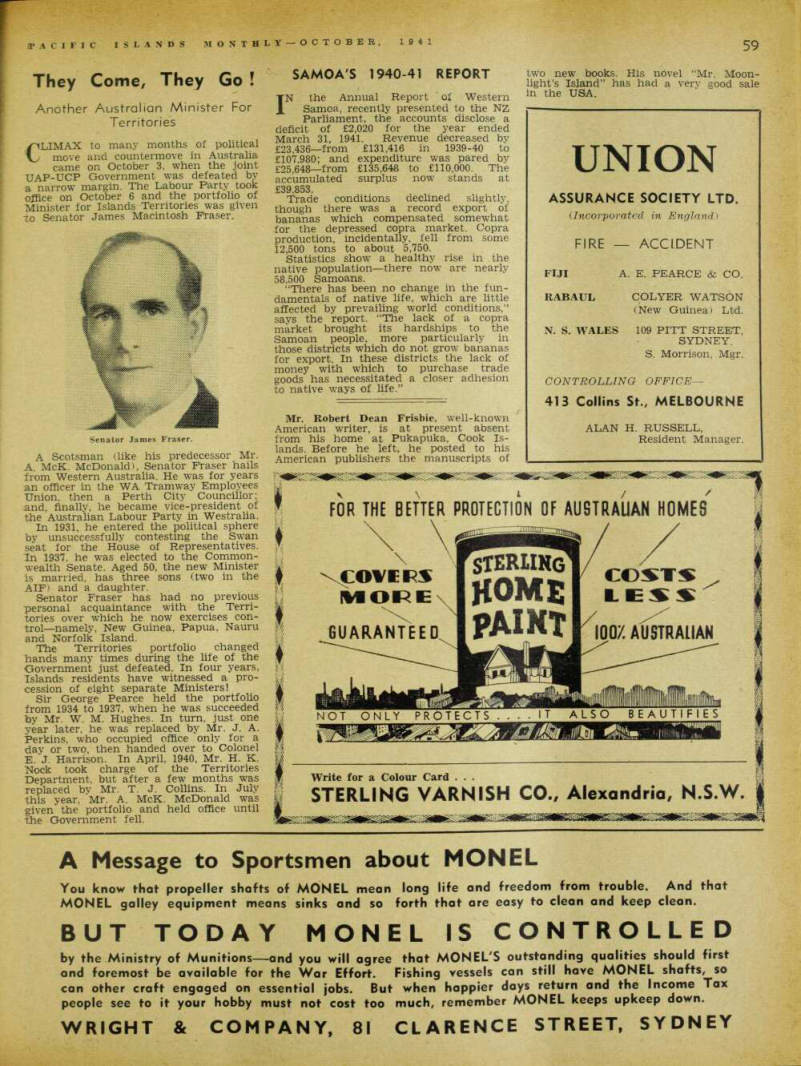
Another Australian Minister For Territories
CLIMAX to many months of political move and countermove in Australia came on October 3, when the joint UAP-UCP Government was defeated by a narrow margin. The Labour Party took office on October 6 and the portfolio of Minister for Islands Territories was given to Senator James Macintosh Fraser.
A Scotsman (like his predecessor Mr.
A McK. McDonald), Senator Fraser hails from Western Australia. He was for years an officer in the WA Tramway Employees Union, then a Perth City Councillor; and, finally, he became vice-president of the Australian Labour Party in Westralia.
In 1931, he entered the political sphere by unsuccessfully contesting the Swan seat for the House of Representatives.
In 1937. he was elected to the Common wealth Senate. Aged 50, the new Minister Is married, has three sons (two in the AIF) and a daughter.
Senator Fraser has had no previous personal acquaintance with the Terri tories over which he now exercises con trol—namely, New Guinea, Papua, Nauru and Norfolk Island.
The Territories portfolio changed hands many times during the life of the Government just defeated. In four years, Islands residents have witnessed a pro cession of eight separate Ministers!
Sir George Pearce held the portfolio from 1934 to 1937, when he was succeeded by Mr. W. M. Hughes. In turn, just one year later, he was replaced by Mr. J. A.
Perkins, who occupied office only for a day or two, then handed over to Colonel E. J, Harrison. In April, 1940, Mr. H. K.
Nock took charge of the Territories Department, but after a few months was replaced by Mr. T. J. Collins. In July this year. Mr. A. McK. McDonald was given the portfolio and held office until the Government fell.
Senator James Fraser.
Samoa's 1940-41 Report
IN the Annual Report ol Western Samoa, recently presented to the NZ Parliament, the accounts disclose a deficit of £2,020 for the year ended March 31, 1941. Revenue decreased by £23,436—fr0m £131,416 in 1939-40 to £107,980; and expenditure was pared by £25,648 —from £135,64)8 to £llO,OOO. The accumulated surplus now stands at £39 853.
Trade conditions declined slightly, though there was a record export of bananas which compensated somewhat for the depressed copra market. Copra production, incidentally, fell from some 12,500 tons to about 5,750.
Statistics show a healthy rise in the native population—there now are nearly 58,500 Samoans.
“There has been no change in the fun damentals of native life, which are little affected by prevailing world conditions,” says the report. “The lack of a copra market brought its hardships to the Samoan people, more particularly in those districts which do not grow bananas for export. In these districts the lack of money with which to purchase trade goods has necessitated a closer adhesion to native ways of life.”
Mr. Robert Dean Frisbie. well-known American writer, is at present absent from his home at Pukapuka, Cook Is lands. Before he left, he posted to his American publishers the manuscripts of
two new books. His novel “Mr. Moon light’s Island” has had a very good sale in U ® A *
Advertisements & other items, pp. 61-62 (1 item)
Home
UNION
ASSURANCE SOCIETY LTD.
(Incorporated in England)
FIRE ACCIDENT
FIJI A. E. PEARCE & CO.
RABAUL COLYER WATSON
(New Guinea) Ltd.
N. S. WALES 109 PITT STREET,
SYDNEY.
S. Morrison, Mgr.
CONTROLLING OFFICE —-
413 Collins St., MELBOURNE
ALAN H. RUSSELL.
Resident Manager.
FOR THE BETTER PROTECTION OF AUSTRALIAN HOMES" \
COVERS
MORE
COSTS
LESS
STERLING
HOME
PAINT
GUARANTEED
1007. AUSTRALIAN
Nm ONLY PRQTECTS ... I T ,-^ ■■Mil MllinOi Write for a Colour Card . . .
STERLING VARNISH CO., Alexandrio, N.S.W.
A Message to Sportsmen about MONEL
You know that propeller shafts of MONEL mean long life and freedom from trouble. And that MONEL galley equipment means sinks and so forth that ore easy to clean and keep clean.
BUT TODAY MONEL IS CONTROLLED
by the Ministry of Munitions—and you will agree that MONEL'S outstanding qualities should first and foremost be available for the War Effort. Fishing vessels can still have MONEL shafts, so can other craft engaged on essential jobs. But when happier days return and the Income Tax people see to it your hobby must not cost too much, remember MONEL keeps upkeep down.
WRIGHT & COMPANY, 81 CLARENCE STREET, SYDNEY
LEARN MORSE CODE. "LIKE-A-
FLASH” KITS. KEYS & BUZZERS.
P.M.G. type Key with Professional Buzzer <fe Battery, all assembled on Base Board, 42/6.
Morse Set Buzzer or light with single switch. All parts include adjustable Key, Switch, Buzzer, Lamp and Battery, all assembled on Base Board, 30/-.
Morse Code Set “De Luxe”. Adjustable High-grade Key, Buzzer and Battery. All mounted on base board ready for use, 27/6. -SL Adjustable Morse Code_ Key on Bakellte Base, highly plated parts. 12/6. High-grade instrument.
De Luxe Junior Morse Code Outfit.
Mounted Key Buzzer and Battery. 15/3 complete. Morse Book, 1/-.
P.M.G. Model Adjustable Morse Code Key. Precision fittings, 19/6. 39 6 Morse Code Light and Buzzer Set.
A precision De-luxe outfit that cannot be bettered. Perfect Adjustable Morse Code Key, with professional type Buzzer. Light to Buzzer throw-over Switch, and Battery, all ready mounted.
LEVENSON'S
SPECIALISE IN RADIO
SETS FOR THE ISLANDS
TRADE
100% satisfaction guaranteed.
Liberal prices—no mass production sets real he-man radio designed and built for your particular location. Short wave and dual wave radio for dry battery or electric current operation.
Quotations with pleasure.
Money Belts for Soldiers, Sailors or Civilians. Zipper Types, 9 6. Others, 6/6, 7/6.
Electric Military Brush, 15/-.
Stimulates the Scalp and Hair,
SAFETY RAZOR
BLADE
SHARPENER
Make your safety razor blade last for months with this Razor Blade Sharpener, 3/6, Easy to use—nothing to get out of order.
BOOKS! BOOKS! BOOKS! The Be-
ginners’ Bonk of Radio. The Radio Beginners’ Dictionary, f/- the t. The Wireless Constructor’s Encyclopaedia. Giant size, 7/6. Newnes “Everyman’s” Wireless Book, 6/6.
The Book of Practical Radio, also The Book of Practical Television, 8/6 each. Levenson’s Giant “Party and Fun Book”, 1/6. Humorous Stories and Recitatior), 3/9. Card and Conjuring Tricks, 3/9. Tea-Cup Fortune Telling, 3/9. 100 Party Games for Old and Young, 1/9.
Popular Magic and Amateur Conjurer, 1/9. 50 Best Party Games, 1/6. Tricks with Cards, 1/6.
How to make 1 & 2 valve Battery Sets, 1/-.
Aerial Stay-wire strainers, 2/6.
De Luxe Model British-built Lightning Arresters, complete for indoor or outdoor use, 6/-.
Non-Jam Pulleys with halyard bolt, 1/9. Special Radio Earth Spike 4/6. 4 in. 4 in 1 Nickel Screw Drivers, bakelite or metal, 2/-. . Fountain Pen size. Cone Speaker Units, 25/-; Now 12/6. 1,500 ft. Beam Electric Torches, 5 Cell, 8/6, Both use Standard Batteries. Everyman’s Wireles?
Book, 8/6. 2 to 3 Cell Expandable Torches.
Nickelled Case —Dimmer incorporated.
Daylight Globes, 10/6.
Swiss Music Boxes for Cigarette, Trinkets, etc., 25/-, 30/-, 45/-.
Steel Money and Deed Boxes, 63/-.
They ring when opened or lifted.
A Splendid Article.
Hunting and Sporting Knives. Remington U.S.A. made. 10/6, 12/6, 15/6. 16/6. (All in Sheath.) Throwing Knives, 8/9; Small Throwing Knives, 7/6; Set of 2, 15/-; Set of 3, 22/6; De Luxe Throw Knife. 21/-. All in Sheaths.
WORLD'S LATEST
GAMES
Darts Boards with 6 Darts, 8/6.
Play Brass Competition Darts, Set of 3, 3/11, 4/6, 5/6. Monopoly, 11/6.
Totopoly, 11/6. Bucaneer, 11/6. 3 of the World’s Most Popular Games.
Chinese Checkers, 2/9, 5/-, 9/-.
Tripoly Card Game , 5/3. De Luxe Type, 11/6. Poker Rummy, 1/1.
HEADPHONES.
12/6, 17/6.
S.T.C., British, 30/-; 8.T.H., 30/-; Llssen, British, 19/6. All 4,000 ohms.
Rubber Head-’phone Pads, 2/6 pr.
Erlccson’s Professional Type, 47/6.
A new hobby—Rough Castings of Modern Planes, Ash Trays, Paper Knives, etc., etc. Write for Free Booklet.
New Radio and Other Books Just Landed. Everyman’s Wireless Book, 8/6; Toy Making for Amateurs, 2/-; Sixty Tested Circuits, 6/6; How to Make Models, 2/6; The First Course in Wireless, 9/6; Wireless Terms Explained, 6/6.
B.G.E. Table Model Microphone for Speech or Music—fits and suits all sets; as good a performer as any; £6/6/- Model. Now 45/-.
Small Table Model British Built Microphone, for all sets, 15/-, 21/-, 22/6, for speech or music. 2 Reading Pocket Volt Meters, 5/6.
Portable battery operated Light with pull switch and Battery Block, s/e.
SPECIAL! SPECIAL!
Cosmocord Crystal Pickup.
British manufacture.
List Price 84 - Now 49/6 Special price to traders, lots of 6 or more.
COSMOCORD CRYSTAL TYPE
BRITISH BUILT AND DESIGNED
GRAMOPHONE PICK-UP DE LUXE,
with volume control built in as illustrated, 59/6.
AMPLION British built Gramo- Radio Pick-up with volume control.
Moulded bakelite tone arm. List Price 37/6. Now 32/6. Dealers write for wholesale price.
COLLARD Spring Gramophone Motor and Turntable, 27/6. ©
MAKE YOUR OWN RECORDINGS
Overhead Cutting Gear and Cutting Head for Home Radio-Gramophone Recording, £5/5/-. Used in conjunction with your present radio.
Records, Needles, etc., etc. Metal Discs, 1/-, 1/6.
Microphones for Speech, Song oi Music. Hook-up in a jiffy to anj set. 15/-, 17/6, 18/6 complete.
Batteryless Type Hand - holding Microphones, fit any set, 25/-.
Ormond 3 in. Front-panel Vernier Dial, 2 actions, 8/6.
RADIO VAUVES.—We guarantee a Better Price. Send yourorder.
ALL DRY BATTERIES STOCKED.
Wet Battery Testers, 3/-.
Nickel Cased Volt Meters, Pocket Type, 2 Reading, High & Low, 4 6.
British Make 3 Readings, 10/6. 12 Snappy Books —Jokes, Have Fun, etc., 5/6 the lot.
All About Aerial Booklet, 1-/. Radio Dictionary, 1/-. Morse Code Book, 1/-. Radio Alphabet, 1/-, The 4 books for 3/3.
Roulette Wheels, complete, 25/-.
The Best Trick Pack of Cards available, 3/6. Hundreds of Tricks you can do. Fullest, simple instructions provided.
Bench Type Meter Reads All in Radio, 30/-.
POCKET VOLT
METERS.
Two Reading Pocket Meter, for A and B Batteries, 3/9, 4/9, 7/6.
Reading, A and B Batteries, and up to 30 M A, 10/6. 3 Reading De Luxe Model, 12/6. 4 Reading, 14/-.
Now available (not less than 10/parcelst: Magic Wand, 1/6 Jafet’s Wallet 1/-; Obedient Ball 1/6; Magic Penny, 2/6; Mystic Head Chopper, 2/6; Shy Lock, 2/-; Dribble Glass, 2/-; Ventrillo, 1/-; Magic Coin, 1/- Nest of Nests, 5/-; Voice Echoer, 1/- Magic Bottle, 1/-; 3 Bell Trick, 1/- Magic Wand 1/6; Wonderful Rattle Box Trick, 2/6. Mixed Parcels of Tricks, 10/-, 20/-, 30/-. 40/-. 50/-.
Parcel of Jokes. 10/-, 12/6, 15/-.
Leather Money Belts, Splendid quality. Give waist measurement, when ordering, 9/6, 11/6 each. iiinmiiinnmnn) Write for Punch Board Leaflets
J.LEVENSON Radio
GAMES, NOVELTIES AND HOBBIES.
226 A PITT STREET, SYDNEY
nnnunniiiinmii Manufacturers, Importers, and Exporters.
N.S.W., AUSTRALIA.
mniiiiiiiiniiiiiiiiiii
Write for Pin-Game, Totem and Odds and Evens Leaflets Cable address: “Leveradioh”. Goods forwarded V.P.P. or Sight Draft. Satisfaction and Service Guaranteed. We can supply by mail all General Merchandise at a Better Price. Quotations with pleasure. Please add freight and packing. Write for full list of interesting leaflets of Games, Hobbies, Novelties, and Eleetrleal Goods. Write for full list of Radio Meters.
We Can Supply, at a Keen Price, Any Available Article You Require.
Australian Short Wave
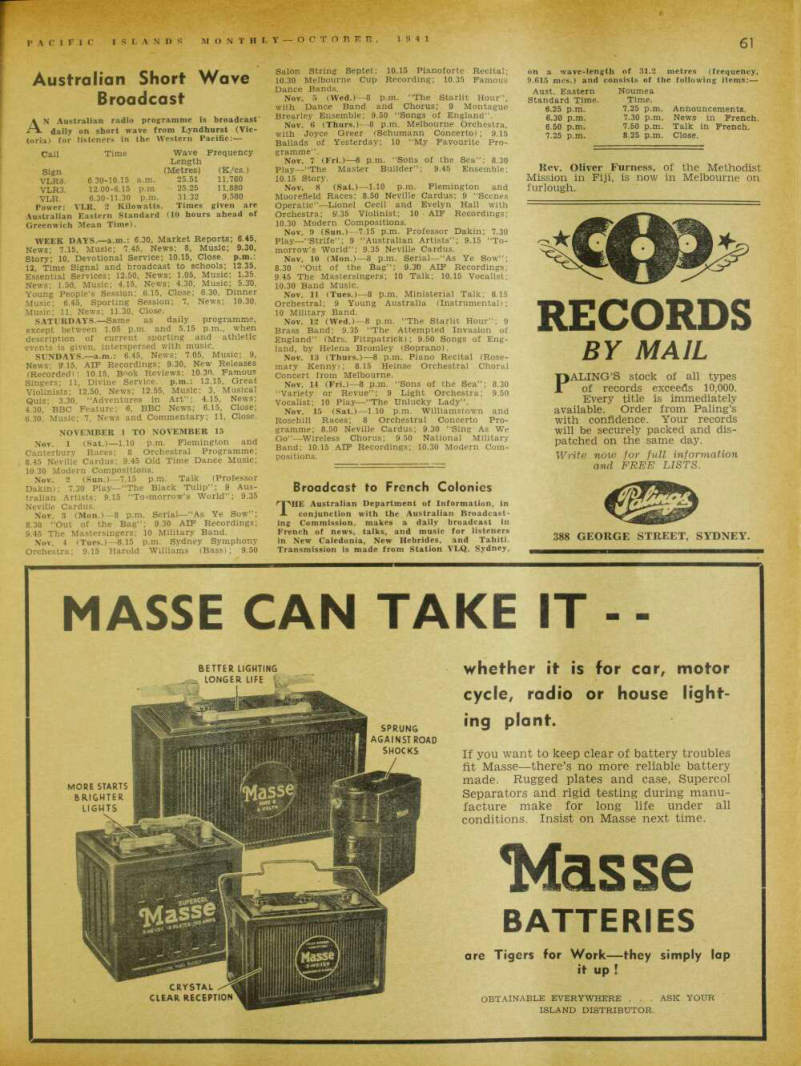
Broadcast
AN Australian radio programme is broadcast daily on short wave from Lyndhurst (Vic toria) for listeners in the Western Pacific:—
WEEK DAYS.—a.m.: 6.30, Market Reports; 6.45, News; 7.15, Music; 7.45, News; 8, Music; 9.30, Story; 10, Devotional Service; 10.15, Close, p.m.: 12, Time Signal and broadcast to schools; 12.35, Essential Services: 12.50, News; 1.05, Music; 1.35.
News; 1.50, Music; 4.15, News; 4.30, Music; 5.30, Young People’s Session; 6.15, Close; 6.30, Dinner Music; 6.45, Sporting Session; 7, News; 10.30, Music; 11, News; 11.30, Close.
SATURDAYS.—Same as daily programme, except between 1.05 p.m. and 5.15 p.m., when description of current sporting and athletic events is given, interspersed with music.
SUNDAYS.—a.m.: 6.45, News; 7.05, Music; 9, News; 9.15, AIF Recordings; 9.30, New Releases (Recorded!; 10.15, Book Reviews; 10.30. Famous Singers; 11, Divine Service, p.m.: 12.15, Great Violinists: 12.50, News; 12.55, Music; 3, Musical Quiz; 3.30, “Adventures in Art”; 4.15, News; 4.30, BBC Feature; 6, BBC News; 6.15, Close; 6.30, Music; 7, News and Commentary; 11, Close.
November 1 To November 15
Nov. 1 (Sat.) —1.10 p.m. Flemington and Canterbury Races; 8 Orchestral Programme: 8.45 Neville Cardus; 9.45 Old Time Dance Music; 10.30 Modern Compositions.
Nov. 2 (Sun.) —7.15 p.m. Talk (Professor Dakin); 7.30 Play—“ The Black Tulip”; 9 Aus tralian Artists: 9.15 “To-morrow’s World”; 9.35 Neville Cardus.
Nov. 3 (Mon.) —8 p.m. Serial—“As Ye Sow”; 8.30 “Out of the Bag”: 9.30 AIF Recordings; 9.45 The Mastersingers; 10 Military Band.
Nov. 4 (Tues.)—B.ls p.m. Sydney Symphony Orchestra: 9.15 Harold Williams (Bass); 9.50
Salon String Septet; 10.15 Pianoforte Recital; 10.30 Melbourne Cup Recording; 10.35 Famous Dance Bands.
Nov. 5 (Wed.) —8 p.m. “The Starlit Hour”, with Dance Band and Chorus; 9 Montague Brearley Ensemble; 9.50 “Songs of England”.
Nov. 6 (Thurs.) —8 p.m. Melbourne Orchestra, with Joyce Greer (Schumann Concerto); 9.15 Ballads of Yesterday; 10 “My Favourite Pro gramme”.
Nov. 7 (Fri.) —-8 p.m. “Sons of the Sea”; 8.30 Play—“ The Master Builder”; 9.45 Ensemble; 10.15 Story.
Nov. 8 (Sat.) —1.10 p.m. Plemington and Moorefield Races; 8.50 Neville Cardus; 9 “Scenes Operatic”—Lionel Cecil and Evelyn Hall with Orchestra; 9.35 Violinist; 10 AIF Recordings: 10.30 Modern Compositions.
Nov. 9 (Sun.) —7.15 p.m. Professor Dakin; 7.30 Play—“ Strife”; 9 “Australian Artists”; 9.15 “To morrow’s World”: 9.35 Neville Cardus.
Nov. 10 (Mon.) —8 p.m. Serial—“As Ye Sow”; 8.30 “Out of the Bag”; 9.30 AIF Recordings; 9.45 The Mastersingers; 10 Talk; 10.15 Vocalist; 10.30 Band Music.
Nov. II (Tues.) —8 p.m. Ministerial Talk; 8.15 Orchestral; 9 Young Australia (Instrumental); 10 Military Band.
Nov. 12 (Wed.) —8 p.m. “The Starlit Hour”; 9 Brass Band; 9.35 “The Attempted Invasion of England” (Mrs. Fitzpatrick): 9.50 Songs of Eng land, by Helena Bromley (Soprano).
Nov. 13 (Thurs.) —8 p.m. Piano Recital (Rose mary Kenny); 8.15 Heinze Orchestral Choral Concert from Melbourne.
Nov. 14 (Fri.) —8 p.m. “Sons of the Sea”; 8.30 “Variety or Revue”; 9 Light Orchestra; 9.50 Vocalist: 10 Play—“ The Unlucky Lady”.
Nov. 15 (Sat.) —1.10 p.m. Williamstown and RoSiehill Races: 8 Orchestral Concerto Pro gramme; 8.50 Neville Cardus; 9.30 “Sing As We Go” —Wireless Chorus; 9.50 National Military Band; 10.15 AIF Recordings; 10.30 Modern Com positions.
Call Time Wave Frequency Length Sign (Metres) (K/cs.)
Vlr8.
6.30-10.15 a.m. 25.51 11,760
Vlr3.
12.00-6.15 p.m 25.25 11,880
Vlr.
6.30-11.30 p.m. 31.32 9,580 Power: VLR, 2 Kilowatts, Times given are Australian Eastern Standard (10 hours ahead of Greenwich Mean Time).
Broadcast to French Colonies
THE Australian Department of Information, in conjunction with the Australian Broadcast ing Commission, makes a daily broadcast in French of news, talks, and music for listeners in New Caledonia, New Hebrides, and Tahiti.
Transmission is made from Station VLQ, Sydney,
on a wave-length of 31.2 metres (frequency, 9.615 mcs.) and consists of the following items:—
Rev. Oliver Furness, of the Methodist Mission in Fiji, is now in Melbourne on furlough.
Aust. Eastern Noumea Standard Time.
Time. 6.25 p.m. 7.25 p.m.
Announcements. 6.30 p.m. 7.30 p.m.
News in French. 6.50 p.m. 7.50 p.m.
Talk in French. 7.25 p.m. 8.25 p.m.
Close.
Advertisements & other items, pp. 63-64 (1 item)
'Masse
RECORDS
BY MAIL
PALING’S stock of all types of records exceeds 10,000.
Every title is immediately available. Order from Paling’s with confidence. Your records will be securely packed and dispatched on the same day.
Write now for full information
and FREE LISTS.
P \
388 GEORGE STREET, SYDNEY.
MASSE CAN TAKE IT - -
BETTER LIGHTING
... „ LONGER LIFE
MORE STARTS
BRIGHTER
LIGHTS
SPRUNG
AGAINST ROAD
SHOCKS
CRYSTAL
CLEAR RECEPTION
whether it is for car, motor
cycle, radio or house light-
ing plant.
If you want to keep clear of battery troubles fit Masse —there’s no more reliable battery made. Rugged plates and case, Supercol Separators and rigid testing during manufacture make for long life under all conditions. Insist on Masse next time.
'Masse
BATTERIES
are Tigers for Work—they simply lap
it up !
OBTAINABLE EVERYWHERE . . . ASK YOUR
IST. AND nTSTRTRTTTnR.
SURE , SAFE WAY TO
\ ntum
i£SSk
>AC
HEAT EXHAL
TROPICAL FEVERS
aM
ALL NERVE AND
\ x \
Hike meant m
mn comm/
/ When you take Genuine Vincent’s A.P.C. Powders or Tablets you are taking the original, scientific jrescription of Aspirin, Phenacetin and Caffeine as first used in one of Australia’s largest public hospitals. That is why you can be so confident of safer, more soothing relief from the pain of all tropical complaints. mS*.
Does Not Affect the Heart.
Powders & Tablets, 1/6 and 2/6.
Singles, 2d. ea
FOR SAFETY’S SAKE—SAY “VINCENT’S.
Unhealthy with
Flabby Fat
GOOD LOOKS AND FIGURE
VANISH
You can always tell the difference between good firm flesh and flabby fat.
There is always something so unhealthy and unattractive looking about fat. It is usually unhealthy and often gained through constipation. Waste matter clogs and congests the digestive tract, remains too long and gets absorbed into the blood stream. Sick headaches, pimply skin, biliousness, bad breath result and fat tissue forms, hiding your good looks and fine figure.
Constipation always responds to treatment with gentle Pinkettes. These tiny laxative pills are compounded of safe ingredients that have an exercising and strengthening influence on the bowels.
Pinkettes painlessly clear away the digestive wastes completely and regularly, help digestion and banish sick headache, bilious attacks, pimples and unhealthy fat. Get a bottle to-day and notice how fine and fit you feel after a few harmless doses. —***
Ng Miners
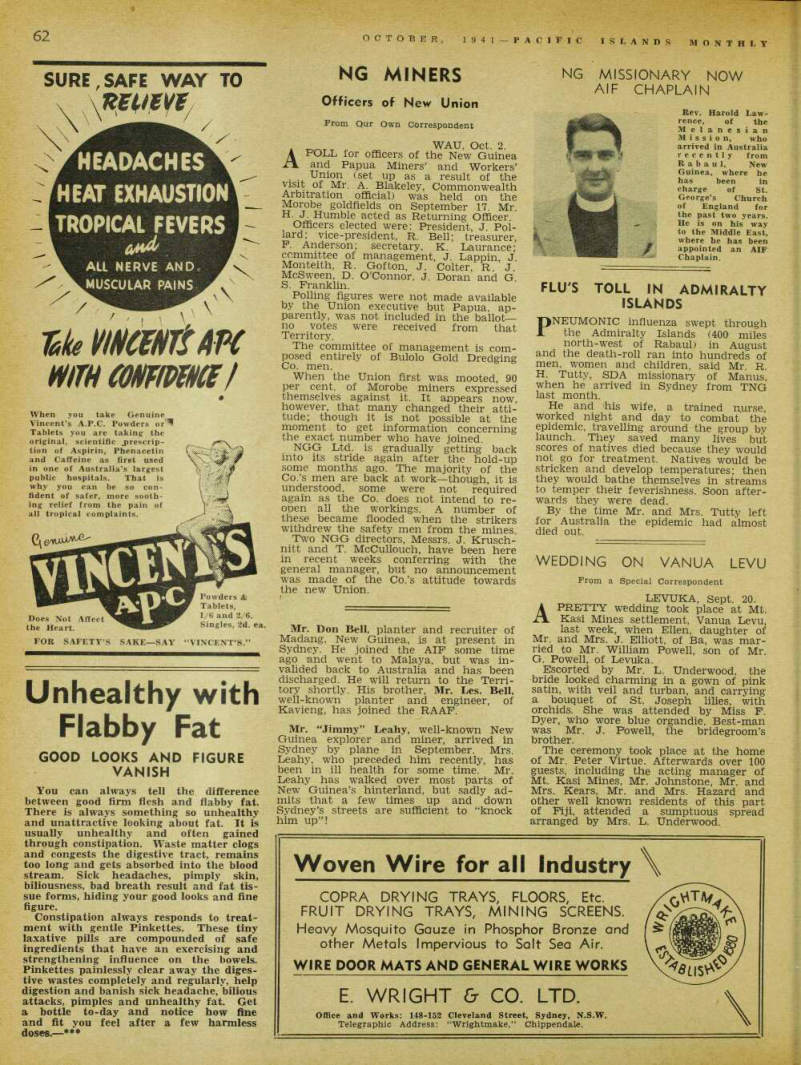
Officers of New Union
Prom Our Own Correspondent At^ t t WAU, Oct. 2.
POLL for officers of the New Guinea and Papua Miners’ and Workers’
Union (set up as a result of the Visit of Mr. A. Blakeley, Commonwealth Arbitration official) was held on the Morobe goldfields on September 17. Mr.
H. J. Humble acted as Returning Officer.
Officers elected were: President, J. Pol lard; vice-president, R. Bell; treasurer, F. Anderson; secretary, K. Laurance; committee of management, J. Lappin, J.
Monteith, R. Gofton, J. Colter, R J McSween, D. O’Connor, J. Doran and G S. Franklin.
Polling figures were not made available by the Union executive but Papua, ap parently, was not included in the ballot no votes were received from that Territory.
The committee of management is com posed entirely of Bulolo Gold Dredging Co. men.
When the Union first was mooted, 90 per cent, of Morobe miners expressed themselves against it. It anpears now, however, that many changed their atti tude; though it is not possible at the moment to get information concerning the exact number who have joined.
NGG Ltd. is gradually getting back into its stride again after the hold-up some months ago. The majority of the Co.'s men are back at work—though, it is understood, some were not required again as the Co. does not intend to re open all the workings. A number of these became flooded when the strikers withdrew the safety men from the mines.
Two NGG directors, Messrs. J. Krusch nitt and T. McCullouch, have been here in recent weeks conferring with the general manager, but no announcement was made of the Co.’s attitude towards the new Union, Mr. Don Bell, planter and recruiter of Madang, New Guinea, is at present in Sydney. He joined the AIF some time ago and went to Malaya, but was in valided back to Australia and has been discharged. He will return to the Terri tory shortly. His brother, Mr. Les. Bell, well-known planter and engineer, of Kavieng, has joined the RAAF.
Mr. “Jimmy” Leahy, well-known New Guinea explorer and miner, arrived in Sydney by plane in September. Mrs.
Leahy, who preceded him recently, has been in ill health for some time. Mr.
Leahy has walked over most parts of New Guinea’s hinterland, but sadly ad mits that a few times up and down Sydney’s streets are sufficient to “knock him up”!
Ng Missionary Now
Aif Chaplain
Rev. Harold Law rence, of the Melanesian Mission, who arrived in Australia recently from Rabaul, New Guinea, where he has been in charge of St.
George’s Church of England for the past two years.
He is on his way to the Middle East, where he has been appointed an AIF Chaplain.
Flu's Toll In Admiralty
Islands
PNEUMONIC influenza swept through the Admiralty Islands (400 miles north-west of Rabaul) in August and the death-roll ran into hundreds of men, women and children, said Mr. R.
H. Tutty, SDA missionary of Manus, when he arrived in Sydney from TNG last month.
He and 'his wife, a trained n,urse, worked night and day to combat the epidemic, travelling around the group bv launch. They saved many lives but scores of natives died because they would not go for treatment. Natives would be stricken and develop temperatures: then they would bathe themselves in streams to temper their feverishness. Soon after wards they were dead.
By the time Mr. and Mrs. Tutty left for Australia the epidemic had almost died out.
Wedding On Vanua Levu
From a Special Correspondent
Levuka, Sept. 20.
A PRETTY wedding took place at Mt. ii Kasi Mines settlement, Vanua Levu, last week, when Ellen, daughter of Mr. and Mrs. J. Elliott, of Ba, was mar ried to Mr. William Powell, son of Mr.
G. Powell, of Levuka.
Escorted by Mr. L. Underwood, the bride looked charming in a gown of pink satin, with veil and turban, and carrying a bouquet of St. Josenh lilies, with orchids. She was attended by Miss F.
Dyer, who wore blue organdie. Best-man was Mr, J, Powell, the bridegroom’s brother.
The ceremony took place at the home of Mr. Peter Virtue. Afterwards over 100 guests, including the acting manager of Mt. Kasi Mines, Mr. Johnstone, Mr. and Mrs. Kears, Mr. and Mrs. Hazard and other well known residents of this part of Fiji, attended a sumptuous spread arranged by Mrs. L. Underwood.
Advertisements & other items, p. 64 (1 item)
Woven Wire for all Industry
COPRA DRYING TRAYS, FLOORS, Etc.
FRUIT DRYING TRAYS, MINING SCREENS.
Heavy Mosquito Gauze in Phosphor Bronze and other Metals Impervious to Salt Sea Air.
WIRE DOOR MATS AND GENERAL WIRE WORKS f: r* £
E. WRIGHT & CO. LTD.
Office and Works: 148-152 Cleveland Street, Sydney, N.S.W.
Telegraphic Address: “Wrightmake,” Chippendale.
Libre!”
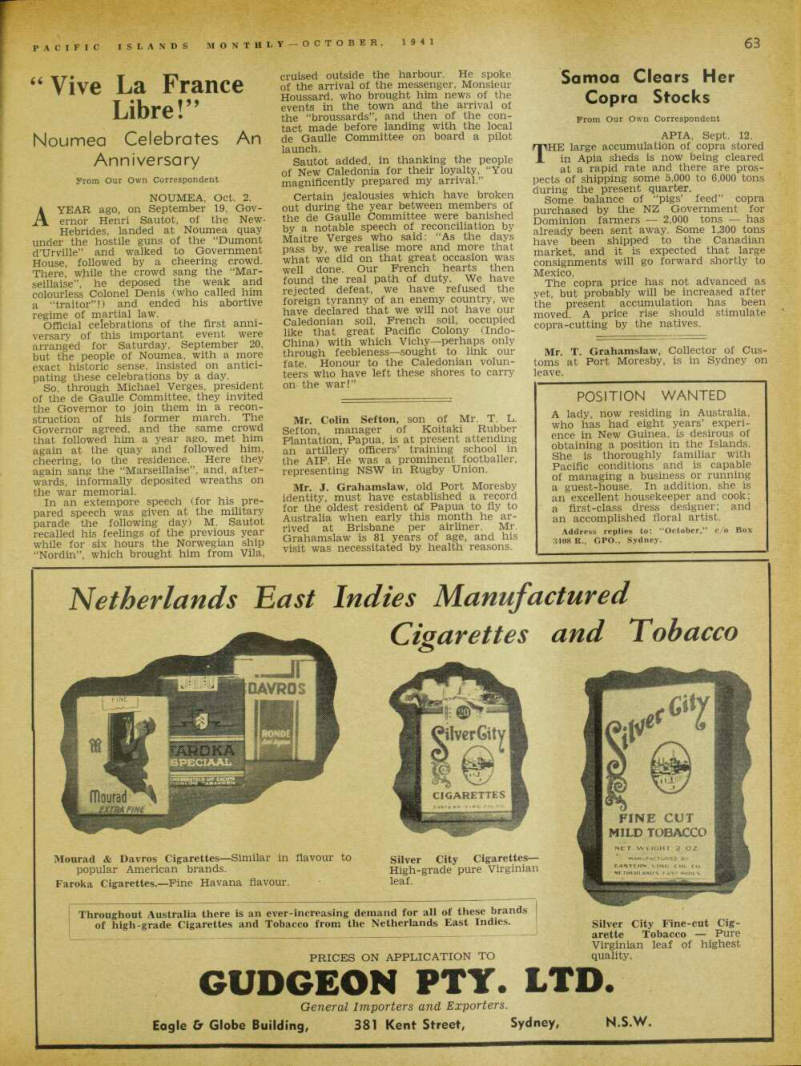
“Vive La France Libre!”
Noumea Celebrates An Anniversary
Prom Our Own Correspondent
Noumea, Oct. 2.
A YEAR ago, on September 19, Gov ernor Henri Sautot, of the New- Hebrides, landed at Noumea quay under the hostile guns of the “Dumont d’Urville” and walked to Government House, followed by a cheering crowd.
There, while the crowd sang the “Mar seillaise”, he deposed the weak and colourless Colonel Denis (who called him a “traitor”!) and ended his abortive regime of martial law.
Official celebrations of the first anni versary of this important event were arranged for Saturday, September 20, but the people of Noumea, with a more exact historic sense, insisted on antici pating these celebrations by a day.
So, through Michael Verges, president of the de Gaulle Committee, they invited the Governor to join them in a recon struction of his former march. The Governor agreed, and the same crowd that followed him a year ago, met him again at the quay and followed him, cheering, to the residence. Here they again sang the “Marseillaise”, and, after wards, informally deposited wreaths on the war memorial.
In an extempore speech (for his pre pared speech was given at the military parade the following day) M. Sautot recalled his feelings of the previous year while for six hours the Norwegian ship “Nordin”, which brought him from Vila,
cruised outside the harbour. He spoke of the arrival of the messenger, Monsieur Houssard, who brought him news of the events in the town and the arrival of the "broussards”, and then of the con tact made before landing with the local de Gaulle Committee on board a pilot launch.
Sautot added, in thanking the people of New Caledonia for their loyalty, “You
magnificently prepared my arrival.”
Certain jealousies which have broken out during the year between members of the de Gaulle Committee were banished by a notable speech of reconciliation by Maitre Verges who said: “As the days pass by, we realise more and more that what we did on that great occasion was well done. Our French hearts then found the real path of duty. We have rejected defeat, we have refused the foreign tyrannv of an enemy country, we have declared that we will not have our Caledonian soil, French soil, occupied like that great Pacific Colony (Indo china) with which Vichy—perhaps only through feebleness—sought to link our fate. Honour to the Caledonian volun teers who have left these shores to carry on the war!”
Mr. Colin Sefton, son of Mr. T. L.
Sefton, manager of Koitaki Rubber Plantation, Papua, is at present attending an artillery officers’ training school in the AIF. He was a prominent ftpotballer, representing NSW in Rugby Union.
Mr. J. Grahamslaw, old Port Moresby identity, must have established a record for the oldest resident o£ Papua to fly to Australia when early this month he ar rived at Brisbane per airliner. Mr.
Grahamslaw is 81 years of age, and his visit was necessitated by health reasons.
Copra Stocks
Samoa Clears Her Copra Stocks
Prom Our Own Correspondent APIA, Sept. 12.
THE large accumulation of copra stored in Apia sheds is now being cleared at a rapid rate and there are pros pects of shipping some 5,000 to 6,000 tons during the present quarter.
Some balance of “pigs’ feed” copra purchased by the NZ Government for Dominion farmers 2,000 tons has already been sent away. Some 1,300 tons have been shipped to the Canadian market, and it is expected that large consignments will go forward shortly to Mexico.
The copra price has not advanced as yet, but probably will be increased after the present accumulation has been moved. A price rise should stimulate copra-cutting by the natives.
Mr. T. Grahamslaw, Collector of Cus toms at Port Moresby, is in Sydney on leave.
Advertisements & other items, pp. 65-66 (1 item)
Gudgeon Pty. Ltd.
POSITION WANTED
A lady, now residing in Australia, who has had eight years’ experience in New Guinea, is desirous of obtaining a position in the Islands.
She is thoroughly familiar with Pacific conditions and is capable of managing a business or running a guest-house. In addition, she is an excellent housekeeper and cook; a first-class dress designer; and an accomplished floral artist.
Address replies to: “October,” c/o Box 3408 R.. GPO., Sydney.
Netherlands East Indies Manufactured
Cigarettes and Tohacco
DAVROS
(Tlourad
nm
IverCitv
CIGARETTES
Mourad & Davros Cigarettes— Similar in flavour to popular American brands.
Faroka Cigarettes.— Fine Havana flavour.
Silver City Cigarettes— High-grade pure Virginian leaf.
Throughout Australia there is an ever-increasing demand for all of these brands of high-grade Cigarettes and Tobacco from the Netherlands East Indies.
PRICES ON APPLICATION TO
cay
e' ■
FINE CUT
MILD TOBACCO
NET WEIGHT 2 OZ,
Silver City Fine-cut Cigarette Tobacco Pure Virginian leaf of highest quality.
GUDGEON PTY. LTD.
General Importers and Exporters.
Eagle & Globe Building, 381 Kent Street, Sydney, N.S.W.
There is no substitute for
OLD MONK
VIRGIN PURE
OLIVE OIL
San Francisco
7 THE VITAL STREAM!... As Austrolia forges her weapons of war amid the clamour and heat of tireless foundries, molten metal flows in a neverending stream ... Flaying an equally important part in their production is another vital stream-the stream of bank .credit... In providing finance for our ever-expanding war industries, the Bank of New South Wales occupies a front-line position in the economic defences of Australia
BANK OF NEW SOUTH WALES
THE FIRST BANK IN AUSTRALIA
usm 572 C
Islands Produce
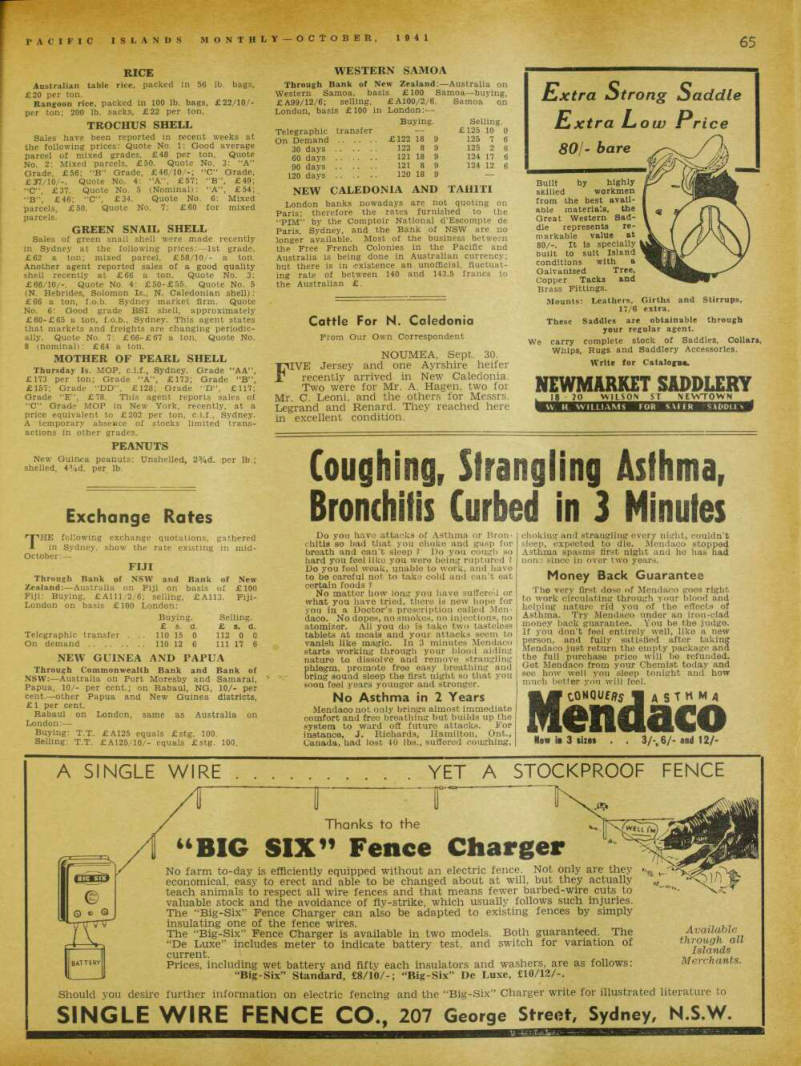
r I ''HE following quotations were obtained in A Sydney in mid-October:
Coffee
Java: Robusta, f.a.q., imported on firm conversion of exchange, c.i.f., prompt shipment, Sydney (Sterling): Quote No. 1: 48/3. Quote No. 2; 52/-.
Boengie (a good quality Java coffee), c.i.f., Sydney, 64/3.
Kenya, f.a.q., immediate shipment, c.i.f,,
Sy?, ne y. P e f ( cwt. (Stg.): Quote No. 1: Grade ■D , 72/-, ‘C”, 68/-.
EaSt ™ fri ® a: Robusta - f.a.q.. c.i.f., Sydney. 56/-. Mocha (Standard Billy) fan rif Sydney, 54/-.
Mysore, f.a.q., c.i.f., Sydney, per cwt. Quote "O”. 74/- “ A ”’ 84/ ‘ : Grade “ B ”’ 82/ " : Grade Arabian (Aden) Hodeidah, f.a.q., c.i.f. Svdnev No. 1 quotation: 82/-. y y ' Nti and Papua: Quote No. 1: 93/ a d. per lb. (delivered store, Sydney), medium quality.
Quote No. 2: 10V 4 d.-lld. per lb. (delivered store, nJr n m y w U °l e N °‘ 3: Sales recentl y at 9%d. per lb., c.i.f., Sydney. ° aledonia: The announcement recently that the New Caledonian Government intends to grade the Colony’s 1941-42 coffee crop is com merited upon favourably by Sydney agents. They state that this will have the effect of increasing prices once the Australian buyer is assured of a constant quality in the various grades of coffee.
At present New Caledonian coffee varies con siderably, And each parcel must be treated on its merits. Quotations from several different sources in October were:—Quote No; 1 (in store Sydney): Arabica, Grade “A”, liy 2 d-l/-- “B”’ 10 7 /sd.; Robusta, 9%d.-10d. Quote No 2’(cif’ & e„ Sydney): Robusta, 4d. per lb.; Arabica,’
Bd. per lb. Quote No. 3 (c.i.f., Sydney) ■ Arabica 8d per lb.; Robusta, 4d. per lb. Quote No. 4 (c.i.f., Sydney): Arabica, £56-£6O per ton; Robusta, £34-£4O per ton. Quote No 5 (c.i.f., Sydney): Robusta, £37-£39 per ton New Hebrides (c.i.f., Sydney): Quote No 1- £36 per ton. Quote No. 2: £37-£39 per ton Quote No. 3: £3O-£33 a ton (f.a.q.), c.i.f. and e‘ Sydney. (Note: Importers of all coffees—except NG and Papuan—pay additional charges, Including exchange, duty (4.4 d. lb.), primage (11 per cent.), landing costs (1/- per cwt.), war duty (10 per cent.)]
Vanilla Beans
Tahiti: Quote No. 1 (c. & f., Sydney); Approxi mate market price, white'label, 28/- a lb.; green label. 21/- a .lb. Quote No. 2 (c.i.f., Sydney): White label and yellow label, 32Z-32/6 per lb.
Quote No. 3; This agent reports a firm market for first-grade beans.
Kapok
Quote No. 1: Average Java 6-17/32d per lb c.i.f.; Prime Japara, 6-7/32d. per lb., c.i.f!
Quote No. 2: Average Java, 7 5 /ad., c.i.f.; Prime Japara, 7-15/16d., c.i.f. (Prices sterling and subject to exchange 25y 2 %, duty 2d. per lb., 10% primage, 10% war duty, wharfage.)
Ivory Nuts
Owing to war conditions, Sydney agents are not quoting for ivory nuts. The last quo tations, some months ago. Indicated that a nominal rate was in the vicinity of £7 per ton.
Cotton
New Caledonian, c.i.f.. Svdney. Quote No. 1* 9d. per lb. Quote No. 2: lOd.-lld. per lb. Quote No. 3 (delivered store, Sydney): lOd.-lld, (ap proximate market price) per lb.
Cocoa
New Guinea cocoa: Quote No. 1: £4B-£49 per ton—market rising. Quote No. 2: £52 per ton.
Accra (West Africa): £5O per ton (in Sydney).
New Hebrides cocoa (delivered store. Sydney): Quote No. 1; £5O per ton. Quote No. 2: £5O - per ton. Quote No. 3: Ist Grade, £47-£49 (according to quality) per ton, c.i.f., Sydney.
Quote No. 4: £5O-£52 per ton.
Western Samoan cocoa: Quote No. 1: Cocoa was sold in San Francisco (USA) recently at a price equivalent to £55 per ton, c.i.f., Sydney.
Quote No. 2: £6O per ton, c.i.f., Sydney. Quote No. 3; Price at Apia, September, £32/10/- per ton for small European lots.
Rice
Australian table rice, packed in 56 lb. bags, £2O per ton.
Rangoon rice, packed in 100 lb. bags, £22/10/per ton; 200 lb. sacks, £22 per ton.
Trochus Shell
Sales have been reported in recent weeks at the following prices: Quote No. 1: Good average parcel of mixed grades, £4B per ton. Quote No. 2: Mixed parcels, £5O. Quote No. 3: “A”
Grade, £56; “B” Grade, £46/10/-; “C” Grade, £317/10/-. Quote No. 4; “A”, £57; “B”, £49; “C”, £37. Quote No. 5 (Nominal): “A”, £54; “B”, £46; “C”, £34. Quote No. 6: Mixed parcels, £5O. Quote No. 7: £6O for mixed parcels.
Green Snail Shell
Sales of green snail shell were made recently in Sydney at the following prices:—lst grade, £62 a ton; mixed parcel, £5B/10/- a ton.
Another agent reported sales of a good quality shell recently at £66 a ton. Quote No. 3; £66/10/-. Quote No. 4: £5O-£55. Quote No. 5 (N. Hebrides, Solomon Is., N. Caledonian shell): £66 a ton, f.o.b. Sydney market firm. Quote No. 6: Good grade BSI shell, approximately £6O-£65 a ton, f.0.b., Sydney. This agent states that markets and freights are changing periodic ally. Quote No. 7: £66-£67 a ton. Quote No. 8 (nominal): £64 a ton.
Mother Of Pearl Shell
Thursday Is. MOP, c.i.f., Sydney. Grade “AA”, £173 per ton; Grade “A”, £l73’; Grade “B”, £157; Grade “DD”, £128; Grade “D”, £117; Grade “E”, £7B. This agent reports sales of “C” Grade MOP in New York, recently, at a price equivalent to £202 per ton, c.i.f., Sydney.
A temporary absence of stocks limited trans actions in other grades.
Peanuts
New Guinea peanuts: Unshelled, 2%d. per lb.; shelled, per lb.
Advertisements & other items, p. 66 (1 item)
Sailmaker
SYDNEY'S LEADING
and RIGGER
Also Manufacturer of all Canvas and Rope Work.
ISLANDS WORK a
Speciality.
HARRY WEST
Balmain East, Sydney. Tel.: WllO5
Exchange Rates
THE following exchange quotations, gathered in Sydney, show the rate existing in mid- October:—
Fiji
Through Bank of NSW and Bank of New Zealand:—Australia on Fiji on basis of £lOO Fiji; Buying, £Alll/2/6; selling, £AII3. Piji- London on basis £lOO London:
New Guinea And Papua
Through Commonwealth Bank and Bank of NSW: —Australia on Port Moresby and Samarai, Papua, 10/- per cent.; on Rabaul, NG, 10/- per cent.—other Papua and New Guinea districts, £1 per cent.
Rabaul on London, same as Australia on London:— Buying: T.T. £AI2S equals £stg. 100.
Selling: T.T. £AI2S/10/- equals £stg. 100.
Buying.
Selling. £ s. d. £ s. d.
Telegraphic transfer . .. 110 15 0 112 0 0 On demand .. 110 12 6 111 17 6
Western Samoa
Through Bank of New Zealand: —Australia on Western Samoa, basis £lOO Samoa—buying, £ A99/12/6; selling, £AIOO/2/6. Samoa on London, basis £lOO in London: —
New Caledonia And Tahiti
London banks nowadays are not quoting on Paris; therefore the rates furnished to the “PIM” by the Comptoir National d’Escompte de Paris, Sydney, and the Bank of NSW are no longer available. Most of the business between the Free French Colonies in the Pacific and Australia is being done in Australian currency: but there is in existence an unofficial, fluctuat ing rate of between 140 and 143.5 francs to the Australian £.
Buying. Selling.
Telegraphic transfer — £125 10 0 On Demand £122 18 9 125 7 6 30 days 122 8 9 125 2 6 60 days 121 18 9 124 17 6 90 days 121 8 9 124 12 6 120 days 120 18 9 —
Cattle For N. Caledonia
From Our Own Correspondent
Noumea, Sept. 30.
FIVE Jersey and one Ayrshire heifer recently arrived in New Caledonia.
Two were for Mr. A. Hagen, two for Mr. C. Leoni, and the others for Messrs.
Legrand and Renard. They reached here in excellent condition.
Advertisements & other items, p. 67 (1 item)
Mendaco
Extra Strong Saddle
Extra L
80/- bare
Built by highly skilled workmen from the best available materials, the Great Western Saddle represents remarkable value at 80/-. It is specially built to suit Island conditions with a Galvanised Tree, Copper Tacks and Brass Fittings. ow i rice Mounts: Leathers, Girths and Stirrups, 17/6 extra.
These Saddles are obtainable through your regular agent.
We carry complete stock of Saddles, Collars, Whips, Rugs and Saddlery Accessories.
Write for Catalogs*.
NEWMARKET SADDLERY
18 20 WiLSON ST NEWTOWN
VV H WILLIAMS FOR VXIIR SADPIts
Coughing, Strangling Asthma, Bronchitis Curbed in 3 Minutes
Do you have attacks of Asthma or Bronchitis 'so bad that you choke and gasp for breath and can’t sleep ? Do you cough so hard you feel like you were being ruptured ?
Do you feel weak, unable to work, and have to be careful not to take cold and can’t eat certain foods ?
No matter how long you have suffered or what you have tried, there is new hope for you in a Doctor’s prescription called Mendaco. No dopes, no smokes, no injections, no atomizer. All you do is take two tasteless tablets at meals and your attacks seem to vanish like magic. In 3 minutes Mendaco starts working through your blood aiding nature to dissolve and remove strangling phlegm, promote free easy breathing and bring sound sleep the first night so that you soon feel years younger and stronger.
No Asthma in 2 Years
Mendaco not only brings almost immediate comfort and free breathing but builds up the system to ward off future attacks. For instance, J. Richards, Hamilton, Ont., Canada, had lost 40 lbs., suffered coughing,
choking and strangling every night, couldn’t sleep, expected to die. Mendaco stopped Asthma spasms first night and ho has had none since in over two years.
Money Back Guarantee
The very first dose of Mendaco goes right to work circulating through your blood and helping nature rid you of the effects of Asthma. Try Mendaco under an iron-clad money back guarantee. You be the judge.
If you don’t feel entirely well, like a new person, and fully satisfied after taking Mendaco just return the empty package ana the full purchase price will be refunded.
Get Mendaco from your Chemist today and see how well you sleep tonight and how much better you will feel. tONQUfffs A s T M M 4
Mendaco
Now !■ 3 sizes
$/*, 6/- and 12/-
A SINGLE WIRE YET A STOCKPROOF FENCE caio 0 ® LX
BATTERY
Thanks to the
“BIG SIX” Fence Charger
No farm to-day is efficiently equipped without an electric fence. Not only are they economical, easy to erect and able to be changed about at will, but they actually teach animals to respect all wire fences and that means fewer barbed-wire cuts to valuable stock and the avoidance of fly-strike, which usually follows such injuries.
The “Big-Six” Fence Charger can also be adapted to existing fences by simply insulating one of the fence wires.
The “Big-Six” Fence Charger is available in two models. Both guaranteed. The “De Luxe” includes meter to indicate battery test, and switch for variation of current.
Prices, including wet battery and fifty each insulators and washers, are as follows: “Big-Six” Standard, £8/10/-; “Big-Six” De Luxe, £10/12/-.
fwELU^)
Available through all Islands Merchants.
Should you desire further information on electric fencing and the “Big-Six” Charger write for illustrated literature to SINGLE WIRE FENCE CO., 207 George Street, Sydney, N.S.W.
Current Copra Prices
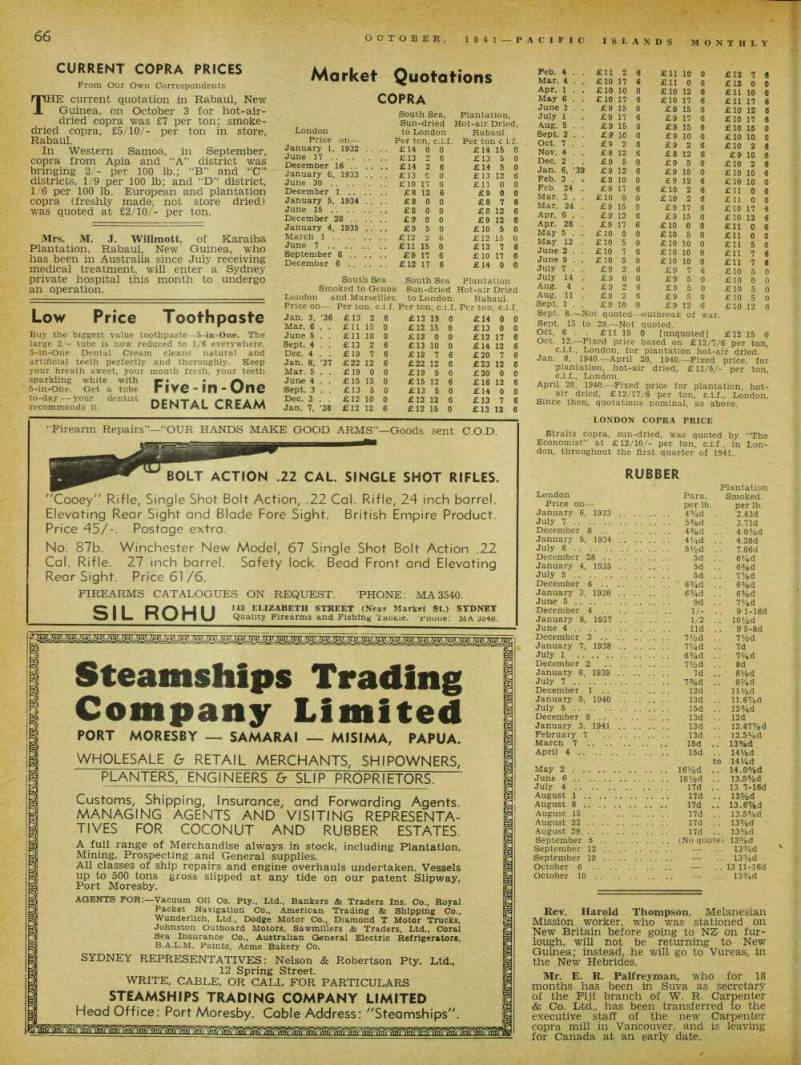
From Our Own Correspondents rpHE current quotation in Rabaul, New A Guinea, on October 3 for hot-air dried copra was £7 per ton; smoke dried copra, £5/10/- per ton in store, Rabaul.
In Western Samoa, in September, copra from Apia and “A” district was bringing 2/- per 100 lb.; “B” and “O” districts, 1/9 per 100 lb; and “D” district, 1/6 per 100 lb. European and plantation copra (freshly made, not store dried) was quoted at £2/10/- per ton.
Mrs. M. J. Willmott, of Karaiba Plantation, Rabaul, New Guinea, who has been in Australia since July receiving medical treatment, will enter a Sydney private hospital this month to undergo an operation.
Market Quotations
Sept. 15 to 29.—Not quoted.
Oct. 6 . . £ll 15 0 [unquoted] £l2 15 0 Oct. 12.—Fixed price based on £l2/7/6 per ton, c.i.f., London, for plantation hot-air dried.
Jan. 8, 1940.—April 20, 1940.—Fixed price, for plantation, hot-air dried, £l3/5/- per ton, c.i.f., London.
April 20, 1940.—Fixed price for plantation, hot air dried, £l2/17/6 per ton, c.i.f., London.
Since then, quotations nominal, as above.
London Copra Price
Straits copra, sun-dried, was quoted by “The Economist” at £l2/10/- per ton, c.i.f., in Lon don, throughout the first quarter of 1941.
Rev. Harold Thompson, Melanesian Mission worker, who was stationed on New Britain before going to NZ : on fur lough, will not be returning to New Guinea; instead, he will go to Vureas, in the New Hebrides.
Mr. E. R. Palfreyman, who for 18 months has been in Suva as secretary of the Fiji branch of W. R. Carpenter & Co. Ltd., has been transferred to the executive staff of the new Carpenter copra mill in Vancouver, and is leaving for Canada at an early date.
Copra
South Sea, Plantation, Sun-dried Hot-air Dried, London to London Rabaul Price on— Per ton, c.i.f.
Per ton c i. f.
January 1 1932 £14 0 0 £14 15 0 June 17 . £13 2 6 £13 5 0 December 16 . . £14 2 6 £14 5 0 January 6 1933 £13 0 0 £13 12 6 June 30 . £10 17 6 £11 0 0 December 1 .. £8 12 6 £9 0 0 January 5 1934 £8 0 0 £8 7 6 June 15 . £8 0 0 £8 12 6 December 28 .. £9f 0 0 £9 12 6 January 4 1935 £9 5 0 £10 5 0 March 1 £12 2 C £12 15 0 June 7 . £11 15 0 £12 7 6 September 6 . . £9 17 6 £10 17 6 December 6 . . £12 17 6 £14 0 0 South Sea South Sea Plantation Smoked to Genoa Sun-dried Hot-air Dried London and Marseilles, to London.
Rabaul.
Price on— Per ton, c.i.f.
Per ton, c.i.f. , Per ton, c.i.f.
Jan. 3, ’36 £13 2 6 £13 15 0 £14 0 0 Mar. 6 . . £11 15 0 £12 15 0 £13 0 0 June 5 . . £11 10 0 £12 0 0 £12 17 6 Sept. 4 . . £13 2 6 £13 10 0 £14 12 6 Dec. 4 . . £19 7 6 £19 7 6 £20 7 6 Jan. 8, ’37 £22 12 6 £22 12 6 £23 12 6 Mar. 5 , . £19 0 0 £19 5 0 £20 0 0 June 4 . . £15 15 0 £15 12 6 £16 12 6 Sept. 3 . . £13 5 0 £13 5 0 £14 0 0 Dec. 3 . . £12 10 0 £12 12 6 £13 7 6 Jan. 7, '38 £12 12 6 £12 15 0 £13 12 6
Feb. 4 . £11 2 6 £11 10 0 £12 7 « Mar. 4 £10 17 6 £11 0 0 £12 0 0 Apr. 1 . £10 10 0 £10 12 6 £11 10 0 May 6 . £10 17 6 £10 17 6 £11 17 6 June 3 £9 15 0 £9 15 0 £10 12 6 July 1 . £9 17 6 £9 17 6 £10 17 6 Aug. 5 . £9 15 0 £9 15 0 £10 15 0 Sept. 2 £9 10 0 £9 10 0 £10 10 0 Oct. 7 , £9 2 6 £9 2 6 £10 2 6 Nov. 4 . £8 12 6 £8 12 6 £9 10 0 Dec. 2 . £9 5 0 £9 5 0 £10 2 6 Jan. 6, 39 £9 12 6 £9 15 0 £10 10 0 Feb. 3 . £9 10 0 £9 12 6 £10 10 0 Feb. 24 £9 17 6 £10 2 6 £11 0 0 Mar. 3 . £10 0 0 £10 2 6 £11 0 0 Mar. 24 £9 15 0 £9 17 6 £10 17 6 Apr. 6 . £9 12 6 £9 15 0 £10 12 6 Apr. 28 £9 17 6 £10 0 0 £11 0 0 May 5 . £10 0 0 £10 5 0 £11 0 0 May 12 £10 5 0 £10 10 0 £11 5 0 June 2 . £10 7 6 £10 10 0 £11 7 6 June 9 . £ 10 5 0 £ 10 10 0 £11 7 6 July 7 . £9 2 6 £9 7 6 £10 5 0
July
14 £9 0 0 £9 5 0 £10 0 0 Aug. 4 £9 2 6 £9 5 0 £10 5 0 Aug. 11 £9 2 6 £9 5 0 £10 5 0 Sept. 1 . £9 10 0 £9 12 6 £10 12 6 Sept. 8.- —Not quoted —outbreak of war.
Rubber
Plantation London Para.
Smoked.
Price on— per lb. per lb.
January 6, 1933 4 3 Ad .. 2.43d July 7 .. 3.71d December 8 .. 43/sd 4.0 5 Ad January 5, 1934 4‘Ad 4.28d July 6 7.06d December 28 .. . . 6*Ad January 4, 1935 5d .. 6%d July 5 .. 7 7 /ad December 6 .. 6 3 Ad .. 6 3 /ad January 3, 1936 6 3 Ad .. 6 3 /ed June 5 . . 7‘Ad December 4 1/- 9 l-16d January 8, 1937 1/2 .. 10‘/ 2 d June 4 lid .. 9 5-8d December 3 .. . 7‘/ad 7‘/ad January 7, 1938 7‘Ad .. 7d July 1 .. 7‘Ad December 2 . . 8d January 6, 1939 . .. 8‘/ad July 7 7%d .. 8‘Ad December 1 .. 11‘/ad January 5, 1940 13d . . 11.6 7 /ad July 5 .. 12 3 Ad December 6 .. . 13d .. 12d January 3, 1941 13d . . 12.47 7 /ad February 7 13d -. 12.5 5 /ad March 7 .. .. .. 13 5 /ad April 4 .. i4y 8 d May 2 to 14*Ad .. 14.0 s /ad June 6 .. 13.5 5 /ad July 4 17d .. 13 7-16d August 1 .. 13‘/ad August 8 .. 13.6 7 /«d August 15 17d .. 13.5 s /ad August 22 17d .. 13S/ 8 d August 29 17d .. 13%d September 5 . . . (No quote) 13 s /ad September 12 .. .. 13 3 Ad September 19 . . — . . 13 3 Ad October 6 .. — .. 13 ll-16d October 10 .. ., — .. 13 3 Ad
Advertisements & other items, p. 68 (1 item)
Steamships Trading
Low Price Toothpaste
Buy the biggest value toothpaste—s-in-One. The large 2/- tube is now reduced to 1/6 everywhere. 5-in-One Dental Cream cleans natural and artificial teeth perfectly and thoroughly. Keep your breath sweet, your mouth fresh, your teeth sparkling white with 5-in-One. Get a tube rive-m to-day your dentist recommends it.
Five-in-One
DENTAL CREAM
‘Firearm Repairs”—“OUß HANDS MAKE GOOD ARMS”—Goods sent C.O.D.
BOLT ACTION .22 CAL. SINGLE SHOT RIFLES.
"Cooey" Rifle, Single Shot Bolt Action, .22 Col. Rifle, 24 inch barrel.
Elevating Rear Sight and Blade Fore Sight. British Empire Product.
Price 45/-. Postage extra.
No. 87b. Winchester New Model, 67 Single Shot Bolt Action .22 Cal. Rifle. 27 inch barrel. Safety lock Bead Front and Elevating Rear Sight. Price 61/6.
FIREARMS CATALOGUES ON REQUEST. ’PHONE; MA 3540.
SIL ROHU
143 ELIZABETH STREET (Near Market St.) SYDNEY Quality Firearms and Fishing 'lacKie. 'rnoue: MA 3040.
Steamships Trading
Company Limited
PORT MORESBY SAMARA! MISIMA, PAPUA.
WHOLESALE & RETAIL MERCHANTS, SHIPOWNERS,
PLANTERS, ENGINEERS & SLIP PROPRIETORS
Customs, Shipping, Insurance, and Forwarding Agents.
MANAGING AGENTS AND VISITING REPRESENTA-
TIVES FOR COCONUT AND RUBBER ESTATES.
A full range of Merchandise always in stock, including Plantation, Mining, Prospecting and General supplies.
All classes of ship repairs and engine overhauls undertaken. Vessels up to 500 tons gross slipped at any tide on our patent Slipway, Port Moresby.
AGENTS FOR:—Vacuum Oil Co. Pty., Ltd., Bankers & Traders Ins. Co., Royal Packet Navigation Co., American Trading & Shipping Co., Wunderlich, Ltd., Dodge Motor Co., Diamond T Motor Trucks, Johnston Outboard Motors, Sawmillers & Traders, Ltd., Coral Sea Insurance Co., Australian General Electric Refrigerators, B.A.L.M. Paints, Acme Bakery Co.
SYDNEY REPRESENTATIVES: Nelson & Robertson Pty. Ltd., 12 Spring Street.
WRITE, CABLE, OR CALL FOR PARTICULARS
STEAMSHIPS TRADING COMPANY LIMITED
Head Office: Port Moresby. Cable Address: "Steamships".
Ng Legislative
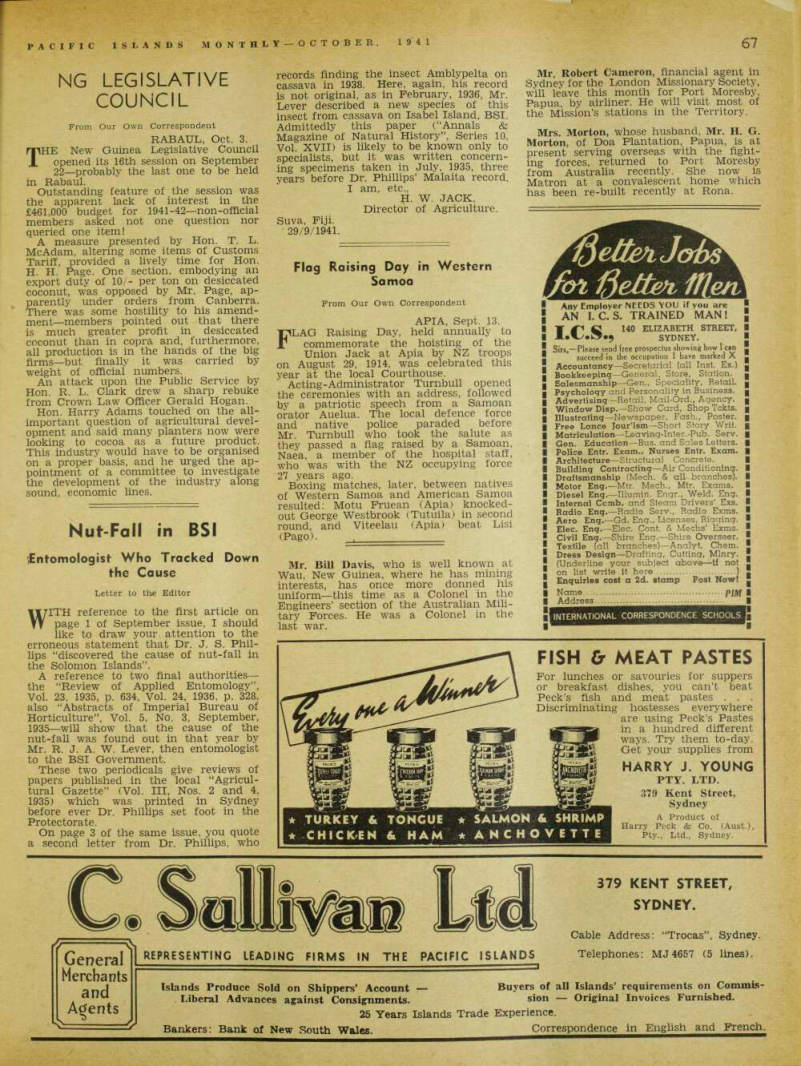
Council
From Our Own Correspondent
Rabaul, Oct. 3.
THE New Guinea Legislative Council opened its 16th session on September 22—probably the last one to be held in Rabaul.
Outstanding feature of the session was the apparent lack of interest in the £461,000 budget for 1941-42—non-official members asked not one question nor queried one item!
A measure presented by Hon. T. L.
McAdam. altering some items of Customs Tariff, provided a lively time for Hon.
H. H. Page. One section, embodying an export duty of 10/- per ton on desiccated coconut, was opposed by Mr. Page, ap parently under orders from Canberra.
There was some hostility to his amend ment—members pointed out that there is much greater profit in desiccated coconut than in copra and, furthermore, all production is in the hands of the big firms—but finally it was carried by weight of official numbers.
An attack upon the Public Service by Hon. R. L. Clark drew a sharp rebuke from Crown Law Officer Gerald Hogan.
Hon. Harry Adams touched on the all important question of agricultural devel opment and said many planters now were looking to cocoa as a future product.
This industry would have to be organised on a proper basis, and he urged the ap pointment of a committee to investigate the development of the industry along sound, economic lines.
Nut-Fall in BSI
Entomologist Who Tracked Down the Cause
Letter to the Editor WITH reference to the first article on page 1 of September issue, I should like to draw your attention to the erroneous statement that Dr. J. S. Phil lips “discovered the cause of nut-fall in the Solomon Islands”.
A reference to two final authorities — the “Review of Applied Entomology”, Vol. 23, 1935, p. 634, Vol. 24, 1936, p. 328, also “Abstracts of Imperial Bureau of Horticulture”, Vol. 5, No. 3, September, 1935 —will show that the cause of the nut-fall was found out in that year by Mr. R. J. A. W. Lever, then entomologist to the BSI Government.
These two periodicals give reviews of papers published in the local “Agricul tural Gazette” (Vol. 111, Nos. 2 and 4, 1935) which was printed in Sydney before ever Dr. Phillips set foot in the Protectorate.
On page 3 of the same issue, you quote a second letter from Dr. Phillips, who
records finding the insect Amblypelta on cassava in 1938. Here, again, his record is not original, as in February, 1936, Mr.
Lever described a new species of this insect from cassava on Isabel Island, BSI.
Admittedly this paper (“Annals & Magazine of Natural History”, Series 10, Vol. XVII) is likely to be known only to specialists, but it was written concern ing specimens taken in July, 1935, three years before Dr. Phillips’ Malaita record.
I am, etc.,
H. W. Jack,
Director of Agriculture.
Suva, Fiji. 29/9/1941.
Flag Raising Day in Western
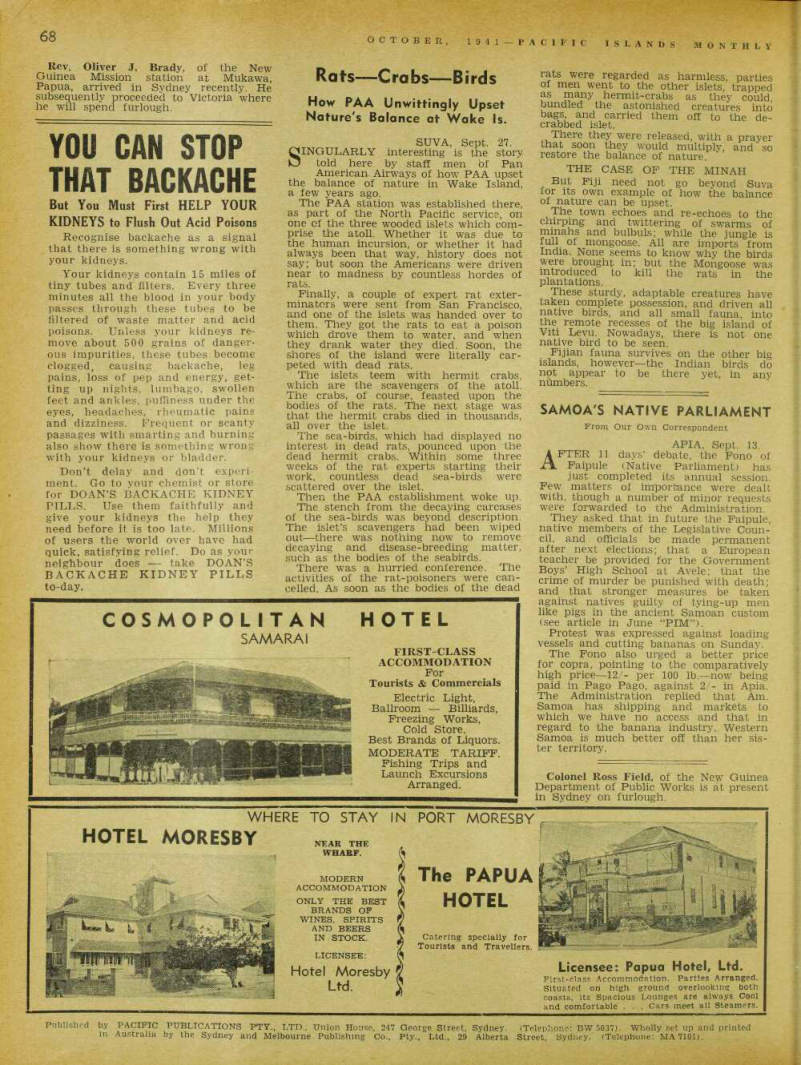
Samoa
Prom Our Own Correspondent APIA, Sept. 13.
FLAG Raising Day, held annually to commemorate the hoisting of the Union Jack at Apia by NZ troops on August 29, 1914, was celebrated this year at the local Courthouse.
Acting-Administrator Turnbull opened the ceremonies with an address, followed by a patriotic speech from a Samoan orator Auelua. The local defence force and native police paraded before Mr. Turnbull who took the salute as they passed a flag raised by a Samoan, Naea, a member of the hospital staff, who was with the NZ occupying force 27 years ago.
Boxing matches, later, between natives of Western Samoa and American Samoa resulted: Motu Fruean (Apia) knocked out George Westbrook (Tutuila) in second round, and Viteelau (Apia) beat Lisi (Pago). .
Mr. Bill Davis, who is well known at Wau, New Guinea, where he has mining interests, has once more donned his uniform —this time as a Colonel in the Engineers’ section of the Australian Mili tary Forces. He was a Colonel in the last war.
Mr. Robert Cameron, financial agent in Sydney for the London Missionary Society, will leave this month for Port Moresby, Papua, by airliner. He will visit most of the Mission’s stations in the Territory.
Mrs. Morton, whose husband. Mr. H. G.
Morton, of Doa Plantation, Papua, is at present serving overseas with the fight ing forces, returned to Port Moresby from Australia recently. She now is Matron at a convalescent home which has been re-built recently at Rona.
Rev. Oliver J. Brady, of the New Guinea Mission station at Mukawa, Papua, arrived in Sydney recently. He subsequently proceeded to Victoria where he will spend furlough.
Advertisements & other items, pp. 69-70 (1 item)
Agents
Any Employer NEEDS YOU if you arc
AN I. C. S. TRAINED MAN!
Ifl C 140 ELIZABETH STREET,
• SYDNEY.
Sirs,— Please send free prospectus showing how 1 can succeed in ihe occupation 1 have marked X Accountancy—Secretarial (all Inst. Ex.) Bookkeeping—General. Store, Station.
Salesmanship—Gen., Speciality, Retail.
Psychology and Personality in Business.
Advertising —Retail, Mail-Ord., Agency.
Window Disp.—Show Card, Shop Tckts.
Illustrating—Newspaper, Fash., Poster.
Free Lance Jour'ism —Short Story Writ.
Matriculation —Leaving-Inter.-Pub. Serv.
Gen. Education —Bus. and Sales Letters.
Police Entr. Exam., Nurses Entr. Exam.
Architecture —Structural Concrete.
Building Contracting—Air Conditioning.
Draftsmanship (Mech. & all branches).
Motor Eng.—Mtr. Mech., Mtr. Exams.
Diesel Eng.—lllumin. Engr., Weld. Eng.
Internal Ccmb. and Steam Drivers' Exs.
Radio Eng.—Radio Serv., Radio Exms.
Aero Eng.—Gd. Eng., Licenses, Rigging.
Elec. Eng.—Elec. Cont. & Mechs' Exms.
Civil Eng.—Shire Eng.—Shire Overseer.
Textile (all branches) —Analyt. Chem.
Dress Design—Drafting, Cutting, Mlnry. (Underline your subject above—lf not on list write it here ) Enquiries cost a 2d. stamp Post Now!
Name p/Af Address
INTERNATIONAL CORRESPONDENCE SCHOOLS
IP
FISH & MEAT PASTES
For lunches or savouries for suppers or breakfast dishes, you can’t beat Peck’s fish and meat pastes . . .
Discriminating hostesses everywhere are using Peck’s Pastes in a hundred different ways. Try them to-day.
Get your supplies from
HARRY J. YOUNG
PTY. LTD.
379 Kent Street, Sydney A Product of Harry Peck & Co. (Aust.), Pty., Ltd., Sydney.
c. 11l MB Lm
General
Merchants
and
Agents
REPRESENTING LEADING FIRMS IN THE PACIFIC ISLANDS
379 KENT STREET,
SYDNEY.
Cable Address: “Trocas”, Sydney.
Telephones: MJ 4657 (5 lines).
Islands Produce Sold on Shippers’ Account Buyers of all Islands’ requirements on Commis- Liberal Advances against Consignments. sion Original Invoices Furnished. 25 Years Islands Trade Experience.
Bankers: Bank of New South Wales. Correspondence in English and French.
YOU CAN STOP
THAT BACKACHE
But You Must First HELP YOUR KIDNEYS to Flush Out Acid Poisons Recognise backache as a signal that there is something wrong with your kidneys.
Your kidneys contain 15 miles of tiny tubes and filters. Every three minutes all the blood in your body passes through these tubes to be filtered of waste matter and acid poisons. Unless your kidneys remove about 500 grains of dangerous impurities, these tubes become clogged, causing backache, leg pains, loss of pep and energy, getting up nights, lumbago, swollen feet and ankles, puffiness under the eyes, headaches, rheumatic pains and dizziness. Frequent or scanty passages with smarting and burning also show there is something wrong with your kidneys or bladder.
Don’t delay and don’t experiment. Go to your chemist or store
for DOAN’S BACKACHE KIDNEY
PILLS. Use them faithfully and give your kidneys the help they need before it is too late. Millions of users the world over have had quick, satisfying relief. Do as your neighbour does take DOAN’S
BACKACHE KIDNEY PILLS
to-day.
COSMOPOLITAN
SAMARA I
HOTEL
FIRST-CLASS
ACCOMMODATION
For Tourists & Commercials Electric Light, Ballroom Billiards, Freezing Works, Cold Store.
Best Brands of Liquors.
MODERATE TARIFF.
Fishing Trips and Launch Excursions Arranged.
Rats—Crabs—Birds
How PAA Unwittingly Upset Nature's Balance at Wake Is.
SUVA, Sept. 27.
SINGULARLY interesting is the story told here by staff men of Pan American. Airways of how PAA upset the balance of nature in Wake Island, a few years ago.
The PAA station was established there, as part of the North Pacific service, on one of the three wooded islets which com prise the atoll. Whether it was due to the human incursion, or whether it had always been that way, history does not say; but soon the Americans were driven near to madness by countless hordes of rats.
Finally, a couple of expert rat exter minators were sent from San Francisco, and one of the islets was handed over to them. They got the rats to eat a poison which drove them to water, and when they drank water they died. Soon, the shores of the island were literally car peted with dead rats.
The islets teem with hermit crabs, which are the scavengers of the atoll.
The crabs, of course, feasted upon the bodies of the rats. The next stage was that the hermit crabs died in thousands, all over the islet.
The sea-birds, which had displayed no interest in dead rats, pounced upon the dead hermit crabs. Within some three weeks of the rat experts starting their work, countless dead sea-birds were scattered over the islet.
Then the PAA establishment woke up.
The stench from the decaying carcases of the sea-birds was beyond description.
The islet’s scavengers had been wiped out—there was nothing now to remove decaying and disease-breeding matter, such as the bodies of the seabirds.
There was a hurried conference. The activities of the rat-poisoners were can celled. As soon as the bodies of the dead
rats were regarded as harmless, parties of men went to the other islets, trapped as many hermit-crabs as they could bundled the astonished creatures into bags, and carried them off to the de crabbed islet. 4.i_ T J lere were released, with a prayer that soon they would multiply, and so restore the balance of nature.
The Case Of The Minah
But Fiji need not go beyond Suva for its own example of how the balance of nature can be upset.
The town echoes and re-echoes to the chirping and twittering of swarms of minahs and bulbuls; while the jungle is full of mongoose. All are imports from India. None seems to know why the birds were brought in; but the Mongoose was introduced to kill the rats in the plantations.
These sturdy, adaptable creatures have taken complete possession, and driven all native birds, and all small fauna, into the remote recesses of the big island of Viti Levu. Nowadays, there is not one native bird to be seen.
Fijian fauna survives on the other big islands, however—the Indian birds do not appear to be there yet, in any numbers.
Samoa's Native Parliament
From Our Own Correspondent APIA, Sept. 13.
AFTER ll days’ debate, the Pono of Faipule (Native Parliament) has just completed its annual session.
Few matters of importance were dealt with, though a number of minor requests were forwarded to the Administration.
They asked that in future the Faipule, native members of the Legislative Coun cil, and officials be made permanent after next elections; that a European teacher be provided for the Government Boys’ High School at Avele; that the crime of murder be punished with death; and that stronger measures be taken against natives guilty of tying-up men like pigs in the ancient Samoan custom (see article in June “PIM”).
Protest was expressed against loading vessels and cutting bananas on Sunday.
The Fono also urged a better price for copra, pointing to the comparatively high price—l 2- per 100 lb—now being paid in Pago Pago, against 2 - in Apia.
The Administration replied that Am.
Samoa has shipping and markets to which we have no access and that in regard to the banana industry, Western Samoa is much better off than her sis ter territory.
Colonel Ross Field, of the New Guinea Department of Public Works is at present in Sydney on furlough.
Advertisements & other items, pp. 70-72 (2 items)
68
OCTOBER, 1941 PACIFIC ISLANDS MONTHLY
Published by PACIFIC PUBLICATIONS PTY., LTD., Union House, 247 George Street, Sydney. (Telephone: BW 5037). Wholly set up and printed in Australia by the Sydney and Melbourne Publishing Co., Pty., Ltd., 29 Alberta Street, Sydney. (Telephone: MA7101).
Hotel Moresby
WHERE TO STAY IN
NEAR THE
WHARF.
MODERN
ACCOMMODATION
ONLY THE BEST
BRANDS OF
WINES, SPIRITS
AND BEERS
IN STOCK,
LICENSEE:
Hotel Moresby
Ltd.
PORT MORESBY
The PAPUA
HOTEL
Catering specially for Tourists and Travellers.
Licensee: Papua Hotel, Ltd.
First-class Accommodation. Parties Arranged.
Situated on high ground overlooking both coasts, its Spacious Lounges are always Cool and comfortable . . . Cars meet all Steamers.
flipi
■ / m ■ / X %mmk r:*,
mil
ftw&l* / ' .
NATURE buried untold wealth in the heart of New Guinea . . . ringed it with mighty ranges, thick jungle, and deep rushing rivers, and issued a challenge to Man.
Nature won the first round . . . Native carriers could only struggle 35 miles in 10 days . . .
The going was difficult and dangerous, and costs enormously high, but Man triumphed— Man took wings.
Transportation by Aeroplane overcame the major difficulties vital machines, tools, dredging plants and the whole of the European civilisation and its needs were flown quickly to the gold- * fields. The aeroplane made possible the winning of New Guinea's gold, and as pioneers of the Skyway Highway, Guinea Airways played a prominent part in the development of New Guinea.
To-day, Guinea Airways 'planes maintain regular services throughout New Guinea and Papua, transporting all kinds of freight and carrying thousands of passengers safely, swiftly, surely to their destination.
He*
PR* 5 T?
an**
Cui» ea
by trot* 1 - \Vve * * s do*** fcotfl- Qv&e a ' »»•* Guinea Airways provide fast passen ger and freight, land and sea 'planes for charter within New Guinea and Papua. Obtain full particulars of this service when planning a visit to mines in the interior, and when machinery is vitally needed on the field.
SP£C/M
New Guinea Office: LAE, Mandated Territory of New Guinea.
ffranc/i offices am/ Agents
at WAU -SALAMAUA,
PORTMORESBY and SYDNEY
X, *.v 1' o v ' x ' > * ’ a \ C^v 'i' WrT v* E Wp%l *N 0 ■yP'^
TOOTH A CO LIMITED
- 4 m a_l-, k .
B B 818 HI I
WAVERIEY BREWERY
k V* o *O- A
V\E 2\/y
-A *'Avuur»«* lt ) L^ n, v /a n^ E 21 ■A mc'j/jli V\
ensures a
PERFECT DRINK
atu/tJie clown dea/
PRESERVES THE PLAVODR
When ordering lager, first look for the Diamond-shaped Label—that is your guarantee of quality. Then notice the "Spot" Crown Seal, it is designed to retain that quality, and ensure perfect freshness and flavour in any
climate.
RESCHWLACER