Pacific
Islands
Monthly
Vol. Xii. No. 2.
September 16, 1941
Established 1930
[Registered Sydney, for transmission by post as a newspaper ]
8°
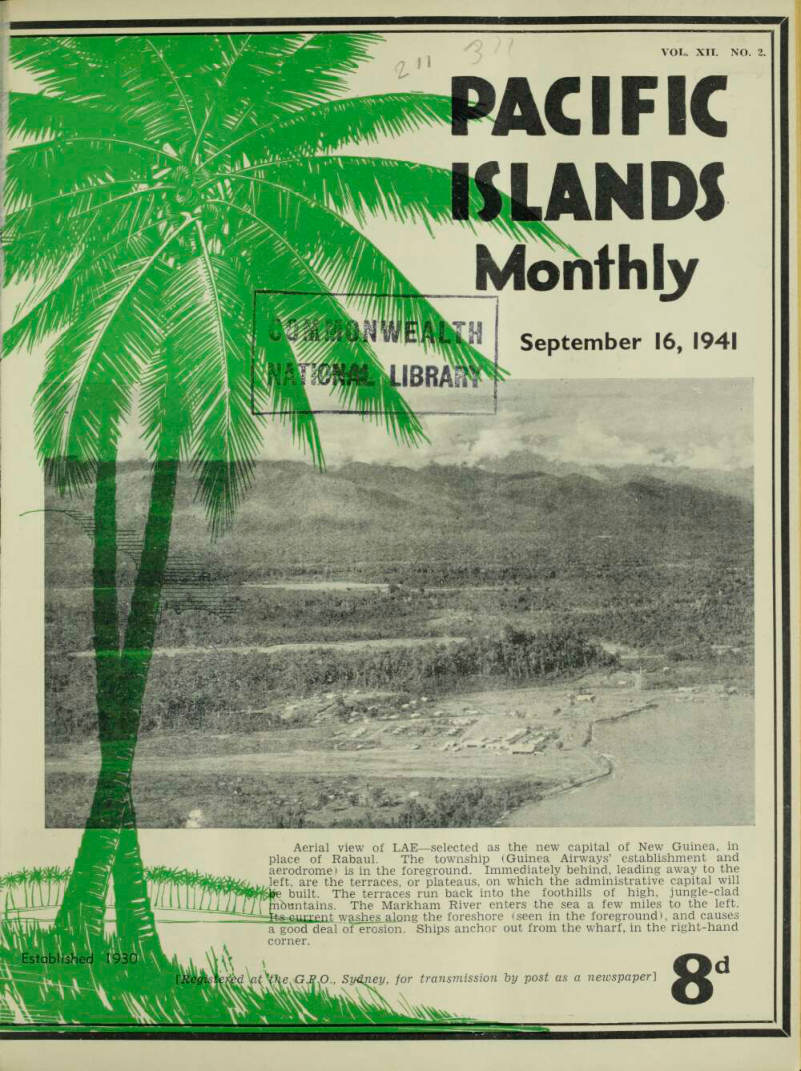
Aerial view of LAE—selected as the new capital of New Guinea, in place of Rabaul. The township (Guinea Airways’ establishment and aerodrome) is in the foreground. Immediately behind, leading away to the left, are the terraces, or plateaus, on which the administrative capital will be built. The terraces run back into the foothills of high, jungle-clad mountains. The Markham River enters the sea a few miles to the left.
Its current washes along the foreshore (seen in the foreground), and causes a good deal of erosion. Ships anchor out from the wharf, in the right-hand corner.
Advertisements & other items, p. 2 (1 item)
W. R. Carpenter & Co. Ltd
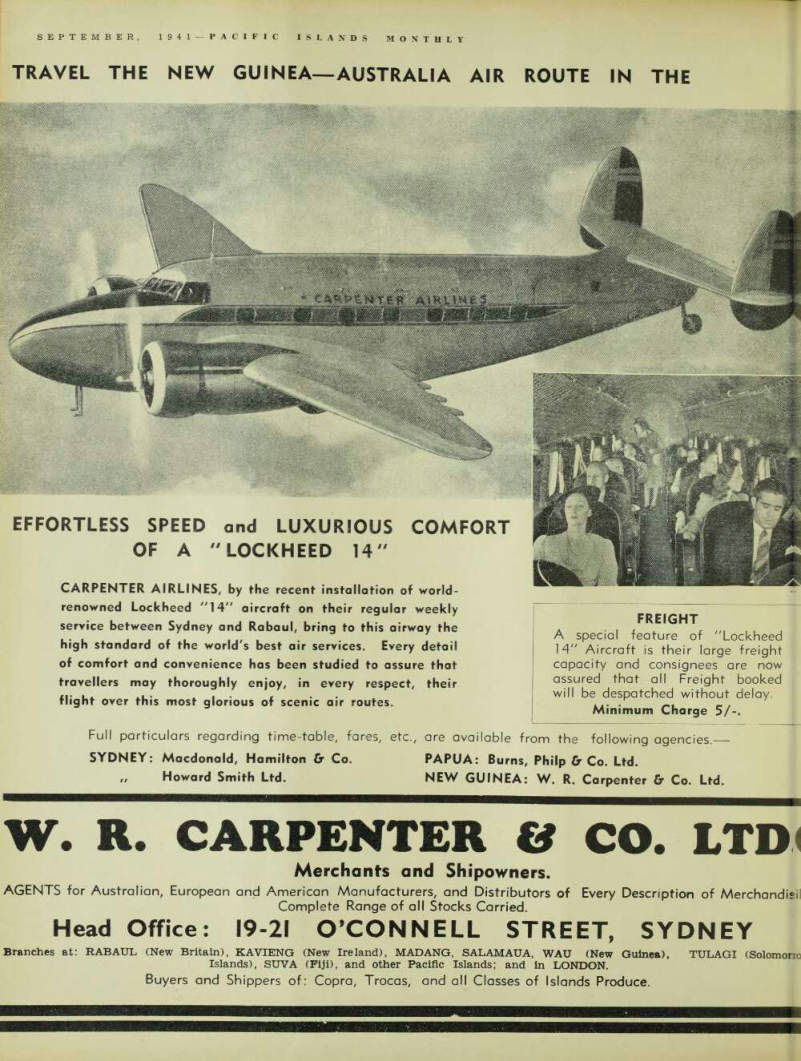
TRAVEL THE NEW GUINEA—AUSTRALIA AIR ROUTE IN THE H i* MK : -i 11 IP n - : !
EFFORTLESS SPEED and LUXURIOUS COMFORT
OF A " LOCKHEED 14
CARPENTER AIRLINES, by the recent installation of worldrenowned Lockheed "14" aircraft on their regular weekly service between Sydney and Rabaul, bring to this airway the high standard of the world's best air services. Every detail of comfort and convenience has been studied to assure that travellers may thoroughly enjoy, in every respect, their flight over this most glorious of scenic air routes.
FREIGHT
A special feature of "Lockheed 14" Aircraft is their large freight capacity and consignees are now assured that all Freight booked will be despatched without delay.
Minimum Charge 5/-.
Full particulars regarding time-table, fares, etc., are available from the following agencies.— SYDNEY: Macdonald, Hamilton & Co. PAPUA: Burns, Philp & Co. Ltd. Howard Smith Ltd. NEW GUINEA: W. R. Carpenter Cr Co. Ltd.
W. R. CARPENTER & CO. LTD
Merchants and Shipowners.
AGENTS for Australian, European and American Manufacturers, and Distributors of Every Description of Merchandise Complete Range of all Stocks Carried.
Head Office: 19-21 O’CONNELL STREET, SYDNEY
Branches at: RABAUL (New Britain), KAVIENG (New Ireland), MADANG, SALAMAUA, WAU (New Guinea), TULAGI (Solomono Islands), SUVA (Fiji), and other Pacific Islands; and in LONDON.
Buyers and Shippers of: Copra, Trocas, and all Classes of Islands Produce.
Solomons
Nut-Fall In The
Dr. Phillips on Chances of Treatment
AN interesting note is to hand from Dr. J. S. Phillips, of Kenilworth Court, Hagley Road, Birmingham, England. He is the skilled entomologist who discovered the cause of nut-fall in the Solomon Islands, and who told the fascinating story of his search in his book. “Coconut Quest”. (See “PIM”, February. 1941).
“The ‘PIM’ reviewer,” says Dr. Phil lips, “is the only reviewer of my book who has grasped that the key factor in this problem of immature nut-fall is the change of ant population in the planta tions, brought about by the accidental introduction of Fido (Pheidole oceanica).
“In the note at the end of your review, you suggest a remedy: ‘Why cannot something else be introduced to deal with Fido?’
“This suggestion, I agree, offers the best, perhaps the only, way of stopping immature nut-fall in the Solomons. But the chance of findipg such a ‘control’, and establishing it successfully, is very, very small. The control would have to be another species of ant, and I doubt whether any could be found capable of driving Fido out of the plantations, espe cially as the selection would be limited to tree-nesting species, as ground-nest ing ones would not protect the spadices from the coconut-bug.
“And even if such a creature could be found, it would take many years to spread into ail the nut-fall areas—well over 20,000 acres.
“Oeco. the indigenous tree-ant, which formerly protected the nuts from attack, seems able to maintain itself against Fido in the bush. One might therefore imagine that by allowing plantations to revert to bush conditions, Oeco would re establish itself and force Fido out again.
Unfortunately, this does not seem to be the case. There are estate areas on Guadalcanal and Malaita, which have been ‘let go’; but Fido remains the dominant ant there.”
Samoan Volunteers
Prom Our Own Correspondent
Apia, Aug. 23.
THE second contingent of men who have enlisted for service overseas will shortly leave for training in NZ.
They are Messrs. L. Aspinall, P. Foster, J. Hancock, L. Jessop, R. P. and F. J.
McFall, and they will leave in charge of Sgt.-Major T. Bott, of the Samoan Defence Force.
Apia Patriotic Society organised a func tion at which each man was presented with a wristlet watch.
The following New Guinea men have left the Territory to join the AIF; — Rabaul: Messrs. L. McMahon, McKee, McMillan-Kerr and I. Downs; Wau: Messrs. G. Selle, R. Whitbread, C. Duffy, J. McDonald and S. Watson.
Mrs. Krutli, wife of Mr, O. C. Krutli, a Papuan Government surveyor, died in Pt.
Moresby, on August 22.
Mrs. Lucy Friend (wife of Mr. L. C.
Friend, well known in Fiji as a member of the staff of the Bank of New Zealand in Suva for many years), died in August at Napier, NZ. She was a sister of Mr.
L. E. Austen, officer in charge of Native Coffee Plantations at Sangara, Papua.
Pacific News-Review
Notes and Comment on the Progress of the War, Aug. 13 to Sept. 15
Aug. 13: Masses of RAF bombers, guarded by new, secret Whirlwind fight ers, carried out greatest daylight raid of war over German cities. Berlin, Han over, Essen suffered. Two vital power stations at Cologne were smashed. Minor raids damaged objectives in Holland and Northern France. Thirty-four Brit ish planes were lost.
Aug. 13: Nazi panzer units in Ukraine have reached the Black Sea, encircling port of Odessa. On this front, Russia’s “scorched earth” policy has prevented Germans from obtaining coveted Ukraine grain harvest.
Aug. 14: Lord Privy Seal, Mr. Atlee, in world broadcast, revealed that Mr.
Churchill, British Prime Minister, and Mr. Roosevelt, President of United States, met at sea aboard a battleship, some where in Atlantic, early in month, with their military and economic advisers.
A joint British-American declaration of war aims was issued, containing 9 basic principles. Main points: They seek no territory; wish no territorial changes not in accord with freely-expressed wishes of people concerned; will restore sovereign rights and self-government to occupied countries. Peace promises; Equal trade and raw materials for all; fullest economic collaboration among nations; freedom of the seas; “all men in all lands shall live out their lives in freedom from fear and want”.
Aug. 14: Marshal Budenny’s Southern Russian army has been extricated from German encircling move in Ukraine, and is being reorganised east of Bug River, before Ukraine’s main industrial areas.
Aug. 15: The Churchill-Roosevelt meeting has stirred the world. News papers proclaim their declaration as “an international New Deal”.
Aug. 15: Lord Beaverbrook, dynamic British Minister for Supply, has gone to USA to accelerate war supplies for Britain and Russia.
Aug. 15: Further powerful Australian reinforcements, soldiers and airmen, have arrived at Singapore to guard Malaya.
Aug. 17: Russia has accepted offer to hold conference with British and US representatives in Moscow to discuss Soviet’s war needs. Expected that Stalin will ask for tanks, planes, and war material of all kinds, in belief Russians can defeat Hitler if they have equip ment.
Aug 18; Russians admit several towns in Ukraine evacuated in face of strong Nazi drive.
Aug. 19: A German drive on north of Eastern front is now only 70 miles west of Leningrad.
Aug. 20: Despite fairly large territorial gains, Nazis have failed to smash Rus sian army organisation, as second month of conflict draws to close. Commentators say Germany is likely to settle down to hard winter campaign in which she is not nearly so adequately equipped as Russia.
Aug. 20: Moscow claims 1,500,000 Ger mans have been killed, wounded or taken prisoners, and 6,000 tanks and and 8,000 guns destroyed or captured in past six weeks. Losses of men and equipment on both sides have been colossal.
Aug. 21: Marshal Budenny, in Ukraine, blew up great Dneiper Dam, one of world’s foremost engineering works, to
prevent Germans crossing Dneiper River.
Thousands of Nazi troops and fleeing Russian peasants were engulfed.
Aug. 22: Soldiers and civilians are feverishly converting Leningrad into an armed fortress.
Aug. 22; Japan has asked USA for guarantees that American bombers will not be based in Eastern Siberia. She is gravely concerned over shipments of American war supplies to Russia, via the Far East.
Aug, 22; Berlin claims Germans are within 30 miles of Leningrad.
Aug. 24: Britain’s open declaration that she will go to war with Japan if the latter fights United States has had a sobering effect on Tokio. There are indications that Japan may modify her pro-Axis policy, in view of Britain and America’s stiffened attitude in recent months.
Aug. 25: British and Russian troops to-day simultaneously entered Iran (formerly Persia) at three points, follow ing Iranian Government’s refusal to expel large number of German agents and technicians congregating there.
Allies’ invasion met with only token resistance.
This development has forestalled pos sible German attempt to secure the Iranian oilfields (production: 100,000,000 tons yearly). It opens up also a direct “supply route” for British and American help to Russia. Thirdly, it removes menace of any Nazi move to strike at Soviet through her “back door”.
Aug. 26: British and Indian troops in Iran are pushing on towards Tehran, the capital, meeting with little opposition.
Aug. 26: Soviet has launched counter attack in central sector, inflicting what Moscow describes as “major defeat” on Nazis.
Aug. 27: 101 German planes destroyed in two days during terrific aerial blitz on Leningrad.
Aug 27: Promising expulsion of Ger mans, Shah of Iran is seeking cessation of Anglo-Russian invasion. British have occupied all important oilfields.
Aug. 27: Soviet has warned Japan against interference with US shipments of war materials to Russia.
Aug. 28: After weeks of internal poli tical bickering, Mr. Menzies has resigned Prime Ministership of Australia. Mr.
Fadden (Queensland-born Country Party leader) is new PM. There have been no other Cabinet changes.
Aug. 28: Pierre Laval, pro-Nazi ex- Premier of France, was seriously wounded by young de Gaulle adherent, in assassination attempt. Two other French fascists also shot. Reports indi cate that unrest and sabotage in Occu pied France is rife, as conditions imposed by Nazi overlords, through Admiral Dar lan, become more harsh.
Aug. 28: “Cease fire” order given to British and Russians in Iran.
Aug. 29: Talks are going on in Wash ington between President Roosevelt and Japanese Ambassador (Admiral Nomura), with a view to arranging settlement of situation in Pacific.
Aug. 31: Russians appear to be hold ing out on all fronts —Nazis have made little progress in their drive on Lenin grad, in north; Marshal Budenny’s army in Dneiper area has been reformed, to hit back at Germans in Ukraine; Odessa, while encircled, has not yet been taken.
Aug. 31: Hitler and Mussolini have again met to discuss war developments.
Aug. 31: Although there is much opti mism in certain USA quarters concern ing the possibility of easier and better relations between USA and Japan, Brit ish observers do not take so hopeful a view of the underground negotiations and have again advised Britons where possible to leave Japanese territory.
Sept. 1: The voluntary withdrawal of Russian armies from the Karelian Isth mus, where they were facing the Finnish armies, has set most commentators speculating. The withdrawal, in view of reports that the Finns are prepared to consider a separate mediated peace with Russia, is significant.
Sept. 1: England on Sunday night ex perienced its first large-scale air attack since mid-July. A north-east coastal town was “blitzed”.
Sept. 2: Japan officially states that the replies of the United States and Russia to Japan’s protest against the shipment of American oil to Russia, by way of Vladivostock, are unsatisfactory, and further representations will be made.
Sept. 2: There are increasing signs that the Axis powers are putting pres sure on Turkey to allow Axis naval forces to go through the Dardanelles, to attack the Russian Navy in the Black Sea, and thus open the road to the Caucasus oilfields.
Sept. 4: A terrific battle for Leningrad is developing and the German forces, step by step, are creeping around the city. They seem to be at an average distance now of between 10 and 15 miles from the city, on the south and east.
Sept. 5: It now is clear that negotia tions for a separate peace between Fin land and Russia have been discontinued.
Sept. 5: Unarmed, and flying the American flag, the first tanker carrying American petrol to Russia has arrived in Vladivostock.
Sept. 5: In a heartening review of the shipping position, the Chairman of USA Maritime Commission stated that Britain and American would be able to manage, now, with their existing merchantmen, with current production taking care of replacements. There has been a steady fall in shipping losses in the Atlantic.
The July figures were the best for a year, and the August figures are better than July.
Sept. 5: Increasing sabotage in the occupied countries of Europe is being answered by increased German terror ism.
Sept. 5: United States announces that USA destroyer “Greer”, 1,090 tons, was attacked by a submarine off Iceland, and it immediately fought back and dropped a depth charge.
Sept. 6: Following the occupation of Iran by the Allies, the Iranian police are taking action to prevent 700 Ger mans from leaving the German Lega tion. They will be interned.
Sept. 9: RAF raids on Berlin on Sun day night were the heaviest yet carried out against the German capital.
Sept. 9: Canadian, British and Nor wegian troops temporarily occupied the Spitzbergen archipelago in the Arctic, destroyed all mining machinery and other material which might have been of use to the enemy, and withdrew.
Sept. 9: Mr. Churchill told the House of Commons that there had been a great falling-off in the sinking of British and Allied shipping in the last three months. He said that Britain must make serious sacrifices in order to pro vide munitions for Russia and the skil ful defence of the Russians had made it certain that Hitler’s hope of a short war in Russia had been dispelled.
Sept. 10: While the Russians are con tinuing a counter-offensive on the cen tral sector, Hitler is reported to have
ordered his northern armies to take Leningrad quickly, at all costs, and the tury of the German assault upon the city has been re-doubled, taking no account of huge losses of men and material.
Sept. 10: Mr. Churchill says the Allied iront now runs in an immense crescent from the Arctic to Tobruk, and the British section of this front will be held by British and Imperial forces, with growing strength, fed by ocean-borne supplies from Britain, USA, India, Aus tralia and New Zealand.
Sept. 11; The American ship “Sea farer , and the Danish “Sessa”, under USA control, have been destroyed and sunk by German action. . Sept. 11: RAF bombers carried out a neavy night attack on Northern Italy, the main objective being Turin They flew across the Alps from England.
Sept. 12: Indications that Britain is preparing to launch in Libya the most powerful land offensive of the war. The flow of supplies and reinforcements con tinues unabated.
It is obvious that if Britain could throw the Germans and Italians out of Libya, and could occupy Tunisia and French Northern Africa, as they occu pied Syria, the German operations in north-west Africa would be cripped. At present the Germans are using the ports of Dakar and Casablanca as bases for submarines against British shipping in central Atlantic.
Sept. 12: President Roosevelt, in world broadcast, warned the Axis, that if Ger man or Italian warships entered waters, the protection of which is necessary for American defence, they will be shot at.
Americans will not only protect Ameri can ships, but any ships engaged in legitimate commerce.
Sept. 13: Seven great battles raging simultaneously along the Eastern front have carried the war in Russia to new heights of intensity and ferocity. A new German thrust in the southern portion of the central sector is regarded very seriously, as menacing the Ukraine.
Meanwhile. Leningrad fights on steadily in a great defensive battle, to the accom paniment of ceaseless air warfare.
Sept. 13: American reports say that very powerful and influential groups in Japan are now willing to make an agreement with the Democracies, which it is suggested will be based upon a resumption of trade relations and an assurance of peace in the Pacific.
Sept. 14: A complete Wing of the Royal Air Force, complete with pilots, machines and ground personnel has arrived in Russia.
Sept. 15: Terrific fighting is still in progress all along the Eastern front and it is apparent that a decisive stage is rapidly approaching.
Sept. 15; Supply routes to Russia have now been opened up not only through the Persian Gulf and Iran, but also through Syria and Irak.
Sept. 15: An order for general mobili sation in Bulgaria may mean that Ger many is preparing for the long-awaited attack upon the British in the Mediter ranean.
Miss Elsie Matthews, of the Unevan gelized Field Mission in Papua, is at present spending leave in Victoria.
Sgt.-Pilot Kenneth Williams, formerly of New Guinea, who has been serving in Britain as a member of the second RAAF Spitfire Squadron, carrying out patrol work, was posted in early September to the crack RAAF Fighter Squadron.
Lieutenant Hugh Lyons, of the NG Volunteer Rifles, and formerly a mem ber of Guinea Airways staff at Lae, has come South to join the AIF.
Warrior
From Monk To
Remarkable Career of New French Pacific Commissioner
From Our Own Correspondent
Noumea, Sept. 8.
XTRAORDINARY romance and ad venture have been packed into the ~A 11 Captain Georges Thierry d Argenlieu, who has just arrived in Noumea to organise, for Free France, the French colonies of the South Pacific (New Caledonia, New Hebrides, Tahiti, and French Oceania, etc.).
Two years ago he was a monk. One year ago, he was risking his life before Dakar, To-day, he is High Commissioner for General de Gaulle in the Pacific.
Captain d’Argenlieu comes of an old and noble family of Picardy and Breton descent. He is the third of seven children, five of whom were boys. He entered Navai School at 16, and in 1911 he was aide de-camp to Admiral de Marolles at the coronation of George V. As an ensign, he took part in Lyautey’s campaign in Morocco, from 1912 to 1914, receiving the Legion of Honour and a lifesaving medal.
In 1914-18, he served on patrol ships and destroyers, mainly on anti-submarine work, finishing the war as lieutenant in command of the patrol-ship “Tourterelle”.
After the war he became a monk (Father Louis of the Trinity), entering the Order of Carmel, and undergoing for 10 years the discipline of silence and effacement. In 1932, he was chosen to restore the old Carmelite province of Paris, which he governed as provincial until August, 1939.
When mobilised in 1939, he served at the great base of Cherbourg, until the capitulation made him and 500 other officers prisoners of the Germans. fTIHREE days of such captivity was JL enough for d’Argenlieu, and on June 22, 1940, he escaped from the convoy which was taking him to Germany and reached the coast. Dressed as a Norman peasant, he was smuggled across the Atlantic. Learning with indignation of the armistice, he joined General de Gaulle.
His arrival coincided with the arrival by ’plane from Gibraltar of Admiral Muselier, and the creation on July 1 of the Free French Navy. For a time, d’Agenlieu became aumonier (chaplain), visiting the sailors wherever they were camped, and instilling confidence and the will to continue the fight.
On August 23 he resumed active ser vice, to leave England on a particularly dangerous mission.
We next hear of him as leader of the de Gaulle delegation which was sent to negotiate with the Vichy French Governor of Dakar. The failure of that mission is now history. On Sept. 23, Governor de Boisson, at Dakar, repeatedly refused to receive them, and threatened their arrest.
So d’Argenlieu re-embarked his dele gation in their two launches, bearing the Tricolour and a flag of truce; but, en route, they were fired on, and d’Argenlieu was wounded by machine-gun fire.
After six weeks in hospital at Douala (French Equatorial African port), he em barked on the sloop “Savorgnan de Brazza”, and directed the naval opera tions at Gabon, which led to the occupation by Free French troops of Libreville and Port Gentil. He subse quently organised the naval bases of Equatorial Africa, and re-armed the Free French ships immobilised there.
In January, 1941, General de Gaulle appointed him a member of the Conseil de Defense de I’Empire, recalling him to London. In recent months, he has been engaged on special work in Canada.
Pacific Islands Travellers
PER STEAMER FOR LORD HOWE IS., NOR- FOLK IS., N. HEBRIDES, & BSI: Messrs. Payten, Lambert. Treagust, Nobbs, Kennett, Retmack, Hargraves, Austic, Andrews. Mesdames Lods, Welsh, Payten, McMillan, Lambert, Dewey, Kennett, Retmack, Evans. Misses Morton, Wakeley, Edgar, Austic.
PER STEAMER FROM NG, PAPUA & BSI PORTS: Messrs. Quinton, Woodhead, Cunningham, Goudie, Perrin. Stephens, Thomson, Maddock, Anderson, Pennell, Sully, O’Brien, Hancock, Klotz, Adams, Morrell, Widdy. Revs. Lawrence, Voyce, Dwyer. Mesdames Lawrence, Hammond, Voyce, Mill, Anderson, Edwards, Ormond, Lawrence, Goulton. Bernhardt. Driver, Griffiths, Try, Wright. Misses Belot, Strickland, Lee, Davies, Graham, Stephenson. per steamer for papua. NG & bsi PORTS; Messrs. Hobson, Jardine-Blake, Williamson, Morris, Kloot, Wilson, Bartholomew, Forster, Smith, Gough, Flower, Washington.
Yarrow, Thompson, White, Mcßeth, Doughtery, Wood, Ward, Corby, Bewsey, Horton, Kelly, Evennett, Stewart. Russell, Boyle, Davies, MlcCormack, O’Connor, Mustard (2), Oxley, Bell, dames Dobson, Ttomps™, Blount, Grey, Kloot, white, Sefton, Ryan, Hart, Mapietoft, ovenden, Mustard. Attlee, Boyle.
Misses Common, saniand Gibson, Roberto, H per’ OTAMER raoM pu" ’ Messrs. Hasan (2), Amheim, Micheimore, Lewis, Dowling,
Peterson, Caldwell (2), Brooks (3), Clough, Guest, McCloy, Harncks, Horton, Davis, Kerk ham, Garnett, Cummings, Potter, McLaughlan, Thompson, Tuckwell, Watts, Underwood. Rev.
Furness. Mesdames Riemenschneider, Michelmore, Basiran, Caldwell, Scott, Brooks, Furness, Tuckwell, Watts. Misses Lewis, Dodds, Brooks, Parsons, Watts, Devereux. FROM PAGO PAGO: Mrs. Petrie. per AIRLINER TO PAPUA & NG: Messrs.
Cook, Dehlsen, Middleton, Tompsett, Pickering, MpKenzie, Carter, Roberts, Lyon, Smith, Wardrop, Macqueen, Loebel, Belstowe, Stott, McDonald, Clarke, Sefton, Hooper, Single, Head, Trammell, Macdonald. Lyall, Linane, Denton, Goodwin, Campbell, Nettheim, Green, Maclean, Howard Brain. Mesdames Grose, Love, Tramme n, Goodwin, Kane.
PER AIRLINER FROM PAPUA & NG: Messrs.
Henks, Hyde, Heath, Lamacraft, Gee, Wharton, Philli ps, Hurley. Roberts. Adelskold, Proud.
Lindsay, Frank, Chambers, Edwards, Housley, Horton, Smith, Phillips, Keenan, Dehlsen, Richten. Mrs. Rondahl. Sister Dobbyns.
Mr. R. C. Hutchinson, the expert chemist on the staff of the Department 0 f Agriculture in New Guinea, arrived in Australia this month, accompanied by Mrs. Hutchinson, on furlough. He expects to spend his leave m Tasmania.
Grow Cassava!
But Examine its Bugs !
IN your February number, you men tion a campaign in favour of grow ing cassava in New Guinea/’ says Dr. J. S. Phillips, an eminent British entomologist, in a letter to “PIM” editor.
“Island-grown cassava would indeed make an excellent substitute for rice, which is imported from Asia at such unnecessary expense and use of trans port, into many parts of the Pacific.
“It would be best, though, to plant this crop on a small scale at first. On Mal aita, Solomon Islands, I saw a few cas sava plants in 1938, and these were badly attacked by the coconut-bug Amblypelta, which had caused twisting of the stems and shrivelling of the leaves. Dasynus manihotis, a very close relation of the coconut-bug, does similar damage in Java, though the outbreaks are curiously local and sporadic.
“It might be advisable, therefore, to find out whether Amblypelta could do serious damage to cassava before plant ing it on a large scale in that Group.”
Advertisements & other items, p. 5 (1 item)
South Pacific Line
LINKING SOUTH PACIFIC ISLANDS
WITH NEW ZEALAND, AUSTRALIA
JAVA AND SINGAPORE
MONTHLY SAILINGS
SOUTH PACIFIC Line
Advertisers
“Airzone” Radio . 21 Angus & Coote Ltd. 12 Arnott’s Biscuits . 31 Atkins Ltd., W. . . 36 “Ausollne” . ... 54 Baker, W. Jno. . . 48
B.A.L.M, Ltd. . . 37
Bank of N.S.W. . 60 Berger’s Paints . . 34 “Bldomak” ... 15 Broomfields Ltd. . 38 Brown & Co. Ltd., G 11 Brunton’s Flour . . 33 Burns, Philp & Co.
Ltd 4 B.P. Magazine . . 49
B.P. (S.S.) Co. . . 32
Burns Philp Trust Co. Ltd 62 Carlton & United Breweries Ltd. . . 27 Carpenter Ltd., W.
R cov. 2 Chivers & Sons Ltd. 32 Clyde Batteries . . 54 Coleman Lamp & Stove Co. . . 36, 52 Colonial Wholesale Meat Co. ... 45 Cooper & Nephews Ltd., Wm. ... 61 Coral Starch ... 31 Cosmopolitan Hotel 64 Crammond Radio . 16 “Cystex” 63 Dewar’s Whisky . 39 Doan’s Pills ... 61 Donaghy & Sons Ltd 54 Donald Ltd., A. B. 40 Dr. Williams Pink Pills 28 Dunlop Perdriau Rubber Co. Ltd. . 22 Eaton Ltd., J. W. . 35 Edgell Products .42 Edinburgh Labora tories 13 Electrolux Refrigerators . . 26 Excelsior Supply Co. 50 “Five-in-One”
Dental Cream, 14, 57 Fletcher & Sons . 37
Ford Sberington Pty. Ltd 20 Foster Clark Ltd. . 43 Garden Vale Pro ducts Ltd. ... 28 Garrett & Davidson 55 Gilbey’s Gin ... 44 Gillespie’s Flour . . 30 Gillespie & Co. Ltd., R 53 Gourock Rope Co. . 53 Grand Pacific Hotel 41 Grove & Sons, W.
H 12 Guinea Airways Ltd cov. 3 Guinness Stout . . 23 Heinz Co. Ltd., H.
J 48 Hislop Lloyd Pty., Ltd 19 Holbrook’s Ltd. . . 33 Horllcks Malted Milk 18 Hotel Moresby , . 04 International Correspondence Schools 52 Ironised Yeast Laboratories . 41 Jantzen (Aust.) Ltd 63 King’s School. The 13 Koly n o s Dental Cream 24 Kopsen & Co. Ltd. 14 Lea & Perrins Sauce 51 Levenson’s Radio . 56 Maxwell Porter Ltd. 35 Mcllrath’s Ltd. . . 51 “Mendaco” ... 58 Meriden School . . 50 Merrillees & Co. . 60 Miller & Co. Pty.
Ltd 58 Nelson & Robert son Pty. Ltd., 19, 55 Nestle’s Milk ... 29 Newmarket Saddlery ... 59 Noyes Bros. Ltd. . 55 “106” Private Hotel 22 Old Monk Olive Oil . 10, 15, 61, 63 Pacific Is. Society 9
baling & Co., W.
H 57 Papua Hotel, The . 64 “Pinkettes” ... 50 Prescott Ltd. ... 30 Price’s Radio Ser virp rq
Prouds Pty.' Ltd! ! 9
Ransomes, Sims & Jefferies Ltd. . . 59 Riverstone Meat Co. 47 Rohu, Sil 57 Royal Packet Navigation Co. . 3 Sand e z e (Holly wood) Beach Wear 49 St. Ignatius College 10 Scots College, The . 42 Scott Ltd., J. ... 38
Single Wire Fence Co 59 Smyth Pty. Ltd., J.
H 39 Springwood Ladies’
College 64 Steamship Trading Co. Ltd. . . . .57 Sterling Varnish Co. 9 Sullivan Ltd., C. . 62 Sunripe Cigarettes . 44 Swallow & Ariell . 46 Talkeries, The . . 20 Taylor & Co., A. . 62 “Tenax” Soap . . 25 Tillock & Co. Ltd. 53 Toohey’s Ltd, ... 17 Tooth & Co. . cov. 4 Vincent’s A.P.C. . 25
“Vi-stim” 38 West, Harry ... 62 Weymark & Son . 30 Wills Ltd., W. D. & H. 0 40
Woods Great Pep permint Cure . . 64 Wright & Co. Ltd., E 35 Wunderlich Ltd. . . 35
Captain A. S. Fitch, managing director of Steamships Trading Co., who recently was involved in a motor accident at Pt.
Moresby, has arrived in Sydney from Papua to obtain medical treatment for his injured shoulder.
Miss C. Newman, who recently arrived at Apia from NZ, has succeeded Miss Steel on the teaching staff of Ifi Ifi Government School in Western Samoa.
Contents
Nut-Fall in the Solomons 1 Pacific News-Review 1 Remarkable Career of New French Pacific High Commissioner ... 2 South Seas Travellers 3 Cassava as an Islands Crop 3 All is Not Well in New Guinea ... 5 In the Third Year of War 5 A Protest Against Use of “Coon” .. 6 Triplets on Pitcairn Island 7 Copra Marketing Plan Under Fire .. 7 Cost of HMFS “Viti” 8 Squadron-Leader Clive Brewster, of Fiji 8 Militant Unionism on NG Goldfield 9 PAA’s Call at Suva 11 How Vichy Ordered Arrest of British Consul at Noumea 12 Golf in “Fiji 12, 25 Tropicalities 13 Clearer Sky in French Pacific Colonies 14 Sugar Industry in Fiji 15 Prospecting for BSI Gold 17 Roll of Honour 18 Tribute to “Aunt Mary” of Suva .. 20 NG Murder Still Unsolved 22 Cl Fruit-growers Want Better Prices 24
“Elementary, My Dear Watson”—A Fiji Tale 27 “Marrying” the Vanilla Plant .. .. 28 NG Men in Tobruk 29 A Cook Is. Comedy of Love 30 Taureka, of Papua 31 Who Was the Outlaw? 32 “Victims” of Free France 33 A Cockroach—and a Moral (Verse) 34 New Books 35, 47 Reflections About Oil ’37 Death of Stephen Savage (Cook Is.) 38 The “Royal Tar” 39 Making History in Rotuma ... 40 A Radio Operator’s Heroism 41 History of Pacific’s Equatorial Islands 42 Prospecting on the Fly River, 1875 44 American Air Strength in Pacific .. 46 Catholic Bishop’s Death in Fiji ... 48 A Section for Women 49 Training Polynesian Nurses 50 Native Degeneracy in New Guinea 51 Islands Mining News 54 Short Wave Radio Programmes ... 57 Copra and Rubber Prices 58 Produce Quotations 59 Delayed Radio Messages 61 NG’s Capital to be Moved to Lae .. 63
Advertisements & other items, p. 6 (2 items)
4
SEPTEMBER, 1941 PACIFIC ISLANDS MONiHII
Burns, Philp
d IB' ‘ 111 tmm im mvm mrm ssli 111 111
ill)
in hi
film
m Head Office: 7 Bridge Street, Sydney—Australia Code Address: "Burphil"
BURNS, PHILP
& Co. Ltd.
GENERAL MERCHANTS
SHIPOWNERS
TOURIST AGENTS
BUYERS OF ALL CLASSES OF ISLAND PRODUCE Regular Steamer Services from Australia to New Guinea —Papua—Solomon Is. — Lord Howe Is.—Norfolk Is. New Hebrides—Hongkong—Java and Singapore
Pacific Islands Monthly
The Newspaper-Magazine of the Sonth Seas [Registered at the G.P.0., Sydney, for transmission by post as a newspaper .]
Published Once Each Month and Circulated in Australia and New Zealand and in the following Pacific Territories and Islands Groups;
Australian Territory of Papua.
Mandated Territory (Australia) of New Guinea, Bismarck Archipelago and Northern Solomon Islands.
Australian Territory of Norfolk Island.
New Zealand Territory of Cook Islands.
Mandated Territory (New Zealand) of Samoa.
British Colony of Fiji.
British Solomon Islands Protectorate..
British Protectorate of Tongan Islands.
British Crown Colony of Gilbert and Ellice Islands.
Mandated Territory of Nauru.
British and Free French Condominium of New Hebrides.
Free French Colony of New Caledonia.
Free French Colony of Oceania (Tahiti, etc.).
American Territory of Eastern Samoa.
American Territory of Hawaiian Islands.
American Territory of Guam.
Mandated Territory (Japan) of Marshall, Caroline and Mariana Islands.
Owned and Produced by Pacific Publications Pty. Ltd., Union House, 247 George Street, Sydney.
t r , niT „,.„ f Managing Director .. BW 5037 TELEPHONE £ Business and Editorial MA 7101
P.O. Box 3408 R
Registered Address of Telegrams, Radiograms, and Cables: “Pacpub”, Sydney.
Contributions.
Articles, Stories, and Photographs dealing with Pacific Islands subjects are invited and will be paid for on publication.
Subscription Rates.
Per Annum, within British Empire, Prepaid, Post Free 8 /“ Per Annum, elsewhere, prepaid, Post Free. 10/- Single Copies Bc *.
Editor and Publisher:
R. W. Robson, F.R.G.S.
Assisted by Selwyn Hughes.
Advertising Manager: L. W. Bailey.
Advertising Office and Printing-House: 29 Alberta Street, Sydney.
Advertising rates furnished on application.
Colours, etc., by arrangement.
Process Blocks made at Advertiser’s expense when required. Screen 100.
Changes of Advertising Copy should reach this office by Ist of each month, otherwise previous advertisement may be repeated.
IN LONDON, the Pacific Islands Monthly is on sale at the Bookstall, Australia House, The Strand, London.
Agents:
The following are authorised to receive sub scriptions for the Pacific Islands Monthly:— Burns. Philp & Co., Ltd., and Burns Phllp (South Sea) Co., Ltd. All branches.
W. R. Carpenter & Co., Ltd. All branches.
Morris, Hedstrom, Ltd. All branches.
T. A. Olsson, Wau, New Guinea.
G. Thomas & Co., Rabaul, New Guinea.
Whitten Bros., Ltd., Samarai, Papua.
Steamships Trading Co., Papua. All branches.
B.N.G. Trading Co., Ltd., Port Moresby, Papua.
J. Muir, Suva, Fiji.
N. C. Mackenzie Hunt, Walnunu, Bua, FIJI.
Kirpal & Co., Victoria Parade, Suva, Fiji.
Cook Islands Trading Co., Rarotonga, Cook Is.
A. C. Rowland, Papeete, Tahiti.
Islands Branches and Representatives of W. H Grove & Sons, Ltd.. Auckland, New Zealand.
Representative in London.
W. C. HARVEY. Coronation House, 4 Lloyds Avenue, London, E.C.3, from whom may be obtained copies of Pacific Islands Monthly, Pacific Islands Year Book, advertising schedules, etc.
Vcl. XII. No. 2.
September 16, 1941
PC Bd. Per Copy.
Tice t Prepaid: 8/- p.a.
All Is Not Well In New Guinea
POLITICAL, economic and administrative developments in New Guinea in recent weeks may at last suggest to the Commonwealth authority that all is not well with the government of Australia’s Mandated Territory. Let the following facts, rather than accusation and argument, disclose the position.
First: As a direct result of the New Guinea Administration’s failure to plan and put into action a firm, soundly-based native-control policy, there is growing evidence of native demoralisation throughout the Territory. (See article, page 51.) Second: After four years of official dithering, the Administration has decided to transfer its headquarters from Rabaul to Lae, and now finds itself faced with the task of providing considerably more than £250,000 to meet the cost of transfer. The Administration says now that it is acting on the expert reports prepared by the Dutch vulcanologist, Stehn, and by Brig.-General Griffiths— omitting to add that their recommendations were made at the end of 1937 and early 1938 If the Administration had been farsighted—the 1937 report forecasted an early recrudescence of volcanic activity—it would now have been comfortably established on the NG mainland, Instead, with none-too-robust finances, it now is compelled to make a hasty transfer, under adverse conditions. Skilled labour, and building
materials now are difficult to procure, In addition, since the 1937 eruption, nearly £lOO,OOO has been spent on re building at Rabaul—a large part of it by the Administration itself, In the third place, as explained in an article elsewhere in this issue, the Administration’s insistence on the retention of its copra pooling and marketing scheme has endangered the future economic structure of New Guinea. The meagre information available indicates that a struggle is going on behind the scenes between the Administration and the big trad ing firms—the outcome of which may be catastrophic for the future of Aus tralian enterprise m the Territory, Most people, without discussing whether there is need for putting a curb on the power of the big firms in New Guinea, will ask whether this is an opportune time to engage in a struggle of this kind. The big firms have done much to keep the wheels of trade and commerce turning m the past, and their help will be needed again, before long, Finally, at the Morobe end of the Territory, an incredible development actually has occurred. From out of the blue, the goldfields industry has had foisted upon it a Labour Depart ment organisation, in the Australian fashion, complete with registrar. awards and compulsory unionism, This in a primitive, tropical country, where industry is carried on mostly by indentured native labour! And
the goldfield industry is the one thing that has saved the Territory from complete economic collapse.
The foregoing facts, even if there were no other aspects of uncertain and preoccupied administration—and there are plenty—indicate that the system of government in New Guinea urgently requires overhaul.
In the Third Year of War
War
IN the first year of the war, Germany smashed the Entente Alliance, so that France lay prostrate and Britain was “groggy”. In the second year, she aligned Italy and Japan beside her in the Axis Pact, over-ran most of Europe, and then, in the belief that only Russia lay between her and world hegemony (a contemptuous belief, so far as Britain and the United States were concerned), she hurled her terrible military machine upon the Soviet. Until then, her military success and progress had been amazing, and without parallel.
It seemed that nothing could stop this cruel and monstrous power.
About 130,000,000 people, in a dozen defeated and occupied countries, abandoned themselves to a century of slavery, under the overlordship of the Huns.
But the third year opened in Sep tember on a new note of hope. In July and August, in the greatest battles ever known, the Russians held
up the German attack, and severely mauled and weakened the hitherto irresistible armies of Hitler. Britain launched ceaseless, smashing air at tacks upon Western Germany, claimed air equality in Western Europe, and disclosed figures that proved that the British slowly are winning the Battle of the Atlantic. Britain and Russia, acting together, occupied Iran, threw out a few thousand German Fifth Columnists who were preparing a coup, and thus opened direct com munications between the British Persian Gulf and the Russian Cau casus, by which Anglo-American aid can reach Russia. The United States, under the firm, clear-visioned leader ship of Roosevelt, has moved steadily from “all aid short of war”, to out right “shooting”—and that despite such contortions by the gangs of pro fessional politicians who cluster around Washington that one almost loses faith in democracy. Millions of people in German-occupied countries are now threatening to revolt.
Above all—and this is of para mount importance to dwellers in the Pacific—Far Eastern tension definitely is easier. That is the best war baro meter of all.
When Germany was expanding and boastful and apparently irresistible, and Britain alone faced an armed Europe, and America was dithering, and Stalin was believed to be tremb ling at the sound of Hitler’s name, Japan was arrogant and menacing, and an all-in war was very close to the Pacific. The change in Europe, the result of Russia’s unexpected stand, and President Roosevelt’s steadfastness, is reflected in a marked change in the attitude of Japan.
BUT it is far too soon to start cheer ing. Thousands of silly people, bleating optimism and rushing to buy stocks and shares, ought to be kicked into a concentration camp, as a public nuisance.
The Hun is far from beaten. He has met a very serious check, and he is snarling, and threatening, and lying, in a way that proves his em barrassment. But let us not forget that Russia cannot possibly stand up indefinitely to those German attacks;
and, if Hitler organises a winter cam paign and German tanks can travel over snow and frozen mud, the Russian line may break. _lt is quite possible that, in the next few weeks, German armies will over run the Ukraine and enter the Cau casus oilfields; that Axis armies will launch a smashing offensive against the British in the Middle East; that Germany yet may induce Japan to engage United States, and so divert American aid from Britain and Russia.
Nevertheless, the third year of war opens in a way that, if forecast a year ago, would have seemed fantastic. A year ago, it was indeed a grim pros pect of “toil and sweat and tears”.
Now, if still we toil and sweat, we may hope to see Hitler driven from offence to defence; and there is a reasonable chance of his defeat, and of the destruction of the foul thing he created.
After that, the economic and poli tical deluge!
Fiji's War-Time Troubles
No Pennies!
From Our Own Correspondent
0 Suva, Aug. 24.
UR Government, after running short successively of currency notes, post age stamps, and silver coins, has now run short of pennies. Inconvenience in retail shops is considerable, and the Treasury has had to issue notices urging people to keep the pennies moving The war, of course, is blamed for the shortages, but it is difficult to believe that the authorities have anticipated matters as they should have done, in view of the successive scarcities.
Perhaps the Government might con sider “farming out” the issue to some local firm. To the uninitiated eye, that studies the small intrinsic value of our coinage, it would seem that there is so much profit to the issuer that the ordinary trading company would raise both heaven and hell before it ran out of supplies!
Mr. R. w. Robson, editor and publisher of “Pacific Islands Monthly”, will leave Sydney in mid-September for Suva, and he will spend some weeks in Fiji and the Polynesian islands.
"Coon "
Bishop of Melanesia Protests Against Use of Offensive Word
Letter to the Editor REPLYING in the House of Commons, some months ago, to a question on the usage of the term “nigger”, the Under-Secretary of State for the Colo nies (Mr. George Hall) said: “I am con fident that the BBC and the press of this country will entirely agree with the view that terms which are likely to give offence to any peoples of the Empire should be avoided.”
May I urge, through your widely-read journal, the discontinuance of the equally offensive “coon” which is so often care lessly applied to the peoples of these Pacific Islands.
Sincerely yours,
"+ Walter Melanesia.
Tulagi, BSI. 12/8/1941.
EDITORIAL NOTE: The term “coon”, especially applied to indentured native labourers, is in very common use in New Guinea (not Papua) and the Solomon Islands. The word, both in itself and in the manner of its application, is offen sive and objectionable, and residents of the Territories, who have a sense of responsibility, should try to discourage its use. We think that the somewhat tough lads of the Morobe Goldfields are the chief offenders, and that the Bish op’s appeal should be addressed to them.
The word is so common, now, in New Guinea, that New Guinea people may think nothing of it; but a moment’s reflection will show several good reasons why it should be made more or less tabu.
Canada Buys Samoan Copra
From Our Own Correspondent
Apia, Aug. 23.
TN recent weeks, large quantities of L Samoan copra have been sold to Canada, helping to clear the large accumulation now held in Apia sheds. It is hoped that transport will be available shortly to move the copra overseas Presumably, this copra will be treated in Canada by the new mill of W. R.
Carpenter (Canada), Ltd., at Vancouver.
So far, the copra price has not been raised, but it is hoped there will be an increase soon in the rates paid to pro ducers, as has been done in Fiji. Mer chants are willing to raise the price, providing the Administration does not reimpose the copra export duty.
Governor Visits Fiji's
War-workers
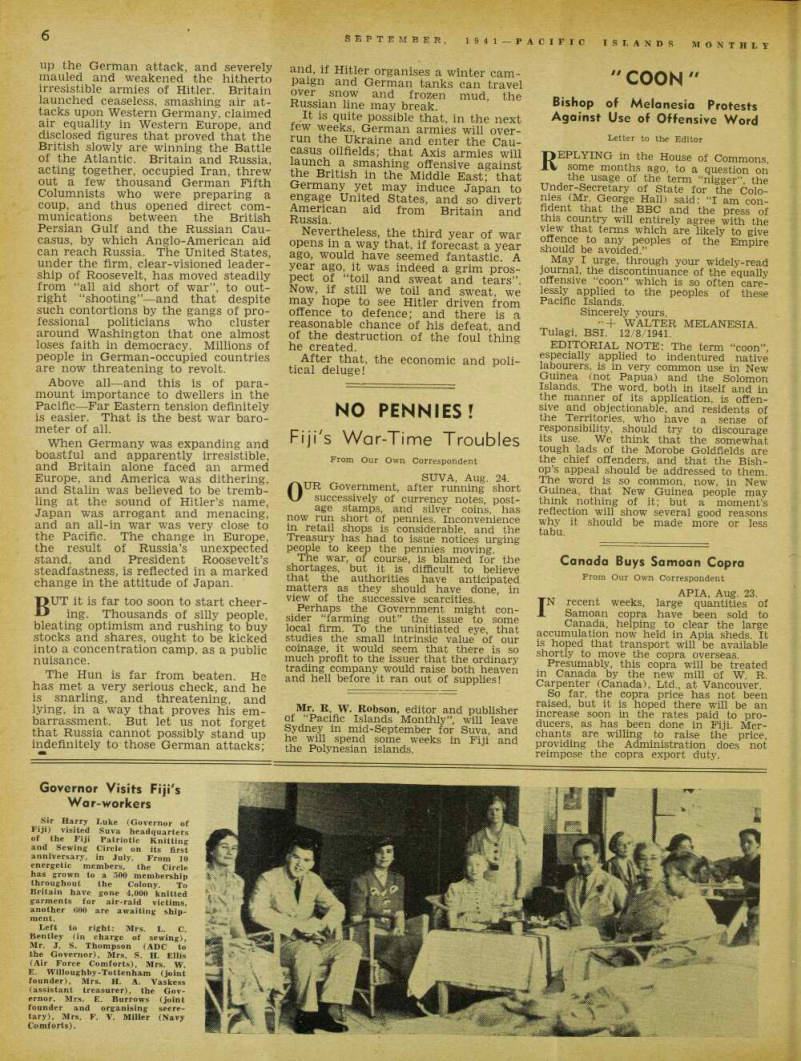
Sir Harry Luke (Governor of Fiji) visited Suva headquarters of the Fiji Patriotic Knitting and Sewing Circle on its first anniversary, in July. From 10 energetic members, the Circle has grown to a 500 membership throughout the Colony. To Britain have gone 4,000 knitted garments for air-raid victims, another 600 are awaiting ship ment.
Left to right: Mrs. L. C.
Bentley (in charge of sewing), Mr. J. S. Thompson (ADC to the Governor), Mrs. S. H. Ellis (Air Force Comforts), Mrs. W.
E. Willoughby-Tottenham (joint founder), Mrs. H. A. Vaskess (assistant treasurer), the Gov ernor. Mrs. E. Burrows (joint founder and organising secre tary), Mrs. F. V. Miller (Navy Comforts).
Triplets On
Pitcairn
Heirs of "Bounty" and an Occasion of Wild Excitement
From a Special Correspondent
Pitcairn Island, Aug. 5.
LAST night, the whole community was startled by an unusual stroke of the public bell. People rushed from all directions to the public square, where the bell hangs, to find out the cause of the alarm. When the reason was ascer tained, our excitement was intense.
Mrs. Nelson Dyett had just given birth to the first triplets bom on Pitcairn Island—two girls and a boy. Mr. Dyett was so eager to make a public announce ment that immediately he resorted to the bell. To his dismay, when he re turned home, he found that one of the girls had died. The others are well.
Mrs. Dyett was formerly Maud Young, and she is a great, great, great grand daughter of Midshipman Young, who was the only officer, other than Fletcher Christian, who went with the “Bounty” mutineers into exile on Pitcairn Island 150 years ago.
Twins frequently are born on Pitcairn: but. since the day the “Bounty” arrived, only one confinement has been attended by a doctor. We have skilled midwives here. The triplets were brought into the world bv Mrs. Lily Warren and Mrs.
Rose Christian, who are twin sisters and who themselves are descendants of Edward Young.
Another New Guinea
Gold Find
From Our Own Correspondent WAU, Sept. 5.
STEADILY, step by step, Australian gold nrospectors in New Guinea are pushing out into the comfortless and inhospitable Sepik region. Every now and again another gold strike is reported and the men nush further into the interior.
One of these days, maybe, they will discover another Morobe.
The “Morobe News”, of August 16, re ported another gold discoverv. about 6 to 8 hours up the Senik River, from Murui, on the western side of the Chambri Lakes Messrs. Beckett and Eichorn found the gold, and have been doing rea sonably well, and a number of other pioneer miners have gone in from Wewak and Madang.
The newspaper says that the big draw back of the region is mosquitoes—and one can believe it. This part of the Sepik is swampy, unpleasant, and generally “lousy”.
A Grandson At Last!
From Our Own Correspondent SUVA. Sept. 1.
AFTER being presented with three grand-daughters in succession. Sir Maynard Hedstrom jestingly offered a bonus of £lOO for his first grandson.
In the intervening ten years or so he has acquired three more grand-children —all girls!
But, at last, the luck has changed, and he has just proudly signed a cheque in favour of the parents of John Maynard Hedstrom 111, born in Suva on August 22.
Mr. and Mrs. Ward Nolan, who operate a medical post at Orokolo, Papua, for the SDA Mission, are at present in Sydney on furlough.
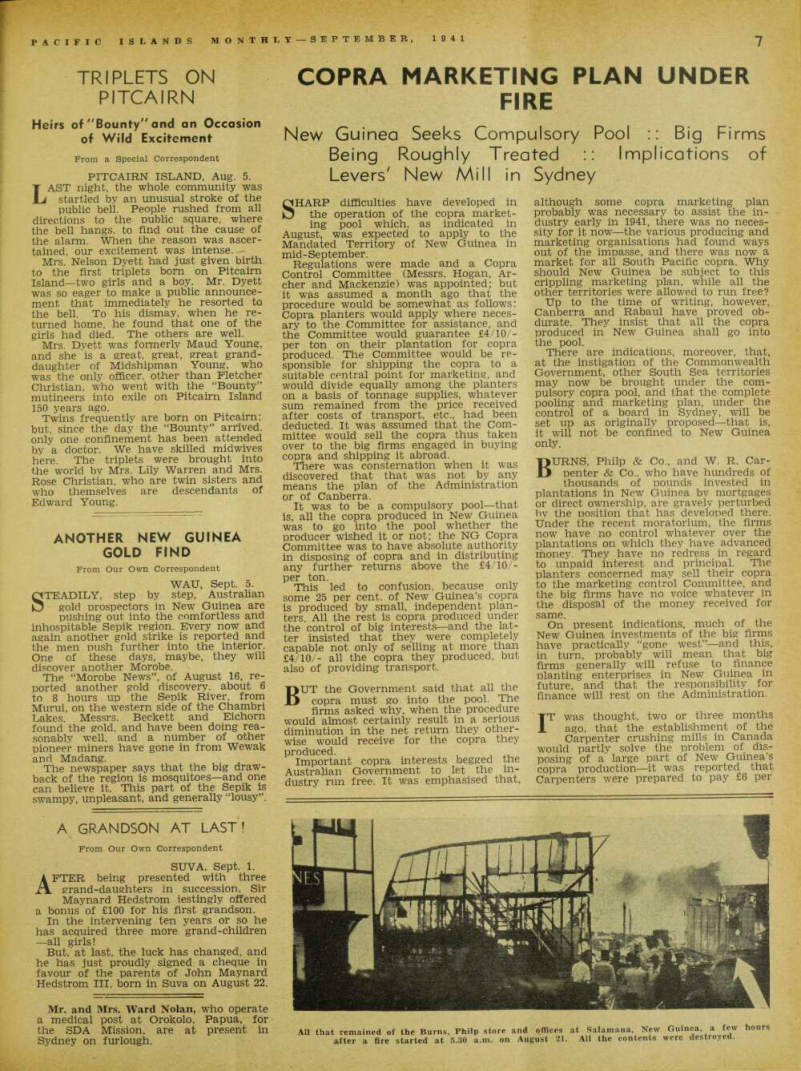
All that remained of the Burns, Philp store and offices at Ralamaua, New Guinea, a few hours after a fire started at 5.30 a.m. on August 21. All the contents were destroyed.
Copra Marketing Plan Under
Fire
New Guinea Seeks Compulsory Pool :: Big Firms Being Roughly Treated :: Implications of Levers' New Mill in Sydney
SHARP difficulties have developed in the operation of the copra market ing pool which, as indicated in August, was expected to apply to the Mandated Territory of New Guinea in mid-September.
Regulations were made and a Copra Control Committee (Messrs. Hogan, Ar cher and Mackenzie) was appointed; but it was assumed a month ago that the procedure would be somewhat as follows: Copra planters would apply where neces ary to the Committee for assistance, and the Committee would guarantee £4/10/per ton on their plantation for copra produced. The Committee would be re sponsible for shipping the copra to a suitable central point for marketing, and would divide equally among the planters on a basis of tonnage supplies, whatever sum remained from the price received after costs of transport, etc., had been deducted. It was assumed that the Com mittee would sell the copra thus taken over to the big firms engaged in buying copra and shipping it abroad.
There was consternation when it was discovered that that was not by any means the plan of the Administration or of Canberra.
It was to be a compulsory pool—that is, all the copra produced in New Guinea was to go into the pool whether the producer wished it or not; the NG Copra Committee was to have absolute authority in disposing of copra and in distributing any further returns above the £4/10/per ton.
This led to confusion, because only some 25 per cent, of New Guinea’s copra is produced by small, independent plan ters. All the rest is copra produced under the control of big interests—and the lat ter insisted that they were completely capable not only of selling at more than £4/10/- all the copra they produced, but also of providing transport.
BUT the Government said that all the copra must go into the pool. The firms asked why, when the procedure would almost certainly result in a serious diminution in the net return they other wise would receive for the copra they produced. , , Important copra interests begged the Australian Government to let the in dustry run free. It was emphasised that,
although some copra marketing plan probably was necessary to assist the in dustry early in 1941, there was no neces sity for it now—the various producing and marketing organisations had found ways out of the impasse, and there was now a market for all South Pacific copra. Why should New Guinea be subject to this crippling marketing plan, while all the other territories were allowed to run free?
Up to the time of writing, however, Canberra and Rabaul have proved ob durate. They insist that all the copra produced in New Guinea shall go into the pool.
There are indications, moreover, that, at the instigation of the Commonwealth Government, other South Sea territories may now be brought under the com pulsory copra pool, and that the complete pooling and marketing plan, under the control of a board in Sydney, will be set up as originally proposed—that is, it will not be confined to New Guinea only.
BURNS, Philp & Co., and W. R. Car penter & Co., who have hundreds of thousands of pounds invested in plantations in New Guinea bv mortgages or direct ownership, are gravely perturbed hv the nosition that has developed there.
Under the recent moratorium, the firms now have no control whatever over the plantations on which they have advanced money. They have no redress in regard to unpaid interest and principal. The planters concerned may sell their copra to the marketing control Committee, and the big firms have no voice whatever in the disposal of the money received for same.
On present indications, much of the New Guinea investments of the big firms have practically “gone west”—and this, in turn, probably will mean that big firms generally will refuse to finance nlanting enterprises in New Guinea in future, and that the responsibility for finance will rest on the Administration.
IT was thought, two or three months ago, that the establishment of the Carpenter crushing mills in Canada would partly solve the problem of dis posing of a large part of New Guinea’s copra production—it was reported that Carpenters were prepared to pay £6 per
ton Australian at New Guinea ports for nigh grade copra.
But the Governmental authority has shown little inclination to co-operate with Carpenters in the matter—and it is now suggested that it is influenced in this attitude by the fact that the world powerful Lever interests are establishing in Sydney a new crushing mill, capable of dealing with 40,000 tons of copra p.a., in addition to the existing Lever mill, which can handle about 20,000 tons p.a. (copra which generally comes from the Lever plantations in the Solomons).
Some suggest that the Commonwealth authority regards with complacency the possibility of New Guinea copra being sold to the Lever interests in Australia at £4/10/- per ton, rather than to the Carpenter mill in Canada at £6 per ton —but such an idea surely is absurd.
The feeling among planters against the Unilever combine is so strong that, if the Commonwealth dared to plav into the hands of Lever interests as sug gested, there would be such resentment among planters that it would be bound to have reaction in the Commonwealth Parliament.
Nevertheless, strange and as yet un explained things are going on. rfTHE position may be simplified by the A fact that low grade copra only will be wanted by the new Lever mill in Sydney, while the new Carpenter mill in Canada wants high grade. But. if that is not to be the position, we vet may witness the extraordinary sight of the Carpenter interests, which nominally own or control plantations all over New Guinea, paying the Dutch East Indies or the Philippines £6 per ton for copra for the Canadian mill, while the New Guinea copra is being shipped to Sydney at less than £5 per ton.
The position is the subject of a series of conferences now proceeding. Unless it is delicately handled, it is going to have a serious reaction upon the economic future of the Territory.
One can only wonder why the Aus tralian authority persisted in its conra marketing plan, when it was obvious that the industry was finding its own way out of its troubles.
A consideration of the circumstances, combined with the curious results flowing from the present moratorium in New Guinea, might suggest that it is the de liberate policy of the New Guinea Ad ministration to smash the commercial power of the big firms in New Guinea.
There may be something to commend such a policy—no one loves monopolies— but this seems to be the worst possible time in history to put it into operation.
Mr. L. H. Hilder, chief clerk in the Papuan Lands Department, has been ap pointed Government Storekeeper at Pt.
Moresby.
Awarded D.F.M.
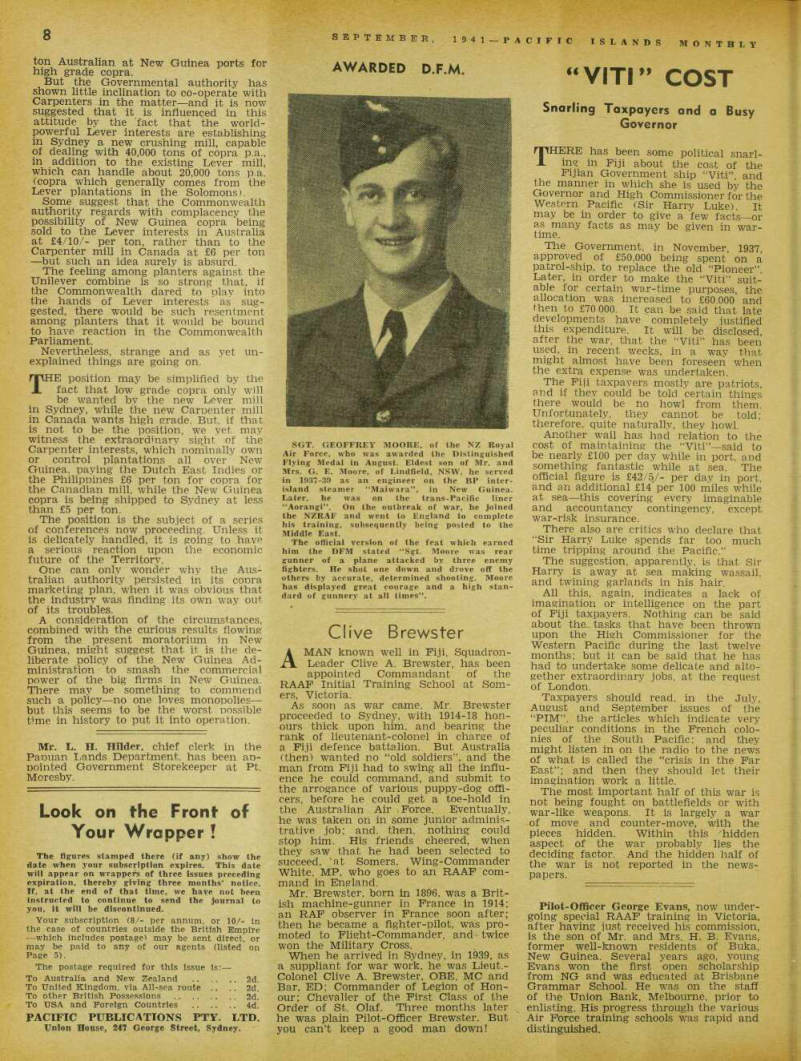
SGT. GEOFFREY MOORE, of the NZ Royal Air Force, who was awarded the Distinguished Flying Medal in August. Eldest son of Mr. and Mrs. G. E. Moore, of Lindfield, NSW, he served in 1937-39 as an engineer on the BP inter island steamer “Maiwara”, in New Guinea.
Later, he was on the trans-Pacific liner “Aorangi”. On the outbreak of war, he joined the NZRAF and went to England to complete his training, subsequently being posted to the Middle East.
The official version of the feat which earned him the DFM stated “Sgt, Moore was rear gunner of a plane attacked by three enemy fighters. He shot one down and drove off the others by accurate, determined shooting. Moore has displayed great courage and a high stan dard of gunnery at all times”.
Clive Brewster
A MAN known well in Fiji, Squadron- Leader Clive A. Brewster, has been appointed Commandant of the RAAF Initial Training School at Som ers, Victoria.
As soon as war came, Mr. Brewster proceeded to Sydney, with 1914-18 hon ours thick upon him, and bearing the rank of lieutenant-colonel in charge of a Fiji defence battalion. But Australia (then) wanted no “old soldiers”, and the man from Fiji had to swing all the influ ence he could command, and submit to the arrogance of various puppy-dog offi cers, before he could get a toe-hold in the Australian Air Force. Eventually, he was taken on in some junior adminis trative job; and. then, nothing could stop him. His friends cheered, when they saw that he had been selected to succeed, 'at Somers, Wing-Commander White. MP, who goes to an RAAF com mand in England.
Mr. Brewster, born in 1896, was a Brit ish machine-gunner in France in 19.14; an RAF observer in France soon after; then he became a fighter-pilot, was pro moted to Flight-Commander, and twice won the Military Cross.
When he arrived in Sydney, in 1939, as a suppliant for war work, he was Lieut.- Colonel Clive A. Brewster, OBE, MC and Bar, ED; Commander of Legion of Hon our; Chevalier of the First Class of the Order of St. Olaf. Three months later he was plain Pilot-Officer Brewster. But you can’t keep a good man down!
“Viti” Cost
Snarling Taxpayers and a Busy Governor
THERE has been some political snarl in? in Fiji about the cost of the Fijian Government ship “Viti” and the manner in which she is used by the Governor and High Commissioner for the Western Pacific (Sir Harry Luke) It may be in order to give a few facts—or as many facts as may be given in war time.
The Government, in November, 1937, approved of £50,000 being spent on a patrol-ship, to replace the old “Pioneer”
Later, in order to make the “Viti” suit able for certain war-time purposes, the allocation was increased to £60.000 and then to £7O 000. It can be said that late developments have completely justified this expenditure. It will be disclosed, after the war, that the “Viti” has been used, in recent weeks, in a way that might almost have been foreseen when the extra expense was undertaken.
The Fiji taxpayers mostly are patriots, and if they could be told certain things there would be no howl from them.
Unfortunately, they cannot be told; therefore, quite naturally, they howl.
Another wail has had relation to the cost of maintaining the “Viti”—said to be nearly £lOO per day while in port, and something fantastic while at sea. The official figure is £42/5/- per day in port, and an additional £l4 per 100 miles while at sea—this covering every imaginable and accountancy contingency, except war-risk insurance.
There also are critics who declare that “Sir Harry Luke spends far too much time tripping around the Pacific.”
The suggestion, apparently, is that Sir Harry is away at sea making wassail, and twining garlands in his hair.
All this, again, indicates a lack of imagination or intelligence on the part of Fiji taxpayers. Nothing can be said about the tasks that have been thrown upon the High Commissioner for the Western Pacific during the last twelve months; but it can be said that he has had to undertake some delicate and alto gether extraordinary jobs, at the request of London.
Taxpayers should read, in the July, August and September issues of the “PIM”. the articles which indicate very peculiar conditions in the French colo nies of the South Pacific; and they might listen in on the radio to the news of what is called the “crisis in the Far East”; and then they should let their imagination work a little.
The most important half of this war is not being fought on battlefields or with war-like weapons. It is largely a war of move and counter-move, with the pieces hidden. Within this hidden aspect of the war probably lies the deciding factor. And the hidden half of the war is not reported in the news papers.
Pilot-Officer George Evans, now under going special RAAF training in Victoria, after having just received his commission, is the son of Mr. and Mrs. H. B. Evans, former well-known residents of Buka, New Guinea. Several years ago, young Evans won the first open scholarship from NG and was educated at Brisbane Grammar School. He was on the staff of the Union Bank, Melbourne, prior to enlisting. His progress through the various Air Force training schools was rapid and
distinguished.
Advertisements & other items, p. 10 (1 item)
Your Wropper !
Look on the Front of
The figures stamped there (if any) show the date when your subscription expires. This date will appear on wrappers of three Issues preceding expiration, thereby giving three months’ notice.
If, at the end of that time, we have not been instructed to continue to send the journal to you, it will be discontinued.
Your subscription (8/- per annum, or 10/- in the case of countries outside the British Empire —which includes postage) may be sent direct, or may be paid to any of our agents (listed on Page 5).
The postage required for this issue is:— To Australia and New Zealand 2d.
To United Kingdom, via All-sea route .. 2d.
To other British Possessions .. 2d!
To USA and Foreign Countries 4d.
PACIFIC PUBLICATIONS PTY. LTD.
Union House, 247 George Street, Sydney.
An Example Of War
Service
HERE is a record of war service of which Vila (New Hebrides) can be proud.
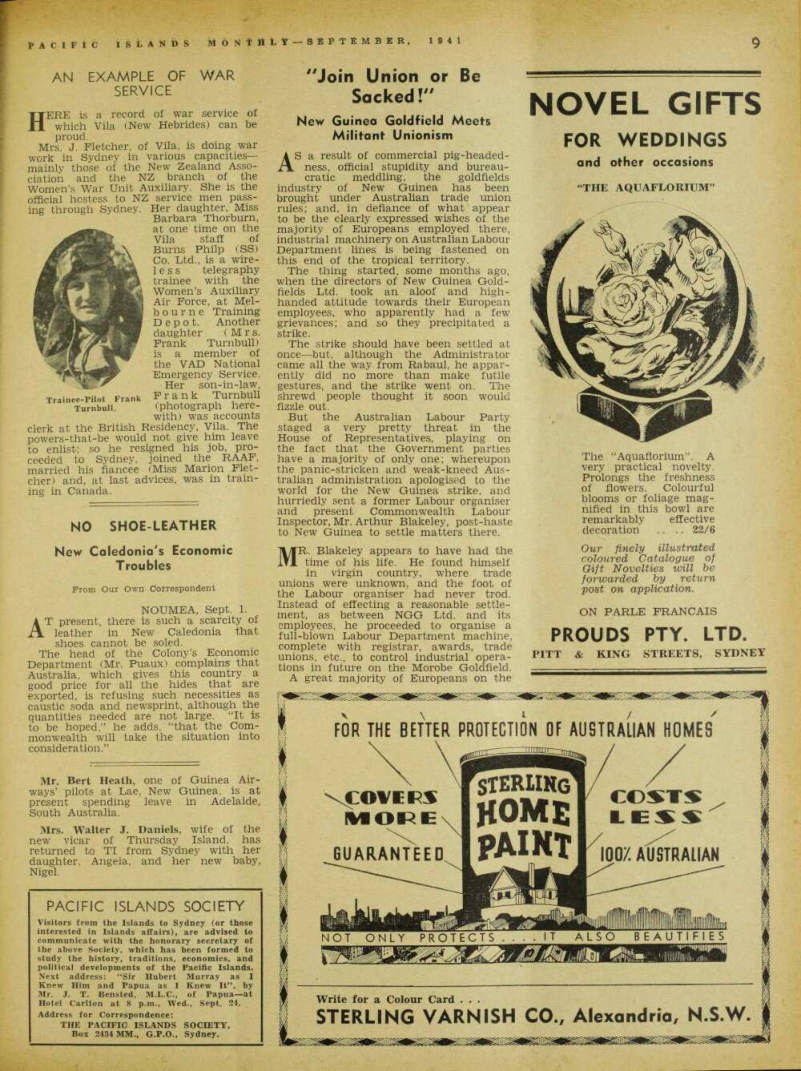
Mrs. J. Fletcher, of Vila, is doing war work in Sydney in various capacities— mainly those of the New Zealand Asso ciation and the NZ branch of the Women’s War Unit Auxiliary. She is the official hostess to NZ service men pass ing through Sydney. Her daughter. Miss Barbara Thorburn,
at one time on the Vila staff of Burns Philp (SS) Co. Ltd., is a wire -1 e s s telegraphy trainee with the Women’s Auxiliary Air Force, at Mel bourne Training Depot. Another daughter (Mrs.
Frank Turnbull) is a member of the VAD National Emergency Service.
Her son-in-law, Frank Turnbull (photograph here with) was accounts
clerk at the British Residency, Vila. The powers-that-be would not give him leave to enlist; so he resigned his job, pro ceeded to Sydney, joined the RAAF, married his fiancee (Miss Marion Flet cher) and, at last advices, was in train ing in Canada.
Trainee-Pilot Frank Turnbull.
No Shoe-Leather
New Caledonia's Economic Troubles
From Our Own Correspondent
Noumea, Sept. 1.
AT present, there is such a scarcity of leather in New Caledonia that shoes cannot be soled.
The head of the Colony’s Economic Department (Mr. Puaux) complains that Australia, which gives this country a good price for all the hides that are exported, is refusing such necessities as caustic soda and newsprint, although the quantities needed are not large. “It is to be hoped,” he adds, “that the Com monwealth will take the situation into consideration.”
Mr. Bert Heath, one of Guinea Air ways’ pilots at Lae, New Guinea, is at present spending leave in Adelaide, South Australia.
Mrs. Walter J. Daniels, wife of the new vicar of Thursday Island, has returned to TI from Sydney with her daughter, Angela, and her new baby, Nigel.
Sacked!"
"Join Union or Be Sacked!"
New Guinea Goldfield Meets Militant Unionism
AS a result of commercial pig-headed ness, official stupidity and bureau cratic meddling, the goldfields industry of New Guinea has been brought under Australian trade union rules; and, in defiance of what appear to be the clearly expressed wishes of the majority of Europeans employed there, industrial machinery on Australian Labour Department lines is being fastened on this end of the tropical territory.
The thing started, some months ago, when the directors of New Guinea Gold fields Ltd. took an aloof and high handed attitude towards their European employees, who apparently had a few grievances; and so they precipitated a strike.
The strike should have been settled at once—but, although the Administrator came all the way from Rabaul, he appar ently did no more than make futile gestures, and the strike went on. The shrewd people thought it soon would fizzle out.
But the Australian Labour Party staged a very pretty threat in the House of Representatives, playing on the fact that the Government parties have a majority of only one; whereupon the panic-stricken and weak-kneed Aus tralian administration apologised to the world for the New Guinea strike, and hurriedly sent a former Labour organiser and present Commonwealth Labour Inspector, Mr. Arthur Blakeley, post-haste to New Guinea to settle matters there.
MR. Blakeley appears to have had the time of his life. He found himself in virgin country, where trade unions were unknown, and the foot of the Labour organiser had never trod.
Instead of effecting a reasonable settle ment, as between NGG Ltd. and its employees, he proceeded to organise a full-blown Labour Department machine, complete with registrar, awards, trade unions, etc., to control industrial opera tions in future on the Morobe Goldfield.
A great majority of Europeans on the
Morobe Goldfield are normal and sen sible men, and when they saw what Mr.
Blakeley was at they protested. A section of the NGG employees were all for Mr.
Blakeley, of course; but the balance of the NGG employees, and practically all the other Europeans—including the very numerous staff of Bulolo Gold Dredging Ltd. —were emphatic in their declaration that they did not want Mr. Blakeley and his elaborate plans, and that trade union machinery was not a good thing in a dark-skinned tropical territory, any how.
As luck would have it, while the argu ment was proceeding there came along the new Minister for the Territories, Mr.
McDonald; and this unfortunate gentle man, being quite ignorant of the condi tions which govern a tropical territory, gave a sympathetic ear to the urgent pleas of Mr. Blakeley, and finally told him to go right ahead with his plans, and promised that he, as Minister, would see to it that Canberra gave him all necessary authority under the National Security (Industrial Peace) Regulations.
The busy Mr. Blakeley found himself clothed with the authority of a czar.
On August 20, Mr. Blakeley announced that the gold-mining industry in New Guinea, in future, would be controlled by an industrial award; and, as he had been directed by Mr. McDonald to exer
cise the powers of a Conciliation Com missioner, as defined under the National Security Regulations, he duly made an industrial award which was published in detail in the “Morobe News” on August 30, and which has a currency of one year.
This award apparently gives prefer ence to unionists (that is, all mine workers in New Guinea must become members of the New Guinea and Papuan Miners and Workers’ Union within 28 days); an all-round increase of wages of about 18/- per week; a reduction of four hours in the working week; and some minor concessions.
Mr. Blakeley formally refused to recog nise any union other than the union named; and he issued an order that the latter, at an early date, should elect per manent officers with whom he might deal, as Conciliation Commissioner.
A meeting of members of the union elected Mr. J. Pollard as president, and Mr. K. Laurance as secretary.
MEANWHILE, on August 28, a very large meeting of the employees of Bulolo Gold Dredging Ltd. met in Bulolo and expressed, in strong terms, their resentment at a trade union being forced upon them in the manner de scribed. Their attitude towards the new union, and towards Mr. Blakeley and all his works, was hostile; and the following motions were carried by a large majority:— “(1) That we will not join this union under the terms stated in the award.
“(2) That the following radio be sent to the Prime Minister of Australia and the Leader of the Opposition (Mr. Cur tin) ; ‘By overwhelming majority, BGD employees at meeting decided against compulsory joining of union as instructed by Commissioner Blakeley. Suggest you
hold up passing of Act until you receive our petition.”
However, as the result of the supine ness of the Administrator and the ignor ance of the new Minister, all that Mr Blakeley has done already has the force of law; which means that all goldfields employers must obey Mr. Blakeley’s new award, and all employees must join the union within 28 days, or be dismissed from their jobs.
There is much strong and bitter feel ing between the pro-Blakeley and anti- Blakeley groups, and Sydney newspapers have reported quarrelling and fighting among Europeans in the Morobe district.
It is one of the worst chapters in the tragic history of Australian Govern mental muddling in New Guinea.
Advertisements & other items, pp. 11-12 (3 items)
9
PACIFIC ISLANDS MONt H L t SEPTEMBER, 1941
Home
NOVEL GIFTS
FOR WEDDINGS
and other occasions
‘THE AQUAFLORIUM”
V 7. > The “Aquaflorium”. A very practical novelty.
Prolongs the freshness of flowers. Colourful blooms or foliage magnified in this bowl are remarkably effective decoration .. .. 22/6 Our finely illustrated coloured Catalogue of Gift Novelties will he forwarded by return post on application.
ON PARLE FRANCAIS
PROUDS PTY. LTD.
PITT & KING STREETS, SYDNEY
FOR THE BETTER PROTECTION OF AUSTRALIAN HOMES
sterling
HOME
GUARANTEED ■ PAINT . 1007. AUSTRALIAN
B xreWMr* MORE \ llwlVlf, I LESS
dMirihftfci
NOT ONLY PROTECTS ... IT ALSO BEAUTIFIES Write for a Colour Card . . .
STERLING VARNISH CO., Alexandria, N.S.W.
OLD MONK
The Worlds Finest Olive Oil San Francisco
St. Ignatius’ College
Riverview Sydney
Boys are prepared for Intermediate and Leaving Certificate Examinations and for Exhibitions, Scholarships and Bursaries at the University.
Boys are arranged in three Divisions according to age. Each Division has its own Library, Debating Society, Cricket and Football Fields, and Tennis Courts.
Senior and Junior Rowing Sheds, with a large fleet of pleasure and racing boats.
Private Swimming Baths.
Prospectus and further particulars on application to the— Rector; St. Ignatius’ College, Riverview, Sydney, Australia.
Tel.: JB 1106.
BOARDING AND DAY SCHOOL
Conducted by the Jesuit Fathers i i i
ONE OF SYDNEY'S GREAT PUBLIC SCHOOLS
Pacific Islands Society
Visitors from the Islands to Sydney (or those interested in Islands affairs), are advised to communicate with the honorary secretary of the above Society, which has been formed to study the history, traditions, economics, and political developments of the Pacific Islands.
Next address: “Sir Hubert Murray as I Knew Him and Papua as I Knew It”, by Mr. J. T. Bensted, M.L.C., of Papua—at Hotel Carlton at 8 p.m., Wed., Sept. 24.
Address for Correspondence:
THE PACIFIC ISLANDS SOCIETY,
Box 2434 MM., G.P.0., Sydney.
New Caledonia's Good
Coffee
From Our Own Correspondent
Noumea, Sept. 1.
rE Administration is introducing a system of grading for the New Caledonian coffee harvest of 1941-42 which, it is expected, will give full satis faction to Australian buyers. New Cale donian coffee had a high reputation in France, fetching the best prices at Le Havre, prior to the cutting of communi cations.
Pastor and Mrs. R. H. Tutty, of the SDA Mission, Lorengau, Manus, New Guinea, are expected to arrive in Sydney this month on leave. They have com pleted 22 years’ missionary work in the Pacific.
Suva Call
Fiji Included in PAA Trans-Pacific Service
From Our Own Correspondent SUVA, Sept. 1.
PERHAPS the most interesting devel opment in Suva lately is the appar ently close approach of the date when Pan American Airways’ Clippers will call here.
The new schedule is expected to be inaugurated on October 18, from San Francisco.
Not very much progress has been made with the actual airport construction; but it is understood that, in the initial stages of the service, the Clippers will moor to a barge in Laucala Bay, at the back of Suva, and passengers will be carried to the town by launch. The rea son for choosing Laucala Bay as the landing-ground is that better visibility can be expected there than in Suva Harbour itself.
Eventually, an embankment and a wharf-head will have to be made, but this may be an expensive and a long task, because the shallows extend so far that the wharf-head would have to be a long way offshore.
However, the main thing is to get the service started; and, Mr. Harold Gatty, Auckland manager of PAA, has been spending several weeks here completing all arrangements.
The Suva call, both ways, will be made between Canton Island and Noumea; and, as far as is known, the Clippers will remain overnight at Suva.
The southwards schedule then will be Honolulu to Canton Island, first day; Canton Island to Suva, second day; Suva to Noumea, third day; and Noumea to Auckland, fourth day.
It is reported from NZ that PAA, is seeking Washington’s authority to use Palmyra Island (between Honolulu and Canton Is.) as a re-fuelling base.
Deer And Trout
For Future Sportsmen in N. Caledonia
From Our Own Correspondent
Noumea, Sept. 1.
SOME day, New Caledonia is going to be a Mecca for deer-shooters and anglers.
Recently, an Australian party had a most enjoyable deer-shooting expedition.
The deer were in fine condition and in astonishing numbers.
The new Col d'Amieu road, across the island, from La Foa to Canala, runs through New Zealand-like scenery, with mountains and forests, tree-palms, cas cades and clear streams. Governor Sau tot thinks it could produce trout. He says he repently has been talking with Sir Harry Luke, who told him what was being done to introduce trout from New Zealand to Fijian streams. His opinion was that New Caledonian waters would prove even more suitable—they are already the habitat of quantities of freshwater fish, running up to a pound or two. So if New Zealand wants to do New Caledonia a good turn, here’s an opportunity.
Mr. H. W. Quinton, of the New Guinea Forestry Department, is now in Austra lia on three months’ leave.
Advertisements & other items, pp. 13-14 (1 item)
Avti
ULTIMATE...
leads again
WITH A UNIQUE DUAL PURPOSE SET
The 1 or 9 Valve Multi-Wave
A.C. TRANSPORTABLE MANTEL MODEL
This model must not be confused with the usual small Portable batteryoperated sets with their comparatively limited sensitivity.
This set incorporates the identical full-sized chassis embodied in the “Majestic” Console with all its special features and refinements such as Band Spread Tuning on Short-wave Bands, and others, in an easily transportable form. This is achieved by means of a simply attached lid fitted with handle.
Power is immense, tone is superb, sensitivity is extreme, performance is almost unbelievable. Take it anywhere 240 A.C. current is available —dependability and satisfaction are assured under even the most difficult conditions.
The ideal set for particularised work, for the hard of hearing, for reception rooms, halls, meetings, dances, etc. There’s nothing like it on the market for convenience, appearance, durability, dependability and performance.
Removal of front sliding lid instantly transforms this unique set into a most artistic-looking Mantel Radio worthy of first place in any home. Particularly suitable for the Pacific Islands wherever 240 A.C. power is available. Specially protected against humidity and insects. Fully guaranteed in every way by “ULTIMATE” reputation.
I Cut out I this Coupon I and post to-day.
GEORGE BROWN & CO. PTY. LTD., 267 Clarence Street, Sydney.
Please send me particulars of “ULTIMATE” Radio Receivers as advertised in “Pacific Islands Monthly”.
E
AVTi
Ti m u A W, / GEORGE BROWN Cr CO. PTY. LTD., 267 Clarence St., Sydney
m \ S' r
FOR MAN OR MAID
there’s no Gift so good as a Watch. r==Ts w 'd Ml
bTTT»
= s oV a r- £7/0/0 a very beautiful baguette shaped watch. It’s in 9 ct. Gold with gilt bracelet. 15-Jewelled Swiss mechanism. See below for guarantee. nrnniw j & 90/- And a very pretty Watch indeed!
The Gold-filled case is nicely engraved.
Moire band. 15-Jewelled movement. See below for guarantee.
EG' 70/- A charming Watch in attractive Chrome case. Matching bracelet. 15-jewelled Swiss Lever mechanism.
All of these watches are warranted for 10 years. Free adjustment and regulation is provided for 1 year.
The Wonderful "Indestructible"
K) CM CM O o WATERPROOF . . DUSTPROOF . . .
SHOCKPROOF , . . ANTIMAGNETIC . . .
UNCONDITIONALLY GUARANTEED FOR
ONE YEAR . . . The “Indestructible” is the toughest of the tough. That’s why it’s the favourite for men who know the Tropics.
Each and every “Indestructible” is warranted to give at least 25 years’ service. In Stainless Steel Case with durable, washable, fabric Band £7/19/6
ANGUS &GOOTE
500 GEORGE STREET, SYDNEY
Noumea
British Consul in Noumea How Vichy Ordered His Arrest
From Our Own Correspondent
Noumea, Aug. 14.
It/rONSIEUR Bayardelle, Secretary-Gen -I*l eral of New Caledonia at the time when the Colony rallied to the Free French Movement, and who is now at headquarters in London, reveals that, pre ceding the Conseil-General’s repudiation of Governor Pelicier on August 26, last year, two telegrams were received from the Vichy Government.
One ol them ordered the arrest of the British Consul in Noumea (Mr. John ston) and the other ordered the Colony to give priority in its mineral exports to Japan and to Russia (meaning, of course, Germany).
He adds that Vichy’s official repudiation of the French Republic was the signal for the Noumea Municipality to repaint all the town’s public buildings with the words: “Republique Francaise —Liberte, Egalite, Fraternite”.
Suva's New Golf Course
From Our Own Correspondent SUVA, Sept. 2.
SUVA’S new golf course is settling down —particularly the additional 9 holes, recently opened. It is the first 18hole course in Fiji, and, though never likely to become a Sandwich or even a Rose Bay, it is definitely attractive to Suva residents, who fill it daily, and should be popular with visiting tourists — if and when tourists come into being again.
The 18 holes are all on the flat, which perhaps lessens their interest a little, but which certainly makes play practicable for an older generation than could tackle the old, now abandoned course, one round of which, on a warmish day, was cal culated to reduce the ordinary player to a damp sponge. (See illustrated article on page 25, written before the new 9 holes were opened.) Mr. G. J. A. Moore, BP manager at Pt. Moresby, is now in Australia on leave.
Modern Chinese School
In Rabaul
THIS attractive, well-ventilated tropi cal building is the Methodist Mis sion’s new Chinese School at Rabaul, New Britain, opened a few months ago.
Nestling at the foot of the hills behind the town, the* school was built to modern plans prepared by Mr. W. Mac- Gowan, of the NG Public Works Depart ment, and the entire cost was met by Rabaul’s Chinese community. White, with black granite pillars and steps, it consists of an assembly room, three classrooms, kindergarten, library, and permanent stage—an important item in a Chinese school. Above the main entrance is the title, “Overseas Chinese School”, in red English lettering and in huge bronze Chinese characters.
At present the school is closed—almost continuous eruptions from Matupi crater a few miles away have covered the building with a grey blanket of fine pumice dust half an inch thick, making it untenantable.
—Photo; “Missionary Review.”
Advertisements & other items, p. 14 (2 items)
12
SEPTEMBER, 1641 PACIFIC ISLANDS MONTHLI
W. H. GROVE & Sons Ltd.
AUCKLAND
Island Traders. p.o. b<« 490.
Telegraphic and Cable Address: “Grove", Auckland.
Shippers of all classes of New Zealand Products, specially prepared for the Island trade.
Representing English Manufacturers throughout the Cook and Society Islands, Fiji, Tonga, Samoa, Niue, New Caledonia, New Guinea, etc.
In FIJI as —W. H. Grove & Sons (Fiji) Ltd.
Tropicaoties
NEW dignities are sometimes expen sive. Men offered a peerage have been known to refuse, on the ground that they did not care to expend the necessary money on their robes and patent. No such restraint is necessary when the taxpayer’s purse is behind you.
When Fiji Government yacht “Viti” was recently given naval status her launch automatically became a naval barge, and as such had to be graced with the pair of dolphins customary on such craft—dolphins, presumably, of ornament and distinction, but hardly of much practical use. Dolphins could be cast in Suva. But, alas, their full bril liance would not be revealed without chromium-plating, so they were des patched to Sydney to acquire the neces sary lustre. The bill is understood to be a little under £lOO. Still, perhaps this has brought us a little nearer to win ning the war.
AN act of simple and sincere good comradeship is reported from Wau, New Guinea. In that tropical town, isolated in the mountains, they have found some very good dramatic talent, and Major Ayris regularly produces some first-class plays. Recently, “It Pays to Advertise” ran for a short, successful season.
After the last performance, the players went in a body to the cemetery and placed a wreath upon the grave of Miss Jean Wilson, whose brutal murder is one of the unsolved mysteries of the Territory. Jean Wilson, a charming and popular girl, was cast for one of the chief parts in “It Pays to Advertise”, and had rehearsed regularly up to the time of her tragic death on June 23.
Her associates, in the moment of their success, thought first of her. * AREAL gesture of goodwill! The popular American authors, Nordhoff and Hall, of Tahiti, have produced another book of the Bligh series, entitled “Botany Bay”, The others —all out standing successes—were “Mutiny”, “Men Against the Sea”, and “Pitcairn’s Island”.
Chapman and Hall, of London, will pub lish the British Empire edition of “Bot any Bay”, and the authors have arranged that the whole of the profits therefrom shall go to British war funds, as an expression of their admiration of the behaviour of the British people, under Blitzkrieg. Nordhoff and Hall were aviators in the last war—that, in fact, is where they first met. They were In the French Air Force, and, in 1917, trans ferred to the United States organisation.
After the war, they went off together to seek some quiet place, away from the hateful, warring world —and they found Tahiti. * THE ever-murmuring “coconut wire less” can be a boon or a bane in an Islands community. At one Central Pacific port recently it received more round cursing from local residents than the Gestapo has bestowed on Europe’s hidden “freedom radios”.
A few months ago “coconut wireless” whispered that a party of Free French soldiers would call at the island on their way overseas. Old residents scoffed; but, within a day or two, a vessel put into port and, sure enough, ashore came the Frenchmen. There was a hectic scramble among the locals to give the contingent happy memories of their visit.
Quite recently, when “coconut wire less” let it be known that another batch
of men would pass through, nothing was left to chance. Each village killed pigs and chickens and gathered ever y v^ ri ety of fresh produce, to ensure that the Frenchmen would have to be carried b ack their Natives lined the beach when a steamer arrived on the due date; but great was the disappomt ment, and loud the cursing, when it was found that s °ldiers were aboard, There was only one thing to do tuck away the fine food before it went rotten, m tro Pte al fa s hlo ?J- An< ? , the local epi " cures did that, with gusto, * A T the recent term examinations at Newington College, Sydney, the name of Prince Jione Gu, young est son of Queen Salote of Tonga, headed the list in wool-classing. Until he went to New Zealand a couple of years ago, to study with a tutor, Prince Jione had never seen a sheep. This is certainly a new departure for a Poly nesian.
This young Tongan noble, who does not aspire to the notable scholarship of his brother, the Crown Prince, has definite agricultural leanings. Prince Jione, by the way, seems to carry all
before him on the football field—as one or two casualties during the recent sea son proved. As he weighs nearly 20 stone, he is certainly a formidable oppo nent. He spells his name Gu—not Ngu as sometimes printed.—“Eriki”.
Messrs. Alan Dickinson and Chris.
Wordsworth, of Bulolo Gold Dredging Ltd.’s No. 5 camp, New Guinea, arrived in Australia recently to join the AIF.
Advertisements & other items, pp. 15-16 (1 item)
Conqueredjt last!
SCHOLARSHIPS
THE KING’S SCHOOL
PARRAMATTA, AUSTRALIA
Three Exhibitions of £6O a year each for boarders and three of £2O a year each for day boys from Parramatta and district are open to boys over 12 and under 16 years of age.
The Exhibitions are tenable for three years (minimum) and winners must enter the School Ist Term, 1942.
A written examination will be held at the School on Friday and Saturday, November 7 and 8.
Arrangements may be made for boys living at a considerable distance from the School to be examined in their own locality.
Entry Forms should reach the Headmaster not later than October 21.
For full particulars of these Exhibitions and of other Exhibitions and Scholarships at The King’s School, apply to—
H. D. HAKE, M.A.,
Headmaster.
Cause of Catarrh
Conqueredjt last!
67,000 Relieved by Oral Vaccine ( taken by the mouth) Based on the researches of the famous Louis Pasteur, the immunisation treatment known as Lantigen “B” has relieved thousands of sufferers from Catarrh, Bronchitis, Bronchial Troubles, Antrum and Sinus Trouble when other treatments have failed. Lantigen “B” is taken through the mouth (a few drops in water nightly), and provides benefits previously only available through painful and expensive vaccination by injection.
By attacking the actual underlying causevirulent germs which cause Catarrh — Lantigen “B” actually removes the conditions responsible for its continuous poisoning of the system. It gives genuine relief and prevents the recurrence of annoying chronic catarrhal conditions, Lantigen is not a patent medicine and is devoid of drugs altogether. It is prepared under the strict supervision of a fully qualified medical bacteriologist.
QUICK ACTION
The antigens in Lantigen are detoxified and predissolved to ensure immediate immunisation response. Absorption Is therefore much more positive and much quicker than is the case with ordinary vaccines. Lantigen treats first—then immunises. Only such a vaccine treatment can offer so many advantages. Ex-sufferers throughout Australia and New Zealand after spending pounds on socalled “cures”, praise the effectiveness of Louis Pasteur
Lantigen “B” which has brought them complete relief.
Ask your chemist to explain how Lantigen will benefit you—by treating the cause, not merely the symptoms.
Several weeks’ treatment
£l/1/- a Bottle
The average complaint is under control with two bottles and, in most cases, provided the patient’s constitutional response is normal this is sufiicient to give immunity for varying periods up to two years. Up to four bottles may be necessary for severe cases.
Each bottle Is priced at £l/1/- (for several weeks’ treatment), and may be purchased separately. The actual cost of use is ONLY sd. A DAY.
Tantigen^
ORAL VACCINE
Write to-day for full details of the Lantigen treatments or enclose £l/1/for your bottle of Lantigen “B”. Send to Edinburgh Laboratories. Box 3733
SS, G.P.0., Sydney.
SPARKLING TEETH
Dissolve film, float stains away with quick-cleansing 5-in-One Dental Cream.
It cleans teeth better, keeps them whiter and breath sweet. Contains Lantigen “D”, the anti-pyorrheal vaccine which heals spongy
SS F*ve - in - One
“here* 1/6 DENTAL CREAM
Q TILLEY
KEROSENE LAMPS
British made kerosene lamp providing a steady 300 c.p. 1 Jj/I light without flickering and without smoke or smell.
Model EX 100 (illustrated) can be used as a Storm (f Lantern, Table Lamp or Hanging Lamp. Reflector slips Jil off when not required.
Burns for 10 hours on q li pints. Easy to operate. Safe and efficient.
Chosen by the Army —illn for use here and abroad. Windproof, insectproof and rainproof. There is no finer KgOff ijJlflß investment than a Tilley Lamp. Write for IT 1111 lli'K complete Tilley catalogue. I
THERMIL KEROSENE STOVES
Lights and regulates like a gas stove. No pumping. No pricking. Lights instantly and is perfectly safe. The hot blue flame is silent and odourless. Nothing to get out of order. Can be set down anywhere, filled with kerosene and is immediately ready for use.
Price, 18/6 each.
TILLEY
KEROSENE LAMPS
British made kerosene lamp providing a steady 300 c.p. light without flickering and without smoke or smell.
Model EX 100 (illustrated) can be used as a Storm Lantern, Table Lamp or Hanging Lamp. Reflector slips off when not required.
MARINE ENGINES
Simplex engines from 3 h.p. to 12 h.p. for boats from 14 ft. to 26 ft. are Australia’s- best. 2 cycle and 4 cycle with or without Reverse gear. Illustrated is the popular little 3 h.p. suitable for 14 ft. or 16 ft. boats Runs for 5 hours on 1 gallon petrol and costs only £29/15/-, complete with all equipment. Ready to instal into any boat, nothing else to buy. Ask for Simplex catalogue of engines and launches.
SHIPCHANDLERY
We manufacture and stock the largest range of boat gear in Australia. Everything for boatbuilder and boatowner. Marine paints and varnishes. Rope and Cordage. Rigging. Anchors and M oorings. Copper Nails and Rod . Lighting Plants. Fire Extinguishers. Oars and Sculls, Lamps, Pumps, etc.
GET OUR PRICES FIRST.
W.KOPSEN & Co. Pty.Ltd.
376/380 KENT STREET, SYDNEY
’Phone: MA6336 (4 lines). Est. 1868. Cables: Kopsen . . . Sydney.
Clearer Sky In French Pacific Colonies
Brunot is Recalled :: D'Argenlieu Arrives :: Many Disloyal Officials Dismissed
HHHE political situation in relation 1 to the French Colonies in the South Pacific which was cnnfncpH and puzzling ’when the “PIM” went to press in August, is now more clear.
The P° sition - up to three months ago, was that M Henri Sautot was Governor of New Caledonia, and Free French High Commissioner in the Pacific- and Dr de Curton, in Papeete, was Governor of French Oceania.
Then there arrived in Noumea Com mandant Richard Brunot, described as “Free French Governor-General in the Pacific”. His mission apparently was to co-ordinate French interests in the Pacific. In May, accompanied by his
wife and his aide-de-camp, Captain Fatoux, he proceeded to Tahiti, where he arrived late in June.
Just prior to his arrival, the Tahiti Governor, Dr. de Curton, arrested a number of high officials, on the ground that they were disloyal to Free France.
In July, it was announced that Gov ernor-General Brunot had arrested Governor de Curton, a number of offi cials, and Captain Fatoux (his own aide).
Very little news has been allowed to leak out of Tahiti; but sufficient has been published in Australian, New Zea land and New Caledonia to indicate that the course of events was somewhat as follows.
Commandant Brunot encountered, in Tahiti, a definitely hostile atmosphere Perhaps it was the fault of M. Brunot— no one knows. It is significant that his aide, Captain Fatoux, asked permission to return to London, two days after they arrived.
Within a short time, it was reported that there was afoot a plot to make prisoner the “Governor-General”. The upshot of it all was that Governor de Curton, Captain Fatoux, and various offi cials, were placed under arrest by M.
Brunot, who himself assumed office as Governor of French Oceania.
How and why all this happened has not yet been explained. One suspects petty jealousies among a host of nerve wracked officials. It is at least clear that the non-official populace remained calm, and completely pro-de Gaulle.
EVIDENTLY, London had been kept apprised of events. On August 8. it was announced in Sydney that Captain Thierry d’Argenlieu had been appointed by General de Gaulle as High Commissioner in the Pacific; and, in Noumea, on August 13, that Commandant Brunot had been recalled to London by General de Gaulle.
It was reported in Noumea, early in August, that Captain d’Argenlieu, as High Commissioner for Free France in the Pacific, would have his headquarters at Tahiti, where he would act also as Governor of French Oceania. Another report (on August 27) said he would have his headquarters at Noumea.
Cordial messages were exchanged be tween Captain d’Argenlieu and M. Sau tot. In a broadcast address on August 5, M. Sautot said:— “Since last Saturday, I am no longer High Commissioner for Free France in the Pacific.
General de Gaulle has notified me by telegram to this effect, at the same time declaring that I am to continue to enjoy his confidence in my capacity as Governor of New Caledonia and High Commissioner for Free France in the New Hebrides. General de Gaulle has decided at last to combine the duties of High Commissioner for Free France in the united French territories of the Pacific with that of military head of French Pacific territories in the person of Cap tain d’Argenlieu, who will be Governor of French Oceania at Tahiti.”
In a communication to Governor Sau tot, dated London, August 5, Captain d’Argenlieu said: — “I am happy to announce that, by decree dated August 1, General de Gaulle has appointed you Companion of the Ordre Libera tion, and he has asked me to receive you form ally into the Order, which will constitute an honour and a joy for me.”
The coming of the new High Commis sioner, and his apparent intention to live in Noumea, is regarded with mis giving by the people of New Caledonia and New Hebrides, who are greatly de
voted to Governor Sautot. Any inter ference with Sautot’s wise and benevo lent administration, and any attempt to increase public expenses by piling official upon official, will be resented in New Caledonia; and General de Gaulle was so advised by radiogram, late in August.
Captain d’Argenlieu (whose remark
able career is described in another article) will be warmly greeted in Noumea: but it is hoped that he will confine his activities “to exterior politics and questions of defence, leaving to the Governor and his Council full control of New Caledonia’s economic and adminis trative affairs.”
THE following details of French offi cials who have been either relieved of duties or placed under arrest on
charges involving disloyalty are taken
from French and other publications. All appear to have occurred in July and
August;—
Dr. Loison, medical officer at Sous-le-Vent Islands, relieved of duties.
Mile. Bourasset, of Colonial Hospital, Tahiti, suspended.
Mon. Senesse (head of the judiciary service) and MM. Drouhet and Leroux (assistant judges at the Papeete tribunal) relieved of duties.
The following have been placed under mili tary guard in Tahiti: Mano (principal Deeds Clerk), Senesse (head of judiciary service), Drouhet (magistrate), Mille (medical officer), Third (chief clerk of the local Administra tion), Fagot (medical officer). Petard, Rosmor duo (medical officer), Foucard (medical officer), Pu.io (medical officer), Loison (medical officer) and lorss.
Mon. Deverge Roger, teacher (fifth grade, metropolitan service) dismissed from service and placed in an internment camp.
Messrs. Friaire and Ehrart interned.
Mile. Barbier de Preville Benedicta, female employee of the third grade in the Administra tive Service of the New Hebrides, dismissed, as from August 16, owing to continued hostility to the cause of Free France.
Five fonctionnaires at Port Vila, New Heb rides, including two women, relieved of office for hostility to Free France.
Another Romance
THE Pacific Islands Society’s second romance was announced in August.
From a chance meeting at one of the Society’s meetings there has resulted the engagement of Miss Gabrielle Cos set, only daughter of the late Mr. R.
W. Cosset, formerly an Islands resident, to Mr. R. W. I. Band, BA, of the Mala yan Civil Service, and until recently administrative officer at Christmas Island, in the Indian Ocean. Miss Cos set, who is secretary of the Board of Social Studies at the University of Syd ney, is a niece of the late Lieutenant- Colonel Cosset, once Commissioner in Rarotonga. The young couple will settle in Malaya.
The other marriage, which arose out of a Pacific Islands Society meeting, was that of Mr. Gordon Smith (New Guinea) and Miss Anna Laurenson (Samoa). The more frivolous members of the Society are elaborating a plan under which their tireless secretary (Eric Ramsden) will appear in future at Society gatherings in the habiliments of Cupid—bow and arrow, and a pair of wings.
Mr. R. Dunlop, a former New Zealand mining engineer who has been on the Morobe Goldfields for the past couple of years, has been appointed Inspector of Mines there during the absence on fur lough of Mr. A. Fry.
Mr. W. H. Leydin, of Port Moresby, Papua, arrived in Australia recently to join the Navy. He was in the Navy many years ago and served in it during the last war.
Fiji's Sugar
A Period of Anxiety
From Our Own Correspondent
Suva, Aug. 20.
IN these days, arrangements and con tracts must necessarily be made on more or less hand-to-mouth terms.
Even so, it is disconcerting to learn that there are doubts whether the Fiji sugar crop for 1942 can be sold or shipped.
Any interference with the regular routine of planting and harvesting cane would be an economic disaster for Fiji, where, even in these times of big gold production, sugar is still overwhelmingly the main product.
The industry, locally, is in strong 'hands; and, presumably, therefore, will fare better in time of stress than most cane industries in other parts of the world. But the very large number of Indian farmers, who are the main pro
ducers, and whose whole economic life is a matter of adjustment between cane prices and cash advances on their an ticipated crops, have heard disquieting forecasts and are full of foreboding.
Mr. W. W. Field, a former resident of Papua, and brother of the late Mr. R.
A. Field, at one time editor of the “Papuan Courier”, died in Sydney in August.
Advertisements & other items, pp. 17-18 (1 item)
Bidomak
There is no substitute for
OLD MONK
VIRGIN PURE
OLIVE OIL
San Francisco
After COLDS
FLU.WINTER ILLS
AND FEVER
Your System needs BIDOMAK
to build Vitality—prevent Relapses
BIDOMAK helps increase resistance against disease—it creates rich, red blood to overcome infection as the body generally is
strengthened. It counteracts the effects of
debility. It is especially valuable in overcoming the depression caused by colds, 'flu and fever. BIDOMAK tones up the system —puts a sparkle in your eye and a spring in
your step. Contains no drugs—safest for
children.
“WAS ALWAYS SICK IN WINTER—NOW WELL”
“For years I dreaded winter because I always knew it meant one attack after another of illness, owing to my lack of resistance and general nervy condition.
I seemed to be more or less always sick and had no energy or appetite.
“My chemist recommended BIDOMAK and it has worked wonders in building my health so that I can stand any weather and feel as fit as a fiddle. I sleep, eat and work better and friends are amazed at the difference in me.” (Sgd.) H.R.K., M . (Original letter on file.)
BIDOMAK
“The Tonic of the Century ”
AT ALL LEADING ISLAND STORES
m \
SCIENTIFIC
¥ CONTROL
Manufactured in the BIDO- M A K Pharmaceutical Laboratories, one of the most up-to-date hygienic laboratories in the Southern Hemisphere, to which is attached a fully qualified Doctor of Medicine, and under the control of a qualified chemist, who was trained in the most modern English laboratories in the world.
CRAMMONDS
GO TO
LONDON
A second consignment of CRAMMOND instruments, ordered by coble from London, which reads:—
(CABLE SERVICE)
LONDON.
GRATEFUL PROMPT ATTENTION.
PREVIOUS ORDER MOST SATISFACTORY.
REPEAT ORDER FIRST SHIP."
We are proud to know CRAMMOND products are required for use in the Hub of the Universe™ and have satisfactorily passed all tests.
Make your next Receiver a CRAM- MOND. Its International reputation has been won by Merit —not by intensive sales campaigns.
EASY
TERMS
ANYWHERE
4 YEARS'
GUARANTEE
VIBRATOR
Models in
PORTABLES,
MANTEL and
CONSOLE
and an amazing New Range of AIR CELL Models m Please send me full particulars, terms list, etc. name
ADDRESS (P.1.M.)
State whether Battery, Vibrator, Air Cell, All-Electric.
Please use BLOCK letters for name and address.
liiiii
Mil,?
mum
FOR V VICTORY
CRAMMOND RADIO
MANUFACTURING COY., No. 8, QUEEN STREET, BRISBANE, QLD.
Pitcairn's Post Office
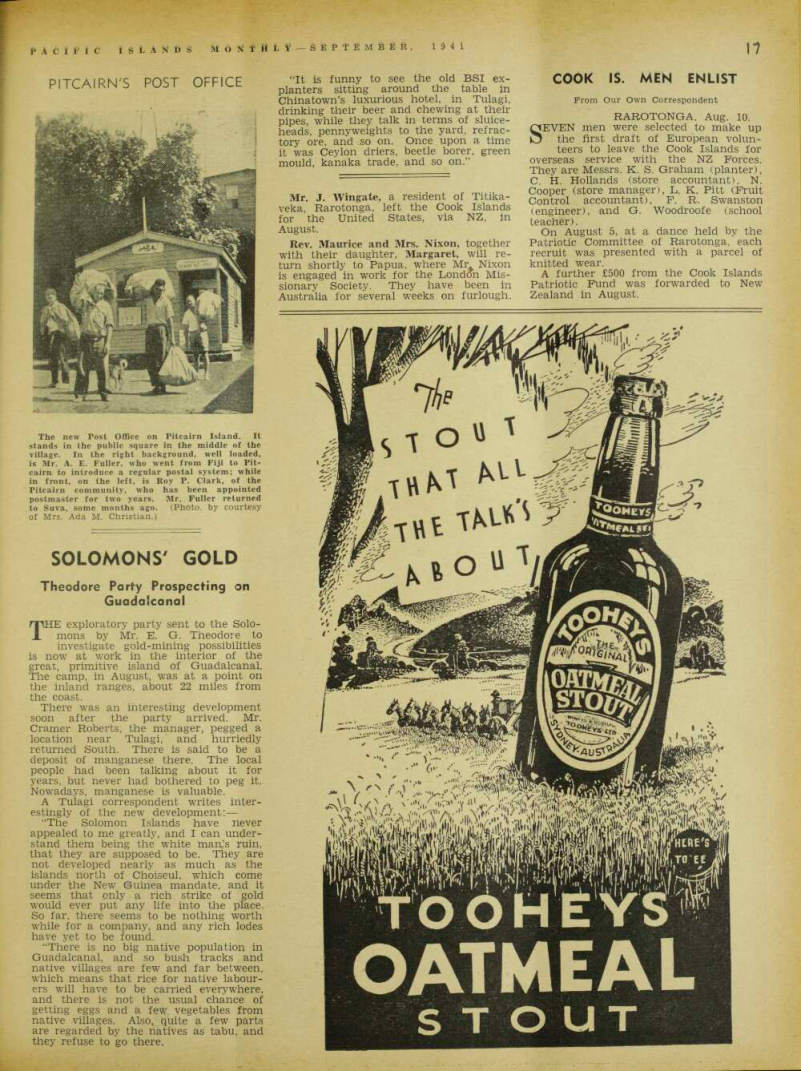
The new Post Office on Pitcairn Island. It stands in the public square in the middle of the village. In the right background, well loaded, is Mr. A. E. Fuller, who went from Fiji to Pit cairn to introduce a regular postal system; while in front, on the left, is Roy P. Clark, of the Pitcairn community, who has been appointed postmaster for two years. Mr. Fuller returned to Suva, some months ago. (Photo, by courtesy of Mrs. Ada M. Christian.)
Solomons' Gold
Theodore Forty Prospecting on Guadalcanal
THE exploratory party sent to the Solo mons by Mr. E. G. Theodore to investigate gold-mining possibilities is now at work in the interior of the great, primitive island of Guadalcanal.
The camp, in August, was at a point on the inland ranges, about 22 miles from the coast.
There was an interesting development soon after the party arrived. Mr.
Cramer Roberts, the manager, pegged a location near Tulagi, and hurriedly returned South. There is said to be a deposit of manganese there. The local people had been talking about it for years, but never had bothered to peg it.
Nowadays, manganese is valuable.
A Tulagi correspondent writes inter estingly of the new development;— “The Solomon Islands have never appealed to me greatly, and I can under stand them being the white mam’s ruin, that they are supposed to be. They are not developed nearly as much as the islands north of Choiseul, which come under the New Guinea mandate, and it seems that only a rich strike of gold would ever put any life into the place.
So far, there seems to be nothing worth while for a company, and any rich lodes have yet to be found.
“There is no big native population in Guadalcanal, and so bush tracks and native villages are few and far between, which means that rice for native labour ers will have to be carried everywhere, and there is not the usual chance of getting eggs and a few vegetables from native villages. Also, quite a few parts are regarded by the natives as tabu, and they refuse to go there.
“It is funny to see the old BSI ex planters sitting around the table in Chinatown’s luxurious hotel, in Tulagi, drinking their beer and chewing at their pipes, while they talk in terms of sluice heads, pennyweights to the yard, refrac tory ore, and so on. Once upon a time it was Ceylon driers, beetle borer, green mould, kanaka trade, and so on.”
Mr. J. Wingate, a resident of Titika veka, Rarotonga, left the Cook Islands for the United States, via NZ, in August.
Rev. Maurice and Mrs. Nixon, together with their daughter, Margaret, will re turn shortly to Papua, where Mr Nixon is engaged in work for the London Mis sionary Society. They have been in Australia for several weeks on furlough.
Cook Is. Men Enlist
From Our Own Correspondent
Rarotonga, Aug. 10.
SEVEN men were selected to make up the first draft of European volun teers to leave the Cook Islands for overseas service with the NZ Forces.
They are Messrs. K. S. Graham (planter), C. H. Hollands (store accountant), N.
Cooper (store manager), L. K. Pitt (Fruit Control accountant), F. R. Swanston (engineer), and G. Woodroofe (school teacher).
On August 5, at a dance held by the Patriotic Committee of Rarotonga, each recruit was presented with a parcel of knitted wear.
A further £5OO from the Cook Islands Patriotic Fund was forwarded to New Zealand in August.
Advertisements & other items, p. 19 (2 items)
17
PACIFIC ISLANDS !S4i
Hllnn/ij
vr~ o a *N =r^ % y-c m y 7^ o m O Oj 7^ r f > i M M CiT^ «2i
%k\ \V} vw v\\ \X
Roll Of Honour
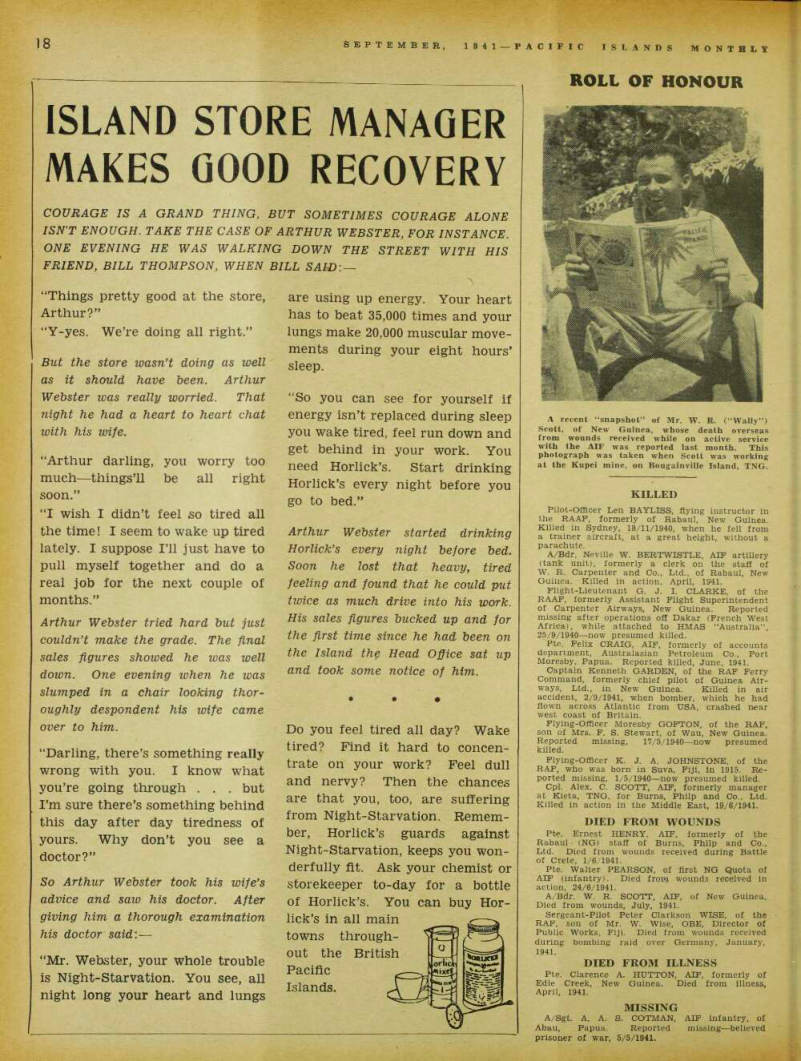
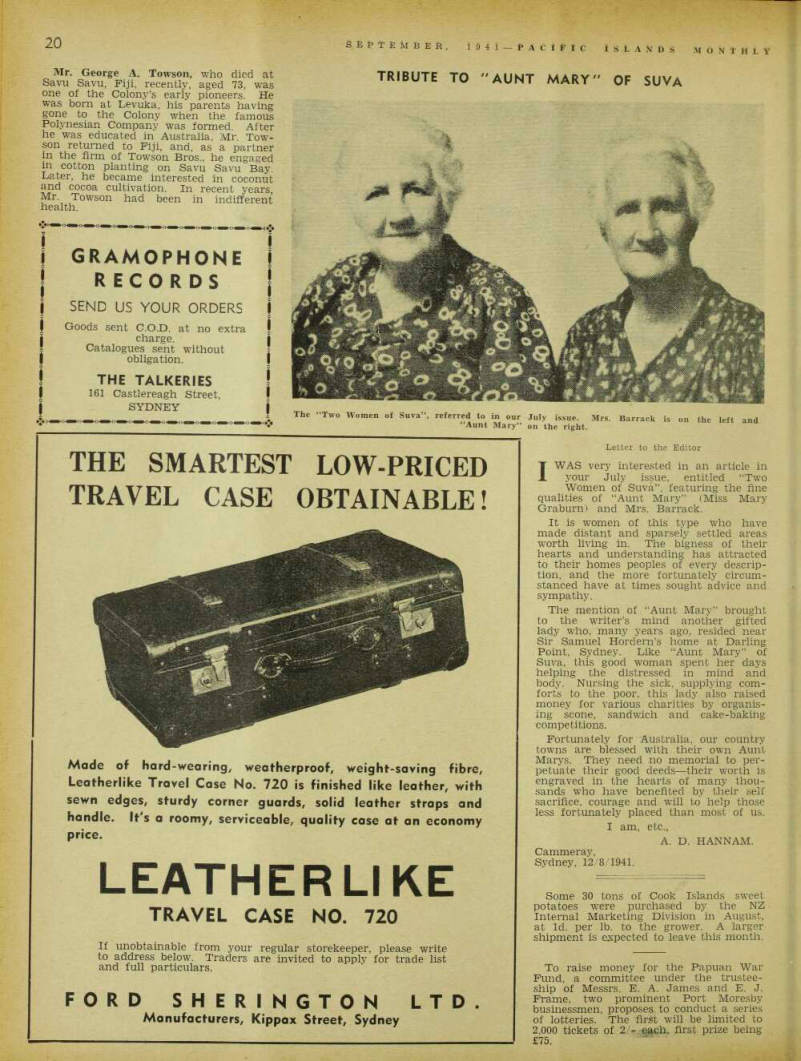
Killed
Pilot-Officer Len BAYLISS, flying instructor in the RAAF, formerly of Rabaul, New Guinea.
Killed in Sydney, 18/11/1940, when he fell from a trainer aircraft, at a great height, without a parachute.
A/Bdr. Neville W. BERTWISTLE, AIF artillery (tank unit), formerly a clerk on the staff of W. R. Carpenter and Co., Ltd., of Rabaul, New Guinea. Killed in action, April, IS'4l.
Flight-Lieutenant G. J. I. CLARKE, of the RAAF, formerly Assistant Flight Superintendent of Carpenter Airways, New Guinea. Reported missing after operations off Dakar (French West Africa), while attached to HMAS “Australia”, 25/9/1940 —now presumed killed.
Pte. Felix CRAIG, AIF, formerly of accounts department, Australasian Petroleum Co., Port Moresby, Papua. Reported killed, June, 1941.
Captain Kenneth GARDEN, of the RAF Ferry Command, formerly chief pilot of Guinea Air ways, Ltd., in New Guinea. Killed in air accident, 2/9/1941, when bomber, which he had flown across Atlantic from USA, crashed near west coast of Britain.
Flying-Officer Moresby GOFTON, of the RAF, son of Mrs. F, S. Stewart, of Wau, New Guinea.
Reported missing, 17/5/1940 —now presumed killed.
Flying-Officer K. J. A. JOHNSTONE, of the RAF, who was born in Suva, Fiji, In 1915. Re ported missing, 1/5/1940 —now presumed killed.
Cpl. Alex, C. SCOTT, AIF, formerly manager at Kieta, TNG. for Burns, Philp and Co., Ltd.
Killed in action in the Middle East, 19/6/1941.
Died From Wounds
Pte. Ernest HENRY, AIF, formerly of the Rabaul (NG) staff of Burns, Philp and Co., Ltd. Died from wounds received during Battle of Crete, 1/6/1941.
Pte. Walter PEARSON, of first NG Quota of AEP (infantry). Died from wounds received in action, 24/6/1941.
A/Bdr. W. R. SCOTT, AIF, of New Guinea.
Died from wounds, July, 1941.
Sergeant-Pilot Peter Clarkson WISE, of the RAF, son of Mr. W. Wise, OBE, Director of Public Works, Fiji. Died from wounds received during bombing raid over Germany, January, 1941.
Died From Illness
Pte. Clarence A, HUTTON, AIF, formerly of Edie Creek, New Guinea. Died from illness, April, 1941.
Missing
A/Sgt. A. A. S. COTMAN, AIF infantry, of Abau, Papua. Reported missing—believed prisoner of war, 5/5/1941.
A recent “snapshot” of Mr. W. R. (“Wally”) Scott, of New Guinea, whose death overseas from wounds received while on active service with the AIF was reported last month. This photograph was taken when Scott was working at the Kupei mine, on Bougainville Island, TNG.
Pte. L. F. McCarthy, AIF infantry, of Rabaul, TNG. Reported “wounded in action and missing —believed prisoner of war”, 15/7/1941.
Alex. McKAY. of the RAAF, formerly engineer at the Colonial Sugar Refining Co.’s mill, Penang, Fiji. Reported missing, August, 1941.
Pte. John O. SMITH, of the NZ Forces, son of Captain Smith, of “Tui Kauvaro”, and Mrs.
Smith, of Suva, Fiji. Reported missing, 29/5/1941, during Greek campaign.
Wounded
Pte. V. BLANCO, AIF infantry, of Thursday Island. Reported wounded in action, 8/7/1941.
L/Cpl. J. P. BLENCOWE, AIF infantry, of Rabaul, TNG. Reported wounded in action, 15/7/1941.
Pte. Thomas BYERS, AIF infantry, of Thurs day Island. Reported wounded in action, May, 1941.
Sgt. C. HENDRICK, AIF infantry, of Rabaul, TNG. Reported wounded in action, 15/7/1941.
Stanley HIGGS, son of Mr. and Mrs. Gordon Higgs, .of W. R. Carpenter and Co., Ltd., well known in New Guinea. Member of an English Lancers’ regiment, wounded during British evacuation from Dunkirk (France), May, 1940.
Lieut. L. T. HURRELL, AIF infantry, of Rabaul, TNG. Reported “wounded in action, remaining on duty”, 29/7/1941.
Cpl. W. H. LANNEN, AIP artillery, of Rabaul, New Guinea. Reported “wounded in action — on seriously ill list, 30/6/1941; removed from seriously ill list, 25/7/1941”.
Gnr. E. G. LOBAN, AIF artillery, of Thursday Island, wounded during Greek campaign, May, 1941. Reported July, 1941, he being invalided home after having his left forearm amputated.
Capt. Edward Tiwi LOVE, NZ Maori Battalion, husband of Mrs. Takau Rio Love, Ariki-nui of Rarotonga, Cook Islands. Reported missing dur ing Greek campaign, 27/5/1941; later, 22/6/1941, reported “wounded and safe”.
Cpl. R. McKERLIE, AIF, of Yandina, BSI, wounded in face by bomb explosion, April, 1941.
A/Sgt. Alastair MACLEAN, AIF infantry, of Rabaul, New Guinea. Reported wounded in action, in Libya, 30/6/1941.
S/Sgt. Graham B. MIRFIELD, AIF engineers, of Rabaul, New Guinea. Reported wounded in action, 16/7/1941.
Pte. L. G. REECE, of Bulolo, New Guinea. Re ported wounded in action with AIP, July, 1941.
A/Cpl. N. K. SAWYER, AIF infantry, of Rabaul, TNG. Reported wounded in action, 22/7/1941.
Pte. L. STAMPER, formerly schoolmaster at Wau, New Guinea. Reported wounded in action, August, 1941.
Private H. G. TURNER, of Samarai, Eastern Papua, wounded in action with AIF at Bardia, in Libya, January, 1941.
Prisoners Of War
A/Cpl. Peter W. BOSGARD, AIF Infantry, formerly of the Lands Department, Port Moresby, Papua. Reported missing, 5/5/1941; reported prisoner of war at Solmona, Abruzzl, Italy, 29/6/1941.
Pte. W. GOSSNER, AIF infantry, of Port Moresby, Papua. Reported missing, 7/6/1941; reported prisoner of war, Abruzzi, Italy, 6/7/1941.
Gnr. A. L. B. KING, AIF artillery, of Rabaul, TNG. Reported , missing, 16/6/1941; reported prisoner of war, 29/7/1941.
A/Cpl. John H. LONERGAN, AIF, Supply and Transport, of New Guinea. Reported missing during Greek campaign, 5/6/1941; reported prisoner of war at Corinthia, Italy, 8/7/1941.
Decorations
Lieut. Colin HILL, RANR, of the Australian destroyer, “Waterhen”, formerly second officer bn the trans-Pacific liner “Niagara”. Made a member of the Order of the British Empire for salvaging a burning oil tanker near Suda Bay, Crete.
Flying-Officer James R. HYDE, of the RAF, formerly a patrol officer in Namatanal and Sepik Districts, TNG. Awarded the Distinguished Flying Cross for bombing raids on Heligoland Bight, in the North Sea.
Lieutenant-Commander A. W. R. McNICOLL, RAN, son of Sir Ramsay McNicoll, Adminis trator of New Guinea, and Lady McNicoll.
Awarded the George Medal “for gallantry and undaunted devotion to duty”. (It is hoped to assemble, here, the names of men, former residents of the Pacific Territories, which appear in British and Free French casualty lists, or in lists of honours awarded.
We should be grateful if relations and friends would send us details.)
Captain Ken. Garden
CAPTAIN Kenneth Garden, of the Royal Air Force, who was well known in Papua and New Guinea, was killed in an air crash on the west coast of Britain, early in September.
Only 25, he was an outstanding flier.
He was attached to the RAF Perry Command, flying US-manufactured Lib erator bombers to Britain and the plane which crashed had just completed an Atlantic crossing. Six passengers and the crew of four were killed.
Garden joined the Ward Williams gold-seeking expedition in Western Papua and New Guinea in 1936. Later, he flew with Guinea Airways Ltd., becoming their chief pilot. In 1939, he resigned to join Imperial Airways.
Mr. George A. Towson, who died at Savu Savu, Fiji, recently, aged 73, was one of the Colony’s early pioneers. He was born at Levuka, his parents having gone to the Colony when the famous Polynesian Company was formed. After he was educated in Australia, Mr. Tow son returned to Fiji, and, as a partner in the firm of Towson Bros., he engaged m cotton planting on Savu Savu Bay, Later, he became interested in coconut and cocoa cultivation. In recent years, r^ 1 Towson k ac * been in indifferent health.
Advertisements & other items, pp. 20-22 (2 items)
Island Store Manager
MAKES GOOD RECOVERY
COURAGE IS A GRAND THING, BUT SOMETIMES COURAGE ALONE ISN’T ENOUGH. TAKE THE CASE OF ARTHUR WEBSTER, FOR INSTANCE.
ONE EVENING HE WAS WALKING DOWN THE STREET WITH HIS
FRIEND, BILL THOMPSON, WHEN BILL SAID:
are using up energy. Your heart has to beat 35,000 times and your lungs make 20,000 muscular movements during your eight hours’ sleep.
“So you can see for yourself if energy isn’t replaced during sleep you wake tired, feel run down and get behind in your work. You need Horlick’s. Start drinking Horlick’s every night before you go to bed.”
Arthur Webster started drinking Horlick’s every night before bed.
Soon he lost that heavy , tired feeling and found that he could put twice as much drive into his work.
His sales figures bucked up and for the first time since he had been on the Island the Head Office sat up and took some notice of him.
Do you feel tired all day? Wake tired? Find it hard to concentrate on your work? Feel dull and nervy? Then the chances are that you, too, are suffering from Night-Starvation. Remember, Horlick’s guards against Night-Starvation, keeps you wonderfully fit. Ask your chemist or storekeeper to-day for a bottle of Horlick’s. You can buy Horlick’s in all main towns throughout the British Pacific Islands. *owjrt» I oriic .MixcV
fcri
Sf *o=
“Things pretty good at the store, Arthur?”
“Y-yes. We’re doing all right.”
But the store wasn't doing as well as it should have been. Arthur Webster was really worried. That night he had a heart to heart chat with his wife.
“Arthur darling, you worry too much —things’ll be all right soon.”
“I wish I didn’t feel so tired all the time! I seem to wake up tired lately. I suppose I’ll just have to pull myself together and do a real job for the next couple of months.”
Arthur Webster tried hard but just couldn’t make the grade. The final sales figures showed he was well down. One evening when he was slumped in a chair looking thoroughly despondent his wife came over to him.
“Darling, there’s something really wrong with you. I know what you’re going through . . . but I’m sure there’s something behind this day after day tiredness of yours. Why don’t you see a doctor?”
So Arthur Webster took his wife’s advice and saw his doctor. After giving him a thorough examination his doctor said: — “Mr. Webster, your whole trouble is Night-Starvation. You see, all night long your heart and lungs
« ■ ft batteries
m Us-\
LONDON PUMPS
Self priming. Genuinely portable.
Weight 50 lb. Capacity 5,000 gal.
Suitable all heads up to 50 feet.
Immediate delivery ex Rabaul to all parts of the Islands.
PARTICULARS:
Nelson Cr Robertson Pty. Ltd. 12 Spring Street, Sydney.
« ■ ft batteries
For Cars— Trucks—Boats—Radio
WAR-TIME CONDITIONS demand a superior Battery, chockful of energy and power. Such a Battery is the latest up-to-the-minute War-experienced "J.M." Battery. Tried and tested for 20 years.
J.M.
Ol |RS PJ
House Lighting
All Batteries are fully charged, complete with connections and instructions, and are ready for immediate use - T^ e .. J y^onfte HEAVY DUTY, and fitted with 3-16 in. plates The Cells are of Ebonite or hard rubber, and are most economically priced. We specially recommend “J.M. 21R” sets for all Lighting plants. F. 0.8. Sydney.
Immediate Delivery.
For lower in price than any other first-
grade battery of heavy duty capacity.
HISLOPfXLOYD PTY. LTD.
Capacity Type. Voltage. lOhr. rate.
“J.M,” 15R —Ebonite cell .. 2 HO “J.M.” 21R—Ebonite cell .. 2 210
335-7 PITT STREET, SYDNEY.
«il SHIP BV RETURN BOAT
Price Per Cell Unit. £ s. d. £1 10 0 £2 10 0 Price For 32 volt set. £ s. d. £23 0 0 £37 10 0 Cable Address.—
“Hisloyd”, Sydney.
GRAMOPHONE
RECORDS
SEND US YOUR ORDERS
Goods sent C.O.D. at no extra charge.
Catalogues sent without obligation.
THE TALKERIES
161 Castlereagh Street,
SYDNEY
THE SMARTEST LOW-PRICED
TRAVEL CASE OBTAINABLE!
¥ Made of hard-wearing, weatherproof, weight-saving fibre.
Leatherlike Travel Case No. 720 is finished like leather, with sewn edges, sturdy corner guards, solid leather straps and handle. It's a roomy, serviceable, quality case at an economy price.
LEATHER LIKE
TRAVEL CASE NO. 720
If unobtainable from your regular storekeeper, please write to address below. Traders are invited to apply for trade list and full particulars.
FORD SHERINGTON LTD.
Manufacturers, Kippax Street, Sydney
Tribute To "Aunt Mary" Of Suva
Letter to the Editor IWAS very interested in an article in your July issue, entitled “Two Women of Suva”, featuring the fine qualities of “Aunt Mary” (Miss Mary Graburn) and Mrs. Barrack.
It is women of this type who have made distant and sparsely settled areas worth living in. The bigness of their hearts and understanding has attracted to their homes peoples of every descrip tion, and the more fortunately circum stanced have at times sought advice and sympathy.
The mention of “Aunt Mary” brought to the writer’s mind another gifted lady who, many years ago, resided near Sir Samuel Hordern’s home at Darling Point, Sydney. Like “Aunt Mary” of Suva, this good woman spent her days helping the distressed in mind and body. Nursing the sick, supplying com forts to the poor, this lady also raised money for various charities by organis ing scone, sandwich and cake-baking competitions.
Fortunately for Australia, our country towns are blessed with their own Aunt Marys. They need no memorial to per petuate their good deeds—their worth is engraved in the hearts of many thou sands who have benefited by their self sacrifice, courage and will to help those less fortunately placed than most of us.
I am, etc.,
A. D. Hannam.
Cammeray, Sydney, 12/8/1941.
Some 30 tons of Cook Islands sweet potatoes were purchased by the NZ Internal Marketing Division in August, at Id. per lb. to the grower. A larger shipment is expected to leave this month.
To raise money for the Papuan War Fund, a committee under the trustee ship of Messrs. E. A. James and E. J.
Frame, two prominent Port Moresby businessmen, proposes to conduct a series of lotteries. The first will be limited to 2,000 tickets of 2/- each, first prize being £75.
The “Two Women of Suva”, referred to in our July Issue. Mrs. Barrack is on the left and “Aunt Mary” on the right.
Advertisements & other items, p. 23 (2 items)
21
ACIFIC ISLANDS MONTHLY SEPTEMBER, 1941
uiiiii
Airsotte have here the best range of "torrid zone" radio receivers ever produced. Before production was ever started on sets for island listeners, we checked up on weather conditions—best valves— best cabinet materials—best speaker—best circuits—all were taken into consideration to make the best radio and give you utmost reliability under tropical weather conditions. And here Airzone present a range of receivers beautiful of tone fascinating in cabinet design amazing in long distance reception and remarkably reliable under any condition whatsoever. Particular attention was given to overseas short wave reception.
Innumerable developments have been made in these receivers so that overseas reception can be received with amazing clarity and volume.
"Airzone's tone is Airzone's own."
Above left is Model 6552 A, Airzone's new "Concert Star," a 5 Valve A.C. Mantel Dual Wave of wonderful long distance reception.
Here again, at left. Airzone proudly presents Model 5098, 5 Valve 1.4 Volt Battery mantel Dual Wave. Also as Model 5059. 5 Valve Vibrator powered Dual Wave.
At right is Airzone's massive 8 Valve A.C.
Dual Wave Console Model 1082 A. designed for far-reaching overseas reception.
Agents for New Guinea, Papua and Solomon Islands:— m At left is veneered mantel made in 4 models —Model 1062 AM, 6 Valve A.C. Dual Wave; Model 1072VM, 7 Valve Vibrator Dual Wave; Model 1162 WM, 6 Valve 2 Volt Battery Dual Wave; and Model 1252VM, 5 Valve Vibrator Dual Wave.
IV■ R. CARPENTER & CO., LTD. De>tsnei ly Airzone (1931) Ltd., 19 O'Connell Street, Sydney; Salamaua, Rabaul, Kavieng and Madang, N.G.. and Tulagi, Solomon Islands. camperdown. N.s.w. HAS6h H .1
..nil..
mil| I; mm N mm "X
iillln
mm mill mm in "H| M
uiiiii
mill in m mm mill i: n
ulHli.
mull
hmilll
Papua's New Buildings
From Our Own Correspondent
Pt. Moresby, Aug. 25.
MANY new buildings are planned by the Government, in the current year’s estimates. They include a new Supreme Courthouse and offices, a new residence for the Resident Magistrate in Port Moresby, several new cottages, a customs depot for the Port Moresby Aerodrome; at Kerema, a new residence is to be erected for the Resident Magis trate; and various sums have been set aside for new roads.
Major Edwin Harrowell, formerly of the Pacific Colonial Service, died in Auckland, NZ, in August, aged 74. After achieving the rank of captain in the South African War, this English-born administrator was appointed to the New Hebrides. In the last war he fought with the New Zealanders on Gallipoli and. later, occupied administrative posts at Ocean Is., Fanning Is. and Fiji. Four years ago he retired and settled in Auck land. His widow, and one son, Lieut.
Dudley Harrowell, survive Major Har rowell.
Mystery
New Guinea Murder Mystery
rE New Guinea police, assisted 'by Sydney detectives, appear to have made no further progress In their investigation of the murder of Miss Lily Jean Wilson, which took place in the house of her brother-in-law in Wau, early in the morning of Monday, June 23.
It is a mysterious, baffling crime, the circumstances of which were set out fully in the last issue of the “PIM”.
Circumstantial evidence has pointed strongly towards a native labourer named Taiki; but, although Taiki was held for a time by the police, he was subse quently released on the verdict of the Coroner—mostly for the reason that such evidence as there was against him was purely circumstantial, and there was not the slightest indication of a motive. It never has been proved, in the history of New Guinea, that a Euro pean woman has been attacked in this fashion, while asleep, by a native.
In our summary of the case, published in August, we said that there was no indication that Taiki had ever had any connection with the household of Mr.
Ray (Miss Wilson’s brother-in-law). But Taiki, on a number of occasions, was one of a party of native servants and labourers, who gambled, in a concrete room, under Mr. Ray’s house. There is also a suggestion that, on one or two occasions, Miss Wilson complained of the noise made bv these native gamblers, and ordered them away. There is no doubt that, early in the night when the crime was committed, Taiki was one of a party which consumed much intoxicat ing liquor: and the native with whom Taiki lived said in evidence that Taiki
woke him up at 6 a.m. on the morning after the crime—a most unusual occur rence, as he invariably had to awaken Taiki.
“Wau-ites in a Lynching Frame of Mind”
A Port Moresby resident, writing in August, said he had been in conversa tion recently with people from Wau, the scene of the mysterious murder of Miss Wilson. He said that many theories of the crime were discussed; and he proceeds:— “Rumour has it that Miss Wilson had punished the ‘monkey belong Manus boy’ by locking him up for some offence; and the Manus boy (Taiki), with a good skinful of cocktail and betel nut, may have decided to take his revenge in ‘fashion belong before’. How ever, nobody can prove the boy was at any particular place from the time that the party broke up until he started work next morning. The Wau people were in a lynching frame of mind; but. accord ing to one outspoken padre, the whole thing is directly to be blamed to the laxity of both the administration, and no less the white population, in handling the natives, as there have been quite a number of attempts on white women by native boys, which have gone unreported owing to fear of scandal.”
Mr. W. M. Caldwell, Assistant Com missioner of Inland Revenue in Fiji, retired in July. He joined the Civil Service as a junior clerk in 1903.
Mr. Ken. Macgregor returned to Wau, New Guinea, recently, to settle his per sonal affairs, having enlisted in the AIF.
His legal practice at Wau has been closed down “for the duration”.
Advertisements & other items, p. 24 (2 items)
Islands 7 Visitors to Sydney
Will find excellent accommodation at
"206" PRIVATE HOTEL
204-8 Victoria Street, Kings Cross, Sydney.
Every Comfort, Splendid Table.
Tariff from 35/- per week.
MRS. C. PYATT, Proprietress.
Tel. FL 4272.
Australia’s Fastest Selling Tyre
m
SILENT
Dunlop
‘6s’ GOLF
BALLS
The fastest selling first-line ball in Australia. Known for its: Sealed Power, Greater Distance and Exclusive Permanised Pattern for Longer Accurate Life.
IN AUSTRALIA, AS
VICTOR
Dunlop
SPORT &
SANDSHOES
Comfort and Wear in Every Pair of Dunlop Sport and Sandshoes. Available in all popular styles for sports wear.
Dunlop
WEATHER
COATS
E x ceptionally smart, well fitting Weather Coats for Men, Women and Children. Tailored styles in the latest thoroughly waterproof materials.
OTHER Dunlop
PRODUCTS
Tennis Equipment.
Belting.
Car Accessories.
Bathing Caps.
Cycle Tyres.
Garden Hose.
Household Gloves and Aprons, etc.
THROUGHOUT THE BRITISH EMPIRE, MOST PEOPLE RIDE ON DIINLOP TYRES.
DUNLOP PERDRIAU RUBBER CO. LTD. (Inc. in Vic.). 27-33 WENTWORTH AVENUE, SYDNEY, N.S.W.
Coconut's Uses
Soap Factory in Fiji
From Our Own Correspondent
Suva, Aug. 20.
IN a recent issue of “PIM”, a corres pondent suggests that Suva might copy Colombo in starting the manu facture of side products of the coconut, such as matting, edible oils, coir, brooms, etc But it is doubtful whether much is possible in this direction. A coir fac tory, operated some twenty years ago on Taveuni, Fiji, but was not success ful and when it was accidentally burned down it was not rebuilt. The trouble is that the local demand is small, and the export prospect is handicapped by remoteness from notential markets and by the fact that Fiji’s scale of payment for labour is much higher than is usual in the East.
However, an increasmg amount of locally-produced coconut oil is being used in Suva’s prosperous and very well managed soap factory, and it is under stood that coconut oil is the basis of several edible products now issued by that factory.
How Radio Has Grown In
Papua
From Our Own Correspondent
Pt. Moresby, Aug. 26.
THE Territory, with much regret, says farewell to Mr. Ken Frank, the highly efficient and always courte ous officer who has been for years in charge of the AW A service in Papua, and is now being promoted and trans ferred.
When Mr. Prank first arrived in Papua in 1929, radio communication was effec tive enough, but crude. Since then, we have enjoyed the following developments and refinements: — .
Beam transmission has been installed, to give us direct and immediate contact with the chief Australian and Pacific stations.
Teleradio has spread, from being a crude set, powered by a sweating boy on a bicycle frame, until now practically every plantation in the Territory can communicate with the PM mother station.
Now, by radiophone, we can talk to our friends in Australia, New Guinea, or even farther afield.
Mr. E. J. O’Donnell, also a well-known AWA officer, will succeed Mr. Frank in Port Moresby.
Mr. Peter Jensen, of Lae, New Guinea, arrived in Australia recently to enlist in the AIF.
Mr. Charles Cooke, of Emira Island, New Guinea Territory, who succoured the survivors of the “Rangitane’’ last year, was unable to attend the August meeting of the Pacific Islands Society in Sydney, owing to an attack of malaria.
Members hope to meet him, however, before he returns to his island home.
One of the best known figures in former years in Samoa, Mr. William Blacklock, is lying seriously ill at his home at Woollahra, Sydney, where, in early September, he celebrated his 85th birthday. Mr. Blacklock, Victorian-bom, though an American citizen, went to Samoa in the early ’eighties, and for some years was United States Consul- General there. His daughters, the Misses Eva and Ella Blacklock, reside in Sydney.
Gathering
Burmese Visitor at Pacific Gathering
A COLOURFUL little figure in her national costume at the August meeting of the Pacific Islands Society, at the Carlton Hotel in Sydney, was Ma Than A, 8.A., of the staff of lec turers at the teachers’ training college, Rangoon, Burma, who was escorted by her fellow-countryman, Mo Myit, 8.A., a member of the Society. The Burmese visitor described recent visits to the New Hebrides and New Caledonia, and New Zealand and Australia. The principal speaker was Mrs. E. J. Bryce, and her subject was “Yunnan and the Burma Road’’.
Fiji’s annual show will be held this year at Suva on October 13.
Papua To Sydney One-Day
Flight
FIRST one-day commercial flight from Port Moresby, Papua, to Sydney, a distance of 1,860 miles, was made late in August by a Carpenter Airlines Lockheed 14, piloted by Captain R. O.
Mant. Actual flying time for the 1,860 miles was 10 hours 40 minutes, giving an average flying speed of approximately 180 miles per hour.
Mr. C. Nunn was recently appointed European Constable at Port Moresby, Papua. Other members of the local force are Messrs. T. Gough (who is in charge), E. Bresnan, J. Orr-Harper and F. Young.
Mr. Ted. Einsiedel, of Burns, Philp & Co.’s Rabaul staff, has returned to New Guinea, after leave in Australia.
Advertisements & other items, pp. 25-26 (1 item)
My Goodness-My GUINNESS
Adveitisement of Export Bottlers Ltd., London.
A Macfee & Co. Ltd., V/apping, Liverpool, England. 0 Stocked by all branches of
BROWN & JOSKE LTD.
BURNS PHILP & CO. LTD.
W. R. CARPENTER & CO. LTD.
MORRIS HEDSTROM LTD.
pjtov
KNOW
4 / •. ‘-V 10 OV*
,v>t* s
nrn> r VAi w/j $eJ
‘dlfe
o*' &•$ ™s:'k A
jisys***&
food H/£oaep /n CRfV/ces Between teeth cause "bqcter/al
MOUTH!' KOLXNOS ftHWSEPTVC
KfCL PECAY 6ERMS ANP PREVENT \
'BACTERfAL MOUTH
YOUR TEETH
SFAZHLE W/TH
VEtV LUBTRE.
HOLYHOS
& MORE
ECOHOM/CAC
lasts rmce
& AS IW6 AS ORP/HARY
/> PASTE. f'l/HCHON
DRY BRUSH /S
Z /rw &HOU6H
**e. **& A «&*!'*** **s* \t> x "
S*f *cr n, v v ' rU
Cook Is. Fruit
Growers Petition NZ Parliament for Price Increase
From Our Own Correspondent
Rarotonga, Aug. 10.
MR. W. P. Browne, a member of the Rarotonga Island Council, pre sented to the NZ Parliament, re cently, a petition which, he declared, has the support of all native members of the Council and the Fruit Advisory Committee. It called for:— (a) An increase in prices for all Cook Islands fruit purchased by the NZ Internal Marketing Division; (b) Recognition of the rights of scien tific and modern growers of oranges, as against the old-fashioned laissez faire native growers; (c) The quick planning and introduc tion of a scheme to revive the banana growing industry, which has not for years approached its previous importance and which was badly hit by a heavy gale early this year.
The demand for an all-round increase in prices for Cl fruit is justified in view of the increased cost of living and of production, since the outbreak of war.
Probably, the bonus of 3d. a case paid on the first two orange shipments this year (later shipments carried too much loss to allow of a further bonus) was meant as a sop in this direction. Such payments, at the whim of the Fruit Control, are not 'so re-assuring or encouraging as the straight-out declara tion of, say. a 10 per cent, increase in prices would be.
Mr. Browne stated that banana pro duction could be soon increased to 10 times the present level. No doubt he was thinking of the 100-odd fertile little vallevs that have relapsed into bush since the Government took control of bananas at the disappointing price of 4/- per case of 87 lb. net.
The recent drought of over two months was not at all beneficial to the sadly-depleted banana crop, either.
Death of an Old Soldier
From Our Own Correspondent
Pt. Moresby, Sept. 7.
ANOTHER “old-timer” of the Terri tory passed away on August 30, at the Catholic Mission Hosnital, Yule Island —Jack Seymour, aged 73, a vet eran of the Boer War and a Farrier- Sergeant in the regiment commanded by the late Sir Hubert Murray, Lt.-Gover nor of Papua.
Seymour, who had been in Papua for over 20 years, was one of the best stock men ever seen here. Owning small pro perties at different times, he dealt chiefly with horses and mules. At one time he managed the pack-horse trans port on the mainland and inland from Yule Island.
As an old soldier. Jack Seymour was carried to his grave on Yule Island by members of the Royal Papuan Con stabulary.
Miss Silva de Simas, Staff Sister in the Fiji Nursing Service, is at present in New Zealand on leave.
Miss M. Stephenson, of the Melane sian Mission, is at present in Sydney on furlough. She has been stationed at Fauabu. on Malaita. BSI, but on the completion of her furlough will go to Lolowai, New Hebrides.
The Game Of Golf In Fiji
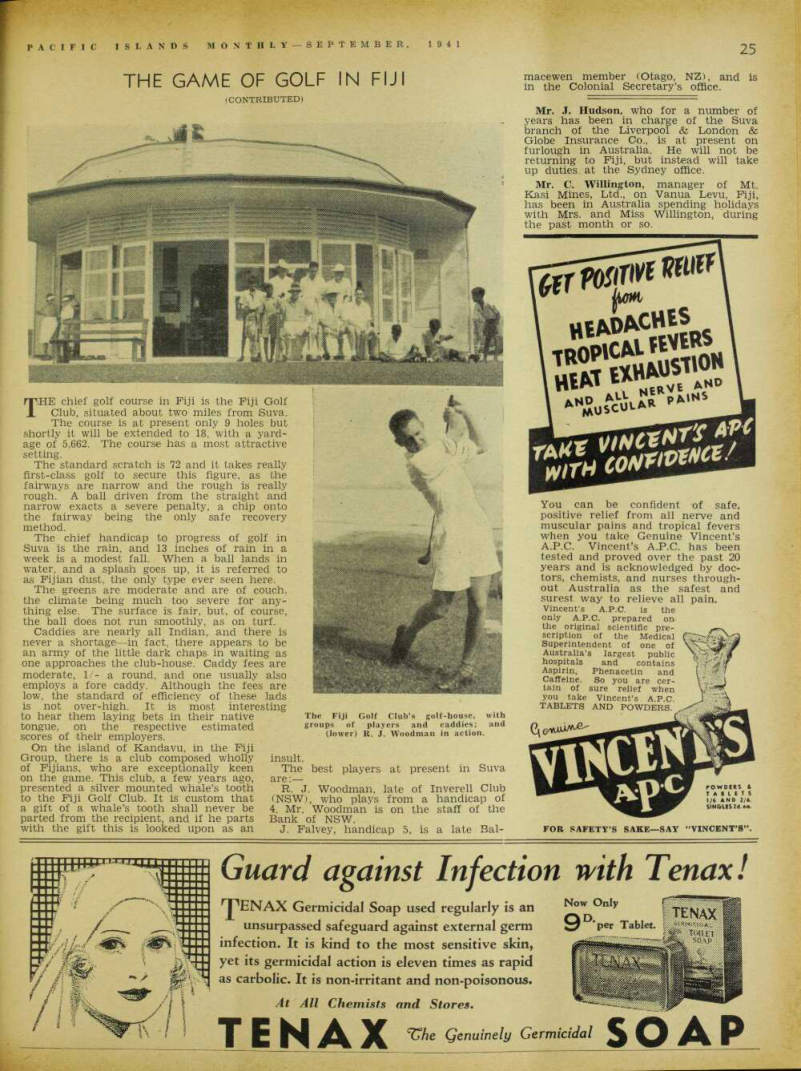
(Contributed)
THE chief golf course in Fiji is the Fiji Golf Club, situated about two miles from Suva.
The course is at present only 9 holes but shortly it will be extended to 18, with a yard age of 5,662. The course has a most attractive setting.
The standard scratch is 72 and it takes really first-class golf to secure this figure, as the fairways are narrow and the rough is really rough. A ball driven from the straight and narrow exacts a severe penalty, a chip onto the fairway being the only safe recovery method.
The chief handicap to progress of golf in Suva is the rain, and 13 inches of rain in a week is a modest fall. When a ball lands in water, and a splash goes up, it is referred to as Fijian dust, the only type ever seen here.
The greens are moderate and are of couch, the climate being much too severe for any thing else. The surface is fair, but, of course, the ball does not run smoothly, as on turf.
Caddies are nearly all Indian, and there is never a shortage—in fact, there appears to be an army of the little dark chaps in waiting as one approaches the club-house. Caddy fees are moderate, 1/- a round, and one usually also employs a fore caddy. Although the fees are low, the standard of efficiency of these lads is not over-high. It is most interesting
to hear them laying bets in their native tongue, on the respective estimated scores of their employers.
On the island of Kandavu, in the Fiji Group, there is a club composed wholly of Fijians, who are exceptionally keen on the game. This club, a few years ago, presented a silver mounted whale’s tooth to the Fiji Golf Club. It is custom that a gift of a whale’s tooth shall never be parted from the recipient, and if he parts with the gift this is looked upon as an
insult.
The best players at present in Suva are:— R. J. Woodman, late of Inverell Club (NSW), who plays from a handicap of 4. Mr. Woodman is on the staff of the Bank of NSW.
J. Falvey, handicap 5, is a late Bal
macewen member (Otago, NZ), and is in the Colonial Secretary's office.
Mr. J. Hudson, who for a number of years has been in charge of the Suva branch of the Liverpool & London & Globe Insurance Co., is at present on furlough in Australia. He will not be returning to Fiji, but instead will take up duties, at the Sydney office.
Mr. C. Willington, manager of Mt.
Kasi Mines, Ltd., on Vanua Levu, Fiji, has been in Australia spending holidays with Mrs. and Miss Willington, during the past month or so.
The Fiji Golf Club’s golf-house, with groups of players and caddies; and (lower) R. J. Woodman in action.
Advertisements & other items, pp. 27-28 (2 items)
Guard against Infection with Tenax!
ssi*
* H »OSCUI>» P A,NS
You can be confident of safe, positive relief from all nerve and muscular pains and tropical fevers when you take Genuine Vincent’s A.P.C. Vincent’s A.P.C. has been tested and proved over the past 20 years and is acknowledged by doctors, chemists, and nurses throughout Australia as the safest and surest way to relieve all pain.
Vincent’s A.P.C. is the only A.P.C. prepared on the original scientific prescription of the Medical Superintendent of one of Australia’s largest public hospitals and contains Aspirin, Phenacetin and Caffeine. So you are certain of sure relief when you take Vincent’s A.P.C.
TABLETS AND POWDERS.
Cv.
fOWDIIS t
TAIL I T S
I/* AND 2/*.
SINGHS 2d. *a
FOR SAFETY’S SAKE—SAY "VINCENT’S”.
Guard against Infection with Tenax!
Now Only I nD i tenax per Tablet.
W tikUEt Germicidal Soap used regularly is an
unsurpassed safeguard against external germ
infection. It is kind to the most sensitive skin, yet its germicidal action is eleven times as rapid as carbolic. It is non-irritant and non-poisonous.
At All Chemists and Stores.
TENAX c Uhe Genuinely Germicidal SOAP
Modern Refrigeration for the South Sea Islands
The ELECTROLUX
KEROSENE OPERATED
REFRIGERATOR
ELECTROLUX offers economical, modern and completely efficient
REFRIGERATION FOR ISLANDS' HOMES.
FREEZES CONTINUOUSLY WHILE SMALL LAMP BURNS.
Freezing controlled by simply regulating height of flame. Uses only I gallon of kerosene per week.
MOTORLESS ... NO PARTS TO GET OUT OF ORDER.
MODEL L 22
Capacity 2.2 cubic feet.
MODEL L3BO
® (as Illustrated) Capacity 4 cubic feet.
MODEL LKSSO
Capacity 5.5 cubic feet.
GUARANTEED FOR TWO YEARS.
• Write to your Local Distributor for prices and full details.
Obtainable from: W. R. Carpenter & Company Ltd.—Sydney, and the following New Guinea Branches: Rabaul, Salamaua, Wau, Kavieng, Madang, and Wewak.
Representation in Papua W. R. Carpenter & Coy. (Solomon Is.) Pty. Ltd.—Tulagi, British Solomon Islands.
On Chong & Company Pty. Ltd.—Butaritari, Gilbert and Ellice Islands, and New Hebrides.
26
SEpTemseh, — Pacific islands mDnxhl^
"Elementary, My Dear
Watson!"
By “Amel”
THE money, two pound notes in a sealed envelope, had gone. Nobody knew where. With my usual forethought, I had placed the envelope on a shelf between two windows, while a brisk wind was blowing. Consequently, when I went to collect it a little later, it had vanished I turned the house inside out, peered down crab-holes and rooted around in the canna beds, but nothing could I find.
Then up spoke Sherlock Holmes.
“You put the envelope there?”
“Yes.”
“And the wind was blowing?”
“Yes.”
“Well, it would blow the envelope out of the window. And it should be lying there,” he indicated, “but it isn’t,”
Yes and no,” I said, feebly.
“Hmnn,” he muttered, “this needs some thinking out.” Brow wrinkled and chin in hand, Dad wandered around the yard.
The strain was too much for me. I went and had a bath. In the midst of my ablutions, I heard an ear-splitting yell, by which I judged that Dad had either stubbed his toe on a coconut, bumped his head on a shutter, or solved the problem.
The latter was the case. Waving the missing envelope in his hand, Dad had an interesting tale to relate. It was the sort of thing you read about and view with a slight tinge of scepticism. Yet everyone who knows the impudent little maina bird of the Islands will believe it.
Having noticed a maina carry a piece of paper up to its nest in a coconut tree, he had resolved to set a trap and test a theory. Placing a piece of paper on the ground near the window, he watched quietly. Presently, along came a maina, cocked its eye at the paper, seized it and made off. But a strong gust of wind wrenched the paper from the bird’s grasp, and it did not bother to retrieve it.
Another bait was tried —this time an open envelope with a thin piece of paper inside. Once more the maina appeared, and inspected the envelope. This, ap parently, was to its liking. The bird, as if a connoisseur on such matters, looked into the envelope, saw that it contained something good and . . . shook it out!
Then, spearing it daintily with its beak, it flew up into the hollow limb of a nearby tree.
Dad grabbed a ladder and swiftly mounted to investigate. The maina fled.
Putting his hand inside the hollow limb, he drew out rags, sticks, the paper and other rubbish . . . but no envelope.
Disappointed, he sat up there on his perch and gazed around the landscape.
Suddenly, under a kaumoce bush, on the ground, he spotted a corner of white.
Fixing it with his eye, lest it should be spirited away, he slowly dismounted.
It was the missing envelope, with the money intact. The maina, unable to ex tract the notes, had cast the whole thing from its nest . . . only to lead us to its discovery again!
Lieutenant Colin Hill, Royal Australian Naval Reserve, who was second officer on the trans-Pacific liner “Niagara” before the war, has been made a member of the Order of the British Empire (Military), He led a small party of volunteers from the Australian destroyer “Waterhen” (since sunk by Nazi dive bombers in the Mediterranean) and sal vaged a burning oil tanker near Suda Bay, Crete.
Three Salamaua (New Guinea) men, D. Williams, G. Clark, and H. Wyatt, are serving in the same AIF battalion in the Middle East.
New Industries For
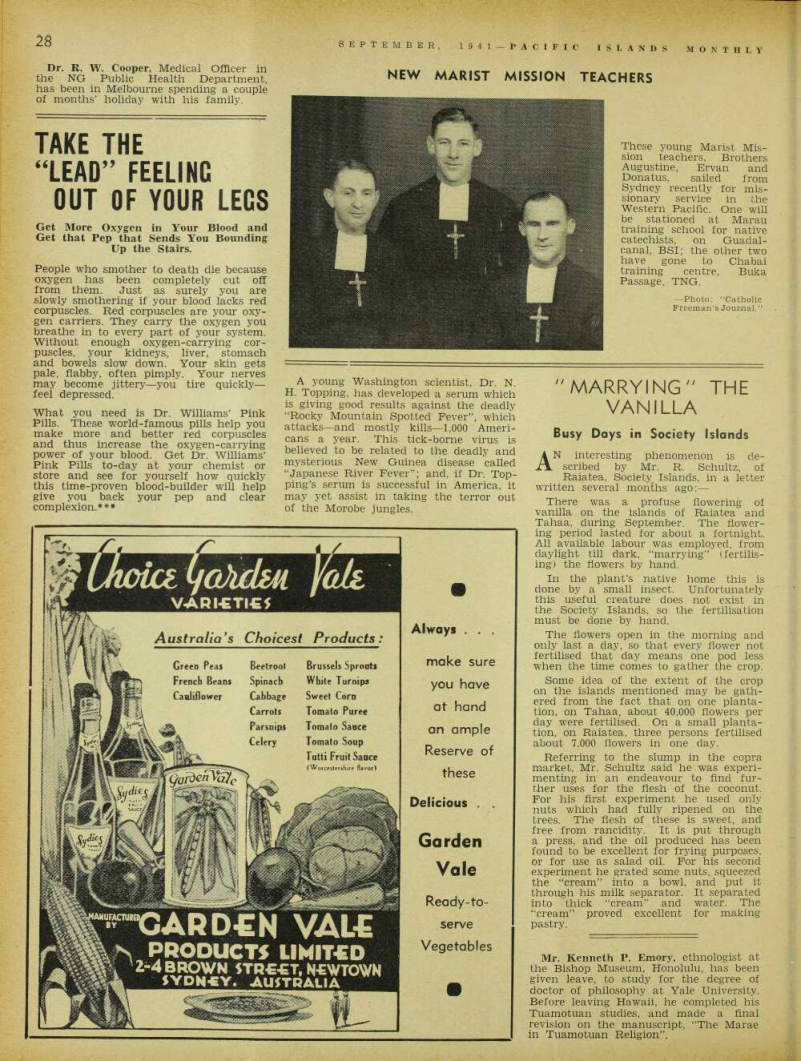
N. Caledonia
THE present Government of New Cale donia is trying valiantly to make the Colony self-supporting now that its principal markets have been cut off by the surrender of France to Ger many.
The proposals which are receiving practical consideration include one to revive the distillation of rum from sugar-cane grown in the Colony—an industry that formerly flourished there, but which was eventually killed by the competition of Martinique rum. The liquors customarily consumed—especially French wines—have been cut off by war conditions and the distillation of New Caledonian rum may supply a clamant need in New Caledonia.
The French are also planning to base a new industry upon what at present is one of their outstanding curses—namely,
the deer, which over-run the Colony.
Deer are so numerous that their slaugh ter is part of the regular activities of pastoralists; but now there is a steady, regular and profitable market for deer skins. Deer-hunting has become, instead of a wearisome duty, a combination of sport and industry. About 80,000 deer skins per annum are exported to Austra lia, for tanning.
But the practical French have now decided that this tanning may be done in New Caledonia itself, and men are going to Australia to be trained in tan ning methods. Eventually, New Cale donia will export fine leather instead of deer-skins.
Miss Anne Cole, of Western Australia, has been appointed LMS nurse at Pore porena Hospital, near Pt. Moresby, Papua.
Dr, J. Taylor, Fiji Medical Officer, was in New Zealand last month spending furlough.
Dr. R. W. Cooper, Medical Officer in the NG Public Health Department, has been in Melbourne spending a couple of months’ holiday with his family.
Advertisements & other items, pp. 29-30 (1 item)
Sparkling
refreshment from pure Malt and Hops...
FOSTERS
LAGER
TAKE THE
“LEAD” FEELING
OUT OF YOUR LEGS
Get More Oxygen in Your Blood and Get that Pep that Sends You Bounding Up the Stairs.
People who smother to death die because oxygen has been completely cut off from them. Just as surely you are slowly smothering if your blood lacks red corpuscles. Red corpuscles are your oxygen carriers. They carry the oxygen you breathe in to every part of your system.
Without enough oxygen-carrying corpuscles, your kidneys, liver, stomach and bowels slow down. Your skin gets pale, flabby, often pimply. Your nerves may become jittery—you tire quickly— feel depressed.
What you need is Dr. Williams’ Pink Pills. These world-famous pills help you make more and better red corpuscles and thus increase the oxygen-carrying power of your blood. Get Dr. Williams’
Pink Pills to-day at your chemist or store and see for yourself how quickly this time-proven blood-builder will help give you back your pep and clear complexion.***
T.
Australia’s Choicest Products: Brussels Sprouts White Turnips Sweet Coro Tomato Puree Tomato Sauce Tomato Soup Tutti Fruit Sauce (Worcestershire flavor) Green Peas French Beans Cauliflower Beetroot Spinach Cahhage Carrots Parsnips Celery lift*^ m h II
Qajpeh\& (
W&
GARDEN VALE
4HANUFACTURR)
St BY
N PRODUCTS LIHITCD
|\ 2-4 BROWN STPC-ET. N-EWTOWN
i\4 SYDH-SY. AUSTRALIA
Always . . . make sure you have at hand an ample Reserve of these Delicious . .
Garden
Vale
Ready-toserve Vegetables
New Marist Mission Teachers
A young Washington scientist, Dr. N.
H. Topping, has developed a serum which is giving good results against the deadly “Rocky Mountain Spotted Fever”, which attacks—and mostly kills—l,ooo Ameri cans a year. This tick-borne virus is believed to be related to the deadly and mysterious New Guinea disease called “Japanese River Fever”; and, if Dr. Top ping’s serum is successful in America, it may yet assist in taking the terror out of the Morobe jungles.
These young Marist Mis sion teachers, Brothers Augustine, Ervan and Donatus, sailed from Sydney recently for mis sionary service in the Western Pacific. One will be stationed at Marau training school for native catechists, on Guadal canal, BSI; the other two have gone to Chabai training centre, Buka Passage, TNG. —Photo: “Catholic Freeman’s Journal.”
"Marrying" The
Vanilla
Busy Days in Society Islands
AN interesting phenomenon Is de scribed by Mr. R. Schultz, of Raiatea, Society Islands, in a letter written several months ago:— There was a profuse flowering of vanilla on the islands of Raiatea and Tahaa, during September. The flower ing period lasted for about a fortnight.
All available labour was employed, from daylight till dark, “marrying” (fertilis ing) the flowers by hand.
In the plant’s native home this is done by a small insect. Unfortunately this useful creature does not exist in the Society Islands, so the fertilisation must be done by hand.
The flowers open in the morning and only last a day, so that every flower not fertilised that day means one pod less when the time comes to gather the crop.
Some idea of the extent of the crop on the islands mentioned may be gath ered from the fact that on one planta tion, on Tahaa, about 40,000 flowers per day were fertilised. On a small planta tion, on Raiatea, three persons fertilised about 7.000 flowers in one day.
Referring to the slump in the copra market, Mr. Schultz said he was experi menting in an endeavour to find fur ther uses for the flesh of the coconut.
For his first experiment he used only nuts which had fully ripened on the trees. The flesh of these is sweet, and free from rancidity. It is put through a press, and the oil produced has been found to be excellent for frying purposes, or for use as salad oil. For his second experiment he grated some nuts, squeezed the “cream” into a bowl, and put it through his milk separator. It separated into thick “cream” and water. The “cream” proved excellent for making pastry.
Mr. Kenneth P. Emory, ethnologist at the Bishop Museum, Honolulu, has been given leave, to study for the degree of doctor of philosophy at Yale University.
Before leaving Hawaii, he completed his Tuamotuan studies, and made a final revision on the manuscript, “The Marae in Tuamotuan Religion”,
Ng Men In Tobruk
Letter From "Blue"
Allan
IjIROM one of the hottest corners of 1 the war—Tobruk —comes news of two well-known New Guinea men, Major H. T, (“Blue”) Allan, and Major Norman Neal.
Major Allan, in a letter dated July 24, to the editor of the “PIM”, says:— “Where I am now is an area that is much in the news these days, and which will become one of the famous marks in the history of the AIF, when written.
“It has nothing much to recommend it, except that it is a place where our troops have already covered themselves with glory; and also where the first VC in the AIF was won. Incidentally, I am very proud of this latter distinction as the award went to my own battalion — although unfortunately the award was a posthumous one.
“As regards our own people from the North, Major Norman Neal, late MLC in Rabaul, and also the Goldfields nominee to the Council since its inception, is here, near me, and I see quite a lot of him. He is doing a fine job as second in command of his battalion.
“Vic. Pearson and Gilmore, Jr., of Rabaul, are both in this area, and both looking well, although a little dusty—as we all are.
“Barry, of Rabaul, also came to see me some time back, and, as far as I know, is still carrying on. Bill Heinicke, of cricketing and baseball fame, arrived the other day, full of fight, and looking for the Hun. We were able to accommo date him in that respect, quite easily.
“I hear that Lieut. Alan Ross has gone to a Staff appointment.
“Lieut.-Col. Walstab, late Superintend ent of Police in Rabaul, is holding an important job on Corps Headquarters, and Geoff. Braddon, formerly an inspec tor for the Custodian of Expropriated Properties, is at the moment a captain, and doing training duties in Palestine.
We expect him to join up with Major Neal shortly.
“Captain J. K. Woodhill, of the Crown Law Department in Rabaul, has now been appointed Legal Staff Officer, after coming safely out of Greece.
“Ken Nettleship, of the Customs, also came safely out of the same place.
“I am told that there are 75 men from New Guinea somewhere together up in Palestine, but I have no details of them.
“Our men from the tropics seem to be standing up remarkably well to the hardships and discomforts of this life, and most of them seem to have emerged from the obscurity of the ranks and have either got promotion or have quali fied as specialists.
“As regards Major Neal and myself, although we were told that, being re turned soldiers from the last war, we were too old for this, we have both come through with no ill-effects nor any ill health, after five months of extreme physical and mental exertion, coupled with quite a lot of discomfort. I think the New Guinea life, with its toil on the goldfields, and tramping over the mountains, prospecting and recruiting, must have helped us a lot to remain in good physical condition.
“For the last three months, I have been Brigade Major, and I find the job nearly as strenuous as trying to get a road built in New Guinea—the only dif ference being that we are up against Huns and Italians, instead of the ‘vested interests’.
“We are all watching the Eastern
situation very closely, and wondering whether, after all our wanderings, we may not finish up fighting in New Guinea. Stranger things than this have already happened in this war.”
Mr. Duncan Caldwell, of Fiji, has re ceived his “wings” as an RAAF pilot in Canada. His parents, Major and Mrs.
R. N. Caldwell, of Ba, are well known in the Colony.
Mr. Jack Steeples, who was on the assay staff of Bulolo Gold Dredging Ltd. in New Guinea, prior to his enlistment in the AIP, has proceeded overseas as a member of a Machine Gun unit.
Advertisements & other items, pp. 31-32 (1 item)
Nestle Sismilr
m i i B I I / i / % O
SWEETE
leafed SPECIALLY in mjstr
ll* co anglo-swiss|^^
(AUSTRALASIA)
Nestle’s Sweetened Condensed Milk has been described as “Sealed Purity.” And so it is! Absolutely pure and germ free when it leaves Nestle’s Condenseries, it reaches you in the same perfect condition because it is sealed against all chance of contamination, whether from heat or any other cause. Nestle’s Sweetened Condensed Milk remains pure and fresh indefinitely while unopened—it is the SAFE milk for use in a tropical climate.
NESTLE SiSMILR
COPYRIGHT 822 5
PRESCOTT Pty. Ltd.
SUSSEX ST., SYDNEY,
are sole wholesale agents for
PINEAPPLE BACON&HAMS
DAISY brand BUTTER "375" BUTTER in TINS llb.-21b.-slb. Sizes.
LEA & PERRINS’ Sauces and Most other Super-Quality Lines of the Trade, such as Cheese, Eggs, Etc.
We are Specialists . . . . \ ’Phones: MA 8612 (4 lines).
Cable Address: “Weymarkson.”
Codes—Bentleys Private.
Let us have your confidence. Sixty years is our record of supplying the leading Houses throughout the World in - - - -
FRESH FRUIT VEGETABLES PRODUCE
WEYMARK & SON LTD.
FRUIT AND PRODUCE MERCHANTS
14-18 STEAMMILL STREET - - - SYDNEY
a
ANCHOR FLOUR
THE STANDARD OF QUALITY
55 "-T- -: ; :9
GILLESPIE BROS. PTY. LTD.
SYDNEY - AUSTRALIA
A Cook Is. Comedy
of Love
rE course of true love never did run smooth in the Islands, or anywhere else for that matter. A case in point was that of Ware Strickland, the half caste grandson of Geoffrey Strickland, who settled at Aitutaki (Cook Group) last century.
The original pioneer, Strickland, was an adventurous American, a well-known character in the Pacific in those days, who had roamed the seven seas. Ware,
his grandson, had his eye on Tapairu, a Rarotongan belle, who created something of a sensation at Aitutaki in 1902; but his parents had other ideas for Ware Without consulting him, they engaged him to the half-caste daughter of a trader at Manihiki Island. Ware, usually simple and quiet, explained that he had no wish to go to the other island for his bride. In fact, he refused to be sacrificed on the altar of matrimony to please his relatives.
But, in spite of all his pleadings, plans were rushed ahead for the wedding, and the arrival of the schooner “Tamarii Tahiti” provided an opportunity for the family to sail for Manihiki. His parents and sister were on board, but nothing was seen of Ware. He had adopted the only course; he had taken to the bush with his lady-love. Eventually, when he thought he was safe, Ware ventured near the shore, where he was promptly ar rested by Tiki-taunga,' the Aitutaki policeman. Cook Islands policemen in those days had not the foggiest notion of the law. Tiki used such force on the unwilling bridegroom that he was. at a subsequent examination, suspended from office. After all. Ware had committed no offence. Still, he was hustled on board, and the marriage duly took place at Manihiki. Polynesian tradition was strong in those days, and where land interests ran counter to the call of love, the for mer was often successful.
The ungentle upholder of the law, Tiki, would have been severely punished by the visiting magistrate except that there was no one to prosecute him—Ware was with his bride on the other island.
“Tetuareva”.
Fire Destroys Port Moresby
Landmark
From Our Own Correspondent
Pt. Moresby, Aug. 20.
A WELL-KNOWN landmark of Pt.
Moresby disappeared when a fire completely demolished the old Brit ish New Guinea Development Co.’s build ing, on August 8. Erected nearly 30 years ago, it had been leased for some years past to the B.N.G. Trading Co. as a bulk store.
The cause of the outbreak is unknown.
Large stocks of merchandise, food stuffs, paints, oils and spirits, and rubber awaiting shipment, went up in flames.
Bands of voluntary helpers saved nearbv buildings, including the Vacuum Oil Co.’s depot. Estimated loss, including building and stocks, is said to be well over £20,000.
Unfortunately, while assisting with other" members of the Royal Papuan Constabulary, a native policeman named Habia was hit by a falling wall. He died before he could be removed to hospital.
The British New Guinea Development Co. commenced operations in Papua in 1910, and the timber and iron building was erected shortly afterwards in a pro minent position facing the harbour.
Twenty or so years ago it was a busy centre of Port Moresby, a large portion of the building being devoted to a gen eral store, with offices and other depart ments alongside.
Mr. John Robert Dods, who was well known in Fiji, died in Auckland. NZ, in August, at the age of 49. Born at Valaga, he spent his youth on his father’s coconut plantation in Vanua Levu; later, after serving in the Great War. he became interested in gold min ing in Fiji when the industry was in its infancy. Mr. Dods was employed at Loloma (Fiji) Goldmines NL until illness necessitated a visit to NZ for medical treatment.
Taureka
THE best Papuan friend I have had was Taureka. He looked like an Afghan Chief and walked like one, but was as humble and friendly as his wife, a very capable and gentle woman.
They were child friends, married early, and were lovely and pleasant in their lives. , , All white travellers here knew Taureka of Gavuone, at the entrance to the Mar shall Lagoons. They liked his manners and unobtrusive helpfulness. They ad mired his seamanship in the .peerless canoes he made, and the very charming wide church of coral lime he built and surrounded with flowers.
Early in this July, 1941, I was with him in a rest-house he had built for me on the highest point of the coast. There were limitless views of mountains and sea We talked of our plans for a chapel there, and other works.
A few days later his wife, Kwalio, died from epidemic influenza. Taureka was at her burial, but lay down afterwards.
He had seemed in his accustomed vigour until then, but in talks with his people he showed that he knew his end was near. On the last evening he was carried to a verandah, and, from his mat, preached to a crowd, then led in prayer. At midnight he died.
Just a week after his wife’s funeral his body was borne on his best canoe, sur rounded with flowers and the church elders in white ramis, rowing across the lagoon, to the burial mound. Almost every canoe in the district followed, crowded with mourners, singing hymns that Taureka had composed and taught.
Less than 50 years ago he was a boy, with the first missionary to his district; and now his children’s children are studying to prove themselves as good
servants of the King.
H. J. E. Short.
A Record Catch
A NATIVE, fishing from a canoe in deep water off the main settlement of Oneroa, Mangaia (Cook Group), found his line fast to some heavy, but movable object.
Peering curiously into the water, he hauled in his catch, which, when it first came in view, appeared to be a match box, but, as it slowly ascended through the clear water, it grew in size, until the astonished man finally hoisted aboard a whole case of bully beef. The hook was caught around a single nail head.
The case had been lost overboard from a shipment three weeks previously.
It is quite a common occurrence for weighty articles to be lost during tran shipment at the reef islands of the Outer Cooks. A short while ago, a hand some new cooking range, for the use of the Resident Agent, was being unloaded, and the canoe had hardly left the schooner’s side when it rolled on the crest of a swell, and the heavy stove gently slid off the narrow gunwales and gracefully sank from human ken into the blue depths.
The RA’s comments are quite unsuit able for publication.
When heavy objects are dropped, in diving depth, near the reef, they are usually recovered by native divers; but, farther out, they are naturally beyond recall—the case of meat referred to above being the lone exception to the rule, A wet welcome was accorded NMP John Numa when he landed on Man
gaia recently, to relieve NMP Tere Wil liams. who has been transferred to Aitutaki.
The canoe in which Mr. Numa was travelling, with two of his three young children, was capsized in the heavy surf outside the reef and, to assist the child ren, he was forced to release his grip on the bag containing his surgical instru ments and drugs, and a banjo, which was in the other hand. A native boy dived and retrieved both articles, and a day in the sun, and a few hours’ atten tion, put the instruments and banjo into good working .order, but some of the drugs were ruined.
The incident was followed by an anxious spell while another canoe, carry ing Mrs. Numa’s piano, negotiated the reef. The piano caused a sensation at its initial public appearance, this being the first time that this instrument has
been seen and heard in Mangaia.-
W.S.B.
Mr. A. Flemming has replaced Mr.
Alan Sweetnam, of the Bank of New South Wales staff at Samarai, Papua.
Mr. S. Tovey, of the Suva branch of the Bank of New Zealand, left Fiji re cently for NZ to join the Navy.
Mr. Lindsay Hutchison, of Suva, Fiji, is now in Canada being trained for the RAAF under the Empire Air Scheme.
Advertisements & other items, p. 33 (1 item)
OLrnotts
PURE RICE
STARCH
Always ask (or ii
CORAL BRAND
100% PURE
CORAL BRAND
rice'btrron
& •s Noted for Its
QUALITY
and
WHITENESS.
Goes Farthest and gives Lasting Finish
WILL NOT
STICK TO
IRON*
Obtainable from Leading Island Stores.
Manufactured by
AUSTRALIAN RICE, LTD.,
Sydney, N.S.W.
OFTEN BUTTERED
NEVER BETTERED
RISP, LIGHT BISCUITS which
bring out the flavour of cheese and add a new attractiveness to fresh or stewed fruit.
A delicious supplement to ham or paste or other tasty savoury, and still an epicurean delight, served simply with fresh butter.
The rich excellence of these famous Biscuits is the result of 67 years of specialisation.
They are packed in air-tight tins y or packets for picnic convenience.
OLrnotts
SAO BISCUITS
ALWAYS ASK YOUR GROCER FOR ARNOTT'S I
FAMOUS
Britaia Helps New Hebrides
French
rE New Hebrides French newspaper, “Neo Hebridais”, has expressed on behalf of the French community in the New Hebrides warm thanks to the British Government for the assistance it has given to the cause of Free French in guaranteeing to buy the coffee produced by the French planters in the New Hebrides, as from May 19, at the fixed price of £l5 (Australian) per ton of coffee beans in bags at Port Vila. This price, it is said, is based on the price of £33 (Australian) per ton of ground coffee.
Somewhat elaborate regulations have been framed to cover this method of helping the French planters. The coffee will be stored, if necessary, in Port Vila, The payments will be made to the planters in francs, or in Australian or sterling currency, at the discretion of the British Resident Commissioner.
Outlaw?
Who Was The
JN May, 1872, before the Kidnapping 1 Act was passed in Australia Can tain John Moresby sailed ’ under orders from Sydney in HMS “Basilisk” for the South Seas, to investigate the evils of the labour traffic- and on his way from the Ellice Group through the New Hebrides, he anchored off Black Beach, Tanna Island, famous for many lawless affravs in the nnst , P , rollfw- 6 ai }chorage lay the large cotton P* an of (as described by Captain Moresby) “one of the most notorious of these lawless men”, who had been con nected with the worst crimes of kid napping; and who, like others of his kind, had settled with reckless courage in these savage islands, defending himself
and his right of possession merely by the terror he inspired.
When the “Basilisk” dropped anchor, the lawless man came on board to pay his respects; and, wrote Captain Moresby, “I looked with curiosity on this specimen of a class of men who, with all their great faults, possess many of the rough strong virtues of Englishmen. He was a big, burly, middle-aged man, with a large red beard and moustache, a small nose, surmounted by light, restless blue eyes, and a low forehead, which be tokened the power to will and do without regard to consequences.”
Walking with difficulty, owing to his many gunshot wounds, he led Captain Moresby and his party up the steep cliffs past gangs of labourers, through his clearing, to his small wooden house, stand ing on a rise, and surrounded by a fence to protect it from assaults; and, as they reached the steps, he entered first, then turned and gave them a hearty welcome.
As they sat and talked it was noticed that loaded guns hung around the room.
These, and the pistols in his belt, showed that he left nothing to chance, and was ready for any emergency.
When questioned about his labourers, he assured Captain Moresby that he could secure as many as he wished with out resorting to kidnapping, and that he returned them at the end of one year, paying them with trade or a few muskets for their service. His chief difficulty, he explained, lay with the hill people, who raided him continually, and without provocation.
He was reticent in regard to his former life. “If reports were true,” stated Cap tain Moresby, “it had been a wild and wicked one.” But, as there was no specific charge against him, and his labourers seemed happy and well fed, Captain Moresby took his leave, feeling (he wrote) “admiration for his indomitable pluck, although of a vagabond kind”.
As they passed through the clearings, on their way to the beach, it could be seen that he had 30 or so acres in full bearing, of very fine cotton, 50 or 60 acres more had been cleared ready for further cultivation, and some thousands of acres of grasslands stretched in the rear, nominally in his possession. “There can be no doubt” commented Captain Moresby, “of this man’s ultimate wealth, if he can secure his life; but, that is the question.”
Near the cliffs, they nassed a neat and small enclosure.
“What is this?’ asked the Captain.
“My partner’s grave, sir” was the answer. “He was shot there, where he is buried, some months ago, by the hill people.”
Asked the reason, he replied, curtly: “They owed him a grudge for something or another.”
Not wishing to press the question, as the matter had already been decided and was evidently an unpleasant one, the subject was dropped.
Captain Moresby boarded the “Basilisk” and left for Aneityum Island and, later, New Caledonia, having, as stated, safely visited 53 islands in the course of his cruise, “by the goodness of Providence”. —Mollie Lett.
Mr. W. Paton, assistant manager of the “Lady Lever” plantation in BSI, has re signed and returned to Sydney.
M. G. des Granges, lawyer at Port Vila and president of the French Agri cultural Syndicate, who was against the Free French movement when New Heb rides rallied to de Gaulle, and who there fore went to Indo-China, has now re turned, having assured the authorities that his sympathies are now with the Free French. He described his Indo- Chinese experiences as “an evil memory”.
Advertisements & other items, p. 34 (1 item)
Chi Vers
BURNS PHILP
(SOUTH SEA) CO. LTD.
Inc. in Fiji Island Traders and Shipowners Registered Office :
SUVA
FIJI
\\ Also Branches at: Fiji: Levuka, Lautoka, Labasa, Ba, Sigatoka, Rotuma.
Tonga: Nukualofa, Haapai, Vavau.
Samoa: Apia, Pago Pago (American Samoa).
Solomons: Makambo, Gizo, Faisi.
New Hebrides: Vila.
Cod Add Gilberts: Tarawa.
“Burnsouth". Norfolk Is. Niue. Wallis Is. Futuna Is.
CHI VERS
FAMOUS ENGLISH PRODUCTS
CANNED ENGLISH VEGETABLES
CANNED ENGLISH FRUITS
OLDE ENGLISH MARMALADE
GOLD MEDAL JAMS
JELLY CRYSTALS, ETC.
Obtainable from all leading Grocery Stores
WRITE TO DEPARTMENT “A”
CHI VERS & SONS LTD.
Histon, Combs., Eng.
FOR ATTRACTIVE RECIPE BOOK
c<c w&jm
CHIV£RS
COLO
STCAID4RO
FRESH
l ENGLISH i
PEAS
New Guinea Men In The Aif
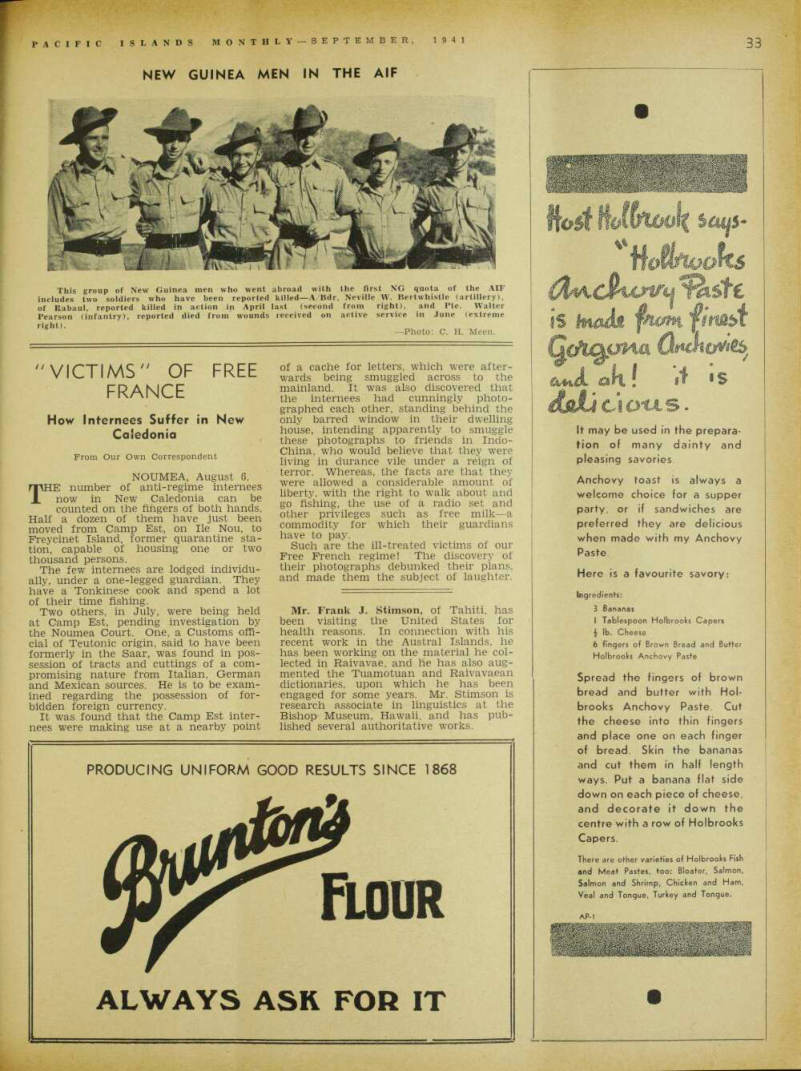
This group of New Guinea men who went abroad with the first NG quota of the AIF includes two soldiers who have been reported killed —A/Bdr. Neville W. Bertwhistle (artillery), of Rabaul, reported killed in action in April last (second from right), and Pte. Walter Pearson (infantry), reported died from wounds received on active service in June (extreme right). —Photo: C. H. Meen.
France
"Victims" Of Free
How Internees Suffer in New Caledonia
From Our Own Correspondent NOUMEA, August 6.
THE number of anti-regime internees now in New Caledonia can be counted on the fihgers of both hands.
Half a dozen of them have just been moved from Camp Est, on He Nou, to Freycinet Island, former quarantine sta tion, capable of housing one or two thousand persons.
The few internees are lodged individu ally, under a one-legged guardian. They have a Tonkinese cook and spend a lot of their time fishing.
Two others, in July, were being held at Camp Est, pending investigation by the Noumea Court. One, a Customs offi cial of Teutonic origin, said to have been formerly in the Saar, was found in pos session of tracts and cuttings of a com promising nature from Italian, German and Mexican sources. He is to be exam ined regarding the possession of for bidden foreign currency.
It was found that the Camp Est inter nees were making use at a nearby point
of a cache for letters, which were after wards being smuggled across to the mainland. It was also discovered that the internees had cunningly photo graphed each other, standing behind the only barred window in their dwelling house, intending apparently to smuggle these photographs to friends in Indo china, who would believe that they were living in durance vile under a reign of terror. Whereas, the facts are that they were allowed a considerable amount of liberty, with the right to walk about and go fishing, the use of a radio set and other privileges such as free milk —a commodity for which their guardians have to pay.
Such are the ill-treated victims of our Free French regime! The discovery of their photographs debunked their plans, and made them the subject of laughter.
Mr. Frank J. Stimson, of Tahiti, has been visiting the United States for health reasons. In connection with his recent work in the Austral Islands, he has been working on the material he col lected in Raivavae, and he has also aug mented the Tuamotuan and Raivavaean dictionaries, upon which he has been engaged for some years. Mr. Stimson is research associate in linguistics at the Bishop Museum, Hawaii, and has pub lished several authoritative works.
Advertisements & other items, p. 35 (1 item)
Gtfugma
|fosf S^s-
sM.cJh CrtfCj
is hWf
Gtfugma
Out (Si ah.! S
iCftiiciotts.
It may be used in the preparation of many dainty and pleasing savories Anchovy toast is always a welcome choice for a supper party, or if sandwiches are preferred they are delicious when made with my Anchovy Paste Here is a favourite savory; Ingredients: 3 Bananas I Tablespoon Holbrooks Capers i lb. Cheese 6 fingers of Brown Bread and Butter Holbrooks Anchovy Paste Spread the fingers of brown bread and butter with Holbrooks Anchovy Paste, Cut the cheese into thin fingers and place one on each finger of bread. Skin the bananas and cut them in half length ways. Put a banana flat side down on each piece of cheese, and decorate it down the centre with a row of Holbrooks Capers.
There are other varieties of Holbrooks Fish and Meat Pastes, too: Bloater, Salmon, Salmon and Shrimp, Chicken and Ham, Veal and Tongue, Turkey and Tongue.
AP-I
PRODUCING UNIFORM GOOD RESULTS SINCE 1868
Lr
ALWAYS ASK FOR IT
Con N. Caledonia Now Afford
Java Labour?
From our own correspondent NOUMEA, August 18.
FACED with a possible shortage of labour, resulting from repatriations to the Dutch East Indies, the New Caledonian Government has asked plant ers and cattle-raisers to state their pos sible labour requirements. Two hundred and thirty replies have been received, and the local Netherlands Consul has been
asked if it is possible to obtain authorisa tion to introduce 1,000 workers.
But, as the florin is now valued at 24 francs, instead of 15 (as it was when the last convoy arrived) and as the passage money required is now 2,400 francs in place of the original 1,000 francs, the cost this labour will be much heavier than formerly.
In any case, the introduction of Java nese will not be hurried both because of shipping limitations and because it is not desirable to increase too much the colony’s monetary overseas commitments
A Cockroach—And A
Moral
HAVE we just time for a story, though the days be dark and gory, With this trouble over Hitler and his bloody lustful staff?
For this tale concerns our fathers, all
our great-grand-blooming-fathers.
And though sordid, dark and dreary, it may somewhere cause a laugh.
We are sitting at our table, being cheerful, if we’re able, When a cockroach fights his neighbours over who will eat our cheque.
There is just one fiery tussle, with a deep and throaty rustle, As the signature so noble disappears into his neck.
And we feel that his digestion will sure meet with some congestion When he £.s.d. encounters and on figures does encroach; For we’ve had the same dashed trouble, and it makes our blood all bubble, When we try to make the figures and last month’s accounts approach.
Looking roachward we are humbled, for that roach has never stumbled, Nor has faltered in his downward thrust of all things that appease.
Then when he has eaten luncheon he sits there contented, munchin’.
Most respectfully, we watch him as we sit back at our ease.
For in all of roach’s capers he has cleaned up all our papers.
In an evening he’s demolished half our worries and our ills.
In his awful lust for succour, he has eaten as plain tucker Our cheque from our last pay-day—and the whole of last month’s bills!
Then some more come out to plunder, and they tear this roach asunder.
And devour him leg by whisker, while he jumps about and kicks.
So we see now in the precincts of these low and uncouth insects A moral that is golden, which will weather stones and bricks.
Back in dim and distant ages our fore fathers (now in cages), Fought their battles for their kaikai in the treetops side by side, But when one had full and many, and the others hadn’t any, Then they ate him, without cooking, from his shinbones to his hide.
Now we have the German nation, all goose-stepping in formation, As the over-greedy cockroach, but in creasing all our woes.
But they’ll sure be torn asunder, from their everlasting plunder— Even, in the end, it may be, by their friends and not their foes.
Papua.
L. H. W.
Private Frank Burke, who was the first man to enlist in the New Guinea Quota of the AIF, has returned to Rabaul after serving overseas (mostly in England). He has been discharged from the Army owing to ill-health. It is a rare occurence that the first man to enlist from a town is the first to return.
Mr. J. H. Dawkins, Registry Clerk in the Joint Court of the New Hebrides Condominium, who arrived in Australia from Vila early this year on four and a half months’ furlough, resigned from the Service at the expiration of his leave.
He now has a post in the Navy Depart ment, Sydney. Altogether, Mr. Dawkins spent 12 years in the New Hebrides.
Advertisements & other items, p. 36 (1 item)
1 Imp Li Apithmitic *
MS /
IT f
to find that 5 x 15 is greater than 3 x 20. Similarly, you can prove that it costs more to paint your house with "cheap” paint than with BERGER’S PAINT, because it requires more paint and you don’t get half the service !
"8.P.” has all the qualities necessary for entire satisfaction. "8.P.” gives a solid covering that defies the weather, it will protect your property for years and, furthermore, the quality of "8.P.” is guaranteed on the can. For satisfaction on the job , use m m % cO h*
AGENTS THROUGHOUT THE ISLANDS.
"8.P.” Keeps on Keeping on !
New Books
“I Was Winston Churchill’S
SECRETARY”, by Phyllis Moir. (Angus & Robertson, Sydney. 6/-). As may be supposed, this is an intimate study ot the character, habits, working methods and home life of Britain’s greatest man.
Miss Moir was Mr. Churchill's private secretary for many years, and she writes of him revealingly, but in a very friendly and respectful fashion. He was in his early twenties when he first became a public figure, and he is 66 now, and al ways he has been upon the public stage— usually prominently, but sometimes as a severely discredited figure. Is he what he has been sometimes called —an erratic genius—or does he really possess qualities entitling him to be Britain’s trusted leader in the most critical moment oi Britain’s history? Miss Moir’s book gives the answer.
“Fortunes In Minerals —Simple
Tests and How to Make Them”, by lon Idriess (Angus & Robertson, Sydney. 10/-) Australia's most popular author, himself an old miner, herein tells you how to find and identify almost all the minerals which are of any use or value.
This is a handbook that will be found, in future, in the library of the mining engineer in the city, and in the swag of the prospector in the field. It is sur prising that it has not sooner been written. AH sorts of metals, hitherto ig nored, are in demand nowadays.
“Pacific Pilgrimage”, By Norman
Goodall. (Published by the Livingstone Press, 42 Broadway, London, S.W. 2/-.) Mr. Goodall, a high official of the London Missionary Society, in 1939 and 1940, visited the LMS stations in the South Pacific, and this little volume is the re sult of his observations. His first-hand impressions of the Cook Islands, Samoa, Gilbert and Ellice Islands, Nauru and Papua are interesting and useful; but everything is seen through the spectacles of an uncompromising missionary, so that his vision is limited and his conclusions a little cramped. Which means that he is a good missionary, but that he cannot visualise these vast Pacific territories, except as a field for missionary work and an appendage of missionary organisation.
“Man And The New Order”, By
Professor S. Angus. (Published by Angus & Robertson, Ltd., Sydney. 2/6.) Professor Angus is an advanced thinker, and a man of broad, tolerant, humanitarian views— so broad and so tolerant that the bigots of his Presbyterian Church have, three times, made him the object of a first-class “heresy hunt”.
But even this famous constructive thinker fails to get very far when he seeks a practical plan for inaugurating “a new order” now. He finds the average individual responsible for the failure of the present order; and, so that we may have a new and better order, he urges that we begin to build for our new order by produc ing a better race of men. Which is quite sound, and logical, and professorial, but gets us precisely nowhere.
May it be very respectfully submitted to this eminent scholar —and many other eminent scholars—that while the character of humanity (which ranges from the superior Nordics to the rapidly-breeding Brazilians, from the stoical Chinese to the mercurial Latins) cannot be changed much in half-a-dozen generations, the system which has produced the deplorable present order can be changed very quickly, if the reformers only will start in the right place.
And the right place is the point where money power takes charge of democratic government, and twists or destroys its essential purpose.
True democratic government (“the greatest good for the greatest number”, “government of the people, by the people, for the people”, etc.) has been a slow evolutionary growth. Money power is a monstrosity of recent growth, the product of the machine-age and very rapid communications.
Our present social order, based on the indus trial and economic conditions of a century ago, able to adapt itself to the slow-moving changes of the past five hundred years, accustomed to a simple, gold-based currency and international
free-trade, has failed to take care of mass production, “national self-sufficiency”, cur rencies that have neither base nor balance, and a tempo of life that is ever-accelerating, as telegraphy follows railways and steamships, and motor cars follow telephony, and air-borne transport follows radio. Parliaments could not control these things because, while the little men entered Parliaments to play about with gold chains and titles, and make a show of government, the big men took charge of the new economy, and used it for their own aggrandisement.
The forces which broke the old order deve loped within a few decades: in a few decades, they can be destroyed. But, before they can be attacked, they must be seen. It is the duty of Dr. Angus, and people like him, who wish to point the way to the new order, to name the evils which virtually have destroyed the old order. But none has the courage to do it. And so the masses go stumbling along in the dark ness, from war to depression, from depression to revolution and destruction and, possibly, to another dark age. Dr. Angus recognises the evils, but is too much of a gentleman to name them; and, in seeking the remedy, he hunts too far afield.
Mr. C. Bates, of the New Guinea Dis trict Services Department, has been
spending leave in Australia, during the
last couple of months.
Mr. A. McHugh, son of Mr. and Mrs.
J. McHugh, of Suva, Fiji, is serving with the AIF in Libya.
District' 0^a bee E„^r in Lau
Group, Fiji, married Miss Joan Charlton, only daughter of Hon. F. R. Charlton, QBE, at Suva Holy Trinity Pro- Cathedral, recently.
Advertisements & other items, pp. 37-38 (1 item)
lluftbestos
Timber, Joinery
ETC.
PREPARED BUILDINGS ready for erection a specialty.
SHIP AND BOAT BUILDING.
TIMBERS specially catered for.
FIBROLITE, PLYWOODS.
GALVANISED IRON.
CONSIGNMENTS shipped
by RETURN STEAMERS
to the Islands.
John W. Eaton
PTY. LTD.
WEST CRESCENT STREET,
NORTH SYDNEY.
Telephones: XB 4051 (6 lines.)
r
SPACIOUS, MODERN
HOMES AT LOW COST
can be built to any architectural design with DURABESTOS (asbestos - cement) Building sheets. Booklet—of 16 homes free from Wunderlich Limited, Crown \ and Cleveland Sts., Redfern, Sydney.
|V WUfWER^L / CH= ]
lluftbestos
BITUMENOID ROOFING
MADE IN AUSTRALIA.
Bltumenoid Roofings, Dampcourse and Insulating Felts are made from the world’s best raw materials. Warranted to stand the most rigid tests.
BITUMENOID THE BEST
Roofing 1 2. 3-ply; Flooring, Waterproof Materials; Saturated Felt; Resilient Road jointing; Natural Asphalt Dampcourse: 2 and 3-ply Dampcourse; 1-2 lb. Lead-core Dampcourse; Roofing Cement; Asphalt Paints: Roofing Compound.
SAMPLES AND PRICE LISTS ON APPLICATION.
MAXWELL PORTER & SON LTD.
ESTABLISHED 1888. BUILDERS’ SUPPLIES.
107 BEDFERN ST., REDFERN, SYDNEY, N.S.W. ’Phone; M 5157. Cables Bitnmenold.
SIMILAR TO EUROPEAN MAKES
now made by
COLEMAN LAMP & STOVE CO.
LTD.
Toronto, Ontario, Canada and sold by All Leading Stores in the Pacific Islands.
In case of difficulty in obtaining supplies write to —
PEARCE & CO.—SUVA, FIJI IS.
Samoan Entomological
Collection
AN expedition to Samoa organised by Otto H. Swezey and Elwood C.
Zimmerman, under the auspices of the Bishop Museum of Hawaii, collected between 30,000 and 40,000 insect speci mens. It is said to be larger than all the other collections of Samoan insects ever assembled. Mr. A. C. Turnbull, Act ing-Administrator of Western Samoa, assisted the collectors during their three months’ stay.
Scientists state that there are still large areas of virgin, forested territory in Samoa from which no insects have ever been obtained.
These additions emphasise the import ance of the Bishop Museum as the nat ural centre for entomological research in the Pacific. The collectors took back a number of species hitherto unknown to science.
Salamaua-Wau Road
THE various New Guinea interests who are pressing for the construction of a Salamaua-Wau road took full advantage of the recent visit of the Aus tralian Territories Minister to place before the Government all the available data in favour of the early construction of the road. The Minister took a keen interest in the matter, and inspected, as well as he could from the air, the alter native routes. He has promised that he will bring the matter before the Aus tralian Government for consideration.
Of course, the real problem has passed from engineering to finance. Even if all engineering problems are solved, there is no indication of where the money is to come from in wartime.
Vichy "Stinks"
Anger in NC Over Indo-China Surrender
Prom Our Own Correspondent NOUMEA, August 19 jl/fEN prominent in New Caledonian ITI history were also prominent in founding the French Empire in Indo-China, which Vichy France has basely handed over to the Japanese; and nowhere in the world is this action more bitterly resented than in Noumea.
To mention but two names out of the past: Commandant Henri Riviere was the man who suppressed the great native insurrection in New Caledonia in 1878-9 Afterwards, in Tonkin, he took Hanoi’s citadel with a handful of men later meeting violent death at the hands of the Annamite Pavillon-Noirs.
Then Admiral Courbet, after being Governor of this French Pacific Island, was sent to Indo-China to bring order out of chaos. He won a series of vic tories which, by June. 1885, led to France’s protectorate over Indo-China being definitely recognised by China.
Men from New Caledonia helped him in this task.
Can it be wondered at that here the name of Vichy stinks in men’s nostrils?
The following have been elected offi cers of the Public Service Association of New Guinea, for the ensuing year: Presi dent, Mr. J. I. Merryiees; vice-president, Mr. R. E. P. Dwyer; council, Miss K.
Randall, Messrs. C. L. Anthony, J. P.
Burke, R. M. Youlden, Ivan Clark and F. Haslam; secretary-treasurer, Mr.
R. M. Wayne.
Advertisements & other items, p. 38 (1 item)
Willia
Established 50 years—and carrying one of the largest stocks of Iron and Steel in Australia.
I I
Atkins Pty. Ltd.
Head Office 449-451 KENT ST., SYDNEY.
Iron & Sfeel Merchants
ENGINEERS' SUPPLIES
COACH & MOTOR HARDWARE.
FULL, COMPREHENSIVE & UP-TO-DATE RANGE IN ALL
DEPARTMENTS, INCLUDING THE FOLLOWING LINES:
Engineers 7 Supplies: Set Screws, Studs, Metal Thread Screws, Coach Screws, Piles, Cotter Pins, Bright and Black Bolts, Rivets, Etc., Hack Saw Blades.
Power Transmission Gear: Including Plummer Blocks, Couplings, Collars, Etc.
Coach and Motor Hardware: Axles, Springs, Wheelstuff, Duck, Paints.
Farriers 7 Supplies: Horse Nails, Anvils, Vices, Etc.
Motor-Trimmers and Motor Builders 7 & Motor Pointers 7 Requirements
C. A. WILLEYS
Quick-Drying Coach and Car Paints, Roughstuff, Elastic Gloss, Synflex Enamels, Lacquers.
DUCO Lacquers and DULUX Enamels—FAßßEX Motor Toppings and Leather Cloths, House fir Decorators 7 Paints, Varnishes & Brushware.
Sole Distributors of CHAMPION 7 S Decorators Paint Products.
Distributing Agents for BROLITE Lacquers, SYNFLEX Enamels and 77 POLYGLOSS 77 Finish.
STEEL DEPARTMENT
MILD STEEL:
Rounds, Squares, Flats, Half-rounds, Hexagons, Bevel, Shoeing, Tyre, Angles, Tees, Sheets, Plates, Girder Plates, Chequer Plates, Channels, Hoops, Etc.
BRIGHT STEEL:
Rounds, Squares, Hexagons.
Extra Special High Speed Tool Steel, Mining Steel, Blister Steel and Spring Steel, Rounds, Flats Cr Squares.
Bar Iron— All sections and sizes.
TRADE
MARK
Cable Address: WILATKIN, Sydney.
Reflections About
Oil
ONCE upon a time coal was king.
Then came a time when cotton became king. Now we have crowned oil as monarch. Much has already been written about the hydro-carbon hidden away in the bowels of the earth, the search and struggle for possession, brought to the surface to become the life blood of mechanical energy. Here let us discuss another kind of oil, vital energy of man.
Edwin E. Slosson, in his book, “Crea tive Chemistry”, says: “All life, and all that life accomplishes, depend upon the supply of solar energy stored in the form of food The chief sources of this vital energy are the fats and the sugars. The former contain two and a quarter times the potential energy of the latter. Both, when completely purified, consist of nothing but carbon, hydrogen and oxy gen; elements that are to be found freely everywhere in air and water. So when the sunny southland exports fats and oils, starches and sugar, it is then send ing away nothing material but what comes back to it on the next wind. What it is sending to the regions of more slanting sunshine is merely some of the surplus of the radiant energy it has received so abundantly, compacted for convenience into a portable and edible form.”
Unlike cotton, there is no evidence of over-production of vegetable and animal fats; true, there may have been a glut when the huge shipments of whale oil arrived after the season’s slaughter.
When Leviathan was exterminated from the northern seas, the hunt went re morselessly on to his last refuge in the Antarctic, as Herman Melville says. The moot point is, whether Leviathan can long endure so wide a chase, and so remorseless a havoc; whether he must not at last be exterminated from the waters.
There is an intimate relation between the over-production of cotton (or, rather, under-consumption), and the paltry price paid for the tropical oil seeds. The palmy days, when cotton was king, and coconuts the “consols of the East”, when the produce of land and sea was bought and sold on competitive world markets, are but a blessed memory.
Would it be straining the imagination to suggest that this monster combine, Unilever, was a contributing factor in precipitating the great depression, by depressing the price of copra, that restricted the purchasing capacity of the cotton-wearing peoples of the tropical belt of the world, and by unbalancing the financial stability of the cotton growing and spinning industry with its consequent unemployment?
Let us look at another interesting item, glycerine, the sweet element of fats and oils. It is a by-product in the manu facture of soap, and is extensively used in the preparation of nitro-glycerine and explosives.
Like soap and margarine, its price has soared out of all proportion to the primary product.
Here then are all the factors that supply the energy to prosecute the war against Hitlerism. The hydro-carbons supply mechanical energy, fats for human energy, and glycerine a vital ele ment in chemical energy.
If the war aims of the Allies are to crush this hideous thing called Hitlerism in Germany, only to prolong and better the condition of the greedy munition, ar mament, and oligarchy interests (called
democracy in England) then our young manhood on the battle front will again have died In vain and our wretched civilisation will slide to destruction, greased by the greed and rapacity of soulless combines that restrict the free exchange of food and commodities between the nations of the world. uwccii buc a, A London correspondent (“PIM”, 19/7/34) struck a warning note. Newspaper quotations of copra values were a farce The newspapers merely told the world what the combines had to say.
The corporations were getting stronger every day, in the copra industry, as in everything else; and, unless there is some world-wide movement to check the strength of these merciless capitalists, serious consequences must follow. The masses will rebel against the stranglehold of the combines, just as all through history they have rebelled against other
forms of tyranny.-
R.S.
No Chinese Cooks
Pr(lm Qur Qwn oorrespondent port TvroßTrspv - Anmist ir ¥XON r P E R AUMULLER Y ’in theLeeis- Hi,.' G ' E -, AUMULLERm the Legis- H lative Council recently, asked the Government whether the objections to the introduction of Chinese, as cooks, would be reconsidered, and whether per mission would be granted for a limited number to be introduced under indenture for a period not exceeding 5 years, sub- Ject to conditions imposed by the Govern ment. i n reply, the Government Secretary, Mr. Champion, stated that the Govern ment could not see any reason for changing its policy on this question, which had been expressed on several occasions—namely, that the employment of Papuans or Europeans as cooks must be insisted upon.
Advertisements & other items, pp. 39-40 (1 item)
“Younger”
** 1*
- and I use
DISTRIBUTORS: Greenwood & Laws, Ltd., Rabaul and Wau; Steamships Trading Co., Ltd., Port Moresby and Samara!; Millers, Ltd., Suva, Fiji.
FOR BEST RE-
SULTS USE
« B. A. L. M. ”
PAINT. It’s results that count and “8.A.L.M.”
Paint is better because it lasts longer, retains its gloss and resists fading. “8.A.L.M.”
Paint won’t crack or flake and eventually the film wears down to a perfect surface for re-painting.
A Product of British Australian Lead Manufacturers Pty., Ltd., makers of “Dulux" Finishes.
If you want “Perfection in Cooking" use a
“Younger”
COOKING STOVE
These stoves have been on the market in Australia for over Sixty Years, and are still recognised as “The Best”.
They are made with Extended Firebox specially for Long Wood fuel, also special stoves with Cast Iron Oven suitable for Island requirements.
Send for Illustrated Catalogue and Price of Single and Double Oven Stoves.
G. FLETCHER & SON
50 OXFORD STREET, SYDNEY.
Gland Discovery
Restores Youth
In 24 Hours
Sufferers from loss of vigour, nervousness, weak body, impure blood, failing memory, and who are old and worn-out before their time will be delighted to learn of a new gland discovery by an American Doctor. new discovery makes it possible to quickly and easily restore vigour to your glands and body, to build rich, pure blood, to strengthen your mind and memory and feel like a new man in only 8 days. In fact, this discovery, which is a home medicine in pleasant, easy-to-take tablet form, does away with gland operations and begins to build new vigour and energy in 24 hours, yet it is absolutely harmless and natural in action.
T 7 The success of this amazing discovery, called Vi-bum has been so great in America that it is now being distributed by all chemists here under a guarantee of complete satisfaction or money back. In other words, Vi-Stim must make you feel full of vigour and energy and from 10 to 20 years younger, or you merely return the empty package and your money will be refunded. A special, double-strength bottle of 48 Yi-Stim tablets costs little and the guarantee protects you.
Vi-Stim
GUARANTEED
to Restore Manhood and Vitality . . .
Ship Chandlery Hardware
/Write for j
Ship Chandlery /
Cataloaue J
Catalogue
Special “In Bond” Prices for all Islands enquiries quoted on application.
Sole Agents for:
BROOMFIELDS LIMITED
152 SUSSEX STREET SYDNEY.
Cables: “Boom”, Sydney.
Large and Complete Stocks of
SHIP CHANDLERY
IRONMONGERY OF ALL KINDS, PAINTS,
WHITE LEAD AND OILS.
P. H. MUNTZ & CO.’S 3-CROWN BRAND METAL SHEATHING.
PEACOCK & BUCHANS’ ENGLISH READY-MIXED PAINTS.
Scott’s “Renown” Brand Rope,
Cordage and
Binder
Twine
Cable Address Ropeyard, Sydney. j - Hi
of Every
Description
MANUFACTURED AT
MASCOT, N.S.W.
By
J. SCOTT
PTY. LTD.
Head Office and Store:
163 CLARENCE STREET,
SYDNEY,
N.S.W.
An Authority On
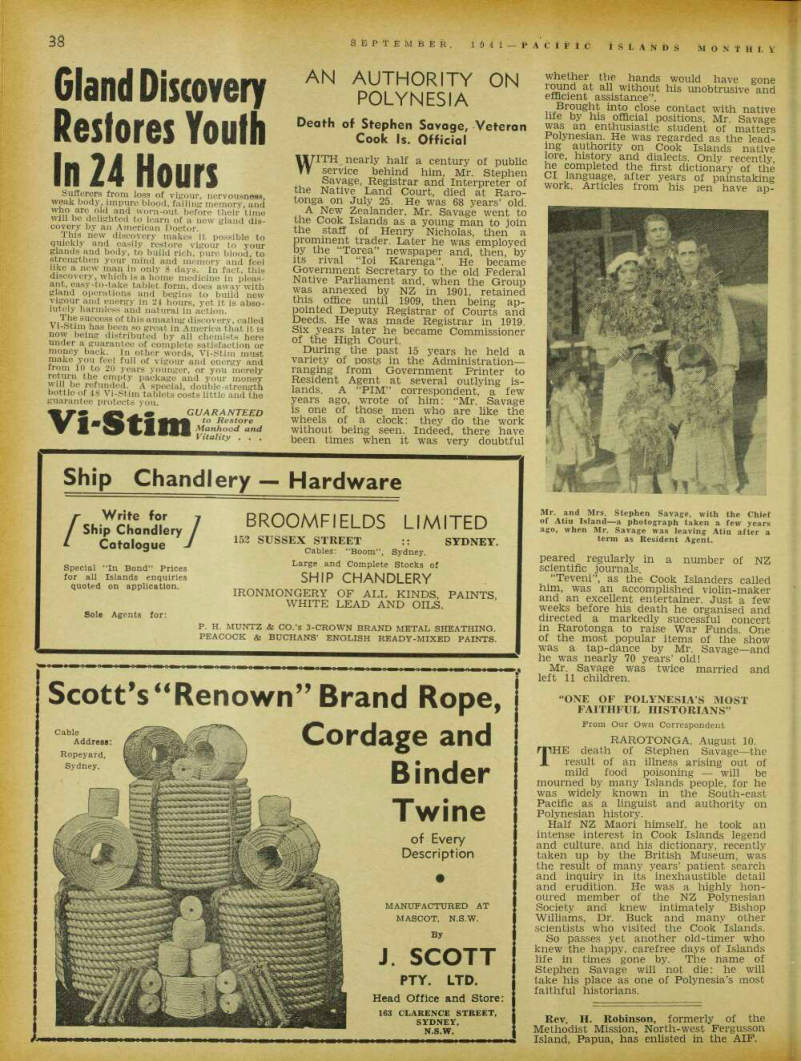
Polynesia
Death of Stephen Savage, Veteren Cook Is. Official
117TTH nearly half a century of public service behind him, Mr. Stephen Savage, Registrar and Interpreter of + 6 Native Land Court, died at Raro- July 25. He was 68 years’ old.
A New Zealander, Mr. Savage went to the C s°t°aff Henry SMt Later he was’employed ® y Torea newspaper and, then, by *tS rival “loi Karenga”. He became Government Secretary to the old Federal “W ai 2f iexeci by NZ in 1901, retained tnis °mce Until 1909, then being ap pointed Deputy Registrar of Courts and Deeds. He was made Registrar in 1919 ?f X t^ a H S i e h te c r o?r e t beCame Commissioner ic , , . During the past 15 years he held a variety of posts in the Administration— ranging from Government Printer to Resident Agent at several outlying is correspondent, a few years ago, wrote of him: Mr. Savage is one of those men who are like the wheels of a clock: they do the work without being seen. Indeed, there have |3 een times when it was very doubtful
whether the hands would have gone round at all without his unobtrusive and efficient assistance”. i. Brought into close contact with native me by his official positions, Mr. Savage was an enthusiastic student of matters Polynesian. He was regarded as the lead ing authority on Cook Islands native lore, history and dialects. Only recently, he completed the first dictionary of the Cl language, after years of painstaking work. Articles from his pen have ap-
peared regularly in a number of NZ scientific journals.
“Teveni”, as the Cook Islanders called him, was an accomplished violin-maker and an excellent entertainer. Just a few weeks before his death he organised and directed a markedly successful concert in Rarotonga to raise War Funds. One of the most popular items of the show was a tap-dance by Mr. Savage—and he was nearly 70 years’ old!
Mr. Savage was twice married and left 11 children.
“One Of Polynesia’S Most
Faithful Historians”
From Our Own Correspondent RAROTONGA, August 10.
THE death of Stephen Savage—the result of an illness arising out of mild food poisoning will be mourned by many Islands people, for he was widely known in the South-east Pacific as a linguist and authority on Polynesian history.
Half NZ Maori himself, he took an intense interest in Cook Islands legend and culture, and his dictionary, recently taken up by the British Museum, was the result of many years’ patient search and inquiry in its inexhaustible detail and erudition. He was a highly hon oured member of the NZ Polynesian Society and knew intimately Bishop Williams, Dr. Buck and many other scientists who visited the Cook Islands.
So passes yet another old-timer who knew the happy, carefree days of Islands life in times gone by. The name of Stephen Savage will not die: he will take his place as one of Polynesia’s most faithful historians.
Rev. H. Robinson, formerly of the Methodist Mission, North-west Fergusson Island, Papua, has enlisted in the AIF.
Mr. and Mrs. Stephen Savage, with the Chief of Atiu Island—a photograph taken a few years ago, when Mr. Savage was leaving Atiu after a term as Resident Agent.
Advertisements & other items, p. 40 (1 item)
38
SEPTEMBER, IMI PACIFIC ISLANDS MONTHtV
The "Royal Tar"
WHEN Mr. Norman Nelson was exam ining the papers of his father, Mr.
Ivan Nelson, well-known Islands merchant and head of Nelson and Robertson Pty., Ltd., who died in Syd ney in July, he came across an inter esting old document, linked with a now almost-forgotten chapter of Australian history—the bill of sale of the 597-tons barque, “Royal Tar”.
No doubt there still are some Pacific residents in whose memory the name “Royal Tar”, largest sailing ship built in Australia, will strike a responsive chord.
She was purchased by Mr. Nelson for the New Australia Co-operative Settle ment Association and he supervised her refitting to carry Australian colonists to South America, where, under a Bristol born visionary and writer, William Lane, a new Utopia was to be established. The site chosen was in Paraguay, a small state in the centre of the huge continent.
Two hundred men and women made the voyage across the Pacific from Syd ney in July, 1893—a voyage marked by bitter dissension, for all were willing to command but few to obey. Settled in their new land, the colonists bravely faced hardships, disappointments and wrangling among the leaders.
Finally, as letters and documents in the Mitchell Library (Sydney) show, the enterprise failed. Most of the settlers returned to Australia, though descend ants of the handful who stayed are still there to-day, scratching out a bare existence from the land.
After her return from South America, the “Royal Tar” traded for a time in New Zealand, where ultimately she ended her career.
An Eventful Voyage
A COUPLE of years before the New Australia venture, the “Royal Tar” was owned by a Sydney business syndicate, which sent her to German New Guinea with coal. Having unloaded her bunkers, the officers and crew went ashore, shooting, in the bush; with the result that the Anopheles mosquito had a very busy time. The entire comple ment contracted malarial fever.
At sea only a day or so, en route to the Pacific coast of America to take aboard timber, Captain Franklin died; the second in command, Rodgers, took charge, but he too fell a victim to the disease. Others of the crew were laid low, leaving only the third officer, John McColl, and two weakened seamen to carry on. For days, the barque just drifted lazily across the Pacific; eventu ally, when some of the crew recovered slightly, they got back on their course and reached San Francisco.
Their troubles were not over, even then —the US marine authorities wanted to sink the “Royal Tar” outside the har bour to prevent a possible spread of fever. However, McColl and a commit tee of inquiry convinced them otherwise.
Mrs. Martha Bish, wife of Mr. Gideon Bish, of Lami, Fiji, died recently at the age of 71. She went to Fiji with Mr.
Bish in the 1890’s, and for many years they lived in Ba District. Mrs. Bish is survived by her husband and six child ren—Messrs. Leslie and Leonard Bish, of the Fiji Public Works Department; Messrs. John and Albert Bish, of the Suva firm, Bish Ltd.; Mr. Frank Bish, of Auckland: and Mrs. Grace Bentley, who also lives in NZ.
Miss Gwen Lewis, of Western Austra lia, has joined the Methodist Mission in Papua as the District Chairman’s Assist ant at Dobu.
More Fiji Men For RAF
A FURTHER batch of 17 young men, residents of Fiji, who have been accepted for service with the Royal Air Force, will shortly proceed overseas for training. They are Messrs. E. Brad man, A. and K. Brooks, W. Garnett, V.
Jackson, R. Kerkham, and J. McLauch lan, all of whom were born in the Colony; and Messrs. J. Clough. D. Cum mings, L. Guest, R. Harricks, W. McCloy, D. Rounds, J. Potter, K. Thompson, V.
Tuckwell, and K. Underwood.
Answer To Correspondent: You
are quite right. We find, on inquiry, that there is considerable difference between the George Cross and the George Medal. The George Cross is awarded for outstanding acts of great courage, and is the civil equivalent of the Victoria Cross. The George Medal is given for notable and distinguished con duct, but does not rank with the George Cross.
Mr. R. McLaughlin, of Burns, Philp and Co.’s Shipping Department at Rabaul, New Guinea, is at present on a health visit to the East.
Dr. Montfort, former medical officer at Vila, New Hebrides, is serving with the Free French Forces in the Lake Chad region, West Africa. With him is Dr. Lamy, formerly of Wallis Island. In letters to New Caledonian officials, Dr.
Montfort says that he intends to seek a transfer so that he may serve with the Free French contingent from the South Seas.
Miss Margaret Hanlan, of the Marist Mission, recently arrived on Bougainville Island, TNG, from Sydney. Miss Hanlan, who is a nurse, has joined the Mission’s child welfare centre at Pororan, Buka, where three Sisters have established a station for the Marist Medical Mission.
Dr. Alfred Metraux, French anthro pologist, who carried out investigations some years ago on Easter Island, and subsequently worked in Hawaii, has now completed his field work in South Amer ica, for which he was awarded a Guggen heim Fellowship. Recent advices state that he was at Yale revising his material.
Among the Polynesian material that he examined in the National Museum at Rio de Janiero was a collection left there by the Hawaiian Royal couple, Liholiho and Kamamalu, when on their way to England in 1820. Among his dis coveries was one of the ancient and much prized feather cloaks of Hawaii.
Advertisements & other items, pp. 41-42 (1 item)
health
WANTED TO PURCHASE
Used stamps of all Pacific Islands.
Highest prices paid. Regular consignments solicited. Remittances guaranteed by return mail.
J. H. SMYTH PTY. LTD.,
114 Castlereagh St., Sydney, Aust.
Good health 9%eP itwlth f
A. B. DONALD Ltd.
AUCKLAND
ISLAND TRADERS & GENERAL MERCHANTS
P.O. Box 1509. Cables & Telegrams, "Kingdom", Auckland.
n M strength
MP'STi
S P£C lA m S-H.O. Will 5
lly
■ n.u. yv 11- 1,
\^^^LtdlsYP^
for
|Ep\v
•Ropi
ST R A LIAH^j^|^
Capstans are available in both
MEDIUM and FULL STRENGTH
GAPSTA
TOBACCO AND CIGARETTES
!\* 895
Making History In
Rotuma
By “Amel”
IN all the years of its existence as a civilised community, Rotuma (Fiji) has never had a telephone. But now, owing to circumstances shrouded in offi cial secrecy, Rotuma has a telephone.
Only a mile or so of wire and a couple of boxes, but a telephone, nevertheless.
And we were going to inspect it.
“I have a book,” panted the Commis sioner, forging ahead with an enviable burst of speed, “that you will anpreciate readmg after climbing this hill.”
“Oh, thanks,” I puffed, feeling a stream of perspiration trickling into the toe of my shoe.
“It tells,” he continued, when he had regained sufficient breath, “how to scale
mountains from a hotel balcony.”
“Wish I knew the technique,” i sighed.
The Scoutmaster blew his whistle and announced that he was taking the better way We wished him joy and, after a simple process of slipping, slithering, gliding, clutching, hauling, pushing, sit ting down and occasionally walking we met him again at the top of the hill’ . The telephone was not quite ready for inspection, but, lost in admiring the view we almost forgot its existence.
We were so high up that the whole of the lovely little island, a dark green carpet from shore to shore, seemed to lie at our feet. It was, we agreed, tropical beauty at its best. Everything—dazzling white beaches, verdant, tangled masses of forest, graceful palms, foaming breakers on the reef, villages nestling along the shore—was there under the blue of the sky.
The surf-ringed emerald islands, sur rounding Rotuma, guarded it like sentinels. Each one had an aloof appear ance and an air of mystery.
Far down in the indigo sea, an object like a brown paper bag wavered for a while and then sank. It was a turtle.
“There’s somebody on the telephone,” said the Commissioner in a matter-of fact voice, and back we came to earth again.
The telephone line was through, ana the ensuing excitement would have done credit to the inauguration of a world encircling telephone service!
The bells would not ring, but that minor fault would be remedied later.
Meanwhile, all of us completed the making of history by saying “hallo” to the long-suffering linesman at the other end.
Then we observed the reactions of a native boy who put the receiver to his ear very carefully, after looking at it once or twice as if he expected the Loch Ness monster to spring out at him.
Linesman: “Hallo!”
Boy: “Hallo!”
Linesman: “Who’s speaking?”
Boy: “Me!”
While this brilliant dialogue was en tertaining to us, it must have reduced the linesman to a gibbering wreck, and he was probably the most relieved person on Rotuma when we called it a day and went home!
The Work of Professor Buck
IT is some years now since Professor Peter H. Buck (Te Rangi Hiroa) published the results of his investiga tions at Aitutaki and other islands in the Cook Group. Though he has since published his “Vikings of the Sunrise”, which was intended for the general reader, he has continued to accumulate specialised material relating to Raro tonga and its sister islands.
This project, which will take the form of a study of the arts and crafts of the Cook Islands, is now nearing comple tion in Hawaii, where Dr. Buck is Direc tor of the Bishop Museum. It has been his aim to apply to material culture some of the scientific principles used in the natural sciences. Artifacts that were made with native tools have been selected as type specimens, and the loca tion of the specimen will be given for the information of students.
Dr. Buck has been culling the large collection of photographs in the Museum for illustrations.
Mr. Charles Nelson, one of the pioneer prospectors of Papua, died in Port Moresby Hospital recently, after a short illness. He was 72. Born in Nor way, “Charlie” Nelson went to Papua in 1906 and during his long period there made many gold-seeking trips which covered most of the Territory.
A Radio Operator's
Heroism
NOW stationed as an AWA radio operator at Suva, Fiji, is an Austra lian, Mr. H. W. Brown, who into one year packed sufficient war adven tures to last him a lifetime.
In the middle of 1940, when France surrendered to the Nazis, the Message ries Maritime Co.’s liner, “Commissaire Kamel” (10,000 tons) which ran between France and her Pacific colonies, was commandeered at Suva by the British authorities and manned with an Austra lian crew. Mr. Brown became chief
radio operator.
The “Ramel” left Australian waters for the United Kingdom in September last year. Half way across the Indian Ocean, at 1 a.m., a strange ship ap proached and a Morse lamp demanded her name. As the mate replied, Brown, on the captain’s orders, commenced to transmit a Morse warning of the raid er’s presence. The corsair’s reply was a rain of shells, from 650 yards range.
While the searchlight * sought out the wireless cabin, machine-guns and “pom poms” swept the “Ramel’s” decks. Brown continued his SOS until the power failed.
The shelling stopped: but when Brown got the emergency set working, the guns roared again. A shell hit the upper cor ner of the wireless room, then another, and still another. Brown went uncon scious from shrapnel wounds.
Brought around by his assistant, the defiant operator again started to trans mit on the spark set. Then, as Mr.
Brown told the “Fiji Times” recently, “the whole room seemed to fold up on top of me—l have a vague recollection
of trying to get out, but there seemed to be a mass of tangled wire, radio gear and timber blocking my way. Somehow I managed to scramble through it.”
Brown and a couple of sailors got away in a ship’s boat, but they were captured, and were prisoners for months on enemy ships, and finally at Moga dishu. capital of Italian Somaliland.
There, under filthy conditions, they were kept prisoners until the British took Somaliland and released them.
Islands Troops In Film
DURING the recent stay in Sydney of the First Battalion of the Pacific Islanders enlisted under the De Gaulle banner a film was made by M.
J. M. X. Chollot, of “Le Courrier Aus tralien”. Its first screening was given before members of the Pacific Islands Society at the Carlton Hotel, on August 27, in the presence of M. Andre Brenac, leader of the Free French Movement in Australia, and Madame Brenac. Partly in colour, and titled both in French and English, this excellent record of the Tahitians and New Caledonians in camp at Liverpool, marching through Sydney, and at the La Perouse memorial, Botany Bay, will later be screened in Noumea and Papeete.
It is learned that the New Caledonian Foyer, or Club, run in London, for Cale donians serving with the Free French Forces, with funds raised in the Colony, was entirely destroyed in a recent Ger man raid on Britain. But the work will go on, for new funds are being raised to re-open the club in another building.
Mr. Trafford Smith, the Colonial Office official, who has been touring the Paci fic, is now temporarily attached to the office of the British High Commissioner in Canada who, strangely enough, is Mr.
Malcolm MacDonald, his old chief at the Dominions Office in London. Mr. and Mrs. Smith travelled by mission schooner from Funafuti in the Ellice Group direct to Suva, and there caught a Matson boat for the USA.
Advertisements & other items, p. 43 (1 item)
.Ionyeast'
Jk\lM , VlGOLRa
Vitality
36 All Chemisfs
.IONYEAST'
ircmsed Yeast „
KEEP FIGHTING FIT!
Take IONYEAST Vitamin B, D & E Tonic. Confers lasting benefits whilst achieving immediate results. A 10-day course 3/6, or 3 bottles for 10/-.
Write —
IONYEAST
Box 1966X, G.P.O., Brisbane, Qld.
u» m W PI . s ov*- »c«* . W»‘ .4 » *• G - „«.•* - ':t> ~r«l e ,** ** »** t**" 8 " se r^ lS - so v».' or *e **-. *‘ H *Cff »■ dav- It. P e .er^'
War-Time Economy In
Fiji
From Our Own Correspondent
Suva, Aug. 14.
WAR shortages in Suva develop in the most surprising directions. Except for building materials, there have been no really serious shortages in im ported goods, where one might expect them. On the other hand, the Suva Municipal Electrical Department states that it is short of current, and, in ad vertisements, is shrieking to users to consume as little as possible.
This seems very unfortunate, because the more current a service sells, the cheaper the price at which it can sell.
For many years, after a bad start (when it was taken in by the charms of buying a second-hand plant discarded by
a country town in New South Wales) the Suva service developed excellently, made a goyl deal of money for the ratepayers, and served its customers well. The new customer was welcomed. But now, ap parently, that process is to be reversed — new custom is refused, and old customers are stinted.
The explanation offered is, of course, the war, and new wartime needs.
Perhaps the threatened Suva black out will come not as a result of Administrative Order but through the failure of the present electrical service, which is understood to be working under considerable strain.
Mr. E. E. Jenkins, who has been Attorney-General of Fiji since 1938, arrived in New Zealand recently for two months’ furlough.
History of Equatorial
Islands Invaluable New Book Published in Honolulu
SO many of the endless romantic stories of the Pacific are based upon the little-known Line (or Equatorial) Islands that one greets, with almost a whoop of joy, a new book, “American Polynesia”, by Edwin H. Bryan, of the staff of the Bishop Museum, Honolulu.
This is a book of facts —one is given the exact position, size, condition, topo graphical features, and history of each island, taken carefully from official records.
The title is a little challenging. One assumes that “American Polynesia” is Hawaii; but in reading Mr, Bryan’s book, one discovers that American Polynesia comprises the Line Islands, and one learns the real basis of the United States' claim to so many equatorial is lands—a development which has puzzled many people in recent years.
Between 1830 and 1850, it was dis covered that vast deposits of guano on many of these islands were valuable; and American interests became very active.
US Congress, on August 18, 1856, passed the Guano Act, which authorised Ameri cans to claim unoccupied islands for the United States for the purpose of removing the guano. Accordingly, claims were made for 48 islands, under the Guano Act, and a list of these was published in the “New York Tribune” on March 5, 1858. The list was reprinted in “The Friend”, Hono lulu, on April 20, 1859; also by a German writer, E. Behm, in 1859; and in “Ameri can Journal of Science”, September, 1859.
Only 18 of those 48 islands are now known by the names then given; 12 are known by different names; and 15 are to-day not known at all.
Early in 1857, representatives of the American Guano Company, of New York, took possession of Howland, Jarvis and Baker Islands. The Phoenix Guano Co. (American) took possession of McKean and Phoenix Islands in 1859 and of Enderbury in 1862. The industry was active in the seventies.
The Americans withdrew when the rich deposits were worked out and, from about 1879 to 1891, John T. Arundel & Co.
''British), with supplies from Apia, and labourers from Niue and the Cooks, car ried on guano digging on the islands named above, and also on the islands of Sydney, Canton, Flint and Starbuck.
Mr. Bryan’s researches show that, after 1879, the United States officially mani fested no interest whatever in these “guano islands”. In 1889, at Mr. Arundel’s request, Britain annexed the Phoenix group: and guano-digging was continued sporadically by British and Australian concerns. An American whaler found the rich deposits on Malden Island in 1848, and sold his find to a Sydney company.
A few natives and a handful of Euro peans continued, for the next 50 years, to take guano and copra from this coral “no-man’s-land”. Britain did not particu larly want the islands; but someone had to police the law of the white man, and so gradually they all came under British jurisdiction. All maps, from about the ’nineties, showed the following as British; Howland Baker Palmyra Washington Fanning Christmas Jarvis Malden Starbuck Caroline Vostock Flint Six islands in Phoenix group None argued or cared who owned the little islands. The guano was all worked out, they had only a few coconuts, and
there was not a harbour worthy of the name among the lot of them. rEN, in 1928, the great Australian airman, Kingsford Smith, flew from San Francisco to Sydney, across the Pacific, and directed attention to the im portance of those Line Islands as landing grounds, on the direct route from Hawaii to Fiji and New Zealand. Officialdom took little notice.
By 1934, people were beginning to rea lise that trans-Pacific aviation services were possible, and a few people displayed interest in islands that, hitherto, were regarded as worthless. Official American “colonists” were landed on Jarvis on March 26, 1935; on Howland, March 30; and on Baker, April 3. The islands were officiallv annexed bv the United States.
In 1936 and 1937, there was a great scurrying to and fro among the other Line Islands named above, by British official parties. Britain’s long and un challenged title to the various little bits of uninteresting and depressing coral and sand was re-affirmed by flying flags, erecting notices and beacons and. finally, by landing colonists and administrators.
Anglo-American competition came to a head at Canton Island. USA wanted it; Britain showed a good title. Both occu pied it. But the two parties didn’t fight over it. They sat down together in the only bit of shade in the god-forsaken snot, and shared their cold beer, and left Washington and London to argue it out.
The result was that America and Britain decided that they have equal occupational aviation rights there.
Canton Island is now an important PAA station. It seems certain that other Line Islands, hitherto worthless, will be needed in the future for aviation pur poses. If disputes should arise, the pre cedent set bv Canton Island, and the publication of Mr. Bryan's invaluable book, should show the way to a simple settlement.
MR. Bryan gives a detailed geo granhical. historical, botanical and zoological description, not only of what we have called the Line Islands, but also of the Tokelau or Union groun (north of Samoa, administered bv New Zealand). Samoa, and the Northern Cooks. There is a carefully-drawn map of practically every island described, no matter how small and insignificant it is —priceless material for any reference library.
The book contains accounts of some of the most romantic and colourful episodes of early Polynesia—for instance, the early history of Olosenga (Swains Island), “one of the most beautiful and pic turesque under the American flag”, and the romantic home of the Jennings family (related to the T. H. Carruthers family, of Samoa); the strange story of Suwarrow Island, where there is more than a tradition of buried treasure * the colonisation of Palmerston Island by William Marsters and his three Poly nesian wives; and so on.
There is evidence everywhere of the pains taken by the author to ensure the accuracy of his compilation—a huge bibliography is quoted in detail. Everyone interested in Pacific Islands research will be grateful to Mr. Brvan for this unique, invaluable and fascinating volume.
“AMERICAN POLYNESIA,” a popular geo graphy, history, and natural history of the coral islands of the Central Pacific, by E. H.
Bryan, Jr., Curator, B.P. Bishop Museum. 1.00 dollar, paper bound; 1.50 dollar cloth. Add 10 cents postage to Australia. E. H. Bryan, Jr., 2721 Ferdinand Ave., Honolulu, Hawaii.
Miss E, A, Downs, of the Papauta Girls’ School Apia. Western Samoa, will return to the Territory shortly, after furlough and deputation work for the LMS in Australia and New Zealand.
Advertisements & other items, p. 44 (1 item)
Edgell
THE SCOTS COLLEGE, BELLEVUE HILL, SYDNEY.
Founded 1892.
Owned and Conducted by the Presbyterian Church of N.S.W.
One of the Great Public Schools, the College is situated in spacious grounds at Rose Bay, A large extension of the School Block and a new Assembly Hall were opened in 1939.
PRINCIPAL: A. K. Anderson, M.A., F.R.Hist.S. 30 Assistant Masters visiting staff. Present Roll:—700 pupils, including 200 Preparatory Boarders and a large and Day Boys.
THREE COURSES: Academic, Commercial and Pastoral.
Boys prepared for University and Education Dept. Examinations to Leaving Honours Wool-classing and Woodwork available for Boys going on the Land.
There are five Houses for Boarders. About 30 boys are from overseas.
THE PREPARATORY SCHOOL, adjacent on Mansion Road, is fully staffed.
Next Term opens on September 23; First Term in 1942, February 10.
Prospectus on application to the Principal, or the Secretary, (Mr. J. R. Mackay), Assembly Hall Buildings, Margaret Street, Sydney.
Edgell
QUALITY PRODUCTS
Edged Asparagus
The best in the world. Available in season only.
Edged Cauliflower
Choice heart of the cauliflower. No stalk, no waste. Packed in cartons of 3 dozen 16 oz. cans.
Edged Brussels Sprouts
Garden green—firm cooked.
Packed in cartons of 3 dozen 16 oz. or cases of 2 dozen 30 oz. cans.
Edged Green Peas
Picked and canned the same day, avoiding extra handling and bruising.
Graded in three sizes, large, medium and petits pois. Large and medium packed in 10i oz., 16 oz. and 30 oz. cans. Petits pois are packed in cartons of 4 dozen 10i oz. cans only. All packs are available with or without mint flavour.
Edged Carrots
The sweetmeat of canned vegetables. Whole young carrots are packed in cartons of 4 dozen 10J oz. cans. Split carrots are available in cartons of 3 dozen 16 oz. cans.
Edged Concentrated Soups
Asparagus, Tomato, Celery, Pea, Vegetable and Assorted.
These are heavy bodied soups—an extra tin of milk or water may be added to each tin. Made from sun-ripened, specially selected ingredients.
ISLANDS DISTRIBUTORS :
C. SULLIVAN LTD.
for Pt. Moresby
Radiophone and Water Supply for Pt. Moresby
From Our Own correspondent
Pt. Moresby, Aug. 20.
PORT Moresby had two red-letter days m the th new radio-telephone On July 14 the n s7 P r Q a n v Q ° between Australia and Papua was offi cially opened.
On August 9. water from the Laloki River (lifted by means of a temporary pumping plant) began to now into the Port Moresby reservoir. It is being carted to residents, from the reservoir, for 5/per 1,000 gallons. While this is not the complete gravitation supply scheme, from the Laloki (held up owing to war time inability to get machinery) it is nevertheless a most welcome alternative to the dry-season methods which we have suffered in the past.
, Monsieur Paul Laubreaux, of Noumea, has been appointed manager of the elec trical works at Port Vila, New Hebrides.
Societe Union Electrique Coloniale, which has for many years supplied Nou mea with electricity, built and will run the Hebridean undertaking.
Rakatani Keke, a well-known Senior Village Councillor in Papua, and spokes man 0 f Hanuabada village, who recently made a speech in English at the native welcome for Mr. McDonald, Australian Minister for Islands Territories, died suddenly on August 16. His funeral, con ducted by a native priest, was attended by Rev. D. E. Ure, the P. M. Resident Magistrate (Mr. W. R. Humphries), Mr. f. e. Williams (Government Anthropolo gist) and over 400 natives. Rakatani Keke was a native with strong personality and had been interpreter at the Central Court of Papua for many years. His death will be a great loss to the native community.
Mr. E. T. Frost, who left Fiji for England a year ago, is serving as an officer in the Royal Army Ordnance Corps, Millhill, London. An engineer, he was connected with several Fiji firms before entering business on his own account in Suva - Mr. and Mrs. Claude Rouse have taken over the management of the new hotel at Wewak, Northern New Guinea.
Mr. and Mrs. Edward Duncan, of Taveuni, Fiji, recently celebrated their Golden Wedding anniversary—they were married at Ba in August, iB9l. by Rev.
Reid, a Methodist missionary. Mrs.
Duncan was bom in the Colony, but her husband came from Scotland. Mr. Duncan, who now has extensive coconut planlations on Taveuni. was connected ? and the Vancouver "
Fiji Sugar Co. for many years.
Advertisements & other items, pp. 45-46 (1 item)
And Indignation
q SCANDALOUS BEHAVIOUR PROVOKES ALARM
London-July, 1890
An unprecedented and unseemly spectacle
was presented yesterday by immodest females
who rode on bicycles through streets of London wearing Bloomer Costumes It would have been sufficient shock, to see females riding bicycles, but when to this indiscretion they added the worse one of appearing in Bloomer Costume, no words of censure can be too strong q What is the British home coming to?
A NEW WAY TO FREEDOM
AND LEISURE.
It was in Victorian days, when women were refusing to tolerate old-fashioned ideas, that Mr. Foster Clark began to make his creamy Custard Powder . . . an innovation that marked the end of old - fashioned custard - making. Its creamy richness, delicious flavour, and ease of preparation won immediate approval from women of the day, noted for the quality of their housekeeping, and was a de- / light to Victorian Papas and children.
ORIGIN OF THE BLOOMER COSTUME.
In 1849, in the United States, arising out of the "Woman's Rights Movement", Mrs. Bloomer adopted the costume to which she gave her name, and lectured on its advantages. The original costume consisted of a jacket with close sleeves, a skirt a little below the knee, and a pair of Turkish trousers. The dress brought ridicule upon its adherents, but nevertheless it was the first move towards giving women the freedom of dress they enjoy to-day.
BETTER FOOD FOR CHILDREN
AND FOR YOU!
For over 70 years, the unvarying excellence of Foster Clark's Creamy Custard has been maintained. Its high quality ingredients and pure fruit flavourings make it ricli in the vitamins that build sound, healthy bodies. Being four-fifths milk, it is all nourishment, and even children who "won't touch" milk, ask for second helpings of Foster Clark's delicious Creamy Custard. Combined with fruit, it adds health value to the fruit, and softens its acidity. a
fir
THE SINCEREST FORM OF
FLATTERY I
There are many imitations of Foster Clark s original Creamy Custard, but none to equal it. Only Foster Clark s has the rich creaminess and pure flavour that are a constant health - giving de- t light.
And Foster I^P^ 1 Clark's quality <l* Custard i s more economical, because it goes further.
Foster Clark's Creamy Custard is made in four delicious flavours — Vanilla, Lemon, Almond and Standard —and in various sizes to suit all households. There is a penny packet to try! Refuse imitations. Ask your grocer for Foster Clark's, the Custard with tho reputation!
VIISBB
gather saps strength
\W tv,S bart
Rich in jumper and healthful herbs sa &
English Cigarettes of Quality
U HILL'S famous
Sunripe
. m s In case of difficulty in obtaining supplies, write to Box 1861 K., G.P.0., Sydney
Prospecting on the Fly
River, 1875
By R. B. Howard
TN 1875, a party of diggers met in Cook m°™! r S I . eir . cai 4P at v , lslt I;he sea f th6ir g ° M aRd gBt a At th . e some excitement was apparent owing to a report by “German vT a 5 ry and “Nick the Greek” that they , nad se ® n 8 of gold-bearing stone in §. a v?, Ld 4 1 a yillage, some distance up the Fly River, in New Guinea. The 19, •^ eI \ ea serly discussed, and it was d< £s?® d 1 take;a trip to investigate.
names of comprisingX party^so
will call them by the names by which they were generally known.
First, there was “Red Dick”, who held a first mate’s certificate. “Dublin Bob” was an able seaman. The others were Christy, “Talavera Jack”, “The Squeezer” and “Long Dick”.
A suitable lugger was procured, and put in good sea-going order, with the necessary charts, ample fire-arms and food.
Cooktown was left early one morning.
Cape Direction was soon reached, where we dropped anchor in Lloyd Bay. A native abo. boy was recruited to act as pilot.
The next place of call was Somerset, where that grand old pioneer, Frank Jardine, was interviewed. He gave us some useful information about the in tricacies of the Barrier.
At Thursday Island we, replenished our stores and set sail for the Fly River.
After a few days, we reached Daru, where another native boy was recruited to act as interpreter. We called him Goggles.
Soon after, we entered the Fly and passed a village occupied by the Tugeri tribe, reputed to be the most blood thirsty cannibals along the coast.
A day or two later, we came to another village. Here, the people were friendly, but could not give us any information about gold-bearing stone. Subsequently, we called at several villages, but failed to find any evidence of there being gold in the vicinity.
After proceeding many more miles, we came to the junction of a large stream and the Fly. Here we found a large vil lage. The place was deserted, but num bers of human skulls were lying about, some of them still quite fresh—a grue some sight.
In a short time an old man appeared, apparently from nowhere. On being questioned by Goggles, and on being shown a specimen of quartz, he said, pointing to some conical hills in the dis tance, that there was plenty there, and he promised to provide a guide for us the next day.
True to his promise, the guide put in an appearance, accompanied by a num ber of natives, but no women or child
Mr. R. B. Howard, of Navua, Fiji.
ren. We realised that treachery was afoot, and were soon engaged in dispersing the horde of cannibals. Our fire-arms convinced these warriors that we were not helpless, and they decamped.
It was then decided to give up the search.
On our return journey we were again attacked by warriors in canoes, in considerable force. But, once more, our fire-arms convinced the natives that they had no chance of success.
On leaving the Fly, we encountered a muzzier of a head-wind; but, after a very boisterous trip, we found ourselves once again in Cooktown.
It was unanimously decided that both “German Harry” and “Nick the Greek” were liars.
EDITORIAL NOTE: Mr. Howard’s party may have been the first gold-seekers up the Fly, but they were by no means the last. The whole length of that mighty river, and most of its huge tributary, the Strickland, has been searched during the last 50 years, but it nol is realised that, although traces of very line gold may be found almost everywhere there is no payable gold in territory at present accessible. Jack Hides and David Lyall, in !037, seeking gold on the Upper Strickland (beyond Mr. Howard’s large cannibal village) A? prp j nriva firms from which both subsequenuy Qiea. u u u Mr. Max Andrews, who has been connected with Stephens Aviation Co., Wau, New Guinea, during the past three years, has returned to Australia with Mrs.
Andrews. They will not be going back to the Territory.
"Blank, Blanketty -Blank!"
When "Jimmy the Nut" Was Gone But Not Forgotten
IN the old days of the early Lakekamu gold rush in Papua, there was one prospector known far and wide as “Jimmy the Nut”.
Famous for his humour, Jimmy was a master of extreme Australianisms, which astonished even the “hard cases” by their highly coloured fluency. So choice was his language on one occasion that a storekeeper, possessing a gramo phone recorder, decided to preserve this particularly brilliant performance for posterity. , , , .
Jimmy died shortly afterwards, and his funeral on the field was well attended; and after the ceremony his old mates foregathered at the store to drink his health.
It was while recounting all the virtues of their departed friend that the record was mentioned. “Let’s hear old Jimmy again,” they all said, and the idea took hold. So the gramophone was dragged forth and wound up, and the record fixed.
Then, with shining and solemn faces, they listened in reverent admiration, while the atmosphere became charged and sultry with the profane eloquence of their beloved mate, “Jimmy the
Nut”.
M.L.
Mr. T. A. Fletcher, Educational Inspec tor for the NZ Government, has returned to Auckland from the Cook Islands He made a tour of inspection around the Lower Cook Group by schooner.
Re-Union in Palestine
. x , i MONO the AIP troops now m Pales- A tine are a number of men from New Guinea and p apua , and re cently, at the Hotel Central, Tel Aviv, they held a re-union, Lance-Corporal John D. Wilkinson, formerly of Misima Island, Eastern Papua, writes. We had rather a jolly time and all agreed that such gatherings should be held regularly. Toasts to the King and to missing comrades were drunk, “Getting ‘home’ was to some an un enviable experience, owmg to the vaga nes of ■the 'Wog- (Arab) drivers and their taxis.
“Unfortunately, most of the Papuan men were unable to be Present, but those who attended were: Papua: L/Cpl.’s A.
Mclntyre, R. Nolan, J. Wilkinson. New Guinea; Lt- Co i. Wa if o rd King, Lt.’s Fairfax-Ross, R. Cardew, R. Cole, Sgt.’s Lew Dayi Qu Black « Ralph „ Con nor > Y - B - Donald - Ted Fulton > Cpl ’ s Frinkel, Peel, Pte.’s J. and S. Grimson, AveraU . Burke, There were one or twQ Qther NGX . but J missed ettlng their names Jn thg crush _„
Scholarships For Islands Boys
THE King’s School, one of the best-known Great Public Schools in New South Wales, announces that three exhibitions for boarders are open to Pacific Islands boys between 12 and 16 years of age. The scholarships, each worth £6O a year, are tenable for three years (mini mum). Winners must enter the King’s School at Parramatta, Sydney, for the first term in 1942. Entry forms should reach the headmaster not later than October 21 —see the School’s advertisement in this issue for further de tails.— ***
Advertisements & other items, p. 47 (1 item)
Equal to the World’s Best
Throughout Australia and Overseas there is an ever-increasing demand for
COLONIAL & BRONTE
HIGH-GRADE CANNED MEATS
There is no better quality—none more wholesome.
TRADE MEATS FOR THE ISLANDS
order
COLONIAL” BRAND
Roast, Corned and Boiled Beef Packed in 6,5, 4,3, 2, 1 lb. and 12 oz. tins.
Also Corned Beef in 12 oz. Taper Tins.
Roast, Corned and Boiled Mutton. 1 lb. and 12 oz. tins.
Choice Dripping 36 lb., 2 lb., 1 lb. tins, and 1 lb. packets. r-
NETT
CA M P c <*o« Ul
WHOUSALI
Mf AT
DELICIOUS
"BRONTE" HOT MEALS
Steak and Kidney I Lamb and Green Peas.
Pudding. Corned Beef and Boston Beef Steak Pudding. Beans with Tomato Sausages and Tomato. j Sauce.
Sausages and Vegetable. Steak and Tomato.
Under present conditions it is wise to ensure that you have ample stocks of all our lines.
The Colonial Wholesale Meat Coy. Pty. Ltd.
30 GROSVENOR STREET, SYDNEY
Pacific
American Air Strength In
Chain of New Bases and Growing Masses of Modern Aircraft
JOHNSTON Island, south-west of Hawaii, and Palmyra Island, further south, strategic points in the Cen tral Pacific, were taken over by the US Navy and Air Commands in August.
They will be used as bases for patrol and emergency landing fields, and as fuel depots for seaplanes operating from Hawaii.
The United States Navy Department on August 11, 1939, ordered work to be started on five Pacific Island air bases — two in the Hawaiian Islands and the others at Midway, Johnston and Palmyra Islands respectively. Contracts covering the work were awarded of a total value of 14,607,000 dollars. Subsequently, work was started on a base in Eastern Samoa, where 2,000,000 dollars are being spent.
The scheme is part of a three-year 69,000,000-dollar programme to create a chain of air bases from Alaska to the South Pacific, and to a point where the air forces of the British Empire could establish contact with the United States’ air forces if the two nations should be required to fight on the same side.
Reinforcements at Hawaii WITH weekly reinforcements of aero planes, the numbers of which are a military secret, America is greatly increasing her air power in Hawaii, main bastion of the United States Pacific de fence scheme. As stepping stones for giant bombers, America is rapidly con
structing runways on islands to the westward—to within easy striking dis tance of Japanese territory (says Auckland “Herald” of August 20).
Backbone of this new aerial front is the B-17-D, or four-engined Flying For tress bomber, hundreds of which, inci dentally, are being delivered to Britain for her unrelenting raids upon Germany.
Support from Mainland In May, the United States Army Air Corps proved how easily and quickly Pacific bases can be reinforced from mainland bases, when 21 Flying Fortresses were flown the 2,400 miles from San Francisco to Hawaii in 14 hours.
In addition to B-17-D’s, which operate at 30,000 ft., America is now producing B-17-E’s. These bombers have a pressure cabin to protect the crews at 40,000 ft., an altitude which will keep them above all pursuit aeroplanes.
The speed and altitude performances of the B-17-o E’s make them ideal for use in the Pacific. They have a non-stop range in excess of 4,000 miles, which means that if additional gas tanks were substituted for bomb spaces, they could fly non-stop from Hawaii to Australia.
In California, the Air Corps is now experimenting with the B-19, a bomber much larger than the B-17-E. It has a range of 8,000 miles non-stop, and a bomb load of approximately 18 tons.
The Air Corps has also developed
medium type bombers like the B-24, known in Britain, where it is widely used’ as the Liberator, and the attack-bomber A-20, which Britain calls the Havoc. In action, these high-speed medium bombers protect or support the Flying Fortresses ai lower altitudes. In Hawaii, the A-20 has excelled fighter and pursuit aero planes m both speed and range.
IF enemy bombers approached Hawaii, Flying Portresses would speed out with their heavy demolition loads.
If they failed to frustrate the enemy, medium bombers would follow up and engage it, while the Fortresses flew back to the base to reload for a fresh attack.
This manoeuvre would be repeated with successive waves of Flying Fortresses and medium bombers.
To minimise the chance of an enemy taking Hawaii by surprise, America has developed bases on islands to the west— like Midway and Wake—which would stand the first shock of invasion. Being within easy distance of the main Hawaiian aerodromes, all these bases could be quickly reinforced.
Land Planes Preferred America is methodically discarding dependence upon the naval patrol bombers. She has proved beyond doubt that Army landplane bombers have far higher speeds, can lift greater bomb loads, and, of course, can fly just as far out to sea in perfect safety to locate an enemy.
It is important to bear in mind that an analysis of the damage done by German air power to British warships and other shipping shows that all the Nazi bombers are landbased—landplanes sent out from strategic bases. America is duplicating this strategy in Hawaii so that US bombers will dominate every mile of the Pacific’s routes.
Advertisements & other items, p. 48 (1 item)
Plum Pudding
A m z
You'll earn tribute from your family when you serve Swallow's delicious Plum Pudding. They're full flavoured and expertly prepared by Swallow's master cooks. Everybody loves plum pudding and the rich goodness of Swallow's is unique.
Specially tropic-packed in air-tight tins of exact quantities . . . but always allow for extra helpings. lb. ... 3 serves, 1 lb. ... 6 serves, 1 Yz lb. ... 9 serves, 2 lb. ... 12 serves, 3 lb. ... 18 serves.
SWALLOW & ARIELL LTD.
Port Melbourne, Australia
More New Books
THEY’LL NEVER QUIT, by Harvey Klemmer, (Angus & Robertson, Sydney, 7 6.) Here, frank and brutal and uncen sored, is an account of the German air blitz on London, and other great British cities, which went on from September 7, 1940, until well into 1941. It is written by a US embassy official who was in London from Munich (1938) until early in 1941, and who saw and recorded every aspect of the blitzkrieg. It is a valuable contribution to history, and its publi cation now is timely—because in the USA, as in the South Seas, the mass of people have no real conception of the horrors and terrors of the blitzkrieg, and there fore they still do not appreciate the magnificent courage and tenacity of the British people. Mr. Klemmer supplies all the bits which have been missing from other descriptions. We learn for the first time, for instance, of the military damage done in several of the London blitzes, and in the Coventry blitz, when factory pro duction was reduced by 50 per cent. We are told that when the Huns sank the “Empress of Britain” they sank also 70 Lockheed bombers; and we are told many new and ghastly aspects of what hap pened in those fearful nights of Sep tember, 1940. We challenge any ordinary man or woman to read a chapter, des cribing a direct hit upon a shelter in Chelsea, when about 60 men, women and children were smashed to pieces, without being physically sick. We hope, for reasons that become more obvious every day, that millions of copies of'this book are read in the USA.
The South Seas In The Modern
WORLD, by Felix M. Keesing. (Published by the American Institute of Pacific Relations, 129 E. 52nd St., New York, USA.
Price, $3.50). This is another monumental volume by a scientist who is doing magnificent work on behalf of the peoples of the central and south Pacific. Dr.
Keesing, in this book, draws a compre hensive picture of the Pacific Islands — their political status, their resources and economic development, the changing life and problems of the islanders, and tne position of various Asiatic migrants.
There is room here only for this brief note of the publication of a valuable work—we hope to review it at length in an early issue.
Australia Foots The Bill—A
study in War Finance, by four University men. (Published by Angus & Robertson, Svdney. 4/6.) This is the answer to a whole series of questions which every serious and thoughtful man is asking to day—How are we going to pay the cost of this war, and what is its economic effect upon national finance, and the living standards of the people. It is noted that, whereas Australia spent £14,000,000 in peaceful 1937/8, the total had risen under war conditions to £55,000,000 in 1939 40, and £170,000,000 in 1940/41; and that an expenditure of £250,000,000 is budgeted for in 1941/42. It is an econo mist’s night-mare. But war has always been like that, and the nations some how have survived.
COAST TO COAST—A collection of best short stories, recently written by Australian writers. (Selected by Cecil Mann and published by Angus & Robert son, Sydney, for 7/6.) Most people do not realise how much literary talent there is in Australia. This big and worth while volume not only conforms to a high literary standard, but also it is eminently readable and in places very amusing. Unhesitatingly recommended to the notice of the average reader.
National Portraits, By Vance
Palmer. (Published by Angus & Robert son, Sydney. 8/6). This book has double value. In its pages, we are given the.
story of twenty-one of Australia’s most notable men, from John Macarthur to Sir John Monash —and this kind of com pilation is long overdue. Biography always is interesting; and Vance Palmer, one of Australia’s best writers, has made of each biography a dramatic and fas cinating little story.
Land Utilisation In American
SAMOA, by John Wesley Coulter. B. P.
Bishop Museum Bui. 170, 48 pp„ 2 pis., 7 figs., 1941. Describes natural environ ment, crops, agricultural methods, pests, forests and ocean products, trade and changing conditions.
Mr. Badri Maharaj Gyaneshwar, LLB (Wales), who was the first Fiji-born Indian to qualify for the English Bar, was admitted to practise as a barrister and solicitor of the Fiji Supreme Court on August 18. He has set up his legal practice at Labasa.
The Hymn of Hate
AND this I hate—not men, nor flag nor race, But only War, with its wild, grinning face.
God strike it till its eyes be blind as night, And all its members tremble with affright!
Oh, let it hear in its death agony The wail of mothers for their best-loved ones, And on its head Descend the venomed curses of its sons Who followed her, deluded, where its guns Had dyed the daisies red.
All these I hate—war and its panoply, The lie that hides its ghastly mockery, That makes its glories out of women’s tears.
The toil of peasants through the burdened years, The legacy of long disease that preys On bone and body in the after-days.
God’s curses pour, Until it shrivel with its votaries And die away in its own fiery seas, That nevermore Its dreadful call of murder may be heard; A thing accursed in very deed and word From blood-drenched shore to shore!
Joseph Dana Miller.
Advertisements & other items, pp. 49-50 (1 item)
Imperial
Delicious
Meals-in-a-Moment
Ready-to-Serve Always
FLAVOUR SEALED IN GOLD LINED CANS
Imperial Good Foods save hours of cooking . . . just open and serve, that’s the secret of preparing “Imperial” meals in next to no time.
Imperial
Serve these spicy, savoury treats: Imperial Sheep Tongues, Camp Pie or Corned Beef Loaf.
Anv hour of any day serve a tasty mea with these savoury meats packed by the makers of "Imperial" Good Foods.
"FITZROY" Luncheon Beef. Pork or Beef Sausages. "WESTFIELD 7 Corned, Boiled or Roast Mutton. "OX Cr PALM 77 and 7 RIVERSTONE 77 Corned, Boiled or Roast Beef.
"Health and Freshness Sealed in Cans. 77 Products of & w /7Z- % k "'J O m
(SSS
r 8S Jr" *4 i These Tasty NEW Delicacies.
Imperial full flavoured, creamy TOMATO SOUP; Imperial choice, tender ASPARAGUS
TIPS and PIECES.
RIVERSTONE MEAT CO. PTY. LTD.
1 BENT STREET, SYDNEY.
The House of Steel
for Quality Cutlery
We have a large range of Scissors, Knives, Razors, etc.
W. JNO. BAKER
3 HUNTER STREET, SYDNEY.
Established 1888.
57 AIDS TO BETTER MENUS
TOMATO
KETCHUP
JgH
TOMATO K
SAUCE
TOMATO KETCHUP Made
from Sun-ripened Tomatoes.
Medium Bottles .. 8 ozs.
TOMATO SAUCE A Pure
Appetising Sauce.
Large Bottles .. 13 ozs.
OVEN-BAKED
BEANS
WITH PORK AND
TOMATO SAUCE.
ALSO VEGETARIAN
Individual Tins, 4 ozs.
Small Tins, 8 ozs.
Medium Tins, 16 ozs.
TOMATO JUICE
<5« A delicious health-giving and appetising drink Small Tins. 8 oz.
Med. Tins, 16 oz.
No. 5 Tins, 60 oz.
SPAGHETTI
Cooked in Tomato Sauce with Cheese Individual Tins, 4 ozs.
Small Tins, 8 oz Med. Tins. 16 oz.
VEGETABLE
SALAD
Garden-fresh Vegetables with Mayonnaise. Small Tins, Boz.
HEINZ
FAMOUS lllalilA PRODUCTS
MADE IN AUSTRALIA
HEINZ
PERFECT
SOUPS
READY-TO-SERVE
In 8 oz. and 16 oz. Tins
CREAM OF TOMATO
CREAM OF ASPARAGUS
CREAM OF CELERY
CREAM OF CHICKEN
CREAM OF GREEN PEA
CREAM OF MUSHROOM
CREAM OF ONION
CREAM OF SPINACH
CREAM OF TOHEROA
BEAN SOUP with HAM
CHICKEN VEGETABLE
KIDNEY SOUP
MULLIGATAWNY
OXTAIL
VEGETABLE
GENUINE TURTLE SOUP
MACARONI
Cooked in Cream Sauce with Cheese.
Individual Tins, 4 ozs.
Small Tins, 8 ozs.
Medium Tins, 16 ozs.
MAYONNAISE
Delightful on Salad.
Small Bottles, 4 ozs.
Med. Bottles. 7 ozs. 18 oz. Bottles 57 oz. Bottles
BEEFSTEAK
SAUCE
Fruits, Vegetables and Spices, skilfully blended.
Medium Bottles, 7J ozs.
STRAINED FOODS
For Infant Feeding and Special Diets.
Strained Carrots Strained Beets Strained Prunes Strained Green Beans Strained Vegetable Soup Strained Beef and Liver
SWEET GHERKINS
Small Bottles
SWEET MUSTARD
PICKLE
Small Bottles
H. J. HEINZ CO. PTY. LTD.
Regd. Office: BENDIGO ST., RICHMOND E.l, VICTORIA Heinz delicious varieties are available from Storekeepers throughout Papua , New Guinea and Pacific Islands.
Catholic Bishop's

Death
Rt. Rev. C. J. Nicolas, of Fiji ALONG life of service devoted to the Church and the native people of the Central Pacific ended with the death, in Suva on August 15, of Rt. Rev.
Charles Joseph Nicolas, SM, CBE, Catholic Bishop of Fiji, in his 82nd year.
Born in Lorraine in 1860, he entered the Marist Order and studied in Eng land and Ireland. Ordained a priest at 28, he was sent out to New Caledonia.
An exchange of missionaries led to his going to Fiji, where eventually he oecame parish priest of Suva, serving in that capacity for 20 years.
In 1910 he was appointed Marist Pro vincial, which necessitated his travelling regularly to all Marist stations in Fiji,
Tonga, Samoa, BSI, New Hebrides and New Caledonia. He held this post for eight years.
When the aged Bishop Vidal, of Suva, felt the need for a coadjutor, Father Nicolas was chosen and, at Sydney in 1919, was consecrated Titular Bishop of
Panopolis. Three years later he became Vicar Apostolic of Fiji, on the death of Bishop Vidal.
During his 52 years in the Colony, Bishop Nicolas devoted himself particu larly to the educational advancement of the Fijians, for he sought the welfare of the natives along secular as well as religious lines. Probably his outstanding work in this direction was the establish ment of many schools and of a seminary for training native clergy at Cawaci.
Exactly three years ago, in September, 1938, Bishop Nicolas celebrated the golden jubilee of his ordination and, to mark the occasion, Suva’s Roman Catholic community, as a gift, erected two towers to complete the Sacred Heart Cathedral. The honour of Com mander of the Order of the British Empire was conferred on the Bishop in January, 1939.
In spite of his age, Bishop Nicolas took an active part in the affairs of the Mission, right up to his death. He insisted, early in August, on making a visit to Cawaci station, despite the pleas and anxiety of his staff; and at Cawaci he collapsed, and was taken back to Suva Colonial War Memorial Hospital, where he passed away within a few days.
Mr. S. H. C. Short, who was well known in Bougainville, TNG, and the British Solomon Islands as a plantation manager for Choiseul Plantations Ltd., died in Sydney recently, while on leave.
Colonel H, C. Cameron, a prominent planter of New Guinea, arrived in Aus tralia recently for a holiday. During his absence, Mr. Jim Ormonde has taken over the management of Djaul estate.
Bishop Nicolas.
—Photo: “Catholic Freeman’s Journal.”
Advertisements & other items, p. 50 (1 item)
48
SEPTEMBER, mi-UCIHt ISLANDS MONTHtV
A Section For Women
By "Therese"
COTTONS for spring are crisp, fresh and gaily patterned and all have splendid washing qualities. Stripes are in—pink and white, green and white, navy and white, etc.; Windsor stripes they call them.
Linens of the uncrushable variety are to be had in knoppe and plain weave, in pastel and deeper shades. Jacket suits are still important items in the wardrobe —skirt and jacket may be of the same material and colour, or have the jacket in different material of contrasting colour.
Pastels are popular. There is a lovely new pink, rather fresher than last year’s shades, that looks adorable when worn with belt, bag, gloves and hat of dark blue.
Biege is staging a come-back, though its appeal was never really lost, for it can be worn with such gay accessories.
It is particularly smart with green.
Blue, cool and flattering, is the best shade there is against a tanned skin.
Interest centres on the crown in the new season’s hats—clusters of flowers are perched atop in all sorts of enchanting angles. There are some delightful little sailors, too, that are worn well tilted forward and have veils that tie in a bow behind, in a quaint 1830 sort of fashion.
Kitchen Lore
TRY these recipes and wrinkles your self sometime: —
Fish Rissoles
Raw or cooked fish may be used. Remove bones and mince, add a thick slice of bread soaked in water (or mashed potatoes instead of bread), salt, pepper, a little nutmeg, chopped parsley, and, if desired, a little chopped onion.
Mix with one or two eggs; make into rissoles and fry in hot oil or lard after first rolling in flour.
Mayonnaise For Fish
Take 1 tin of condensed milk and mix with strong white vinegar till of a sufficiently soft consistency for a sauce; add a teaspoon of prepared mustard and salt.
Fish Fillets With Peas
Dress and cut fish into fillets, sprinkle with salt and pepper and lemon juice. Fold each fillet round a slice of raw potato and arrange
in a greased baking dish. Bake about 10 minutes. Dress the fillets, one overlapping an other in a circle with cooked green peas in the centre. Sift a cooked egg yolk between the fillets. Thicken the stock with a thick sauce.
Remove the potato before serving.
Fish Macaroni Pie
Two oz. cooked macaroni, 1 egg, V 2 lb, cooked fish, V 2 pint milk, salt, pepper and a good squeeze of lemon juice.
Mix macaroni with fish, add 1 oz. butter, etc., pour over hot milk and beaten egg. C over pie with layer of bread crumbs and tiny bits of butter.
Hints On Fish
A spoonful of vinegar added to the water in which fish is boiled will soften the fish and keep it firm and white.
Salt fish is easily freshened by leaving it to soak in sour milk.
To remove the smell of fish or onion from a pot put a little vinegar into it.
Anything baked or cooked in oil or fat be comes light and airy by lifting it 3 or 4 times out of the fat during the baking process. This makes a great difference to baked foods.
Paw Paw Scones
Two cups self-raising flour (white or whole meal), l U cup castor sugar, V\ teaspoon salt. 1 ripe paw paw, 1 tablespoon butter.
Sift flour, sugar and salt into a mixing bowl.
Rub in butter with tips of fingers. Peel, seed and mash paw paw well; add a cup full of pulp to the dry ingredients and mix into a light dough. Turn out on to a floured board, roll out, cut into rounds and bake in a quick oven for 12 to 15 minutes.
Wholemeal Scones
Two cups self-raising wholemeal flour, V 2 tea spoon salt, 1 dessert spoon butter, 1 cup milk or milk and water.
Mix the wholemeal self-raising flour and the salt together in a basin. Melt the butter, stir into the milk and pour into the flour. This will make a nice soft dough. Turn out on to a floured board dusted with oatmeal; knead lightly, roll out and cut into desired shape.
Bake in a hot oven from 12 to 15 minutes.
Did You Know?
When celery has lost its crispness and become flabby, it can be revived by. placing it in salted water for a few hours. Rinse in fresh cold water before using.
Stains on white kid shoes or gloves can be effectively removed by rubbing with eucalyptus extract.
By placing a few leaves from a tomato plant in the meat safe, flies will be kept away.
Before re-staining a floor be sure to scrub thoroughly with hot soda water to remove old
stains and wax. Allow to dry thoroughly before applying the new stain.
Sardines mashed together, with cream or grated cheese and a spot of vinegar added, make a tasty savoury spread.
The most effective way to clean wicker furni ture is first to brush off all surface dust, then put in the garden and play the hose on it.
The following method will effectively clean a badly burned saucepan. Put a small sliced onion into the saucepan with a little cold water and bring slowly to the boil. After soaking for a few hours the black will flake off.
When steel knives have become stained, rub them with a cut potato which has been dipped in powdered bathbrick.
To prevent the curtains from blowing out of the window and becoming soiled, sew small dress weights on each bottom corner.
Over the tin in which you put a cake mix ture, invert another tin exactly the same size.
You can then leave the cake to bake without bothering to keep looking at it.
New linen is often spoiled by careless mark ing The best way to prevent this is to dip the part of the linen to be marked in cold starch and press with a warm iron. The ink will not run on this warm surface..
Often when ironing silk you are apt to scorch the garment. Mix the juice of a large onion, /2 cup soap jelly, y 2 cup vinegar and 2 table spoons Fuller’s Earth. Boil, cool and spread all over the scorched area. Let the garment dry m the sun, then wash.
A pan that has been burnt should be filled U P with water and a good handful of salt added. Stand it away from the fire and leave for at Least four hours. The burnt bits will then rub off quite easily.
When coiling the flex of an electric appliance after use, always start from the end connected to the appliance. All twists will then work out at the free end. This will prolong the life of the flex, preventing a great deal of wear and fraying.
Mr. and Mrs. J. H. Miller arrived in Sydney from New Hebrides recently, on
furlough. They are Seventh Day Ad
ventist missionaries on Santo Island, in the north of the Group.
Pastor W. N. Lock, superintendent of the Seventh Day Adventist Mission in Papua, is at present in Australia on fur lough. with Mrs. Lock. They are attend ing the Quadrenniel Session of the Aus tralasian Union Conference being held in NSW from September 10 to 21. Pastor and Mrs. Lock are stationed at Mirigeda,
Bootless Bay, Papua.
Advertisements & other items, pp. 51-52 (1 item)
B.P. Magazine
f ■ •:• ;• sin For Free Hollywood Catalogue write to:
SPORTS LIFE
City Chambers, Edward St., Brisbane, Queensland.
READ THE
B.P. MAGAZINE
SPRING NUMBER
iiiiiiiiiiiiiiiiiiiiiiiiiiiiiiiiiiiiiiiiiiiiiiiiiiiiiiiiiiiiiiiiiiiiiiiiiiiiiiiiiiiiiiiiiiiiiiiiiiiin
NOW ON SALE
Short Stories - Pictures Travel Articles - - - - Pages for the Children --- Stage Latest Fashions --- Screen
ONE SHILLING PER COPY.
ON SALE AT ALL NEWSAGENTS AND BOOKSELLERS » rr V *T .•* * mm
MERIDEN
Church of England Grammar School for Girls.
REDMYRE ROAD, STRATHFIELD, N.S.W.
Situated In beautiful and healthy surroundings within 15 minutes of Sydney.
Comfortable, modern accommodation for boarders. Education from Kindergarten to Leaving Certificate Honours. Scientific Physical Culture and instruction in Art and Musical Appreciation.
Prospectus on Application.
SHEAFFER’S WORLD FAMOUS
Streamlined, Feather Touch PENS and PENCILS
If you want
Design, Beauty
and Quality buy
a SHEAFFER
All Lifetime Pens are guaranteed for the life of the user except against loss and wilful damage.
When serviced, they are subject to a small fee for insurance, postage and handling.
Beautiful and Useful Gifts for All Occasions.
SKRIP - The
Successor to Ink makes all Pens write better. 2 oz. 1/6, 4 oz. 2/6 Plus Postage Distributors
WWW
74T Feather Touch Lifetime f en 751- each
LTSC AA 3T
Lifetime Pencil Regular Pen Pencil 9 6 2H- -55- ea. each each The working parts of the Sheaffer Pencil are guaranteed against wear for the lifetime of the user.
When serviced they are subject to a small fee for insurance, postage and handling.
All Sheaffer regular pens are guaranteed against defects of material and workmanship.
Obtainable from Selected Jewellers and Sta tioners everywhere
EXCELSIOR SUPPLY CO. PTY. LTD.
278 Post Office Place,
MELBOURNE, VIC.
HEAD OFFICE J
160 BROADWAY*
SYDNEY* N.S,W.
50 Victoria Street,
WELLINGTON, N.Z.
Polynesian Nurses
Training School at Suva
COMPLEMENTARY to the renowned Central Medical School at Suva, where Pacific Islanders are trained to become Native Medical Practitioners is the Native Nurses’ School attached to the Colonial War Memorial Hospital in Fiji.
There, young Fijian and Gilbert and Ellice girls receive a three years’ course of instruction to fit them as Native Ob stetric Nurses.
Growing from an idea conceived by Miss M. C. Anderson, former matron of Suva Hospital, the School now is under the Supervision of Miss M. Cleary, who underwent special training in USA before taking up her post as tutor. Miss M. Lea, present matron of the Colonial W. m!
Hospital, takes a keen interest in the girls and their work —mainly through her efforts the School last year was enlarged and the course broadened.
In August, Sir Harry Luke (Governor of Fiji) made an official inspection of the School and presented a Cup for annual award to the best “all round” graduate.
The students, in native dress, entertained him at a concert.
Two Views Of July 14
WHILE the “Men of Vichy” were repudia ting France’s National Day (July 14, when the phrase “Liberte, Egalite, Fraternite” was born), the Free French people of New Caledonia were celebrating it with more than usual fervour.
“It may please the Men of Vichy to erase July 14 from our national calendar,” said Governor Henri Sautot, “but we Free French continue to proclaim the in tangibility of the past with all its glories.
To disown our great French Revolution, which established democratic liberties and the rights of man and of citizen, in unthinkable. Now destiny’s finger points to the irremediable defeat of Hitlerism, and soon all sons of France will join their Free French brothers and the heroic British and Russian armies in an aveng ing revolt.”
The crowd fervently applauded and sang the “Marseillaise”.
Advertisements & other items, p. 52 (2 items)
50
SEPTEMBER, 19 4 1 PACI F I C ISLANDS MONTHLY
Flabby Fat
Unhealthy with
GOOD LOOKS AND FIGURE
VANISH
You can always tell the difference between good firm flesh and flabby fat.
There is always something so unhealthy and unattractive looking about fat. It is usually unhealthy and often gained through constipation. Waste matter clogs and congests the digestive tract, remains too long and gets absorbed into the blood stream. Sick headaches, pimply skin, biliousness, bad breath result and fat tissue forms, hiding your good looks and fine figure.
Constipation always responds to treatment with gentle Pinkettes. These tiny laxative pills are compounded of safe ingredients that have an exercising and strengthening influence on the bowels.
Pinkettes painlessly clear away the digestive wastes completely and regularly, help digestion and banish sick headache, bilious attacks, pimples and unhealthy fat. Get a bottle to-day and notice how fine and fit you feel after a few harmless doses.—
Native Degeneracy Causes Alarm In

New Guinea
Lamentable Effect of Administration's Failure to Produce a Native Control Policy
By R. W. Robson
IF Australia had anything like a normal Government, the Minister respon sible for Pacific Territories adminis tration would be bound to take official notice of the accumulating evidence of deteriorating morale among New Guinea’s “civilised” natives, and to seek the cause and the remedy.
As it is, nothing is likely to happen, until some ugly outbreak among the natives forces officialdom to panic stricken action. By then, much harm will have been done, and remedial mea sures will be correspondingly difficult.
The Australian Government is not normal. At this time of gravest crisis in Imperial affairs, Australia has what is probably the weakest, blindest and most inefficient government in the history of the Commonwealth. That is the price the Australian people must pay for tolerating professionalism in politics and permitting the most selfish interests to dominate Parliaments. The New Guinea Territory, apparently, must suffer along with the mainland of Australia.
FROM one end of the Mandated Ter ritory to the other, thoughtful and far-seeing Europeans are giving warnings of deteriorating native morale, and asking, most urgently, that the Administration formulate a native con trol policy which will take care of pre sent evils and future needs. These evils may be summed up as follows: — 1. Insolence and disobedience among indentured native labourers on mines and plantations; and cheekiness and laziness among house-servants —all being the result of the inability of the employer to administer even minor cor poral punishment. 2. Refusal on the part of a growing number of time-expired labourers to enter into indentures again—they prefer to hang around the towns and accept engagements at a weekly wage, which is higher than the indentured wage. 3. A steadily-growing spirit of hooli ganism among both indentured and un indentured natives, which is seen not only in the cheekier attitude of natives generally, but also in a marked increase in the volume of petty crime—drunken ness, gambling, sodomy, “sing-sing” orgies which often extend over a week end, theft, and so on.
These things are most frequently refer red to at the Morobe end of New Guinea.
But statements published in the “Rabaul Times”, during the past two or three years, indicate similar alarming condi tions in the New Britain district.
Matters came to a head recently when a young woman was brutally murdered in Wau, apparently by a drink-crazed native. The evidence placed before the coroner provided so startling a story of drunken and sexual orgies among native labourers, and of habitual theft, gambling and lack of discipline among native house-servants, that the coroner point edly directed official attention to It.
After that, a committee of Morobe citizens demanded that the Administra tion should protect European residents in the Territory by exercising stricter con trol over natives. But there is, as yet, no indication that either Rabaul or Canberra is going to do anything about it.
The plain fact is that the formulation
of a policy which will really control these now sophisticated natives, and ensure better conditions in the future, calls for a degree of knowledge, experi ence and understanding that apparently is lacking in authoritative quarters in Rabaul, and which cannot be found in Canberra.
MURMURINGS against New Guinea’s native policy (or lack of it) were heard first in the ’twenties; and by 1930 and 1931, when the “PIM” began to publish articles on the subject, complaints were loud and frequent.
Administrators who held office between 1921 and 1932, mostly political appointees, apparently were incapable of formulat ing any policy which called for a cul tured mind, statesmanlike vision and real knowledge of native control.
The late Sir Hubert Murray, watching critically from across the Papuan bor der, more than once expressed to this
writer his alarm at what he saw coming aS reSUlt ° f - compla cent ignorance and inexperience in
SJg r itiV S Melanesians Sir
Hubert, a wise and experienced Pacific
administrator, said that it was an administrative crime that private employ ers, dominated usually by commercial considerations, should be given the responsibility of controlling the transfer of these primitive people from Stone Age to Machine Age conditions.
If Sir Hubert could view the Mandated Territory to-day. he would see, there, justification of his misgivings and his warnings.
There was a ray of hope in 1932, when wise, hard-working, far-seeing Thomas Griffiths became Administrator. He applied himself at once to the formula tion of a native control policy; and in 1933 I saw the scope of his wisdom in two things—in “flash” native law-break ers sweating in the gaol-yards under pack-drill (and so learning that cala boose was something more than a well provisioned holiday resort), and in the General’s close and frequent consulta tions with the old-established missions, to which he turned naturally and pro perly for help and guidance in control ling the present generation of natives, and educating those of the future.
BUT Thomas Griffiths lasted less .than two years. To the dismay of those of us who had found inspiration and hope in his New Guinea work, he suddenly retired. He never has uttered one word against Canberra: but there is no doubt at all that Canberra’s petty officialdom drove him out.
Griffiths knew what New Guinea wanted, and he was determined to sup plv that need. He was no ornamental place-holder and salary-grabber. To him, residence in Rabaul was a discom fort and a sacrifice—but he endured both, in the belief that he was doing an Imperial job.
When Canberra nagged and niggled, and interfered with everything that it
could not understand, Thomas Griffiths said politely that he would not carry on, and he went back happily to his home and family in Melbourne.
In 1934, there came to the Adminis tratorship Brig.-General W. R. McNicoll subsequently knighted. He had been awarded high honours in the 1914-18 war; he had been head of a country Presbyterian Ladies’ College from 1921 to 1931; and he had had three years in Parliament; but of tropical administra tion he had had not one minute’s prac tical experience. His appointment was regarded as a political one, and it was— and still is—deeply resented by the pub lic services of Australia’s tropical terri tories. That has not made for a spirit of co-operation.
THE condition of native affairs was by no means good in 1934; since then, it has deteriorated steadily. The Administrator has made one or two sin cere but fumbling attempts to do some thing about it. But the remedy—and, above all, the formulation of a policy for the guidance of the administrative ser vice and the direction of future adminis trations—calls for a firm hand, informed by real knowledge, experience and under standing of native affairs. And the events of 1934-41 have shown, with lamentable clarity, that those qualities are not to be found in Rabaul.
It now has become an ugly problem and an appalling job, this native posi tion in New Guinea. It has been too long neglected, and it is difficult now to suggest how it should be dealt with.
Certainly, an inquirer should first investigate the causes of the deteriora tion of native morale. He probably would find that the trouble became rapidly worse as more Australians, un accustomed to handling native labour, entered the goldfields area. They did
not realise that these natives were in a condition of change—bewildered folk caught between the primitive and the
sophisticated.
Many natives were exasperatingly stupid; but many also were sensitive and intelligent, and capable of being turned, by sympathetic treatment, into law abiding citizens and loyal helpers of the Europeans. By far too many employers they were just “a bunch of coons”, to be driven to labour like cattle. There were good employers—but there were too many bad employers.
How many of those tough miners from Australia, driving their lines of boys in the sodden gorges of the Bulolo, realised that, to the natives, they were tne repre sentatives of a race of white gods? How many recognised their obligation to help these poor creatures over the wobbly, puzzling bridge between Stone Age (the villages whicn they had just leit) and Machine Age (the life which they would know in the future)?
Some did, but they were not many. In far too many instances, the native labourers were not only exploited, but were allowed to appreciate the fact that they were exploited. They realised that their employer, so far from being a white god, was merely a hard bargainer in the labour market. In some cases, they found themselves, under white mans law, virtually the chattels of a short tempered, hard-drinking, filthy-mouthed, fornicating gentleman, whose main ambi tion was to feed and snore in his hut, while his “niggers” worked his claim.
This kind of employer usually doled out a minimum of food and supplies. The labourers were primitive—but not so primitive that they could not recognise and resent the brutality of their treat ment.
ISAW things on the Morobe goldfield in 1932 which made me sick on the stomach. I was certain that those conditions would lead to serious trouble —and I said so, emphatically, to Sir Hubert Murray, in Port Moresby, on my Way back. A new Administrator, Gen eral Griffiths, had just taken charge, so I published nothing.
At that time, in private letters, I expressed the opinion that if any wan dering writer got into the Morobe end of New Guinea, and saw what was being done with native labour, he would write a book comparable with “Red Rubber”, that startling expose of what pre-war Belgium was doing in the Congo. But I kept quiet, in the hope that Australia presently would properly take hold of her responsibilities to New Guinea natives, and make of her Mandate administration as creditable a job as she had done in Papua.
Griffiths departed, and McNicoll came, and again I hoped that native affairs would be placed under decisive orderli ness and control. But nothing much has been done —the dreadful policy of laissez faire lies like Matupi dust over everything.
MEANWHILE, year by year, step by
step, the primitive natives of New Guinea, being under no kind of moral or educational check, have emu lated the worst traits of their white masters, and have become cunning, de ceitful, covetous and vice-ridden.
Is it realised in complacent Canberra, for instance, that for over ten years there have been at least 10,000 inden tured labourers jammed together in crude barracks on the Morobe goldfield, without any organised means of recrea tion, without educational facilities, with out women, and with very little in the way of moral education or control?
Of course, these are not the same 10,000 labourers. There is a constant coming and going, as time-expired men are replaced.
And what becomes of men who do not sign on again? They go back to their villages, taking with them a knowledge of the ways of white men—and, unfor tunately, of the ways of white women, for there have been of harlots and semi harlots quite a few on the Morobe field —sufficient to undermine and perhaps destroy European prestige.
This is no idle suggestion. Long ago, far-sighted people pointed out, to the • PIM”, the inevitable result of sending thousands of sophisticated boys back each year to their primitive villages; and the “PIM” emphasised the danger.
But na one displayed any interest. It takes more than “newspaper hooey” to lift bureaucrats in comfortable jobs out of their pleasant routine.
THE foregoing, of course, deals only with the Morobe angle of a Terri tory-wide problem, and indicates only some of the causes.
The whole problem requires considera tion by a committee of experts, who would study cause, effect and remedy.
For the personnel of the committee one need go no farther than the Executive and Legislative Councils of New Guinea.
There are men there thoroughly capable
of recognising, presenting and solving New Guinea’s native problem, and for mulating a practical policy. Messrs. E.
Taylor and R. Melrose, heads of the Native Affairs Department, are officers of outstanding ability—the present con dition of native affairs in New Guinea is not their fault—although, unhappily, it is their responsibility.
The head of such a committee, how
ever, should be a man from outside— preferably someone from the British Colonial Office who has had a varied experience of native administration and who could give sound practical advice on how to protect New Guinea primitives against the uglier side of Western “civili sation”, and how best to equip them for “Europeanisation”.
All that we are seeing now in New Guinea in native degeneration, and cry ing out about, is directly the result of our failure, years ago, to formulate and inaugurate a native affairs policy.
Advertisements & other items, pp. 53-56 (1 item)
Mcilrath’S
liw/ieid
w Rim m s lUedby Oteh theWcrldcvef
ECONOMICAL. BECAUSE YOU NEED
JUST A FEW DROPS AT A TIME -
McILRATH’S
for Quality Groceries at
BEDROCK PRICES
Ideal Unsweetened Milk, case lots, 8 doz. 6 oz. or 4 doz. 12 oz. tins, 21/- case “1.X.L.” Baked Beans 4 oz. 3/9 doz.; 8 oz. 6/3 doz.; 16 oz. 9/- doz.
“1.X.L.” Spaghetti in Sauce, 4 oz. 4/3 doz.; 8 oz. 6/3 doz.; 16 oz. 9 - doz.
“Mcllrath’s” Special Vintage Royal Reserve Port, 26 oz. .. 3/6 bottle “Mcllrath’s” Special Vintage Royal Reserve Sherry, 26 oz. .. 3/6 bottle
HALF-DOZEN LOTS CHARGED AT DOZEN RATES.
All prices f.o.b. Sydney, cases and packing free.
Space available all steamers.
All consignments carried by air are packed in special fibre cartons—without extra charge—in order to reduce aerial freight.
New Export Price Lists now available, post free.
McILRATH’S Pty. Ltd.
New Season’s Hops, 8 oz. Nom. pkts.
“Cornwells” Malt Extract, 16 oz.
Choice Canned Peaches Choice Canned Pears “Nestles” Pure Reduced Cream, 4 oz.
“Rosa” Pure Coffee “Vents” Indian Curry Powder “Imperial” Fancy Assorted Meats ...
“Norco” Pork Sausages 2/3 pkt.; 26/- doz. 1/2 tin; 13/9 doz. 16 oz. 7/3 doz.; 30 oz. 10/3 doz. 16 oz. 7/4i doz.; 30 oz. 11/3 doz. 4d. tin; 3/9 doz. ... 8 oz. l/6i jar; 16 oz. 2/9 jar ~. 4 oz. l/2£ tin; 8 oz. 1/9 tin . 8 oz. 8/9 doz.; 16 oz. 12/6 doz. ... 8 oz. 7d. tin; 16 oz. lid. tin “Edgells” Cauliflower, 16 oz. tin “Gartsides” Green Peas, 10 oz.
“Garden Vale” Carrots, 16 oz. . 9d. tin; 8/9 doz. 6d. tin; 5/6 doz.
B£d. tin; 8/3 doz.
EXPORT DEPARTMENT,
202 PITT STREET, SYDNEY
AUSTRALIA.
tit.
Any Employer (NEEDS YOU if you arc
AN I. C. S. TRAINED MAN!
ff C 140 ELIZABETH STREET,
SYDNEY.
Sirs, —Please send free prospectus showing how I cm succeed in the occupation I have marked X Accountancy —Secretarial (all Inst. Ex.) Bookkeeping —General. Store, Station.
Salesmanship —Gen., Speciality, Retail.
Psychology and Personality in Business.
Advertising —Retail, Mail-Ord., Agency.
Window Disp. —Show Card, Shop Tckts.
Illustrating —Newspaper, Fash., Poster.
Free Lance Jour'ism —Short Story Writ.
Matriculation —Leaving-Inter.-Pub. Serv.
Gen. Education —Bus. and Sales Letters.
Police Entr. Exam., Nurses Entr. Exam.
Architecture —Structural Concrete.
Building Contracting —Air Conditioning.
Draftsmanship (Mech. & all branches).
Motor Eng. —Mtr. Mech., Mtr. Exams.
Diesel Eng. —lllumin. Engr., Weld. Eng.
Internal Comb, and Steam Drivers' Exs.
Radio Eng. —Radio Serv., Radio Exms.
Aero Eng. —Gd. Eng., Licenses, Rigging.
Elec. Eng. —Elec. Cont. & Mechs' Exms.
Civil Eng. —Shire Eng.—Shire Overseer.
Textile (all branches) —Analyt. Chem.
Dress Design —Drafting, Cutting, Mlnry. (Underline your subject above— if not on list write it here ) Enquiries cost a 2d. stamp Post Now!
Name Address
PIM
INTERNATIONAL CORRESPONDENCE SCHOOLS
JiuMjJaiwjL.
off ikn ruqtct!
s y r 500
CANDLE
POWER
I 300
CANDLE
POWER
ema
Coleman Mantles supply Sun-like light.
BRIGHTER LIGHT
for
BETTER SIGHT
Coleman Products can be obtained from all Leading Firms throughout the Pacific Islands.
Instant Lighting
Stoves & Irons giving maximum 0/ heat in minimum of time
EASE OF OPERATION
combines
ECONOMY with COMFORT
In caee of difficulty In obtaining supplies write to:— Pearce & Co., Suva, Fiji Is.
BIRKMYRE’S
WATERPROOF CANVAS
9 The Original and Best for all purposes where a thoroughly waterproof covering is required.
S A I LC LOTH S. DUCKS, &c.
of FLAX, HEMP, and COTTON.
FISHING NETS.
LINES and TWINES
Extensive Stocks Carried.
Ensuring Prompt Despatch
GOUROCK ROPES Cr
CANVAS LTD.
397 KENT STREET, SYDNEY, N.S.W.
ARE YOU BUYING TO THE BEST ADVANTAGE?
To ensure that you receive your goods at the lowest rates and enjoy the benefits of Full Trade Discounts, send your orders, by Air Mail, if possible, to:—
ROBERT GILLESPIE PTY. LIMITED
EOBERGILL. 54A PITT ST., SYDNEY, N.S.W. &7 P £c. B “
READY TO
am SERVE!
Aunt Mary’s
PREPARED SOUPS AND
TASTY MEAL-TIME PRODUCTS
include delicious Mulligatawny. Tomato, Pea and other rich Soups, also Baked Beans with Tomato Sauce, Curried Baked Beans.
Spaghetti with Cheese, Curried Spaghetti and other appetizing, wholesome food products. Ready to heat and serve 1
Aunt Mary’s
PREPARED
VEGETABLES
offer a great variety of fullflavoured, nutritious dinner vegetables; ready to heat and serve. All Aunt Mary's food products are packed in 1 lb. cans for Tropical conditions
and SOLD BY ALL STORES.
tomato © m
KANGAROO BRAND
Ropes,
Cordage,
and Twines for every purpose Backed by 86 years of service.
Manufactured by
M. DONAGHY AND SONS,
Pty. Ltd.,Geelong and Sydney.
Fiji Representatives:
PEARCE AND CO.
LIMITED
P.O. BOX 237, SUVA
iL )K 40M TO town ;om> *SE
WHY DIDN'T
YOU BOY A CLYDE?
“I-told-you-so” tactics are no consolation when you are miles away from anywhere with a flat battery. A Clyde Battery will get you there and back whilst Mr. Cheap Battery Buyer is trying to crank up a spark.
Whether you use a Clyde Master, Clyde Simplex or a Clyde Phoenix—all products of the renowned Clyde Engineering Works —you can rest assured each in its class is the best value money can buy. For guaranteed long life and efficiency buy—
CLVQE
BATTERIES
“MORE POWER TO YOU"
Manufactured by
THE CLYDE ENGINEERING
CO. LTD.
Granville, N.S.W.
Main Sales & Service Division, 61-65 Wentworth Avenue, Sydney. ’Phone: M 6738.
Branches at Brisbane, Melbourne, Adelaide.
Islands Mining Shares
Emperor Mines ..
Fiji
Mid-Feb. Mid-June.
Mid.-Sept. . bl2/7 bS/6 bll/4 Loloma b22/b25/- Mt. Kasi b3/3 b2/9 Bulolo G.D
New Guinea
. s £ 5/2/- b£4/ll/ - b £4/9/- Enterprise of N.G s20/blO/blO/- Guinea Gold blO/6 blO/2 N.G.G., Ltd • bl/9»/ 2 bl/51/2 bl/7 Oil Search .. b6/2 b5/9 b5/5 Placer Dev .. s£3/ll/b£3/l/b£ 3/2/9 Sandy Creek bl/bl/3 Sunshine Gold ,. . . b9/6 — blO/2 Cuthbert’s
Papua
bl3/6 bl3/bl3/6 G.M. of Papua .. .. s2d s2d sld Mandated All. ,.. • b3/10 b2/b2/8 Oriomo Oil . slO/6 b9/b2/10 Papuan Apinaipi .. b3/3 b3/b3/5 Yodda Goldfields . bl/6 bl/5 b2/3
Price Of Gold
(Australian Official Quotations)
Mr. S. Wharton, of Morobe District, New Guinea, paid a quick visit to Aus tralia during the month. He is one of the pioneers of the cattle industry on the NG mainland —10 years ago he and Mr. Harry Lumb overlanded a large herd of beef cattle from Madang to Wau, blazing the trail as they went.
Fine Standard oz. oz.
Jan. 1 to Feb. 4, 1940 .. £ 10/12/6 £9'/14/9 Vi Feb. 5 to March 3 .. £10/12/9 £ 9/15/0 y 4 March 4 to June 23 .. £10/13/3 £9/15/53/ 4 June 24 to July 7 .. £10/12/6 £9/15/0V4 July 8 to August 4 .. £10/11/- £9/13/5 August 5 to Sent. 20 .. £10/12/6 £9/14/9 Vi Sept. 21 to Dec. 31 .. £ 10/14/- £9/16/2 Jan. 1, 1941, to Sept. 12 £10/14/- £9/16/2
Mining News
From New Guinea
Bulolo Gold Dredging, Ltd.
TY ESULTS from the Bulolo dredges for May, AV June and July compare as follows:
New Guinea Goldfields, Ltd.
July production from NGG, Ltd.’s., workings s hß co ®f ared Y ith the two P re vious months in the following table:—
Sandy Creek Gold Sluicing, Ltd.
Directors of Sandy Creek Gold Sluicing, Ltd. have declared a dividend of 2d. a share, payable on September 19. Books closed September 5 The mine manager reports that during August 23,419 cubic yards were treated for 402 oz of gold. Average value was 2/8y 2 per cubic y'ard.
Approximate working cost for July was 8 3 / 4 d per cubic yard.
Sunshine Gold Development, Ltd.
Sunshine Gold Development, Ltd., reports that August clean-up yielded 411 oz. of gold. This compares with 329 oz. in July, 164 oz. in June and 207 oz. for May.
From Fiji
Mount Kasi Mines, Ltd.
pROFIT production, etc., from the Mount Kasi A mine on Vanua Levu for 1940, is compared with the two previous years in the following table;—
Cubic yards May. 1,659.000 June. 1,567,000 July. 1,524,000 Bullion, oz. 22,054 20,388 18,685 Gold, fine oz, 15,217 14,067 12,892 7,545 oz.
Estimated of fine gold. working profit for July,
Golden Ridges mill— May.
June.
July.
Tons treated .. . 2,575 2,281 Gold, oz., fine .. 678 771 Silver, oz., fine .
Alluvial— — 825 1,242 Gold, oz., fine .. 1,275 1,284 1,686 Silver, oz., fine .
Operating profit— 820 843 1,216 Edie Creek, £ . *2,098 *1,639 * ! 1,484 Golden Ridges, £ . *1,563 944 996 Alluvial, £ . .. . *Loss. 3,026 2,821 7,541 There was no output from the Edie Creek mill during the period from April to , July.
1938. 1939. 1940. £F. £F. £F.
Net profit 11,648 14,130 15,966 Div — /3 /6 Div. amt — 4,379 8,758 Forward 13,588 — 7,208 To res — 23,339 Devel 3,478 6,342 8,241 Deprec 4,044 4,146 4,007 Crude ore, tons .. 38,420 39,434 43,847 Fine gold, oz 8,362 8,695 8,814 In the four weeks ended August 13 (1941), 3,089 tons were treated for 549 valued at £5,490. oz. fine gold,
Loloma (Fiji) Gold Mines, Ltd.
Loloma (Fiji) Gold Mines, Ltd., has declared a dividend of 1 - a share, payable September 8.
This dividend, the Co.’s 14th, is for the final quarter, making 4 - a share for the year ended June 30, compared with a total of 6/- a share in the previous year. Production for the finan cial year was 45,124 fine oz. from 33,308 tons, compared with 48,006 fine oz. from 33,342 tons in the previous year.
Production for the period ended September 4 is compared with the three previous yields in the following table: —
Emperor Mines, Ltd.
Production at the Emperor mine at Tavua, Viti Levu, during the past three months com pares as follows: —
In a report issued on September 8, the Co. states that development at the No. 6 level is encouraging, as shattered zone formation now appears extending further south than originally anticipated. Consideration is being given to connecting the No. 6 level with Loloma No. 4 level —they are practically on the same ele vation.
From Papua
Cl'thbert’S Misima Gold Mine, Ltd.
A REPORT from Cuthbert’s Misima Gold Mine, Ltd,, compares the figures for August with the two previous months as follows:
Papuan Apinaipi Petroleum Co., Ltd.
Directors of Papuan Apinaipi Petroleum Co., Ltd., have decided to issue a further 160,600 shares of 5/- each, making the total shares issued 561,600 and increasing subscribed capital from £100,250 to £140,400. Shares will be offered in the ratio of two for every five held, without regard to fractional interest. Terms are 6d. per share on application, 6d. on allot ment, and the balance when required in calls ■not exceeding 6d. per month. Applications close on September 22. Additional capital is required, the directors point out, so that the possibilities of the permit area in Papua can be fully ex plored by continued and extended drilling opera tions. The Commonwealth Government will make advances up to £20,000 as the work pro
ceeds. in addition to previous advances of £30,000 and hire of the major drilling plant.
A report issued at the end of August stated that the No. 2 major well at Oiapu had reached a depth of 2,040 ft. Work is being continued on the No. 3 northern well, where casing has been inserted, and on September 8 was reported to have reached a depth of 1,293 ft.
Yodda Goldfields, Ltd.
Yodda Goldfields, Ltd., reports that produc tion for August was 127 oz. of gold, compared with 106 oz. 18 dwt. for July.
Mandated Alluvials, Nl.
In a report issued early this month, directors of Mandated Alluvials, NL, stated that during the four months ended July 31, 162 tons of matte were produced, containing about 630 oz. gold, 1,920 oz. silver, and 23 tons copper. Con siderable quantities of ore have been mined from re-opened areas. Assays over 100 feet averaged more than 1 oz. gold per ton. In this area, there are indications that at least a further 1,000 tons of stone will be obtained. Other areas appear to be promising.
June 11 July 9 Aug. 6 Sept. 4 Ore, tons . . . . 2,650 2,630 2,660 2,576 Head val., dwt. 25.6 25.54 25.97 26.01 Gold, fine oz. . 3.226 3,253 3.281 3,196 Residue, dwt. .. 0.95 0.8 1.3 1.2
July 9 Aug. 6 Sept. 4 Crushed, tons .. 12,858 12,097 10,168 Head, value, dwt. . 5.8 6.2 10.9 Yield, oz 4.003 2,996 4,005 Residues, dwt 1.2 1.2 0.8
June. July. Aug.
Mill, tons treated .. .. 3,317 3.472 3.528 Gold, fine oz 789 842 883 Silver, fine oz 2.804 2,490 2,804 Estimated value .. .. £6,434 £6,790 £7,145 Value per ton of ore . 38/9 39/1 40/6
Advertisements & other items, p. 56 (1 item)
Usoline
IT ATTRACTS —THEY EAT IT —THEY DIE 0*«NO
NEVER
KNOWN
TO FAIL!
AUSOLINE CO.,
314 CROWN STREET, SYDNEY
(Established 1918)
COCKROACH
DESTROYER
IT'S A PASTE !
Packed in 6 oz., 1 lb. & 3 lb. tins.
Obtainable from Islands Stores of: —
BURNS, PHILP & CO. LTD.
W. R. CARPENTER & CO.
LTD.
MORRIS, HEDSTROM LTD.
W. S. TAIT & CO. PTY. LTD.
That Report of Flow Oil
in New Guinea
VARIOUS members of the Common wealth Parliament pointed out that an Australian company was prepared to finance and conduct an expedition into the interior of New Guinea to investigate a report that flow oil had been discovered there, and that the Government was not asked to undertake any expense whatever in connection with this investigation.
The new Minister for Territories, Mr.
McDonald, could only reply that the dis trict to which the company desired to go is in an “uncontrolled” area; there was an Ordinance in existence forbidding European entry into such an area; and he had been told in New Guinea that the report made on behalf of the com pany, that flow oil had been found in that district, was “too fantastic for words”.
Mr, Ernest Connelly, of Nadi, Fiji, died during the middle of last month, aged over 60. His family was very well known in Levuka, having settled there in the 70's of last century, and where Mr. Con nelly himself was born. He is survived by his wife, Mrs. Lizzie Connelly.
Advertisements & other items, pp. 57-58 (2 items)
55
£.4tl f I C ISLANDS MONTHLY SEPTEMBER, 1941
Gold
"BEEBE" ALL-STEEL
WINCHES
Genuinely portable, 5 tons capacity.
Weight 120 lb.
Ideal for all Mining, Timber-getting and general purposes.
Immediate delivery ex Rabaul to all parts of the Islands.
PARTICULARS:
Nelson & Robertson Pty. Ltd.
12 SPRING STREET, SYDNEY.
(Whether yc require
a
(5) STORES, FACTORIES, HOME AND
OFFlCE.—Electrical fittings, Crompton Lamps, Fans, Floodlighting.
Household Electrical Appliances, Radio Receivers and Equipment. Jas. Rodgers’ Cutlery and Plateware, Cutglass and Perfection E.P.N.S. Ware, “Olympic” Spark Plugs.
(5) ELECTRICAL EQUIPMENT.—Parkin-
son Motors, Crompton Switchgear, Transformers, Instruments, Meters, Callender Wires and Cables, Lighting Equipment, Electric Drills. (g) MINING. Crushing Machinery, Screens, Feeders, Rock Drills, Excavators, Diesel and Crude Oil Engines, Hoists and Runways, Roller Bearings, etc.
NOVESBROS4TD
lIS CLARENCE ST., SYDNEY.
II WATT ST..NEWCASTLE.
L 197 ELIZABETH ST .. BRISBANE. .
Highest Prices Paid For
GOLD
Garrett & Davidson’s organisation is acknowledged far and wide as the main clearing house for precious metals in the Southern Hemisphere.
They have earned a reputation for accuracy and integrity in all their business dealings, which is proved by the fact that they are privileged to handle more gold from the Islands of the Pacific than any other organisation.
Therefore for your complete and lasting satisfaction, you are advised to transact all your precious metals business through the house of Garrett & Davidson.
GARRETT & DAVIDSON PTY. LTD.
ASSAYERS METALLURGISTS REFINERS
Bank of N.S.W. Buildings,
REGENT AND GEORGE STS,, SYDNEY.
I.EARN MORSE CODE. “LIKE-A-
FLASH” KITS. KEYS & BUZZERS.
P.M.G. type Key with Professional Buzzer & Battery, all assembled on Base Board, 42/6.
Morse Set Buzzer or light with single switch. All parts include adjustable Key, Switch, Buzzer, Lamp and Battery, all assembled on Base Board, 30/-.
Morse Code Set "De Luxe”. Adjustable High-grade Key, Buzzer and Battery. All mounted on base board ready for use, 27/6. \\l// Adjustable Morse Code Key on Bakelite Base, highly plated parts, 12/6. High-grade instrument.
Ul De Luxe Junior Morse Code Outfit.
Mounted Key Buzzer and Battery. 15/3 complete. Morse Book, 1/-.
P.M.G. Model Adjustable Morse Code Key. Precision fittings, 19/6. acafci 39/6 Morse Code Light and Buzzer Set.
A precision De-luxe outfit that cannot be bettered. Perfect Adjustable Morse Code Key, with professional type Buzzer. Light to Buzzer throw-over Switch, and Battery, all ready mounted.
LEVENSON'S
SPECIALISE IN RADIO
SETS FOR THE ISLANDS
TRADE
100% satisfaction guaranteed.
Liberal prices—no mass production sets real he-man radio designed and built for your particular location. Short wave and dual wave radio for dry battery or electric current
operation.
Quotations with pleasure.
Money Belts for Soldiers, Sailors or Civilians. Zipper Types, 9/6. Others, 6/6, 7/6.
Electric Military Brush, 15/-.
Stimulates the Scalp and Hair,
SAFETY RAZOR
BLADE
SHARPENER
Make your safety razor blade last for months with this Razor Blade Sharpener, 3/6. Easy to use—nothing to get out of order.
The Magic Money Roll. 3/6. 10/-, £1 and £5 Notes appear when you know how a simple yet entertaining trick. .ft’oaEO . •
EGG & BAG
TRICK, 2/6.
Easy to Perform —Splendid to see Worked.
Instructions Supplied.
Aerial Stay-wire strainers, 2/6.
De Luxe Model British-built Lightning Arresters, complete for indoor or outdoor use, 6/-.
Non-jam Pulleys with halyard bolt, 1/9. Special Radio Earth Spike 4/6. 4 in. 4 in 1 Nickel Screw Drivers, bakelite or metal, 2/-. . Fountain Pen size. Cone Speaker Units, 25/-; Now 12/6. 1,500 ft. Beam Electric Torches, 5 Cell, 8/6. Both use Standard Batteries. Everyman’s Wireless Book, 8/6. 2 to 3 Cell Expandable Torches.
Nickelled Case—Dimmer incorporated.
Daylight Globes, 10/6.
Swiss Music Boxes for Cigarette, Trinkets, etc., 25/-, 30/-, 45/-.
Steel Money and Deed Boxes, 63/-.
They ring when opened or lifted.
A Splendid Article.
Hunting and Sporting Knives. Remington U.S.A. made, 10/6, 12/6, 15/6, 16/6. (All in Sheath.) Throwing Knives, 8/9; Small Throwing Knives, 7/6; Set of 2, 15/-; Set of 3, 22/6; De Luxe Throw Knife, 21/-. All in Sheaths.
WORLD'S LATEST
GAMES
Darts Boards with 6 Darts, 8/6.
Play Brass Competition Darts, Set of 3, 3/11, 4/6, 5/6. Monopoly, 11/6, Totopoly, 11/6. Bucaneer, 11/6. 3 of the World’s Most Popular Games.
Chinese Checkers, 2/9, 5/-, 9/-, Tripoly Card Game , 5/3. De Luxe Type, 11/6. Poker Rummy, l/i.
BOOKS! BOOKS! BOOKS! The Be-
ginners’ Book of Radio. The Radio Beginners’ Dictionary. 8/- the 8. The Wireless Constructor’s Enoycle' paedia. Giant size, 7/6. Newnes ’’Everyman’s” Wireless Book, 5/6.
The Book of Practical Radio, also The Book of Practical Television, 8/6 each. Levenson’s Giant “Party and Fun Book”, 1/6. Humorous Stories and Recitation, 3/9. Card and Conjuring Tricks, 3/9. Tea-Cup Fortune Telling, 3/9. 100 Party Games for Old and Young, 1/9.
Popular Magic and Amateur Conjurer, 1/9. 50 Best Party Games, 1/6. Tricks with Cards, 1/6.
How to make 1 & 2 valve Battery Sets, 1/-.
HEADPHONES.
12/6, 17/6.
S.T.C., British, 30/-; 8.T.H., 30/-; Lissen, British, 19/6. All 4,000 ohms.
Rubber Head-’phone Pads, 2/6 pr.
Ericcson’s Professional Type, 47/6.
A new hobby—Rough Castings of Modern Planes, Ash Trays, Paper Knives, etc., etc. Write for Free Booklet.
New Radio and Other Books Just Landed. Everyman’s Wireless Book, 8/6; Toy Making for Amateurs, 2/-; Sixty Tested Circuits, 6/6; How to Make Models, 2/6; The First Course in Wireless, 9/6; Wireless Terms Explained, 6/6.
B.G.E. Table Model Microphone for Speech or Music—fits and suits all sets; as good a performer as any; £6/6/- Model. Now 45/-.
Small Table Model British Built Microphone, for all sets, 15/-, 21/-, 22/6, for speech or music. 2 Reading Pocket Volt Meters, 5/6.
Portable battery operated Light with pull switch and Battery Block, 8/6.
PRESTO, THE MAGIC BOX.
2/9
POST
POST
2/9
FREE.
FREE.
MOST AMAZING TRICK EVER.
Special Wholesale Price in quantities.
MAKE YOUR OWN RECORDINGS
Overhead Cutting Gear and Cutting Head for Home Radio-Gramophone Recording, £5/5/-. Used in conjunction with your present radio.
Records, Needles, etc., etc. Metal Discs, 1/-, 1/6.
Microphones for Speech, Song or Music. Hook-up in a jiffy to any set. 15/-, 17/6, 18/6 complete.
Batteryless Type Hand - holding Microphones, fit any set, 25/-.
Ormond 3 In. Front-panel Vernier Dial, 2 actions, 8/6.
RADIO VALVES.—We guarantee a Better Price. Send your order.
ALL DRY BATTERIES STOCKED.
Wet Battery Testers, 3/-.
Nickel Cased Volt Meters, Pocket Type, 2 Reading, High & Low, 4/6.
British Make 3 Readings, 10/6. 12 Snappy Books—Jokes, Have Fun, etc., 5/6 the lot.
All About Aerial Booklet, 1-/. Radio Dictionary, 1/-. Morse Code Book, 1/-. Radio Alphabet, 1/-. The 4 books for 3/3.
Roulette Wheels, complete, 25/-.
The Best Trick Pack of Cards available, 3/6. Hundreds of Tricks you can do. Fullest, simple instructions provided.
Bench Type Meter Reads All in Radio, 30/-.
POCKET VOLT
METERS.
Two Reading Pocket Meter, for A and B Batteries, 3/9, 4/9, 7/6. 3 Reading, A and B Batteries, and up to 30 M/A, 10/6. 3 Reading De Luxe Model, 12/6. 4 Reading, 14/-.
Now available (not less than 10/parcels): Magic Wand, 1/6 Jafet’s Wallet 1/-; Obedient Ball 1/6; Magic Penny, 2/6; Mystic Head Chopper, 2/6; Shy Lock, 2/-; Dribble Glass. 2/-; Ventrillo, 1/-; Magic Coin, 1/-; Nest of Nests, 5/-; Voice Echoer, 1/-; Magic Bottle, 1/-; 3 Bell Trick, 1/-.
Magic Wand 1/6; Wonderful Rattle Box Trick, 2/6. Mixed Parcels of Tricks, 10/-, 20/-, 30/-, 40/-, 50/-.
Parcel of Jokes, 10/-, 12/6, 15/-.
Leather Money Belts, Splendid quality. Give waist measurement, when ordering, 9/6, 11/6 each.
iiinniiniinnnnD j LEVENSON RadlO
Write for V l Pin-Game, Punch GAMES, NOVELTIES AND HOBBIES, Totem and Leaflet, 226 A PITT STREET, SYDNEY and Manufacturers, Importers, and Exporters. Leaflets nmninninimnii n.s.w., Australia. iiiiiiiniiiiiiniiiinir Cable address: “Leveradloh”. Goods forwarded Y.P.P. or Sight Draft. Satisfaction and Service Guaranteed. We can supply by mail all General Merchandise at a Better Price. Quotations with pleasure. Please add freight and packing. Write for fall list of interesting leaflets of Games, Hobbies, Novelties, and Eleetrieal Goods. Write for full list of Radio Meters.
We Can Supply, at a Keen Price, Any Available Article You Require.
Australian Short Wove
Broadcast
AN Australian radio programme is broadcast daily on short wave from Lyndhurst (Vic toria) for listeners in the Western Pacific. De tails of the two stations through which broad casts are made:—
Power: VLR, 2 Kilowatts; VLG, 10 Kilowatts.
Times given are Australian Eastern Standard (10 hours ahead of Greenwich Mean Time).
WEEK DAYS. —a.m.: 6.30. Market Reports; 6.45, News; 7.15. Music; 7.45. News; 8, Music; 9.30, Story; 10, Devotional Service; 10.15, Close, p.m.; 12, Time Signal and broadcast to schools; 12.35, Essential Services: 12.50, News; 1.05, Music; 1.35, News- 415 News; 4.30, Music; 5.30, Young People’s Session: 6.15, Close; 6.30, Dinner Music; 6.45, Sporting Session; 7, News; 10.30, Music; 11, News; 11.30, Close.
SATURDAYS. —Same as daily programme, except between 1.05 p.m. and 5.15 p.m., when description of current sporting and athletic events is given, interspersed with music. Close at 11.35 p.m. SUNDAYS.—a.m.: 6.45, News; 7.05, Music; 9, News: 9.15, AIF Recordings; 9.30, New Releases (Recorded): 10.15. Book Reviews; 10.30. Famous Singers; 11. Divine Service. p.m.: 12.30, Great Violinists: 12.50. News; 12.55, Music; 3. Musical Quiz: 3.30, “Adventures in Art”: 4.15, News; 5. BBC Newsreel: 6. BBC News; 6.15. Close; 6.30, Music; 7, News and Commentary: 11, Close.
October 1 To October 18
Oct. 1 (Wed.). —8 p.m., “Out of the Bag”; 9.
National Military Band; 9.30. Talk; 9.45, Songs of England: 10.30, Modern Compositions.
Oct. 2 (Thurs.). —8 p.m.. Mancell Kirby (Harp sichord). H. Sampford (Viola da Gambu) and Muriel Cheek (Soprano); 8.30. Australian Com positions; 9.55, ABC Salon Sextet.
Oct. 3 (Fri.). —8 p.m., “Sons of the Sea”; 8.30, Play; 9.45, Scotland Calling; 10. Variety.
Oct. 4 (Sat.). —1.10 p.m., Race & Football Descriptions: 8, Orchestral Hour; 8.50, Neville Cardus Feature; 9.30, Ballad Concert.
Oct. 5 (Sun.). —7.30 p.m.. Play—“ She Passed Thro’ Lorraine”; 8.30. Australian Artists; 9.15, Talk —“To-morrow’s World”: 9.30, Neville Car dus.
Oct. 6 (Mon.). —8 p.m.. “Merry Go Round”; 9, Melbourne Wireless Chorus; 9.30, Serial; 10, Montague Brearley’s Ensemble.
Oct. 7 (Tues.). —8 p.m.. Talk; 8.15, Camn Con cert: 9, Band Music; 9.50, Pianoforte Recital; 10.05. Mastersingers.
Oct. 8 (Wed.).—B n.m., Vocalist: 8.15, Cele brity Concert; 10.15, Story; 10.30, Modern Com positions.
Oct. 9 (Thurs.). —8 p.m., Sydney String Quar tet; 8.45. Talk; 9, Orchestral Programme; 9.45.
Revue —“Stinging Nettle Castle”; 10.30, Recorded Music.
Oct. 10 (Fri.). —8 p.m., “Sons of the Sea”, with National Military Band; 8.30, Play—“l Was Hitler’s Prisoner”: 9.30, Celebrity Concert; 10, Argosy Trio.
Oct. 11 (Sat.).—l.lo p.m., Sydney & Mel bourne Race Descriptions; 8 Neville Cardus Talk; 8.15, Melbourne Symphony Orchestra: 9.15, R-ecital by Alam Eddy (Bass); 10.15, AIF Recording.
Oct. 12 (Sun.)—7.3o p.m. Play—"To the Public Danger”; -8.30 Australian Artists; 9.15 Talk— “ To-morrow’s World”; 9.35 Neville Cardus.
Oct. 13 (Mon.) —8 p.m. Serial—"As Ye Sow”; 8.30 “Out of the Bag’’; 9.30 The Mastersingers; 9.45 AIF Recording; 10 Military Band.
Oct. 14 (Tues.) —8.15 p.m. Symphony Orches tra; 9 Frank Hutchens (pianist); 10 Talk; 10.30 Dance Music.
Oct, 15 (Wed.) —8 p.m. Dance Band and Wire less Chorus; 9 Montague Brearley’s Ensemble; 9.35 Talk; 9.50 Songs of England; 10.30 Modern Compositions.
Oct. 16 (Thurs.) —3 p.m. The Mastersingers; 8.15 Recital (Dorothy Helmrich); 9 Orchestral Programme; 10 Revue.
Oct. 17 (Fri.) —8 p.m. “Sons of the Sea”; 8.30 Play—“ All Passion Spent”; 9.30 Orchestral Music; 10 Talk; 10.15 Wireless Chorus.
Oct. 18 (Sat.) —1.10 p.m. Flemington & Rand wick Races; 8 “Judas Maccabeus”.
Call Time Wave Frequency Length Sign (Metres) (K/cs.) VLR8. 6.30-10.15 a.m. 25.51 11,760 VLR3. 12 00-6.15 p.m 25.25 11,880 VLR 6.30-11.30 n.m. 31.32 9 580 VLG6. 6.30 a.m.-6.15 p.m. 1?.66 12,230 VLG5. 6.30 p.m.-l a.m. 25.25 11,880 VLG. 1.25-2.10 a.m. 31.315 9,580 VLG5. 2.25 a.m.-2.55 a.m. 25.25 11,880
Broadcast To French
Pacific Colonies
THE Australian Department of Information, in conjunction with the Australian Broadcast ing Commission, makes a daily broadcast in French of news, talks, and music for listeners in New Caledonia, New Hebrides, and Tahiti.
Transmission is made from Station VLQ, Sydney, on a wave-length of 31.2 metres (frequency. 9.615 mcs.) and consists of the following items:
Aust. Eastern Noumea Standard Time.
Time. 6.25 p.m. 7.25 p.m.
Announcements. 6.30 p.m. 7.30 p.m.
News in French. 6.50 p.m. 7.50 p.m.
Talk In French. 7.25 p.m. 8.25 p.m.
Close.
Advertisements & other items, pp. 59-60 (2 items)
Records
BY MAIL
PALING’S stock of all types of records exceeds 10,000.
Every title is immediately available. Order from Paling’s with confidence. Your records will be securely packed and dispatched on the same day.
Write now for full information
and FREE LISTS.
388 GEORGE STREET, SYDNEY.
GIFTS TO SOLDIERS OF
AUSTRALIAN NOVELTIES
Wallets made from quality selected genuine Kangaroo, Crocodile, Lizard and Snake Skins.
No. 828 A. Gent’s De-luxe Wallet, sterling silver mounts, measures 64 x 4.
Kangaroo 25/-. Crocodile 35/-. Iguana 32/6. Snake 30/-.
No. 786 Novel Combination Tobacco Oiolds 2 oz.) and Pipe, Pouch, with zipper fastener. Lined oil silk. Measures 64 x 4. Kangaroo 12/6.
Iguana 18/6. Snake 17/6.
No. 779 Cigarette, Tobacco Pouch (holds 2 oz.). Position for papers. Press button fasteners. Measures 6 x 34. Kangaroo 14/6. Iguana 21/-.
Snake 19/6.
No. 70 Genuine Kangaroo Money Belt, with ppckets. Price 10/6.
Many other designs to choose from. These essentially Australian Wallets are ideal gifts for a soldier. SEND FOR ILLUSTRATIONS.
SIL ROHU
143 ELIZABETH STREET (Near Market St.) SYDNEY Quality Firearms and Fishing Tackle. ’Phone: MA 3540.
Steamships Trading
Company Limited
PORT MORESBY SAMARA! MISIMA, PAPUA.
WHOLESALE & RETAIL MERCHANTS, SHIPOWNERS,
PLANTERS, ENGINEERS & SLIP PROPRIETORS.
Customs, Shipping, Insurance, and Forwarding Agents.
MANAGING AGENTS AND VISITING REPRESENTA-
TIVES FOR COCONUT AND RUBBER ESTATES,
A full range of Merchandise always in stock, including Plantation, Mining, Prospecting and General supplies.
All classes of ship repairs and engine overhauls undertaken. Vessels up to 500 tons gross slipped at any tide on our patent Slipway, Port Moresby.
AGENTS FOR;—Vacuum Oil Co. Pty., Ltd., Bankers & Traders Ins. Co., Royal Packet Navigation Co., American Trading & Shipping Co., Wunderlich, Ltd., Dodge Motor Co., Diamond T Motor Trucks, Johnston Outboard Motors, Sawmillers & Traders. Ltd., Coral Sea Insurance Co., Australian General Electric Refrigerators.
B.A.L.M. Paints, Acme Bakery Co.
SYDNEY REPRESENTATIVES: Nelson & Robertson Pty. Ltd., 12 Spring Street.
WRITE, CABLE, OR CALL FOR PARTICULARS
STEAMSHIPS TRADING COMPANY LIMITED
Head Office: Port Moresby. Cable Address: "Steamships .
Radio
REPLACEMENT
Parts
we help you with that nard-to-secure" part? If not available from stock we can have it made for you.
Send full details of set, make and model, and, if possible, send the faulty component.
PRICE’S Radio Service 5 & 6 Angel Place, SYDNEY
Coughing, Strangling Asthma, Bronchitis Curbed in i Minutes
Do you have attacks of Asthma nr Bronchitis so bad that you choke and gasp for breath and can’t sleep ? Do you cough so bard you feel like you were being ruptured ?
Do you feel weak, unable to work, and have to be careful not to take cold and can’t eat certain foods ?
No matter how long you have suffered or what you have tried, there is new hope for you in a Doctor’s prescription called Mendaco. No dopes, no smokes, no injections, no atomizer. All you do is take two tasteless tablets at meals and your attacks seem to vanish like magic. In 3 minutes Mendaco starts working through your blood aiding nature to dissolve and remove strangling phlegm, promote free easy breathing and bring sound sleep the first night so that you soon feel years younger and stronger.
No Asthma in 2 Years
Mendaco not only brings almost immediate comfort and free breathing but builds up the system to ward off future attacks. For instance, J. Richards, Hamilton, Ont., Canada, had lost 40 lbs., suffered coughing,
choking and strangling every night, couldn't sleep, expected to die. Mendaco stopped Asthma spasms first night and he has had none since in over two years.
Money Back Guarantee
The very first dose of Mendaco goes right to work circulating through your blood and helping nature rid you of the effects of Asthma. Try Mendaco under an iron-clad money back guarantee. You be the judge.
If you don’t feel entirely well, like a new person, and fully satisfied after taking Mendaco just return the empty package and the full purchase price will be refunded.
Get Mendaco from your Chemist today and see how well you sleep tonight and how mucb better you will feel. tONQUfflj A s T H M 4
Mendaco
Now is 3 sizes
3/-, 6/- and 12/-
11l
FOR RELIABILITY
AND LONG SERVICE
USE
MILLER'S "ANCHOR"
BRAND ROPES AND
CORDAGES
Manila, Sisal, New Zealand Coir and Cotton Rope of every description. Twine, Sewing Twine, Shop Twine, Binder Twine and Fishlines, Lashings, Halters, Plough Reins, Sack Cord, Blind Lines, etc.
LENGTH STRENGTH
QUALITY GUARANTEED
• Manufactured by: JAMES MILLER & CO. PTY. LTD.
MELBOURNE, VIC., AUST.
Suva Agents. A. S. FAREBROTHER & CO.
And at Lautoka, P.O. Box 36. Tel.: 281.
Sydney Agents: p. f. TAYLOR LTD.
Dental Plate Cleanser
Quick cleansincr 5-in-One Dental Cream keeps dental plates sweet and odourless.
Prevents bad breath. Best for natural teeth, too. because it dissolves film and stains a wav without injuring precious enamel. Ask for 5-in - One, the large 2/- tube is now reduced to 1/6 everywhere.
Five - in - One
DENTAL CREAM
Market Quotations
Copra
Rev. and Mrs. B. Chenoweth, of the Methodist Mission, Kavieng, New Guinea, are at present on furlough in South Australia. They came from Rabaul by the WRC Airline and on arrival at Townsville the plane’s undercarriage became jammed, with the result that after circling above the aerodrome for some two hours while the pilot vainly tried to adjust the landing gear, they were forced to make a crash-landing.
Fortunately, no one was injured and the big aeroplane was only slightly damaged.
Mar. 5 . . £19 0 0 £19 5 0 £20 0 0 June 4 . . £15 15 0 £15 12 6 £16 12 6 Sept. 3 . . £13 5 0 £13 5 0 £14 0 0 Dec. 3 . . £12 10 0 £12 12 6 £13 7 6 Jan. 7, ’38 £12 12 6 £12 15 0 £13 12 6 Feb. 4 . . £11 2 6 £11 10 0 £12 7 « Mar. 4 . . £10 17 6 £11 0 0 £12 0 0 Apr. 1 . . £10 10 0 £10 12 6 £11 10 0 May 6 , . £10 17 6 £10 17 6 £11 17 6 June 3 . . £9 15 0 £9 15 0 £10 12 6 July 1 . . £9 17 6 £9 17 6 £10 17 6 Aug. 5 , . £9 15 0 £9 15 0 £10 15 0 Sept. 2 . . £ 9 10 0 £9 10 0 £10 10 0 Oct. 7 . . £9 2 6 £9 2 6 £10 2 6 Nov. 4 . . £8 12 6 £8 12 6 £9 10 0 Dec. 2 . , £9 5 0 £9 5 0 £10 2 6 Jan. 6, '39 £9 12 6 £9 15 0 £10 10 0 Peb. 3 . . £9 10 0 £9 12 6 £10 10 0 Feb. 24 . £9 17 6 £10 2 6 £11 0 0 Mar. 3 , . £10 0 0 £10 2 6 £11 0 0 Mar. 24 . £9 15 0 £9 17 6 £10 17 6 Apr, 6 . . £9 12 6 £9 15 0 £10 12 6 Apr. 28 . £9 17 6 £10 0 0 £11 0 0 May 5 . . £10 0 0 £10 5 0 £11 0 0 May 12 . £10 5 0 £10 10 0 £11 5 0 June 2 . . £10 7 6 £10 10 0 £11 7 6 June 9 . . £10 5 0 £10 10 0 £11 7 6 July 7 . . £9 2 6 £9 7 6 £10 5 0 July 14 . £9 0 0 £9 5 0 £10 0 0 Aug. 4 . £9 2 6 £9 5 0 £ 10 5 0 Aug. 11 . £9 2 6 £9 5 0 £ 10 5 0 Sept. 1 . . £9 10 0 £9 12 6 £10 12 6 Sept. 8.—Not quoted —outbreak of war.
Sept. 15 to 29.- -Not quoted.
OCt. 6 . £11 15 0 [unquoted] ft to 15 0 Oct. 12.—Fixed price based on £12/7/6 per ton c.i.f., London, for plantation hot-air dried Jan. 8, 1940.—April 20, 1940. —Fixed price, for plantation, hot-air dried, £13/5/ - per ' ton, c.i.f., London.
April 20, 1940.—Fixed price for plantation, hotair dried, £12/17/6 per ton, c.i.f.. London since then, quotations nominal, as above.
London
Copra
Price
Straits copra, sun -dried, was quoted bv “The Economist’ ’ at £12/10/per ton. c.i.: f.. in London, throughout the first quarter of 1941.
Rubber
London Plantation Para.
Smoked.
Price onper lb. per lb.
January 6, 1933 4%d . 2.43d July 7 .. 5%d . 3.71d December 8 . . 43/sd . 4.0%d January 5, 1934 414d . 4.28d July 6 .. 5M>d . 5d . 5d .
December 28 .. 6V 4 d 63/sd January 4, 1935 July 5 .. 5d . 7y s d December 6 .. 6%d . 6%d . 6 3 /ad 6%d January 3, 1936 June 5 .. 9d . 1/- . *71 [/. A December 4 . . 9 l-16d January 8, 1937 1/2 . 10»/ 2 d June 4 .. lid . 9 5-8d December 3 .. 7V 2 d . 7V 2 d January 7, 1938 7V 4 d . 7d July 1 6%d .
IVzd . 7d . 7V 4 d 8d SVad December 2 January 6, 1939 July 7 .. 7%d . 8V 4 d December 1 . . 12d UVad 11.6y 8 d January 5, 1940 13d .
July 5 .. 15d . 13d . 123/ 4 d 12d December 6 ..
January 3, 1941 13d . 12.47 7 /ad February 7 13d 12.5 5 /ad 13 9 /ed March 7 15d .
April 4 . . 15d . 14Vad to 14V*d May 2 . . 14.0%d June 6 .. 16V 2 d . 17d . 13.5%d 13 7-16d July 4 ..
August 1 . 17d .
UVzd August 8 . 17d . 13.6%d August 15 17d . 13.55/ad August 22 17d . 13 5 /ad August 29 17d . 13= /ad September 5 .. — 13 5 /8d September 12 .. — . 133/ 4 d
South Sea, Plantation, Sun-dried Hot-air Dried.
London to London Rabaul Price on— Per ton. c.i.f.
Per ton c i.f.
January 1, 1932 £14 0 0 £14 15 0 June 17 .. .. £13 2 6 £13 5 0 December 16 .. £14 2 6 £14 5 0 January 6, 1933 £13 0 0 £13 12 6 June 30 .. .. £10 17 6 £11 0 0 December 1 .. £8 12 6 £9 0 0 January 5, 1934 £8 0 0 £8 7 6 June 15 .. .. £8 0 0 £8 12 6 December 28 . . £9 0 0 £9 12 6 January 4, 1935 £9 5 0 £10 5 0 March 1 .. . . £12 2 6 £12 15 0 June 7 .. .. £11 15 0 £12 7 6 September 6 .. £9 17 6 £10 17 6 December 6 . . £12 17 6 £14 0 0 South Sea South Sea Plantation Smoked to Genoa Sun-dried Hot-air Dried London and Marseilles. to London.
Rabaul.
Price on— Per ton, i c.i.f.
Per ton, c.i.f. . Per ton, c.i. f.
Jan, 3. ’36 £13 2 6 £13 15 0 £14 0 0 Mar. 6 . . £11 15 0 £12 15 e £13 0 0 June 5 . . £11 10 0 £12 0 0 £12 17 6 Sept. 4 . . £13 2 6 £13 10 0 £14 12 6 Dec. 4 . . £19 7 6 £19 7 6 £20 7 6 Jan. 8, ’37 £22 12 6 £22 12 6 £23 12 6
Islands Produce
THE following quotations were obtained in Sydney in mid-September;—
Coffee
Java: Robusta, f.a.q., imported on firm conversion of exchange, c.i.f., prompt shipment, Sydney (Sterling): Quote No. 1: 44/-. Quote No. 2: 47/-.
Boengie (a good quality Java coffee), c.i.f., Sydney, 62/3.
Kenya, f.a.q., Immediate shipment, c.i.f., Sydney, per cwt. (Stg.): Quote No. 1; Grade “B”, 71/-; “C”, 68/-.
East Africa: Robusta, f.a.q., c.i.f., Sydney, 50/-. Mocha (Standard Billy), f.a.q., c.i.f., Sydney, 54/-.
Mysore, f.a.q., c.i.f., Sydney, per cwt. Quote No. 1: Grade “A”, 84/-; Grade “B”, 82/-; Grade “C”, 74/-.
Arabian (Aden) Hodeidah, f.a.q., c.i.f., Sydney.
No. 1 quotation: 82/-.
NG and Papua: Quote No. 1: OVid. per lb. (delivered store, Sydney), medium quality.
Quote No. 2: OVfed.-lOd. per lb. (delivered store, Sydney). Quote No. 3: Sales recently at 9 5 /sd. per lb., c.i.f., Sydney.
New Caledonia: New Caledonian coffee com ing into Australia varies considerably in quality.
Each parcel, agents state, must be treated on its merits. The following are quotations obtained from several different sources in Sent.: Quote No. 1 (in store, Sydney): Arabica, Grade “A”, HVfed.-l/-; “B”, 10%d.: Robusta. 9 3 8 d.-10d. Quote No. 2 (c.i.f. & e., Sydney): Robusta, 4d. per lb.; Arabica, Bd. per lb. Quote No. 3 (c.i.f., Sydney): Arabica, Bd. per lb.; Robusta, 4d. per lb. Quote No. 4 (c.i.f., Sydney); Arabica, £56-£6O per ton; Robusta, £34-£4O per ton. Quote No. 5 (c.i.f., Sydney); Robusta, £37-£39 per ton.
New Hebrides (c.i.f., Sydney): Quote No. 1: £36 per ton. Quote No. 2: £37-£39 ner ton.
Quote No. 3: £3O-£33 a ton (f.a.q.), c.i.f, and e., Sydney. [Note: Importers of all coffees —except NG and Papuan—pay additional charges, including exchange, duty (4.4 d. lb.), primage (11 per cent.), landing costs (1/- per cwt.), war duty (10 per cent.)]
Vanilla Beans
Tahiti: Quote No. 1 (c. & f., Sydney): Approxi mate market price, white label, 32/6 a lb.; green label, 23/6 a lb. Quote No. 2 (c.i.f., Sydney): White label and yellow label (September or October shipment), 32/-32/6 per lb. Quote No. 3: This agent reports a firm market for first grade beans.
Kapok
Quote No. 1: Average Java 6 7-32 d. per lb., c.i.f.; Prime Japara, 6 17-32 d. per lb., c.i.f. Quote No. 2: Average Java, 7d., c.i.f.; Prime Japara, 7-5/16d., c.i.f. (Prices sterling and subject to exchange 25V 2 %, duty 2d. per lb., 10% primage, 10% war duty, wharfage).
Ivory Nuts
Owing to war conditions, Sydney agents are not quoting for ivory nuts. The last quo tations, some months ago, indicated that a nominal rate was in the vicinity of £7 per ton.
Cotton
New Caledonian, c.i.f., Sydney. Quote No. 1: 9d, per lb. Quote No. 2: 10-lld. per lb. Quote No. 3 (delivered store, Sydney): lOd.-lld. (ap proximate market price) per lb.
Cocoa
New Guinea cocoa: Quote No. 1: £47 per ton —market rising. Quote No. 2: £47-£49 per ton.
Accra (West Africa): No sales for some months, last quote, £33/10/- (Stg.) per ton for good fermented.
New Hebrides cocoa (delivered store, Sydney): Quote No. 1: £4B per ton. Quote No. 2: £5O - per ton. Quote No. 3: Ist Grade, £46-£49 (according to quality) per ton, c.i.f., Sydney.
Quote No. 4: £5O per ton. Quote No. 5: End of last crop, some weeks ago, £4O a ton, c.i.f., Sydney.
Western Samoan cocoa: In a letter to a Syd ney importer recently, a Samoan planter said: “We expect a good crop in September.” This agent also reports that a parcel of Samoan cocoa was sold in San Francisco (USA) recently at a price equivalent to £55 per ton, c.i.f., Sydney. Quote No. 2: £57 per ton. c.i.f., Sydney.
Rice
Australian table rice, packed in 56 lb. bags, £2O per ton.
Rangoon rice, packed in 100 lb. bags, £22/10/per ton; 200 lb. sacks, £22 per ton.
Trochus Shell
Sales have been reported in recent weeks at the following prices: Quote No. 1; Good average parcel of mixed grades, £4B per ton. Quote No. 2: Mixed parcels, £45. Quote No. 3: “A”
Grade, £56; “B” Grade, £46/10/-; “C” Grade £37/10/-. Quote No. 4: “A”, £5l/10/-; “B”’ £42/10/-; “C”, £32/10/. Quote No. 5 (Nominal) - ‘‘A”, £64: “B’ ( £46; “C”, £34. Quote No. 6: Mixed parcels, £47/10/-.
Green Snail Shell
Sales of green snail shell are reported by a Sydney agent at the following prices:—Ist grade, £62 a ton; mixed parcel, £5B/10/- a ton Another agent reported sales of a good quality shell recently at £64 a ton. Quote No 3 - £66/10/-. Quote No. 4: £5O-£55. Quote No 5 (N Hebrides, Solomon Is., N. Caledonian shell): £65/10/- a ton, f.o.b. Sydney market firm.
Quote No. 6: Good grade BSI shell, approx. £6O-£65 a ton, f.0.b., Sydney. This agent states that markets and freights are changing periodic ally. Quote No. 7: £66-£67 a ton. Quote No. 8 (nominal): £64 a ton.
Mother Of Pearl Shell
Thursday Is. MOP, c.i.f., Sydney. Grade “AA” £173 per ton; Grade “A”, £l73*; Grade “B”’ £157; Grade “DD”, £128; Grade “D”, £ll7;’
Grade “E”, £7B. This agent reports sales of “C” Grade MOP in New York, recently at a price equivalent to £202 per ton, c.i.f., Sydney.
A temporary absence of stocks has limited trans actions in other grades.
Peanuts
New Guinea peanuts: Unshelled, 2%d. per lb • shelled, 4%d. per lb.
Advertisements & other items, pp. 61-62 (1 item)
Perfect
Extra Strong Saddle
Extra Low Price
80/- bare
Built by highly skilled workmen from the best available materials, the Great Western Saddle represents remarkable value at 80/-. It is specially built to suit Island conditions with a Galvanised Tree.
Copper Tacks and Brass Fittings.
Mounts: Leathers, Girths and Stirrups, 17/6 extra.
These Saddles are obtainable through your regular agent.
We carry complete stock of Saddles, Collars, Whips, Rugs and Saddlery Accessories.
Write for Catalogs*.
NEWMARKET SADDLERY
18 20 WILSON ST NEWTOWN
W. H. WILLIAMS FOR SAFER SADDLES
The illustration shows the “Victory”, a popular light all - steel plough, combining maximum strength with minimum weight and draught.
Perfect
results
in any class of soil can be obtained with one implement or other in the wide selection which we offer Our range covers share and disc ploughs for animal and tractor draught, cultivators, disc harrows, planters, etc.
PLOUGHS and
IMPLEMENTS
Ransomes other manufactures Include hand, horse and motor lawn mowers, aerodrome equipment, etc. Write for illustrated literature and all information.
MORRIS, HEDSTROM LTD.,
Suva Lautoka Ba.
Made by: RANSOMES, SIMS Cr JEFFERIES, LTD., IPSWICH, ENG.
A SINGLE WIRE YET A STOCKPROOF FENCE am Q <3 battery;
Thanks to the
“BIG SIX” Fence Charger
No farm to-day is efficiently equipped without an electric fence. Not only are they economical, easy to erect and able to be changed about at will, but they actually teach animals to respect all wire fences and that means fewer barbed-wire cuts to valuable stock and the avoidance of fly-strike, which usually follows such injuries.
The “Big-Six’' Fence Charger can also be adapted to existing fences by simply insulating one of the fence wires. . , The “Big-Six” Fence Charger is available in two models. Both guaranteed. The “De Luxe” includes meter to indicate battery test, and switch for variation of current.
Prices, including wet battery and fifty each insulators and washers, are as follows; “Big-Six” Standard, £B/10/-; “Big-Six” De Luxe, £lO/12/-.
WELL
Available through all Islands Merchants.
Should you desire further information on electric fencing and the “Big-Six” Charger write for illustrated literature to SINGLE WIRE FENCE CO.. 207 George Street, Sydney, N.S.W.
IT PAYS YOU
TO PAY BY CHEQUE
\ %:::i - •f ■ m ,< I • y .
IT IS SAFE
T IS ECONOMICA-
IT IS MORE CONVENIEN
IT AFFIRMS YOUR CREDIT STANDING 5
IT MAKES BOOKKEEPING EASY!
UIT IS A PROOF OF PAYMENT
IT PROVIDES A RECORD
IT IS SIMPLE
Open a cheque account to-day with the
BANK OF NEW SOUTH WALES
577 C.
THE FIRST BANK IN AUSTR A LIA
J. C. MERRILLEES & CO.
BUYERS FOR ISLANDS' CLIENTS OF ALL CLASSES OF MERCHANDISE ON COMMISSION
AGENCIES INCLUDE
VOK LIQUEURS CHRISTIE S GIN PRIVATE SEAL WHISKY WISE BROS.’ FLOUR & SHARPS CAWSEY’S CORDIALS McNIVEN’S ICE CREAM Correspondence Invited.
ADDRESS: 133 PITT ST. SYDNEY, Bankers: Bank of New South Wales.
Exchange Rates
'T'KE following exchange quotations, gathered in Sydney, show the rate existing in mid- September:—
Fiji
Through Bank of NSW and Bank of New Zealand:—Australia on Fiji on basis of £lOO Fiji: Buying, £Alll/2/6; selling, £AII3. Fiji- London on basis £IOQ London:
Western Samoa
Through Bank of New Zealand:—Australia on Western Samoa, basis £lOO Samoa—buying, £ A99/12/6; selling, £AIOO/2/6. Samoa on London, basis £lOO in London:—
New Guinea And Papua
Through Commonwealth Bank and Bank of NSW: —Australia on Port Moresby and Samarai, Papua, 10/- per cent.; on Rabaul, NG, 10/- per cent.—other Papua and New Guinea districts, £ 1 per cent.
Rabaul on London, same as Australia on London:— Buying; T.T. £AI2S equals £stg. 100.
Selling: T.T. £AI2S/10/- equals £stg. 100.
New Caledonia And Tahiti
London banks nowadays are not quoting on Paris: therefore the rates furnished to the •‘PIM” by the Comptoir National d’Escompte de Paris, Sydney, and the Bank of NSW are no longer available. Most of the business between the Free French Colonies in the Pacific and Australia is being done in Australian currency: but there is in existence an unofficial, fluctuat ing rate of between 140 and 143.5 francs to the Australian £.
Buying.
Selling. £ s. d. £ s. d.
Telegraphic transfer . .. 110 15 0 112 0 0 On demand .. 110 12 6 111 17 6
Buying. Selling.
Telegraphic transfer — £125 10 0 On Demand £122 18 9 125 7 6 30 days 122 8 9 125 2 6 60 days 121 18 9 124 17 6 90 days 121 8 9 124 12 6 120 days 120 18 9 —
Delayed Radios

Letter to the Editor THERE is much resentment here over the unnecessary delay in radios from Australia to New Guinea. In some cases, over a week has elapsed between lodging and delivery; and, in many cases, a radio sent several days later, on the same subject, has been received first, causing consternation and worry One could fill a page in giving examples of these blundering incidents.
Many have caused expense, loss of time, etc., where they have been busi ness communications. Others of a per sonal nature have caused extreme worry and expense.
How long this state of affairs is going to last it is hard to say but the sooner someone is stepped upon or the system changed the better for all concerned.
Such things do not stimulate the minds of the public to an “all in” war effort.
I am, etc., Madang, NG. R. MacGREGOR. 14/7/41.
EDITORIAL NOTE: Needless to say, the fault does not lie with the transmit ting authority. The delay is caused by an imperative need to check and re check the meaning and possible implica tions of every radio message going out into the Central Pacific. A glance at Madang’s position on the map may ex plain much. Persons sending radiograms should see to it that the text, and addresses of both sender and recipient, are in plain terms, and incapable of double meaning: otherwise, delay must occur while inquiries are made. This complaint, nevertheless, is being referred to official quarters in Australia.
Papuan Oil Search
A.P.C. Drill is Down 4,620 ft.
GOOD progress is being made by Aus tralasian Petroleum Co. Pty., Ltd., in its search for oil at Kariava, on the Vailala River, Papua.
In the July-August period, the drill in No 1 test well reached a depth of 3,399 ft ’in 14-1/Bth in. hole. From August 12 to September 9, a further 1,221 ft. were drilled in 10-5/Bth in. hole, making a total depth of 4,620 ft. Continuous coring was carried out through alternating bands of sandstones and mudstones.
Drilling can go down to 10,000 ft. with the present equipment, and the next few months should reveal whether Australia
will have an independent oil supply from Papua.
During the past 18 months, APC has carved from the jungle at Kariava a model settlement, complete with modern amenities. In addition, it has made miles of passable roads, transported a quarter of a million pounds’ worth of materials and machinery up the Vailala, and erected the huge drilling rig.
Private Fred. Swan, of Apia, Western Samoa, was included in a New Zealand casualty list, recently issued, as “missing after the Battle of Crete”. He is a son of the late Mr. W. J. Swan and a brother of Mesdames Croudace, Gray and Fab ricius, of Apia. He left Samoa early last year to enlist in the NZ Army Medical Corps.
Advertisements & other items, pp. 63-64 (3 items)
61
pacific islands monthlt—B e p t e m b e r. ihi
O'Connell Street, Sydney cs. 2
o«?% ✓ Cooper Dog Remedies are known the world over for their quality and efficiency, and are the result of constant research by the largest manufacturers of insecticides and parasticides in the world to-day.
PULVEX VERMIN POWDER —Definitely KILLS all fleas lice and body vermin—does not merely stupefy them. Penetrates well into the coat, preventing re-infestation, for a considerable time. Nonpoisonous, very economical, odourless, clean, harmless and easy to use KUR-MANGE_ a non-poisonous, non-irritant remedy for Mange, Ringworm, Dry Eczema and all skin diseases of a parasitic nature.
Non-carbolic, a powder, it is a non-greasy remedy far superior to ointments and oily dressings.
COOPER'S CONDITION POWDERS Invaluable
for impure or overheated blood, loss of appetite, listlessness, dull coat, continual scratching, sluggish liver, debility. As a general tonic after recovering from distemper or any debilitating disease, they are without equal.
LAVENE Liquid Shompoo —An economical, convenient,
cleansing wash for dogs, with wonderful coat conditioning properties.
Removes dirt and scurf, at the same time killing all parasites and imparting a rich lustre to the coat.
COOPER'S LIQUID WORM REMEDY_ A «.» <or both Round and Tape Worms in dogs and puppies of all breeds. No rigorous dieting necessary.
Cooper Dog Remedies are Obtainable at all Chemists and Stores Write for fuller details to the Manufacturers WILLIAM COOPER & NEPHEWS (AUSTRALIA) PTY. LTD.
O'Connell Street, Sydney cs. 2
Obtainable from branches of Burns Philp & Co., Ltd., throughout the Pacific Islands.
SYDNEY'S LEADING
SAILMAKER
and RIGGER
Also Manufacturer of all Canvas and Rope Work.
ISLANDS WORK a
I Speciality.
HARRY WEST
Balmain East, Sydney. Tel: WllO5
Allen Taylor 8i Co. Ltd.
COMMERCIAL ROAD, ROZELLE,
SYDNEY
Sawmillers and Wholesale Suppliers of Hardwoods for Constructional Purposes GIRDERS . . . PILES . , . POLES . . . SLEEPERS, Etc.
EXPORTING TO PACIFIC - ISLANDS SINCE 1893
hi e NN
SEND FOR THIS BOOK
"The T ask "Xhat F ew Men Want"
Whether you have already made your Will, or whether you have postponed the matter, it is suggested that you write for a copy of the book, " The Task That Few Men Want.” It will be sent to you free of charge. It is a book which outlines a practical plan for ensuring the protection and security of your interests, and the faithful execution of the wishes your Will expresses—without risk and without placing any burden on others.
DIRECTORS—James Burns - Robert John Nosworthy - Lewis Armstrong - Joseph Mitchell MANAGER—C. H. Chester
Burns Philp Trust
COMPANY LIMITED
7 BRIDGE STREET. SYDNEY
TELEPHONE : B 7901. Box 543 B, G.P.0., Sydney.
c.
REPRESENTING LEADING FIRMS IN THE PACIFIC ISLANDS Telephones: MJ4657 (5 lines).
Islands Produce Sold on Shippers" Account Buyers of all Islands’ requirements on Commis- Liberal Advances against Consignments. sion Original Invoices Furnished. 25 Years Islands Trade Experience.
Bankers: Bank of New South Wales. Correspondence in English and French.
Z==^ General Merchants and
Agents
ton Ltd!
a
379 KENT STREET,
SYDNEY.
Cable Address: “Trocas”, Sydney.
Old Monk
There is no substitute for
VIRGIN PURE
OLIVE OIL
San Francisco
DON’T NEGLECT
A Common Case of Piles. It may
Lead to Serious Results.
When people, generally, understand that all such fatal diseases as Fistula, Ulcer of the Rectum, Fissure, etc., almost invariably begin in a simple case of Piles, they will learn the wisdom of taking prompt treatment for the first appearance of this trouble. DOAN’S OINT MENT is unequalled for every form of Piles —Bleeding, Itching, Protruding, and Blind Piles, and hundreds of lives have been saved by using this cheap but effective remedy right from the start, because at such times a single tin has often effected a cure, while in the old deep-seated, chronic cases several tins are sometimes neces sary.
DOAN’S OINTMENT is healing antiseptic and soothing. That is why it is equally successful in over coming Eczema and other skin complaints. But be sure you get
DOAN’S.
Wrc Profit Unchanged
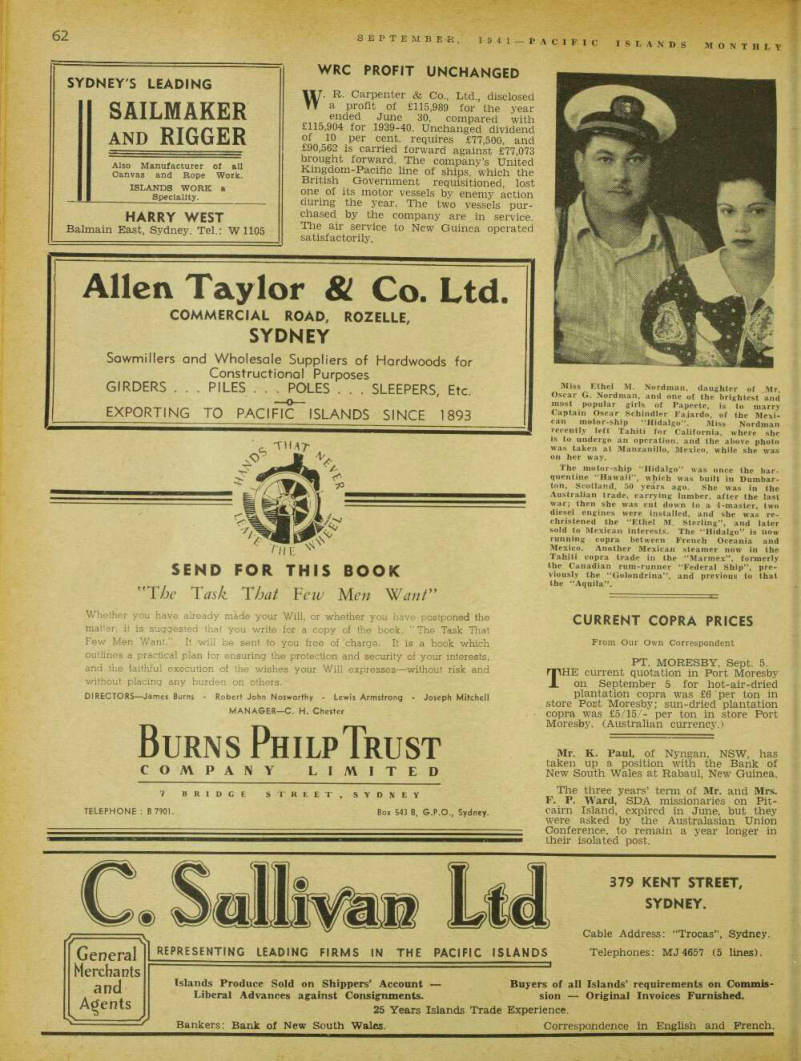
W. R. Carpenter & Co., Ltd., disclosed a profit of £115,989 for the year Pii cn e June 30, compared with £115,904 for 1939-40. Unchanged dividend of 10 per cent, requires £77,500, and £90,562 is carried forward against £77,073 brought forward. The company’s United Kingdom-Pacific line of ships, which the British Government requisitioned, lost one of its motor vessels by enemy action during the year. The two vessels pur chased by the company are in service.
Tire air service to New Guinea operated satisfactorily.
Miss Ethel M. Nordman, daughter of Mr Oscar G. Nordman, and one of the brightest and most popular girls of Papeete, is to marry Captain Oscar Schindler Fajardo, of the Mexi can motor-ship “Hidalgo”. Miss Nordman recently left Tahiti for California, where she is to undergo an operation, and the above photo was taken at Manzanillo, Mexico, while she was on her way.
The motor-ship “Hidalgo” was once the bar quentine “Hawaii”, which was built in Dumbar ton, Scotland, 50 years ago. She was in the Australian trade, carrying lumber, after the last war; then she was cut down to a 4-master, two diesel engines were installed, and she was re christened the “Ethel M. Sterling”, and later sold to Mexican interests. The “Hidalgo” is now running copra between French Oceania and Mexico. Another Mexican steamer now in the Tahiti copra trade in the “Marmex”, formerly the Canadian rum-runner “Federal Ship”, pre viously the “Golondrina”, and previous to that the “Aquila”.
Current Copra Prices
From Our Own Correspondent
Pt. Moresby, Sept. 5.
THE current quotation in Port Moresby on September 5 for hot-air-dried plantation copra was £6 per ton in store Port Moresby; sun-dried plantation copra was £5/15/- per ton in store Port Moresby. (Australian currency.) Mr. K. Paul, of Nyngan, NSW, has taken up a position with the Bank of New South Wales at Rabaul, New Guinea.
The three years’ term of Mr. and Mrs.
F. P. Ward, SDA missionaries on Pit cairn Island, expired in June, but they were asked by the Australasian Union Conference, to remain a year longer in their isolated post.
Advertisements & other items, p. 64 (1 item)
62
SEPTEMBER, HU-ncmC ISLANDS MONTHLY
Transfer From Rabaul To Lae
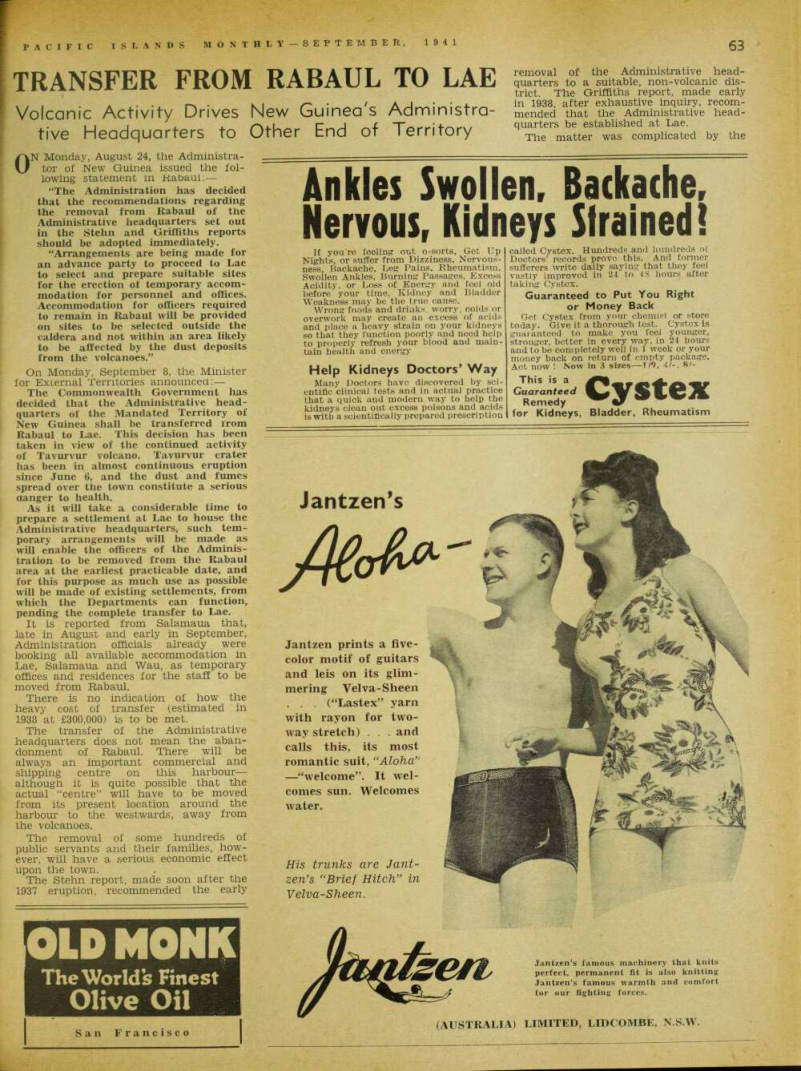
Volcanic Activity Drives New Guinea's Administra tive Headquarters to Other End of Territory
ON Monday, August 24, the Administra tor of New Guinea issued the fol lowing statement in Rabaul; — “The Administration has decided that the recommendations regarding the removal from Rabaul of the Administrative headquarters set out in the Stehn and Griffiths reports should be adopted immediately.
“Arrangements are being made for an advance party to proceed to Lae to select and prepare suitable sites for the erection of temporary accom modation for personnel and offices.
Accommodation for officers required to remain in Rabaul will be provided on sites to be selected outside the caldera and not within an area likely to be affected by the dust deposits from the volcanoes.”
On Monday, September 8, the Minister for External Territories announced:— The Commonwealth Government has decided that the Administrative head quarters of the Mandated Territory of New Guinea shall be transferred from Rabaul to Lae. This decision has been taken in view of the continued activity of Tavurvur volcano. Tavurvur crater has been in almost continuous eruption since June 6, and the dust and fumes spread over the town constitute a serious uanger to health.
As it will take a considerable time to prepare a settlement at Lae to house the Administrative headquarters, such tem porary arrangements will be made as will enable the officers of the Adminis tration to be removed from the Rabaul area at the earliest practicable date, and for this purpose as much use as possible will be made of existing settlements, from which the Departments can function, pending the complete transfer to Lae.
It is reported from Salamaua that, late in August and early in September, Administration officials already were booking all available accommodation in Lae, Salamaua and Wau, as temporary offices and residences for the staff to be moved from Rabaul.
There is no indication of how the heavy cost of transfer (estimated in 1938 at £300,000) is to be met.
The transfer of the Administrative headquarters does not mean the aban donment of Rabaul. There will be always an important commercial and shipping centre on this harbour— although it is quite possible that the actual “centre” will have to be moved from its present location around the harbour to the westwards, away from the volcanoes.
The removal of some hundreds of public servants and their families, how ever, will have a serious economic effect upon the town.
The Stehn report, made soon after the 1937 eruption, recommended the early
removal of the Administrative head quarters to a suitable, non-volcanic dis trict. The Griffiths report, made early in 1938 ’ after exhaustive inquiry, recom mended that the Administrative head quarters be established at Lae.
The matter was complicated by the
then Territories Minister, Mr. W M Hughes. He threw the Griffiths report’ aside, flew to New Guinea, and person ally selected Salamaua as the new capi
tel. By the time the tangle had been straightened out, and the impulsive Mr Hughes shown that Salamaua was im possible, three things had happened: The Rabaul volcanoes had quietened down, and Rabaul had returned to normal; it was calculated that the removal to Lae would cost £300,000; war had broken out, rE volcanoes (Vulcan and Matupi) apparently were dead, and the plan to remove the capital was forgotten until June, 1941. Then Matupi suddenly began belching out masses of dust and ashes, which the prevailing south-easter carried over Rabaul.
Week by week, since then, conditions
have become worse and life in the capi tal is now intolerable. Gardens and trees are being slowly suffocated under an increasing mass of choking dust- and human beings are following suit.
The acute discomfort of the town’s population was added to by the con tinued absence of rain, and the high bitter quality of the south-easter New Guinea, in common with Australia and most lands in the eastern part of the Ocean and the western part of the Pacific, is in the grip of drought.
Members of the public service made strong representations to the Adminis tration. A number of commercial firms completed arrangements to move their staffs a couple of miles to the westward (along the northern shore of the har bour), outside the “dust belt”. The Car penter staff moved out to Toboi, and as much of the Burns, Philp establishment as could be so organised went to Mala guna. Finally, the Administrator an nounced his decision.
Rabaul is on the north-eastern shore of the harbour. Matupi volcano is two or three miles south of Rabaul, on the harbour’s eastern shore. Malaguna and Toboi are on the northern and north west shores, westward of Rabaul. rE Administrator’s announcement appeared clear-cut and definite; but the “Rabaul Times” said it was contingent upon approval being given In Canberra.
Within a week (about September 2) it was known in Sydney that— Non-official opinion in Rabaul was strongly against a move to Lae, and strongly in favour of transferring the capital to Kokopo or Bitapaka (at the south-western entrance to Rabaul harbour).
Opinion in Canberra, unofficially expressed, was that there was no money available for the proposed costly move from Rabaul to Lae.
This indicated possibilities of a clash between the Administration in Rabaul, and bureaucracy in Canberra; for the announcement on August 24 was forth right and mandatory, and admitted of no compromise.
However, the Australian Government, on September 8, decided finally in favour of Lae.
Financial considerations were expected to influence Canberra in favour of Kokopo.
A transfer from Rabaul to Kokopo (some 15 miles away, along a good road) would be easy. Lae is an excellent site for a town especially in relation to the Markham-Bulolo-Ramu hinterland, but it has no harbour. Kokopo has exactly the same disability. Ships can anchor, in safety, off Kokopo, far out. They can anchor off Lae, close in.
Advertisements & other items, pp. 65-68 (2 items)
Nervous, Kidneys Strained!
Ankles Swollen, Backache, Nervous, Kidneys Strained!
called Cystex. Hundreds and hundreds of Doctors’ records prove this. And former sufferers write daily saying that they feel vastly improved in 24 to 48 hours after taking Cystex.
Guaranteed to Put You Right or Money Back Get Cystex from your chemist or store today. Give it a thorough test. Cystex is guaranteed to make you feel younger, stronger, better in every way, in 24 hours and to be completely well in 1 week or your money back on return of empty package.
Act now ! Now in 3 sizes—l/9, 4/-. 8/- This is a Guaranteed
Remedy
for Kidneys,
Cystex
Bladder, Rheumatism
If you’re feeling out o-sorts. Get Up Nights, or suffer from Dizziness, Nervousness, Backache, Leg Pains, Rheumatism, Swollen Ankles, Burning Passages, Excess Acidity, or Loss of Energy and feel old before your time, Kidney and Bladder Weakness may be the true cause.
Wrong foods and drinks, worry, colds or overwork may create an excess of acids and place a heavy strain on your kidneys so that they function poorly and need help to properly refresh your blood and maintain health and energy
Help Kidneys Doctors’ Way
Many Doctors have discovered by scientific clinical tests and in actual practice that a quick and modern way to help the kidneys clean out excess poisons and acids is with a scientifically prepared prescription
Jantzen’s
Jantzen prints a fivecolor motif of guitars and leis on its glimmering Velva-Sheen . . . (“Lastex” yarn with rayon for two-
way stretch) . . . and
calls this, its most romantic suit, “Aloha" —“welcome”. It welcomes sun. Welcomes water.
His trunks are Jantzen’s “Brief Hitch” in Velva-Sheen. \ V m
mis
»* Jantzen’s famous machinery that knits perfect, permanent fit Is also knitting Jantzen’s famous warmth and comfort for our fighting forces.
(AUSTRALIA) LIMITED, LIDCOMBE, NS W.
OLD MONK
The World's Finest Olive Oil San Francisco
At Bine Mountains—Sprfngwood, N.S.W.
Springwood Ladies 7 College
Est. 1897. Kindergarten to Leaving Certificate. Tennis, Riding, Swimming, Team Games. Unequalled climate. Pure Jersey Milk. Senior and Junior Houses.
Open-air sleeping. Inclusive fees. Special vacation arrangements for Island pupils.
M. E. DURAND, Principal.
& A U 3.?
Or a gift endowed to fools.
Sorrow, patience, thought and pain Shall at last that boon obtain.
Wisdom guides the mind to good When the need is understood; And for colds suggest in time Woods’ Great Peppermint Cure sublime.
Woods’ Great Peppermint Cure, For Coughs and Colds, never fails.
COSMOPOLITAN HOTEL
SAMARA I
n '
FIRST-CLASS
ACCOMMODATION
For Tourists & Commercials Electric Light, Ballroom Billiards, Freezing Works, Cold Store.
Best Brands of Liquors.
MODERATE TARIFF.
Fishing Trips and Launch Excursions Arranged.
WHERE TO STAY IN PORT MORESBY
HOTEL MORESBY
NEAR THE
WHARF.
MODERN
ACCOMMODATION
ONLY THE BEST
BRANDS OP
WINES, SPIRITS
AND BEERS
IN STOCK.
LICENSEE:
Hotel Moresby
Ltd.
The PAPUA
HOTEL
Catering specially for Tourists and Travellers.
Licensee: Papua Hotel, Ltd.
First-class Accommodation. Parties Arranged.
Situated on high ground overlooking both coasts, its Spacious Lounges are always Cool and comfortable , . . Cars meet all Steamers.
TIIU
* jr !
NATURE buried untold wealth in the heart of New Guinea . . . ringed it with mighty ranges, thick jungle, and deep rushing rivers, and issued a challenge to Man.
Nature won the first round . . . Native carriers could only struggle 35 miles in 10 days . . .
The going was difficult and dangerous, and costs enormously high, but Man triumphed— Man took wings.
Transportation by Aeroplane overcame the major difficulties vital machines, tools, dredging plants and the whole of the European civilisation and its needs were flown quickly to the goldfields. The aeroplane made possible the winning of New Guinea s gold, and as pioneers of the Skyway Highway, Guinea Airways played a prominent part in the development of New Guinea.
To-day, Guinea Airways 'planes maintain regular services throughout New Guinea and Papua, transporting all kinds of freight and carrying thousands of passengers safely, swiftly, surely to their destination.
He* G,uV» ea
ouin ea
Uttv atte* c >ate c
ed*°^ rU \ats Y
Guinea Airways provide fast passen ger and freight, land and sea 'planes for charter within New Guinea and Papua. Obtain full particulars of this service when planning a visit to mines in the interior, and when machinery is vitally needed on the field. steP lo
SP£CM£
C/MP££P
/franc/ offices me/ Agents
* at HMU SAIAMAUA,
New Guinea Office: LAE , Mandated Territory of New Guinea. PORT MORESBY one/SYDNEY
FIRST CHOICE... with those
who prefer a bitter beer
If you like a bitter beer—you'll enjoy the rich wholesome flavor of Resch's Waverley Bitter Ale. Best appreciated after a hot, trying day—Waverley Bitter Ale is a real health drink for the tropics. For a refreshing change, make YOUR next order - - - -
WAVERLEY BITTER ALE
IN THE BOTTLE WITH THE GREEN LABEL
64
SEPTEMBER, 15.41-PACIFIC ISLANDS MONTHLY
Published by PACIFIC PUBLICATIONS PTY., LTD., Union House, 247 George Street, Sydney. (Telephone: 8W5037). Wholly set up and printed in Australia by the Sydney and Melbourne Publishing Co., Pty., Ltd., 29 Alberta Street, Sydney. (Telephone: MA7101).