Pacific
Islands
Monthly
Yol. Xii. No. 1.
August 15, 1941
tablished 1930
[ Kegistere<i^^j^^^j^ i tydfay, for transmission by post as a newspaper ]
8 d
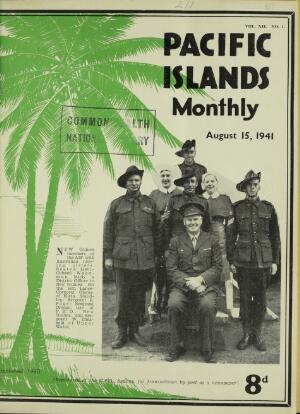
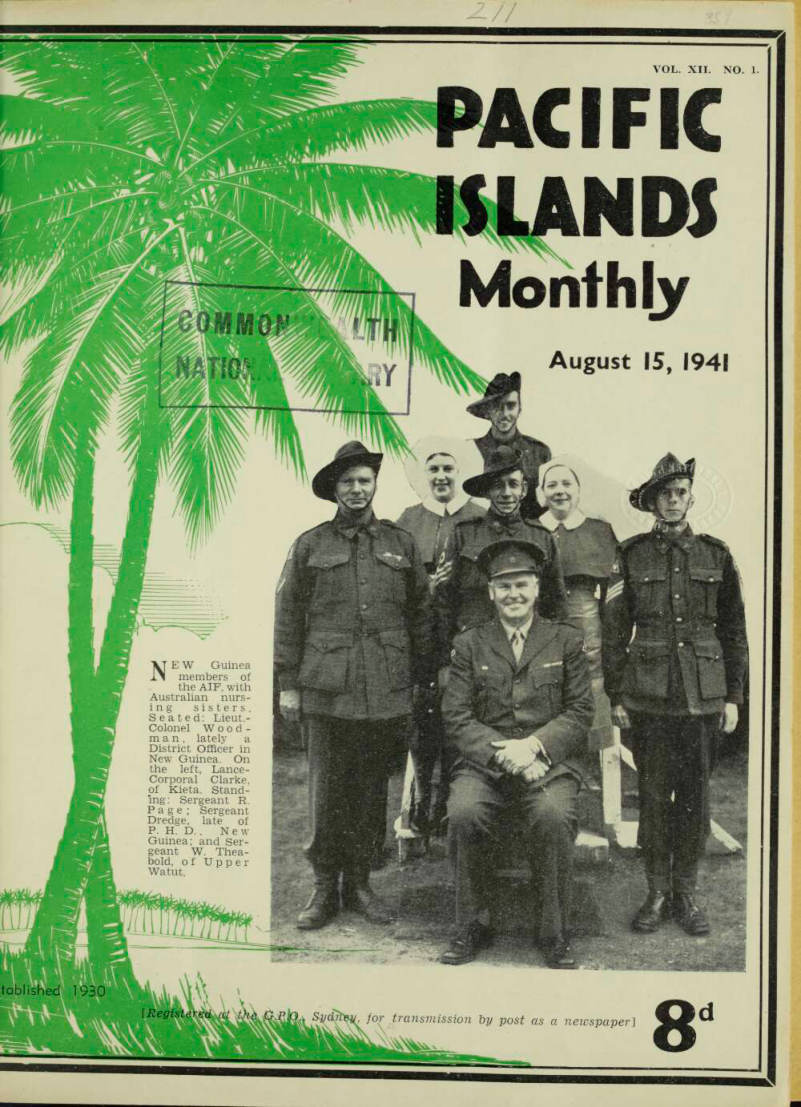
NE W Guinea members of the AIF, with Australian nurs ing sisters.
Seated; Lieut.- Colonel Wood man, lately a District Officer in New Guinea. On the left, Lance- Corporal Clarke, of Kieta. Stand ing: Sergeant R.
Page; Sergeant Dredge, late of P. H. D., New Guinea; and Ser geant W. Thea bold, of Upper Watut.
Advertisements & other items, p. 2 (1 item)
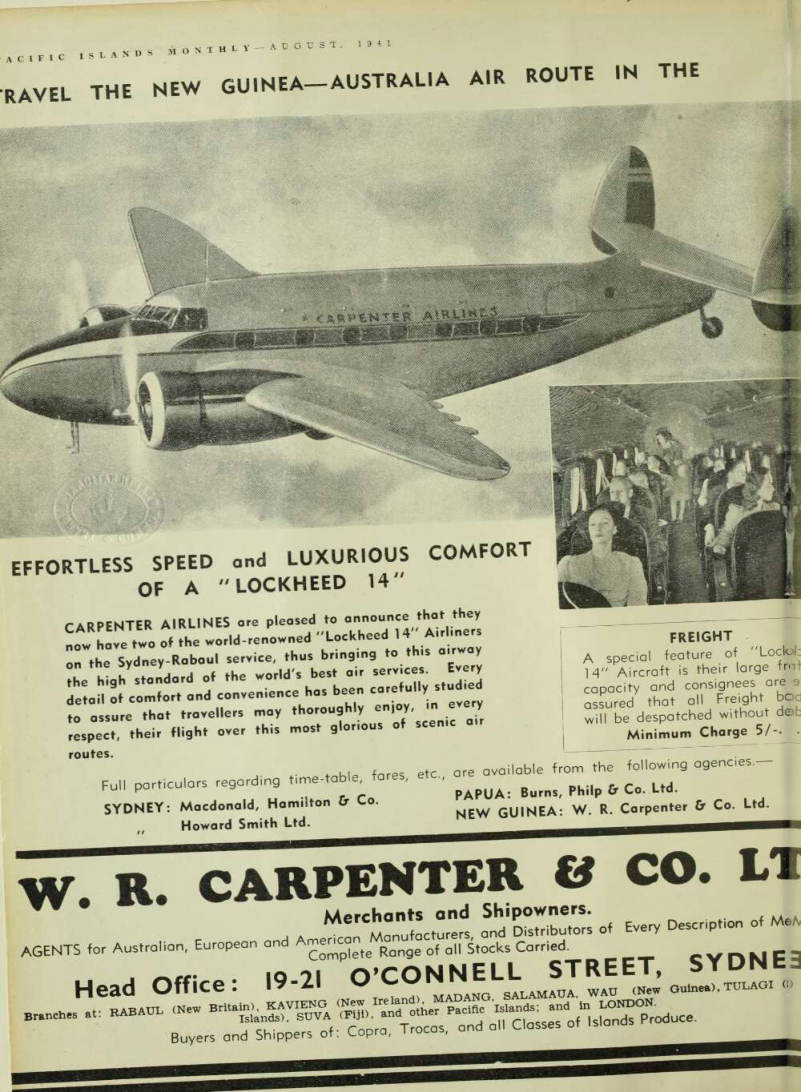
_ Wu Street, Sydne3
v A of .prion of Me
wU STREET, SYDNE3
TTTT . AfrT (1)
eland), MADANG, fALAMAUA WAU (New Guinea). TXJLAGI 0) <w>- - d other pacifl ? p„
Pacific News-Review
Notes And Comment On
The Progress Of The War
From July 14 To August 13
July 14: While fighting continues with great intensity between the Germans and the Russians, along 1,800 miles of eastern front, from the Aictic to the Black Sea, the continually growing air forces of Britain are striking ceaselessly at military objectives in western Ger many and occupied France. The RAF apparently makes two attacks eveiy 24 hours a davlight sweep over northern France, in which everything German found in the air is attacked and sav agely fought, while at night RAF bomb ers raid selected industrial towns in Germany. , , , , There have been few bombs dropped on Berlin —the explanation being that Berlin is so far from the English coast that it is not possible for British bomb ers to fly there and back within the darkness of the short north-European night. As the autumn advances, and darkness increases, the attacks on Ber lin will increase.
July 14: Military commentators gener ally emphasise that Germany, after three weeks of intense war, has nowhere broken through the Russian front. There have been three thrusts—northwards towards Leningrad, eastwards towards Moscow and south-east towards Kiev.
In each case, the Germans have been defeated by the same Russian tactics.
The Russians have organised defence lines in great depth. The Panzer divi sions, which so quickly over-ran Hol land, Belgium. France, Greece, etc., are permitted to penetrate deeply into these defence lines; and then the Russians close in behind them and exterminate them. As a consequence, the first Ger man offensive has definitely failed and it would appear that a second is being organised.
July 14: German propagandists in Iran and Afghanistan are suggesting that Britain and Russia have designs there and that they will occupy those countries as Britain occupied Syria.
July 14: To-day—France’s National Day—the terms of an armistice between Vichy France and Britain in Syria were finally settled.
July 15: British Prime Minister announced that new Anglo-Russian agreement really constitutes an alliance between the two countries, the purpose of which is to destroy Hitlerism.
July 15: British and Australian troops to-day entered Beirut, in Syria, follow ing the signing of the armistice.
July 15: Officially announced that mercantile shipping losses in June were 79 ships, representing 329,296 tons —the lowest since January.
July 16: As part of its campaign against a German spy ring operating throughout North America, the United States Government has indicted 33 per sons, and named the German Reich as participants.
July 17: The Japanese Cabinet has resigned and Prince Konoye, who formed his second cabinet a year ago, has been ordered by the Emperor to form a third cabinet.
The belief is held in the Democracies that the new Japanese Cabinet will take a more definite line —it will either go towards more friendly relations with Britain and the United States, or will become more sharply hostile.
July 17: Strong United States naval forces are reported in Manila, and it is officially announced that Manila Bay and adjacent ports have been mined.
July 17: The German armies on the eastern front, apparently as part of their second offensive, are thrusting north
towards Leningrad and in a southerly direction into the Ukraine. The Russian armies are taking the shock steadily and the Russian commanders express com plete confidence in the result.
July 18: Prince Konoye has formed a new "cabinet in Japan and announces that the nation is to be placed on a com plete war footing. The most notable change is that the former Foreign Minister Matsuoka has disappeared.
The changes in Tokyo are variously interpreted but the most authoritative comments suggest that Japan is now going to take a stronger and more direct line against Britain and USA. A move by Japan into Indo-China is regarded as a certainty.
July 18: German bombers .heavily attacked Hull last night—the first big raid on Britain for a considerable time.
July 18: The German and Italian forces in Libya are still standing along Egypt’s western frontier. They are being constantly harassed by sorties of increasing boldness by British and Aus tralian forces from Tobruk.
July 20: The German armies to-day entered on the fifth week of their attack upon Russia. In no place are they very far inside the Russian frontier, and it is now claimed with increasing confidence that the German High Command, for the first time, has gravely miscalculated its opponent’s strength and is seriously embarrassed. The Russian commenta tors insist that the second offensive already is slowing down.
July 20: The RAF smashed a German convoy off the Dutch coast, and 8 ships, totalling 48,000 tons, were damaged and probably -destroyed.
July 20: President Roosevelt on Friday declared that it was the unwavering policy of the USA to protect the Atlan tic sea-lanes to Iceland, and other out lying defence bases, against any attack or threat of attack. USA would defend Iceland and protect the garrison there.
The early report that American troops had landed at a port in Ulster, to do garrison duty, apparently was incorrect.
July 21: The Germans, after one month of fighting, are still 100 miles from Leningrad, 200 miles from Moscow and 120 miles from Kiev. The Russian Army expresses complete confidence in the issue of the struggle.
The guerilla tactics and “scorched earth” policy being followed by the Russians are seriously embarrassing the Germans. Russian guerilla bands are carrying out great destruction and slaughter at points up to 100 miles in the rear of the German front.
July 21: The “V for Victory” cam paign has been enthusiastically adopted in Britain and reports from Europe emphasise its growth throughout all the countries occupied by Germany.
July 21: American authorities have refused permission to 10 Japanese steam ers homeward bound from Atlantic ports to make use of the Panama Canal.
Japanese authorities express resentment, because their vessels now will have to sail around South America.
The position, however, is that one enemy agent with a few bombs could render the Panama Canal useless for a considerable time. If the United States were at war—especially against Japan — it would be of vital importance to keep the Canal open so as to permit quick communication between the Pacific and Atlantic Fleets.
July 21: In an attempt to prevent the enormous damage being done to western German cities by the nightly attacks of
RAF bombers the Germans are embark ing on large-scale camouflage. Photo graphs indicate that representations of cities are being quickly built of flimsy material in positions near the real cities, with a view to deceiving and con fusing the British bomber pilots.
July 22: Moscow last night experienced mass raids from 200 German bombers.
The Russians claim that the raid failed, in that no military target was hit.
Seventeen raiders were shot down.
July 22: The second German offensive on the eastern front has slowed down, and comparatively little activity is reported.
July 22: All reports from Japan indi cate that important developments are pending. The Japanese are expected to move southward, rather than northward against Russia.
July 22; The RAF on Sunday night heavily raided Naples and started large fires.
July 23: Moscow experienced its second mass raid last night. Only single raid ers penetrated the city’s defences, and damage was not serious.
July 23: Japan has sent an ultimatum to Indo-China demanding the right to protect the former French Colony against aggression. It is expected that the Vichy Government, under instructions from Germany, will agree.
July 24: Japanese warships have appeared off the coast of Indo-China and 12 Japanese transports are on their way from Hainan Island to Saigon.
July 24: Hitler is using every diplo matic means at his command to induce Japan to defy the United States and occupy Indo-China. He has promised Japan that he will complete the con quest of Russia by the end of August; that he will invade and conquer Britain in September; and that the war will end with a German victory before the win ter, It is believed that this desperate attempt to embroil Japan and the United States is Hitler’s last throw.
It is presumed that Hitler dare not throw in his final reserves against Rus sia while there is a possibility of a Brit ish attack on his western front. This is increasingly possible while America is supplying Britain with growing quanti ties of munitions and food. But if American strength can be diverted against Japan, Hitler’s hand may be freed for a major effort against Russia —more especially against the Russian oilfields, for it is apparent that this long drawn-out battle on the eastern front is using up immense quantities of Germany’s vital oil. Therefore, now that the Russians appear to be holding the Germans on the eastern front, the eyes of the world are turning with increasing anxiety to the policy of Japan and the reaction of the United States.
July 25: Night after night, and day after day, the RAF continues its heavy attacks on German cities and enemy establishments in occupied France. The terms of the reports are almost monoto nous in their lack of variety—but the importance of what is being done can not be exaggerated.
July 26: Japanese forces to-day form ally began the occupation of Indo- China. Japanese military, naval and air forces are systematically taking posses sion of the former French colony.
July 27: Swift and simultaneous reta liatory economic measures against Japan have been taken by Britain and United States. America has established a
United States Army of the Far East, and has brought the military and naval forces of the Philippines under the com mand of USA. The Singapore garrison and defences have been strengthened.
July 27: Britain and USA have issued orders freezing Japanese assets in the respective countries, and similar action has been taken by the British Domin ions. This means that Japanese trade with all British and American countries has been paralysed. Britain has given notice of her intention to denounce her commercial treaties with Japan. Japan has retaliated by freezing British and American assets in Japan, All this represents a definite and very rapid deterioration of the relationship between Japan and the Democracies. If there is to be war, it should come now.
July 27: Following the breakdown of the second German offensive on the east ern front, the Russian armies have com menced strong counter-attacks in a number of sectors.
July 27: The Italians launched a new form of attack on Malta by means of E-boats and similar fast surface .craft, carrying torpedoes. The attack was completely beaten off by the Malta defences, and a dozen E-boats destroyed.
July 27: Discovering that the German battleship, “Scharnhorst”, had departed from Brest, where she had been shelter ing with the “Gneisenau” for months, the RAF made a swift search and located her at a French port 230 miles south.
Thereupon masses of British planes came into action, and both the “Scharn horst” and the “Gneisenau” were attacked and damaged. “Scharnhorst” later returned to Brest.
July 28; Dutch East Indies Govern ment is supporting Britain and America by applying economic measures against Japan. All monetary and trade trans actions with Japan in future will depend upon special permits.
July 30: The British Prime Minister says "that the “invasion season” is at hand and that all armed forces in Bri tain have been warned to be at concert pitch by September 1. Mr. Churchill also said that the Battle of the Atlantic was moving slowly but impressively in Bri tain’s favour.
July 30: Military commentators agree that the second great German offensive on the eastern front has petered out, and the Germans are now preparing a third offensive.
July 30: It is expected that the next move by Japan will be an attempt to penetrate Thailand economically, or to occupy certain bases in Thailand, so as to “protect” Thailand against aggression or invasion.
July 31; British and Russian aircraft simultaneously attacked German estab lishments in the Norwegian Arctic port of Kirkenes and Petsamo, in northern Finland. In two attacks, 16 British air craft were lost.
Aug. 4; Developments in the Far Eastern situation include action by the United States in cutting off the export of aviation petrol—a move clearly aimed at Japan. Commentators insist that Japan’s next move will be against Thailand. There are reports of consid erable troop movements from Japan to Manchukuo —which are regarded as menacing the Russians.
Aug. 4: United States has warned French Vichy Government that Ameri can relations with France will be gov erned by the degree of effectiveness with which "France defends its territories against Axis aggression. The failure of France to resist Japan’s invasion of Indo-China has menaced American security. . . , , Aug. 4: The RAF on Saturday night
inflicted on Berlin the heaviest raid of the war. Smashing attacks also were made on Hamburg and Kiel.
Aug. 4: All Japanese ships have inde finitely suspended their sailings to the United States.
Aug. 4: Britain is reported to have sent 100,000 troops, including Australians and Indians, to the border of Burma and Thailand.
Aug. 5; The third German offensive against the Russians appears to be tak ing the form of a sharp thrust in the Ukraine in an attempt to secure Kiev.
Aug. 5: Relations between France and Germany are again approaching a crisis, as the result of German demands that the French Fleet be made available for German use, and that bases be granted to Germany at Dakar and Casablanca, on the West Coast of Africa, and at Algiers, in the Mediterranean.
Aug. 5: British forces have been active in the Mediterranean, where they have torpedoed an Italian cruiser of 2,700 tons and two supply ships of 8,600 tons.
Aug. 5: USA is reported to be favour ably considering the extension of ship ping facilities to send substantial aid to Russia through Vladivostok. This use of the Pacific route to assist Russia does, of course, open up further prospect of conflict between Japan and USA.
Aug. 6: Bitter and intense fighting is proceeding all along the eastern front and Germany continues to make fantas tic claims of successes. But, actually, there appear to be few changes in the general situation.
Aug. 6: There are insistent reports from British and American sources that a meeting is about to take place between President Roosevelt and Mr. Churchill.
The President is away at sea in his yacht, on a summer cruise, and Mr.
Churchill has disappeared from London; and it is believed that they are holding a very important conference on the Pre sident’s yacht, or on a British warship, off the coast of Canada.
Aug. 7; US Secretary of State an nounced that any Japanese move into Thailand would be regarded by USA as menacing American security and endan gering American Pacific interests.
Aug. 8: Persistent reports of an Atlan tic meeting between Mr. Roosevelt and Mr. Churchill are not believed in Washington.
Aug. 9: British officials in Washington do not believe that USA would take mili tary action asrainst Japan if Japan moves against Thailand.
This probably explains the Austra lian Government’s alarm. Australia per haps visualises a war in which Britain and Netherlands Indies alone would have to meet Japan. It must not be forgotten that USA cannot declare war without a majority in both houses of Congress: and. at the moment, there apparently is an anti-war majority in both Senate and Representatives.
Aug 11: London commentators, declar ing that the war is moving to its supreme crisis, say that far-reaching decisions are being taken by the Demo cracies. about which no hint is given, and the results of which may be momentous.
Aug. 12: The Russians are holding the German armies on the north and cen tral fronts, but the Germans are mak ing alarming progress in the Ukraine- Black Sea area.
Aug. 13: Germany is strongly pressing France for North African bases and other help, and it is believed the Vichy Government has virtually surrendered to Germany.
Advertisements & other items, p. 3 (1 item)
1
PACIFIC ISLANDS MONtHLt-AtJODSfi 1341
Five New Ships
On American-Australian
Service
rr\HE American “Journal of Commerce”
J. on July 8 stated that two Danish ships, the “Nordhval” and the “Nordpol”, together with three new Mat son Line vessels, “Hawaiian Planter”, “Hawaiian Shipper” and “Hawaiian Mer chant”, will constitute a speedy service on the strategically important run be tween the American Pacific Coast and Australia It is understood that the Matson Line subsidiary, the Oceanic Steamship Com pany, will take over the control of the Australia-Pacific trade, and the offices of the Union Line in America, Australia and New Zealand will act as agents.
The three new Matson Line vessels are of identical construction. They have a gross registered tonnage of 7,200 tons and J are 465 ft. in length with a beam of 70 i ft. Powered by two steam turbines, they are believed to have a speed of 17 knots ; or more. The “Hawaiian Merchant will i leave Honolulu early in August for Aus- ■ tralia, via ports, but will not call at New Zealand.
The Danish twin-screw steamers i “Nordpol” and “Nordhval” are also simi- lar in construction. The “Nordhval” was s built at Copenhagen in 1924 and the £ “Nordpol” in 1926. They are 4,480 tons a gross, 380 ft. in length, with a beam of i 53 ft.
Position In Sydney
THE replacing of Union SS Co. cargo c vessels in the Pacific trade by Mat- son boats is still under consideration r between the British Government, the s American Government, the Union SS c Co, and the Matson Line; but, as yet, ,c no definite conclusions have been c reached. , It is suggested that there will be one 9 service from Vancouver and San Fran- cisco to New Zealand ports, and that, j these vessels will make a call at Fiji on n their return journey and pick up sugar x for Vancouver; and that a second ser- -• vice, with larger vessels, probably will run n from Vancouver to San Francisco, Tahiti, ,l New Zealand, and Australia. Their ti northbound itinerary, it is hoped, will II include Suva.
Ministerial "Impressions"
rRRITORIES’ residents will be enter--i tained by the Australian Minister’s a”
“impressions” of his tour, as given m to a Melbourne reporter, after hear returned on August 12. Here they are,,9' taken verbatim from a Sydney news-a’ paper;— . ,, “My outstanding impression as thesri result of my New Guinea tour is thesn happy and healthy appearance of .then natives,” said the Minister. He praisedbe the efficiency of the administration ofio the Mandated Territory by Sir Waltengj McNicoll. . ..
Yet, as a matter of fact, the Man-n, dated Territory echoes continually toJ criticism of the Administrator, and hisiri native-control policy; while in Papu8i/< (which the Minister does not even men-n< tion) the natives are contented and well-h disciplined, and the people appear to bed on increasingly happy terms with thenej new Administrator, Mr. Leonard Murray^ M. Sammarcelli, formerly Public Prooi secutor at Noumea, who joined the FreeT French forces in Africa as a lieutenantm is officially mentioned for brilliant concro duct during recent fighting at Forrc Koufra, in the Libyan desert.
Pacific Islands Travellers
PER STEAMER FROM FIJI: Messrs. Hudson, Goodsir, Willington, Cumming, Shorter. Mes dames Armitage, Hudson, Willington, Brown, Shorter, Steele, Morris, Corben. Miss Willington.
PER STEAMER FOR NG, PAPUA & BSI; Messrs. McDonald, Small, Smith, Milton, Lotze, Robertson, Deck, Spence, Savage, Linden, Town send, Oldham, Morrel, Fountain, Rae, Noon, Adam, Rixon, Williamson, MacFarland, Nielson, Gore, Tacey, Dowling, McAuffle, Marsland, Samuels, Power, Ven-Dohren, Watts, Wallis, Young, Haigh, Hollis, Thomson, Davies, Purvec, Pascoe, Marsden (2), Richards, Schmitzer, Burg, Deakin, Donald, McDonough, Vine, Greig, Sem mens, Dougherty. Brothers Augustine, Donatus, Ervan. Mesdames Beaton, Hayles, Turner, Deck, Robertson, Evenett, Perichon, Sparks, Rixon, Laws, Judd, Gallaher, Thomson. Misses Deck, Drewett, Hanlon, Lewis, Milthorpe, Grahamslaw (2), Kennedy, Harkness.
PER STEAMER FROM NG: Messrs. Singleton, Bloxham, Follows, Garth, Kinsey, Leonard, Perry, Venners, Whight, Webb, Edwards, Fegent, Millar, Ray, Bates, Maclean, Rush, Einsiedel, Cooper, Disher, Gilbert, Mullaly, Larard, Read.
Mesdames Evans, Bloxham, Fraser, Lee, Moore, Fegent, Millar, Ray, Maclean, Gilbert, Holland, Read, Spensley, Waterman. Miss Edwards.
PER STEAMER FROM FIJI: Messrs. Sabben, Sharman (2), Shelley. Mesdames Sabben, Coffey, Sharman. Miss Sharman.
PER STEAMER TO FIJI: Messrs. Barret, Bar ton, Young, Brown, Burns, Farquhar, Cummings,
Gatty, Goodsir, Ingram, Ragg, Jones, Lilling ston, Muir, McFarlane, Pocock, Oldmeadow, Storer, Theodore, Stock, Stackpool, Whan, Woodhead. Mesdames Jones, Kilby, Mansell, McFarlane, Pockley, Rawnsley, Storer, Stock, Thomas, Worger. Misses Jones, Moffitt, Mc- Farlane, Pockley, Storer, Thomas. TO PAGO PAGO: Mr. McFadyen.
PER STEAMER FROM PAPUA & NG; Messrs.
Ash, Andrew, Boyle, Bamford, Bird, Brown, Barker, Beatty, Burnett, Cunningham, Downs, Davis, Ellis, Fredericks, Flanigan, Gaude, Gil bertson, Hines, Hill, Hartley, Jensen, Lock, Mantle, McKee, Meek, O’Brien, Phillips, Praner, Ryan, Rosser. Spencer, Roberts, McMillan-Kerr, Robertson, Stewart, Tippett, Thompson, Walsh, Waddell, Waugh, Blake, Babbington, Cadman, Carpenter, Corrigan, Conn, Crack, Dart, Doyle, Dill, Douglas, Dixon, Dobbie, Evensen, Graham, Griffin, Goff, Holmes, Hooper, Johnston, Jackson, Jamieson, MacLeod, McLearle, Morris, Reid, Richards, Sice, Swinson, Searle, Stigwood, Smith, Wilson, White, Bird, Wood, Walsh, Butt, Mor com, Brown, Kincade. Burge, Bevan, ‘Charles, Handley, McDonald, Mooney, Northeast, Trew, Walker, Bernard, Wood, Martin. Mesdames Andrew, Carpenter, pampbell, Dockrell, Fraser, Hill, Hartley, Hawnt, Kilner, Mantle, Murphie, Meek, Oakes, O’Brien, Ryan, Thwaites, Walsh, Wyatt, Waugh, Anisinoff, Ash, Barnes, Bird, Bruckshaw, Cattell, Hendry, Mosely, Mocatta, Waters. Misses Musgrave, Humphries.
Per Steamer From Bsi, N. Hebrides,
NORFOLK & LORD HOWE IS.: Messrs. Boal, Cramer-Roberts, Connor, Driver, Entwisle, Lah iff, Miller, Scarr, Smith, Taylor, Treagust, Turner, Adams, Bailey, Clapp, Davison, Lam bert, MlcCoy (2), McLachlan, McWhinney, Middleton, Nobbs, Quintal, Stephenson, Stopp, Wade, Weight, Hines, Rook, Scrivener, Wilson.
Archdeacon Teall. Mesdames Porch, Teall, Miller, Clapp, Davison, McWhinney, Middleton, Stephenson, Weight, Wickstead, Fenton, Kirby, Rook, Scrivener, Wilson. Misses Philip, Adams, Martin, Holland, Nicholls.
PER STEAMER FOR NG: Messrs. Einsiedel, Dutton, Dunwoodie, Paul, Wild, Ryan, Jackson, Warren, Bevan, Healy, Smith, Cook, Watson, Brown, Taylor. Mesdames Einsiedel, Reece, Bunney, Dickson, Brown, Wood, Taylor, Stew art.
PER STEAMER FOR PAPUA & NG: Messrs.
Nixon, Vickery, Dishon, Graydon, McD. Smith, King, Warrant, Elliott, Smeeton, Anderson, Walsh, Battis, Judd, Peterson, McDermant, Harvey, Barker, Rigby, Le Bas, Gillis, Belling ham, Allen, Davies, Morell, Peterson, Sargeant, Lowe, Grahame, Disley, Morris, Thomas, Shed don, Doyle, Hofbauer, Bryant, Craig, Evans, Priest, Lynch, Lond, Sturtevant, Hamilton, Matthews, Atherton, Branch, Fox, Marsh, Oren den, Burdan, Mears, Legge, Butt, Cadman, Joyant, Stannard, Monteith, Jackson, Perkins, Strlbling, Michael, Raymear, Ballinger, Napper, Ode, Hanbidge, Hall, Allwork, Blackmore, Fool stone, Pauli, Judd, Hutchinson, Heesh, Robin son, Collison, Hodgson, Jordon, Anderson, Stein,
(Continued On Page 64)
Evans, Bramwell, Evans, Kershaw, Maude, Beggs, Garemyn, Phillips, Clarke, Clothier, Henderson, White, Painton, Cummins, Duncam, Carter, Cyring, McGlinn, Jamieson, Langridge, Warren, Jones, Kenyon, Haley, Scott, Roger son, Fibbons, Parkyns, Wilson. Mesdames Nixon, McD. Smith, Dix, Dunlop, Warrant, Smeeton, Cahill, Anderson, Cuthbertson, Moon, Judd, Watts, Baker, Morell, Radford, Flatten, Schweitzer, Thomas, Blumson, Lowe, Lyons, Kyle. Misses Christopher, Lucas, Hartley, Breslin, Deveney, Adams.
PER AIRLINER TO PAPUA & NG: Messrs.
Bowers, Maxwell, Moore, McDonald, Halligan, Bathurst, Bartlett, Bolland, Bergstrand, Rut ter, Ashwell, Leydin, Lloyd, Bendall, Dickson, Board, Bell. Mesdames Bolland, Rutter, Rosser.
Misses Rutter, Beggs.
PER AIRLINER FROM PAPUA & NG: Messrs.
Sergeyepp, Hockey, Macgregor, Speedie, Arrow smith. Allica, Thomas, White, Zoffman, Jensen, Head, Hill, Lorenz, Smith, Sefton, Paton, Wylie.
Mesdames Hockey, Bellamy, Glaessner.
Advertisements & other items, p. 5 (1 item)
South Pacific Line
:■ fcY 5 ■ -.1 * i
AIMS
IS ■■
Si^OAPO
■SI * l** - Mi i p. m
PACIFIC OCEAN
7 y y 'w ♦
PT. MORESBY* *V^
SY
SAM
HAI
NEY
'\" ' ' / V f
UCKLANO
• XWEUINOTON
•>. -I
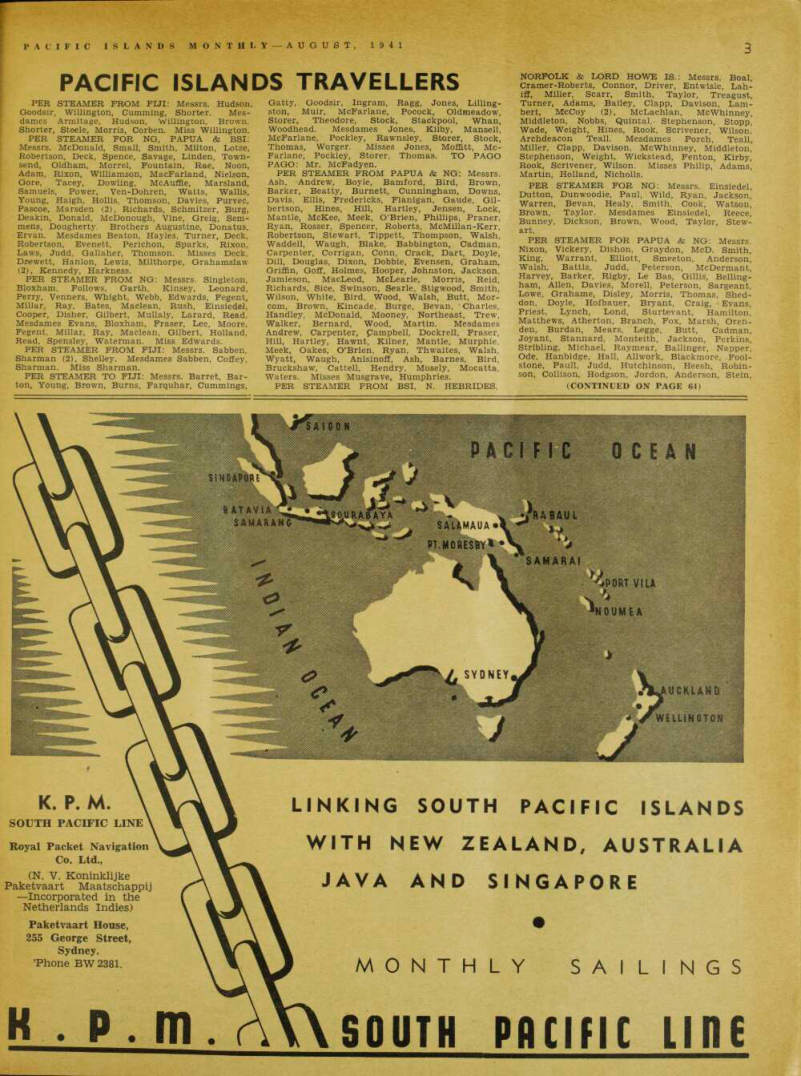
K. P. M.
SOUTH PACIFIC LINE
Royal Packet Navigation Co. Ltd., (N. V. Koninklijke Paketvaart Maatschappij —lncorporated in the Netherlands Indies) Paketvaart House, 255 George Street, Sydney. ’Phone BW 2381.
K
LINKING SOUTH PACIFIC ISLANDS
WITH NEW ZEALAND, AUSTRALIA
JAVA AND SINGAPORE
MONTHLY SAILINGS
SOUTH PACIFIC Line
Advertisers
“Airzone” Radio . 23 Amplion (A/sia) Ltd 41 Angus & Coote Ltd. 13 Arnott’s Biscuits . 35 Atkins Ltd., W. . . 38 “Ausoline” ... 62 A. Ltd. ... 49 B. Ltd. . . 39 Bank of N.S.W. 60, 61 “Bidomak” ... 14 Broomfields Ltd. . 40 Brown & Cos. Ltd., G 11 Brunton’s Flour . 33 Budge Pty. Ltd. . 42 Burns, Philp & Cos.
Ltd 4 B.P. Magazine . . 51
B.P. (S.S.) Cos. . 32
Burns Philp Trust Cos. Ltd. ... 62 Carlton & United Breweries Ltd. . 29 Carpenter Ltd., W.
R cov. 2 drivers & Sons Ltd. 32 Clyde Batteries .19 Coleman Lamp & Stove Cos. . . 26, 38 Colonial Sugar Re fining Cos. Ltd. . 43 Cooper & Nephews Ltd., Wm. ... 47 Coral Starch . 35 Cosmopolitan Hotel 64 Crammond Radio . 59 “Cystex” ... 52 De Meric Pty. Ltd. 36 Dewar’s Whisky . 48 Doan’s Pills ... 42 Donaghy & Sons Ltd 36 Donald Ltd., A. B. 44 Dr. Williams Pink Pills 30 Dunlop Perdriau Rubber Cos. Ltd. 20 Eastern Trading Cos. Ltd 63 Eaton Ltd., J. W. . 37 Edgell Products . 57 .Electrolux Refrigerators . . 28 Fletcher & Sons . 39 Fo r and Sherington Pty, Ltd. ... 22
Garden Vale Pro ducts' Ltd. ... 30 Garrett & Davidson 54 Gllbey’s Gin ... 44 Gillespie’s Flour . 34 Gillespie & Cos.
Ltd., R. • • .55 Gold Flake Cigarettes ... 55 Gowing Bros. Ltd. 20 Grand Pacific Hotel 45 Grove & Sons, W.
H 19 Guinea Airways Ltd. . . . cov. 3 Heinz Cos. Ltd., H.
J 50 Hislop Lloyd Pty.
Ltd 15 Holbrook’s Ltd. . 33 Horlicks Malted Milk 16 Hotel Moresby . . 64 International Correspondence Schools ... 26 Ironised Yeast Laboratories . 45 Kolynos Dental Cream ... 12 Kopsen & Cos. Ltd. 21 Lea & Perrins Sauce 52 Levenson’s Radio . 56 Maxwell Porter Ltd. 37 Mcllrath’s Ltd. . 52 “Mendaco” . . . 64 Meriden School . . 24 Merrillees & Cos. . 57 Miller & Cos. Pty.
Ltd 61 Nelson & Robert son Pty. Ltd. 15, 54 Nestle’s Milk ... 25 Newmarket Saddlery ... 61 Noyes Bros. Ltd. . 54 “106” Private Hotel 14 Pacific Is. Society 10 Paling & Cos., W.
H 22 Papua Hotel. The . 64 Pike Bros. Ltd. . . 60 "Pinkettes” ... 62 Prescott Ltd. ... 34 Price’s Radio Ser vice 58 Prouds Pty. Ltd. . 9
Riverstone Meat Cos. 53 Rohu, Sil . . . 55 Royal Packet Navigation Cos. . 3 Sandeze (Holly wood) Beach Wear 51 St. Ignatius College 10 Scots College, The 53 Scott Ltd., J. . .40 Single Wire Fence Cos 63 Springwood Ladies' College ... 50 Steamship Trading Cos. Ltd 13 Sterling Varnish Cos. 9 Sullivan Ltd., C. . 63 Swallow & Ariell . 24 Talkeries, The . . 57
Taylor & Cos., A. . 42 “Tenax” Soap . . 27 Tillock & Cos. Ltd. 58 Toohey’s Ltd. . . 17 Tooth & Cos. . cov. 4 Vacuum Oil Cos. . 18 Vincent’s A.P.C. . 27 “Vi-stim” ... 40 West, Harry ... 62 Weymark & Son . 34 Wills Ltd., W. D. & H. 0 46 Woods Great Pep permint Cure . 46 Wright Ss Cos. . . 58 Wright & Cos. Ltd., E 64 Wunderlich Ltd. . . 37
Mrs. Florence Muriel Bunting, wife of Mr. Frederick W. L. Bunting, who died at her home at Turramurra, Sydney, on August 4, was well-known in Eastern Papua. She went to Papua in 1926 when her husband was managing Panamailoa Island; and, after he resigned to go into business on his own account, went to live at the southern part of Sanaroa Island, off Dobu Strait. Later Mr. and Mrs.
Bunting made their home on Anea Island, and lived there for a number of years until they sold their coconut plan tation in 1936 and came South to live in Australia.
Contents
Pacific News-Review 1 Five New Ships on Pacific Run ... 2 South Seas Travellers 3 Is There to be War in the Pacific? 5 Extraordinary Political Events in Tahiti 6 Better Copra Outlook 7 Death of Mr. Ivan Nelson 7 Cocoa and Coffee Prices Rise 8 Trade Union Plan for N. Guinea . . 8 "Bounty” Anchor for NZ Museum .. 9 New Guinea’s Mystery Murder ... 9 Tropicalities 13 Roll of Honour 15 Where Suva Cools Off 17 No Ships for Fiji Sugar 19 Six Natives Killed in NG Raid ... 19 Sudden Death of Prince Tugi. of Tonga 20 Why Not a Strike of Copra-Growers? 22 Future of Rabaul 24 Islands Men Escape from Greece, 25, 44 The Unhappy Situation of Japan .. 26 How Britain & USA Stand Behind China 27 Air Bases Guard Australia 29 New Caledonia Carries On 30 Letter to the Editor (Cartoon) ... 31
Polynesians Govern Themselves ... 32 Enemy Subjects Trapped in Far East 33 Territories Men in the AIF 34 “Cohabitation” in the Cook Is 35 New Carpenter Copra Mill in Canada 36 “Faith in Australia” Returns to TNG 38 Fish-Canning as New Fiji Industry 39 Memories of “Queen Emma” ... 39 Copra Used as Pigs’ Food in NZ .. 40 Steel Guitars for Two—A Musical Duel in Rarotonga 41 Cost of a Rubber Estate 42 Death of Mr. F. C. Clapcott (Fiji) .. 45 War Preparations in the Philippines 46 Growth of Trans-Pacific Airmails .. 47 Rarotonga’s Grand Old Man ... 48 Papuan News 48 A Section for Islands Women ... 51 Social Changes in N. Caledonia .. 53 Mining Reports 54 Short Wave Radio Programmes ... 57 Territories Minister Visits Papua & New Guinea 58, 64 Copra & Rubber Prices 60 Exchange Rates 61 Islands Produce Quotations 62 Papua’s Outmoded Divorce Law .. 64
Advertisements & other items, p. 6 (2 items)
4
AtlGtJSt, IMI-f A C 1 H C ISLANDS MONTHLY
Burns, Philp
* mm 1
iisi
IK tit
I Head Office: 7 Bridge Street, Sydney—Australia Code Address: " Burphil"
BURNS, PHILP
& Co. Ltd.
GENERAL MERCHANTS
SHIPOWNERS
TOURIST AGENTS
BUYERS OF ALL CLASSES OF ISLAND PRODUCE Regular Steamer Services from Australia to New Guinea—Papua—Solomon Is.— Lord Howe Is. Norfolk Is. New Hebrides—Hongkong—Java and Singapore
Pacific Islands Monthly
The Newspaper-Magazine of the South Seas
[Registered at the G.P.0., Sydney, for transmission by post as a newspaper .] Published Once Each Month and Circulated in Australia and New Zealand and in the following Pacific Territories and Islands Groups:
Australian Territory of Papua.
Mandated Territory (Australia) of New Guinea, j Bismarck Archipelago and Northern Solomon Islands.
Australian Territory of Norfolk Island.
New Zealand Territory of Cook Islands.
Mandated Territory (New Zealand) of Samoa.
British Colony of Fiji.
British Solomon Islands Protectorate..
British Protectorate of Tongan Islands.
British Crown Colony of Gilbert and Ellice Islands.
Mandated Territory of Nauru.
British and French Condominium of New Hebrides.
French Colony of New Caledonia.
French Colony of Oceania (Tahiti, etc.).
American Territory of Eastern Samoa.
American Territory of Hawaiian Islands.
American Territory of Guam.
Mandated Territory (Japan) of Marshall, Caroline and Mariana Islands.
Owned and Produced by Pacific Publications Pty. Ltd., Union House, 247 George Street, Sydney.
r Managing Director . . BW 5037 TE leitH one j Business and Editorial MA 7101
P.O. Box 3408 R
Registered Address of Telegrams, Radiograms, and Cables: “Pacpub”, Sydney.
Contributions.
Articles, Stories, and Photographs dealing with Pacific Islands subjects are invited and will be paid for on publication.
Subscription Rates.
Per Annum, within British Empire, Prepaid, Post Free 8/- Per Annum, elsewhere, prepaid. Post Free. 107- Single Copies Bd.
Editor and Publisher:
R. W. Robson, F.R.G.S.
Assisted by Selwyn Hughes.
Advertising Manager: L. W. Bailey.
Advertising Office and Printing-House: 29 Alberta Street, Sydney.
Advertising rates furnished on application.
Colours, etc., by arrangement.
Process Blocks made at Advertiser’s expense when required. Screen 100.
Changes of Advertising Copy should reach this office by Ist of each month, otherwise previous advertisement may be repeated.
IN LONDON, the Pacific Islands Monthly is on sale at the Bookstall, Australia House, The Strand, London.
Agents:
The following are authorised to receive sub scriptions for the Pacific Islands Monthly;— Burns, Philp & Co., Ltd., and Burns Philp (South Sea) Co., Ltd. All branches.
W. R. Carpenter & Co., Ltd. All branches.
Morris, Hedstrom, Ltd. All branches.
T. A. Olsson, Wau, New Guinea.
G. Thomas & Co., Rabaul, New Guinea.
Whitten Bros., Ltd., Samarai, Papua.
Steamships Trading Co., Papua. All branches.
B.N.G. Trading Co., Ltd., Port Moresby, Papua.
J. Muir, Suva, Fiji.
N. C. Mackenzie Hunt, Wainunu, Bua, Fiji.
Kirpal & Co., Victoria Parade, Suva, Fiji.
Cook Islands Trading Co., Rarotonga, Cook Is.
A. C. Rowland, Papeete, Tahiti.
Islands Branches and Representatives of W. H.
Grove & Sons, Ltd., Auckland, New Zealand.
Representative in London.
W. C. HARVEY, Coronation House, 4 Lloyds Avenue, London, E.C.3, from whom may be obtained copies of Pacific Islands Monthly.
Pacific Islands Year Book. advertising schedules, etc.
Vol. XII. No. 1.
August 1 5, 1941
Prlro i Bd ' Per Copy rnoc ( Prepaid: 8/- p.a.
Is There to be War in the Pacific ?
THE situation in the north-west Pacific is exceedingly grave; but war with Japan is neither inevitable, nor as imminent as is suggested by the sensational newspapers and the hysterical Australian Government.
Hitler, searching desperately for relief from the grip of Russia and the ceaseless, growing hammering of Anglo-American air forces, is trying to rush Japan into war with United States. But Japan will not forget how Hitler twice betrayed her—in August, 1939, when the Russo- German Friendship Pact was signed, and in June, 1941, when, six weeks after the Russo-Japan Friendship Pact was made, Germany hurled herself upon Russia.
Then, why the present Pacific tension? It is the result of Japan’s cold and calculated determination to seize Indo-China, while France lies prostrate and helpless. This southwards move by Japan became inevitable, as soon as it was clear that the treacherous men of Vichy had sold themselves to the Nazis. Britain and USA will fight to keep Japan out of Thailand, Malaya, the Netherlands Indies and the Philippines: but they certainly will not now fight to retain Indo-China for France. That was apparent to Japan from the moment that British troops began to fight the Vichy French in Syria.
Japan needs—in fact, must have— new territories for colonisation, for markets, for sources of raw material, She wants South-east Asia, East
Indies and Philippines; and the Nazi seizure of France and Holland, and the embarrassment of Britain, re present, to her, a God-given chance of gaining new territories without fighting. She will go to the utter most limits of bluff, threats and diplomacy to take full advantage of that chance; but she will not—un less a completely irresponsible gang of military Fascists is in complete command in Tokio—go to war against the United States.
Everything we know indicates that Japan’s policy is to seize Indo-China; dominate Thailand, if that can be done without fighting; and, by ap parently abandoning an attitude of belligerency, to induce Britain, America, and Holland to give her far reaching trade concessions in Malaya, Philippines and East Indies. But we do not believe that her armed forces will step outside of Indo-China. rpHE action of Britain and America, A in replying to the occupation of Indo-China by immediately “freez ing” Japanese assets (in other words, by completely cutting off all com mercial intercourse with Japan), was not expected by Tokio. If there was to be war, it would have come then, when Japan’s Government still was reeling under the unexpected shock and while Hitler was most insistently urging an attack upon America, All who live in the Pacific terri tories have a vital interest in these events, and will most anxiously await
developments. Everyone is guessing, and the “PIM” is guessing. But our reading of developments is that Japan, while prepared to sacrifice every ethical consideration to her land-hunger, has no wish to fight us while we are still strong and un broken; and that, if we have any statesmanship among the demo cracies, we now can turn the present situation to such good account as to gain, in the Pacific, a long period of peace and security.
There are 90,000,000 people in Japan, increasing at the rate of nearly one million a year; and not one-sixth of Japan’s limited area is arable. Japan’s land will not feed Japan’s people. Consequently, Japan must have new territories and mar kets, for (a) colonisation, (b) the sale (so as to buy foodstuffs) of the goods which a third of the Japanese people, being unable to till the land, are en gaged in producing.
CONSIDER those stark facts; and then ask yourself—no matter how much you hate Japan, you must be fair—whether the Japanese should draw the sword and be prepared to die in war, in an attempt to get new territories, or stay dispiritedly at home, and starve to death.
Certainly, the memory of Tientsin and Shanghai rankles. We naturally do not wish to help the Japan that was responsible for those outrages.
But we Anglo-American people aspire to a world leadership based on free dom and justice for all peoples, in cluding Japan. Japan has, for solu
tion, a terrible problem of over population, complicated by an econo mic-industrial system which does not dovetail into that of the Western nations. If there is to be peace in the Pacific, we must aid Japan in find ing a solution.
That is, always providing that Japan will meet us in a consideration of the problem. But if Japan’s fanatical gang of mad-headed military Fascists will not negotiate with Britain and USA, and insist on proceeding with their “Co - Prosperity Sphere”—in other words, Japanese hegemony in Eastern Asia and the Northern Pacific —then there can be no solution for the present, other than shooting. We shall soon know.
Strange, Unexplained
Arrests In
Tahiti
Governor and High Offi cials Made Prisoners in Strange, Unexplained Developments
POLITICAL events of an extraordinary character have been reported from the Free French Colony of Tahiti.
Commandant Richard Brunot (who came to the South Pacific early this year as the envoy of the Free French Leader, General de Gaulle, and who apparently exercises supreme authority in New Cale donia, New Hebrides and French Ocea nia) placed the Governor of Tahiti and other high officials under arrest, in July.
There has been little said about politi cal affairs in Tahiti during the past year, but here is the sequence of events so far as we know them.
When France collapsed in June, 1940, French Oceania, isolated in the south east Pacific, was like a ship without a commander or rudder, and for a few weeks it just drifted. The attitude of the official French appeared to be that, as France now was under Germany’s heel, it would not be long before her ally, Britain, also would be conquered, and that, therefore, we had better make the best of it together.
However, Britain kept on fighting, and General de Gaulle began to rally the Free French. Henri Sautot, then French Resident Commissioner in Vila, declared for Free France on July 18. 1940, and others of the more isolated French Colo nies followed his lead.
Monsieur Chastenet de Gery still was Governor of Tahiti in July, 1940, and the Tahiti civilian population apparently was in favour of de Gaulle. A small clique of aggressive Fascists among the high French officials, however, fought hard to keep Tahiti for Vichy France. Finally, in mid-August, a plebiscite of the people was taken, and the result was: For Gen eral de Gaulle, 5,564; for Vichy Prance, 18.
Thereupon Governor de Gery resigned and departed, and three members of the Privy Council, in accordance with a request from General de Gaulle on Sep tember 7, temporarily carried on the Government.
In September, the pro-Vichy Governor of New Caledonia was deposed and on September 19 Henri Sautot arrived from the New Hebrides and was installed as Free France Governor. He was also High Commissioner for the Western Pacific, which gave him authority over the New Hebrides and French Oceania.
IN September, Edmond Mansard (an old comrade-in-arms of General de Gaulle) who then was a resident of Tahiti, was officially appointed Governor.
But he held the office for only a few weeks 'and it was announced late in November that Dr. de Curton had been appointed Governor of French Oceania, on the nomination of M. Mansard and other members of the Tahiti Govern ment. M. Mansard said: “Dr. de Curton is energetic and courageous and must succeed—give him your confidence.”
There were indications in October and November that a Fascist clique was very busy in Tahiti. Citizens formed a “Com mittee of Free France” and the Fascists were cleaned up in no uncertain fashion, and some were deported.
Early in 1941, some reports from Tahiti indicated quiet and harmony under Governor de Curton. Other reports hinted at bitter, underground, anti- British propaganda.
All possible economic help was given Tahiti by Britain —mostly through the New Zealand Government.
LATER in 1941, there came an extraor dinary and, as yet, unexplained series of events.
In March, there arrived in Auckland Commandant Richard Brunot, described as “Free French Governor-General in the Pacific, appointed by General de Gaulle”. He was accompanied by his wife, by Captain L. Fatoux (aide de camp) and Commander J. Gilbert.
They were feted in Auckland. In April, they proceeded by flying-boat to Noumea, where they remained for some weeks, and apparently conditions there were harmonious.
They left Noumea on May 22 for Auck land, and in June they proceeded by Matson liner to Tahiti. Then things began to happen.
The following is a translation of an article which was published in “Bulletin du Commerce”, Noumea, on July 2:— Mons. Brunet (former General Secretary at Noumea and lately head of the General Adminis trative Service at Tahiti) has vacated his posi tion, declaring that he refuses to serve the Government of that colony. Holder of a for bidden weapon, Mons. Brunet menaced the re presentatives of local authority. He was sus pended without pay, and placed under military guard. Mons. Lemonnier, third-class adminis trator, has been nominated to replace Mons.
Brunet.
Mons. Pailloux Rene, first-class assistant of the civil service, whose attitude was considered to menace the security of the Government of Free France at Tahiti, and whose declaration constituted a refusal to service, has been sus pended without pay and placed under military guard.
Medical Officer Mille Roger, Papeete medical centre, has been suspended without pay. This officer has never ceased, not only to conduct open propaganda against the Governments of Free Prance and Great Britain, but has refused to affirm his service, despite his previous de clarations. He has been placed under military guard. Medical Officer Maurisset has replaced Medical Officer Mille Roger as resident doctor at the Papeete Maternity Hospital, Lleuts. Medical Officers Fagot and Foucard, and Medical Officer Rosmordue, have refused to continue their duties at Papeete.
The Government has resolved to continue the services of 10 officials who had been denounced by the Vichy authority.
The attitude of certain medical officers has been a painful surprise to Tahitians. These of ficers had a duty to fulfil—that of continuing to serve France in one of her territories, over which the tri-colour still floats and where the population have unceasingly shown their con tinued devotion to an unhappy Motherland. A French doctor’s duty is twofold —to humanity and to Prance —and these medical officers should have remained at their posts.
IT is not clear, from this, whether these dramatic events occurred just before, or after, the arrival in Tahiti of Commandant Brunot.
However, more startling things were to come. It was reported in Noumea on July 26 that Commandant Brunot, “Free French Commander-in-Chief in the Pacific”, had ordered the arrest, “follow ing certain incidents”, of:— CAPTAIN DE CURTON, Governor of Tahiti.
M. DELAGE. aide to Governor de Curton.
M. SENAC, Adminstrator of the Tua motu Islands.
CAPTAIN RAVEL, commander of the Tahiti garrison.
M. Lemmonier.
Three Tahitian functionaries.
CAPTAIN L. FATOUX, Commandant Brunot’s own aide.
It was announced that Commandant Brunot would act, for the present, as Governor of Tahiti.
That is all that is known in Australia of events in Tahiti. One may make sur mises about the operations of Fifth Col umnists, and so on. But it may be found, eventually, that there is some connection between Tahiti developments, the occupation of Syria, and the new alliance between Britain and the Soviet.
Meanwhile, here is a note from Nou mea about Captain Fatoux, written before Fatoux was arrested;— The aide-de-camp and interpreter attached to the Brunot Mission, Captain Fatoux, who dis tinguished himself by blowing up a bridge on the Loire during the German advance (being wounded in the ear while doing so), and who afterwards adventurously escaped to England, is not returning here from Tahiti with the Governor-General Brunot. Instead, he is tak ing the road to London. His talks to the men and women of New Caledonia on the causes of the collapse of France and his praise of the British war effort and stoicism made a pro found impression during his stay here.
That does not read as if Captain Fatoux were a Fifth Columnist. rpHE following, published in the Nou- JL mea newspaper on July 16, refers to a few officials, who have been placed under military guard in New Caledonia: — “The enemies of the Free French Gov ernment who were interned at the East Camp have been transferred to a new internment camp at Freycinet, except MM. Triare and Erhart, who are the objects of court proceedings.”
New “High Commissioner”
This press message from London, pub lished in Sydney on August 8, only “makes confusion worse confounded”:— “Free French headquarters announce that Captain Thierry Dargenlieu, a mem ber of the Council for the Defence of the Empire, has been appointed Free French High Commissioner in the Pacific area, embracing New Caledonia, Tahiti, Oceania, and the New Hebrides condo minium.”
Does this mean that M. Brunot, vari ously described as “Governor-General” and “Commander-in-Chief”, has in his turn been superseded?
M. Andre Brenac, representative of Free France in Sydney, told the “PIM” that the above circumstances were a little puzzling. He was of opinion, how ever, that as Commandant Brunot had had to take over the Governorship at Tahiti, General de Gaulle had deemed it wise to send another high officer to the Pacific, to maintain liaison between the different French colonies (whose eco nomic and political conditions were diffi cult), and to report back to him in Lon don. He thought that Captain Thierry Dargenlieu would make only a short visit (as Commandant Brunot had intended to make), and that the title of High Com missioner was for that purpose only.
Better Copra Outlook
Prices Rise While Production Falls Board to Operate Only in N. Guinea
THE New Guinea Copra Control Board is expected to function early in September. From then on, growers will receive £4/10/- (for high-grade) on their plantations, plus whatever sum is available after the copra is sold, and expenses deducted.
As a result of much reduced produc tion. and better organisation of available markets, Pacific copra prices have improved. Rabaul hot-air dried now is worth at least £A6 per ton, at port of shipment. The New Guinea Board should be able to sell all the copra it takes over.
But the market for low-grade is almost negligible.
There will be no control board for Papua, for the present. Many Papuan plantations have ceased production—last year’s export was about 6.000 tons—half of normal. Natural trade channels will take care of that output. But the Aus tralian Government, anxious to main tain the coconut industry in Papua, and bring back the plantations to production, will watch the position closely and. if a special board is needed, as in New Guinea, a board will be appointed.
Whatever Solomon Is. copra is being produced, in addition to Lever production (which is shipped direct to Sydney’s mill), is being taken at current prices by the trading houses.
Fiji’s copra also is finding a market (as explained on pages 36-37), without it being necessary to appoint the proposed copra marketing board.
Therefore the position is, as we have indicated in recent issues, that natural trading laws have been able to take care of a South Pacific production that is 50 per cent, below normal, and the elaborate copra pooling and marketing machinery planned in January last is not needed.
New Guinea Plan Was Outlined,
Then Held Up
IN the early part of. July, the coconut planters of New Guinea understood that the Australian Government had decided to take the following mea sures for their assistance: — 1. The Copra Control regulations would be operated, under which producers would receive for their copra £4/10/per ton, on the plantations, and a copra control board, consisting of Messrs.
Hogan, Archer and McKenzie, was appointed and authorised to function. (See page 8 of July “PIM”.) 2. All planters who held their planta tions under mortgage would be relieved of the obligation to pay interest, during the period of the emergency, provided they could show that their inability to pay was due to the condition of the copra market.
Relief For Mortgagors
The latter provision was embodied in the Mortgagors’ Relief Ordinance, 1941, which was distributed to members of the New Guinea Legislative Council. But when the Council met, in mid-July, the Administrator announced that the Min ister desired that the Relief Bill be withdrawn, until the Minister was able to study the position himself, in Rabaul.
Planters were disappointed and angry —and said so—and when the Minister arrived, a week later, he found the atmo sphere hostile. However, his frank and businesslike manner reassured the plant ers. He had a number of talks with the
Planters’ Association: and, when he departed for Morobe District, the Associa tion believed that:— (a) The Minister had promised them that the Mortgagors’ Relief Ordinance would be proceeded with, in its original form. (b) The Minister had said there was no intention of delaying or altering the scheme set out in the Copra Control Regulations, and that the plan would be implemented as soon as the Copra Con trol Board was ready.
It appears, from a report in the “Rabaul Times” that the Minister quite frankly told the Planters’ Association that he was personally responsible for the holding-up of the Mortgagors’ Relief Ordinance, because he feared that, in certain possible contingencies, it would react unfavourably upon the planters themselves. He learned, however, in con versations in Rabaul with all the inter ests concerned, that the measure pro posed was the only practicable method of giving prompt and definite relief to mortgagors, in the peculiar circum stances of the Territory.
The Minister thereupon advised the Administrator that the proposed Ordin ance could be submitted to the Legisla tive Council at the earliest convenient date and that, so far as the Common wealth Government is concerned, there will be no reason why the Copra Mar keting Plan should not be brought into operation as soon as the necessary organisation can be completed.
Appreciate Control Board
From Our Own Correspondent
Rabaul, Aug. 3.
HON. Harry Adams, MLC, the Presi dent of the New Guinea Planters’
Association, speaking at the July sitting of the New Guinea Legislative Council, said: “I wish to express my appreciation of the support given to the copra industry by the Commonwealth Government and this Administration in introducing the National Security (Copra Control) Regulations. I also congratu late the Australian Government on its choice of the members of the local Copra Control Board. We are extremely for tunate in being given the services of these three gentlemen, and I think from my personal knowledge of them that there should be no hitch whatever in carrying out these Regulations.”
The High Court of Australia unani mously dismissed the application of Charles Jansen for special leave to appeal against the conviction imposed by the Supreme Court in Wau, TNG, on April 3, when Jansen was sentenced to 15 months’ imprisonment on a charge of gold stealing.
On the night of August 8 a fire broke out in the heavily-stocked bulk store of the British New Guinea Trading Co., in Port Moresby. There are no fire-fighting facilities in the town —and pending the completion of the water plan, no water service—and the store and its contents were completely destroyed. The native police, who act as firemen in these cir cumstances, gave assistance; and a fall ing wall unfortunately trapped and killed one of them.
Nelson
Death Of Ivan
Fine Type of Old Islands Merchant
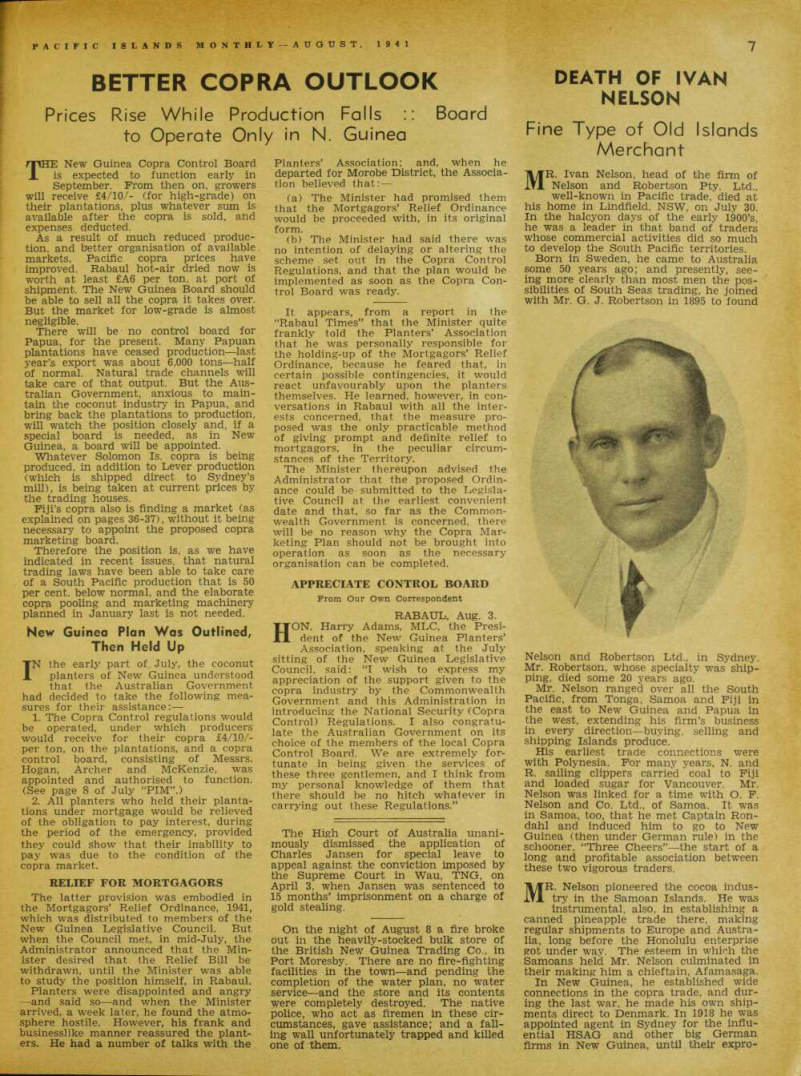
MR. Ivan Nelson, head of the firm of Nelson and Robertson Pty. Ltd., well-known in Pacific trade, died at his home in Lindfield, NSW, on July 30.
In the halcyon days of the early 1900’s, he was a leader in that band of traders whose commercial activities did so much to develop the South Pacific territories.
Born in Sweden, he came to Australia some 50 years ago; and presently, see ing more clearly than most men the pos sibilities of South Seas trading, he joined with Mr. G. J. Robertson in 1895 to found
Nelson and Robertson Ltd., in Sydney.
Mr. Robertson, whose specialty was ship ping, died some 20 years ago.
Mr. Nelson ranged over all the South Pacific, from Tonga, Samoa and Fiji in the east to New Guinea and Papua in the west, extending his firm’s business in every direction—buying, selling and shipping Islands produce.
His earliest trade connections were with Polynesia. For many years, N. and R. sailing clippers carried coal to Fiji and loaded sugar for Vancouver. Mr.
Nelson was linked for a time with O. F.
Nelson and Co. Ltd., of Samoa. It was in Samoa, too, that he met Captain Ron dahl and induced him to go to New Guinea (then under German rule) in the schooner, “Three Cheers”—the start of a long and profitable association between these two vigorous traders.
MR. Nelson pioneered the cocoa indus try in the Samoan Islands. He was instrumental, also, in establishing a canned pineapple trade there, making regular shipments to Europe and Austra lia, long before the Honolulu enterprise got under way. The esteem in which the Samoans held Mr. Nelson culminated in their making him a chieftain, Afamasaga.
In New Guinea, he established wide connections in the copra trade, and dur ing the last war, he made his own ship ments direct to Denmark. In 1918 he was appointed agent in Sydney for the influ ential HSAG and other big German firms in New Guinea, until their expro
priated properties were sold. During this period he handled all the buying, etc., for shipments totalling sometimes over £30,000.
Mr. Nelson bought the original Rabaul Hotel when it was a three-room shack.
To-day, still under Nelson and Robert son management, it is one of the largest and best hotels in Western Pacific.
In his heyday, Mr. Nelson controlled, either by ownership or charter, a fleet of some 30 sailing ships, perhaps the best remembered being the graceful sailer, “City of Hankow”. After the war, when steam replaced sail in the Pacific, he relinquished most of his shipping busi ness, retaining only an interest in the Australian coastal trade.
An easy mixer, big physically as well as in kindness of heart, Ivan Nelson made a legion of friends throughout the South Seas, and the N. and R. office was always first “port of call” for dozens of Pacific planters and settlers who had shared his generous help and shrewd trading ability. Typical was his action in sending the “Upolu” around Fiji, Samoa and Tonga, loaded with food and supplies, when communication was cut off by the big NZ shipping holdup.
Apart from his Islands connections, Mr. Nelson was interested in world-wide timber, wheat and coal chartering—he sent Newcastle coal to USA during the great British strike. South America claimed his attention, too, and for very many years he was Vice-Consul in Syd ney for the Argentine.
Mr. Nelson, who was privately cre mated, is survived by his wife, Mrs. Mary Nelson, and two children, Mrs. Vera Gardner, and Mr. Norman Nelson (who now is in charge of Nelson and Robert son Pty. Ltd.).
Their "Joke" Brought
Three Months
ON May 31, a missionary visiting the Vaisigano district of Savaii, West ern Samoa, tuned in his portable radio to a world, news broadcast, and heard that the British had been driven out of Crete, after 12 days’ bitter fight ing.
Among those who heard the broadcast were Paul Schmidt and Auselm Schmidt, sons of a German father by a Samoan mother. They are mature men, traders, and married.
That evening, at the village of Falea lupo, in a gathering which included Samoan chiefs and the captain and crew of the little “Tiafau”, Paul and Auselm could not conceal their happiness. They gave the Nazi salute, heiled Hitler, and announced that the Germans had taken Malta.
There are loyal people over there in Savaii. The incident was reported; and. on July 11, Paul and Auselm appeared in the High Court, Apia, charged with making a subversive statement.
They said, in defence, that they were only joking, and that they had confused Crete with Malta.
Chief Judge Harley could not see any thing funny in the joke. He added that Germans, living in a British country, would be wise to refrain from jokes of this kind, in a time of war.
Paul and Auselm were sent to gaol for three months. Perhaps they can employ the time profitably in studying Mediter ranean geography.
Judge A. McCarthy returned to New Zealand recently from Rarotonga, where for a time he presided over the Cook Islarids Land Court. He is now on a visit to Niue Island.
Cocoa, Coffee Up
Demand For Islands Produce
ISLANDS cocoa has been enjoying a mild “boom” on the Australian mar ket in recent weeks, due to the cur tailment of imports from British West Africa—which, prior to the war, supplied nine-tenths of Australia’s requirements.
At the end of September, 1940, the British Colonial Office announced the purchase by Britain of the whole of the forthcoming cocoa crops in the British Colonies of Gold Coast, Nigeria and West Africa. This, and a shortage of shipping space, account for the increased demand for Islands cocoa by Australian manufacturers.
Latest quotations from Sydney agents show that Npw Guinea and New Hebrides cocoa is in the vicinity of £47 a ton. An agent who imports the fine quality Criollo cocoa from Western Samoa quotes parcels at £57 a ton.
As the result of heavy American pur chases, the price of coffee is moving up.
Java Robusta has been quoted at between 43 9 and 45 - a cwt., and New Guinea coffee is in Sydney selling at prices rang ing between 9d. and lOd. a lb.
Some movement on the green-snail shell market has been evident lately, and a firm market is in the vicinity of £65 a ton.
New Canadian Market
SIR Walter Carpenter told the “New Zealand Herald”, Auckland, when passing through there en route to Canada on July 27, that he expected the new crushing mill in Vancouver would shortly crush copra at the rate of 50,000 tons per annum and that this would assist considerably in the solution of the present problem of how to dispose of South Pacific copra. Sir Walter said that Fiji probably would supply from 5,000 to 10.000 tons per annum for the Vancouver mill —provided it was of sufficiently hisrh grade—and that, while prices naturally would vary according to market condi tions. they would be better than those which growers have been receiving for some time, and actually would not be far short of pre-war rates. (See article on page 36.) Owing to war conditions, and shortage of staff, the Madang (TNG) branch of the Bank of New South Wales has been closed. Mr. Noel Marlay has been trans ferred temporarily from Madang to the managership at Salamaua, and Mr.
Monk moves on to Wau, to relieve there.
Plan
A Trade Union
Deplorable Effect of NG Goldfield Strike
THE strike of Europeans employed by New Guinea Goldfields Ltd., on the Morobe goldfield in New Guinea is now practically ended. A Common wealth industrial inspector, Mr. A. Blake ley, has been for some time in Wau arranging a final settlement of industrial conditions as between the European em ployees and NGG Ltd. When the Ter ritories Minister was there in July he suggested the formation of a New Guinea Miners’ Union.
It is reported that a movement now is afoot to form a registered trade union which presumably will be a party to an industrial award as between the gold- ' fields employees and the mining com panies. Presumably it will be something after the style of the Australian Work ers’ Union.
From the Australian viewpoint, such a development, in a country like New Guinea, would be deplorable.
It is quite in order for men of the arti san class to form a trade union in Aus tralia, for their mutual protection and for joint bargaining. But, in New Guinea, a European artisan is a “boss”, and usually the trusted lieutenant of his employer. On the Morobe goldfields, for example, there are a couple of score of employers, a few hundred European tradesmen, and from 10,000 to 12,000 native labourers. The control of those native labourers—already difficult enough —is directly the responsibility of the few hundred European tradesmen; and the knowledge that the “white masters” were combining against their employers would have a bad effect upon the natives.
In fact, according to the way things are going nowadays in New Guinea, it would not be surprising to find the native labourers themselves forming trade unions.
New Guinea employers should be able to make mutually satisfactory terms with their European employees without any recourse to unions or arbitration officials.
If this union movement goes on, the fault can be laid directly at the door of New Guinea Goldfields Ltd., whose stiff necked attitude, in the beginning, created friction between them and some of their hot-headed European employees, and led ultimately to the strike. A reasonable attitude of give-and-take at the begin ning would have maintained friendly relations between NGG Ltd. and their European staff, and all this industrial trouble would have been avoided.
The existence of a branch of the Aus tralian Labour Party in Wau has no bearing on the situation. The latter has been only a political organisation—it seems never to have contemplated organ ised industrial action. Probably, the ALP leaders, like any other Europeans of broad vision, would oppose a trade union movement in a country like New Guinea.
Mrs. Middleton, who was in charge of the Hotel Rabaul two years ago, and who also is known in the Solomons, has taken over the “Tradesman’s Arms”
Hotel, at the corner of Palmer and Liverpool Streets, Sydney. She has the help of her sister, whose husband, like Mr. Middleton, is overseas with the AIF.
Mr. Stephen Savage, of Rarotonga, Cook Is., died suddenly on July 25, aged 67. (See article “Rarotonga’s G.O.M.”. page 48.)
Advertisements & other items, p. 10 (1 item)
Look on the Front of
Your Wrapper !
The figures stamped there (if any) show the date when your subscription expires. This date will appear on wrappers of three issues preceding expiration, thereby giving three months’ notice.
If, at the end of that time, we have not been instructed to continue to send the journal to you, it will be discontinued.
Your subscription (8/- per annum, or 10/- in the case of countries outside the British Empire —which includes postage) may be sent direct, or may be paid to any of our agents (listed on Page 5).
The postage required for this issue is;— To Australia and New Zealand 2d.
To United Kingdom, via All-sea route .. 2d.
To other British Possessions 2d.
To USA and Foreign Countries 4d.
PACIFIC PUBLICATIONS PTY. LTD.
Union House, 247 George Street, Sydney.
"Bounty" Anchor for Auckland
Museum
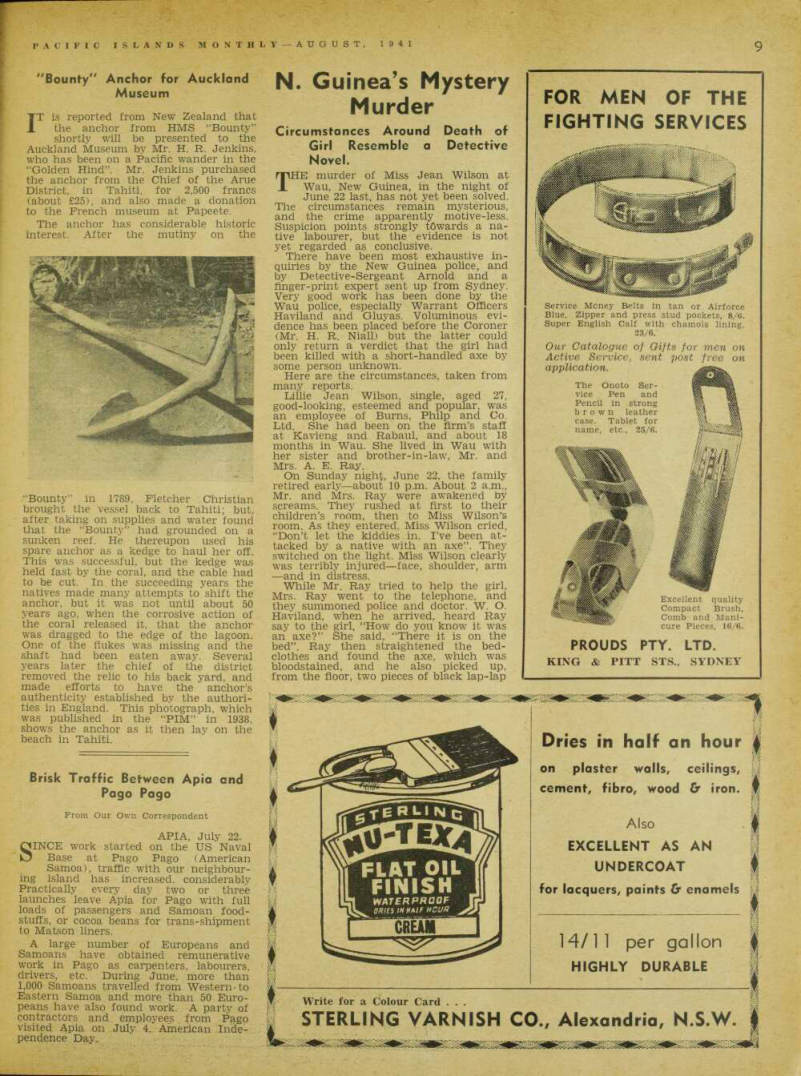
IT is reported from New Zealand that the anchor from HMS “Bounty” shortly will be presented to the Auckland Museum by Mr. H. R. Jenkins, who has been on a Pacific wander in the “Golden Hind”. Mr. Jenkins purchased the anchor from the Chief of the Arue District, in Tahiti, for 2,500 francs (about £25), and also made a donation to the French museum at Papeete.
The anchor has considerable historic interest. After the mutiny on the
"Bounty” in 1789, Fletcher Christian brought the vessel back to Tahiti; but, after taking on supplies and water found that the “Bounty” had grounded on a sunken reef. He thereupon used his spare anchor as a kedge to haul her off.
This was successful, but the kedge was held fast by the coral, and the cable had to be cut. In the succeeding years the natives made many attempts to shift the anchor, but it was not until about 50 years ago, when the corrosive action of the coral released it, that the anchor was dragged to the edge of the lagoon.
One of the flukes was missing and the shaft had been eaten away. Several years later the chief of the district removed the relic to his back yard, and made efforts to have the anchor’s authenticity established by the authori ties in England. This photograph, which was published in the “PIM” in 1938, shows the anchor as it then lay on the beach in Tahiti.
Pago Pago
Brisk Traffic Between Apia and Pago Pago
From Our Own Correspondent APIA, July 22.
SINCE work started on the US Naval Base at Pago Pago (American Samoa), traffic with our neighbour ing island has increased, considerably Practically every day two or three launches leave Apia for Pago with full loads of passengers and Samoan food stuffs, or cocoa beans for trans-shipment to Matson liners.
A large number of Europeans and Samoans have obtained remunerative work in Pago as carpenters, labourers, drivers, etc. During June, more than 1,000 Samoans travelled from Western-to Eastern Samoa and more than 50 Euro peans have also found work. A party of contractors and employees from Pago visited Apia on July 4, American Inde pendence Day.
N. Guinea’s Mystery
Murder
Circumstances Around Death of
Girl Resemble a Detective
Novel.
THE murder of Miss Jean Wilson at Wau, New Guinea, in the night of June 22 last, has not yet been solved.
The circumstances remain mysterious, and the crime apparently motive-less.
Suspicion points strongly towards a na tive labourer, but the evidence is not yet regarded as conclusive.
There have been most exhaustive in quiries by the New Guinea police, and by Detective-Sergeant Arnold and a finger-print expert sent up from Sydney.
Very good work has been done by the Wau police, especially Warrant Officers Haviland and Gluyas. Voluminous evi dence has been placed before the Coroner (Mr. H. R. Niall) but the latter could only return a verdict that the girl had been killed with a short-handled axe by some person unknown.
Here are the circumstances, taken from many reports.
Lillie Jean Wilson, single, aged 27, good-looking, esteemed and popular, was an employee of Burns, Philp and Co.
Ltd. She had been on the firm’s staff at Kavieng and Rabaul, and about 18 months in Wau. She lived in Wau with her sister and brother-in-law, Mr. and Mrs. A. E. Ray.
On Sunday night, June 22, the family retired early—about 10 p.m. About 2 a.m., Mr. and Mrs. Ray were awakened by screams. They rushed at first to their children’s room, then to Miss Wilson’s room. As they entered, Miss Wilson cried, “Don’t let the kiddies in. I’ve been at tacked by a native with an axe”. They switched on the light. Miss Wilson clearly was terribly injured—face, shoulder, arm —and in distress.
While Mr. Ray tried to help the girl, Mrs. Ray went to the telephone, and they summoned police and doctor. W. O.
Haviland, when he arrived, heard Ray say to the girl, “How do you know it was an axe?” She said, “There it is on the bed”. Ray then straightened the bed clothes and found the axe, which was bloodstained, and he also picked up, from the floor, two pieces of black lap-lap
(cloth from which natives’ lap-laps are made). One was sewn roughly into the form of a bag, and from this there fell a key.
The girl was taken to the hospital where she died a few hours later.
THE axe, lap-lap cloth, lap-lap bag and key were examined very carefully by the police. The bag smelled of trade tobacco. On the cloth were a couple of hairs.
It was found that the key unlocked Miss Wilson’s room door. It and the back door were standing open when she was found. The police, immediately after the discovery of Miss Wilson, went to the house occupied by Ray’s native ser vants. They were all sound asleep. The police awoke them and examined their feet. They found no evidence that the servants had been out, or that they were in any way abnormal.
The police, during Monday, June 23, were very busy. On Tuesday, June 24, W. O. Gluyas went out to Koranga, where there are many native labourers employed, and waited while Mr, Clark, labour superintendent, lined them up. A Manus native named Taiki, well known to the police through various offences, came out so slowly and reluctantly that Mr. Clark had to hurry him up. Gluyas,
who knew him well, said he “seemed abnormal, and had a mad look in his eyes”. Gluyas took him to Wau for examination.
There, after much hesitation, Taiki said that he knew the axe—it belonged to his master, Jim Currie. He was shown the piece of lap-lap in which the axe apparently had been wrapped, and the cloth bag, but merely remarked that they were new. Taiki was held.
Taiki’s living quarters were closely searched, and a red lap-lap was found.
There were minute stains on this, which were identified as human blood. Taiki said that the lap-lap was his, but denied that he knew anything of the blood stains. His body bore no mark of a recent wound, from which he might have bled, An expert examined hairs from an Alsatian dog kept by Mr. Clark, at Koranga, and compared them with the hairs found on the lap-lap cloth. They were declared to be identical.
DURING the Coroner’s inquiry, Taiki was cool and well-poised. He took full advantage of his right to ex amine witnesses. The Coroner remarked afterwards that never had he seen the skill in cross-examination shown by Taiki equalled by another native, and seldom by a European.
The Coroner added that it had been established to his satisfaction that the crime was committed by a native. As there was not sufficient evidence to enable the police to charge Taiki with the mur der, Taiki was released.
Detective Sergeant Arnold was still in Wau, prosecuting inquiries, on August 1.
Two baffling circumstances connected with the crime are, first, the fact that there has been a good deal of secret drinking of alcohol among indentured labourers in the Wau district—and these natives become quite crazy under alcohol; and, second, many of the native police
are “(pne talks’’ of the native labourers— that is, they are of the same tribe and language, and are suspected of working together.
The suggestion therefore is that the crime was committed by a drink-crazed native, and that he is being protected by his “one talks”.
But why should Jean Wilson have been selected for such an attack? Medical evidence is that there was no indication whatever of sexual interference. And, in any event, would a drink-crazed native deliberately plan a crime like this — wrapping up an axe, and carrying it with him, and also carrying with him the key of the girl’s room?
There are some very curious and quite unexplained circumstances connected with this case.
An Old Resident Offers a Theory
Y"|LD New-Guinea-ite” writes:— V/ This Wau murder is most puzzling.
In all my long experience of New Guinea, I never knew a “civilised” native to attack a European, man or woman, while asleep. And why should this native, Taiki, to whom suspicion is said to point, who lived three miles from Wau, come all the way into Wau and deliberately pick out Miss Wilson for attack?
The fact that the bag which the mur derer dropped contained the key of Miss Wilson’s room indicates premeditation.
We can understand that one of these natives might plan assault with intent, and creep into Miss Wilson’s room. But this man planned murder —else, why did he bring with him, all the way from Koranga (“it was Jim Currie’s axe”) this weapon, carefully wrapped in lap-lap?
There is no suggestion here of any questionable relationships, such as have occurred occasionally between natives and low-type young European women visitors. Miss Wilson had lived for
years in the Territory, and was a young woman of good type and class, and understood the importance of keeping these primitive New Guinea natives in their proper place.
I can see only one theory to fit the strange circumstances. It is possible that one of these flash, over-Europeanised natives, probably a man of sensual type, made some approach to Miss Wilson, in or near her home. She would deal with him in no uncertain manner. Then, if he were one of those natives (there are too many of them about now) who want to be regarded as the equal of Euro peans, he would go away and nurse a bitter grievance: and, if he were drinking alcohol, his drink-crazed brain might plan, in retaliation, just the sort of attack that occurred.
Up to a point, Taiki conforms to much of this theory. He is “flash”, and very intelligent and shrewd; therefore he probably considers himself the equal of Europeans, and has an “inferiority com plex”; he has a police record, and has been accused of sexual offences; and he is believed to have been an alcohol drinker. But had he ever been seen in or near Mr. Ray’s home, or accosting Miss Wilson? Is it known that she ever had occasion to speak to him? If it could be shown that any incident of that kind had ever occurred, then I think that the case against Taiki would demand the closest investigation.
Advertisements & other items, pp. 11-12 (2 items)
Fighting Services
FOR MEN OF THE
« m Service Money Belts in tan or Airforce Blue. Zipper and press stud pockets, 8/6.
Super English Calf with chamois lining, 23/6.
Our Catalogue of Gifts for men on Active Service, sent post free on
application.
The Onoto Service Pen and Pencil in strong brown leather case. Tablet for name, etc., 25/6.
Excellent quality Compact Brush, Comb and Manicure Pieces, 16/6.
FROUDS PTY. LTD.
KING & PITT STS., SYDNEY
O"
SI
CREAM
Dries in half an hour on plaster walls, ceilings, cement, fibre, wood Cr iron.
Also
EXCELLENT AS AN
UNDERCOAT
for lacquers, paints & enamels 14/11 per gallon
HIGHLY DURABLE
Write for a Colour Card . . .
STERLING VARNISH CO., Alexandria, N.S.W.
PACIFIC ISLANDS SOCIETY
Visitors from the Islands to Sydney (or those interested in Islands affairs), are advised to communicate with the honorary secretary of the above Society, which has been formed to study the history, traditions, economics, and political developments of the Pacific Islands.
Films of Tahitian contingent of Free French Forces will be shown at August 27 meeting, Hotel Carlton, Sydney, at 8 p.m.
Address for Correspondence:
THE PACIFIC ISLANDS SOCIETY,
Box 2434 MM., G.P.0., Sydney.
St. Ignatius’ College
Riverview Sydney
Boys are prepared for Intermediate and Leaving Certificate Examinations and for Exhibitions, Scholarships and Bursaries at the University.
Boys are arranged in three Divisions according to age. Each Division has its own Library, Debating Society, Cricket and Football Fields, and Tennis Courts.
Senior and Junior Rowing Sheds, with a large fleet of pleasure and racing boats.
Private Swimming Baths.
Prospectus and further particulars on application to the — Rector: St. Ignatius’ College, Riverview, Sydney, Australia.
Tel.: JB 1106.
BOARDING AND DAY SCHOOL
Conducted by the Jesuit Fathers It H it m
ONE OF SYDNEY'S GREAT PUBLIC SCHOOLS
10
AU6ti s T , 'i9 4 1 PACIFIC IsLAnds MOST if I V
Fewer Japanese In
N. Caledonia
From Our Own Correspondent
Noumea, July 17.
IF there is one thing more than another that the white population of Cale donia fears it is the Japanese. Effi cient steps have been taken in the past to minimise the danger of peaceful pene tration, as a result of which there are to-day some 1,100 Japanese residents, compared with close on 2,500 in 1918.
The present white population is 17,000.
Of the 1,100 Japanese, about 350 live in Noumea. Most of them came originally as indentured labourers for the mines, which they subsequently deserted for storekeeping and market gardening. For many years now they have been the prin cipal growers of vegetables for the Nou mean market. But now they are getting on in years, and many of them can carry on only with the help of hired Javanese.
In the future they may have to give way to Indo-Chinese peasants, accus tomed to such work in their own country.
If and when this comes, New Cale donians will be better pleased.
Recruiting In Cook Is.
Rarotonga, July 7.
FURTHER details have been issued concerning the Rarotonga Local Defence Force, at present in process of recruitment. A local resident, Mr. R.
M. L. Gladney, has been given command of the Force with the rank of captain, and a native sergeant-major and quar termaster-sergeant, recruited from the returned soldiers, complete the prelimin ary staff.
One condition, that the recruit must have been born in Rarotonga (as distinct from any other island in the Group) has been found rather irksome by our dark skinned patriots; nevertheless, more re cruits have come forward than the num ber required at present.
Mr. W. Goodsir, head of the Fiji Kauri Timber Co., arrived in Sydney on a busi ness trip by the July Matson liner from Suva.
Advertisements & other items, pp. 13-14 (2 items)
11
PACIFIC isLA N i> S MONtttLV AUGtrs-f, 1941
Aiti
Another
“ULTIMATE” Achievement
FULL BANDSPREAD SHORT WAVE TUNING!
Special “ULTIMATE” Dial revolutionises Overseas Tuning and Reception!
Short Wave Stations spread up to sixteen further apart than on ordinary Receivers! Each Short Wave Band located on a separate scale! Foreign stations tuned in as easily as local stations! 798 separate stations were received on a Standard “ULTIMATE” Console; Commander R. E. Byrd used an “ULTIMATE” on his South Pole Expedition; Mr. R. N. Shaw uses an “ULTIMATE” to compile his “Wireless Weekly”
Short Wave notes; leading radio experts and technicians, including the official Australian Advisor to the British Broadcasting Commission, use “ULTIMATE” exclusively!
Obtainable in Console, Mantel, Radiogram and Portable-Mantel Models.
Investigate “ULTIMATE” before you decide on a Radio Receiver.
Comprehensive illustrated literature post free on request.
Cut out this Coupon and post to-day.
GEORGE BROWN & CO. PTY. LTD., 267 Clarence Street, Sydney.
Please send me without obligation full particulars of ULTIMATE Receivers.
NAME
ADDRESS
P.I.
H I
AITI
I U M ft / GEORGE BROWN & CO. PTY. LTD., 267 Clarence Street, Sydney.
(s> \ liEGENP HAS IT that fit CION '//s CONSENTEP TO HAVE HIS rF£7V/ AND CLAWS PRAWN OUT IN ORDER THAT HE
MIGHT MARRY A FAIR DAMSEL, WHEN
HIS TEETH ANP CLAWS WERE CONE
rHE FATHER OF THE FAIR DAMSEL
FELL ON THE LION AND SLEW
H/M. SUCH fS LIFE *' /
% I
T °OT '~
TV/ICB A* L 0” NCrt ON
Suva Minister Rejoins
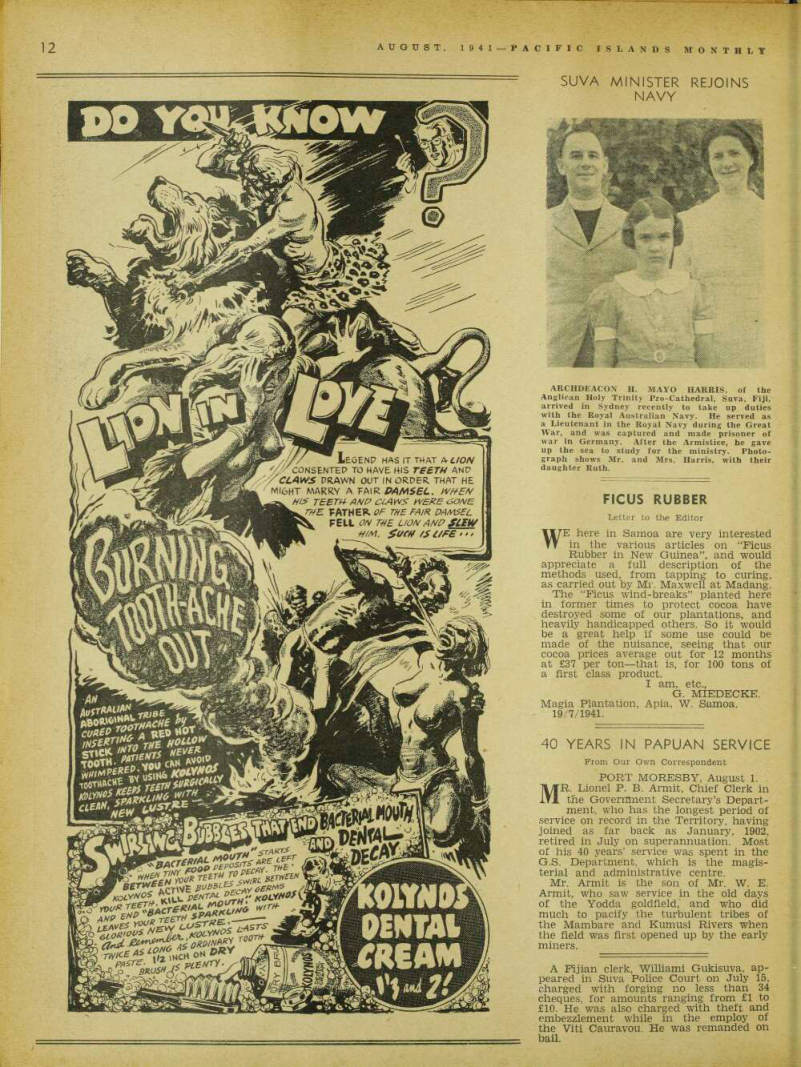
Navy
Archdeacon H. Mayo Harris, Of The
Anglican Holy Trinity Pro-Cathedral, Suva, Fiji, arrived in Sydney recently to take up duties with the Royal Australian Navy. He served as a Lieutenant in the Royal Navy during the Great War, and was captured and made prisoner of war in Germany. After the Armistice, he gave up the sea to study for the ministry. Photo graph shows Mr. and Mrs. Harris, with their daughter Ruth.
Ficus Rubber
Letter to the Editor WE here in Samoa are very interested in the various articles on “Ficus Rubber in New Guinea”, and would appreciate a full description of the methods used, from tapping to curing, as carried out by Mr. Maxwell at Madang.
The “Ficus wind-breaks” planted here in former times to protect cocoa have destroyed some of our plantations, and heavily handicapped others. So it would be a great help if some use could be made of the nuisance, seeing that our cocoa prices average out for 12 months at £37 per ton—that is, for 100 tons of a first class product.
I am, etc.,
G. Miedecke.
Magia Plantation, Apia, W. Samoa. 19/7/1941.
40 Years In Papuan Service
Prom Our Own Correspondent
Port Moresby, August 1.
MR. Lionel P. B. Armit, Chief Clerk in the Government Secretary’s Depart ment, who has the longest period of service on record in the Territory, having joined as far back as January, 1902, retired in July on superannuation. Most of his 40 years’ service was spent in the G.S. Department, which is the magis terial and administrative centre.
Mr. Armit is the son of Mr. W. E.
Armit, who saw service in the old days of the Yodda goldfield, and who did much to pacify the turbulent tribes of the Mambare and Kumusi Rivers when the field was first opened up by the early miners.
A Fijian clerk, Williami Gukisuva, ap peared in Suva Police Court on July 15, charged with forging no less than 34 cheques, for amounts ranging from £1 to £lO. He was also charged with theft and embezzlement while in the employ of the Viti Cauravou. He was remanded on bail.
Tropicalities
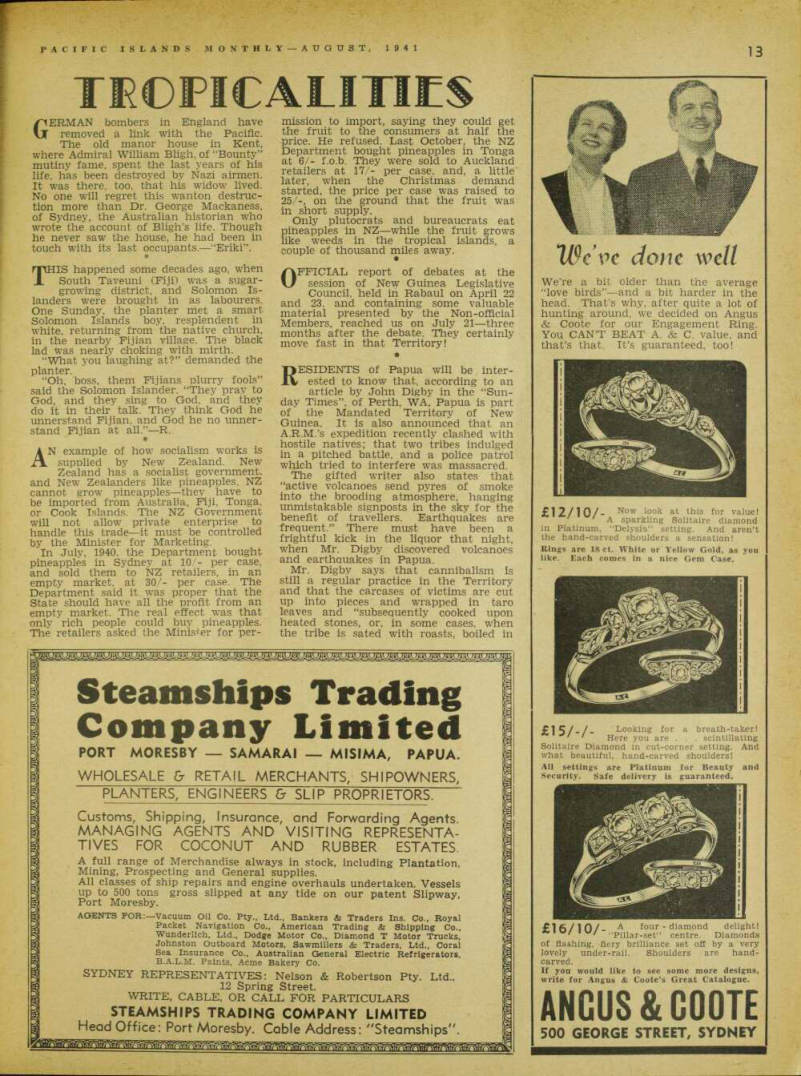

GERMAN bombers in England have removed a link with the Pacific.
The old manor house in Kent, where Admiral William Bligh, of “Bounty” mutiny fame, spent the last years of his life, has been destroyed by Nazi airmen.
It was there, too, that his widow lived.
No one will regret this wanton destruc tion more than Dr. George Mackaness, of Sydney, the Australian historian who wrote the account of Bligh’s life. Though he never saw the house, he had been in touch with its last occupants.—“Eriki”. ♦ rIS happened some decades ago, when South Taveuni (Fiji) was a sugar growing district, and Solomon Is landers were brought in as labourers.
One Sunday, the planter met a smart Solomon Islands boy. resplendent in white, returning from the native church, in the nearby Fijian village. The black lad was nearly choking with mirth.
“What you laughing at?” demanded the
planter.
“Oh, boss, them Fijians plurry fools” said the Solomon Islander. “They pray to God, and they sing to God, and they do it in their talk. They think God he unnerstand Fijian, and God he no unner stand Fijian at all.”—R. * AN example of how socialism works is supplied by New Zealand. New Zealand has a socialist government, and New Zealanders like pineapples. NZ cannot grow pineapples—they have to be imported from Australia, Fiji, Tonga, or Cook Islands. The NZ Government will not allow private enterprise to handle this trade—it must be controlled by the Minister for Marketing.
In July, 1940. the Department bought pineapples in Sydney at 10/- per case, and sold them to NZ retailers, in an empty market, at 30/- per case. The Department said it was proper that the State should have all the profit from an empty market. The real effect was that only rich people could buy pineapples.
The retailers asked the Minister for per
mission to import, saying they could get the fruit to the consumers at half the price. He refused. Last October, the NZ Department bought pineapples in Tonga at 6/- f.o.b. They were sold to Auckland retailers at 17/- per case, and, a little later, when the Christmas demand started, the price per case was raised to 25/-, on the ground that the fruit was in short supply.
Only plutocrats and bureaucrats eat pineapples in NZ —while the fruit grows like weeds in the tropical islands, a couple of thousand miles away.
OFFICIAL report of debates at the session of New Guinea Legislative Council, held in Rabaul on April 22 and 23, and containing some valuable material presented by the Non-official Members, reached us on July 21—three months after the debate. They certainly move fast in that Territory! • RESIDENTS of Papua will be inter ested to know that, according to an article by John Digby in the “Sun day Times”, of Perth, WA, Papua is part of the Mandated Territory of New Guinea. It is also announced that an A.RM.’s expedition recently clashed with hostile natives; that two tribes indulged in a pitched battle, and a police patrol which tried to interfere was massacred.
The gifted writer also states that “active volcanoes send pyres of smoke into the brooding atmosphere, hanging unmistakable signposts in the sky for the benefit of travellers. Earthquakes are frequent.” There must have been a frightful kick in the liquor that night, when Mr. Digby discovered volcanoes and earthauakes in Papua.
Mr. Digby says that cannibalism is still a regular practice in the Territory and that the carcases of victims are cut up into pieces and wrapped in taro leaves and “subsequently cooked upon heated stones, or, in some cases, when the tribe is sated with roasts, boiled in
water.” He adds; “Even the most incor rigible Papuan cannibal rarely eats the flesh of a white man, because ‘white man smell bad’.”
This is typical of the indescribable tripe which some writers produce pre sumably as informative articles about the Islands and —what is worse —which is seriously printed by newspapers with a large circulation.
rE lengthy stay of Alain Gerbault, author and ex-tennis champion, in New Guinea waters, has been intriguing the local residents. The Frenchman, who is generally regarded as rather unapproachable to Europeans (though to the Polynesians he has ever been a friend), met an Australian visitor the other day and invited him out to his sailing boat. He revealed that, during his wanderings in Polynesia, he had col lected certain genealogies which, he said, certain museums would like to possess.
“Gerbault had a very fine collection of books, many of them in tapa bindings,” says the visitor, “and I found him ever ready to talk on his special topic—the origin of the Polynesians.”
But to most people at Port Moresby, Gerbault is regarded as “the French man, and rather a queer bird”. He is said to spend hours in the small canvas boat which he carries on his yacht, lying
there clad only in a pareu and appar ently lost in thought. Occasionally, he will give the water a flip with his paddle, drift for a few minutes, and then flip it again. The author kindly autographed a copy of one of his books which his visitor happened to have with him. On glancing at the inscription the latter found it was in Maori!—“Vakatini”. « IN this day and age, the Polynesian is a less adventurous seafarer than his forefathers, who in small sailing canoes criss-crossed the warm waters of the Pacific on inter-island voyages. It was not uncommon for natives to sail away from one island bound for a nearby atoll and never be heard of again—that has always been one of the hazards of men against the sea. But to-day it is not entirely his own fault that he is less venturesome for, in recent years, reckless voyaging has been frowned upon by the powers that be and a native must make adequate provision for seagoing emergencies if he wishes to visit another island.
In the Gilbert and Ellice Group, Cen tral Pacific, for instance, a native must first obtain a certificate from the village headman to the effect that his canoe has been personally inspected, is seaworthy in every respect, and properly equipped with sails, paddles, steer-oar and other serviceable gear; that there is a suffi cient crew of experienced seamen, one an efficient navigator; and that ample reserves of food and water are carried.
Woe betide any inter-island voyager without a certificate, for the Native Government Ordinance, recently issued by the Western Pacific High Commission, prescribes as penalty imprisonment up to six months. * HERE is an interesting prophecy, written by a famous poet:— The time will come when thou sfialt lift thine eyes To watch a long-drawn battle in the skies, While aged peasants, too amazed for words.
Stare at the flying feet of wondrous birds.
England, so long the mistress of the sea, Where winds and waves confess her sovereignty, Her ancient triumphs yet shall bow on high And reign the sovereign of the conquered sky.
Incredible as it may seem, those lines were written 166 years ago (in 1775) by the English poet, Thomas Gray, whose “Eleey written in a Country Church yard” is so well known.
A YANKEE Doctor in Paradise”, the autobiography telling of the life and work of Dr. Sylvester M. Lam bert, for 20 years Rockefeller Foundation representative in the South Pacific, has gained “best-seller” sales and been accorded flattering reviews throughout the United States, the doctor’s home land. We learn that an English edition is to be published in London before Christmas by J. M. Dent and Sons, Ltd., and that then, probably, the book will be on sale in Australia, it was reviewed in the “PIM” in June. Dr. Lambert, who was in Fiji on a brief visit in June, has now returned to his home at Walnut Creek, California. *
An Islands Note
FOR the yam I don’t care a damn!
I’d hate ter Be without a pertater.—R.
Advertisements & other items, pp. 15-16 (1 item)
Steamships Trading
We’ve done well
We’re a bit older than the average “love birds”—and a bit harder in the head. That’s why, after quite a lot of
hunting around, we decided on Angus
& Coote for our Engagement Ring.
You CAN’T BEAT A. & C. value, and that’s that. It’s guaranteed, too! r* £12/10/- Now look is or value!
' A sparkling Solitaire diamond in Platinum, “Delysia” setting. And aren’t the hand-carved shoulders a sensation!
Rings are 18 ct. White or Yellow Gold, as you like. Each comes in a nice Gem Case. r->. m U n T3* £15/-/- , Looking for a breath-taker!
' ' Here you are . . . scintillating Solitaire Diamond in cut-corner setting. And what beautiful, hand-carved shoulders!
All settings are Platinum for Beauty and Security. Safe delivery is guaranteed. ir i r A* £16/10/- A four - diamond delight! / W “piiiar-set” centre. Diamonds of flashing, fiery brilliance set off by a very lovely under-rail. Shoulders are handcarved.
If you would like to see some more designs, write for Angus & Coote’s Great Catalogue.
ANGUS &COOTE
500 GEORGE STREET, SYDNEY
Steamships Trading
Company Limited
PORT MORESBY SAMARA I MISIMA, PAPUA.
WHOLESALE & RETAIL MERCHANTS, SHIPOWNERS,
PLANTERS, ENGINEERS & SLIP PROPRIETORS.
Customs, Shipping, Insurance, and Forwarding Agents.
MANAGING AGENTS AND VISITING REPRESENTA-
TIVES FOR COCONUT AND RUBBER ESTATES
A full range of Merchandise always in stock, including Plantation, Mining, Prospecting and General supplies.
All classes of ship repairs and engine overhauls undertaken. Vessels up to 500 tons gross slipped at any tide on our patent Slipway, Port Moresby.
AGENTS FOR:—Vacuum Oil Co. Pty., Ltd.. Bankers & Traders Ins. Co., Royal Packet Navigation Co., American Trading & Shipping Co..
Wunderlich, Ltd., Dodge Motor Co., Diamond T Motor Trucks, Johnston Outboard Motors, Sawmillers & Traders, Ltd., Coral Sea Insurance Co., Australian General Electric Refrigerators, B.A.L.M. Paints, Acme Bakery Co.
SYDNEY REPRESENTATIVES: Nelson & Robertson Pty. Ltd., 12 Spring Street.
WRITE, CABLE, OR CALL FOR PARTICULARS
STEAMSHIPS TRADING COMPANY LIMITED
Head Office: Port Moresby. Coble Address: "Steamships”.
Islands' Visitors to Sydney Will find excellent accommodation at
"206" PRIVATE HOTEL
204-8 Victoria Street, Kings Cross, Sydney.
Every Comfort, Splendid Table.
Tariff from 35/- per week.
MRS. C. PYATT, Proprietress.
Tel. FL 4272.
liter COLDS
UI.WMIER lUS
AND FEVER
Your System needs BIDOMAK
to build Vitality—prevent Relapses
BIDOMAK helps increase resistance against
disease—it creates rich, red blood to overcome infection as the body generally is
strengthened. It counteracts the effects of
debility. It is especially valuable in overcoming the depression caused by colds, 'flu and fever. BIDOMAK tones up the system —puts a sparkle in your eye and a spring in
your step. Contains no drugs—safest for
children.
“WAS ALWAYS SICK IN WINTER—NOW WELL”
“For years I dreaded winter because I always knew it meant one attack after another of illness, owing to my lack of resistance and general nervy condition.
I seemed to be more or less always sick and had no energy or appetite.
“My chemist recommended BIDOMAK and it has worked wonders in building my health so that I can stand any weather and feel as fit as a fiddle. I sleep, eat and work better and friends are amazed at the difference in me.” (Sgd.) H.R.K., M——-. (Original letter on file.)
BIDOMAK
“The Tonic of the Century”
AT ALL LEADING ISLAND STORES
SCIENTIFIC
CONTROL
Manufactured in the BIDO- M A K Pharmaceutical Laboratories, one of the most up-to-date hygienic laboratories in the Southern Hemisphere, to which is attached a fully qualified Doctor of Medicine, and under the control of a qualified chemist, who was trained in the most modern English laboratories in the world.
Roll Of Honour
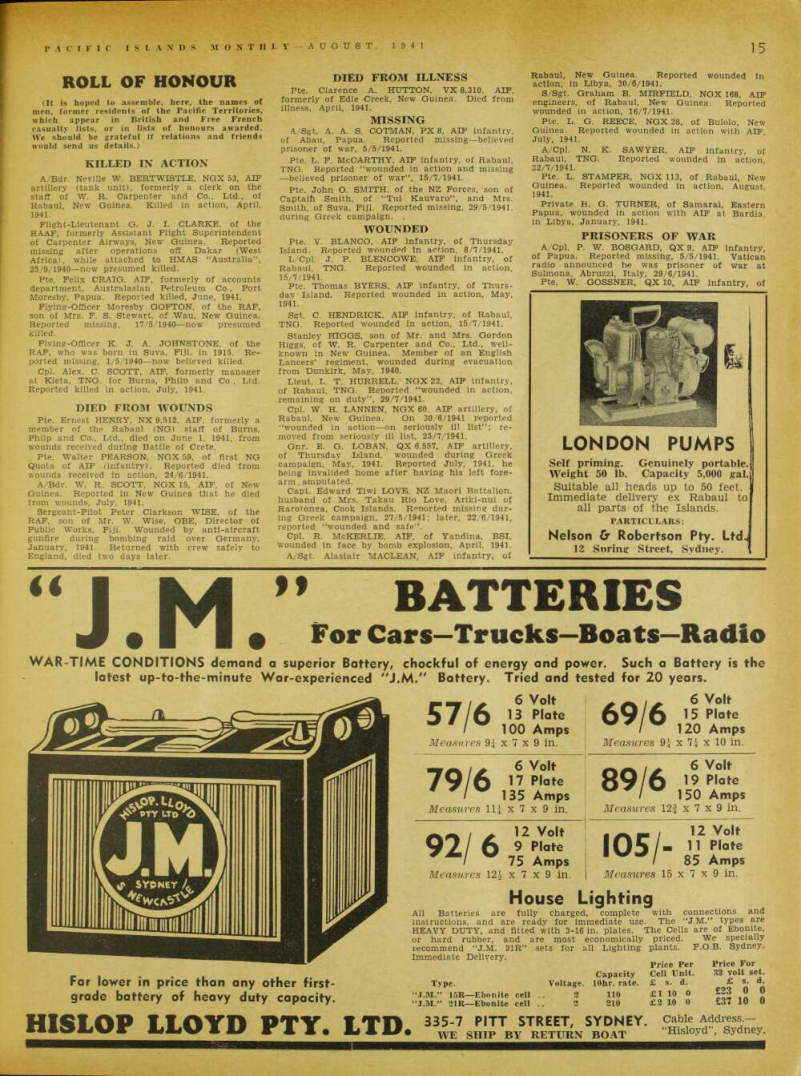
(It is hoped to assemble, here, the names of men. former residents of the Pacific Territories, which appear in British and Free French casualty lists, or in lists of honours awarded.
We should be grateful if relations and friends would send us details.)
Killed In Action
A/Bdr. Neville W. BERTWISTLE, NGX 53, AIF artillery (tank unit), formerly a clerk on the staff of W. R. Carpenter and Co., Ltd., of Rabaul, New Guinea. Killed in action, April, 1941.
Flight-Lieutenant G. J. I. CLARKE, of the RAAF, formerly Assistant Flight Superintendent of Carpenter Airways, New Guinea. Reported missing after operations off Dakar (West Africa), while attached to HMAS “Australia”, 25/9/1940 —now presumed killed.
Pte. Felix CRAIG. AIF, formerly of accounts department, Australasian Petroleum Co., Port Moresby, Papua. Reported killed, June, 1941.
Flying-Officer Moresby GOFTON, of the RAF, son of Mrs. F. S. Stewart, of Wau, New Guinea.
Reported missing, 17/5/1940 —now presumed killed.
Flying-Officer K. J. A. JOHNSTONE, of the RAF, who was born in Suva, Fiji, in 1915. Re ported missing, 1/5/1940 —now believed killed.
Cpl. Alex. C. SCOTT. AIF, formerly manager at Kieta, TNG. for Burns, Philo and Co., Ltd.
Reported killed in action, July, 1941.
Died From Wounds
Pte. Ernest HENRY, NX 9,512, AIF. formerly a member of the Rabaul (NG) staff of Burns, Philp and Co., Ltd., died on June 1, 1941, from wounds received during Battle of Crete.
Pte. Walter PEARSON, NGX 59, of first NG Quota of ALP (infantry). Reported died from wounds received in action, 24/6/1941.
A/Bdr. W. R. SCOTT, NGX 15, AIF, of New Guinea. Reported in New Guinea that he died from wounds, July, 1941.
Sergeant-Pilot Peter Clarkson WISE, of the RAF, son of Mr. W. Wise, OBE, Director of Public Works, Fiji. Wounded by anti-aircraft gunfire during bombing raid over Germany, January, 1941. Returned with crew safely to England, died two days later.
Died From Illness
Pte. Clarence A. HUTTON, VX 8,310, AIF, formerly of Edie Creek, New Guinea. Died from illness, April, 1941.
Missing
A/Sgt. A. A. S. COTMAN, PX 8, AIF infantry, of Abau, Papua. Reported missing—believed prisoner of war, 5/5/1941.
Pte. L. F. MCCARTHY, AIF infantry, of Rabaul, TNG. Reported “wounded in action and missing —believed prisoner of war”, 15/7/1941.
Pte. John O. SMITH, of the NZ Forces, son of Captaih Smith, of “Tui Kauvaro”, and Mrs.
Smith, of Suva, Fiji. Reported missing, 29'/5/1941, during Greek campaign. .
Wounded
Pte. V. BLANCO, AIF infantry, of Thursday Island. Reported wounded In action, 8/7/1941.
L/Cpl. J. P. BLENCOWE, AIF infantry, of Rabaul. TNG. Reported wounded in action, 15/7/1941.
Pte. Thomas BYERS, AIF infantry, of Thurs day Island. Reported wounded in action, May, 1941.
Sgt. C. HENDRICK, AIF infantry, of Rabaul, TNG. Reported wounded in action, 15/7/1941.
Stanley HIGGS, son of Mr. and Mrs. Gordon Higgs, of W. R. Carpenter and Co., Ltd., well known in New Guinea. Member of an English Lancers’ regiment, wounded during evacuation from Dunkirk, May, 1940.
Lieut. L. T. HURRELL. NGX 22, AIF infantry, of Rabaul, TNG. Reported “wounded in action, remaining on duty”, 29/7/1941.
Cpl. W. H. LANNEN, NGX 60. AIF artillery, of Rabaul. New Guinea. On 30/6/1941 reported “wounded in action —on seriously ill list”; re moved from seriously ill list, 25/7/1941.
Gnr. E. G. LOBAN, QX 6.557, AIF artillery, of Thursday Island, wounded during Greek campaign. May, 1941. Reported July, 1941, he being invalided home after having his left fore arm , amputated.
Capt. Edward Tiwi LOVE. NZ Maori Battalion, husband of Mrs. Takau Rio Love, Ariki-nui of Rarotonga, Cook Islands. missing dur ing Greek campaign, 27/5/1941; later, 22/6/1941, reported “wounded and safe”.
Cpl. R. McKERLIE, AIF, of Yandina, BSI, wounded in face by bomb explosion, April, 1941.
A/Sgt. Alastair MACLEAN, AIF infantry, of
Rabaul, New Guinea. Reported wounded In action, in Libya, 30/6/1941.
S/Sgt. Graham B. MIRFIELD. NGX 168, AIF engineers, of Rabaul, New Guinea. Reported wounded in action, 16/7/1941.
Pte. L. G. REECE, NGX 28. of Bulolo, New Guinea. Reported wounded in action with AIF July, 1941.
A/Cpl. N. K. SAWYER. AIF infantry, of Rabaul, TNG. Reported wounded in action 22/7/1941.
Pte. L. STAMPER, NGX 113, of Rabaul, New Guinea. Reported wounded in action, August 1941.
Private H. G. TURNER, of Samarai, Eastern Papua, wounded in action with AIF at Bardia. in Libya. January, 1941.
Prisoners Of War
A/Cpl. P. W. BOSGARD, QX 9, AIF infantry, of Papua. Reported missing, 5/5/1941. Vatican radio announced he was prisoner of war at Sulmona, Abruzzi, Italy, 29/6/1941.
Pte. W. GOSSNER, QX 10, AIF infantry, of
??=^ ft ., Moresby ’ Pa Pua. Reported missing, 7/5/1941; reported prisoner of war, Abruzzl. Italy 6/7/1941.
Gnr. A. L. B, KING, NGX 7, AIF artillery, of Rabaul, TNG. Reported missing, 16/6/19’41; reported prisoner of war, 29/7/1941.
A/Cpl. John H. LONERGAN, NGX 99, AIF Supply and Transport, of New Guinea. Reported missing during Greek campaign, 5/6/1941; re ported prisoner of war at Corinthia, Italy, July, 1941.
Decorations
Flying-Officer James R. HYDE, of the RAF, formerly a patrol officer in Namatanai and Sepik districts, TNG, has been awarded the Distin guished Flying Cross for the part he played in bombing raids on Heligoland Bight.
Lieutenant-Commander A. W. R. McNICOLL, RAN, son of Sir Ramsay McNicoll, Adminis trator of New Guinea, and Lady McNicoll, has been awarded the George Medal “for gallantry and undaunted devotion to duty”.
Advertisements & other items, pp. 17-18 (1 item)
” Batteries
LONDON PUMPS
Self priming. Genuinely portable.
Weight 50 lb. Capacity 5,000 gal.
Suitable all heads up to 50 feet.
Immediate delivery ex Rabaul to all parts of the Islands.
PARTICULARS:
Nelson Cr Robertson Pty. Ltd^ 12 Snring Street, Sydney.
a J.M.
” BATTERIES
For Cars—Trucks—Boats—Radio
WAR-TIME CONDITIONS demand a superior Battery, chockful of energy and power. Such a Battery is the latest up-to-the-minute War-experienced "J.M." Battery. Tried and tested for 20 years.
OL Far lower in price than any other first-
grade battery of heavy duty capacity.
House Lighting
All Batteries are fully charged, complete with connections and instructions, and are ready for immediate use. The “J.M.” types are HEAVY DUTY, and fitted with 3-16 in. plates. The Cells are of Ebonite, or hard rubber, and are most economically priced. We specially recommend “J.M. 21R” sets for all Lighting plants. F. 0.8. Sydney.
Immediate Delivery.
Price Per Capacity Cell Unit.
Type. Voltage. lOhr. rate. £ s. d.
“J.M.” 15R—Ebonite cell .. 2 110 £llO 0 “J.M.” 21R—Ebonite cell .. 2 210 £2 10 0 Price For 32 volt set. £ s. d. £23 0 0 €37 10 0 HlfiT.OP I I nvn PTV 1 Tfl 335-7 PITT STREET, SYDNEY. Cable Address.- • A I • X we ship BY RETURN BOAT “Hisloyd , Sydney.
Many a man is discussed like this by his employers
The scene is the Board of Directors room in a big company in Sydney.
It is Friday morning at 10.30. The Board is sitting.
CHAIRMAN OF THE BOARD: “Well,
here’s the salary list. Johnson’s asking for a rise—says that living expenses are very heavy up in the Islands, as well as having two girls to educate down here in Sydney.”
Ist DIRECTOR: “That’s all very well, but does Johnson’s work justify a rise? Personally, I don’t think so.” 2nd DIRECTOR: “I agree. Johnson isn’t turning out to be quite the success we thought he would be.
As a matter of fact, I really think we should consider a change.” 3rd DIRECTOR: “Well, frankly, I’m sorry for Johnson, because I recommended him and you must agree he did a lot of excellent work in the past. Still, the general feeling seems to be against him, so we’d better forget that rise of his.”
And what about Johnson? Why was it he was not the success he should have been? Let us look inside his bunaglow and see. . . .
Fred Johnson is leaning against the verandah rail talking to his wife, Rita.
“I don’t know Rita—none of the things we dreamed about seem to be coming true, do they? I thought that when we came up here we could really get in amongst the money. It seems to take twice as much to live here as anywhere else.
Bills—bills—l’ve never finished paying bills!”
“Cheer up, Fred, it’s not as bad as all that.”
“Not as bad—it’s worse! The trouble is this rotten tiredness of mine The everlasting tiredness—l even wake up tired nowadays. How can a man put his mind on his job when he’s got this tiredness hanging over his head?”
“Darling, I really think that tiredness of yours is serious. It’s not right for you to always feel like that—l’ve noticed it. Now look— for my sake will you go and see Dr.
Morris?”
And so Fred Johnson went along and saw Dr. Morris. Dr. Morris gave him a thorough examination.
Then, when he had finished, he said :— “Fred, you’ve probably never realised it, but you’re suffering from night starvation. You see, it’s not a well-known fact, but while you sleep your body goes on burning up energy. Heart beats, breathing and other automatic actions—these take it out of you. Naturally unless energy is replaced during sleep you’re bound to wake tired and feel unequal to your job. Now the best thing for you, Fred, is Horlicks.
Horlicks guards against night starvation and helps you to wake refreshed.”
So Fred started drinking Horlicks every night and it made a wonderful difference to him. We meet him again two months later. He is hurrying up the garden path to his bungalow carrying a letter in his hand. As he approaches the door he calls . . .
“Rita—Rita.”
“Yes dear—what is it?”
“Darling, I landed that order I was telling you about. This means a rise for me now” . . .
Do YOU loake tired—feel run down?
Are YOU worried about your job?
If so, drink a cupful of Horlicks regularly last thing at night. You see tiredness, lack of energy and dulness are really symptoms of night starvation, and Horlicks guards against night starvation.
JORUCO
Sacr
tad
. *ixe
Death Of Private Ernest
Henry
MANY friends in New Guinea will regret to learn that Private Ernest Henry, of the AIF, died from wounds, on active service, on June 1. He was well and favourably known as a member of the Rabaul staff of Burns, Philp & Co. Ltd. He was a brother-in law of Mr. H. Evans, of Madang.
Letters received by his relations in Melbourne from his companions in the battalion give the following news of him: “He was always fit, and one of the best soldiers I have ever come in contact with, and he set us'an example of cour age and steadiness we will all long re member. During some of our bad times in Greece, when I got very tired, he was always willing to give me a hand, and for such things I will always remember him.
“In Crete, he was transferred to another platoon, as section leader, and when we were coming back to Alexan dria, in destroyers, the ship he was on was hit by several bombs. He was wounded in the leg, and also received the blast from the explosion, and passed away three days later. He was such a vital sort of chap it seems impossible to me even yet to believe that he is dead.”
Corporal A. C. Scott
ADVICE was received in Rabaul in mid-July that Corporal Alex. C.
Scott, of the New Guinea staff of Burns, Philp and Co. Ltd., and latterly of the AIF, had been killed in action.
Arriving in the Territory in 1927, Mr.
Scott spent a number of years in Rabaul and, later, was transferred to BP’s Kieta branch, on Bougainville, where he served as manager. Mrs. Scott and her small daughter are at present living in Sydney.
Private Walter Pearson
PRIVATE Walter (“Wally”) Pearson, NGXS9, whose death from wounds received on active service was re ported during the month, was a son of Mrs. J. Hamilton, of Rabaul, New Guinea.
Born and educated in Queensland, he went to NG with his mother and step father (who is a member of W. R. Car penter and Co.’s staff). For a time he was employed on a New Ireland planta tion and, later, in Rabaul; then he went to the Morobe goldfields. On the out break of war, he returned to Rabaul and joined up with the First NG Quota.
Overseas, he saw service in England, Libya and Greece. Pearson, who was 26, was a keen sportsman, interested par ticularly in baseball.
N. Guinea `Patrol Officer
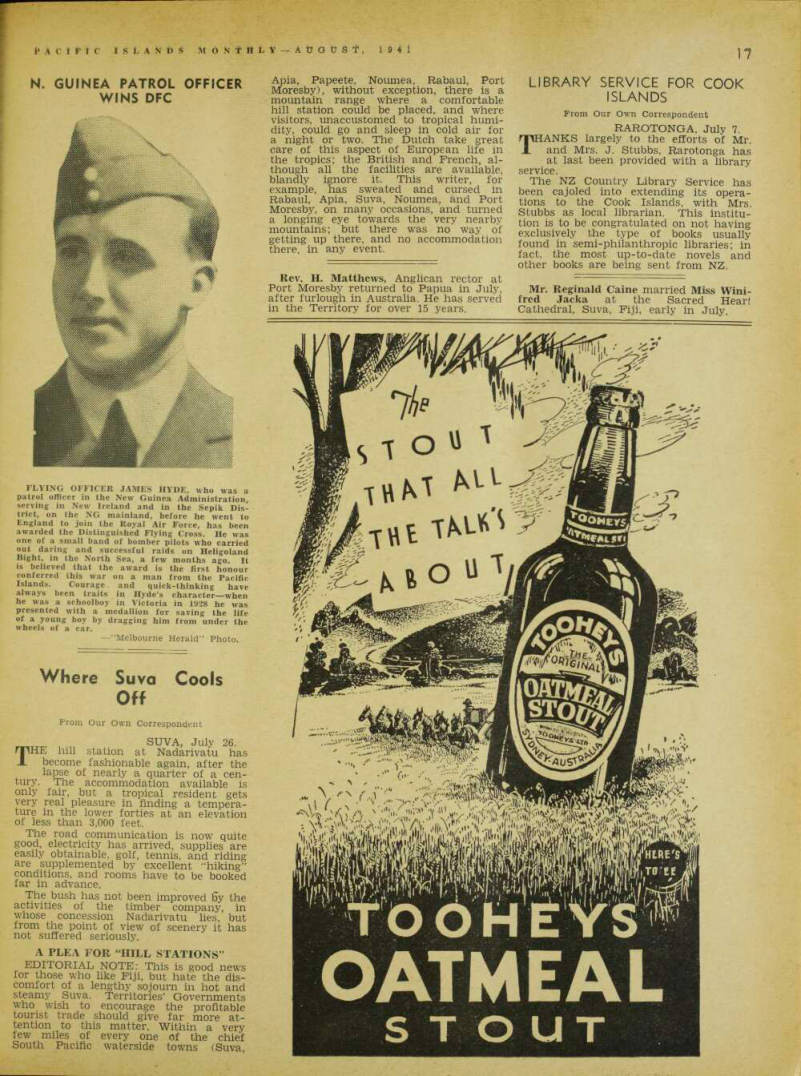
Wins Dfc
FLYING OFFICER JAMES HYDE, who was a patrol officer in the New Guinea Administration, serving in New Ireland and in the Sepik Dis trict, on the NG mainland, before he went to England to join the Royal Air Force, has been awarded the Distinguished Flying Cross. He was one of a small band of bomber pilots who carried out daring and successful raids on Heligoland Bight, in the North Sea, a few months ago. It is believed that the award is the first honour conferred this war on a man from the Pacific Islands. Courage and quick-thinking have always been traits in Hyde’s character—when he was a schoolboy in Victoria in 1928 he was presented with a medallion for saving the life of a young boy by dragging him from under the wheels of a car. —“Melbourne Herald” Photo.
Where Suva Cools
Off
From Our Own Correspondent SUVA, July 26. f¥IHE hill station at Nadarivatu has X become fashionable again, after the lapse of nearly a quarter of a cen tury. The accommodation available is only fair, but a tropical resident gets very real pleasure in finding a tempera ture in the lower forties at an elevation of less than 3,000 feet.
The road communication is now quite good, electricity has arrived, supplies are easily obtainable, golf, tennis, and riding are supplemented by excellent “hiking” conditions, and rooms have to be booked far in advance.
The bush has not been improved 6y the activities of the timber company, in whose concession Nadarivatu lies, but from the point of view of scenery it has not suffered seriously.
A Plea For “Hill Stations”
EDITORIAL NOTE; This is good news for those who like Fiji, but hate the dis comfort of a lengthy sojourn in hot and steamy Suva. Territories’ Governments who wish to encourage the profitable tourist trade should give far more at tention to this matter. Within a very few miles of every one of the chief South Pacific waterside towns (Suva,
Apia, Papeete. Noumea. Rabaul, Port Moresby), without exception, there is a mountain range where a comfortable hill station could be placed, and where visitors, unaccustomed to tropical humi dity, could go and sleep in cold air for a night or two. The Dutch take great care of this aspect of European life in the tropics; the British and French, al though all the facilities are available, blandly ignore it. This writer, for example, has sweated and cursed in Rabaul, Apia, Suva, Noumea, and Port Moresby, on many occasions, and turned a longing eye towards the very nearby mountains; but there was no way of getting up there, and no accommodation there, in any event.
Rev. H. Matthews, Anglican rector at Port Moresby returned to Papua in July, after furlough in Australia. He has served in the Territory for over 15 years.
Islands
Library Service For Cook
Prom Our Own Correspondent
Rarotonga, July 7.
rANKS largely to the efforts of Mr. and Mrs. J. Stubbs, Rarotonga has at last been provided with a library service.
The NZ Country Library Service has been cajoled into extending its opera tions to the Cook Islands, with Mrs.
Stubbs as local librarian. This institu tion is to be congratulated on not having exclusively the type of books usually found in semi-philanthropic libraries; in fact, the most up-to-date novels and other books are being sent from NZ.
Mr. Reginald Caine married Miss Wini fred Jacka at the Sacred Heart Cathedral, Suva, Fiji, early in July
Advertisements & other items, pp. 19-20 (2 items)
17
pacific Islands i9 4 i
mill
y O <1 >* K? $1 £ -• *' ?;: y' rr» OS 0 <l3 _i o > *1 30.. r* CV£f r S?*i
rvx^
'\v\\ \K'\ \:fv v '\
AUGUST, 1941-PACIFIC ISLANDS MON
m $ m
OILc
mm M. p^ ; i * i-l
¥\WM M
wmmmm i m ■
life
>■ >• • '‘JL • ...
The Lady: . and I always use Plume.”
Garageman: “You're wise, madam. I use it myself.
I find it gives splendid performance, and what is more important, you get an extra mile or two per gallon!” \ .
VACUUM
QUALITY PRODUCT
VACUUM OIL CO. PTY. LTD. (Incorp. in Aust.)
No Ships For Fiji
Sugar
One-Third of Crop Remains Unsold
BECAUSE Britain is short of shipping, and Fiji is at the opposite side of the globe (representing a voyage of maximum length) Fiji’s usual guaran teed sugar market has failed, this sea son. It is not expected that more than two-thirds of Fiji’s sugar-crop will be shipped to Britain this year. There is no indication, yet, of what will be done with the remainder.
London is doing everything possible, in co-operation with the Government of Fiji, to prevent too much hardship fall ing upon the Fiji sugar industry. The Colonial Office, the Fiji Government, and the Colonial Sugar Refining Co. (which has been helpful and co-operative) have agreed:— The company will purchase the cane as usual, but there will be no Imperial preference obtainable on the sugar that cannot be sold. The Imperial preference bonus of 3/6 a ton of cane will be pay able only on approximately two-thirds of the crop, but this will be distributed equally so that each grower will receive 2/6 bonus a ton of cane.
Topsy-Turvy Weather
Prom Our Own Correspondent
Samarai, July 24.
REPORTS coming in from the north, east, south and west tell of unsea sonable weather conditions prevail ing all over this part of the 'Pacific.
Nature seems to have overlooked the fact that we are now well into July, normally a wet and windy month, and, by ignoring our calendar and upsetting our meteorological prophecies, has in flicted a period of dryness that amounts, in many places, to a drought.
Travellers from the north-east coast say that the land there is parched and thirsty. From Misima comes news that, with water tanks empty, settlers have fallen back on creek water; while a report from the Trobriands tells of one resident using coconut milk for drinking purposes.
Luckily, to alleviate any acute distress around Samarai, the 18th saw the gath ering of storm clouds which finally broke into intermittent rainstorms. It is hoped that the change is general and that the abnormal period has passed.
EDITORIAL NOTE: Papua is not alone with its topsy-turvy weather.
Almost all the Western Pacific Islands are complaining that they have experi enced abnormal conditions during the past year. In Australia, the water posi tion is critical—Sydney, the Empire’s second largest city, has barely 8 months’ supply of water, even with strict rationing.
Frosts In New Guinea!
From Our Own Correspondent WAU, July 20. npHE nights and mornings have been A phenomenally cold lately; and at Edie Creek (7,000 feet up, as com pared with our 3,500) they have had a thermometer of 37, and white frosts on the ground.
Makolkols Again
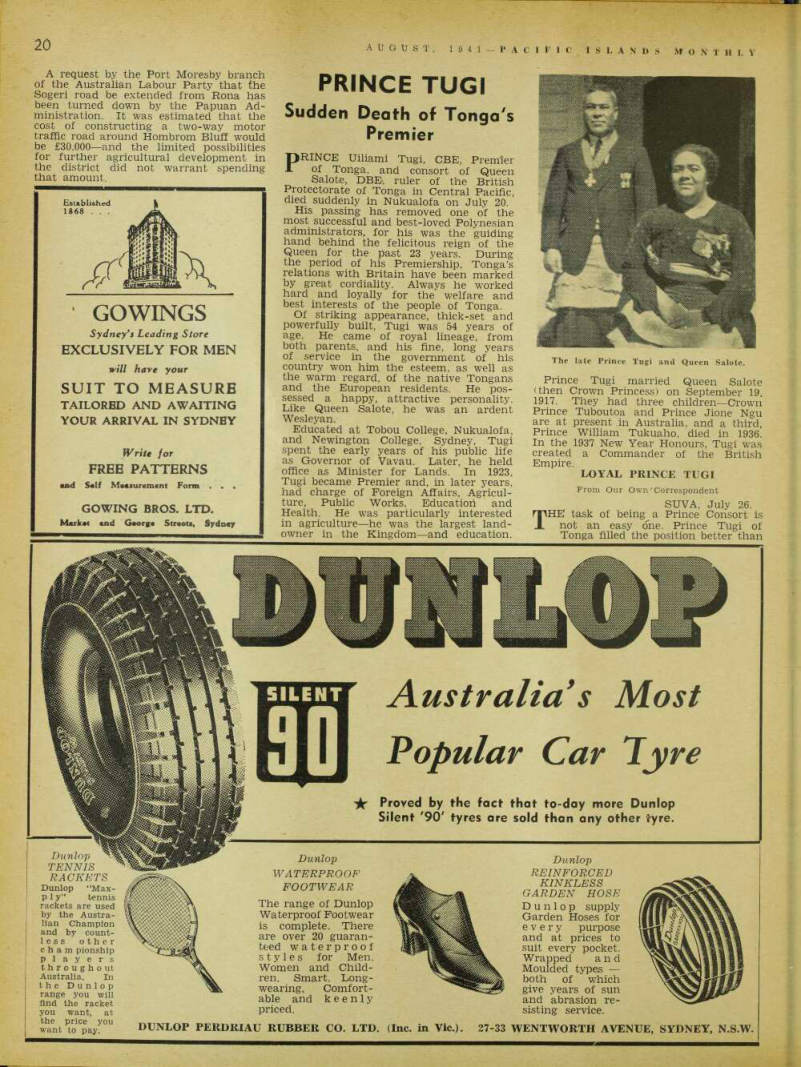
"Truce" is Off Six Natives Killed
IT is officially calculated that there are only about three score Makolkols in the districts on the south coast of New Britain (Territory of New Guinea); but, as they have the advantage of vast jungles and a mass of tangled mountains, they are a “pain-in-the-neck” to the Administration. There are two police patrols out after them, now; but anyone who has flown over that country, on the airmail route between Salamaua and Rabaul, will have full sympathy with the patrols.
For years past, the Makolkols—wild bush natives of nomadic habits —have been a nuisance. They dash down out of the jungle upon small, unprotected coastal villages, smash and grab, and run away again.
A few months ago, the Australian Minister for the Territories, Mr. Collins, announced that he “had made peace” with the Makolkols, and it was stated in various newspapers that the nomads had promised to be good lads and that the raids would cease.
But they all calculated without Mr.
Menzies. The Australian Prime Minister thoughtlessly moved Mr. Collins on to another Department, and a new Minister for Territories came in; and apparently, as soon as the king of the Makolkols was advised of the fact by the chief of his intelligence services, the truce was declared off. Or perhaps the king is modelling his kingship upon Adolf Hitler, and looks upon treaties only as some thing to be broken.
At any rate, at 9 a.m. on July 12, Makolkol raiders descended upon the village of Rakau, in the Wide Bay area, and six Rakauites were killed. The Makolkols went back into the mountains at the double. A police patrol was only a few hops behind; but, at the end of July, the murderers were still at large.
Mr. H. E. Maude, MBE, Administrative Officer in the Gilbert and Ellice Islands Colony, has been seconded to the British Service in Tonga as Acting British Agent and Consul at Nukualofa, while Mr. A.
Armstrong is spending furlough in New Zealand.
A request by the Port Moresby branch of the Australian Labour Party that the Sogeri road be extended from Rona has been turned down by the Papuan Ad ministration. It was estimated that the cost of constructing a two-way motor traffic road around Hombrom Bluff would be £30,000 —and the limited possibilities for further agricultural development in the district did not warrant spending that amount.
Advertisements & other items, pp. 21-22 (1 item)
Clvde
4?
WHY DIDNT
BOY A
CLYDE?/
!D u CD Stop experimenting with trouble.
How can you possibly know that you’ll get from here to there with an unsponsored battery you bought at a bargain price?
Stick to Clyde—the Batteries that not only have Australia’s largest commercial Engineering Works as a birthplace, but Batteries that are guaranteed unconditionally for long life and efficiency.
CLVDE
BATTER I E S
"MORE POWER TO YOU"
Manufactured by
THE CLYDE ENGINEERING
CO. LTD.
Granville, N.S.W.
Main Sales & Service Division, 61-65 Wentworth Avenue, Sydney. ’Phone: M 6738.
Branches at Brisbane, Melbourne, Adelaide.
W. H. GfiOVE & Sons Ltd.
AUCKLAND
Island Traders. p.o. bo* 490.
Telegraphic and Cable Address: “Grove”, Auckland.
Shippers of all classes of New Zealand Products, specially prepared for the Island trade.
Representing English Manufacturers throughout the Cook and Society Islands, Fiji, Tonga, Samoa, Niue, New Caledonia, New Guinea, etc.
In FIJI as—W. H. Grove & Sons (Fiji) Ltd.
Established 1868 V SjSkk
’ GOWINGS
Sydney’s Leading Store
EXCLUSIVELY FOR MEN
will have your
SUIT TO MEASURE
TAILORED AND AWAITING
YOUR ARRIVAL IN SYDNEY
Write for
FREE PATTERNS
S«lf Measurement Form
COWING BROS. LTD.
Market and George Streets, Sydney
Prince Tugi
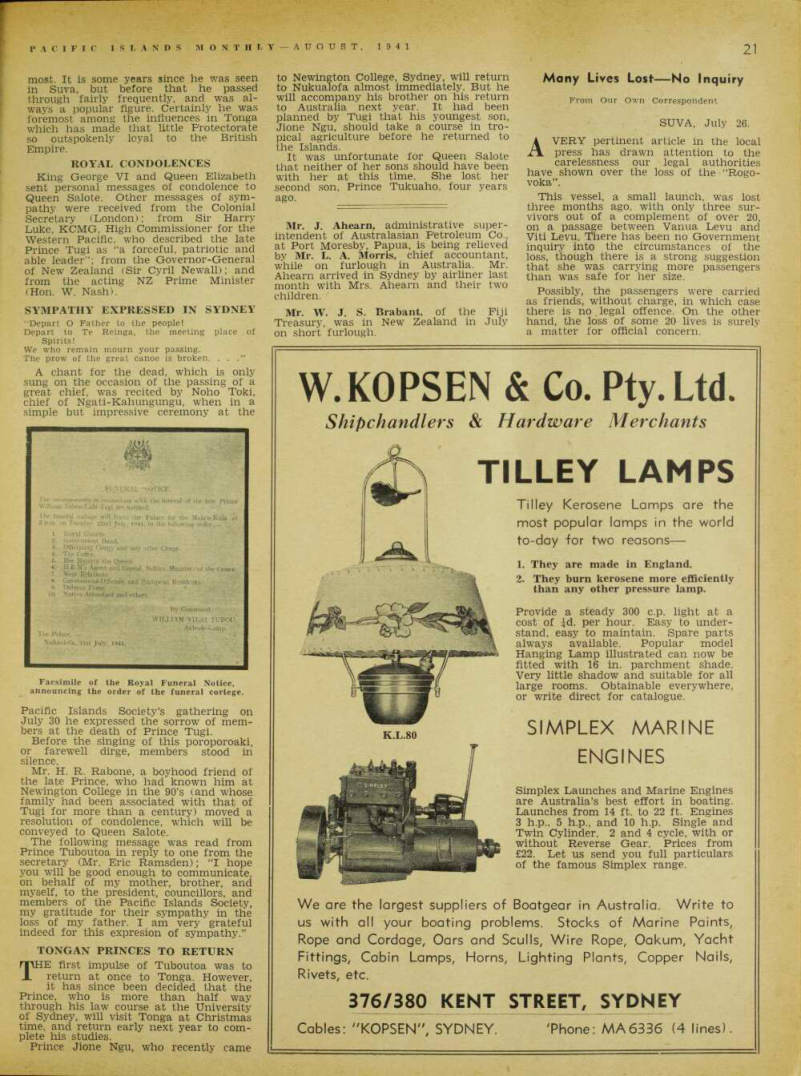
Sudden Death of Tonga's Premier
PRINCE Uiliami Tugi, CBE, Premier of Tonga, and consort of Queen Salote, DBE, ruler of the British Protectorate of Tonga in Central Pacific, died suddenly in Nukualofa on July 20.
His passing has removed one of the most successful and best-loved Polynesian administrators, for his was the guiding hand behind the felicitous reign of the Queen for the past 23 years. During the period of his Premiership, Tonga’s relations with Britain have been marked by great cordiality. Always he worked hard and loyally for the welfare and best interests of the people of Tonga.
Of striking appearance, thick-set and powerfully built, Tugi was 54 years of age. He came of royal lineage, from both parents, and his fine, long years of service in the government of his country won him the esteem, as well as the warm regard, of the native Tongans and the European residents. He pos sessed a happy, attractive personality.
Like Queen Salote, he was an ardent Wesleyan.
Educated at Tobou College, Nukualofa, and Newington College, Sydney, Tugi spent the early years of his public life as Governor of Vavau. Later, he held office as Minister for Lands. In 1923, Tugi became Premier and, in later years, had charge of Foreign Affairs, Agricul ture, Public Works, Education and Health. He was particularly interested in agriculture—he was the largest land owner in the Kingdom—and education.
Prince Tugi married Queen Salote (then Crown Princess) on September 19, 1917. They had three children—Crown Prince Tuboutoa and Prince Jione Ngu are at present in Australia, and a third, Prince William Tukuaho, died in 1936.
In the 1937 New Year Honours, Tugi was created a Commander of the British Empire.
Loyal Prince Tugi
From Our Own'Correspondent SUVA, July 26.
THE task of being a Prince Consort is not an easy one. Prince Tugi of Tonga filled the position better than
The late Prince Tugi and Queen Salote.
most. It is some years since he was seen in Suva, but before that he passed through fairly frequently, and was al ways a popular figure. Certainly he was foremost among the influences in Tonga which has made that little Protectorate so outspokenly loyal to the British Empire.
Royal Condolences
King George VI and Queen Elizabeth sent personal messages of condolence to Queen Salote. Other messages of sym pathy were received from the Colonial Secretary (London); from Sir Harry Luke. KCMG, High Commissioner for the Western Pacific, who described the late Prince Tugi as “a forceful, patriotic and able leader”; from the Governor-General of New Zealand (Sir Cyril Newall); and from the acting NZ Prime Minister (Hon. W. Nash).
Sympathy Expressed In Sydney
“Depart O Father to the people!
Depart to Te Reinga, the meeting place of Spirits!
We who remain mourn your passing.
The prow of the great canoe is broken. ...”
A chant for the dead, which is only sung on the occasion of the passing of a great chief, was recited by Noho Toki, chief of Ngati-Kahungungu, when in a simple but impressive ceremony at the
Pacific Islands Society’s gathering on July 30 he expressed the sorrow of mem bers at the death of Prince Tugi.
Before the singing of this poroporoaki, or farewell dirge, members stood in silence.
Mr. H. R. Rabone, a boyhood friend of the late Prince, who had known him at Newington College in the 90’s (and whose family had been associated with that of Tugi for more than a century) moved a resolution of condolence, which will be conveyed to Queen Salote.
The following message was read from Prince Tuboutoa in reply to one from the secretary (Mr. Eric Ramsden); “I hope you will be good enough to communicate, on behalf of my mother, brother, and myself, to the president, councillors, and members of the Pacific Islands Society, my gratitude for their sympathy in the loss of my father. I am very grateful indeed for this expresion of sympathy,”
Tongan Princes To Return
rr\HE first impulse of Tuboutoa was to JL return at once to Tonga. However, it has since been decided that the Prince, who is more than half way through his law course at the University of Sydney, will visit Tonga at Christmas time, and return early next year to com plete his studies.
Prince Jione Ngu, who recently came
to Newington College, Sydney, will return to Nukualofa almost immediately. But he will accompany his brother on his return to Australia next year. It had been planned by Tugi that his youngest son, Jione Ngu, should take a course in tro pical agriculture before he returned to the Islands.
It was unfortunate for Queen Salote that neither of her sons should have been with her at this time. She lost her second son, Prince Tukuaho. four years ago.
Mr. J, Ahearn, administrative super intendent of Australasian Petroleum Co., at Port Moresby, Papua, is being relieved bv Mr. L. A. Morris, chief accountant, while on furlough in Australia. Mr.
Ahearn arrived in Sydney by airliner last month with Mrs. Ahearn and their two children.
Mr. W. J. S. Brabant, of the Fiji Treasury, was in New Zealand in July on short furlough.
Facsimile of the Royal Funeral Notice, announcing the order of the funeral cortege.
Advertisements & other items, p. 22 (1 item)
p|ll Popular Car Pyre
& m i
SILENT
Australia's Most
p|ll Popular Car Pyre
★ Proved by the fact that to-day more Dunlop Silent "90" tyres are sold than any other tyre.
Dunlop
TENNIS
RACKETS
Dunlop “Max- P 1 y” tennis rackets are used by the Australian Champion and by countless other championship players through© ut Australia. In the Dunlop range you will find the racket you want, at the price you want to pay.
Dunlop
WATERPROOF
FOOTWEAR
The range of Dunlop Waterproof Footwear Is complete. There are over 20 guaranteed waterproof styles for Men, Women and Children. Smart. Longwearing, Comfortable and keenly priced.
Dunlop
REINFORCED
KINKLESS
GARDEN HOSE
Dunlop supply Garden Hoses for every purpose and at prices to suit every pocket.
Wrapped and Moulded types both of which give years of sun and abrasion resisting service.
DUNLOP PERDRIAU RUBBER CO. LTD. (Inc. in Vic.). 27-33 WENTWORTH AVENUE, SYDNEY, N.S.W.
Many Lives Lost—No Inquiry
From Our Own Correspondent SUVA, July 26.
AVERY pertinent article in the local press has drawn attention to the carelessness our legal authorities have shown over the loss of the “Rogo voka”.
This vessel, a small launch, was lost three months ago. with only three sur vivors out of a complement of over 20, on a passage between Vanua Levu and Viti Levu. There has been no Government inquiry into the circumstances of the loss, though there is a strong suggestion that she was carrying more passengers than was safe for her size.
Possibly, the passengers were carried as friends, without charge, in which case there is no . legal offence. On the other hand, the loss of some 20 lives is surely a matter for official concern.
Advertisements & other items, pp. 23-24 (1 item)
W.KOPSEN & Co. Pty.Ltd.
Shipchandlers & Hardware Merchants
K.I
TILLEY LAMPS
Tilley Kerosene Lamps are the most popular lamps in the world to-day tor two reasons— 1. They are made in England. 2. They burn kerosene more efficiently than any other pressure lamp.
Provide a steady 300 c.p. light at a cost of id. per hour. Easy to understand, easy to maintain. Spare parts always available. Popular model Hanging Lamp illustrated can now be fitted with 16 in. parchment shade.
Very little shadow and suitable for all large rooms. Obtainable everywhere, or write direct for catalogue.
SIMPLEX MARINE
ENGINES
Simplex Launches and Marine Engines are Australia’s best effort in boating.
Launches from 14 ft. to 22 ft. Engines 3 h.p., 5 h.p., and 10 h.p. Single and Twin Cylinder. 2 and 4 cycle, with or without Reverse Gear. Prices from £22. Let us send you full particulars of the famous Simplex range.
We are the largest suppliers of Boatgear in Australia. Write to us with all your boating problems. Stocks of Marine Paints, Rope and Cordage, Oars and Sculls, Wire Rope, Oakum, Yacht Fittings, Cabin Lamps, Horns, Lighting Plants, Copper Nails,
Rivets, etc.
376/380 KENT STREET, SYDNEY
Cobles: "KOPSEN", SYDNEY,
'Phone: MA6336 (4 lines)
RECORDS
BY MAIL
PALING’S stock of all types of records exceeds 10,000.
Every title is immediately available. Order from Paling’s with confidence. Your records will be securely packed and dispatched on the same day.
Write now for full information
and FREE LISTS.
a-
-388 GEORGE STREET, SYDNEY.
A NEW
LIGHTWEIGHT,
MEDIUM - PRICED CASE
IN ALL NEEDED SIZES !
Made by an improved new process, the new Fordite fibre is harder-wearing and longer-lasting. It is glossy and smooth . . . providing a highly serviceable travel case at a moderate price. It saves weight . . . pick up a new Fordite and you'll see at once how much lighter it is!
NEW FORDITE
TRAVEL CASES
Attache, No. 707. Suit Case, No. 718.
AH storekeepers can supply. Traders are invited to apply for price list and full particulars.
FORD SHERINGTON LTD.,
Manufacturers, Kippax Street, Sydney.
Copra-Growers ?
Why Not a Strike of Copra-Growers ?
Letter to the Editor rE situation of the copra producer is well explained in the June “PIM”.
First, we have Japan seeking copra in the Pacific. Then, on the same page, in a splendid cartoon, our friend “Rox” put the situation in a nutshell. Then comes “Relief for producers by the Copra Marketing Board”. After that, the com passionate allowance to destitute plant ers; and so on to “Ga ni Bulu’s” letter, explaining how and where all the profits are made.
Besides being a splendid magazine, describing events, not only in the Pacific, but in all parts of the world, the “PIM” seems to be the only paper with any sympathy for the copra producer. But in spite of its efforts we don’t seem to have got anywhere, and we are certainly no better off.
It costs money to build factory ships, and mills to manufacture the products from copra, and that’s where the shoe pinches. The planter has no money. His cry to the Government, to help with a loan, falls on deaf ears. No one will volunteer to come to his assistance. He
has explored every avenue through the medium of Government, merchant and press—all in vain.
His fellow-planters in distress are so far apart that it is impossible to discuss his problems at a well-attended meeting, so he goes on hoping and waiting for the “FIM” to tell him that someone has at last found a solution, and the “copra combines” have been put out of action.
So what?
I don’t think that is likely to happen, as the “c.c.” and their “fifth columnists” are too well organised. We planters are not organised; and, until we have some method of countering the combines, we shall go one taking whatever they like to give us for our produce.
Big business says that there are very few markets for copra, owing to other competing vegetable and fish oils. Yet all copra is used up; none is dumped or destroyed owing to over-production.
We don’t put a price on our * copra.
We allow the combines to tell us what they will pay us for it. Yet, when you buy a sack of flour or rice, or any article from the merchant, you don’t teil him what you are prepared to pay for it.
He tells you what you’ve got to pay, and you pay, or go without.
Taking into consideration these facts, why not try the same method on him?
It will mean sacrifice on the part of the planter and his family, but he won’t be much worse off than he has been for the last 10 years.
Why not put it to the test? My idea is simply this: Stop selling your conra for six or twelve months, unless the buyer is prepared to pav you £l5 per ton on the place—never mind the grade.
Get what necesserv supplies you need before you stop selling; also, make your plantations feed you. Grow your own foodstuffs as much as possible. There are plenty of fruits, and fish can be caught, end most plantations grow their own cattle, poultry, etc.
Some planters will be unable now to cut all their copra owing to labour wages. Their best plan is to carry on as best they can, or stop producing. Those who can carry on with cutting should store copra wherever possible—in out buildings, or make native huts—anvwhere, so long as it is weather-proof. Hold it until that £l5 per ton is forthcoming, but don’t sell under that.
For this schema to work, each planter must get all possible co-operation from other planters, not only in the Pacific but. if possible, from all copra producers throughout the world. lam readv to stop selling at once, and I submit this scheme to my fellow planters in distress, hoping it will solve
the problem.
I am, etc..
Leatherneck.
Vanua Levu, Fiji, 15/7/’4l.
US Rounds up Japanese Spies
THE seizure of 19 Japanese fishing boats in Hawaiian waters in July was the climax to a momentous case, which began last March when Hono lulu Customs officials seized 10 Japanese sampans, after a grand jury had in ducted 72 owners on charges of conspiracy and carrying false licences.
The United Press says that the seizure represented a partial round-up of spies.
Informed sources said the crews of the vessels included officers of the Japanese naval reserve.
Some of the vessels were equipped with powerful radio transmitters, and had complete sets of hydrographic charts of the Hawaiian Islands.
Mrs. Mary Lamb, formerly of Thursday Island, died at Mosman, Sydney, on July 11. She was 88 years of age.
Advertisements & other items, p. 25 (1 item)
iillin
m j\ irson have here the best range of "torrid zone" radio receivers ever produced. Before production was ever started on sets for island listeners, we checked up on weather conditions—best valves— best cabinet materials—best speaker—best circuits —all were taken into consideration to make the best radio and give you utmost reliability under tropical weather conditions. And here Airzone present a range of receivers beautiful of tone fascinating in cabinet design amazing in long distance reception and remarkably reliable under any condition whatsoever. Particular attention was given to overseas short wave reception.
Innumerable developments have been made in these receivers so that overseas reception can be received with amazing clarity and volume.
"Airzone's tone is Airzone's own."
Above left is Model 6552 A, Airzone's new "Concert Star," a 5 Valve A.C. Mantel Dual Wave of wonderful long distance reception.
Here again, at left. Airzone proudly presents Model 5098, 5 Valve 1.4 Volt Battery mantel Dual Wave. Also as Model 5059. 5 Valve Vibrator powered Dual Wave.
At right is Airzone's massive 8 Valve A.C.
Dual Wave Console Model 1082 A. designed for far-reaching overseas reception.
Agents for New Guinea, Papua and Solomon Islands:—
tea
At left is veneered mantel made in 4 models —Model 10S2AM, 6 Valve A.C. Dual Wave; Model 1072VM, 7 Valve Vibrator Dual Wave; Model 1162 WM, 6 Valve 2 Volt Battery Dual Wave; and Model 1252VM, 5 Valve Vibrator Dual Wave.
W. R. CARPENTER & CO., LTD.
19 O'Connell Street, Sydney; Salamaua, Rabaul, Kavieng and Madang, N.G., and Tulagi, Solomon Islands. Campirfaum. N.S.w! * HAsei Designed and manufactured n
ullllii
mill i»
nilki
min u hi mm
|M lI U[
'Hi,
liinill
u '\\" 111111 l mm mi ml mm mill m "HI"
iillin
mm mi ml mm mill ii 1.1 in ii i, miin r;"i 'll',
liiiiiif
Continuing Dust
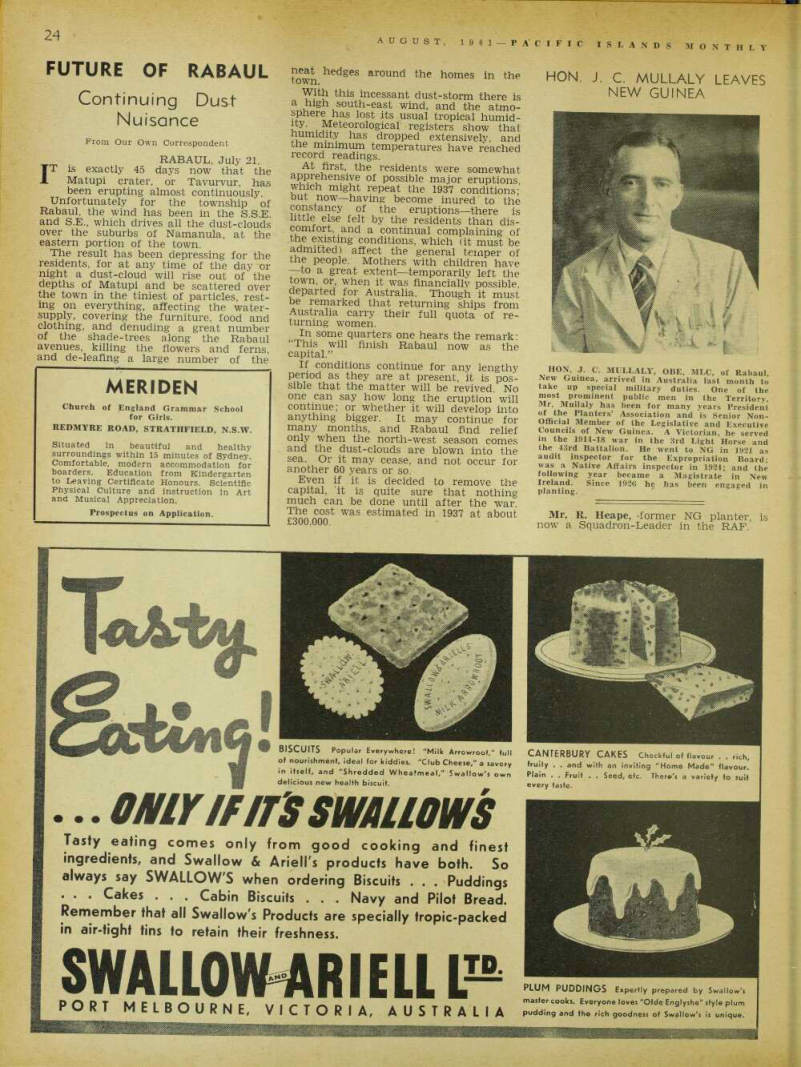
Future Of Rabaul
Nuisance
From Our Own Correspondent
Rabaul, July 21.
IT is exactly 45 days now that the Matupi crater, or Tavurvur, has been erupting almost continuously.
Unfortunately for the township of Rabaul, the wind has been in the S.S.E. and S.E., which drives all the dust-clouds over the suburbs of Namanula, at the eastern portion of the town.
The result has been depressing for the residents, for at any time of the day or night a dust-cloud will rise out of the depths of Matupi and be scattered over the town in the tiniest of particles, rest ing on everything, affecting the water supply, covering the furniture, food and clothing, and denuding a great number of the shade-trees along the Rabaul avenues, killing the flowers and ferns, and de-leafing a large number of the
fown hedges around homes in the With this incessant dust-storm there is a high south-east wind, and the atmo sphere has lost its usual tropical humid ity. Meteorological registers show that humidity has dropped extensively, and me minimum temperatures have reached record readings.
At first, the residents were somewhat a ?P r^ en - s * ve of possible major eruptions, which might repeat the 1937 conditions; but now—having become inured to the constancy of the eruptions—there is little else felt by the residents than dis comfort, and a continual complaining of the existing conditions, which (it must be admitted) affect the general temper of the people. Mothers with children have —to a great extent—temporarily left the town, or, when it was financially possible, departed for Australia. Though it must be remarked that returning ships from Australia carry their full quota of re turning women. ( In some quarters one hears the remark: “This will finish Rabaul now as the capital.”
If conditions continue for any lengthy period as they are at present, it is pos sible that the matter will be revived. No one can say how long the eruption will continue; or whether it will develop into anything bigger. It may continue for many months, and Rabaul find relief only when the north-west season comes and the dust-clouds are blown into the sea. Or it may cease, and not occur for another 60 years or so.
Even if it is decided to remove the capital, it is quite sure that nothing much can be done until after the war.
The cost was estimated in 1937 at about £300,000.
New Guinea
Hon. J. C. Mullaly Leaves
Mr. R. Heape, -former NG planter, is now a Squadron-Leader in the RAF.
H ON. J. C. MULLALY, OBE, MLC, of Rabaul.
New Guinea, arrived in Australia last month to take up special military duties. One of the most prominent public men in the Territory, Mr. Muilaly has been for many years President of the Planters’ Association and is Senior Non- Official Member of the Legislative and Executive Councils of New Guinea. A Victorian, he served in the 1914-18 war in the 3rd Light Horse and the 43rd Battalion. He went to NG in 1921 as audit inspector for the Expropriation Board; was a Native Affairs inspector in 1924; and the following year became a Magistrate in New Ireland. Since 1926 he has been engaged in planting.
Advertisements & other items, p. 26 (2 items)
Meriden
Church of England Grammar School for Girls.
REDMYRE ROAD, STRATHFIELD, N.S.W.
Situated in beautiful and healthy surroundings within 15 minutes of Sydney.
Comfortable, modern accommodation for boarders. Education from Kindergarten to Leaving Certificate Honours. Scientific Physical Culture and instruction in Art and Musical Appreciation.
Prospectus on Application.
Swallowarielll”
BISCUITS Popular Everywhere! "Milk Arrowroot," full of nourishment, ideal for kiddies. "Club Cheese," a savory in itself, and "Shredded Wheafmeal," Swallow's own delicious new health biscuit. • •
. ONLY IF ITS SWALLOWS
Tasty eating comes only from good cooking and finest ingredients, and Swallow & Ariell's products have both. So always say SWALLOW'S when ordering Biscuits . . . Puddings . . . Cakes . . . Cabin Biscuits . . . Navy and Pilot Bread.
Remember that all Swallow's Products are specially tropic-packed in air-tight tins to retain their freshness.
SWALLOWARIELLL”
PORT MELBOURNE, VICTORIA, AUSTRALIA
CANTERBURY CAKES Chockful of fruity . . and with an inviting "Home Plain . . Fruit . . Seed, etc. There's a every taste. flavour . . rich.
Made" flavour, variety fo suit PLUM PUDDINGS Expertly prepared by Swallow's master cooks. Everyone loves "Olde Englyshe" style plum pudding and fhe rich goodness of Swallow's is unique.
An Escape From
Greece
NEW Guinea was well represented in this story of the adventures of a band of Australian soldiers in Greece, as told by the correspondent of Sydney “Sun”:— Sixty-nine Australian soldiers who arrived in a Middle East port in June aboard a British destroyer are the cen tral figures in one of the most amazing dramas of the Greek campaign.
Captain Robert Vial, formerly of Cam berwell, Victoria (and a brother of a New Guinea ADO) shared with Captain Philip Woodhill (a well-known officer of the Crown Law Department, Rabaul) the task of guiding the small force to safety through almost incredible perils.
The English brigadier told the assem bled officers that he considered further resistance useless. He invited any offi cers and men who did not wish to sur render to leave the Kalamata area by 5 a.m.
Captain Vial explained the position to the Australians under his command, and asked if any wished to join him in a forlorn attempt to escape further down the coast.
“We followed the coast along a trail made by goats,” said Captain Vial.
“Then we reached a cove in which lay a ketch, anchored about 400 yards from the beach. As bad luck would have it, we were all ready to leave when three Ger man planes appeared overhead. Incen diary bullets set the ketch afire, and there was nothing for it but for every body to get ashore as best he could.
“The remainder of the men then formed into column again and set off once more on their trek along the coast.
Some villagers escorted us to the village of Taikheila, where we learned that a number of British troops were some miles further south.
“An English colonel greeted me,” said Captain Vial. “He had no good news for us. He told me there were no boats available, but that a watch was being kept for warships.
“We were wakened in the morning by the Greek peasants, who came running to the church to tell us that the Ger mans were advancing rapidly and were only six hours distant in one direction and one and a half hours distant in another direction.
“Everyone of us decided we wouldn’t surrender without making another bid.
As this stage some of the English troops decided to join us and cast in their lot with us in the last bid for freedom.
“We went bush and, as soon as it was dark, went back to Taikheila. We decided to sleep on the beach and posted pickets at either end. At about 3 a.m., one of the pickets aroused me and whispered that lights were flashing offshore.
“I rowed out in the dinghy and found a British destroyer. As rapidly as pos sible, everyone on the beach was taken off. the total of 110 men including 69 Australians.”
Mr. A. Brennan, of the Seventh Day Adventist Mission, Ramu, Central New Guinea, accompanied by Mrs. Brennan and their daughter, arrived in Sydney recently on leave.
Miss J. Bremner has taken up duties at Apia Hospital, Western Samoa, as nursing sister.
Mrs. Lily Butler, widow of Mr. J. H.
Butler (a former well-known Suva jeweller), died in Suva recently. She was 70 years of age and had lived in Fiji since she was a baby.
Monsieur Andre Delaplane, a French planter in the New Hebrides, who now is a member of the Free French Forces in New Caledonia, was married recently at Noumea Cathedral to Mile. Jacqueline de Fillel.
Advertisements & other items, pp. 27-28 (1 item)
Nestle S^Milr
T«
dexsF-D I>
sw i fwi
s fared
FEARED IN A
O N (AUSTfe
«» T fO» 7 • -»V w &£' a i Nestle’s Sweetened Condensed Milk perfectly solves the problem of providing a safe milk supply for tropical climates. Nestle’s Sweetened Condensed Milk is milk supplied from healthy cows grazing on rich pastures and from the moment it is received at the condensery until it is finally sealed into its dust-proof, germ-proof containers the most effective precautions are taken to ensure its purity. Whenever you use Milk use Nestle’s Sweetened Condensed Milk—it is absolutely pure and safe.
COPYRIGHT 8227
NESTLE S^MILR
/ rv, Trained Men are Indispensable That’s why I.C.S. Students get the good jobs and hold them !
I T S 140 ELIZABETH STREET,
SYDNEY.
Sirs, —Please send free prospectus showing how 1 can succeed in the occupation I have marked X Accountancy —Secretarial (all Inst. Ex.) Bookkeeping —General, Store, Station.
Salesmanship —Gen., Speciality, Retail. -Psychology and Personality in Business.
Advertising —Retail, Mail-Ord., Agency.
Window Disp. —Show Card, Shop Tckts.
Illustrating —Newspaper, Fash., Poster.
Free Lance Jour'ism —Short Story Writ.
Matriculation —Leaving-Inter.-Pub. Serv.
Gen. Education —Bus. and Sales Letters.
Police Entr. Exam., Nurses Entr. Exam.
Architecture —Structural Concrete.
Building Contracting —Air Conditioning.
Draftsmanship (Mech. & all branches).
Motor Eng. —Mtr. Mech., Mtr. Exams.
Diesel Eng. —lllumin. Engr., Weld. Eng.
Internal Comb, and Steam Drivers' Exs.
Radio Eng. —Radio Serv., Radio Exms.
Aero Eng. —Gd. Eng., Licenses, Rigging.
Elec. Eng. —Elec. Cont. & Mechs' Exms.
Civil Eng-. —Shire Eng.—Shire Overseer.
Textile (all branches) —Analyt. Chem.
Dress Design —Drafting, Cutting, Mlnry. (Underline your subject above—if not on list write it here ) Enquiries cost a 2d. stamp Post Now!
Si:::”:::;:::™
INTERNATIONAL CORRESPONDENCE SCHOOLS
The Unhappy Situation Of
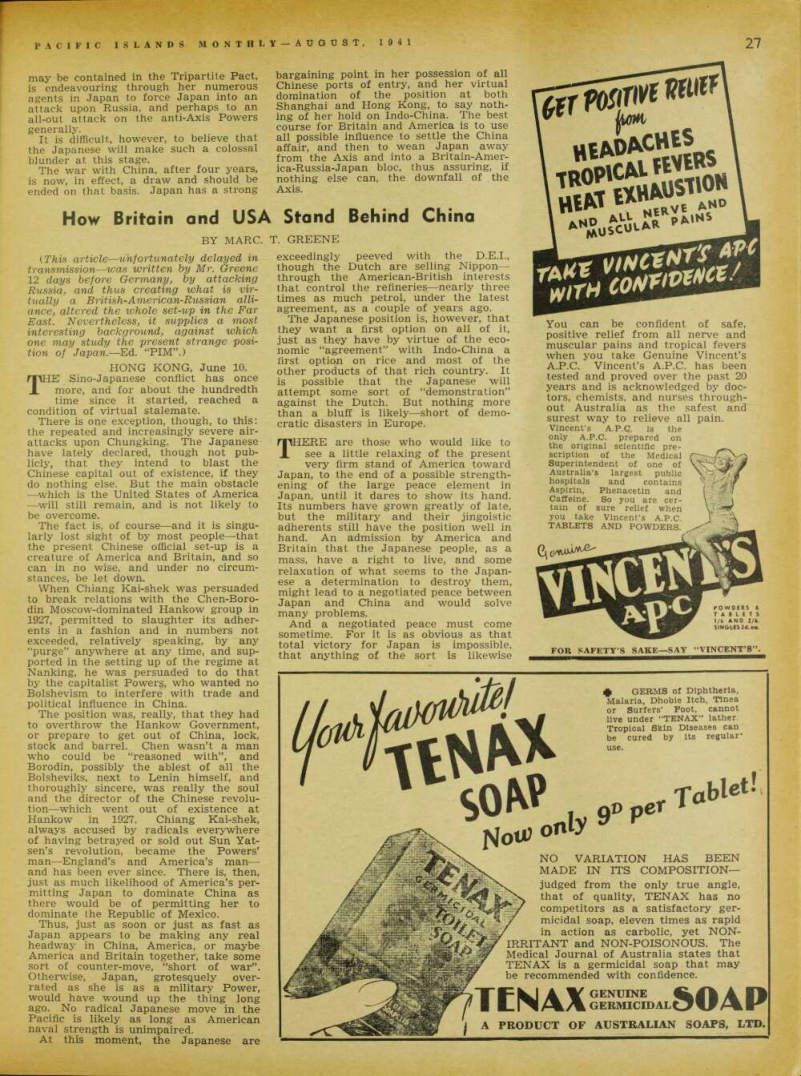
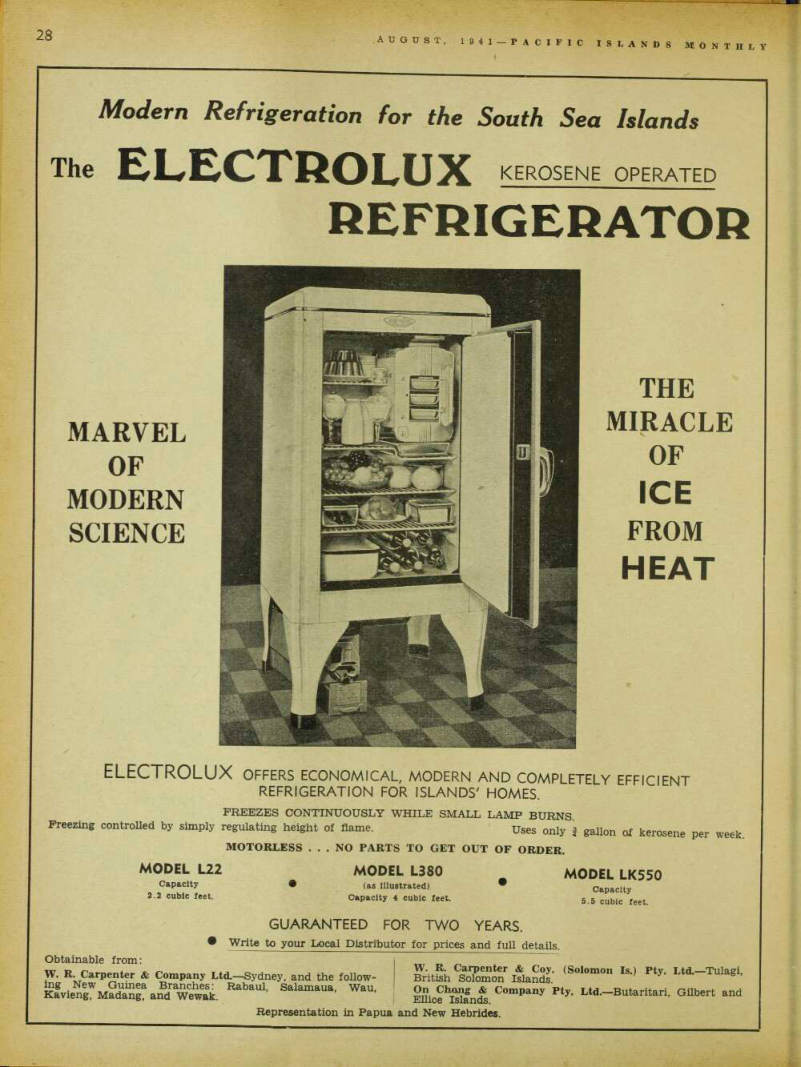
Japan
How the Russo-German War Has Altered the Far Eastern Strategical Set-Up
By Marc. T. Greene
r HONG KONG, July 2.
E sudden attack by Germany upon Russia has placed Japan in an extraordinary position. The Japan ese feel themselves to be between two fires, or maybe three or four. Their country is in the incredible position of being committed to two Powers, along similar lines —Powers which are now at each other’s throats.
Which side is Japan to take, if either?
If there is any answer to that one, it depends a good deal on the nature of the secret commitments in Japan’s pacts with both the Axis and the Soviet. Those can only be guessed at, of course.
But, in view of the fact that nobody now pays any attention to pacts, clauses, promises, commitments or “gentlemen’s agreements”, the Japanese game would seem to be watchful waiting for the time being. To pick a way out of the political and diplomatic labyrinth the Japanese have now manoeuvred them selves into (or been manoeuvred into) would need something even more than the silken cord of Theseus.
Chinese propaganda is now desper ately striving to “sick” the Japanese onto Russia. Disastrous as any such blundering move would be for Japan, it would be a triumph for China, because it would bring the whole of the demo cratic forces, probably including Amer ica—all now being astonishingly aligned
with the once-hated “Reds”—against her.
But any such move by Japan is unlikely, even in the event of a Soviet defeat by the Germans. The Japanese are not apt to forget that Russia has a thousand or more fighting planes at Vladivostock, and that they would make short work of the flimsily-built Japanese cities.
A wiser policy, on Japan’s part, would be her immediate resort to a more con ciliatory attitude toward both Britain and America; and there is no doubt at all that such is the policy favoured by the growing peace element in Japan.
But it dare not yet come out into the open because the military, and the big industrialists who are behind them, have the position too well in hand. They will keep it in hand as long as America continues her Japan-baiting policy.
Inside information on the internal position in Japan indicates that, through the present drastically - regimented national economy, she is likely to be able to carry on as at present, barring further expansionist commitments, for a couple of years longer. The folly of any further such commitments, especially if thby involved, or risked involving, clashes with the democratic bloc, is, then, obvious.
Undoubtedly Germany, in view of whatever secret clauses to that effect
may be contained in the Tripartite Pact, is endeavouring through her numerous agents in Japan to force Japan into an attack upon Russia, and perhaps to an all-out attack on the anti-Axis Powers generally.
It is difficult, however, to believe that the Japanese will make such a colossal blunder 3t this st3go.
The war with China, after four years, is now, in effect, a draw and should be ended on that basis. Japan has a strong
How Britain and USA Stand Behind China
By Marc. T. Greene
(This article —unfortunately delayed in transmission —was written by Mr. Greene 12 days before Germany, by attacking Russia, and thus creating what is vir tually a British-American-Russian alli ance, altered the whole set-up in the Far East. Nevertheless, it supplies a most interesting background, against which one may study the present strange posi tion of Japan. —Ed. “PIM”.)
Hong Kong, June 10.
rE Sino-Japanese conflict has once more, and for about the hundredth time since it started, reached a condition of virtual stalemate.
There is one exception, though, to this: the repeated and increasingly severe air attacks upon Chungking. The Japanese have lately declared, though not pub licly, that they intend to blast the Chinese capital out of existence, if they do nothing else. But the main obstacle —which is the United States of America —will still remain, and is not likely to be overcome.
The fact is, of course—and it is singu larly lost sight of by most people—that the present Chinese official set-up is a creature of America and Britain, and so can in no wise, and under no circum stances, be let down.
When Chiang Kai-shek was persuaded to break relations with the Chen-Boro din Moscow-dominated Hankow group in 1927, permitted to slaughter its adher ents in a fashion and in numbers not exceeded, relatively speaking, by any “purge” anywhere at any time, and sup ported in the setting up of the regime at Nanking, he was persuaded to do that by the capitalist Powers, who wanted no Bolshevism to interfere with trade and political influence in China.
The position was, really, that they had to overthrow the Hankow Government, or prepare to get out of China, lock, stock and barrel. Chen wasn’t a man who could be “reasoned with”, and Borodin, possibly the ablest of all the Bolsheviks, next to Lenin himself, and thoroughly sincere, was really the soul and the director of the Chinese revolu tion —which went out of existence at Hankow in 1927. Chiang Kai-shek, always accused by radicals everywhere of having betrayed or sold out Sun Yat sen’s revolution, became the Powers’ man—England’s and America’s man— and has been ever since. There is, then, just as much likelihood of America’s per mitting Japan to dominate China as there would be of permitting her to dominate the Republic of Mexico.
Thus, just as soon or just as fast as Japan appears to be making any real headway in China, America, or maybe America and Britain together, take some sort of counter-move, “short of war”.
Otherwise, Japan, grotesquely over rated as she is as a military Power, would have wound up the thing long ago. No radical Japanese move in the Pacific is likely as long as American naval strength is unimpaired.
At this moment, the Japanese are
bargaining point in her possession of all Chinese ports of entry, and her virtual domination of the position at both Shanghai and Hong Kong, to say noth ing of her hold on Indo-China. The best course for Britain and America is to use all possible influence to settle the China affair, and then to wean Japan away from th.o Axis 3nd into 3 Brit3.in-Arn.or ica-Russia-Japan bloc, thus assuring, if nothing else can, the downfall of the Axis.
exceedingly peeved with the D.E.1., though the Dutch are selling Nippon— through the American-British interests that control the refineries —nearly three times as much petrol, under the latest agreement, as a couple of years ago.
The Japanese position is, however, that they want a first option on all of it, just as they have by virtue of the eco nomic “agreement” with Indo-China a first option on rice and most of the other products of that rich country. It is possible that the Japanese will attempt some sort of “demonstration” against the Dutch. But nothing more than a bluff is likely—short of demo cratic disasters in Europe. rpHERE are those who would like to X see a little relaxing of the present very firm stand of America toward Japan, to the end of a possible strength ening of the large peace element in Japan, until it dares to show its hand.
Its numbers have grown greatly of late, but the military and their jingoistic adherents still have the position well in hand. An admission by America and Britain that the Japanese people, as a mass, have a right to live, and some relaxation of what seems to the Japan ese a determination to destroy them, might lead to a negotiated peace between Japan and China and would solve many problems.
And a negotiated peace must come sometime. For it is as obvious as that total victory for Japan is impossible, that anything of the sort is likewise
impossible for China —unless the United States makes a military alliance with her.
The argument that a negotiated peace would leave Japan free for southward adventures of a dangerous character has less weight than appears, inasmuch as no negotiated peace would be possible without America’s consent, and Amer ica’s persuasion of China to it, ahd neither could happen unless Japanese assurances of abandonment of any undertakings south of Saigon were given.
Exploitation of Indo-China’s resources would aid largely in rehabilitating Japanese internal economy, and resump tion of full trade relations with Britain and America would complete that reha bilitation.
Advertisements & other items, pp. 28-30 (1 item)
JiuswjJnivuL.
/ *3 73 s A 500
CANDLE I JKm*
POWER LI WBi
I 300
CANDLE
POWER
BRIGHTER LIGHT
for
BETTER SIGHT
Coleman Products can be obtained from all Leading Firms throughout the Pacific Islands.
JiuswjJnivuL.
o-fr ihe. T
3 Coleman Mantles supply Sun-like light.
Instant Lighting Stores & Irons giving maximum of heat in minimum of time
EASE OF OPERATION
combines
ECONOMY with COMFORT
In case of difficulty In obtaining supplies write to:— Pearce & Co., Suva, Fiji Is.
'.S§T
aM mo»co«.ah p^ ,nS
e/ You can be confident of safe, positive relief from all nerve and muscular pains and tropical fevers when you take Genuine Vincent’s A.P.C. Vincent’s A.P.C. has been tested and proved over the past 20 years and is acknowledged by doctors, chemists, and nurses throughout Australia as the safest and surest way to relieve all pain.
Vincent’s A.P.C. is the only A.P.C. prepared on the original scientific prescription of the Medical Superintendent of one of Australia’s largest public hospitals and contains Aspirin, Phenacetln and Caffeine. So you are certain of sure relief when you take Vincent’s A.P.C.
TABLETS AND POWDERS.
HO*
POWOtRS 4
lA■I E T S
1/6 AND 2/4.
SINGLIS 2d. to.
FOR SAFETY’S SAKE—SAY “VINCENT’S”.
uhk*
sow
NotU
-V: W GERMS of Diphtheria, Malaria, Dhobie Itch, Tinea or Surfers’ Foot, cannot live under “TENAX” lather.
Tropical Skin Diseases can be cured by its regularuse.
90 per
NO VARIATION HAS BEEN
MADE IN ITS COMPOSITION—
judged from the only true angle, that of quality, TENAX has no competitors as a satisfactory germicidal soap, eleven times as rapid in action as carbolic, yet NON-
IRRITANT and NON-POISONOUS. The
Medical Journal of Australia states that TENAX is a germicidal soap that may be recommended with confidence.
TENAX
GENUINE
GERMICIDAL
SOAP
I A PRODUCT OF AUSTRALIAN SOAPS, LTD.
Modern Refrigeration for the South Sea Islands
The ELECTROLUX KEROSENE OPERATED
REFRIGERATOR
MARVEL
OF
MODERN
SCIENCE
THE
MIRACLE
OF
ICE
FROM
HEAT
ELECTROLUX offers economical, modern and completely efficient
REFRIGERATION FOR ISLANDS' HOMES.
FREEZES CONTINUOUSLY WHILE SMALL LAMP BURNS
Freezing controlled by simply regulating height of flame. Uses only gallon of kerosene per week MOTOBLESS ... NO PARTS TO GET OUT OF ORDER.
MODEL L 22
Capacity 2.2 cubic feet.
Obtainable from: W. R. Carpenter & Company Ltd.—Sydney, and the following New Guinea Branches: Rabaul, Salamaua, Wau.
Kavieng, Madang, and Wewak.
MODEL L3BO
• (as Illustrated) ® Capacity 4 cubic feet.
GUARANTEED FOR TWO YEARS.
Write to your Local Distributor for prices and full details.
MODEL LKSSO
Capacity 5.5 cubic feet.
Representation in Papua and New Hebrides W. R. Carpenter & Coy. (Solomon Is.) Pty. Ltd. —Tulagi, British Solomon Islands.
On Chong & Company Pty. Ltd.—Butaritari, Gilbert and Ellice Islands.
Watch
Australia On The
Vast Screen of Air-Bases Keeps Guard Over the Seas
LATE on July 30, the Australian Minister for Air (Mr. McEwen) and the Australian Chief of the Air Staff (Sir Charles Burnett) returned to Melbourne, after a lengthy absence in which they covered thousands of miles in civil aircraft, bombers and flying boats.
The newspapers gave no indication of where they had been; but the Minister said that his tour had confirmed that Australia had established a strong screen of defensive and reconnaissance air bases, which now exists as a buffer against invasion.
He said that the new stations include both land and seaplane bases, and that they represent the first line of Austra lia’s defences, and make possible the maintenance of an intense and compre hensive reconnaissance of waters in which Australia has a vital interest. He said further that aircraft operating from these bases make the future operation of enemy raiders seeking to interfere with Australian shipping exceedingly hazard ous.
The Minister also said that with the new Catalina aircraft, which could remain ,in the air for more than 24 hours, if necessary, Australia had an ideal type of aircraft for ocean recon naissance. Australian land-planes now were of a type which could not only conduct long patrols, out to sea, but also could strike powerful blows at ship tar gets. The large-range torpedo-carrying Beauforts, now being made in Australia, also represented “a tremendously import ant acquisition to the striking power of the RAAF”.
Mrs. E. Turner, of Samarai, Papua, has received a letter from her son, Private H. G. Turner, a member of the AIF who was wounded at Bardia, in Libya, early in this year. Private Turner is now in a convalescent depot in the Middle East, where he is making reasonably satisfac tory progress. It was erroneously stated, in a recent issue, that Private Turner had recovered and rejoined his unit.
Mr. and Mrs. F. de Russett, who were married in June at St. Augustine’s Church, Wau, TNG, the bride formerly being Miss Edna Tennant, have taken up residence at Edie Creek.
Tutu Tekanene, Senior NMP in the Gilbert and Ellice Islands Colony, was recently awarded the Medal of the Most Excellent Order of the British Empire.
An Enterprising Papuan
From Our Own Correspondent
Pt. Moresby, July 28.
PITANA Hera, an outstanding native of Kila Kila village, who for many years has been apprenticed to a well-known Port Moresby builder and contractor, Mr. R. S. Munro, is now competing in the building trade himself.
Previously, he had been engaged in carpentry and building work, but with the increasing demand for European dwellings he has set up as a contractor.
Employing a staff of native labourers and assistants, he has undertaken the build ing of several European houses at the one time. It is understood that the con tract price of one of these buildings amounts to £7O.
It was obvious from the beginning that the only way to conserve the Papuan was to prepare him for an industrial career and for many years past natives
have received industrial instruction, not only from the Administration and the Missions but also from settlers them selves. That they have benefited is shown by the number of natives now employed as carpenters and tradesmen throughout the Territory.
Petrol Rationing in Samoa
From Our Own Correspondent APIA, July 9.
BRINGING Samoa into line with Aus tralia and New Zealand, restrictions on the use of petrol have been intro duced in the Territory, as from June 30.
Sale of gasoline is allowed only by per mit and is limited to 4 gallons weekly for private cars, 6 for business cars, 18 for taxis and lorries. 10 for light vans and plantation vehicles, and 22 for buses.
Mr. H. Gregory, who returned last month to New Guinea after spending leave in Australia, is now stationed at Rabaul as District Officer for New Britain.
Advertisements & other items, pp. 31-32 (1 item)
Ikc T 0 Hia
BITTt R
makM RA $ 5 IS *
TAKE THE
“LEAD” FEELING
OUT OF YOUR LEGS
Get More Oxygen in Your Blood and Get that Pep that Sends You Bounding Up the Stairs.
People who smother to death die because oxygen has been completely cut off from them. Just as surely you are slowly smothering if your blood lacks red corpuscles. Red corpuscles are your oxygen carriers. They carry the oxygen you breathe in to every part of your system.
Without enough oxygen-carrying corpuscles, your kidneys, liver, stomach and bowels slow down. Your skin gets pale, flabby, often pimply. Your nerves may become jittery—you tire quickly— feel depressed.
What you need is Dr. Williams’ Pink Pills. These world-famous pills help you make more and better red corpuscles and thus increase the oxygen-carrying power of your blood. Get Dr. Williams’
Pink Pills to-day at your chemist or store and see for yourself how quickly this time-proven blood-builder will help give you back your pep and clear complexion.***
Anti-Malaria Discovery
A CHEMICAL preparation which, it is claimed, will save troops from malaria-carrying mosquitoes, has been perfected by Dr. Botha de Meillon, entomologist of the South African Insti tute for Medical Research (says Michael Terry in a recent issue of “Sydney Morning Herald”).
When Dr. de Meillon had perfected his preparation, he covered his arm with it and thrust it into a cage in which he had bred a large number of anopheles mosquitoes. Not one mosquito ventured near his hand or arm. Then he thrust his other arm within the cage without protecting it with his preparation. It was at once attacked.
Dr, Meillon visited Yugoslavia and Italy before the war in connection with his work on malaria. Recently he cleared up the mystery of how Transvaal people who had not been near a malaria area for years suddenly went down with the fever. Painstaking investigations estab lished that these unfortunates lived oppo site a garage at which cars from a malaria area halted for petrol. This led to the discovery that infected mos quitoes had travelled some hundreds of miles as “passengers”.
Miss Margaret Bechervaise retired re cently after 26 years’ service with the Anglican Mission in Papua, and now is in Melbourne on final furlough. In the Territory, she was occupied mainly in native educational work, her last post being at Sefoa and she possessed an intimate knowledge of the Papuan natives, their language, and their ways.
Gallantly Carrying On
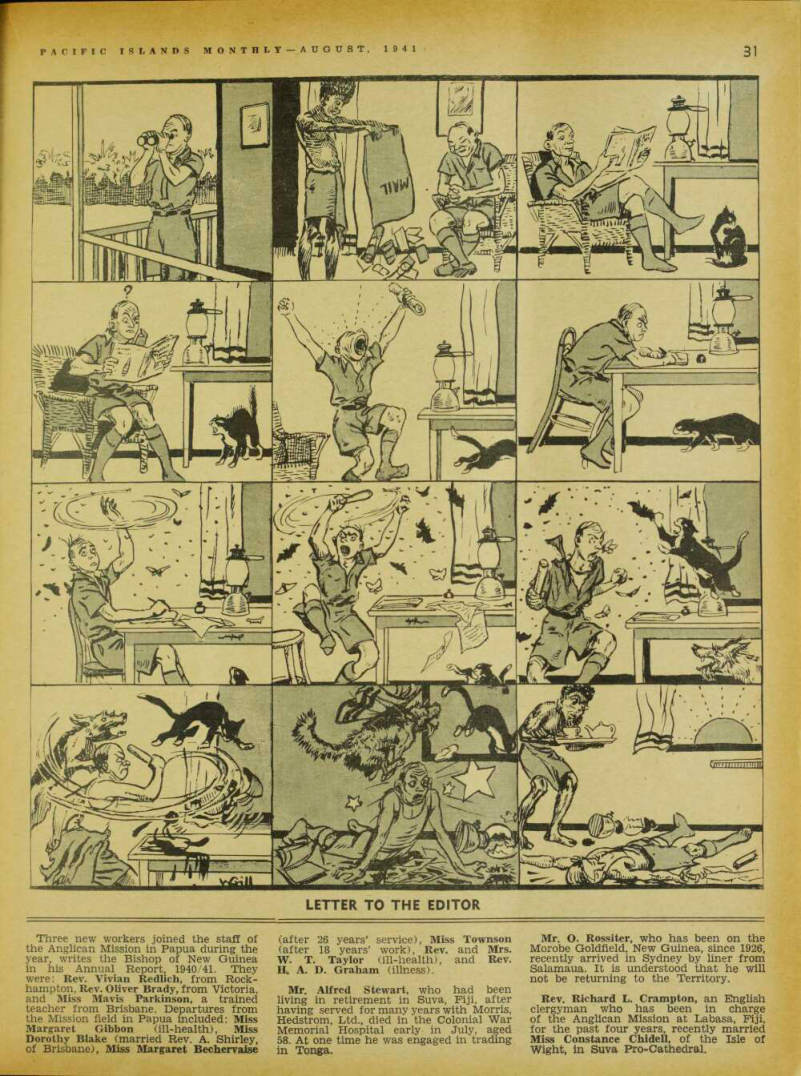
New Caledonia
Gallantly Carrying On Trade and Industry
rE following statistics show the trade of New Caledonia in 1940; and also, by comparison with other years, the effect of the war upon the French colony’s commerce:—
Coffee Exported
193 9— Arabica , 640,326 kilos; Robusta, 582,937 kilos.; total, 1,223,263 kilos. .ol 9 i9r _Arabica ’ 243,314 kilos.; Robusta, 437,462 kilos; total, 680,776 kilos.
Cotton Exported
4939 29,666 kilos 1940 5,905 „
Copra Exported
1936 2,754,981 kilos 1937 2,760,225 „ 1938 2,945,152 „ 1939 3,289,897 „ 1940 1,081,084 „ In order to help copra producers the Administration (by a decree of October 3, 1940) allows 500 frs. per ton from the local budget funds. Then the nett pro fits, after the amount of 500 frs. advanced by the Colony has been deducted, will be distributed among all the planters. The defeated and, it is presumed, paralysed French Government did this in October, 1940. The undefeated and still comparatively prosperous Aus tralian Government is only now-nine months later—giving similar help to its coconut planters.
The value of minerals exported in 1940 was 158,819,000 francs. Details:—
The total value of raw produce exported during 1940 was 199,921,000 frs., of which the percentage of minerals is 79,94 per cent.
Population
On January 1, 1941, the number of foreign residents in New Caledonia was 1,439 (1,276 men and 163 women) repre senting 22 different nationalities, as against 1,477 in the year 1939. The num ber of Japanese in Noumea is shown as 316 men and 31 women, making a total of 347, as against 339 in 1939 (311 men and 28 women).
On December 31, 1940, the native population of New Caledonia and adja cent islands was 29,591. Previous years* J|s® 28,856 - 10 39 29,374 On December 31, 1940, the indentured Javanese and Tonkinese labourers in the colony numbered 11,203; while the free residents included: Tonkinese, 302; Java nese, 884; Indians, 45.
Tanning Industry
The New Caledonia Council of Ad ministration recently received a request from Monsieur Paul Boyer, schoolmaster, at Bourail. He has advocated, for years, the establishment of a tannery, and he asked for a subsidy of 40,000 frs. which would allow him to learn the tanning trade and to serve for a term with an Australian tanning establishment. The Council voted him 40,000 francs.
Mineral Exports In Kilos
T . , , 1940. 1939. 1938.
Nickel mattes . 8,500 9,000 8,000 Nickel ore . .. 73,881 38,634 23,319 Chrome ore .. 66,382 38,596 42,263 Iron ore ... 156,281 81,500 —
1940. 1939. ... , , (francs) (francs) Nickel mattes .. 107,162,000 112,673,000 Nickel ore .. .. 12,326,000 8,763,000 Chrome ore .. .. 37,484,000 22,882,000 Iron ore 2,847,000 1,128,000
Three new workers joined the staff of the Anglican Mission in Papua during the year, writes the Bishop of New Guinea in his Annual Report, 1940/41. They were: Rev. Vivian Redlich, from Rockhampton, Rev. Oliver Brady, from Victoria, and Miss Mavis Parkinson, a trained teacher from Brisbane. Departures from the Mission field in Papua included: Miss Margaret Gibbon (ill-health), Miss Dorothy Blake (married Rev. A. Shirley, of Brisbane), Miss Margaret Bechervaise
(after 26 years’ service), Miss Townson (after 18 years’ work), Rev. and Mrs.
W. T. Taylor (ill-health), and Rev.
H. A. D. Graham (illness).
Mr. Alfred Stewart, who had been living in retirement in Suva, Fiji, after having served for many years with Morris, Hedstrom, Ltd., died in the Colonial War Memorial Hospital early in July, aged 58. At one time he was engaged in trading in Tonga.
Mr. O. Rossiter, who has been on the Morobe Goldfield, New Guinea, since 1926, recently arrived in Sydney by liner from Salamaua. It is understood that he will not be returning to the Territory, Rev, Richard L. Crampton, an English clergyman who has been in charge of the Anglican Mission at Labasa, Fiji, for the past four years, recently married Miss Constance Chidell, of the Isle of Wight, in Suva Pro-Cathedral.
Letter To The Editor
Advertisements & other items, p. 32 (1 item)
Gard-Cn Vale
Australia’s Choicest Products: M- Green Peas French Bear Cauliflower
garde,7VS? t
PRODUCTS LIMITED
2-4 BROWN STRC-ET,N-EWTOWN
tYDH-EY. AUSTRALIA
Always . . . make sure you have at hand an ample Reserve of these Delicious . .
Garden
Vale
Ready-toserve Vegetables
Papuan Tobacco-Growing Plan
Shelved
From Our Own Correspondent
Port Moresby, July 12.
NOTHING further has been done in the plah to establish a tobacco growing industry in Papua, put forward a couple of months ago. Con ditions are said to be too uncertain to embark on a costly new enterprise.
The Administration showed interest in the idea, and, it is understood, offered an excise duty lower than the prevailing import tariff. Twist tobacco was to be manufactured to replace the trade tobacco (mostly of American origin) now issued to native labourers.
Mr. “Jock” Ritchie, of Bulwa, New Guinea, arrived in Australia recently to join the AIF.
Polynesians Govern
Themselves Interesting Development in G. & E.
Islands
of the interpstino- I ) V s C t lfi 2 C n V - he par t teken° by Polynesians hi thei^own government. In the Gilbert and Ellice i s i an ds Colony, for example, a large proportion of the administrative work of government has been carried out for many years by Native Magistrates the Kaubure (elected village officials),’ and Native Scribes, Each island has a Native Magistrate, appointed by the European District Officer, with the approval, of course, of the Resident Commissioner, and on him
falls the bulk of the executive work He deals with all questions affecting the welfare of the people as a whole, issues orders and instructions, and generally exercises control over the community. ~r ^l. e Kaubure are elected in each village district, all natives over 30 being entitled to vote, and those chosen serve for three years being eligible for re-election at the end of each term. They represent their village on the Island Council and serve as jurors in the Native Court.
It is the duty of the Native Scribe to register births, marriages, and deaths on his island; to keep all Native Government books; and to perform the necessary clerical work in connection with the Native Court and the Lands Court. He is responsible, too, for collecting licence fees, taxes, fines, etc., and for the pay ment of Government moneys.
Power to make local regulations* per taining to such matters as public health, maintenance of peace and good order, performance of communal works, con servation of food supplies, and the eco nomic and social betterment of the natives is vested in the Island Council of each atoll. The Council consists of the Magistrate, the recognised High Chief of island, the Kaubure, leading native officials, and a number of elected village men.
On each island, two courts are usually held each month—the Native Court and the Lands Court. The former adjudicates civil cases (breach of contract, divorce, bastardy, etc.) and criminal cases (as sault, theft, damage to property, trespass, adultery, sorcery, etc.). The function of the Lands Court, as the name implies, is to hear and settle disputes relating to the ownership of native land. Proceedings in both courts are under the supervision of a European District Officer, who has power to review judgments and amend sentences.
The whole system of native government in the G. and E. Group, Phoenix Group, and Ocean Island, is based on regulations incorporated in the Native Laws Ordin ance 1917, promulgated by the High Commission for the Western Pacific. Five amendments to the Ordinance have been made through the years, as practice demanded.
Now, by a new Ordinance (G. and E.
Colony, No. 4, 1941), just issued by the WP High Commission, the original Na tive Laws Ordinance and associated amendments have been repealed and re placed by new, revised regulations, titled the Native Government Ordinance, which brings up to date the whole machinery of native government and sets out in detail the constitution, procedure, laws and penalties.
In these related groups of islands in Polynesia, local government by native bodies has attained a degree of progress, nrobably not equalled anywhere else in the Pacific. In granting, from time to time, increased responsibilities to native officials, the British authorities have no doubt taken the long view that eventually the islanders will reach the desired stage of complete self-government.
Mr. C. Healy, Assistant Resident Magis trate in the Papuan Service, has been transferred from loma (the Government station in the Northern Division nearest the TNG border), to Daru (right round in the Western section of the Territory).
Mrs. Healy and their family have gone with him.
Mr. L, Livingston, of Wau, recently arrived in Sydney from New Guinea, with Mrs. Livingston and their son.
They intend settling down in Tasmania, where Mr. Livingston will enter private practice as a surveyor.
Dr. H. B. Hetherington, senior medical officer in the British Solomon Islands, received the award of OBE in the King’s Birthday Honours, recently.
Advertisements & other items, p. 34 (1 item)
Chi Vers
BURNS PHILP
Registered
(SOUTH SEA) CO. LTD.
Inc. in Fiji S U V A Island Traders and Shipowners \Also Branches at; Fiji: Levuka, Lautoka, Labasa, Ba, Sigatoka, Rotuma.
Tonga: Nukualofa, Haapal, Vavau.
Samoa: Apia, Pago Pago (American Samoa). nn Solomons: Makambo, Gizo, Faisi.
New Hebrides: Vila. , Gilberts: Tarawa.
Code Address: “Burnsouth”. Norfolk Is. Niue. Wallis Is. Futuna Is
CHI VERS
FAMOUS ENGLISH PRODUCTS
CANNED ENGLISH VEGETABLES
CANNED ENGLISH FRUITS
OLDE ENGLISH MARMALADE
GOLD MEDAL JAMS
JELLY CRYSTALS, ETC.
Obtainable from all leading Grocery Stores
WRITE TO DEPARTMENT “A”
CHIVERS & SONS LTD.
Histon, Combs., Eng.
FOR ATTRACTIVE RECIPE BOOK
C<: lirtrKj
CHIV£RS
COLO /.
MAID4RD gi
STfIAID/IRD i
FRESH
■ ENGLISH SSs.
PEAS
*<««? AJ* P
Attractive New Club Opened In Suva
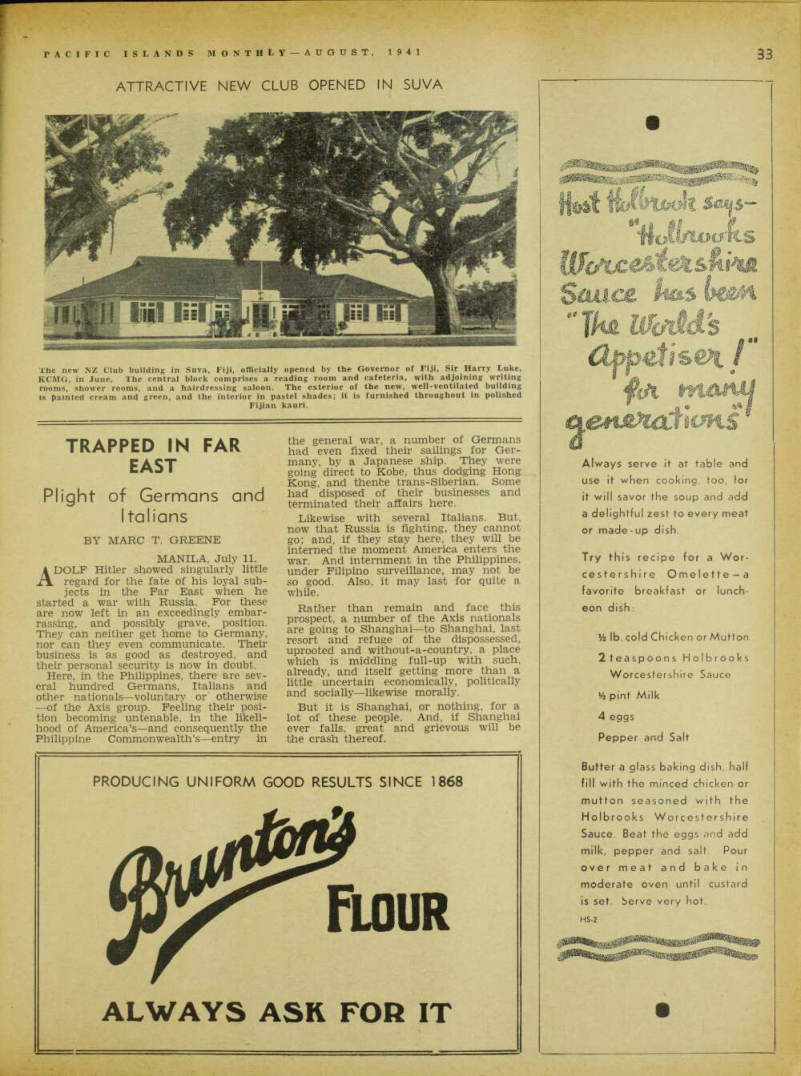
The new NZ Club building in Suva, Fiji, officially opened by the Governor of Fiji, Sir Harry Luke, KCMG, in June. The central block comprises a reading room and cafeteria, with adjoining writing rooms, shower rooms, and a hairdressing saloon. The exterior of the new, well-ventilated building is painted cream and green, and the interior in pastel shades; it is furnished throughout in polished Fijian kauri.
East
Trapped In Far
Plight of Gemans and Italians
By Marc T. Greene
Manila, July 11.
ADOLF Hitler showed singularly little regard for the fate of his loyal sub jects in the Far East when he started a war with Russia. For these rassing W and
The? can to’ cK£
nor can they even communicate. Their business is as good as destroyed, and their personal security is now in doubt. ■Rprp in thp thprp nrp spv
erS hundred Germans,' ‘ltalians and
other nationals—voluntary or otherwise —of the Axis group. Feeling their posi tion becoming untenable, in the likeli hood of America’s—and consequently the Philippine Commonwealth’s—entry in
the general war, a number of Germans had even fixed their sailings for Ger many, by a Japanese ship. They were going direct to Kobe, thus dodging Hong Kong, and thenfce trans-Siberian. Some had disposed of their businesses and terminated their affairs here.
Likewise with several Italians. But, now that Russia is fighting, they cannot go; and, if they stay here, they will be interned the moment America enters the wa r. And internment in the Philippines, under Filipino surveillance, may not be so good. Also, it may last for quite a while, T , 0yv , 0 .-„
P-pecT
ed‘ resort andi refuge of aispossesseo, uprooted and without-a-country, a Place which is middling wrth sue , already, and itself getting more than a utt j e uncertain economically, politically anc * socially likewise morally.
But it is Shanghai, or nothing, for a lot of these people. And, if Shanghai ever falls, great and grievous will be the crash thereof.
Advertisements & other items, p. 35 (1 item)
mefis&i
fcfblMSl S'
a * Always serve it at table and use it when cooking, too, for it will savor the soup and add a delightful zest to every meat or made-up dish.
Try this recipe for a Worcestershire Omelette-a favorite breakfast or luncheon dish: Vi lb. cold Chicken or Mutton 2 teaspoons Holbrooks Worcestershire Sauce Vi pint Milk 4 eggs Pepper and Salt Butter a glass baking dish, half fill with the minced chicken or mutton seasoned with the Holbrooks Worcestershire Sauce. Beat the eggs and add milk, pepper and salt. Pour over meat and bake in moderate oven until custard is set. Serve very hot.
HS-2
PRODUCING UNIFORM GOOD RESULTS SINCE 1868
ALWAYS ASK FOR IT
New Rubber in Dutch New
Guinea
ri\HE Netherlands Indies Government is X making rapid progress with its ex perimental plantings of rubber in New Guinea. An area of 1,000 hectares in the region of Manokwari, on the coast of Yellow Finch Bay, has been cleared and almost entirely planted to rubber, with oil palms and derris root as catch crops.
The region is expected to enter pro duction after 1944. Labour has been drawn chiefly from the Papoea popu lation; in addition, contract coolies will
be brought over from Java. Plans for this year will concentrate on improving housing for the coolies and transpor tlon i facihties.—“Far Eastern Survey”, ividy, iyq:i.
D - Crawley, bandmaster in charge of the Rabaul Police Band, arrived in Australia last month from New Guinea, on leave.
Mr. J. Wilson, who recently arrived in Samoa from New Zealand with his wife and young son, has replaced Mr. E.
Murphy as officer-in-charge of the Pub lic Works Department at Apia.
Px And Ngx
Contact With the Lads in the AIF
A CHEERY letter, dated July 3, from
Lance-Corporal John D. Wilkinson,
, j Papua, now on active service abroad with the AIF: Q hmif C +i??°D^ ive 7 0u much information PXs .and NGX’s (Papuan and New Guinea volunteers) as they are in a Jwi™ 1 ? units. But I met some during the evacuation of Greece and some more making their way to Syria for the offensive there, later.
The chaps from Misima were still all going strong a fortnight ago, and they are the ones I know best. The Port Moresby lads are in the thick of it in must be havi ng a sticky time.
F e everywhere. I met several on the b<pat, coming from Crete, including Jack Gnmson. Later—on leave—l man aged to absorb some cool beer with several more. Unfortunately, several are missing in Greece and Libya.
The Greek turnout was an awful business owing to the fact that we had few. pl + l nes there—and they were lost vfnnci m f the Ploc . e - 1 had no idea pre viously of the demoralising power of intensive air-attacks. The people of England must be in the nature of super beings to have stood so much, and remain unbroken. I shall eternally respect the Pommy after this.
“Another crowd who are great chaps are the NZedders—particularly the Maoris. I saw a big Maori sergeant, with three buffets in his leg, lying on a stretcher, waiting to be attended to. An orderly came along and wanted to give him some morphia but he said: ‘l’m in RF5' Give t 0 the kid, there’—the kid had had an arm smashed with ex plosive bullets.
“Later, an orderly came round, getting particulars of religion, etc., and he asked the sergeant his. He said, ‘Just put down whatever you are short of, mate. We are all heading the same way’.
“A 7 oun ? New Zealand lad—no more than twenty—said, when walking back to our lorries, after a raid: ‘When I was runnmg for cover, I jumped that fence with six inches to spare, and now I can’t even climb back over it. Gee, doesn’t it give you a fright’, and he laughed. I had a look at his lorry, and it had at least 50 bullet holes in it. The officer travelling with him said he never seemed to worry much about anything, except sleep.
“An Aussie, with a Bren gun mounted on a van, kept blazing away all the time, in spite of protests. He said: ‘While I am doing this I am drawing the attack to wards me, and, the other chaps are getting off lighter. I am only one, but there are hundreds of chaps in those lorries over there’.
“He certainly drew the attack on him self, and eventually ‘copped his issue’; but, in the meantime, a lot of other men had got past the danger point.
“There were lots of things like this; and the Tommies, in courage and re source, were not behind the Australians at all. For coolness, the Tommies take the ticket; but, when they have to, they can run as fast as the best of Menzies’ greyhounds’.
“Best wishes to all our friends in the Territories,”
M. Paul Vois who was being held as prisoner of war in occupied France, has been released. M. Vois, managing director of Le Societe Le Nickel, Noumea, was the only passenger on the French steamer “Notou” (2,489 tons) which was sunk by an enemy raider in the Tasman after it left Sydney on August 12, 1940. It is expected that the officers of the “Notou” will be released soon.
Advertisements & other items, p. 36 (1 item)
Prescott Pty. Ltd.
SUSSEX ST., SYDNEY,
are sole wholesale agents for
PINEAPPLE BACON&HAMS
DAISY brand BUTTER "375" BUTTER in TINS llb.-21b.-slb. Sizes.
LEA & PERRINS’ Sauces and Most other Super-Quality Lines of the Trade, such as Cheese, Eggs, Etc.
We ore Specialists ...
XLet us have your confidence. Sixty years is our record of supplying the leading Houses throughout the World in - - - -
FRESH FRUIT VEGETABLES PRODUCE
’Phones: MA 8612 (4 lines).
Cable Address: “Weymarkson,”
Codes—Bentleys Private.
WEYMARK & SON LTD.
FRUIT AND PRODUCE MERCHANTS
14-18 STEAMMILL STREET - - - SYDNEY
a
ANCHOR FLOUR
THE STANDARD OF QUALITY
1 M p ■ H * -i i>... . ..
GILLESPIE BROS. PTY. LTD
SYDNEY - AUSTRALIA
"Cohabitation"
Quaint Missionary Survival in Cook Is.
STRONG words in a private letter from a friend who has been living for some time in the Cook Islands:— “These natives —they are a gut-less lot. But I suppose one cannot blame them. They are at the mercy of repressive laws, under which all non-marital sex relations —from kissing to cohabitation — are crimes. They also are the victims of a weird system of ‘prohibition’—which doesn’t prohibit, because they brew then own.
“The effect of it is that they have become a race of snoopers and furtive tell-tales ”
Actually, the Cook Islanders are among the most attractive of the Polynesian peoples; but it is true, as our corres pondent says, that these people are op pressed by the antediluvian laws of New Zealand.
For a thousand years, before Europeans came to the Islands, the relations between the sexes, among Polynesians, were “free and easy”. After marriage, chastity was expected of both man and woman, and adulterers were severely punished. Before marriage, young people did as they pleased. Early European visitors found little wrong with social conditions in Polynesia—the people were happy, cleanly, kind and generous.
But the early missionaries regarded the Polynesians as people living in “awful sin”, and they attacked, like fana tics, the very easy relations among the unmarried. They put gowns on the women, and trousers on the men, and provided heavy penalties for any form of extra-marital intimacy.
Sexual morality is merely a compara tive term—a matter of an epoch or of latitude and longitude. That which is wrong in Calathumpia, in 1820, is quite correct and in order in Kamschatka, in 1940. But those bewhiskered missionaries of a century ago knew only one social code —namely, their own; and so they Imposed, upon a people who had lived freely in the sunshine for hundreds of years, and had no conception of “sin”, the stifling and stuffy laws of the Early Victorians. rERE was only one justification for such senseless “saving of the heathen”, and it had more to do with medicine than morals. The South Sea, early last century, was being invaded by the scum of the “civilised” earth — whalers, escaped convicts, buccaneers, slavers—and they fell like filthy wolves upon the trusting and hospitable Poly nesians, and introduced, among them, venereal diseases which slew them in tens of thousands. If the missionaries’ non cohabitation laws could have kept those human beasts away from the Polynesian women, they would have done some real good.
As it was, the bewildered Polynesians could make nothing of the new laws. In Tahiti, Hawaii, Cook Islands and, to a lesser extent, in Samoa and Tonga, they accepted missionary rule, and covered up their healthy brown bodies, and tried to please the queer-thinking white men in regard to their pre-marital conduct; but they never really obeyed. They did as their fathers had done, for hundreds of years; and they were not conscious of sin.
But they still tried to please the mis sionaries; and so, as our friend says, they became “snoopers” and deceivers.
As the decades passed, the silly old laws of the missionary governments were swept away; and, in most of the South Sea lands, there now is a happy—and usually unwritten—compromise between the rule of an understanding European
officialdom, and old-time Polynesia’s traditional way of life.
But, in the Cook Islands, the laws of the missionary regime survive. There, any intimate relationship between the sexes that has not been blessed by the sacrament of marriage is punishable as a crime. If, in Rarotonga, Juliet climbs over her verandah rail, and goes off on a completely innocent stroll in the moon light with Romeo, both Romeo and Juliet can be punished as criminals—not for what they did, apparently, but for what they might have done, as conceived in the mind of any hater of “sin”.
Well, the effect of all this can be guessed. Juliet, for a hundred years, has been sneaking out the back door, and hiding in the shadows with Romeo, and swearing, if challenged, that she never left her room. Cook Is. “cohabitation laws” have created a race of sneaks.
The evil has been recognised, and written about, for half a century. But the NZ Government, notorious for the Old Granny laws which it imposes on its Pacific dependencies, will do nothing in
the direction of reform.-
R.
Mr. W. Tracey, well-known in Madang and Wewak districts, TNG, has taken over the management of Mr. P. Leahy’s agricultural and dairy farm near Wau, while the latter is away with the AIF.
Advertisements & other items, pp. 37-38 (1 item)
Qrriotts
PURE RICE
STARCH
Always ask for . . .
CORAL BRAND
100% PURE
CORAL BRAND
HICEBTARCM
As > Si C«>U Noted for its
QUALITY
and
WHITENESS.
Goes Farthest and gives Lasting Finish
WILL NOT
STICK TO
IRON.
Obtainable from Leading Island Stores.
Manufactured by
AUSTRALIAN RICE, LTD.,
Sydney, N.S.W.
THEY KEEP YOU FIT
AND KEEP YOU SLIM
The whole grain of rich, sun-ripened wheat, transformed, after careful selection, into a perfect health food, delicious for breakfast, for afternoon tea or supper.
Arnott's Famous Shredded Wheatmeal Biscuits are rich in precious vitamins and proteins, and very easily digested. ... Try them with butter, cheese, jam or honey.
Qrriotts
FAMOUS
SHREDDED
WHEATMEAL
BISCUITS
822 ALWAYS ASK YOUR GROCER FOR ARNOTT'S !
KANGAROO BRAND
Ropes,
Cordage,
and Twines for every purpose
Backed by
86 years of service.
Manufactured by
M. DONAGHY AND SONS,
Pty. Ltd..Geelong and Sydney.
Fiji Representatives:
PEARCE AND CO.
LIMITED
P.O. BOX 237, SUVA
MADE TO GOVERNMENT SPECIFICATIONS !
Save waste and expense . . . make sure of high quality and absolute purity ... by ordering
DE MERICS
Creosote, Coal Tar,
Stockholm Tar, Pitch
and Neatsfoot Oil
DE MERIC’S Standard Products give maximum service under exacting conditions. They cut overhead costs and reduce the labour of maintenance.
Obtainable at good stores everywhere. Traders are invited to write for full wholesale list.
DE MERIC PTY, LTD.
Commonwealth and State Government Contractors
DOODY ST.. ALEXANDRIA. N.S.W...THONE. MASCOT 571
New Carpenter Copra Mill
In Canada
How Treatment of 40,000 Tons Annually Affects South Pacific Industry
new copra-crushing mill of W. R. Carpenter (Canada) Ltd. commenced full-time operations, on its site on the Vancouver waterfront, western Canada, on May 27, 1941, and already is treatina copra at the rate of 40,000 tons per annum.
THIS is the first copra-crushing mill in Canada—hitherto, all the coconut oil needed by that great Dominion of 12,000,000 people has been imported.
All the oil from the new plant is being sold in Canada, and all the copra being treated is being brought from the South Pacific (mostly New Guinea and Fiji) by Carpenter ships.
The new industry is the creation of Sir Walter Carpenter, founder of the well-known and now powerful group of Carpenter comnanies, operating mostly in the Pacific. When the war broke out, and the European copra market dis appeared, and the great South Seas
industry looked like being wiped out Sir Walter refused to sit and wail, and began to seek a way out.
He sought a new market for copra. * He was laughed at. “Europe is closed by war, North America by tariffs, and Mexico is over-supplied,” he was told.
There simply is no other market”
He said nothing; but, early in 1940, he took ship for North America. A couple of years earlier, passing that way he had noticed a remarkable thing—namely, that there was not one crushing mill in all the big Dominion of Canada. He went back, to have another look.
He found that the same agency that cut off the British and other copra mar kets from the South Seas planter— shortage of shipping—was preventing Canada getting her usual imports of coconut oil. He investigated. There was another market for Pacific copra—if the copra could be milled in Canada itself.
Sir Walter worked fast, and silently.
Rumours reached Australia; but, by the time Australia learned what the tireless and ingenious “W.R.” was at, the erec tion of the crushing mills at Vancouver was under way. He was given encour agement by all the American interests concerned: but he had a real financial headache on his hands.
THE Carpenter companies had plenty of funds in Australia, wherewith to give Carpenter interests a sufficient voice in the new Canadian enterprise but, by this time (late 1940) the Austra lian overseas exchange position was bad, and it was practically impossible to provide Australian credit abroad, except for urgent war purposes.
Sir Walter wanted Australian money to ensure that the Canadian mill should run on Australian territories’ copra, and further money to buy something that would float, in which South Sea copra could be carried to Vancouver. (The three Carpenter ships, “Suva”, “Rabaul” and “Salamaua” were taken early in 1940, by the British Government, for Atlantic service, and the “Rabaul” has since been sunk.) The embarrassed Australian Govern ment was not very helpful. It seemed to think that there were more urgent calls for Australian overseas exchange than that of providing a market for Australian territories’ copra. Which is natural enough. The copra producers have no vote in the Australian Parliament.
Sir Walter solved the problem—but, even yet, no one outside the Carpenter firm knows how.
All that is known is that W. R. Car penter (Canada) Ltd. has been formed and registered in Canada; that it imme diately erected a crushing mill on the Vancouver waterfront, at a cost of $300,000; that that mill commenced operations on May 27, 1941; that the plant has been since increased by $150,000; that its capacity is already over 40,000 tons per annum; and that it is finding a ready and profitable market in
North America for the whole of its products.
The new mill wants first-class copra; and it is prepared to take all the first grade that New Guinea can produce at a price considerably in advance of the £4/10/- per ton, on plantation, to be pro vided by the Australian Government.
CARPENTER & Co. have announced their readiness to take at least 5,000 tons per annum from Fiji, at £1 per ton in advance of current prices, pro vided the copra is high-grade. This sug gests that there is something in the report that the far-sighted Governor of Fiji helped Sir Walter Carpenter to get North American exchange. Sir Harry Luke probably could do that, where Aus tralia was helpless; and if, in assisting the Carpenter enterprise, the Fiji Gov ernor secured a guarantee for part of Fiji’s copra production, the deal defi nitely was good for Fiji.
There has been something of a howl among some Fiji copra growers because it is reported that the Fiji Copra Grad ing Bill (introduced and then withdrawn, last year) is to be revived. Official assurances are that there will be no compulsory grading. Carpenter & Co. probably will insist that, if they are to take care of part of Fiji’s copra produc tion, there must be some guarantee of quality.
It was reported, in some quarters, last month, that one of the two old freighters, with which Carpenter & Co. now are carrying copra from the South Pacific to Vancouver, had been taken over by the British Government. That is not so.
The two freighters are now engaged in carrying copra between New Guinea, Fiji and North America.
The board of the new company com prises Sir Walter Carpenter, Mr. E. E.
Bucherfield and Mr. E. F. Riddle. The manager is Mr. R. C. Milroy.
Sir Walter Carpenter, having spent a couple of months in Sydney, returned to Vancouver at the end of July.
Fiji Hopes For 10 000 Tons p.o.
From Our Own Correspondent SUVA,. July 20.
OIR Walter Carpenter would appear to O have done more for the depressed copra industry of the Pacific Islands than all the governments represented at the Sydney conference. Their conclusions resulted in talk; his policy has given us a quite large copra mill at Vancouver, which will buy a considerable quantity of our copra—the amount talked of as being possible from Fiji, for instance, is 10,000 tons per annum.
The old question of the quality of South Seas copra has cropped up, because the Vancouver mill hopes to produce edible oils, and a fairly high-grade coconut oil is desirable.
Carpenter and Co. are buying, in Fiji, for the mill, only “plantation” grade; and, to avoid awkward questions or pro tests, they have secured the aid of the Government Department of Agriculture, as arbiter of quality. Such a development has strengthened the hands of the local Director of Agriculture, whose dearest wish appears to be the compulsory grad ing of copra in Fiji.
Th ere are many local opponents of the idea of compulsory grading, but the present system is purely voluntary, and disposes of most of their objections.
Since the premium payable by local copra buyers, once the Government cer tificate of plantation quality has been secured, is as much as £1 over the pre vailing price of £3/10/- per ton, the producer has a definite incentive, wherever conditions permit, to take the care necessary for the turning out of better quality copra.
Air Connection Sought by
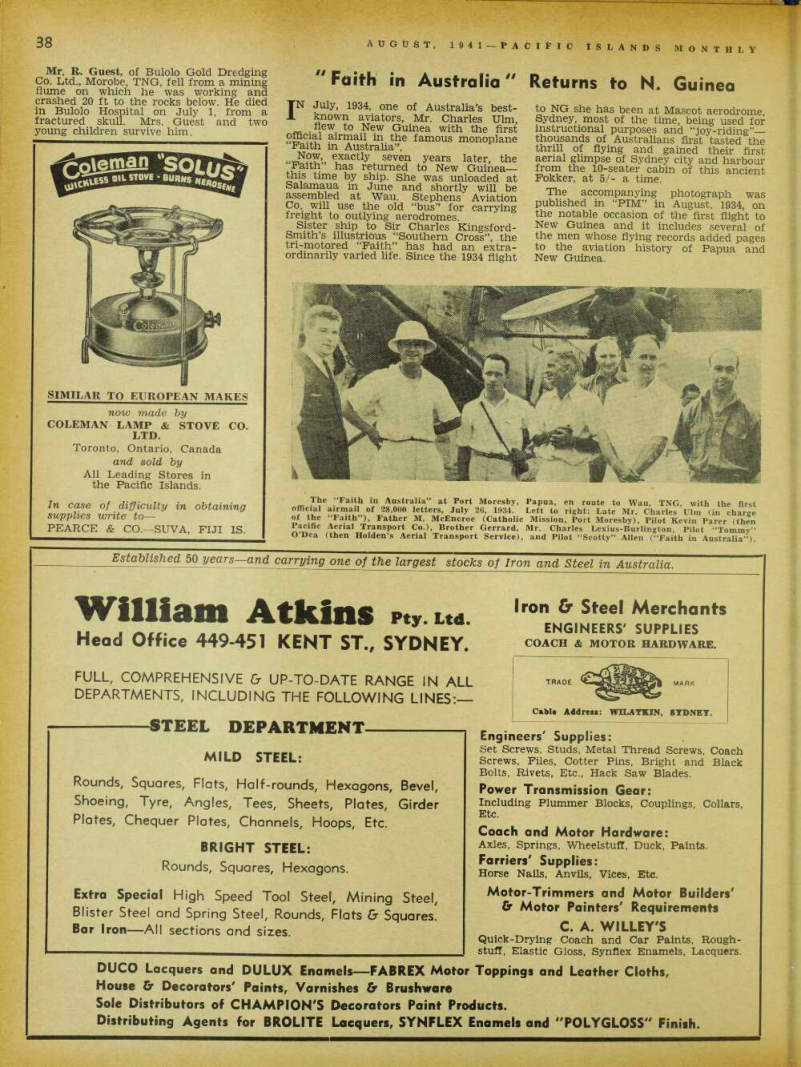
Samarai-Port Moresby
Air Connection Sought by Guinea Airways
From Our Own Correspondent
Samarai, July 27.
THE proposal has again been revived for the establishment of a Guinea Airways service between Samarai and Port Moresby, to connect with both the north- and south-going planes on the Australia-New Guinea run. It would bring Samarai within the orbit of a three-days mail service from Sydney.
First broached in 1938, the suggestion was rejected, but since then, with rapidly changing conditions, and the need for a local air service to ensure regular mail deliveries, the renewed proposal has met with general approval. To outlying sta tions such as Misima, Trobriands and the north-east coast, the scheme would be a distinct advantage.
Miss Audrey Thompson, of Cairns, Queensland, has taken up duties at Wau European School, TNG, after a short period at the Rabaul school.
Mr. R. Guest, of Bulolo Gold Dredging Co. Ltd., Morobe, TNG, fell from a mining flume on which he was working and crashed 20 ft to the rocks below. He died in Bulolo Hospital on July 1, from a fractured skull. Mrs. Guest and two young children survive him.
Advertisements & other items, pp. 39-40 (1 item)
Wunderlich
Timber, Joinery
ETC.
PREPARED BUILDINGS ready for erection a specialty.
SHIP AND BOAT BUILDING.
TIMBERS specially catered for.
FIBROLJTE, PLYWOODS.
GALVANISED IRON.
CONSIGNMENTS shipped
by RETURN STEAMERS
to the Islands.
John W. Eaton
PTY. LTD.
WEST CRESCENT STREET,
NORTH SYDNEY.
Telephones: XB 4051 (6 lines.)
BITUMENOID ROOFING
MADE IN AUSTRALIA.
Bltumenold Roofings, Dampcourse and Insulating Pelts are made from the world’s best raw materials. Warranted to stand the most rigid tests.
BITUMENOID THE BEST
Roofing, 1,2, 3-ply; Flooring, Waterproof Materials; Saturated Pelt; Resilient Road Jointing: Natural Asphalt Dampcourse; 2 and 3-ply Dampcourse: 1-2 lb. Lead-core Dampcourse: Roofing Cement; Asphalt Paints; Roofing Compound.
SAMPLES AND PRICE LISTS ON APPLICATION.
MAXWELL PORTER & SON LTD.
ESTABLISHED 1888. BUILDERS’ SUPPLIES.
107 REDFEEN ST., EEDFEEN, SYDNEY, N.S.W. ’Phone: M 3167. Cables Bltumenold.
0 m A Durabestos Home built from a design in our Free booklet.
Note: In the Islands, Corrugated Durabestos would ensure a weather-tight roof.
WUNDERLICH LIMITED, (Estd. 52 Years), REDFERN, SYDNEY.
WUNDERLICH
DURABESTOS
ASBESTOS CEMENT BUILDING SHEETS
SIMILAR TO EUROPEAN MAKES
now made by
COLEMAN LAMP & STOVE CO.
LTD.
Toronto, Ontario, Canada and sold by All Leading Stores in the Pacific Islands.
In case of difficulty in obtaining supplies write to —
PEARCE & CO.—SUVA, FIJI IS.
"Faith in Australia" Returns to N. Guinea
IN July, 1934, one of Australia's best known aviators, Mr. Charles Ulm, flew to New Guinea with the first airmail in the famous monoplane “Faith in Australia”.
Now, exactly seven years later, the Faith has returned to New Guinea— this time by ship, she was unloaded at Salamaua in June and shortly will be assembled at Wau. Stephens Aviation Co. will use the old “bus” for carrying freight to outlying aerodromes.
Sister ship to Sir Charles Kingsford- Smith’s illustrious “Southern Cross”, the tri-motored “Faith” has had an extra ordinarily varied life. Since the 1934 flight
to NG she has been at Mascot aerodrome, Sydney, most of the time, being used for instructional purposes and “joy-riding”— thousands of Australians first tasted the thrill of flying and gained their first aerial glimpse of Sydney city and harbour from the 10-seater cabin of this ancient Pokker, at 5/- a time.
The accompanying photograph was published in “PIM” in August, 1934, on the notable occasion of the first flight to New Guinea and it includes several of the men whose flying records added pages to the aviation history of Papua and New Guinea.
The Faith in Australia at Port Moresby, Papua, en route to Wau, TNG, with the first official airmail of 28,000 letters, July 26, 1934. Left to right: Late Mr. Charles Ulm (in charge of the “Faith”), Father M. McEncroe (Catholic Mission, Port Moresby), Pilot Kevin Parer (then Pacific Aerial Transport Co.), Brother Gerrard, Mr. Charles Lexius-Burlington, Pilot “Tommy”
O’Dea (then Holden’s Aerial Transport Service), and Pilot “Scotty” Allen (“Faith in Australia”).
Advertisements & other items, p. 40 (1 item)
William Atkins Pty. Ltd.
Established 50 years—and carrying one of the largest stocks of Iron and Steel in Australia .
Head Office 449-451 KENT ST., SYDNEY.
FULL, COMPREHENSIVE & UP-TO-DATE RANGE IN ALL
DEPARTMENTS, INCLUDING THE FOLLOWING LINES:—
STEEL DEPARTMENT
MILD STEEL;
Rounds, Squares, Flats, Half-rounds, Hexagons, Bevel, Shoeing, Tyre, Angles, Tees, Sheets, Plates, Girder Plates, Chequer Plates, Channels, Hoops, Etc,
BRIGHT STEEL:
Rounds, Squares, Hexagons.
Extra Special High Speed Tool Steel, Mining Steel, Blister Steel and Spring Steel, Rounds, Flats & Squares.
Bor Iron—All sections and sizes.
Iron & Steel Merchants
ENGINEERS' SUPPLIES
COACH & MOTOR HARDWARE.
TRADE
Cable Address: WILATKIN, SYDNEY.
Engineers" Supplies: Set Screws, Studs, Metal Thread Screws, Coach Screws, Files, Cotter Pins, Bright and Black Bolts, Rivets, Etc., Hack Saw Blades.
Power Transmission Gear: Including Plummer Blocks, Couplings, Collars, Etc.
Coach and Motor Hardware: Axles, Springs, Wheelstuff, Duck, Paints.
Farriers" Supplies: Horse Nails, Anvils, Vices, Etc.
Motor-Trimmers and Motor Builders' & Motor Painters' Requirements
C. A. WILLEY'S
Quick-Drying Coach and Car Paints, Roughstuff, Elastic Gloss, Synflex Enamels, Lacquers.
DUCO Lacquers and DULUX Enamels—FAßßEX Motor Toppings and Leather Cloths, House & Decorators' Paints, Varnishes Cr Brushware Sole Distributors of CHAMPION'S Decorators Paint Products.
Distributing Agents for BROLITE Lacquers, SYNFLEX Enamels and "POLYGLOSS'' Finish.
Fish-Canning
Suggested as Fiji Industry
From Our Own Correspondent SUVA, July 17.
IN his address to the Fiji Legislative Council last month, the Governor (Sir Harry Luke, KCMG) said that a Bill would be presented to the Council to control and organise the Colony’s fisheries. It would incorporate the most important of the recommendations made by Mr. J. Hornell, an expert ichthyologist, who made a survey of the fishery re sources of Fiji a short time ago.
His Excellency pointed out that, despite the abundance of potential supplies of fresh fish, 100,000 lb. of canned fish was annually imported into the Colony, valued at some £22,000. He expressed the view that, as there are now two canneries in Fiji, fish-canning should be a local enterprise, with the surplus fish being frozen or smoked. Other economic as pects, such as waste products (fish meal, fish liver oil, etc.), tortoiseshell, oysters, and sponge culture, offer a wide scope for experiment.
When the Bill was brought before the Council, some of the unofficial members opposed it on the grounds that £2OO would have to be voted immediately for a fisheries assistant in the Department of Agriculture and this might eventually lead to heavy expenditure in establishing a Fisheries Department. They doubted, too, whether fish-canning was practicable, since there was no guarantee of con tinuity of supply of bonito or saqa.
The measure was finally passed by 21 votes to 10. One of its most notable clauses provides heavy penalties (£5O to £lOO and 6 to 12 months’ imprisonment) for taking fish by the use of dynamite.
Memories Of Queen Emma
Letter to the Editor
IREAD with great interest your article, in April, “Memories of Queen Emma”.
You mention therein a Mrs. Grace Forsayth Schmidt, who joined Emma In New Britain in 1886. When I left NB in April, 1886, no Grace had arrived, and in all my conversations with Emma, Phoebe and Mr. Parkinson I was always told that there were only five children in Consul Coe’s family—viz.; Emma, Phoebe, Essy, Bob and Willy—all of them in NB at that time. (It has since been explained that Grace was the youngest of six daughters by the second marriage.—Ed. “PIM”.) Thomas Farrell came to Mioko, NB, in 1880, for the firm of Peter Godeffroy, of Apia, Samoa; and, after a rather mys terious deal with the captain of the “Marquis de Rays”, left Mioko and started on his own account on “Ralun” (Gazelle Peninsular). After Emma separated from Farrell, Phoebe married Parkinson, who became Emma’s mana ger; and it was Parkinson who obtained from the natives large tracts of land, for a song, and started plantations (coconuts, cotton and corn) and this was the beginning of Emma’s fortune.
Mr. Farrell must have been married before he met Emma, as the Forsayth junior I met in NB in 1885 was about 13-15 years old; and the Farrell junior, who, on August 29. 1885, joined our trip for Mt. Beautempts Beaupre (1640 feet) (our party included High Commissioner Oertzen, Parkinson, Rev. Rickards, of Wesleyan Mission, and many natives, and we called the mountain “Varzin Berg”, after Prince Bismarck’s estate, in Germany), was about 30 years of age.
You show a photo of Emma’s old bun galow. It must have been erected after I left NB in 1886. The one I know, and where I spent many happy evenings playing “Nap” for native twist tobacco, with all the Coe family, was not so elaborate as the one in the “PIM” of April.
I am, etc.,
F. T. Goedicke.
Haapai, Tonga, 24/5/1941.
Mr. S. Hw Short, of Tinputz plantation, Bougainville, TNG, arrived in Sydney on leave by the July steamer from Rabaul.
Mr. T. Frazer, of the Morobe District, New Guinea, arrived in Australia recently to take up duties with the Navy. His son Mr. Norman Frazer, is in the RAAF,
Missionary Attacked by NG
Natives
From Our Own Correspondent
Rabaul, July 6.
DURING the middle of last month, one of the layworkers attached to the Society of the Divine Word Mission, Alexishafen, on the NG mainland, was attacked by natives at Atemble, on the Ramu River. He is Brother David Bruner, who now is in the Mission hos pital at Alexishafen receiving treatment for three arrow wounds, and progressing favourably.
Mr, W. Armstrong, of Bulwa, TNG, recently married Miss Nellie Collibee, who arrived from Sydney by the June steamer.
They have made their home at Baiune.
Advertisements & other items, pp. 41-42 (2 items)
39
PACIFIC ISLAN
MONTHLY AUGUST, 1941
- and I use
rman
DISTRIBUTORS: Greenwood & Laws, Ltd., Rabaul and Wau; Steamships Trading Co., Ltd., Port Moresby and Samaral; Millers, Ltd., Suva, Fiji.
FOR BEST RE-
SULTS USE
“ B. A. L. M. ”
PAINT. It’s results that count and “8.A.L.M.”
Paint is better because it lasts longer, retains its gloss and resists fading. “8.A.L.M.”
Paint won’t crack or flake and eventually the film wears down to a perfect surface for re-painting.
A Product of British Australian Lead Manufacturers Pty., Ltd., makers of “Dulux” Finishes.
If you want "Perfection in Cooking" use a
“Younger” cooking stove
These stoves have been on the market in Australia for over Sixty Years, and are still recognised as “The Best”.
They are made with Extended Firebox specially for Long Wood fuel, also special stoves with Cast Iron Oven suitable for Island requirements.
Send for Illustrated Catalogue and Price of Single and Double Oven Stoves.
G. FLETCHER & SON
50 OXFORD STREET, SYDNEY.
Vigour Restored,
Glands Made Young
In 24 Hours
It is no longer necessary to suffer from loss of vigour and manhood, weak memory and body, nervousness, impure blood, sickly skin, depression, and poor sleep, because an American Doctor has discovered a quick, easy way to end these troubles.
This discovery is in pleasant, easy-to-take tablet form, is absolutely harmless, does away with gland operations and is bringing new youth and vigour to thousands. It works directly on the glands and nerves, and puts new, rich blood and energy in your veins. In 24 hours you can see and feel yourself getting younger. Your eyes sparkle, you feel alive and full of youthful vigour and power.
And this amazing, new gland and vigour restorer, called Vi-Stim, is guaranteed. It has been proved by thousands in America and is now distributed by chemists here under a guarantee of satisfaction or money back.
Vi-Stim must make you feel full of vigour and energy and from 10 to 20 years younger, or you merely return the empty package and get your money back. A special, double-strength bottle of 48 Vi-Stim tablets costs little, and the guarantee protects you.
Vi-Stim
GUARANTEED
to Restore Manhood and Vitality . . ,
Ship Chandlery Hardware
/Write for j
Ship Chandlery /
Catalogue J
BROOMFIELDS LIMITED
152 SUSSEX STREET SYDNEY.
Cables: “Boom”, Sydney.
Special “In Bond” Prices for all Islands enquiries quoted on application.
Sole Agents for; Large and Complete Stocks of
SHIP CHANDLERY
IRONMONGERY OF ALL KINDS, PAINTS,
WHITE LEAD AND OILS.
P. H. MUNTZ & CO.’S 3-CROWN BRAND METAL SHEATHING.
PEACOCK & BUCHANS’ ENGLISH READY-MIXED PAINTS.
Scott’s “Renown” Brand Rope,
Cordage and
Binder
Twine
Cable Address: Ropeyard, Sydney. ; *~w
of Every
Description
MANUFACTURED AT
MASCOT, N.S.W.
i. SCOTT
PTY. LTD.
Head Office and Store:
163 CLARENCE STREET,
SYDNEY,
N.S.W.
Copra As Pigs'
Food
Used Successfully in New Zealand
Letter to the Editor YOU were good enough to publish in the “PIM” some time ago, reports of various interviews I had, when I was in NZ, with leading farmers, con cerning my advocacy of copra as a pork and bacon producer. I was successful m stimulating the interest of Mr. C. H. M.
Sorensen, of New Plymouth, supervisor to the Taranaki District Pig Council whose attention already had been drawn to the matter by experiments made by Auckland farmers.
My father who lives in New Plymouth, now informs me that direct shipments of copra are at present being made to the port of New Plymouth at a saving of £2 a ton compared with the cost of land ing copra at Auckland and transhipping it to Taranaki. The whole of the ship ments are readily snapped up as soon as the copra leaves the ship’s slings.
This copra, of course, is Samoan pro duced. However, now that we are to have a Pacific Copra Pool, it would seem that my efforts may do a little good to Fiji,
whilst being of great benefit to all Pacific copra producers adjacent to NZ For the enlightenment of those who still are sceptical as to the value of copra as a pig food, will you reproduce the following cuttings from a Taranaki
paper?
Copra A Success In Taranaki
“Evidence of the value of copra for the pro duction of either pork or bacon has been given by one of the largest commercial pig-raisers in North Taranaki.
“Mr. L. A. Alexander, Tikorangi, who fattens about 800 bacon pigs each season, is at present feeding all his winter stores and brood sows on copra. The pigs are allowed a certain run-off on grass, and receive also an allowance of home grown roots, but it is to the copra that Mr.
Alexander attributes the unusually rapid growth and fine bloom of his stock. During a period of years, Mr. Alexander has experimented with a great variety of pig food, even going to the expense of providing a digester for rendering down animal meats. Thus he is in a unique position to speak with authority on the subject of feeding for quick returns, which, of course, is the essential of success in pig farming. ‘The further point that all his copra-fed pigs enjoy the best of health is another reason why Mr, Alexander favours this new diet.’’
Farmers Satisfied
“In an intereview, Mr. C. H. Ml Sorensen, supervisor to the Taranaki District Pig Council, mentioned that in every case known to him where Taranaki farmers had used copra as a food for pigs they had been extremely satisfied at the results.
“Mr. Sorensen said that though some farmers appeared uncertain about the palatability and feeding value of copra, others who were in a big way of business as pig-raisers had abundantly satisfied themselves that the food was not only most efficient, but also most economical. Pro ducers, he said, should take notice of these re sults, because in many cases they were the observations of farmers who had had a life time of practical experience in producing high grade quality pig meats.”
I want to emphasise that, so far, only a few NZ pig farmers are using the new copra diet. Other farmers are using copra as a winter ration to horses and cows, and all over the Dominion greater interest is being taken in meal having copra as its base. It will be readily seen, therefore, that the possibilities are immense, and that this field of disposal should be given more attention by the Fiji Government and the Pacific Copra Pool.
Australia, too, could no doubt make greater use of copra for pig and cattle
food.
I am, etc.,
H. B. Gibson,
Member for the Eastern Division, Fiji Legislative Council.
Suva, 17/6/1941.
"Old Hands" Get Together in
Samarai
From Our Own Correspondent
Sam Arm, July 7.
MEMORY opened the door a little wider one day during the week-end, for a few hours; the atmosphere throbbed to the tempo of other days, when a group of “old hands” met to gether for the first time in 30 years.
They were Messrs. E. C. Skelly, J. G.
Munt, H. Spiller, L. Henderson, F. Blen cowe and R. Fletcher, who hold between them 180 years of Papuan experience and who arrived in this territory between 1907 and 1911, at the time of the first big wave of investment and commercial development that helped to place Papua on the map. To mark this reunion, they made a celebration of the occasion, the meeting serving also as a quiet farewell to Mr. Blencowe, who left for New Guinea the following morning.
Steel Guitars for Two
And Coffee for One
DOES anyone remember the historic musical duel (not duet!) between “Eti” Gold, a former Hawaiian player who introduced the “steel” method to Rarotonga guitar-players, and Remi Rey, the champion steel-guitarist of Papeete?
The contest was held in Willie Browne’s “Tivoli Cabaret” dance-hall at Marae renoa: and for weeks before it even tuated, Rarotonga was divided into two camps—the faction, with Tahitian con nections, who supported Remi, and the Rarotonga-cum-Mangaia enthusiasts who “barracked” for Eti (who had just re turned from NZ, after the death of his wife, another celebrated guitarist, at Mangaia).
Poor Eti was in bad shape. Downed by his bereavement, he had given up music.
In addition, he was jobless, and hard-up.
It was Remi who forced on luckless Eti this test of their respective powers.
Eti didn’t fancy the musical “strafe” facing him; but for the honour of Raro tonga and his home island of Mangaia, he accepted the Tahitian’s challenge.
Borrowing a battered old guitar, he Hawaiianised it with eauipment of his own, and turned up, with his Spanish guitar accompanist (a Rarotonga lad) at the “Cabaret” on the great night, ready for victory or the LMS cemetery.
They played solidly for four hours.
Every “stunt” Remi did, Eti equalled— the old warhorse as “ha-ha-ful” as ever, and his neck still clothed with more thunder than Remi had quite bargained for.
Remi was in excellent practice, and had a lovely guitar; Eti had only the damaged “dog-box” he had borrowed, because he had no guitar of his own. The honour of Rarotonga and Mangaia was at stake; he did his damnedest, under a handicap.
But, alas, victory was not for him.
The Frenchman, with rising choler, put over his last and utmost effort—a suoer stunt. And Eti, fumbling numbly, failed to make the grade. The pro-Tahitians shouted themselves hoarse—and Raro tonga gloomed. . . .
Eti rose, and took a courteous leave of his Gallic antagonist. That gentleman seemed a trifle peeved—he even re marked that Eti had better look out, as he might later meet with an accident!
Eti was displeased at this exhibition of French “sportsmanship”: his good-night was somewhat curt, and 1928 had made history.
Next day, however, Remi met Eti and sought his goodwill; and the duelists became friends, and continued so till Eti departed for Mangaia, and Remi returned to his Papeete home—where, regrettably, he later met an untimely end.—R.
New Hotel in Port Moresby
From Our Own Correspondent
Pt. Moresby, Aug. 2.
THE new hotel being erected for Burns, Philp and Co. Ltd., at Port Moresby is expected to be completed in Sep tember. The frame and walls, now up, show that the building will be spacious and will represent an attractive addition to the town.
The Residential Tax in the British Solomon Islands Protectorate has been increased from £1 to £2 annually. A second tax of 10/- per head is increased to £l.
Two Indians Killed in Fiji
Train Smash
From Our Own Correspondent SUVA, July 16.
AN Indian farmer and his wife were killed at Vuo (Labasa) early this week, in a train accident caused by 33 trucks breaking away when travelling up a steep incline, on the CSR railway.
The cane trucks ran backwards and crashed into the engine of another cane train, derailing 11 trucks. The two Indians were riding on one of the back trucks. Another Indian and two child ren were seriously injured.
There are about 450 miles of light rail way in Fiji, owned and operated by the Colonial Sugar Refining Co., and, on most lines, Indian and native passengers are allowed to travel free of charge.
The three sons of Major-General Sir Charles Rosenthal, KCB, CMG, DSO, VI), who has been Administrator of Norfolk Island since 1937, are serving with the
Aif.
Among a party of Tahitian soldiers undergoing medical treatment at Prince Henry Hospital, Little Bay, Sydney, is Corporal Victor Salmon, a grandson of the chief Tati Salmon, of Papara, who entertained Robert Louis Stevenson when he visited Tahiti in the 80’s. He, of course, is a great-grandson of Arii taimai, head of the once powerful Teva clan and Marama of Moorea, who mar ried Alexander Salmon, the son of a London banker. Arii-taimai was the foster sister of Queen Pomare IV, and a woman of the highest rank. It was for Arii-taimai that the Queen permitted the regulation against the marriage of Tahitian women and foreigners to be raised for a week, so that she might marry Salmon.
Advertisements & other items, pp. 43-44 (1 item)
Electricity
amjiunebe - - am mi.
Small, light, compact Petrol Electric Generators with everything a car engine has. • For Home Lighting • For Yacht Lighting • For Battery Charging • For Operating Light Beacons
Model
300
Price
Output 12 volts. 300 watts. £26/10/0 Operates twelve 25 watt Twelve hours per gallon lamps. of petrol.
Weight when packed, 97 lbs. f 5 ® J ' From Leading Island Merchants, or:
AMPLION (A'SiA) PTY. LTD
382 Kent Street, Sydney.
Cable Address: “Amplion”, Sydney.
AMPLITE
PETROL
ELECTRIC
UNIT by
BRIGGS &
STRATTON
FEATURES:
(1) Press Button Starting. (2) Magneto Ignition, etc. (3) Automatic Cut-out. (4) Air-cleaner, Oil-bath type. (5) Petrol Filter. (6) Full Float, Adjustable Downdraught Carburettor. (7) Vibrationless, (8) Heavy Duty, Double Contact, Cut-out.
Features 4 to 8 are exclusive to Models 300 and 400. 6 volt, 100 watt model (Manual Starting)
Price £l7/0/0
32 volt, 400 watt model (Press Button Starting)
Price £47/10/0
KIDNEYS
MUST REMOVE
EXCESS ACIDS
Help 15 MILES of Kidney Tubes
Flush Out Poisonous Waste
If kidneys don’t pass 3 pints a day and get rid of 3 pounds of waste matter, the 15 miles of kidney tubes and filters become clogged with poisonous waste and the danger of acid poisoning is greatly increased.
This acid condition is a danger signal and may be the beginning of nagging backaches, leg pains, loss of pep and energy, getting up nights, lumbago, swollen feet and ankles, puffiness under the eyes, rheumatic pains and dizziness.
Frequent or scanty passages, with smarting and burning, show there is something wrong with your kidneys or bladder.
Most people watch their bowels, which contain only 27 feet of intestines, but neglect the kidneys, which contain 15 miles of tiny tubes and filters.
Don’t delay! Ask your chemist or store for DOAN’S BACKACHE KIDNEY PILLS . . . used successfully the world over by millions of people. They give quick relief and will help to flush out the 15 MILES Oif Kidney tubes. Get DOAN’S
BACKACHE KIDNEY PILLS at
your chemist or store.
Suva's Black-Out
From Our Own Correspondent SUVA, July 26. fIIHE trial black-out which Suva recently JL suffered would seem to have proved the only really effective way of blacking-out the average tropical house is to put out the lights and go to bed. What else it proved is not clear to the lay mind, though possibly our military overlords have formed some conclusions for themselves.
We are threatened with further trials of the same ilk. If, as on the first occasion, they are postponed until after the dinner-hour, Suva in general will doubtless adopt again the only procedure that proved effective in that instance.
Ill-Omen For Hitler?
From Our Own Correspondent
Samarai, July 27.
A MESSAGE from the North-eastern Division renorts that the 6,000-ft. volcanic Mount Victory. rising inland behind Tufi and Cane Nelson, is showing siens of life asrain. It is 35 vpars sioce fhp mountain boiled over, fortunately without senous results, and it. is not exnpotpd that the present dis plav of fireworks presages anything cala mitous.
Mavbe the slumbering Fire Gods of Mount Victory have just learned of the “V for Victory” campaign, which has swept the occupied countries of Europe and captured the imagination of the peoples of Britain. USA and the Empire, and wish to add their token to the cause!
Cost Of A Rubber
Estate
HOW much does it cost to bring a rubber plantation to the productive stage, in New Guinea and Papua*?
Some estimates go to £5O and £6O per acre.
As the question often is asked, we have taken the liberty of extracting some figures from the annual report and balance sheet of Mororo Rubber Estates Ltd., a small Papuan concern of which Mr. G. A. Loudon is chairman.
The estate comprises 579 acres of lease hold, held on 99 years’ lease: and 330 acres have been planted with rubber trees, and are densely cover-cropped with Centrosema. A nursery has been established, containing 10,000 plants.
There are suitable buildings and roads.
Details of costs up to date are as follow; The Company’s prospectus provided for estimates as under:— (1) Felling, planting and covercropping, £6 per acre. (2) Weeding and maintenance, £l/10/per acre. (3) Seven years to bring to production at total cost of £25 per acre.
The Co. now has arrived at the stage where it has exnended £3,765 on 330 acres, equal to £ll/2/9 ner acre.
How much money must it yet find to bring the 330 acres into production?
Here is the calculation:—
Miss Violet Wakely, sister at the Ash field Masonic Hospital, NSW, is at present undergoing a course in tropical medicine at Sydney University to fit her for nurs ing work with the Church of Christ Mission in the New Hebrides.
130 acres planted 1938/9 by Vendor will require 4 years’ weeding and maintenance at 30 - acre £ 780 100 acres planted in April. 1940 will require 6 years’ weeding and maintenance at 30/- acre 900 100 acres planted in April, 1941 will require 7 years’ weeding and maintenance at 30/- acre .. 1,050 Plant, tools and sundries to bring to production 2,730 195 Total of money still to be snent .. 2,925 Already as r>pr Balance Sheet at April, 1941 3,675 Total to bring plantation to production 6.600 Which is equal to cost of £20 per acre.
Advertisements & other items, pp. 44-45 (3 items)
Allen Tavlor & Ltd
COMMERCIAL ROAD, ROZELLE,
SYDNEY
Sowmillers and Wholesale Suppliers of Hardwoods for Constructional Purposes GIRDERS . . . PILES . . . POLES . . . SLEEPERS, Etc.
EXPORTING TO PACIFIC ISLANDS SINCE 1893
JAMES BUDGE LTD |»i^i
REFRIGERATION
“BUDGE” Automatic or Manually-controlled Refrigeration and Ice-making Plants, with or without insulated Cabinets or Rooms, ranging from 4 cubic feet to 1000 cubic feet or larger, using ammonia in the large and sulphur dioxide (SO2) in the small units. Where electricity is not available, crude oil engines may be utilised for driving the larger plants and petrol engines for driving the smaller machines. The accompanying illustration is of a petrol engine driven SO2 unit. Enquirers please state power (if any), size of cabinet and amount of ice required per day.
ALL CLASSES OP REFRIGERATION EQUIPMENT.
JAMES BUDGE PTY. LIMITED
Refrigeration and General Engineers Office and Works:
McEvoy and Harley Streets
ALEXANDRIA, SYDNEY. Established 1890.
43
PACIFIC ISLANDS MONTHLY— A U G U S T , 1941
Ith Masonite'
NOHftS THE TIME
TO MODERNISE
THE demands and requirements of troubled times
have probably dispelled—“for the duration”—your
dreams of a new home. But there is no need whatsoever to allow Hitler & Co. to intern you in that home which has grown a little shabby or a little out-moded. You can transform it; amplify it; give it new rooms. You can add or modernise verandahs, carry out a dozen-and-one delightful plans for rejuvenating and glamorising your present home. Those dingy walls can be charmingly concealed; those worn floors given new strength and eye-appeal. Be thankful for Masonite—the grainless, splinlerless, steelstrong boards which can be worked with ordinary tools, bent, grooved, bevelled, painted, lacquered—treated and finished in any way your heart or mind may desire. Modernising with Masonite is INEXPENSIVE (many of the smaller alterations you can do yourself), yet the job will last for the duration of your life.
Masonite Quartrboard De-Luxe, Presdwood, weather-defying Tempered Presdwood and tile-like Temprtile come to you or your builder in boards up to 12' x 4'—the most versatile all-wood boards ever produced—rightly praised all over the world as “The Wonder Boards of 1000 Uses”!
MODERNISE WITH
iff 'm * ☆ Masonite boards are made in Australia from Australian timbers hitherto thought commercially useless. They possess the advan tages of wood without its disadvantages.
Masonite is used for both modernisation and new construction: lor floors, counter and table tops, for "tiling", for partitioning in fact, for “1,000 uses". £
PRESDWOOD . . . TEMPERED PRESDWOOD
TEMPRTILE ... QUARTRBOARD DE-LUXE
THE COLONIAL SUGAR REFINING CO. LTD. (Building Materials Division) . . Sydney . . Melbourne . . Brisbane . . Adelaide . . Perth
“Shorts ” For Small Jobs !
Masonite “Shorts” — off-cuts from large sheets—are identical in quality with the standard Masonite Boards, hut are offered at considerably reduced prices.
They're ideal for small jobs such as those shown here and are available in sizes up to 4 in y 4 in. and in £ in. and 3/16 in. thicknesses.
DOG KENNEL.
TOOL RACK.
Escape!
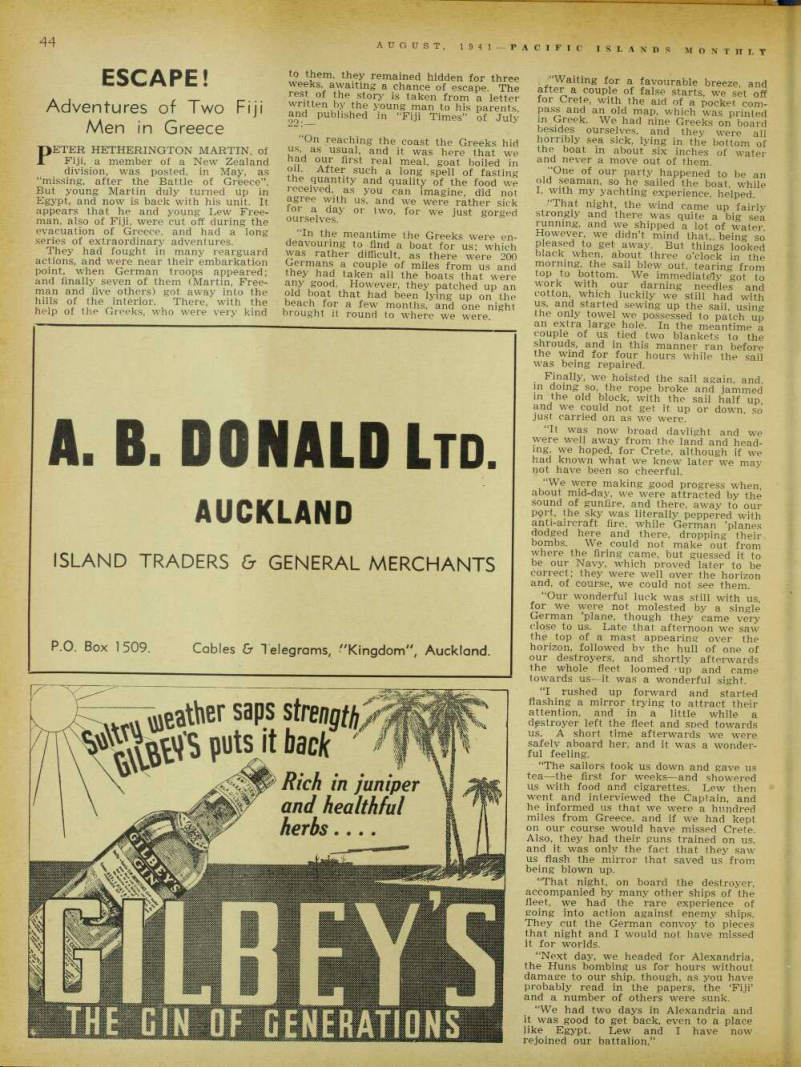
Adventures of Two Fiji Men in Greece
Peter Hetherington Martin, Of
Fiji, a member of a New Zealand division, was posted, in May, as “missing, after the Battle of Greece”.
But young Martin duly turned up in Egypt, and now is back with his unit. It appears that he and young Lew Free man, also of Fiji, were cut off during the evacuation of Greece, and had a long series of extraordinary adventures.
They had fought in many rearguard actions, and were near their embarkation point, when German troops appeared; and finally seven of them (Martin, Free man and five others) got away into the hills of the interior. There, with the help of the Greeks, who were very kind
to them, they remained hidden for three weeks, awaiting a chance of escape. The rest of the story is taken from a letter written by the young man to his parents, in “Fiji Times” of July “On reaching the coast the Greeks hid us, as usual, and it was here that we had our first real meal, goat boiled in oil. After such a long spell of fasting the quantity and quality of the food we received, as you can imagine, did not agree with us, and we were rather sick tor a day or two, for we just gorged ourselves.
In the meantime the Greeks were en deavouring to find a boat for us; which was rather difficult, as there were 200 Germans a couple of miles from us and they had taken all the boats that were any good. However, they patched up an old boat that had been lying up on the beach for a few months, and one night brought it round to where we were.
Waiting for a favourable breeze, and after a couple of false starts, we set off for Crete, with the aid of a pocket com pass and an old map, which was printed in Greek. We had nine Greeks on board besides ourselves, and they were all hornbiy sea sick, lying in the bottom of the boat in about six inches of water and never a move out of them. ‘‘One of our party happened to be an r 80 he sailed the boat, while I, with my yachting experience, helped.
That night, the wind came up fairly strongly and there was quite a big sea running, and we shipped a lot of water However, we didn’t mind that, being so pleased to get away. But things looked black when, about three o’clock in the morning, the sail blew out, tearing from top to bottom. We immediately got to work with our darning needles and cotton, which luckily we still had with us, and started sewing up the sail, using the only towel we possessed to patch up an extra large hole. In the meantime a couple of us tied two blankets to the shrouds, and in this manner ran before the wind for four hours while the sail was being repaired.
Finally, we hoisted the sail again, and. in doing so, the rope broke and jammed in the old block, with the sail half up and we could not get it up or down, so just carried on as we were.
“It was now broad davlight and we were well away from the land and head ing, we hoped, for Crete, although if we had known what we knew later we may not have been so cheerful.
“We were making good progress when, about mid-day, we were attracted by the sound of gunfire, and there, away to our Port, the sky was literally peppered with anti-aircraft fire, while German ’planes dodged here and there, dropping their bombs. We could not make out from where the firing came, but guessed it to be our Navy, which proved later to be correct; they were well over the horizon and, of course, we could not see them.
“Our wonderful luck was still with us, for we were not molested by a single German ’plane, though they came very close to us. Late that afternoon we saw the top of a mast appearing over the horizon, followed by the hull of one of our destroyers, and shortly afterwards the whole fleet loomed -up and came towards us —it was a wonderful sight.
“I rushed up forward and started flashing a mirror trying to attract their attention, and in a little while a destroyer left the fleet and sped towards us, A short time afterwards we were safely aboard her, and it was a wonder ful feeling.
“The sailors took us down and gave us tea—the first for weeks—and showered us with food and cigarettes. Lew then went and interviewed the Captain, and he informed us that we were a hundred miles from Greece, and if we had kept on our course would have missed Crete.
Also, they had their guns trained on us, and it was only the fact that they saw us flash the mirror that saved us from being blown up.
“That night, on board the destroyer, accompanied by many other ships of the fleet, we had the rare experience of going into action against enemy ships.
They cut the German convoy to pieces that night and I would not have missed it for worlds.
“Next day, we headed for Alexandria, the Huns bombing us for hours without damage to our ship, though, as you have probably read in the papers, the ‘Fiji’ and a number of others were sunk.
“We had two days in Alexandria and it was good to get back, even to a place like Egypt. Lew and I have now rejoined our battalion.”
Advertisements & other items, p. 46 (1 item)
A. B. Donald Ltd.
AUCKLAND
ISLAND TRADERS & GENERAL MERCHANTS
P.O. Box 1509. Cables &• T elegrams, "Kingdom", Auckland,
Rafter saps strength
Rich in juniper ||r and healthful herbs ... vi i vA £
Death Of Old Fiji Settler
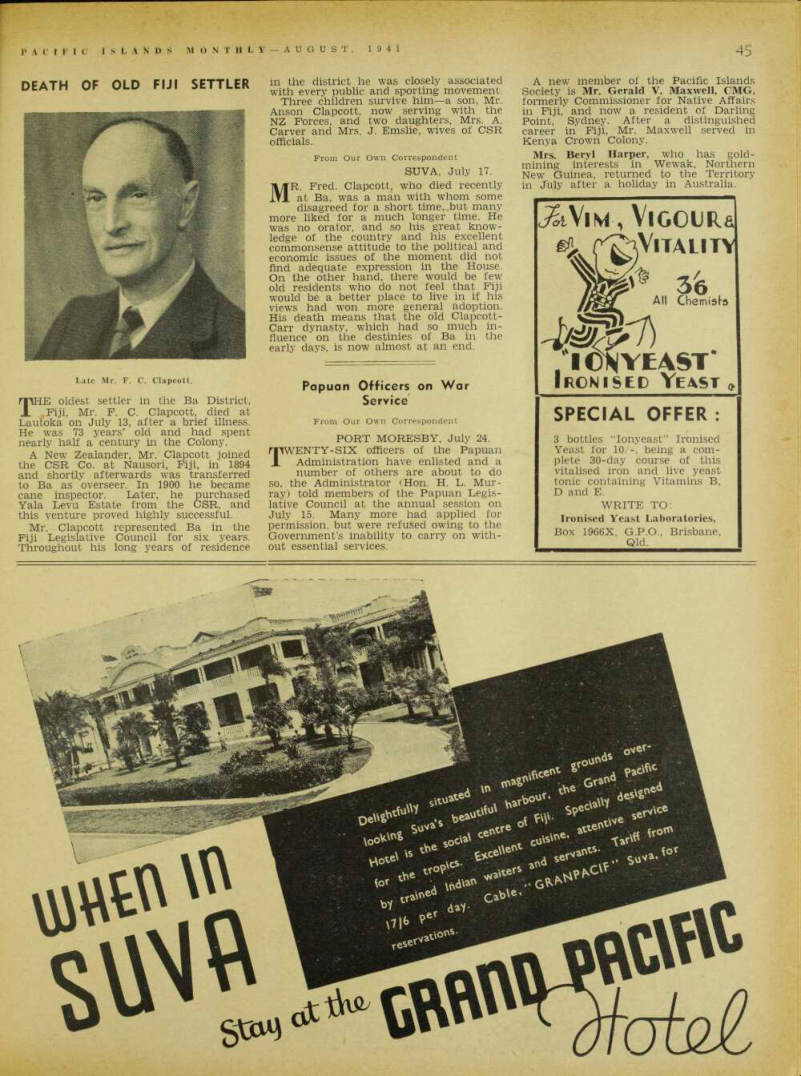
fTIHE oldest settler in the Ba District, X Fiji, Mr. F. C. Clapcott, died at Lautoka on July 13, after a brief illness.
He was 73 years’ old and had spent nearly half a century in the Colony.
A New Zealander, Mr. Clapcott joined the CSR Co. at Nausori, Fiji, in 1894 and shortly afterwards was transferred to Ba as overseer. In 1900 he became cane inspector. Later, he purchased Yala Levu Estate from the CSR, and this venture proved highly successful.
Mr. Clapcott represented Ba in the Fiji Legislative Council for six years.
Throughout his long years of residence
in the district he was closely associated with every public and sporting movement.
Three children survive him—a son, Mr.
Anson Clapcott, now serving with the NZ Forces, and two daughters, Mrs. A.
Carver and Mrs. J. Emslie, wives of CSR officials.
From Our Own Correspondent SUVA, July 17.
MR. Fred. Clapcott, who died recently at Ba, was a man with whom some disagreed for a short time, but many more liked for a much longer time. He was no orator, and so his great know ledge of the country and his excellent commonsense attitude to the political and economic issues of the moment did not find adequate expression in the House.
On the other hand, there would be few old residents who do not feel that Fiji would be a better place to live in if his views had won more general adoption.
His death means that the old Clapcott- Carr dynasty, which had so much in fluence on the destinies of Ba in the early days, is now almost at an end.
Late Mr. F. C. Clapcott.
Papuan Officers on War
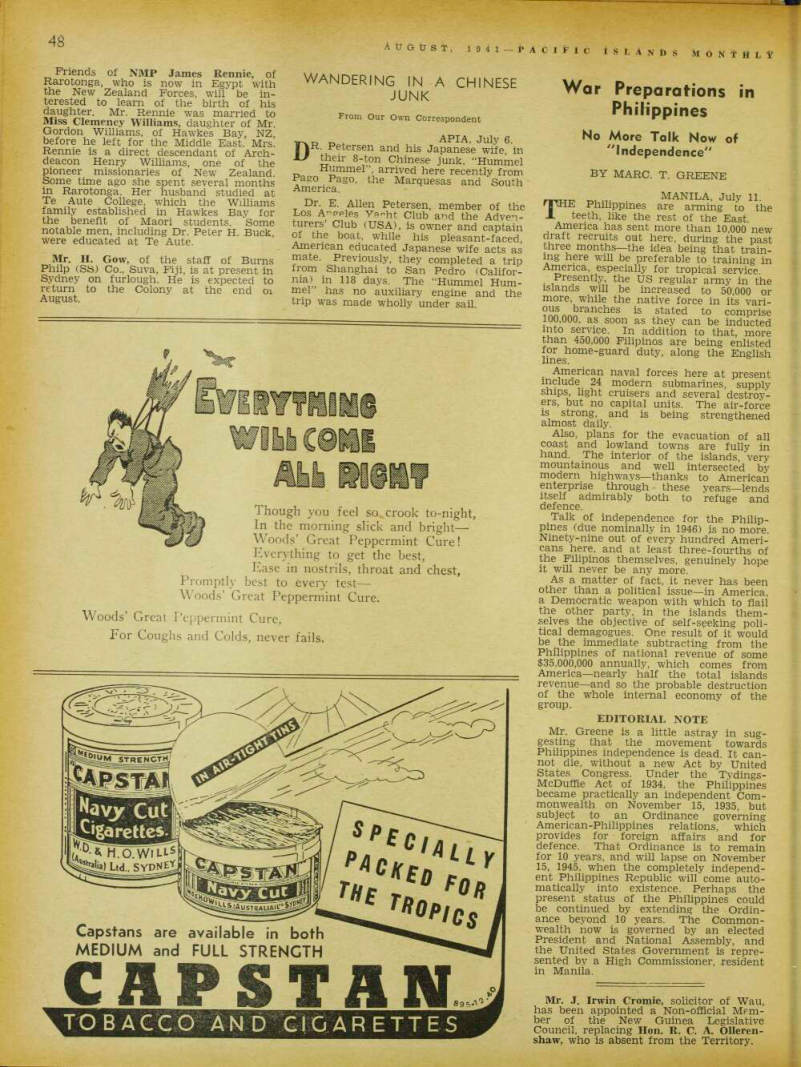
Service
From Our Own Correspondent
Port Moresby, July 24.
TWENTY-SIX officers of the Papuan Administration have enlisted and a number of others are about to do so, the Administrator (Hon. H. L. Mur ray) told members of the Papuan Legis lative Council at the annual session on July 15. Many more had applied for permission, but were refused owing to the Government’s inability to carry on with out essential services.
A new member of the Pacific Islands Society is Mr. Gerald V. Maxwell, CMG, formerly Commissioner for Native Affairs in Fiji, and now a resident of Darling Point, Sydney. After a distinguished career in Fiji, Mr. Maxwell served in Kenya Crown Colony.
Mrs. Beryl Harper, who has gold mining interests in Wewak, Northern New Guinea, returned to the Territory in July after a holiday in Australia.
Friends of NMP James Rennie, of Rarotonga, who is now in Egypt with the New Zealand Forces, will be in terested to learn of the birth of his daughter. Mr. Rennie was married to Miss Clemency Williams, daughter of Mr.
Gordon Williams, of Hawkes Bay, NZ, before he left for the Middle East. Mrs.
Rennie is a direct descendant of Arch deacon Henry Williams, one of the pioneer missionaries of New Zealand.
Some time ago she spent several months in Rarotonga. Her husband studied at Te Aute College, which the Williams family established in Hawkes Bay for the benefit of Maori students. Some notable men, including Dr. Peter H. Buck, were educated at Te Aute.
Mr. H. Gow, of the staff of Burns Philp (SS) Co., Suva, Fiji, is at present in Sydney on furlough. He is expected to return to the Colony at the end 01 August.
Advertisements & other items, p. 47 (1 item)
(jjfl®*
c&VIM, VIGOURa
V
’ICNYE4ST
Ironised Yeast »
SPECIAL OFFER :
3 bottles “lonyeast” Ironised Yeast for 10/-, being a complete 30-day course of this vitalised iron and live yeast tonic containing Vitamins B, D and E.
WRITE TO:
Ironised Yeast Laboratories, Box 1966 X, G.P.0., Brisbane, Old.
w> z> ™ *** .«»>“* ” ”’««“'■ *■ j" “‘ ,t ’* 1 ya . ce^ e ° ’ e »^ e 0 .« <ro^ . , s o<*»' c , cuW' s'®' 5 '®' -Var>« U »** va o«- to* , ***. „ *"‘ s ” . \od*v a ° “ r a^ c ° C^ c ’ er M' b 9 er
(jjfl®*
Wandering In A Chinese
Junk
From Our Own Correspondent D-c -o . APIA, July 6.
R. Petersen and his Japanese wife, in their 8-ton Chinese junk, “Hummel Hummel”, arrived here recently from Rago Pago, the Marquesas and South America.
T Dl \ E - , Allen Pet ersen, member of the Los A-PPles Club and the Adven turers’ Club (USA), is owner and captain of the boat, while his pleasant-faced, American educated Japanese wife acts as mate. Previously, they completed a trip from Shanghai to San Pedro (Califor nia) in 118 days. The “Hummel Hum mel” has no auxiliary engine and the trip was made wholly under sail.
Philippines
War Preparations in Philippines No More Talk Now of "Independence"
By Marc. T. Greene
r_ MANILA, July 11.
E Philippines are arming to the teeth, like the rest of the East.
America has sent more than 10,000 new draft recruits out here, during the past three months—the idea being that train ing here will be preferable to training in America, especially for tropical service.
Presently, the US regular army in the islands will be increased to 50,000 or more, while the native force in its vari ous ranches stated to comprise 100,000, as soon as they can be inducted into service. In addition to that, more than 450,000 Filipinos are being enlisted for home-guard duty, along the English lines.
American naval forces here at present include 24 modern submarines, supply ships, light cruisers and several destroy ers, but no capital units. The air-force is strong, and is being strengthened almost daily.
Also, plans for the evacuation of all coast and lowland towns are fully in hand. The interior of the islands, very mountainous and well intersected by modern highways—thanks to American enterprise through these years—lends itself admirably both to refuge and defence.
Talk of independence for the Philip pines (due nominally in 1946) is no more Ninety-nine out of every hundred Ameri cans here, and at least three-fourths of the Filipinos themselves, genuinely hope it will never be any more.
As a matter of fact, it never has been other than a political issue—in America, a Democratic weapon with which to flail the other party, in the islands them selves the objective of self-seeking poli tical demagogues. One result of it would be the immediate subtracting from the Philippines of national revenue of some $35,000,000 annually, which comes from America—nearly half the total islands revenue—and so the probable destruction of the whole internal economy of the group.
Editorial Note
Mr. Greene is a little astray in sug gesting that the movement towards Philippines independence is dead. It can not die, without a new Act by United States Congress. Under the Tydings- McDufiie Act of 1934, the Philippines became practically an independent Com monwealth on November 15, 1935, but subject to an Ordinance governing American-Philippines relations, which provides for foreign affairs and for defence. That Ordinance is to remain for 10 years, and will lapse on November 15, 1945, when the completely independ ent Philippines Republic will come auto matically into existence. Perhaps the present status of the Philippines could be continued by extending the Ordin ance beyond 10 years. The Common wealth now is governed by an elected President and National Assembly, and the United States Government is repre sented by a High Commissioner, resident in Manila.
Mr. J. Irwin Cromie, solicitor of Wau, has been appointed a Non-official Mem ber of the New Guinea Legislative Council, replacing Hon. R. C. A. Olleren shaw, who is absent from the Territory.
Advertisements & other items, p. 48 (2 items)
46
August, i941-i> a c i f 1 c islands m o tM t t
Stan
Though you feel so, crook to-night, In the morning slick and bright— Woods’ Great Peppermint Cure!
Everything to get the best, Ease in nostrils, throat and chest, Promptly best to every test — Woods’ Great Peppermint Cure.
Woods’ Great Peppermint Cure, For Coughs and Colds, never fails.
I^Tum strength
I4PST
S p £c
PAc '^b a L ly
thc r „„ f Ofl &!i?) Ud.. sydnhj L h °w ik^JAuSTRAUAIt Os Capstans are available in both
MEDIUM and FULL STRENGTH
STAN
8 9 5-^
TOBACCO AND CIGARETTES
Trans-Pacific
Airmails
Growth of American Services
SOME Australian newspapers have re newed the agitation in favour of giving Pan American Airways per mission to extend their regular service, which now runs between the United States and Auckland (NZ), to Australia — from either Noumea or from Auckland.
Under present conditions passengers travel on the regular Clipper service from San Francisco to Auckland, via Honolulu, Canton Island and Noumea; ana continue on to Australia from Auck land by Imperial Airways fiying boats.
This appears to be working quite satis factorily; but the argument is offered that there is no reason why there should be this definite delimitation of American and British spheres, in view of the virtual alliance between the two Powers. It is said that American flying boats should have the right to proceed to Australian ports, and that British flying boats should have an equal right to run across the Pacific to the United States and Canada, if that is practicable.
It was announced in Australia, on July 29, that Pan, American Airways, early in August, would inaugurate a weekly shuttle-service between the United States and Honolulu which, it was hoped would break the “bottle-neck” in existing mail and passenger routes between Australia and Hong Kong.
It should be explained that Pan American Airways now operate two ser vices—one across the North Pacific, from Hawaii via Wake Island, Midway Island, Guam and Manila, to Hong Kong; and the other across the South Pacific, as already described, to Auckland. Appar ently a “bottle-neck” has existed in the connecting service between Hawaii and San Francisco.
World's Supply of Vegetable and Animal Oils
Animal Oils
THE following estimate of world pro duction of oils and fats (oilseeds being converted into their oil equivalents at source of production) is taken by “Fiji Agricultural Journal” from “Coconut Industries”, published in Ceylon in 1940. The tons are “short” tons.
Quantity in tons Oils and fats. of 2,0001 b.
Coconut oil 2,267,774 Peanut oil 1,580,026 Soya bean oil 995,141 Cotton seed oil 1,708,927 Linseed oil 1,366,566 Palm kernel oil 375,105 Rape seed oil 488,709 Hemp seed oil 488,709 Sesame seed oil 301,430 Kapok seed oil 6,876 Sunflower seed oil .. .. 675,030 Castor seed oil 115,196 Babassu kernel oil .. 21,454 Oil seeds (other) .. 358,263 Palm oil 596,937 Olive oil .. 862,385 Maize oil 61,364 Wood oil 143,725 Butter 3,336,933 Lard 1,508,244 Tallow and Premier Jus 569,843 Fish and whale oil .. 631,764 Animal fats (other) .. 421,742 The total world coconut oil products represents only 12 per cent, (approxi mately) of the oils and fats in the world markets.
Pacific Islands Society
A DIVERSIFIED programme was ar ranged by the Pacific Islands Society for members at the monthly meet ing at the Carlton Hotel in Sydney on July 30. The speaker and guest of honour was Mr. R. W. Robson, FRGS, editor of “Pacific Islands Monthly”, who spoke on “Japan’s South Seas Dilemma”.
A series of colour films taken in Tahiti, Samoa, and Fiji were screened by Mr.
L. S. Gumming, who is well-known in Fiji. Noho Toki sang a group of Maori songs.
Mrs. E. Marie Irvine announced that women members of the Society had ob tained such a response to their appeal for warm clothing and other comforts for the Pacific Islanders with the Free
French Forces in Sydney that the whole detachment had been equipped. However, as more de Gaulle volunteers are ex pected, the work, will be continued. “The Tahitians, in particular, have felt the cold in Australia,” she said, “and have been most appreciative of what we have been able to do for them.”
Guests included Mr. Robin Band, a graduate of Cambridge University, who was until recently on the administrative staff at Christmas Island (in the Indian Ocean), Lady Hunter and Miss Elizabeth Hunter, of Rotorua, NZ, and Miss Estelle Katene, of Ngati-Poneka, Wellington, NZ.
Mr. F. C. James, formerly of Victoria, has taken up duties at the AWA radio station at Rabaul, New Guinea.
Advertisements & other items, p. 49 (1 item)
To Keep Dobs
FIT AND HfIPPY^
K ✓ Cooper Dog Remedies are known the world over for their quality and efficiency, and are the result of constant research by the largest manufacturers of insecticides and parasticides in the world to-day.
PULVEX VERMIN POWDER —Definitely KILLS all fleas, lice and body vermin—does not merely stupefy them. Penetrates well into the coat, preventing re-infestation, for a considerable time. Nonpoisonous, very economical, odourless, clean, harmless and easy to use.
KUR-MANGE_a non-poisonous, non-irritant remedy tor Mange, Ringworm, Dry Eczema and all skin diseases of a parasitic nature.
Non-carbolic, a powder, it is a non-greasy remedy far superior to ointments and oily dressings.
COOPER'S CONDITION POWDERS-invaluable
for impure or overheated blood, loss of appetite, listlessness, dull coat continual scratching, sluggish liver, debility. As a general tonic after recovering from distemper or any debilitating disease, they are without equal.
LAVENE Liquid Shompoo —An economical, convenient.
cleansing wash for dogs, with wonderful coat conditioning properties.
Removes dirt and scurf, at the same time killing all parasites and imparting a rich lustre to the coat.
COOPER'S LIQUID WORM REMEDY— A cu, e fo, both Round and Tape Worms in dogs and puppies of all breeds. No rigorous dieting necessary.
Cooper Dog Remedies are Obtainable at all Chemists and Stores Write for fuller details to the Manufacturers WILLIAM COOPER & NEPHEWS (AUSTRALIA) PTY. LTD.
O'Connell Street, Sydney cs. 2
Obtainable from branches of Burns Philp & Co., Ltd., throughout the Pacific Islands.
Rarotonga's G.O.M.
Mr. Stephen Savage Organises a Patriotic Concert
From Our Own Correspondent
Rarotonga. July 4.
rE Grand Old Man of Rarotonga is Mr. Stephen Savage (“Teveni”), Registrar and Interpreter of the Native Land Court for countless years.
Apart from his work, violin-making, and compiling a native dictionary, Mr. Sav age is an excellent entertainer and a composer of no mean ability.
During the last two months he, single handed, organised and trained perform ers for the most lucrative concert in aid of patriotic funds that Rarotonga has yet seen. On the first night, in the Royal Hall, Avarua, practically half the crowd
could not be accommodated.
A new patriotic song in the native lan guage, composed by Mr. Savage, was sung and proved to be a catchy tune. features of the concert were an Aitutaki play and several of the latest hula dance rhythms from Manihiki, led by Mrs. “Teveni”.
An interesting feature of the first nights performance was a number of items—Fijian songs and dances—by re turned lepers from the colony at Mako gai. Unfortunately, these people were returned by schooner to their home island Penrhyn. in the Northern Cooks, next day, and those who attended later performances of the concert missed these distinctive items.
Mr. John Edmonds, formerly a member of the staff of Bulolo Gold Dredging Ltd., New Guinea, is now a pilot in an RAF fighter squadron in Great Britain.
Papuan Items
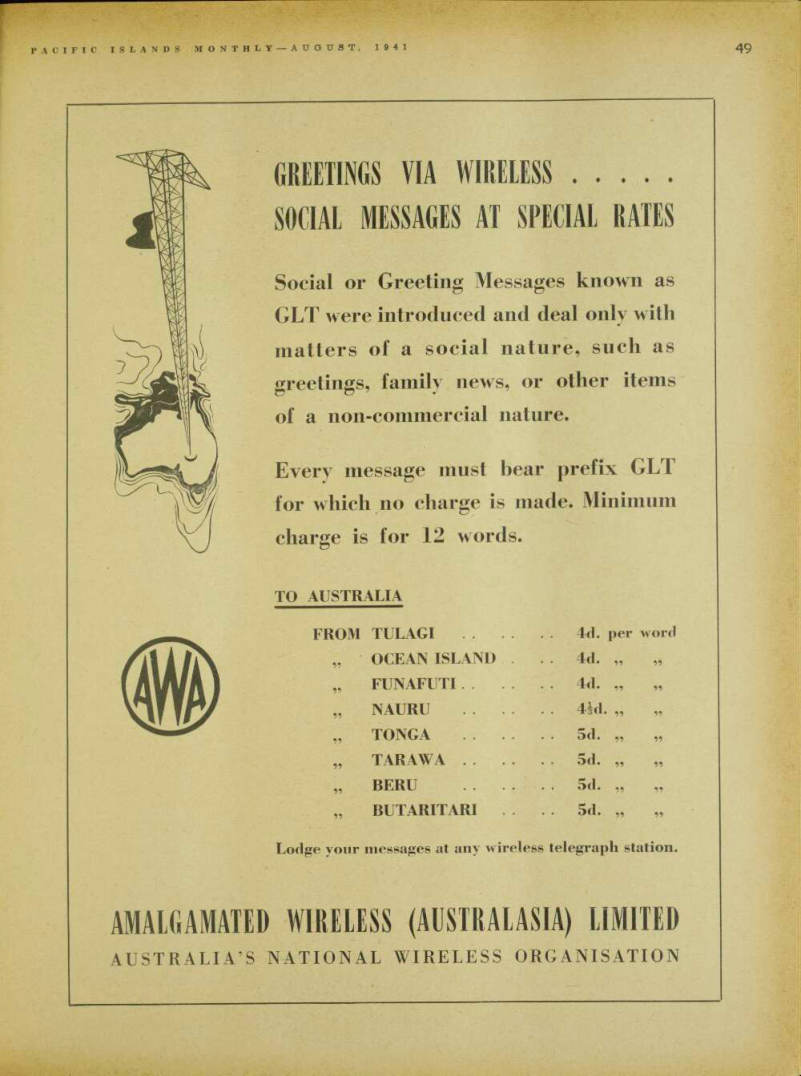
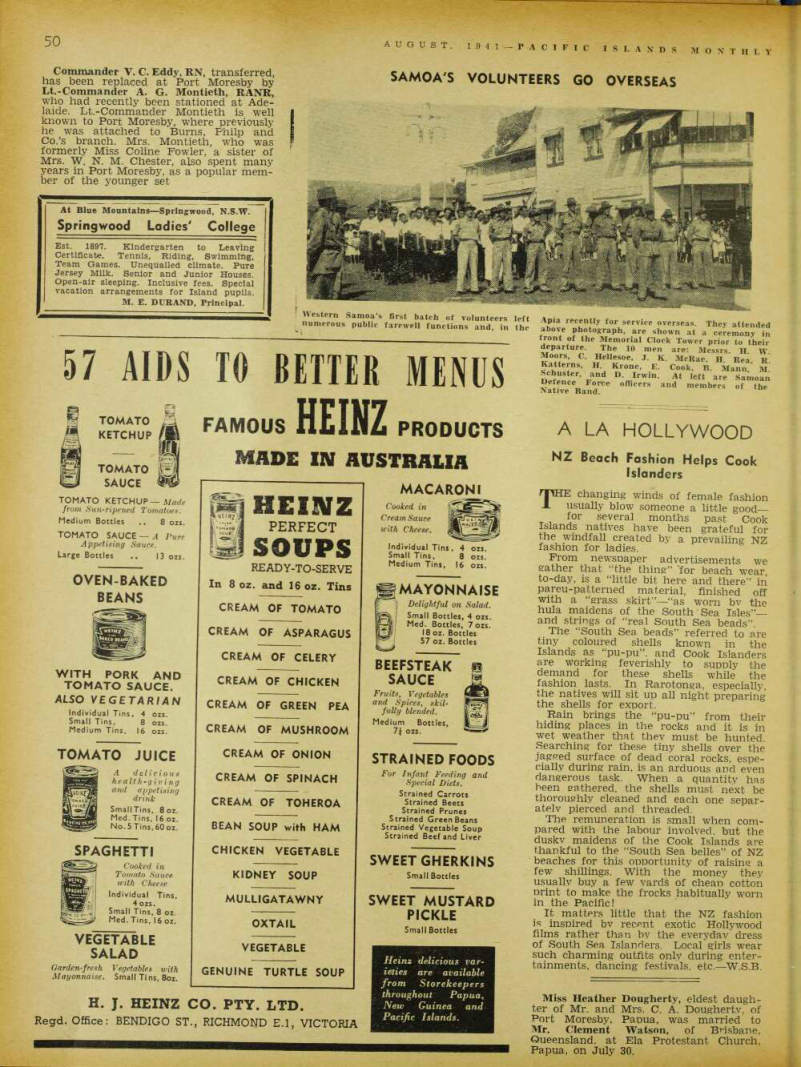
Native Gift To Red Cross
WHEN the native coffee planters of the north-eastern division received their payment of £2,102 for their yearly output, they voluntarily handed £47 to the Government officer, stating that it was their contribution to the Red Cross funds.
Land Conscious Papuans
Papuans becoming land conscious h^- s 1 th x ir , cu Pidity been aroused since tne Kiia Kila law suit, when over £4,000 was demanded for land acquired by the Government for a 'drome and other buildings? Within recent months, a num ber of applications for land have been met either by refusals to sell or by demands that have been previously un known. Qpe spokesman, when refusing, was said to have stated that his people fully realised that the offered price would bring many desirable things to their village; but, added he, it would also bring plenty of trouble and disturb their village life. They turned the offer down, preferring to live in peace.
Temporary Water Supply
Owing to the acute shortage of water in Port Moresby, and the severe rationing to householders, the Director of Works, Mr. H. G. Hannam, is installing an emer gency pump, on temporary foundations, to pump 10,000 gallons per hour from the Laloki into the town reservoir, until the new system is completed. The latter has been held up owing to delay in securing the necessary machinery. Mr. Hannam’s timely assistance is greatly appreciated.
The Administration is drawing up new regulations to meet the issue of water, which will be made available imme diately the pump has been installed.
£20,000 For Roads
Great satisfaction is felt over the Commonwealth’s grant of £20,000 to pro vide “sealed surface” roadways in and outside Port Moresby. The existing type of road has long been found unsuitable for the heavy traffic of recent years. Not the least benefit to residents, as a result of the improved roads, will be the elim ination of dust which, since the traffic has become heavier and faster, is an abomination.
Papuan Red Cross
The Papuan division of the Australian Red Cross last year collected £1,135, plus £732 for Special Ambulance Fund, plus £3300 (from Samarai) for Bomb Victims Fund, plus £l7 for Mobile Canteens Fund. Over £2OO, in clothing and ma terials, also had been contributed. Office bearers for current year are: President, Mrs. H. L. Murray; chairman, Mr. G.
Haughan; hon. treasurer, Miss A. Ben sted; hon sec., Mrs. T. Grahamslaw; council, Mesdames F. E. Williams, L.
Lett, W. A. Beck, Miss L, Preston, Messrs.
H. G. Hannam, C. B. Schuler, Dr. F. J.
Williams, and Captain D. Watson.
The Burman civil service students at the University of Sydney have been elected members of the Pacific Islands Society: Messrs. Mo Myit, Ba Nein, and Kyaw Nyun are graduates of the Uni versity of Rangoon, and Mr. E. N. Lar mour, BA, graduated from Dublin Univer sity. Towards the end of the year they will return to Burma and take up their administrative posts. But for the war, they would now be at Oxford.
Mr. C. E. Leake has returned to Sydney and taken up duties again as officer-in charge of the New Guinea Trade Agency, after a short period in Melbourne on transfer to another Government depart ment. Mr. J. O’Grady was in charge dur ing Mr. Leake’s absence.
Commander V. C. Eddy, RN, transferred, has been replaced at Port Moresby by Lt.-Commander A. G. Montieth, RANK, who had recently been stationed at Ade laide. Lt.-Commander Montieth is well known to Port Moresby, where previously he was attached to Burns, Philp and Co.’s branch. Mrs. Montieth, who was formerly Miss Coline Fowler, a sister of Mrs. W. N. M. Chester, also spent many years in Port Moresby, as a popular mem ber of the younger set
Advertisements & other items, pp. 50-52 (3 items)
48
August, i94i_PAciFic islands mont b l y
Sd^Ari
■7^ T, V
ft/ y
>u VS v vV is f-; A: ■ ■-■■ i>s; Ak •> drwars *':• A - •> w* rs. dswa r s *■ V- 1 ?RW J IIXw^TS^SBIa *s oswar s :-•$»/; •;•:'- »’ *OR W*s SDR w AR'S h * ? ::•. •? »*s ok w a rs ds * a r*s •;.■: A ', > Hfi n& mjmju^'"~^^; A ;<• <, DRWAR'S DRWAR'SDS WAR'S tv??-’ orwars ds wars oswa R s drwar's ds war's ds war's t*Jf.W/»;< :>:W: WaR':D;SWAR'S OSWA R S DRWA R'S DS WAR'S OSW.fiR-- DSWaR'R DR WAR'S DR WAR'S OS WAR'S DA WAR'S DR WAR'S DS WA RSD£\v " £R WAR'S OS WAR'S OSWA R S DRWAR SDS W OS WAR'S OS WAR s DR Wars DS VWSR'S osv ORWaR'S DR£A R' SpR R'S Q S/a R; SDR
J?.'S :xS
DRW.
OS WAR
OSWAS
DRWA
DRW.
DSW;
oswa:
OR'Wa R" S DSWA R
A R'S DR WAR’S
AR'SDRWAR'S
AR'S DS WAR'S
A R’S DSWA R S
S DRWaRS DRWA R'S
S. DRWaR’S DRV-/A R'S DR WAR'S
W7TR > DR WAR S DS WAR'S DR WAR'S OSWA R'S ;RWaR S DS 'WAR'S DS WAR'S OSWA R'S DSWA R’S ;^'a R'S DR WAR'S 0 S WA. R' SOS WAR SDSWA R 'S DRW A R ••
ARS DR WAR'S DSWAR'S DSWaRSDRWaKSDRWaR'SDRWAR'S
;' j/ ■/;%■: I •?D •' s DRWAR'S DR WAR'S DS WAR'S OSWA R'S *'£7**s WAR‘V:DRWAR S DRWAR'S DSWAR'S OS WAR SOSWARR ;/s;^ WAR'S DSWAR'SOS WARS DR WARS DRWARS '• ;A ' v Aa ***£.vtn& J» DRWARS DS WARS OSWaR’S DRWaRS DRWAR'SDRWAR'S
DR'WAR'S
OSWA. R'S
DR WAR'S
DRWAR'SDSWAR'SDSW/ " wa " a * ** f "" " D£WAK
DSWAR'SDRWaR'SDRWa:
0 SWA.R S DRWA R'S DRW
ORW A R' S DRW AR' SDRWA 3
DR WAR'S DS WAR'S DS WAR-
DS WAR'S OS WAR'S DSW'
i R'S DR'WARR
WAS'TS DS WAR'S DS WAR'S
SR'S OSW AR'S DRW A/R'S OS WAR'S A R'S 0 f#A R'S DRW a S' S DR WARS DR WAR'S >SWAR S DRW A S S DR WAR'S DR WARS DR WAR'S ... v . , , - - W.WaR S DRWAR'S DS WAR'S OS WAR'S OSWAR’S w 5- SOWAR'S ORWAR'S DS WAR'S OS WA R’SDSWaRSDSWaRS :.;.' s AA A a ;.>;: » v A x<' S 0S W A R'SOS W A.^<'S'(;R WA R DR S’ S DRWAR 'S
OSWA
DRW
DSW
DS -m ■ v :-jq : . m; .j >
SD^ARI
DaW.aR DRWaR'S DRWARS DS WAR'S DS WAR'S • DR'WaR'S DRWAR'S DS WAR'S OS W *, R S V.A AR «/.RR AR :w
'AR'S
DS WAR'S OS
OSWAR S DRW A R
DRWnRSDRWARr-
D W A R S, D S W a R' S DSW A R’S
DRWAR'S DRWAR'S
RWAR'S DR'WAR'S
DS WAR'S DSW'AR'S
DS WA R'S DRWARS
i>PWA»'<iT-"- 4 v- rv'-M- 4 1> 5 /VAR ' S V;AR ?i OSWAR'S OSWAR'SDSWAR'S -ivt D rSiD»?tf' WA,< ' sr>X ’’ yAR ' sl ' )KW<4ls ’ !SI) £VVAIR , SX)EWAR-S .S i<' )S W AR'S 0?■ W R' ST)SW A. R S DRWA R SDR WAR' S
Amalgamated Wireless (Australasia) Limited
3
GREETINGS VIA WIRELESS
SOCIAL MESSAGES AT SPECIAL RATES
Social or Greeting Messages known as GLT were introduced and deal only with matters of a social nature, such as greetings, family news, or other items of a non-commercial nature.
Every message must bear prefix GLT for which no charge is made. Minimum charge is for 12 words.
TO AUSTRALIA
Lodge your messages at any wireless telegraph station.
AMALGAMATED WIRELESS (AUSTRALASIA) LIMITED
AUSTRALIA’S NATIONAL WIRELESS ORGANISATION
At Blue Mountains—Sprlngwood, N.S.W.
Springwood Ladies' College
Est. 1897. Kindergarten to Leaving Certificate. Tennis, Riding, Swimming, Team Games. Unequalled climate. Pure Jersey Milk. Senior and Junior Houses.
Open-air sleeping. Inclusive fees. Special vacation arrangements for Island pupils.
M. E. DURAND, Principal.
57 AIDS TO BETTER MENUS
TOMATO
KETCHUP
TOMATO M
SAUCE
TOMATO KETCHUP Made
from Sun-ripened Tomatoes.
Medium Bottles .. 8 ozs.
TOMATO SAUCE A Pure
Appetising Sauce.
Large Bottles .. 13 ozs.
OVEN-BAKED
BEANS
WITH PORK AND
TOMATO SAUCE.
ALSO VEGETARIAN
Individual Tins, 4 ozs.
Small Tins, 8 ozs.
Medium Tins, 16 ozs.
TOMATO JUICE
A delicious health-giving and appetising drink Small Tins, 8 oz.
Med. Tins, 16 oz.
No.sTins.6ooz.
SPAGHETTI
Cooked in Tomato Sauce with Cheese Individual Tins, 4 ozs.
Small Tins, 8 oz.
Med. Tins, 16 oz.
VEGETABLE
SALAD
Garden-fresh Vegetables with Mayonnaise. Small Tins, Boz.
FAMOUS HEINZ PRODUCTS
MADE IN AUSTRALIA
HEINZ
tiSf'J PERFECT
1 SOUPS
READY-TO-SERVE
In 8 oz. and 16 oz. Tins
CREAM OF TOMATO
CREAM OF ASPARAGUS
CREAM OF CELERY
CREAM OF CHICKEN
CREAM OF GREEN PEA
CREAM OF MUSHROOM
CREAM OF ONION
CREAM OF SPINACH
CREAM OF TOHEROA
BEAN SOUP with HAM
CHICKEN VEGETABLE
KIDNEY SOUP
MULLIGATAWNY
OXTAIL
VEGETABLE
GENUINE TURTLE SOUP
MACARONI
Cooked in Cream Sauce with Cheese.
Individual Tins, 4 ozs.
Small Tins, 8 ozs.
Medium Tins, 16 ozs.
MAYONNAISE
Delightful on Salad.
Small Bottles, 4 ozs.
Med. Bottles, 7 ozs. 18 oz. Bottles 57 oz. Bottles
BEEFSTEAK
SAUCE
Fruits, Vegetables and Spices, skilfully blended.
Medium Bottles, ozs.
STRAINED FOODS
For Infant Feeding and Special Diets.
Strained Carrots Strained Beets Strained Prunes Strained Green Beans Strained Vegetable Soup Strained Beef and Liver
SWEET GHERKINS
Small Bottles
SWEET MUSTARD
PICKLE
Small Bottles
H. J. HEINZ CO. PTY. LTD.
Kegd. Office; BENDIGO ST., RICHMOND E.l, VICTORIA Heinz delicious varieties are available
from Storekeepers
throughout Papua , New Guinea and Pacific Islands.
Defence Foree officers and members of the
Samoa's Volunteers Go Overseas
Western Samoa’s first batch of volunteers left numerous public farewell functions and. in the
Apia recently for service overseas. They attended above photograph, are shown at a ceremony in front of the Memorial Clock Tower prior to their departure. The 10 men are: Messrs. H. W Moors, C. Hellesoe, J. K. McRae, H. Rea. R Katterns, H. Krone, E. Cook, B. Mann. M Schuster, and D. Irwin. At left are Samoan Defence Foree officers and members of the Native Band.
A La Hollywood
NZ Beach Fashion Helps Cook Islanders
rE changing winds of female fashion usually blow someone a little good— for several months past Cook Islands natives have been grateful for the windfall created by a prevailing NZ fashion for ladies.
From newsnaper advertisements we earner that “the thing” 'for beach wear to-day, is a “little bit here and there” in pareu-patterned material, finished off with a “grass skirt”—“as worn bv the hula maidens of the South Sea Isles”— and strings of “real South Sea beads”.
The “South Sea beads” referred to are tiny coloured shells known in the Islands as “pu-pu”. and Cook Islanders are working feverishly to supply the demand for these shells while the fashion lasts. In Rarotonga, especially, the natives will sit up all night preparing the shells for export.
Rain brings the “pu-pu” from their hiding places in the rocks and it is in wet weather that thev must be hunted Searching for these tiny shells over the jagged surface of dead coral rocks, espe cially during rain, is an arduous and even dangerous task. When a quantity has been gathered, the shells must next be thoroughly cleaned and each one separ ately pierced and threaded.
The remuneration is small when com pared with the labour involved, but the duskv maidens of the Cook Islands are thankful to the “South Sea belles” of NZ beaches for this onportunity of raising a few shillings. With the money they usually buy a few yards of chean cotton print to make the frocks habitually worn in the Pacific!
It matters little that the NZ fashion is inspired bv recent exotic Hollywood films rather than bv the everyday dress of South Sea Islanders. Local girls wear such charming outfits only during enter tainments, dancing festivals, etc.—W.S.B.
Miss Heather Dougherty, eldest daugh ter of Mr. and Mrs. C. A. Dougherty, of Port Moresby, Papua, was married to Mr. Clement Watson, of Brisbane, Queensland, at Ela Protestant Church, Papua, on July 30.
A Section For Women
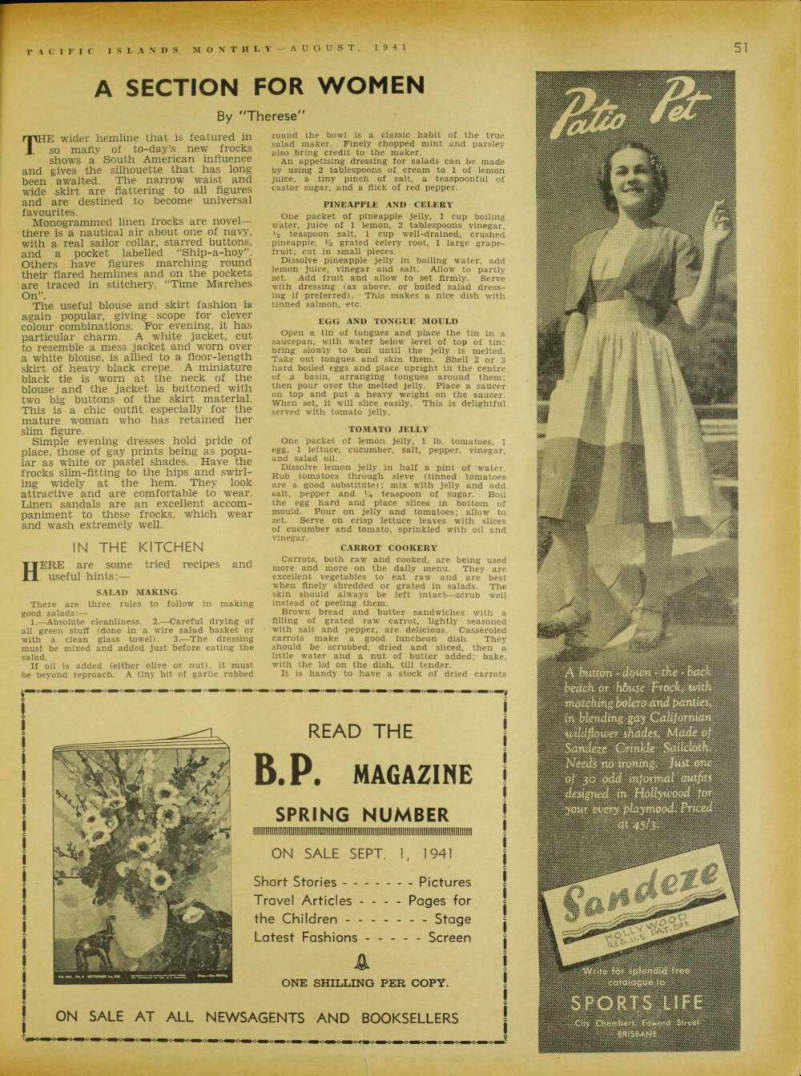
By "Therese"
rE wider hemline that is featured in so many of to-day’s new frocks shows a South American influence and gives the silhouette that has long been awaited. The narrow waist and wide skirt are flattering to all figures and are destined to become universal favourites.
Monogrammed linen frocks are novel— there is a nautical air about one of navy, with a real sailor collar, starred buttons, and a pocket labelled “Ship-a-hoy”.
Others have figures marching round their flared hemlines and on the pockets are traced in stitchery, “Time Marches On”.
The useful blouse and skirt fashion is again popular, giving scope for clever colour combinations. For evening, it has particular charm. A white jacket, cut to resemble a mess jacket and worn over a white blouse, is allied to a floor-length skirt of heavy black crepe. A miniature black tie is worn at the neck of the blouse and the jacket is buttoned with two big buttons of the skirt material.
This is a chic outfit especially for the mature woman who has retained her slim figure.
Simple evening dresses hold pride of place, those of gay prints being as popu lar as white or pastel shades. Have the frocks slim-fitting to the hips and swirl ing widely at the hem. They look attractive and are comfortable to wear.
Linen sandals are an excellent accom paniment to these frocks, which wear and wash extremely well.
In The Kitchen
HERE are some tried recipes and useful hints: —
Salad Making
There are three rules to follow in making good salads: — I.—Absolute cleanliness. 2.—Careful drying of all green stuff (done in a wire salad basket or with a clean glass towel). 3.—The dressing must be mixed and added just before eating the salad.
If oil is added (either olive or nut), it must be beyond reproach. A tiny bit of garlic rubbed
round the bowl is a classic habit of the true salad maker. Finely chopped mint and parsley also bring credit to the maker.
An appetising dressing for salads can be made by using 2 tablespoons of cream to 1 of lemon juice, a tiny pinch of salt, a teaspoonful of castor sugar, and a flick of red pepper.
Pineapple And Celery
One packet of pineapple jelly, 1 cup boiling water, juice of 1 lemon, 2 tablespoons vinegar, V 2 teaspoon salt, 1 cup well-drained, crushed pineapple, Vz grated celery root, 1 large grape fruit; cut in small pieces.
Dissolve pineapple jelly in boiling water, add lemon juice, vinegar and salt. Allow to partly set. Add fruit and allow to set firmly. Serve with dressing (as above, or boiled salad dress ing if preferred). This makes a nice dish with tinned salmon, etc.
Egg And Tongue Mould
Open a tin of tongues and place the tin in a saucepan, with water below level of top of tin; bring slowly to boil until the jelly is melted.
Take out tongues and skin them. Shell 2 or 3 hard boiled eggs and place upright in the centre of a basin, arranging tongues around them; then pour over the melted jelly. Place a saucer on top and put a heavy weight on the saucer.
When set, it will slice easily. This is delightful served with tomato jelly.
Tomato Jelly
One packet of lemon jelly, 1 lb. tomatoes, 1 egg, 1 lettuce, cucumber, salt, pepper, vinegar, and salad oil.
Dissolve lemon jelly in half a pint of water.
Rub tomatoes through sieve (tinned tomatoes are a good substitute); mix with jelly and add salt, pepper and V 4 teaspoon of sugar. Boil the egg hard and place slices in bottom of mould. Pour on jelly and tomatoes; allow to set. Serve on crisp lettuce leaves with slices of cucumber and tomato, sprinkled with oil and vinegar.
Carrot Cookery
Carrots, both raw and cooked, are being used more and more on the daily menu. They are excellent vegetables to eat raw and are best when finely shredded or grated in salads. The skin should always be left intact—scrub well instead of peeling them.
Brown bread and butter sandwiches with a filling of grated raw carrot, lightly seasoned with salt and pepper, are delicious. Casseroled carrots make a good luncheon dish. They should be scrubbed, dried and sliced, then a little water and a nut of butter added; bake, with the lid on the dish, till tender.
It is handy to have a stock of dried carrots
on hand to use in soups, stews, etc.- Method: Take the required number of fresh carrots, wash and dry thoroughly with a clean cloth.. Grate finely and spread out on large trays in the sun, turning the gratings over at intervals. It will take a few days for them to dry properly, but do not leave them out in the night air. When thoroughly dry, store in air-tight jars.
Baked Pudding
Two eggs, y 4 cup sugar, 1 cup grated raw carrot, y 2 cup bread-crumbs, salt, y 2 cup milk.
Beat yolks of eggs. Add sugar, the grated carrot and bread-crumbs (which should be very fine), y 2 cup of milk, and a pinch of salt. Cook m double boiler until thick, stirring constantly.
Pour into a pie dish and bake for 15 minutes.
Add sugar to the beaten egg whites to make a meringue; pile on top of pudding and brown lightly in a slow oven.
War Loaf
This is a recipe for a loaf that is economical, wholesome, and handy for morning tea, luncheons or picnics.
Melt 1 dessertspoon golden syrup in 1 table spoon of boiling water and then fill up the cup with milk. Put 1 cup wheatmeal in a basin, add y 2 cup sifted flour, a good pinch of salt, 2 teaspoons cream of tartar and 1 teaspoon car bonate of soda. Mix well together, then add milk and syrup mixture. Mix thoroughly and half flu a greased loaf tin. Bake with lid on tin for half an hour in a fairly hot oven.
Sir Harry Luke, KCMG, Governor of
Fiji, paid a short visit to New Caledonia and New Hebrides in mid-July on West ern Pacific High Commission duties.
Advertisements & other items, pp. 53-54 (1 item)
B.P. Magazine
i •l-i-
-~ xr 3 W:m ID li ?:■ m .""T $ <A m -n ■9 ■■:.:;::! , ;v: , ::;': : -:- : : : :': : : : ';: : ;;:' SSS;:
QZ & Z
2 S-»q ! » S ?o er « s * w t .I:^2
s .T V *■» * K
READ THE
B.P. MAGAZINE
SPRING NUMBER
lIIIIIIIIIIIIIIIIIIIIIIIIIIIIIIIUIIIIIIIIIIIIIIIIIIIIIIIIIIIIIIIIIIIIIIIIIIIIIIIIIIIIIIIII^
ON SALE SEPT. 1, 1941
Short Stories - Pictures Travel Articles - - - - Pages for the Children Stage Latest Fashions Screen A
ONE SHILLING PER COPY.
ON SALE AT ALL NEWSAGENTS AND BOOKSELLERS
memk as i—f/ff
SAUCE
lf4eJ bij Oteks theWcrld ever
ECONOMICAL. BECAUSE YOU NEED
JUST A FEW DROPS AT A TIME -
McILRATH’S
for Quality Groceries at
MONEY-SAVING PRICES
Rosa Full Cream Condensed Milk, 14-oz Bd. tin; 7 6 doz.
Sunshine Full Cream Powdered Milk, 12-oz \/2\ tin; 14 3 doz.
Best Plain Flour, 50-lb 6/6 bag; 11/9 tin C.F.S. Choicest Tinned Butter, 16-oz l/llj tin; 23/- doz.
Kraft Cheddar Cheese, 8-oz 9d. pkt.; 8/9 doz.
Rosa 50/60 Dessert Pruns, 7-lb. tin lb.
Choice Evaporated Apricots l/5x jb.; 17/- doz.
New Season’s Aus. Pressed Figs, 16-oz 1/6 pkt.; 17/6 doz.
Rosa Best Western Honey, 2-lb 1/6* jar; 18/- doz.
IX.L. Best Assorted Jam 12-oz., 7/- doz.; 24-oz., 11/- doz.
Choice Fruit Salad 16-oz., B£d. tin; 30-oz., 1/1 tin I.X.L. Bartlett Pears 16-oz., 7/4J doz.; 30-oz., 11/3 doz Rosa Jelly Crystals, 4-oz 4*d. pkt.; 4/3 doz.
Foster Clark’s Ice Cream Mixture, 4-oz 6Jd. pkt.; 6/3 doz.
I.X.L. Tomato Soup 8-oz., 5/3 doz.; 16-oz., 9/3 doz.
“Capital” Wax Floor Polish, 13-oz 1/2J tin; 14/- doz.
Rosa Pure Soap Large bar, 5/6 doz.; Giant bar, 10/6 doz.
HALF-DOZEN LOTS CHARGED AT DOZEN RATES.
All prices f.o.b. Sydney, cases and packing free.
Space available all steamers.
All consignments carried by air are packed in special fibre cartons—without extra charge—in order to reduce aerial freight.
McILRATH’S Pty. Ltd.
EXPORT DEPARTMENT
202-204 PITT STREET, SYDNEY
AUSTRALIA
Two Murders in Samoa
From Our Own Correspondent APIA July 12 CRIMES of violence have’ increased lately to an alarming degree in out lying Samoan villages. Most of them have two common features- Thev are committed for apparently trivial rea sons and in nearly all cases machetes (cane-knives) are used as weapons.
Recently, two brutal murders have been committed in Samoan villages far distant from each other. On June 21 the Samoan matai (chief) Leaupepe Tautai, of the West Coast village of Faleasiu, was attacked about 1 a.m. while sleeping with his family in a Samoan faie Severe injuries were inflicted to the left side of his head, and he died in hospital a week later. Neither his wife nor anyone else was aware the murderer had entered the house. Police investi gations are proceeding.
The second murder was in the South Coast village of Lotofaga. The village chief, Sitagata Vagatai, was planting a hibiscus hedge on the boundary between his house and that of his neighbour, the taule-ale’a, Sefau, and the latter strongly objected to it. When Sitagata took no notice and continued to work, Sefau rushed at him with a sapelu (cane-knife) and struck him repeatedly, causing seri ous wounds on the left shoulder and hands. Villagers interfered and the wounded man was taken to Poutasi Gov ernment Hospital, where he died on June 29.
Sefau was arrested and brought to Apia.
Polynesian Club
MONSIEUR and Madame Andre Brenac were entertained by members of the Polynesian Club of Sydney, in July M. Brenac, who is leader of the Free French movement in Australia, was the principal guest at a “faikava faka Toga”; and, in an address, he paid tribute to the men of the Free French Colonies in the Pacific who had left their homes to continue the war alongside the British Empire. After the kava ceremony Club members presented a variety of Polyne sian songs and dances.
Other Islands people who have visited the Club in recent weeks include Mr.
Bill Smith (Suva), Elemi Koroseqa (Kan davu, Fiji), and Messrs. Andy and Peter Cowan (sons of Mr. Jack Cowan, of Papeete, Tahiti).
Mr. T. L. Sefton, of Koitakinumu Rubber Plantation, left Port Moresby recently for a short holiday in Australia.
Advertisements & other items, p. 54 (1 item)
Kidneys Must
Clean Out Adds
Your body cleans out excess Acids and poisonous wastes in your blood through 9 million tiny delicate Kidney tubes or filters. If Poisons in the Kidneys or Bladder make you suffer from Getting Up Nights, Nervousness, Leg Pains, Circles Under Eyes, Backache, Aching Joints, Acidity, or Burning passages, don’t rely on ordinary medicines. "Fight such Poisons and troubles with the doctor’s prescription Cystex. Cystex starts working in three hours, must prove entirely satisfactory and be exactly the medicine you need or money back is guaranteed. Ask your chemist or store GUARANTEED for Kidneys. Bladder. Rheumatism
Cystex
for Cystex (Sisstex) today. The Guarantee protects you. Now in 3 sizes —l/9 ; 4/- ; 8/-.
Snobbery
An End Of
Changes in New Caledonia
From Our Own Correspondent
Noumea, July 12.
A STRIKING change in the social life of New Caledonia is noted as a result of the September revolution and the throwing out of unpopular fonc tionnaires. It was largely those fonc tionnaires, who considered themselves little tin gods, and superior to the rather plain-thinking Caledonian-born, who were the main upholders of the snob system which ruled until the arrival of Governor Sautot.
The other day, I witnessed the depart ure for Indo-China, via Australia, of a typical “case”—not a fonctionnaire, but a professional man, and a typical Vichy partisan. On his way to the ship, he was loudly cursing New Caledonia, which he called a “sale pays” inhabited by “sale coloniaux” and his attitude was most unhappy towards Governor Sautot and all his works.
Can we wonder that the people of this country—which is neither unimportant nor unattractive —are a little tired of being run by the sort of metropolitain this man represents, and long for real self-government. Their general longing is to become a sort of French Dominion on New Zealand lines.
It is rather mystifying to the visitor to find such a relatively small population divided up into so many little cliques, fonctionnaires, professional men, com mercials, shop-employees, workers, min ers, broussards, having so little friendly intercourse; and the women are as bad as the men—or a darned sight worse.
Noumea particularly, little as it is, has in the past been a paradise for snobbery, where petty jealousies were rife, and this has been one of the bad things Governor Sautot has had to strive against. He is succeeding—at least, temporarily—because he is a simple man with an absolute incapacity for “side”.
Car-owners have for years monopolised the attractive suburban beach called Anse Vata, where they have been allowed by past Governments to establish a long row of summer- or bathing-houses, which largely exclude the general public.
A recent decree, however, requests them to remove these kiosks before the end of the year, so that the beach next year may be available for the use of Cale donians generally.
Hitherto, Government House balls have been exclusive', dressy affairs; but Sau tot, realising whence comes the real strength of the Free French movement, is going to make an exception for the Republic Day ball of July 13, which will not be reserved for the privileged few, but will be thrown open, as he puts it, “to all artisans of the movement, with out distinction of class, for Free French men are distinguished only by their devotion to their country, wherefore all are welcome, whether Noumeans or broussards. bourgeoisie or workers or peasants. The entry price will be modest, and.the only tenue exacted correct town dress.”
The main Government wharf at Port Moresby is being strengthened, length ened and widened so as to provide more and better accommodation for increased shipping.
The Royal Australian Historical Society has arranged a series of lectures in Sydney for senior high school students.
Mr. Eric Ramsden has been asked to lecture in October on the early mission period in Tahiti.
Marriages by proxy have been author ised for New Caledonian soldiers serving overseas. Three such marriages have already been arranged with soldiers now abroad. The prospective wives reside in Noumea.
Advertisements & other items, pp. 55-56 (1 item)
Imperial
THE SCOTS COLLEGE, BELLEVUE HILL, SYDNEY.
Founded 1892.
Owned and Conducted by the Presbyterian Church of N.S.W.
One of the Great Public Schools, the College is situated in spacious grounds at Rose Bay.
A large extension of the School Block and a new Assembly Hall were opened in 1939.
PRINCIPAL: A. K. Anderson, M.A., F.R.Hist.S. 30 Assistant Masters and a large visiting staff. Present Roll:—700 pupils, including 200 Preparatory Boarders and Day Boys, THREE COURSES: Academic, Commercial and Pastoral.
Boys prepared for University and Education Dept. Examinations to Leaving Honours.
Wool-classing and Woodwork available for Boys going on the Land.
There are five Houses for Boarders. About 30 boys are from overseas.
THE PREPARATORY SCHOOL, adjacent on Mansion Road, is fully staffed.
Next Term opens on September 23; First Term in 1942, February 10.
Prospectus on application to the Principal, or the Secretary, (Mr. J. R. Mackay), Assembly Hall Buildings, Margaret Street, Sydney.
Delicious
Meals-in-a-Moment
Ready-to-Serve Always
FLAVOUR SEALED IN GOLD LINED CANS
Imperial Good Foods save hours of cooking . . . just open and serve, that’s the secret of preparing “Imperial” meals in next to no time.
Imperial
Serve these spicy, savoury treats: Imperial Sheep Tongues, Camp Pie or Corned Beef Loaf.
Any hour of any day serve a tasty meal with these savoury meats packed by the makers of "Imperial" Good Foods. % * * 'J // 1 ★ Try These Tasty NEW Delicacies.
"FITZROY" Luncheon Beef. Pork or Beef Sausages. "WESTFIELD" Corned, Boiled or Roast Mutton. "OX & PALM" and "RIVERSTONE" Corned, Boiled or Roast Beef.
"Health and Freshness Sealed in Cans."
Imperial full flavoured, creamy TOMATO SOUP; Imperial choice, tender ASPARAGUS
TIPS and PIECES.
Products of
RIVERSTONE MEAT CO. PTY. LTD.
1 BENT STREET, SYDNEY.
"BEEBE" ALL-STEEL
WINCHES
Genuinely portable, 5 tons capacity.
Weight 120 lb.
Ideal for all Mining, Timber-getting and general purposes.
Immediate delivery ex Rabaul to all parts of the Islands.
PARTICULARS:
Nelson & Robertson Pty. Ltd.
12 SPRING STREET, SYDNEY.
/Whether yeu require
krix
o\ mtcl «
■icr particulars
1 ■P« ¥
(S) STORES, FACTORIES, HOME AND
OFFlCE.—Electrical fittings, Crompton Lamps, Fans, Floodlighting.
Household Electrical Appliances, Radio Receivers and Equipment. Jas. Rodgers’ Cutlery and Plateware, Cutglass and Perfection E.P.N.S. Ware “Olympic” Spark Plugs.
0 ELECTRICAL EQUIPMENT.—Parkin-
son Motors, Crompton Switchgear, Transformers, Instruments, Meters Callender Wires and Cables, Lighting Equipment, Electric Drills. (S) MINING. Crushing Machinery, Screens, Feeders, Rock Drills, Excavators, Diesel and Crude Oil Engines, Hoists and Runways, Roller Bearings, etc.
Islands Mining Shares
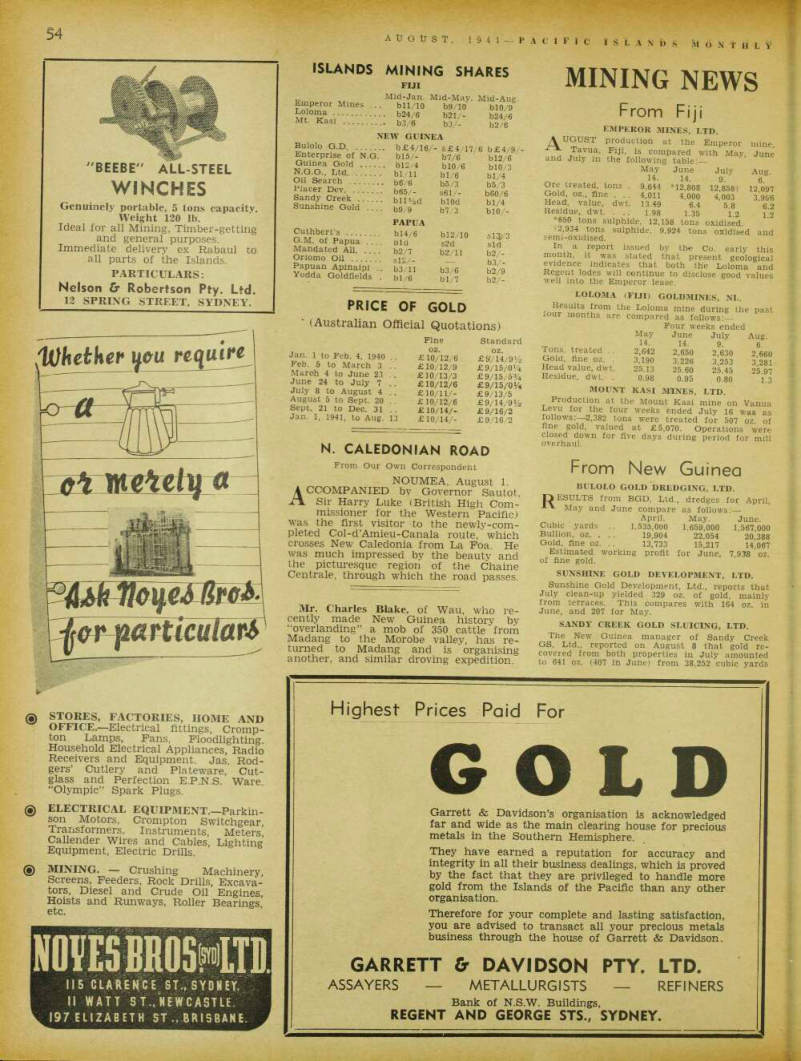
Fiji
Emperor Mines ..
Mid-Jan. Mid-May. bll/10 b9/10 Mid-Aug. blO/9 Loloma Mt. Kasi ... b21/b24/6 Do b2/6
New Guinea
Bulolo G.D .. b£4/16/s £ 4 17/ 6 b £4/9/- Enterprise of N.G bl5/b7/6 bl2/6 Guinea Gold . ... blO/6 V-» 1 /(* blO/3 bl/4 b5/3 b60/6 bl/4 blO/- N.G.G., Ltd hi /\\ Oil Search Placer Dev Sandy Creek Sunshine Gold .. •• b65/- •• bll>/ 2 d •• b9/9
Papua
0 I/O b5/3 s61/blOd b7/3 Cuthbert’s G.M. of Papua .. bl4/6 bid bl2/10 s2d sl$/3 sld Mandated All. .. .
Oriomo Oil ... • b2/7 . sl£'/- •• b3/ll • bl/6 b2/ll b2/b3/b2/9 b2/- Papuan Apinaipi Yodda Goldfields b3/6 bl/7
Price Of Gold
(Australian Official Quotations)
Fine Standard t 1 K 1 . t ° ) Fe ! , ; 4, u 1940 " £10/12/6 £9/14/9% Feh 5 to March 3 .. £10/12/9 £9/15/0% w W l° J , UI ! e l 3 • £10/13/3 £9/15/5% June 24 to July 7 .. £10/12/6 £9/15/0V4 July 8 to August 4 .. £10/11/- £9/13/5 August 5 to Sept. 20 .. £10/12/6 £9/14/9% Sept. 21 to Dec. 31 .. £10/14/- £9/16/2 Jan. 1, 1941, to Aug. 13 £10/14/- £9 16/2
N. Caledonian Road
From Our Own Correspondent NOUMEA, August 1.
A CCOMPANIED by Governor Sautot, JA. Sir Harry Luke (British High Com missioner for the Western Pacific) was the first visitor to the newly-com pleted Col-d’Amieu-Canala route, which crosses New Caledonia from La Foa. He was much impressed by the beauty and the picturesque region of the Chaine Centrale, through which the road passes.
Mr. Charles Blake, of Wau, who re cently made New Guinea history by “overlanding” a mob of 350 cattle from Madang to the Morobe valley, has re turned to Madang and is organising another, and similar droving expedition.
Mining News
From Fiji
Emperor Mines, Ltd.
AUGUST production at the Emperor mine Tavua, Fiji, is compared with May, June and July in the following table:—
In a report issued by the Co. early this month, it was stated that present geological evidence indicates that both the Loloma and Regent lodes will continue to disclose good values well into the Emperor lease.
Loloma (Fiji) Goldmines, Nl.
Results from the Loloma mine during the past lour months are compared as follows:
Mount Kasi Mines, Ltd.
Production at the Mount Kasi mine on Vanua Leyu for the four weeks ended July 16 was as f0110w5:—2,382 tons were treated for 507 oz of fine gold, valued at £5,070. Operations were closed down for five days during period for mill overhaul.
From New Guinea
Bulolo Gold Dredging, Ltd.
O ESULTS from BGD, Ltd., dredges for April, May and June compare as follows:
Estimated working profit for June, 7,938 ’ oz. of fine gold.
Sunshine Gold Development, Ltd,
Sunshine Gold Development, Ltd., reports that July clean-up yielded 329 oz. of gold, mainly from terraces. This compares with 164 oz. in June, and 207 for May.
Sandy Creek Gold Sluicing, Ltd.
The New Guinea manager of Sandy Creek GS, Ltd., reported on August 8 that gold re covered from both properties in July amounted to 641 oz. (407 in June) from 38,252 cubic yards
May June July Aug. 14. 14. 9. 6.
Ore treated, tons . 9,644 *12,808 12,858r 12,097 Gold, oz., fine . . . 4,011 4,000 4,003 3,996 Head, value, dwt. 13.49 6.4 5.8 6.2 Residue, dwt. . .. 1.98 1.35 1.2 1.2 ~S50 tons sulphide ', 12,158 tons oxidised. • 2,934 tons sulphide, 9,924 tons oxidised and serai-oxidised.
Four weeks ended May June July Aug. _, 14. 14. 9. 6 Tons, treated 2,642 2,650 2,630 2.660 Gold, fine oz. 3,190 3.226 3,253 3 281 Head value, dwt. 25.13 25.60 25.45 25 97 Residue, dwt. . 0.98 0.95 0.80 i 3
April.
May.
June.
Cubic yards 1,535,000 1,659,000 1,567,000 Bullion, oz. . 19,904 22,054 20,388 Gold, fine oz. .. 13,733 15,217 14,067
of material treated. Average value was 2/8 per cubic yard. During June average mine cost was 11'id. per cubic yard.
New Guinea Goldfields, Ltd.
June production from NGG, Ltd.’s workings is compared with the two previous months in the following table: —
From Papua
Cuthbert’S Misima Gold Mine, Ltd.
A REPORT from Cuthbert’s Misima Gold Mine, Ltd., compares the figures for the July clean-up with the two previous months as follows:
Papuan Apinaipi Petroleum Co., Ltd.
Papuan Apinaipi Petroleum Co., Ltd., reports that on July 23, the No. 2 major well at Oiapu had reached a depth of 1,630 feet. Casing was then being inserted.
April.
May.
June.
Edie Creek mill— Ore, tons — — — Gold, oz., fine . . — — — Silver, oz., fine .. — — — Golden Ridges mill— Tons treated .. .. — — 2,575 Gold, oz., fine .. — — 678 Silver, oz., fine .. , — — 825 Alluvial — Gold, oz., fine .. 818 1,275 1,284 Silver, oz., fine . . 586 820 843 Operating profit— Edie Creek, £ . . *1,333 *2,098 * 1,639 Golden Ridges, £ *2,673 *1,563 944 Alluvial, £ .. .. 2,206 3,026 2,821 •Loss.
There was no production at Edie Creek and Golden Ridges in April or May.
Operations at the Edie Creek mill in June were confined to development work on the Karuka vein and maintenance of workings.
Estimated operating profit on Koranga Alluvials, for quarter ended June 30. was £2,377.
May.
June.
July.
Mill, tons treated .. 3,306 3,317 3,472 Gold, fine oz 801 789 842 Silver, fine oz 2,659 2,804 2,490 Estimated value .. £6,514 £6,434 £6,790 Value per ton of ore . 39/5 38/9 39/1
Advertisements & other items, p. 56 (1 item)
Gold
Highest Prices Paid For
Garrett & Davidson’s organisation is acknowledged far and wide as the main clearing house for precious metals in the Southern Hemisphere.
They have earned a reputation for accuracy and integrity in all their business dealings, which is proved by the fact that they are privileged to handle more gold from the Islands of the Pacific than any other organisation.
Therefore for your complete and lasting satisfaction, you are advised to transact all your precious metals business through the house of Garrett & Davidson.
GARRETT & DAVIDSON PTY. LTD.
ASSAYERS METALLURGISTS REFINERS
Bank of N.S.W. Buildings,
REGENT AND GEORGE STS., SYDNEY.
"Greeting" Radios to Pacific
Islands
SEVERAL years ago a new form of “social” or “greetings” telegraphic message, known briefly as GLT, was introduced within the British Empire, at special low rates. Such messages may be written only in plain language, and must deal entirely with matters -of a social nature, such as greetings, family news, or other items of non-commercial nature.
The GLT type of message needs to bear the full postal address for delivery, and, consequently, abbreviated tele graphic addresses cannot be used.
This ready means of maintaining radio telegraph communication amongst fami lies and friends separated by considerable distances, and particularly where mail services are infrequent, is being increas ingly availed of, as the existence of the new facility becomes more widely known.
Undoubtedly, the GLT service is a boon in the war period. Examples of some of the Pacific Islands rates, as furnished by Amalgamated Wireless (Australasia) Limited, are as follows:
Between Australia And Tulagi (Solo
MON IS.). —4/- for minimum of 12 words, plus 4d. for each additional word.
NAURU. —4/4 for minimum of 12 words, plus 4-l/3d. for each extra word.
OCEAN ISLAND AND FUNAFUTI. —4/- for mini mum of 12 words; 4d. for each additional word.
Tarawa, And Various Other Points. —
5/- for a minimum of 12 words; sd. for each additional word.
The prefix GLT must appear immediately before the address, but it is not charged for as an additional word.
Sister M. Kevin, SM, of the Marist Mission, Poporag, British Solomon Is lands, is at present in Sydney completing a nursing course.
More Vegetables For
Port Moresby
From Our Own Correspondent
Port Moresby, July 26.
MR. George Gough, who is in charge of the Port Moresby Gaol gardens at Laloki, recently returned from sick leave, and with him came an assistant, his young brother, who has had many years’ experience in agricultural work in Northern Queensland.
The areas under cultivation will be extended and an irrigating plant and spray are to be installed. It is believed that production will increase beyond expectations, owing to the excellent soil
of the locality, which takes in large areas of the Laloki River flats.
These gardens provide vegetables not only for the prisoners, but also for the police and inmates of the native hos pital. In future they will also provide fruit and vegetables for others living in the district.
An X-ray plant, donated by Mr. R.
Bunting in memory of his father, the late Hon. T. H. Bunting, MLC, is now in operation at Samarai Hospital (Papua) under the direction of the Government Medical Officer (Dr. H.
White), A silver plaque, suitably in scribed, commemorates the gift.
Advertisements & other items, pp. 57-58 (2 items)
55
paCl i i c Islands MoStMLV - A u G tr s I’, id 4 1
Cngiish
ARE YOU BUYING TO THE BEST ADVANTAGE?
To ensure that you receive your goods at the lowest rates and enjoy the benefits of Full Trade Discounts, send your orders, by Air Mail, if possible, to: —
ROBERT GILLESPIE PTY. LIMITED
KOBEEGILL. 54A PITT ST„ SYDNEY, N.S.W.
“Firearm Repairs’’—“OUß HANDS MAKE GOOD ARMS”—Goods sent C.0.D.” .22
CAL.
BOLT ACTION
SINGLE SHOT RIFLES.
"Cooey" Rifle, Single Shot Bolt Action, .22 Col. Rifle, 24 inch barrel.
Elevating Rear Sight and Blade Fore Sight. British Empire Product.
Price 45/-. Postage extra.
No. 87b. Winchester New Model, 67 Single Shot Bolt Action .22 Cal. Rifle. 27 inch barrel. Safety lock Bead Front and Elevating Rear Sight. Price 61/6.
FIREARMS CATALOGUES ON REQUEST. PHONE: MA 3540.
SIL ROHU
143 ELIZABETH STREET (Near Market St.) SYDNEY Quality Firearms and Pishing Tackle. ’Phone; MA 3540.
HILL’S famous GOLD FLAKE
Cngiish
Cigarettes of duality
RET
In case of difficulty in obtaining supplies write to Box 1861, G.P.0., Sydney.
WORLD'S LATEST
GAMES
Darts Boards with 6 Darts, 8/6.
Play Brass Competition Darts, Set of 3, 3/11, 4/6, 5/6. Monopoly, 11/6.
Totopoly. 11/6. Bucaneer, 11/6. 3 of the World’s Most Popular Games.
Chinese Checkers, 2/9, 5/-, 9/-.
Tripoly Card Game , 5/3. De Luxe Type, 11/6. Poker Rummy, 1/1.
RADIO VALVES.—We guarantee a Better Price. Send your order.
ALL DRY BATTERIES STOCKED.
Wet Battery Testers, 3/-.
Nickel Cased Volt Meters, Pocket Type, 2 Reading, High & Low, 4/6.
British Make 3 Readings, 10/6. 12 Snappy Books—Jokes, Have Fun, etc., 5/6 the lot.
All About Aerial Booklet, !-/• Radio Dictionary, 1/-. Morse Code Book, 1/-. Radio Alphabet, 1/-, The 4 books for 3/3.
Roulette Wheels, complete, 25/-.
The Best Trick Pack of Cards available, 3/6. Hundreds of Tricks you can do. Fullest, simple instructions provided.
PRESTO, THE MAGIC BOX.
2/9
FREE.
FREE.
2/9
POST
POST
MOST AMAZING TRICK EVER.
Special Wholesale Price in quantities.
Now available (not less than 10/parcels): Magic Wand, 1/6 Jafet’s Wallet 1/-; Obedient Ball 1/6; Magic Penny, 2/6; Mystic Head Chopper, 2/6; Shy Lock, 2/-; Dribble Glass, 2/-; Ventrillo. 1/-; Magic Coin, 1/-; Nest of Nests, 5/-; Voice Echoer, 1/-; Magic Bottle, l/-\ 3 Bell Trick, 1/-.
Magic Wand 1/6; Wonderful Rattle Box Trick, 2/6. Mixed Parcels of Tricks, 10/-, 20/-, 30/-, 40/-, 50/-.
Parcel of Jokes, 10/-, 12/6, 15/-.
The Magic Money Roll, 3/6. 10/-, £1 and £5 Notes appear when you know how a simple yet entertaining trick.
-OWN
EGG & BAG
TRICK, 2/6.
Easy to Perform —Splendid to see Worked.
Instructions Supplied.
SAFETY RAZOR
BLADE
SHARPENER
Make your safety razor blade last for months with this Razor Blade Sharpener, 3/6. Easy to use—nothing to get out of order.
MAKE YOUR OWN RECORDINGS.
Overhead Cutting Gear and Cutting Head for Home Radio-Gramophone Recording, £5/5/-. Used in conjunction with your present radio.
Records, Needles, etc., etc. Metal Discs, 1/-, 1/6.
Microphones for Speech, Song or Music. Hook-up in a jiffy to any set. 15/-, 17/6, 18/6 complete.
Batteryless Type Hand - holding Microphones, fit any set, 25/-.
Ormond 3 In. Front-panel Vernier Dial, 2 actions, 8/6.
HEADPHONES.
12/6, 17/6.
S.T.C., British, 30/-; 8.T.H., 30/-; Lissen, British, 19/6. All 4,000 ohms.
Rubber Head-’phone Pads, 2/6 pr.
Ericcson’s Professional Type, 47/6. m A new hobby—Rough Castings of Modern Planes, Ash Trays, Paper Knives, etc., etc. Write for Free Booklet.
New Radio and Other Books Just Landed. Everyman’s Wireless Book, 8/6; Toy Making for Amateurs, 2/-; Sixty Tested Circuits, 6/6; How to Make Models, 2/6; The First Course in Wireless, 9/6; Wireless Terms Explained, 6/6.
B.G.E. Table Model Microphone for Speech or Music —fits and suits all sets; as good a performer as any; £6/6/- Model. Now 45/-.
Small Table Model British Built Microphone, for all sets, 15/-, 21/-, 22/6, for speech or music. 2 Reading Pocket Volt Meters, 5/6.
Portable battery operated Light with pull switch and Battery Block, 8/6.
Bench Reads Type All in Meter Radio, 30/-.
POCKET VOLT
METERS.
Two Reading Pocket Meter, for A and B Batteries, 3/9, 4/9, 7/( 3 Reading, A and B Batteries, am up to 30 M/A, 10/6. 3 Reading Di Luxe Model, 12/6. 4 Reading, 14/-.
BOOKS! BOOKS! BOOKS! The Be-
ginners’ Book of Radio. The Radio Beginners’ Dictionary. 2/- the 2. The Wireless Constructor’s Enoycle. paedia. Giant size, 7/6. Newnes “Everyman’s” Wireless Book, 6/6.
The Book of Practical Radio, also The Book of Practical Television, 8/6 each. Levenson’s Giant “Party and Fun Book”, 1/6. Humorous Stories and Recitation, 3/9. Card and Conjuring Tricks, 3/9. Tea-Cup Fortune Telling, 3/9. 100 Party Games for Old and Young, 1/9.
Popular Magic and Amateur Conjurer, 1/9. 50 Best Party Games, 1/6. Tricks with Cards, 1/6.
How to make 1 & 2 valve Battery Sets, 1/-.
LEARN MORSE CODE. “LIKE-A-
FLASH” KITS. KEYS & BUZZERS.
P.M.G. type Key with Professional Buzzer & Battery, all assembled on Base Board, 42/6.
Morse Set Buzzer or light with single switch. All parts include adjustable Key, Switch, Buzzer.
Lamp and Battery, all assembled on Base Board, 30/-. \ If.
Morse Code Set “De Luxe”. Adjustable High-grade Key, Buzzer and Battery. All mounted on base board ready for use, 27/6. \\Hy Adjustable Morse Code Key on Bakelite Base, highly plated parts, 12/6. High-grade instrument. m De Luxe Junior Morse Code Outfit.
Mounted Key Buzzer and Battery. 15/3 complete. Morse Book, 1/-. 9 P.M.G. Model Adjustable Morse Code Key. Precision fittings, 19/6.
LEVENSON'S
SPECIALISE IN RADIO
SETS FOR THE ISLANDS
TRADE
100% satisfaction guaranteed.
Liberal prices—no mass production sets real he-man radio designed and built for your particular location. Short wave and dual wave radio for dry battery or electric current operation.
Quotations with pleasure.
Money Belts for Soldiers, Sailors or Civilians. Zipper Types, 9/6. Others, 6/6, 7/6.
Electric Military Brush, 15/-.
Stimulates the Scalp and Hair.
Aerial Stay-wire strainers, 2/6.
De Luxe Model British-built Lightning Arresters, complete for indoor or outdoor use, 6/-.
Non-jam Pulleys with halyard bolt, 1/9. Special Radio Earth Spike 4/6. 4 in. 4 in 1 Nickel Screw Drivers, bakelite or metal, 2/-. , Fountain Pen size. Cone Speaker Units, 25/-; Now 12/6. 1,500 ft. Beam Electric Torches, 5 Cell, 8/6. Both use Standard Batteries. Everyman’s Wireless Book, 8/6. 2 to 3 Cell Expandable Torches.
Nickelled Case—Dimmer incorporated.
Daylight Globes, 10/6.
Swiss Music Boxes for Cigarette, Trinkets, etc., 25/-, 30/-, 45/-.
Steel Money and Deed Boxes, 63/-.
They ring when opened or lifted.
A Splendid Article.
Hunting and Sporting Knives. Remington U.S.A. made, 10/6, 12/6, 15/6, 16/6. (All in Sheath.) Throwing Knives, 8/9; Small Throwing Knives, 7/6; Set of 2, 15/-; Set of 3, 22/6; De Luxe Throw Knife, 21/-. All in Sheaths. 39/6 Morse Code Light and Buzzer Set.
A precision De-luxe outfit that cannot be bettered. Perfect Adjustable Morse Code Key, with professional type Buzzer. Light to Buzzer throw-over Switch, and Battery, all ready mounted.
iiinmnmiinnmi
Write for Punch Board Leaflets
nrirmnniniinnii
J.LEVENSON Radio
GAMES, NOVELTIES AND HOBBIES. Totem^nd
226 A PITT STREET, SYDNEY and
Manufacturers, Importers, and Exporters. Leaflets n.s.w., Australia. fiiiinniiiifTnimnir Cable address: “Leveradloh”. Goods forwarded V.P.P. or Sight Draft. Satisfaction and Service Guaranteed. We can supply by mall ail General Merchandise at a Better Price. Quotations with pleasure. Please add freight and packing. Write for full list or interesting leaflets of Games, Hobbies, Novelties, and Electrical Goods. Write for full list of Radio Meters.
Leather Money Belts, Splendid quality. Give waist measurement, when ordering, 9/6, 11/6 each.
We Can Supply, at a Keen Price, Any Available Article You Require.
Australian Short Wave
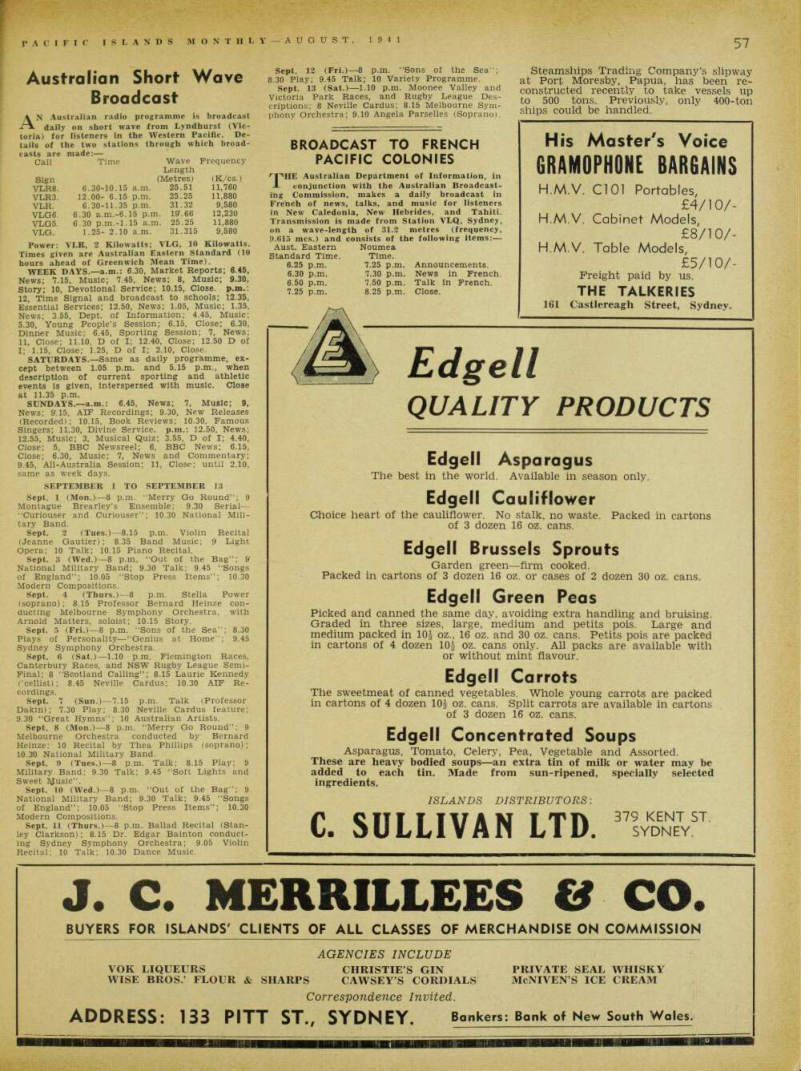
Broadcast
AN Australian radio programme is broadcast daily on short wave from Lyndhurst (Vic toria) for listeners in the Western Pacific. De tails of the two stations through which broad casts are made:—
Power; VLB, 2 Kilowatts; VLG, 10 Kilowatts.
Times given are Australian Eastern Standard (10 hours ahead of Greenwich Mean Time).
WEEK DAYS—a.m.: 6.30, Market Reports; 6.45, News; 7.15, Music; 7.45, News; 8, Music; 9.30, Story; 10, Devotional Service; 10.15, Close, p.m.: 12, Time Signal and broadcast to schools; 12.35, Essential Services; 12.50, News; 1.05, Music; 1.35, News; 3.55, Dept, of Information; 4.45, Music; 5.30, Young People’s Session; 6.15, Close; 6.30, Dinner Music; 6.45, Sporting Session; 7, News; 11, Close; 11.10, D of I; 12.40, Close; 12.50 D of I; 1.15, Close; 1.25, D of I; 2.10, Close.
SATURDAYS. —Same as daily programme, ex cept between 1.05 p.m. and 5.15 p.m., when description of current sporting and athletic events is given, Interspersed with music. Close at 11.35 p.m.
SUNDAYS.—a.m.: 6.45, News; 7, Music; 9, News; 9'. 15, AIT Recordings; 9.30, New Releases (Recorded): 10.15, Book Reviews; 10.30. Famous Singers; 11.30, Divine Service, p.m.: 12.50, News; 12.55, Music; 3, Musical Quiz; 3.55, D of I; 4.40, Close; 5, BBC Newsreel; 6, BBC News; 6.15, Close; 6.30, Music; 7, News and Commentary: 9.45, All-Australia Session; 11, Close; until 2.10, same as week days.
September 1 To September 13
Sept. 1 (Mon.) —8 p.m. “Merry Go Round”; 9 Montague Brearley’s Ensemble; 9.30 Serial— “ Curiouser and Curiouser”; 10.30 National Mili tary Band.
Sept, 2 (Tues.) —8.15 p.m. Violin Recital (Jeanne Gautier); 8.35 Band Music; 9 Light Opera; 10 Talk; 10.15 Piano Recital.
Sept. 3 (Wed.) —8 p.m. “Out of the Bag”; 9' National Military Band; 9.30 Talk; 9.45 “Songs of England”; 10.05 “Stop Press Items”; 10.30 Modern Compositions.
Sept. 4 (Thurs.) —8 p.m. Stella Power (soprano): 8.15 Professor Bernard Heinze con ducting Melbourne Symphony Orchestra, with Arnold Matters, soloist; 10.15 Story.
Sept. 5 (Fri.) —8 p.m. “Sons of the Sea”; 8.30 Plays of Personality—“ Genius at Home"; 9.45 Sydney Symphony Orchestra.
Sept. 6 (Sat.) —1.10 p.m. Flemington Races, Canterbury Races, and NSW Rugby League Semi- Final; 8 “Scotland Calling”; 8.15 Laurie Kennedy (’cellist); 8.45 Neville Cardus; 10.30 AIF Re cordings.
Sept. 7 (Sun.) —7.15 p.m. Talk (Professor Dakin); 7.30 Play; 8.30 Neville Cardus feature; 9.30 “Great Hymns”; 10 Australian Artists.
Sept. 8 (Mon.) —8 p.m. “Merry Go Round”; 9 Melbourne Orchestra conducted by Bernard Heinze: 10 Recital by Thea Phillips (soprano): 10.30 National Military Band.
Sept. 9 (Tues.)—B p.m. Talk; 8.15 Play; 9 Military Band; 9.30 Talk; 9.45 “Soft Lights and Sweet DJusic”.
Sept. 10 (Wed.) —8 p.m. “Out of the Bag”; 9 National Military Band; 9.30 Talk; 9.45 “Songs of England”; 10.05 “Stop Press Items”; 10.30 Modern Compositions.
Sept. 11 (Thurs.) —8 p.m. Ballad Recital (Stan ley Clarkson); 8.15 Dr. Edgar Bainton conduct ing Sydney Symphony Orchestra; 9.05 Violin Recital: 10 Talk; 10.30 Dance Music.
Sept. 12 (Fri.) —8 p.m. “Sons of the Sea”; 8.30 Play; 9.45 Talk; 10 Variety Programme.
Sept. 13 (Sat.) —1.10 p.m. Moonee Valley and Victoria Park Races, and Rugby League Des criptions; 8 Neville Cardus; 8.15 Melbourne Sym phony Orchestra; 9.10 Angela Parselles (Soprano).
Call Time Wave Length Frequency Sign (Metres) (K/cs.)
Vlr8.
6.30-10.15 a.m. 25.51 11,760
Vlr3.
12.00- 6.15 p.m. 25.25 11,880
Vlr.
6.30-11.35 p.m. 31.32 9,580
Vlg6.
6.30 a.m.-6.15 p.m.
Isp.66
12,230
Vlg5.
6.30 p.m.-1.15 a.m. 25.25 11,880
Vlg.
1.25- 2.10 a.m. 31.315 9,580
Pacific Colonies
Broadcast To French
THE Australian Department of Information, in conjunction with the Australian Broadcast ing Commission, makes a daily broadcast in French of news, talks, and music for listeners in New Caledonia, New Hebrides, and Tahiti.
Transmission is made from Station VLQ, Sydney, on a wave-length of 31.2 metres (frequency, 9.615 mcs.) and consists of the following items:—
Steamships Trading Company’s slipway at Port Moresby, Papua, has been re constructed recently to take vessels up to 500 tons. Previously, only 400-ton ships could be handled.
Aust. Eastern Noumea Standard Time.
Time. 6.25 p.m. 7.25 p.m.
Announcements. 6.30 p.m. 7.30 p.m.
News in French. 6.50 p.m. 7.50 p.m.
Talk In French. 7.25 p.m. 8.25 p.m.
Close.
Advertisements & other items, pp. 59-60 (1 item)
Edgell
His Master's Voice
GRAMOPHONE BARGAINS
H.M.V. Clol Portables, £4/10/- H.M.V. Cabinet Models, £B/10/- H.M.V. Table Models, £5/10/- Freight paid by us.
THE TALKERIES
161 Castlereagh Street, Sydney.
I J
Edgell
QUALITY PRODUCTS
Edgell Asparagus
The best in the world. Available in season only.
Edgell Cauliflower
Choice heart of the cauliflower. No stalk, no waste. Packed in cartons of 3 dozen 16 oz. cans.
Edged Brussels Sprouts
Garden green—firm cooked.
Packed in cartons of 3 dozen 16 oz. or cases of 2 dozen 30 oz. cans.
Edged Green Peas
Picked and canned the same day, avoiding extra handling and bruising.
Graded in three sizes, large, medium and petits pois. Large and medium packed in 10£ oz., 16 oz. and 30 oz. cans. Petits pois are packed in cartons of 4 dozen 10£ oz. cans only. All packs are available with or without mint flavour.
Edged Carrots
The sweetmeat of canned vegetables. Whole young carrots are packed in cartons of 4 dozen 10£ oz. cans. Split carrots are available in cartons of 3 dozen 16 oz. cans.
Edged Concentrated Soups
Asparagus, Tomato, Celery, Pea, Vegetable and Assorted.
These are heavy bodied soups—an extra tin of milk or water may be added to each tin. Made from sun-ripened, specially selected ingredients.
ISLANDS DISTRIBUTORS :
C. SULLIVAN LTD. 37 1C* E T , ST
J. C. MERRILLEES & CO.
BUYERS FOR ISLANDS / CLIENTS OF ALL CLASSES OF MERCHANDISE ON COMMISSION
AGENCIES INCLUDE
VOK LIQUEURS CHRISTIE’S GIN PRIVATE SEAL WHISKY WISE BROS.’ FLOUR & SHARPS CAWSEY’S CORDIALS McNIVEN’S ICE CREAM Correspondence Invited.
ADDRESS: 133 PITT ST., SYDNEY. Bankers: Bank of New South Wales.
Radio
REPLACEMENT
Parts
MAY we help you with that "hard-to-secure" part? If not available from stock we can have it made for you.
Send full details of set, make and model, and, if possible, send the faulty component.
PRICE’S Radio Service 5 & 6 Angel Place, SYDNEY
PACKED AS THEY’RE PICKED
TO PRESERVE FLAVOUR AND NUTRIMENT
Aunt Mary’s
PREPARED
VEGETABLES
only require heating and are then ready to serve, full flavoured, attractive and satisfying.
Green Peas, Celery, Cauliflower and other Aunt Mary's prepared vegetables are specially packed for Tropical conditions in 1 lb. hermetically sealed cans.
SOLD BY ALL PACIFIC ISLAND STORES
Order an assortment. Be sure it is Aunt Mary's brand; packed by Tillock <S Co.. Pty. Ltd., Sydney.
■ One of three tugs recently built by W. L. Holmes & Co„ Sydney, for use at Burrenjuck Dam, N.S.W. Each is fitted with 2 in. diam. Monel shafting.
Whether for pleasure craft or real
work, specify . . .
PROPELLER SHAFTING
World-renowned for long, dependable service, Monel propeller shafts are: (1) exceptionally strong and tough, (2) highly resistant to fresh and salt water corrosion and 100% rustless, (3) extremely rigid, thereby reducing whip and vibration to a minimum.
Ask your boat builder to quote YOU for a Monel Shaft.
WRIGHT & COMPANY
81 CLARENCE STREET, SYDNEY, N.S.W.
Monel is a Registered Trade Mark
Comment Is
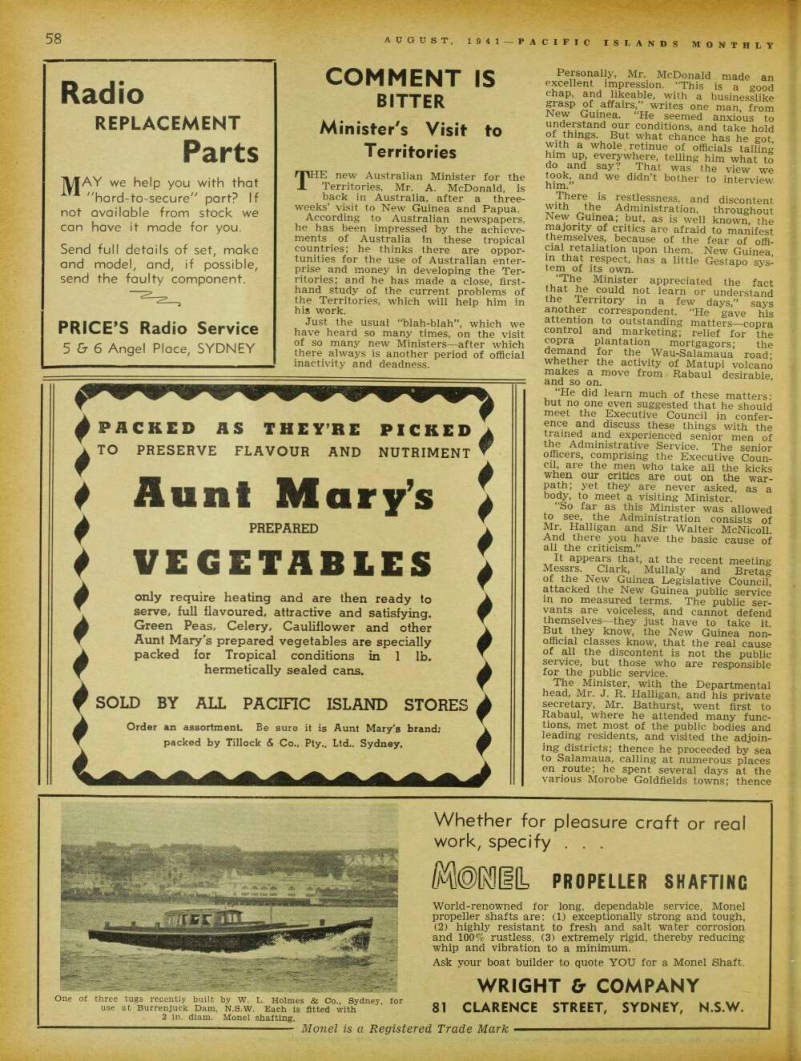
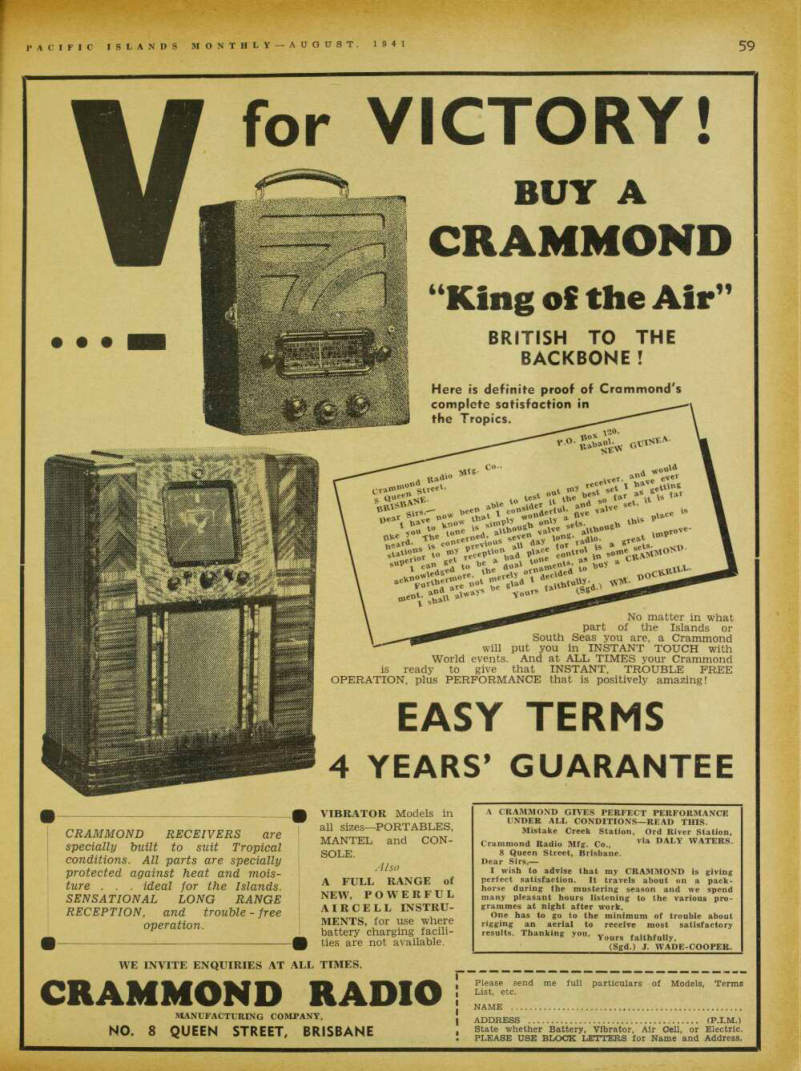
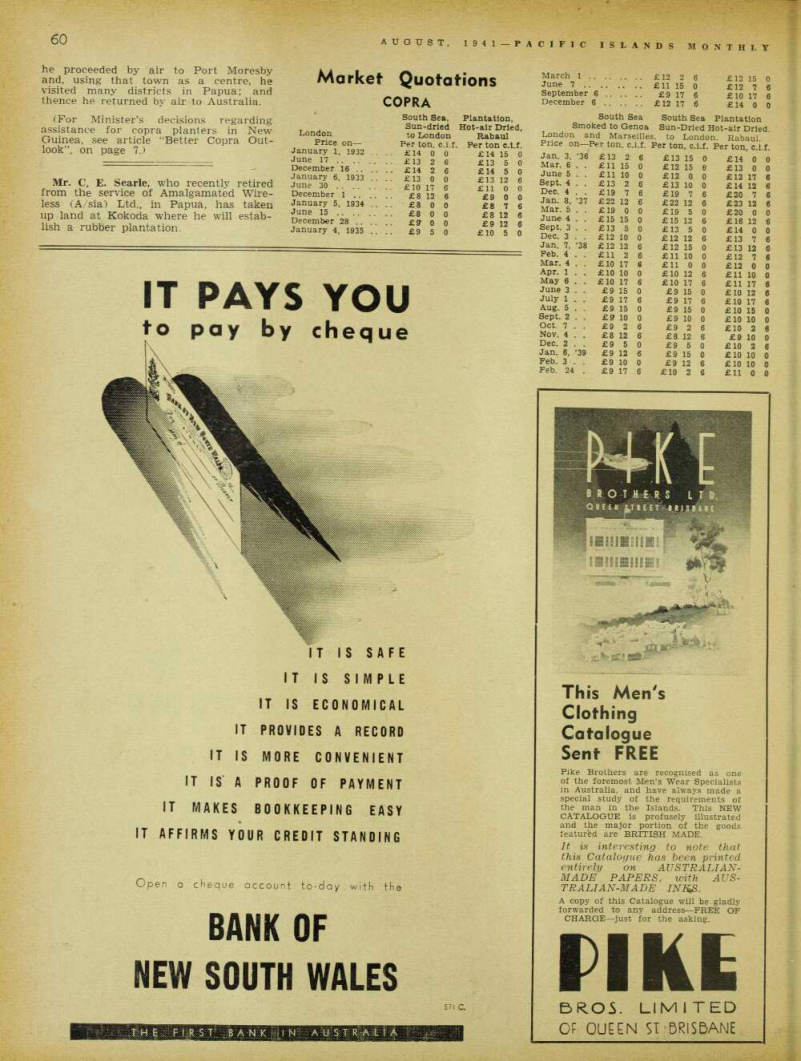
Bitter
Minister's Visit to Territories
npHE new Australian Minister for the ± Territories, Mr. A. McDonald, is back in Australia, after a three weeks’ visit to New Guinea and Papua.
According to Australian newspapers, he has been impressed by the achieve ments of Australia In these tropical countries; he thinks there are oppor tunities for the use of Australian enter prise and money in developing the Ter ritories; and he has made a close, first hand study of the current problems of the Territories, which will help him in his work.
Just the usual “blah-blah”, which we have heard so many times, on the visit of so many new Ministers—after which there always is another period of official inactivity and deadness.
Personally, Mr. McDonald made an excellent impression. “This is a good chap, and likeable, with a businesslike grasp of affairs,” writes one man, from New Guinea. “He seemed anxious to understand our conditions, and take hold of things. But what chance has he got with a whole retinue of officials tailing him up, everywhere, telling him what to do and say? That was the view we took ;> and we didn’t bother to interview There is restlessness, and discontent with the Administration, throughout New Guinea; but, as is well known, the majority of critics are afraid to manifest themselves, because of the fear of offi cial retaliation upon them. New Guinea in that respect, has a little Gestapo sys tem of its own. * “The Minister appreciated the fact that he could not learn or understand the TerntGiy i n a few days,” says another correspondent. “He gave his attention to outstanding matters—copra control and marketing; relief for the copra plantation mortgagors; the * or the Wau-Salamaua road; whether the activity of Matupi volcano makes a move from Rabaul desirable, and so on.
He did learn much of these matters* but no one even suggested that he should meet the Executive Council in confer ence and discuss these things with the trained and experienced senior men of the Administrative Service. The senior officers, comprising the Executive Coun cil, are the men who take all the kicks when our critics are out on the war path; yet they are never asked, as a body, to meet a visiting Minister.
“So far as this Minister was allowed to see, the Administration consists of Mr. Halligan and Sir Walter McNicoll.
And there you have the basic cause of all the criticism.”
It appears that, at the recent meeting Messrs. Clark, Mullaly and Bretag of the New Guinea Legislative Council, attacked the New Guinea public service in no measured terms. The public ser vants are voiceless, and cannot defend themselves—they just have to take it.
But they know, the New Guinea non offlcial classes know, that the real cause of all the discontent is not the public service, but those who are responsible for the public service.
The Minister, with the Departmental head, Mr. J. R. Halligan, and his private secretary, Mr. Bathurst, went first to Rabaul, where he attended many func tions, met most of the public bodies and leading residents, and visited the adjoin ing districts; thence he proceeded by sea to Salamaua, calling at numerous places en route; he spent several days at the various Morobe Goldfields towns; thence
he proceeded by air to Port Moresby and, using that town as a centre, he visited many districts in Papua; and thence he returned by air to Australia. (For Minister’s decisions regarding assistance for copra planters in New Guinea, see article “Better Copra Out look”, on page 7.) Mr. C. E. Searle, who recently retired from the service of Amalgamated Wire less (A/sia) Ltd., in Papua, has taken up land at Kokoda where he will estab lish a rubber plantation.
Advertisements & other items, pp. 61-62 (1 item)
for VICTORY!
si
BUY A
CRAMMOND
44
King of the Air”
BRITISH TO THE
BACKBONE!
Here is definite proof of Crommond's
complete satisfaction in
the Tropics.
—T v i®®* Cov-o« io lot' 0 aHfc°
V\U® I 1 — A -
e ivct . lt to? Te f'set l to it » ,W «pW ueb onw 9 . tS^ooe t. «*' re»t \oftP to^e- •<> ge . to * e * ftua' orient*’ t 0 cut, a^ d u »\v» a^ 8 vours (.S6 Yo« rS No matter in what part of the Islands or South Seas you are, a Crammond will put you in INSTANT TOUCH with World events. And at ALL TIMES your Crammond is ready to give that INSTANT, TROUBLE FREE OPERATION, plus PERFORMANCE that is positively amazing!
EASY TERMS
4 YEARS’ GUARANTEE
CRAMMOND RECEIVERS are
specially built to suit Tropical conditions. All parts are specially protected against heat and moisture . . . ideal for the Islands.
SENSATIONAL LONG RANGE
RECEPTION, and trouble - free
operation.
VIBRATOR Models in all sizes—PORTABLES,
MANTEL and CON-
SOLE.
Also
A FULL RANGE of
NEW, POWERFUL
AIRCELL INSTRU-
MENTS, for use where battery charging facilities are not available.
A CRAMMOND GIVES PERFECT PERFORMANCE
UNDER ALL CONDITIONS—READ THIS.
Mistake Creek Station, Ord River Station, Crammond Radio Mfg. Co., via DALY WATERS. 8 Queen Street, Brisbane.
Dear Sirs, — I wish to advise that my CRAMMOND is giving perfect satisfaction. It travels about on a packhorse during the mustering season and we spend many pleasant hours listening to the various programmes at night after work.
One has to go to the minimum of trouble about rigging an aerial to receive most satisfactory results. Thankins you, Yours falth(uUy
(Sgd.) J. WADE-COOPER.
WE INVITE ENQUIRIES AT ALL TIMES.
CRAMMOND RADIO
MANUFACTURING COMPANY,
NO. 8 QUEEN STREET, BRISBANE
Please send me full particulars of Models, Terms List, etc.
ADDRESS (P.1.M.)
State whether Battery, Vibrator, Air Cell, or Electric.
PLEASE USE BLOCK LETTERS for Name and Address,
IT PAYS YOU
to pay by cheque
IT IS SAFE
IT IS SIMPLE
IT IS ECONOMICAL
IT PROVIDES A RECORD
IT IS MORE CONVENIENT
IT IS A PROOF OF PAYMENT
IT MAKES BOOKKEEPING EASY
IT AFFIRMS YOUR CREDIT STANDING
Open a cheque account to-day with the
BANK OF
NEW SOUTH WALES
571 C THE FIRST BANK -I N AUSI R A LI A
Market Quotations
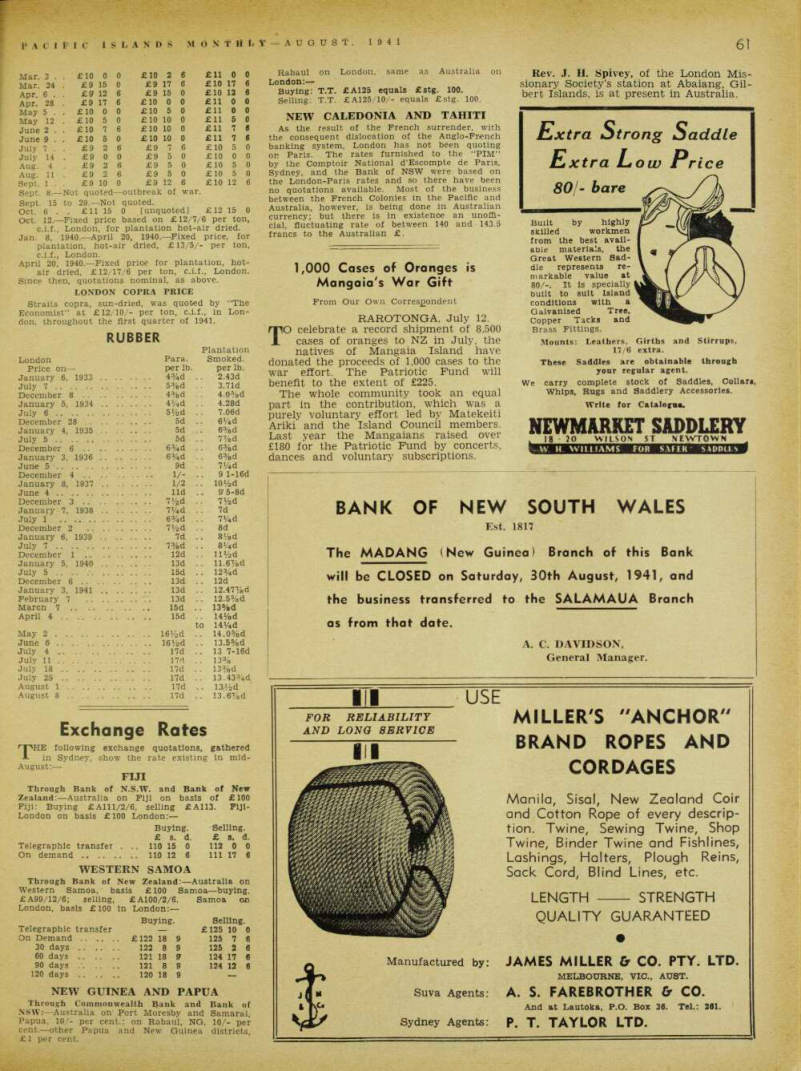
March 1 £12 2 6 £12 15 0 June 7 . £11 15 0 £12 7 6 September 6 . . £9 17 6 £10 17 6 December 6 . . £12 17 6 £14 0 0 South Sea South Sea Plantation Smoked to Genoa Sun-Dried Hot-air Dried London and Marseilles, to London. Rabaul f nee on— Per ton, c.i.f.
Per ton, c.i.f.
Per ton. c.i.f.
Jan. 3. ’36 £13 2 6 £13 15 0 £14 0 0 Mar. 6 . . £11 15 0 £12 15 0 £13 0 0 June 5 . . £11 10 0 £12 0 0 £12 17 6 Sept. 4 . . £13 2 6 £13 10 0 £14 12 6 Dec. 4 . . £19 7 6 £19 7 6 £20 7 6 Jan. 8, ’37 £22 12 6 £22 12 6 £23 12 6 Mar. 5 . . £19 0 0 £19 5 0 £20 0 0 June 4 . . £15 15 0 £15 12 6 £16 12 6 Sept. 3 . . £13 5 0 £13 5 0 £14 0 0 Dec. 3 . . £12 10 0 £12 12 6 £13 7 6 Jan, 7, ’38 £12 12 6 £12 15 0 £13 12 6 Peb. 4 . . £11 2 6 £11 10 0 £12 7 6 Mar. 4 . . £10 17 6 £11 0 0 £12 0 0 Apr. 1 . . £10 10 0 £10 12 6 £11 10 0 May 6 , . £10 17 6 £10 17 6 £11 17 6 June 3 . . £9 15 0 £9 15 0 £10 12 6 July 1 . . £9 17 6 £9 17 6 £10 17 6 Aug. 5 . . £9 15 0 £9 15 0 £10 15 0 Sept. 2 . . £9 10 0 £9 10 0 £10 10 0 Oct. 7 . . £9 2 6 £9 2 6 £10 2 6 Nov. 4 . . £8 12 6 £8 12 6 £9 10 0 Dec. 2 . . £9 5 0 £9 5 0 £10 2 6 Jan. 6, ’39 £9 12 6 £9 15 0 £10 10 0 Peb. 3 . . £9 10 0 £9 12 6 £10 10 0 Feb. 24 . £9 17 6 £10 2 6 £11 0 0
Copra
South Sea, Plantation, London Sun-dried Hot-air Dried, to London Rabaul Price on— Per ton, c.i.f.
Per ton c.i.f.
January 1, 1932 ■ £14 0 0 £14 15 0 June 17 £13 5 0 December 16 .. . £14 5 0 January 6, 1933 . . .. £13 0 0 £13 12 6 June 30 .. . £11 0 0 December 1 .. . £9 0 0 January 5. 1934 . £8 0 0 £8 7 6 June 15 .. .. • . . £8 0 0 £8 12 6 December 28 .. . £9 12 6 January 4. 1935 . . .. £9 5 0 £10 5 0
Sept. B.—Not quoted—outbreak of war.
Sept. 15 to 29.—Not quoted.
Oct. 6 . £ll 15 0 [unquoted] £l2 15 0 Oct. 12.—Fixed price based on £l2/7/6 per ton, c.i.f., London, for plantation hot-air dried.
Jan. 8, 1940.—April 20, 1940.—Fixed price, for plantation, hot-air dried, £ 13/5/- per ton, c.i.f., London.
April 20, 1940.—Fixed price for plantation, hot air dried, £l2/17/6 per ton, c.i.f., London.
Since then, quotations nominal, as above.
London Copra Price
Straits copra, sun-dried, was quoted by “The Economist” at £l2/10/- per ton, c.i.f., in Lon don, throughout the first quarter of 1941.
Mar. 3 . . £10 0 0 £10 2 6 £11 0 0 Mar. 24 . £9 15 0 £9 17 6 £10 17 6 Apr. 6 . . £9 12 6 £9 15 0 £10 12 6 Apr. 28 . £9 17 6 £10 0 0 £11 0 0 May 5 . . £10 0 0 £10 5 0 £11 0 0 May 12 . £10 5 0 £10 10 0 £11 5 0 June 2 . . £10 7 6 £10 10 0 £11 7 6 June 9 . . £10 5 0 £10 10 0 £11 7 6 July 7 . . £9 2 6 £9 7 6 £10 5 0 July 14 . £9 0 0 £9 5 0 £10 0 0 Aug. 4 £9 2 6 £9 5 0 £10 5 0 Aug. 11 . £9 2 6 £9 5 0 £10 5 0 Sept. 1 . . £9 10 0 £9 12 6 £10 12 6
London
Rubber
Para.
Plantation Smoked.
Price on— per lb. per lb.
January 6, 1933 4%d . 2.43d July 7 5%d . 3.71d December 8 43/ad . 4.0%d January 5, 1934 4V 4 d . 4.28d July 6 5%d . 7.06d December 28 . . 5d . 6y 4 d January 4, 1935 5d . 6%d July 5 5d .
T’Ad December 6 6 3 Ad . 6%d January 3, 1936 6%d • 6 3 /ad June 5 9d . 7y 4 d December 4 .. 1/- • 9 l-16d January 8, 1937 1/2 . ioy 2 d June 4 lid . 9 5-8d December 3 .. 7»/ 2 d . 7y 2 d January 7, 1938 VAd . 7d July 1 VAd December 2 7»/ 2 d . 8d January 6, 1939 7d . 8Vad July 7 7 3 /ad . sy 4 d December 1 .. 12d . ny 2 d January 5, 1940 13d . 11.6 7 /ad July 5 15d . 12 3 / 4 d December 6 .. . 13d . 12d January 3. 1941 13d . 12.47 7 /ad February 7 13d . 12.5 s /ad Marcn 7 .. .. 15d . 13 s /ad April 4 15d . 14y a d to 14y 4 d May 2 16y 2 d . 14.0 5 /ad June 6 iey 2 d . 13.5 5 /ad July 4 17d . 13 7-16d July 11 17d . 13 3/ a July 18 17d . 13 3 ad July 25 17d . 13.43 3 4d August 1 17d . 13// 2 d August 8 17d . 13.6 7 ed
Advertisements & other items, p. 62 (1 item)
Catalogue
w*brothers ltd.
Q»l £« BEET - BRISBANE
iilSiiillii
PUfliggiOgg: m & lk*sCl
This Men's
Clothing
Catalogue
Sent FREE
Pike Brothers are recognised as one of the foremost Men’s Wear Specialists in Australia, and have always made a special study of the requirements of the man in the Islands. This NEW CATALOGUE is profusely illustrated and the major portion of the goods featured are BRITISH MADE.
It is interesting to note that this Catalogue has been printed entirely on AUSTRALIAN-
MADE PAPERS, with AUS-
TRALIAN-MADE INKS.
A copy of this Catalogue will be gladly forwarded to any address —FREE OF CHARGE —just for the asking.
NKI
BROS. LIMITED
OF OUEEN SI BRISBANE
Exchange Rates
THE following exchange quotations, gathered in Sydney, show the rate existing in mid- August:—
Fiji
Through Bank of N.S.W. and Bank of New Zealand:—Australia on Fiji on basis of £lOO Fiji: Buying £Alll/2/6, selling £AII3. Pljl- London on basis £lOO London: —
Western Samoa
Through Bank of New Zealand:—Australia on Western Samoa, basis £lOO Samoa —buying, £ A99/12/6; selling, £AIOO/2/6. Samoa on London, basis £lOO In London:—
New Guinea And Papua
Through Commonwealth Bank and Bank of NSW: —Australia on Port Moresby and Samarai, Papua, 10/- per cent.; on Rabaul, NG, 10/- per cent.—other Papua and New Guinea districts, £1 per cent.
Rabaul on London, same as Australia on London: — Buying: T.T. £AI2S equals £stg. 100.
Selling: T.T. £AI2S/10/- equals £stg. 100.
New Caledonia And Tahiti
As the result of the French surrender, with the consequent dislocation of the Anglo-French banking system, London has not been quoting on Paris. The rates furnished to the “PIM” by the Comptoir National d’Escompte de Paris, Sydney, and the Bank of NSW were based on the London-Paris rates and so there have been no quotations available. Most of the business between the French Colonies in the Pacific and Australia, however, is being done in Australian currency: but there is in existence an unoffi cial, fluctuating rate of between 140 and 143.5 francs to the Australian £.
Buying. Selling. £ s. d. £ s. d.
Telegraphic transfer ... 110 15 0 112 0 0 On demand 110 12 6 111 17 6
Buying. Selling.
Telegraphic transfer — £125 10 0 On Demand £122 18 9 125 7 6 30 days 122 8 9 125 2 6 60 days 121 18 9 124 17 6 90 days 121 8 9 124 12 6 120 days 120 18 9 —
1,000 Cases of Oranges is
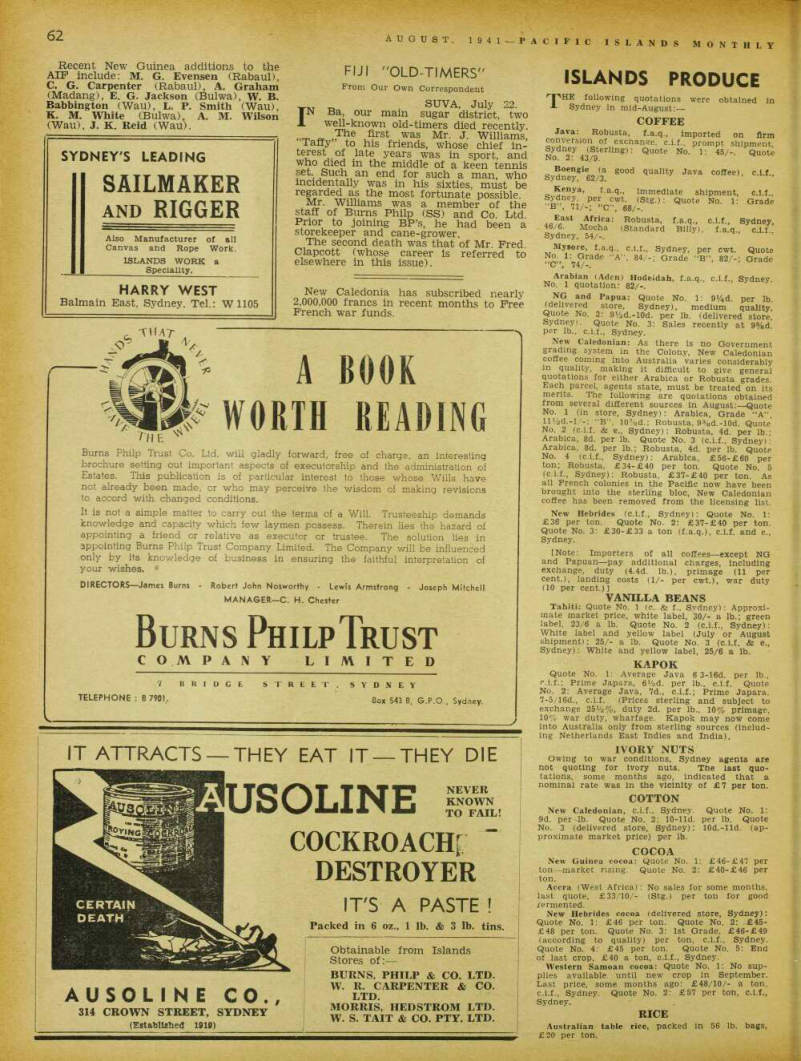
Mangaia's War Gift
From Our Own Corres2ondent
Rarotonga, July 12.
rpo celebrate a record shipment of 8,500 A cases of oranges to NZ in July, the natives of Mangaia Island have donated the proceeds of 1,000 cases to the war effort. The Patriotic Fund will benefit to the extent of £225.
The whole community took an equal part in the contribution, which was a purely voluntary effort led by Matekeiti Ariki and the Island Council members.
Last year the Mangaians raised over £lBO for the Patriotic Fund by concerts, dances and voluntary subscriptions.
Rev. J, H. Spivey, of the London Mis sionary Society’s station at Abaiang, Gil bert Islands, is at present in Australia.
Recent New Guinea additions to the AIF include: M. G. Evensen (Rabaul), C. G. Carpenter (Rabaul), A. Graham (Madang), E. G. Jackson (Bulwa), W. B.
Babbington (Wau), L. P. Smith (Wau), K. M. White (Bulwa). A. M. Wilson (Wau), J. K. Reid (Wau).
Advertisements & other items, pp. 63-64 (2 items)
61
PACIFIC ISLANDS MONTULT AUGUST, 1941
Low Pi
Extra Strong Saddle
xtra
rice
80/- bare
Built by highly skilled workmen from the best available materials, the Great Western Saddle represents remarkable value at 80/-. It is specially built to suit Island conditions with a Galvanised Tree, Copper Tacks and Brass Fittings.
Mounts: Leathers, Girths and Stirrups, 17/6 extra.
These Saddles are obtainable through your regular agent.
We carry complete stock of Saddles, Collars, Whips, Rugs and Saddlery Accessories.
Write for Catalogue.
NEWMARKET SADDLERY
18 20 WILSON ST NEWTOWN
VV H WILLIAMS FOR SAUK SADOLI.S
BANK OF NEW SOUTH WALES
Est. 1817 The MADANG (New Guinea) Branch of this Bank will be CLOSED on Saturday, 30th August, 1941, and the business transferred to the SALAMAUA Branch as from that date.
A. C. DAVIDSON,
General Manager.
T » 111
FOR RELIABILITY
AND LONG SERVICE
MILLER'S "ANCHOR"
BRAND ROPES AND
CORDAGES
Manila, Sisal, New Zealand Coir and Cotton Rope of every description. Twine, Sewing Twine, Shop Twine, Binder Twine and Fishlines, Lashings, Halters, Plough Reins, Sack Cord, Blind Lines, etc.
LENGTH STRENGTH
QUALITY GUARANTEED
• Manufactured by: JAMES MILLER Cr CO. PTY. LTD.
MELBOURNE, VIC., AUST.
Suva Agents: A. S. FAREBROTHER Cr CO.
And at Lautoka, P.O. Box 36. Tel.: 261.
Sydney Agents: P. J. TAYLOR LTD.
SYDNEY'S LEADING
SAILMAKER
and RIGGER
Also Manufacturer of all Canvas and Rope Work.
ISLANDS WORK a
Speciality.
HARRY WEST
Balmain East, Sydney. Tel.: WllO5
Fiji "Old-Timers"
From Our Own Correspondent
I M Suva, July 22.
N Ba, our main sugar district, two well-known old-timers died recently. „ Tl ?e first was Mr. J. Williams, Taffy to his friends, whose chief in terest of late years was in sport, and who died in the middle of a keen tennis set. Such an end for such a man, who incidentally was in his sixties, must be regarded as the most fortunate possible.
Mr. Williams was a member of the staff of Burns Philp (SS) and Co. Ltd.
Prior to joining BP’s, he had been a storekeeper and cane-grower.
The second death was that of Mr. Fred.
Clapcott (whose career is referred to elsewhere in this issue).
New Caledonia has subscribed nearly 2,000,000 francs in recent months to Free French war funds.
Islands Produce
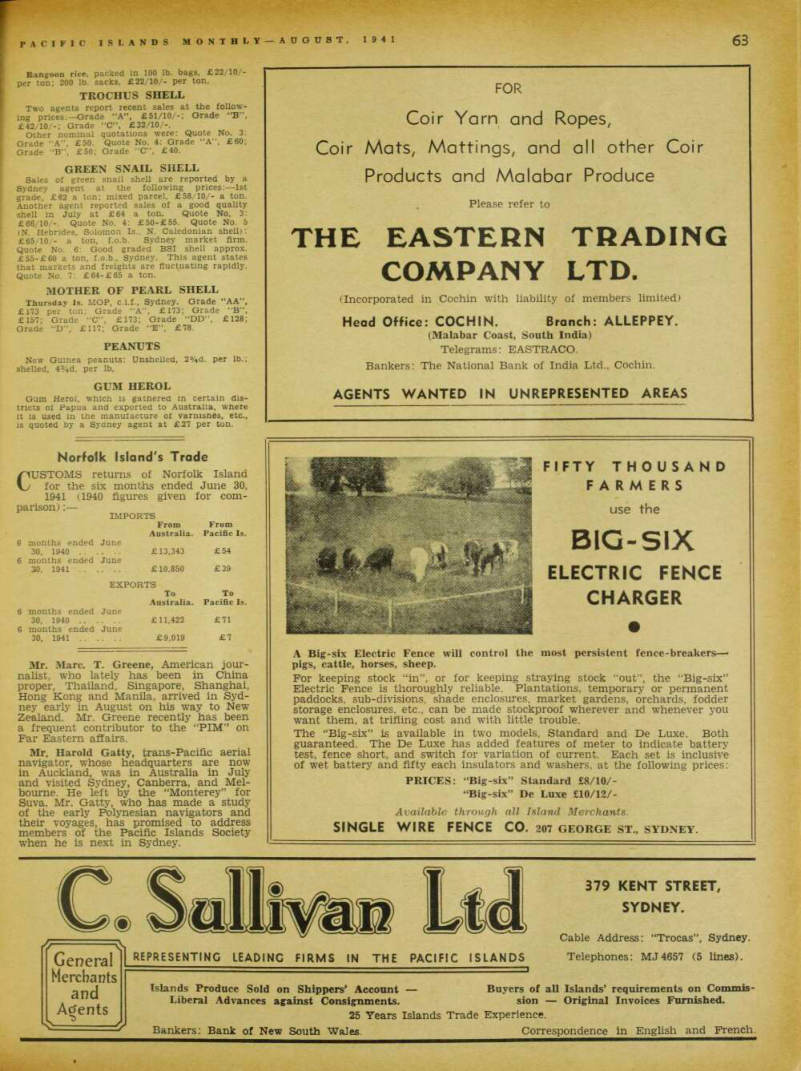
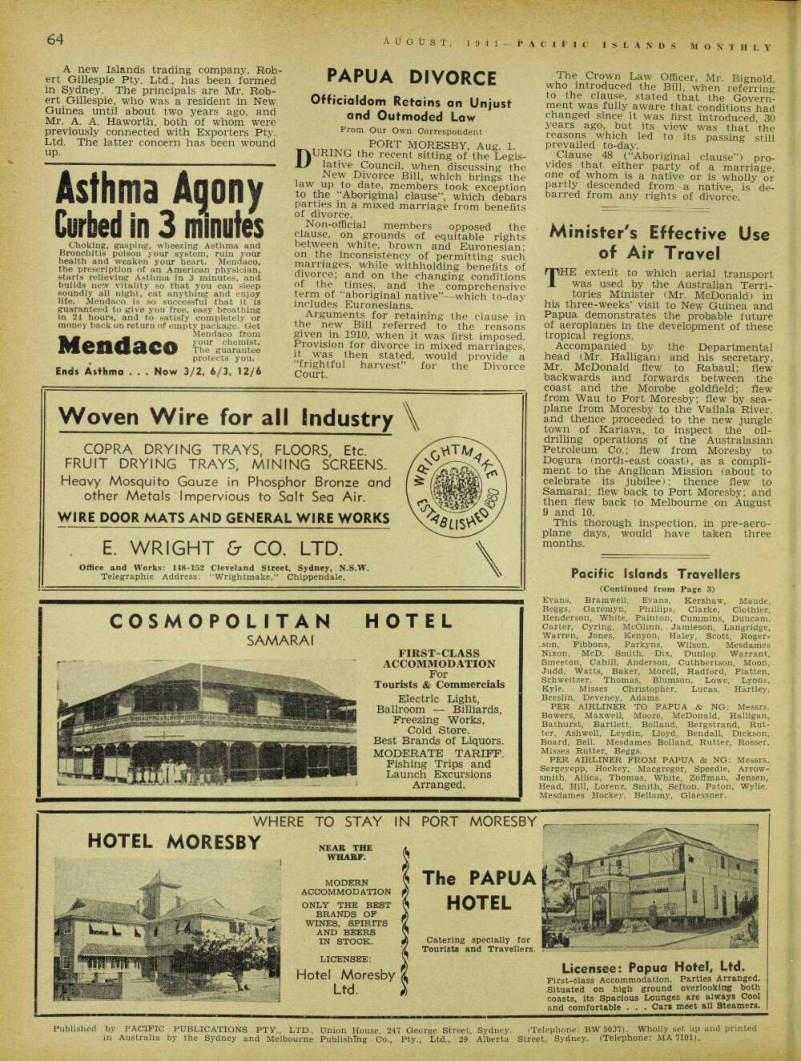
npHE following quotations were obtained in -*■ Sydney in mid-August:—
Coffee
Java: Robusta, f.a.q., Imported on firm conversion of exchange, c.i.f.. prompt shipment Sydney (Sterling): Quote No. 1: 45/-. Quote No. 2: 43/9.
Boengie (a good quality Java coffee), c.i.f.
Sydney, 62/3.
Kenya, f.a.q., immediate shipment, c.i.f., per cwt - (Stg.): Quote No. 1: Grade “B”, 71/-; “C”. 68/-.
E a st ™ fr [ ca: Robusta - f-a-q.. c.i.f., Sydney, 46/6. Mocha (Standard Billy), f.a.q., c.i f Sydney, 54/-.
Mysore, f.a.q., c.i.f., Sydney, per cwt. Quote No ;> 1: Grade “A”, 84/-; Grade “B”, 82/-; Grade C , 74/-.
Arabian (Aden) Hodeidah, f.a.q., c.i.f., Sydney.
No. 1 quotation: 82/-.
NG and Papua: Quote No. 1: 9V 4 d. per lb. (delivered store, Sydney), medium quality.
Quote No. 2: gVad.-lOd. per lb. (delivered store, Sydney). Quote No. 3: Sales recently at 9%d. per lb., c.i.f., Sydney.
New Caledonian: As there is no Government grading system in the Colony, New Caledonian coffee coming into Australia varies considerably in quality, making it difficult to give general quotations for either Arabica or Robusta grades.
Each parcel, agents state, must be treated on its merits. The following are quotations obtained from several different sources in August:—Quote No. 1 (in store, Sydney): Arabica, Grade “A”, UVad.-l/-; “B”, 10 7 / B d.; Robusta, 9%d.-10d. Quote No. 2 (c.i.f. & e., Sydney): Robusta, 4d. per lb.; Arabica, Bd. per lb. Quote No. 3 (c.i.f., Sydney): Arabica, Bd. per lb.; Robusta, 4d. per lb. Quote No, 4 (c.i.f., Sydney): Arabica, £56-£6O per ton; Robusta, £34-£4O per ton. Quote No. 5 (c.i.f., Sydney): Robusta, £37-£4O per ton. As all French colonies in the Pacific now have been brought into the sterling bloc, New Caledonian coffee has been removed from the licensing list.
New Hebrides (c.i.f., Sydney): Quote No. 1: £36 per ton. Quote No. 2: £37-£4O per ton.
Quote No. 3: £3O-£33 a ton (f.a.q.), c.i.f. and e., Sydney. [Note: Importers of all coffees—except NG and Papuan—pay additional charges, including exchange, duty (4.4 d. lb.), primage (11 per cent.), landing costs (1/- per cwt.), war duty (10 per cent.)]
Vanilla Beans
Tahiti: Quote No. 1 fc. & f., Sydney): Approxi mate market price, white label, 30/- a lb.; green label, 23/6 a lb. Quote No. 2 (c.i.f., Sydney): White label and yellow label (July or August shipment); 25/- a lb. Quote No. 3 (c.i.f. & e., Sydney): White and yellow label, 25/6 a lb.
Kapok
Quote No. 1: Average Java 6 3-16 d. per lb., c.i.f.; Prime Japara, eVad. per lb., c.i.f. Quote No. 2; Average Java, 7d., c.i.f,; Prime Japara, 7-5/16d., c.i.f. (Prices sterling and subject to exchange 25y 2 %, duty 2d. per lb., 10% primage, 10% war duty, wharfage. Kapok may now come into Australia only from sterling sources (includ ing Netherlands East Indies and India).
Ivory Nuts
Owing to war conditions, Sydney agents are not quoting for ivory nuts. The last quo tations, some months ago, indicated that a nominal rate was in the vicinity of £7 per ton.
Cotton
New Caledonian, c.i.f., Sydney. Quote No. 1: 9d. per lb. Quote No. 2: 10-lld. per lb. Quote No. 3 (delivered store, Sydney): lOd.-lld. (ap proximate market price) per lb.
Cocoa
New Guinea cocoa: Quote No. 1; £46-£47 per ton—market rising. Quote No. 2: £4O-£46 per ton.
Accra (West Africa): No sales for some months, last quote, £33/10/- (Stg.) per ton for good fermented.
New Hebrides cocoa (delivered store, Sydney): Quote No. 1; £46 per ton. Quote No. 2: £45- £4B per ton. Quote No. 3: Ist Grade, £46-£49 (according to quality) per ton, c.i.f., Sydney.
Quote No. 4: £45 per ton. Quote No. 5; End of last crop, £4O a ton, c.i.f., Sydney.
Western Samoan cocoa: Quote No. 1: No sup plies available until new crop in September.
Last price, some months ago: £4B/10/- a ton, c.i.f., Sydney. Quote No. 2: £57 per ton, c.i.f., Sydney.
Rice
Australian table rice, packed in 56 lb. bags, £2O per ton.
Rangoon rice, packed in 100 lb. bags, £22/10/per ton; 200 lb. sacks, £22/10/- per ton.
Trochus Shell
Two agents report recent sales at the follow ing prices:—Grade “A”, £5l/10/-; Grade "B”, £42/10/-; Grade “C”, £32/10/-.
Other nominal quotations were: Quote No. 3: Grade “A”, £5O. Quote No. 4; Grade “A”, £6O; Grade “B”, £5O; Grade “C”, £4O.
Green Snail Shell
Sales of green snail shell are reported by a Sydney agent at the following prices:—Ist grade, £62 a ton; mixed parcel, £5B/10/- a ton.
Another agent reported sales of a good quality shell in July at £64 a ton. Quote No, 3: £66/10/-. Quote No. 4: £5O-£55. Quote No. 5 (N. Hebrides, Solomon Is., N. Caledonian shell): £65/10/- a ton, f.o.b. Sydney market firm.
Quote No. 6: Good graded BSI shell approx. £55-£6O a ton, f.0.b., Sydney. This agent states that markets and freights are fluctuating rapidly.
Quote No. 7: £64-£65 a ton.
Mother Of Pearl Shell
Thursday Is. MOP, c.i.f., Sydney. Grade “AA”, £173 per ton; Grade “A”, £173; Grade “B”, £157; Grade “C”, £173; Grade "DD”, £128; Grade “D”, £117; Grade “E”, £7B.
Peanuts
New Guinea peanuts: Dnshelled, 2 a Ad. per lb.; shelled, 4 3 Ad. per lb.
Gum Herol
Gum Herol, which is gathered in certain dis tricts of Papua and exported to Australia, where it is used in the manufacture of varnishes, etc., is quoted by a Sydney agent at £27 per ton.
Norfolk Island's Trade
CUSTOMS returns of Norfolk Island for the six months ended June 30,
1941 (1940 figures given for com
parison) ;
Mr. Marc. T. Greene, American jour nalist, who lately has been in China proper, Thailand, Singapore, Shanghai, Hong Kong and Manila, arrived in Syd ney early in August on his way to New Zealand. Mr. Greene recently has been a frequent contributor to the “PIM” on Far Eastern affairs.
Mr. Harold Gatty, trans-Pacific aerial navigator, whose headquarters are now in Auckland, was in Australia in July and visited Sydney, Canberra, and Mel bourne. He left by the “Monterey” for Suva. Mr. Gatty, who has made a study of the early Polynesian navigators and their voyages, has promised to address members of the Pacific Islands Society when he is next in Sydney.
Imports
From From Australia.
Pacific Is. 6 months ended June 30, 1940 .. £13,343 £54 6 months ended June 30. 1941 .. .. £10,850 £39
Exports
To To Australia.
Pacific Is. 6 months ended June 30. 1940 .. £11,422 £71 6 months ended June 30, 1941 .. £9,019 £7
A new Islands trading company, Rob ert Gillespie Pty. Ltd., has been formed in Sydney. The principals are Mr. Rob ert Gillespie, who was a resident in New Guinea until about two years ago, and Mr. A. A. Haworth, both of whom were previously connected with Exporters Pty.
Ltd. The latter concern has been wound up.
Advertisements & other items, pp. 64-66 (2 items)
Burns Philp Trust
•0 s ML- IM&
wJm
m
v>i e
A
WORTH
BOOK
READING
Burns Philp Trust Co. Ltd. will gladly forward, free of charge, an interesting brochure setting out important aspects of executorship and the administration of Estates. This publication is of particular interest to those whose Wills have not already been made, or who may perceive the wisdom of making revisions to accord with changed conditions.
It is not a simple matter to carry out the terms of a Will. Trusteeship demands knowledge and capacity which few laymen possess. Therein lies the hazard of appointing a friend or relative as executor or trustee. The solution lies in appointing Burns Philp Trust Company Limited. The Company will be influenced only by its knowledge of business in ensuring the faithful interpretation of your wishes.
DIRECTORS—James Burns - Robert John Nosworthy - Lewis Armstrong - Joseph Mitchell MANAGER—C. H. Chester
Burns Philp Trust
COMPANY LIMITED
"N
7 BRIDGE STREET. SYDNEY
TELEPHONE : B 7901.. Box 543 B. G.P.0., Sydney.
IT ATTRACTS —THEY EAT IT —THEY DIE °T»ng
USOLINE
NEVER
KNOWN
TO FAIL!
AUSOLI N E CO.
314 CROWN STREET, SYDNEY
(Established 1919)
cockroach;
DESTROYER
IT'S A PASTE !
Packed in 6 oz., 1 lb. & 3 lb. tins.
Obtainable from Islands Stores of:—
BURNS, PHILP & CO. LTD.
W. R. CARPENTER & CO.
LTD.
MORRIS, HEDSTROM LTD.
W. S. TAIT & CO. PTY. LTD.
Big-Six
FOR
Coir Yarn and Ropes,
Coir Mats, Mattings, and all other Coir
Products and Malabar Produce
Please refer to
THE EASTERN TRADING
COMPANY LTD.
(Incorporated in Cochin with liability of members limited) Head Office: COCHIN. Branch: ALLEPPEY. (Malabar Coast, South India) Telegrams: EASTRACO.
Bankers: The National Bank of India Ltd., Cochin.
AGENTS WANTED IN UNREPRESENTED AREAS
A -
FIFTY THOUSAND
FARMERS
use the
BIG-SIX
ELECTRIC FENCE
CHARGER
A Big-six Electric Fence will control the most persistent fence-breakers—• pigs, cattle, horses, sheep.
For keeping stock “in”, or for keeping straying stock “out”, the “Big-six”
Electric Fence is thoroughly reliable. Plantations, temporary or permanent paddocks, sub-divisions, shade enclosures, market gardens, orchards, fodder storage enclosures, etc., can be made stockproof wherever and whenever you want them, at trifling cost and with little trouble.
The “Big-six” is available in two models, Standard and De Luxe. Both guaranteed. The De Luxe has added features of meter to indicate battery test, fence short, and switch for variation of current. Each set is inclusive of wet battery and fifty each insulators and washers, at the following prices: PRICES: “Big-six” Standard £B/10/- “Big-six” De Luxe £lO/12/- Availahle through all Island Merchants.
SINGLE WIRE FENCE CO. 207 george st., Sydney.
C.S D mm a
Ltd
General Merchants and
Agents
REPRESENTING LEADING FIRMS IN THE PACIFIC ISLANDS
379 KENT STREET,
SYDNEY.
Cable Address: “Trocas”, Sydney.
Telephones; MJ4657 (5 lines).
Islands Produce Sold on Shippers' Account Buyers of all Islands’ requirements on Commis- Liberal Advances against Consignments. sion Original Invoices Furnished. 25 Years Islands Trade Experience.
Bankers: Bank of New South Wales Correspondence in English and French.
Asthma Aqony
Curbed in 3 minutes
Choking, gasping, wheezing Asthma and Bronchitis poison your system, ruin your health and weaken your heart. Mendaco, the prescription of an American physician, starts relieving Asthma in 3 minutes, and builds new vitality so that you can sleep soundly all night, eat anything and enjoy life. Mendaco is so successful that it is guaranteed to give you free, easy breathing in 24 hours, and to satisfy completely or money back on return of empty package. Get Mendaco from MAMIifkHA your chemist.
The guarantee protects you.
Ends Asthma . . . Now 3/2, 6/3. 12/6
Woven Wire for all industry
COPRA DRYING TRAYS, FLOORS, Etc.
FRUIT DRYING TRAYS, MINING SCREENS.
Heavy Mosquito Gauze in Phosphor Bronze and other Metals Impervious to Salt Sea Air.
WIRE DOOR MATS AND GENERAL WIRE WORKS
E. WRIGHT & CO. LTD.
Office and Works: 148-152 Cleveland Street, Sydney, N.S.W.
Telegraphic Address; “Wrightmake,” Chippendale. f: £
COSMOPOLITAN
SAMARA!
HOTEL
FIRST-CLASS
ACCOMMODATION
For Tourists & Commercials Electric Light, Ballroom Billiards, Freezing Works, Cold Store.
Best Brands of Liquors.
MODERATE TARIFF.
Fishing Trips and Launch Excursions Arranged.
WHERE TO STAY IN
HOTEL MORESBY
x ■ws^st m m
NEAR THE
WHARF.
MODERN
ACCOMMODATION
ONLY THE BEST
BRANDS OP
WINES, SPIRITS
AND BEERS
IN STOCK.
LICENSEE:
Hotel Moresby
Ltd.
PORT MORESBY
The PAPUA
HOTEL
Catering specially for Tourists and Travellers.
V-vP» V ,
'II ♦ ' . «•>-. -wt-v ■
Licensee: Papua Hotel, Ltd.
First-class Accommodation. Parties Arranged.
Situated on high ground overlooking both coasts, its Spacious Lounges are always Cool and comfortable . . . Cars meet all Steamers.
Papua Divorce
Officialdom Retains an Unjust and Outmoded Law
From Our Own Correspondent
Rort Moresby, Aug. 1.
URING the recent sitting of the Legis lative Council, when discussing the New Divorce Bill, which brings the law up to date, members took exception to the Aboriginal clause”, which debars parties in a mixed marriage from benefits of divorce.
Non-official members opposed the clause, on grounds of equitable rights between white, brown and Euronosian; on the inconsistency of permitting such marriages, while withholding benefits of divorce; and on the changing conditions of the times, and the comprehensive term of “aboriginal native”—which to-day includes Euronesians.
Arguments for retaining the clause in the new Bill referred to the reasons given in 1910, when it was first imposed.
Provision for divorce in mixed marriages, it was then stated, would provide a “frightful harvest” for the Divorce Court.
The Crown Law Officer, Mr. Bignold who introduced the Bill, when referring to the clause, stated that the Govern ment was fully aware that conditions had changed since it was first introduced, 30 years ago, but its view was that the reasons which led to its passing still prevailed to-day.
Clause 48 (“Aboriginal clause”) pro vides that either party of a marriage, one of whom is a native or is wholly or partly descended from a native, is de barred from any rights of divorce.
Minister's Effective Use
of Air Travel
rE exterit to which aerial transport was used by the Australian Terri tories Minister (Mr. McDonald) in his three-weeks’ visit to New Guinea and Papua demonstrates the probable future of aeroplanes in the development of these tropical regions.
Accompanied by the Departmental head (Mr. Halligan) and his secretary, Mr. McDonald flew to Rabaul; flew backwards and forwards between the coast and the Morobe goldfield; flew from Wau to Port Moresby; flew by sea plane from Moresby to the Vailala River, and thence proceeded to the new jungle town of Kariava, to inspect the oil drilling operations of the Australasian Petroleum Co.; flew from Moresby to Dogura (north-east coast), as a compli ment to the Anglican Mission (about to celebrate its jubilee); thence flew to Samarai; flew back to Port Moresby; and then flew back to Melbourne on August 9 and 10.
This thorough inspection, in pre-aero plane days, would have taken three months.
Advertisements & other items, pp. 66-68 (2 items)
64
Pacific Islands Travellers (Continued from Page 3)
august, I9ii - PACIFIC islands monthly
Published by PACIFIC PUBLICATIONS PTY.. LTD., Union House, 247 George Street, Sydney. (Telephone: BW 5037). Wholly set up and printed in Australia by the Sydney and Melbourne Publishing Co., Pty., Ltd., 29 Alberta Street, Sydney. (Telephone: MA7101).
Sp£C/M
17 mm m- ■ ■ NATURE buried unfold wealth in the heart of New Guinea . . . ringed it with mighty ranges, thick jungle, and deep rushing rivers, and issued a challenge to Man.
Nature won the first round . . . Native carriers could only struggle 35 miles in 10 days . . .
The going was difficult and dangerous, and costs enormously high, but Man triumphed— Man took wings.
Transportation by Aeroplane overcame the major difficulties vital machines, tools, dredging plants and the whole of the European civilisation and its needs were flown quickly to the goldfields. The aeroplane made possible the winning of New Guinea's gold, and as pioneers of the Skyway Highway, Guinea Airways played a prominent part in the development of New Guinea.
To-day, Guinea Airways 'planes maintain regular services throughout New Guinea and Papua, transporting all kinds of freight and carrying thousands of passengers safely, swiftly, surely to their destination. . V ° pb*?' SV * e sW 5 U Guinea Airways provide fast passen ger and freight, land and sea planes for charter within New Guinea and Papua. Obtain full particulars of this service when planning a visit to mines in the interior, and when machinery is vitally needed on the field.
SP£C/M
C/MPPPP
New Guinea Office: LAE, Mandated Territory of New Guinea.
ffrancf offices
af HMU —SMAMAUA,
PORT MORESBYoodSYDNIY
The more
SATISFACTION
you ll find in K.B J
vm & % 5s I AC 3 V V 3 *■ S 3 o v-\^ C° 0 s ** HEN the sun beats down with throatparching fierceness—when the air shimmers with the tropical heat—that's when you'll really appreciate the cooling, enjoyable qualities of K. 8.; for the hotter the weather, the more real refreshment there is in a cool, satisfying gloss of TOOTH'S K.B. LAGER.