Pacific
Islands
Monthly
Vol. Xi No. 12.
July 15. 1941
Established 1930
t rans7nissi °n by post as a newspaper ]
8"
Where Did That Crab Go?
IT is a relief, in these days of horror and terror, to turn to a quiet, peaceful scene on a re mote beach. This young lady (caught by the ready camera of A. Hettig beside a Tongan lagoon) is one of the happy few who find nothing wrong with life in 1941.
Advertisements & other items, p. 2 (1 item)
W. R. Carpenter & Co. Ltd.
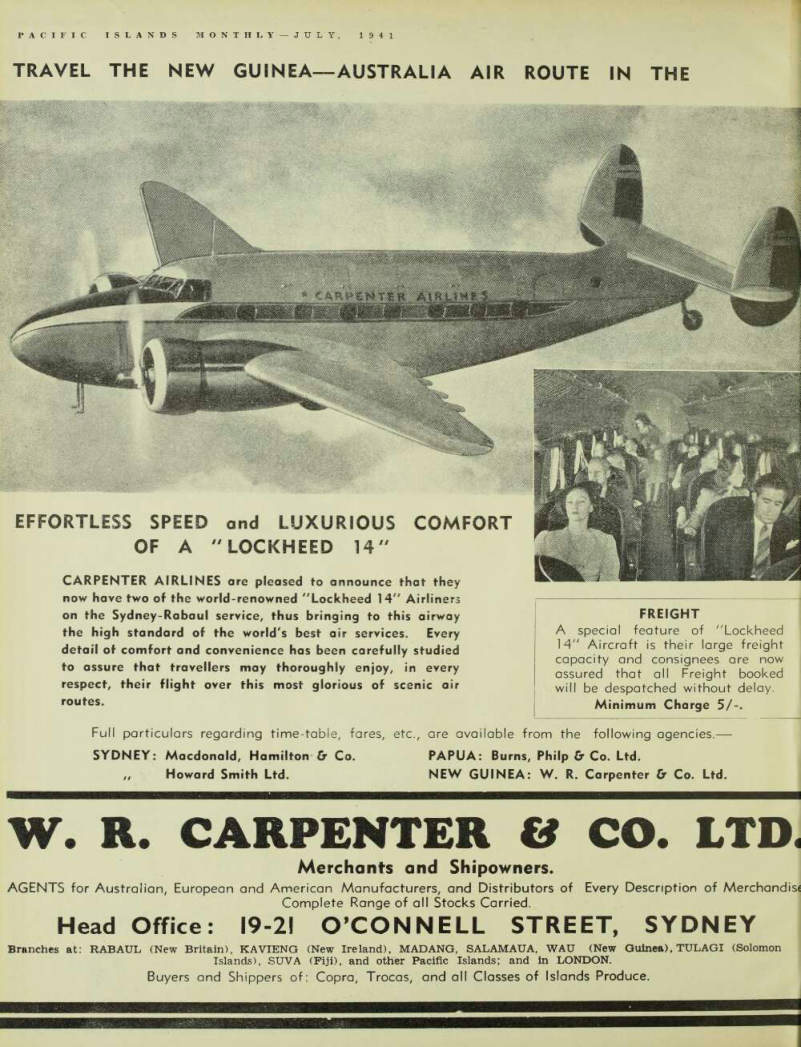
TRAVEL THE NEW GUINEA—AUSTRALIA AIR ROUTE IN THE Hi ii ■ & , ... iiiii * c* m & v- i ■ ■ “ ■ ■■ s: ■ ' ; a? r
EFFORTLESS SPEED and LUXURIOUS COMFORT
OF A "LOCKHEED 14
CARPENTER AIRLINES are pleased to announce that they now have two of the world-renowned "Lockheed 14" Airliners on the Sydney-Rabaul service, thus bringing to this airway the high standard of the world's best air services. Every detail of comfort and convenience has been carefully studied to assure that travellers may thoroughly enjoy, in every respect, their flight over this most glorious of scenic air routes.
FREIGHT
A special feature of "Lockheed 14" Aircraft is their large freight capacity and consignees are now assured that all Freight booked will be despatched without delay.
Minimum Charge 5/-.
Full particulars regarding time-table, fares, etc., are available from the following agencies.— SYDNEY: Macdonald, Hamilton & Co. PAPUA: Burns, Philp & Co. Ltd. „ Howard Smith Ltd. NEW GUINEA: W. R. Carpenter Cr Co. Ltd.
W. R. CARPENTER & CO. LTD.
Merchants and Shipowners.
AGENTS for Australian, European and American Manufacturers, and Distributors of Every Description of Merchandisi Complete Range of all Stocks Carried.
Head Office: 19-2! O’CONNELL STREET, SYDNEY
Branches at: RABAUL (New Britain), KAVIENG (New Ireland), MADANG, SALAMAUA, WAU (New Guinea), TULAGI (Solomon Islands), SUVA (Fiji), and other Pacific Islands; and in LONDON.
Buyers and Shippers of: Copra, Trocas, and all Classes of Islands Produce.
Pacific News-Review
Notes And Comment On
The Progress Of The War
From June 15 To July 13
June 15: The general situation has most commentators puzzled. No German bombers are attacking Britain at pre sent, which indicates that German aerial strength is concentrated elsewhere; and, although Germany was expected to con tinue her attack upon the British in the Middle East through Crete, Cyprus and Syria, there has been no advance in this direction. On the other hand, there are insistent reports that there are huge concentrations of German forces upon the German-Russian border, which means that Germany is going to fight with the Soviet.
If Germany and Russia should begin fighting, the war will enter a new and very different phase, far more favourable for Britain. At least 2,000,000 German troops, with the hitherto unbeaten Pan zer divisions, are on the Russian frontier, but few people dare hope for a clash between the two great Powers. If it occurs, Germany must be supremely con fident of a quick victory over Russia.
Any other outcome of such a move clearly would mean the ultimate destruc tion of Germany. If she is being forced into such a move, it is because she must have oil, wheat and other materials; and, if she cannot quickly overthrow Russia, her condition will be desperate.
June 15: Australian forces, moving up the coast of Syria, co-operating with Free French and British forces in the centre, and British forces coming over land from Irak, are concentrating on Damascus, capital of Syria, which is now virtually surrounded. The allied forces, step by step, are taking possession of southern and central Syria.
June 16: Russia semi-offlcially states that Germany is not seeking any con cessions from Russia and that there is no prospect of a clash between them.
June 16: A German pocket battleship on Friday was badly damaged by British aerial torpedoes, off the coast of Norway, when going out into the Atlantic on a raiding expedition. It returned towards Kiel.
June 16: Increasingly strong squadrons of fighters and bombers are now, every day, making wider and wider sweeps over German-occupied France, attacking enemy planes and ground establishments wherever they find them.
These are remarkable operations, inso far that they show the British steadily gaining control of the sky over the coastal districts, and the zone of aerial combat shifting from over Britain to over northern France.
June 16; Commentators say that Ger many’s concentration of troops on the Russian frontiers is a plan to conceal pre parations in Norway and elsewhere for another attempt to invade Britain. It may also be intended to put pressure on Russia for economic concessions. They forecast a German-Russian agreement, under which Russia will grant substan tial supplies of wheat and oil.
June 16: Strong British forces to-day commenced an attack on enemy columns in Eastern Libya. A tank battle is in progress in the neighbourhood of Solium.
June 17: The British, on the western frontier of Egypt, penetrated enemy lines as far as Fort Capuzzo. The enemy strongly counter-attacked. The British retired to their original positions.
June 17: It is now believed that Ger many is demanding from Russia full control of the Ukraine and a passage for German troops across Caucasia, whence they could dominate the Russian oilfields, enter Irak and Iran, and outflank the British armies in the Middle East.
June 17; United States Government has ordered all German consulates and agencies in USA to be closed by July 10 —the result of the German Government using this organisation for espionage.
June 18: An amazing system called “radio location”, developed by British scientists for detecting the approach of any enemy aircraft or ships, by means of ether waves, is now officially dis closed. No raider can approach Britain undetected.
June 19: Turkey and Germany have signed a 10-years treaty of friendship.
The treaty includes a clause safeguard ing the Anglo-Turkish treaty of mutual assistance (October, 1939). This may be part of Germany’s plans in relation to Russia.
June 19: Although America is buzzing with rumours of pending events of great importance, very little is said in Britain.
Commentators seem completely puzzled about the huge concentrations of Ger man and Russian forces.
June 19; For the eighth night in suc cession, the RAF heavily raided Ger many and occupied France, while day light sweeps are regularly made by very numerous forces of British bombers and fighters.
June 20: Both Imperial and enemy forces suffered heavy losses in armoured vehicles and personnel in the battle around Solium and Halfaya Pass (Libya).
The battle was indeterminate.
June 20: The British and Free French in Syria are making steady, slow pro gress, and are in the suburbs of Damas cus. The Australians, having captured Sidon, are pushing slowly up the coast, towards Beirut.
June 20; Newspapers insist there is tension between Germany and Russia: but a German official spokesman denied that Germany had begun to invade Rus sia, or that border clashes had occurred.
Russia says her armies are engaged in large-scale military exercises.
June 20: Germany and Italy demand the closure of USA consulates in their countries, in retaliation for America closing their consulates.
June 22: This morning, at daylight, German armies invaded Russia, and fighting is now taking place along the entire frontier, from the Arctic to the Black Sea. The Finns are assisting the Germans in the north and the Rou manians in the south.
Hitler, in a proclamation broadcast after the German armies had marched, offered some unconvincing reasons for his action, and accused the Soviet of having betrayed the German-Russian Non- Aggression Pact of August, 1939.
Molotov (Russia’s Foreign Minister), in a later broadcast, said that the German aggression was “a murderous act by gang ster German fascists”. Germany, in spite of her pact of non-aggression and friendship, had suddenly hurled herself upon Russia, without any warning, or declaration of war.
This wholly unexpected and startling development alters the world’s strate gical situation, and profoundly modifies the position of the Western Democracies.
All commentators expect that the Ger man Panzer divisions will quickly cut the Russian armies to pieces—but, nevertheless, the enormous masses of Russia will suffice to keep Germany’s military might fully engaged for some time, thus allowing Britain and USA time to develop their mechanical strength against Germany’s western frontier.
June 22: Damascus, capital of Syria, surrendered at 3 p.m. on June 21. Bit
ter fighting preceded the fall of the city and fighting is still going on between the Allies and Vichy French in differ ent parts of Syria.
June 22: President Roosevelt described the sinking of the American freighter, "Robin Moor", by a German submarine as "the ruthless act of an international outlaw". He said that commensurate action would be taken.
June 23: In a striking speech, made a few hours after Germany struck, the Prime Minister (Mr. Churchill) declared that Britain would give Russia any help within her power. Britain was not con cerned with Russia’s politics, he said— Britain was the ally of any men, any where, who fought for their personal liberty against the ruthless might of the mechanised and brutalised hordes of Germany.
June 23: The daylight sweeps of the RAF over occupied France and Belgium and the nightly attacks by RAF upon German cities, are growing in intensity, and are designed to assist the Russians.
That these attacks have been going on for 10 days indicates that, whatever the newspapers may have said, the British Government was aware of the impending attack upon Russia, and therefore used its growing air force to embarrass the common enemy.
June 23: Intense fighting is proceeding along 2,000 miles of battlefront between Germans and Russians, and the whole position is confused.
The Russians are standing on a front created when they moved westward last year into Latvia, Estonia. Lithuania, Poland and Bessarabia. Under German pressure, they probably will retire slowly to their old fortified line (Stalin Line), which is on the soil of Russia proper, 50 to 100 miles further east, June 23: The Russo-German develop ment has caused confusion and conster nation in Japan. Japan has a treaty of friendship and non-aggression with Germany and Russia, and does not know what to do. Urgent meetings of Cabinet are being held.
June 24; Russia has accepted an offer by Britain to send economic and military mission to Moscow.
June 24: Hungary, as a member of the Axis Pact, has declared war on Russia.
June 25: While gigantic battles on the Russo-German frontier give few indica tions of results, it appears that gen erally the Germans are being held. Few expect this resistance to last long. Britain and USA are being urged to take advan tage of every hour to perfect their defences.
June 26: The Russian Air Force made devastating attacks on the Roumanian oilfields, and upon the Roumanian Black Sea port of Constanza. This may cripple Germany’s oil supply, and alter her plans to transport troops across the Black Sea to the Russian oilfields, in Caucasia.
June 26: Italy, having declared war on Russia, is sending an expeditionary force against the Russians. There is no indi cation of extreme alarm in Russia.
June 26: The RAF battering of Ger many by night, and northern France by day has reached a new peak of ferocious intensity. The attack is now in its fifteenth successive day. The RAF is using as many planes in its raids over Germany as the Germans used over England last September.
June 29: German troops from Norway have crossed Finland and are marching against Murmansk. Murmansk is Russia’s
only open port. It is in the Arctic, but is free from ice. Russian ports in the Baltic and Black Sea are, of course, closed by the enemy.
June 29: To-day, a week after the Ger mans attacked Russia, it is clear that the main German thrusts in the central and Baltic areas are being held, while they have made little progress on the Bessa rabian front.
June 29: After hesitation, the London Stock Exchange evidently decided that the entry of Russia into the war will assist the Allies, because it reports the briskest week of business for a long time.
June 30: Authoritative opinion in Lon don is that Germany, after eight days of fighting against Russia, has failed to achieve anything like the successes she expected, July 1: The RAF continues its attacks on the enemy. During last week the enemy lost 183 planes and the RAF 65.
July 1; Leading American commenta tors still insist that the swift movement of events on the central European front indicate a decisive defeat of Russia before long.
July 1: Japan is still in a condition of agitation over the European war. An announcement is “expected at any moment”.
The fact is that Japan does not know where she stands. The Fascist elements would like to fight beside Germany, but the more responsible classes fear to take any drastic action. If Japan moves against Russia, the United States will move against Japan. Japan would like to drive southwards, to take advantage of the embarrassed situation of Britain and the Dutch East Indies—but dare not.
Japan will remain neutral so long as Germany does not gain any outstanding victory over Britain or Russia.
July 3: Germany is slowly advancing, and Russia slowly retiring—but unbroken and in good order.
July 3: Stalin, Russian dictator, said in his “scorched earth” broadcast that as the Red Army retreated everything of use tp the Germans would be destroyed.
No gfain, animals, petrol, railways, roll ing stock, must be left behind. Every Russian must carry on guerilla warfare.
The Germans, commenting from their radio stations, declared that the Russians will be bitterly punished for all such destruction.
July 6: After two weeks of Russo-Ger man war, the position appears as four main German thrusts —one, a three pronged drive from Finland against the Murmansk area; two, a drive from East Prussia and North Poland aimed against Leningrad in the north, and Moscow, in the east; third, a drive against Kiev, in the Ukraine, across South Poland; four, a drive against Southern Ukraine, across Bessarabia. The Germans have made some progress in all these drives, but they still are not far from the old fron tier of Russia.
July 6: General Sir Archibald Wavell has been appointed British Commander in-Chief in India, and General Sir A.
Auchenleck becomes Commander-in- Chief in the Middle East.
July 6: British Foreign Secretary (Mr.
Eden) said Britain was not in any cir cumstances prepared to negotiate with Hitler at any time, on any subject.
July 6: British submarines in the Mediterranean sank several supply ships, crippled a merchant cruiser and sank Italian cruiser, “Gorizia” (10,000 tons).
July 6: Italy’s resistance in Eritrea, Abyssinia and Somaliland is now practic ally ended and the British are com pletely in charge of the situation.
July 7: Germans now officially admit that their loud-spoken hopes of a fort
night ago, of “a six weeks’ walk-over on the Russian front”, must be modified, and that there is now every possibility of the war going on into the autumn.
If that is really the German view, there must be gloom in Berlin. The more responsible commentators scarcely yet dare give voice to their hope that the Russian armies are big enough, and suffi ciently well trained and equipped to hold the mechanised might of the enormous German Army. But the fact that the German armies still are being held indi cates that the Russians are far stronger than had been dreamed of, and definitely gives rise to the hope that the course of the war now may be altered. How long can Germany stand up to a well equipped and ruthless Russia on her eastern frontier, while the ever-growing RAF of Britain batters her mercilessly, day and night, in the west? How long, under these changing conditions, can the enslaved masses of France, Belgium, Hol land, Norway, Czechoslovakia, Greece and Yugoslavia be held down?
July 7: The flow of American war goods to Egypt under the Lease or Lend Act is now about one shipload per day— tanks, planes and guns.
July 8; Latest reports indicate that the German blitz against Russia is slowing down—at least, temporarily.
Stockholm reports say the Russians are more than holding their own. Other reports say the Germans have paid a terribly high price in men, materials and precious time for a mere approach to the Stalin Line. Germans, however, claim that they have pierced the line in sev eral places.
July 8: United States naval forces have landed in Iceland to supplement the British garrison there—a clear indication of American determination to protect the sealanes against German interference.
It is believed that President Roosevelt has ordered the American Navy to clear the Atlantic shipping routes of surface raiders and submarines.
July 9: British Prime Minister says the American occupation of Iceland is “one of the most important events since the war began”.
July 9: In what is now officially de scribed as an air invasion, the RAF made further raids on Germany on Tuesday night. Berlin admits the raid ers penetrated to central Germany.
July 10: The Russians claim that they are strongly countering the three main German drives, and there are indications that the German progress is slow.
July 10: There have been negotiations between the British and the Vichy French in Syria for the surrender of Beirut and an armistice in Syria gener ally. General Dentz has been instructed by Vichy to seek an armistice, but noth ing appears to have been done, and latest report is that fighting is still going on.
July 11: British production of guns and tanks increased by more than 50 per cent, in the first quarter of 1941, and by more than 100 per cent, in the second quarter, compared with the last quarter of 1940.
July 11: United States naval forces are landing in Ulster, to occupy a naval base that has been prepared for them there.
July 13: Vichy Government has agreed to British terms for an armistice in Syria and hostilities have ceased.
July 13: Agreement signed between Britain and Russia provides: I.—The two Governments undertake to assist and support each other in every way against Germany; 2.— Neither will seek a separate peace.
Gallant Rescue
19 Shipwrecked Men Saved in Samoa
EARLY in June, a large fautasi (row ing boat), carrying 20 important Chiefs and Mau orators, was cap sized in a heavy sea off the south-west coast of Upolu, Western Samoa. Night was approaching. Two men tried to swim ashore: one was drowned, and one returned to the capsized boat —which was rapidly drifting seawards.
In the dusk, they yelled in chorus.
Young Chris. Hellesloe, a banana planter (now gone on active service) heard the faint sound, and investigated, and located the party in distress.
With great difficulty, owing to the wild sea, the drifting fautasi, and the fact that, on each trip, they had to “jump the reef”, Mr. Hellesloe and two Samoan assistants, between 7 p.m. and 3 a.m., in a 12 ft. dinghy, brought all 19 men ashore. Some were old men, and all suffered much from exposure; but all recovered.
New Australian Minister
To Visit Territories
fTIHE new Minister for the Australian J. Territories (Mr. McDonald) accom panied by his private secretary (Mr.
Bathurst) and the secretary of the De partment (Mr. J. R. Halligan), will leave Sydney on Thursday, July 17, by aero plane, and make an official visit, extend ing over about three weeks, to the chief centres in Papua and New Guinea.
Canberra on the 11th instant advised that the Ministerial party would fly direct to Rabaul and spend about one week there; a week would be spent in the Morobe district of New Guinea; and the third week in Papua, with head quarters in Port Moresby. The party hopes to return to Sydney on August 4 or August 11.
An article about the new Minister is printed on page 46.
Radiophone Link With
Papua
A COMMERCIAL radio-telephone ser vice between Australia and Port Moresby was opened on Monday, July 14, with a three-way conversation between the Postmaster-General, Mr. T.
J. Collins (formerly Islands Minister), Hon. H. L. Murray (Papuan Administra tor), and Mr. A. McDonald (new Islands Minister).
Until the extent of the demand is known, the service will be available from 10 a.m. until noon each day, except Sunday.
Mrs. Ella Smith, who was born on Qamea Island, Fiji, 54 years ago, died in Suva after a long illness, on June 8. She was the daughter of a pioneer settler, Mr Frederick Mitchell. Her husband, Mr S. F. C. Smith, well-known in Levuka, predeceased her four years ago.
Mr. Laurence Lonngren, who had lived in Fiji for 33 years, died in Suva on June 27, aged 55. ‘ Lately a member of the staff of Corbett’s Butchery in Suva, he previously had been for many years in the employ of A. M. Brodziak and Co., and, later, Morris, Hedstrom Ltd. He left a widow and two sons—Mr. L P. L Lonngren, of the Bank of NSW staff, and Mr. L. M. Lonngren, formerly of Pearce and Co., and now in the RAAF.
Pacific Islands Travellers
PER LINER TO FIJI: Messrs. Garrick, Stans more, Wilkie, Gumming, Peterson, Moore. Mes dames Armitage, Scott, Brown, Barry. Misses Caine, Rial, Whiting.
PER LINER TO PAPUA; Messrs. Donald, Sharp, Hides, Buckley, Williams. Davies, White, Mulli gan. Mesdames Krutli, Bohm, Shields, Snadden, Shapter, Champion, Williams. Misses Williams, Parker, Uebel, Smith, Champion.
PER LINER FROM FIJI: Messrs. Swinbourne, Bowen, Pullar (2). Mesdames Bowen, Lazarus, Pullar. Misses Bowen (2), Pullar, Johnson.
PER LINER TO PAPUA & NG: Messrs. Colless, Argent, England, Andrews, Eastwell, Bartlett, Korn, Dixson, Dettman, Stewart, Clark, Bergin, Palmer, Disher, Holland, Pollard, Mason, Flem ing, Burke, McConnell, Gregory, Shelber, Brough, Wilson, Biflen, Gough, O’Connor, Flatten, Wad dell, Rogers, Pryor, Cameron, Dix, Pearce, Lord, Harding, Mead, Fay, Slatter, Erskine, Tonkin, Brus, Middleton, Prior, Sutherland, Gorman, Smith, Canaugh, Schacht, Smith, Reid, McCarthy, Cheers, Goodlad, McGowan, Dunbar, Daly, Brancscheid, Weiare, Hanly. Bishop Newton.
Mesdames Bartlett, England, Andrews, Allison, Argent, Street, Palmer, Potts, Mason, Miitchell, Montague, Harper, Gough, Farlow, Rogers, Biffin, Bardie, Stewart, Harris, Pearce, Gill, Erskine, Ashley, Anderson, Redward. Misses Anderson, Craig, Randell, Walters, Einsiedel.
PER LINER FROM BSI, LORD HOWE IS. &
NORFOLK IS.; Messrs. Bruce, Cox, Dalton, Driver, Edmunds, Gillett, Ingram, Jones, Klein, Leal, Adams (2), Buffett (3), Cameron, Evans, Frogley, Laing, Lusk, McCoy (2), Mallett, Mor rice, Nicholson, Nobbs (2), Quintal (2), Rossiter, Snell, Silverside, Warren, Watson, Ahrens, Douglass, Duncan, Fenton, Nichols, Payten, West, Buffett, Morris. Mesdames Lods, Blucher, Buffett (3), Frogley, Knapton, Laing, Sandes, Ahrens, Spurway. Misses Mclntyre, Lods, Quin- PER LINER TO LORD HOWE IS., NORFOLK IS., N. HEBRIDES & BSI; Messrs. Parfett, Jones, Cowie, Andrews, Armstrong, Douglas, Nichols, West, Engelbecht. Rev. Godson. Mes dames Mitchell, Wilson, Porch, Cowie, Arm strong, Martin, Farrar, Wilson, Brearley, Engel becht. Misses Martin, Lloyd.
PER LINER FROM PAPUA: Messrs. Hartley, Bailey, Maxwell, Durdoch, Mustard, Tynan, Walsh, Voshoppi. Mesdames Bailey, Christen, Mustard, Burrage.
PER LINER FROM NG, PAPUA & BSI: Messrs.
Klibbe, Kenna, Cameron, Keily, Kurusiga, Smith, Collins, Doughty, Paton, Pilling, Saville, Stock, Taylor, Beavis, Crowe, Sweetnam, Short.
Mesdames Quinton, Ryan, Couzens, Klibbe, Britten, Carden, Ellis (2), Lockhart, Mullaly, Robins, Ryan, Sully, Wright, Harrison, Beavis, Clarke. Misses Couzens, Mill, Britten, Smith.
PER AIRLINER FROM PAPUA & NG: Messrs.
Carpenter, White, Poland, Wylie, Waterhouse, Robbins, Jennings, Cox, Skinner, Smith (2), Middleton, Bernard, Ahearn. Mesdames Battis, Carpenter, White, Godwin, Robbins, Rose, Scherp, Ahearn. Miss Ahearn.
PER AIRLINER TO PAPUA & NG: Messrs.
Foster, Roberts, Wilton, Symes, Raistrack, Hardy, Paton, Lyons, Morgan, Pendlebury, Shutt, McGregor, Blackley, Hill. Mesdames Wilton, Colquhoun, Fell, Bonney, Maxwell, Ferris.
Sister Adelaide, one of the pioneer sis ters of the Marist Mission, died at Buka Passage, TNG, on June 12, at the age of 57. Born in France, she joined the Society in 1911 and went to Faisi, BSI, in. the following year, later going on to Koromira station. She served later at Tanagole and Hanahan.
Several men from Misima Island, Papua, are now serving with the AIF in the Middle East — Mr, “Tich” Wilson is in a tank corps, and Messrs. Les. Savage and Jim Mason are in an anti-tank unit (together with three men from Port Moresby, Messrs. H. Morton. R. Short and J. Monks). Mr. Jack Wilson, of Misima, in in Palestine.
Advertisements & other items, p. 5 (1 item)
South Pacific Lire
i^AISOtt
& ■ : %mm*\ pm
BATAVIA Or
samarasT*
. —**• <3 -p" <? <r» / y
PACIFIC OCEAN
H ji -* \- V V alaya . r/SAIAUI
H.MORESBY* *V -A
- % * SAHARA!
\ . Mnrtviu
SYDNEY
NOUMEA
UCKLANB
* Vwi
WELLINGTON
, -A , Ai
K. P. M.
SOUTH PACIFIC LINE
Royal Packet Navigation Co. Ltd., (N. V. Koninklijke Paketvaart Maatschappij —lncorporated in the Netherlands Indies) Paketvaart House, 255 George Street Sydney. ’Phone BW 2381.
k.p . m
LINKING SOUTH PACIFIC ISLANDS
WITH NEW ZEALAND, AUSTRALIA
JAVA AND SINGAPORE
MONTHLY SAILINGS
SOUTH PACIFIC LIRE
Advertisers
"Airzone” Radio . . 23 Angus & Coote Ltd. 49 Arnott’s Biscuits . .31 Atkins Ltd., W. . . 36 “Ausoline” ... 58 Baker Ltd., W. Jno. 15
B.A.L.M. Ltd. ... 37
Bank of N.S.W. . . 60 Berger’s Paints . . 34 “Bidomak” ... 16 Broomfields Ltd. . . 38 Brown & Co. Ltd., G 11 Brunton’s Flour . . 33 Burns, Philp & Co.
Ltd 4 B.P. Magazine . . 42
B.P. (S.S.) Co. . . 32
Burns Philp Trust Co. Ltd 55 Carlton & United Breweries Ltd. . 27 Carpenter Ltd., W.
R cov. 2 drivers & Sons Ltd. 32 Clyde Batteries . . 19 Coleman Lamp & Stove Co. . . 24. 36 Colonial Wholesale Meat Co 51 Compressor & Air Equipment Co. . . 54 Coral Starch ... 31 Cosmopolitan Hotel 62 Crammond Radio . 53 “Cystex” ... 55 Dewar’s Whisky . . 39 Doan’s Pills ... 62 Donaghy & Sons Ltd 55 Donald Ltd., A. B 40 Dr. Williams Pink Pills 41 Dunlop Perdriau Rubber Co. Ltd. . 20 Eaton Ltd., J. W. . 35 Edgell Products . . 50 Electrolux Refrigerators . . 26 Excelsior Supply Co. 52 Fletcher & Sons . 37 Ford Sherington Pty. Ltd 22 Poster Clark Ltd. . 44 Garden Vale Pro ducts Ltd. ... 28 Garrett & Davidson 54
Gilbey’s Gin . . . 42 Gillespie’s Flour . . 30 Gowing Bros. Ltd. . 13 Grand Pacific Hotel 41 Grove & Sons, W.
H 19 Guinea Airways Ltd cov. 3 Guinness Stout . .21 Heinz Co. Ltd., H.
J 45 Hemingway & Robertson Pty.
Ltd 63 Hislop Lloyd Pty, Ltd 15, 52 Holbrook’s Ltd. . . 33 Horlicks Malted Milk . . . .43 Hotel Moresby ... 62 International Correspondence Schools ... 24 Kodak (A/sia) Ltd. 13 Kolynos Dental Cream 12 Kopsen & Co. Ltd. 14 Lea & Perrins Sauce 48 Levenson’s Radio . 56 Maxwell Porter Ltd. 35 Mcllrath’s Ltd. . . 48 “Mendaco” ... 61 Meriden School . . 22 Merrillees & Co. . 10 Miller & Co. Pty.
Ltd 61 Nelson & Robert son Pty. Ltd. . . 14 Nestle’s Milk ... 29 Newmarket Saddlery ... 59 Noyes Bros. Ltd. . 54 ■■lo6” Private Hotel 10 Pacific Is. Society . 17 Paling & Co., W.
H 52 Papua Hotel, The . 62 Pike Bros. Ltd. . . 64 “Pinkettes” ... 57 Prescott Ltd. ... 30 Price’s Radio Ser vice 50 Prouds Pty. Ltd. . 9 Ransomes Sims & Jeffries Ltd. . . 59 Riverstone Meat Co. 47 Rohu, Sil 61
Royal Packet Navi gation Co. ... 3 Scots College, The . 16 Scott Ltd.. J. ... 38 Scott's Emulsion . 10 Single Wire Fence Co 58 Smyth Ltd . J. H . 48 Springwood Ladies’
College 44 Steamship Trading Co. Ltd 59 Sterling Varnish Co. 9 Sullivan Ltd., C. . . 64 Sunripe Cigarettes . 49 Swallow & Ariell . 51 Swift & Co. Pty.
Ltd 57 Talkeries, The ... 57
Taylor & Co.. A. . 58 “Tenax” Soap . . 25 Tillock & Co. Ltd. 46 Toohey’s Ltd. ... 46 Tooth & Co. . . cov. 4 Tucker & Co. . 28 Vacuum Oil Co. . 18 Vincent's A.P C. . 25 "Vi-stim” 38 West, Harry ... 59 Weymark & Son . 30 Wills Ltd., W. D. & H. 0 40 Woods Great Pep permint Cure . . 46 Wright & Co. Ltd., E. 35 Wunderlich Ltd. . . 35
Sir Walter Carpenter, who has spent most of the past year in Canada, where he has been instrumental in establishing copra crushing mills, will leave Sydney again, late in this month, for North America.
Mr. Claude Blestowe, who was well known in the Morobe District, New Guinea, before he joined the RAAP, is completing his training at the Bombing and Gunnery School, Evan’s Head, NSW.
Mr. W. Parsons, of Wau, has returned to New Guinea after having been dis charged from the AIF as the result of a foot injury.
Contents
Pacific News-Review i Gallant Rescue in Samoa 2 New Islands Minister to Visit NG and Papua 2, 46 South Seas Travellers 3 The Age of Miracles is Not Past .. 5 Roll of Honour 6 M. Henri Sautot, Free French Champion 7 Mrs. Takau Love Wins Cl Ariki Case 7 Dust-Covered Rabaul 7 Copra Position is Better 8 Death of Mr. Fred. Evenett (Samarai) 8 Islands Wedding in Sydney 9 PAA Will Call at Suva .. 9 Tropicalities io Fiji Governor Who Tricked Germans in 1914 12 Girl Murdered at Wau, TNG ... 14 Tragic Death of Fiji Boxer 16 Giant Warplanes Guard Pacific Sealanes 17 “Bon Courage’’—A Tahitian Passes Through Sydney 19 Senator Foil Resigns from NGG Ltd. 20 New Guinea’s Finances 22 More USA Ships for Pacific 24 Rabaul and Wau A Bitter Comparison 25
Methodist Mission's Jubilee in Papua 25 Dr. E. P. Ellison, of Rarotonga ... 27 New Hebrides in War-Time 27 Overlanding in New Guinea 28 Mr. E. G. Theodore Seeks BSI Gold 30 Do Missions Bear Brunt of Native Education? 32 Men Who Pioneered NG Mission in Papua 33 Beeswax—A New Islands Industry? .. 34 Behind the Scenes in the Far East .. 36 War’s Effect on Samoa 38 Papuan Resident’s Varied Career .. 39 Emperor Co. Investigates New Gold Area in Fiji 40 How to Consume More Pacific Copra 41 Tribute to Two Suva Women 42 Bonus for Cl Orange-Growers ... 43 A Section for Islands Women ... 44 Soldiers from Tahiti 48 Deep-Drilling for Oil in Papua ... 52 Mining Reports 54 Short Wave Radio Programmes .. .. 57 HMFS “Viti”—Fiji’s Expensive Ship 58 Islands Produce Quotations 59 South Seas Exchange Rates 60 Copra and Rubber Prices 61-62 Index to Volume XI 63
Advertisements & other items, p. 6 (2 items)
4
JtrL¥, 1941 PACIFIC ISLANDS MONTHtT
iiillEli
mu
Will I
111 w *¥
in hi
mini
iiillEli
Head Office: 7 Bridge Street, Sydney—Australia Code Address: " Burphil"
BURNS, PHILP
& Co. Ltd.
GENERAL MERCHANTS
SHIPOWNERS
TOURIST AGENTS
BUYERS OF ALL CLASSES OF ISLAND PRODUCE Regular Steamer Services from Australia to New Guinea —Papua Solomon Is.
Lord Howe Is.—Norfolk Is. New Hebrides —Hongkong—lava and Singapore
Pacific Islands Monthly
The Newspaper-Magazine of the South Seas
[Registered at the G.P .O. y Sydney, for transmission "by post as a newspaper .] Published Once Each Month and Circulated in Australia and New Zealand and in the following Pacific Territories and Islands Groups:
Australian Territory of Papua.
Mandated Territory (Australia) of New Guinea Bismarck Archipelago and Northern Solomon Islands.
Australian Territory of Norfolk Island.
New Zealand Territory of Cook Islands Mandated Territory (New Zealand) of Samoa.
British Colony of FIJI.
British Solomon Islands Protectorate.
British Protectorate of Tongan Islands.
British Crown Colony of Gilbert and Ellice Islands.
Mandated Territory of Nauru.
British and French Condominium of New Hebrides.
French Colony of New Caledonia.
French Colony of Oceania (Tahiti, etc.).
American Territory of Eastern Samoa.
American Territory of Hawaiian Islands.
American Territory of Guam.
Mandated Territory (Japan) of Marshall, Caroline and Mariana Islands.
Owned and Produced by Pacific Publications Pfy. Ltd., Union House, 247 George Street, Sydney.
TELEPHONE f Mana glng Director .. BW 5037 c Business and Editorial MA 7101
Po - Box 3408 R
Registered Address of Telegrams, Radiograms and Cables: “Pacpub”, Sydney.
Contributions.
Articles, Stories, and Photographs dealing with Pacific Islands subjects are Invited and will be paid for on publication.
Subscription Rates.
Per Annum, within British Empire. Prepaid.
Post Free Per Annum, elsewhere, prepaid. Post Free , 10/- Single Copies 8d
Editor and Publisher:
R. W. Robson, F.R.G.S.
Assisted by Selwyn Hughes.
Advertising Manager: L, W. Bailey.
Advertising Office and Printing-House; 29 Alberta Street, Sydney.
Advertising rates furnished on application.
Colours, etc., by Arrangement.
Process Blocks made at Advertiser’s expense when required. Screen 100.
Changes of Advertising Copy should reach this Office by Ist of each month, otherwise previous advertisement may be repeated.
IN LONDON, the Pacific Islands Monthly Is on sale at the Bookstall, Australia House The Strand, London.
Agents.
The following are authorised to receive sub scriptions for the Pacific Islands Monthly:— Islands Branches of Burns, Phllp <fe Co., Ltd., and Burns Phllp (South Sea) Co., Ltd.
Islands Branches of W. R. Carpenter & Co.. Ltd.
Islands Branches of Morris, Hedstrom, Ltd.
T. A. Olsson, Wau, New Guinea.
G. Thomas & Co., Rabaul, New Guinea.
Whitten Bros., Ltd., Samaral, Papua.
Steamships Trading Co.. Papua. All Branches.
B.N.G. Trading Co., Ltd., Port Moresby, Papua.
J. Muir, Suva, FIJI.
Kirpal and Co., Victoria Parade, Suva, FIJI.
N. C. Mackenzle-Hunt, Walnunu, Bua, FIJI.
Islands Branches and Representatives of W. H.
Grove <fe Sons, Ltd., Auckland, New Zealand.
Cook Islands Trading Co., Rarotonga, Cook Is.
A. C. Rowland, Papeete, Tahiti, Representative In London: W. C. HARVEY, Coronation House. 4 Lloyds Avenue, London, E. 0.3, from whom may be obtained copies of Pacific Islands Monthly, Pacific Islands Year Book, advertising schedules, etc.
Vol. XI. No. 12.
July 15, 1941
Prir& ( Bd ’ Per Copy rnce Prepaid: 8/- p.a.
triallsts? .
The Age of Miracles is Not Past
A Survey By R. W. Robson
I N fat t man C smißfl e nn^ tly W I heard a ma f l squealing. He was one news kno^-ali eSS pubhc pests ’ a war "
“Why doesn’t Britain land a million men in France, and go ’em™" he bawled. “Why doesn’t the RAF bomb the Roumanian oilfields’ Whv doesn’t the bloody fleet blast the Italian ports? What are we sitting around for, anyway?” s Qne just naturally wanted to cut his silly throat: but one must remember that we actually are fighting for the right of just such harmless people to express their own opinions, and that, in any event, it is not easy for the average, nonstudious man to get this frightful war-picture into correct focus (l° on< l year ' lay proscflicnfawf' Hussia was aloof, inwmmth»ti/w lca was vociferously
practically helpless
stm geared o hf n^ 81 ?™ 1 mllliol s sation g lnri d ni.tiAßt n dr ganisauon and outlook Britain, alone in Totalitarian l“ d up bef ° rd the and defiant monster, unconquered ana defiant r How vividly I remember June, 1940. tfayaD by “thT men 6 b fa * nen 01 vicny < a
name that will 80 with Q uislint ? into our language as a svnonvm of shame), and we faced stark realities.
How could Britain, a semi-armed nation of 50,000,000, def X J!~ ma sniHcently-armed, war- P ad Gel ’many of 80,000,000, assisted 5L a „. well-equipped Italy, a sym fnnnnnnnn Jap , an ’ , and a * least 100,000,000 enslaved European mdus
triallsts? .
Certainly, Britain had a matchless navy - But her Air Force, if incom- P ara ble, was still small, and half her arm y comprised the unequipped, dis organised, if unbeaten men just with drawn from Dunkirk. Is it any won der th at Hitler said “the war will be over by September”, and proceeded leisurely to the kill!
It did not seem possible that Britain could survive, I was one who spent many of those Sydney winter nights at the radio, picking up scraps a ”; d bits of information from every where, wondering why the Hun did not immediately spring upon the Old Country, and put out of existence. I still do not know why.
Dunkirk had been Miracle No. I.
Thls tet-off in July was Miracle No 2 back—God knows by how narrow a
margin. But he was decisively beaten Miracle No. 3. rpHEN came the European winter. x Tj l ? baffled Hun told Mussolini that, if he wanted to collect, he had better do something. A half million Italians, flag-wagging and drum thumpmg in typical Dago fashion prepared to march into the Valley of the Nile, from Libya and Abyssinia, and overwhelm the small British forces. Britain, trying in desperate haste to equip her home troops against the expected 1941 invasion and to build up the RAF so that it might strike at western Germany, was not likely to send heavy equip ment for her Middle East armies.
Yet within six months, those small British and Imperial forces drove all the Italian armies out of Africa, re stored Abyssinia to her ruler, took Syria from the Vichy French, and re occupied Iraq. Miracle No. 4. The reverses in Libya, Greece and Crete were bad. But we still held Egypt and the Middle East. r>EING defeated in daylight raids in August - September, 1940, the Hun, in the 1940-41 winter, developed the night “blitz”; and, early in 1941, with growing masses of night bom bers, he began systematically to destroy the capital and chief indus trial cities of Britain.
No words yet written have described adequately the terrors, horrors and destruction of those blitzes. Britain according to all rules and calculations, should have capitulated, as Hitler
intended. But the British kept on working, and they sang as they worked: and they further equipped their island against invasion, and trained new armies, and built more ships, and repaired a million tons of damaged shipping, and quadrupled their aeroplane output, and fought the silent, ceaseless Battle of the Atlantic, and somehow found time to send huge equipment to Singapore and masses of armaments to Greece and China. I think I should call all this another miracle. If I add the fact that, in this hectic period, January-April, 1941, the British per fected and operated a secret gadget that has driven the night bombers out of the English sky, I am sure I may bring all this into account as Miracle No. 5.
Think of what that little country achieved in organisation and produc tion, under almost ceaseless, merci-
This number of the "PIM" completes Volume 11. Index of the Volume is published on pages 63 and 64 of this issue.
less bombing, within a few months.
And then consider the place in his tory of fat men who squeal in trams about Britain’s war effort!
BUT the great test still was to come.
Germany, thrusting here, thrust ing there, by May, 1941, held enslaved all of Europe except Spain, Portugal, Finland, Sweden and Russia; and Spain, Sweden and Finland did her bidding. She had at least 8,000,000 men under arms. She was mistress of the world, except for Britain (still defying her), Russia (with whom she had a pact of non-aggression), Japan (her formal but non-belligerent ally), and the United States (defiant, but changing so slowly to belligerence as to be only partly in the picture, as yet).
Clearly, Britain must be crushed, and that quickly. That was how Britain herself read the Nazi mind, and she prepared accordingly. Writ ing here only on June 14 last, I visualised a terrifying thing. I could see every British man and woman in position on the defences, equipped with every device that ingenuity and industry could make or America could supply, awaiting a “blitz” that would go on and on until our heroic people were submerged by countless millions of oncoming Huns. I hated the picture I saw; but I had no doubt about what was coming.
But, even as I wrote on June 14, reports were accumulating of a mass ing of Germans on the Russian frontier. Hitler, they said, was go ing to attack Russia. I could not be lieve it. Some people had never lost faith in a Russo-German clash; but all the best-informed opinion in 194) (Walter Duranty, for instance, just back after years in Moscow) agreed that Russia would submit to almost any German demands, rather than engage in war. Reports in that week
insisted that, for reasons no one was capable of explaining, a vast war was about to break out between Teuton and Slav. But, although I myself had forecast a year before (in June, 1940) that if Germany attacked Jugo slavia and entered the Balkans, Russia probably would attack Germany, I could not imagine that the danger we all saw now hanging over Britain could so suddenly be diverted.
I was a sceptic until, on Sunday, June 22, I heard the BBC man in London say: “Hitler directed his armies to attack the Soviet at 4 a.m. to-day. Germany and Russia are now fighting”.
MIRACLE No. 6—and a miracle in deed. Even now, I cannot imagine how it happened. “Those whom the gods destroy, they first make mad”. What madness fell upon Hitler, that he was induced to dis sipate his mighty strength upon the Russian Colossus, when he could have kept Russia quiet while he anticipated American aid and smashed Britain?
We may never know. It remains as one of the war’s major mysteries, like Hitler’s failure to invade Britain in July, 1940, and the flight of Hess.
We cannot imagine what may come out of this Russo-German clash. Per haps Russia will be broken, and Ger many will gain a route around the Black Sea into the Middle East, and a source of vast, unlimited supplies that will allow her to carry on the war against Britain and USA for years, if necessary. Perhaps Russia will stand up against Germany’s military might long enough to dis locate Hitler’s plans. But this we know. If, when the snow falls in Moscow, in September, Hitler has not broken Russia, Germany will have lost the war.
MEANWHILE, the high - spirited British people are given a wholly unexpected breathing - space a chance, while Russia holds the des troying Hun, to build up defences and armaments to the utmost, re-organise shipping and put the Anglo-American accord upon a sounder and more practical basis. The chances, still, are that the Hun will smash Russia in time to allow him to throw his whole weight upon Britain, before the end of 1941. The danger is so great; there is so little time; and America moves so slowly.
Nonetheless, we may not forget that strange things have happened, in this strange war. Miracles.
Lieutenant-Commander A. W. R.
McNicoll. RAN, has been awarded the George Medal “for gallantry and un daunted devotion to duty”. This short cabled announcement was published in Sydney newspapers on July 9. Congratu lations to Sir Ramsay and Lady McNicoll, of Government House, Rabaul, on the great honour achieved by their son. The George Medal is the civil equivalent of the Victoria Cross.
Sister Veronica, who recently completed furlough in New Zealand, is expected to return shortly to Bunana Island, BSI, where she is a member of the “Sisters of the Cross” organisation.
Roll Of Honour
(It is hoped to assemble, here, the names of men, former residents of the Pacific Territories, which appear in British and Free French casualty lists, or in lists of honours awarded.
We should be grateful if relations and friends would send us details.)
Killed In Action
A/Bdr. N. W. BERTWISTLE, NGX 53, AIF artillery, of Rabaul, New Guinea. Killed in action, April, 1941.
Pte. Felix CRAIG, AIF, formerly of accounts department, Australasian Petroleum Co., Port Moresby, Papua. Reported killed, June, 1941.
Flight-Lieutenant G. J. I. CLARKE, of the RAAP, serving overseas, formerly Assistant Flight Superintendent of Carpenter Airways, New Guinea. Reported missing, 25/9/1940 —now pre sumed killed.
Flying-Officer Moresby GOFTON, of the RAF, son of Mrs. P. S. Stewart, of Wau, New Guinea.
Reported missing, 17/5/1940 —now believed killed.
Flying-Officer K. J. A. JOHNSTONE, of the RAF, who was born in Suva in 1915. Reported missing, 1/5/1940 —now believed killed.
Died From Wounds
Sergeant-Pilot Peter Clarkson WISE, of the RAF, son of Mr. W. Wise, OBE, Director of Public Works, Fiji. Wounded by anti-aircraft gunfire during bombing raid over Germany, January, 1941. Returned with crew safely to England, died two days later.
Died From Illness
Pte. Clarence A. HUTTON, VX 8,310, AIF, formerly of Edie Creek, New Guinea. Died from illness, April, 1941.
Missing
Sgt. G. B. BLACK, NGX 55. AIF, Pay Corps.
Reported missing, 18/6/41; reported “re-joined unit”, 23/6/41.
A/Sgt. A. A. S. COTMAN, PX 8, infantry, of Abau, Papua. Reported missing—believed prisoner of war. 5/5/1941.
Peter Hetherington-Martin, Of The Nz
Forces, son of Mrs. M. Hetherington-Martin, of Fiji. Reported missing during Greek cam paign, 30/5/1941.
Gnr. A. L. KING, NGX 7, AIF artillery, of Rabaul, TNG. Reported missing, 16/6/1941.
John O. SMITH, NZ Forces, son of Captain Smith, of “Tui Kauvaro”, and Mrs. Smith, of Suva, Fiji. Reported missing, 29/5/1941, during Greek campaign.
Wounded
Pte. V. BLANCO, AIF infantry, of Thursday Island. Reported wounded in action, 8/7/1941.
Pte. Thomas BYERS, AIP infantry, of Thurs day Island. Reported wounded in action, May, 1941.
Stanley HIGGS, son of Mr. and Mrs. Gordon Higgs, of W. R. Carpenter and Co., Ltd., well known in New Guinea. Member of an English Lancers’ regiment, wounded during evacuation from Dunkirk, May, 1940.
Cpl. W. H. LANNEN, AIF artillery, of Rabaul, New Guinea. On 30/6/1941 reported “wounded in action—on seriously ill list”.
Capt. Edward Tiwi LOVE, NZ Maori Battalion, husband of Mrs. Takau Rio Love, Ariki-nui, of Rarotonga, Cook Islands. Reported missing dur ing Greek campaign, 27/5/1941; later, 22/5/1941, reported “found wounded”.
Gnr. E. G. LOBAN, QX 6,557, AIF artillery, of Thursday Island, wounded during Greek campaign, May, 1941. Reported July, 1941, he being invalided home after having his left fore arm amputated.
Cpl. R. McKERLIE, AIF, of Yandina, BSI, wounded in face by bomb explosion, April, 1941.
A/Sgt. A. H. MACLEAN, AIF infantry, of Rabaul, New Guinea. Reported wounded in action, 30/6/1941.
Private H. G. TURNER, of Samarai, Eastern Papua, wounded in action with AIF in Western Desert, Egypt, January, 1941.
Prisoners Of War
A/Cpl. P. W. BOSGARD, QX 9, AIP infantry, of Papua. Reported missing, 5/5/1941. Vatican radio announced he was prisoner of war at Sulmona, Abruzzi, Italy, 29/6/1941.
Pte. W. GOSSNER, QX 10, AIF infantry, of Port Moresby, Papua. Reported missing, 7/5/1941; reported prisoner of war, Abruzzi, Italy, 6/7/1941.
A/Cpl. J. H. LONERGAN, NGX 99, AIF, Supply and Transport, of New Guinea. Reported miss ing, 5/6/1941; reported prisoner of war at Corinthia, Italy, July, 1941.
Decorations
James R. HYDE, of the RAF, formerly a patrol officer in Namatanai and Sepik districts, TNG, has been awarded the DFC for the part he played in bombing raids on Heligoland Bight.
“You Lie, Darlan!”
How Valiant Henri Sautot Leads Free French in the South Pacific
IT is time that someone told the delightful, inspiring story of Henri Sautot, Governor of New Cale donia, and champion of Free France in the South Pacific.
The men of Vichy capitulated to Hit ler in June, 1940. General de Gaulle defied Vichy, and called to the French Empire to fight with him, as Free France, beside Great Britain.
The French Colonies, stunned, silent under the shock of the Vichy surrender, gave no answer. It seemed that de Gaulle would fight alone.
Then, in July, 1940, from one of the smallest French outposts (Port Vila, New Hebrides), there came one small, stout voice. Henri Sautot, French Resi dent Commissioner, declared for de Gaulle and Free France.
At first, there was hesitation, equivoca tion. The “PIM” likes to remember that it received Sautot’s fiery address, printed it in French, and distributed thousands of copies in New Caledonia and French Oceania.
Then, in August and September, as it was seen that Britain was unconquered, Free France began to stir itself. In the South Pacific, West Africa, the Came roons, there was a rally to de Gaulle.
But the voice of valiant Henri Sautot led all the rest.
The pro-Vichy Governor at Noumea radioed to Port Vila, sacking Sautot.
Sautot defied him.
Free French forces stirred, asked Britain for help. Britain gave certain help. Tahiti declared for de Gaulle in August.
ON September 19, the pro-Vichy Gov ernor in New Caledonia was deposed and Henri Sautot, arriving simul taneously from Port Vila, became Free French Governor of New Caledonia and High Commissioner over New Hebrides and Tahiti.
It has not been all roses for Henri Sautot. There is a small, virulent min ority of French Fascists in New Cale donia and Tahiti, and the Free French officials have had to handle them severely.
On June 18, at a military review in Noumea, Governor Sautot outspokenly denounced the pro-German Vichy regime. Admiral Darlan, he said, had declared that France’s Pacific Colonies “were taken over by the English”. Here is M. Sautot’s answer:— “Monsieur Darlan, you are a liar. I solemnly attest, standing here before the memorial to our dead, that N. Caledonia is and will ever remain French, that the Etablissements Francais de I’Oceanie are also more than ever French, and will so remain, and that it is not the man who has delivered France bound hand and foot to Germany who can reproach us with having handed over these colonies to Britain.
Caledonians and Tahitians are not for sale, Monsieur Darlan, they are fighting pre cisely to remain French, and for that cause they are prepared to triumph or to die.”
Late in June, five pro-Vichy officials of New Caledonia, and three others, were put into an internment camp on Frey cinet Island, 'near Noumea. Early in July, in Tahiti, firm action was taken against MM. Brunet, Rene Pailloux and Roger Mille, officials who had been actively anti-de Gaulle and anti-British.
Fifth Column activity and other treach eries in French Colonies will not be tol erated by the de Gaulle regime.
Early in July, it was announced from
Vichy that Darlan and company had “deprived M. Henri Sautot of French nationality”.
“This is the greatest honour of my life,” remarked M. Sautot. It was an acknowledgment by Vichy that he was really working for the liberation of France.
General de Gaulle telegraphed to M.
Sautot: “This action has been imposed by the Gestapo on all who personify French resistance to Germany. Con gratulations on the honour due to your patriotism.”
Paramount Chief of Cook Is
Cook Is.
Mrs. Takau Love Wins Ariki Case
BY decision of the NZ Supreme Court on June 18, Mrs. Takau Rio Love, elder daughter of the late Makea Nui Tinirau, has finally been awarded the title of Ariki Nui (Paramount Chief) of the Cook Islands.
The case has been in the courts, both in Rarotonga and Auckland, for over two years. Appeals were made against Judge Ayson’s original decision to grant Mrs. Love the title by both Mr. W. P.
Browne (Putua Rangatira) and his wife, Tuvaine Rangatira.
In his summary, Supreme Court Judge Ostler declared that Tuvaine’s claim was so hopelessly out of the running that if she had not been married to Mr. Browne nothing would ever have been heard of any claim from her. He further stated that Mr. Browne’s own claim was “ridi culous”. He dismissed both appeals, with £3O costs.
Now in NZ, Mrs. Love is expected to return to Rarotonga almost immediately, to take up permanent residence at Taputapuatea (the Ariki home). She is an attractive young woman, wife of Cap tain Tiwi Love (member of a prominent Maori family), who now is overseas with the NZ Forces, and they have twin daughters. Mrs. Love’s official title will be Makea Nui Takau Ariki.
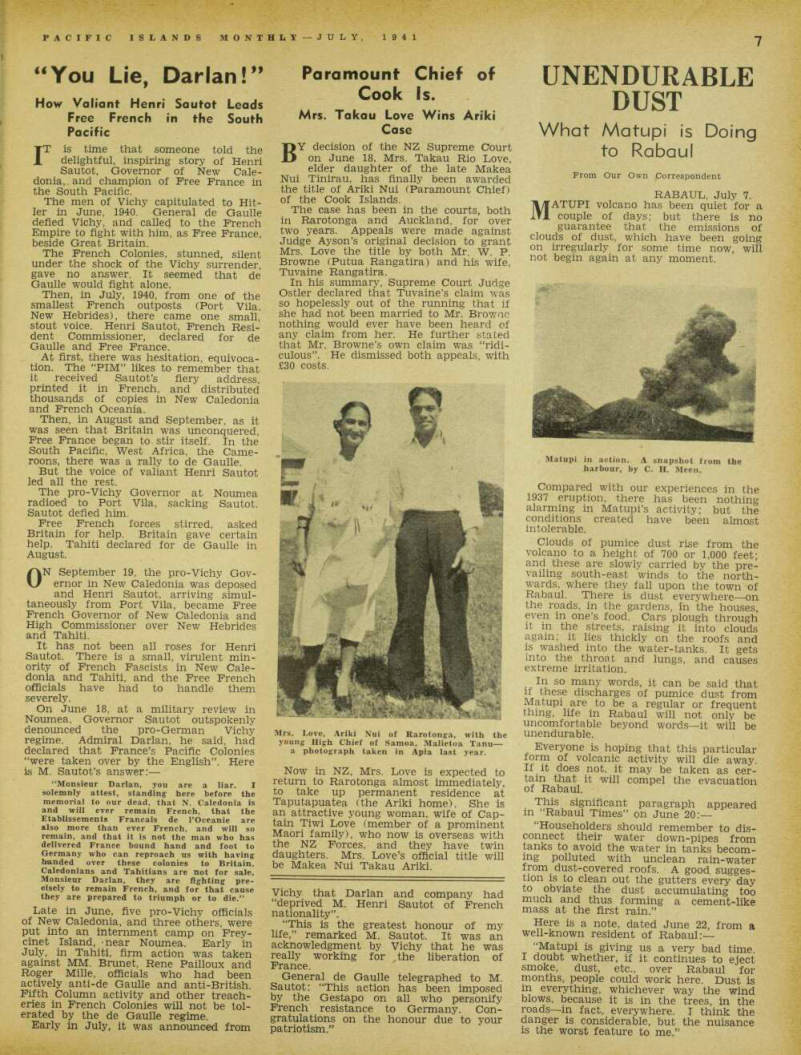
Mrs. Love, Ariki Nui of Rarotonga, with the young High Chief of Samoa, Malietoa Tanu— a photograph taken in Apia last year.
Unendurable
Dust
What Matupi is Doing to Rabaul
From Our Own Correspondent
Rabaul, July 7.
MATUPI volcano has been quiet for a couple of days; but there is no guarantee that the emissions of clouds of dust, which have been going on irregularly for some time now, will not begin again at any moment.
Compared with our experiences in the 1937 eruption, there has been nothing alarming in Matupi’s activity; but the conditions created have been almost intolerable.
Clouds of pumice dust rise from the volcano to a height of 700 or 1,000 feet; and these are slowly carried by the pre vailing south-east winds to the north wards, where they fall upon the town of Rabaul. There is dust everywhere—on the roads, in the gardens, in the houses, even in one’s food. Cars plough through it in the streets, raising it into clouds again; it lies thickly on the roofs and is washed into the water-tanks. It gets into the throat and lungs, and causes extreme irritation.
In so many words, it can be said that if these discharges of pumice dust from Matupi are to be a regular or frequent thing, life in Rabaul will not only be uncomfortable beyond words—it will be unendurable.
Everyone is hoping that this particular form of volcanic activity will die away.
If it does not, it may be taken as cer tain that it will compel the evacuation of Rabaul.
This significant paragraph appeared m “Rabaul Times” on June 20:— “Householders should remember to dis connect their water down-pipes from tanks to avoid the water in tanks becom ing polluted with unclean rain-water from dust-covered roofs. A good sugges tion is to clean out the gutters every day to obviate the dust accumulating too much and thus forming a cement-like mass at the first rain.”
Here is a note, dated June 22, from a well-known resident of Rabaul:— “Matupi is giving us a very bad time.
I doubt whether, if it continues to eject smoke, dust, etc., over Rabaul for months, people could work here. Dust is in everything, whichever way the wind blows, because it is in the trees, in the roads—in fact, everywhere. I think the danger is considerable, but the nuisance is the worst feature to me.”
Matupi in action. A snapshot from the harbour, by C. H. Meen.
Merchants Regain
Copra Is
Better
Pooling Plan Recedes as Merchants Regain Markets
IT was formally notified in the New Guinea Gazette on June 30 that a “copra control board” for the Man dated Territory of New Guinea has been appointed. The names are shown below.
We are officially informed that this territory committee, or board, will not begin to administer the regulations until the date of their commencement is fixed by notice in the Commonwealth Gazette.
There is no word yet of the appoint ment of a similar control board for Papua.
The whole South Pacific copra situa tion has improved considerably since the elaborate centralised plan was made, six months ago, for the purchase, pooling and marketing of South Pacific copra, by a Board formed by Australia, New Zea land and Fiji. It is possible, now, that the big firms will take care of the situa tion, and that the Governments will withdraw, giving the firms their blessing, and maintaining merely a “watching brief”.
The factors which caused the change are: The creation of an important new market (through crushing mills) in North America by Sir Walter Carpenter; the organisation and stabilisation of markets in Britain and Mexico, and of transport thereto; a marked decrease in production, especially of low grades. In other words, the gap between production and consumption has been almost closed.
All the present production of Papua, New Guinea and Solomons is apparently being sold and shipped, by Burns, Philp & Co., W. R. Carpenter & Co., and one or two smaller traders, at prices better than the £4 10 - per ton, on plantation, suggested by the Government.
Fiji is finding a market in Canada and Mexico. Fiji merchants are buying all good copra offering at £4 TO/- Fijian.
Most of Samoa’s copra is being bought by the NZ Government and distributed as stock-fodder. Tonga’s copra, being con sistently low-grade, is unsaleable.
It is believed that the three Govern ments concerned (Australia, NZ and Fiji) are reconsidering the position. Aus tralia, as announced, has been getting ready to pay £4 10/- per ton; but the Government could see plainly that it was heading towards very serious and expen sive problems of storage, marketing and shipping. Probably, it will be glad to leave matters in the hands of the big firms, under certain safeguards (to be operated by the Territories Committees) designed to protect the interests of the planters in these difficult times.
There is a distinct possibility, now that Russia is fighting Germany, that the copra market in Japan (which developed last January and was cut off by Britain because it was feared the oil was finding a way across to Germany) will be recov ered. •
New Guinea Committee
THE Copra Control Committee for the Mandated Territory of New Guinea will be as follows: — Hon. Gerald Hogan, chairman.
Mr. J. C. Archer, executive member.
Mr. F. J. MacKenzie, finance member.
These three men are well qualified for the task, and the arrangement generally
is approved by planters— except those very few who have contracts for better markets.
Hon. G. G. Hogan is New Guinea’s Crown Law Officer, and a member of the Executive and Legislative Councils. He is also Chairman of the New Guinea Patriotic Funds Board, Chairman of the Petroleum Advisory Board, Chairman of the Council of Legal Education, and a member of the Medical Board. For about twenty years he has been in touch with every branch of territory adminis tration. He was Chairman of the Mort gagors’ Relief Committee, which in 1938- 1939 investigated the position of Terri tory agriculturists and made a thorough examination of the copra industry.
Mr. J. C. Archer has been an officer of the Commonwealth Audit Department since 1916. Since about 1931, he has been the Delegate in New Guinea of the Custodian of Expropriated Property,
which has made him an authority on matters relating to the copra industry.
He knows nearly all the nlanters, and has a knowledge of practically every plantation in the Territory, He was a member of the Mortgagors’ Relief Com mittee.
Mr. F. J. MacKenzie is the manager of the Rabaul branch of the Common wealth Bank. He has been about three years in the Territory, and has taken a keen interest in its economic, agricul tural, and other problems. He is re garded in the Territory as a very sound man.
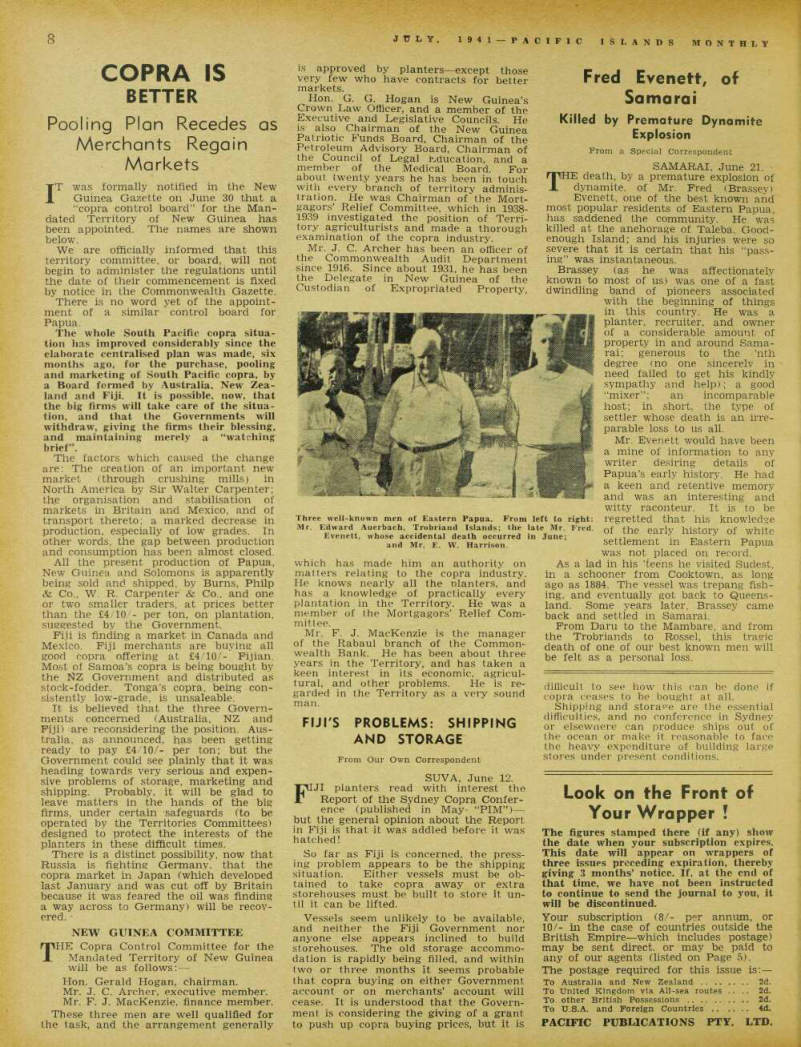
Three well-known men of Eastern Papua. From left to right: Mr. Edward Auerbach, Trobriand Islands; the late Mr. Fred.
Evenett, whose accidental death occurred in June; and Mr. E. W. Harrison.
Fiji's Problems; Shipping
And Storage
From Our Own Correspondent SUVA, June 12.
FIJI planters read with interest the Report of the Sydney Copra Confer ence (published in May “PIM”) — but the general opinion about the Report in Fiji is that it was addled before it was hatched!
So far as Fiji is concerned, the press ing problem appears to be the shipping situation. Either vessels must be ob tained to take copra away or extra storehouses must be built to store it un til it can be lifted.
Vessels seem unlikely to be available, and neither the Fiji Government nor anyone else appears inclined to build storehouses. The old storage accommo dation is rapidly being filled, and within two or three months it seems probable that copra buying on either Government account or on merchants’ account will cease. It is understood that the Govern ment is considering the giving of a grant to push up copra buying prices, but it is
difficult to see how this can be done if copra ceases to be bought at all.
Shipping and storage are the essential difficulties, and no conference in Sydney or elsewnere can produce ships out of the ocean or make it reasonable to face the heavy expenditure of building large stores under present conditions.
Fred Evenett, of Samorai Killed
Samorai Killed by Premature Dynamite Explosion
From a Special Correspondent
Samarai, June 21.
THE death, by a premature explosion of dynamite, of Mr. Fred (Brassey) Evenett, one of the best known and most popular residents of Eastern Papua, has saddened the community. He was killed at the anchorage of Taleba, Good enough Island; and his injuries were so severe that it is certain that his “pass ing” was instantaneous.
Brassey (as he was affectionately known to most of us) was one of a fast dwindling band of pioneers associated
with the beginning of things in this country. He was a planter, recruiter, and owner of a considerable amount of property in and around Sama rai; generous to the ’nth degree (no one sincerely in need failed to get his kindly sympathy and help); a good “mixer"; an incomparable host; in short, the type of settler whose death is an irre parable loss to us all.
Mr. Evenett would have been a mine of information to any writer desiring details of Papua’s early history. He had a keen and retentive memory and was an interesting and witty raconteur. It is to be regretted that his knowledge of the early history of white settlement in Eastern Papua was not placed on record.
As a lad in his ’teens he visited Sudest, in a schooner from Cooktown, as long ago as 1884. The vessel was trepang fish ing, and eventually got back to Queens land. Some years later, Brassey came back and settled in Samarai.
From Daru to the Mambare, and from the Trobriands to Rossel, this tragic death of one of our best known men will be felt as a personal loss.
Advertisements & other items, p. 10 (1 item)
Your Wrapper !
Look on the Front of
The figures stamped there (if any) show the date when your subscription expires.
This date will appear on wrappers of three issues preceding expiration, thereby giving 3 months’ notice. If, at the end of that time, we have not been instructed to continue to send the journal to you, it will be discontinued.
Your subscription (8/- per annum, or 10/- in the case of countries outside the British Empire—which includes postage) may be sent direct, or may be paid to any of our agents (listed on Page 5).
The postage required for this issue is:— To Australia and New Zealand 2d.
To United Kingdom via All-sea routes ... 2d.
To other British Possessions 2d.
To U.S.A. and Foreign Countries 4tL
PACIFIC PUBLICATIONS PTY. LTD.
Islands Wedding In Sydney
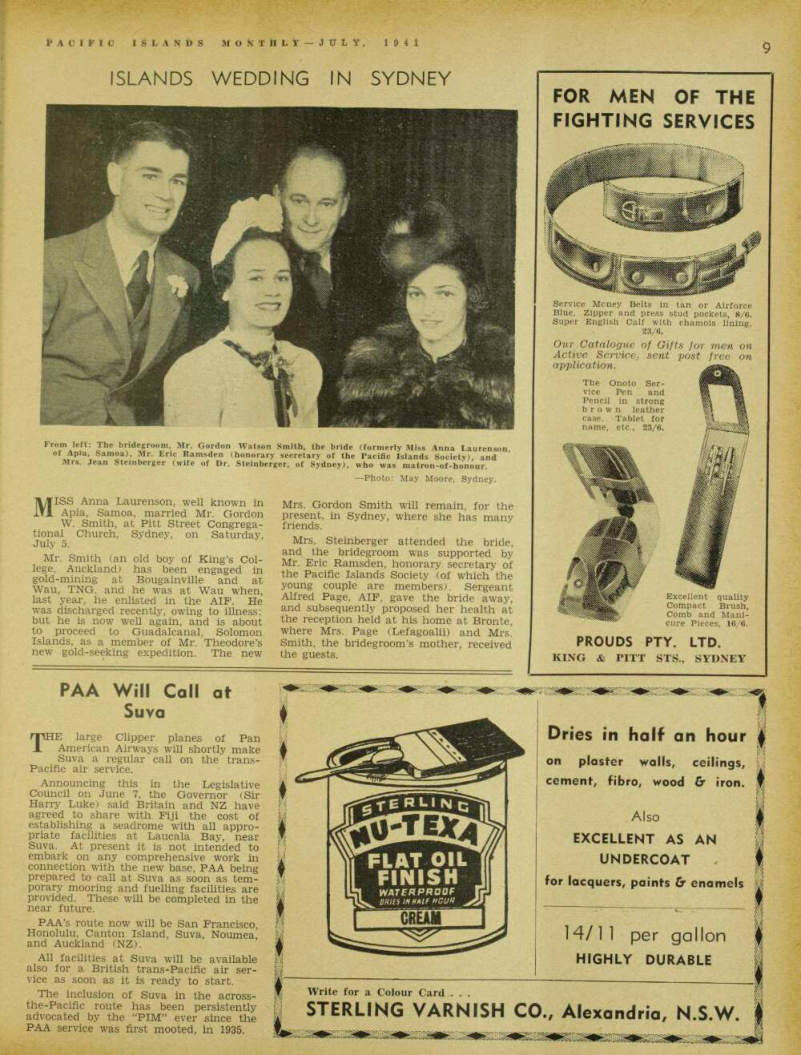
MISS Anna Laurenson, well known in Apia, Samoa, married Mr. Gordon W. Smith, at Pitt Street Congrega tional Church, Sydney, on Saturday, July 5.
Mr. Smith (an old boy of King’s Col lege, Auckland) has been engaged in gold-mining at Bougainville and at Wau, TNG, and he was at Wau when, last year, he enlisted in the AIF. He was discharged recently, owing to illness; but he is now well again, and is about to proceed to Guadalcanal, Solomon Islands, as a member of Mr. Theodore’s new gold-seeking expedition. The new
Mrs. Gordon Smith will remain, for the present, in Sydney, where she has many friends.
Mrs. Steinberger attended the bride, and the bridegroom was supported by Mr. Eric Ramsden, honorary secretary of the Pacific Islands Society (of which the young couple are members). Sergeant Alfred Page, AIF, gave the bride away, and subsequently proposed her health at the reception held at his home at Bronte, where Mrs. Page (Lefagoalii) and Mrs.
Smith, the bridegroom’s mother, received the guests.
From left: The bridegroom, Mr. Gordon Watson Smith, the bride (formerly Miss Anna Laurenson of Apia, Samoa), Mr. Eric Ramsden (honorary secretary of the Pacific Islands Society), and Mrs. Jean Steinberger (wife of Dr. Steinberger, of Sydney), who was matron-of-honour. —Photo: May Moore, Sydney.
Suva
PAA Will Call at Suva
rE large Clipper planes of Pan American Airways will shortly make Suva a regular call on the trans pacific air service.
Announcing this in the Legislative Council on June 7, the Governor (Sir Harry Luke) said Britain and NZ have agreed to share with Fiji the cost of establishing a seadrome with all appro priate facilities at Laucala Bay, near Suva. At present it is not intended to embark on any comprehensive work in connection with the new base, PAA being prepared to call at Suva as soon as tem porary mooring and fuelling facilities are provided. These will be completed in the near future.
PAA’s route now will be San Francisco, Honolulu, Canton Island, Suva, Noumea, and Auckland (NZ).
All facilities at Suva will be available also for a British trans-Pacific air ser vice as soon as it is ready to start.
The inclusion of Suva in the across the-Pacific route has been persistently advocated by the “PIM” ever since the PAA service was first mooted, in 1935.
Mr. “Paddy” Morrissey, formerly of Lae, New Guinea, is now serving with an AIF postal unit in Egypt.
Advertisements & other items, pp. 11-12 (1 item)
Fighting Services
FOR MEN OF THE
m Service Money Belts in tan or Airforce Blue. Zipper and press stud pockets, 8/6.
Super English Calf with chamois lining, 23/6.
Our Catalogue of Gifts for men on Active Service, sent post free on
application.
The Onoto Service Pen and Pencil in strong brown leather case. Tablet for name, etc., 25/6. m Excellent quality Compact Brush, Comb and Manicure Pieces, 16/6.
PROUDS PTY. LTD.
KING & PITT STS., SYDNEY
If*4 CR Dries in half an hour on plaster walls, ceilings, cement, fibre, wood Cr iron.
Also
EXCELLENT AS AN
UNDERCOAT
for lacquers, paints Cr enamels
14/11 per gallon
HIGHLY DURABLE
Write for a Colour Card . . .
STERLING VARNISH CO., Alexondria, N.S.W.
Islands' Visitors to Sydney Will find excellent accommodation at
"206" PRIVATE HOTEL
204-8 Victoria Street, Kings Cross, Sydney.
Every Comfort, Splendid Table.
Tariff from 35/- per week.
MRS. C. PYATT, Proprietress.
Tel. FL 4272.
THAI COUGH
THE CHILD/
It makes the mother wince every time she
hears it. Despite the
fact that she uses a cod liver oil mixture, knowing well that there is nothing better than cod liver oil to rebuild a weakened constitution, the child gets no better—she cannot understand why.
The trouble is that many children cannot take cod liver oil in ordinary form— their digestions are not strong enough, and the health-giving vitamins "A" and "D" are not assimilated. Such children need Scott's Emulsion, which provides Cod Liver Oil in its most digestible form. Eminent Research Chemists have definitely proved that every drop of Scott's is completely digested within 30 minutes.
COUGH COMPLETELY GONE
“I feel I must tell you of the good Scott’s Emulsion has done my six-years old boy. He could not lose a dreadful cough.
I was very worried and decided to try your Emulsion.
After the first bottle I noticed a big improvement in my child and with the second the cough was completely gone. He is looking so well now, and has gained weight.”
L.M., Gipps Street, Paddington, N.S.W.
Now you know why Scott's is the one and only Emulsion to give your child. Start him on a course of it to-day. Notice how quickly that cough is eased and cured, and his general condition improved. Give your boy a chance to meet his fellows on Scott's Emulsion rebuilds worn tissues, makes the bones stronger, restores vitality. Your child will quickly lose that feeling of lassitude, will want to romp and play, and after games come home happy and healthily hungry.
Get Scott's—the Cod Liver Oil Tonic Emulsion that never fails.
ALL CHEMISTS AND STORES, 2/9 AND 5/- PER BOTTLE
SCOTT'S
Emulsion
equal terms.
Tropic Alities

TWO Australian soldiers in Port Moresby involved themselves in a heap of trouble lately. Under the influence of lusty liquor, they wandered over to Ela Beach, late at night, seeking adventure. They found it in the bakery of G. Smith & Co., where they decided to pick a fight with the two native assist ants. Bread was being made, so they seized the native men and tried to put them in the flour trough. Assistance
came, and the heroes were thrown out.
Back in the moonlit road, they cater wauled their excitement to the stars, and then they went back and smashed the front windows of G. Smith & Co. By this time, policemen had arrived from over the hill, and the festive lads were taken into custody. Next morning the magistrate expressed his opinion of such behaviour in simple words of one syl lable, and the two gentlemen were con victed on a series of offences and sen tenced to 14 days.
One hates to think of the effect of such conduct by men of the “taubada” class upon the minds of native Papuans.
Soldiers who have no sense of the obli gations that lie upon a European should not be allowed in Papua or New Guinea. * INTEREST has been aroused locally by the imminent but, alas, temporary return to Fiji of Dr S. M. Lambert, who was widely known throughout the Western Pacific as the Rockefeller Foundation representative (says our Fiji correspondent, writing on June 10). It was hoped that, when Dr. Lambert had seen his book safely through the publishers’ hands, he would return per manently to such of the Pacific Islands as had no libel actions awaiting him.
Rumour, however, suggests that a too cautious publisher insisted on the omission of the most interesting para graphs from Dr. Lambert’s book; and rumour also suggests that his return to Suva and other places in the Western Pacific will be quite temporary. Even so, many scores of his friends will welcome his visit. * IN times long past, when the world was young, Ro’o was the messenger of the sun-god, Tane.
Like all messengers, he became the bearer of gossip and scandal, tittle-tattle and vague chatter, which eventually placed him in the pantheon of Polynesia as the god of rumour When the great gods departed, Ro’o was left behind to shift for himself.
There was no place for him in the solemn council chamber of oblivion to which they had retired. Nor did the mouldering marae in groves and valleys offer him sanctuary.
The Papeete market square, however, appeared a likely place and he established himself there. So congenial has he found this new abode that he has re mained there until this day.
Ro’o was born from a cloud and most of the oracles from his modern marae are as. damp and foggy as his birthplace.
The worshipful company who gather each morning at dawn to receive the oracles add to their murkiness when they disperse to their homes to relate them to their friends and neighbours.
This sort of thing has been going on for uncounted years. The most extra ordinary tales come out of the Papeete
market-place and there are always silly, misty-minded people to believe them — even in this day of radio and press and accurate sources of information. —A.C.R. * TO the Australian, the term “souvenir” has a somewhat different meaning from that generally accepted in France. Lieutenant Robert Guilhumet, a young officer from New Caledonia, with the Free French force in camp in Aus tralia, learned that to his cost, re cently, in Sydney. The officer was dining with a friend at a well-known hotel. His hat and gloves were left in the vestibule, almost within sight of the dining-room.
When he came to collect his possessions, the French kepi had disappeared.
Actually, the gloves were more valuable.
However, the souvenir-hunter evidently preferred the officer’s cap. The theft was a particularly mean one, as Lieutenant Guilhumet had no possible hope of re placing his loss, and he had to leave for abroad without the cap.—Eriki. * WHEN ships of the American squad ron that visited Sydney and NZ spent two days in Suva recently, interest in the visitors was more than
perfunctory—they were enthusiastically
welcomed ashore, and many entertain ments were exchanged (says our Fiji correspondent). Speculation was aroused when most of the sailors’ farewells included the announcement; “We’ll be right back before you know it!” Though there is no information as to whether the British Government is considering leas ing bases to the US Navy in Fiji, such as have been arranged in the West Indies, it is an open secret that the new American Consul in Suva has had a naval attache appointed to his office. * STRANGE ships that pass in the night!
The other evening, in Sydney, two men from opposite ends of the Pacific met at a function arranged by the Pacific Islands Society. One was for merly a miner in New Guinea, the other a Tahitian soldier. Neither could under stand the other very well, though schoolboy French helped a little. Before parting, the ex-miner asked if the young Tahitian had a watch. The lad, believing that he had been asked the time, replied: “Aita” (no). Thereupon, his new friend removed a gold wristlet watch from his arm and placed it about that of the Tahitian!—Vakatini.
Advertisements & other items, p. 12 (1 item)
In Fiji
Three of the
The Lautoka Hotel
most comfortable Hotels
. . The Ba Hotel ... The Tavua Hotel that guests receive efficient service and are controlled by NORTHERN HOTELS LTD. That fact is an assurance the personal consideration of the managements for their every comfort.
It assures also the stocking of only the finest liquors, including: VOK LIQUEURS PRIVATE SEAL WHISKY DAWSON’S WHISKY
CHRISTY’S GIN McWILLIAMS WINES
Trade enquiries regarding the above high-grade brands may be addressed to: J. C. MERRILLEES & CO., 133 PITT ST., SYDNEY
Wau Strike "Still Going
ON"
Prom Our Own Correspondent WAU, July 4. /''kRIGINALLY, 104 European employees U of New Guinea Goldfields Ltd. went on strike. Up to this day, 44 have resumed work, 5 have applied for re sumption but have not been placed; 31 have left the Territory; 7 are working elsewhere, and 17 remain to be officially listed as strikers.
We understand that Mr. Arthur Blake ley, senior Commonwealth arbitration inspector, formerly a Federal Minister is being sent here by Canberra to inquire mto the miners’ working conditions. it 17 remaining unemployed out of 104 constitute a strike, then the strike here can be described as still going on. description of the extraordinary political situation created by this strike is contained in an article on page 20. . M T iss E - Steel, returned to New Zealand m June after completing a term of ser mentWlth the Samoan Education Depart-
Advertisements & other items, pp. 13-14 (1 item)
Avti
Another
ULTIMATE” Achievement —
FULL BANDSPREAD SHORT WAVE TUNING!
Special “ULTIMATE” Dial revolutionises Overseas Tuning and Reception!
Short Wave Stations spread up to sixteen further apart than on ordinary Receivers! Each Short Wave Band located on a separate scale! Foreign stations tuned in as easily as local stations! 798 separate stations were received on a Standard “ULTIMATE” Console; Commander R. E. Byrd used an “ULTIMATE” on his South Pole Expedition; Mr. R. N. Shaw uses an “ULTIMATE” to compile his “Wireless Weekly”
Short Wave notes; leading radio experts and technicians, including the official Australian Advisor to the British Broadcasting Commission, use “ULTIMATE” exclusively!
Obtainable in Console, Mantel, Radiogram and Portable-Mantel Models.
Investigate “ULTIMATE” before you decide on a Radio Receiver.
Comprehensive illustrated literature post free on request.
Cut out this Coupon and post to-day.
GEORGE BROWN & CO. PTY. LTD., 267 Clarence Street, Sydney.
Please send me without obligation full particulars of ULTIMATE Receivers,
NAME
ADDRESS
P.I. u M
AVTi
E ft / s GEORGE BROWN & CO. PTY. LTD., 267 Clarence Street, Sydney.
00 MO/cm A
vrr iflr
*'S ) SS/
W/Ms l£/H£f
dfsiiSSi,
7 7 fv nts *ec:4v I r/
KPir^of
reem Ahgur FlsfE
OE fIAT IMHEN PREY
PASSES /AfTO MOUTH - £67*
STAMP ERECT TO
EAR /TS ESCAPE
rrrrt^M ( o fl !£ pL'PJj' f efll^h Xo'*
BLASTS
rw/CBad I OHO
AS ORP/A/ARY
[£h«noo
INPIANIS
'UdZ'tfcH
My/?.ZcTw~
IT. AS Jy ' 2 //VC OA/
KN/F£
/>■ E//oO6# n
PEHTAL
OtEAM
I'} ANP 2*
Death of Sir B. Sweet-
Escott Fiji Governor Who Tricked the Germans in 1914
Sir Bickham Sweet-Escott, M.A.,
K.C.M.G., who ended a distinguished career in the British Colonial Ser vice as Governor of Fiji between 1912 and 1918 (when he retired), died in Worthing, England, on April 10, at the age of 83.
Sir Bickham was the hero of the “Damn Fool Governor” episode of the First Great War. The full story was told in the “PIM” of May, 1931, and is worth re-telling.
How Suva Was Saved
IX/fR. MALCOLM MAXWELL, formerly lf± secretary to Sir E. B. Sweet-Escott, told this incident, in an article in “The Cornhill Magazine”, in 1930: It was, if I remember rightly, about 4 p.m. when I received and decoded a cer tain message from Apia, in Samoa. I took it straight to the Governor’s office.
I watched him closely, as I knew that its contents would —well, make him think.
He read the decoded message quietly, calmly—no change of expression showed on his face, but I noticed that he looked tired, grey. What he read was roughly this: That at 6 a.m. that morning Von Spee had put into the harbour of Apia with the “Scharnhorst” and “Gneisenau”, that their guns had been trained on the town and the guns’ crews had taken stations.
That no shot, however, was fired, the enemy cruisers weighing anchor at 7 a.m. and making for sea; thereafter steaming in a south-westerly direction.
The message was signed by the Administrator and was for the Governor of Fiji’s “information”, as Suva lay in the course of the enemy ships.
The Governor gave his orders im mediately.
I was to ring up the wireless office with instructions that they were to con centrate on receiving or “picking up” messages and that, if any was picked up in what appeared to be strange letter ing, they were to send the message forth with to Government House, noting if possible the approximate distance of the sender.
It was not long before an ominous message in an unfamiliar code was re ceived, and I was busy at decoding it.
The secret naval codes, the Civil codes, private codes between the flagships— Australian, French, Japanese —not one would fit it.
I told the Governor: “This, sir, must be a German message. The wireless people report that the sender was, when the message was picked up, about 250 miles away”.
THAT night the town was in a state of defence. The “Sealark’s” men were at action stations, manning the single three-pounder and the machine guns. The Fiji Defence Force was in the trenches. Taxi-drivers did a roaring trade and charged exorbitant prices to drive the women and children (and less war like of the men) to the interior and a place of safety beyond the range of German guns.
Suva was again in the war —really in it, it seemed now —but it was not till dawn that the reality would declare it self, for Von Spee would stand off till there was sufficient light to navigate the treacherous shoals and reefs which en circle the Islands.
At 5.30 a.m. the next morning His Ex cellency and I “stood to”. In the grey light of coming dawn we looked towards
the south, where Beqa Island stands sentry and where the first smoke of the mail steamers bringing news from home is seen by many an expectant eye, but this time we were not looking for letters and fresh faces, the telescope was sighted for a different view—grim, cold, de vastating.
What would the outline of two cruisers each with four funnels silhouetted against the pink of the dawn signify? It would mean death, and worse than death: within the half-hour a peaceful town with red roofs peeping through the luxuriant green of tropic foliage with but a handful of armed but harmless men, a crowd of weakling Indians, of laughing innocent Fijians, of refined and cultured Europeans, men of position and ladies of quality would become a shambles, the pink of the dawn would turn to crimson, the crimson of blood, red blood, and the scarlet of tongues of flame, of devas tating fire, ever swelling in volume, fanned and whipped by shrieking shell, the crash of explosives and the rumble of falling masonry. A town of almost voluptuous loveliness transformed into a spectacle of hideous ruin.
We waited anxious—more anxious as the moments passed and the grey light softened. Already the secret ciphers had been buried and their grave carefully concealed. Anxious eyes, too, below round the cable station looked out to wards the ocean, eyes of men who must be the first to feel the shock of high ex plosives, soldiers who must face death without a blow, without resistance.
We waited and the grey bloom changed to pearly white with daubs of pink about the horizon. Thank God, the seas were clear! An hour passed, and then bright daylight—but no enemy was sighted.
Suva was saved, so it seemed. But little was said. The taxi-drivers restored their fares of the night before to pleasant homes, dances became once more the evening pastime, once more there was calm, not again to be interrupted by an enemy’s presence.
SOME months later when Sturdee had cleared the Pacific, and the “Scharn horst” and “Gneisenau”, with their gallant Admiral, lay at the bottom of the ocean, a German merchantman was captured, as she tried to round the Horn and slip out of the way of the British Fleet, and in the mail bags was found a letter from a young officer on board the
“Gneisenau”. Only a paraphrase of the letter can be given from memory, but this is roughly what he wrote:— “At dawn we put into Apia intending to bombard the town, the flag of Britain now flying over Government House. We manned the guns, we trained them on the little capital—but did not fire.
“No, we thought of German hearts and German homes nestling there along the coral strand. We would strike one blow at England before the inevitable— our end. But we would not mingle our countrymen in the havoc. Auckland, Wellington, Sydney—too dangerous a
venture, they were too well protected.
“Suva, yes, Suva! There in her little outpost in the far Pacific Britain should fell the might of Germany, should hear the rumble of our Kaiser’s thunderbolt.
Anchor weighed, we turn and steam S.W. towards Suva.
“Right gallantly the two ships hurry on their grim mission, when 10, a message reaches us—it is in English, it is not even in code—Gott im Himmel, to the Admiral, “Australia”! It gives us warning, the “Australia” is near.
“Damn fool of an English Governor, he gives the show away. Yet, we thank
him from the bottom of our hearts for his warning. So the British bulldog with gnashing teeth, is waiting for us round the corner —how nearly we have been bitten! Our Admiral, Von Spee, gives a merry laugh and signals his orders.
Quickly we turn again and at full speed hasten to the north—towards Honolulu and neutral waters.”
A message had indeed been prepared on that fateful afternoon and broadcast by the Governor’s orders into the winds of the night and over the face of the dark waters for whoever could, to pick up and to use as he thought best. It ran:— To Admiral, HMS “Australia.”
“Thanks for message. Shall expect you to-morrow at daylight.”
Governor Of Fiji.
A simple message in plain and simple English, yet not for English but for Ger man ears, for, as His Excellency well knew, Patey with his ships was 2,000 miles away, and beyond receiving range!
Von Spee might have laughed differ ently had he known. As it is, let us hope that he died in happy ignorance of the truth, for happier were the fortunate ones in Suva, saved from a terrible fate by an English Governor’s “damn folly”!
Mr. J. D. (“Doug.”) Colclough, formerly of Bulolo, New Guinea, is serving as an observer with the RAAP in Rhodesia. He is the son of the well-known secretary of Bulolo Gold Dredging, Ltd., Mr. J.
Colclough, and was in New Guinea for about 3 i years, at first in charge of BGD’s agricultural department and later on one of the Co.’s dredges. His brother, Pilot E. J. Colclough is also in Rhodesia with the RAAF.
M. Oscar Meyer, who is known in Tahiti and New Guinea, has been discharged from the French Army in Saigon, and is remaining temporarily in a civil post in Indo-China which necessitates travelling into the interior.
Advertisements & other items, pp. 15-16 (1 item)
Film
PHOTOGRAPHY
and the
National War Effort
I aim I 1"" * urn T 7; ■mum
FROM THIS AUSTRALIAN FACTORY
/or the R.A. A . F.
Countless rolls of aerofilm for the aerial cameras and of films for the camera-guns; bromide papers for the never-ending job of mosaic-making for Reconnaissance and Mapping. Chemicals,Supplies.
Load your camera with
KODAK
FILM
KODAK (A/ASIA) PTY. LTD.
Established 1868
GO WINGS
Sydney’s Leading Store
EXCLUSIVELY FOR MEN
will have your
SUIT TO MEASURE
TAILORED AND AWAITING
YOUR ARRIVAL IN SYDNEY
Write for
FREE PATTERNS
ud Self Measurement Form . . .
GOWING BROS. LTD.
Market end George Street*, Sydney
W.KOPSEN & Co. Pty. Ltd
Shipchandlers & Hardware Merchants
TILLEY LAMPS
Tilley Kerosene Lamps are the most popular lamps in the world to-day for two reasons— 1. They are made in England. 2. They burn kerosene more efficiently than any other pressure lamp.
Provide a steady 300 c.p. light at a cost of id. per hour. Easy to understand, easy to maintain. Spare parts always available. Popular model Hanging Lamp illustrated can now be fitted with 16 in. parchment shade.
Very little shadow and suitable for all large robins. Obtainable everywhere, or write direct for catalogue.
SIMPLEX MARINE
ENGINES
Simplex Launches and Marine Engines are Australia’s best effort in boating.
Launches from 14 ft. to 22 ft. Engines 3 h.p., 5 h.p., and 10 h.p. Single and Twin Cylinder. 2 and 4 cycle, with or without Reverse Gear. Prices from £22. Let us send you full particulars of the famous Simplex range.
K.L.
We are the largest suppliers of Boatgear in Australia. Write to us with all your boating problems. Stocks of Marine Paints, Rope and Cordage, Oars and Sculls, Wire Rope, Oakum, Yacht Fittings, Cabin Lamps, Horns, Lighting Plants, Copper Nails,
Rivets, etc.
376/380 KENT STREET, SYDNEY
Cables: "KOPSEN", SYDNEY. 'Phone: MA6336 (4 lines).
Girl Murdered
In Wau
Ghastly Crime Attributed to Native
From Our Own Correspondent
Wau, Tng, June 27.
ON the. night of Sunday, June 22, a ghastly murder occurred here, when someone —presumed to be a native —entered the bedroom of Miss Jean Wil son, a beautiful Australian girl of 28 years, and hacked her with an axe.
No motive has been discovered. Miss Wilson had recently become eneaged to a member of the staff of a Wau bank.
She was employed at Wau as ladies’ show-room supervisor, by Burns, Philp & Co. Ltd., and had previously worked in the same firm’s stores at Kavieng and Rabaul.
Miss Wilson, a charming young woman and one of the most popular of our younger set. who would not harm any body or anything, lived with her brother in-law and step-sister, Mr. and Mrs. Rav, in Darling Road, Wau. She retired early on Sunday night, probably tired out. as she had been instrumental in carrying through a Snitfire Fund ball on the Sat urday. and had attended the Red Cross Carnival on the Sunday afternoon. At about 2 a.m. her relatives, and the whole neighbourhood were awakened by her screams. By the time they reached her, her assailant had disappeared.
All she could say was: “I was attacked by a native. He had an axe. Don’t let the kiddies see me like this.”
It was found that Miss Wilson had been brutally assaulted with an axe with a broken handle, which the mur
derer left behind. One arm was prac tically severed, her face was 'terribly slashed, and other cruel injuries had been inflicted. She lingered until 9.20 a.m., when death ensued, and she was more or less conscious for the whole seven hours.
Her burial at 5 p.m. the same day was attended by a large gathering of the residents of Wau and district. Rev. V.
H. Sherwin, who performed the burial service at St. Augustine’s Church and at the graveside, spoke in strong terms of the state to which the natives have been allowed to come, and instanced this as an indictment against those who control the Territory.
Uncontrolled Natives
The public here, greatly shocked, are not going to allow this ghastly crime to go unpunished, and strong action is being taken.
Of course, until the murderer is found it can only be presumed, from the dying girl’s statement, that he was a native; but the fact that an axe was used is regarded as a fairly good indication that such was the case.
Miss Wilson was to have played Mary Grayson in “It Pays to Advertise”, which was to have opened for a season on June 27. The Wau Dramatic Society has can celled the production.
At a very representative meeting held in the Wau Club on June 24, a perman ent vigilance committee was appointed, with powers to act at once and always in accordance with the wishes of the whole community, and to demand that the present lax treatment of natives be abolished, once and for all.
The murder is regarded as a climax to a whole series of incidents indicating lax control of “Europeanised” natives— including attempted assaults on white women, attempted poisoning of employ ers, and public feeling, long agitated, is now at fever heat. Most blame the New Guinea Administration; but others rea lise that, whatever the shortcomings of the Territory Administration may be, and they are many, their hands are tied by Canberra, where politicians (who probably have never seen a native, except on the screen) have much control over the affairs of the Territory.
That our magistrates and judges here should have to conform to the Queens land Criminal Code (even though it is styled “adopted”) is a flagrant absurdity, when it is applied to natives just emerg ing from their primitive state. European courts, with all their red-tape, waste of time, expense and so forth, become a ridiculous rigmarole when dealing with a most primitive type of natives.
The whole system cries aloud for review and reform; but, presumably, it needs a few tragedies like the murder of this girl to stir officialdom to action.
Detectives Sent For
WAU, July 6.
When, after a fortnight, we seemed no nearer a solution of the murder of Jean Wilson, the authorities sent South for the assistance of detectives, and Detective Sergeant W. Arnold and Constable W.
Flood (finger-print expert), of Sydney CIB, arrived by plane yesterday, and are now at work.
Wau, July 7—Detectives have detained a native, for questioning.
Dr. and Mrs. J. D. Thompson of the Melanesian Mission will return to Malaita, Solomon Islands, shortly after spending several months’ furlough in Australia.
Dr. Thompson took a course in tropical medicine at the Sydney University, while Mrs. Thompson spent some time in New Zealand.
Advertisements & other items, p. 16 (1 item)
Islands Merchants
NELSON & ROBERTSON
PTY., LTD.
Established 1895.
Islands Merchants
All classes of merchandise purchased at wholesale prices and original invoices supplied to Islands clients.
Purchasers of Laup (New Guinea Walnut).
Cocoa Beans, Rubber and other Islands' produce sold on commission.
SOLE AGENTS FOR
ANKAR INSULATING
WALLBOARD
BEEBE PORTABLE
WINCHES
SKANDIA ENGINES
Nelson fir Robertson
Pty. Ltd. 12 Spring Street, Sydney, Australia.
Fijians And Gold Trick

From Our Own Correspondent SUVA, July 1.
SOME of the ore on the new goldfield at Tavua is so rich that the temp tation to theft is considerable, and the dangers are said to have been given close consideration by both the gold com panies and the Government. Nobody, however, anticipated that the possibility of stealing rich ore from the mines would provide the opportunity for a con fidence trick.
Two Fijians were recently sentenced in Suva to six months’ gaol for selling scraps of old brass, as gold, to Indian and Chinese traders. It seems likely that they may have had a very good run before capture, for their victims, on dis covering the deception, would hesitate to report their trouble, lest they lay them selves open to a charge of dealing illi citly in gold.
ASET of 12 artists’ drawings. In colour, of the 1939 issue of Gilbert and Ellice Islands pictorial stamps, presented by His Majesty the King, rea- Used £250 at the recent Red Cross Stamp Auction in London. Except for one
denomination (5/-), the designs were “worked up” from the original wash sketches made by Mr. G. E. Hard school master at Ocean Island (according to the July issue of the “Australian Stamp Journal”).
Advertisements & other items, pp. 17-18 (1 item)
Qet Wiwwuj,
The House of Steel
for Quality Cutlery
We have a large range of Scissors, Knives, Razors, etc.
KM
W. JNO. BAKER [?£
3 HUNTER STREET, SYDNEY.
Established 1888.
Qet Wiwwuj,
BY ORDERING
YOUR A UTO MOTIVE
SPARE PARTS &
ACCESSORIES FROM
HISLOP LLOYD
SYDNEY
SPECIALISTS IN THE SUPPLY OF
Axles —801 l and Roller Races—Brake Linings—Brake Parts Batteries Bolts Carburettors Chains Coils Crankshafts Cylinders and Liners Drills (elec.) Dynamos Generators Gears Gaskets Ignition Spares and Cables Jacks King Pins Magnetos Pistons and Rings Prop Shafts Rims Springs Shock-absorbers Spark Plugs Speedos and Parts Starter Motors Steering Wheels Tyres Universals Valves, etc., etc.
FOR ALL TRUCKS & CARS—ANY MAKE—ANY YEAR 4 4 3 Generator, magneto and electrical repairs— Engine re-bores by "MIRROR FINISH" process— Speedometer and dash instrument repairs- Our monthly catalogue posted free on request.
WE SHIP BY RETURN BOAT OR AIR MAIL.
ISLOP lOYDPW
335 PITT ST. SYDNEY
Cables: “Hisloyd”, Sydney.
THE SCOTS COLLEGE, BELLEVUE HILL, SYDNEY.
Founded 1892.
Owned and Conducted by the Presbyterian Church of N.S.W.
One of the Great Public Schools, the College is situated in spacious grounds at Rose Bay.
A large extension of the School Block and a new Assembly Hall were opened in 1939.
PRINCIPAL: A. K. Anderson, M.A., F.R.Hist.S. 30 Assistant Masters and a large visiting staff. Present Roll: —700 pupils, including 200 Preparatory Boarders and Day Boys.
THREE COURSES: Academic, Commercial and Pastoral.
Boys prepared for University and Education Dept. Examinations to Leaving Honours.
Wool-classing and Woodwork available for Boys going on the Land.
There are five Houses for Boarders. About 30 boys are from overseas.
THE PREPARATORY SCHOOL, adjacent on Mansion Road, is fully staffed.
Next Term opens on September 23; First Term in 1942, February 10.
Prospectus on application to the Principal, or the Secretary, (Mr. J. R. Mackay), Assembly Hall Buildings, Margaret Street, Sydney.
After COLDS
FLU.WINIER ILLS
SCIENTIFIC
CONTROL
Manufactured in the BIDO- M A K Pharmaceutical Laboratories, one of the most up-to-date hygienic laboratories in the Southern Hemisphere, to which is attached a fully qualified Doctor of Medicine, and under the control of a qualified chemist, who was trained in the most modern English laboratories in the world.
AND FEVER
Your System needs BIDOMAK
to build Vitality—prevent Relapses
BIDOMAK helps increase resistance against
disease—it creates rich, red blood to overcome infection as the body generally is
strengthened. It counteracts the effects of
debility. It is especially valuable in overcoming the depression caused by colds, 'flu and fever. BIDOMAK tones up the system —puts a sparkle in your eye and a spring in
your step. Contains no drugs—safest for
children.
“WAS ALWAYS SICK IN WINTER—NOW WELL”
“For years I dreaded winter because I always knew it meant one attack after another of illness, owing to my lack of resistance and general nervy condition.
I seemed to be more or less always sick and had no energy or appetite.
“My chemist recommended BIDOMAK and it has worked wonders in building my health so that I can stand any weather and feel as fit as a fiddle. I sleep, eat and work better and friends are amazed at the difference in me.” (Sgd.) H.R.K., M . (Original letter on file.)
BIDOMAK
AT ALL
‘The Tonic of the Century."
LEADING ISLAND STORES
Death Of Fijian Boxer
KNOCKED out in the first round of a boxing contest in Sydney on June 27, a 21-years-old Fijian, Setariki Bera, died in hospital without regaining consciousness.
Bera (who boxed under the name of
“Sam Ceruttui”) left Suva some months ago as a greaser on a freighter to travel in the hope of fulfilling his ambition to become a ranking boxer. This was his first fight in Australia but in Fiji he had not been beaten in a number of contests.
His home was in the Lau Islands.
Setariki Bera.
Delay In Port Moresby's
Water Supply
From Our Own Correspondent
Port Moresby, July 8.
PORT Moresby’s new water supply scheme, which was expected to be completed in June, has been delayed through difficulty in obtaining certain necessary equipment. However, it should be functioning by the end of August.
Many complaints are heard locally concerning the dangerous state of the town’s roads, due to the open trenches for water pipes. There appears to be some confusion as to whose job it is to fill them in.
After a Pacific cruise extending over 13 months in his 100-ton yacht, “Golden Hind”, Mr. H. R. Jenkins returned to Auckland. NZ. on July 1. He visited most of the Polynesian groups.
Lieut.-Colonel H. E, Woodman, of the AIF, formerly a District Officer in New Guinea, was granted a decree nisi in the Sydney Divorce Court, on July 8, on the ground of desertion —his wife had refused to live in New Guinea. Mrs.
Woodman resisted the suit, claiming that residence in New Guinea injured her health.
Giant Warplanes Guard
Pacific Sealanes Famous Australian Pilots in "Ferry Service"
rE Brisbane “Courier-Mail”, of July 5, says that there is a remarkable story of how great Australian war planes have been ferried across the Paci fic in the bald announcement of the Australian Minister for the Air;— “Long-range Catalina (PBY flying boats) are being used by the RAAF Coastal Command for seawards reconnaissance.”
There are six outstanding Australian airmen engaged in bringing these giant flying-boats across the Pacific from America to Australia, namely: Captains L. J. Brain, P. G. Taylor, G. U. Allan, H. B. Hussey, Orme Denny and W.
Crowther.
A number of those names are well known to North Queensland, Papuan and New Guinea residents who have made use of the flying services in recent years; and none is better known than that of Orme Denny—the diminutive but bold and daring pilot who, during several years in the service of Guinea Airways Ltd. in New Guinea, made pioneer avia tion history in that territory.
Not much has been published about the operations of these giant flying-boats oyer South Pacific waters; but it is sig nificant that, for six months, no activi ties by raiders have been reported from the South Pacific.
It may be remembered that the “PIM”, reporting in January last the ghastly clean-up of British shipping just made by the raiders in South Pacific waters, commented;— “But the lesson has been learned. A new system of naval protection for our ships, and a much closer guard over shipping information, is coming rapidly into operation. The raiders will not have such pleasant cruising, in future.”
We knew, even then, that great new Australian bombers were beginning to patrol the ocean, but nothing could be said about them. Since then, however, little by little, the interesting informa tion referred to above, has been pub lished.
Concerning American
Tourists
Letter to the Editor MR. Hungerford’s letter in the April issue of “PIM” is worthy of an answer—first, because he bears the patronymic and is probably a relative of the cultivated gentleman who honoured this writer with his friendship when we were class and club mates at a great Eastern university; secondly, because he is manifestly concerned over the repu tation of our countrymen abroad. It is precisely for this second reason that, in the forlorn hope of better things to come, your correspondent has written his criticisms.
We regret, however, that history bears witness to the unpleasant truth that American tourism to Tahiti—during the past 20 years—has been navigated on a sea of alcohol and charted to a course of unbridled license. It began with the period of escape from Prohibition and the publication of books representing these islands as a Utopia of Un restraint.
Twenty years of this sort of thing has had the effect of changing the morals
and manners of the rising generation of our native Tahitians in a way that can be described only as devastating. To go into detail would require a volume as portly as “Gone With the Wind”.
We suggest that Mr. Hungerford, for his enlightenment, re-read in his Octo ber, 1940, copy (on page 40) an article not contributed by this correspondent.
Almost we have forgotten to thank Mr.
Hungerford for his kindly thought for our health and pulchritude. Our learned friends tell us that arsenic is not only a valuable stimulant, but will clear and beautify the complexion. The prolonged use Mr. Hungerford recommends would, no doubt, greatly enhance our charm.
But, alas, our garden of vanity withered to its roots so long ago, that even arsenic could not revive it, I am, etc.,
Your Papeete Correspondent.
Tahiti, 8/6/1941.
Dr. G. H. Vernon, a well-known medical officer, formerly of Thursday Island and Daru, and at present in Misima, Eastern Papua, has been granted leave by the Government, and is enlisting in the Australian forces.
Advertisements & other items, pp. 19-20 (1 item)
-S \\Ntn^,'
PACIFIC ISLANDS SOCIETY
Visitors from the Islands to Sydney (or those interested in Islands affairs), are advised to communicate with the honorary secretary of the above Society, which has been formed to study the history, traditions, economics, and political developments of the Pacific Islands.
Islands visitors are invited to the next social gathering to be held at 8 p.m., Carlton Hotel, July 30.
Address for Correspondence:
THE PACIFIC ISLANDS SOCIETY,
Box 2434 MM., G.P.0., Sydney.
* \ 3 >} & i ►s $ ■V. 3^ ft >.N' 1$ • V -S-^'
-S \\NtN^,'
\«f' sy* y> !J O o Oj yr CiTf r i iwpt _- «
'lllnn/ii
IP v *? \MV m \ \
JULY, 1941 PACIFIC ISLANDS MONT tt L m I ' m K;:;r &A 4 % o % i r I 1 L 1 m.
Mobiloil's "Double Range''Characteristics Ensure Full Engine Protection at High Temperatures and Minimum Fluid Friction at Starting
“Bon Courage!"
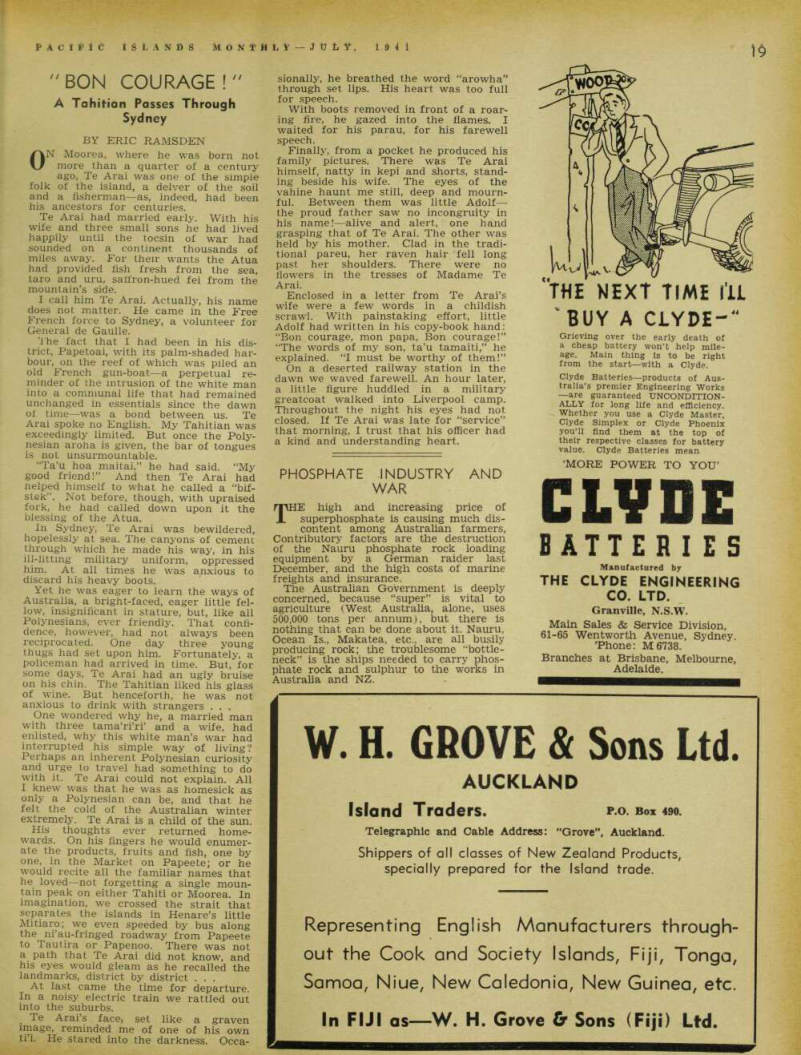
A Tahitian Passes Through Sydney
By Eric Ramsden
ON Moorea, where he was born not more than a quarter of a century ago, Te Arai was one of the simple folk of the island, a delver of the soil and a fisherman —as, indeed, had been his ancestors for centuries.
Te Arai had married early. With his wife and three small sons he had lived happily until the tocsin of war had sounded on a continent thousands of miles away. For their wants the Atua had provided fish fresh from the sea, taro and uru, satfron-hued fei from the mountain’s side.
I call him Te Arai. Actually, his name does not matter. He came in the Free French force to Sydney, a volunteer for General de Gaulle.
The fact that I had been in his dis trict, Papetoai, with its palm-shaded har bour, on the reef of which was piled an old French gun-boat—a perpetual re minder of the intrusion of the white man into a communal life that had remained unchanged in essentials since the dawn of time —was a bond between us. Te Arai spoke no English. My Tahitian was exceedingly limited. But once the Poly nesian aroha is given, the bar of tongues is not unsurmountable.
“Ta’u hoa maitai,” he had said. “My good friend!” And then Te Arai had Helped himself to what he called a “bif stek”. Not before, though, with upraised fork, he had called down upon it the blessing of the Atua.
In Sydney, Te Arai was bewildered, hopelessly at sea. The canyons of cement through which he made his way, in his ill-fitting military uniform, oppressed him. At all times he was anxious to discard his heavy boots.
Yet he was eager to learn the ways of Australia, a bright-faced, eager little fel low, insignificant in stature, but, like all Polynesians, ever friendly. That confi dence, however, had not always been reciprocated. One day three young thugs had set upon him. Fortunately, a policeman had arrived in time. But, for some days, Te Arai had an ugly bruise on his chin. The Tahitian liked his glass of wine. But henceforth, he was not anxious to drink with strangers . . .
One wondered why he, a married man with three tama’ri’ri’ and a wife, had enlisted, why this white man’s war had interrupted his simple way of living?
Perhaps an inherent Polynesian curiosity and urge to travel had something to do with it. Te Arai could not explain. All I knew was that he was as homesick as only a Polynesian can be, and that he felt the cold of the Australian winter extremely. Te Arai is a child of the sun.
His thoughts ever returned home wards. On his fingers he would enumer ate the products, fruits and fish, one by one, in the Market on Papeete; or he would recite all the familiar names that he loved—not forgetting a single moun tain peak on either Tahiti or Moorea. In imagination, we crossed the strait that separates the islands in Henare’s little Mitiaro; we even speeded by bus along the ni’au-fringed roadway from Papeete to Tautira or Papenoo. There was not a path that Te Arai did not know, and his eyes would gleam as he recalled the landmarks, district by district . . .
At last came the time for departure.
In a noisy electric train we rattled out into the suburbs.
Te Arai’s facej set like a graven image, reminded me of one of his own ti’i. He stared into the darkness. Occa
sionally, he breathed the word “arowha” through set lips. His heart was too full for speech.
With boots removed in front of a roar ing fire, he gazed into the flames. I waited for his parau, for his farewell speech.
Finally, from a pocket he produced his family pictures. There was Te Arai himself, natty in kepi and shorts, stand ing beside his wife. The eyes of the vahine haunt me still, deep and mourn ful. Between them was little Adolf — the proud father saw no incongruity in his name! —alive and alert, one hand grasping that of Te Arai. The other was held by his mother. Clad in the tradi tional pareu, her raven hair fell long past her shoulders. There were no flowers in the tresses of Madame Te Arai.
Enclosed in a letter from Te Arai’s wife were a few words in a childish scrawl. With painstaking effort, little Adolf had written in his copy-book hand: “Bon courage, mon papa, Bon courage!”
“The words of my son, ta’u tamaiti,” he explained. “I must be worthy of them!”
On a deserted railway station in the dawn we waved farewell. An hour later, a little figure huddled in a military greatcoat walked into Liverpool camp.
Throughout the night his eyes had not closed. If Te Arai was late for “service” that morning, I trust that his officer had a kind and understanding heart.
Phosphate Industry And
War
fTVHE high and increasing price of JL superphosphate is causing much dis content among Australian farmers, Contributory factors are the destruction of the Nauru phosphate rock loading equipment by a German raider last December, and the high costs of marine freights and insurance.
The Australian Government is deeply concerned, because “super” is vital to agriculture (West Australia, alone, uses 500,000 tons per annum), but there is nothing that can be done about it. Nauru, Ocean Is., Makatea, etc., are all busily producing rock; the troublesome “bottle neck” is the ships needed to carry phos phate rock and sulphur to the works in Australia and NZ.
Advertisements & other items, p. 21 (1 item)
Clvde
woq
& L u vJ
THE NEXT TIME I'll
'BUY A CLYDE-"
Grieving over the early death of a cheap battery won’t help mileage. Main thing Is to be right from the start—with a Clyde.
Clyde Batteries—products of Australia’s premier Engineering Works —are guaranteed UNCONDITION- ALLY for long life and efficiency.
Whether you use a Clyde Master, Clyde Simplex or Clyde Phoenix you’ll find them at the top of their respective classes for battery value. Clyde Batteries mean
‘MORE POWER TO YOU’
CLVDE
BATTER I E S
Manufactured by
THE CLYDE ENGINEERING
CO. LTD.
Granville, N.S.W.
Main Sales & Service Division, 61-65 Wentworth Avenue, Sydney. ’Phone: M 6738.
Branches at Brisbane, Melbourne, Adelaide.
W. H. GROVE & Sons Ltd.
AUCKLAND
Island Traders. p.o. box 490.
Telegraphic and Cable Address: “Grove”, Auckland.
Shippers of all classes of New Zealand Products, specially prepared for the Island trade.
Representing English Manufacturers throughout the Cook and Society Islands, Fiji, Tonga, Samoa, Niue, New Caledonia, New Guinea, etc.
In FIJI as—W. H. Grove & Sons (Fiji) Ltd.
Wau, Ng
A Bomb From
Queer Political Manoeuvres Win Strike for NGG Miners and Force Senator Foil to Leave Company's Board.
IT is presumed that the strike of Europeans employed by New Guinea Goldfields Ltd. on the Morobe gold field—which, although reduced by numer ous departures and returns to work, was still officially in existence at the begin ning of July—was the real reason for the decision by Senator Foil (Australian Minister for Information) to resign his directorships on the allied boards of New Guinea Goldfields Ltd. and Mt. Isa Ltd.
Senator Foil had held those director ships for a long time, and they did not seem to conflict with his duties as an Australian Minister: but when Mr. Mc- Laren, a representative of the Wau Labour Party, arrived in Canberra in June, and began to whip up Australian Labour Party interest in a strike which it had apparently been trying to forget, Senator Foil’s New Guinea interests un expectedly became an acute embarrass ment to the Government.
This is supposition: but it does appear as if the Labour Party, having itself been jolted into belated recognition of the strike in New Guinea, suddenly rea lised that it, through the unfortunate Senator Foil, might put the Menzies Government “on the spot”.
It started, on June 20, a discordant and purposeless row in the House about
1 S d^ threemonthsold
ra^ call y de^ d -'. lt manoeuvred Mr.
CoUms (then Territories Minister) into a NGG strtohs re had re^rie™ ‘ hat “f fhaf i„5 ad u 01 grievances, and
attending to de i a^ m
finding to those grievances; and then began to direct pointed attention to f er tnd i^n 0n r C ?H a Minis '
prel, wat
a close connection between the presence ° f sena^° r /° n in cabinet, and the Government’s failure to recognise the merits of the goldfields strike, as acknowledged by Minister Collins. * It was clever. No one really believed that Senator Foil would so misuse his position. But the Menzies strategists at Canberra saw what was coming, and leaped into action. f T £f NGG strikers were promised most £• th 2 ir d fT ds; Senator Foil resigned his directorships; the Labour Party chuckled its satisfaction over a neat tactical victory; and Mr. McLaren retired from Canberra still rather stunned by unexpected detonation and bomb-like effect of his modest little cracker from Wau.
And, if the “PIM” dare make' k a forecast, it is that a Canberra cane will be laid sharply across the seat of a pair of Rabaul pants, for allowing the Wau strike to drift along to the point where it nearly tripped up the Australian Goveminent.
H6r6 th 6 0 N S 2 °’ K Ward m ° V6d the V 7 adjournment of the House, at Canberra, so as to direct attention to
the NG goldfields strike; and the Aus tralian Parliament, at a time when the Empire faces the greatest crisis to itl
long history, thereupondevoteT s“eral
hours of its precious time to discussing something that did not deserve five min? utes—a little strike that never should have occurred; and that having occu ,T ed ’ should have been settled
SS dis-
Ssm
of the ex-miners among the Labour members, can be so donated) covered endless pages of “Hansard”
Mr Ward demanded action Whv had the Government allowed toe striketo drift along threemonths? The New Guinea miners wanted only Australian conditions—a 44-hours week 30/- instead of 25/- per ffir overtime abolition of drv-boHr£ minor concessions, and a right to occupy their houses (from which the company now was ejecting them) pending settle ment of the dispute. He appealed for the provision in New Guinea of machin ery whereby a tribunal could be set up for the arbitration and settlement of such disputes The Sl f hippt ‘ Wfl<? thpn
sonSly and at YengthMd^Sfeout^hS
ding any new light’ by Mr. Johnson (who followed the late “Texas” Green in the Kalgoorlie seat) Mr Forde Sir Charles Marr and Mr James There were subtle references to the invidious nosition of Senator "Poll Then Mr ‘ Lazzarin * taunted the Terri tories Minister (Mr Polling witvi npv mittin S the discussion to drag on un necessarily. Was he in favour of indus trial arbitration?
Mr. Collins: Definitely!
Mr. Lazzarini: Then why does he not introduce the system in New Guinea?
FINALLY, after further exchanges, Mr.
Collins made a long statement about the New Guinea affair, and explained that delay had occurred, while detailed information was being obtained from New Guinea. He denied that the Government had been, in a sense, co operating with the company, by doing nothing and letting the strike fizzle out —starving them out, the Labour mem bers had called it.
The Minister said the strike began on March 13, and, within a few days, 100 men were involved; that the Administra tor, at Wau, between April 1 and 3, tried to arbitrate and settle, but could report only a deadlock, whereupon the strikers withdrew the safety men; that on April 9, the company suspended all under ground operations, and the lower levels became flooded; on May 5, men began to resume work at Edie Creek; on June 3, the Administrator reported that 32 had returned to work, 7 had applied to do so, 3 had gone to jobs elsewhere, 30 had left the goldfield, and 22 were apparently still on strike.
Obviously, with such figures, the Min ister might have claimed that the strike was virtually over, and there was noth ’ ing more to be done; and that, no doubt, is what he would have liked. But this Government has a majority of only one, and balances uncertainly upon a knife-edge of Labour goodwill. He tem porised, pleaded, argued—and was lost.
Under a barrage of questions. Mr. Col lins said that the labour conditions in the New Guinea mines were “unreason able”—in fact, he considered them “intolerable”.
A member: Then why have you done nothing for three months?
Mr. Collins: We are guided by the Administration—we have been waiting to see whether the matter could be settled in New Guinea.
Later in the discussion, the Minister pointed out that the strikers withdrew the safety men on April 3, a procedure which was generally condemned. “This caused a division among the strikers and, to a large extent, has influenced the majority of the men to return to work.”
Mr.- Ward: That is untrue. They were driven back by starvation! rE Minister, presenting then the case for the company, said that the management made the following points against the strikers;— The strike was called before the management was given an oppor tunity to hear or deal with any claims or so-called grievances.
No list of claims has even been submitted since the strike began, with the exception that a minimum wage of £l/10/- per shift be first conceded. Even this claim was not submitted until a fortnight after the strike was called.
All safety men were withdrawn from the mines regardless of the fact that their withdrawal was known by the strike committee to be certain to prejudice the future safety and economic working of the mines, par ticularly Edie Creek.
Alluvial mining in which a rate of 3/10 has been paid was called ‘black”, regardless of the fact that the alluvial miners voted against the strike.
Finally, the Minister said that he was in communication with the company, to see if the men could be conceded higher wages per shift, shorter hours, and other things, including the provision of indus trial arbitration machinery in the Terri
tory. The company had cancelled its proposal to evict the strikers from the houses (which it owns, and they occupy).
But still the Labour men were dissatisfied. They by now had been virtually promised everything the NG strikers sought, but they wanted a guaran- Mmist e r do if NG Goldfields would not agree to his proposals. (This clearly was a reference to the possible Cabinet influence of Senator Foil on whose position, as a director of NGG, comments were made dur- °? bate - T ) « ... .
Mr. Collins: If the company will not agree to the proposals that have been made, I shall recommend to Cabinet that action be taken to impose them.
The Labour leader (Mr. Curtin): “I accept that undertaking.”
But the discussion dragged on for another hour, during which the Minister and Senator Foil were further nagged at, and the system of administering the
Territories was destructively criticised, Further questioned in the House on June 24, Mr. Collins said that the evic tions had been stayed; negotiations were pending between the company and the men regarding labour conditions and pay; all but 15 of the original 100 strik ers were back at work—and the 15 could not be re-employed, for the present, owing to the flooding of the mines, fol lowing the withdrawal of the safety men when there was a final settlement, industrial conditions on the Morobe goldfield would be “completely reviewed”.
J Mrs. E. Davenport, widow of the late Captain Henry Davenport, of Rewa Fiji died recently in Suva at the age of 77* Born in Samoa, she travelled widely in the Pacific with her husband and had lived at one time or another in the Caroline Islands, Philippine Islands and New Guinea.
Advertisements & other items, pp. 22-23 (1 item)
Australia*s Fastest Selling Tyre
m
SILENT
Dunlop
‘6s’ GOLF
BALLS
The fastest selling first-line ball in Australia. Known for its: Sealed Power, Greater Distance and Exclusive Permanised Pattern for Longer Accurate Life.
IN AUSTRALIA, AS
VICTOR
Dunlop
SPORT &
SANDSHOES
Comfort and Wear in Every Pair of Dunlop Sport and Sandshoes. Available in all popular styles for sports wear.
Dunlop
WEATHER
COATS
E x coptionally smart, well fitting Weather Coats for Men, Women and Children. Tailored styles in the latest thoroughly waterproof materials.
OTHER Dunlop
PRODUCTS
Tennis Equipment.
Belting.
Car Accessories.
Bathing Caps.
Cycle Tyres.
Garden Hose.
Household Gloves and Aprons, etc.
THROUGHOUT THE BRITISH EMPIRE, MOST PEOPLE RIDE ON DUNLOP TYRES.
DUNLOP PERDRIAU RUBBER CO. LTD. (Inc. in Vic.).
27-33 WENTWORTH AVENUE, SYDNEY, N.S.W.
My Goodness-My
Stocked by all branches of
BROWN & JOSKE LTD.
BURNS PHILP & CO. LTD.
W. R. CARPENTER & CO. LTD.
Advertisement of Export Bottlers Ltd., London. MORRIS HEDSTROM LTD.
A Macfee & Co. Ltd., Wapping, Liverpool, England.
Islands Society
Distinguished Guests of Pacific Islands Society
rE lines upon which the Pacific Islands Society has been working for four years, in cementing relations between the Allied . interests in the Pacific, were commended by Madame Van Dijk, the Netherlands East Indies novelist, when she was the guest of members on June 25. Madame Van Dijk, who writes under the name of Jo Manders, has twelve novels to her credit, mostly on social-economic subjects.
“Holland, as you know, has always been keenly interested in the Pacific, into which her navigators blazed the trail," said Madame Van Dijk, “and though she
is now under the heel of the oppressor she will again rise. Meanwhile, we are trying to keep alight the torch of liberty and culture in her East Indies pos sessions.”
Fellow guests-of-honour were Judge Louis Duplatre and Madame Duplatre, formerly of Bankok, Thailand, where the judge was on the High Court bench—he is now one of the leading supporters of the Free French Movement in Australia; Mr. Mo Myit, and his fellow students of the Burman Civil Service, now at the University of Sydney—but for the war, these graduates of the University of Rangoon would have been at Oxford; Mr. and Mrs. John Barnard, o'f the Malaya Police Department.
The principal speaker was Major J. M.
Prentice, formerly a well-known radio commentator, who deputised for Sir Donald Cameron, director of RAAF re cruiting.
Archdeacon H. Harris, of Suva, Fiji, has been called up for service with the Royal Australian Navy and is now in Sydney prior to taking up his new duties. During the 1914-18 war, he was a Royal Navy Lieutenant in a cruiser squadron, but was captured and spent several years as a prisoner of war in Germany.
New Guinea
Finance
The Old Fat Surplus is Now Almost Gone
NEW Guinea’s statement of income and expenditure for the nine months ended March 31, 1941, has been published, and discloses that outgoings continue to exceed income, and the ac cumulated surplus is steadily shrinking.
Income from all sources was £52,936 less v compared with same period of nrevious vear). Customs was down by £37,676 (due, of course, to copra depression and dis turbed transport), but gold revenue, which should be a solid standbv, was also less by £22,394. There was an un explained increase of £14.252 in “mis cellaneous” otherwise, every revenue showed a minus sign.
A valiant effort had been made to re duce exnenditure—every department, except native welfare and defence, showed a decrease: but the decrease was barelv sufficient to take care of the fall in revenue in 1940-41, and still left, un provided for. the very considerable gap that had existed between incomings and outgoings a year earlier, and which con tinues. It can be shown this way:— Revenue Exnenditure 9 mths., 1939-40 . . £363.333 £370,831 „ „ 1940-41 .. £310,778 £318,791 The result is that the surplus, which was a comfortable £50,000 or so, a few vears ago, was down to £5,929 on March 31 last.
Apparently, no one worries about New Guinea finances, or about the expensive Administration built up in the booming thirties, and now due for overhaul. The Administration, on March 31. had £23,500 in cash £280.577 in investments and £34,593 “due by other authorities”. Of course, £183.938 of that belonged to the Superannuation Fund, and £148.928 was due to other trust funds—but whv worry?
The sun will shine again, some time, and the copra market return. Long live the good old Australian system of public finance!
Ordinary business prudence, however, does suggest that, long before this crisis is over, every penny that New Guinea can scrape together will be needed to keep the unfortunate copra planters on their plantations. The time to shorten sail in governmental expenditure is now; but it should have been done a year ago, when it was seen that the Euronean copra market was gone. Surely the 'gentlemen at Rabaul can see that, so long as they enjoy rich revenues from the gold in dustry, they will not be permitted to borrow from war-burdened "Australia, or dip into the Superannuation Fund,
Waited 30 Years for Payment


From Our Own Correspondent SUVA, July 2. rE mills of God grind slowly, and so do minute papers. A resident of Suva who built a road for the Fiji Government in 1910, and who has pressed his claim with assiduity during the whole 30 years, has at last been repaid. It is always pleasant to reflect that eventually one’s grandchildren may benefit from one’s good deeds!
Mr. H. E. Josselyn, ARSM, who arrived in Tulagi a short time ago to join the BSI Administration, has been appointed Inspector of Mines (according to a recent nc J ice in the Western Pacific High Com mission Gazette).
Mr. Stan. Shields was recently pro moted to the rank of sergeant in an AIF tank regiment which has been in action in East Africa. He was well known on the Morobe Goldfield prior to enlisting.
Advertisements & other items, pp. 24-26 (2 items)
Leatherlike
MERIDEN
Church of England Grammar School for Girls.
REDMYRE ROAD, STRATHFIELD, N.S.W.
Situated In beautiful and healthy surroundings within 15 minutes of Sydney.
Comfortable, modern accommodation for boarders. Education from Kindergarten to Leaving Certificate Honours. Scientific Physical Culture and instruction in Art and Musical Appreciation.
Prospectus on Application.
THE SMARTEST LOW-PRICED
TRAVEL CASE OBTAINABLE!
Made of hard-wearing, weatherproof, weight-saving fibre.
Leatherlike Travel Case No. 720 is finished like leather, with sewn edges, sturdy corner guards, solid leather straps and handle. It's a roomy, serviceable, quality case at an economy price.
LEATHERLIKE
TRAVEL CASE NO. 720
If unobtainable from your regular storekeeper, please write to address below. Traders are invited to apply for trade list and full particulars.
FORD SHERINGTON LTD.
Manufacturers, Kippax Street, Sydney
We Knew
all the answers
a ii d hitili a better set m »» i mm m Agents for New Guinea, Papua and Solomon Islands:— have here the best range of "torrid zone" radio receivers ever produced. Before production was ever started on sets for island listeners, we checked up on weather conditions—best valves— best cabinet materials—best speaker—best circuits—all were taken into consideration to make the best radio and give you utmost reliability under tropical weather conditions. And here Airzone present a range of receivers beautiful of tone fascinating in cabinet design amazing in long distance reception and remarkably reliable under any condition whatsoever. Particular attention was given to overseas short wave reception.
Innumerable developments have been made in these receivers so that overseas reception can be received with amazing clarity and volume.
"Airzone's tone is Airzone's own."
Above left is Model 6552 A, Airzone's new "Concert Star," a 5 Valve A.C. Mantel Dual Wave of wonderful long distance reception.
Here again, at left. Airzone proudly presents Model 5098, 5 Valve 1.4 Volt Battery mantel Dual Wave. Also as Model 5059. 5 Valve Vibrator powered Dual Wave.
At right is Airzone's massive 8 Valve A.C.
Dual Wave Console Model 1082 A, designed for far-reaching overseas reception.
At left is veneered mantel made in 4 models —Model 1062 AM, 6 Valve A.C. Dual Wave; Model 1072VM, 7 Valve Vibrator Dual Wave; Model 1162 WM, 6 Valve 2 Volt Battery Dual Wave; and Model 1252VM, 5 Valve Vibrator Dual Wave.
W. R. CARPENTER & CO,
Designed and manufaetur 19 O'Connell Street. Sydney; Salamaua, Rabaul, Kavieng and Madang. N.G.. and Tulagi. Solomon Islands. IL P “ZZ N.S.w!''has*
LTD.
..mi..
mill
i» Mill
imii|miiii||
N>
lllllllllfellllll
"HI" 111111 l mu min in "'ll" 111111 l ... in mu mu| i;
PTrar
iillllli miiidlu
(111
Iliiiill
iM fiett&L tn
Any Employer NEEDS YOU if you arc
AN I. C.S. TRAINED MAN!
Sirs, —Please send free prospectus showing how I can succeed in the occupation I have marked X Accountancy —Secretarial (all Inst. Ex.) Bookkeeping —General, Store, Station.
Salesmanship —Gen., Speciality, Retail.
Psychology and Personality in Business.
Advertising —Retail, Mail-Ord., Agency.
Window Disp. —Show Card, Shop Tckts.
Illustrating —Newspaper, Fash., Poster.
Free Lance Jour'ism —Short Story Writ.
Matriculation —Leaving-Inter.-Pub. Serv.
Gen. Education —Bus. and Sales Letters.
Police Entr. Exam., Nurses Entr. Exam.
Architecture —Structural Concrete.
Building Contracting —Air Conditioning.
Draftsmanship (Mech. & all branches).
Motor Eng. —Mtr. Mech., Mtr. Exams.
Diesel Eng. —lllumin. Engr., Weld. Eng.
Internal Comb, and Steam Drivers' Exs.
Radio Eng. —Radio Serv., Radio Exms.
Aero Eng. —Gd. Eng., Licenses, Rigging.
Elec. Eng. —Elec. Cont. & Mechs' Exms.
Civil Eng. —Shire Eng.—Shire Overseer.
Textile (all branches) —Analyt. Chem.
Dress Design —Drafting, Cutting, Mlnry. (Underline your subject above— if not on list write it here ) Enquiries cost a 2d. stamp Post Now! 1.C.5.,
140 ELIZABETH STREET.
SYDNEY.
Name...
Address
PIM
INTERNATIONAL CORRESPONDENCE SCHOOLS
Usa Ships For
Pacific
Ten to Replace British Tonnage
IT was reported from New York on June 12 that the “New York Herald Tribune” had announced that three immobilised Danish freighters, the “Col umbia”, “Norden” and “Olympia”, are about to be assigned to the American Pioneer Line and operated from Cana dian Atlantic ports to Australia and New Zealand to replace British flag Pacific tonnage transferred to the Atlantic, with an additional three coming later. It is also understood that two United Fruit Company vessels will be used to carry cheese from New Zealand to New York, which thence will be transhipped to Britain.
Of the three ships mentioned in the cablegram, the “Columbia” and “Olym pia” are given in Lloyd’s Register as Danish, while the “Norden” is registered at Bergen, Norway. The “Columbia” is a twin-screw vessel of 6,049 tons and is 384 ft. long. The “Olympia’s” tonnage is 4,488 and it is of the same length. The “Norden” is the largest of the three ves sels, being 465 ft. long and of 8,440 tons register. All were built between 1928 and 1930.
The US Maritime Commission announced on July 8 that it had taken over seven more Danish freighters under the Act providing for the requisition of foreign ships. The vessels are to be assigned immediately to trade between Pacific ports and Australia, NZ and the Far East.
Mr. W. E. Allen, of the Ne\v Guinea Police’ Force at Rabaul, is at present in Australia on furlough.
Advertisements & other items, p. 26 (1 item)
Chinese Scouts In Fiji
Leonard F. Sang, and Noel Wu (right), two new members of the 9th Troop, of Suva, Fiji. This troop is composed wholly of Chinese Boy Scouts.
Loss Of "Tere Ora"
Prom Our Own Correspondent
Papeete, June 10.
rpoo late to change the text of the JL article concerning the loss of the “Tere Ora” (published in the May issue of the “PIM”) your correspondent discovered that it contained a statement based on misinformation. Here is a correction.
When the “Tere Ora” was despatched for a cargo of copra to Ra’iatea, she sailed before the scheduled hour, and the passengers carried were embarked by the captain without the knowledge and consent of the manager of the company.
Advertisements & other items, p. 26 (1 item)
ofr ilm nUjlvt!
II ss 2K-
JiusnJ>hiwsL,
s _^<<v M
500 GnSS ass
CANDLE
POWER
I 300 *<§*
CANDLE
FOWtK
in
BRIGHTER LIGHT
for
BETTER SIGHT
Coleman Products can be obtained from all Leading Firms throughout the Pacific Islands.
Coleman Mantles supply Sun-like light.
Instant Lighting Stoves & Irons giving maximum of heat minimum of time
EASE OF OPERATION
combines
ECONOMY with COMFORT
In case of difficulty in obtaining supplies write to:— Pearce & Go., Suva, Fiji Is.
Rabaul And Wau
A Bitter Comparison
From Our Own Correspondent WAU, June 27.
FOLLOWING on the ghastly murder of Miss Jean Wilson, at Wau, last Sun day, one is apt to realise more fully the disparity between the manner in which Rabaul is wrapped in police and other precautions against crime, fire and so forth, and the manner in which such precautions are cheese-pared in other populous districts.
In Rabaul there are 14 police officers; in Wau, where the European population also is large, there are four! The duties of these 14 officers in Rabaul are con fined to the Rabaul township area; in Wau, the four officers’ duties include an area reaching to the Bitoi, Ridges, and out as far as Otibanda, with one officer at Bulolo, one at Bulwa and one at Edie Creek, making seven officers in all, over a busy and important area approximat ing to 100 square miles, wherein there are perhaps 10,000 native labourers.
In Rabaul, the police station is open day and night, with a Warrant Officer always on duty. In Wau, the police sta tion closes at 4 p.m.
In Rabaul, there are elaborate quarters in rear of the police station where all the night patrol reliefs of Native Con stabulary are housed, and paraded by the Warrant Officer on duty throughout the night. In Wau, there is no such pro vision.
In Rabaul, there is a trained fire bri gade, under control of the police. In Wau, there is no such thing.
In Rabaul, there is an elaborate com pound at Raplndik, under official super vision, where all native labourers other than domestic servants and so forth, are housed, and out of the town by sun down. In Wau, there is nothing of the kind, except private compounds which are maintained by New Guinea Gold fields Ltd., and Burns, Philp & Co.
In Rabaul, there is a self-contained Chinatown, and no such thing as a native-trade store is within or near the European residential and commercial area. In Wau, trade stores abound, right among European residences, so that natives lounge about the streets at will.
It must be said that the removal of these trade stores is under way, but it has taken many years to get this nuisance even considered by the Government—in fact, it was openly stated by an ADO, who was in charge here a few years ago, that the Chinese had as much right to ply their trade and live in the Euro pean area as the European had! And what about Chinese dummying for Euro peans? No action has been taken by the Government to put a stop to this practice.
Thus Rabaul is shown in a light of, “I’m all right, Jack: you,” to use an old army expression. Finally, be it always remembered that Wau is the centre of the industry which keeps the official coffers full, and enables Rabaul to have all these safety measures, in addition to emoliumed roads, while resi dents on the Goldfields have not even a footpath to walk on!
Judge and Madame Louis Duplatre are now residents of Sydney. He was, for 34 years, a judge in Siam, and he saw that nation change from a somewhat primi tive absolute monarchy into an advanced constitutional monarchy, and become Thailand.
Papua
Methodist Mission's
Jubilee
50 Years' Work in Papua
From Our Own Correspondent
Port Moresby, July 1.
rE Administrator (Hon. H. L. Mur ray), 40 Europeans, and some 2,500 natives were present at Dobu, in the D’Entrecasteaux Group, Eastern Papua, on June 19, when the Methodist Mission celebrated the fiftieth anniver sary of its work in Papua.
On June 19, 1891, Rev. W. E. Bromi low, chairman of the Methodist Mis sionary Society of Australasia, and Mrs.
Bromilow, together with Revs. Fellowes, Watson and Brown, arrived in the “Lord of the Isles” and established themselves at Dobu. The work done among the na tives, as stated by the first Administrator, Sir William Macgregor, as early as 1892, “was in all probability as great as, if not greater than, has ever been accom plished by any new mission among people equally barbarous in the same space of time.”
To-day, the Mission has extended its activities throughout the islands lying to the south-east and east of the Papuan mainland, and maintains native primary and technical schools, in addition to a well-equipped hospital.
Dr. Bromilow (he gained the distinc tion of Doctor of Divinity at Aberdeen University for his monumental work of translating the Bible into the Dobu lan guage) died in Sydney on June 24, 1929, after 21 years of untiring labour. He was known everywhere as the dauntless champion of the Papuans. A memorial church was later erected in his honour at Dobu, the foundation stone being laid by Sir Hubert Murray.
Another great worker associated with the Methodist Mission in Papua was Rev.
M. K. Gilmour, who retired in 1932, after 33 years’ service, mainly in the Trobriand Islands.
Advertisements & other items, pp. 27-28 (3 items)
25
PACIFIC ISLANDS MONTHLV JULY, 1941
ttrwf***
"‘ ,Hi
wtiymsssi
APC
r / You can be confident of safe, positive relief from all nerve and muscular pains and tropical fevers when you take Genuine Vincent’s A.P.C. Vincent’s A.P.C, has been tested and proved over the past 20 years and is acknowledged by doctors, chemists, and nurses throughout Australia as the safest and surest way to relieve all pain.
Vincent’s A.P.C. is the only A.P.C. prepared on the original scientific prescription of the Medical Superintendent of one of Australia’s largest public hospitals and contains Aspirin, Phenacetln and Caffeine. So you are certain of sure relief when you take Vincent’s A.P.C.
TABLETS AND POWDERS.
POWDERS &
TA■L E T S
1/6 AND 2/*.
SINGLES 2d. ao.
FOR SAFETY’S SAKE—SAY “VINCENT’S”.
VU'V r ’ ; V
Noti?
4T Gs o 1 o * GERMS of Diphtheria, Malaria, Dhobie Itch, Tinea or Surfers’ Foot, cannot live under “TENAX” lather.
Tropical Skin Diseases can be cured by its regular
9 V P cr
fabl et
NO VARIATION HAS BEEN
MADE IN ITS COMPOSITION—
judged from the only true angle, that of quality, TENAX has no competitors as a satisfactory germicidal soap, eleven times as rapid in action as carbolic, yet NON-
IRRITANT and NON-POISONOUS. The
Medical Journal of Australia states that TENAX is a germicidal soap that may be recommended with confidence.
TENAX s=,«.,SO AP
I A PRODUCT OF AUSTRALIAN SOAPS, LTD.
Modern Refrigeration for the South Sea Islands
The ELECTROLUX
KEROSENE OPERATED
REFRIGERATOR
MARVEL
OF
MODERN
SCIENCE
THE
MIRACLE
OF
ICE
FROM
HEAT
ELECTROLUX offers economical, modern and completely efficient
REFRIGERATION FOR ISLANDS' HOMES.
FREEZES CONTINUOUSLY WHILE SMALL LAMP BURNS.
Freezing controlled by simply regulating height of flame. Uses only I gallon of kerosene per week.
MOTORLESS ... NO PARTS TO GET OUT OF ORDER. • Write to your Local Distributor for prices and full details.
Obtainable from: W. R. Carpenter & Company Ltd.—Sydney, and the following New Guinea Branches: Rabaul, Salamaua, Wau, Kavieng, Madang, and Wewak.
Representation in Papua W. R. Carpenter & Coy. (Solomon Is.) Pty. Ltd.—-Tulagi, British Solomon Islands.
On Chojig & Company Pty. Ltd.—Butaritari, Gilbert and Ellice Islands, and New Hebrides.
26
JULY, IHI-PACmC ISLANDS MONTHLY
Dr. E. P. Ellison
Cook Islanders Want Him as Next Commissioner
From Our Own Correspondent
Rarotonga, June 7.
RECENTLY an enthusiastic meeting of Rarotongans decided to appeal to NZ, that, should the Cook Islands have the misfortune to lose Judge H. F.
Ayson as Resident Commissioner on ac count of ill-health, the Chief Medical Officer, Dr. E. P. Ellison, be given the position.
During Judge Ayson’s five months of sick leave, Dr. Ellison once again filled the position of Acting RC with efficiency and zeal. It is the natives’ opinion, knowing Dr. Ellison for many years, that his knowledge of Islands conditions would enable him to carry out the duties of RC more sympathetically than a new, inexperienced man from NZ.
The Cook Islanders are a tractable ana hospitable race, but tney can be re markably stubborn in cases of new comers who attempt to “ride the high horse”, whether with or without justi fication. In fact, tact and good manners tend to count more than the actual worth of the individual concerned; cer tainly no man could hope to last long in dealing with Polynesians without these qualities.
War-Time
New Hebrides in War-Time
From Our Own Correspondent
F_ Pt. Vila, June 3.
REE Frenchmen from the Con dominium of the New Hebrides were among the volunteers enrolled under the banner of de Gaulle, who left Noumea in May with the battalion of French Pacific volunteers. The presence of these Frenchmen from the New Hebrides in this battalion is symbolical —it bears testimony to the sincere friend ship of the people of these French Pacific Islands for Great Britain, and it should prove an example to those others, who, for one reason or another, did not join with that first battalion, but who may desire to take up arms soon against the enemies of England—who are also the enemies of France.
The many fields of activity which the New Hebrides people have supported since the beginning of the war, with a view" to assisting the war effort, continue to function normally; The Red Cross Committee, the Cricket Club, the Com forts Fund (to provide parcels of tobacco and clothing), the de Gaulle “Spitfire”
Fund, the Fund to Aid London Bomb Victims, the committee to assist New Hebrides Volunteers, etc. Recently, a dance at Port Vila proved an effective method of augmenting the de Gaulle “Spitfire” Fund. A grand carnival is planned in connection with a fund to assist the English Red Cross.
The French residents of New Hebrides are thankful to Radio VL 9, Sydney, and to all who have collaborated in making a success of the French broadcasts. The reception is perfect and those portions reserved for propaganda purposes are closely studied. The speakers are of a high calibre, and the music blends well with the subjects. ~_P n M a y 24 the Japanese steamer Momoyama Maru” left Port Vila for Japan, with a cargo of about 3,000* tons of copra. This cargo was originally des tined for Mexico. New Hebrides copra is being bought by Burns, Philp and Co.
Ltd., and by the Societe des Comptoirs
Francais, and the price at present is about £8 (Australian) per ton, f.0.b., Vila.
In order to assist New Hebrides plan ters, French as well as British, the British Government has decided to buy coffee at a price which will allow the plantations to be maintained. The coffee will be stored at Port Vila for export, later.
New Hebrides cocoa is selling very well on the Australian market—about 2,000 tons per annum.
Mr. C. E. Ahrens, BSc. Agr., who was appointed Superintendent of Lord Howe Island just over a year ago, died suddenly in Sydney at the end of June, aged 32.
Prom 1937 to 1939, he was principal of the Methodist Mission's Agricultural In stitution at Navuso, Fiji. He is survived by Mrs. Ahrens and two children.
Mr. L. Boyer and Mr. R. St. John, both of Fiji, are now serving with a section of the NZ Forces, stationed in India.
Still Some Nazi Sympathisers
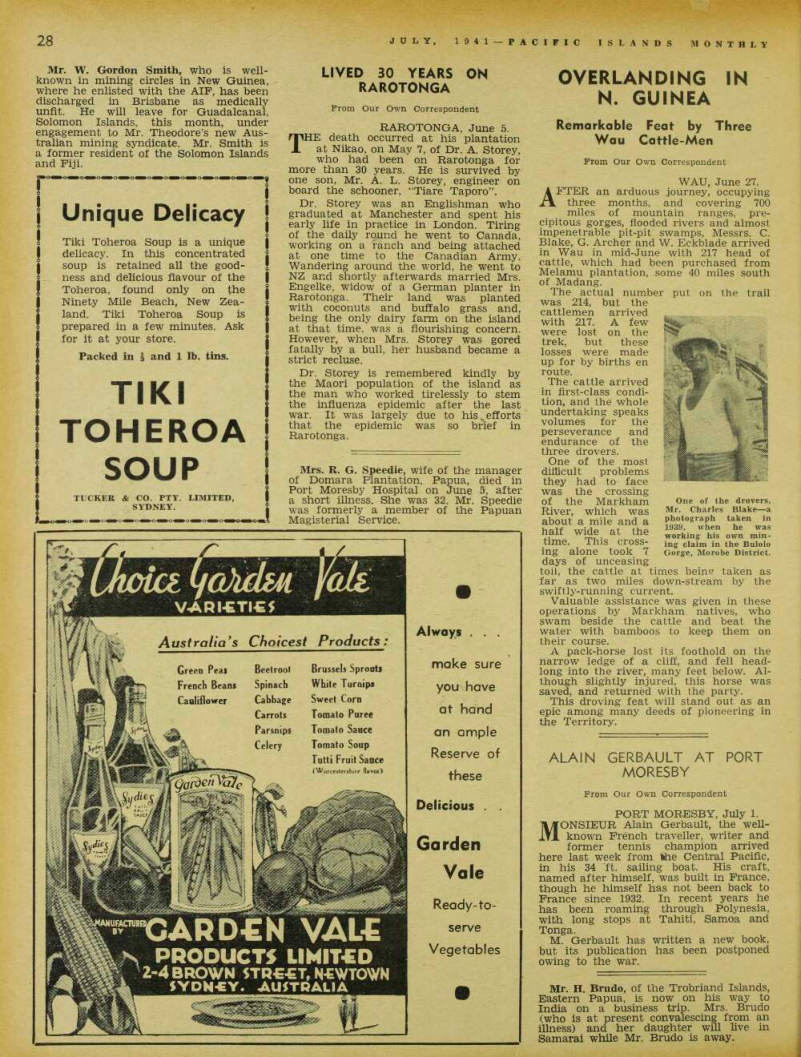
in Samoa
From Our Own Correspondent APIA, June 17. 11 SEVERAL instances of offensive be haviour on the part of young German-Samoans have been re ported recently.
In view of the Nazi racial policy, it is difficult to understand how any sane person of Samoan descent can harbour Nazi sympathies. Nevertheless, the effect of Nazi propaganda on the native popu lation must be considered, and these cases should be severely dealt with.
Mr. George Miedecke, son of Mr. and Mrs. J. G. Miedecke, of Magia Plantation, Western Samoa, is now serving as a flying-officer in a Sunderland flying-boat squadron of the Royal Air Force in Great Britain.
Mr. W. Gordon Smith, who is well known in mining circles in New Guinea, where he enlisted with the AIF, has been discharged in Brisbane as medically unfit. He will leave for Guadalcanal, Solomon Islands, this month, under engagement to Mr. Theodore’s new Aus tralian mining syndicate. Mr. Smith is a former resident of the Solomon Islands and Fiji.
Advertisements & other items, pp. 29-30 (2 items)
27
PACIFIC ISLANDS M 6 N t H L * 3 V t V, 194 J
Sparkling
refreshment from pure Malt and Hops... ★
FOSTERS
LAGER
Unique Delicacy
Tiki Toheroa Soup is a unique delicacy. In this concentrated soup is retained all the goodness and delicious flavour of the Toheroa, found only on the Ninety Mile Beach, New Zealand. Tiki Toheroa Soup is prepared in a few minutes. Ask for it at your store.
Packed in I and 1 lb. tins.
TIKI
TOHEROA
SOUP
TUCKER & CO. PTY. LIMITED,
SYDNEY.
Rarotonga
Lived 30 Years On
From Our Own Correspondent
Rarotonga, June 5.
rpHE death occurred at his plantation X at Nikao, on May 7, of Dr. A. Storey, who had been on Rarotonga for more than 30 years. He is survived by one son, Mr. A. L. Storey, engineer on board the schooner, “Tiare Taporo”.
Dr. Storey was an Englishman who graduated at Manchester and spent his early life in practice in London. Tiring of the daily round he went to Canada, working on a ranch and being attached at one time to the Canadian Army.
Wandering around the world, he went to NZ and shortly afterwards married Mrs.
Engelke, widow of a German planter in Rarotonga. Their land was planted with coconuts and buffalo grass and, being the only dairy farm on the island at that time, was a flourishing concern.
However, when Mrs. Storey was gored fatally by a bull, her husband became a strict recluse.
Dr. Storey is remembered kindly by the Maori population of the island as the man who worked tirelessly to stem the influenza epidemic after the last war. It was largely due to his % efforts that the epidemic was so brief in Rarotonga.
Mrs. R. G. Speedie, wife of the manager of Domara Plantation, Papua, died in Port Moresby Hospital on June 5, after a short illness. She was 32. Mr. Speedie was formerly a member of the Papuan Magisterial Service.
Overlanding In
N. Guinea
Remarkable Feat by Three Wau Cattle-Men
From Our Own Correspondent
WAU, June 27.
AFTER an arduous journey, occupying three months, and covering 700 miles of mountain ranges, pre cipitous gorges, flooded rivers and almost impenetrable pit-pit swamps, Messrs. C.
Blake, G. Archer and W. Eckblade arrived in Wau in mid-June with 217 head of cattle, which had been purchased from Melamu plantation, some 40 miles south of Madang.
The actual number put on the trail
was 214, but the cattlemen arrived with 217. A few were lost on the trek, but these losses were made up for by births en route.
The cattle arrived in first-class condi tion, and the whole undertaking speaks volumes for the perseverance and endurance of the three drovers.
One of the most difficult problems they had to face was the crossing of the Markham River, which was about a mile and a half wide at the time. This cross ing alone took 7 days of unceasing
toil, the cattle at times beine taken as far as two miles down-stream by the swiftly-running current.
Valuable assistance was given in these operations by Markham natives, who swam beside the cattle and beat the water with bamboos to keep them on their course.
A pack-horse lost its foothold on the narrow ledge of a cliff, and fell head long into the river, many feet below. Al though slightly injured, this horse was saved, and returned with the party.
This droving feat will stand out as an epic among many deeds of pioneering in the Territory.
One of the drovers, Mr. Charles Blake—a photograph taken in 1939, when he was working his own min ing claim in the Bulolo Gorge, Morobe District.
Alain Gerbault At Port
Moresby
From Our Own Correspondent
Port Moresby, July 1.
MONSIEUR Alain Gerbault, the well known French traveller, writer and former tennis champion arrived here last week from the Central Pacific, in his 34 ft. sailing boat. His craft, named after himself, was built in Prance, though he himself has not been back to France since 1932. In recent years he has been roaming through Polynesia, with long stops at Tahiti, Samoa and Tonga.
M. Gerbault has written a new book, but its publication has been postponed owing to the war.
Mr. H. Brudo, of the Trobriand Islands, Eastern Papua, is now on his way to India on a business trip. Mrs. Brudo (who is at present convalescing from an illness) and her daughter will live in Samarai while Mr., Brudo is away.
Advertisements & other items, p. 30 (1 item)
Card-Cn Vale
//♦y 'j'i w.
Green Peas Beetroot French Beans Spinach Cauliflower Cabbage Carrots
VARI-CTI-E5
Australia’s Choicest Products Brussels Sprouts White Turnips Sweet Corn Tomato Puree Parsnips Tomato Sauce Celery Tomato Soup Tutti Fruit Sauce (Worcestershire flavor)
UUFACTUKDi
CARD-CN VALE
S PRODUCT* LIMITED
2-4 BROWN STRC-ET, N-EWTOWN
SYDN-EY. AUSTRALIA
Always . . . make sure you have at hand an ample Reserve of these Delicious . .
Garden
Vale
Ready-toserve Vegetables * »
Sam Arai's "Ornamental"

Guns
Letter to the Editor IN your publication, in May, there is a par. about the removal of the “20years-old monument” in Samarai. I should like this to be published in your paper as a reply, and a criticism of both the par. and the writer.
It reads as though the trench mortar, and the 15-pounder were both captured in the last war. This was not so. The 15-pounder was of British origin.
The guns were removed on April 24, the day before Anzac Day, under in structions received from the committee of the Samarai Library Institute, and the whole town knew of their removal —almost as soon as the job was done — and, well they might, seeing that 50 boys carried them down the main street of Samarai.
The guns were never lost: therefore they could not be “subsequently found”.
The biggest lie (and this I state without fear of contradiction) was “that they had been moved for the value of the brass”.
They were removed because of their broken-down condition; and this in itself speaks volumes for the parties who were so hurt at the removal of the guns. No one seemed to know or care if the guns were there until they were removed; then they had a value far and away in excess of the value of the brass on them.
The guns, unless put into something like their original order, would have been better left in the reclamation, I am, etc.,
“Butter Before Guns.”
Samarai,
15/6/1941.
Still Lying on Foreshore
Letter to the Editor IN May “PIM” appeared an article from your Samarai correspondent headed: “20-years-old Monument Wrecked to Get Brass”; I am afraid your correspondent has not stated facts.
The guns were in front of our Memorial Hall, which is controlled by the Samarai Library Institute Committee. They have never been cared for, and the wheels on the larger one (mostly of wood) were in very bad order. The Institute’s com mittee decided, therefore, that the guns should be removed to a reclamation being carried out on our foreshore.
It was while the guns were on the fore shore waiting to be put into the reclama tion, that someone discovered there was brass in the fittings of the larger gun and made an offer for the brass the money to be given to our Red Cross Fund It was at this stage that Mr. Russell took an interest in the matter, but so far nothing has been done, and the guns are still lying on the foreshore.
I am, etc..
Percy J. Wood.
Hon. Sec., Samarai Library Institute.
Samaral, E. Papua 19/6/’4l.
Captain Tlwi Love, husband of Makea ariki-nui-elect Takau, of Rarotonga, Cook Is., was reported missing after the recent fighting in Greece. It is now learned, however, that he is wounded Captain Love fought with the Maori Battalion, which suffered severely Sir Apirana Ngata former Minister for the Cook Islands, had two sons in the same engagement. One is reported missing the other wounded.
Advertisements & other items, p. 31 (1 item)
You Must Have
Foi r the health oj the family i / £ \"M& m/V -
i m 2
MILK
Nothing is so beneficial, indeed essential, to the health of children and grown-ups as an adequate supply of pure milk. But, it is important to guard against contaminated milk, especially in hot climates, and that is why you should always use Nestle’* Sweetened Condensed Milk.
Nestle’s Sweetened Condensed Milk is sealed against all risk of contamination and you can open every Nestle’s tin in the certain knowledge that the contents are absolutely pure and fresh. Nestle’s Sweetened Condensed Milk is the safest milk you can buy.
sweeten^
SPECIALLY
jWARED in KVSnmmi i anglo-swisS#®d® /
<iiAUSTRALASIA) V
NESTLES
MILK
fULL
10*
COPYRIGHT
30-Years-Old Suva Business
Closes Down
From Our Own Correspondent SUVA, June 21. rW visitors to Suva over the last 30 years have failed to ride in the horse-carriages and, later, the taxis owned by “R. and B.” (Robinson and Ballantyne). The surviving partner, Mr.
W. A. Robinson, has recently decided to give up business —it is understood that the lease of his buildings (which are not by any means the handsomest ornaments
on Suva’s beach) has Expired, and the Government requires site for other purposes.
Probably another cause Mr Robin son’s retirement from bUi^i ness ' is the growing competition from t< ;he multitude of Indian taxicabs. In years Europeans have steadily disap IDeare( j f rom one trade after another.
Mr. A, L. Cook (better kno\- vn as “Fiji”
Cook) who has lived in the Seas Islands for over 45 years, settled down in Carlton, Victoria,*)-ij ve j n retirement.
Important Move by
Gold In The
Solomons ?
Important Move by Mr. Theodore
From a Special Correspondent
Tulagi, June 2.
HIP, Hip, Hooray! A “comet” has appeared, bringing visions of hope and wealth to this dejected and down-trodden, and, we fear, almost for gotten speck of the Empire.
It appeared in the person of one Theodore, who has come to take gold mining out of the hands of “unsystematic scratchers” (PIM, March) and—we hope —nroduce bullion.
He has been given the central slab, amounting to about a third of the island of Guadalcanal, or about 750 square miles, to prospect, with the (so far) only known gold-bearing area in the centre of it. It is said that, in return, he has agreed to spend £lO,OOO per year for five years in prospecting and developing it.
The rumour that the Treasurer and Collector of Customs (Mr. P. E. John son) was seen in undignified attitudes, turning hand-springs around his office table, has not been confirmed; but hopes are high, among all sections that fortune yet may knock at our door.
Before going off South to set the wheel of industry turning, Mr. Theodore made a foot-slogging dash into the hills, for a general look around, and never turned a hair—though such an effort would have prostrated many a younger and less bulky man.
A heap of materials has been landed on Guadalcanal, and young Cramar-Roberts is in charge, wangling them up into the hills per “rice” power and establishing a base camp south of the eold-ridge area.
Though the field was discovered about 10 years ago (by a “scratcher”) not a solitary soul knows to this day whether the gold-bearing material can be worked payably on a large scale, or what machinery will successfully work it, if any.
The official view seems to be that “scratchers” are largely to blame for this state of affairs, but there is another side to it. For instance, one made application for a block, to begin operations, but was told that he must state (among other things) what machinery he proposed to instal, before a lease would be granted.
He proposed doing some testing, with a view to learning something about it. but was told he couldn't, as he did not have a lease. Up to this period, his gold pros pecting a/c was over £lOOO in the red, without a cent return. His feelings can be imagined, some time later, when he was told that he only wanted to hold the area and sell it, so as to make a for tune. without doing a thing. His cup of chagrin overflowed when he found that another man was working on part of the area, and getting good payable gold, by mere boxing.
Probably, had he stated that he in tended installing a “Jumping Jack”, easting a thousand pounds, he would have got a lease, and could have gone ahead testing. But that didn’t seem honest.
River “scratchers” fare similarly in the matter of assistance. If one applies for 20 chains of river it is called 20 acres, though only about 2 acres are gold bearing and probablv not half of that worth a red cent. £2O against a survey fee. and a half year’s rent, must be sent in with application, and either £5O cash or a bond for that amount must be forthcoming before a lease is granted.
Of course, there must be regulations as a basis of operation in normal times;
but men who have lost their means of support as a result of these most ab normal times, are surely within their rights in expecting some sort of assis tance, even if it has to be charged up to Treasurer Johnson’s "rainy day” fund, which they have shared in building up over the years past.
It is a self-evident fact that the Em pire is gasping for gold these days, and, as this group is gasping for a new industry, and gold has shown itself a promising one, to say the least, no wizard of political economy is needed to advise its fostering to the fullest possible extent.
However, “the comet” has arrived, and doubtless we can now expect the Govern ment to awaken from its coma, and tread on its own heels, running round in small circles, doing some of the things it ought to have done long ago.
Roads may be surveyed, and assisted in the building. Some effort may be made to encourage the establishment of some thing approaching decent accommodation in Tulagi—what we have is just a shame, and is much worse than we had 25 years ago.
A landing-ground for ’planes may be sought, as close to Tulagi as possible, and brought into being—not merely to assist in the establishment of the mining in dustry, but because, after this war, there will be a rush to aerial transport. Young airmen out of a job will be willing to have a go at starting a passenger service to the moon, and it is conceivable that they may even want to fly about the Solomons.
The Possibilities
The following was published in "Sydney Morning Herald” on June 18: — Einperor Gold Mining Co., Ltd., and Loloma (Fiji) Gold Mines, NL, report that they are acquiring between them a controlling interest in a company being formed in Fiji to carry out gold pros pecting and exploration over a large concession area on the island of Guadal canal in the British Solomon Islands Protectorate.
Mr. T. R. Victor, a director of Loloma and Emperor, stated in Melbourne last night that part of the area was inspected recently by Mr. E. G. Theodore, who was impressed by its possibilities. The lease comprised about 750 square miles and embraced the whole of the known auri ferous area, with the exception of leases already granted.
Under the supervision of a technical expert from the Loloma mine, Mr. Victor added, the proposed company intended to send a staff of Australian surveyors and prospectors to prospect for lodes on the island.
Mr. Theodore, who is a director of Em peror, and managing director of Loloma, said that the new company was in pro cess of formation and that no details of the capital had yet been decided.
Advertisements & other items, p. 32 (1 item)
Prescott Pty. Ltd.
SUSSEX ST., SYDNEY,
are sole wholesale agents for ,
PINEAPPLE BACON&NAMS
DAISY brand BUTTER "375" BUTTER in TINS 1 lb.-21b.-slb/. Sixes.
LEA & PERRINS’ Sauces and Most other Super-Quality Lines of the Tradv , such as Cheese, Eggs. Etc.
We are Specialists . . . .
V ’Phones; ?»IA 8612 (4 lines).
Cable Address: "Weymarkson.”
Codes—Bentleys Private.
Let us your confidence. Sixty years is our record Ot supplying the leading Houses throughout the World in - - - -
FRESH FRUIT VEGETABLES PRODUCE
WEYMARK & SON LTD.
FRUIT AND PRODUCE MERCHANTS
14-18 STEAMMILL STREET - - - SYDNEY
“ANCHOR FLOUR
THE STANDARD OF QUALITY
GILLESPIE BROS. PTY. LTD.
SYDNEY - AUSTRALIA
" Hurricane Season" In
Fiji
From Our Own Correspondent SUVA, June 8.
TO Fiji residents, the "hurricane season” has always meant Decem ber to March. The early months of 1941 obliged with a hurricane in February, but in the copra districts late April provided a "blow” that did worse damage than that of February. Appar ently the orthodox four months of the hurricane season will in future have to be extended to five.
Mr. G. H. C. Reid, of American Samoa, recently married Miss Louisa Solomona, of Western Samoa, at Apia. They have made their home in Pago Pago.
Helps Samoa
Expansion of US Naval Base Helps Samoa
Prom Our Own Correspondent APIA, July 1.
THE expansion of the United States Naval Base at Pago Pago (Ameri can Samoa) where work is at pre sent proceeding feverishly, has served to bring the realities —and possibilities—of war nearer to Western Samoa. The wel come decision of US officials to employ a large number of skilled labourers, car penters, painters, blacksmiths, tinsmiths, mechanics and drivers was a godsend to many residents of Apia at a time when employment in Western Samoa was hard to find.
With Uncle Sam spending millions of dollars on defence work in American Samoa, trade and industry in the neigh bouring territory are not dependent on the vagaries of an uncertain copra mar ket, and are therefore booming—and will be so for a long time to come. Apia is also benefiting from this new prosperity by an increased passenger and freight traffic between Apia and Pago Pago; motor launches leave nearly every day loaded with locally-grown foodstuffs, fruit and vegetables, for sale at Pago Pago.
Advertisements & other items, p. 33 (1 item)
Clmottls
PURE RICE
STARCH
Always ask for . . . ii
CORAL BRAND
100% PURE
CORAL BRAND
RICE STARCH
& S
lUICJ Hk
Noted for Its
QUALITY
and
WHITENESS.
Goes Farthest and gives Lasting Finish
WILL NOT
STICK TO
IRON.
Obtainable from Leading Island Stores.
Manufactured by
AUSTRALIAN RICE, LTD.,
Sydney, N.S.W.
THE FAVOURITE
SCHOOL LUNCH
Usually the school lunch is a very scratchy meal, eaten just when the vigorous exercise of the playground has made a strong demand on the endurance of the child. However, with little trouble it can be improved .in value and made wonderfully attractive, simply by adding buttered Milk Arrowroot Biscuits. All children love them.
Clmottls
FAMOUS
MILK
ARROWROOT
BISCUITS
C 3 ALWAYS ASK YOUR GROCER FOR ARNOTT'S f
Local Defence Force For
From Our Own Correspondent
Rarotonga, June 5.
THE Cook Islands Local Defence Force Regulations, passed in NZ recently, provide for the formation of a small Defence Force, and a scheme is now under consideration by the Resident Com missioner.
This step has long been awaited by the patriotic Rarotongan Maoris, who wish to do something more than just collect money for the good cause. No mention of overseas service has been made yet, but it is understood that the Force will act as a training ground in case of a call at some future date.
Rev. H. H. Bock, superintendent of the Methodist Mission’s Ba circuit in Fiji, who has been in Victoria on furlough, left Sydney for Suva late in June, ac companied by Mrs. Bock.
Education
Missions Bear Brunt Of Native
NG Catholic Missionary Replies to Sir F. W. Eggleston
Letter to the Editor
IN April “PIM”, I read with interest Mr. F. W. Eggleston’s article dealing with Australia’s record in New Guinea and Papua and your comments on it. (Mr. Eggleston recently was knighted.—Ed.) On one point I would like to add to your comment. Mr. Eggleston says, “The only genuine native education is in a few Government schools; there is no specific education administration in New Guinea, etc. ... In Papua on the other hand, the Missions co-operate with the Government and submit to expert in spection, with the result that there is a considerable amount of native education”.
This is hardly in accord with the facts.
Actually, the Missions do nearly all the educational work in New Guinea. Outside of Rabaul and its vicinity, the Govern ment does practically nothing. The great mass of natives in other districts must look to the Missions, which attempt to meet the enormous problem with their own too limited resources.
In this district of Kieta the Govern ment does nothing at all about education; the Marist Mission does a great deal.
We maintain at considerable expense a central school here at Chabai, three dis trict schools, 18 station schools (all under European supervision or with full time white teachers) and an ever-increasing number of village schools.
Mr. Eggleston implies that the edu cation given by the Missions is not genuine education. If he means that it is not the same as the education given to a white child in a civilised country, he is quite right—we do not think it should be. Education should be a training for a good and useful life; but the life of a native is necessarily different from that of our people. But if he means that it is not education at all, or poor education, he has been misinformed.
We teach the natives to read, write and reckon, to be clean and industrious, to improve their agriculture, and how to behave, and, most important of all, why to behave. At all levels we try to follow the advice .of expert students of native education, such as the 1923 Commission of the Colonial Office, the Phelps-Stokes Fund’s studies, and the late Pacific Con ference at Honolulu.
Finally, Mr. Eggleston implies that the Missions do not co-operate with the Government. The shoe would better fit the other foot. The New Guinea Ad ministration has no policy for native education. Papua has. As he pointed out, “there is no specific education adminis tration” in this Territory. No energetic action has ever been taken in the matter.
There used to be a Native Education Trust Fund, now extinct; and taxes were collected for the purpose of education— but nothing ever happened.
It is to be hoped that when the present difficulties end, and civil affairs can once more be thought of, the Government will at last do something in the way of native education. The studies mentioned above point the way rather clearly. The Gov ernment should undertake to aid the Missions to develop an education suited to the needs of the native people, to whatever extent its funds allow.
I am, etc.,
(Rev.) James Hennessy.
Buka Native Training College, TNG, 29/5/1941.
Mr. F. Athern arrived at Noumea, New Caledonia, recently, to take up duties as airport manager for Pan American Airways. He was accompanied by his wife and two children.
Mr. Ernest Gibson Woolcott, a former resident of Fiji (where his family had property on the Ba River) died recently in New Zealand, aged over 70. He was at various times a member of the staff of A. M. Brodziak and Co., a clerk of the Ba Court, and a sugar planter on the Upper Ba. He is survived by his wife (nee Lilian Allen, of Fiji) and two daughters.
Two prominent Fijian chiefs, Ratu G. W. Lalabalavu and Ratu Savenaca Komaisavai were presented with Certifi cates of Honour and insignia by the Governor (Sir Harry Luke. KCMG), at the June session of the Fiji Legislative Council.
Advertisements & other items, p. 34 (1 item)
Foods
BURNS PHILP
(SOUTH SEA) CO. LTD.
Inc. in Fiji Island Traders and Shipowners Registered Office :
SUVA
FIJI
Also Branches at; Fiji: Levuka, Lautoka, Labasa, Ba, Sigatoka, Rotuma.
Tonga: Nukualofa, Haapai, Vavau.
Samoa: Apia, Pago Pago (American Samoa).
Solomons: Makambo, Gizo, Faisi.
New Hebrides: Vila.
Gilberts: Tarawa. < “ < Burr^outh” S Norfolk Is. Niue. Wallis Is. Futuna Is.
CHIV E B 8
s
PURE
FOODS
GOLD MEDAL JAMS
CANNED ENGLISH FRUITS
CANNED ENGLISH
VEGETABLES
CUSTARD POWDER
OLD ENGLISH MARMALADE
JELLY CRYSTALS, ETC.
Obtainable from all Leading Grocery Stores. --- Write to Department A., drivers and Sons, Ltd., Histon, Cambridge, England, for attractive Recipe Book. 8.7 f.
Men Who Pioneered Anglican Mission In Papua
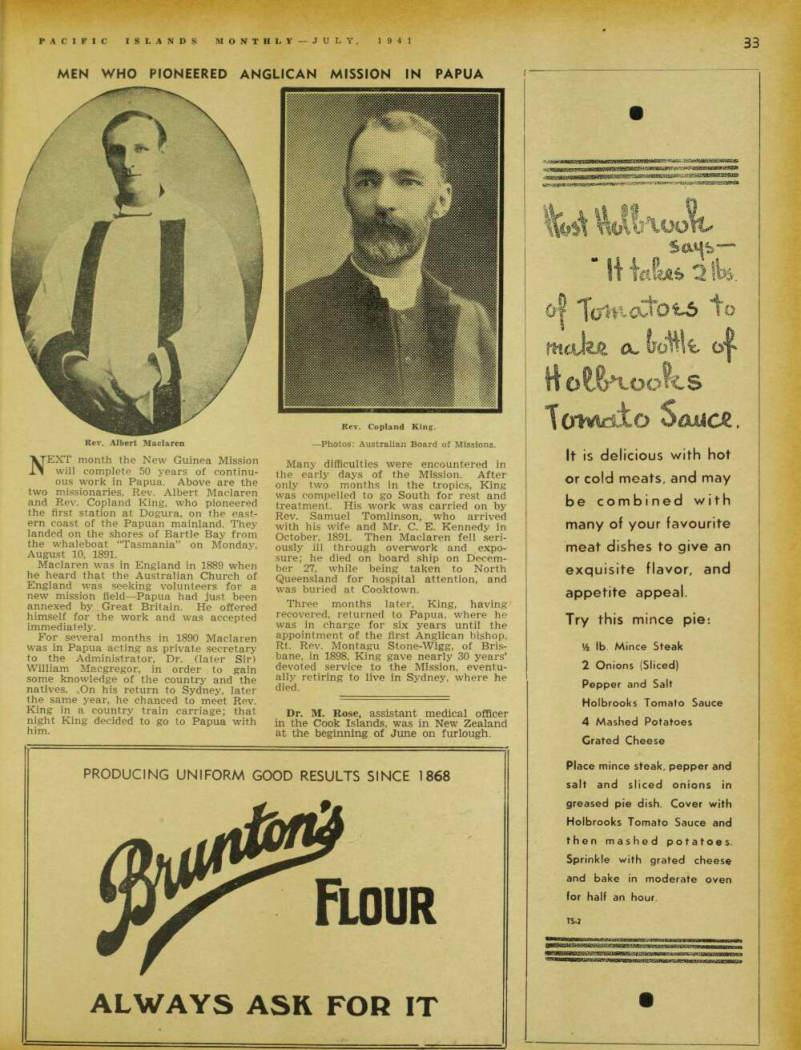
NEXT month the New Guinea Mission will complete 50 years of continu ous work in Papua. Above are the two missionaries, Rev. Albert Maclaren and Rev. Copland King, who pioneered the first station at Dogura, on the east ern coast of the Papuan mainland. They landed on the shores of Bartle Bay from the whaleboat “Tasmania” on Monday, August 10, 1891.
Maclaren was in England in 1889 when he heard that the Australian Church of England was seeking volunteers for a new mission field —Papua had just been annexed by Great Britain. He offered himself for the work and was accepted immediately.
For several months in 1890 Maclaren was in Papua acting as private secretary to the Administrator, Dr. (later Sir) William Macgregor, in order to gain some knowledge of the country and the natives. s On his return to Sydney, later the same year, he chanced to meet Rev.
King in a country train carriage; that night King decided to go to Papua with him.
Many difficulties were encountered in the early days of the Mission. After only two months in the tropics, King was compelled to go South for rest and treatment. His work was carried on by Rev. Samuel Tomlinson, who arrived with his wife and Mr. C. E. Kennedy in October, 1891. Then Maclaren fell seri ously ill through overwork and expo sure; he died on board ship on Decem ber 27, while being taken to North Queensland for hospital attention, and was buried at Cooktown.
Three months later, King, having recovered, returned to Papua, where he was in charge for six years until the appointment of the first Anglican bishop, Rt. Rev. Montagu Stone-Wigg, of Bris bane, in 1898. King gave nearly 30 years’ devoted service to the Mission, eventu ally retiring to live in Sydney, where he died.
Dr. M. Rose, assistant medical officer in the Cook Islands, was in New Zealand at the beginning of June on furlough.
Rev. Albert Maclaren
Rev. Copland King.
Photos: Australian Board of Missions.
Mr. H. T. (“Bunny”) Hammond, for merly a well-known airman in Morobe, New Guinea, is now a Wing-commander at the RAAF Cootamundra Air School, NSW. A number of ex-New Guinea men have passed through this station —several having served there and one or two having received their RAAF training there before going overseas.
Mrs. E T. Brennan, wife of the New Guinea Director of F'ublic Health, arrived in Sydney by airliner from Rabaul re cently. She has lived in New Guinea for 18 years, but will now make her home in Australia.
Miss E. A. Downs, principal of the LMS Girls School at Papauta, Western Samoa was in New Zealand in June on leave.
She plans to visit Australia later to carry put deputation work for the London Missionary Society. Mr I »',r Lorile Denn y. son of Mr. Robert G M Denny, former postmaster of Nukualofa, Tonga, is now serving over seas with the NZ Forces. Before enlisting he was Inspector of Stations for Burns Philp (SS) Co., Ltd., in Tonga, and held the rank of sergeant in the local Defence Force. Mr. Denny was the first European from Tonga to serve abroad.
Advertisements & other items, pp. 35-36 (1 item)
H otiKoolcs
• 61 §9 0
Mxfuson.
Sa*|fe*“~
” H icdks 7 Ik.
of ToMoC toU> to
media a. f?dHW of
H otiKoolcs
Totvidto
It is delicious with hot or cold meats, and may be combined with many of your favourite meat dishes to give an
exquisite flavor, and
appetite appeal.
Try this mince pie:
Vi lb Mince Steak 2 Onions (Sliced) Pepper and Salt Holbrooks Tomato Sauce 4 Mashed Potatoes Grated Cheese Place mince steak, pepper and salt and sliced onions in greased pie dish. Cover with Holbrooks Tomato Sauce and then mashed potatoes.
Sprinkle with grated cheese and bake in moderate oven for half an hour.
TS-2
PRODUCING UNIFORM GOOD RESULTS SINCE 1868
ALWAYS ASK FOR IT
BY COMPPSS-
-4 m w & ' h £ m 77 4 w
AND SSXTfINT/
the mariner can locate his exact position and know just what he is doing. But
WHEN IT COMES TO HOUSE PAINTING
results obtained are according to the material used.
With "8.P.” BERGER’S PAINT (Prepared) you arc assured of satisfaction. "8.P.” is guaranteed on the can, not to crack, chip nor peel. Its covering capacity, durability and, therefore, economy leave nothing tc be desired. Be sure to use — r i
rami
(PREPARED
AGENTS THROUGHOUT THE ISLANDS.
"8.P.” Keeps on Keeping on !
Beeswax
A Forest Industry for the Islands?
By F. J. Morgan
BEESWAX is one of the few important articles of commerce for which no effective synthetic substitute has been evolved in the laboratory. Not for want of trying, but because the peculiar properties of the wax are of a complex animal origin and reproduction has not been found practicable.
There is a growing world-wide short age of beeswax which will increase as secondary industries expand, due in the first place to its manifold uses for which there is no satisfactory material even in nature with which to replace if and, secondly, because in highly indus trialised countries bees are kept for honey production and cannot be allowed to waste their time and energy produc ing wax.
Australia and New Zealand, both honey exporting countries, are now wax importing countries, as official statistics show. In the Commonwealth, the short age now has reached alarming propor tions because of the rapid growth of industry; and the market price for locally produced wax has soared to an uneconomic level from the point of view of the manufacturer.
Most of the wax imported into Aus tralia during the financial year 1938-39 came from Tanganyika and East Indian sources. Whether beeswax is available in commercial quantities in the forests of New Guinea or other islands in the Pacific Ocean has yet to be proved, but it is worth careful investigation.
In the Malay Archipelago, for in stance, Timor Island had established a large export trade in beeswax to China before the Sino-Japanese war began.
Sarawak has given the subject some attention, and in 1935 (the last year for which figures are available) exported 12,096 lb., valued at 554 Straits dollars per ton. During the same period, British North Borneo exported 11,516 lb., valued at £386 sterling.
New Guinea may, therefore, be re garded as a potential exporter. The method of gathering must depend on the willingness of local labour, as well as profusion of forest colonies of bees.
In the tropical parts of Africa, and in the islands of the Malayan Archipelago, the methods exploited vary between buying from natives, who bring the wax in for trading, or employment of natives in systematic, efficient search patrols.
Should any reader consider this matter worthy of further investigation, it is advisable to remember that wax produced by the East Indian and Asiatic bees is softer and more plastic than wax from other bees, and it would be advisable to send a sample of the wax collected for test and analysis be fore commencing serious search.
THE Trigona (or Dammar) bee ex tends right through New Guinea and, in fact, right through the en tire tropic belt. There are many varie ties of this species of small stingless bee, and the quality of the wax and honey produced by them varies just as greatly. At the same time, it should not be dismissed without local obser vation of its habits, because from some of these bees a good marketable wax has been gathered.
When a nest is located in a tree or crevice in the rocks, the bees can be smoked out and the comb or nest collected in buckets and later trans ferred to a linen bag to be squeezed to drain off the honey. The wax remain
ing will be dirty and mixed with pieces of earth and bark or other debris.
A simply way to refine and bleach the dross is to place it on a sheet of corru gated roofing-iron and incline the iron at a slight angle, facing the sun. Under the solar heat the wax melts and will run down the grooves into receptacles placed in position to catch it. This is quite a practical method which serves the dual purpose of bleaching and re fining. Dirt is left behind on the iron sheet and the wax caught and left to harden in the containers. A kerosene tin cut in halves, into two small troughs, makes excellent containers.
For most purposes a good clean yellow colour is in heavy demand, but best prices are obtained for white or light straw-coloured wax for only these can be coloured with very light and de licate shades of dyes.
In passing, it is advisable to note that wax from India was in very bad repute for many years because of the adultera tion practised extensively by the natives.
This is now a punishable offence in most countries and, as adulteration is easily detected by wax technicians, it is rarely possible to get away with it even once, although it is occasionally at tempted.
Present prices of beeswax in Sydney are from 2/1 to 2/2 per lb., but these prices are exceptional and are a little too high for the average manufacturer.
A fair price to expect for all parties would be about 1/1 to 1/3 per lb. net, in Sydney market.
Imports of beeswax into Australia during the year ended July, 1939, give some indication of the position as it stood two years ago. Much larger quan tities are needed now. The official figures extracted from Federal statistics were as follows: —
Total imports of beeswax into Australia: 70,745 lb., valued at £4,685.
Australian local production is prac tically all used up in the manufacture of beeswax comb-foundation, whereby the wax is purified and rolled out into sheets with embryo cells stamped on them to save the poor bee from doing too much unproductive work.
Ode to a Tourist Ship in an
Islands Port
WHEN does the common mortal cease To be a mortal, and become A raging lambkin in the fleece Of lions, breathing gin and rum?
Why does the ordinary man Cast off his coat of sombre hue, His sober mien become “Can-Can”, And vermouth his stern lips bedew?
Why does the honest working girl Parade her thighs so white and wan?
The banners of her eyes unfurl?
Distract the thoughts of Island man?
O, tourist ship, wherein doth lie Thy magic Circe art to change Thy boarders' ways; art thou a sty That all their decent minds derange?
Fiji- — R.
Mrs. Kit McKerlie, a resident of the Solomon Islands for many years and during the last 12 months, hostess at the Cosmopolitan Hotel, Samarai, Papua, was given a farewell party by a large circle of her friends on the eve of her departure in June for Australia where she will reside in future. Her husband is at pre sent a member of the AIF serving in the Middle East.
Importing States. lb.
New South Wales 22.243 Victoria 43,493 Queensland 1 South Australia 2,621 Western Australia 2,275 Tasmania 112
Crime In Samoa
From Our Own Correspondent APIA, June 3.
TIMES are hard in the Territory, and it is perhaps natural that crimes and offences against the law ap pear to be increasing.
In a typical case, recently tried in Apia High Court, a 17-years-old Samoan youth, Tasele, a young Euronesian, Patele Collins, and a German-Samoan, William Schwenke, had formed a “gang” to commit robberies, in which the first named two lads stole a great variety of articles ranging from bicycles to fowls, while Schwenke acted as instructor and receiver of the goods. Some of the stolen articles were discovered by the police in Schwenke’s house. Schwenke and Tasele received prison sentences of two months each, while Collins was re leased on account of his youth.
In recent manslaughter cases, wherein ‘bus and motor-car drivers were charged with having caused the deaths of three persons in road accidents, the accused drivers were found not guilty by the juries, as there was insufficient evidence to convict.
Some particularly bad cases of rape were tried recently before Chief Judge Harley, when six Samoan youths from
the east coast village of Saluafata were charged with having raped girls of the same village on two consecutive days.
The offenders received sentences ranging from 12 to 18 months’ imprisonment.
Advertisements & other items, pp. 37-38 (1 item)
Dsfdf
Timber, Joinery
ETC.
PREPARED BUILDINGS ready for erection a specialty.
SHIP AND BOAT BUILDING.
TIMBERS specially catered for.
FEBROLITE, PLYWOODS.
GALVANISED IRON.
CONSIGNMENTS shipped
by RETURN STEAMERS '
to the Islands.
John W. Eaton
PTY. LTD.
WEST CRESCENT STREET,
NORTH SYDNEY.
Telephones: X 84051 (6 lines.)
Woven Wire for all Industry \
COPRA DRYING TRAYS, FLOORS, Etc.
FRUIT DRYING TRAYS, MINING SCREENS.
Heavy Mosquito Gauze in Phosphor Bronze and other Metals Impervious to Salt Sea Air.
WIRE DOOR MATS AND GENERAL WIRE WORKS
E. WRIGHT & CO. LTD.
Office and Works: 148-152 Cleveland Street, Sydney, N.S.W.
Telegraphic Address: “Wrightmake,” Chippendale. o^4 f- Or £
DSFDF
BITUMENOID ROOFING
MADE IN AUSTRALIA.
Bltumenoid Roofings, Dampcourse and Insulating Felts are made from the world’s best raw materials. Warranted to stand the most rigid tests.
BITUMENOID THE BEST
Roofing, 1. 2, 3-ply; Flooring, Waterproof Materials; Saturated Pelt; Resilient Road Jointing; Natural Asphalt Dampcourse: 2 and 3-ply Dampcourse: 1-2 lb. Lead-core Dampcourse: Roofing Cement; Asphalt Paints; Roofing Compound.
SAMPLES AND PRICE LISTS ON APPLICATION.
MAXWELL PORTER & SON LTD.
ESTABLISHED 1888. BUILDERS’ SUPPLIES.
107 BEDFERN ST., REDFERN, SYDNEY, N.S.W. ’Phone: M 3167. Cable* Bitomenold.
SIMILAR TO EUROPEAN MAKES
now made by
COLEMAN LAMP & STOVE CO.
LTD.
Toronto, Ontario, Canada and sold by All Leading Stores in the Pacific Islands.
In case of difficulty in obtaining supplies write to —
PEARCE & CO.—SUVA, FIJI IS.
Graft and Corruption in Chungking : What Japan
BEHIND THE SCENES IN THE FAR EAST Graft and Corruption in Chungking : What Japan May and May Not Do
By Marc T. Greene
THE Jaoan . May 12 * V, Japan-Soviet pact, whatever may oe its actual significance or its repercussions in respect of the general war, nas had immediate effects upon the b Wop P i?ii eSe .Sven before Mr, Matsuoka had arrived * iwr m c ?'! a F- an ’ fr f sh .from the embraces or Mr. Stalin, and with the pact in his inside pocket, the Japanese had grabbed S e ° nl £J emaimng Ports of entry into tree China and commenced preparations which indicated an offensive of large proportions.
Cunously enough, America’s prompt reply to the pact, $50,000,000 more to “stabilise Chinese currency”, did not strengthen the Shanghai dollar, but had fr® opposite effect. This, to the uninitiated, continues to be a mystery; But not to those in the know . The answer is that not all of that sum, any more than all of the other sums poured into the insatiate Chinese maw, will get where it is supposed to go. in that connection there is an increasmg demand that America, and Britain, too, exercise a closer scrutiny over the use of the aid, especially the aid in money, that is being given China for the presumed purpose of enabling her to defeat Japan and so to protect Anglobaxon interests in the Far East. it is no secret, now, that the replacing of the amiable Mr. Johnson by the more outnght Mr. Gauss, as American Ambassador to the Chungking Government,
was almost entirely due to American dissatisfaction with Chinese economic and financial policy and methods, and to a conviction, which Washington had reached at long last, that Mr. Johnson’s sympathy with the Chinese cause had somewhat clouded his discernment in respect of the manner in which that cause was being fought—with the material assistance of American dollars The despatch of President Roosevelt’s personal representative, Mr. Lauchlin Currie, to Chungking at the same time, was likewise symptomatic of a deter mination by America to inaugurate a new policy in China.
Ijl/HAT Mr. Currie reported to his chief W is being kept rather surprisingly secret, but it is no secret at all in the East that the Chungking Adminis tration is riddled with graft, inefficiency and self-seeking by high officials. The Generalissimo, Chiang Kai Shek, is ap parently combatting this earnestly, and he has had a number of officials arrested during the past three months—a few of whom have failed to retain their anatomy intact.
But the High Command’s attitude to ward the Communist elements is a grave mistake, and is endangering more than any other one thing China’s prospects of victory, It is clear that the Central Govern ment, feeling itself secure now with assurances of continued all-out American
aid, has made up its mind to end the armistice—which is all it ever was —with the Communists, to ignore them now, and as soon as victory is achieved to turn and rend them. The rending, of course, has already commenced, but the effect it is having is to bring about a uniting of all the Communist armies, half a million or so in the aggregate, against the Chungking regime. Thus, civil war on a wide scale is all but cer tain, when and if Japan is defeated by China —possibly before. In the light of that possibility the Japanese, encour aged, are redoubling their efforts to liquidate the “Incident”.
Furthermore, it is possible that among the secret clauses in the Soviet-Japan pact, which everybody knows are numer ous, are a promise by Stalin to discon tinue —gradually, of course, so as not to make it too obvious—assistance to Chungking.
However, the pact as a whole should by no means be taken too seriously. It is merely one more move in the game of chess (Russian style) that the black moustached fellow in the Kremlin is playing with exceeding cleverness —a move of pawns, really, which will be forgotten all about when it is time to shift larger pieces.
NO southward move will be made by Japan unless a major disaster comes in Europe—possibly not even then unless America enters the war.
But, in such an event, that entry is almost certain, even if not before.
Japanese action, both through adherence to the Axis pact and out of self-interest, is likely to be almost concurrent. It will take the form either of an attempt at Singapore or at the DEl—more likely the latter, but perhaps both.
No actual attack is probable upon Hong Kong, but rather a land and sea blockade, which would be hardly less disastrous after a month or so. No hostile Japanese move is considered likely in Shanghai, because this is too important a trading centre, and to turn it into a shambles would not avail Japan anything.
I HAVE lately returned from Thailand and I can say with certainty that the stories of Japanese bases and so forth in that country are entirely base less.
I came down the Peninsula by train and air to Penang, and then to Singa pore, Apart from the presence here and there of British troops, mainly Aus tralians, everything was perfectly tran quil.
The island of Singapore bristles with fortifications, as everybody knows, and no attempt at landing could possibly succeed. If Japan should grab Thailand, as might happen in the event of bad British set-backs in Europe, and an American entry into the conflict, an attempt to work down the Malay Penin sula, both inland and along the coast, might be made.
In sucn an undertaking the Germans might succeed. There isn’t a chance in twenty that the Japanese could—even with the aid of the German “advisors”, whose numbers are added to daily in Japan, and even here in Shanghai.
Singapore’s air-defences also are prob ably impregnable against a second-rate air-force like Japan’s. The attack, if any, is therefore far more likely to be made at some point or points in the DEI. These might conceivably be held, to the imminent danger of Australia. In the light of such a possibility, it would seem to be unwise for Australia to be denuded entirely of military units.
Mr. T. K. Stewart has taken up duties as headmaster of Ifi Ifi School at Apia, Western Samoa.
Advertisements & other items, p. 38 (1 item)
William Atkins Pty. Ltd.
Established 50 years—and carrying one of the largest stocks of Iron and Steel in Australia.
Head Office 449-451 KENT ST., SYDNEY.
FULL, COMPREHENSIVE & UP-TO-DATE RANGE IN ALL
DEPARTMENTS, INCLUDING THE FOLLOWING LINES;—
STEEL DEPARTMENT
MILD STEEL:
Rounds, Squares, Flats, Half-rounds, Hexagons, Bevel, Shoeing, Tyre, Angles, Tees, Sheets, Plates, Girder Plates, Chequer Plates, Channels, Hoops, Etc.
BRIGHT STEEL:
Rounds, Squares, Hexagons.
Extra Special High Speed Too! Steel, Mining Steel, Blister Steel and Spring Steel, Rounds, Flats Gr Squares.
Bar Iron—All sections and sizes.
Iron & Steel Merchants
ENGINEERS' SUPPLIES
COACH & MOTOR HARDWARE.
ex' Cable Address: WILATKIN, SYDNEY.
Engineers' Supplies: Set Screws, Studs, Metal Thread Screws. Coach Screws. Files, Cotter Pins, Bright and Black Bolts, Rivets, Etc., Hack Saw Blades.
Power Transmission Gear: Including Plummer Blocks, Couplings, Collars, Etc.
Coach and Motor Hardware: Axles, Springs, Wheelstuff, Duck, Paints.
Farriers' Supplies: Horse Nails. Anvils, Vices, Etc.
Motor-Trimmers and Motor Builders' & Motor Painters' Requirements
C. A. WILLEY'S
Quick-Drying Coach and Car Paints. Roughstuff, Elastic Gloss, Synflex Enamels, Lacquers.
DUCO Lacquers and DULUX Enamels—FAßßEX Motor Toppings and Leather Cloths, House fir Decorators' Paints, Varnishes & Brushwore Sole Distributors of CHAMPION'S Decorators Paint Products.
Distributing Agents for BROLITE Lacquers, SYNFLEX Enamels and "POLYGLOSS" Finish.
Death Of Brilliant Young
Geologist
From Our Own Correspondent
Port Moresby, June 12.
ON May 30 at the European Hospital, Port Moresby, the death occurred from tropical typhus of Geoffrey Standon Nevitt Sadler, BSc, a young scientist of outstanding ability attached to the Australasian Petroleum Co. in Papua. He was only 24 years old.
Born and educated in NZ, he joined the geological staff of Island Exploration Co. in Papua in 1937. Since then he had been continuously engaged in geological exploration both for Island Exploration and for APC. Mr. Sadler took part in notable expeditions, under the leadership of both Mr. N. Osborne and Mr. G. A.
V. Stanley, up the headwaters of the Fly River to the Hindenburg Range, and across the little known country between
the Vailala River and the Tauri and Kapau Rivers. Both expeditions made important contributions to the geological data of Papua and were successful in establishing friendly relations with the primitive tribes encountered.
His keen scientific mind, his courage and determination, and his fine physique fitted young Sadler admirably for the difficult and important geological work that had been allotted to him in the Territory. Besides showing brilliance as a geologist, he had made a study, of zoology and had specialised in the collec tion of land snails both in Papua and in NZ.
Pen-friends in the Pacific Islands are sought by Mrs. M. Clarke, c/o Post Office, Whenaupai, Upper Harbour, Auckland, NZ, who is a former resident of Tonga and Fiji. Her hobbies include photo graphy and gardening.
Prince Jione Gu, the younger son of the Queen of Tonga, is following in the footsteps of his brother, the Crown Prince, as an athlete. Playing for New ington College against The King’s School, at Parramatta, NSW, in June, he secured the only try for his side. This, however, did not secure victory for his team.
Advertisements & other items, pp. 39-40 (1 item)
- and I use
* U
man
DISTRIBUTORS: Greenwood & Laws, Ltd., Rabaul and Wau; Steamships Trading Co., Ltd., Port Moresby and Samaral; Millers, Ltd., Suva, Fiji.
FOR BEST RE-
SULTS USE
“ B, A. L. M. ”
PAINT. It’s results that count and “8.A.L.M.”
Paint is better because it lasts longer, retains its gloss and resists fading. “8.A.L.M.”
Paint won't crack or flake and eventually the film wears down to a perfect surface for re-painting.
A Product of British Australian Lead Manufacturers Pty., Ltd., makers of “Dulux” Finishes.
If you wont "Perfection in Cooking" use o ii
Younger” cooking stove
These stoves have been on the market in Australia for over Sixty Years, and are still recognised as “The Best”.
They are made with Extended Firebox specially for Long Wood fuel, also special stoves with Cast Iron Oven suitable for Island requirements.
Send for Illustrated Catalogue and Price of Single and Double Oven Stoves.
G. FLETCHER & SON
50 OXFORD STREET, SYDNEY.
Gland Discovery
Restores Youth
In 24 Hours
Sufferers from loss of vigour, nervousness, weak body, impure blood, failing memory, and who are old and worn-out before their time will be delighted to learn of a new gland discovery by an American Doctor.
This new discovery makes it possible to quickly and easily restore vigour to your glands and body, to build rich, pure blood, to strengthen your mind and memory and feel like a new man in only 8 days. In fact, this discovery, which is a home medicine in pleasant, easy-to-take tablet form, does away with gland operations and begins to build new vigour and energy in 24 hours, yet it is absolutely harmless and natural in action.
The success of this amazing discovery, called Vi-Stim has been so great in America that it is now being distributed by all chemists here under a guarantee of complete satisfaction or money back. In other words, Vi-Stim must make you feel full of vigour and energy and from 10 to 20 years younger, or you merely return the empty package and your money will be refunded. A special, double-strength bottle of 48 Vi-Stim tablets costs little and the guarantee protects you.
Vi-Stim
GUARANTEED
to Restore Manhood and Vitality
Ship Chandlery Hardware
Write for
/tt nre ror j
Ship Chandlery /
Catalogue J
Special “In Bond’’ Prices for all Islands enquiries quoted on application.
BROOMFIELDS LIMITED
152 SUSSEX STREET :: SYDNEY.
Cables: “Boom”, Sydney.
Large and Complete Stocks of
SHIP CHANDLERY
IRONMONGERY OF ALL KINDS, PAINTS,
WHITE LEAD AND OILS.
Sole Agents for: P. H. MUNTZ & CO.’S 3-CROWN BRAND METAL SHEATHING.
PEACOCK & BUCHANS’ ENGLISH READY-MIXED PAINTS.
Scott’s “Renown” Brand Rope,
Cordage and
Binder
Twine
Cable Address: Ropeyard, Sydney.
of Every
Description
MANUFACTURED AT
MASCOT, N.S.W.
J. SCOTT
PTY. LTD.
Head Office and Store
163 CLARENCE STREET,
SYDNEY,
N.S.W.
American Entomologist Visits Fiji
DURING April and May Mr. Noel Krauss, of the Board of Agri culture and Forestry, Honolulu (Hawaii), was in Fiji, collecting insects for the Bishop Museum. Despite heavy rainfall, which in Suva exceeded 45 inches for April, he obtained a good collection at Sigatoka and Vunidawa, on the main island of Viti Levu, and also on Kadavu, to the south. Various localities within easy reach of Suva were also visited in company with the Gov ernment Entomologist, Mr. R. J. A. W. Lever, who was in BSI for more than six years.
This photograph, taken in the jungle, shows Mr. N. Krauss (centre) and Mr. R. J. A. W. Lever. The Native Laboratory Attendant is Ratu Philip Lewanavanua, who has had well over 10 years’ service in the Department of Agriculture.
War's Effect on Samoa
Prom Our Own Correspondent APIA, June 8.
ALTHOUGH the islands of the South Pacific are remote from the actual fighting zones, they are in many ways closely affected by the war. Samoa is playing her part in the Empire’s ef fort by having successfully raised funds for a “Spitfire” ’plane and by sending cash and supplies to the NZ Red Cross.
A number of young men from the Territory are already serving in the NZ Forces overseas or training in the Dominion, and a large number of volun teers are waiting to be called up.
Lack of markets and shortage of shipping has somewhat curtailed trade.
Tne copra market shows little improve ment, and of the 4,000 tons of copra which NZ purchased at the beginning of this year for use as pigs’ food, only half has been lifted so far. A number of copra trading stations on Savaii and on the souin coast of Upolu have closed down.
Cocoa Prospects Good
Fortunately, the cocoa market has improved of late, and, though freight rates, etc., are high, planters can dispose of Samoan cocoa beans in USA, NZ and Australia. We had a record crop last year and, with weather conditions con tinuing favourable this year, prospects for another large crop are good. With the establishment of a rubber-ware in dustry in NZ, there is also a good mar ket offering for Samoan rubber. The NZ Reparation Estates, a Government concern, is at present the only rubber producer, shipping some 10 tons monthly.
The banana industry has been the main source of income for a large por tion of the Territory’s population—until recently 20,000 cases were shipped a month. However, re-arranged shipping facilities have reduced banana ship ments by half.
Apart from banana pay-out days, Apia stores have had a quiet time recently and economising is the slogan of the hour. Our cost of living is rising con tinuously—almost daily the Adminis tration announces some increase in the controlled prices of imported foodstuffs; but locally produced foods such ,as eggs, milk, fruit, etc., are plentiful and there is no likelihood of a food shortage.
Government revenue has suffered con siderably and, as a result, Public Works activities have been curtailed. The Administration may have to reduce the staffs of some departments to effect necessary savings in expenditure.
Advertisements & other items, p. 40 (1 item)
38
JtJLlr, 1641 Pacific islands montbl*
His Varied Career
IN Papua we have a man named (for the purpose of this article) Hawkins, who has enjoyed an extra ordinarily varied life.
After graduating from a well-known English University, he served with the Bank of England sufficiently long to become a teller. He then went through training as a shipwright and, soon thereafter, as a coachbuilder. Then, journeying to Sweden, he became an expert in the Skandia engineering busi ness.
Abandoning this to follow the call of the sea, he sailed up and down the Mediterranean for some years and later “rounded the Horn” in a full-rigged ship, in time becoming familiar with all the ports on the west coast of South America.
Rumours came of the gold strike in the Yukon, and, in due course, he found himself with a claim pegged in Dawson City. Here he led an adventurous life.
An opportunity occurred for him to join the North-West Mounted, which he promptly seized. In the “Mounties”, he had still more adventures than when a miner; but even this inducement failed to overcome the wanderlust, so off he went to Oregon, USA, and became a lumberjack and, incidentally (he admits), “one of the crack rivermen”.
Next, he sailed for Australia, where he found employment in N. Queensland.
Later, he crossed to Papua—arriving there, according to his passport, while still on the right side of thirty. A fair effort? But, wait .
IMET him one night, recently, when he and I and a young patrol officer were fellow guests in a house in the D Entrecasteaux Group. Hawkins had known our host and myself for many years, and now found us rather hard to impress.
Not so the P. 0.; here was a sympathetic ear. • Hawkins finessed the lad into a comer, and, like the Ancient Mariner with the wedding guest, he “held him with his glittering eye” and poured forth a selec tion of narratives from his turgid past which made the P.O.’s hair stand on end.
However, even these began to pall and seizing a momentary gap in the mono logue, the P.O. hopped in with his con tribution. , “ D ’y° u , know,” he said, “I’ve been troubled lately with a little, cigar-shaped pain low down on my right side and ”
“Never pay any heed to that,” inter rupted Hawkins. “I’ve had the like for years and what do I do? I laugh it off! Forget about it!”
“All very well,” demurred the P. 0., “but I ve often thought that it would be pretty crook if a fellow were stricken with appendicitis out on patrol ”
“Look you, young fellow,” and Hawkins laid a Land like a bunch of hairv bananas (if one dares imagine such a macabre object) on the P.O.’s knee “For three years I walked the floors of S(S?5 lt rn a ?S’- lf -. the w° r st comes to the worst, 111 whip it out for you!” askance the hand which had obviously never manipulated any instru pnUrnnfi,eiCae th an a br °adaxe, the P.O. abruptly rose, collected his gear and departed into the night. hT7 T fv? Q Silence which followed was broken by the roar of the engine, as the Gov er^ ie ? t la unch started off. Then: fivp A ?r t J[w’ ve been here about twenty °r t J ll f? y y ear s?” said our host.
About that,” agreed Hawkins. hnlv 6 SH?! lenCe again> Two of us were busy with some mental calculations —WG.
Languages
Cookery Book in Three Languages
Our Daily Bread And Fifty
RECIPES, a cookery book in three languages, Gilbertese, Ellice and English, and the first book to be published in the Ellice language, has just been issued from the Government Press, Suva, Fiji. The author is Mrs. Thomas Lascelles Ire monger, wife of a cadet-officer in the Gilbert and Ellice Islands Colony.
When Mrs. Iremonger first arrived in the Ellice Islands, where her husband was Acting Administrative Officer-in- Charge, she found that there were no trained cooks available. She could not speak a word of the language, and the boy she obtained could not speak a word of English. She knew practically noth ing of cookery, and he, of course, knew nothing of European methods; so she was compelled to learn to cook, to teach him
simut™nfo 1 u i sTy! and t 0 teach him addition to a section on bread making, and information on how to make yeast from bananas or toddy, the book contains 50 useful recipes, adapted to suit the scanty resources of the Gilbert and Ellice Islands Colony (consisting mainly of pork, fish, eggs, pawpaw, bananas, taro and breadfruit). Only such imported essentials have been called upon as every European resident is cer tain to possess at any time, and natives can easily obtain, e.g., milk (tinned), flour, sugar, etc.
The book was originally merely for the author’s own personal use, but later she was surprised to find how great an interest was taken in it by the natives, In her preface, Mrs. Iremonger ex presses the hope that the book will be of some use to young, unmarried officers, who have neither the time, knowledge nor inclination to teach a cook, and whose meals are often badly prepared
and monotonous. In the G. and E.
Colony, in particular, where one lives mainly on fish, this starts lack of ap petite, leading on to tinned foods, and ends with dyspepsia.
“I know,” the author says, “that there is a shortage of native cooks, both at Ocean Island and in the G. and E.
Group. . . . These recipes should increase the natives’ scope, teach them the A, B, C of kitchen customs, and provide a number of potential cooks. The book was finished three months after I came to the islands knowing nothing of the language, but I am convinced that it is intelligible to the Ellice people, because I have tried all of the recipes on my cook and other natives.”
After completion, MSS of the book was mysteriously lost somewhere be tween the Gilberts and Fiji, and Mrs.
Iremonger re-drafted the whole from such scanty notes as she chanced to have with her on a visit to Suva.
As this is the first edition of the first
book to be published in the Ellice lan guage, copies probably will be eagerly sought by collectors and Polynesian societies, etc. The book is priced at 1/-, and is obtainable from the office of the Western Pacific High Commission, Suva, Fiji.
Dr. Eugene O’Neill, .medical officer on the liner “Aorangi”, who Is well-known throughout the Pacific, will probably leave that vessel before long and take up residence in Auckland. Dr. O’Neill has accepted a post with the NZ mili tary authorities for the duration of the war. In the last war he held the rank of colonel, and was awarded the CMG among other decorations.
Mr. W. Parsons, of Wau, returned to New Guinea in May after having been discharged from the AIF as the result of a foot injury.
Advertisements & other items, pp. 41-42 (2 items)
39
PACIFIC ISLANDS MoHBLt-Jm, 1941
'mm&im
'HIM
.V =■7.^ &
dp
DDW'a
PPWA'
PAWAD
DKWA
PPWAD’A
PA WAD'
DAWAD ;
ODW'.A ?< :•■ PP WAD'D PA, WAD'D PA WAD'D DA WA D aX' DPA AADDpA. W A D *> ADD p A vVA DD DA W.A R S
A D'D DAWAA P DPWAK'S
AD‘ '.*! DPW'A A pp W A;?':;
A WAD'D DA WAR'S PPWAA D
A WAD’DDKWAA'D A>;i WAD'D
AA'A PPWAD'D [>s: WAR'S
P WAR'S PA WAR'S PA W'A DP PP WA D'S Dsf WAD'S PA WAD'S DAWaDPDPWAAS PA WAD'D PA.W.fD ; ; DAWaRP
W.fD'rDD'AW'.AR ;■
PPWAK'SPPWAD'DOSWAR’SDAW'A’R'SPP WAD
*?AWAD'DDriV/AR'S DA W'AR*SDPV/AD 7 PA A
PA WAD'D PAWAR ■> DPWaD’S PA VUiH-H PAW
DE W rtfi'SPPWAK SPA D'DPa/aD* DDP
PP wJk'D D ' '.J§\ D A#*;'»A
PA W'A.D
DAW A
DEW A
PA WA
PAW;
DAW A,'
•A' ,D P
PA WARDDj
kp awa d rPP,
A AS PP WAR'S
A A' S PP W A &
►AD'S PA WAD'D
Wv AD'AD A WA R.’S
:> DAWA AS PPWAAS
DPWa A‘S PP WA A'S p» AVAR'S W3TD > Da'A'A AS Pi: 'A'A D'S PA W A D'D PAW'AD.'D ■AWaA ;> Pi; WAD'D PAWAD'D DAWAD'D DAWa A s v'AAD PPWAD'D DD WAD'D DA WAR'S DA WAR'S PDWVAD ■; ; PPWAWD PA WAD'D DP WAR D DDW'aKD PPWDA'S DD WAD'D < PD WAD'D PSWAD'S DAW A. D l D DAW A A S PPWAD'D DA WAR'D DD A'A DD DAWVD DA WAD'S DAWaAD DPW'aAS PPWADS PA WAD'D DA WAD D DA WAR'D DFVv'AA
OEWDi A'SPPWAD'S PPWAD'D PA WAD'DDAWaD’SDPW* A
PD WA D'S PA WAD'D PA WAD'D DAW ADD DAW AAD PDWA A D PA WAD'D PAW'A D'<: PA WA D'D DA WAD'D DAW a DD PDWa A'S PDWA D'D PA WAD D PAW A D'D p'W A '> < DAWADDD DAWA.DD PD'A'ADD PA WAD'D PA WA PA WA D'D PAW'A D' D P A WA^ P A WA D' D DAWA.D‘ D DAW a
DAWaDDDDWaADPDWAA
DAWa A' PDWA K*D PD 'A'A
PD WAD'D PA WAD'D PA WAD
PA WAD'D DA WAD'D DAW
.VA.D
'D PA
k D DA
vV/-.
WAD'D DAW A AD
A ?PDWA A D
AD PA WAD';
AAD'D PA WAD'D
A D'D DA WAD'D PA.WAD'D DAW a DP
ADD DAWaD D PDWA AD A-DWAD'D
AWARD DAW A D D PDWAK'D PD WAD'D PA WAD'D DAWaAD PD WAD'D PA WAD'D PA WAD'D DAW AD- DAWa D< DAWaA D PDWA A'D PD WAX'S PA WAD'DAW a D'D DAW a V. 'D KW/W. :: i. 'A. WA 8' SPP WA B's PA W A D'D PA W A D'D DAWA.D' D X ; AW a D <•; >D Wa D' S »■> p v,' AK 'D i PA VA •\D.
DAW.
■i/W k/AV-i
PPW
PAW
PAW'.
p
DAW*
AD‘ DAW'.ADD PKWAii'D PP WAD'D PA WAD'D PA WAD'D DAW a D DA W a'D’ D m*w« P J;. Wa A' DPPWAD’ D P A W A D.' DDAWA.DDDD A W A DD D A A D ;•• v PW a A;' A A\VA A' D
PA WAD'S PA WAD
DAW'A D DDAW'AD
PPWaA DPPWAD^r
**rrT*
DA WAD'D PA WAD'D
?> A WAD'D DA WAD'D
... - - . . , DAW A D'D DAW * PA WAD'D PA WAD'D PAWAD'D DAWA D'DDAWA D ;- DPW'A v ; '«
DAWaDDDAWADDDAWaDDDPW'aADPDA'APDPA WAD'D PP WA D'D PPWAD'D
A. B. DONALD Ltd.
AUCKLAND
ISLAND TRADERS & GENERAL MERCHANTS
P.O. Box 1509. Cables Gr Telegrams, "Kingdom", Auckland.
strength
IiPST
S Pc CI a The T '“ F °»
H.O.WILL 5
Ltd.. SYDNEj
•ftOpi
ISSSfi kk§JAuSTRALIA)i!
Capstans are available in both
MEDIUM and FULL STRENGTH
CAPSTA
TOBACCO AND CIGARETTES
Fiji's Gold
Emperor Co. Investigating a New Area
From Our Own Correspondent T tt .. SUVA, June 24.
HE F131 goldfields (Tavua and Mt.
Kasi) continue to turn out their regular monthly quotas as a rou tine matter. Meanwhile, a few pros pectors are still working in various dis tricts in the Group. Evidences of gold are plentiful, but nobody has yet found anything that even remotely threatens to be a second Tavua. Perhaps the best prospect is at “Waimotu”, in the Natewa Bay area, on the eastern side of Vanua Levu, where investigations are being carried out with Emperor money.
Figures were issued recently by the Suva Chamber of Commerce, showing how gold production in Fiji has risen until it now is the colony’s second largest export, ranking next to, and not far behind, sugar:—
During 1940 regular dividends were paid by the three large mining concerns— Emperor Mines, Ltd., Loloma (Fiji) Gold Mines, NL, and Mount Kasi Mines, Ltd. .
Visitors to Tavua goldfield from other Pacific Islands are always surprised when they learn that Fiji’s gold industry is based mainly on telluride lodes —gold in its crude state (nuggets, etc.) is sel dom seen at Tavua. Telluride ore is found in the Emperor areas at deep levels and nearer the surface on the Loloma properties.
Our gold wizard, Mr. E. G. Theodore, recenuy accompanied His Excellency the Governor of Fiji, also High Commis sioner for the Western Pacific (Sir Harry Luke) to the Solomons, and we hope that, for the sake of our friends there, Mr. Theodore’s energy, initiative and finance can turn their undeveloped gold bearing areas into a paying proposition.
Year.
Oz. 1936 1937 1938 1939 1940
Bsi " Spitfire" Fund Is
Growing
ALL sections of the Solomon Islands community—Europeans, Chinese and natives —are contributing to the
growth of the BSI “Spitfire” Fighter
Aeroplane Fund which has swelled in two months from £1,243 (see list, April “PIM”) to £1,580. The following are the latest donations (up to May 22): — Burns, Philp and Co., Ltd. (2nd), Fairymead Sugar Co., £5O each; M. Cleaver, £25; O. E. Fox, £2O; R. O. Lay cock, £lB/15/-; Mr. and Mrs.
Olsen, £l4; Mr. Summerland, £lO/10/-; N.
Watkins, N. Orichlow, £10; F. Johnson, £B/8/-; K. H. D. Hay (3rd), £8; C. Younger, £7/10/-; M. Forster, £6/11/3; R. S. Taylor, E. O. A.
Bergin, W. Colman, Mr. and Mrs. G. Adam, Mr. and Mrs. Murphy, E. Monckton, D. Trench, C.
E. J. Wilson, W. P. M. Clemens, £5/5/-; A.
Olsen, Mrs. Sprott, R. Firth, D. C. Horton, O.
B. S. Attlee, £5; J. Williamson, £4/4/-; BP natives, Gizo, £3/17/-; J. Svensen, V. Shear win, W. Wise, H. E. Grant, P. L. Jones, £3/3/-; M. Harper, £2/3/-; J. Williamson, A. Mason (2nd), H. Wickham, J. Binskin, G. Stokes, J.
R. Brown, A. C. Boal, Quan Chun, Num Kum, Chow Kin, £2/2/-; K. E. Griffiths, £2; Santa Cruz, DO, £l/17/-; R. C. Vance, Sgt. Major Sibolo, G. Pijacum, £l/10/-; Wong Poo, £l/2/-; M, Wilson, A. Wilson, Kwong Gee, Leong Ghost, Leong You, Leong Chai, Kwan How Yuan, Chan War, Chan Yiu, Quan Hong, Quan Yin, Ah Min, Nung Chung, £l/1/-; Maekali of Maluu, £1; P. Colley, Posita, 10/-; Santa Cruz Police, 7/-; Lino (S. Cruz), Manal (S. Cruz), 6/-: Ng Chai, Wy Man, Fong Man, Quan Pee, Ah Kwong, Ah Kon, See Toi How, 5/-.
Pacific Copra
How to Consume More Pacific Copra
Letter to the Editor IN June issue, “Ga Ni Bulu”, calls for coconut planters to unite in foster ing the growth of local industries handling copra products. It occurred to me that the success of the Coconut Board in Ceylon might encourage Pacific growers, if it were made known.
The coconut industry in Ceylon is under the supervision of the Ceylon Government Coconut Board. Facing a problem similar to that confronting Pacific copra producers, the Board de cided to try to increase the local con sumption of coconuts, and the manufac ture of by-products in Ceylon. Of course, the local population is large compared with that of Fiji; but so, too, was the supply of nuts and the number of growers.
I left Colombo about three weeks be fore the outbreak of war. Anticipating the war, and subsequent loss of over seas revenue, the Coconut Board, on 23rd August, 1939, inaugurated intense local propaganda to encourage the eating of fresh nuts as a staple article of diet by the labouring populace. It was esti mated that the consumption would reach an average of half a nut per head per day. The Planters’ Association assisted to bring this about by encouraging their own labourers to eat coconuts.
Articles on the use of coconuts in cook ing were published in both English and vernacular, and competitions were run offering prizes for the best dishes, curries and sweet-meats in which coconuts were used.
A motor-caravan was put on the roads as a travelling exhibit, and visited vil lages and fairs, popularising the use of
hair-oils, cooking-oils, soaps, margarine, sweets, biscuits and condiments, to say nothing of toddy and arrack. In con junction with this propaganda, the Coco nut Board opened a large showroom in the heart of shopping Colombo, where local manufacturers were invited to dis play their wares. Trading under the name of Ceylon Coconut Products Em porium, the Board advertised in overseas magazines and distributed hand-bills to all vessels berthing in the harbour, in viting tourists to visit the Emporium, where over 300 different varieties of coconut products were exhibited for sale.
As a result, the sale of deck-mops, yard-brooms, coir-mats, coconut-matting and rope flourished in Colombo. A large local industry grew in the manufacture of hair and cooking-oils, soaps and sweets. A purely native product in the form of cheap matting, made from the leaves of the trees, grew very rapidly, and the product is used everywhere in Ceylon, and by our armies in Asia, to build temporary huts and screens.
Fiji, with its 85.000 Indians and 90.000 natives, is probably best situated among the Pacific Territories to attempt any thing like the Ceylon exneriment. A co operative movement by copra-growers should show results. Large employers might encourage their employees to use fresh coconuts as food, and the local manufacture of brooms, matting, soaps, etc., might be fostered. A Fiji Coconut Products Emporium, in Suva, might stimulate local consumption, as well as interest travellers. Branch Emporiums in Auckland and Sydney, or motor pro paganda vans visiting the country shows in Australia and New Zealand, might give good results.
I am, etc.,
Cicada.
Vaucluse, Sydney, 5/7/1941.
Mr. R. Brain, of New Britain Timbers Ltd., was in Victoria in June and July on leave.
Mr. George Patterson, son of Mr. G.
Patterson, of Patterson Bros., Levuka, Fiji, is serving with the NZ Forces as a sergeant in a machine gun unit.
Advertisements & other items, p. 43 (1 item)
“Lead” Feeling
TAKE THE
OUT OF YOUR LEGS
Get More Oxygen in Your Blood and Get that Pep that Sends You Bounding Up the Stairs.
People who smother to death die because oxygen has been completely cut off from them. Just as surely you are slowly smothering if your blood lacks red corpuscles. Red corpuscles are your oxygen carriers. They carry the oxygen you breathe in to every part of your system.
Without enough oxygen-carrying corpuscles, your kidneys, liver, stomach and bowels slow down. Your skin gets pale, flabby, often pimply. Your nerves may become jittery—you tire quickly— feel depressed.
What you need is Dr. Williams’ Pink Pills. These world-famous pills help you make more and better red corpuscles and thus increase the oxygen-carrying power of your blood. Get Dr. Williams’
Pink Pills to-day at your chemist or store and see for yourself how quickly this time-proven blood-builder will help give you back your pep and clear complexion.***
% V ; *\ *«% #iA ds ° ver ' n U ?a c^' C . n Gr^ d j s \tu» ted ' ha rb oUT ’ 1 .\w Ac s^° e , s be*** 0 ' o( f\\»- SpCC twe k 0 Svi^ s ce0 trc °* attend < ro( tx - ts- »>*** w a\o e “ Ca' D ' e ’ r d»V |fe P eT
-eser^^'
One Pitcairner Now On
Norfolk Is.
ONLY one of the original Pitcairn Islanders, who landed on Norfolk Island on June 8, 1856, now survives.
She is Mrs. Seymour Buffett, known af fectionately as “Aunt Selina”.
The 85th anniversary of the landing was celebrated on June 8, when £llO was subscribed at a gymkhana in aid of AIF men who enlisted from the island.
At night 17 men who were leaving for the mainland to enlist were farewelled.
Mr. J. O. Tamblyn has replaced Mr.
Harvey Collins as manager of the National Bank of Australasia at Thursday Island.
Mr. Fred. Young, of Faatoia, Western Samoa, recently married Miss Amy Wil liams at Apia Roman Catholic Cathedral Presbytery.
Two Women Of
Suva
Tribute to "Aunt Mary" and Mrs. Barrack
By “Old Fijian’ -
WHEN I hear the words “Lavender and Old Lace” I think of Miss Mary Graburn, more affectionately known as “Aunt Mary” to residents of Suva, Fiji. She conducts a private boarding establishment for young children attend ing school in Suva.
It would take an abler pen than mine to convey to you just how deeply she is enshrined in the hearts of Suva people— so many young men and women look back with gratitude and affection to the years spent in her care. In a number of
cases, the younger generation are now enjpymg the same kindliness and care their parents once received.
For all her 75 years, Aunt Mary is active in mind and body and would shame many women half her age, in the amount pf work she manages to get through. She is never idle, and rarely takes a nap in the day-time, yet she is always fresh and sprightly, and ready to have a chat when, as so often happens, some friend calls in to tell of a new-born infant, or a change in business, or a little joy or trouble — knowing well that Aunt Mary will be in terested or delighted or sympathetic as the case may be.
Living with Aunt Mary in her old fashioned house, filled with mementos and photos of boys and girls, now grown men and women, is her widowed sister, Mrs Barrack, and I can think of no better picture of everyone’s idea of “Mother”.
Like her sister, Mrs. Barrack is sweet faced and blue-eyed, and she has a wealth of snow-white hair, simply coiled on her neck. But her figure is round, and so very motherly that one cannot help wanting to hug her.
Is it any wonder that mothers living in the country districts of Fiji are grate ful to Aunt Mary and Mrs. Barrack?
They know that when the time comes to send their little ones to school in Suva, if they can place them in the care of these dear women, the children will not only be well cared for, but they will also be guided by a high moral standard, to benefit them in the years to come.
It is truly a beautiful sight, when playtime is over, after tea, to see those little children kneeling at the lap of Aunt Mary, with their eyes closed and hands clasped, saying their bedtime prayer. It is remarkable the deep affec tion and respect this dear old lady commands; and it is true affection, too, because Aunt Mary gets right into the confidence and hearts of these children, and is never too busy to listen to their little worries and troubles, although she does not encourage tale-bearing at all.
She enters into their amusements and often suggests some new form of game and enioys it with them.
Kindliness seems to be the key-note of her life; and, perhaps, it is for this reason she has had one Fijian servant for 33 years, and another for 16 years. These two “boys” accord her the deepest respect, when addressing her; but, underlying it, one can see the affection they have for her. who is not only their mistress, but their friend.
With Mrs. Barrack, Aunt is an active worker for their Church; and, when a bazaar is pending, it is amazing to see the variety of articles those two women manufacture from native materials. With all these activities, there is always time to see that some invalid along the street gets a nourishing bowl of soup, or some dainty morsel. But such good works are n"t ostentations—true charity likes to hide itself.
When I see that pitiful sight, a woman well on in years, perhaps a grandmother, trying to ape the ways and dress of a younger set, I turn with relief to Aunt Mary and Mrs. Barrack, and realise what a lot of meaning there is in the phrase, “growing old gracefully and with dignity”.
Mr. James Bannister, of Nadarivatu, Fiji, died in Ba Hospital on June 7, following an attack of typhoid fever.
Mr. E. Rippon, of the Automobile As sociation of NZ. arrived in Fiji recently to take up duties as a permanent AA patrolman for Viti Levu, with head quarters in Suva.
Mr. G. M. Hungerford, of the Suva branch of the Bank of NSW, returned to Australia by the June Matson liner from Fiji. He will now be stationed in one of the bank’s Sydney offices.
Advertisements & other items, p. 44 (1 item)
B.P. Magazine
READ THE
WINTER NUMBER
iiiiiiiiiiniiiiiiiiiiiiiiiiiiiiiiiiiiiiiiiiiiiiiiiiiiiiiiiiiiiiiiiiiiiiiiiiiiiiiiiiiiiiiiiin
NOW ON SALE
Short Stories Pictures Travel Articles - - - - Pages for the Children --- Stage Latest Fashions --- Screen A
ONE SHILLING PER COPY.
ON SALE AT ALL NEWSAGENTS AND BOOKSELLERS
saps strength
11 QUIiS 11 fjdcfc Rich in juniper and healthful herbs ... sss
ENERATIDNS
Bonus For C.l. Orange
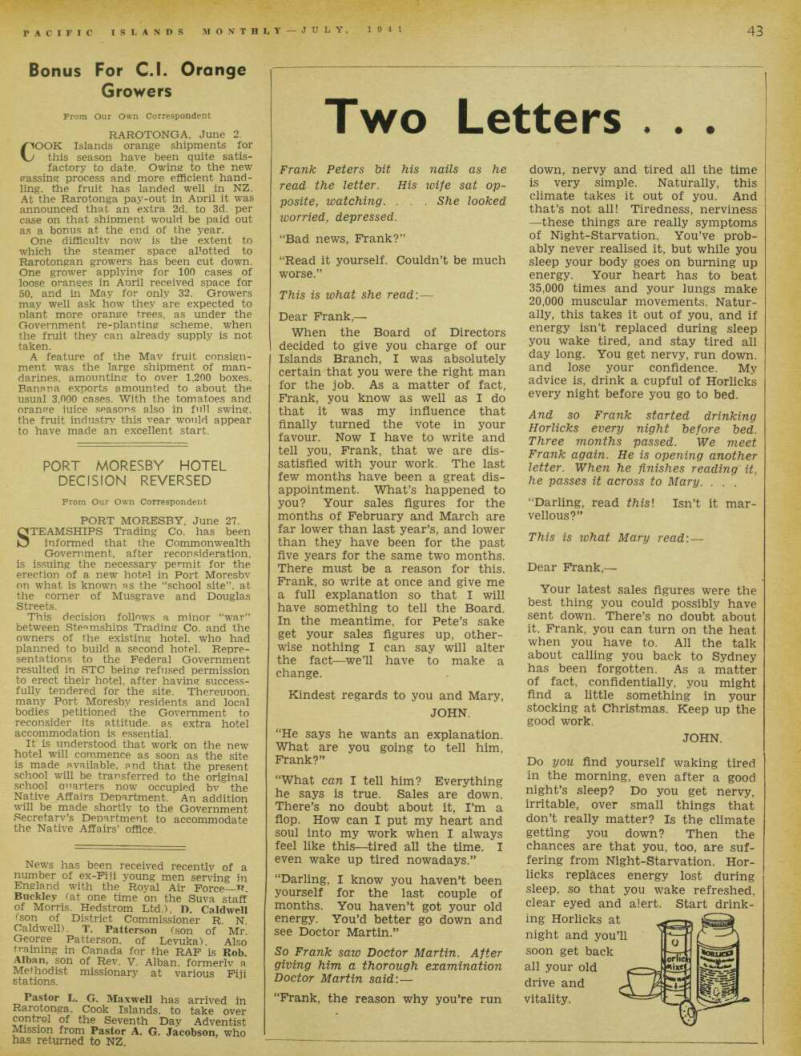
Growers
From Our Own Correspondent
Rarotonga, June 2.
COOK Islands orange shipments for this season have been quite satis factory to date. Owing to the new gassing process and more efficient hand ling. the fruit has landed well in NZ.
At the Rarotonga pay-out in April it was announced that an extra 2d. to 3d. per case on that shipment would be paid out as a bonus at the end of the year.
One difficulty now is the extent to which the steamer space allotted to Rarotongan growers has been cut down.
One grower applying for 100 cases of loose oranges in April received space for 50, and in May for only 32. Growers may well ask how they are expected to plant more orange trees, as under the Government re-planting scheme, when the fruit they can already supply is not taken.
A feature of the Mav fruit consign ment was the large shipment of man darines, amounting to over 1,200 boxes.
Bansna exports amounted to about the usual 3.000 cases. With the tomatoes and orange juice seasons also in full swing, the fruit industry this vear would appear to have made an excellent start.
Port Moresby Hotel
Decision Reversed
Prom Our Own Correspondent
Port Moresby, June 27.
STEAMSHIPS Trading Co. has been informed that the Commonwealth Government, after reconsideration, is issuing the necessary permit for the erection of a new hotel in Port Moresbv on what is known as the “school site”, at the corner of Musgrave and Douglas Streets.
This decision follows a minor “war” between Steamships Trading Co. and the owners of the existing hotel, who had planned to build a second hotel. Repre sentations to the Federal Government resulted in STC being refused permission to erect their hotel, after having success fully tendered for the site. Thereunon. many Port Moresby residents and local bodies petitioned the Government to reconsider its attitude, as extra hotel accommodation is essential.
It is understood that work on the new hotel will commence as soon as the site is made available, and that the present school will be transferred to the original school Quarters now occupied bv the Native Affairs Department. An addition will be made shortly to the Government Secretary’s Department to accommodate the Native Affairs’ office.
News has been received recently of a number of ex-Fiji young men serving in England with the Royal Air Force—w.
Buckley (at one time on the Suva staff of Morris. Hedstrom Ltd.), D. Caldwell (son of District Commissioner R. N.
Caldwell). T. Patterson (son of Mr George Patterson, of Levuka). Also training in Canada for the RAF is Rob.
Alban, son of Rev. V. Alban, formerly a Methodist missionary at various Fiji stations.
Pastor L. G. Maxwell has arrived in Rarotonga, Cook Islands, to take over control of the Seventh Day Adventist Mission from Pastor A. G. Jacobson, who has returned to NZ.
Miss M. Battersby, who was a well known Methodist missionary in New Guinea, retired recently owing to ill health.
Mr. and Mrs. Nick Penglase, who were in Australia recently on furlough, are now at Manus, New Guinea, where he is relieving ADO K. C. McMullen, as officer in charge of the district.
Advertisements & other items, pp. 45-46 (1 item)
Two Letters . . .
Frank Peters bit his nails as he read the letter. His wife sat opposite, watching. . . . She looked worried, depressed.
“Bad news, Frank?”
“Read it yourself. Couldn’t be much worse.”
This is what she read :— Dear Frank, — When the Board of Directors decided to give you charge of our Islands Branch, I was absolutely certain that you were the right man for the job. As a matter of fact, Frank, you know as well as I do that it was my influence that finally turned the vote in your favour. Now I have to write and tell you, Frank, that we are dissatisfied with your work. The last few months have been a great disappointment. What’s happened to you? Your sales figures for the months of February and March are far lower than last year’s, and lower than they have been for the past five years for the same two months.
There must be a reason for this, Frank, so write at once and give me a full explanation so that I will have something to tell the Board.
In the meantime, for Pete’s sake get your sales figures up, otherwise nothing I can say will alter the fact—we’ll have to make a change.
Kindest regards to you and Mary,
JOHN.
“He says he wants an explanation.
What are you going to tell him, Frank?”
“What can I tell him? Everything he says is true. Sales are down.
There’s no doubt about it, I’m a flop. How can I put my heart and soul into my work when I always feel like this—tired all the time. I even wake up tired nowadays.”
“Darling, I know you haven’t been yourself for the last couple of months. You haven’t got your old energy. You’d better go down and see Doctor Martin.”
So Frank saw Doctor Martin. After giving him a thorough examination Doctor Martin said :— “Frank, the reason why you’re run
down, nervy and tired all the time is very simple. Naturally, this climate takes it out of you. And that’s not all! Tiredness, nerviness —these things are really symptoms of Night-Starvation. You’ve probably never realised it, but while you sleep your body goes on burning up energy. Your heart has to beat 35.000 times and your lungs make 20.000 muscular movements. Naturally, this takes it out of you, and if energy isn’t replaced during sleep you wake tired, and stay tired all day long. You get nervy, run down, and lose your confidence. My advice is, drink a cupful of Horlicks every night before you go to bed.
And so Frank started drinking Horlicks every night before bed.
Three months passed. We meet Frank again. He is opening another letter. When he finishes reading it, he passes it across to Mary. . . .
“Darling, read this\ Isn’t it marvellous?”
This is what Mary read'. — Dear Frank, — Your latest sales figures were the best thing you could possibly have sent down. There’s no doubt about it. Prank, you can turn on the heat when you have to. All the talk about calling you back to Sydney has been forgotten. As a matter of fact, confidentially, you might find a little something in your stocking at Christmas. Keep up the good work.
JOHN.
Do you find yourself waking tired in the morning, even after a good night’s sleep? Do you get nervy, irritable, over small things that don’t really matter? Is the climate getting you down? Then the chances are that you, too, are suffering from Night-Starvation. Horlicks replaces energy lost during sleep, so that you wake refreshed, clear eyed and alert. Start drinking Horlicks at night and you’ll soon get back all your old drive and vitality.
!>O|IUCO
or
JSC?
H 8
At Blue Mountains—Springwood, N.S.W.
Springwood Ladies' College
Est. 1897. Kindergarten to Leaving Certificate. Tennis, Riding, Swimming, Team Games. Unequalled climate. Pure Jersey Milk. Senior and Junior Houses.
Open-air sleeping. Inclusive fees. Special vacation arrangements for Island pupils.
M. E. DURAND, Principal.
COME TO DINNER
COME TO DINNER
HEAR THE BELL
HEAR THE BE
'ir. vV w*
sagK?
if Js* Wf ; : - j£»r Sold by a grocers in sizes and flavours.
WIBI7C.
• • there's FRUIT and CREAM/
How kiddies love fruit-’n’-Custard. It’s their favourite dish-and the grown-ups aren’t far behind. Foster Clark’s delicious Creamy Custard is a family favourite. Everybody loves the rich flavour of Foster Clark’s-and Mother is pleased because it is nourishing and economical as well.
Foster Clark’s Custard has a world-wide reputation for quality. Never accept substitutes.
192 FREE RECIPES
Write to Foster Clark (Aust.) Ltd., Dept. R. 8., Red fern, N.S.W., for your free copy of Elizabeth Craigs Recipe Book. It’s crammed with exciting suggestions for hot and cold sweets, ice cream, sweet and savoury sauces and fruit drinks. Please enclose id. stamp for postage.
Vlj
A Section For Women

By "Therese"
EVEN though winter weather still pre vails in Australia, the shops are showing advanced fashions. It is surprising to see such a variety of designs in fabrics, particularly after nearly two years of war and considering the wide restrictions on imports. Colours and designs are really lovely—there are lots of cyclamens, greens, blues and yellows all mixed up together with splendid effect.
There are pastel shades, too —delicate pinks, blues, greens and pale yellows— for those who like plain fabrics.
Navy fabric patterned with white is always popular but there promises to be a shortage, and though here and there one sees this combination in polka dots
and quaint little scroll effects, the demand will greatly exceed the supply.
Cottons are crisp and fresh-looking and have marvellous washing propensities. All sorts of quaint designs are patterned on them and the colours are in a wide range to suit all tastes.
Jacket suits will continue to be popular and extra jackets in your wardrobe are invaluable. Dress up a tired frock with a coloured suede belt and add a hip length boxv pocket in exactly the same shade as the belt. This idea has many possibilities and the fun you will get out of contrasting your colours to good effect will be an added incentive to pepping up your wardrobe.
A very charming combination is a hip length Patou pink jacket (made with broad shoulders) and a deep-rose pleated skirt. A pink straw hat with a rose grosgrain ribbon is a delightful accom paniment.
Avoid blues similar to sky colours or the greens of foliage if you want to be more than “just a gallery” when attend ing a sports event. These colours tend to blend too much into the background.
Choose colours that subtly complement sky and foliage such as rose or soft golds and yellows. , Straw hats will be increasingly difficult to procure but. nothing daunted, women will have their hats made of fabric, either to match or contrast with their frocks. They can go a step further and make most attractive bags, too. It is surprising what an ingenious woman can devise so that she becomes the envy of her sisters.
Tried Recipes
HERE are some recipes from two of our regular readers: W. D., of Papua, and Mrs. M. Clarke, of Whenuapai, Upper Harbour, Auckland, New Zealand: Fish All Gratin One lb. firm fish; white sauce made with half pint of milk and 2 dessert spoonsful corn flour, 2 oz. butter, salt and pepper to taste, and 2 or more oz. strong cheese (grated).
Mix the sauce with the fish, which has been steamed, boned and flaked. Place in fireproof dish. Sprinkle the top with grated cheese and dots of butter and bake in a quick oven till nicely browned.
Serve with mashed potatoes sprinkled with chopped parsely and, if obtainable, baked tomatoes.
An Invigorating Cocktail Beat the yolk of an egg with juice of two oranges. Sweeten it with honey. This is an excellent pick-me-up.
Mock Whitebait Two mullet or other firm fish cut in fillets, one dessertspoon flour, seasoning, pepper and salt.
Cut the fillets slanting in thin strips and toss in seasoned flour. Butter a pie dish or pyrex; place in it the strips of fish. Squeeze lemon juice over the fish and add 3 tablespoons water. Cover with greased paper and cook 15 to 20 mins.
Make a thick white sauce. Drain the fish liquid into the sauce and mix. Pile strips of fish on buttered toast and cover with sauce. Garnish with thin slice of lemon and chopped parsley.
Simple Pikelets One or 2 eggs, 1 tablespoon sugar, 1 teaspoon honey or golden syrup, 1 cup self-raising flour, I cup milk (powdered or condensed diluted will do), pinch of salt.
Beat the eggs, add the sugar and syrup and beat till frothy. Add the milk and
beat well. Then add the flour and beat smooth. Lightly grease a hot plate (for electric cooking) or a hot iron pan. Drop tablespoonful of the mixture on to the hot pan, keeping each tablespoonful separate, leaving room to turn without breaking. Cook till nicely brown then turn and cook on other side.
Wholemeal Cake Eight oz. butter, 6 oz. brown sugar, 10 oz. flour, 1 teaspoon brown sugar, 1 tea spoon grated nutmeg, 16 oz. sultanas, 8 oz. raisins, 4 oz. preserved ginger, 1 tea spoon malt extract, a few drops each of vanilla and almond essences.
Beat butter, sugar and malt to a cream and leave for a while (this helps sugar to melt); break in eggs one at a time, and beat well. Mix in dry ingredients and add fruit. Bake in a moderate oven 21 to 3 hours.
If cake is to be iced, make a hollow in the centre before placing in oven. When cooked it will have a flat top.
Household Helps
WHEN next you are icing a cake, try roughing it with a fork for a change.
Thick rich orange or chocolate }cmg well stirred into whirls and ridges looks much more effective than the usual smooth coating.
The following tip is effective for sun burn: Over a slice of lemon pour half a cupful of hot milk and allow to stand for three of four hours. Strain the mix ture and throw away the curd using only the clean liquid that remains.
The flavour of stewed apples or apple rice will be greatly improved if a tea spoon of golden syrup is added when cooking. This will ensure a thick sweet juice.
After peeling tomatoes for frying, cut in half and dip in vinegar and they will remam unbroken during the cooking process.
All dried fruits are better soaked than stewed. Soak for 24 hours and serve with natural juice and cream. Add sugar to taste.
When eggs are scarce, make a light flour and water paste and brush over cutlets before dipping in bread crumbs.
If a sprinkle of curry powder is put into the frying pan when cooking fish the smell will be eliminated. It will give’ the fish a tasty flavour and make them brown nicely.
To remove the odour that clings so persistently to the hands after peeling onions, rub the hands thoroughly with common salt. Leave on for a few minutes and then wash in the usual way.
An appetising and delicious dessert is achieved when baked apples are stuffed with raisins and brown sugar Serve with cream.
If your sauce is too thin, mix a little extra flour to a smooth paste with cold milk, stock, or water; strain this, into the sauce and stir over the flame until it re-boils and thickens. For a sauce made from stock, re-boiling until excess mois ture evaporates will thicken it—but do bofling rget t 0 leave off while re-
Home-made Soap
soIM dripping, 1 lb. caustic s°aa, 2 lb. borax, i cup kerosene h run ammonia, 3 pints water. ’ 2 cup Heat dripping until melted. Put the Ihake th^ o p^,<=? lean^ tin ’ then carefully a stick l arid^hnrt 1C s ? da lnto u - stir with add e +K tlmng until dissolved, da ,, kerosene. Then pour in strainpri dripping, stir for several minutes and the mixture will thicken. Then add a shanow a hnv St r W S IL Pour mixture into Lh w w box hned with calico. Cover whPn 1 *it winV a saf s place until next day when it will be ready to be cut into bars.
Papua's Generous Help For
Old Residents
Prom Our Own Correspondent
Port Moresby, July 4.
MR. E. W. Harrison is wrong in stating in your June number that Captain Charles Whitehead, an old resident who settled in Papua in 1901, receives only £4 a month from the Government in his hour of need. I made inquiries and found that Mr. Whitehead received £4 a month from January, 1934. while living on his plantation on Fergusson Island, where he also had a trade store and kept goats and fowls. His sight failed, and in 1938 he sold his property to the late Mr. Evenett, and secured a little capital, and settled in Samarai.
When his funds became low, he not only received financial help from the kindly Samarai residents, but his Government allowance was increased to £2 a week in
October, 1939; since when it has again been increased, to £2/10/- a week, owing to his failing sight and his inability to attend to himself. He is 75 years of age.
The Government has several old resi dents on its hands, all receiving £2 a week. I believe there is quite a substan tial sum set aside for this purpose for residents of long standing, who can show cause why assistance should be given.
Mr. Harrison should not make such uninformed statements. £lO per month is an acceptable sum to receive in one’s old age, especially in such kindly sur roundings as Samarai. Mr. Harrison, on page 16, is also loose in his statements about the copra relief of £4 a month.
The relief depends on actual losses sus tained owing to the war, etc., and on the size of plantations.
Mr. “Mick.” Hayes, formerly of Bulwa, New Guinea, is now serving with the RAAF in Rhodesia, South Africa.
Advertisements & other items, p. 47 (1 item)
57 Aids To Better Menus
TOMATO
KETCHUP
BgJ
I 3 TOMATO |p!/J
O SAUCE
TOMATO KETCHUP—A/flrfe
from Sun-ripened Tomatoes.
Medium Bottles .. 8 ozs.
TOMATO SAUCE A Pure
Appetising Sauce.
Large Bottles .. 13 ozs.
OVEN-BAKED
BEANS
WITH PORK AND
TOMATO SAUCE.
ALSO VEGETARIAN
Individual Tins, 4 ozs.
Small Tins, 8 ozs.
Medium Tins, 16 ozs.
TOMATO JUICE
*5 A delicious health-giving and appetising drink Small Tins, 8 oz.
Med. Tins, 16 oz.
No. 5 Tins, 60 oz.
SPAGHETTI
Cooked in Tomato Sauce with Cheese Individual Tins. 4 ozs.
Small Tins, 8 oz.
Med. Tins, 16 oz.
VEGETABLE
SALAD
Garden-fresh Mayonnaise.
Vegetables with Small Tins, Boz.
FAMOUS HEINZ PRODUCTS
MADE IN AUSTRALIA
MACARONI
||Ri |B\macaa£
HEINZ
PERFECT
SOUPS
READY-TO-SERVE
In 8 oz. and 16 oz. Tins
CREAM OF TOMATO
CREAM OF ASPARAGUS
CREAM OF CELERY
CREAM OF CHICKEN
CREAM OF GREEN PEA
CREAM OF MUSHROOM
CREAM OF ONION
CREAM OF SPINACH
CREAM OF TOHEROA
BEAN SOUP with HAM
CHICKEN VEGETABLE
KIDNEY SOUP
MULLIGATAWNY
OXTAIL
VEGETABLE
GENUINE TURTLE SOUP
Cooked in Cream Sauce with Cheese.
Individual Tins, 4 ozs.
Small Tins, 8 ozs.
Medium Tins, 16 ozs.
MAYONNAISE
Delightful on Salad.
Small Bottles, 4 ozs.
Med. Bottles, 7 ozs. 18 oz. Bottles 57 oz. Bottles
beefsteak
SAUCE
Fruits, Vegetables and Spices, skilfully blended. i| Medium Bottles, ozs.
STRAINED FOODS
For Infant Feeding and Special Diets.
Strained Carrots Strained Beets Strained Prunes Strained Green Beans Strained Vegetable Soup Strained Beef and Liver
SWEET GHERKINS
Small Bottles
H. J. HEINZ CO. PTY. LTD.
Regd. Office: BENDIGO ST., RICHMOND E.l, VICTORIA
SWEET MUSTARD
PICKLE
Small Bottles Heinz delicious varieties are available
from Storekeepers
throughout Papua,
New Guinea and
Pacific Islands.
New Book On Pacific
Racial Origins
IT was reported in this journal, in 1938, that Dr. Carl Schuster, who is connected with the Harvard Univer sity, was in the Pacific, making a close study of Melanesian designs. In this connection, he examined many museum collections —especially in Australia, New Zealand, Suva and Honolulu. This study is helpful in solving the problems of Pacific racial origins.
Under date of May 9, Dr. Schuster writes to the editor of the “PIM” from 474 Broadway, Cambridge, Massachusetts, USA; and, inter alia, he remarks: “It
may be of interest to some of your read ers to know that my book, embodying the researches referred to in your jour nal in 1938, is soon to go into print with the Harvard University Press and, bar ring misfortunes due to the war, it should appear some time in 1942 under the title, ‘The Sunbird; Continuity of a Design Tradition in Eurasia and Ocea nia’. jt w m b e a double volume in the Monograph Series of the Harvard-Yench ing Institute ' Much o£ the materlal fOT this book wa *J gathered through the courtesy of collectors in the Solomons an( * of museum officials in Australia, New Zealand, Fiji and Hawaii.”
Still Another
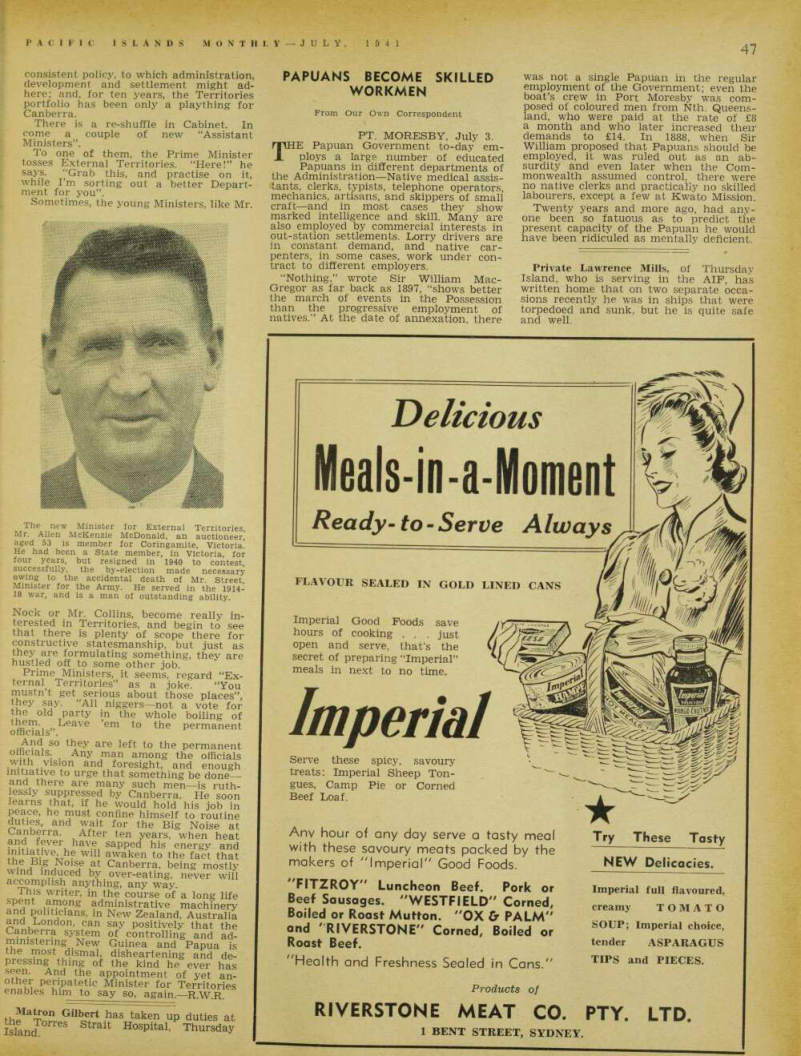
Minister !
A Pessimistic Review of a Damnable System
TH E Australian-Pacific Territories (Papua, New Guinea, Norfolk Island, Nauru) are to meet their seventh Minister in 31 years. Mr. T. J. Collins has been moved on to the portfolio of PMG, and Mr. Allen McDonald, who first entered the Commonwealth Parliament only a few months ago, has taken over External Territories.
The Islands know nothing about Mr.
McDonald; and, it is presumed, he knows less about the Islands. He appears to be a man of outstanding ability, otherwise he would not, so soon, have been called into the Ministry. But even a Gladstone or Disraeli would be of little use in the Territories job, until in long, painful months, he had learned something about the tropical Territories.
The Territories are so utterly defence less, in that they have no Parliamentary representative to fight for them, and they are so completely dependent upon this Minister. Nominally, they are governed by Administrators. Actually— due to a combination of weakness among Administrators, and bureaucratic arro gance at Canberra —all administrative decisions of any importance are left to the Minister.
It is an axiom in New Guinea that, if you want anything done quickly, you must dig up a couple of hundred pounds for expenses, and fiy straight to Can berra. rpHERE have been seven Ministers X since 1937 —Sir George Pearce, Mr.
W. M. Hughes, Mr. E. J. Harrison, Mr. J. A. Perkins (for a couple of days only), Mr. Howard Nock, Mr. Collins, and Mr. McDonald. The best of them were the hard-working, conscientious three —Messrs. Harrison, Nock, and Collins. If they had been dealing with Australian conditions, they would have been admirable Ministers.
But those tropical Pacific territories call for highly specialised knowledge and the application of different principles of colonial administration: and the in experienced Australian Ministers, finding what they were up against, invariably sat back for a few months, to learn something about the job. And, in each case —Harrison, Nock and Collins —the Minister was shifted on to another de partment, just as he was getting hold of Territories affairs, and likely to do some thing worth-while.
The other Ministers only emphasised other weaknesses of the system.
Sir George Pearce —who held the port folio for some weary years—seemed little more than a rubber stamp. Mr. Hughes went to the other extreme, and would take advice from no one. A man with his record was not discomfited by the task of ruling New Guinea. He dashed up there by ’plane in 1938, racketed around the Territory, selected Salamaua as the capital and the Black Cat as the route of the goldfields road —two decisions which still are causing a heap of trouble —and zoomed back to Australia. Prob ably, by now, he has forgotten he ever was in New Guinea —but New Guinea will not soon forget him. Nevertheless, better a decade of Hughes, with his quick decisions, hatred of bureaucracy and capacity for getting things done, than the slow strangulation of the present system.
FOR ten years, Australian Pacific Territories have been crying out for the inauguration of some kind of
consistent policy, to which administration, development and settlement might ad here; and, for ten years, the Territories portfolio has been only a plaything for Canberra.
There is a re-shuffle in Cabinet. In come a couple of new “Assistant Ministers”.
To one of them, the Prime Minister tosses External Territories. “Here!” he says. “Grab this, and practise on it, while I’m sorting out a better Depart ment for you”.
Sometimes, the young Ministers, like Mr.
The new Minister for External Territories, Mr. Allen McKenzie McDonald, an auctioneer, aged 53 is member for Coringamite, Victoria!
He had been a State member, in Victoria, for four years, but resigned in 1940 to contest, successfully, the by-election made necessary owing to the accidental death of Mr. Street Minister for the Army. He served in the 1914- 18 war, and is a man of outstanding ability.
Nock or Mr. Collins, become really in terested in Territories, and begin to see that there is plenty of scope there for constructive statesmanship, but just as they are formulating something, they are hustled off to some other job.
Prime Ministers, it seems, regard “Ex ternal Territories” as a joke. “You mustn’t get serious about those places”, they say. “All niggers—not a vote for the old party in the whole boiling of „ Leave ’ era to the permanent officials .
And so they are left to the permanent officials. Any man among the officials with vision and foresight, and enough initiative to urge that something be done— and there are many such men—is ruth essly suppressed by Canberra. He soon learns that, if he would hold his job in peace, he must confine himself to routine duties, and wait for the Big Noise at Canberra. After ten years, when heat ai ™ f? ver have sapped his energy and initiative, he will awaken to the fact that the Big Noise at Canberra, being mostly wind induced by over-eating, never will accomplish anything, any way.
This writer, in the course of a long life spent among administrative machinery and politicians, in New Zealand, Australia r-o^v. London ’ san5 an say Positively that the Canberra system of controlling and ad ministering New Guinea and Papua is the most dismal, disheartening and de pressing thing of the kind he ever has seen. And the appointment of yet an other peripatetic Minister for Territories enables him to say so, again.—R.W.R. the la Tn, n ,»?' l =T t has taken up duties at str ait Hospital, Thursday
Advertisements & other items, p. 48 (2 items)
46
1941 PACIFIC INLANDS MONTHLY
j rt l y,
Aunt Mary’s
AI*WATS CIVS
A BAIkT
TMOBChT
k v To the things you do or ought.
Always feel and know at night All you do is fair and right.
Always promptly check a chill With a dose which always will.
Always tell your neighbours, too, All Woods’ Great Peppermint Cure will do.
Woods’ Great Peppermint Cure, For Bronchial Coughs, Colds, Influenza.
READY TO HEAT
AND SERVE!
Aunt Mary’s
PREPARED SOUPS AND
TASTY MEAL-TIME PRODUCTS
include delicious Mulligatawny, Tomato. Pea and other rich Soups, also Baked Beans with Tomato Sauce, Curried Baked Beans, Spaghetti with Cheese, Curried Spaghetti and other appetizing, wholesome food products. Ready to heat and serve 1
Aunt Mary’s
PREPARED
VEGETABLES
offer a great variety of fullflavoured, nutritious dinner vegetables; ready to heat and serve. All Aunt Mary's food products are packed in 1 lb. cans for Tropical conditions
and SOLD BY ALL STORES.
TOMATO#
Papuans Become Skilled
Workmen
From Our Own Correspondent
Pt. Moresby, July 3.
THE Papuan Government to-day em ploys a large number of educated Papuans in different departments of the Administration—Native medical assis tants, clerks, typists, telephone operators, mechanics, artisans, and skippers of small craft —and in most cases they show marked intelligence and skill. Many are also employed by commercial interests in out-station settlements. Lorry drivers are in constant demand, and native car penters, in some cases, work under con tract to different employers.
“Nothing,” wrote Sir William Mac- Gregor as far back as 1897, “shows better the march of events in the Possession than the progressive employment of natives.” At the date of annexation, there
was not a single Papuan in the regular employment of the Government; even the boat’s crew in Port Moresby was com posed of coloured men from Nth. Queens land, who were paid at the rate of £8 a month and who later increased their demands to £l4. In 1888, when Sir William proposed that Papuans should be employed, it was ruled out as an ab surdity and even later when the Com monwealth assumed control, there were no native clerks and practically no skilled labourers, except a few at Kwato Mission.
Twenty years and more ago, had any one been so fatuous as to predict the present capacity of the Papuan he would have been ridiculed as mentally deficient.
Private Lawrence Mills, of Thursday Island, who is serving in the AIF, has written home that on two separate occa sions recently he was in ships that were torpedoed and sunk, but he is quite safe and well.
Advertisements & other items, pp. 49-50 (1 item)
Imperial
Delicious
Meals-in-a-Moment
Ready - to - Serve Always
FLAVOUR SEALED IN GOLD LINED CANS
Imperial Good Foods save hours of cooking . , . just open and serve, that’s the secret of preparing “Imperial” meals in next to no time.
Imperial
Serve these spicy, savoury treats: Imperial Sheep Tongues, Camp Pie or Corned Beef Loaf.
Any hour of any day serve a tasty meal with these savoury meats packed by the makers of "Imperial" Good Foods.
"FITZROY" Luncheon Beef. Pork or Beef Sausages. "WESTFIELD" Corned, Boiled or Roast Mutton. "OX Cr PALM" and "RIVERSTONE" Corned, Boiled or Roast Beef.
Health and Freshness Sealed in Cans."
Products of
RIVERSTONE MEAT CO. PTY.
1 BENT STREET, SYDNEY.
A % 1 ¥ w, ml
WkJ-
A y w I* ★ Try These Tasty NEW Delicacies
LTD.
Imperial full flavoured, creamy TOMATO SOUP; Imperial choice, tender ASPARAGUS
TIPS and PIECES.
Id UteWcrld ever
ECONOMICAL. BECAUSE YOU NEED
JUST A FEW DROPS AT A TIME -
Spare Copies Of "Pim"
Letter to the Editor IN going over my collection of the “PIM”. which go back to the start, I find that I have duplicates of the following numbers:— December, 1931.
January, 1934.
February, 1934.
March, 1934.
April, 1934.
October, 1936.
July, 1940.
Should any of your readers wish for any of these numbers, I shall be only too glad to forward them along on receipt of address. With all best wishes.
I am, etc.,
Atonal Fraser.
Oue La Wea, Api, New Hebrides, 30/4/1941.
Serving with a Queensland company of AIF engineers, now stationed in Dar win, are the following ex-residents of Morobe, New Guinea: Sappers L. Phillips, H. Horne, R. Lapham, and K. Irvine.
Mr. H. J. Rawnsley, of Burns, Philp & Co. Ltd.’s Shipping Department, Rabaul, returned to New Guinea last month after leave in Sydney.
Soldiers From
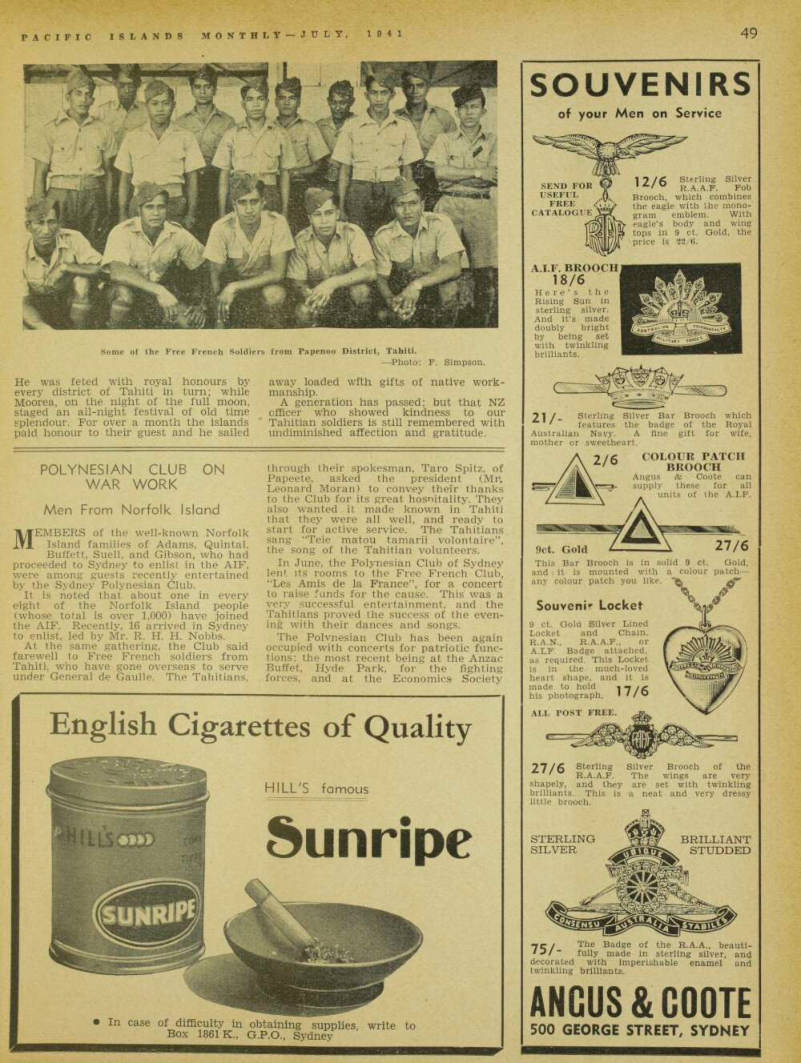
Tahiti
Embarkation Ceremonies
From Our Own Correspondent
Papeete, May 10.
THE first contingent of Tahitian soldiers —with all the parade, and stately ceremony, and the heartbreak of partings—left Papeete, in April, on a British transport.
The occasion brought to memory the day, 26 years ago, when Tahitian soldiers, for the first time, embarked to fight on faraway battlefields. There is this dif ference, however: In 1915, they went as conscripts; in 1941, they go as volunteers to fight in the armies of Free France.
These volunteers have come from all parts of the colony—even from the Austral Islands, the Tuamotus and the distant Gambiers. So many have offered themselves that many have been placed on a waiting list, to be called up when earlier contingents shall have been equipped and trained.
Their battle colours are the Cross of Lorraine, banner of Free France, and the red, white and red flag of Tahiti. The former was presented by the Governor of French Oceania, at a ceremony shortly before the day of departure. The Tahitian flag was presented, at the same occasion, by Princess Terri-Nui-o-Tahiti, the eldest daughter of the last king, Pomare V, In 1915, French Oceania contributed a full battalion to the army of France.
The training centre was at New Cale donia. In those days, the voyage to Noumea was by way of Wellington and Sydney. Irregular steamer service made necessary considerable delays at both New Zealand and Australia.
It was the season of southern winter.
The New Zealand Government, in the person of an officer of the Quarter master’s Department, took charge of our Tahitian soldiers, 'provided them with woollen uniforms, found them comfort able quarters, and treated them with great kindness.
And so it was with every contingent from the Islands. Steamers returning to Tahiti bore letters to the parents of these young men. They told how this officer had gone beyond the mere execution of his duties and had taken them in his personal charge and made them forget that they were homesick aliens in a strange land.
The gratitude felt by the parents was deep and lasting. Its measure was known to this writer, because most of the letters addressed to the New Zealand officer were brought to him for translation into English.
But expression of gratitude did not suffice. When the war was over, the native people of Tahiti and Moorea formally invited the officer and his family to visit their islands.
It is quite certain that no one, since Captain Cook, has ever received so affec tionate a welcome as that accorded by the native people of the islands to this kindly officer, on his arrival at Tahiti.
He was feted with royal honours by every district of Tahiti in turn; while Moorea, on the night of the full moon, staged an all-night festival of old time splendour. For over a month the islands paid honour to their guest and he sailed
away loaded with gifts of native work manship.
A generation has passed; but that NZ officer who showed kindness to our Tahitian soldiers is still remembered with undiminished affection and gratitude.
Some of the Free French Soldiers from Papenoo District, Tahiti.
Photo: F. Simpson.
Advertisements & other items, p. 50 (3 items)
48
3UL Y , i94l—V A C I F i C ISLANDS MONTHLY
Mcilrath’S
Send Your Next Grocery Order to . . .
WHERE YOUR MONEY BUYS MORE
/ B “IXL” Choice Canned Peaches 16-oz., 6/3 doz.; 30-oz., 9/4i doz.
Nestles Pure Reduced Cream, 4-oz. .. 3/9 doz.; case lots 8 doz., 3/6 doz.
Sunshine Full Cream Powdered Milk, 12-oz. 1/2J tin; 14/3 doz.
“IXL” Sweet Corn 5-oz. tins, 5/3 doz.; 8-oz. tins, 7/9 doz.
Heinz Pork Sausages and Vegetables, 8-oz B£d. tin; 8/- doz.
“Red Feather” Hamburger Steak 4-oz., 4/3 doz.; 12-oz., 9/9 doz.
“IXL” Tomato Sauce 4-oz., 5/6 doz.; 10-oz., 8/6 doz.
Best Beef Dripping 1-lb. tins, 9/3 doz.; 2-lb. tins, 14/9 doz.
Edgell Cauliflower, 16-oz 9d. tin; 8/9 doz.
Garden Vale Carrots, 16-oz tin; 8/3 doz.
Gartside’s Green Peas, 10-oz 6d. tin; 5/6 doz.
“IXL” Baked Beans ... 4-oz., 3/9 doz.; 8-oz., 6/3 doz.; 16-oz., 9/- doz.
“Yoga” Tea—Australia’s Best Tea Value, 6-lb. tins 2/8 lb.
Nestles Pure Cocoa 4-oz., sd. tin; 8-oz., 9id. tin Mcllrath’s Special Vintage Sweet Sherry, 26-oz 2/2 bot,; 25/6 doz.
Mcllrath’s Special Royal Reserve Port or Dry Sherry, 26-oz 3/6 bot.; 41/- doz.
Seppelts Fine Old Sweet Sherry, 26-oz 3/9 bot.; 44/- doz.
HALF-DOZEN LOTS CHARGED AT DOZEN RATES.
All prices f.o.b. Sydney, cases and packing free.
Space available all steamers.
All consignments carried by air are packed in special fibre cartons —without extra charge—in order to reduce aerial freight.
McILRATH’S Pty. Ltd.
EXPORT DEPARTMENT
202-204 PITT STREET, SYDNEY
AUSTRALIA
Wanted To Purchase
Used stamps of all Pacific Islands.
Highest prices paid. Regular consignments solicited. Remittances guaranteed by return mail.
J. H. SMYTH PTY. LTD.,
114 Castlereagh St., Sydney, Aust.
Polynesian Club On
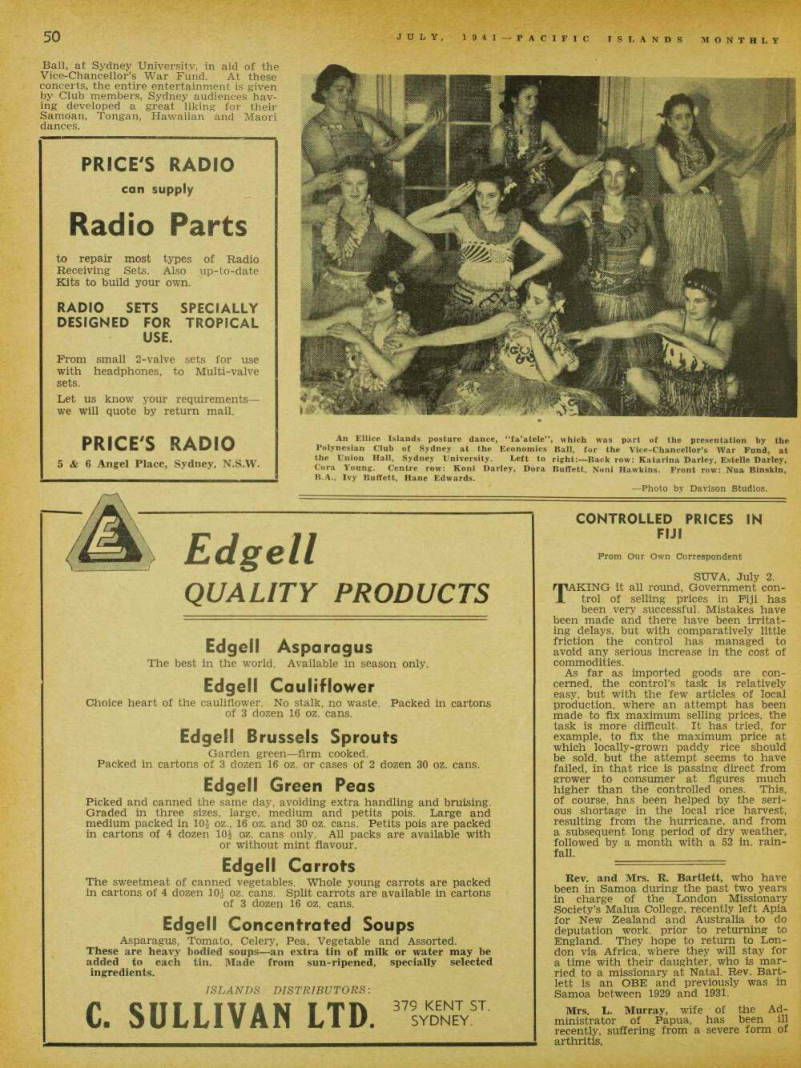
War Work
Men From Norfolk Island
MEMBERS of the well-known Norfolk Island families of Adams, Quintal, Buffett, Suell, and Gibson, who had proceeded to Sydney to enlist in the AIF, were among guests recently entertained by the Sydney Polynesian Club.
It is noted that about one in every eight of the Norfolk Island people (whose total is over 1,000) have joined the AIF. Recently, 16 arrived in Sydney to enlist, led by Mr. R. H. H. Nobbs.
At the same gathering, the Club said farewell to Free French soldiers from Tahiti, who have gone overseas to serve under General de Gaulle. The Tahitians,
through their spokesman, Taro Spitz, of Papeete, asked the president (Mr v Leonard Moran) to convey their thanks to the Club for its great hosnitality, They also wanted it made known in Tahiti that they were all well, and ready to start for active service. The Tahitians sang “Teie matou tamarii volontaire”, the song of the Tahitian volunteers.
In June, the Polynesian Club of Sydney lent its rooms to the Free French Club, “Les Amis de la France”, for a concert to raise funds for the cause. This was a very successful entertainment, and the Tahitians proved the success of the even ing with their dances and songs.
The Polvnesian Club has been again occupied with concerts for patriotic func tions: the most recent being at the Anzac Buffet, Hyde Park, for the fighting forces, and at the Economics Society
Ball, at Sydney University, in aid of the Vice-Chancellor’s War Fund. At these concerts, the entire entertainment is given by Club members, Sydney audiences hav ing developed a great liking for their Samoan, Tongan, Hawaiian and Maori dances.
An Ellice Islands posture dance, “fa’atele”, which was part of the presentation by the Polynesian Club of Sydney at the Economics Ball, for the Vice-Chancellor’s War Fund, at the Union Hall, Sydney University. Left to right:—Back row: Katarina Darley, Estelle Darley, Cora Young. Centre row: Koni Darley, Dora Buffett, Noni Hawkins. Front row: Nua Binskin, B.A., Ivy Buffett, Hane Edwards.
Photo by Davison Studios.
Advertisements & other items, pp. 51-52 (1 item)
Sunripe
SOUVENIRS
of your Men on Service
SEND FOR
USEFUL
FREE
CATALOGUE
m
A.I.F. BROOCH
18/6 Here’s the Rising Sun in sterling silver.
And it’s made doubly bright by being set with twinkling brilliants. 1") /f. Sterling Silver 1 v R.A.A.F. Fob Brooch, which combines the eagle with the monogram emblem. With eagle’s body and wing tops in 9 ct. Gold, the price is 22/6.
■MfVA
4 u%r*t 21/- Sterling Silver Bar Brooch which ' " features the badge of the Royal Australian Navy. A fine gift for wife, mother or sweetheart. 2/6 k
COLOUR PATCH
BROOCH
Angus & Coote can supply these for all units of the A.I.F. 9ct. Gold 27/6 This Bar Brooch is in solid 9 ct. Gold, and it is mounted with a colour patch— any colour patch you like. *■& dT \/
Souveni*- Locket
9 ct. Gold Silver Lined Locket and Chain.
R.A.N., R.A.A.F., or
A.LF. Badge attached, as required. This Locket is in the much-loved heart shape, and it is made to hold his photograph. 17/6
ALL POST FREE.
n\i 27/6 Sterling Silver Brooch of the ' R.A.A.F. The wings are very shapely, and they are set with twinkling brilliants. This is a neat and very dressy little brooch.
STERLING
SILVER
BRILLIANT
STUDDED
vr •j cj j The Badge of the R.A.A., beautifully made in sterling silver, and decorated with imperishable enamel and twinkling brilliants.
ANGUS & GOOTE
500 GEORGE STREET, SYDNEY
English Cigarettes of Quality
HILL'S famous
Sunripe
a • In case of difficulty in obtaining supplies, write to Box 1861 K., G.P.0., Sydney
PRICE'S RADIO
can supply
Radio Parts
to repair most types of Radio Receiving Sets. Also up-to-date Kits to build your own.
RADIO SETS SPECIALLY
DESIGNED FOR TROPICAL
USE.
From small 2-valve sets for use with headphones, to Multi-valve sets.
Let us know your requirements— we will quote by return mail.
PRICE'S RADIO
5 & 6 Angel Place, Sydney, N.S.W.
Edgell
QUALITY PRODUCTS
Edged Asparagus
The best in the world. Available in season only.
Edged Cauliflower
Choice heart of the cauliflower. No stalk, no waste. Packed in cartons of 3 dozen 16 oz. cans.
Edged Brussels Sprouts
Garden green—firm cooked.
Packed in cartons of 3 dozen 16 oz. or cases of 2 dozen 30 oz. cans.
Edged Green Peas
Picked and canned the same day, avoiding extra handling and bruising.
Graded in three sizes, large, medium and petits pois. Large and medium packed in 10i oz., 16 oz. and 30 oz. cans. Petits pois are packed in cartons of 4 dozen 10J oz. cans only. All packs are available with or without mint flavour.
Edged Carrots
The sweetmeat of canned vegetables. Whole young carrots are packed in cartons of 4 dozen 10i oz. cans. Split carrots are available in cartons of 3 dozen 16 oz. cans.
Edged Concentrated Soups
Asparagus, Tomato, Celery, Pea, Vegetable and Assorted.
These are heavy bodied soups—an extra tin of milk or water may be added to each tin. Made from sun-ripened, specially selected ingredients.
ISLANDS DISTRIBUTORS ;
C. SULLIVAN LTD. "ISSr 57 -
Controlled Prices In


Fiji
Prom Our Own Correspondent SUVA, July 2. rKING it all round, Government con trol of selling prices in Fiji has been very successful. Mistakes have been made and there have been irritat ing delays, but with comparatively little friction the control has managed to avoid any serious increase in the cost of commodities.
As far as imported goods are con cerned, the control’s task is relatively easy, but with the few articles of local production, where an attempt has been made to fix maximum selling prices, the task is more difficult. It has tried, for example, to fix the maximum price at which locally-grown paddy rice should be sold, but the attempt seems to have failed, in that rice is passing direct from grower to consumer at figures much higher than the controlled ones. This, of course, has been helped by the seri ous shortage in the local rice harvest, resulting from the hurricane, and from a subsequent long period of dry weather, followed by a month with a 52 in. rain fall.
Rev. and Mrs. R. Bartlett, who have been in Samoa during the past two years in charge of the London Missionary Society’s Malua College, recently left Apia for New Zealand and Australia to do deputation work, prior to returning to England. They hope to return to Lon don via Africa, where they will stay for a time with their daughter, who is mar ried to a missionary at Natal. Rev. Bart lett is an OBE and previously was in Samoa between 1929 and 1931.
Mrs. L. Murray, wife of the Ad ministrator of Papua, has been ill recently, suffering from a severe form of arthritis.
Rev. and Mrs. W. G. Weidemann, have retired from the Melanesian Mission, after eight years’ service in Melanesia, mostly on New Britain, TNG.
Advertisements & other items, pp. 53-54 (1 item)
Wauowiatueuii
SHREDDED WHEATMEAL
Delicious golden brown biscuits, rich with nourishing whole wheat grains, ripened to perfection in Natures* sunny kitchens.
There's health in every mouthful of these crisp crunchy biscuits.
MILK ARROWROOT
Children grow up strong, healthy and virile if they have plenty of Swallow & Ariell Milk Arrowroot Biscuits. The kiddies love them, and their nourishment qualities are second to rone.
MILK
4 m m W ■ i i m a* - > ’
' \ * i Jk * *
73j4c4utsfumu
X t.A
CLUB CHEESE
These delightful little biscuits are savouries in themselves! Favourites with hostesses everywhere because they're delicious for suppers and afternoon leas.
These popular biscuits, crisped to perfection by Australia's Leading Biscuit Bakers, are specially tropic-packed in airtight tins, thus retaining all their fresh-from-the-oven flavor and crispness. Try them yourself! They're just as good as Swallow & Ariell's other famous products . . . CABIN BISCUITS . . . NAVY and PILOT BREAD . . . PLUM PUDDINGS
. . . CANTERBURY CAKES.
WAUOWiATUEUii
Australia's Famous Biscuit Bakers PORT MELBOURNE . VICTORIA
Equal to the World’s Best
Throughout Australia and Overseas there is an ever-increasing demand for
COLONIAL & BRONTE
HIGH-GRADE CANNED MEATS
There is no better quality—none more wholesome.
TRADE MEATS FOR THE ISLANDS
order
COLONIAL’ BRAND
Roast, Corned and Boiled Beef Packed in 6,5, 4,3, 2, 1 lb. and 12 oz. tins.
Also Corned Beef in 12 oz. Taper Tins.
Roast, Corned and Boiled Mutton. 1 lb. and 12 oz. tins.
Choice Dripping
36 lb., 2 lb., 1 lb. tins, and 1 lb. packets.
Under present conditions it is wise to ensure that it A P P COl ®«l*i
wHOUSALI MEAT CO
Pl' you have ample stocks of all our lines.
The Colonial Wholesale Meat Coy. Pty. Ltd.
30 GROSVENOR STREET, SYDNEY
MOMKW^
GENERATOR*
START E R -«|
o'*- MAGNETO
All small electrical appliances, such as Vacuum Cleaners, Irons, Toasters, Motors, Clocks, scientifically repaired and returned first boat BY THE
SPECIALISTS—
!TI I
The Most Extensive Manufacturers in the British Empire of
RUBBER STAMPS,
INKS. STENCILS,
Marking Devices,
ACME STAMP PADS
OFFICE & STATIONERY SUPPLIES
S We also Manufacture & Supply a Complete Line of
LIMEWASHING AND
SPRAYING MACHINES
for all purposes.
Let us know your) requirements and we will quote by return.
WRITE FOR OUR GENERAL CATALOGUE
Limewashing Machine
EXCELSIOR SUPPLY CO. PTY. LTD.
278 Host Office Place,
MELBOURNE, VIC.
HEAD OFFICE :
160 BROADWAY,
Formerly known as George St.. West,
SYDNEY/' N.S.W.
50 Victoria Street,
WELLINGTON, N.Z.
2,000 Feet Down
ARC Continues .Deep-Drilling For Oil in Papua
From Our Own Correspondent
Port Moresby, June 27.
LATEST reports from Kariava, on the Vailala River, where Australasian Petroleum Co. has put down its first deep test oil well, show that the drill has reached a depth of 2,357 ft. At 2,372 ft., 151 in. casing was run in and cemented.
Now that all the spectacular work of creating the site out of the jungle and establishing a little settlement is over, the company’s oil experts have settled down to concentrate on drilling at this No. 1 well.
APC geologists are still carrying out surveys—only recently they finished an important survey patrol up the Upper Fly River and from the headwaters of the Vailala to the Tauri River. Several of the company’s geologists are now in the Mandated Territory of New Guinea.
There seems to be a general feeling among Papuan residents that oil will be struck, but, of course, it is all in the lap of the gods.
Split Among Fiji's
Indians
Prom Our Own Correspondent SUVA, July 1.
STRANGERS, and sometimes residents of Fiji, are inclined to group the Indian settlers together. They for get that India is a very big country, containing many very different races, and that the immigrants to Fiji came from all parts of India.
The sugar industry depends on Indian farmers; and, hitherto, there has been one Farmers’ Society, which seeks to harmonise the interests of all races. But the Southern Indians, from Madras Province, who apparently felt their interests were not sufficiently safe guarded, have recently formed them selves into a new society, which seems unlikely to work in harmony with the original organisation.
It would be rash to foretell the result; but certainly the industry would benefit if both societies were run on responsible lines by responsible people, with whom the Sugar Company could feel secure in making arrangements.
Outwardly, the Indian cane farmer is prosperous. In reality, too many are encumbered with serious debt —which results, in too many cases, from extrava gance, partly from the giving of lavish marriage feasts and entertainments of that sort, and partly from too great a readiness to pay exaggerated values for planting land.
Copra as Pigs' Food
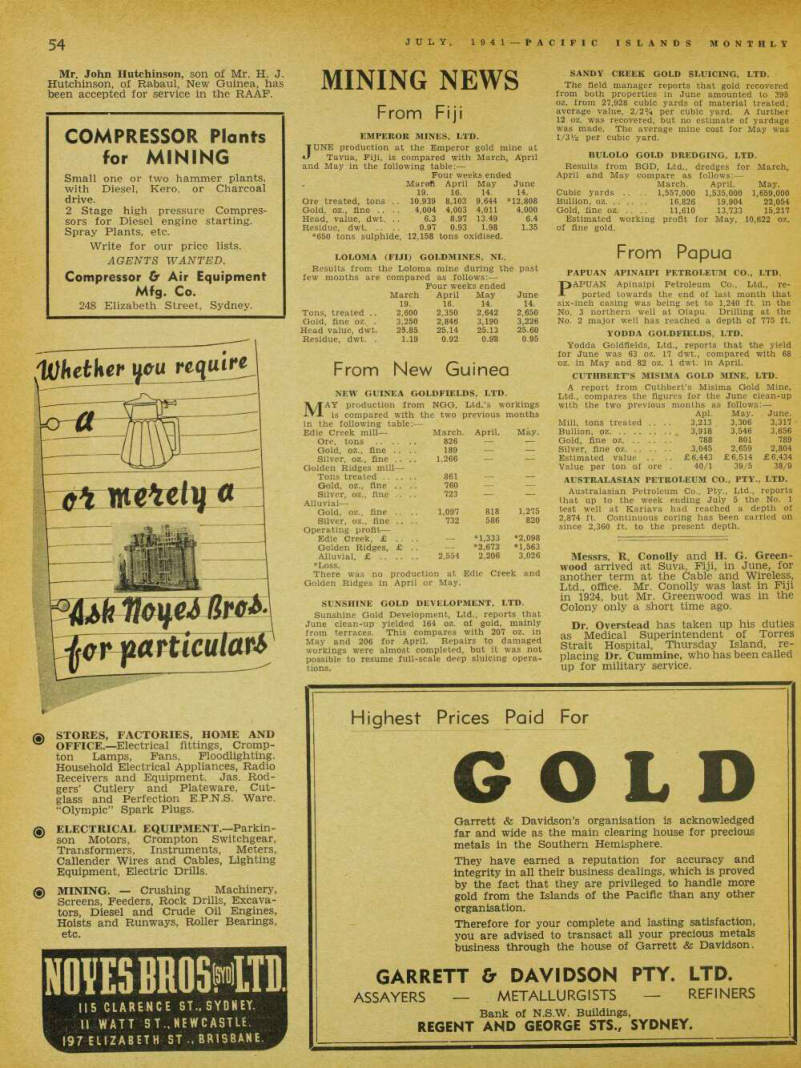
“AS pigs’ food, copra has proved com pletely satisfactory,” stated Mr. C.
Harington, supervisor of the Wai kato District Pig Council, at the annual meeting in New Zealand in mid-June.
“However, we must regard it as a war time food only—in peace-time the cost of copra is too great for it to be used in this manner.”
Mr. A. L. Armstrong, British Consul at Nukualofa, Tonga, arrived in Auckland, New Zealand, at the end of June. He was accompanied by Mrs. Armstrong and will spend a holiday in the Dominion. 1 ►! 1 f\ « Fi ’iRTF?
Mr. John Hutchinson, son of Mr. H. J.
Hutchinson, of Rabaul, New Guinea, has been accepted for service in the RAAP,
Advertisements & other items, pp. 54-56 (2 items)
Records
BY MAIL
PALING’S stock of all types of records exceeds 10,000.
Every title is immediately available. Order from Paling’s with confidence. Your records will be securely packed and dispatched on the same day.
Write now for full information
and FREE LISTS.
aL.
388 GEORGE STREET, SYDNEY.
As UNBEATABLE
as the
BRITISH
NAVY
« *** M Mr. E. Foad, of WAU, writes: — C/- T. A. Olsson, WAU, N.G.
Crammond Radio Mfg. Co., 8 Queen Street, Brisbane, Q.
Dear Sirs, The eight-valve CRAMMOND Receiver is still giving the same wonderful results. This receiver is like the British Navy. It has certainly got them all beaten.
Wishing you every success, Yours faithfully,
(Sgd.) E. FOAD.
Later he writes: — My CRAMMOND Receiver is as good as ever after THREE YEARS of service (in the torrid, tropical conditions), and I am entirely satisfied with it. (Sgd.) E. FOAD.
Sweeping the
Seven Seas . . .
Everything of World-Wide
interest is yours on a
" CRAMMOND "
EASY TERMS
ANYWHERE
4 YEARS' GUARANTEE
Sensational Long Range Reception. All parts specially protected against tropical conditions.
Govt. Quarters, Tulagi,
BRIT. SOLOMON ISLANDS.
The Manager, Crammond Radio Mfg. Co., 8 Queen Street, Brisbane.
Dear Sir, The radio is giving excellent results, both on Short W 7 ave and Broadcast, here in the Tropics, and compares more than favourably with the world-famous Dutch and American sets of similar and larger design, of which there are plenty around the Islands. I have seen some of your Portable and Mantel models in Papua, and had the pleasure of meeting your Service Agent in Port Moresby, but I am afraid I cannot remember his name, for it is too difficult. (For the benefit of our readers this gentleman’s name is Mr. A. Pechotsch.) Yours faithfully, (Sgd.) A. A. WALKER.
CRAMMOND RADIO
Please send me full particulars of Models, Terrm List, etc.
MANUFACTURING COMPANY,
NO. 8 QUEEN STREET, BRISBANE.
NAME
ADDRESS (P.1.M.)
State whether Battery, Vibrator, Air Cell, All-Electric.
PLEASE USE BLOCK LETTERS for Name and Address.
COMPRESSOR Plants
for MINING
Small one or two hammer plants, with Diesel, Kero, or Charcoal drive. 2 Stage high pressure Compressors for Diesel engine starting.
Spray Plants, etc.
Write for our price lists.
AGENTS WANTED.
Compressor & Air Equipment
Mfg. Co.
248 Elizabeth Street, Sydney.
(Whether yeti
h
far
(S) STORES, FACTORIES, HOME AND
w OFFlCE.—Electrical fittings, Crompton Lamps, Fans, Floodlighting.
Household Electrical Appliances, Radio Receivers and Equipment. Jas. Rodgers’ Cutlery and Plateware, Cutglass and Perfection E.P.N.S. Ware.
“Olympic” Spark Plugs.
/ s v ELECTRICAL EQUIPMENT.—Parkin-
son Motors, Crompton Switchgear, Transformers, Instruments, Meters, Callender Wires and Cables, Lighting Equipment, Electric Drills. (S) MINING. Crushing Machinery, Screens, Feeders, Rock Drills, Excavators, Diesel and Crude Oil Engines, Hoists and Runways, Roller Bearings, etc.
NOVESBROMTD
lIS CLARENCE ST., SYDNEY.
WATT ST.,NEWCASTLE.
L 197 ELIZABETH ST BRISBANE. .
53
ACIFIC ISLANDS MONTHLY JULY. 1941
Mining News
From Fiji
Emperor Mines, Ltd.
JUNE production at the Emperor gold mine at Tavua, Fiji, is compared with March, April and May in the following table: —-
Loloma (Fiji) Goldmines, Nl.
Results from the Loloma mine during the past few months are compared as follows:
From New Guinea
New Guinea Goldfields, Ltd.
MAY production from NGG, Ltd.’s workings is compared with the two previous months in the following table:—
Sunshine Gold Development, Ltd.
Sunshine Gold Development, Ltd., reports that June clean-up yielded 164 oz. of gold, mainly from terraces. This compares with 207 oz. in May and 206 for April. Repairs to damaged workings were almost completed, but it was not possible to resume full-scale deep sluicing opera tions.
Sandy Creek Gold Sluicing, Ltd.
The field manager reports that gold recovered from both properties in June amounted to 395 oz. from 27,928 cubic yards of material treated; average value, 2/2% per cubic yard. A further 12 oz. was recovered, but no estimate of yardage was made. The average mine cost for May was 1/3 Vz per cubic yard.
Bulolo Gold Dredging, Ltd.
Results from BGD, Ltd., dredges for March, April and May compare as follows:
From Papua
Papuan Apinaipi Petroleum Co., Ltd.
PAPUAN Apinaipi Petroleum Co., Ltd., re ported towards the end of last month that six-inch casing was being set to 1,240 ft. in the No. 3 northern well at Oiapu. Drilling at the No. 2 major well has reached a depth of 775 ft.
Yodda Goldfields, Ltd.
Yodda Goldfields, Ltd., reports that the yield for June was 63 oz. 17 dwt., compared with 68 oz. in May and 82 oz. 1 dwt. in April.
Cuthbert’S Misima Gold Mine, Ltd.
A report from Cuthbert’s Misima Gold Mine, Ltd., compares the figures for the June clean-up with the two previous months as follows; —
Australasian Petroleum Co., Pty., Ltd.
Australasian Petroleum Co., Pty., Ltd., reports that up to the week ending July 5 the No. 1 test well at Kariava had reached a depth of 2,874 ft. Continuous coring has been carried on since 2,360 ft. to the present depth.
Messrs. R. Conolly and H. G. Green wood arrived at Suva, Fiji, in June, for another term at the Cable and Wireless, Ltd., office. Mr. Conolly was last in Fiji in 1924, but Mr. Greenwood was in the Colony only a short time ago.
Dr. Overstead has taken up his duties as Medical Superintendent of Torres Strait Hospital, Thursday Island, re placing Dr. Cummine, who has been called up for military service.
Four weeks ended . Maroft April May June 19. 16. 14. 14.
Ore treated, tons . . 10,939 8,103 9,644 *12,808 Gold, oz., fine .. .. 4,004 4,003 4,011 4,000 Head, value, dwt. .. 6.3 8.97 13.49 6.4 Residue, dwt 0.97 0.93 1.98 1.35 *650 tons sulphide, 12,158 tons oxidised.
Four weeks ended March April May June 19. 16. 14. 14.
Tons, treated .. 2,600 2,350 2,642 2,650 Gold, fine oz. . 3,250 2,846 3,190 3,226 Head value, dwt. 23.85 25.14 25.13 25.60 Residue, dwt. . 1.19 0.92 O.S'S 0.95
Edie Creek mill— March. April.
May.
Ore, tons 826 — -— Gold, oz., fine . . . . 189 — — Silver, oz., fine .. .. 1,266 — — Golden Ridges mill— Tons treated 861 — — Gold, oz., fine .. .. 760 — — Silver, oz., fine .. . . 723 — — Alluvial— Gold, oz., fine .. 1,097 818 1,275 Silver, oz., fine .. .. 732 586 820 Operating profit— Edie Creek, £ . . — *1,333 *2,098 Golden Ridges, £ .. — *2,673 *1,563 Alluvial, £ 2,554 2,206 3.026 *Loss.
There was no production at Golden Ridges in April or May.
Edie Creek and
March.
April, May.
Cubic yards .. . . 1,557,000 1,535,000 1,659,000 Bullion, oz. . 16,826 19,904 22,054 Gold, fine oz 11,610 13,733 15,217 Estimated working profit for May, 10,622 oz. of fine gold.
Apl. May. June.
Mill, tons treated .. .. 3,213 3,306 3,317 Bullion, oz 3,918 3,546 3,656 Gold, fine OZ 788 801 789 Silver, fine oz 3,045 2,659 2,804 Estimated value .. .. £6,443 £6,514 £6,434 Value per ton of ore . 40/1 39/5 38/9
Advertisements & other items, p. 56 (1 item)
Gold
Highest Prices Paid For
Garrett & Davidson’s organisation is acknowledged far and wide as the main clearing house for precious metals in the Southern Hemisphere.
They have earned a reputation for accuracy and integrity in all their business dealings, which is proved by the fact that they are privileged to handle more gold from the Islands of the Pacific than any other organisation.
Therefore for your complete and lasting satisfaction, you are advised to transact all your precious metals business through the house of Garrett & Davidson.
GARRETT & DAVIDSON PTY. LTD.
ASSAYERS METALLURGISTS REFINERS
Bank of N.S.W. Buildings,
REGENT AND GEORGE STS., SYDNEY.
Islands Mining Shares
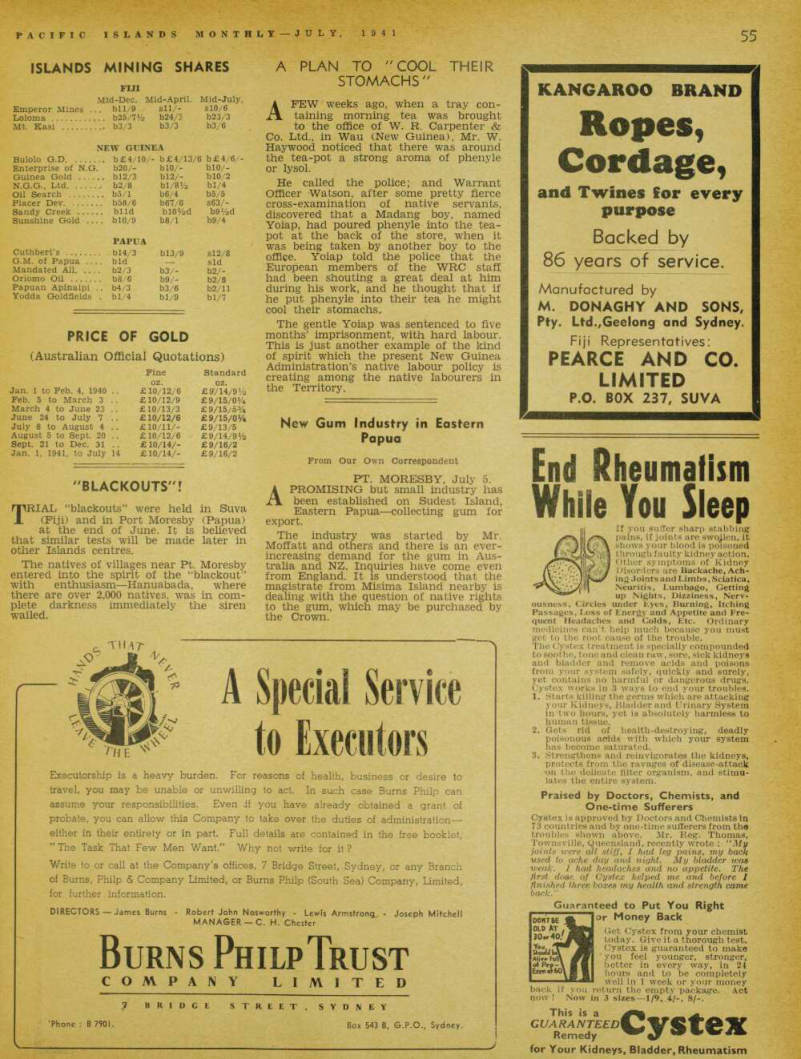
Fiji
Mid-Dec. Mid-April. Mid-July.
Emperor Mines . . . bll/9 sll/slO/6 Loloma .. b25/7»/ z b24/3 b23/3 Mt. Kasi b3/3 b3/6 Bulolo G.D
New Guinea
.. b£4/10/- b£4/13/6 b£4/6/- Enterprise of N.G b20/blO/blO/- Guinea Gold . .. . .. bl2/3 bl2/blO/2 N.G.G., Ltd . b2/8 bl/SVa bl/4 Oil Search .. b5/l b6/4 b5/5 Placer Dev .. b58/6 b67/6 s63/- Sandy Creek .. blld blOV 2 d hdVsd Sunshine Gold .. .. blO/9 b8/l b9/4 Cuthbert’s
Papua
. bl4/3 bl3/9 S12/8 G.M. of Papua .. .. bid — sld Mandated All. ... . b2/3 b3/b2/- Oriomo Oil b8 6 b9/b2/8 Papuan Apinaipi .. b4/3 b3/6 b2/ll Yodda Goldfields . bl/4 bl/9 bl/7
Price Of Gold
(Australian Official Quotations)
Pine Standard oz. oz.
Jan. 1 to Feb. 4, 1940 .. £10/12/6 £9’/14/9 1 / 2 Feb. 5 to March 3 .. £10/12/9 £9/15/014 March 4 to June 23 .. £10/13/3 £9/15/5 3 / 4 June 24 to July 7 .. £10/12/6 July 8 to August 4 .. £10/11/- £9/13/5 August 5 to Sept. 20 .. £10/12/6 £9/14/9VSi Sept. 21 to Dec. 31 .. £10/14/- £9/16/2 Jan, 1, 1941, to July 14 £10/14/- £9/16/2
"Blackouts"!
TRIAL “blackouts” were held in Suva (Fiji) and in Port Moresby (Papua) at the end of June. It is believed that similar tests will be made later in other Islands centres.
The natives of villages near Pt. Moresby entered into the spirit of the “blackout” with enthusiasm—Hanuabada, where there are over 2,000 natives, was in com plete darkness immediately the siren wailed.
A Plan To " Cool Their
Stomachs "
A FEW weeks ago, when a tray con taining morning tea was brought to the office of W. R. Carpenter & Co. Ltd., in Wau (New Guinea), Mr. W.
Haywood noticed that there was around the tea-pot a strong aroma of phenyle or lysol.
He called the police; and Warrant Officer Watson, after some pretty fierce cross-examination of native servants, discovered that a Madang boy, named Yoiap, had poured phenyle into the tea pot at the back of the store, when it was being taken by another boy to the office, Yoiap told the police that the European members of the WRC staff had been shouting a great deal at him during his work, and he thought that if he put phenyle into their tea he might cool their stomachs.
The gentle Yoiap was sentenced to five months’ imprisonment, with hard labour.
This is just another example of the kind of spirit which the present New Guinea Administration’s native labour policy is creating among the native labourers in the Territory.
Papua
New Gum Industry in Eastern Papua
From Our Own Correspondent
Pt. Moresby, July 5.
A PROMISING but small industry has been established on Sudest Island, Eastern Papua—collecting gum for export.
The industry was started by Mr.
Moffatt and others and there is an ever increasing demand for the gum in Aus tralia and NZ. Inquiries have come even from England. It is understood that the magistrate from Misima Island nearby is dealing with the question of native rights to the gum, which may be purchased by the Crown.
Advertisements & other items, pp. 57-58 (2 items)
to Executors
KANGAROO BRAND
Ropes,
Cordage,
and Twines for every purpose
Backed by
86 years of service.
Manufactured by
M. DONAGHY AND SONS,
Pty. Ltd.,Geelong and Sydney.
Fiji Representatives:
PEARCE AND CO.
LIMITED
P.O. BOX 237, SUVA
End Rheumatism
While You Sleep
If you suffer sharp stabbing pains, if joints are swollen, it shows your blood is poisoned through faulty kidney action.
Other symptoms of Kidney Disorders are Backache, Aching Joints and Limbs, Sciatica, Neuritis, Lumbago, Getting up Nights, Dizziness, Nervousness, Circles under Lyes, Burning, Itching Passages, Loss of Energy and Appetite and Frequent Headaches and Colds, Etc. Ordinary medicines can’t help much because you must get to the root cause of the trouble.
The Cystcx treatment is specially compounded to soothe, tone and clean raw, sore, sick kidneys and bladder and remove acids and poisons from your system safely, quickly and surely, yet contains no harmful or dangerous drugs.
Cystex works in 3 ways to end your troubles. 1. Starts killing the germs which are attacking your Kidneys, Bladder and Urinary System in two hours, yet is absolutely harmless to human tissue. 2. Gets rid of health-destroying, deadly poisonous adds with which your system has become saturated. 3. Strengthens and reinvigorates the kidneys, protects from the ravages of disease-attack on the delicate filter organism, and stimulates the entire system.
Praised by Doctors, Chemists, and
One-time Sufferers Cystex is approved by Doctors and Chemists in 73 countries and by one-time sufferers from the troubles shown above. Mr. Reg. Thomas, Townsville, Queensland, recently wrote : “My joints were all stiff, I had leg pains, my hack used to ache day and night. My bladder was weak. I had headaches and no appetite. The first dose of Cystex helped me and before I finished three boxes my health and strength came back."
Guaranteed to Put You Right or Money Back Get Cystex from your chemist today. Give it a thorough test.
Cystex is guaranteed to make ‘ you feel younger, stronger, better in every way, in 24 hours and to be completely well in 1 week or your money back if you return the empty package. Act now ! Now in 3 sizes —l/9, 4/-. 8/-.
cJ Hf £D Cystex
for Your Kidneys, Bladder, Rheumatism %□ 00NT 66
OLD AT
300r4 You Should k Alive hi of Pep
w.
The
A Special Service
to Executors
Executorship is a heavy burden. For reasons of health, business or desire to travel, you may be unable or unwilling to act. In such case Burns Philp can assume your responsibilities. Even if you have already obtained a grant of probate, you can allow this Company to take over the duties of administration— either in their entirety or in part. Full details are contained in the free booklet, " The Task That Few Men Want." Why not write for it ?
Write to or call at the Company's offices, 7 Bridge Street, Sydney, or any Branch of Burns, Philp <S Company Limited, or Burns Philp (South Sea) Company, Limited, for further information.
DIRECTORS James Burns - Robert John Nosworthy - Lewis Armstrong - Joseph Mitchell MANAGER C. H. Chester
Burns Philp Trust
COMPANY LIMITED
? BRIDGE STREET. SYDNEY
'Phone : B 7901. Box 543 B. G.P.0., Sydney.
WORLD'S LATEST
GAMES
Darts Boards with 6 Darts, 8/6.
Play Brass Competition Darts, Set of 3, 3/11, 4/6, 5/6. Monopoly, 11/6.
Totopoly, 11/6. Bucaneer, 11/6. 3 of the World’s Most Popular Games.
Chinese Checkers, 2/9, 5/-, 9/-.
Tripoly Card Game , 5/3. De Luxe Type, 11/6. Poker Rummy, 1/1.
Dice of all kinds In stock. Poker Dice, 6/6, 7/6, 8/6, 10/6, set of 5.
Crown & Anchor Dice, set of 3, 5/6.
Full Set with Cloth and Shaker, 10/6. H. & T., 5 & 6. and Hazard Dice, 5-8 in., 5 for 8/6; 7-8 in., 11 for 5/-.
Wet Battery Testers, 3/-.
Nickel Cased Volt Meters, Pocket Type, 2 Reading, High & Low, 4/6.
British Make 3 Readings, 10/6. 12 Snappy Books —Jokes, Have Fun, etc., 5/6 the lot.
All About Aerial Booklet, 1-/. Radio Dictionary, 1/-. Morse Code Book, 1/-. Radio Alphabet, 1/-. The 4 books for 3/3.
Roulette Wheels, complete, 25/-.
The Best Trick Pack of Cards available, 3/6. Hundreds of Tricks you can do. Fullest, simple instructions provided.
PRESTO, THE MAGIC BOX.
2/9
FREE.
FREE.
9 2/9
POST
POST
MOST AMAZING TRICK EVER.
Special Wholesale Price in quantities.
Now available (not less than 10/parcels): Magic Wand, 1/6 Jafet’s Wallet 1/-; Obedient Ball 1/6; Magic Penny, 2/6; Mystic Head Chopper, 2/6; Shy Lock, 2/-; Dribble Glass, 2--; Ventrillo, 1/-; Magic Coin, 1/-; Nest of Nests, 5/-; Voice Echoer, 1/-; Magic Bottle, 1/-; 3 Bell Trick, 1/-.
Magic Wand 1/6; Wonderful Rattle Box Trick, 2/6. Mixed Parcels of Tricks, 10/-, 20/-, 30/-, 40/-, 50/-.
Parcel of Jokes, 10/-. 12/6, 15/-.
The Magic Money Roll, 3/6. 10/-, £1 and £5 Notes appear when you know how a simple yet entertaining trick.
EGG & BAG
TRICK, 2/6.
Easy to Perform —Splendid to see Worked.
Instructions Supplied.
SWOOP! BRITAIN’S BEST.
“Amplion,” Bakellte PICK-UP, with Volume Control incorporated. Brand new, in original cartons. Listed to sell at 38/6. Now 32/6. Fits and suits all sets. Battery or Electric.
MAKE YOUR OWN RECORDINGS
Overhead Cutting Gear and Cutting Head for Home Radio-Gramophone Recording, £5/5/-. Used in conjunction with your present radio.
Records, Needles, etc., etc. Metal Discs, 1/-, 1/6.
Microphones for Speech, Song or Music. Hook-up in a jiffy to any set. 15/-, 17/6, 18/6 complete.
Batteryless Type Hand - holding Microphones, fit any set, 25/-, Ormond 3 In. Front-panel Vernier Dial, 2 actions, 8/6.
HEADPHONES.
12/6, 17/6.
S.T.C., British, 30/-; 8.T.H., 30/-; Llssen, British, 19/6. All 4,000 ohms. m Rubber Head-’phone Pads, 2/6 pr Ericcson’s Professional Type, 47/6.
RADIO VALVES.—We guarantee a Better Price. Send your order.
ALL DRY BATTERIES STOCKED.
A new hobby—Rough Castings of Modern Planes, Ash Trays, Paper Knives, etc., etc. Write for Free Booklet.
New Radio and Other Books Just Landed. Everyman’s Wireless Book, 8/6; Toy Making for Amateurs, 2/-; Sixty Tested Circuits, 6/6; How to Make Models, 2/6; The First Course in Wireless, 9/6; Wireless Terms Explained, 6/6.
B.G.E. Table Model Microphone for Speech or Music —fits and suits all sets; as good a performer as any; £6/6/- Model. Now 45/-.
Small Table Model British Built Microphone, for all sets, 15/-, 21/-, 22/6, for speech or music. 2 Reading Pocket Volt Meters, 5/6.
Portable battery operated Light with pull switch and Battery Block, 8/6.
Bench Type Meter Reads All in Radio, 30/-.
POCKET VOLT
METERS.
Two Reading Pocket Meter, for A id B Batteries, 2/6, 3/9, 4/9, 7/6.
Reading. A and B Batteries, and , to 30 M/A, 10/6. 3 Reading De ixe Model, 12/6. 4 Reading, 14/-.
LEARN MORSE CODE. “LIKE-A-
FLASH” KITS. KEYS & BUZZERS.
P.M.G. type Key with Professional Buzzer & Battery, all assembled on Base Board, 42/6.
LEVENSON'S
SPECIALISE IN RADIO
SETS FOR THE ISLANDS
TRADE
100% satisfaction guaranteed.
Liberal prices—no mass production sets real he-man radio designed and built for your particular location. Short wave and dual wave radio for dry battery or electric current
operation.
Quotations with pleasure.
Money Belts for Soldiers, Sailors or Civilians. Zipper Types, 9/6. Others, 6/6, 7/6.
Electric Military Brush, 15/-.
Stimulates the Scalp and Hair.
Aerial Stay-wire strainers, 2/6.
De Luxe Model British-built Lightning Arresters, complete for indoor or outdoor use, 6/-.
Non-jam Pulleys with halyard bolt, 1/9. Special Radio Earth Spike 4/6. 4 in. 4 in 1 Nickel Screw Drivers, bakelite or metal, 2/-. . Fountain Pen size. Cone Speaker Units, 25/-; Now 12/6. 1,500 ft. Beam Electric Torches, 5 Cell, 8/6. Both use Standard Batteries. Everyman’s Wireless Book, 8/6. 2 to 3 Cell Expandable Torches.
Nickelled Case—Dimmer incorporated.
Daylight Globes, 10/6.
Swiss Music Boxes for Cigarette, Trinkets, etc., 25/-, 30/-, 45/-.
Steel Money and Deed Boxes, 63/-.
They ring when opened or lifted.
A Splendid Article.
Hunting and Sporting Knives. Remington U.S.A. made, 10/6, 12/6, 15/6, 16/6. (All in Sheath.) Throwing Knives, 8/9; Small Throwing Knives, 7/6; Set of 2, 15/-; Set of 3, 22/6; De Luxe Throw Knife, 21/-. All in Sheaths. / //•/ 39 L*l A Morse Code Light and Buzzer Set.
A precision De-luxe outfit that cannot be bettered. Perfect Adjustable Morse Code Key, with professional type Buzzer. Light to Buzzer throw-over Switch, and Battery, all ready mounted.
Morse Set Buzzer or light with single switch. All parts include adjustable Key, Switch, Buzzer, Lamp and Battery, all assembled on Base Board, 30/-.
Morse Code Set “De Luxe”. Adjustable High-grade Key, Buzzer and Battery. All mounted on base board ready for use, 27/6.
Adjustable Morse Code Key on Bakelite Base, highly plated parts, 12/6. High-grade instrument.
De Luxe Junior Morse Code Outfit.
Mounted Key Buzzer and Battery. 13/6 complete. Morse Book, 1/-.
P.M.G. Model Adjustable Morse Code Key. Precision fittings, 19/6.
BOOKS! BOOKS! BOOKS! The Be-
ginners’ Book of Radio. The Radio Beginners’ Dictionary. 2/- the 2. The Wireless Constructor’s Encyclopaedia. Giant size, 7/6. Newnes “Everyman’s” Wireless Book, 5/6.
The Book of Practical Radio, also The Book of Practical Tele-
iiinmiiminnnro Write for Punch Board Leaflets irnmimiiiiiimiii
J. LEVENSON Radio
GAMES, NOVELTIES AND HOBBIES.
226 A PITT STREET, SYDNEY
Manufacturers, Importers, and Exporters.
N.S.W., AUSTRALIA.
iiiniiiiiiiiniiiiiiiiiii
Write for Pin-Game, Totem and Odds and Evens Leaflets
sminnmmnmnni
Cable address: "Leveradioh”. Goods forwarded V.P.P. or Sight Draft. Satisfaction and Service Guaranteed. We can supply by mall all General Merchandise at a Better Price. Quotations with pleasure. Please add freight and packing. Write for full list of interesting leaflets of Games, Hobbies, Novelties, and Electrical Goods. Write for full list of Radio Meters.
NOW 49/6
“COSMOCORD”
RADIO-GRAMO
Suits all
CRYSTAL
PICK-UP.
Sets.
vision, 8/6 each. Levenson’s Giant “Party and Fun Book”, 1/6. Humorous Stories and Recitations, 3|/9.
Card and Conjuring Tricks, 3/9. Tea-Cup Fortune Telling, 3/9. 100 Party Games for Old and Young, 1/9. Popular Magic and Amateur Conjurer, 1/9. 50 Best Party Games, 1/6.
Tricks with Cards, 1/6.
How to make 1 & 2 Valve Battery Sets, 1/-.
We Con Supply, at a Keen Price, Any Available Article You Require.
56
JtJLIf, 1941 HCIHC ISLANDS MONTHLY
Australian Short- Wave
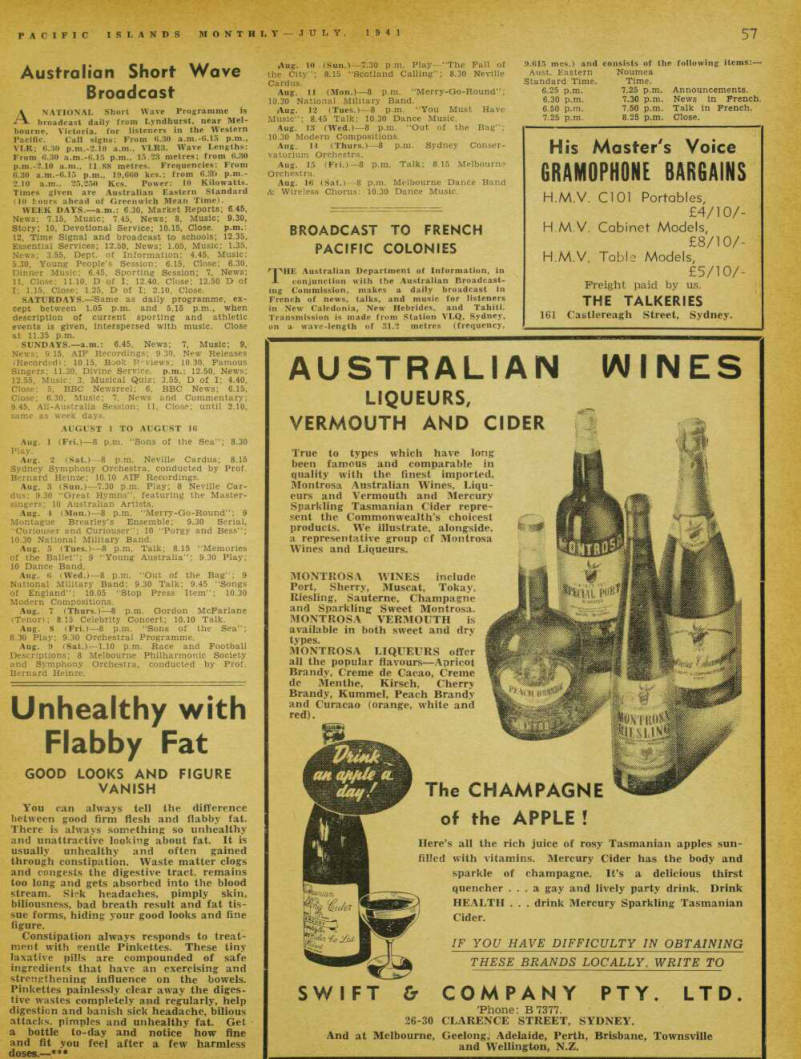
Broadcast
A NATIONAL Short Wave Programme is broadcast daily from Lyndhurst, near Mel bourne, Victoria, for listeners in the Western Pacific. Call signs: From 6.30 a.m.-6.15 p.m., VLR; 6.30 p.m.-2.10 a.m., VLR3. Wave Lengths: From 6.30 a.m.-6.15 p.m., 15.23 metres; from 6.30 p.m.-2.10 a.m., 11.88 metres. Frequencies; From 6.30 a.m.-6.15 p.m., 19,660 kcs.; from 6.3 b p.m.- 2.10 a.m., 25,250 Kcs. Power; 10 Kilowatts.
Times given are Australian Eastern Standard (10 hours ahead of Greenwich Mean Time).
WEEK DAYS.—a.m.: 6.30, Market Reports; 6.45, News; 7.15, Music; 7.45, News; 8, Music; 9.30, Story; 10, Devotional Service; 10.15, Close, p.m.; 12, Time Signal and broadcast to schools; 12.35, Essential Services: 12.50, News; 1.05, Music; 1.35, News; 3.55, Dept, of Information; 4.45, Music; 5.30, Young People’s Session; 6.15, Close; 6.30, Dinner Music; 6.45, Sporting Session; 7, News; 11, Close: 11.10, D of I; 12.40, Close; 12.50 D of I; 1.15, Close; 1.25, D of I; 2.10, Close.
SATURDAYS.—Same as daily programme, ex cept between 1.05 p.m. and 5.15 p.m., when description of current sporting and athletic events is given, interspersed with music. Close at 11.35 p.m.
SUNDAYS.—a.m.: 6.45, News; 7, Music; 9, News; 9’. 15. AIF Recordings; 9.30, New Releases (Recorded): 10.15, Book Reviews; 10.30. Famous Singers; 11.30, Divine Service, p.m.: 12.50, News; 12.55, Music; 3, Musical Quiz; 3.55, D of I; 4.40, Close; 5, BBC Newsreel; 6, BBC News; 6.15, Close; 6.30. Music; 7, News and Commentary; 9.45, All-Australia Session; 11, Close; until 2.10, same as week days.
August 1 To August 16
Aug. I (Fri.) —8 p.m. “Sons of the Sea”; 8.30 Play.
Aug. 2 (Sat.) —8 p.m. Neville Cardus; 8.15 Sydney Symphony Orchestra, conducted by Prof.
Bernard Heinze; 10.10 AIF Recordings.
Aug. 3 (Sun.) —7.30 p.m. Play; 8 Neville Car dus: 9.30 “Great Hymns”, featuring the Master singers; 10 Australian Artists.
Aug. 4 (Mon.) —8 p.m. “Merry-Go-Round”; 9 Montague Brearley’s Ensemble; 9.30 Serial, "Curiouser and Curiouser”; 10 “Porgy and Bess”; 10.30 National Military Band.
Aug. 5 (Tues.) —8 p.m. Talk; 8.15 “Memories of the Ballet”: 9 “Young Australia”: 9.30 Play; 10 Dance Band.
Aug. 6 (Wed.) —8 p.m. “Out of the Bag”; 9 National Military Band; 9.30 Talk; 9.45 “Songs of England”; 10.05 “Stop Press Item”; 10.30 Modern Compositions.
Aug. 7 (Thurs.)—B p.m. Gordon McFarlane (Tenon; 8.15 Celebrity Concert; 10.10 Talk.
Aug. 8 (Fri.) —8 p.m. “Sons of the Sea”; 8.30 Play; 9.30 Orchestral Programme.
Aug. 9 (Sat.) —1.10 p.m. Race and Football Descriptions: 8 Melbourne Philharmonic Society and Symphony Orchestra, conducted by Prof.
Bernard Heinze.
Aug. 10 (Sun.) —7.30 p.m. Play—“ The Fall of the City’’; 8.15 “Scotland Calling”; 8.30 Neville Cardus.
Aug. 11 (Mon.) —8 p.m. “Merry-Go-Round”; 10.30 National Military Band.
Aug. 12 (Tues.) —8 p.m. “You Must Have Music”; 8.45 Talk; 10.30 Dance Music.
Aug. 13 (Wed.) —8 p.m. “Out of the Bag”; 10.30 Modern Compositions.
Aug. 14 (Thurs.) —8 p.m. Sydney Conser vatorium Orchestra.
Aug. 15 (Fri.) —8 p.m. Talk; 8.15 Melbourne Orchestra.
Aug. 16 (Sat.) —8 p.m. Melbourne Dance Band & Wireless Chorus: 10.30 Dance Music.
Broadcast To French
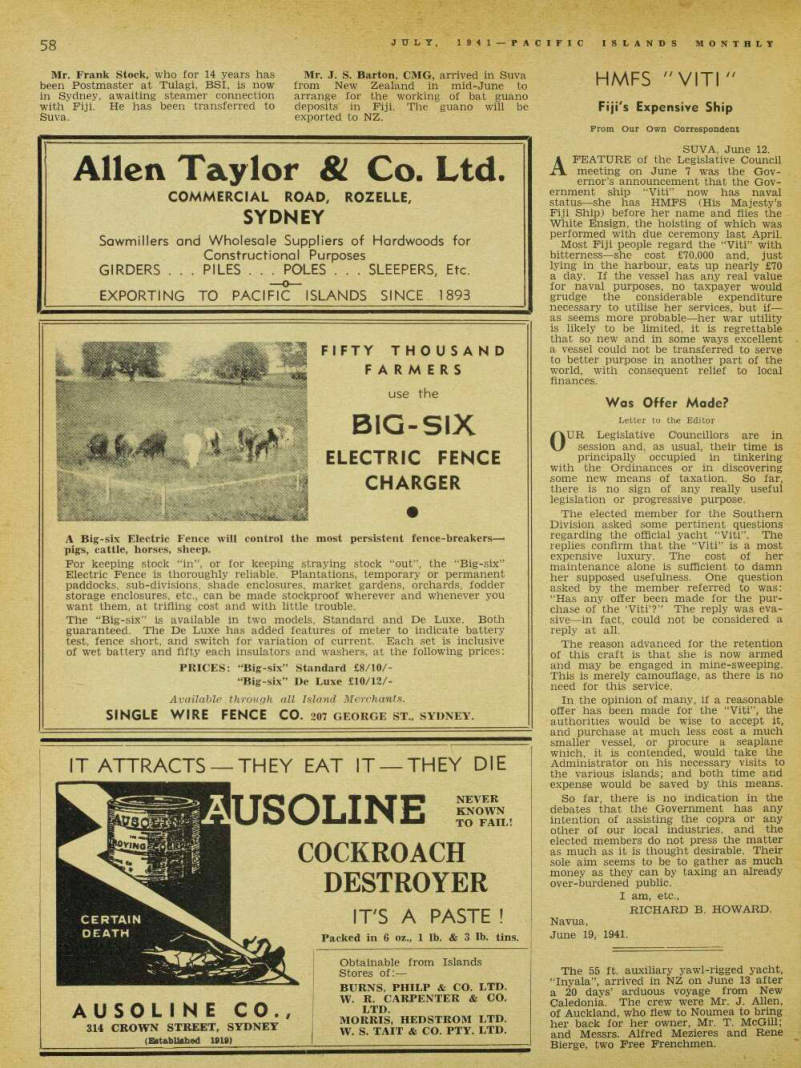
Pacific Colonies
'T'HE Australian Department of Information, in A conjunction with the Australian Broadcast ing Commission, makes a daily broadcast in French of news, talks, and music for listeners in New Caledonia, New Hebrides, and Tahiti.
Transmission is made from Station VLQ, Sydney, on a wave-length of 31.2 metres (frequency,
9.615 mcs.) and consists of the following items:—
Aust. Eastern Noumea Standard Time.
Time. 6.25 p.m. 7.25 p.m.
Announcements. 6.30 p.m. 7.30 p.m.
News in French. 6.50 p.m. 7.50 p.m.
Talk in French, 7.25 p.m. 8.25 p.m.
Close.
Mr. Frank Stock, who for 14 years has been Postmaster at Tulagi, BSI, is now in Sydney, awaiting steamer connection with Fiji. He has been transferred to Suva.
Mr. J, S. Barton, CMG, arrived in Suva from New Zealand in mid-June to arrange for the working of bat guano deposits in Fiji. The guano will be exported to NZ.
Advertisements & other items, pp. 59-60 (2 items)
Australian Iaiines
His Moster's Voice
GRAMOPHONE OAR6AINS
H.M.V. Cl 01 Portables, £4/10/- H.M.V. Cabinet Models, £B/10/- H.M.V. Table Models, £5/10/- Freight paid by us.
THE TALKERIES
161 Castlereagh Street, Sydney.
AUSTRALIAN IAIINES
LIQUEURS,
VERMOUTH AND CIDER
True to types which have long been famous and comparable in quality with the finest imported, Montrosa Australian Wines, Liqueurs and Vermouth and Mercury Sparkling Tasmanian Cider represent the Commonwealth’s choicest products. We illustrate, alongside, a representative group of Montrosa Wines and Liqueurs.
MONTROSA WINES include Port, Sherry, Muscat, Tokay, Riesling, Sauterne, Champagne and Sparkling Sweet Montrosa.
MONTROSA VERMOUTH is
available in both sweet and dry types.
MONTROSA LIQUEURS offer
all the popular flavours—Apricot Brandy, Creme de Cacao, Creme de Menthe, Kirsch, Cherry Brandy, Kummel, Peach Brandy and Curacao (orange, white and red). :w >n w-
■SWUM*
mmni
The CHAMPAGNE
of the APPLE !
Here’s all the rich juice of rosy Tasmanian apples sunfilled with vitamins. Mercury Cider has the body and sparkle of champagne. It’s a delicious thirst quencher ... a gay and lively party drink. Drink HEALTH . . . drink Mercury Sparkling Tasmanian Cider.
IF YOU HAVE DIFFICULTY IN OBTAINING
THESE BRANDS LOCALLY , WRITE TO
SWIFT & COMPANY PTY. LTD.
’Phone; 87377.
26-30 CLARENCE STREET, SYDNEY.
And at Melbourne, Geelong, Adelaide, Perth, Brisbane, Townsville and Wellington, N.Z.
Allen Taylor & Co. Ltd.
COMMERCIAL ROAD, ROZELLE,
SYDNEY
Sawmillers and Wholesale Suppliers of Hardwoods for Constructional Purposes GIRDERS . . . PILES . . . POLES . . . SLEEPERS, Etc.
EXPORTING TO PACIFIC ISLANDS SINCE 1893
F I FTY THOUSAND
FARMERS
use the
BIG-SIX
ELECTRIC FENCE
CHARGER
A Big -six Electric Fence will control the most persistent fence-breakers— pigs, cattle, horses, sheep.
For keeping stock “in”, or for keeping straying stock “out”, the “Big-six”
Electric Fence is thoroughly reliable. Plantations, temporary or permanent paddocks, sub-divisions, shade enclosures, market gardens, orchards, fodder storage enclosures, etc., can be made stockproof wherever and whenever you want them, at trifling cost and with little trouble.
The “Big-six” is available in two models, Standard and De Luxe. Both guaranteed. The De Luxe has added features of meter to indicate battery test, fence short, and switch for variation of current. Each set is inclusive of wet battery and fifty each insulators and washers, at the following prices: PRICES: “Big-six” Standard £B/10/- “Big-six” De Luxe £lO/12/- Available through all Island Merchants.
SINGLE WIRE FENCE CO. 207 george st., Sydney.
IT ATTRACTS —THEY EAT IT —THEY DIE Lino
3USOLINE
NEVER
KNOWN
TO FAIL!
AUSOL I N E CO.,
314 CROWN STREET, SYDNEY
(Established 1910)
COCKROACH
DESTROYER
IT'S A PASTE !
Packed in 6 oz., 1 lb. & 3 lb. tins.
Obtainable from Islands Stores of: —
BURNS, PHILP & CO. LTD.
W. R. CARPENTER & CO.
LTD.
MORRIS, HEDSTROM LTD.
W. S. TAIT & CO. PTY. LTD.
Unhealthy with
Flabby Fat
GOOD LOOKS AND FIGURE
VANISH
You can always tell the difference between good firm flesh and flabby fat.
There is always something so unhealthy and unattractive looking about fat. It is usually unhealthy and often gained through constipation. Waste matter clogs and congests the digestive tract, remains too long and gets absorbed into the blood stream. Sick headaches, pimply skin, biliousness, bad breath result and fat tissue forms, hiding your good looks and fine figure.
Constipation always responds to treatment with gentle Pinkettes. These tiny laxative pills are compounded of safe ingredients that have an exercising and strengthening influence on the bowels.
Pinkettes painlessly clear away the digestive wastes completely and regularly, help digestion and banish sick headache, bilious attacks, pimples and unhealthy fat. Get a bottle to-day and notice how fine and fit you feel after a few harmless doses.— ♦♦♦
Hmfs " Viti "
Fiji's Expensive Ship
Prom Our Own Correspondent SUVA, June 12.
A FEATURE of the Legislative Council meeting on June 7 was the Gov ernor’s announcement that the Gov ernment ship “Viti” now has naval status —she has HMFS (His Majesty’s Fiji Ship) before her name and flies the White Ensign, the hoisting of which was performed with due ceremony last April.
Most Fiji people regard the “Viti” with bitterness —she cost £70,000 and, just lying in the harbour, eats up nearly £7O a day. If the vessel has any real value for naval purposes, no taxpayer would grudge the considerable expenditure necessary to utilise her services, but if — as seems more probable—her war utility is likely to be limited, it is regrettable that so new and in some ways excellent a vessel could not be transferred to serve to better purpose in another part of the world, with consequent relief to local finances.
Was Offer Made?
Letter to the Editor OUR Legislative Councillors are in session and, as usual, their time is principally occupied in tinkering with the Ordinances or in discovering some new means of taxation. So far, there is no sign of any really useful legislation or progressive purpose.
The elected member for the Southern Division asked some pertinent questions regarding the official yacht “Viti”. The replies confirm that the “Viti” is a most expensive luxury. The cost of her maintenance alone is sufficient to damn her supposed usefulness. One question asked by the member referred to was: “Has any offer been made for the pur chase of the ‘Viti’?” The reply was eva sive—in fact, could not be considered a reply at all.
The reason advanced for the retention of this craft is that she is now armed and may be engaged in mine-sweeping.
This is merely camouflage, as there is no need for this service.
In the opinion of many, if a reasonable offer has been made for the “Viti”, the authorities would be wise to accept it, and purchase at much less cost a much smaller vessel, or procure a seaplane which, it is contended, would take the Administrator on his necessary visits to the various islands; and both time and expense would be saved by this means.
So far, there is no indication in the debates that the Government has any intention of assisting the copra or any other of our local industries, and the elected members do not press the matter as much as it is thought desirable. Their sole aim seems to be to gather as much money as they can by taxing an already
over-burdened public.
I am, etc.,
Richard B. Howard.
Navua, June 19, 1941.
The 55 ft. auxiliary yawl-rigged yacht, “Inyala”, arrived in NZ on June 13 after a 20 days’ arduous voyage from New Caledonia. The crew were Mr. J. Allen, of Auckland, who flew to Noumea to bring her back for her owner, Mr. T. McGill; and Messrs. Alfred Mezieres and Rene Bierge, two Free Frenchmen.
Islands Produce
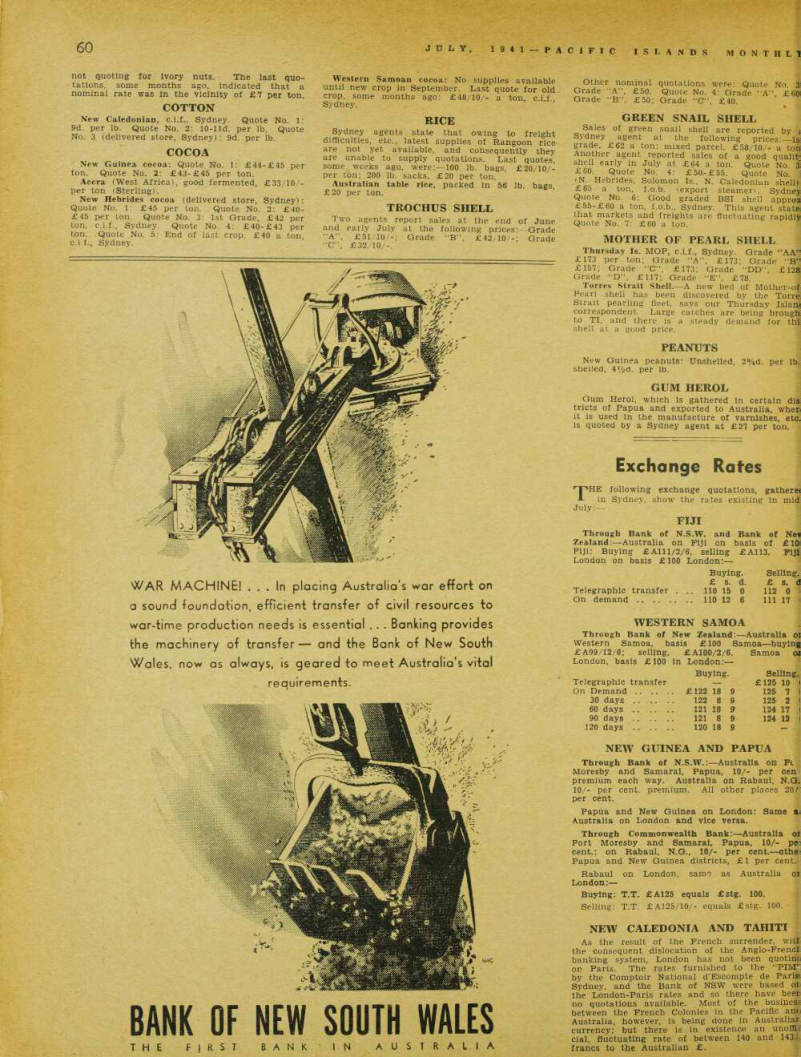
THE following quotations were obtained in Sydney in mid-July:—
Coffee
Java: Robusta, f.a.q., imported on firm conversion of exchange, c.i.f.. prompt shipment, Sydney (Sterling): Quote No. 1: 43/-. Quote No. 2: 41/6.
Boengie (a good quality Java coffee), c.i.f., Sydney, 52/-.
Kenya, f.a.q., immediate shipment, c.i.f., Sydney, per cwt. (Stg.): Quote No. 1: Grade “B”, 68/-; “C”, 65/-.
East Africa: Robusta, f.a.q., c.i.f., Sydney, 43/6. Mocha (Standard Billy), f.a.q., c.i.f., Sydney, 54/-.
Mysore, f.a.q., c.i.f., Sydney, per cwt. Quote No. 1: Ships’ assortment, Government pool formed, Grade "A”, 82/-; Grade “B”, 76/-; Grade “C”, 69/-, (It has been reported In Sydney, however, that parcels have been bought at prices lower than the above official quo tations.) Arabian (Aden) Hodeidah, f.a.q., c.i.f., Sydney.
No. 1 quotation: 82/-.
NG and Papua: Quote No. 1: B%d. per lb. (delivered store, Sydney), medium quality.
Quote No. 2: 8%d.-9%d. per lb. (delivered store, Sydney). Quote No. 3: 8 3 / 4 d.-9d. per lb., c.i.f., Sydney. Quote No. 4: Sales in June at 9 5 / B d. per lb., c.i.f., Sydney.
New Caledonian: Some Sydney agents report that as there Is no Government grading system in the Colony, New Caledonian coffee coming into Australia varies considerably in quality, making it difficult to give general quotations on either the Arabica or Robusta grades. Each parcel, it is stated, must be treated on Its merits. The following are quotations obtained from several different sources in July.—Quote No. 1 (in store, Sydney): Arabica, from 10 7 / s d. to liy 2 d. per lb.; Robusta, 33/- per cwt. (3-15/28d. per lb.). Quote No. 2 (c.i.f. & e., Sydnev): Robusta 4d. per lb.; Arabica, Bd. per lb. Quote No. 3 (c.i.f., Sydney): Arabica. Bd. per lb.; Robusta, 4d. per lb. Quote No. 4 (c.i.f., Sydney): Arabica, £56-£6O per ton; Robusta, £34-£4O per ton.
Quote No. 5 (c.i.f., Sydney): Robusta, £37 per ton. As all French colonies in the Pacific now have been brought into the sterling bloc.
New Caledonian coffee has been removed from the licensing list.
New Hebrides (c.i.f., Svdnev): Quote No 1- £36 per ton. Quote No. 2: £37 per ton. Quote No. 3: £3O-£33 a ton (f.a.q.), c.i.f. and e Sydney. (Note: Importers of all coffees—except NG ind Papuan—pay additional charges, including jxchange, duty (4.4 d. lb.), primage (11 per ;ent.), landing costs (1/- per cwt.), war duty (10 per cent.)]
Vanilla Beans
Tahiti: Quote No. 1 (c. & f., Sydney): Approxi mate market price, white label, 24/- a lb.; green label, 17/- a lb. Quote No. 2 (c.i.f., Sydney): White label and yellow label (July or August shipment); 25/- a lb. Quote No. 3 (c.i.f. & e., Sydney): White and yellow label, 25/6 a lb.
Kapok
Quote No. 1: Average Java 6 13-16 d. per lb., c.i.f.; Prime Japara, SVid. per lb., c.i.f. Quote No. 2: Average Java, 7d., c.i.f. (Stg.); Prime Japara, 7-5/16d., c.i.f. (Stg.) Subject to ex change 25V2%, duty 2d. per lb., 10% primage, 10% war duty, wharfage.
Kapok may now come into Australia only from sterling sources (including Netherlands East Indies and India).
Ivory Nuts
Owing to war conditions, Sydney agents are
not quoting for Ivory nuts. The last quo tations, some months ago, indicated that a nominal rate was in the vicinity of £7 per ton.
Cotton
New Caledonian, c.i.f., Sydney. Quote No. 1; 9d. per lb. Quote No. 2: 10-lld. per lb. Quote No. 3 (delivered store, Sydney); 9d. per lb.
Cocoa
New Guinea cocoa: Quote No. 1: £44-£45 per ton. Quote No. 2: £43-£45 per ton.
Accra (West Africa), good fermented, £33/10/per ton (Sterling).
New Hebrides cocoa (delivered store, Sydney): Quote No. 1: £45 per ton. Quote No. 2; £4O - per ton. Quote No. 3: Ist Grade, £42 per ton, c.i.f., Sydney. Quote No. 4: £4O-£43 per ton. Quote No. 5: End of last crop, £4O a ton, c.i.f., Sydney.
Western Samoan cocoa: No supplies available until new crop in September. Last quote for old crop, some months ago; £4B/10/- a ton c.i f Sydney.
Rice
Sydney agents state that owing to freight difficulties, etc., latest supplies of Rangoon rice are not yet available, and consequently they are unable to supply quotations. Last quotes, some weeks ago, were:—loo lb. bags, £2O/10/per ton; 200 lb. sacks, £2O per ton.
Australian table rice, packed in 56 lb. bags £2O per ton.
Trochus Shell
Two agents report sales at the end of June and early July at the following prices:—Grade “A”, £5l/10/-; Grade “B”. £42/10/-; Grade “C”, £32/10/-.
Other nominal quotations were: Quote No. 3!
Grade “A”. £5O. Quote No. 4; Grade “A” £6Ol Grade “B”, £5O; Grade “C”, £4O.
Green Snail Shell
Sales of green snail shell are reported by t Sydney agent at the following prices:—Is; grade, £62 a ton; mixed parcel. £5B/10/- a ton Another agent reported sales of a good qualit’ shell early in July at £64 a ton. Quote No 3; £6O. Quote No. 4: £5O-£55. Quote No ! (N. Hebrides. Solomon Is., N. Caledonian shell) £65 a ton, f.o.b. (export steamer), Sydney Quote No. 6; Good graded BSI shell approx £55-£6O a ton, f.0.b., Sydney. This agent state; that markets and freights are fluctuating rapidly Quote No. 7: £6O a ton.
Mother Of Pearl Shell
Thursday Is. MOP, c.i.f., Sydney. Grade “AA” £173 per ton; Grade “A”, £173; Grade "B” £157; Grade “C”, £173; Grade “DD", £l2B Grade “D”. £117; Grade “E”. £7B.
Torres Strait Shell.—A new bed of Mother-of Pearl shell has been discovered by the Torre Strait pearling fleet, says our Thursday Islam correspondent. Large catches are being brough to TI, and there is a steady demand for thi, shell at a good price.
Peanuts
New Guinea peanuts: Unshelled, 2 8 / 4 d. per lb, shelled, 4y 2 d. per lb.
Gum Herol
Gum Herol, which is gathered in certain dis tricts of Papua and exported to Australia, when it is used in the manufacture of varnishes, etc. is quoted by a Sydney agent at £27 per ton.
Advertisements & other items, pp. 61-62 (1 item)
Steamships Trading
SYDNEYS LEADING
SAILMAKER
AND RIGGER
Also Manufacturer of all Canvas and Rope Work.
ISLANDS WORK a
Speciality.
HARRY WEST
Balmain East, Sydney. Tel.: WllO5
Indi^P
blf
for
aerodromes
and other large areas.
50 acres a day can easily be cut with a Ransomes Quintuple Mower drawn by a tractor, and even larger outfits up to 25 ft. wide are available. This enormous capacity makes Ransomes Gang Mowers indispensable to all controlling aerodromes, large sports grounds, etc., requiring frequent cutting. With no other machine could these large areas be kept in such good condition.
Sizes: Triple 7 ft., Quintuple liy 2 ft., Septuple 16 ft., up to 11 units—2s ft. wide. Also a sulky mower 30 in. wide for hilly land.
somes
GANG MOWERS
We illustrate our standard machine.
For longer grass and heavier work, we offer the “ Magna - Gang ” pattern.
Illustrated catalogue showing a complete range of hand, animal draught and motor lawn mowers will be sent on application.
MORRIS.
HEDSTROM, LTD.,
Suva, Lautoka and Ba.
RANSOMES, SIMS & JEFFERIES, LTD. IpswiX England.
Extra Strong Saddle
Extra Low Price
80/- bare
Built by highly skilled workmen from the best available materials, the Great Western Saddle represents remarkable value at 80/-. It is specially built to suit Island conditions with a Galvanised Tree.
Copper Tacks and Brass Fittings.
Mounts: Leathers, Girths and Stirrups, 17/6 extra.
These Saddles are obtainable through your regular agent. 7e carry complete stock of Saddles, Collars, Whips, Rugs and Saddlery Accessories.
Write for Catalogue.
W H WILLIAMS frOR SAFER SADDLES
SADDLERY
T NEWTOWN
NEWMARKET
k 18 20 WILSON S
Steamships Trading
Company Limited
PORT MORESBY SAMARA! MISIMA, PAPUA.
WHOLESALE & RETAIL MERCHANTS, SHIPOWNERS,
PLANTERS, ENGINEERS & SLIP PROPRIETORS. "
Customs, Shipping, Insurance, and Forwarding Agents
MANAGING AGENTS AND VISITING REPRESENTA-
TIVES FOR COCONUT AND RUBBER ESTATES,
A full range of Merchandise always in stock, including Plantation, Mining, Prospecting and General supplies.
All classes of ship repairs and engine overhauls undertaken. Vessels up to 400 tons gross slipped at any tide on our patent Slipway Port Moresby.
AGENTS FOR: —Vacuum Oil Co. Pty., Ltd., Bankers & Traders Ins. Co., Royal Packet Navigation Co., American Trading & Shipping Co., Wunderlich, Ltd., Dodge Motor Co., Diamond T Motor Trucks’
Johnston Outboard Motors, Sawmillers & Traders, Ltd., Coral Sea Insurance Co., Australian General Electric Refrigerators, B.A.L.M. Paints, Acme Bakery Co.
SYDNEY REPRESENTATIVES: Nelson & Robertson Pty. Ltd., 12 Spring Street.
WRITE, CABLE, OR CALL FOR PARTICULARS
STEAMSHIPS TRADING COMPANY LIMITED
Head Office: Port Moresby. Cable Address: ''Steamships**.
«bu.
WAR MACHINE! ... In placing Australia's war effort on a sound foundation, efficient transfer of civil resources to war-time production needs is essential . . . Banking provides the machinery of transfer and the Bank of New South Wales, now as always, is geared to meet Australia's vital requirements.
BANK OF NEW SOUTH WALES
THE f 1 R S T
ANK IN AUSTRALIA
Exchange Rates
THE following exchange quotations, gatherec in Sydney, show the rates existing in mid July:—
Fiji
Through Bank of N.S.W. and Bank of Nev Zealand:—Australia on Fiji on basis of £10( Fiji: Buying £Alll/2/6, selling £AII3. FIJI London on basis £lOO London:—
Western Samoa
Through Bank of New Zealand;—Australia oi Western Samoa, basis £lOO Samoa—buying £ A99/12/6; selling, £AIOO/2/6. Samoa o* London, basis £lOO in London:—
New Guinea And Papua
Through Bank of N.S.W.: —Australia on Pc Moresby and Samaral, Papua, 10/- per cen premium each way. Australia on Rabaul, N.Q. 10/- per cent, premium. All other places 20/' per cent.
Papua and New Guinea on London: Same a.i Australia on London and vice versa.
Through Commonwealth Bank:—Australia oi Port Moresby and Samaral, Papua, 10/- pe; cent.; on Rabaul, N.G., 10/- per cent.—othe: Papua and New Guinea districts, £ 1 per cent.
Rabaul on London, same as Australia or London;— Buying: T.T. £AI2S equals £stg. 100.
Selling: T.T. £AI2S/10/- equals £stg. 100.
New Caledonia And Tahiti
As the result of the French surrender, witl the consequent dislocation of the Anglo-Frencl banking system, London has not been quoting on Paris. The rates furnished to the “PIM’ by the Comptoir National d’Escompte de Paris*.
Sydney, and the Bank of NSW were based on the London-Paris rates and so there have beer: no quotations available. Most of the business between the French Colonies in the Pacific and Australia, however, is being done in Australian currency; but there is in existence an unoffir cial, fluctuating rate of between 140 and 143.!. francs to the Australian £.
Buying.
Selling. £ s. d. £ s. d Telegraphic transfer . .. 110 15 0 112 0 i On demand .. 110 12 6 111 17 3
Buying. Selling.
Telegraphic transfer — £125 10 ( On Demand £122 18 9 125 7 i 30 days 122 8 9 125 2 i 60 days 121 18 9 124 17 I 90 days 121 8 9 124 12 > 120 days 120 18 9 -
Advertisements & other items, p. 62 (1 item)
60
JULY, 1941 PACIFIC ISLANDS MONTHLI
Market- Quotations
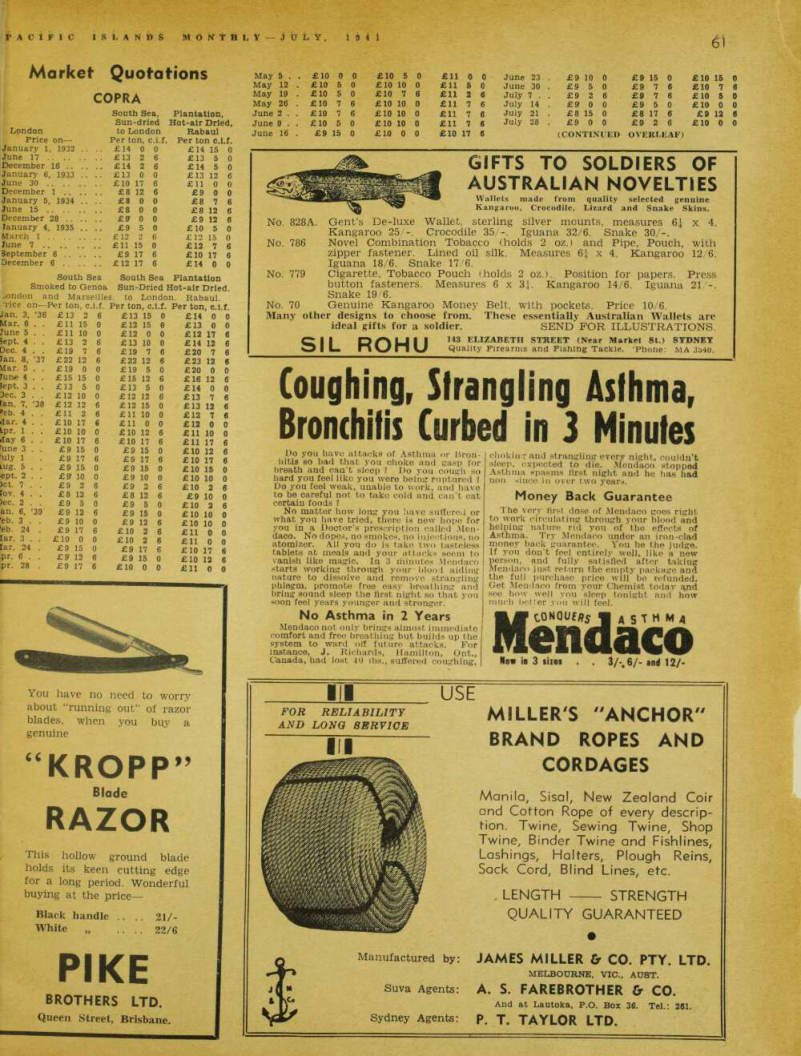
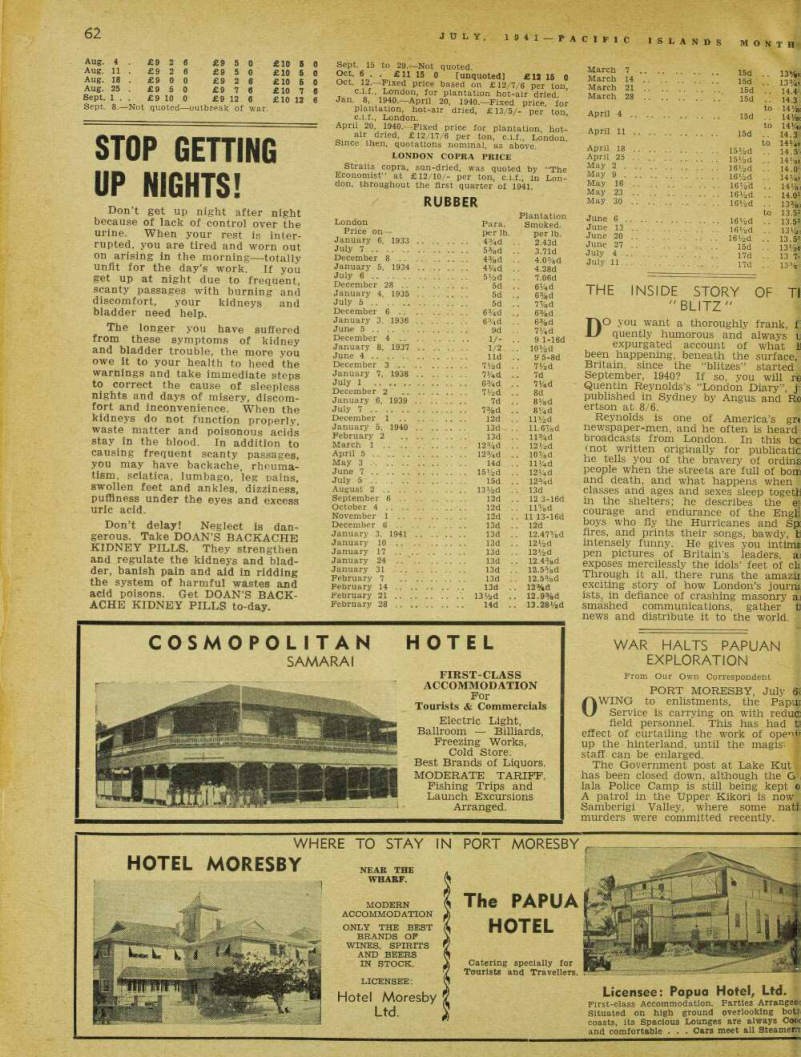
May 5.. £10 00 £10 50 £11 00 May 12 . £10 5 0 £ 10 10 0 £11 5 0 May 19 . £10 5 0 £10 7 6 £11 2 6 May 26 . £10 7 6 £ 10 10 0 £11 7 6 June 2 . . £10 7 6 £10 10 0 £11 7 6 June 9 . . £10 5 0 £10 10 0 £11 7 6 June 16 . £9 15 0 £10 0 0 £10 17 6
June 23 £9 10 0 £9 15 0 £10 IS 0 June 30 . £9 5 0 £9 7 6 £10 7 6 July 7 . , £9 2 6 £9 7 6 £10 5 0 July 14 , £9 0 0 £9 5 0 £10 0 0 July 21 . £8 15 0 £8 17 6 £9 12 6 July 28 . £9 0 0 £9 2 6 £10 0 0
(Continued
Overl1
Eaf)
Copra
South Sea, Plantation, Sun-dried Hot-air Dried, London to London Rabaul Price on— Per ton, c.i.f.
Per ton c.i.f.
January 1, 1932 . . £14 0 0 £14 15 0 June 17 . £13 2 6 £13 5 0 December 16 .. .. £14 2 6 £14 5 0 January 6 , 1933 .. £13 0 0 £13 12 6 June 30 . £10 17 6 £11 0 0 December 1 .. .. £8 12 6 £9 0 0 January 5, , 1934 .. £8 0 0 £8 7 6 June 15 . £8 0 0 £8 12 6 December 28 . . . . £9 0 0 £9 12 6 January 4, , 1935 ., . , £9 5 0 £10 5 0 March 1 . £12 2 6 £12 15 0 June 7 £11 15 0 £12 7 6 September 6 . . . . £9 17 6 £10 17 6 December 6 . . . £12 17 6 £14 0 0 South Sea South Sea Plantation Smoked to Genoa Sun-Dried Hot-air Dried. jondon and Marseilles, to London. Rabaul ‘nee on—Per ton, c.i.f.
Per ton, c.i.f.
Per ton. c.i.f.
Jan. 3. '36 £13 2 6 £13 15 0 £14 0 0 Mar. 6 . . £11 15 0 £12 15 0 £13 0 0 June 5 . . £11 10 0 £12 0 0 £12 17 6 iept. 4 . . £13 2 6 £13 10 0 £14 12 6 Dec. 4 . . £19 7 6 £19 7 6 £20 7 6 Jan. 8, ’37 £22 12 6 £22 12 6 £23 12 6 Mar. 5 . . £19 0 0 £19 5 0 £20 0 0 June 4 . . £15 15 0 £15 12 6 £16 12 6 tept. 3 . . £13 5 0 £13 5 0 £14 0 0 Dec. 3 . . £12 10 0 £12 12 6 £13 7 6 Fan. 7, ’38 £12 12 6 £12 15 0 £13 12 6 *eb. 4 . . £11 2 6 £11 10 0 £12 7 6 Jar. 4 . . £10 17 6 £11 0 0 £12 0 0 tpr. 1 . . £10 10 0 £10 12 6 £11 10 0 Jay 6 . . £10 17 6 £10 17 6 £11 17 6 tone 3 . . £9 15 0 £9 15 0 £10 12 6 toly 1 £9 17 6 £9 17 6 £10 17 6 tug. 5 . . £9 15 0 £9 15 0 £10 15 0 ept. 2 . . £9 10 0 £9 10 0 £10 10 0 )ct. 7 . . £9 2 6 £9 2 6 £10 2 6 Jov. 4 . . £8 12 6 £8 12 6 £9 10 0 )ec. 2 . . £9 5 0 £9 5 0 £10 2 6 an. 6, ’39 £9 12 6 £9 15 0 £10 10 0 'eb. 3 . . £9 10 0 £9 12 6 £10 10 0 'eb. 24 . £9 17 6 £10 2 6 £11 0 0 lar. 3 . . £10 0 0 £10 2 6 £11 0 0 [ar. 24 . £9 15 0 £9 17 6 £10 17 6 pr. 6 . . £9 12 6 £9 15 0 £10 12 6 pr. 28 . £9 17 6 £10 0 0 £11 0 0
Aug. 4 £9 2 6 £9 5 0 £10 5 0 Aug. 11 £9 2 6 £9 5 0 £10 5 0 Aug. 18 £9 0 0 £9 2 6 £10 5 0 Aug. 25 £9 5 0 £9 7 6 £10 7 6 Sept. 1 . £9 10 0 £9 12 6 £10 12 6 Sept. 8.- -Not quoted—outbreak of war.
March 7 .. ..
March 14 .. .
March 21 .. .. 13 5 /a«i 13%* 14.4- March 28 .. .. 14.3 April 4 to 14 Vat i4y 8C April 11 to 14 V 4 . 14.3'; April 18 April 25 . . .. to 14%* 14.5. 14 Vat May 2 14.0 : May 9 . .. . 14%, May 16 . . . . 14Vai May 23 .. .. 14.0 £ May 30 .. .. 13%', June 6 to 13.5-
I'l Kj
June 13 .. .
Ij.u"
UVw June 20 .. . 13.5 E 1 lA.il June 27 July 4 .. .. 1J 72 V 13 7- July 11 13%
Sept. 15 to 29.- -Not quoted.
Oct. 6 . . £11 15 0 [unquoted] £13 16 0 Oct. 12.—Fixed price based on £12/7/6 per ton. c.x.i., London, for plantation hot-air dried.
Jan. 8, 1940.—April 20, 1940.—Fixed price, for plantation. hot-air dried, £13/5/per ton, c.i.l., London.
April 20, 1940.— -Fixed price for plantation, hotair dried, £12/17/6 per ton, c.i.f.. London. oince then, quotations nominal, as above.
London
Copra
Price
Straits copra, sun-dried, was quoted by “The Economist” at £12/10/- per ton. c.i.f. . in London, throughout the first quarter of 1941.
Rubber
Plantation London Para.
Smoked.
Price on— per lb. per lb.
January 6, 1933 4%d .. 2.43d July 7 5%d .. 3.71d December 8 4%d . . 4.0%d January 5, 1934 4‘/id . . 4.28d July 6 5‘Ad .. 7.06d December 28 .. 5d .. 6‘/ 4 d January 4, 1935 5d .. 6%d July 5 5d . . 7 7 /gd December 6 6 3 Ad ... 63/ad January 3, 1936 6%d . . 6%d June 5 9d . . 7‘/ 4 d December 4 ..
V- .. 9 l-16d January 8, 1937 1/2 .. 10‘/ 2 d June 4 lid .. 9 5-8d December 3 .. 7‘Ad .. 7‘/ad January 7. 1938 7 Vid .. 7d July 1 6%d .. 7‘Ad December 2 7‘/ 2 d .. 8d January 6, 1939 7d .. 8Vad July 7 7%d .. 8‘Ad December 1 .. 12d .. 11‘Ad January 5, 1940 13d 11.6 7 /ad February 2 13d .. ll 3 Ad March 1 .. .. 12%d .. 12‘Ad April 5 . . .. .. 12 3 / 4 d .. 10 7 / 8 d May 3 14d . . 11‘Ad June 7 15‘/ 2 d . . 12‘Ad July 5 15d .. 12%d August 2 .. .. 13‘/ad . . 13d September 6 .. 12d . . 12 3-16d October 4 . . .. 12d .. ll 7 /ad November 1 12d . . 11 13-16d December 6 13d .. 12d January 3, 1941 13d .. 12.47%d January 10 .. 13d .. 12‘Ad January 17 .. 13d .. 12‘Ad January 24 13d .. 12.4 3 /ad January 31 13d .. 12.5 5 /ad February 7 13d .. 12.5%d February 14 .. 13d .. 12%d February 21 .. , 13 ‘/ad .. 12.9%d February 28 .. , 14d .. 13.28‘Ad
Advertisements & other items, pp. 63-64 (1 item)
Mendaco
as
GIFTS TO SOLDIERS OF
AUSTRALIAN NOVELTIES
Wallets made from quality selected genuine Kangaroo, Crocodile, Lizard and Snake Skins.
No. 828 A. Gent’s De-luxe Wallet, sterling silver mounts, measures 6| x 4.
Kangaroo 25/-. Crocodile 35/-. Iguana 32/6. Snake 30/-.
No. 786 Novel Combination Tobacco (holds 2 oz.) and Pipe, Pouch, with zipper fastener. Lined oil silk. Measures 6£ x 4. Kangaroo 12,6.
Iguana 18/6. Snake 17/6.
No. 779 Cigarette, Tobacco Pouch (holds 2 oz.). Position for papers. Press button fasteners. Measures 6 x 3{. Kangaroo 14/6. Iguana 21 -.
Snake 19 6.
No. 70 Genuine Kangaroo Money Belt, with pockets. Price 10/6.
Many other designs to choose from. These essentially Australian Wallets are ideal gifts for a soldier. SEND FOR ILLUSTRATIONS.
SIL ROHU
143 ELIZABETH STREET (Near Market St.) SYDNEY Quality Firearms and Fishing Tackle. ’Phone; MA 3540.
Coughing, Strangling Asthma, Bronchitis Curbed in 3 Minutes
Do you have attacks of Asthma or Bronhitis so bad that you choke and gasp for breath and can’t sleep ? Do you cough so hard you feel like you were being ruptured ?
Do you feel weak, unable to work, and have to be careful not to take cold and can’t eat certain foods ?
No matter how long you have suffered or what you have tried, there is new hope for you in a Doctor’s prescription called Mendaco. No dopes, no smokes, no injections, no atomizer. All you do is take two tasteless tablets at meals and your attacks seem to vanish like magic. In 3 minutes Mendaco starts working through your blood aiding nature to dissolve and remove strangling phlegm, promote free easy breathing and bring sound sleep the first night so that you soon feel years younger and stronger.
No Asthma in 2 Years
Mendaco not only brings almost immediate comfort and free breathing but builds up the system to ward off future attacks. For instance, J. Richards, Hamilton, Ont., Canada, had lost 40 lbs., suffered coughing,
choking and strangling every night, couldn't sleep, expected to die. Mendaco stopped Asthma spasms first night and he has had non since in over two years.
Money Back Guarantee
The very first dose of Mendaco goes right to work circulating through your blood and helping natiire rid you of the effects of Asthma. Try Mendaco under an iron-clad money back guarantee. You be the judge.
If you don’t feel entirely well, like a new person, and fully satisfied after taking Mendaco just return the empty package and the full purchase price will be refunded.
Get Mendaco from your Chemist today and see how well you sleep tonight and how much bctler you will feel. tONOUfflj ■ A S T H M 4
Mendaco
Now in 3 sizes
3/-. 6/- and 12/-
You have no need to worry about “running out” of razor blades, when you buy a genuine
“KROPP”
Blade
RAZOR
This hollow ground blade holds its keen cutting edge for a long period. Wonderful buying at the price— Black handle . . . . 21/- White „ ... 22/6
PIKE
BROTHERS LTD.
Queen Street, Brisbane.
11l
FOR RELIABILITY
AND LONO
USE
MILLER'S "ANCHOR"
BRAND ROPES AND
CORDAGES
Manila, Sisal, New Zealand Coir and Cotton Rope of every description. Twine, Sewing Twine, Shop Twine, Binder Twine and Fishlines, Lashings, Halters, Plough Reins, Sack Cord, Blind Lines, etc.
LENGTH STRENGTH
QUALITY GUARANTEED
Manufactured by: JAMES MILLER Cr CO. PTY. LTD.
MELBOURNE, VIC., AUST.
Suva Agents: A. S. FAREBROTHER Cr CO.
And at Lautoka, P.O. Box 36. Tel.; 261.
Sydney Agents: p. f. TAYLOR LTD.
STOP GETTING
UP NIGHTS!
Don’t get up night after night because of lack of control over the urine. When your rest is interrupted, you are tired and worn out on arising in the morning—totally unfit for the day’s work. If you get up at night due to frequent, scanty passages with burning and discomfort, your kidneys and bladder need help.
The longer you have suffered from these symptoms of kidney and bladder trouble, the more you owe it to your health to heed the warnings and take immediate steps to correct the cause of sleepless nights and days of misery, discomfort and inconvenience. When the kidneys do not function properly, waste matter and poisonous acids stay in the blood. In addition to causing frequent scanty passages, you may have backache, rheumatism, sciatica, lumbago, leg nains, swollen feet and ankles, dizziness, puffiness under the eyes and excess uric acid.
Don’t delay! Neglect is dangerous. Take DOAN’S BACKACHE KIDNEY PILLS. They strengthen and regulate the kidneys and bladder, banish pain and aid in ridding the system of harmful wastes and acid poisons. Get DOAN’S BACK-
ACHE KIDNEY PILLS to-day.
COSMOPOLITAN HOTEL
SAMARA!
m m mm
FIRST-CLASS
ACCOMMODATION
For Tourists & Commercials Electric Light, Ballroom Billiards, Freezing Works, Cold Store.
Best Brands of Liquors.
MODERATE TARIFF.
Fishing Trips and Launch Excursions Arranged.
“Blitz"
The Inside Story Of T?
DO you want a thoroughly frank, f quently humorous and always u expurgated account of what II been happening, beneath the surface, Britain, since the “blitzes” started September, 1940? If so, you will re Quentin Reynolds’s “London Diary”, j published in Sydney by Angus and Ro ertson at 8/6.
Reynolds is one of America’s grt newspaper-men, and he often is heard broadcasts from London. In this be (not written originally for publicatic he tells you of the bravery of ordins people when the streets are full of bom and death, and what happens when classes and ages and sexes sleep togeth in the shelters; he describes the e] courage and endurance of the Engll boys who fly the Hurricanes and Spc fires, and prints their songs, bawdy, b intensely funny. He gives you intims pen pictures of Britain’s leaders, aj exposes mercilessly the idols’ feet of cl) Through it all, there runs the amazii exciting story of how London’s jourm. ists, in defiance of crashing masonry aj smashed communications, gather ti news and distribute it to the world.
Exploration
War Halts Papuan
From Our Own Correspondent
Port Moresby, July 6<
OWING to enlistments, the Papui Service is carrying on with redua field personnel. This has had tJ effect of curtailing the work of ope l - 1 ” up the hinterland, until the magis'. t staff can be enlarged.
The Government post at Lake Kut has been closed down, although the G , lala Police Camp is still being kept o A patrol in the Upper Kikori is now Samberigi Valley, where some nati; murders were committed recently.
Advertisements & other items, p. 64 (2 items)
62
JOLIT, 1941-PACIFIC islands month
Hotel Moresby
WHERE TO STAY IN
NEAR THE
WHARF.
MODERN
ACCOMMODATION
ONLY THE BEST
BRANDS OF
WINES, SPIRITS
AND BEERS
IN STOCK,
LICENSEE:
Hotel Moresby
Ltd.
PORT MORESBY
The PAPUA
HOTEL
Catering specially lor Tourists and Travellers. 1
Licensee: Papua Hotel, Ltd.
First-class Accommodation. Parties Arrange© Situated on high ground overlooking boti coasts, its Spacious Lounges are always Co© and comfortable . . . Cars meet all Steamerr
Index to Volume Xl.AUGUST,1940,TO JULY,1941,INCLUSIVE.
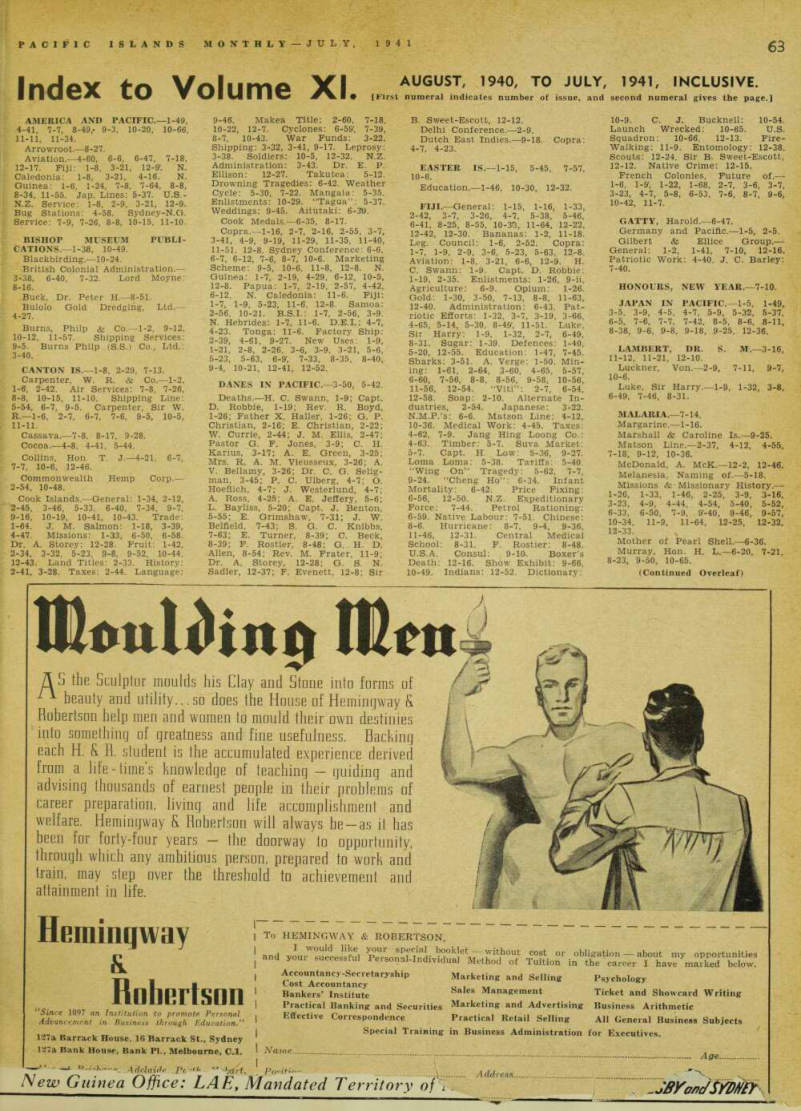
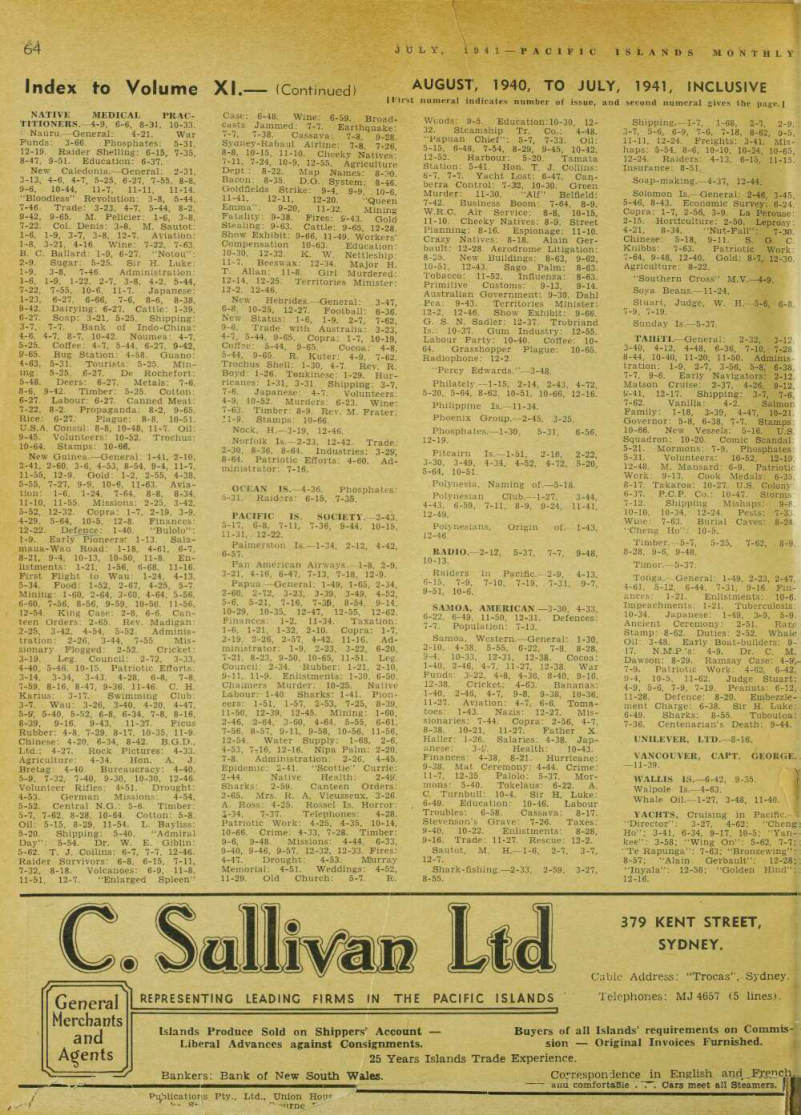
[First mumeral indicates number of issue, and second numeral gives the page.]
America And Pacific,—I-49,
4-41, 7-7, 8-49,- 9-3, 10-20, 10-66, 11- 11-34.
Arrowroot. —8-27.
Aviation.—4-60, 6-6, 6-47, 7-18, 12- Fiji: 1-8, 3-21, 12-9. N.
Caledonia: 1-8, 3-21, 4-16. N.
Guinea: 1-6, 1-24, 7-8, 7-64, 8-8, 8- 11-55. Jap. Lines: 5-37. U.S.- N.Z. Service: 1-8, 2-9, 3-21, 12-9.
Bug Stations: 4-58. Sydney-N.G.
Service: 7-9, 7-26, 8-8, 10-15, 11-10.
Bishop Museum Publi
Cations.—I-38, 10-49.
Blackbirding.—lo-24.
British Colonial Administration.— 3- 6-40, 7-32. Lord Moyne: 8-16.
Buck, Dr. Peter H.—B-51.
Bulolo Gold Dredging, Ltd.— 4- Burns, Philp & Co.—l-2, 9-12, 10- 11-57. Shipping Services: 9- Burns Philp (S.S.) Co., Ltd.: 3-
Canton Is.—L-8, 2-29, 7-13.
Carpenter, W. R. & Co. —1-2, 1- 2-42. Air Services: 7-8, 7-26, 8- 10-15, 11-10. Shipping Line: 5- 6-7, 9-5. Carpenter, Sir W.
R.—l-6, 2-7, 6-7, 7-6, 9-5, 10-5, 11- Cassava.—7-8, 8-17, 9-28.
Cocoa.—4-8, 4-41, 5-44.
Collins, Hon. T. J.—4-21, 6-7, 7-7, 10-6, 12-46.
Commonwealth Hemp Corp.— 2- 10-48.
Cook Islands. —General: 1-34, 2-12, 2-45, 3-46, 5-33, 6-40, 7-34, 9-7, 9- 10-19, 10-41, 10-43. Trade: 1- J. M. Salmon; 1-18, 3-39, 4- Missions: 1-33, 6-50, 6-58.
Dr. A. Storey: 12-28. Fruit: 1-42, 2- 3-32, 5-23, 9-8, 9-52, 10-44, 12-43. Land Titles: 2-33. History; 2-41, 3-28. Taxes: 2-44. Language:
9- Makea Title: 2-60, 7-18, 10- 12-7. Cyclones: 6-59, 7-39, 8-7, 10-43. War Funds: 3-22.
Shipping: 3-32, 3-41, 9-17. Leprosy: 3-38. Soldiers: 10-5, 12-32. N.Z.
Administration: 3-43. Dr. E. P.
Ellison: 12-27. Takutea: 5-12.
Drowning Tragedies: 6-42. Weather Cycle: 5-30, 7-22. Mangaia: 5-35.
Enlistments; 10-29. “Tagua”: 5-37.
Weddings: 9-45. Aitutaki; 6-39.
Cook Medals. —6-35, 8-17.
Copra.—l-16, 2-7, 2-16, 2-55, 3-7, 3- 4-9, 9-19, 11-29, 11-35, 11-40, 11- 12-8. Sydney Conference: 6-6, 6-7, 6-12, 7-6, 8-7, 10-6. Marketing Scheme: 9-5, 10-6, 11-8, 12-8. N.
Guinea: 1-7, 2-19, 4-29, 6-12, 10-5, 12- Papua; 1-7, 2-19, 2-57, 4-42, 6- N. Caledonia: 11-6. Fiji: 1- 1-9, 5-23, 11-6, 12-8. Samoa: 2- 10-21. 8.5.1.: 1-7, 2-56, 3-9.
N. Hebrides: 1-7, 11-6. D.E.1.: 4-7, 4- Tonga: 11-6. Factory Ship: 2-39, 4-61, 9-27. New Uses: 1-9, 1-21, 2-8, 2-26, 3-6, 3-9, 3-21, 5-6, 5- 5-63, 6-9, 7-33, 8-35, 8-40, 9-4, 10-21, 12-41, 12-52.
Danes In Pacific.—3-50, 5-42
Deaths. —H. C. Swann, 1-9; Capt.
D. Robbie, 1-19; Rev. R. Boyd, 1-26; Father X. Haller, 1-26; G. P.
Christian, 2-16; E. Christian, 2-22; W. Currie, 2-44; J. M. Ellis, 2-47; Pastor G. F. Jones, 3-9; C. H.
Karius, 3-17; A. E. Green, 3-25; Mrs. R. A. M. Vieusseux, 3-26; A.
V. Bellamy, 3-26; Dr. C. G. Selig man, 3-45; P. C. Ulberg, 4-7; O.
Hoeflich. 4-7; J. Westerlund, 4-7; A. Ross, 4-25; A. E. Jeffery, 5-6; L. Bayliss, 5-20; Capt. J. Benton, 5-55; E. Grimshaw, 7-31; J. W.
Belfield, 7-43; S. G. C. Knlbbs, 7- E. Turner, 8-39; C. Beck, 8- P. Rostier, 8-48; G. H. D.
Allen, 8-54; Rev. M. Prater, 11-9; Dr. A. Storey, 12-28; G. S. N.
Sadler, 12-37; F. Evenett, 12-8; Sir
B. Sweet-Escott, 12-12.
Delhi Conference.—2-9.
Dutch East Indies. —9-18. Copra: 4-7, 4-23.
Easter Is.—L-15, 5-45, 7-57,
10-6.
Education.—l-46, 10-30, 12-32.
FlJl.—General: 1-15, 1-16, 1-33, 2-42, 3-7, 3-26, 4-7, 5-38, 5-46, 6-41, 8-25, 8-55, 10-30, 11-64, 12-22, 12-42, 12-30. Bananas: 1-2, 11-18.
Leg. Council: 1-6, 2-52. Copra: 1-7, 1-9, 2-9, 3-6, 5-23, 5-63, 12-8.
Aviation: 1-8, 3-21, 6-6, 12-9. H.
C. Swann; 1-9. Capt. D. Robbie: I- 2-35. Enlistments: 1-26, 9-ii.
Agriculture: 6-9. Opium: 1-26.
Gold; 1-30, 3-50, 7-13, 8-8, 11-63, 12-40. Administration: 6-43. Pat riotic Efforts: 1-32, 3-7, 3-19, 3-66, 4- 5-14, 5-30, 8-49, 11-51. Luke, Sir Harry: 1-9, 1-32, 2-7, 6-49, 8- Sugar; 1-39. Defences: 1-40, 5- 12-55. Education: 1-47, 7-45.
Sharks: 3-51. A. Verge: 1-50. Min ing: 1-61, 2-64, 3-60, 4-65, 5-57, 6- 7-56, 8-8, 8-56, 9-58, 10-56, II- 12-54. “Viti”: 2-7, 6-54, 12-58. Soap: 2-10. Alternate In dustries, 2-54. Japanese: 3-22.
N.M.P.’s: 6-6. Matson Line: 4-12, 10- Medical Work; 4-45. Taxes: 4-62, 7-9. Jang King Loong Co.: 4- Timber: 5-7. Suva Market: 5- Capt. H. Low: 5-36, 9-27.
Loma Loma; 5-38. Tariffs; 5-40.
“Wing On” Tragedy; 5-62, 7-7, 9- “Cheng Ho”: 6-34. Infant Mortality; 6-42. Price Fixing: 6- 12-50. N.Z. Expeditionary Force: 7-44. Petrol Rationing: 6-59. Native Labour: 7-51. Chinese; 8-6. Hurricane; 8-7, 9-4, 9-36, 11- 12-31. Central Medical School: 8-31. F. Rostier: 8-48.
U.S.A. Consul: 9-10-. Boxer’s Death; 12-16. Show Exhibit: 9-66, 10- Indians: 12-52. Dictionary:
10-9. C. J. Bucknell: 10-54.
Launch Wrecked: 10-65. U.S.
Squadron: 10-66, 12-13. Fire- Walking: 11-9. Entomology: 12-38.
Scouts: 12-24. Sir B. Sweet-Escott, 12-12. Native Crime: 12-15.
French Colonies, Future of.— I- 1-9, 1-22, 1-68, 2-7, 3-6, 3-7, 3-23, 4-7, 5-8, 6-53, 7-6, 8-7, 9-6, 10-42, 11-7.
GATTY, Harold.—6-47.
Germany and Pacific.—l-5, 2-5.
Gilbert & Ellice Group.— General; 1-2, 1-41, 7-10, 12-16.
Patriotic Work: 4-40. J. C. Barley: 7-
Honours, New Year.—7-10.
Japan In Pacific.—I-5, 1-49,
3-5, 3-9, 4-5, 4-7, 5-9, 5-32, 5-37, 6-5, 7-6, 7-7, 7-42, 8-5, 8-6, 8-11, 8- 9-6, 9-8, 9-18, 9-25, 12-36.
Lambert, Dr. S. M.—3-16,
II- 11-21, 12-10.
Luckner, Von.—2-9, 7-11, 9-7, 10-6.
Luke, Sir Harry.—l-9, 1-32, 3-8, 6- 7-46, 8-31.
Malaria.—7-14.
Margarine.—l-16.
Marshall & Caroline Is.—9-25.
Matson Line.—2-37, 4-12, 4-55, 7- 9-12, 10-36.
McDonald, A. McK.—l2-2, 12-46.
Melanesia, Naming of.—s-18.
Missions & Missionary History.— 1-26, 1-33, 1-46, 2-25, 3-9, 3-16, 3-23, 4-9, 4-44, 4-54, 5-40, 5-52, 6-33, 6-50, 7-9, 9-40, 9-46, 9-57, 10-34, 11-9, 11-64, 12-25, 12-32, 12-33.
Mother of Pearl Shell.—6-36.
Murray, Hon. H. L.—6-20, 7-21, 8- 9-50, 10-65. (Continued Overleaf)
Native Medical Prac
Titioners.—4-9, 6-6, 8-31, 10-33.
Nauru. —General: 4-21. War Funds: 3-66. Phosphates: 5-31, 12-19. Raider Shelling: 6-15, 7-35, 8- 9-51. Education: 6-37.
New Caledonia.—General: 2-31, 3-13, 4-6, 4-7, 5-25, 6-27, 7-55, 8-8, 9- 10-44, 11-7, 11-11, 11-14.
“Bloodless” Revolution: 3-8, 5-44, 7-46. Trade: 3-23, 4-7, 5-44, 8-2, 9-42. 9-65. M. Pelicier: 1-6, 3-8, 7-22. Col. Denis: 3-8. M. Sautot: 1-6, 1-9, 3-7, 3-8, 12-7. Aviation; 1- 3-21, 4-16. Wine; 7-22, 7-63.
B. C. Ballard: 1-9, 6-27. “Notou”: 2- Sugar: 5-25. Sir H. Luke: 1-9. 3-8, 7-46. Administration; 1-6, 1-9. 1-22. 2-7, 3-8, 4-2. 5-44, 7- 7-55. 10-6, 11-7. Japanese: 1- 6-27, 6-66, 7-6, 8-6, 8-38, 9-42. Dairying; 6-27. Cattle: 1-39, 6-27. Soap: 3-21, 5-25. Shipping: 3- 7-7. Bank of Indo-China: 4- 4-7, 8-7, 10-42. Noumea: 4-7, 5- Coffee: 4-7, 5-44. 6-27. 9-42, 9-65. Bug Station: 4-58. Guano: 4- 5-31. Tourists: 5-25. Min ing; 5-25, 6-27. De Rochefort; 5- Deers: 6-27. Metals: 7-6, 8- 9-42. Timber; 5-25. Cotton: 6- Labour; 6-27. Canned Meat: 7- 8-2. Propaganda: 8-2, 9-65.
Rice; 6-27. Plague: 8-8. 10-51.
U.S.A. Consul: 8-8, 10-48, 11-7. Oil: 9- Volunteers: 10-52. Trochus; 10- Stamps: 10-66.
New Guinea. —General: 1-41, 2-10, 2- 2-60, 3-6, 4-53, 8-54, 9-4, 11-7, 11- 12-9. Gold: 1-2, 2-55, 4-38, 5-55, 7-27, 9-9, 10-6, 11-63. Avia tion: 1-6, 1-24, 7-64, 8-8, 8-34, 11- 11-55. Missions: 2-25, 3-42, 5-52, 12-32. Copra: 1-7, 2-19, 3-9, 4- 5-64, 10-5, 12-8. Finances: 12- Defence: 1-40. “Bulolo”: 1- Early Pioneers: 1-13. Sala maua-Wau Road: 1-18, 4-61, 6-7, 8- 9-4. 10-13, 10-50, 11-8. En listments: 1-21, 1-56, 6-68, 11-16.
First Flight to Wau: 1-24, 4-13, 5- Food: 1-52, 2-67, 4-25, 5-7.
Mining: 1-60, 2-64, 3-60. 4-64, 5-56, 6- 7-56, 8-56, 9-59, 10-56. 11-56, 12-54. King Case: 2-8, 6-6. Can teen Orders; 2-65. Rev. Madigan: 2- 3-42, 4-54, 5-52. Adminis tration: 2-26, 3-44, 7-55. Mis sionary Flogged; 2-52. Cricket: 3- Leg. Council: 2-72, 3-33, 4- 5-46. 10-15. Patriotic Efforts: 3-14, 3-34, 3-43, 4-28, 6-8, 7-8, 7- 8-16. 8-47, 9-36, 11-46. C. H.
Karius: 3-17. Swimming Club: 3- Wau; 3-26, 3-40, 4-20, 4-47, 5- 5-40, 5-52, 6-8, 6-34, 7-8, 8-16, 8- 9-16, 9-43, 11-37. Ficus Rubber: 4-8, 7-29. 8-17, 10-35, 11-9.
Chinese; 4-20. 6-34, 8-42. 8.G.D., Ltd.: 4-27. Rock Pictures; 4-33.
Agriculture: 4-34. Hon. A. J.
Bretag: 4-40. Bureaucracy; 4-40, 5-9. 7-32, 7-40, 9-30, 10-30, 12-46.
Volunteer Rifles: 4-51. Drought: 4- German Missions: 4-54, 5- Central N.G.: 5-6. Timber; 5-7, 7-62, 8-28, 10-64. Cotton: 5-8.
Oil: 5-15. 8-29, 11-54. L. Bayliss: 5-20. Shipping: 5-40. “Admiral Day”: 5-54. Dr. W. E. Giblin: 5-62. T. J. Collins: 6-7, 7-7. 12-46.
Raider Survivors: 6-8, 6-15, 7-11, 7-32, 8-18. Volcanoes: 6-9, 11-8, 11-51, 12-7. “Enlarged Spleen”
Case: 6-48. Wine: 6-59. Broad casts Jammed; 7-7. Earthquake: 7- 7-38. Cassava: 7-8, 9-28.
Syaney-Rabaul Airline; 7-8, 7-26 8- 10-15, 11-10. Cheeky Natives: 7-11, 7-24, 10-9, 12-55. Agriculture Dept.: 8-22. Map Names: 8-30.
Bacon: 8-35. D.O. System; 8-46.
Goldfields Strike: 9-4, 9-9 iq-6 11-41, 12-11, 12-20. “Queeri Emma”; 9-20, 11-32. Mining Fatality: 9-38. Fires: 9-43. Gold Stealing; 9-63. Cattle: 9-65, 12-28 Show Exhibit; 9-66, 11-49. Workers’
Compensation 10-63. Education: 10- 12-32. K. W. Nettleship; 11- Beeswax: 12-34. Major H.
T. Allan; 11-8. Girl Murdered; 12- 12-25. Territories Minister: 12-2, 12-46.
New Hebrides.—General: 3-47, 6- 10-25, 12-27. Football: 6-36.
New Status: 1-6, 1-9, 2-7, 7-62, 9- Trade with Australia: 3-2 s! 4- 5-44, 9-65. Copra: 1-7, 10-19 Coffee: 5-44, 9-65, Cocoa: 4-8. 5- 9-65. R. Kuter: 4-9, 7-62 Trochus Shell; 1-30, 4-7. Rev. R.
Boyd: 1-26. Tonkinese: 1-29. Hur ricanes: 1-31, 3-31. Shipping: 3-7, 7- Japanese: 4-7. Volunteers; 4- 10-52. Murders; 6-23. Wine: 7- Timber; 8-9. Rev. M. Frater; 11-9. Stamps: 10-66.
Nock, H.—3-19, 12-46.
Norfolk Is. —2-23, 12-42. Trade; 2- 8-36, 8-64. Industries: 3-29, 8- Patriotic Efforts: 4-60. Ad ministrator: 7-16.
OCEAN IS. —4-36. Phosphates: 5- Raiders: 6-15, 7-35.
Pacific Is. Society.—2-43,
5- 6-8, 7-11, 7-36, 9-44, 10-15, 11-31, 12-22.
Palmerston Is.-1-34, 2-12, 4-42, 6- Pan American Airways.—l-8, 2-9, 3- 4-16, 6-47, 7-13, 7-18, 12-9.
Papua.—General; 1-49, 1-65, 2-34, 2-60, 2-72, 3-23, 3-39, 3-49. 4-52, 5-6. 5-21, 7-16, 7-3 P, 8-54, 9-14. 10- 10-35, 12-47, 12-55, 12-62.
Finances; 1-2, 11-34. Taxation; 1- 1-21, 1-32, 2-10. Copra: 1-7, 2- 2-26, 2-57, 4-42, 11-16. Ad ministrator; 1-9, 2-23, 3-22, 6-20, 7- 8-23, 9-50, 10-65, 11-51. Leg.
Council: 2-34. Rubber: 1-21, 2-10, 9- 11-9. Enlistments: 1-30, 6-50.
Chaimers Murder; 10-25. Native Labour: 1-40. Sharks: 1-41. Pion eers: 1-51, 1-57, 2-53, 7-25, 8-39, 11- 12-39, 12-45. Mining: 1-60, 2-46, 2-64, 3-60, 4-64, 5-55, 6-61, 7-56, 8-57, 9-11, 9-58, 10-56, 11-56. 12- Water Supply: 1-68, 2-6, 4- 7-16, 12-16. Nipa Palm; 2-20, 7-8. Administration: 2-26, 4-45.
Epidemic: 2-41. “Scottie” Currie; 2-44. Native Health; 2-49.
Sharks: 2-59. Canteen Orders: 2-65. Mrs. R. A. Vieusseux, 3-26.
A. Ross: 4-25. Rossel Is. Horror: 5- 7-37. Telephones; 4-28.
Patriotic Work: 4-25, 4-35, 10-14, 10- Crime; 4-33, 7-28. Timber: 9-6, 9-48. Missions: 4-44, 6-33, 9-40, 9-46, 9-57, 12-32, 12-33. Fires: 4-47. Drought; 4-53. MJurray Memorial; 4-51. Weddings: 4-52, 11- Old Church; 5-7. R.
Woods; 9-5. Education: 10-30, 12- 32. Steamship Tr. Co.: 4-48.
"Papuan Chief”; 5-7, 7-33. Oil: 5- 6-48, 7-54, 8-29, 9-45, 10-42, 12-52. Harbour: 5-20. Tamata Station: 5-41. Hon. T. J. Collins: 6- 7-7. Yacht Lost: 6-47. Can berra Control: 7-32, 10-30. Green Murder: 11-30. “Alf” Belfield: 7- Business Boom: 7-64, 8-9.
W.R.C. Air Service; 8-8, 10-15, 11- Cheeky Natives: 8-9. Street Planning; 8-16. Espionage; 11-10.
Crazy Natives: 8-18. Alain Ger bault: 12-28. Aerodrome Litigation: 8- New Buildings: 8-63, 9-62, 10-51, 12-43. Sago Palm; 8-63.
Tobacco: 11-52. Influenza: 8-63.
Primitive Customs: 9-13, 9-14.
Australian Government: 9-30. Dahl Pea: 9-43. Territories Minister: 12- 12-46. Show Exhibit: 9-66.
G. S. N. Sadler: 12-37. Trobriand Is.: 10-37. Gum Industry; 12-55.
Labour Party: 10-40. Coffee: 10- 64. Grasshopper Plague: 10-65.
Radiophone: 12-2.
“Percy Edwards.”—3-48.
Philately.—l-15, 2-14, 2-43, 4-72, 5-20, 5-64, 8-62, 10-51, 10-66, 12-16.
Philippine Is.—ll-34.
Phoenix Group.—2-45, 3-25.
Phosphates.—l-30, 5-31, 6-56, 12-19.
Pitcairn Is. —1-51, 2-16, 2-22, 3- 3-49, 4-34, 4-52, 4-72, 5-20, 5- 10-51.
Polynesia, Naming of. —5-18.
Polynesian Club.—l-27. 3-44, 4- 6-59, 7-11, 8-9, 9-24, 11-41, 12-49.
Polynesians, Origin of.—l-43, 12-46.
Radio.—2-12, 5-37, 7-7, 9-48,
10- Raiders in Pacific.—2-9, 4-13, 6- 7-9, 7-10, 7-19, 7-31, 9-7, 9- 10-6.
Samoa, American—3-30, 4-33,
6- 6-49, 11-50, 12-31. Defences: 7- Population: 7-13.
Samoa, Western. —General: 1-30, 2-10, 4-38. 5-55, 6-22, 7-8, 8-28, 9-4, 10-33, 12-31, 12-38. Cocoa; 1-40, 2-46, 4-7, 11-27, 12-38. War Funds; 3>-22, 4-8, 4-36, 8-40, 9-16, 12-38. Cricket; 4-63. Bananas: I- 2-46, 4-7, 9-8, 9-38, 10-36, 11- Aviation; 4-7, 6-6. Toma toes: 1-43. Nazis: 12-27. Mis sionaries: 7-44. Copra: 2-56, 4-7, 8- 10-21, 11-27. Father X.
Haller: 1-26. Salaries: 4-38. Jap anese: 3-9’. Health: 10-43.
Finances: 4-38, 8-21. Hurricane: 9- Mat Ceremony: 4-44. Crime; II- 12-35. Palolo: 5-37. Mor mons; 5-40. Tokelaus: 6-22. A.
C. Turnbull; 10-4. Sir H. Luke; 6-49. Education: 10-46. Labour Troubles: 6-58. Cassava: 8-17.
Stevenson’s Grave: 7-26. Taxes: 9-40, 10-22. Enlistments: 8-28, 9-16. Trade; 11-27. Rescue: 12-2.
Sautot, M. H.—l-6, 2-7, 3-7, 12-7.
Shark-fishing.—2-33, 2-59, 3-27, 8-55.
Shipping.—l-7, 1-68, 2-7, 2-9, 3- 5-6, 6-9, 7-6, 7-18, 8-62, 9-5, 11- 12-24. Freights; 3-41. Mis haps; 5-54, 8-6, 10-10, 10-34, 10-65, 12- Raiders; 4-13, 6-15, 11-15.
Insurance: 8-51.
Soap-making.—4-37, 12-44.
Solomon Is.—General: 2-46, 3-45, 5-46, 8-43. Economic Survey: 6-24.
Copra; 1-7, 2-56, 3-9. La Perouse; 2- Horticulture; 2-50. Leprosy 4- 8-34. "Nut-Fall”: 7-30.
Chinese: 5-18, 9-11. S. G. C.
Knibbs: 7-63. Patriotic Work: 7-64, 9-48, 12-40. Gold: 8-7, 12-30.
Agriculture; 8-22.
“Southern Cross” M.V.—4-9.
Soya Beans. —11-24, Stuart, Judge, W. H.—s-6, 6-8 7- 7-19.
Sunday Is. —5-37.
TAHlTl.—General: 2-32, 3-12 3- 4-12, 4-48, 6-36, 7-10, 7-28 8- 10-40, 11-20, 11-50. Adminis tration: 1-9, 2-7, 3-56, 5-8, 6-38. 7-7, 9-6. Early Navigators; 2-12, Matson Cruise; 2-37, 4-26, 9-12, 9- 12-17. Shipping; 3-7, 7-6, 7- Vanilla: 4-2. Salmon Family: 1-18, 3-39, 4-47, 10-21 Governor: 5-8, 6-38, 7-7. Stamps: 10- New Vessels; 5-16. U.S Squadron; 10-20. Comic Scandal 5- Mormons; 7-9. Phosphates: 5- Volunteers: 10-52, 12-19 12-48. M. Mansard: 6-9. Patriotic Work: 9-13. Cook Medals: 6-35. 8- Takaroa: 10-27. U.S. Colony 6- P.C.P. Co.; 10-47. Storms 7- Shipping Mishaps; 9-8 10-10, 10-34, 12-24. Pests: 7-33 Wine; 7-63. Burial Caves; 8-24 “Cheng Ho”: 10-5.
Timber.—s-7, 5-25, 7-62, 8-9, 8- 9-6, 9-48.
Timor. —5-37.
Tonga.—General: 1-49, 2-23, 2-47, 4- 5-12, 6-44. 7-31, 9-16. Fin ances: 1-21. Enlistments: 10-6, Impeachments: 1-21. Tuberculosis; 10- Japanese: 1-49, 3<-9, 5-9.
Ancient Ceremony: 2-51. Rare Stamp: 8-62. Duties: 2-52. Whale Oil: 3-48. Early Boat-builders: 9-
17. N.M.P.’S: 4-9. Dr. C. M.
Dawson: 8-29. Ramsay Case; 4-9,- 7-9, Patriotic Work; 4-62, 6-42, 9- 10-5, 11-62. Judge Stuart: 4-9, 5-6, 7-9, 7-19. Peanuts; 6-12, 11- Defence: 8-20. Embezzle ment Charge: 6-38. Sir H. Luke: 6- Sharks: 8-55. Tuboutoa: 7- Centenarian’s Death: 9-44.
Unilever, Ltd.—B-16.
Vancouver, Capt. George.
-11-39.
Wallis Is.—6-42, 9-35.
Walpole Is.—4-63.
Whale 011.-1-27, 3-48, 11-40.
YACHTS, Cruising in Pacific.-i “Director”; 3-27, 4-62; “Cheng Ho”; 3-41, 6-34, 9-17, 10-5; “Yan kee”: 3-58; “Wing On”: 5-62, 7-7; “Te Rapunga”: 7-63; “Bronzewing”: 8- “Alain Gerbault”: 12-28; “Inyala”: 12-58; “Golden Hind”: 12-
Advertisements & other items, pp. 65-68 (3 items)
DWlitinc)
AS the Sculptor moulds his Clay and Stone into forms of beauty and utility...so does the House of Hemingway & Robertson help men and women to mould their own destinies into something of greatness and fine usefulness. Baching each H. & R. student is the accumulated experience derived from a life-time’s knowledge of teaching - guiding and advising thousands of earnest people in their problems of career preparation, living and life accomplishment and welfare. Hemingway & Robertson will always be —as it has been for forty-four years the doorway to opportunity, through which any ambitious person, prepared to work and train, may step over the threshold to achievement and attainment in life.
Hemingway
Hubertsan
*/, “Since 1897 an Institution to promote Personal Advancement in Business through Education.” 127 a Barrack House, 16 Barrack St., Sydney 127 a Bank House, Bank PI., Melbourne, C.l.
To HEMINGWAY & ROBERTSON.
and you MUon' Accountancy-Secretaryship Marketing and Selling Psychology Cost Accountancy 0 Bankers’ Institute kales Management Ticket and Showcard Writing Practical Banking and Securities Marketing and Advertising Business Arithmetic Effective Correspondence Practical Retail Selling All General Business Subjects Special Training in Business Administration for Executives.
Name.
Age.
Adelaide Pt ’- T Poei.fi• Tew Guinea Office: LAE, Mandated Territory of r i Address.
C.S u
ill
hMm Ld
379 KENT STREET,
SYDNEY.
General
Merchants
and
Agents
REPRESENTING LEADING FIRMS IN THE PACIFIC ISLANDS Cable Address: “Trocas”„ Sydney.
Telephones: MJ 4657 (5 lines).
Islands Produce Sold on Shippers’ Account Buyers of all Islands’ requirements on Commis- Liberal Advances against Consignments. sion Original Invoices Furnished. 25 Years Islands Trade Experience.
Bankers: Bank of New South Wales. Correspondence in English and^French. ——■ ——. aim comfortable . TT Oars meet all Steamers. 1 I
li i.
W. 7 /V ' s; 3H .. ** r" i NATURE buried unfold weolth in the heart of New Guinea . . . ringed it with mighty ranges, thick jungle, and deep rushing rivers, and issued a challenge to Man.
Nature won the first round . . . Native carriers could only struggle 35 miles in 10 days . . .
The going was difficult and dangerous, and costs enormously high, but Man triumphed— Man took wings.
Transportation by Aeroplane overcame the major difficulties vital machines, tools, dredging plants and the whole of the European civilisation and its needs were flown quickly to the goldfields. The aeroplane made possible the winning of New Guinea's gold, and as pioneers of the Skyway Highway, Guinea Airways played a prominent part in the development of New Guinea.
To-day, Guinea Airways 'planes maintain regular services throughout New Guinea and Papua, transporting all kinds of freight and carrying thousands of passengers safely, swiftly, surely to their destination. ao
d Pap ua
3 \ane ;cVve du\ eS :SM' ■otfUVv stop Rif kern 6, Gfuto® a titles aX ptoto Guinea Airways provide fast passen ger and freight, land and sea 'planes for charter within New Guinea and Papua. Obtain full particulars of this service when planning a visit to mines in the interior, and when machinery is vitally needed on the field.
SP£C/M
OMP££P
New Guinea Office:LAE, Mandated Territory of New Guinea. 7j
> , ' ; V:;"S« > S v-V' Mv-' " V\>sv? 2^csa* T and \P
•OTUID »Y^.
TOOTH A CO LIMITED
- -i_v-, fc
WAVERIEY BREWERY
&*N(y. / Ve 21 /J -A / r "mu it r y tooth t caiwm^SJV wAvuar »uvmr H^Nfv A f*xE 21 A tvksWAmj
ensures a
PERFECT DRINK
cwu/t/te Spotcb
PRESERVES THE FLAVOUR
When ordering lager, first look for the Diamond-shaped Label-that is your guarantee of quality. Then notice the "Spot" Crown Seal, it is designed to retain that quality, and ensure perfect freshness and flavour in any climate.
RESCH’S^IAGER
Index to Volume XI. — (Continued) august, mo, to july, 1941, inclusive
64
Index to Volume XI. — (Continued) august, mo, to july, 1941, inclusive [Mrst numeral indicates number of issue, and second numeral gives the page.)
JULY, 1941 PACIFIC ISLANDS MONTHLY
Predications Pty., Ltd., Union Hou p e ’ " -'urne .