Pacific
Islands
Monthly
Vol. Xl No. 11.
June 16, 1941
Established 1930
[Registered at the transmission by post as a newspaper ]
8 d
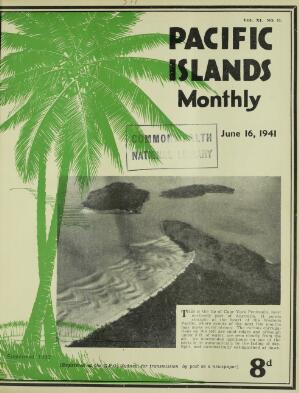
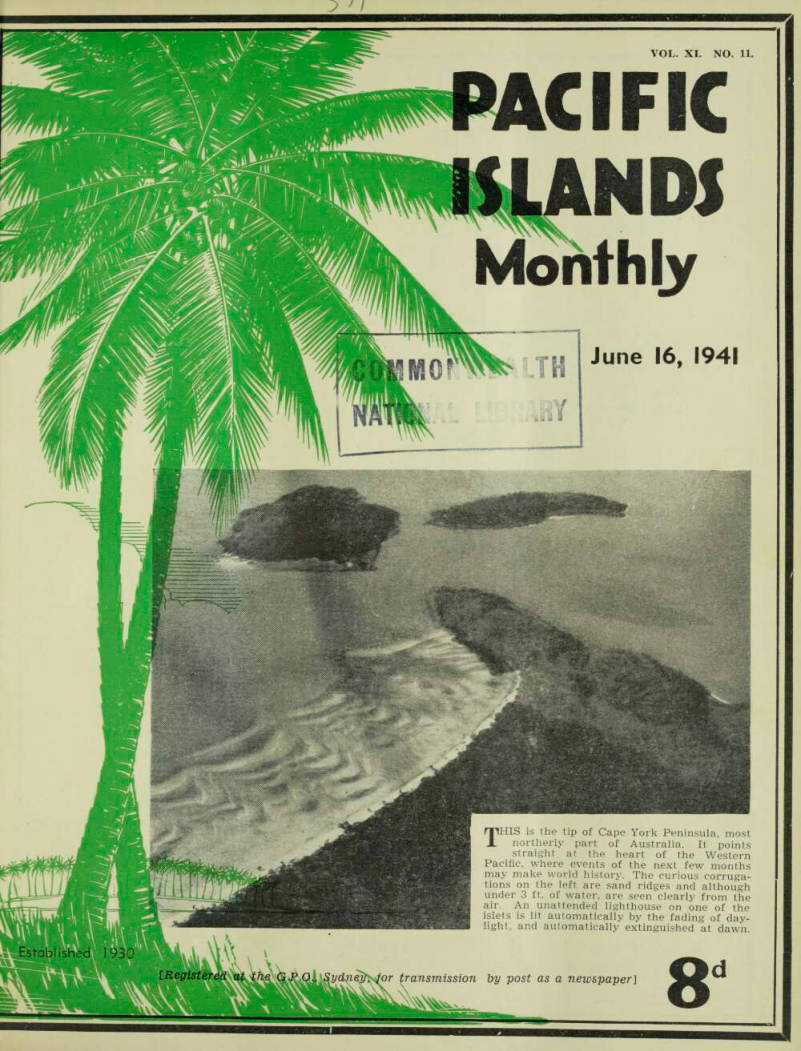
THIS is the tip of Cape York Peninsula, most northerly part of Australia. It points straight at the heart of the Western Pacific, where events of the next few months may make world history. The curious corruga tions on the left are sand ridges and although under 3 ft. of water, are seen clearly from the air. An unattended lighthouse on one of the islets is lit automatically by the fading of day light, and automatically extinguished at dawn.
Advertisements & other items, p. 2 (1 item)
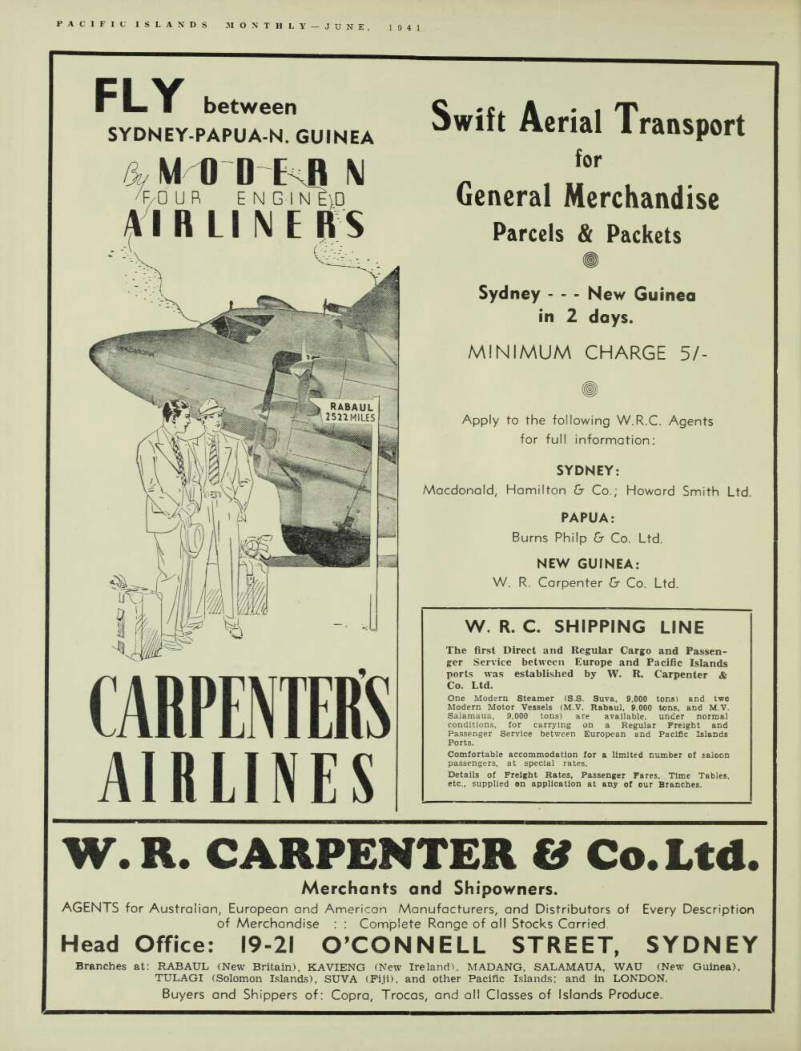
Carpenters
FLY between
SYDNEY-PAPUA-N. GUINEA
VI 0 II E R M
F/d U R EN G I nT\D
AIRLINE RS
I Rabaul
2521 MILES
K 5T
CARPENTERS
AIRLINES
Swift Aerial Transport
for
General Merchandise
Parcels & Packets
Sydney - - - New Guinea
in 2 days.
MINIMUM CHARGE 5/-
Apply to the following W.R.C. Agents for full information:
SYDNEY:
Macdonald, Hamilton Gr Co.; Howard Smith Ltd.
PAPUA:
Burns Philp £r Co. Ltd.
NEW GUINEA:
W. R. Carpenter Gr Co. Ltd,
W. R. C. SHIPPING LINE
The first Direct and Regular Cargo and Passenger Service between Europe and Pacific Islands ports was established by W. R. Carpenter & Co. Ltd.
One Modern Steamer (S.S. Suva, 9,000 tons) and two Modern Motor Vessels (M.V. Rabaul. 9,000 tons, and M.V.
Salamaua, 9,000 tons) are available, under normal conditions, for carrying on a Regular Freight and Passenger Service between European and Pacific Islands Ports.
Comfortable accommodation for a limited number of saloon passengers, at special rates.
Details of Freight Rates, Passenger Fares, Time Tables, etc., supplied on application at any of our Branches.
W. R. CARPENTER & Co. Ltd.
Merchants and Shipowners.
AGENTS for Australian, European and American Manufacturers, and Distributors of Every Description of Merchandise : : Complete Range of all Stocks Carried
Head Office: 19-21 O’CONNELL STREET, SYDNEY
Branches at: RABAUL (New Britain), KAVIENG (New MADANG, SALAMAUA, WAU (New Guinea), TULAGI (Solomon Islands), SUVA (Fiji), and other Pacific Islands: and in LONDON.
Buyers and Shippers of: Copra, Trocas, and all Classes of Islands Produce.
Pacific Nwes-Review
Notes And Comment On
The Progress Of The War
From May 15 To June 13
May 15: British forces are continuing the pressure against the remaining Italian forces in Abyssinia, southward of Addis Ababa, and another 500 prisoners have been taken. The British mechan ised forces in the Western Desert are constantly harassing German columns at Solium and around Tobruk.
May 16: A German military mission and an Italian delegation have arrived at Bagdad to aid the Iraki usurper, Raschid Ali. They travelled to Irak by way of Syria, with French connivance.
May 16: Reports from Turkey insist that a large-scale attack by the Ger mans on Crete —now garrisoned by the New Zealand division—will be made soon, with the enemy using the Ger man Air Force and the Italian Navy. A German attack on Egypt through the Sudan is also thought to be likely.
May 16: The sensation caused by the arrival in Britain on May 10 of Hitler's Deputy, Rudolph Hess, is now dying down. Few people, however, are able to offer any reasonable explanation of his extraordinary visit. He is now a prisoner of war. The soundest theory seems to be that this man, who is a complete and unrepentant Nazi, wholly devoted to Hit ler, and very conceited, conceived the idea that if he made a personal appeal to the authorities in Britain he might be able to bring about peace conversations.
May 17; As the result of the Franco- German collaboration announced by Marshal Petain (which, it is believed, gives Germany the use of French bases) more than 12 ships, including the huge liner, “Normandie”, have been taken into protective custody by USA.
May 17; It is revealed by the Japanese that the terms suggested by General Chiang Kai Shek for peace talks include the withdrawal of Japanese troops from China, to be followed by negotiations between China and Japan, through USA.
May 18: As it is clear that Germany is using air bases in Syria to assist the Iraki rebels against Britain, RAF bomb ers have systematically attacked the French bases in Syria. The RAF also attacked German planes at Mosul (Northern Irak).
May 18: British forces have now sur rounded the district in northern Abys sinia, where the Duke of Aosta (Italian Viceroy and Commander-in-Chief) and his remaining armies have taken refuge, and the Viceroy has sent emissaries to the British to ask terms of surrender.
May 19: It is reported that German and Italian planes are using Syrian aero dromes on their way to north Irak to help the rebels, and that trainloads of French guns and ammunition are being sent from Syria to Irak, also to help the rebels.
May 19: The Duke of Aosta, Viceroy of Abyssinia, and 7,000 officers and men surrendered to the British to-day. The whole of Abyssinia, Eritrea and Italian Somaliland is now conquered and in occupation of the British, except a com paratively small Italian force southwards of Addis Ababa.
May 19: While Vichy France appar ently has yielded completely to German pressure, news from Spain indicates that General Franco is continuing to main tain his independence against the pro posed Nazi infiltration.
May 20: German air-bome troops in great numbers to-day began an attack upon Crete, and a big battle is develop ing between Germans who are landing by parachute and aeroplanes, and the defenders of Crete, mainly New Zealand ers and Greeks.
May 20: Although reports indicate that about 50 German planes have reached Irak, through Syria, the British forces in Irak are now striking out in all direc tions and have captured an important town on the road to Bagdad.
May 20: Almost every night the RAF carries out heavy bombing attacks on towns in western Germany and upon the Channel invasion ports. Swiss news papers say that the RAF is attacking night after night with an increasing number of machines.
May 21: The overwhelming attack by German air-borne troops upon Crete con tinues. It is estimated that the Germans yesterday attempted to land 7,000 men by aeroplanes and 1,500 by parachute.
Large numbers of these were killed imme diately, but other large numbers suc ceeded in getting a footing and bitter fighting is proceeding in the north-west.
It is indicated, further, that dive-bomb ers in very large numbers attacked the protecting British warships, which suf fered heavily.
May 22: The Germans have established themselves m north-west Crete, and Irre gular fighting is proceeding in many places. There is no clearly defined front.
British headquarters says the situation is well in hand, but all indications are that the Germans are bringing in large numbers of air-borne troops.
May 23: Although no sea-borne troops have been landed, the Germans are be ing constantly reinforced in Crete by air, and although they are being staunchly resisted by British, New Zealand, Aus tralian and Greek forces, the situation is very critical.
May 23: A rigid blockade of France and French territories is the first result of Britain’s new attitude to the Vichy Government. There is increasing evi dence that France is now giving aid to the German war-machine.
May 23: It is officially estimated that 3,560 members of the AIF were killed, missing or taken prisoner in Greece.
May 25: To-day, in a naval engage ment off the coast of Greenland, the battle-cruiser, HMS Hood, 42,100 tons (the largest ship in the British Navy) was sunk. She was exchanging shots with the Bismarck (Germany’s newest battle ship, 35,000 tons) when she was struck by a 15-inch shell, which apparently entered her magazine. An explosion completely destroyed the ship and only two or three of her complement of 1,350 men were saved. The Bismarck and other German ships departed at high speed, and now are being pursued by British warships.
May 25: Germany’s air-borne troops secured a firm foothold in and around the airfield of Malemi, in Crete. Ex tremely bitter fighting is going on. The position at Malemi is dangerous.
May 26: The Germans in north-west Crete are making a concerted attack upon the British positions, and are being assisted by masses of fighting and dive bombing aircraft, while the British troops appear to be without any air assistance whatever. Severe fighting is proceeding, but the Germans are slowly getting the upper hand.
May 26: The King of Greece and his Ministers have arrived in Egypt. They remained in Crete until the principal towns were menaced by German para chutists, and then escaped by crossing the island and being embarked on a British destroyer on the south coast.
May 26: British warships are pursuing the German warships led by the Bis marck. The Germans are making des
perate efforts to get back to German ports.
May 26: The tribesmen of Irak are now rallying numerously to the support of the Regent, Emir Abdul, and are revolting against the pro-Nazi usurper, Raschid Ali.
May 27: British warships this morning sank the new German battleship Bis marck, thus avenging the loss of the Hood. The Bismarck, which was claimed by the Germans to be unsinkable, was “officially” 35,000 tons; but naval officers engaged in this long-drawn-out battle say that she was nearer 50,000 tons. The German cruiser Prinz Eugen, which was with the Bismarck, is being pursued.
May 27: Renewed attacks by German air-borne troops, heavily supported by aircraft, have compelled the British in Crete to withdraw to the south and east.
May 27: The British Navy, in opera tions around Crete, has lost the cruisers Gloucester, Fiji, and York, and four destroyers. All appear to have been sunk by air action.
May 29: British reinforcements have been landed in Crete, but the Germans are using large masses of aircraft in co operation with their ground troops, while the British have no air assistance, and the position is exceedingly grave.
May 29: The battle in Crete is described by a New Zealand officer as “old-style fighting on the ground, with everything new in the air”. In man-to-man fight ing, the British are easily better than the Germans, but the Germans have all the advantages of aircraft assistance.
May 29: The RAF and British mobile forces in the Western Desert are cease lessly harassing the German columns in Libya. The Germans advanced in con siderable strength on Monday, but did not proceed beyond Solium and Halfaya Pass, both of which they captured.
May 29: President Roosevelt, in a long-awaited speech, declared that the United States would give every possible assistance to Britain and other democra cies fighting aggression, and would actively resist every attempt by Hitler to extend Nazi domination to the Western Hemisphere. He proclaimed a state of unlimited national emergency, which means that the President has assumed full wartime powers and that the nation is placed on a war footing.
It is plain that the President has gone as far as he can. He cannot declare war—under USA Constitution that is the function only of Congress. It is obvious that the President is awaiting some act of Germany which would automatically create a state of war between USA and Germany. If he asked Congress for a declaration of war it is apparent that, in the present state of American public opinion, the argument, pro and con, would continue for many weeks.
May 29: The situation in Crete is now officially described as “precarious”. The British have made further withdrawals.
It is said that in the Crete operations the British Fleet was attacked for 15 hours by 500 German planes.
May 29: An enemy convoy, carrying troops and supplies to Libya, was caught and destroyed by British warships. An 18,000-tons liner, and a 5,000-tons tanker were sunk, and a 5,000-tons transport and a 4,000-tons tanker were probably sunk.
May 30: After some delay, the British forces in Irak are spreading out over the country, and there is every indication that the revolt will end soon. Nazi
agents are fleeing the country. The British are only 20 miles from Bagdad.
May 30: Training will begin on June 7 in the United States of the first of 8,000 British and Dominion airmen under the important Anglo-American plan recently announced. Four thousand of them will be trained according to USA Army methods and 3,000 will undergo the RAP training programme under the supervision of British officers. The re maining thousand will be navigators, to be trained at the Pan American Airways schools. USA provides the cost of equip ment, but most of the charges will be met directly by Britain.
May 30: Japan announces that she is dissatisfied with the results of 8 months’ negotiations with the Dutch East Indies and is now putting pressure on the Dutch territory to enter into a trade agreement under which the Dutch will guarantee to sell to Japan unlimited quantities of oil, rubber, tin, etc.
June 1: Britain announces that, after 12 days of the fiercest fighting of the war, it was decided to remove the British forces from Crete. About 15,000 British troops have been withdrawn to Egypt.
The German communique claims that Germany has taken 12,000 British and Greek prisoners.
Thus ends the Battle of Crete, which represents the most complete and severe British defeat in this war. In a strategic sense, the loss of Crete is very serious— it opens the coast of Libya (Tobruk), the coast of Egypt (including the naval base of Alexandria), the coasts of Palestine and Syria, and the British colony of Cyprus to direct air attack from the Germans Not only have the British lost from 8,000 to 10,000 of their best fighting troops, but they also have suffered a disastrous loss of warships. The British, with much superior troops, and dominant sea-power, could not hold Crete against German air-power—a very significant and alarming fact.
June 1: As British troops were en circling Bagdad (capital of Irak), the people of Irak sought and obtained an armistice, and thus the Nazi-inspired re volt collapsed. The British are now rapidly taking control of the whole of Irak —probably with a view to organising a defence against German activities through Syria. Raschid Ali and his asso ciates, and all the Germans who had reached Irak, have fled the country— some to Turkey, others to Iran.
June 1: German bombers made an early morning raid on Dublin and, in a severe blitz, some 40 people were killed and 100 injured. There was great damage, and big fires were started.
June 2; Hitler and Mussolini met yesterday on the Brenner Pass and con ferred for some hours. These conferences, on every occasion, have been the prelude to some important development of the war.
June 2: The British troops evacuated from Crete suffered great hardships.
Many of them had to walk 40 to 50 miles across the island to the south coast, where they were embarked upon all sorts of little naval vessels. During the voyage to Alexandria, they were con stantly bombed by countless German machines.
June 2: The completeness of the British occupation of Irak is shown by the fact that the Mosul oilfields are now in our hands, and apparently little damage has been done to the important oil industry, June 3: It is expected that the Ger mans, following their victory in Crete, will lose no time in developing their attack upon Egypt, and the Suez Canal.
Simultaneous thrusts at Cyprus and Syria, on the one hand, and through Libya, on the other, are expected.
June 3: There is comment on the fact that the German air force has carried out
no large-scale air attacks upon Britain since the night of May 10, which was the night of tne terrific air blitz against London, and which also was the night that Hess parachuted down into Scotland.
British combers, however, continue almost nightly to make raids upon ob jectives among the German-occupied ports and in Western Germany.
June 3: There are numerous and in creasing reports that German technicians and shock-troops are being infiltrated into Syria, with French connivance, and at the same time it is clear that the French Vice-Premier, Admiral Darlan, is negotiating a Franco-German agreement under which France, in return for relief from some of the harshest clauses of the Franco-German armistice, will give com plete collaboration to Germany.
June 4: Wilhelm 11, the former Ger man Kaiser, died at Doom, Holland, to-day, aged 82.
June 4: President Roosevelt is having long discussions with the United States Ambassador to Britain, Mr. Winant, who has flown to Washington from London.
It is believed that Mr. Winant is urging upon the president the need for early, as well as effective aid for Britain, if Britain is to survive the terrific assaults from Germany within the next four months.
June 5; A heavy raid upon Alexandria by German aircraft caused the death of 100 persons. There is no report of damage to the naval base, but much damage m the city.
June 5: Numerous reports from Turkey continue to insist that the flow of Ger mans into Syria on ’planes and occasional freighters is increasing. It is reported that British forces are massed on the Palestine frontier, ready to cross into Syria. The Vichy Government announces that it will defend, even if this means fighting against the British.
June 5: The Japanese are insisting that the Netherlands East Indies Government give some satisfactory and decisive an swer to Japan’s demands for an economic and trade agreement.
June 6: United States has informed Vichy that if France weakly gives way to Germany, she cannot expect to retain diplomatic relations with USA.
June 6: The United States Maritime Commission has assumed complete con trol of the American merchant marine shipbuilding. It has compelled shipping companies operating on the Atlantic and Mexican coasts to contribute half their tonnage to “emergency needs”. This means that about 35 ships will be made available for British use, June 6: The Admiralty announces that four German ships and an armed trawler whose job was to provide supplies for the Bismarck and other German warships which were overtaken by the British off Greenland, have been rounded up and sunk.
June 6: British ship-repairing yards are breaking records for speedy workmanship.
In one week ships totalling 1,000,000 tons were returned to service.
June 8: At dawn to-day, Free French Forces under General Catroux, and British Forces under General Sir Henry Maitland-Wilson, crossed the frontiers of Palestine and Trans-Jordania into South Syria, while other columns from Irak crossed the frontier into eastern and northern Syria. The Free French leader issued a proclamation to the people of Syria, asking them to join the Free French Forces and guaranteeing the indepen dence of Syria after the war. The British Government formally associated itself with this promise.
The Anglo-French invasion of Syria is warmly welcomed in Britain and United States, and newspapers in Turkey say that if this had not occurred, the Ger mans within two weeks would have had enough men and materials in Syria to menace Palestine.
June 8: There have been many con ferences at Vichy and reports are con fusing; but it is clear that General Weygand refused to associate himself with the Vichy Government’s deter mination to fight the British in Syria, and he returned to North Africa. There is very little about Petain; but it is clear that Darlan and Laval are now in close collaboration with the Germans.
June 8: The British naval base at Alexandria was again raided by German aircraft on Saturday night. Casualties and damage in the city have been heavy, but there is no indication of the effect of the air-raid on the naval base and the ships therein.
June 9: The Anglo-French columns in Syria are advancing steadily on Beirut, Damascus and Alleppo. They are being welcomed by the native inhabitants, but here and there they are meeting con siderable resistance from the French troops. This resistance is increasing as they get nearer the principal towns.
June 9: The Netherlands East Indies Government has formally rejected the trade demands of Japan. There is some anxiety and considerable speculation as to the next development.
June 10: The Anglo-French columns in Syria are now on the outskirts of Damascus and Beirut. There has been rather violent fighting with the French at some points. In other places the French joined the Free French Forces after only a show of resistance. One report says that a British naval squadron is operating off the coast of Syria and co-operating with the forces ashore. The Anglo-French columns have plenty of assistance from aircraft and no enemy aircraft have been met.
June 10: For the 14th night in suc cession, the RAF has bombed Benghazi, the Libyan port, from which the German and Italian columns in Libya are draw ing supplies. It is the purpose of the British thus to harass the columns which are threatening Egypt.
June 10; An American freighter, “Robin Moor ’, was torpedoed and sunk by the Germans in the South Atlantic; 11 survivors were rescued. The incident is regarded seriously in Washington.
June 10: It is announced that during the Crete operations the British lost, in addition to the ships already mentioned (3 cruisers and 4 destroyers), one cruiser and two destroyers—making, in all, 4 cruisers and 6 destroyers definitely lost.
All were sunk by enemy aircraft. This is easily the worst loss suffered by the Navy since the outbreak of war.
June 11: According to the Spanish radio, German long-range bombers are now operating from bases in West Africa, which have been made available to them by France.
June 12: Many newspapers insist that Hitler is forcing a crisis with Russia. It is said that about 100 German divisions now are lining the frontier between Germany and Russia, from the Baltic to the Black Sea. It is considered signi ficant that the British Ambassador in Moscow has flown to London, to confer with the British Government, and that the Russian minister in Turkey has suddenly departed for Moscow.
June 12: The Allied forces approaching Beirut and Damascus have met with much stiffer French resistance and con siderable fighting is reported. There has been indecisive fighting between French and British destroyers off the coast of Syria.
June 13; A leading American commen tator says we must anticipate a further heavy German effort in the Middle East, either against Cyprus, Syria or Egypt.
Diminishing attacks against Britain, while Germany concentrates on the Mediter ranean, show that Hitler is not equipped for a two-front war.
Advertisements & other items, p. 3 (1 item)
1
PACIFIC ISLANDS MONI'HLY JUNE, 1941
Pacific Islands Travellers
PER AIRLINER TO PAPUA & NG (from May 15 to June 8>: Messrs. Blount, Luetchford, Petree, McAviney, Burke. Marr, Allison, Leslie, Shutt, Woods, Kent, Shaw, Fryer, Douglas, Anderson, Kyle. Brown, Adams, Moss, Scott, Burnett, Smith, Burns, Adams, Pike, Richardson, Bowers, Hardie, Schmidt (2), Downes, Mitchell, Eichorn, Beckitt, Rostrum. Mesdames Smith, Odgers, Cullen, Clay, Schmidt, Shutt, Leslie, Peadon, Kent, Parer. Misses Thomas, Allan, McClugguge.
PER AIRLINER FROM NG & PAPUA (from May 10 to June 3): Messrs. Marsland, Twycross, Saunders, Burnett, Stevenson, Pollard. Bowers, Stokes, Luetchford, Hogan, Archer, Trammel, Foley, Gloe, Brown, Gorringe, Head, Keenan, Gulls, Pendleton, Hancock, Piddington, Kirwan, Housley, Wyllie, Ecclestone, Duigan. Mesdames Watson, Stevenson, Brennan, Foley, Seale, Kirwan, Durcher, Phillips, Ecclestone, Bonney, Bellhouse, Thomas. Misses Rainey, Pritchard.
PER STEAMER FOR NG: Messrs. Smith, Brown, Paul, Heron Webb, MacGregor Mulvey.
Hughes, Rawnsley, Coldham Woolcott, Passlow.
Wood, Anderson, Ball, Coote. Wilson, Woodhouse, Strudwick, James, Evenson. Rev. Linggood. Mesdames Smith, Tuckey, Clymo, Burns, Chapman, Cornish, Coote, Wilson, Woodhouse, Strudwick, James, Evenson, Lmggood Misses Bowman, Collibee, Ball, Solomons (2), Coote, Lievering.
PER STEAMER TO PAPUA, NG & ESI: Messrs. Boye, Inglis, Hall, Vivien, Schafer, Champion, Cormack, Saville, Pilling, Hyne.
Nicholas, Johnston, Price, Campbell, Adams, Goodman, Kropacsy, Bowman, Gray, Thomas, Nevitt, Nielson, Lumley, Mathews, Hill, Cooper, Campbell, Olssen, Grundy, Wakeford, Shaw, Gill, Mills, Lowe, Gough, Andrews, Ware, Butler, Cuthbertson. Mesdames Boye, Hill, Schafer, Champion, Hyne, Cormack, Fulton, Stewart, Lyons, Beeles, Nicholas, Campbell (2), Green, Neville, Sydler, Murphy, Wakeford, Rosser, Field, Widdy, Nielson. Misses Campbell, Hodge, Stead, Rosser. o PER STEAMER FROM BSI, NG, & PAPUA.
Messrs. Atherton, Grant, Lincoln, Lotze, Wilson, Symes, Theodore, Mercer, Gallagher, Fletcher, Hill, McGregor, Rixon, Coates, Fedoseyeff, Graham. Mesdames Atherton, Wilson, Sefton, Coates.
Misses Henderson, McMillan, Sefton, Kennedy.
PER STEAMER FROM NG & PAPUA: Messrs.
Anderson. Allen Baker, Burnett Brennan. Banfield, Barnes Bussell Brown Costelloe, Cook, Carroll Clarke, Dickinson, Dishon, Finger. Frazer, Gollan, Gibson, Healy, Renderson Hyde, Ison Kitson Kilgour Lowe, L°™y.
Vertigan, Smith (2), Stevens, Sandery, Stubbings, McLaren, Mann Muckner, O’Malley, Ord, Parry, Renton, Ritchie. West Bowthorpe, Collins, Fry, Green, Hayes, Heymer, Henning, Leavey, Livingston, McGrath, Maher,
Milne, Molony, Mossman, Muir, Ray, Richard son, Shields, Sinclair, Thomas, Vansleve, Woods, Washington, Mac Call, Chayter, Carr, McGuire, Stewart, Dickens, Hall, Martinez, McDermott, Moller, Stone, Von Dohern, Wordsworth, Baron, Hearnes. Mesdames Burke, Bates, Burnett, Brennan (2), Costelloe, Cooper, Cook, Einseidel, Fitton, Groom, Gollan, Hyde, Harrison, Jones, Lowe, Vertigan, Searle, Trevitt, McKerlie, Mc- Mullen, Ord, Pickwell, Roberts, Wiley, Wiggins, Bowman, Griffin, Harvey, Johnstone, Jamieson, McCosker, MacGregor, Shelton, Slee, Stansfield, Stevens, Taylor, Thornley, Richardson, Kinsey, Lowe, Gabriel, De Boom. Misses Manning, Fry, Gordon, Scott, Selby.
PER STEAMER FOR PAPUA: Messrs. O’Loiigh lin, Jones, Morris, Emslie, Taylor, Brown, Sten, Booth, Colvin, Aigles, Robinson, Turnbull, Fal coner, Martin, Thompson, Payne, Gould, Dobe, Allen, Taylor, Hayes, Turner, Edwards, Scott, Ingliss, Poulson, Linke, Creighton, Poppin, Broadwood, Hill. Mesdames Green, Brown, Smith, Edwards. Miss Wilson.
PER STEAMER FOR LORD HOWE IS., NOR FOLK IS., BSI & N. HEBRIDES; Messrs. Sykes, Blair, Duncan, Watson, Mitchell, Driver, Rook, Isom, Thomas, Laing, Christian. Revs. Crump, Miller, Canon Rook. Mesdames Crump, Miller, Sykes, Wickstead, Rook (2), Dignam, Isom, Thomas, Buffett, Adams, Blandy, Clarke, Menzes.
Misses Brown, Mclntyre, Safstrom.
PER STEAMER FROM FIJI: Messrs. Groom, Rogers, Young, Parker, Boyd Monk, Storer, Livie,
(Continued On Page 64)
Carey, Byrne, Moate, Pollock. Mesdames Young, Parker, Boyd Monk, Canard, Isaac, Nelson, Bond. Misses Parker (2), Bond.
PER STEAMER TO FIJI: Messrs. Aspinall, Allman, Constance, Curry, Davis, Ford, Robert son, Small, Trewenack, Wignall (2), Mansell, Walcot. Mesdames Robertson, Scott, Trewenack, Wignall, Walcot. Miss Wignall.
Per Steamer For Fiji; Mr. Peterson.
Mesdames Peterson, Dann. Miss Blomfield.
PER STEAMER TO FIJI: Messrs. Anderson, Candler, Griffiths (2), Grainger, Harness, Hor ton, Johnson, Shinguin, Smith, Stevenson, Stan ton. Mesdames Moore, Campbell, Davis, Grif fiths, Friend, Harness, Nelson, Stevenson. Misses Campbell, Davis, Friend, Harness, Johnson, Smith. TO PAPEETE: Mrs. Tiffy.
Messrs. J. R. Herd, A. M. Pavitt and B. H. Yandall, all of Western Samoa, have enlisted for service overseas with the NZ Forces.
Advertisements & other items, p. 5 (1 item)
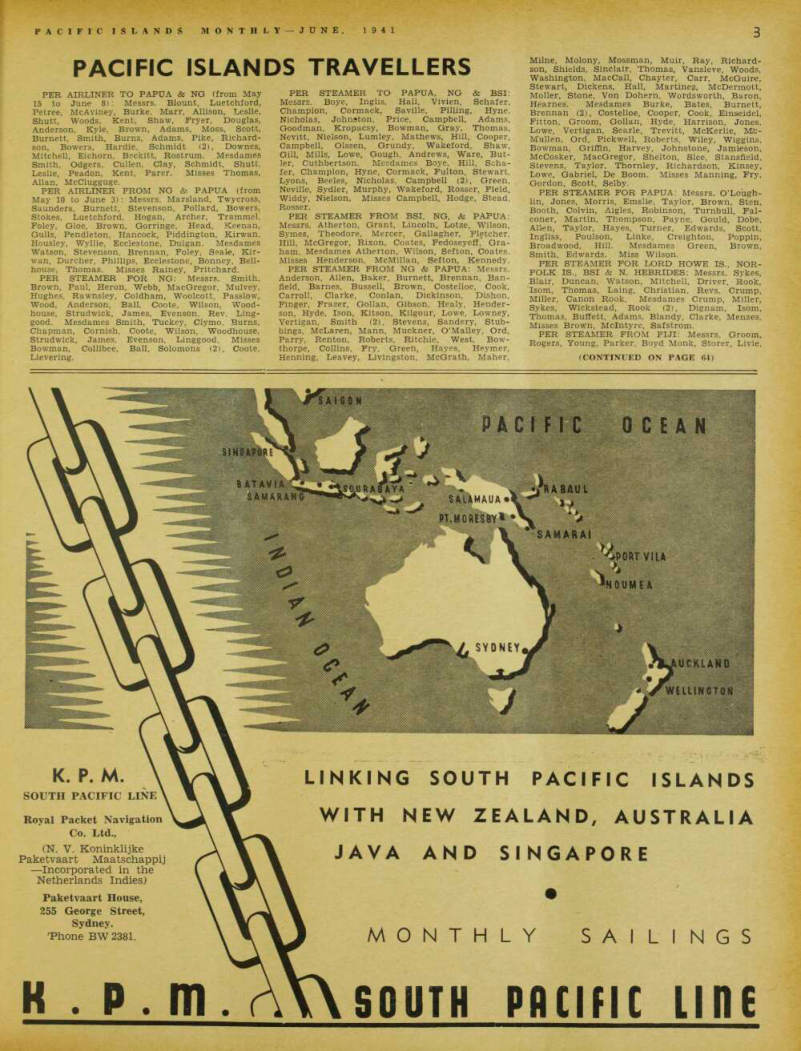
south Pflcmc Line
p. m p a j
if "A
fcAfAY*; *
Ul*MAUA»*gj
PT. •V
A \ n <v\ «*8®S
SYDNEY
K. P. M.
SOUTH PACIFIC LINE
Royal Packet Navigation Co. Ltd., (N. V. Koninklijke Paketvaart Maatschappij —Incorporated in the Netherlands Indies) Paketvaart House, 255 George Street Sydney. ’Phone BW 2381.
K
LINKING SOUTH PACIFIC ISLANDS
WITH NEW ZEALAND, AUSTRALIA
JAVA AND SINGAPORE
MONTHLY SAILINGS
south Pflcmc Line
Contents
“Airzone” Radio . 19 Amplion (A/sia) Pty.
Ltd 43 Angus & Coote Ltd. 12 Arnott’s Biscuits . 35 Atkins Ltd., W. . .48 “Ausoline” ... 64 A. Ltd. . . .- . 36 B. Ltd. ... 49 Bank of N.S.W. . . 60 “Bidomak” ... 17 Broomfields Ltd. . . 40 Brown & Co. Ltd., G 11 Brunton’s Flour . . 33 Budge Pty. Ltd., Jas 42 Burns, Philp & Co.
Ltd 4 B.P. Magazine . . 18
B.P. (S.S.) Co. . . 32
Burns Philp Trust Co. Ltd 12 Callose & Sons Ltd., B 16 Carlton & United Breweries Ltd. . 27 Carpenter Ltd., W.
R cov. 2 Chapmen & Sherack 41 Chivers & Sons Ltd. 32 Clyde Batteries . . 57 Coleman Lamp & Stove Co. . . 20, 48 Colonial Sugar Re fining Co. Ltd. . 45 Compressor & Air Equipment Co. . 56 Coral Starch ... 35 Cosmopolitan Hotel 64 Crammond Radio . 51 “Cystex” ... 40 De Meric Pty. Ltd. 38 Dewar’s Whisky . . 37 Doan’s Pills ... 42 Donaghy & Sons Ltd 38 Donald Ltd., A. B. 46 Dr. Williams Pink Pills 47 Dunlop Perdriau Rubber Co. Ltd. . 23 Eaton Ltd., J. W. . 39 Edgell Products . . 55
Electrolux Refrigerators . . 26 Fletcher & Sons . 49 For Sale ... 50, 51 Ford Sherington Pty. Ltd. ... 22 Garden Vale Pro ducts Ltd. ... 28 Garrett & Davidson 56 Gilbey’s Gin ... 18 Gillespie’s Flour . 34 Gold Flake Cigar ettes 57 Gowing Bros. Ltd. 22 Grand Pacific Hotel 47 Grove & Sons, W.
H 16 Gourock Rope Ex port Co 61 Guinea Airways Ltd. . . . cov. 3 Hampton Court . 17 Heinz Co. Ltd., H.
J 31 Hislop Lloyd Pty.
Ltd 15 Holbrook’s Ltd. . . 33 Horlicks Malted Milk 24 Hotel Moresby . . 64 International Correspondence Schools ... 55 Jones & Co., H. . 52 Kopsen & Co. Ltd. 14 Kork-N-Seal Ltd. . 28 Lea & Perrins Sauce 54 Levensons Radio . 58 Maxwell Porter Ltd. 39 Mcllrath’s Ltd. . . 54 “Mendaco’ ... 50 Meriden School . .53 Miller & Co. Pty.
Ltd 62 Nelson & Robert son Pty. Ltd. . . 20 Nestle’s Milk ... 29 Newmarket Saddlery ... 60 Nock & Kirby Ltd. 50 Noyes Bros. Ltd. . 56 Pacific Is. Society . 13 Paling & Co. Ltd., W. H 15
Papua Hotel, The . 64 Philips Lamps (A/sia) Pty. Ltd. 59 “Pinkettes’ ... 59 Prescott Ltd. ... 34 Price’s Radio Ser vice 63 Prouds Pty. Ltd. . V Riverstone Meat Co. 53 Rohu, Sil . . . . 41 Royal Packet Navi gation Co. ... 3 Scott Ltd., J. ... 40 Scott’s Emulsion . 10 Single Wire Fence Co 61 Springwood Ladies’
College . . . . .52 Steamship Trading Co. Ltd. . . . . 63
Sterling Varnish Co. 9 Sullivan Ltd., C. . 61 Swallow & Ariell . 30 Swift & Co. Pty.
Ltd \ 13 Talkeries, The . . 23 Taylor & Co., A. . 42 “Tenax” Soap , . 25 Tillock & Co. Ltd. 44 Toohey’s Ltd. . . 21 Tooth & Co. . cov. 4 Tucker & Co. . . 54 Union Assurance Society Ltd. ... 14 Vincent’s A.P.C. . 25 “Vi-stim” ... 62 Vok Liqueurs ... 10 West, Harry ... 64 Wills, Ltd., W. D. & H. 0 46
Weymark & Son . 34 Wright & Co. Ltd., Woods’ Great Pep- E 62 permint Cure .44 Wunderlich Pty.
Wright & Co. . . 63 Ltd 39 Mr. G. O. Wilkinson, of Brisbane, who died in a hospital there on April 9, was a man who made Papuan goldmining history. It was he who joined with Mr.
F. W. Cuthbert to put the present Cuth bert’s Misima Goldmine on a paying basis after the famous mining company, Block 10, Broken Hill, had given it up.
Mr. Wilkinson’s specialty was the use of cyanide, and it was cyanide which turned Cuthbert’s Misima mine into one of Papua’s most famous money-spinners.
Advertisers
Pacific News Review l South Seas Travellers 3, 64 We Now Face Stark Realities ... 5 Japan Seeks Pacific Copra 6 Roll of Honour 6 New Caledonia Re-affirms Her Freedom 7 NG Soldier’s Lucky Escape 7 Samoans Tied Up Like Pigs 7 Relief For Copra Producers 8 Salamaua-Wau Road 8 Fire-Walkers in Fiji 9 Death of Rev. M. Frater 9 Synthetic Rubber Menaces Papuan Industry 9 Sydney-Rabaul Air Service 10 USA Ships to Replace British in Pacific 11 How Cure for Hookworm Was Found 12 Tropicalities 14 New Books 17 How Australia Double-Crossed Fiji .. 18 Memories of Old Tahiti 20 A Yankee Doctor and His Million Patients 21 Maku and His Missus —A Cook Is.
Tale 25
Samoa’s Trade in 1940 27 How War is Twisting Copra Markets 29 Memories of a Papuan Miner ... 30 “Queen Emma”, of New Britain ... 32 USA Defends the Philippines ... 34 Process Copra in the Islands 35 A Trader’s Tale 37 Cockroaches—A Tropical Household Pest 38 Captain George Vancouver, RN ... 39 What is a Good Price for Copra? .. 40 111-Judged NG Strike is Over ... 41 A Deal in Pearls 42 A Hurricane in Fiji 46 NG’s Display at Sydney Show 49 Fate of a “Grand Old Pioneer” ... 50 Rabaul Volcano is Active 51 A Section for Women 52 How Central Pacific Manages Without Copra 54 Guinea Airways Annual Report .. 55 Mining News 56 Short Wave Radio Programmes ... 59 Pacific Exchange Rates 60 Islands Produce Prices 61 Copra and Rubber Quotations ... 62 A New Guinea Bonanza 63
Advertisements & other items, p. 6 (1 item)
illlif
ITS
\ ■ HR mu mil TuSffiuu’inmiini mm
IHlfltlHi
W' ¥¥■' W 111 111
min
1111111 V * >
ii?)[r
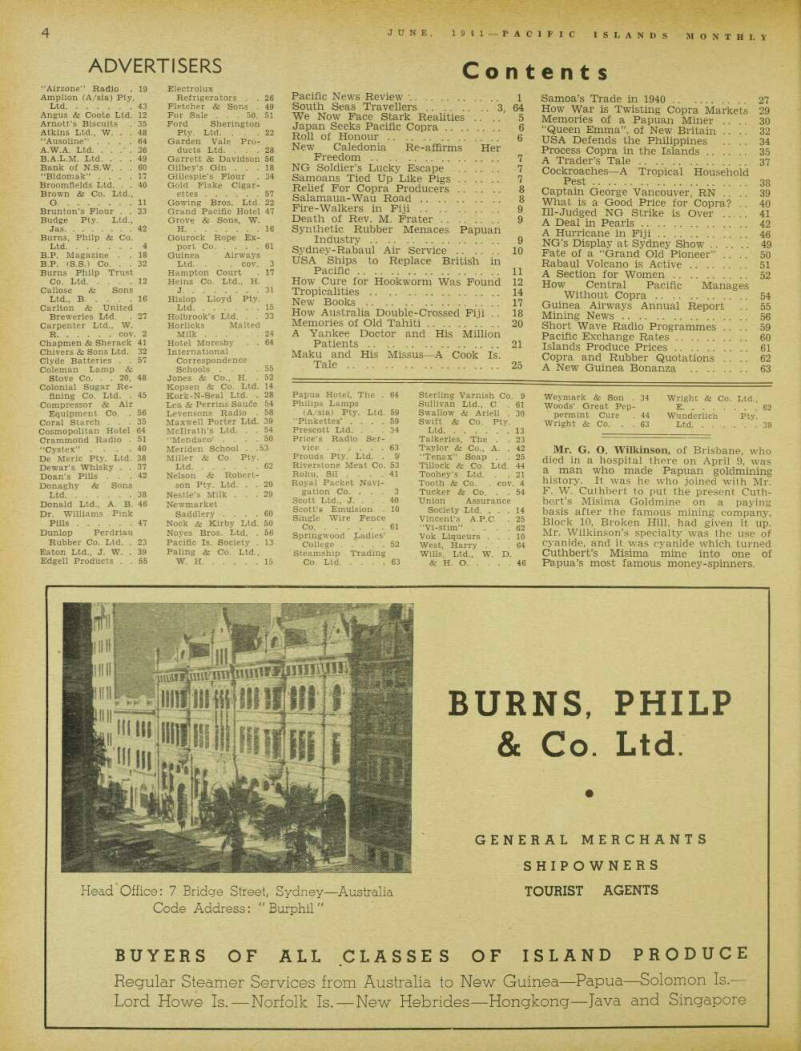
mmmfm f Head Office: 7 Bridge Street, Sydney—Australia Code Address: " Burphil"
BURNS, PHILP
& Co. Ltd.
GENERAL MERCHANTS
SHIPOWNERS
TOURIST AGENTS
BUYERS OF ALL CLASSES OF ISLAND PRODUCE Regular Steamer Services from Australia to New Guinea —Papua—Solomon Is. — Lord Howe Is.—Norfolk Is. New Hebrides—Hongkong—Java and Singapore
Pacific Islands Monthly
The Newspaper-Magazine of the South Seas IRegistered at the G.P.0., Sydney, for transmission by post as a newspaper .]
Published Once Each Month and Circulated in Australia and New Zealand and in the following Pacific Territories and Islands Groups:
Australian Territory of Papua.
Mandated Territory (Australia) of New Guinea, Bismarck Archipelago and Northern Solomon Islands.
Australian Territory of Norfolk Island.
New Zealand Territory of Cook Islands.
Mandated Territory (New Zealand) of Samoa.
British Colony of FIJI.
British Solomon Islands Protectorate.
British Protectorate of Tongan Islands.
British Crown Colony of Gilbert and Ellice Islands.
Mandated Territory of Nauru.
British and French Condominium of New Hebrides.
French Colony of New Caledonia.
French Colony of Oceania (Tahiti, etc.).
American Territory of Eastern Samoa.
American Territory of Hawaiian Islands.
American Territory of Guam.
Mandated Territory (Japan) of Marshall, Caroline and Mariana Islands.
Owned and Produced by Pacific Publications Pty. Ltd., Union House, 247 George Street, Sydney.
TELEPHONE f Mana g ln & Director .. BW 5037 ( Business and Editorial MA 7101
P.O. Box 3408 R
Registered Address of Telegrams, Radiograms, and Cables: “Pacpub”, Sydney.
Contributions.
Articles, Stories, and Photographs dealing with Pacific Islands subjects are invited and will be paid for on publication.
Subscription Rates.
Per Annum, within British Empire, Prepaid, Post Free g/> Per Annum, elsewhere, prepaid, Post Free . 10/- Single Copies 8d
Editor and Publisher:
R. W. Robson, P.R.G.S.
Assisted by Selwyn Hughes.
Advertising Manager: L. W. Bailey.
Advertising Office and Printing-House: 29 Alberta Street, Sydney.
Advertising rates furnished on application.
Colours, etc., by Arrangement.
Process Blocks made at Advertiser’s expense when required. Screen 100.
Changes of Advertising Copy should reach this Office by Ist of each month, otherwise previous advertisement may be repeated.
IN LONDON, the Pacific Islands Monthly is on sale at the Bookstall, Australia House, The Strand, London.
Agents.
The following are authorised to receive sub scriptions for the Pacific Islands Monthly;— Islands Branches of Burns, Phllp & Co., Ltd., and Burns Phllp (South Sea) Co., Ltd.
Islands Branches of W. R. Carpenter & Co., Ltd.
Islands Branches of Morris, Hedstrom, Ltd.
T. A. Olsson, Wau, New Guinea.
G. Thomas & Co., Rabaul, New Guinea.
Whitten Bros., Ltd., Samaral, Papua.
Steamships Trading Co., Papua. All Branches.
B.N.G. Trading Co., Ltd., Port Moresby, Papua.
J. Muir, Suva, FIJI.
Kirpal and Co., Victoria Parade, Suva, Fiji.
N. C. Mackenzle-Hunt, Walnunu, Bua, FIJI.
Islands Branches and Representatives of W, H.
Grove & Sons, Ltd., Auckland, New Zealand.
Cook Islands Trading Co.. Rarotonga, Cook Is.
A. C. Rowland, Papeete, Tahiti.
Representative in London: W. C. HARVEY, Coronation House, 4 Lloydi Avenue, London, E.C.3, from whom may be obtained copies of Pacific Islands Monthly, Pacific Islands Year Book, advertising schedules, etc.
Vol. XI. No. 11.
June 16, 1941
Prirp ( 8d - Per Copy rnce ( Prepaid: 8/- p.a.
We Now Face Stark Realities
MUCH might be said about the merits and demerits of the copra-producers’ relief plan, des cribed elsewhere; but, since the unhappy planters have been com pelled by slow-moving bureaucracy to wait so long, they might as well wait a little longer. We shall know, in three months, what fate holds in store for us.
We face now what appears to be the crisis of the Hitler War. If Hitler cannot smash the British Em pire in this 1941 European summer (already half gone), we shall survive, and have a considerable voice in fix ing the shape of the post-war world.
If our defences fail, we shall be oc cupied with matters more vital than production and transport.
Germany, having defeated us over whelmingly with air-force technique in the Battle of Crete, is almost cer tainly now assembling vast forces, for the invasion of Britain. It will not be one attempt, or series of attempts, but a continuous attack, extending over many weeks. She will try to counter British sea-power and grow ing air-power, by applying the methods proved in Crete, supported by the terrific weight of 8,000,000 highly-organised troops.
TT seems that this attack must come A —Germany must smash us be fore she can consolidate and capitalise her victories, and set the whole world goose-stepping, to her orders. She
has mauled us in Greece, and Libya, and Crete; she has forced the guts less men of Vichy to pledge to her the “collaboration” of France; she has put 2,000,000 men on the western frontiers of Russia, so as to compel the terror-stricken Mr. Stalin to promise “economic collaboration”; she has given her orders to Japan.
She has only one more river to cross —Anglo-American resistance—and the world is hers, and the Nazi gangsters may enter the heaven of their de sires.
If only she can smash Britain, she can deal with the United States at her leisure—mostly by Fifth Column ists, from within. But Britain is a tough proposition. She was to be invaded by air in daylight attacks— but m August and September the British airmen defeated the Luft waffe, decisively. She was to be laid flat m night raids—but in April and May our night-fighters, with “some thing new”, got the measure of the night-bombers. She was to be starved out by submarine blockade: but, now science is beating the U-boats and we are winning the Battle of the Atlantic. Already, in rapidly-growing masses, our Anglo-American bombers are daily attacking the enemy’s Channel ports, and nightly smashing Germany’s industrial cities.
TTITLER knows that Britain must “ be invaded now—next year will
be too late. The whole world is wait ing. If we lose the invasion battle, Germany will dominate Europe, Italy will rule Africa, Japan will have Asia and most of the Pacific; Russia will submit; and the Axis Powers will divide spoils in the Americas. If we keep out the invaders, Germany’s “European Federation” plan will be knocked cock-eyed, Japan will stay neutral, the armed forces of the United States will come to our assist ance, and Russia and the now en slaved countries of Europe probably will turn against the Huns.
But the coming battle is vital. On it depends our future, and the future of our civilisation. If the Nazis rule the world, we shall enter another Dark Age, which may last for a couple of centuries.
What of America, and what of the Mediterranean? The Middle East battles are important—but only a side-show, compared with the Battle of England. As for USA—the Presi dent alone cannot declare war, and, incredible as it may seem, and al though 75% of people are for war, there is an anti-war majority in both houses of Congress. USA is our ally in all but name. For the “but” we must thank the Hearst press, and the professional politicians. If we can hold off the Hun, and thus convert his 1940-41 victories into a stalemate, USA probably will join us, and help us to turn it into a Nazi defeat.
But everything depends upon the events of the next 14 weeks.
Japan Seeking
Copra
"Flutter" in Fiji and Tonga
S. Pacific Marketing Plan—See P. 8.
THE flutter in the central Pacific copra market, caused by buying on behalf of Japan, did not last long.
The ruling price on the beach at Suva had been £3/10/- per ton, of which 20/was paid in cash and the balance in goods. Then, in March, the Japanese came into the market, and freely bought copra from Fiji and Tonga at £4/10/- per ton.
It was ascertained that the Japanese ships took this copra to Japan and thence it was transhipped to Shanghai.
After that no one quite knew what became of it —but there were those who suspected that it might even find its way into Hitler’s domain, in central Europe.
This happy condition for Fiji and Tonga planters lasted for only a few weeks. On April 15 it was announced that the British authorities, in accord ance with a policy which was being applied all over the world, would not permit the shipment of any more copra to Japan, and so the copra that was coming in from the plantations again went into the stores in Fiji and Tonga, and the old unprofitable price of £3/10/per ton was re-established.
A sequel was seen on May 16, when the well-known Tokyo newspaper, “Nichi Nichi”, bitterly charged the British Gov ernment with “an inhuman attempt to disturb Japan’s foodstuffs policy by ordering the natives of the Pacific Islands not to sell copra which the Japanese had contracted to purchase.”
As will be seen from an article on page 29, Japan has been buying copra feverishly from the Dutch East Indies and the Philippines, but both of those countries have now closed down on the export.
It is a well-known fact that combatant nations are desperately eager to obtain copra because from coconut oil there is obtained one of the most valuable com ponents of high explosives—namely, glycerine.
N. Caledonia And N. Hebrides
IN view of the foregoing, the following paragraph, taken from “Bulletin du Commerce” (Noumea) of May 17, has interest:— “Recently, the export to Japan of copra from New Caledonia and the New Hebrides was authorised. As a result, a Japanese steamship, ‘Momoyama Maru’, has arrived in order to load 670 tons, of which 625 tons were stored at the quay docks from a British steamship.
“It will be remembered that the latter ship was loaded at Noumea in February with copra destined for Mexico, but that at Vila, where it had commenced to load a cargo of 1,400 tons of New Heb rides copra, its orders were counter manded. Its voyage to Mexico was annulled. The ship returned to Noumea to unload there 625 tons of copra, and then departed.”
It is added that the “Momoyama Maru” was to proceed to New Hebrides, where she was to load a further 3,000 tons of New Hebrides copra.
Dr. and Mrs. Armstrong, of Lenakel, Tanna, New Hebrides, and their adopted daughter, Rachael, a Tannese, were in Australia early this month. They are visiting a settlement of Tannese on plantations on the borders of NSW and
Queensland.
Roll Of Honour
(It is hoped to assemble, here, the names or men, former residents of the Pacific Territories, which appear in British and French casualty lists, or in lists of honours awarded. We should be grateful if relations and friends would send us details.)
Killed in Action
Flying-Officer Moresby Gofton, of the R.A.F., son of Mrs. F. S. Stewart, of Wan, New Guinea. Reported missing, 17/5/1940. Now believed killed.
A/Bdr. N. W. Bertwistle, NGXS3, artil lery, of Rabaul, New Guinea. Killed in action, April, 1941.
Died from Wounds
Sergeant-Pilot Peter Clarkson Wise, son of Mr. W. Wise, OBE, Director of Public Works in Fiji. Wounded by anti aircraft gunfire during bomber raid over Germany, January, 1941. Returned with crew safely to aerodrome, died two days later.
Died from Illness Pte. Clarence A. Hutton, VXB3IO, form erly of Edie Creek, New Guinea. Died from illness, April, 1941.
Missing
L/Bdr. K. S. Sheekey, NGXSI, artillery, formerly of the Central Administration staff at Rabaul. New Guinea. Reported missing, 12/5/1941; later, 29/5/1941, listed as “rejoined unit”.
Flying-Officer K. J. A. Johnstone, of the R.A F„ who was bom in Suva in 1915. Reported missing, 1/5/1940. His mother was a daughter of the late Mr H Thiple, for manv years a member of the CSR Co.’s staff in Fiji.
Flight-Lieutenant G. J. I. Clarke, of the RAAF, serving overseas, formerly
Assistant Flight Superintendent of Car penter Airways, New Guinea. Reported missing 25/9/1940.
A/Sgt. A. A. S. Cotman, PXB, infan try, of Abau, Papua. Reported missing believed prisoner of war, 5/5/1941.
A/Cpl. P. W. Bosgard, PX9, infantry, of Papua. Reported missing—believed pri soner of war, 5/5/1941.
Pte. W. Gossner, QXIO, infantry, of Port Moresby, Papua. Reported miss ing—believed prisoner of war, 7/5/1941.
A/Cpl. J. H. Lonergan, NGX99, Supply and Transport, of New Guinea. Reported missing 5/6/1941 —believed prisoner of war.
Captain Edward Tewhiti Love, of the NZ Maori Battalion, husband of Mrs.
Takau Rio Love, Ariki-elect of Raro tonga, Cook Islands. Reported missing during Greek campaign, 27/5/1941.
Peter Hetherington-Martin, of the NZ Forces, son of Mrs. M. Hetherington- Martin, of Fiji. Reported missing during Greek campaign, 30/5/1941.
Gnr. A. L. King, NGX7, artillery, of Rabaul, TNG. Reported missing 16/6/1941.
Wounded
Stanley Higgs, son of Mr. and Mrs.
Gordon Higgs, of W. R. Carpenter and Co., Ltd., well-known in New Guinea.
Member of an English Lancers regiment, wounded during evacuation from Dun kirk, May, 1940.
Private H. G. Turner, of Samarai, Eastern Papua, wounded in action in Western Desert, Egypt, January, 1941.
Cpl. R. McKerlie, of Samarai, Papua (formerly a resident for 20 years in the Solomons) wounded by bomb explosion, April, 1941. It was reported that his eyesight had been impaired.
Advertisements & other items, p. 8 (1 item)
u
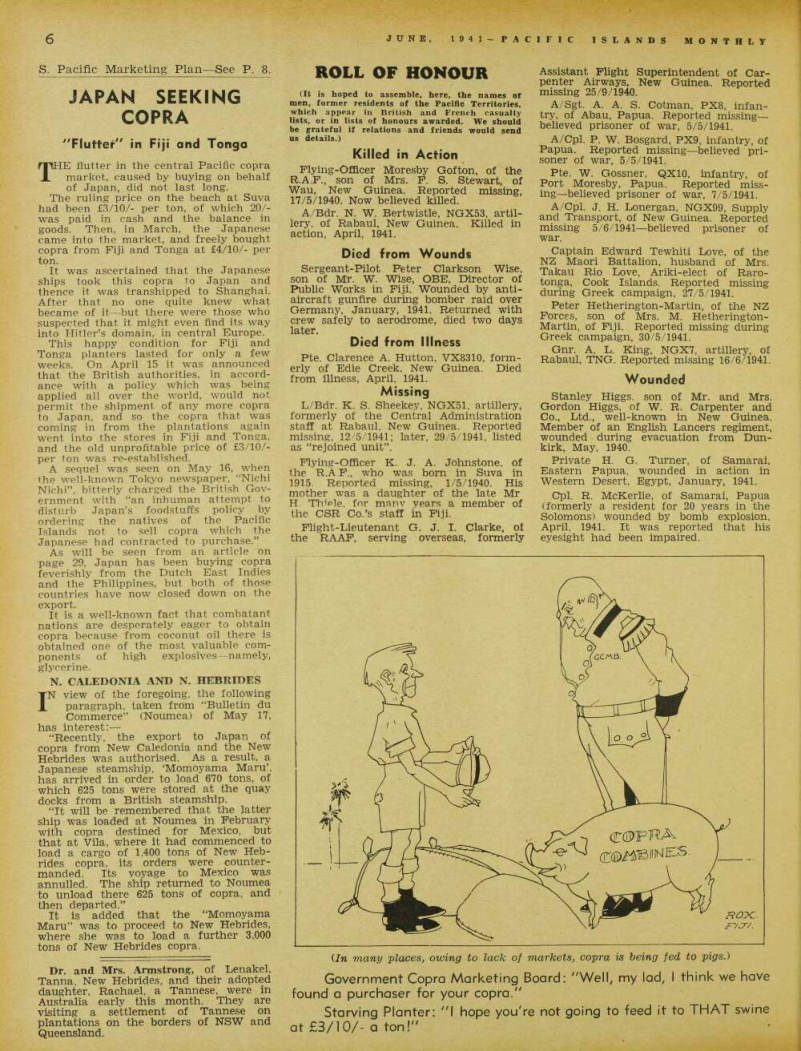
rodc {ln many places , owing to lack of markets, copra is being fed to pigs.) Government Copra Marketing Board: "Well, my lad, I think we have found a purchaser for your copra."
Starving Planter: "I hope you're not going to feed it to THAT swine at £3/10/- a ton!"
We Are Free!
Emphatic Declaration by French South Pacific Colonies
Prom Our Own Correspondent
Noumea, June 4.
ONE of three Government communi ques issued this morning states that Governor Sautot will speak from Radio-Noiimea on June 18.
“He proposes,” states the proclamation, “to take the opportunity of replying to the injurious insinuations of Monsieur I’Admiral Darlan affirming that the colonies of New Caledonia and French Oceania have been seized by the British.
For once and all, he will solemnly affirm that these two colonies have the will and the honour to remain more French than ever, enjoying their entire inde pendence under the sovereignty of Free France.”
French And Usa
THE first public act of the newly arrived American Consul (Mr. Mc- Vitty) was to lay a wreath of flow ers, forming a stars-and-stripes effect, on the Noumea war memorial.
Governor Sautot himself led the cries of “Vive Amerique” which followed, and the New Caledonian people present seized the opportunity to express their friendship for the American nation, to whom they look as their protector and economic ally.
The French residents of Noumea, who boycotted a similar ceremony staged by the Japanese Consul some time ago, were present in force. School children were let out a quarter of an hour in advance of school hours, so that they could be present.
Military Commandant
AN arrival by the mailboat (which brought the first letters from the New Caledonian contingent, now training in Australia) was Chef-de-Bat aillon Jardin, successor to Commandant Broche, as Commandant Superieur of French Pacific troops. His wife and three children arrived by another ship, a few days earlier. Commandant Jardin, born in Brest in 1894, was wounded and a prisoner in the last war, since when he has served in French West Africa, Madagascar and the Cameroons. He is a Croix de Guerre and chevalier of the Legion of Honour. He is an ardent de Gaulliste.
Tnd-Japan”
INDO-CHINA is to-day sarcastically known in this colony as “Ind- Japan”. A press communique refers to the new accord signed in Tokyo by the Vichy ambassador with the Japanese Government which is described as “yet another step by the men of Vichy on the monotonous route of abandonments and capitulations, this time sanctioning the Japanese seizure of Indo-China. . . . The convention opens the doors to Japanese commercial men, workmen colonists who desire to settle, turning our fine colony into another Manchuria. Like metropo litan Prance, Indo-China can only be saved by an English victory.
“But what a lesson for New Caledo nians who refused, and who sometimes even still refuse, to understand! Were not New Caledonia resolutely pledged to follow the way of honour, she too would now be finding herself delivered by the collaborators of the enemy to the Japan ese hunger, just as is happening now to our belle Indo-Chine.”
Young N. Guinea Man
In Famous Eleven
AUSTRALIAN newspapers, about May 20, carried a remarkable and dra matic story of how 11 Australian soldiers, who had been cut off in Greece, succeeded in evading the enemy, getting hold of a small boat and somehow or other navigating it across the Aegean Sea to Turkey. They had incredible adventures as they dodged enemy aero planes, submarines and infantry near and on the various Aegean Islands; but they beat all the Huns who came after them and reached the coast of Turkey.
They were formally interned in Turkey —but Australian resource and ingenuity probably will find a way out of the pri son camp and back into the AIF.
One of the eleven men who made this remarkable escape is Lance-Corporal R.
C. Lewis, a young man of 22, who was an overseer on Kimadan plantation in New Guinea prior to May 7, 1940, when he arrived in Australia and enlisted. His parents live at Manildra, in NSW, and his brother is on the staff of the Com monwealth Bank in Rabaul.
He Brought Home the Sword
A MEMBER of the crew of the “Pierre Loti”, who returned to New Cale donia recently, handed to Governor Sautot the sword of his unhappy prede cessor, Colonel Denis. The latter travelled in the steamer to Brisbane, after his expulsion from New Caledonia, and left behind him his sword, which he had hid den under his bunk.
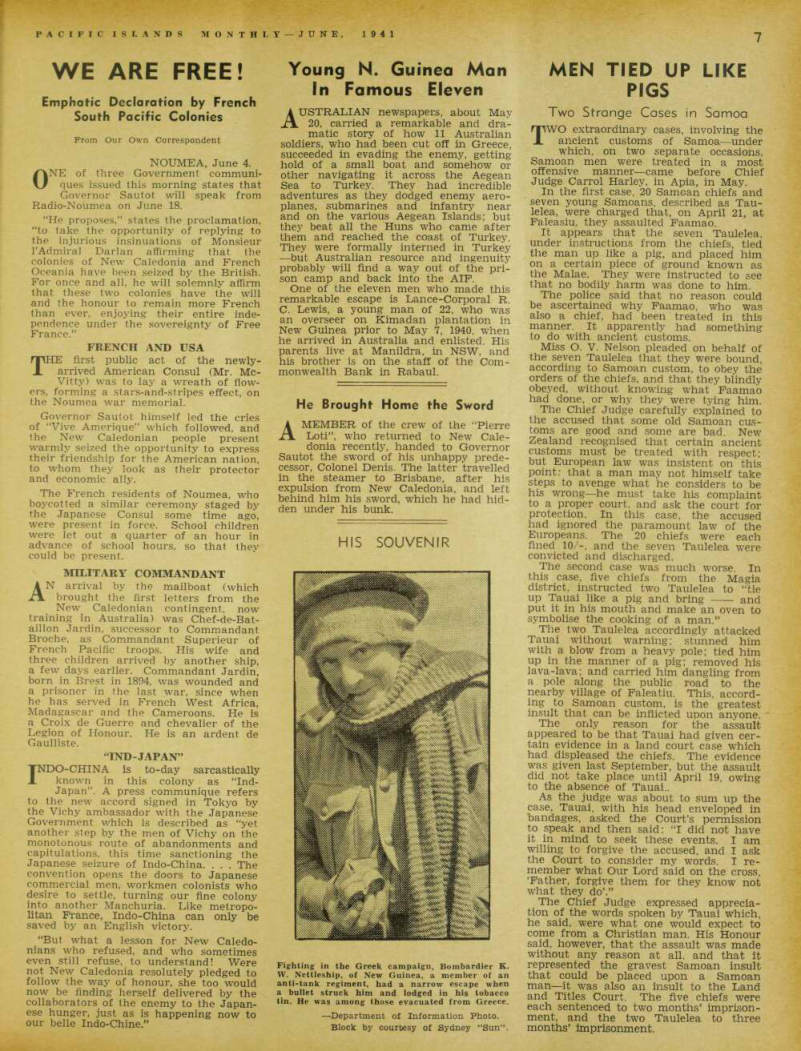
His Souvenir
Fighting in the Greek campaign, Bombardier K.
W. Nettleship, of New Guinea, a member of an anti-tank regiment, had a narrow escape when a bullet struck him and lodged in his tobacco tin. He was among those evacuated from Greece. —Department of Information Photo.
Block by courtesy of Sydney "Sun”.
Men Tied Up Like
Pigs
Two Strange Cases in Samoa
TWO extraordinary cases, involving the ancient customs of Samoa—under which, on two separate occasions, Samoan men were treated in a most offensive manner—came before Chief Judge Carrol Harley, in Apia, in May.
In the first case, 20 Samoan chiefs and seven young Samoans, described as Tau lelea, were charged that, on April 21, at Faleasiu, they assaulted Faamao.
It appears that the seven Taulelea, under instructions from the chiefs, tied the man up like a pig, and placed him on a certain piece of ground known as the Malae. They were instructed to see that no bodily harm was done to him.
The police said that no reason could be ascertained why Faamao, who was also a chief, had been treated in this manner. It apparently had something to do with ancient customs.
Miss O. V. Nelson pleaded on behalf of the seven Taulelea that they were bound, according to Samoan custom, to obey the orders of the chiefs, and that they blindly obeyed, without knowing what Faamao had done, or why they were tying him.
The Chief Judge carefully explained to the accused that some old Samoan cus toms are good and some are bad. New Zealand recognised that certain ancient customs must be treated with respect; but European law was insistent on this point: that a man may not himself take steps to avenge what he considers to be his wrong—he must take his complaint to a proper court, and ask the court for protection. In this case, the accused had ignored the paramount law of the Europeans. The 20 chiefs were each fined 10/-, and the seven Taulelea were convicted and discharged.
The second case was much worse. In this case, five chiefs from the Magia district, instructed two Taulelea to “tie up Tauai like a pig and bring and put it in his mouth and make an oven to symbolise the cooking of a man.”
The two Taulelea accordingly attacked Tauai without warning; stunned him with a blow from a heavy pole; tied him up in the manner of a pig; removed his lava-lava; and carried him dangling from a pole along the public road to the nearby village of Faleatiu. This, accord ing to Samoan custom, is the greatest insult that can be inflicted upon anyone.
The only reason for the assault appeared to be that Tauai had given cer tain evidence in a land court case which had displeased the chiefs. The evidence was given last September, but the assault did not take place until April 19, owing to the absence of Tauai..
As the judge was about to sum up the case, Tauai, with his head enveloped in bandages, asked the Court’s permission to speak and then said: “I did not have it in mind to seek these events. I am willing to forgive the accused, and I ask the Court to consider my words. I re member what Our Lord said on the cross, ‘Father, forgive them for they know not what they do’.”
The Chief Judge expressed apprecia tion of the words spoken by Tauai which, he said, were what one would expect to come from a Christian man. His Honour said, however, that the assault was made without any reason at all, and that it represented the gravest Samoan insult that could be placed upon a Samoan man—it was also an insult to the Land and Titles Court. The five chiefs were each sentenced to two months’ imprison ment, and the two Taulelea to three months’ imprisonment.
Australia Takes Steps to Operate Copra Marketing
Relief For Copra-Producers
Australia Takes Steps to Operate Copra Marketing Board
REGULATIONS issued on June 12, un der the National Security Act, make provision, so far as Australia is concerned, for the operation of the copra marketing plan, of which details were published in our last issue.
New Guinea’s Crown Law Officer (Mr.
Hogan) and a representative of the Expropriation Board (Mr. J. C. Archer, of the Treasury Dept.) went by ’plane from Rabaul to Canberra late in May, to assist in connection with the Australian Copra Control Regulations (which were gazetted on June 12 and will operate from a date to be proclaimed).
It is part of this plan that there shall be local committees set up to carry out the plan in each of the various territories which subscribe to the copra marketing board —namely, Papua and New Guinea, which are Australian; Fiji, Solomon Islands, Gilbert and Ellice Is lands and Tonga, which come under the High Commissioner for the Western Pacific; Western Samoa and Cook Islands, which are controlled by New Zealand; and the Free French Colonies of New Caledonia, French Oceania, and New Hebrides, which are now controlled by the Free French Governor-General of the South Pacific Colonies of Free Prance, collaborating with Australia and NZ.
It is provided that each of the several territories supporting the plan shall make its own arrangements, through its local committee, to give assistance to its copra producing industry. The arrangements now made by Australia, in regard to Papua and New Guinea, provide that the committee shall buy copra from the planters, as on the plantations, at:— Hot-air dried copra, £4/10/- per ton.
Plantation sun-dried copra, £4/7/6 per ton.
Smoke-dried copra, £4 per ton.
The ton, in each case, is a “long”, or Imperial, ton.
The Committee will be responsible for the payment of the freight from the plantation to the noint of shipment.
These prices will operate for six months, after which they will be reviewed at regular intervals of six months.
The personnel of the Australian com mittees to operate the plan in Papua and New Guinea has not been announced nor has the date from which the plan will operate. It is presumed, however, that the various committees appointed in the different territories will come into operation at about the same date, sub ject to collaboration with the central Copra Marketing Board—which, it is understood, will have its headquarters in Sydney, and general supervision over the committees. It is presumed that the prices stated above will be approximately the prices paid to copra-producers in all the territories.
Each territory, however, has the right to make any additional arrangement for the assistance of its own copra producers; and it was reliably reported in Sydney, on June 13, that Australia will subsidise pro duction in Papua and New Guinea, in addition to the prices promised above.
Official confirmation of this has not been received, however.
The Australian Minister said, on June 13, that “plans have been formulated for the appointment of a Pacific Copra Mar keting Board to handle the sales of copra from all British areas in the Pacific”; and it is assumed from this that the conra marketing pool to be thus formed will be compulsory. That is to say, it is assumed that all copra produced in the South Pacific, from whatever source, must pro into the pool and be sold through the Board. This, of course, brings up several knotty problems—as, for example, the
shipments of copra from the Lever plan tations in the Solomons to the mills in Sydney, and the need for keeping the new Carpenter crushing mills in Vancouver properly supplied. Is it intended that copra produced on the plantations, owned by Levers and Carpenters, shall first be sold to the Marketing Board, and then re-sold by the Marketing Board to the companies’ mills, for crushing, and that the profits made from such transactions are to be distributed by the Marketing Board to all the growers contributing to the pool? We have no answer to this, When the original plan for the Copra Marketing Board was formulated, those concerned had a guarantee from the British Government that it could take 90,000 tons of South Pacific copra per annum, and it was ascertained that there were also limited markets in Australia, New Zealand, Canada and Mexico. Since
“PIM”, on June 16, was officially informed that temporary arrangements are being made to enable Papua and New Guinea growers to get £4/10/- per ton on plantations at “an early date”, pending appointment of Copra Control Committees for Papua and New Guinea.
then it would apnear that there is a considerable market in Japan—but this market is highly suspect, and at present under a British embargo, because it is feared that copra (which is highly valuable in wartime) may be finding its way to Germany through Japan.
But it has become plain during the past six months, while the various parties concerned have been guilty of dithering and delay, that the real problem before any Copra Marketing Board is not so much finding markets as finding trans port. Ships for copra are in increasingly short supply.
“Give us the ships and we will guarantee to find markets for all the South Pacific copra that is being produced”, said one of the leading South Sea merchants to the PIM, only a few days ago. “It is easy enough for the British Minister of Poods to promise to receive 90,000 tons of South Pacific copra; but it is a very different story when the British Minister of Ship ping is asked to supply transport for the 90.000 tons.”
There are no indications, at the moment of going to press, of how the Copra Marketing Board (still unap pointed) is going to operate, and how it is going to get its copra to whatever markets it may discover. But it is. at least, comforting and reassuring to find that at long last the copra-producers of the South Pacific are to get a guarantee of a sufficient sum per ton to allow them to live —although they can only barely live on the rates stated above.
Rabaul's Volcano
LATER reports show that, right up until June 12, Tarvurvur volcano (Matupi), alongside Rabaul, New Guinea, was still emitting huge puffs of smoke, at intervals. It did not subside on June 6, as reported on page 51. There seems to be no danger of an eruption, however.
Mr. C. E. Leake has been transferred from New Guinea Trade Agency, Sydney, to the Department of Supnly and Develop ment, and Mr. James O’Gradv, who for merly was associated with the Agency for many years, has been transferred from Federal Treasury to take charge.
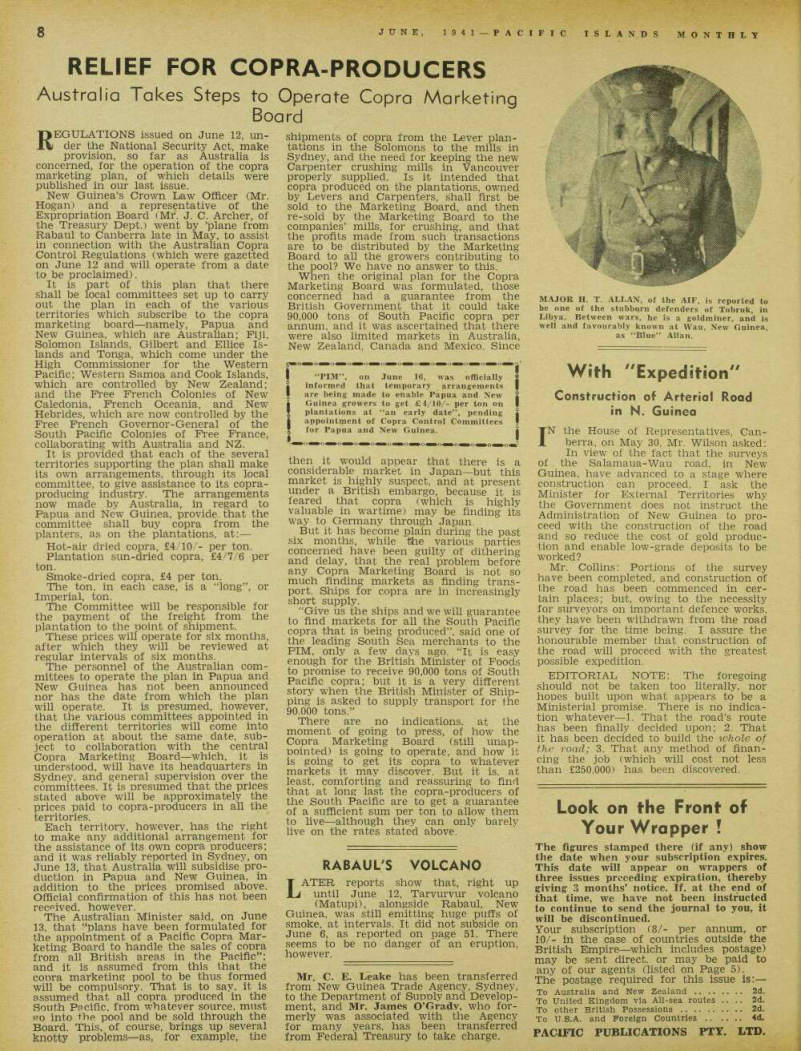
MAJOR H. T. ALLAN, of the AIF, is reported to be one of the stubborn defenders of Tobruk, in Libya. Between wars, he is a goldminer, and is well and favourably known at Wau, New Guinea, as “Blue” Allan.
With "Expedition"
Construction of Arterial Road in N. Guinea
IN the House of Representatives, Can berra, on May 30, Mr. Wilson asked: In view of the fact that the surveys of the Salamaua-Wau road, in New Guinea, have advanced to a stage where construction can proceed, I ask the Minister for External Territories why the Government does not instruct the Administration of New Guinea to pro ceed with the construction of the road and so reduce the cost of gold produc tion and enable low-grade deposits to be worked?
Mr. Collins: Portions of the survey have been completed, and construction of the road has been commenced in cer tain places; but, owing to the necessity for surveyors on important defence works, they have been withdrawn from the road survey for the time being. I assure the honourable member that construction of the road will proceed with the greatest possible expedition.
EDITORIAL NOTE: The foregoing should not be taken too literally, nor hopes built upon what appears to be a Ministerial promise. There is no indica tion whatever —1. That the road’s route has been finally decided upon; 2. That it has been decided to build the whole of the road ; 3. That any method of finan cing the job (which will cost not less than £250,000) has been discovered.
Advertisements & other items, p. 10 (2 items)
8
JUNE, 1941 P ACIFIC ISLANDS MONTHLY
Look on the Front of
Your Wropper !
The figures stamped there (if any) show the date when your subscription expires.
This date will appear on wrappers of three issues preceding expiration, thereby giving 3 months’ notice. If, at the end of that time, we have not been instructed to continue to send the journal to you, it will be discontinued.
Your subscription (8/- per annum, or 10/- in the case of countries outside the British Empire—which includes postage) may be sent direct, or may be paid to any of our agents (listed on Page 5).
The postage required for this issue is:— To Australia and New Zealand 2d.
To United Kingdom via All-sea routes ... 2d.
To other British Possessions 2d.
To U.S.A. and Foreign Countries 4tL
PACIFIC PUBLICATIONS PTY. LTD,
Strange Ceremony in
Fire-Walkers
Strange Ceremony in Fiji
rE annual festival of Maha Mari the Goddess was celebrated at Veisaru, Ba, in Fiji, on May 17 and 18.
There was an exceptionally large gather ing of 2,000 people.
On Sunday morning, the fire-walking ceremony took place before a record crowd. There were some 40 to 50 Euro pean residents present.
Fire-walking is one of the most mys terious of native ceremonies. Many people have tried to explain it—but the fact remains that certain natives can walk barefoot over white-hot stones without apparent injury.
Thus Dr. Lambert (who lived for many years in Fiji) in a book, “A Yankee Doctor in Paradise”, just published: “Before these show's became popular features for tourist ships and visiting royalty, I saw them dozens of times on their native ground. There have been any number of scientific treatises writ ten to account for the phenomenon of bare native feet which remain un scorched after contact with burning stones. As a physician, I have studied the condition of the fire-walkers before and after the ordeal, and I have always gone away with the feeling that I have seen a miracle.”
Death of Rev. M.
Prater
MANY people in the Pacific Territories, and many more elsewhere, will learn with deep regret of the death of Rev. Maurice Frater, who retired recently from missionary work in the New Hebrides. It occurred in Melbourne on June 3.
Mr. Frater was born in Scotland in 1873. In 1900 he went to the New Hebrides
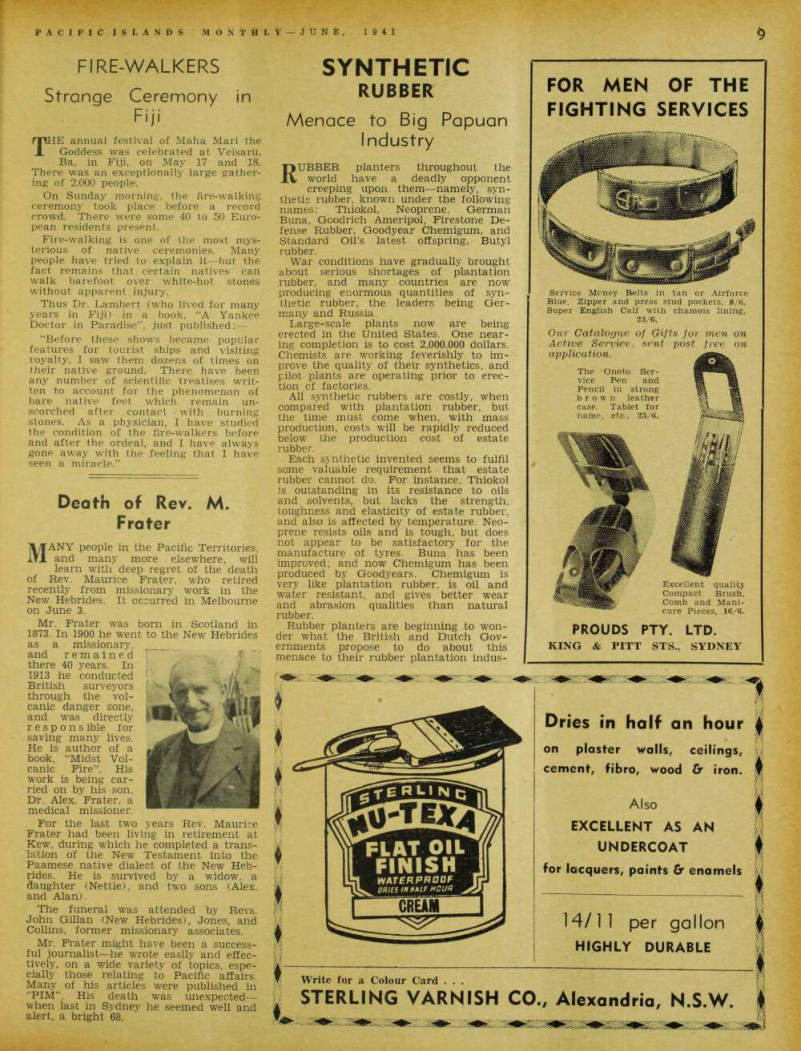
as a missionary, and remained there 40 years. In 1913 he conducted British surveyors through the vol canic danger zone, and was directly resp o n s ible for saving many lives.
He is author of a book, “Midst Vol canic Fire”. His work is being car ried on by his son, Dr. Alex. Frater, a medical missioner.
For the last two years Rev. Maurice Frater had been living in retirement at Kew, during which he completed a trans lation of the New Testament into the Paamese native dialect of the New Heb rides. He is survived by a widow, a daughter (Nettie), and two sons (Alex, and Alan).
The funeral was attended by Revs.
John Gillan (New Hebrides), Jones, and Collins, former missionary associates.
Mr. Frater might have been a success ful journalist—he wrote easily and effec tively, on a wide variety of topics, espe cially those relating to Pacific affairs.
Many of his articles were published in “PIM”. His death was unexpected— when last in Sydney he seemed well and alert, a bright 68.
Industry
Synthetic
Rubber
Menace to Big Papuan Industry
RUBBER planters throughout the world have a deadly opponent creeping upon them —namely, syn thetic rubber, known under the following names: Thiokol, Neoprene, German Buna, Goodrich Ameripol, Firestone De fense Rubber, Goodyear Chemigum, and Standard Oil’s latest offspring, Butyl rubber.
War conditions have gradually brought about serious shortages of plantation rubber, and many countries are now producing enormous quantities of syn thetic rubber, the leaders being Ger many and Russia.
Large-scale plants now are being erected in the United States. One near ing completion is to cost 2,000,000 dollars.
Chemists are working feverishly to im prove the quality of their synthetics, and pilot plants are operating prior to erec tion of factories.
All synthetic rubbers are costly, when compared with plantation rubber, but the time must come when, with mass production, costs will be rapidly reduced below the production cost of estate rubber.
Each synthetic invented seems to fulfil some valuable requirement that estate rubber cannot do. For instance, Thiokol is outstanding in its resistance to oils and solvents, but lacks the strength, toughness and elasticity of estate rubber, and also is affected by temperature. Neo prene resists oils and is tough, but does not appear to be satisfactory for the manufacture of tyres. Buna has been improved; and now Chemigum has been produced by Goodyears. Chemigum is very like plantation rubber, is oil and water resistant, and gives better wear and abrasion qualities than natural rubber.
Rubber planters are beginning to won der what the British and Dutch Gov ernments propose to do about this menace to their rubber plantation indus
try, which represents hundreds of mil lions of capital, and the lives and em ployment of millions .of working in the industry.
A suggestion has been put forward, by the Planters’ Association of "Papua, fhat the Commonwealth Government be asked to protect the Papuan rubber industry! by the introduction of a special tariff against synthetic -.rubber. It seems a wise suggestion, in view of>The increased planting of rubber in Papua and New 1 Guinea during the last few years.
On June 30. 1940, there were 14,494 acres under rubber in Papua, and the
export of rubber in that year was 1,345 tons, worth - £152-,487.-Tho export in 1935-36 was 1,096 tons, worth £89,467.
This table shows how the balance of Papua’s chief exports has altered:—
A.G.L.
Rev. and Mrs. A. R. Tippett are new Methodist missionaries at the Nadroga station, Fiji.
1935-6. 1939-40. £ £ Copra . . . . 100,681 45,568 Gold . . . . 81,034 135,879 Rubber . . .. . . . . 89,467 152,487
Advertisements & other items, pp. 11-12 (1 item)
STERLING VARNISH CO., Alexondria, N.S.W.
FOR MEN OF THE
FIGHTING SERVICES
Service Money Belts in tan or Airforce Blue. Zipper and press stud pockets, 8/«i.
Super English Calf with chamois lining, 23/6.
Our Catalogue of Gifts for men on Active Service, sent post free on
application.
The Onoto Service Pen and Pencil in strong brown leather case. Tablet for name, etc., 25/6.
Excellent quality Compact Brush, Comb and Manicure Pieces, 16/6.
PROUDS PTY. LTD.
KING & PITT STS., SYDNEY
rva
CREAM
"5^ Dries in half an hour on plaster walls, ceilings, cement, fibre, wood Cr iron.
Also
EXCELLENT AS AN
UNDERCOAT
for lacquers, paints Cr enamels 14/11 per gallon
HIGHLY DURABLE
Write for a Colour Card . . .
STERLING VARNISH CO., Alexondria, N.S.W.
COUGHS am
COLDS...
ARE THEY YOUR
HANDICAP?
Have you ever played a round with head aching, limbs a burden, and each breath an effort? If so, you'll know what a handicap to your game a severe cold or cough can be.
Outdoor exercise is the finest means of gaining and keeping health; but for many people, whose every day occupations keep them indoors most of the time, even the mildest of outdoor activity is too strenuous, leaving them fatigued and with resistance lowered—open to the attacks of dangerous winter ailments.
Fatigue-resistance must be built up steadily if the full benefits are to be gained from your outdoor activities.
The Secret of Immunity:
The vitamins "A" and "D" contained in pure Cod Liver Oil are recognised by Health Authorities as Nature's finest safeguards against the attack of most winter ailments. Scott's Emulsion contains Cod Liver Oil in its most easily digested and palatable form. An eminent Research Body has definitely established that. within 30 minutes of taking, every drop of Scott's is strengthening chest and lungs, creating reserves of energy, and building up immunity to colds and coughs.
SCOTT’S
Emulsion
ALL CHEMISTS AND STORES 2/9 AND 5/- PER BOTTLE
Sydney-Rabaul
Air Service
New Lockheed in Commission
ON Friday, May 30, the new Lockheed 14 airliner, recently purchased by Messrs. W. R. Carpenter & Co. Ltd., arrived in Rabaul, thus completing its first trip of WRC Airlines between Syd ney and Rabaul.
It was in charge of Captain O. Mant, superintendent of WRC Airlines, and it gave a most satisfactory performance on its first trip. It is capable of carry ing 12 passengers and 1,500 lb. of freight.
The design is similar to that of the Lockheed Electra —it is twin engined, and low-winged, with retractable landing gear—but it is twice the size of the Elec tra type. It has a wing-span of 65i ft., and a length of 44 ft., 4 in.
As a result of the introduction of this fast and large airliner, WRC Airlines have reverted to the old timetable under which the plane leaves Sydney on Thurs day mornings and flies to Rabaul, and returns to Sydney within the week. The new timetable has been drawn up on the assumption that the Lockheed will give 170 miles per hour from block to block, but actually, on her first trip, she aver aged well over that figure. The average on the first southwards trip was just over 200 miles per hour, and on one lengthy stage, over Queensland, she averaged nearly 230 miles per hour.
WRC Airlines report that the passen ger traffic is not heavy—it can be taken care of comfortably with the present timetable. The DH 86, with which the service was carried on until the intro duction of the new Lockheed, is now in reserve. - -
Now No German Spies
In Papua
THE Australian Minister for Territories (Mr, T. J. Collins) told the Mel bourne “Herald” on May 8 that Ger man influence among the natives of Papua had been wiped out. He said that there had been German spies in Papua at the outbreak of war, but that now they were all under control. Most of us knew that there were people of suspicious associations in New Guinea at the outbreak of war, but it will be news to many to learn that Nazi activity had extended into Papua.
Mr. Malcolm Cameron, of Wau, New Guinea, has been in Australia for several weeks. He is connected with Gold and Power Ltd., Slate Creek, and will return to the Territory shortly.
Advertisements & other items, p. 12 (2 items)
10
JXjNe, i94i MclFtc islands monthly
Liqueurs
For the Connoisseur
VOK
par excellence Advokaat Creme de Menthe Maraschino White Curacao Creme de Cacao Creme de Banana Cherry Brandy Chartreuse Kummel Apricot Brandy Red Curacao Peach Brandy
vu OBTAINABLE FROM
NORTHERN HOTELS LTD., FIJI. I F. H. FORSYTH. RABAUL.
J. R. CLAY & CO., PORT MORESBY. C. J. CASHMAN & CO., DARWIN.
ENQUIRIES WELCOMED BY
J. C. MERRILLEES £r CO., 138 PITT STREET, SYDNEY
Usa Ships
To Replace British In Pacific Services
IT was officially announced in Washing ton, on June 3, by the United States Maritime Commission, that vessels carrying the United States flag will supersede British vessels on routes in the Pacific, between North American ports, and Australia and NZ, thus releas ing British vessels for service elsewhere.
The announcement caused a stir in Australian shipping circles and there were urgent requests for details, but none were forthcoming.
One American report said that the new arrangement would release “dozens of ships” for British services in Euro pean and Atlantic waters; but a careful analysis indicated that not many vessels would be affected—mostly those of the Canadian-Australasian and Union SS Co. lines, and a few freighters.
When we went to press in mid-June the whole plan was being actively dis cussed among shipping companies with interests in the Pacific. It was obvious that, while the shipping companies con cerned were very willing to assist Britain in every possible way in the war effort, they were most reluctant to give up to American interests their hard-won place in the Pacific maritime trade —because they fear they will have difficulty in regaining their place at the end of the war.
It appears that President Roosevelt set out to provide 2,000,000 tons of shipping for the Anglo-American shipping pool, wherewith to assist Britain’s war effort.
Presumably, the plan to substitute American ships for British ships in the Pacific is designed as one way of adding to this pool. It was reported from USA, on June 3, that the President up to that date, had found only 900,000 tons of ship ping for the 2,000,000 tons pool.
NC French Warmly Greet
Australian Prime Minister
fT\HE Prime Minister of Australia, Mr.
X R. G. Menzies, was warmly wel comed in New Caledonia on arrival by Pan American Clipper on May 21, on his way from USA to Sydney, At the airport to meet him were the Governor- General of Free French Colonies in the Pacific (M. Brunot), the .Governor of New Caledonia (M. Sautot), the British Consul (Mr, W. Johnston), the Austra lian agent (Mr. B. C. Ballard), the American Consul (Mr. K. deG. McVitty) and other prominent officials. He came across the harbour with them in the PAA launch, and was greeted on the quay by a large crowd of New Caledonian people, by whom he was heartily cheered.
The official party went on to Govern ment House, where the Australian Prime Minister was a guest, and a large crowd assembled outside at 7.15 p.m., hoping for a speech. Mr. Menzies went down through the garden to the gateway and spoke briefly to the crowd in French, referring in terms of warm praise to the Free French leader, General de Gaulle.
Sir Walter Carpenter, head of the Carpenter group of companies, arrived back in Sydney on June 13 from his second recent visit to North America, in the course of which he was successful in organising and establishing copra crush ing mills near Vancouver, which are expected to aid substantially in solving the South Pacific copra problem. Sir Walter left Sydney seven months ago.
Advertisements & other items, pp. 13-14 (1 item)
Avti
m
HERE’S THE SET
THAT GETS RESULTS!
798 verified Radio Stations were received on a Standard ULTIMATE Receiver—a world’s record! An ULTIMATE was used by Commander R. E. Byrd at the South Pole; the Australian adviser to the British Broadcasting Commission depends on an ULTIMATE. ULTIMATE Receivers hold nine Champion of Champions Awards. Ask the leading Short-wave Experts and Technicians about ULTIMATE performance—that’s proof! Obtainable in 8 and 10 Valve Electric Console; 7-valve Dual-wave Vibrator Console; 6 and 8 Valve Dual-wave Electric Mantel; 7-valve Dual-wave Vibrator Mantel.
SPECIALLY SUITED TO ISLAND CONDITIONS
Before you decide on a Radio get particulars of ULTIMATE.
Cut out this Coupon and post to-day.
GEORGE BROWN & CO. PTY. LTD., 267 Clarence Street, Sydney.
Please send me without obligation full particulars of ULTIMATE Receivers.
NAME
ADDRESS
P.l 111 M
AVTi
E U ft GEORGE BROWN & CO. PTY. LTD., 267 Clarence Street, Sydney.
r- ■ 4
FOR MAN OR MAID
there’s no Gift so good as a Watch. r< to i GH £l/0/0 a very beautiful baguette shaped watch. It’s in 9ct. Gold with gilt bracelet. 15-jewelled Swiss mechanism. See below for guarantee.
lis i J
90/- And a very pretty Watch indeed!
The Gold-filled case is nicely engraved.
Moire band. 15-jewelled movement. See below for guarantee. 70/- A charming Watch in Chrome case. Matching bracelet.
Swiss Lever mechanism. attractive 15-jewelled All of these watches are warranted for 10 years. Free adjustment and regulation is provided for 1 year.
The Wonderful "Indestructible"
cm fVJ o Q WATERPROOF . . . DUSTPROOF . , .
SHOCKPROOF . . . ANTIMAGNETIC . . .
UNCONDITIONALLY GUARANTEED FOR
ONE YEAR . . , The “Indestructible” is the toughest of the tough. That’s why it’s the favourite for men who know the Tropics.
Each and every “Indestructible” is warranted to give at least 25 years’ service. In Stainless Steel Case with durable, washable, fabric Band £7/19/6
ANGUS &GOOTE
500 GEORGE STREET, SYDNEY
A Medical
Miracle
How a Doctor's Clever Application
of an American Vet's Discovery
Conquered one of Mankind's
Worst Diseases.
years ago, most of the South Pacific communities, in common with tropical and sub-tropical peoples all over the world, were “rotten with hookworm”.
To-day, hookworm is conquered, and is becoming a thing of the past.
The dramatic story of how a medical miracle was accomplished is told in Dr.
S. M. Lambert’s new book (see review on page 21).
In 1920-1922, Dr. Lambert travelled in Queensland, Papua, New Guinea, the Solomons and Fiji, trying to reduce hookworm incidence (which was appal ling) with the then known specific, oil of chenopodium. But chenopodium, while efficacious enough, was not sufficient.
Infection was so widespread, and the infected were in such masses, that people who were treated, and partly cured, were infected again before the disease could be cleared out of the district.
“Chenopodium, on which we relied for a cure for one of the world’s most preva lent blights, was not coming up to expectations.”
Now, let Dr. Lambert himself tell the story. This is copied directly from his book: — I SAT at my desk, in Suva, facing facts, and not liking a single one of them.
Evening was coming on, and I should have been home for dinner. I was too sick of myself and my work to move a muscle. Three more years of this, and where would it get us? Nowhere.
Maybe it was my guardian angel who stole up and laid a still hand over mine.
Without knowing what I did or why I did it, I moved my hand across the desk and woke, blinking. I had picked up the “Journal of the American Medical Asso
elation”, a November, 1921, issue, and an invisible finger seemed to point the page for me. Ana there was the title: Tne Use of Carbon Tetrachloride in the Removal of Hookworm ... by Maurice C Hall”.
Hall was the man who approved my experiment, down in Rabaul, when I gave those injections to six cannibal prisoners.
I respected him, as most of the pro fession did. As Senior Zoologist of ihe United States Bureau of Animal Industry, his researches had gone far in his own field. He didn’t talk unless he knew what he was talking about.
Here was Hall s report in the modest gray of scientific language, revealing years of most careful observation. His tests had led him to a novel drug— carbon tetrachloride. Queer, humble thing to have fished out of the phar macopoeia! Hitherto, it had been useful only in dry-cleaning fluids and fire extinguishers. He had observed that patients under chloroform anaesthesia frequently emit a number of intestinal parasites. Chloroform, then, would be a successful vermifuge were it not for its poisonous qualities. Hall made hundreds of tests down the list of hydrocarbons, until he came to chloroform s close rela tion. Chloroform’s chemical initials are CHCL;. Tetrachloride’s laboratory name is CCh.
Tetrachloride touched the spot Hall had been looking for. He tried it first on dogs, then on swine, horses, monkeys.
He carefully gauged the dosage to 3 cc. for every 10 pounds of animal weight; later he found that O'. 3 cc. to every kilogram of body-weight expelled the worms in surprising quantities. After treatment, he had performed postmortems on many animals and had examined internal organs which showed no patho logical changes that could be traced to CClt. In animal experimentation it had been an unqualified success.
In animals, yes. But what of man?
THE answer came like a clap of thunder out of Hall’s quietest paragraph.
He had tried the stuff on himself.
Audaciously, he had taken a 3 cc. dose, gone to bed, and wakened in the morn ing with no pathological symptoms. The dangerous drops he had swigged the night
before had had none of the nauseous effects of chenopodium. His animal ex periments had shown him that it worked as fast, as safely and more thoroughly.
And here was another point in its favour: tetrachloride, tried on animals, seemed to have no ill effects on pregnancy.
Chenopodium had always been a dan gerous thing to give a woman with child.
It was, at times, among the unsafe abor tifacients —often effective if used up to the poison point.
The message of tetrachloride came to me like an answer to prayer. But would the dog-cure turn out to be a man-killer?
Probably not. Hall had tried it on himself. . . .
WITH a hop, skip and jump I went to the laboratory used by the Medical Officer of Health. Naturally, old Garment, who presided over the collection, wouldn’t have the drug. Why should he?
Yes, but there it was! A big, brown bottle with the label CCh. It had never been opened, of course, and how it got there nobody knows. Strange, useless things drift onto laboratory shelves.
When I went up to Dr. Montague’s office I had the brown bottle under one arm and the Medical Journal under the other.
“Read that, and look at this”, I said.
He read the article painstakingly, then turned the bottle in his hand.
“Lambert, try anything”, he sighed.
That was about the way we all felt those days.
We had been trained in the empirical school. Try anything, if evidence ‘is in its favour. . . .
The old empiricals had moved along that line. But men of the new thought, like Pasteur, like Ehrlich, had set out deliberately to fit a drug to a condition.
And that was how Hall had worked.
So we were trying to cure hookworm disease with a cleaning fluid. A veterinary had recommended it. True, he was about the greatest vet. in the world.
I have to laugh, now, remembering how we, as green voung undergraduates at Syracuse Medical, used to snoot veterinaries and dentists as “hoss doctors” and “tooth yankers”. We didn’t take the trouble to remember that modern anaes thesia originated in a dentist’s brain.
And, since we lacked the gift of prophecy, how were we to know what a horse doctor would someday do with something out of a fire extinguisher.
MY mind was made up, but my heart wasn’t doing any too well when I went to the native ward and picked out four hookwormy East Indians. I wasn’t sure how these fellows would be have. for Mr. Gandhi’s Civil Disobedience had become their evening prayer. How ever, they felt pretty sick and were ready, like Montague, to say. “Try anything”.
I started them off with a stiff dose of salts.
At seven, next morning, mv faltering hand administered to each of them 3 cc. out of the brown bottle. The minute they swallowed it I felt like a Borgia.
It was too late to do anything about it. unless I gave them a quick emetic. If tetrachloride went back on me I’d be responsible for the death of a man, maybe four.
Doctors have to become hardened to death, otherwise they couldn’t remain in practice. But experimental killing is a different thing. If any of these Hindus died I’d have the weight on mv soul.
Not only that, I’d lose mv job. Already I saw my resignation from the Inter national Health Board being requested by cable. . . .
I HAD dosed my four Indians at seven, and time was wearing on. Tetrach loride. which is a purgative, should have acted quicker. The men w p ro dumb and drowsy. Would this be coma 1 ? I felt their lean wrists, listened to their lean
chests; pulse and respiration normal.
How soon would they take a turn for the worse?
Dr. Hall had taken a dose of it.
Yes, but Hall had been in the prime of health, able to throw off toxic poison ing-. These poor fellows were like dry leaves. The very thing that made treat ment necessary had weakened them to exhaustion point. Then I thought: Even if I had drugged myself with the stuff it wouldn’t have proved much; what I was trying to find out was its actual effect on hookworm.
I had wandered back to mv office, honing that solitude and a cigarette might tell me what to do next. . . . The door burst open and Chris Kendrick tumbled in on me. His look was grave as he said, “That tetrachloride—.”
“Are they dead” I asked, stiffly.
“Dead!” Chris waved his hands.
“They’re all jumping out of bed, and simply spouting hookworms!”
That was how the news came to me. I had been watching them for hours, while
local medical officers passed their beds and made long faces, which said to my fevered imagination, “See what Lambert’s done now!” Then the minute I turned my back CCh began to work.
For three days, while my Indians were, as Chris exaggerated it, “fairly spouting worms”, the result was a constant wonder.
Cordiality glowed in an atmosphere which had been none too warm. Doctors
gathered around our hookworm count like baseball fans around the box score.
The native orderlies were as excited as the rest. First day, second day, third . . .
I had gambled with four lives, and won.
AND so the cure was found. To-day, medical men all over the world are using tetrachloride — or, for preference, tetrachlor ethylene, for the gifted Dr.
Hall made an improvement on his dis covery—and hookworm can he controlled and conquered, at will.
This was one of the epoch-making dis coveries of medical science; and it was proved and developed in Fiji, hy Dr.
Lambert.
Miss Dorothy Read, of the South Sea Evangelical Mission, Malaita, Solomon Islands, is still undergoing medical treat ment in Victoria, and it is uncertain when she will return to her work.
Advertisements & other items, pp. 14-16 (1 item)
Burns Philp Trust
'THAT'
V zm
the
Service to those who wish to travel Those who, whether for pleasure or for business reasons, have to travel overseas often find it necessary to appoint an attorney either to carry on their business and otherwise supervise their affairs during their absence or to take over trusts which they are under an obligation to perform. By appointment of Bums Philp Trust Company Limited as your attorneys and agents you become relieved of worry and responsibility whilst travelling. To those who, for health and other reasons, wish to be relieved of the anxiety of looking after their affairs, a similar opportunity occurs to appoint the Company their agents. A free booklet describing this and other services of the Company can be secured on application to the Head Office, or to any Branch of Burns, Philp & Co. Ltd., or Burns Philp (South Sea) Co., Ltd.
DIRECTORS—James Burns - Robert John Nosworthy - Lewis Armstrong - Joseph Mitchell MANAGER—C. H. Chester
Burns Philp Trust
C O M. P A N 1
L I PA
TED
7 BRIDGE STREET. SYDNEY
‘Phone : B 7901 Box 543 B. G.P.0., Sydney
PACIFIC ISLANDS SOCIETY
Visitors from the Islands to Sydney (or those interested in Islands affairs), are advised to communicate with the honorary secretary of the above Society, which has been formed to study the history, traditions, economics, and political developments of the Pacific Islands.
Regular monthly meetings are held at the Hotel Carlton, Sydney.
Address for Correspondence:
THE PACIFIC ISLANDS SOCIETY,
Box 2434 MM., G.P.0., Sydney.
AUSTRALIAN IAIINES
LIQUEURS,
VERMOUTH AND CIDER
True to types which have long been famous and comparable in quality with the finest imported, Montrosa Australian Wines, Liqueurs and Vermouth and Mercury Sparkling Tasmanian Cider represent the Commonwealth’s choicest products. We illustrate, alongside, a representative group of Montrosa Wines and Liqueurs.
MONTROSA WINES include Port, Sherry, Muscat, Tokay, Riesling, Sauterne, Champagne and Sparkling Sweet Montrosa.
MONTROSA VERMOUTH is
available in both sweet and dry types.
MONTROSA LIQUEURS offer
all the popular flavours—Apricot Brandy, Creme de Cacao, Creme de Menthe, Kirsch, Cherry Brandy, Kummel, Peach Brandy and Curacao (orange, white and red). m w W KWt ■W i «WP|
ipyi
L mm ■x.y :
The CHAMPAGNE
of the APPLE !
Here’s all the rich juice of rosy Tasmanian apples sunfilled with vitamins. Mercury Cider has the body and sparkle of champagne. It’s a delicious thirst quencher ... a gay and lively party drink. Drink HEALTH . . . drink Mercury Sparkling Tasmanian Cider.
SWIFT
IF YOU HAVE DIFFICULTY IN OBTAINING
THESE BRANDS LOCALLY y WRITE TO
COMPANY PTY. LTD.
’Phone: B 7377.
26-30 CLARENCE STREET, SYDNEY.
And at Melbourne, Geelong, Adelaide, Perth, Brisbane, Townsville and Wellington, N.Z.
W.KOPSEN & Co. Pty. Ltd.
Shipchandlers & Hardware Merchants
K.L.80
TILLEY LAMPS
Tilley Kerosene Lamps are the most popular lamps in the world to-day for two reasons— 1. They are made in England. 2. They burn kerosene more efficiently than any other pressure lamp.
Provide a steady 300 c.p. light at a cost of Id. per hour. Easy to understand, easy to maintain. Spare parts always available. Popular model Hanging Lamp illustrated can now be fitted with 16 in. parchment shade.
Very little shadow and suitable for all large rooms. Obtainable everywhere, or write direct for catalogue.
SIMPLEX MARINE
ENGINES
Simplex Launches and Marine Engines are Australia’s best effort in boating.
Launches from 14 ft. to 22 ft. Engines 3 h.p., 5 h.p., and 10 h.p. Single and Twin Cylinder. 2 and 4 cycle, with or without Reverse Gear. Prices from £22. Let us send you full particulars of the famous Simplex range.
We are the largest suppliers of Boatgear in Australia. Write to us with all your boating problems. Stocks of Marine Paints, Rope and Cordage, Oars and Sculls, Wire Rope, Oakum, Yacht Fittings, Cabin Lamps, Horns, Lighting Plants, Copper Nails,
Rivets, etc.
376/382 KENT STREET, SYDNEY
Cables: "KOPSEN", SYDNEY. 'Phone: MA6336 (4 lines).
Tropicalities
ALTHOUGH Monsieur Pardieu was a cordonnier (shoemaker) of sorts, he generally walked around barefoot.
He was a sellier (saddler), but he pre ferred “shank’s pony” to the saddle; and, although a matilassier (mattress-maker), he didn’t mind sleeping any old where.
From time to time, he would leave his little boutique at Vila and tour the plantations in the Group, plying his trinity of trades. While on one of these tours, he arrived rather late one night chez the Jobsons, on Ambrym. Mrs. Job son bustled round and stirred up the houseboy and the fire, and sat Monsieur Pardieu down to the substantial remains of a curry. Like most Latins, M. Pardieu likes his condiments plus plus, and then some; so he asked for pepper. Mrs.
Jobson apologised for the omission, and hurried the houseboy to bring “something
shakim all same belonga kiki”
The boy rushed to the kitchen and returned with a tin with a perforated top, which he placed before the guest. . vQfdieu gave his currv a liberal sprinkling mixing the pepper in with his knife, in true French colonial style. He then lapped up the mixture with Gallic gusto and vocal accompaniments.
It was after M, Pardieu had retired, and was trying to drown the rumblings of the Ambrym volcano with his snores that Jobson shouted to his better half’ through the din: “Well, you might have had a pepper pot put on the table, in stead of that grubby old tin”. He then picked up the offending object and read Insecticide”.
I? the morning, Monsieur Pardieu blithely departed, on his way, none the worse, after the usual handshakes and remerciements, Mrs. Jobson wonders if a curry recipe which included insecticide would be ac cepted for the recipe column of “PIM”. —Dawk.
THE prophetic de Gaulle memorandum of January 26, 1940, entitled “L’Ave nement de la Force Mecanique”, has been published in New Caledonia in booklet form and is being sold in aid of the Free French armaments fund It contains an introduction by the new Pacific Governor-General Brunot The price is 2 francs. The popular opinion in the colony—it is almost a superstition— is that de Gaulle is the genius who is going to win the war, directing the efforts of the British forces as well as those of the Free French. * IN an interesting letter published in “Rabaul Times”, Lieutenant R. M Farlow (now of the AIF, and for merly of the District Services staff in New Guinea), includes the following note on athletic events”:— The athletic events of the Libyan Tournament are rapidly drawing to a close and the Final of the 1,000 mile Open Handicap is the main attraction.
The “Itais” put up a great show and, although badly mauled during the race, sprinted through Benghazi easy winners.
The second prize, I believe, will be a continuation of bully beef and biscuits for us, while a multitude of Dagoes will be fed in luxury for the duration.
There’s a bigger and more interesting tournament advertised on the other side of the Mediterranean shortly, I believe, and Fritz, one of the most likely com batants, practises regularly on the Libyan oval. The idea is to drop from a great height a half ton or so of explosives, which makes a big hole in the ground and a hell of a noise, inducing everyone in the vicinity to try and kid oneself he is protected behind a stone 6 inches in diameter. After this the roll is called and any names not answered are posted as missing, together with the bridge, automobile, or other obstruction which was noticed lying about before the event.
This is a very fascinating pastime, practised by both sides with enthusiasm, and at the same time provides employ ment, in between sets, for the Pioneers, whose job it is to keep the playing field in good condition. * ONE of the Free French Polynesian soldiers, now in camp in Australia, who attended the Pacific Islands Society’s meeting on May 30, happened to mention that the men dearly miss the warm, balmy climate of the South Seas —they felt keenly the cold and rainy winter of Sydney. Within a short time several of the Society’s lady members had banded together in a spontaneous move ment to provide comforts and woollen ?arments for the Islanders. Mrs. E. M. rvine and Miss A. D. N. Busby, the prime movers, got busy and, enlisting the aid of the Women’s Voluntary Ser vices organisation, soon collected a sub stantial sum of money and a dozen parcels of knitted sox and pullovers and thick cloth jackets to protect the chest and back (always danger zones in natives who are susceptible to bronchitis and pneumonia). Mrs. Irvine would welcome
any help or donations from Islands resi dents or friends in Sydney, and con tributions to the fund or parcels of clothing, addressed to her, may be left at the PIM office, Union House, 247 George Street, Sydney. * RUMOUR, that lying jade, is one of war’s closest camp-followers. Here, in Fiji, signs and portents are abroad; gunfire is heard; submarines emerge and submerge: warships signal to shore (with looking-glasses!).
It reminds one of the last war. A planter (Jim, we’ll call him) was famous for his “jags”; and, when he rolled in from the country, swearing an aeroplane had flown over his plantation, the hil arity was unbounded. Wits asked him what colour it was, and if it carried the usual purple spots. Jim was heartily dis believed.
After the war, it was found that a plane from a German raider actually had flown over that part of Fiji—from the “Wolf”, I believe. But no one apologised to Jim. —R. *• SURVIVORS from the French liner, “Commissaire Ramel”, which was sunk by a German raider in the Indian Ocean last September, and who have returned to New Caledonia, report that one of the stewards employed on the liner was a Nazi spy. When the French ship was sunk, and her people taken aboard the raider, this steward gave the Nazi salute, was enthusiastically greeted by his fellow-Huns, and changed into a German uniform. As he crowed around the raider, among the unhappy prisoners, he said it had been a great honour to travel around in that fashion on an enemy ship and - risk death for Hitler.
The people from the French liner were
put aboard a prison ship and taken to the port of Mogadishu, in Italian Soma liland, where they were kept in prisons, under filthy and miserable conditions, for four months. They were released when the British forces occupied Italian Somaliland.
Miss L. Drewett, who has been spend ing furlough in Victoria, will return shortly to One Pusu, Malaita, Solomon Islands, where she is engaged in mission work for the SSE Mission.
Advertisements & other items, pp. 16-17 (1 item)
Union
ASSURANCE SOCIETY LTD.
(.Incorporated in
FIRE ACCIDENT
FIJI A. E. PEARCE & CO.
RABAUL COLYER WATSON
(New Guinea) Ltd.
N. S. WALES 109 PITT STREET,
SYDNEY.
S. Morrison, Mgr.
CONTROLLING OFFICE—
-413 Collins St., MELBOURNE
ALAN H. RUSSELL,
Resident Manager.
RECORDS
BY MAIL
PALING’S stock of all types of records exceeds 10,000.
Every title is immediately available. Order from Paling’s with confidence. Your records will be securely packed and dispatched on the same day.
Write nova for full information
and FREE LISTS.
388 GEORGE STREET, SYDNEY.
ii J.M.
M
BATTERIES
For Cars—Trucks—Boats—Radio
WAR-TIME CONDITIONS demand a superior Battery, chockful of energy and power. Such a Battery is the latest up-to-the-minute War-experienced "J.M." Battery. Tried and tested for 20 years. d
House Lighting
All Batteries are fully charged, complete with connections and instructions, and are ready for immediate u,se. The “J.M.” types are HEAVY DUTY, and fitted with 3-16 in. plates. The Cells are of Ebonite, or hard rubber, and are most economically recommend “J.M. 21R” sets for all Lighting Immediate Delivery. priced. plants.
We specially F. 0.8. Sydney.
For lower in price than any other first-
grade battery of heavy duty capacity.
HISLOP LLOYD PTY. LTD.
Type. Voltage.
“J.M.” 13R—Ebonite cell . . 2 “J.M.” 21K— Ebonite cell .. 2 Capacity lOhr. rate. 110 210 Price Per Cell Unit. £ s. d. £1 10 0 £2 10 0 Price For 32 volt set. £ s. d. £23 0 0 £37 10 0
335-7 PITT STREET, SYDNEY.
WE SHIP BY RETURN BOAT
Cable Address
“Hisloyd”, Sydney.
Vanity!
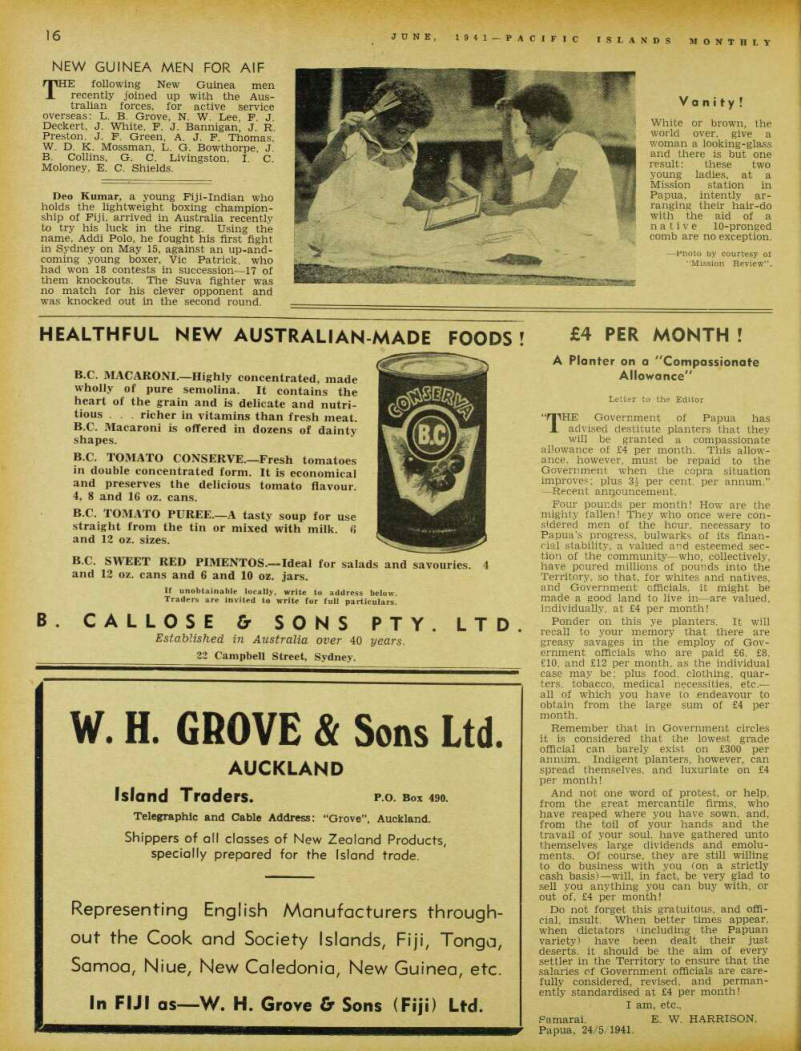
New Guinea Men For Aif
rE following New Guinea men recently joined up with the Aus tralian forces, for active service overseas; L. B. Grove, N. W. Lee. F. J.
Deckert, J. White. F. J. Bannigan, J. R.
Preston. J. F. Green, A. J. F. Thomas, W. D. K. Mossman, L. G. Bowthorpe, J.
B. Collins, G. C. Livingston. I. C.
Moloney, E. C. Shields.
Deo Kumar, a young Fiji-Indian who holds the lightweight boxing champion ship of Fiji, arrived in Australia recently to try his luck in the ring. Using the name, Addi Polo, he fought his first fight in Sydney on May 15, against an up-and coming young boxer. Vic Patrick, who had won 18 contests in succession—l 7 of them knockouts. The Suva fighter was no match for his clever opponent and was knocked out in the second round.
Vanity!
White or brown, the world over, give a woman a looking-glass and there is but one result: these two young ladies, at a Mission station in Papua, intently ar ranging their hair-do with the aid of a native 10-pronged comb are no exception. —Photo by courtesy ot “Mission Review”.
£4 Per Month!
A Planter on a "Compassionate Allowance"
Letter to the Editor ‘TJIHE Government of Papua has X advised destitute planters that they will be granted a compassionate allowance of £4 per month. This allow ance, however, must be repaid to the Government when the copra situation improves; plus 3i per cent, per annum.” —Recent announcement.
Four pounds per month! How are the mighty fallen! They who once were con sidered men of the hour, necessary to Papua’s progress, bulwarks of its finan cial stability, a valued and esteemed sec tion of the community—who, collectively, have poured millions of pounds into the Territory, so that, for whites and natives, and Government officials, it might be made a good land to live in—are valued, individually, at £4 per month!
Ponder on this ye planters. It will recall to your memory that there are greasy savages in the employ of Gov ernment officials who are paid £6, £B. £lO. and £l2 per month, as the individual case may be; plus food, clothing, quar ters, tobacco, medical necessities, etc. — all of which you have to endeavour to obtain from the large sum of £4 per month.
Remember that in Government circles it is considered that the lowest grade official can barely exist on £3OO per annum. Indigent planters, however, can spread themselves, and luxuriate on £4 per month!
And not one word of protest, or help, from the great mercantile firms, who have reaped where you have sown, and, from the toil of your hands and the travail of your soul, have gathered unto themselves large dividends and emolu ments. Of course, they are still willing to do business with you (on a strictly cash basis) —will, in fact, be very glad to sell you anything you can buy with, or out of, £4 per month!
Do not forget this gratuitous, and offi cial, insult. When better times appear, when dictators (including the Papuan variety) have been dealt their just deserts, it should be the aim of every settler in the Territory to ensure that the salaries of Government officials are care fully considered, revised, and perman ently standardised at £4 per month!
I am, etc.,
E. W. Harrison
Pamarai.
Papua, 24/5/1941.
Advertisements & other items, p. 18 (1 item)
W. H. GROVE & Sons Ltd.
HEALTHFUL NEW AUSTRALIAN-MADE FOODS !
B.C. MACARONI.—HighIy concentrated, made wholly of pure semolina. It contains the heart of the grain and is delicate and nutritious richer in vitamins than fresh meat.
B.C. Macaroni is offered in dozens of dainty shapes.
B.C, TOMATO CONSERVE.—Fresh tomatoes in double concentrated form. It is economical and preserves the delicious tomato flavour. 4, 8 and 16 oz. cans.
B.C. TOMATO PUREE—A tasty soup for use straight from the tin or mixed with milk. 6 and 12 oz. sizes.
B.C. SWEET RED PIMENTOS.—IdeaI for salads and savouries. 4 and 12 oz. cans and 6 and 10 oz. jars.
If unobtainable locally, write to address below.
Traders are invited to write for full particulars.
B m m %
CALLOSE & SONS PTY.
Established in Australia over 40 years. 22 Campbell Street, Sydney.
LTD
W. H. GROVE & Sons Ltd.
AUCKLAND
Island Traders. p.o. bo* 490.
Telegraphic and Cable Address: “Grove”, Auckland.
Shippers of all classes of New Zealand Products, specially prepared for the Island trade.
Representing English Manufacturers throughout the Cook and Society Islands, Fiji, Tonga, Samoa, Niue, New Caledonia, New Guinea, etc.
In FIJI as—W. H. Grove & Sons (Fiji) Ltd.
New Books
rE following new books have been published during the month by Messrs. Angus & Robertson, Ltd., of Sydney.
GREY GLADIATOR, by George H.
Johnston. Here is publishing enterprise, indeed. It is only a few weeks since HMAS “Sydney” returned to Australian waters, with the honours of Mediter ranean battles thick upon her; but, already, Mr. Johnston has written, and A & R have published, the full account of her extraordinary adventures during seven months in European waters. It is a most interesting and a very thrilling story. She was attacked more than sixty times by enemy planes; she attacked and was attacked by submarines; she shelled various enemy concentrations, including Bardia; she outfought and sank a crack Italian cruiser; and she sailed brazenly up into the Adriatic and attacked Italians there. And she was unscathed —truly, “a lucky ship”. The story of the “Sydney” is the story of the war in the Mediter ranean, from Italy's entrance thereto, until early in 1941, and it is told with a care for historical fact, and is racily and amusingly written. Price, 8/6.
It’S ’Ard To Keep Straight In
THE CITY, by Kay Grant. A slim volume of definitely naughty verses, with naugh tier, but very clever, drawings by Jean Cullen, A prude might scold this literary production, but it is so filled with rollick ing good-humour, and breathes so happily the careless, gay spirit of the Fighting Services, that one must laugh and accept it. Here, from the wicked pages, is one little story, reduced to rhyme:—
Fed Up!
Now Private Brown ’e’d ’ad a beer— Or maybe two or three, An’ ’e didn’t like the cookin’
So 'e called the cook a b . ’E said e didn’t like ’is face, ’E didn’t like ’is look; An’ all the b’s you’ve ever ’card ’E called the b b cook. ’E said ’e didn’t like ’is ’air, ’E didn’t like ’is clo’es; ’E said ’e’d like ter bust ’im one— ’E did—right on the nose!
So Private Brown was on the mat Before the 21. C.; ’Oo ast ’im if ’e’d ever called The blinkin’ cook a b ?
An’ Private Brown ’e said ’e did— ’ls statement it was took: “There’s one thing, sir, I’d like ter ast— ’Oo called that b a cook?”
The price of this book is 2/-.
OLIVER WISWELL, by Kenneth Roberts. This is another of those very lengthy period novels, done with meticu lous care, which are destined to make literary history. Roberts has been called “America’s greatest historical novelist”, and “one of the most exciting of con temporary novelists” and he was engaged on “Oliver Wiswell”—the preparation of historical matter, the painting of a true background, the elaboration of a likely plot, and the writing of a 700-pages story —for five years. In what is likely to be accepted as one of the great novels of all time, Kenneth Roberts gives the com plete story of the American revolution— and, just at a time when Great Britain and the United States are coming to gether in an epoch-making alliance, it is significant that he tells the story from the loyalist (or pro-English) point of view. A book for one’s permanent book shelf. Price, 14/6.
BET IT’S A BOY, by Betty Bacon Blunt. A book without one line of print.
Fifty very clever drawings tell the story, from the first startled expression on the faces of the Newly-weds, through medical interviews, dieting, coy sartorial prepara tions, to the maternity hospital, and papa’s initial meeting with his twins. A most amusing thing—it should be called “Infanticipating”. Price, 4/6.
Mr. G. R. Jefferson arrived in Fiji last month to succeed Mr. G. Hungerford as accountant at the Suva brauch of the Bank of NSW. Mr. Hungerford has re turned to Australia.
Mr. K. Parker, who graduated last year from Hawkesbury Agricultural College, NSW, has been appointed an overseer with the Colonial Sugar Refining Cos. Ltd., at Lautoka, Fiji.
Mr. John Haney, one of the young men selected a short time ago in Fiji to be trained as members of the RAF, was married in Sydney recently to Miss Ruth Matheson, of Richmond, NSW.
A Papuan native constable met a heap of trouble recently in Musgrave Street, Port Moresby, when he attempted to arrest an unruly native of Erema, who is employed by a shipping firm. The native called on his friends to help him. The friends obliged and, in the disturbance that followed, a number of police were called out. Several constables were as saulted and, as a result, five Erema men received sentences of imprisonment. The ringleader was convicted of assault and obscene language.
Advertisements & other items, p. 19 (1 item)
Domak
Visitors to Sydney
HAMPTON COURT,
KING’S CROSS.
The Furnished Flats that give everything, and only a few minutes from the heart of the city.
Rentals from £3/3/- weekly.
Write Manager for fuller particulars.
L.
NERVES?
BRAIN FAG?
DEPRESSED FEELING?
You Need BIDOMAK to End
“MINERAL STARVATION”!
“Bidomak” supplies in easily assimilable form those vital mineral elements lacking in the modern diet, which you need to build strong healthy nerves, a good appetite and resistance against ills. Thousands once run-down, tired and nervy are now wonderfully well—“thanks to Bidomak”!
OVERCOME TROPICAL LETHARGY
BIDOMAK actually overcomes the effects of severe tropical conditions and brings you back to the pinnacle of good health and spirits safely and pleasantly. The depressing after-effects of Malaria are banished quickly by taking a course of BIDOMAK.
Read what Mrs. Edith Lockyer of North Perth says about “Bidomak.”
“I have been suffering from insomnia, loss of appetite, and nerves and various treatments were unavailing, and I finally reached the point where a complete breakdown appeared imminent, I was then only 6 stone 2 lb. in weight.
“I was Persuaded to try BIDOMAK and after six weeks’ treatment I sleep soundly and eat well, and now weigh 8 stone 1 lb. 1 oz ”
SCIENTIFIC CONTROL
Manufactured In the BIDOMAK Pharmaceutical Laboratories one of the most up-to-date, hygienic laboratories in the Southern Hemisphere, to which is attached a fully qualified Doctor of Medicine, and under the control of a qualified chemist, who was trained in the most modern English Laboratories in the world.
Start To-day on a Course of —
DOMAK
“The Tonic of the Century.”
AT ALL L EADING ISLAND STORES
Society
Journal of the NZ Polynesian Society
THE latest issue (Volume 50, No. 1) of the Journal of the Polynesian Society of New Zealand has recently come to hand. The fine illustrated series of notes on Polynesian artifacts continues, as does Mrs. H. B. R. Parham’s interest ingly annotated list of Fiji plants which is proving of interest not only to scientists, but to anyone even casually acquainted with the flora of this group. Dr. W. G.
Ivens’ article on Melanesian modes of speech will appeal to students of philo logy. A short article by F. V. Knapp gives data on the types and shapes of Maori stone saws.
It is noted that the five Centennial Memoirs projected by the Society will be published later this year. These are: 1, Maori Proverbs and Poetry, by Sir Apirana Ngata; 2, Maori Place-names, by Johannes C. Andersen; 3, Maori Forest
Lore, by Elsdon Best; 4, Maori Mythology, by Elsdon Best; 5, A Bibliography of the Anthropology of Polynesia, Melanesia and Micronesia, by C. R. H. Taylor.
Another work on* the point of pub lication is “Anthropological Essays”, being a collection of articles, important con tributions to the study of Pacific peoples, which appeared in Centennial numbers of the Journal.
Monsieur A. Journot, a retired police adjutant in the New Caledonia gendar merie, died in Noumea early in May at the age of £6.
Prior to his departure for Australia in May, Major the Hon. H. Taylour, MLC, was entertained by the Wau detachment of the New Guinea Volunteer Rifles.
Tributes were paid to Major Taylour’s hard and untiring work as OC “B” Coy. and later as Second-in-command of the Regiment.
Crossed Fiji
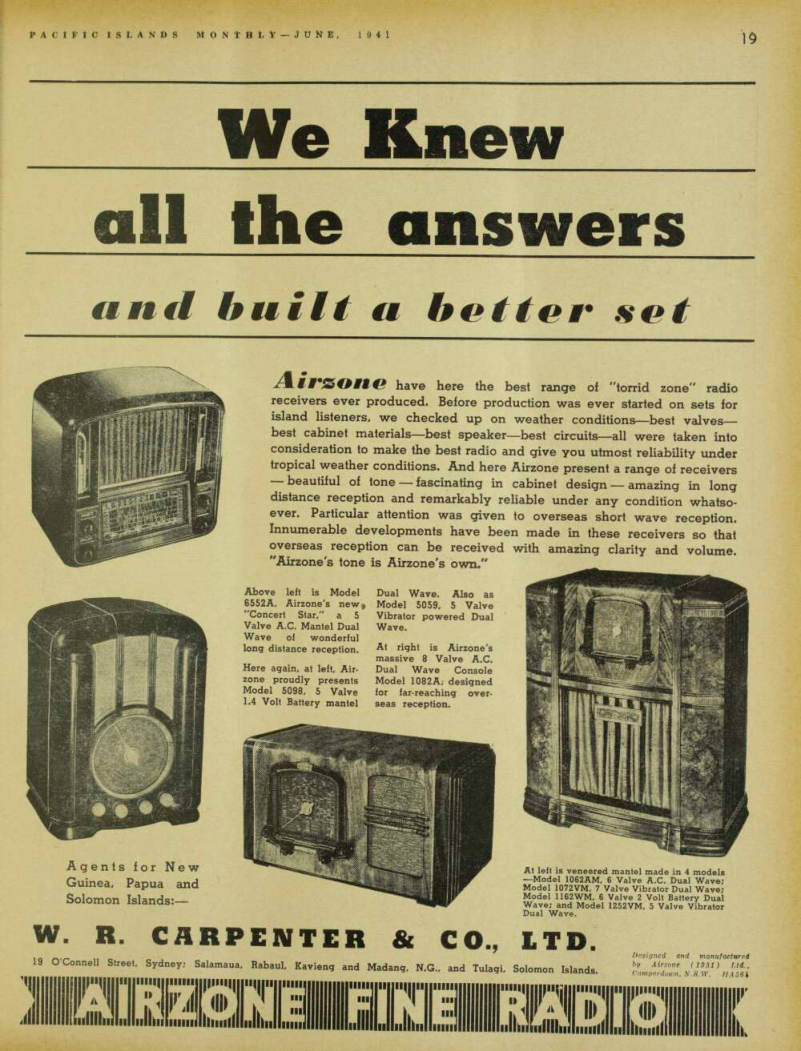
How Australia Double- Crossed Fiji A Minister and a Banana Quota
THE following is from the “Sydney Morning Herald” of May 21:— “ ‘lt is extraordinary, at a time when Australia is experiencing the utmost difficulty in disposing of her fruit over seas, owing to tne loss of export markets, that a fresh effort should be made to secure the entry of Fiji bananas to Aus tralia free of duty.’
“This statement was made by the Assis tant Minister for Commerce, Mr. H. L.
Anthony, at Murwillumbah. He was re ferring to a strong approach recently made by powerful interests representing Fiji to the Commonwealth Government.
“Under the terms of the original Ottawa agreement, Fiji was given the right to export to Australia 40,000 centals of bananas a year under a duty of 2/6 a cental, as against the former duty of 8/- a cental. The new proposal was that the 2/6 duty bo abolished and that 40,000 centals of Fiji bananas be admitted free of all duty. The Commonwealth Govern ment did not agree to the proposal.
“Mr. Anthony said that if there had ever been a time when such a proposal could be entertained, that time certainly was not now.”
“Pim” Comment
THE foregoing is a good example of a politician posing as a statesman, and appealing to the most selfish party interests.
What Mr. Anthony carefully concealed is the fact that Australia for years, has deliberately and cunningly “double crossed” Fiji. For a long time, Fiji bought from Australia very much more than Australia ever bought from Fiji. Fiji’s protests were blandly ignored by Aus tralia. There was no reason why Fiji should continue the system other British countries (especially New Z-ealand and Canada) were prepared to sell Fiji all the goods (mostly foodstuffs) which Fiji got from Australia, and buy an equivalent quantity of Fiji’s products.
Finally, the then Governor (Sir Mur chison Fletcher) issued an ultimatum Either Australia would buy Fiji bananas, or a duty would go onto Australian flour and similar commodities.
Australian banana-growers howled; but so did the Australian flour-millers—and, harassed by both interests, Australian Ministers finally compromised by agree ing to admit 40,000 centals of Fiji bananas per annum, and thus retained the valuable Fiji market for Australian products.
But Australia never has played the game. As has been pointed out in this journal at intervals during the past five years, all sorts of dirty little tricks have been employed to keep Fiji bananas out of Australia, and the understanding that Australia would buy Fiji bananas, in re turn for the continuance of her flour trade, never was honoured.
If the Fiji Government now should decide to put a tax upon Australian flour and other commodities, Australian ex porters can thank Mr. Anthony and similar broad-visioned thinkers, for the loss of an old and valuable market.
Mr. Anthony should ask himself: Which is more important to-day—the main tenance of Australia’s export trade, or the goodwill of his few banana-growing constituents?
Mr. Andrew Deoki, a Fiji-born Indian, returned to Suva in mid-May from New Zealand after qualifying himself for the legal profession. He spent seven years in New Zealand, studying at Auckland University College.
A daughter was bom on May 9 to Mr. and Mrs. lan Maclean, of Rabaul, New Guinea.
Advertisements & other items, pp. 20-22 (2 items)
feather saps strength
«r IP f
READ THE
B.P. MAGAZINE
WINTER NUMBER
iiiiiiiiiiiiiiiiiiiiiiiiiiiiiiiiiiiiiiiiiiiiiiiiiiiiiiiiiiiiiiiiiiiiiiiiiiiiniiiiiiiiiiiiiiiiiiiiiiiin
NOW ON SALE
Short Stories Pictures Travel Articles - - - - Pages for the Children --- Stage Latest Fashions Screen A
ONE SHILLING PER COPY.
ON SALE AT ALL NEWSAGENTS AND BOOKSELLERS
feather saps strength
Burt'S puts it back I
» ;* - Rich in juniper and healthful herbs ... th Hi In oisg e n erations
We Knew
all the answers
and httili übetter set
Agents for New
Guinea, Papua and
Solomon Islands;—
M rS£€Pe have here the best range of "torrid zone" radio receivers ever produced. Before production was ever started on sets for island listeners, we checked up on weather conditions—best valves— best cabinet materials—best speaker—best circuits —all were taken into consideration to make the best radio and give you utmost reliability under tropical weather conditions. And here Airzone present a range of receivers beautiful of tone fascinating in cabinet design amazing in long distance reception and remarkably reliable under any condition whatsoever. Particular attention was given to overseas short wave reception.
Innumerable developments have been made in these receivers so that overseas reception can be received with amazing clarity and volume.
"Airzone's tone is Airzone's own."
Above left is Model 6552 A, Airzone's new* "Concert Star," a 5 Valve A.C. Mantel Dual Wave of wonderful long distance reception.
Here again, at left. Airzone proudly presents Model 5098, 5 Valve 1.4 Volt Battery mantel Dual Wave. Also as Model 5059. 5 Valve Vibrator powered Dual Wave.
At right is Airzone's massive 8 Valve A.C.
Dual Wave Console Model 1082 A, designed for far-reaching overseas reception.
A m m At left is veneered mantel made in 4 models —Model 1062 AM, 6 Valve A.C. Dual Wave; Model 1072VM, 7 Valve Vibrator Dual Wave; Model 1162 WM, 6 Valve 2 Volt Battery Duai Wave; and Model 1252VM, 5 Valve Vibrator Dual Wave.
W. R. CARPENTER & CO., LTD.
1 o rvr l a Designed and manufaeturei 19 O Connell Street. Sydney; Salamaua. Rabaul. Kavieng and Madang, N.G.. and Tulagi. Solomon Islands. CampitZZ. nTw''haw
..ini..
mm I:!
N|V
lllllllillllllll
M, H M
iillhi
mu in Hill min hi in
M M| M
iillkn
mu in mu
niii|
i» X a uK \\
mull
|M»M| (ID
iiimii
lli
NELSON & ROBERTSON
PTY., LTD.
Established 1895.
Islands Merchants
All classes of merchandise purchased at wholesale prices and original invoices supplied to Islands clients.
Purchasers of Laup (New Guinea Walnut).
Cocoa Beans, Rubber and other Islands' produce sold on commission.
SOLE AGENTS FOR
ANKAR INSULATING
WALLBOARD
BEEBE PORTABLE
WINCHES
SKANDIA ENGINES
Nelson & Robertson
Pty. Ltd. 12 Spring Street, Sydney, Australia.
Tahiti
Memories Of Old
WHEN the writer was a very young boy he acquired a set of books by the African explorer, Paul Du Chaillu.
These volumes told of adventures among savage and cannibal tribes, 'of expeditions through trackless equatorial forests and, most fascinating of all, of encounters with giant gorillas that stood like men and beat their breasts with their fists, and roared until the wood land quaked.
Almost were we persuaded to discard our ambition to become a locomotive engineer and to seek fame and glory in following the footsteps of Du Chaillu.
Years passed; and, with their passing, our plans and ambitions crumbled into dust. We never became a locomotive engineer, and we were destined never to see a creature that beat its breast with its fists and roared —until we came to Tahiti . . .
At that period, the Hotel Tiare was the meeting place in Papeete of Eng lish-speaking residents and visitors.
Lovina —enthroned on a big divan behind a long table on the back veran dah, whence she directed the activities of her numerous attendants —presided over our assemblies, as a queen over her court. Indeed, to most of us, Lovina was the uncrowned Queen of Tahiti. She spoke English fluently and the conversa tions were in that language, with occa sional footnotes in Tahitian to keep her attendants informed.
Oftentimes, especially when the steamer “Mariposa” was in port, a few strangers would join the company, as interested listeners.
The talk, one day, turned to the west coast of North America. The writer,
innocently enough, expressed his disillu sionment at the blighted hills and parched valleys, where brochures and lithograph advertisements had led him to expect lush meadows watered by tinkling brooks, and hillsides glowing with blossoms of many colours.
Immediately, one of the passengers from the “Mariposa” rose to his feet and began beating his breast with his fists, letting out staccato roars that made the windows rattle. Noisily and bitterly, he hurled back the reflection upon his beloved Western State.
We were delighted and fascinated. This was like a chapter of Du Chaillu.
Later, when the storm and fury had abated, we ventured an opinion on the superior qualities of the Florida coast as a winter resort. This was followed by a tempest of such violence that Lovina intervened.
She said that it was all right for us to amuse ourselves; but we must take into account that houses in Tahiti were not so substantially built as are those in more rigorous climates, and that henceforth we must leave out all refer ence to Florida.
But nothing lasts forever. Great move ments of population began, that filled the West Coast with alien people who thought of other things than “The Fair Fame of Our Glorious State”. Steadily, they have overwhelmed the Old Guard until the militant Native Son of the Golden West bids fair to share the fate of those other Native Sons who, now a meagre remnant, hold sanctuary among the volcanoes of the Mufumbiro Moun tains. And so perished one of our most exhilarating pastimes of the old days.
A.C.R.
A son was born to Mr. and Mrs. Arthur Hill, of Tavua, Fiji, in May.
Advertisements & other items, p. 22 (1 item)
ojf ili£. niqlvt!
rCt
Au/VliluAVL,
fes fg? r * nan'
soo
CANDLE
POWER
I 300
CANDLE
POWER
BRIGHTER LIGHT
for
BETTER SIGHT
Coleman Products can be obtained from all Leading Firms throughout the Pacific Islands.
Coleman Mantles supply Sun-like light
Instant Lighting
Stoves & Irons giving maximum of heat in minimum of time
EASE OF OPERATION
combines
ECONOMY with COMFORT
In case of difficulty In obtaining supplies write to:— Pearce & Co., Suva, Fiji Is.
Million Patients
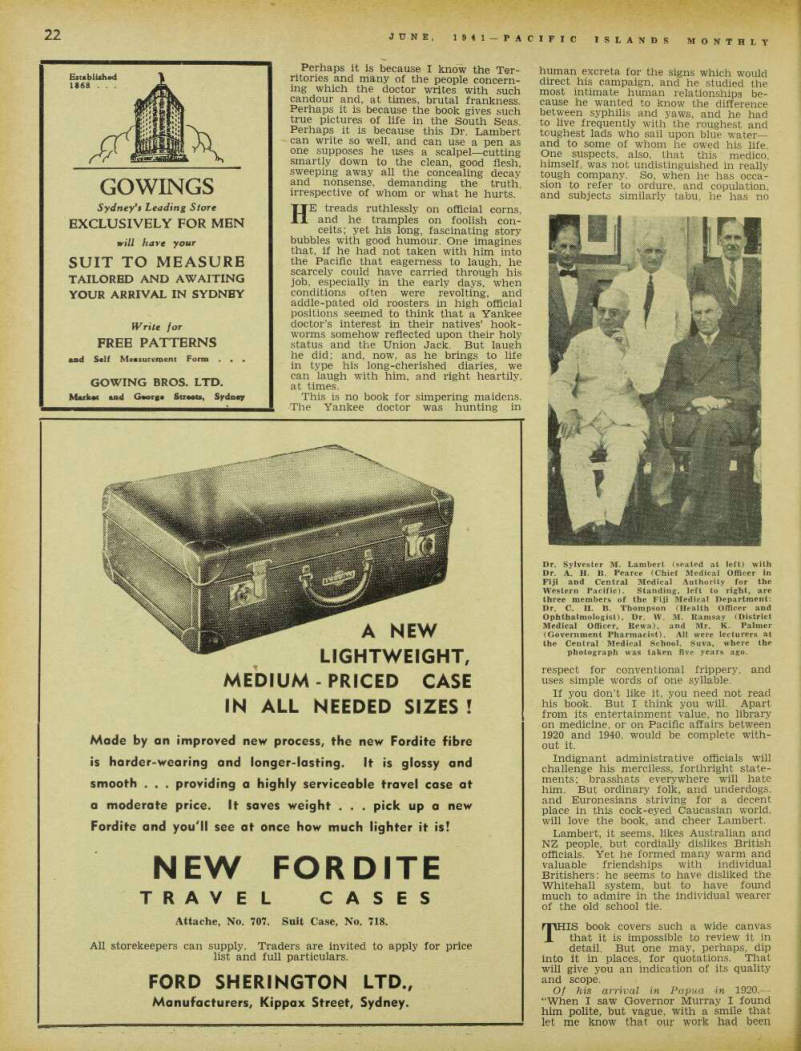
A Yankee Doctor And His
Dr. S. M. Lambert's New Book Bites, and Scourges, and Entertains
By R. W. Robson
FOR twenty years, Dr. S. M. Lambert ranged over all the islands of the South Pacific. When he retired, in 1939, he was as well-known, south of the Line, as the Southern Cross or the Burns Philp flag.
He came into the Pacific in 1920, at the behest of the Rockefeller Foundation, to attack hookworm. It appears that, from New Guinea to Tahiti, from the Gilberts right south to Tonga, from 50 to 90 per cent, of natives carried this blood-sucking intestinal parasite, with the result that they were sick in them selves, and. their resistance lowered by anaemia, they were ready victims of introduced diseases and epidemics.
The job was so vast that no Islands Administration, alone, would tackle it.
It was something for which there had to be unified control and co-operative effort.
The evil was recognised—hookworm, literally, was wiping out the native peoples of the South Seas—but nothing much was done about it until Lambert came to the South Seas, with Rockefeller money and prestige.
But, what a job! A million natives had to be examined, from the tractable peoples of Samoa and Tonga to the wild and treacherous headhunters of New Guinea, and the ever-questing cannibals of the New Hebrides. And what an examination! The incidence of hook worm had to be ascertained in each ter ritory and each village, before a cam paign could be planned; and this meant that the doctor’s field team had to obtain and microscopically examine a specimen of excreta from each person in each village.
New to the South Seas, Dr. Lambert was sent first to the raw and primitive land of Papua; and his first work was done in the filthy swamps of the Bamu River delta, and the cruel, inhospitable mountains at the back of the Gulf Divi sion. From there, he went on to New Guinea and other parts of Melanesia, before he had any experience of the softer and pleasanter lands of Polynesia.
Presently he settled down to a lifetime of work, with his headquarters in Suva.
WHAT Dr. Lambert did, and how he did it, is now part of the history of the South Pacific. He not only con quered the hookworm scourge: he applied his medical knowledge, and his genius for organisation, to the problems of com bating disease generally among Pacific Islands communities, and every real administrator in the Pacific became his ardent supporter and friend. It is hard to believe that one man could have accomplished so much even in 20 years.
But, right from the beginning, Lambert worked on the principle that, if he was to do anything with his appalling job, he must educate others, and work through them.
It was in pursuance of that policy that he fought so stubbornly for the proper development of the Suva Medical School.
For the fact that that splendid institu tion now is turning out a yearly batch of NMP’s, and training the Islands com munities to help and save themselves, several good men may claim credit; but the biggest slice of credit goes to the acid-tongued Yankee, Dr. Lambert.
When, in 1939, Dr. Lambert retired and went home, to grow flowers in a quiet American village, he carried the hearty goodwill of every British, Australian and New Zealand administration in the South Pacific. There went with him, also, the certain knowledge that he had done more than any other man to save the South Pacific races from deteriora tion and extinction. Of course, he could have done little without the Rockefeller
Foundation. But the Foundation was singularly lucky in finding Lambert. Few other men, commanding unlimited dol lars, would have accomplished half as much in 20 years.
BUT those who knew Lambert did not expect his complete disappearance, even in retirement. “This man,” they said, “will write a book. And what material he has—2o years up and down the Pacific, informed by an eye that missed little in human relationships, and a cynical brain that loathed conceit and inefficiency.”
They were right. A copy of the book is to hand —“A Yankee Doctor in Para dise—the Man With a Million Patients”, by Dr. S. M. Lambert, published by Little, Brown & Company, of Boston, at $3. It is a big book—4oo pages of smallish type —but I read it in two sittings, and sel dom have I enjoyed a book more.
Perhaps it is because I know the Ter ritories and many of the people concern ing which the doctor writes with such candour and, at times, brutal frankness.
Perhaps it is because the book gives such true pictures of life in the South Seas.
Perhaps it is because this Dr. Lambert can write so well, and can use a pen as one supposes he uses a scalpel—cutting smartly down to the clean, good flesh, sweeping away all the concealing decay and nonsense, demanding the truth, irrespective of whom or what he hurts.
HE treads ruthlessly on official corns, and he tramples on foolish con ceits; yet his long, fascinating story bubbles with good humour. One imagines that, if he had not taken with him into the Pacific that eagerness to laugh, he scarcely could have carried through his job, especially in the early days, when conditions often were revolting, and addle-pated old roosters in high official positions seemed to think that a Yankee doctor’s interest in their natives’ hook worms somehow reflected upon their holy status and the Union Jack. But laugh he did; and, now, as he brings to life in type his long-cherished diaries, we can laugh with him, and right heartily, at times.
This is no book for simpering maidens.
The Yankee doctor was hunting in
human excreta for the signs which would direct his campaign, and he studied the most intimate human relationships be cause he wanted to know the difference between syphilis and yaws, and he had to live frequently with the roughest and toughest lads who sail upon blue water— and to some of whom he owed his life.
One suspects, also, that this medico, himself, was not undistinguished in really tpugh company. So, when he has occa sion to refer to ordure, and copulation, and subjects similarly tabu, he has no
respect for conventional frippery, and uses simple words of one syllable.
If you don’t like it, you need not read his book. But I think you will. Apart from its entertainment value, no library on medicine, or on Pacific affairs between 1920 and 1940. would be complete with out it.
Indignant administrative officials will challenge his merciless, forthright state ments; brasshats everywhere will hate him. But ordinary folk, and underdogs, and Euronesians striving for a decent place in this cock-eyed Caucasian world, will love the book, and cheer Lambert.
Lambert, it seems, likes Australian and NZ people, but cordially dislikes British officials. Yet he formed many warm and valuable friendships with individual Britishers: he seems to have disliked the Whitehall system, but to have found much to admire in the individual wearer of the old school tie. rIS book covers such a wide canvas that it is impossible to review it in detail. But one may, perhaps, dip into it in places, for quotations. That will give you an indication of its quality and scope.
Of his arrival in Papua in 1920.
“When I saw Governor Murray I found him polite, but vague, with a smile that let me know that our work had been
Dr. Sylvester M. Lambert (seated at left) with Dr. A. H. B. Pearce (Chief Medical Officer in Fiji and Central Medical Authority for the Western Pacific). Standing, left to right, are three members of the Fiji Medical Department; Dr. C. H. B. Thompson (Health Officer and Ophthalmologist), Dr. W. M. Ramsay (District Medical Officer, Rewa), and Mr. K. Palmer (Government Pharmacist). All were lecturers at the Central Medical School, Suva, where the photograph was taken five years ago.
thrust upon him, and that every hook worm we would find would be an added insult to his Administration, something that would lead to trouble with the over lords in Melbourne.” (He is a little caustic about the Mur ray Administration, at first; but “I have had time to reverse my first opinion.
Governor Murray . . . died with a fine administrative record.”) Of his work in Papua. —“ln my weeks of preparation, I found that I had the Papuan Club behind me. That meant support from the ablest colonials in the South Pacific: Loudon, Bertie, Sefton, Jewel, Tom Nesbitt and a dozen more . . .
These were the forward-looking ones who wanted native labour restored to health, to revitalise races for whom, at that time, there seemed no future but extinction.”
Of social contacts. —“At the Papuan Club I couldn’t open my mouth for any fly-blown anecdote without there being wild laughter and shouts of ‘More!
More!’ A new man would come in. ‘Harrigan, have you heard , the Doc’s latest? Doc, tell it again!’ I was rather puffed up until I found that what they were laughing at was my funny Yankee accent.”
On the credit side of the indentured labour system. —“ln subsequent surveys, all over the Territory, I could tell, almost with a sweep of the eye, the men who had been on plantations. They were the upstanding, healthy specimens.”
On the shower-bath-can of the Aus tralian-Pacific territories. “The first time you use this Rube Goldberg inven tion you soap yourself carefully under the spray—and the water gives out. The next time you try soaping yourself in your own sweat, which can’t be done.
The third try you just say, ‘Oh, hell,’ and pull the string.”
On missionaries. —“ All that month of tramping, the priests of the Sacred Heart had showered me with these simple kind nesses. They refused all payment and modestly waved aside my thanks. Heredi tary Methodist though I am, I honour them as the best missionaries and the best hosts in New Guinea.”
On the mud of Western Papua. —“l crossed the Gulf and came upon the terrible land of terrible people . . . The Delta region is ravaged by rivers that pour mud upon mud or throw up shift ing sandbanks that wallow and stink like dead sea monsters ... In the Bamu country, I saw the most repulsive people in all Papua. The Bamus live in mud, and nature seems to have fitted them for their environment. They are as skinny and long as dead eels, and appear to be split clean to the breastbone, to give their stork-like legs a chance to hoist them out of the muck . . . This is prob ably the lousiest place that God ever made —and didn’t quite finish.”
On a near-fight in Samarai. —“lnstead of brushing him off, I kicked over my chair and reverted to common Austra lian: ‘Open your mouth to say one word and I’m inta ya, right now!’ The stranger departed. A couple of days later Mrs. Gofton (now the well-known Mrs.
Flo. Stewart, of Wau), who served the bar, said: ‘When that man gets tough around here now I just say to him, “Look out. or I’ll call the doctor.” ’ ”
On the survey of hookworm in Papua. — “With my inspectors, we had covered 8,461 miles . . . We had marked down a grand total of 59.2 per cent, of infection.”
In the course of a scathing description of how Australia took over German New
Guinea. —“Already we were sympathising with Governor Wisdom, for he was breaking up a racket which was as crude as any invented by Brooklyn union leaders. It was the bird-of-paradise racket —which may sound fantastic, but it was there, and had been ever since the military administration did its worst in New Guinea . . . District Officers were up to their necks in poaching. One of them came back from the Dutch border with £IO,OOO in his pocket.”
On Pidgin in New Guinea. —“At last the time came when my vanity was tickled to the verge of hysteria: I had actually learned Pidgin English. To the native, English is Pidgin, and if you do not speak it with classic exactitude, he simply fails to understand you ... I learned how ironbound its rule of idiom and grammar actually are.”
On a man he met in the Solomons. — “Among unsung heroes—but no mission ary—was my friend J. C. Barley, Oxford
M.A., who had voluntarily given his life to a God-forsaken post at Kirakira Ip his jungle house, he was like something out of Kipling, dressing for the evening, having his spot of gin and bitters before dinner, his sound cigar afterwards. He might have gone anywhere in the colonial service, for as a young Oxonian he had outranked hundreds in competitive exam inations. But he was too clean a sports man to play politics. His passion for ethnology and his affectionate responsi bility for the natives kept him where he was.”
On the 'problem of curing hookworm. — “I had found that oil of chenopodium was not working well enough or fast enough to relieve the million patients who reached out for a cure . . . There seemed no answer to that, until help came from an unexpected quarter.”
On his early work in Suva.—" l know that no man was ever more generously helped than I was, with the friendship of Dr. Aubrey Montague on the Govern ment side, and with Sir Maynard Hed strom backing me in the Legislative Council. Hedstrom always stood ready to act as interpreter for my Yankee lingo and Yankee methods, when I had to argue before cautious governors.” • • • There—l have used double the space we had allotted to this fascinating book, and I am only one-third of the way through it. I have not described how Dr. Lambert found the cure for hook worm, how he surveyed Polynesia, how he met—and shrewdly judged—most of the well-known men of the Central Pacific, how he took the Suva Medical School to his heart. Get the book, if you can—it is well worth the trouble and the money. Incidentally, a copious index makes it valuable as a book of reference.
There is so much of importance in this book—for instance, medical and scien tific and common-sense observations concerning the future of the Indians in Fiji, New Zealand’s record in Samoa and Cook Islands, the condition of Tonga, the history and probable future of the Suva Native Medical School—that it will be helpful to all concerned if we quote extensively in further articles in the “PIM”. The dramatic story of how a cure for hookworms was discovered and operated is told elsewhere in this issue.
Advertisements & other items, pp. 23-26 (1 item)
Stou
IQ ► •i a h* 37 £ _- K S 3 XV w/> !j 5^ 0 O 07 Y* i s
Sjft
£/•»
tS2S
e
'llnn/ii
Estcl 1868 X
GO WINGS
Sydney*s Leading Store
EXCLUSIVELY FOR MEN
SUIT TO MEASURE
TAILORED AND AWAITING
YOUR ARRIVAL IN SYDNEY
Write for
FREE PATTERNS
and Self Measurement Form . . .
COWING BROS. LTD.
Markat and Gaorga Streets, Sydney will have your
A NEW
LIGHTWEIGHT,
MEDIUM-PRICED CASE
IN ALL NEEDED SIZES !
Made by an improved new process, the new Fordite fibre is harder-wearing and longer-lasting. It is glossy and smooth . . . providing a highly serviceable travel case at a moderate price. It saves weight . . . pick up a new Fordite and you'll see at once how much lighter it is!
NEW FORDITE
TRAVEL CAS
Attache, No. 707. Suit Case, No. 718.
E S All storekeepers can supply. Traders are invited to apply for price list and full particulars.
FORD SHERINGTON LTD.,
Manufacturers, Kippax Street, Sydney.
His Master's Voice
GRAMOPHONE BARGAINS
H.M.V. Clol Portables, £4/10/- H.M.V. Cabinet Models, £B/10/- H.M.V. Table Models, £5/10/- Freight paid by us.
THE TALKERIES
161 Castlereagh Street, Sydney.
fit
SILENT
* Dunlop
TENNIS
RACKETS
Dunlop “Maxp 1 y” tennis rackets are used by the Australian Champion and by countless other championship players throughout Australia. In the Dunlop range you will find the racket you want, at the price you want to pay.
Australia's Most
ii Popular Car Tyre
+ Proved by the fact that to-day more Dunlop Silent '9o' tyres are sold than any other tyre.
Dunlop
WATERPROOF
FOOTWEAR
The range of Dunlop Waterproof Footwear is complete. There are over 20 guaranteed waterproof styles for Men, Women and Children. Smart, Longwearing, Comfortable and keenly priced.
Dunlop
REINFORCED
KINKLESS
GARDEN HOSE
Dunlop supply Garden Hoses for every purpose and at prices to suit every pocket.
Wrapped and Moulded types both of which give years of sun and abrasion resisting service.
DUNLOP PERDRIAU RUBBER CO. LTD. (Inc. in Vic.). 27-33 WENTWORTH AVENUE, SYDNEY. N.S.W.
ISLAND STORE MANAGER
MAKES GOOD RECOVERY
COURAGE IS A GRAND THING, BUT SOMETIMES COURAGE ALONE ISN’T ENOUGH. TAKE THE CASE OF ARTHUR WEBSTER, FOR INSTANCE.
ONE EVENING HE WAS WALKING DOWN THE STREET WITH HIS
FRIEND, BILL THOMPSON, WHEN BILL SAID:
“Things pretty good at the store, Arthur?”
“Y-yes. We’re doing all right.”
But the store wasn't doing as well as it should have been. Arthur Webster was really worried. That night he had a heart to heart chat with his wife.
“Arthur darling, you worry too much—tilings’ll be all right soon.”
“I wish I didn’t feel so tired all the time! I seem to wake up tired lately. I suppose I’ll just have to pull myself together and do a real job for the next couple of months.”
Arthur Webster tried hard but just couldn’t make the grade. The final sales figures showed he was well down. One evening when he was slumped in a chair looking thoroughly despondent his wife came over to him.
“Darling, there’s something really wrong with you. I know what you’re going through . . . but I’m sure there’s something behind this day after day tiredness of yours. Why don’t you see a doctor?”
So Arthur Webster took his wife’s advice and saw his doctor. After giving him a thorough examination his doctor said :— “Mr. Webster, your whole trouble is Night-Starvation. You see, all night long your heart and lungs
are using up energy. Your heart has to beat 35,000 times and your lungs make 20,000 muscular movements during your eight hours* sleep.
“So you can see for yourself if energy isn’t replaced during sleep you wake tired, feel run down and get behind in your work. You need Horlick’s. Start drinking Horlick’s every night before you go to bed.”
Arthur Webster started drinking Horlick’s every night before bed.
Soon he lost that heavy, tired feeling and found that he could put twice as much drive into his work.
His sales figures bucked up and for the first time since he had been on the Island the Head Office sat up and took some notice of him.
Do you feel tired all day? Wake tired? Find it hard to concentrate on your work? Feel dull and nervy? Then the chances are that you, too, are suffering from Night-Starvation. Remember, Horlick’s guards against Night-Starvation, keeps you wonderfully fit. Ask your chemist or storekeeper to-day for a bottle of Horlick’s. You can buy Horlick’s in all main towns throughout the British Pacific Islands.
?ORLICO
I orlic *ix<
World Production Of
Soya Beans
rpHE world production of soya beans A during 1940 was about 2 per cent. above 1939 output, according to the “Grain. Seed and Oil Reporter” (Lon don), in April, though the journal did not give the exact figures.
Of the main exporting countries, China had the largest crop for four years. Manchurian trade sources re ported that production there amounted to 140,000.000 bushels against 125,000,000 bushels the previous year. American output, affected by drought, was smaller by 11.000,000 bushels. Production in the Danube Basin continued the upward trend begun several years ago.
Japan and Germany are the largest buyers of soya beans—most of the Man churian crop going to Japan, while the Nazis take the bulk of the Danube pro duction and a little from Manchuria.
Incidentally, the territory from whence about 80 per cent, of the Danube crop comes was included in Bessarabia, the area ceded by Rumania to the Soviet Union earlier this year.
In normal times, the production of soya beans is one of the factors directly affecting the copra market—and the price Islands planters receive.
Missus
Maku And His
The Tale of an Errant Cook Is.
Cornet Player
By “Tukapa Koko”
IT was through John D. Rockefeller, senior, that I met Maku and the Nordic gentleman known to his fellow-whites as “Rustic-Bower Rawley”.
Messrs. Rawley and Maku were not in troduced by the wealthy American in person—he was too busy at the time be ing dead; though why, with all that pile of dollars to bribe the Reaper, I can’t understand.
John D., however, was survived by the Institute he had founded. This valuable society had made arrangements with our Administration to supply to each Cook Islands household a free sanitary out fitting of the “deep-pit” type, without any strings tied thereunto. All one had to do was apply, and assist Maku in the moulding of the cement “potera”, as natives called it, that formed the main adjunct to that cleanliness which is next to godliness.
The erector of rustic bowers, Maku’s overlord, was a fair, short chappie with a West-Riding accent. He was a nice fellow; in spite of his regrettable choice of profession, he was well liked. Maku was a tall, gangling Aitutakian half-caste —a sort of Abe The Rail-Splitter, tup
pence coloured and less the whiskers, but with the legs and nose all present and correct.
They for my own household most satisfactorily, and Mr. Rawley and I were great friends. Rawley was an in teresting chap and he was a good talker, too, when one got used to his burr.
Maku, beside his architectural abilities, was a cornet player of some note. Not having been able to hear Paderewski, I do not say Maku was better; but the Aitutakian was able to render “Yes, Sir, that’s my Offspring” with vim, brio, elan and dash. Mangaia was holding dances at the time; and when Maku assisted with his cornet, he endeared himself to one and all.
This was just what Tutara, the stout sharer of Maku’s joys and sorrows, whom he had brought with him, feared and objected to. Maku, I fear, was something of a Don Juan of the sanitary profession.
His great talents —musical, I mean—pub licly displayed, made him the admired of certain gay Mangaian damsels, and Tutara became aware of a certain lone liness, Like the Benedict in the anecdote, Maku at times seemed to forget that he was married!
It all came to a head when the sanitary instrumentalist was detected by a most basely suspicious and evil-minded Mangaia “cop” in a “delicto” that Tutara,
without waiting to hear the defence, de cided was too “flagrante” to overlook.
Maku was about seven feet high, while she was a little brown dumpling of a woman. She could not reach Maku’s ear with anything but epithets; but her eye lighted on the cornet, and, as Freud tells us, repressed emotion tends to vent itself on the nearest object.
I was aroused from a day-dream by the sound of violent altercation, and a strange, metallic bumping that seemed to come from the clump of palms at the bottom of neighbour-pro-tem Maku’s garden. I looked that way; Tutara was enjoying revenge, not waiting for the Deity to' repay, as Scripture warns us is wisest when we are sinned against.
Gone was Tutara’s Mission-inspired, church-member meekness, her patient sufferance of wrong. The cornet, banged against the palm-tree by the “woman scorned”, with all the power of her stout arm, could not stand the gaff. It gave up its pistons and springs—the latter, joyful in release, sprang in all directions with cheery pings—and, finally, the ghost.
It is a characteristic of the Polynesian that, once a moral offender has been punished, the sin is considered atoned for. Tutara’s rage began to cool, for she remembered that the wind-instrument was not Maku’s personal property, but that of the Aitutaki Brass Band, by whom it had been lent for the period of Maku’s sanitary tour of the Group.
The effort, too, had been weakening, for Tutara was not at that time in a condition to be worried with domestic troubles and disputes. She celebrated her victory by throwing a party—herself!
Maku, erring spouse, was smitten to sym pathy and repentance as his wronged wife fell among the fragments of the late music-horn in a twelve-stone faint.
Next day, all was well. Maku, forgiven, made cement “potera” and, with a blithe whistle, rendered the National Anthem of Rarotonga—the paternal declaration I have previously mentioned, which is howled by dogs on that Island — with brio and vim once more.
Along with his reputation, he, plumber, repaired the abused instrument with solder and pious repentance, and next dance was rendering his chef-d’oeuvre as usual.
But Tutara was there too, church member or no church member!
An Appeal to Readers
PAPER is a commodity “officially rationed”. We are liable to severe penalties if we waste paper.
Sending our journal to people whose sub scriptions have expired, and who have not yet ordered renewal, is regarded as waste.
Hitherto, we always have continued to send the “P.1.M.” for three months, to expired sub scribers, while awaiting their renewals. Now, it is not permitted.
We do not wish to lose old readers. Old readers do not wish to lose continuity of “P.1.M.” issues.
Therefore, for “the duration of the argument with Adolf”, please notify renewal promptly, when warning of the expiry of your subscription is given.
Advertisements & other items, pp. 27-28 (2 items)
vrPomtw*
aN muscu>-AR p a,ns
AVC
You can be confident of safe, positive relief from all nerve and muscular pains and tropical fevers when you take Genuine Vincent’s A.P.C. Vincent’s A.P.C. has been tested and proved over the past 20 years and is acknowledged by doctors, chemists, and nurses throughout Australia as the safest and surest way to relieve all pain.
Vincent’s A.P.C. is the only A.P.C. prepared on the original scientific prescription of the Medical Superintendent of one of Australia’s largest public hospitals and contains Aspirin, Phenacetin and Caffeine. So you are certain of sure relief when you take Vincent’s A.P.C.
TABLETS AND POWDERS.
r>.'
POWDERS 4
TAII E T $
1/6 AND 2/i.
SINGLES 2d. to.
FOR SAFETY’S SAKE—SAY “VINCENT’S”.
H/uhm
SONV
Nou?
M i o * m tm + GERMS of Diphtheria, Malaria, Dhobie Itch, Tinea or Surfers’ Foot, cannot live under “TENAX” lather.
Tropical Skin Diseases can be cured by Its regular
9 V P cr
r fctbl et!
NO VARIATION HAS BEEN
MADE IN ITS COMPOSITION—
judged from the only true angle, that of quality, TENAX has no competitors as a satisfactory germicidal soap, eleven times as rapid in action as carbolic, yet NON-
IRRITANT and NON-POISONOUS. The
Medical Journal of Australia states that TENAX is a germicidal soap that may be recommended with confidence.
TENAX
GENUINE
GERMICIDAL
SOAP
j A PRODUCT OF AUSTRALIAN SOAPS, LTD.
Modern Refrigeration for the South Sea Islands
The ELECTROLUX kerosene operated
REFRIGERATOR
MARVEL
OF
MODERN
SCIENCE
THE
MIRACLE
OF
ICE
FROM
HEAT
ELECTROLUX offers economical, modern and completely efficient
REFRIGERATION FOR ISLANDS' HOMES.
FREEZES CONTINUOUSLY WHILE SMALL LAMP BURNS.
Freezing controlled by simply regulating height of flame. Uses only f gallon of kerosene per week, MOTORLESS ... NO PARTS TO GET OUT OF ORDER.
MODEL L 22 MODEL L3BO MODEL LKSSO Capacity • (as illustrated) ® Capacity 2.2 cubic feet. Capacity 4 cubic feet. 5.5 cubic feet.
GUARANTEED FOR TWO YEARS.
• Write to your Local Distributor for prices and full details.
Obtainable from: W. R. Carpenter & Company Ltd.—Sydney, and the following New Guinea Branches: Rabaul, Salamaua, Wau, Kavieng, Madang, and Wewak.
Representation in Papua W. R. Carpenter & Coy. (Solomon Is.) Pty. Ltd.—Tulagi, British Solomon Islands.
On Chong & Company Pty. Ltd.—Butaritari, Gilbert and Ellice Islands, and New Hebrides.
26
JUNE, iMUPACIhC, ISLANDS MONt « L V
Samoa's Trade In
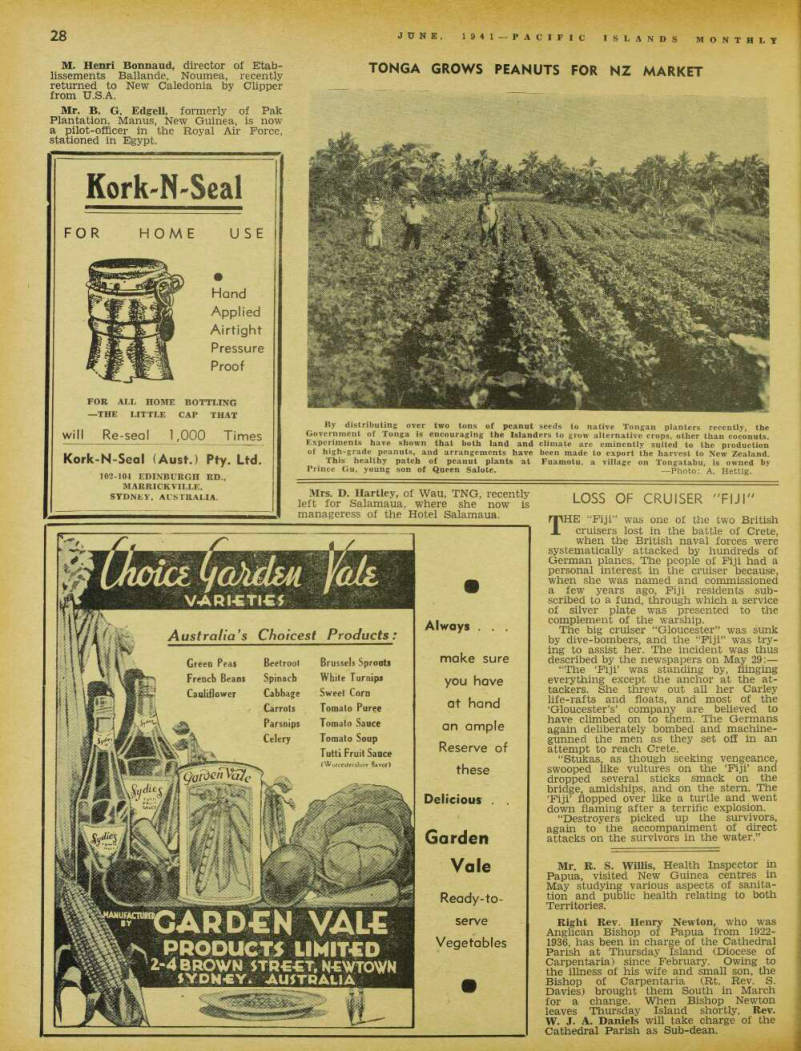
1940 Banana and Cocoa Exports Replace Copra
From Our Own Correspondent
Apia, May 8.
ALTHOUGH the copra market has been depressed, most Pacific Terri tories have been able to maintain their export trade position by marketing other Islands produce. Samoa, for in stance, exported, in 1940, a record number of bananas and sales of her cocoa (mostly European-produced) were the highest for 20 years.
The 1940 trade figures have just been issued by the Chamber of Commerce of Western Samoa and they show: —
The figures give a good indication how Samoa’s banana trade has progressed since the Banana Scheme was introduced in 1928—the present production is about tenfold and the value over seven times as great as in that year. Three-quarters of Samoan bananas exported are supplied by natives.
The London price for Samoan planta tion cocoa rose from £52 per ton early in the year to £57/10/-, but this increase was partly offset by freight rates and war risk insurance rates rising. The United Kingdom and America took the bulk of the cocoa exports.
Most of the copra produced went to Mexico, where the ruling rate fluctuated between 1.85 cents per lb. and 1.55 cents.
Production was much smaller than in former years. New Zealand at the end of 1940 bought the whole of the stocks on hand for use as pigs’ feed. The Ad ministration remitted portion of the copra export duty during the year (the tax was completely abolished in February, 1941).
Rubber sent abroad was grown solely by the NZ Reparation Estates. Exports under the heading of “Other produce’’ comprised hides, papain, pawpaws, avo cados, tomatoes and curios.
The following table shows the destina tion of Samoan exports for 1940 (1939 are given for comparison):—
Imports into Samoa during the year fell by £29,000 compared with 1939 mainly the result of the native copra growers’ reduced spending power. New Zealand supplied the largest quantity of goods; and although quantities were lower all around than last year, other countries usually sending merchandise to Samoa retained their proportionate share. Australia continued her almost one way trade with the Territory—selling over £34,000 worth of goods and taking only several thousand pounds worth of Sa moan plantation products. Japan and Canada, to whom Samoa has been a
good customer for several years did not buy any of her produce.
Imports came from the following countries: —
In the Chamber of Commerce’s report, Mr. I. H. Carruth'ers (president) points out that trading conditions in 1940 were difficult—costs and freights increased, surcharges of 15 per cent, on British and 25 per cent, on foreign goods were imposed on the basic import duties, and shipping services were curtailed. Thus, he states, last year’s trade figures standing by them selves might give the impression that Samoa had feared better in 1940 than in 1939, but that was not the case.
Major C. A. Swinboume, OBE, District Officer in the Gilbert and Ellice Islands Colony, was recently in Suva, Fiji, seek ing medical advice. He is a former Fiji official, having served there from 1909 until 1915, when he went abroad as officer in charge of the First Fiji Contingent.
He joined the G. and E. Service in 1920, after returning from the war.
Mr. Cecil Saunders, general manager of Australasian Petroleum Co. Pty. Ltd,, and Dr. J. R. Burnett, a director of the com pany, returned to Australia at the end of May. after inspecting the APC drilling site at Kariava, in Papua.
Mr. C. W. G. Fox has resumed duties in Wau as Warden of the Morobe Gold fields in New Guinea, after having spent a period of leave in Australia, accom panied by Mrs. Fox. Mr. A. Fry, Inspector of Mines, who was Acting Warden while Mr. Fox was away, is now due for furlough.
1939 1940 ‘ £ £ New Zealand .. . . . . 62,498 58,738 Australia . . 38,113 34.198 Gt. Britain .. .. . . 24,476 21,495
U.S.A
. . 20,157 19,460 Japan . . 10,873 11,278 Canada 8,444 4,091
Year Imports Exports 1939 £194,736 £220,409 1940 £165,453 £221,733 Compared with the previous year, exports were:— 1939 1940 Bananas, cases 199,905 225,885 value .. .. .. £74,965 £84,706 Cocoa, tons .. ., . . . 650 1,801 value .. .. .. £25,152 £75,193 Copra, tons .. 12,536 5,644 value .. .. .. £108,078 £44,004 Rubber, tons .. 48 61 value .. .. £4,509 £7,930 Other produce £1,167 £1,334
1939 1940 £ £ New Zealand 84,305 106,706 Gt. Britain 39,569 52,224
U.S.A 33,981 41.297
Mexico 25,200 25,663 Australia 1,681 2,134 Unspecified (mainly European) 30,082 3,709
M. Henri Bonnaud, director of Etab lissements Ballande, Noumea, recently returned to New Caledonia by Clipper from U.S.A.
Mr. B. G. Edgell, formerly of Pak Plantation, Manus, New Guinea, is now a pilot-officer in the Royal Air Force, stationed in Egypt.
Mrs. D. Hartley, of Wau, TNG, recently left for Salamaua, where she now is manageress of the Hotel Salamaua.
Advertisements & other items, pp. 29-30 (1 item)
0 Tori A
BITTER
m R A i m *
Kork-N-Scal
FOR
HOME
USE
Hand Applied Airtight Pressure Proof wil
FOR ALL HOME BOTTLING
—THE LITTLE CAP THAT
Re-seal 1,000 Times Kork-N-Seal (Aust.) Fty. Ltd.
102-104 EDINBURGH RD.,
MARRICKVILLE.
SYDNEY, AUSTRALIA.
Australia’s Choicest Products: Greeo Peas Beetroot Brussels Sprouts French Beans Spinach White Turnips Cauliflower Cabbage Sweet Corn Carrots Tomato Puree Parsnips Tomato Sauce Celery Tomato Soup Tutti Fruit Sauce (Worcestershire flavor) 'm m \» iy I % : *2311111
N PRODUCTS LIMITED
2-4 BROWN STRC-CT, N-EWTOWN
SYDNEY. AUSTRALIA
Always . . . make sure you have at hand an ample Reserve of these Delicious .
Ready-toserve Vegetables 2 ft
Tonga Grows Peanuts For Nz Market
By distributing over two tons of peanut seeds to native Tongan planters recently, the Government of Tonga is encouraging the Islanders to grow alternative crops, other than coconuts.
Experiments have shown that both land and climate are eminently suited to the production of high-grade peanuts, and arrangements have been made to export the harvest to New Zealand.
This healthy patch of peanut plants at Fuamotu, a village on Tongatabu, is owned by Prince Gu, young son of Queen Salote. —Photo: A. Hettig.
Loss Of Cruiser "Fiji"
THE “Fiji” was one of the two British cruisers lost in the battle of Crete, when the British naval forces were systematically attacked by hundreds of German planes. The people of Fiji had a personal interest in the cruiser because, when she was named and commissioned a few years ago, Fiji residents sub scribed to a fund, through which a service of silver plate was presented to the complement of the warship.
The big cruiser “Gloucester” was sunk by dive-bombers, and the “Fiji” was try ing to assist her. The incident was thus described by the newspapers on May 29: “The ‘Fiji’ was standing by, flinging everything except the anchor at the at tackers. She threw out all her Carley life-rafts and floats, and most of the ‘Gloucester’s’ company are believed to have climbed on to them. The Germans again deliberately bombed and machine gunned the men as they set off in an attempt to reach Crete.
“Stukas, as though seeking vengeance, swooped like vultures on the ‘Fiji’ and dropped several sticks smack on the bridge, amidships, and on the stern. The ‘Fiji’ flopped over like a turtle and went down flaming after a terrific explosion.
“Destroyers picked up the survivors, again to the accompaniment of direct attacks on the survivors in the water.”
Mr. R. S. Willis, Health Inspector in Papua, visited New Guinea centres in May studying various aspects of sanita tion and public health relating to both Territories.
Right Rev. Henry Newton, who was Anglican Bishop of Papua from 1922- 1936, has been in charge of the Cathedral Parish at Thursday Island (Diocese of Carpentaria) since February. Owing to the illness of his wife and small son, the Bishop of Carpentaria (Rt. Rev. S.
Davies) brought them South in March for a change. When Bishop Newton leaves Thursday Island shortly, Rev.
W. J. A. Daniels will take charge of the Cathedral Parish as Sub-dean.
Markets
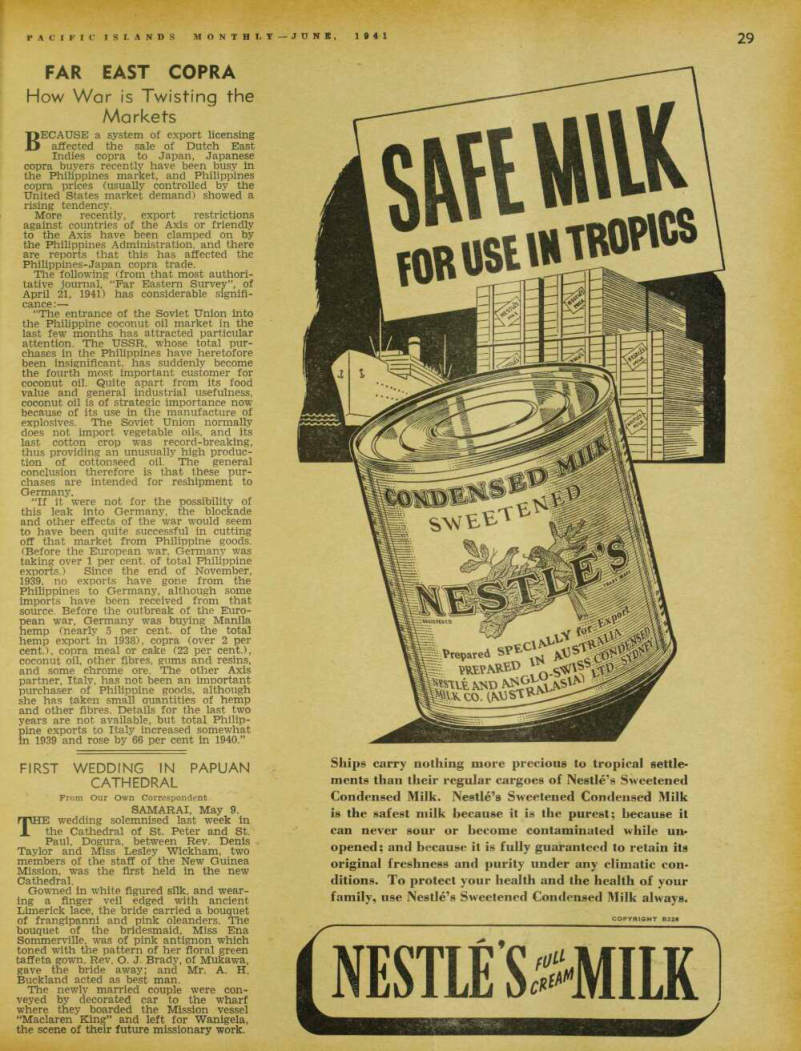
Far East Copra
How War is Twisting the Markets
BECAUSE a system of export licensing affected the sale of Dutch East Indies copra to Japan, Japanese copra buyers recently have been busy in the Philippines market, and Philippines copra prices (usually controlled by the United States market demand) showed a rising tendency.
More recently, export restrictions against countries of the Axis or friendly to the Axis have been clamped on by the Philippines Administration, and there are reports that this has affected the Philippines-Japan copra trade.
The following (from that most authori tative journal, “Par Eastern Survey”, of April 21, 1941) has considerable signifi cance:— “The entrance of the Soviet Union into the Philippine coconut oil market in the last few months has attracted particular attention. The USSR, whose total pur chases in the Philippines have heretofore been insignificant, has suddenly become the fourth most important customer for coconut oil. Quite apart from its food value and general industrial usefulness, coconut oil is of strategic importance now because of its use in the manufacture of explosives. The Soviet Union normally does not import vegetable oils, and its last cotton crop was record-breaking, thus providing an unusually high produc tion of cottonseed oil. The general conclusion therefore is that these pur chases are intended for reshipment to Germany.
“If it were not for the possibility of this leak into Germany, the blockade and other effects of the war would seem to have been quite successful in cutting off that market from Philippine goods. (Before the European war, Germany was taking over 1 per cent, of total Philippine exports.) Since the end of November, 1939, no exports have gone from the Philippines to Germany, although some imports have been received from that source. Before the outbreak of the Euro pean war, Germany was buying Manila hemp Clearly 5 per cent, of the total hemp export in 1938), copra (over 2 per cent.), copra meal or cake (22 per cent.), coconut oil, other fibres, gums and resins, and some chrome ore. The other Axis partner, Italy, has not been an important purchaser of Philippine goods, although she has taken small quantities of hemp and other fibres. Details for the last two years are not available, but total Philip pine exports to Italy increased somewhat in 1939 and rose by 66 per cent in 1940.”
First Wedding In Papuan
Cathedral
From Our Own Correspondent
Samarai, May 9.
rTIHE wedding solemnised last week in JL the Cathedral of St. Peter and St.
Paul, Dogura, between Rev. Denis Taylor and Miss Lesley Wickham, two members of the staff of the New Guinea Mission, was the first held in the new Cathedral.
Gowned in white figured silk, and wear ing a finger veil edged with ancient Limerick lace, the bride carried a bouquet of frangipanni and pink oleanders. The bouquet of the bridesmaid, Miss Ena Sommerville, was of pink antignon which toned with the pattern of her floral green taffeta gown. Rev. O. J. Brady, of Mukawa, gave the bride away; and Mr. A. H.
Buckland acted as best man.
The newly married couple were con veyed by decorated car to the wharf where they boarded the Mission vessel “Maclaren King” and left for Wanigela, the scene of their future missionary work.
Advertisements & other items, p. 31 (1 item)
jsumiwpits
m s# m E rt o*' w»inu
of 'Wmm
i P«p«ed SP« C^
a V9SSfS
§Slli AND
>AU m
A.KCO. (M3S
Ships carry nothing more precious to tropical settlements than their regular cargoes of Neslle’s Sweetened Condensed Milk. Nestle’s Sweetened Condensed Milk is the safest milk because it is the purest; because it can never sour or become contaminated while unopened ; and because it is fully guaranteed to retain its original freshness and purity under any climatic conditions. To protect your health and the health of your family, use Nestle’s Sweetened Condensetl Milk always.
COPYRIGHT 8226
NESTLE S,tf«MILR
Memories of a Papuan
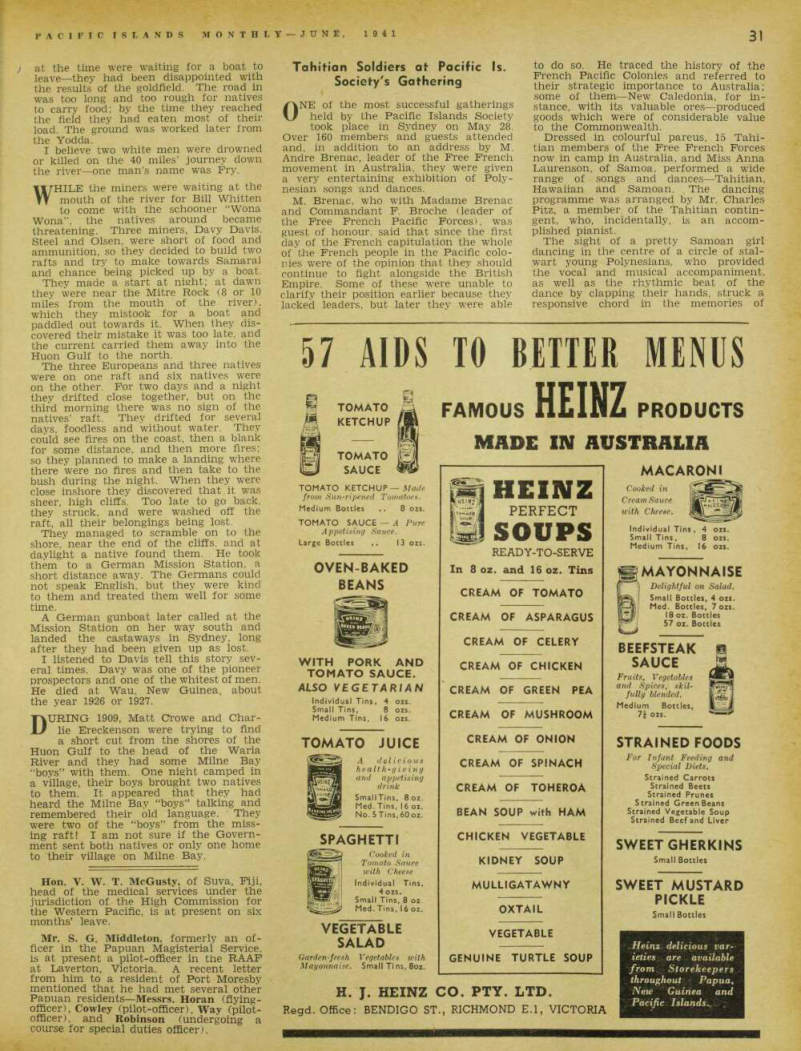
Miner The Murder of John Green and Other Incidents in the Early Days
■nnvrrv pnr.p • pORTY-FOUR years ago in the Mam hare District of Northern Papua, the Government Agent, John Green, and a number of police and carriers were mas sacred by natives. The story was told in the “ PIM” last December ; and its retelling has opened memory’s door for Mr. D. H. Osborne, now of Rossel Island, who has lived continuously in Papua for well over 40 years. Mr. Osborne has kindly written for us some of his memo ries of the early days in Papua’s mining history. He arrived at Tamata Station, where Green teas murdered, just a short time after the tragedy, and he pros pected for many years on the Gira gold field, where he met most of the miners mentioned in the following reminiscences.
AFTER gold was discovered on Me- Laughlm s Creek, at the head of the Mambare River, a number of miners landed at Port Moresby and tried to get there by travelling over the range, carry ing their swags and tools. Only two men got through—Steve Wolff and his mate (I mu aVe J°l g ? tten his + u name) ‘ . • * They had to cross the mountains at an altitude of over 8 000 ft., and it was bit terly cold at night. They were above the timber line with only moss growing on the top of the range. Though the moss seemed green and damp, underneath it was a dry streak: as this caught fire
and bui l nt fo £ mlle s> they had a narrow es ° a P e bemg . burnt to death.
When they arrived at McLaughlin’s Creek, their food was almost finished.
Three white men were there, but they could not spare any supplies. Wolff and his companion left their tools and walked ° n towards Tamata. When they reached Greens Creek, about 10 miles from TfP the mate “knocked up”. Wolff left him and continued on. Eventually, near sundown, he arrived at the site of the Tamata Station, just a short time after the massacre had occurred.
All around the buildings were pools of blood. Tracks were leading into the bush, but he did not know which one to follow, so he camped the night there. In the morning he followed the creek and came upon the camp where several other miners were living, at the junction of Tamata Creek and Mambare River. He called out before entering the clearing, for fear he would be fired on.
With these men, and some of their carriers, Wolff returned to Green’s Creek for his mate He recovered later and, finally, left the Territory.
The above story was told to me by Steve Wolff himself.
Wolff stayed in Papua for some years, but he unfortunately became mixed up in trouble with the natives at Milne Bay and was sentenced to six months’ gaol.
A second time, for trouble on the lakoro, he served a sentence of three years.
Then he was de P° rted mHREE men were on McLaughlin’s X Creek at the time of Green’s murder—Jack Schmitt, Jack Ryan and another man named Burns. They heard of Green’s murder and that Tamata was deserted. They had no food nor any
trade goods to buy native foodstuffs.
Desperate, they went to a village a short distance away; the natives proved friendly and gave them plenty to eat although they were not able to pay for it. They remained there three months.
One day a wild boar came into the village and got among the pigs. Several natives ran out with spears and wounded it. Infuriated, it attacked one of the natives, ripping his leg and severing an artery. He bled to death in a few min utes. His relatives built a staging in the village and laid the corpse on it After a few days the odour was so strong that the miners had to leave They decided to go to Tamata and when they arrived they found that other miners had re turned from Samarai This was Jack Schmitt’s own story He remained many years in Papua and died on the Lakekamu in 1910 or 1911 a T the time of Green’s death there were a number of miners in the camp at the mouth of Tamata Creek. The land was barely above flood level, a most depressing place Green had been hasteninQ' tn finish building three miles up Tamata Creek, 0 n higher ground He said the nolice carrying arms delayed the work so he made them leave their rifles in the camn a nd denended on his revolver for nrotec tion His nolice warned him of the dsn ger ‘ but he:did not heed them One day, as Green was working on the roo f of a big bungalow the revolver got in his way, so he put it down and climbed back up on the roof One of the Orikivas picked it up and ran into the bush Then the Orikivas attacked, killing Green and over 40 of his police and carriers Most of the miners at the Tamata camp
at the time were waiting for a boat to leave—they had been disappointed with the results of the goldfield. The road in was too long and too rough for natives to carry food; by the time they reached the field they had eaten most of their load. The ground was worked later from the Yodda.
I believe two white men were drowned or killed on the 40 miles’ journey down the river—one man’s name was Fry.
WHILE the miners were waiting at the mouth of the river for Bill Whitten to come with the schooner “Wona Wona”. the natives around became threatening. Three miners, Davy Davis, Steel and Olsen, were short of food and ammunition, so they decided to build two rafts and try to make towards Samarai and chance being picked up by a boat.
They made a start at night; at dawn they were near the Mitre Rock (8 or 10 miles from the mouth of the river), which they mistook for a boat and paddled out towards it. When they dis covered their mistake it was too late, and the current carried them away into the Huon Gulf to the north.
The three Europeans and three natives were on one raft and six natives were on the other. For two days and a night they drifted close together, but on the third morning there was no sign of the natives’ raft. They drifted for several days, foodless and without water. They could see fires on the coast, then a blank for some distance, and then more fires; so they planned to make a landing where there were no fires and then take to the bush during the night. When they were close inshore they discovered that it was sheer, high cliffs. Too late to go back, they struck, and were washed off the raft, all their belongings being lost.
They managed to scramble on to the shore, near the end of the cliffs, and at daylight a native found them. He took them to a German Mission Station, a short distance away. The Germans could not speak English, but they were kind to them and treated them well for some time.
A German gunboat later called at the Mission Station on her way south and landed the castaways in Sydney, long after they had been given up as lost.
I listened to Davis tell this story sev eral times. Davy was one of the pioneer prospectors and one of the whitest of men.
He died at Wau, New Guinea, about the year 1926 or 1927.
DURING 1909, Matt Crowe and Char lie Ereckenson were trying to find a short cut from the shores of the Huon Gulf to the head of the Waria River and they had some Milne Bay “boys” with them. One night camped in a village, their boys brought two natives to them. It appeared that they had heard the Milne Bay “boys” talking and remembered their old language. They were two of the “boys” from the miss ing raft! I am not sure if the Govern ment sent both natives or only one home to their village on Milne Bay.
Hon. V. W. T. McGusty, of Suva, Fiji, head of the medical services under the jurisdiction of the High Commission for the Western Pacific, is at present on six months’ leave.
Mr. S. G. Middleton, formerly an of ficer in the Papuan Magisterial Service, is at present a pilot-officer in the RAAF at Laverton, Victoria. A recent letter from him to a resident of Port Moresby mentioned that he had met several other Papuan residents—Messrs. Horan (flying officer), Cowley (pilot-officer), Way (pilot officer), and Robinson (undergoing a course for special duties officer),
Advertisements & other items, p. 32 (1 item)
Swallow Aritaliu
TODAY!
& / ▼ a Cherry • i V - s S**" 0 * 4 SpeC 3 \ diT^ en a \en-O nce
spec'*' daV Cake^obeea' en
i-j AV»err*> t favour V ° ; n everV A aooa bea" h
«»«vw—f 9
. 3 C a^ e <or p ' un4 ‘ Seed Ge ° P\a‘ n f °' cberrV R ' p ® Order SuUana" G>n9 e * - e \Vs
r e is^ a "°: O-
p\om r OP C w *
SWALLOW ARItaLIU
PORT MELBOURNE, VICTORIA, AUSTRALIA
Society's Gathering
Tahitian Soldiers at Pacific Is.
ONE of the most successful gatherings held by the Pacific Islands Society took place in Sydney on May 28.
Over 160 members and guests attended and, in addition to an address by M.
Andre Brenac, leader of the Free French movement in Australia, they were given a very entertaining exhibition of Poly nesian songs and dances.
M. Brenac, who with Madame Brenac and Commandant F. Broche (leader of the Free French Pacific Forces), was guest of honour, said that since the first day of the French capitulation the whole of the French people in the Pacific colo nies were of the opinion that they should continue to fight alongside the British Empire. Some of these were unable to clarify their position earlier because they lacked leaders, but later they were able
to do so. He traced the history of the French Pacific Colonies and referred to their strategic importance to Australia; some of them —New Caledonia, for in stance, with its valuable ores—produced goods which were of considerable value to the Commonwealth.
Dressed in colourful pareus, 15 Tahi tian members of the Free French Forces now in camp in Australia, and Miss Anna Laurenson, of Samoa, performed a wide range of songs and dances —Tahitian, Hawaiian and Samoan. The dancing programme was arranged by Mr. Charles Pitz, a member of the Tahitian contin gent, who, incidentally, is an accom plished pianist.
The sight of a pretty Samoan girl dancing in the centre of a circle of stal wart young Polynesians, who provided the vocal and musical accompaniment, as well as the rhythmic beat of the dance by clapping their hands, struck a responsive chord in the memories of
many ex-Pacific Islands people who watched this unusual demonstration. The Society’s Chieftainess, Mrs. Alfred Page (Xefagaoalii) formerly of Samoa, needed little encouragement from the swaying performers to join in the dance, to the delight of the audience.
When the entertainment finally came to a close, amid much applause, the pre sident (Mr. Alfred E. Stephen) asked Lady Hunter, of New Zealand, to move a vote of thanks to M. Brenac, Miss Laurenson and the Tahitian soldiers.
This was seconded by Dr. lan Hogbin, a former president of the Society.
Pairymead Sugar Co. Ltd., which has plantation interests in the Solomon Is lands, made a net profit of £49,443 in 1940, against £54,577 the previous year.
Dividend is maintained at 10 per cent.
Advertisements & other items, pp. 33-34 (1 item)
Heinz
57 AIDS TO BETTER MENUS
f-f TOMATO
KETCHUP
0 TOMATO i~|
SAUCE
TOMATO KETCHUP Made
from Sun-ripened Tomatoes.
Medium Bottles .. 8 ozs.
TOMATO SAUCE A Pure
Appetising Sauce.
Large Bottles .. 13 ozs.
OVEN-BAKED
BEANS
WITH PORK AND
TOMATO SAUCE.
ALSO VEGETARIAN
Individual Tins, 4 ozs.
Small Tins, 8 ozs.
Medium Tins, 16 ozs.
TOMATO JUICE
A delicious health-giving and appetising drink Small Tins, 8 oz.
Med. Tins, 16 oz.
No. 5 Tins, 60 oz.
SPAGHETTI
Cooked in Tomato Sauce with Cheese Individual Tins, 4 ozs.
Small Tins, 8 oz Med. Tins, 16 oz.
VEGETABLE
SALAD
Garden-fresh Vegetables with Mayonnaise, Small Tins, Boz.
HEINZ
FAMOUS liLlilZi PRODUCTS
MADE IN AUSTRALIA
HEINZ
PERFECT
1 SOUPS
READY-TO-SERVE
In 8 oz. and 16 oz. Tins
CREAM OF TOMATO
CREAM OF ASPARAGUS
CREAM OF CELERY
CREAM OF CHICKEN
CREAM OF GREEN PEA
CREAM OF MUSHROOM
CREAM OF ONION
CREAM OF SPINACH
CREAM OF TOHEROA
BEAN SOUP with HAM
CHICKEN VEGETABLE
KIDNEY SOUP
MULLIGATAWNY
OXTAIL
VEGETABLE
GENUINE TURTLE SOUP
MACARONI
Cooked in Cream Sauce with Cheese.
Individual Tins, 4 ozs.
Small Tins, 8 ozs.
Medium Tins, 16 ozs.
MAYONNAISE
Delightful on Salad.
Small Bottles, 4 ozs.
Med. Bottles, 7 ozs. 18 oz. Bottles 57 oz. Bottles
BEEFSTEAK
SAUCE
Fruits, Vegetables and Spices, skilfully blended.
Medium Bottles, 7J ozs.
STRAINED FOODS
For Infant Feeding and Special Diets.
Strained Carrots Strained Beets Strained Prunes Strained Green Beans Strained Vegetable Soup Strained Beef and Liver
SWEET GHERKINS
Small Bottles
H. J. HEINZ CO. PTY. LTD.
Regd. Office: BENDIGO ST., RICHMOND E.l, VICTORIA
SWEET MUSTARD
PICKLE
Small Bottles Heinz delicious varieties are available from Storekeepers throughout Papua , New Guinea and Pacific Islands.
BURNS PHILP
(SOUTH SEA) CO. LTD.
Inc. in Fiji
Island Traders and Shipowners
Registered Office :
SU V A
FIJI
\Also Branches at:
Fiji; Levuka, Lautoka, Labasa, Ba, Sigatoka, Rotuma.
Tonga: Nukualofa, Haapai, Vavau.
Samoa: Apia, Pago Pago (American Samoa).
Solomons: Makambo, Gizo, Faisi.
New Hebrides: Vila.
Gilberts: Tarawa.
Code Address * “Burnsouth”. Norfolk Is. Niue. Wallis Is. Futuna Is.
CHI VERS
FAMOUS ENGLISH PRODUCTS
CANNED ENGLISH VEGETABLES
CANNED ENGLISH FRUITS
OLDE ENGLISH MARMALADE
GOLD MEDAL JAMS
JELLY CRYSTALS, ETC.
Obtainable from all leading Grocery Stores
WRITE TO DEPARTMENT “A”
CHI VERS & SONS LTD.
Hisf-on, Combs., Eng.
FOR ATTRACTIVE RECIPE BOOK
unroll
LUAIA
CHIV£RS
COLD
ST4AID4RD
FRESH
i ENGLISH k
A
PEAS
*•2
••CKJr. AMD
Memories Of “Queen Emma”
The Real Facts of Her Marriages and Her Life in New Guinea
By Gordon Thomas
Rabaul, June 1.
MRS. Ettie Juker approached me the other day after having perused the article in the April PIM about her aunt, “Queen Emma”.
There were, she said, several inac curacies. I told her that the best way in which to remedy that was to have the truth printed, and I prevailed on her to give me a few facts, knowing that she was Queen Emma’s favourite niece, and had lived with her for a number of years, both in New Britain and in Europe.
It was from her, therefore, that I
gathered together a few facts of the old, pioneer days of this Territory, as well as a few personal details of those people who first made their home here, and started planting up virgin bush among some of the wildest cannibals in the world. For the natives about here, in the eighties, were a really tough proposition.
Jonas Myndes Coe. the father of Queen Emma, was born in Troy, New York, and, being of adventurous spirit, he took sail for the South Seas, and made his home in Apia, where he was commercial agent for the United States. He did not marry two sisters in succession. By his first wife he had eight children—four boys and four girls. Mrs. Kolbe (Queen Emma) was his second daughter; Mrs. Juker’s father was the fifth child; and Mrs.
Phoebe Parkinson (who is still alive and lives not far from Rabaul) was the youngest child. Mrs. Grace Schmidt (who died recently) was the last child of six daughters by the second wife of J. M.
Coe. Incidentally. Mrs. Schmidt was not educated in the USA, or in Dubbo, NSW, as reported.
Queen Emma was married to Kolbe in 1892, not 1912 as mentioned in the article. Her first marriage was to Mr.
Forsayth, who was a trader in copra in Samoa; she had two children by him (J. M. C. Forsayth and a girl). Emma was not happily married, and she went to USA for the purpose of obtaining divorce, in which she was successful. Later, For sayth was reported as having died at sea. The daughter of this marriage died shortly after Emma went to USA.
In 1879, Emma, in company with Cap tain Farrell (who was a friend of Mrs.
Juker’s father and owned a schooner in Samoa, and was engaged in recruiting labourers for the “Long Handle” firm known as the DH & PG) landed in New Guinea (or, to be correct, Bismarck Archipelago) in 1880, and settled on Mioko Island, in the Duke of York Group. This trading station was later sold to the DH &t PG for £5,000.
Two years later, in 1882, Mr. and Mrs.
Parkinson arrived, bringing with them Emma’s son, J. M. C. Forsayth, and one of their own children.
The Parkinsons settled on the island of New Britain, near Kokopo, and started planting up land for Emma. There was some partnership arrangement between the Parkinsons and Emma; but, after planting up Malapau and an adjoining estate, which is now included in the Ralum property, Parkinson left Emma and became manager for the Neu Guinea Compagnie at Kokopo. After serving the NGC for some time. Parkinson returned to Emma, as the manager of her trading and planting interests at Kokopo.
Six years after the arrival of the Par kinsons (i.e., 1888), Grace (later Mrs.
Schmidt) arrived and joined her half sister; also, the father of Mrs. Juker, with five of his children. A sister (Mrs.
Mary Ann Horgren), and three children, followed, eleven years later, and settled in the Territory.
Mrs. Juker was the eldest child, and was about 14 years old when she arrived in the Territory. She lived with Tier aunt, Queen Emma, for some ten years, and, at 24, she married George P. Kaumann, accountant of the DH & PG, of Samoa.
In 1909, Queen Emma (then Mrs.
Kolbe) and her niece travelled to Europe, and in Genoa they were joined by Mr.
Kolbe. In 1911, Mr. and Mrs. Kolbe re turned to New Britain, leaving the niece (Mrs. Kaumann, at that time) behind in Europe, visiting her husband’s relations in Berlin, Hamburg and Frankfurt.
Queen Emma's firm, widely known as the E. E. Forsayth Company, was sold to the Hamburgische Sudsee Aktien Gesellschaft (HSAG) by J. M. C. For sayth while his mother was in Europe.
The send-off, mentioned in the PIM article, was not given by the residents of New Guinea, but by the sisters of Queen Emma (Mrs Parkinson, Mrs. Hor gren and Mrs. Grace Schmidt).
SPEAKING of the circumstances sur rounding the death of Queen Emma, Mrs. Juker said - “The lady referred to as having come from Germany, who was supposed to have had a prior right to my uncle (Mr. Kolbe), I knew very well. She was a resident of Melbourne, and she was on her way to England to try and sell her business. We all stayed together at the Miramara Hotel, in Genoa, for a week, and then she left for England. She was merely an ac quaintance of my uncle, as well as of my late husband (Mr. Kaumann). Later, she returned to Melbourne, where she died during the last war. Her daughter married an English colonel.
“There was nothing so tragic in my aunt’s death,” continued Mrs. Juker.
“She had been a sufferer from diabetes for many years, and she entered a clinic at Frankfurt in 1909; the doctor there informed her that her state was serious.
At times, my aunt could hardly walk.
I saw her later, in Sydney, and she looked very poorly; a few months after wards she died. I am convinced that the shock of my uncle’s death killed her.”
During the interview, Mrs. Juker em phasised the fact that much of Queen Emma’s prosperity was due to the ener gies of Mr. and Mrs. Parkinson, in those early years; and they, on several occa sions saved the lives of Queen Emma and her son. The growth of her business came after she married Kolbe, who opened up more land, made roads and planted up large areas of coconuts.
MRS. Juker, who still lives out on the North Coast, a few miles from Rabaul. is still well, though some what frail. Five years after the death of George P. Kaumann she married Dr.
Alfrede R. Juker, a Swiss.
“At one time,” said Mrs Juker, “the PIM compared my grandfather, Jonas M.
Coe, to a beachcomber This is an error.
The conditions under which he left the USA were very sad. Early in his life both his parents died, leaving himself and elder brother to live with an aunt in New York. Her son was a banker and broker, and very well connected in that
city, and my grandfather was an upright and honourable man. By marrying his Polynesian wives according to the law of his own country, he showed that he was neither afraid nor ashamed of the criticism of the world.”
And then this little, frail woman left the office to go back to her old homestead at Rakuranga, at one time one of the finest plantations on the North Coast, and a home which, during the last war, became famous for its hospitality—as famous almost as Gunantambu was in the days when Queen Emma held sway.
Of all those old pioneers who came from Samoa in the early eighties, there are few now remaining. Mrs. Parkinson, who celebrates her seventy-eighth birth day on June 5, this year, manages to get about, as stately as ever; she lives with her grandson. Rudolph Diercke, over on a plantation in the Namatanai district, but recently she came to Rabaul to obtain a pair of eye-glasses. She told me that for years now, her sight had been so good that glasses were not necessary.
“But now I find I must have them to read the smaller print of the papers,” she explained to me.
Parkinson left behind him a literary monument in his “Thirty Years in the South Seas” (printed in German). But the work accomplished by those pioneers in opening up this country, in doing the spade work, should be recorded.
Editorial Note
THE PIM is grateful to Mrs. Juker for supplying authentic information about the life of Queen Emma. Much of the material hitherto published about this remarkable woman—on which part of the article in the April PIM was based —evidently is very inaccurate. It has been said, for instance, that Emma was well into middle age when she married Kolbe, and that Kolbe was merely a hanger-on, interested mostly in Emma’s money. Mrs. Juker makes it clear that Emma was only in her thirties when she became Mrs. Kolbe, that they were to gether for some 20 years, and that Kolbe assisted her very much in managing her properties and increasing their values. It is to be hoped that Mr. Thomas, or some other competent writer, will gather up the romantic story of Queen Emma while her old associates are still available to supply the truth.
Mr. Charles Edmund Wakeham, who for 35 years had plied his trade of car penter in Fiji, died in the Colonial War Memorial Hospital, Suva, on May 18, aged over 80.
Advertisements & other items, p. 35 (1 item)
VI neg^Vt
S(OUJS—-
"HiMfwahs
Pwt£
VI neg^Vt
1 9 cfecurL,£&mA It is brewed to full strength, and then matured in wood like good wine just as it was 140 years ago, when the Hou s e of Holbrook was founded in Wor- * cestershire, England.
Holbrooks Pure Malt Vinegar will add an exquisite flavour to your salads and keep your home-made pickles crisp and firm."
PRODUCING UNIFORM GOOD RESULTS SINCE 1868
ALWAYS ASK FOR IT
Papua's Finances
From Our Own Correspondent
Pt. Moresby, May 1.
PAPUA is still balancing her budget— the Territory’s finances for the nine months ended March 31 show a credit balance of £8,928 Revenue figures for the period disclose a large increase over those of last year.
Customs receipts were up £6,763; and proceeds from the sale of produce grown on Govt. Stations were £1,269 higher.
Expenditure for the nine months totalled £128,039, a rise of £5,923. Chief
increase was in the Treasury Dept, due to purchases by the Govt. Stores branch.
Public Works expenditure was higher owing to plant bought for Pt. Moresby’s electricity supply. More money was spent on the Medical Dept.’s activities than last year.
The Trust Fund account at March 31 stood at £72,947, including £29,594 to the credit of the Native Taxation account.
Mr. C. Anthony, of the Lands Depart ment at Rabaul, recently returned to New Guinea with his wife and daughter after extended leave spent in NZ and Australia.
The Philippines
America Takes Defence Precautions
WHAT would happen to the Philippine Islands if the United States entered the war or if Japan made her long threatened southwards thrust? This question has been the subject of innumer able articles published in American jour nals in recent months.
The concensus of opinion seems to be that, although there are weaknesses in the Philippines defence, invasion could succeed only at a terrific cost of men and material.
The Philippines are in a unique posi tion. Five years ago, America set the Philippines Commonwealth on the road to freedom and independence, with the proviso that she would assume responsi bility for the defence of the islands until 1946, when the Filipinos would be left to fend for themselves after 40 years of US protection. But the European war and the subsequent cloudy situation in the Far East have completely altered the picture.
Instead of a gradual withdrawal, Amer ica now is making hastv efforts to put the Philippines into a state of prepared ness. This year has seen much activity in the group; US military forces have been greatly augmented, American cruis ers have been making big deliveries of munitions and other war materials, and wives and children of US Army and Navy men have been leaving in a steady stream. Larp-e numbers of Filipino re serves, possibly 100.000 men, have been called up for training;.
Embracing over 7.000 islands, the sea girt Philippine archipelago must depend primarily for protection upon the US Asiatic fleet, which up to the end of 1939 comprised a rather meagre complement of cruisers, destroyers and submarines.
To-day. this force has been greatly strengthened, not only by naval vessels but also bv deadly long-range bombing planes. Only quite recently the US Army authorities asked Congress for half a million dollars to construct concrete run ways in the Philippines for heavy bombers.
The most strongly fortified point in the Philippines is the United States estab lishment at Corregidor, the island com manding the entrance to Manila Bay.
This is of vital importance, since the bav could easilv accommodate an entire fleet if it sought refuge there. • Corregidor, which is considered by military exnerts to be capable of long resistance, gffords ample protection from sea attack for Manila and for the Cavite naval base. It is not known how much these fortifica tions have been strengthened recently.
Civilian protection in emergency is the responsibility of the Philinpines Com monwealth officials and planning boards have been working actively for close on a year on such problems as supnlies, transportation, communications, and air raid precautions.
Now, with her defences in order, time alone can tell whether the Philippines will constitute a source of weakness or strength to the United States in the event of war in the Pacific.
Mr. G. H. Miller, son of Mr. George Miller, accountant with Burns, Philp and Co. Ltd., Townsville, and formerly of Port Moresby, Papua, recently obtained his commission in the Royal Air Force, after being trained ih Canada. Newspaper re ports from London at the end of May stated that he had arrived in England with a party of Australian airmen.
Advertisements & other items, p. 36 (1 item)
jhjh
PRESCOTT Pty. Ltd.
SUSSEX ST., SYDNEY,
are sole wholesale agents for
PINEAPPLE BACON&HAMS
DAISY brand BUTTER "375" BUTTER in TINS Ilb.-21b.-slb. Sixes.
LEA & PERRINS’ Sauces and Most other Super-Quality Lines of the Trade, such as Cheese, Eggs, Etc.
jhjh
a
ANCHOR FLOUR
THE STANDARD OF QUALITY
55 m , , j ■ m. y&f* m
GILLESPIE BROS. PTY. LTD
SYDNEY - AUSTRALIA
sm =a saywss -k.
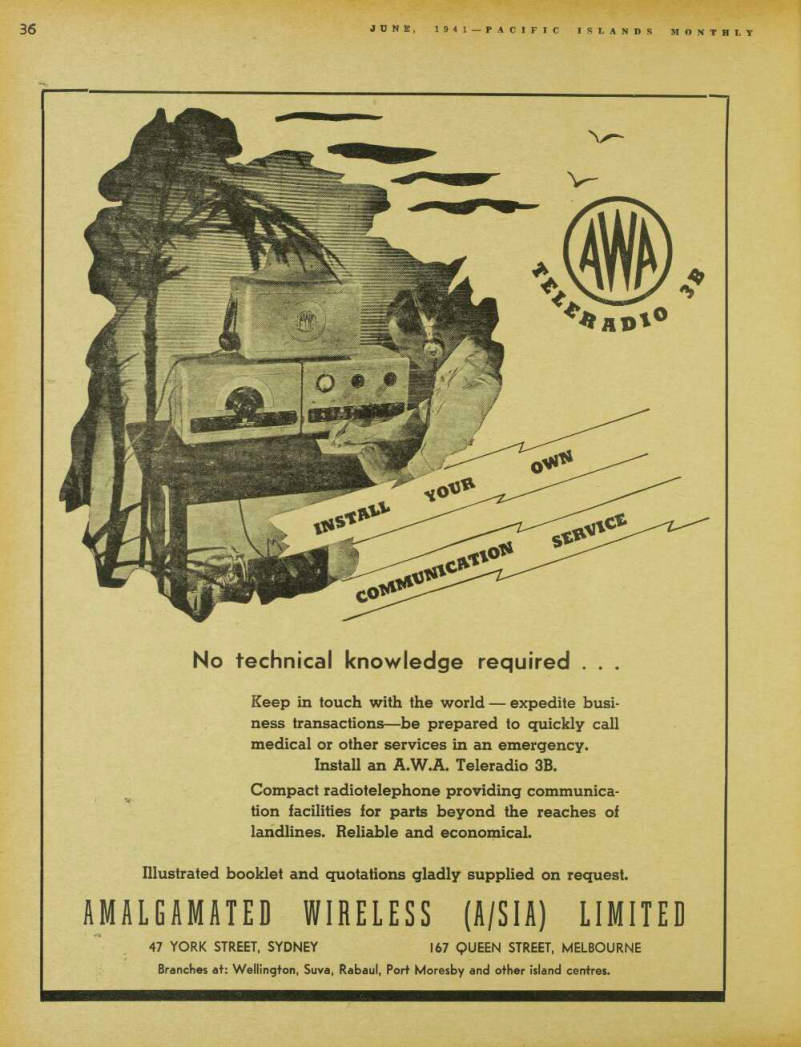
Process Copra In The Islands
Establish Margarine and Soap Factories Urges Fiji Planter
Letter to tlie Editor
FROM published reports, the recent Copra Conference in Sydney appears to have been concerned mainly with finding a market for copra. That is all very well, but what really is wanted is a price which does in some respect give to copra its true value in relation to the products manufactured from it. Such values could be obtained in the Islands easily enough if mills were erected and the oil processed either into soap or margarine for export.
If we had the necessarv factories in the Islands we could do the one thing that has been a thorn in the side of planters for years—keep the huge profits from margarine and soap in the Pacific.
After this war there will be a world-wide, clamorous demand for all kinds of oils and fats.
I have gone carefully into the position and it seems to me that there is an ab surd difference between what we planters receive for our copra and what the mar garine and soap manufacturers get for their retailed goods. Consider these figures:— Copra is worth in Fiji £3/10 - per ton; 5 tons, therefore, are worth £l7/10 -.
From this copra can be crushed 3 tons of coconut oil (from which can be pro cessed 3 tons of margarine) together with 2 tons of cake residue.
The present price of low grade mar garine in England is sd. a lb., which is equal to £46 13/4 per ton. Three tons of margarine, therefore, would be worth £l4O.
Taking our original 5 tons of copra, this gives us:— 3 tons margarine worth .. £l4O 0 0 2 tons coconut cake at £7/10- per ton £l5 0 0 £155 0 0 Less cost of raw material (5 tons of copra) .. .. £l7 10 0 Difference £137 10 0 Thus we have £137/10/- floating in the air between producer’s price for his raw product (5 tons of copra) and the price paid by the consumer for the lowest valued margarine. In round figures, that gives £27/10 '- a ton out of which to pay all overhead expenses such as manufac turing, packing, marketing, freights, in surances, etc. Surely there is scope here for a higher price to the grower of copra.
Now, take copra at its relative value against eating margarine, for which the standard retail price in England is 9d. a lb. This means £B4 per ton, giving £252 for three tons.
Again taking our basis of 5 tons of copra, this gives us:— 3 tons margarine worth .. £252 0 0 2 tons coconut cake .. .. £l5 0 0 £267 0 0 Less cost of raw material (5 tons of copra) .. . . £l7 10 0 Difference £249 10 0 This equals £49/18/- per ton of manu factured margarine against a raw material cost of £3/10/- per ton. Other costs, of course, must be taken into con sideration: crushing, manufacture, added vitamins, overhead, freights, insurance, and so on. But does it take £49/18/- to manufacture and put in the consumers’ hands one ton of margarine? Far from it. I think; at the most, it would be £2O-£25 pounds per ton inclusive of every charge. That being so, there appears to be a margin of roughly £2O per ton over and above the price paid to the grower of copra.
Whichever way you look at the figures there is no mistaking that 5 tons of copro, ms-kc 3 tons of oil, 3 tons of oil but’ £l7/10/* 18 C ° St of the raw product is but £l7 10 Similarly, in the manufacture of soap (which is worth £25 per ton), there is a good margin between the value of the manufactured article, after all making and marketing costs are deducted, and the amount which copra producers receive.
What’s wrong with a well-advertised good quality coconut oil soap made in the islands and guaranteed to contain nothing else in the way of fats but pure coconut o jj—ft would sell the world over like hot cakes.
Always we hear the same old cry: Look for markets for copra. Why not look to manufacturing products from copra?
T/p pn thp Islands people in work both in
sm =a saywss -k.
in profit out of the manufactured articles.
The Unilever combine’s annual profit proves this. „ m I maintain that the Pacific Terri tories should unite and finance a scheme of self-support by handling all products manufactured from copra. They could finance a central crushing mill and manu facturing plant. Copra growers should then be able to get a fair reward for their labour, instead of being bled white by the monopolists.
Even here in Fiji, why can’t we get the CSR Co. to crush copra in its mills during the slack season and manufacture margarine and soap. It seems to be an alert, progressive concern—it took up pineapple canning in Fiji and is making a do of it after quite a number of others had failed. Perhaps the Fiji Government would help financially to put in the necessary plant if it saw that the Colony’s copra growers would be assisted by the plan.
I am, etc..
“Ga Ni Bulu.”
Vanua Levu, Fiji. 22/4/1941.
Advertisements & other items, pp. 37-38 (1 item)
CLmottls
PURE RICE
STARCH
Always ask for . . . ii
CORAL BRAND
100% PURE
CORAL BRAND
RICE STARCH
c «l>t Noted for Its
QUALITY
and
WHITENESS.
Goes Farthest and gives Lasting Finish
WILL NOT
STICK TO
IRON.
Obtainable from Leading Island Stores.
Manufactured by
AUSTRALIAN RICE, LTD.
Sydney, N.S.W.
OFTEN BUTTERED
NEVER BETTERED
CRISP, LIGHT BISCUITS which
bring out the flavour of cheese and add a new attractiveness to fresh or stewed fruit.
A delicious supplement to ham or paste or other tasty savoury, and still an epicurean delight, served simply with fresh butter.
The rich excellence of these famous Biscuits is the result of 67 years of specialisation.
They are packed in air-tight tins or packets for picnic convenience.
CLmottls
FAMOUS
SAO BISCUITS
A 26 ALWAYS ASK YOUR GROCER FOR ARNOTT'S !
No technical knowledge required . . .
Keep in touch with the world expedite business transactions—be prepared to quickly call medical or other services in an emergency.
Install an A.W.A. Teleradio 38.
Compact radiotelephone providing communication facilities for parts beyond the reaches of landlines. Reliable and economical.
Illustrated booklet and quotations gladly supplied on request.
AMALGAMATED WIRELESS (A/SIA) LIMITED
47 YORK STREET, SYDNEY 167 QUEEN STREET, MELBOURNE Branches at: Wellington, Suva, Rabaul, Port Moresby and other island centres.
A Trader's Tale
By “Tukapa Koko”
THE European storekeepers were wor ried, Native Richmonds had entered the field of Beach commerce before, but no one like progressive Tanga.
Tanga was an up-and-coming lad, a “yellow native”, with what seemed a large streak of Chinese in him, though as far as I knew he was pure Mangaian on both sides of the family tree. There are such things as throw-backs, especially where mixed breedings come into the case. Tanga may have been the result of a decision by Nature to dig up a four hundred-year-old strain that had lapsed since some canny Asiatic trader visited Mangaia per junk. If so, judging by his descendant, he must have retired to China a millionaire —unless the junk sprang a leak.
Be that as it may, Tanga was the Yellow Peril of Mangaia trade. We, nous autres, cursed him in one breath, and uttered admiring exclamations with the next, as his little native store, in an old shack on the Beach road, went from strength to strength.
He had cloth; he had hardware; he had household goods, foodstuffs, nails, paints—everything that we had —and he sold it at a price that was simply ghastly in its cheapness.
It was easy for Tanga so to do; he paid no rent, had no overhead, got all his stuff by mail; and his living standard was just native. Apart from licence and road tax, he was on the right side of the ledger all the time.
His stock was largely Japanese. For that reason, he was able to under-sell all of us, and still make good profit. He, taking in large sums, each steamer re ordered and re-ordered, with a blithe heart.
One of his shipments was just too cheap; we fell before his sale of dress material, in gay spots and bars dear to the native heart, at sixpence a yard. In no time, Tanga was sold out; and he ordered more, and more, and more, while his fellow-natives bought, and bought, and bought.
But the best-laid plans of the Tangas of Polynesia at times go agley. Tanga, like all natives of the Outer Cooks, did not care a hoot what went on in the outside world. All the white-man in terest Tanga had was money; and it was becoming rather indecent, so Fate stepped in and righted the situation.
After one unusually gorgeous feast of cheap-jacking, ’Erbert ’Enry called Tanga into his office. Tanga swaggered up to the desk, and met his Waterloo—for, though ’Erbert ’Enry’s words were as
honey mixed with olive oil, they made war in Tanga’s heart.
“Tanga,” cooed the Burra Sahib, “You had a big swag of Jap. cloth this boat, didn’t you?”
Tanga, with obvious pride in his acumen, confirmed the allegation.
“And did you know, when you ordered it,” continued ’Erbert ’Enry, “that it was sold to you by the warehouse in bond?”
Tanga, scowling slightly, professed nescience, “Well, I regret to inform you,” said His Nibs, “that the dues, surtax and other amounts due on that lot, under new arrangements, amount to forty-seven per cent, of the value of the goods.”
Next boat, Tanga’s prices were even as thine and mine!
Mr. John Hills, an Englishman who formerly was an officer on the Fiji Government’s yacht “Viti”, married Miss Loma Dick, of Suva, on May 17. They left the Colony at the end of the month for Australia, where they have now made their home
New A.D.O. On N.G. Goldfield
WAU, May 24.
MR. D. Vertigan, who has been ADO at Wau for upwards of two years, has departed, for Australia, on leave.
Mr. A. Niall, who arrived on May 19, has taken over temporarily, pending the arrival of Mr. McMullen, who has been appointed ADO, Wau, with Mr. Niall as his assistant.
Mr. Vertigan, who has had a nerve straining job for some considerable time —being practically alone in his adminis trative position for long periods—was certainly due for a rest. He was fare welled by his colleagues prior to departure.
His presence on the committee of the Spitfire Fund will be much missed. Mrs.
Vertigan also has been an indefatigable worker in the interests of the Comforts Fund, and has helped the Red Cross Society considerably.
It is certainly a step in the right direc tion that this district is to have the services of two experienced ADO’s, for it is perhaps the busiest district in TNG.
Advertisements & other items, pp. 39-40 (1 item)
9^^ep itwith
I
Vlealth’
f & lx A m
KANGAROO BRAND
Ropes,
Cordage,
and Twines for every purpose
Backed by
86 years of service.
Manufactured by
M. DONAGHY AND SONS,
Pty. Ltd.,Geelong and Sydney.
Fiji Representatives:
PEARCE AND CO.
LIMITED
P.O. BOX 237, SUVA
DESTROY GERMS AND INSECTS...
Inexpensively, easily and effectively with De Meric's Standard Products.
De Meric's Disinfectants are made in liquid and powder form. They are ideal for island conditions. They're obtainable at good stores everywhere . . . ask for De Meric's Lysol, Napthalene, Non-Staining Fly Spray, Moth Balls, etc.
DE MERIC’S
STANDARD PRODUCTS
Traders are invited to write for full wholesale list to
DE MERIC PTY. LTD.
Commonwealth and State Government Contractors, Doody Street, Alexandria, N.S.W.
A Tropical Household

Pest How to Banish Cockroaches from the Kitchen
r VHE following information issued hy 1 tfie Pa V uan Public Health Depart ment for the guidance of Port Moresby residents will be of interest also to householders in other Pacific territories.
THE cockroach is a common household pest in the tropics and infests kitchens, larders, and other places where foodstuffs are left exposed. They are under suspicion of carrying several diseases. The ravages of these insects cause a considerable amount of direct loss and much food 15 rendere d unfit for human use owing to the repulsive odour left wherever they have passed. cockroach eggs are laid in small brownish capsules, which are deposited in cracks in walls and floors, or among folds of clothing etc. When hatched. the y° un S cockroach is soft and whitish in colour, but it soon takes on the dark hue and firmness of the adult. Several moults take place during the progress of growth of the young insect to the adult
size. A single cockroach may produce several batches of eggs in a season.
Foodstuffs of all kinds should always be stored in metal receptacles provided with properly fitting lids. Larders, kit chens and sculleries should be kept scrupulously clean, and no scraps of food left lying about. Wooden enclosures under kitchen tubs and sinks and other places likely to harbour cockroaches should be dispensed with. All dark cupboards in places where foodstuffs are stored or handled need special attention.
Destruction of cockroaches may be effected by means of insecticides in pow der form or by fumigation. The powders selected should be scattered about the haunts or blown by means of a powder blower into cracks and crannies fre quented by the insects. The following powders are placed in their order of usefulness: — Sodium Fluoride.—This substance may be used in powder form either by itself or mixed in equal proportions with flour or powdered sugar. It should be handled with care, as it is poisonous.
Borax. —May be used in pure state or mixed with two parts of powdered chocolate, cornflour or similar attractive substance.
Pyrethrum.—Should be used in the pure state.
Liquid Insecticides.—These should be sprayed into cupboards or crannies re peatedly. The cupboard should be kept closed as long as possible after spraying.
When cockroaches are present in great numbers, fumigation is probably the most satisfactory method of treatment.
This may be carried out by means of sulphur or hydrocyanic acid gas:— Sulphur.—By burning rock sulphur or flowers of sulphur in the proportion of not less than 3 lb. to each 1,000 cub. ft. capacity of the room after ventilators, windows, chimneys, and doors have been properly sealed up. Place the sulphur, moistened with a little methylated spirits, in an iron vessel supported on a brick, set in a tub partly filled with water; then light the methylated spirits. The room filled with sulphur fumes is kept closed for eight hours, after which time it is opened up and freely ventilated.
Hydrocyanic Acid Gas. —This is a very effective agent for the destruction of cockroaches and other loathsome insect pests. It takes very much less time to operate, and has not the same bleaching action which sulphur gas possesses.
Owing to the deadly effects of hydro cyanic acid gas on human beings who are exposed to it, only experienced per sons should be permitted to use it for fumigation purposes.
Mr. E. G. Theodore, head of the two big Fiji gold mining companies at Tavua, visited Melbourne (Victoria) at the end of May.
Commandant Jardin passed through Sydney in May on his way from the Cameroons to Noumea, New Caledonia, to take over the post of Commander-in- Chief of the Free French Forces in the Pacific.
Mr. F. C. Smithyman, one of Fiji’s pioneers—he was the first white child born in the group—died recently at Savu Savu, aged 78. When 13, he was appren ticed to the Levuka Government Printing Office, becoming manager five years later.
Then he entered the Fiji Civil Service and erected a printing plant for the Government in Suva. Later, he left the Service to found the “Polynesian Gazette” in Levuka. Making a success of this news paper, he sold his interests and went to New Zealand, but ill-health later com pelled him to return to Fiji, where he took up a plantation.
Advertisements & other items, p. 40 (1 item)
38
June, — pacific islands mo n t tm?
Captain George
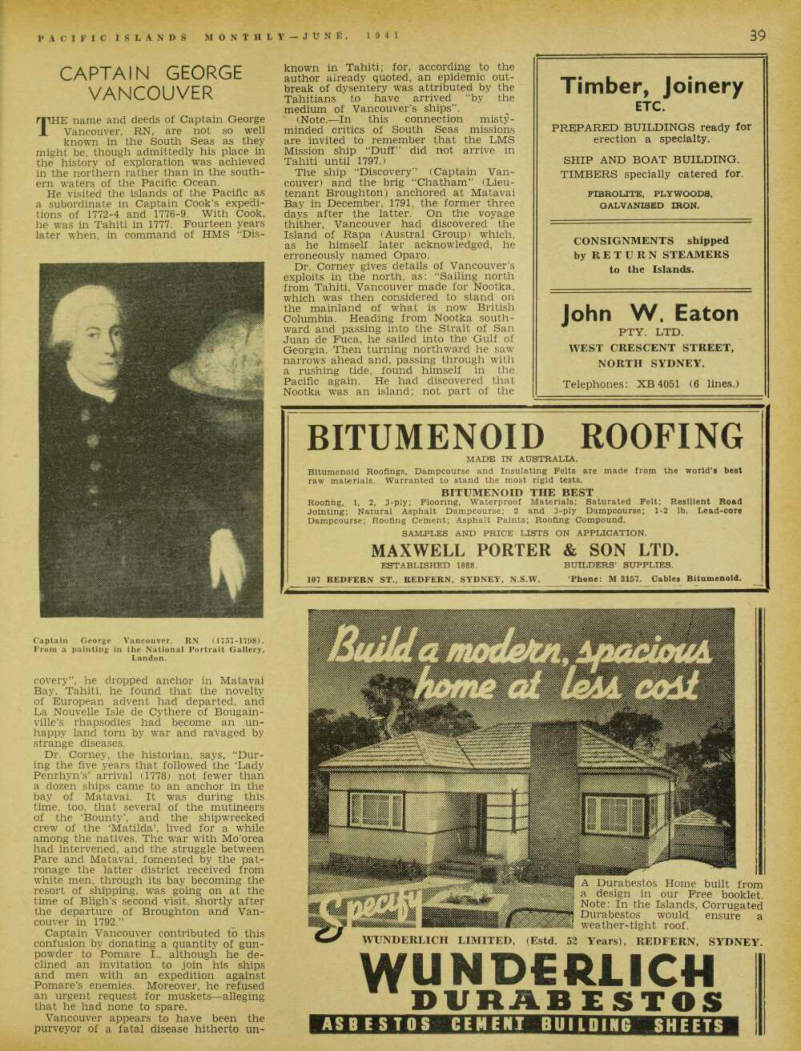
Vancouver
THE name and deeds of Captain George Vancouver, RN, are not so well known in the South Seas as they might be, though admittedly his place in the history of exploration was achieved in the northern rather than in the south ern waters of the Pacific Ocean.
He visited the islands of the Pacific as a subordinate in Captain Cook’s expedi tions of 1772-4 and 1776-9. With Cook, he was in Tahiti in 1777. Fourteen years later when, in command of HMS “Dis-
covery”, he dropped anchor in Matavai Bay, Tahiti, he found that the novelty of European advent had departed, and La Nouvelle Isle de Cythere of Bougain ville’s rhapsodies had become an un happy land tom by war and ravaged by strange diseases.
Dr. Corney, the historian, says, “Dur ing the five years that followed the ‘Lady Penrhyn’s’ arrival (1778) not fewer than a dozen ships came to an anchor in the bay of Matavai. It was during this time, too, that several of the mutineers of the ‘Bounty’, and the shipwrecked crew of the ‘Matilda’, lived for a while among the natives. The war with Mo’orea had intervened, and the struggle between Pare and Matavai, fomented by the pat ronage the latter district received from white men, through its bay becoming the resort of shipping, was going on at the time of Bligh’s second visit, shortly after the departure of Broughton and Van couver in 1792.”
Captain Vancouver contributed to this confusion by donating a quantity of gun powder to Pomare 1., although he de clined an invitation to join his ships and men with an expedition against Pomare’s enemies. Moreover, he refused an urgent request for muskets—alleging that he had none to spare.
Vancouver appears to have been the purveyor of a fatal disease hitherto un
known in Tahiti; for, according to the author already quoted, an epidemic out break of dysentery was attributed by the Tahitians to have arrived “by the medium of Vancouver’s ships”. (Note. —In this connection misty minded critics of South Seas missions are invited to remember that the LMS Mission ship “Duff” did not arrive in Tahiti until 1797.) The ship “Discovery” (Captain Van couver) and the brig “Chatham” (Lieu tenant Broughton) anchored at Matavai Bay in December, 1791, the former three days after the latter. On the voyage thither, Vancouver had discovered the Island of Rapa (Austral Group) which, as he himself later acknowledged, he erroneously named Oparo.
Dr. Corney gives details of Vancouver’s exploits in the north, as: “Sailing north from Tahiti. Vancouver made for Nootka, which was then considered to stand on the mainland of what is now British Columbia. Heading from Nootka south ward and passing into the Strait of San Juan de Fuca, he sailed into the Gulf of Georgia. Then turning northward he saw narrows ahead and, passing through with a rushing tide, found himself in the Pacific again. He had discovered that Nootka was an island; not part of the
Captain George Vancouver, RN (1757-1798).
From a painting in the National Portrait Gallery, London.
mainland. Vancouver’s name was given to it by the Home authorities.”
A further reference says that the new and expanding city of Vancouver, on the adjacent mainland, was so named in spite of “loud and angry protests by the island’s inhabitants, who foresaw con fusion in the minds of many. The city takes great pride in caring for Captain Vancouver’s last resting place in Peter sham Churchyard, Surrey, England.”
A.C.R.
Advertisements & other items, pp. 41-42 (2 items)
Wunderlich
Timber, Joinery
ETC.
PREPARED BUILDINGS ready for erection a specialty.
SHIP AND BOAT BUILDING.
TIMBERS specially catered for.
FEBROLITE, PLYWOODS.
GALVANISED IRON.
CONSIGNMENTS shipped
by RETURN STEAMERS
to the Islands.
John W. Eaton
PTY. LTD.
WEST CRESCENT STREET,
NORTH SYDNEY.
Telephones: XB 4051 (6 lines.)
BITUMENOID ROOFING
MADE IN AUSTRALIA.
Bltumenoid Roofings, Dampcourse and Insulating Felts are made from the world’s best raw materials. Warranted to stand the most rigid tests.
BITUMENOID THE BEST
Roofing, 1,2, 3-ply; Flooring, Waterproof Materials; Saturated Felt; Resilient Road Jointing: Natural Asphalt Dampcourse; 2 and 3-ply Dampcourse; 1-2 lb. Lead-core Dampcourse; Roofing Cement; Asphalt Paints; Roofing Compound.
SAMPLES AND PRICE LISTS ON APPLICATION.
MAXWELL PORTER & SON LTD.
ESTABLISHED 1888. BUILDERS’ SUPPLIES.
107 REDFERN ST., REDFERN, SYDNEY, N.S.W. ’Phone: M 3157. Cables Bitumenold.
£ 0 i Durabestos Home built from a design in our Free booklet.
Note: In the Islands, Corrugated Durabestos would ensure a weather-tight roof.
WUNDERLICH LIMITED, (Estd. 52 Years), REDFERN, SYDNEY.
WUNDERLICH
DURABESTOS
ASBESTOS CEMENT BUILDING SHEETS
Rid Kidneys Of
Poisons And Adds
„ Your Kidneys are a marvellous structure.
Within them are 9 million tiny tubes which act as filters for the blood. When poisons and acids attack them you suffer from Burning Itching Passages, “Getting Up Nights,” Leg Pains, Dizziness, Rheumatism, Lumbago, Nerviness, Circles under Eyes or Swollen Ankles, etc. Ordinary medicines can’t do much good. The cause must be removed.
Cystex rids Kidneys of poisons and acids in 2 hours, therefore a speedy end to kidney troubles. In 24 hours you’ll feel fitter, stronger than for years, in a few days, complete health is restored. Cystex is guaranteed to put you right or money back. Ask your Chemist for Cystex today. The guar- GUARANTEED for Kidneys, Bladder, Rheumatism antee protects you.
Now in 3 sizes: 1/9, 4/-. 8/-.
Ship Chandlery Hardware
/Write for j
Ship Chandlery /
Catafoaue J
Catalogue
Special “In Bond” Prices for all Islands enquiries quoted on application.
Sole Agents for:
BROOMFIELDS LIMITED
153 SUSSEX STREET SYDNEY,
Cables: “Boom”, Sydney.
Large and Complete Stocks of
SHIP CHANDLERY
IRONMONGERY OF ALL KINDS,'
WHITE LEAD AND OILS.
PAINTS,
P. H. MUNTZ & CO.’s 3-CROWN BRAND METAL SHEATHING.
PEACOCK & BUCHANS’ ENGLISH READY-MIXED PAINTS.
Scott’s “Renown” Brand Rope,
Cordage and
Cable Address: Ropeyard, Sydney. ■to-
Binder
Twine
of Every
Description
MANUFACTURED AT
MASCOT, N.S.W.
J. SCOTT
PTY. LTD.
Head Office and Store
163 CLARENCE STREET,
SYDNEY,
N.S.W.
the^‘falth'tLir^fdW^hfd^n
COPRA OUTLOOK
What is a Good, Steady Price?
Letter to the Editor tn vnnr tvtpv ™ , I ? 4 ’ y 9 u make A futl i re °f copra, with Interest WIU rea * d as outUnld wiU come t™ attef uS buffeting they have experienced during the past few years. 1 You refer, to the “halcyon days of 1921-24 . During the last war, the London market varied between £3O and £5O per ton. The market in 1919 was between S° nd . £7 9 a ton, reaching the peak in the b li^ nnmg of 1920 when it went to £7 ° P er ton. Various sales were made at from £4O to £5O per ton f.O.b.
Islands ports.
The planters who participated in those °and others now v Ve “ h not. 6 think*that rates°S go to those fancy prices, unless temporarily Well, a year or two of them would DUt planters on their feet again and then
S market'should leMle
a SOOd steady price, What would be a good, Steady price?
Speaking from memory, the ex-German plantations in New Guinea were sold to returned soldiers on the basis of a London price of £24, and the enormous
the^‘falth'tLir^fdW^hfd^n
the future of the market. For these re turned men did not tender blind, but had the advice of the shrewdest men in the game. What has happened since is a matter of history.
The prices I have mentioned did not have the benefit of an exporter’s pre mium of 25 per cent. —the exchange was more or less at par. With the premium of 25 per cent., I am sure that planters would be satisfied with a price sub stantially lower than £24.
You mention that competition by other oils has been an important factor in the prices of recent years. Whale oil has been one of these competitors. Prior to this war, we read about the immense captures of whales—including immature ones, which, it was said, would have a bearing on future years’ captures. Per haps this may be so; but they seemed to come along, each year, in increasing quantities. Stiff, I understand it takes several years to breed up again, once the whales of those regions are depleted On this subject of whale-catching, could you possibly give your readers any information as to what the position is now? The nations most active in this industry were the British, Norwegians, Germans and Japanese. Did any Euro pean or Japanese ships come Pack in 1940, or 1941? If so, is there any infor mation available as to the catches? Any information you could give your readers on this subject would be very welcome, as whale oil was such a strong competitor of coconut oil.
I am, etc.,
C.H.
Hillston, NSW, 30/5/1941.
Whale Oil Position
Editorial Note
IT may be noted that, while in previous years a good deal of information was published relating to the ac tivities of British, Norwegian, German and Japanese whaling fleets in the Antarctic, this year very little has ap peared. The editor of this journal thought that he might' have missed these news paper announcements, and accordingly communicated with a leading Sydney business man who usually keeps tab over Antarctic enterprises; and he was told that that the latter gentleman also was without news of recent Antarctic whaling enterprises, if any.
We believe that a Japanese whaling fleet visited the Antarctic in 1940-41, and obtained a substantial quantity of whale oil; but there is no indication whatever of visits by any other fleet.
We know that there could be no activity by the Norwegians or Germans, owing to war conditions, and it is probable that every British ship, normally engaged in whaling, has been required for other purposes.
Therefore, it is a reasonably safe as sumption that, apart from the whale oil obtained by the Japanese, very little whale oil has entered the world’s oil markets from the 1940-41 season. Indi cations are that this will be the position also in the 1941-42 season.
Mr. and Mrs. J. A. Costello and their two daughters arrived in Australia from Rabaul early in June. Mr. Costello is attached to NG District Services staff.
Captain T. V. Hill, who served for over 35 years with the Union Steam Ship Company, retired at the end of May.
After some years as officer on various NZ vessels of the Union Co., he was ap pointed to the trans-Pacific cargo service and commanded the “Waikawa”, “Waite mata”, “Wairuna”, and “Hauraki”. From 1927 to 1935 he was master of the liner “Niagara”, taking over command of the “Aorangi” in 1936 and remaining in that post until he was relieved recently owing to illness.
ill-judged Strike is
Over Dispute About N. Guinea Working Conditions
From Our Own Correspondent WAU, May 24.
AS reported in May “PIM”, the strike among the miners employed by New Guinea Goldfields, Ltd., is virtually at an end.
It is disclosed that 104 men were af fected by this strike, including many tradesmen who were automatically forced out of employment.
At the time of writing, over 30 men have resumed work, and repair operations are in progress in readiness for a re sumption of work in the Karuka shaft at Edie Creek. A further number (about 16) have applied to resume work and will be placed as soon as possible.
Twenty-six or 27 men have left the countrv: four are working elsewhere; and 23 have not yet applied for resumption.
Those single miners at Golden Ridges, the strike originated, and who have not resumed work, were requested to vacate their houses by noon on Thursday, May 22. The three married miners there who are still out, have not been included in this reouest and are still occupying their free houses.
The outstanding feature of this strike is that the men struck without giving the management of New Guinea Gold fields, Ltd., an opportunity of hearing their grievances—although statements to the contrary have been made by persons not concerned with the strike.
Mr. Ward’s statement, in the Common wealth Parliament, has been read here by many with utter amazement; and it is obvious that Mr. Ward knew nothing whatever of the circumstances. It is a matter of con lecture as to who supplied Mr. Ward with such fictitious nonsense— certainly not the strikers.
Such unfounded statements as: “In one case the only entrance to one mine collapsed and great difficulty was ex perienced in digging out the men en tombed”; and “the dust menace in the mines has reached serious proportions”— among others —are figments of either an imaginative or a malicious brain. There is no truth in either, nor in many parts of Mr. Ward’s speech. If the people who prepared these data for Mr. Ward were conversant with the mining regulations of the Territory, they would have known that many and comprehensive regula tions exist to cover “safe working” in mines.
Among the privileges extended by New Guinea Goldfields, Ltd., to their em ployees are: Free housing; free light and power; free fuel; free medical atten tion: free sanitary services; free drugs; no hospital charges (the company pays these for all its employees); subsidised messes; native servants at much reduced cost; special facilities in the purchase and delivery of household goods.
Captain A. G. Brown, of the Australian Red Cross Society, visited Port Moresby in May in connection with the work of the Papuan Division of the Society.
Monsieur Rene Solari, a former acting governor of Tahiti, attended one of the Polynesian Club’s gatherings in Sydney in May.
Mr. D. F. Higlett, of the Postal Depart ment in Port Moresby, Papua, who en listed in the RAAF, has obtained his commission as a pilot.
Miss Essie Richmond, of Suva, Fiji, was married to Mr. Ernest Page, of Dune din, NZ, at the Suva Presbyterian Church Manse in May.
Polynesian Club
DURING May, the Polynesian Club’s rooms at 250 George Street, Sydney, were “open house” to Tahitian mem bers of the Free French Military Forces, now in Australia.
Club ladies from Norfolk Island, headed by Misses Ivv and Dora Buffett, Cora Young and Vina Quintal helped enter tain their distant kinsmen—the Tahitians were greatly interested to meet these descendants of the Tahiti women who went to Pitcairn Island with the men of HMS “Bounty”.
Many well-known families of Tahiti have representatives in the contingent, among them being scions of the following families: Bambridge, Martin, Frogier,
Texier, le Hartel, Drollet, Salmon, Pirani, and Snitz.
On May 30, the Polynesian Club took a cencert party to the military camp where the Free French Forces are being trained and entertained them with Maori, Samoan and other Polynesian items.
This function was a great success with the Tahitians, who assisted club members with the musical items, a feature being the “ori Tahiti”, by Mr. Bebe Frogier.
Mr. E. C. D. Green, of the NG Depart ment of Agriculture, has been spending furlough in Sydney.
M. Morault, of New Caledonia, was in Vila. New Hebrides, last month installing electricity in the town, for the contrac tors, Unelco Company, of Noumea.
Advertisements & other items, pp. 43-44 (1 item)
Sil Rohu
FIREARM REPAIRS: “OUR HANDS MAKE GOOD *RMS”. Goods Sent C.O.D.
Quality Second-hand
English
Shotguns For Sale
Purdey, Cashmore, Greener, Boswell. Jeffery, Stephen Grant, Hollis, Holloway and Naughton.
Bonehill and a host of other well-known makers are all shown in my Second-hand List, which will be sent on request.
MY GUARANTEE IS BEHIND EVERY FIREARM I SELL.
Browning Automatic 12-gauge Shot Gun. 28 inch, 30 inch and 32 inch Barrels, full choke or modified for 2f inch cartridges, price £l7/10/-.
WRITE FOR FIREARMS CATALOGUE (600 ILLUSTRATIONS).
SIL ROHU
143 ELIZABETH STHEFT (Near Market Bt.) SYDNEY Quality Firearms and Fishing Tackle. ’Phone: MA 3540.
( U(UI / /
o : -v’ u I L 18, 0 I® l
BUILT TO SUIT ISLAND CONDITIONS
The Chapman Super Pup generates 4£ h.p. and is particularly favoured for work boats and fishing craft, as well as usual pleasure craft. Special Chapman Patented Features provide outstanding economy and ease of operation. The Patent Self-Starting Magneto (instantly mounted or demounted, automatically timed by dropping into position) can be swung around by a hand lever to suit ahead or astern driving of boat. Reverse gear-box is entirely eliminated.
The Chapman Patent Floatless Type Carburettor combined with the proved Petroil System of lubrication (£ pint of lubricating oil is mixed with each gallon of petrol put into tank) provides utmost economy. As with all Chapman Pup engines, the Super Pup is started easily by merely pulling the wheel backwards against compression! Write for free interesting details of this and other Pup Engines. There are 22 different models, from to 20 h.p.
IN MIDDLE-AGE-
KIDNEYS OFTEN
NEED THIS HELP
Many people going into middle age note a slowing down of the healthy bladder action of youth.
While this is to be expected to a degree, if passage is frequent and scanty, accompanied by burning and smarting, Nature may be warning that there is something wrong with your kidneys or bladder.
The kidneys are Nature’s chief way of taking the excess acids and waste out of the blood. Most people pass about 3 pints a day or about 3 pounds of waste. > An excess of acids or poisons in your blood, when due to functional kidney disorders, may be the cause of nagging backache, rheumatic pains, leg pains, loss of pep and energy, getting up nights, swelling, puffiness under the eyes, headaches and dizziness.
Don’t wait! Ask your chemist or store for DOAN’S BACKACHE KIDNEY PILLS, used successfully by millions for over 40 years. They give happy relief and will help the 15 miles of kidney tubes flush out poisonous waste from your blood.
Get DOAN’S BACKACHE KIDNEY
PILLS to-day. They are a special remedy for the kidneys and will give quick and lasting benefit. Old and young alike can take DOAN’S
BACKACHE KIDNEY PILLS with
perfect safety.
A Deal In Pearls
By Cloghogue
EARLY in the present century, while the blooms of peace still produced the fruits of plenty, Lever Bros, relin quished their tenure of the Island of Suwarrow, one of their soap fundamentals in the Pacific.
Sydney, headquarters of the firm’s in terests in the Pacific, directed the overseer in charge at the island to return the native labour boys to their respective Islands homes, clean up his accounts and, as soon as possible, report to them in per son, so that the books and records relating to the island might be closed.
This overseer, by name Hobbs (his Christian name was never heard)—to which he had prefixed the title of Cap tain, but why or whence derived, remains one of the unsolved puzzles of the Pacific—had an adhesive personality. He was hard to shake off. He stood a little under six feet in height, slimly built, all wire, a strenuous worker, with most per suasive and winning ways. He probably was about 36 years old, blonde and quite good-looking, with a long, well-trained, curving moustache in which—judging by the constant attention he gave it—he took pride.
Frankness beamed from his open blue eyes, and innocence was stamped on every feature. However, those who knew him well maintained that he was running a dead heat with another notorious per sonage of the Eastern Pacific for a championship left vacant in Biblical times by the sudden death of one Ananias.
One of the Cook Islands’ trading schooners carried off the labourers and, with those from that island. Hobbs landed in Manihiki, to catch there, at some later date, a vessel which would carry him on to Apia (Samoa) whence he would take the mail steamer for Sydney.
IN Manihiki, he naturally was a person of some importance. He had humble, willing friends on every side. Not for several months would opportunity present itself for transport to Samoa. So he looked around for something to im prove the present hour.
He was no novice in the pearl business, that most important and valuable side line in the lagoon islands. While examin ing possibilities in that direction, he dis covered that the making of pearls was possibly not a monoply of oysters. He found a few old experts skilled in the production, from the thickened nacre near the hinge joint of large pearl shells, of “pearls” which were, to all appearances, perfect examples of superior efforts on the part of the bivalvous mollusc. Of such, he secured a supply of perfectly matching pairs, sufficient to make a rope of temptation for a princess—one could not foretell what chances the future might disclose.
One who helped in the making told the writer that they were real beauties— good enough to sell to the most exacting stranger tourist.
Hobbs, in due time, reached Apia and, after a few days’ leisure there, caught the trans-Pacific steamer from America to Australia. The USS line through Raro tonga and Tahiti to ’Frisco had not then come into being.
PASSENGERS on the steamer were few. Besides himself, there were but five business men returning from profit-seeking quests in USA, and a newly-married couple on a honeymoon trio to Australia.
By lunch time on the first day out he had become the centre of a happy group of six (the honeymoon couple, engrossed in themselves, disappear from the record).
Five, tired of the journev's monotony, werp but too pleased to hear Captain Hobbs recount, first-hand, his adventures in the Islands of the Pacific, beside which the stories of Stevenson. Becke and other romancers of the South Seas lost much of their thrill.
The Cantain’s thirst was made inex pensive to himself—and he had a generous capacity—although he never showed the least sign of overstepping that capa city. By bedtime he was blood brother to each of the five.
Next morning, just after breakfast, in accord with the sea-habits of passengers, they were all striding in exercise round the deck. Hobbs came along, inquiring if anyone knew where he could find the purser. He added that he desired to place in safe custody some pearls he had. He suggested that if anyone wished to see them before they were put away, he would be pleased to let them have a' look at some of the South Seas’ treasures.
All adjourned to the smoking room.
Hobbs first dilated at large on pearls, their points and values, where they were found, and so on. Having turned the current of their thoughts in the right direction, he untied a small box and, withdrawing carefully from its interior a covering of kapok lint, disclosed a gleam ing pool of liquid light from scores of polished moving pearls. Then, making a barricade with the edge of the cloth, he slowly poured them out, to run like live mercury to and fro, spreading over the enclosed space on the table.
“Ah!” and “Oh!” broke longingly from the lips of his new friends, as he rose in their estimation as a man of worth.
Hobbs then walked off to the purser’s office, to deposit the box in the ship’s During the next couple of days, he dis closed a tale of his past and his position which lost nothing in the recital. He finally admitted to one of them, as some thing almost secret, that he was on his way to Sydney to seek financial backing, if possible, in a venture which held out every prospect of a magnificent profit.
“Profit”, the never-failing lure for the predatory birds of business, ensnared the merchant. At his request, Hobbs agreed that he might mention the matter generally to the others.
THE following day, the merchant ap proached Hobbs with the suggestion that if he were willing, he and the other four friends would like to discuss the matter with him. It was very probable that they would be able to carry through any financial proposition he might make.
Hobbs said he would think it over. He withdrew somewhat from their company, and spent most of the time in seeming meditation.
After dinner, he invited the five to the smoking-room for a conference.
“As you know,” he said, “I have spent much of my life out here among the Islands. Recently, when looking for any lagoon which might prove to be a virgin bed of shell and pearl, I came on a small atoll far out of the way, and off any usual s&iling course. There, high and dry up on the reef, lying on her side, was a derelict barque of 1,500 tons or so. She was practically undamaged, with a full cargo aboard, in AI condition.
“I had a look at the lagoon, but it was no pearl-shell producer, being too shallow. I spent two days on -and about the vessel and satisfied myself that she carried valuable cargo, most of it well cased and water-free. I estimate that the cargo, properly salvaged, will bring not less than £lO,OOO. There will be no great trouble about geting it away.
“I want to get a small steamer to go and recover that cargo. I could carry the thing myself, so far as the cost is con cerned, but I could not also remain behind, looking after the Sydney end of the business. I brought those pearls with me to sell, if I failed to find suitable partners in the venture, but I would much prefer to have partners. Are you gentlemen interested?”
The five agreed to form a syndicate, and pledged themselves to secrecy.
Hobbs proceeded; “Now, this is the proposition. I alone know the position of the atoll and . the wreck. The atoll is small and, at present, uncharted and the wreck undiscovered by others. My know ledge will be my investment in any partnership I may enter into. Partner or partners must bear all expenses and for that he or they jointly will receive half the nett profits. If I obtain a small steamer, such as I have in mind at the moment. I estimate that £3,000 should be more than sufficient to meet every possible expenditure, and if no hitch occurs it should be much less than that.
In order that there shall be no wasteful dipping into funds, I am quite willing that finance be contributed only when and as required. Personally, I shall draw
none from the fund save for needful payments entailed by the venture.
“With a captain and small crew we shall sail from Sydney to Tutuila, in the ordinary way, but not call there or at any other intermediate port, lest talk of what we are after get about. From Tutuila I will direct the navigation to the atoll. A week or so, given good weather, should see the cargo transferred and, then, back to Australia. You will understand that it is imposible that I should disclose the exact position of my find. It will be enough to say that it lies less than a week’s steaming from Apia.
“Those pearls you have seen, by no means exhaust my stock. I have many more some of which are better than the best of those. But those, matched in pairs, make a perfect rope of pearls. So you can believe me when I say that it is not for finance alone that I seek partners in the affair. I have no acquaintances in the Svdney business world, apart from yourselves, and might find difficulties
which would cause delay—the very thing to avoid in a case where an unseasonable storm could wash the wreck off the reef into deep water, or some prowling craft might discover it and get away with the goods.”
An agreement was signed and wit nessed, and Hobbs entered Sydney as the leader of the clique of six “South Sea adventurers”, fast bound by the glue of anticipated gain. He was the guest of one of them at his home in Mosman, and he was feted and fussed over. He completed his business with Levers.
Eighteen days later the small steamer chartered by the syndicate was ready and waiting. Hobbs’ hostess bade him “good-bye and good luck”.
Hobbs turned to the husband, saying: “If you will permit me, I should like to make your wife a present, as some recognition of her great kindness to a stranger” and, with that, he produced
SSSLiJ? 8 p 2 cke k his , .box of “pearls”, Husband and wife objected to such a valuable gift, but Hobbs overruled them, pointing out that these were by no means the last of his store, and that they had oUght P IOVl 0V t P u Urp ? s £ ™ hicb th 9 good offices of her husband had rendered lv?ilf£ eSS -h^ y 'v. ood thanks, his hostess accepted them.
The steamer was gone about a week, when one morning, as her husband was eaving for business, the lady produced the pearls and said she would like them made up into personal ornaments. The husband agreed, and took them with him.
Someone suggested that Peter Dawson’s might value them, so that he should be the better judge of a fitting expenditure ° n Da^son^°expert’ said- “I don’t know Dawson s expert said. I don t know
what you gave for these, but if you paid 5/- for them it is about their full value unpierced”.
The astounded merchant n<=v Pf q.
“What’s wrong with them?” d ‘ “ The y are about the best examples of manufactured pearls I’ve seen, and they will make a fine imitation necklace or rope.”
“What do you mean bv mamifartnrpri pearls’ They’re not artificial’’ t d “When I say ” reniied DawsSn" mam ““ Sean they’ are P nlt artificial or wnthpfip hnt a v e a out of the lining nacre b o? 7pa? npari shells shaned and nolishPdtnti P n p r
fection voifsee still P thevare^ nonpar!*
af jewellers use the word 3 ” P ’
The merchant pocketed his pearls and his pride, and at once informed his
partners in the salvage venture that it was likely they had been “stung”.
They could do nothing about it, how ever. There was no radio in those days Hobbs had insisted on a route to his treasure island which would take him clear of intervening ports.
IN the meantime, the steamer, with Hobbs in control, had reached a small, lonely island, on whose reef there stood high and dry the ribs and remains of a wrecked shin. But there was not a vestige or sign of cargo Hobbs and the steamer Captain landed and satisfied themselves that nothing remained worth taking away. “Ah!” said Hobbs. “As I feared, there was too much delay at Sydney. Now someone else has found this wreck and cleared It.
The Captain removed his cap to scratch his forelock and remarked - “It looks to me as if it were a pretty old wreck. Been here a long time, and cleaned out months ago."
“No, no” said Hobbs. “I saw it all here about two months ago.”
“Well, it’s not my business,” said the Cantain. “What do I do now?”
“We’ll get back to Apia and cable for instructions. You see, it was the Sydney people who chartered your boat, not I.
I have no responsibility in the matter,” replied Hobbs.
Arrived at Apia, after a few days’ steam, Hobbs wrote out a message:— “J , Sydney—Too late stop sal vage gone stop wire instructions— . , P , Captain.” and he directed the Captain to send it off when he went ashore.
After the departure of the Captain, Hobbs himself landed, but he had his luggage with him. He left a note for the Captain that he was going to spend a few days with some local friends, until a reply was received. If, however, he was not on board for return to Sydney when orders came, the steamer was to proceed without him. He would follow on the mail steamer, in a few days.
Almost immediately, the order came from Sydney that the steamer was to return there at once. She left without Hobbs, who was not on hand for her departure. He had had his fun, a free time in Sydney and a steamer, yacht like, to bring him back among his loved Islands, He got no money out of it all, but he was happy.
Shortly afterwards, he reached Raro tonga, where I heard his tale —which later, was confirmed from other sources.
He was a quaint bird; he simply could not help adding imaginative embroidery to bare facts, which he stretched and twisted to suit stories of his own clever ness and exploits.
The Turnbull Library, maintained by The Polynesian Society of New Zealand, is anxious to purchase a complete set of the first five volumes of “PIM”— for the years 1930-31, 1931-32, 1932-33, 1933-34, and 1934-35. Any reader wishing to dispose of his early volumes should write to: Hon. Secretary, Polynesian Society. Woodward St., Wellington, New Zealand, Before the Free French contingent sailed from Noumea last month for Australia, Governor Sautot presented the troops with the colours of the Corps Expedition naire du Pacifique at a ceremony in the war memorial square. The colours were blessed by Rt. Rev. Edouard Bresson, SM, DD, Catholic Bishop of New Cale donia. As each soldier stepped on board the transport, two days later, he saluted the Caledonian land. Their departure in a sudden rain squall recalled similar conditions on April 23, 1915, when the first contingent left Noumea for the last war.
Advertisements & other items, pp. 44-47 (1 item)
Allen Taylor & Co. Ltd.
COMMERCIAL ROAD, ROZELLE,
SYDNEY
Sawmillers and Wholesale Suppliers of Hardwoods for Constructional Purposes GIRDERS . . . PILES . . . POLES . . . SLEEPERS, Etc.
EXPORTING TO PACIFIC ISLANDS SINCE 1893
asi*
JAMES BU
LTD
REFRIGERATION . .
“BUDGE” Automatic or Manually-controlled Refrigeration and Ice-making Plants, with or without insulated Cabinets or Rooms, ranging from 4 cubic feet to 1000 cubic feet or larger, using ammonia in the large and sulphur dioxide (SO2) in the small units. Where electricity is not available, crude oil engines may be utilised for driving the larger plants and petrol engines for driving the smaller machines. The accompanying illustration is of a petrol engine driven SO2 unit. Enquirers please state power (if any), size of cabinet and amount of ice required per day.
ALL CLASSES OF REFRIGERATION EQUIPMENT.
JAMES BUDGE PTY. LIMITED
Refrigeration and General Engineers Office and Works:
McEvoy and Harley Streets
ALEXANDRIA, SYDNEY. Established 1890.
ELECTRICITY
asufu/hebe - - aru/fime.
Small, light, compact Petrol Electric
Generators with everything a car engine
has.
AMP-LITE
• For Home • Operates twelve watt lamps. ighting 25- • Battery Charging. • 12 hours per gallon of petrol.
OUTPUT —12 volts 300 watts (25 amps.
Weight when packed 97 lbs.
AMP-LITE FEATURES
(1) Press Button Starting. (2) Magneto Ignition, etc. (3) Automatic Cut-out. (4) Air-cleaner, Oil-bath type. (5) Petrol Filter. (6) Fhll Float, Adjustable Downdraught Carburettor. (7) Vibrationless. (8) Heavy Duty, Double Contact, Cut-out.
Features 4 to 8 are exclusive to Amp-lite Model.
Model 300:
/»•/■ F. 0.8. Sydney—Packing Free.
Also available, Model 100, 6 volts, 100 watts, manual starting.
Price £l5.
From Leading Island Merchants, or:
AMPUON (A’SIA) PTY. LTD
382 Kent Street, Sydney. Cable Address: ‘Amplion,’ Sydney.*
cu
IT MOV
and “out” your doubt Draw the cork and pour it out Taken “neat” or steaming hot.
Suits the kind of cough you’ve got.
Worth its weight in minted gold— One strong dose will check that cold; But the dose to such assure Must be Woods’ Great Peppermint Cure.
Woods’ Great Peppermint Cure, For Bronchial Coughs, Colds, Influenza.
PACKED AS THEY’RE PICKED
TO PRESERVE FLAVOUR AND NUTRIMENT
Aunt Mary’s
PREPARED
VEGETABLES
only require heating and are then ready to serve, full flavoured, attractive and satisfying.
Green Peas, Celery, Cauliflower and other Aunt Mary's prepared vegetables are specially packed for Tropical conditions in 1 lb. hermetically sealed cans.
SOLD BY ALL PACIFIC ISLAND STORES
Order an assortment Be sure it is Aunt Mary's brand; packed by Tillock & Co., Pty., Ltd., Sydney.
I =3 tiV I I I i m i I 4 ccr m° st on new IdinS niy bIU Not mfl) or are For Kitect more arc tainW an yOU mploy Home give ble chitect home Liva his than more on more give far save s elec arc he An the fee \ o u dance stop id gIU tifll tie are hicH imP ar rials takes riervce m ate I mw e*P e non those h i s thout akmS un ble nemt a * 4 4 4 A
Bathroom
FOR TEN OR ELEVEN
POUNDS
I You can give your bathroom a “millionaire” atmosphere by spending somewhere around ten or eleven pounds. You can have a bathroom with glistening “tiled” walls, smoothly and delightfully finished in any colour scheme you like thanks to Masonite Temprtile.
Masonite Temprtile is a strong, rigid, splinterless, grainless board (already pressed into 4 inch “tiles”) which can be installed (over existing walls, if necessary) with ordinary tools, then painted, lacquered or enamelled. Temprtile has the appearance, washability and durability of real tiles—yet, in most areas, only costs approximately 5/- a yard plus painting. In other parts of the house, too, you’ll find the other Masonite boards ideal for modernisation; Masonite Quartrboard De-Luxe . .
Presdwood and Tempered Presdwood . . the boards which have so impressed Australian architects and builders that millions upon millions of square feet were sold in 1940! Ask the Colonial Sugar Refining Company (Building Materials Division) for details.
O D E R Itf 1
ijL Masonite boards are made in Australia from Australian timbers hitherto thought commercially useless. They possess the advantages of wood without its disadvantages. Masonite is used for both modernisation and new construction: for floors, counter tops, for "tiling”, for partitioning —in fact, for "1.000
mulin'
PRESDWOOD .
QUARTRBOARD
. . TEMPERED
DE-LUXE . .
PRESDWOOD
TEMPRTILE
THE COLONIAL SUGAR REFINING CO. LTD. (Building Materials Division) . . Sydney . . Melbourne . . Brisbane Adelaide Perth
ARE YOU
HANDY WITH TOOLS?
Inexpensive Masonite “Shorts” are just the thing for making those odd cupboards and pieces of furniture that make all the difference to a home. We have just published an interesting booklet, “Forty-five Things You Can Make from Masonite ‘Shorts’” a copy is waiting your request. i""'
LETTER BOX
CUPBOARDS
C 3 %|
BEDSIDE CABINET
For Britain
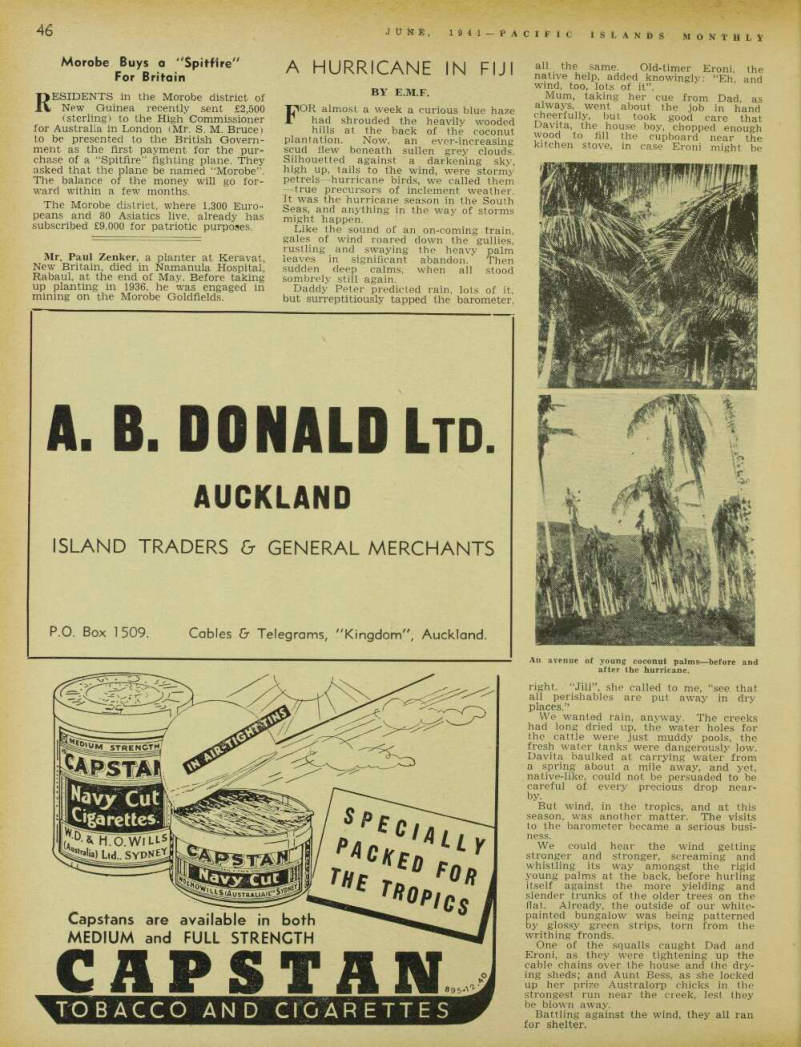
Morobe Buys a "Spitfire"
RESIDENTS in the Morobe district of New Guinea recently sent £2,500 (sterling) to the High Commissioner for Australia in London (Mr. S. M. Bruce) to be presented to the British Govern ment as the first payment for the pur chase of a “Spitfire” fighting plane. They asked that the plane be named “Morobe”.
The balance of the money will go for ward within a few months.
The Morobe district, where 1,300 Euro peans and 80 Asiatics live, already has subscribed £9,000 for patriotic purposes.
Mr. Paul Zenker, a planter at Keravat, New Britain, died in Namanula Hospital, Rabaul, at the end of May. Before taking up planting in 1936, he was engaged in mining on the Morobe Goldfields.
A Hurricane In Fiji
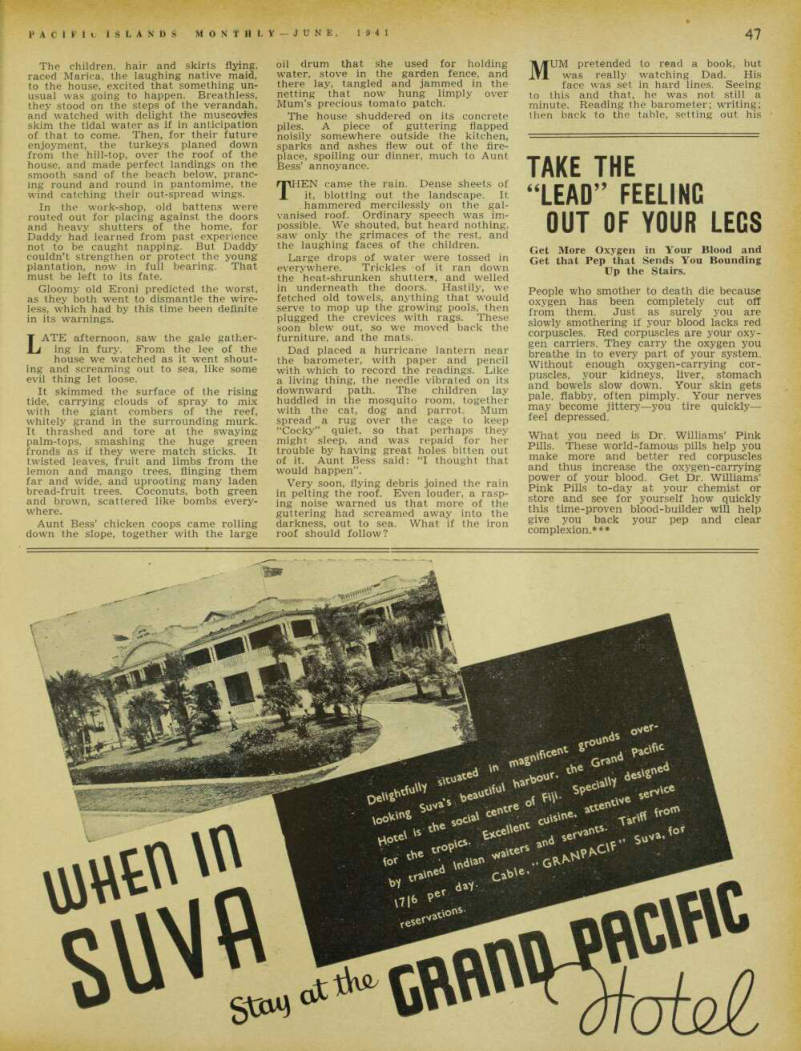
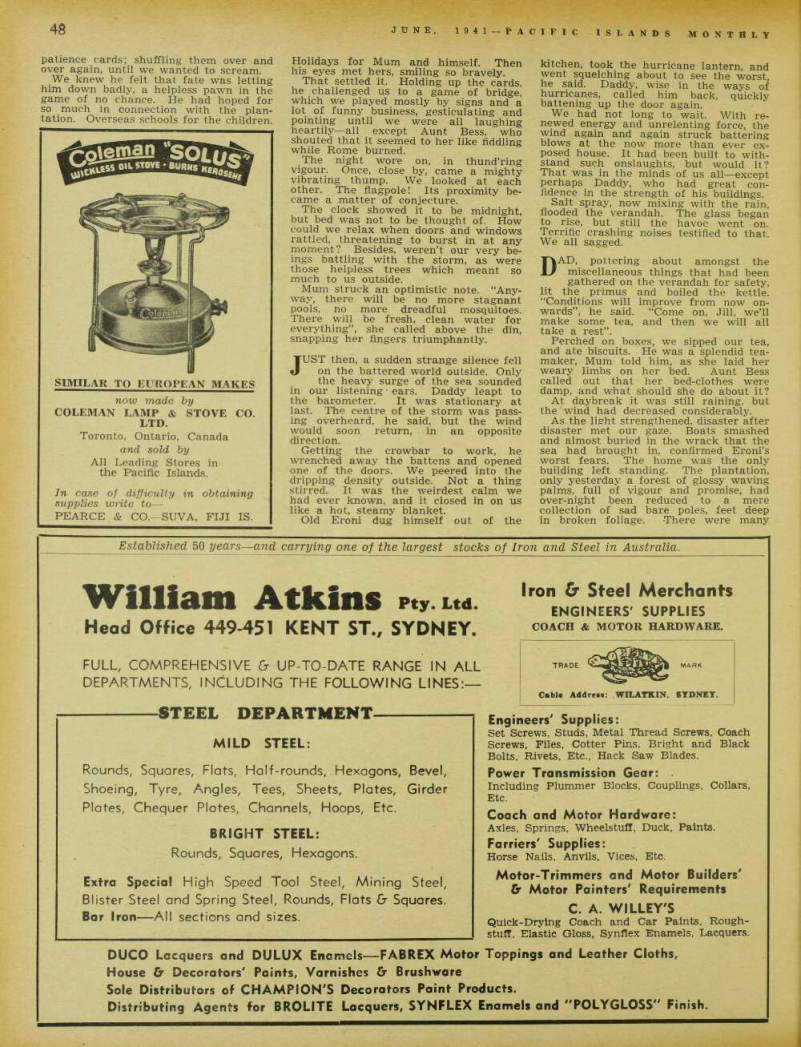
By E.M.F.
FOR almost a week a curious blue haze had shrouded the heavily wooded hills at the back of the coconut plantation. Now, an ever-increasing scud flew beneath sullen grey clouds.
Silhouetted against a darkening sky, high up, tails to the wind, were stormy petrels—hurricane birds, we called them —true precursors of inclement weather.
It was the hurricane season in the South Seas, and anything in the way of storms might happen.
Like the sound of an on-coming train, gales of wind roared down the gullies, rustling and swaying the heavy palm leaves in significant abandon. Then sudden deep calms, when all stood sombrely still again.
Daddy Peter predicted rain, lots of it, but surreptitiously tapped the barometer,
all the same. Old-timer Eroni, the native help, added knowingly: “Eh, and wind, too, lots of it”.
Mum, taking her cue from Dad, as always, went about the job in hand cheerfully, but took good care that Davita, the house boy, chopped enough wood to fill the cupboard near the kitchen stove, in case Eroni might be
right. “Jill”, she called to me, “see that all perishables are put away in dry places.”
We wanted rain, anyway. The creeks had long dried up, the water holes for the cattle were just muddy pools, the fresh water tanks were dangerously low.
Davita baulked at carrying water from a spring about a mile away, and yet, native-like, could not be persuaded to be careful of every precious drop near by.
But wind, in the tropics, and at this season, was another matter. The visits to the barometer became a serious busi ness.
We could hear the wind getting stronger and stronger, screaming and whistling its way amongst the rigid young palms at the back, before hurling itself against the more yielding and slender trunks of the older trees on the flat. Already, the outside of our white painted bungalow was being patterned by glossy green strips, torn from the writhing fronds.
One of the squalls caught Dad and Eroni, as they were tightening up the cable chains over the house and the dry ing sheds; and Aunt Bess, as she locked up her prize Australorp chicks in the strongest run near the creek, lest they be blown away.
Battling against the wind, they all ran for shelter.
An avenue of young coconut palms—before and after the hurricane.
The children, hair and skirts flying, raced Marica, the laughing native maid, to the house, excited that something un usual was going to happen. Breathless, they stood on the steps of the verandah, and watched with delight the museovies skim the tidal water as if in anticipation of that to come. Then, for their future enjoyment, the turkeys planed down from the hill-top, over the roof of the house, and made perfect landings on the smooth sand of the beach below, pranc ing round and round in pantomime, the wind catching their out-spread wings.
In the work-shop, old battens were routed out for placing against the doors and heavy shutters of the home, for Daddy had learned from past experience not to be caught napping. But Daddy couldn’t strengthen or protect the young plantation, now in full bearing. That must be left to its fate.
Gloomy old Eroni predicted the worst, as they both went to dismantle the wire less, which had by this time been definite in its warnings.
LATE afternoon, saw the gale gather ing in fury. From the lee of the house we watched as it went shout ing and screaming out to sea, like some evil thing let loose.
It skimmed the surface of the rising tide, carrying clouds of spray to mix with the giant combers of the reef, whitely grand in the surrounding murk.
It thrashed and tore at the swaying palm-tops, smashing the huge green fronds as if they were match sticks. It twisted leaves, fruit and limbs from the lemon and mango trees, flinging them far and wide, and uprooting many laden bread-fruit trees. Coconuts, both green and brown, scattered like bombs every where.
Aunt Bess’ chicken coops came rolling down the slope, together with the large
oil drum that she used for holding water, stove in the garden fence, and there lay, tangled and jammed in the netting that now hung limply over Mum’s precious tomato patch.
The house shuddered on its concrete piles. A piece of guttering flapped noisily somewhere outside the kitchen, sparks and ashes flew out of the fire place, spoiling our dinner, much to Aunt Bess’ annoyance.
THEN came the rain. Dense sheets of it, blotting out the landscape. It . hammered mercilessly on the gal vanised roof. Ordinary speech was im possible. We shouted, but heard nothing, saw only the grimaces of the rest, and the laughing faces of the children.
Large drops of water were tossed in everywhere. Trickles of it ran down the heat-shrunken shutters, and welled in underneath the doors. Hastily, we fetched old towels, anything that would serve to mop up the growing pools, then plugged the crevices with rags. These soon blew out, so we moved back the furniture, and the mats.
Dad placed a hurricane lantern near the barometer, with paper and pencil with which to record the readings. Like a living thing, the needle vibrated on its downward path. The children lay huddled in the mosquito room, together with the cat, dog and parrot. Mum spread a rug over the cage to keep “Cocky” quiet, so that perhaps they might sleep, and was repaid for her trouble by having great holes bitten out of it. Aunt Bess said: “I thought that would happen”.
Very soon, flying debris joined the rain in pelting the roof. Even louder, a rasp ing noise warned us that more of the guttering had screamed away into the darkness, out to sea. What if the iron roof should follow?
MUM pretended to read a book, but was really watching Dad. His face was set in hard lines. Seeing to this and that, he was not still a minute. Reading the barometer; writing; then back to the table, setting out his
patience cards; shuffling them over and over again, until we wanted to scream.
We knew he felt that fate was letting him down badly, a helpless pawn in the game of no chance. He had hoped for so much in connection with the plan tation. Overseas schools for the children.
Holidays for Mum and himself. Then his eyes met hers, smiling so bravely.
That settled it. Holding up the cards, he challenged us to a game of bridge, which we played mostly by signs and a lot of funny business, gesticulating and pointing until we were all laughing heartily—all except Aunt Bess, who shouted that it seemed to her like fiddling while Rome burned.
The night wore on, in thund’ring vigour. Once, close by, came a mighty vibrating thump. We looked at each other. The flagpole! Its proximity be came a matter of conjecture.
The clock showed it to be midnight, but bed was not to be thought of. How could we relax when doors and windows rattled, threatening to burst in at any moment? Besides, weren’t our very be ings battling with the storm, as were those helpless trees which meant so much to us outside.
Mum struck an optimistic note. “Any way, there will be no more stagnant pools, no more dreadful mosquitoes.
There will be fresh, clean water for everything”, she called above the din, snapping her fingers triumphantly.
JUST then, a sudden strange silence fell on the battered world outside. Only the heavy surge of the sea sounded in our listening ears. Daddy leapt to the barometer. It was stationary at last. The centre of the storm was pass ing overheard, he said, but the wind would soon return, in an opposite direction.
Getting the crowbar to work, he wrenched away the battens and opened one of the doors. We peered into the dripping density outside. Not a thing stirred. It was the weirdest calm we had ever known, and it closed in on us like a hot, steamy blanket.
Old Eroni dug himself out of the
kitchen, took the hurricane lantern, and went squelching about to see the worst, he said. Daddy, wise in the ways of hurricanes, called him back, quickly battening up the door again.
We had not long to wait. With re newed energy and unrelenting force, the wind again and again struck battering blows at the now more than ever ex posed house. It had been built to with stand such onslaughts, but would it?
That was in the minds of us all—except perhaps Daddy, who had great con fidence in the strength of his buildings.
Salt spray, now mixing with the rain, flooded the verandah. The glass began to rise, but still the havoc went on.
Terrific crashing noises testified to that.
We all sagged.
DAD, pottering about amongst the miscellaneous things that had been gathered on the verandah for safety, lit the primus and boiled the kettle.
“Conditions will improve from now on wards”, he said. “Come on, Jill, we’ll make some tea, and then we will all take a rest”.
Perched on boxes, we sipped our tea, and ate biscuits. He was a splendid tea maker, Mum told him, as she laid her weary limbs on her bed. Aunt Bess called out that her bed-clothes were damp, and what should she do about it?
At daybreak it was still raining, but the wind had decreased considerably.
As the light strengthened, disaster after disaster met our gaze. Boats smashed and almost buried in the wrack that the sea had brought in, confirmed Eroni’s worst fears. The home was the only building left standing. The plantation, only yesterday a forest of glossy waving palms, full of vigour and promise, had over-night been reduced to a mere collection of sad bare poles, feet deep in broken foliage. There were many
gaps in those cherished avenues and the clear-cut pathway of a whirlwind showed pathetically where everything had been carried before it.
The ruinous sight chilled our hearts, almost to a standstill, but after the first brave survey, action was Dad’s motto. • He set the children helping him, and the men to clearing away the debris from the lawn, piling it in heaps to await drying by the sun, which later would turn the whole scene into a steam ing cauldron. Hundreds of the older trees lay over broken fences like in ebriated tousled giants. These had to be sawn through and the fences mended sufficiently to keep the milking cows in.
There would be plenty of work getting the mob back, later. Work of re conditioning for weeks and weeks to come, and then what?
The creek came down a banker, over flowing into the calf paddock and the chicken runs. Aunt Bess sat discon solate over the dead bodies of her drowned chicks, and refused to be com forted.
“You’ve got your wish, Mother,” Dad called to Mum, who was helping to dry the house. “There’s plenty of water, in deed.”
There was. It lay in pools every where —in the destroyed native food gar dens, in the hollows of fallen trees, underneath the acres and acres of debris, too vast to remove; in fact, in every place imaginable.
Then came mosquitoes and flies, clouds of them, much to Mum’s dismay. We swatted, and smoked, and kerosened, but still they came, making our lives a misery, Mum swore that she would con quer them in the end. Aunt Bess com plained bitterly that it was all useless drudgery, they would never go.
The children, careless of the delay in acquiring superior education, continued with their correspondence classes, and play. Swimming in the tide, netting prawns in the creek, drinking from the fallen green nuts, they still found life full of wonders.
Mum and Dad almost convinced them selves that they had meant to wait for that holiday after all, and later found something really to rejoice over in the appearance of thousands of green spikes, which showed them that quite a good proportion of the palms were still alive, and in time would assuredly bear again.
Only Aunt Bess grumbled. She grumbled because she had to start and breed chickens all over again. Then she grumbled that she had no coops to put them in.
Advertisements & other items, pp. 48-50 (4 items)
A. B. Donald Ltd.
AUCKLAND
ISLAND TRADERS & GENERAL MERCHANTS
P.O. Box 1509. Cables £r Telegrams, "Kingdom", Auckland.
leo
IMM STRENGTH
liiil
5 p£ Cl A , D * H.O.Wil 15 pa Y
°ked
Ltd.. SYDNEj
POR
the
TRqpi
L H ow SYp Cs Capstans are available in both
MEDIUM and FULL STRENGTH
CAPSTA
TOBACCO AND CIGARETTES
895^^4
47
pacific Islands MoNttt ly - junje, 1941
(Bios®
TAKE THE
“LEAD” FEELING
OUT OF YOUR LEGS
Get More Oxygen in Your Blood and Get that Pep that Sends You Bounding Up the Stairs.
People who smother to death die because oxygen has been completely cut off from them. Just as surely you are slowly smothering if your blood lacks red corpuscles. Red corpuscles are your oxygen carriers. They carry the oxygen you breathe in to every part of your system.
Without enough oxygen-carrying corpuscles, your kidneys, liver, stomach and bowels slow down. Your skin gets pale, flabby, often pimply. Your nerves may become jittery—you tire quickly— feel depressed.
What you need is Dr. Williams’ Pink Pills. These world-famous pills help you make more and better red corpuscles and thus increase the oxygen-carrying power of your blood. Get Dr. Williams’
Pink Pills to-day at your chemist or store and see for yourself how quickly this time-proven blood-builder will help give you back your pep and clear complexion.
Pas o>,er ' ,„„„> »-*• ,*,« ,„ «*»&<"" . , G<-* ni A .»«>“* „.v‘' „«,
" ”, W-** AW- »“L
cen ire 0 attei*' . so c»' , cois'"®' fittf ' ■ l " e ser a ,(ov . «<*“‘. ‘“.V 0 ' r d»K pC»
(BIOS®
SIMILAR TO EUROPEAN MAKES
now made by
COLEMAN LAMP & STOVE CO.
LTD.
Toronto, Ontario, Canada and sold by All Leading Stores in the Pacific Islands.
In case of difficulty in obtaining supplies write to —
PEARCE & CO.—SUVA, FIJI IS.
Established 50 years—and carrying one of the largest stocks of Iron and Steel in Australia.
William Atkins Pty. Ltd.
Head Office 449-451 KENT ST., SYDNEY.
FULL, COMPREHENSIVE & UP-TO-DATE RANGE IN ALL
DEPARTMENTS, INCLUDING THE FOLLOWING LINES:—
STEEL DEPARTMENT
MILD STEEL:
Rounds, Squares, Flats, Half-rounds, Hexagons, Bevel, Shoeing, Tyre, Angles, Tees, Sheets, Plates, Girder Plates, Chequer Plates, Channels, Hoops, Etc.
BRIGHT STEEL:
Rounds, Squares, Hexagons.
Iron & Steel Merchants
ENGINEERS' SUPPLIES
COACH & MOTOR HARDWARE.
Engineers' Supplies: Set Screws, Studs, Metal Thread Screws, Coach Screws, Files, Cotter Pins, Bright and Black Bolts, Rivets, Etc., Hack Saw Blades.
Power Transmission Gear: Including Plummer Blocks, Couplings. Collars, Etc.
Coach and Motor Hardware: Axles, Springs, Wheelstuff, Duck, Paints.
Forriers' Supplies: Horse Nails, Anvils, Vices, Etc.
Extra Special High Speed Tool Steel, Mining Steel, Blister Steel and Spring Steel, Rounds, Flats £r Squares.
Bar Iron— All sections and sizes.
Motor-Trimmers and Motor Builders' & Motor Painters' Requirements
C. A. WILLEY'S
Quick-Drying Coach and Car Paints. Roughstuff. Elastic Gloss, Synflex Enamels. Lacquers.
DUCO Lacquers and DULUX Enamels—FAßßEX Motor Toppings and Leather Cloths, House Cr Decorators' Paints, Varnishes & Brushware Sole Distributors of CHAMPION'S Decorators Paint Products.
Distributing Agents for BROLITE Lacquers, SYNFLEX Enamels and "POLYGLOSS" Finish.
48
JUNE, 1941-P A C 1 P I C ISLANDS MONTHLY
Ng's Poor Display At
Sydney Show
Letter to the Editor IN your issue of April, under the title of “Fiji Shows How”, you make reference to the unimpressive dis play of articles exhibited by New Guinea at the Royal Empire Show, held in Syd ney during that month, while comment ing favourably on the one of Fiji.
Several months prior to the Show I understood, from my husband, that New Guinea intended sending exhibits, and, at his request, I prepared numerous tropical fruits and preserves for display and intended sending various sprays of orchid blooms by plane, to be displayed with the other agricultural and botanical exhibits.
Mr. Murray had gone to considerable trouble and a large number, possibly 200, exhibits had been arranged for collec tion. Several varieties of coconuts, from the dwarf, to the huge Markham nuts, were ready for shipment, and were to be displayed in conjunction with the husked coconut and its many by-pro ducts, such as copra, coir, soap, desic
cated coconut, etc. Rubber in its various stages, and the many uses, even to the finished articles—motor tyres, for instance—were to have been displayed.
Apart from these there were many economic plants and others of decorative value, specimens of all ready to be sent for display.
Naturally, we were all very disappointed when informed that the Administratibn could not forward the exhibits, owing to expense, and the need for economy in wartime. This may explain the poor display of New Guinea in comparison with that of Fiji.
I am, etc.,
Helene Murray.
Rabaul, 21/5/1941.
EDITORIAL NOTE: Everyone con cerned will be glad to know, from Mrs.
Murray’s letter, that the New Guinea Public Service is alive to the importance of “publicising” the resources of the
Territory; and the Administration cer tainly has a good alibi. Economy in wartime is necessary. But that does not alter the fact that Fiji, which is non- Australian, made most effective use of Sydney’s Royal Show, while Australian New Guinea did not. £5O spent by the Administration, in the way planned by Mr. and Mrs. Murray, would have been returned to New Guinea many times over —and, moreover, would have shown Australians that Australia seriously regards her obligation to “boost” and develop New Guinea. Many times £5O have been frittered away by the NG Administration in recent years, as even a casual examination of the published accounts will show.
Mr. N. McGregor is at present spend ing leave in New Zealand. He is a worker for the SSE Mission on Malaita, British Solomon Islands.
Advertisements & other items, p. 51 (1 item)
OlLVt*
I. ma
- and I use
DISTRIBUTORS: Greenwood & Laws, Ltd., Rabaul and Wau; Steamships Trading Co., Ltd., Port Moresby and Samara!; Millers, Ltd., Suva, Fiji.
‘ B.A.L M.” IS THE
PAINT FOR DURA-
BILITY. When
“8.A.L.M.” Paint is used to decorate your home you are assured of the maximum in permanent protection and decoration. It’s much cheaper to use the BEST paint that’s why it pays to use “8.A.L.M.” it’s
the P R E - TESTED
paint that won’t fade, crack or flake. r A Product of British Australian Lead Manufacturers Pty., Ltd., makers of “Dulux” Finishes.
Do You Know that the Famous The No. 7W “Younger” Ranger can now be supplied fitted with Legs, as per Illustration.
YOUNGER
STOVES and
RANGES
made with extended Firebox specially for long Wood fuel, are Self-Setting and, provided sufficient Flue Piping is attached, can be used in almost any position?
I Younger Stoves are Widely Used Ask for quotation for this Range, also illustrated Catalogue Throughout the and Price List for both Single and Double Oven Stoves. Pacific islands.
G. FLETCHER & SON 50 Oxford Street, Sydney.
NZ Foodstuffs for Pago Pago
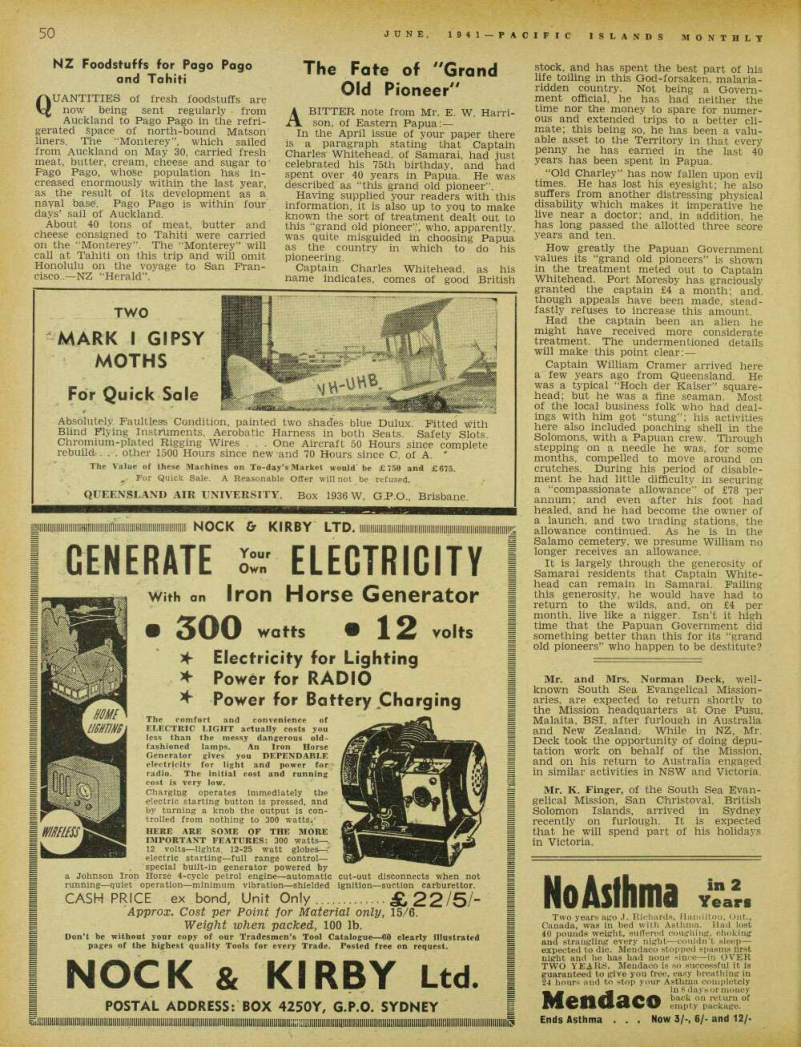
and Tahiti
Quantities of fresh foodstuffs are now being sent regularly from Auckland to Pago Pago in the refri gerated Space of north-bound Matson liners. The “Monterey”, which sailed from Auckland on May 30, carried fresh meat, butter, cream, cheese and sugar to Pago Pago, whose population has in creased enormously within the last year, as the result of its development as a naval base’. Pago Pago is within four days’ sail of Auckland.
About 40 tons of meat, butter and cheese consigned to Tahiti were carried on the “Monterey”. The “Monterey” will call at Tahiti on this trip and will omit Honolulu on the voyage to San Fran cisco..—NZ “Herald”.
The Fate of "Grand
Old Pioneer"
A BITTER note from Mr. E. W. Harri son, of Eastern Papua:— In the April issue of your paper there is a paragraph stating that Captain Charles Whitehead, of Samarai, had just celebrated his 75th birthday, and had spent over 40 years in Papua. He was described as “this grand old pioneer”.
Having supplied your readers with this information, it is also up to you to make known the sort of treatment dealt out to this “grand old pioneer”, who, apparently, was quite misguided in choosing Papua as the country in which to do his pioneering.
Captain Charles Whitehead, as his name indicates, comes of good British
stock, and has spent the best part of his life toiling in this God-forsaken, malaria ridden country. Not being a Govern ment official, he has had neither the time nor the money to spare for numer ous and extended trips to a better cli mate; this being so, he has been a valu able asset to the Territory in that every penny he has earned in the last 40 years has been spent in Papua.
“Old Charley” has now fallen upon evil times. He has lost his eyesight; he also suffers from another distressing physical disability which makes it imperative he live near a doctor; and, in addition, he has long passed the allotted three score years and ten.
How greatly the Papuan Government values its “grand old pioneers” is shown in the treatment meted out to Captain Whitehead. Port Moresby has graciously granted the captain £4 a month; and, though appeals have been made, stead fastly refuses to increase this amount.
Had the captain been an alien he might have received more considerate treatment. The undermentioned details will make this point clear:— Captain William Cramer arrived here a few years ago from Queensland. He was a typical “Hoch der Kaiser” square head; but he was a fine seaman. Most of the local business folk who had deal ings with him got “stung”; his activities here also included poaching shell in the Solomons, with a Papuan crew. Through stepping on a needle he was, for some months, compelled to move around on crutches. During his period of disable ment he had little difficulty in securing a “compassionate allowance” of £7B per annum; and even after his foot had healed, and he had become the owner of a launch, and two trading stations, the allowance continued. As he is in the Salamo cemetery, we presume William no longer receives an allowance.
It is largely through the generosity of Samarai residents that Captain White head can remain in Samarai. Failing this generosity, he would have had to return to the wilds, and, on £4 per month, live like a nigger. Isn’t it high time that the Papuan Government did something better than this for its “grand old pioneers” who happen to be destitute?
Mr. and Mrs. Norman Deck, well known South Sea Evangelical Mission aries, are expected to return shortly to the Mission headquarters at One Pusu, Malaita, BSI, after furlough in Australia and New Zealand. While in NZ, Mr.
Deck took the opportunity of doing depu tation work on behalf of the Mission, and on his return to Australia engaged in similar activities in NSW and Victoria.
Mr. K. Finger, of the South Sea Evan gelical Mission, San Christoval, British Solomon Islands, arrived in Sydney recently on furlough. It is expected that he will spend part of his holidays in Victoria.
Advertisements & other items, p. 52 (2 items)
Generate
»>»*. vv>*. ;
TWO
MARK I GIPSY
MOTHS
For Quick Sale
Absolutely Faultless Condition, painted two shades blue Dulux. Pitted With Blind Flying Instruments, Aerobatic Harness in both Seats. Safety Slots Chromium-plated Rigging Wires . . . One Aircraft 50 Hours since complete rebuild ... other 1500 Hours since hew and 70 Hours since C. of A. The Value of these Machines on To-day’s Market would be £750 and £675. , For Quick Sale. A Reasonable Offer will not be refused.
QUEENSLAND AIR UNIVERSITY, Box 1936 W, G.P.0., Brisbane.
gaiiiiiiiiimiiiiimiHlHimiiiillii limn 11111111111111 NOCK & KIRBY LTD. I
GENERATE
urn mm mm With an
ELECTRICITY
Iron Horse Generator
Your Own 300
watts
1 2 volts
Electricity for Lighting
* Power for RADIO
* Power for Battery JCharging
The comfort and convenience of ELECTRIC LIGHT actually costs you less than the messy dangerous oldfashioned lamps. An Iron Horse Generator gives you DEPENDABLE electricity for light and power for>j radio. The initial cost and running cost is very low.
Charging operates Immediately the ■electric starting button is pressed, and by turning a knob the output is controlled from nothing to 300 watts*;
HERE ARE SOME OF THE MORE
IMPORTANT FEATURES; 300 watts—.
12 volts—lights 12-25 watt globes—: electric starting—full range control— = special built-in generator powered by = a Johnson Iron Horse 4-cycle petrol engine—automatic cut-out disconnects when not = S running—quiet operation—minimum vibration—shielded ignition—suction carburettor. CASH PRICE ex bond, Unit Only £22/5/“ H Approx. Cost per Point for Material only, 15/6. 1 1 Weight when packed, 100 lb. 1 = Don’t be without your copy of our Tradesmen’s Tool Catalogue—6o clearly illustrated = = pages of the highest quality Tools for every Trade. Posted free on request, =
I NOCK & KIRBY Ltd. I
POSTAL ADDRESS: BOX 4250 Y, G.P.O. SYDNEY
No Asthma Years
Two years ago J. Richards, Hamilton, Out., Canada, was in bed with Asthma. Had lost 40 pounds weight, suffered coughing, choking and strangling every night—couldn’t sleep— expected to die. Mendaco stopped spasms first night and he has had none since—in OVER TWO YEARS. Mendaco is so successful it is guaranteed to give you free, easy breathing in 24 hours and to stop your Asthma completely in 8 days or money Mchobco back ° a return ° f empty package.
Ends Asthma . . . Now 3/-, 6/- and 12/•
Fiji Resident Gives Second
Fighter
ANOTHER sum of £5,000 sterling has been donated by Mr. and Mrs. S.
H. Ellis, of Suva, Fiji, for the pur chase of fighting aircraft for Great Britain.
Last year, Mr. and Mrs. Ellis donated £5,000 sterling for a Hurricane warplane; and, at the end of May, Mr. Ellis cabled again to the British Minister for Air craft Production, sending another £5,000 wherewith to purchase a Typhoon fighter.
This means that, with exchange added, Mr. and Mrs. Ellis have given £ll,OOO in cash for fighter airplanes for Britain.
Worries of Papua's New
Administrator
“/-\UR new Administrator is finding Vf plenty of work and worry here,” says a resident of Papua, in a pri vate letter to the editor of “PIM”, “Mr.
Leonard Murray is a very patient man, but some of the people who have been trying him out lately may discover the edge of the famous Murray temper.
Among those who have been harassing him are the hot-heads of the Public Ser vice Association, who are asking for all sorts of concessions and allowances.
They seem to forget that there is a war on, the result of which will determine whether they will have any salary or freedom at all.”
Rev. and Mrs. W. L. I. Linggood, of the Methodist Mission, have returned to Raluana, New Britain, after leave in Australia.
Rabaul Volcano Is
Active
THE first remarkable volcanic activity reported at Rabaul since the erup tion in May, 1937, occurred at 7.40 a.m. on Friday, June 6, when the crater at Tarvurvur volcano burst out, and a huge black cauliflower-shaped cloud rose to a height of about 700 feet.
Tarvurvur is at the back of Matupi.
The cloud drifted slowly over Mount Mother and Namanula, causing a slight shower of black scoria dust; and, a little later, at intervals, there were three fur ther puffs of cloud—the last at about noon. When this volcanic activity was at its height there was a fairly large cloud of black dust, about 3,000 feet above Rabaul.
The volcanic activity caused no dam age, and the populace remained calm.
There were no tremors or explosions such as had so terrifying an effect in 1937.
The Seismological Observatory, which has been established in Rabaul to keep watch on the volcanoes, had reported that there was a gradual increase in the temperature of the volcano in the last six months, but there were no indi cations, apparently, of an explosive erup tion. A few people made plans of what they were going to do in the event of an eruption developing; but, by Friday afternoon, the volcanic activity, and any alarm caused thereby, had subsided.
Mr. E. J. Bremen has been transferred from Port Moresby to Samarai as Board ing Inspector, Papuan Customs Depart ment, replacing Mr. W. Robinson, now in the RAAF.
Advertisements & other items, p. 53 (1 item)
Service
Auxiliary Schooner
For Sale
A 21 ton, fore and aft fiddle bow schooner, located in Solomon Islands, fitted with a new 30 h.p. diesel marine engine, together with reverse and reduction gear box.
Specifications:— Length 47 feet Beam 13 ft. 10 ins.
Draft 6 ft. 31 Ins.
Gross Tonnage . .. 21.32 Registered Tonnage 19.31 Full complement of engine spares available at below cost. Terms if desired.
FAIRYMEAD SUGAR CO. LTD.,
Yandina, Cape Marsh, Bussell Group, 8.5.1.
PRICE: £1,600.
For YEARS
SERVICE
of Lasting
BUILT to LAST is the Crammond way.
Many owners have Crammonds which they purchased 11 and 12 years ago—STILL
GIVING SATISFACTORY SERVICE!
Mr. T. W. MOUNTAIN, popular manager
of WINCHCOMBE CARSON, LTD., re-
cently selected a New 1941 CRAMMOND for his home and has installed the “old warrior” (12 years old and STILL going strong) in his seaside residence.
Mr. W. COOPER, of Cummins & Campbell, Townsville, on completing the purchase of his second Crammond, writes: “. . there is one thing certain, once you own a CRAMMOND, it will always be a CRAM-
MOND.”
VIBRATOR MODELS AVAILABLE IN ALL
SIZES PORTABLES, MANTLE AND
CONSOLE
CRAMMONDS ALSO ANNOUNCE
CRAMMOND RECEIVERS are
specially built to suit Tropical
conditions. All parts are specially
protected against heat and moisture . . . ideal for the Islands.
SENSATIONAL LONG RANGE
RECEPTION , and trouble - free
operation.
Mr. W. G. NICHOLLS, Health Officer of Barcaldine, writes: my receiver is just as perfect as when I purchased it four years ago and better value could not be obtained anywhere.”
EASY TERMS
ANYWHERE
A FULL RANGE OF POWERFUL AIR-CELL
INSTRUMENTS
for use where battery charging facilities are not available. Write for particulars of these new sensational instruments.
Crammond's
World-Wide
Reception ,
Clarity and
Volume 7 snll — with MONEY REFUNDED, less freight charges only, if f ULU/UC UUCLL not satisfied—the most UNIQUE GUARANTEE IN THE AMAZEyou! RADI ° world. 4 3
YEARS’ Guarantee
DAYS' FREE TRIAL
CRAMMOND RADIO
MANUFACTURING COMPANY,
NO. 8 QUEEN STREET, BRISBANE.
Please send me full particulars of Models, Terms List, etc.
NAME
ADDRESS (P.1.M.)
State whether Battery, Vibrator, Air Ceil, All-Electric.
PLEASE USE BLOCK LETTERS for Name and Address.
Can Papua Produce
Tobacco?
IT is reported that a number of planters in Papua are becoming actively interested in the possibilities of growing tobacco in the Territory, This is a result of the prevailing tobacco famine in Australia. It is felt that if the enterprise is properly managed and prompt steps taken the industry might be established before normal conditions return to the world.
A Section For Women
By "Therese"
THERE has been nothing drastic about the change in fashions in recent months, in fact, some of the love liest evening models are distinguished by their extreme simplicity.
Suits still rank high in the winter wardrobe—deservedly so since they are the most useful garments of all. They are equally suitable for town or travel wear and are made in all sorts of materials. The extra jacket is important as it can be worn over a jumper and skirt or a plain dress.
A three-piece ensemble is a wardrobe in itself and a wise and economical pur chase for tropic dwellers who brave Australian winters. Jacket and skirt are a suit; the skirt combined with hand knitted sweater is just the thing for a round of golf; and then the coat not only goes with these but, as mentioned
above, can be worn over a casual dress.
With a fine muslin dress, sporting an insert of lace, the suit is almost perfect for afternoon wear.
Exciting colour schemes are always being introduced. One of the newest is electric blue and brown, and this is as delightful as it is unexpected. The skirt is brown, the jacket blue and the acces sories, of course, are brown. A sheer wool two-piece ensemble has a black dress and a plain blue jacket buttoned with carved ivory discs. Pastel wools combine well with other colours, too, and you can experiment to your heart’s content with various combinations.
IN spite of restricted imports, there seems to be no dearth of attractive accessories. The style and shape of bags is legion and thev are made in almost any colour. Gloves, too, are delightful and match up perfectly with hand bags. There are greens, yellows, cyclamens and pinks in all shades, be sides the übiquitous blacks, browns and navies.
Fabric gloves are so fine these days that only the discerning eve can dis tinguish them from suede. Pig-skin and imitation pig-skin are really excellent worn with winter suits. Their tailored look fits in perfectly with the scheme of things and both varieties wash. Evening gloves are in delicate pastel shades and there are others of silk and lace.
Shoes for wear with suits are sturdy, workmanlike and attractive. Some have souare toes and heels and soles that will stand up to good solid wear. These, too, come in a variety of colours so that it is possible to match accessories and clothes as well as contrast them. The high cut court remains a favourite for afternoon wear and can always be de pended upon to look well.
Costume jewellery and bits and pieces are still popular. There are charming gee-gaws for wear with light-weight woollen frocks and some of the lapel or naments are most attractive. Wool and felt form gay little posies and there are fobs of all varieties.
Recipes To Please
HERE are some recipes that are sure to please. Try them next time you entertain your friends: — Apples In Wine Peel and cut some apples into thin slices and lay them in a deep dish which has been buttered, sprinkling each layer liberally with castor sugar. Fill the dish right up to the brim and then pour over the apples a large glass of red wine.
Put on the lid and press it well down.
Cook in a slow oven for four hours. The apples will have then become a deep red jelly and when chilled, can be turned out. Pour over it a little wine and serve with whipped cream.
Fruit Foam Boil half a cup of tapioca in two cups of water. When cooked, scrape in any fresh fruit such as grated pineapples or passion fruit. Add the beaten whites of two eggs and a tablespoon of sugar.
Pancakes One cup self-raising flour, 1 egg, 1 dessert spoon of sugar, and enough milk to make a thin mixture.
Beat up egg, add flour and sugar and enough milk to make a thin batter. Cook in a small frying pan and serve with lemon and sugar.
Tomato Juice Cocktail To each cup of tomato juice (tinned or fresh) allow a tablespoon of mild vinegar, a pinch of sugar, a slice of onion and
one tablespoon of lemon juice. Mix the tomato juice with vinegar, sugar, onion (grated or chopped), lemon juice and a crushed stalk of celery. Let it stand 15 minutes and strain through a fine strainer or cheese cloth. Chill before serving.
Pumpkin Cake Two eggs, 1 cup sugar, 1 cup butter, 1 cup boiled pumpkin, 2 cups self-raising flour, 1 packet mixed fruit.
Beat butter and sugar and add eggs, then warm mashed pumpkin; then flour and fruit alternately. Cook for an hour or a little more in a moderately hot oven.
Welsh Rarebit To each small teacup of milk, allow a ball of butter the size of a walnut, j lb. grated cheese, 1 egg, a salt-spoon of salt, pepper, sugar, dry mustard and a sprin kle of cayenne. Heat the milk in a saucepan to boiling point, melt butter in another saucepan, stir in cheese, add quickly the beaten egg, then the hot milk, stirring all the time. Put in the seasoning and stir till thick and creamy.
Pour on buttered toast and serve hot.
Stuffed Tomatoes Four tomatoes, 4 slices ripe pineapple, 8 oz. pkt. Cheddar cheese, 1 cup shredded pineapple, i cup chopped nuts, 1 teaspoon of chopped parsley, i teaspoon chopped mint, lettuce, mayonnaise, pepper and salt.
Cut tops off tomatoes and scoop out centre pulp. Sprinkle with salt and pepper, mix tomato pulp with shredded pineapple, finely chopped parsley and mint and pile in tomato cases. Cover plate with lettuce, arrange slices of pine apple and put tomato on each. Cut cheese in cubes and place in centre.
Cheese Loaf Cne large cup self-raising flour, 1 tablespoon butter, 1 small cup grated cheese, 1 egg (small), celery salt, cayenne pepper.
Hub flour and butter, mix in cheese, salt and pepper and then add egg. Mix to a firm consistency and bake in a hot oven.
Household Hints
IT is wise when making starch to moisten it first with a little milk before adding the water. It will then impart a fine gloss to the linen and the iron will not stick.
When icing-sugar is hard and lumpy, put it through the mincer, or put it in the oven in a dish and it will come out soft. Be careful that the sugar does not burn.
Burnt saucepans can be cleaned by filling them with salt and water, leaving for a few hours and then bringing slowly to the boil. The burnt particles will then come off without difficulty and there will be no after-effect on the saucepans.
Never put soda water in burnt sauce pans; it will make them liable to burn when next used.
Eucalyptus oil will remove tar or grease stains from the most delicate materials with comparative safety. Rub the affected part with a soft rag dipped in the eucalyptus.
When making fruit cake, it is desirable after cleaning the fruit to rub it in flour. This will prevent it from sinking to the bottom—a common fault if the mix ture is not just “right”.
Try baking halves of pears in the dish With beef, lamb or mutton. Fill the cavity with red currant jelly or sprinkle with grated cheese before serving.
When cleansing green vegetables, use vinegar instead of salt. It makes the dead insects drop to the bottom whereas with too much salt they remain in the vegetables.
Japanese matting should be washed with lukewarm water to which has been added a handful of salt. This strengthens the straw and preserves the colours
Try a hot vinegar pack on a bruise. It will circulate the blood and prevent it from clotting. This is especially good in the event of a blow on the head.
As a supper hint, it is well to remember that neat little rolls of cheese for serv ing with biscuits can be cut in a move ment with an apple corer.
Creams and Jellies Cream that has been overwhipped may become rough and curdled and there is not much that can be done for it so that it may be served as cream. But whip it a little more and it will become butter.
Then drain off the liquid, add a little salt to the butter and serve it with hot scones or thinly sliced brown bread. It is delicious. The liquid may be used in making the scones.
If, when adding gelatine to cream to keep it firm, it sets too rapidly and be comes rough and knotty, put the mixture into a basin, stand it over a pan of hot
water and stir gently until it melts.
Remove from heat, whisk it lightly till just beginning to set, and then pour it into a mould or use as required. If your cream mould or jelly breaks when turning it out of the mould, chop it into dice and serve in individual glasses and top it with whipped cream.
Advertisements & other items, pp. 54-56 (2 items)
Tomflto Soup
At Blue Mountains—Springwood, N.S.W.
Springwood Ladies' College
Est. 1897. Kindergarten to Leaving Certificate. Tennis, Riding, Swimming, Team Games. Unequalled climate. Pure Jersey Milk. Senior and Junior Houses.
Open-air sleeping. Inclusive fees. Special vacation arrangements for Island pupils.
M. E. DURAND, Principal.
TOmflTO SOUP
MADE FROM AUSTRALIA’S FINEST GROWN
TOMATOES AND PROCESSED IMMEDIATELY
UNDER EXPERT SCIENTIFIC SUPERVISION
OTHER DELICIOUS IXL SOUPS INCLUDE CREAM OF VEGETABLE, CREAM OF CELERY, CREAM OF ASPARAGUS, PEA SOUP, ETC.
Obtainable from all Leading Island Storekeepers.
H. JONES & CO. PTY. LTD.,
HOBART & SYDNEY
Imperial
MERIDEN
Church of England Grammar School for Girls.
REDMYRE ROAD, STRATHFIELD, N.S.W.
Situated in beautiful and healthy surroundings within 15 minutes of Sydney.
Comfortable, modern accommodation for boarders. Education from Kindergarten to Leaving Certificate Honours. Scientific Physical Culture and instruction In Art and Musical Appreciation.
Prospectus on Application.
Delicious
Meals-in-a-Moment
Ready-to-Serve Always
FLAVOUR SEALED IN GOLD LINED CANS
Imperial Good Foods save hours of cooking . . . just open and serve, that’s the secret of preparing “Imperial” meals in next to no time.
Imperial
Serve these spicy, savoury treats: Imperial Sheep Tongues, Camp Pie or Corned Beef Loaf.
Anv hour of any day serve a tasty mea with these savoury meats packed by the makers of "Imperial" Good Foods. i * V m m &SS ri* h l**
MANCO CHUTNQ
★ Try These Tasty NEW Delicacies.
"FITZROY" Luncheon Beef. Pork or Beef Sausages. "WESTFIELD" Corned, Boiled or Roast Mutton. "OX £r PALM" and "RIVERSTONE" Corned, Boiled or Roast Beef.
"Health and Freshness Sealed in Cans."
Imperial full flavoured, creamy TOMATO SOUP; Imperial choice, tender ASPARAGUS
TIPS and PIECES.
Products of
RIVERSTONE MEAT CO. PTY. LTD.
1 BENT STREET, SYDNEY.
Tnefceii m s Hied bif Cheh Ute World over
ECONOMICAL. BECAUSE YOU NEED
JUST A FEW DROPS AT A TIME -
New Guinea Oil Areas
Government Puzzles Enterprise Co.
REMARKING that 41 years have elapsed since the company first applied for a permit to seek oil in a portion of New Guinea, the chairman of the Enterprise of New Guinea Com pany said on June 3 that the Govern ment has still not granted permission to enter the area sought.
“My company has intimated its desire to conform with any reasonable condi tions laid down by the authorities, and can obtain competent men who are capable, by virtue of long experience, of handling any hostile natives.
“The company has expressed its wil lingness to welcome an officer of the Administration to accompany an explora tion party, and to meet all his expenses.
“The company could not lay before the Government any further proof of such evidence as it had about the possibility of oil occurrence unless it received per mission to examine the area.” —Melbourne “Herald”.
Mr. F. W. Platt, CMG, who was Resi dent Commissioner of the Cook Islands from 1915 to 1921, died in New Zealand, on May 24, aged 76.
Readjustment
How Central Pacific Manages Without Copra
THE way in which the populations of the various Islands groups are re adjusting their economic conditions to meet the changes caused by the lack of a copra market has been described by visitors from the Islands to Australia.
Mr. Slocombe, from Tonga, says that, although the absence of a market for copra has caused considerable embarrass ment to Tongan planters, the position has been relieved by the development of a considerable market in New Zealand for Tongan bananas. He said that in one month, recently, 9,000 cases of Ton gan bananas reached the New Zealand market.
Mr. S. Bennett, who arrived recently in Australia from Rarotonga, says that the present paralysis of the copra indus try has had no more harmful effect in the Cook Islands than to give the natives a more leisurely life. The natives gen erally can live upon their plantations and gardens—although the absence of a copra market means that they have less money to spend. The Cook Islands, how ever, depend more for their income upon the sale of oranges to New Zealand than upon production of copra, and the orange trade still is good.
These examples are typical of the way the Pacific Territories are carrying on, despite the poor copra market. Papua has rubber and gold; New Guinea has gold, and some cocoa and coffee: New Caledonia has metals, coffee and cocoa; New Hebrides, coffee and cocoa; Fiji has sugar, gold and bananas; Samoa has cocoa and bananas; and so on. The only territories entirely dependent on copra are the Solomons, and the Gilbert and Ellice Colony.
The copra industry, while severely reduced, is by no means dead. Tens of thousands of tons are finding a market in Britain, Canada and Mexico.
Miss M. Sibil has completed a holiday in New Zealand and will return shortly to Malaita, British Solomon Islands, where she is connected with the work of the South Sea Evangelical Mission.
Advertisements & other items, p. 56 (3 items)
54
juke, i94i pacific islands mont a l ¥
Mcilrath’S
Send Your Next Grocery Order to . . .
WHERE YOUR MONEY BUYS MORE
New Season’s 50 60 Choice Prunes,Exportation ... 7-lb. tins, Hid. lb.
New Season’s Choice Apricots \ now ... l/4i lb.; 16/- doz.
New Season’s Choice Nectarines .. J permitted l/2i lb.; 14/- doz.
Choice Evaporated Apple Rings Hid. lb.; 11/3 doz.
Best Australian Currants 7id. lb.; 7/3 doz.
Best Australian Sultanas 7d. lb.; 6/9 doz. • “Rosa” Seeded Raisins, 16-oz Bid. pkt.; 8/3 doz.
Pullars Prunes in Syrup, 16-oz 9d. tin; 8/9 doz.
“1.X.L.” Tomato Juice 10-oz., 5/3 doz.; 15-oz., 7/3 doz.
“A.J.C.” Asparagus Tips, 10i-oz l/4i tin; 16/3 doz.
Choice Melon & Lemon Jam, 24-oz Bd. tin; 7/10i doz.
Choice Plum Jam, 24-oz Bid. tin; 8/4i doz.
“Sunshine” Full Cream Powdered Milk, 12-oz l/2i tin; 14/3 doz.
“1.X.L.” Worcester Relish, 20-oz 9id. bot.; 9/3 doz.
“Krownall” Mango & Papaw Chutney, 15-oz 1/1 jar; 12/6 doz.
“Capital” Wax Floor Polish, 16-oz l/2i tin; 14/- doz.
“Rosa” Pure Household Soap, large 6d. bar; 5/6 doz.
HALF-DOZEN LOTS CHARGED AT DOZEN RATES.
All prices f.o.b. Sydney, cases and packing free.
Space available all steamers.
All consignments carried by air are packed in special fibre cartons—without extra charge—in order to reduce aerial freight.
COMPREHENSIVE PRICE LISTS AVAILABLE, POST FREE.
McILRATH’S Pty. Ltd.
EXPORT DEPARTMENT
202-204 PITT STREET, SYDNEY
AUSTRALIA
Unique Delicacy
Tiki Toheroa Soup is a unique delicacy. In this concentrated soup is retained all the goodness and delicious flavour of the Toheroa, found only on the Ninety Mile Beach, New Zealand. Tiki Toheroa Soup is prepared in a few minutes. Ask for it at your store.
Packed in \ and 1 lb. tins.
TIKI
TOHEROA
SOUP
TUCKER & CO. PTY. LIMITED,
SYDNEY.
Guinea Airways
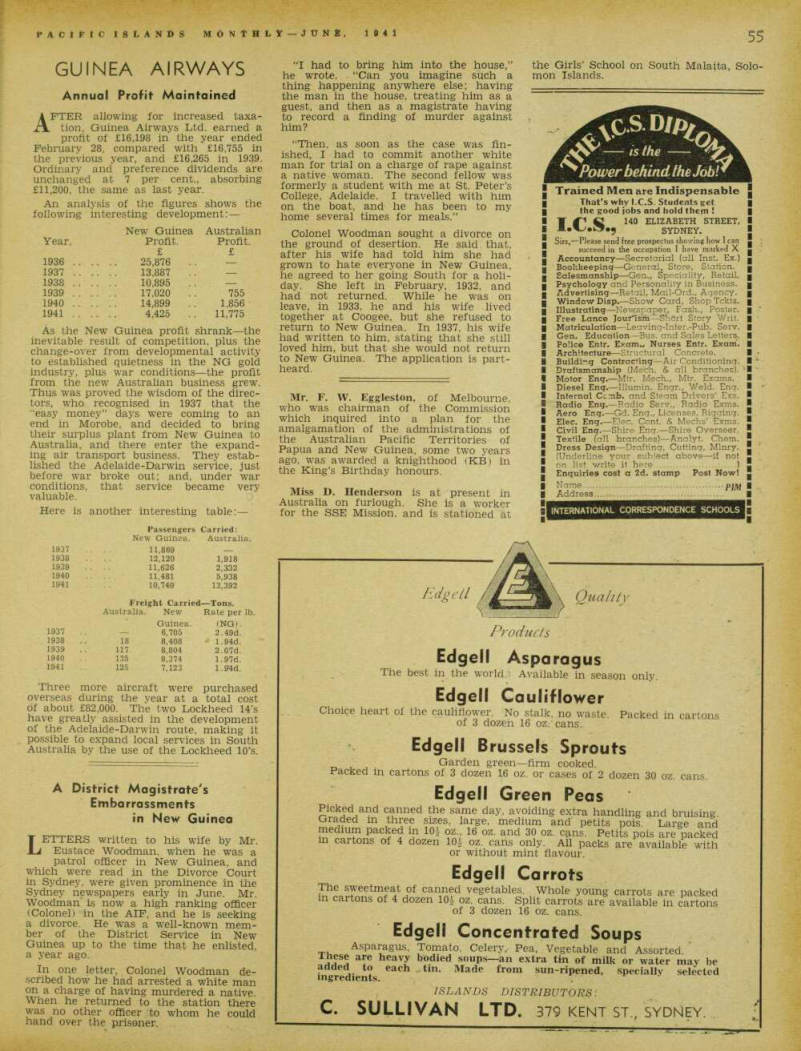
Annual Profit Maintained
AFTER allowing for increased taxa tion, Guinea Airways Ltd, earned a profit of £16,198 in the year ended February 28, compared with £16,755 in the previous year, and £16,265 in 1939.
Ordinary and preference dividends are unchanged at 7 per cent., absorbing £11,200, the same as last year.
An analysis of the figures shows the following interesting development:—
As the New Guinea profit shrank —the inevitable result of competition, plus the change-over from developmental activity to established quietness in the NG gold industry, pluis war conditions —the profit from the new Australian business grew.
Thus was proved the wisdom of the direc tors, who recognised in 1937 that the “easy money” days were coming to an end in Morobe, and decided to bring their surplus plant from New Guinea to Australia, and there enter the expand ing air transport business. They estab lished the Adelaide-Darwin service, just before war broke out; and, under war conditions, that service became very valuable.
Here is another interesting table:—
Three more aircraft were purchased overseas during the year at a total cost of about £82,000. The two Lockheed 14’s have greatly assisted in the development of the Adelaide-Darwin route, making it possible to expand local services in South Australia by the use of the Lockheed 10’s.
New Guinea Australian Year.
Profit.
Profit. £ £ 1936 .. . 25,876 — 1937 .. . . . . 13,887 — 1938 .. . . . 10,895 — 1939 . . . . . .. 17,020 755 1940 .. , . . 14,899 1,856 1941 . . . . 4,425 11,775
Passengers Carried: New Guinea.
Australia. 1937 11,869 1938 12,120 1,918 1939 11,626 2,332 1940 11,481 5,938 1941 10,740 13,392 Freight Carried—Tons.
Australia. New Rate per lb.
Guinea. (NG). 1937 6,705 2.49d. 1938 18 8,408 1.94d. 1939 117 8,804 2.07d. 1940 135 8,374 1.97d. 1941 125 7,123 1. S4d.
Embarrassments
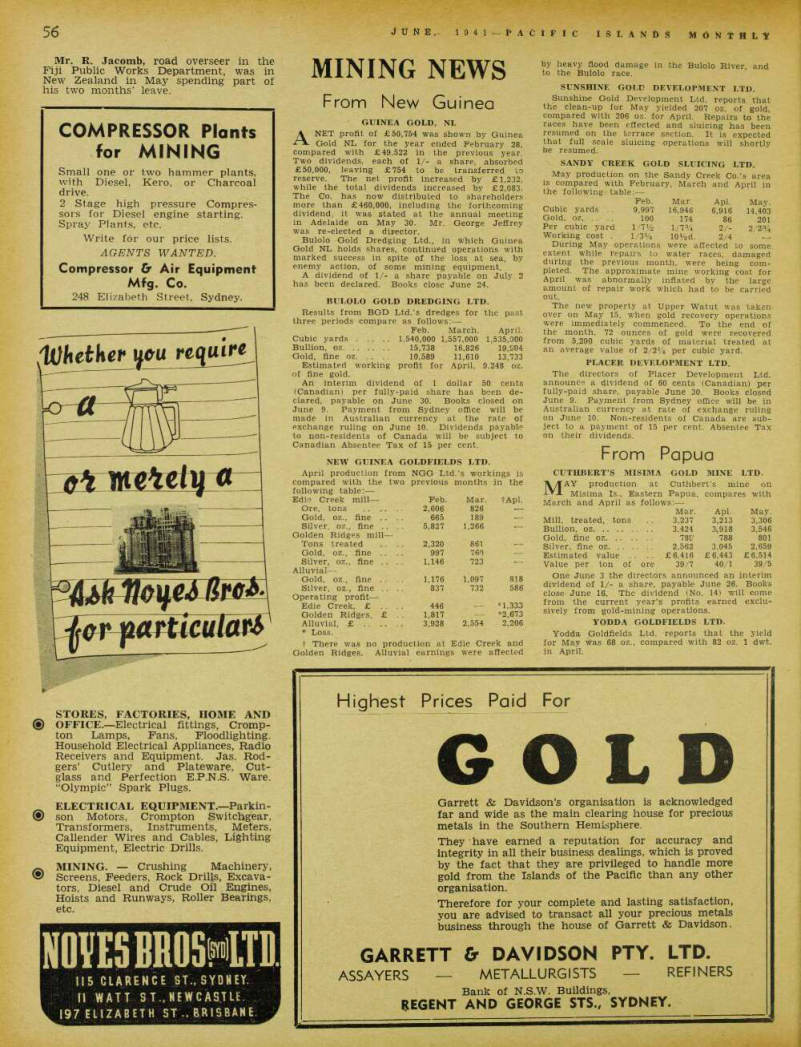
A District Magistrate's Embarrassments in New Guinea
LETTERS written to his wife by Mr.
Eustace Woodman, when he was a patrol officer in New Guinea, and which were read in the Divorce Court in Sydney, were given prominence in the Sydney newspapers early in June. Mr.
Woodman is now a high ranking officer (Colonel) in the AIF, and he is seeking a divorce. He was a well-known mem ber of the District Service in New Guinea up to the time that he enlisted, a year ago.
In one letter, Colonel Woodman de scribed how he had arrested a white man on a charge of having murdered a native.
When he returned to the station there was no other officer to whom he could hand over the prisoner.
“I had to bring him into the house,” he wrote. “Can you imagine such a thing happening anywhere else; having the man in the house, treating him as a guest, and then as a magistrate having to record a finding of murder against him?
“Then, as soon as the case was fin ished, I had to commit another white man for trial on a charge of rape against a native woman. The second fellow was formerly a student with me at St. Peter’s College, Adelaide. I travelled with him on the boat, and he has been to my home several times for meals.”
Colonel Woodman sought a divorce on the ground of desertion. He said that, after his wife had told him she had grown to hate everyone in New Guinea, he agreed to her going South for a holi day. She left in February, 1932, and had not returned. While he was on leave, in 1933, he and his wife lived together at Coogee, but she refused to return to New Guinea. In 1937, his wife had written to him, stating that she still loved him, but that she would not return to New Guinea. The application is part heard.
Mr. F. W. Eggleston, of Melbourne, who was chairman of the Commission which inquired into a plan for the amalgamation of the administrations of the Australian Pacific Territories of Papua and New Guinea, some two years ago, was awarded a knighthood < KB) in the King’s Birthday honours.
Miss D. Henderson is at present in Australia on furlough. She is a worker for the SSE Mission, and is stationed at
the Girls’ School on South Malaita, Solo mon Islands.
Mr. R. Jacomb, road overseer in the Fiji Public Works Department, was in New Zealand in May spending part of his two months’ leave.
Advertisements & other items, pp. 57-58 (2 items)
55
f Acme ISLANDS M 6 N T H Lt-JtJNt, 1041
Edged Asparagus
Power behind the Job!
Trained Men are Indispensable That’s why I.C.S. Students get the good jobs and hold them !
Sirs, —Please send free prospectus showing how I can succeed in the occupation I have marked X Accountancy —Secretarial (all Inst. Ex.) Bookkeeping —General. Store, Station.
Salesmanship —Gen., Speciality, Retail.
Psychology and Personality in Business.
Advertising —Retail, Mail-Ord., Agency.
Window Disp. —Show Card, Shop Tckts.
Illustrating —Newspaper, Fash., Poster.
Free Lance Jouf'ism— Short Story Writ.
Matriculation —Leaving-Inter.-Pub. Serv.
Gen. Education —Bus. and Sales Letters.
Police Entr. Exam., Nurses Entr. Exam.
Architecture —Structural Concrete.
Building Contracting —Air Conditioning.
Draftsmanship (Mech. & all branches).
Motor Eng. —Mtr, Mech., Mtr. Exams.
Diesel Eng. —lllumin. Engr., Weld. Eng.
Infernal Ccmb. and Steam Drivers' Exs.
Radio Eng. —Radio Serv., Radio Exms.
Aero Eng. —Gd. Eng., Licenses, Rigging.
Elec. Eng. —Elec. Cont. & Mechs' Exms.
Civil Eng. —Shire Eng.—Shire Overseer.
Textile (all branches) —Analyt. Chem.
Dress Design —Drafting, Cutting, Mlnry. (Underline your subject above —if not on list write it here ) Enquiries cost a 2d. stamp Post Now! 1.C.5.,
140 ELIZABETH STREET,
SYDNEY.
Name...
Address, pm
INTERNATIONAL CORRESPONDENCE SCHOOLS
Edged
Quality
Products
Edged Asparagus
The best in the world. Available in season only.
Edged Cauliflower
Choice heart of the cauliflower. No stalk, no waste. Packed in cartons of 3 dozen 16 oz. cans.
Edged Brussels Sprouts
Garden green—firm cooked.
Packed in cartons of 3 dozen 16 oz. or cases of 2 dozen 30 oz. cans.
Edged Green Peas
Picked and canned the same day, avoiding extra handling and bruising.
Graded in three sizes, large, medium and petits pois. Large and medium packed in 10i oz., 16 oz. and 30 oz. cans. Petits pois are packed in cartons of 4 dozen oz. cans only. All packs are available with or without mint flavour.
Edged Carrots
The sweetmeat of canned vegetables. Whole young carrots are packed in cartons of 4 dozen 10£ oz. cans. Split carrots are available in cartons of 3 dozen 16 oz. cans.
Edgell Concentrated Soups
Asparagus, Tomato, Celery, Pea, Vegetable and Assorted. heavy bodied soups—an extra tin of milk or water may be added to each tin. Made from sun-ripened, specially selected ingredients,
ISLANDS DISTRIBUTORS:
C. SULLIVAN LTD. 379 KENT ST., SYDNEY.
COMPRESSOR Plants
for MINING
Small one or two hammer plants, with Diesel, Kero, or Charcoal drive. 2 Stage high pressure Compressors for Diesel engine starting.
Spray Plants, etc.
Write for our price lists.
AGENTS WANTED.
Compressor Cr Air Equipment
Mfg. Co.
248 Elizabeth Street, Sydney.
{Whether you require
m
STORES, FACTORIES, HOME AND
® OFFlCE.—Electrical fittings, Crompton Lamps, Fans, Floodlighting.
Household Electrical Appliances, Radio Receivers and Equipment. Jas. Rodgers’ Cutlery and Plateware, Cutglass and Perfection E.P.N.S. Ware.
“Olympic” Spark Plugs.
ELECTRICAL EQUIPMENT.—Parkin-
® son Motors, Crompton Switchgear, Transformers, Instruments, Meters, Callender Wires and Cables, Lighting Equipment, Electric Drills.
MINING. Crushing Machinery, ® Screens, Feeders, Rock Drills, Excavators, Diesel and Crude Oil Engines, Hoists and Runways, Roller Bearings, etc.
NOVESBROMTD
iI 5 CLARENCE ST.. SYDNEY.
11 WATT ST..NEWCASTLE
L 197 ELIZABETH ST BRISBANE.
Mining News
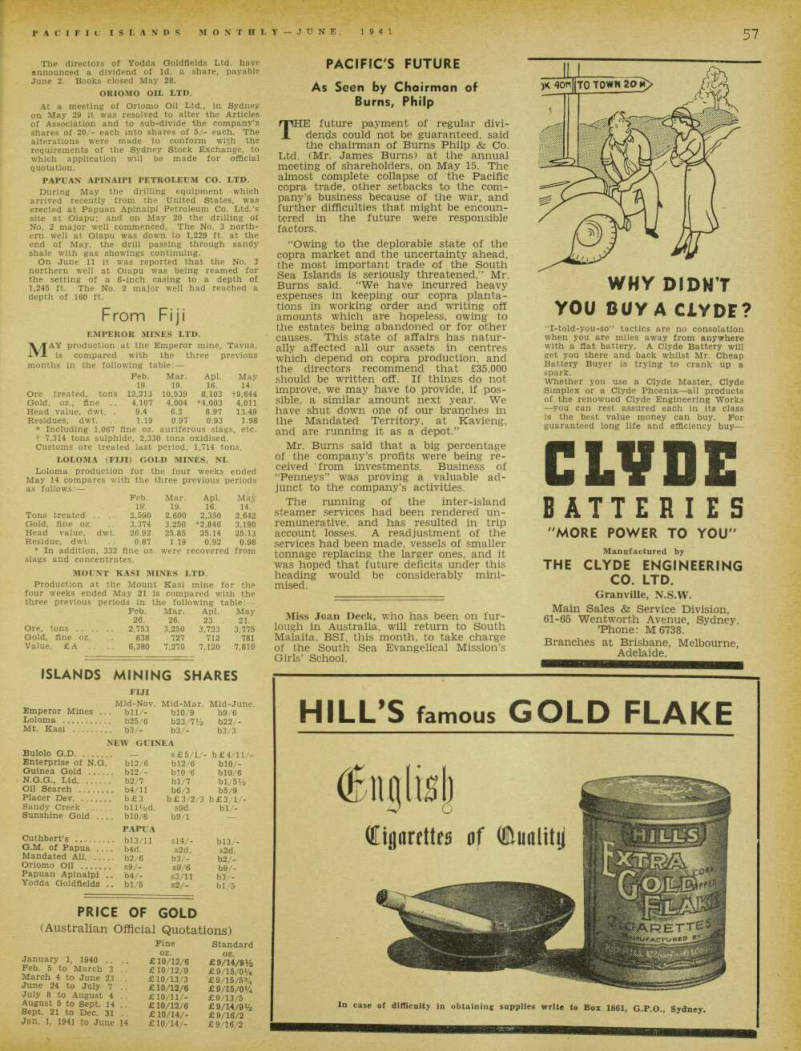
From New Guinea
Guinea Gold, Nl
A NET profit of £50,754 was shown by Guinea Gold NL for the year ended February 28, compared with £49,522 in the previous year.
Two dividends, each of 1/- a share, absorbed £50,000, leaving £754 to be transferred to reserve. The net profit increased by £1,232, while the total dividends increased by £2,083.
The Co. has now distributed to shareholders more than £460,000, including the forthcoming dividend, it was stated at the annual meeting in Adelaide on May 30. Mr. George Jeffrey was re-elected a director.
Bulolo Gold Dredging Ltd., in Which Guinea Gold NL holds shares, continued operations with marked success in spite of the loss at sea, by enemy action, of some mining equipment.
A dividend of 1/- a share payable on July 2 has been declared. Books close June 24.
Bulolo Gold Dredging Ltd.
Results from BGD Ltd.’s dredges for the past three periods compare as follows:
Estimated working profit for April, 9.248 oz. of fine gold.
An interim dividend of 1 dollar 50 cents (Canadian) per fully-paid share has been de clared, payable on June 30. Books closed on June 9. Payment from Sydney office will be made in Australian currency at the rate of exchange ruling on June 10. Dividends payable to non-residents of Canada will be subject to Canadian Absentee Tax of 15 per cent.
New Guinea Goldfields Ltd.
April production from NGG Ltd.’s workings is compared with the two previous months in the following table; —
t There was no production at Edie Creek and Golden Ridges. Alluvial earnings were affected
by heavy flood damage in the Bulolo River, and to the Bulolo race.
Sunshine Gold Development Ltd.
Sunshine Gold Development Ltd. reports that the clean-up for May yielded 207 oz. of gold, compared with 206 oz. for April. Repairs to the races have been effected and sluicing has been resumed on the terrace section. It is expected that full scale sluicing operations will shortly be resumed.
Sandy Creek Gold Sluicing Ltd.
May production on the Sandy Creek Co.’s area is compared with February, March and April in the following table:—
During May operations were affected to some extent while repairs to water races, damaged during the previous month, were being com pleted. The approximate mine working cost for April was abnormally inflated by the large amount of repair work which had to be carried out.
The new property at Upper Watut was taken over on May 15, when gold recovery operations were immediately commenced. To the end of the month, 72 ounces of gold were recovered from 5,290 cubic yards of material treated at an average value of 2/2(4 per cubic yard.
Placer Development Ltd.
The directors of Placer Development Ltd. announce a dividend of 60 cents (Canadian) per fully-paid share, payable June 30. Books closed June 9. Payment from Sydney office will be in Australian currency at rate of exchange ruling on June 10. Non-residents of Canada are sub ject to a payment of 15 per cent. Absentee Tax on their dividends.
From Papua
Cuthbert’S Misima Gold Mine Ltd.
MAY production at Cuthbert’s mine on Misima Is., Eastern Papua, compares with March and April as follows:
One June 3 the directors announced an interim dividend of 1/- a share, payable June 26. Books close June 16. The dividend (No. 14) will come from the current year’s profits earned exclu sively from gold-mining operations.
Yodda Goldfields Ltd.
Yodda Goldfields Ltd. reports that the yield for May was 68 oz., compared with 82 oz. 1 dwt. in April.
Feb.
March.
April.
Cubic yards . .. . . 1,540,000 1,557,000 1,535,000 Bullion, oz 15,738 16,826 19.&04 Gold, fine oz. .. 10,589 11,610 13,733
Edi? Creek mill— Feb.
Mar. tApl.
Ore, tons 2,606 826 — Gold, oz., fine .. . . 665 189 — Silver, oz., fine . . . . 5,827 1,266 .
Golden Ridges mill — Tons treated . . . . 2,320 861 Gold, oz., fine .. .. 997 760 — Silver, oz.. fine . . . . 1,146 723 Alluvial— Gold, oz., fine .. 1,176 1,097 818 Silver, oz., fine .. .. 837 732 586 Operating profit— Edie Creek, £ . . 446 — n,333 Golden Ridges, £ 1,817 — *2,673 Alluvial, £ 3,928 2,554 2,206 * Loss.
Feb.
Mar.
Apl.
May.
Cubic yards . . 9,997 16,946 6,916 14,403 Gold, oz 100 174 86 201 Per cubic yard 1/7% 1/7% 2/- 2/23/ 4 Working cost . 1/3 y 4 lOVad. 2/4
Mar. Apl. May.
Mill, treated, tons .. 3,237 3,213 3,306 Bullion, oz 3,424 3i918 3,546 Gold, fine oz 78& f 788 801 Silver, fine oz 2,562 3,045 2,659 Estimated value £6,416 £6,443 £6,514 Value per ton of ore 39/7 40/1 39/5
The directors of Yodda Goldfields Ltd. have announced a dividend of Id. a share, payable June 2. Books closed May 28.
Oriomo Oil Ltd.
At a meeting of Oriomo Oil Ltd., in Sydney on May 29 it was resolved to alter the Articles of Association and to sub-divide the company’s shares of 20/- each into shares of 5/- each. The alterations were made to conform with the requirements of the Sydney Stock Exchange, to which application will be made for official quotation.
Papuan Apinaipi Petroleum Co. Ltd.
During May the drilling equipment which arrived recently from the United States, was erected at Papuan Apinaipi Petroleum Co. Ltd.’s site at Oiapu; and on May 20 the drilling of No. 2 major well commenced. The No. 3 north ern well at Oiapu was down to 1,229 ft. at the end of May, the drill passing through sandy shale with gas showings continuing.
On June 11 it was reported that the No. 3 northern well at Oiapu was being reamed for the setting of a 6-inch casing to a depth of 1,245 ft. The No. 2 major well had reached a depth of 160 ft.
From Fiji
Emperor Mines Ltd.
MAY production at the Emperor mine, Tavua, is compared with the three previous months in the following table;—
* Including 1,067 fine oz. auriferous slags, etc. t 7,314 tons sulphide, 2,330 tons oxidised.
Customs ore treated last period, 1,714 tons.
Loloma (Fiji) Gold Mines. Nl
Loloma production for the four weeks ended May 14 compares with the three previous periods as follows: —
Mount Kasi Mines Ltd.
Production at the Mount Kasi mine for the four weeks ended May 21 is compared with the three previous periods in the following table;—
Feb.
Mar.
Apl.
May 19. 19. 16. 14.
Ore treated, tons 12,213 10,939 8,103 19.644 Gold, oz., fine .. 4,107 4,004 *4,003 4.011 Head value, dwt. . 9.4 6.3 8.97 13.49 Residues, dwt. 1.19 0.97 0.93 1.98
Feb. Mar. Apl. May IS’. 19. 16. 14.
Tons treated . . . 2,590 2,600 2,350 2,642 Gold, fine oz. . 3.374 3.250 *2,846 3,190 Head value, dwt. 26.92 25.85 25.14 25.13 Residue, dwt. . . 0.87 1.19 0.92 0.98 * In addition, 332 fine oz. were recovered from slags and concentrates.
Feb.
Mar.
Apl.
May 26. 26. 23. 21.
Ore, tons . 2,753 3,250 3,723 3,775 Gold, fine oz. 638 727 712 781 Value, £ A .. 6,380 7,270 7,120 7,810
Advertisements & other items, p. 58 (2 items)
56
JONE, 1941 PACIFIC ISLANDS MONtHL*
Highest Prices Paid For
60 L D Garrett & Davidson’s organisation is acknowledged far and wide as the main clearing house for precious metals in the Southern Hemisphere.
They have earned a reputation for accuracy and integrity in all their business dealings, which is proved by the fact that they are privileged to handle more gold from the Islands of the Pacific than any other organisation.
Therefore for your complete and lasting satisfaction, you are advised to transact all your precious metals business through the house of Garrett & Davidson.
GARRETT b DAVIDSON PTY. LTD.
ASSAYERS METALLURGISTS REFINERS
Bank of N.S.W. Buildings,
REGENT AND GEORGE STS., SYDNEY.
Islands Mining Shares
Fiji
Mid-Nov.
Mid-Mar.
Mid-June.
Emperor Mines .. • bll/blO/9 b9/6 Loloma . b25/6 b23/7Va b22/- Mt. Kasi .. b3/b3/b3/3 Bulolo G.D
New Guinea
— s£5/l/b£4/ll/- Enterprise of N.G, b!2/6 b!2/6 blO/- Guinea Gold ... b!2/blO/6 blO/6 N.G.G., Ltd . b2/7 bl/7 bl/SVa Oil Search .. b4/ll b6/3 b5/9 Placer Dev b£ 3/2/3 b£3/l/- Sandy Creek bllV 2 d. s9d. bl/- Sunshine Gold .. .. blO/6 b9/l Cuthbert’s
Papua
s!4/b!3/- G.M. of Papua .. .. b4d. s2d. s2d.
Mandated All. ... .. b2/6 b3/b2/- Oriomo Oil .. s9/s9/6 b9/- Papuan Apinalpi .. b4/- S3/11 b3 f- Yodda Goldfields .. bl/5 s2/bl/5
Price Of Gold
(Australian Official Quotations)
Fine Standard oz. oz.
January 1, 1940 .. .. £10/12/6 £9/14/9V 2 Feb. 5 to March 3 .. £10/12/9 March 4 to June 23 £10/13/3 £9/15/53/ 4 June 24 to July 7 .. £10/12/6 fO/lS/OVi July 8 to August 4 .. £10/11/- £9/13/5 August 5 to Sept. 14 .. £10/12/6 £9/14/9V 2 Sept. 21 to Dec. 31 .. £10/14/- £9/16/2 Jan, 1, 1941 to June 14 £10/14/- £9/16/2
Burns, Philp
Pacific's Future
As Seen by Chairman of Burns, Philp
rE future payment of regular divi dends could not be guaranteed, said the chairman of Burns Philp & Co.
Ltd. (Mr. James Burns) at the annual meeting of shareholders, on May 15. The almost complete collapse of the Pacific copra trade, other setbacks to the com pany’s business because of the war, and further difficulties that might be encoun tered in the future were responsible factors.
“Owing to the deplorable state of the copra market and the uncertainty ahead, the most important trade of the South Sea Islands is seriously threatened,’’ Mr.
Burns said. “We have incurred heavy expenses in keeping our copra planta tions in working order and writing off amounts which are hopeless, owing to the estates being abandoned or for other causes. This state of affairs has natur ally affected all our assets in centres which depend on copra production, and the directors recommend that £35,000 should be written off. If things do not improve, we may have to provide, if pos sible, a similar amount next year. We have shut down one of our branches in the Mandated Territory, at Kavieng, and are running it as a depot.”
Mr. Burns said that a big percentage of the company’s profits were being re ceived 'from investments. Business of “Penneys” was proving a valuable ad junct to the company’s activities.
The running of the inter-island steamer services had been rendered un remunerative, and has resulted in trip account losses. A readjustment of the services had been made, vessels of smaller tonnage replacing the larger ones, and it was hoped that future deficits under this heading would be considerably mini mised.
Miss Joan Deck, who has been on fur lough in Australia, will return to South Malaita, BSI, this month, to take charge of the South Sea Evangelical Mission’s Girls’ School.
Advertisements & other items, pp. 59-60 (1 item)
Clvde
WHY DIDN’T
YOU BUY A CLYDE ?
I-told-you-so” tactics are no consolation when you are miles away from anywhere with a flat battery. A Clyde Battery will get you there and back whilst Mr. Cheap Battery Buyer is trying to crank up a spark.
Whether you use a Clyde Master, Clyde Simplex or a Clyde Phoenix—all products of the renowned Clyde Engineering Works —you can rest assured each in its class is the best value money can buy. For guaranteed long life and efficiency buy—
CLVDE
BATTER!ES
"MORE POWER TO YOU"
Manufactured by
THE CLYDE ENGINEERING
CO. LTD.
Granville, N.S.W.
Main Sales & Service Division, 61-65 Wentworth Avenue, Sydney. ’Phone: M 6738.
Branches at Brisbane, Melbourne, Adelaide.
HILL’S famous GOLD FLAKE
Cijnrtltrs ©iwlitij
ETT
In case of difficulty in obtaining supplies write to Box 1861, G.P.0., Sydney.
WORLD'S LATEST
GAMES
Darts Boards with 6 Darts, 8/6.
Play Brass Competition Darts, Set of 3, 3/11, 4/6, 5/6. Monopoly, 11/6.
Totopoly, 11/6. Bucaneer, 11/6. 3 of the World’s Most Popular Games.
Chinese Checkers, 2/9, 5/-, 9/-.
Tripoly Card Game 5/3. De Luxe Type, 11/6. Poker Rummy, 1/1.
Dice of all kinds in stock. Poker Dice, 6/6, 7/6, 8/6, 10/6, set of 5.
Crown & Anchor Dice, set of 3, 5/6.
Full Set with Cloth and Shaker, 10/6. H. & T., 5 & 6. and Hazard Dice, 5-8 in., 5 for 8/6; 7-8 in., 11 for 5/-.
Wet Battery Testers, 3/-.
Nickel Cased Volt Meters, Pocket Type, 2 Reading, High & Low, 4/6.
British Make 3 Readings, 10/6. 12 Snappy Books—Jokes, Have Fun, etc., 5/6 the lot.
All About Aerial Booklet, 1-/. Radio Dictionary, 1/-, Morse Code Book, 1/-. Radio Alphabet, 1/-. The 4 books for 3/3.
Roulette Wheels, complete, 25/-.
The Best Trick Pack of Cards available, 3/6. Hundreds of Tricks you can do. Fullest, simple instructions provided.
PRESTO. THE MAGIC BOX.
2/9
FREE.
FREE.
2/9
POST
POST
MOST AMAZING TRICK EVER.
Special Wholesale Price in quantities.
Now available (not less than 10/parcels): Magic Wand, 1/6 Jafet’s Wallet 1/-; Obedient Ball 1/6; Magic Penny, 2/6; Mystic Head Chopper, 2/6; Shy Lock, 2/-; Dribble Glass. 2/-; Ventrillo, 1/-; Magic Coin, 1/-; Nest of Nests, 5/-; Voice Echoer, 1/-; Magic Bottle, 1/-; 3 Bell Trick, 1/-.
Magic Wand 1/6; Wonderful Rattle Box Trick, 2/6. Mixed Parcels of Tricks, 10/-, 20/-, 30/-, 40/-, 50/-.
Parcel of Jokes. 10/-, 12/6, 15/-.
The Magic Money Roll, 3/6. 10/-, £1 and £5 Notes appear when you know how a simple yet entertaining trick.
EGG & BAG
TRICK, 2/6.
Easy to Perform —Splendid to see Worked.
Instructions Supplied.
SWOOP! BRITAIN’S BEST.
“Amplion,” Bakelite PICK-UP, with Volume Control incorporated. Brand new, in original cartons. Listed to sell at 38/6. Now 32/6. Fits and suits all sets. Battery or Electric.
MAKE YOUR OWN RECORDINGS.
Overhead Cutting Gear and Cutting Head for Home Radio-Gramophone Recording, £5/5/-. Used in conjunction with your present radio.
Records, Needles, etc., etc. Metal Discs, 1/-, 1/6.
Microphones for Speech, Song or Music. Hook-up in a jiffy to any set. 15/-, 17/6, 18/6 complete.
Batteryless Type Hand - holding Microphones, fit any set, 25/-.
Ormond 3 In. Front-panel Vernier Dial, 2 actions, 8/6.
HEADPHONES.
12/6, 17/6.
S.T.C., British, 30/-; 8.T.H., 30/-; Lissen, British, 19/6. All 4,000 ohms.
Rubber Head-’phone Pads, 2/6 pr.
Ericcson’s Professional Type, 47/6. m RADIO VALVES.—We guarantee a Better Price. Send your order.
ALL DRY BATTERIES STOCKED.
Vico Electric Shavers, 240 Volt A.C.- D.C. £5/5/-, best price. In Original Cartons. Now 39/6.
New Radio and Other Books Just Landed. Everyman’s Wireless Book, 8/6; Toy Making for Amateurs, 2/-; Sixty Tested Circuits, 6/6; How to Make Models, 2/6; The First Course in Wireless, 9/6; Wireless Terms Explained, 6/6.
B.G.E. Table Model Microphone for Speech or Music —fits and suits all sets; as good a performer as any; £6/6/- Model. Now 45/-.
Small Table Model British Built Microphone, for all sets, 15/-, 21/-, 22/6, for speech or music. 2 Reading Pocket Volt Meters, 5/6.
Portable battery operated Light with pull switch and Battery Block, 8/6.
Bench Type Meter Reads All in Radio, 30/-.
POCKET VOLT
METERS.
Two Reading Pocket Meter, for A and B Batteries, 2/6, 3/9, 4/9, 7/6. 3 Reading, A and B Batteries, and up to 30 M/A, 10/6. 3 Reading De Luxe Model, 12/6. 4 Reading, 14/-.
BOOKS! BOOKS! BOOKS! The Be-
ginners’ Book of Radio. The Radio Beginners’ Dictionary. 2/- the 2. The Wireless Constructor’s Encyclopaedia. Giant size, 7/6. Newnes “Everyman’s" Wireless Book, 6/6.
The Book of Practical Radio, also
LEARN MORSE CODE. “LIKE-A-
FLASH” KITS, KEYS & BUZZERS.
P.M.G. type Key with Professional, Buzzer & Battery, all assembled on Base Board, 42/6. $ Morse Set Buzzer or light with single switch. All parts include adjustable Key, Switch, Buzzer, Lamp and Battery, all assembled on Base Board, 30/-. \ I //.
Morse Code Set “De Luxe”. Adjustable High-grade Key, Buzzer and Battery. All mounted on base board ready for use, 27/6.
Adjustable Morse Code Key on Bakelite Base, highly plated parts, 12/6. High-grade instrument.
De Luxe Junior Morse Code Outfit.
Mounted Key Buzzer and Battery. 13/6 complete. Morse Book, 1/-.
P.M.G. Model Adjustable Morse Code Key. Precision fittings, 19/6.
FOREIGN STAMPS.
Just Landed; Packets of Stamps.
Send 2/6 for wide range of World’s Stamps. Special selection of 100 different All World Stamps, including 2 Free Stamps valued in 1939, S.G. Catalogue at 1/8, PRICE 2/9. 204 All World Stamps, with 3/8 stamp gift, 3/9. Writes for Lists. a 21/- doz. to Stores.
Felt Pennants; A.1.F., R.A.N., R.A.A.F. and all other branches of Defence Forces. 3/6 each.
Money Belts for Soldiers, Sailors or Civilians. Zipper Types, 9/6. Others, 6/6, 7/6.
Electric Military Brush, 15/-.
Stimulates the Scalp and Hair, Aerial Stay-wire strainers, 2/6.
Ete Luxe Model British-built Lightning Arresters, complete for indoor or outdoor use, 6/-.
Non-jam Pulleys with halyard bolt, 1/9. Special Radio Earth Spike 4/6. 4 in. 4 in 1 Nickel Screw Drivers, bakelite or metal, 2/-. . Fountain Pen size. Cone Speaker Units, 25/-; Now 12/6. 1,500 ft. Beam Electric Torches, 5 Cell, 8/6. Both use Standard Batteries. Everyman’s Wireless Book, 8/6. 2 to 3 Cell Expandable Torches.
Nickelled Case—Dimmer incorporated.
Daylight Globes, 10/6.
Swiss Music Boxes for Cigarette, Trinkets, etc., 25/-, 30/-, 45/-.
Steel Money and Deed Boxes, 63/-.
They ring when opened or lifted.
A Splendid Article.
Hunting and Sporting Knives. Remington U.S.A. made, 10/6, 12/6, 15/6, 16/6. (All in Sheath.) Throwing Knives, 8/9; Small Throwing Knives, 7/6; Set of 2, 15/-; Set of 3, 22/6; De Luxe Throw Knife, 21/-. All in Sheaths.
Morse Code Light and Buzzer Set.
A precision De-luxe outfit that cannot be bettered. Perfect Adjustable Morse Code Key, with professional type Buzzer. Light to Buzzer throw-over Switch, and Battery, all ready mounted.
J.LEVENSON Radio??"'
Fin G &Ul6 *
GAMES, NOVELTIES AND HOBBIES* Totem And
226 A PITT STREET, SYDNEY £ v dd n s , and Manufacturers, Importers, and Exporters. Leaflets N.S.W., AUSTRALIA. lllllflTOlllfliniM Cable address: “Leveradloh”. Goods forwarded V.P.P. or Sight Draft. Satisfaction and Service Gnaranteed. We can supply by mall all General Merchandise at a Better Price. Quotations with pleasure. Please add freight and packing. Write for full list of interesting leaflets of Games, Hobbies, Novelties, and Electrical Goods. Write for full list of Radio Meters.
iiimnnimnnnn]
Write for Punch Board Leaflets fiimniminiimiii
The Book of Practical Television, 8/6 each. Levenson’s Giant “Party and Fun Book”, 1/6. Humorous Stories and Recitations, 3!/9, Card and Conjuring Tricks, 3/9. Tea-Cup Fortune Telling, 3/9. 100 Party Games for Old and Young, 1/9. Popular Magic and Amateur Conjurer, 1/9. 50 Best Party Games, 1/6.
Tricks with Cards, 1/6.
NOW 49/6
COSMOCORD” CRYSTAL
RADIO-GRAMO PICK-UP.
Suits all Sets.
We Can Supply, at a Keen Price, Any Available Article You Require.
Australian Short Wave
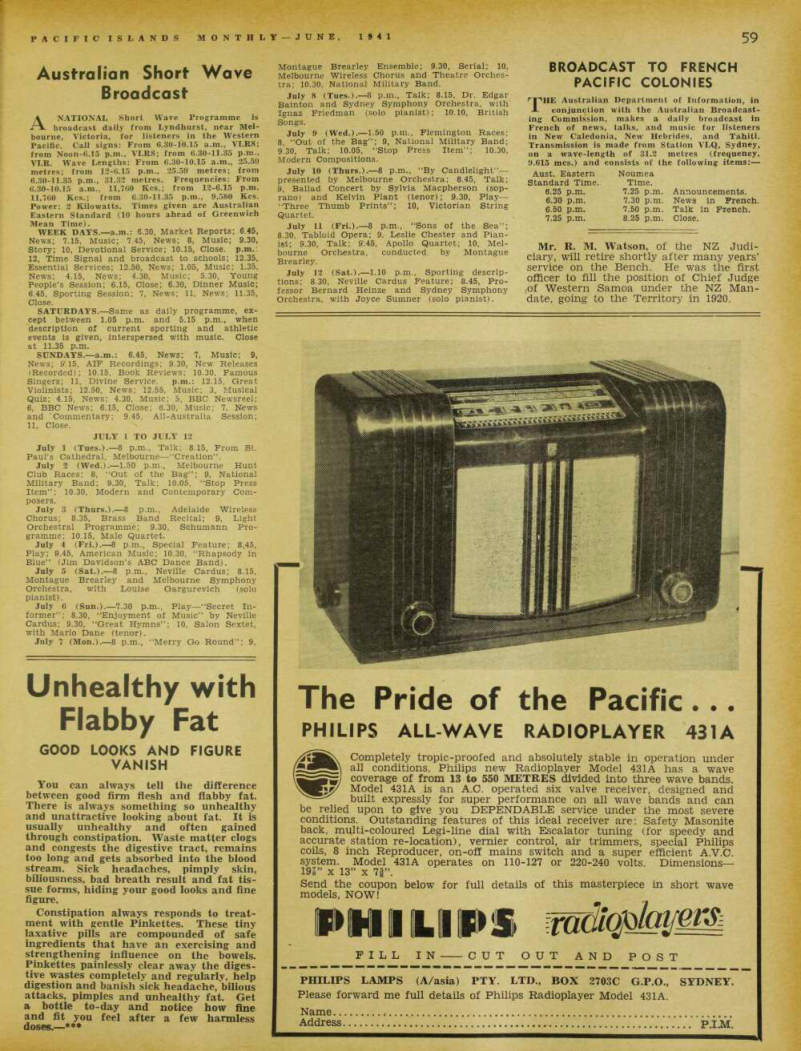
Broadcast
A NATIONAL Short W’ave Programme is broadcast daily from Lyndhurst, near Mel bourne, Victoria, for listeners in the Western Pacific. Call signs: From 6.30-10.15 a.m., VLRB; from Noon-6.15 p.m., VLRB; from 6.30-11.35 p m., VLR. Wave Lengths: From 6.30-10.15 a.m., 25.59 metres; from 12-6.15 p.m., 25.59 metres; from 6.30-11.35 p.m., 31.32 metres. Frequencies: From 6.30-10.15 a.m.. 11,760 Kcs.; from 12-6.15 p.m. 11,760 Kcs.; from 6.30-11.35 p.m., 9,580 Kcs.
Power: 2 Kilowatts. Times given are Australian Eastern Standard (10 hours ahead of Greenwich Mean Time).
WEEK DAYS.—a.m.; 6.30, Market Reports; 6.45, News; 7.15, Music; 7.45, News; 8, Music; 9.30, Story; 10, Devotional Service; 10.15, Close, p.m.: 12, Time Signal and broadcast to schools; 12.35, Essential Services; 12.50, News; 1.05, Music; 1.35, News; 4.15, News; 4.30, Music; 5.30, Young People’s Session; 6.15, Close; 6.30, Dinner Music; 6.45, Sporting Session; 7, News; 11, News; 11.35, Close.
SATURDAYS.—Same as daily programme, ex cept between 1.05 p.m. and 5.15 p.m., when description of current sporting and athletic events is given, Interspersed with music. Close at 11.35 p.m.
SUNDAYS.—a.m.: 6.45, News; 7, Music; 9, News; 9. 15, AIF Recordings; 9.30, New Releases (Recorded); 10.15, Book Reviews; 10.30, Famous Singers: 11, Divine Service. p.m.: 12.15, Great Violinists: 12.50, News; 12.55, Music; 3, Musical Quiz; 4.15, News; 4.30, Music; 5, BBC Newsreel; 6, BBC News; 6.15, Close; 6.30, Music; 7, News and ‘Commentary; 9.45, All-Australia Session; 11, Close.
July 1 To July 12
July 1 (Tues.). —8 p.m., Talk; 8.15, From St.
Paul’s Cathedral, Melbourne —“Creation”.
July 2 (Wed.). —1.50 p.m., Melbourne Hunt Club Races; 8, “Out of the Bag”; 9, National Military Band; 9.30, Talk; 10.05, “Stop Press Item”; 10.30, Modern and Contemporary Com posers.
July 3 (Thurs.). —8 p.m., Adelaide Wireless Chorus; 8.35, Brass Band Recital; 9, Light Orchestral Programme; 9.30, Schumann Pro gramme; 10.15, Male Quartet.
July 4 (Fri.).—B p.m., Special Feature; 8,45, Play; 9.45, American Music; 10.30, “Rhapsody in Blue” (Jim Davidson’s ABC Dance Band).
July 5 (Sat.). —8 p.m., Neville Cardus; 8.15, Montague Brearley and Melbourne Symphony Orchestra, with Louise Gargurevich (solo pianist).
July 6 (Sun.). —7.30 p.m., Play—“ Secret In former”; 8.30, “Enjoyment of Music” by Neville Cardus; 9.30, “Great Hymns”; 10, Salon Sextet, with Mario Dane (tenor).
July 7 (Mon.). —8 p.m., “Merry Go Round”; 9,
Montague Brearley Ensemble; 9.30, Serial; 10, Melbourne Wireless Chorus and Theatre Orches tra; 10.30, National Military Band.
July 8 (Tues.). —8 p.m., Talk; 8.15, Dr. Edgar Bainton and Sydney Symphony Orchestra, with Ignaz Friedman (solo pianist); 10.10, British Songs.
July 9 (Wed.). —1.50 p.m., Flemington Races; 8, “Out of the Bag”; 9, National Military Band; 9.30, Talk; 10.05, “Stop Press Item”; 10.30, Modern Compositions.
July 10 (Thurs.). —8 p.m., “By Candlelight”— presented by Melbourne Orchestra; 8.45, Talk; 9, Ballad Concert by Sylvia Macpherson (sop rano) and Kelvin Plant (tenor); 9.30, Play— “ Three Thumb Prints”; 10, Victorian String Quartet.
July 11 (Fri.). —8 p.m., “Sons of the Sea”; 8.30, Tabloid Opera; 9, Leslie Chester and Pian ist; 9.30, Talk; 9’.45, Apollo Quartet; 10, Mel bourne Orchestra, conducted by Montague Brearley.
July 12 (Sat.). —1.10 p.m., Sporting descrip tions; 8.30, Neville Cardus Feature; 8.45, Pro fessor Bernard Heinze and Sydney Symphony Orchestra, with Joyce Sumner (solo pianist).
Pacific Colonies
Broadcast To French
r r'HE Australian Department of Information, in A conjunction with the Australian Broadcast ing Commission, makes a daily broadcast in French of news, talks, and music for listeners in New Caledonia, New Hebrides, and Tahiti.
Transmission is made from Station VLQ, Sydney, on a wave-length of 31.2 metres (frequency, 9.615 mcs.) and consists of the following items:—
Mr. R. M. Watson, of the NZ Judi ciary, will retire shortly after many years’ service on the Bench. He was the first officer to fill the position of Chief Judge ,of Western Samoa under the NZ Man date, going to the Territory in 1920.
Aust. Eastern Noumea Standard Time.
Time. 6.25 p.m. 7.25 p.m.
Announcements. 6.30 p.m. 7.30 p.m.
News in French. 6.50 p.m. 7.50 p.m.
Talk in French. 7.25 p.m. 8.25 p.m.
Close.
Mr. Aime John Armstrong, who was well-known in Fiji as a member of the Civil Service, died in Australia on May 21, aged 61. He was born at Muanikau, Fiji, and at the age of 18 years joined the Civil Service as a clerk. In the ensuing 43 years Mr. Armstrong held many important positions, the last being that of Resident Magistrate at Kadavu.
At the time of his death he was on leave prior to retirement. It is interesting to note that Mr. Armstrong’s father, the late Henry Armstrong, was one of the early pioneers of the Colony. He pur chased land from the Polynesian Com
pany and settled in Suva in 1869 and was the first planter to can pineapples on a commercial scale in the Colony J Colonel H. Dix arrived in Auckland NZ, from Noumea, New Caledonia, early last month by PAA Clipper. He is well known in the Colony as the director of the Societe de Ouaco, which owns the large meat canning factory at Ouaco Mr. and Mrs. J. Petersen, of Sigatoka Fiji, are at present in Sydney on fur lough. He is manager of the Sigatoka branch of Burns Philp (SS) Co Ltd
Advertisements & other items, pp. 61-62 (2 items)
Philips
The Pride of the Pacific...
5*
PHILIPS ALL-WAVE RADIOPLAYER 431A
Completely tropic-proofed and absolutely stable in operation under all conditions, Philips new Radioplayer Model 431A has a wave coverage of from 13 to 550 METRES divided into three wave bands.
Model 431A is an A.C. operated six valve receiver, designed and built expressly for super performance on all wave bands and can be relied upon to give you DEPENDABLE service under the most severe conditions. Outstanding features of this ideal receiver are: Safety Masonite back, multi-coloured Legi-line dial with Escalator tuning (for speedy and accurate station re-location), vernier control, air trimmers, special Philips coils, 8 inch Reproducer, on-off mains switch and a super efficient A.V.C. system. Model 431A operates on 110-127 or 220-240 volts. Dimensions— 191” x 13” x 7|”.
Send the coupon below for full details of this masterpiece in short wave models, NOW!
PHILIPS
FILL IN
CUT OUT AND POST
PHILIPS LAMPS (A/asia) PTY. LTD., BOX 2703C G.P.O., SYDNEY.
Please forward me full details of Philips Radioplayer Model 431A.
Name
Address pj,M.
SINEWS OF WAR! . . . Marching men .. . guns and the crews that serve them .. . war factories pouring out a stream of modern weapons and equipment... these are the outward and visible signs of Australia's mighty war effort. Less spectacular but none the less real, is another sinew of war... bank credit... and in providing this necessity the Bank of New South Wales is bearing its full weight JUj in the drive to victory.
I IS
M: mn f •r-r-
-ti J
•s MJ) /m
BANK OF
NEW SOUTH
-A X
WALES
*£ 6 an k
Unhealthy with
Flabby Fat
GOOD LOOKS AND FIGURE
VANISH
You can always tell the difference between good firm flesh and flabby fat.
There is always something so unhealthy and unattractive looking about fat. It is usually unhealthy and often gained through constipation. Waste matter clogs and congests the digestive tract, remains too long and gets absorbed into the blood stream. Sick headaches, pimply skin, biliousness, bad breath result and fat tissue forms, hiding your good looks and fine figure.
Constipation always responds to treatment with gentle Pinkettes. These tiny laxative pills are compounded of safe ingredients that have an exercising and strengthening influence on the bowels.
Pinkettes painlessly clear away the digestive wastes completely and regularly, help digestion and banish sick headache, bilious attacks, pimples and unhealthy fat. Get a bottle to-day and notice how fine and fit you feel after a few harmless doses.—♦♦♦
Exchange Rates
'T'HE following exchange quotations, gathered in Sydney, show the rates existing in mid- June: —
Fiji
Through Bank of N.S.W. and Bank of New Zealand;—Australia on Fiji on basis of £lOO Fiji; Buying £Alll/2/6, selling £AII3. Fijl- London on basis £lOO London:—
Western Samoa
Through Bank of New Zealand;—Australia on Western Samoa, basis £lOO Samoa—buying £ A99/12/6; selling, £AIOO/2/6. Samoa on London, basis £lOO in London:—
New Guinea And Papua
Through Bank of N.S.W.:—Australia on Port Moresby and Samaral, Papua, 10/- per cent, premium each way. Australia on Rabaul, N.G., 10/- per cent, premium. All other places 20/per cent.
Papua and New Guinea on London: Same as Australia on London and vice versa.
Through Commonwealth Bank;—Australia on Port Moresby and Samarai, Papua, 10/- per cent.; on Rabaul. N.G., 10/- per cent.—other Papua and New Guinea districts, £1 per cent.
Rabaul on London, same as Australia on London:— Buying: T.T. £AI2S equals £stg. 100.
Selling: T. r i*. £AI2S/10/- equals £stg. 100.
New Caledonia And Tahiti
As the result of the French surrender, with the consequent dislocation of the Anglo-French banking system, London has not been quoting on Paris. The rates furnished to the' “PIM” by the Comptoir National d’Escompte de Paris, Sydney, and the Bank of NSW were based on the London-Paris rates and so there have been no quotations available. Most of the business between the French Colonies in the Pacific and Australia, however, is being done in Australian currency; but there is in existence an unoffi cial, fluctuating rate of between 140 and 143.5 francs to the Australian £.
Buying.
Selling. £ s. d. £ s. d.
Telegraphic transfer . .. 110 15 0 112 0 0 On demand 111 17 6
Buying. Selling.
Telegraphic transfer — £125 10 0 On Demand £122 18 9 125 7 6 30 days 122 8 9 125 2 6 60 days 121 18 9 124 17 6 90 days 121 8 9 124 12 6 120 days 120 18 9
Advertisements & other items, p. 62 (1 item)
Extra Strong Saddle
Extra Low Price
80/- bare
Built by highly skilled workmen from the best available materials, the Great Western Saddle represents remarkable value at 80/-. It is specially built to suit Island conditions with a Galvanised Tree, Copper Tacks and Brass Fittings.
Mounts: Leathers, Girths and Stirrups, 17/6 extra.
These Saddles are obtainable through your regular agent.
We carry complete stock of Saddles, Collars, Whips, Rugs and Saddlery Accessories.
Write for Catalog**.
NEWMARKET SADDLERY
18 20 WILSON ST NEWTOWN
W. Uv WILLIAMS FOR SAFER SADDLES
Islands Produce
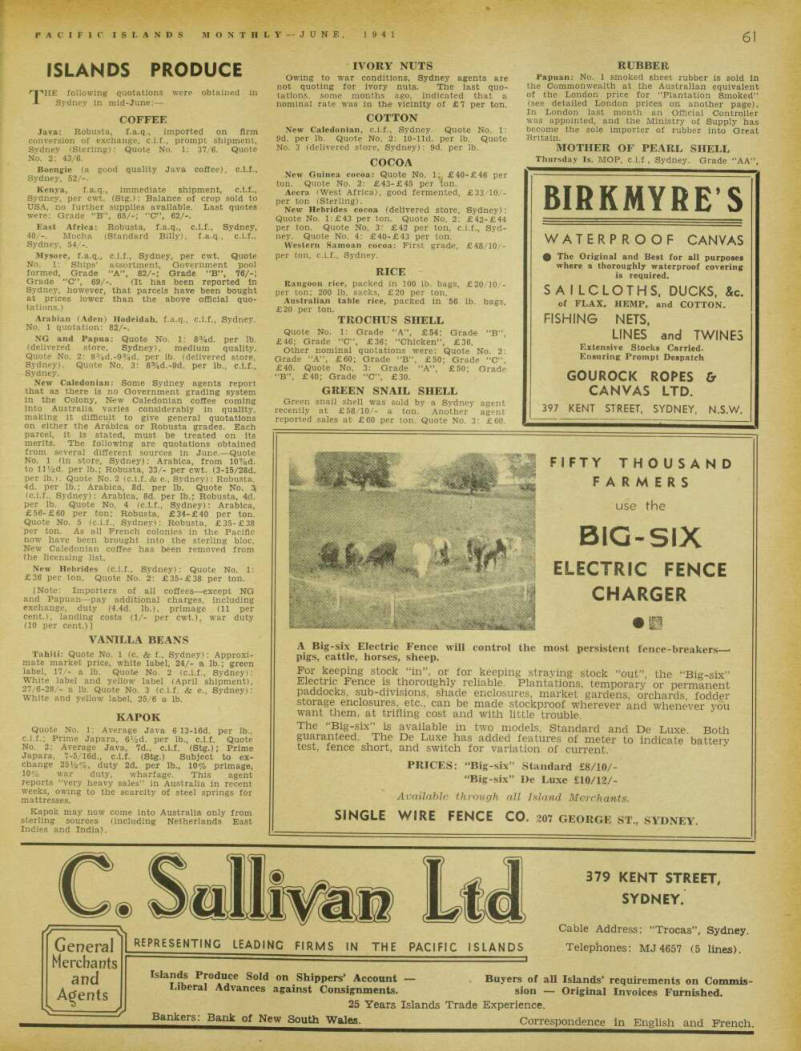
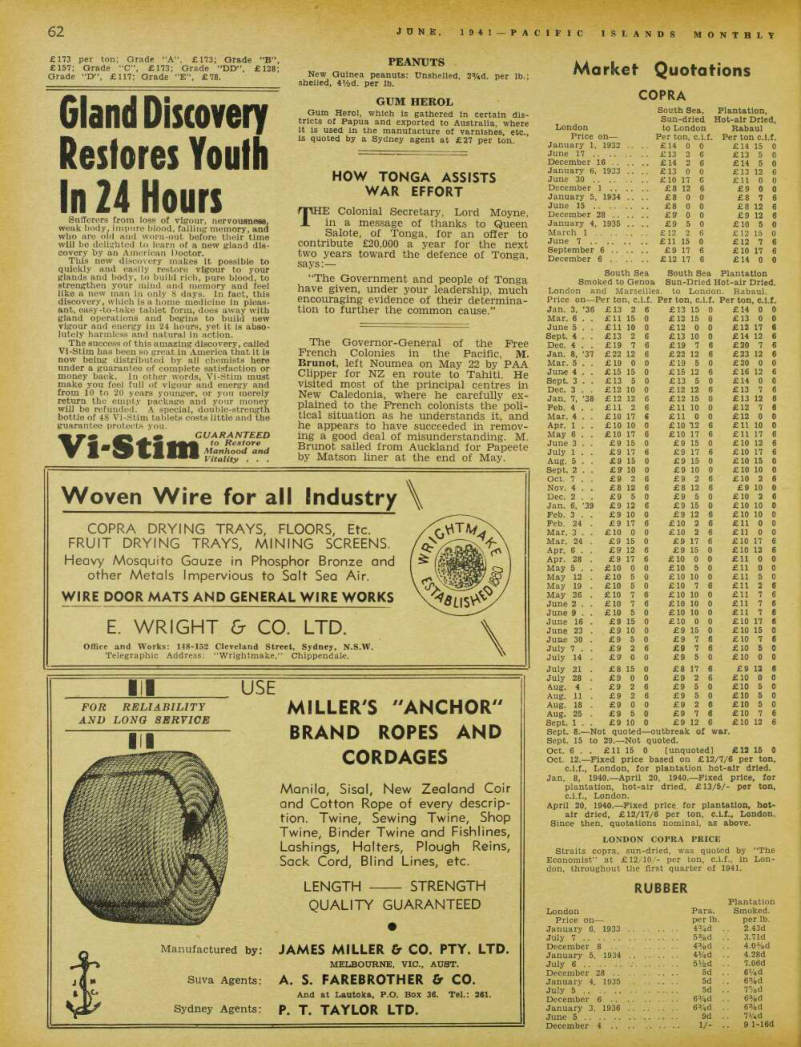
THE following quotations were obtained in Sydney in mid-June:—
Coffee
Java: Robusta, f.a.q., imported on firm conversion of exchange, c.i.f., prompt shipment, Sydney (Sterling): Quote No. 1; 37/6. Quote No. 2: 43/6.
Boengie (a good quality Java coffee), c.i.f., Sydney, 52/-.
Kenya, f.a.q., immediate shipment, c.i.f., Sydney, per cwt. (Stg.): Balance of crop sold to USA, no further supplies available. Last quotes were: Grade “B”, 65/-; “C”, 62/-.
East Africa: Robusta, f.a.q., c.i.f., Sydney, 40/-. Mocha (Standard Billy), f.a.q., c.i.f., Sydney, 54/-.
Mysore, f.a.q., c.i.f., Sydney, per cwt. Quote No. 1: Ships’ assortment, Government pool formed, Grade “A”, 82/-; Grade “B”, 76/-; Grade “C”, 69/-. (It has been reported in Sydney, however, that parcels have been bought at prices lower than the above official quo tations.) Arabian (Aden) Hodeidah, f.a.q., c.i.f., Sydney.
No. 1 quotation; 82/-.
NG and Papua: Quote No. 1: B%d. per lb. (delivered store, Sydney), medium quality.
Quote No. 2: 8%d.-9%d. per lb. (delivered store, Sydney). Quote No. 3: 8 3 / 4 d.-9d. per lb., c.i.f., Sydney.
New Caledonian: Some Sydney agents report that as there is no Government grading system in the Colony, New Caledonian coffee coming into Australia varies considerably in quality, making it difficult to give general quotations on either the Arabica or Robusta grades. Each parcel, it is stated, must be treated on its merits. The following are quotations obtained from several different sources in June. —Quote No. 1 (in store, Sydney): Arabica, from 10 7 / B d. to liy 2 d. per lb.; Robusta, 33/- per cwt. (3-15/28d. per lb.). Quote No. 2 (c.i.f. & e., Sydney): Robusta, 4d. per lb.; Arabica, Bd. per lb. Quote No. 3) (c.i.f., Sydney): Arabica, Bd. per lb.; Robusta, 4d. per lb. Quote No. 4 (c.i.f., Sydney): Arabica, £56-£6O per ton; Robusta, £34-£4O per ton.
Quote No. 5 (c.i.f., Sydney): Robusta, £35-£3B per ton. As all French colonies in the Pacific now have been brought into the sterling bloc, New Caledonian coffee has been removed from the licensing list.
New Hebrides (c.i.f., Sydney): Quote No. 1: £36 per ton. Quote No. 2: £35-£3B per ton. [Note: Importers of all coffees —except NG and Papuan—pay additional charges, including exchange, duty (4.4 d. lb.), primage (11 per cent.), landing costs (1/- per cwt.), war duty (10 per cent.)]
Vanilla Beans
Tahiti: Quote No. 1 (c. & f., Sydney): Approxi mate market price, white label, 24/- a lb.; green label, 17/- a lb. Quote No. 2 (c.i.f., Sydney): White label and yellow label (April shipment), 27/6-28/- a lb. Quote No. 3 (c.i.f. & e., Sydney): White and yellow label, 25/6 a lb.
Kapok
Quote No. 1: Average Java 6 13-16 d. per lb., c.i.f.; Prime Japara, ey 2 d. per lb., c.i.f. Quote No. 2: Average Java, 7d., c.i.f. (Stg.); Prime Japara, 7-5/16d., c.i.f. (Stg.) Subject to ex change 25%%, duty 2d. per lb., 10% primage, 10% war duty, wharfage. This agent reports “very heavy sales” in Australia in recent weeks, owing to the scarcity of steel springs for mattresses.
Kapok may now come into Australia only from sterling sources (including Netherlands East Indies and India).
Ivory Nuts
Owing to war conditions, Sydney agents are not quoting for ivory nuts. The last quo tations, some months ago, indicated that a nominal rate was in the vicinity of £7 per ton.
Cotton
New Caledonian, c.i.f., Sydney. Quote No. 1: 9d. per lb. Quote No. 2: 10-lld. per lb. Quote No. 3 (delivered store, Sydney): 9d. per lb.
Cocoa
New Guinea cocoa: Quote No. 1; £4O-£46 per ton. Quote No. 2: £43-£45 per ton.
Accra (West Africa), good fermented, £33/10/per ton (Sterling).
New Hebrides cocoa (delivered store, Sydney): Quote No. 1: £43 per ton. Quote No. 2: £42-£44 per ton. Quote No. 3: £42 per ton, c.i.f., Syd ney. Quote No. 4: £4O-£43 per ton.
Western Samoan cocoa: First grade, £4B/10/per ton, c.i.f., Sydney.
Rice
Rangoon rice, packed in 100 lb. bags, £2O/10/per ton; 200 lb. sacks, £2O per ton.
Australian table rice, packed in 56 lb. bags, £2O per ton.
Trochus Shell
Quote No. 1: Grade “A”, £54; Grade "B”, £46; Grade “C”, £36; “Chicken”, £36.
Other nominal quotations were: Quote No. 2: Grade “A”, £6O; Grade “B”, £5O; Grade “C”, £4O. Quote No. 3: Grade “A”, £5O; Grade “B”, £4O; Grade "C”, £3O.
Green Snail Shell
Green snail shell was sold by a Sydney agent recently at £5B/10/- a ton. Another agent reported sales at £6O per ton. Quote No. 3: £6O.
Rubber
Papuan: No. 1 smoked sheet rubber is sold In the Commonwealth at the Australian equivalent of the London price for “Plantation Smoked’’ (see detailed London prices on another page).
In London last month an Official Controller was appointed, and the Ministry of Supply has become the sole importer of rubber into Great Britain.
Mother Of Pearl Shell
Thursday Is. MOP, c.i.f., Sydney. Grade “AA”,
£173 per ton; Grade “A”, £173; Grade “B”, £157; Grade “C”, £173; Grade “DD”, £128; Grade “D”, £117; Grade “E”, £7B.
Peanuts
New Guinea peanuts: Unshelled, 2 3 / 4 d. per lb.; shelled, 4y 2 d. per lb.
Gum Herol
Gum Herd, which is gathered in certain dis tricts of Papua and exported to Australia, where it is used in the manufacture of varnishes, etc., is quoted by a Sydney agent at £27 per ton.
Advertisements & other items, pp. 63-64 (1 item)
Birkmyre’S
WATERPROOF CANVAS
O The Original and Best for all purposes where a thoroughly waterproof covering is required.
S A I LCLOTHS, DUCKS, &c.
of FLAX. HEMP, and COTTON.
FISHING NETS,
LINES and TWINES
Extensive Stocks Carried.
Ensuring Prompt Despatch
GOUROCK ROPES &
CANVAS LTD.
397 KENT STREET, SYDNEY, N.S.W.
M i
FIFTY THOUSAND
FARMERS
use the
BIG-SIX
ELECTRIC FENCE
CHARGER
A Big-six Electric Fence will control the most persistent fence-breakers * pigs, cattle, horses, sheep.
For keeping stock “in”, or for keeping straying stock “out”, the “Big-six”
Electric Fence is thoroughly reliable. Plantations, temporary or permanent paddocks, sub-divisions, shade enclosures, market gardens, orchards fodder storage enclosures, etc., can be made stockproof wherever and whenever vou want them, at trifling cost and with little trouble.
The “Big-six” is available in two models, Standard and De Luxe Both guaranteed. The De Luxe has added features of meter to indicate battery test, fence short, and switch for variation of current.
PRICES: “Big-six” Standard £B/10/- “Big-six” De Luxe £lO/12/- Available through all Island Merchants.
SINGLE WIRE FENCE CO. 207 george st., Sydney.
c.s 1 m
Lid
General
Merchants
and
Agents
REPRESENTING LEADING FIRMS IN THE PACIFIC ISLANDS
379 KENT STREET,
SYDNEY.
Cable Address; “Trocas”, Sydney.
Telephones: MJ 4657 (5 lines).
Islands p ™duce Sold on Shippers’ Account Buyers of all Islands’ requirements on Commis- Laoeral Advances against Consignments. sion Original Invoices Furnished. 25 Years Islands Trade Experience. of New South Wales. Correspondence in English and French.
Gland Discovery
Restores Youth
In 24 Hours
Sufferers from loss of vigour, nervousness, weak body, impure blood, failing memory, and who are old and worn-out before their time will be delighted to learn of a new gland discovery by an American Doctor.
This new discovery makes it possible to quickly and easily restore ■vigour to your glands and body, to build rich, pure blood, to strengthen your mind and memory and feel like a new man in only 8 days. In fact, this discovery, which is a home medicine in pleasant, easy-to-take tablet form, does away with gland operations and begins to build new vigour and energy in 24 hours, yet it is absolutely harmless and natural in action.
The success of this amazing discovery, called Vi-Stim has been so great in America that it is now being distributed by all chemists here under a guarantee of complete satisfaction or money back. In other words, Vi-Stim must make you feel full of vigour and energy and from 10 to 20 years younger, or you merely return the empty package and your money will be refunded. A special, double-strength bottle of 48 Vi-Stim tablets costs little and the guarantee protects you.
Vi-Stim
GUARANTEED
fe to Restore Manhood and Vitality . . .
How Tonga Assists
War Effort
rE Colonial Secretary, Lord Moyne, in a message of thanks to Queen Salote, of Tonga, for an offer to contribute £20,000 a year for the next two years toward the defence of Tonga, says:— “The Government and people of Tonga have given, under your leadership, much encouraging evidence of their determina tion to further the common cause.”
The Governor-General of the Free French Colonies in the Pacific, M.
Brunot, left Noumea on May 22 by PAA Clipper for NZ en route to Tahiti. He visited most of the principal centres in New Caledonia, where he carefully ex plained to the French colonists the poli tical situation as he understands it, and he appears to have succeeded in remov ing a good deal of misunderstanding. M.
Brunot sailed from Auckland for Papeete by Matson liner at the end of May.
Market Quotations
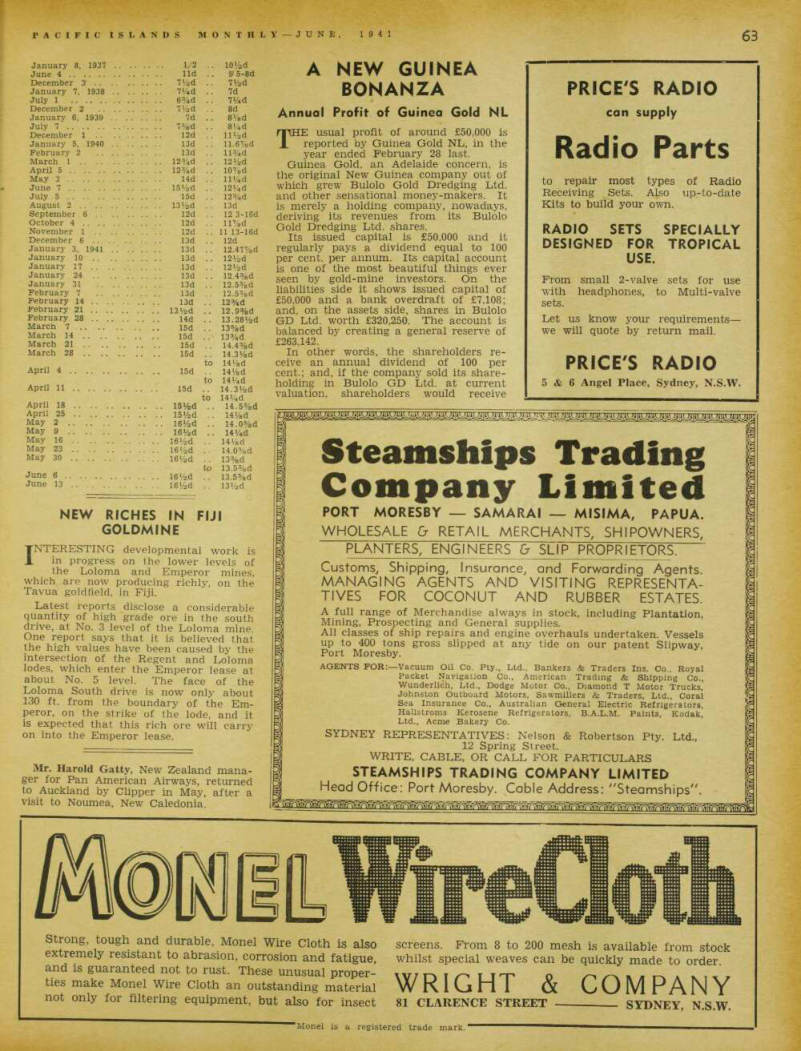
London Copra Price
Straits copra, sun-dried, was quoted by “The Economist” at £12/10/- per ton, c.i.f., in Lon don, throughout the first quarter of 1941.
Copra
South Sea, Plantation, Sun-dried Hot-air Dried.
London to London Rabaul Price on— Per ton, c.i.f.
Per ton c.i.f.
January 1, , 1932 £14 0 0 £14 15 0 June 17 . £13 2 I 6 £13 5 0 December 16 . . £14 2 ! 6 £14 5 0 January 6, , 1933 . , £13 C 1 0 £13 12 6 June 30 . £10 17 6 £11 0 0 December 1 .. £8 12 6 £9 0 0 January 5, , 1934 , . .. £8 ( ) 0 £8 7 6 June 15 . , m £8 C l 0 £8 12 6 December 28 . . £9 C 1 0 £9 12 6 January 4, , 1935 , . . £9 I > 0 £10 5 0 March 1 £12 2 1 6 £12 15 0 June 7 ., £11 15 i 0 £12 7 6 September 6 .. £9 17 6 £10 17 6 December 6 . £12 17 6 £14 0 0 South Sea South Sea Plantation Smoked to Genoa Sun-Dried Hot-air Dried.
London and Marseilles, to London. Rabaul.
Price on— Per ton, c.i.f.
Per ton i, c.i.f.
Per ton, c.i.f.
Jan. 3. ’36 £13 2 6 £13 15 0 £14 0 0 Mar. 6 . . £11 15 0 £12 15 0 £13 0 0 June 5 . . £11 10 0 £12 0 0 £12 17 6 Sept. 4 . . £13 2 6 £13 10 0 £14 12 6 Dec. 4 . . £19 7 6 £19 7 6 £20 7 6 Jan. 8, ’37 £22 12 6 £22 12 6 £23 12 6 Mar. 5 . . £19 0 0 £19 5 0 £20 0 0 June 4 . . £15 15 0 £15 12 6 £16 12 6 Sept. 3 . . £13 5 0 £13 5 0 £14 0 0 Dec, 3 . . £12 10 0 £12 12 6 £13 7 6 Jan. 7, ’38 £12 12 6 £12 15 0 £13 12 6 Feb, 4 . . £11 2 6 £11 10 0 £12 7 6 Mar. 4 . . £10 17 6 £11 0 0 £12 0 0 Apr. 1 . . £10 10 0 £10 12 6 £11 10 0 May 6 . . £10 17 6 £10 17 6 £11 17 6 June 3 . . £9 15 0 £9 15 0 £10 12 6 July 1 . . £9 17 6 £9 17 6 £10 17 6 Aug. 5 . . £9 15 0 £9 15 0 £10 15 0 Sept. 2 . . £9 10 0 £9 10 0 £10 10 0 Oct. 7 . . £9 2 6 £9 2 6 £10 2 6 Nov. 4 . . £8 12 6 £8 12 6 £9 10 0 Dec. 2 . . £9 5 0 £9 5 0 £10 2 6 Jan. 6, ’39 £9 12 6 £9 15 0 £10 10 0 Feb. 3 . . £9 10 0 £9 12 6 £10 10 0 Feb. 24 . £9 17 6 £10 2 6 £11 0 0 Mar. 3 . . £10 0 0 £10 2 6 £11 0 0 Mar. 24 . £9 15 0 £9 17 6 £10 17 6 Apr. 6 . . £9 12 6 £9 15 0 £10 12 6 Apr. 28 . £9 17 6 £10 0 0 £11 0 0 May 5 . . £10 0 0 £10 5 0 £11 0 0 May 12 . £10 5 0 £10 10 0 £11 5 0 May 19 . £10 5 0 £10 7 6 £11 2 6 May 26 . £10 7 6 £10 10 0 £11 7 6 June 2 . . £10 7 6 £10 10 0 £11 7 6 June 9 . . £10 5 0 £10 10 0 £11 7 6 June 16 . £9 15 0 £10 0 0 £10 17 6 June 23 . £9 10 0 £9 15 0 £10 15 0 June 30 . £9 5 0 £9 7 6 £10 7 6 July 7 . . £9 2 6 £9 7 6 £10 5 0 July 14 . £9 0 0 £9 5 0 £10 0 0 July 21 . £8 15 0 £8 17 6 £9 12 6 July 28 . £9 0 0 £9 2 6 £10 0 0 Aug. 4 £9 2 6 £9 5 0 £10 5 0 Aug. 11 . £9 2 6 £9 5 0 £10 5 0 Aug. 18 . £9 0 0 £9 2 6 £10 5 0 Aug. 25 . £9 5 0 £9 7 6 £10 7 6 Sept. 1 . . £9 10 0 £9 12 6 £10 12 6 Sept. 8. —Not quoted—outbreak ; of war.
Sept. 15 to 29.— ■Not quoted.
Oct. 6 . . £11 15 0 [unquoted] £12 15 0 Oct. 12. —Fixed price based on £12/7/6 per ton, c.i.f., London, for plantation hot-air dried.
Jan. 8, 1940.—April 20, 1940. —Fixed price, for plantation, hot' -air dried, £13/5/- per ton, c.i.f., London.
April 20, 1940.— Fixed price for plantation, hotair dried, £12/17/6 per ton, c.i.f., London.
Since then, quotations nominal, as above.
London
Rubber
Para.
Plantation Smoked.
Price on— per lb. per lb.
January 6. 1933 4%d .. 2.43d July 7 3.71d December 8 4%d .. 4.0%d January 5, 1934 4V*d .. 4.28d July 6 sy 2 d 7.06d December 28 . . 5d ey 4 d January 4, 1935 5d .. 63/ad July 5 5d .. 7y a d December 6 .. 6%d 6%d January 3. 1936 6%d 6%d June 5 9d .. 7y 4 d December 4 ..
V- 9 l-16d
January 8, 1937 .. .. ... 1/2 ioy 2 d June 4 .. .. lid 9 5-8d December 3: .. .. 7V 2 d 7y 2 d January 7, 1938 .. . . ... 7y*d 7d July 1 ... 6 3 Ad 7y 4 d December 2 ... 7>/ 2 d 8d January 6, 1939 .. .. ... 7d . , sy 8 d July 7 ... 7%d . . sy 4 d December 1 ... 12d ny 2 d January 5, 1940 .. . . ... 13d 11.6 7 /sd February 2 ... 13d 11 %d March 1 ... 12 3 Ad 12y 2 d April 5 ... 12 3 / 4 d ioy 8 d May 3 ... 14d ny 4 d June 7 ... IbVzd 12V 4 d July 5 ... 15d 12 %d August 2 ... 13V 2 d 13d September 6 ... 12d 12 3-16d October 4 ... 12d ny 8 d November 1 ... 12d 11 13-16d December 6 ... 13d 12d January 3. 1941 . .. .. .. 13d 12.47 7 / 8 d January 10 ... 13d 12y 2 d January 17 ... 13d 12y 2 d January 24 ... 13d 12.4%d January 31 ... 13d 12.5 5 / 8 d February 7 ... 13d 12.5%d February 14 .. .. 13d 12%d February 21 12.9%d February 28 13.28y 2 d March 7 13 5 / 8 d March 14 13 3 / 4 d March 21 , 14.4%d March 28 to 14.3y 8 d 14y 8 d April 4 to 14y 8 d Hy 4 d April 11 to 14.3y 8 d 14'Ad April 18 14.5%d April 25 14y 8 d May 2 14.0 s / 8 d May 9 . . 14y 4 d May 16 . . . . 16y 2 d Hy e d May 23 14.0%d May 30 .. .. iey 2 d to 13%d 13.5%d June 6 13.5 5 /ad June 13 13y 2 d
Advertisements & other items, p. 64 (1 item)
Miller's "Anchor"
ĥ h
11l
FOR RELIABILITY
AND LONG SERVICE
USE
MILLER'S "ANCHOR"
BRAND ROPES AND
CORDAGES
Manila, Sisal, New Zealand Coir and Cotton Rope of every description. Twine, Sewing Twine, Shop Twine, Binder Twine and Fishlines, Lashings, Halters, Plough Reins, Sack Cord, Blind Lines, etc.
LENGTH STRENGTH
QUALITY GUARANTEED
• Manufactured by: JAMES MILLER Or CO. PTY. LTD.
MELBOURNE, VIC., AUST.
Suva Agents: A. S. FAREBROTHER Cr CO.
And at Lautoka, P.O. Box 36. Tel.: 261.
Sydney Agents: p. J. TAYLOR LTD.
Goldmine
New Riches In Fiji
INTERESTING developmental work is in progress on the lower levels of the Loloma and Emperor mines, which are now producing richly, on the Tavua goldfield, in Fiji, Latest reports disclose a considerable quantity of high grade ore in the south drive, at No. 3 level of the Loloma mine.
One report says that it is believed that the high values have been caused by the intersection of the Regent and Loloma lodes, which enter the Emperor lease at about No. 5 level. The face of the Loloma South drive is now only about 130 ft. from the boundary of the Em peror, on the strike of the lode, and it is expected that this rich ore will carry on into the Emperor lease.
Mr. Harold Gatty, New Zealand mana ger for Pan American Airways, returned to Auckland by Clipper in May, after a visit to Noumea, New Caledonia.
Bonanza
A New Guinea
Annual Profit of Guinea Gold NL
THE usual profit of around £50,000 is reported by Guinea Gold NL, in the year ended February 28 last.
Guinea Gold, an Adelaide concern, is the original New Guinea company out of which grew Bulolo Gold Dredging Ltd. and other sensational money-makers. It is merely a holding company, nowadays, deriving its revenues from its Bulolo Gold Dredging Ltd. shares.
Its issued capital is £50,000 and it regularly pays a dividend equal to 100 per cent, per annum. Its capital account is one of the most beautiful things ever seen by gold-mine investors. On the liabilities side it shows issued capital of £50,000 and a bank overdraft of £7,108; and, on the assets side, shares in Bulolo GD Ltd. worth £320,250. The account is balanced by creating a general reserve of £263,142.
In other words, the shareholders re ceive an annual dividend of 100 per cent.; and, if the company sold its share holding in Bulolo GD Ltd. at current valuation, shareholders would receive
more than £6 for each of their £1 shares.
Guinea Gold NL is an amazing money
spinner; but original shareholders de serve every penny of it. They had the courage to back the late Cecil J. Levien, when everyone else laughed at his plan of developing the Bulolo flats with mod ern dredges, to be flown in over the New Guinea mountains in aeroplanes. With the help of the Adelaide syndicate, the soundness of the plan was proved, and BGD Ltd. is to-day recovering in New Guinea more than £1,000,000 worth of gold per annum.
Bombardier Neville W. Bertwhistle (NGX 53), whose death on active service overseas was reported last month, was a member of the clerical staff of W. R.
Carpenter & Co. Ltd., at Rabaul, New Guinea. He was 28 years of age and was attached to a Tank Regiment, RAA.
Advertisements & other items, pp. 65-66 (1 item)
Steamships Trading
PRICE'S RADIO
can supply
Radio Parts
to repair most types of Radio Receiving Sets. Also up-to-date Kits to build your own.
RADIO SETS SPECIALLY
DESIGNED FOR TROPICAL
USE.
From small 2-valve sets for use with headphones, to Multi-valve sets.
Let us know your requirements— we will quote by return mail.
PRICE'S RADIO
5 & 6 Angel Place, Sydney, N.S.W.
Steamships Trading
Company Limited
PORT MORESBY SAMARA! MISIMA, PAPUA.
WHOLESALE & RETAIL MERCHANTS, SHIPOWNERS,
PLANTERS, ENGINEERS & SLIP PROPRIETORS.
Customs, Shipping, Insurance, and Forwarding Agents.
MANAGING AGENTS AND VISITING REPRESENTA-
TIVES FOR COCONUT AND RUBBER ESTATES.
A full range of Merchandise always in stock, including Plantation, Mining, Prospecting and General supplies.
All classes of ship repairs and engine overhauls undertaken. Vessels up to 400 tons gross slipped at any tide on our patent Slipway, Port Moresby.
AGENTS FOR:—Vacuum Oil Co. Pty., Ltd., Bankers & Traders Ins. Co.. Royal Packet Navigation Co., American Trading & Shipping Co., Wunderlich, Ltd., Dodge Motor Co., Diamond T Motor Trucks, Johnston Outboard Motors, Sawmillers & Traders, Ltd., Coral Sea Insurance Co., Australian General Electric Refrigerators, Hallstroms Kerosene Refrigerators, B.A.L.M. Paints, Kodak, Ltd., Acme Bakery Co.
SYDNEY REPRESENTATIVES: Nelson & Robertson Pty. Ltd., 12 Spring Street.
WRITE, CABLE, OR CALL FOR PARTICULARS
STEAMSHIPS TRADING COMPANY LIMITED
Head Office: Port Moresby. Cable Address: "Steamships".
Strong, tough and durable, Monel Wire Cloth is also extremely resistant to abrasion, corrosion and fatigue, and is guaranteed not to rust. These unusual properties make Monel Wire Cloth an outstanding material not only for filtering equipment, but also for insect screens. From 8 to 200 mesh is available from stock whilst special weaves can be quickly made to order.
WRIGHT & COMPANY
81 CLARENCE STREET SYDNEY, N.S.W.
Monel is a registered trade mark.
SYDNEY'S LEADING
SAILMAKER
and RIGGER
Also Manufacturer of all Canvas and Rope Work.
ISLANDS WORK a
Speciality.
HARRY WEST
Balmain East, Sydney. Tel.: WllO5
IT ATTRACTS —THEY EAT IT —THEY DIE
ays
OVING
CERTAIN
DEATH
USOLINE
NEVER
KNOWN
TO FAIL!
COCKROACH
DESTROYER
IT'S A PASTE !
Packed in 6 oz., 1 lb. & 3 lb. tins
AUSOLINE CO.,
314 CROWN STREET, SYDNEY
(Established 1918) Obtainable from Islands Stores of; —
BURNS, PHILP & CO. LTD.
W. R. CARPENTER & CO.
LTD.
MORRIS, HEDSTROM LTD.
W. S. TAIT & CO. PTY. LTD.
COSMOPOLITAN HOTEL
SAMARA I
FIRST-CLASS
ACCOMMODATION
For Tourists & Commercials Electric Light, Ballroom Billiards, Freezing Works, Cold Store.
Best Brands of Liquors.
MODERATE TARIFF.
Fishing Trips and Launch Excursions Arranged.
Jubilee Of "Missionary
Review"
WITH its issue of June 5, the “Mission ary Review” (which is produced by the Methodist Church of Australasia in the interests of its missionary enter prises in Tonga, Samoa, Fiji, Papua, New Britain, North Australia and India) com pleted 50 years of continuous publication.
This is a remarkable achievement in the publishing field. An even more remarkable achievement in missionary enterprise and devotion is disclosed by an examination of the “Review” over a period of 50 years. When the journal was established, in 1891, the number of worshippers in the mission churches was 114,807; to-day, it is 230,201.
The “Missionary Review”, edited so ably and vigorously by Rev. J. W. Bur ton, has considerable interest for non missionary folk, as a record of events in the Pacific territories, and its pages are frequently used as a source of news by the “PIM”. We hope that its next 50 years will be even more useful and profitable.
"Prowlers" Flogged
THE pleasant city of Suva, in Fiji, recently has had trouble with prowlers—young Fijian men who sneak into houses after midnight, and try to assault women while 'they are asleep.
Two cases of this kind occurred re cently, at an interval of a month. In each case, the offender was chased and caught, and convicted in the police court; and, in each case, the magistrate, in addition to sentencing the culprit to a term of imprisonment, ordered a flogging.
Advertisements & other items, pp. 66-68 (2 items)
64
Pacific Islands Travellers (Continued from Page 3)
JtTN E , 1941 P ACiFtC ISLANDS M6KTHL*
Published by Pacific Publications Pty., Ltd., Union House, 247 George Street, Sydney. (Telephone: BW 5037). Wholly set up and printed In Australia by the Sydney and Melbourne Publishing Co., Pty., Ltd., 29 Alberta Street, Sydney. (Telephone: MA7101).
Hotel Moresby *
WHERE TO STAY IN
A v
NEAR THE
WHARF.
MODERN
ACCOMMODATION
ONLY THE BEST
BRANDS OF
WINES, SPIRITS
AND BEERS
IN STOCK.
LICENSEE:
Hotel Moresby
Ltd.
PORT MORESBY
The PAPUA
HOTEL
Catering specially for Tourists and Travellers.
Licensee: Papua Hotel, Ltd.
First-class Accommodation. Parties Arranged.
Situated on high ground overlooking both coasts, its Spacious Lounges are always Cool and comfortable . . . Cars meet all Steamers.
Ulingi mi whsdb
Ike \mvfe~\HAmd
SPEEDY
CHARTER
SERVICE
Guinea Airways provide fast Prior to 1927 tortuous jungle foot-tracks winding over precipitous mountains were the sole means of communication between the coast and the rich gold deposits in the interior of New Guinea. . . . Transport costs were ruinously high. . . . Roadways and Railways were impracticable— only one way remained—THE AIR WAY. passenger and freight, land and sea ’planes for charter to any point in New Guinea and Papua. Company Executives can save valuable time Guinea Airways Limited was formed and in March, 1927, pioneered the first successful flight into the interior . . . since that time this Company has maintained a regular and reliable service, carrying thousands of passengers and transporting over 65,000 tons, including every type of goods and machinery needed by the growing European population. by flying to the fields and by sending vital machine parts and other important freight by specially chartered ’planes.
Guinea Airways regular passenger services are scheduled to coincide with ship docking times. Full particulars and tickets are obtainable at all offices of Guinea Airways, Burns Philp & Company, Sydney and Brisbane, and, en route to New Guinea, from the ship’s purser.
Full particulars obtainable from the nearest Guinea Airways representative. /. j.
THE WORMS IAftEEST fREISftT.CMHY(NC AIR SERVICE
LAE-SALAMAU A:
New Guinea Office: LAE, . Branch Offices and Agents at WAU-SALAMAUA- Mandated Territory of New Guinea. • port Moresby and Sydney.
FIRST CHOICE... with those
who prefer a bitter beer
If you like a bitter beer—you'll enjoy the rich wholesome flavor of Resch's Waverley Bitter Ale. Best appreciated after a hot, trying day—Waverley Bitter Ale is a real health drink for the tropics. For a refreshing change, make YOUR next order - - - -
WAVERLEY BITTER ALE
IN THE BOTTLE WITH THE GREEN LABEL