Islands
Pacific
Monthly
Vol. Xi. No. 10.
May 15, 1941
Established 193 C
[Registered at transmission by post as a newspaper]
8 d
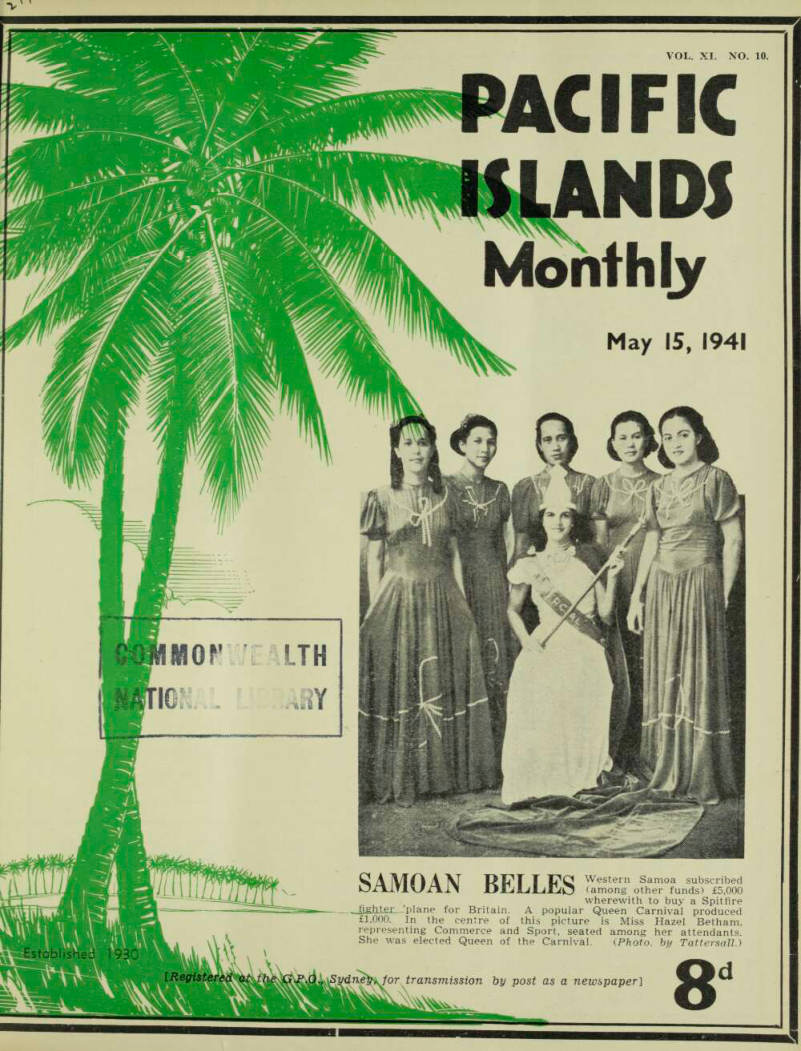
SAMOAN BELLES Western Samoa subscribed (among other funds) £5,000 wherewith to buy a Spitfire fighter 'plane for Britain. A popular Queen Carnival produced £1,000. In the centre of this picture is Miss Hazel Betham, representing Commerce and Sport, seated among her attendants.
She was elected Queen of the Carnival. (Photo, by Tattersall.)
Advertisements & other items, p. 2 (1 item)
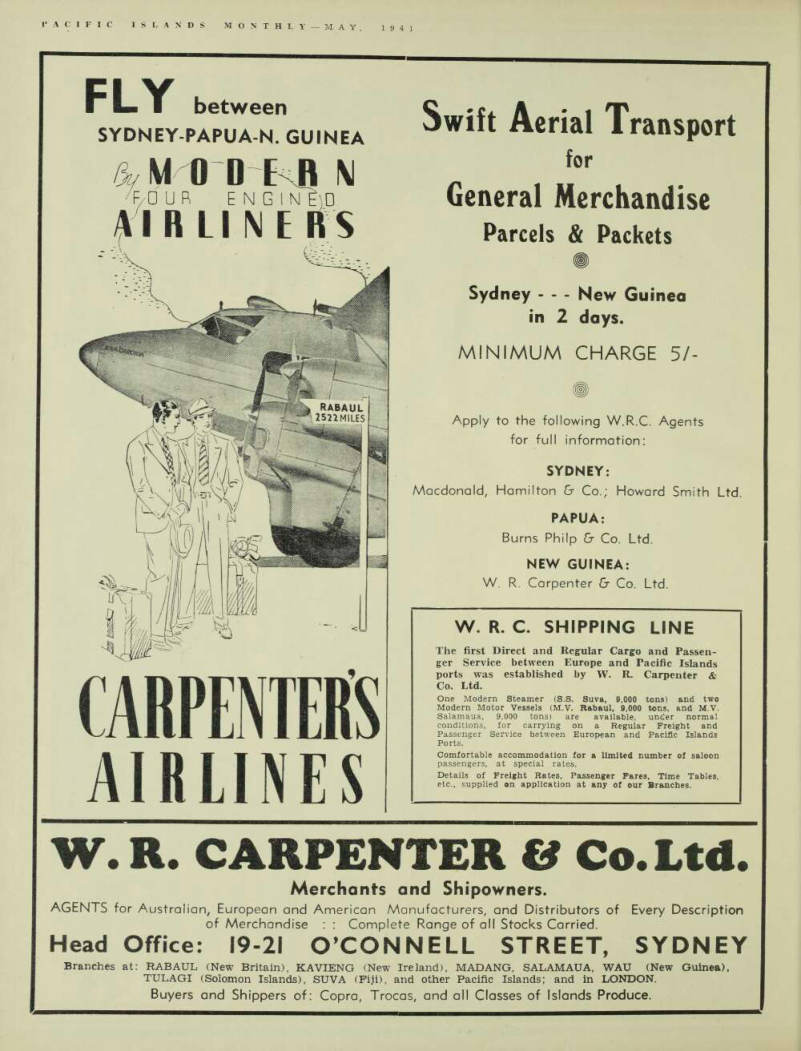
Carpenters
FLY between
SYDNEY-PAPUA-N. GUINEA
moD r n v ' F/D UR E N G 1 NEi\D
AIRLINE BS
RABAUL
2521 MILES
CARPENTERS
AIRLINES
Swift Aerial Transport
for
General Merchandise
Parcels & Packets
Sydney - - - New Guinea in 2 days.
MINIMUM CHARGE 5/-
Apply to the following W.R.C. Agents for full information:
SYDNEY:
Macdonald, Hamilton £r Co.; Howard Smith Ltd.
PAPUA:
Burns Philp & Co. Ltd.
NEW GUINEA:
W. R. Carpenter & Co. Ltd.
W. R. C. SHIPPING LINE
The first Direct and Regular Cargo and Passenger Service between Europe and Pacific Islands ports was established by W. R. Carpenter & Co. Ltd.
One Modern Steamer (S.S. Suva, 9,000 tons) and two Modern Motor Vessels (M.V. Rabaul, 9,000 tons, and M.V.
Salamaua, 9,000 tons) are available, under normal conditions, for carrying on a Regular Freight and Passenger Service between European and Pacific Islands Ports.
Comfortable accommodation for a limited number of saloon passengers, at special rates.
Details of Freight Rates, Passenger Pares, Time Tables, etc., supplied on application at any of our Branches.
W. R. CARPENTER & Co. Ltd.
Merchants and Shipowners.
AGENTS for Australian, European and American Manufacturers, and Distributors of Every Description of Merchandise : : Complete Range of all Stocks Carried.
Head Office: 19-21 O’CONNELL STREET, SYDNEY
Branches at: RABAUL (New Britain), KAVIENG (New Ireland), MADANG, SALAMAUA, WAU (New Guinea), TULAGI (Solomon Islands), SUVA (Fiji), and other Pacific Islands; and in LONDON.
Buyers and Shippers of: Copra, Trocas, and all Classes of Islands Produce.
Pacific News-Review
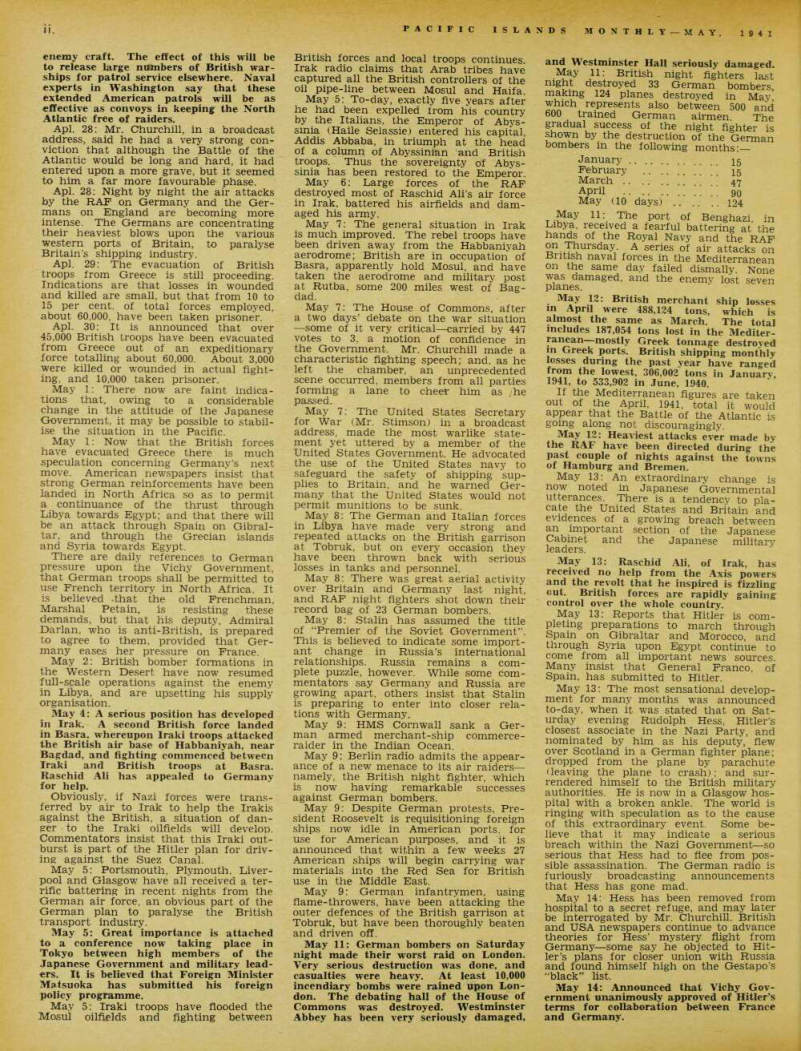
Notes And Comment On
The Progress Of The War
From April 16 To May 14
Apl 16: The Balkans situation is bad.
While Greek and British have been retiring in orderly fashion to a new line through the mountains of central Greece, the armies of Yugoslavia have collapsed, and unified and controlled resistance to the Germans has virtually ceased. The enemy is coming round the left flank of the Allied line, near Monastir, which makes probable the retirement of the Greek and Allied line in central Greece, as well as of all the Greek armies in southern Albania.
Apl. 16: Much stronger British resis tance in the Western Desert has slowed up the German advance through Libya and the Germans—obviously suffering from torrid desert conditions and the dis advantages of very long communication lines, which the RAF is constantly bomb ing—are now virtually halted on the border of western Egypt.
Apl. 16: German radio boasts that the German and Italian columns will reach Suez in a fortnight are being enthusias tically quoted by the Japanese. The arrival of enemy forces .at the Suez Canal may be the signal for Japan’s entry into the war against Britain.
Apl. 16: Only three Italian strongholds now remain in the Italian East Africa (Eritrea, Abyssinia and Somaliland) namely, Dessye, Gondar and Jimma. The remnants of the Italian forces are being steadily driven back into mountain fast nesses and the campaign in this part of Africa is close to an end.
Apl. 16: It is formally announced that as long as the American fleet remains in the Pacific the American nation will not tolerate Japanese attacks on British or Dutch territory in the Western Pacific.
Apl. 17; The German forces have pene trated the Greek defences in western Macedonia, north of the Pindus Moun tains, and thus are in danger of turning the left flank of the Allied defence lines.
Apl. 17; British forces at Tobruk and in the Solium area of Libya continue successfully to resist all attacks by the German and Italian columns.
Apl. 17; British naval forces on the night of the 15th completely destroyed an enemy convoy of five supply ships and three Italian destroyers, which was creeping under the cover of darkness from Sicily to Tripoli.
Apl. 17: An important development is announced in the shape of an agreement signed last week with the Danish Minis ter under which the United States Gov ernment will establish bases in Green land. It is understood that the United States Government will convoy ships from the United States to Greenland, and that also, during the summer, USA planes will be flpwn from the United States via Greenland and Iceland to Britain.
Apl. 18: British and Greek forces in the Pindus Mountains are gradually withdrawing to a shorter line of defence, just north of Athens. The Germans are concentrating against the retreating armies an enormous weight of mechan ised divisions, supported by hundreds of aeroplanes. The Greeks in Albania are retiring.
Apl, 19: British and American news papers are featuring numerous reports of the magnificent resistance being put up against overwhelming odds by Austra lian and New Zealand troops fighting in the various Greek passes and protect ing the withdrawal of the main armies to shorter lines.
Apl. 19: Last night powerful British bombers dropped hundreds of new type bombs on Berlin, which suffered its heaviest raid of the war.
Apl. 20; Greek and British armies have withdrawn in comparatively good order from the Pindus Mountains to a new line, northwards of Athens.
Apl. 20: Strong British forces have arrived at Basra, the port of Irak, in order to protect British interests in Irak against the forces of Raschid Ali, who recently carried out a coup d’etat and established a pro-Nazi anti-British administration.
It is believed that the arrival of the British forces in Irak is a dramatic counter-stroke to Nazi plans to seize the Mosul oilfields in northern Irak.
Apl. 20; Savage air raids were made upon London on Wednesday and Satur day nights and enormous additional damage was done. The spirits of Lon doners, however, remain high and the life of the city proceeds as usual.
Apl. 21: Observers in the Far East are puzzled by the present conditions in Tokyo. It was expected that, following the return of Mr. Matsuoka from Berlin and Moscow, active preparations would begin for Japan’s long-discussed south
wards drive. But there seems to be a gradual diminution in the Japanese newspaper attacks upon Britain and America. Indications are that the Japan ese Government is very carefully review ing its whole programme in relation to foreign affairs.
In the meantime the British defences based at Singapore are being steadily strengthened and there is increasing col laboration between the naval, military and air forces of Britain and the United States in the Far East.
Apl. 21: It is generally acknowledged in London newspapers that the complete withdrawal of the British forces from Greece is likely. The British, with the Greeks at their left flank, are withdraw ing in orderly fashion, and maintaining an unbroken line, although the Germans are attacking furiously with at least 10 divisions.
Commentators now are speculating freely upon Germany’s next move. The majority expect the “pincer’s movement” —namely, that Germany will put pres sure on Spain to permit the passage of strong forces which will come south and attack Gibraltar, and cross over into Morocco, closing the western end of the
Mediterranean; while she will either invade Turkey, pass through Turkey with Turkey’s consent, or by-pass Turkey, using the Greek Islands in the Aegean Sea, and thus reach Syria, from which a strong attack will be made against Palestine, Irak and Egypt.
Apl. 22: German forces operating from eastern Macedonia have occupied the Greek islands of Samothrace and Lem nos, which command the entrance to the Dardanelles.
Apl. 22: The British navy yesterday heavily bombarded the Libyan port of Tripoli. The British garrison at Tobruk is holding out staunchly. German- Italian columns are completely held up on the western borders of Egypt.
Apl. 23: The evacuation of the British from Greece is proceeding. Terrific attacks by German aircraft on the large numbers of transports being employed are reported.
Apl. 23: Greece announces that the whole of the Greek armies on the left wing—that is, those which were in Albania—capitulated on Sunday.
This capitulation became inevitable after the Germans thrust across the peninsula in the vicinity of Janina, thus severing the Greek armies in Albania from the rest of the allied forces and exposing the British flank.
Apl. 23: The Greek Government and King have transferred from Athens to Crete.
Apl. 23: The much stronger British forces now being employed in the West ern Desert are harrying the far-flung German and Italian columns in the Libyan desert. On Saturday night. Brit ish forces raided Bardia and did much important damage.
Apl. 23: British bombers made their tenth attack upon the two German battleships “Scharnhorst” and "Gneis nau”, sheltering in the French harbour of Brest.
Apl. 23: Minister for Aircraft Produc tion (Lord Beaverbrook) says Britain has received immense deliveries of American aircraft—more than 1,000 assembled American and Canadian aeroplanes have already been handed to the RAF.
Apl. 25: The American Minister for the Navy (Colonel Knox) has strongly indi cated that the United States will convoy shipping to Britain.
Apl. 25: After one of the fiercest battles in the East African campaign, South African troops routed the Italian forces holding the mountain barricades before Dessye, Abyssinia. The Italians are now retreating rapidly.
Apl. 25: There is a growing agitation throughout Britain for more and more truthful war news, more munitions and tanks, and more anti-tank weapons and aircraft.
Apl. 27: Despite incessant attacks by overwhelming masses of German aircraft the British forces have been successfully withdrawn from Greece, in all sorts and conditions of vessels—mostly to Egypt, but some to Crete. The Germans occu pied Athens at 10 o’clock this morning.
Apl. 27; President Roosevelt announced that American neutrality control ships will operate “as far into the waters of the seven seas as may be necessary for the defence of the American hemisphere”.
Mr. Churchill has commented upon the importance of this announcement. Ameri can warships now will escort ships loaded with material for Britain about half-way across the Atlantic, and will broadcast in plain language the presence of any
enemy craft. The effect of this will be to release large numbers of British war ships for patrol service elsewhere. Naval experts in Washington say that these extended American patrols will be as effective as convoys in keeping the North Atlantic free of raiders.
Apl. 28: Mr, Churchill, in a broadcast address, said he had a very strong con viction that although the Battle of the Atlantic would be long and hard, it had entered upon a more grave, but it seemed to him a far more favourable phase.
Apl. 28; Night by night the air attacks by the RAF on Germany and the Ger mans on England are becoming more intense. The Germans are concentrating their heaviest blows upon the various western ports of Britain, to paralyse Britain’s shipping industry.
Apl. 29: The evacuation of British troops from Greece is still proceeding.
Indications are that losses in wounded and killed are small, but that from 10 to 15 per cent, of total forces employed, about 60,000, have been taken prisoner.
Apl. 30: It is announced that over 45,000 British troops have been evacuated from Greece out of an expeditionary force totalling about 60,000. About 3,000 were killed or wounded in actual fight ing. and 10,000 taken prisoner.
May 1: There now are faint indica tions that, owing to a considerable change in the attitude of the Japanese Government, it may be possible to stabil ise the situation in the Pacific.
May 1: Now that the British forces have evacuated Greece there is much speculation concerning Germany’s next move. American newspapers insist that strong German reinforcements have been landed in North Africa so as to permit a continuance of the thrust through Libya towards Egypt; and that there will be an attack through Spain on Gibral tar, and through the Grecian islands and Syria towards Egypt.
There are daily references to German pressure upon the Vichy Government, that German troops shall be permitted to use French territory in North Africa. It is believed .that the old Frenchman, Marshal Retain, is resisting these demands, but that his deputy, Admiral Darlan, who is anti-British, is prepared to agree to them, provided that Ger many eases her pressure on France.
May 2: British bomber formations in the Western Desert have now resumed full-scale operations against the enemy in Libya, and are upsetting his supply organisation.
May 4: A serious position has developed in Irak. A second British force landed in Basra, whereupon Iraki troops attacked the British air base of Habbaniyah, near Bagdad, and fighting commenced between Iraki and British troops at Basra.
Raschid Ali has appealed to Germany for help.
Obviously, if Nazi forces were trans ferred by air to Irak to help the Irakis against the British, a situation of dan ger to the Iraki oilfields will develop.
Commentators insist that this Iraki out burst is part of the Hitler plan for driv ing against the Suez Canal.
May 5: Portsmouth, Plymouth, Liver pool and Glasgow have all received a ter rific battering in recent nights from the German air force, an obvious part of the German plan to paralyse the British transport industry.
May 5: Great importance is attached to a conference now taking place in Tokyo between high members of the Japanese Government and military lead ers. It is believed that Foreign Minister Mafsuoka has submitted his foreign policy programme.
May 5: Iraki troops have flooded the Mosul oilfields and fighting between
British forces and local troops continues.
Irak radio claims that Arab tribes have captured all the British controllers of the oil pipe-line between Mosul and Haifa.
May 5: To-day, exactly five years after he had been expelled from his country by the Italians, the Emperor of Abys sinia (Haile Selassie) entered his capital, Addis Abbaba, in triumph at the head of a column of Abyssinian and British troops. Thus the sovereignty of Abys sinia has been restored to the Emperor.
May 6: Large forces of the RAF destroyed most of Raschid Ali’s air force in Irak, battered his airfields and dam aged his army.
May 7: The general situation in Irak is much improved. The rebel troops have been driven away from the Habbaniyah aerodrome; British are in occupation of Basra, apparently hold Mosul, and have taken the aerodrome and military post at Rutba, some 200 miles west of Bag dad.
May 7: The House of Commons, after a two days’ debate on the war situation —some of it very critical—carried by 447 votes to 3, a motion of confidence in the Government. Mr. Churchill made a characteristic fighting speech; and. as he left the chamber, an unprecedented scene occurred, members from all parties forming a lane to cheer him as ,he passed.
May 7: The United States Secretary for War (Mr. Stimson) in a broadcast address, made the most warlike state ment yet uttered by a member of the United States Government. He advocated the use of the United States navy to safeguard the safety of shipping sup plies to Britain, and he warned Ger many that the United States would not permit munitions to be sunk.
May 8: The German and Italian forces in Libya have made very strong and repeated attacks on the British garrison at Tobruk, but on every occasion they have been thrown back with serious losses in tanks and personnel.
May 8; There was great aerial activity over Britain and Germany last night, and RAF night fighters shot down their record bag of 23 German bombers.
May 8: Stalin has assumed the title of “Premier of the Soviet Government”.
This is believed to indicate some import ant change in Russia’s international relationships. Russia remains a com plete puzzle, however. While some com mentators say Germany and Russia are growing apart, others insist that Stalin is preparing to enter into closer rela tions with Germany.
May 9: HMS Cornwall sank a Ger man armed merchant-ship commerce raider in the Indian Ocean.
May 9: Berlin radio admits the appear ance of a new menace to its air raiders— namely, the British night fighter, which is now having remarkable successes against German bombers.
May 9: Despite German protests, Pre sident Roosevelt is requisitioning foreign ships now idle in American ports, for use for American purposes, and it is announced that within a few weeks 27 American ships will begin carrying war materials into the Red Sea for British use in the Middle East.
May 9: German infantrymen, using flame-throwers, have been attacking the outer defences of the British garrison at Tobruk, but have been thoroughly beaten and driven off.
May 11: German bombers on Saturday night made their worst raid on London.
Very serious destruction was done, and casualties were heavy. At least 10,000 incendiary bombs were rained upon Lon don. The debating hall of the House of Commons was destroyed. Westminster Abbey has been very seriously damaged,
and Westminster Hall seriously damaged.
May 11: British night fighters last night destroyed 33 German bombers, making 124 planes destroyed in Mav which represents also between 500 and 600 trained German airmen The gradual success of the night fighter is shown by the destruction of the German bombers in the following months; January 15 February ’*' 15 March 47 April ;; 90 May (10 days) 124 May 11: The port of Benghazi, in Libya, received a fearful battering at the hands of the Royal Navy and the RAF on Thursday A series of air attacks on British naval forces in the Mediterranean on the same day failed dismally. None was damaged, and the enemy lost seven planes. . May 12: British merchant ship losses m April were 488,124 tons, which is almost the same as March. The total includes 187,054 tons lost in the Mediter ranean mostly Greek tonnage destroyed in Greek ports. British shipping monthly losses during the past year have ranged from the lowest. 306,002 tons in January, 1941, to 533,902 in June, 1940.
If the Mediterranean figures are taken out of the April, 1941. total it would appear that the Battle of the Atlantic is going along not discouragingly.
May 12: Heaviest attacks ever made by the RAF have been directed during the past couple of nights against the towns of Hamburg and Bremen.
May 13: An extraordinary change is now noted in Japanese Governmental utterances. There is a tendency to pla cate the United States and Britain and evidences of a growing breach between an important section of the Japanese Cabinet and the Japanese military leaders.
May 13: Raschid Ali, of Irak, has received no help from the Axis powers and the revolt that he inspired is fizzling cut. British forces are rapidly gaining control over the whole country.
May 13: Reports that Hitler is com pleting preparations to march through Spain on Gibraltar and Morocco, and through Syria upon Egypt continue to come from all important news sources.
Many insist that General Franco, of Spain, has submitted to Hitler.
May 13: The most sensational develop ment for many months was announced to-day, when it was stated that on Sat urday evening Rudolph Hess, Hitler's closest associate in the Nazi Party, and nominated by him as his deputy, flew over Scotland in a German fighter plane; dropped from the plane by parachute (leaving the plane to crash); and sur rendered himself to the British military authorities. He is now in a Glasgow hos pital with a broken ankle. The world is ringing with speculation as to the cause of this extraordinary event. Some be lieve that it may indicate a serious breach within the Nazi Government—so serious that Hess had to flee from pos sible assassination. The German radio is furiously broadcasting announcements that Hess has gone mad.
May 14: Hess has been removed from hospital to a secret refuge, and may later be interrogated by Mr. Churchill. British and USA newspapers continue to advance theories for Hess’ mystery flight from Germany—some say he objected to Hit ler’s plans for closer union with Russia and found himself high on the Gestapo's “black” list.
May 14: Announced that Vichy Gov ernment unanimously approved of Hitler’s terms for collaboration between France and Germany.
Baffle of fhe Aflanfic
THE following are the amended monthly totals of British, Allied, friendly, and neutral shipping losses since April of 1940. They really and actually show the progress of the battle of the Atlantic:—
Month.
May June July Tonnage. . .. 248,650 . . . 533,902 . . . 405,853 August . . . 387.471 September . . . 435,553 October . . . 423.616 November . . . 368,806 December . . . 313,197 January . .. 306,002 February . . . 334,004 March . . . 489,229 April* . . . 488,124 Total for 12 months . . . . 4.734,407 * Includes total (128.000 tons) of ships lost when evacuating British troops from Greece.
Pacific Islands Travellers
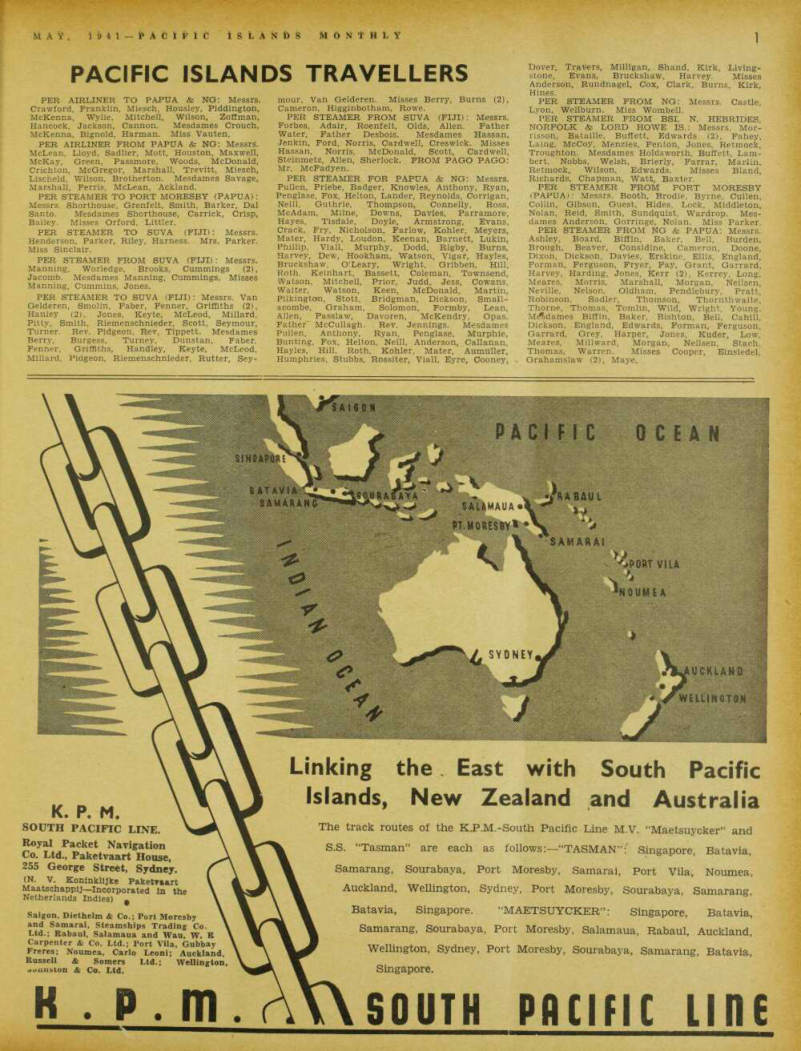
PER AIRLINER TO PAPUA & NG: Messrs.
Crawford, Franklin, Miesch, Housley, Piddington, McKenna, Wylie, Mitchell, Wilson, Zoffman, Hancock. Jackson, Cannon. Mesdames Crouch, McKenna, Bignold, Harman. Miss Vauten.
PER AIRLINER FROM PAPUA & NG: Messrs.
McLean, Lloyd, Sadlier, Mott, Houston, Maxwell, McKay, Green, Passmore, Woods, McDonald, Crichton, McGregor, Marshall, Trevitt, Miesch, Lischeld, Wilson, Brotherton. Mesdames Savage, Marshall, Ferris, McLean, Ackland.
Per Steamer To Port Moresby (Papua):
Messrs. Shorthouse, Grenfelt, Smith, Barker, Dal Santo. Mesdames Shorthouse, Garrick, Crisp, Bailey. Misses Orford, Littler.
Per Steamer To Suva (Fiji): Messrs.
Henderson, Parker, Riley, Harness. Mrs. Parker.
Miss Sinclair.
Per Steamer From Suva (Fiji): Messrs.
Manning, Worledge, Brooks, Cummings (2), Jacomb. Mesdames Manning, Cummings. Misses Manning, Cummins, Jones.
PER STEAMER TO SUVA (FIJI): Messrs. Van Gelderen, Smolin, Faber, Fenner, Griffiths (2), Hanley (2), Jones, Keyte, McLeod, Millard, Pitty, Smith, Riemenschnieder, Scott, Seymour, Turner. Rev. Pidgeon, Rev, Tippett. Mesdames Berry, Burgess, Turney, Dunstan, Faber, Fenner, Griffiths, Handley, Keyte, McLeod, Millard, Pidgeon, Riemenschnieder, Rutter, Sey
mour, Van Gelderen. Misses Berry, Burns (2), Cameron, Higginbotham, Rowe.
Per Steamer From Suva (Fiji): Messrs.
Forbes, Adair, Roenfelt, Olds, Allen. Father Water, Father Desbois. Mesdames Hassan, Jenkin, Ford, Norris, Cardwell, Creswick. Misses Hassan, Norris, McDonald, Scott, Cardwell, Steinmetz, Allen, Sherlock. FROM PAGO PAGO: Mr. McFadyen.
PER STEAMER FOR PAPUA & NG: Messrs.
Pullen, Priebe, Badger, Knowles, Anthony, Ryan, Penglase, Fox, Helton, Lander, Reynolds, Corrigan, Neill, Guthrie, Thompson, Connelly, Ross, McAdam, Milne, Downs, Davies, Parramore, Hayes, Tisdale, Doyle, Armstrong, Evans, Crack, Fry, Nicholson, Farlow, Kohler, Meyers, Mater, Hardy, Loudon, Keenan, Barnett, Lukin, Phillip, Viall, Murphy, Dodd, Rigby, Burns, Harvey, Dew, Hookham, Watson, Vigar, Hayles, Bruckshaw, O’Leary, Wright, Gribben, Hill, Roth, Keinhart, Bassett, Coleman, Townsend, Watson, Mitchell, Prior, Judd, Jess, Cowans, Waiter, Watson, Keen, McDonald, Martin, Pilkington, Stott, Bridgman, Dickson, Sma.il acombe, Graham, Solomon, Formby, Lean, Allen, Passlaw, Davoren, McKendry, Opas.
Father McCullagh. Rev. Jennings. Mesdames Pullen, Anthony, Ryan, Penglase, Murphie, Bunting, Fox, Helton, Neill, Anderson, Callanan, Hayles, Hill. Roth, Kohler, Mater, Aumuller, Humphries, Stubbs, Rossiter, Viall, Eyre, Cooney,
Dover, Travers, Milligan, Shand, Kirk, Living stone, Evans, Bruckshaw, Harvey. Misses Anderson, Rundnagel, Cox, Clark, Burns, Kirk, Hines.
PER STEAMER FROM NG: Messrs. Castle, Lyon, Wellburn. Miss Wombell.
Per Steamer From Bsi, N. Hebrides,
NORFOLK & LORD HOWE IS.: Messrs. Mor risson, Bataille, Buffett, Edwards (2)., Fahey, Laing, McCoy, Menzies, Fenton, Jones, Retmock, Troughton. Mesdames Holdsworth, Buffett, Lam bert, Nobbs, Welsh, Brierly, Farrar, Marlin, Retmock, Wilson, Edwards. Misses Bland, Richards, Chapman, Watt, Baxter.
Per Steamer From Port Moresby
(PAPUA): Messrs. Booth, Brodie, Byrne, Cullen, Collin, Gibson, Guest, Hides, Lock, Middleton, Nolan, Reid, Smith, Sundquist, Wardrop. Mes dames Anderson, Gorringe, Nolan. Miss Parker.
PER STEAMER FROM NG & PAPUA: Messrs.
Ashley, Board, Biffin, Baker, Bell, Burden, Brough, Beaver, Considine, Cameron, Doone, Dixon, Dickson, Davies, Erskine, Ellis, England, Forman, Ferguson, Fryer, Fay, Grant, Garrard, Harvey, Harding, Jones, Kerr (2), Kerrey, Long, Meares, Morris, Marshall, Morgan, Neilsen, Neville, Nelson, Oldham, Pendlebury, Pratt, Robinson. Sadler, Thomson, Thornthwaite, Thorne, Thomas, Tomlin, Wild, Wright, Young.
MdSdames Biffin, Baker, Bishton, Bell, Cahill, Dickson. England, Edwards, Forman, Ferguson, Garrard, Grey, Harper, Jones, Kuder, Low, Meares, Millward, Morgan, Neilsen, Stach, Thomas, Warren. Misses Cooper, Einsiedel, Grahamslaw (2), Maye.
Advertisements & other items, p. 5 (2 items)
1
may, i94i nctFic Islands monthly
South Pacific Line
refill S!
■ass,
/■ 'f< I. ,2 ■ ■ -'■ ;
m R I
"i . :; ;;Pite :i mMM
MMk
p. m AI N
A BAUI
MALI A
\ J
* SAMARA!
V
’OpORT VILA
*NOU«IA
SYDNEY
.TLAUCKU
WEIUHBT
<f> / .r
K. P. M.
SOUTH PACIFIC LINE
Royal Packet Navigation Co. Ltd., Paketvaart House, 255 George Street, Sydney. (N. V. Konlnklljke Paketraart Maatschapplj—incorporated In the Netherlands Indies) Saigon, Diethelm & Co.; Port Moresby and Samarai, Steamships Trading Co.
Ltd.; Rabaul, Salamaua and Wan, W. R Carpenter & Co. Ltd.; Port Vila, Gubbay Freres; Noumea, Carlo Leoni; Auckland, Russell & Somers Ltd.; Wellington, ouiiuston & Co. Ltd.
K '
Linking the East with South Pacific
islands, New Zealand and Australia
The track routes of the K.P.M.-South Pacific Line M.V. “Maetsuycker” and S.S. “Tasman” are each as follows:—“TASMAN”; Singapore, Batavia, Samarang, Sourabaya, Port Moresby, Samarai, Port Vila, Noumea, Auckland, Wellington, Sydney, Port Moresby, Sourabaya, Samarang, Batavia, Singapore. “MAETSUYCKER”: Singapore, Batavia, Samarang, Sourabaya, Port Moresby, Salamaua, Rabaul, Auckland, Wellington, Sydney, Port Moresby, Sourabaya, Samarang, Batavia, Singapore.
SOUTH PACIFIC Line
Advertisers
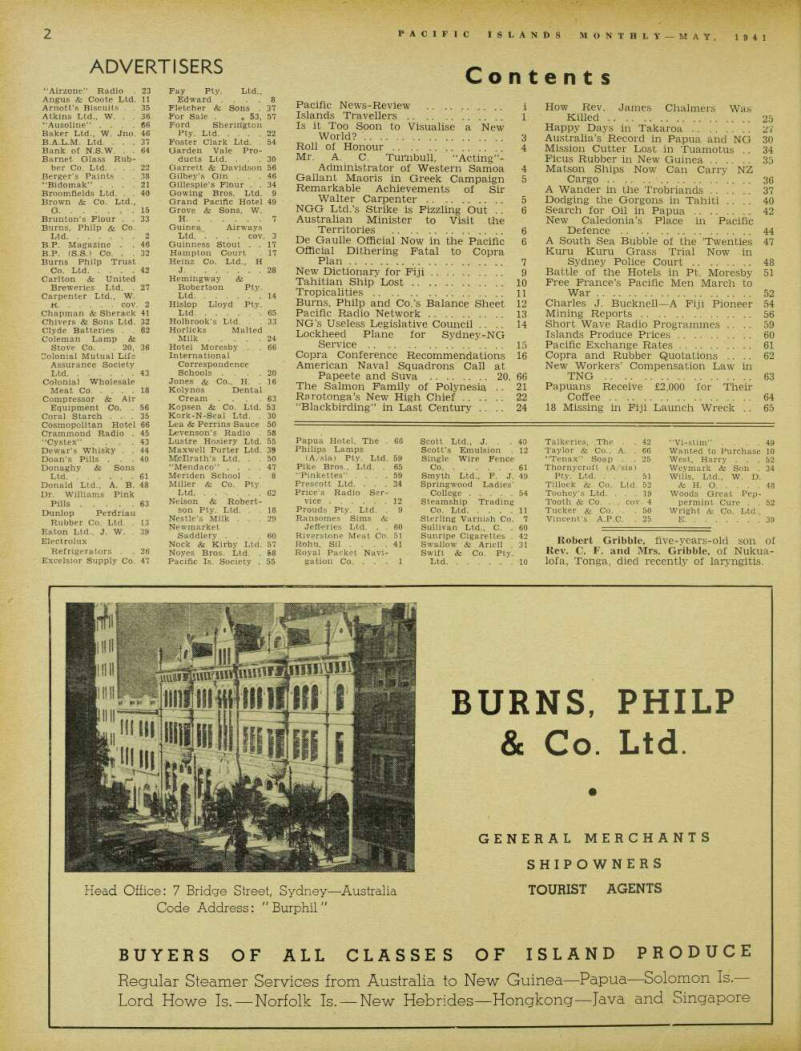
“Airzone” Radio . 23 Angus & Coote Ltd. 11 Arnott’s Biscuits . . 35 Atkins Ltd., W. . .36 “Ausoline” ... 66 Baker Ltd., W. Jno. 46
B.A.L.M. Ltd. ... 37
Bank of N.S.W. . . 64 Barnet Glass Rub ber Co. Ltd. ... 22 Berger’s Paints . . 38 “Bidomak” ... 21 Broomfields Ltd. . . 40 Brown & Co. Ltd., G 15 Brunton’s Flour . . 33 Burns, Philp & Co.
Ltd 2 B.P. Magazine . . 46
B.P. (S.S.) Co. . . 32
Burns Philp Trust Co. Ltd 42 Carlton & United Breweries Ltd. . 27 Carpenter Ltd., W.
K cov. 2 Chapman & Sherack 41 Chivers & Sons Ltd. 32 Clyde Batteries . . 62 Coleman Lamp & Stove Co. . . 20, 36 Colonial Mutual Life Assurance Society Ltd 43 Colonial Wholesale Meat Co 18 Compressor & Air Equipment Co. . 56 Coral Starch ... 35 Cosmopolitan Hotel 66 Crammond Radio . 45 “Cystex” ... 43 Dewar’s Whisky . . 44 Doan’s Pills ... 40 Donaghy & Sons Ltd 61 Donald Ltd., A. B. 48 Dr. Williams Pink Pills 63 Dunlop Perdriau Rubber Co. Ltd. . 13 Eaton Ltd., J. W. . 39 Electrolux Refrigerators . . 26 Excelsior Supply Co. 47
Fay Pty. Ltd., Edward ... 8 Fletcher & Sons . 37 For Sale . . 53, 57 Ford Sherington Pty. Ltd 22 Foster Clark Ltd. . 54 Garden Vale Pro ducts Ltd. ... 30 Garrett & Davidson 56 Gilbey’s Gin ... 46 Gillespie’s Flour . . 34 Gowing Bros. Ltd. 9 Grand Pacific Hotel 49 Grove & Sons, W.
H 7 Guinea Airways Ltd cov. 3 Guinness Stout . . 17 Hampton Court . 17 Heinz Co. Ltd., H J 28 Hemingway & Robertson Pty.
Ltd 14 Hislop Lloyd Pty.
Ltd 65 Holbrook’s Ltd. . . 33 Horlicks Malted Milk 24 Hotel Moresby . . 66 International Correspondence Schools ... 20 Jones & Co., H. . 16 Kolynos Dental Cream ... 63 Kopsen & Co. Ltd. 53 Kork-N-Seal Ltd. . 30 Lea & Perrins Sauce 50 Levenson’s Radio . 58 Lustre Hosiery Ltd. 55 Maxwell Porter Ltd. 39 Mjcllrath’s Ltd. . . 50 “Mendaco” ... 47 Meriden School . . 8 Miller & Co. Pty, Ltd 62 Nelson & Robert son Pty. Ltd. . . 18 Nestle’s Milk ... 29 Newmarket Saddlery ... 60 Nock & Kirby Ltd. 57 Noyes Bros. Ltd. . 68 Pacific Is. Society . 55
Papua Hotel, The . 66 Philips Lamps (A/sia( Pty. Ltd. 59 Pike Bros., Ltd. . 65 “Pinkettes” ... 59 Prescott Ltd. ... 34 Price’s Radio Ser vice 12 Prouds Pty. Ltd. . 9 Ransomes Sims & Jefferies Ltd. . . 60 Riverstone Meat Co. 51 Rohu, Sil . . .41 Royal Packet Navi gation Co. . . . 1
Scott Ltd., J. . .40 Scott’s Emulsion , 12 Single Wire Fence Co 61 Smyth Ltd., F. J. 49 Springwood Ladies’
College 54 Steamship Trading Co. Ltd 11 Sterling Varnish Co. 7 Sullivan Ltd., C. . 60 Sunripe Cigarettes . 42 Swallow & Ariell . 31 Swift & Co. Pty.
Ltd 10
Talkeries, The . . 42 Taylor & Co., A. . 66 “Tenax” Soap . . 25 Thornycroft (A/sia) Pty. Ltd 51 Tillock & Co. Ltd. 52 Toohey’s Ltd. ... 19 Tooth & Co. . . cov. 4 Tucker & Co. . . 50 Vincent s A.P.C. . 25
“Vi-stim” ... 49 Wanted to Purchase 10 West, Harry ... 52 Weymark & Son . 34 Wills, Ltd., W. D. & H. 0 48 Woods Great Pep permint Cure . . 52 Wright & Co. Ltd., E 39
Robert Gribble, five-years-old son of Rev. C. F. and Mrs. Gribble, of Nukua lofa, Tonga, died recently of laryngitis.
contents
Pacific News-Review i Islands Travellers i Is it Too Soon to Visualise a New World? 3 Roll of Honour 4 Mr. A. C. Tuitnbull, “Acting”- Administrator of Western Samoa 4 Gallant Maoris in Greek Campaign 5 Remarkable Achievements of Sir Walter Carpenter 5 NGG Ltd.’s Strike is Fizzling Out .. 6 Australian Minister to Visit the Territories 6 De Gaulle Official Now in the Pacific 6 Official Dithering Fatal to Copra Plan 7 New Dictionary for Fiji 9 Tahitian Ship Lost 10 Tropicalities 11 Burns, Philp and Co.’s Balance Sheet 12 Pacific Radio Network 13 NG’s Useless Legislative Council ... 14 Lockheed Plane for Sydney-NG Service 15 Copra Conference Recommendations 16 American Naval Squadrons Call at Papeete and Suva 20, 66 The Salmon Family of Polynesia .. 21 Rarotonga’s New High Chief 22 “Blackbirding” in Last Century ... 24
How Rev. James Chalmers Was Killed 25 Happy Days in Takaroa 27 Australia’s Record in Papua and NG 30 Mission Cutter Lost in Tuamotus .. 34 Ficus Rubber in New Guinea 35 Matson Ships Now Can Carry NZ Cargo 36 A Wander in the Trobriands 37 Dodging the Gorgons in Tahiti ... 40 Search for Oil in Papua 42 New Caledonia’s Place in Pacific Defence 44 A South Sea Bubble of the ’Twenties 47 Kuru Kuru Grass Trial Now in Sydney Police Court 48 Battle of the Hotels in Pt. Moresby 51 Free France’s Pacific Men March to War 52 Charles J. Bucknell —A Fiji Pioneer 54 Mining Reports 56 Short Wave Radio Programmes ... 59 Islands Produce Prices 60 Pacific Exchange Rates 61 Copra and Rubber Quotations ... 62 New Workers’ Compensation Law in
Tng 63
Papuans Receive £2,000 for Their Coffee 64 18 Missing in Fiji Launch Wreck .. 65
Advertisements & other items, p. 6 (1 item)
Burns, Philp
Si m it Hill mm .1 111
III)
Hi] 11(1“^: mm II Head Office: 7 Bridge Street, Sydney—Australia Code Address: " Burphil "
BURNS, PHILP
& Co. Ltd.
GENERAL MERCHANTS
SHIPOWNERS
TOURIST AGENTS
BUYERS OF ALL CLASSES OF ISLAND PRODUCE Regular Steamer Services from Australia to New Guinea —Papua—Solomon Is- Lord Howe Is.—Norfolk Is. New Hebrides —Hongkong—Java and Singapore
Pacific Islands Monthly
The Newspaper-Alagazine of the South Seas IRegistered at the G.P.O. y Sydney, for transmission by post as a newspaper .]
Published Once Each Month and Circulated in Australia and New Zealand and in the following Pacific Territories and Islands Groups:
Australian Territory of Papua.
Mandated Territory (Australia) of New Guinea, Bismarck Archipelago and Northern Solomon Islands.
Australian Territory of Norfolk Island.
New Zealand Territory of Cook Islands.
Mandated Territory (New Zealand) of Samoa.
British Colony of Fiji.
British Solomon Islands Protectorate.
British Protectorate of Tongan Islands.
British Crown Colony of Gilbert and Ellice Islands.
Mandated Territory of Nauru.
British and French Condominium of New Hebrides.
French Colony of New Caledonia.
French Colony of Oceania (Tahiti, etc.).
American Territory of Eastern Samoa.
American Territory of Hawaiian Islands.
American Territory of Guam.
Mandated Territory (Japan) of Marshall, Caroline and Mariana Islands.
Owned and Produced by Pacific Publications Pty. Ltd., Union House, 247 George Street, Sydney.
TFT fpwonf f Managing Director .. BW 5037 t Business and Editorial MA 7101
P.O. Box 3408 R
Registered Address of Telegrams, Radiograms, and Cables: “Pacpub”, Sydney.
Contributions.
Articles, Stories, and Photographs dealing with Pacific Islands subjects are invited and will be paid for on publication.
Subscription Rates.
Per Annum, within British Empire, Prepaid, Post Free 8/- Per Annum, elsewhere, prepaid, Post Free . 10/- Single Copies 8d
Editor and Publisher:
R. W, Robson, F.R.G.S.
Assisted by Selwyn Hughes.
Advertising Manager: L. W. Bailey.
Advertising Office and Printing-House: 29 Alberta Street, Sydney.
Advertising rates furnished on application.
Colours, etc,, by Arrangement.
Process Blocks made at Advertiser’s expense when required. Screen 100.
Changes of Advertising Copy should reach this Office by Ist of each month, otherwise previous advertisement may be repeated.
IN LONDON, the Pacific Islands Monthly Is on sale at the Bookstall, Australia House, The Strand, London.
Agents.
The following are authorised to receive sub scriptions for the Pacific Islands Monthly:— Islands Branches of Burns, Phllp & Co., Ltd., and Burns Phllp (South Sea) Co., Ltd.
Islands Branches of W. R. Carpenter & Co., Ltd.
Islands Branches of Morris, Hedstrom, Ltd.
T. A. Olsson, Wau, New Guinea.
G. Thomas & Co., Rabaul, New Guinea.
Whitten Bros., Ltd., Samaral, Papua.
Steamships Trading Co., Papua. All Branches.
B.N.G. Trading Co., Ltd., Port Moresby, Papua.
J. Muir, Suva, Fiji.
Kirpal and Co., Victoria Parade, Suva, Fiji.
N. C. Mackenzie-Hunt, Walnunu, Bua, Fiji.
Islands Branches and Representatives of W. H.
Grove & Sons, Ltd., Auckland, New Zealand.
Cook Islands Trading Co., Rarotonga, Cook Is.
A. C. Rowland, Papeete, Tahiti.
Representative in London: W. C. HARVEY, Coronation House, 4 Lloyds Avenue, London, E.C.3, from whom may be obtained copies of Pacific Islands Monthly, Pacific Islands Year Book, advertising schedules, etc.
Voi. XI. NO. io.
May 15, 1941
Prirp f Bd ‘ Per Copy rilCc ( Prepaid: 8 - p.a.
Is it Too Soon to Visualise a New World?
IN these days, when our ears seem to be filled with the dismal clamour of the prophets of gloom, it is profitable and encouraging to turn and calmly assess the probabilities of the future, and try to imagine conditions in the South Pacific Territories as they are likely to be after the war.
Great Britain and the United States inevitably will come together in some sort of protective union, designed perhaps to police civilisation against Hitlerism and similar monstrosities; and, unless something quite unforeseen and absolutely unpredictable occurs, the new world will be planned in accordance with the wishes and democratic viewpoints of the Anglo- American Alliance. That may be taken as certain. What will it mean in relation to the future of the Pacific territories?
Our daily lives, in this still obscure future, will be shaped and controlled by our international relationshipsand these, in turn, will be fixed by the post-war international settlement The latter must bring far-reaching changes into the Pacific. Factors which must be provided for if there is to be anything like a prospect of permanent peace, include the domination by American interests of Pneifir other tr countri e es Un h' e h 68 th* other countries which adhere to the Anglo-American Alliance; and a re-
alignment of Pacific conditions in relation to Japan, There can be no possibility of future peace in the Pacific while Japan remains as she is to-day—an overcrowded, economically-harassed nation, in the grip of one-eyed mill tarists. As a prelude to a permanent peace, Japan must either be smashed t 0 Pieces, so that she may work no further harm to her neighbours, or i ier clamant national needs in terri tory anci markets must be provided for - If wise statesmanship rules the post-war settlement of world affairs — as we believe it will—all of Japan’s legitimate needs will be provided for, 80 that there may be no further ex cuse for aggressiveness by her sabre rattling Fascists, There can be no future for the Japanese Empire, except in peaceful, sincere collaboration with the other S reat Pacific Powers (USA and Britain); and at last there are in oications that Japan is beginning to rea lB e this. There have been appar pntly important changes of policy in the last fortnight, TM m A . ... , T NTO thls post-war settlement there * intrude considerations affecting ™e S utch ; East IndiPB and the South P a cific colonies of France. We may win be. i?i U f the rich preserve of powerful Dutch interests—but the position of the
French colonies is different. Day by day, we see evidence of France’s deterioration in the spectacle of the Vichy Government surrendering more and more to Nazi control. If the French Empire is to be restored, there must be a clear re-awakening of the soul of France, made manifest in a vast political purge, in which most offensive parasitical growths must be removed from the political and economic structure of the republic.
Even assuming a clear-cut victory for the Allies, the future of France is most obscure. Britain and the United States are kindly disposed towards that clean and vigorous cross-section of France that is represented in the French Empire—but, probably, they entertain little hope of restoring that larger France which surrendered it self so pitifully to the Nazis.
Therefore, the future of New Cale donia, Tahiti and French Oceania definitely must await developments which, at the moment, cannot be foreseen. Neither Britain nor the United States want more territories— on the contrary, public opinion in both nations is emphatically against territorial aggrandisement but it would not be surprising if those South Pacific French colonies eventually found a place under the protection of the Anglo-American Alliance.
THE new world will be a world in which will be undertaken far reaching economic experiments of a most delicate character, with the ob ject of controlling capital and dis ciplining money-power. The world
probably will try to preserve the democratic system, while freeing it irom the control of monopolistic financial and commercial interests (a control wmch is exercised tnrougn party organisations and which has virtually ruined democracy), and we shall try to retain, also, tne freedom of private enterprise, which is the oasis of the system of industry and commerce evolved in a thousand years of Western European progress.
It is conceivable that capitalists and capital, fleeing from the whips and shackles which public opinion in the bigger countries is preparing for them, will seek sanctuary in the Pacific territories, and that in these territories in future there will be found far greater opportunities in industry and commerce than ever have been dreamed of in the past.
Already, we see something of this in the fact that many companies and individuals, trying to escape from the oppressive taxation of bigger coun tries, have become domiciled in the various Pacific Islands towns, where taxation of individuals is as yet very light.
AND what of future industries in the South Pacific? What of copra? The consensus of opinion, among the shrewdest judges of Pacific trade and industry, is that there is a good future for coconut planting, because, as soon as the war is over, and the international trade restrictions of the past couple of decades are removed, the world will demand and consume increasing quantities of this most palatable and cneapiy-produced vegetable oil. Copra will not (unless temporarily) go to “fancy” prices—it now has too many competitors to permit a return of the halcyon days of 1921-24—but every thing indicates that it should settle down to a good, steady, dependable market.
Upon the shape of the post-war economic world depends whether international combines like Unilever Limited will be permitted to batten upon the disunited and therefore de fenceless copra-producers. It is be lieved by many that a return to a peaceful world is not possible if the financial and commercial mono polists and combines are to be allowed to carry on their rackets unchecked, as they did for two decades prior to 1939. If the ordinary man is to have his liberties restored, such mon strosities as the Unilever Combine and the transport combines will not be tolerated, and coconut planters will be able to reap the fair reward of their enterprise and industry.
But much reform, and long periods of struggle, probably will be needed before such conditions are estab lished. It is much more likely that the present generation of planters will have to fight, as before, for the right even to live. Therefore, they should consider carefully every means at their disposal which will permit them to organise and take united action to protect their common in terests. As they are now, they are the helpless victims of every profiteer in Christendom. If they would get together, they at least could (a) make
stronger representations to the Gov ernments, and (b) defend themselves better against organisations which keep copra rates down to the basic wage.
Roll Of Honour
(It is hoped to assemble, here, the names or men, former residents of the Pacific Territories, which appear in British and French casualty lists, or in lists of honours awarded. We should be grateful if relations and friends would send us details.) Killed in Action A/Bdr. N. W. Bertwistle, NGXS3, artil lery, of Rabaul, New Guinea. Killed in action, April, 1941.
Died from Wounds
Sergeant-Pilot Peter Clarkson Wise, son of Mr. W. Wise, OBE, Director of Public Works in Fiji. Wounded by anti aircraft gunfire during bomber raid over Germany, January, 1941. Returned with crew safely to aerodrome, died two days later.
Died from Illness
Pte. Clarence A. Hutton, VXB3IO, form erly of Edie Creek, New Guinea. Died from illness, April, 1941.
Missing
Flying-Officer Moresby Gofton, of the R.A.F., son of Mrs. F. S. Stewart, of Wau, New Guinea. Reported missing, 17/5/1940. Now believed killed.
Flying-Officer K. J. A. Johnstone, of the R.A.F., who was born in Suva in 1915. Reported missing, 1/5/1940. His mother was a daughter of the late Mr H. Thiele, for many years a member of the CSR Co.’s staff in Fiji.
Flight-Lieutenant G. J. I. Clarke, of the RAAF, serving overseas, formerly Assistant Flight Superintendent of Car penter Airways, New Guinea. Reported missing 25/9/1940.
L/Bdr. K. S. Sheekey, NGXSI, artillery, formerly of the Central Administration staff at Rabaul, New Guinea. Reported missing, 12/5/1941.
A/Sgt. A. A. S. Cotman, PXB, infan try, of Abau, Papua. Reported missing— believed prisoner of war, 5/5/1941.
A/Cpl. P. W. Bosgard, PX9, infantry, of Papua. Reported missing—believed pri soner of war, 5/5/41.
Pte. W. Gossner, QXIO, infantry, of Port Moresby, Papua. Reported miss ing—believed prisoner of war, 7/5/1941.
Wounded
Stanley Higgs, son of Mr. and Mrs.
Gordon Higgs, of W. R. Carpenter and Co., Ltd., well-known in New Guinea.
Member of an English Lancers regiment, wounded during evacuation from Dun kirk, May, 1940.
Private H. G. Turner, of Samarai, Eastern Papua, wounded in action in Western Desert, Egypt, January, 1941.
Cpl. R. McKerlie, of Samarai, Papua (formerly a resident for 20 years in the Solomons) wounded by bomb explosion, April, 1941. It was reported that his eyesight had been impaired.
Mr. Fred. Isom, one of the oldest members of the Melanesian Mission —he is the Mission’s printer at Hautabu, Guadalcanar Island, in the Solomons Group—has been in Australia for several months on furlough, during which period he spent a short time in Sydney Hos pital. He has now completely recovered and, with his wife, joined a BP steamer which sailed from Sydney in mid-May.
Minor Pacific Mystery
The NSW branch of the New Guinea Comforts Funds—a worthy organisation which supplies comforts for New Guinea men on active service abroad—is now holding its meetings every Thursday morning at the Feminist Club in King street, Sydney. Any New Guinea-ite, resident in Sydney, who would like to join in this good work should communi cate with the hon. secretary—Mrs. Rita J. Brinson, whose telephone number is FU 6522.
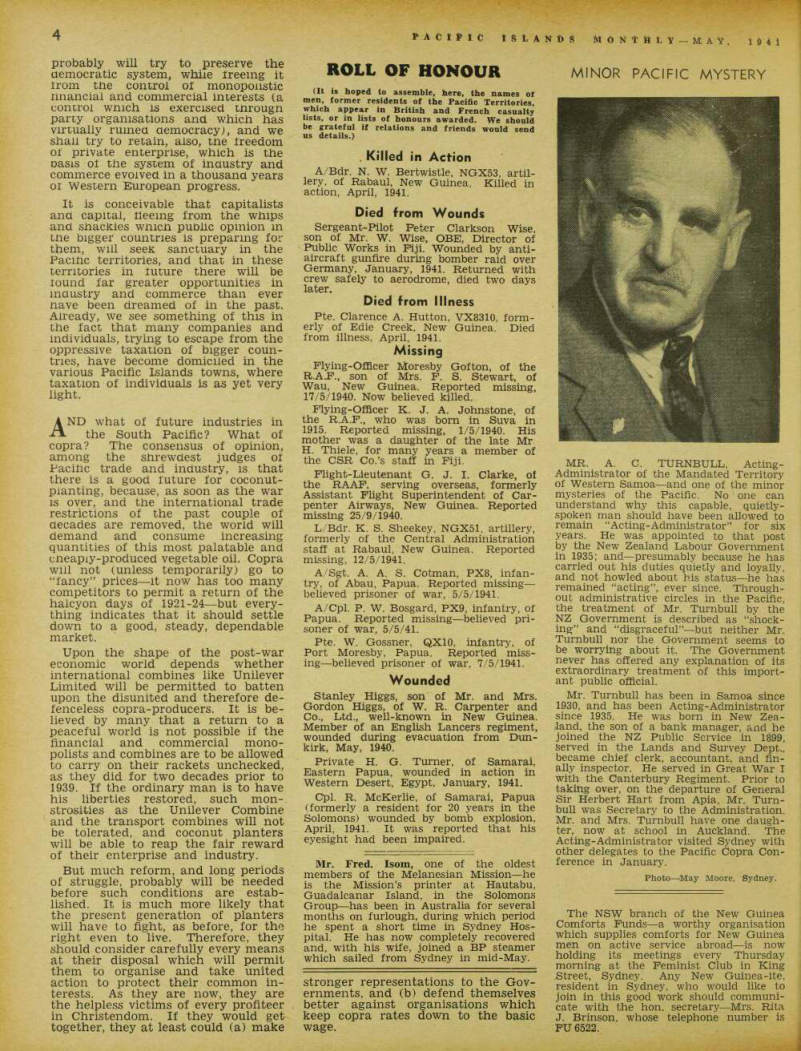
Mr. A. C. Turnbull, Acting-
Administrator of the Mandated Territory of Western Samoa—and one of the minor mysteries of the Pacific. No one can understand why this capable, quietly spoken man should have been allowed to remain “Acting-Administrator” for six years. He was appointed to that post by the New Zealand Labour Government in 1935; and —presumably because he has carried out his duties quietly and loyally, and not howled about his status—he has remained “acting”, ever since. Through out administrative circles in the Pacific, the treatment of Mr. Turnbull by the NZ Government is described as “shock ing” and “disgraceful”—but neither Mr.
Turnbull nor the Government seems to be worrying about it. The Government never has offered any explanation of its extraordinary treatment of this import ant public official.
Mr. Turnbull has been in Samoa since 1930, and has been Acting-Administrator since 1935. He was born in New Zea land, the son of a bank manager, and he joined the NZ Public Service in 1899, served in the Lands and Survey Dept., became chief clerk, accountant, and fin ally inspector. He served in Great War I with the Canterbury Regiment. Prior to taking over, on the departure of General Sir Herbert Hart from Apia, Mr. Turn bull was Secretary to the Administration.
Mr. and Mrs. Turnbull have one daugh ter, now at school in Auckland. The Acting-Administrator visited Sydney with other delegates to the Pacific Copra Con ference in January.
Photo—May Moore, Sydney.
Gallant Maoris
Win Lustre For Polynesian Nome During Greek Battles
A LARGE proportion of the young men in the Cook Islands who are eligible for military service have enlisted for service with the New Zealand Expe ditionary Force. They, of course, will be put into the Maori battalions—they speak the same language.
One of the things that will live long in the memory of those who love Poly nesia is the reaction during the past month of British and American war cor respondents to the feats of the Maori battalion in Greece.
During that heart-breaking retreat from Mount Olympus to Athens, the New Zealand Division fought a long series of violent rear-guard actions; and, in those actions, the Maori soldiers, fighting staunchly beside their European breth ren, were conspicuous for their gallantry, courage, initiative and steadiness. It was notable that again and again the cor respondents of the world’s leading news papers praised the bravery and the fine soldierly qualities of the Maori battalion.
We shall look forward to reading, some day, the full story of Polynesian gallantry.
Tonga Helps
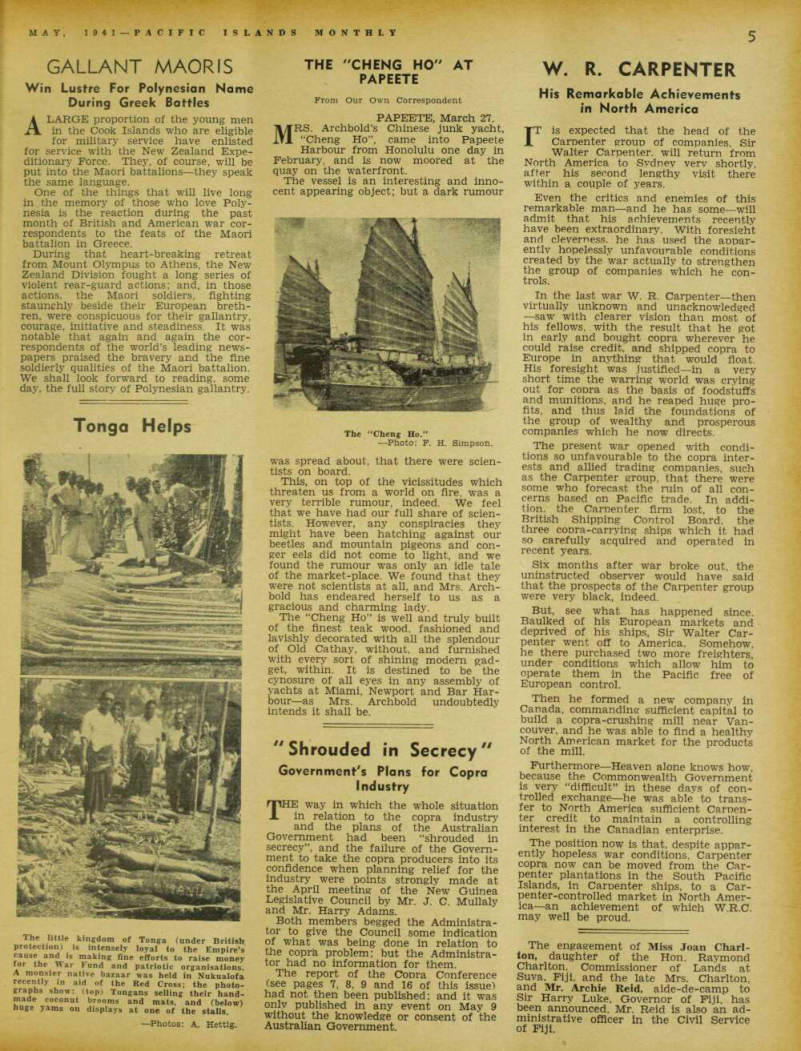
The little kingdom of Tonga (under British protection) is intensely loyal to the Empire’s cause and is making fine efforts to raise money for the War Fund and patriotic organisations.
A monster native bazaar was held in Nukualofa recently in aid of the Red Cross; the photo graphs show: (top) Tongans selling their hand made coconut brooms and mats, and (below) huge yams on displays at one of the stalls.
Photos: A. Hettig.
The "Cheng Ho" At
Papeete
From Our Own Correspondent PAPEETE, March 27.
MRS. Archbold’s Chinese junk yacht, “Cheng Ho”, came into Papeete Harbour from Honolulu one day in February, and is now moored at the quay on the waterfront.
The vessel is an interesting and inno cent appearing object; but a dark rumour
was spread about, that there were scien tists on board.
This, on top of the vicissitudes which threaten us from a world on fire, was a very terrible rumour, indeed. We feel that we have had our full share of scien tists. However, any conspiracies they might have been hatching against our beetles and mountain pigeons and con ger eels did not come to light, and we found the rumour was only an idle tale of the market-place. We found that they were not scientists at all, and Mrs. Arch bold has endeared herself to us as a gracious and charming lady.
The “Cheng Ho” is well and truly built of the finest teak wood, fashioned and lavishly decorated with all the splendour of Old Cathay, without, and furnished with every sort of shining modem gad get, within. It is destined to be the cynosure of all eyes in any assembly of yachts at Miami, Newport and Bar Har bour—as Mrs. Archbold undoubtedly intends it shall be.
The “Cheng Ho.”
Photo: P. H. Simpson.
"Shrouded in Secrecy"
Government's Plans for Copra Industry
rE way in which the whole situation in relation to the copra industry and the plans of the Australian Government had been “shrouded in secrecy”, and the failure of the Govern ment to take the copra producers into its confidence when planning relief for the industry were points strongly made at the April meeting of the New Guinea Legislative Council by Mr. J. C. Mullaly and Mr. Harry Adams.
Both members begged the Administra tor to give the Council some indication of what was being done in relation to the copra problem; but the Administra tor had no information for them.
The report of the Copra Conference (see pages 7. 8. 9 and 16 of this issue) had not then been published: and it was onlv published in any event on May 9 without the knowledge or consent of the Australian Government.
W. R. Carpenter
His Remarkable Achievements in North America
IT is expected that the head of the Carpenter group of companies. Sir Walter Carpenter, will return from North America to Sydney very shortly, after his second lengthy visit there within a couple of years.
Even the critics and enemies of this remarkable man—and he has some—will admit that his achievements recently have been extraordinary. With foresight and cleverness, he has used the appar ently hopelessly unfavourable conditions created bv the war actually to strengthen the group of companies which he con trols.
In the last war W. R. Carpenter—then virtually unknown and unacknowledged —saw with clearer vision than most of his fellows, with the result that he got in early and bought copra wherever he could raise credit, and shipped copra to Europe in anything that would float.
His foresight was justified—in a very short time the warring world was crying out for copra as the basis of foodstuffs and munitions, and he reaped huge pro fits, and thus laid the foundations of the group of wealthy and prosperous companies which he now directs.
The present war opened with condi tions so unfavourable to the copra inter ests and allied trading companies, such as the Carpenter group, that there were some who forecast the ruin of all con cerns based on Pacific trade. In addi tion. the Carpenter firm lost, to the British Shipping Control Board, the three copra-carrying ships which it had so carefully acquired and operated in recent years.
Six months after war broke out, the uninstructed observer would have said that the prospects of the Carpenter group were very black, indeed.
But, see what has happened since.
Baulked of his European markets and deprived of his ships, Sir Walter Car penter went off to America. Somehow, he there purchased two more freighters, under conditions which allow him to operate them in the Pacific free of European control.
Then he formed a new company in Canada, commandiner sufficient capital to build a copra-crushing mill near Van couver, and he was able to find a healthy North American market for the products of the mill.
Furthermore—Heaven alone knows how, because the Commonwealth Government is very “difficult” in these days of con trolled exchange—he was able to trans fer to North America sufficient Carpen ter credit to maintain a controlling interest in the Canadian enterprise.
The position now is that, despite appar ently hopeless war conditions, Carpenter copra now can be moved from the Car penter plantations in the South Pacific Islands, in Carpenter ships, to a Car penter-controlled market in North Amer ica—an achievement of which W.R.C. may well be proud.
The engagement of Miss Joan Charl ton, daughter of the Hon. Raymond Charlton. Commissioner of Lands at Suva. Fiji, and the late Mrs. Charlton, and Mr. Archie Reid, aide-de-camp to Sir Harry Luke, Governor of Fiji, has been announced. Mr. Reid is also an ad ministrative officer in the Civil Service of Fiji.
Strike Fizzling
Out
Position on NG Goldfield
From Our Own Correspondent WAU, May 10.
THE strike of European miners em ployed by New Guinea Goldfields Btd., is still going on, but it is in a condition of collapse and almost ended.
The company has been carrying on all its alluvial works for some time with the aid of staff men.
Altogether, 90 men went on strike —but that by no means represented the strikers.
The actual position was that a small band of militants, dissatisfied with work ing conditions, succeeded in getting the strike declared, and were able to per suade a considerable number of other men to “go out”, although unwillingly, with them. This applied particularly to many tradesmen —carpenters, black smiths, electricians, etc. —who apparently had no grievance against the company.
Two of the miners returned to work a fortnight ago and are carrying out repair and maintenance work, under police pro tection, and 18 more resumed this week.
A good many of the strikers left New Guinea within the first few days of the strike, and several others, who have not yet resumed, are applying for a resump tion of work on terms satisfactory to the company.
The Administrator (Sir Walter Mc- Nicoll) came specially to Wau in an endeavour to settle the strike, but failed.
A serious aspect of the incident is that outsiders were allowed to interfere in this matter, who had no connection whatever with the company or the strikers.
The most unfortunate aspect of the whole unfortunate affair is the plight of a good type of men who had really noth ing to do with the strike but who are suffering most from it. Brought un in the Australian industrial atmosphere, they felt that they were in honour bound to cease work, along with their mates.
They seem to be the men who now are “carrying the baby”.
Australian Minister To
Visit Territories
THE Australian Minister for Territories (Hon. T. J. Collins) is making plans for an official visit to the Territories of Papua and New Guinea, immediately following the next session of the Com monwealth Parliament.
This Minister has taken a keen prac tical interest in the affairs of the Ter ritory and, if he is allowed a reasonable period of administration after his visit there, the results should be worth while.
There is a distinct possibility, however— especially if the Babour Party wins Boothby by-election on May 24 —that there soon will be another change of Government, in which event the Terri tories may be introduced to their seventh or eighth Minister in four years.
If only Canberra would leave its Administrators to formulate develop mental policy, and to administer in accordance therewith, Australia might expect some progress in the Territories irrespective of political changes in Aus tralia. As it is, Territorial progress is hopelessly tied to the tail of Canberra noliticians; and Canberra politicians duck into office and out again with such rapidity that ordinary citizens cannot keep count of them.
The Elusive Count von
Luckner
THE world’s sensational newspapers are still amusing themselves —and others —with speculation concerning that elusive German sailor, Count von Buck ner. During the past 12 months we have had him respectively directing raiders in the Pacific, commanding a raider in the Atlantic, hunting wild boar in the Hartz mountains of Ger many, and repining in a German con centration camp, because of anti-Nazi beliefs.
The latest report, emanating from the Manila representative of the National Broadcasting Corporation of America, says that the British and Dutch navies have been ordered to capture Count von Buckner, who is commanding 10 armed merchant raiders in the South Pacific.
Well, at the end of the war this shrewd old Count should be able to produce a best seller entitled “Vere Vos I, Eh?”— or something like that.
Free France
Leading de Gaulle Official Visiting Pacific Colonies
AFTER visiting New Zealand, Gov ernor-General Richard Brunot, spe cial envoy of General de Gaulle to the French possessions in the Pacific, accompanied by Madame Brunot, Cap tain L. Fatoux, his aide-de-camp, and Commander J. Gilbert, proceeded by fly ing-boat to Noumea in April. They are in New Caledonia at present; and shortly they will visit Tahiti and Australia.
On April 22, most of the people in Noumea attended a simple ceremony at the War Memorial, where M. Brunot placed a wreath, inscribed “Homage to de Gaulle”. M. Brunot received an ova tion from the Europeans, and shook hands warmly with a group of native chiefs. It is reported that his visit has greatly improved the spirit of the French people.
Tongans Serving Overseas
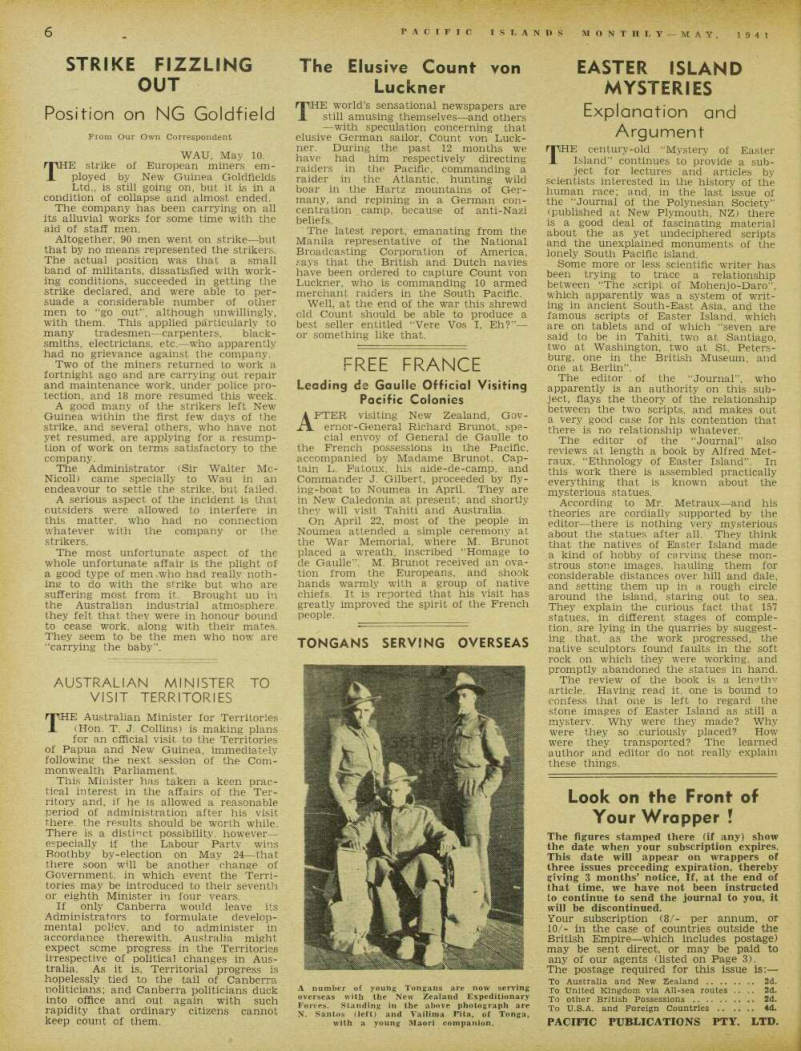
A number of young Tongans are now serving overseas with the New Zealand Expeditionary Forces. Standing in the above photograph are N. Santos (left) and Vailima Pita, of Tonga, with a young Maori companion.
Explanation and
Easter Island
Mysteries
Explanation and Argument
THE century-old “Mystery of Easter Island’’ continues to provide a sub ject for lectures and articles by scientists interested in the history of the human race; and, in the last issue of the “Journal of the Polynesian Society’’ (published at New Plymouth, NZ) there is a good deal of fascinating material about the as yet undeciphered scripts and the unexplained monuments of the lonely South Pacific island.
Some more or less scientific writer has been trying to trace a relationship between “The script of Mohenjo-Daro”, which apparently was a system of writ ing in ancient South-East Asia, and the famous scripts of Easter Island, which are on tablets and of which “seven are said to be in Tahiti, two at Santiago, two at Washington, two at St. Peters burg, one in the British Museum, and one at Berlin’’.
The editor of the “Journal’’, who apparently is an authority on this sub ject, flays the theory of the relationship between the two scripts, and makes out a very good case for his contention that there is no relationship whatever.
The editor of the “Journal’’ also reviews at length a book by Alfred Met raux, “Ethnology of Easter Island”. In this work there is assembled practically everything that is known about the mysterious statues.
According to Mr. Metraux—and his theories are cordially supported by the editor—there is nothing very mysterious about the statues after all. They think that the natives of Easter Island made a kind of hobby of carving these mon strous stone images, hauling them for considerable distances over hill and dale, and setting them up in a rough circle around the island, staring out to sea.
They explain the curious fact that 157 statues, in different stages of comple tion, are lying in the quarries by suggest ing that, as the work progressed, the native sculptors found faults in the soft rock on which they were working, and promptly abandoned the statues in hand.
The review of the book is a len<?thv article. Having read it, one is bound to confess that one is left to regard the stone images of Easter Island as still a mysterv. Why were they made? Why were they so .curiously placed? How were they transported? The learned author and editor do not really explain these things.
Advertisements & other items, p. 10 (1 item)
Look on the Front of
Your Wropper !
The figures stamped there (if any) show the date when your subscription expires.
This date will appear on wrappers of three issues preceding expiration, thereby giving 3 months’ notice, If, at the end of that time, we have not been instructed to continue to send the journal to you, it will be discontinued.
Your subscription (8/- per annum, or 10/- in the case of countries outside the British Empire—which includes postage) may be sent direct, or may be paid to any of our agents (listed on Page 3).
The postage required for this issue is:— To Australia and New Zealand 2d.
To United Kingdom via All-sea routes ... 2d.
To other British Possessions 2d.
To U.S.A. and Foreign Countries 4<L
PACIFIC PUBLICATIONS PTY. LTD.
Official Dithering Fatal To
Copra Plan
Marketing Board Still in Mid-Air, After Five Months' Talking
FIVE months have elapsed since the South Pacific Copra Conference sat in Sydney to consider the position of an industry that, even then, was in a highly critical situation; and although, week by week, since then, there have come from all parts of the South Pacific . the most urgent pleas that something of a practical nature shall be done, the politicians and officials who organised and constituted the conference, have achieved precisely nothing.
Here in Australia, month by month, we have pleaded for some reassurance—some information, at least, as to what the con ference really proposed and how it was planned to set about the protection of the industry and the salvation of indi vidual planters. We were fobbed off with ministerial statements.
We heard that there was to be a South Pacific Copra Marketing Board, with headquarters in Sydney, a Territorial Industry Board in each of the different territories, but we could obtain no infor mation concerning the powers of these Boards, or how or when they were going to function.
Now, it appears that a complete detailed report of the Copra Conference has been in circulation among certain interested parties in the various terri tories for at least two months. We received a copy of it from an Islands correspondent in mid-April; and the report itself was finally published in detail in Rabaul, on May 9. Until then, the men who were most vitally inter ested—the planters and copra-buyers— were given no information.
The report will be found, published in detail, on page 16 of this issue.
There apparently was not the slightest reason why this report should not have been made available in February and March to the people interested, so that at least they might have the opportunity of studying it. But Australian Official dom said “No!” That is typical of Aus tralian officialdom. Is it any wonder that the Australian people, as indicated in the recent general election in NSW, will cheerfully do anything to their pre cious politicians, short of cutting their throats!
IF this report had been published for the reassurance of the interests con cerned, and acted upon with rea sonable promptitude, something practical and helpful might have been achieved.
As it is, so much time has been wasted, while politicians and officials have dith ered about, that planters and copra interests may be pardoned if they regard the whole plan now with cynicism, and proceed to tear it to pieces.
Like all plans that are hurriedly com piled to cover a set of conditions that are without precedent, there is much in this plan that is open to criticism. Prac tical men need only study the details set out on pages 16 to 19 to note obvious shortcomings.
The powers that are to be given to the local Territorial Boards are rather start ling: and one is appalled by indications of the size of the organisation and staff which will be necessary to take care of this copra pool—and which, of course, are to be provided from the proceeds of the pool, at the expense of producers.
There is nothing to show that this Mar
keting Board has any guarantee of the thing that is vital to the success of the whole plan—namely, shipping space; and there are indications that the whole sys tem of assembling, controlling, storing, shipping and marketing the copra is to be in the hands of officials, and that the various big firms who usually handle and market the copra are to have no right of entry. The Marketing Board is to have power to form an advisory com mittee of merchants to advise and assist them when such a thing is considered
necessary, and arrangements may be made between the Marketing Board and merchants for services to be rendered by the latter on a basis of remuneration to be agreed upon. But all this clearly is entirely at the discretion of the Market ing Board which is to have plenary pow ers in the copra industry.
All these obvious shortcomings, how ever, could have been forgiven or accepted if the plan had been pressed on with promptly. It did at least repre sent an intelligent and co-ordinated effort to deal with a situation of great complexity and to save an industry that, viewed against the prosnects of the post war period, is well worth saving.
BUT the various parties concerned—we do not attempt to allot the blame, because we do not know who is responsible for the delay—have allowed matters to drift on for so long that it is
now most unlikely that anything of a really valuable or practical character can be achieved.
The main obstacle now in the way of the proper functioning of a South Pacific Copra Marketing Board is that the prin cipal copra interests concerned, finding themselves desperately up against it, and unable apparently to depend upon con certed Government action for any kind of help, went grimly ahead, months ago, and made their own arrangements. In other words, the South Seas copra indus try, while still in a deplorable condition, is now well on the way to saving itself.
Take, for example, the position of that section of the industry represented by the far-flung interests of W. R. Car pener and Co. Ltd.: This firm handles copra which it either grows on its own plantations, or acquires from closely related companies and firms in the Man dated Territory of New Guinea, Solo mons, Fiji, Tonga, Western Samoa and the Gilbert and Ellice Islands. As every one knows, when war broke out, this firm operated three steamers of its own, which carried its copra from the South Pacific to Europe and America. After
war broke out, the firm’s three steam ers were taken by the British Govern ment and W.R.C. and Co. were in the position of all other South Seas mer chants—they had to depend upon any freighters they could get hold of for the removal of their copra.
But, while many interests sat down and wailed, two of the principal companies affected—Burns, Philp and Co. and W.
R. Carpenter and Co.—proceeded to make other arrangements. Burns. Philp and Co., having vast and world-wide shipping connections were able to char ter enough freighters to keep their copra moving to the few markets left open.
W. R. Carpenter and Co. went off to the US and succeeded somehow in induc ing shipowners to sell a couple of freight ers. The firm also took a bold and reso lute step—and one which has done more than anything else to give new hope to the South Pacific . copra industry—it assembled sufficient American capital to build a copra-crushing mill near Van couver, sufficient to handle at least 30,000 tons per annum, and it found in North America a market for the products of that mill. To-day, therefore, W. R. Car penter and Co. Ltd. have in the Pacific two freighters which they own them selves, and a third ship which they have chartered, which is carrying their copra and their clients’ copra from selected ter ritories to the mill at Vancouver and to any other North American market which they can find.
It is only a guess—but it would not be surprising to find that the two big firms (Burns. Philp and Carpenters), depend ing entirely on their own vigorous man agements and their own resources, are to-day shifting out of the South Pacific, copra tonnage totalling not less than
100,000 per annum. That is a remark able achievement, in the circumstances.
NOW, turn back to the report of the Copra Conference, and try to see how the new self-dependent opera tion of these big firms are going to fit into the framework of that plan. Obvi ously it cannot be done.
Messrs. Burns Philp and Messrs. Car penter cannot be expected to tamely per mit their operations to be taken over now by a bureaucratic Marketing Board, which probably knows no more about the delicate and complex business of marketing copra than does it about the bimetallism theory. The big firms have had to fight like tigers to keep the industry alive —and it is not to be ex pected that now they will tamely sur render their gains to the official Mar keting Board.
IF this plan had been produced and brought into operation, say, in Feb ruary or March, we might have applauded it, with all its imperfections, and everyone concerned might have made an effort to help it along. As it is, we anticipate that, owing to the fatal delay and procrastination, obstacles of a serious character will be raised now bv the big firms, and that even the small planters who have been able to survive will be inclined to look upon the Gov ernmental plan with a jaundiced eye.
THERE is one most interesting little item hidden shyly away in the con ference report. It is as follows; “Australia shall continue to imnort from Fiji and the Western Pacific High Commission areas copra not exceeding the quantity that consumers in Australia
wish to buy from those areas, provided that the producers’ and consumers’ organisations are owned and controlled by the same organisations. Such trans action, however, must pass through the Marketing Board.”
This, of course, is put in to protect the Lever interests. The Australian copra crushing mill of the Lever combine re ceives up to 30,000 tons per annum of copra produced on the Lever plantations in the Solomon Islands. Levers are a British firm, and the Solomon Islands are a British Territory. More than once during the past year the question has been asked why Australia should be im porting at least 20,000 tons per annum of Solomon Islands copra for the Lever mill while the copra industry in Aus tralia’s own Pacific territories is lan guishing. A certain bitterness has been brought into the comment because the Australian and BSI Levers are part of the Unilever Combine which has been for so long controlling the world copra prices for its own benefit.
However, argument in favour of allow ing the Lever mill to do what it likes with its own copra from the Solomon Islands might prevail; but, if that argu ment is accepted by the Copra Market ing Board, what is it going to say to Messrs. Carpenter and Co. when that sharp-eyed firm demands the same privi leges—namely, that it shall be allowed without interference, to carry its own copra from its own plantations in New Guinea and the Solomons, to its own crushing mill in Canada?
IN view of official dithering and pro crastination, it will not be surpris ing to find that the public has lost all faith in the idea of a Copra Mar keting Board.
One now is more inclined to say; “Bureaucracy should keep its hands out of this highly specialised industry and, instead use whatever Government funds are available to subsidise planters, trad ers and shippers in making their own arrangements for developing new mar kets and saving the industry.”
(Continued on Page 16)
r T'HE following is a full summary of the conclusions reached and recommen dations made by the Pacific Copra Conference, which met in Sydney in December and January last, under the chairmanship of the Australian Terri tories Minister (Mr. Collins ) and was attended by delegates from the follow ing:— Australian Government, giving repre sentation also to Papua, Mandated Terri tory of New Guinea, Free French Colony of New Caledonia.
New Zealand Government, giving re presentation also to Cook Islands, Man dated Territory of Western Samoa, Free French Colony of French Oceania.
Fiji Government and High Commission for Western Pacific, giving represen tation also to Solomon Islands, Gilbert
and Ellice Islands, Tonga, and Anglo- French Condominium of New Hebrides. rOM the information available it appeared to the Conference that having regard to the reduction of production that might be possible in certain areas the undermentioned quan tity of copra would require to be dis posed of in the British and associated areas in the Pacific during a period of twelve months:—
The figures shown do not include present accumulations totalling approxi mately 38,000 tons which are awaiting shipment in the various areas.
A survey of markets indicates that during the forthcoming year there are prospects of disposing of the following quantities of copra produced in these areas to the countries indicated here under:—
The Conference considered the possi bilities of opening up new markets, extending present markets and of finding further uses for the product of the coco nut, and arrived at the conclusion that any organisation that may be established to handle the marketing of copra should pay particular attention to investigations of this aspect of the problem. One pro posal for the utilisation of copra in new directions which was submitted to the Conference seemed to be worthy of further investigation. This and other projects should be followed up by any marketing organisation which may be formed.
The Conference is of opinion that the possible methods of dealing with the present situation of the copra industry are:— (1) Leave the position as it now stands.
After investigation by the Confer ence it was decided that this would not be satisfactory. (2) Store copra for an indefinite period with a view to obtaining markets when available, even if that in volved holding until after the war.
This, upon examination by the Conference, was considered un sound at this stage, both from the point of view of the finance in volved and the economic interests of the territories concerned. (3) Joint marketing organisation with statutory authority. This is re commended by the Conference for the following reasons: — (a) that on the evidence examined by the Conference, the view was taken that production would exceed the quantities that could be marketed. (b) any contract for the sale of a stipulated quantity of copra to the United Kingdom Govern ment would obviously have to be shared by all British and associated territories in the Pacific. (c) that an agreement by the Governments of the United
Areas controlled by— Tons.
Commonwealth of Australia .. 79,000 Dominion of New Zealand .. .. 35,000 The Colony of Fiji and the Western Pacific High Commission 76,000 Total 190,000
Tons.
United Kingdom .. .. 90,000 Australia 27,000 Mexico 30,000 Canada 15,000 Total 162,000
Kingdom, Australia and New Zealand to assume some prac tical financial and economic responsibility in the Free French territories of the Pacific will add approximately 30,000 tons annually to the quantities to be marketed. (d) that because of the shipping difficulties, economy in the use of the ships that can be made available is essential. This can be effected only by an arrangement in the form of a central control including the pooling of shipping facilities. (e) that tne production relative to the marketing possibilities is such that some form of control of production is essential. This can only be arranged by a joint approach by the various territories.
If, of course, the United Kingdom Government fails to purchase substantial annual quantities the proposals would have to be reconsidered. Cables re ceived from the United Kingdom, how ever, suggest that this contingency is unlikely.
If the recommendation be approved, the following is an outline of the scheme that might be adopted:— There shall be a copra marketing board to be known as The Pacific Copra Marketing Board (referred to in these notes as “the Marketing Board”), which should be located in Sydney.
The Marketing Board shall be repre sentative of the three principal Govern ments concerned, namely, the Common wealth of Australia—on behalf of the Territory of Papua, the Mandated Terri tory of New Guinea and New Caledonia (Free French Administration), the Dominion of New Zealand—on behalf of the Mandated Territory of Western Samoa, the Cook Islands, Niue Island and French Oceania (Free French Administration); the Colony of Fiji, and the Western Pacific High Commission— on behalf of the British Solomon Islands Protectorate, the Gilbert and Ellice Islands Colony, the Kingdom of Tonga and the Condominium of the New Hebrides.
The Marketing Board shall be com posed of three or four representatives as shall be determined, but each of the three principal Governments referred to in the previous paragraph shall have one vote only.
The Marketing Board shall be em powered to form an Advisory Committee of merchants to advise and assist when deemed necessary by the Marketing Board.
A Territorial Copra Industry Board or Boards, hereinafter referred to as the “Territorial Board” to be appointed by each of the three Governments party to this agreement.
The Territorial Boards in their own territories will act as agents of the Marketing Board.
The functions of the Marketing Board shall be:— (a) To acquire by agreement with the Territorial Boards of the respective territories such copra produced within each of the respective terri tories as may be determined. (b) To market copra so acquired. (c) Where deemed fit to arrange with the Territorial Boards for the marketing of copra within the areas controlled by such Territorial Boards. (d) To arrange finance and transport, including the chartering of ships necessary to the marketing of the copra from approved points of con centration in the Territories. (e) To investigate possibilities of addi tional uses for copra and where deemed fit to recommend to the
Governments which are party to the agreement proposals for the development of such additional uses. (f) To distribute to Territorial Boards proceeds of sales in accordance with the bases laid down. (g) To advise Territorial Boards of marketing conditions or trends of markets which would assist them in determining policy for the con trol of production if such be found necessary. (h) To make contracts and to enter into arrangements and to do such other things as may be necessary to enable it to carry out its func tions. (i) To appoint staff as may be neces sary and to determine the condi tions of employment of such staff. (j) To perform such other functions as may be allocated to it by agree ment between the three Govern ments from time to time.
In the marketing of copra acquired, the following conditions shall apply: (a) Proceeds of sales of copra ac quired by the Marketing Board, less charges, including administra tive expenses, to be credited to the funds of the Marketing Board and later allocated to Territorial Boards for distribution. (b) Australia shall continue to im port from Fiji and the Western
Pacific High Commission areas copra not exceeding the quantity that consumers in Australia wish to buy from those areas, provided that the producers’ and the con sumers’ organisations are owned and/or controlled by the same organisation. Such transactions must, however, pass through the marketing Board. (c) Proceeds of sales from the area of one of the units party to the agree ment to another unit party to the agreement will be credited to the funds of the Marketing Board at a price to be decided upon by the Marketing Board but such price shall not be greater than that for which copra of similar grade can be obtained from any other part of the territory making the sale or from any other territory. (d) If in an area controlled by one of the Governments party to the agreement, the price of copra is raised by the respective Govern ment to a price aoove world parity the full amount of such excess of such price over world parity shall be credited to the Territorial Board or to Government of the area concerned. (e) The proceeds of sales of copra shall be distributed to the Terri torial Boards according to the quotas to be declared and regard less of the territory from which shipment is made. (f) In crediting the Territorial Board with the proceeds of sales regard shall be had to grades of copra shipped over the period covered by the payment and copra held by the several Territorial Boards for
shipment at the close of such period. (g) So far as can be seen at present freight should be charged to the proceeds of sales and so in effect distributed according to the de clared quotas. If, however, this is found in practice to have any in equitable features as amongst the three parties to the agreement, the Marketing Board shall make such adjustments as are necessary to rectify any such inequitable fea tures. (h) Where necessary on account of shipping arrangements, the Mar keting Board may bear portion of the cost of storage and interest in respect of copra held in concen tration depots pending shipment.
This will not refer to surplus copra which remains the responsi bility of the Territorial Boards. (i) Arrangements may be made be tween the Marketing Board and merchants for services to be rendered by the latter arising out of the marketing of copra. Re muneration for any such services will, after negotiations between the Marketing Board and mer chants for services to be rendered by the latter arising out of the marketing of copra. Remunera tion for any such services will, after negotiations between the Marketing Board and merchants, be determined by the Board.
The Territorial Boards will furnish re turns to the Marketing Board containing such information as may be required.
For example:— (a) Quantities of copra held by the Territorial Board at the beginning
of each month and available for immediate shipment. (b) Receivals into stores during month. (c) Shipments during month. (,d) Quantities in store at end of month. (e) Estimated copra in Territory other than in stores at concentration points at end of each quarter. (f) All quantities shown in statements shall be allocated into grades to be specified.
Acquisition shall be arranged by each Territorial Board in its own Territory and agreements shall be made by each Territorial Board with the Marketing Board, under which the Marketing Board shall have sole power to market the pro duce acquired by it.
Quantities of copra held in store in each Territory shall be recorded at the date of the commencement of the Marketing Board’s operations. Estimates of normal production for me forthcoming year in each Territory will, at the same time, be arrived at and quotas established on tms basis, that is the share of each Territory of the sales made will be based on the relationship of copra on hand plus estimated normal production to total copra on hand plus total estimated normal production coming under the control of the Marketing Board.
If, upon the examination of data available at the beginning of the Market ing Board’s operations of estimated stocks that will be available, and estimated markets, it is agreed that there will be a surplus unsold, such surplus shall be me responsibility of the respective Territorial Board and not of the Marketing Board. These surpluses may be varied if and when found neces baiy, according to the trend of sales and prospective sales.
In amending any estimates which have an influence on quotas regard shall not be had to reductions in production aris ing out of any action by a Government or Territorial Board in pursuance of a policy for the reduction of production in excess of the allotted quota.
The sums to be credited or paid on acquisition shall be a matter for each Territorial Board. The Marketing Board may make lump sum advances to the Territorial Boards upon conditions to be decided upon by arrangement.
Territorial Boards in association with their Governments will be asked to agree that all action possible be taken to pre vent production rising above the present normal production in their respective areas.
The foregoing report expresses unani mously the views of the Conference.
Advertisements & other items, pp. 11-12 (1 item)
W. H. GROVE & Sons Ltd.
AUCKLAND
Island Traders. p.o. bm «o.
Telegraphic and Cable Address: “Grove”, Auckland.
Shippers of all classes of New Zealand Products, specially prepared for the Island trade.
Representing English Manufacturers throughout the Cook and Society Islands, Fiji, Tonga, Samoa, Niue, New Caledonia, New Guinea, etc.
In FIJI as—W. H. Grove & Sons (Fiji) Ltd.
FLAT OIL
FINISH
WATERPROOF
DRIES INHAtF HOUR
CREAM
Dries in half an hour
on plaster walls, ceilings, cement, fibre, wood & iron.
Also
EXCELLENT AS AN
UNDERCOAT
for lacquers, paints & enamels
14/11 per gallon
HIGHLY DURABLE
Write for a Colour Card . . .
STERLING VARNISH CO., Alexandria, N.S.W.
MERIDEN
Church of England Grammar School for Girls.
REDMYRE ROAD, STRATHFIELD, N.S.W.
Situated in beautiful and healthy surroundings within 15 minutes of Sydney.
Comfortable, modern accommodation for boarders. Education from Kindergarten to Leaving Certificate Honours. Scientific Physical Culture and instruction in Art and Musical Appreciation.
Prospectus on Application.
'sJMew Catalogue
\\\ Post Free anywhere.
AGES 467 ILLUSTRATIONS
est Styles in MEN’S. . . WOMEN’S
CHILDREN’S FOOTWEAR
Specially selected and
economically priced.
Tens of thousands of satisfied customers scattered throughout Australia and the Pacific Islands, make FAYS their Footwear Headquarters.
OUR CATALOGUE, new editions of which are printed every few months, keeps our clients up-to-theminute with the latest styles in footwear. yr p, x Orders receive prompt attention from a 77* Monthly j competent and are despatched by LAs th e first available steamer.
Edward Fay pty.itd. Pitt St, Sydney.
5 44 OM & 1 pOP \eu £)St m
Unruly Raiders In New
Britain
fT\HE Administrator of New Guinea, in X a report to Canberra, says that a tribe called the Mokolkols, in the uncontrolled portion of New Britain, are being brought slowly under European control. They are a particularly dan gerous community.
In August, 1939, they made a raid on Kalip village, and murdered 15 women, and when a party of police under Patrol Officer Milligan went after them they attacked the police. There was a fight, in which three of the Mokolkols were killed.
In October, 1940, the Mokolkols made another attack upon Kalip village, and killed six Kalip natives, and thereupon two police parties, under Patrol Officer Marder and Patrol Officer English, went into the mountains and captured three of them. At about this time the Mokol kols attacked a native constable with two carriers, and killed the constable and one carrier.
It has been found that the three cap tured Mokolkols are able to converse with certain native tribes, now under control, and it is hoped that, through this avenue of approach a better influence will be exercised upon the Mokolkols.
New Dictionary for Fiji
Long Overdue Revision by Expert
rE work of revising the Fijian dic tionary (which had not been under taken since 1850) has been com pleted by Rev. Dr. Capel, of the University of Sydney, who spent eight months in the Colony for that purpose at the invi tation of the Fijian Government. In future, the dictionary and the grammar (the latter has also been revised by Dr.
Capel) will be published separately by the Government of Fiji.
Dr. Capel is now in Sydney correcting proofs before he leaves for Darwin to resume his work among the aborigines in Arnhem Land. He is one of the world’s outstanding authorities on the languages of the Pacific.
The scientist found that many words, once in ordinary use in Fiji, are now obsolete. There are several languages still spoken in the group. Even on Vitu Levu, the language of the islanders on the east coast differs materially from that in the west. The work of revision necessitated considerable travelling among islands of the group.
Miss J. Gannon, sister at the Bulolo Hospital, New Guinea, was in Sydney in April spending furlough.
Mr. J. H. MacDonald, who was District Officer in the Manus section of the Mandated Territory before he went to Australia recently on leave, has returned to New Guinea, taking up duties as D.O. at Kavieng, New Ireland.
Advertisements & other items, pp. 13-14 (1 item)
PROUDS Pty. Ltd/siumi
Esc* I 18 6 € .X
GO WINGS
Sydney’s Leading Store
EXCLUSIVELY FOR MEN
SUIT TO MEASURE
TAILORED AND AWAITING
YOUR ARRIVAL IN SYDNEY
Write for
FREE PATTERNS
and Self Measurement Form . . .
COWING BROS. LTD.
Market and Gaorga Streets, Sydney will hare your
“The right to guide the course of world history is the noblest prize of victory—l hope and pray we shall not be found unworthy of the victory: ”
Mr. Winston Churchill in the House of Commons, August 20, 1940.
WINSTON CHURCHILL
The outstanding figure in public life to-day; and so long as the English tongue is spoken, the name of Mr. Winston Churchill will be honoured.
This fine Plaque in plastic earthenware is indestructible. 7” wide, 7” high 3” deep, has provision at the back for hanging against the wall.
PRICE only 7/6. Postage 1/6 extra.
PROUDS Pty. Ltd/siumi
AND PITT
SYDNEY
AGENT FOR LARGE
AMERICAN IMPORTER
wants to buy up to one million feet New Guinea walnut, half logs or flitches, regular monthly shipments.
Parties able to supply please send particulars to:— Willmott’s Advertising Agency Pty. Ltd., 36 Grosvenor Street, Sydney.
AUSTRALIAN WIN
LIQUEURS,
VERMOUTH AND CIDER
True to types which have long been famous and comparable in quality with the finest imported, Montrosa Australian Wines, Liqueurs and Vermouth and Mercury Sparkling Tasmanian Cider represent the Commonwealth’s choicest products. We illustrate, alongside, a representative group of Montrosa Wines and Liqueurs.
MONTROSA WINES include Port, Sherry, Muscat, Tokay, Riesling, Sauterne, Champagne and Sparkling- Sweet Montrosa.
MONTROSA VERMOUTH is
available in both sweet and dry types.
MONTROSA LIQUEURS offer
all the popular flavours —Apricot Brandy, Creme de Cacao, Creme de Menthe, Kirsch, Cherry Brandy, Kummel, Peach Brandy and Curacao (orange, white and red). m ml mm}
itii
The CHAMPAGNE
of the APPLE !
Here’s all the rich juice of rosy Tasmanian apples sunfilled with vitamins. Mercury Cider has the body and sparkle of champagne. It’s a delicious thirst quencher ... a gay and lively party drink. Drink HEALTH . . . drink Mercury Sparkling Tasmanian Cider.
IF YOU HAVE DIFFICULTY IN OBTAINING
THESE BRANDS LOCALLY , WRITE TO
SWIFT & COMPANY PTY. LTD
’Phone: 87377.
26-30 CLARENCE STREET, SYDNEY.
And at Melbourne, Geelong, Adelaide, Perth, Brisbane, Townsville and W ellington, N.Z.
Tahiti Suffers a Tragedy
Ship Lost
From Our Own Correspondent PAPEETE. March 1.
A TRAGEDY of the sea which has brought sorrow and desolation to many families of Tahiti, was the loss of the “Tere Ora” during the storm of January 16 to 18, last.
This storm, which broke over the is lands on the evening of the 16th, was not the classic type of hurricane, but rather a series of sudden squalls, during which the wind attained a velocity of 95 or more, kilometers per hour.
The “Tere Ora” left Papeete for Ra ‘iatea, in the Leeward Islands, on the afternoon of January 16. The ship had just returned from an expedition through the Tuamotu Archipelago, and the cap tain and crew (with the permission of the owners) made the shorter voyage to
Ra’iatea the occasion of a pleasant out ing for their families and chosen friends.
It was a happy little party that sailed away on that calm afternoon.
Late in the evening of the 16th, the storm struck. The report by wireless, on the following day, that the “Tere Ora” had not arrived at Ra’iatea did not arouse any alarm. It was believed she had taken refuge in one of the safe
harbours of Moorea or Huahine—islands which are sighted on voyages to Ra’iatea.
Not until the power-boat “Hiro” ar rived from the Leeward Islands by way of Huahine and Moorea, several days later, was it learned that the “Tere Ora” was at none of these places. The power schooner “Vaitere” was immediately des patched in search of the “Tere Ora”.
The search was thorough; covering all the neighboring waters and extending to every outlying island and atoll. No trace, no fragment of flotsam has been found at sea or on any beach up to the time of this writing—late in February.
Those on board the “Tere Ora” were: — Officers: Damas Perry, captain; Theo dore Vii, supercargo; Rootane Tupea, engineer.
Crew: Tai Tehahe, Francois Paiatua, lona Katupa, Puhehe Pukoka, Marcel Tamarii.
Passengers: M. and Madame Turifaite Vii, Mile Marie Paume, Madame Natua and child, M. Ona Paiti, Madame Marie Stein and child.
The “Tere Ora” —a staunch vessel of 96 tons powered by 90 h.p. full diesel engines—was the property of Francaise Maratime de Tahiti. Like the “Vaite” belonging to the same company and wrecked some months ago in the Tua motu Islands, the “Tere Ora” had become something of an institution in the waters of that Archipelago and the Marquesas Islands. (Note: This report was delayed in trans mission to Sydney.) Miss Ida Kent, of the New Guinea Mission, returned to her work in Papua in April, after spending furlough in Queensland.
The "Tere Ora.”
Photo: A. B. Donald, Ltd
Tropicalities

THIS happened recently at an Aus tralian port.
The fuselage of a new plane—which cost about £40,000, and which is designed for use on the Sydney-New Guinea ser vice—was being unloaded from a ship.
It was an awkward lift, and the man in charge was worried. He sought for something to ease the strain on the lift ing gear.
His eye fell upon two huge planks, part of the equipment of a building con tractor. He grabbed them and put them in place. Nothing like being careful, when £40,000 worth of irreplaceable machine is at stake.
The planks were bending under the weight when the building contractor arrived on the wharf. His eyes popped out of his head.
“Hey!” he bawled to the disembarka tion men. “Look what you’re doing to my planks. Have a bit of heart! Them planks are worth fifteen bob each!” * * * WHEN Charles B. Nordhoff, the Ameri can novelist, was in Sydney in 1934, he inspected the collection of Pacific material owned by Dr. George Macka ness, the authority on the Bligh period, and the novelist and the historian have been friends ever since. Dr. Mackaness was delighted to receive a cablegram from Mr. Nordhoff recently saying that the sender, and his literary partner, James Norman Hall, proposed to dedicate their new book, “Botany Bay”, to him. * * * CAYS a Noumea correspondent :— What an innocent race are the Japanese! Not only have we here a Japanese taxi-driver who has never heard of Hitler’s new order (“Jap. radio”, he says, “he not ever speak of that”), but there blew into Noumea the other day a Jap. cargo steamer which had been shadowed through the Solomon Group by a British patrol. The latter politely but firmly persuaded the captain to give his name, address and destination. On arrival in Noumea, the captain went to
see the British Consul (Mr. W. Johnston) and said:— “Me innocent Jap. captain. Your people follow me about, make me give name where going. Why?”
The British Consul: “But haven't you heard about those German raiders who attack shipping while painted in Japa nese colours and flying the Japanese flag, against all the rules of inter national war?”
The Jap. Captain: “No, me no hear of that. What a wicked thing to sink ships under such pretences!” ♦ ♦ ♦ RESIDENTS of Rarotonga who can understand Tahitian have found a new and amusing pastime.
Apparently, a native Tahitian boy, who is serving in the French navy, is now stationed at Saigon and, every Saturday night, he talks over the air to friends in Tahiti, telling them the news a la Vichy Government, and what said Government thinks of the officials now administering French Oceania.
Regularly, every Tuesday and Friday afternoon, the announcer at the Tahiti radio station replies to this propaganda, and points out how mis-inlormed and ignorant is his dear friend now serving at Saigon.
A wordy battle in a language that they can understand somehow makes people in Rarotonga understand that they are a part of this crazy white man’s world after all. * ♦ * THE birth of a son to Te Rakahaerea Pomare, the only surviving son of the late Sir Maui Pomare, and of Lady Pomare, of Lower Hutt, Wellington (NZ), is interesting news to the many friends of the Pomare family throughout the Islands—he is the first grandson of the late NZ Minister. It has been decided that his first name shall be Maui. On his maternal side he is a great-grandson of the Hon. J. D. Ormond, one-time Minister in New Zealand. His mother comes from the Mahia Peninsula branch
of the Ormond family. The young man, on his Maori side, can claim descent from the leaders of the Great Migration of 1350, through the Taranaki tribes of his grandfather, and he has an equally distinguished descent from the chiefs of Ngati-Kahungunu, through Lady Pomare.
When Sir Maui Pomare met the late Prince Hinoi Pomare in Tahiti many years ago they compared their respective genealogies, and decided they were kins men.—“Eriki.” * * * Appreciation of the good work done by Sir Harry Luke (Governor of Fiji and High Commissioner for the Western Pacific) in connection with the recent political crises in New Cale donia and New Hebrides, was expressed in the annual report of the Pacific Islands Society. On the motion of the President (Mr. A. E. Stephen) it was decided to write to Sir Harry and thank him for his efforts to secure a good and permanent understanding between the British and the Free French estab lishments in the Pacific.
Rev. W. S. Pidgeon, of NSW, has been appointed to the Lau (Fiji) Circuit, by the Methodist Missionary Society.
Advertisements & other items, pp. 15-16 (1 item)
Steamships Trading
We’ve done well
We’re a bit older than the average “love birds” —and a bit harder in the head. That’s why, after quite a lot of
hunting around, we decided on Angus
& Coote for our Engagement Ring.
You CAN’T BEAT A. & C. value, and that’s that. It’s guaranteed, tooi r 'r-r £l2/10/- Now look at this for value!
' ' A sparkling Solitaire diamond in Platinum, “Delysia'’ setting. And aren’t the hand-carved shoulders a sensation!
Rings are 18ct. White or Yellow Gold, as you like. Each comes in a nice Gem Case. r IS* £l5/-/- . Looking for a breath-taker!
' ' Here you are . . scintillating Solitaire Diamond in cut-corner setting. And what beautiful, hand-carved shoulders!
All Settings are Platinum for Beauty and Security. Safe delivery is guaranteed. w £l6/10/- A four-diamond delight! 7 “Pillar-set” centre. Diamonds of flashing, fiery brilliance set off by a very lovely under-rail. Shoulders are handcarved.
If you would like to see some more designs, write for Angus & Coote’s Great Catalogue.
ANGUS &GOOTE
500 GEORGE STREET, SYDNEY
Steamships Trading
Company Limited
PORT MORESBY SAMARAI MISIMA, PAPUA.
WHOLESALE & RETAIL MERCHANTS, SHIPOWNERS,
PLANTERS, ENGINEERS & SLIP PROPRIETORS.
Customs, Shipping, Insurance, and Forwarding Agents.
MANAGING AGENTS AND VISITING REPRESENTA-
TIVES FOR COCONUT AND RUBBER ESTATES.
A full range of Merchandise always in stock, including Plantation, Mining, Prospecting and General supplies.
All classes of ship repairs and engine overhauls undertaken. Vessels up to 400 tons gross slipped at any tide on our patent Slipway, Port Moresby.
AGENTS FOR: —Vacuum Oil Co. Pty., Ltd., Bankers & Traders Ins. Co., Royal Packet Navigation Co., American Trading & Shipping Co., Wunderlich, Ltd., Dodge Motor Co., Diamond T Motor Trucks, Johnston Outboard Motors, Sawmillers & Traders, Ltd., Coral Sea Insurance Co., Australian General Electric Refrigerators, Hallstroms Kerosene Refrigerators, B.A.L.M. Paints, Kodak.
Ltd., Acme Bakery Co.
SYDNEY REPRESENTATIVES: Nelson & Robertson Pty. Ltd., 12 Spring Street.
WRITE, CABLE, OR CALL FOR PARTICULARS
STEAMSHIPS TRADING COMPANY LIMITED
Head Office: Port Moresby. Cable Address: "Steamships".
PRICE'S RADIO
can supply
Radio Parts
to repair most types of Radio Receiving Sets. Also up-to-date Kits to build your own.
RADIO SETS SPECIALLY
DESIGNED FOR TROPICAL
USE.
From small 2-valve sets for use with headphones, to Multi-valve sets.
Let us know your requirements— we will quote by return mail.
PRICE'S RADIO
5 & 6 Angel Place, Sydney, N.S.W.
■m w///.
Others may miss matches through troublesome and dangerous winter ailments; but HER vital- - linill ,., ity never flags. At work or at play she's always at the top of her form right through the winter.
The Secret of Immunity:
Active recreations use up vital energy and, unless steps are taken to build up reserves, this loss of energy lowers resistance to prevalent ailments.
The Vitamins "A" and "D" contained in pure Cod Liver Oil are Nature's finest resistance builders. Scott's Emulsion contains them in a palatable and most easily digested form. Just 30 minutes after taking Scott's, an eminent Research Body has proved, every drop is doing its work of strengthening chest and lungs, creating reserves of energy, and building up resistance to the onslaughts of winter ills. Get fit— keep fit—start on Scott's NOW!
SCOTT’S
Emulsion
FROM ALL CHEMISTS AND STORES, 2/9 and 5/- PER BOTTLE
Good Profits Still In
Pacific Trade Burns Philp Balance Sheet is interesting
THE enormous internal strength of Messrs. Burns Philp & Co., Ltd., is shown in the company’s balance sheet for the year ended March 31, just issued. In view of the vast disturbance in world trade, the dislocation of shipping lines and the condition of the copra market, a sharp contraction of earnings and profits might have been expected.
Instead, here, are the figures in detail, as published in “Sydney Morning Herald”.
They are worth examination:—
Although the directors have provided another £25,000 for war risk insurance, and £35,000 wherewith to write down the value of properties in New Guinea and Papua, there nevertheless was £37,600 to carry forward, after paying the usual 10 per cent.
It is an outstanding example of the wisdom of not having all your eggs in one basket. Many varied, widely scattered enterprises contribute to the revenues of this big firm.
Some critics may not be able to get beyond the fact that the big firm has made a record profit in a year of terrors and misfortunes; but, actually, the balance-sheet is a good thing. It gives direct, tangible proof of our frequent assertion that the South Pacific terri tories are no longer dependent wholly on copra, and that there still is plenty of money in the South Seas. And it shows the Territories residents that, while BP is there, they need not fear the cold blast—because a firm so wealthy and well-managed must, in its own interests, use its enormous resources to help the Territories over the bad years.
Judge H. F. Ayson, Resident Commis sioner of the Cook Islands, returned to Rarotonga in April from sick leave in New Zealand.
Rev. H. Matthews, Rector of St. John’s Anglican Church, Port Moresby, Papua, visited Melbourne, Victoria, in April.
During his absence Rev. V. Redlich, who has been engaged in missionary work in the North East Division, will be in charge of the parish. Rev. Matthews has been at Port Moresby for seven years.
Year ended March 31. 1939. 1940. 1941. £ £ £ Net profit 251,144 260,621 270,657 Div., 10 p.c 181,250 200,000 200,000 To reserve 25,000 25,000 War risk insur. .. 50,000 25,000 25,000 Special deprecn. ., — — 35,000 Staff retirement .. — 10,000 Carried forward .. 26,353 26,974 37,631 Expenses, etc. . .. 827,158 845,020 931,163 Depreciation, etc. . 130,633 121,042 136,423 Bad debts, losses . 37,292 57,398 46,816 Gross profit .. .. 1,246,228 1,284,081 1,385,059
Liabilities—
Capital, paid up . 1,875,000 2,000,000 2,000,000 Reserve fund .. 1,200.000 1,225,000 1,250,000 Insurance res., etc. 613,643 697,453 816,435 Cash credits .. 122,552 65., 130 60,099 Bills, foreign drafts 939 1,861 — Creditors 880,757 1,032.385 1,170,595 Branch balances .. 923,365 693,780 888,576 Owed to subsids. .. 65,173 70,495 183,434
Assets—
Merchandise, copra, advances 1,185,302 1,125,024 1,207,921 Cash in hand .. 168,410 180,795 226,130 Property, shipping . 1,758,140 1,841,340 2,088,300 Debtors 893,493 958,451 886,781 Owing by subsids. . 110,817 114,782 166,288 Shares, Govt. sec. 997,367 978,160 1,250,719 Shares in subsids. . 763,005 774,527 740,629
Pacific Radio
Network
When the Germans Had Their Plans
rE Germans were the first to realise the potentialities of radio in the Pacific. This fact was emphasised by Sir Ernest Fisk, Director of Economic Co-ordination for the Australian Gov ernment, and the outstanding figure in radio development in Australia and the South Pacific, when he spoke before members of the Pacific Islands Society at the Carlton Hotel, Sydney, on April 30.
Between 1910 and 1914, said Sir Ernest, the Germans had a scheme in hand that would have been to their advan tage, if they had won the last war.
Radio stations were erected near Rabaul, at Apia (Western Samoa), and on Nauru Island. Then, when the Austra lian and New Zealand Governments became interested in wireless, they offered such favourable tenders for the erection of stations in those countries, that they were accepted.
“The Germans stipulated, however, that these stations should not only be equipped by their men, but that their engineers should remain in control,” added Sir Ernest. “Fortunately, our Governments declined those proposals, though they accepted the equipment.”
Following the outbreak of war all sta tions (which had been intended for use as a Pacific network) were taken over by the British. “The scheme was clever, ingenious, and well thought out,” he said, “and it might well have succeeded.”
Sir Ernest recalled how. within a few
days of the outbreak of war. he had been called upon by the Australian Gov ernment to provide trained wireless experts to leave for abroad within a few hours. Throughout the night he worked, collecting men who had no idea of where they were being sent. “Radio was then in its infancy,” he said, “and it was by no means easy to get the men we had trained at such short notice. Some were actually taken from their beds. How ever, they were all on the warship next morning, and not one man refused to go abroad.”
These men were subsequently sent to New Guinea to take over the radio centres there.
Speaking of the rapid advance in radio in the Pacific, Sir Ernest said that the Tongan Government was one of the first to appreciate its development. A station was erected there by Australians before the war was over, and it has been in use ever since. “Incidentally, the Prime Min ister of Tonga told us,” he remarked, “that his Government had received ex cellent value for its money. Presumably, Tongans had not always received such treatment!”
Those present included HRH Prince Tuboutoa, of Tonga, who was accom panied by a Burmese friend, a fellow student at the University of Sydney.
Mr. and Mrs. A. G. Wilkinson, who are well known throughout the Cook Group, have returned from NZ to take up resi dence at Rarotonga.
Mr. Syd. Richardson, of Wau, New Guinea, recently married Miss Betty Toby, of Sydney, at St. Augustine’s Church, Wau. Rev. V. H. Sherwin per formed the ceremony.
Still Fighting for NG Goldfields
Rood
From Our Own Correspondent
Wait, May 2.
rpHE Salamaua-Wau road is still being X fought for by the New Guinea Min ing Association, formed 4i years ago to support the road plan.
It was announced at the annual meet ing on April 30 that, although the authorities now were using the war as an excuse for postponing construction of the road they so definitely promised in 1937-8, and the gold industry had paid over and over again for the road out of special taxation, the demand for the road would go on. There can be no real, per manent development in New Guinea without road building.
The Association’s executive have car ried on staunchly in recent years and achieved a great amount of work for the benefit, not only of the mining industry, but of residents of the Goldfields gen erally. It faces the ensuing year with the intention of still championing the inter ests of the Goldfields.
The officers elected for this year were: President, Hon. H. Taylour, MLC; vice presidents, Mr. W. Chapman and Major E. B. Ayris; hon. secretary, Mr. S. R.
Young (who has generously offered to forego his agreed salary for the present); committee, Messrs. N. Wilde. J. Wright, C. Gee, R. McConnon, W. Johnson.
Mr. R. White, formerly a patrol offi cer in the New Guinea Administration, has joined the RAAF.
Sister Veronica, of the Community of the Cross, Bunana, Solomon Islands, has been spending furlough in New Zealand.
Advertisements & other items, pp. 17-18 (1 item)
Australia*s Fastest Selling Tyre
SILENT
Dunlop
‘6s’ GOLF
BALLS
The fastest selling first-line ball in Australia. Known for its: Sealed Power, Greater Distance and Exclusive Permanised Pattern for Longer Accurate Life.
IN AUSTRALIA
VICTOR
Dunlop
SPORT &
SANDSHOES
Comfort and Wear in Every Pair of Dunlop Sport and Sandshoes. Available in all popular styles for sports Dunlop
WEATHER
COATS
E x ceptionally smart, well fitting Weather Coats for Men, Women and Children. Tailored styles in the latest thoroughly waterproof materials.
OTHER Dunlop
PRODUCTS
Tennis Equipment.
Belting.
Car Accessories.
Bathing Caps.
Cycle Tyres.
Garden Hose.
Household Gloves and Aprons, etc.
AS THROUGHOUT THE BRITISH EMPIRE, MOST PEOPLE RIDE ON DUNLOP TYRES.
DUNLOP PERDRIAU RUBBER CO. LTD. (Inc. in Vic.).
27-33 WENTWORTH AVENUE, SYDNEY, N.S.W.
Obsolete
man-power
ffr ODAY is vital to you ... a golden opportunity to the man who does not allow himself or his ideas to become “obsolete.” Few think of obsolescence in terms of man-power . . . but the facts are, of course, that men do become obsolete under modern conditions. The difference between man and machines is that man can re-vitalise himself, re-design his ideas, re-plan activities, and become a leader. Opportunities abound today, for Industry is seeking new men ... for new ways ... in new times.
SPECIAL TRAINING FACILITIES
The House of H. & R. has always provided a service to the Australian community and now extends that service throughout the Islands and the East to cater for the needs of ambitious men and women in those areas. H. & R. training has, during their 44 years as Business Educationists, invariably given the most thorough and up-to-date career education and unexcelled service. Through H. & R. is provided a “tailor-made” training for business, which provides a permanent source of soundly trained modernized man-power . . . familiar with the needs and methods of Business.
In short, H. & R. trained men are the man-power with the knowledge and background that make them the most efficient and productive, and the most profitable to employ. And the H. & R. Free Employment Service is freely utilised by employer and student to their mutual benefit.
CAREER TRAINING FOR 1941 ... and after
Courses Developed and Modernised to meet
INEW Conditions The House of Hemingway & Robertson has developed new courses and re-designed existing training plans to ensure the most efficient tuition service for present-day conditions of business; The career training plans cover: —
Department of Accountancy and Commerce
Accountancy Cost Accountancy Secretarial Practice Bookkeeping Farm and Station Bookkeeping Banking and/or Securities Bankers’
Institute Municipal Clerks’ Exams. (Vic., S.A. and Q’land.) Municipal Auditors’
Board (Vic.) Companies' Auditors’
Board (Vic.) Effective Correspondence Private Secretaryship (for ladies) Effective English and Personal Efficiency Psychology Business Arithmetic Business Shorthand All General Business Subjects Department of Distribution Marketing and Selling Salesmanship & Sales Management Marketing and Advertising Practical Retail Selling Sales & Mail Order Correspondence Ticket & Show-card Writing
Department of Business Administration
Modern Business Administration Modern Merchandising Course Course and Service (for executives) and Service
Hemingway & Robertson
” *PTY. ltd.
Founders of Commercial Education in Australasia 127 A BANK HOUSE, BANK PLACE, MELBOURNE 127 A BARRACK HOUSE, 16 BARRACK ST., SYDNEY Offices in all Capital Cities, Newcastle and Launceston.
I To HEMINGWAY & ROBERTSON,
Please send me FREE copy of the new 108-page illustrated handbook, “The I Guide to Careers in Business,* and details of how the H. &R. Personal-Individual i I Tuition Method will train me successfully for the career marked below.
I Name Age J
Address
I Career interested in 127AA/455
Legislative Council
New Guinea’s Useless Legislative Council How the Pleadings of Practical Men Are Consistently Ignored
THE Mandated Territory of New Guinea (Australian) is one of the biggest tropical territories in the world. Within it are a few Europeans, anything up to one million natives, enormous quantities of mineral, forest and agricultural wealth, and vast, undeveloped regions, at almost all altitudes up to 8,000 feet, crying out for experimental development.
The Europeans are mostly Australians, game for any kind of pioneering enterprise; but they are given no encouragement.
The Australian authority knows that, in view of the North Pacific strategical situation, the undeveloped and unpopulated condition of New Guinea is a real and growing danger; but the Australian Government is dawdling along to-day, as it has dawdled for 20 years, doing nothing to put life into its N.G.
Administration.
In New Guinea there is all the machinery for good adminis tration. There is an excellent public service—which, lacking leadership, is uninspired and unenthusiastic. There is an Execu tive Council of experienced men—but no evidence that the Administrator ever gives them any real work to do.
There is a Legislative Council, comprising departmental heads and picked men from the non-official classes; and that this Council is at once a farce and a tragedy was demonstrated on April 22, when the Council held its half-yearly meeting.
There was only one Bill submitted outside of routine business; and when, one after the other, the very earnest non-official members brought forward matters for discussion, they were virtually suppressed by the official members—who, whatever they think, must take their cue from the Administrator.
Mr. A. J. Bretag insisted on directing attention to the stub born, prolonged strike of miners on the Morobe goldfield, whereby most valuable production, and irreplaceable Territory revenues, are being lost. He begged for a highly-qualified man as arbitra tor, to settle the dispute.
Officialdom heard him out blandly, and smothered him.
Mr. Harold Taylour, who knows the vast upland resources of mainland New Guinea like his own back garden, urged developmental plans and activities—co-ordination of Australian enterprise with Administrative ability in road-construction and agriculture, and an obligation upon the big trading and mining companies to contribute towards an important national work.
Officialdom was bored and unencouraging.
Mr. J. C. Mullaly begged for more energy and more enlighten ment regarding plans for helping the copra industry; and Mr.
Harry Adams argued that someone in authority (he suggested the Chief Auditor) should make a report to the Council, each year, on the Territory’s finances and general condition —something which would be really helpful to the Council.
Officialdom purred soothingly.
And so the meeting of the Legislative Council, which could be a most effective instrument of constructive progress, ended— as they all end—in an atmosphere of official boredom and non official bafflement.
20-Years' Old Monument Wrecked To
Get Brass
From Our Own Correspondent SAMARAI, April 30.
FOR 15 years, a captured trench-mortar and a 15-pounder field-gun stood guard before the War Memorial Library Institute in Samarai, as a silent token to the heroism of our men in the 1914-18 conflict. They were donated by the Com monwealth to the people of the town, and each Anzac Day they served to remind us of the price paid by Australian manhood for liberty, 26 years ago.
This year, a few hours before the dawn of a new Anzac Day, the guns disappeared; and, when the local detachment marched past to the Anzac Day service, only the wrecked remains of the concrete base remained.
The guns were subsequently found, partially demolished, and dumped into the waste area now under reclamation. Inquiries revealed that sentiment had been set aside in favour of the sale of a few pounds of brass, which were part of their fittings.
Through the energetic efforts of Mr. Russell the guns are being replaced, and the whys and wherefores of the matter are to be settled later.
Advertisements & other items, p. 19 (1 item)
"In Peril on the Sea ..."
“Sufferin’ catfish, Bill, a German mine!”
Lockheed Plane
For Australia-NG Service
RESIDENTS of Papua and New Guinea will be interested to learn that the air service, at present conducted by Messrs. W. R. Carpenter & Co., between Australia and the two Territories, will shortly be augmented by the addition of new Lockheed-Fourteen planes capable of carrying 12 passengers and 1,500 lb. of freight.
One Lockheed arrived at an Australian port from America early this month, and, as this journal goes to press, preliminary test flights are being carried out. It is expected that the new plane will take its place on the run to New Guinea and Papua at the end of May.
The Lockheed-Fourteen is of similar design to the Lockheed Electra—twin engined, low wing and retractable land ing gear—but is just about twice as big. It has a wing-span of 65 ft. 6 in., length 44 ft. 4 in., weight 17,500 lb., maximum speed 240 m.p.h., and cruising speed 204 m.p.h.
For some time Messrs. Carpenter & Co. have carried on their service with one aeroplane—a DHB6; and, quite recently, they re-arranged the time-table so that the plane flew direct to Rabaul (NG), back to Cairns (Q), returned to Port Moresby (Papua), and thence back to Sydney. It was reported in February that the Co. had been given permission to purchase two Douglas aeroplanes; but, as the Douglas Aeroplane Co. was busy with British war orders, no planes were available. It was then reported that efforts were being made to purchase two Lockheed-Fourteens.
Pacific Is. Society
MR. Alfred E. Stephen was re-elected president for a second term at the annual meeting of the Pacific Islands Society held in Sydney on April 30, and Mrs. Alfred Page (Lefagoalii) chieftainess for the fourth year in suc cession. Mrs. I. H. Meredith (formerly of the Solomon Islands) is again deputy chieftainess, Miss Ella Small was re appointed treasurer, and Mr. Eric Rams den will again be secretary. Other mem bers of the Council are: Major H. S.
Robinson, Mr. F. D. McCarthy, Mr. Len Freeman, Mr. F. W. Hennings, Mr. J. T.
Bensted, and Mr. H. C. Monckton. The Society has a membership of 175, many of whom are resident in the Pacific.
Reference was made to the loss by death during the year of Captain F. Midden way, Mr. R. W. G. Gosset, Mrs. Ada S.
Rae and Mr. John Shea.
Mr. W. H. Robinson, of the Customs Department, Samarai, Papua, arrived in Australia recently to join the RAAF.
Lieutenant S. H. Elliott, of the Fiji Defence Force, married Miss Pauline Diffey, only daughter of Captain and Mrs. A. H. Diffey, of Suva, on April 5.
Rev. A. Hardie performed the ceremony at St. Andrew’s Presbyterian Church, Suva, and the reception afterwards was held at the Grand Pacific Hotel.
Mr. and Mrs. J. Leslie, of Bulolo, New Guinea, have been spending leave in Australia.
M. Andre Brenac, leader of the Free French Movement in Australia, has been elected a member of the Pacific Islands Society in Sydney.
Mr. H. Spiller, well-known merchant and recruiter on the North-east Coast of Papua, has returned to Port Moresby after a holiday in Australia.
Advertisements & other items, pp. 19-22 (2 items)
Avti
o mm
HERE’S THE SET
THAT GETS RESULTS!
798 verified Radio Stations were received on a Standard ULTIMATE Receiver—a world’s record! An ULTIMATE was used by Commander R. E. Byrd at the South Pole; the Australian adviser to the British Broadcasting Commission depends on an ULTIMATE. ULTIMATE Receivers hold nine Champion of Champions Awards. Ask the leading Short-wave Experts and Technicians about ULTIMATE performance—that’s proof! Obtainable in 8 and 10 Valve Electric Console; 7-valve Dual-wave Vibrator Console; 6 and 8 Valve Dual-wave Electric Mantel; 7-valve Dual-wave Vibrator Mantel.
SPECIALLY SUITED TO ISLAND CONDITIONS
Before you decide on a Radio get particulars of ULTIMATE.
Cut out this Coupon and post to-day.
GEORGE BROWN & CO. PTY. LTD., 267 Clarence Street, Sydney. without obligation full particulars of ULTIMATE Please send me Receivers.
NAME
ADDRESS
P.I S?
E M
AVTi
I U ft /A GEORGE BROWN & CO. PTY. LTD., 267 Clarence Street, Sydney.
TOmflTO SOUP
MADE FROM AUSTRALIA’S FINEST GROWN
TOMATOES AND PROCESSED IMMEDIATELY
UNDER EXPERT SCIENTIFIC SUPERVISION
OTHER DELICIOUS IXL SOUPS INCLUDE CREAM OF VEGETABLE, CREAM OF CELERY, CREAM OF ASPARAGUS, PEA SOUP, ETC.
Obtainable from all Leading Island Storekeepers.
H. JONES & CO. PTY. LTD.,
HOBART & SYDNEY
Visitors to Sydney
HAMPTON COURT,
KING’S CROSS.
The Furnished Flats that give everything, and only a few minutes from the heart of the city.
Rentals from £3/3/- weekly.
Write Manager for fuller particulars.
My Goodness-My GUINNESS
Stocked by all branches of
BROWN & JOSKE LTD.
BURNS PHILP & CO. LTD.
W. R. CARPENTER & CO. LTD.
Advertisement of Export bottlers Ltd., London. MORRIS HEDSTROM LTD.
A. Macfee & Co. Ltd., Wapping, Liverpool, England.
NELSON & ROBERTSON
PTY., LTD.
Established 1895.
Islands Merchants
All classes of merchandise purchased at wholesale prices and original invoices supplied to Islands clients.
Purchasers of Laup (New Guinea Walnut).
Cocoa Beans, Rubber and other Islands' produce sold on commission.
SOLE AGENTS FOR
ANKAR INSULATING
WALLBOARD
BEEBE PORTABLE
WINCHES
SKANDIA ENGINES
Nelson & Robertson
Pty. Ltd. 12 Spring Street, Sydney, Australia.
Equal to the World’s Best
Throughout Australia and Overseas there is an ever-increasing demand for
COLONIAL & BRONTE
HIGH-GRADE CANNED MEATS
There is no better quality—none more wholesome.
TRADE MEATS FOR THE ISLANDS
order i < I I A I M
COLONIAL” BRAND
Roast, Corned and Boiled Beef Packed in 6,5, 4,3, 2, 1 lb. and 12 oz. tins.
Also Corned Beef in 12 oz. Taper Tins.
Roast, Corned and Boiled Mutton. 1 lb. and 12 oz. tins.
Choice Dripping 36 lb., 2 lb., 1 lb, tins, and 1 lb. packets.
NETT
Ca M P
VWOUSALS
MS AT
Under present conditions it is wise to ensure that you have ample stocks of all our lines.
The Colonial Wholesale Meat Coy. Pty. Ltd.
30 GROSVENOR STREET, SYDNEY
Copra Conference Recommendations
16
PACIFIC ISLANDS MONTHLY MAY, 1941
(Continued from Pages 7, 8 and 9)
New Hebrides Impatience
Prom Our Own Correspondent PORT VILA, April 12.
A SHIPMENT of 3,000 tons of copra was sent recently from Port Vila to America. Two vessels shortly will load double that amount, for Japan and United States.
The people of this Territory are impa tient to see the project recently consid ered in Sydney—namely, the centralisa tion in an Australian pool of the copra production of the Pacific —come into force.
Mr, Cameron Buffett, of the Melane sian Mission, has returned to the Solo mon Islands for further work with the Mission after spending long leave at his home on Norfolk Island.
Mr. S. Bennett, manager for A. B.
Donald Ltd., and European Member of the Rarotonga Island Council, returned to the Cook Is. from New Zealand and Australia in April.
"Tivaevae " Days !
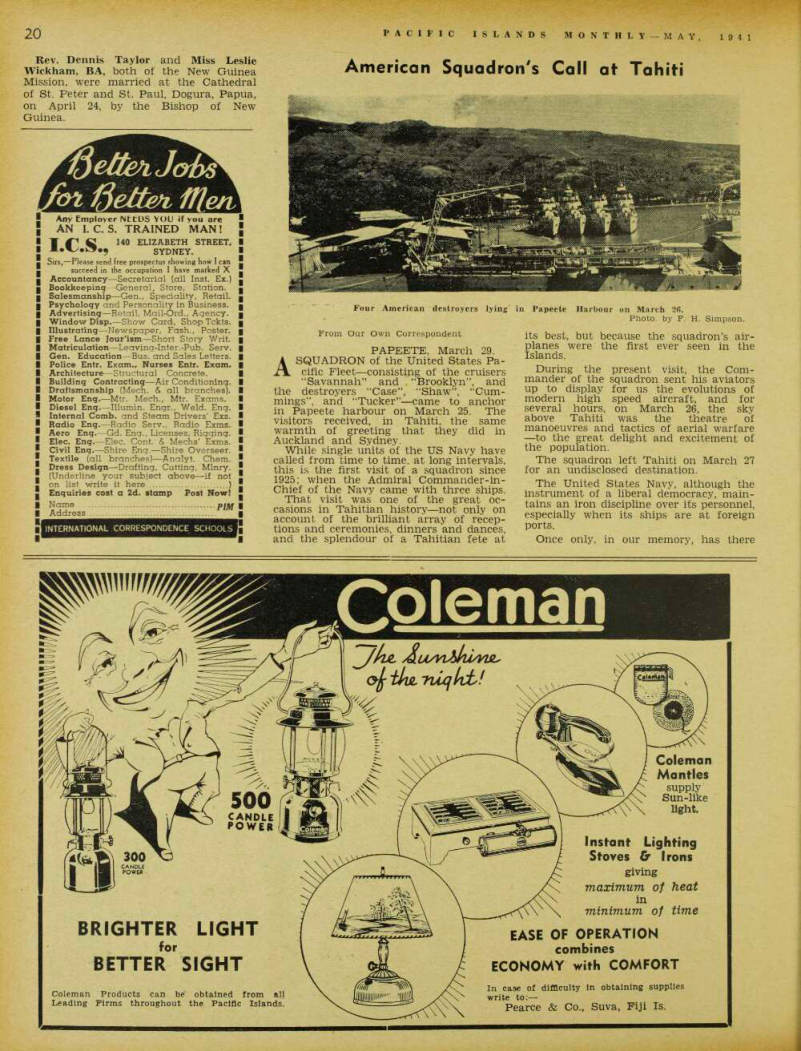
New Revenues in Rarotonaa N ew revenues in Rarotonga
From Our Own correspondent
Rarotonga, April 17.
TIVAEVAE” days are here again. Out of a seemingly barren economic desert, during the off-season for oranges, a spring of glittering gold falls into the loving hands of Islands traders, as the well-covered belles-dames of the village stream in for their calico and prints A “tivaevae”, for the benefit of the illiterate, is a patchwork quilt of beau tiful craftsmanship and it may be claimed that the “tivaevae” of Rarotonga is unequalled anywhere else in the Facific. When the Islands ladies are bit ten by the “tivaevae” bug it goes hard indeed with the unfortunate male of the species. All must be sacrificed in order
to be able to sport a grander quilt than either Mrs. Marama or Mrs. Teokotai.
Luckily for the men, orders have been received from NZ for large quantities of the exquisite shell necklaces that have hitherto only been sold locally to tourists.
These are apparently much in demand amongst the fair sex at the moment, probably on account of the lack of cheap jewellery now available, Income from the sale of the neck laces, the shells for which are gathered off stones in the early morning after rain, has helped make this “tivaevae” season a real hit. The fact that these necklaces, bought at 5/- a dozen by local traders, sell at something like 3/6 apiece in NZ does not surprise Brown Brother any more. In fact, the whole thing looks so lucrative that he wouldn’t be sur prised to see the industry taken over by the local Government Fruit Control In the words of the Manke (American): “You gotta live”.
Rev. Dennis Taylor and Miss Leslie Wickham, BA, both of the New Guinea Mission, were married at the Cathedral of St. Peter and St. Paul, Dogura, Papua, on April 24, by the Bishop of New Guinea.
Advertisements & other items, pp. 23-24 (1 item)
i^Jkr
\ !*Vi
Wlllllj
'FK O 0 QLi s/^ V &
i^Jkr
PET*
» f ; r<f f.° h y 4^ *1 t* f< t srf.
S'
/i *J$ //s Any Employer NEEDS YOU if you arc
AN I. C. S. TRAINED MAN!
If* £ 140 ELIZABETH STREET,
SYDNEY.
Sirs, —Please send free prospectus showing how I can succeed in the occupation I have marked X Accountancy—Secretarial (all Inst. Ex.) Bookkeeping—General. Store, Station.
Salesmanship—Gen., Speciality, Retail.
Psychology and Personality in Business.
Advertising—Retail, Mail-Ord., Agency.
Window Disp.—Show Card, Shop Tckts.
Illustrating—Newspaper, Fash., Poster.
Free Lance Jour'ism —Short Story Writ.
Matriculation—Leaving-Inter.-Pub. Serv.
Gen. Education —Bus. and Sales Letters.
Police Entr, Exam., Nurses Entr. Exam.
Architecture —Structural Concrete.
Building Contracting—Air Conditioning.
Draftsmanship {Mech. & all branches).
Motor Eng.—Mtr. Mech., Mtr. Exams.
Diesel Eng.—lllumin. Engr., Weld. Eng.
Internal Comb, and Steam Drivers' Exs.
Radio Eng.—Radio Serv., Radio Exms.
Aero Eng.—Gd. Eng., Licenses, Rigging.
Elec. Eng.—Elec. Cont. & Mechs' Exms.
Civil Eng.—Shire Eng.—Shire Overseer.
Textile (all branches) —Analyt. Chem.
Dress Design—Drafting, Cutting, Mlnry. (Underline your subject above—if not on list write it here ) Enguiries cost a 2d. stamp Post Now!
Name Address
PIM
INTERNATIONAL CORRESPONDENCE SCHOOLS
u
o-jfilvL n
"SA s »?5 y r >* 500
CANDLE
POWER
300
CANDLE
POWW
BRIGHTER LIGHT
for
BETTER SIGHT
Coleman Products can be' obtained from all Leading Firms throughout the Pacific Islands.
Coleman Mantles supply Sun-like light.
Instant Lighting
Stoves & Irons giving maximum of heat in minimum of time
EASE OF OPERATION
combines
ECONOMY with COMFORT
In case of difficulty In obtaining supplies write to:— Pearce & Co., Suva, Fiji Is.
American Squadron's Call at Tahiti
From Our Own Correspondent PAPEETE, March 29.
A SQUADRON of the United States Pa cific Fleet—consisting of the cruisers “Savannah” and “Brooklyn", and the destroyers “Case”, “Shaw”, “Cum mings”, and “Tucker” —came to anchor in Papeete harbour on March 25. The visitors received, in Tahiti, the same warmth of greeting that they did in Auckland and Sydney.
While single units of the US Navy have called from time to time, at long intervals, this is the first visit of a squadron since 1925; when the Admiral Commander-in - Chief of the Navy came with three ships.
That visit was one of the great oc casions in Tahitian history—not only on account of the brilliant array of recep tions and ceremonies, dinners and dances, and the splendour of a Tahitian fete at
its best, but because the squadron’s air planes were the first ever seen in the Islands.
During the present visit, the Com mander of the squadron sent his aviators up to display for us the evolutions of modern high speed aircraft, and for several hours, on March 26, the sky above Tahiti was the theatre of manoeuvres and tactics of aerial warfare —to the great delight and excitement of the population.
The squadron left Tahiti on March 27 for an undisclosed destination.
The United States Navy, although the instrument of a liberal democracy, main tains an iron discipline over its personnel, especially when its ships are at foreign ports.
Once only, in our memory, has there
Four American destroyers lying in Papeete Harbour on March 26.
Photo, by F. H. Simpson.
been any incident while a United States warship was at Papeete.
That was shortly after the end of the Great War. Were it not for the sequel, the incident would not be worth recording.
A few sailors, who had become unruly by too much alcohol, had started a brawl which resulted in the wrecking of some chairs and glassware in a couple of drinking places. As this had taken place on the night before the battleship departed, the commanding officer re quested the United States Consul at Papeete to appraise the damage and com pensate the proprietors. The Consul did so, and the incident was apparently closed.
Word had gone forth, however, that the Consul was dispensing funds from the United States’ Treasury. Sundry small merchants began to present belated claims at the Consulate for alleged damages wrought by United States sailors.
Among them came Monsieur X, at that time a photographer and purveyor of miscellaneous wares, who had a rather shadowy reputation in “ways that are dark and tricks that are vain’’. The Con sul knew Monsieur X. Indeed, when the procession of fresh claims began, the Consul expected to see him, sooner or later. He had, therefore, made some in quiries and discovered that the only “incident” was that Monsieur X had scandalously overcharged some perfectly sober and unsuspecting sailors for a num ber of pictures and souvenirs.
The Consul was a man of valour, and of peppery temper. He listened with mounting choler while Monsieur X re counted his damages until he presented a claim for a whole case of watches.
Whereupon the Consul arose, and Mon sieur X found himself executing the parabola of a flight from the entry of the Consulate that landed him literally on his ear in the middle of a very dusty highway.
Monsieur X had nothing more to say.
The dust and shock had extinguished his claims. He pulled himself to his feet, brushed the soil of the highwav from his garments and betook himself from the Consul’s menacing stare—comforted, no doubt, in the knowledge that he lived to plot and scheme another day.
Copra As Pig Food
SAMOAN copra for feeding pigs was being distributed from New Ply mouth, in New Zealand, in April. It comprised roughly one-third of the first shipment of about 500 tons, which had been sent from Western Samoa for the purpose. The remainder is to be stored at a convenient centre by the Internal Marketing Department, which is super vising the distribution.
NZ’s decision to import copra was made when a shortage of grains from Australia threatened to interfere seri ously with the production of baconer pigs, at that time keenly sought by Britain.
Mr. H. Criso arrived in Sydney re cently from Wau, New Guinea, after serving two years with the Wau branch of the Bank of NSW.
Mr. and Mrs. J. Day, and their two children, arrived in Auckland. NZ, by Clipper, in April. Mr. Day, who is a meteorologist connected with Pan Ameri can Airways, will replace Mr. E. B. Bux ton as meteorologist at the PAA station in Auckland.
Mr. J. Clark, eldest son of Hon. and Mrs. R. L. Clark, of Rabaul, New Guinea, is now a pilot in the RAAF. He has been in Canada under the Empire Air Training Scheme for some time, and recently was awarded his “wings”.
Palynesia
The Salmon Family Of
History Puzzle is Solved
Letter to the Editor I AM indebted to my friend, Mr. W. W.
Bolton, of Papeete, for some infor mation he gathered from Mr. Arthur Brander, a nephew of the late Queen Marau, in connection with recent inquiries in your journal concerning the relation ship, if any, that existed between Alexander Salmon, the Anglo-Jewish founder of that family in Tahiti, and J.
M. Salmon, the husband of Tinomana, of Arorangi, Rarotonga.
This is a matter that has intrigued students of the Pacific for some time. Ac cording to Mr. Arthur Brander (who, of course, is Alexander Salmon’s grandson) the suspected relationship is quite de finitely established.
Mr. Bolton writes:—“Marau always spoke of her father (Alexander Salmon)
and his brother as the sons of an Eng hsh banker - Alexander and his brother left England as young men, and arrived eventually in California. Alexander headed on west, to Tahiti. His story is now known. (He married Arii-taimai. the high chieftainess of Papara, head of the Teva clan, and foster-sister to Queen Pomare IV.) “Alexander’s brother remained in Cali fornia, married, and had issue. Two of his sons, their education finished, were sent to join their uncle, Alexander Sal mon, in Tahiti. They arrived when Arthur Brander and his brothers were at school in Scotland. When Arthur Brander returned home, John M. Salmon had already left for Rarotonga, but his brother, William Salmon, remained, lived, and died in Tahiti, and was well known to his second cousin, Arthur Brander, throughout his life, “John Salmon, of Rarotonga, was therefore first cousin to Marau and the latter’s brother Tati (II) of Papara. If John Salmon returned to Tahiti, it must
have been during the long absences of Arthur Brander in other lands; it is not at all unlikely, though Mr. Brander can not recall it as a fact.”
We are grateful to Mr. Bolton for ob taining this information first-hand from Mr. Brander, now one of the few re maining sources who have knowledge of that colourful period in Tahitian history.
I am, etc.,
Eric Ramsden.
Pacific Islands Society, Box 2434 MM, G.P.0., Sydney. 30/4/194L The Rarotonga Child Welfare Asso ciation, which has done such excellent work under the direction of Dr. and Mrs.
E. P. Ellison, has now launched out with a new club-house. An unused house on the waterfront has been rented for the purpose and necessary repairs are being carried out. “Te Aroa Club” is to be chiefly a meeting place for young mem bers of the Association, where they will learn and practise nursing and other
womanly accomplishments—undoubtedly
including gossiping.
Rev. W. T. and Mrs. Taylor, who were well-known at Boianai, Papua, as workers for the New Guinea Mission, have re signed owing to ill-health. They are now in Adelaide.
Advertisements & other items, pp. 25-26 (1 item)
Bidomak
NERVY WOMEN...
CRANKY CHILDREN...
GROUCHY HUSBANDS..
all need %%
BIDOMAK
The Tonic of the Century
for NERVES, BRAIN and that DEPRESSED FEELING Nerve cells and tissues are replenished, blood nourished, nerves calmed, appetite improved, sleeplessness banished and health restored as the vital mineral elements in ‘'BIDOMAK" end mineral starvation—cause of nerve trouble. Thousands who were once run-down, nervy and depressed are now fit and well—thanks to this mineral rich, natural tonic.
SCIENTIFIC CONTROL
Manufactured in the BIDOMAK Pharmaceutical Laboratories, one of the most up-to-date, hygienic laboratories in the Southern Hemisphere, to which is attached a fully qualified Doctor of Medicine, and under the control of a qualified chemist, who was trained in the most modern English Laboratories in the world.
Start To-day on a Course of—
BIDOMAK
AT ALL
‘The Tonic of the Century.”
LEADING ISLAND STORES
BARNET GLASS
RUBBER CO. LTD.
Wentworth Avenue,
SYDNEY
Radio : “BARNGLASS” — SYDNEY.
Manufacturers and Suppliers to the Islands’ trade of all rubber goods:— Tyres, Tubes and Accessories Rubber Soled Footwear Tennis Balls Waterproof Garments Mechanical Hoses, Transmission Belting, etc.
Tennis Racquets, Golf Balls, Toy Balls, etc., and native trade lines.
Prompt and efficient attention to all enquiries.
Box 2629 E.E., Tel. MA 6151 G.P.0., SYDNEY. M 4409 25 lines.
A NEW
LIGHTWEIGHT,
MEDIUM - PRICED CASE
IN ALL NEEDED SIZES !
Made by an improved new process, the new Fordite fibre is harder-wearing and longer-lasting. It is glossy and smooth . . . providing a highly serviceable travel case at a moderate price. It saves weight . . . pick up a new Fordite and you'll see at once how much lighter it is!
NEW FORDITE
TRAVEL
Attache, No. 707.
CASES
Suit Case, No. 718.
All storekeepers can supply. Traders are invited to apply for price list and full particulars.
FORD SHERINGTON LTD.,
Manufacturers, Kippax Street, Sydney.
Pariki-Elect
Weary Waiting on MZ Court
Prom Our Own Correspondent Rarotonga, April 17.
RAROTONGANS read with a mixture of amusement and annoyance the remarks of the New Zealand judge who recently heard the case concerning their new Ariki Nui (High Chief).
Mrs. Takau Rio Love, the Ariki-elect, asked the Supreme Court to quash the appeal of Mrs. W. P. Browne against the decision of the Cook Is. High Court, which awarded the title to Mrs. Love.
The worthy judge, as reported in the New Zealand newspapers, apparently doubted if the case was of any material importance: but relented when told that there was a question of income involved.
Mrs. Love’s lawyer then remarked that the case had been in NZ for a year, and in the courts for more than two years.
This length of time, the judge ex plained, was of no account in the Paci fic Islands. Unhappily, the days to which the judge refers are long past. Life is mostly clock and bustle in all except the most remote islands.
The Supreme Court at length fixed June 6 as the final date for hearing the case. It is understood that Mr. W. P Browne will proceed to NZ, in May. on that account.
New Taxes in Samoa
From Our Own Correspondent APIA, April 11.
AT the last meeting of the Legislative Council, the Revenue Amendment Ordinance (1941) was nassed after lengthy discussion. It nrovides for the removal of anomalies in the Revenue Ordinance (1929) and amendments, and also introduces a graduated Salary Tax and a graduated Store Tax.
The Administration has stressed that the new taxes will be borne by those most able to meet them and that it is not Intended that the taxes shall be passed on to the consumer. Exemptions are provided for married men with large families. Sales of Samoan produce are not liable to the Store Tax, which rises from .5 per cent, at £3,000 to 5 per cent, at £93,000.
A feature most appreciated by the general public is the reduction in the rate of surcharge for overdue licenses and taxes—from the old rate of 10 per <"ent. and 25 per cent, to a flat rate of 5 per cent. This should relieve many cases of hardship.
Considering the present economic con dition of Western Samoa, the result of restricted exports and decreased imports, it is doubtful whether the increase in revenue from new taxes will come up to expectations.
Mr. H. V. Wills, of the British Phos phate Commission staff, Ocean Island, and Miss Queenie Reymond, of Butari tari, were married on March 8 in the LMS Church, Ocean Island. The bride was given away by Mr. Fraser; Mrs.
Fraser was matron of honour; Mr. Rey nolds was best man; and Rev. Clifford Welch officiated. The bride was charm ingly attired in white silk. Among those at the reception, were Mrs. J. C. Barley (wife of the Resident Commissioner) Mr. and Mrs. Geo. Bridges (Mr. Bridges is BPC manager at Ocean Island), and Mr.
Young (Melbourne office, BPC).
Advertisements & other items, pp. 27-28 (1 item)
We Knew
all the answers
anti built a better set
Agents for New Guinea, Papua and Solomon Islands:— Airsane have here the best range of "torrid zone" radio receivers ever produced. Before production was ever started on sets for island listeners, we checked up on weather conditions—best valves— best cabinet materials—best speaker—best circuits —all were taken into consideration to make the best radio and give you utmost reliability under tropical weather conditions. And here Airzone present a range of receivers beautiful of tone fascinating in cabinet design amazing in long distance reception and remarkably reliable under any condition whatsoever. Particular attention was given to overseas short wave reception.
Innumerable developments have been made in these receivers so that overseas reception can be received with amazing clarity and volume.
"Airzone's tone is Airzone's own."
Above left is Model 6552 A, Airzone's new "Concert Star," a 5 Valve A.C. Mantel Dual Wave of wonderful long distance reception.
Here again, at left. Airzone proudly presents Model 5098, 5 Valve 1.4 Volt Battery mantel Dual Wave. Also as Model 5059, 5 Valve Vibrator powered Dual Wave.
At right is Airzone's massive 8 Valve A.C.
Dual Wave Console Model 1082 A, designed for far-reaching overseas reception.
At left is veneered mantel made in 4 models —Model 1062 AM, 6 Valve A.C. Dual Way*; Model 1072VM, 7 Valve Vibrator Dual Wave; Model 1162 WM, 6 Valve 2 Volt Battery Dual Wave; and Model 1252VM, 5 Valve Vibrator Dual Wave.
W. R. CARPENTER & CO., LTD.
Designed and manufaetur 19 O'Connell Street, Sydney; Salemaue, Rebaul, Kayieng and Madang, N.G., and Tulagi, Solomon Islands. 1111111 l mill I;
min ||ini||
'Hi, 1111111 l
l r ,tl
lllllltf "’ll" 111111 l mu m mu mm m "H|"
iilliu
mu in in mu mill x |f.l 7
hIIIIii mull
(111 1111111 l
Many a man is discussed like this by his employers
The scene is the Board of Directors room in a big company in Sydney.
It is Friday morning at 10.30. The Board is sitting.
CHAIRMAN OF THE BOARD: “Well,
here’s the salary list. Johnson’s asking for a rise—says that living expenses are very heavy up in the Islands, as well as having two girls to educate down here in Sydney.”
Ist DIRECTOR: “That’s all very well, but does Johnson’s work justify a rise? Personally, I don’t think so.” 2nd DIRECTOR: “I agree. Johnson isn’t turning out to be quite the success we thought he would be.
As a matter of fact, I really think we should consider a change.” 3rd DIRECTOR: “Well, frankly, I’m sorry for Johnson, because I recommended him and you must agree he did a lot of excellent work in the past. Still, the general feeling seems to be against him, so we’d better forget that rise of his.”
And what about Johnson? Why was it he was not the success he should have been? Let us look inside his bunaglow and see. . . .
Fred Johnson is leaning against the verandah rail talking to his wife, Rita.
“I don’t know Rita—none of the things we dreamed about seem to be coming true, do they? I thought that when we came up here we could really get in amongst the money. It seems to take twice as much to live here as anywhere else.
Bills—bills—l’ve never finished paying’ bills!”
“Cheer up, Fred, it’s not as bad as all that.”
“Not as bad—it’s worse! The trouble is this rotten tiredness of mine The everlasting tiredness—l even wake up tired nowadays. How can a man put his mind on his job when he’s got this tiredness hanging over his head?”
“Darling, I really think that tiredness of yours is serious. It’s not right for you to always feel like that—l’ve noticed it. Now look— for my sake will you go and see Dr.
Morris?”
And so Fred Johnson went along and saw Dr. Morris. Dr. Morris gave him a thorough examination.
Then, ivhen he had finished , he said : “Fred, you’ve probably never realised it, but you’re suffering from night starvation. You see, it’s not a well-known fact, but while you sleep your body goes on burning up energy. Heart beats, breathing and other automatic actions—these take it out of you. Naturally unless energy is replaced during sleep you’re bound to wake tired and feel unequal to your job. Now the best thing for you, Fred, is Horlicks.
Horlicks guards against night starvation and helps you to wake refreshed.”
So Fred started drinking Horlicks every night and it made a wonderful difference to him. We meet him again two months later. He is hurrying up the garden path to his bungalow carrying a letter in his hand. As he approaches the door he calls . . .
“Rita—Rita.”
“Yes dear —what is it?”
“Darling, I landed that order I was telling you about. This means a rise for me now” . . .
Do YOU wake tired—feel run down?
Are YOU worried about your job?
If so, drink a cupful of Horlicks regularly last thing at night. You see tiredness, lack of energy and dulness are really symptoms of night starvation, and Horlicks guards against night starvation.
"ORIX**
*ixe mm
"Blackbirding" in
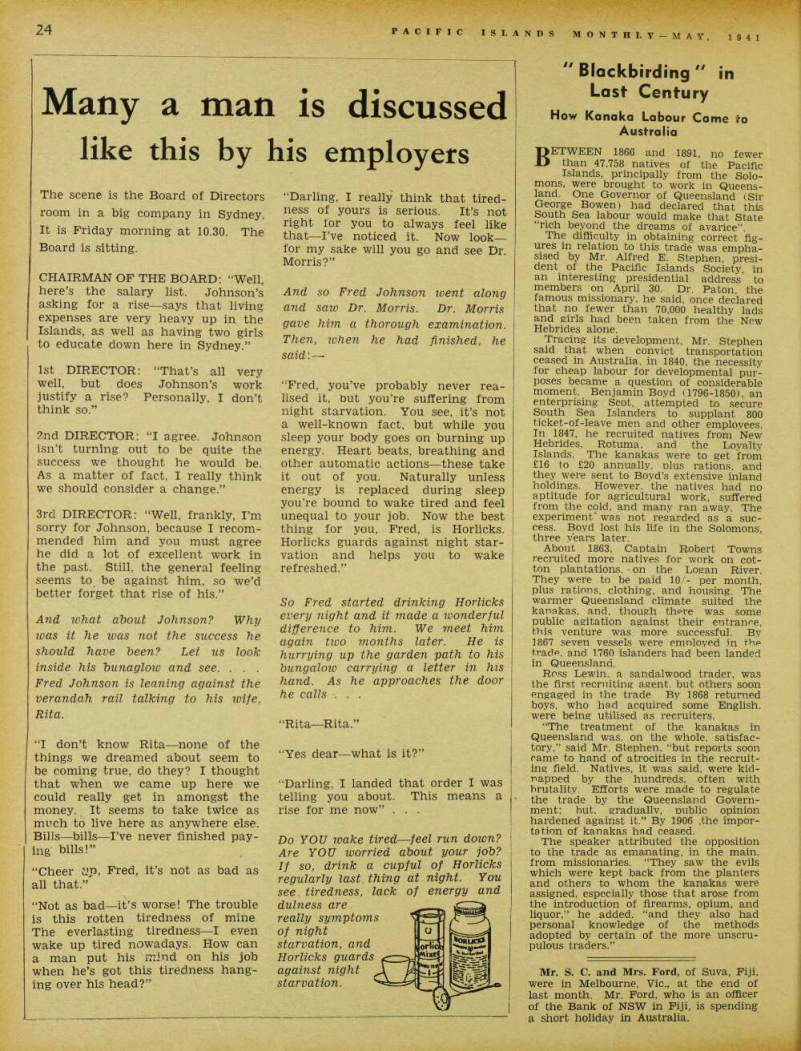
Last Century How Kanaka Labour Came Jo Australia
BETWEEN 1866 and 1891, no fewer than 47,758 natives of the Pacific Islands, principally from the Solo mons, were brought to work in Queens land. One Governor of Queensland (Sir George Bowen) had declared that this South Sea labour would make that State “rich beyond the dreams of avarice’’.
The difficulty in obtaining correct fig ures in relation to this trade was empha sised by Mr. Alfred E. Stephen, presi dent of the Pacific Islands Society, in an interesting presidential address to members on April 30. Dr. Pa ton, the famous missionary, he said, once declared that no fewer than 70,000 healthy lads and girls had been taken from the New Hebrides alone.
Tracing its development, Mr. Stephen said that when convict transportation ceased in Australia, in 1840, the necessity for cheap labour for developmental pur poses became a question of considerable moment. Benjamin Boyd (1796-1850), an enterprising Scot, attempted to secure South Sea Islanders to supplant 800 ticket-of-leave men and other employees.
In 1847, he recruited natives from New Hebrides, Rotuma, and the Lovalty Islands. The kanakas were to get from £l6 to £2O annually, nlus rations, and they were sent to Boyd’s extensive inland holdings. However, the natives had no aptitude for agricultural work, suffered from the cold, and many ran away. The experiment' was not regarded as a suc cess. Boyd lost his life in the Solomons, three years later.
About 1863, Captain Robert Towns recruited more natives for work on cot ton plantations, on the Logan River.
They were to be paid 10/- per month, plus rations, clothing, and housing. The warmer Queensland climate suited the kanakas, and, though there was some public agitation against their entrance, this venture was more successful. By 1867 seven vessels were emnloyed in thp trade, and 1760 islanders had been landed in Queensland.
Ross Lewin. a sandalwood trader, was the first recruiting agent, but others soon engaged in the trade By 1868 returned boys, who had acquired some English, were being utilised as recruiters.
“The treatment of the kanakas in Queensland was. on the whole, satisfac tory,” said Mr. Stephen, “but reports soon came to hand of atrocities in the recruit ing field. Natives, it was said, were kid napped by the hundreds, often with brutality. Efforts were made to regulate the trade by the Queensland Govern ment; but. graduallv, nublic opinion hardened against it.” By 1906 ,the impor tation of kanakas had ceased.
The speaker attributed the opposition to the trade as emanating, in the main, from missionaries. “They saw the evils which were kept back from the planters and others to whom the kanakas were assigned, especially those that arose from the introduction of firearms, opium, and liquor,” he added, “and they also had personal knowledge of the methods adopted by certain of the more unscru pulous traders.”
Mr. S. C. and Mrs. Ford, of Suva, Fiji, were in Melbourne, Vic., at the end of last month. Mr. Ford, who is an officer of the Bank of NSW in Fiji, is spending a short holiday in Australia.
40 Years Ago
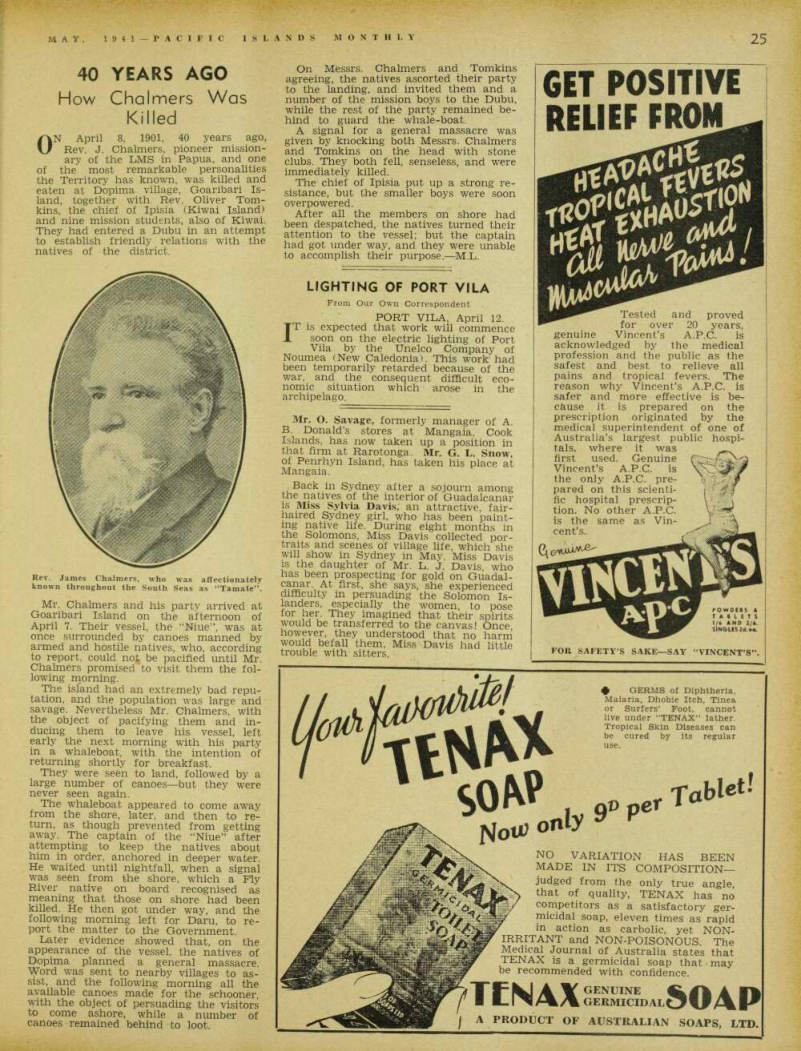
How Chalmers Was Killed
ON April 8, 1901, 40 years ago, Rev. J. Chalmers, pioneer mission ary of the LMS in Papua, and one of the most remarkable personalities the Territory has known, was killed and eaten at Dopima village, Goaribari Is land, together with Rev. Oliver Tom kins, the chief of Ipisia (Kiwai Island) and nine mission students, also of Kiwai.
They had entered a Dubu in an attempt to establish friendly relations with the natives of the district.
Mr. Chalmers and his party arrived at Goaribari Island on the afternoon of April 7. Their vessel, the “Niue”, was at once surrounded by canoes manned by armed and hostile natives, who, according to report, could not be pacified until Mr.
Chalmers promised to visit them the fol lowing morning.
The island had an extremely bad repu tation, and the population was large and savage. Nevertheless Mr. Chalmers, with the object of pacifying them and in ducing them to leave his vessel, left early the next morning with his party in a whaleboat, with the intention of returning shortly for breakfast.
They were seen to land, followed by a large number of canoes—but they were never seen again.
The whaleboat appeared to come away from the shore, later, and then to re turn, as though prevented from getting away. The captain of the “Niue” after attempting to keep the natives about him in order, anchored in deeper water.
He waited until nightfall, when a signal was seen from the shore, which a Fly River native on board recognised as meaning that those on shore had been killed. He then got under way, and the following morning left for Daru, to re port the matter to the Government.
Later evidence showed that, on the appearance of the vessel, the natives of Dopima planned a general massacre.
Word was sent to nearby villages to as sist, and the following morning all the available canoes made for the schooner, with the object of persuading the visitors to come ashore, while a number of canoes remained behind to loot.
On Messrs. Chalmers and Tomkins agreeing, the natives ascorted their party to the landing, and invited them and a number of the mission boys to the Dubu, while the rest of the party remained be hind to guard the whale-boat.
A signal for a general massacre was given by knocking both Messrs. Chalmers and Tomkins on the head with stone clubs. They both fell, senseless, and were immediately killed.
The chief of Ipisia put up a strong re sistance, but the smaller boys were soon overpowered.
After all the members on shore had been despatched, the natives turned their attention to the vessel; but the captain had got under way, and they were unable to accomplish their purpose.—M.L.
Rev. James Chalmers, who was affectionately known throughout the South Seas as “Tamate”.
Lighting Of Port Vila
From Our Own Correspondent PORT VILA, April 12.
IT is expected that work will commence soon on the electric lighting of Port Vila by the Unelco Company of Noumea (New Caledonia). This work had been temporarily retarded because of the war. and the consequent difficult eco nomic situation which arose in the archipelago.
Mr. O. Savage, formerly manager of A.
B. Donald’s stores at Mangaia, Cook Islands, has now taken up a position in that firm at Rarotonga. Mr. G. L. Snow, of Penrhyn Island, has taken his place at Mangaia.
Back in Sydney after a sojourn among the natives of the interior of Guadalcanal is Miss Sylvia Davis, an attractive, fair haired Sydney girl, who has been paint ing native life. During eight months in the Solomons, Miss Davis collected por traits and scenes of village life, which she will show in Sydney in May. Miss Davis is the daughter of Mr. L. J. Davis who has been prospecting for gold on Giiadal- S a ii ai \ first, she says, she experienced difficulty in persuading the Solomon Is landers, especially the women, to pose for her. They imagined that their spirits would be transferred to the canvas! Once however, they understood that no harm would befall them, Miss Davis had little trouble with sitters.
Advertisements & other items, pp. 29-30 (1 item)
'fcihlet-
GET POSITIVE
RELIEF FROM
Tested and proved for over 20 years, genuine Vincent’s A.P.C. is acknowledged by the medical profession and the public as the safest and best to relieve all pains and tropical fevers. The reason why Vincent’s A.P.C. is safer and more effective is because it is prepared on the prescription originated by the medical superintendent of one of Australia’s largest public hospitals, where it was first used. Genuine Vincent’s A.P.C. is the only A.P.C. prepared on this scientific hospital prescription. No other A.P.C. is the same as Vincent’s.
POWDERS S
TAIL E T $
I/* AND 2/t.
SINGLES 2d. •«.
FOR SAFETY’S SAKE—SAY “VINCENT’S”.
Nou)
* >k ■“V >; O Si f 4 GERMS of Diphtheria, Malaria, Dhobie Itch, Tinea or Surfers’ Foot, cannot live under “TENAX” lather Tropical Skin Diseases can be cured by Its regular
only 9° per
'fcihlet-
NO VARIATION HAS BEEN
MADE IN ITS COMPOSITION—
judged from the only true angle, that of quality, TENAX has no competitors as a satisfactory germicidal soap, eleven times as rapid in action as carbolic, yet NON-
IRRITANT and NON-POISONOUS, The
Medical Journal of Australia states that TENAX is a germicidal soap that may be recommended with confidence.
TENAX
GENUINE &A A n
germicidalO"/%”
A PRODUCT OF AUSTRALIAN SOAPS, LTD.
Modern Refrigeration for the South Sea Islands
The ELECTROLUX
KEROSENE OPERATED
REFRIGERATOR
MARVEL
OF
MODERN
SCIENCE
THE
MIRACLE
OF
ICE
FROM
HEAT
ELECTROLUX offers economical, modern and completely efficient
REFRIGERATION FOR ISLANDS' HOMES.
FREEZES CONTINUOUSLY WHILE SMALL LAMP BURNS.
Freezing controlled by simply regulating height of flame. Uses only gallon of kerosene per week.
MOTORLESS ... NO PARTS TO GET OUT OF ORDER. • Write to your Local Distributor for prices and full details.
Obtainable from: W. R. Carpenter & Company Ltd.—Sydney, and the following New Guinea Branches: Rabaul, Salamaua, Wau, Kavieng, Madang, and Wewak.
W. R. Carpenter & Coy. (Solomon Is.) Pty. Ltd. —Tulagi, British Solomon Islands.
On Chong & Company Pty. Ltd.—Butaritari, Gilbert and Ellice Islands.
Representation in Papua and New Hebrides.
Happy Days in Takaroa

Where War Is
Not
By Mrs. Lorna Davidge, who, with her husband and son, are cruising leisurely in the South Pacific, en route from Vancouver to New Zealand.
BETWEEN the Marquesas, and Tahiti, in Lat. 14 deg. 27 min. S, and .Long. 144 deg. 57 min. W, lie the two lovely little islands of Takaroa and Taka poto, in the Tuamotu Archipelago.
Our first sight of them, was a fuzzy green line on the horizon. This, as we neared it, divided into two. The smaller was Takaroa, our destination.
A pirogue came out to meet us, as we came up to the pass, with a native pad dling. This was the pilot, Tomi Mapuki, who took the schooner through the pdss; and it was not long before we were moored, fore and aft, to the rough coral dock, with its cone shaped block of coral, that served as a flagstaff for the tri-color of France.
Here the entire population of the vil lage waited to welcome us. The day before, the chief had had a premonition that a strange boat was coming to the island from far away, and he told his people not to go to make copra that day, as usual, across the lagoon. They informed us that the “Lorna D” was the first Canadian boat ever to call there.
Takaroa village is very attractive, with its white coral streets, lined with palms, frangipanni, and neat thatched houses, the only blot on the scenery being two corrugated-iron Chinese stores.
Looking overside, we can see the shadow of our hull, outlined on the white sandy bottom, while the clearness of the water makes the boat seem to be sus pended in air.
Yellow, red, green and black velvety looking fish, dart in and out of the coral, and a native fisherman swims by, in his scarlet pareu, underwater goggles on, with a spear in his hand, ready for any fish that comes in range. As I watch, he swims down, and walks about under our keel, staying down what seem? :hn in credible time. These divers do not fear sharks as much as they do the great eels, which dart their ugly heads at passing fish, from the crevices in the coral dock.
That night, we sat on a low wall, in the brilliant light of the full moon, while the palm fronds swished and thrashed overhead in the strong SE trade, and watched the dancers in the school-house.
Nobody could speak much English here, but we were surrounded by friendly smiles and greetings. People seemed to be continually coming and going along the moon-lit road, mostly young folk, with wreaths of frangipanni, set at a slant, on their heads. As they strolled, they strum med a guitar, or sang in their soft voices.
WE seemed only to have just fallen asleep, on deck, when a figure ap peared at the boat-side. It was Tomi. He called, "Were we awake?” A woman of the village had apparently died, following a quarrel with her son.
They were unable to revive her. Had we anything that might help? As we rum maged the medicine locker, word came from the village that the son had ad mitted being in the wrong, whereupon mamma had come alive again! We went back to bed.
But yells from further up the street made sleep impossible. A man was being chased by the angry spirit of a relation, upon whose grave he had unfortunately dropped a coconut, the day before.
However, we did get a little sleep before daybreak. Then a large crowd gathered
on the dock, to watch us eat breakfast.
Each skylight and port was filled with curious faces, the owners' of which commented freely on our strange ways.
The skipper went off in company with the young school-master, who is saving his wages, to some day make a trip around the world!
School starts when enough children have arrived to make it worth while, and not according to the time kept by the ancient ship’s clock on the wall. It is a relic from the wreck of the British ship “County of Roxborough”, which piled up on Takaroa’s reefs in the hurricane of 1906. Her rusting hull is still a conspicuous object on the island.
After a few dozen children had strolled in, school began, and the skipper, being a visitor, was asked to write the months of the year, in English, on the blackboard, to be copied and learned by the pupils. After this, school was dismissed for the duration of our stay, as the children could learn far more or interest by sitting on the dock, and watching our
peculiar ways on board the schooner.
Later, during a walk, we meet Timiki, who -wants us to have a drinking nut, at his little, bougainvillea-covered cot tage. Here we meet Hono, who adopts us, after the custom of the South Seas; we go with him to the home of Tufurua, the big, gentle-voiced, pearl-diver. When we leave his home, we are the proud possessors of a live chicken, four eggs, a dozen drinking nuts, a hand-made hat, a golden blister pearl, etc.—while Hono presents the skipper with an iron-wood walking-stick. 1 go back on board to hunt up suitable presents for our friends, and the skipper continues his stroll, and picks up shells along the shore. A native sees him, and says to come with him to his house, and get some fine shells. Here, being pre pared for the stone oven, is the carcase of a large, black dog.
"You eat that dog?” the skipper asks, "Yes, maitai (good). You come five o’clock kai-kai?”
While the skipper appreciated the
generous invitation, he found that he would be unable to make it, on time for the least.
IN the meantime, our son, Dick, who always seems to find a mechanical , . J°£’ mended the chief’s clock, which had been asleep for five years.
On this news spreading, sick and tired clocks, sewing machines and gramophones appeared from everywhere. The finishing touch was given by an ancient motor car, of all things, which wouldn’t go, either. To make matters worse, Hono, who seemed to be at the bottom of all this, appeared with a pile of tin basins a^ T1 was k tubs, that nee ded soldering!
When Dick had the car in running order he took it on a trial run, around the island, a distance of about a mile, with the skipper, Hono and me aboard.
Later, Hono, who has a business head, advertised the round trip, for five francs per head, driving slowly, so that the passengers would feel that they were gettmg their money’s worth. This was just
as well, since they liked it that way; and it was very doubtful whether the car could be induced to go any faster than We never could discover who really owned the car, as the profits seemed to go to so many different people. Probably it was the community spirit, which crops up everywhere in these islands Dick, leaving a trail of ticking clocks, whirring sewing-machines and musical gramophones behind him, arrived back aboard loaded down with shell leis, hats, seed-pearls, shells, etc., from grateful owners.
One evening, we attended a play, given in the Mormon church, especially for us.
An enthusiastic audience sang, accom panied by guitars, until the players were ready to begin. Mormon the prophet is the hero of the play, and he, after many hardships, finally overcomes the devil — who, apparently, no one wanted to im personate, so he was made of wood, and manipulated by pulling strings from be hind the scenes. The chorus, decorated in
shells and flowers, provided good singing —and a very entertaining and interesting evening was enjoyed by all. Next morning, Harmani, one of the “angels”, made me a present of the pretty wreath of flowers, made from tiny colored shells, that she wore during the play. rE days went by very quickly, as our friends devised new entertainments for us. We had a picnic across the lagoon, to the island of the “bad king”, where his stone throne and oven, in the
circle where he held his court, could still be seen. A large black bird is supposed to keep guard over this once taboo spot; and he was on the job this day.
Another time, we walked to the wreck of the “County of Roxborough”. Then, a day on the reef with Hono, who showed us how to find the most beautiful shells, or spear an octopus, or fish, which he taught us how to cook, on our return.
In the evenings twenty or thirty young people would come aboard, and sit on deck, wrapped in pareus or white bed sheets—as the July nights seem cold to them—and sing for hours in the moon light, under the leadership of Henri and his starry-eyed wife, Teri. These young people did a great deal to make our visit a pleasant one, with their beautiful ren dering of their native songs, and their dances.
Henri was a dancer in the picture “Mutiny of the Bounty”. We like to re member him as he was, at the time of our visit, singing and dancing with his friends, and leading the sweet singers of Takaroa. Later on, after our arrival at Tahiti, we saw him again, but with only a few weeks left to live, after an injury received in a fall across an anchor.
Before we left Tahiti, Teri was a widow.
ONE day, there was great excitement.
The pearling season had opened, and the divers were leaving for Takapoto, five miles away, their sailing pirogues fly ing like the wind, as they skimmed across the lagoon, out to sea; and we heard their laughter and singing no longer.
They wouldn’t be back for two months.
As Tufurua came to say goodbye, the skipper told him, he thought that Tufurua would find a big pearl. Later, we heard that he was the only one from Takaroa to find a pearl of any great value.
Hono drops in, to bring the skipper a polished shell for the top of his walking-stick. We know that he wants a cup of coffee, with lots of sugar; and,
Top: A street in Takaroa, leading down to the dock, beside which the “Lorna D” is lying.
Lower: The dock, Takaroa.
if a can of bully-beef and a biscuit go with it—well, he figures the day has had an auspicious beginning. He is a good fellow, this little grey-headed is lander. One day, he was going to show us how to make fire, by rubbing sticks in the Islands way. He tried hard, but his age was against him, and he finally handed the outfit to a lad standing near, who soon had the wood smouldering.
The night before we sail, Henri and Teri and a few special friends have a party, when they sing their Islands songs of farewell, plaintive and sad, as the expression on the faces of the singers.
But all look more cheerful as coffee and cake appear. On the morrow, we wave good-bye to our good friends at Takaroa, and square away for Tahiti.
Advertisements & other items, pp. 31-32 (1 item)
parkling
refreshment from pure Malt and Hops
FOSTER'S
LAGER
57 AIDS TO BETTER MENUS
TOMATO
KETCHUP
H TOMATO m
O SAUCE
TOMATO KETCHUP Matte
from Sun-ripened Tomatoes.
Medium Bottles .. 8 02s.
TOMATO SAUCE A Pure
Appetising Sauce.
Large Bottles .. 13 02s.
OVEN-BAKED
BEANS
WITH PORK AND
TOMATO SAUCE.
ALSO VEGETARIAN
Individual Tins, 4 02s.
Small Tins, 8 02s.
Medium Tins, 16 02s.
TOMATO JUICE
A delicious health-giving and appetising drink Small Tins, 802 Med. Tins, 16 02.
No. 5 Tins, 60 02.
SPAGHETTI
Cooked in Tomato Sauce with Cheese Individual Tins, 4 02s.
Small Tins, 8 02.
Med. Tins. 16 02.
VEGETABLE
SALAD
Gar den-fresh Vegetables with Mayonnaise. Small Tins, 802.
HEINZ
FAMOUS iiiiiiUi PRODUCTS
MADE IN AUSTRALIA
HEINZ
PERFECT
SOUPS
READY-TO-SERVE
In 8 02. and 16 oz. Tins
CREAM OF TOMATO
CREAM OF ASPARAGUS
CREAM OF CELERY
CREAM OF CHICKEN
CREAM OF GREEN PEA
CREAM OF MUSHROOM
CREAM OF ONION
CREAM OF SPINACH
CREAM OF TOHEROA
BEAN SOUP with HAM
CHICKEN VEGETABLE
KIDNEY SOUP
MULLIGATAWNY
OXTAIL
VEGETABLE
GENUINE TURTLE SOUP
MACARONI
Cooked in Cream Sauce with Cheese.
Individual Tins, 4 02$.
Small Tins, 8 02s.
Medium Tins, 16 02s.
MAYONNAISE
Delightful on Salad.
Small Bottles, 4 02s.
Med. Bottles, 7 02s. 18 02. Bottles 57 02. Bottles
BEEFSTEAK
SAUCE
Fruits, Vegetables and Spices, skilfully blended.
Medium Bottles, 7 i 02s.
STRAINED FOODS
For Infant Feeding and Special Diets.
Strained Carrots Strained Beets Strained Prunes Strained Green Beans Strained Vegetable Soup Strained Beef and Liver
SWEET GHERKINS
Small Bottles
SWEET MUSTARD
PICKLE
Small Bottles
H. J. HEINZ CO. PTY. LTD.
Regd. Office: BENDIGO ST., RICHMOND E.l, VICTORIA Heinz delicious varieties are available from Storekeepers
throughout Papua,
New Guinea and Pacific Islands.
Little Tin Czars In Port
Moresby
Widow's Property Seized Without Notice
From Our Own Correspondent
Pt. Moresby, April 26.
PUBLIC opinion in Port Moresby has been aroused over the arbitrary re sumption for defence purposes of the private property of a resident, without adequate notice or adequate compensa tion by the Commonwealth, under National Security Regulations.
The resident, a widow, relied on her property for her means of livelihood, and her summary eviction without immediate compensation will cause her serious loss.
It appears that, under existing law, tenants and owners of houses can be summarily evicted, if the buildings are to be demolished, and without immediate compensation.
As one correspondent, in the “Papuan Courier”, states; “I do not know if there is anyone here strong enough to make himself heard at Canberra, but I am sure that if all the facts were brought to light, this Nazi style of doing things would be checked —more especially in view of the fact that 18 months ago we heard rumours of what was going to happen. Surely, in that time, houses could have been provided for everybody. The methods being employed now are, in my opinion, nothing short of scandalous, and deserve all the publicity possible”.
The first intimation received by the owner that her property was to be de molished, was the arrival of workmen to cut down trees and remove her fence.
That resumption of land may be necessary is readily understood by resi dents, but eviction under these conditions will not be tolerated.
War And Rarotonga
From Our Own Correspondent
Rarotonga, April 17.
A LARGE party, 52 men, to serve with the Free French Forces, passed through Rarotonga recently, on their way from Tahiti to New Zealand. Most of these had friends on the island, and they spent a happy day renewing old acquaintanceships.
Enlistments in Rarotonga for overseas service with the NZ Military Forces under the new volunteering scheme closed on March 31. It is understood that a small Defence Corps, probably on the lines of that in Tonga, will be recruited shortly.
Recently in Sydney on a health trip was J. T, Boyd, well-known business man of Honolulu. For the last 18 years he has been associated with Lloyds’ (of Lon don) in that city in connection with marine damage surveys. An Australian by birth, he has resided in Hawaii for 32 years.
Mr. P. Hawes, formerly of Wau, New Guinea, is now occupying a position with the Department of Civil Aviation at Archerfield aerodrome, Queensland.
Mr. T. Rea, who has been on the teach ing staff of Ifi Ifi College in Western Samoa for the past few years, arrived in New Zealand in April.
Advertisements & other items, pp. 33-34 (1 item)
Nestle S^Milr
1 1 \ V i i I i a I I / s \ ( «■ % : i p r ®Pared SPECIALLY for|^P^||M
tl! R . EI>ARED IN AUSTR^^^p
K ANGLO-SWlSsffl|||g
'Australasia) Nestle’s Sweetened Condensed Milk has been described as “Sealed Purity.” And so it is! Absolutely pure and germ free when it leaves Neslle’s Condenseries, it reaches you in the same perfect condition because it is sealed against all chance of contamination, whether from heat or any other cause. Nestle’s Sweetened Condensed Milk remains pure and fresh indefinitely while unopened—it is the SAFE milk for use in a tropical climate.
NESTLE S^MILR
COPYRIGHT B 2 2 5
Kork-N-Scal
FOR HOME USE
• Hand Applied Airtight Pressure Proof
FOR ALL HOME BOTTLING
—THE LITTLE CAP THAT
will Re-seal 1,000 Times Kork-N-Seai (Aust.) Pty. Ltd.
102-104 EDINBURGH RD.,
MARRICKVILLE.
SYDNEY, AUSTRALIA.
//>/ 'i
V-API-ETI-C5
Australia’s Choicest Products Green Peas Beetroot French Beans Spinach Cauliflower Brussels Sprouts White Turnip* Sweet Corn Tomato Puree Parsnips Tomato Sauce Celery Tomato Soup Tutti Fruit Saoce (Worcestershire flavor) Cabbage Carrots hi
ST'S
ML n QarW'W m
i mm
• 1 6
sEn
Always . . make sure you have at hand an ample Reserve of these Delicious
Garden
Vale
Ready-toserve Vegetables
Australia’S Record In N. Guinea

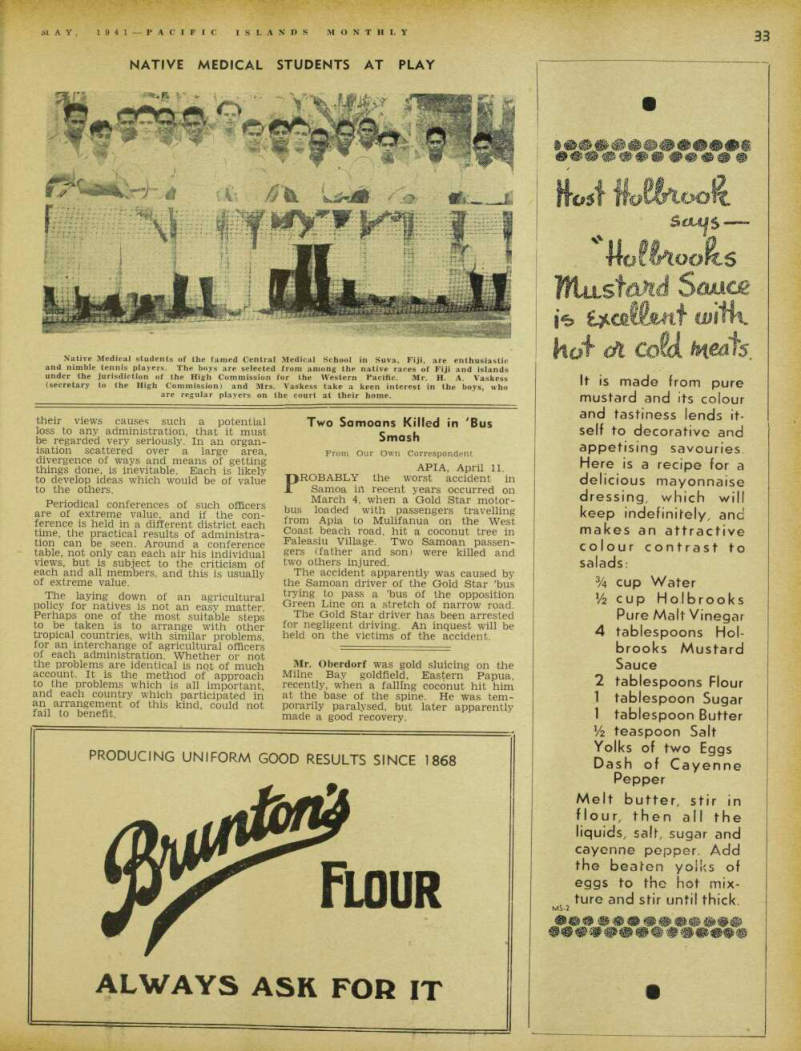
And Papua
A Demand For Constructive Thinking at Canberra
EDITORIAL NOTE : No one—no one whose opinion matters, anyway—is happy about Australia’s record of administration in New Guinea. Australia is governing the great Territory quite conscientiously, and efficiently enough; but she has done, and is doing, nothing to justify her continued hold there, in view of the insistent questions being asked by Japan, and other land-hungry nations.
Australia, for defence reasons, must hold New Guinea; but she can justify her continued hold, in the face of world opinion, only on economic grounds. She has not done that, yet.
For those reasons this thoughtful article, by “Judex” (the nom-de-plume of a well-known Australian, experienced in public administration ) has much value, at the present time.
THE challenging article bv Mr F W cnanengmg amcie oy ivn r . w.
Eggleston m the Austral-Asiatic Bulletin, opens the way to a discussion of many problems and aspects of tive administration of the Territories of the Commonwealth of Australia. I would like m this article to carry the intelligent review by the editor of the “Pacific Islands Monthly ’ a little further and to open up some of the avenues for improvement. which Mr. Eggleston indicated could be found, but on which he made few practical suggestions; and which led to the comment by the man “deeply
experienced in Pacific administration”, that “his article shows that he is theo retical rather than practical”.
First, a few general remarks. Mr.
Eggleston, speaking of administration generally, suggests “a review at reason able intervals by some unofficial publicist, and occasionally an official review of a Royal Commission”. I doubt whether any good purpose would be served by the first portion of his suggestion. No one person could be competent to review all the activities of all phases of government administration. This is one of his sug gestions which is decidedly not practical.
If, however, a means of satisfactory review could be attained, then there would be no necessity for the cccasional costly Royal Commission.
The necessity for some kind of review of the type suggested, was perhaps in dicated by the difficulty experienced by the original committee, appointed to find a site for a new capital of New Guinea, in arriving at proper conclusions, due, firstly, to the very inadequate informa tion available in convenient form, on the Territory generally, and to the apparently complete absence of any stated views of the present or any former Administration, as to the general lines which development of the Territory should follow. This committee apparently had to completely formulate its own views in respect of how such development should proceed, and where and how it was likely to pro ceed, under the existing more or less laissez-faire methods of administration.
Mr. Eggleston makes a case for greater recognition of its responsibilities to the Territories bv the Commonwealth Gov ernment, and suggests that, when recog nized fully, the organisation “suitable to the task in hand” will follow.
But, will it? Most parents recognize their responsibilities to their children, but does such recognition automatically make for the correct background and training to produce ideally balanced citizens? We must admit that, once recognizing re sponsibility, the party concerned, whether a parent or a government, must usually be shown the way.
And who is to show it in this case?
Surely not the politically-appointed mis fits who have often occupied the chairs of Administrators, but rarely deserved the title? (This is not intended to apply generally. There have been outstanding exceptions, such as the late Sir Hubert Murray, and General T. Griffiths.) MR. Eggleston has given a summary of four points for a successful policy, namely:— 1. A competent department at Canberra, and a full sense of responsibility on the part of the Government and the Federal Parliament for the policy pursued. 2. Ample financial provision for the Terri tories. The old idea that Territories must pay for themselves and pro vide their own capital must be abandoned. 3. The organisation of the territorial ser vices so as to provide for scientific development of the economic poten tialities of the Territories and the expert handling of native problems. 4. A well-thought-out economic policy; the interest of the Territories should be given at least the protection which Australian industries get, and special encouragement should be given to industries which have difficult problems of development.
T have already touched on point No. 1.
His second point will, I think, be ad
mitted by all who give the matter any thought. The only question is, as to whether such help should be by way of grant or loan. Australia has done the lion’s share of its development by means of loans from the mother country; but, then, the natural resources of Australia are such as to have made it almost certain from the outset that such loans were capable of repayment. Is this the case also in Papua and New Guinea? Many knowledgeable people would answer emphatically in the negative.
I incline to the view that, in the initial stages, grants are unavoidable. In any case, the enabling Acts for development loans could be framed in such a way as to provide for the Commonwealth Goveminent being given considerable latitude as to the conditions of repayment, which could be made subject to review after taking into account the extent of progress achieved, as a result of the loan.
In regard to his third point, there is the question as to whether the organisation he suggests does not alreadv exist.
It may be that a good organisation is lacking in direction either from its own administration, or else from the Commonwealth headquarters at Canberra.
My own feeling is that, whether the organisation is good or not, it is unlikely to get the best direction either from Canberra, or its own administration, unless the way is pointed by some competent authority, not fully occupied with routine problems and decisions of the moment, and having little time to think and to investigate the larger problems of organisation and policy.
In his fourth point, Mr. Eggleston again leaves us in the air, as to who is to do the thinking out of the policy in the interests of the Territory.
He speaks in glowing terms of the zeal and ability of the officers at Canberra, carrying on the administration of the
Territories Branch, and with this, I fully agree. Nevertheless, these officers are cluttered up with the thousand and one small routine matters, and have little opportunity for the larger technical problems on which they have to advise their Minister. As a result, there is always the question: Does the Minister get sufficient and good enough advice?
I would opine that he gets the most and the best advice possible under the circumstances: but, whether it is sufficient and good enough to offset the sometimes bad advice he receives from outside vested interests with an “axe to grind”, is perhaps better answered by Mr.
Eggleston’s quoted instance of the choice of the Wau-Salamaua road, "sponsored by one or two powerful bodies”. „ „ , , It/fR-. E £g les t°n Soes on to suggest the raising of the status of the Territories Branch, and suggests: “A departmental head of professional standing, capable of advising the government in the problems, economic, social, ethnological, and educational, involved in the government of a tropical dependency”. He admits that one man could not be an expert in all, but claims that “a man of learning and culture will be able to appraise values in these departments of knowledge”. I wonder! Whose values will he appraise? Surely other experts will have to submit them?
His proposal of seconding to Canberra, from the Territories, officers who are experts in certain fields is good, but somewhat imoracticable. There would not be sufficient volume of work at Canberra for an expert in any one field, and he would, for a large part of his time, be “cooling his heels”.
He also makes reference to the exhaustion of the gold in New Guinea, a theme so often touched upon by various people, and he further on deals with a
crisis in the supply of native labour, and the necessity for pushing on with public works.
All these matters are inter-related. You cannot expect the population of miners to settle in the country when the gold cuts out, unless there is some other means of livelihood for them, and you cannot settle them on land which they can reach only on foot, and with pack-mule, or by aeroplane, and expect them to make a living in a depressed market, after paying aeroplane freights in on their require ments, and aeroplane freights out on their production.
In public works lies the key to the situation, and this raises the question of native labour shortage. The answer is: Mechanisation. The natives must be trained to operate mechanical plant, in which event the labour supply will not be so inadequate. I dare say there would be a terrific labour shortage in each of our Australian States, if we still used stone-age methods.
This also offers a way out of the dilemma of increasing wages of the na fives in New Guinea to Papuan standards, without deleterious reactions on the natives themselves, and without in creasing costs of production. The higher wage could be restricted to those who learn to operate mechanical plant, and this would serve as an incentive to other natives to learn to do likewise, Once the mechanisation was achieved, public works could be carried out cheaply and efficiently, to open un the country, to provide roads, bridges, and essential lines of communication of modern commerce. which, if started at once, would enable displaced miners to settle on land which they could acquire cheaply (crown leases), and reasonablv exoect to make a living.
The alternative, of course, must be gra dual depopulation by white residents, or, at best, very little growth of white popu
lation, and consequent retarded developpent; and we cannot any longer afford to retard the development of a country which Asia regards with hungry eyes.
Mr. Eggleston refers to the lack of encouragement given to enlightened district officers in the expression of their views.
This is definitely a field for reform and calls for further investigation.
Lastly, he refers to the desirability of laying down an agricultural policy based on native activity and native lands. Such a policy cannot be self-contained. It is inevitably bound up with education of the natives in agricultural pursuits, as well as the problems of general education which must go hand in hand, and with communications and public works to permit of the movement of produce. 1, . , , ... have raised several questions in this article to which I now go on to suggest answers, which, if inadeouate, may at least stimulate discussion.
What I envisage, for the Territories
Branch, is the formation, at Canberra, of what I shall call a Territories Standing Council. This Council should act as an advisory body—not to the Federal Gov ernment, but to the Federal Parliament i.e., its deliberations should be tabled in both houses of Parliament, and thereby become public property, incapable of sup pression if inconvenient to the Govern ment of the day Another costly government body, you will say. But, no! The Commonwealth Public Service has, within its ranks ex perts in practically every kind of govern mental activity. The Council should be composed of these experts, and as a body would be competent‘to advise on almost any subject that came under its notice I have before referred to the insuffi ciency of work of any one kind to fully occupy an expert from the Territories at Canberra. Such an arrangement would not work. But of the members of the Territories Standing Council, each would carry on his ordinary duties of his own
department, but deal with any Territory matter as part of those duties, in pre paration for the meetings of the full Council.
The cost to the Commonwealth of such a Council would be very little, because the secretarial work would be done by the staff of the Territories Branch. This would provide a body of men “of learning and culture, able to appraise values” in all departments of knowledge, and also having considerable experience in Public Administration. Such a Council could act as Mr. Eggleston's “publicist”, to critically review the activities of the Territories from time to time, as suggested by him, and each phase of the work could be first dealt with, for the Council, by its ex pert member on that particular phase.
It could be arranged that each Depart ment of each Territory should produce an annual report of its activities, which re ports could be the basis for the critical review by the Council, as well as to pro vide it with the necessary data on which to formulate recommendations to the Government as to general nolicy. Current problems requiring immediate decisions could also be dealt with by the Council or its members, as necessary, working through the Secretary for Territories.
I have raised the question; Who will show the way to the Commonwealth Government, in formulating a Territories policy? Who could better advise, than a body of independent experts, with no vested interests to serve, and no personal “axe to grind”? A necessary provision is that the findings of the Council should be referred to the Territories concerned for any comments before tabling, which comments should be included in the mat ter tabled in Parliament. Parliament, and the public, would thus have complete un biassed information from every angle. lam fully in agreement with Mr. Eggle ston’s suggestion that the status of the Territories Branch should be raised, but join issue with him as to the question of the Permanent Head. This position should, I think, be the pinnacle of the administrative structure of the Territories, considered as a whole group.
The Permanent Head should, I think, be the ablest and most experienced head of all the territorial services, and be paid a salary higher than any one of these.
As such, he would be the logical chairman of the Territories Standing Council. His staff should be subject to constant in terchange with officers from all Terri tories. Such an arrangement, of course, presumes a Territorial service common to all Territories, which is highly desirable.
The New Guinea Service is. as far as I am aware, the only one in which specia lized administrative training is given to selected young officers. The only question is: Does the training go far enough for Permanent Headship? I feel that there should be a further selection of one or two a year of the best Assistant District Officers, who should be required to un dergo further training to university degree standard. The choice of course may be difficult, but the list of subjects covered by prospective ADO’S, does not anpear to include any science subject at all.
It is a matter for consideration, whether, in order to round off a broad general education necessary for an ad ministrator. there should not be - included some training in the scientific method and approach, in addition to. and not in place of. the present subjects, which would, of course, all have been covered before attaining to the rank of ADO.
Such graduates would be the proper group from which to choose future per manent heads of administrative depart ments, and ultimately the Permanent Head at Canberra. The Government could, with logic, go a step further and appoint future administrators from this class, if so desired.
LACK of encouragement to enlightened District Officers in the expression of
their views causes such a potential loss to any administration, that it must be regarded very seriously. In an organ isation scattered over a large area, divergence of ways and means of getting things done, is inevitable. Each is likely to develop ideas which would be of value to the others.
Periodical conferences of such officers are of extreme value, and if the con ference is held in a different district each time, the practical results of administra tion can be seen. Around a conference table, not only can each air his individual views, but is subject to the criticism of each and all members, and this is usually of extreme value.
The laying down of an agricultural policy for natives is not an easy matter.
Perhaps one of the most suitable steps to be taken is to arrange with other tropical countries, with similar problems, for an interchange of agricultural officers of each administration. Whether or not the problems are identical is not of much account. It is the method of approach to the problems which is all important and each country which participated in an arrangement of this kind, could not fail to benefit.
Advertisements & other items, pp. 35-36 (1 item)
Swallowarielll-
£2 \ * c BISCUITS Popular Everywhere! "Milk Arrowroot," full CANTERBURY CAKES Chockful of flavour . . rich, of nourishment, ideal for kiddies. "Club Cheese," a savory fruity . . and with an inviting "Homo Made" flavour. in itself, and "Shredded Wheatmeal," Swallo w's own Plair delicious new health bis ,4m
... ONLY IF ITS SWALLOWS
Tasty eating comes only from good cooking and finest ingredients, and Swallow & Ariell's products have both. So always say SWALLOW'S when ordering Biscuits . . . Puddings . . . Cakes . . . Cabin Biscuits . . . Navy and Pilot Bread.
Remember that all Swallow's Products are specially tropic-packed in air-tight tins to retain their freshness.
SWALLOWARIELLL-
every taste.
Seed, etc. There's a variety to suit
PORT MELBOURNE, VICTORIA, AUSTRALIA
PLUM PUDDINGS Expertly prepared by Swallow's master cooks. Everyone loves "Olde Englyshe" style plum pudding and the rich goodness of Swallow's is unique.
BURNS PHILP
(SOUTH SEA) CO. LTD.
Inc. in Fiji island Traders and Shipowners Registered Office :
SUVA
FIJI
Fiji: Code Address: “Burnsouth”.
Also Branches at: Levuka, Lautoka, Labasa, Ba, Sigatoka, Rotuma.
Tonga: Nukualofa, Haapai, Vavau.
Samoa: Apia, Pago Pago (American Samoa).
Solomons: Makambo, Gizo, Faisi.
New Hebrides: Vila.
Gilberts: Tarawa.
Norfolk Is. Niue. Wallis Is. Futuna Is.
C li I V E R S
PURE
FOODS
m cm
-EBME
GOLD MEDAL JAMS
CANNED ENGLISH FRUITS
CANNED ENGLISH
VEGETABLES
CUSTARD POWDER
OLD ENGLISH MARMALADE
JELLY CRYSTALS, ETC.
Obtainable from all Leading Grocery Stores. --- Write to Department A., drivers and Sons, Ltd., Histon, Cambridge, England, for attractive Recipe Book.
E. 76.
Native Medical Students At Play
Native Medical students of the famed Central Medical School in Suva, Fiji, are enthusiastic and nimble tennis players. The boys are selected from among the native races of Fiji and islands under the jurisdiction of the High Commission for the Western Pacific. Mr. H. A. Vaskess (secretary to the High Commission) and Mrs. Vaskess take a keen interest in the boys, who are regular players on the court at their home.
Two Samoans Killed in 'Bus
Smash
From Our Own Correspondent APIA, April 11.
PROBABLY the worst accident in Samoa in recent years occurred on March 4, when a Gold Star motor bus loaded with passengers travelling from Apia to Mulifanua on the West Coast beach road, hit a coconut tree in Faleasiu Village. Two Samoan passen gers (father and son) were killed and two others injured.
The accident apparently was caused by the Samoan driver of the Gold Star ’bus trying to pass a ’bus of the opposition Green Line on a stretch of narrow road.
The Gold Star driver has been arrested for negligent driving. An inquest will be held on the victims of the accident.
Mr. Oberdorf was gold sluicing on the Milne Bay goldfield, Eastern Papua, recently, when a falling coconut hit him at the base of the spine. He was tem porarily paralysed, but later apparently made a good recovery.
Advertisements & other items, p. 37 (1 item)
Flour
fU —-
HoflWooftS
JHastand Srnicg
ifs £*c sMenf
hof di coM
It is made from pure mustard and its colour and tastiness lends itself to decorative and appetising savouries.
Here is a recipe for a delicious mayonnaise dressing, which will keep indefinitely, and makes an attractive colour contrast to salads: % cup Water V 2 cup Holbrooks Pure Malt Vinegar 4 tablespoons Holbrooks Mustard Sauce 2 tablespoons Flour 1 tablespoon Sugar 1 tablespoon Butter V 2 teaspoon Salt Yolks of two Eggs Dash of Cayenne Pepper Melt butter, stir in flour, then all the liquids, salt, sugar and cayenne pepper. Add the beaten yolks of eggs to the hot mixture and stir until thick.
MS-2
PRODUCING UNIFORM GOOD RESULTS SINCE 1868
Flour
ALWAYS ASK FOR IT
Tb In Tonga
WHEN Mrs. E. Marie Irvine, a Sydney writer, returned from Tonga in 1939, she referred at a meeting of the Pacific Islands Society to the amount of tuberculosis in Tonga, and advocated modern means to deal with the scourge.
Dr. J. C. Lopdell, in Wellington, recently, described his experiences as district medi cal officer at Vavau, and accused the Tongan Government of shutting its eyes to unpleasant facts. The Tongans, he said, were apathetic, and, as they con trolled themselves through a Government that declined to recognise facts, their country was not the “Pacific paradise”
that some writers liked to depict. No steps, he added, were being taken to con trol the tremendous amount of preven table disease among young and old.
Such a serious accusation should re ceive the attention of the Tongan Government. Tuberculosis has been fought successfully among other native races. Admittedly, times are hard, but the health of its people should be the first concern of any administration.
“Vakatini.”
Mr. John Robins, one of Guinea Air ways’ pilots arrived in Sydney by air liner in April, on furlough.
Survivors Tell Strange
Loss Of Mission
Cutter
Survivors Tell Strange Tale
Prom Our Own Correspondent PAPEETE, March 1.
THE violent storm of January 16-18 (at Tahiti) took toll of shipwreck and death in the Tuamotu Islands.
The three-ton cutter “Saint Pierre”, of the Roman Catholic Mission, had set out from Nukutavake for Mangareva to get a supply of provisions for the natives of the far eastern atolls of the Tuamotus.
On board were Pere Stanislas (the priest of the eastern islands parish) and seven natives —these were; Tetefano a Tepito, Tama a Tehina, Teniaro a Nanahoa, Tanehoaia a Takutua, Miss Mokouri a Kohimigo, Taia Pougniti, and a native known as Abraham.
Here is the statement by the two survivors:— “Left Nukutavake for Gambiers on January 16, 1941, at 6 p.m. Light northern breeze. On the 19th we were near Vananga. Anchored there and passed the night ashore. On the 20th, we left—the boat loaded with material for Father Stanislas (who was the captain). We were eight all told, including the priest. Slight wind, but sky cloudy. At 6 p.m., we were near Maria about 8 miles south. Shortly afterward the wind changed from north to north-east, then to north-west at 11 p.m.
“At eleven o’clock a regular hurricane started—sea getting high, Tanehoaia thought it best to run the boat before the wind.
“About midnight the boat capsized, at about 40 miles from Gambiers. On the 21st, at about 1 a.m.—the mast broken— the boat stood up again full of water. We did our best. About 7 a.m., the wind was coming strongly from south-east.
“On the 22nd, the priest rendered his soul to God. After him went Abraham, both dying of cold. Holding on the boat, we all prayed for the missing ones—our whole chaplet was said.
“The same day the weather was better and then the wind turned to ESE. On the 23rd, still under water. Only on the 24th, at noon, we managed to empty the boat.
“We were 4 days and nights under water.
“Compass in place, we turned backward WNW and, with only two (2) mats of rice, we made for Teuarunga or Vahanga.
On the 25th we again saw Maria.
“On the 27th we got up to Teuarunga, where we anchored at 6 p.m. Two of us, stronger than the rest, went on shore to find water. No coconuts on that part of the island. We searched in vain for a hole of water.
“On our return about 3 hours later, the cutter and all on board was no more at anchor.
“Next day we looked all around the island in vain. No trace of anything.
Both of us remained on said island three days. We built a raft and, with a nice breeze from east, we made for Vahanga.
We made the 6 miles in about 6 or 7 hours.
“We were picked up by Capt. Carlson of the ‘Tamara’ on February 5.”
This declaration was made by the two survivors Tanehoaia a Takutua and Taia Pougniti.
Six recruits for the AIF arrived in Australia from the Morobe Goldfields, New Guinea, in April—Messrs. F. Ban nigan, F. Deckert, J. Green, N. Lee, J.
Preston and J. White. Two other Morobe men, Messrs. L. Bowthorpe and J. Walsh, are also expected to arrive shortly.
Advertisements & other items, p. 38 (1 item)
Prescott Pty. Ltd.
SUSSEX ST., SYDNEY,
are sole wholesale agents for
PINEAPPLE BACON&HAMS
DAISY brand BUTTER "375" BUTTER in TINS llb.-2lb.-5lb. Sizes.
LEA & PERRINS’ Sauces and Most other Super-Quality Lines of the Trade, such as Cheese, Eggs. Etc.
We are Specialists . . . . ’Phones: MA 8612 (4 lines).
Cable Address: "Weymarkson.”
Codes—Bentleys Private.
Let us have your confidence. Sixty years is our record of supplying the leading Houses throughout the World in - - - -
FRESH FRUIT VEGETABLES PRODUCE
W E YMA R K & SON LTD.
FRUIT AND PRODUCE MERCHANTS
14-18 STEAMMILL STREET - - - SYDNEY
“ANCHOR FLOUR’
THE STANDARD OF QUALITY
GILLESPIE BROS. PTY. LTD
SYDNEY - AUSTRALIA
Guinea
Ficus Rubber in New Guinea
Letter to the Editor SPACE is sought in your columns to clear up certain misleading and in accurate statements in correspon dence on the above subject, published in recent issues. Letters referred to are over the signatures of the following:— (a) “Bagiai”—February issue. (b) R. P. Willmott—February issue, (c) E. V. O’Brien —March issue.
“Bagiai’s” letter is generally correct, but one statement must be refuted. That is where he mentions “the opposition met from the Papuan rubber planters”. All the older planters are well known to me, many of them close friends, and never at any time was anything but the fullest co-operation experienced. Any opposition met with was from the Papuan Govern ment. Sir Hubert Murray seemingly didn’t want his “Lilywhites” contami nated by contact with natives of the Mandated Territory.
R. P. Willmott’s statement that “Aus tralia imposes a duty of 2d. per lb., plus 10 per cent war surcharge” is rather misleading and would tend to discourage prospective rubber planters. The grower certainly pays no duty. The writer has disposed of half a million pounds of rubber in the past few years, all at the London market rate, plus exchange, for No. 1 Sheet, with proportionately lower prices for the inferior grades.
E. V. O’Brien pas departed from the province of his own industry to champion the very worthy Director of Agriculture.
It is a pity that the usually so careful Mr. O’Brien makes his well-intentioned letter bristle with inaccuracies, 'and be come anything but factual.
It was during 1937, not 1934, that the circular from the Agricultural Depart ment was issued, and it was in 1938, pot 1939, that the writer commenced pro ducing ficus rubber on a commercial scale. Also, it was during the year 1937 that an agent or agents wrote to the Department advising that certain buyers were “interested”. There is a very big difference between being interested and being purchasers.
The method put forward by the Depart ment of Agriculture was extremely help ful, from an experimental point of view, but was not only uneconomic in produc tion, but the resultant scrap rubber was unmarketable. When the writer’s method of producing ficus rubber on a com mercial basis was evolved, after months of experimenting, and further costly months of searching in Australia for a consumer, it (the method) was sold to the Catholic Mission at Alexishafen, Burns, Philp & Co. Ltd., and W. R.
Carpenter & Co. Ltd. These firms, like Mr. O’Brien and myself, had previously received the circular from the Agricul tural Department, and any resident will agree that none of the trio is accustomed to ladling out payment for knowledge already possessed.
By the foregoing, I do not mean to detract from the splendid work of the Hon. George Murray in all branches of agriculture. The writer has been closely associated with Mr. Murray for over a score of years and he has found him at all times ready to assist to the utmost with his comprehensive knowledge. But I cannot “readily agree” with Mr.
O'Brien’s assertions.
I am. etc.,
V. W. Maxwell.
Madang, TNG, 5/4/^941.
Mr. C. Eyre, Fiji, died recently at the age of 60. He was a son of the late Mr. C. O. Eyre, who went to the Colony with Sir Arthur Gordon in 1875 as secretary to the Lands Com mission and who later engaged in plant ing in the Buca Bay district.
Drunken Seamen Brawl In
Port Moresby
ON April 16, six members of the crew of a vessel, upon being refused drinks, after closing hours, at the Hotel Moresby, proceeded to show their annoyance by creating a “rough-house”.
Port Moresby’s only policeman, Mr. T. P.
Gough, was called in and, in his attempt to restore order, he was knocked down, thrown on the concrete floor and punched and kicked. The hotel manager and others who came to Mr. Gough’s assis tance were also manhandled.
Mr. Gough, realising the seriousness of the situation, called on members of the public to give him a hand; and, even tually, after a struggle, the men were thrown out.
On April 17, before Mr. W. R. Hum phries. RM, the six men were charged with threatening behaviour and obscene language. They were each fined £2 on each of the two charges.
This occurrence draws attention to the timely arrival of an addition to the Port Moresby European police, in Constable Bresnan. It is evident that, with our growing population, one European police man is not able to protect the persons and property. , But for the prompt as sistance given by members of the public on April 16, Mr. Gough would have sus
tained serious injuries. The native police are not used against Europeans.
It is understood that three other con stables are to arrive shortly, and that Mr. Gough will be officer-in-charge. —Own Correspondent.
Advertisements & other items, pp. 39-40 (1 item)
CLmoitk
PURE RICE
STARCH
Always ask for <<
CORAL BRAND
100% PURE
v $
CORAL BRAND
RICE STARCH
s N c»u 11*111^ Noted for Its
QUALITY
and
WHITENESS.
Goes Farthest and gives Lasting Finish
WILL NOT
STICK TO
IRON,
Obtainable from Leading Island Stores.
Manufactured by
AUSTRALIAN RICE, LTD.,
Sydney, N.S.W.
THEY KEEP YOU FIT
AND KEEP YOU SLIM
The whole grain of rich, sun-ripened wheat, transformed, after careful selection, into a perfect health food, delicious for breakfast, for afternoon tea or supper.
Arnott's Famous Shredded Wheatmeal Biscuits are rich in precious vitamins and proteins, and very easily digested. ... Try them with butter, cheese, jam or honey.
CLmoitk
FAMOUS
SHREDDED
WHEATMEAL
BISCUITS
ALWAYS ASK YOUR GROCER FOR ARNOTT'S !
SIMILAR TO EUROPEAN MAKES
now made by
COLEMAN LAMP & STOVE CO.
LTD.
Toronto, Ontario, Canada and sold by All Leading Stores in the Pacific Islands.
In case of difficulty in obtaining supplies write to —
PEARCE & CO.—SUVA, FIJI IS.
NZ Cargo in USA Ships
Auckland Watersiders Surrender After Long Fight
THE Waterside Workers and the Sea man’s Union of Auckland, New Zealand, in April, graciously per mitted the Matson liners to load, in Auckland, foodstuffs for transportation to Australia, Fiji and elsewhere. At last, after long years of argument, perishable goods from N.Z. are being carried in the American ships.
It appears that, originally, the Auck land dock workers and seamen decided that they would support British shinning, as against American shipping, and they refused to handle any goods from New Zealand consigned to Australian or Pacific ports which, in their opinion, could be carried by British ships. The officials of the Matson Line felt pretty strongly about the matter but, as the warm-hearted unionists were sunported by the New Zealand Labour Govern ment, nothing could be done about it.
In recent times, however, owing to the acute shortage of British shipping there has been an increasing demand for re frigerated space on the Matson liners — especially for cargo for Australia and for Fiji. Fiji, especially was in a bad way—the merchants there most urgently wanted fruit, vegetables dairy pro ducts and meat from New Zealand, but, owing to the Auckland waterside embargo, the only way in which they could get supplies was to have them shipped first to Australia in British vessels, and thence re-shipped in the Matson liners from an Australian port to Suva. Appeals were made to the New
Zealand Government and the Union, but all in vain. The fact that America and American shipowners are our only allies, now, seemed to be ignored.
Finally, the position became intoler able, and the most urgent represen tations were made in Wellington. The Government, which had given a flat re fusal on March 7 to a request that foodstuffs for Fiji be shipned on the Matson liner, surrendered on March 19, and soon afterwards the American liners were receiving cargo in Auckland.
The lifting of the ban was a great re lief to Fiji. Ever since the hurricane, vegetables, fruit, etc., had been in short supply in Suva, and the merchants there had to get shipments all the way from Australia.
Relief For Samoan Banana
Growers
From Our Own Correspondent APIA, April 10.
THE NZ Government has authorised the payment to planters of 2/6 per case (instead of the full price of 5/-) for about 8,000 cases of bananas which had to be left on the wharf during the heavy “blow” which struck Samoa on March 1 and 2. The vessel loading them had to leave the harbour and could not return for three days—by then the fruit had matured and was unfit for
transport.
Though there was no legal claim for the payment, the measure is intended to relieve hardship to banana-producers— but they have been given to understand that it does not establish a precedent for the future.
Advertisements & other items, p. 40 (1 item)
Willia
Established 50 years—and carrying one of the largest stocks oj Iron and Steel in Australia.
I I
Atkins Pty. Ltd.
Head Office 449-451 KENT ST., SYDNEY.
FULL, COMPREHENSIVE & UP-TO-DATE RANGE IN ALL
DEPARTMENTS, INCLUDING THE FOLLOWING LINES:—
STEEL DEPARTMENT
MILD STEEL:
Rounds, Squares, Flats, Half-rounds, Hexagons, Bevel, Shoeing, Tyre, Angles, Tees, Sheets, Plates, Girder Plates, Chequer Plates, Channels, Hoops, Etc.
BRIGHT STEEL:
Rounds, Squares, Hexagons.
Iron & Steel Merchants
ENGINEERS' SUPPLIES
COACH & MOTOR HARDWARE.
r*M. Address: WILATKIN. RTDNET.
Engineers' Supplies: Set Screws, Studs. Metal Thread Screws. Coach Screws. Files, Cotter Pins, Bright and Black Bolts. Rivets, Etc., Hack Saw Blades.
Power Transmission Gear: Including Plummer Blocks. Couplings, Collars.
Etc.
Coach and Motor Hardware: Axles, Springs. Wheelstuff. Duck. Paints.
Farriers' Supplies: Horse Nails. Anvils, Vices. Etc.
Extra Special High Speed Tool Steel, Mining Steel, Blister Steel and Spring Steel, Rounds, Flats £r Squares.
Bar Iron —-AH sections and sizes.
Motor-Trimmers and Motor Builders' & Motor Painters' Requirement!
C. A. WILLEY'S
Quick-Drying Coach and Car Paints, Roughstuff. Elastic Gloss, Synflex Enamels, Lacquers.
DUCO Lacquers and DULUX Enamels—FAßßEX Motor Toppings and Leather Cloths, House & Decorators' Paints, Varnishes & Brushware Sole Distributors of CHAMPION'S Decorators Paint Products.
Distributing Agents for BROLITE Lacquers, SYNFLEX Enamels and POLYGLOSS Finish*
A Wander In The Trobriands

Interesting notes made by GWENDOLYN HIDES, during a visit to a little-known part of Eastern Papua.
IT was from Samarai, that verdantly rich and colourful little isle (situated in China Strait, off the eastern extremity of the mainland of Papua), that I set out, with two companions, in a small Government yacht, for the Tro briand Islands, about 160 miles north east of Samarai. It was a journey which took us through a sea, at times, of dream like beauty, among islands of strange interest and enchantment.
The approach to Dawson Strait, or Dobu Passage, at 5 a.m. was like enter ing a realm of luxuriant greens, deep blues, while the fragrant morning air whispered of myths and legends—no mean compensation for the early rising.
The large islands Oj. Normanby and Fergusson rose on either side —Normanby ratner devoid of cultivation, but Fer gusson showing signs of many native villages, important trade centres for the natives of adjacent islands. Inland, on Fergusson, are geysers and hot springs, and mountains of 4,000 to 5,000 feet. Be tween these two islands is a small one, and it was between this and Normanby that our course lay.
Soon, Dobu Island loomed ahead —a strange, lengthwise structure, rising in the middle to some height—actually a small extinct volcano, the corrugated cone of which was unusually flat, just as though it had been sliced off. The sides, close to the base, were dotted with native houses, built on piles. The natives here are known as Dobuans, and they supply the lingua franca of the whole d’Entrecasteaux Archipelago, ex tending as far as the Trobriands. At one of the islands there is a Mission Station.
Before coming to the Amphlettes, we passed Sanaroa—a sprawling coral shape, harbouring great native wealth. In a shallow lagoon is the home of the spon dylus shell, which is sought by the natives from a wide area, and is valued by those inhabiting other parts of Papua, where it is known as Sapi Sapi. The shell, a large one, is found in the coral, and contains a layer of red colouring, varying in shades. It is worked into red discs, and, as well as being used for monetary exchange, is worn for cere monial occasions, in the form of arm bands and necklaces.
The Amphlettes are a group of islands of uncommon shapes, sizes and composi tion. Some, just a rock construction, rise directly out of the sea, and rarely show any tropical vegetation.
After the Amphlettes, the only varia tion in the tedium of the sea was, now and then, a few scattered sandbanks and coral formations.
AT long last, the outline of the Tro briands came into view. First, a faint silhouette on the horizon; then, apparently one elongated strip of land; and, ultimatelv separate shapes took form, and the large island of Boyowa became distinct, with smaller islands to north and north-west.
We anchored in the big lagoon to await the Government launch. The shallows, here, make navigation difficult. With the launch, I met the Trobriand natives, and saw many differences in physical characteristics, as compared with the Papuan. The majority were of slighter build, with better defined features, and hair kept extremely short, displaying a high forehead.
As me evening shadows fell, we went ashore, to be greeted by our host, a pearl-buyer.
I found that I was fortunate in being the guest of one who possessed wide knowledge of the Trobriands and their
people, for I was eaeer to learn about both. He made my visit one to be long remembered. Rambling through the villages, he proved to be an inexhaust ible fount of information, and an interest ing companion, with much data relating to the past history of these islands.
The Trobriands, for the most part, are monotonously flat—a coral structure, with little depth of soil. The only breaks in tne tangled mass of vegetation are the clearings for native villages and gardens; and in the latter are to be seen quantities of yam vines, supported by poles. The Trobriander puts into his garden much work, and derives there from much profitable result.
But Boyowa natives have additional occupations. In one inland village they
produce skilful carvings in hardwood— chiefly grotesque figures and animals, for which the island is renowned. The figures are often seen in the small tables and bowls, made by these natives. The natives of a more coastal village make the red shell discs from the spondylus shell, and, as well, dive in the lagoon for pearls, which are bought by the Euro pean buyers. Buying pearls in this manner from Trobriand natives is a deviation from the general practice in other parts of the world, where divers are employed by Europeans or Malays.
LATER. I witnessed the bartering in connection with these pearls—a unique spectacle.
The pearl-buyer took his place behind a table, with the various exchange com modities within reach, whilst the vendors arranged themselves in a group, seated cross-leg fashion on the floor, in front of him. In the ensuing proceedings there
were displayed all the fine art of the £ a ™ e « chess - , the nrst move, of course, had to come from the group on the floor. But they seemed to be in no haste. Their faces revealed nothing—they wore a definitely “poker expression.
Eventually, one made a decision, for he came forward, and produced a pocketedition perfume bottle, from which he emptied pearls, of all sizes, perfect and imperfect, which were examined, tested, and paid for accordingly.
Now that transactions had been opened,
business began in earnest, but at a pace which was a sore trial of patience. The range of bottles and containers was a revelation. Even a used cartridge served the purpose.
During a longer wait than usual, I decided to photograph this island mar ket scene; but, when 1 unclasped the camera, and sought a focus, the manners of the Trobriander were forgotten in the eager desire to gratify his curiosity, re garding the intriguing apparatus sus pended at the end of the strap, hanging around my neck, and I had difficulty in
Top: Miss Hides, with her host, in a village on Totoya Island.
Second: A Trobriand pearl-buyer, with his merchandise, ready to barter for pearls.
Third: Three Trobriand women. From left to right they are widow (long grass skirt, with a kind of shell necklace); a married woman (medium-length fibre skirt); and an unmarried girl (short fibre skirt).
Fourth: A girl, with face painted, ready for a love expedition (note circle painted around one eye).
extrieattng myself from the mass of pungent-smelling humanity, which closed in upon me.
There is a complicated system of trade, known as the Kula, earned on between the tribes on islands within a wide circle of this part of the Pacific, and embrac ing the Trobriands. It is deep-rooted in myth, and attended by ceremonial and magical rites; but, to be comprehended, it would be necessary for one to be in close contact with these natives for some time.
IN the villages through which I wandered, with my host, the dwell ings, with the exception of the yam houses, were built directly on the ground —not very inviting, as regards the in terior, but it was evident that the daily activities in the life of the native, including the preparation and eating of his food, took place in the street, which was formed by the arrangement of yam houses and huts.
These yam houses are raised from the ground, on piles, and are a construction of big round logs, placed crosswise, one on top of the other, and consisting of four sides. In this design, a space is left, through which the stored yams can be seen, and the layers counted. The yam house of a chief is, of course, an ornamental affair, with numerous carv ings. The platforms in front of the yam houses are popular meeting-places—for men only.
In one village I saw a young girl who was industriously combing into threads, the half of a banana leaf, with the aid of fish teeth. I learned that this, when dried, would be an under-skirt, over which would go the more elaborate fibre skirt, which is done in three colours, is shoht and full, and stands out around the body like a ruff. This is the attire of the Trobriand women, though widows appear to wear the long grass skirt.
This, with a large, flat, shell decoration around the necK, completes their widow’s dress. The fibre skirt is shorter for single girls than for married women.
Love expeditions form part of the life of the young girls, and, for these, there is a certain amount of facial painting, ana adornment with flowers and orna ments. The Trobriand marriage is an important event —the wife’s family con tributing in a substantial way.
The innumerable chiefs in the Tro briands possess great powers, and even a woman, if of this rank, and married to a commoner,' retains her status. An other noticeable feature here is the high position allowed women in tribal affairs, including the privilege of joining the councils of men.
To the north of Boyowa is the island of Tuma, whence are aneged to go the spirits of the dead Trobrianders, to re turn to their villages for' ceremonial feasts. Magic is held in such awe by these peoples that it is more feared than ghosts.
We left the Trobriands one evening at dusk —for my part, with the wishful thought that I again would have an opportunity of continuing my wander ings mere.
The waters through which we travelled that evening abounded in fish, and, for an hour, with three tow lines out, tne native crew and our personal “boys” were kept busy landing fine fellows of worth while proportions, including several king fish, and providing, for us, a tasty meal.
The natives were delighted with the sport, and the air resounded to their ex cited yells.
That night, while we lay at anchor off the little island of Yaga, they went ashore to cook their spoils, and soon the bright glow of their small fires pene trated the darkness. As we lounged on the deck, the little island suddenly came to life, with recurring shrieks. It was
revealed that the island was infested with water snakes, whose peace had been disturbed by the coming of the visitors and their tires, and the reptiles started trekking to the water from all direc tions; hence the tumult and the shout ing.
And so back to Samarai, across a now stormy sea, through Moresby Strait (be tween Goodenough and Fergusson is lands), with vistas of mountains and valleys, very different to the Trobriands.
Mr. Frank Hambridge, of 22 Bridge Street, Sydney, who is managing director of Cuthberts Misima Gold Mines Ltd., wants a copy of the “Pacific Islands Monthly” of October, 1936. This is an issue which has been entirely sold out.
If any of our readers has a copy of October, 1936, and will part with same, he is invited to kindly communicate with Mr. Hambridge.
The death occured in Port Moresby on March 30 of Mr. W. J. Kirby, at the age of 60 years, after much ill-health. Mr.
Kirby arrived in Papua over 25 years ago, and for many years was employed with the BNG Development Co. For the last 5 years he had been connected with Steamship Trading Co. Mr. Kirby leaves a widow, resident in Port Moresby.
Mr. John W. Rowse, of the Common wealth Bank staff, Rabaul, New Guinea, married Miss Alison Vautin, of Tennyson (NSW) at St. George’s Church, Rabaul, at the end of April. They spent their honey moon at Put Put Plantation.
Advertisements & other items, pp. 41-44 (1 item)
I/Ilvw
W If
I’m a
- and I use
DISTRIBUTORS: Greenwood & Laws, Ltd., Rabaul and Wau; Steamships Trading Co., Ltd., Port Moresby and Samara!; Millers, Ltd., Suva, Fiji.
“B.A.L M.” IS THE
PAINT FOR DURA-
BILITY. When
“8.A.L.M.” Paint is used to decorate your home you are assured of the maximum in permanent protection and decoration. It’s much cheaper to use the BEST paint that’s why it pays to use “8.A.L.M.” it’s
the P R E - TESTED
paint that won’t fade, crack or flake. 1 K Product of Australian Lead facturers Pty,, Ltd., of “Dulux” Finishes British Manumakers
Do You Know that the Famous
YOUNGER
STOVES and
RANGES
made with extended Firebox specially for long Wood fuel, are Self-Setting and, provided sufficient Flue Piping is attached, can be used in almost any position?
The No. 7W “Younger” Ranger can now be supplied fitted with Legs, as per Illustration. 1 Younger Stoves Ask for quotation for this Range, also illustrated Catalogue Throughout C the and Price List for both Single and Double Oven Stoves. Pacific islands.
G. FLETCHER & SON 50 Oxford
Street, Sydney.
<3s°
mjM
vts
s It’s wonderful how delicately it works, how fine a crochet pattern is presented when the job is done. Truly the spider is a master of decorative art.
In the modern home of to-day the call for colourful decorations, well planned, is dominant and for soft, velvety colour there is nothing to equal the matt finish given by Berger’s "Wet - Edge” MATONE.
MATONE is made in 28 washable and fadeless shades for walls and ceilings in cottage or mansion. The convenient "wet-edge” obviates ugly lap marks. Specify
MATONE
AGENTS THROUGHOUT THE ISLANDS.
Colour cards free on request
Timber, Joinery
ETC.
PREPARED BUILDINGS ready for erection a specialty.
SHIP AND BOAT BUILDING.
TIMBERS specially catered for.
FIBROLJTE. PLYWOODS.
GALVANISED IRON.
CONSIGNMENTS shipped
by RETURN STEAMERS
to the Islands.
John W. Eaton
PTY. LTD.
WEST CRESCENT STREET,
NORTH SYDNEY.
Telephones: XB 4051 (6 lines.)
Woven Wire for all industry
COPRA DRYING TRAYS, FLOORS, Etc.
FRUIT DRYING TRAYS, MINING SCREENS.
Heavy Mosquito Gauze in Phosphor Bronze and other Metals Impervious to Salt Sea Air.
WIRE DOOR MATS AND GENERAL WIRE WORKS
E. WRIGHT & CO. LTD.
OfTlcc and Works: 148-1 j;f Cleveland Street, Sydney, N.S.W.
Telegraphic Address: •Wrightmake,” Chippendale.
Or &
BITUMENOID ROOFING
MADE IN AUSTRALIA.
Bltumenold Roofings, Dampcourse and Insulating Felts are made from the world’s best raw materials. Warranted to stand the most rigid tests.
BITUMENOID THE BEST
Roofing, 1,2, 3-ply; Flooring, Waterproof Materials: Saturated Felt; Resilient Road Jointing; Natural Asphalt Dampcourse; 2 and 3-ply Dampcourse; 1-2 lb Lead-core Dampcourse; Roofing Cement; Asphalt Paints; Roofing Compound.
SAMPLES AND PRICE LISTS ON APPLICATION,
MAXWELL PORTER & SON LTD.
ESTABLISHED 1888. BUILDERS’ SUPPLIES.
107 REDFERN ST.. REDFERN. SYDNEY, N.S.W. Phone: M 3157. Cables Bitumenold.
sđ
Serious Chances
Are Taken in Neglecting a Simple
Case of Piles
Any person takes serious chances in neglecting an attack of Piles.
This ailment has a tendency to become chronic and there is also danger of ulceration, and forming of Fistula, both very difficult to cure. The safest remedy for any form of Piles, whether itching or protruding, is DOAN’S OINTMENT.
In using it there is no detention from daily occupation, and the many cures made by it have made it famous in every corner of the world. It enjoys a greater demand and more enthusiastic popularity than any other Pile remedy ever placed on the market.
Let DOAN’S OINTMENT give
you the relief you so sorely need.
Refuse all substitutes. Remember the name DOAN’S.
Ship Chandlery Hardware
Write for
/rrnre ror j
Ship Chandlery /
Catalogue J
Special “In Bond” Prices for all Islands enquiries quoted on application.
Sole Agents for:
BROOMFIELDS LIMITED
152 SUSSEX STREET :: SYDNEY.
Cables: “Boom”, Sydney.
Large and Complete Stocks of
SHIP CHANDLERY
IRONMONGERY OF ALL KINDS, PAINTS
WHITE LEAD AND OILS.
P. H. MUNTZ & CO.’S 3-CROWN BRAND METAL SHEATHING.
PEACOCK & BUCHANS’ ENGLISH READY-MIXED PAINTS.
Scott’s “Renown” Brand Rope,
Cordage and
Binder
Twine
Cable Address: Ropeyard, Sydney.
S
of Every
Description
MANUFACTURED AT
MASCOT, N.S.W.
J. SCOTT
PTY. LTD.
Head Office and Store
163 CLARENCE STREET,
SYDNEY,
N.S.W.
Labour Party Branch
In Papua
ON April 17, in Port Moresby, a meeting Was held to elect the following offi cers for the newly-formed Papuan Branch of the Australian Labour Party: President, John J. Gannon; secretary, E. J. O’Donnell; treasurer, K. T. Frank; vice-president, W. F. Muir; provisional committeemen, O. L. Caldecott, J. Foley, G. Haughan.
The President, Mr. J. J. Gannon, who is works supervisor of the Department of the Interior in Port Moresby, set forth the ideals of the ALP, and stated that it was his aim to see that the Branch should work for the improvement of living conditions in Papua—not only for a section of the community, but for the whole population. He would welcome the support of the residents, and invited their membership.
Mr. Sydney Stephens arrived in New Guinea recently to take over the man agement of the Hotel Bulolo Ltd., on the Morobe Goldfield. He previously has had some experience in Fiji.
Dr. J. D. Thompson, the Melanesian Mission’s Medical Officer for the Solo mon Islands, is now on furlough in Sydney, with his wife and young son David. During his leave, he will take a course at Sydney University.
Dodging The
Gorgons
An Old Resident's Distressing Memories of Tahiti
THAT quality of the human mind which overlays the days of long ago with a roseate cosmetic of idealistic perfec tion often mercifully conceals scars and cicatrices—mute witnesses of manifold terrors and tribulations.
But sometimes, in our dreams, these wounds will open up afresh and we awaken to remember that life then was sometimes as troublous as in these latter times.
In the days when the “Mariposa” was the only steamer to Tahiti, and the flight from Prohibition in the States had not as yet begun, the major part of the tra vellers to this island were women. That was the dark period, before the dawn of Woman’s emancipation; so there was seldom, if ever, a feminine passenger un der the age of sixty. Most of them were of the formidable type, who preside over Civic Reform Committees in mid-western small cities. All wore the same style 01 felt hat, with a beige scarf that formed a curtain about the brim, framing their faces to make them more grim and for bidding.
The one exception was a dear old lady who, in her charming person, embodied the world of gracious living, fragrance of old lavender, good manners and sparkling wit, which was the Old South in the States before modern materialism and Babbitry destroyed it for ever.
The ladies of the beige headgear were of inquiring mind, and wished to know.
They asked more questions than an arch bishop could answer—not about the his tory and lore of the islands, but why anyone like ourselves should choose to live in this outlandish place.
Some took a lively interest in research among the mauve shadows of local life.
In such cases, we were enabled to make a speedy escape—as this is a branch of learning we have scrupulously avoided.
Usually, however, when we were cornered, we had to stay and endure the inquisition, with all the grace that we could muster.
All this was tiresome enough; but it was a mild zephyr compared with the storm which descended on us with the arrival of the writer of books.
The first sight of her aroused in us a feeling of alarm. She resembled a great aunt who, in our childhood days, was in voked by our parents to frighten us into good behaviour.
We have no memory of an introduction.
She was the type that pounces, and she pounced one evening at the hour of dinner, at the Hotel Tiare.
The awful fear that she had marked us a character in the South Sea book she was about to write, soon became a certainty.
Thereafter, an expedition to Papeete was a fearsome adventure. Notwith standing the precaution of careful scouting, from the shelter of corner buildings, of each cross street, we were frequently pounced upon from the shadowy caverns of wayside shops. At these encounters we assumed a vacant expression and acted as best we could the role of an amnesia patient. That did not deceive the authoress.
One day she remarked, brightly: “I know, now, where you live. I am coming with my note-book, and you will have plenty of time to tell me what I wish to know”.
Our demesne is bounded at the rear by an overgrown parcel of land which would make good cover for anything from a field mouse to a fallow deer. By stop watch, we found we could make this shelter, from the rear entrance of our house, in seven and three-quarter seconds.
Then we arranged what we believed to be a perpetual watch on our front gate.
The climate of the tropics is, however, hostile to that eternal vigilance which is the price of liberty.
On the afternoon of Friday (fateful day) when we were indoors, and the others of our household were variously occupied, shouts and thumps on the verandah informed us that the enemy was inside our castle walls. A glance through a rear window disclosed the driver of her carriage already prepared to lighten the boredom of waiting by conversing with the maid in the cook-house.
Now, Tahitian houses are all windows and doors, protected only by curtains.
There are no inner apartments defended by thick doors and bolts and locks. Out flanked and surrounded, our only possible hiding-place was a massive clothes-press.
Fear drove us into this stuffy refuge— and none too soon. Barely had we closed the door when a shout, “I know you are in there”, came to our ears, and the terrible woman strode in.
Members of our household, who re treated in disorder, told us later that she ransacked every room. All we can re member is that we endured heat and suf focation until the sound of the departing carriage re-assured us.
Experience has taught us to distrust rumour. When we were told of the writer’s expected departure we relaxed none of our precautions. On the sailing day, from the shelter of a stack of bagged copra, we saw that woman board the “Mariposa”; watched the ship sail out of the pass; and awaited the return of the pilot boat to verify she had not re turned on board that vessel.
Years have passed. Yet, whenever we see a felt hat and beige veil descending the gangplank from a steamer (militant old ladies still wear them) only iron self control restrains us from fleeing in panic to the sanctuary of some hidden valley
m the centre of our island.
A.C.R.
Child's Tribute To
America
MISS Therese Washington, the 14years-old daughter of a well-known officer of the public service in Port Moresby. Papua, Mr. E. E. Washington, who recently gained a scholarship en titling her to further education in Queensland, was inspired the other dav on hearing President Roosevelt’s great speech, promising aid to the British Empire; and, entirely on her own account, without suggestion or help, she wrote the following lines:— We’re fighting for our country, Great Britain and her lands; And as we fight we have a friend— Close by our side she stands.
America will help us To fight, defend the Right; She’ll give us guns, and when we ask She’ll help us in the fight.
With men like Roosevelt leading her She’ll help defend our name, A grand and glorious nation Great Britain shall remain.
And when the land is quiet again.
And peace reigns o’er the world.
Then we shall stand, salute our flag, Victorious, unfurled.
Tis then we’ll thank America When free and bold we stand— She helped us fight and conquer.
And save our Motherland.
Mr. F. G. O’Neil, who managed the affairs of the Southern Pacific Insurance Co., in Rabaul, has left New Guinea for Australia, He intends to join the RAAF.
In The Lonely Northern
Cooks
From Our Own Correspondent
Rarotonga, April 17.
rE Cook Is. schooner “Tiare Taporo”, which usually spends the hurricane season in Papeete harbour, laid up this year at Penrhyn Island, in the Northern Cooks. The most severe blow at this atoll for 45 years welcomed the ship, which was in time to render valuable assistance to the stricken natives. Over half the total number of houses in the two settlements were blown down.
On the return journey, to Rarotonga, in early April, the “Tiare Taporo” called at lonely Suwarrow Island to look up
Messrs. Bismar and Williams, who are in charge of the meteorological station recently set up there. Three more men from the NZ Public Works Dept, have arrived in Rarotonga, to relieve Bismar and Williams, who are due for a well earned rest after six months’ solitary confinement on Suwarrow, with no sight of a sail.
Mr. C. T. Duck, of A. B. Donald Ltd., Rarotonga, Cook Is., left recently for New Zealand, after seven years on the Island, for five of which he was captain of the European cricket team. He was farewelled at a cricket match between the Government and Traders, played 18 a side. He was accompanied by Mrs.
Duck and their three children.
Advertisements & other items, pp. 45-46 (1 item)
trim
FIREARM REPAIRS: “OUR HANDS MAKE GOOD ARMS”. Goods Sent C.O.D,
Quality Second-hand
English
Shotguns For Sale
Purdey, Cashmore. Greener, Boswell. Jeffery, Stephen Grant, Hollis, Holloway and Naughton, Bonehill and a host of other well-known makers are all shown in my Second-hand List, which will be sent on request.
MY GUARANTEE IS BEHIND EVERY FIREARM I SELL.
Browning Automatic 12-gauge Shot Gun. 28 inch. 30 inch and 32 inch Barrels, full choke or modified for 2? inch cartridges, price £l7/10/-.
WRITE FOR FIREARMS CATALOGUE (600 ILLUSTRATIONS).
SIL ROHU
143 ELIZABETH STREET (Near Market St.) SYDNEY Quality Firearms and Pishing Tackle. ’Phone: MA 3540.
a r>
trim
vr u 7 a 4S i L!
T i □ i
BUILT TO SUIT ISLAND CONDITIONS
The Chapman Super Pup generates 4± h.p. and is particularly favoured for work boats and fishing craft, as well as usual pleasure craft. Special Chapman Patented Features provide outstanding economy and ease of operation. The Patent Self-Starting Magneto (instantly mounted or demounted, automatically timed by dropping mto position) can be swung around by a hand lever to suit ahead or astern driving of boat. Reverse gear-box is entirely eliminated The Chapman Patent Floatless Type Carburettor combined with the proved Petroil System of lubrication (£ pint of lubricating oil is mixed with each gallon of petrol put into tank) provides utmost economy. As with all Chapman Pup engines, the Super Pup is started easily by merely pulling the wheel backwards against compression! Write for free interesting details of this and other Pup Engmes. There are 22 different models, from 2\ to 20 hp
GRAMOPHONE
RECORDS
SEND US YOUR ORDERS
Goods sent C.O.D. at no extra charge.
Catalogues sent without obligation.
THE TALKERIES
161 Castlereagh Street,
SYDNEY
THAT*
* c
the
that
The Task
few men want
Experience has shown what a grave mistake it can be to let sentiment govern the choice of an executor and trustee. Family dissensions, differences between relations, can lead to loss and distress. Burns Philp Trust Company Limited will be glad to send you—free of charge—a book (entitled, " The Task That Few Men Want ") —which provides a practical and efficient solution to this problem.
Write to or call at the Company's offices, 7 Bridge Street, Sydney, or any Branch of Burns, Philp & Company Limited, or Burns Philp (South Sea) Company, Limited, for further information.
DIRECTORS—James Burns - Robert John Nosworthy - Lewis Armstrong - Joseph Mitchell MANAGER—C. H. Chester
Burns Philp Trust
COMPANY LIMITED
7 BRIDGE STREET SYDNEY
TELEPHONE : B 7901. Bjx 5.3 B, G.P.0., Sydney.
English Cigarettes of Quality
HILL'S famous
Sun ripe
■ i
us ms •
U. • In case of difficulty in obtaining supplies, write to Box 1861 K., G.P.0., Sydney
Papuan Oil Drill
Down 899 Feet
From Our Own Correspondent
Pt. Moresby, May 1.
THE Australian Petroleum Co. reported, on April 15, that drilling was in progress on their Kariava No. 1 well, as follows: “23 in. hole drilled to 899 ft., at which depth 18| in. casing was run and cemented.”
In such prosaic words is indicated the nrogress of a gigantic and —because Britain wants a new oilfield—an inter nationally important enterprise.
In the wild jungle country of Papua. 800 ft. up, on a ridge, with a beautiful
view of mountain ranges, rising to over 10,000 ft., and with a Kuku-Kuku vil lage in sight, stands the little settlement of Kariava. Here are some 50 members of the A.P. Co. staff, busily seeking the oil which will put Papua on the map.
The efforts of the company, in this direction, have been nothing less than heroic. The construction of the huge “rig”, 140 ft. high, and its vast and solid concrete foundations, and the transport of masses of heavy and intricate mach inery connected with drilling operations, have entailed almost superhuman effort and much “blood and sweat”.
A good road runs for over three miles from the river, through extremely rough country. This has been constructed, and the rig and the numerous buildings erected, with as little fuss and bother as though the company were settling in comfortably in an already established district.
The houses for the staff are both com fortable and picturesque. They are mos quito-proof, have Bieri roofs, timbered floors, timber and canvas sides, and large gauze windows; and, with electric light and other modern conveniences they provide comfortable living condi tions in the middle of the jungle.
"Lucky"?
Mystery of South Pacific Franc and Banque de I'Indo-Chine
A CORRESPONDENT says that “resi dents of New Caledonia appreciate how lucky, they are to have their franc value guaranteed at the pre-war rate by the British Government, instead of being tied to the rate prevailing in France.”
The remark, apart from this matter of luck, directs attention again to the mys tery of the Bank of Indo-China. How is it that this great institution, whose head quarters are in Paris, and whose general manager (un until verv recently, at least) was the anti-British Vichy Minister Paul Baudouin, continues to provide the fin ancial channels through which the Free French Colonies in the South Pacific carrv on their life-giving trade with the British Empire and America?
If the South Pacific Frenchmen are luckv in having their franc guaranteed by Britain, are not M. Baudouin and the Bank of Indo-China equally lucky? Pre sumably thev have an equal interest in the fate of thf 1 South Pacific franc.
It is incredible that this leakage of Free French-British credit into enemv or ouasi-enemv hands is going on. Yet, if the South Pacific branch of the Bank of Indo-China has been senarated, com vletely and permanently, from the main institution and from Paris and Vichy, nothing has been said about it.
Mr. E. J. Matthews. Rarotonga mana ger for dagger & Harvey, returned to the Cook Is., from New Zealand, by the “Matua” in April.
Mr. H. D. Murphy, who was well known to Pacific Islands residents as a member of the Sydney staff of Burns, Philo and Co. Ltd., is at oresent serving with the AIF abroad, holding the rank of major.
Mr. Murphy was connected with the Travel Department of BP’s for some years and later was with the Islands
Department.
Mrs. Grey, wife of Mr. J. R. Grey, died at Nabavatu, Fiji, recently. She went to the Colonv with Mr. Grey three years ago from Tahiti, and they purchased the late Mr. K. Allardyce’s plantation at Nabavatu.
Samoans Graduate From Government Dental School
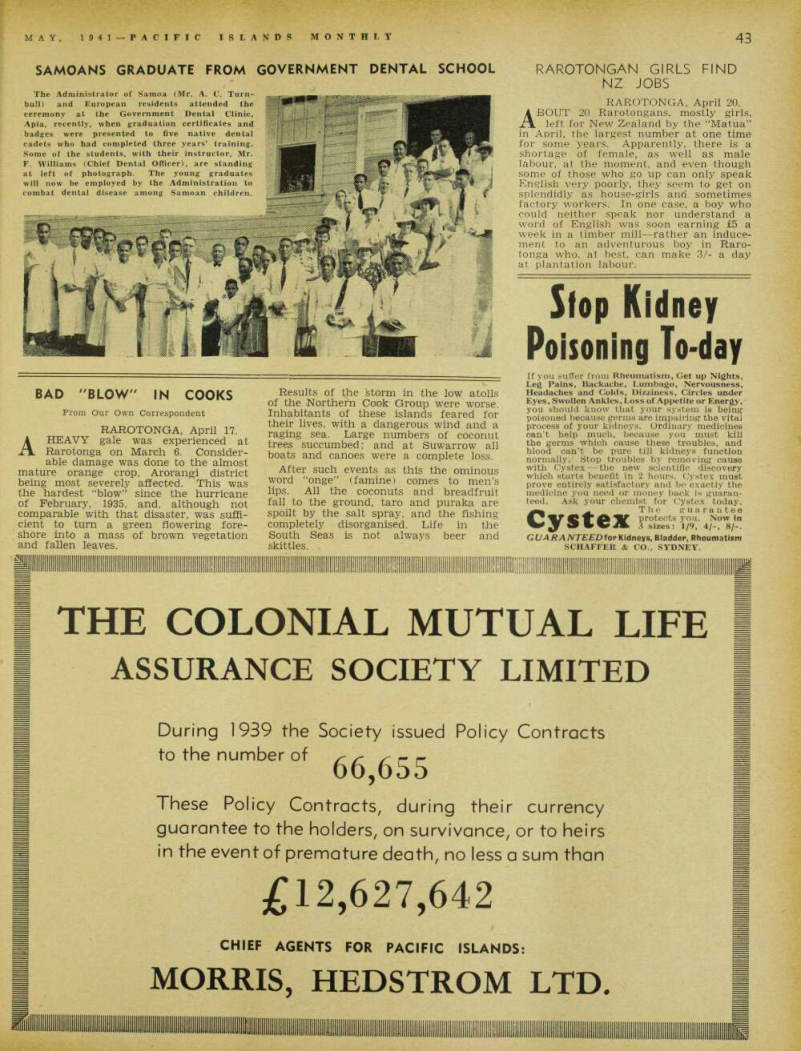
The Administrator of Samoa (Mr. A. C. Turn bull) and European residents attended the ceremony at the Government Dental Clinic, Apia, recently, when graduation certificates and badges were presented to five native dental cadets who had completed three years’ training.
Some of the students, with their instructor, Mr.
F. Williams (Chief Dental Officer), are standing at left of photograph. The young graduates will now be employed by the Administration to combat dental disease among Samoan children.
Bad "Blow" In Cooks
From Our Own Correspondent
Rarotonga, April 17.
A HEAVY gale was experienced at Rarotonga on March 6. Consider able damage was done to the almost mature orange crop, Arorangi district being most severely affected. This was the hardest “blow” since the hurricane of February, 1935, and, although not comparable with that disaster, was suffi cient to turn a green flowering fore shore into a mass of brown vegetation and fallen leaves.
Results of the storm in the low atolls of the Northern Cook Group were worse.
Inhabitants of these islands feared for their lives, with a dangerous wind and a raging sea. Large numbers of coconut trees succumbed; and at Suwarrow all boats and canoes were a complete loss.
After such events as this the ominous word “onge” (famine) comes to men’s lips. All the coconuts and breadfruit fall to the ground, taro and puraka are spoilt by the salt spray, and the fishing completely disorganised. Life in the South Seas is not always beer and skittles.
Rarotongan Girls Find
Nz Jobs
Rarotonga, April 20.
ABOUT 20 Rarotongans, mostly girls, left for New Zealand by the “Matua” in April, the largest number at one time for some years. Apparently, there is a shortage of female, as well as male labour, at the moment, and even though some of those who go up can only speak English very poorly, they seem to get on splendidly as house-girls and sometimes factory workers. In one case, a boy who could neither speak nor understand a word of English was soon earning £5 a week in a timber mill—rather an induce ment to an adventurous boy in Raro tonga who, at best, can make 3/- a day at plantation labour.
Advertisements & other items, p. 47 (1 item)
Stop Kidney
Poisoning To-day
If you suffer from Rheumatism, Get up Nights, Leg Pains, Backache, Lumbago, Nervousness, Headaches and Colds, Dizziness, Circles under Eyes, Swollen Ankles, Loss of Appetite or Energy, you should know that your system is being poisoned because germs are impairing the vital process of your kidneys. Ordinary medicines can’t help much, because you must kill the germs which cause these troubles, and blood can’t be pure till kidneys function normally. Stop troubles by removing cause with Cystex the new scientific discovery which starts benefit in 2 hours. Cystex must prove entirely satisfactory and be exactly the medicine you need or money back is guaranteed. Ask your chemist for Cystex today.
The guarantee protects you. Now in 3 sizes: 1/9, 4/-, 8/-.
GUARANTEED for Kidneys, Bladder, Rheumatism
SCHAFFER & CO., SYDNEY.
Cystex
THE COLONIAL MUTUAL LIFE
ASSURANCE SOCIETY LIMITED
During 1939 the Society issued Policy Contracts to the number of r r r - - 66,655 These Policy Contracts, during their currency guarantee to the holders, on survivance, or to heirs in the event of premature death, no less a sum than £12,627,642
CHIEF AGENTS FOR PACIFIC ISLANDS:
MORRIS, HEDSTROM LTD.
Cook Is. Oranges
From Our Own Correspondent
Rarotonga, April 17.
A PRELIMINARY shipment of Cl oranges left Rarotonga in March for New Zealand —the earliest start of an orange season for some years. Un fortunately, weather conditions prolonged full maturity of the oranges this year and only 3,000 cases were taken away.
At the end of March, 1940, the orange crop was fully mature, but no shipment was made until the end of April, which resulted in a substantial loss on the ground.
A shipment in April from the whole Lower Cook Group amounted to 22,000 cases, a satisfactory total in the circum stances.
Mr. W. R. Humphries, Resident Magis trate at Port Moresby, was recently ap pointed a member of the Legislative and Executive Councils of Papua.
Growing Importance of

Place In Pacific Defence Growing Importance of N. Caledonia
Prom Our Own Correspondent NOUMEA. April 21.
GIVING the lie to the wishful thinking of Rome radio, New Caledonia, in the face of recent events and threats, presents a united front, with the British Dominions, with whom she is more than ever determined to co-operate, in the defence of the Western Pacific, to fulfil her part of the obligations mutually entered upon after the Wellington Con ference, when Axis aggression brought the war near in Europe.
Besides many volunteers, European and
native, now in training and ready when properly equipped, to join an expedition ary force, the Colony recently has taken certain important steps relating to her air and sea defences.
The present position stresses this hitherto inconspicuous island’s new stra tegic importance at the gateway to the eastern (or most important) half of the Australian continent; or (as a New Zea lander might think of it) as the north ernmost tip of the equilateral triangle formed by Noumea, Auckland and Syd ney. It seems just as necessary that Australia, or Australia and New Zealand between them, should acquire naval and air base facilities here as that the United States should have bases in the British West Indies.
The people here would welcome such a move. The war, and particularly the les son of Indo-China, has taught them that isolation may mean outside aggression and internal dissension.
ALTHOUGH this is—and is likely to remain—a French Colony, the people here know now that the whole prob lem of their defence is linked with that of Australia, with whom they now are so closely associated in trade and neighbourliness. Being true colonials, they believe in the democratic way of life, as they live it themselves and as they see it lived in Australia.
It is even possible that a real Demo cratic New Caledonian Party may be born here, as an outcome of the war, counterbalancing the hitherto para mount political and administrative con trol exercised by big business and fonc tionnaires sent out from France. There certainly is a growing desire for a big ger share of self government after the war.
AS we are only five hours’ flight from Brisbane and seven from Auckland, and but little more from Suva, the possibility of utilising seaplane and land aerodromes around Noumea and on the east coast is receiving much attention.
Mr. W. S. Robinson, of London, man aging director of Zinc Corporation Ltd., recognised Noumea’s claim last Septem ber when, visiting Australia on an im portant mission, he said: “The geograph ical position of Noumea’s magnificent harbour dominates the South Pacific, and the control of New Caledonia is of vital importance to Australia, New Zealand, the Fijian Islands and the Mandated Territories.”
While much is being done in relation to aviation and the wider strategical pic ture in the Pacific, even more has been done in organising, in New Caledonia itself, a very good system of defence and reconnaissance.
Since President Roosevelt’s last speech, and the “aid to Britain” vote, the wire less station Radio Noumea (which can be heard by Australian and New Zea land listeners) plays “The Star Spangled Banner”, in addition to the “Marche Lor raine” and “God Save the King”.
The new American Consul, Karl Mac- Vitty. is probably the most travelled man now living in Noumea, and the one with the best first-hand knowledge of inter national politics. He knows intimately all the European capitals, and has worked in many of them, as well as in places as wide apart as Persia, Amoy and NZ.
DISCIPLINARY action has been taken against one or two more fonction naires for trying to discourage con tributions to de Gaulle funds. As a mat ter of fact, they have been “sacked”. Two officials sent into exile a month or two back for Fifth Column gossip are now interned at a special camp.
(Continued On Page 46)
Some little time back, typewritten pos ters emanating from the indiscriminate Fifth Column element were found stuck up on Noumea walls, reading:— “Attention, Comrades . . . The country’s treasury is empty and they are empty ing the Post Office Savings Bank. It is time to act!”
The Governor will take the severest measures against the perpetrators of this document, should they be discovered.
How untrue the allegations are is shown by the Post Office Savings Bank returns for the month of March, which reveal an increase in deposits from 23,126,660 to 23,963,894 francs. This is an excellent barometer of the country’s confidence, for the bank numbers 17,000 depositors in a white and native population of 60,000, of whom the vast majority are natives far away from and unlikely to make use of banking facilities.
mHERE is great satisfaction among the JL island’s coffee planters at this week’s announcement confirming the Commonwealth Government’s guar antee to purchase the whole of the Cale donian coffee crop which remains unsold through ordinary trade channels. The Commonwealth is now being requested to make just one more guarantee—regard ing the fixation of a price that, under present conditions, may be called rea sonable and satisfactory.
Monsieur Dewez, French manager and member of the Board of the Nickel Com pany, who has now ended a month’s stay, is optimistic about the country’s future.
He is the first Frenchman to come here since France collapsed—an arrangement made possible because both Vichy and London were agreeable to his visit.
In New York, he fixed the purely war time deal by which INCO (The Interna tional Nickel Corporation of Canada) will take New Caledonia’s nickel pro duction of some 10,000 tons of matte at American ruling prices—which are, how ever, much below those which formerly ruled in Europe, It is only by such an arrangement that New Caledonia can be kept going; and, now it is through, he hoped that the Noumea smelters will be able to bring their third furnace into use. For some time only two have been working, as the most Australia could guarantee to pur chase was between 450 and 550 tons of mattes per month. These stocks, of course, go to America. “Maybe we shall go in for refining our matte here at Noumea, instead of sending it to the east coast of America, as this would save freight and other expenses,” Mr. Dewez said.
Advertisements & other items, pp. 48-50 (1 item)
De War's Dewarwd^Wa^S 1
DEW
REWA
DEWA
Hill -a Bl & r \»
REWAR'S
DE WAR'S DE
DEWARSDEWaR
aR'S DE WAR S DEWAR'S
A R'S DE WA R S. DEWA ft S
.VAR'S RE WARS DEWAR'S
Rw A ft S RE Wa R S RE WAR'S
DE WARS DEWARS RE WAR'S
ft.'S RSWAR'SDEWAR'SDE WAR'S
7EWARS DEWaR'S REWAR'S DEWAR'S
OE WAR'S DEWAR'S RE WAR'S DE WAR'S DEWA R S REWAR'S RE WAR'S DEWAR’S RE WAR'S RE WAR'S RE WAR'S RE WAR S DEWA R'S RE, WAR'S RBV'.ffES DEWAft'S
REWAR'aDEWAR'SDEWAR'SDEWaR'SDEWAR'SDEWAR SDEWTR
RE WAR'S REWAR'S DEWA R'S REWAR SRE W
DK WAR’S DEW'A ft
DEWY'S RE
DE wJs'S
RE WAR
DEW
REWA
DEW
REVW
dew a:
W. WAR'S RE
R'S Aft
R’S DEWAR S
A R'S RE WAR'S
AR'SREWAR'S
A R'S D E W A R'S
A R'S DEWAR’S
DEWA ft SDEWAR'S
DEWA R' S RE WA R'S RE WA R'S
R'S DE\v
ArWSDE'j
Ei Ef Vi DE WA R S RE WA R'S RE W A R'S DEWAR'S
EWaR'SRE WAR'S RE WAR'S REWAR'S DEWAR’S
'a’E'S RE. WAR'S RE WARS DEWARS DEWARS REWARS S RE WAR'S RE WAR'S DEWaR S DEW aR'S REWAR'S RE WAR'S REWAR'S REWAR'S RE WAR'S DEWAR'S DEWAR'S RE WAR'S RE WAR'S REWA R'S REWAR'S REW'AR'S DEWAft'S DEWaR S REWAR'S RE WAR'S RE WARS REWAR’S RE WAR'S DEWAR'S DEWaR S REWARS RE WARS RE WARS. DEWARS DEWAR'S DEWAR'S REWAR'S REWA R'S RE WAR'S DEWAR’S DEW Aft > REWAR'S REWA R'S DEWAR SDEWAR'S DEWAR'S DEWAft’S DEWaR'S DEWAR'S DEWAR'S DEWAR'S RE WAR'S DEWAft'SDEWaft S REWaR'S REW'AR'S DE WAR'S DEWAR'S DEWAR’S DEWAR’S DEWAR S RE WARS RE WAR'S DE WAR'S DEWAR S DEWAR'S DEWaR S DEWA R' S DEWA R‘ S REW AR' S REWA R'S#|»W /? DEjT R'S RE WA R S
DEWAR'S DE WAR'S DEWA
DEWA R' S DEWAR’S DEW A
R E WAR’S DE WAR'S REWA R
DEW A R'S REWA R'S REWA
REWAR'S DE WAR'S DE WAR'
DE WAR’S DE WAR'S DEW
\ R
s R'S DEWAR
S DEWAR'S DEWAR'S
SDEWAR'S DEWAR'S DEWA R'S
AR'S D**;a R'S DEWA ft S REWAR'S REWAR'S EWAR S DEWA ft S REWAR'S DE WAR'S DEWAR'S EWA R'S REW'AR'S DE WAR'S DE WAR'S DEWAR’S DE W A E' S DEW Aft S REW A R' S RE WA R' S DE W A R'S DE W A R’S DEW Aft S DEW Aft S DEWARS DEWARS DEWAR'S DEWAR'SDEWAR’S DEWA R< REWaR'S DEWAR'S I EV EW DE
DEW
DEW
DEW
DEW
DEW
DEWAR
WaJDS REWAR'S DE WAR'S DE WAR
RE WAR'S REWAR'S DE WAR'S DE WAR
DE WAR'S DEWARWD^WA^S 1
DEWA R S ;
REW a R'S D
AR'S
AR’S
Aft’S R'S R'S
AR’S
,'AftS DEWAft’S
'EWAft'S REWAR'S
DE WAR'S RE WAR'S
DEWAR'SDEWAR'S
DEWAR'S DEWA R’S
DEW"Aft'S RE;Wa R'S
RE WA R'S DE WAR'S DEWAR'S DEWA R'S DEWA R’S DEWA V DEWA R'S DEWAR'S DEW'A R’S DEWAft'S DEWAR'S RE WAR'S E>E. WAR'SDEWAR'S DE W A ft'S DEWA ft S DE W A ft S DE: 'WA R'S D E W A R'S DEWA R' S D EWA R'S DE WA R'S DEWAR'S DEWAR'S DE 'WAR'S DE WAR'S DEWA R'S DEWAR'S DEWAR'SDEW'A'R’S REWAR'S DEWAR'S DE WAR'S DEWAR'S DEWAR'S DEWAR'S DEWAR'S DEW Aft'S
BOMBS on GERMANY
ym CRAMMOND Receivers bring to you the Jiving, breath-taking reality. The bursting of bombs and rattle of machine-gun fire, as recorded by a British bomber flying over Germany, is described in the letter published below, from a returned soldier, Mr. Hugh Beale.
Coorabulka Station,
via BOULIA, Q.
Crammond Radio Mfg. Co., 8 Queen Street, BRISBANE.
Dear Sirs, To give you an idea of the reproduction qualities of my Crammond.
The other day I switched over to LONDON, and they were just giving a recorded broadcast of a dictaphone that had been taken for a trip in a British bomber over Germany. I don’t mind telling you, when I heard the cld bombs and machine-guns open up it was hard to realise I wasn’t there again.
Again thanking you.
Yours faithfully,
(Sgd.) HUGH BEALE.
Bombing raids over Germany incur long and arduous flights, but the unfailing accuracy of British engineers enables our pilots to take off without fear of mechanical failures.
LIKEWISE, if you own a Precision-built lIP* CRAMMOND, you can turn the tuning dial $ with complete confidence that your machine will never let you down. m m is m
SENSATIONAL
REALISTIC
REPRODUCTION
combined with remarkable long-range reception, are outstanding features of Crammond Receivers. For NEWS, Music, Song and Dance, you must own a
CRAMMOND.
4 YEARS’ GUARANTEE
2 YEARS' FREE SERVICE TO COUNTRY CLIENTS
EASY TERMS ANYWHERE
All parts specially Pro-
tected against heat and
moisture . . . ideal for
Tropical conditions.
1.4 ECONOMY MODELS in Portables, Consoles and Mantels.
3 DAYS' FREE TRIAL
with Guarantee of MONEY REFUNDED (less freight charges only) if not satisfied.
Crammond Radio
MANUFACTURING CO.
NO. 8 QUEEN STREET, BRISBANE.
Please send me full particulars of Models, Terms List, etc.
NAME
ADDRESS (P.1.M.)
State whether Battery, Vibrator, 1.4 Economy, Electric.
PLEASE USE BLOCK LETTERS for Name and Address.
The House of Steel for Quality Cutlery n CJ We have a large range of Scissors, Knives, Razors, etc.
W. JNO. BAKER
3 HUNTER STREET, SYDNEY.
Established 1888.
READ THE
B.P. MAGAZINE
WINTER NUMBER
llllllllillllllllllillllllllllllllllllllllllllllllllllllllllllllllllllllllllllllllllllllllllllll^
ON SALE JUNE 1.
Short Stories - Pictures Travel Articles - - - - Pages for the Children Stage Latest Fashions --- Screen A
ONE SHILLING PER COPY.
ON SALE AT ALL NEWSAGENTS AND BOOKSELLERS i.P
Rafter saps strength
$ Rich in jumper and healthful herbs s» * Ua
Growth Of Education In
Samoa
From Our Own Correspondent APIA, April 11.
THERE has been a remarkable growth in education in Samoa since 1936 —present-day Samoans are defin itely educationally-minded. For the most part, the younger generation consider that undenominational schools, free to all, provide the best type of schooling at this stage of their development.
Native education has always been encouraged by the NZ Government, which has regarded it as part of its general policy in connection with the development of the Territory. This policy has been strongly backed up by the local Administration.
In 1936 there were 45 grade 2 schools staffed by 95 teachers, with 4,994 pupils.
So rapid has been the development that by the end of this year there will be 95 schools, 195 teachers, and 11,475 pupils.
To meet the demand for an increase in the number of teachers required, the Administration in 1939 erected a new Teachers’ Training College in the grounds of the centrally situated Malifa school at Apia. Fifty trainees are now there, under a European principal.
A secondary" school was opened in 1938 and now pupils can continue their edu cation through the primary school and the higher secondary school without having to go abroad, as many did previously.
Rev. A. P. Jennings, principal of St.
Aidan’s College, Divari, Papua, returned to the Territory recently after a visit to Australia. While in Melbourne. Mr. Jen nings supervised the printing of a Wedauan hymn-book, for the New Guinea Mission.
A South Sea Bubble Of The Twenties
When the PCPC Come to Tahiti
By A.C.R.
EVER since iron nails were exchanged for pigs, coconuts and taro by the first explorers on the beach of Matavai, commerce on Tahiti has added some rather picturesque chapters to South Sea history.
Not the least of these is that section of the chronicle of the hectic 1920 decade which records the short but merry career of the PC PC (Pacific Coconuts Products Co.).
Much has been written of the rise and fall of the Atimaono plantation—a period of prodigal dreams, lavish disbursement, baronial banquets, ending in tragedy.
Atimaono was, by comparison, a star of lesser magnitude.
Among the many grandiose under takings which have blossomed and withered on the fertile soil of Tahiti, the PCPC easily holds precedence as the veritable South Sea Bubble of latter day nistory. The PCPC appeared over the horizon from the north east, like a gal leon of old Spain laden with treasure from the City of the Kings.
The treasure was destined to set up a copra monopoly on the islands of the Colony, to the exclusion of all established traders. This was to be brought to pass by virtue of economies derived from the extraction of coconut oil at Tahiti. In due time, a grim stone building was erected, on a parcel of land at the east end of Papeete, and filled with massive machinery. An old residence, located at the corner of the premises, was adapted to house the administrative and office staffs.
The fact that this latter building was the favourite rendezvous of all the mos quitoes inhabiting the nearby Vai-ninii ore swamp, has little to do with this history; although it had a decided effect on the mosquitoes themselves, as well as on the comfort of the neighbors—as will appear later.
Older operators, naturally, did not supinely acquiesce in this invasion of their ancient domain. A battle royal was waged on every island and on every plan tation. The issue was usually in favour of the PCPC; for, from an apparently in exhaustible treasury, excessive prices were paid to plantation-owners for copra immediately available, and generous ad vances were granted on future deliveries.
As time passed, more and more copra from every part of the colony poured into the grim building on the Papeete water front, and the event of a monopoly under the control of the PCPC seemed about to be achieved.
Then an unforeseen thing happened.
The USA Government imposed a prohi bitive import duty on coconut oil. Ap parently, the PCPC was now in a position where it could be combatted by its com petitors. But it was not to be.
Notwithstanding the burdens of a costly and useless oil mill, a highly paid staff, and the present necessity to des patch copra in bulk to distant destina tions at the common level of freight charges and disposal prices, the PCPC continued to expand and flourish.
Amazed spectators beheld the extra ordinary phenomenon of copra landed in Papeete at costs above world market prices, producing revenues of increasing magnitude. The general manager re ceived his guests in princely state at town house and country estates—each graced by its particular chatelaine. Super cargoes blossomed and flowered into opulence such as supercargoes had never known before. Staff members radiated an aura of material well-being, and planters on far islands clapped their hands and sang for joy.
HOPE revived in many a savage breast when it became known that an in spector, sent by PCPC shareholders in the United States, was on his way to Papeete.
People who watch such things assure us that, from the moment of his arrival, the inspector became the centre of Bacchanalian saturnalia which whirled him along the primrose path until the day of his departure, when he was de posited on board a steamer in an alcoholic fog that did not dissipate until he had landed at San Francisco.
This brings to mind the extraordinary behaviour of the Vai-ninii-ore mosquitoes.
Nearby the PCPC premises was a large settlement of members of a religious sect named, by the Tahitians, the Tanito. The canons of their creed forbid the use of any substance containing alcohol.
After the PCPC was established, the Tanito took notice that the Vai-ninii-ore mosquitoes, which heretofore had at tacked them with voracious fury, now merely danced and buzzed about their dwellings in a peculiar manner, and had ceased to take any interest in their persons as a source of nourishment.
The reasons for this marvellous change must be left to research by entomologists; but the fact is clear that the Tanito were able to discard mosquito-bars, and were comfortable and happy—until the arrival from the USA of another inspector—this one having been sent by a banker.
This individual belonged to that race of men who have evolved from ptero dactyls of the age of saurians—men en dowed with vascular systems of sub-zero temperature and with eyes that can, by a glance, chill warm flesh into imperishable granite. He was not to be lured into the primrose path. Instead, with machete and axe, he set to work on the jungle of
invoices and vouchers, of way-bills and tariff sheets, of inventories and ledgers.
When he had completed his task the PCPC was only a memory—and the Tanito had to sleep once more behind mosquito-bars.
Long afterward, this writer met a man who was an intimate friend of the presi dent of the bank at San Francisco. He told us the amount the PCPC adventure had cost its shareholders. The sum is so huge that we dare not record it on hear-say evidence. Put into dollars, it requires seven figures.
Mr. and Mrs. O. M. Samuel arrived in Sydney recently from Suva, Fiji, where Mr. Samuel has been manager of the local branch of the Bank of NSW for the past four years.
Hon. E. R. Oldham, Commissioner for Lands in Papua, has left the Territory on three months' leave of absence.
Advertisements & other items, pp. 51-52 (1 item)
NoAsthma Years
Two years ago J. Richards, Hamilton, Ont., Canada, was in bed with Asthma. Had lost 40 pounds weight, suffered coughing, choking and strangling every night—couldn’t sleep— expected to die. Mendaco stopped spasms first night and he has had none since—in OVER TWO YEARS. Mendaco is so successful it is guaranteed to give you free, easy breathing in 24 hours and to stop your Asthma completely « m «« in 8 days or money back on return of ITIVHMa VU empty package.
Ends Asthma . . . Now 3/-, 6/- and 12/.
SCHAFFER & CO., SYDNEY.
SHEAFFER’S WORLD FAMOUS
Streamlined, Feather Touch PENS and PENCILS
If you want
Design, Beauty
and Quality buy
a SHEAFFER
All Lifetime Pens are guaranteed for the life of the user except against loss and wilful damage.
When serviced, they are subject to a small fee for insurance, postage and handling.
Beautiful and Useful Gifts for All Occasions.
SKRIP - The
Successor to Ink makes all Pens write better. 2 oz. 1/6, 4 oz. 2/6 Plus Postage Distributors Identify the Lifetime Pen by the white dot
74T LTSC AA 3T
Feather Touch Lifetime Pencil Regular Pen Lifetime Fen Pencil 9 6 2bl- -76- each 36 i- ea. each each The working parts of the Sheaffer Pencil are guaranteed against wear for the lifetime of the user.
When serviced they are subject to a small fee for insurance, postage and handling.
All Sheaffer regular pens are guaranteed against defects of material and workmanship.
Obtainable from Selected Jewellers and Stationers everywhere ■i
EXCELSIOR SUPPLY GO. PTY. LTD.
HEAD OFFICEJ
278 Post Office Place, 160 BROADWAY,
MELBOURNE, VIC. SYDNEY. N.S.W.
50 Victoria Street,
WELLINGTON, N.Z,
A. B. DONALD Ltd.
AUCKLAND
ISLAND TRADERS & GENERAL MERCHANTS
P.O. Box 1509. Cables Gr Telegrams, "Kingdom", Auckland.
515cm]
M STRENGTH
S p£
CI A
pa °K£D Ltd.. SYDNEj
POR
t he
tro Pic
<D^ y^IAusTRALIAIt s at- «9s- - are available in both
MEDIUM and FULL STRENGTH
CAPSTA
TOBACCO AND CIGARETTES
Kuru-Kuru Grass
Trial
Now in Sydney Police Court
THE Kuru-Kuru grass conspiracy trial has been dragging along slowly in the Sydney Police Court. Michael Sinclair. David Hampton, W. J. Taylor, E. R. White, P. R. Higgins are charged with having conspired with W. J. Fuller ton and G. S. Holburn to obtain money from certain people.
It appears that some of these accused either acquired the ruins of the Com monwealth Hemp Corporation (which had tried to produce sisal hemp in Papua), or built upon them; at any rate, there were developed most impressive
plans for the establishment of a great paper-making industry, the chief raw material of which was to be the well known Kuru-kuru grass of Papua (which is practically the same as the Kunai grass of New Guinea). A group of com panies with large nominal capital was created, and there was share-selling, and some apparently involved share transac tions. It appears that special police offi cials spent months in examining transac tions as between Commonwealth Hemp Corporation, Fibres Ltd., Issuing Houses of Australia Ltd., British Australian Fibre Co. Ltd. and British Australian Paper and Pulp Co. The accused, apparently, told the detectives that they were “on the verge” of floating a great industry. The detectives replied that they “had been on the verge for five years”. They then asked “what they could do when they had to fight Baillieu and Mussen” (the two men allegedly at the head of the corporation which established paper mills in Tasmania).
It was in the middle ’thirties that the “PIM” first directed attention to the activities of this little group of company promoters and suggested that, if any one in the Territories contemplated an investment in these companies, he first should examine the history of the Com monwealth Hemp Corporation, and those latterly connected with it. Certain of the gentlemen now accused in the police court thereupon threatened the “PIM” with a libel action, and there were some
lively interchanges.
Miss A. Hagen In Important
Job
rE good-looking and popular Alex Hagen, daughter of well-known “Tibby” Hagen (New Caledonian merchant and shipowner), has gone to Noumea as secretary to the new Ameri can Consul there, Mr. Karl MacVitty.
This is acclaimed in Sydney, where Miss Hagen has many friends, as an admir able appointment. Miss Hagen was formerly attached to the French Con sulate in Sydney; she is a very capable and cool-headed young lady; and her knowledge of commercial and official his tory and affairs of her homeland of New Caledonia should be valuable to the American Consulate.
Nicholas Hagen Now Recovered
Mr. and Mrs. N. Hagen returned to New Caledonia, from Sydney, at the end of April. About nine months ago, Mr.
Hagen, during one of his frequent busi ness visits, contracted severe bronchitis, which turned quickly to bad pneumonia; and Mr. Hagen thereafter spent some months in St. Vincent’s private hospital.
Mrs. Hagen went to Sydney, by aero plane. when her husband was in a critical condition, and she remained with him there during a long convalescence. He now appears completely recovered, and is again his jovial self —except that he has lost considerable weight.
Mr. W. D. Carew, Fiji District Com missioner, on secondment to the Wes tern Pacific High Commission, has been transferred to Malaya as a Magistrate in the Colonial Legal Service.
Mr. J. Beaumont, of Mandres, New Britain, married Miss Claire Manning, of England, at Rabaul, New Guinea, in April.
Rev. W. J. A. Daniels sailed from Syd ney in April for Thursday Island, where he is engaged in mission work for the Torres Strait Mission.
Advertisements & other items, p. 52 (1 item)
48
t’Acit'ic i.sLANbs monthly may, id4i
Fijian Soldiers At Sydney's Royal Empire Show
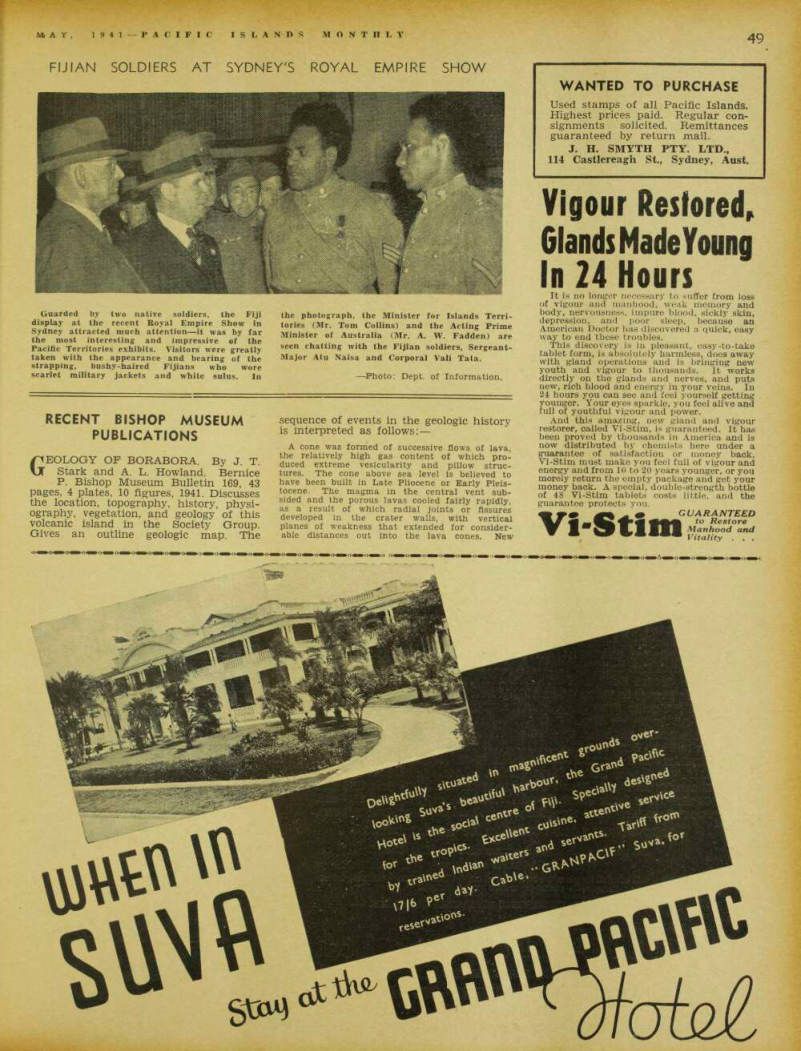
Guarded by two native soldiers, the Fiji display at the recent Royal Empire Show in Sydney attracted much attention—it was by far the most interesting and impressive of the Pacific Territories exhibits. Visitors were greatly taken with the appearance and bearing of the strapping, bushy-haired Fijians who wore scarlet military jackets and white sulus. In
the photograph, the Minister for Islands Terri tories (Mr. Tom Collins) and the Acting Prime Minister of Australia (Mr. A. W. Fadden) are seen chatting with the Fijian soldiers, Sergeant- Major Atu Naisa and Corporal Vali Tata.
Photo: Dept, of Information.
Publications
Recent Bishop Museum
Geology of borabora. By j. t.
Stark and A. L. Howland. Bernice P. Bishop Museum Bulletin 169, 43 pages, 4 plates, 10 figures, 1941. Discusses the location, topography, history, physi ography, vegetation, and geology of this volcanic island in the Society Group.
Gives an outline geologic map. The
sequence of events in the geologic history is interpreted as follows: A cone was formed of successive flows of lava, the relatively high gas content of which pro duced extreme vesicularity and pillow struc tures. The cone above sea level is believed to have been built in Late Pliocene or Early Pleis tocene. The magma in the central vent sub sided and the porous lavas cooled fairly rapidly, as a result of which radial joints or Assures developed in the crater walls, with vertical planes of weakness that extended for consider able distances out into the lava cones. New
magma surged into these vertical cracks, re sulting in intrusions of vertical porphyry dikes along radial joint planes. This was repeated several times, allowing at least four periods of olivine porphyry dike intrusion. These were followed by a less extensive intrusion of non porphyritic, basaltic dikes. After this the western side of the cone down-faulted, forming the large western lagoon, the western rim be ing preserved only in the small remnants re presented by Toopua and Toopua Iti. The period down to the present time has seen erosion, subsidence, and reef building, inter rupted by the recent fall in ocean level of approximately six feet, recorded by marine benches,
A Revision Of The Genus Dere
TIOSUS (Coleoptera Curculionidae). By Elwood C. Zimmerman. B. P. Bishop Museum Occasional Papers, vol. 16, no. 8, pp. 177-214, map and 2 figs., February 26,’ 1941. Discusses 35 recognised species of a genus of small weevils, and 16 species of related genera, found in the Indo- Malay region, Australia, New Guinea, the Philippines, Melanesia, Micronesia, and Samoa. Gives keys to the species, notes on geographical distribution, and changes of nomenclature. Describes a new genus, Aristoxenus, for Deretiosus lateripennis Lea. Bibliography.
Insects We See In Hawaii. By
Edwin H. Bryan, Jr., Curator of Collec tions at the Bishop Museum. Tongg Pub lishing Co. (Honolulu), 128 pages, col oured plate and numerous illustrations,
1940. A popular introduction to Hawaiian insects, written for use in the elementary schools of Hawaii. Discusses and pic tures over 100 common species of insects and their relatives, the spiders, millipeds, and centipedes. Has a chapter on insect control and directions for collecting and preserving specimens. There are no scien tific names in the text, but these are arranged in their systematic classifica tion, with popular equivalents and page references, in the back of the book. Price, 1 dollar 75 cents.
Advertisements & other items, pp. 53-54 (1 item)
Vigour Restored,
WANTED TO PURCHASE
Used stamps of all Pacific Islands.
Highest prices paid. Regular consignments solicited. Remittances guaranteed by return mail.
J. H. SMYTH PTY. LTD.,
114 Castlereagh St., Sydney, Aust.
Vigour Restored,
Glands Made Young
In 24 Hours
It is no longer necessary to suffer from loss of vigour and manhood, weak memory and body, nervousness, impure blood, sickly skin, depression, and poor sleep, because an American Doctor has discovered a quick, easy way to end these troubles.
This discovery is in pleasant, easy-to-take tablet form, is absolutely harmless, does away with gland operations and is bringing new youth and vigour to thousands. It works directly on the glands and nerves, and puts new, rich blood and energy in your veins. In 24 hours you can see and feel yourself getting younger. Your eyes sparkle, you feel alive and full of youthful vigour and power.
And this amazing, new gland and vigour restorer, called Vi-Stim, is guaranteed. It has been proved by thousands in America and is now distributed by chemists here under a guarantee of satisfaction or money back.
Vi-Stim must make you feel full of vigour and energy and from 10 to 20 years younger, or you merely return the empty package and get your money back. A special, double-strength bottle of 48 Vi-Stim tablets costs little, and the guarantee protects you.
Vi-Stim
GUARANTEED
to Restore Manhood and Vitality . . .
Vso* at W
H s liied bu Chebs theWctid ever
ECONOMICAL. BECAUSE VOU NEED
JUST A FEW DROPS AT A TIME -
Send Your Next Grocery Order to . .
McILRATH’S
WHERE YOUR MONEY BUYS MORE
New Season’s 50 60 Choice Prunes, New Season’s Choice Apricots ..
New Season’s Choice Nectarines Choice Evaporated Apple Rings Exportation now permitted 7-lb. tins, Hid. lb. . l/4i lb.; 16/- doz. . 1/2* lb.; 14/- doz. 11-id. lb.; 11/3 doz.
Best Australian Currants 7id. lb.; Best Australian Sultanas 7d. lb.; “Rosa” Seeded Raisins, 16-oz Bid. pkt.; Pullars Prunes in Syrup, 16-oz 9d. tin; “1.X.L.” Tomato Juice 10-oz., 5/3 doz.; 15-oz., “A.J.C.” Asparagus Tips, 10i-oz l/4i tin; 7/3 doz. 6/9 doz. 8/3 doz. 8/9 doz. 7/3 doz. 16/3 doz.
Choice Melon & Lemon Jam, 24-oz Bd. tin; 7/10i doz.
Choice Plum Jam, 24-oz Bid. tin; 8/4i doz.
“Sunshine” Full Cream Powdered Milk, 12-oz l/2i tin; 14/3 doz.
“1.X.L.” Worcester Relish, 20-oz 9id. bot.; 9/3 doz.
“Krownall” Mango & Papaw Chutney, 15-oz 1/1 jar; 12/6 doz.
“Capital” Wax Floor Polish, 16-oz l/2i tin; 14/- doz.
“Rosa” Pure Household Soap, large 6d. bar; 5/6 doz.
HALF-DOZEN LOTS CHARGED AT DOZEN RATES.
All prices f.o.b. Sydney, cases and packing free.
Space available all steamers.
All consignments carried by air are packed in special fibre cartons—without extra charge—in order to reduce aerial freight.
COMPREHENSIVE PRICE LISTS AVAILABLE. POST FREE.
McILRATH’S Pty. Ltd.
EXPORT DEPARTMENT
202-204 PITT STREET, SYDNEY
AUSTRALIA
Officials Vague Regarding Wau-
Salamaua Road
WHEN the Legislative Council met in New' Guinea at the end of April Mr. Mullaly pressed the Director of Public Works for some information about the construction of the Salamaua-Wau Road. All he was told, however, is that the matter is still “being considered” by the Australian Government, and that the estimated cost of the road is between £230,000 and £260,000, to which must be added survey and supervision costs, estimated at £30,000.
Another set of questions designed to get information about this road project was submitted by Mr. Harold Taylour, but substantially the same evasive answers were given. It was added that the total length of the Buisaval route was about 49 miles, and that the esti mates of cost were based on a total width of 20 feet. It was considered that a road with a total width of 14 which, it was argued, would be much cheaper—would not be serviceable.
Ratu Josef a Lalabalavu Vanaaliali Sukuna, CBE, a member of the Legisla tive Council of Fiji, .was unanimously requested by the annual meeting of the Pacific Islands Society in Sydney to accept the office of honorary vice president in recognition of his out standing services in that Colony. Ratu Sukuna, who is a barrister of the Middle Temple, served with the French Foreign Legion in the last war. He visited Eng land for the Coronation of King George VI in 1937.
Advertisements & other items, p. 54 (1 item)
Toheroa
Unique Delicacy
Tiki Toheroa Soup is a unique delicacy. In this concentrated soup is retained all the goodness and delicious flavour of the Toheroa, found only on the Ninety Mile Beach, New Zealand. Tiki Toheroa Soup is prepared in a few minutes. Ask for it at your store.
Packed in \ and 1 lb. tins.
TIKI
TOHEROA
SOUP
TUCKER & CO. PTY. LIMITED,
SYDNEY.
Hotels
Battle Of The
Pro and Con in Port Moresby
rE “war of the hotels” has been raging in Port Moresby for some time.
It started when the Administration offered for tender the lease of the block of land at the comer of Musgrave and Douglas Streets, at present occupied by the European school; and accepted the tender of Steamships Trading Co. Ltd. It was announced that the latter tender provided for the erection on the block of a hotel at an estimated cost of £12,000, subject to the Commonwealth Govern ment granting the necessary permit.
That stirred up a good deal of oppo sition. It was pointed out that already Port Moresby has one modern hotel, owned by Bums, Philp and Co., and that company has plans actively afoot for the erection of another. It is understood that strong representations were made to Canberra to the effect that the erection of a third hotel would seriously depre ciate the value of the two enterprises already in existence.
Then the Commonwealth Government refused permission under National Security (Financial) Regulations for a permit for Steamships Trading Company Ltd. to erect the new hotel in Port Moresby, as suggested.
This brought opposition from the other side, and it appears that many residents, members of various bodies, signed peti tions to the Commonwealth authority urging reconsideration, on the ground that the town urgently needs further hotel accommodation, owing to growing population, and also because competition was required to control rising costs, due to monopoly of interests.
At the moment, there appears to be a deadlock. The Commonwealth authority will not agree to the erection of a third new hotel in Port Moresby, and Steam ships Trading Company, on its part, declines to purchase the block of land referred to—and thus make valuable revenue available to the Administration —unless it is permitted to erect a hotel.
New Caledonia's Plague
Outbreak
ALL restrictions imposed in New Cale donia owing to a plague outbreak in March have now been removed.
A little native girl, on a mission plan tation in a village in the south of New Caledonia, picked up a dead rat and threw it at her companions. Soon after wards these children developed bubonic plague, and six of them died.
As soon as the disease was identified the village was isolated and the inhabi tants vaccinated. Supplies of vaccine, sufficient for 750 persons, were sent from New Zealand by flying-boat, but it was not required. The outbreak was soon controlled and cleaned up.
There had not been a serious plague outbreak in this Colony since 1912, when it lasted for 84 days and caused 37 deaths. This recent incident shows that the dreaded disease is always waiting somewhere, ready to strike through its common host (the rat) when the oppor tunity offers.
Mr. A. C. Rentoul, RM at Misima Island, Papua, recently returned to Papua after furlough in Australia, with Mrs.
Rentoul. He is stationed temporarily at Port Moresby, while the Commissioner of Lands is on furlough.
Not So Profitable?
An Issue of New Stamps
rAT valued standby of Pacific Terri tories Treasurers—namely, a new issue of postage stamps, likely to excite philatelists all over the world —is not as good as it used to be. Too much of the world is over-run by Germans and busy with war, to be bothered with new issues of postage stamps.
When Fiji took charge of the postal affairs of Pitcairn Island, some time ago, it was decided to issue a set of postage stamps especially for Pitcairn Island, and elaborate preparations were made to meet the expected world-wide demand of stamp-collectors. It was anticipated that the sale of stamps would realise about £20,000.
But it was sadly announced, in April, that up to then the orders for the new issue represented only £4,000.
Many a harassed Islands’ Treasurer has pulled his finances out of the mud by receiving from £20,000 to £40,000, in one year, from a new issue of postage stamps, but those halcyon days are gone, for the present. The system, no doubt, will be revived after the war—for stamp collect ing seems to be a hobby that never dies.
Now in Fiji are Mr. and Mrs. Wallace E. Turner, of Chicago, USA. Mr. Turner, who is a well-known American artist and illustrator, has been making a collection of paintings of natives in New Zealand, Tahiti, Hawaii, Samoa and Fiji. This is his second visit to Fiji. Mr. and Mrs.
Turner sailed from Sydney by the April “Mariposa” and will probably spend the next three months in the Colony.
Mr. R, D. Bertie, well-known solicitor of Port Moresby, has returned to Papua after a short holiday in Australia.
Advertisements & other items, p. 55 (1 item)
Imperial
Delicious
Meals-in-a-Moment
Ready-to-Serve Always
FLAVOUR SEALED IN GOLD LINED CANS
Imperial Good Foods save hours of cooking . . . just open and serve, that’s the secret of preparing “Imperial” meals in next to no time.
Imperial
Serve these spicy, savoury treats: Imperial Sheep Tongues, Camp Pie or Corned Beef Loaf.
Any hour of any day serve a tasty meal with these savoury meats packed by the makers of "Imperial" Good Foods. * V
Til
m Oc- -4 ess m
yssg
£ : Try These Tasty NEW Delicacies.
"FITZROY" Luncheon Beef. Pork or Beef Sausages. "WESTFIELD" Corned, Boiled or Roast Mutton. "OX & PALM" and 7 RIVERSTONE" Corned, Boiled or Roast Beef.
"Health and Freshness Sealed in Cans/ 7 Imperial full flavoured, creamy TOMATO SOUP; Imperial choice, tender ASPARAGUS
TIPS and PIECES.
Products of
RIVERSTONE MEAT CO. PTY. LTD.
1 BENT STREET, SYDNEY.
Ng Public Service
THE following staff movements in the New Guinea Public Service were announced in April by the Government Secretary (Hon. H.
Page):—
Transfers
Government Secretary’s Dept.—J. D. Burke, Clerk, Wau to Rabaul.
Public Health Dept.—L. J. M. Fisher, Medical Assistant, Gasmata to Wewak; Miss O. G.
Morton, Nurse, Rabaul to Wau.
District Services Dept.—J. S. Milligan, Patrol Officer, Rabaul to Wewak; L. G. R. Kyngdon, Patrol Officer, Rabaul to Madang; G. G. T.
Wells, Senior Clerk, Rabaul to Madang; L. S.
Dix, Rabaul to Salamaua.
Lands Dept.—P. M. Swanson, Chainman, Rabaul to Wau.
Temporary Engagements
Treasury Dept.—Mrs. H. E. French, Typist.
Important Contingent Now Encamped in Australia
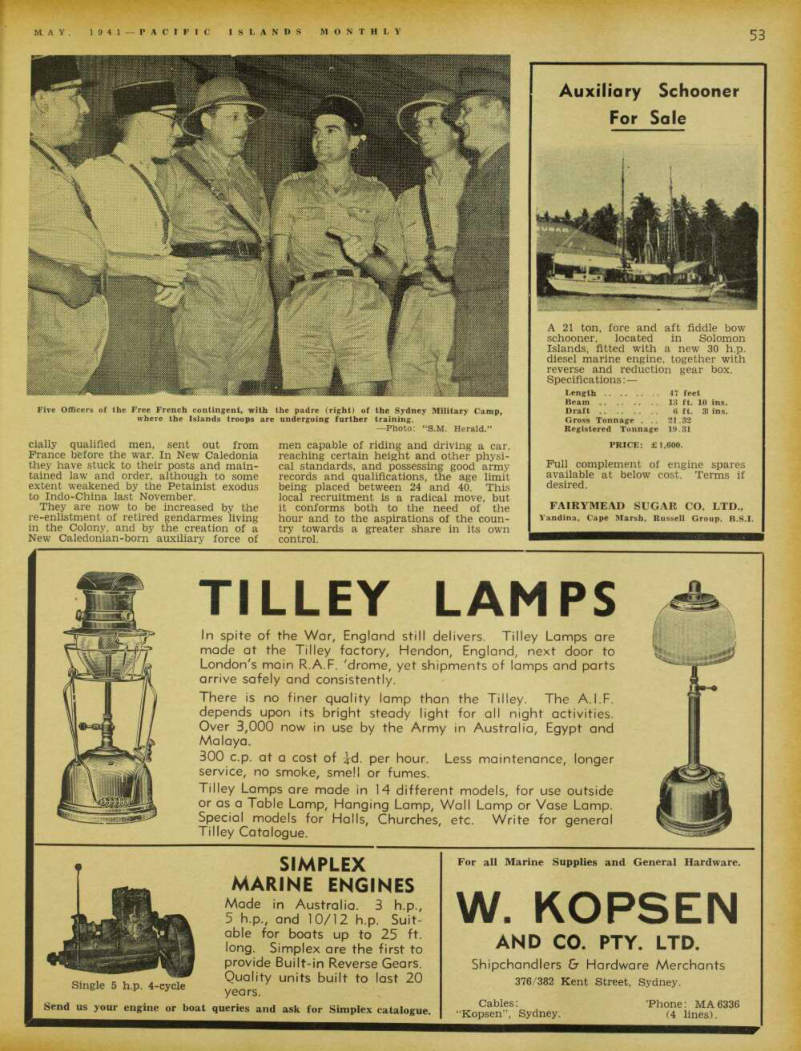
Free France's Pacific Men March
To War
1T was announced in Sydney early in May that a considerable number of volunteers, anxious to fight under General de Gaulle for Free France, had arrived in Australia from New Caledonia, Tahiti and New Hebrides, and had gone into camp near Sydney for further train ing, before proceeding overseas. This first contingent comprises mostly Euro peans born in the French Colonies, Euro nesians and a few full-blooded Poly nesians.
Although their number is not large, it is emphasised that this is only the first
contingent and that they have not enlisted under compulsion—on the con trary, they have insisted that their ser vices, in some way, be made available to Free France.
The arrival of this contingent is a not able indication of the character and sen timent of the people of the Free French Colonies in the Pacific.
Story Behind The Contingent
From Our Own Correspondent NOUMEA, April 21. mHE women of New Caledonia have X presented a regimental flag to the Pacific Expeditionary Force of Free France, consisting of men from Tahiti and New Caledonia, the departure of which is imminent. In command of the force is Chef de Bataillon Felix Broche. who was a captain when he passed through New Zealand last November— coming from Tahiti, where he had been in charge of the local troops. On his arrival here he was made military com mander of French Oceania, in which capacity he has taken a leading part in reorganising the defences of the Colony.
He is an energetic officer, worthy of con fidence and respect, and has already done wonders with the native recruits— who, however, are not readv to join the first contingent. This contingent will be equipped and will undergo its final train ing outside New Caledonia. Command ant Broche’s successor will be Chef de Bataillon Jardin. from the Cameroons, who will arrive via the Dutch East Indies and Australia, with his wife and children.
M. Broche’s predecessor was ex-Gov ernor General Maurice Denis who, it is reported, now very much regrets having deserted this country, after three weeks of indecision, for Indo-China.
The allowance for the legitimate wives of European volunteers serving with the contingent has been fixed at 1,000 francs (about £A.7) monthly, with an additional 200 francs for each child. An advance of one million francs, from reserve funds, has been authorised to finance these allowances, which sum will be recuperated later from voluntary contributions and credits authorised by General de Gaulle.
The transport of this contingent was one of the matters discussed between General de Gaulle and Mr. Menzies, when they met in London on March 7.
Present defence measures have thrown extra burdens on that fine body of men, the New Caledonia Gendarmerie. These are the people who administer isolated settlements all over the French islands, and their services correspond with those undertaken by the “Mounties” in the Canadian North-West. They are spe-
cially qualified men, sent out from France before the war. In New Caledonia they have stuck to their posts and maintained law and order, although to some extent weakened by the Petainist exodus to Indo-China last November.
They are now to be increased by the re-enlistment of retired gendarmes living in the Colony, and by the creation of a New Caledonian-born auxiliary force of
men capable of riding and driving a car, reaching certain height and other physi cal standards, and possessing good army records and qualifications, the age limit being placed between 24 and 40. This local recruitment is a radical move, but it conforms both to the need of the hour and to the aspirations of the coun try towards a greater share in its own control.
Five Officers of the Free French contingent, with the padre (right) of the Sydney Military Camp, where the Islands troops are undergoing further training.
Photo: “S.M. Herald.”
Advertisements & other items, pp. 56-57 (2 items)
Aunt Mary’s
, LET S
JOG
together*
down Life’s Road, Past milestones hand in hand; Content to share each other’s load, Each other understand.
When precious health we seek, then we May make each one secure, Coughs, colds and ’flu will always flee From Woods’ Great Peppermint Cure First aid for coughs, colds, and influenza, Woods’ Great Peppermint Cure. // / vi 7 0
READY TO HEAT
AND SERVE!
Aunt Mary’s
PREPARED SOUPS AND
TASTY MEAL-TIME PRODUCTS
include delicious Mulligatawny, Tomato, Pea and other rich Soups, also Baked Beans with Tomato Sauce, Curried Baked Beans, Spaghetti with Cheese, Curried Spaghetti and other appetizing, wholesome food products. Ready to heat and serve 1
Aunt Mary’s
PREPARED
VEGETABLES
offer a great variety of fullflavoured, nutritious dinner vegetables; ready to heat and serve. All Aunt Mary's food products are packed in 1 lb. cans for Tropical conditions
and SOLD BY ALL STORES.
‘Tomato^
Kb.
Sailmaker
SYDNEY'S LEADING
and RIGGER
Also Manufacturer of all Canvas and Rope Work.
ISLANDS WORK a
Speciality.
HARRY WEST
Balmain East, Sydney. Tel.: WllO5
Auxiliary Schooner
For Sale
A 21 ton, fore and aft fiddle bow schooner, located in Solomon Islands, fitted with a new 30 h.p. diesel marine engine, together with reverse and reduction gear box.
Specifications:— Length 47 feet Beam 13 ft. 10 ins.
Draft 6 ft. 31 ins.
Gross Tonnage . .. 21.32 Registered Tonnage 19.31
PRICE: £1,600.
Full complement of engine spares available at below cost. Terms if desired.
FAIRYMEAD SUGAR CO. LTD.,
Yandina, Cape Marsh, Russell Group, 8.5.1.
TILLEY LAMPS
In spite of the War, England still delivers. Tilley Lamps are made at the Tilley factory, Hendon, England, next door to London's main R.A.F. 'drome, yet shipments of lamps and parts arrive safely and consistently.
There is no finer quality lamp than the Tilley. The A.I.F. depends upon its bright steady light for all night activities.
Over 3,000 now in use by the Army in Australia, Egypt and Malaya. 300 c.p. at a cost of per hour. Less maintenance, longer service, no smoke, smell or fumes.
Tilley Lamps are made in 14 different models, for use outside or as a Table Lamp, Hanging Lamp, Wall Lamp or Vase Lamp.
Special models for Halls, Churches, etc. Write for general Tilley Catalogue.
SIMPLEX
MARINE ENGINES
Made in Australia. 3 h.p., 5 h.p., and 10/12 h.p. Suitable for boats up to 25 ft. long. Simplex are the first to provide Built-in Reverse Gears.
Q . . K , . . Quality units built to last 20 Single 5 h.p. 4-cycle yeQrs Send us your engine or boat queries and ask for Simplex catalogue.
For all Marine Supplies and General Hardware.
W. KOPSEN
AND CO. PTY. LTD.
Shipchandlers Gr Hardware Merchants 376/382 Kent Street, Sydney.
Cables: ’Phone: MA6336 “Kopsen”, Sydney. (4 lines).
Wines For The Islands
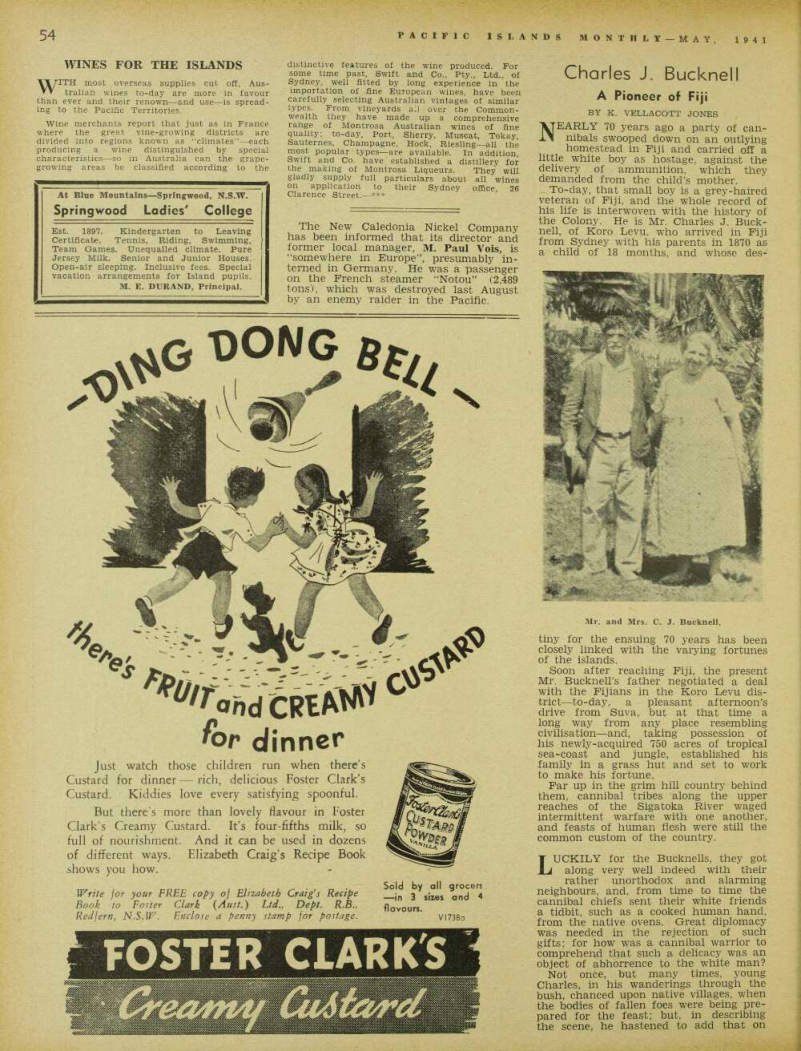
WITH most overseas supplies cut off, Aus tralian wines to-day are more in favour than ever and their renown—and use—is spread ing to the Pacific Territories.
Wine merchants report that just as in France where the great vine-growing districts are divided into regions known as “climates” —each producing a wine distinguished by special characteristics—so in Australia can the grape growing areas be classified according to the
distinctive features of the wine produced. For some time past, Swift and Co., Pty., Ltd., of Sydney, well fitted by long experience in the importation of fine European wines, have been carefully selecting Australian vintages of similar types. From vineyards all over the Common wealth they have made up a comprehensive range of Montrosa Australian wines of fine quality; to-day, Port, Sherry, Muscat, Tokay, Sauternes, Champagne, Hock, Riesling—all the most popular types—are available. In addition, Swift and Co. have established a distillery for the making of Montrosa Liqueurs. They will gladly supply full particulars about all wines on application to their Sydney office 26 Clarence Street.— *** The New Caledonia Nickel Company has been informed that its director and former local manager, M. Paul Vois, is “somewhere in Europe”, presumably in terned in Germany. He was a passenger on the French steamer “Notou” (2,489 tons), which was destroyed last August by an enemy raider in the Pacific.
Charles J. Bucknell
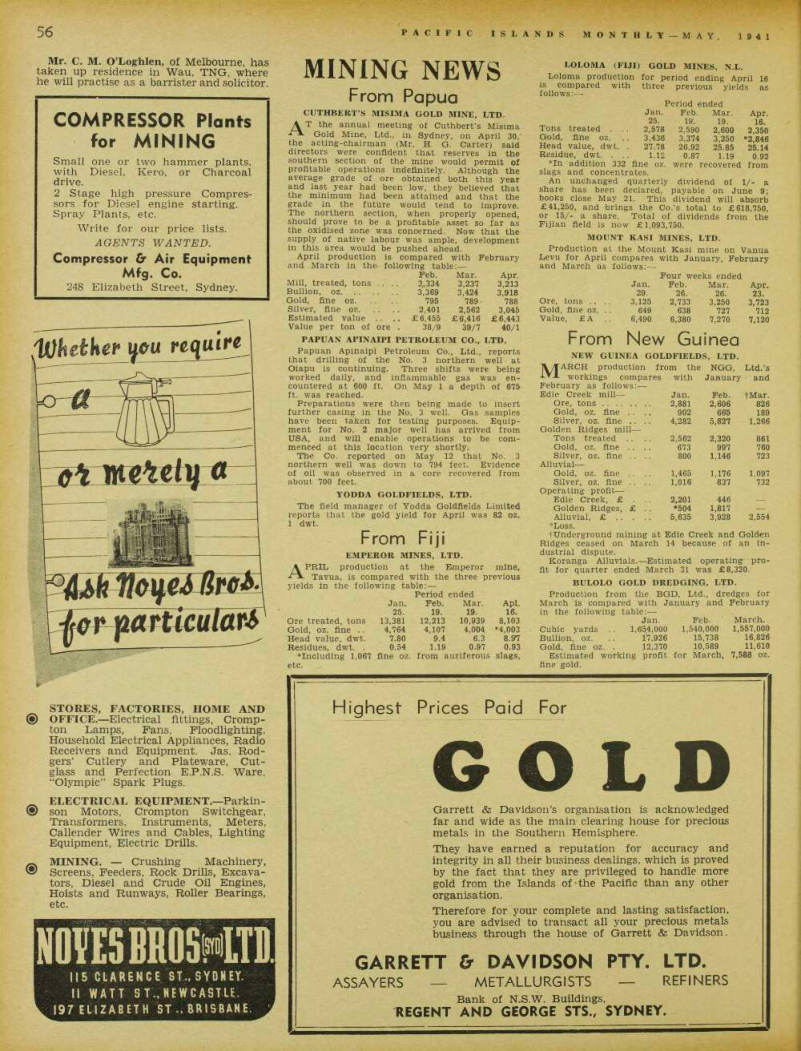
A Pioneer of Fiji
By K. Vellacott Jones
NEARLY 70 years ago a party of can nibals swooped down on an outlying homestead in Fiji and carried off a little white boy as hostage, against the delivery of ammunition, which they demanded from the child’s mother.
To-day, that small boy is a grey-haired veteran of Fiji, and the whole record of his life is interwoven with the history of the Colony. He is Mr. Charles J. Buck nell, of Koro Levu, who arrived in Fiji from Sydney with his parents in 1870 as a child of 18 months, and whose des-
tiny for the ensuing 70 years has been closely linked with the varying fortunes of the islands.
Soon after reaching Fiji, the present Mr. Bucknell’s father negotiated a deal with the Fijians in the Koro Levu dis trict —to-day, a pleasant afternoon’s drive from Suva, but at that time a long way from any place resembling civilisation—and, taking possession of his newly-acquired 750 acres of tropical sea-coast and jungle, established his family in a grass hut and set to work to make his fortune.
Far up in the grim hill country behind them, cannibal tribes along the upper reaches of the Sigatoka River waged intermittent warfare with one another, and feasts of human flesh were still the common custom of the country.
LUCKILY for the Bucknells, they got along very well indeed with their rather unorthodox and alarming neighbours, and, from time to time the cannibal chiefs sent their white friends a tidbit, such as a cooked human hand, from the native ovens. Great diplomacy was needed in the rejection of such gifts; for how was a cannibal warrior to comprehend that such a delicacy was an object of abhorrence to the white man?
Not once, but many times, young Charles, in his wanderings through the bush, chanced upon native villages, when the bodies of fallen foes were being pre pared for the feast; but, in describing the scene, he hastened to add that on
Mr. and Mrs. C. J. Bucknell.
such occasions he never accepted the invitation to stay to dinner.
COTTON was the mainstay of the early planters at that time; for, in the years following the American Civil War, prices for South Sea Island cotton were very profitable, and for a while the Koro Levu station did very well with its cotton crops. Then, when prices fell, came the inevitable collapse and other ventures had to be undertaken.
For some time, after his father died, Mr. Bucknell left the station and worked and wandered all over the Islands. Then, when he met and married the present Mrs. Bucknell, they returned to the old home. Sisal first engaged his attention and, with characteristic enterprise, he sent to Queensland for 15,000 young sisal plants, and from this start finally put 280 acres into use, for this purpose alone.
Machinery for processing the fibre was imported from Mexico and, for ten years, an annual yield of 280 tons of fibre was shipped out to Sydney, New Zealand and England, at prices ranging from £BB a ton London to £45 in Suva, Then African sisal, produced by incre dibly cheap labour, appeared on the world markets and, within a year or so, Fiji sisal growers had to abandon their plantations, for all hope of profit had been taken out of the business.
ON the Koro Levu station, cattle took its place, supplemented by small crops of tobacco and other sidelines.
Meanwhile, the immediate needs of the growing household —for Mr. and Mrs.
Bucknell were true Empire builders with a fine family of 13 children —were mainly catered for by their own food planta tions. They grew their own tea, crushed their own sugar cane in a home-made mill, cured their own bacon, tanned their own leather; and, when supplies of flour
ran short, ground their own stores from maize.
MRS. Bucknell’s part in the hardships of those years is a story in itself, for bringing up a family of 13 in the bush, miles from a school or neigh bours, and forced to rely upon makeshift improvisations for many things now con sidered necessities by even the humblest folk, was no easy job.
Before the introduction of correspond ence courses, she not only ran the household but taught the children as well. It is typical of her attitude towards those years that she remarked how easy it was once the correspondence courses were started. “All I had to do, then, was to supervise the children’s work.”
That was all, just supervise 13 sets of lessons in addition to the ramifications of running the station home.
But the children needed no teaching in the matter of languages; for, from the Fijians, they learned the Fiji language as quickly as they learned English, and from the Indian labourers they picked up an excellent knowledge of Hindi, so that at five years of age the younger Bucknells could chatter at will in any of three widely divergent tongues.
ONE taps a mine of information in conversation with this grand old couple. If you would talk of rough and ready days, there are tales a’plenty of surreptitious blackbirding activities, stories of the great double war-canoes of old Fiji, reminiscences of fossicking for gold, and weeks spent amongst the can nibal mountain tribes. One can learn from Mrs. Bucknell how it feels to live for seven long years on an outlying sta tion without once leaving the district, or what it means to a woman to bring 13 children into the world without once
knowing the reassurance of medical attention.
High on fortune’s fickle crest, or facing bleak disaster when markets failed, the Bucknells have remained the same, tak ing the bitter with the sweet, and com ing through it with a grin.
Within the last three years, ill-health has compelled Mr. Bucknell to retire from the active management of his 1500 acres of land, and to-day he has disposed of all but 10 acres of his holdings and settled back to enjoy a rest after his long and active life.
But, though they have amassed no great fortune and acquired no decora tions to their name, they’ve done much more, for they’ve given to Fiji more than Fiji has vouchsafed to them, and that, after all, is a finer tribute than a weighty bank account. Fiji will be fortunate indeed if those who follow the trails they blazed can muster character enough to maintain the tradition of courage and endurance they have established.
Steamships Trading Co. Ltd. (Papua) has reduced the interim dividend on both ordinary and preference shares to per cent, compared with 4 per cent, last year.
Mr. C. M. O’Loghlen, of Melbourne, has taken up residence in Wau, TNG, where he will practise as a barrister and solicitor.
Advertisements & other items, pp. 58-60 (3 items)
Foster Clark's
At Blue Mountains—Sprlngwood, N.S.W.
Springwood Ladies' College
Est. 1897. Kindergarten to Leaving Certificate. Tennis, Riding, Swimming, Team Games. Unequalled climate. Pure Jersey Milk, Senior and Junior Houses.
Open-air sleeping. Inclusive fees. Special vacation arrangements for Island pupils.
M. E. DURAND, Principal.
DONG
°£o / I 4 '6. e .. e
ohd
'Or dinner
Just watch those children run when there’s Custard for dinner rich, delicious Foster Clark’s Custard. Kiddies love every satisfying spoonful.
But there’s more than lovely flavour in Foster Clark’s Creamy Custard. It’s four-fifths milk, so full of nourishment. And it can be used in dozens of different ways. Elizabeth Craig’s Recipe Book shows you how.
Write for your FREE copy of Elizabeth Craigs Recipe Book to Foster Clark ( Aust .) Ltd., Dept. R. 8., Red fern, N.S.W. Enclose a penny stamp for postage.
Sold by all grocers —in 3 sizes and 4 flavours.
V1738a
FOSTER CLARK'S
55
MAY. 1941FACIFIC ISLANDS MONTHLY
Ask fi
PACIFIC ISLANDS SOCIETY
Visitors from the Islands to Sydney (or those interested in Islands affairs), are advised to communicate with the honorary secretary of the above Society, which has been formed to study the history, traditions, economics, and political developments of the Pacific Islands.
Islands visitors are invited to the next social gathering to be held at 8 p.m., Carlton Hotel, May 28.
Address for Correspondence:
THE PACIFIC ISLANDS SOCIETY,
Box 2434 MM„ G.P.0., Sydney.
V
Ask fi
or w
LINGERIE :
i f
Youll
its extra
quality
FROM ALL AUSTRALIAN DEPT. STORES
And in the Pacific from Burns Philp fir Co. Ltd.
COMPRESSOR Plants
for MINING
Small one or two hammer plants, with Diesel, Kero, or Charcoal drive. 2 Stage high pressure Compressors for Diesel engine starting.
Spray Plants, etc.
Write for our price lists.
AGENTS WANTED.
Compressor & Air Equipment
Mfg. Co.
248 Elizabeth Street, Sydney.
Meihetifcujvquiw
STORES, FACTORIES, HOME AND
(5) OFFICE. —Electrical fittings, Crompton Lamps, Fans, Floodlighting.
Household Electrical Appliances, Radio Receivers and Equipment. Jas. Rodgers’ Cutlery and Plateware, Cutglass and Perfection E.P.N.S. Ware.
“Olympic” Spark Plugs.
ELECTRICAL EQUIPMENT.—Parkin-
® son Motors, Crompton Switchgear, Transformers, Instruments, Meters, Callender Wires and Cables, Lighting Equipment, Electric Drills. 0 MINING. Crushing Machinery, ® Screens, Feeders, Rock Drills, Excavators, Diesel and Crude Oil Engines, Hoists and Runways, Roller Bearings, etc.
Mining News
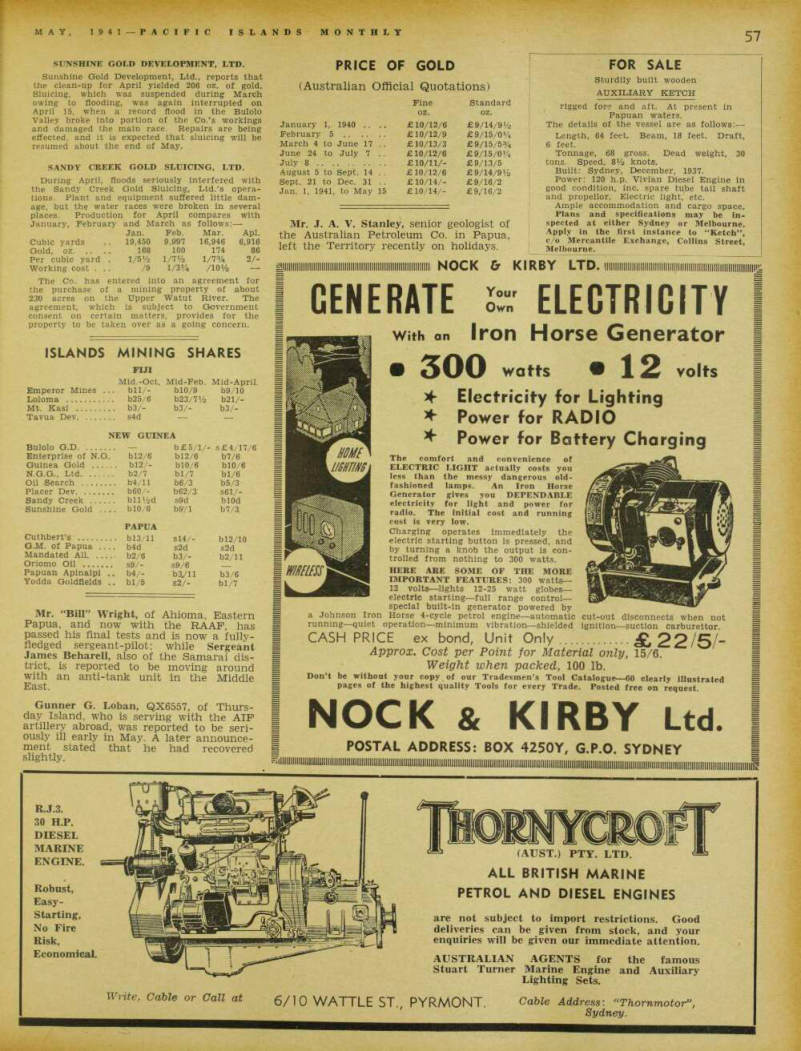
From Papua
Cuthbert’S Misima Gold Mine, Ltd.
A T the annual meeting of Cuthbert’s Misima Gold Mine, Ltd., in Sydney, on April 30, the acting-chairman (Mr, H. G. Carter) said directors were confident that reserves in the southern section of the mine would permit of profitable operations indefinitely. Although the average grade of ore obtained both this year and last year had been low, they believed that the minimum had been attained and that the grade in the future would tend to improve.
The northern section, when properly opened, should prove to be a profitable asset so far as the oxidised zone was concerned. Now that the supply of native labour was ample, development in this area would be pushed ahead.
April production is compared with February and March in the following table;—
Papuan Apinaipi Petroleum Co.. Ltd.
Papuan Apinaipi Petroleum Co., Ltd., reports that drilling of the No. 3 northern well at Oiapu is continuing. Three shifts were being worked daily, and inflammable gas was en countered at 600 ft. On May 1 a depth of 675 ft. was reached.
Preparations were then being made to insert further casing in the No. 3 well. Gas samples have been taken for testing purposes. Equip ment for No. 2 major well has arrived from USA, and will enable operations to be com menced at this location very shortly.
The Co. reported on May 12 that No. 3 northern well was down to 794 feet. Evidence of oil was observed in a core recovered from about 700 feet.
Yodda Goldfields, Ltd.
The field manager of Yodda Goldfields Limited reports that the gold yield for April was 82 oz. 1 dwt.
From Fiji
Emperor Mines, Ltd.
APRIL production at the Emperor mine, Tavua, is compared with the three previous yields in the following table:—
Loloma (Fiji) Gold Mines, N.L.
Loloma production for period ending April 16 is compared with three previous yields as follows:
*ln addition 332 fine oz. were recovered from slags and concentrates.
An unchanged quarterly dividend of 1/- a share has been declared, payable on June 9; books close May 21. This dividend will absorb £41,250, and brings the Co.’s total to £618,750, or 15/- a share. Total of dividends from the Fijian field is now £1,093,750.
Mount Kasi Mines, Ltd.
Production at the Mount Kasi mine on Vanua Levu for April compares with January, February and March as follows:
From New Guinea
New Guinea Goldfields, Ltd.
AT ARCH production from the NGG, Ltd.’s workings compares with January and February as follows:
•(•Underground mining at Edie Creek and Golden Ridges ceased on March 14 because of an in dustrial dispute.
Koranga Alluvials.—Estimated operating pro fit for quarter ended March 31 was £8,320.
Bulolo Gold Dredging, Ltd.
Production from the BGD, Ltd., dredges for March is compared with January and February in the following table:—
Feb. Mar. Apr.
Mill, treated, tons .. .. 3„334 3,237 3,213 Bullion, oz 3,369 3,424 3,918 Gold, fine oz 795 789 788 Silver, fine oz 2,401 2,562 3,045 Estimated value .. .. £6,455 £6,416 £6,443 Value per ton of ore . 38/9 39/7 40/1
Period ended Jan.
Feb.
Mar.
Apl. 25. 19. 19. 16.
Ore treated, tons 13,381 12,213 10,939 8,103 Gold, oz. fine .. 4,764 4,107 4,004 *4,003 Head value, dwt. 7.80 9.4 6.3 8.97 Residues, dwt. . 0.54 1.19 0.97 0.93 ♦Including 1,067 etc. fine oz. from auriferous slags,
Period ended Jan. Feb. Mar. Apr. 25. 19’. 19. 16.
Tons treated . . . 2,578 2,590 2,600 2,350 Gold, fine oz. . . 3,436 3,374 3,250 *2,846 Head value, dwt. . 27.78 26.92 25.85 25.14 Residue, dwt. . .. 1.12 0.87 1.19 0,92
Four weeks ended Jan.
Feb.
Mar, Apr. 29. 26. 26. 23.
Ore, tons .. 3,125 2,733 3,250 3,723 Gold, fine oz. . . 649 638 727 712 Value, £ A 6,490 6,380 7,270 7,120
Edie Creek mill— J an.
Feb. tMar.
Ore, tons 2,881 2,606 826 Gold, oz. fine .. .. 902 665 189 Silver, oz. fine .. .. 4,282 5,827 1,266 Golden Ridges mill— Tons treated .. .. 2,562 2,320 861 Gold, oz. fine .. .. 673 997 760 Silver, oz. fine .. . . 800 1,146 723 Alluvial— Gold, oz. fine . . 1,465 1,176 1,097 Silver, oz. fine .. 1,016 837 732 Operating profit— Edie Creek, £ . .. 2,201 446 — Golden Ridges, £ .. •504 1,817 — Alluvial, £ 5,635 3,928 2,554 •Loss.
Jan.
Feb.
March.
Cubic yards .. 1,654,000 1,540,000 1,557,000 Bullion, oz. .. 17,926 15,738 16,826 Gold, fine oz. . 12,370 10,589 11,610 Estimated working profit for March, 7,588 oz. fine gold.
Sunshine Gold Development, Ltd.
Sunshine Gold Development, Ltd., reports that the clean-up for April yielded 206 oz. of gold.
Sluicing, which was suspended during March owing to flooding, was again interrupted on April 15, when a record flood in the Bulolo Valley broke into portion of the Co.’s workings and damaged the main race. Repairs are being effected, and it is expected that sluicing will be resumed about the end of May.
Sandy Creek Gold Sluicing. Ltd.
During April, floods seriously interfered with the Sandy Creek Gold Sluicing, Ltd.’s opera tions. Plant and equipment suffered little dam age, but the water races were broken in several places. Production for April compares with January, February and March as follows; Jan. Feb. Mar. Apl.
Cubic yards .. 19,450 9,997 16,946 6,916 Gold, oz 168 100 174 86 Per cubic yard . 1/5 % 1/7% 1/7% 2/- Working cost ... /9 1/3% /10% The Co. has entered into an agreement for the purchase of a mining property of .about 230 acres on the Upper Watut River, The agreement, which is subject to Government consent on certain matters, provides for the property to be taken over as a going concern.
Advertisements & other items, p. 60 (1 item)
Gold
Highest Prices Paid For
Garrett & Davidson’s organisation is acknowledged far and wide as the main clearing house for precious metals in the Southern Hemisphere.
They have earned a reputation for accuracy and integrity in all their business dealings, which is proved by the fact that they are privileged to handle more gold from the Islands of-the Pacific than any other organisation.
Therefore for your complete and lasting satisfaction, you are advised to transact all your precious metals business through the house of Garrett & Davidson.
GARRETT & DAVIDSON PTY. LTD.
ASSAYERS METALLURGISTS REFINERS
Bank of N.S.W. Buildings,
REGENT AND GEORGE STS., SYDNEY.
Islands Mining Shares
Mr. “Bill” Wright, of Ahioma, Eastern Papua, and now with the RAAF, has passed his final tests and is now a fully fledged sergeant-pilot; while Sergeant James Beharell, also of the Samarai dis trict, is reported to be moving around with an anti-tank unit in the Middle East.
Gunner G. Loban, QX6557, of Thurs day Island, who is serving with the AIF artillery abroad, was reported to be seri ously ill early in May. A later announce ment stated that he had recovered slightly.
Fiji
Mid.-Oct.
Mid-Feb.
Mid-April.
Emperor Mines . .. bll/blO/9 b9/10 Loloma .. b25/6 b23/7Vi b2l/- Mt. Kasi .. b3/b3/b3/- Tavua Dev s4d — — Bulolo G.D
New Guinea
.. — b £ 5/1/- • s£ 4/17/6 Enterprise of N.G b!2/6 b!2/6 b7/6 Guinea Gold b!2/blO/6 blO/6 N.G.G., Ltd b2/7 bl/7 bl/6 Oil Search .. b4/ll b6/3 b5/3 Placer Dev .. b60/b62/3. s61/- Sandy Creek bliy 2 d s9d blOd Sunshine Gold .. .. blO/6 h&/l b7/3 Cuthbert’s
Papua
.. b!3/ll Sl4/bl2/10 G.M. of Papua . . .. b4d s2d s2d Mandated All. ... b3/b2/ll Oriomo Oil ,. s9/s9/6 Papuan Apinalpi .. b4/bsyn b3/6 Yodda Goldfields .. bl/5 s2/bl/7
Price Of Gold
Mr. J. A. V. Stanley, senior geologist of the Australian Petroleum Co. in Papua, left the Territory recently on holidays.
(Australian Official Quotations) Fine Standard oz. oz.
January 1, 1940 .. .. £10/12/6 £ 9/14/9% February 5 £10/12/9 £9/15/0% March 4 to June 17 .. £ 10/13/3 £9/15/5% June 24 to July 7 .. £10/12/6 £9/15/0y 4 July 8 £10/11/- £9/13/5 August 5 to Sept. 14 . . £10/12/6 £9/14/9% Sept. 21 to Dec. 31 .. £10/14/- £9/16/2 Jan. 1, 1941, to May 15 £10/14/- £9/16/2
Advertisements & other items, pp. 61-62 (1 item)
Generate
FOR SALE
Sturdily built wooden
AUXILIARY KETCH
rigged fore and aft. At present in Papuan waters.
The details of the vessel are as follows: Length, 64 feet. Beam, 18 feet. Draft, 6 feet.
Tonnage, 68 gross. Dead weight, 30 tons. Speed, BV2 knots.
Built: Sydney, December, 1937.
Power: 120 h.p. Vivian Diesel Engine in good condition, inc. spare tube tail shaft and propeller. Electric light, etc.
Ample accommodation and cargo space.
Plans and specifications may be inspected at either Sydney or Melbourne.
Apply in the first instance to “Ketch”, c/o Mercantile Exchange, Collins Street, Melbourne,
iiiiiiiiilliiiiiiiiiiiliiiiiliilliiiiililliiiiiiiiiiilliiiiliiliiliiii NOCK & KIRBY LTD. iiiiiiiiiiiiiiiiiiiiiiiiiiiiiiiiiiiiiiiiiiiiiiiiiiiiiiiiiiiiin
GENERATE
HOME
mm mm With an
ELECTRICITY
Iron Horse Generator
Your Own 300
watts
1 2 volts
4 Electricity for Lighting
*■ Power tor RADIO
* Power for Battery Charging
The comfort and convenience of ELECTRIC LIGHT actually costs you less than the messy dangerous oldfashioned lamps. An Iron Horse Generator gives you DEPENDABLE electricity for light and power for radio. The initial cost and running cost is very low.
Charging operates Immediately the electric starting button is pressed, and by turning a knob the output is controlled from nothing to 300 watts.
HERE ARE SOME OF THE MORE
IMPORTANT FEATURES: 300 watts—
-12 volts—lights 12-25 watt globes— electric starting—full range control— special built-in generator powered by a Johnson Iron Horse 4-cycle petrol engine—automatic cut-out disconnects when not running—quiet operation—minimum vibration—shielded ignition—suction carburettor.
CASH PRICE ex bond, Unit Only £22/5/"
Approx. Cost per Point for Material only, 15/6.
Weight when packed, 100 lb.
Don’t be without your copy of our Tradesmen’s Tool Catalogue—6o clearly illustrated pages of the highest quality Tools for every Trade, Posted free on request.
NOCK & KIRBY Ltd.
POSTAL ADDRESS: BOX 4250 Y, G.P.O. SYDNEY
R.J.3. 30 H.P.
DIESEL
MARINE
ENGINE.
Robust, Easy- Starting, No Fire Risk, Economical.
Write, Cable or Call at
6/10 WATTLE ST
(AUST.) PTY. LTD.
ALL BRITISH MARINE
PETROL AND DIESEL ENGINES
are not subject to import restrictions. Good deliveries can be given from stock, and your enquiries will be given our immediate attention.
AUSTRALIAN AGENTS for the famous Stuart Turner Marine Engine and Auxiliary Lighting Sets.
PYRMONT. Cable Address: “Thornmotor”, Sydney.
j WORLD'S LATEST
GAMES
Darts Boards with 6 Darts, 8/6. i Play Brass Competition Darts, Set \ of 3, 3/11, 4/6, 5/6. Monopoly, 11/6. ( Totopoly, 11/6. Bucaneer, 11/6. 3 of the World’s Most Popular Games.
Chinese Checkers, 2/9, 5/-, 9/-.
Tripoly Card Game 5/3. De Luxe ' Type, 10/6, Poker Rummy, 1/1.
Dice of all kinds in stock. Poker Dice, 6/6, 7/6, 8/6, 10/6, set of 5.
Crown & Anchor Dice, set of 3, 5/6.
Full Set with Cloth and Shaker, 10/6. H. & T., 5 & 6. and Hazard Dice Stocked. Write for Lists.
Two Way Telephone Set, 75/-. Complete with House or Field ’phones.
Wet Battery Testers Hydrometers, 3/-. 12 Snappy Books —Jokes, Have Fun, etc., 5/6 the lot.
All About Aerial Booklet, 1-/. Radio Dictionary, 1/-. Morse Code Book, 1-. Radio Alphabet, 1/-. The 4 books for 3/3.
Roulette Wheels, complete. 25/-.
The Best Trick Pack of Cards available, 3/6. Hundreds of Tricks you can do. Fullest, simple instructions provided.
PRESTO, THE MAGIC BOX.
2/9
POST
POST
2/9
FREE.
as*
FREE.
MOST AMAZING TRICK EVER.
Special Wholesale Price in quantities.
Now available (not less than 10/parcels): Magic Wand, 1/6 Jafefs Wallet, 1/-; Obedient Ball, 1/6.
Mystic Head Chopper 2/6; Shy Lock, 2/-; Dribble Glass. 2/-; Ventrillo, 1/-; Magic Coin, 1/-, Nest of Nests, 5/-; Voice Echoer, 1/-; Magic Bottle, 1/-; 3 Bell Trick, 1/-.
Wonderful Rattle Box Trick, 2/6. Mixed Parcels of Tricks, 10/-, 20/-. 30/-, 40/-, 50/-.
Parcel of Jokes, 10/-, 12/6, 15/-.
The Magic Money Roll, 3/6. 10/-, £1 and £5 Notes appear when you know how a simple yet entertaining trick.
T:
EGG & BAG
TRICK, 2/6.
Easy to Perform
SWOOP! BRITAIN’S BEST.
“Amplion,” Bakelite PICK-UP, with Volume Control incorporated. Brand new, in original cartons. Listed to sell at JB/6. Now 32/6. Fits and suits all sets. Battery or Electric.
MAKE YOl'E OWN RECORDINGS.
Overhead Cutting Gear and Cutting Head for Home Radio-Gramophone Recording, £6/6/-. Used in conjunction with your present radio.
Records, Needles, etc., etc. Metal Discs, 1/-, 1/6.
Microphones for Speech, Song or Music. Hook-up in a jiffy to any set. 15/-, 17/6, 18/6 complete.
Batteryless Type Hand - holding Microphones, fit any set, 25/-, Ormond 3 in. Front-panel Vernier Dial, 2 actions, 8/6.
HEADPHONES.
12/6, 17/6.
S.T.C., British, 30/-; 8.T.H., 30/-; Lissen, British, 19/6. All 4,000 ohms.
Ericcson’s Professional Type, 47/6.
RADIO VALVES.—We guarantee a Better Price. Send your order.
ALL DRY BATTERIES STOCKED.
RADIOS. All
kinds; all waves.
Built to order.
We have hundreds giving excellent service right throughout the South Sea Islands. Quotes for asking.
ACCUMULATORS.
2 Volt, 110 Amp 19/- Hydrometers for Accumulator testing, 2/9. Volt Meters, 2 reading. 10/6.
IO Bench Type Meter Reads All in Radio, 30/-.
POCKET VOLT
METERS.
Two Reading Pocket Meter, for A and B Batteries, 2/6, 3/9, 4/9, 7/6. 3 Reading, A and B Batteries, and up to 30 M/A. 10/6. 3 Reading Dr Luxe Model, 12/6. 4 Reading, 14/-.
BOOKS! BOOKS! BOOKS! The Be-
ginners’ Book of Radio. The Radio Beginners’ Dictionary. 2/- the 2. The Wireless Constructor’s Encyclopaedia. Giant size, 7/6. Newnes “Everyman’s” Wireless Book, 5/6.
The Book of Practical Radio, also
LEARN MORSE CODE. “LIKE-A-
FLASH” KITS, KEYS & BUZZERS.
P.M.G. type Key with Professional Buzzer & Battery, all assembled on Base Board, 42/6. ■ v.q; Morse Set Buzzer or light with single switch. All parts include adjustable Key, Switch, Buzzer, Lamp and Battery, all assembled on Base Board, 30/-.
Morse Code Set “De Luxe”. Adjustable High-grade Key, Buzzer and Battery. All mounted on base board ready for use, 27/6. \\(// Adjustable Morse Code Key on Bakelite Base, highly plated parts, 12/6. Higher grade instrument.
De Luxe Junior Morse Code Outfit, Mounted Key Buzzer and Battery, 13/6 complete. Morse Book, 1/-.
P.M.G. Model Adjustable Morse Code Key. Precision fittings, 19/6.
Rubber Head-’phone Pads, 2/6 pr.
FOREIGN STAMPS.
Just Landed; Packets of Stamps.
Send 2/6 for wide range of World’s Stamps. Special selection of 100 different All World Stamps, including 2 Free Stamps valued in 1939, S.G. Catalogue at 1/8, PRICE 2/9. 204 All World Stamps, with 3/8 stamp gift, 3/9. Writes for Lists. I Felt Pennants; A.1.F., R.A.N., R.A.A.F. and all other branches of Defence Forces. 3/6 each.
Money Belts for Soldiers, Sailors or Civilians. Zipper Types, 9/6.
Electric Military Brush, 15/-.
Stimulates the Scalp and Hair.
Aerial Stay-wire strainers, 2/6.
De Luxe Model British-built Lightning Arresters, complete for indoor or outdoor use, 6/-.
Non-jam Pulleys with halyard bolt, 1/9. Special Radio Earth Spike 4/6. 4 in. 4 in 1 Nickel Screw Drivers, bakelite or metal, 2/-. . Fountain Pen size. 1,500 ft. Beam Electric Torches, 5 Cell, 8/6. Both use Standard Batteries. 2 to 3 Cell Expandable Torches.
Nickelled Case—Dimmer incorporated.
Daylight Globes, 10/6. 2 Reading Pocket Volt Meters, 5/6.
Portable battery operated Light with pull switch and Battery Block, 8/6.
Swiss Music Boxes for Cigarette, Trinkets, etc., 25/-, 30/-, 45/-.
Steel Money and Deed Boxes, 63/-.
They ring when opened or lifted.
A Splendid Article.
Hunting and Sporting Knives. Remington U.S.A. made, 10/6, 12/6, 15/6, 16/6. (AH in Sheath.) Throwing Knives, 1/9.
All/ 39/6 Morse Code Light and Buzzer Set.
A precision De-luxe outfit that cannot be bettered. Perfect Adjustable Morse Code Key, with professional type Buzzer. Light to Buzzer throw-over Switch, and Battery, all ready mounted.
iiinmiiiiiimnTnj Write for Punch Board Leaflets nirnirniiiniinnii
J.LEVENSON Radio
GAMES, NOVELTIES AND HOBBIES.
226 A PITT STREET, SYDNEY
Manufacturers, Importers, and Exporters.
N.S.W., AUSTRALIA.
mniiiiiiiiniiiiiiiiiii
Write for Pin-Game, Totem and Odds and Evens Leaflets
'iiiiiimiiiKimninir
Cable address: “Leveradloh”. Goods forwarded V.P.P. or Sight Draft. Satisfaction and Service Guaranteed. We can supply by mail all General Merchandise at a Better Price. Quotations with pleasure. Please add freight and packing. Write for full list of interesting leaflets of Games, Hobbies, Novelties, and Electrical Goods. Write for full list of Radio Meters.
NOW 49/6
“COSMOCORD” Suits and Pits all British Built Sets.
CRYSTAL RADIO-GRAMO
PICK UP.
The Book of Practical Television, 8/6 each. Foulsham’s Giant “Party and Fun Book”, 1/6. Humorous Stories and Recitations, 3f/9.
Card and Conjuring Tricks, 3/9. Tea-Cup Fortune Telling, 3/9. 100 Party Games for Old and Young, 1/9. Popular Magic and Amateur Conjurer, 1/9. 50 Best Party Games, 1/6.
Tricks with Cards, 1/6.
We Can Supply, at a Keen Price, Any Available Article You Require.
Australian Short Wave
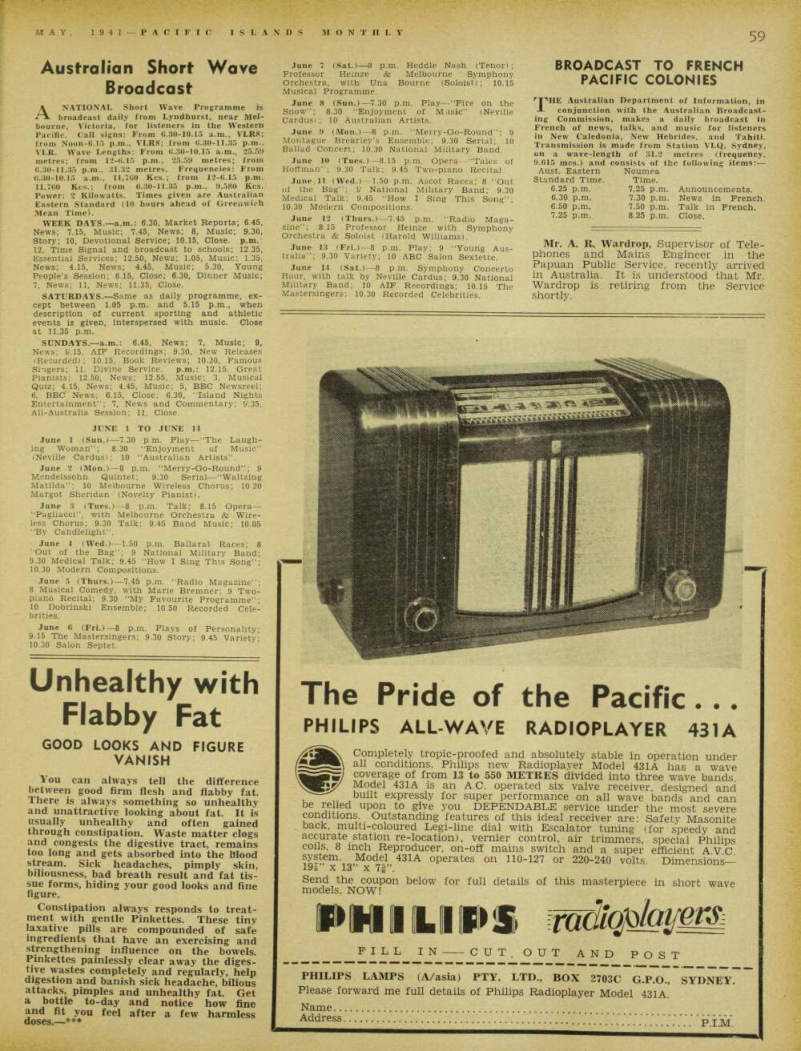
Broadcast
A NATIONAL Short Wave Programme is broadcast daily from Lyndhurst, near Mel bourne, Victoria, for listeners in the Western Pacific. Call signs: From 6.30-10.15 a.m., VLRB; from Noon-6.15 p.m., VLRB; from 6.30-11.35 p.m., VLR. Wave Lengths: From 6.30-10.15 a.m., 25.59 metres; from 12-6.15 p.m., 25.59 metres; from 6.30-11.35 p.m., 31.32 metres. Frequencies: From 6.30-10.15 a.m., 11,760 Kcs.; from 12-6.15 p.m. 11,760 Kcs.; from 6.30-11.35 p.m., 9,580 Kcs.
Power: 2 Kilowatts. Times given are Australian Eastern Standard (10 hours ahead of Greenwich Mean Time).
WEEK DAYS.—a.m.: 6.30, Market Reports; 6.45, News; 7.15, Music; 7.45, News; 8, Music; 9.30, Story; 10, Devotional Service; 10.15, Close, p.m. 12, Time Signal and broadcast to schools; 12.35, Essential Services; 12.50, News; 1.05, Music; 1.35, News; 4.15, News; 4.45, Music; 5.30, Young People’s Session; 6.15, Close; 6.30, Dinner Music; 7, News; 11, News; 11.35, Close.
SATURDAYS.—Same as daily programme, ex cept between 1.05 p.m. and 5.15 p.m., when description of current sporting and athletic events is given, interspersed with music. Close at 11.35 p.m.
SUNDAYS.—a.m.: 6.45, News; 7, Music; 9, News; 6'. 15, AIF Recordings; 9.30, New Releases (Recorded); 10.15, Book Reviews; 10.30, Famous Singers; 11. Divine Service. p.m.: 12.15. Great Pianists; 12.50, News; 12.55, Music; 3, Musical Quiz; 4.15, News; 4.45, Music; 5, BBC Newsreel; 6, BBC News; 6.15, Close; 6.30, “Island Nights Entertainment”; 7, News and Commentary; 9'.35, All-Australia Session; 11, Close.
June I To June 14
June 1 (Sun.) —7.30 p.m. Play—“ The Laugh ing Woman”; 8.30 “Enjoyment of Music” (Neville Cardus); 10 “Australian Artists”.
June 2 (Mon.) —8 p.m. “Merry-Go-Round”; 9 Mendelssohn Quintet; 9.30 Serial —“Waltzing Matilda”; 10 Melbourne Wireless Chorus; 10.20 Margot Sheridan (Novelty Pianist).
June 3 (Tues.) —8 p.m. Talk; 8.15 Opera— “Pagliacci”, with Melbourne Orchestra & Wire less Chorus; 9.30 Talk; 9.45 Band Music; 10.05 “By Candlelight”.
June 4 (Wed.) —1.50 p.m. Ballarat Races; 8 “Out of the Bag”; 9 National Military Band; 9.30 Medical Talk; 9.45 “How I Sing This Song”; 10.30 Modern Compositions.
June 5 (Thurs.) —7.45 p.m. “Radio Magazine”; 8 Musical Comedy, with Marie Bremner; 9 Two piano Recital; 9.30 “My Favourite Programme”; 10 Dobrinski Ensemble; 10.50 Recorded Cele brities.
June 6 (Fri.) —8 p.m. Plays of Personality; 9.15 The Mastersingers; 9.30 Story; 9.45 Variety; 10.30 Salon Septet.
June 7 (Sat.) —8 p.m. Heddle Nash (Tenor); Professor Heinze & Melbourne Symphony Orchestra, with Una Bourne (Soloist); 10.15 Musical Programme.
June 8 (Sun.) —7.30 p.m. Play—“ Fire on the Snow"; 8.30 “Enjoyment of Music” (Neville Cardus); 10 Australian Artists.
June 9 (Mon.) —8 p.m. “Merry-Go-Round”; 9 Montague Brearley’s Ensemble; 9.30 Serial; 10 Ballad Concert; 10.30 National Military Band.
June 10 (Tues.) —8.15 p.m. Opera—“ Tales of Hoffman”; 9.30 Talk; 9.45 Two-piano Recital.
June 11 (Wed.) —1.50 p.m. Ascot Races; 8 “Out of the Bag”; &' National Military Band; 9.30 Medical Talk; 9.45 “How I Sing This Song”; 10.30 Modern Compositions.
June 12 (Thurs.) —7.45 p.m. “Radio Maga zine”; 8.15 Professor Heinze with Symphony Orchestra & Soloist (Harold Williams).
June 13 (Fri.)—B p.m. Play; 9 “Young Aus tralia”; 9.30 Variety; 10 ABC Salon Sextette.
June 14 (Sat.) —8 p.m. Symphony Concerto Hour, with talk by Neville Cardus; 9.30 National Military Band; 10 AIF Recordings; 10.15 The Mastersingers; 10.30 Recorded Celebrities.
Pacific Colonies
Broadcast To French
THE Australian Department of Information, in conjunction with the Australian Broadcast ing Commission, makes a daily broadcast in French of news, talks, and music for listeners in New Caledonia, New Hebrides, and Tahiti.
Transmission is made from Station VLQ, Sydney, on a wave-length of 31.2 metres (frequency, 9.615 mcs.) and consists of the following items;—
Mr. A. R. Wardrop, Supervisor of Tele phones and Mains Engineer in the Papuan Public Service, recently arrived in Australia. It is understood that Mr.
Wardrop is retiring from the Service shortly.
Aust. Eastern Noumea Standard Time.
Time. 6.25 p.m. 7.25 p.m.
Announcements. 6.30 p.m. 7.30 p.m.
News in French. 6.50 p.m. 7.50 p.m.
Talk in French. 7.25 p.m. 8.25 p.m.
Close.
Mr. F. W. G. Anderson, Patrol Officer at the Goilala Police Camp, Papua, has arrived in Australia, on leave.
Advertisements & other items, pp. 63-64 (2 items)
The Pride of the Pacific ...
msm
m
PHILIPS ALL-WAVE RADIOPLAYER 431A
Completely tropic-proofed and absolutely stable in operation under all conditions, Philips new Radioplayer Model 431A has a wave coverage of from 13 to 550 METRES divided into three wave bands Model 431A is an A.C. operated six valve receiver, designed and built expressly for super performance on all wave bands and can u P° n to give you DEPENDABLE service under the most severe conditions. Outstanding features of this ideal receiver are; Safety Masonite back, multi-coloured Legi-line dial with Escalator tuning (for speedy and accurate station re-location), vernier control, air trimmers, special Philips coils, 8 inch Reproducer, on-off mains switch and a super efficient A VC 431A °P erates on HO-127 or 220-240 volts. Dimensions— iy» x io x 7§ .
Send the coupon below for full details of this masterpiece in short wave models, NOW!
PHI III" 1 ' 1
FILL IN CUT. OUT AND POST
PHILIPS LAMPS (A/asia) PTY. LTD., BOX 2703C G.P.O., SYDNEY.
Please forward me full details of Philips Radioplayer Model 431A.
Name Address V’’ ‘ .‘.v.'.v.v ;;; * pxm
Extra Strong Saddle
Extra Low Price
80/- bare
Built by highly skilled workmen from the best available materials, the Great Western Saddle represents remarkable value at 80/-. It is specially built to suit Island conditions with a Galvanised Tree, Copper Tacks and Brass Fittings.
Mounts: Leathers, Girths and Stirrups, 17/6 extra.
These Saddles are obtainable through your regular agent.
We carry complete stock of Saddles, Collars, Whips, Rugs and Saddlery Accessories.
Write for Catalogs*.
NEWMARKET SADDLERY
NEWTOWN
For perfect cutting
under all conditions
There is a Ransomes Mower for every lawn our range covers machines for every requirement from the smooth, even surface of the putting green to the sports ground, golf course or aerodrome.
The "MOON" Mower
For grass such as couch, kikuyu, buffalo, etc., and grass longer than the average. 14-in. and 18-in. wide.
GANG
MOWERS
50 acres a day can easily be cut with a Ransomes Quintuple Mower drawn by a tractor and even larger outfits up to 26 ft. wide are available.
ansomcs
Lawn Mowers
Write for illustrated literature and all information
MORRIS, HEDSTROM LTD.,
Suva, Lautoka, and Ba.
Made by RANSOMES, SIMS & JEFFERIES LTD,, IPSWICH, ENGLAND.
Unhealthy with
Flabby Fat
GOOD LOOKS AND FIGURE
VANISH
You can always tell the difference between good firm flesh and flabby fat.
There is always something so unhealthy and unattractive looking about fat. It is usually unhealthy and often gained through constipation. Waste matter clogs and congests the digestive tract, remains too long and gets absorbed into the blood stream. Sick headaches, pimply skin, biliousness, bad breath result and fat tissue forms, hiding your good looks and fine figure.
Constipation always responds to treatment with gentle Pinkettes. These tiny laxative pills are compounded of safe ingredients that have an exercising and strengthening influence on the bowels.
Pinkettes painlessly clear away the digestive wastes completely and regularly, help digestion and banish sick headache, bilious attacks, pimples and unhealthy fat. Get a bottle to-day and notice how fine and fit you feel after a few harmless doses.—**♦
Islands Produce
THE following quotations were obtained in Sydney in mid-May:—
Coffee
Java: Robusta, f.a.q., imported on firm conversion of exchange, c.i.f.. prompt shipment, Sydney (Sterling): Quote No. 1: 41/-. Quote No. 2: 43/6.
Boengie (a good quality Java coffee), c.i.f., Sydney, 52/-.
Kenya, f.a.q., immediate shipment, c.i.f., Sydney, per cwt. (Stg.): Balance of crop sold to USA, no further supplies available. Last quotes were: Grade “B”, 65/-; “C”, 62/-.
East Africa: Robusta, f.a.q., c.i.f., Sydney, 38/-.
Mysore, f.a.q., c.i.f., Sydney, per cwt. Quote No. 1: Ships’ assortment. Government pool formed, Grade “A”, 82/-; Grade “B”, 76/-; Grade “C”, 69/-. (It has been reported In Sydney, however, that parcels have been bought at prices lower than the above official quo tations.) Quote No. 2 (c.i.f., Sydney); Grade “A”, 73/-; Grade “B”, 66/-; Triage, 60/-.
Arabian (Aden) Hodeidah, f.a.q., c.i.f., Sydney.
No. 1 quotation; 82/-.
NG and Papua: Quote No. 1; B%d. per lb. (delivered store, Sydney), medium quality.
Quote No. 2: B%d. per lb. (delivered store, Sydney). Quote No. 3: 8 3 / 4 d.-9d. per lb., c.i.f., Sydney.
New Caledonian: Some Sydney agents report that as there is no Government grading system in the Colony, New Caledonian coffee coming into Australia varies considerably in quality, making it difficult to give general quotations on either the Arabica or Robusta grades. Each parcel, it is stated, must be treated on its merits. The following are quotations obtained from several different sources in May;—Quote No. 1 (in store, Sydney): Arabica, from 10 7 / B d.
to HV 2 d. per lb.; Robusta, 33/- per cwt. (3-15/28d. per lb.). Quote No. 2 (c.i.f., Sydney): Robusta, 4d. per lb.; Arabica, Bd. per lb. Quote No. 3( (c.i.f., Sydney): Arabica, Bd. per lb.; Robusta, 4d. per lb. Quote No. 4 (c.i.f., Sydney): Arabica, £56-£6O per ton; Robusta, £34-£4O per ton.
As all French colonies in the Pacific now have been brought into the sterling bloc. New Cale donian coffee has been removed from the licencing list.
New Hebrides: £36 per ton, c.i.f., Sydney. (Note; Importers of all coffees—except NG and Papuan—pay additional charges, including exchange, duty (4.4 d. lb.), primage (11 p-r cent.), landing costs (1/- per cwt.), war duty (10 per cent.)]
Vanilla Beans
Tahiti/ c.i.f., Sydney. Quote No. 1: Approxi mate market price, white label, 24/- a lb.; green label, 17/- a lb. Quote No. 2: White label and yellow label (April shipment), 27/6-28/- a lb.
Kapok
Quote No. 1: Average Java 6 13-16 d. per lb., c.i.f.: Prime Japara, 6V 2 d. per lb., c.i.f. Quote No. 2: Average Java, 7d., c.i.f. (Stg.); Prime Japara, 7-5/16d., c.i.f. (Stg.) Subject to ex change 2514%, duty 2d. per lb., 10% primage, 10% war duty, wharfage, etc.
Kapok may now come into Australia only from sterling sources (including Netherlands East Indies and India).
Ivory Nuts
Owing to war conditions, Sydney agents are not quoting for ivory nuts. The last quo tations, some time ago, indicated that a nominal rate was in the vicinity of £7 per ton.
Cotton
New Caledonian: A Sydney agent reported early in May that a small quantity of New Caledonian cotton had been sold at 9d. a lb., c.i.f., Sydney.
Cocoa
New Guinea cocoa; Quote No. 1; £4O-£46 per ton. Quote No. 2: £4O-£43.
Accra, good fermented, £33/10/- per ton (Sterling).
New Hebrides cocoa (delivered store, Sydney): Quote No. 1: £42 per ton. Quote No. 2: £4O - per ton. Quote No. 3: £37-£39 per ton, c.i.f., Sydney.
Rice
Rangoon rice, packed in 100 lb. bags, £l9/10/per ton; 200 lb, sacks, £l9 per ton.
Australian table rice, packed in 56 lb. bags, £2O per ton.
Trochus Shell
Quote No. 1; Grade “A”, £54; Grade “B”, £46: Grade “C”, £36; “Chicken”. £36.
Other nominal quotations were: Quote No. 2: Grade “A”, £6O; Grade “B”, £5O; Grade “C”, £4O. Quote No. 3: Grade “A”, £5O; Grade “B”, £4O; Grade “C”, £3O.
Green Snail Shell
Green snail shell was sold by a Sydney agent in April at £5B/10/- a ton. Another agent re ported sales early this month at £6O per ton.
Quote No. 3: £5B-£6O.
Mother Of Pearl Shell
Thursday Is. MOP, c.i.f., Sydney. Grade “AA”, £173 per ton; Grade “A”. £173; Grade “B” £157; Grade “C”, £173; Grade “DD”, £128; Grade “D”, £117; Grade “E”, £7B.
Peanuts
New Guinea peanuts: Unshelled, 2 3 / 4 d. per lb.; shelled, 4*/2d. per lb.
Gum Herol
Gum Herol, which is gathered in certain dis tricts of Papua and exported to Australia, where
it is used in the manufacture of varnishes, etc., is quoted by a Sydney agent at £27 per ton.
Rubber
Papuan: No. 1 smoked sheet rubber is sold in the Commonwealth at the Australian equivalent of the London price for “Plantation Smoked” (see detailed London prices on another page).
In London early this month an Official Controller was appointed, and the Ministry of Supply has become the sole importer of rubber into Great Britain.
Advertisements & other items, p. 64 (1 item)
Agents
vS
General
Merchants
and
Agents
0 REPRESENTING LEADING FIRMS IN THE PACIFIC ISLANDS
379 KENT STREET,
SYDNEY.
Cable Address: “Trocas”, Sydney.
Telephones: MJ4657 (5 lines).
Islands Produce Sold on Shippers' Account Buyers of all Islands’ requirements on Commis- Liberal Advances against Consignments. sion Original Invoices Furnished. 25 Years Islands Trade Experience.
Bankers: Bank of New South Wales. Correspondence in English and French.
Exchange Rates
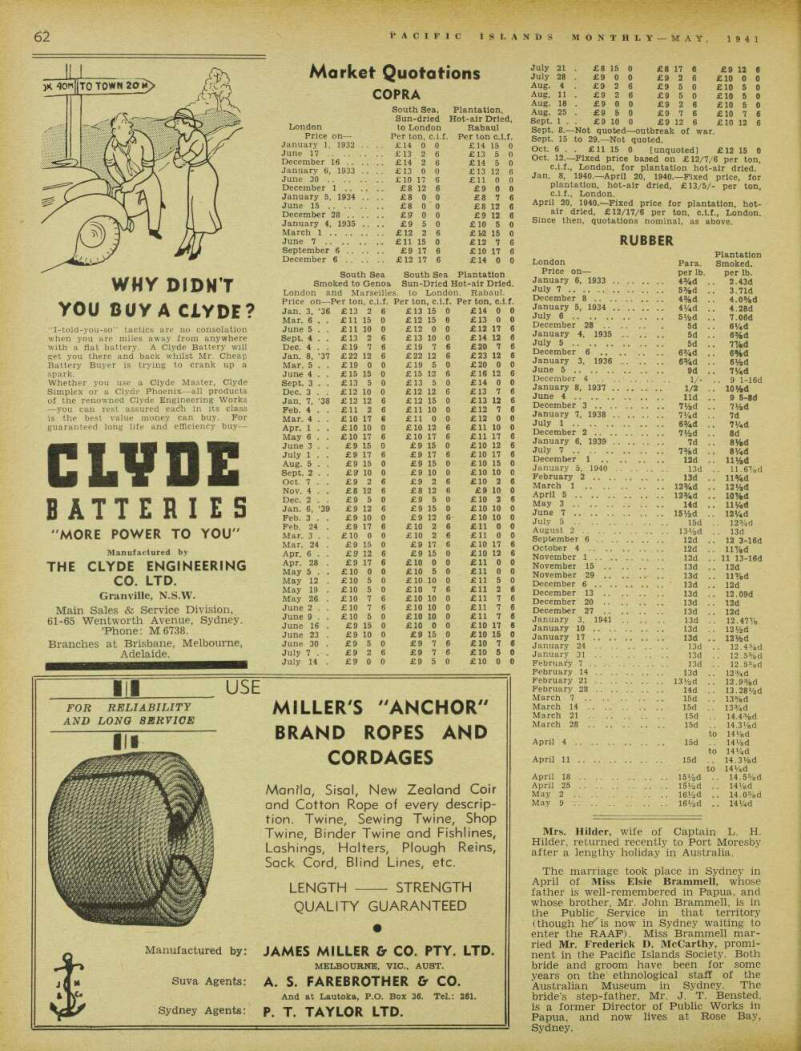
THE following exchange quotations, gathered in Sydney, show the rates existing in mid- May;—
Fiji
Through Bank of N.S.W. and Bank of New Zealand: —Australia on Fiji on basis of £lOO Fiji: Buying £Alll/2/6, selling £AII3. Fijl- London on basis £lOO London: —
Western Samoa
Through Bank of New Zealand;—Australia on Western Samoa, basis £ 100 Samoa—buying, £ A99/12/6; selling, £AIOO/2/6. Samoa on London, basis £lOO in London:—
New Guinea And Papua
Through Bank of N.S.W.; —Australia on Port Moresby and Samarai, Papua, 10/- per cent, premium each way. Australia on Rabaul, N.G.,
10/- per cent, premium. All other places 20/per cent.
Papua and New Guinea on London: Same as Australia on London and vice versa.
Through Commonwealth Bank;—Australia on Port Moresby and Samaral, Papua, 10/- per cent.; on Rabaul, N.G., 10/- per cent. —other Papua and New Guinea districts, £ 1 per cent.
Rabaul on London, same as Australia on London: — Buying: T.T. £AI2S equals £stg. 100.
Selling: T.T. £AI2S/10/- equals £stg. 100.
New Caledonia
Through French Bank:—As a result of the French surrender to Germany, the Anglo-French banking system has been completely dislocated.
London is not quoting on Paris—therefore the Comptoir National d’Escompte de Paris Bank in Sydney cannot furnish bank rates, as usual.
New Caledonia And Tahiti
Through Bank of N.S.W.; —Owing to the present European situation, London is not quoting a rate on Paris; and since the Sydney-Noumea and Sydney-Papeete quotations were based on the London-Paris rate, no quotations for these are available.
Rev. J. Bodger, of the Anglican Mis sion, was severely injured at Dogura, Eastern Papua, recently, when, during demolition work near the Cathedral, a heavy beam fell upon him. He was sent to the hospital at Samarai for treatment. , Miss Margaret Bechervaise and Miss Townsend, members of the Anglican Mis sion staff at Dogura, Eastern Papua, have arrived in Australia. This holiday is a welcome break, for they are old residents of the Territory, the former having 25 years’ and the latter 20 years’ service with the Mission.
Mrs. Linda Maclean, wife of Mr. G. D.
Maclean, of Vunalama, New Britain, died in Namanula Hospital at Rabaul, on April 21. She arrived in the Territory and married Mr. Maclean only in last December.
Hon. Tom Nevitt left Papua recently for Australia on a short business visit.
Buying.
Selling. £ s. d. £ s. d.
Telegraphic transfer , .. 110 15 0 112 0 0 On demand 111 17 6
Buying. Selling.
Telegraphic transfer — £125 10 0 On Demand £ 122 18 9 125 7 6 30 days 122 8 9 125 2 6 60 days 121 18 9 124 17 6 90 days 121 8 9 124 12 6 120 days 120 18 9 —
Mrs. Hilder, wife of Captain L. H.
Hilder, returned recently to Port Moresby after a lengthy holiday in Australia.
The marriage took place in Sydney in April of Miss Elsie Brammell, whose father is well-remembered in Papua, and whose brother, Mr. John Brammell, is in the Public Service in that territory (though he / is now in Sydney waiting to enter the RAAF). Miss Brammell mar ried Mr. Frederick D. McCarthy, promi nent in the Pacific Islands Society. Both bride and groom have been for some years on the ethnological staff of the Australian Museum in Sydney. The bride’s step-father, Mr. J. T. Bensted, is a former Director of Public Works in Papua, and now lives at Rose Bay, Sydney.
Market Quotations
Copra
South Sea, Plantation, Sun-dried Hot-air Dried, London to London Rabaul Price on— Per ton, c.i.f.
Per ton c.i.f.
January 1, 1932 £14 0 0 £14 15 0 June 17 . £13 2 6 £13 5 0 December 16 .. £14 2 6 £14 5 0 January 6, 1933 £13 0 0 £13 12 6 June 30 . £10 17 6 £11 0 0 December 1 .. £8 12 6 £9 0 0 January 5, 1934 . £8 0 0 £8 7 6 June 15 . £8 0 0 £8 12 6 December 28 .. £9 0 0 £9 12 6 January 4, 1935 , , , £9 5 0 £10 5 0 March 1 £12 2 6 £12 15 0 June 7 . £11 15 0 £12 7 6 September 6 , . £9 17 6 £10 17 6 December 6 . . £12 17 6 £14 0 0 South Sea South Sea Plantation Smoked to Genoa Sun-Dried Hot-air Dried.
London and Marseilles, to London. Rabaul.
Price on— Per ton, c.i.f.
Per ton, c.i.f.
Per ton, c.i.f.
Jan. 3. ’36 £13 2 6 £13 15 0 £14 0 0 Mar. 6 . . £11 15 0 £12 15 0 £13 0 0 June 5 . . £11 10 0 £12 0 0 £12 17 6 Sept. 4 . . £13 2 6 £13 10 0 £14 12 6 Dec. 4 . . £19 7 6 £19 7 6 £20 7 6 Jan. 8, ’37 £22 12 6 £22 12 6 £23 12 6 Mar. 5 . . £19 0 0 £19 5 0 £20 0 0 June 4 . . £15 15 0 £15 12 6 £16 12 6 Sept. 3 . . £13 5 0 £13 5 0 £14 0 0 Dec. 3 . . £12 10 0 £12 12 6 £13 7 6 Jan. 7, '38 £12 12 6 £12 15 0 £13 12 6 Feb. 4 . . £11 2 6 £11 10 0 £12 7 6 Mar. 4 . . £10 17 € £11 0 0 £12 0 0 Apr. 1 . . £10 10 0 £10 12 6 £11 10 0 May 6 . . £10 17 6 £10 17 6 £11 17 6 June 3 . . £9 15 0 £9 15 0 £10 12 6 July 1 . . £9 17 6 £9 17 6 £10 17 6 Aug. 5 . . £9 15 0 £9 15 0 £10 15 0 Sept. 2 . . £9 10 0 £9 10 0 £10 10 0 Oct. 7 . . £9 2 6 £9 2 6 £10 2 6 Nov. 4 . . £8 12 6 £8 12 6 £9 10 0 Dec. 2 . . £9 5 0 £9 5 0 £10 2 6 Jan. 6, ’39 £9 12 6 £9 15 0 £10 10 0 Feb. 3 . . £9 10 0 £9 12 6 £10 10 0 Feb. 24 . £9 17 6 £10 2 6 £11 0 0 Mar. 3 . . £10 0 0 £10 2 6 £11 0 0 Mar. 24 . £9 15 0 £9 17 6 £10 17 6 Apr. 6 , . £9 12 6 £9 15 0 £10 12 6 Apr. 28 . £9 17 6 £10 0 0 £11 0 0 May 5 . . £10 0 0 £10 5 0 £11 0 0 May 12 . £10 5 0 £10 10 0 £11 5 0 May 19 . £10 5 0 £10 7 6 £11 2 6 May 26 . £10 7 6 £10 10 0 £11 7 6 June 2 . . £10 7 6 £10 10 0 £11 7 6 June 9 . . £10 5 0 £10 10 0 £11 7 6 June 16 . £9 15 0 £10 0 0 £10 17 6 June 23 . £9 10 0 £9 15 0 £10 15 0 June 30 . £9 5 0 £9 7 6 £10 7 6 July 7 . . £9 2 6 £9 7 6 £10 5 0 July 14 . £9 0 0 £9 5 0 £10 0 0
July 21 . £8 15 0 £8 17 6 £9 12 6 July 28 . £9 0 0 £9 2 6 £10 0 0 Aug. 4 . £9 2 6 £9 5 0 £10 5 0 Aug. 11 . £9 2 6 £9 5 0 £10 5 0 Aug. 18 . £9 0 0 £9 2 6 £10 5 0 Aug. 25 . £9 5 0 £9 7 6 £10 7 6 Sept. 1 . . £9 10 0 £9 12 6 £10 12 6 Sept. 8.—Not quoted—outbreak of war.
Sept. 15 to 29.—Not Oct. 6 . . £11 15 quoted, 0 [unquoted] £12 15 0 Oct. 12.—Fixed price based on £12/7/6 per ton. c.i.f., London, for plantation hot-air dried.
Jan, 8, 1940.—April 20, 1940.—Fixed price, for plantation, hot-air dried, £13/5/- per ton. c.i.f., London.
April 20, 1940.—Fixed price for plantation, hotair dried, £12/17/6 per ton, c.i.f., London.
Since then, quotations nominal, as above.
Rubber
London Price on— January 6, 1933 Para, per lb, 4%d Plantation Smoked, per lb. 2.43d July 7 5%d .. 3.71d December 8 .. .. 4%d 4.0%d January 5, 1934 .. 4‘Ad .. 4,28d July 6 5‘/ 2 d .. 7.06d December 28 . . . 5d 6‘Ad January 4, 1935 . 5d 6%d July 5 5d .. 7%d December 6 .. 6 3 Ad 6%d January 3, 1936 , 6 3 Ad 6V«.d June 5 9d .. 7Vid December 4 . . . . 1/- .. 9 l-16d January 8, 1937 .. 1/2 .. 10V4d June 4 lid 9 5-8d December 3 .. .. 7‘/ad .. 7‘/ad January 7, 1938 .. 7‘Ad 7d July 1 8 3 Ad 7y«d December 2 .. .. 7‘/ad 8d January 6, 1939 . . 7d 8Vid July 7 7%d 8y 4 d December 1 ,. ..
January 5, 1940 . . 12d 13d .. ll%d .. 11.6 7 /ad February 2 13d .. ll%d March 1 12%d .. 12‘/ a d April 5 12 3 Ad .. 10%d May 3 14d .. ny 4 d June 7 15‘/ad , . 12y 4 d July 5 15d • . 12%d August 2 13‘/ad .. 13d September 6 .. .. 12d .. 12 3-16d October 4 12d .. liy 8 d November 1 .. .. 12d .. 11 13-16d November 15 .. . 13d .. 12d November 29 ., , 13d .. ny 8 d December 6 .. .. 13d .. 12d December 13 .. . 13d .. 12.09d December 20 .. . 13d .. 12d December 27 ,. . 13d .. 12d January 3, 1941 13d .. 12.47 7 /a January 10 13d .. 12‘/ad January 17 13d .. IWzd January 24 .. .. 13d .. 12.43/ed January 31 .. .. 13d .. 12.5%d February 7 13d .. 12.5%d February 14 .. . . 13d .. 12%d February 21 13‘/ad .. 12.9%d February 28 . . .. 14d .. 13.28‘/ad March 7 March 14 15d 15d . . 13 5 /sd . . 13 3 Ad March 21 15d . . 14.4%d March 28 15d . . 14.3‘/ 8 d April 4 15d to 14 ‘/ad . . 14 ‘/ad April 11 15d to 14‘Ad .. 14.3y 8 d April 18 15‘/ 2 d to 14‘Ad .. 14.5 s /ad April 25 l5‘/ad .. 14‘/ad May 2 16.‘/ad .. 14.0%d May 9 16‘/ad .. 14‘Ad
Advertisements & other items, pp. 65-66 (1 item)
Ropes,
KANGAROO BRAND
Cordage,
and Twines Cor every purpose
Backed by
86 years of service.
Manufactured by
M. DONAGHY AND SONS,
Pty. Ltd.,Geeiong and Sydney.
Fiji Representatives:
PEARCE AND CO.
LIMITED
P.O. BOX 237, SUVA
BIG SIX saves 80% on costs
waste
monctj on
Wh T
the
t 0...
S Q 1 A
LITTLE
ELECTRICITY
A BIG SIX mates
a single mire more
satisfactory I
frnC K RtsisrANr
is more STO" aVV cotriy
THIS HOOK
VIAKCS THE
GATEWAY
One “BIG SIX” charger controls 25 miles of stockproof fencing, and one man can fence up to 20 acres a day!
Temporary or permanent paddocks, sub-divisions, shade enclosures lanewavs breeding or exercise pens, fodder storage enclosures, market gardens’ orchards, &c., can be fenced off and made stockproof wherever and whenever you want them—at trifling cost—and with little trouble.
No farm can be considered complete to-day unless it is equipped with an electric fence. It isn’t only that it saves 80 p.c. on the cost of ordinary fencing, but it actually teaches animals to respect all wire fences and soon cures the most persistent fence-breaker of the habit. Think what this means ln ? ewe A from barb wire cuts to valuable stock, the saving of wire and cost of repairs to fences. & The “BIG SIX” is available in two models which are both guaranteed, the Standard has an effective sting, the De Luxe has the added features of meter to indicate battery test, fence short, and switch for variation of sting for dry or wet soil. 7
AVAILABLE THROUGH ALL ISLAND MERCHANTS .
Manufactured in Australia by the licensees :
SINGLE WIRE FENCE
COMPANY
207 GEORGE STREET, SYDNEY
t Inclusive of specially designed wet battery, 50 each insulators and washers, f.o.b. Sydney,
"Big Six" STANDARD £8 10 0
"Big Six" DE LUXE £lO 12 0
)K 40m] IQ TOWN 20*>
0
WHY DIDN'T
YOU BOY A CIYDE?
“I-told-you-so” tactics are no consolation when you are miles away from anywhere with a flat battery. A Clyde Battery will get you there and back whilst Mr. Cheap Battery Buyer is trying to crank up a spark.
Whether you use a Clyde Master, Clyde Simplex or a Clyde Phoenix—all products of the renowned Clyde Engineering Works —you can rest assured each in its class is the best value money can buy. For guaranteed long life and efficiency buy—
CLYDE
BATTERI E S
"MORE POWER TO YOU"
Manufactured by
THE CLYDE ENGINEERING
CO. LTD.
Granville, N.S.W.
Main Sales & Service Division, 61-65 Wentworth Avenue, Sydney. ’Phone: M 6738.
Branches at Brisbane, Melbourne, Adelaide.
11l
FOR RELIABILITY
AND LONG SERVICE
USE
MILLER'S "ANCHOR"
BRAND ROPES AND
CORDAGES
Manfla, Sisal, New Zealand Coir and Cotton Rope of every description. Twine, Sewing Twine, Shop Twine, Binder Twine and Fishlines, Lashings, Halters, Plough Reins, Sack Cord, Blind Lines, etc.
LENGTH STRENGTH
QUALITY GUARANTEED
• Manufactured by: JAMES MILLER & CO. PTY. LTD.
MELBOURNE, VIC., AUST.
Suva Agents: A. S. FAREBROTHER & CO.
And at Lautoka, P.O. Box 36. Tel.: 261.
Sydney Agents: p. J. TAYLOR LTD.
Compensation Law
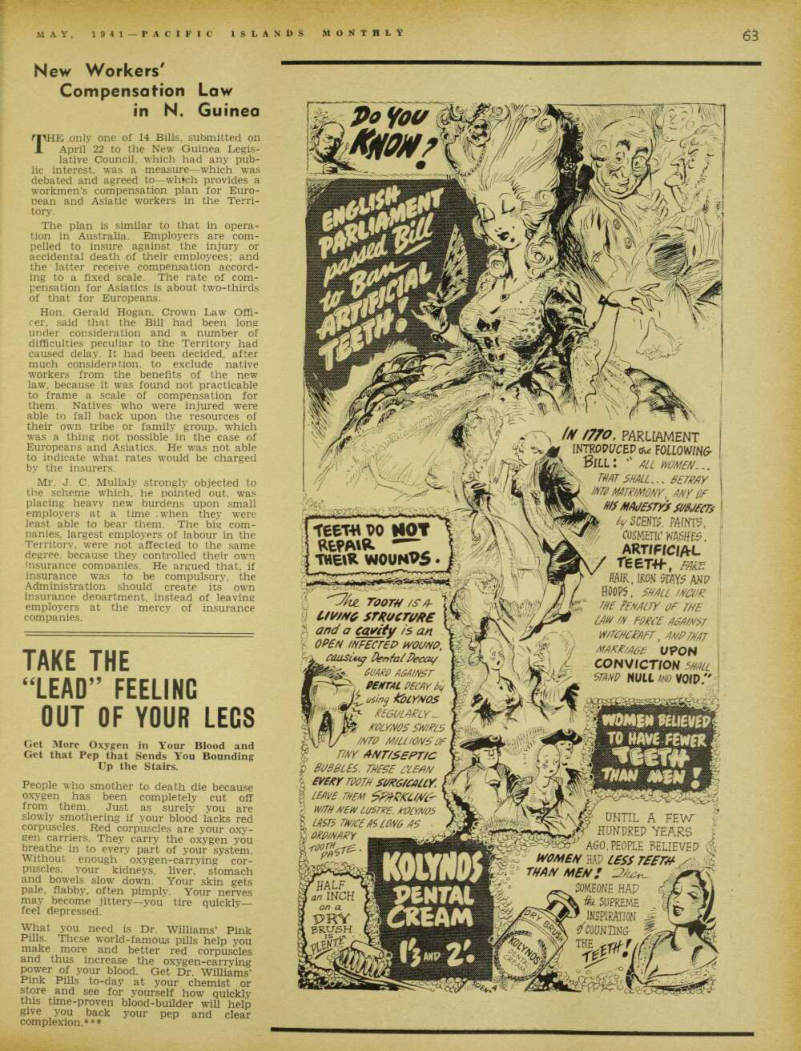
New Workers' Compensation Law in N. Guinea
THE only one of 14 Bills, submitted on April 22 to the New Guinea Legis lative Council, which had any pub lic interest, was a measure—which was debated and agreed to —which provides a workmen’s compensation plan for Euro nean and Asiatic workers in the Terri tory.
The plan is similar to that in opera tion in Australia. Employers are com pelled to insure against the injury or accidental death of their employees; and the latter receive compensation accord ing to a fixed scale. The rate of com pensation for Asiatics is about two-thirds of that for Europeans.
Hon. Gerald Hogan, Crown Law Offi cer, said that the Bill had been long under consideration and a number of difficulties peculiar to the Territory had caused delay. It had been decided, after much consideration, to exclude native workers from the benefits of the new law, because it was found not practicable to frame a scale of compensation for them. Natives who were injured were able to fall back upon the resources of their own tribe or family group, which was a thing not possible in the case of Europeans and Asiatics. He was not able to indicate what rates would be charged by the insurers.
Mr. J. C. Mullaly strongly objected to the scheme which, he pointed out. was placing heavy new burdens upon small employers at a time .when they were least able to bear them. The big com nanies, largest employers of labour in the Territory, were not affected to the same degree, because they controlled their own insurance companies. He argued that, if insurance was to be compulsory, the Administration should create its own insurance denartment, instead of leaving employers at the mercy of insurance companies.
Advertisements & other items, p. 67 (1 item)
“Lead” Feelinc
■e y mr
teeth vo hot
, RtpAie. --
i their wounßS
IS twi:
TOOTH IS A- 1
I LfWH& STRUCTURE
% and a cavity is an \ OPEN inpectep ovounp,
Causing DenfaiPeccu/
“ ' ' OUARO AGAINST
RENTAL OECAY by
/-£, S&lynos
>*■ REGULARLY-
ROLYNOS SW/RLS
wro ml am sop
PINY AHT/SEPT/C
S BUBBLES. THESE SLEW
; EVERT room SURS/CAUY.
I LEAVE THEM &frJ?KUAT&
3 WfTH NEW LUSTRE. ROLYNOS
\ LASTS Tw/CE AS LONG AS
; ORO/NARY
HALF
an INCH on a.
“PRY
3RUSH
\\ -w \V‘(
IN 17/0, PARLIAMENT
ItiTROVVCEV tfu FOLLOWING-
Bill : %t all women. ..
THAT SHALL... BETRAY
INTO MATRIMONY, ANT OP
MS MAJEST/S subject*
fyscmt' PAINTS.
f/z cosmic washes,
artificial
teeTH-, fare
m. m ms m
HOOPS. SHALL INCUR
THE PENALTY OF THE
TAW LN FORCE ASA INST
VUTCHCmT t ANP THAT
MARR/A6E UPON
CONVICTION SHALL
STANO NULLM?VOfDS|
- n 7
UNTIL A FEW
hunprep years
PEOPLE 3ELIEVEP C
r W WOMEN HAP CSSS TEETH-
tp? THAN MET/: Z2/u^
SOMEONE HAP
tin SUPREME
INSPIRATION 3
I skf*/
i 1 ]
TAKE THE
“LEAD” FEELINC
OUT OF YOUR LEGS
Get More Oxygen In Your Blood and Get that Pep that Sends You Bounding Up the Stairs.
People who smother to death die because oxygen has been completely cut off from them. Just as surely you are slowly smothering if your blood lacks red corpuscles. Red corpuscles are your oxygen carriers. They carry the oxygen you breathe in to every part of your system.
Without enough oxygen-carrying corpuscles. your kidneys, liver, stomach and bowels slow down. Your skin gets pale, flabby, often pimply. Your nerves may become jittery—you tire quickly— feel depressed.
What you need is Dr. Williams’ Pink Pills. These world-famous pills help you make more and better red corpuscles and thus increase the oxygen-carrying power of your blood. Get Dr. Williams’
Pink Pills to-day at your chemist or store and see for yourself how quickly this time-proven blood-builder will help give you back your pep and clear complexion.***
Market For New Guinea
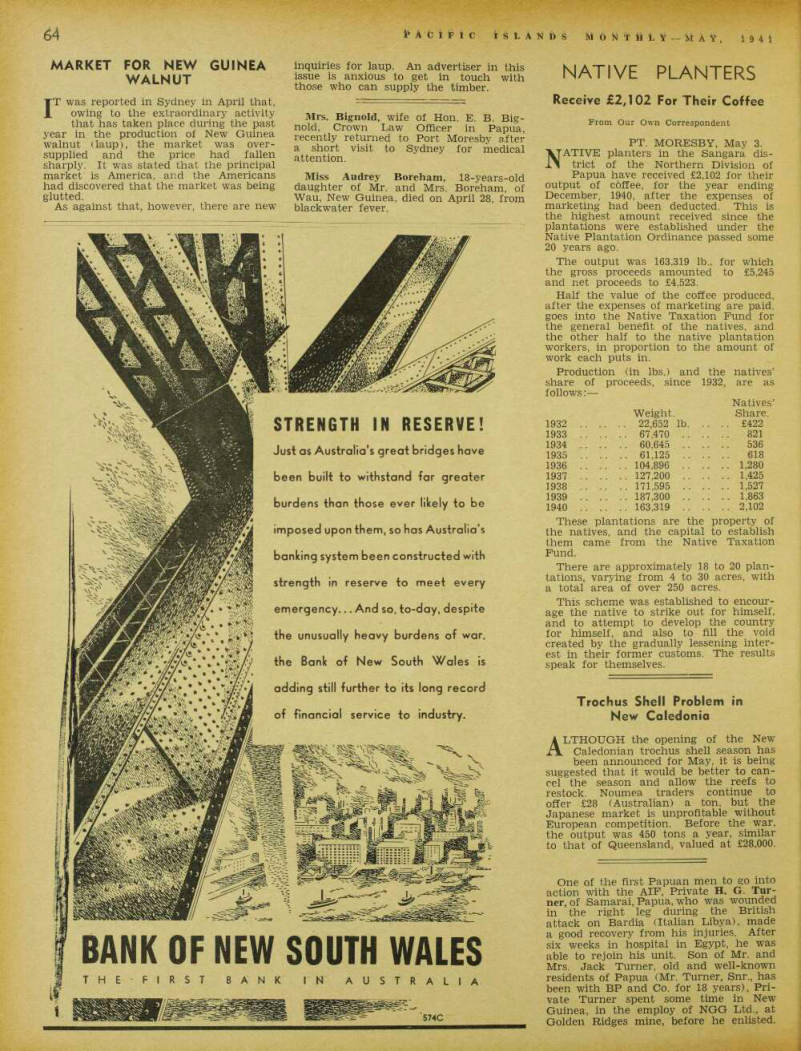
Walnut
IT was reported in Sydney in April that, owing to the extraordinary activity that has taken place during the past year in the production of New Guinea walnut (laup), the market was over supplied and the price had fallen sharply. It was stated that the principal market is America, and the Americans had discovered that the market was being glutted.
As against that, however, there are new
inquiries for laup. An advertiser in this issue is anxious to get in touch with those who can supply the timber.
Mrs. Bignold, wife of Hon. E. B. Big nold, Crown Law Officer in Papua, recently returned to Port Moresby after a short visit to Sydney for medical attention.
Miss Audrey Boreham, 18-years-old daughter of Mr. and Mrs. Boreham, of Wau, New Guinea, died on April 28, from blackwater fever.
Native Planters
Receive £2,102 For Their Coffee
From Our Own Correspondent
Pt. Moresby, May 3.
NATIVE planters in the Sangara dis trict of the Northern Division of Papua have received £2,102 for their output of coffee, for the year ending December, 1940, after the expenses of marketing had been deducted. This is the highest amount received since the plantations were established under the Native Plantation Ordinance passed some 20 years ago.
The output was 163,319 lb., for which the gross proceeds amounted to £5,245 and net proceeds to £4,523.
Half the value of the coffee produced, after the expenses of marketing are paid, goes into the Native Taxation Fund for the general benefit of the natives, and the other half to the native plantation workers, in proportion to the amount of work each puts in.
Production (in lbs.) and the natives’ share of proceeds, since 1932, are as follows;
These plantations are the property of the natives, and the capital to establish them came from the Native Taxation Fund.
There are approximately 18 to 20 plan tations, varying from 4 to 30 acres, with a total area of over 250 acres.
This scheme was established to encour age the native to strike out for himself, and to attempt to develop the country for himself, and also to fill the void created by the gradually lessening inter est in their former customs. The results speak for themselves.
Natives’
Weight. Share. 1932 22,652 lb £422 1933 67.470 821 1934 60,645 536 1935 61,125 618 1936 104,896 1,280 1937 127,200 1,425 1938 171,595 1,527 1939 187,300 1,863 1940 163,319 2,102
Trochus Shell Problem in New Caledonia
New Caledonia
ALTHOUGH the opening of the New Caledonian trochus shell season has been announced for May, it is being suggested that it would be better to can cel the season and allow the reefs to restock. Noumea traders continue to offer £2B (Australian) a ton, but the Japanese market is unprofitable without European competition. Before the war, the output was 450 tons a year, similar to that of Queensland, valued at £28,000.
One of the first Papuan men to go into action with the AIF, Private BL G. Tur ner, of Samarai, Papua, who was wounded in the right leg during the British attack on Bardia (Italian Libya), made a good recovery from his injuries. After six weeks in hospital in Egypt, he was able to rejoin his unit. Son of Mr. and Mrs. Jack Turner, old and well-known residents of Papua (Mr. Turner, Snr., has been with BP and Co. for 18 years), Pri vate Turner spent some time in New Guinea, in the employ of NGG Ltd., at Golden Ridges mine, before he enlisted.
Advertisements & other items, p. 68 (2 items)
64
Afcl £ I C ISLANDS MONTIILY-MAV, 1&41
Bank Of New South Wales
v^: % i
//*'/>* * VV&wV
* • * i •< . • . J
STRENGTH IN RESERVE!
Just as Australia's great bridges have been built to withstand tar greater burdens than those ever likely to be imposed upon them, so has Australia's banking system been constructed with strength in reserve to meet every emergency... And so. to-day, despite the unusually heavy burdens of war. the Bank of New South Wales is adding still further to its long record of financial service to industry.
BANK OF NEW SOUTH WALES
THE FIRST BANK
AUSTRALIA
574 C
18 Missing
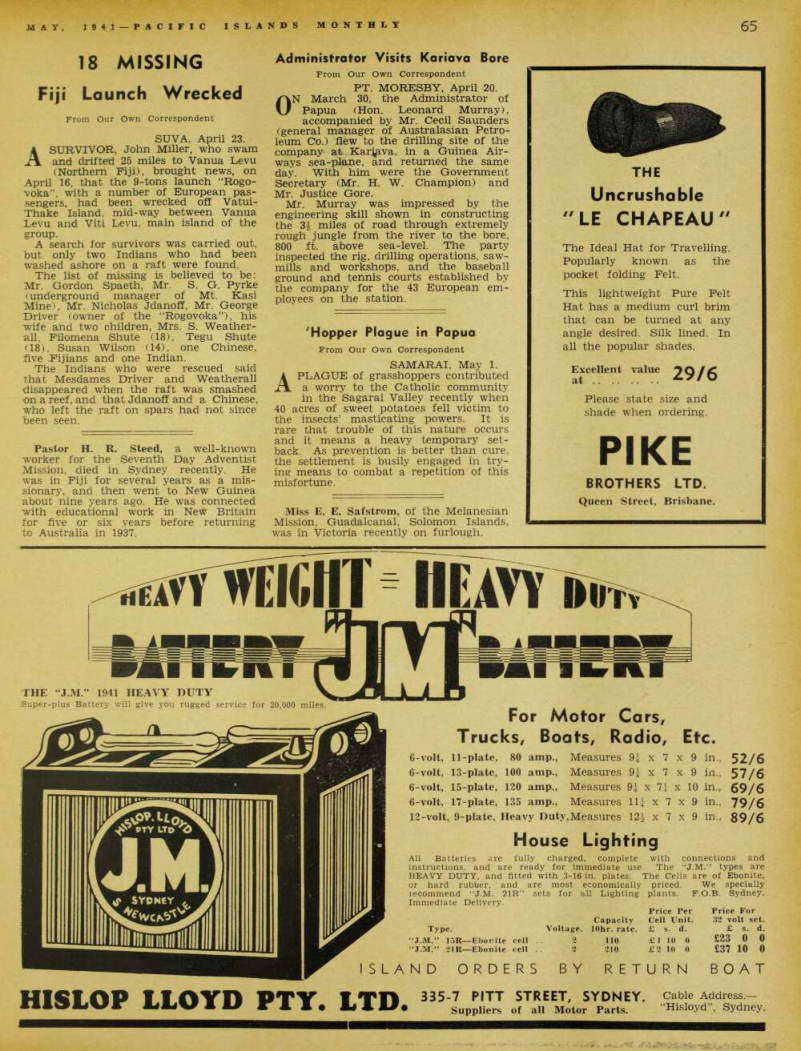
Fiji Launch Wrecked
From Our Own Correspondent SUVA, April 23.
A SURVIVOR, John Miller, who swam and drifted 25 miles to Vanua Levu (Northern Fiji), brought news, on April 16. that the 9-tons launch “Rogo voka". with a number of European pas sengers, had been wrecked off Vatui- Thake Island, mid-way between Vanua Levu and Viti Levu, main island of the group.
A search for survivors was carried out, but only two Indians who had been washed ashore on a raft were found.
The list of missing is believed to be: Mr. Gordon Spaeth, Mr. S. G. Pyrke (underground manager of Mt. Kasi Mine), Mr. Nicholas Jdanoff, Mr. George Driver (owner of the “Rogovoka”), his wife and two children, Mrs. S. Weather all. Pilomena Shute (18), Tegu Shute (18), Susan Wilson (14), one Chinese, five .Fijians and one Indian.
The Indians who were rescued said that Mesdames Driver and Weatherall disappeared when the raft was smashed on a reef, and that Jdanoff and a Chinese, who left the raft on spars had not since been seen.
Pastor H. R. Steed, a well-known worker for the Seventh Day Adventist Mission, died in Sydney recently. He was in Fiji for several years as a mis sionary, and then went to New Guinea about nine years ago. He was connected with educational work in New Britain for five or six years before returning to Australia in 1937.
Administrator Visits Kariava Bore
From Our Own Correspondent
Pt. Moresby, April 20.
ON March 30, the Administrator of Papua (Hon. Leonard Murray), accompanied by Mr. Cecil Saunders (general manager of Australasian Petro leum Co.) flew to the drilling site of the company at Kareva, in a Guinea Air ways sea-plane, and returned the same day. With him were the Government Secretary (Mr. H. W. Champion) and Mr. Justice Gore.
Mr. Murray was impressed by the engineering skill shown in constructing the 3 £ miles of road through extremely rough jungle from the river to the bore. 800 ft. above sea-level. The party inspected the rig, drilling operations, saw mills and workshops, and the baseball ground and tennis courts established by the company for the 43 European em ployees on the station.
'Hopper Plague in Papua
From Our Own Correspondent
Samarai, May 1.
A PLAGUE of grasshoppers contributed a worry to the Catholic community in the Sagarai Valley recently when 40 acres of sweet potatoes fell victim to the insects’ masticating powers. It is rare that trouble of this nature occurs and it means a heavy temporary set back. As prevention is better than cure, the settlement is busily engaged in try ing: means to combat a repetition of this misfortune.
Miss E. E. Safstrom, of the Melanesian Mission, Guadalcanal, Solomon Islands, was in Victoria recently on furlough.
Advertisements & other items, pp. 69-70 (1 item)
-«*r WEKiIIT Di;.tn »«,.
THE
Uncrushable
LE CHAPEAU
The Ideal Hat for Travelling.
Popularly known as the pocket folding Felt.
This lightweight Pure Felt Hat has a medium curl brim that can be turned at any angle desired. Silk lined. In all the popular shades.
Excellent value at 29/6 Please state size and shade when ordering.
PIKE
BROTHERS LTD.
Queen Street, Brisbane.
-«*r WEKiIIT Di;.tn »«,.
A
THE “J.M.” 1941 HEAVY DUTY
Super-plus Battery will give you rugged service for 20,000 miles. *
For Motor Cars,
Trucks, Boats, Radio,
Etc.
6-volt, 11-plate, 80 amp., 6-volt, 13-plate, 100 amp., 6-volt, 15-plate, 120 amp., 6-volt, 17-plate, 135 amp., Measures 9] x I x 9 in., Measures 91 x 7 x 9 in., Measures 9i x 7i x 10 in., Measures 11] x 7 x 9 in., 12-volt, 9-piate, Heavy Duty,Measures 121 x 7 x 9 in., 52/6 57/6 69/6 79/6 89/6
House Lighting
All Batteries are fully charged, complete instructions, and are ready for immediate use HEAVY DUTY, and fitted with 3-16 in. plates, or hard rubber, and are most economically lecommend “J.M. 21R” sets for all Lighting Immediate Delivery. with connections and The “J.M.” types are The Cells are of Ebonite, priced. We specially plants. F. 0.8. Sydney.
Type.
“J.M.” 15R—Ebonite cell “J.M.” >lK—Ebonite cell Capacity Voltage. lOhr. rate. 2 110 2 210 Price Per Cell Unit. £ s. d. £1 10 0 £2 10 0 Price For 32 volt set. £ s. d. £23 0 0 £37 10 0
SLAND ORDERS BY RETURN BOAT
HISLOP LLOYD PTY. LTD.
335-7 PITT STREET, SYDNEY.
Suppliers of all Motor Parts.
Cable Address.— “Hisloyd”, Sydney.
Allen Taylor & Co. Ltd.
COMMERCIAL ROAD, ROZELLE,
SYDNEY
Sawmillers and Wholesale Suppliers of Hardwoods for Constructional Purposes GIRDERS . . . PILES . . . POLES . . . SLEEPERS, Etc.
EXPORTING TO PACIFIC ISLANDS SINCE 1893
IT ATTRACTS —THEY EAT IT —THEY DIE qn NG
USOLINE
NEVER
KNOWN
TO FAIL!
CERTAIN
DEATH
AUSOLINE CO.,
314 CROWN STREET, SYDNEY
(Established 1919)
COCKROACH
DESTROYER
IT'S A PASTE !
Packed in 6 oz., 1 lb. & 3 lb. tins.
Obtainable from Islands Stores of;—
BURNS, PHILP & CO. LTD.
W. R. CARPENTER & CO.
LTD.
MORRIS, HEDSTROM LTD.
W. S. TAIT & CO. PTY. LTD.
COSMOPOLITAN HOTEL
SAMARA!
FIRST-CLASS
ACCOMMODATION
For Tourists & Commercials Electric Light, Ballroom Billiards, Freezing Works, Cold Store.
Best Brands of Liquors.
MODERATE TARIFF.
Fishing Trips and Launch Excursions Arranged.
Us Navy In Suva
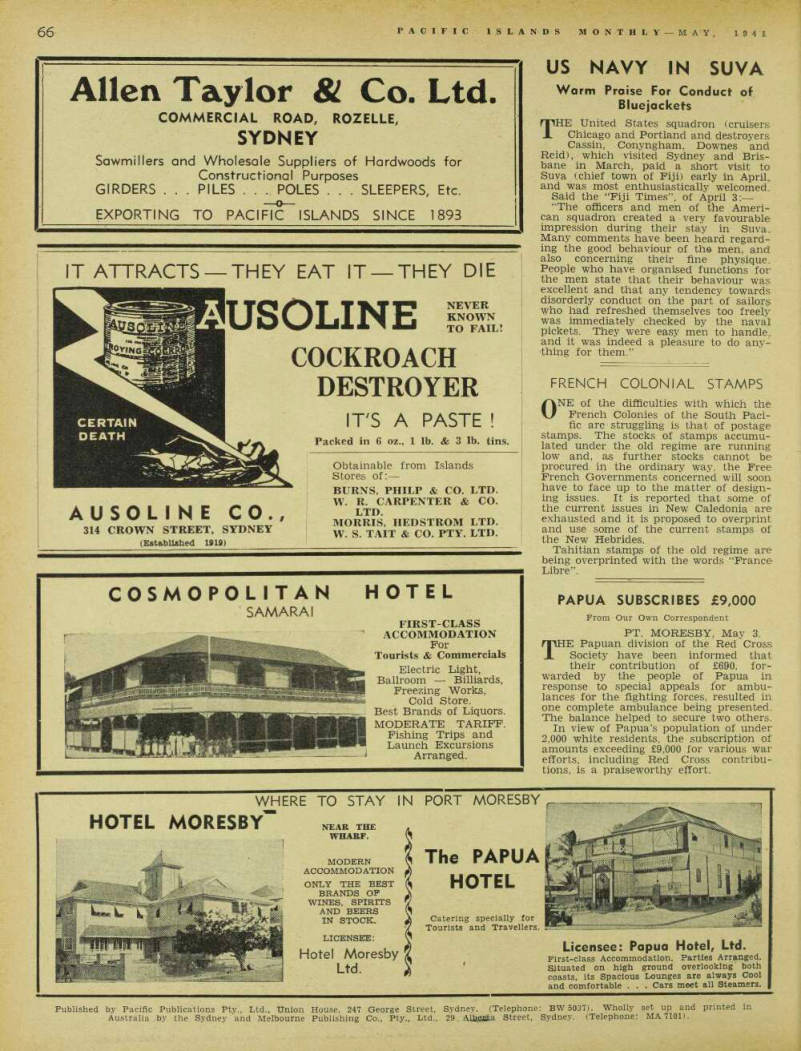
Warm Praise For Conduct of Bluejackets
THE United States squadron (cruisers Chicago and Portland and destroyers Cassin, Conyngham, Downes and Reid), which visited Sydney and Bris bane in March, paid a short visit to Suva (chief town of Fiji) early in April, and was most enthusiastically welcomed Said the “Fiji Times”, of April 3: — “The officers and men of the Ameri can squadron created a very favourable impression during their stay in Suva.
Many comments have been heard regard ing the good behaviour of the men, and also concerning their fine physique.
People who have organised functions for the men state that their behaviour was excellent and that any tendency towards disorderly conduct on the part of sailors who had refreshed themselves too freely was immediately checked by the naval pickets. They were easy men to handle, and it was indeed a pleasure to do any thing for them.”
French Colonial Stamps
ONE of the difficulties with which the French Colonies of the South Paci fic are struggling is that of postage stamps. The stocks of stamps accumu lated under the old regime are running low and, as further stocks cannot be procured in the ordinary way, the Free French Governments concerned will soon have to face up to the matter of design ing issues. It is reported that some of the current issues in New Caledonia are exhausted and it is proposed to overprint and use some of the current stamps of the New Hebrides.
Tahitian stamps of the old regime are being overprinted with the words “France Libre”.
Papua Subscribes £9,000
From Our Own Correspondent
Pt. Moresby, May 3.
THE Papuan division of the Red Cross Society have been informed that their contribution of £690, for warded by the people of Papua in response to special appeals for ambu lances for the fighting forces, resulted in one complete ambulance being presented.
The balance helped to secure two others.
In view of Papua’s population of under 2,000 white residents, the subscription of amounts exceeding £9,000 for various war efforts, including Red Cross contribu tions, is a praiseworthy effort.
Advertisements & other items, pp. 70-72 (2 items)
66
PACIFIC ISLANDS MONTHLY M AY , 19 4 1
Published by Pacific Publications Pty., Ltd., Union House, 247 George Street, Sydney. (Telephone; BW 5037). Wholly set up and printed in Australia by the Sydney and Melbourne Publishing Co., Pty., Ltd., 29. At&a&a Street, Sydney. (Telephone: MA7101).
Hotel Moresby"
WHERE TO STAY IN
NEAR THE
WHARF.
MODERN
ACCOMMODATION
ONLY THE BEST
BRANDS OP
WINES, SPIRITS
AND BEERS
IN STOCK.
LICENSEE:
Hotel Moresby
Ltd.
PORT MORESBY
The PAPUA
HOTEL
Catering specially for Tourists and Travellers.
Licensee: Papua Hotel, Ltd.
First-class Accommodation. Parties Arranged.
Situated on high ground overlooking both coasts, its Spacious Lounges are always Cool and comfortable . . . Cars meet all Steamers.
T m
Uluttyi notivfieelA (Hcneefeed
Uie jum^ifi-bound inteteioi...
Prior to 1927 tortuous jungle foot-tracks winding over precipitous mountains were the sole means of communication between the coast and the rich gold deposits in the interior of New Guinea. Transport costs were ruinously high. Roadways and Railways were impracticableonly one way remained —THE AIR WAY.
Guinea Airways Limited was formed and in March, 1927, pioneered the first successful flight into the interior . . . since that time this Company has maintained a regular and reliable service, carrying thousands of passengers and transporting over 65.000 tons, including every tvpe of goods and machinery needed by the growing European population.
Guinea Airways regular passenger services are scheduled to coincide with ship docking times. Full particulars and tickets are obtainable at all offices of Guinea Airways, Burns Philp & Company, Sydney and Brisbane, and, en route to New Guinea, from the ship’s purser.
SPEEDY
CHARTER
SERVICE
Guinea Airways provide fast passenger and freight, land and sea ’planes for charter to any point in New Guinea and Papua. Company Executives can save valuable time by flying to the fields and by sending vital machine parts and other important freight by specially chartered ’planes.
Full particulars obtainable from the nearest Guinea Airways representative. 8 i / i A
WE WORLDS LARGEST
LAE-SALAM AD A:
New Guinea Office: LAE, Mandated Territory of New Guinea.
Branch Offices and Agents at WAU-SALAMAUA-
PORT MORESBY and SYDNEY.
A Tropical Thirst
demands a Satisfying Drink
A COOL Pi
$ » *** 0,1 nwm the finest »Nt eottleo by
T °OTH & CO.. LI MU
SVONEY. AUSTRAL^
that’s why K«B* is so popular
south of i( the Line ” * All through the trop]c|, {wherever thefsl&P step 3 who hke good beer*you’ll always find K. B. ‘IV s'the t; drink that men appreciate —a drink just made to satisfy a tropical thirst! §53 3>
TOOTH'S